2025 Annual General Meeting Invitation, Proxy Statement and Annual Report
To our shareholders, partners, customers and employees Fiscal Year 2025 was a year of outstanding results for Logitech. We returned the Company to growth - expanding each quarter to deliver topline growth of +6% in US dollars year over year. The growth was broad-based across key product categories, geographies and across both business and consumer channels. We expanded our market share in strategic categories across the portfolio. We continue to be number one or two in 12 of the 13 categories in which we compete. And we achieved all this while simultaneously driving profitability - annual gross margins were 43.1%, up 170 basis points compared to the prior year. As a result, Logitech closed the year with a pristine balance sheet and healthy cash position. Cash flow from operations was $843 million, and the end-of-year cash balance was $1.5 billion. We returned approximately $800 million to shareholders via dividends and share repurchases. This strong performance was reflected internally, too. Our latest global survey saw overall employee engagement at 78%, 9 points above the industry benchmark. And in Forbes’ survey of the World’s Best Employers, Logitech ranked number 20 out of 850 global companies. STRATEGIC PRIORITIES DRIVE OUTSTANDING RESULTS These outstanding results reflect the hard work of our teams, and solid progress against our strategic priorities: Superior products and innovation: We launched 39 new products in FY 2025, innovating across our portfolio in existing and in new categories. This innovation was recognized by ten Red Dot and four iF design awards, including for products in new categories like MX Ink and MX Creative Console. Many won multiple awards, such as the Logitech Sight camera, which made TIME’s list of Best Inventions of 2024, SonntagsZeitung’s Swiss Innovations 2024 and Fast Company’s list of the Next Big Things in Tech. We also released new best-sellers, including the Combo Touch keyboard case for the new iPads, the Pro X Superlight 2 gaming mouse and the Astro A50 gaming headset. These results reflect the strategic investments we made in research and development - about 6% of sales - and the dedication of our world-class design and engineering teams. Double down on business-to-business (B2B): While we continued to win in consumer channels, we accelerated our focus on B2B. Our newly established Logitech for Business organization drove robust growth across Video Collaboration, Headsets, Keyboards & Combos, and Pointing Devices. Products like Sight and the Rally Board 65 helped drive this growth, which was also enabled by smart new AI-driven features across the portfolio. Aided by the new organizational setup, we improved our go-to-market capabilities and delivered double-digit growth in services as well as in the new education sector. Excellence across geographies: We serve more than 150 countries, and worked throughout the fiscal year to apply best practices and proven strategies from market to market, bringing the best of our global expertise to each locality. In the year, we grew sales in constant currency in all three regions. Leveraging our operations powerhouse: Resilience and excellence in operations have long set Logitech apart. We continued to drive this capability to our advantage in FY 2025. Focused product cost reductions resulted in record savings to deliver the second highest annual non-GAAP gross margin of the last decade. We manufacture five products every second, and we take great pride in doing so with superior quality, service and cost. We also ensure we are constantly improving our products’ sustainability performance by designing for sustainability along our supply chain. All these, plus the trusted, iconic brand we are building, contributed to our Fiscal Year 2025 results and to our mission of extending human potential in Work and Play. A FOCUS ON WORK AND PLAY, SUPPORTED BY MACRO TRENDS Earlier this year, at our analyst and investor day, we highlighted our focus on the macro areas of Work and Play, which represent a large, growing serviceable addressable market (SAM). Our revenue today is about $4.6 billion, but our SAM is about $24 billion, including Gaming, Personal Workspace, the B2B market and a set of verticals that we have only recently entered - Education, Healthcare and the Public Sector. This large market is growing at a robust pace. It provides Logitech a great opportunity to lead, gain share and grow in the years to come, supported by several long-term, macro trends. First, Artificial Intelligence, AI. Generative AI, Edge AI and Agentic AI are rapidly-evolving, multi-billion dollar market opportunities that we believe will help us design smarter product experiences. We’re already leveraging
AI at the Edge today across a range of products, like the Zone 2 wireless Headset and the new Spot Sensor, as well the Sight VC camera. We have developed an intelligent AI streaming assistant with NVIDIA. And it is through Logitech’s devices that people access AI, via multimodal inputs like text, images, audio and video. Our devices are already in people’s hands, on their heads and in front of their eyes. As the world embraces advances in AI at an unprecedented rate, Logitech has many new opportunities to innovate. Our role as the connection between people and the digital world has never been more critical; and the opportunity to extend human potential has never been greater. Second, new ways of working. Most companies and people have now settled into evolved working routines. Whatever their employer’s policy, most people around the world today work from two or more places. They work in offices, from home, in cafes, hotels and airports, and everywhere in between. 71% of Global 500 Index companies are Logitech customers; and one in three meeting rooms and desks use Logitech, making us the market leader in video conferencing and personal workspace solutions. Yet, this leaves room for more. Wherever people work from, they need mice, keyboards, webcams and headsets. More than 75% of meeting rooms are not yet video conferencing-enabled. Wherever there is someone working, there's an opportunity for Logitech. Finally, gaming continues to grow. It has become a mainstream activity, enjoyed by men and women, young and old. Much of its success can be credited to the fact that gaming has become so much more than just a game. Gaming is a sport - the International Olympic Committee has created the first-ever Olympic Esports program; and it is a huge form of connection and entertainment - for Americans under 45, more time is spent gaming than on TV and movies combined. CHAIRPERSON TRANSITION After eight years on our board, Wendy Becker, Logitech’s chairperson, announced her decision to step down at this year’s Annual General Meeting. Her tenure spans Logitech’s biggest years of growth both for revenues and shareholder return. Logitech is very grateful for her many years of service, strategic guidance and outstanding leadership. During Wendy’s tenure, Logitech established Logitech for Business, the Company’s B2B organization; navigated the Covid pandemic’s impact and return to growth; increased its pace of innovation; and smoothly transitioned to the fourth CEO in Logitech’s history. A special board committee has focused on identifying Wendy’s successor, leading to the board’s unanimous nomination of Guy Gecht. With a track record of leading and advising tech companies through innovation and growth, Guy brings decades of executive and board- level experience to the role. He is the co-founder and former co-CEO of E.Merge Technology Acquisition Corp., and was CEO of publicly traded Electronics for Imaging (EFI) from 2000 to 2018, where he guided the company’s evolution into a global leader in digital printing technology. Guy has been a non-executive member of Logitech’s board since September 2019 and served as interim CEO from June to December 2023, prior to Hanneke Faber’s appointment as CEO. His nomination will be voted on by shareholders at the Company’s upcoming Annual General Meeting. LOOKING AHEAD We exited Fiscal Year 2025 with strong momentum. In Fiscal Year 2026, we are operating against a backdrop of uncertainty. Geopolitical conflict, fluctuating tariffs and dynamic consumer and enterprise sentiment are all factors that shape the current environment. In these choppy waters, Logitech will continue to drive its long-term strategy, as presented at our analyst and investor day in March 2025, and stay true to its long- term values. We have overlaid three principles to our plans at this time: we will play offense; strictly control costs; and be agile. We are able to play offense because we start from a position of strength. We are a global business - approximately two-thirds of our net sales are generated outside the US. We have a diversified, flexible manufacturing footprint across six countries. We have a strong brand with customer loyalty and solid market share; a pristine balance sheet; and a highly experienced operations and commercial team. At the same time, cost discipline and agility are more important than ever at this time. Our teams have the talent, passion and determination to deliver, and our unique culture is stronger than ever. We look forward to delivering many more years of superior innovation and continuing our strong track record of shareholder value creation. Wendy Becker Chairperson of the Board Hanneke Faber Chief Executive Officer
FORWARD-LOOKING INFORMATION This Invitation, Proxy Statement and Annual Report, including the letter to shareholders, contains "forward- looking statements" within the meaning of the Private Securities Litigation Reform Act of 1995. Forward-looking statements are based on beliefs of our management as of the initial date of making such statements. These forward- looking statements include, among other things, statements related to: • Our strategy for growth, future revenues, earnings, cash flow, uses of cash and other measures of financial performance, and market position; • Our business strategy and investment priorities in relation to evolving consumer and enterprise demand trends, competitive landscape and current and future worldwide geopolitical, economic and capital market conditions, including fluctuations in currency exchange rates, inflation, economic downturns, and disruptions in global logistics; • Changes in trade regulations, policies and agreements and the imposition of tariffs that affect our products or operations, including potential new tariffs that may be imposed on U.S. imports, and our ability to mitigate; • Long-term, secular trends that impact our product categories; • The evolution and adoption of artificial intelligence ("AI"), its impact on our industry and related risks and opportunities for our business; • Our expectations regarding any restructuring efforts, including the timing or effectiveness thereof; • The scope, nature or impact of any acquisition, strategic alliance, and divestiture activities; • Our expectations regarding the success of any strategic acquisitions, including integration of acquired operations, products, technology, internal controls, personnel and management teams; • Our expectations regarding our effective tax rate, future tax benefits, tax settlements, the adequacy of our provisions for uncertain tax positions; • Our expectations regarding our potential indemnification obligations, and the outcome of pending or future legal proceedings and tax audits; • Our business development, product development and innovation, and their impact on future operating results and anticipated operating costs for fiscal year 2026 and beyond; • Opportunities for growth and our ability to execute on and take advantage of them, including our marketing initiatives and strategy and our expectations regarding the success thereof; • Our expectations regarding our share repurchase and dividend programs; • The sufficiency of our cash and cash equivalents, cash generated from operations, and available borrowings under our Credit Agreement and our bank lines of credit to fund capital expenditures and working capital needs, and our ability to comply with our obligations under such debt agreements; and • The effects of environmental and other laws and regulations in the United States and other countries in which we operate. Forward-looking statements also include, among others, those statements including the words "anticipate," "believe," "could," "estimate," "expect," "forecast," "intend," "may," "plan," "project," "predict," "should," "will" and similar language. These statements reflect our views and assumptions as of the initial date of making such statements. All forward-looking statements involve risks and uncertainties that could cause our actual performance to differ materially from those anticipated in the forward-looking statements depending on a variety of factors. Important information as to these factors can be found in the Annual Report on Form 10-K for the fiscal year ended March 31, 2025 under the headings of “Management’s Discussion and Analysis of Financial Condition and Results of Operations,” “Overview of our Company,” “Critical Accounting Estimates” and “Liquidity and Capital Resources,” among others. Factors that might cause or contribute to such differences include, but are not limited to, those discussed under Item 1A "Risk Factors," as well as elsewhere in the Annual Report on Form 10-K for the fiscal year ended March 31, 2025 and in our other filings with the U.S. Securities and Exchange Commission ("SEC"). You are cautioned not to place undue reliance on the forward-looking statements, which speak only as of the initial date of making such statements. We undertake no obligation to publicly release any revisions to the forward-looking statements or reflect events or circumstances after the initial date of making such statements.
July 24, 2025 To our shareholders: You are cordially invited to attend Logitech's 2025 Annual General Meeting. The meeting will be held on Tuesday, September 9, 2025 at 9:00 a.m. CEST at the SwissTech Convention Center, EPFL, in Lausanne, Switzerland. Enclosed is the Invitation and Proxy Statement for the meeting, which includes an agenda and discussion of the items to be voted on at the meeting, instructions on how you can exercise your voting rights, information concerning Logitech’s compensation of its Board members and executive officers, and other relevant information. Whether or not you plan to attend the 2025 Annual General Meeting, your vote is important, and you should take the steps required so that your shares are represented at the 2025 Annual General Meeting. Thank you for your continued support of Logitech. Wendy Becker Chairperson of the Board
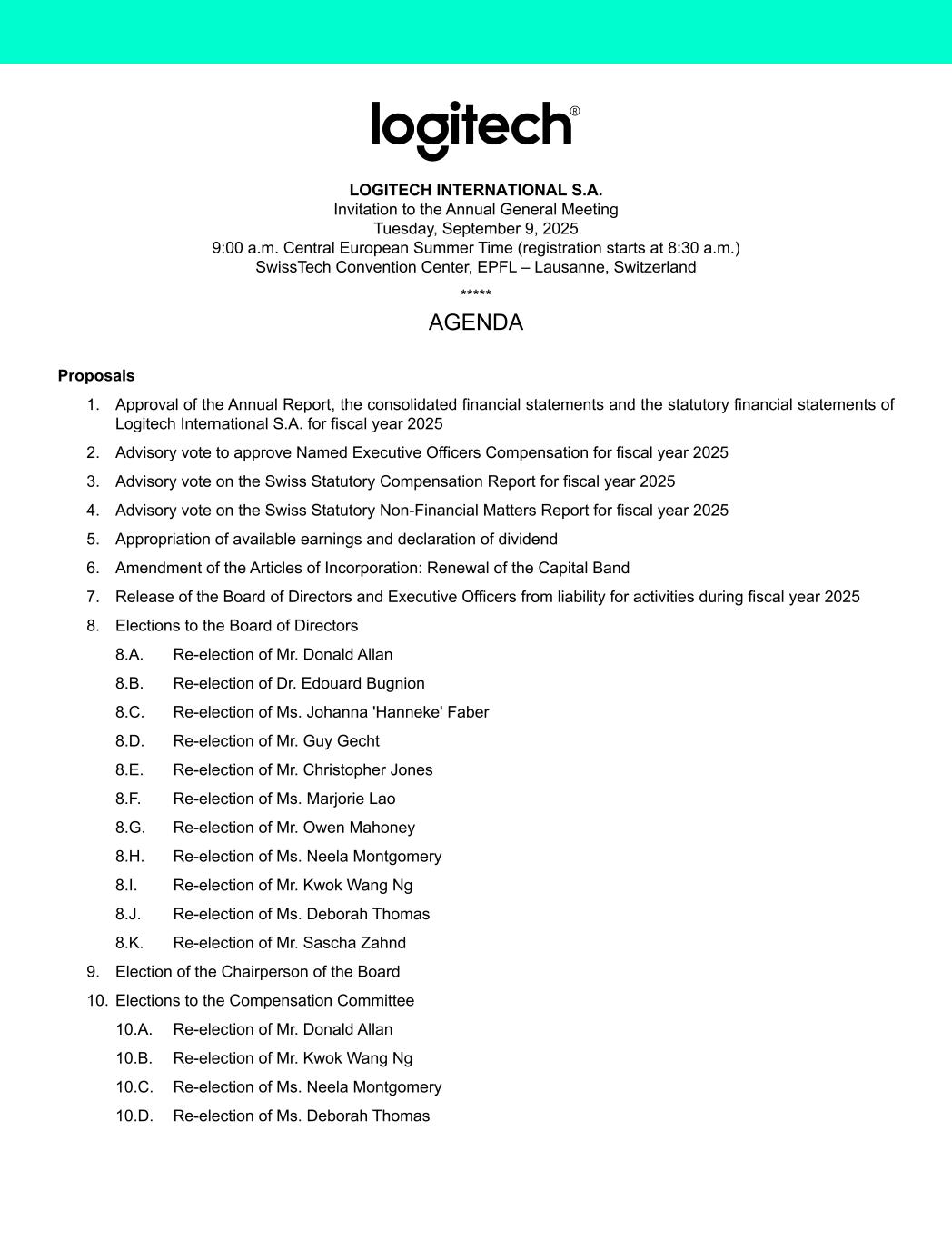
LOGITECH INTERNATIONAL S.A. Invitation to the Annual General Meeting Tuesday, September 9, 2025 9:00 a.m. Central European Summer Time (registration starts at 8:30 a.m.) SwissTech Convention Center, EPFL – Lausanne, Switzerland ***** AGENDA Proposals 1. Approval of the Annual Report, the consolidated financial statements and the statutory financial statements of Logitech International S.A. for fiscal year 2025 2. Advisory vote to approve Named Executive Officers Compensation for fiscal year 2025 3. Advisory vote on the Swiss Statutory Compensation Report for fiscal year 2025 4. Advisory vote on the Swiss Statutory Non-Financial Matters Report for fiscal year 2025 5. Appropriation of available earnings and declaration of dividend 6. Amendment of the Articles of Incorporation: Renewal of the Capital Band 7. Release of the Board of Directors and Executive Officers from liability for activities during fiscal year 2025 8. Elections to the Board of Directors 8.A. Re-election of Mr. Donald Allan 8.B. Re-election of Dr. Edouard Bugnion 8.C. Re-election of Ms. Johanna 'Hanneke' Faber 8.D. Re-election of Mr. Guy Gecht 8.E. Re-election of Mr. Christopher Jones 8.F. Re-election of Ms. Marjorie Lao 8.G. Re-election of Mr. Owen Mahoney 8.H. Re-election of Ms. Neela Montgomery 8.I. Re-election of Mr. Kwok Wang Ng 8.J. Re-election of Ms. Deborah Thomas 8.K. Re-election of Mr. Sascha Zahnd 9. Election of the Chairperson of the Board 10. Elections to the Compensation Committee 10.A. Re-election of Mr. Donald Allan 10.B. Re-election of Mr. Kwok Wang Ng 10.C. Re-election of Ms. Neela Montgomery 10.D. Re-election of Ms. Deborah Thomas
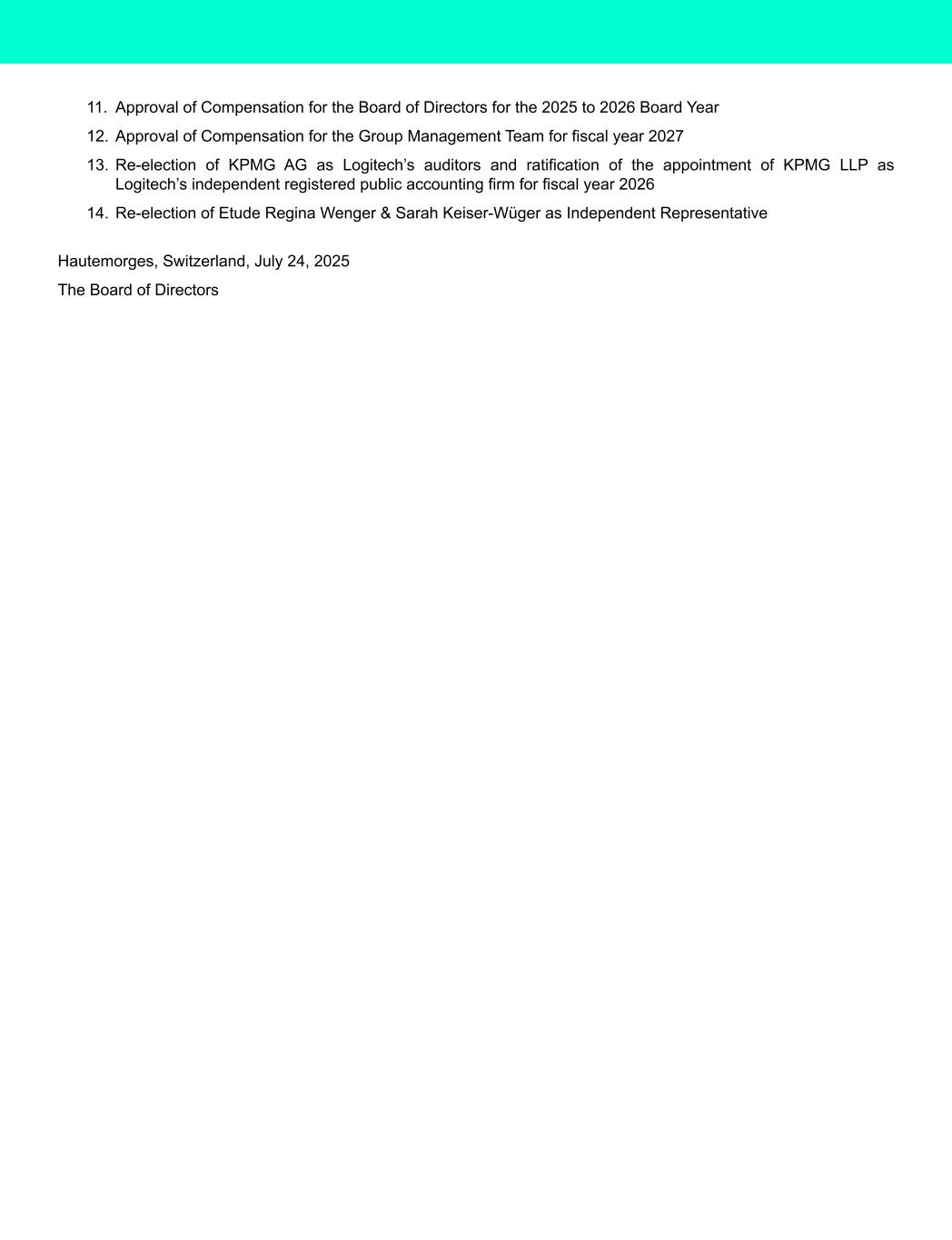
11. Approval of Compensation for the Board of Directors for the 2025 to 2026 Board Year 12. Approval of Compensation for the Group Management Team for fiscal year 2027 13. Re-election of KPMG AG as Logitech’s auditors and ratification of the appointment of KPMG LLP as Logitech’s independent registered public accounting firm for fiscal year 2026 14. Re-election of Etude Regina Wenger & Sarah Keiser-Wüger as Independent Representative Hautemorges, Switzerland, July 24, 2025 The Board of Directors
Questions and Answers about The Logitech 2025 Annual General Meeting General Information for All Shareholders WHY AM I RECEIVING THIS “INVITATION AND PROXY STATEMENT”? This document is designed to comply with both Swiss corporate law and U.S. proxy statement rules. Outside of the U.S. and Canada, the agenda, the proposals and the explanations included in this Invitation and Proxy Statement together with an explanation of organizational matters will be made available to registered shareholders also in French and German. We made copies of this Invitation and Proxy Statement available to shareholders beginning on July 24, 2025. The Response Coupon or Proxy Card are requested on behalf of the Board of Directors of Logitech for use at Logitech’s Annual General Meeting. The meeting will be held on Tuesday, September 9, 2025 at 9:00 a.m., Central European Summer Time, at the SwissTech Convention Center, EPFL, in Lausanne, Switzerland. WHO IS ENTITLED TO VOTE AT THE MEETING? Shareholders registered in the Share Register of Logitech International S.A. (including in the sub-register maintained by Logitech’s U.S. transfer agent, Computershare) on Wednesday, September 3, 2025 have the right to vote at the Annual General Meeting. No shareholders will be entered in the Share Register between September 3, 2025 and the day following the meeting. As of June 30, 2025, there were 71,036,546 shares registered and entitled to vote out of a total of 147,551,488 Logitech shares outstanding (net of treasury shares). The actual number of registered shares that will be entitled to vote at the meeting will vary depending on how many more shares are registered, or deregistered, between June 30, 2025 and September 3, 2025. For information on the criteria for the determination of the U.S. or Canadian “street name” beneficial owners who may vote with respect to the meeting, please refer to “Further Information for U.S. or Canadian “Street Name” Beneficial Owners” below. WHO IS A REGISTERED SHAREHOLDER? If your shares are registered directly in your name with us in the Share Register of Logitech International S.A., or in our sub-register maintained by our U.S. transfer agent, Computershare, you are considered a registered shareholder, and this Invitation and Proxy Statement and related materials are being sent or made available to you by or on behalf of Logitech. 2025 Annual General Meeting Invitation, Proxy Statement 1
WHO IS A BENEFICIAL OWNER WITH SHARES REGISTERED IN THE NAME OF A CUSTODIAN, OR “STREET NAME” OWNER? Shareholders that have not requested registration in our Share Register directly, and hold shares through a broker, trustee or nominee or other similar organization that is a registered shareholder, are beneficial owners of shares registered in the name of a custodian. If you hold your Logitech shares through a U.S. or Canadian broker, trustee or nominee or other similar organization (also called holding in “street name”), which is the typical practice of our shareholders in the U.S. and Canada, the organization holding your account is considered the registered shareholder for purposes of voting at the meeting, and this Invitation and Proxy Statement and related materials are being sent or made available to you by them. You have the right to direct that organization on how to vote the shares held in your account. WHY IS IT IMPORTANT FOR ME TO VOTE? Logitech is a public company and certain key decisions can only be made by shareholders. Whether or not you plan to attend, your vote is important so that your shares are represented. HOW MANY REGISTERED SHARES MUST BE PRESENT OR REPRESENTED TO CONDUCT BUSINESS AT THE MEETING? There is no presence quorum requirement for the meeting. Under Swiss law, public companies do not have specific quorum requirements for shareholder meetings, and our Articles of Incorporation do not otherwise provide for a quorum requirement. WHERE ARE LOGITECH’S PRINCIPAL EXECUTIVE OFFICES? Logitech’s principal executive office in Switzerland is at EPFL – Quartier de l’Innovation, 1015 Lausanne, Switzerland, and our principal executive office in the United States is at c/o Logitech Inc., 3930 North First Street, San Jose, CA 95134. Logitech’s main telephone number in Switzerland is +41- (0)21-863-5111 and our main telephone number in the United States is +1-510-795-8500. HOW CAN I OBTAIN LOGITECH’S PROXY STATEMENT, ANNUAL REPORT AND OTHER ANNUAL REPORTING MATERIALS? A copy of our 2025 Annual Report to Shareholders, which contains the consolidated financial statements of Logitech International S.A for the fiscal year ended March 31, 2025, the Swiss statutory financial statements of Logitech International S.A. for the fiscal year ended March 31, 2025, and the auditor’s reports thereon, this Invitation and Proxy Statement and our Annual Report on Form 10-K for fiscal year 2025 filed with the U.S. Securities and Exchange Commission (the “SEC”) are available on our website at http:// ir.logitech.com. Shareholders also may request free copies of these materials at our principal executive offices in Switzerland or the United States, at the addresses above, or by contacting our investor relations group at IR@logitech.com or at +1-510-916-9842. WHERE CAN I FIND THE VOTING RESULTS OF THE MEETING? We intend to announce voting results at the meeting and issue a press release promptly after the meeting. We will also file the results on a Current Report on Form 8-K with the SEC by Tuesday, September 16, 2025. A copy of the Form 8-K will be available on our website at http://ir.logitech.com. QUESTIONS AND ANSWERS ABOUT THE ANNUAL GENERAL MEETING 2 2025 Annual General Meeting Invitation, Proxy Statement
IF I AM NOT A REGISTERED SHAREHOLDER, CAN I ATTEND AND VOTE AT THE MEETING? You may not attend the meeting and vote your shares in person at the meeting unless you either become a registered shareholder by Wednesday, September 3, 2025 or you obtain a “legal proxy” from the broker, trustee or nominee that holds your shares, giving you the right to vote the shares at the meeting. If you hold your shares through a non-U.S. or non-Canadian broker, trustee or nominee, you may become a registered shareholder by contacting our Share Registrar at Logitech International S.A., c/o Devigus Shareholder Services, Birkenstrasse 47, CH-6343 Rotkreuz, Switzerland, and following their registration instructions or, in certain countries, by requesting registration through the bank or brokerage through which you hold your shares. If you hold your shares through a U.S. or Canadian broker, trustee or nominee, you may become a registered shareholder by contacting your broker, trustee or nominee, and following their registration instructions. Further Information for Registered Shareholders HOW CAN I VOTE IF I CANNOT ATTEND THE MEETING? If you do not plan to attend the meeting in person, you may appoint the Independent Representative, Etude Regina Wenger & Sarah Keiser-Wüger, to represent you at the meeting. Please provide your voting instructions by marking the applicable boxes beside the agenda items on the Internet voting site for registered shareholders, www.gvmanager-live.ch/logitech for shareholders on the Swiss share register or www.proxyvote.com for shareholders on the U.S. share register, or on the Response Coupon or Proxy Card, as applicable. SWISS SHARE REGISTER – INTERNET VOTING – Go to the Internet voting site www.gvmanager-live.ch/logitech and log in with your access code printed on the Response Coupon. Please use the menu item “Grant Procuration” and submit your instructions by clicking on the “Send” button. SWISS SHARE REGISTER – RESPONSE COUPON – Mark the box under Option 3 on the enclosed Response Coupon. Please sign, date and promptly mail your completed Response Coupon to Etude Regina Wenger & Sarah Keiser-Wüger using the appropriate enclosed postage-paid envelope addressed to Logitech International S.A., c/o Devigus Shareholder Services, Birkenstrasse 47, CH-6343 Rotkreuz, Switzerland. U.S. SHARE REGISTER – INTERNET VOTING – Go to the Internet voting site www.proxyvote.com and log in with your 16-digit voting control number printed in the box marked by the arrow on the Notice of Internet Availability of Proxy Materials that you received from us. Please follow the menus to select the Independent Representative, Etude Regina Wenger & Sarah Keiser- Wüger, to represent you at the meeting. Please submit your instructions by clicking on the "Submit" button. U.S. SHARE REGISTER – PROXY CARD – If you have requested a Proxy Card, mark the box “Yes” on the Proxy Card to select the Independent Representative, Etude Regina Wenger & Sarah Keiser-Wüger, to represent you at the meeting. Please sign, date and promptly mail your completed Proxy Card to Broadridge using the enclosed postage-paid envelope. QUESTIONS AND ANSWERS ABOUT THE ANNUAL GENERAL MEETING 2025 Annual General Meeting Invitation, Proxy Statement 3
HOW CAN I ATTEND THE MEETING? If you wish to attend the meeting in person, you will need to obtain an admission card. You may order your admission card on the Internet voting site for registered shareholders, www.gvmanager-live.ch/logitech for shareholders on the Swiss share register or www.proxyvote.com for shareholders on the U.S. share register, or on the Response Coupon or Proxy Card, as applicable, and we will send you an admission card for the meeting. If an admission card is not received by you prior to the meeting and you are a registered shareholder as of September 3, 2025, you may attend the meeting by presenting proof of identification at the meeting. SWISS SHARE REGISTER – INTERNET VOTING – Go to the Internet voting site www.gvmanager-live.ch/logitech and log in with your access code printed on the Response Coupon. Please use the menu item “Order Admission Card.” SWISS SHARE REGISTER – RESPONSE COUPON – Mark the box under Option 1 on the enclosed Response Coupon. Please send the completed, signed and dated Response Coupon to Logitech using the enclosed postage- paid envelope by Wednesday, September 3, 2025. U.S. SHARE REGISTER – INTERNET VOTING – Go to the Internet voting site www.proxyvote.com and log in with your 16-digit voting control number printed in the box marked by the arrow on the Notice of Internet Availability of Proxy Materials that you received from us. Please follow the menus to indicate that you will personally attend the meeting. U.S. SHARE REGISTER – PROXY CARD – If you have requested a Proxy Card, mark the box “Yes” on the Proxy Card to indicate that you will personally attend the meeting. Please sign, date and promptly mail your completed Proxy Card to Broadridge using the enclosed postage-paid envelope by Wednesday, September 3, 2025. CAN I HAVE ANOTHER PERSON REPRESENT ME AT THE MEETING? Yes. If you would like someone other than the Independent Representative to represent you at the meeting, please mark Option 2 on the Response Coupon (for shareholders on the Swiss share register) or, if you requested a Proxy Card (for shareholders on the U.S. share register), mark the box on the Proxy Card to authorize the person you name on the reverse side of the Proxy Card. On either the Response Coupon or the Proxy Card, please provide the name and address of the person you want to represent you. Please return the completed, signed and dated Response Coupon to Logitech and the completed, signed and dated Proxy Card to Broadridge, using the enclosed postage-paid envelope by September 3, 2025. We will send an admission card for the meeting to your representative. If the name and address instructions you provide are not clear, Logitech will send the admission card to you, and you must forward it to your representative. If you requested and received an admission card to attend the meeting in person, you can also authorize someone other than the Independent Representative to represent you at the meeting on the admission card and provide that signed, dated and completed admission card to your representative, together with your voting instructions. QUESTIONS AND ANSWERS ABOUT THE ANNUAL GENERAL MEETING 4 2025 Annual General Meeting Invitation, Proxy Statement
CAN I SELL MY SHARES BEFORE THE MEETING IF I HAVE VOTED? Logitech does not block the transfer of shares before the meeting. However, if you sell your Logitech shares before the meeting and Logitech’s Share Registrar is notified of the sale, your votes with those shares will not be counted. Any person who purchases shares after the Share Register closes on Wednesday, September 3, 2025 will not be able to register them until the day after the meeting and so will not be able to vote the shares at the meeting. IF I VOTE BY PROXY, CAN I CHANGE MY VOTE AFTER I HAVE VOTED? You may change your vote by Internet or by mail through September 3, 2025. You may also change your vote by attending the meeting and voting in person. For shareholders on the Swiss share register, you may revoke your vote by requesting a new access code and providing new voting instructions at www.gvmanager-live.ch/logitech, or by requesting and submitting a new Response Coupon from our Swiss Share Register at Devigus Shareholder Services (by telephone at 41-41-798-48-33 or by email at logitech@devigus.com). For shareholders on the U.S. share register, you may revoke your vote by providing new voting instructions at www.proxyvote.com, if you voted by Internet, or by requesting and submitting a new Proxy Card. Your attendance at the meeting will not automatically revoke your vote or Response Coupon or Proxy Card unless you vote again at the meeting or specifically request in writing that your prior voting instructions be revoked. SWISS SHARE REGISTER – INTERNET VOTING – After you receive the new access code, go to the Internet voting site www.gvmanager-live.ch/ logitech and log in. Please use the menu item “Grant Procuration.” Follow the directions on the site to complete and submit your new instructions until Wednesday, September 3, 2025, 23:59 (Central European Summer Time), or you may attend the meeting and vote in person. SWISS SHARE REGISTER – RESPONSE COUPON – If you request a new Response Coupon and wish to vote again, you may complete the new Response Coupon and return it to us by September 3, 2025, or you may attend the meeting and vote in person. U.S. SHARE REGISTER – INTERNET VOTING – Go to the Internet voting site www.proxyvote.com and log in with your 16-digit voting control number printed in the box on the Notice of Internet Availability of Proxy Materials that you received from us. Please follow the menus to submit your new instructions until Wednesday, September 3, 2025, 11:59 p.m. (U.S. Eastern Daylight Time), or you may attend the meeting and vote in person. U.S. SHARE REGISTER – PROXY CARD – If you request a new Proxy Card and wish to vote again, you may complete the new Proxy Card and return it to Broadridge by September 3, 2025, or you may attend the meeting and vote in person. QUESTIONS AND ANSWERS ABOUT THE ANNUAL GENERAL MEETING 2025 Annual General Meeting Invitation, Proxy Statement 5
IF I VOTE BY PROXY, WHAT HAPPENS IF I DO NOT GIVE SPECIFIC VOTING INSTRUCTIONS? SWISS SHARE REGISTER – INTERNET VOTING – If you are a registered shareholder and vote using the Internet voting site, you have to give specific voting instructions for all agenda items before you can submit your instructions. SWISS SHARE REGISTER – RESPONSE COUPON – If you are a registered shareholder and sign and return a Response Coupon without giving specific voting instructions for some or all agenda items, you thereby give instructions to the Independent Representative to vote your shares in accordance with the recommendations of the Board of Directors for such agenda items as well as for new, amended or modified proposals that could be presented to shareholders during the course of the meeting. U.S. SHARE REGISTER – INTERNET VOTING – If you are a registered shareholder and vote using the Internet voting site without giving specific voting instructions for some or all agenda items, you thereby give instructions to the Independent Representative to vote your shares in accordance with the recommendations of the Board of Directors for such agenda items as well as for new, amended or modified proposals that could be presented to shareholders during the course of the meeting. U.S. SHARE REGISTER – PROXY CARD – If you are a registered shareholder and sign and return a Proxy Card without giving specific voting instructions for some or all agenda items, you thereby give instructions to the Independent Representative to vote your shares in accordance with the recommendations of the Board of Directors for such agenda items as well as for new, amended or modified proposals that could be presented to shareholders during the course of the meeting. WHO CAN I CONTACT IF I HAVE QUESTIONS? If you have any questions or need assistance in voting your shares, please call us at +1-510-916-9842 or email us at IR@logitech.com. QUESTIONS AND ANSWERS ABOUT THE ANNUAL GENERAL MEETING 6 2025 Annual General Meeting Invitation, Proxy Statement
Further Information for U.S. or Canadian “Street Name” Beneficial Owners WHY DID I RECEIVE A ONE- PAGE NOTICE IN THE MAIL REGARDING THE INTERNET AVAILABILITY OF PROXY MATERIALS INSTEAD OF A FULL SET OF PROXY MATERIALS? We have provided access to our proxy materials over the Internet to beneficial owners holding their shares in “street name” through a U.S. or Canadian broker, trustee or nominee. Accordingly, such brokers, trustees or nominees are forwarding a Notice of Internet Availability of Proxy Materials (the “Notice”) to such beneficial owners. All such shareholders will have the ability to access the proxy materials on a website referred to in the Notice or request to receive a printed set of the proxy materials. Instructions on how to access the proxy materials over the Internet or to request a printed copy may be found on the Notice. In addition, beneficial owners holding their shares in street name through a U.S. or Canadian broker, trustee or nominee may request to receive proxy materials in printed form by mail or electronically by email on an ongoing basis. HOW CAN I GET ELECTRONIC ACCESS TO THE PROXY MATERIALS? The Notice will provide you with instructions regarding how to: • View our proxy materials for the meeting on the Internet; and • Instruct us to send our future proxy materials to you electronically by email. Choosing to receive your future proxy materials by email will save us the cost of printing and mailing documents to you and will reduce the impact of our annual shareholders’ meetings on the environment. If you choose to receive future proxy materials by email, you will receive an email next year with instructions containing a link to those materials and a link to the proxy voting site. Your election to receive proxy materials by email will remain in effect until you terminate it. WHO MAY PROVIDE VOTING INSTRUCTIONS FOR THE MEETING? For purposes of U.S. or Canadian beneficial shareholder voting, shareholders holding shares through a U.S. or Canadian broker, trustee or nominee organization on July 7, 2025 may direct the organization on how to vote. Logitech has made arrangements with a service company to U.S. and Canadian brokers, trustees and nominee organizations for that service company to provide a reconciliation of share positions of U.S. and Canadian “street name” beneficial owners between July 7, 2025 and August 26, 2025, which Logitech determined is the last practicable date before the meeting for such a reconciliation. These arrangements are intended to result in the following adjustments: If a U.S. or Canadian “street name” beneficial owner as of July 7, 2025 votes but subsequently sells their shares before August 26, 2025, their votes will be canceled. A U.S. or Canadian “street name” beneficial owner as of July 7, 2025 that has voted and subsequently increases or decreases their shareholdings but remains a beneficial owner as of August 26, 2025 will have their votes increased or decreased to reflect their shareholdings as of August 26, 2025. If you acquire Logitech shares in “street name” after July 7, 2025 through a U.S. or Canadian broker, trustee or nominee, and wish to vote at the meeting or provide voting instructions by proxy, you must become a registered shareholder. You may become a registered shareholder by contacting your broker, trustee or nominee, and following their registration instructions. In order to allow adequate time for registration, for proxy materials to be sent or made available to you, and for your voting instructions to be returned to us before the meeting, please begin the registration process as far before September 3, 2025 as possible. QUESTIONS AND ANSWERS ABOUT THE ANNUAL GENERAL MEETING 2025 Annual General Meeting Invitation, Proxy Statement 7
IF I AM A U.S. OR CANADIAN “STREET NAME” BENEFICIAL OWNER, HOW DO I VOTE? If you are a beneficial owner of shares held in “street name” and you wish to vote in person at the meeting, you must obtain a valid proxy from the organization that holds your shares. If you do not wish to vote in person, you may vote by proxy. You may vote by proxy over the Internet, by mail or by telephone by following the instructions provided in the Notice or on the Proxy Card. WHAT HAPPENS IF I DO NOT GIVE SPECIFIC VOTING INSTRUCTIONS? If you are a beneficial owner of shares held in “street name” in the United States or Canada and do not provide your broker, trustee or nominee with specific voting instructions, then under the rules of various national and regional securities exchanges, your broker, trustee or nominee may generally vote on routine matters but cannot vote on non-routine matters. If the organization that holds your shares does not receive instructions from you on how to vote your shares on a non-routine matter, your shares will not be voted on such matter and will not be considered votes cast on the applicable Proposal. We encourage you to provide voting instructions to the organization that holds your shares by carefully following the instructions provided in the Notice. We believe the following Proposals will be considered non-routine: Proposal 2 (Advisory Vote to Approve Named Executive Officers Compensation for Fiscal Year 2025), Proposal 3 (Advisory Vote on the Swiss Statutory Compensation Report for Fiscal Year 2025), Proposal 4 (Advisory Vote on the Swiss Statutory Non-Financial Matters Report for Fiscal Year 2025), Proposal 5 (Appropriation of Available Earnings and Declaration of Dividend), Proposal 6 (Amendment of the Articles of Incorporation: Renewal of Capital Band), Proposal 7 (Release of the Board of Directors and Executive Officers from Liability for Activities during Fiscal Year 2025), Proposal 8 (Elections to the Board of Directors), Proposal 9 (Election of the Chairperson of the Board), Proposal 10 (Elections to the Compensation Committee), Proposal 11 (Approval of Compensation for the Board of Directors for the 2025 to 2026 Board Year), Proposal 12 (Approval of Compensation for the Group Management Team for Fiscal Year 2027), Proposal 14 (Re-election of Etude Regina Wenger & Sarah Keiser-Wüger as Independent Representative). All other Proposals involve matters that we believe will be considered routine. Any “broker non-votes” on any Proposals will not be considered votes cast on the Proposal. WHAT IS THE DEADLINE FOR DELIVERING MY VOTING INSTRUCTIONS? If you hold your shares through a U.S. or Canadian bank or brokerage or other custodian, you have until 11:59 pm (U.S. Eastern Daylight Time) on Wednesday, September 3, 2025 to deliver your voting instructions. CAN I CHANGE MY VOTE AFTER I HAVE VOTED? You may revoke your proxy and change your vote at any time before the final vote at the meeting. You may vote again on a later date on the Internet or by telephone (only your latest Internet or telephone proxy submitted prior to the meeting will be counted), or by signing and returning a new proxy card with a later date, or by attending the meeting and voting in person if you have a “legal proxy” that allows you to attend the meeting and vote. However, your attendance at the Annual General Meeting will not automatically revoke your proxy unless you vote again at the meeting or specifically request in writing that your prior proxy be revoked. QUESTIONS AND ANSWERS ABOUT THE ANNUAL GENERAL MEETING 8 2025 Annual General Meeting Invitation, Proxy Statement
HOW DO I OBTAIN A SEPARATE SET OF PROXY MATERIALS OR REQUEST A SINGLE SET FOR MY HOUSEHOLD IN THE UNITED STATES? We have adopted a procedure approved by the SEC called “householding” for shareholders in the United States. Under this procedure, shareholders who have the same address and last name and do not participate in electronic delivery of proxy materials will receive only one copy of our proxy statement and annual report unless one or more of these shareholders notifies us that they wish to continue receiving individual copies. This procedure reduces our printing costs and postage fees. Each U.S. shareholder who participates in householding will continue to be able to access or receive a separate Proxy Card. If you wish to receive a separate proxy statement and annual report at this time, please request the additional copy by contacting our mailing agent, Broadridge, by telephone at 1-800-690-6903 or by email at sendmaterial@proxyvote.com. If any shareholders in your household wish to receive a separate proxy statement and annual report in the future, they may call our investor relations group at +1-510-916-9842 or write to Investor Relations, 3930 North First Street, San Jose, CA 95134. They may also send an email to our investor relations group at IR@logitech.com. Other shareholders who have multiple accounts in their names or who share an address with other stockholders can authorize us to discontinue mailings of multiple proxy statements and annual reports by calling or writing to our investor relations group. Further Information for Shareholders with Shares Registered Through a Bank or Brokerage as Custodian (Outside the U.S. or Canada) HOW DO I VOTE BY PROXY IF MY SHARES ARE REGISTERED THROUGH MY BANK OR BROKERAGE AS CUSTODIAN? Your broker, trustee or nominee should provide voting instructions for you to use in directing the broker, trustee or nominee how to vote your shares. If you did not receive such instructions you must contact your bank or brokerage for their voting instructions. WHAT IS THE DEADLINE FOR DELIVERING MY VOTING INSTRUCTIONS IF MY LOGITECH SHARES ARE REGISTERED THROUGH MY BANK OR BROKERAGE AS CUSTODIAN? Banks and brokerages typically set deadlines for receiving instructions from their account holders. Outside of the U.S. and Canada, this deadline is typically two to three days before the deadline of the company holding the general meeting. This is so that the custodians can collect the voting instructions and pass them on to the company holding the meeting. If you hold Logitech shares through a bank or brokerage outside the U.S. or Canada, please check with your bank or brokerage for their specific voting deadline and submit your voting instructions to them as far before that deadline as possible. QUESTIONS AND ANSWERS ABOUT THE ANNUAL GENERAL MEETING 2025 Annual General Meeting Invitation, Proxy Statement 9
Other Meeting Information Meeting Proposals There are no other matters that the Board intends to present, or has reason to believe others will present, at the 2025 Annual General Meeting. If you are a registered shareholder: SWISS SHARE REGISTER INTERNET VOTING – If you are a registered shareholder and vote using the Internet voting site, you have to give specific voting instructions to all agenda items before you can submit your instructions. RESPONSE COUPON – If you are a registered shareholder and sign and return a Response Coupon without giving specific voting instructions for some or all agenda items, you thereby give instructions to the Independent Representative to vote your shares in accordance with the recommendations of the Board of Directors for such agenda items as well as for new, amended or modified proposals that could be submitted to shareholders during the course of the meeting. U.S. SHARE REGISTER INTERNET VOTING – If you are a registered shareholder and vote using the Internet voting site without giving specific voting instructions for some or all agenda items, you thereby give instructions to the Independent Representative to vote your shares in accordance with the recommendations of the Board of Directors for such agenda items as well as for new, amended or modified proposals that could be submitted to shareholders during the course of the meeting. PROXY CARD – If you are a registered shareholder and sign and return a Proxy Card without giving specific voting instructions for some or all agenda items, you thereby give instructions to the Independent Representative to vote your shares in accordance with the recommendations of the Board of Directors for such agenda items as well as for new and amended proposals that could be formulated during the course of the meeting. If you are a beneficial owner of shares held in “street name” in the United States or Canada, if other matters are properly presented for voting at the meeting and you have provided discretionary voting instructions on a voting instruction card or through the Internet or other permitted voting mechanisms or have not provided voting instructions, your shares will be voted in accordance with the recommendations of the Board of Directors at the meeting on such matters. Proxy Solicitation Certain of our directors, officers and other employees, without additional compensation, may contact shareholders personally or in writing, by telephone, email or otherwise in connection with the proposals to be made at the meeting. In the United States, we are required to request that brokers and nominees who hold shares in their names furnish our proxy material to the beneficial owners of the shares, and we must reimburse such brokers and nominees for the expenses of doing so in accordance with certain U.S. statutory fee schedules. We have also engaged Morrow Sodali S.P.A., Taunustor 1, 60310 Frankfurt, Germany, to assist in contacting shareholders in connection with the meeting and certain other services, and will pay Morrow Sodali a fee of approximately $54,900, plus reimbursement of pre-approved expenses and a 6% administration fee on all services provided. QUESTIONS AND ANSWERS ABOUT THE ANNUAL GENERAL MEETING 10 2025 Annual General Meeting Invitation, Proxy Statement
Tabulation of Votes The chairperson of the meeting will appoint vote counters as appropriate. As is typical for Swiss companies, our Share Registrar will tabulate the voting instructions of registered shareholders that are provided in advance of the meeting. Shareholder Proposals and Nominees Shareholder Proposals for 2025 Annual General Meeting Under our Articles of Incorporation, one or more registered shareholders who alone or together with other shareholders hold shares representing at least 0.5 percent of the capital or the voting rights may demand that an item be placed on the agenda of a meeting of shareholders. Any such proposal must be included by the Board in our materials for the meeting. A request to place an item on the meeting agenda must be in writing and describe the proposal. With respect to the 2025 Annual General Meeting, the deadline to receive proposals for the agenda was July 11, 2025. In addition, under Swiss law, registered shareholders, or persons holding a valid proxy from a registered shareholder, may propose alternatives to items on the 2025 Annual General Meeting agenda before or at the meeting. Shareholder Proposals for 2026 Annual General Meeting We anticipate holding our 2026 Annual General Meeting on or about September 8, 2026. One or more registered shareholders who satisfy the minimum shareholding requirements in the Articles of Incorporation may demand that an item be placed on the agenda for our 2026 Annual General Meeting of shareholders by delivering a written request describing the proposal to the Corporate Secretary of Logitech at our principal executive office in either Switzerland or the United States no later than July 10, 2026. In addition, if you are a registered shareholder and satisfy the shareholding requirements under Rule 14a-8 of the U.S. Securities Exchange Act of 1934 (the “Exchange Act”), you may submit a proposal for consideration by the Board of Directors for inclusion in Logitech's proxy statement for its 2026 Annual General Meeting by delivering a request and a description of the proposal to the Corporate Secretary of Logitech at our principal executive office in either Switzerland or the United States no later than March 26, 2026. The proposal will need to comply with Rule 14a-8 of the Exchange Act, which lists the requirements for the inclusion of shareholder proposals in company-sponsored proxy materials under U.S. securities laws. Under the Articles of Incorporation only registered shareholders are recognized as Logitech shareholders. As a result, if you are not a registered shareholder you may not make proposals for the 2026 Annual General Meeting. Nominations of Director Candidates Nominations of director candidates by registered shareholders must follow the rules for shareholder proposals above. Provisions of Articles of Incorporation The relevant provisions of our Articles of Incorporation regarding the right of one or more registered shareholders who alone or together hold shares representing 0.5 percent of our share capital or voting rights to demand that an item be placed on the agenda of a meeting of shareholders are available on our website at http://ir.logitech.com. You may also contact the Corporate Secretary of Logitech at our principal executive office in either Switzerland or the United States to request a copy of the relevant provisions of our Articles of Incorporation. QUESTIONS AND ANSWERS ABOUT THE ANNUAL GENERAL MEETING 2025 Annual General Meeting Invitation, Proxy Statement 11
Agenda Proposals and Explanations Proposal 1 Approval of the Annual Report, the Consolidated Financial Statements and the Statutory Financial Statements of Logitech International S.A. for Fiscal Year 2025 Proposal The Board of Directors proposes that the Annual Report, the consolidated financial statements and the statutory financial statements of Logitech International S.A. for fiscal year 2025 be approved. Explanation The Logitech consolidated financial statements and the statutory financial statements of Logitech International S.A. for fiscal year 2025 are contained in Logitech’s Annual Report, which was made available to all registered shareholders on or before the date of this Invitation and Proxy Statement. The Annual Report also contains the reports of Logitech’s auditors on the consolidated financial statements and on the statutory financial statements, additional information on the Company’s business, organization and strategy, and information relating to corporate governance as required by the SIX Swiss Exchange directive on corporate governance. Copies of the Annual Report are available on the Internet at http://ir.logitech.com. Under Swiss law, the annual report and financial statements of Swiss companies must be submitted to shareholders for approval at each annual general meeting. In the event of a negative vote on this proposal by shareholders, the Board of Directors may call an extraordinary general meeting of shareholders for reconsideration of this proposal by shareholders. KPMG AG, as Logitech's auditors, issued an unqualified recommendation to the 2025 Annual General Meeting that the consolidated and statutory financial statements of Logitech International S.A. be approved. KPMG AG expressed their opinion that the consolidated financial statements for the year ended March 31, 2025 present fairly, in all material respects, the financial position, the results of operations and the cash flows in accordance with accounting principles generally accepted in the United States of America ("U.S. GAAP") and comply with Swiss law. They further expressed their opinion and confirmed that the statutory financial statements and the proposed appropriation of available earnings comply with Swiss law and the Articles of Incorporation of Logitech International S.A. and the Swiss Statutory Compensation Report contains the information required by Swiss law and complies with the Articles of Incorporation. Voting Requirement to Approve Proposal The affirmative “FOR” vote of a majority of the votes cast at the 2025 Annual General Meeting, not counting abstentions. Recommendation The Board of Directors recommends a vote “FOR” approval of the 2025 Annual Report, the consolidated financial statements and the statutory financial statements of Logitech International S.A. for fiscal year 2025. 12 2025 Annual General Meeting Invitation, Proxy Statement
Proposal 2 Advisory Vote to Approve Named Executive Officers Compensation for Fiscal Year 2025 Proposal The Board of Directors proposes that shareholders approve, on an advisory basis, the compensation of Logitech’s named executive officers disclosed in Logitech’s Compensation Report for Fiscal Year 2025. Explanation Since 2009, the Logitech Board of Directors has asked shareholders each year to approve Logitech’s compensation philosophy, policies and practices, as set out in the “Compensation Discussion and Analysis” section of the Compensation Report, in a proposal commonly known as a “say-on-pay” proposal. Beginning with the 2011 Annual General Meeting, a say-on-pay advisory vote was required for all public companies, including Logitech, that are subject to the applicable U.S. proxy statement rules. Shareholders have been supportive of our compensation philosophy, policies and practices in each of those years. At the 2023 Annual General Meeting, shareholders approved a proposal to take the say-on-pay vote annually. Accordingly, the Board of Directors is asking shareholders to approve, on an advisory basis, the compensation of Logitech’s named executive officers disclosed in the Compensation Report, including the “Compensation Discussion and Analysis,” the Summary Compensation table and the related compensation tables, notes, and narrative. The vote under this Proposal 2 is not intended to address any specific items of compensation or any specific named executive officer, but rather the overall compensation of our named executive officers and the philosophy, policies and practices described in the Compensation Report. This say-on-pay vote is advisory and therefore is not binding. It is carried out as a best practice and to comply with applicable U.S. proxy statement rules, and is consequently independent from, and comes in addition to, the binding vote on the Approval of Compensation for the Board of Directors for the 2025 to 2026 Board Year contemplated in Proposal 11 below and the binding vote on the Approval of Compensation for the Group Management Team for fiscal year 2027 contemplated in Proposal 12 below. However, the say-on-pay vote will provide information to us regarding shareholder views about our executive compensation philosophy, policies and practices, which the Compensation Committee of the Board will be able to consider when determining future executive compensation. The Committee will seek to determine the causes of any significant negative voting result. As discussed in the "Compensation Discussion and Analysis" section of Logitech’s Compensation Report for Fiscal Year 2025, Logitech has designed its compensation programs to: • provide compensation sufficient to attract and retain the level of talent needed to create and manage an innovative, high-growth, global company in highly competitive and rapidly evolving markets; • support a performance-oriented culture; • place most of total compensation at risk based on Logitech’s performance, while maintaining controls over inappropriate risk-taking by factoring in both annual and long-term performance; • provide a balance between short-term and long-term objectives and results; • align executive compensation with shareholders’ interests by tying a significant portion of compensation to increasing share value; and • reflect an executive’s role and past performance through base salary and short-term cash incentives, and his or her potential for future contribution through long-term equity incentive awards. AGENDA PROPOSALS AND EXPLANATIONS 2025 Annual General Meeting Invitation, Proxy Statement 13
While compensation is a central part of attracting, retaining and motivating the best executives and employees, we believe it is not the sole or exclusive reason why exceptional executives or employees choose to join and stay at Logitech, or why they work hard to achieve results for shareholders and other stakeholders. In this regard, both the Compensation Committee of the Board and management believe that providing a working environment and opportunities in which executives and employees can develop, express their individual potential, and make a difference are also a key part of Logitech’s success in attracting, motivating and retaining executives and employees. The Compensation Committee of the Board has developed a compensation program that is described more fully in the Compensation Report for Fiscal Year 2025 included in this Invitation and Proxy Statement. Logitech’s compensation philosophy, compensation program risks and design, and compensation paid during fiscal year 2025 are also set out in the Compensation Report. Voting Requirement to Approve Proposal The affirmative “FOR” vote of a majority of the votes cast at the 2025 Annual General Meeting, not counting abstentions. Recommendation The Board of Directors recommends a vote “FOR” approval of the following advisory resolution: “Resolved, that the compensation paid to Logitech’s named executive officers as disclosed in the Compensation Report for Fiscal Year 2025, including the “Compensation Discussion and Analysis,” the "Summary Compensation Table for Fiscal Year 2025" and the related compensation tables, notes, and narrative discussion, is hereby approved.” AGENDA PROPOSALS AND EXPLANATIONS 14 2025 Annual General Meeting Invitation, Proxy Statement
Proposal 3 Advisory Vote on the Swiss Statutory Compensation Report for Fiscal Year 2025 Proposal The Board of Directors proposes that shareholders approve, on an advisory basis, the Swiss Statutory Compensation Report for fiscal year 2025. Explanation Under Swiss corporate law, we are required to prepare a separate Swiss Statutory Compensation Report and to submit it annually to our shareholders for an advisory vote. The current Swiss Statutory Compensation Report sets forth, for the fiscal years ended March 31, 2025 and March 31, 2024, the aggregate compensation of the members of the Board of Directors and the members of the Group Management Team. With regard to the compensation of our Group Management Team, we note that at the 2023 Annual General Meeting, shareholders approved the fiscal year 2025 maximum aggregate compensation amount for our Group Management Team in the aggregate amount of $26.7 million with 83.7% of shareholders voting in favor of the proposal. Shareholders also approved at the 2024 Annual General Meeting, respectively, the maximum aggregate compensation amounts for the Board of Directors for the Board Year from the 2023 Annual General Meeting to the 2024 Annual General Meeting and the Board Year from the 2024 Annual General Meeting to the 2025 Annual General Meeting, respectively, of CHF 3.7 million and CHF 3.9 million with 96.80% and 94.93% of shareholders voting in favor of the proposals. For our 2025 Swiss Statutory Compensation Report together with the statutory report of our auditor thereon as included in this proxy statement, please refer to the heading “Compensation Tables Audited Under Swiss Law” hereafter. Voting Requirement to Approve Proposal The affirmative “FOR” vote of a majority of the votes cast at the 2025 Annual General Meeting, not counting abstentions. Recommendation The Board of Directors recommends a vote "FOR" approval, on an advisory basis, of the Swiss Statutory Compensation Report for fiscal year 2025. AGENDA PROPOSALS AND EXPLANATIONS 2025 Annual General Meeting Invitation, Proxy Statement 15
Proposal 4 Advisory Vote on the Swiss Statutory Non-Financial Matters Report for Fiscal Year 2025 Proposal The Board of Directors proposes that shareholders approve, on an advisory basis, the Swiss Statutory Non-Financial Matters Report for fiscal year 2025. Our Swiss Statutory Non-Financial Matter Report for fiscal year 2025 is included in Annex 4. Explanation Under Swiss corporate law, we are required to prepare a Swiss Statutory Non-Financial Matters Report and to submit it annually to our shareholders for an advisory vote at our Annual General Meeting. Our Swiss Statutory Non-Financial Matter Report contains information about Logitech's sustainability agenda, targets and progress achieved with respect to environmental, climate, social, employee and anti-corruption matters as required by Article 964b of the Swiss Code of Obligations and the Swiss Ordinance on Climate Disclosures. ERM Certification and Verification Services Limited provided a limited assurance in accordance with International Standard on Assurance Engagement (ISAE) 3000 (Revised) on selected key performance indicators, included in our Swiss Statutory Non-Financial Matters Report. Voting Requirement to Approve Proposal The affirmative “FOR” vote of a majority of the votes cast at the 2025 Annual General Meeting, not counting abstentions. Recommendation The Board of Directors recommends a vote "FOR" approval, on an advisory basis, of the Swiss Statutory Non- Financial Matters Report for fiscal year 2025. AGENDA PROPOSALS AND EXPLANATIONS 16 2025 Annual General Meeting Invitation, Proxy Statement
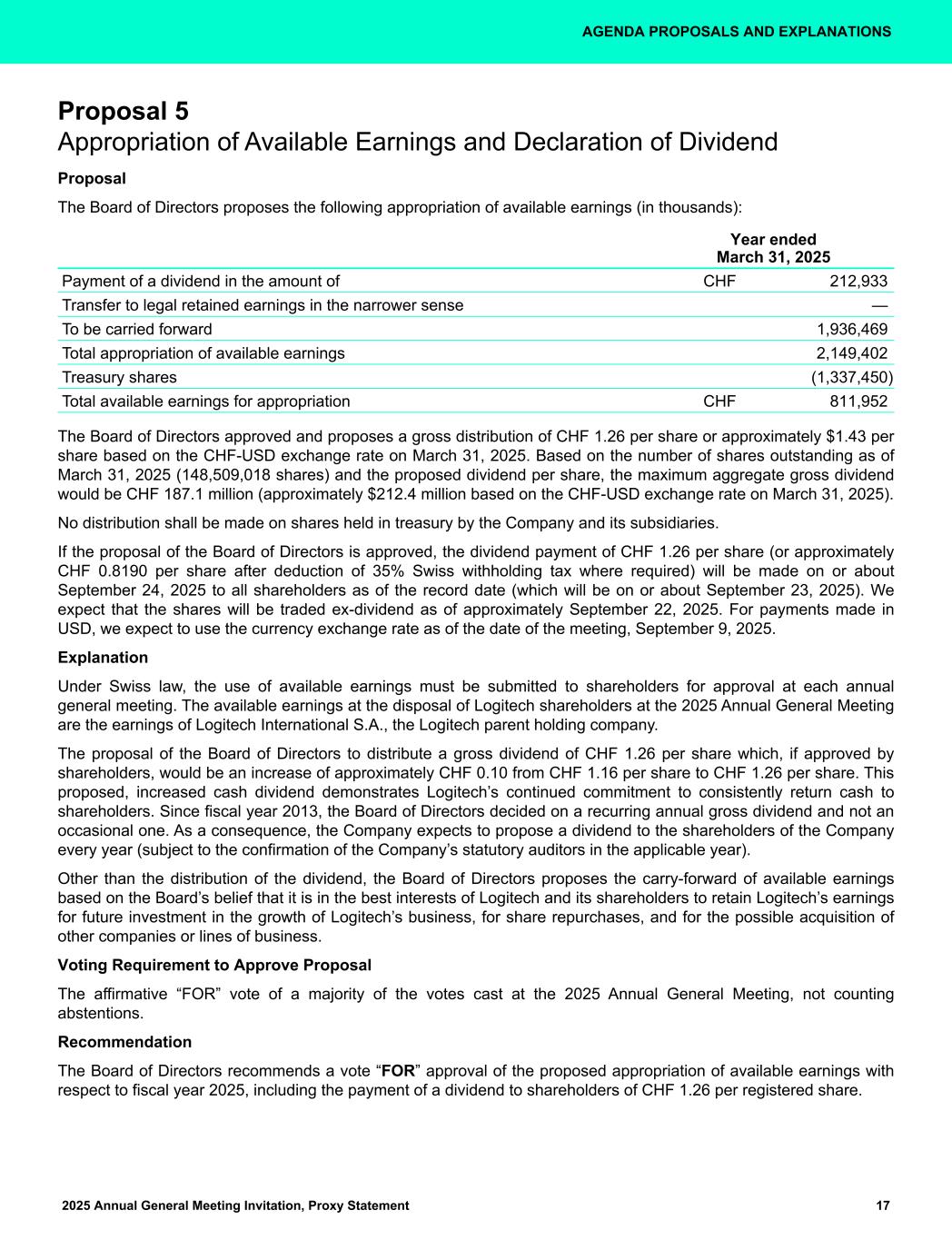
Proposal 5 Appropriation of Available Earnings and Declaration of Dividend Proposal The Board of Directors proposes the following appropriation of available earnings (in thousands): Year ended March 31, 2025 Payment of a dividend in the amount of CHF 212,933 Transfer to legal retained earnings in the narrower sense — To be carried forward 1,936,469 Total appropriation of available earnings 2,149,402 Treasury shares (1,337,450) Total available earnings for appropriation CHF 811,952 The Board of Directors approved and proposes a gross distribution of CHF 1.26 per share or approximately $1.43 per share based on the CHF-USD exchange rate on March 31, 2025. Based on the number of shares outstanding as of March 31, 2025 (148,509,018 shares) and the proposed dividend per share, the maximum aggregate gross dividend would be CHF 187.1 million (approximately $212.4 million based on the CHF-USD exchange rate on March 31, 2025). No distribution shall be made on shares held in treasury by the Company and its subsidiaries. If the proposal of the Board of Directors is approved, the dividend payment of CHF 1.26 per share (or approximately CHF 0.8190 per share after deduction of 35% Swiss withholding tax where required) will be made on or about September 24, 2025 to all shareholders as of the record date (which will be on or about September 23, 2025). We expect that the shares will be traded ex-dividend as of approximately September 22, 2025. For payments made in USD, we expect to use the currency exchange rate as of the date of the meeting, September 9, 2025. Explanation Under Swiss law, the use of available earnings must be submitted to shareholders for approval at each annual general meeting. The available earnings at the disposal of Logitech shareholders at the 2025 Annual General Meeting are the earnings of Logitech International S.A., the Logitech parent holding company. The proposal of the Board of Directors to distribute a gross dividend of CHF 1.26 per share which, if approved by shareholders, would be an increase of approximately CHF 0.10 from CHF 1.16 per share to CHF 1.26 per share. This proposed, increased cash dividend demonstrates Logitech’s continued commitment to consistently return cash to shareholders. Since fiscal year 2013, the Board of Directors decided on a recurring annual gross dividend and not an occasional one. As a consequence, the Company expects to propose a dividend to the shareholders of the Company every year (subject to the confirmation of the Company’s statutory auditors in the applicable year). Other than the distribution of the dividend, the Board of Directors proposes the carry-forward of available earnings based on the Board’s belief that it is in the best interests of Logitech and its shareholders to retain Logitech’s earnings for future investment in the growth of Logitech’s business, for share repurchases, and for the possible acquisition of other companies or lines of business. Voting Requirement to Approve Proposal The affirmative “FOR” vote of a majority of the votes cast at the 2025 Annual General Meeting, not counting abstentions. Recommendation The Board of Directors recommends a vote “FOR” approval of the proposed appropriation of available earnings with respect to fiscal year 2025, including the payment of a dividend to shareholders of CHF 1.26 per registered share. AGENDA PROPOSALS AND EXPLANATIONS 2025 Annual General Meeting Invitation, Proxy Statement 17
Proposal 6 Amendment of Articles of Incorporation: Renewal of the Capital Band Proposal The Board of Directors proposes that the Company's existing capital band, which authorizes the Board to issue shares, to repurchase and cancel shares, or to reduce the nominal value of the shares, be renewed for a period ending five years after the date of the 2025 Annual General Meeting on September 9, 2030. The proposed amendments to Article 27 and Article 28 of our Articles of Incorporation are set forth in Annex 6. Explanation At the 2023 Annual General Meeting, our shareholders approved the Company's existing capital band, which authorizes the Board of Directors until September 13, 2028, to issue new shares, to repurchase and cancel shares, or to reduce the nominal value of the shares. Following the capital band's adoption, we have utilized this authority to conduct share repurchases for cancellation under our share repurchase program announced on June 21, 2023 (the "2023 Share Repurchase Program") for an amount of up to USD 1 billion; as disclosed on March 5, 2025, this amount was subsequently increased to a maximum of USD 1.6 billion. As of the end of June 2025, we have repurchased shares for a value totaling approximately USD 1.08 billion under the 2023 Share Repurchase Program and cancelled or approved for cancellation a total of 12,322,160 of those shares, leaving a remaining authority to cancel 4,988,502 shares. Because we expect to continue repurchasing shares beyond both the date of this proxy statement and the 2025 Annual General Meeting, cancellations will further reduce the available authority under the capital band for that purpose. Consequently, the Board of Directors believes that, in light of the near depletion of the current capital band’s cancellation capacity, it is advisable and in the best interests of the Company to renew the capital band on terms substantially the same as those approved at the 2023 Annual General Meeting. This renewal would preserve the Company’s ability to continue repurchasing shares, canceling those repurchased shares and issuing new shares subject to the terms substantially the same as those approved at the 2023 Annual General Meeting. Accordingly, the Board of Directors is proposing to shareholders that its authority under the capital band be renewed for another five years, until September 9, 2030. Under the proposed renewal of the capital band, the Board would be permitted to increase the current stated share capital by up to 10 percent or reduce it by up to 10 percent by canceling shares or decreasing the nominal value of the shares. The restated Article 28 of our Articles of Incorporation would continue to ensure that the Company does not issue new shares under the proposed capital band or the existing conditional capital for convertible bonds, in aggregate, exceeding 10 percent of the Company’s existing share capital as of the AGM date, in situations where shareholders’ preferential subscription rights are restricted or excluded. The Board of Directors has no present plans to issue shares out of the capital band. The share capital would only be increased if and when the Board of Directors makes use of its authorization. If the proposal under this agenda item is approved, we would always seek shareholder approval for share issuances to the extent required under Nasdaq rules. Under current Nasdaq rules, shareholder approval is generally required, with certain enumerated exceptions, to issue common shares or securities convertible into or exercisable for common shares in one or a series of related transactions if such common shares represent 20% or more of the voting power or outstanding common shares of the company. Nasdaq rules also require shareholder approval for an issuance of shares that would result in a change of control of the company, as well as for share issuances in connection with certain benefit plans or related party transactions. Voting Requirement to Approve Proposal The renewal of the proposed capital band requires the approval of a qualified majority of at least two-thirds of the votes and a majority of the nominal value of the shares, each as represented at the 2025 Annual General Meeting. Recommendation The Board of Directors recommends a vote “FOR” the proposed amendments to Articles 27 and 28 of the Articles of Incorporation. AGENDA PROPOSALS AND EXPLANATIONS 18 2025 Annual General Meeting Invitation, Proxy Statement
Proposal 7 Release of the Board of Directors and Executive Officers from Liability for Activities During Fiscal Year 2025 Proposal The Board of Directors proposes that shareholders release the members of the Board of Directors and Executive Officers from liability for activities during fiscal year 2025. Explanation As is customary for Swiss corporations and in accordance with Article 698, subsection 2, item 7 of the Swiss Code of Obligations, shareholders are requested to release the members of the Board of Directors and the Executive Officers from liability for their activities during fiscal year 2025 that have been disclosed to shareholders. This release from liability exempts members of the Board of Directors and Executive Officers from liability claims brought by the Company or its shareholders on behalf of the Company against any of them for activities carried out during fiscal year 2025 relating to facts that have been disclosed to shareholders. Shareholders that do not vote in favor of the proposal, or acquire their shares after the vote without knowledge of the approval of this resolution, are not bound by the result for a period ending 12 months after the vote. Voting Requirement to Approve Proposal The affirmative “FOR” vote of a majority of the votes cast at the 2025 Annual General Meeting, not counting abstentions. Members of the Board of Directors or of any Logitech Executive Officers are not entitled to vote on Proposal 7. Recommendation The Board of Directors recommends a vote “FOR” the proposal to release the members of the Board of Directors and Executive Officers from liability for activities during fiscal year 2025. AGENDA PROPOSALS AND EXPLANATIONS 2025 Annual General Meeting Invitation, Proxy Statement 19

Proposal 8 Elections to the Board of Directors Explanation Our Board of Directors is presently composed of 12 members. Each director was elected for a one-year term ending at the closing of the 2025 Annual General Meeting. At the recommendation of the Nominating and Governance Committee, the Board of Directors has nominated all current directors, with the exception of Ms. Becker, who has decided not to stand for re-election, to serve as directors for another one-year term, beginning at the completion of the 2025 Annual General Meeting and ending at the completion of the 2026 Annual General Meeting. There will be a separate vote on each nominee. Under Swiss corporate law, Board members may only be elected by shareholders. If the individuals below are re- elected, the Board will be composed of 11 members. The Board has no reason to believe that any of our nominees will be unwilling or unable to serve if elected as a director. For further information on the Board of Directors, including the current members of the Board, the Committees of the Board, the means by which the Board exercises supervision of Logitech’s executive officers, and other information, please see “Corporate Governance and Board of Directors Matters” below. 8.A. Re-election of Mr. Donald Allan Proposal: The Board of Directors proposes that Mr. Donald Allan be re-elected to the Board for a one-year term ending at the closing of the 2026 Annual General Meeting. For biographical information and qualifications of Mr. Allan, please refer to the heading “Corporate Governance and Board of Directors Matters – Members of the Board of Directors” hereafter. 8.B. Re-election of Dr. Edouard Bugnion Proposal: The Board of Directors proposes that Dr. Edouard Bugnion be re-elected to the Board for a one-year term ending at the closing of the 2026 Annual General Meeting. For biographical information and qualifications of Dr. Bugnion, please refer to the heading “Corporate Governance and Board of Directors Matters – Members of the Board of Directors” hereafter. 8.C. Re-election of Ms. Johanna 'Hanneke' Faber Proposal: The Board of Directors proposes that Ms. Johanna 'Hanneke' Faber be re-elected to the Board for a one- year term ending at the closing of the 2026 Annual General Meeting. For biographical information and qualifications of Ms. Faber, please refer to the heading “Corporate Governance and Board of Directors Matters – Members of the Board of Directors” hereafter. 8.D. Re-election of Mr. Guy Gecht The Board of Directors proposes that Mr. Guy Gecht be re-elected to the Board for a one-year term ending at the closing of the 2026 Annual General Meeting. For biographical information and qualifications of Mr. Gecht, please refer to the heading “Corporate Governance and Board of Directors Matters – Members of the Board of Directors” hereafter. 8.E. Re-election of Mr. Christopher Jones Proposal: The Board of Directors proposes that Mr. Christopher Jones be re-elected to the Board for a one-year term ending at the closing of the 2026 Annual General Meeting. For biographical information and qualifications of Mr. Jones, please refer to the heading “Corporate Governance and Board of Directors Matters – Members of the Board of Directors” hereafter. 8.F. Re-election of Ms. Marjorie Lao Proposal: The Board of Directors proposes that Ms. Marjorie Lao be re-elected to the Board for a one-year term ending at the closing of the 2026 Annual General Meeting. AGENDA PROPOSALS AND EXPLANATIONS 20 2025 Annual General Meeting Invitation, Proxy Statement
For biographical information and qualifications of Ms. Lao, please refer to the heading “Corporate Governance and Board of Directors Matters – Members of the Board of Directors” hereafter. 8.G. Re-election of Mr. Owen Mahoney Proposal: The Board of Directors proposes that Mr. Owen Mahoney be re-elected to the Board for a one-year term ending at the closing of the 2026 Annual General Meeting. For biographical information and qualifications of Mr. Mahoney, please refer to the heading “Corporate Governance and Board of Directors Matters – Members of the Board of Directors” hereafter. 8.H. Re-election of Ms. Neela Montgomery Proposal: The Board of Directors proposes that Ms. Neela Montgomery be re-elected to the Board for a one-year term ending at the closing of the 2026 Annual General Meeting. For biographical information and qualifications of Ms. Montgomery, please refer to the heading “Corporate Governance and Board of Directors Matters – Members of the Board of Directors” hereafter. 8.I. Re-election of Mr. Kwok Wang Ng Proposal: The Board of Directors proposes that Mr. Kwok Wang Ng be re-elected to the Board for a one-year term ending at the closing of the 2026 Annual General Meeting. For biographical information and qualifications of Mr. Ng, please refer to the heading “Corporate Governance and Board of Directors Matters – Members of the Board of Directors” hereafter. 8.J. Re-election of Ms. Deborah Thomas Proposal: The Board of Directors proposes that Ms. Deborah Thomas be re-elected to the Board for a one-year term ending at the closing of the 2026 Annual General Meeting. For biographical information and qualifications of Ms. Thomas, please refer to the heading “Corporate Governance and Board of Directors Matters – Members of the Board of Directors” hereafter. 8.K. Re-election of Mr. Sascha Zahnd Proposal: The Board of Directors proposes that Mr. Sascha Zahnd be re-elected to the Board for a one-year term ending at the closing of the 2026 Annual General Meeting. For biographical information and qualifications of Mr. Zahnd, please refer to the heading “Corporate Governance and Board of Directors Matters – Members of the Board of Directors” hereafter. Voting Requirement to Approve Proposals The affirmative “FOR” vote of a majority of the votes cast at the 2025 Annual General Meeting, not counting abstentions. Recommendation The Board of Directors recommends a vote “FOR” the re-election to the Board of each of the above nominees. AGENDA PROPOSALS AND EXPLANATIONS 2025 Annual General Meeting Invitation, Proxy Statement 21
Proposal 9 Election of the Chairperson of the Board Explanation Swiss corporate law requires that the Chairperson of the Board of Directors be elected on the occasion of each Annual General Meeting for a one-year term ending at the closing of the following Annual General Meeting. As announced on July 1, 2024, Ms. Becker has decided not to stand for re-election as a director at the 2025 Annual General Meeting. In line with current corporate governance best practices and following a review process led by a special committee of the Board of Directors, the Board has unanimously selected Mr. Guy Gecht as its nominee to lead the Board of Directors as an independent Chairperson. Mr. Gecht has been a non-executive member of the Board of Directors since 2019, is the current Chair of the Company's Technology and Innovation Committee and serves on the Company's Nominating and Governance Committee. Prior to Ms. Faber's appointment as CEO, he also took on the role of interim CEO from June 2023 to December 2023. As noted in his biographical information and qualifications in “Corporate Governance and Board of Directors Matters – Members of the Board of Directors” on page 32, Mr. Gecht brings senior leadership experience as well as technology and cybersecurity expertise to the Board of Directors. Proposal The Board of Directors unanimously proposes that Mr. Gecht be elected as Chairperson of the Board of Directors for a one-year term ending at the closing of the 2026 Annual General Meeting. Voting Requirement to Approve Proposals The affirmative “FOR” vote of a majority of the votes cast at the 2025 Annual General Meeting, not counting abstentions. Recommendation Our Board of Directors recommends a vote “FOR” the election of Mr. Gecht as Chairperson of the Board of Directors. AGENDA PROPOSALS AND EXPLANATIONS 22 2025 Annual General Meeting Invitation, Proxy Statement
Proposal 10 Elections to the Compensation Committee Explanation Our Compensation Committee is presently composed of four members, all of whom are standing for re-election to the Board of Directors and for re-election to the Compensation Committee. Pursuant to Swiss corporate law, the members of the Compensation Committee are to be elected annually and individually by the shareholders. Only members of the Board of Directors can be elected as members of the Compensation Committee. At the recommendation of the Nominating and Governance Committee, the Board of Directors has nominated all current members of the Compensation Committee for another term of one year. As required by our Compensation Committee charter, all of the nominees are independent in accordance with the requirements of the listing standards of the Nasdaq Stock Market, the outside director definition of Section 162(m) of the U.S. Internal Revenue Code of 1986, as amended, the definition of a “non-employee director” for purposes of Rule 16b-3 promulgated by the U.S. Securities and Exchange Commission, and Rule 10C-1(b)(1) of the U.S. Securities Exchange Act of 1934, as amended. The term of office ends at the closing of the next Annual General Meeting. There will be a separate vote on each nominee. 10.A. Re-election of Mr. Donald Allan Proposal: The Board of Directors proposes that Mr. Donald Allan be re-elected to the Compensation Committee for a one-year term ending at the closing of the 2026 Annual General Meeting. For biographical information and qualifications of Mr. Allan, please refer to the heading "Corporate Governance and Board of Directors Matters – Members of the Board of Directors" hereafter. 10.B. Re-election of Mr. Kwok Wang Ng Proposal: The Board of Directors proposes that Mr. Kwok Wang Ng be re-elected to the Compensation Committee for a one-year term ending at the closing of the 2026 Annual General Meeting. For biographical information and qualifications of Mr. Ng, please refer to the heading "Corporate Governance and Board of Directors Matters – Members of the Board of Directors" hereafter. 10.C. Re-election of Ms. Neela Montgomery Proposal: The Board of Directors proposes that Ms. Neela Montgomery be re-elected to the Compensation Committee for a one-year term ending at the closing of the 2026 Annual General Meeting. For biographical information and qualifications of Ms. Montgomery, please refer to the heading “Corporate Governance and Board of Directors Matters – Members of the Board of Directors” hereafter. 10.D. Re-election of Ms. Deborah Thomas Proposal: The Board of Directors proposes that Ms. Deborah Thomas be re-elected to the Compensation Committee for a one-year term ending at the closing of the 2026 Annual General Meeting. For biographical information and qualifications of Ms. Thomas, please refer to the heading “Corporate Governance and Board of Directors Matters – Members of the Board of Directors” hereafter. The Board of Directors has appointed Mr. Allan as Chair of the Compensation Committee, subject to his re-election to the Compensation Committee. Voting Requirement to Approve Proposals The affirmative “FOR” vote of a majority of the votes cast at the 2025 Annual General Meeting, not counting abstentions. Recommendation Our Board of Directors recommends a vote “FOR” the election to the Compensation Committee of each of the above nominees. AGENDA PROPOSALS AND EXPLANATIONS 2025 Annual General Meeting Invitation, Proxy Statement 23
Proposal 11 Approval of Compensation for the Board of Directors for the 2025 to 2026 Board Year Proposal The Board of Directors proposes that the shareholders approve a maximum aggregate amount of compensation of the Board of Directors of CHF 3,900,000 for the term of office from the 2025 Annual General Meeting until the 2026 Annual General Meeting (the “2025 – 2026 Board Year”). Explanation Pursuant to Swiss corporate law, the compensation of the Board of Directors must each year be subject to a binding shareholder vote, in the manner contemplated by Logitech’s Articles of Incorporation. Article 19 quater, paragraph 1 letter (a) of Logitech’s Articles of Incorporation provides that shareholders shall approve the maximum aggregate amount of compensation of the Board of Directors for the period up to the next Annual General Meeting. Under the Articles of Incorporation, the compensation of the members of the Board of Directors who do not have management responsibilities consists of cash payments and shares or share equivalents. The value of cash compensation and shares or share equivalents corresponds to a fixed amount, which reflects the functions and responsibilities assumed. The value of shares or share equivalents is calculated at market value at the time of grant. The proposed maximum amount of CHF 3,900,000 has been determined based on 10 non-executive members of the Board of Directors and on the following non-binding assumptions: With respect to the 10 non-executive members of the Board of Directors, the compensation consists of the following elements: • Cash payments of a maximum of CHF 1,300,000. Cash payments for non-executive members of the Board of Directors include annual retainers for Board and committee service and an annual retainer for a non-executive Chairperson. • Share or share equivalent awards of a maximum of CHF 2,200,000. The value of share or share equivalent awards corresponds to a fixed amount and the number of shares granted will be calculated at market value at the time of their grant. • Other payments, including accrual of the Company's estimated contributions to social security, of a maximum of CHF 400,000. Shareholders are approving the maximum aggregate amount of compensation set forth in the proposal and not the individual components thereof. The assumptions set forth in this explanation are based on the Company’s current expectations about future compensation plans and decisions. The Company may redesign its compensation plans or make alternative compensation decisions within the maximum aggregate amount of compensation approved by shareholders. The actual compensation awarded to the members of the Board of Directors for the 2025-2026 Board Year will be disclosed in the Compensation Report in the Invitation and Proxy Statement for the 2027 Annual General Meeting. Voting Requirement to Approve Proposal The affirmative “FOR” vote of a majority of the votes cast at the 2025 Annual General Meeting, not counting abstentions. Recommendation The Board of Directors recommends a vote “FOR” the approval of the maximum aggregate amount of the compensation of the members of the Board of Directors of CHF 3,900,000 for the term of office from the 2025 Annual General Meeting until the 2026 Annual General Meeting. AGENDA PROPOSALS AND EXPLANATIONS 24 2025 Annual General Meeting Invitation, Proxy Statement
Proposal 12 Approval of Compensation for the Group Management Team for Fiscal Year 2027 Proposal The Board of Directors proposes that the shareholders approve a maximum aggregate amount of compensation of the Group Management Team of USD 28,302,000 for fiscal year 2027. Explanation Pursuant to Swiss corporate law, the compensation of the Company’s Group Management Team must each year be subject to a binding shareholder vote, in the manner contemplated by Logitech’s Articles of Incorporation. Article 19 quater, paragraph 1 letter (b) of Logitech’s Articles of Incorporation provides that shareholders shall approve the maximum aggregate amount of compensation of the Group Management Team for the next fiscal year. As the 2025 Annual General Meeting takes place in the middle of Logitech’s fiscal year 2026, the applicable next fiscal year is fiscal year 2027. This required, binding vote on the compensation of the Group Management Team is independent from, and comes in addition to, the non-binding, advisory say-on-pay vote contemplated in Proposal 2 and Proposal 3. Logitech’s Group Management Team currently consists of Ms. Johanna 'Hanneke' Faber, Chief Executive Officer ("CEO"), Mr. Matteo Anversa, Chief Financial Officer, Mr. Prakash Arunkundrum, President of Logitech for Business, and Ms. Samantha Harnett, Chief Legal Officer. Logitech’s compensation philosophy, compensation program risks and design, and compensation paid during fiscal year 2025 are set forth in the Compensation Report. The proposed maximum amount of USD 28,302,000 has been determined based on the following non-binding assumptions for Logitech’s Group Management Team as an aggregate group: • The Group Management Team includes four members. • Gross base salaries of a maximum of USD 3,300,000. • Performance-based cash compensation of a maximum of USD 6,700,000 at grant value. Performance-based cash compensation in the form of incentive cash payments may be earned under the Logitech Management Performance Bonus Plan (the “Annual Bonus Plan”) or other cash bonuses approved by the Compensation Committee. Payout under the Annual Bonus Plan is variable, and is based on the achievement of the Company’s, individual executives’ or other performance goals, and for fiscal year 2027 is expected to continue to range from 0% to 200% of the executive’s target incentive. The maximum amount of the performance-based bonus for fiscal year 2027 assumes a maximum achievement of all performance goals. • Equity incentive awards of a maximum of USD 16,900,000 at grant value. Long-term equity incentive awards are generally granted in the form of performance-based restricted stock units ("PSUs"). In order to align with the methodology used in the Compensation Report, where the value of PSUs is disclosed based on estimated fair value at the time of grant, the fair value at grant has been considered to calculate the maximum amount of the long-term equity awards. The target number of PSU awards granted to our Group Management Team in fiscal year 2027 will be determined at the beginning of the three-year performance period and the number of shares that will vest at the end of the three-year performance period is expected to continue to range from 0% to 200% of the executive's target number of shares depending on our corporate performance. • Other compensation of a maximum of USD 1,402,000. Other compensation may include tax preparation services and related expenses, 401(k) savings plan matching contributions, premiums for group term life insurance and long-term disability insurance, employer’s contribution to medical premiums, relocation or extended business travel-related expenses, defined benefit pension plan employment contributions, accrual of estimated employer's contribution to social security and Medicare, and other awards. The Company generally does not provide all of these components of other compensation to all executives each year, but the proposed maximum amount of compensation has been formulated to provide flexibility to cover these compensation components as applicable. Shareholders are approving the maximum aggregate amount of compensation set forth in the proposal and not the individual components thereof. The assumptions set forth in this explanation are based on the Company’s current AGENDA PROPOSALS AND EXPLANATIONS 2025 Annual General Meeting Invitation, Proxy Statement 25
expectations about future compensation plans and decisions. The Company may redesign its compensation plans or make alternative compensation decisions within the maximum aggregate amount of compensation approved by shareholders. The actual compensation awarded to the members of the Group Management Team for fiscal year 2027 will be disclosed in the Compensation Report in the Invitation and Proxy Statement for the 2027 Annual General Meeting. Voting Requirement to Approve Proposal The affirmative “FOR” vote of a majority of the votes cast at the 2025 Annual General Meeting, not counting abstentions. Recommendation The Board of Directors recommends a vote “FOR” the approval of the maximum aggregate amount of the compensation of the Group Management Team of USD 28,302,000 for fiscal year 2027. AGENDA PROPOSALS AND EXPLANATIONS 26 2025 Annual General Meeting Invitation, Proxy Statement
Proposal 13 Re-election of KPMG AG as Logitech’s Auditors and Ratification of the Appointment of KPMG LLP as Logitech’s Independent Registered Public Accounting Firm for Fiscal Year 2026 Proposal The Board of Directors proposes that KPMG AG be re-elected as auditors of Logitech International S.A. for a one-year term and that the appointment of KPMG LLP as Logitech’s independent registered public accounting firm for fiscal year 2026 be ratified. Explanation KPMG AG, upon recommendation of the Audit Committee of the Board, is proposed for re-election for a further year as auditors for Logitech International S.A. KPMG AG assumed its first audit mandate for Logitech during fiscal year 2015. The Audit Committee has also appointed KPMG LLP, the U.S. affiliate of KPMG AG, as the Company’s independent registered public accounting firm for the fiscal year ending March 31, 2026 for purposes of U.S. securities law reporting. Logitech’s Articles of Incorporation do not require that shareholders ratify the appointment of KPMG LLP as the Company’s independent registered public accounting firm. However, Logitech is submitting the appointment of KPMG LLP to shareholders for ratification as a matter of good corporate governance. If shareholders do not ratify the appointment, the Audit Committee will reconsider whether to retain KPMG LLP. Even if the appointment is ratified, the Audit Committee may, in its discretion, change the appointment during the year if the Committee determines that such a change would be in the best interests of Logitech and its shareholders. Information on the fees paid by Logitech to KPMG AG and KPMG LLP, the Company’s auditors and independent registered public accounting firm for fiscal year 2025, respectively, as well as further information regarding KPMG AG and KPMG LLP, is set out below under the heading “Independent Auditors” and “Report of the Audit Committee.” One or more representatives of KPMG AG will be present at the 2025 Annual General Meeting. They will have an opportunity to make a statement at the meeting if they wish, and are expected to be available to respond to questions from shareholders. Voting Requirement to Approve Proposal The affirmative “FOR” vote of a majority of the votes cast at the 2025 Annual General Meeting, not counting abstentions. Recommendation Our Board of Directors recommends a vote “FOR” the re-election of KPMG AG as auditors of Logitech International S.A. and the ratification of the appointment of KPMG LLP as Logitech’s independent registered public accounting firm, each for the fiscal year ending March 31, 2026. AGENDA PROPOSALS AND EXPLANATIONS 2025 Annual General Meeting Invitation, Proxy Statement 27
Proposal 14 Re-election of Etude Regina Wenger & Sarah Keiser-Wüger as Independent Representative Swiss law requires that the independent representative of the shareholders (the "Independent Representative") be elected on the occasion of each Annual General Meeting for a one-year term ending at the closing of the following Annual General Meeting. Proposal The Board of Directors proposes that Etude Regina Wenger & Sarah Keiser-Wüger be re-elected as Independent Representative for a one-year term ending at the closing of the 2026 Annual General Meeting. Explanation In accordance with Swiss law, each shareholder may be represented at the general meeting by an independent representative. The Board of Directors has nominated Etude Regina Wenger & Sarah Keiser-Wüger as the Independent Representative to serve in the role at the Company’s 2026 Annual General Meeting and at any extraordinary general meeting of shareholders of the Company, if any, held prior to the 2026 Annual General Meeting. Ms. Regina Wenger, a principal of Etude Regina Wenger & Sarah Keiser-Wüger, is a respected notary public based in Lausanne, Switzerland and is the former chairwoman of the Swiss Federation of Notaries. Etude Regina Wenger & Sarah Keiser-Wüger confirmed to the Company that it possesses the required independence to fulfill its responsibilities. Voting Requirement to Approve Proposal The affirmative “FOR” vote of a majority of the votes cast at the 2025 Annual General Meeting, not counting abstentions. Recommendation Our Board of Directors recommends a vote “FOR” the re-election of Etude Regina Wenger & Sarah Keiser-Wüger as Independent Representative. AGENDA PROPOSALS AND EXPLANATIONS 28 2025 Annual General Meeting Invitation, Proxy Statement
Corporate Governance and Board of Directors Matters The Board of Directors is elected by the shareholders and holds the ultimate decision-making authority within Logitech, except for those matters reserved by law or by Logitech’s Articles of Incorporation to its shareholders or those that are delegated to the Group Management Team under the Organizational Regulations (also known as Bylaws). The Board makes resolutions through a majority vote of the members present at the meetings. In the event of a tie, the vote of the Chairperson decides. Logitech’s Articles of Incorporation set the minimum number of directors at three. We had 12 members of the Board of Directors as of June 30, 2025. If all of the nominees to the Board presented in Proposal 8 are re-elected, the Board will have 11 members. Board of Directors Independence The Board of Directors has determined that each of our directors and director nominees, other than Johanna 'Hanneke' Faber, qualifies as independent in accordance with the published listing requirements of the Nasdaq Stock Market. The Company’s independent directors include Donald Allan, Wendy Becker, Edouard Bugnion, Guy Gecht, Christopher Jones, Marjorie Lao, Owen Mahoney, Neela Montgomery, Kwok Wang Ng, Deborah Thomas, and Sascha Zahnd, all of whom are also director nominees with the exception of Wendy Becker. The Nasdaq independence definition includes a series of objective tests, such as that the director is not an employee of the company and has not engaged in various types of business dealings with the company. In addition, as further required by Nasdaq rules, the Board has made a subjective determination as to each independent director that no relationships exist which, in the opinion of the Board, would interfere with the exercise of independent judgment in carrying out the responsibilities of a director. In making these determinations, the directors reviewed and discussed information provided by the directors and the Company with regard to each director’s business and personal activities as they may relate to Logitech and Logitech’s management. As a Swiss company, Logitech is also bound to consider the recommendations of the Swiss Code of Best Practice for Corporate Governance (the “Swiss Code of Best Practice”). The Swiss Code of Best Practice is a set of guidelines designed to promote good corporate governance practices among Swiss companies. While the Swiss Code of Best Practice is not legally binding, it serves as a reference point for best practices in corporate governance in Switzerland. The definition of independence included in the Swiss Code of Best Practice requires, among other things, that a director not have served as a member of the company’s executive management during the preceding three years. The principles contained in the Swiss Code of Best Practice are general guidelines and recommendations subject to a “comply or explain” standard. 2025 Annual General Meeting Invitation, Proxy Statement 29
Members of the Board of Directors The members of the Board of Directors, including their principal occupation, business experience, and qualifications, are set out below and in our "Board Skills and Experience Profile." Donald Allan 61 Years Old Director since 2024 President and Chief Executive Officer, Stanley Black & Decker, Inc. U.S. national Donald Allan is the President and Chief Executive Officer of Stanley Black & Decker, Inc., a global provider of construction and industrial tolls, outdoor products and engineered fastening solutions, a position he has held since July 2022. As announced on June 30, 2025, Mr. Allan will step down from his role as President and Chief Executive Officer of Stanley Black & Decker and assume the position of Executive Chair, effective as of October 1, 2025. Mr. Allan joined Stanley Black & Decker in 1999 and held management roles at Stanley Black & Decker since 2006, including President and Chief Financial Officer from February 2021 to June 2022 and SVP and Chief Financial Officer from April 2010 to February 2021. Prior to joining Stanley Black & Decker, Mr. Allan held financial management positions with Loctite Corporation (now Henkel), a global provider of engineering adhesives and other industrial chemicals. Mr. Allan currently serves as a Member of the Board of Directors of Stanley Black & Decker and as the Lead Director at Andersen Corporation, a global manufacturer of windows and doors. He is the chairperson of the Board of Directors of Regents for the University of Hartford, a member of the Board of Directors of Hartford Healthcare and a member of the Business Roundtable. Mr. Allan holds a BS degree in Accounting and Finance from the University of Hartford. Mr. Allan has extensive finance expertise developed through his Chief Financial Officer and other financial leadership positions at Stanley Black & Decker and Loctite Corporation. He brings significant experience in senior leadership, operations, governance and strategy from his 20+ year tenure at Stanley Black and Decker to the Board. Mr. Allan currently serves on the Compensation Committee. The Board of Directors has determined that he is an independent director. Wendy Becker 59 Years Old Director since 2017 Chairperson, Logitech International S.A. and Former Chief Executive Officer, Jack Wills Limited U.K., U.S. and Italian national Wendy Becker has served as Chairperson of the Logitech Board of Directors since September 2019. Ms. Becker is the former Chief Executive Officer of Jack Wills Limited, a British-based manufacturer and retailer of brand name clothing, a position she held from October 2013 to September 2015. She was the Chief Operating Officer of Jack Wills from August 2012 to October 2013. Ms. Becker served as Group Chief Marketing Officer of Vodafone Group Plc, a global telecommunications company, from September 2009 to January 2011. Prior to Vodafone, she served as the Managing Director of TalkTalk Residential, a subsidiary of the Carphone Warehouse Group plc, a provider of fixed line broadband, voice telephony, mobile and television services, a partner responsible for the United Kingdom consumer practice at McKinsey & Company, an international management consulting firm, and in various marketing and brand roles at The Procter & Gamble Company. Ms. Becker serves as the Chairperson of the board of directors of Sony Group Corporation, a global conglomerate across a number of media, technology and other industries, and as a non-executive Director of GSK plc, a multinational pharmaceutical and biotechnology company. She serves as a member of the governing body of the University of Oxford and related subsidiaries. Ms. Becker holds a BA degree in Economics from Dartmouth College and an MBA from Stanford University’s Graduate School of Business. Ms. Becker brings senior leadership, governance, strategic, consumer brand marketing, telecom and design experience to the Board from her positions at Jack Wills, Vodafone, McKinsey and TalkTalk as well as her board and trustee positions. Ms. Becker currently is the Chairperson of the Board and a member of the Nominating and Governance Committee. The Board of Directors has determined that she is an independent director. CORPORATE GOVERNANCE AND BOARD OF DIRECTORS MATTERS 30 2025 Annual General Meeting Invitation, Proxy Statement
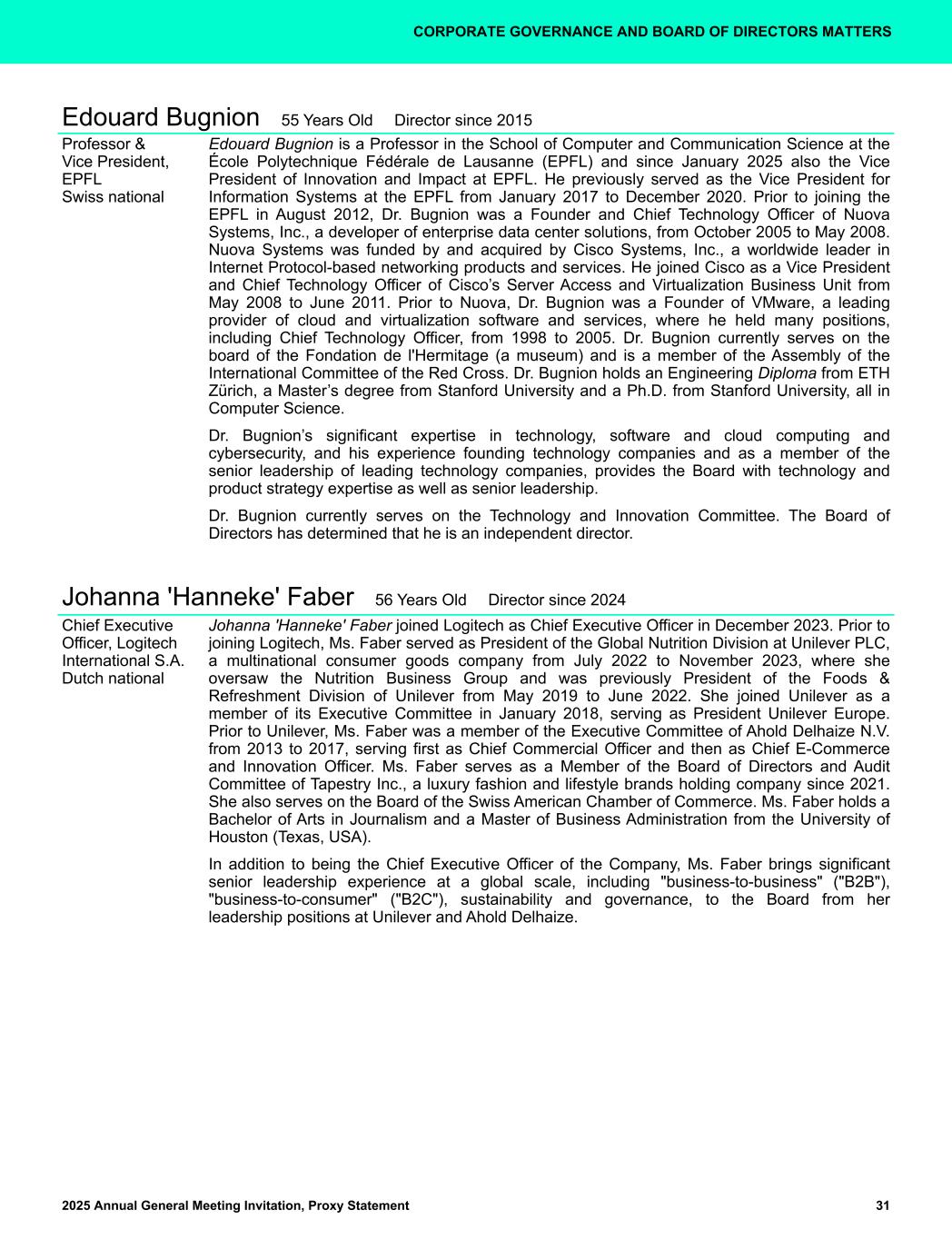
Edouard Bugnion 55 Years Old Director since 2015 Professor & Vice President, EPFL Swiss national Edouard Bugnion is a Professor in the School of Computer and Communication Science at the École Polytechnique Fédérale de Lausanne (EPFL) and since January 2025 also the Vice President of Innovation and Impact at EPFL. He previously served as the Vice President for Information Systems at the EPFL from January 2017 to December 2020. Prior to joining the EPFL in August 2012, Dr. Bugnion was a Founder and Chief Technology Officer of Nuova Systems, Inc., a developer of enterprise data center solutions, from October 2005 to May 2008. Nuova Systems was funded by and acquired by Cisco Systems, Inc., a worldwide leader in Internet Protocol-based networking products and services. He joined Cisco as a Vice President and Chief Technology Officer of Cisco’s Server Access and Virtualization Business Unit from May 2008 to June 2011. Prior to Nuova, Dr. Bugnion was a Founder of VMware, a leading provider of cloud and virtualization software and services, where he held many positions, including Chief Technology Officer, from 1998 to 2005. Dr. Bugnion currently serves on the board of the Fondation de l'Hermitage (a museum) and is a member of the Assembly of the International Committee of the Red Cross. Dr. Bugnion holds an Engineering Diploma from ETH Zürich, a Master’s degree from Stanford University and a Ph.D. from Stanford University, all in Computer Science. Dr. Bugnion’s significant expertise in technology, software and cloud computing and cybersecurity, and his experience founding technology companies and as a member of the senior leadership of leading technology companies, provides the Board with technology and product strategy expertise as well as senior leadership. Dr. Bugnion currently serves on the Technology and Innovation Committee. The Board of Directors has determined that he is an independent director. Johanna 'Hanneke' Faber 56 Years Old Director since 2024 Chief Executive Officer, Logitech International S.A. Dutch national Johanna 'Hanneke' Faber joined Logitech as Chief Executive Officer in December 2023. Prior to joining Logitech, Ms. Faber served as President of the Global Nutrition Division at Unilever PLC, a multinational consumer goods company from July 2022 to November 2023, where she oversaw the Nutrition Business Group and was previously President of the Foods & Refreshment Division of Unilever from May 2019 to June 2022. She joined Unilever as a member of its Executive Committee in January 2018, serving as President Unilever Europe. Prior to Unilever, Ms. Faber was a member of the Executive Committee of Ahold Delhaize N.V. from 2013 to 2017, serving first as Chief Commercial Officer and then as Chief E-Commerce and Innovation Officer. Ms. Faber serves as a Member of the Board of Directors and Audit Committee of Tapestry Inc., a luxury fashion and lifestyle brands holding company since 2021. She also serves on the Board of the Swiss American Chamber of Commerce. Ms. Faber holds a Bachelor of Arts in Journalism and a Master of Business Administration from the University of Houston (Texas, USA). In addition to being the Chief Executive Officer of the Company, Ms. Faber brings significant senior leadership experience at a global scale, including "business-to-business" ("B2B"), "business-to-consumer" ("B2C"), sustainability and governance, to the Board from her leadership positions at Unilever and Ahold Delhaize. CORPORATE GOVERNANCE AND BOARD OF DIRECTORS MATTERS 2025 Annual General Meeting Invitation, Proxy Statement 31
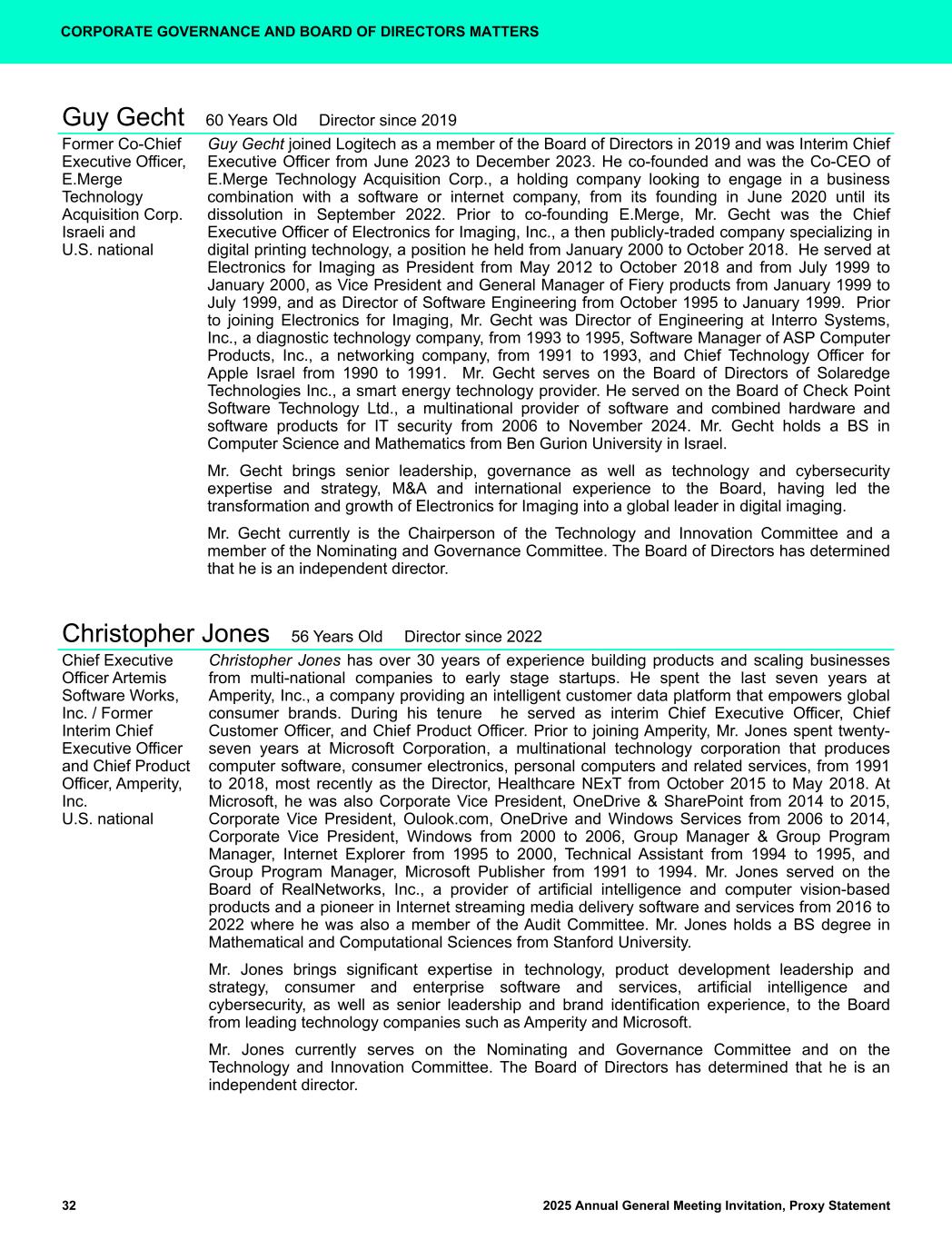
Guy Gecht 60 Years Old Director since 2019 Former Co-Chief Executive Officer, E.Merge Technology Acquisition Corp. Israeli and U.S. national Guy Gecht joined Logitech as a member of the Board of Directors in 2019 and was Interim Chief Executive Officer from June 2023 to December 2023. He co-founded and was the Co-CEO of E.Merge Technology Acquisition Corp., a holding company looking to engage in a business combination with a software or internet company, from its founding in June 2020 until its dissolution in September 2022. Prior to co-founding E.Merge, Mr. Gecht was the Chief Executive Officer of Electronics for Imaging, Inc., a then publicly-traded company specializing in digital printing technology, a position he held from January 2000 to October 2018. He served at Electronics for Imaging as President from May 2012 to October 2018 and from July 1999 to January 2000, as Vice President and General Manager of Fiery products from January 1999 to July 1999, and as Director of Software Engineering from October 1995 to January 1999. Prior to joining Electronics for Imaging, Mr. Gecht was Director of Engineering at Interro Systems, Inc., a diagnostic technology company, from 1993 to 1995, Software Manager of ASP Computer Products, Inc., a networking company, from 1991 to 1993, and Chief Technology Officer for Apple Israel from 1990 to 1991. Mr. Gecht serves on the Board of Directors of Solaredge Technologies Inc., a smart energy technology provider. He served on the Board of Check Point Software Technology Ltd., a multinational provider of software and combined hardware and software products for IT security from 2006 to November 2024. Mr. Gecht holds a BS in Computer Science and Mathematics from Ben Gurion University in Israel. Mr. Gecht brings senior leadership, governance as well as technology and cybersecurity expertise and strategy, M&A and international experience to the Board, having led the transformation and growth of Electronics for Imaging into a global leader in digital imaging. Mr. Gecht currently is the Chairperson of the Technology and Innovation Committee and a member of the Nominating and Governance Committee. The Board of Directors has determined that he is an independent director. Christopher Jones 56 Years Old Director since 2022 Chief Executive Officer Artemis Software Works, Inc. / Former Interim Chief Executive Officer and Chief Product Officer, Amperity, Inc. U.S. national Christopher Jones has over 30 years of experience building products and scaling businesses from multi-national companies to early stage startups. He spent the last seven years at Amperity, Inc., a company providing an intelligent customer data platform that empowers global consumer brands. During his tenure he served as interim Chief Executive Officer, Chief Customer Officer, and Chief Product Officer. Prior to joining Amperity, Mr. Jones spent twenty- seven years at Microsoft Corporation, a multinational technology corporation that produces computer software, consumer electronics, personal computers and related services, from 1991 to 2018, most recently as the Director, Healthcare NExT from October 2015 to May 2018. At Microsoft, he was also Corporate Vice President, OneDrive & SharePoint from 2014 to 2015, Corporate Vice President, Oulook.com, OneDrive and Windows Services from 2006 to 2014, Corporate Vice President, Windows from 2000 to 2006, Group Manager & Group Program Manager, Internet Explorer from 1995 to 2000, Technical Assistant from 1994 to 1995, and Group Program Manager, Microsoft Publisher from 1991 to 1994. Mr. Jones served on the Board of RealNetworks, Inc., a provider of artificial intelligence and computer vision-based products and a pioneer in Internet streaming media delivery software and services from 2016 to 2022 where he was also a member of the Audit Committee. Mr. Jones holds a BS degree in Mathematical and Computational Sciences from Stanford University. Mr. Jones brings significant expertise in technology, product development leadership and strategy, consumer and enterprise software and services, artificial intelligence and cybersecurity, as well as senior leadership and brand identification experience, to the Board from leading technology companies such as Amperity and Microsoft. Mr. Jones currently serves on the Nominating and Governance Committee and on the Technology and Innovation Committee. The Board of Directors has determined that he is an independent director. CORPORATE GOVERNANCE AND BOARD OF DIRECTORS MATTERS 32 2025 Annual General Meeting Invitation, Proxy Statement
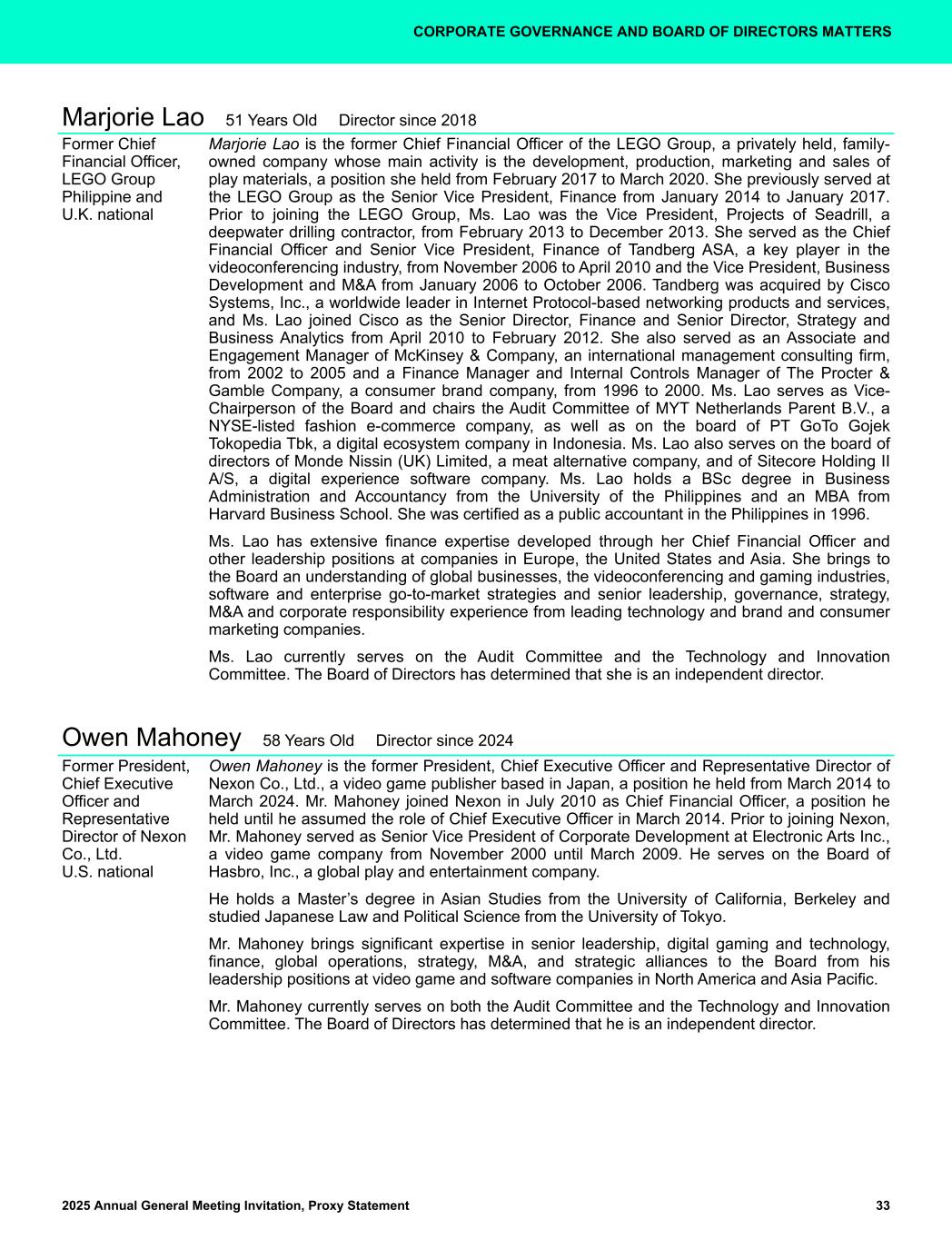
Marjorie Lao 51 Years Old Director since 2018 Former Chief Financial Officer, LEGO Group Philippine and U.K. national Marjorie Lao is the former Chief Financial Officer of the LEGO Group, a privately held, family- owned company whose main activity is the development, production, marketing and sales of play materials, a position she held from February 2017 to March 2020. She previously served at the LEGO Group as the Senior Vice President, Finance from January 2014 to January 2017. Prior to joining the LEGO Group, Ms. Lao was the Vice President, Projects of Seadrill, a deepwater drilling contractor, from February 2013 to December 2013. She served as the Chief Financial Officer and Senior Vice President, Finance of Tandberg ASA, a key player in the videoconferencing industry, from November 2006 to April 2010 and the Vice President, Business Development and M&A from January 2006 to October 2006. Tandberg was acquired by Cisco Systems, Inc., a worldwide leader in Internet Protocol-based networking products and services, and Ms. Lao joined Cisco as the Senior Director, Finance and Senior Director, Strategy and Business Analytics from April 2010 to February 2012. She also served as an Associate and Engagement Manager of McKinsey & Company, an international management consulting firm, from 2002 to 2005 and a Finance Manager and Internal Controls Manager of The Procter & Gamble Company, a consumer brand company, from 1996 to 2000. Ms. Lao serves as Vice- Chairperson of the Board and chairs the Audit Committee of MYT Netherlands Parent B.V., a NYSE-listed fashion e-commerce company, as well as on the board of PT GoTo Gojek Tokopedia Tbk, a digital ecosystem company in Indonesia. Ms. Lao also serves on the board of directors of Monde Nissin (UK) Limited, a meat alternative company, and of Sitecore Holding II A/S, a digital experience software company. Ms. Lao holds a BSc degree in Business Administration and Accountancy from the University of the Philippines and an MBA from Harvard Business School. She was certified as a public accountant in the Philippines in 1996. Ms. Lao has extensive finance expertise developed through her Chief Financial Officer and other leadership positions at companies in Europe, the United States and Asia. She brings to the Board an understanding of global businesses, the videoconferencing and gaming industries, software and enterprise go-to-market strategies and senior leadership, governance, strategy, M&A and corporate responsibility experience from leading technology and brand and consumer marketing companies. Ms. Lao currently serves on the Audit Committee and the Technology and Innovation Committee. The Board of Directors has determined that she is an independent director. Owen Mahoney 58 Years Old Director since 2024 Former President, Chief Executive Officer and Representative Director of Nexon Co., Ltd. U.S. national Owen Mahoney is the former President, Chief Executive Officer and Representative Director of Nexon Co., Ltd., a video game publisher based in Japan, a position he held from March 2014 to March 2024. Mr. Mahoney joined Nexon in July 2010 as Chief Financial Officer, a position he held until he assumed the role of Chief Executive Officer in March 2014. Prior to joining Nexon, Mr. Mahoney served as Senior Vice President of Corporate Development at Electronic Arts Inc., a video game company from November 2000 until March 2009. He serves on the Board of Hasbro, Inc., a global play and entertainment company. He holds a Master’s degree in Asian Studies from the University of California, Berkeley and studied Japanese Law and Political Science from the University of Tokyo. Mr. Mahoney brings significant expertise in senior leadership, digital gaming and technology, finance, global operations, strategy, M&A, and strategic alliances to the Board from his leadership positions at video game and software companies in North America and Asia Pacific. Mr. Mahoney currently serves on both the Audit Committee and the Technology and Innovation Committee. The Board of Directors has determined that he is an independent director. CORPORATE GOVERNANCE AND BOARD OF DIRECTORS MATTERS 2025 Annual General Meeting Invitation, Proxy Statement 33
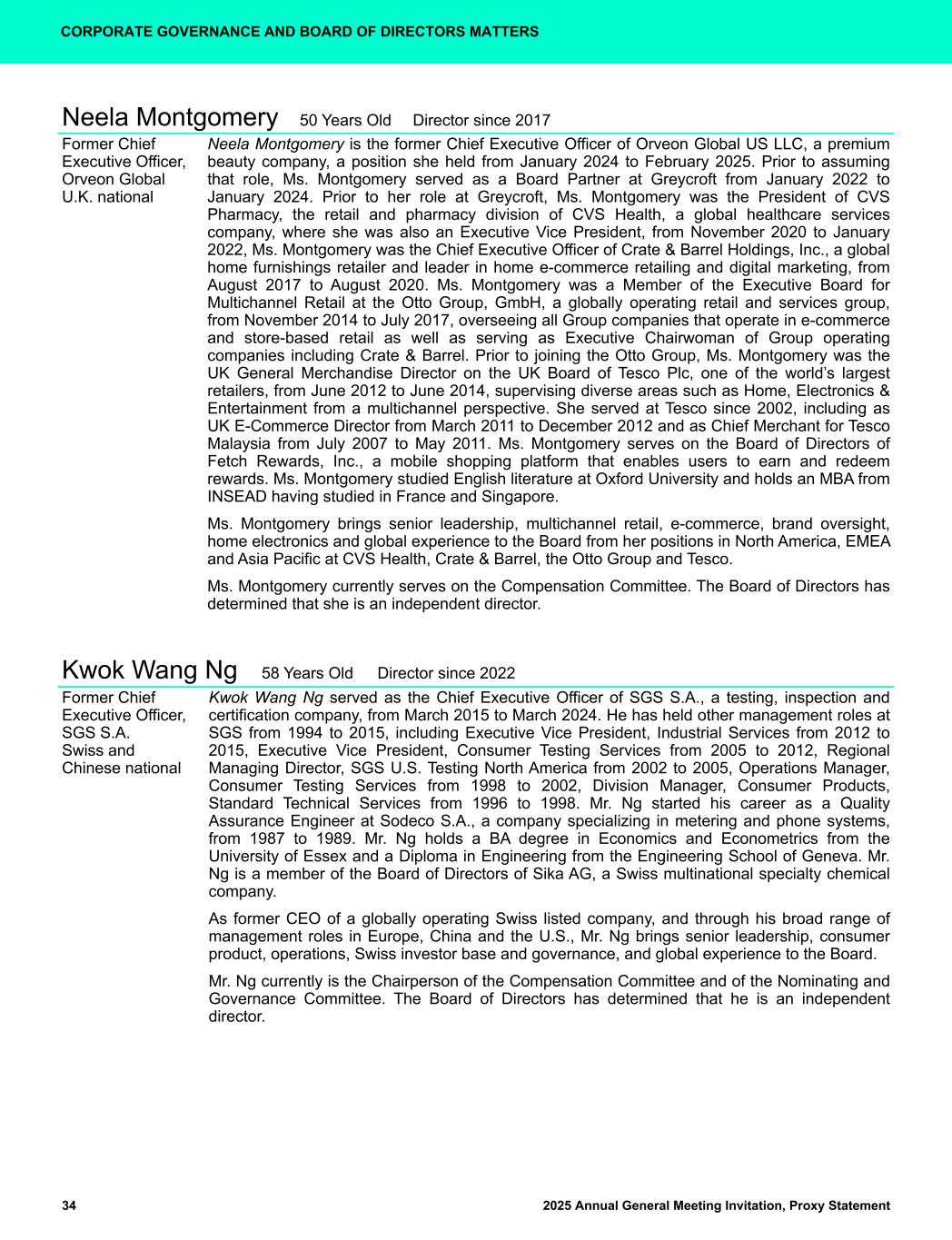
Neela Montgomery 50 Years Old Director since 2017 Former Chief Executive Officer, Orveon Global U.K. national Neela Montgomery is the former Chief Executive Officer of Orveon Global US LLC, a premium beauty company, a position she held from January 2024 to February 2025. Prior to assuming that role, Ms. Montgomery served as a Board Partner at Greycroft from January 2022 to January 2024. Prior to her role at Greycroft, Ms. Montgomery was the President of CVS Pharmacy, the retail and pharmacy division of CVS Health, a global healthcare services company, where she was also an Executive Vice President, from November 2020 to January 2022, Ms. Montgomery was the Chief Executive Officer of Crate & Barrel Holdings, Inc., a global home furnishings retailer and leader in home e-commerce retailing and digital marketing, from August 2017 to August 2020. Ms. Montgomery was a Member of the Executive Board for Multichannel Retail at the Otto Group, GmbH, a globally operating retail and services group, from November 2014 to July 2017, overseeing all Group companies that operate in e-commerce and store-based retail as well as serving as Executive Chairwoman of Group operating companies including Crate & Barrel. Prior to joining the Otto Group, Ms. Montgomery was the UK General Merchandise Director on the UK Board of Tesco Plc, one of the world’s largest retailers, from June 2012 to June 2014, supervising diverse areas such as Home, Electronics & Entertainment from a multichannel perspective. She served at Tesco since 2002, including as UK E-Commerce Director from March 2011 to December 2012 and as Chief Merchant for Tesco Malaysia from July 2007 to May 2011. Ms. Montgomery serves on the Board of Directors of Fetch Rewards, Inc., a mobile shopping platform that enables users to earn and redeem rewards. Ms. Montgomery studied English literature at Oxford University and holds an MBA from INSEAD having studied in France and Singapore. Ms. Montgomery brings senior leadership, multichannel retail, e-commerce, brand oversight, home electronics and global experience to the Board from her positions in North America, EMEA and Asia Pacific at CVS Health, Crate & Barrel, the Otto Group and Tesco. Ms. Montgomery currently serves on the Compensation Committee. The Board of Directors has determined that she is an independent director. Kwok Wang Ng 58 Years Old Director since 2022 Former Chief Executive Officer, SGS S.A. Swiss and Chinese national Kwok Wang Ng served as the Chief Executive Officer of SGS S.A., a testing, inspection and certification company, from March 2015 to March 2024. He has held other management roles at SGS from 1994 to 2015, including Executive Vice President, Industrial Services from 2012 to 2015, Executive Vice President, Consumer Testing Services from 2005 to 2012, Regional Managing Director, SGS U.S. Testing North America from 2002 to 2005, Operations Manager, Consumer Testing Services from 1998 to 2002, Division Manager, Consumer Products, Standard Technical Services from 1996 to 1998. Mr. Ng started his career as a Quality Assurance Engineer at Sodeco S.A., a company specializing in metering and phone systems, from 1987 to 1989. Mr. Ng holds a BA degree in Economics and Econometrics from the University of Essex and a Diploma in Engineering from the Engineering School of Geneva. Mr. Ng is a member of the Board of Directors of Sika AG, a Swiss multinational specialty chemical company. As former CEO of a globally operating Swiss listed company, and through his broad range of management roles in Europe, China and the U.S., Mr. Ng brings senior leadership, consumer product, operations, Swiss investor base and governance, and global experience to the Board. Mr. Ng currently is the Chairperson of the Compensation Committee and of the Nominating and Governance Committee. The Board of Directors has determined that he is an independent director. CORPORATE GOVERNANCE AND BOARD OF DIRECTORS MATTERS 34 2025 Annual General Meeting Invitation, Proxy Statement
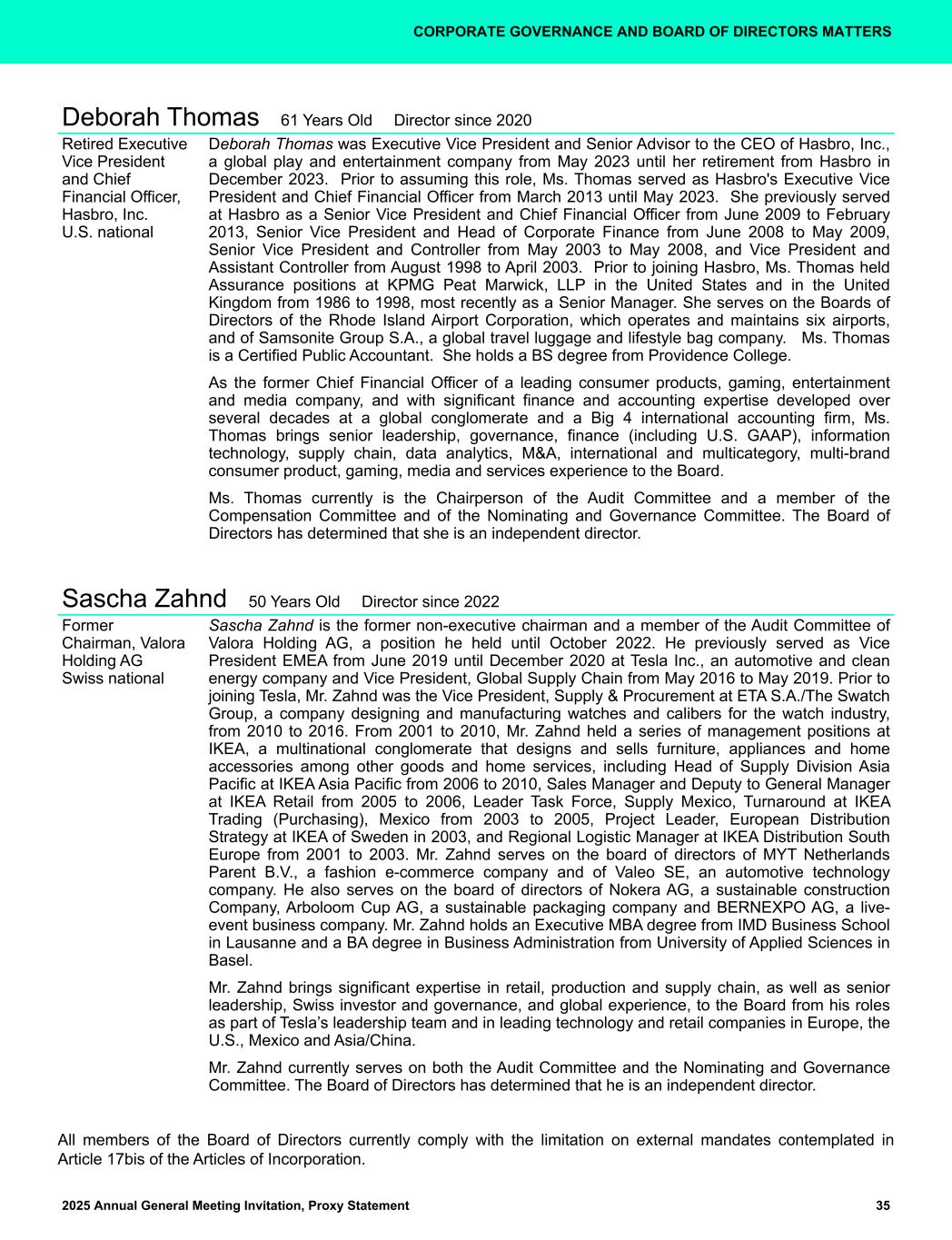
Deborah Thomas 61 Years Old Director since 2020 Retired Executive Vice President and Chief Financial Officer, Hasbro, Inc. U.S. national Deborah Thomas was Executive Vice President and Senior Advisor to the CEO of Hasbro, Inc., a global play and entertainment company from May 2023 until her retirement from Hasbro in December 2023. Prior to assuming this role, Ms. Thomas served as Hasbro's Executive Vice President and Chief Financial Officer from March 2013 until May 2023. She previously served at Hasbro as a Senior Vice President and Chief Financial Officer from June 2009 to February 2013, Senior Vice President and Head of Corporate Finance from June 2008 to May 2009, Senior Vice President and Controller from May 2003 to May 2008, and Vice President and Assistant Controller from August 1998 to April 2003. Prior to joining Hasbro, Ms. Thomas held Assurance positions at KPMG Peat Marwick, LLP in the United States and in the United Kingdom from 1986 to 1998, most recently as a Senior Manager. She serves on the Boards of Directors of the Rhode Island Airport Corporation, which operates and maintains six airports, and of Samsonite Group S.A., a global travel luggage and lifestyle bag company. Ms. Thomas is a Certified Public Accountant. She holds a BS degree from Providence College. As the former Chief Financial Officer of a leading consumer products, gaming, entertainment and media company, and with significant finance and accounting expertise developed over several decades at a global conglomerate and a Big 4 international accounting firm, Ms. Thomas brings senior leadership, governance, finance (including U.S. GAAP), information technology, supply chain, data analytics, M&A, international and multicategory, multi-brand consumer product, gaming, media and services experience to the Board. Ms. Thomas currently is the Chairperson of the Audit Committee and a member of the Compensation Committee and of the Nominating and Governance Committee. The Board of Directors has determined that she is an independent director. Sascha Zahnd 50 Years Old Director since 2022 Former Chairman, Valora Holding AG Swiss national Sascha Zahnd is the former non-executive chairman and a member of the Audit Committee of Valora Holding AG, a position he held until October 2022. He previously served as Vice President EMEA from June 2019 until December 2020 at Tesla Inc., an automotive and clean energy company and Vice President, Global Supply Chain from May 2016 to May 2019. Prior to joining Tesla, Mr. Zahnd was the Vice President, Supply & Procurement at ETA S.A./The Swatch Group, a company designing and manufacturing watches and calibers for the watch industry, from 2010 to 2016. From 2001 to 2010, Mr. Zahnd held a series of management positions at IKEA, a multinational conglomerate that designs and sells furniture, appliances and home accessories among other goods and home services, including Head of Supply Division Asia Pacific at IKEA Asia Pacific from 2006 to 2010, Sales Manager and Deputy to General Manager at IKEA Retail from 2005 to 2006, Leader Task Force, Supply Mexico, Turnaround at IKEA Trading (Purchasing), Mexico from 2003 to 2005, Project Leader, European Distribution Strategy at IKEA of Sweden in 2003, and Regional Logistic Manager at IKEA Distribution South Europe from 2001 to 2003. Mr. Zahnd serves on the board of directors of MYT Netherlands Parent B.V., a fashion e-commerce company and of Valeo SE, an automotive technology company. He also serves on the board of directors of Nokera AG, a sustainable construction Company, Arboloom Cup AG, a sustainable packaging company and BERNEXPO AG, a live- event business company. Mr. Zahnd holds an Executive MBA degree from IMD Business School in Lausanne and a BA degree in Business Administration from University of Applied Sciences in Basel. Mr. Zahnd brings significant expertise in retail, production and supply chain, as well as senior leadership, Swiss investor and governance, and global experience, to the Board from his roles as part of Tesla’s leadership team and in leading technology and retail companies in Europe, the U.S., Mexico and Asia/China. Mr. Zahnd currently serves on both the Audit Committee and the Nominating and Governance Committee. The Board of Directors has determined that he is an independent director. All members of the Board of Directors currently comply with the limitation on external mandates contemplated in Article 17bis of the Articles of Incorporation. CORPORATE GOVERNANCE AND BOARD OF DIRECTORS MATTERS 2025 Annual General Meeting Invitation, Proxy Statement 35
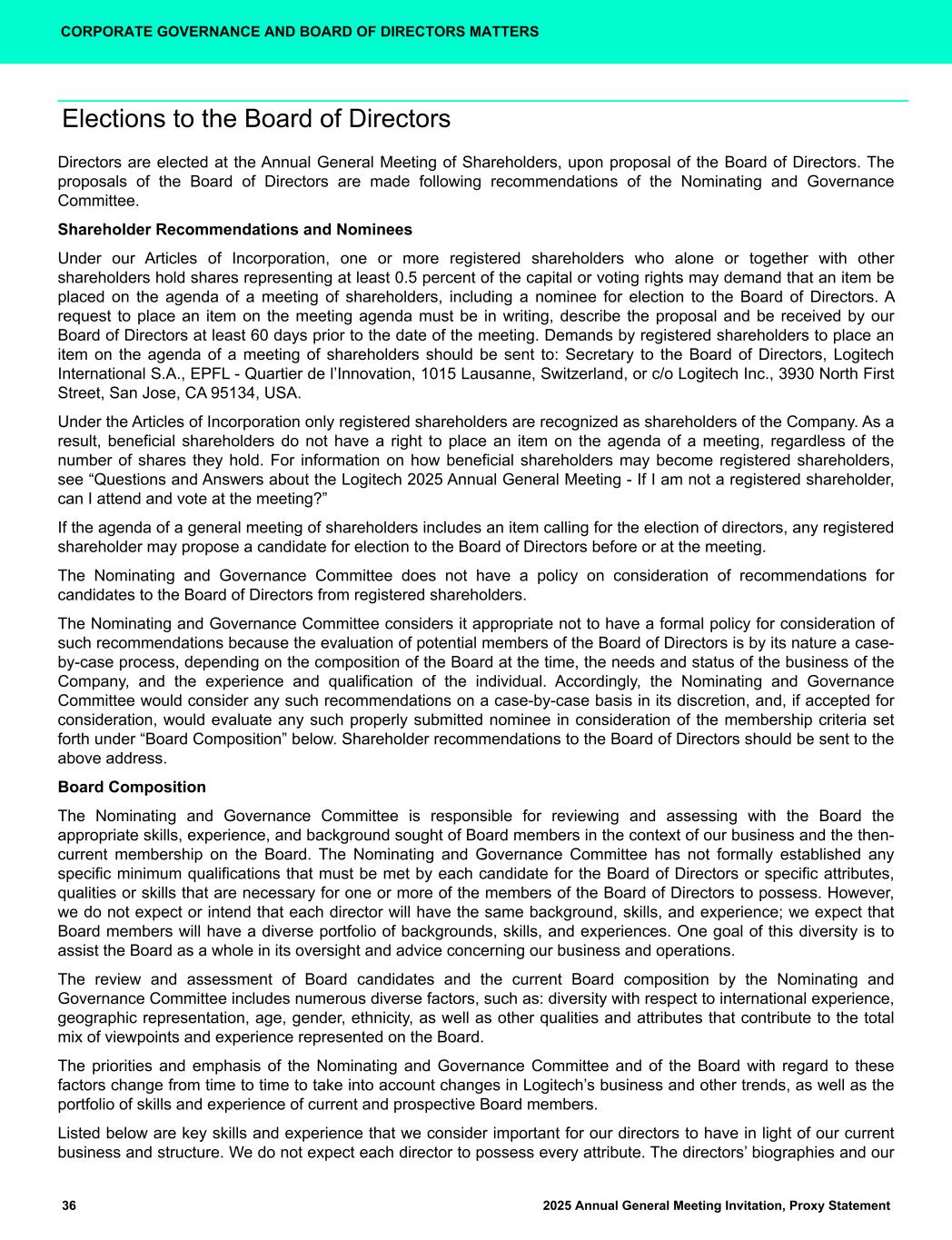
Elections to the Board of Directors Directors are elected at the Annual General Meeting of Shareholders, upon proposal of the Board of Directors. The proposals of the Board of Directors are made following recommendations of the Nominating and Governance Committee. Shareholder Recommendations and Nominees Under our Articles of Incorporation, one or more registered shareholders who alone or together with other shareholders hold shares representing at least 0.5 percent of the capital or voting rights may demand that an item be placed on the agenda of a meeting of shareholders, including a nominee for election to the Board of Directors. A request to place an item on the meeting agenda must be in writing, describe the proposal and be received by our Board of Directors at least 60 days prior to the date of the meeting. Demands by registered shareholders to place an item on the agenda of a meeting of shareholders should be sent to: Secretary to the Board of Directors, Logitech International S.A., EPFL - Quartier de l’Innovation, 1015 Lausanne, Switzerland, or c/o Logitech Inc., 3930 North First Street, San Jose, CA 95134, USA. Under the Articles of Incorporation only registered shareholders are recognized as shareholders of the Company. As a result, beneficial shareholders do not have a right to place an item on the agenda of a meeting, regardless of the number of shares they hold. For information on how beneficial shareholders may become registered shareholders, see “Questions and Answers about the Logitech 2025 Annual General Meeting - If I am not a registered shareholder, can I attend and vote at the meeting?” If the agenda of a general meeting of shareholders includes an item calling for the election of directors, any registered shareholder may propose a candidate for election to the Board of Directors before or at the meeting. The Nominating and Governance Committee does not have a policy on consideration of recommendations for candidates to the Board of Directors from registered shareholders. The Nominating and Governance Committee considers it appropriate not to have a formal policy for consideration of such recommendations because the evaluation of potential members of the Board of Directors is by its nature a case- by-case process, depending on the composition of the Board at the time, the needs and status of the business of the Company, and the experience and qualification of the individual. Accordingly, the Nominating and Governance Committee would consider any such recommendations on a case-by-case basis in its discretion, and, if accepted for consideration, would evaluate any such properly submitted nominee in consideration of the membership criteria set forth under “Board Composition” below. Shareholder recommendations to the Board of Directors should be sent to the above address. Board Composition The Nominating and Governance Committee is responsible for reviewing and assessing with the Board the appropriate skills, experience, and background sought of Board members in the context of our business and the then- current membership on the Board. The Nominating and Governance Committee has not formally established any specific minimum qualifications that must be met by each candidate for the Board of Directors or specific attributes, qualities or skills that are necessary for one or more of the members of the Board of Directors to possess. However, we do not expect or intend that each director will have the same background, skills, and experience; we expect that Board members will have a diverse portfolio of backgrounds, skills, and experiences. One goal of this diversity is to assist the Board as a whole in its oversight and advice concerning our business and operations. The review and assessment of Board candidates and the current Board composition by the Nominating and Governance Committee includes numerous diverse factors, such as: diversity with respect to international experience, geographic representation, age, gender, ethnicity, as well as other qualities and attributes that contribute to the total mix of viewpoints and experience represented on the Board. The priorities and emphasis of the Nominating and Governance Committee and of the Board with regard to these factors change from time to time to take into account changes in Logitech’s business and other trends, as well as the portfolio of skills and experience of current and prospective Board members. Listed below are key skills and experience that we consider important for our directors to have in light of our current business and structure. We do not expect each director to possess every attribute. The directors’ biographies and our CORPORATE GOVERNANCE AND BOARD OF DIRECTORS MATTERS 36 2025 Annual General Meeting Invitation, Proxy Statement
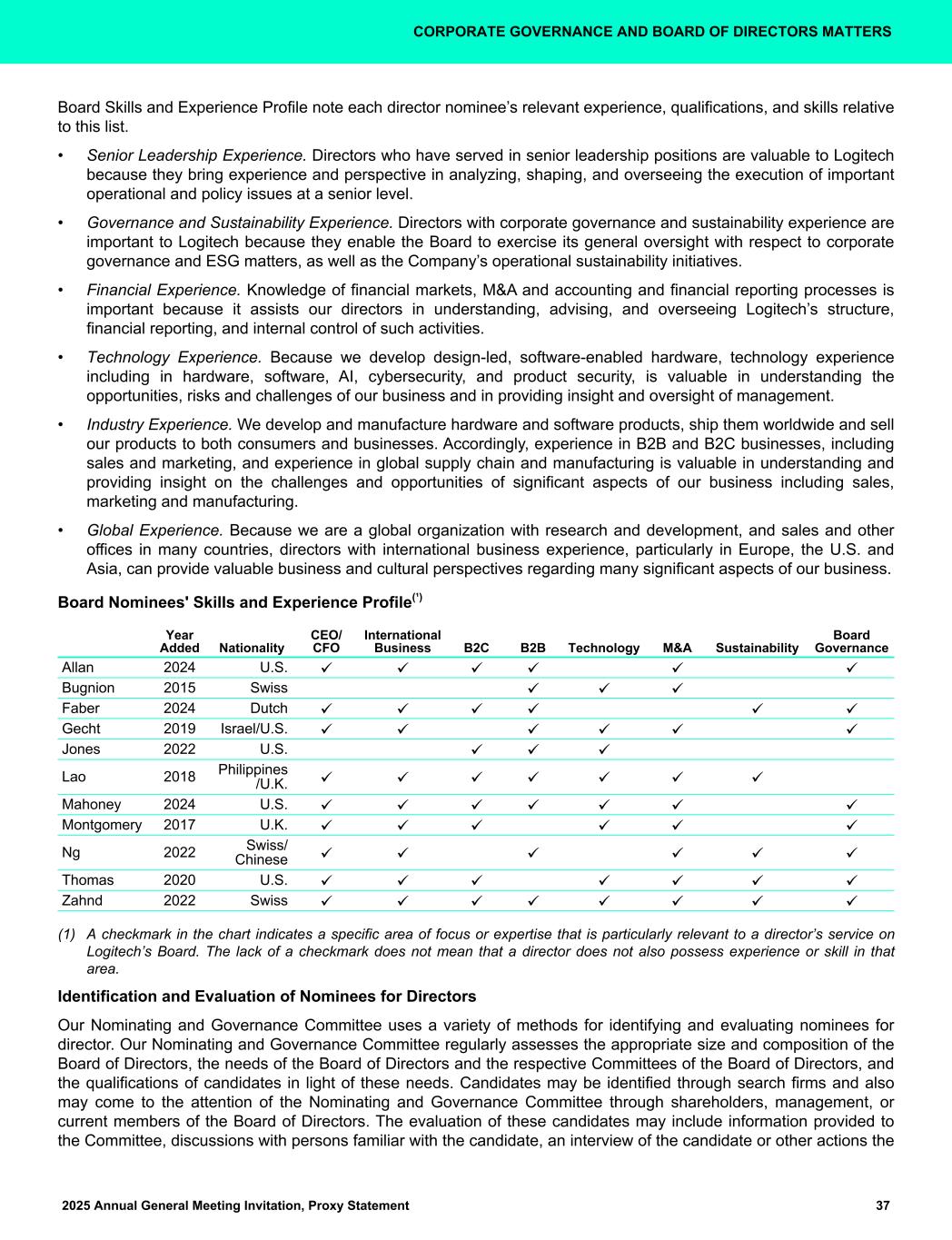
Board Skills and Experience Profile note each director nominee’s relevant experience, qualifications, and skills relative to this list. • Senior Leadership Experience. Directors who have served in senior leadership positions are valuable to Logitech because they bring experience and perspective in analyzing, shaping, and overseeing the execution of important operational and policy issues at a senior level. • Governance and Sustainability Experience. Directors with corporate governance and sustainability experience are important to Logitech because they enable the Board to exercise its general oversight with respect to corporate governance and ESG matters, as well as the Company’s operational sustainability initiatives. • Financial Experience. Knowledge of financial markets, M&A and accounting and financial reporting processes is important because it assists our directors in understanding, advising, and overseeing Logitech’s structure, financial reporting, and internal control of such activities. • Technology Experience. Because we develop design-led, software-enabled hardware, technology experience including in hardware, software, AI, cybersecurity, and product security, is valuable in understanding the opportunities, risks and challenges of our business and in providing insight and oversight of management. • Industry Experience. We develop and manufacture hardware and software products, ship them worldwide and sell our products to both consumers and businesses. Accordingly, experience in B2B and B2C businesses, including sales and marketing, and experience in global supply chain and manufacturing is valuable in understanding and providing insight on the challenges and opportunities of significant aspects of our business including sales, marketing and manufacturing. • Global Experience. Because we are a global organization with research and development, and sales and other offices in many countries, directors with international business experience, particularly in Europe, the U.S. and Asia, can provide valuable business and cultural perspectives regarding many significant aspects of our business. Board Nominees' Skills and Experience Profile(¹) Year Added Nationality CEO/ CFO International Business B2C B2B Technology M&A Sustainability Board Governance Allan 2024 U.S. ü ü ü ü ü ü Bugnion 2015 Swiss ü ü ü Faber 2024 Dutch ü ü ü ü ü ü Gecht 2019 Israel/U.S. ü ü ü ü ü ü Jones 2022 U.S. ü ü ü Lao 2018 Philippines /U.K. ü ü ü ü ü ü ü Mahoney 2024 U.S. ü ü ü ü ü ü ü Montgomery 2017 U.K. ü ü ü ü ü ü Ng 2022 Swiss/ Chinese ü ü ü ü ü ü Thomas 2020 U.S. ü ü ü ü ü ü ü Zahnd 2022 Swiss ü ü ü ü ü ü ü ü (1) A checkmark in the chart indicates a specific area of focus or expertise that is particularly relevant to a director’s service on Logitech’s Board. The lack of a checkmark does not mean that a director does not also possess experience or skill in that area. Identification and Evaluation of Nominees for Directors Our Nominating and Governance Committee uses a variety of methods for identifying and evaluating nominees for director. Our Nominating and Governance Committee regularly assesses the appropriate size and composition of the Board of Directors, the needs of the Board of Directors and the respective Committees of the Board of Directors, and the qualifications of candidates in light of these needs. Candidates may be identified through search firms and also may come to the attention of the Nominating and Governance Committee through shareholders, management, or current members of the Board of Directors. The evaluation of these candidates may include information provided to the Committee, discussions with persons familiar with the candidate, an interview of the candidate or other actions the CORPORATE GOVERNANCE AND BOARD OF DIRECTORS MATTERS 2025 Annual General Meeting Invitation, Proxy Statement 37
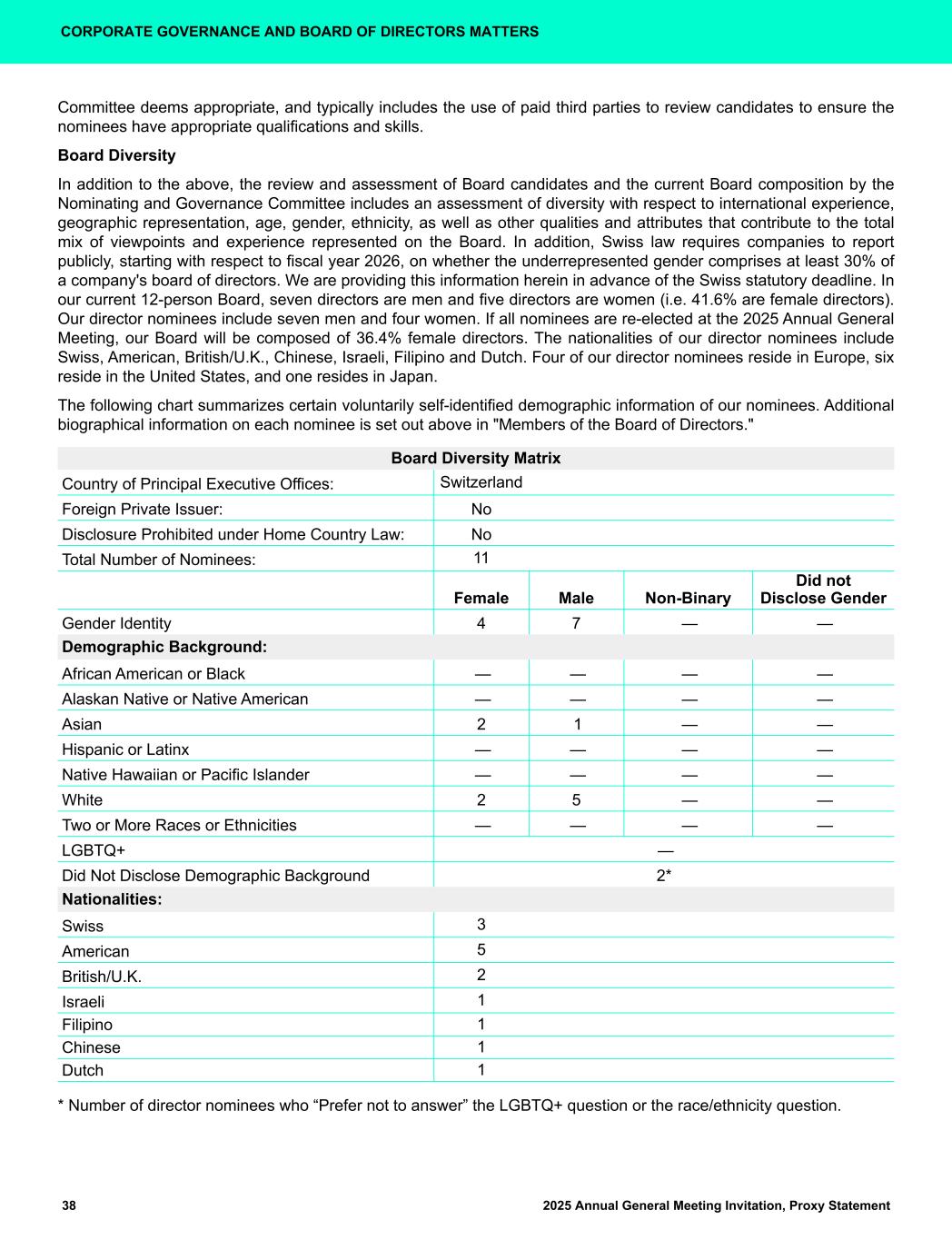
Committee deems appropriate, and typically includes the use of paid third parties to review candidates to ensure the nominees have appropriate qualifications and skills. Board Diversity In addition to the above, the review and assessment of Board candidates and the current Board composition by the Nominating and Governance Committee includes an assessment of diversity with respect to international experience, geographic representation, age, gender, ethnicity, as well as other qualities and attributes that contribute to the total mix of viewpoints and experience represented on the Board. In addition, Swiss law requires companies to report publicly, starting with respect to fiscal year 2026, on whether the underrepresented gender comprises at least 30% of a company's board of directors. We are providing this information herein in advance of the Swiss statutory deadline. In our current 12-person Board, seven directors are men and five directors are women (i.e. 41.6% are female directors). Our director nominees include seven men and four women. If all nominees are re-elected at the 2025 Annual General Meeting, our Board will be composed of 36.4% female directors. The nationalities of our director nominees include Swiss, American, British/U.K., Chinese, Israeli, Filipino and Dutch. Four of our director nominees reside in Europe, six reside in the United States, and one resides in Japan. The following chart summarizes certain voluntarily self-identified demographic information of our nominees. Additional biographical information on each nominee is set out above in "Members of the Board of Directors." Board Diversity Matrix Country of Principal Executive Offices: Switzerland Foreign Private Issuer: No Disclosure Prohibited under Home Country Law: No Total Number of Nominees: 11 Female Male Non-Binary Did not Disclose Gender Gender Identity 4 7 — — Demographic Background: African American or Black — — — — Alaskan Native or Native American — — — — Asian 2 1 — — Hispanic or Latinx — — — — Native Hawaiian or Pacific Islander — — — — White 2 5 — — Two or More Races or Ethnicities — — — — LGBTQ+ — Did Not Disclose Demographic Background 2* Nationalities: Swiss 3 American 5 British/U.K. 2 Israeli 1 Filipino 1 Chinese 1 Dutch 1 * Number of director nominees who “Prefer not to answer” the LGBTQ+ question or the race/ethnicity question. CORPORATE GOVERNANCE AND BOARD OF DIRECTORS MATTERS 38 2025 Annual General Meeting Invitation, Proxy Statement
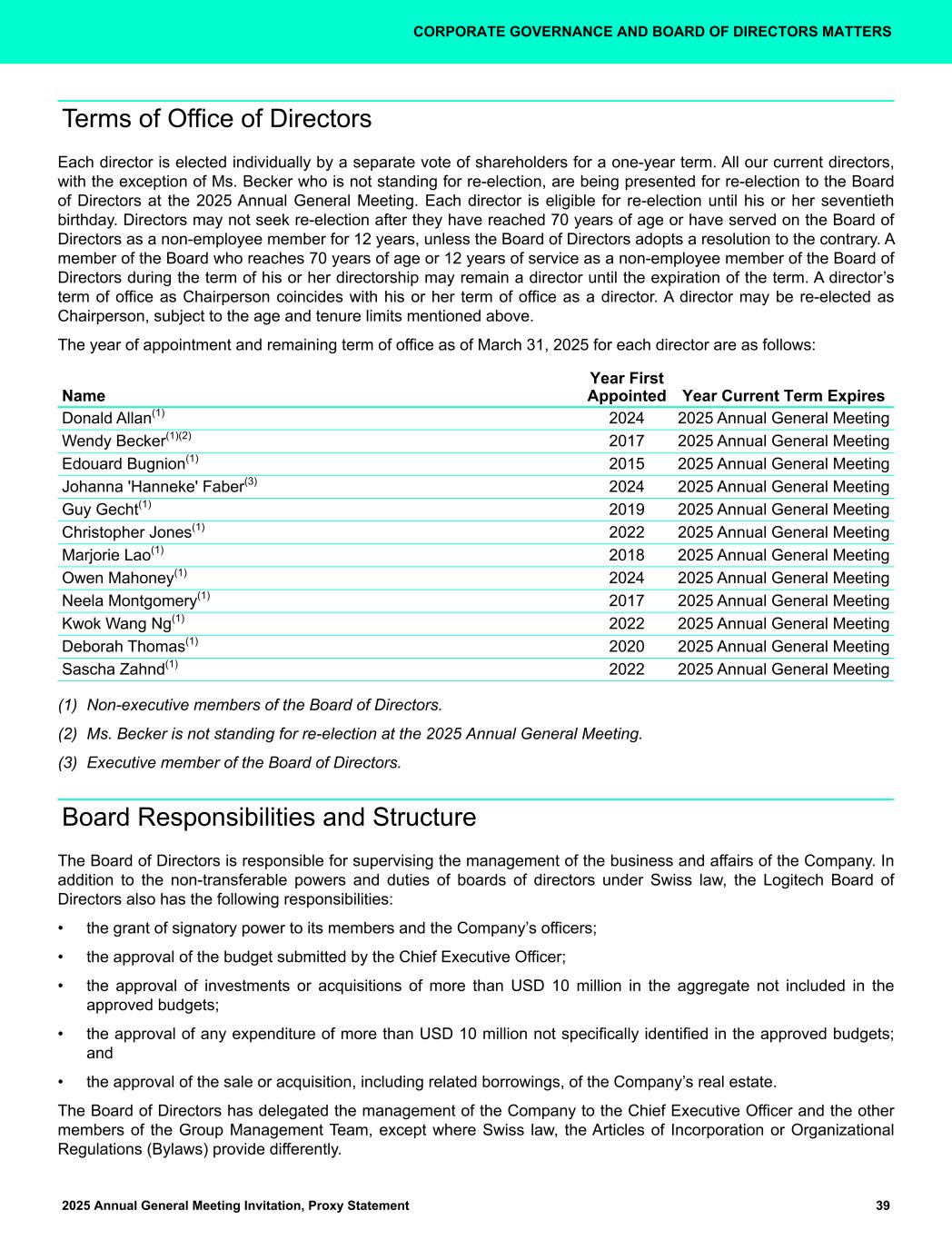
Terms of Office of Directors Each director is elected individually by a separate vote of shareholders for a one-year term. All our current directors, with the exception of Ms. Becker who is not standing for re-election, are being presented for re-election to the Board of Directors at the 2025 Annual General Meeting. Each director is eligible for re-election until his or her seventieth birthday. Directors may not seek re-election after they have reached 70 years of age or have served on the Board of Directors as a non-employee member for 12 years, unless the Board of Directors adopts a resolution to the contrary. A member of the Board who reaches 70 years of age or 12 years of service as a non-employee member of the Board of Directors during the term of his or her directorship may remain a director until the expiration of the term. A director’s term of office as Chairperson coincides with his or her term of office as a director. A director may be re-elected as Chairperson, subject to the age and tenure limits mentioned above. The year of appointment and remaining term of office as of March 31, 2025 for each director are as follows: Name Year First Appointed Year Current Term Expires Donald Allan(1) 2024 2025 Annual General Meeting Wendy Becker(1)(2) 2017 2025 Annual General Meeting Edouard Bugnion(1) 2015 2025 Annual General Meeting Johanna 'Hanneke' Faber(3) 2024 2025 Annual General Meeting Guy Gecht(1) 2019 2025 Annual General Meeting Christopher Jones(1) 2022 2025 Annual General Meeting Marjorie Lao(1) 2018 2025 Annual General Meeting Owen Mahoney(1) 2024 2025 Annual General Meeting Neela Montgomery(1) 2017 2025 Annual General Meeting Kwok Wang Ng(1) 2022 2025 Annual General Meeting Deborah Thomas(1) 2020 2025 Annual General Meeting Sascha Zahnd(1) 2022 2025 Annual General Meeting (1) Non-executive members of the Board of Directors. (2) Ms. Becker is not standing for re-election at the 2025 Annual General Meeting. (3) Executive member of the Board of Directors. Board Responsibilities and Structure The Board of Directors is responsible for supervising the management of the business and affairs of the Company. In addition to the non-transferable powers and duties of boards of directors under Swiss law, the Logitech Board of Directors also has the following responsibilities: • the grant of signatory power to its members and the Company’s officers; • the approval of the budget submitted by the Chief Executive Officer; • the approval of investments or acquisitions of more than USD 10 million in the aggregate not included in the approved budgets; • the approval of any expenditure of more than USD 10 million not specifically identified in the approved budgets; and • the approval of the sale or acquisition, including related borrowings, of the Company’s real estate. The Board of Directors has delegated the management of the Company to the Chief Executive Officer and the other members of the Group Management Team, except where Swiss law, the Articles of Incorporation or Organizational Regulations (Bylaws) provide differently. CORPORATE GOVERNANCE AND BOARD OF DIRECTORS MATTERS 2025 Annual General Meeting Invitation, Proxy Statement 39
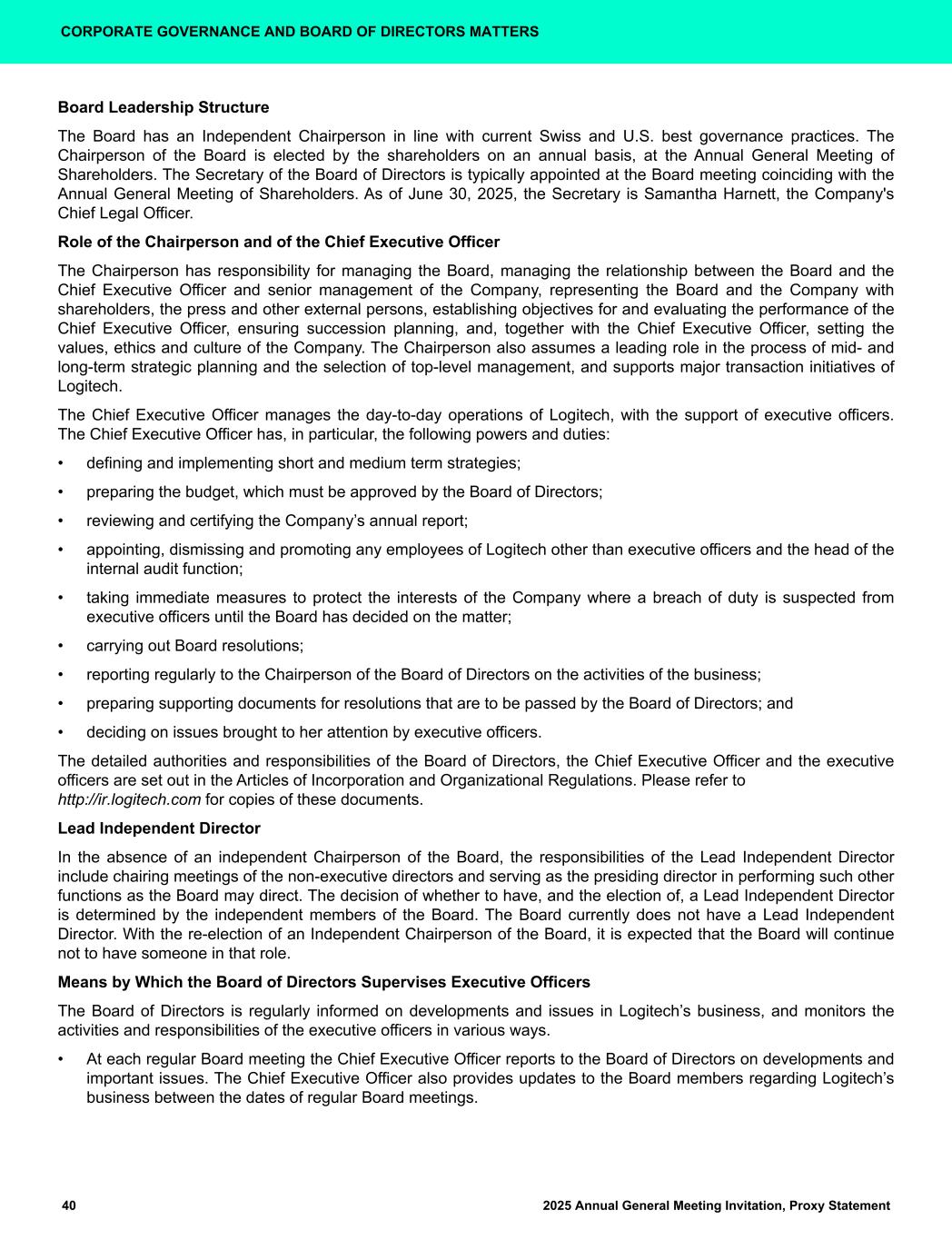
Board Leadership Structure The Board has an Independent Chairperson in line with current Swiss and U.S. best governance practices. The Chairperson of the Board is elected by the shareholders on an annual basis, at the Annual General Meeting of Shareholders. The Secretary of the Board of Directors is typically appointed at the Board meeting coinciding with the Annual General Meeting of Shareholders. As of June 30, 2025, the Secretary is Samantha Harnett, the Company's Chief Legal Officer. Role of the Chairperson and of the Chief Executive Officer The Chairperson has responsibility for managing the Board, managing the relationship between the Board and the Chief Executive Officer and senior management of the Company, representing the Board and the Company with shareholders, the press and other external persons, establishing objectives for and evaluating the performance of the Chief Executive Officer, ensuring succession planning, and, together with the Chief Executive Officer, setting the values, ethics and culture of the Company. The Chairperson also assumes a leading role in the process of mid- and long-term strategic planning and the selection of top-level management, and supports major transaction initiatives of Logitech. The Chief Executive Officer manages the day-to-day operations of Logitech, with the support of executive officers. The Chief Executive Officer has, in particular, the following powers and duties: • defining and implementing short and medium term strategies; • preparing the budget, which must be approved by the Board of Directors; • reviewing and certifying the Company’s annual report; • appointing, dismissing and promoting any employees of Logitech other than executive officers and the head of the internal audit function; • taking immediate measures to protect the interests of the Company where a breach of duty is suspected from executive officers until the Board has decided on the matter; • carrying out Board resolutions; • reporting regularly to the Chairperson of the Board of Directors on the activities of the business; • preparing supporting documents for resolutions that are to be passed by the Board of Directors; and • deciding on issues brought to her attention by executive officers. The detailed authorities and responsibilities of the Board of Directors, the Chief Executive Officer and the executive officers are set out in the Articles of Incorporation and Organizational Regulations. Please refer to http://ir.logitech.com for copies of these documents. Lead Independent Director In the absence of an independent Chairperson of the Board, the responsibilities of the Lead Independent Director include chairing meetings of the non-executive directors and serving as the presiding director in performing such other functions as the Board may direct. The decision of whether to have, and the election of, a Lead Independent Director is determined by the independent members of the Board. The Board currently does not have a Lead Independent Director. With the re-election of an Independent Chairperson of the Board, it is expected that the Board will continue not to have someone in that role. Means by Which the Board of Directors Supervises Executive Officers The Board of Directors is regularly informed on developments and issues in Logitech’s business, and monitors the activities and responsibilities of the executive officers in various ways. • At each regular Board meeting the Chief Executive Officer reports to the Board of Directors on developments and important issues. The Chief Executive Officer also provides updates to the Board members regarding Logitech’s business between the dates of regular Board meetings. CORPORATE GOVERNANCE AND BOARD OF DIRECTORS MATTERS 40 2025 Annual General Meeting Invitation, Proxy Statement
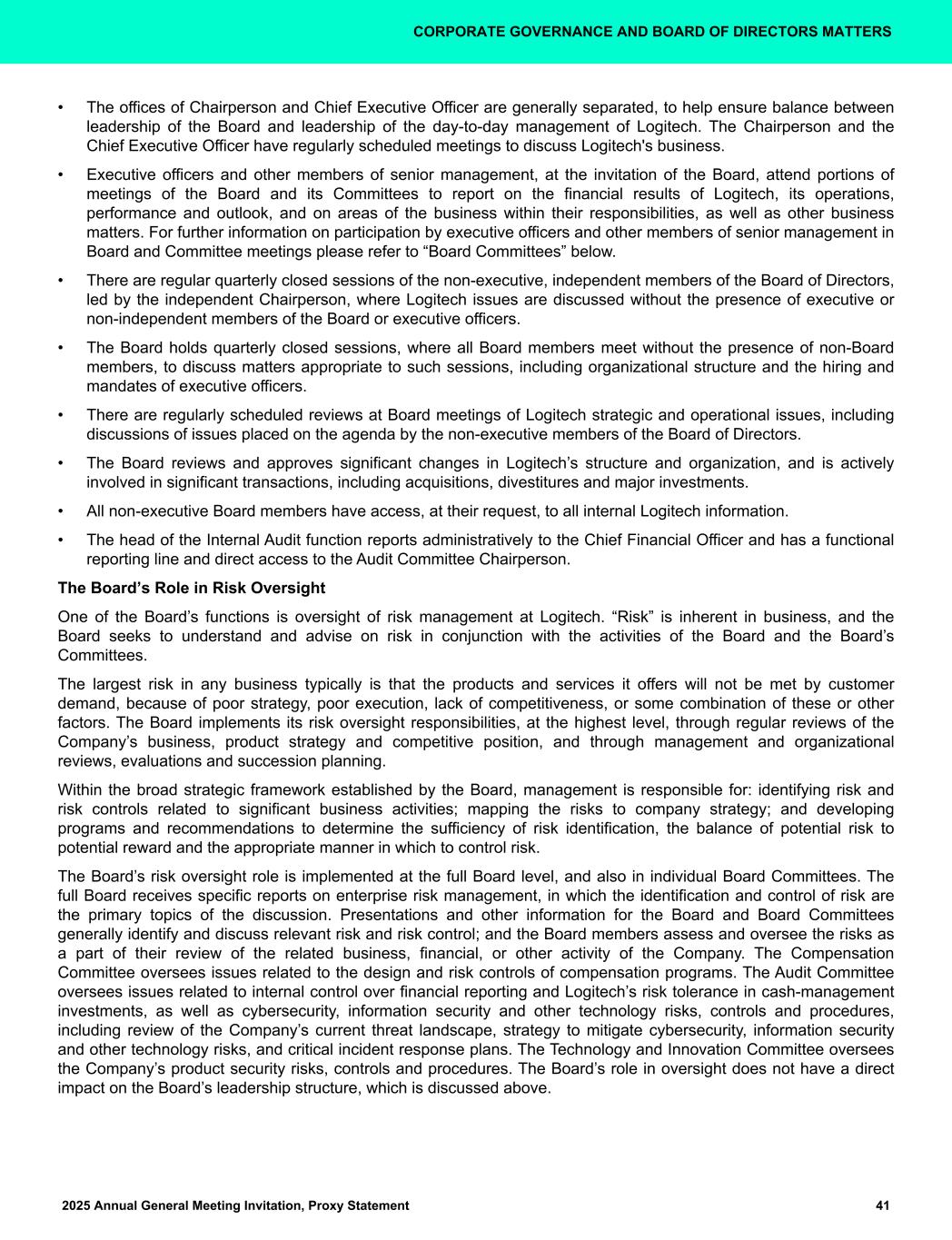
• The offices of Chairperson and Chief Executive Officer are generally separated, to help ensure balance between leadership of the Board and leadership of the day-to-day management of Logitech. The Chairperson and the Chief Executive Officer have regularly scheduled meetings to discuss Logitech's business. • Executive officers and other members of senior management, at the invitation of the Board, attend portions of meetings of the Board and its Committees to report on the financial results of Logitech, its operations, performance and outlook, and on areas of the business within their responsibilities, as well as other business matters. For further information on participation by executive officers and other members of senior management in Board and Committee meetings please refer to “Board Committees” below. • There are regular quarterly closed sessions of the non-executive, independent members of the Board of Directors, led by the independent Chairperson, where Logitech issues are discussed without the presence of executive or non-independent members of the Board or executive officers. • The Board holds quarterly closed sessions, where all Board members meet without the presence of non-Board members, to discuss matters appropriate to such sessions, including organizational structure and the hiring and mandates of executive officers. • There are regularly scheduled reviews at Board meetings of Logitech strategic and operational issues, including discussions of issues placed on the agenda by the non-executive members of the Board of Directors. • The Board reviews and approves significant changes in Logitech’s structure and organization, and is actively involved in significant transactions, including acquisitions, divestitures and major investments. • All non-executive Board members have access, at their request, to all internal Logitech information. • The head of the Internal Audit function reports administratively to the Chief Financial Officer and has a functional reporting line and direct access to the Audit Committee Chairperson. The Board’s Role in Risk Oversight One of the Board’s functions is oversight of risk management at Logitech. “Risk” is inherent in business, and the Board seeks to understand and advise on risk in conjunction with the activities of the Board and the Board’s Committees. The largest risk in any business typically is that the products and services it offers will not be met by customer demand, because of poor strategy, poor execution, lack of competitiveness, or some combination of these or other factors. The Board implements its risk oversight responsibilities, at the highest level, through regular reviews of the Company’s business, product strategy and competitive position, and through management and organizational reviews, evaluations and succession planning. Within the broad strategic framework established by the Board, management is responsible for: identifying risk and risk controls related to significant business activities; mapping the risks to company strategy; and developing programs and recommendations to determine the sufficiency of risk identification, the balance of potential risk to potential reward and the appropriate manner in which to control risk. The Board’s risk oversight role is implemented at the full Board level, and also in individual Board Committees. The full Board receives specific reports on enterprise risk management, in which the identification and control of risk are the primary topics of the discussion. Presentations and other information for the Board and Board Committees generally identify and discuss relevant risk and risk control; and the Board members assess and oversee the risks as a part of their review of the related business, financial, or other activity of the Company. The Compensation Committee oversees issues related to the design and risk controls of compensation programs. The Audit Committee oversees issues related to internal control over financial reporting and Logitech’s risk tolerance in cash-management investments, as well as cybersecurity, information security and other technology risks, controls and procedures, including review of the Company’s current threat landscape, strategy to mitigate cybersecurity, information security and other technology risks, and critical incident response plans. The Technology and Innovation Committee oversees the Company’s product security risks, controls and procedures. The Board’s role in oversight does not have a direct impact on the Board’s leadership structure, which is discussed above. CORPORATE GOVERNANCE AND BOARD OF DIRECTORS MATTERS 2025 Annual General Meeting Invitation, Proxy Statement 41
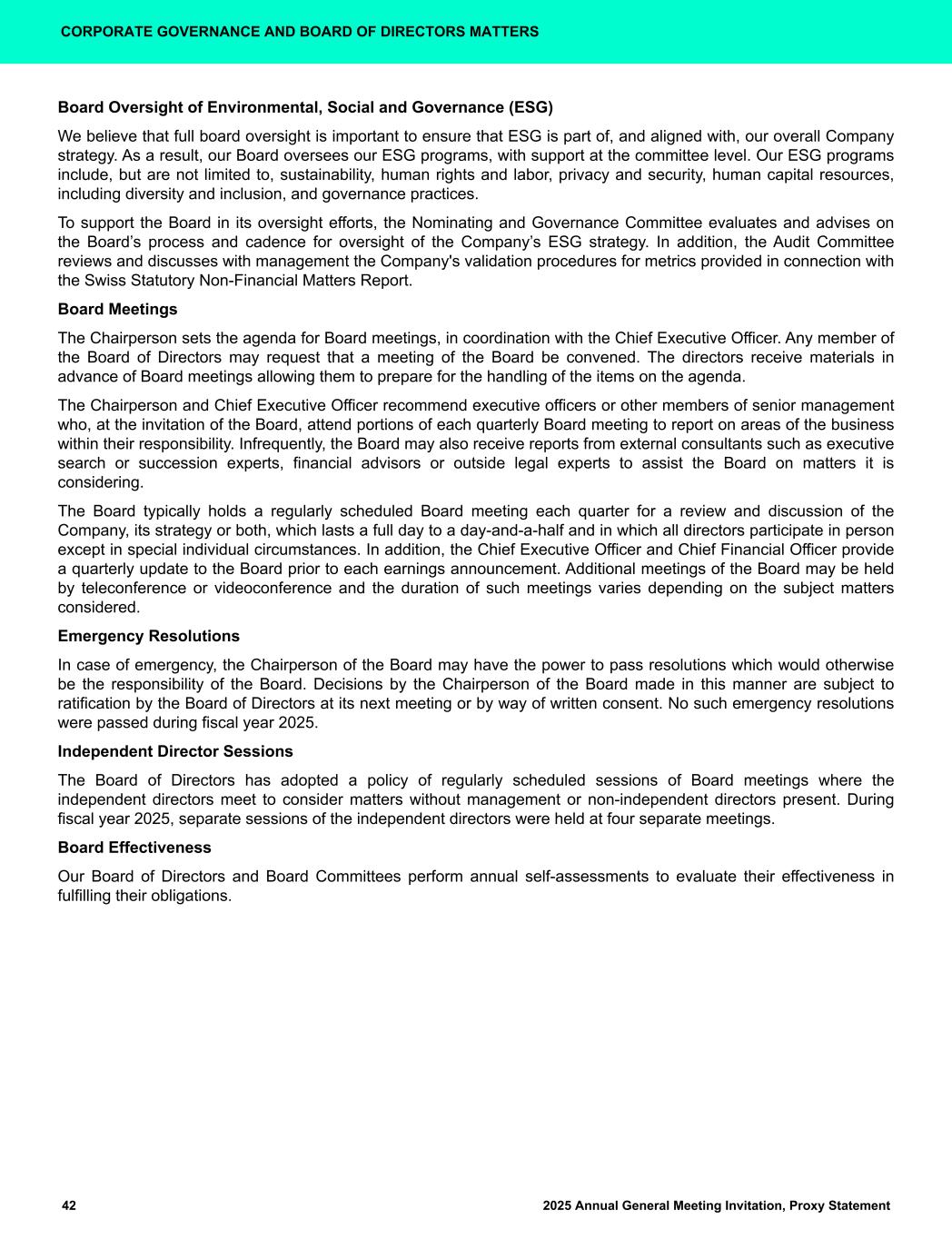
Board Oversight of Environmental, Social and Governance (ESG) We believe that full board oversight is important to ensure that ESG is part of, and aligned with, our overall Company strategy. As a result, our Board oversees our ESG programs, with support at the committee level. Our ESG programs include, but are not limited to, sustainability, human rights and labor, privacy and security, human capital resources, including diversity and inclusion, and governance practices. To support the Board in its oversight efforts, the Nominating and Governance Committee evaluates and advises on the Board’s process and cadence for oversight of the Company’s ESG strategy. In addition, the Audit Committee reviews and discusses with management the Company's validation procedures for metrics provided in connection with the Swiss Statutory Non-Financial Matters Report. Board Meetings The Chairperson sets the agenda for Board meetings, in coordination with the Chief Executive Officer. Any member of the Board of Directors may request that a meeting of the Board be convened. The directors receive materials in advance of Board meetings allowing them to prepare for the handling of the items on the agenda. The Chairperson and Chief Executive Officer recommend executive officers or other members of senior management who, at the invitation of the Board, attend portions of each quarterly Board meeting to report on areas of the business within their responsibility. Infrequently, the Board may also receive reports from external consultants such as executive search or succession experts, financial advisors or outside legal experts to assist the Board on matters it is considering. The Board typically holds a regularly scheduled Board meeting each quarter for a review and discussion of the Company, its strategy or both, which lasts a full day to a day-and-a-half and in which all directors participate in person except in special individual circumstances. In addition, the Chief Executive Officer and Chief Financial Officer provide a quarterly update to the Board prior to each earnings announcement. Additional meetings of the Board may be held by teleconference or videoconference and the duration of such meetings varies depending on the subject matters considered. Emergency Resolutions In case of emergency, the Chairperson of the Board may have the power to pass resolutions which would otherwise be the responsibility of the Board. Decisions by the Chairperson of the Board made in this manner are subject to ratification by the Board of Directors at its next meeting or by way of written consent. No such emergency resolutions were passed during fiscal year 2025. Independent Director Sessions The Board of Directors has adopted a policy of regularly scheduled sessions of Board meetings where the independent directors meet to consider matters without management or non-independent directors present. During fiscal year 2025, separate sessions of the independent directors were held at four separate meetings. Board Effectiveness Our Board of Directors and Board Committees perform annual self-assessments to evaluate their effectiveness in fulfilling their obligations. CORPORATE GOVERNANCE AND BOARD OF DIRECTORS MATTERS 42 2025 Annual General Meeting Invitation, Proxy Statement
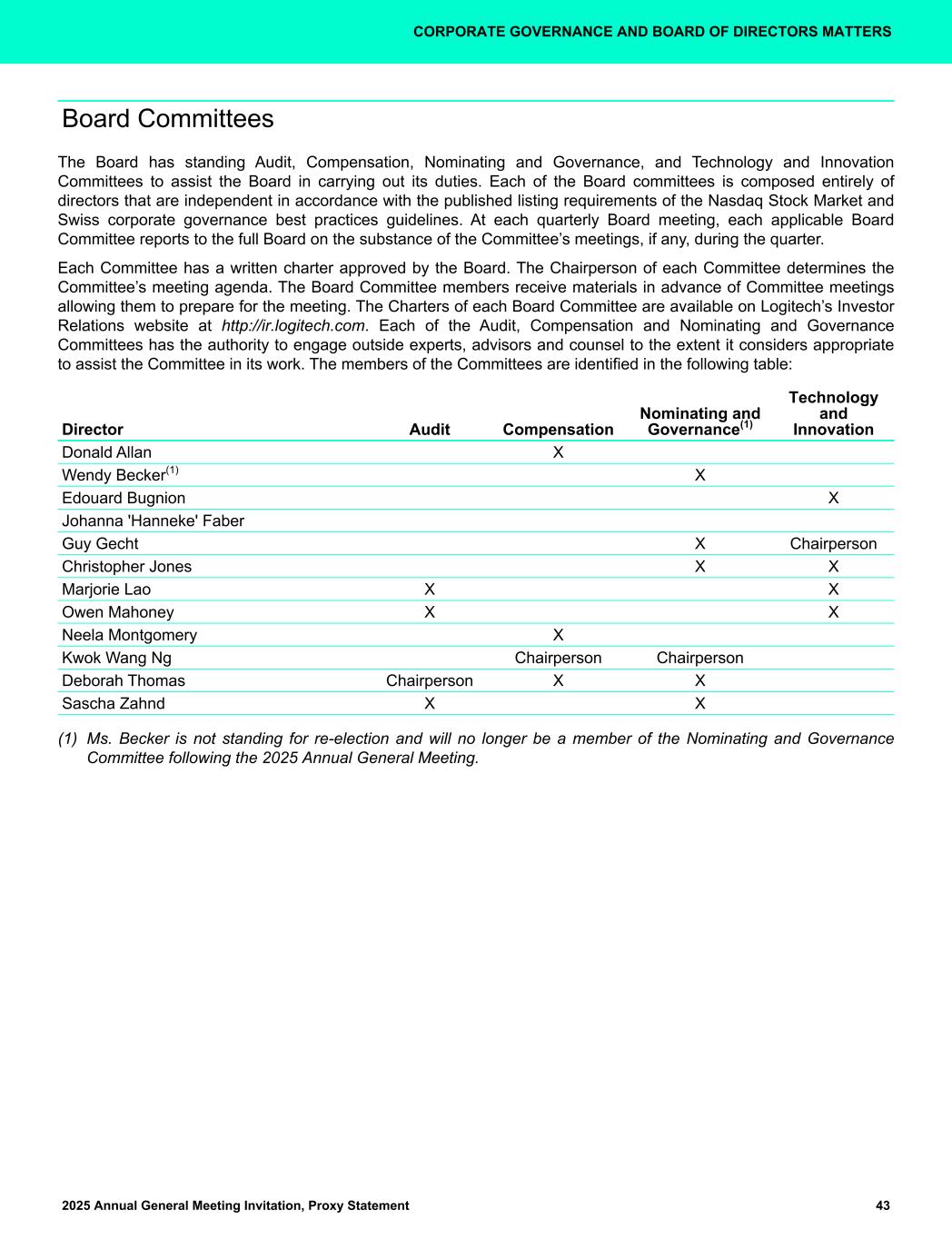
Board Committees The Board has standing Audit, Compensation, Nominating and Governance, and Technology and Innovation Committees to assist the Board in carrying out its duties. Each of the Board committees is composed entirely of directors that are independent in accordance with the published listing requirements of the Nasdaq Stock Market and Swiss corporate governance best practices guidelines. At each quarterly Board meeting, each applicable Board Committee reports to the full Board on the substance of the Committee’s meetings, if any, during the quarter. Each Committee has a written charter approved by the Board. The Chairperson of each Committee determines the Committee’s meeting agenda. The Board Committee members receive materials in advance of Committee meetings allowing them to prepare for the meeting. The Charters of each Board Committee are available on Logitech’s Investor Relations website at http://ir.logitech.com. Each of the Audit, Compensation and Nominating and Governance Committees has the authority to engage outside experts, advisors and counsel to the extent it considers appropriate to assist the Committee in its work. The members of the Committees are identified in the following table: Director Audit Compensation Nominating and Governance(1) Technology and Innovation Donald Allan X Wendy Becker(1) X Edouard Bugnion X Johanna 'Hanneke' Faber Guy Gecht X Chairperson Christopher Jones X X Marjorie Lao X X Owen Mahoney X X Neela Montgomery X Kwok Wang Ng Chairperson Chairperson Deborah Thomas Chairperson X X Sascha Zahnd X X (1) Ms. Becker is not standing for re-election and will no longer be a member of the Nominating and Governance Committee following the 2025 Annual General Meeting. CORPORATE GOVERNANCE AND BOARD OF DIRECTORS MATTERS 2025 Annual General Meeting Invitation, Proxy Statement 43
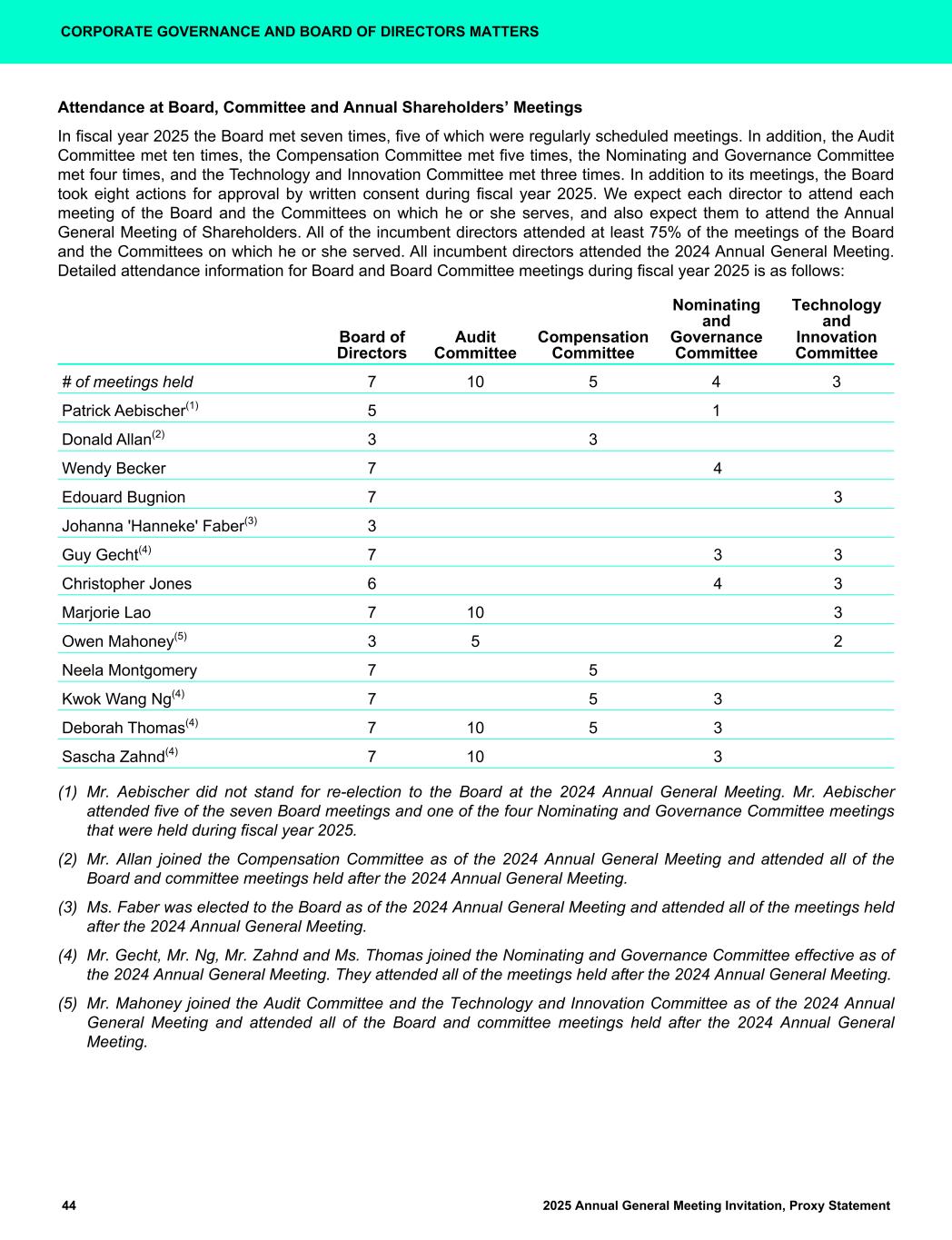
Attendance at Board, Committee and Annual Shareholders’ Meetings In fiscal year 2025 the Board met seven times, five of which were regularly scheduled meetings. In addition, the Audit Committee met ten times, the Compensation Committee met five times, the Nominating and Governance Committee met four times, and the Technology and Innovation Committee met three times. In addition to its meetings, the Board took eight actions for approval by written consent during fiscal year 2025. We expect each director to attend each meeting of the Board and the Committees on which he or she serves, and also expect them to attend the Annual General Meeting of Shareholders. All of the incumbent directors attended at least 75% of the meetings of the Board and the Committees on which he or she served. All incumbent directors attended the 2024 Annual General Meeting. Detailed attendance information for Board and Board Committee meetings during fiscal year 2025 is as follows: Board of Directors Audit Committee Compensation Committee Nominating and Governance Committee Technology and Innovation Committee # of meetings held 7 10 5 4 3 Patrick Aebischer(1) 5 1 Donald Allan(2) 3 3 Wendy Becker 7 4 Edouard Bugnion 7 3 Johanna 'Hanneke' Faber(3) 3 Guy Gecht(4) 7 3 3 Christopher Jones 6 4 3 Marjorie Lao 7 10 3 Owen Mahoney(5) 3 5 2 Neela Montgomery 7 5 Kwok Wang Ng(4) 7 5 3 Deborah Thomas(4) 7 10 5 3 Sascha Zahnd(4) 7 10 3 (1) Mr. Aebischer did not stand for re-election to the Board at the 2024 Annual General Meeting. Mr. Aebischer attended five of the seven Board meetings and one of the four Nominating and Governance Committee meetings that were held during fiscal year 2025. (2) Mr. Allan joined the Compensation Committee as of the 2024 Annual General Meeting and attended all of the Board and committee meetings held after the 2024 Annual General Meeting. (3) Ms. Faber was elected to the Board as of the 2024 Annual General Meeting and attended all of the meetings held after the 2024 Annual General Meeting. (4) Mr. Gecht, Mr. Ng, Mr. Zahnd and Ms. Thomas joined the Nominating and Governance Committee effective as of the 2024 Annual General Meeting. They attended all of the meetings held after the 2024 Annual General Meeting. (5) Mr. Mahoney joined the Audit Committee and the Technology and Innovation Committee as of the 2024 Annual General Meeting and attended all of the Board and committee meetings held after the 2024 Annual General Meeting. CORPORATE GOVERNANCE AND BOARD OF DIRECTORS MATTERS 44 2025 Annual General Meeting Invitation, Proxy Statement
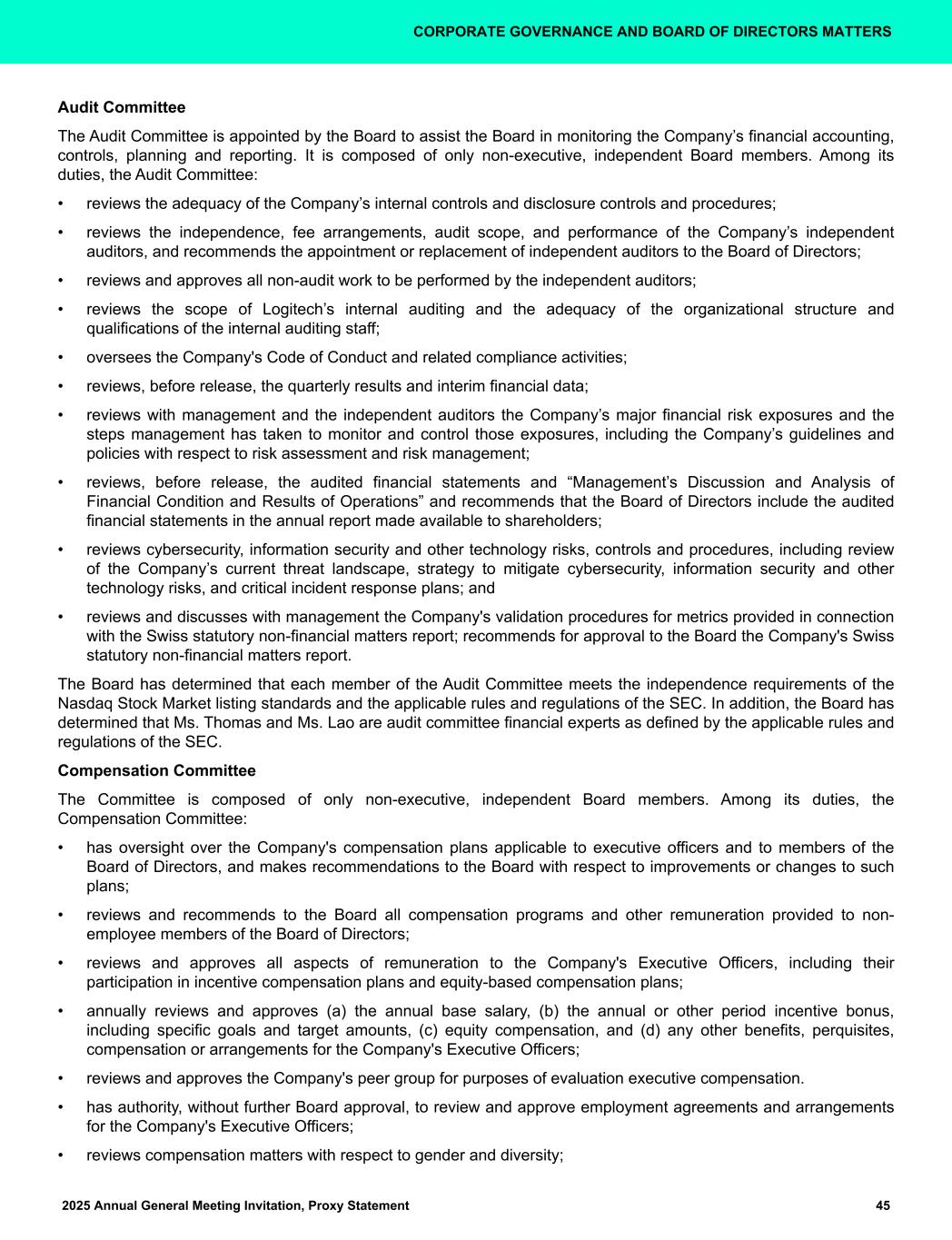
Audit Committee The Audit Committee is appointed by the Board to assist the Board in monitoring the Company’s financial accounting, controls, planning and reporting. It is composed of only non-executive, independent Board members. Among its duties, the Audit Committee: • reviews the adequacy of the Company’s internal controls and disclosure controls and procedures; • reviews the independence, fee arrangements, audit scope, and performance of the Company’s independent auditors, and recommends the appointment or replacement of independent auditors to the Board of Directors; • reviews and approves all non-audit work to be performed by the independent auditors; • reviews the scope of Logitech’s internal auditing and the adequacy of the organizational structure and qualifications of the internal auditing staff; • oversees the Company's Code of Conduct and related compliance activities; • reviews, before release, the quarterly results and interim financial data; • reviews with management and the independent auditors the Company’s major financial risk exposures and the steps management has taken to monitor and control those exposures, including the Company’s guidelines and policies with respect to risk assessment and risk management; • reviews, before release, the audited financial statements and “Management’s Discussion and Analysis of Financial Condition and Results of Operations” and recommends that the Board of Directors include the audited financial statements in the annual report made available to shareholders; • reviews cybersecurity, information security and other technology risks, controls and procedures, including review of the Company’s current threat landscape, strategy to mitigate cybersecurity, information security and other technology risks, and critical incident response plans; and • reviews and discusses with management the Company's validation procedures for metrics provided in connection with the Swiss statutory non-financial matters report; recommends for approval to the Board the Company's Swiss statutory non-financial matters report. The Board has determined that each member of the Audit Committee meets the independence requirements of the Nasdaq Stock Market listing standards and the applicable rules and regulations of the SEC. In addition, the Board has determined that Ms. Thomas and Ms. Lao are audit committee financial experts as defined by the applicable rules and regulations of the SEC. Compensation Committee The Committee is composed of only non-executive, independent Board members. Among its duties, the Compensation Committee: • has oversight over the Company's compensation plans applicable to executive officers and to members of the Board of Directors, and makes recommendations to the Board with respect to improvements or changes to such plans; • reviews and recommends to the Board all compensation programs and other remuneration provided to non- employee members of the Board of Directors; • reviews and approves all aspects of remuneration to the Company's Executive Officers, including their participation in incentive compensation plans and equity-based compensation plans; • annually reviews and approves (a) the annual base salary, (b) the annual or other period incentive bonus, including specific goals and target amounts, (c) equity compensation, and (d) any other benefits, perquisites, compensation or arrangements for the Company's Executive Officers; • reviews and approves the Company's peer group for purposes of evaluation executive compensation. • has authority, without further Board approval, to review and approve employment agreements and arrangements for the Company's Executive Officers; • reviews compensation matters with respect to gender and diversity; CORPORATE GOVERNANCE AND BOARD OF DIRECTORS MATTERS 2025 Annual General Meeting Invitation, Proxy Statement 45
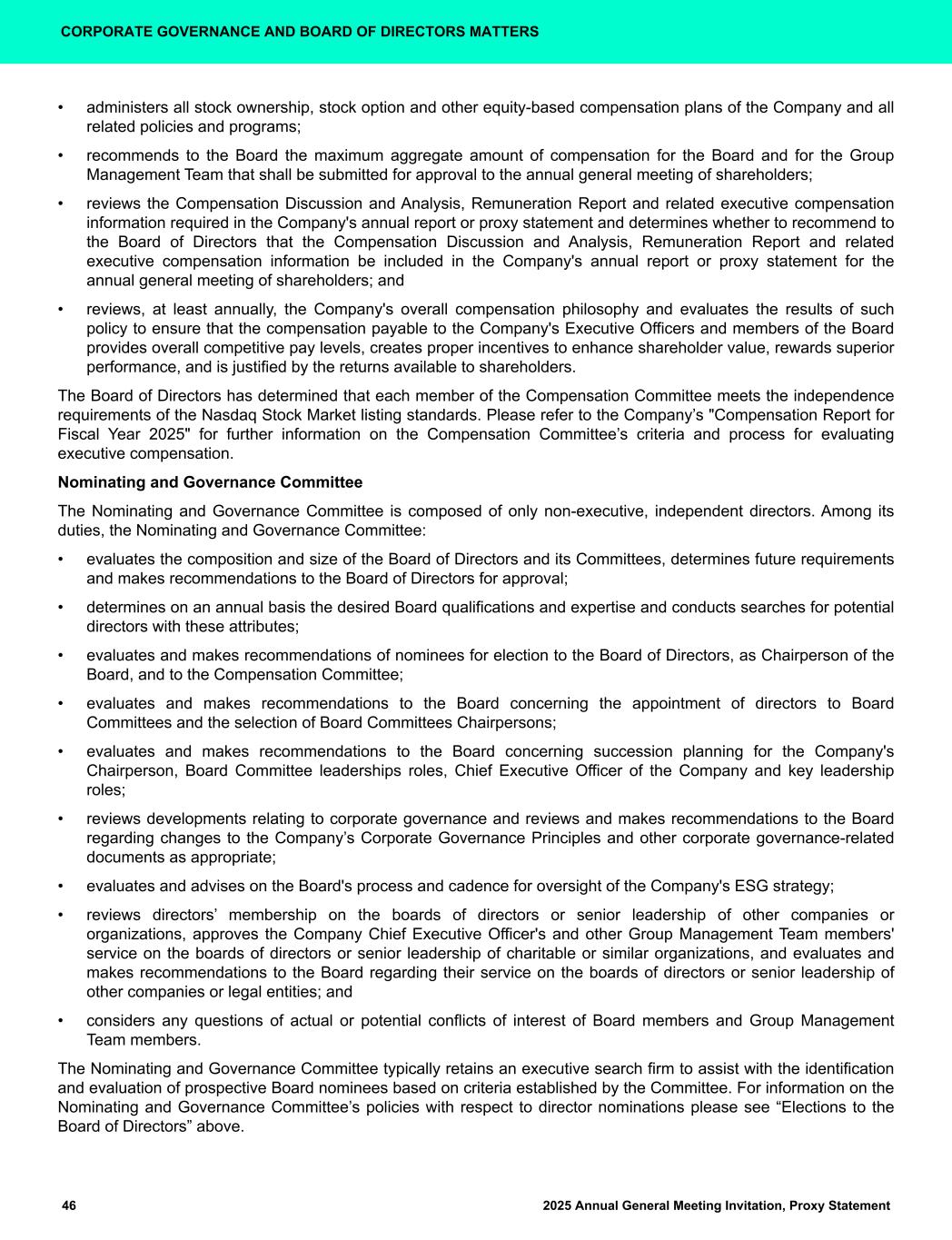
• administers all stock ownership, stock option and other equity-based compensation plans of the Company and all related policies and programs; • recommends to the Board the maximum aggregate amount of compensation for the Board and for the Group Management Team that shall be submitted for approval to the annual general meeting of shareholders; • reviews the Compensation Discussion and Analysis, Remuneration Report and related executive compensation information required in the Company's annual report or proxy statement and determines whether to recommend to the Board of Directors that the Compensation Discussion and Analysis, Remuneration Report and related executive compensation information be included in the Company's annual report or proxy statement for the annual general meeting of shareholders; and • reviews, at least annually, the Company's overall compensation philosophy and evaluates the results of such policy to ensure that the compensation payable to the Company's Executive Officers and members of the Board provides overall competitive pay levels, creates proper incentives to enhance shareholder value, rewards superior performance, and is justified by the returns available to shareholders. The Board of Directors has determined that each member of the Compensation Committee meets the independence requirements of the Nasdaq Stock Market listing standards. Please refer to the Company’s "Compensation Report for Fiscal Year 2025" for further information on the Compensation Committee’s criteria and process for evaluating executive compensation. Nominating and Governance Committee The Nominating and Governance Committee is composed of only non-executive, independent directors. Among its duties, the Nominating and Governance Committee: • evaluates the composition and size of the Board of Directors and its Committees, determines future requirements and makes recommendations to the Board of Directors for approval; • determines on an annual basis the desired Board qualifications and expertise and conducts searches for potential directors with these attributes; • evaluates and makes recommendations of nominees for election to the Board of Directors, as Chairperson of the Board, and to the Compensation Committee; • evaluates and makes recommendations to the Board concerning the appointment of directors to Board Committees and the selection of Board Committees Chairpersons; • evaluates and makes recommendations to the Board concerning succession planning for the Company's Chairperson, Board Committee leaderships roles, Chief Executive Officer of the Company and key leadership roles; • reviews developments relating to corporate governance and reviews and makes recommendations to the Board regarding changes to the Company’s Corporate Governance Principles and other corporate governance-related documents as appropriate; • evaluates and advises on the Board's process and cadence for oversight of the Company's ESG strategy; • reviews directors’ membership on the boards of directors or senior leadership of other companies or organizations, approves the Company Chief Executive Officer's and other Group Management Team members' service on the boards of directors or senior leadership of charitable or similar organizations, and evaluates and makes recommendations to the Board regarding their service on the boards of directors or senior leadership of other companies or legal entities; and • considers any questions of actual or potential conflicts of interest of Board members and Group Management Team members. The Nominating and Governance Committee typically retains an executive search firm to assist with the identification and evaluation of prospective Board nominees based on criteria established by the Committee. For information on the Nominating and Governance Committee’s policies with respect to director nominations please see “Elections to the Board of Directors” above. CORPORATE GOVERNANCE AND BOARD OF DIRECTORS MATTERS 46 2025 Annual General Meeting Invitation, Proxy Statement
The Board has determined that each member of the Nominating and Governance Committee meets the independence requirements of the Nasdaq Stock Market listing standards. Upon the Committee’s recommendation of nominees for election to the Board of Directors, the nominees are presented to the full Board. Nominees are then selected by a majority of the independent members of the Board. Technology and Innovation Committee The Technology and Innovation Committee is composed of at least two members. Among its duties, the Technology and Innovation Committee: • reviews the Company’s technology plans and strategies; • monitors existing and future trends in technology related to the Company’s business and advises the Board and the Company’s senior technology management team with respect to such trends; • reviews the Company’s approaches to acquiring and maintaining the Company’s technology position; • meets with the Company’s senior technology management team to review the Company’s internal technology development and product innovation activities and provide input; and • reviews the Company’s product security risks, controls and procedures. Compensation Committee Interlocks and Insider Participation None of the members of the Compensation Committee has been an officer or employee of Logitech. None of our executive officers serves on the board of directors or compensation committee of a company that has an executive officer that serves on our Board of Directors. Communications with the Board of Directors Shareholders may contact the Board of Directors about bona fide issues or questions about Logitech by sending an email to generalcounsel@logitech.com or by writing the Corporate Secretary at the following address: Logitech International S.A. Attn: Corporate Secretary EPFL - Quartier de l’Innovation 1015 Lausanne, Switzerland All such shareholder communications will be forwarded to the appropriate member or members of the Board of Directors or, if none is specified, to the Chairperson of the Board of Directors. CORPORATE GOVERNANCE AND BOARD OF DIRECTORS MATTERS 2025 Annual General Meeting Invitation, Proxy Statement 47
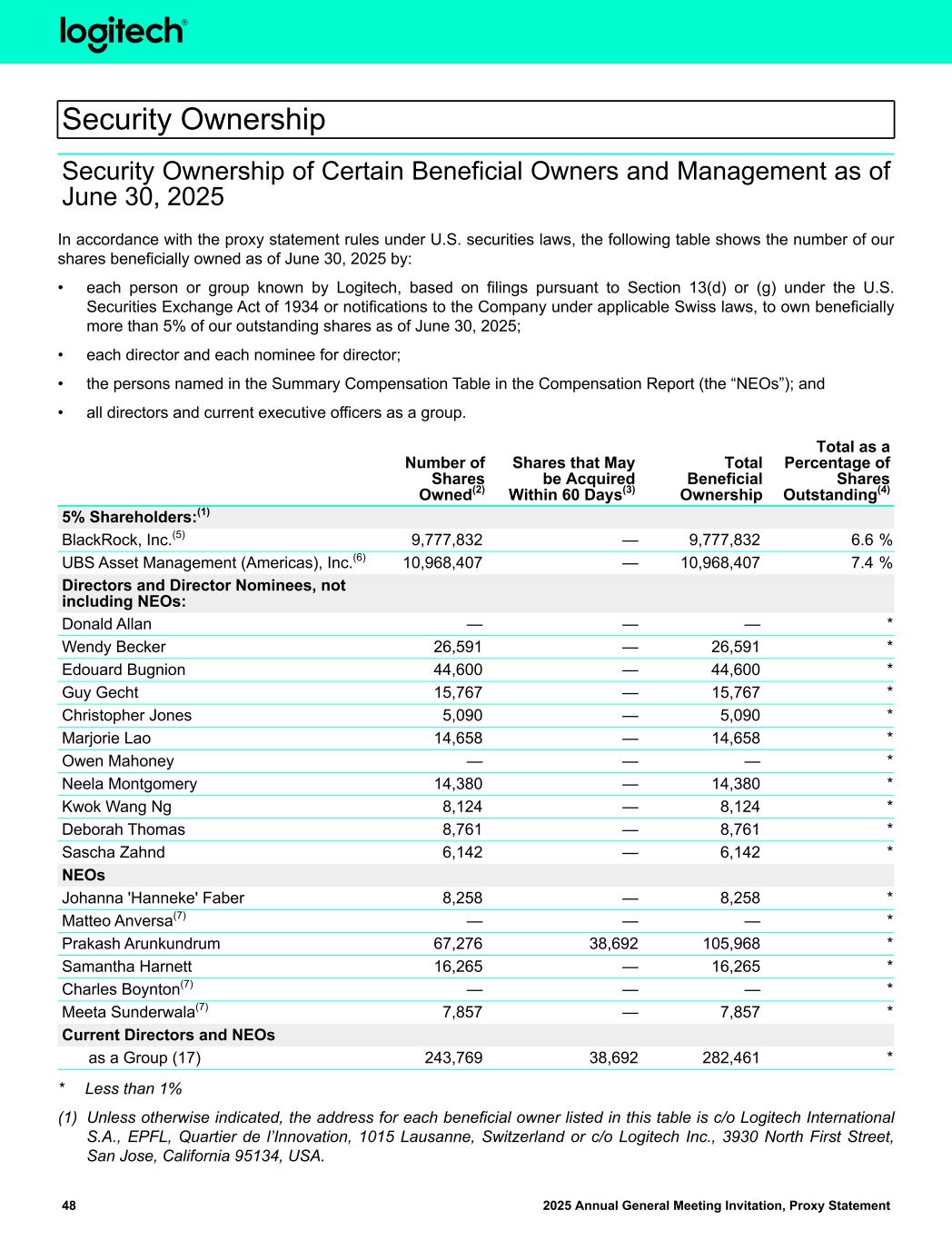
Security Ownership Security Ownership of Certain Beneficial Owners and Management as of June 30, 2025 In accordance with the proxy statement rules under U.S. securities laws, the following table shows the number of our shares beneficially owned as of June 30, 2025 by: • each person or group known by Logitech, based on filings pursuant to Section 13(d) or (g) under the U.S. Securities Exchange Act of 1934 or notifications to the Company under applicable Swiss laws, to own beneficially more than 5% of our outstanding shares as of June 30, 2025; • each director and each nominee for director; • the persons named in the Summary Compensation Table in the Compensation Report (the “NEOs”); and • all directors and current executive officers as a group. Number of Shares Owned(2) Shares that May be Acquired Within 60 Days(3) Total Beneficial Ownership Total as a Percentage of Shares Outstanding(4) 5% Shareholders:(1) BlackRock, Inc.(5) 9,777,832 — 9,777,832 6.6 % UBS Asset Management (Americas), Inc.(6) 10,968,407 — 10,968,407 7.4 % Directors and Director Nominees, not including NEOs: Donald Allan — — — * Wendy Becker 26,591 — 26,591 * Edouard Bugnion 44,600 — 44,600 * Guy Gecht 15,767 — 15,767 * Christopher Jones 5,090 — 5,090 * Marjorie Lao 14,658 — 14,658 * Owen Mahoney — — — * Neela Montgomery 14,380 — 14,380 * Kwok Wang Ng 8,124 — 8,124 * Deborah Thomas 8,761 — 8,761 * Sascha Zahnd 6,142 — 6,142 * NEOs Johanna 'Hanneke' Faber 8,258 — 8,258 * Matteo Anversa(7) — — — * Prakash Arunkundrum 67,276 38,692 105,968 * Samantha Harnett 16,265 — 16,265 * Charles Boynton(7) — — — * Meeta Sunderwala(7) 7,857 — 7,857 * Current Directors and NEOs as a Group (17) 243,769 38,692 282,461 * * Less than 1% (1) Unless otherwise indicated, the address for each beneficial owner listed in this table is c/o Logitech International S.A., EPFL, Quartier de l’Innovation, 1015 Lausanne, Switzerland or c/o Logitech Inc., 3930 North First Street, San Jose, California 95134, USA. 48 2025 Annual General Meeting Invitation, Proxy Statement

(2) To Logitech’s knowledge, except as otherwise noted in the footnotes to this table, each director, director nominee and NEOs has sole voting and investment power over the shares reported as beneficially owned in accordance with SEC rules, subject to community property laws where applicable. (3) Includes shares represented by vested, unexercised options as of June 30, 2025 and RSUs and PSUs that are expected to vest within 60 days after June 30, 2025. These shares are deemed to be outstanding for the purpose of computing the percentage ownership of the person holding the options or restricted stock units, but are not treated as outstanding for the purpose of computing the percentage ownership of any other person. (4) Based on 147,551,488 shares outstanding on June 30, 2025 (168,994,142 shares issued less 21,442,654 treasury shares). (5) The number of shares held by BlackRock, Inc. is based on the number of shares reported as beneficially owned by BlackRock, Inc. and its subsidiaries on a Schedule 13G/A filed with the U.S. Securities and Exchange Commission on April 23, 2025. BlackRock, Inc. has sole voting power over 9,072,088 shares and sole dispositive power over 9,777,832 shares. The address of BlackRock, Inc. is 50 Hudson Yards, New York, NY 10001. (6) The number of shares held by UBS Group AG is based on the number of shares reported as beneficially owned by UBS Group AG and its subsidiaries reported to SIX pursuant to article 120 of the Swiss Financial Market Infrastructure Act on May 8, 2024. The address of UBS Group AG is Bahnhofstrasse 45, PO Box CH-8021, Zurich, Switzerland. (7) Mr. Boynton resigned from his position as Chief Financial Officer effective May 17, 2024 to pursue another opportunity and Ms. Sunderwala was appointed as Interim Chief Financial Officer effective June 12, 2024 and served in this role until Mr. Anversa was appointed as Chief Financial Officer effective September 1, 2024. Share Ownership Guidelines Logitech has established share ownership guidelines for its non-executive members of the Board of Directors, the Chief Executive Officer, executive officers and other officers who report directly to the CEO. Each non-employee director is required to own Logitech shares with a market value equal to five times their annual cash retainer under the guidelines adopted by the Board in June 2006 (as revised in June 2013, June 2019 (effective September 4, 2019), July 2020, and June 2021). Non-employee directors are required to achieve this ownership requirement by the later of September 2024 or five years after joining the Board. If a non-employee director has not met the ownership guidelines by the end of the five-year period or falls below the guidelines at any time after the five- year period, one-half of the non-employee director's annual Board retainer will be paid in Logitech shares until the ownership guidelines are satisfied. After reaching the share ownership requirement and then falling below the guidelines solely as a result of Logitech's stock price dropping or as a result of a change in the eligible shares definition, the non-employee director will have until the later of the original five-year period or up to two years from falling below the guidelines to return to compliance with the guidelines. The guidelines will be adjusted to reflect any capital adjustments, and will be re-evaluated by the Board from time to time. As of June 30, 2025, each non-employee director had either satisfied these ownership guidelines or had time remaining to do so. The Compensation Committee adopted share ownership guidelines for executive officers and other officers who report directly to the CEO, effective September 2008. These guidelines were most recently revised in June 2021. They apply to executive officers and other officers who report directly to the CEO. These guidelines require: • the CEO to hold a number of Logitech shares with a market value equal to five times his or her annual base salary; • the Chief Financial Officer to hold a number of Logitech shares with a market value equal to three times his or her annual base salary; • executive officers, other than the CEO and CFO, each to hold a number of Logitech shares with a market value equal to two times their respective annual base salary; and • remaining officers who report directly to the CEO each to hold a number of Logitech shares with a market value equal to their respective annual base salary. SECURITY OWNERSHIP 2025 Annual General Meeting Invitation, Proxy Statement 49
Each officer subject to the guidelines is required to achieve their applicable ownership guidelines within five years of such officer first becoming subject to the guidelines. The ownership guidelines may be met only through owned shares. The CEO must hold 100% of his or her after-tax shares resulting from equity incentive awards until the ownership guidelines are reached, and all other executive officers and officers subject to the guidelines must hold at least 50% of the after-tax shares resulting from equity incentive awards until the ownership requirements are reached. If the ownership guidelines are not met by the end of the five-year accumulation period or if an officer subject to the guidelines falls below the guidelines at any time after the five-year period, the officer will receive 50% of the after-tax value of any earned bonuses under the Leadership Team Bonus Program paid in fully vested Logitech shares. After reaching the share ownership guidelines and then falling below the guidelines solely as a result of Logitech's stock price dropping or as a result of a change in the eligible shares definition, the officer will have until the later of the original five-year period or up to two years from falling below the guidelines to return to compliance. The guidelines will be adjusted to reflect any capital adjustments, and will be re-evaluated by the Compensation Committee from time to time. As of June 30, 2025, all of the executive officers and officers subject to the guidelines had either satisfied these ownership guidelines or had time remaining to do so. SECURITY OWNERSHIP 50 2025 Annual General Meeting Invitation, Proxy Statement
Certain Relationships and Related Transactions Our Policies It is our policy that all employees must not engage in any activities that could conflict with Logitech’s business interests, adversely affect its reputation, or interfere with the fulfillment of their job responsibilities, which must at all times be performed in the best interests of Logitech. Additionally, Logitech employees may not use their position with Logitech, or Logitech’s information or assets, for their personal gain or for the improper benefit of others. These policies are included in our Code of Conduct, which applies to our directors, executive officers and other employees. If, in a particular circumstance, the Board concludes that there is— or may be— a perceived conflict of interest, the Board will instruct our Legal Department to work with our relevant business units to determine if there is a conflict of interest. Any waivers to these conflict-of-interest rules concerning a director or executive officer require the prior approval of the Board. Additionally, any transaction that is a related party transaction under U.S. securities laws must be approved by the Audit Committee or another independent committee of the Board. Nasdaq Rules and Swiss Best Corporate Governance Practices Nasdaq rules defining “independent” director status also govern conflict-of-interest situations, as does the Swiss Code of Best Practice. As discussed above, the Board of Directors has determined that each of our directors and director nominees, except Ms. Faber, qualifies as “independent” in accordance with the Nasdaq rules. The Nasdaq rules include a series of objective tests that prohibit a director from being considered independent if the director has or has had certain employment, business, or family relationships with the company. The Nasdaq definition of independence requires the Board to review the relations between each independent director and the company on a subjective basis. Following this review, the Board has made a subjective determination for each independent director, concluding that no relationships exist which, in the opinion of the Board, could interfere with the exercise of independent judgment in carrying out the responsibilities of a director. With respect to the independence requirements under the Swiss Code of Best Practice, the Board of Directors has likewise determined that each of Logitech’s current directors, except Ms. Faber, qualifies as independent. SEC Rules In addition to Logitech, Nasdaq, and other policies and rules described above, the SEC has specific disclosure requirements covering certain types of transactions involving Logitech and a director, executive officer, persons, and entities affiliated with them. Since April 1, 2024, we have not been a party to, and we have no plans to be a party to, any transaction or series of similar transactions in which the amount involved exceeds or will exceed USD 120,000 and in which any current director, director nominee, executive officer, holder of more than 5% of our shares, or any member of the immediate family of any of the foregoing, has or will have a direct or indirect material interest. We have entered into indemnification agreements with each of our directors and executive officers. These agreements require us to indemnify our directors and officers to the fullest extent permitted by Swiss and California law. None of the following persons have been indebted to Logitech or its subsidiaries at any time since the beginning of fiscal year 2025: any of our directors or executive officers; any nominee for election as a director; any member of the immediate family of any of our directors, executive officers or nominees for director; any corporation or organization of which any of our directors, executive officers or nominees is an executive officer or partner or is, directly or indirectly, the beneficial owner of 10% or more of any class of equity securities (excluding trade debt incurred in the ordinary course of business); and any trust or other estate in which any of the directors, executive officers or nominees for director has a substantial beneficial interest or for which such person serves as a trustee or in a similar capacity. 2025 Annual General Meeting Invitation, Proxy Statement 51
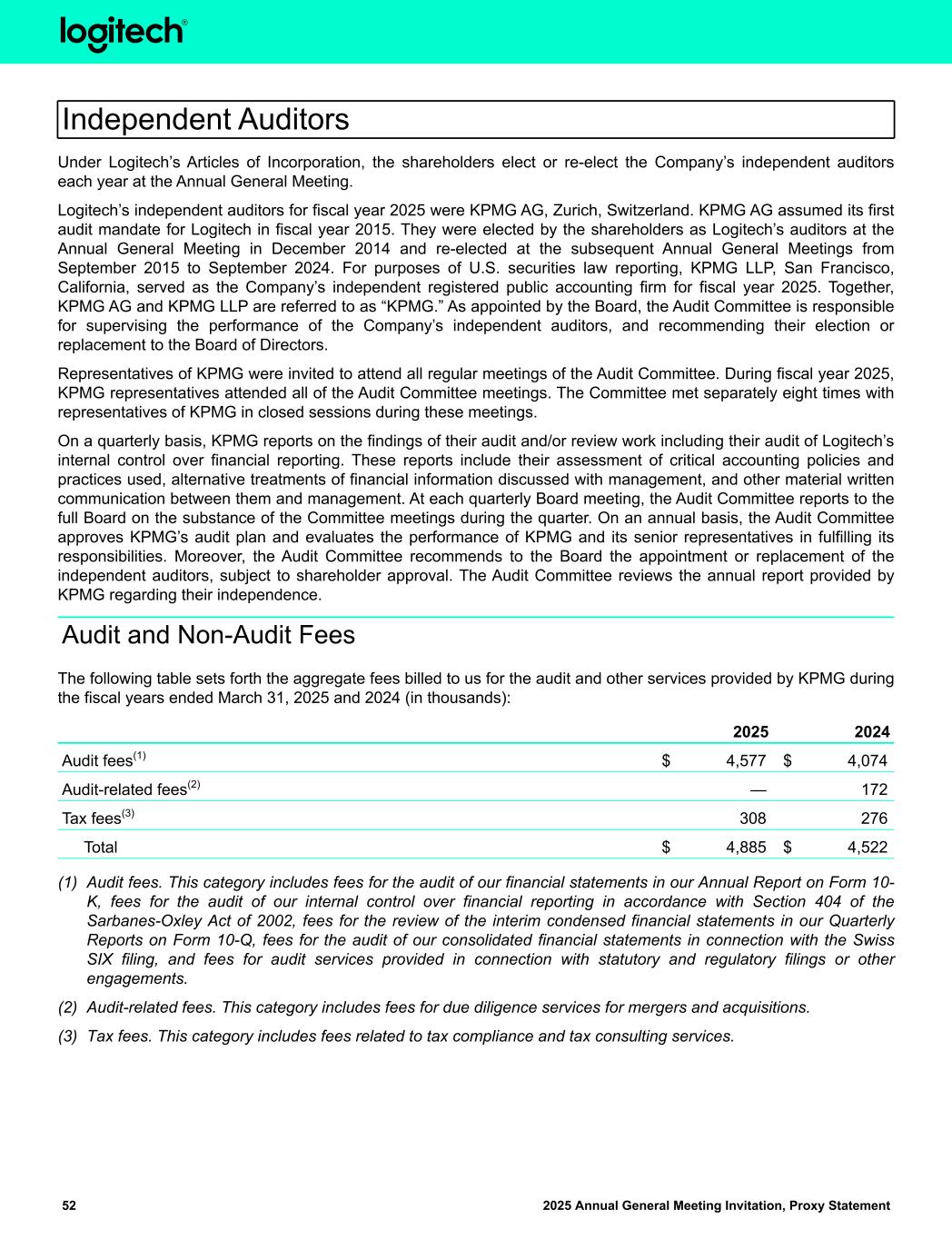
Independent Auditors Under Logitech’s Articles of Incorporation, the shareholders elect or re-elect the Company’s independent auditors each year at the Annual General Meeting. Logitech’s independent auditors for fiscal year 2025 were KPMG AG, Zurich, Switzerland. KPMG AG assumed its first audit mandate for Logitech in fiscal year 2015. They were elected by the shareholders as Logitech’s auditors at the Annual General Meeting in December 2014 and re-elected at the subsequent Annual General Meetings from September 2015 to September 2024. For purposes of U.S. securities law reporting, KPMG LLP, San Francisco, California, served as the Company’s independent registered public accounting firm for fiscal year 2025. Together, KPMG AG and KPMG LLP are referred to as “KPMG.” As appointed by the Board, the Audit Committee is responsible for supervising the performance of the Company’s independent auditors, and recommending their election or replacement to the Board of Directors. Representatives of KPMG were invited to attend all regular meetings of the Audit Committee. During fiscal year 2025, KPMG representatives attended all of the Audit Committee meetings. The Committee met separately eight times with representatives of KPMG in closed sessions during these meetings. On a quarterly basis, KPMG reports on the findings of their audit and/or review work including their audit of Logitech’s internal control over financial reporting. These reports include their assessment of critical accounting policies and practices used, alternative treatments of financial information discussed with management, and other material written communication between them and management. At each quarterly Board meeting, the Audit Committee reports to the full Board on the substance of the Committee meetings during the quarter. On an annual basis, the Audit Committee approves KPMG’s audit plan and evaluates the performance of KPMG and its senior representatives in fulfilling its responsibilities. Moreover, the Audit Committee recommends to the Board the appointment or replacement of the independent auditors, subject to shareholder approval. The Audit Committee reviews the annual report provided by KPMG regarding their independence. Audit and Non-Audit Fees The following table sets forth the aggregate fees billed to us for the audit and other services provided by KPMG during the fiscal years ended March 31, 2025 and 2024 (in thousands): 2025 2024 Audit fees(1) $ 4,577 $ 4,074 Audit-related fees(2) — 172 Tax fees(3) 308 276 Total $ 4,885 $ 4,522 (1) Audit fees. This category includes fees for the audit of our financial statements in our Annual Report on Form 10- K, fees for the audit of our internal control over financial reporting in accordance with Section 404 of the Sarbanes-Oxley Act of 2002, fees for the review of the interim condensed financial statements in our Quarterly Reports on Form 10-Q, fees for the audit of our consolidated financial statements in connection with the Swiss SIX filing, and fees for audit services provided in connection with statutory and regulatory filings or other engagements. (2) Audit-related fees. This category includes fees for due diligence services for mergers and acquisitions. (3) Tax fees. This category includes fees related to tax compliance and tax consulting services. 52 2025 Annual General Meeting Invitation, Proxy Statement

Pre-Approval Procedures and Policies The Audit Committee pre-approves all audit and non-audit services provided by KPMG. This pre-approval must occur before the auditors are engaged. Services that last longer than a year must be reapproved by the Audit Committee. The Audit Committee can delegate pre-approval authority to a single independent member of the Audit Committee, subject to a set dollar amount. The delegate must communicate all services approved at the next scheduled Audit Committee meeting. The Chief Accounting Officer is responsible for ensuring that the work performed is within the scope and dollar limit as approved by the Audit Committee. INDEPENDENT AUDITORS 2025 Annual General Meeting Invitation, Proxy Statement 53
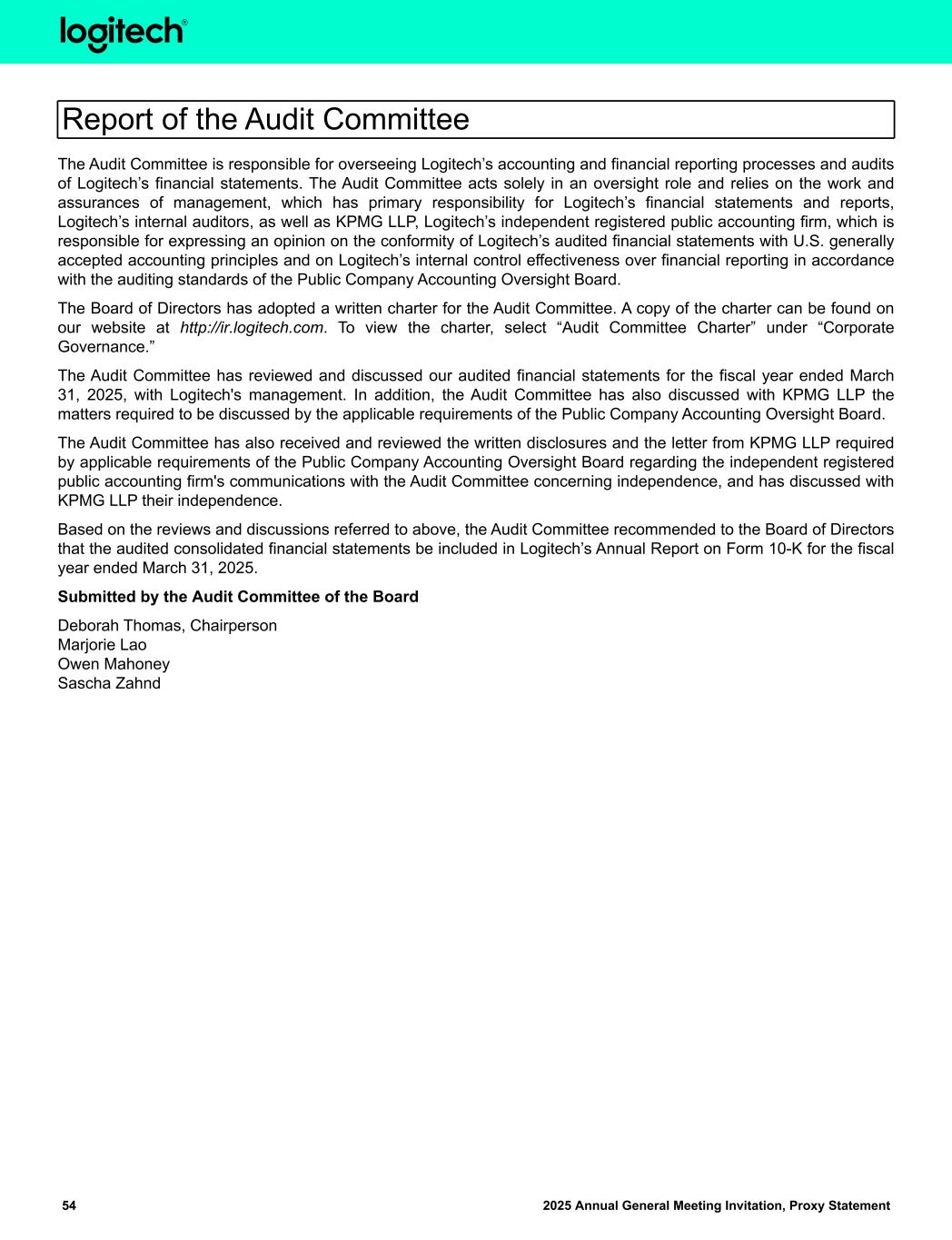
Report of the Audit Committee The Audit Committee is responsible for overseeing Logitech’s accounting and financial reporting processes and audits of Logitech’s financial statements. The Audit Committee acts solely in an oversight role and relies on the work and assurances of management, which has primary responsibility for Logitech’s financial statements and reports, Logitech’s internal auditors, as well as KPMG LLP, Logitech’s independent registered public accounting firm, which is responsible for expressing an opinion on the conformity of Logitech’s audited financial statements with U.S. generally accepted accounting principles and on Logitech’s internal control effectiveness over financial reporting in accordance with the auditing standards of the Public Company Accounting Oversight Board. The Board of Directors has adopted a written charter for the Audit Committee. A copy of the charter can be found on our website at http://ir.logitech.com. To view the charter, select “Audit Committee Charter” under “Corporate Governance.” The Audit Committee has reviewed and discussed our audited financial statements for the fiscal year ended March 31, 2025, with Logitech's management. In addition, the Audit Committee has also discussed with KPMG LLP the matters required to be discussed by the applicable requirements of the Public Company Accounting Oversight Board. The Audit Committee has also received and reviewed the written disclosures and the letter from KPMG LLP required by applicable requirements of the Public Company Accounting Oversight Board regarding the independent registered public accounting firm's communications with the Audit Committee concerning independence, and has discussed with KPMG LLP their independence. Based on the reviews and discussions referred to above, the Audit Committee recommended to the Board of Directors that the audited consolidated financial statements be included in Logitech’s Annual Report on Form 10-K for the fiscal year ended March 31, 2025. Submitted by the Audit Committee of the Board Deborah Thomas, Chairperson Marjorie Lao Owen Mahoney Sascha Zahnd 54 2025 Annual General Meeting Invitation, Proxy Statement
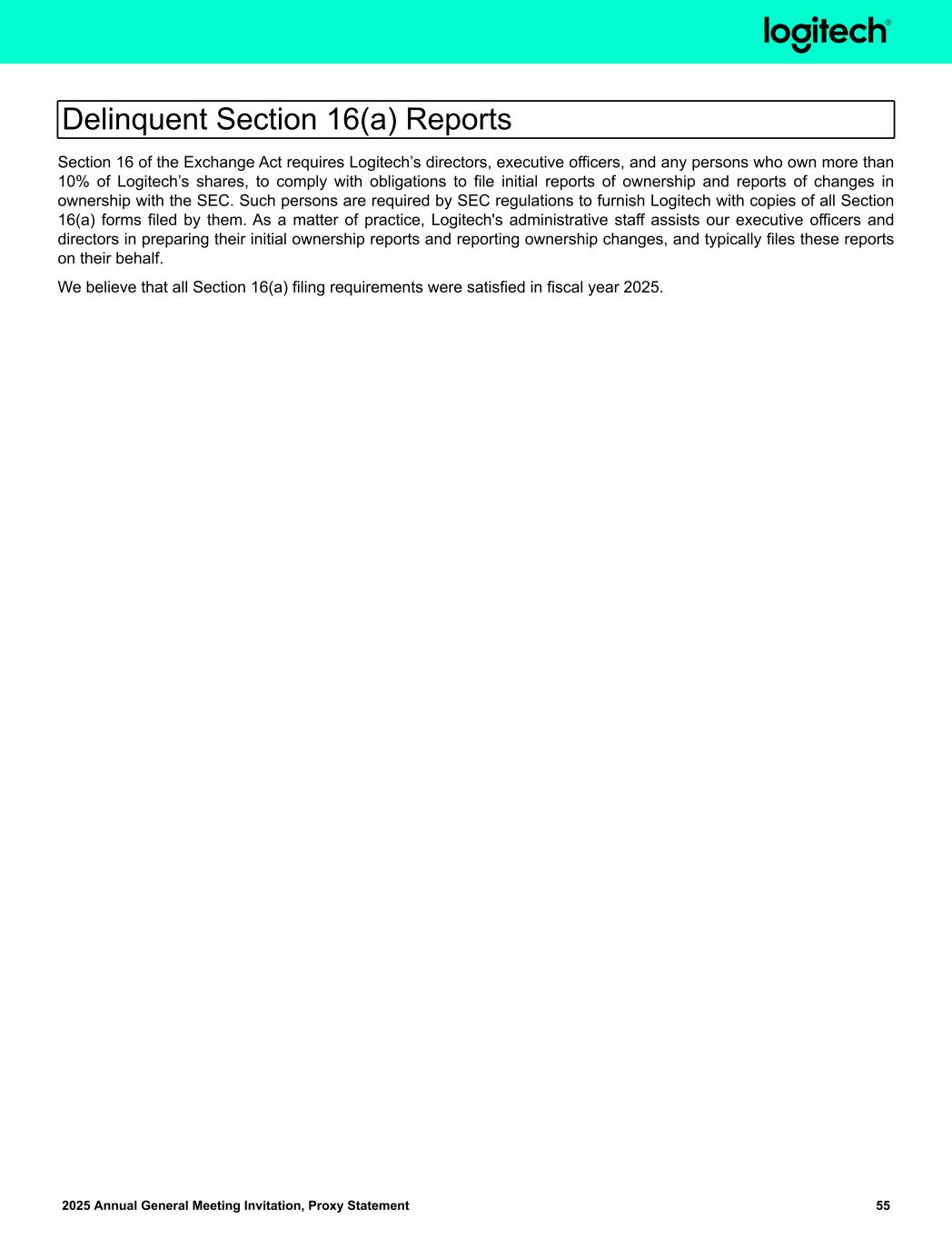
Delinquent Section 16(a) Reports Section 16 of the Exchange Act requires Logitech’s directors, executive officers, and any persons who own more than 10% of Logitech’s shares, to comply with obligations to file initial reports of ownership and reports of changes in ownership with the SEC. Such persons are required by SEC regulations to furnish Logitech with copies of all Section 16(a) forms filed by them. As a matter of practice, Logitech's administrative staff assists our executive officers and directors in preparing their initial ownership reports and reporting ownership changes, and typically files these reports on their behalf. We believe that all Section 16(a) filing requirements were satisfied in fiscal year 2025. 2025 Annual General Meeting Invitation, Proxy Statement 55
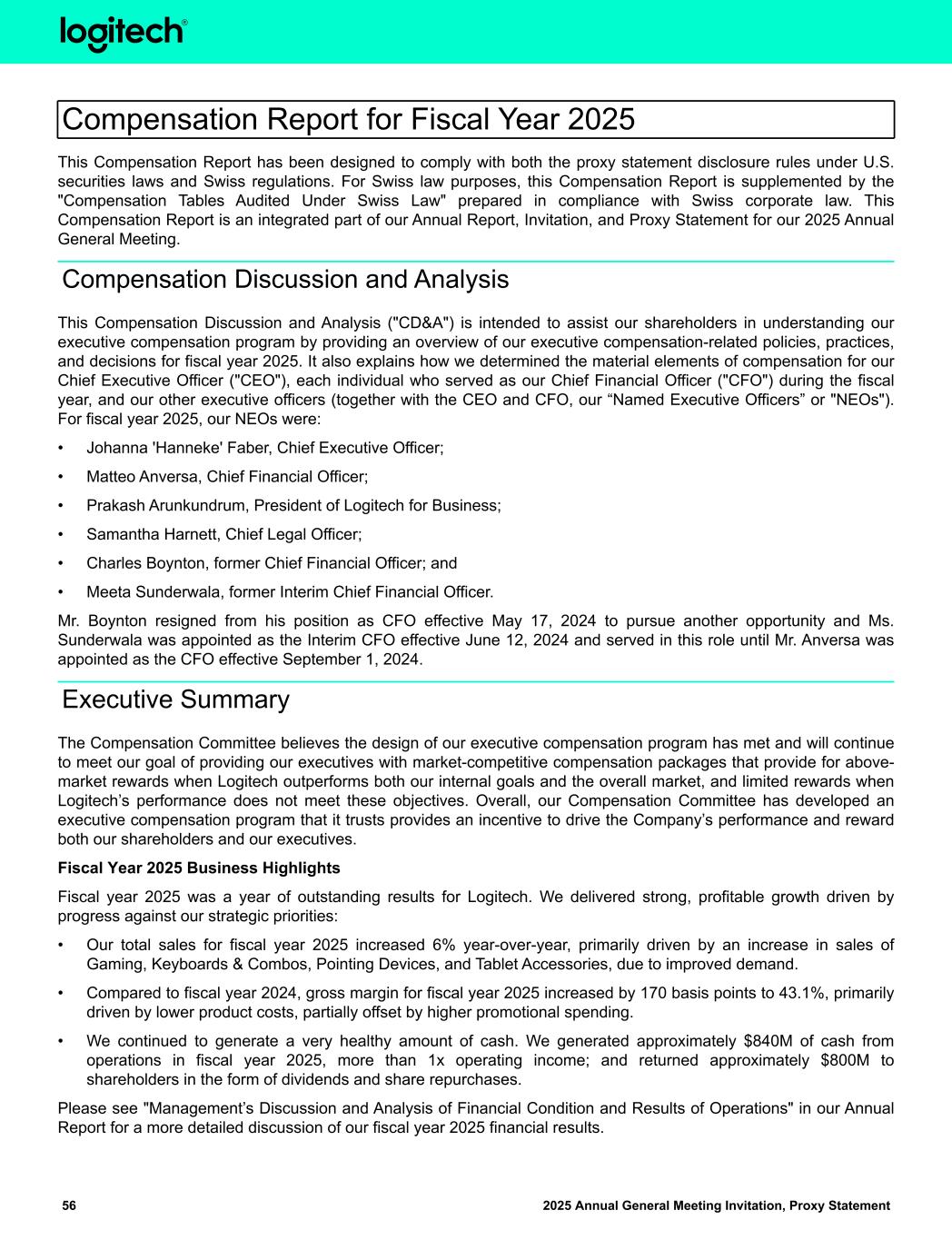
Compensation Report for Fiscal Year 2025 This Compensation Report has been designed to comply with both the proxy statement disclosure rules under U.S. securities laws and Swiss regulations. For Swiss law purposes, this Compensation Report is supplemented by the "Compensation Tables Audited Under Swiss Law" prepared in compliance with Swiss corporate law. This Compensation Report is an integrated part of our Annual Report, Invitation, and Proxy Statement for our 2025 Annual General Meeting. Compensation Discussion and Analysis This Compensation Discussion and Analysis ("CD&A") is intended to assist our shareholders in understanding our executive compensation program by providing an overview of our executive compensation-related policies, practices, and decisions for fiscal year 2025. It also explains how we determined the material elements of compensation for our Chief Executive Officer ("CEO"), each individual who served as our Chief Financial Officer ("CFO") during the fiscal year, and our other executive officers (together with the CEO and CFO, our “Named Executive Officers” or "NEOs"). For fiscal year 2025, our NEOs were: • Johanna 'Hanneke' Faber, Chief Executive Officer; • Matteo Anversa, Chief Financial Officer; • Prakash Arunkundrum, President of Logitech for Business; • Samantha Harnett, Chief Legal Officer; • Charles Boynton, former Chief Financial Officer; and • Meeta Sunderwala, former Interim Chief Financial Officer. Mr. Boynton resigned from his position as CFO effective May 17, 2024 to pursue another opportunity and Ms. Sunderwala was appointed as the Interim CFO effective June 12, 2024 and served in this role until Mr. Anversa was appointed as the CFO effective September 1, 2024. Executive Summary The Compensation Committee believes the design of our executive compensation program has met and will continue to meet our goal of providing our executives with market-competitive compensation packages that provide for above- market rewards when Logitech outperforms both our internal goals and the overall market, and limited rewards when Logitech’s performance does not meet these objectives. Overall, our Compensation Committee has developed an executive compensation program that it trusts provides an incentive to drive the Company’s performance and reward both our shareholders and our executives. Fiscal Year 2025 Business Highlights Fiscal year 2025 was a year of outstanding results for Logitech. We delivered strong, profitable growth driven by progress against our strategic priorities: • Our total sales for fiscal year 2025 increased 6% year-over-year, primarily driven by an increase in sales of Gaming, Keyboards & Combos, Pointing Devices, and Tablet Accessories, due to improved demand. • Compared to fiscal year 2024, gross margin for fiscal year 2025 increased by 170 basis points to 43.1%, primarily driven by lower product costs, partially offset by higher promotional spending. • We continued to generate a very healthy amount of cash. We generated approximately $840M of cash from operations in fiscal year 2025, more than 1x operating income; and returned approximately $800M to shareholders in the form of dividends and share repurchases. Please see "Management’s Discussion and Analysis of Financial Condition and Results of Operations" in our Annual Report for a more detailed discussion of our fiscal year 2025 financial results. 56 2025 Annual General Meeting Invitation, Proxy Statement
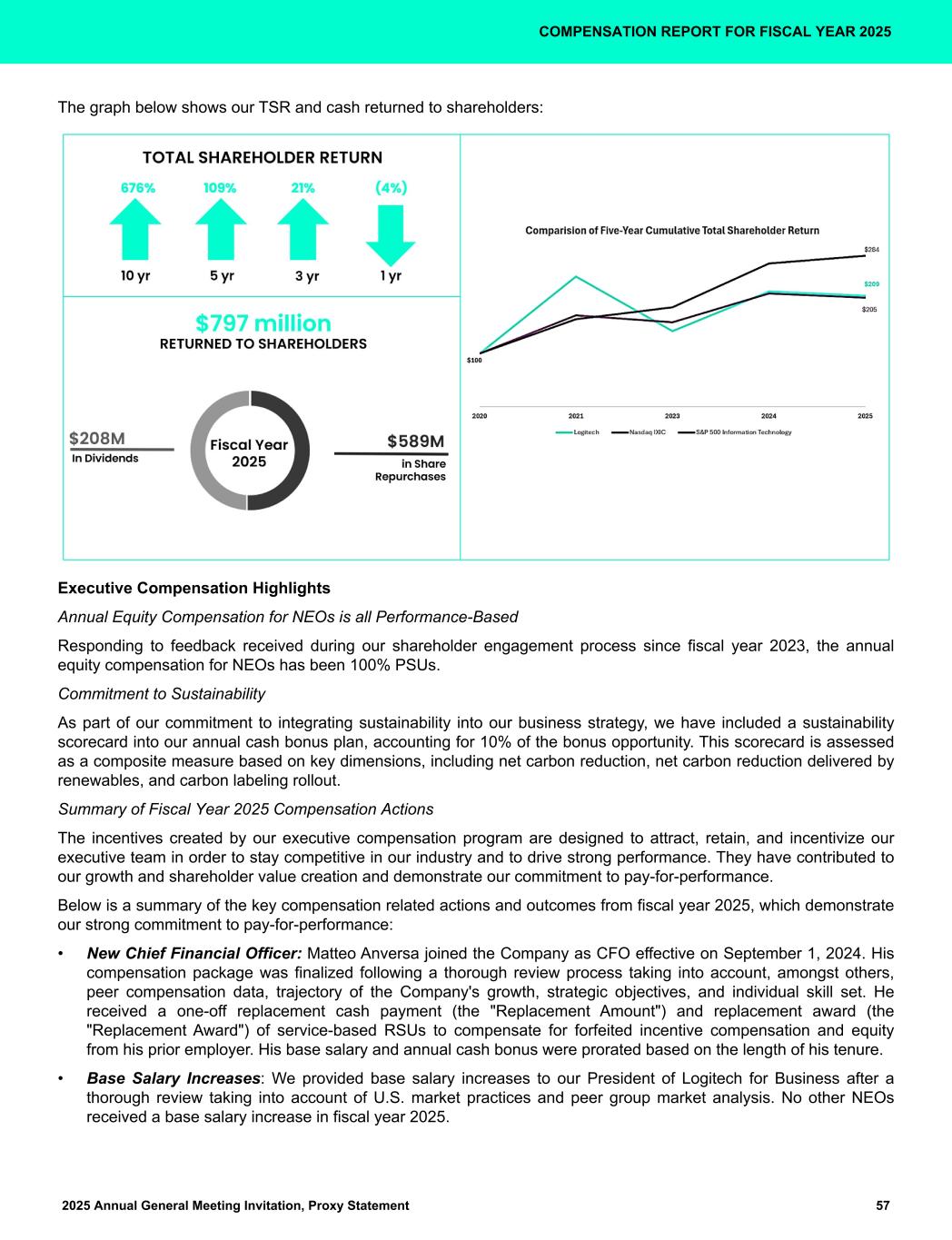
The graph below shows our TSR and cash returned to shareholders: Executive Compensation Highlights Annual Equity Compensation for NEOs is all Performance-Based Responding to feedback received during our shareholder engagement process since fiscal year 2023, the annual equity compensation for NEOs has been 100% PSUs. Commitment to Sustainability As part of our commitment to integrating sustainability into our business strategy, we have included a sustainability scorecard into our annual cash bonus plan, accounting for 10% of the bonus opportunity. This scorecard is assessed as a composite measure based on key dimensions, including net carbon reduction, net carbon reduction delivered by renewables, and carbon labeling rollout. Summary of Fiscal Year 2025 Compensation Actions The incentives created by our executive compensation program are designed to attract, retain, and incentivize our executive team in order to stay competitive in our industry and to drive strong performance. They have contributed to our growth and shareholder value creation and demonstrate our commitment to pay-for-performance. Below is a summary of the key compensation related actions and outcomes from fiscal year 2025, which demonstrate our strong commitment to pay-for-performance: • New Chief Financial Officer: Matteo Anversa joined the Company as CFO effective on September 1, 2024. His compensation package was finalized following a thorough review process taking into account, amongst others, peer compensation data, trajectory of the Company's growth, strategic objectives, and individual skill set. He received a one-off replacement cash payment (the "Replacement Amount") and replacement award (the "Replacement Award") of service-based RSUs to compensate for forfeited incentive compensation and equity from his prior employer. His base salary and annual cash bonus were prorated based on the length of his tenure. • Base Salary Increases: We provided base salary increases to our President of Logitech for Business after a thorough review taking into account of U.S. market practices and peer group market analysis. No other NEOs received a base salary increase in fiscal year 2025. COMPENSATION REPORT FOR FISCAL YEAR 2025 2025 Annual General Meeting Invitation, Proxy Statement 57
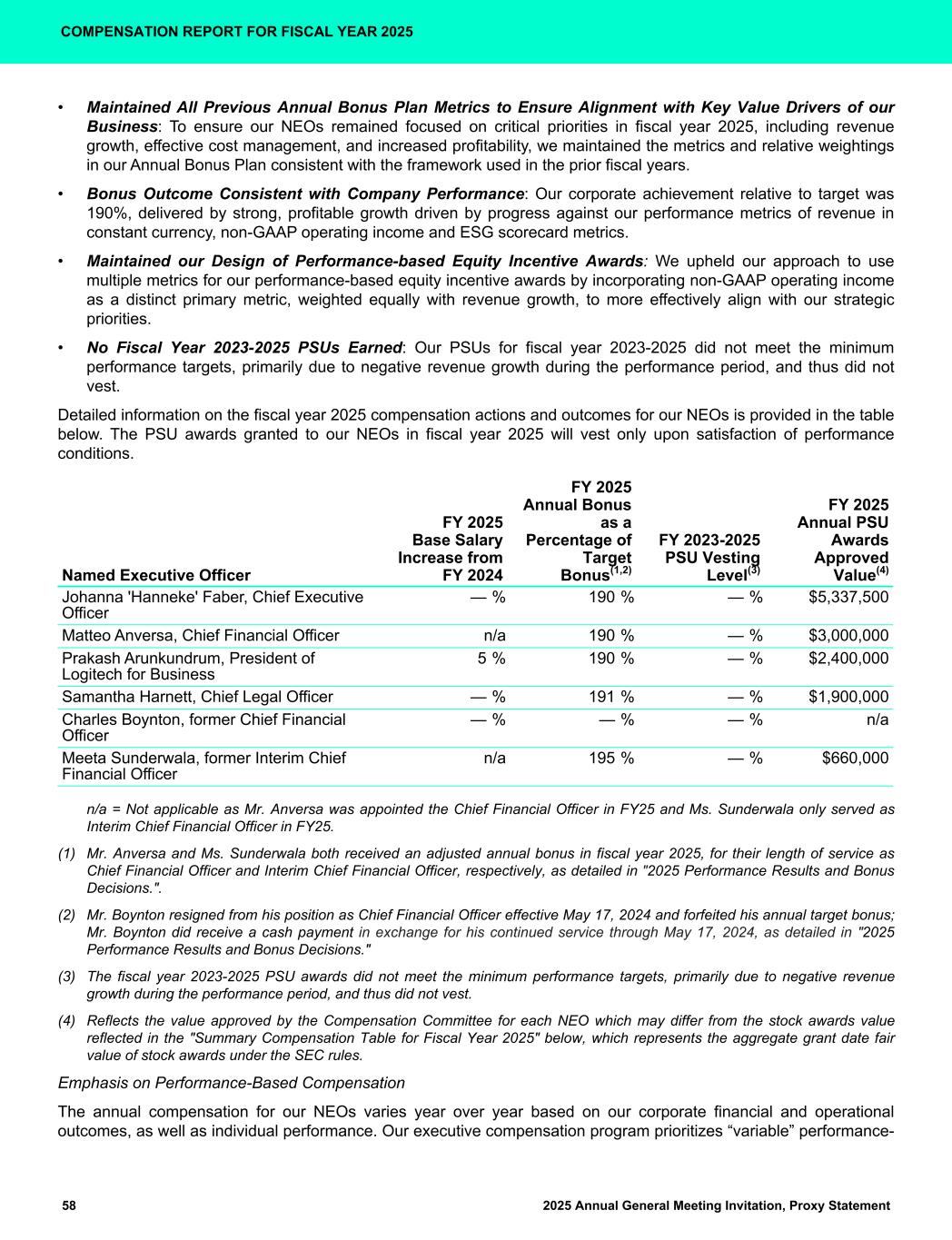
• Maintained All Previous Annual Bonus Plan Metrics to Ensure Alignment with Key Value Drivers of our Business: To ensure our NEOs remained focused on critical priorities in fiscal year 2025, including revenue growth, effective cost management, and increased profitability, we maintained the metrics and relative weightings in our Annual Bonus Plan consistent with the framework used in the prior fiscal years. • Bonus Outcome Consistent with Company Performance: Our corporate achievement relative to target was 190%, delivered by strong, profitable growth driven by progress against our performance metrics of revenue in constant currency, non-GAAP operating income and ESG scorecard metrics. • Maintained our Design of Performance-based Equity Incentive Awards: We upheld our approach to use multiple metrics for our performance-based equity incentive awards by incorporating non-GAAP operating income as a distinct primary metric, weighted equally with revenue growth, to more effectively align with our strategic priorities. • No Fiscal Year 2023-2025 PSUs Earned: Our PSUs for fiscal year 2023-2025 did not meet the minimum performance targets, primarily due to negative revenue growth during the performance period, and thus did not vest. Detailed information on the fiscal year 2025 compensation actions and outcomes for our NEOs is provided in the table below. The PSU awards granted to our NEOs in fiscal year 2025 will vest only upon satisfaction of performance conditions. Named Executive Officer FY 2025 Base Salary Increase from FY 2024 FY 2025 Annual Bonus as a Percentage of Target Bonus(1,2) FY 2023-2025 PSU Vesting Level(3) FY 2025 Annual PSU Awards Approved Value(4) Johanna 'Hanneke' Faber, Chief Executive Officer — % 190 % — % $5,337,500 Matteo Anversa, Chief Financial Officer n/a 190 % — % $3,000,000 Prakash Arunkundrum, President of Logitech for Business 5 % 190 % — % $2,400,000 Samantha Harnett, Chief Legal Officer — % 191 % — % $1,900,000 Charles Boynton, former Chief Financial Officer — % — % — % n/a Meeta Sunderwala, former Interim Chief Financial Officer n/a 195 % — % $660,000 n/a = Not applicable as Mr. Anversa was appointed the Chief Financial Officer in FY25 and Ms. Sunderwala only served as Interim Chief Financial Officer in FY25. (1) Mr. Anversa and Ms. Sunderwala both received an adjusted annual bonus in fiscal year 2025, for their length of service as Chief Financial Officer and Interim Chief Financial Officer, respectively, as detailed in "2025 Performance Results and Bonus Decisions.". (2) Mr. Boynton resigned from his position as Chief Financial Officer effective May 17, 2024 and forfeited his annual target bonus; Mr. Boynton did receive a cash payment in exchange for his continued service through May 17, 2024, as detailed in "2025 Performance Results and Bonus Decisions." (3) The fiscal year 2023-2025 PSU awards did not meet the minimum performance targets, primarily due to negative revenue growth during the performance period, and thus did not vest. (4) Reflects the value approved by the Compensation Committee for each NEO which may differ from the stock awards value reflected in the "Summary Compensation Table for Fiscal Year 2025" below, which represents the aggregate grant date fair value of stock awards under the SEC rules. Emphasis on Performance-Based Compensation The annual compensation for our NEOs varies year over year based on our corporate financial and operational outcomes, as well as individual performance. Our executive compensation program prioritizes “variable” performance- COMPENSATION REPORT FOR FISCAL YEAR 2025 58 2025 Annual General Meeting Invitation, Proxy Statement
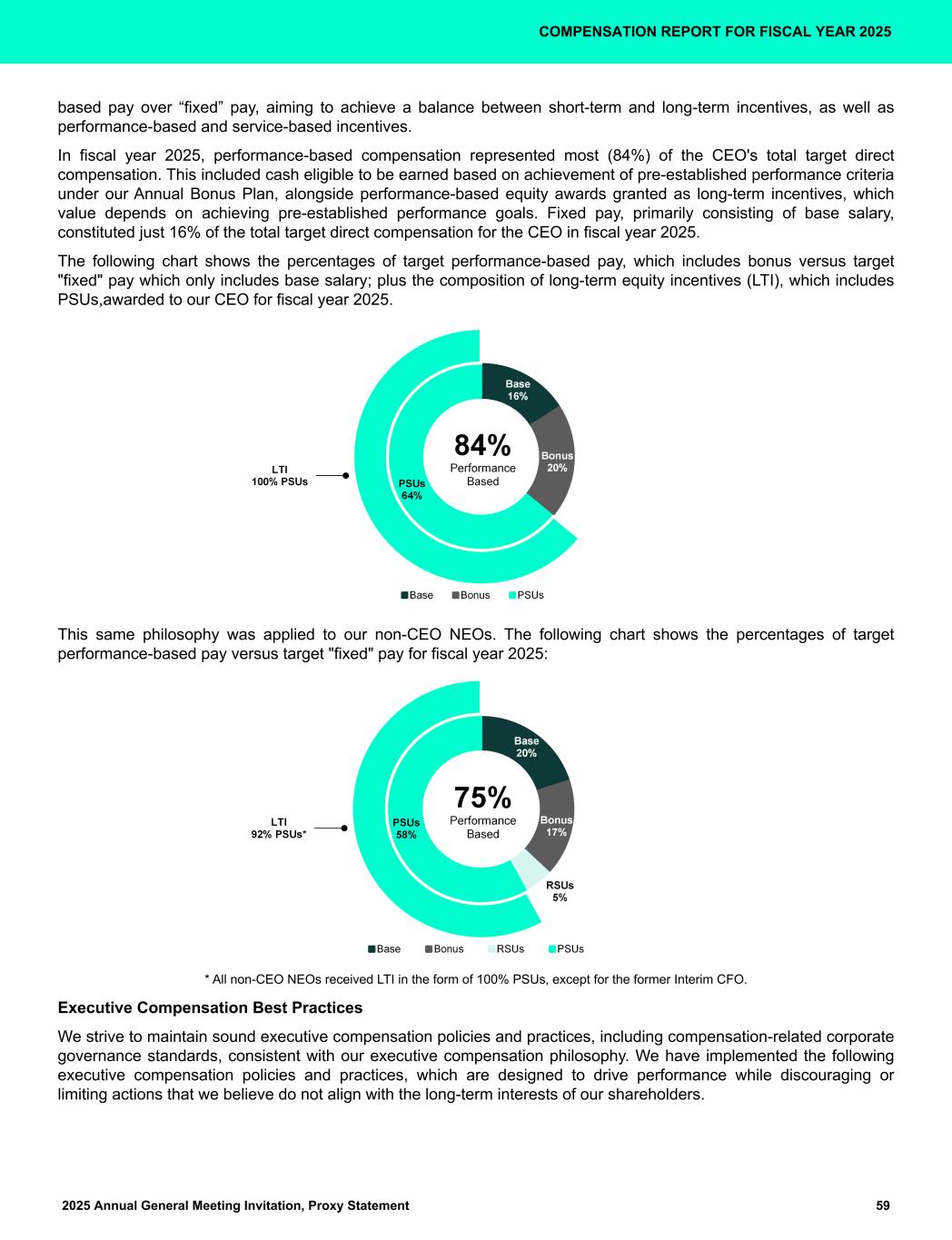
based pay over “fixed” pay, aiming to achieve a balance between short-term and long-term incentives, as well as performance-based and service-based incentives. In fiscal year 2025, performance-based compensation represented most (84%) of the CEO's total target direct compensation. This included cash eligible to be earned based on achievement of pre-established performance criteria under our Annual Bonus Plan, alongside performance-based equity awards granted as long-term incentives, which value depends on achieving pre-established performance goals. Fixed pay, primarily consisting of base salary, constituted just 16% of the total target direct compensation for the CEO in fiscal year 2025. The following chart shows the percentages of target performance-based pay, which includes bonus versus target "fixed" pay which only includes base salary; plus the composition of long-term equity incentives (LTI), which includes PSUs,awarded to our CEO for fiscal year 2025. This same philosophy was applied to our non-CEO NEOs. The following chart shows the percentages of target performance-based pay versus target "fixed" pay for fiscal year 2025: * All non-CEO NEOs received LTI in the form of 100% PSUs, except for the former Interim CFO. Executive Compensation Best Practices We strive to maintain sound executive compensation policies and practices, including compensation-related corporate governance standards, consistent with our executive compensation philosophy. We have implemented the following executive compensation policies and practices, which are designed to drive performance while discouraging or limiting actions that we believe do not align with the long-term interests of our shareholders. COMPENSATION REPORT FOR FISCAL YEAR 2025 2025 Annual General Meeting Invitation, Proxy Statement 59
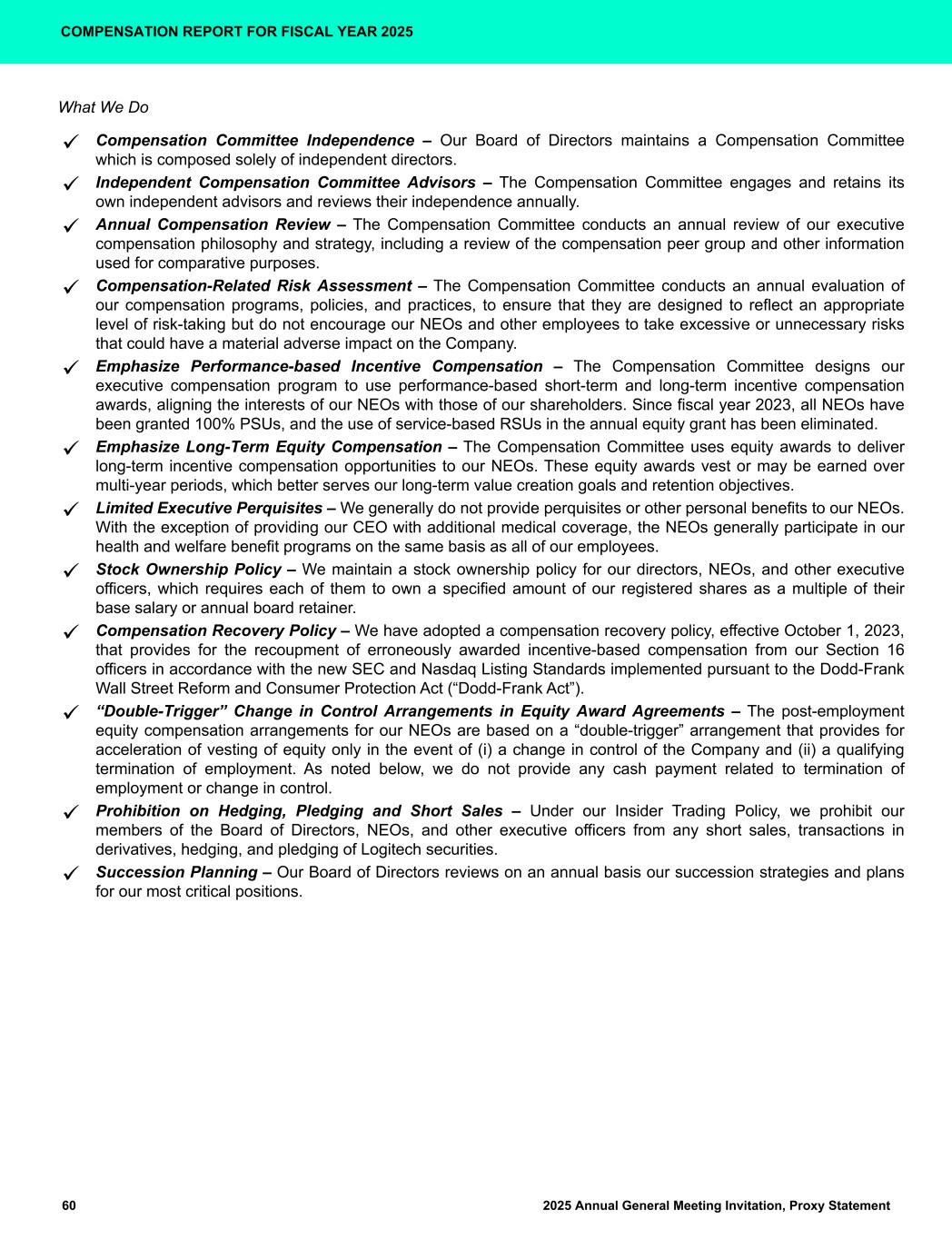
What We Do ü Compensation Committee Independence – Our Board of Directors maintains a Compensation Committee which is composed solely of independent directors. ü Independent Compensation Committee Advisors – The Compensation Committee engages and retains its own independent advisors and reviews their independence annually. ü Annual Compensation Review – The Compensation Committee conducts an annual review of our executive compensation philosophy and strategy, including a review of the compensation peer group and other information used for comparative purposes. ü Compensation-Related Risk Assessment – The Compensation Committee conducts an annual evaluation of our compensation programs, policies, and practices, to ensure that they are designed to reflect an appropriate level of risk-taking but do not encourage our NEOs and other employees to take excessive or unnecessary risks that could have a material adverse impact on the Company. ü Emphasize Performance-based Incentive Compensation – The Compensation Committee designs our executive compensation program to use performance-based short-term and long-term incentive compensation awards, aligning the interests of our NEOs with those of our shareholders. Since fiscal year 2023, all NEOs have been granted 100% PSUs, and the use of service-based RSUs in the annual equity grant has been eliminated. ü Emphasize Long-Term Equity Compensation – The Compensation Committee uses equity awards to deliver long-term incentive compensation opportunities to our NEOs. These equity awards vest or may be earned over multi-year periods, which better serves our long-term value creation goals and retention objectives. ü Limited Executive Perquisites – We generally do not provide perquisites or other personal benefits to our NEOs. With the exception of providing our CEO with additional medical coverage, the NEOs generally participate in our health and welfare benefit programs on the same basis as all of our employees. ü Stock Ownership Policy – We maintain a stock ownership policy for our directors, NEOs, and other executive officers, which requires each of them to own a specified amount of our registered shares as a multiple of their base salary or annual board retainer. ü Compensation Recovery Policy – We have adopted a compensation recovery policy, effective October 1, 2023, that provides for the recoupment of erroneously awarded incentive-based compensation from our Section 16 officers in accordance with the new SEC and Nasdaq Listing Standards implemented pursuant to the Dodd-Frank Wall Street Reform and Consumer Protection Act (“Dodd-Frank Act”). ü “Double-Trigger” Change in Control Arrangements in Equity Award Agreements – The post-employment equity compensation arrangements for our NEOs are based on a “double-trigger” arrangement that provides for acceleration of vesting of equity only in the event of (i) a change in control of the Company and (ii) a qualifying termination of employment. As noted below, we do not provide any cash payment related to termination of employment or change in control. ü Prohibition on Hedging, Pledging and Short Sales – Under our Insider Trading Policy, we prohibit our members of the Board of Directors, NEOs, and other executive officers from any short sales, transactions in derivatives, hedging, and pledging of Logitech securities. ü Succession Planning – Our Board of Directors reviews on an annual basis our succession strategies and plans for our most critical positions. COMPENSATION REPORT FOR FISCAL YEAR 2025 60 2025 Annual General Meeting Invitation, Proxy Statement
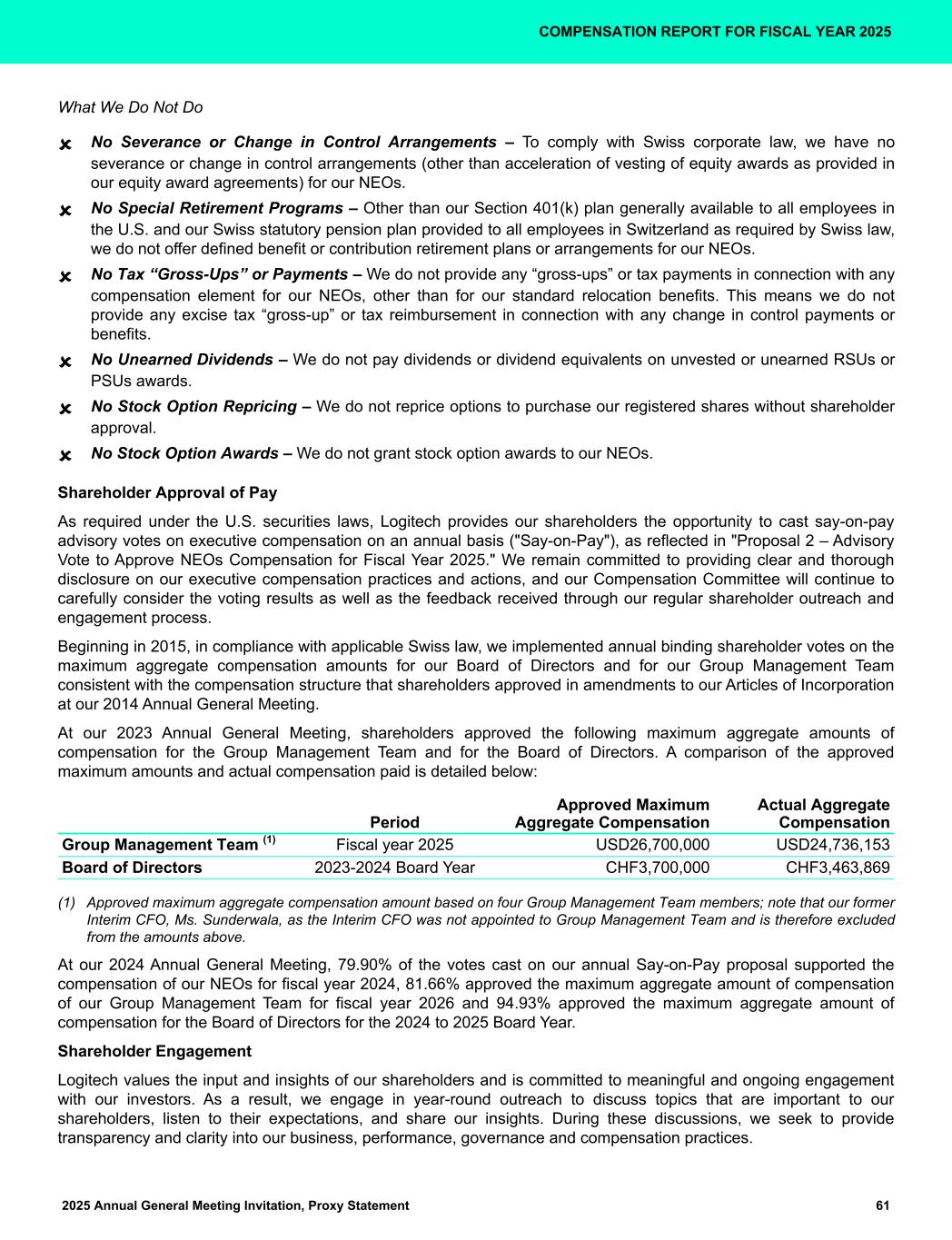
What We Do Not Do û No Severance or Change in Control Arrangements – To comply with Swiss corporate law, we have no severance or change in control arrangements (other than acceleration of vesting of equity awards as provided in our equity award agreements) for our NEOs. û No Special Retirement Programs – Other than our Section 401(k) plan generally available to all employees in the U.S. and our Swiss statutory pension plan provided to all employees in Switzerland as required by Swiss law, we do not offer defined benefit or contribution retirement plans or arrangements for our NEOs. û No Tax “Gross-Ups” or Payments – We do not provide any “gross-ups” or tax payments in connection with any compensation element for our NEOs, other than for our standard relocation benefits. This means we do not provide any excise tax “gross-up” or tax reimbursement in connection with any change in control payments or benefits. û No Unearned Dividends – We do not pay dividends or dividend equivalents on unvested or unearned RSUs or PSUs awards. û No Stock Option Repricing – We do not reprice options to purchase our registered shares without shareholder approval. û No Stock Option Awards – We do not grant stock option awards to our NEOs. Shareholder Approval of Pay As required under the U.S. securities laws, Logitech provides our shareholders the opportunity to cast say-on-pay advisory votes on executive compensation on an annual basis ("Say-on-Pay"), as reflected in "Proposal 2 – Advisory Vote to Approve NEOs Compensation for Fiscal Year 2025." We remain committed to providing clear and thorough disclosure on our executive compensation practices and actions, and our Compensation Committee will continue to carefully consider the voting results as well as the feedback received through our regular shareholder outreach and engagement process. Beginning in 2015, in compliance with applicable Swiss law, we implemented annual binding shareholder votes on the maximum aggregate compensation amounts for our Board of Directors and for our Group Management Team consistent with the compensation structure that shareholders approved in amendments to our Articles of Incorporation at our 2014 Annual General Meeting. At our 2023 Annual General Meeting, shareholders approved the following maximum aggregate amounts of compensation for the Group Management Team and for the Board of Directors. A comparison of the approved maximum amounts and actual compensation paid is detailed below: Period Approved Maximum Aggregate Compensation Actual Aggregate Compensation Group Management Team (1) Fiscal year 2025 USD26,700,000 USD24,736,153 Board of Directors 2023-2024 Board Year CHF3,700,000 CHF3,463,869 (1) Approved maximum aggregate compensation amount based on four Group Management Team members; note that our former Interim CFO, Ms. Sunderwala, as the Interim CFO was not appointed to Group Management Team and is therefore excluded from the amounts above. At our 2024 Annual General Meeting, 79.90% of the votes cast on our annual Say-on-Pay proposal supported the compensation of our NEOs for fiscal year 2024, 81.66% approved the maximum aggregate amount of compensation of our Group Management Team for fiscal year 2026 and 94.93% approved the maximum aggregate amount of compensation for the Board of Directors for the 2024 to 2025 Board Year. Shareholder Engagement Logitech values the input and insights of our shareholders and is committed to meaningful and ongoing engagement with our investors. As a result, we engage in year-round outreach to discuss topics that are important to our shareholders, listen to their expectations, and share our insights. During these discussions, we seek to provide transparency and clarity into our business, performance, governance and compensation practices. COMPENSATION REPORT FOR FISCAL YEAR 2025 2025 Annual General Meeting Invitation, Proxy Statement 61
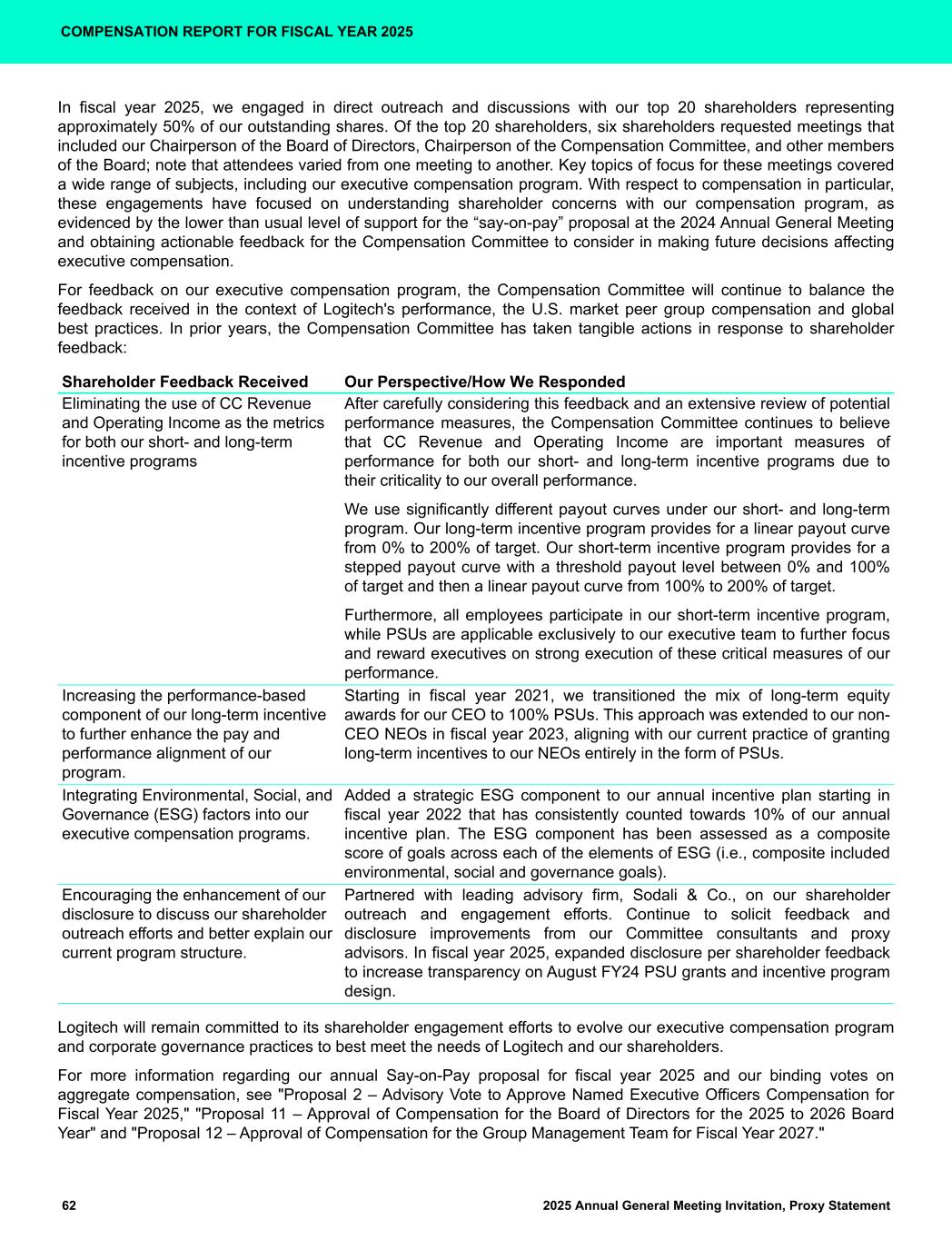
In fiscal year 2025, we engaged in direct outreach and discussions with our top 20 shareholders representing approximately 50% of our outstanding shares. Of the top 20 shareholders, six shareholders requested meetings that included our Chairperson of the Board of Directors, Chairperson of the Compensation Committee, and other members of the Board; note that attendees varied from one meeting to another. Key topics of focus for these meetings covered a wide range of subjects, including our executive compensation program. With respect to compensation in particular, these engagements have focused on understanding shareholder concerns with our compensation program, as evidenced by the lower than usual level of support for the “say-on-pay” proposal at the 2024 Annual General Meeting and obtaining actionable feedback for the Compensation Committee to consider in making future decisions affecting executive compensation. For feedback on our executive compensation program, the Compensation Committee will continue to balance the feedback received in the context of Logitech's performance, the U.S. market peer group compensation and global best practices. In prior years, the Compensation Committee has taken tangible actions in response to shareholder feedback: Shareholder Feedback Received Our Perspective/How We Responded Eliminating the use of CC Revenue and Operating Income as the metrics for both our short- and long-term incentive programs After carefully considering this feedback and an extensive review of potential performance measures, the Compensation Committee continues to believe that CC Revenue and Operating Income are important measures of performance for both our short- and long-term incentive programs due to their criticality to our overall performance. We use significantly different payout curves under our short- and long-term program. Our long-term incentive program provides for a linear payout curve from 0% to 200% of target. Our short-term incentive program provides for a stepped payout curve with a threshold payout level between 0% and 100% of target and then a linear payout curve from 100% to 200% of target. Furthermore, all employees participate in our short-term incentive program, while PSUs are applicable exclusively to our executive team to further focus and reward executives on strong execution of these critical measures of our performance. Increasing the performance-based component of our long-term incentive to further enhance the pay and performance alignment of our program. Starting in fiscal year 2021, we transitioned the mix of long-term equity awards for our CEO to 100% PSUs. This approach was extended to our non- CEO NEOs in fiscal year 2023, aligning with our current practice of granting long-term incentives to our NEOs entirely in the form of PSUs. Integrating Environmental, Social, and Governance (ESG) factors into our executive compensation programs. Added a strategic ESG component to our annual incentive plan starting in fiscal year 2022 that has consistently counted towards 10% of our annual incentive plan. The ESG component has been assessed as a composite score of goals across each of the elements of ESG (i.e., composite included environmental, social and governance goals). Encouraging the enhancement of our disclosure to discuss our shareholder outreach efforts and better explain our current program structure. Partnered with leading advisory firm, Sodali & Co., on our shareholder outreach and engagement efforts. Continue to solicit feedback and disclosure improvements from our Committee consultants and proxy advisors. In fiscal year 2025, expanded disclosure per shareholder feedback to increase transparency on August FY24 PSU grants and incentive program design. Logitech will remain committed to its shareholder engagement efforts to evolve our executive compensation program and corporate governance practices to best meet the needs of Logitech and our shareholders. For more information regarding our annual Say-on-Pay proposal for fiscal year 2025 and our binding votes on aggregate compensation, see "Proposal 2 – Advisory Vote to Approve Named Executive Officers Compensation for Fiscal Year 2025," "Proposal 11 – Approval of Compensation for the Board of Directors for the 2025 to 2026 Board Year" and "Proposal 12 – Approval of Compensation for the Group Management Team for Fiscal Year 2027." COMPENSATION REPORT FOR FISCAL YEAR 2025 62 2025 Annual General Meeting Invitation, Proxy Statement
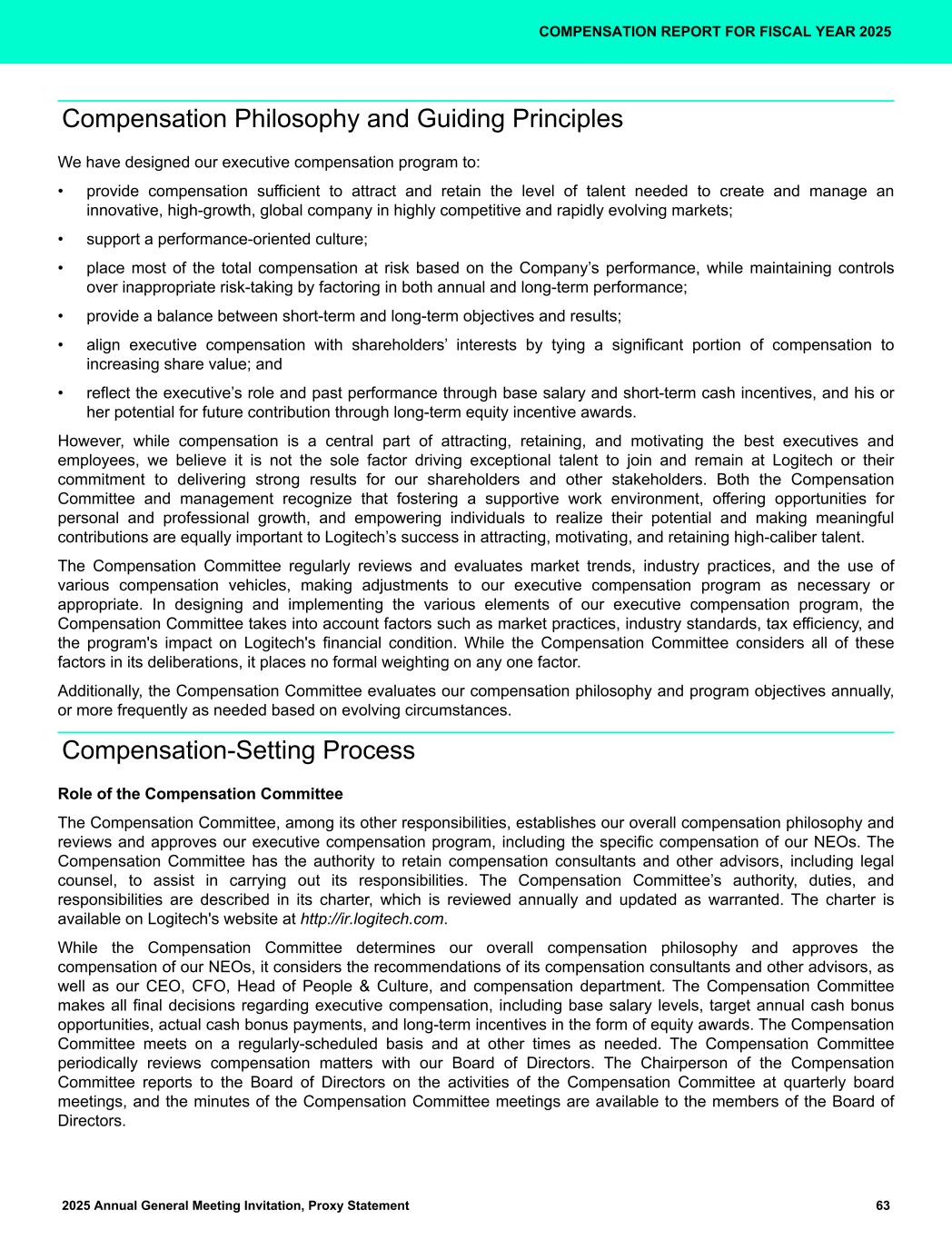
Compensation Philosophy and Guiding Principles We have designed our executive compensation program to: • provide compensation sufficient to attract and retain the level of talent needed to create and manage an innovative, high-growth, global company in highly competitive and rapidly evolving markets; • support a performance-oriented culture; • place most of the total compensation at risk based on the Company’s performance, while maintaining controls over inappropriate risk-taking by factoring in both annual and long-term performance; • provide a balance between short-term and long-term objectives and results; • align executive compensation with shareholders’ interests by tying a significant portion of compensation to increasing share value; and • reflect the executive’s role and past performance through base salary and short-term cash incentives, and his or her potential for future contribution through long-term equity incentive awards. However, while compensation is a central part of attracting, retaining, and motivating the best executives and employees, we believe it is not the sole factor driving exceptional talent to join and remain at Logitech or their commitment to delivering strong results for our shareholders and other stakeholders. Both the Compensation Committee and management recognize that fostering a supportive work environment, offering opportunities for personal and professional growth, and empowering individuals to realize their potential and making meaningful contributions are equally important to Logitech’s success in attracting, motivating, and retaining high-caliber talent. The Compensation Committee regularly reviews and evaluates market trends, industry practices, and the use of various compensation vehicles, making adjustments to our executive compensation program as necessary or appropriate. In designing and implementing the various elements of our executive compensation program, the Compensation Committee takes into account factors such as market practices, industry standards, tax efficiency, and the program's impact on Logitech's financial condition. While the Compensation Committee considers all of these factors in its deliberations, it places no formal weighting on any one factor. Additionally, the Compensation Committee evaluates our compensation philosophy and program objectives annually, or more frequently as needed based on evolving circumstances. Compensation-Setting Process Role of the Compensation Committee The Compensation Committee, among its other responsibilities, establishes our overall compensation philosophy and reviews and approves our executive compensation program, including the specific compensation of our NEOs. The Compensation Committee has the authority to retain compensation consultants and other advisors, including legal counsel, to assist in carrying out its responsibilities. The Compensation Committee’s authority, duties, and responsibilities are described in its charter, which is reviewed annually and updated as warranted. The charter is available on Logitech's website at http://ir.logitech.com. While the Compensation Committee determines our overall compensation philosophy and approves the compensation of our NEOs, it considers the recommendations of its compensation consultants and other advisors, as well as our CEO, CFO, Head of People & Culture, and compensation department. The Compensation Committee makes all final decisions regarding executive compensation, including base salary levels, target annual cash bonus opportunities, actual cash bonus payments, and long-term incentives in the form of equity awards. The Compensation Committee meets on a regularly-scheduled basis and at other times as needed. The Compensation Committee periodically reviews compensation matters with our Board of Directors. The Chairperson of the Compensation Committee reports to the Board of Directors on the activities of the Compensation Committee at quarterly board meetings, and the minutes of the Compensation Committee meetings are available to the members of the Board of Directors. COMPENSATION REPORT FOR FISCAL YEAR 2025 2025 Annual General Meeting Invitation, Proxy Statement 63

Before the beginning of each fiscal year, the Compensation Committee conducts a comprehensive review of Logitech's executive compensation program to ensure that its components, actions, and decisions (i) are well- coordinated, (ii) align with our vision, mission, values, and strategic priorities, (iii) provide appropriate short-term and long-term incentives for our NEOs, (iv) fulfill their intended objectives, and (v) remain competitive with compensation offered to executives in similar roles at peer companies. Based on this evaluation, the Compensation Committee implements any necessary adjustments to existing plans and arrangements or introduces new plans or arrangements to maintain an effective and competitive compensation framework. The Compensation Committee also conducts an annual review of our executive compensation strategy to ensure alignment with the Company's strategic priorities and achievement of our desired objectives. Additionally, the Compensation Committee evaluates market trends and changes in competitive compensation practices, as further described below. The factors considered by the Compensation Committee in determining the compensation of our NEOs for fiscal year 2025 included: • Each individual NEO’s performance and contribution to building a high-performing leadership team; • Each individual NEO’s skills, experience, qualifications and marketability; • The Company’s performance against financial goals and objectives; • The Company’s performance relative to both industry competitors and its compensation peer group; • The positioning of the amount of each NEO’s compensation in a ranking of peer compensation; • Compensation practices at peer companies; • Alignment of executive compensation with shareholder interests; • The unique considerations of operating as a dual-listed Swiss and U.S. multinational technology company; • Efforts to maintain a diverse and inclusive environment that drives competitive advantage through varied perspectives; and • Recommendations from the CEO (except with respect to the CEO's own compensation) as further described below. The Compensation Committee does not use a predetermined formula or assign specific weight to any one factor when making executive compensation decisions. Instead, the Compensation Committee members considered their individual experience, knowledge of the Company, understanding of each NEO, awareness of the competitive market, and overall business judgment to guide their decisions regarding executive compensation and the executive compensation program. As part of this process, our Chairperson of the Board of Directors works closely with the Compensation Committee in determining the compensation of our CEO. Each year, the non-employee members of the Board of Directors evaluate the performance of our CEO, which the Compensation Committee considers when making decisions about base salary adjustments, target annual cash bonus opportunities, actual cash bonus payments, and long-term incentives in the form of equity awards. To ensure impartiality, none of our NEOs is present during deliberations related to their own compensation. Role of our CEO Our CEO works closely with the Compensation Committee in determining the compensation of our non-CEO NEOs. Typically, our CEO works with the Compensation Committee to recommend the structure of the Annual Bonus Plan, to identify and develop corporate performance objectives for such plan, and to evaluate actual performance against the selected measures. Additionally, our CEO and Compensation Committee work together to determine the appropriate form and performance goals for our equity compensation program. At the beginning of each year, our CEO conducts a performance review of our non-CEO NEOs for the prior year and makes recommendations to the Compensation Committee for each element of compensation. Based on the evaluation of each non-CEO NEO's performance and taking into consideration historical compensation awards to our non-CEO NEOs and our corporate performance during the preceding year, these recommendations cover base salary adjustments, target annual cash bonus opportunities, actual bonus payments, and long-term incentives in the form of COMPENSATION REPORT FOR FISCAL YEAR 2025 64 2025 Annual General Meeting Invitation, Proxy Statement
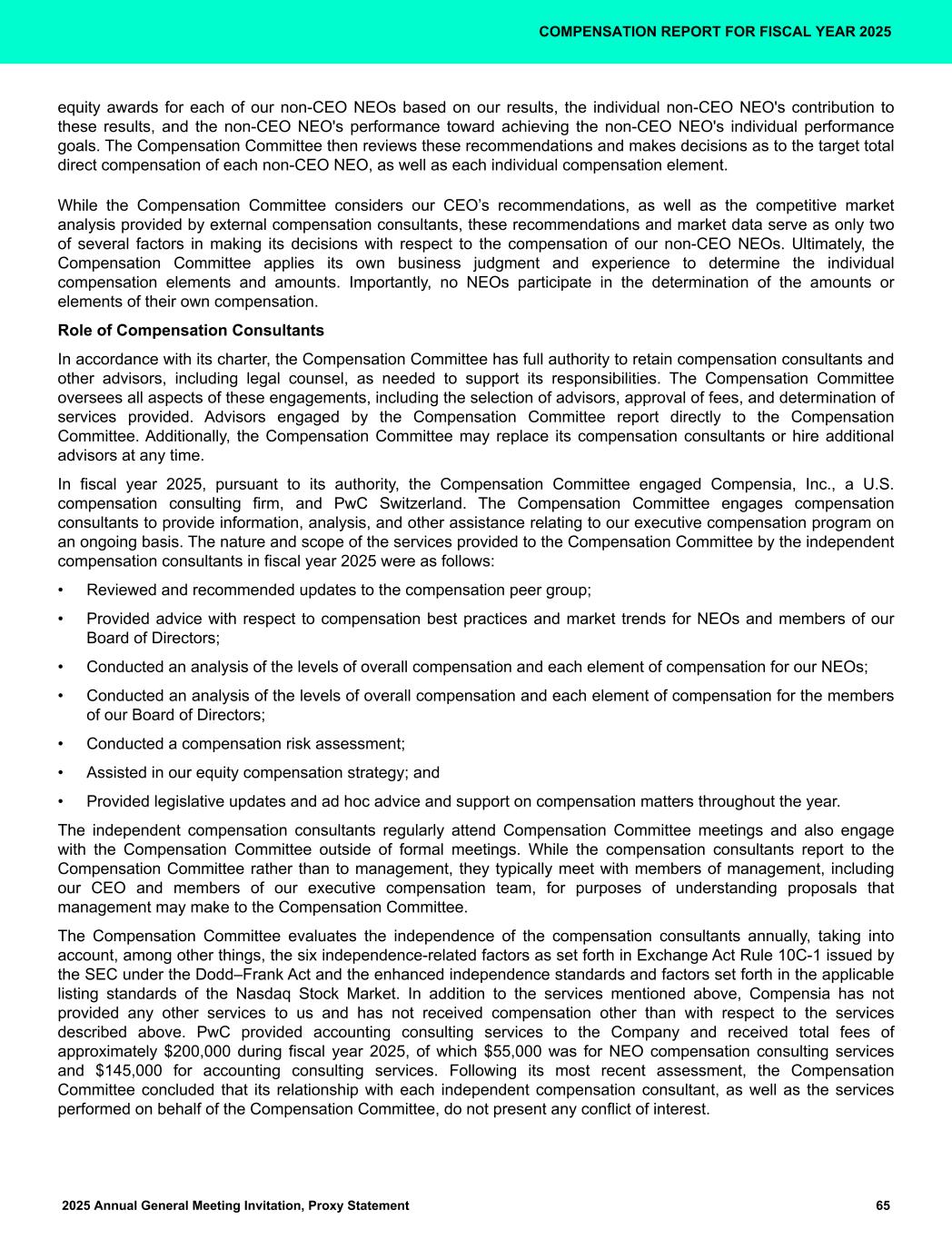
equity awards for each of our non-CEO NEOs based on our results, the individual non-CEO NEO's contribution to these results, and the non-CEO NEO's performance toward achieving the non-CEO NEO's individual performance goals. The Compensation Committee then reviews these recommendations and makes decisions as to the target total direct compensation of each non-CEO NEO, as well as each individual compensation element. While the Compensation Committee considers our CEO’s recommendations, as well as the competitive market analysis provided by external compensation consultants, these recommendations and market data serve as only two of several factors in making its decisions with respect to the compensation of our non-CEO NEOs. Ultimately, the Compensation Committee applies its own business judgment and experience to determine the individual compensation elements and amounts. Importantly, no NEOs participate in the determination of the amounts or elements of their own compensation. Role of Compensation Consultants In accordance with its charter, the Compensation Committee has full authority to retain compensation consultants and other advisors, including legal counsel, as needed to support its responsibilities. The Compensation Committee oversees all aspects of these engagements, including the selection of advisors, approval of fees, and determination of services provided. Advisors engaged by the Compensation Committee report directly to the Compensation Committee. Additionally, the Compensation Committee may replace its compensation consultants or hire additional advisors at any time. In fiscal year 2025, pursuant to its authority, the Compensation Committee engaged Compensia, Inc., a U.S. compensation consulting firm, and PwC Switzerland. The Compensation Committee engages compensation consultants to provide information, analysis, and other assistance relating to our executive compensation program on an ongoing basis. The nature and scope of the services provided to the Compensation Committee by the independent compensation consultants in fiscal year 2025 were as follows: • Reviewed and recommended updates to the compensation peer group; • Provided advice with respect to compensation best practices and market trends for NEOs and members of our Board of Directors; • Conducted an analysis of the levels of overall compensation and each element of compensation for our NEOs; • Conducted an analysis of the levels of overall compensation and each element of compensation for the members of our Board of Directors; • Conducted a compensation risk assessment; • Assisted in our equity compensation strategy; and • Provided legislative updates and ad hoc advice and support on compensation matters throughout the year. The independent compensation consultants regularly attend Compensation Committee meetings and also engage with the Compensation Committee outside of formal meetings. While the compensation consultants report to the Compensation Committee rather than to management, they typically meet with members of management, including our CEO and members of our executive compensation team, for purposes of understanding proposals that management may make to the Compensation Committee. The Compensation Committee evaluates the independence of the compensation consultants annually, taking into account, among other things, the six independence-related factors as set forth in Exchange Act Rule 10C-1 issued by the SEC under the Dodd–Frank Act and the enhanced independence standards and factors set forth in the applicable listing standards of the Nasdaq Stock Market. In addition to the services mentioned above, Compensia has not provided any other services to us and has not received compensation other than with respect to the services described above. PwC provided accounting consulting services to the Company and received total fees of approximately $200,000 during fiscal year 2025, of which $55,000 was for NEO compensation consulting services and $145,000 for accounting consulting services. Following its most recent assessment, the Compensation Committee concluded that its relationship with each independent compensation consultant, as well as the services performed on behalf of the Compensation Committee, do not present any conflict of interest. COMPENSATION REPORT FOR FISCAL YEAR 2025 2025 Annual General Meeting Invitation, Proxy Statement 65
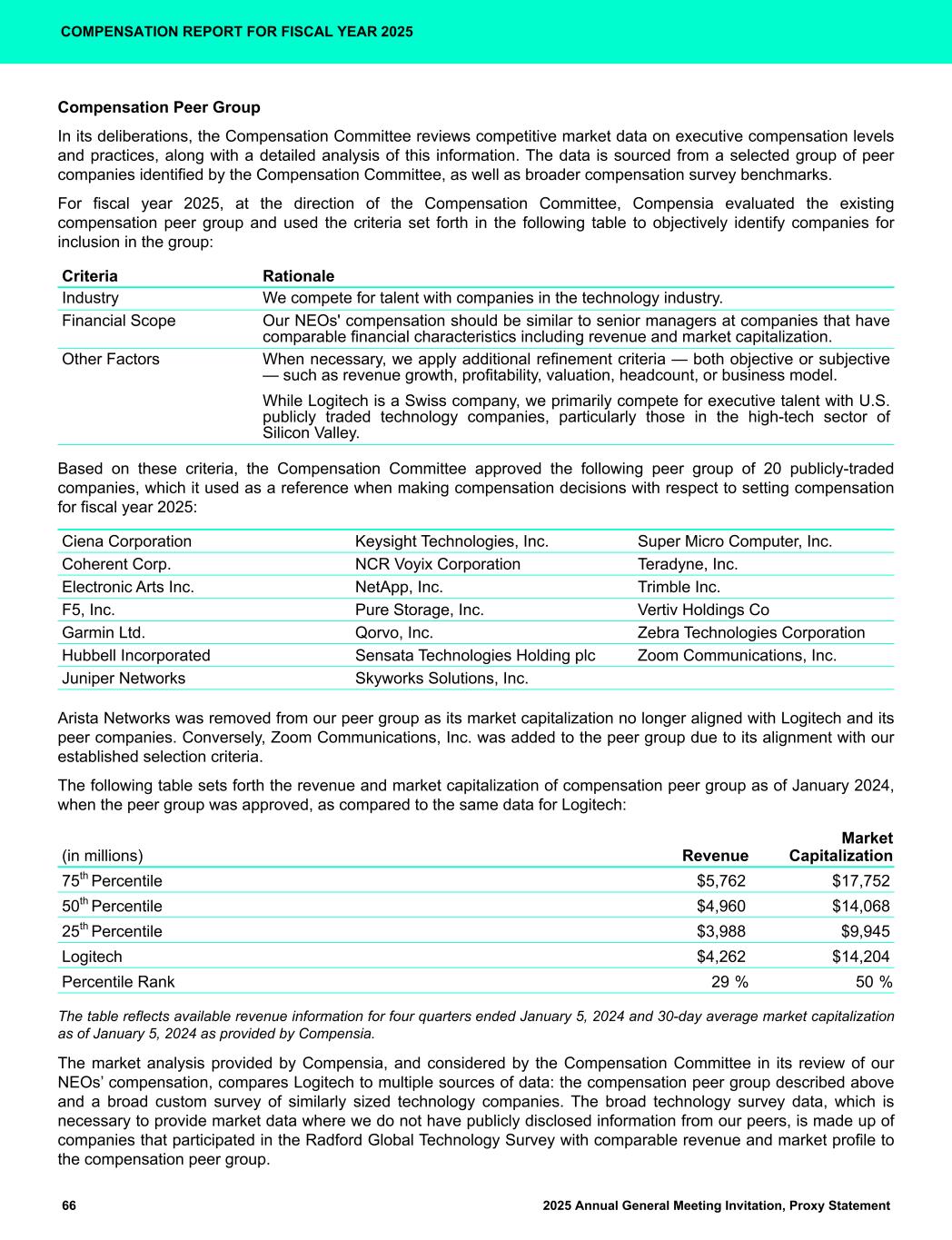
Compensation Peer Group In its deliberations, the Compensation Committee reviews competitive market data on executive compensation levels and practices, along with a detailed analysis of this information. The data is sourced from a selected group of peer companies identified by the Compensation Committee, as well as broader compensation survey benchmarks. For fiscal year 2025, at the direction of the Compensation Committee, Compensia evaluated the existing compensation peer group and used the criteria set forth in the following table to objectively identify companies for inclusion in the group: Criteria Rationale Industry We compete for talent with companies in the technology industry. Financial Scope Our NEOs' compensation should be similar to senior managers at companies that have comparable financial characteristics including revenue and market capitalization. Other Factors When necessary, we apply additional refinement criteria — both objective or subjective — such as revenue growth, profitability, valuation, headcount, or business model. While Logitech is a Swiss company, we primarily compete for executive talent with U.S. publicly traded technology companies, particularly those in the high-tech sector of Silicon Valley. Based on these criteria, the Compensation Committee approved the following peer group of 20 publicly-traded companies, which it used as a reference when making compensation decisions with respect to setting compensation for fiscal year 2025: Ciena Corporation Keysight Technologies, Inc. Super Micro Computer, Inc. Coherent Corp. NCR Voyix Corporation Teradyne, Inc. Electronic Arts Inc. NetApp, Inc. Trimble Inc. F5, Inc. Pure Storage, Inc. Vertiv Holdings Co Garmin Ltd. Qorvo, Inc. Zebra Technologies Corporation Hubbell Incorporated Sensata Technologies Holding plc Zoom Communications, Inc. Juniper Networks Skyworks Solutions, Inc. Arista Networks was removed from our peer group as its market capitalization no longer aligned with Logitech and its peer companies. Conversely, Zoom Communications, Inc. was added to the peer group due to its alignment with our established selection criteria. The following table sets forth the revenue and market capitalization of compensation peer group as of January 2024, when the peer group was approved, as compared to the same data for Logitech: (in millions) Revenue Market Capitalization 75th Percentile $5,762 $17,752 50th Percentile $4,960 $14,068 25th Percentile $3,988 $9,945 Logitech $4,262 $14,204 Percentile Rank 29 % 50 % The table reflects available revenue information for four quarters ended January 5, 2024 and 30-day average market capitalization as of January 5, 2024 as provided by Compensia. The market analysis provided by Compensia, and considered by the Compensation Committee in its review of our NEOs’ compensation, compares Logitech to multiple sources of data: the compensation peer group described above and a broad custom survey of similarly sized technology companies. The broad technology survey data, which is necessary to provide market data where we do not have publicly disclosed information from our peers, is made up of companies that participated in the Radford Global Technology Survey with comparable revenue and market profile to the compensation peer group. COMPENSATION REPORT FOR FISCAL YEAR 2025 66 2025 Annual General Meeting Invitation, Proxy Statement
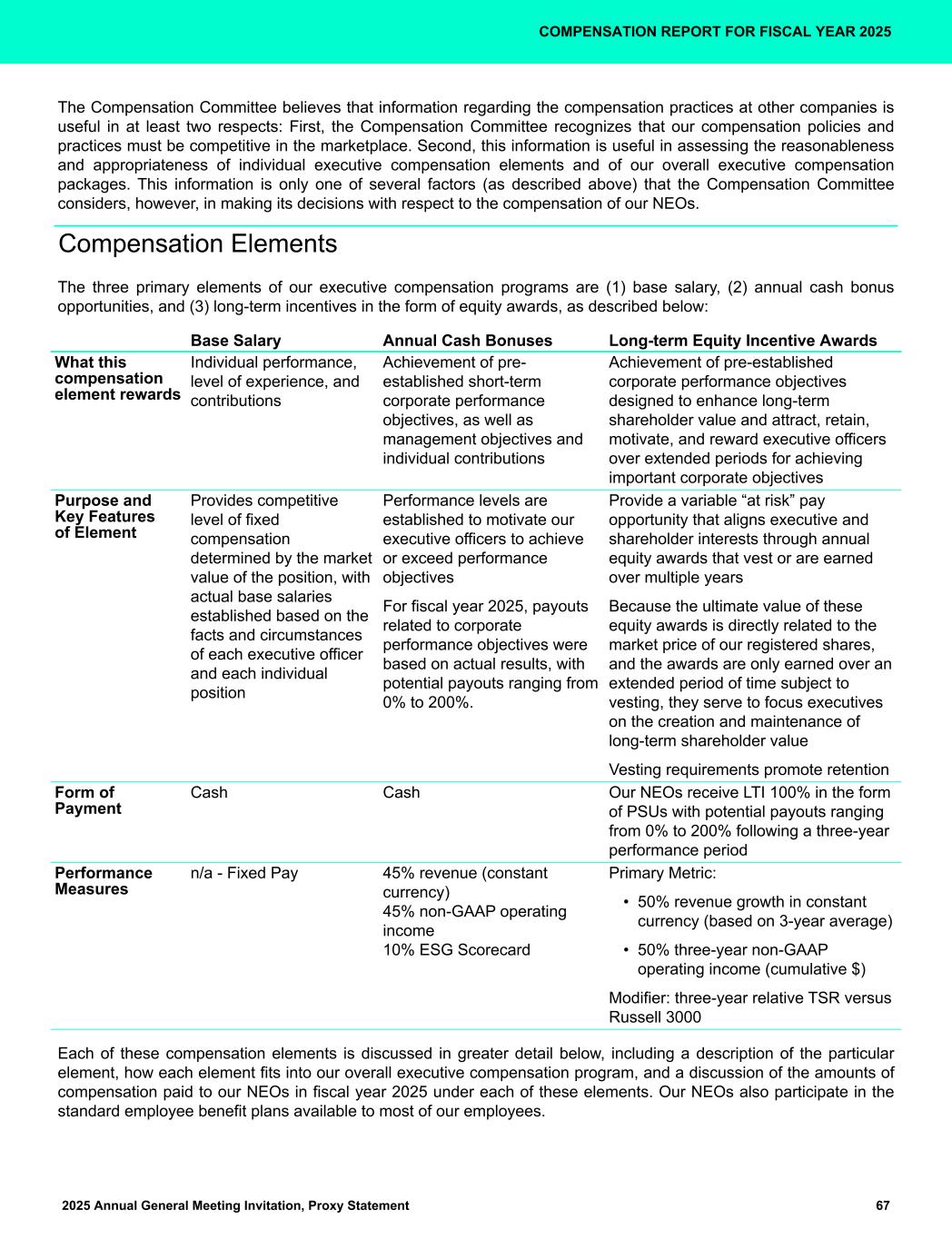
The Compensation Committee believes that information regarding the compensation practices at other companies is useful in at least two respects: First, the Compensation Committee recognizes that our compensation policies and practices must be competitive in the marketplace. Second, this information is useful in assessing the reasonableness and appropriateness of individual executive compensation elements and of our overall executive compensation packages. This information is only one of several factors (as described above) that the Compensation Committee considers, however, in making its decisions with respect to the compensation of our NEOs. Compensation Elements The three primary elements of our executive compensation programs are (1) base salary, (2) annual cash bonus opportunities, and (3) long-term incentives in the form of equity awards, as described below: Base Salary Annual Cash Bonuses Long-term Equity Incentive Awards What this compensation element rewards Individual performance, level of experience, and contributions Achievement of pre- established short-term corporate performance objectives, as well as management objectives and individual contributions Achievement of pre-established corporate performance objectives designed to enhance long-term shareholder value and attract, retain, motivate, and reward executive officers over extended periods for achieving important corporate objectives Purpose and Key Features of Element Provides competitive level of fixed compensation determined by the market value of the position, with actual base salaries established based on the facts and circumstances of each executive officer and each individual position Performance levels are established to motivate our executive officers to achieve or exceed performance objectives For fiscal year 2025, payouts related to corporate performance objectives were based on actual results, with potential payouts ranging from 0% to 200%. Provide a variable “at risk” pay opportunity that aligns executive and shareholder interests through annual equity awards that vest or are earned over multiple years Because the ultimate value of these equity awards is directly related to the market price of our registered shares, and the awards are only earned over an extended period of time subject to vesting, they serve to focus executives on the creation and maintenance of long-term shareholder value Vesting requirements promote retention Form of Payment Cash Cash Our NEOs receive LTI 100% in the form of PSUs with potential payouts ranging from 0% to 200% following a three-year performance period Performance Measures n/a - Fixed Pay 45% revenue (constant currency) 45% non-GAAP operating income 10% ESG Scorecard Primary Metric: • 50% revenue growth in constant currency (based on 3-year average) • 50% three-year non-GAAP operating income (cumulative $) Modifier: three-year relative TSR versus Russell 3000 Each of these compensation elements is discussed in greater detail below, including a description of the particular element, how each element fits into our overall executive compensation program, and a discussion of the amounts of compensation paid to our NEOs in fiscal year 2025 under each of these elements. Our NEOs also participate in the standard employee benefit plans available to most of our employees. COMPENSATION REPORT FOR FISCAL YEAR 2025 2025 Annual General Meeting Invitation, Proxy Statement 67
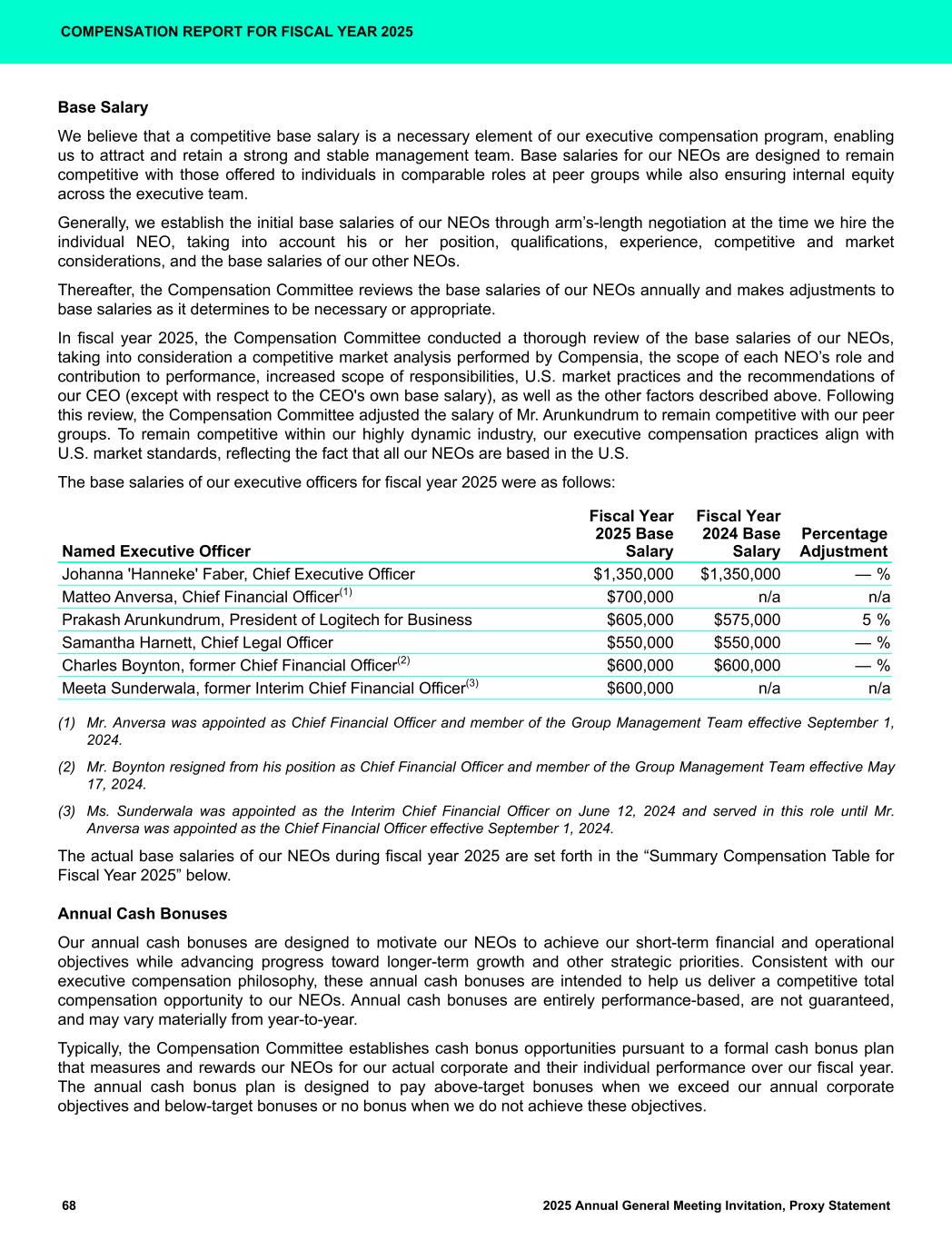
Base Salary We believe that a competitive base salary is a necessary element of our executive compensation program, enabling us to attract and retain a strong and stable management team. Base salaries for our NEOs are designed to remain competitive with those offered to individuals in comparable roles at peer groups while also ensuring internal equity across the executive team. Generally, we establish the initial base salaries of our NEOs through arm’s-length negotiation at the time we hire the individual NEO, taking into account his or her position, qualifications, experience, competitive and market considerations, and the base salaries of our other NEOs. Thereafter, the Compensation Committee reviews the base salaries of our NEOs annually and makes adjustments to base salaries as it determines to be necessary or appropriate. In fiscal year 2025, the Compensation Committee conducted a thorough review of the base salaries of our NEOs, taking into consideration a competitive market analysis performed by Compensia, the scope of each NEO’s role and contribution to performance, increased scope of responsibilities, U.S. market practices and the recommendations of our CEO (except with respect to the CEO's own base salary), as well as the other factors described above. Following this review, the Compensation Committee adjusted the salary of Mr. Arunkundrum to remain competitive with our peer groups. To remain competitive within our highly dynamic industry, our executive compensation practices align with U.S. market standards, reflecting the fact that all our NEOs are based in the U.S. The base salaries of our executive officers for fiscal year 2025 were as follows: Named Executive Officer Fiscal Year 2025 Base Salary Fiscal Year 2024 Base Salary Percentage Adjustment Johanna 'Hanneke' Faber, Chief Executive Officer $1,350,000 $1,350,000 — % Matteo Anversa, Chief Financial Officer(1) $700,000 n/a n/a Prakash Arunkundrum, President of Logitech for Business $605,000 $575,000 5 % Samantha Harnett, Chief Legal Officer $550,000 $550,000 — % Charles Boynton, former Chief Financial Officer(2) $600,000 $600,000 — % Meeta Sunderwala, former Interim Chief Financial Officer(3) $600,000 n/a n/a (1) Mr. Anversa was appointed as Chief Financial Officer and member of the Group Management Team effective September 1, 2024. (2) Mr. Boynton resigned from his position as Chief Financial Officer and member of the Group Management Team effective May 17, 2024. (3) Ms. Sunderwala was appointed as the Interim Chief Financial Officer on June 12, 2024 and served in this role until Mr. Anversa was appointed as the Chief Financial Officer effective September 1, 2024. The actual base salaries of our NEOs during fiscal year 2025 are set forth in the “Summary Compensation Table for Fiscal Year 2025” below. Annual Cash Bonuses Our annual cash bonuses are designed to motivate our NEOs to achieve our short-term financial and operational objectives while advancing progress toward longer-term growth and other strategic priorities. Consistent with our executive compensation philosophy, these annual cash bonuses are intended to help us deliver a competitive total compensation opportunity to our NEOs. Annual cash bonuses are entirely performance-based, are not guaranteed, and may vary materially from year-to-year. Typically, the Compensation Committee establishes cash bonus opportunities pursuant to a formal cash bonus plan that measures and rewards our NEOs for our actual corporate and their individual performance over our fiscal year. The annual cash bonus plan is designed to pay above-target bonuses when we exceed our annual corporate objectives and below-target bonuses or no bonus when we do not achieve these objectives. COMPENSATION REPORT FOR FISCAL YEAR 2025 68 2025 Annual General Meeting Invitation, Proxy Statement
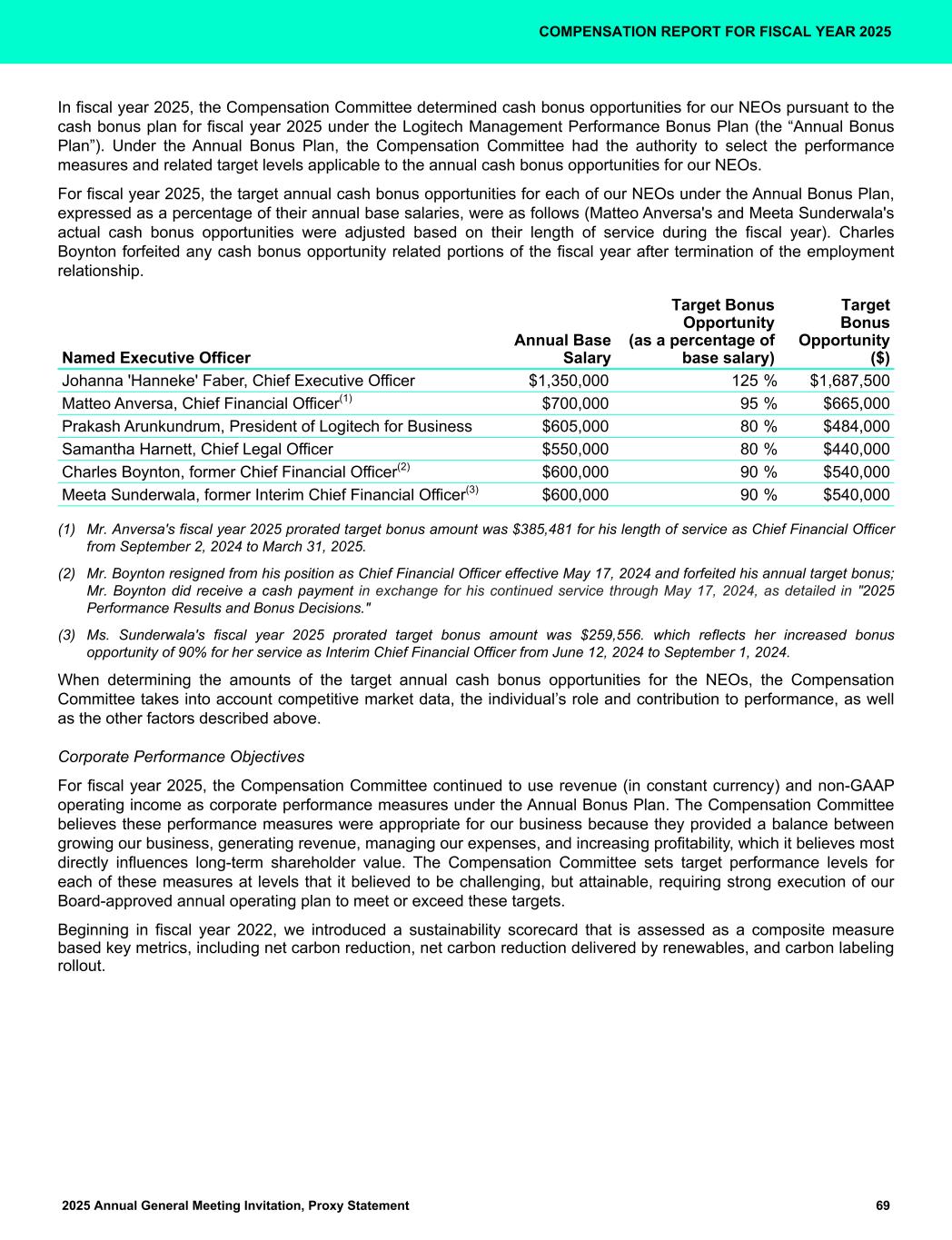
In fiscal year 2025, the Compensation Committee determined cash bonus opportunities for our NEOs pursuant to the cash bonus plan for fiscal year 2025 under the Logitech Management Performance Bonus Plan (the “Annual Bonus Plan”). Under the Annual Bonus Plan, the Compensation Committee had the authority to select the performance measures and related target levels applicable to the annual cash bonus opportunities for our NEOs. For fiscal year 2025, the target annual cash bonus opportunities for each of our NEOs under the Annual Bonus Plan, expressed as a percentage of their annual base salaries, were as follows (Matteo Anversa's and Meeta Sunderwala's actual cash bonus opportunities were adjusted based on their length of service during the fiscal year). Charles Boynton forfeited any cash bonus opportunity related portions of the fiscal year after termination of the employment relationship. Named Executive Officer Annual Base Salary Target Bonus Opportunity (as a percentage of base salary) Target Bonus Opportunity ($) Johanna 'Hanneke' Faber, Chief Executive Officer $1,350,000 125 % $1,687,500 Matteo Anversa, Chief Financial Officer(1) $700,000 95 % $665,000 Prakash Arunkundrum, President of Logitech for Business $605,000 80 % $484,000 Samantha Harnett, Chief Legal Officer $550,000 80 % $440,000 Charles Boynton, former Chief Financial Officer(2) $600,000 90 % $540,000 Meeta Sunderwala, former Interim Chief Financial Officer(3) $600,000 90 % $540,000 (1) Mr. Anversa's fiscal year 2025 prorated target bonus amount was $385,481 for his length of service as Chief Financial Officer from September 2, 2024 to March 31, 2025. (2) Mr. Boynton resigned from his position as Chief Financial Officer effective May 17, 2024 and forfeited his annual target bonus; Mr. Boynton did receive a cash payment in exchange for his continued service through May 17, 2024, as detailed in "2025 Performance Results and Bonus Decisions." (3) Ms. Sunderwala's fiscal year 2025 prorated target bonus amount was $259,556. which reflects her increased bonus opportunity of 90% for her service as Interim Chief Financial Officer from June 12, 2024 to September 1, 2024. When determining the amounts of the target annual cash bonus opportunities for the NEOs, the Compensation Committee takes into account competitive market data, the individual’s role and contribution to performance, as well as the other factors described above. Corporate Performance Objectives For fiscal year 2025, the Compensation Committee continued to use revenue (in constant currency) and non-GAAP operating income as corporate performance measures under the Annual Bonus Plan. The Compensation Committee believes these performance measures were appropriate for our business because they provided a balance between growing our business, generating revenue, managing our expenses, and increasing profitability, which it believes most directly influences long-term shareholder value. The Compensation Committee sets target performance levels for each of these measures at levels that it believed to be challenging, but attainable, requiring strong execution of our Board-approved annual operating plan to meet or exceed these targets. Beginning in fiscal year 2022, we introduced a sustainability scorecard that is assessed as a composite measure based key metrics, including net carbon reduction, net carbon reduction delivered by renewables, and carbon labeling rollout. COMPENSATION REPORT FOR FISCAL YEAR 2025 2025 Annual General Meeting Invitation, Proxy Statement 69
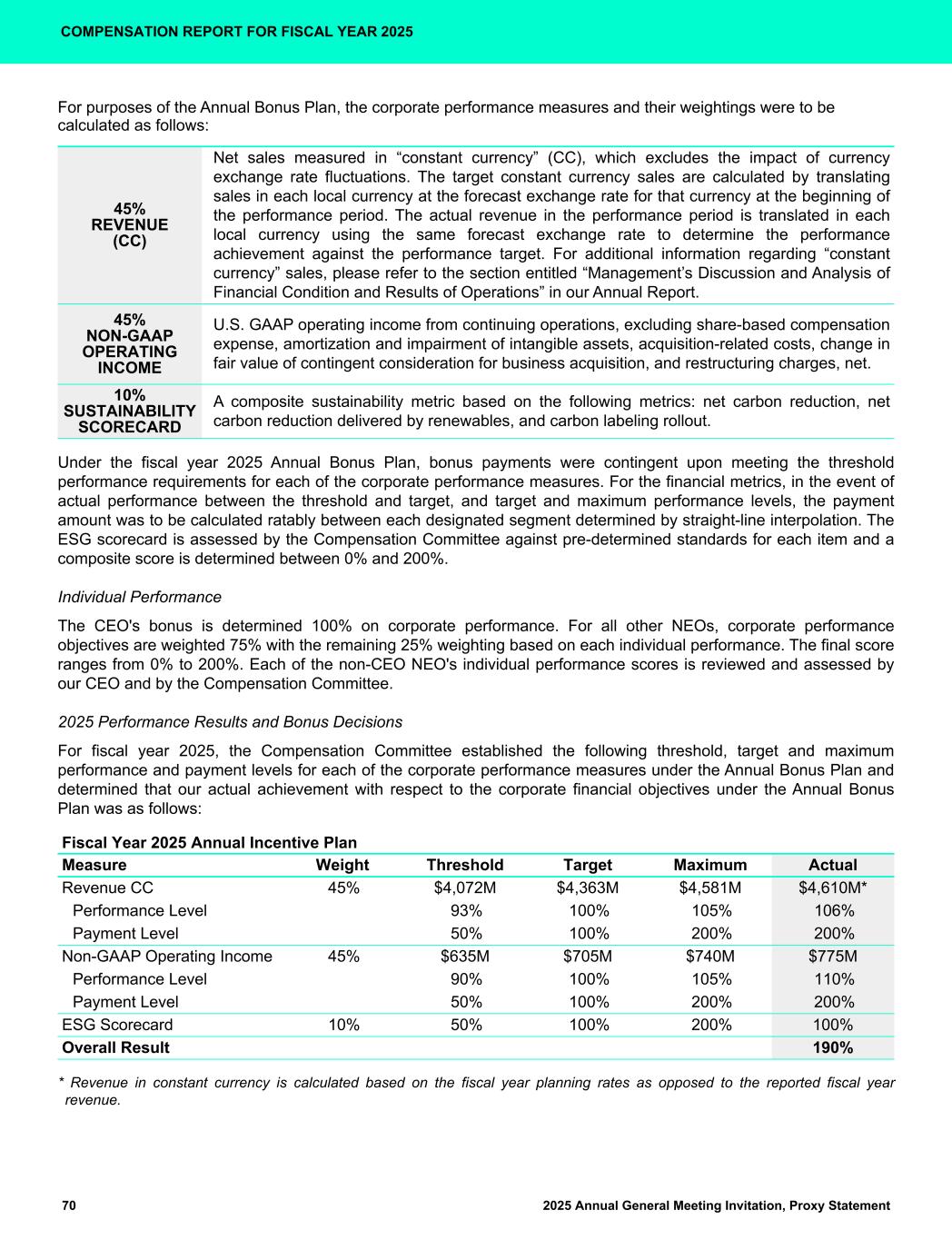
For purposes of the Annual Bonus Plan, the corporate performance measures and their weightings were to be calculated as follows: 45% REVENUE (CC) Net sales measured in “constant currency” (CC), which excludes the impact of currency exchange rate fluctuations. The target constant currency sales are calculated by translating sales in each local currency at the forecast exchange rate for that currency at the beginning of the performance period. The actual revenue in the performance period is translated in each local currency using the same forecast exchange rate to determine the performance achievement against the performance target. For additional information regarding “constant currency” sales, please refer to the section entitled “Management’s Discussion and Analysis of Financial Condition and Results of Operations” in our Annual Report. 45% NON-GAAP OPERATING INCOME U.S. GAAP operating income from continuing operations, excluding share-based compensation expense, amortization and impairment of intangible assets, acquisition-related costs, change in fair value of contingent consideration for business acquisition, and restructuring charges, net. 10% SUSTAINABILITY SCORECARD A composite sustainability metric based on the following metrics: net carbon reduction, net carbon reduction delivered by renewables, and carbon labeling rollout. Under the fiscal year 2025 Annual Bonus Plan, bonus payments were contingent upon meeting the threshold performance requirements for each of the corporate performance measures. For the financial metrics, in the event of actual performance between the threshold and target, and target and maximum performance levels, the payment amount was to be calculated ratably between each designated segment determined by straight-line interpolation. The ESG scorecard is assessed by the Compensation Committee against pre-determined standards for each item and a composite score is determined between 0% and 200%. Individual Performance The CEO's bonus is determined 100% on corporate performance. For all other NEOs, corporate performance objectives are weighted 75% with the remaining 25% weighting based on each individual performance. The final score ranges from 0% to 200%. Each of the non-CEO NEO's individual performance scores is reviewed and assessed by our CEO and by the Compensation Committee. 2025 Performance Results and Bonus Decisions For fiscal year 2025, the Compensation Committee established the following threshold, target and maximum performance and payment levels for each of the corporate performance measures under the Annual Bonus Plan and determined that our actual achievement with respect to the corporate financial objectives under the Annual Bonus Plan was as follows: Fiscal Year 2025 Annual Incentive Plan Measure Weight Threshold Target Maximum Actual Revenue CC 45% $4,072M $4,363M $4,581M $4,610M* Performance Level 93% 100% 105% 106% Payment Level 50% 100% 200% 200% Non-GAAP Operating Income 45% $635M $705M $740M $775M Performance Level 90% 100% 105% 110% Payment Level 50% 100% 200% 200% ESG Scorecard 10% 50% 100% 200% 100% Overall Result 190% * Revenue in constant currency is calculated based on the fiscal year planning rates as opposed to the reported fiscal year revenue. COMPENSATION REPORT FOR FISCAL YEAR 2025 70 2025 Annual General Meeting Invitation, Proxy Statement
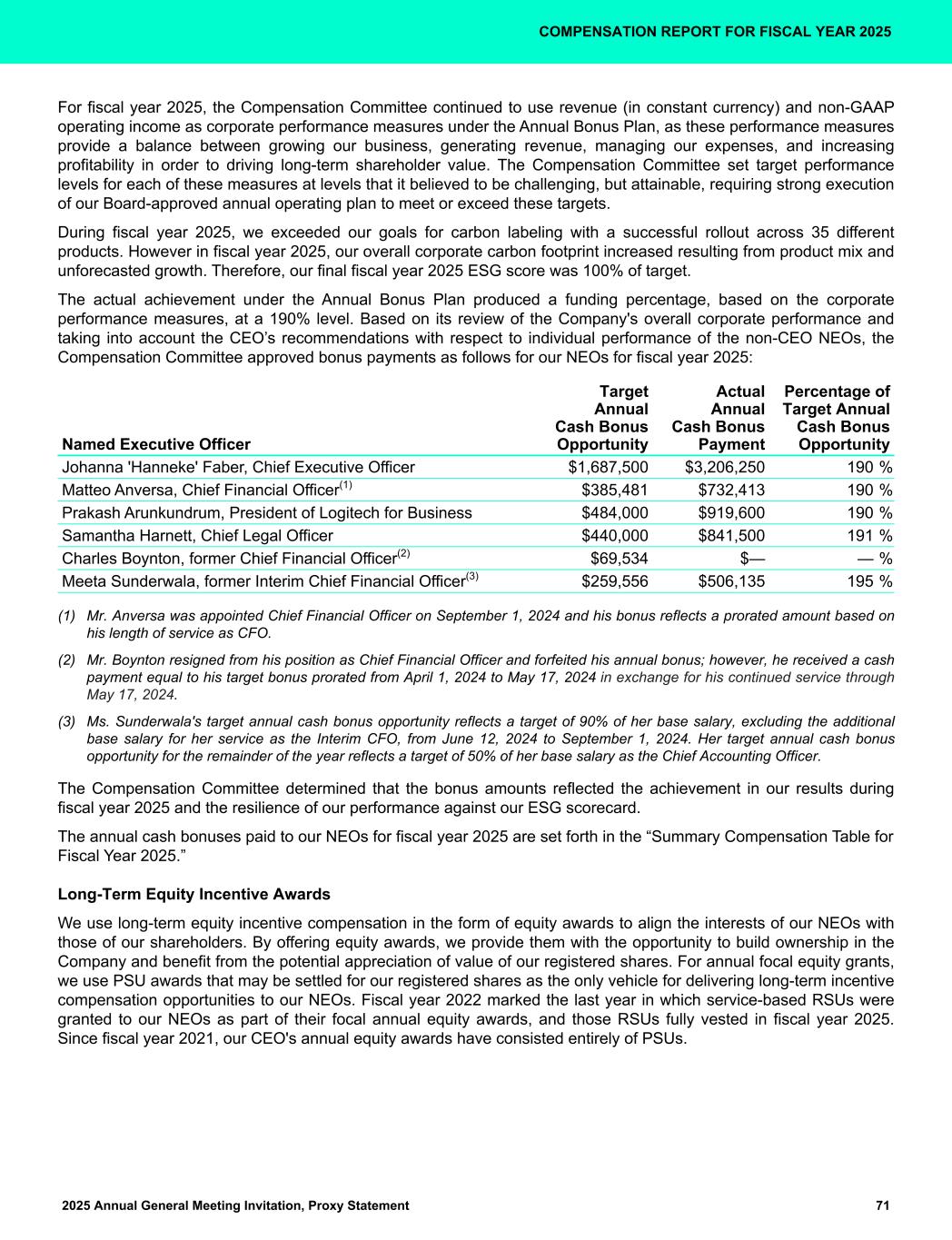
For fiscal year 2025, the Compensation Committee continued to use revenue (in constant currency) and non-GAAP operating income as corporate performance measures under the Annual Bonus Plan, as these performance measures provide a balance between growing our business, generating revenue, managing our expenses, and increasing profitability in order to driving long-term shareholder value. The Compensation Committee set target performance levels for each of these measures at levels that it believed to be challenging, but attainable, requiring strong execution of our Board-approved annual operating plan to meet or exceed these targets. During fiscal year 2025, we exceeded our goals for carbon labeling with a successful rollout across 35 different products. However in fiscal year 2025, our overall corporate carbon footprint increased resulting from product mix and unforecasted growth. Therefore, our final fiscal year 2025 ESG score was 100% of target. The actual achievement under the Annual Bonus Plan produced a funding percentage, based on the corporate performance measures, at a 190% level. Based on its review of the Company's overall corporate performance and taking into account the CEO’s recommendations with respect to individual performance of the non-CEO NEOs, the Compensation Committee approved bonus payments as follows for our NEOs for fiscal year 2025: Named Executive Officer Target Annual Cash Bonus Opportunity Actual Annual Cash Bonus Payment Percentage of Target Annual Cash Bonus Opportunity Johanna 'Hanneke' Faber, Chief Executive Officer $1,687,500 $3,206,250 190 % Matteo Anversa, Chief Financial Officer(1) $385,481 $732,413 190 % Prakash Arunkundrum, President of Logitech for Business $484,000 $919,600 190 % Samantha Harnett, Chief Legal Officer $440,000 $841,500 191 % Charles Boynton, former Chief Financial Officer(2) $69,534 $— — % Meeta Sunderwala, former Interim Chief Financial Officer(3) $259,556 $506,135 195 % (1) Mr. Anversa was appointed Chief Financial Officer on September 1, 2024 and his bonus reflects a prorated amount based on his length of service as CFO. (2) Mr. Boynton resigned from his position as Chief Financial Officer and forfeited his annual bonus; however, he received a cash payment equal to his target bonus prorated from April 1, 2024 to May 17, 2024 in exchange for his continued service through May 17, 2024. (3) Ms. Sunderwala's target annual cash bonus opportunity reflects a target of 90% of her base salary, excluding the additional base salary for her service as the Interim CFO, from June 12, 2024 to September 1, 2024. Her target annual cash bonus opportunity for the remainder of the year reflects a target of 50% of her base salary as the Chief Accounting Officer. The Compensation Committee determined that the bonus amounts reflected the achievement in our results during fiscal year 2025 and the resilience of our performance against our ESG scorecard. The annual cash bonuses paid to our NEOs for fiscal year 2025 are set forth in the “Summary Compensation Table for Fiscal Year 2025.” Long-Term Equity Incentive Awards We use long-term equity incentive compensation in the form of equity awards to align the interests of our NEOs with those of our shareholders. By offering equity awards, we provide them with the opportunity to build ownership in the Company and benefit from the potential appreciation of value of our registered shares. For annual focal equity grants, we use PSU awards that may be settled for our registered shares as the only vehicle for delivering long-term incentive compensation opportunities to our NEOs. Fiscal year 2022 marked the last year in which service-based RSUs were granted to our NEOs as part of their focal annual equity awards, and those RSUs fully vested in fiscal year 2025. Since fiscal year 2021, our CEO's annual equity awards have consisted entirely of PSUs. COMPENSATION REPORT FOR FISCAL YEAR 2025 2025 Annual General Meeting Invitation, Proxy Statement 71
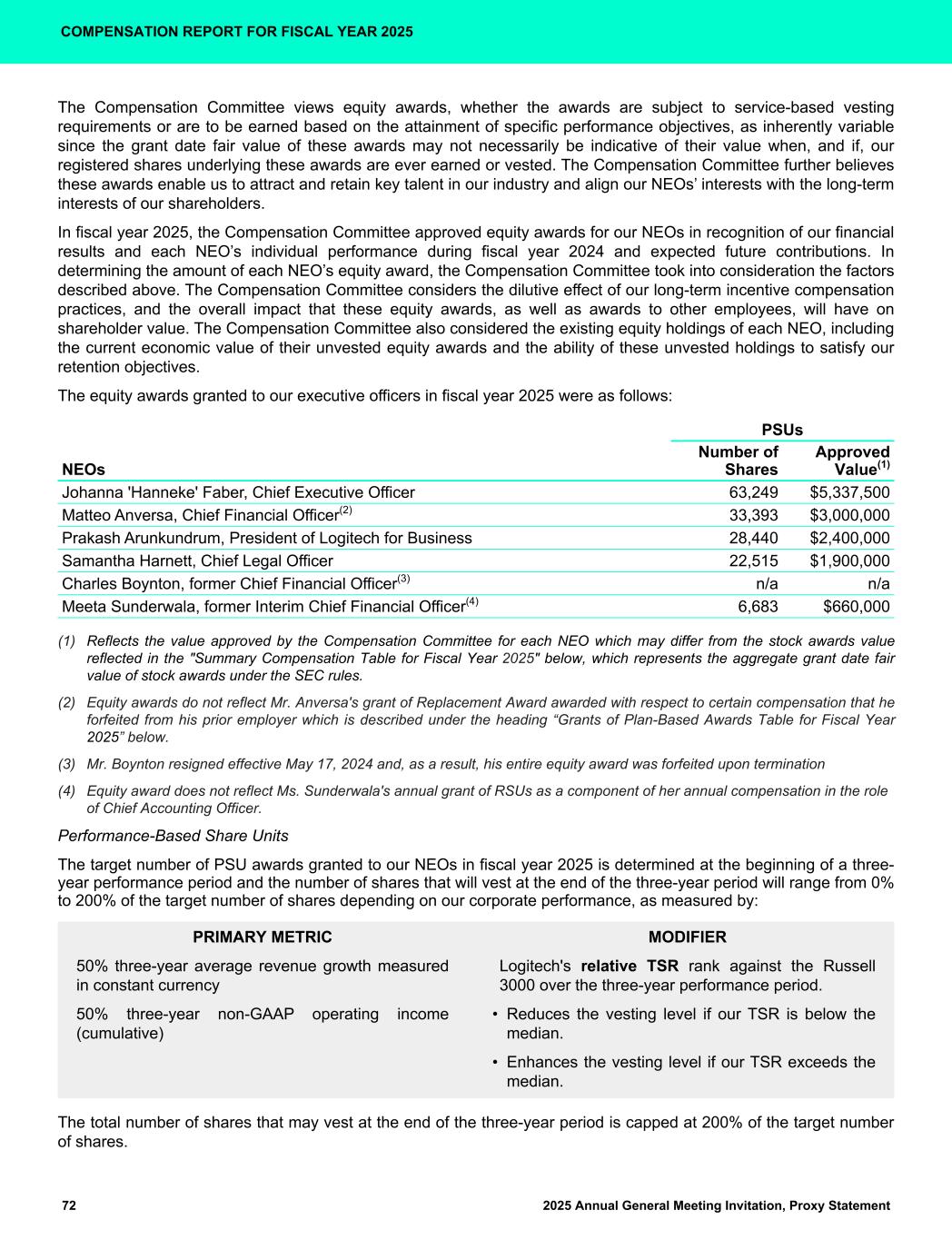
The Compensation Committee views equity awards, whether the awards are subject to service-based vesting requirements or are to be earned based on the attainment of specific performance objectives, as inherently variable since the grant date fair value of these awards may not necessarily be indicative of their value when, and if, our registered shares underlying these awards are ever earned or vested. The Compensation Committee further believes these awards enable us to attract and retain key talent in our industry and align our NEOs’ interests with the long-term interests of our shareholders. In fiscal year 2025, the Compensation Committee approved equity awards for our NEOs in recognition of our financial results and each NEO’s individual performance during fiscal year 2024 and expected future contributions. In determining the amount of each NEO’s equity award, the Compensation Committee took into consideration the factors described above. The Compensation Committee considers the dilutive effect of our long-term incentive compensation practices, and the overall impact that these equity awards, as well as awards to other employees, will have on shareholder value. The Compensation Committee also considered the existing equity holdings of each NEO, including the current economic value of their unvested equity awards and the ability of these unvested holdings to satisfy our retention objectives. The equity awards granted to our executive officers in fiscal year 2025 were as follows: PSUs NEOs Number of Shares Approved Value(1) Johanna 'Hanneke' Faber, Chief Executive Officer 63,249 $5,337,500 Matteo Anversa, Chief Financial Officer(2) 33,393 $3,000,000 Prakash Arunkundrum, President of Logitech for Business 28,440 $2,400,000 Samantha Harnett, Chief Legal Officer 22,515 $1,900,000 Charles Boynton, former Chief Financial Officer(3) n/a n/a Meeta Sunderwala, former Interim Chief Financial Officer(4) 6,683 $660,000 (1) Reflects the value approved by the Compensation Committee for each NEO which may differ from the stock awards value reflected in the "Summary Compensation Table for Fiscal Year 2025" below, which represents the aggregate grant date fair value of stock awards under the SEC rules. (2) Equity awards do not reflect Mr. Anversa's grant of Replacement Award awarded with respect to certain compensation that he forfeited from his prior employer which is described under the heading “Grants of Plan-Based Awards Table for Fiscal Year 2025” below. (3) Mr. Boynton resigned effective May 17, 2024 and, as a result, his entire equity award was forfeited upon termination (4) Equity award does not reflect Ms. Sunderwala's annual grant of RSUs as a component of her annual compensation in the role of Chief Accounting Officer. Performance-Based Share Units The target number of PSU awards granted to our NEOs in fiscal year 2025 is determined at the beginning of a three- year performance period and the number of shares that will vest at the end of the three-year period will range from 0% to 200% of the target number of shares depending on our corporate performance, as measured by: PRIMARY METRIC 50% three-year average revenue growth measured in constant currency 50% three-year non-GAAP operating income (cumulative) MODIFIER Logitech's relative TSR rank against the Russell 3000 over the three-year performance period. • Reduces the vesting level if our TSR is below the median. • Enhances the vesting level if our TSR exceeds the median. The total number of shares that may vest at the end of the three-year period is capped at 200% of the target number of shares. COMPENSATION REPORT FOR FISCAL YEAR 2025 72 2025 Annual General Meeting Invitation, Proxy Statement
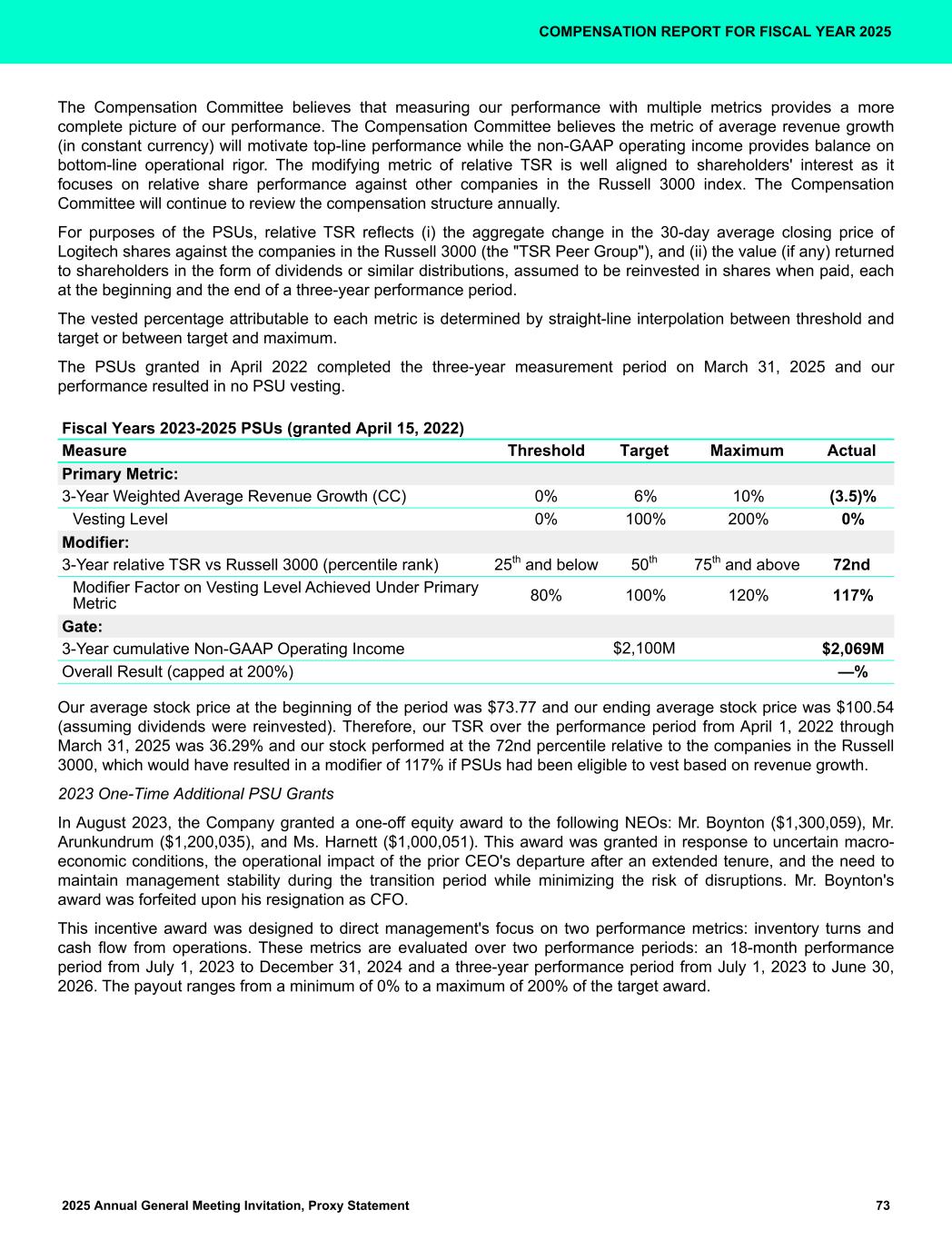
The Compensation Committee believes that measuring our performance with multiple metrics provides a more complete picture of our performance. The Compensation Committee believes the metric of average revenue growth (in constant currency) will motivate top-line performance while the non-GAAP operating income provides balance on bottom-line operational rigor. The modifying metric of relative TSR is well aligned to shareholders' interest as it focuses on relative share performance against other companies in the Russell 3000 index. The Compensation Committee will continue to review the compensation structure annually. For purposes of the PSUs, relative TSR reflects (i) the aggregate change in the 30-day average closing price of Logitech shares against the companies in the Russell 3000 (the "TSR Peer Group"), and (ii) the value (if any) returned to shareholders in the form of dividends or similar distributions, assumed to be reinvested in shares when paid, each at the beginning and the end of a three-year performance period. The vested percentage attributable to each metric is determined by straight-line interpolation between threshold and target or between target and maximum. The PSUs granted in April 2022 completed the three-year measurement period on March 31, 2025 and our performance resulted in no PSU vesting. Fiscal Years 2023-2025 PSUs (granted April 15, 2022) Measure Threshold Target Maximum Actual Primary Metric: 3-Year Weighted Average Revenue Growth (CC) 0% 6% 10% (3.5)% Vesting Level 0% 100% 200% 0% Modifier: 3-Year relative TSR vs Russell 3000 (percentile rank) 25th and below 50th 75th and above 72nd Modifier Factor on Vesting Level Achieved Under Primary Metric 80% 100% 120% 117% Gate: 3-Year cumulative Non-GAAP Operating Income $2,100M $2,069M Overall Result (capped at 200%) —% Our average stock price at the beginning of the period was $73.77 and our ending average stock price was $100.54 (assuming dividends were reinvested). Therefore, our TSR over the performance period from April 1, 2022 through March 31, 2025 was 36.29% and our stock performed at the 72nd percentile relative to the companies in the Russell 3000, which would have resulted in a modifier of 117% if PSUs had been eligible to vest based on revenue growth. 2023 One-Time Additional PSU Grants In August 2023, the Company granted a one-off equity award to the following NEOs: Mr. Boynton ($1,300,059), Mr. Arunkundrum ($1,200,035), and Ms. Harnett ($1,000,051). This award was granted in response to uncertain macro- economic conditions, the operational impact of the prior CEO's departure after an extended tenure, and the need to maintain management stability during the transition period while minimizing the risk of disruptions. Mr. Boynton's award was forfeited upon his resignation as CFO. This incentive award was designed to direct management's focus on two performance metrics: inventory turns and cash flow from operations. These metrics are evaluated over two performance periods: an 18-month performance period from July 1, 2023 to December 31, 2024 and a three-year performance period from July 1, 2023 to June 30, 2026. The payout ranges from a minimum of 0% to a maximum of 200% of the target award. COMPENSATION REPORT FOR FISCAL YEAR 2025 2025 Annual General Meeting Invitation, Proxy Statement 73
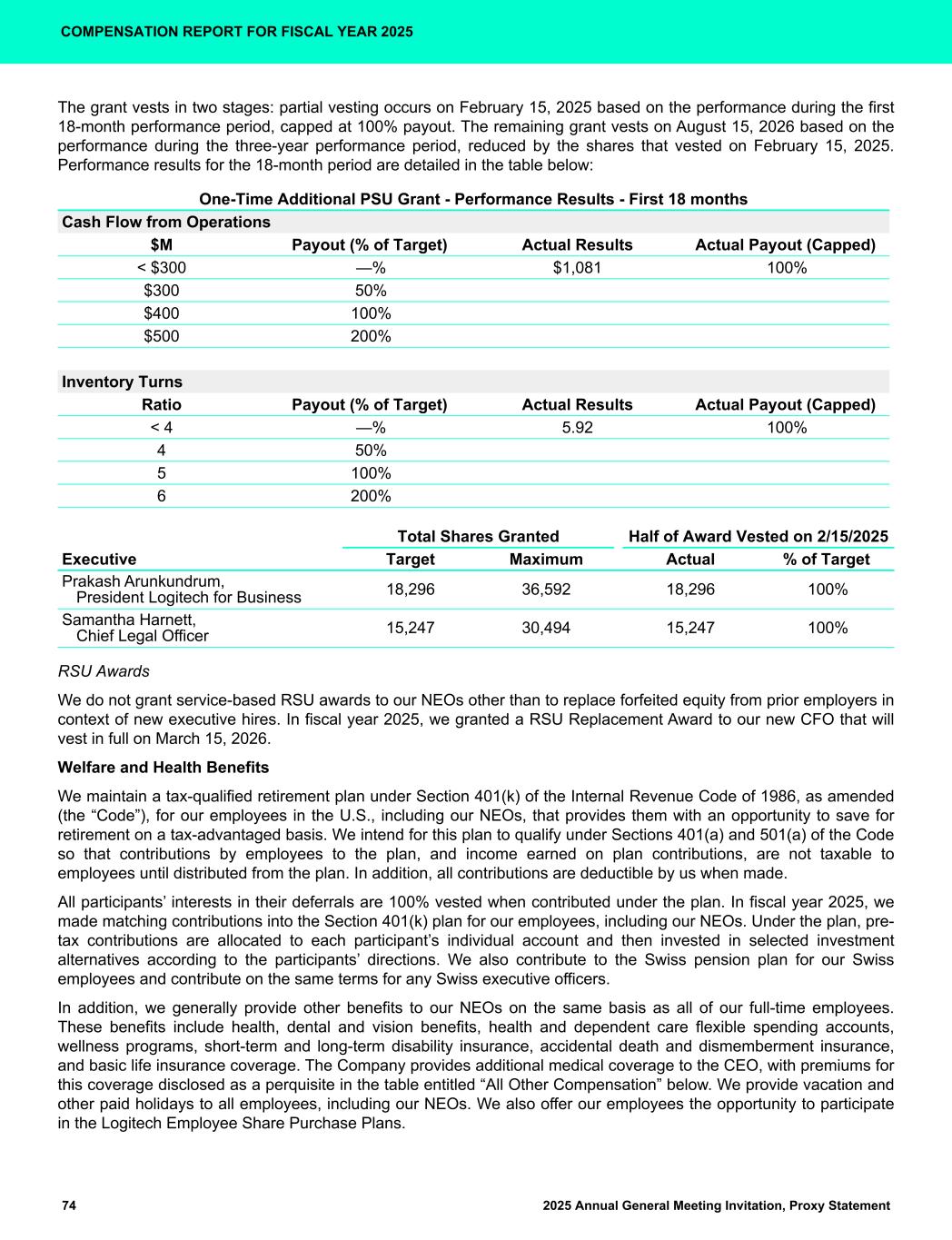
The grant vests in two stages: partial vesting occurs on February 15, 2025 based on the performance during the first 18-month performance period, capped at 100% payout. The remaining grant vests on August 15, 2026 based on the performance during the three-year performance period, reduced by the shares that vested on February 15, 2025. Performance results for the 18-month period are detailed in the table below: One-Time Additional PSU Grant - Performance Results - First 18 months Cash Flow from Operations $M Payout (% of Target) Actual Results Actual Payout (Capped) < $300 —% $1,081 100% $300 50% $400 100% $500 200% Inventory Turns Ratio Payout (% of Target) Actual Results Actual Payout (Capped) < 4 —% 5.92 100% 4 50% 5 100% 6 200% Total Shares Granted Half of Award Vested on 2/15/2025 Executive Target Maximum Actual % of Target Prakash Arunkundrum, President Logitech for Business 18,296 36,592 18,296 100% Samantha Harnett, Chief Legal Officer 15,247 30,494 15,247 100% RSU Awards We do not grant service-based RSU awards to our NEOs other than to replace forfeited equity from prior employers in context of new executive hires. In fiscal year 2025, we granted a RSU Replacement Award to our new CFO that will vest in full on March 15, 2026. Welfare and Health Benefits We maintain a tax-qualified retirement plan under Section 401(k) of the Internal Revenue Code of 1986, as amended (the “Code”), for our employees in the U.S., including our NEOs, that provides them with an opportunity to save for retirement on a tax-advantaged basis. We intend for this plan to qualify under Sections 401(a) and 501(a) of the Code so that contributions by employees to the plan, and income earned on plan contributions, are not taxable to employees until distributed from the plan. In addition, all contributions are deductible by us when made. All participants’ interests in their deferrals are 100% vested when contributed under the plan. In fiscal year 2025, we made matching contributions into the Section 401(k) plan for our employees, including our NEOs. Under the plan, pre- tax contributions are allocated to each participant’s individual account and then invested in selected investment alternatives according to the participants’ directions. We also contribute to the Swiss pension plan for our Swiss employees and contribute on the same terms for any Swiss executive officers. In addition, we generally provide other benefits to our NEOs on the same basis as all of our full-time employees. These benefits include health, dental and vision benefits, health and dependent care flexible spending accounts, wellness programs, short-term and long-term disability insurance, accidental death and dismemberment insurance, and basic life insurance coverage. The Company provides additional medical coverage to the CEO, with premiums for this coverage disclosed as a perquisite in the table entitled “All Other Compensation” below. We provide vacation and other paid holidays to all employees, including our NEOs. We also offer our employees the opportunity to participate in the Logitech Employee Share Purchase Plans. COMPENSATION REPORT FOR FISCAL YEAR 2025 74 2025 Annual General Meeting Invitation, Proxy Statement

We design our employee benefits programs to be affordable and competitive in relation to the market, as well as compliant with applicable laws and practices. We adjust our employee benefits programs as needed based on regular monitoring of applicable laws and practices, the competitive market and our employees’ needs. Deferred Compensation Plan Eligible employees, including our NEOs based in the U.S., may also participate in the Logitech Inc. Deferred Compensation Plan, which is an unfunded and unsecured plan that allows select management employees of Logitech Inc. and Logitech subsidiaries in the U.S., who earn more than a threshold amount the opportunity to defer the receipt of up to 80% of their base salary and up to 90% of their bonus or commission compensation. Under the plan, compensation may be deferred until termination of employment or other specified dates chosen by the participants, and deferred amounts are credited with earnings based on investment benchmarks chosen by the participants from a number of mutual funds selected by Logitech Inc.’s 401(k) and Deferred Compensation Committee. The earnings credited to the participants are intended to be funded solely by the plan investments. Logitech does not make contributions to this plan. Information regarding NEO participation in the deferred compensation plans can be found in the “Non-Qualified Deferred Compensation Table for Fiscal Year 2025” below. Because the NEOs do not receive preferential or above-market rates of return under the deferred compensation plan, earnings under the plan are not included in the "Summary Compensation Table for Fiscal Year 2025" below, but are included in the “Non-Qualified Deferred Compensation Table for Fiscal Year 2025” below. Perquisites and Other Personal Benefits Currently, we do not view perquisites or other personal benefits as a significant component of our executive compensation program. Accordingly, Logitech’s executive officer benefit programs are substantially the same as for all other similarly situated employees. All future practices with respect to perquisites or other personal benefits will be approved and subject to periodic review by the Compensation Committee. Employment Arrangements We have extended written employment agreements or offer letters or both to each of our NEOs. Each of these arrangements was approved by our Board of Directors or the Compensation Committee, as applicable. We believe that these arrangements were appropriate to induce these individuals to forego other employment opportunities or leave their current employer for the uncertainty of a demanding position in a new and unfamiliar organization. In filling these executive positions, our Board of Directors or the Compensation Committee, as applicable, was aware that it would be necessary to recruit or retain candidates with the requisite experience and skills to manage a growing business in a dynamic environment. Accordingly, it recognized that it would need to develop competitive compensation packages to attract or retain qualified candidates in a highly competitive labor market. At the same time, our Board of Directors or the Compensation Committee, as applicable, was sensitive to the need to integrate new NEOs into the executive compensation structure that it was seeking to develop, balancing both competitive and internal equity considerations. Each of these employment arrangements provides for “at will” employment and sets forth the initial compensation arrangements for the NEO, including an initial base salary, a target annual cash bonus opportunity, and, in some instances, a recommendation for an equity award. Post-Employment Compensation In 2015, to comply with applicable Swiss regulations, we eliminated all change in control and severance arrangements with our executive officers, including all our NEOs. However, the Company continues to provide “double trigger” change in control equity vesting acceleration arrangements in the equity award agreements. The purpose of the change in control provisions in equity award agreements is to support retention in the event of a prospective change in control. The RSU and PSU award agreements for our NEOs generally provide for the acceleration of vesting of the service-based RSUs and PSUs subject to the award agreements if the NEO is subject to an involuntary termination within 12 months after a change in control because his or her employment is terminated without cause or the executive resigns for good reason (a “double trigger”). COMPENSATION REPORT FOR FISCAL YEAR 2025 2025 Annual General Meeting Invitation, Proxy Statement 75
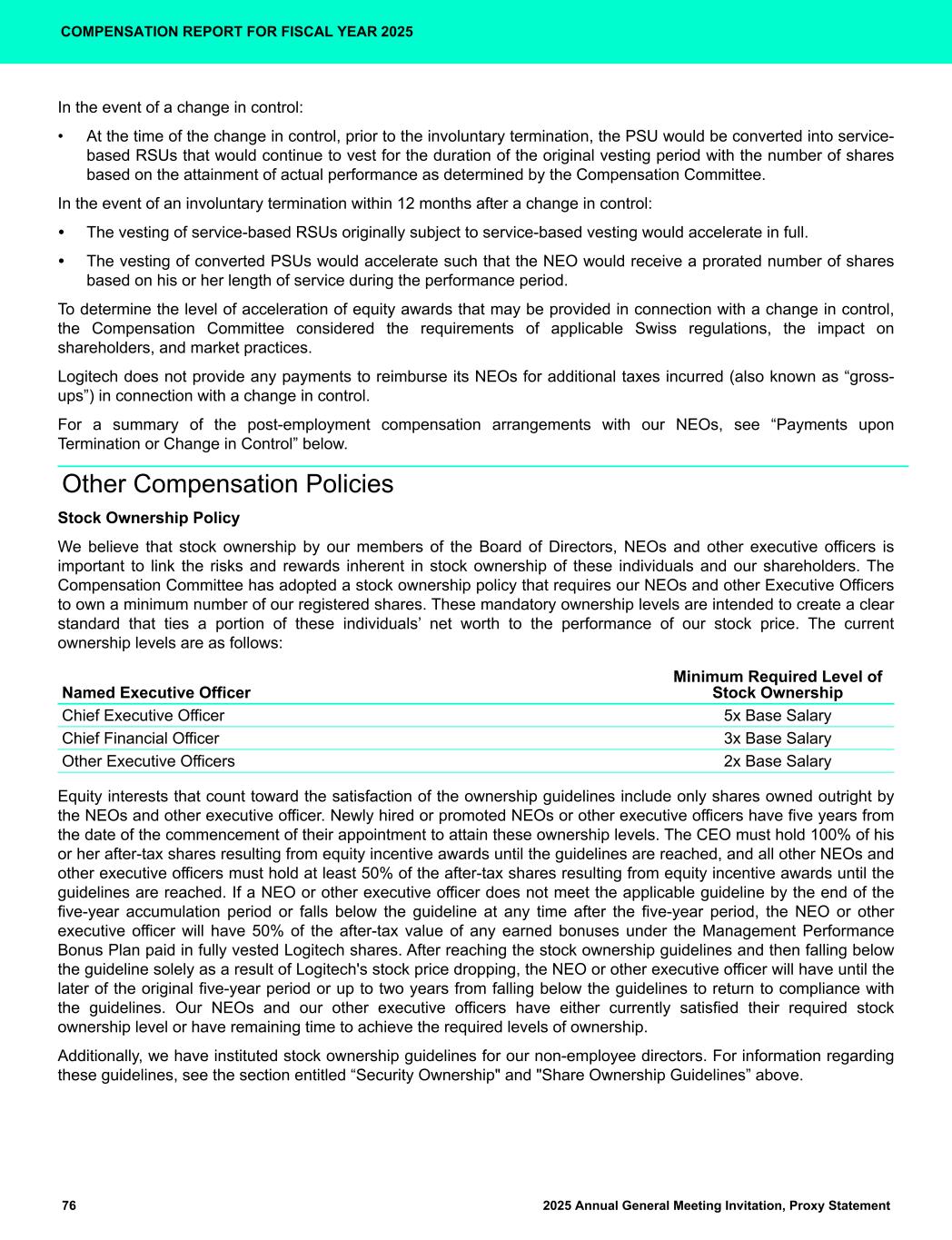
In the event of a change in control: • At the time of the change in control, prior to the involuntary termination, the PSU would be converted into service- based RSUs that would continue to vest for the duration of the original vesting period with the number of shares based on the attainment of actual performance as determined by the Compensation Committee. In the event of an involuntary termination within 12 months after a change in control: • The vesting of service-based RSUs originally subject to service-based vesting would accelerate in full. • The vesting of converted PSUs would accelerate such that the NEO would receive a prorated number of shares based on his or her length of service during the performance period. To determine the level of acceleration of equity awards that may be provided in connection with a change in control, the Compensation Committee considered the requirements of applicable Swiss regulations, the impact on shareholders, and market practices. Logitech does not provide any payments to reimburse its NEOs for additional taxes incurred (also known as “gross- ups”) in connection with a change in control. For a summary of the post-employment compensation arrangements with our NEOs, see “Payments upon Termination or Change in Control” below. Other Compensation Policies Stock Ownership Policy We believe that stock ownership by our members of the Board of Directors, NEOs and other executive officers is important to link the risks and rewards inherent in stock ownership of these individuals and our shareholders. The Compensation Committee has adopted a stock ownership policy that requires our NEOs and other Executive Officers to own a minimum number of our registered shares. These mandatory ownership levels are intended to create a clear standard that ties a portion of these individuals’ net worth to the performance of our stock price. The current ownership levels are as follows: Named Executive Officer Minimum Required Level of Stock Ownership Chief Executive Officer 5x Base Salary Chief Financial Officer 3x Base Salary Other Executive Officers 2x Base Salary Equity interests that count toward the satisfaction of the ownership guidelines include only shares owned outright by the NEOs and other executive officer. Newly hired or promoted NEOs or other executive officers have five years from the date of the commencement of their appointment to attain these ownership levels. The CEO must hold 100% of his or her after-tax shares resulting from equity incentive awards until the guidelines are reached, and all other NEOs and other executive officers must hold at least 50% of the after-tax shares resulting from equity incentive awards until the guidelines are reached. If a NEO or other executive officer does not meet the applicable guideline by the end of the five-year accumulation period or falls below the guideline at any time after the five-year period, the NEO or other executive officer will have 50% of the after-tax value of any earned bonuses under the Management Performance Bonus Plan paid in fully vested Logitech shares. After reaching the stock ownership guidelines and then falling below the guideline solely as a result of Logitech's stock price dropping, the NEO or other executive officer will have until the later of the original five-year period or up to two years from falling below the guidelines to return to compliance with the guidelines. Our NEOs and our other executive officers have either currently satisfied their required stock ownership level or have remaining time to achieve the required levels of ownership. Additionally, we have instituted stock ownership guidelines for our non-employee directors. For information regarding these guidelines, see the section entitled “Security Ownership" and "Share Ownership Guidelines” above. COMPENSATION REPORT FOR FISCAL YEAR 2025 76 2025 Annual General Meeting Invitation, Proxy Statement
Compensation Recovery Policy Effective October 2023, the Compensation Committee adopted a policy regarding the recovery of erroneously awarded incentive-based compensation paid to our Section 16 executive officers (the "Clawback Policy") to comply with the final provisions of the Dodd-Frank Act, as implemented by the SEC and the Nasdaq Listing Standards. The Clawback Policy is triggered in the event of an accounting restatement due to the material non-compliance of Logitech with any financial reporting requirement under the securities laws, including any required accounting restatement to correct an error in previously issued financial statements that is material to the previously issued financial statements, or that would result in a material misstatement if the error were corrected in the current period or left uncorrected in the current period, whether or not due to misconduct by the officer in question or any other person. Under the terms of the Clawback Policy, we are required to recover incentive-based compensation erroneously awarded to current or former Section 16 officers during the three completed fiscal years immediately preceding the year in which we are required to prepare an accounting restatement due to material non-compliance with financial reporting requirements. The amount to be recovered equals the amount by which the incentive-based compensation for the year in question exceeds the amount that would have been awarded had the financial statements originally been filed as restated. Equity Award Grant Practices Determination of long-term equity incentive awards The Compensation Committee is responsible for approving which NEO should receive equity incentive awards, when the awards should be made, the vesting schedule, and the number of shares or other rights to be granted. Long-term equity incentive awards to NEOs may be granted only by the Compensation Committee or the full Board of Directors. The Compensation Committee regularly reports its activity, including approvals of grants, to the Board. Timing of grants Long-term equity incentive award grants to NEOs are typically and predominantly approved at regularly scheduled, predetermined meetings of the Compensation Committee. These meetings are generally scheduled at least 18 months in advance and take place before the regularly scheduled, predetermined meetings of the full Board. On limited occasions, grants may be approved at an interim meeting of the Compensation Committee or by written consent, for the purpose of approving the hiring and compensation package for newly hired or promoted NEOs or for other special circumstances. In fiscal year 2025, grants were made to non-executive officer employees through written consents of the Compensation Committee or regularly scheduled monthly approvals by the CEO pursuant to the authority delegated to the CEO by the Compensation Committee. We do not have any program, plan, or practice to select equity compensation grant dates in coordination with the release of material non-public information, nor do we time the release of information for the purpose of affecting value. We do not backdate options or grant options retroactively. Derivatives Trading, Hedging, and Pledging Policies We have adopted a policy prohibiting our employees, including our NEOs and members of our Board of Directors, from speculating in our equity securities, including the use of short sales, “sales against the box” or any equivalent transaction involving our equity securities. In addition, they may not engage in any other hedging transactions, such as “cashless” collars, forward sales, equity swaps and other similar or related arrangements, with respect to the securities that they hold. Finally, no employees, including NEOs and members of our Board of Directors, may acquire, sell, or trade in any interest or position relating to the future price of our equity securities. We also have adopted a policy prohibiting the pledging of our securities by our employees, including our NEOs and members of our Board of Directors. COMPENSATION REPORT FOR FISCAL YEAR 2025 2025 Annual General Meeting Invitation, Proxy Statement 77
Tax and Accounting Considerations Accounting and Tax Treatment of Executive Compensation The accounting and tax treatment of the various elements of our executive compensation program are a relevant consideration in its design. However, the Company and the Compensation Committee have placed a higher priority on structuring flexible compensation programs to promote the recruitment, retention, and performance of our officers than on maximizing tax deductibility. Section 162(m) of the Code, as amended (the “Tax Code”), places a limit of $1 million on the amount of compensation that Logitech may deduct in any one year with respect to certain NEOs. The Tax Cuts and Jobs Act (the “Tax Act”) enacted on December 22, 2017, significantly modified Section 162(m) of the Tax Code. The Tax Act eliminated the “qualified performance-based compensation” exception to the deductibility limitation under Section 162(m) of the Tax Code for years commencing after December 31, 2017. Regardless, we intend to maintain an approach to executive compensation that strongly links pay to performance. In addition to considering the tax consequences, the Compensation Committee considers the accounting consequences, including the impact of the Financial Accounting Standard Board’s Accounting Standards Codification Section 718, Compensation - Stock Compensation ("ASC 718"), on its decisions in determining the forms of different equity awards. Compensation Risk Assessment The Compensation Committee conducts an annual review of Logitech’s compensation programs, with the assistance of Compensia, our compensation consultants, Head of People & Culture, and compensation department, to assess the risks associated with their design and associated risk controls. The Compensation Committee reviews in particular the following compensation plans and associated practices: • Equity awards granted under the 2006 Stock Incentive Plan. • Management Performance Bonus Plan. • Bonus Plan. • Sales Compensation Plans. • Change in Control Protections. Similar to past years, based on its March 2025 review, the Compensation Committee has concluded that our compensation policies and practices do not create risks that are reasonably likely to have a material adverse effect on the Company. COMPENSATION REPORT FOR FISCAL YEAR 2025 78 2025 Annual General Meeting Invitation, Proxy Statement
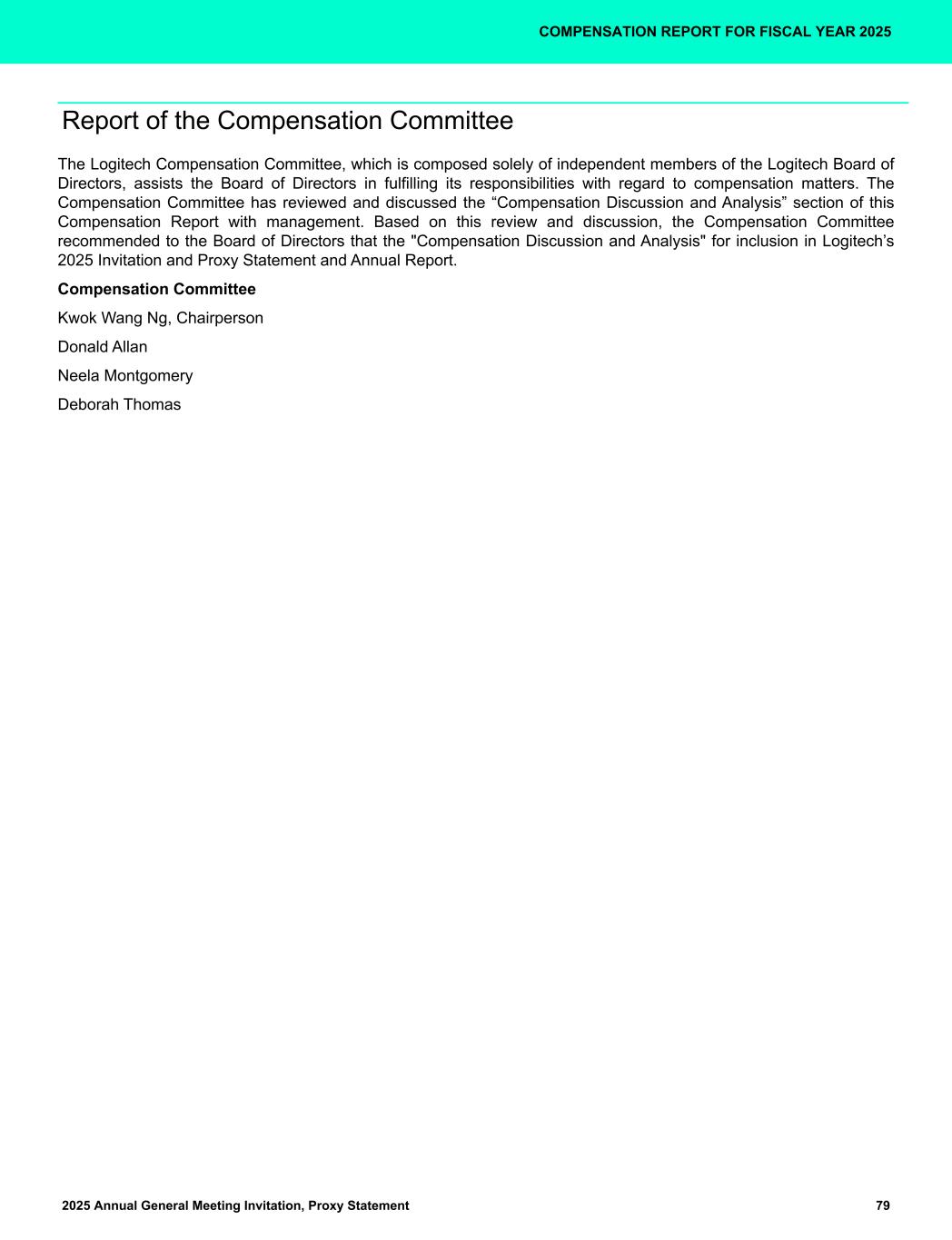
Report of the Compensation Committee The Logitech Compensation Committee, which is composed solely of independent members of the Logitech Board of Directors, assists the Board of Directors in fulfilling its responsibilities with regard to compensation matters. The Compensation Committee has reviewed and discussed the “Compensation Discussion and Analysis” section of this Compensation Report with management. Based on this review and discussion, the Compensation Committee recommended to the Board of Directors that the "Compensation Discussion and Analysis" for inclusion in Logitech’s 2025 Invitation and Proxy Statement and Annual Report. Compensation Committee Kwok Wang Ng, Chairperson Donald Allan Neela Montgomery Deborah Thomas COMPENSATION REPORT FOR FISCAL YEAR 2025 2025 Annual General Meeting Invitation, Proxy Statement 79
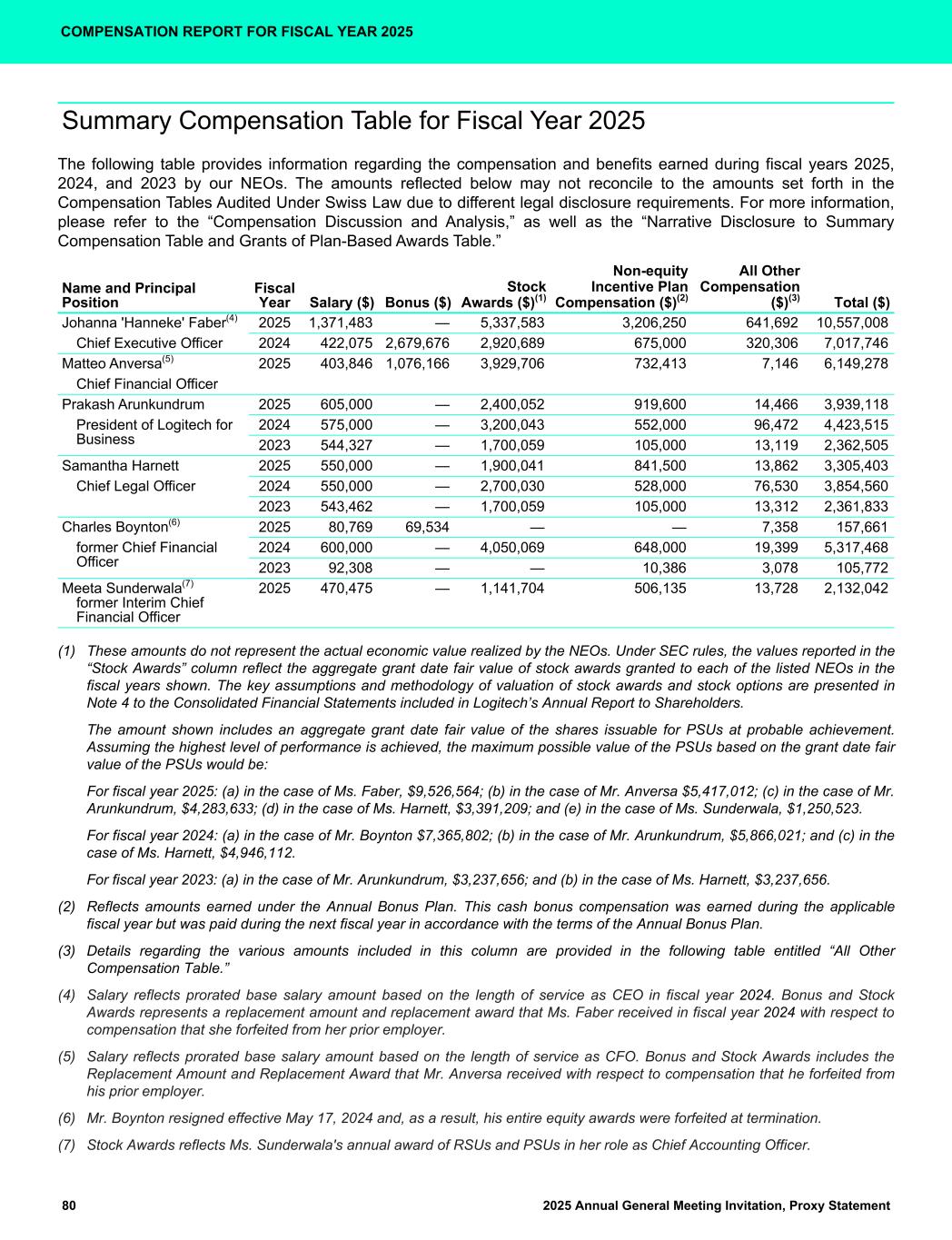
Summary Compensation Table for Fiscal Year 2025 The following table provides information regarding the compensation and benefits earned during fiscal years 2025, 2024, and 2023 by our NEOs. The amounts reflected below may not reconcile to the amounts set forth in the Compensation Tables Audited Under Swiss Law due to different legal disclosure requirements. For more information, please refer to the “Compensation Discussion and Analysis,” as well as the “Narrative Disclosure to Summary Compensation Table and Grants of Plan-Based Awards Table.” Name and Principal Position Fiscal Year Salary ($) Bonus ($) Stock Awards ($)(1) Non-equity Incentive Plan Compensation ($)(2) All Other Compensation ($)(3) Total ($) Johanna 'Hanneke' Faber(4) 2025 1,371,483 — 5,337,583 3,206,250 641,692 10,557,008 Chief Executive Officer 2024 422,075 2,679,676 2,920,689 675,000 320,306 7,017,746 Matteo Anversa(5) 2025 403,846 1,076,166 3,929,706 732,413 7,146 6,149,278 Chief Financial Officer Prakash Arunkundrum 2025 605,000 — 2,400,052 919,600 14,466 3,939,118 President of Logitech for Business 2024 575,000 — 3,200,043 552,000 96,472 4,423,515 2023 544,327 — 1,700,059 105,000 13,119 2,362,505 Samantha Harnett 2025 550,000 — 1,900,041 841,500 13,862 3,305,403 Chief Legal Officer 2024 550,000 — 2,700,030 528,000 76,530 3,854,560 2023 543,462 — 1,700,059 105,000 13,312 2,361,833 Charles Boynton(6) 2025 80,769 69,534 — — 7,358 157,661 former Chief Financial Officer 2024 600,000 — 4,050,069 648,000 19,399 5,317,468 2023 92,308 — — 10,386 3,078 105,772 Meeta Sunderwala(7) former Interim Chief Financial Officer 2025 470,475 — 1,141,704 506,135 13,728 2,132,042 (1) These amounts do not represent the actual economic value realized by the NEOs. Under SEC rules, the values reported in the “Stock Awards” column reflect the aggregate grant date fair value of stock awards granted to each of the listed NEOs in the fiscal years shown. The key assumptions and methodology of valuation of stock awards and stock options are presented in Note 4 to the Consolidated Financial Statements included in Logitech’s Annual Report to Shareholders. The amount shown includes an aggregate grant date fair value of the shares issuable for PSUs at probable achievement. Assuming the highest level of performance is achieved, the maximum possible value of the PSUs based on the grant date fair value of the PSUs would be: For fiscal year 2025: (a) in the case of Ms. Faber, $9,526,564; (b) in the case of Mr. Anversa $5,417,012; (c) in the case of Mr. Arunkundrum, $4,283,633; (d) in the case of Ms. Harnett, $3,391,209; and (e) in the case of Ms. Sunderwala, $1,250,523. For fiscal year 2024: (a) in the case of Mr. Boynton $7,365,802; (b) in the case of Mr. Arunkundrum, $5,866,021; and (c) in the case of Ms. Harnett, $4,946,112. For fiscal year 2023: (a) in the case of Mr. Arunkundrum, $3,237,656; and (b) in the case of Ms. Harnett, $3,237,656. (2) Reflects amounts earned under the Annual Bonus Plan. This cash bonus compensation was earned during the applicable fiscal year but was paid during the next fiscal year in accordance with the terms of the Annual Bonus Plan. (3) Details regarding the various amounts included in this column are provided in the following table entitled “All Other Compensation Table.” (4) Salary reflects prorated base salary amount based on the length of service as CEO in fiscal year 2024. Bonus and Stock Awards represents a replacement amount and replacement award that Ms. Faber received in fiscal year 2024 with respect to compensation that she forfeited from her prior employer. (5) Salary reflects prorated base salary amount based on the length of service as CFO. Bonus and Stock Awards includes the Replacement Amount and Replacement Award that Mr. Anversa received with respect to compensation that he forfeited from his prior employer. (6) Mr. Boynton resigned effective May 17, 2024 and, as a result, his entire equity awards were forfeited at termination. (7) Stock Awards reflects Ms. Sunderwala's annual award of RSUs and PSUs in her role as Chief Accounting Officer. COMPENSATION REPORT FOR FISCAL YEAR 2025 80 2025 Annual General Meeting Invitation, Proxy Statement
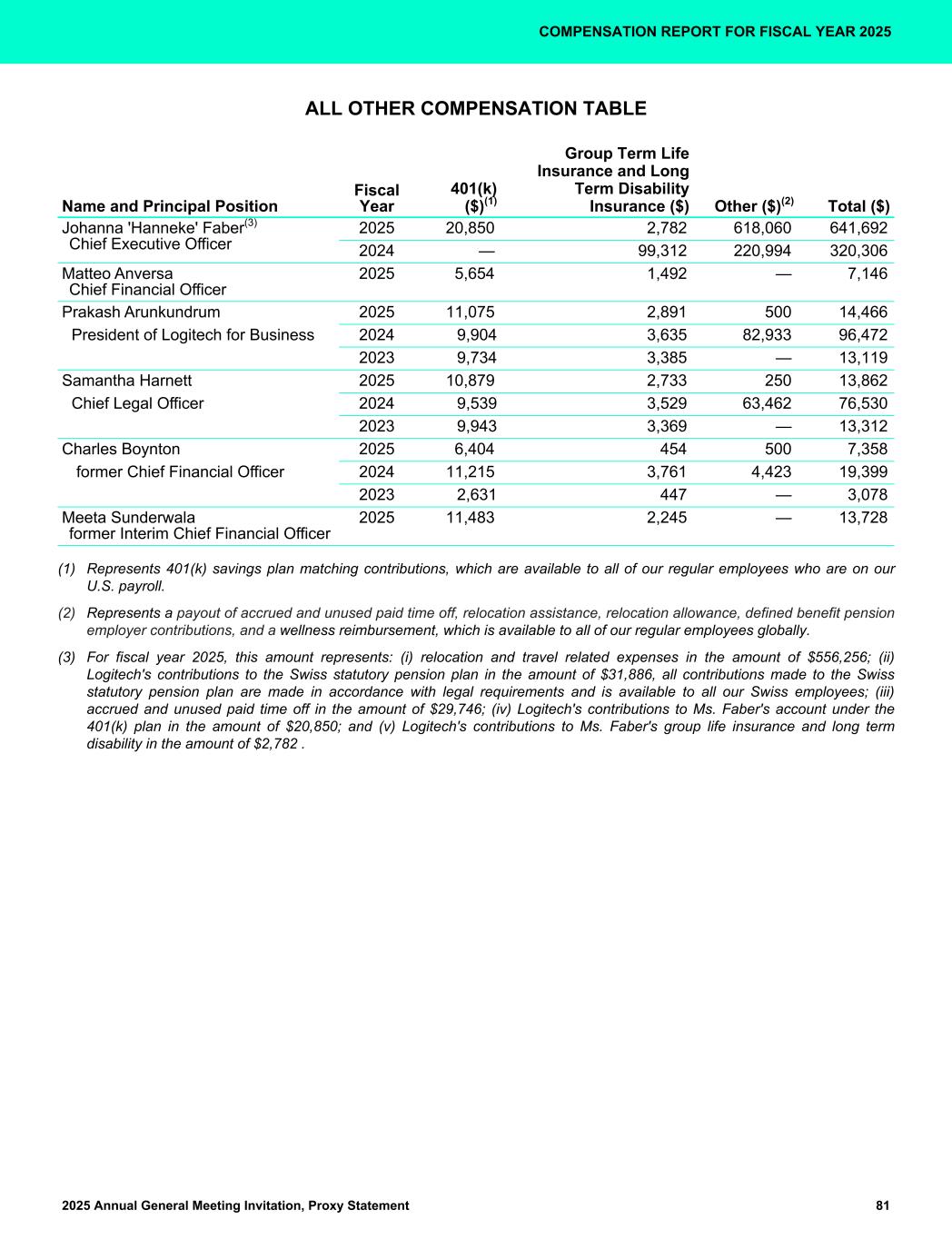
ALL OTHER COMPENSATION TABLE Name and Principal Position Fiscal Year 401(k) ($)(1) Group Term Life Insurance and Long Term Disability Insurance ($) Other ($)(2) Total ($) Johanna 'Hanneke' Faber(3) Chief Executive Officer 2025 20,850 2,782 618,060 641,692 2024 — 99,312 220,994 320,306 Matteo Anversa Chief Financial Officer 2025 5,654 1,492 — 7,146 Prakash Arunkundrum 2025 11,075 2,891 500 14,466 President of Logitech for Business 2024 9,904 3,635 82,933 96,472 2023 9,734 3,385 — 13,119 Samantha Harnett 2025 10,879 2,733 250 13,862 Chief Legal Officer 2024 9,539 3,529 63,462 76,530 2023 9,943 3,369 — 13,312 Charles Boynton 2025 6,404 454 500 7,358 former Chief Financial Officer 2024 11,215 3,761 4,423 19,399 2023 2,631 447 — 3,078 Meeta Sunderwala former Interim Chief Financial Officer 2025 11,483 2,245 — 13,728 (1) Represents 401(k) savings plan matching contributions, which are available to all of our regular employees who are on our U.S. payroll. (2) Represents a payout of accrued and unused paid time off, relocation assistance, relocation allowance, defined benefit pension employer contributions, and a wellness reimbursement, which is available to all of our regular employees globally. (3) For fiscal year 2025, this amount represents: (i) relocation and travel related expenses in the amount of $556,256; (ii) Logitech's contributions to the Swiss statutory pension plan in the amount of $31,886, all contributions made to the Swiss statutory pension plan are made in accordance with legal requirements and is available to all our Swiss employees; (iii) accrued and unused paid time off in the amount of $29,746; (iv) Logitech's contributions to Ms. Faber's account under the 401(k) plan in the amount of $20,850; and (v) Logitech's contributions to Ms. Faber's group life insurance and long term disability in the amount of $2,782 . COMPENSATION REPORT FOR FISCAL YEAR 2025 2025 Annual General Meeting Invitation, Proxy Statement 81
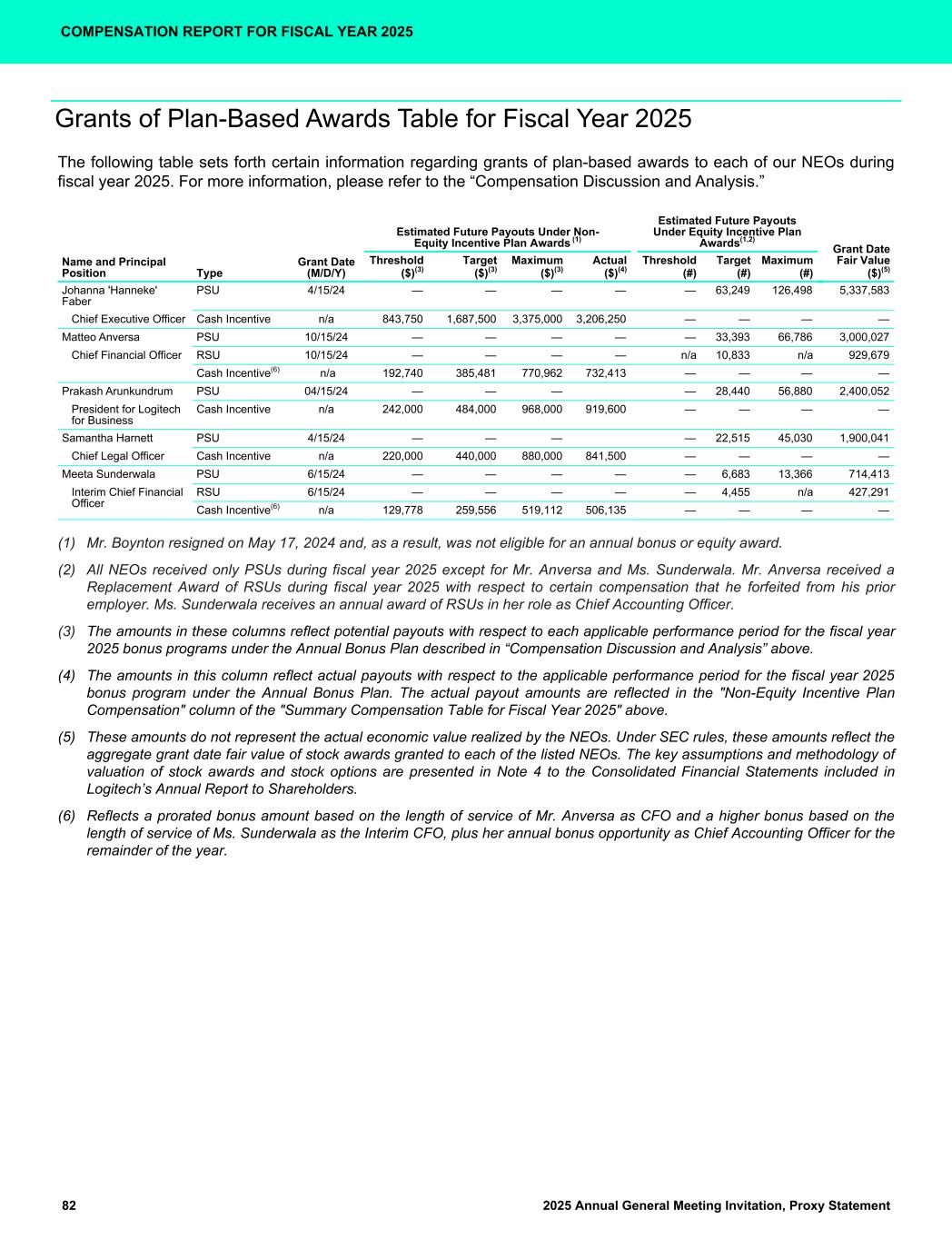
Grants of Plan-Based Awards Table for Fiscal Year 2025 The following table sets forth certain information regarding grants of plan-based awards to each of our NEOs during fiscal year 2025. For more information, please refer to the “Compensation Discussion and Analysis.” Estimated Future Payouts Under Non- Equity Incentive Plan Awards (1) Estimated Future Payouts Under Equity Incentive Plan Awards(1,2) Grant Date Fair Value ($)(5) Name and Principal Position Type Grant Date (M/D/Y) Threshold ($)(3) Target ($)(3) Maximum ($)(3) Actual ($)(4) Threshold (#) Target (#) Maximum (#) Johanna 'Hanneke' Faber PSU 4/15/24 — — — — — 63,249 126,498 5,337,583 Chief Executive Officer Cash Incentive n/a 843,750 1,687,500 3,375,000 3,206,250 — — — — Matteo Anversa PSU 10/15/24 — — — — — 33,393 66,786 3,000,027 Chief Financial Officer RSU 10/15/24 — — — — n/a 10,833 n/a 929,679 Cash Incentive(6) n/a 192,740 385,481 770,962 732,413 — — — — Prakash Arunkundrum PSU 04/15/24 — — — — 28,440 56,880 2,400,052 President for Logitech for Business Cash Incentive n/a 242,000 484,000 968,000 919,600 — — — — Samantha Harnett PSU 4/15/24 — — — — 22,515 45,030 1,900,041 Chief Legal Officer Cash Incentive n/a 220,000 440,000 880,000 841,500 — — — — Meeta Sunderwala PSU 6/15/24 — — — — — 6,683 13,366 714,413 Interim Chief Financial Officer RSU 6/15/24 — — — — — 4,455 n/a 427,291 Cash Incentive(6) n/a 129,778 259,556 519,112 506,135 — — — — (1) Mr. Boynton resigned on May 17, 2024 and, as a result, was not eligible for an annual bonus or equity award. (2) All NEOs received only PSUs during fiscal year 2025 except for Mr. Anversa and Ms. Sunderwala. Mr. Anversa received a Replacement Award of RSUs during fiscal year 2025 with respect to certain compensation that he forfeited from his prior employer. Ms. Sunderwala receives an annual award of RSUs in her role as Chief Accounting Officer. (3) The amounts in these columns reflect potential payouts with respect to each applicable performance period for the fiscal year 2025 bonus programs under the Annual Bonus Plan described in “Compensation Discussion and Analysis” above. (4) The amounts in this column reflect actual payouts with respect to the applicable performance period for the fiscal year 2025 bonus program under the Annual Bonus Plan. The actual payout amounts are reflected in the "Non-Equity Incentive Plan Compensation" column of the "Summary Compensation Table for Fiscal Year 2025" above. (5) These amounts do not represent the actual economic value realized by the NEOs. Under SEC rules, these amounts reflect the aggregate grant date fair value of stock awards granted to each of the listed NEOs. The key assumptions and methodology of valuation of stock awards and stock options are presented in Note 4 to the Consolidated Financial Statements included in Logitech’s Annual Report to Shareholders. (6) Reflects a prorated bonus amount based on the length of service of Mr. Anversa as CFO and a higher bonus based on the length of service of Ms. Sunderwala as the Interim CFO, plus her annual bonus opportunity as Chief Accounting Officer for the remainder of the year. COMPENSATION REPORT FOR FISCAL YEAR 2025 82 2025 Annual General Meeting Invitation, Proxy Statement
Narrative Disclosure to Summary Compensation Table and Grants of Plan-Based Awards Table Employment Agreements We have entered into employment agreements with each of our NEOs. The employment agreements generally provide that the compensation of the NEO is subject to the sole discretion of the Compensation Committee or the Board of Directors. The compensation earned by the NEOs in fiscal year 2025, other than the Replacement Amount the Replacement Award granted to our CFO with respect to certain compensation that he forfeited from his prior employer, was not the result of any terms of their employment agreements. Performance-Based Vesting Conditions Please refer to “Compensation Discussion and Analysis—Compensation Elements—Annual Cash Bonuses” for a discussion of the performance measures applicable to the Annual Bonus Plan during fiscal year 2025. In addition, please refer to “Compensation Discussion and Analysis—Compensation Elements—Long-Term Equity Incentive Awards” for a discussion of performance measures under the PSUs granted to NEOs during fiscal year 2025. Compensation Mix Please refer to “Compensation Discussion and Analysis—Executive Compensation Highlights—Emphasis on Performance-Based Compensation” for an explanation of the amount of salary, bonus and long-term incentives in proportion to total compensation for our NEOs during fiscal year 2025. COMPENSATION REPORT FOR FISCAL YEAR 2025 2025 Annual General Meeting Invitation, Proxy Statement 83
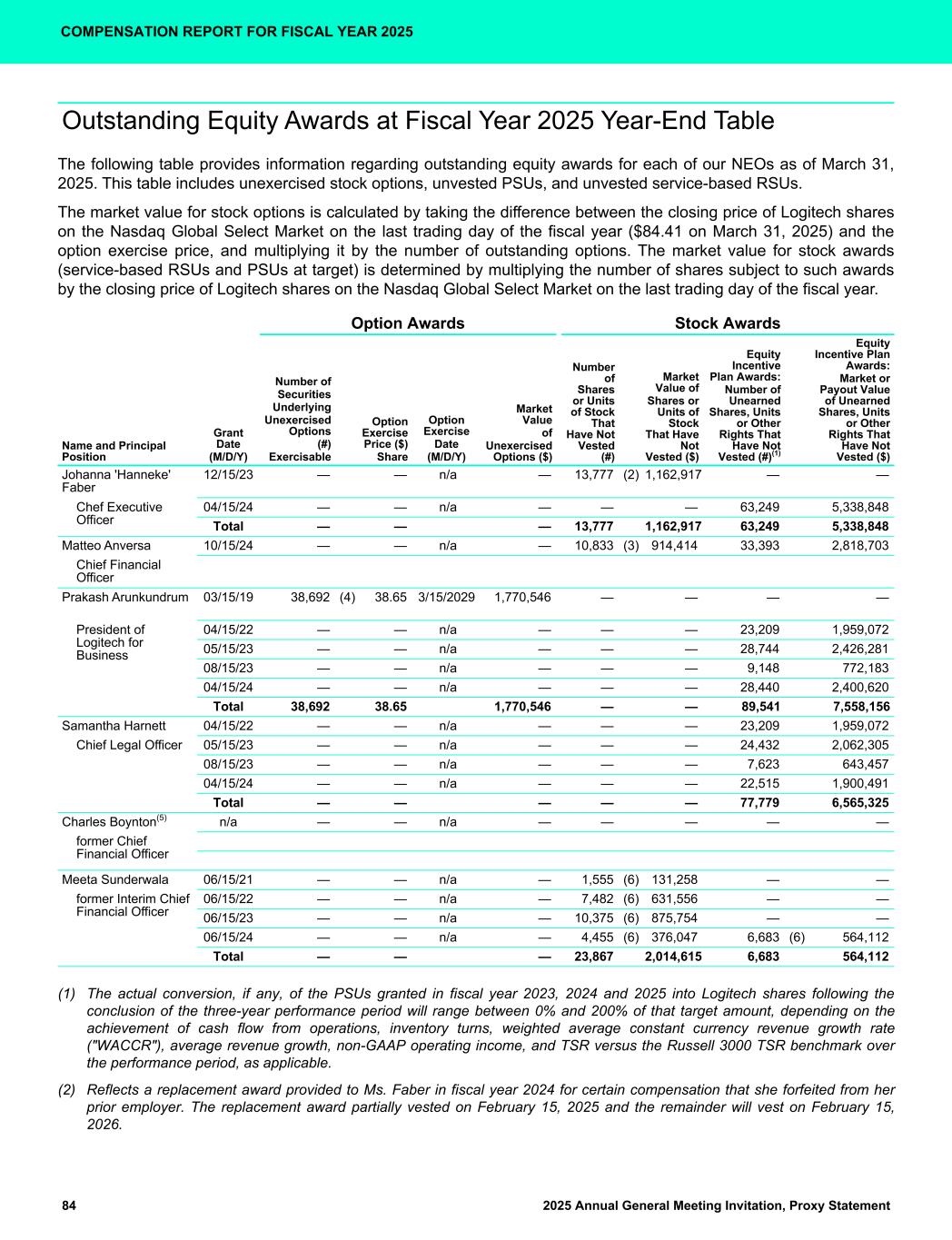
Outstanding Equity Awards at Fiscal Year 2025 Year-End Table The following table provides information regarding outstanding equity awards for each of our NEOs as of March 31, 2025. This table includes unexercised stock options, unvested PSUs, and unvested service-based RSUs. The market value for stock options is calculated by taking the difference between the closing price of Logitech shares on the Nasdaq Global Select Market on the last trading day of the fiscal year ($84.41 on March 31, 2025) and the option exercise price, and multiplying it by the number of outstanding options. The market value for stock awards (service-based RSUs and PSUs at target) is determined by multiplying the number of shares subject to such awards by the closing price of Logitech shares on the Nasdaq Global Select Market on the last trading day of the fiscal year. Option Awards Stock Awards Name and Principal Position Grant Date (M/D/Y) Number of Securities Underlying Unexercised Options (#) Exercisable Option Exercise Price ($) Share Option Exercise Date (M/D/Y) Market Value of Unexercised Options ($) Number of Shares or Units of Stock That Have Not Vested (#) Market Value of Shares or Units of Stock That Have Not Vested ($) Equity Incentive Plan Awards: Number of Unearned Shares, Units or Other Rights That Have Not Vested (#)(1) Equity Incentive Plan Awards: Market or Payout Value of Unearned Shares, Units or Other Rights That Have Not Vested ($) Johanna 'Hanneke' Faber 12/15/23 — — n/a — 13,777 (2) 1,162,917 — — Chef Executive Officer 04/15/24 — — n/a — — — 63,249 5,338,848 Total — — — 13,777 1,162,917 63,249 5,338,848 Matteo Anversa 10/15/24 — — n/a — 10,833 (3) 914,414 33,393 2,818,703 Chief Financial Officer Prakash Arunkundrum 03/15/19 38,692 (4) 38.65 3/15/2029 1,770,546 — — — — President of Logitech for Business 04/15/22 — — n/a — — — 23,209 1,959,072 05/15/23 — — n/a — — — 28,744 2,426,281 08/15/23 — — n/a — — — 9,148 772,183 04/15/24 — — n/a — — — 28,440 2,400,620 Total 38,692 38.65 1,770,546 — — 89,541 7,558,156 Samantha Harnett 04/15/22 — — n/a — — — 23,209 1,959,072 Chief Legal Officer 05/15/23 — — n/a — — — 24,432 2,062,305 08/15/23 — — n/a — — — 7,623 643,457 04/15/24 — — n/a — — — 22,515 1,900,491 Total — — — — — 77,779 6,565,325 Charles Boynton(5) n/a — — n/a — — — — — former Chief Financial Officer Meeta Sunderwala 06/15/21 — — n/a — 1,555 (6) 131,258 — — former Interim Chief Financial Officer 06/15/22 — — n/a — 7,482 (6) 631,556 — — 06/15/23 — — n/a — 10,375 (6) 875,754 — — 06/15/24 — — n/a — 4,455 (6) 376,047 6,683 (6) 564,112 Total — — — 23,867 2,014,615 6,683 564,112 (1) The actual conversion, if any, of the PSUs granted in fiscal year 2023, 2024 and 2025 into Logitech shares following the conclusion of the three-year performance period will range between 0% and 200% of that target amount, depending on the achievement of cash flow from operations, inventory turns, weighted average constant currency revenue growth rate ("WACCR"), average revenue growth, non-GAAP operating income, and TSR versus the Russell 3000 TSR benchmark over the performance period, as applicable. (2) Reflects a replacement award provided to Ms. Faber in fiscal year 2024 for certain compensation that she forfeited from her prior employer. The replacement award partially vested on February 15, 2025 and the remainder will vest on February 15, 2026. COMPENSATION REPORT FOR FISCAL YEAR 2025 84 2025 Annual General Meeting Invitation, Proxy Statement
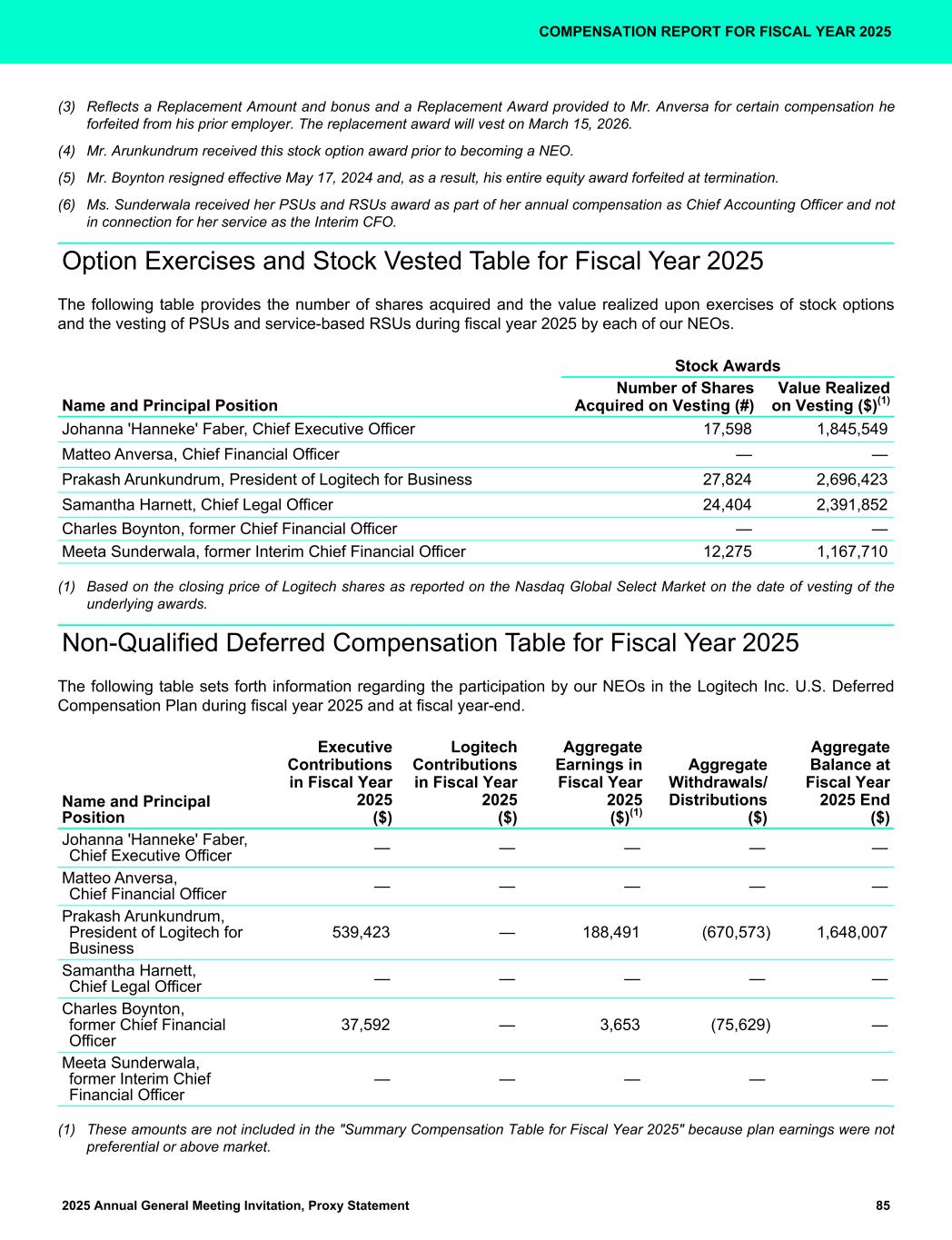
(3) Reflects a Replacement Amount and bonus and a Replacement Award provided to Mr. Anversa for certain compensation he forfeited from his prior employer. The replacement award will vest on March 15, 2026. (4) Mr. Arunkundrum received this stock option award prior to becoming a NEO. (5) Mr. Boynton resigned effective May 17, 2024 and, as a result, his entire equity award forfeited at termination. (6) Ms. Sunderwala received her PSUs and RSUs award as part of her annual compensation as Chief Accounting Officer and not in connection for her service as the Interim CFO. Option Exercises and Stock Vested Table for Fiscal Year 2025 The following table provides the number of shares acquired and the value realized upon exercises of stock options and the vesting of PSUs and service-based RSUs during fiscal year 2025 by each of our NEOs. Stock Awards Name and Principal Position Number of Shares Acquired on Vesting (#) Value Realized on Vesting ($)(1) Johanna 'Hanneke' Faber, Chief Executive Officer 17,598 1,845,549 Matteo Anversa, Chief Financial Officer — — Prakash Arunkundrum, President of Logitech for Business 27,824 2,696,423 Samantha Harnett, Chief Legal Officer 24,404 2,391,852 Charles Boynton, former Chief Financial Officer — — Meeta Sunderwala, former Interim Chief Financial Officer 12,275 1,167,710 (1) Based on the closing price of Logitech shares as reported on the Nasdaq Global Select Market on the date of vesting of the underlying awards. Non-Qualified Deferred Compensation Table for Fiscal Year 2025 The following table sets forth information regarding the participation by our NEOs in the Logitech Inc. U.S. Deferred Compensation Plan during fiscal year 2025 and at fiscal year-end. Name and Principal Position Executive Contributions in Fiscal Year 2025 ($) Logitech Contributions in Fiscal Year 2025 ($) Aggregate Earnings in Fiscal Year 2025 ($)(1) Aggregate Withdrawals/ Distributions ($) Aggregate Balance at Fiscal Year 2025 End ($) Johanna 'Hanneke' Faber, Chief Executive Officer — — — — — Matteo Anversa, Chief Financial Officer — — — — — Prakash Arunkundrum, President of Logitech for Business 539,423 — 188,491 (670,573) 1,648,007 Samantha Harnett, Chief Legal Officer — — — — — Charles Boynton, former Chief Financial Officer 37,592 — 3,653 (75,629) — Meeta Sunderwala, former Interim Chief Financial Officer — — — — — (1) These amounts are not included in the "Summary Compensation Table for Fiscal Year 2025" because plan earnings were not preferential or above market. COMPENSATION REPORT FOR FISCAL YEAR 2025 2025 Annual General Meeting Invitation, Proxy Statement 85
Refer to “Compensation Discussion and Analysis—Compensation Elements—Deferred Compensation Plan” for a discussion of the Logitech Inc. U.S. Deferred Compensation Plan, effective January 1, 2009, as amended and restated effective January 1, 2017. Payments upon Termination or Change in Control We have entered into agreements that provide for payments under certain circumstances in the event of termination of employment or service of our NEOs. These agreements include: • PSU and RSU award agreements that provide for the accelerated vesting of the shares subject to the award agreements under certain circumstances described below. • Employment or other agreements with our NEOs, under which each of them is entitled to receive a twelve- or nine-month notice period or becomes subject to non-competition provisions if we terminate his or her employment or if he or she resigns. Other than as set forth above, there are no agreements or arrangements for the payment of compensation or acceleration of equity awards or any other payments to a NEO upon a change in control or in the event of his or her involuntary termination with or without cause. PSU and RSU Award Agreements The treatment of equity upon termination of employment depends on the reason for termination and the employee’s age and length of service at termination. Change in Control The PSU and RSU award agreements for NEOs provide for the acceleration of vesting of the equity awards subject to the award agreements if the NEO is subject to an involuntary termination of employment within 12 months after a change in control because his or her employment is terminated without cause or the NEO resigns for good reason. In the event of such an involuntary termination following a change in control, all shares subject to the service-based RSUs will vest. At the time of the change in control, the PSUs would be converted into service-based RSUs that would continue to vest for the duration of the original vesting period with the number of shares based on the attainment of actual performance as determined by the Compensation Committee. If, following the change in control, an involuntary termination without cause occurs within 12 months of a change of control during the performance period, the converted PSUs accelerate and the NEO receives a prorated number of the shares based on the length of service during the performance period. Death and Disability If a NEO dies or has a separation of service due to disability, all shares subject to the service-based RSUs will vest. For PSUs, if the separation of service occurs during the performance period, the vesting accelerates and the NEO or the NEO’s estate receives a prorated number of the target shares based on the length of service during the performance period. Retirement If an named executive officer has a separation of service after meeting the age and service requirement, as applicable, all shares subject to the service-based RSUs will continue to vest. For PSUs, if separation of service occurs during the performance period, the award continues to vest and the NEO receives a prorated number of the actual earned shares at the regular vesting date based on the length of service during the performance period. The age and service requirement for the NEOs is generally age 55 with at least 10 years of service. Tables of Potential Payments Upon Involuntary Termination After Change in Control The table below estimates the amount of compensation that would be paid in the event of an involuntary termination of employment of a NEO without cause after a change in control, assuming that each of the terminations was effective as of March 31, 2025, subject to the terms of the PSU and RSU award agreements with each of the listed NEOs. Since December 2015, we do not have any cash payment related to termination of employment or change in control in compliance with applicable Swiss regulations. COMPENSATION REPORT FOR FISCAL YEAR 2025 86 2025 Annual General Meeting Invitation, Proxy Statement
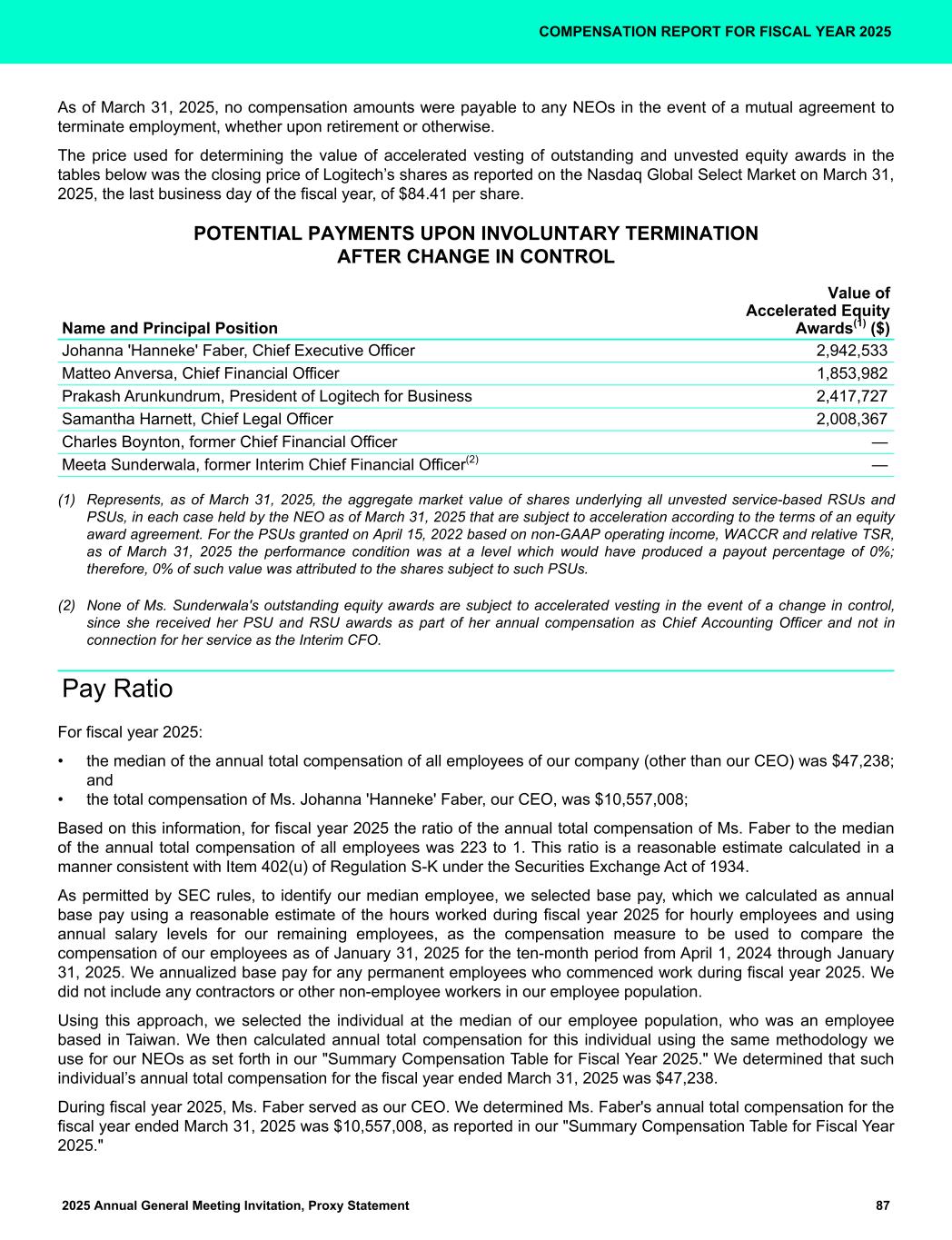
As of March 31, 2025, no compensation amounts were payable to any NEOs in the event of a mutual agreement to terminate employment, whether upon retirement or otherwise. The price used for determining the value of accelerated vesting of outstanding and unvested equity awards in the tables below was the closing price of Logitech’s shares as reported on the Nasdaq Global Select Market on March 31, 2025, the last business day of the fiscal year, of $84.41 per share. POTENTIAL PAYMENTS UPON INVOLUNTARY TERMINATION AFTER CHANGE IN CONTROL Name and Principal Position Value of Accelerated Equity Awards(1) ($) Johanna 'Hanneke' Faber, Chief Executive Officer 2,942,533 Matteo Anversa, Chief Financial Officer 1,853,982 Prakash Arunkundrum, President of Logitech for Business 2,417,727 Samantha Harnett, Chief Legal Officer 2,008,367 Charles Boynton, former Chief Financial Officer — Meeta Sunderwala, former Interim Chief Financial Officer(2) — (1) Represents, as of March 31, 2025, the aggregate market value of shares underlying all unvested service-based RSUs and PSUs, in each case held by the NEO as of March 31, 2025 that are subject to acceleration according to the terms of an equity award agreement. For the PSUs granted on April 15, 2022 based on non-GAAP operating income, WACCR and relative TSR, as of March 31, 2025 the performance condition was at a level which would have produced a payout percentage of 0%; therefore, 0% of such value was attributed to the shares subject to such PSUs. (2) None of Ms. Sunderwala's outstanding equity awards are subject to accelerated vesting in the event of a change in control, since she received her PSU and RSU awards as part of her annual compensation as Chief Accounting Officer and not in connection for her service as the Interim CFO. Pay Ratio For fiscal year 2025: • the median of the annual total compensation of all employees of our company (other than our CEO) was $47,238; and • the total compensation of Ms. Johanna 'Hanneke' Faber, our CEO, was $10,557,008; Based on this information, for fiscal year 2025 the ratio of the annual total compensation of Ms. Faber to the median of the annual total compensation of all employees was 223 to 1. This ratio is a reasonable estimate calculated in a manner consistent with Item 402(u) of Regulation S-K under the Securities Exchange Act of 1934. As permitted by SEC rules, to identify our median employee, we selected base pay, which we calculated as annual base pay using a reasonable estimate of the hours worked during fiscal year 2025 for hourly employees and using annual salary levels for our remaining employees, as the compensation measure to be used to compare the compensation of our employees as of January 31, 2025 for the ten-month period from April 1, 2024 through January 31, 2025. We annualized base pay for any permanent employees who commenced work during fiscal year 2025. We did not include any contractors or other non-employee workers in our employee population. Using this approach, we selected the individual at the median of our employee population, who was an employee based in Taiwan. We then calculated annual total compensation for this individual using the same methodology we use for our NEOs as set forth in our "Summary Compensation Table for Fiscal Year 2025." We determined that such individual’s annual total compensation for the fiscal year ended March 31, 2025 was $47,238. During fiscal year 2025, Ms. Faber served as our CEO. We determined Ms. Faber's annual total compensation for the fiscal year ended March 31, 2025 was $10,557,008, as reported in our "Summary Compensation Table for Fiscal Year 2025." COMPENSATION REPORT FOR FISCAL YEAR 2025 2025 Annual General Meeting Invitation, Proxy Statement 87
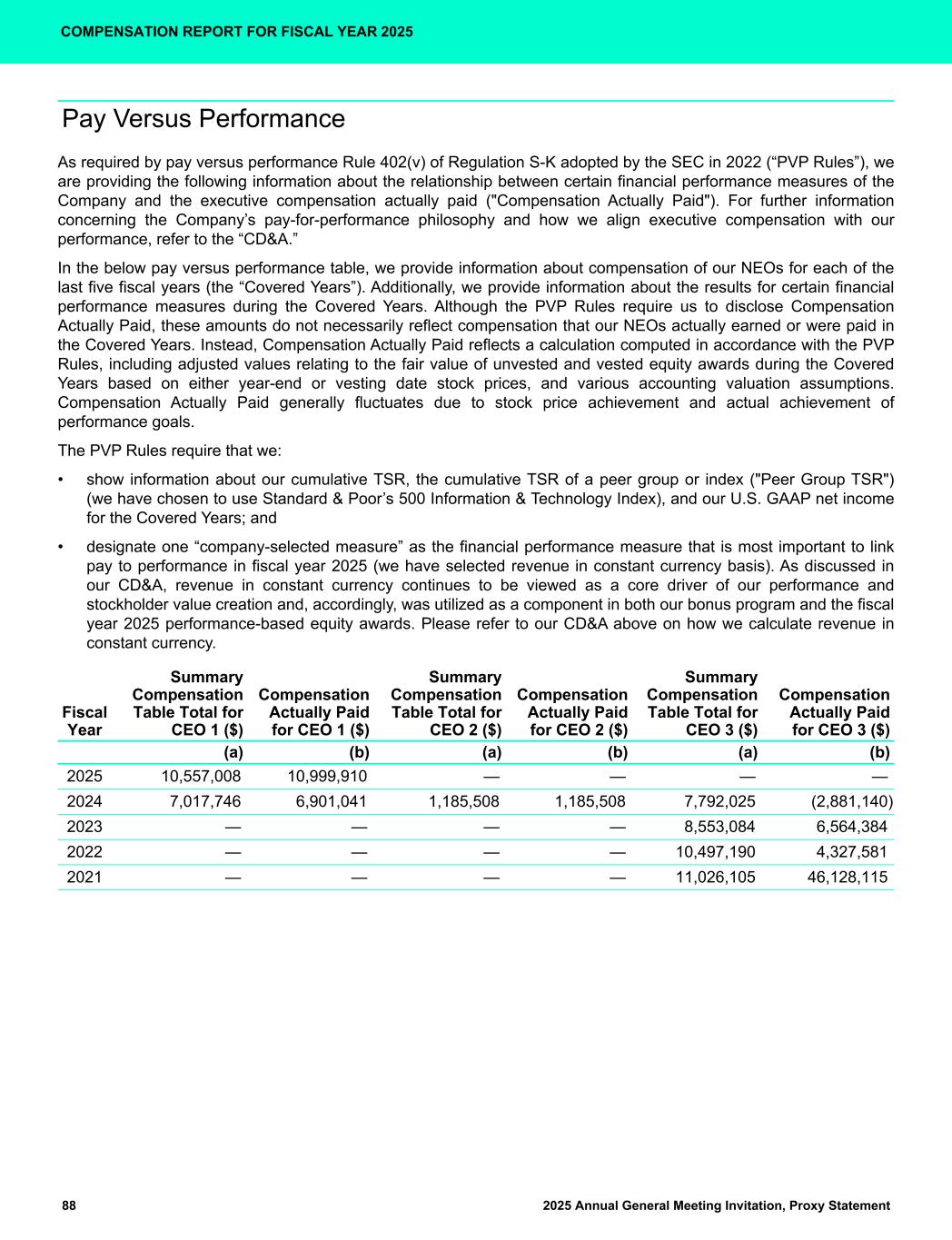
Pay Versus Performance As required by pay versus performance Rule 402(v) of Regulation S-K adopted by the SEC in 2022 (“PVP Rules”), we are providing the following information about the relationship between certain financial performance measures of the Company and the executive compensation actually paid ("Compensation Actually Paid"). For further information concerning the Company’s pay-for-performance philosophy and how we align executive compensation with our performance, refer to the “CD&A.” In the below pay versus performance table, we provide information about compensation of our NEOs for each of the last five fiscal years (the “Covered Years”). Additionally, we provide information about the results for certain financial performance measures during the Covered Years. Although the PVP Rules require us to disclose Compensation Actually Paid, these amounts do not necessarily reflect compensation that our NEOs actually earned or were paid in the Covered Years. Instead, Compensation Actually Paid reflects a calculation computed in accordance with the PVP Rules, including adjusted values relating to the fair value of unvested and vested equity awards during the Covered Years based on either year-end or vesting date stock prices, and various accounting valuation assumptions. Compensation Actually Paid generally fluctuates due to stock price achievement and actual achievement of performance goals. The PVP Rules require that we: • show information about our cumulative TSR, the cumulative TSR of a peer group or index ("Peer Group TSR") (we have chosen to use Standard & Poor’s 500 Information & Technology Index), and our U.S. GAAP net income for the Covered Years; and • designate one “company-selected measure” as the financial performance measure that is most important to link pay to performance in fiscal year 2025 (we have selected revenue in constant currency basis). As discussed in our CD&A, revenue in constant currency continues to be viewed as a core driver of our performance and stockholder value creation and, accordingly, was utilized as a component in both our bonus program and the fiscal year 2025 performance-based equity awards. Please refer to our CD&A above on how we calculate revenue in constant currency. Fiscal Year Summary Compensation Table Total for CEO 1 ($) Compensation Actually Paid for CEO 1 ($) Summary Compensation Table Total for CEO 2 ($) Compensation Actually Paid for CEO 2 ($) Summary Compensation Table Total for CEO 3 ($) Compensation Actually Paid for CEO 3 ($) (a) (b) (a) (b) (a) (b) 2025 10,557,008 10,999,910 — — — — 2024 7,017,746 6,901,041 1,185,508 1,185,508 7,792,025 (2,881,140) 2023 — — — — 8,553,084 6,564,384 2022 — — — — 10,497,190 4,327,581 2021 — — — — 11,026,105 46,128,115 COMPENSATION REPORT FOR FISCAL YEAR 2025 88 2025 Annual General Meeting Invitation, Proxy Statement
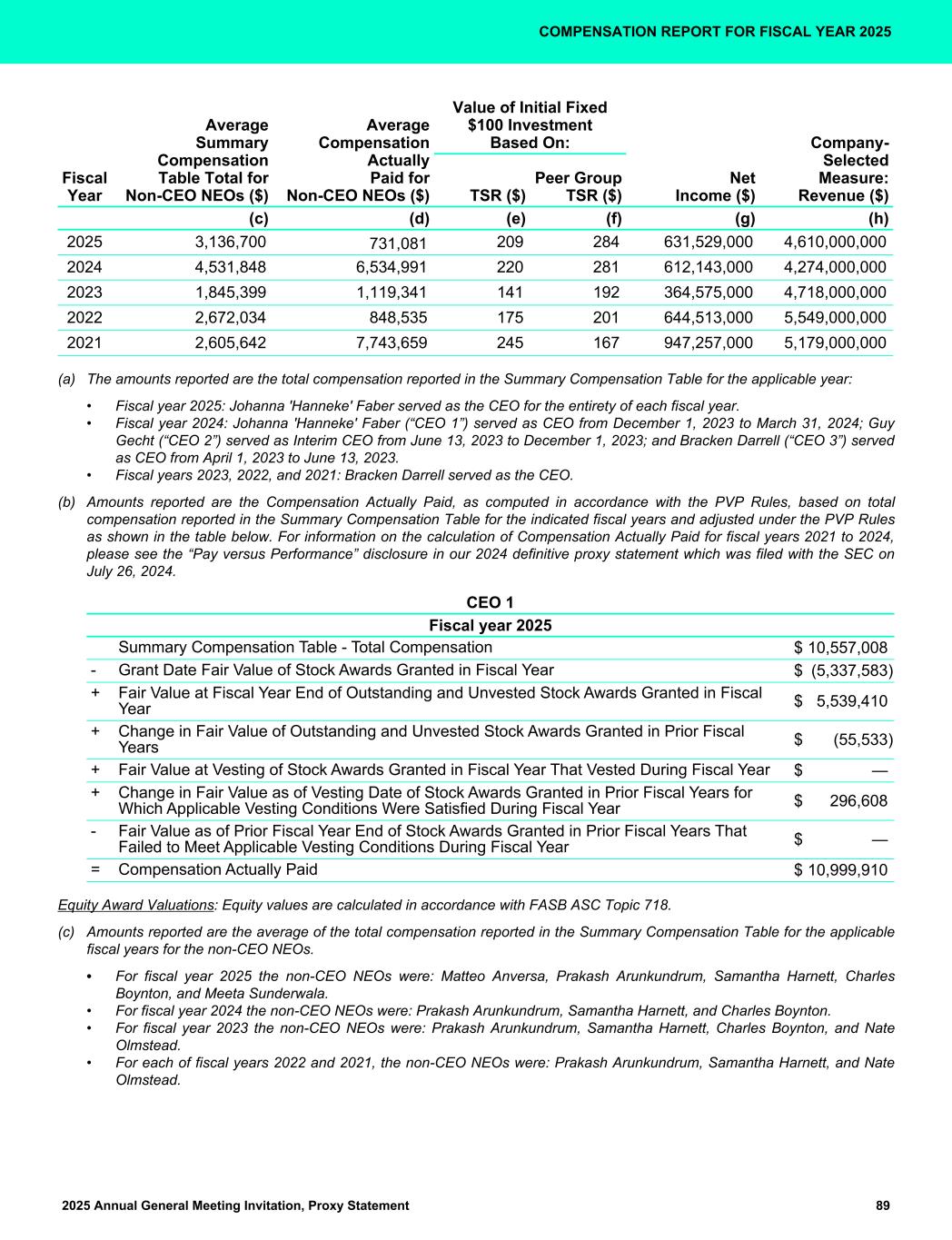
Average Summary Compensation Table Total for Non-CEO NEOs ($) Average Compensation Actually Paid for Non-CEO NEOs ($) Value of Initial Fixed $100 Investment Based On: Net Income ($) Company- Selected Measure: Revenue ($) Fiscal Year TSR ($) Peer Group TSR ($) (c) (d) (e) (f) (g) (h) 2025 3,136,700 731,081 209 284 631,529,000 4,610,000,000 2024 4,531,848 6,534,991 220 281 612,143,000 4,274,000,000 2023 1,845,399 1,119,341 141 192 364,575,000 4,718,000,000 2022 2,672,034 848,535 175 201 644,513,000 5,549,000,000 2021 2,605,642 7,743,659 245 167 947,257,000 5,179,000,000 (a) The amounts reported are the total compensation reported in the Summary Compensation Table for the applicable year: • Fiscal year 2025: Johanna 'Hanneke' Faber served as the CEO for the entirety of each fiscal year. • Fiscal year 2024: Johanna 'Hanneke' Faber (“CEO 1”) served as CEO from December 1, 2023 to March 31, 2024; Guy Gecht (“CEO 2”) served as Interim CEO from June 13, 2023 to December 1, 2023; and Bracken Darrell (“CEO 3”) served as CEO from April 1, 2023 to June 13, 2023. • Fiscal years 2023, 2022, and 2021: Bracken Darrell served as the CEO. (b) Amounts reported are the Compensation Actually Paid, as computed in accordance with the PVP Rules, based on total compensation reported in the Summary Compensation Table for the indicated fiscal years and adjusted under the PVP Rules as shown in the table below. For information on the calculation of Compensation Actually Paid for fiscal years 2021 to 2024, please see the “Pay versus Performance” disclosure in our 2024 definitive proxy statement which was filed with the SEC on July 26, 2024. CEO 1 Fiscal year 2025 Summary Compensation Table - Total Compensation $ 10,557,008 - Grant Date Fair Value of Stock Awards Granted in Fiscal Year $ (5,337,583) + Fair Value at Fiscal Year End of Outstanding and Unvested Stock Awards Granted in Fiscal Year $ 5,539,410 + Change in Fair Value of Outstanding and Unvested Stock Awards Granted in Prior Fiscal Years $ (55,533) + Fair Value at Vesting of Stock Awards Granted in Fiscal Year That Vested During Fiscal Year $ — + Change in Fair Value as of Vesting Date of Stock Awards Granted in Prior Fiscal Years for Which Applicable Vesting Conditions Were Satisfied During Fiscal Year $ 296,608 - Fair Value as of Prior Fiscal Year End of Stock Awards Granted in Prior Fiscal Years That Failed to Meet Applicable Vesting Conditions During Fiscal Year $ — = Compensation Actually Paid $ 10,999,910 Equity Award Valuations: Equity values are calculated in accordance with FASB ASC Topic 718. (c) Amounts reported are the average of the total compensation reported in the Summary Compensation Table for the applicable fiscal years for the non-CEO NEOs. • For fiscal year 2025 the non-CEO NEOs were: Matteo Anversa, Prakash Arunkundrum, Samantha Harnett, Charles Boynton, and Meeta Sunderwala. • For fiscal year 2024 the non-CEO NEOs were: Prakash Arunkundrum, Samantha Harnett, and Charles Boynton. • For fiscal year 2023 the non-CEO NEOs were: Prakash Arunkundrum, Samantha Harnett, Charles Boynton, and Nate Olmstead. • For each of fiscal years 2022 and 2021, the non-CEO NEOs were: Prakash Arunkundrum, Samantha Harnett, and Nate Olmstead. COMPENSATION REPORT FOR FISCAL YEAR 2025 2025 Annual General Meeting Invitation, Proxy Statement 89
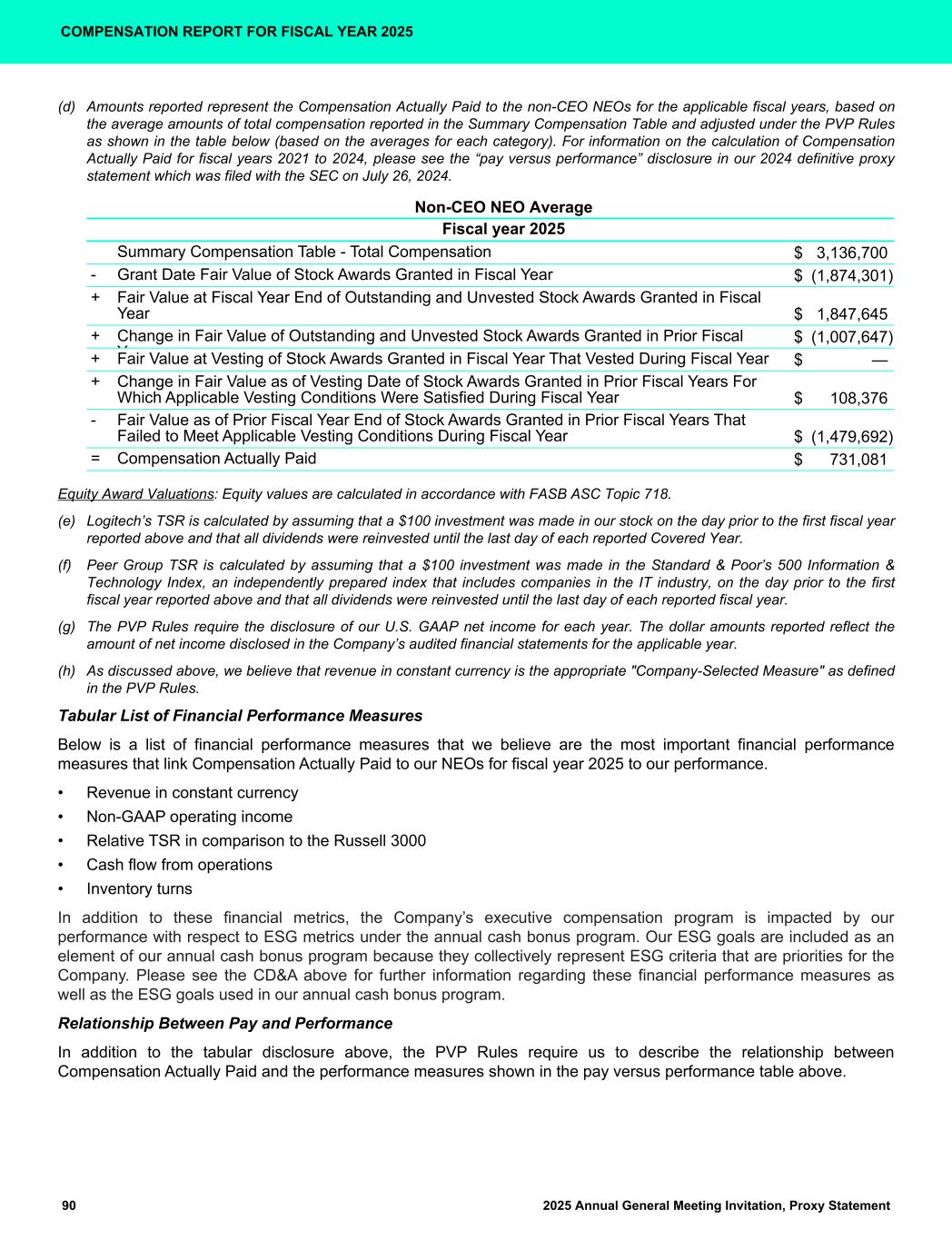
(d) Amounts reported represent the Compensation Actually Paid to the non-CEO NEOs for the applicable fiscal years, based on the average amounts of total compensation reported in the Summary Compensation Table and adjusted under the PVP Rules as shown in the table below (based on the averages for each category). For information on the calculation of Compensation Actually Paid for fiscal years 2021 to 2024, please see the “pay versus performance” disclosure in our 2024 definitive proxy statement which was filed with the SEC on July 26, 2024. Non-CEO NEO Average Fiscal year 2025 Summary Compensation Table - Total Compensation $ 3,136,700 - Grant Date Fair Value of Stock Awards Granted in Fiscal Year $ (1,874,301) + Fair Value at Fiscal Year End of Outstanding and Unvested Stock Awards Granted in Fiscal Year $ 1,847,645 + Change in Fair Value of Outstanding and Unvested Stock Awards Granted in Prior Fiscal Years $ (1,007,647) + Fair Value at Vesting of Stock Awards Granted in Fiscal Year That Vested During Fiscal Year $ — + Change in Fair Value as of Vesting Date of Stock Awards Granted in Prior Fiscal Years For Which Applicable Vesting Conditions Were Satisfied During Fiscal Year $ 108,376 - Fair Value as of Prior Fiscal Year End of Stock Awards Granted in Prior Fiscal Years That Failed to Meet Applicable Vesting Conditions During Fiscal Year $ (1,479,692) = Compensation Actually Paid $ 731,081 Equity Award Valuations: Equity values are calculated in accordance with FASB ASC Topic 718. (e) Logitech’s TSR is calculated by assuming that a $100 investment was made in our stock on the day prior to the first fiscal year reported above and that all dividends were reinvested until the last day of each reported Covered Year. (f) Peer Group TSR is calculated by assuming that a $100 investment was made in the Standard & Poor’s 500 Information & Technology Index, an independently prepared index that includes companies in the IT industry, on the day prior to the first fiscal year reported above and that all dividends were reinvested until the last day of each reported fiscal year. (g) The PVP Rules require the disclosure of our U.S. GAAP net income for each year. The dollar amounts reported reflect the amount of net income disclosed in the Company’s audited financial statements for the applicable year. (h) As discussed above, we believe that revenue in constant currency is the appropriate "Company-Selected Measure" as defined in the PVP Rules. Tabular List of Financial Performance Measures Below is a list of financial performance measures that we believe are the most important financial performance measures that link Compensation Actually Paid to our NEOs for fiscal year 2025 to our performance. • Revenue in constant currency • Non-GAAP operating income • Relative TSR in comparison to the Russell 3000 • Cash flow from operations • Inventory turns In addition to these financial metrics, the Company’s executive compensation program is impacted by our performance with respect to ESG metrics under the annual cash bonus program. Our ESG goals are included as an element of our annual cash bonus program because they collectively represent ESG criteria that are priorities for the Company. Please see the CD&A above for further information regarding these financial performance measures as well as the ESG goals used in our annual cash bonus program. Relationship Between Pay and Performance In addition to the tabular disclosure above, the PVP Rules require us to describe the relationship between Compensation Actually Paid and the performance measures shown in the pay versus performance table above. COMPENSATION REPORT FOR FISCAL YEAR 2025 90 2025 Annual General Meeting Invitation, Proxy Statement
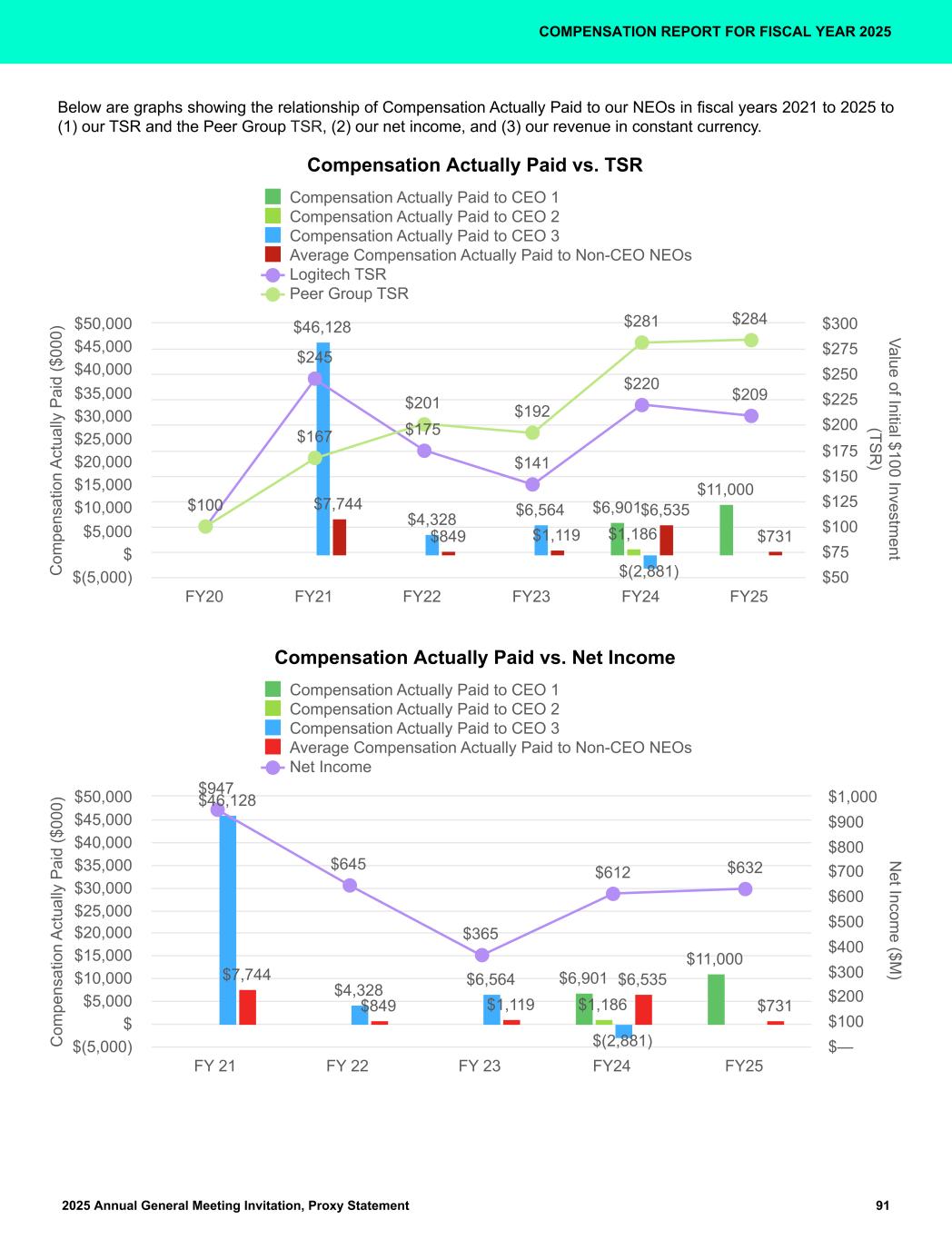
Below are graphs showing the relationship of Compensation Actually Paid to our NEOs in fiscal years 2021 to 2025 to (1) our TSR and the Peer Group TSR, (2) our net income, and (3) our revenue in constant currency. C om pe ns at io n A ct ua lly P ai d ($ 00 0) Value of Initial $100 Investm ent (TS R ) Compensation Actually Paid vs. TSR $6,901 $11,000 $1,186 $46,128 $4,328 $6,564 $(2,881) $7,744 $849 $1,119 $6,535 $731 $100 $245 $175 $141 $220 $209 $167 $201 $192 $281 $284 Compensation Actually Paid to CEO 1 Compensation Actually Paid to CEO 2 Compensation Actually Paid to CEO 3 Average Compensation Actually Paid to Non-CEO NEOs Logitech TSR Peer Group TSR FY20 FY21 FY22 FY23 FY24 FY25 $(5,000) $ $5,000 $10,000 $15,000 $20,000 $25,000 $30,000 $35,000 $40,000 $45,000 $50,000 $50 $75 $100 $125 $150 $175 $200 $225 $250 $275 $300 C om pe ns at io n A ct ua lly P ai d ($ 00 0) N et Incom e ($M ) Compensation Actually Paid vs. Net Income $6,901 $11,000 $1,186 $46,128 $4,328 $6,564 $(2,881) $7,744 $849 $1,119 $6,535 $731 $947 $645 $365 $612 $632 Compensation Actually Paid to CEO 1 Compensation Actually Paid to CEO 2 Compensation Actually Paid to CEO 3 Average Compensation Actually Paid to Non-CEO NEOs Net Income FY 21 FY 22 FY 23 FY24 FY25 $(5,000) $ $5,000 $10,000 $15,000 $20,000 $25,000 $30,000 $35,000 $40,000 $45,000 $50,000 $— $100 $200 $300 $400 $500 $600 $700 $800 $900 $1,000 COMPENSATION REPORT FOR FISCAL YEAR 2025 2025 Annual General Meeting Invitation, Proxy Statement 91
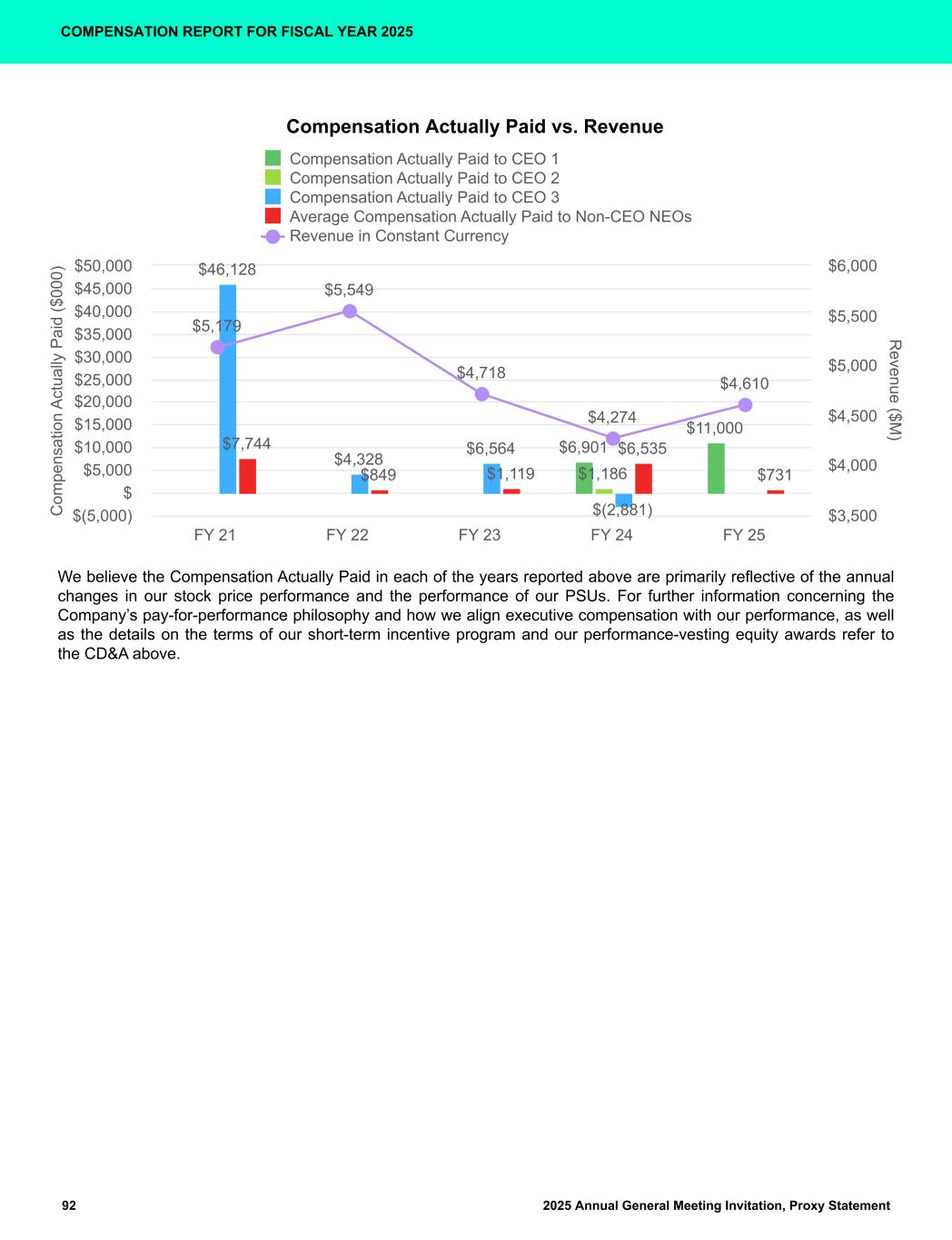
C om pe ns at io n A ct ua lly P ai d ($ 00 0) R evenue ($M ) Compensation Actually Paid vs. Revenue $6,901 $11,000 $1,186 $46,128 $4,328 $6,564 $(2,881) $7,744 $849 $1,119 $6,535 $731 $5,179 $5,549 $4,718 $4,274 $4,610 Compensation Actually Paid to CEO 1 Compensation Actually Paid to CEO 2 Compensation Actually Paid to CEO 3 Average Compensation Actually Paid to Non-CEO NEOs Revenue in Constant Currency FY 21 FY 22 FY 23 FY 24 FY 25 $(5,000) $ $5,000 $10,000 $15,000 $20,000 $25,000 $30,000 $35,000 $40,000 $45,000 $50,000 $3,500 $4,000 $4,500 $5,000 $5,500 $6,000 We believe the Compensation Actually Paid in each of the years reported above are primarily reflective of the annual changes in our stock price performance and the performance of our PSUs. For further information concerning the Company’s pay-for-performance philosophy and how we align executive compensation with our performance, as well as the details on the terms of our short-term incentive program and our performance-vesting equity awards refer to the CD&A above. COMPENSATION REPORT FOR FISCAL YEAR 2025 92 2025 Annual General Meeting Invitation, Proxy Statement
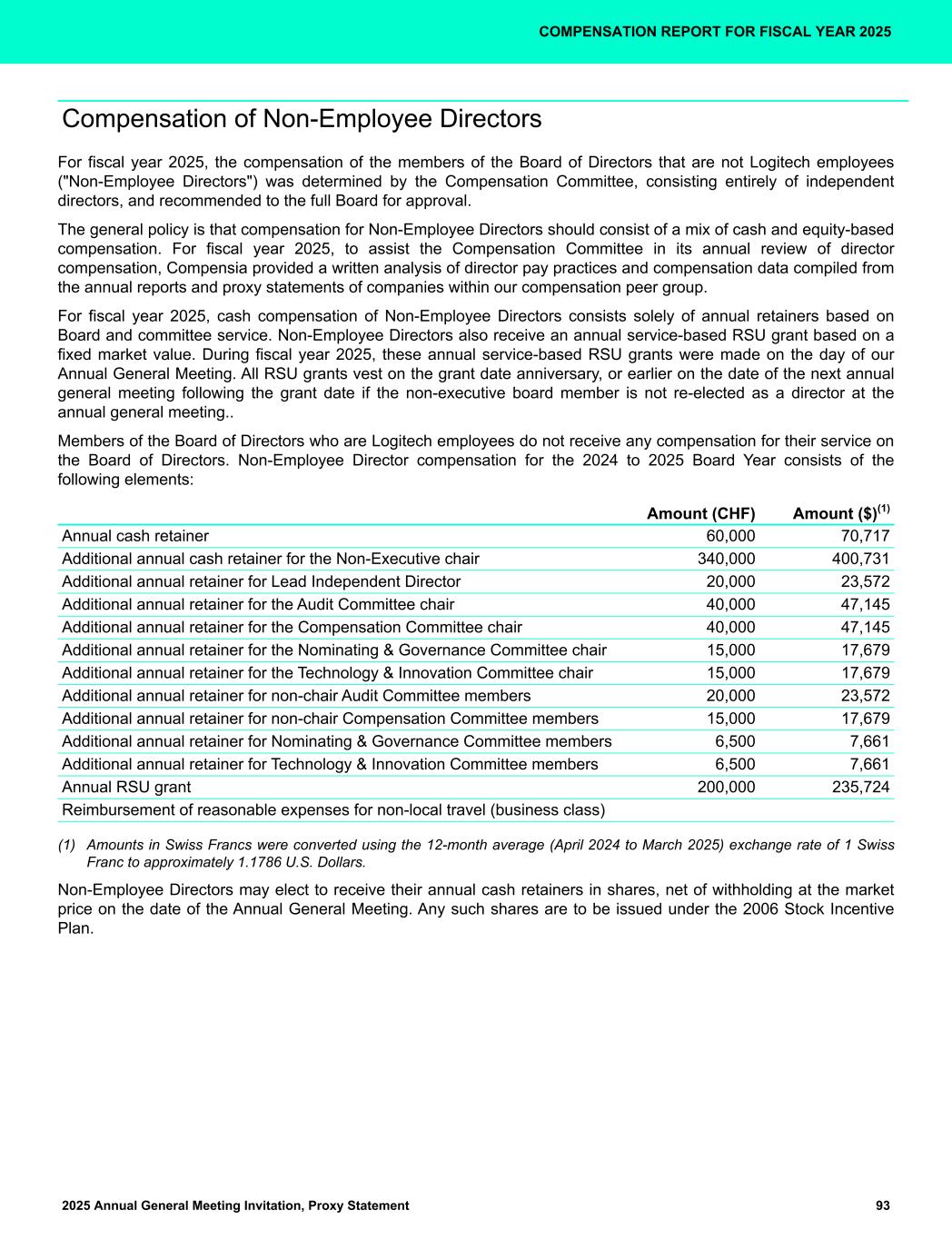
Compensation of Non-Employee Directors For fiscal year 2025, the compensation of the members of the Board of Directors that are not Logitech employees ("Non-Employee Directors") was determined by the Compensation Committee, consisting entirely of independent directors, and recommended to the full Board for approval. The general policy is that compensation for Non-Employee Directors should consist of a mix of cash and equity-based compensation. For fiscal year 2025, to assist the Compensation Committee in its annual review of director compensation, Compensia provided a written analysis of director pay practices and compensation data compiled from the annual reports and proxy statements of companies within our compensation peer group. For fiscal year 2025, cash compensation of Non-Employee Directors consists solely of annual retainers based on Board and committee service. Non-Employee Directors also receive an annual service-based RSU grant based on a fixed market value. During fiscal year 2025, these annual service-based RSU grants were made on the day of our Annual General Meeting. All RSU grants vest on the grant date anniversary, or earlier on the date of the next annual general meeting following the grant date if the non-executive board member is not re-elected as a director at the annual general meeting.. Members of the Board of Directors who are Logitech employees do not receive any compensation for their service on the Board of Directors. Non-Employee Director compensation for the 2024 to 2025 Board Year consists of the following elements: Amount (CHF) Amount ($)(1) Annual cash retainer 60,000 70,717 Additional annual cash retainer for the Non-Executive chair 340,000 400,731 Additional annual retainer for Lead Independent Director 20,000 23,572 Additional annual retainer for the Audit Committee chair 40,000 47,145 Additional annual retainer for the Compensation Committee chair 40,000 47,145 Additional annual retainer for the Nominating & Governance Committee chair 15,000 17,679 Additional annual retainer for the Technology & Innovation Committee chair 15,000 17,679 Additional annual retainer for non-chair Audit Committee members 20,000 23,572 Additional annual retainer for non-chair Compensation Committee members 15,000 17,679 Additional annual retainer for Nominating & Governance Committee members 6,500 7,661 Additional annual retainer for Technology & Innovation Committee members 6,500 7,661 Annual RSU grant 200,000 235,724 Reimbursement of reasonable expenses for non-local travel (business class) (1) Amounts in Swiss Francs were converted using the 12-month average (April 2024 to March 2025) exchange rate of 1 Swiss Franc to approximately 1.1786 U.S. Dollars. Non-Employee Directors may elect to receive their annual cash retainers in shares, net of withholding at the market price on the date of the Annual General Meeting. Any such shares are to be issued under the 2006 Stock Incentive Plan. COMPENSATION REPORT FOR FISCAL YEAR 2025 2025 Annual General Meeting Invitation, Proxy Statement 93

The following table summarizes the total compensation earned or paid during fiscal year 2025 to Non-Employee Directors who served on the Board of Directors during the year. Because the table is based on Logitech’s fiscal year, and annual service for purposes of Board compensation is measured between the dates of Logitech’s Annual General Meetings, usually held in September each year, the amounts in the table do not necessarily align with the description of Board compensation above. NON-EMPLOYEE DIRECTOR COMPENSATION TABLE FOR FISCAL YEAR 2025 Name Fees Earned in Cash ($)(1) Stock Awards ($)(1,2) Total ($) Patrick Aebischer(3) 33,591 n/a 33,591 Donald Allan(4) 50,512 232,082 282,594 Wendy Becker 471,448 232,082 703,530 Edouard Bugnion 83,071 232,082 315,153 Guy Gecht 80,114 232,082 312,196 Christopher Jones 86,039 232,082 318,121 Marjorie Lao 101,951 232,082 334,033 Owen Mahoney(4) 58,258 232,082 290,340 Neela Montgomery 88,397 232,082 320,479 Kwok Wang Ng 127,964 232,082 360,046 Deborah Thomas 139,919 232,082 372,001 Sascha Zahnd(5) 88,401 232,082 320,483 (1) Amounts in Swiss Francs were converted using the exchange rate on the Annual General Meeting date of 1 Swiss Franc to approximately 1.1786 U.S. Dollars. (2) These amounts do not represent the actual economic value realized by the Non-Employee Directors. Under SEC rules, these amounts reflect the aggregate grant date fair value of stock awards granted to each of the Non-Employee Directors. The key assumptions and methodology of valuation of stock awards and stock options are presented in Note 4 to the Consolidated Financial Statements included in Logitech’s Annual Report to Shareholders. (3) Mr. Aebischer did not stand for re-election as a Non-Employee Director at the Annual General Meeting in September 2024. "Fees Earned in Cash" reflects a prorated amount earned until such date and he did not receive any stock awards for fiscal year 2024. (4) Messrs. Allan and Mahoney received prorated cash retainers for their 2024 to 2025 Board Year service in fiscal year 2025. (5) Mr. Zahnd's fees earned in cash is reduced by the pension contributions in the amount of $10,266 as he is not exempted from mandatory occupational benefit plans in Switzerland. COMPENSATION REPORT FOR FISCAL YEAR 2025 94 2025 Annual General Meeting Invitation, Proxy Statement
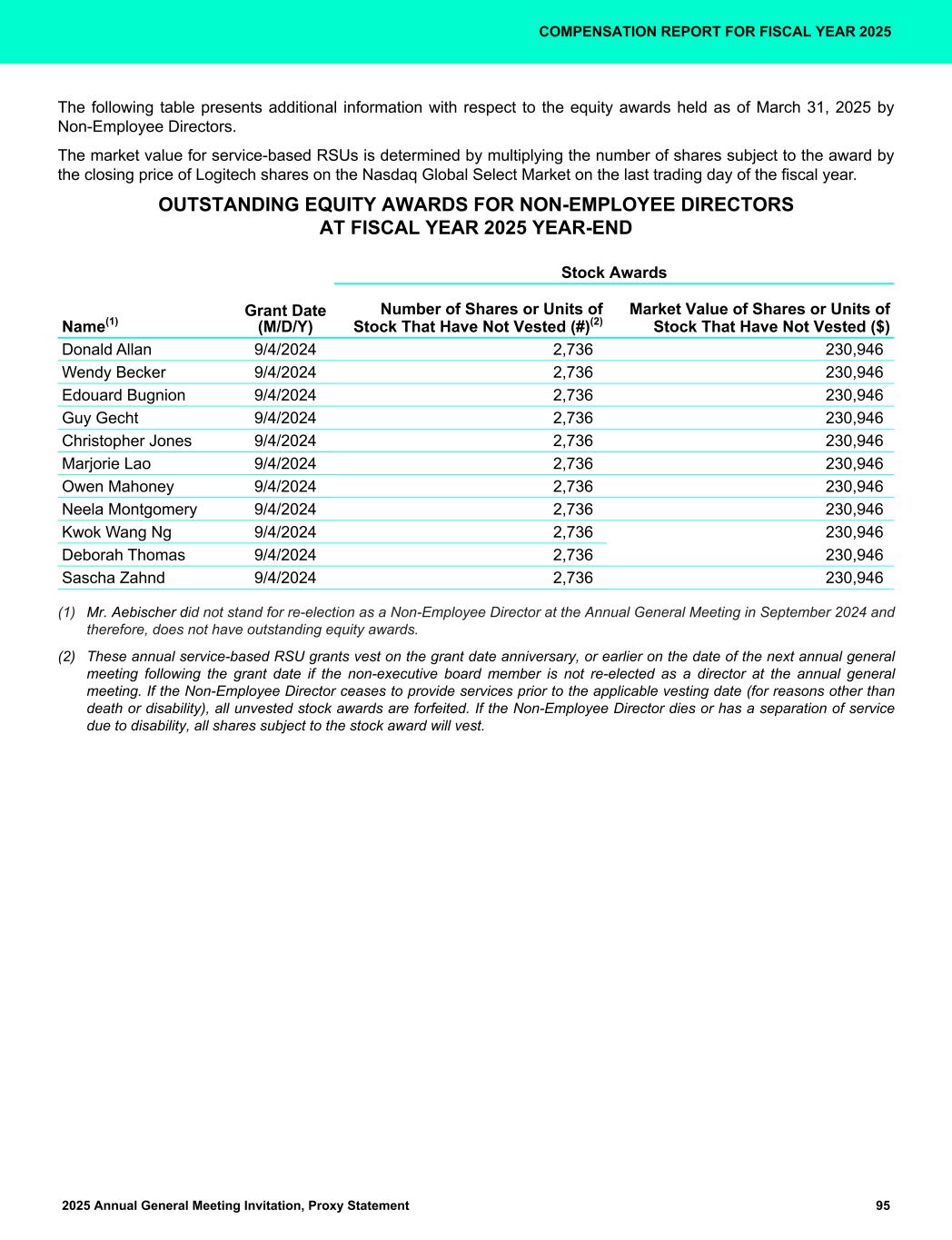
The following table presents additional information with respect to the equity awards held as of March 31, 2025 by Non-Employee Directors. The market value for service-based RSUs is determined by multiplying the number of shares subject to the award by the closing price of Logitech shares on the Nasdaq Global Select Market on the last trading day of the fiscal year. OUTSTANDING EQUITY AWARDS FOR NON-EMPLOYEE DIRECTORS AT FISCAL YEAR 2025 YEAR-END Stock Awards Name(1) Grant Date (M/D/Y) Number of Shares or Units of Stock That Have Not Vested (#)(2) Market Value of Shares or Units of Stock That Have Not Vested ($) Donald Allan 9/4/2024 2,736 230,946 Wendy Becker 9/4/2024 2,736 230,946 Edouard Bugnion 9/4/2024 2,736 230,946 Guy Gecht 9/4/2024 2,736 230,946 Christopher Jones 9/4/2024 2,736 230,946 Marjorie Lao 9/4/2024 2,736 230,946 Owen Mahoney 9/4/2024 2,736 230,946 Neela Montgomery 9/4/2024 2,736 230,946 Kwok Wang Ng 9/4/2024 2,736 230,946 Deborah Thomas 9/4/2024 2,736 230,946 Sascha Zahnd 9/4/2024 2,736 230,946 (1) Mr. Aebischer did not stand for re-election as a Non-Employee Director at the Annual General Meeting in September 2024 and therefore, does not have outstanding equity awards. (2) These annual service-based RSU grants vest on the grant date anniversary, or earlier on the date of the next annual general meeting following the grant date if the non-executive board member is not re-elected as a director at the annual general meeting. If the Non-Employee Director ceases to provide services prior to the applicable vesting date (for reasons other than death or disability), all unvested stock awards are forfeited. If the Non-Employee Director dies or has a separation of service due to disability, all shares subject to the stock award will vest. COMPENSATION REPORT FOR FISCAL YEAR 2025 2025 Annual General Meeting Invitation, Proxy Statement 95
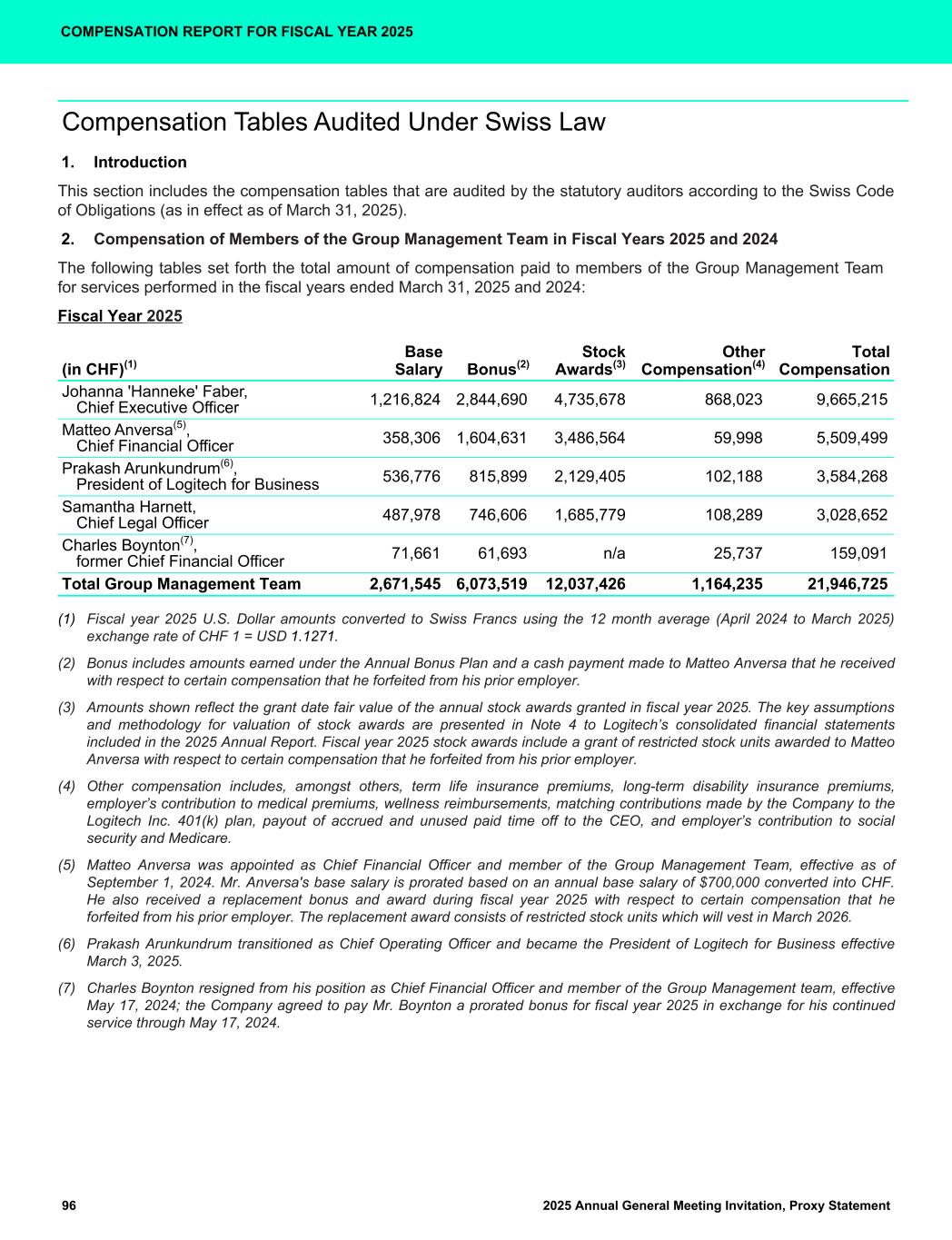
Compensation Tables Audited Under Swiss Law 1. Introduction This section includes the compensation tables that are audited by the statutory auditors according to the Swiss Code of Obligations (as in effect as of March 31, 2025). 2. Compensation of Members of the Group Management Team in Fiscal Years 2025 and 2024 The following tables set forth the total amount of compensation paid to members of the Group Management Team for services performed in the fiscal years ended March 31, 2025 and 2024: Fiscal Year 2025 (in CHF)(1) Base Salary Bonus(2) Stock Awards(3) Other Compensation(4) Total Compensation Johanna 'Hanneke' Faber, Chief Executive Officer 1,216,824 2,844,690 4,735,678 868,023 9,665,215 Matteo Anversa(5), Chief Financial Officer 358,306 1,604,631 3,486,564 59,998 5,509,499 Prakash Arunkundrum(6), President of Logitech for Business 536,776 815,899 2,129,405 102,188 3,584,268 Samantha Harnett, Chief Legal Officer 487,978 746,606 1,685,779 108,289 3,028,652 Charles Boynton(7), former Chief Financial Officer 71,661 61,693 n/a 25,737 159,091 Total Group Management Team 2,671,545 6,073,519 12,037,426 1,164,235 21,946,725 (1) Fiscal year 2025 U.S. Dollar amounts converted to Swiss Francs using the 12 month average (April 2024 to March 2025) exchange rate of CHF 1 = USD 1.1271. (2) Bonus includes amounts earned under the Annual Bonus Plan and a cash payment made to Matteo Anversa that he received with respect to certain compensation that he forfeited from his prior employer. (3) Amounts shown reflect the grant date fair value of the annual stock awards granted in fiscal year 2025. The key assumptions and methodology for valuation of stock awards are presented in Note 4 to Logitech’s consolidated financial statements included in the 2025 Annual Report. Fiscal year 2025 stock awards include a grant of restricted stock units awarded to Matteo Anversa with respect to certain compensation that he forfeited from his prior employer. (4) Other compensation includes, amongst others, term life insurance premiums, long-term disability insurance premiums, employer’s contribution to medical premiums, wellness reimbursements, matching contributions made by the Company to the Logitech Inc. 401(k) plan, payout of accrued and unused paid time off to the CEO, and employer’s contribution to social security and Medicare. (5) Matteo Anversa was appointed as Chief Financial Officer and member of the Group Management Team, effective as of September 1, 2024. Mr. Anversa's base salary is prorated based on an annual base salary of $700,000 converted into CHF. He also received a replacement bonus and award during fiscal year 2025 with respect to certain compensation that he forfeited from his prior employer. The replacement award consists of restricted stock units which will vest in March 2026. (6) Prakash Arunkundrum transitioned as Chief Operating Officer and became the President of Logitech for Business effective March 3, 2025. (7) Charles Boynton resigned from his position as Chief Financial Officer and member of the Group Management team, effective May 17, 2024; the Company agreed to pay Mr. Boynton a prorated bonus for fiscal year 2025 in exchange for his continued service through May 17, 2024. COMPENSATION REPORT FOR FISCAL YEAR 2025 96 2025 Annual General Meeting Invitation, Proxy Statement
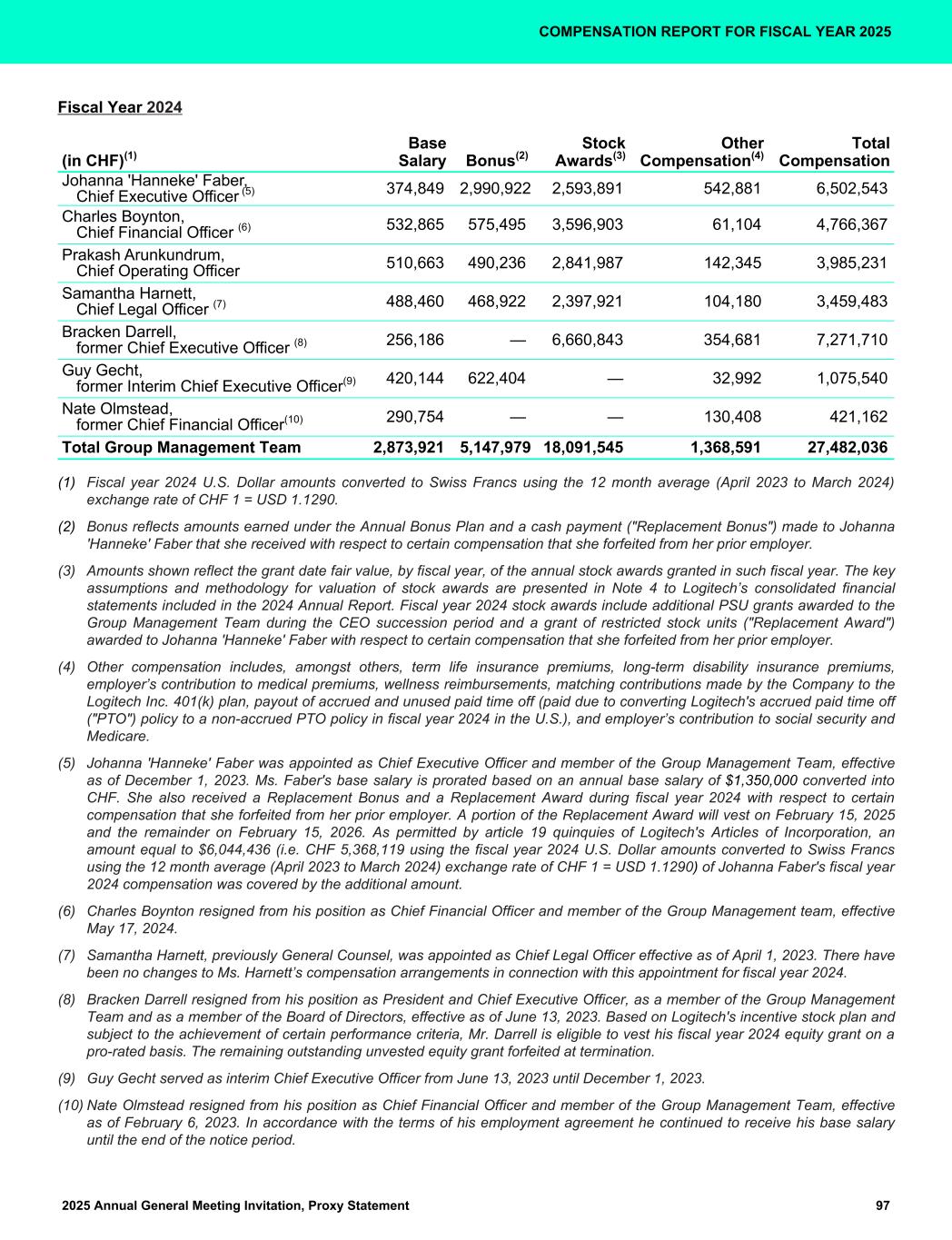
Fiscal Year 2024 (in CHF)(1) Base Salary Bonus(2) Stock Awards(3) Other Compensation(4) Total Compensation Johanna 'Hanneke' Faber, Chief Executive Officer (5) 374,849 2,990,922 2,593,891 542,881 6,502,543 Charles Boynton, Chief Financial Officer (6) 532,865 575,495 3,596,903 61,104 4,766,367 Prakash Arunkundrum, Chief Operating Officer 510,663 490,236 2,841,987 142,345 3,985,231 Samantha Harnett, Chief Legal Officer (7) 488,460 468,922 2,397,921 104,180 3,459,483 Bracken Darrell, former Chief Executive Officer (8) 256,186 — 6,660,843 354,681 7,271,710 Guy Gecht, former Interim Chief Executive Officer(9) 420,144 622,404 — 32,992 1,075,540 Nate Olmstead, former Chief Financial Officer(10) 290,754 — — 130,408 421,162 Total Group Management Team 2,873,921 5,147,979 18,091,545 1,368,591 27,482,036 (1) Fiscal year 2024 U.S. Dollar amounts converted to Swiss Francs using the 12 month average (April 2023 to March 2024) exchange rate of CHF 1 = USD 1.1290. (2) Bonus reflects amounts earned under the Annual Bonus Plan and a cash payment ("Replacement Bonus") made to Johanna 'Hanneke' Faber that she received with respect to certain compensation that she forfeited from her prior employer. (3) Amounts shown reflect the grant date fair value, by fiscal year, of the annual stock awards granted in such fiscal year. The key assumptions and methodology for valuation of stock awards are presented in Note 4 to Logitech’s consolidated financial statements included in the 2024 Annual Report. Fiscal year 2024 stock awards include additional PSU grants awarded to the Group Management Team during the CEO succession period and a grant of restricted stock units ("Replacement Award") awarded to Johanna 'Hanneke' Faber with respect to certain compensation that she forfeited from her prior employer. (4) Other compensation includes, amongst others, term life insurance premiums, long-term disability insurance premiums, employer’s contribution to medical premiums, wellness reimbursements, matching contributions made by the Company to the Logitech Inc. 401(k) plan, payout of accrued and unused paid time off (paid due to converting Logitech's accrued paid time off ("PTO") policy to a non-accrued PTO policy in fiscal year 2024 in the U.S.), and employer’s contribution to social security and Medicare. (5) Johanna 'Hanneke' Faber was appointed as Chief Executive Officer and member of the Group Management Team, effective as of December 1, 2023. Ms. Faber's base salary is prorated based on an annual base salary of $1,350,000 converted into CHF. She also received a Replacement Bonus and a Replacement Award during fiscal year 2024 with respect to certain compensation that she forfeited from her prior employer. A portion of the Replacement Award will vest on February 15, 2025 and the remainder on February 15, 2026. As permitted by article 19 quinquies of Logitech's Articles of Incorporation, an amount equal to $6,044,436 (i.e. CHF 5,368,119 using the fiscal year 2024 U.S. Dollar amounts converted to Swiss Francs using the 12 month average (April 2023 to March 2024) exchange rate of CHF 1 = USD 1.1290) of Johanna Faber's fiscal year 2024 compensation was covered by the additional amount. (6) Charles Boynton resigned from his position as Chief Financial Officer and member of the Group Management team, effective May 17, 2024. (7) Samantha Harnett, previously General Counsel, was appointed as Chief Legal Officer effective as of April 1, 2023. There have been no changes to Ms. Harnett’s compensation arrangements in connection with this appointment for fiscal year 2024. (8) Bracken Darrell resigned from his position as President and Chief Executive Officer, as a member of the Group Management Team and as a member of the Board of Directors, effective as of June 13, 2023. Based on Logitech's incentive stock plan and subject to the achievement of certain performance criteria, Mr. Darrell is eligible to vest his fiscal year 2024 equity grant on a pro-rated basis. The remaining outstanding unvested equity grant forfeited at termination. (9) Guy Gecht served as interim Chief Executive Officer from June 13, 2023 until December 1, 2023. (10) Nate Olmstead resigned from his position as Chief Financial Officer and member of the Group Management Team, effective as of February 6, 2023. In accordance with the terms of his employment agreement he continued to receive his base salary until the end of the notice period. COMPENSATION REPORT FOR FISCAL YEAR 2025 2025 Annual General Meeting Invitation, Proxy Statement 97
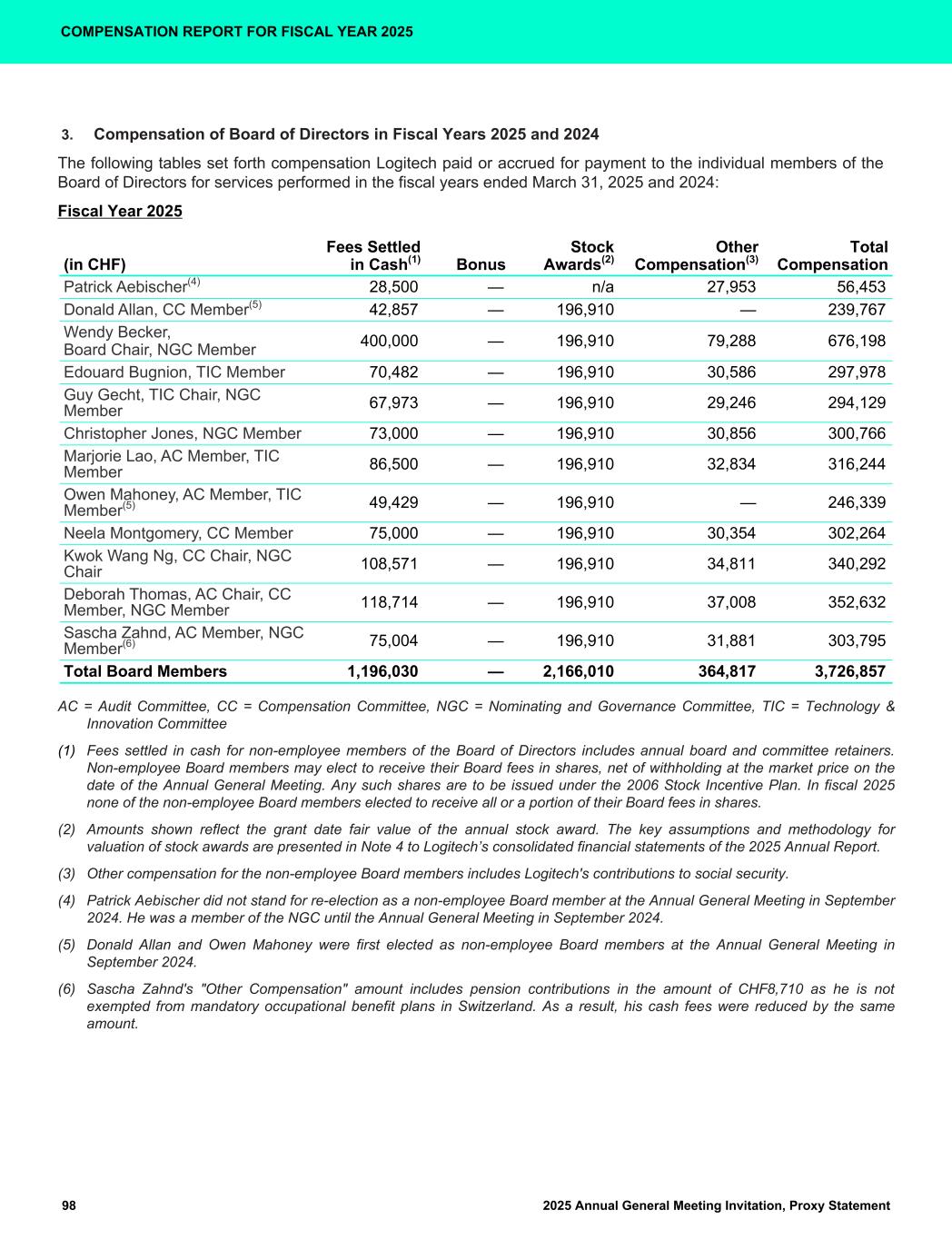
3. Compensation of Board of Directors in Fiscal Years 2025 and 2024 The following tables set forth compensation Logitech paid or accrued for payment to the individual members of the Board of Directors for services performed in the fiscal years ended March 31, 2025 and 2024: Fiscal Year 2025 (in CHF) Fees Settled in Cash(1) Bonus Stock Awards(2) Other Compensation(3) Total Compensation Patrick Aebischer(4) 28,500 — n/a 27,953 56,453 Donald Allan, CC Member(5) 42,857 — 196,910 — 239,767 Wendy Becker, Board Chair, NGC Member 400,000 — 196,910 79,288 676,198 Edouard Bugnion, TIC Member 70,482 — 196,910 30,586 297,978 Guy Gecht, TIC Chair, NGC Member 67,973 — 196,910 29,246 294,129 Christopher Jones, NGC Member 73,000 — 196,910 30,856 300,766 Marjorie Lao, AC Member, TIC Member 86,500 — 196,910 32,834 316,244 Owen Mahoney, AC Member, TIC Member(5) 49,429 — 196,910 — 246,339 Neela Montgomery, CC Member 75,000 — 196,910 30,354 302,264 Kwok Wang Ng, CC Chair, NGC Chair 108,571 — 196,910 34,811 340,292 Deborah Thomas, AC Chair, CC Member, NGC Member 118,714 — 196,910 37,008 352,632 Sascha Zahnd, AC Member, NGC Member(6) 75,004 — 196,910 31,881 303,795 Total Board Members 1,196,030 — 2,166,010 364,817 3,726,857 AC = Audit Committee, CC = Compensation Committee, NGC = Nominating and Governance Committee, TIC = Technology & Innovation Committee (1) Fees settled in cash for non-employee members of the Board of Directors includes annual board and committee retainers. Non-employee Board members may elect to receive their Board fees in shares, net of withholding at the market price on the date of the Annual General Meeting. Any such shares are to be issued under the 2006 Stock Incentive Plan. In fiscal 2025 none of the non-employee Board members elected to receive all or a portion of their Board fees in shares. (2) Amounts shown reflect the grant date fair value of the annual stock award. The key assumptions and methodology for valuation of stock awards are presented in Note 4 to Logitech’s consolidated financial statements of the 2025 Annual Report. (3) Other compensation for the non-employee Board members includes Logitech's contributions to social security. (4) Patrick Aebischer did not stand for re-election as a non-employee Board member at the Annual General Meeting in September 2024. He was a member of the NGC until the Annual General Meeting in September 2024. (5) Donald Allan and Owen Mahoney were first elected as non-employee Board members at the Annual General Meeting in September 2024. (6) Sascha Zahnd's "Other Compensation" amount includes pension contributions in the amount of CHF8,710 as he is not exempted from mandatory occupational benefit plans in Switzerland. As a result, his cash fees were reduced by the same amount. COMPENSATION REPORT FOR FISCAL YEAR 2025 98 2025 Annual General Meeting Invitation, Proxy Statement
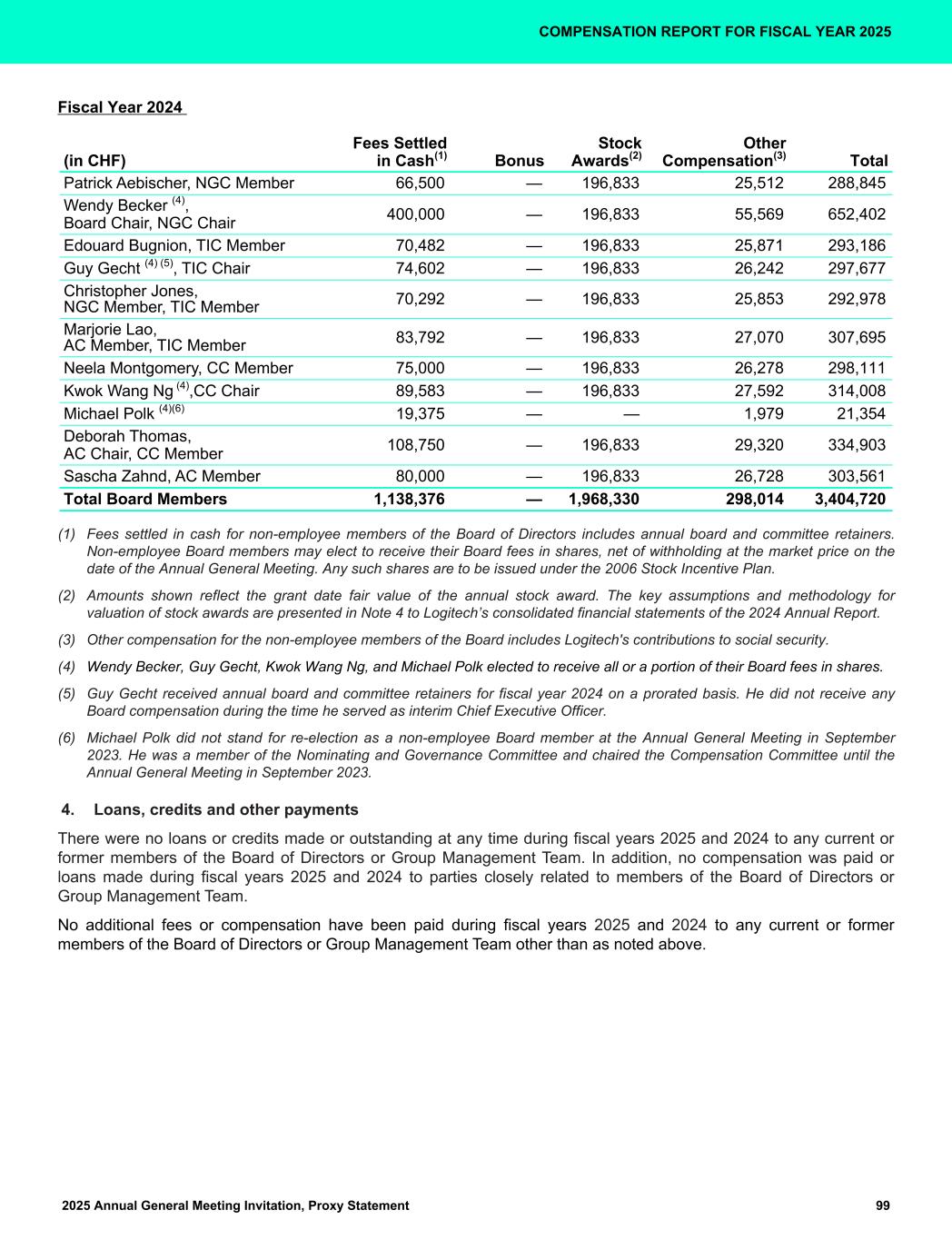
Fiscal Year 2024 (in CHF) Fees Settled in Cash(1) Bonus Stock Awards(2) Other Compensation(3) Total Patrick Aebischer, NGC Member 66,500 — 196,833 25,512 288,845 Wendy Becker (4), Board Chair, NGC Chair 400,000 — 196,833 55,569 652,402 Edouard Bugnion, TIC Member 70,482 — 196,833 25,871 293,186 Guy Gecht (4) (5), TIC Chair 74,602 — 196,833 26,242 297,677 Christopher Jones, NGC Member, TIC Member 70,292 — 196,833 25,853 292,978 Marjorie Lao, AC Member, TIC Member 83,792 — 196,833 27,070 307,695 Neela Montgomery, CC Member 75,000 — 196,833 26,278 298,111 Kwok Wang Ng (4),CC Chair 89,583 — 196,833 27,592 314,008 Michael Polk (4)(6) 19,375 — — 1,979 21,354 Deborah Thomas, AC Chair, CC Member 108,750 — 196,833 29,320 334,903 Sascha Zahnd, AC Member 80,000 — 196,833 26,728 303,561 Total Board Members 1,138,376 — 1,968,330 298,014 3,404,720 (1) Fees settled in cash for non-employee members of the Board of Directors includes annual board and committee retainers. Non-employee Board members may elect to receive their Board fees in shares, net of withholding at the market price on the date of the Annual General Meeting. Any such shares are to be issued under the 2006 Stock Incentive Plan. (2) Amounts shown reflect the grant date fair value of the annual stock award. The key assumptions and methodology for valuation of stock awards are presented in Note 4 to Logitech’s consolidated financial statements of the 2024 Annual Report. (3) Other compensation for the non-employee members of the Board includes Logitech's contributions to social security. (4) Wendy Becker, Guy Gecht, Kwok Wang Ng, and Michael Polk elected to receive all or a portion of their Board fees in shares. (5) Guy Gecht received annual board and committee retainers for fiscal year 2024 on a prorated basis. He did not receive any Board compensation during the time he served as interim Chief Executive Officer. (6) Michael Polk did not stand for re-election as a non-employee Board member at the Annual General Meeting in September 2023. He was a member of the Nominating and Governance Committee and chaired the Compensation Committee until the Annual General Meeting in September 2023. 4. Loans, credits and other payments There were no loans or credits made or outstanding at any time during fiscal years 2025 and 2024 to any current or former members of the Board of Directors or Group Management Team. In addition, no compensation was paid or loans made during fiscal years 2025 and 2024 to parties closely related to members of the Board of Directors or Group Management Team. No additional fees or compensation have been paid during fiscal years 2025 and 2024 to any current or former members of the Board of Directors or Group Management Team other than as noted above. COMPENSATION REPORT FOR FISCAL YEAR 2025 2025 Annual General Meeting Invitation, Proxy Statement 99
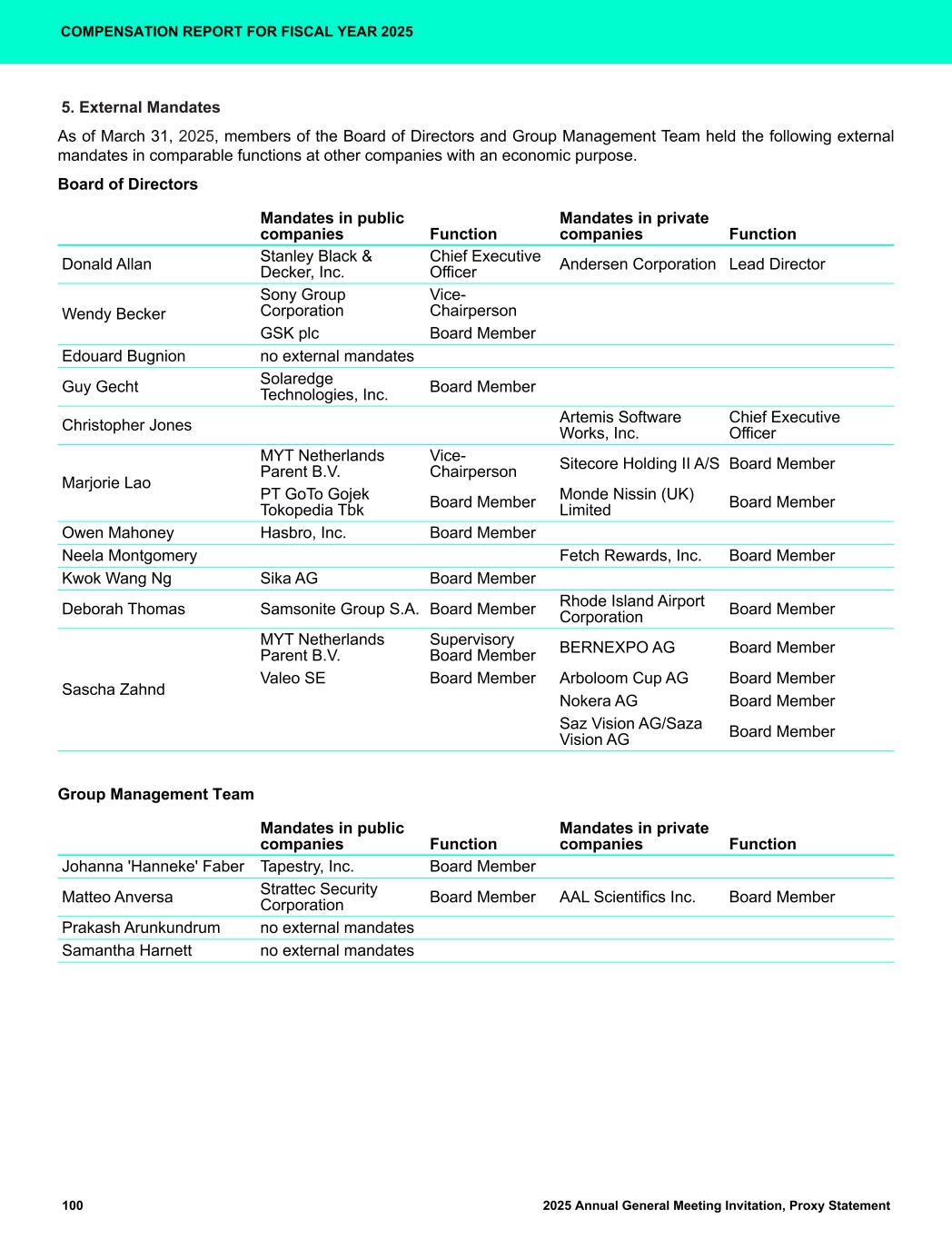
5. External Mandates As of March 31, 2025, members of the Board of Directors and Group Management Team held the following external mandates in comparable functions at other companies with an economic purpose. Board of Directors Mandates in public companies Function Mandates in private companies Function Donald Allan Stanley Black & Decker, Inc. Chief Executive Officer Andersen Corporation Lead Director Wendy Becker Sony Group Corporation Vice- Chairperson GSK plc Board Member Edouard Bugnion no external mandates Guy Gecht Solaredge Technologies, Inc. Board Member Christopher Jones Artemis Software Works, Inc. Chief Executive Officer Marjorie Lao MYT Netherlands Parent B.V. Vice- Chairperson Sitecore Holding II A/S Board Member PT GoTo Gojek Tokopedia Tbk Board Member Monde Nissin (UK) Limited Board Member Owen Mahoney Hasbro, Inc. Board Member Neela Montgomery Fetch Rewards, Inc. Board Member Kwok Wang Ng Sika AG Board Member Deborah Thomas Samsonite Group S.A. Board Member Rhode Island Airport Corporation Board Member Sascha Zahnd MYT Netherlands Parent B.V. Supervisory Board Member BERNEXPO AG Board Member Valeo SE Board Member Arboloom Cup AG Board Member Nokera AG Board Member Saz Vision AG/Saza Vision AG Board Member Group Management Team Mandates in public companies Function Mandates in private companies Function Johanna 'Hanneke' Faber Tapestry, Inc. Board Member Matteo Anversa Strattec Security Corporation Board Member AAL Scientifics Inc. Board Member Prakash Arunkundrum no external mandates Samantha Harnett no external mandates COMPENSATION REPORT FOR FISCAL YEAR 2025 100 2025 Annual General Meeting Invitation, Proxy Statement
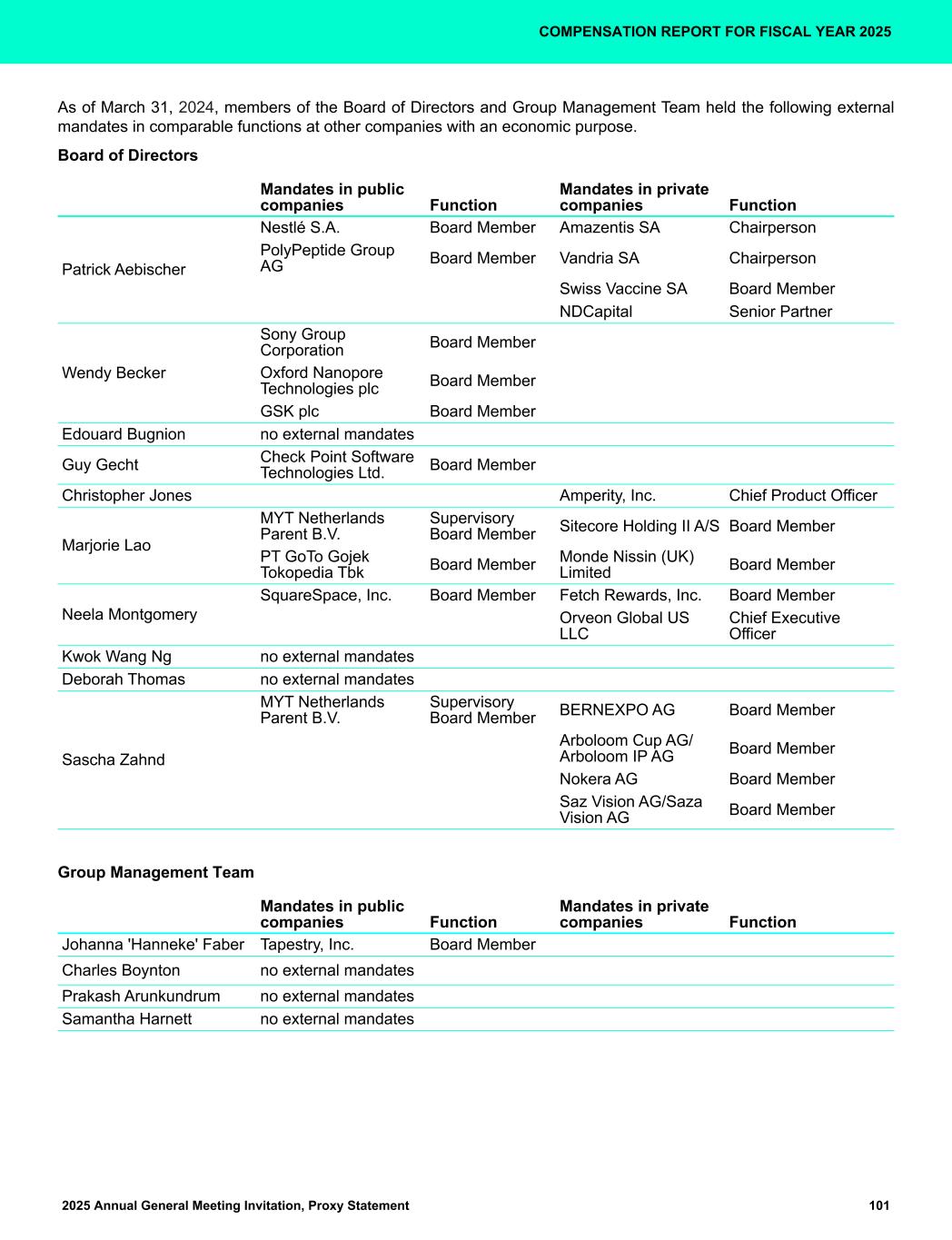
As of March 31, 2024, members of the Board of Directors and Group Management Team held the following external mandates in comparable functions at other companies with an economic purpose. Board of Directors Mandates in public companies Function Mandates in private companies Function Patrick Aebischer Nestlé S.A. Board Member Amazentis SA Chairperson PolyPeptide Group AG Board Member Vandria SA Chairperson Swiss Vaccine SA Board Member NDCapital Senior Partner Wendy Becker Sony Group Corporation Board Member Oxford Nanopore Technologies plc Board Member GSK plc Board Member Edouard Bugnion no external mandates Guy Gecht Check Point Software Technologies Ltd. Board Member Christopher Jones Amperity, Inc. Chief Product Officer Marjorie Lao MYT Netherlands Parent B.V. Supervisory Board Member Sitecore Holding II A/S Board Member PT GoTo Gojek Tokopedia Tbk Board Member Monde Nissin (UK) Limited Board Member Neela Montgomery SquareSpace, Inc. Board Member Fetch Rewards, Inc. Board Member Orveon Global US LLC Chief Executive Officer Kwok Wang Ng no external mandates Deborah Thomas no external mandates Sascha Zahnd MYT Netherlands Parent B.V. Supervisory Board Member BERNEXPO AG Board Member Arboloom Cup AG/ Arboloom IP AG Board Member Nokera AG Board Member Saz Vision AG/Saza Vision AG Board Member Group Management Team Mandates in public companies Function Mandates in private companies Function Johanna 'Hanneke' Faber Tapestry, Inc. Board Member Charles Boynton no external mandates Prakash Arunkundrum no external mandates Samantha Harnett no external mandates COMPENSATION REPORT FOR FISCAL YEAR 2025 2025 Annual General Meeting Invitation, Proxy Statement 101
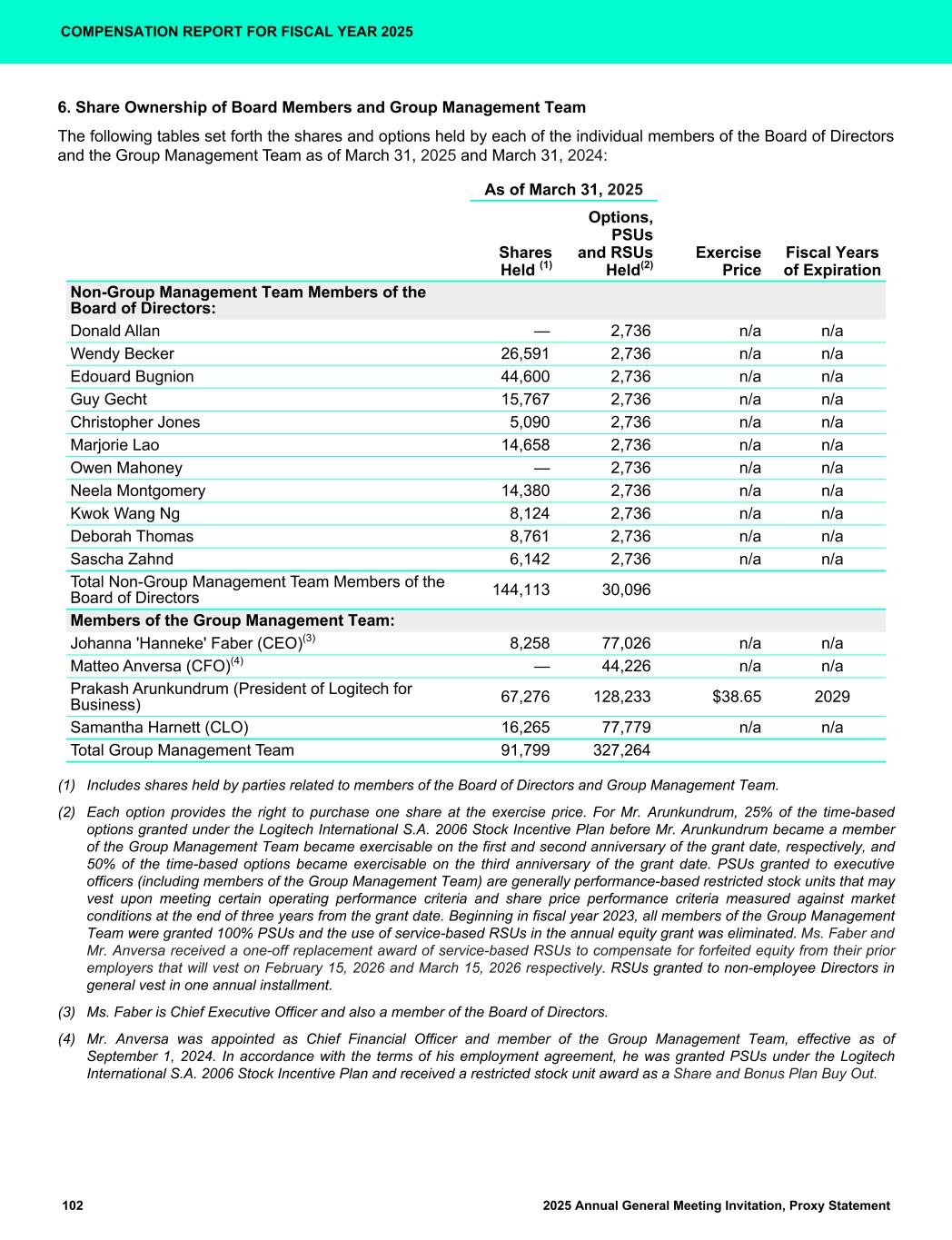
6. Share Ownership of Board Members and Group Management Team The following tables set forth the shares and options held by each of the individual members of the Board of Directors and the Group Management Team as of March 31, 2025 and March 31, 2024: As of March 31, 2025 Shares Held (1) Options, PSUs and RSUs Held(2) Exercise Price Fiscal Years of Expiration Non-Group Management Team Members of the Board of Directors: Donald Allan — 2,736 n/a n/a Wendy Becker 26,591 2,736 n/a n/a Edouard Bugnion 44,600 2,736 n/a n/a Guy Gecht 15,767 2,736 n/a n/a Christopher Jones 5,090 2,736 n/a n/a Marjorie Lao 14,658 2,736 n/a n/a Owen Mahoney — 2,736 n/a n/a Neela Montgomery 14,380 2,736 n/a n/a Kwok Wang Ng 8,124 2,736 n/a n/a Deborah Thomas 8,761 2,736 n/a n/a Sascha Zahnd 6,142 2,736 n/a n/a Total Non-Group Management Team Members of the Board of Directors 144,113 30,096 Members of the Group Management Team: Johanna 'Hanneke' Faber (CEO)(3) 8,258 77,026 n/a n/a Matteo Anversa (CFO)(4) — 44,226 n/a n/a Prakash Arunkundrum (President of Logitech for Business) 67,276 128,233 $38.65 2029 Samantha Harnett (CLO) 16,265 77,779 n/a n/a Total Group Management Team 91,799 327,264 (1) Includes shares held by parties related to members of the Board of Directors and Group Management Team. (2) Each option provides the right to purchase one share at the exercise price. For Mr. Arunkundrum, 25% of the time-based options granted under the Logitech International S.A. 2006 Stock Incentive Plan before Mr. Arunkundrum became a member of the Group Management Team became exercisable on the first and second anniversary of the grant date, respectively, and 50% of the time-based options became exercisable on the third anniversary of the grant date. PSUs granted to executive officers (including members of the Group Management Team) are generally performance-based restricted stock units that may vest upon meeting certain operating performance criteria and share price performance criteria measured against market conditions at the end of three years from the grant date. Beginning in fiscal year 2023, all members of the Group Management Team were granted 100% PSUs and the use of service-based RSUs in the annual equity grant was eliminated. Ms. Faber and Mr. Anversa received a one-off replacement award of service-based RSUs to compensate for forfeited equity from their prior employers that will vest on February 15, 2026 and March 15, 2026 respectively. RSUs granted to non-employee Directors in general vest in one annual installment. (3) Ms. Faber is Chief Executive Officer and also a member of the Board of Directors. (4) Mr. Anversa was appointed as Chief Financial Officer and member of the Group Management Team, effective as of September 1, 2024. In accordance with the terms of his employment agreement, he was granted PSUs under the Logitech International S.A. 2006 Stock Incentive Plan and received a restricted stock unit award as a Share and Bonus Plan Buy Out. COMPENSATION REPORT FOR FISCAL YEAR 2025 102 2025 Annual General Meeting Invitation, Proxy Statement
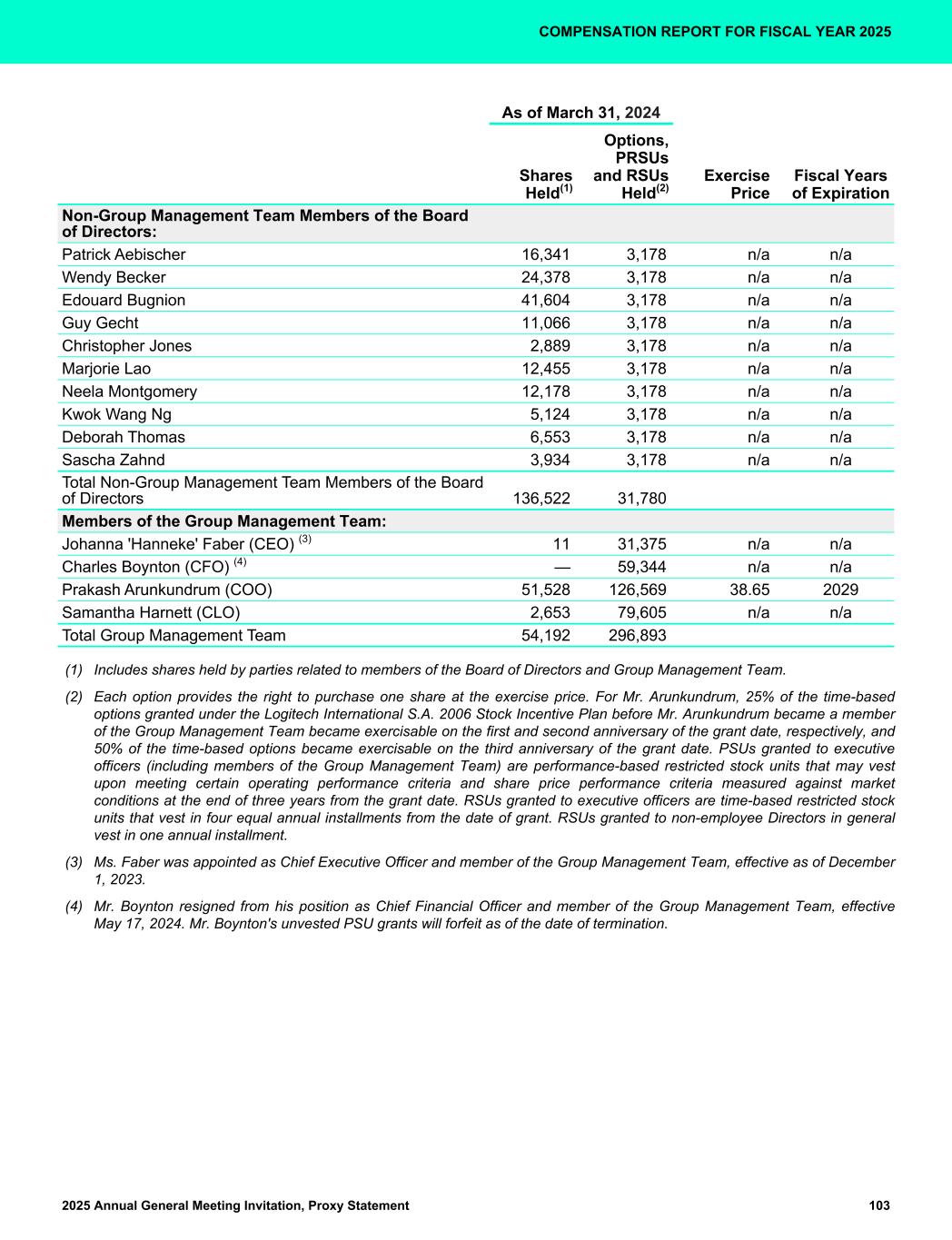
As of March 31, 2024 Shares Held(1) Options, PRSUs and RSUs Held(2) Exercise Price Fiscal Years of Expiration Non-Group Management Team Members of the Board of Directors: Patrick Aebischer 16,341 3,178 n/a n/a Wendy Becker 24,378 3,178 n/a n/a Edouard Bugnion 41,604 3,178 n/a n/a Guy Gecht 11,066 3,178 n/a n/a Christopher Jones 2,889 3,178 n/a n/a Marjorie Lao 12,455 3,178 n/a n/a Neela Montgomery 12,178 3,178 n/a n/a Kwok Wang Ng 5,124 3,178 n/a n/a Deborah Thomas 6,553 3,178 n/a n/a Sascha Zahnd 3,934 3,178 n/a n/a Total Non-Group Management Team Members of the Board of Directors 136,522 31,780 Members of the Group Management Team: Johanna 'Hanneke' Faber (CEO) (3) 11 31,375 n/a n/a Charles Boynton (CFO) (4) — 59,344 n/a n/a Prakash Arunkundrum (COO) 51,528 126,569 38.65 2029 Samantha Harnett (CLO) 2,653 79,605 n/a n/a Total Group Management Team 54,192 296,893 (1) Includes shares held by parties related to members of the Board of Directors and Group Management Team. (2) Each option provides the right to purchase one share at the exercise price. For Mr. Arunkundrum, 25% of the time-based options granted under the Logitech International S.A. 2006 Stock Incentive Plan before Mr. Arunkundrum became a member of the Group Management Team became exercisable on the first and second anniversary of the grant date, respectively, and 50% of the time-based options became exercisable on the third anniversary of the grant date. PSUs granted to executive officers (including members of the Group Management Team) are performance-based restricted stock units that may vest upon meeting certain operating performance criteria and share price performance criteria measured against market conditions at the end of three years from the grant date. RSUs granted to executive officers are time-based restricted stock units that vest in four equal annual installments from the date of grant. RSUs granted to non-employee Directors in general vest in one annual installment. (3) Ms. Faber was appointed as Chief Executive Officer and member of the Group Management Team, effective as of December 1, 2023. (4) Mr. Boynton resigned from his position as Chief Financial Officer and member of the Group Management Team, effective May 17, 2024. Mr. Boynton's unvested PSU grants will forfeit as of the date of termination. COMPENSATION REPORT FOR FISCAL YEAR 2025 2025 Annual General Meeting Invitation, Proxy Statement 103
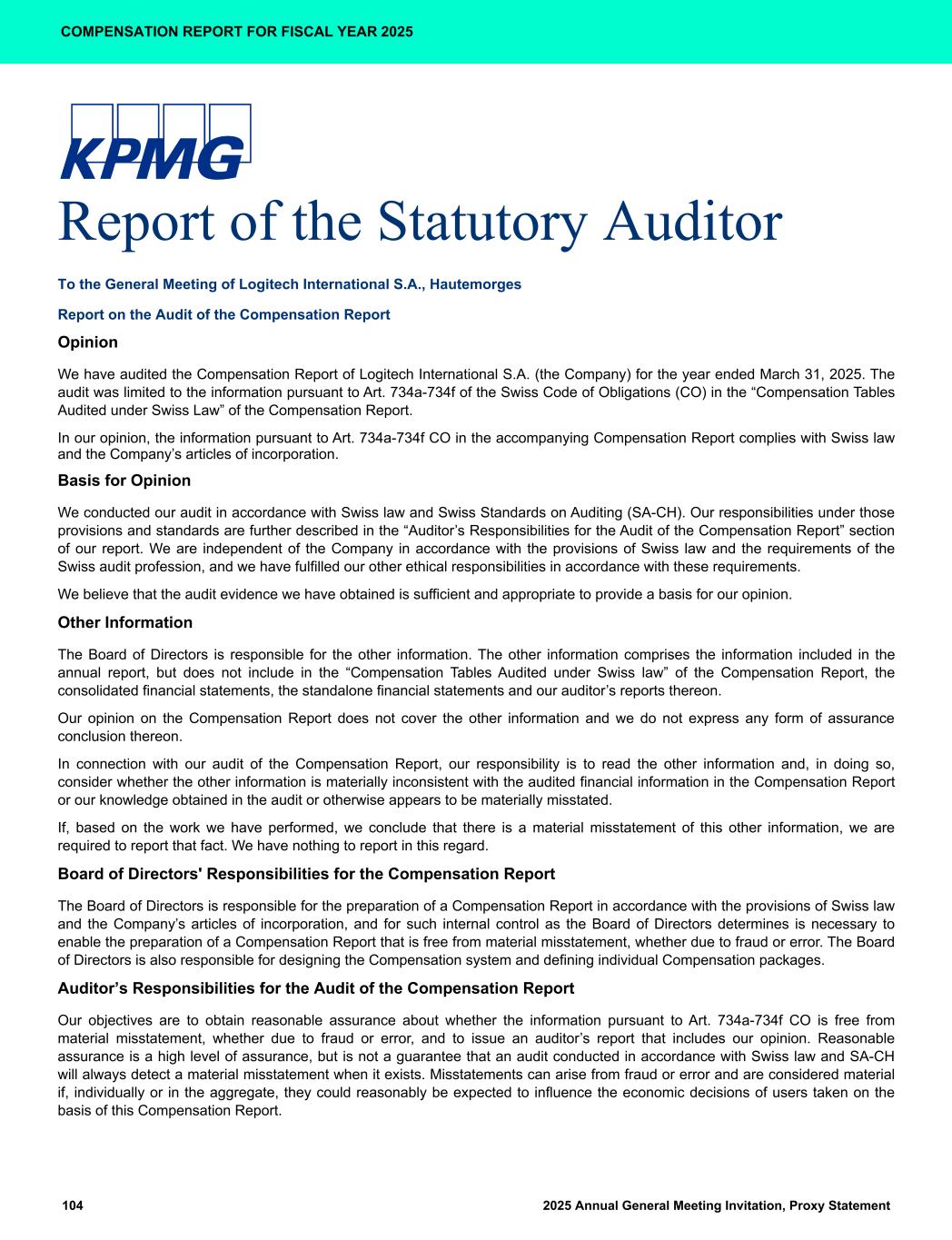
Report of the Statutory Auditor To the General Meeting of Logitech International S.A., Hautemorges Report on the Audit of the Compensation Report Opinion We have audited the Compensation Report of Logitech International S.A. (the Company) for the year ended March 31, 2025. The audit was limited to the information pursuant to Art. 734a-734f of the Swiss Code of Obligations (CO) in the “Compensation Tables Audited under Swiss Law” of the Compensation Report. In our opinion, the information pursuant to Art. 734a-734f CO in the accompanying Compensation Report complies with Swiss law and the Company’s articles of incorporation. Basis for Opinion We conducted our audit in accordance with Swiss law and Swiss Standards on Auditing (SA-CH). Our responsibilities under those provisions and standards are further described in the “Auditor’s Responsibilities for the Audit of the Compensation Report” section of our report. We are independent of the Company in accordance with the provisions of Swiss law and the requirements of the Swiss audit profession, and we have fulfilled our other ethical responsibilities in accordance with these requirements. We believe that the audit evidence we have obtained is sufficient and appropriate to provide a basis for our opinion. Other Information The Board of Directors is responsible for the other information. The other information comprises the information included in the annual report, but does not include in the “Compensation Tables Audited under Swiss law” of the Compensation Report, the consolidated financial statements, the standalone financial statements and our auditor’s reports thereon. Our opinion on the Compensation Report does not cover the other information and we do not express any form of assurance conclusion thereon. In connection with our audit of the Compensation Report, our responsibility is to read the other information and, in doing so, consider whether the other information is materially inconsistent with the audited financial information in the Compensation Report or our knowledge obtained in the audit or otherwise appears to be materially misstated. If, based on the work we have performed, we conclude that there is a material misstatement of this other information, we are required to report that fact. We have nothing to report in this regard. Board of Directors' Responsibilities for the Compensation Report The Board of Directors is responsible for the preparation of a Compensation Report in accordance with the provisions of Swiss law and the Company’s articles of incorporation, and for such internal control as the Board of Directors determines is necessary to enable the preparation of a Compensation Report that is free from material misstatement, whether due to fraud or error. The Board of Directors is also responsible for designing the Compensation system and defining individual Compensation packages. Auditor’s Responsibilities for the Audit of the Compensation Report Our objectives are to obtain reasonable assurance about whether the information pursuant to Art. 734a-734f CO is free from material misstatement, whether due to fraud or error, and to issue an auditor’s report that includes our opinion. Reasonable assurance is a high level of assurance, but is not a guarantee that an audit conducted in accordance with Swiss law and SA-CH will always detect a material misstatement when it exists. Misstatements can arise from fraud or error and are considered material if, individually or in the aggregate, they could reasonably be expected to influence the economic decisions of users taken on the basis of this Compensation Report. COMPENSATION REPORT FOR FISCAL YEAR 2025 104 2025 Annual General Meeting Invitation, Proxy Statement
As part of an audit in accordance with Swiss law and SA-CH, we exercise professional judgement and maintain professional skepticism throughout the audit. We also: – Identify and assess the risks of material misstatement in the Compensation Report, whether due to fraud or error, design and perform audit procedures responsive to those risks, and obtain audit evidence that is sufficient and appropriate to provide a basis for our opinion. The risk of not detecting a material misstatement resulting from fraud is higher than for one resulting from error, as fraud may involve collusion, forgery, intentional omissions, misrepresentations, or the override of internal control. – Obtain an understanding of internal control relevant to the audit in order to design audit procedures that are appropriate in the circumstances, but not for the purpose of expressing an opinion on the effectiveness of the Company’s internal control. – Evaluate the appropriateness of accounting policies used and the reasonableness of accounting estimates and related disclosures made. We communicate with the Board of Directors or its relevant committee regarding, among other matters, the planned scope and timing of the audit and significant audit findings, including any significant deficiencies in internal control that we identify during our audit. We also provide the Board of Directors or its relevant committee with a statement that we have complied with relevant ethical requirements regarding independence, and to communicate with them all relationships and other matters that may reasonably be thought to bear on our independence, and where applicable, actions taken to eliminate threats or safeguards applied. KPMG AG Regula Tobler Stefan Widmer Licensed Audit Expert Auditor in Charge Licensed Audit Expert Zurich, 23 May, 2025 Enclosure: - Compensation Tables Audited under Swiss Law COMPENSATION REPORT FOR FISCAL YEAR 2025 2025 Annual General Meeting Invitation, Proxy Statement 105
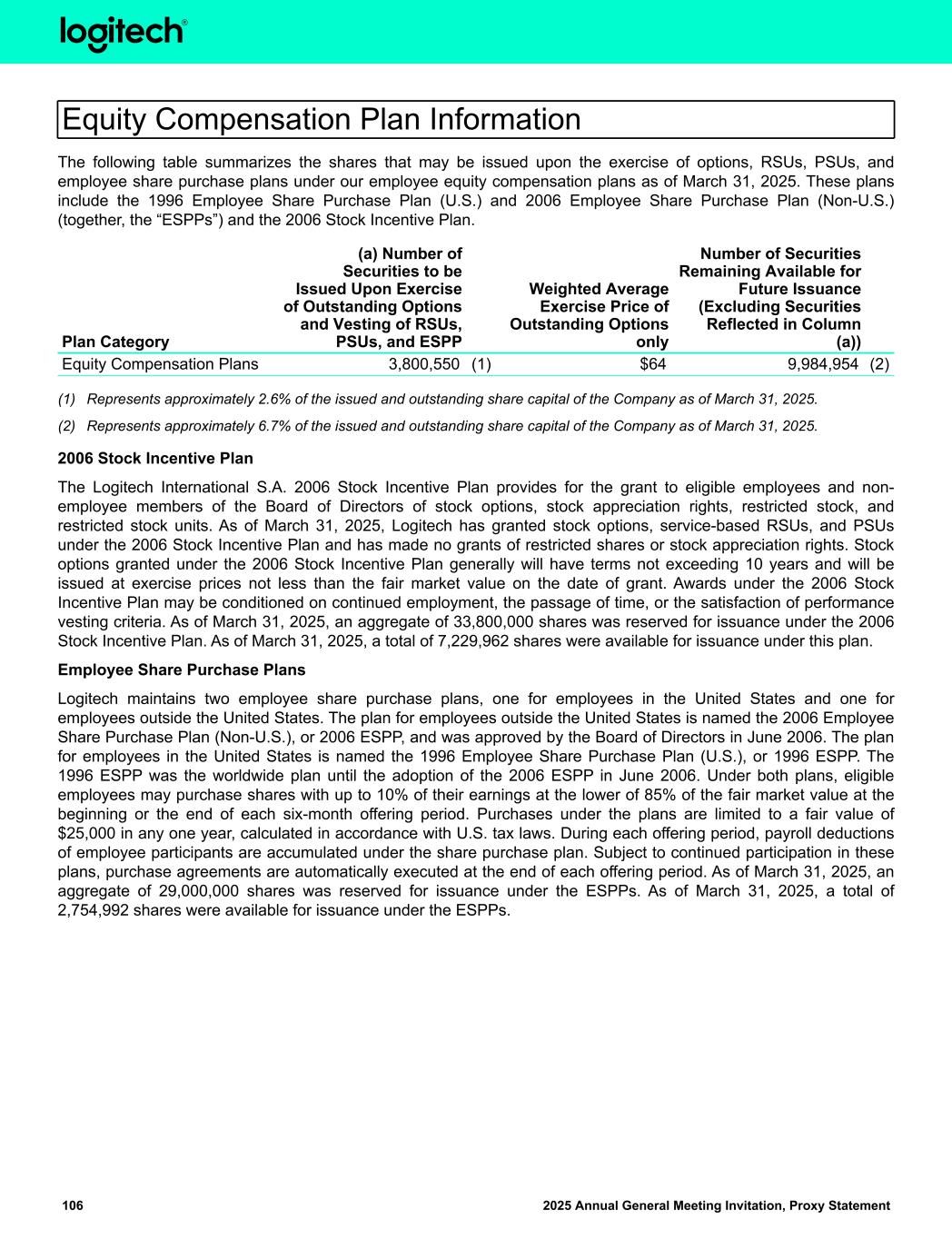
Equity Compensation Plan Information The following table summarizes the shares that may be issued upon the exercise of options, RSUs, PSUs, and employee share purchase plans under our employee equity compensation plans as of March 31, 2025. These plans include the 1996 Employee Share Purchase Plan (U.S.) and 2006 Employee Share Purchase Plan (Non-U.S.) (together, the “ESPPs”) and the 2006 Stock Incentive Plan. Plan Category (a) Number of Securities to be Issued Upon Exercise of Outstanding Options and Vesting of RSUs, PSUs, and ESPP Weighted Average Exercise Price of Outstanding Options only Number of Securities Remaining Available for Future Issuance (Excluding Securities Reflected in Column (a)) Equity Compensation Plans 3,800,550 (1) $64 9,984,954 (2) (1) Represents approximately 2.6% of the issued and outstanding share capital of the Company as of March 31, 2025. (2) Represents approximately 6.7% of the issued and outstanding share capital of the Company as of March 31, 2025. 2006 Stock Incentive Plan The Logitech International S.A. 2006 Stock Incentive Plan provides for the grant to eligible employees and non- employee members of the Board of Directors of stock options, stock appreciation rights, restricted stock, and restricted stock units. As of March 31, 2025, Logitech has granted stock options, service-based RSUs, and PSUs under the 2006 Stock Incentive Plan and has made no grants of restricted shares or stock appreciation rights. Stock options granted under the 2006 Stock Incentive Plan generally will have terms not exceeding 10 years and will be issued at exercise prices not less than the fair market value on the date of grant. Awards under the 2006 Stock Incentive Plan may be conditioned on continued employment, the passage of time, or the satisfaction of performance vesting criteria. As of March 31, 2025, an aggregate of 33,800,000 shares was reserved for issuance under the 2006 Stock Incentive Plan. As of March 31, 2025, a total of 7,229,962 shares were available for issuance under this plan. Employee Share Purchase Plans Logitech maintains two employee share purchase plans, one for employees in the United States and one for employees outside the United States. The plan for employees outside the United States is named the 2006 Employee Share Purchase Plan (Non-U.S.), or 2006 ESPP, and was approved by the Board of Directors in June 2006. The plan for employees in the United States is named the 1996 Employee Share Purchase Plan (U.S.), or 1996 ESPP. The 1996 ESPP was the worldwide plan until the adoption of the 2006 ESPP in June 2006. Under both plans, eligible employees may purchase shares with up to 10% of their earnings at the lower of 85% of the fair market value at the beginning or the end of each six-month offering period. Purchases under the plans are limited to a fair value of $25,000 in any one year, calculated in accordance with U.S. tax laws. During each offering period, payroll deductions of employee participants are accumulated under the share purchase plan. Subject to continued participation in these plans, purchase agreements are automatically executed at the end of each offering period. As of March 31, 2025, an aggregate of 29,000,000 shares was reserved for issuance under the ESPPs. As of March 31, 2025, a total of 2,754,992 shares were available for issuance under the ESPPs. 106 2025 Annual General Meeting Invitation, Proxy Statement
Annexes Annex 4 – Swiss Statutory Non-Financial Matters Report 2025 Annual General Meeting Invitation, Proxy Statement A-1
FY25 Non-Financial Matters Report Report finalized: 28 May 2025 Logitech International S.A. FY25 Non-Financial Matters Report A-2 2025 Annual General Meeting Invitation, Proxy Statement
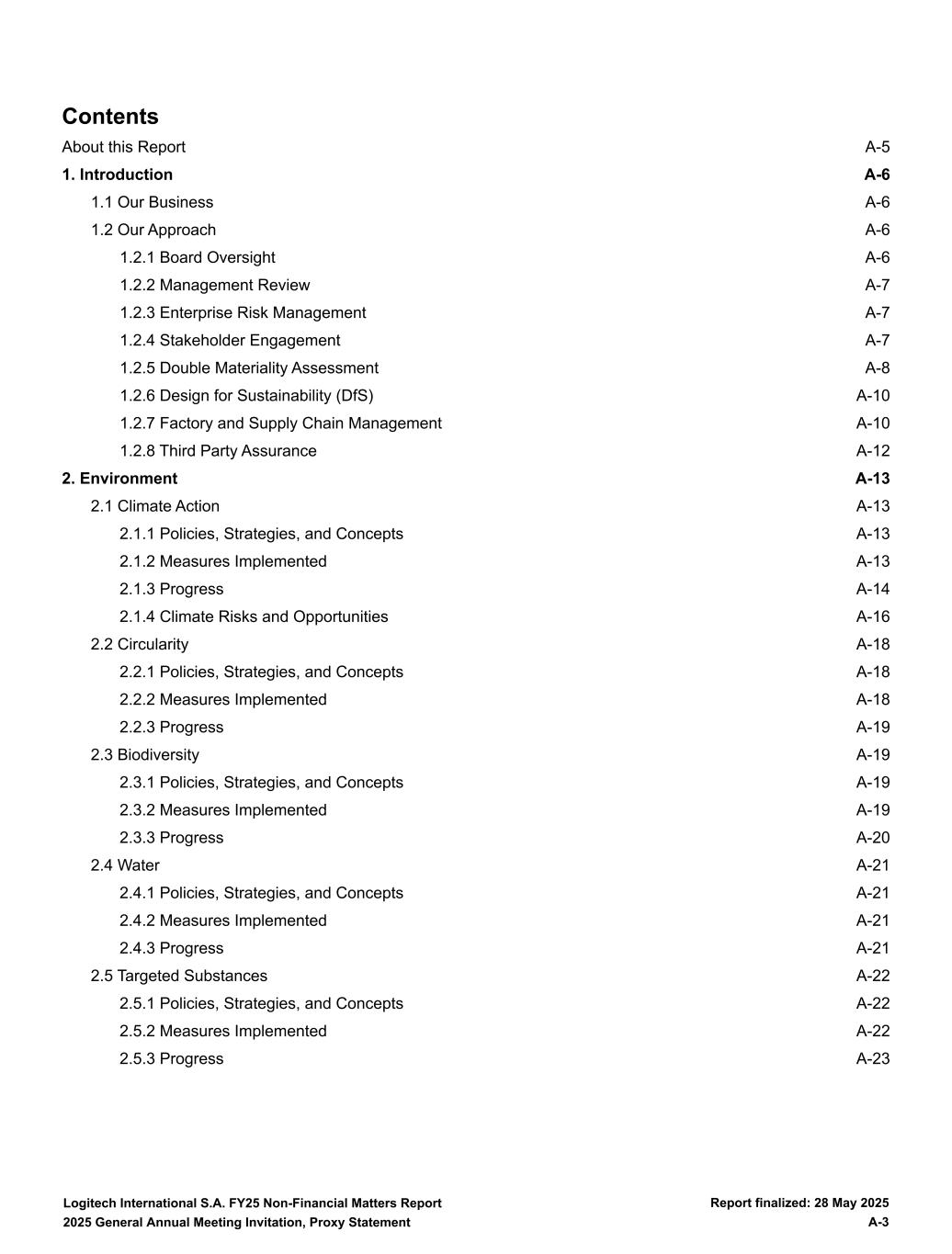
Contents About this Report A-5 1. Introduction A-6 1.1 Our Business A-6 1.2 Our Approach A-6 1.2.1 Board Oversight A-6 1.2.2 Management Review A-7 1.2.3 Enterprise Risk Management A-7 1.2.4 Stakeholder Engagement A-7 1.2.5 Double Materiality Assessment A-8 1.2.6 Design for Sustainability (DfS) A-10 1.2.7 Factory and Supply Chain Management A-10 1.2.8 Third Party Assurance A-12 2. Environment A-13 2.1 Climate Action A-13 2.1.1 Policies, Strategies, and Concepts A-13 2.1.2 Measures Implemented A-13 2.1.3 Progress A-14 2.1.4 Climate Risks and Opportunities A-16 2.2 Circularity A-18 2.2.1 Policies, Strategies, and Concepts A-18 2.2.2 Measures Implemented A-18 2.2.3 Progress A-19 2.3 Biodiversity A-19 2.3.1 Policies, Strategies, and Concepts A-19 2.3.2 Measures Implemented A-19 2.3.3 Progress A-20 2.4 Water A-21 2.4.1 Policies, Strategies, and Concepts A-21 2.4.2 Measures Implemented A-21 2.4.3 Progress A-21 2.5 Targeted Substances A-22 2.5.1 Policies, Strategies, and Concepts A-22 2.5.2 Measures Implemented A-22 2.5.3 Progress A-23 Logitech International S.A. FY25 Non-Financial Matters Report Report finalized: 28 May 2025 2025 General Annual Meeting Invitation, Proxy Statement A-3
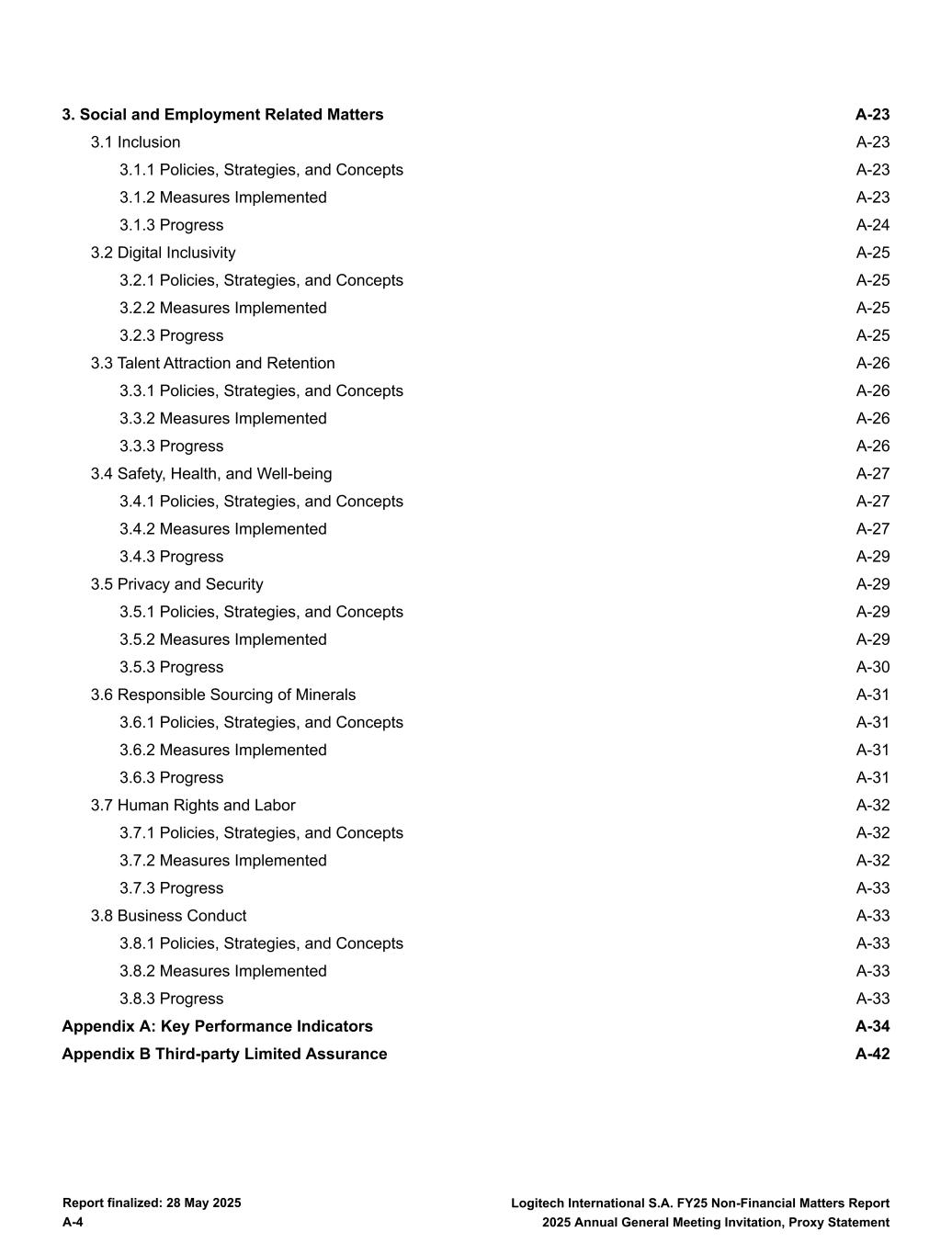
3. Social and Employment Related Matters A-23 3.1 Inclusion A-23 3.1.1 Policies, Strategies, and Concepts A-23 3.1.2 Measures Implemented A-23 3.1.3 Progress A-24 3.2 Digital Inclusivity A-25 3.2.1 Policies, Strategies, and Concepts A-25 3.2.2 Measures Implemented A-25 3.2.3 Progress A-25 3.3 Talent Attraction and Retention A-26 3.3.1 Policies, Strategies, and Concepts A-26 3.3.2 Measures Implemented A-26 3.3.3 Progress A-26 3.4 Safety, Health, and Well-being A-27 3.4.1 Policies, Strategies, and Concepts A-27 3.4.2 Measures Implemented A-27 3.4.3 Progress A-29 3.5 Privacy and Security A-29 3.5.1 Policies, Strategies, and Concepts A-29 3.5.2 Measures Implemented A-29 3.5.3 Progress A-30 3.6 Responsible Sourcing of Minerals A-31 3.6.1 Policies, Strategies, and Concepts A-31 3.6.2 Measures Implemented A-31 3.6.3 Progress A-31 3.7 Human Rights and Labor A-32 3.7.1 Policies, Strategies, and Concepts A-32 3.7.2 Measures Implemented A-32 3.7.3 Progress A-33 3.8 Business Conduct A-33 3.8.1 Policies, Strategies, and Concepts A-33 3.8.2 Measures Implemented A-33 3.8.3 Progress A-33 Appendix A: Key Performance Indicators A-34 Appendix B Third-party Limited Assurance A-42 Report finalized: 28 May 2025 Logitech International S.A. FY25 Non-Financial Matters Report A-4 2025 Annual General Meeting Invitation, Proxy Statement
About this Report This Non-Financial Matters Report 2025 (this “Report”) has been approved by the Board of Directors (“Board”) of Logitech in accordance with art. 964c of the Swiss Code of Obligations. ERM Certification and Verification Services Limited (“ERM CVS”) provided limited assurance in accordance with ISAE 3000 on selected key performance indicators set out in Appendix A. ERM CVS’ independent assurance report is in Appendix B. All entities included in Logitech’s audited consolidated financial statements for FY25 or equivalent documents are covered by this Report and the approaches taken herein with no exceptions. The information in this Report reflects the period between April 1, 2024 and March 31, 2025. This period is also referred to as fiscal year 2025 (“FY25”). In some cases, data may be presented for the Calendar Year (CY) (January 1, 2024 to December 31, 2024), in which case this is clearly stated. Forward-Looking Statements This Report contains certain forward-looking statements within the meaning of the United States Private Securities Litigation Reform Act of 1995. These statements (including plans, projects, targets, and trends) and illustrations provide current expectations of future events based on certain assumptions and include any statement that does not directly relate to a historical fact. These forward-looking statements can generally be identified by words or phrases such as “anticipate”, “potential,” “expect,” “will,” “plan,” “may,” “could,” “forecast,” “going forward,” “target,” “believe,” “goal,” “estimate,” “intend,” or similar expressions, or by express or implied discussions of strategy, plans, expectations or intentions. All forward-looking statements involve risks and uncertainties, including changes in our strategy, performance and progress as well as those risks and uncertainties disclosed under the sections entitled “Risk Factors” and “Management’s Discussion and Analysis of Financial Condition and Results of Operations” in our Annual Report on Form 10-K for the fiscal year ended March 31, 2025. Should one or more of these risks or uncertainties materialize, or should underlying assumptions prove incorrect, actual results may vary materially from those set forth in the forward-looking statements. You are cautioned not to place undue reliance on the forward- looking statements, which speak only as of the date of this Report. We undertake no obligation to publicly release any revisions to the forward-looking statements or reflect events or circumstances after the date of this document. Logitech International S.A. FY25 Non-Financial Matters Report Report finalized: 28 May 2025 2025 General Annual Meeting Invitation, Proxy Statement A-5
1. Introduction 1.1 Our Business Logitech International S.A.’s (hereinafter “Logitech” or the “Company”) mission is to extend human potential in work and play. We create design-led, software-enabled hardware that is the point of connection between people and the digital world. We sell these products through a number of brands: Logitech, Logitech G, and others. Our diverse portfolio includes Mice, Keyboards and Combos, Pointing Devices, Video Collaboration Solutions, Webcams, Tablet Accessories, and Headsets. We sell our products to a broad network of international customers, in the Americas, Europe, the Middle East, and Africa (“EMEA”) and Asia Pacific. This includes direct sales to retailers, e-tailers, and end consumers through our e- commerce platform, and indirect sales to end customers through distributors. Logitech’s operations capability consists of a diversified model of in-house manufacturing (including a wholly-owned facility in Suzhou, China) and third-party contract manufacturers (principally in Asia). This allows us to effectively respond to rapidly changing demand, leverage economies of scale, protect intellectual property, and offer high-quality production in even the most sophisticated products. 1.2 Our Approach 1.2.1 Board Oversight We believe thorough oversight from the Board is a crucial part of integrating sustainability into our overall company strategy. The Board, including our Chief Executive Officer (“CEO”), collaborates with the President of Logitech for Business and Head of People and Culture to supervise the Company’s sustainability strategy, advocate for sustainability and social impact, select priority projects, provide sponsorship and funding, and steer strategy and execution in cooperation with other business leaders. To aid the Board in its oversight, the Nominating and Governance Committee assesses and advises on the Board’s process and frequency for overseeing the company's sustainability strategy. In addition, the Audit Committee reviews and discusses with management the Company's validation procedures for metrics. The Board oversees the Company’s Enterprise Risk Management (“ERM”) and monitoring, including sustainability risk. Sustainability is an agenda item at Board meetings, where the President of Logitech for Business and Head of People and Culture offer updates and suggestions related to both environmental and social topics. The Board’s oversight role involves reviewing these recommendations and directing strategy. Board members are required to inform the Board about any potential conflicts of interest and to recuse themselves from any voting in which they may have a potential conflict of interest. Because serving on a board can create duties that can conflict with the duty of loyalty to the Company, any new mandates of board members need to be precleared with the Chief Legal Officer. We conduct regular related-party searches and reviews in accordance with SEC rules. Any identified related party transactions are reviewed by the Board and disclosed in the Company’s proxy statement. We assess Board competency taking into consideration a variety of factors, including but not limited to backgrounds, experience, expertise, skills and training, etc., resulting in the ability of a director to provide informed oversight of sustainability issues. Our Board's knowledge and skills in this area is supported by regular updates and recommendations from our President of Logitech for Business and technical expertise in Logitech's Sustainability Team and Social Impact team. For example, a number of Board members have attended sharing sessions covering the following topics: Sustainability reporting; Design for Sustainability; and Future Positive and Circularity. In addition, the Company offers voluntary education programs and certifications, including education programs relating to ESG, to its directors to enhance their skills and knowledge. Since 2022, we have implemented a sustainability scorecard as a metric that contributes 10% to the annual bonus incentive plan for our Group Management Team (“GMT”), which includes our CEO, Chief Financial Officer, President Logitech for Business, and Chief Legal Officer. Report finalized: 28 May 2025 Logitech International S.A. FY25 Non-Financial Matters Report A-6 2025 Annual General Meeting Invitation, Proxy Statement
1.2.2 Management Review Our management team reviews, at a minimum once annually, the scope and performance of each of our programs in a more strategic way and identifies further opportunities for growth and program evolution in the forthcoming year. We perform this review within the context of the broader external sustainability landscape and incorporate our understanding of how mega-trends and macro-developments may impact our sector and activities. Our GMT and Head of People and Culture work with other business leaders to prioritize and advocate for sustainability. This includes selecting projects to sponsor, financing initiatives, and driving strategy and execution. 1.2.3 Enterprise Risk Management Our Enterprise Risk Management (ERM) process provides the Board, including its Audit Committee, with a comprehensive view of the risks facing our business. Logitech includes climate and sustainability-related risks in its multidisciplinary company-wide ERM process. This process aims to identify and control risks to ensure positive business development, effective risk reporting, and legal compliance. Risks are assessed in terms of their potential impact and likelihood of adversely affecting our reputation, financial situation, or capacity to meet our commitments. Risk mitigation measures are then planned, implemented and monitored on an ongoing basis to ensure their performance. ERM assessments are both top-down and bottom-up and cross-functional. They cover strategic, financial, and operational risks, in the short, medium and long term. Our ERM process is aligned with our strategy. On an annual basis, our Internal Audit team performs an enterprise risk assessment through all our business areas, divisions and corporate functions. The result of the risk assessment is presented to our Board. This process assists Logitech in identifying risks that could potentially impact our ability to achieve business objectives and compliance obligations. 1.2.4 Stakeholder Engagement At Logitech, we view stakeholder engagement as a foundation of responsible business. We believe that understanding and integrating diverse perspectives leads to better decisions, more resilient strategies, and stronger relationships. Our approach is grounded in transparency, inclusivity, and continuous dialogue, ensuring that stakeholder voices inform the way we operate and evolve. Logitech identifies and engages six key stakeholder groups critical to its business and sustainability efforts: customers, employees, regulators and policymakers, shareholders, special interest groups, and the industry. These groups are identified based on their influence on and impact from Logitech’s operations, and their role in advancing our sustainability objectives. The purpose of our stakeholder engagement is to foster open, two-way communication that informs our understanding of material issues, shapes our sustainability strategy, and supports responsible business practices. Engaging stakeholders, directly and indirectly, helps us align our actions with their expectations, anticipate emerging risks and opportunities, and enhance transparency. To ensure meaningful engagement, Logitech employs a range of tailored methods, including surveys, interviews, workshops, focus groups, and formal consultations, designed to suit the preferences and needs of each stakeholder group. We complement these interactions with regular updates via digital channels and public reporting to maintain ongoing dialogue and accountability. This structured, multi-channel approach enables us to gather diverse perspectives, build trust, and continuously improve our sustainability performance. From our discussions with stakeholders, we recognize the following sustainability topics of interest for each of our stakeholder groups. Logitech International S.A. FY25 Non-Financial Matters Report Report finalized: 28 May 2025 2025 General Annual Meeting Invitation, Proxy Statement A-7
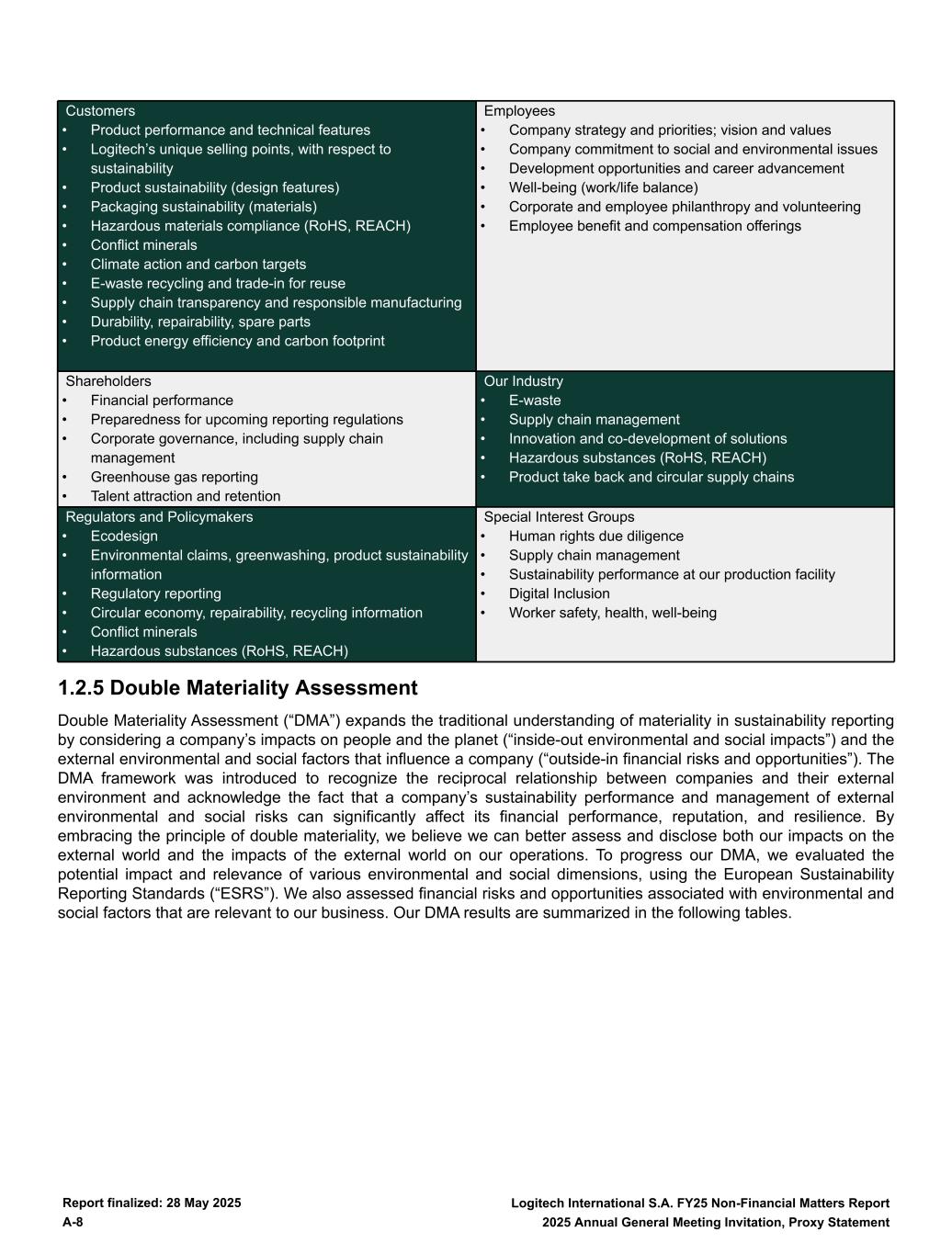
Customers • Product performance and technical features • Logitech’s unique selling points, with respect to sustainability • Product sustainability (design features) • Packaging sustainability (materials) • Hazardous materials compliance (RoHS, REACH) • Conflict minerals • Climate action and carbon targets • E-waste recycling and trade-in for reuse • Supply chain transparency and responsible manufacturing • Durability, repairability, spare parts • Product energy efficiency and carbon footprint Employees • Company strategy and priorities; vision and values • Company commitment to social and environmental issues • Development opportunities and career advancement • Well-being (work/life balance) • Corporate and employee philanthropy and volunteering • Employee benefit and compensation offerings Shareholders • Financial performance • Preparedness for upcoming reporting regulations • Corporate governance, including supply chain management • Greenhouse gas reporting • Talent attraction and retention Our Industry • E-waste • Supply chain management • Innovation and co-development of solutions • Hazardous substances (RoHS, REACH) • Product take back and circular supply chains Regulators and Policymakers • Ecodesign • Environmental claims, greenwashing, product sustainability information • Regulatory reporting • Circular economy, repairability, recycling information • Conflict minerals • Hazardous substances (RoHS, REACH) Special Interest Groups • Human rights due diligence • Supply chain management • Sustainability performance at our production facility • Digital Inclusion • Worker safety, health, well-being 1.2.5 Double Materiality Assessment Double Materiality Assessment (“DMA”) expands the traditional understanding of materiality in sustainability reporting by considering a company’s impacts on people and the planet (“inside-out environmental and social impacts”) and the external environmental and social factors that influence a company (“outside-in financial risks and opportunities”). The DMA framework was introduced to recognize the reciprocal relationship between companies and their external environment and acknowledge the fact that a company’s sustainability performance and management of external environmental and social risks can significantly affect its financial performance, reputation, and resilience. By embracing the principle of double materiality, we believe we can better assess and disclose both our impacts on the external world and the impacts of the external world on our operations. To progress our DMA, we evaluated the potential impact and relevance of various environmental and social dimensions, using the European Sustainability Reporting Standards (“ESRS”). We also assessed financial risks and opportunities associated with environmental and social factors that are relevant to our business. Our DMA results are summarized in the following tables. Report finalized: 28 May 2025 Logitech International S.A. FY25 Non-Financial Matters Report A-8 2025 Annual General Meeting Invitation, Proxy Statement
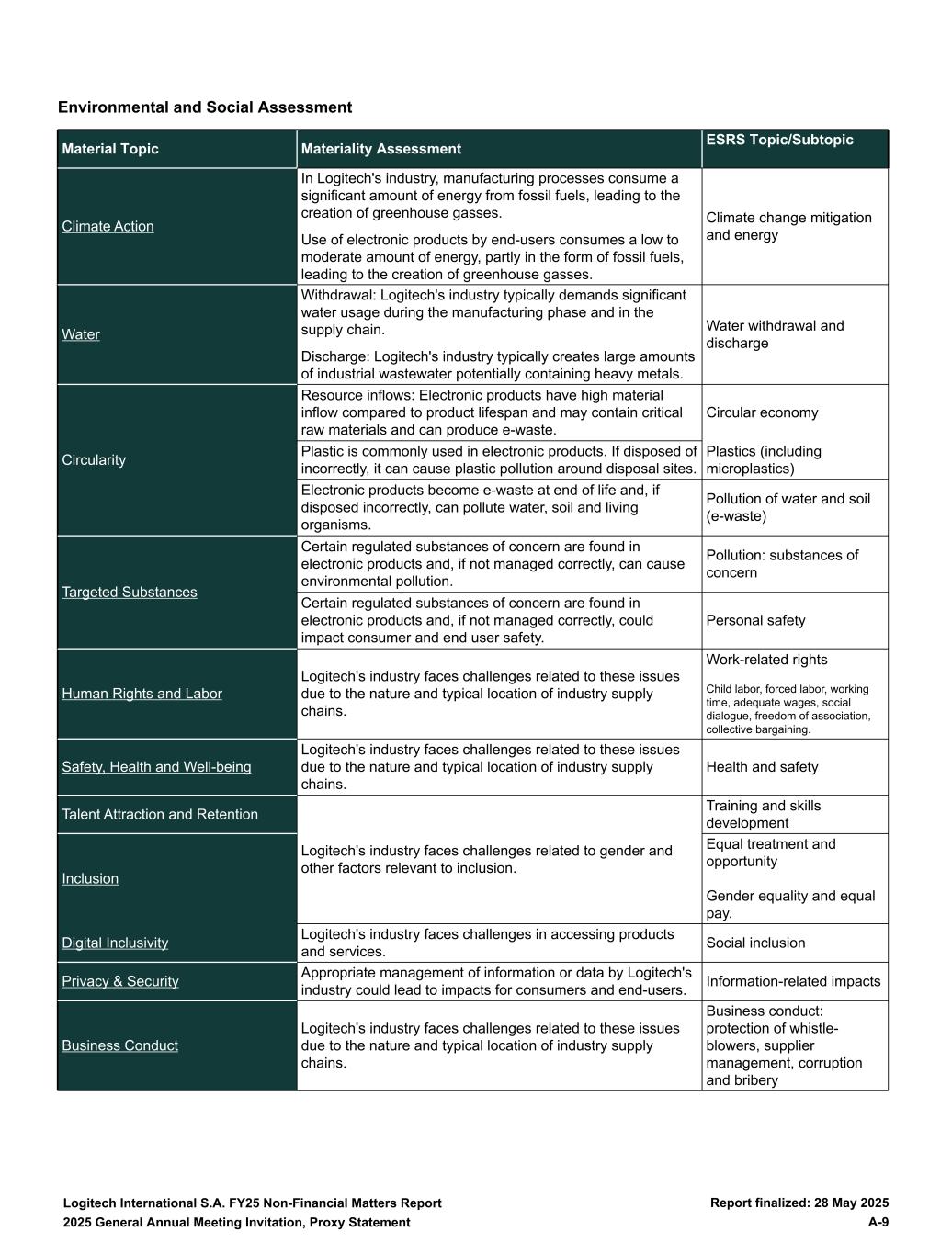
Environmental and Social Assessment Material Topic Materiality Assessment ESRS Topic/Subtopic Climate Action In Logitech's industry, manufacturing processes consume a significant amount of energy from fossil fuels, leading to the creation of greenhouse gasses. Use of electronic products by end-users consumes a low to moderate amount of energy, partly in the form of fossil fuels, leading to the creation of greenhouse gasses. Climate change mitigation and energy Water Withdrawal: Logitech's industry typically demands significant water usage during the manufacturing phase and in the supply chain. Discharge: Logitech's industry typically creates large amounts of industrial wastewater potentially containing heavy metals. Water withdrawal and discharge Circularity Resource inflows: Electronic products have high material inflow compared to product lifespan and may contain critical raw materials and can produce e-waste. Circular economy Plastic is commonly used in electronic products. If disposed of incorrectly, it can cause plastic pollution around disposal sites. Plastics (including microplastics) Electronic products become e-waste at end of life and, if disposed incorrectly, can pollute water, soil and living organisms. Pollution of water and soil (e-waste) Targeted Substances Certain regulated substances of concern are found in electronic products and, if not managed correctly, can cause environmental pollution. Pollution: substances of concern Certain regulated substances of concern are found in electronic products and, if not managed correctly, could impact consumer and end user safety. Personal safety Human Rights and Labor Logitech's industry faces challenges related to these issues due to the nature and typical location of industry supply chains. Work-related rights Child labor, forced labor, working time, adequate wages, social dialogue, freedom of association, collective bargaining. Safety, Health and Well-being Logitech's industry faces challenges related to these issues due to the nature and typical location of industry supply chains. Health and safety Talent Attraction and Retention Logitech's industry faces challenges related to gender and other factors relevant to inclusion. Training and skills development Inclusion Equal treatment and opportunity Gender equality and equal pay. Digital Inclusivity Logitech's industry faces challenges in accessing products and services. Social inclusion Privacy & Security Appropriate management of information or data by Logitech's industry could lead to impacts for consumers and end-users. Information-related impacts Business Conduct Logitech's industry faces challenges related to these issues due to the nature and typical location of industry supply chains. Business conduct: protection of whistle- blowers, supplier management, corruption and bribery Logitech International S.A. FY25 Non-Financial Matters Report Report finalized: 28 May 2025 2025 General Annual Meeting Invitation, Proxy Statement A-9
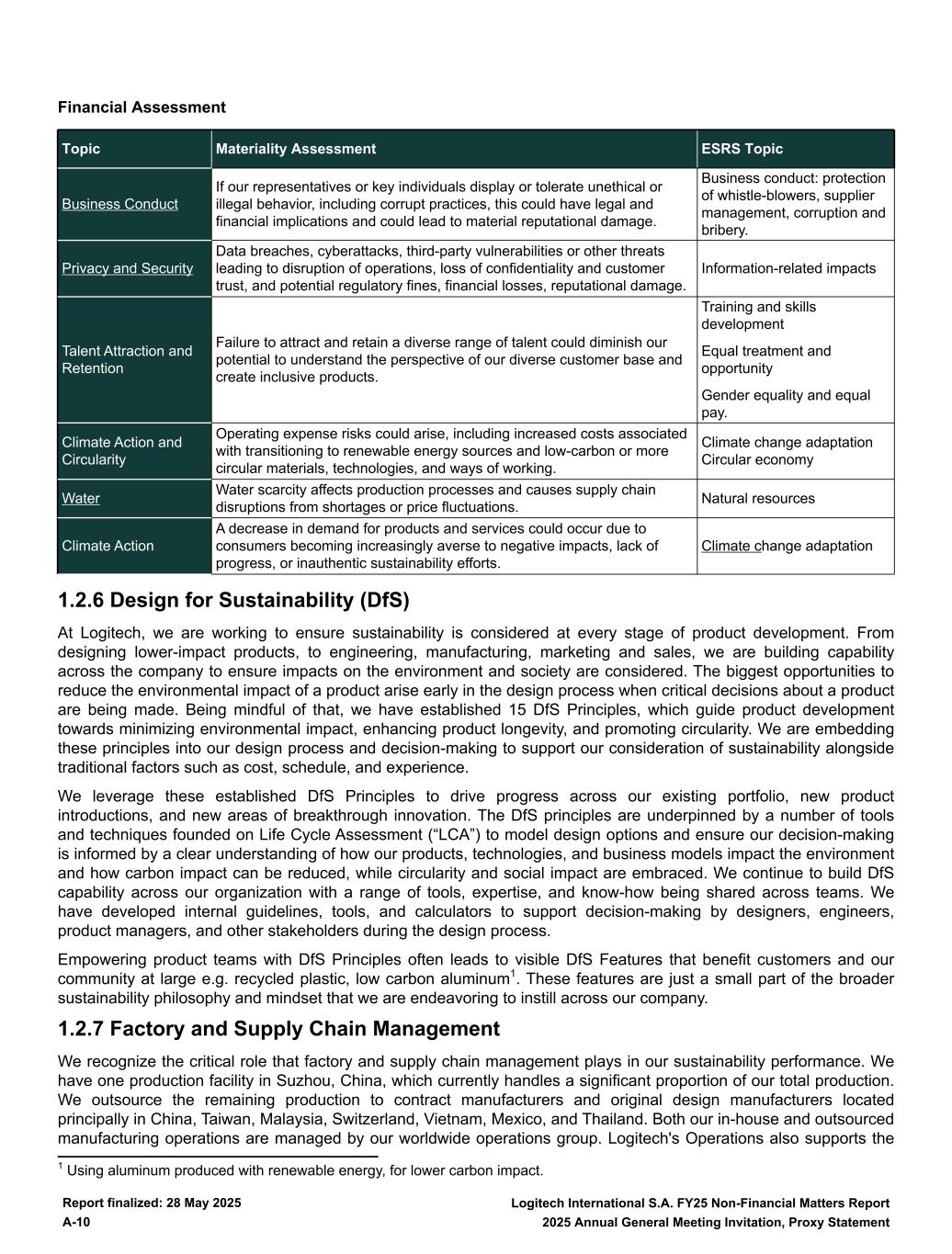
Financial Assessment Topic Materiality Assessment ESRS Topic Business Conduct If our representatives or key individuals display or tolerate unethical or illegal behavior, including corrupt practices, this could have legal and financial implications and could lead to material reputational damage. Business conduct: protection of whistle-blowers, supplier management, corruption and bribery. Privacy and Security Data breaches, cyberattacks, third-party vulnerabilities or other threats leading to disruption of operations, loss of confidentiality and customer trust, and potential regulatory fines, financial losses, reputational damage. Information-related impacts Talent Attraction and Retention Failure to attract and retain a diverse range of talent could diminish our potential to understand the perspective of our diverse customer base and create inclusive products. Training and skills development Equal treatment and opportunity Gender equality and equal pay. Climate Action and Circularity Operating expense risks could arise, including increased costs associated with transitioning to renewable energy sources and low-carbon or more circular materials, technologies, and ways of working. Climate change adaptation Circular economy Water Water scarcity affects production processes and causes supply chain disruptions from shortages or price fluctuations. Natural resources Climate Action A decrease in demand for products and services could occur due to consumers becoming increasingly averse to negative impacts, lack of progress, or inauthentic sustainability efforts. Climate change adaptation 1.2.6 Design for Sustainability (DfS) At Logitech, we are working to ensure sustainability is considered at every stage of product development. From designing lower-impact products, to engineering, manufacturing, marketing and sales, we are building capability across the company to ensure impacts on the environment and society are considered. The biggest opportunities to reduce the environmental impact of a product arise early in the design process when critical decisions about a product are being made. Being mindful of that, we have established 15 DfS Principles, which guide product development towards minimizing environmental impact, enhancing product longevity, and promoting circularity. We are embedding these principles into our design process and decision-making to support our consideration of sustainability alongside traditional factors such as cost, schedule, and experience. We leverage these established DfS Principles to drive progress across our existing portfolio, new product introductions, and new areas of breakthrough innovation. The DfS principles are underpinned by a number of tools and techniques founded on Life Cycle Assessment (“LCA”) to model design options and ensure our decision-making is informed by a clear understanding of how our products, technologies, and business models impact the environment and how carbon impact can be reduced, while circularity and social impact are embraced. We continue to build DfS capability across our organization with a range of tools, expertise, and know-how being shared across teams. We have developed internal guidelines, tools, and calculators to support decision-making by designers, engineers, product managers, and other stakeholders during the design process. Empowering product teams with DfS Principles often leads to visible DfS Features that benefit customers and our community at large e.g. recycled plastic, low carbon aluminum1. These features are just a small part of the broader sustainability philosophy and mindset that we are endeavoring to instill across our company. 1.2.7 Factory and Supply Chain Management We recognize the critical role that factory and supply chain management plays in our sustainability performance. We have one production facility in Suzhou, China, which currently handles a significant proportion of our total production. We outsource the remaining production to contract manufacturers and original design manufacturers located principally in China, Taiwan, Malaysia, Switzerland, Vietnam, Mexico, and Thailand. Both our in-house and outsourced manufacturing operations are managed by our worldwide operations group. Logitech's Operations also supports the Report finalized: 28 May 2025 Logitech International S.A. FY25 Non-Financial Matters Report A-10 2025 Annual General Meeting Invitation, Proxy Statement 1 Using aluminum produced with renewable energy, for lower carbon impact.
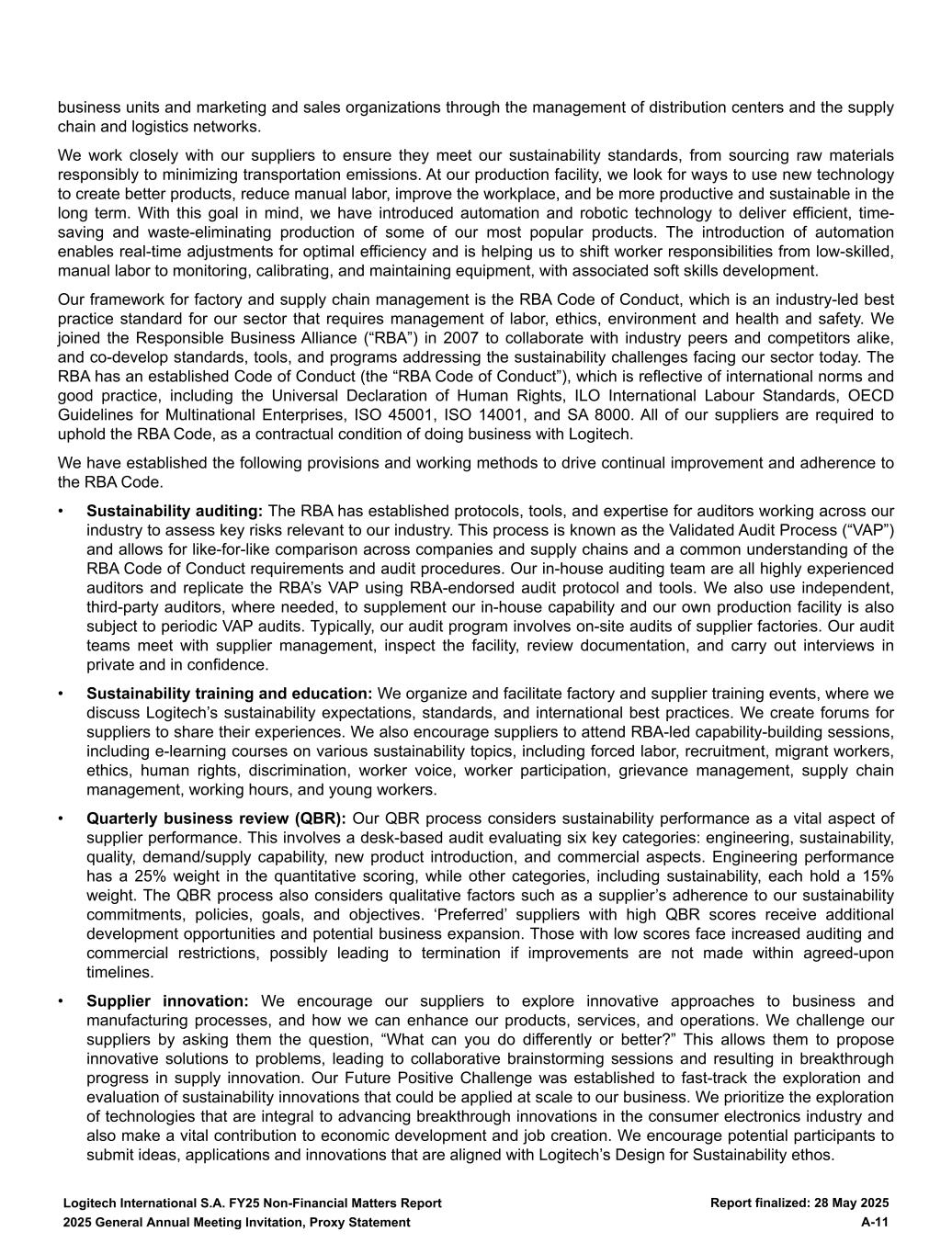
business units and marketing and sales organizations through the management of distribution centers and the supply chain and logistics networks. We work closely with our suppliers to ensure they meet our sustainability standards, from sourcing raw materials responsibly to minimizing transportation emissions. At our production facility, we look for ways to use new technology to create better products, reduce manual labor, improve the workplace, and be more productive and sustainable in the long term. With this goal in mind, we have introduced automation and robotic technology to deliver efficient, time- saving and waste-eliminating production of some of our most popular products. The introduction of automation enables real-time adjustments for optimal efficiency and is helping us to shift worker responsibilities from low-skilled, manual labor to monitoring, calibrating, and maintaining equipment, with associated soft skills development. Our framework for factory and supply chain management is the RBA Code of Conduct, which is an industry-led best practice standard for our sector that requires management of labor, ethics, environment and health and safety. We joined the Responsible Business Alliance (“RBA”) in 2007 to collaborate with industry peers and competitors alike, and co-develop standards, tools, and programs addressing the sustainability challenges facing our sector today. The RBA has an established Code of Conduct (the “RBA Code of Conduct”), which is reflective of international norms and good practice, including the Universal Declaration of Human Rights, ILO International Labour Standards, OECD Guidelines for Multinational Enterprises, ISO 45001, ISO 14001, and SA 8000. All of our suppliers are required to uphold the RBA Code, as a contractual condition of doing business with Logitech. We have established the following provisions and working methods to drive continual improvement and adherence to the RBA Code. • Sustainability auditing: The RBA has established protocols, tools, and expertise for auditors working across our industry to assess key risks relevant to our industry. This process is known as the Validated Audit Process (“VAP”) and allows for like-for-like comparison across companies and supply chains and a common understanding of the RBA Code of Conduct requirements and audit procedures. Our in-house auditing team are all highly experienced auditors and replicate the RBA’s VAP using RBA-endorsed audit protocol and tools. We also use independent, third-party auditors, where needed, to supplement our in-house capability and our own production facility is also subject to periodic VAP audits. Typically, our audit program involves on-site audits of supplier factories. Our audit teams meet with supplier management, inspect the facility, review documentation, and carry out interviews in private and in confidence. • Sustainability training and education: We organize and facilitate factory and supplier training events, where we discuss Logitech’s sustainability expectations, standards, and international best practices. We create forums for suppliers to share their experiences. We also encourage suppliers to attend RBA-led capability-building sessions, including e-learning courses on various sustainability topics, including forced labor, recruitment, migrant workers, ethics, human rights, discrimination, worker voice, worker participation, grievance management, supply chain management, working hours, and young workers. • Quarterly business review (QBR): Our QBR process considers sustainability performance as a vital aspect of supplier performance. This involves a desk-based audit evaluating six key categories: engineering, sustainability, quality, demand/supply capability, new product introduction, and commercial aspects. Engineering performance has a 25% weight in the quantitative scoring, while other categories, including sustainability, each hold a 15% weight. The QBR process also considers qualitative factors such as a supplier’s adherence to our sustainability commitments, policies, goals, and objectives. ‘Preferred’ suppliers with high QBR scores receive additional development opportunities and potential business expansion. Those with low scores face increased auditing and commercial restrictions, possibly leading to termination if improvements are not made within agreed-upon timelines. • Supplier innovation: We encourage our suppliers to explore innovative approaches to business and manufacturing processes, and how we can enhance our products, services, and operations. We challenge our suppliers by asking them the question, “What can you do differently or better?” This allows them to propose innovative solutions to problems, leading to collaborative brainstorming sessions and resulting in breakthrough progress in supply innovation. Our Future Positive Challenge was established to fast-track the exploration and evaluation of sustainability innovations that could be applied at scale to our business. We prioritize the exploration of technologies that are integral to advancing breakthrough innovations in the consumer electronics industry and also make a vital contribution to economic development and job creation. We encourage potential participants to submit ideas, applications and innovations that are aligned with Logitech’s Design for Sustainability ethos. Logitech International S.A. FY25 Non-Financial Matters Report Report finalized: 28 May 2025 2025 General Annual Meeting Invitation, Proxy Statement A-11
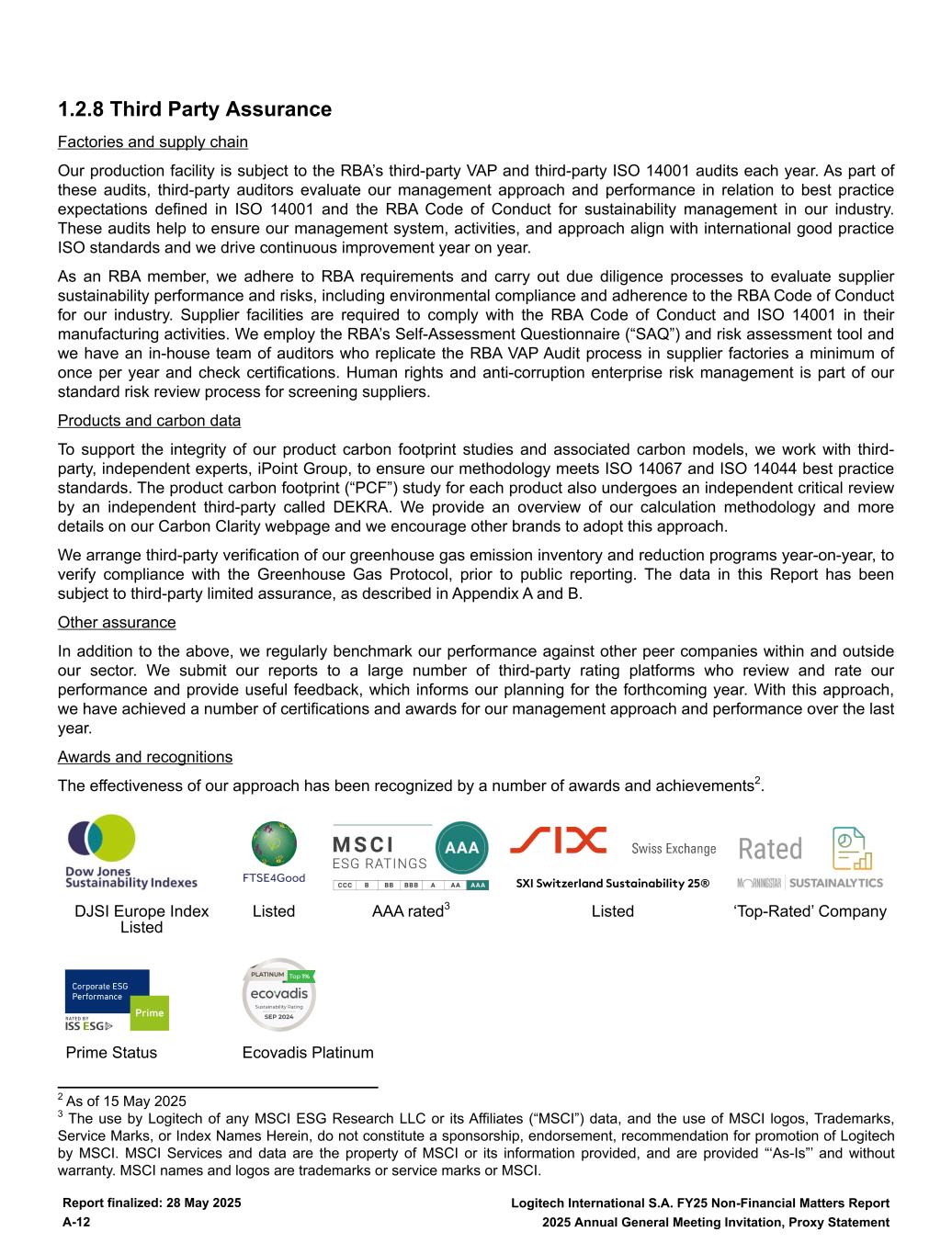
1.2.8 Third Party Assurance Factories and supply chain Our production facility is subject to the RBA’s third-party VAP and third-party ISO 14001 audits each year. As part of these audits, third-party auditors evaluate our management approach and performance in relation to best practice expectations defined in ISO 14001 and the RBA Code of Conduct for sustainability management in our industry. These audits help to ensure our management system, activities, and approach align with international good practice ISO standards and we drive continuous improvement year on year. As an RBA member, we adhere to RBA requirements and carry out due diligence processes to evaluate supplier sustainability performance and risks, including environmental compliance and adherence to the RBA Code of Conduct for our industry. Supplier facilities are required to comply with the RBA Code of Conduct and ISO 14001 in their manufacturing activities. We employ the RBA’s Self-Assessment Questionnaire (“SAQ”) and risk assessment tool and we have an in-house team of auditors who replicate the RBA VAP Audit process in supplier factories a minimum of once per year and check certifications. Human rights and anti-corruption enterprise risk management is part of our standard risk review process for screening suppliers. Products and carbon data To support the integrity of our product carbon footprint studies and associated carbon models, we work with third- party, independent experts, iPoint Group, to ensure our methodology meets ISO 14067 and ISO 14044 best practice standards. The product carbon footprint (“PCF”) study for each product also undergoes an independent critical review by an independent third-party called DEKRA. We provide an overview of our calculation methodology and more details on our Carbon Clarity webpage and we encourage other brands to adopt this approach. We arrange third-party verification of our greenhouse gas emission inventory and reduction programs year-on-year, to verify compliance with the Greenhouse Gas Protocol, prior to public reporting. The data in this Report has been subject to third-party limited assurance, as described in Appendix A and B. Other assurance In addition to the above, we regularly benchmark our performance against other peer companies within and outside our sector. We submit our reports to a large number of third-party rating platforms who review and rate our performance and provide useful feedback, which informs our planning for the forthcoming year. With this approach, we have achieved a number of certifications and awards for our management approach and performance over the last year. Awards and recognitions The effectiveness of our approach has been recognized by a number of awards and achievements2. DJSI Europe Index Listed Listed AAA rated3 Listed ‘Top-Rated’ Company Prime Status Ecovadis Platinum Report finalized: 28 May 2025 Logitech International S.A. FY25 Non-Financial Matters Report A-12 2025 Annual General Meeting Invitation, Proxy Statement 2 As of 15 May 2025 3 The use by Logitech of any MSCI ESG Research LLC or its Affiliates (“MSCI”) data, and the use of MSCI logos, Trademarks, Service Marks, or Index Names Herein, do not constitute a sponsorship, endorsement, recommendation for promotion of Logitech by MSCI. MSCI Services and data are the property of MSCI or its information provided, and are provided “‘As-Is”’ and without warranty. MSCI names and logos are trademarks or service marks or MSCI.
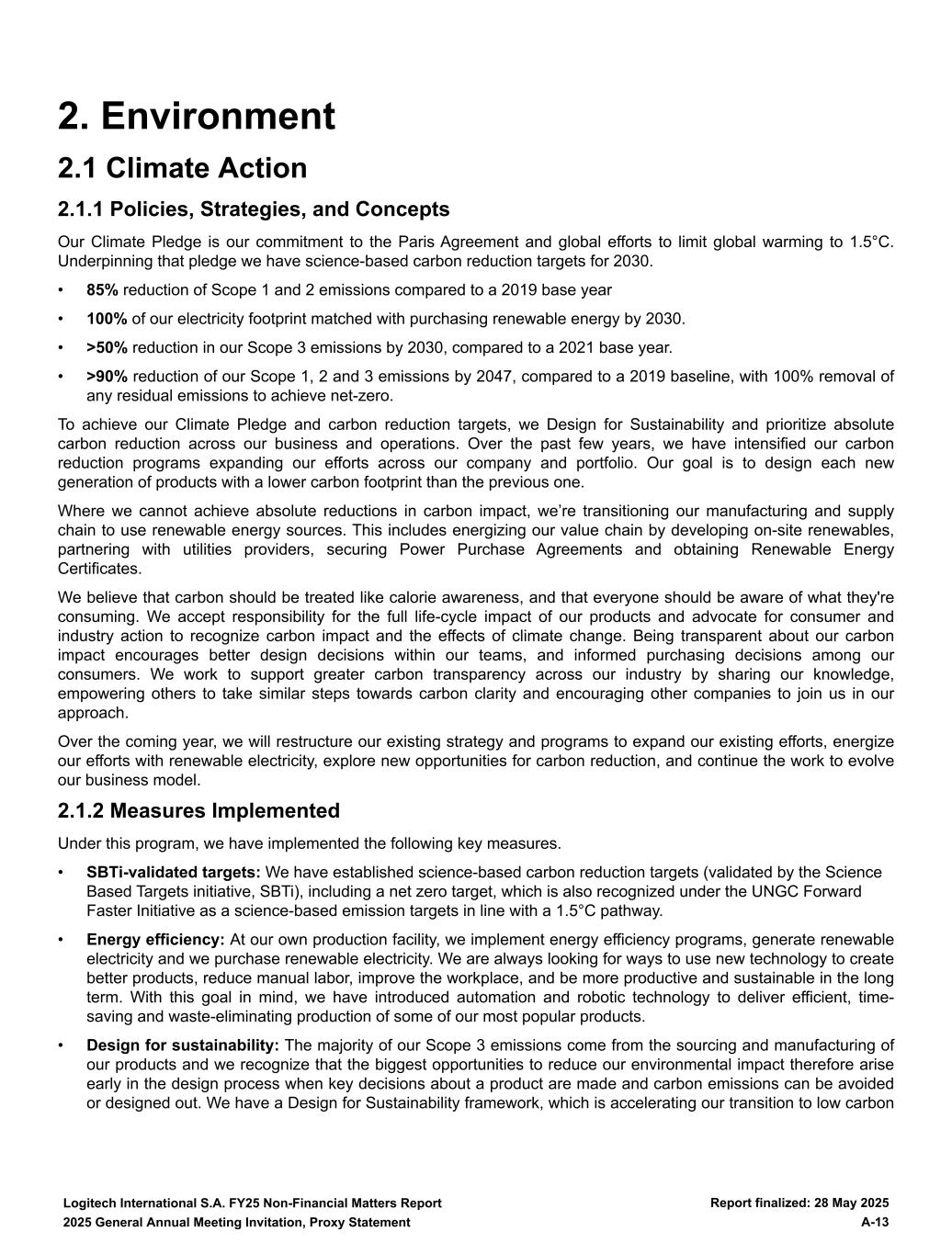
2. Environment 2.1 Climate Action 2.1.1 Policies, Strategies, and Concepts Our Climate Pledge is our commitment to the Paris Agreement and global efforts to limit global warming to 1.5°C. Underpinning that pledge we have science-based carbon reduction targets for 2030. • 85% reduction of Scope 1 and 2 emissions compared to a 2019 base year • 100% of our electricity footprint matched with purchasing renewable energy by 2030. • >50% reduction in our Scope 3 emissions by 2030, compared to a 2021 base year. • >90% reduction of our Scope 1, 2 and 3 emissions by 2047, compared to a 2019 baseline, with 100% removal of any residual emissions to achieve net-zero. To achieve our Climate Pledge and carbon reduction targets, we Design for Sustainability and prioritize absolute carbon reduction across our business and operations. Over the past few years, we have intensified our carbon reduction programs expanding our efforts across our company and portfolio. Our goal is to design each new generation of products with a lower carbon footprint than the previous one. Where we cannot achieve absolute reductions in carbon impact, we’re transitioning our manufacturing and supply chain to use renewable energy sources. This includes energizing our value chain by developing on-site renewables, partnering with utilities providers, securing Power Purchase Agreements and obtaining Renewable Energy Certificates. We believe that carbon should be treated like calorie awareness, and that everyone should be aware of what they're consuming. We accept responsibility for the full life-cycle impact of our products and advocate for consumer and industry action to recognize carbon impact and the effects of climate change. Being transparent about our carbon impact encourages better design decisions within our teams, and informed purchasing decisions among our consumers. We work to support greater carbon transparency across our industry by sharing our knowledge, empowering others to take similar steps towards carbon clarity and encouraging other companies to join us in our approach. Over the coming year, we will restructure our existing strategy and programs to expand our existing efforts, energize our efforts with renewable electricity, explore new opportunities for carbon reduction, and continue the work to evolve our business model. 2.1.2 Measures Implemented Under this program, we have implemented the following key measures. • SBTi-validated targets: We have established science-based carbon reduction targets (validated by the Science Based Targets initiative, SBTi), including a net zero target, which is also recognized under the UNGC Forward Faster Initiative as a science-based emission targets in line with a 1.5°C pathway. • Energy efficiency: At our own production facility, we implement energy efficiency programs, generate renewable electricity and we purchase renewable electricity. We are always looking for ways to use new technology to create better products, reduce manual labor, improve the workplace, and be more productive and sustainable in the long term. With this goal in mind, we have introduced automation and robotic technology to deliver efficient, time- saving and waste-eliminating production of some of our most popular products. • Design for sustainability: The majority of our Scope 3 emissions come from the sourcing and manufacturing of our products and we recognize that the biggest opportunities to reduce our environmental impact therefore arise early in the design process when key decisions about a product are made and carbon emissions can be avoided or designed out. We have a Design for Sustainability framework, which is accelerating our transition to low carbon Logitech International S.A. FY25 Non-Financial Matters Report Report finalized: 28 May 2025 2025 General Annual Meeting Invitation, Proxy Statement A-13
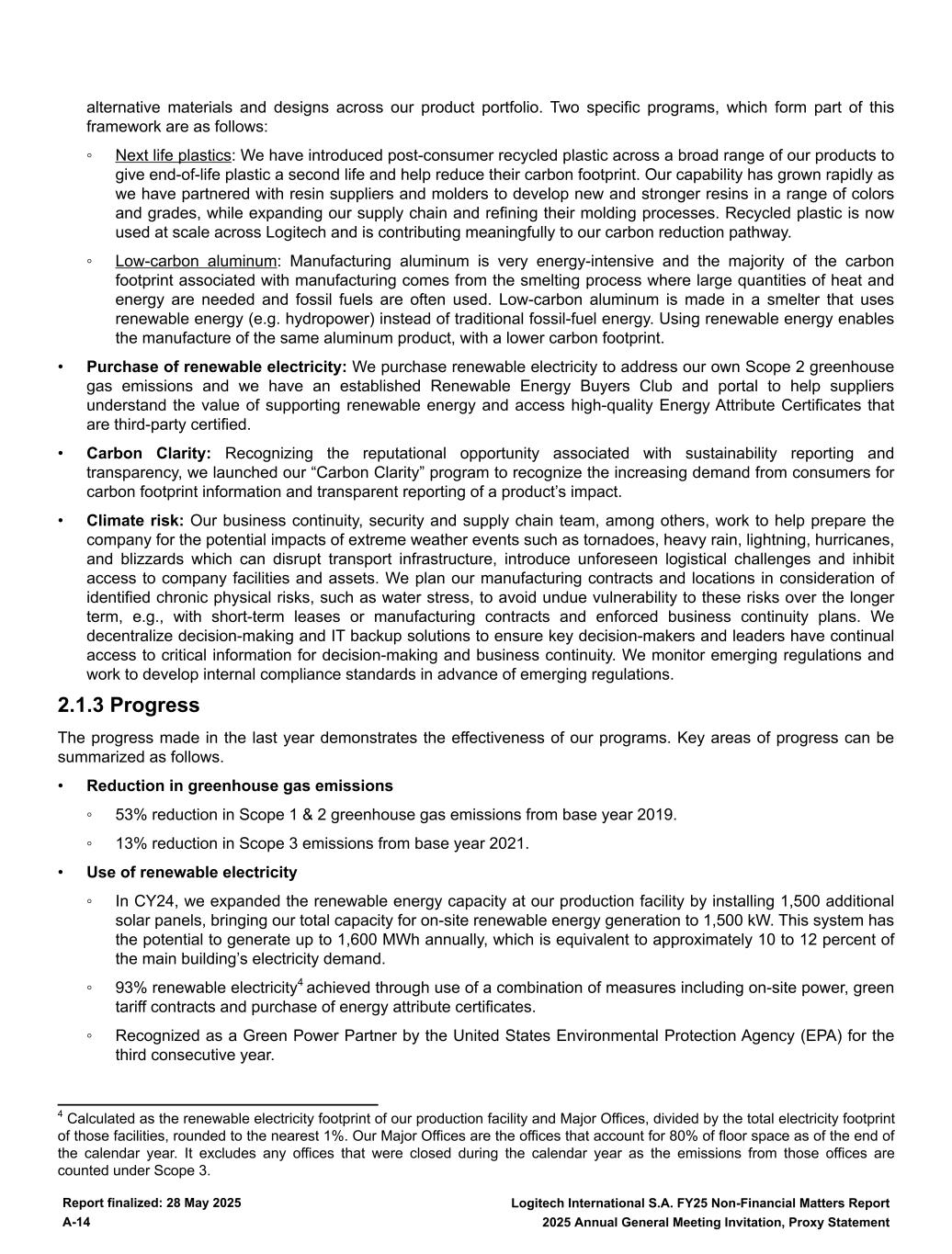
alternative materials and designs across our product portfolio. Two specific programs, which form part of this framework are as follows: ◦ Next life plastics: We have introduced post-consumer recycled plastic across a broad range of our products to give end-of-life plastic a second life and help reduce their carbon footprint. Our capability has grown rapidly as we have partnered with resin suppliers and molders to develop new and stronger resins in a range of colors and grades, while expanding our supply chain and refining their molding processes. Recycled plastic is now used at scale across Logitech and is contributing meaningfully to our carbon reduction pathway. ◦ Low-carbon aluminum: Manufacturing aluminum is very energy-intensive and the majority of the carbon footprint associated with manufacturing comes from the smelting process where large quantities of heat and energy are needed and fossil fuels are often used. Low-carbon aluminum is made in a smelter that uses renewable energy (e.g. hydropower) instead of traditional fossil-fuel energy. Using renewable energy enables the manufacture of the same aluminum product, with a lower carbon footprint. • Purchase of renewable electricity: We purchase renewable electricity to address our own Scope 2 greenhouse gas emissions and we have an established Renewable Energy Buyers Club and portal to help suppliers understand the value of supporting renewable energy and access high-quality Energy Attribute Certificates that are third-party certified. • Carbon Clarity: Recognizing the reputational opportunity associated with sustainability reporting and transparency, we launched our “Carbon Clarity” program to recognize the increasing demand from consumers for carbon footprint information and transparent reporting of a product’s impact. • Climate risk: Our business continuity, security and supply chain team, among others, work to help prepare the company for the potential impacts of extreme weather events such as tornadoes, heavy rain, lightning, hurricanes, and blizzards which can disrupt transport infrastructure, introduce unforeseen logistical challenges and inhibit access to company facilities and assets. We plan our manufacturing contracts and locations in consideration of identified chronic physical risks, such as water stress, to avoid undue vulnerability to these risks over the longer term, e.g., with short-term leases or manufacturing contracts and enforced business continuity plans. We decentralize decision-making and IT backup solutions to ensure key decision-makers and leaders have continual access to critical information for decision-making and business continuity. We monitor emerging regulations and work to develop internal compliance standards in advance of emerging regulations. 2.1.3 Progress The progress made in the last year demonstrates the effectiveness of our programs. Key areas of progress can be summarized as follows. • Reduction in greenhouse gas emissions ◦ 53% reduction in Scope 1 & 2 greenhouse gas emissions from base year 2019. ◦ 13% reduction in Scope 3 emissions from base year 2021. • Use of renewable electricity ◦ In CY24, we expanded the renewable energy capacity at our production facility by installing 1,500 additional solar panels, bringing our total capacity for on-site renewable energy generation to 1,500 kW. This system has the potential to generate up to 1,600 MWh annually, which is equivalent to approximately 10 to 12 percent of the main building’s electricity demand. ◦ 93% renewable electricity4 achieved through use of a combination of measures including on-site power, green tariff contracts and purchase of energy attribute certificates. ◦ Recognized as a Green Power Partner by the United States Environmental Protection Agency (EPA) for the third consecutive year. Report finalized: 28 May 2025 Logitech International S.A. FY25 Non-Financial Matters Report A-14 2025 Annual General Meeting Invitation, Proxy Statement 4 Calculated as the renewable electricity footprint of our production facility and Major Offices, divided by the total electricity footprint of those facilities, rounded to the nearest 1%. Our Major Offices are the offices that account for 80% of floor space as of the end of the calendar year. It excludes any offices that were closed during the calendar year as the emissions from those offices are counted under Scope 3.
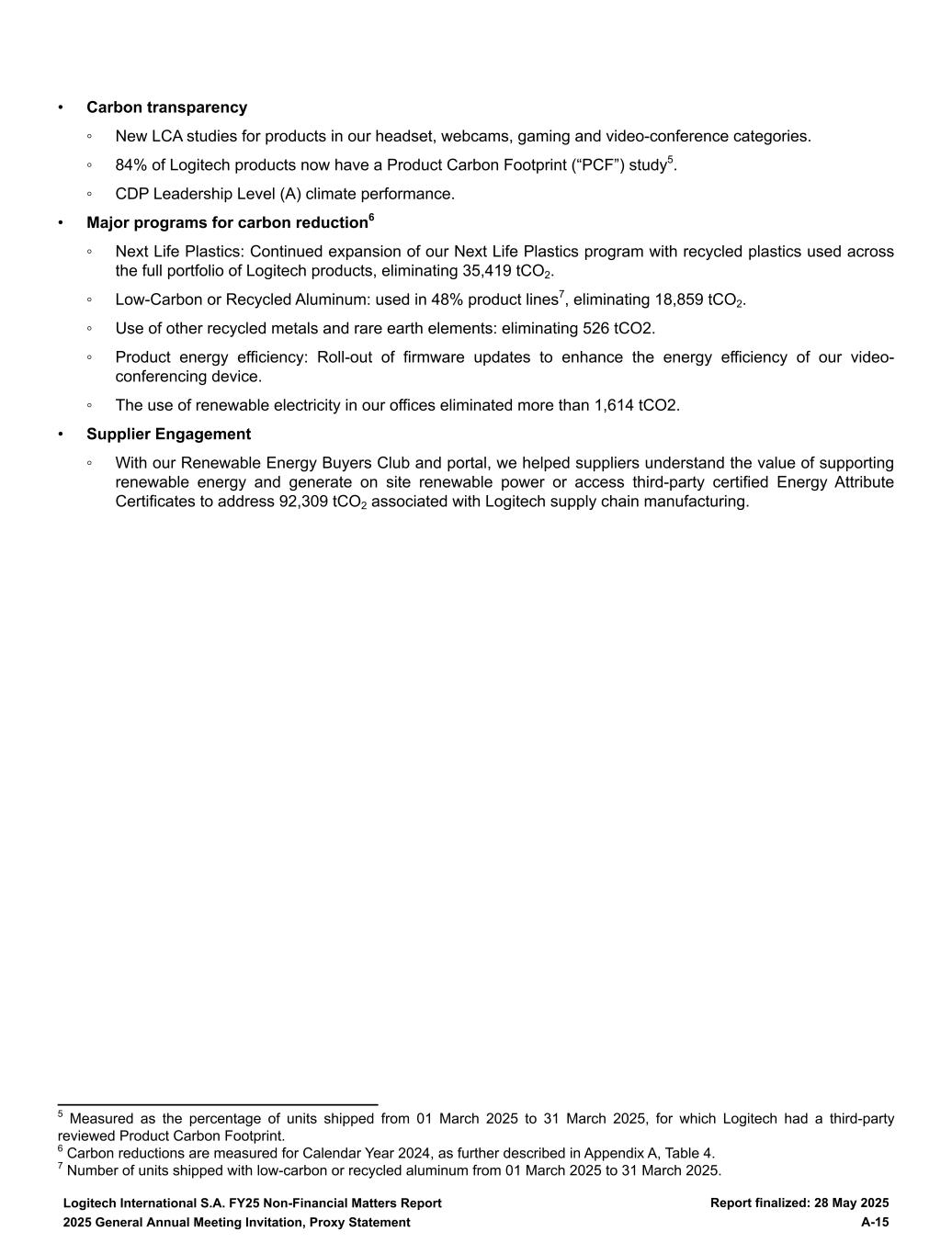
• Carbon transparency ◦ New LCA studies for products in our headset, webcams, gaming and video-conference categories. ◦ 84% of Logitech products now have a Product Carbon Footprint (“PCF”) study5. ◦ CDP Leadership Level (A) climate performance. • Major programs for carbon reduction6 ◦ Next Life Plastics: Continued expansion of our Next Life Plastics program with recycled plastics used across the full portfolio of Logitech products, eliminating 35,419 tCO2. ◦ Low-Carbon or Recycled Aluminum: used in 48% product lines7, eliminating 18,859 tCO2. ◦ Use of other recycled metals and rare earth elements: eliminating 526 tCO2. ◦ Product energy efficiency: Roll-out of firmware updates to enhance the energy efficiency of our video- conferencing device. ◦ The use of renewable electricity in our offices eliminated more than 1,614 tCO2. • Supplier Engagement ◦ With our Renewable Energy Buyers Club and portal, we helped suppliers understand the value of supporting renewable energy and generate on site renewable power or access third-party certified Energy Attribute Certificates to address 92,309 tCO2 associated with Logitech supply chain manufacturing. Logitech International S.A. FY25 Non-Financial Matters Report Report finalized: 28 May 2025 2025 General Annual Meeting Invitation, Proxy Statement A-15 5 Measured as the percentage of units shipped from 01 March 2025 to 31 March 2025, for which Logitech had a third-party reviewed Product Carbon Footprint. 6 Carbon reductions are measured for Calendar Year 2024, as further described in Appendix A, Table 4. 7 Number of units shipped with low-carbon or recycled aluminum from 01 March 2025 to 31 March 2025.

2.1.4 Climate Risks and Opportunities Logitech reports in accordance with the Task Force on Climate-related Financial Disclosures (TCFD) in our annual CDP submission, providing transparency on our governance, strategy, risk management, and metrics related to climate change. A summary of regulatory information required under the Swiss Ordinance on Climate Disclosures is provided in this NFM Report. The table below outlines three examples of climate- related risks and opportunities that Logitech has identified, evaluated, and addressed through Adaptation Plans. For further information, please refer to our annual CDP Report, which is made available on the sustainability reporting page of our website, for stakeholders who do not have access to the CDP platform. Material Shortages (Copper) Transitional risk of increased direct costs due to shortages/ disruption of supply of critical components and materials for product manufacturing (e.g. copper for cables, switches, and products) in response to the growing demand for these commodities to fuel the transition to a low-carbon economy. Logitech products are reliant on certain raw materials, which are at risk of becoming increasingly unavailable and/or more costly to procure as society shifts towards a low-carbon economy. A review of Logitech use of components and materials indicated copper and aluminum are critical materials of concern. Copper is used in Logitech cables, components, and switches, and aluminum is used in a number of our products. Both copper and aluminum are closely linked to the transition to a low-carbon economy, both being needed to manufacture Electric Vehicles, solar panels, wind turbines, etc. For the purpose of financial evaluation, Copper was selected as a proxy for a number of critical materials, including aluminum. Logitech business and operating results could be adversely affected if supply of critical components and materials were disrupted or constrained or if supply and demand dynamics led to increased freight and component costs. This could potentially lead to delay in manufacturing output and reduce operational predictability which collectively can impact revenue, profitability, investment capacity and market share. Value Chain Segment: Direct Operations, Upstream and Downstream Risk Horizon: Medium term Risk Rating: Medium Financial Impact: $4,200,000 - $6,300,000 • Primary Risk Response: Increase supplier Diversification • Constantly review records, and reports raw material prices and exchange prices, including for copper and aluminum. • Actively work with our suppliers to manage the costs in our value chain and the impact of raw material increases. • Continue to diversify our options for component sourcing with suppliers within and outside China and a combination of direct and indirect control of components and key suppliers. • Built flexibility into our sourcing activities with a focus on business continuity planning, second sourcing options, and growing supplier capability to meet demand • We design our products taking cost of materials and sustainability into consideration and introduce new products that are efficient given the market outlook. We regularly evaluate our portfolio and stop producing products that are no longer viable, which could be due to cost or availability of materials. • We are working to develop more circular business models to enable us to monitor and evolve our use of critical components and materials and are working to develop the capability to recover critical components and materials, including copper and aluminum, from our own products (closed loop) or other sources (open loop). Risk Description Adaptation Plan Report finalized: 28 May 2025 Logitech International S.A. FY25 Non-Financial Matters Report A-16 2025 Annual General Meeting Invitation, Proxy Statement
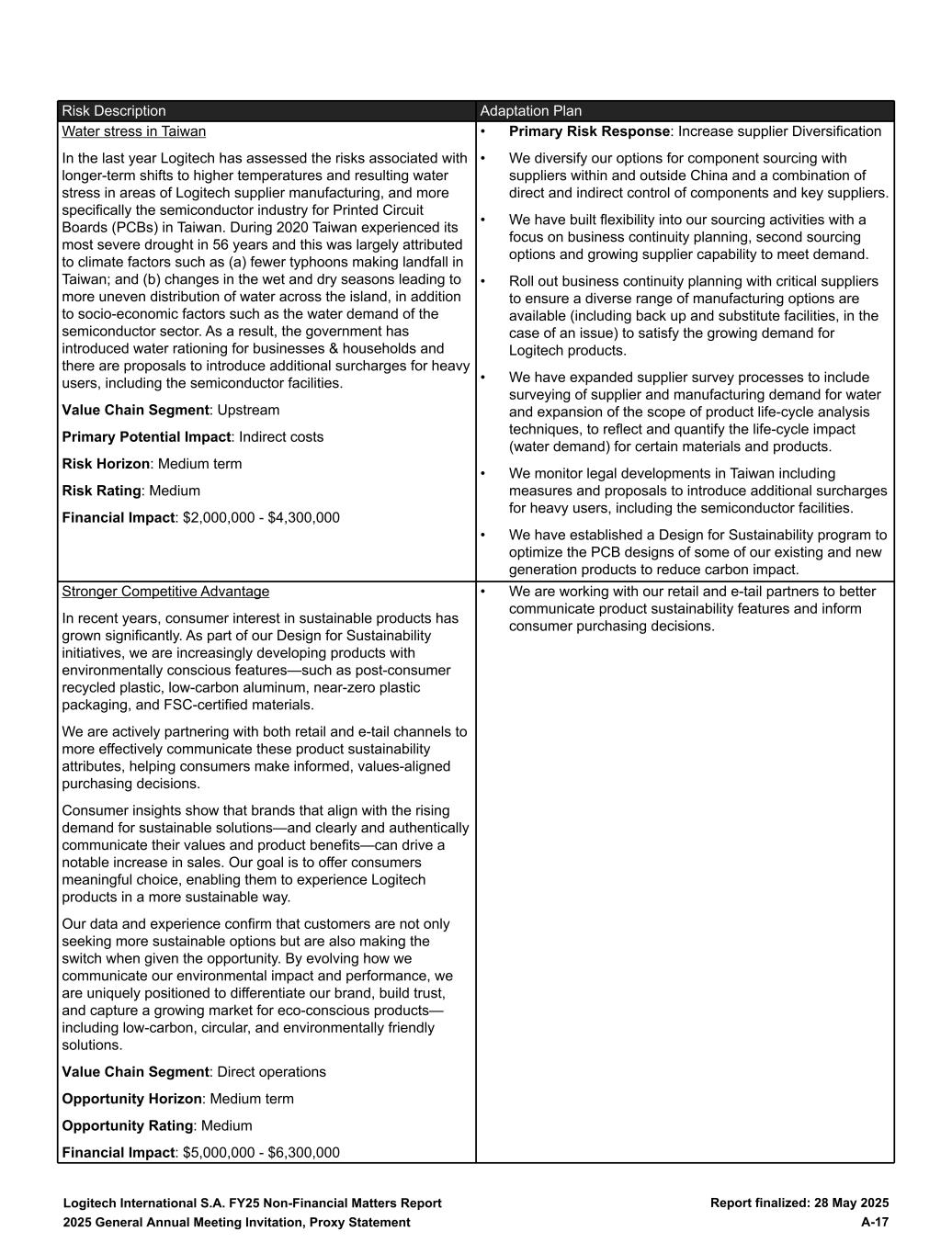
Water stress in Taiwan In the last year Logitech has assessed the risks associated with longer-term shifts to higher temperatures and resulting water stress in areas of Logitech supplier manufacturing, and more specifically the semiconductor industry for Printed Circuit Boards (PCBs) in Taiwan. During 2020 Taiwan experienced its most severe drought in 56 years and this was largely attributed to climate factors such as (a) fewer typhoons making landfall in Taiwan; and (b) changes in the wet and dry seasons leading to more uneven distribution of water across the island, in addition to socio-economic factors such as the water demand of the semiconductor sector. As a result, the government has introduced water rationing for businesses & households and there are proposals to introduce additional surcharges for heavy users, including the semiconductor facilities. Value Chain Segment: Upstream Primary Potential Impact: Indirect costs Risk Horizon: Medium term Risk Rating: Medium Financial Impact: $2,000,000 - $4,300,000 • Primary Risk Response: Increase supplier Diversification • We diversify our options for component sourcing with suppliers within and outside China and a combination of direct and indirect control of components and key suppliers. • We have built flexibility into our sourcing activities with a focus on business continuity planning, second sourcing options and growing supplier capability to meet demand. • Roll out business continuity planning with critical suppliers to ensure a diverse range of manufacturing options are available (including back up and substitute facilities, in the case of an issue) to satisfy the growing demand for Logitech products. • We have expanded supplier survey processes to include surveying of supplier and manufacturing demand for water and expansion of the scope of product life-cycle analysis techniques, to reflect and quantify the life-cycle impact (water demand) for certain materials and products. • We monitor legal developments in Taiwan including measures and proposals to introduce additional surcharges for heavy users, including the semiconductor facilities. • We have established a Design for Sustainability program to optimize the PCB designs of some of our existing and new generation products to reduce carbon impact. Stronger Competitive Advantage In recent years, consumer interest in sustainable products has grown significantly. As part of our Design for Sustainability initiatives, we are increasingly developing products with environmentally conscious features—such as post-consumer recycled plastic, low-carbon aluminum, near-zero plastic packaging, and FSC-certified materials. We are actively partnering with both retail and e-tail channels to more effectively communicate these product sustainability attributes, helping consumers make informed, values-aligned purchasing decisions. Consumer insights show that brands that align with the rising demand for sustainable solutions—and clearly and authentically communicate their values and product benefits—can drive a notable increase in sales. Our goal is to offer consumers meaningful choice, enabling them to experience Logitech products in a more sustainable way. Our data and experience confirm that customers are not only seeking more sustainable options but are also making the switch when given the opportunity. By evolving how we communicate our environmental impact and performance, we are uniquely positioned to differentiate our brand, build trust, and capture a growing market for eco-conscious products— including low-carbon, circular, and environmentally friendly solutions. Value Chain Segment: Direct operations Opportunity Horizon: Medium term Opportunity Rating: Medium Financial Impact: $5,000,000 - $6,300,000 • We are working with our retail and e-tail partners to better communicate product sustainability features and inform consumer purchasing decisions. Risk Description Adaptation Plan Logitech International S.A. FY25 Non-Financial Matters Report Report finalized: 28 May 2025 2025 General Annual Meeting Invitation, Proxy Statement A-17
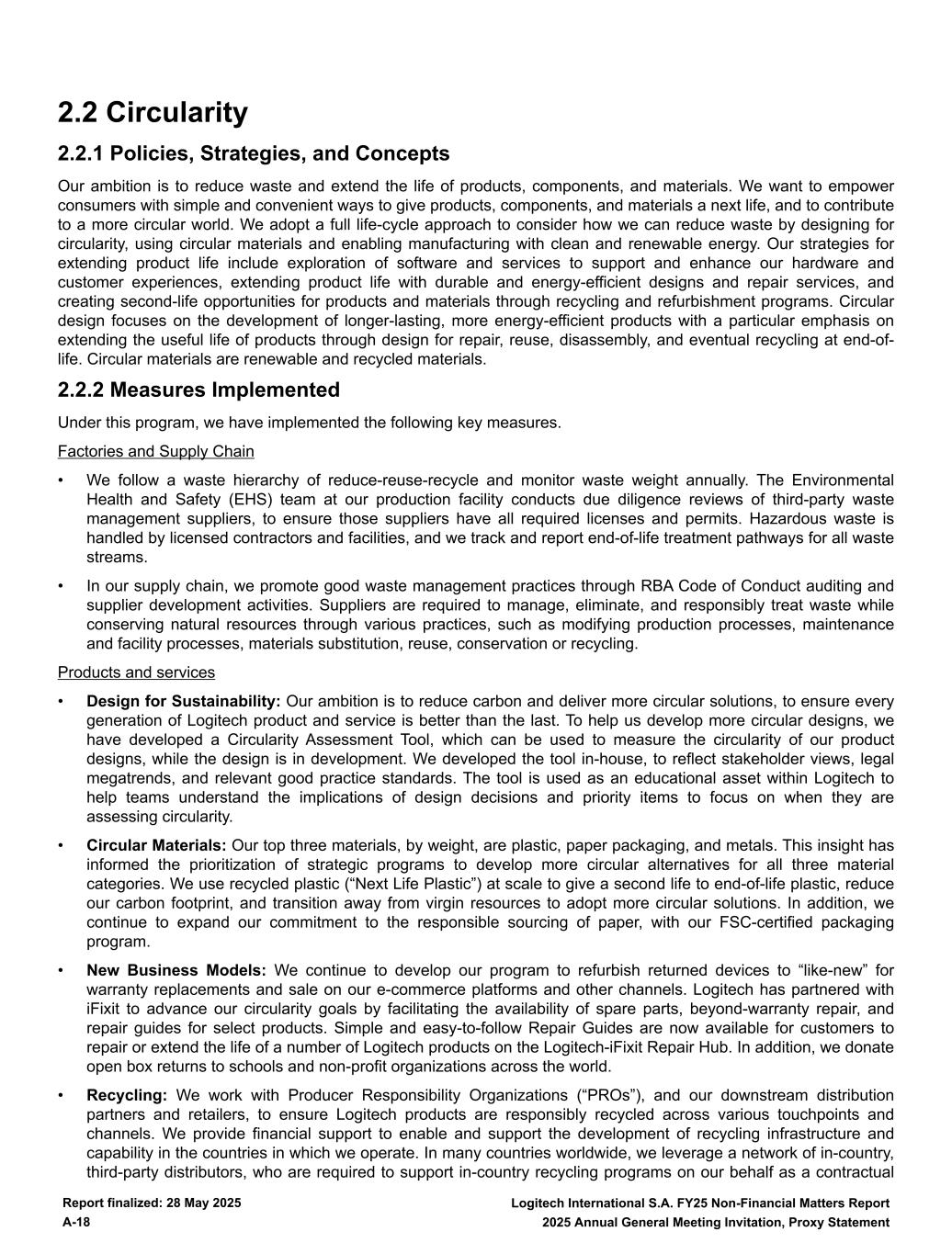
2.2 Circularity 2.2.1 Policies, Strategies, and Concepts Our ambition is to reduce waste and extend the life of products, components, and materials. We want to empower consumers with simple and convenient ways to give products, components, and materials a next life, and to contribute to a more circular world. We adopt a full life-cycle approach to consider how we can reduce waste by designing for circularity, using circular materials and enabling manufacturing with clean and renewable energy. Our strategies for extending product life include exploration of software and services to support and enhance our hardware and customer experiences, extending product life with durable and energy-efficient designs and repair services, and creating second-life opportunities for products and materials through recycling and refurbishment programs. Circular design focuses on the development of longer-lasting, more energy-efficient products with a particular emphasis on extending the useful life of products through design for repair, reuse, disassembly, and eventual recycling at end-of- life. Circular materials are renewable and recycled materials. 2.2.2 Measures Implemented Under this program, we have implemented the following key measures. Factories and Supply Chain • We follow a waste hierarchy of reduce-reuse-recycle and monitor waste weight annually. The Environmental Health and Safety (EHS) team at our production facility conducts due diligence reviews of third-party waste management suppliers, to ensure those suppliers have all required licenses and permits. Hazardous waste is handled by licensed contractors and facilities, and we track and report end-of-life treatment pathways for all waste streams. • In our supply chain, we promote good waste management practices through RBA Code of Conduct auditing and supplier development activities. Suppliers are required to manage, eliminate, and responsibly treat waste while conserving natural resources through various practices, such as modifying production processes, maintenance and facility processes, materials substitution, reuse, conservation or recycling. Products and services • Design for Sustainability: Our ambition is to reduce carbon and deliver more circular solutions, to ensure every generation of Logitech product and service is better than the last. To help us develop more circular designs, we have developed a Circularity Assessment Tool, which can be used to measure the circularity of our product designs, while the design is in development. We developed the tool in-house, to reflect stakeholder views, legal megatrends, and relevant good practice standards. The tool is used as an educational asset within Logitech to help teams understand the implications of design decisions and priority items to focus on when they are assessing circularity. • Circular Materials: Our top three materials, by weight, are plastic, paper packaging, and metals. This insight has informed the prioritization of strategic programs to develop more circular alternatives for all three material categories. We use recycled plastic (“Next Life Plastic”) at scale to give a second life to end-of-life plastic, reduce our carbon footprint, and transition away from virgin resources to adopt more circular solutions. In addition, we continue to expand our commitment to the responsible sourcing of paper, with our FSC-certified packaging program. • New Business Models: We continue to develop our program to refurbish returned devices to “like-new” for warranty replacements and sale on our e-commerce platforms and other channels. Logitech has partnered with iFixit to advance our circularity goals by facilitating the availability of spare parts, beyond-warranty repair, and repair guides for select products. Simple and easy-to-follow Repair Guides are now available for customers to repair or extend the life of a number of Logitech products on the Logitech-iFixit Repair Hub. In addition, we donate open box returns to schools and non-profit organizations across the world. • Recycling: We work with Producer Responsibility Organizations (“PROs”), and our downstream distribution partners and retailers, to ensure Logitech products are responsibly recycled across various touchpoints and channels. We provide financial support to enable and support the development of recycling infrastructure and capability in the countries in which we operate. In many countries worldwide, we leverage a network of in-country, third-party distributors, who are required to support in-country recycling programs on our behalf as a contractual Report finalized: 28 May 2025 Logitech International S.A. FY25 Non-Financial Matters Report A-18 2025 Annual General Meeting Invitation, Proxy Statement
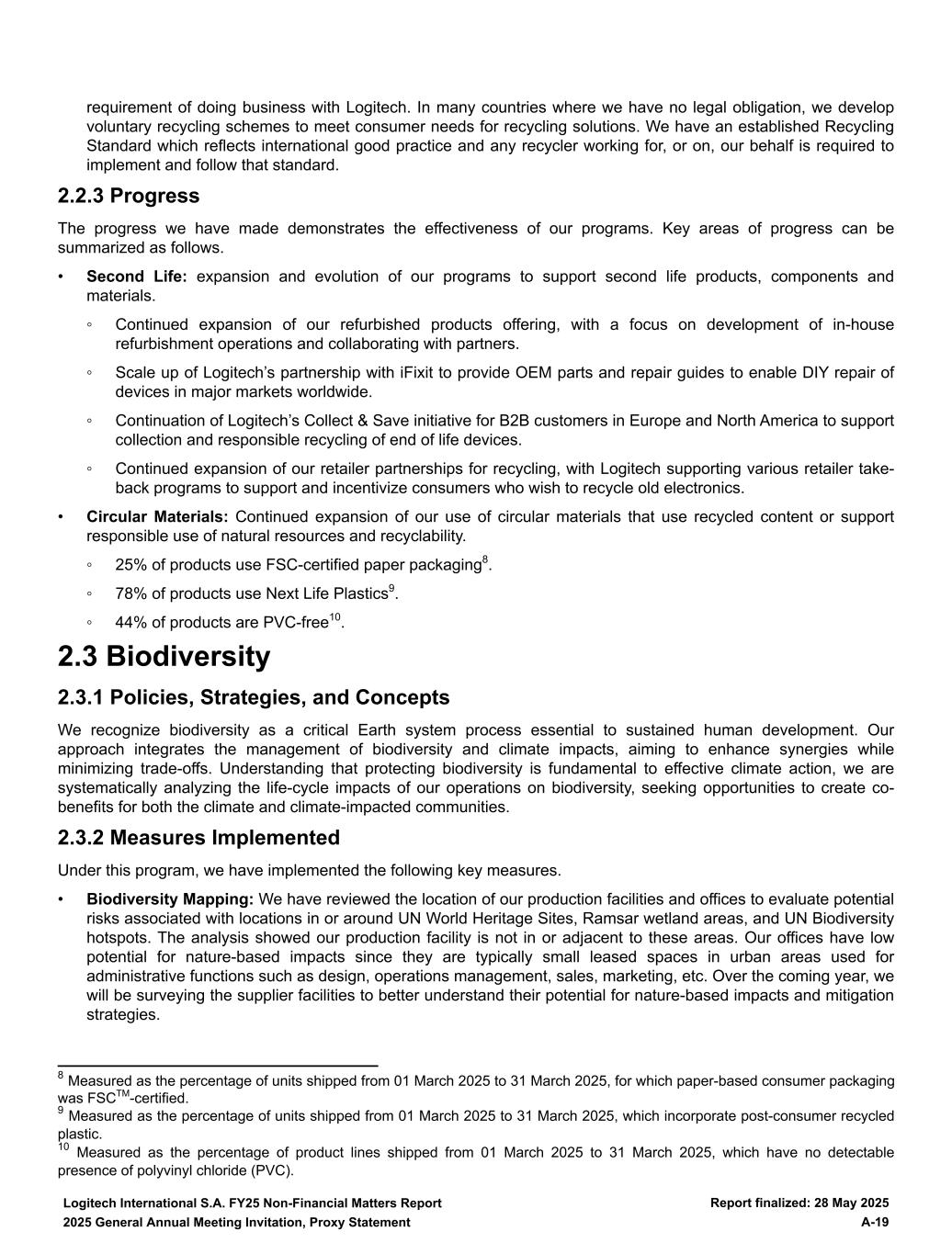
requirement of doing business with Logitech. In many countries where we have no legal obligation, we develop voluntary recycling schemes to meet consumer needs for recycling solutions. We have an established Recycling Standard which reflects international good practice and any recycler working for, or on, our behalf is required to implement and follow that standard. 2.2.3 Progress The progress we have made demonstrates the effectiveness of our programs. Key areas of progress can be summarized as follows. • Second Life: expansion and evolution of our programs to support second life products, components and materials. ◦ Continued expansion of our refurbished products offering, with a focus on development of in-house refurbishment operations and collaborating with partners. ◦ Scale up of Logitech’s partnership with iFixit to provide OEM parts and repair guides to enable DIY repair of devices in major markets worldwide. ◦ Continuation of Logitech’s Collect & Save initiative for B2B customers in Europe and North America to support collection and responsible recycling of end of life devices. ◦ Continued expansion of our retailer partnerships for recycling, with Logitech supporting various retailer take- back programs to support and incentivize consumers who wish to recycle old electronics. • Circular Materials: Continued expansion of our use of circular materials that use recycled content or support responsible use of natural resources and recyclability. ◦ 25% of products use FSC-certified paper packaging8. ◦ 78% of products use Next Life Plastics9. ◦ 44% of products are PVC-free10. 2.3 Biodiversity 2.3.1 Policies, Strategies, and Concepts We recognize biodiversity as a critical Earth system process essential to sustained human development. Our approach integrates the management of biodiversity and climate impacts, aiming to enhance synergies while minimizing trade-offs. Understanding that protecting biodiversity is fundamental to effective climate action, we are systematically analyzing the life-cycle impacts of our operations on biodiversity, seeking opportunities to create co- benefits for both the climate and climate-impacted communities. 2.3.2 Measures Implemented Under this program, we have implemented the following key measures. • Biodiversity Mapping: We have reviewed the location of our production facilities and offices to evaluate potential risks associated with locations in or around UN World Heritage Sites, Ramsar wetland areas, and UN Biodiversity hotspots. The analysis showed our production facility is not in or adjacent to these areas. Our offices have low potential for nature-based impacts since they are typically small leased spaces in urban areas used for administrative functions such as design, operations management, sales, marketing, etc. Over the coming year, we will be surveying the supplier facilities to better understand their potential for nature-based impacts and mitigation strategies. Logitech International S.A. FY25 Non-Financial Matters Report Report finalized: 28 May 2025 2025 General Annual Meeting Invitation, Proxy Statement A-19 8 Measured as the percentage of units shipped from 01 March 2025 to 31 March 2025, for which paper-based consumer packaging was FSCTM-certified. 9 Measured as the percentage of units shipped from 01 March 2025 to 31 March 2025, which incorporate post-consumer recycled plastic. 10 Measured as the percentage of product lines shipped from 01 March 2025 to 31 March 2025, which have no detectable presence of polyvinyl chloride (PVC).
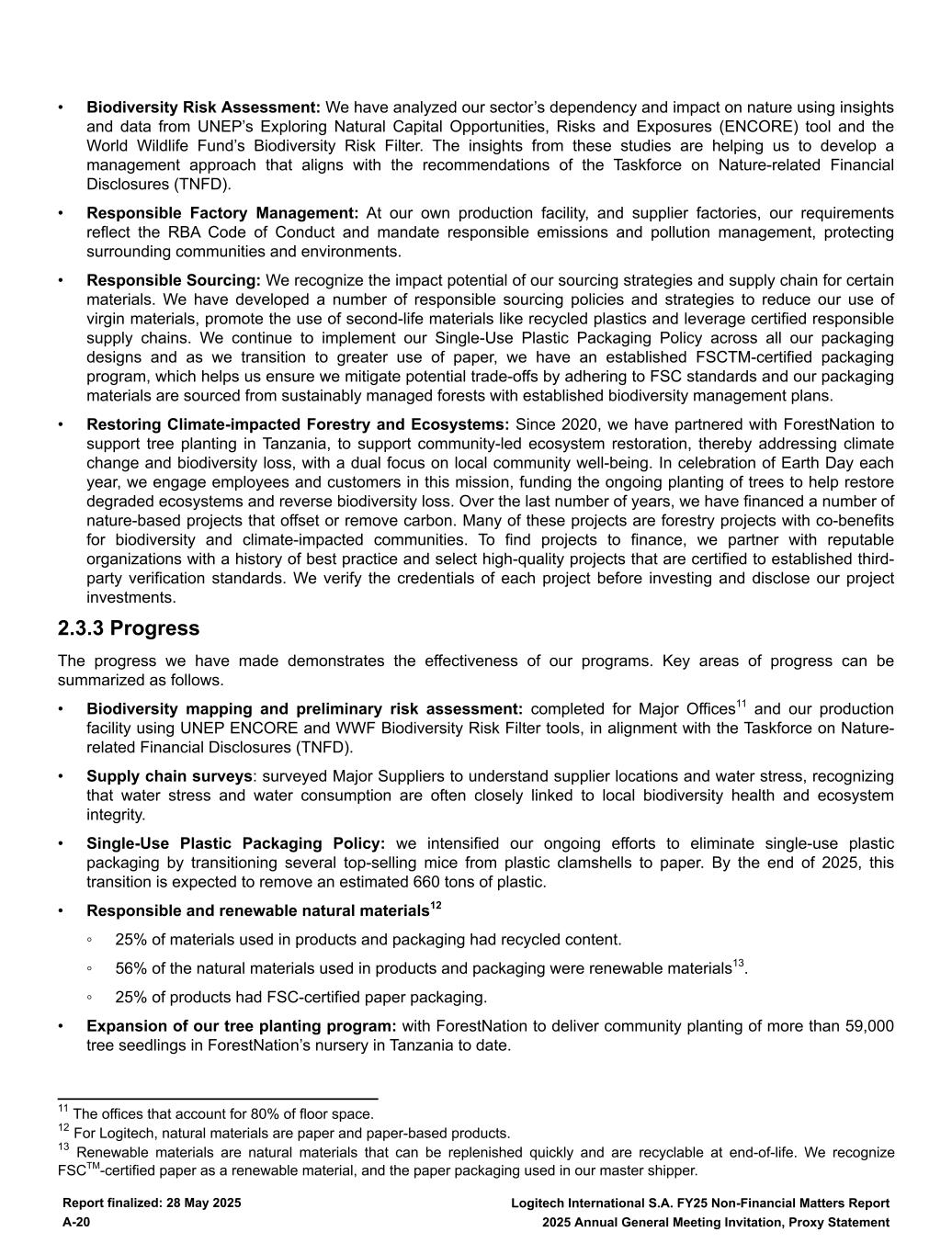
• Biodiversity Risk Assessment: We have analyzed our sector’s dependency and impact on nature using insights and data from UNEP’s Exploring Natural Capital Opportunities, Risks and Exposures (ENCORE) tool and the World Wildlife Fund’s Biodiversity Risk Filter. The insights from these studies are helping us to develop a management approach that aligns with the recommendations of the Taskforce on Nature-related Financial Disclosures (TNFD). • Responsible Factory Management: At our own production facility, and supplier factories, our requirements reflect the RBA Code of Conduct and mandate responsible emissions and pollution management, protecting surrounding communities and environments. • Responsible Sourcing: We recognize the impact potential of our sourcing strategies and supply chain for certain materials. We have developed a number of responsible sourcing policies and strategies to reduce our use of virgin materials, promote the use of second-life materials like recycled plastics and leverage certified responsible supply chains. We continue to implement our Single-Use Plastic Packaging Policy across all our packaging designs and as we transition to greater use of paper, we have an established FSCTM-certified packaging program, which helps us ensure we mitigate potential trade-offs by adhering to FSC standards and our packaging materials are sourced from sustainably managed forests with established biodiversity management plans. • Restoring Climate-impacted Forestry and Ecosystems: Since 2020, we have partnered with ForestNation to support tree planting in Tanzania, to support community-led ecosystem restoration, thereby addressing climate change and biodiversity loss, with a dual focus on local community well-being. In celebration of Earth Day each year, we engage employees and customers in this mission, funding the ongoing planting of trees to help restore degraded ecosystems and reverse biodiversity loss. Over the last number of years, we have financed a number of nature-based projects that offset or remove carbon. Many of these projects are forestry projects with co-benefits for biodiversity and climate-impacted communities. To find projects to finance, we partner with reputable organizations with a history of best practice and select high-quality projects that are certified to established third- party verification standards. We verify the credentials of each project before investing and disclose our project investments. 2.3.3 Progress The progress we have made demonstrates the effectiveness of our programs. Key areas of progress can be summarized as follows. • Biodiversity mapping and preliminary risk assessment: completed for Major Offices11 and our production facility using UNEP ENCORE and WWF Biodiversity Risk Filter tools, in alignment with the Taskforce on Nature- related Financial Disclosures (TNFD). • Supply chain surveys: surveyed Major Suppliers to understand supplier locations and water stress, recognizing that water stress and water consumption are often closely linked to local biodiversity health and ecosystem integrity. • Single-Use Plastic Packaging Policy: we intensified our ongoing efforts to eliminate single-use plastic packaging by transitioning several top-selling mice from plastic clamshells to paper. By the end of 2025, this transition is expected to remove an estimated 660 tons of plastic. • Responsible and renewable natural materials12 ◦ 25% of materials used in products and packaging had recycled content. ◦ 56% of the natural materials used in products and packaging were renewable materials13. ◦ 25% of products had FSC-certified paper packaging. • Expansion of our tree planting program: with ForestNation to deliver community planting of more than 59,000 tree seedlings in ForestNation’s nursery in Tanzania to date. Report finalized: 28 May 2025 Logitech International S.A. FY25 Non-Financial Matters Report A-20 2025 Annual General Meeting Invitation, Proxy Statement 11 The offices that account for 80% of floor space. 12 For Logitech, natural materials are paper and paper-based products. 13 Renewable materials are natural materials that can be replenished quickly and are recyclable at end-of-life. We recognize FSCTM-certified paper as a renewable material, and the paper packaging used in our master shipper.
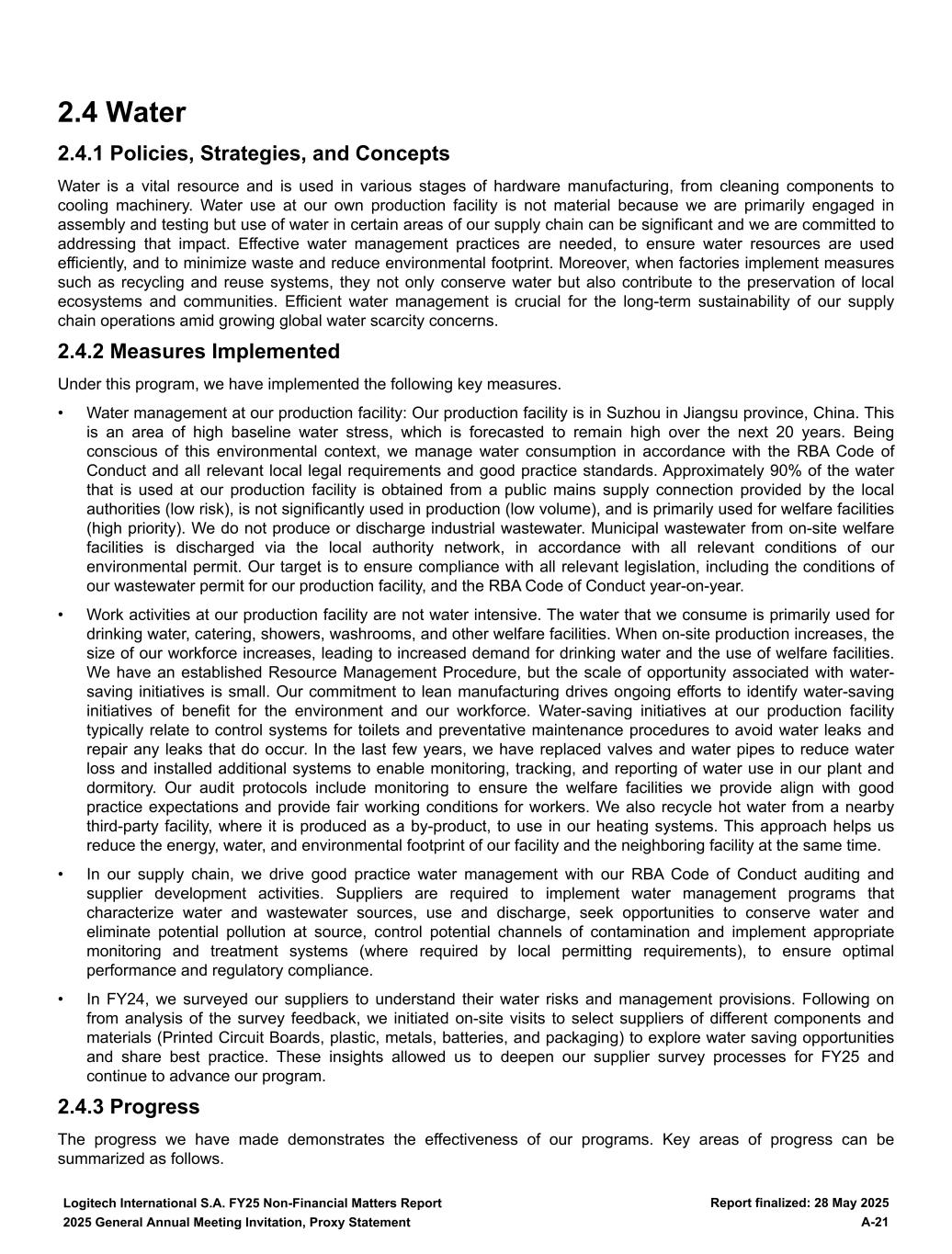
2.4 Water 2.4.1 Policies, Strategies, and Concepts Water is a vital resource and is used in various stages of hardware manufacturing, from cleaning components to cooling machinery. Water use at our own production facility is not material because we are primarily engaged in assembly and testing but use of water in certain areas of our supply chain can be significant and we are committed to addressing that impact. Effective water management practices are needed, to ensure water resources are used efficiently, and to minimize waste and reduce environmental footprint. Moreover, when factories implement measures such as recycling and reuse systems, they not only conserve water but also contribute to the preservation of local ecosystems and communities. Efficient water management is crucial for the long-term sustainability of our supply chain operations amid growing global water scarcity concerns. 2.4.2 Measures Implemented Under this program, we have implemented the following key measures. • Water management at our production facility: Our production facility is in Suzhou in Jiangsu province, China. This is an area of high baseline water stress, which is forecasted to remain high over the next 20 years. Being conscious of this environmental context, we manage water consumption in accordance with the RBA Code of Conduct and all relevant local legal requirements and good practice standards. Approximately 90% of the water that is used at our production facility is obtained from a public mains supply connection provided by the local authorities (low risk), is not significantly used in production (low volume), and is primarily used for welfare facilities (high priority). We do not produce or discharge industrial wastewater. Municipal wastewater from on-site welfare facilities is discharged via the local authority network, in accordance with all relevant conditions of our environmental permit. Our target is to ensure compliance with all relevant legislation, including the conditions of our wastewater permit for our production facility, and the RBA Code of Conduct year-on-year. • Work activities at our production facility are not water intensive. The water that we consume is primarily used for drinking water, catering, showers, washrooms, and other welfare facilities. When on-site production increases, the size of our workforce increases, leading to increased demand for drinking water and the use of welfare facilities. We have an established Resource Management Procedure, but the scale of opportunity associated with water- saving initiatives is small. Our commitment to lean manufacturing drives ongoing efforts to identify water-saving initiatives of benefit for the environment and our workforce. Water-saving initiatives at our production facility typically relate to control systems for toilets and preventative maintenance procedures to avoid water leaks and repair any leaks that do occur. In the last few years, we have replaced valves and water pipes to reduce water loss and installed additional systems to enable monitoring, tracking, and reporting of water use in our plant and dormitory. Our audit protocols include monitoring to ensure the welfare facilities we provide align with good practice expectations and provide fair working conditions for workers. We also recycle hot water from a nearby third-party facility, where it is produced as a by-product, to use in our heating systems. This approach helps us reduce the energy, water, and environmental footprint of our facility and the neighboring facility at the same time. • In our supply chain, we drive good practice water management with our RBA Code of Conduct auditing and supplier development activities. Suppliers are required to implement water management programs that characterize water and wastewater sources, use and discharge, seek opportunities to conserve water and eliminate potential pollution at source, control potential channels of contamination and implement appropriate monitoring and treatment systems (where required by local permitting requirements), to ensure optimal performance and regulatory compliance. • In FY24, we surveyed our suppliers to understand their water risks and management provisions. Following on from analysis of the survey feedback, we initiated on-site visits to select suppliers of different components and materials (Printed Circuit Boards, plastic, metals, batteries, and packaging) to explore water saving opportunities and share best practice. These insights allowed us to deepen our supplier survey processes for FY25 and continue to advance our program. 2.4.3 Progress The progress we have made demonstrates the effectiveness of our programs. Key areas of progress can be summarized as follows. Logitech International S.A. FY25 Non-Financial Matters Report Report finalized: 28 May 2025 2025 General Annual Meeting Invitation, Proxy Statement A-21
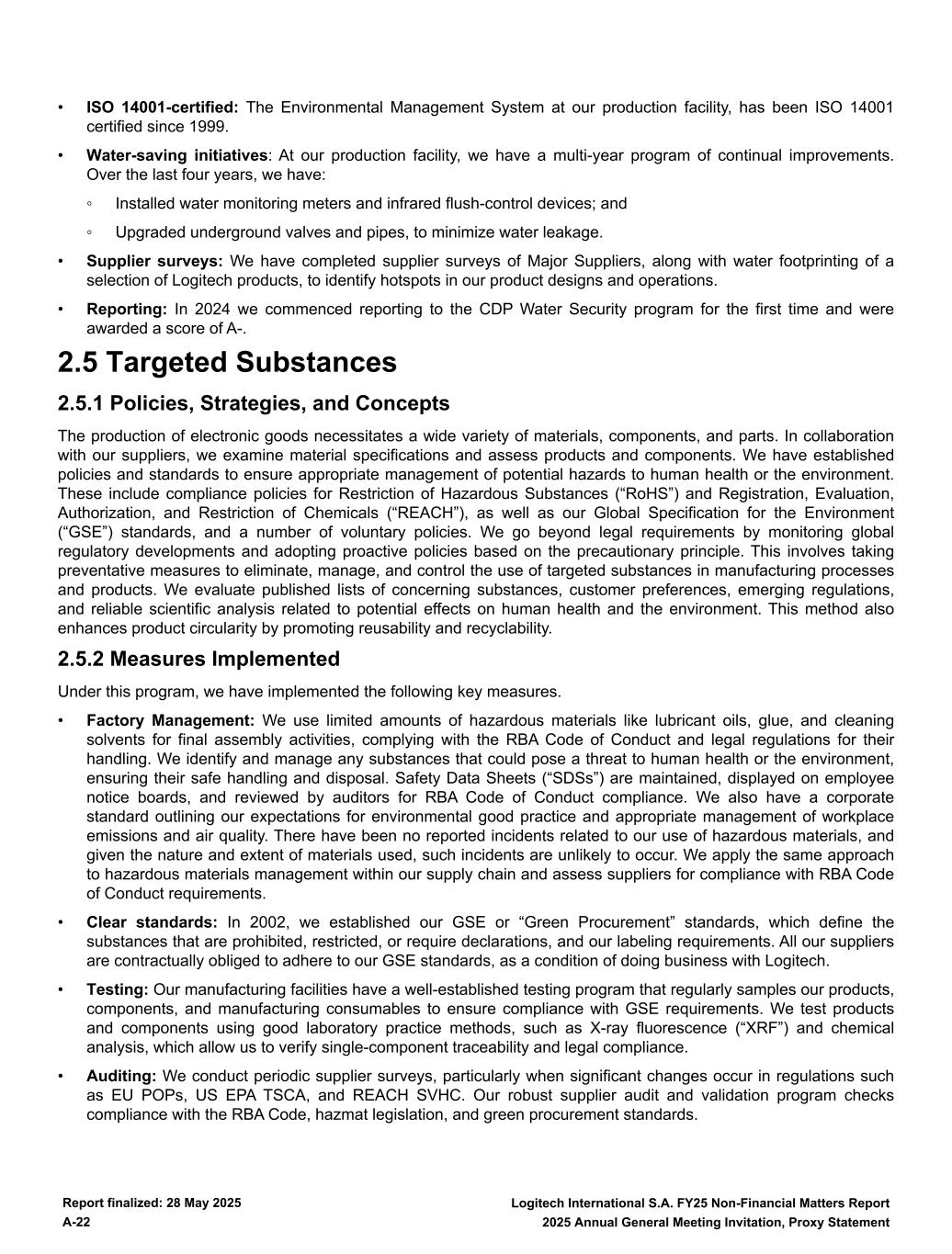
• ISO 14001-certified: The Environmental Management System at our production facility, has been ISO 14001 certified since 1999. • Water-saving initiatives: At our production facility, we have a multi-year program of continual improvements. Over the last four years, we have: ◦ Installed water monitoring meters and infrared flush-control devices; and ◦ Upgraded underground valves and pipes, to minimize water leakage. • Supplier surveys: We have completed supplier surveys of Major Suppliers, along with water footprinting of a selection of Logitech products, to identify hotspots in our product designs and operations. • Reporting: In 2024 we commenced reporting to the CDP Water Security program for the first time and were awarded a score of A-. 2.5 Targeted Substances 2.5.1 Policies, Strategies, and Concepts The production of electronic goods necessitates a wide variety of materials, components, and parts. In collaboration with our suppliers, we examine material specifications and assess products and components. We have established policies and standards to ensure appropriate management of potential hazards to human health or the environment. These include compliance policies for Restriction of Hazardous Substances (“RoHS”) and Registration, Evaluation, Authorization, and Restriction of Chemicals (“REACH”), as well as our Global Specification for the Environment (“GSE”) standards, and a number of voluntary policies. We go beyond legal requirements by monitoring global regulatory developments and adopting proactive policies based on the precautionary principle. This involves taking preventative measures to eliminate, manage, and control the use of targeted substances in manufacturing processes and products. We evaluate published lists of concerning substances, customer preferences, emerging regulations, and reliable scientific analysis related to potential effects on human health and the environment. This method also enhances product circularity by promoting reusability and recyclability. 2.5.2 Measures Implemented Under this program, we have implemented the following key measures. • Factory Management: We use limited amounts of hazardous materials like lubricant oils, glue, and cleaning solvents for final assembly activities, complying with the RBA Code of Conduct and legal regulations for their handling. We identify and manage any substances that could pose a threat to human health or the environment, ensuring their safe handling and disposal. Safety Data Sheets (“SDSs”) are maintained, displayed on employee notice boards, and reviewed by auditors for RBA Code of Conduct compliance. We also have a corporate standard outlining our expectations for environmental good practice and appropriate management of workplace emissions and air quality. There have been no reported incidents related to our use of hazardous materials, and given the nature and extent of materials used, such incidents are unlikely to occur. We apply the same approach to hazardous materials management within our supply chain and assess suppliers for compliance with RBA Code of Conduct requirements. • Clear standards: In 2002, we established our GSE or “Green Procurement” standards, which define the substances that are prohibited, restricted, or require declarations, and our labeling requirements. All our suppliers are contractually obliged to adhere to our GSE standards, as a condition of doing business with Logitech. • Testing: Our manufacturing facilities have a well-established testing program that regularly samples our products, components, and manufacturing consumables to ensure compliance with GSE requirements. We test products and components using good laboratory practice methods, such as X-ray fluorescence (“XRF”) and chemical analysis, which allow us to verify single-component traceability and legal compliance. • Auditing: We conduct periodic supplier surveys, particularly when significant changes occur in regulations such as EU POPs, US EPA TSCA, and REACH SVHC. Our robust supplier audit and validation program checks compliance with the RBA Code, hazmat legislation, and green procurement standards. Report finalized: 28 May 2025 Logitech International S.A. FY25 Non-Financial Matters Report A-22 2025 Annual General Meeting Invitation, Proxy Statement
• Substitutions: When safer alternatives are available, we phase out targeted substances of concern, such as PVC. In 2018, we introduced a program to phase out PVC in cables by transitioning to low-toxicity thermoplastic elastomer (“TPE”) alternatives. 2.5.3 Progress The progress we have made demonstrates the effectiveness of our programs. Key areas of progress can be summarized as follows. • Targeted Substance Phase-Out ◦ Substance Phase-Out: Systematic reduction of targeted substances like PVC, phthalates, and flame retardants through testing, corrective actions, and supplier collaboration. ◦ 44% of products are PVC-free14, demonstrating significant progress towards our 2030 Zero PVC goal. • Compliance Record ◦ Zero significant fines15 and non-monetary sanctions for noncompliance with environmental laws and/or regulations in the last four years. ◦ Zero incidents of noncompliance with regulations concerning the health and safety impacts of products and services resulting in a fine or penalty or regulatory warning in the last four years. ◦ Zero incidents of non-compliance with regulations concerning product and service information and labeling resulting in a fine or penalty or regulatory warning in the last four years. ◦ Zero incidents of non-compliance with regulations concerning marketing communications, including advertising, promotion, and sponsorship resulting in a fine or penalty or regulatory warning in the last four years. 3. Social and Employment Related Matters 3.1 Inclusion 3.1.1 Policies, Strategies, and Concepts At Logitech we foster a company culture that strives for fair access and opportunity at all levels of the company. By supporting and empowering all of our employees and communities, we can shape a more equitable industry and meet increasingly diverse customer needs. 3.1.2 Measures Implemented Under this program, we have implemented the following key measures. • Policy and Advocacy: Our Social Impact team collaborates with our Legal/Public Policy and Communications teams to ensure that we evaluate the appropriate company response on social impact topics internally and externally. Amongst other factors, this evaluation process includes consideration of our credibility or ability to lead on the topic, the potential impact to our business and reputation, and the extent to which the topic is connected or aligned with our core values. • Pay Equity: We conduct an annual review of compensation worldwide to help ensure we pay fairly and to eliminate gender, racial, and other discrimination in the workplace. Where needed, we make salary adjustments during our annual review process to ensure wages are market-competitive and fair. In countries like Ireland and Switzerland, where legislation requires pay equity analyses and reporting, we participate and disclose our results, in compliance with relevant reporting requirements. Logitech International S.A. FY25 Non-Financial Matters Report Report finalized: 28 May 2025 2025 General Annual Meeting Invitation, Proxy Statement A-23 14 Measured as the percentage of product lines shipped from 01 March 2025 to 31 March 2025, which have no detectable presence of polyvinyl chloride e.g. in cables or component parts. 15 A significant fine is a fine of more than USD $10,000.
• Recruitment : We have developed a bias-reducing process that we follow globally when we open jobs internally and to the public and ensure our job descriptions are inclusive and non-biased before they are published. We have an inclusive global team of internal Talent Acquisition (“TA”) professionals connected with our leaders and our values. • Employee Resource Groups (ERG): Our ERGs are employee-led groups that work to facilitate an inclusive workplace by building solidarity and promoting allyship. Our ERGs also act as a critical feedback loop, highlighting issues faced by marginalized groups and helping to foster understanding and stimulate action. • Women in Tech: We have a number of programs and initiatives to celebrate and enable women in tech. ◦ #WomenWhoMaster Program: Our #WomenWhoMaster program comprises a range of initiatives that celebrate, amplify, and enable the rise of women in STEM. The series provides aspiring girls and women with powerful stories about overcoming barriers and career tips. ◦ Girls Who Code: We collaborate with Girls Who Code on their Summer Immersive Program (SIP) and Self Paced Program (SPP) to advance their mission of closing the gender gap in tech and reshaping the perception of programmers. • LogiTalks Speaker Series: This is our internal speaking series to share the stories of dynamic individuals and activists that align with our values and are making a difference in the communities in which we live and work. • Inclusive Products: We teamed with Sony to release an Adaptive Gaming Kit controller for gamers with accessibility needs. The controller offers various swappable buttons and stick caps allowing players to customize layouts to suit their unique strength, range of motion, and physical needs. • Parental Leave Policy: Logitech provides a minimum of 18 weeks of fully paid time off for all parents welcoming a new child through birth, surrogacy or adoption globally, regardless of gender, sexual orientation or length of service. • Supplier Training and Education: We host and facilitate supplier training events. As part of these activities, we facilitate discussion of Logitech’s sustainability expectations and standards, and international good practice standards. We create forums that help suppliers share their experience of best practices and lessons learned with each other. We also connect our suppliers with RBA capability-building sessions and development resources, encourage their participation in RBA training and assign certain e-learning courses to specific suppliers, to drive improved awareness and education. 3.1.3 Progress The progress we have made demonstrates the effectiveness of our programs. Key areas of progress can be summarized as follows. • Inclusive Leadership ◦ 42% of our Board of Directors are female, including a female Board Chairperson. ◦ 43% of our Leadership Team are female. ◦ 37% of all employees are female with 36% of all managers being female16 and 23% of STEM-related positions17 being female. • Minority Representation: 44% in management roles. • Gender Equity: We were included in “America’s Greatest Workplaces for Women 2025” published by Newsweek, recognizing organizations in the US that offer supportive workplace policies with an active commitment to inclusion and gender equity. Report finalized: 28 May 2025 Logitech International S.A. FY25 Non-Financial Matters Report A-24 2025 Annual General Meeting Invitation, Proxy Statement 16 Women in the Logitech “People Managers” category, “Extended Leadership” category, and “Leadership Team” category, as a percentage of all individuals in those categories. 17 STEM positions are related to science, technology, engineering, and mathematics. Logitech’s P&C team defines these positions, which include engineers, data scientists, and others. The number of individuals in these positions is calculated as a percentage of all individuals in all positions.
3.2 Digital Inclusivity 3.2.1 Policies, Strategies, and Concepts We believe that equality is a fundamental right and we have made significant progress in integrating this value at the heart of everything we do. We are dedicated to contributing towards a more equitable, accessible, and inclusive digital environment for everyone. We enable digital inclusion via two primary pathways. • Our Design for Sustainability approach (see Design for Sustainability); and • Our focus on increasing accessibility through philanthropic endeavors, by: ◦ establishing secure, inclusive, and easily accessible digital areas; ◦ encouraging education in the fields of Science, Technology, Engineering, Arts, and Mathematics (STEAM); and ◦ empowering and giving voice to a diverse range of creators. 3.2.2 Measures Implemented Under this program, we have implemented the following key measures. • DfS as a Driving Force for Innovation: The DfS Principle of “Making a Positive Contribution” is focused on digital inclusion and creating products “that enable joyful and inclusive experiences” for everyone. Using DfS Principles, we reevaluate and enhance traditional product development methods, always aiming to make more accessible products for our customers. We are actively building DfS capabilities across the company to facilitate the development of digitally inclusive products. • Creating Secure, Inclusive, and Easily Accessible Digital Areas: Logitech partnered with Mount Sinai, AbleGamers Charity, and Adaptive Action Sports to organize the Logitech G Adaptive Esports Tournament, aiming to provide gamers with disabilities professional esports opportunities and support. Logitech supported each partner, enabling people with disabilities through peer counseling, facilitating interactions, and offering assisted tech grants. Additionally, Logitech collaborated with the non-profit organization GLAAD to support their Social Media Safety Program, establishing standards to combat online hate and intolerance, particularly towards LGBTQIA+ individuals, and promoting equity and acceptance in the gaming industry through GLAAD Gaming. • Supporting STEAM Education: Logitech collaborates with organizations like Girls Who Code, Pensole Lewis College, and TechLit Africa to support STEAM education, focusing on equity and providing pathways for communities. In FY25, Logitech’s efforts targeted specific groups in technology, including girls and women aiming to empower them through STEAM-centered educational programs. • Supporting Scholarships: The Logitech scholarship program at The Royal College of Art (“RCA”), London has created a viable pathway into the design industry for young people from marginalized communities. Our aim is to enable increasing numbers of students to learn the craft and science of creation and design. Our scholarship helps early career creatives at a pivotal stage in their careers and allows the RCA to continue nurturing talented students. • Product Donation: Logitech’s Open-Box Donation program is committed to donating returned products to qualifying charities and educational institutions. These “open-box” products come from Logitech G, ASTRO Gaming, and personal workspace and streaming lines, and are generally fully functional but might be recycled before reaching the end of their working life-cycle. This program is aligned with Logitech’s DfS ethos, and not only extends the product lifespan but also positively helps schoolchildren in underserved areas. 3.2.3 Progress The progress we have made demonstrates the effectiveness of our programs. Key areas of progress can be summarized as follows. • Continued hosting esports tournaments with Mount Sinai, AbleGamers, and Adaptive Action Sports, awarding cash prizes to gamers with disabilities. Logitech International S.A. FY25 Non-Financial Matters Report Report finalized: 28 May 2025 2025 General Annual Meeting Invitation, Proxy Statement A-25
• Partnered with GLAAD to protect LGBTQIA+ individuals online through the Social Media Safety Index (SMSI) and supported inclusive gaming environments. • Collaborated with organizations like Girls Who Code, and Techlit Africa to support STEAM education. 3.3 Talent Attraction and Retention 3.3.1 Policies, Strategies, and Concepts We prosper when we develop our people. We aim to embed a learning culture where employees feel empowered to nurture their own minds, challenge ideas, and make things better. We know we cannot expect to meet growing business aspirations unless our people also see opportunities to meet their personal aspirations. We want to bring out the best in our employees. We believe there is no real value in separating an individual’s work skills from their character, and their life experience and opportunities. Our talent development programs provide support to Logitech individuals across the globe through guidance and offerings that strengthen our Logitech culture and help to develop the whole person. 3.3.2 Measures Implemented Under this program, we have implemented the following key measures. • A major factor in attracting and retaining employees is the attractiveness of Logitech as an employer, alongside an attractive and competitive compensation which we regularly benchmark in relation to peer companies. We offer a competitive benefits package tailored to the needs of the markets in which we are located. We also created more flexibility for employees introducing working-from-home arrangement possibilities and individual development opportunities for employees and management, comprising training programs, and needs-based language courses. • Throughout the world, we also offer local and community-based programs for interns and apprentices to further our new talent attraction. In Lausanne, Silicon Valley, and Hsinchu, we run apprenticeship programs, and we advertise our opportunities widely to attract a diverse pool of interns. We hire from the intern pool and have a successful track record of interns and apprentices returning to Logitech as full-time employees. • Our talent attraction process is built to align with our values and includes a bias-reducing recruitment process that starts as soon as a new role is opened. At Logitech, it starts with a diverse, inclusive and trained global team of internal TA professionals, and connected with our leaders and our values. We also use technology and our own processes to limit bias where we can; we have developed a bias-reducing process that we follow globally when we open jobs internally and to the public; we use a software tool to ensure our job descriptions are inclusive and unbiased before they are published. • In the case of involuntary termination (redundancy), individuals can be given up to one month of outplacement training with third-party career coaches. As part of this placement, the individual can work with an assigned career coach who will develop a customized strategy, identify job leads, help the individual build a personal brand that attracts career opportunities, connect the individual with potential employers and recruiters to uncover job opportunities and develop resume and interviewing techniques that help individuals find their next career step beyond Logitech. • We actively advertise our open roles in locations that promote inclusion around the world. Platforms and sites that specialize in attracting the underrepresented are prioritized, and events that specifically target professionals and future professionals who are often marginalized or overlooked. We actively promote our company as a great place for everyone to work through local site gatherings, emails, and social media posts. 3.3.3 Progress The progress we have made demonstrates the effectiveness of our programs. Key areas of progress can be summarized as follows. • Leadership Development: Implemented Logi Leader Essentials training for managers, quarterly Leader Huddles, and the Logi Impact performance management framework, emphasizing continuous growth and adaptable career development. Report finalized: 28 May 2025 Logitech International S.A. FY25 Non-Financial Matters Report A-26 2025 Annual General Meeting Invitation, Proxy Statement
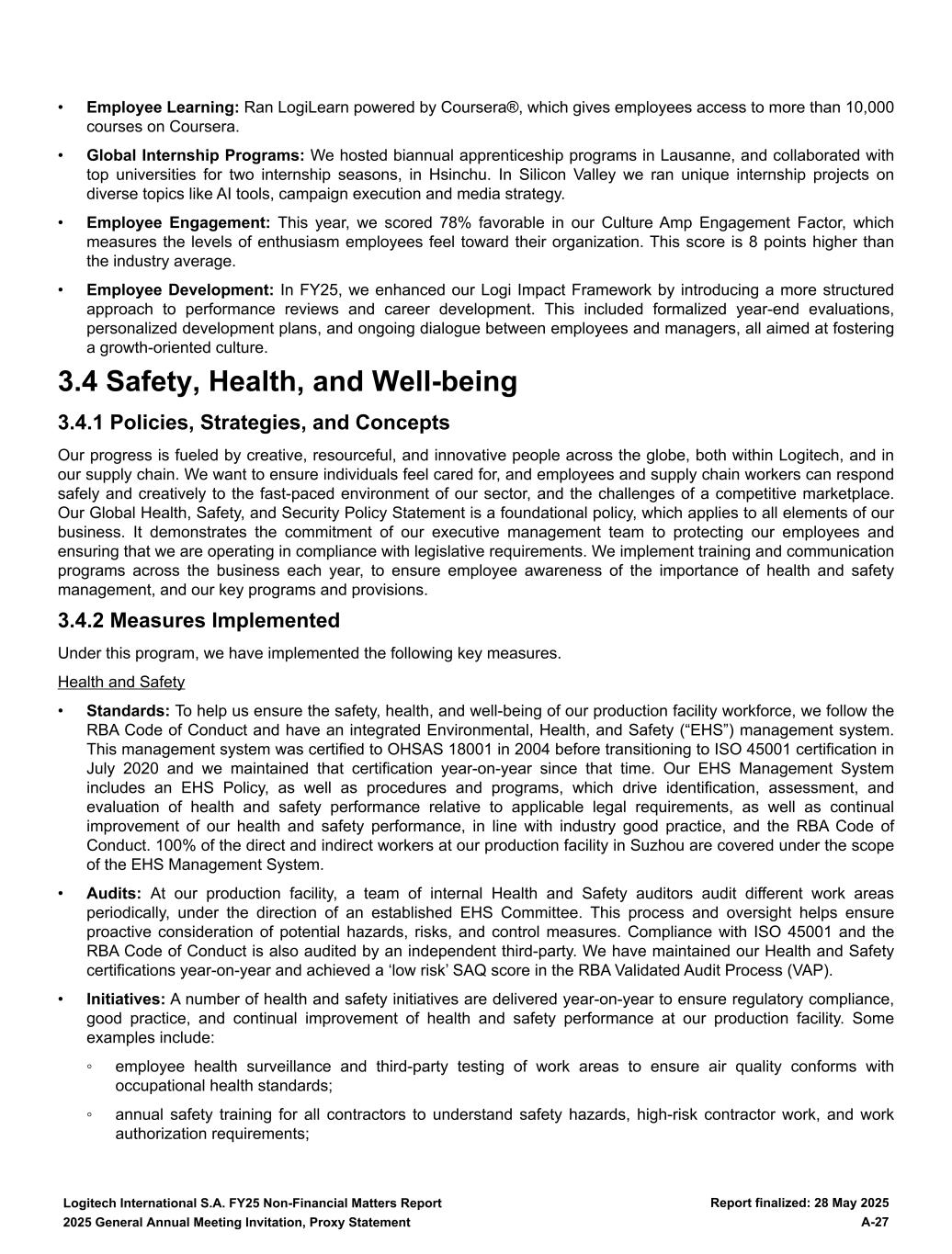
• Employee Learning: Ran LogiLearn powered by Coursera®, which gives employees access to more than 10,000 courses on Coursera. • Global Internship Programs: We hosted biannual apprenticeship programs in Lausanne, and collaborated with top universities for two internship seasons, in Hsinchu. In Silicon Valley we ran unique internship projects on diverse topics like AI tools, campaign execution and media strategy. • Employee Engagement: This year, we scored 78% favorable in our Culture Amp Engagement Factor, which measures the levels of enthusiasm employees feel toward their organization. This score is 8 points higher than the industry average. • Employee Development: In FY25, we enhanced our Logi Impact Framework by introducing a more structured approach to performance reviews and career development. This included formalized year-end evaluations, personalized development plans, and ongoing dialogue between employees and managers, all aimed at fostering a growth-oriented culture. 3.4 Safety, Health, and Well-being 3.4.1 Policies, Strategies, and Concepts Our progress is fueled by creative, resourceful, and innovative people across the globe, both within Logitech, and in our supply chain. We want to ensure individuals feel cared for, and employees and supply chain workers can respond safely and creatively to the fast-paced environment of our sector, and the challenges of a competitive marketplace. Our Global Health, Safety, and Security Policy Statement is a foundational policy, which applies to all elements of our business. It demonstrates the commitment of our executive management team to protecting our employees and ensuring that we are operating in compliance with legislative requirements. We implement training and communication programs across the business each year, to ensure employee awareness of the importance of health and safety management, and our key programs and provisions. 3.4.2 Measures Implemented Under this program, we have implemented the following key measures. Health and Safety • Standards: To help us ensure the safety, health, and well-being of our production facility workforce, we follow the RBA Code of Conduct and have an integrated Environmental, Health, and Safety (“EHS”) management system. This management system was certified to OHSAS 18001 in 2004 before transitioning to ISO 45001 certification in July 2020 and we maintained that certification year-on-year since that time. Our EHS Management System includes an EHS Policy, as well as procedures and programs, which drive identification, assessment, and evaluation of health and safety performance relative to applicable legal requirements, as well as continual improvement of our health and safety performance, in line with industry good practice, and the RBA Code of Conduct. 100% of the direct and indirect workers at our production facility in Suzhou are covered under the scope of the EHS Management System. • Audits: At our production facility, a team of internal Health and Safety auditors audit different work areas periodically, under the direction of an established EHS Committee. This process and oversight helps ensure proactive consideration of potential hazards, risks, and control measures. Compliance with ISO 45001 and the RBA Code of Conduct is also audited by an independent third-party. We have maintained our Health and Safety certifications year-on-year and achieved a ‘low risk’ SAQ score in the RBA Validated Audit Process (VAP). • Initiatives: A number of health and safety initiatives are delivered year-on-year to ensure regulatory compliance, good practice, and continual improvement of health and safety performance at our production facility. Some examples include: ◦ employee health surveillance and third-party testing of work areas to ensure air quality conforms with occupational health standards; ◦ annual safety training for all contractors to understand safety hazards, high-risk contractor work, and work authorization requirements; Logitech International S.A. FY25 Non-Financial Matters Report Report finalized: 28 May 2025 2025 General Annual Meeting Invitation, Proxy Statement A-27
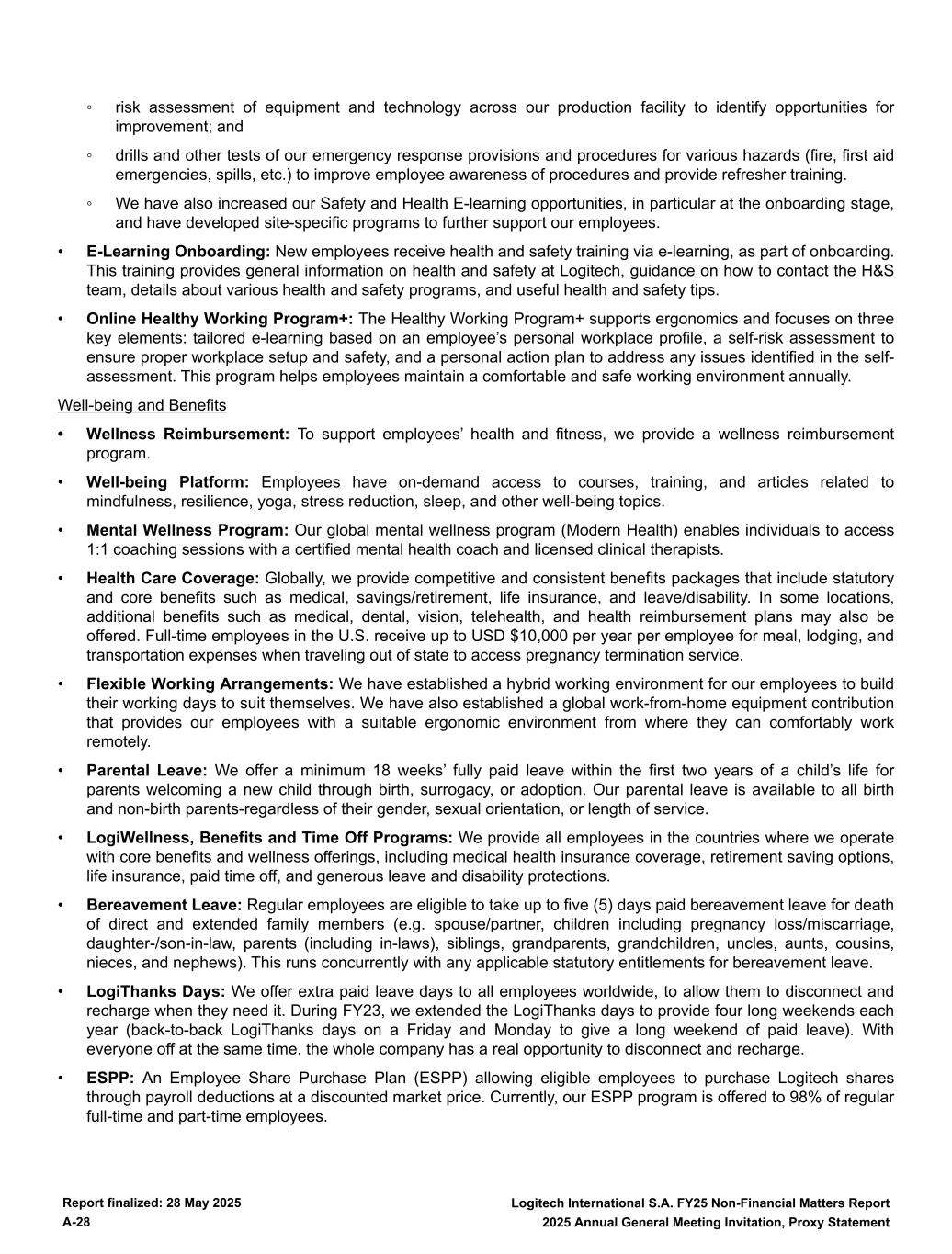
◦ risk assessment of equipment and technology across our production facility to identify opportunities for improvement; and ◦ drills and other tests of our emergency response provisions and procedures for various hazards (fire, first aid emergencies, spills, etc.) to improve employee awareness of procedures and provide refresher training. ◦ We have also increased our Safety and Health E-learning opportunities, in particular at the onboarding stage, and have developed site-specific programs to further support our employees. • E-Learning Onboarding: New employees receive health and safety training via e-learning, as part of onboarding. This training provides general information on health and safety at Logitech, guidance on how to contact the H&S team, details about various health and safety programs, and useful health and safety tips. • Online Healthy Working Program+: The Healthy Working Program+ supports ergonomics and focuses on three key elements: tailored e-learning based on an employee’s personal workplace profile, a self-risk assessment to ensure proper workplace setup and safety, and a personal action plan to address any issues identified in the self- assessment. This program helps employees maintain a comfortable and safe working environment annually. Well-being and Benefits • Wellness Reimbursement: To support employees’ health and fitness, we provide a wellness reimbursement program. • Well-being Platform: Employees have on-demand access to courses, training, and articles related to mindfulness, resilience, yoga, stress reduction, sleep, and other well-being topics. • Mental Wellness Program: Our global mental wellness program (Modern Health) enables individuals to access 1:1 coaching sessions with a certified mental health coach and licensed clinical therapists. • Health Care Coverage: Globally, we provide competitive and consistent benefits packages that include statutory and core benefits such as medical, savings/retirement, life insurance, and leave/disability. In some locations, additional benefits such as medical, dental, vision, telehealth, and health reimbursement plans may also be offered. Full-time employees in the U.S. receive up to USD $10,000 per year per employee for meal, lodging, and transportation expenses when traveling out of state to access pregnancy termination service. • Flexible Working Arrangements: We have established a hybrid working environment for our employees to build their working days to suit themselves. We have also established a global work-from-home equipment contribution that provides our employees with a suitable ergonomic environment from where they can comfortably work remotely. • Parental Leave: We offer a minimum 18 weeks’ fully paid leave within the first two years of a child’s life for parents welcoming a new child through birth, surrogacy, or adoption. Our parental leave is available to all birth and non-birth parents-regardless of their gender, sexual orientation, or length of service. • LogiWellness, Benefits and Time Off Programs: We provide all employees in the countries where we operate with core benefits and wellness offerings, including medical health insurance coverage, retirement saving options, life insurance, paid time off, and generous leave and disability protections. • Bereavement Leave: Regular employees are eligible to take up to five (5) days paid bereavement leave for death of direct and extended family members (e.g. spouse/partner, children including pregnancy loss/miscarriage, daughter-/son-in-law, parents (including in-laws), siblings, grandparents, grandchildren, uncles, aunts, cousins, nieces, and nephews). This runs concurrently with any applicable statutory entitlements for bereavement leave. • LogiThanks Days: We offer extra paid leave days to all employees worldwide, to allow them to disconnect and recharge when they need it. During FY23, we extended the LogiThanks days to provide four long weekends each year (back-to-back LogiThanks days on a Friday and Monday to give a long weekend of paid leave). With everyone off at the same time, the whole company has a real opportunity to disconnect and recharge. • ESPP: An Employee Share Purchase Plan (ESPP) allowing eligible employees to purchase Logitech shares through payroll deductions at a discounted market price. Currently, our ESPP program is offered to 98% of regular full-time and part-time employees. Report finalized: 28 May 2025 Logitech International S.A. FY25 Non-Financial Matters Report A-28 2025 Annual General Meeting Invitation, Proxy Statement
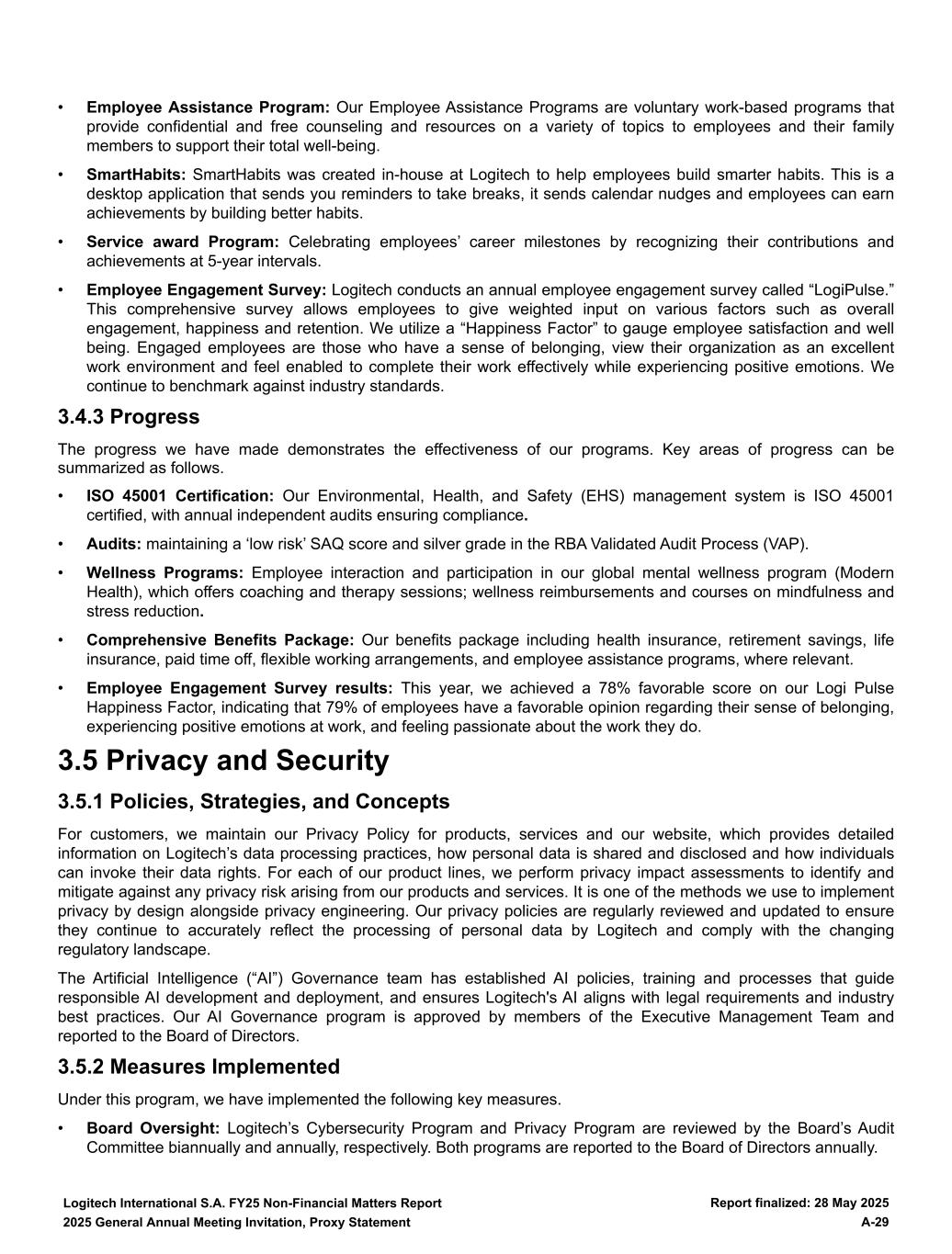
• Employee Assistance Program: Our Employee Assistance Programs are voluntary work-based programs that provide confidential and free counseling and resources on a variety of topics to employees and their family members to support their total well-being. • SmartHabits: SmartHabits was created in-house at Logitech to help employees build smarter habits. This is a desktop application that sends you reminders to take breaks, it sends calendar nudges and employees can earn achievements by building better habits. • Service award Program: Celebrating employees’ career milestones by recognizing their contributions and achievements at 5-year intervals. • Employee Engagement Survey: Logitech conducts an annual employee engagement survey called “LogiPulse.” This comprehensive survey allows employees to give weighted input on various factors such as overall engagement, happiness and retention. We utilize a “Happiness Factor” to gauge employee satisfaction and well being. Engaged employees are those who have a sense of belonging, view their organization as an excellent work environment and feel enabled to complete their work effectively while experiencing positive emotions. We continue to benchmark against industry standards. 3.4.3 Progress The progress we have made demonstrates the effectiveness of our programs. Key areas of progress can be summarized as follows. • ISO 45001 Certification: Our Environmental, Health, and Safety (EHS) management system is ISO 45001 certified, with annual independent audits ensuring compliance. • Audits: maintaining a ‘low risk’ SAQ score and silver grade in the RBA Validated Audit Process (VAP). • Wellness Programs: Employee interaction and participation in our global mental wellness program (Modern Health), which offers coaching and therapy sessions; wellness reimbursements and courses on mindfulness and stress reduction. • Comprehensive Benefits Package: Our benefits package including health insurance, retirement savings, life insurance, paid time off, flexible working arrangements, and employee assistance programs, where relevant. • Employee Engagement Survey results: This year, we achieved a 78% favorable score on our Logi Pulse Happiness Factor, indicating that 79% of employees have a favorable opinion regarding their sense of belonging, experiencing positive emotions at work, and feeling passionate about the work they do. 3.5 Privacy and Security 3.5.1 Policies, Strategies, and Concepts For customers, we maintain our Privacy Policy for products, services and our website, which provides detailed information on Logitech’s data processing practices, how personal data is shared and disclosed and how individuals can invoke their data rights. For each of our product lines, we perform privacy impact assessments to identify and mitigate against any privacy risk arising from our products and services. It is one of the methods we use to implement privacy by design alongside privacy engineering. Our privacy policies are regularly reviewed and updated to ensure they continue to accurately reflect the processing of personal data by Logitech and comply with the changing regulatory landscape. The Artificial Intelligence (“AI”) Governance team has established AI policies, training and processes that guide responsible AI development and deployment, and ensures Logitech's AI aligns with legal requirements and industry best practices. Our AI Governance program is approved by members of the Executive Management Team and reported to the Board of Directors. 3.5.2 Measures Implemented Under this program, we have implemented the following key measures. • Board Oversight: Logitech’s Cybersecurity Program and Privacy Program are reviewed by the Board’s Audit Committee biannually and annually, respectively. Both programs are reported to the Board of Directors annually. Logitech International S.A. FY25 Non-Financial Matters Report Report finalized: 28 May 2025 2025 General Annual Meeting Invitation, Proxy Statement A-29
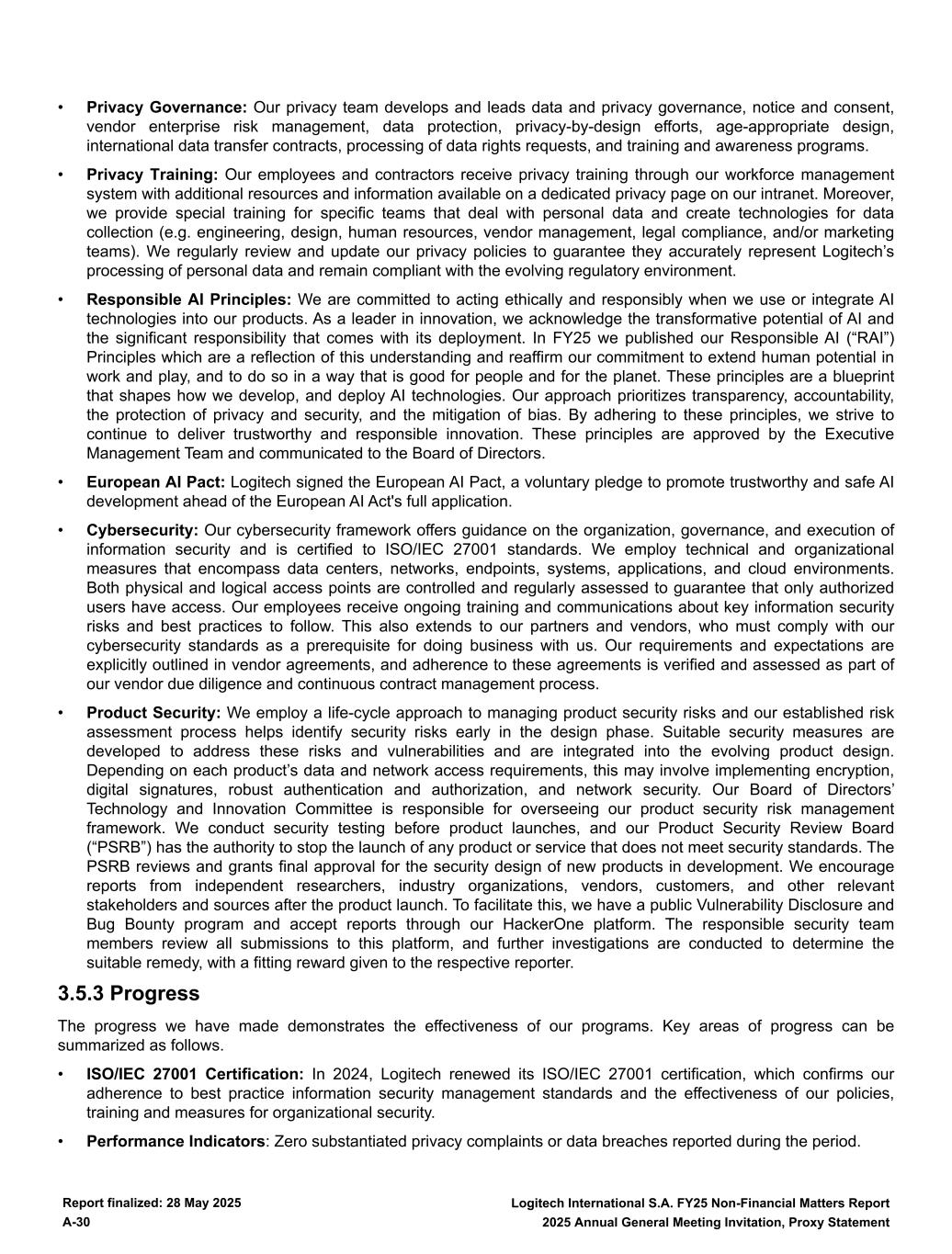
• Privacy Governance: Our privacy team develops and leads data and privacy governance, notice and consent, vendor enterprise risk management, data protection, privacy-by-design efforts, age-appropriate design, international data transfer contracts, processing of data rights requests, and training and awareness programs. • Privacy Training: Our employees and contractors receive privacy training through our workforce management system with additional resources and information available on a dedicated privacy page on our intranet. Moreover, we provide special training for specific teams that deal with personal data and create technologies for data collection (e.g. engineering, design, human resources, vendor management, legal compliance, and/or marketing teams). We regularly review and update our privacy policies to guarantee they accurately represent Logitech’s processing of personal data and remain compliant with the evolving regulatory environment. • Responsible AI Principles: We are committed to acting ethically and responsibly when we use or integrate AI technologies into our products. As a leader in innovation, we acknowledge the transformative potential of AI and the significant responsibility that comes with its deployment. In FY25 we published our Responsible AI (“RAI”) Principles which are a reflection of this understanding and reaffirm our commitment to extend human potential in work and play, and to do so in a way that is good for people and for the planet. These principles are a blueprint that shapes how we develop, and deploy AI technologies. Our approach prioritizes transparency, accountability, the protection of privacy and security, and the mitigation of bias. By adhering to these principles, we strive to continue to deliver trustworthy and responsible innovation. These principles are approved by the Executive Management Team and communicated to the Board of Directors. • European AI Pact: Logitech signed the European AI Pact, a voluntary pledge to promote trustworthy and safe AI development ahead of the European AI Act's full application. • Cybersecurity: Our cybersecurity framework offers guidance on the organization, governance, and execution of information security and is certified to ISO/IEC 27001 standards. We employ technical and organizational measures that encompass data centers, networks, endpoints, systems, applications, and cloud environments. Both physical and logical access points are controlled and regularly assessed to guarantee that only authorized users have access. Our employees receive ongoing training and communications about key information security risks and best practices to follow. This also extends to our partners and vendors, who must comply with our cybersecurity standards as a prerequisite for doing business with us. Our requirements and expectations are explicitly outlined in vendor agreements, and adherence to these agreements is verified and assessed as part of our vendor due diligence and continuous contract management process. • Product Security: We employ a life-cycle approach to managing product security risks and our established risk assessment process helps identify security risks early in the design phase. Suitable security measures are developed to address these risks and vulnerabilities and are integrated into the evolving product design. Depending on each product’s data and network access requirements, this may involve implementing encryption, digital signatures, robust authentication and authorization, and network security. Our Board of Directors’ Technology and Innovation Committee is responsible for overseeing our product security risk management framework. We conduct security testing before product launches, and our Product Security Review Board (“PSRB”) has the authority to stop the launch of any product or service that does not meet security standards. The PSRB reviews and grants final approval for the security design of new products in development. We encourage reports from independent researchers, industry organizations, vendors, customers, and other relevant stakeholders and sources after the product launch. To facilitate this, we have a public Vulnerability Disclosure and Bug Bounty program and accept reports through our HackerOne platform. The responsible security team members review all submissions to this platform, and further investigations are conducted to determine the suitable remedy, with a fitting reward given to the respective reporter. 3.5.3 Progress The progress we have made demonstrates the effectiveness of our programs. Key areas of progress can be summarized as follows. • ISO/IEC 27001 Certification: In 2024, Logitech renewed its ISO/IEC 27001 certification, which confirms our adherence to best practice information security management standards and the effectiveness of our policies, training and measures for organizational security. • Performance Indicators: Zero substantiated privacy complaints or data breaches reported during the period. Report finalized: 28 May 2025 Logitech International S.A. FY25 Non-Financial Matters Report A-30 2025 Annual General Meeting Invitation, Proxy Statement
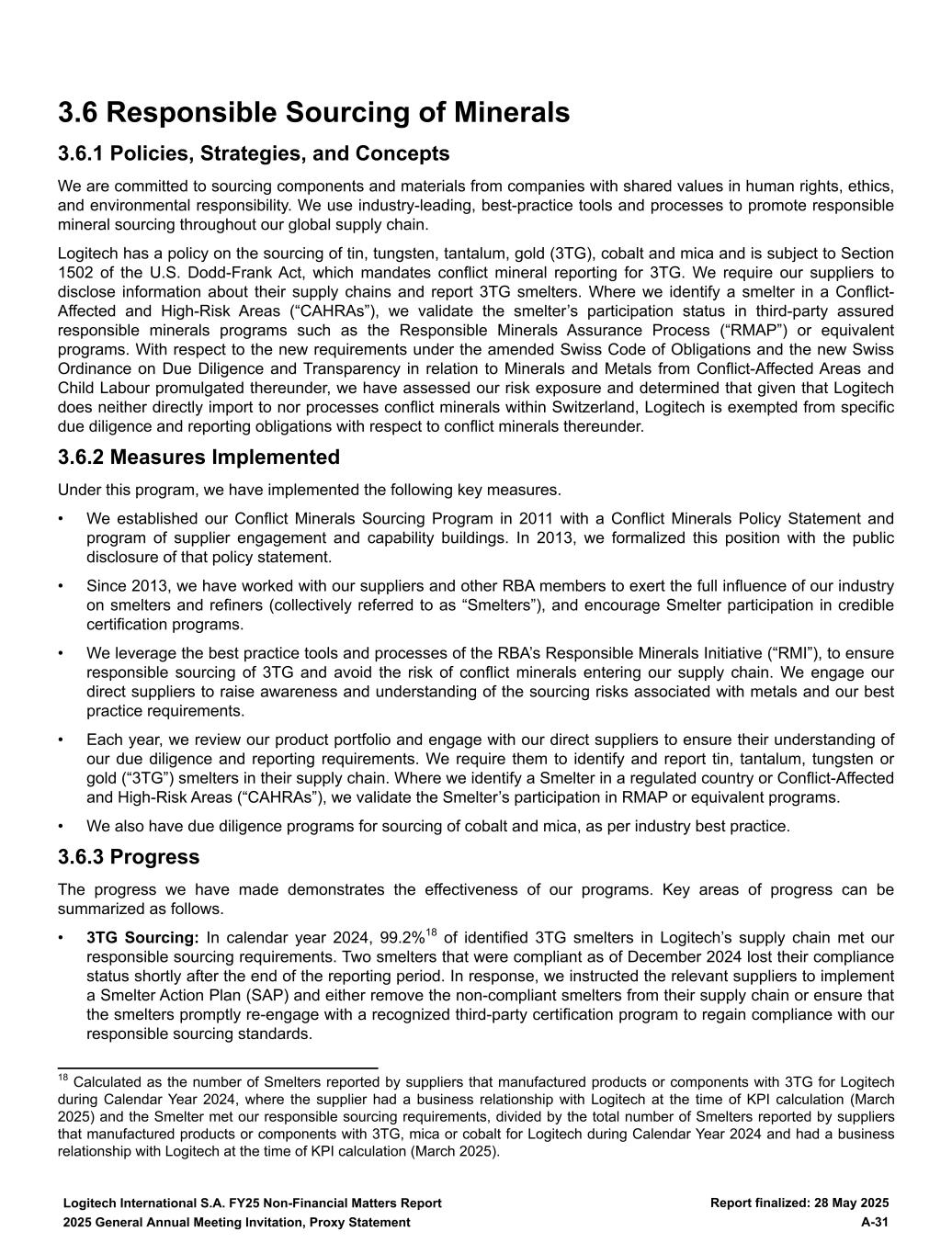
3.6 Responsible Sourcing of Minerals 3.6.1 Policies, Strategies, and Concepts We are committed to sourcing components and materials from companies with shared values in human rights, ethics, and environmental responsibility. We use industry-leading, best-practice tools and processes to promote responsible mineral sourcing throughout our global supply chain. Logitech has a policy on the sourcing of tin, tungsten, tantalum, gold (3TG), cobalt and mica and is subject to Section 1502 of the U.S. Dodd-Frank Act, which mandates conflict mineral reporting for 3TG. We require our suppliers to disclose information about their supply chains and report 3TG smelters. Where we identify a smelter in a Conflict- Affected and High-Risk Areas (“CAHRAs”), we validate the smelter’s participation status in third-party assured responsible minerals programs such as the Responsible Minerals Assurance Process (“RMAP”) or equivalent programs. With respect to the new requirements under the amended Swiss Code of Obligations and the new Swiss Ordinance on Due Diligence and Transparency in relation to Minerals and Metals from Conflict-Affected Areas and Child Labour promulgated thereunder, we have assessed our risk exposure and determined that given that Logitech does neither directly import to nor processes conflict minerals within Switzerland, Logitech is exempted from specific due diligence and reporting obligations with respect to conflict minerals thereunder. 3.6.2 Measures Implemented Under this program, we have implemented the following key measures. • We established our Conflict Minerals Sourcing Program in 2011 with a Conflict Minerals Policy Statement and program of supplier engagement and capability buildings. In 2013, we formalized this position with the public disclosure of that policy statement. • Since 2013, we have worked with our suppliers and other RBA members to exert the full influence of our industry on smelters and refiners (collectively referred to as “Smelters”), and encourage Smelter participation in credible certification programs. • We leverage the best practice tools and processes of the RBA’s Responsible Minerals Initiative (“RMI”), to ensure responsible sourcing of 3TG and avoid the risk of conflict minerals entering our supply chain. We engage our direct suppliers to raise awareness and understanding of the sourcing risks associated with metals and our best practice requirements. • Each year, we review our product portfolio and engage with our direct suppliers to ensure their understanding of our due diligence and reporting requirements. We require them to identify and report tin, tantalum, tungsten or gold (“3TG”) smelters in their supply chain. Where we identify a Smelter in a regulated country or Conflict-Affected and High-Risk Areas (“CAHRAs”), we validate the Smelter’s participation in RMAP or equivalent programs. • We also have due diligence programs for sourcing of cobalt and mica, as per industry best practice. 3.6.3 Progress The progress we have made demonstrates the effectiveness of our programs. Key areas of progress can be summarized as follows. • 3TG Sourcing: In calendar year 2024, 99.2%18 of identified 3TG smelters in Logitech’s supply chain met our responsible sourcing requirements. Two smelters that were compliant as of December 2024 lost their compliance status shortly after the end of the reporting period. In response, we instructed the relevant suppliers to implement a Smelter Action Plan (SAP) and either remove the non-compliant smelters from their supply chain or ensure that the smelters promptly re-engage with a recognized third-party certification program to regain compliance with our responsible sourcing standards. Logitech International S.A. FY25 Non-Financial Matters Report Report finalized: 28 May 2025 2025 General Annual Meeting Invitation, Proxy Statement A-31 18 Calculated as the number of Smelters reported by suppliers that manufactured products or components with 3TG for Logitech during Calendar Year 2024, where the supplier had a business relationship with Logitech at the time of KPI calculation (March 2025) and the Smelter met our responsible sourcing requirements, divided by the total number of Smelters reported by suppliers that manufactured products or components with 3TG, mica or cobalt for Logitech during Calendar Year 2024 and had a business relationship with Logitech at the time of KPI calculation (March 2025).

• RCOI Assurance by Third-Party: Our reasonable country of origin inquiry (RCOI) process utilizes both third- party audit programs and independent external expert assessments. • Vigilance in Responsible Cobalt Sourcing: Demonstrating year-over-year progress, in calendar year 2024, 100% of the identified 51 cobalt refiners are engaged in RMAP or equivalent third-party audit programs. Our due diligence efforts have not found any evidence that cobalt is sourced from Concerned Countries or CAHRAs, and our efforts have helped to ensure refiners are committed to responsible sourcing practices. • Mica Sourcing Compliance: In 2024, 100% of the identified 3 mica processors in Logitech’s supply chain were engaged in RMAP, addressing human rights concerns in mica extraction. 3.7 Human Rights and Labor 3.7.1 Policies, Strategies, and Concepts Human rights compliance is fundamental to how we operate. We aim to identify, prevent, mitigate or remediate adverse human rights impacts linked to our business activities and operations, including our supply chain. We adhere to the RBA Code of Conduct and the United Nations Global Compact (“UNGC”). These frameworks reflect international norms and standards, including the Universal Declaration of Human Rights, ILO International Labor Standards, OECD Guidelines for Multinational Enterprises, the UNGC Guiding Principles on Business and Human Rights and relevant ISO and SAI standards. We have integrated these principles in our globally binding Logitech Code of Conduct, which applies to our entire company and our entire supply chain. We have also established a group-wide Responsible Recruitment Policy, setting forth our zero tolerance for any type of forced, involuntary, or exploitative recruitment and employment, including use of prison labor, indentured labor, bonded (including debt bonded) labor, human trafficking, or slave labor. 3.7.2 Measures Implemented Under this program, we have implemented the following key measures. • Code of Conduct: Employees are contractually required to comply with the company Code of Conduct and complete business ethics induction training and refresher training. We provide targeted training for employees with responsibility for supply chain management to ensure relevant employees can identify supply chain risks and proactively manage any such risks in accordance with our own Logitech Code of Conduct and the RBA Code. Compliance with the RBA Code of Conduct is also a contractual requirement of our purchase agreements with Tier 1 suppliers and those suppliers are required to manage their supply chain in accordance with the RBA Code. We raise awareness and provide training to our suppliers at our Supplier Capability-Building Sessions where we also provide a platform for suppliers to share best practices. • Ethics Hotline: We have an established whistleblowing mechanism hosted by a third-party service provider and available by phone or web portal. This hotline facility provides employees and third parties with a confidential way to report any identified risks or malpractices. Any reports to the hotline are investigated. We have policies in place to prevent retaliatory action against those who make a good-faith report. • Supplier Screening: We conduct supplier screening to systematically identify Major and high-risk suppliers through consideration of ESG risks and business or commercial aspects. As part of our screening process, we consider the country and sector that the supplier operates in, along with commodity specific risks. • Audits: Our production facility is subject to periodic third-party audits to verify compliance with the RBA Code, including the criteria relevant to human rights and labor management. RBA-approved auditors carry out these audits following the RBA-Validated Audit Process, which comprises site observation, document reviews, and interviews with management and employees. We also regularly audit and review supplier performance on human rights aspects of the RBA Code. If there is an audit finding, we implement Corrective Action Plans to remedy the identified issues, and implement systems to prevent recurrence. • Other Measures: As part of our membership of the RBA, we work with other companies in our sector to raise awareness of human rights issues in supply chains and uphold established human rights standards and respect for the human rights of all people. We actively work to identify new ideas, innovations, standards, and tools for corporate compliance and ethics, and maintain oversight of the latest developments in compliance law, management, best practice, and diagnostics via external resources, seminars, peer discussions, and periodic Report finalized: 28 May 2025 Logitech International S.A. FY25 Non-Financial Matters Report A-32 2025 Annual General Meeting Invitation, Proxy Statement
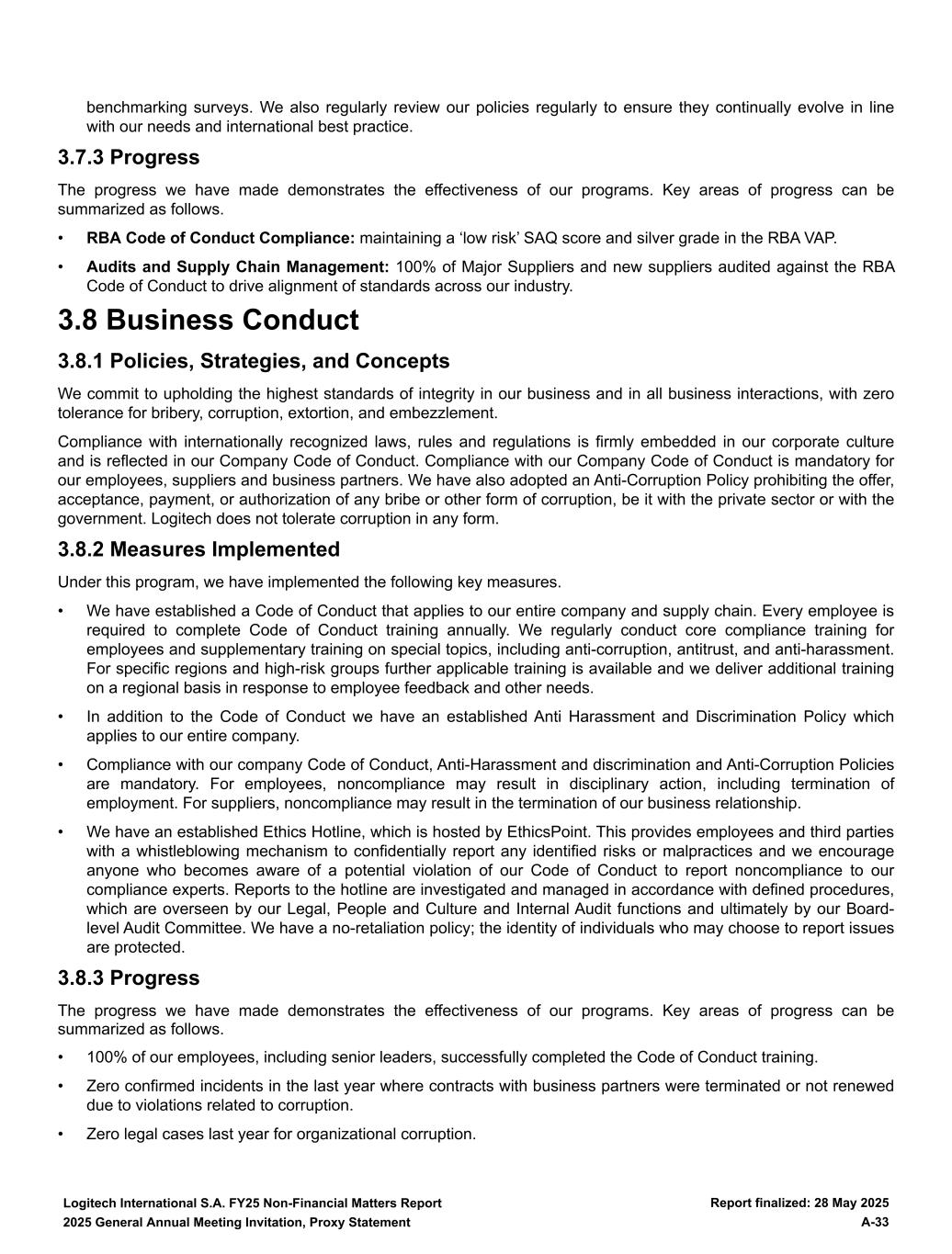
benchmarking surveys. We also regularly review our policies regularly to ensure they continually evolve in line with our needs and international best practice. 3.7.3 Progress The progress we have made demonstrates the effectiveness of our programs. Key areas of progress can be summarized as follows. • RBA Code of Conduct Compliance: maintaining a ‘low risk’ SAQ score and silver grade in the RBA VAP. • Audits and Supply Chain Management: 100% of Major Suppliers and new suppliers audited against the RBA Code of Conduct to drive alignment of standards across our industry. 3.8 Business Conduct 3.8.1 Policies, Strategies, and Concepts We commit to upholding the highest standards of integrity in our business and in all business interactions, with zero tolerance for bribery, corruption, extortion, and embezzlement. Compliance with internationally recognized laws, rules and regulations is firmly embedded in our corporate culture and is reflected in our Company Code of Conduct. Compliance with our Company Code of Conduct is mandatory for our employees, suppliers and business partners. We have also adopted an Anti-Corruption Policy prohibiting the offer, acceptance, payment, or authorization of any bribe or other form of corruption, be it with the private sector or with the government. Logitech does not tolerate corruption in any form. 3.8.2 Measures Implemented Under this program, we have implemented the following key measures. • We have established a Code of Conduct that applies to our entire company and supply chain. Every employee is required to complete Code of Conduct training annually. We regularly conduct core compliance training for employees and supplementary training on special topics, including anti-corruption, antitrust, and anti-harassment. For specific regions and high-risk groups further applicable training is available and we deliver additional training on a regional basis in response to employee feedback and other needs. • In addition to the Code of Conduct we have an established Anti Harassment and Discrimination Policy which applies to our entire company. • Compliance with our company Code of Conduct, Anti-Harassment and discrimination and Anti-Corruption Policies are mandatory. For employees, noncompliance may result in disciplinary action, including termination of employment. For suppliers, noncompliance may result in the termination of our business relationship. • We have an established Ethics Hotline, which is hosted by EthicsPoint. This provides employees and third parties with a whistleblowing mechanism to confidentially report any identified risks or malpractices and we encourage anyone who becomes aware of a potential violation of our Code of Conduct to report noncompliance to our compliance experts. Reports to the hotline are investigated and managed in accordance with defined procedures, which are overseen by our Legal, People and Culture and Internal Audit functions and ultimately by our Board- level Audit Committee. We have a no-retaliation policy; the identity of individuals who may choose to report issues are protected. 3.8.3 Progress The progress we have made demonstrates the effectiveness of our programs. Key areas of progress can be summarized as follows. • 100% of our employees, including senior leaders, successfully completed the Code of Conduct training. • Zero confirmed incidents in the last year where contracts with business partners were terminated or not renewed due to violations related to corruption. • Zero legal cases last year for organizational corruption. Logitech International S.A. FY25 Non-Financial Matters Report Report finalized: 28 May 2025 2025 General Annual Meeting Invitation, Proxy Statement A-33
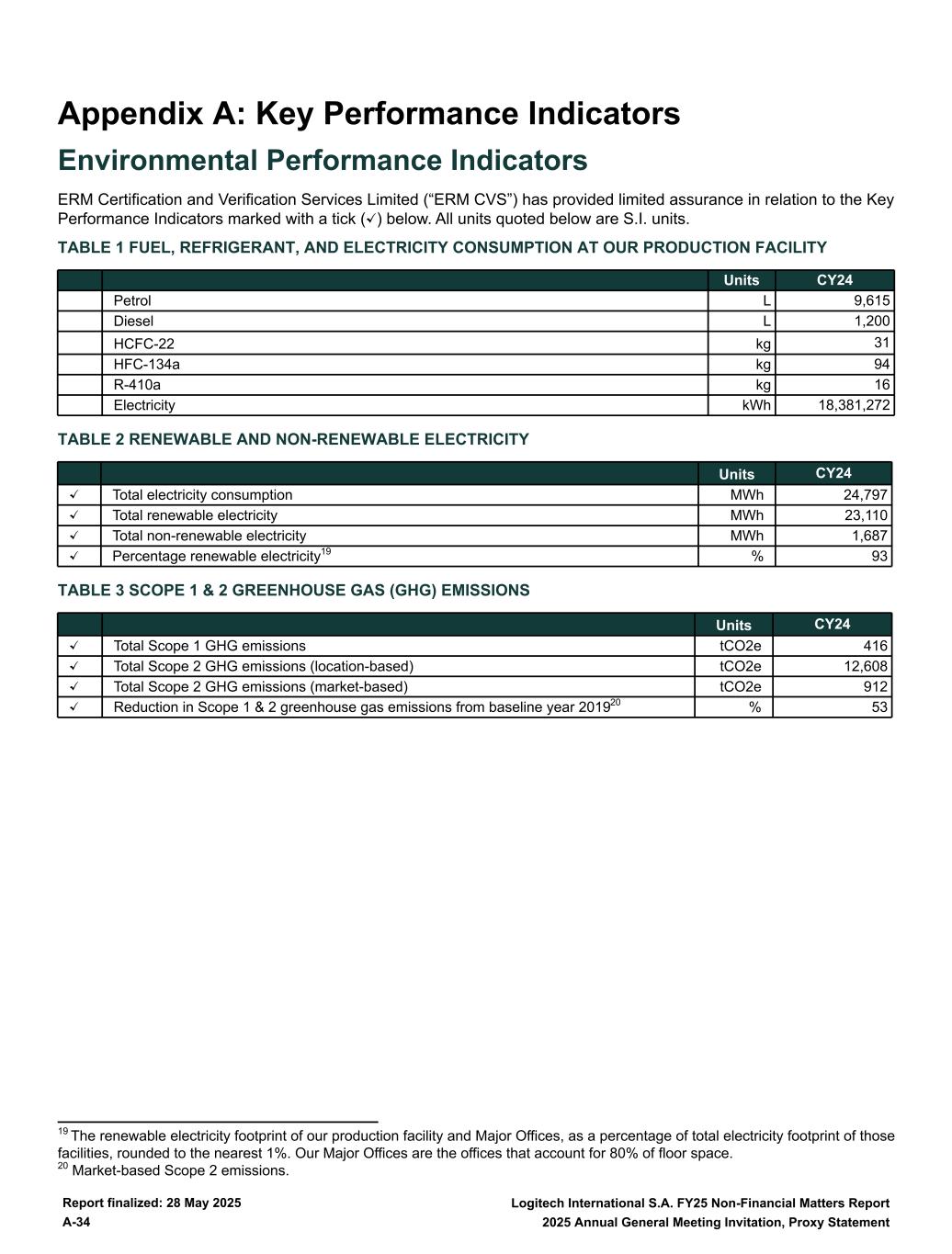
Appendix A: Key Performance Indicators Environmental Performance Indicators ERM Certification and Verification Services Limited (“ERM CVS”) has provided limited assurance in relation to the Key Performance Indicators marked with a tick (✓) below. All units quoted below are S.I. units. TABLE 1 FUEL, REFRIGERANT, AND ELECTRICITY CONSUMPTION AT OUR PRODUCTION FACILITY Units CY24 Petrol L 9,615 Diesel L 1,200 HCFC-22 kg 31 HFC-134a kg 94 R-410a kg 16 Electricity kWh 18,381,272 TABLE 2 RENEWABLE AND NON-RENEWABLE ELECTRICITY Units CY24 ✓ Total electricity consumption MWh 24,797 ✓ Total renewable electricity MWh 23,110 ✓ Total non-renewable electricity MWh 1,687 ✓ Percentage renewable electricity19 % 93 TABLE 3 SCOPE 1 & 2 GREENHOUSE GAS (GHG) EMISSIONS Units CY24 ✓ Total Scope 1 GHG emissions tCO2e 416 ✓ Total Scope 2 GHG emissions (location-based) tCO2e 12,608 ✓ Total Scope 2 GHG emissions (market-based) tCO2e 912 ✓ Reduction in Scope 1 & 2 greenhouse gas emissions from baseline year 201920 % 53 Report finalized: 28 May 2025 Logitech International S.A. FY25 Non-Financial Matters Report A-34 2025 Annual General Meeting Invitation, Proxy Statement 19 The renewable electricity footprint of our production facility and Major Offices, as a percentage of total electricity footprint of those facilities, rounded to the nearest 1%. Our Major Offices are the offices that account for 80% of floor space. 20 Market-based Scope 2 emissions.
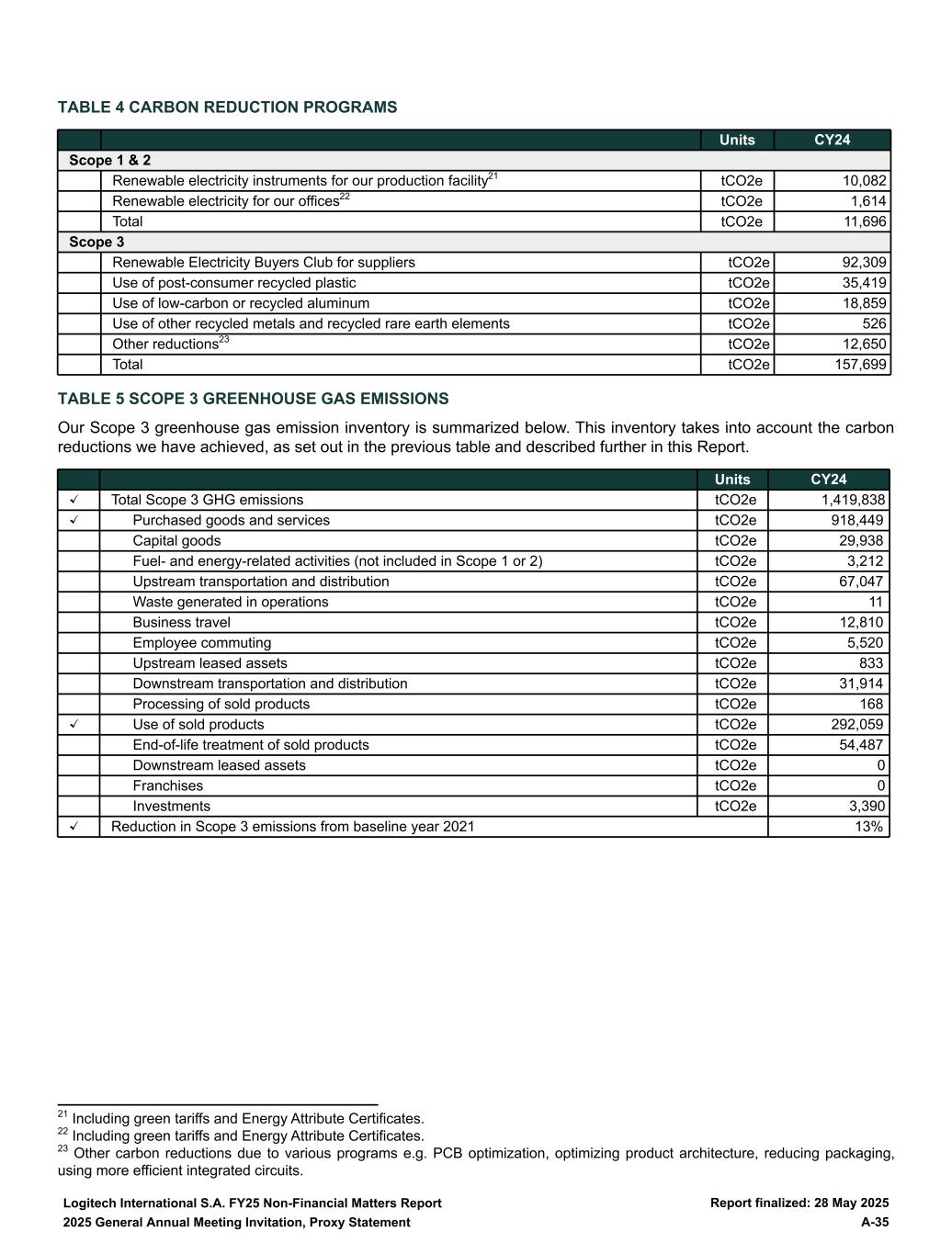
TABLE 4 CARBON REDUCTION PROGRAMS Scope 1 & 2 Renewable electricity instruments for our production facility21 tCO2e 10,082 Renewable electricity for our offices22 tCO2e 1,614 Total tCO2e 11,696 Scope 3 Renewable Electricity Buyers Club for suppliers tCO2e 92,309 Use of post-consumer recycled plastic tCO2e 35,419 Use of low-carbon or recycled aluminum tCO2e 18,859 Use of other recycled metals and recycled rare earth elements tCO2e 526 Other reductions23 tCO2e 12,650 Total tCO2e 157,699 Units CY24 TABLE 5 SCOPE 3 GREENHOUSE GAS EMISSIONS Our Scope 3 greenhouse gas emission inventory is summarized below. This inventory takes into account the carbon reductions we have achieved, as set out in the previous table and described further in this Report. Units CY24 ✓ Total Scope 3 GHG emissions tCO2e 1,419,838 ✓ Purchased goods and services tCO2e 918,449 Capital goods tCO2e 29,938 Fuel- and energy-related activities (not included in Scope 1 or 2) tCO2e 3,212 Upstream transportation and distribution tCO2e 67,047 Waste generated in operations tCO2e 11 Business travel tCO2e 12,810 Employee commuting tCO2e 5,520 Upstream leased assets tCO2e 833 Downstream transportation and distribution tCO2e 31,914 Processing of sold products tCO2e 168 ✓ Use of sold products tCO2e 292,059 End-of-life treatment of sold products tCO2e 54,487 Downstream leased assets tCO2e 0 Franchises tCO2e 0 Investments tCO2e 3,390 ✓ Reduction in Scope 3 emissions from baseline year 2021 13% Logitech International S.A. FY25 Non-Financial Matters Report Report finalized: 28 May 2025 2025 General Annual Meeting Invitation, Proxy Statement A-35 21 Including green tariffs and Energy Attribute Certificates. 22 Including green tariffs and Energy Attribute Certificates. 23 Other carbon reductions due to various programs e.g. PCB optimization, optimizing product architecture, reducing packaging, using more efficient integrated circuits.
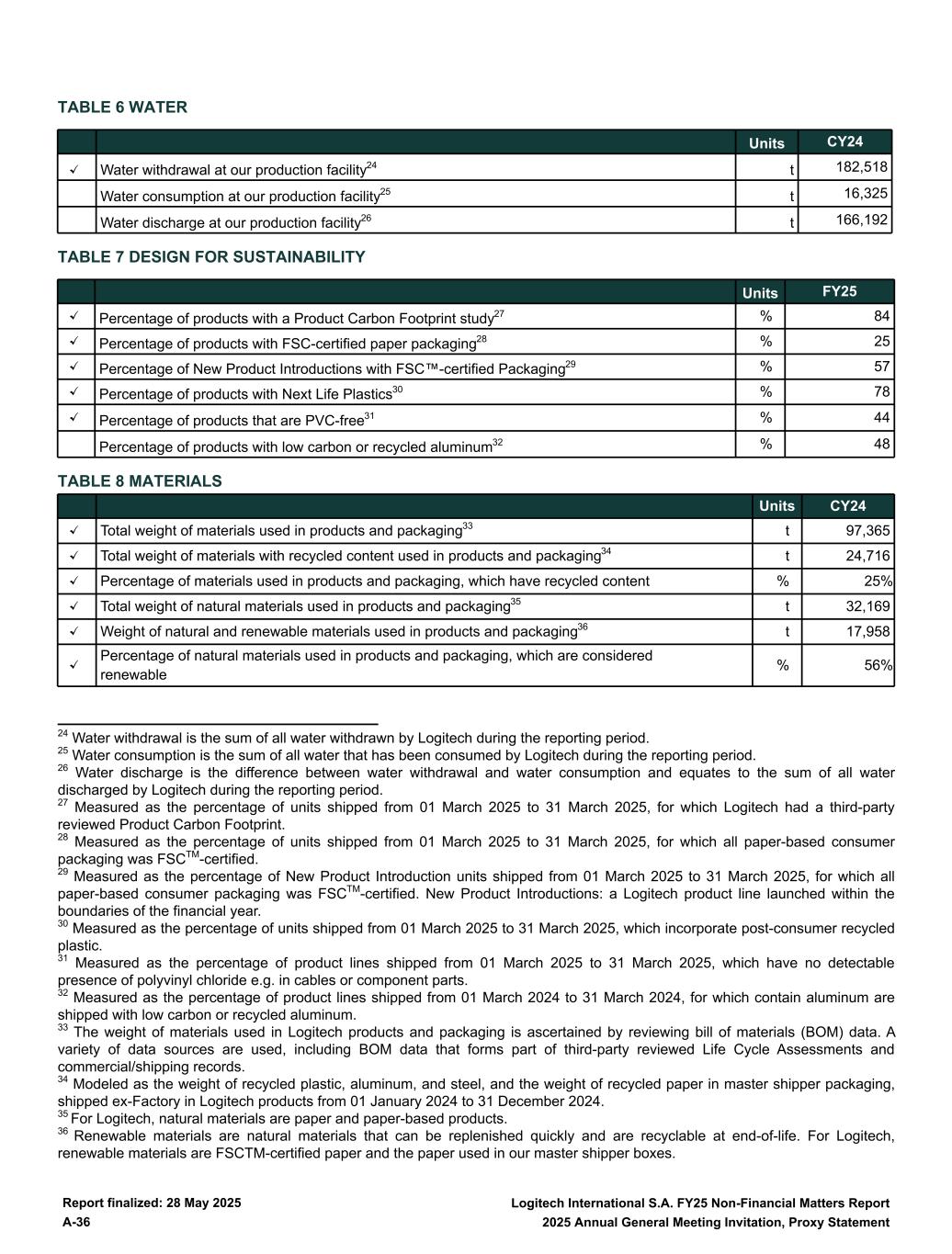
TABLE 6 WATER Units CY24 ✓ Water withdrawal at our production facility24 t 182,518 Water consumption at our production facility25 t 16,325 Water discharge at our production facility26 t 166,192 TABLE 7 DESIGN FOR SUSTAINABILITY Units FY25 ✓ Percentage of products with a Product Carbon Footprint study27 % 84 ✓ Percentage of products with FSC-certified paper packaging28 % 25 ✓ Percentage of New Product Introductions with FSC™-certified Packaging29 % 57 ✓ Percentage of products with Next Life Plastics30 % 78 ✓ Percentage of products that are PVC-free31 % 44 Percentage of products with low carbon or recycled aluminum32 % 48 TABLE 8 MATERIALS Units CY24 ✓ Total weight of materials used in products and packaging33 t 97,365 ✓ Total weight of materials with recycled content used in products and packaging34 t 24,716 ✓ Percentage of materials used in products and packaging, which have recycled content % 25 % ✓ Total weight of natural materials used in products and packaging35 t 32,169 ✓ Weight of natural and renewable materials used in products and packaging36 t 17,958 ✓ Percentage of natural materials used in products and packaging, which are considered renewable % 56 % Report finalized: 28 May 2025 Logitech International S.A. FY25 Non-Financial Matters Report A-36 2025 Annual General Meeting Invitation, Proxy Statement 24 Water withdrawal is the sum of all water withdrawn by Logitech during the reporting period. 25 Water consumption is the sum of all water that has been consumed by Logitech during the reporting period. 26 Water discharge is the difference between water withdrawal and water consumption and equates to the sum of all water discharged by Logitech during the reporting period. 27 Measured as the percentage of units shipped from 01 March 2025 to 31 March 2025, for which Logitech had a third-party reviewed Product Carbon Footprint. 28 Measured as the percentage of units shipped from 01 March 2025 to 31 March 2025, for which all paper-based consumer packaging was FSCTM-certified. 29 Measured as the percentage of New Product Introduction units shipped from 01 March 2025 to 31 March 2025, for which all paper-based consumer packaging was FSCTM-certified. New Product Introductions: a Logitech product line launched within the boundaries of the financial year. 30 Measured as the percentage of units shipped from 01 March 2025 to 31 March 2025, which incorporate post-consumer recycled plastic. 31 Measured as the percentage of product lines shipped from 01 March 2025 to 31 March 2025, which have no detectable presence of polyvinyl chloride e.g. in cables or component parts. 32 Measured as the percentage of product lines shipped from 01 March 2024 to 31 March 2024, for which contain aluminum are shipped with low carbon or recycled aluminum. 33 The weight of materials used in Logitech products and packaging is ascertained by reviewing bill of materials (BOM) data. A variety of data sources are used, including BOM data that forms part of third-party reviewed Life Cycle Assessments and commercial/shipping records. 34 Modeled as the weight of recycled plastic, aluminum, and steel, and the weight of recycled paper in master shipper packaging, shipped ex-Factory in Logitech products from 01 January 2024 to 31 December 2024. 35 For Logitech, natural materials are paper and paper-based products. 36 Renewable materials are natural materials that can be replenished quickly and are recyclable at end-of-life. For Logitech, renewable materials are FSCTM-certified paper and the paper used in our master shipper boxes.
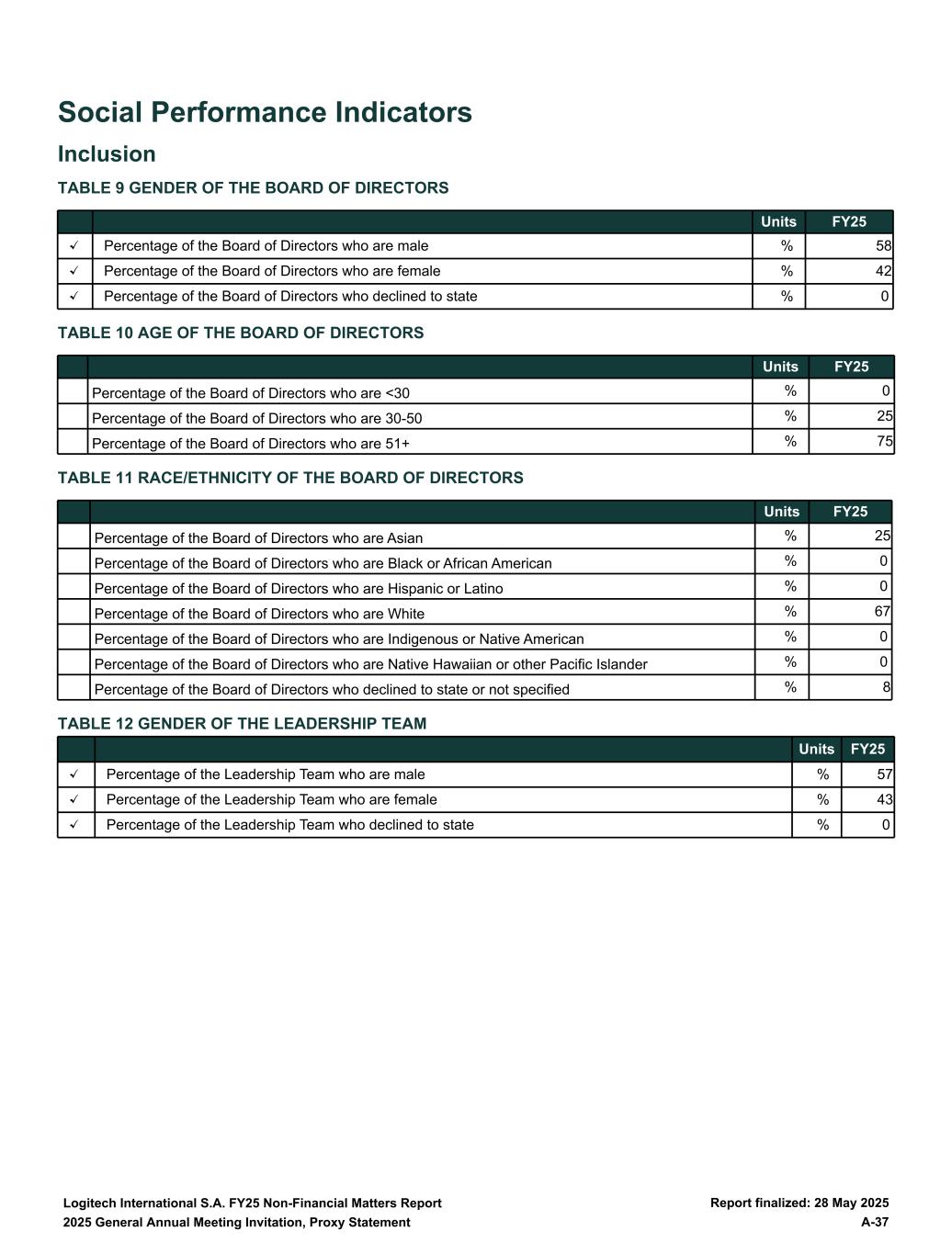
Social Performance Indicators Inclusion TABLE 9 GENDER OF THE BOARD OF DIRECTORS Units FY25 ✓ Percentage of the Board of Directors who are male % 58 ✓ Percentage of the Board of Directors who are female % 42 ✓ Percentage of the Board of Directors who declined to state % 0 TABLE 10 AGE OF THE BOARD OF DIRECTORS Units FY25 Percentage of the Board of Directors who are <30 % 0 Percentage of the Board of Directors who are 30-50 % 25 Percentage of the Board of Directors who are 51+ % 75 TABLE 11 RACE/ETHNICITY OF THE BOARD OF DIRECTORS Units FY25 Percentage of the Board of Directors who are Asian % 25 Percentage of the Board of Directors who are Black or African American % 0 Percentage of the Board of Directors who are Hispanic or Latino % 0 Percentage of the Board of Directors who are White % 67 Percentage of the Board of Directors who are Indigenous or Native American % 0 Percentage of the Board of Directors who are Native Hawaiian or other Pacific Islander % 0 Percentage of the Board of Directors who declined to state or not specified % 8 TABLE 12 GENDER OF THE LEADERSHIP TEAM Units FY25 ✓ Percentage of the Leadership Team who are male % 57 ✓ Percentage of the Leadership Team who are female % 43 ✓ Percentage of the Leadership Team who declined to state % 0 Logitech International S.A. FY25 Non-Financial Matters Report Report finalized: 28 May 2025 2025 General Annual Meeting Invitation, Proxy Statement A-37
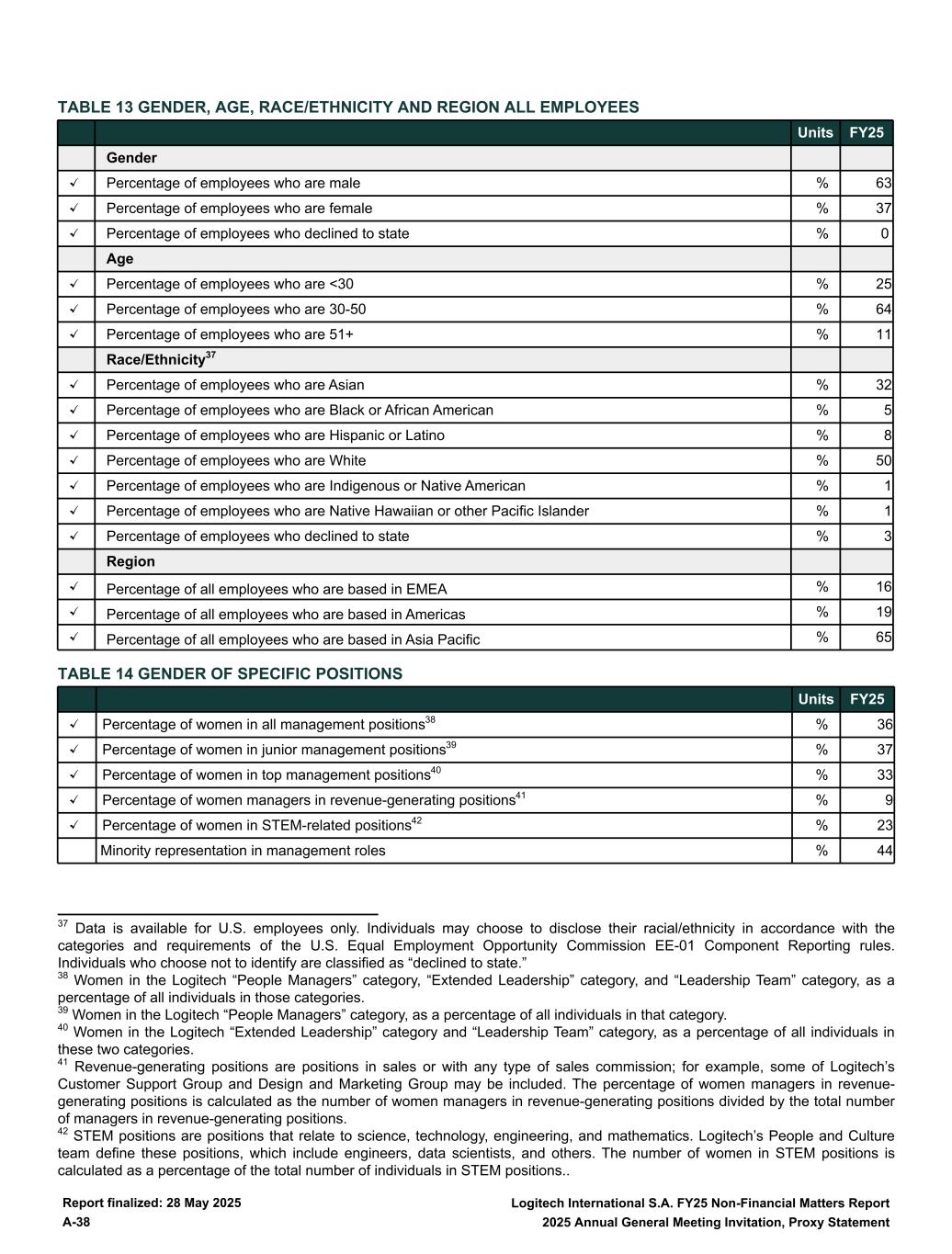
TABLE 13 GENDER, AGE, RACE/ETHNICITY AND REGION ALL EMPLOYEES Units FY25 Gender ✓ Percentage of employees who are male % 63 ✓ Percentage of employees who are female % 37 ✓ Percentage of employees who declined to state % 0 Age ✓ Percentage of employees who are <30 % 25 ✓ Percentage of employees who are 30-50 % 64 ✓ Percentage of employees who are 51+ % 11 Race/Ethnicity37 ✓ Percentage of employees who are Asian % 32 ✓ Percentage of employees who are Black or African American % 5 ✓ Percentage of employees who are Hispanic or Latino % 8 ✓ Percentage of employees who are White % 50 ✓ Percentage of employees who are Indigenous or Native American % 1 ✓ Percentage of employees who are Native Hawaiian or other Pacific Islander % 1 ✓ Percentage of employees who declined to state % 3 Region ✓ Percentage of all employees who are based in EMEA % 16 ✓ Percentage of all employees who are based in Americas % 19 ✓ Percentage of all employees who are based in Asia Pacific % 65 TABLE 14 GENDER OF SPECIFIC POSITIONS Units FY25 ✓ Percentage of women in all management positions38 % 36 ✓ Percentage of women in junior management positions39 % 37 ✓ Percentage of women in top management positions40 % 33 ✓ Percentage of women managers in revenue-generating positions41 % 9 ✓ Percentage of women in STEM-related positions42 % 23 Minority representation in management roles % 44 Report finalized: 28 May 2025 Logitech International S.A. FY25 Non-Financial Matters Report A-38 2025 Annual General Meeting Invitation, Proxy Statement 37 Data is available for U.S. employees only. Individuals may choose to disclose their racial/ethnicity in accordance with the categories and requirements of the U.S. Equal Employment Opportunity Commission EE-01 Component Reporting rules. Individuals who choose not to identify are classified as “declined to state.” 38 Women in the Logitech “People Managers” category, “Extended Leadership” category, and “Leadership Team” category, as a percentage of all individuals in those categories. 39 Women in the Logitech “People Managers” category, as a percentage of all individuals in that category. 40 Women in the Logitech “Extended Leadership” category and “Leadership Team” category, as a percentage of all individuals in these two categories. 41 Revenue-generating positions are positions in sales or with any type of sales commission; for example, some of Logitech’s Customer Support Group and Design and Marketing Group may be included. The percentage of women managers in revenue- generating positions is calculated as the number of women managers in revenue-generating positions divided by the total number of managers in revenue-generating positions. 42 STEM positions are positions that relate to science, technology, engineering, and mathematics. Logitech’s People and Culture team define these positions, which include engineers, data scientists, and others. The number of women in STEM positions is calculated as a percentage of the total number of individuals in STEM positions..
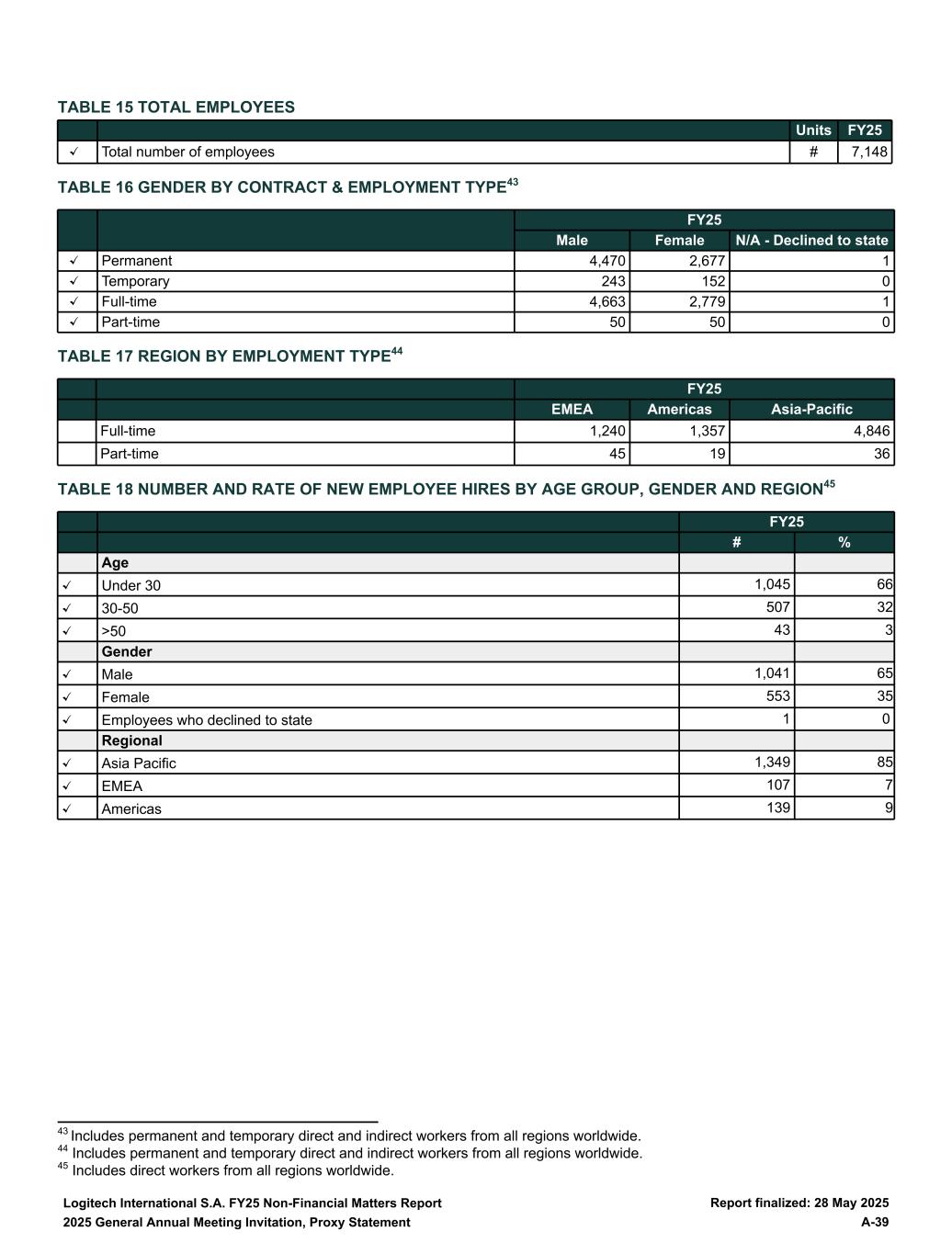
TABLE 15 TOTAL EMPLOYEES Units FY25 ✓ Total number of employees # 7,148 TABLE 16 GENDER BY CONTRACT & EMPLOYMENT TYPE43 FY25 Male Female N/A - Declined to state ✓ Permanent 4,470 2,677 1 ✓ Temporary 243 152 0 ✓ Full-time 4,663 2,779 1 ✓ Part-time 50 50 0 TABLE 17 REGION BY EMPLOYMENT TYPE44 Full-time 1,240 1,357 4,846 Part-time 45 19 36 FY25 EMEA Americas Asia-Pacific TABLE 18 NUMBER AND RATE OF NEW EMPLOYEE HIRES BY AGE GROUP, GENDER AND REGION45 FY25 # % Age ✓ Under 30 1,045 66 ✓ 30-50 507 32 ✓ >50 43 3 Gender ✓ Male 1,041 65 ✓ Female 553 35 ✓ Employees who declined to state 1 0 Regional ✓ Asia Pacific 1,349 85 ✓ EMEA 107 7 ✓ Americas 139 9 Logitech International S.A. FY25 Non-Financial Matters Report Report finalized: 28 May 2025 2025 General Annual Meeting Invitation, Proxy Statement A-39 43 Includes permanent and temporary direct and indirect workers from all regions worldwide. 44 Includes permanent and temporary direct and indirect workers from all regions worldwide. 45 Includes direct workers from all regions worldwide.
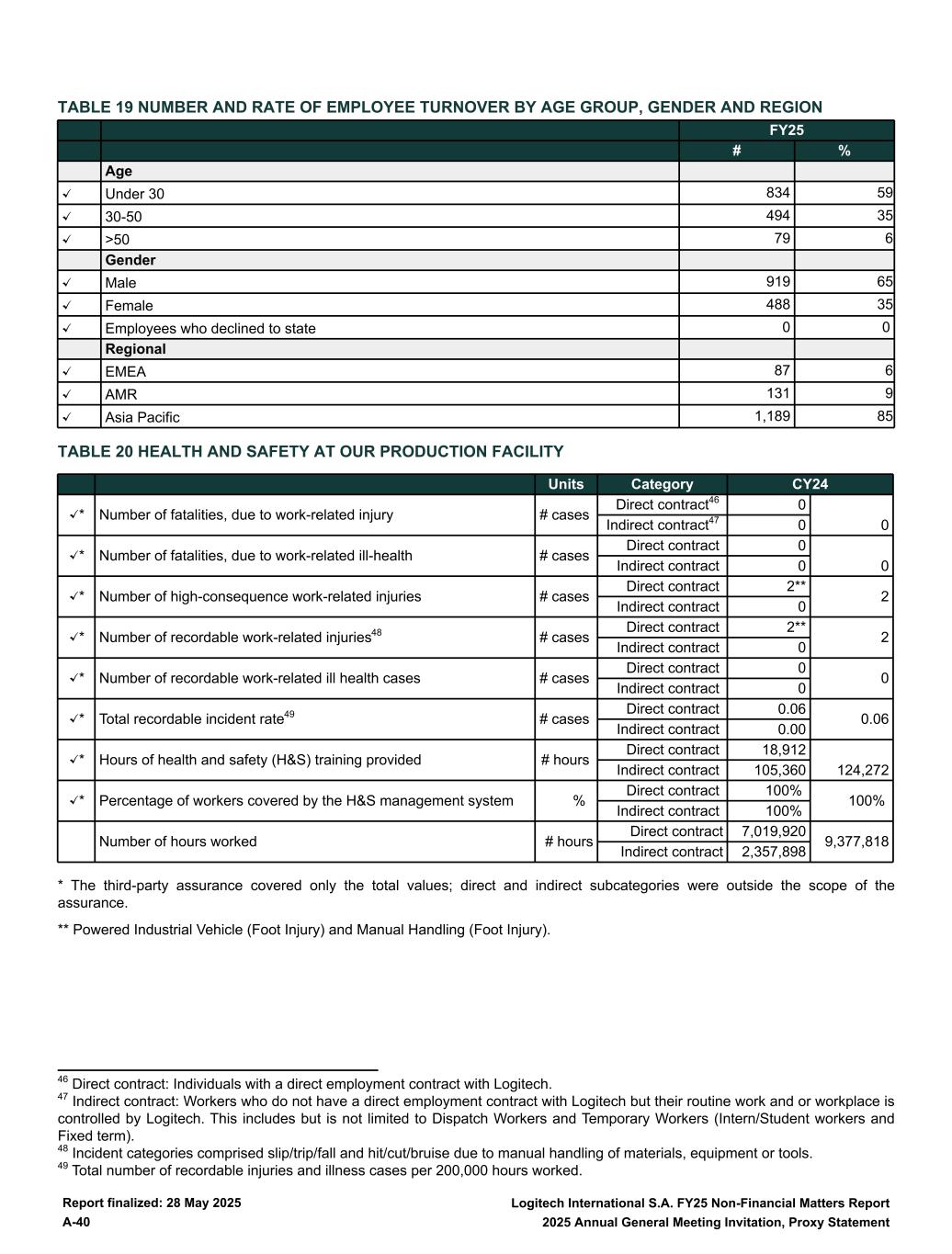
TABLE 19 NUMBER AND RATE OF EMPLOYEE TURNOVER BY AGE GROUP, GENDER AND REGION FY25 # % Age ✓ Under 30 834 59 ✓ 30-50 494 35 ✓ >50 79 6 Gender ✓ Male 919 65 ✓ Female 488 35 ✓ Employees who declined to state 0 0 Regional ✓ EMEA 87 6 ✓ AMR 131 9 ✓ Asia Pacific 1,189 85 TABLE 20 HEALTH AND SAFETY AT OUR PRODUCTION FACILITY Units Category CY24 ✓* Number of fatalities, due to work-related injury # cases Direct contract46 0 0Indirect contract47 0 ✓* Number of fatalities, due to work-related ill-health # cases Direct contract 0 0Indirect contract 0 ✓* Number of high-consequence work-related injuries # cases Direct contract 2** 2 Indirect contract 0 ✓* Number of recordable work-related injuries48 # cases Direct contract 2** 2 Indirect contract 0 ✓* Number of recordable work-related ill health cases # cases Direct contract 0 0 Indirect contract 0 ✓* Total recordable incident rate49 # cases Direct contract 0.06 0.06 Indirect contract 0.00 ✓* Hours of health and safety (H&S) training provided # hours Direct contract 18,912 124,272Indirect contract 105,360 ✓* Percentage of workers covered by the H&S management system % Direct contract 100% 100% Indirect contract 100% Number of hours worked # hours Direct contract 7,019,920 9,377,818 Indirect contract 2,357,898 * The third-party assurance covered only the total values; direct and indirect subcategories were outside the scope of the assurance. ** Powered Industrial Vehicle (Foot Injury) and Manual Handling (Foot Injury). Report finalized: 28 May 2025 Logitech International S.A. FY25 Non-Financial Matters Report A-40 2025 Annual General Meeting Invitation, Proxy Statement 46 Direct contract: Individuals with a direct employment contract with Logitech. 47 Indirect contract: Workers who do not have a direct employment contract with Logitech but their routine work and or workplace is controlled by Logitech. This includes but is not limited to Dispatch Workers and Temporary Workers (Intern/Student workers and Fixed term). 48 Incident categories comprised slip/trip/fall and hit/cut/bruise due to manual handling of materials, equipment or tools. 49 Total number of recordable injuries and illness cases per 200,000 hours worked.
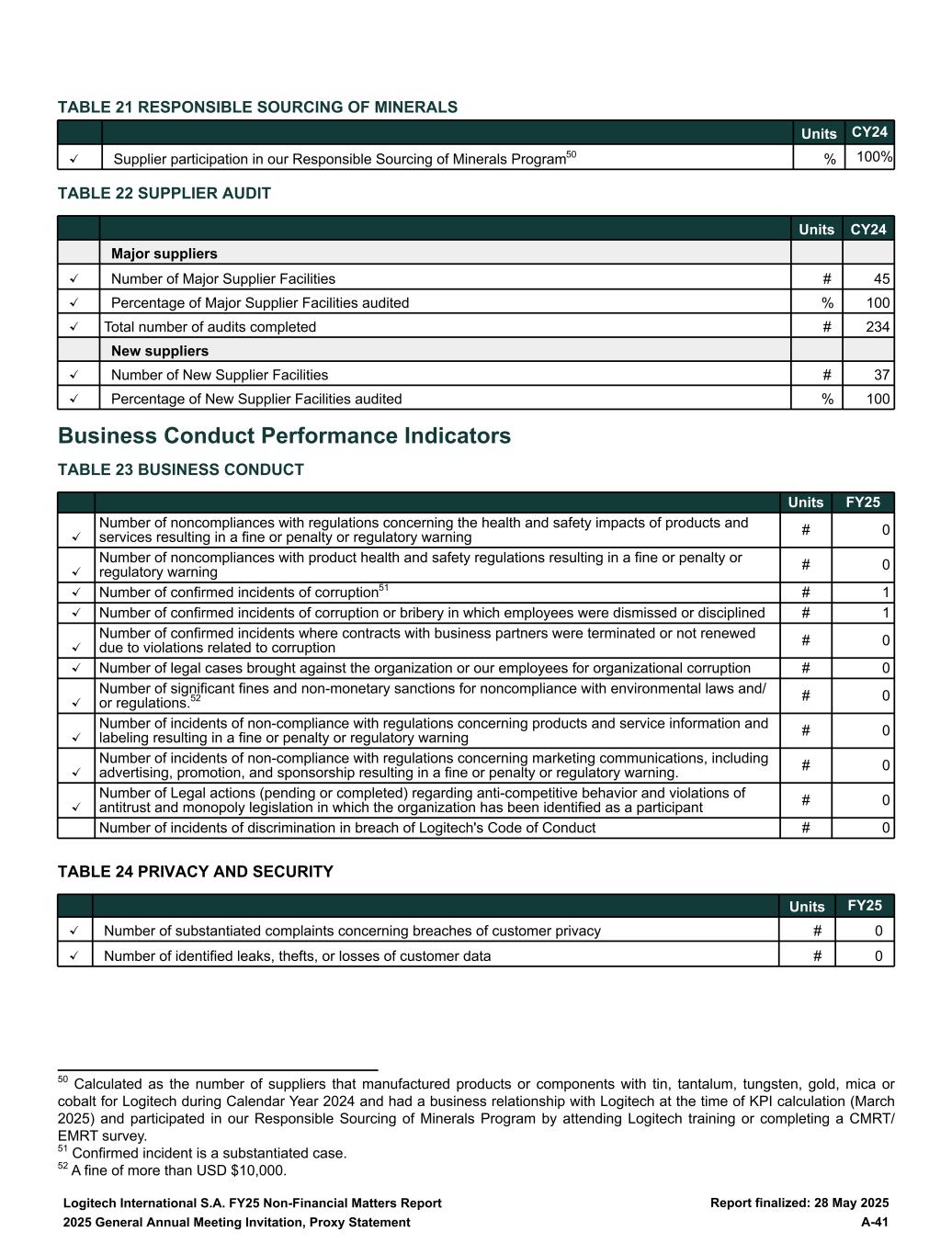
TABLE 21 RESPONSIBLE SOURCING OF MINERALS Units CY24 ✓ Supplier participation in our Responsible Sourcing of Minerals Program50 % 100 % TABLE 22 SUPPLIER AUDIT Units CY24 Major suppliers ✓ Number of Major Supplier Facilities # 45 ✓ Percentage of Major Supplier Facilities audited % 100 ✓ Total number of audits completed # 234 New suppliers ✓ Number of New Supplier Facilities # 37 ✓ Percentage of New Supplier Facilities audited % 100 Business Conduct Performance Indicators TABLE 23 BUSINESS CONDUCT Units FY25 ✓ Number of noncompliances with regulations concerning the health and safety impacts of products and services resulting in a fine or penalty or regulatory warning # 0 ✓ Number of noncompliances with product health and safety regulations resulting in a fine or penalty or regulatory warning # 0 ✓ Number of confirmed incidents of corruption51 # 1 ✓ Number of confirmed incidents of corruption or bribery in which employees were dismissed or disciplined # 1 ✓ Number of confirmed incidents where contracts with business partners were terminated or not renewed due to violations related to corruption # 0 ✓ Number of legal cases brought against the organization or our employees for organizational corruption # 0 ✓ Number of significant fines and non-monetary sanctions for noncompliance with environmental laws and/ or regulations.52 # 0 ✓ Number of incidents of non-compliance with regulations concerning products and service information and labeling resulting in a fine or penalty or regulatory warning # 0 ✓ Number of incidents of non-compliance with regulations concerning marketing communications, including advertising, promotion, and sponsorship resulting in a fine or penalty or regulatory warning. # 0 ✓ Number of Legal actions (pending or completed) regarding anti-competitive behavior and violations of antitrust and monopoly legislation in which the organization has been identified as a participant # 0 Number of incidents of discrimination in breach of Logitech's Code of Conduct # 0 TABLE 24 PRIVACY AND SECURITY Units FY25 ✓ Number of substantiated complaints concerning breaches of customer privacy # 0 ✓ Number of identified leaks, thefts, or losses of customer data # 0 Logitech International S.A. FY25 Non-Financial Matters Report Report finalized: 28 May 2025 2025 General Annual Meeting Invitation, Proxy Statement A-41 50 Calculated as the number of suppliers that manufactured products or components with tin, tantalum, tungsten, gold, mica or cobalt for Logitech during Calendar Year 2024 and had a business relationship with Logitech at the time of KPI calculation (March 2025) and participated in our Responsible Sourcing of Minerals Program by attending Logitech training or completing a CMRT/ EMRT survey. 51 Confirmed incident is a substantiated case. 52 A fine of more than USD $10,000.
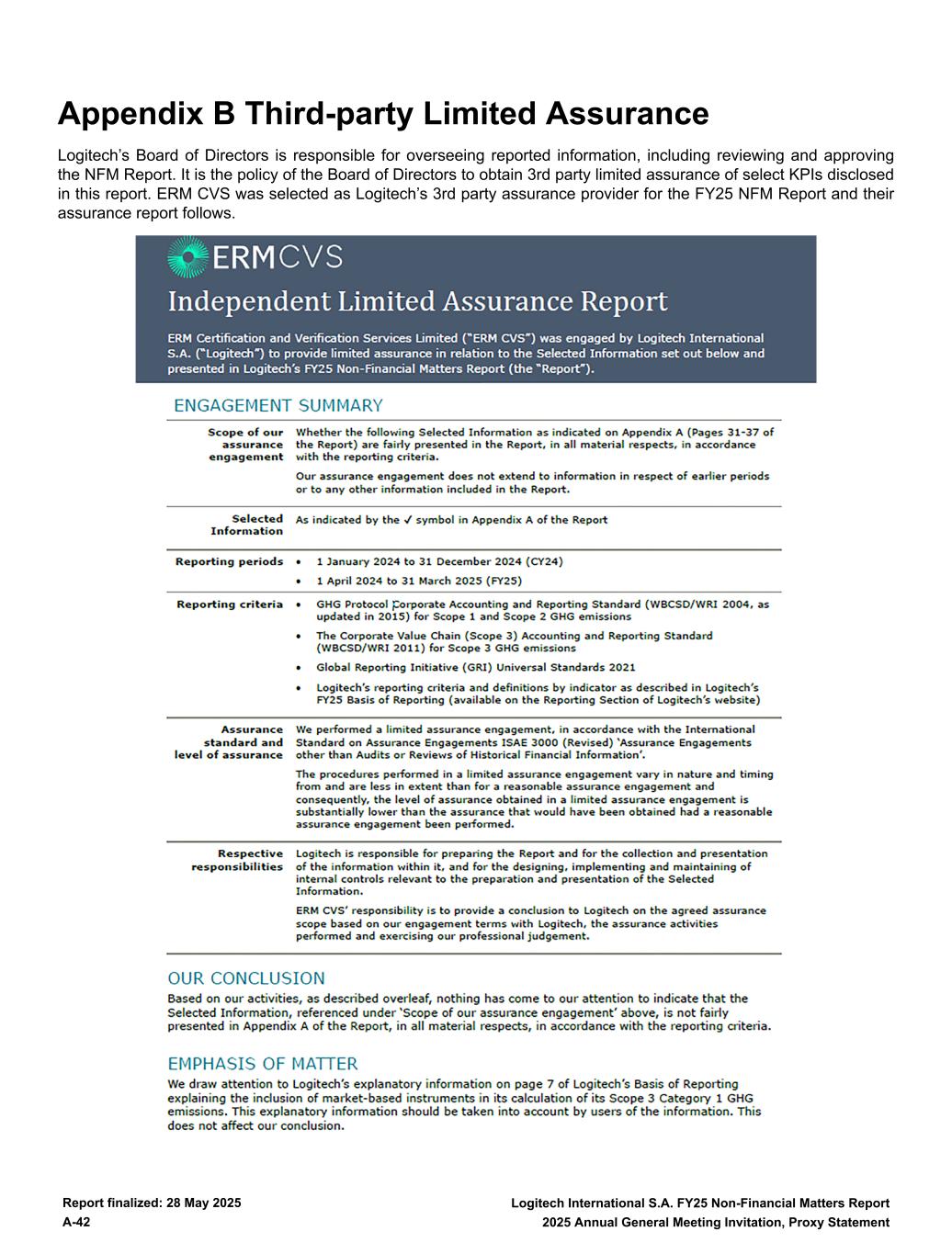
Appendix B Third-party Limited Assurance Logitech’s Board of Directors is responsible for overseeing reported information, including reviewing and approving the NFM Report. It is the policy of the Board of Directors to obtain 3rd party limited assurance of select KPIs disclosed in this report. ERM CVS was selected as Logitech’s 3rd party assurance provider for the FY25 NFM Report and their assurance report follows. Report finalized: 28 May 2025 Logitech International S.A. FY25 Non-Financial Matters Report A-42 2025 Annual General Meeting Invitation, Proxy Statement
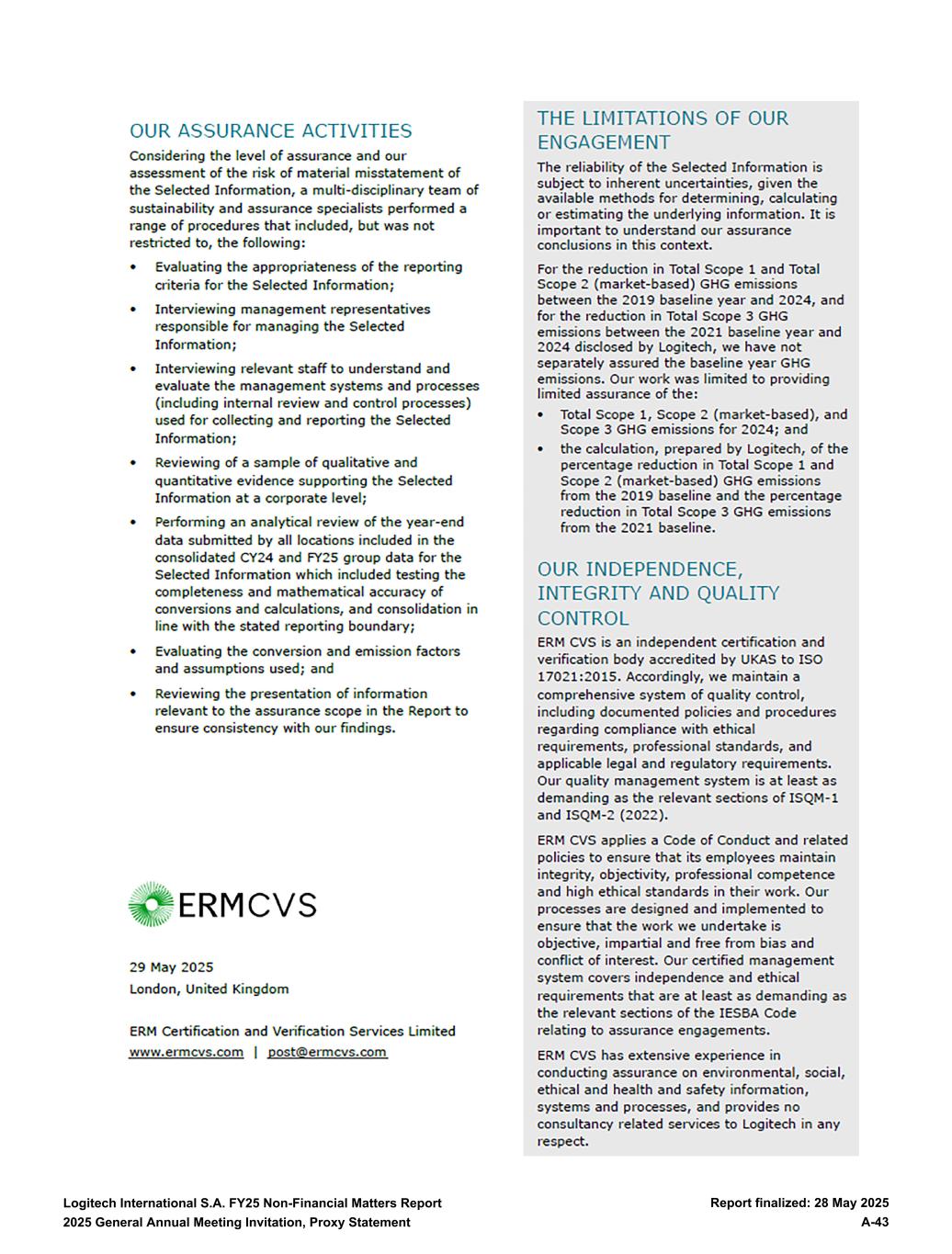
Logitech International S.A. FY25 Non-Financial Matters Report Report finalized: 28 May 2025 2025 General Annual Meeting Invitation, Proxy Statement A-43
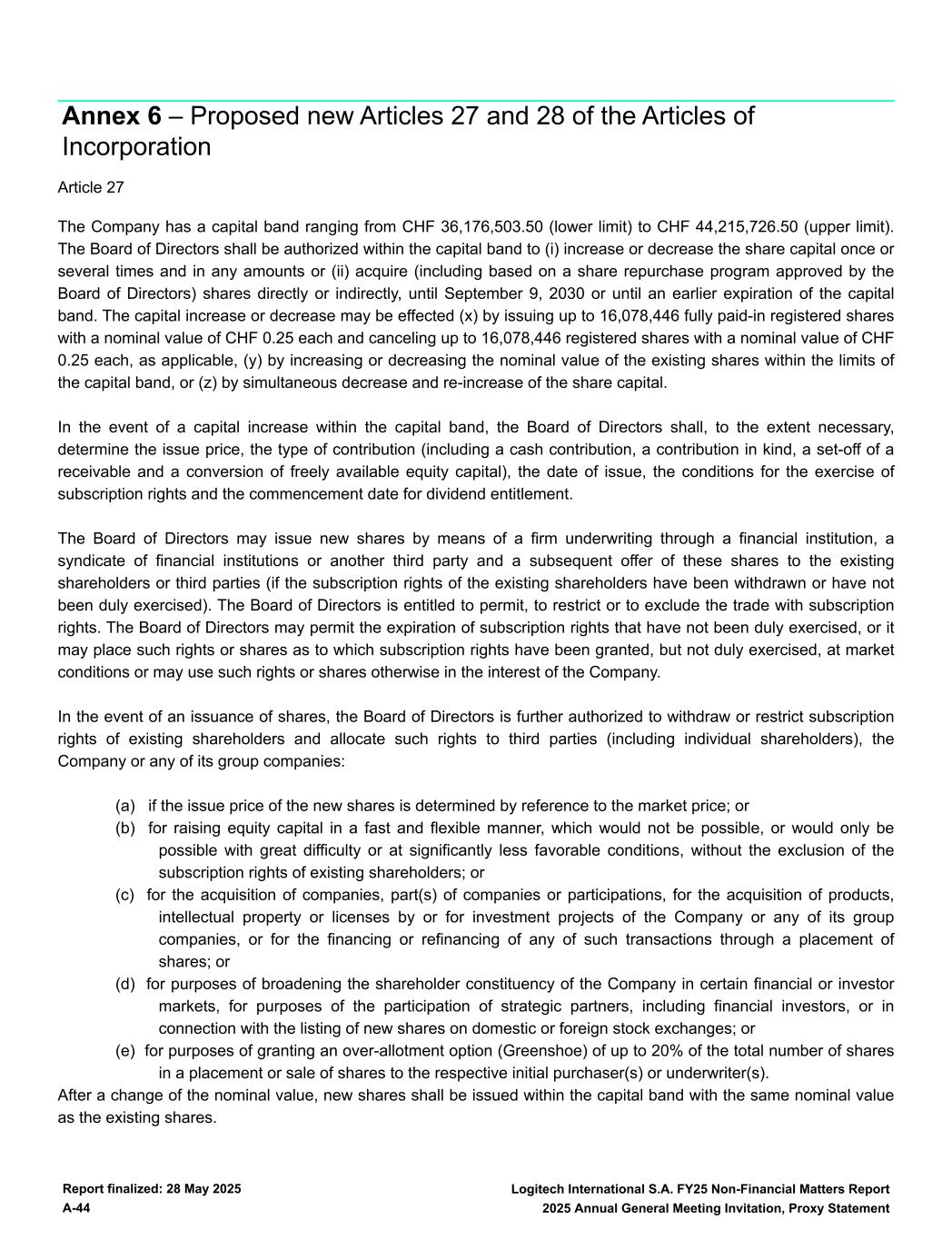
Annex 6 – Proposed new Articles 27 and 28 of the Articles of Incorporation Article 27 The Company has a capital band ranging from CHF 36,176,503.50 (lower limit) to CHF 44,215,726.50 (upper limit). The Board of Directors shall be authorized within the capital band to (i) increase or decrease the share capital once or several times and in any amounts or (ii) acquire (including based on a share repurchase program approved by the Board of Directors) shares directly or indirectly, until September 9, 2030 or until an earlier expiration of the capital band. The capital increase or decrease may be effected (x) by issuing up to 16,078,446 fully paid-in registered shares with a nominal value of CHF 0.25 each and canceling up to 16,078,446 registered shares with a nominal value of CHF 0.25 each, as applicable, (y) by increasing or decreasing the nominal value of the existing shares within the limits of the capital band, or (z) by simultaneous decrease and re-increase of the share capital. In the event of a capital increase within the capital band, the Board of Directors shall, to the extent necessary, determine the issue price, the type of contribution (including a cash contribution, a contribution in kind, a set-off of a receivable and a conversion of freely available equity capital), the date of issue, the conditions for the exercise of subscription rights and the commencement date for dividend entitlement. The Board of Directors may issue new shares by means of a firm underwriting through a financial institution, a syndicate of financial institutions or another third party and a subsequent offer of these shares to the existing shareholders or third parties (if the subscription rights of the existing shareholders have been withdrawn or have not been duly exercised). The Board of Directors is entitled to permit, to restrict or to exclude the trade with subscription rights. The Board of Directors may permit the expiration of subscription rights that have not been duly exercised, or it may place such rights or shares as to which subscription rights have been granted, but not duly exercised, at market conditions or may use such rights or shares otherwise in the interest of the Company. In the event of an issuance of shares, the Board of Directors is further authorized to withdraw or restrict subscription rights of existing shareholders and allocate such rights to third parties (including individual shareholders), the Company or any of its group companies: (a) if the issue price of the new shares is determined by reference to the market price; or (b) for raising equity capital in a fast and flexible manner, which would not be possible, or would only be possible with great difficulty or at significantly less favorable conditions, without the exclusion of the subscription rights of existing shareholders; or (c) for the acquisition of companies, part(s) of companies or participations, for the acquisition of products, intellectual property or licenses by or for investment projects of the Company or any of its group companies, or for the financing or refinancing of any of such transactions through a placement of shares; or (d) for purposes of broadening the shareholder constituency of the Company in certain financial or investor markets, for purposes of the participation of strategic partners, including financial investors, or in connection with the listing of new shares on domestic or foreign stock exchanges; or (e) for purposes of granting an over-allotment option (Greenshoe) of up to 20% of the total number of shares in a placement or sale of shares to the respective initial purchaser(s) or underwriter(s). After a change of the nominal value, new shares shall be issued within the capital band with the same nominal value as the existing shares. Report finalized: 28 May 2025 Logitech International S.A. FY25 Non-Financial Matters Report A-44 2025 Annual General Meeting Invitation, Proxy Statement
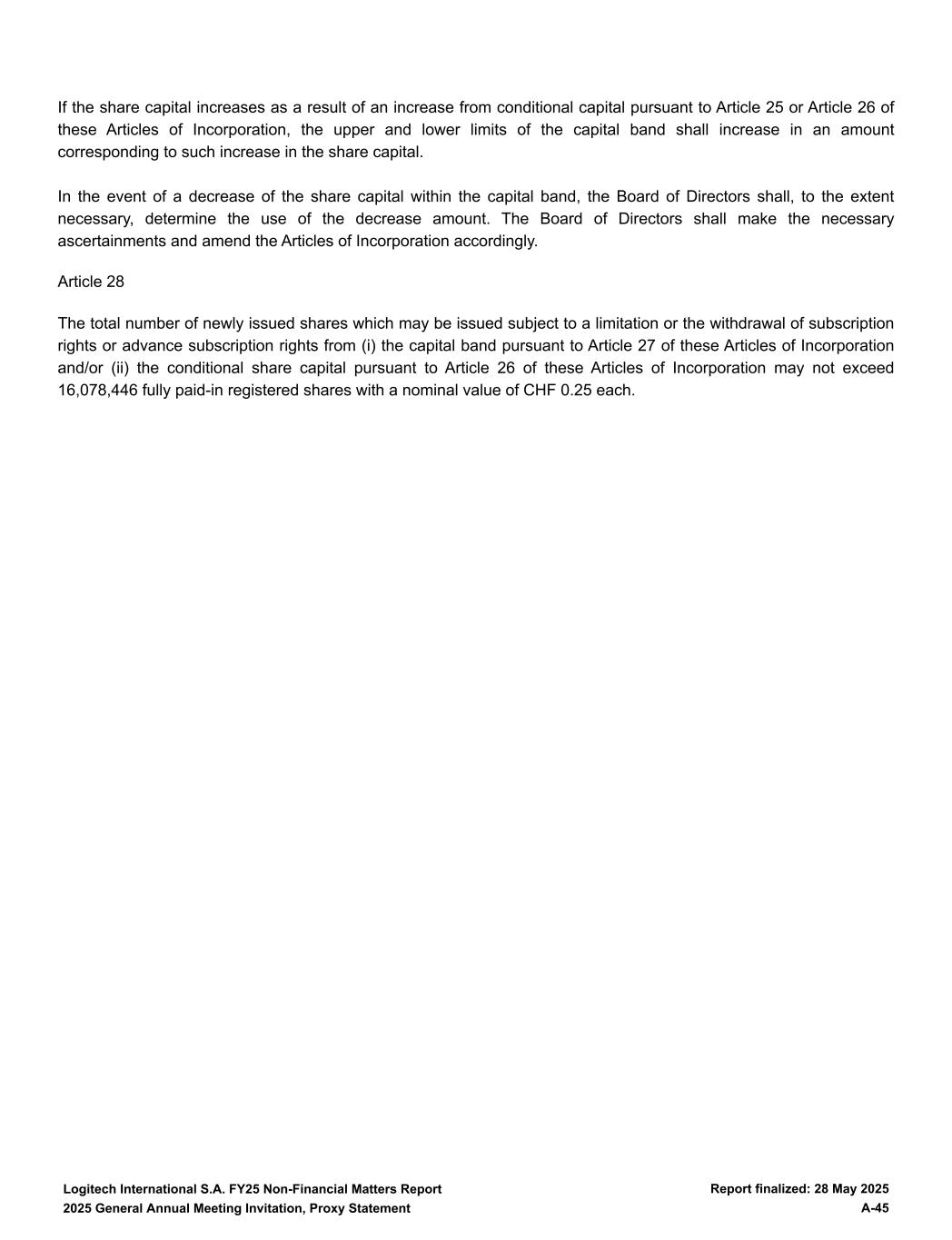
If the share capital increases as a result of an increase from conditional capital pursuant to Article 25 or Article 26 of these Articles of Incorporation, the upper and lower limits of the capital band shall increase in an amount corresponding to such increase in the share capital. In the event of a decrease of the share capital within the capital band, the Board of Directors shall, to the extent necessary, determine the use of the decrease amount. The Board of Directors shall make the necessary ascertainments and amend the Articles of Incorporation accordingly. Article 28 The total number of newly issued shares which may be issued subject to a limitation or the withdrawal of subscription rights or advance subscription rights from (i) the capital band pursuant to Article 27 of these Articles of Incorporation and/or (ii) the conditional share capital pursuant to Article 26 of these Articles of Incorporation may not exceed 16,078,446 fully paid-in registered shares with a nominal value of CHF 0.25 each. Logitech International S.A. FY25 Non-Financial Matters Report Report finalized: 28 May 2025 2025 General Annual Meeting Invitation, Proxy Statement A-45
Annual Report Fiscal Year 2025
MANAGEMENT'S DISCUSSION AND ANALYSIS OF FINANCIAL CONDITION AND RESULTS OF OPERATIONS Annual Report Fiscal Year 2025 1
MANAGEMENT'S DISCUSSION AND ANALYSIS OF FINANCIAL CONDITION AND RESULTS OF OPERATIONS The following Management's Discussion and Analysis of Financial Condition and Results of Operations contains forward-looking statements that involve risks and uncertainties. Our actual results could differ materially from those anticipated in these statements as a result of certain factors, including those set forth above in Item 1A "Risk Factors," and below in Item 7A, "Quantitative and Qualitative Disclosures about Market Risk." Please read the following discussion and analysis of our financial condition and results of operations together with our consolidated financial statements and related notes included under Item 8 of this Annual Report on Form 10-K. Company Overview Logitech designs software-enabled hardware solutions that help businesses thrive and bring people together when working, creating, and gaming. As the point of connection between people and the digital world, our mission is to extend human potential in work and play, in a way that is good for people and the planet. We sell the vast majority of our products under Logitech and Logitech G brand names. Our diverse, innovative portfolio includes: Gaming, Keyboards & Combos, Pointing Devices, Video Collaboration, Webcams, Tablet Accessories, and Headsets. These products are all classified under a single operating segment: Peripherals (see Note 15 to our consolidated financial statements). We sell our products to a broad range of international customers, in the Americas, Europe, the Middle East and Africa (“EMEA”) and Asia Pacific. This includes direct sales to retailers, e-tailers, businesses large and small and end consumers through our e-commerce platform, and indirect sales to end customers through distributors. From time to time, we may seek to partner with or acquire, when appropriate, companies that have products, personnel, and technologies that complement our strategic direction. We continually review our product offerings and our strategic direction in light of our profitability targets, competitive conditions, changing consumer trends and the evolving nature of the interface between the consumer and the digital world. Impacts of Macroeconomic and Geopolitical Conditions on our Business In 2025, the United States introduced trade policy actions that have increased import tariffs across a wide range of countries at various rates, with certain exemptions. The tariff policies in the U.S. and responsive policies enacted in other countries are evolving and may have a material adverse impact on our business. In addition, our business has continued to be impacted by ongoing macroeconomic and geopolitical conditions. These conditions include inflation, interest rate and foreign currency fluctuations, uncertainty in consumer and enterprise demand, low economic growth in certain regions, changes in fiscal policies and geopolitical conflicts. The global and regional economic and political conditions, as well as changes in trade policies, have caused and may continue to cause volatility in demand for our products as well as cost of tariffs, materials and logistics, and transportation delays, and as a result have impacted and may continue to impact the pricing of our products, product availability and our results of operations. For additional information, see Part I, Item 1A "Risk Factors," including under the captions "Adverse global and regional economic and geopolitical conditions can materially adversely affect our business, results of operations and financial condition," “We purchase key components and products from a limited number of sources, and our business and operating results could be adversely affected if supply were delayed or constrained or if there were shortages of required components,” “Our principal manufacturing operations and third-party contract manufacturers are located in China and Southeast Asia, which exposes us to risks associated with doing business in that geographic area as well as changes in tariffs, adverse trade regulations, adverse tax consequences and pressure to move or diversify our manufacturing locations,” “If we do not accurately forecast market demand for our products, our business and operating results could be adversely affected,” and "If we do not successfully coordinate the worldwide manufacturing and distribution of our products, we could lose sales and our business and operating results could be adversely affected.” Trends and Uncertainties Several long-term secular-trends offer long-term structural growth opportunities across Logitech’s product portfolio. We design, create and sell products that benefit from these secular trends which include the following: MANAGEMENT'S DISCUSSION AND ANALYSIS 2 Annual Report Fiscal Year 2025
• AI: AI has reshaped expectations for productivity improvements, product innovation and technology ecosystem evolution. While we have used AI solutions and machine learning to enhance the features of different products in our portfolio, AI offers additional growth opportunities and risks as we work to integrate our capabilities with our ecosystem partners. • New ways of working: The new ways of working that have emerged after the pandemic in which people are splitting time between working in the office, from home, and from other places while on the go, provide opportunities for Logitech to equip multiple workspaces with products across our portfolio including Pointing Devices, Keyboards & Combos, Tablet Accessories, Headsets and Webcams. The new ways of working also provide an opportunity for increased adoption of video conferencing by enterprises and consumers. Our video collaboration products are compatible with a variety of video conference platforms, including Zoom, Microsoft Teams and Google Meet. • Gaming growth: The ongoing growth and evolution of gaming creates an opportunity for us to provide more tools to a wider community of gamers. In particular, social gaming continues to gain popularity through online gaming, multi-platform experiences and esports. While we believe we will further benefit from these secular trends, we have experienced and will continue to experience challenges that impact our business and financial results. These challenges include (i) uncertainty in tariffs on goods imported into the U.S. and responsive policies enacted by other countries, (ii) the macroeconomic environment, including inflation, interest rate and foreign currency fluctuations, changes in fiscal policies and low economic growth in certain regions, (iii) the uncertainty of overall consumer and enterprise demand, (iv) the uncertainty of timing of enterprise investments in infrastructure and technology, and (v) the timing of further development of our B2B go-to-market capabilities. We expect these challenges to continue in the near-term. We have taken steps to mitigate the impact of these challenges, including but not limited to: (i) continued diversification of our manufacturing footprint and supplier ecosystem, (ii) maintaining discipline in our operating expenses, (iii) managing inventory levels to align with demand, (iv) continued investment in our B2B capabilities, and (v) continued release of new products to increase the value proposition of our portfolio. For additional information, see Part I, Item 1A “Risk Factors.” Business Seasonality and Product Introductions We have historically experienced higher sales in our third fiscal quarter ending December 31, compared to other fiscal quarters in our fiscal year, primarily due to increased consumer demand during the holiday season and increased spending by enterprises in the months nearing the calendar year-end. Additionally, new product introductions and business acquisitions can significantly impact sales, product costs and operating expenses. Sales can also be affected when consumers and distributors anticipate a product introduction or changes in business circumstances. However, neither historical seasonal patterns nor historical patterns of product introductions should be considered reliable indicators of our future pattern of product introductions, future sales or financial performance. Furthermore, cash flow is correspondingly lower in the first half of our fiscal year as we typically build inventories in advance of our third fiscal quarter and we also pay an annual dividend following our Annual General Meeting typically held in September. Summary of Financial Results Our total sales for fiscal year 2025 increased 6%, compared to fiscal year 2024, primarily driven by an increase in sales of Gaming, Keyboards & Combos, Pointing Devices, and Tablet Accessories, due to improved demand. Sales for fiscal year 2025 increased 9%, 6% and 4% in the EMEA, Asia Pacific and Americas regions, respectively, compared to fiscal year 2024. Gross margin for fiscal year 2025 increased by 170 basis points to 43.1%, compared to 41.4% for fiscal year 2024, primarily driven by lower product costs, partially offset by higher promotional spending. MANAGEMENT'S DISCUSSION AND ANALYSIS Annual Report Fiscal Year 2025 3
Operating expenses for fiscal year 2025 were $1,307.7 million, or 28.7% of sales, compared to $1,190.7 million, or 27.7% of sales, for fiscal year 2024. The increase in operating expenses was primarily driven by an increase in marketing and selling expenses. We had an income tax provision of $75.3 million for fiscal year 2025, compared to $9.5 million for fiscal year 2024, primarily driven by the discrete tax benefits recognized in fiscal year 2024 for the benefit of future Swiss tax deductions, the remeasurement of the tax basis of goodwill under the Swiss Federal Act on Tax Reform and AHV Financing ("TRAF"), Foreign Derived Intangible Income ("FDII") incentive provided by the Tax Cuts and Jobs Act and remeasurement of our Swiss deferred tax assets due to a change in tax rate, partially offset by the tax benefit recognized in fiscal year 2025 from the release of previously recorded tax reserves for uncertain tax positions. Net income for fiscal year 2025 was $631.5 million, compared to $612.1 million for fiscal year 2024, reflecting higher gross margin, partially offset by an increase in operating expenses and income tax provision. Critical Accounting Estimates The preparation of financial statements and related disclosures in conformity with U.S. GAAP requires us to make assumptions, judgments, and estimates that affect reported amounts of assets, liabilities, sales and expenses, and the disclosure of contingent assets and liabilities. We consider an accounting estimate critical if it: (i) requires management to make judgments and estimates about matters that are inherently uncertain; and (ii) is important to an understanding of our financial condition and operating results. We base our assumptions, judgments and estimates on historical experience and various other factors that we believe to be reasonable under the circumstances. Although these assumptions, judgments, and estimates are based on management's best knowledge of current events and actions that may impact us in the future, actual results could differ. Management has discussed the development, selection and disclosure of these critical accounting estimates with the Audit Committee of the Board of Directors. We believe the following accounting estimates are most critical to our business operations and to an understanding of our financial condition and results of operations and reflect the more significant judgments and estimates used in the preparation of our consolidated financial statements. Accruals for Customer Programs and Product Returns We record accruals for cooperative marketing, customer incentive, pricing programs ("Customer Programs") and product returns. The estimated cost of these programs is usually recorded as a reduction of revenue. Significant management judgments and estimates must be used to determine the cost of these programs in any accounting period. Customer Programs require management to estimate the percentage of those programs that will not be claimed in the current period or will not be earned by customers, which is commonly referred to as "breakage." Breakage is estimated based on historical claim experience, the period in which the claims are expected to be submitted, specific terms and conditions with customers, and other factors. If we receive a separately identifiable benefit from a customer and can reasonably estimate the fair value of that benefit, the cost of the Customer Programs is recognized in operating expenses. Customer Incentive Programs. Customer incentive programs include performance-based incentives and consumer rebates. We offer performance-based incentives to our customers and indirect partners based on predetermined performance criteria. Consumer rebates are offered from time to time at our discretion for the primary benefit of end-users. Customer incentive programs are considered variable consideration, which we estimate and record as a reduction to revenue at the time of sale based on negotiated terms, historical experiences, forecasted incentives, the anticipated volume of future purchases, and inventory levels in the channel. Product Returns. We grant limited rights to return products. Return rights vary by customer and range from just the right to return the defective product to stock rotation rights limited to a percentage of sales approved by management. Estimates of expected future product returns are recognized at the time of sale based on analyses of historical return trends by the customer and by product, inventories owned by and located at customers, current customer demand, current operating conditions, and other relevant customer and product information. Upon recognition, we reduce sales and cost of goods sold for the estimated return. Return trends are influenced by product MANAGEMENT'S DISCUSSION AND ANALYSIS 4 Annual Report Fiscal Year 2025
life cycle status, new product introductions, market acceptance of products, sales levels, product sell-through, the type of customer, seasonality, product quality issues, competitive pressures, operational policies and procedures, and other factors. Return rates can fluctuate over time but are sufficiently predictable to allow us to estimate expected future product returns. We apply a breakage rate to reduce our accruals of Customer Programs based on the estimated percentage of these Customer Programs that will not be claimed or earned. The breakage rate is applied at the time of sale. Assessing the period in which claims are expected to be submitted and the relevance of the historical claim experience require significant management judgment to estimate the breakage of Customer Programs in any accounting period. We regularly evaluate the adequacy of our accruals for Customer Programs and product returns. Future market conditions and product transitions may require us to take action to increase such programs. In addition, when the variables used to estimate these costs change, or if actual costs differ significantly from the estimates, we would be required to record incremental increases or reductions to revenue or operating expenses. Inventory Valuation We must order components for our products and build inventory in advance of customer orders. Further, our industry is characterized by rapid technological change, short-term customer commitments and rapid changes in demand. We record inventories at the lower of cost and net realizable value and record write-downs of inventories that are obsolete or in excess of anticipated demand or net realizable value. A review of inventory is performed each fiscal quarter that considers factors including the marketability and product lifecycle stage, product development plans, component cost trends, historical sales, and demand forecasts that consider the assumptions about future demand and market conditions. Inventory on hand that is not expected to be sold or utilized is considered excess, and we recognize the write-down in the cost of goods sold at the time of such determination. The write-down is determined by the excess of cost over net realizable value. Net realizable value is the estimated selling price in the ordinary course of business, less reasonably predictable costs of completion, disposal and transportation. At the time of loss recognition, new cost basis per unit and the lower-cost basis for that inventory are established and subsequent changes in facts and circumstances would not result in an increase in the cost basis. If there is an abrupt and substantial decline in demand for Logitech's products or an unanticipated change in technological or customer requirements, we may be required to record additional write-downs that could adversely affect gross margins in the period when the write-downs are recorded. We also extend the assessment to non-cancelable purchase orders if the inventories are considered excess and record the liability that is reasonably possible to be incurred in accrued and other liabilities. Accounting for Income Taxes We operate in multiple jurisdictions and our profits are taxed pursuant to the tax laws of these jurisdictions. Our effective income tax rate may be affected by the changes in or interpretations of tax laws and tax agreements in any given jurisdiction, utilization of net operating loss and tax credit carryforwards, changes in geographical mix of income and expense, and changes in our assessment of matters such as the ability to realize deferred tax assets. As a result of these considerations, we must estimate income taxes in each of the jurisdictions in which we operate. This process involves estimating current tax exposure together with assessing temporary differences resulting from the different treatment of items for tax and accounting purposes. These differences result in deferred tax assets and liabilities, which are included in the consolidated balance sheet. We make certain estimates and judgments about the application of tax laws, the expected resolution of uncertain tax positions and other matters surrounding the recognition and measurement of uncertain tax benefits. In the event that uncertain tax positions are resolved for amounts different than our estimates, or the related statutes of limitations expire without the assessment of additional income taxes, we will be required to adjust the amounts of the related assets and liabilities in the period in which such events occur. Such adjustments may have a material impact on our income tax provision and our results of operations. MANAGEMENT'S DISCUSSION AND ANALYSIS Annual Report Fiscal Year 2025 5

For additional information about our Critical Accounting Estimates, see Note 2—Summary of Significant Accounting Policies in our Notes to our consolidated financial statements. New Accounting Pronouncements Refer to Note 2 to the consolidated financial statements included in this Annual Report on Form 10-K for recent accounting pronouncements adopted and to be adopted. Constant Currency We refer to our net sales growth rates excluding the impact of currency exchange rate fluctuations as "constant currency" sales growth rates. Percentage of constant currency sales growth is calculated by translating prior period sales in each local currency at the current period’s average exchange rate for that currency and comparing that to current period sales. Given our global sales presence and the reporting of our financial results in U.S. Dollars, our financial results could be affected by significant shifts in currency exchange rates. See “Results of Operations” for information on the effect of currency exchange rate fluctuations on our sales. If the U.S. Dollar appreciates or depreciates in comparison to other currencies in future periods, this will affect our results of operations in future periods as well. References to Sales The term “sales” means net sales, except as otherwise specified and the sales growth discussion and sales growth rate percentages are in U.S. Dollars, except as otherwise specified. Results of Operations In this section, we discuss the results of our operations for the year ended March 31, 2025 compared to the year ended March 31, 2024. For a discussion of the year ended March 31, 2024 compared to the year ended March 31, 2023, please refer to Part II, Item 7, "Management's Discussion and Analysis of Financial Condition and Results of Operations" in our Annual Report on Form 10-K filed with the SEC on May 16, 2024. Net Sales Our sales in fiscal year 2025 increased 6%, compared to fiscal year 2024, primarily driven by an increase in sales of Gaming, Keyboards & Combos, Pointing Devices, and Tablet Accessories, due to improved demand. If currency exchange rates had been constant in fiscal years 2025 and 2024, our sales growth rate in constant currency would have been 7%. Sales Denominated in Other Currencies Although our financial results are reported in U.S. Dollars, a portion of our sales was generated in currencies other than the U.S. Dollar, such as the Euro, Chinese Renminbi, Japanese Yen, Australian Dollar, Canadian Dollar, Pound Sterling and New Taiwan Dollar. For the years ended March 31, 2025 and 2024, approximately 49% and 50%, respectively, of our sales were denominated in currencies other than the U.S. Dollar. Sales by Region The following table presents the change in sales by region for fiscal year 2025 compared with fiscal year 2024: 2025 vs. 2024 Sales Growth Rate Sales Growth Rate in Constant Currency Americas 4 % 5 % EMEA 9 9 Asia Pacific 6 7 MANAGEMENT'S DISCUSSION AND ANALYSIS 6 Annual Report Fiscal Year 2025
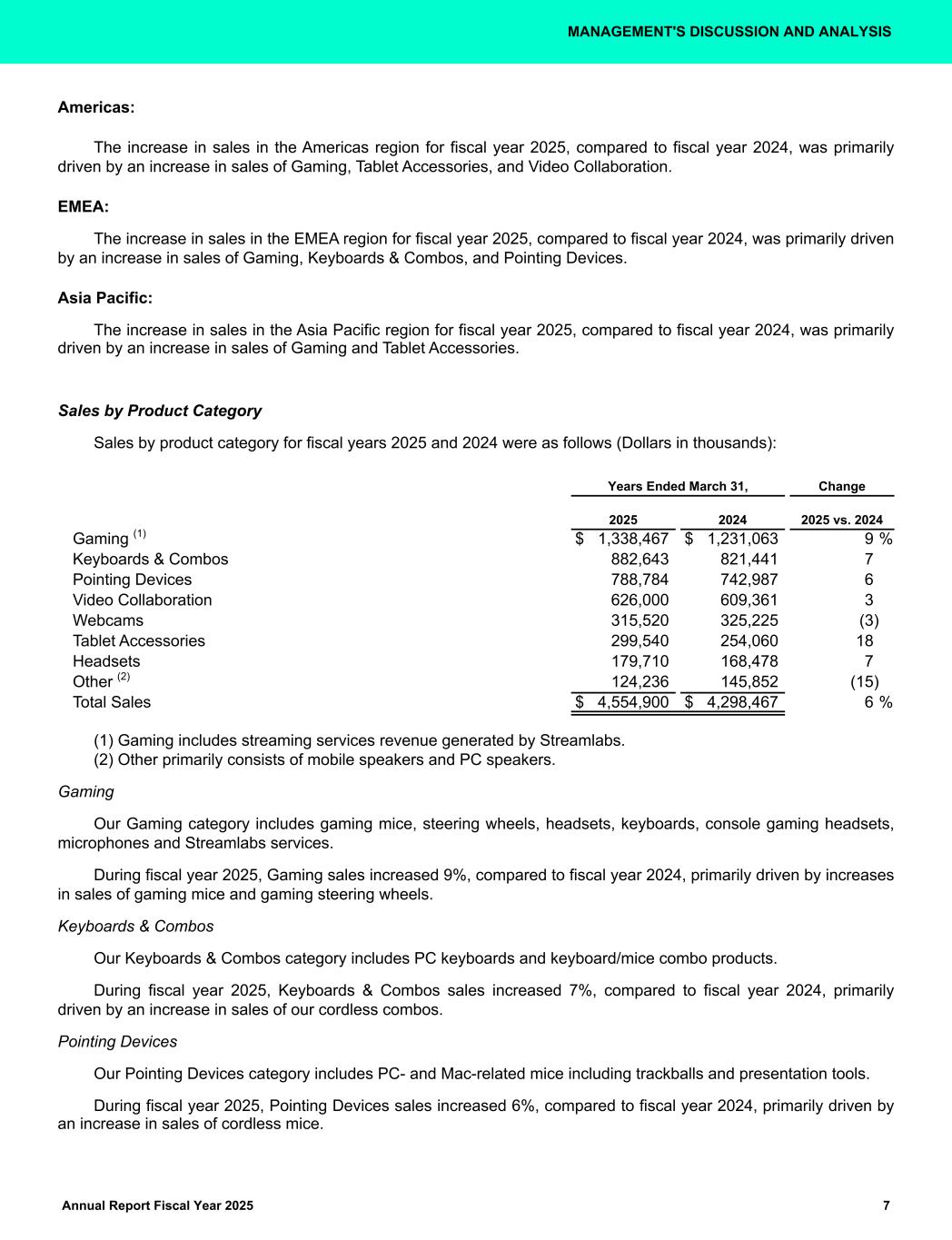
Americas: The increase in sales in the Americas region for fiscal year 2025, compared to fiscal year 2024, was primarily driven by an increase in sales of Gaming, Tablet Accessories, and Video Collaboration. EMEA: The increase in sales in the EMEA region for fiscal year 2025, compared to fiscal year 2024, was primarily driven by an increase in sales of Gaming, Keyboards & Combos, and Pointing Devices. Asia Pacific: The increase in sales in the Asia Pacific region for fiscal year 2025, compared to fiscal year 2024, was primarily driven by an increase in sales of Gaming and Tablet Accessories. Sales by Product Category Sales by product category for fiscal years 2025 and 2024 were as follows (Dollars in thousands): Years Ended March 31, Change 2025 2024 2025 vs. 2024 Gaming (1) $ 1,338,467 $ 1,231,063 9 % Keyboards & Combos 882,643 821,441 7 Pointing Devices 788,784 742,987 6 Video Collaboration 626,000 609,361 3 Webcams 315,520 325,225 (3) Tablet Accessories 299,540 254,060 18 Headsets 179,710 168,478 7 Other (2) 124,236 145,852 (15) Total Sales $ 4,554,900 $ 4,298,467 6 % (1) Gaming includes streaming services revenue generated by Streamlabs. (2) Other primarily consists of mobile speakers and PC speakers. Gaming Our Gaming category includes gaming mice, steering wheels, headsets, keyboards, console gaming headsets, microphones and Streamlabs services. During fiscal year 2025, Gaming sales increased 9%, compared to fiscal year 2024, primarily driven by increases in sales of gaming mice and gaming steering wheels. Keyboards & Combos Our Keyboards & Combos category includes PC keyboards and keyboard/mice combo products. During fiscal year 2025, Keyboards & Combos sales increased 7%, compared to fiscal year 2024, primarily driven by an increase in sales of our cordless combos. Pointing Devices Our Pointing Devices category includes PC- and Mac-related mice including trackballs and presentation tools. During fiscal year 2025, Pointing Devices sales increased 6%, compared to fiscal year 2024, primarily driven by an increase in sales of cordless mice. MANAGEMENT'S DISCUSSION AND ANALYSIS Annual Report Fiscal Year 2025 7
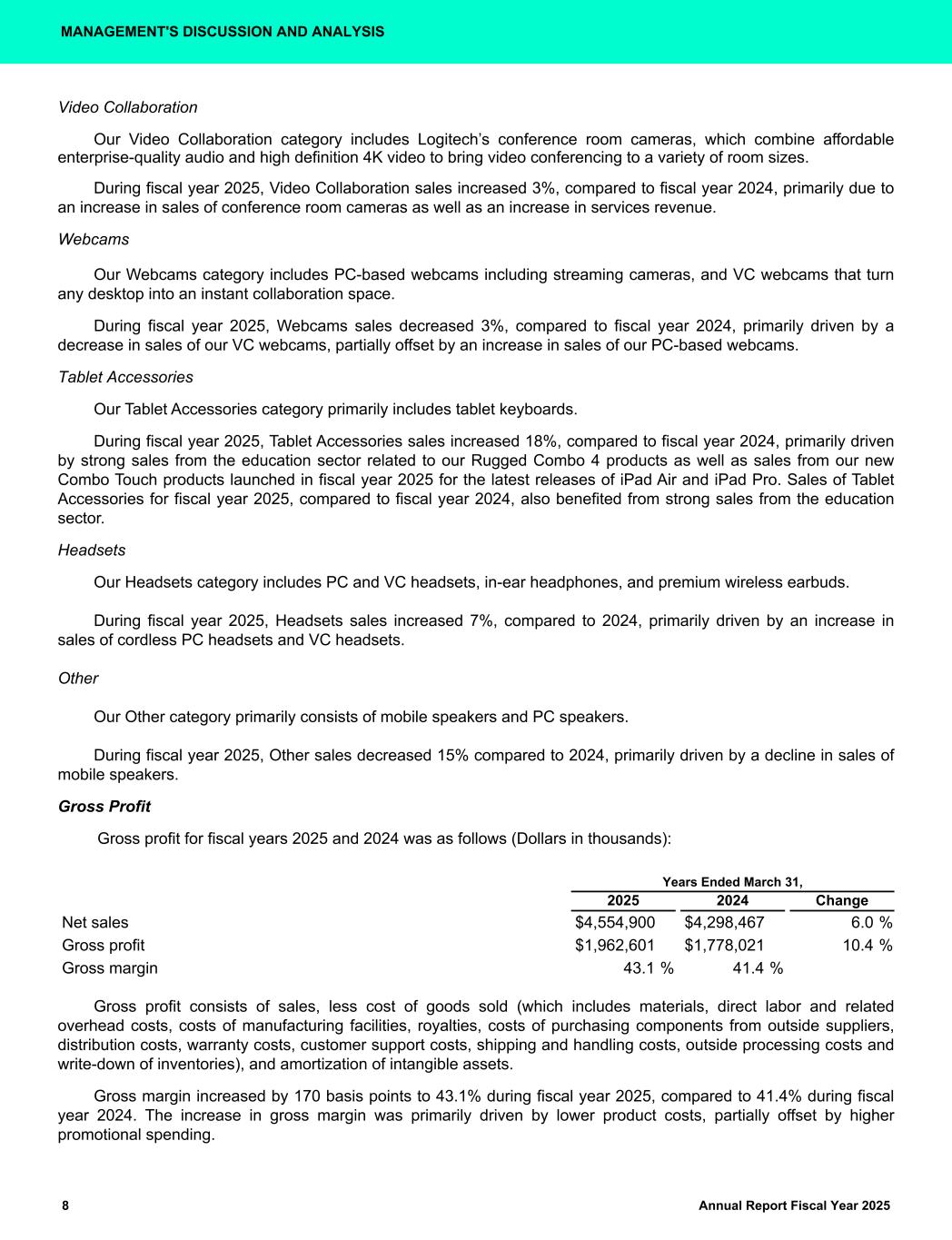
Video Collaboration Our Video Collaboration category includes Logitech’s conference room cameras, which combine affordable enterprise-quality audio and high definition 4K video to bring video conferencing to a variety of room sizes. During fiscal year 2025, Video Collaboration sales increased 3%, compared to fiscal year 2024, primarily due to an increase in sales of conference room cameras as well as an increase in services revenue. Webcams Our Webcams category includes PC-based webcams including streaming cameras, and VC webcams that turn any desktop into an instant collaboration space. During fiscal year 2025, Webcams sales decreased 3%, compared to fiscal year 2024, primarily driven by a decrease in sales of our VC webcams, partially offset by an increase in sales of our PC-based webcams. Tablet Accessories Our Tablet Accessories category primarily includes tablet keyboards. During fiscal year 2025, Tablet Accessories sales increased 18%, compared to fiscal year 2024, primarily driven by strong sales from the education sector related to our Rugged Combo 4 products as well as sales from our new Combo Touch products launched in fiscal year 2025 for the latest releases of iPad Air and iPad Pro. Sales of Tablet Accessories for fiscal year 2025, compared to fiscal year 2024, also benefited from strong sales from the education sector. Headsets Our Headsets category includes PC and VC headsets, in-ear headphones, and premium wireless earbuds. During fiscal year 2025, Headsets sales increased 7%, compared to 2024, primarily driven by an increase in sales of cordless PC headsets and VC headsets. Other Our Other category primarily consists of mobile speakers and PC speakers. During fiscal year 2025, Other sales decreased 15% compared to 2024, primarily driven by a decline in sales of mobile speakers. Gross Profit Gross profit for fiscal years 2025 and 2024 was as follows (Dollars in thousands): Years Ended March 31, 2025 2024 Change Net sales $ 4,554,900 $ 4,298,467 6.0 % Gross profit $ 1,962,601 $ 1,778,021 10.4 % Gross margin 43.1 % 41.4 % Gross profit consists of sales, less cost of goods sold (which includes materials, direct labor and related overhead costs, costs of manufacturing facilities, royalties, costs of purchasing components from outside suppliers, distribution costs, warranty costs, customer support costs, shipping and handling costs, outside processing costs and write-down of inventories), and amortization of intangible assets. Gross margin increased by 170 basis points to 43.1% during fiscal year 2025, compared to 41.4% during fiscal year 2024. The increase in gross margin was primarily driven by lower product costs, partially offset by higher promotional spending. MANAGEMENT'S DISCUSSION AND ANALYSIS 8 Annual Report Fiscal Year 2025
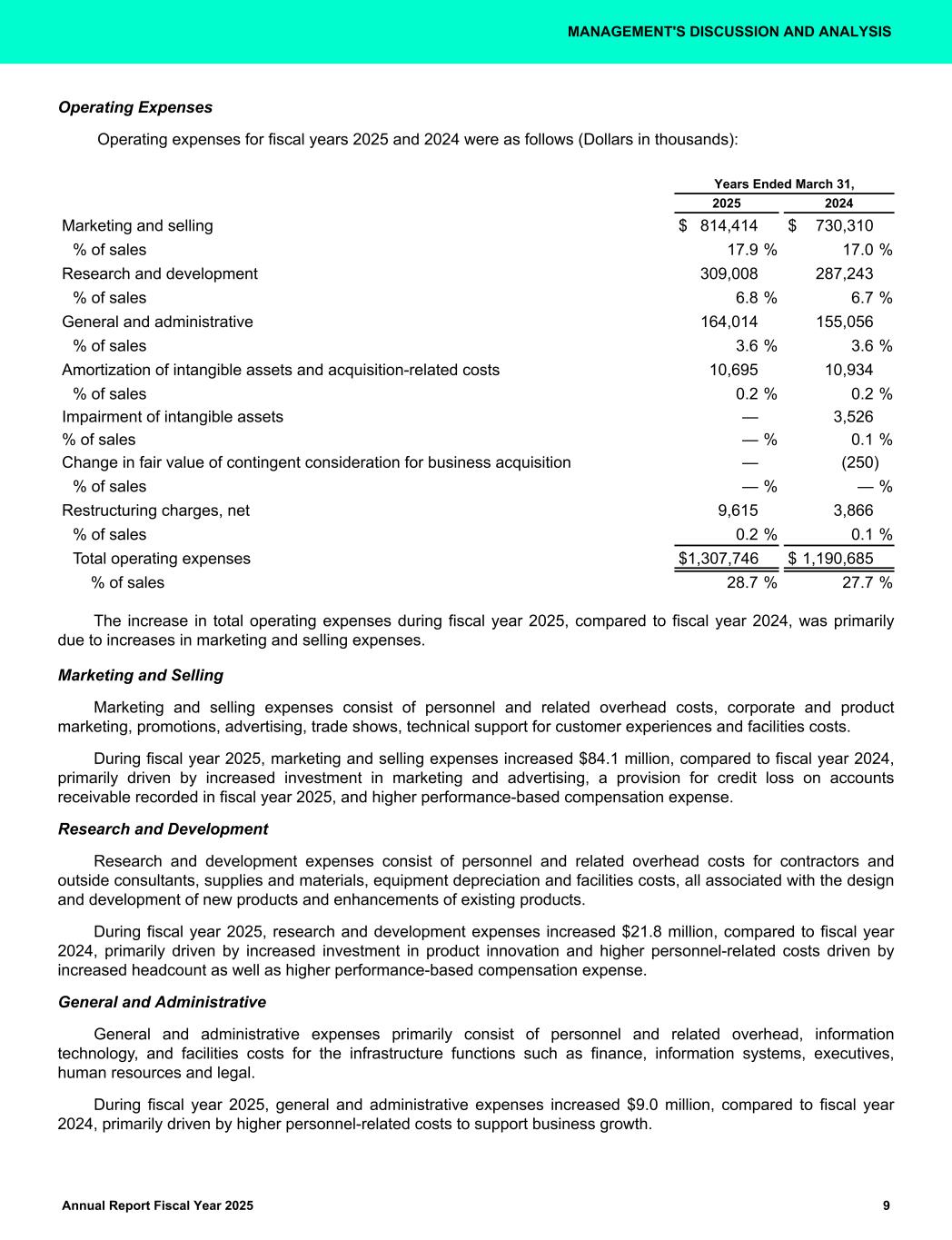
Operating Expenses Operating expenses for fiscal years 2025 and 2024 were as follows (Dollars in thousands): Years Ended March 31, 2025 2024 Marketing and selling $ 814,414 $ 730,310 % of sales 17.9 % 17.0 % Research and development 309,008 287,243 % of sales 6.8 % 6.7 % General and administrative 164,014 155,056 % of sales 3.6 % 3.6 % Amortization of intangible assets and acquisition-related costs 10,695 10,934 % of sales 0.2 % 0.2 % Impairment of intangible assets — 3,526 % of sales — % 0.1 % Change in fair value of contingent consideration for business acquisition — (250) % of sales — % — % Restructuring charges, net 9,615 3,866 % of sales 0.2 % 0.1 % Total operating expenses $ 1,307,746 $ 1,190,685 % of sales 28.7 % 27.7 % The increase in total operating expenses during fiscal year 2025, compared to fiscal year 2024, was primarily due to increases in marketing and selling expenses. Marketing and Selling Marketing and selling expenses consist of personnel and related overhead costs, corporate and product marketing, promotions, advertising, trade shows, technical support for customer experiences and facilities costs. During fiscal year 2025, marketing and selling expenses increased $84.1 million, compared to fiscal year 2024, primarily driven by increased investment in marketing and advertising, a provision for credit loss on accounts receivable recorded in fiscal year 2025, and higher performance-based compensation expense. Research and Development Research and development expenses consist of personnel and related overhead costs for contractors and outside consultants, supplies and materials, equipment depreciation and facilities costs, all associated with the design and development of new products and enhancements of existing products. During fiscal year 2025, research and development expenses increased $21.8 million, compared to fiscal year 2024, primarily driven by increased investment in product innovation and higher personnel-related costs driven by increased headcount as well as higher performance-based compensation expense. General and Administrative General and administrative expenses primarily consist of personnel and related overhead, information technology, and facilities costs for the infrastructure functions such as finance, information systems, executives, human resources and legal. During fiscal year 2025, general and administrative expenses increased $9.0 million, compared to fiscal year 2024, primarily driven by higher personnel-related costs to support business growth. MANAGEMENT'S DISCUSSION AND ANALYSIS Annual Report Fiscal Year 2025 9
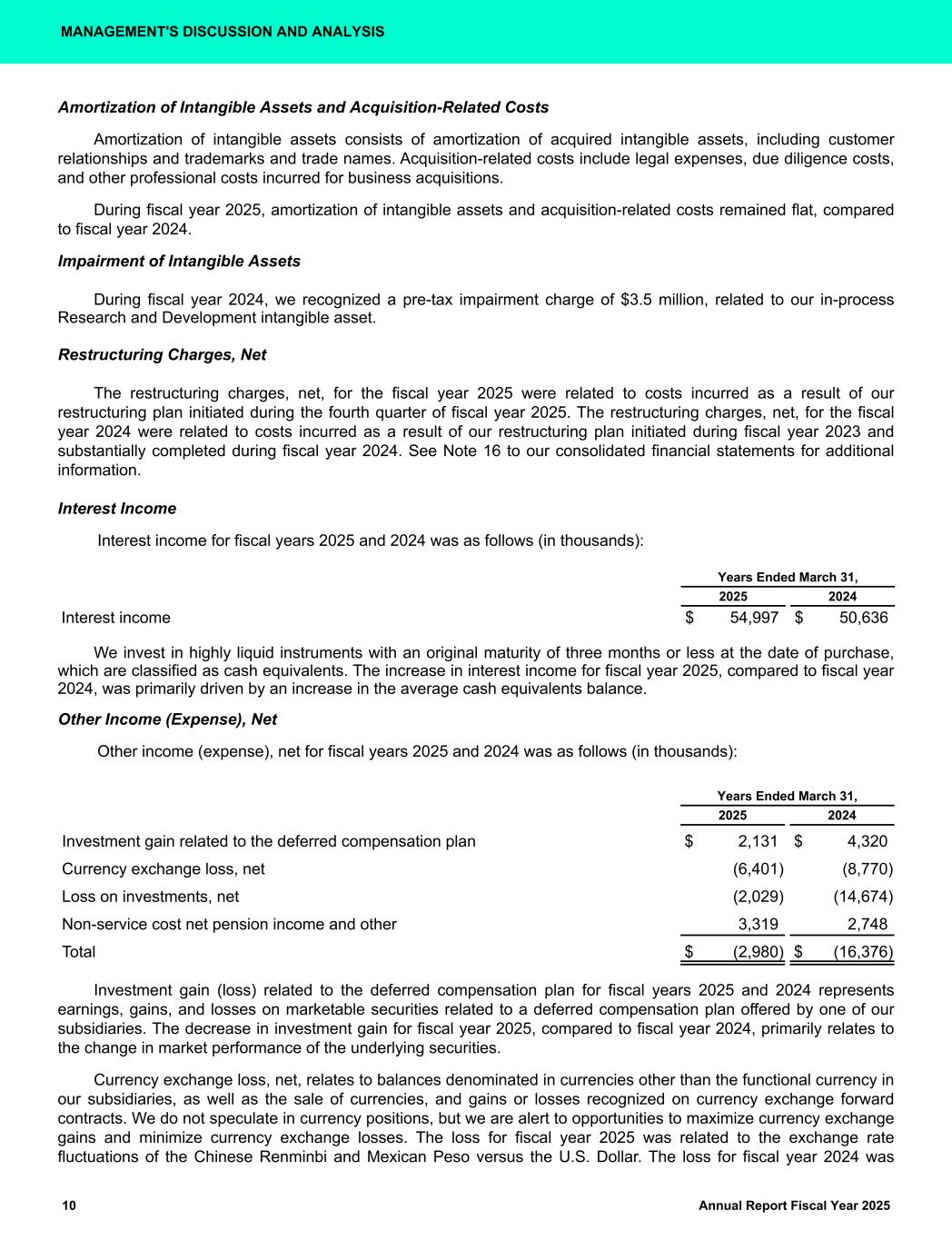
Amortization of Intangible Assets and Acquisition-Related Costs Amortization of intangible assets consists of amortization of acquired intangible assets, including customer relationships and trademarks and trade names. Acquisition-related costs include legal expenses, due diligence costs, and other professional costs incurred for business acquisitions. During fiscal year 2025, amortization of intangible assets and acquisition-related costs remained flat, compared to fiscal year 2024. Impairment of Intangible Assets During fiscal year 2024, we recognized a pre-tax impairment charge of $3.5 million, related to our in-process Research and Development intangible asset. Restructuring Charges, Net The restructuring charges, net, for the fiscal year 2025 were related to costs incurred as a result of our restructuring plan initiated during the fourth quarter of fiscal year 2025. The restructuring charges, net, for the fiscal year 2024 were related to costs incurred as a result of our restructuring plan initiated during fiscal year 2023 and substantially completed during fiscal year 2024. See Note 16 to our consolidated financial statements for additional information. Interest Income Interest income for fiscal years 2025 and 2024 was as follows (in thousands): Years Ended March 31, 2025 2024 Interest income $ 54,997 $ 50,636 We invest in highly liquid instruments with an original maturity of three months or less at the date of purchase, which are classified as cash equivalents. The increase in interest income for fiscal year 2025, compared to fiscal year 2024, was primarily driven by an increase in the average cash equivalents balance. Other Income (Expense), Net Other income (expense), net for fiscal years 2025 and 2024 was as follows (in thousands): Years Ended March 31, 2025 2024 Investment gain related to the deferred compensation plan $ 2,131 $ 4,320 Currency exchange loss, net (6,401) (8,770) Loss on investments, net (2,029) (14,674) Non-service cost net pension income and other 3,319 2,748 Total $ (2,980) $ (16,376) Investment gain (loss) related to the deferred compensation plan for fiscal years 2025 and 2024 represents earnings, gains, and losses on marketable securities related to a deferred compensation plan offered by one of our subsidiaries. The decrease in investment gain for fiscal year 2025, compared to fiscal year 2024, primarily relates to the change in market performance of the underlying securities. Currency exchange loss, net, relates to balances denominated in currencies other than the functional currency in our subsidiaries, as well as the sale of currencies, and gains or losses recognized on currency exchange forward contracts. We do not speculate in currency positions, but we are alert to opportunities to maximize currency exchange gains and minimize currency exchange losses. The loss for fiscal year 2025 was related to the exchange rate fluctuations of the Chinese Renminbi and Mexican Peso versus the U.S. Dollar. The loss for fiscal year 2024 was MANAGEMENT'S DISCUSSION AND ANALYSIS 10 Annual Report Fiscal Year 2025
related to the exchange rate fluctuations of the Chinese Renminbi, Australian Dollar, Brazilian Real, and Japanese Yen versus the U.S. Dollar. Loss on investments, net, includes unrealized gain (loss) from the change in fair value of investments, income (loss) on equity-method investments and impairment of investments during the periods presented, as applicable. The loss on investments, net, for fiscal year 2025 was not material. The loss on investments, net, for fiscal year 2024 was primarily due to an impairment loss, as a result of the write-off of a note receivable which was deemed no longer recoverable. This note receivable was previously obtained in conjunction with an exchange transaction related to our investment in a privately held company. See Note 9 to our consolidated financial statements for additional information. Provision for Income Taxes The provision for income taxes and effective income tax rates for fiscal years 2025 and 2024 were as follows (Dollars in thousands): Years Ended March 31, 2025 2024 Provision for income taxes $ 75,343 $ 9,453 Effective income tax rate 10.7 % 1.5 % The change in the effective income tax rate between fiscal years 2025 and 2024 was primarily due to the tax effect of audit resolutions and the expiration of statutes of limitation of uncertain tax positions in fiscal year 2025 compared with the discrete tax benefits recognized in fiscal year 2024 for the benefit of future Swiss tax deductions, the remeasurement of the tax basis of goodwill under TRAF, FDII incentive provided by the Tax Cuts and Jobs Act and remeasurement of our Swiss deferred tax assets due to a change in tax rate. On March 28, 2024, the Swiss canton of Vaud confirmed a future tax benefit to be recognized for ten years. This resulted in the Company recording an income tax benefit of $50.1 million during the fiscal year ended March 31, 2024, which will be utilized over a ten-year period. The canton of Vaud completed the legislative process to enact TRAF, a reform to better align the Swiss tax system to international tax standards, on March 10, 2020, that took effect as of January 1, 2020. In March 2020, we increased the tax basis of goodwill, as a transition measure under TRAF, to be amortized over ten years beginning on January 1, 2020. During the fiscal year ended March 31, 2024, we remeasured the tax basis of goodwill under TRAF, which resulted in an income tax benefit of $25.1 million, net of assessment for uncertain tax positions. The remeasurement of the step-up will be amortized over the remaining ten-year amortization period. The Tax Cuts and Jobs Act enacted Section 250, which provides for a deduction with respect to Global Intangible Low-Taxed Income ("GILTI") and FDII in the US. The application of this tax incentive is inherently complex. During the fiscal year ended March 31, 2024, we analyzed the applicability of FDII and determined that this tax incentive applies to fiscal years 2021, 2022 and 2023. As a result, we realized a tax benefit of $18.7 million related to FDII. We have also concluded that any GILTI tax since the enactment of Tax Cuts and Jobs Act is immaterial. On December 29, 2023, a change to the cantonal tax legislation was published. According to the law approved by the Vaud parliament, a progressive scale will be applicable for cantonal tax purposes resulting in an increase from the then current tax rate of 13.61% to 14.28% effective fiscal year 2025. The increase in tax rate resulted in a tax benefit of $5.1 million due to a remeasurement of our Swiss deferred tax assets in the fiscal year ended March 31, 2024. The Base Erosion and Profit Shifting Project (the “BEPS Project”) undertaken by the Organization for Economic Co-operation and Development (the “OECD”) recommended changes to numerous long-standing tax principles, including a proposal to reallocate profits among tax jurisdictions in which companies do business (“Pillar One”) and establishing a minimum tax on global income (“Pillar Two”). Some jurisdictions, including Switzerland, where we operate have implemented Pillar Two laws to effectuate a 15% minimum tax. The minimum tax, effective beginning in fiscal year 2025 for the Company, is treated as a current cost and does not have an impact on the Company's effective tax rate. The OECD and participating countries continue to issue underlying rules and administrative guidance related to Pillar Two, and we continue to monitor the relevant developments. MANAGEMENT'S DISCUSSION AND ANALYSIS Annual Report Fiscal Year 2025 11
As of March 31, 2025 and 2024, the total amount of unrecognized tax benefits due to uncertain tax positions was $152.0 million and $192.7 million, respectively, all of which would affect the effective income tax rate if recognized. As of March 31, 2025 and 2024, we had $88.5 million and $112.6 million, respectively, in non-current income taxes payable, including interest and penalties, related to our income tax liability for uncertain tax positions. As of March 31, 2025 and 2024, we had $7.2 million and $7.8 million, respectively, of accrued interest and penalties related to uncertain tax positions. We file Swiss and foreign tax returns. We received final tax assessments in Switzerland through fiscal year 2023. For other material foreign jurisdictions such as the United States and China, we are generally not subject to tax examinations for years prior to fiscal year 2020 and calendar year 2020, respectively. In the United States, the federal and state tax agencies have the authority to examine periods prior to fiscal year 2020, to the extent allowed by law, where tax attributes were generated, carried forward, and being utilized in subsequent years. We are under examination in foreign tax jurisdictions. If the examinations are resolved unfavorably, there is a possibility that they may have a negative impact on our results of operations. Liquidity and Capital Resources Cash Balances, Available Borrowings, and Capital Resources As of March 31, 2025, we had cash and cash equivalents of $1,503.2 million, compared with $1,520.8 million as of March 31, 2024. Our cash and cash equivalents consist of bank demand deposits, short-term time deposits, and U.S. Treasury securities, of which 53% was held in Switzerland and 27% was held in the United States. We do not expect to incur any material adverse tax impact except for what has already been recognized, or to be significantly inhibited by any country in which we do business, from the repatriation of funds to Switzerland, our country of domicile. As of March 31, 2025, our working capital was $1,491.6 million, compared to $1,545.5 million as of March 31, 2024. The decrease was primarily driven by a decrease in accounts receivable, net, and an increase in accrued and other liabilities, partially offset by an increase in inventories. On January 27, 2025, we entered into an unsecured revolving credit facility with a syndicate of banks ("the Credit Agreement"). The Credit Agreement provides a revolving line of credit of up to $750.0 million including the issuance of letters of credit of up to $100.0 million. The Credit Agreement terminates on January 27, 2030 unless extended in accordance with its terms. The Credit Agreement contains (1) an increase option allowing us to secure up to $250.0 million of additional commitments and (2) an extension option to extend the term by one-year which may be exercised no more than two times, subject to certain requirements. Loans under the Credit Agreement are available in U.S. Dollars, Euro, Sterling, Yen, Swiss Francs, Canadian Dollars, Australian Dollars and any other currency agreed to by each lender. Proceeds of loans made under the Credit Agreement may be used for general corporate purposes. The Credit Agreement contains a maximum net debt to adjusted EBITDA ratio, compliance with which is a condition to our ability to borrow. Borrowings under the Credit Agreement will bear interest at a rate determined by reference to benchmark rates plus an applicable spread (ranging from 0% to 1.5%) based on our net leverage ratio or credit rating at the time of the borrowing. Undrawn balances available under the Credit Agreement are subject to commitment fees at the applicable rate determined by reference to our net leverage ratio or credit rating. There has been no borrowing outstanding under the Credit Agreement as of March 31, 2025. In addition, we had several uncommitted, unsecured bank lines of credit and letters of credit aggregating to $172.2 million as of March 31, 2025. There are no financial covenants under these lines of credit with which we must comply. There was no borrowing outstanding under these lines of credit as of March 31, 2025. As of March 31, 2025, we had outstanding bank guarantees of $12.1 million. MANAGEMENT'S DISCUSSION AND ANALYSIS 12 Annual Report Fiscal Year 2025
The following table presents selected financial information and statistics as of March 31, 2025 and 2024 (Dollars in thousands): March 31, 2025 2024 Accounts receivable, net $ 454,546 $ 541,715 Accounts payable $ 414,586 $ 448,627 Inventories $ 503,747 $ 422,513 Days sales in accounts receivable (DSO)(Days)(1) 40 48 Days accounts payable outstanding (DPO) (Days)(2) 65 70 Inventory turnover (ITO)(x)(3) 4.6 5.4 (1) DSO is determined using ending accounts receivable, net as of the most recent quarter-end and sales for the most recent quarter. (2) DPO is determined using ending accounts payable as of the most recent quarter-end and cost of goods sold for the most recent quarter. (3) ITO is determined using ending inventories as of the most recent quarter-end and annualized cost of goods sold (based on the most recent quarterly cost of goods sold). DSO as of March 31, 2025 decreased by 8 days to 40 days, compared to 48 days as of March 31, 2024, primarily due to the timing of sales within the fourth quarter of the fiscal years 2025 and 2024. DPO as of March 31, 2025 decreased by 5 days to 65 days, compared to 70 days as of March 31, 2024, primarily due to timing of inventory purchases. ITO as of March 31, 2025 decreased by 0.8 to 4.6, compared to 5.4 as of March 31, 2024, primarily due to a pre- build of inventory in advance of the effective date for incremental tariffs. If we are not successful in launching and phasing in our new products, or market competition increases, or we are not able to sell the new products at the prices planned, it could have a material impact on our sales, gross profit, operating results including operating cash flow, and inventory turnover in the future. The following table summarizes our consolidated statement of cash flows for the year ended March 31, 2025 (in thousands): Year ended March 31, 2025 Net cash provided by operating activities $ 842,557 Net cash used in investing activities (57,268) Net cash used in financing activities (797,360) Effect of exchange rate changes on cash and cash equivalents (5,566) Net decrease in cash and cash equivalents $ (17,637) For fiscal year 2025, net cash provided by operating activities was $842.6 million resulting from net income of $631.5 million, a favorable impact from adding back non-cash adjustments totaling $228.4 million, and an unfavorable net change in operating assets and liabilities of $17.3 million. Non-cash adjustments were primarily related to share- based compensation expense, depreciation and amortization, and deferred income taxes. The increase in inventories was primarily due to higher inventory purchases to align with demand. The decrease in accounts receivable, net, was primarily driven by the timing of sales within the quarter. The decrease in accounts payable was primarily driven by the timing of inventory purchases. The increase in accrued and other liabilities was primarily driven by higher income tax payable and higher performance-based compensation accrual due to strong business performance as well as higher deferred revenue due to an increase in services bookings. MANAGEMENT'S DISCUSSION AND ANALYSIS Annual Report Fiscal Year 2025 13
For fiscal year 2025, net cash used in investing activities was $57.3 million, primarily due to $56.1 million purchases of property, plant, and equipment. Our expenditures for property, plant and equipment during fiscal year 2025 were primarily for tooling and equipment, and computer hardware and software. For fiscal year 2025, net cash used in financing activities was $797.4 million, primarily resulting from repurchases of our registered shares of $588.8 million, payments of cash dividends of $207.9 million, and tax withholdings related to net share settlements of restricted stock units of $32.5 million, partially offset by proceeds from exercise of stock options and purchase rights of $36.4 million. During fiscal year 2025, the effect of exchange rate changes on cash and cash equivalents was not material. Cash Outlook Our principal sources of liquidity are our cash and cash equivalents, cash flow generated from operations and, to a much lesser extent, capital markets and borrowings. Our future working capital requirements and capital expenditures may increase to support investments in product innovations and growth opportunities or to acquire or invest in complementary businesses, products, services, and technologies. Our principal uses of cash, aside from operational needs and capital expenditures, include outlays for dividends and share repurchases reflecting our commitment to return value to our shareholders. In May 2025, the Board of Directors recommended that we pay cash dividends for fiscal year 2025 of CHF 1.26 per share (approximately $1.43 per share based on the exchange rate on March 31, 2025). Based on our shares outstanding, net of treasury shares, as of March 31, 2025 (148,509,018 shares), this would result in an aggregate gross dividend of approximately CHF 187.1 million (approximately $212.4 million based on the exchange rate on March 31, 2025). In fiscal year 2025, we paid a cash dividend of CHF 1.16 per share, or CHF 176.3 million (U.S. Dollar amount of $207.9 million based on the exchange rate on the date of payment) out of fiscal year 2024 retained earnings. In fiscal year 2024, we paid a cash dividend of CHF 1.06 per share, or CHF 169.1 million (U.S. Dollar amount of $182.3 million based on the exchange rate on the date of payment) out of fiscal year 2023 retained earnings. In June 2023, our Board of Directors approved a three-year share repurchase program, which allows us to use up to $1.0 billion to repurchase our shares. The 2023 share repurchase program enables us to repurchase shares for cancellation, as well as to support equity incentive plans or potential acquisitions. The Swiss Takeover Board approved the 2023 share repurchase program in July 2023 and the program became effective on July 28, 2023. During the fiscal year ended March 31, 2025, we repurchased 6.7 million shares for an aggregate cost of $588.0 million, under the 2023 share repurchase program for cancellation, of which $18.7 million of the aggregate cost was not paid yet as of March 31, 2025. As of March 31, 2025, $48.3 million was available for repurchase under the 2023 share repurchase program. In March 2025, our Board of Directors approved an increase of $600.0 million to the 2023 share repurchase program, to an aggregate amount of $1.6 billion. The Swiss Takeover Board approved this increase in April 2025 and it became effective on April 2, 2025. We plan to target share repurchases of $2 billion over the next three years, subject to market conditions and regulatory approvals. Swiss law limits a company’s ability to hold or repurchase its own shares. The aggregate par value of all shares held in treasury by us and our subsidiaries may not exceed 10% of our issued share capital, which corresponds to approximately 16.9 million registered shares as of March 31, 2025. This limitation does not apply to shares repurchased for cancellation, due to the Board of Directors' authority under the capital band set forth in the Company's Articles of Incorporation. As of March 31 2025, we had a total of 20.5 million shares held in treasury stock, which includes 6.7 million shares that have been repurchased for cancellation and 13.8 million shares that have been purchased to support equity incentive plans or potential acquisitions. MANAGEMENT'S DISCUSSION AND ANALYSIS 14 Annual Report Fiscal Year 2025
Although we enter into trading plans for systematic repurchases (e.g., 10b5-1 trading plans) from time to time, our 2023 share repurchase program provides us with the opportunity to make opportunistic repurchases during periods of favorable market conditions and is expected to remain in effect for a period of three years through July 27, 2026. To the extent that the shares are repurchased to support equity incentive plans or potential acquisitions, the shares are repurchased on the ordinary trading line of Swiss Exchange ("SIX") and/or the Nasdaq Global Select Market ("Nasdaq"). Shares repurchased for cancellation purposes are repurchased via a second trading line on SIX. Opportunistic purchases may be started or stopped at any time without prior notice depending on market conditions and other factors. For over ten years, we have generated positive cash flows from our operating activities, including cash from operations of $842.6 million and $1,145.1 million during fiscal years 2025 and 2024, respectively. If we do not generate sufficient operating cash flows to support our operations and future planned cash requirements, our operations could be harmed and our access to credit facilities could be restricted or eliminated. Although we believe that the trend of our historical cash flow generation, our projections of future operations and our available cash balances will provide sufficient liquidity to fund our operations for at least the next 12 months, market volatility driven by the current macroeconomic and geopolitical environment may increase our costs of capital and otherwise adversely affect our business, results of operations, financial condition and liquidity. Our other contractual obligations and commitments that require cash are described in the following sections. Contractual Obligations and Commitments Purchase Commitments As of March 31, 2025, we had non-cancelable purchase commitments of $358.7 million for inventory purchases made in the normal course of business from original design manufacturers, contract manufacturers and other suppliers, the majority of which are expected to be fulfilled within the next 12 months. We recorded a liability for firm, non-cancelable, and unhedged inventory purchase commitments in excess of anticipated demand or net realizable value consistent with our valuation of excess and obsolete inventory. As of March 31, 2025, the liability for these purchase commitments was $19.6 million and is recorded in accrued and other current liabilities in the consolidated balance sheet. We have firm purchase commitments of $19.1 million for capital expenditures primarily related to commitments for tooling and equipment for new and existing products. We expect to continue making capital expenditures in the future to support product development activities and ongoing and expanded operations. Although open purchase commitments are considered enforceable and legally binding, the terms generally allow us to reschedule or adjust our requirements based on business needs prior to delivery of goods or performance of services. Operating Leases Obligations We lease facilities under operating leases, certain of which require us to pay property taxes, insurance and maintenance costs. Operating leases for facilities are generally renewable at our option and usually include escalation clauses linked to inflation. The remaining terms of our non-cancelable operating leases expire in various years through 2035. See Note 17 - Leases in our Notes to the consolidated financial statements included in this report for more information on leases. Income Taxes Payable As of March 31, 2025, we had $88.5 million in non-current income taxes payable, including interest and penalties, related to our income tax liability for uncertain tax positions. At this time, we are unable to make a reasonably reliable estimate of the timing of payments in individual years in connection with these tax liabilities. MANAGEMENT'S DISCUSSION AND ANALYSIS Annual Report Fiscal Year 2025 15
Indemnifications We indemnify certain suppliers and customers for losses arising from matters such as intellectual property disputes and product safety defects, subject to certain restrictions. The scope of these indemnities varies, but in some instances includes indemnification for damages and expenses, including reasonable attorneys’ fees. As of March 31, 2025, no material amounts have been accrued for indemnification provisions. We do not believe, based on historical experience and information currently available, that it is probable that any material amounts will be required to be paid under our indemnification arrangements. We also indemnify our current and former directors and certain current and former officers. Certain costs incurred for providing such indemnification may be recoverable under various insurance policies. We are unable to reasonably estimate the maximum amount that could be payable under these arrangements because these exposures are not capped, the obligations are conditional in nature, and the facts and circumstances involved in any situation that might arise are variable. MANAGEMENT'S DISCUSSION AND ANALYSIS 16 Annual Report Fiscal Year 2025

ADDITIONAL FINANCIAL DISCLOSURES Annual Report Fiscal Year 2025 17
ADDITIONAL FINANCIAL DISCLOSURES DESIGN, ENGINEERING, MARKETING, OPERATIONS, ENVIRONMENTAL SUSTAINABILITY, SALES AND DISTRIBUTION AND OTHER INFORMATION Design Logitech uses design-led engineering as a strategic differentiator. Our key design centers are in Switzerland, Ireland, the United States, and Taiwan, where we have internal teams of designers who work in close collaboration with our engineering, product and manufacturing teams throughout our innovation process. This capability has driven the transformation of our portfolio over the years. We focus on designing products that bring delight to our users because they are innovative, intuitive, easy-to-use and deliver value. In addition, we design for sustainability to reduce the environmental impact of our products, operations, and value chain. Our design capabilities have consistently been recognized by iF, Red Dot and Good Design with broad based award wins across work, play and education products. Engineering Our decades-long expertise in key engineering disciplines such as sensors, acoustics, optics, wireless, and power management is a core competitive advantage of Logitech. Furthermore, we continue to extend our engineering capabilities into advanced technologies in software, including AI, machine learning, cloud services, and mobile apps. Our engineering team has expertise in bringing together these many technologies, across hardware and software to develop an innovative portfolio. These engineering capabilities combined with our award-winning design team form the basis of Logitech's renowned innovation engine. Marketing Across Logitech’s multiple product categories, we focus on enhancing our marketing capabilities around brand strategy and execution, digital marketing, and marketing technology. With our products and design as a foundation, our marketing demonstrates the relevancy of our products in the lives of our customers, focusing on specific and diverse audiences. We continue to increase our presence when and where our products and messages are most relevant, which enables us to drive brand value. Operations Logitech’s operations capability consists of a diversified manufacturing footprint across six countries that includes an in-house manufacturing facility in Suzhou, China and third-party contract manufacturers and original design manufacturers (principally in Asia), which allows us to effectively respond to rapidly changing demand and leverage economies of scale. Our Suzhou operation, which currently handles approximately 35% of our total production of products, provides manufacturing know-how, intellectual property protection and variable production capacity which gives us flexibility to quickly adjust production levels to align with shifts in demand. In addition, by combining in-house and outsourced manufacturing capabilities, we can reduce volatility in production volumes as well as improve time to market. Both our in-house and outsourced manufacturing operations are managed by our worldwide operations group. The worldwide operations group provides support throughout the product lifecycle from product development and sales and marketing to the management of distribution centers and the supply chain and logistics networks. We believe our diversified manufacturing footprint across six countries, our supply chain’s extensive global reach, our key distribution channels and strategic business relationships combined with our factory automation, extensive analytic modeling expertise, optimization tools and global processes are key competitive advantages. Environmental Sustainability Logitech considers the environmental impacts of our products, operations, and value chain from the sourcing of raw materials through to the end-of-life of our products. We design for sustainability by striving to use innovative materials, technologies and processes that reduce carbon emissions and elevate circular solutions. We continue to transition our manufacturing and supply chain to renewable energy and we aim to eliminate waste and extend the life of products. Logitech also actively supports the use of recycled materials and component recovery for reuse, as well as product repair and recycling, in order to address the need for conservation of natural resources. ADDITIONAL FINANCIAL DISCLOSURES 18 Annual Report Fiscal Year 2025
Sales and Distribution Our sales and marketing activities are organized into three geographic regions: the Americas (North and South America), EMEA (Europe, Middle East, Africa) and Asia Pacific (China, Australia, Japan, India, Korea, Taiwan and other countries). For revenue by geographic region, see Note 15 to our consolidated financial statements. Logitech has an extensive global go-to-market network that is leveraged to optimize the value of our existing products and product categories as well as to introduce new products and enter new product categories. We sell our products primarily to a variety of distributors, retailers and e-tailers. We support these channels with our direct sales force and third-party distribution centers located in all three geographic regions. Our distributor customers typically resell products to retailers, value-added resellers, systems integrators and other distributors with whom Logitech does not have a direct relationship. As we have increased our investments in the B2B channel in recent years, we have expanded our enterprise sales coverage through our sales force as well as various channel partners. Expansion into new channels enables more cross-selling opportunities across our broad product portfolio. Logitech's products can be purchased in a number of major retail chains, where we typically have access to significant shelf space. In addition, Logitech products can be purchased online either directly or indirectly from Logitech.com or through e-tailers, the websites of our major retail chains, and other online and social channels. Logitech products are also carried by B2B direct market resellers. In fiscal years 2025, 2024 and 2023, Amazon Inc. and its affiliated entities together accounted for 19%, 18% and 19% of our gross sales, respectively. In fiscal years 2025, 2024 and 2023, Ingram Micro Inc. and its affiliated entities together accounted for 14%, 13% and 13% of our gross sales, respectively. TD Synnex and its affiliated entities together accounted for 12%, 14%, and 15% of our gross sales in fiscal years 2025, 2024, and 2023, respectively. No other customer individually accounted for more than 10% of our gross sales in fiscal years 2025, 2024 or 2023. MARKET FOR REGISTRANT'S COMMON EQUITY, RELATED STOCKHOLDER MATTERS AND ISSUER PURCHASES OF EQUITY SECURITIES Logitech's shares are listed and traded on both the SIX Swiss Exchange, where the share price is denominated in Swiss francs, and on the Nasdaq Global Select Market, where the share price is denominated in U.S. Dollars. The trading symbol for Logitech shares is LOGN on the SIX Swiss Exchange and LOGI on the Nasdaq Global Select Market. As of May 8, 2025, there were 168,994,142 shares issued (including 21,073,413 shares held as treasury stock) held by 33,883 holders of record, and the closing price of our shares was CHF 65.64 ($79.34 based on exchange rates on such date) per share on the SIX Swiss Exchange and $81.18 per share as reported by the Nasdaq Global Select Market. Dividends Under Swiss law, a corporation may only pay dividends upon a vote of its shareholders. This vote typically follows the recommendation of the corporation's Board of Directors. In May 2025, the Board of Directors recommended that the Company increase the cash dividend per share for fiscal year 2025 by approximately CHF 0.10 per share to CHF 1.26 per share (approximately $1.43 per share based on the exchange rate on March 31, 2025). Based on our shares outstanding, net of treasury shares, as of March 31, 2025 (148,509,018 shares), this would result in an aggregate gross dividend of approximately CHF 187.1 million (approximately $212.4 million based on the exchange rate on March 31, 2025). This amount may vary based on the number of shares outstanding, net of treasury shares, as of the record date for the dividend, but will not exceed approximately CHF 212.9 million (based on our shares currently issued or 168,994,142 shares). This recommendation will be voted on by our shareholders at the Company’s 2025 Annual General Meeting. On September 4, 2024, Logitech's shareholders approved a cash dividend payment of CHF 1.16 per share out of retained earnings to Logitech's shareholders who owned shares on September 24, 2024. Eligible shareholders were paid CHF 1.16 per share ($1.37 per share in U.S. Dollars based on the exchange rate on the date of payment), totaling $207.9 million in U.S. Dollars on September 25, 2024. On September 13, 2023, Logitech's shareholders approved a cash dividend payment of CHF 1.06 per share out of retained earnings to Logitech's shareholders who owned shares on September 26, 2023. Eligible shareholders ADDITIONAL FINANCIAL DISCLOSURES Annual Report Fiscal Year 2025 19
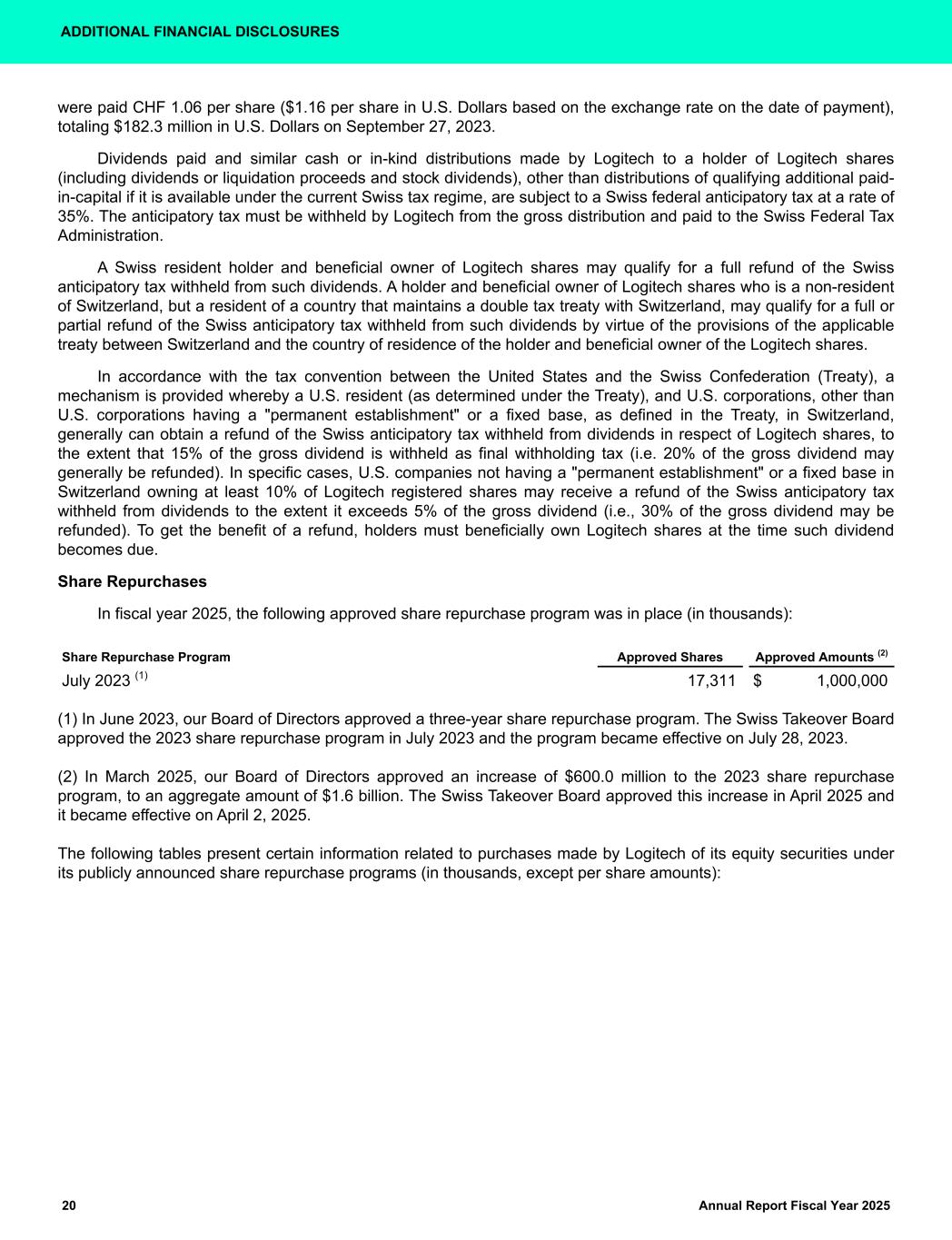
were paid CHF 1.06 per share ($1.16 per share in U.S. Dollars based on the exchange rate on the date of payment), totaling $182.3 million in U.S. Dollars on September 27, 2023. Dividends paid and similar cash or in-kind distributions made by Logitech to a holder of Logitech shares (including dividends or liquidation proceeds and stock dividends), other than distributions of qualifying additional paid- in-capital if it is available under the current Swiss tax regime, are subject to a Swiss federal anticipatory tax at a rate of 35%. The anticipatory tax must be withheld by Logitech from the gross distribution and paid to the Swiss Federal Tax Administration. A Swiss resident holder and beneficial owner of Logitech shares may qualify for a full refund of the Swiss anticipatory tax withheld from such dividends. A holder and beneficial owner of Logitech shares who is a non-resident of Switzerland, but a resident of a country that maintains a double tax treaty with Switzerland, may qualify for a full or partial refund of the Swiss anticipatory tax withheld from such dividends by virtue of the provisions of the applicable treaty between Switzerland and the country of residence of the holder and beneficial owner of the Logitech shares. In accordance with the tax convention between the United States and the Swiss Confederation (Treaty), a mechanism is provided whereby a U.S. resident (as determined under the Treaty), and U.S. corporations, other than U.S. corporations having a "permanent establishment" or a fixed base, as defined in the Treaty, in Switzerland, generally can obtain a refund of the Swiss anticipatory tax withheld from dividends in respect of Logitech shares, to the extent that 15% of the gross dividend is withheld as final withholding tax (i.e. 20% of the gross dividend may generally be refunded). In specific cases, U.S. companies not having a "permanent establishment" or a fixed base in Switzerland owning at least 10% of Logitech registered shares may receive a refund of the Swiss anticipatory tax withheld from dividends to the extent it exceeds 5% of the gross dividend (i.e., 30% of the gross dividend may be refunded). To get the benefit of a refund, holders must beneficially own Logitech shares at the time such dividend becomes due. Share Repurchases In fiscal year 2025, the following approved share repurchase program was in place (in thousands): Share Repurchase Program Approved Shares Approved Amounts (2) July 2023 (1) 17,311 $ 1,000,000 (1) In June 2023, our Board of Directors approved a three-year share repurchase program. The Swiss Takeover Board approved the 2023 share repurchase program in July 2023 and the program became effective on July 28, 2023. (2) In March 2025, our Board of Directors approved an increase of $600.0 million to the 2023 share repurchase program, to an aggregate amount of $1.6 billion. The Swiss Takeover Board approved this increase in April 2025 and it became effective on April 2, 2025. The following tables present certain information related to purchases made by Logitech of its equity securities under its publicly announced share repurchase programs (in thousands, except per share amounts): ADDITIONAL FINANCIAL DISCLOSURES 20 Annual Report Fiscal Year 2025
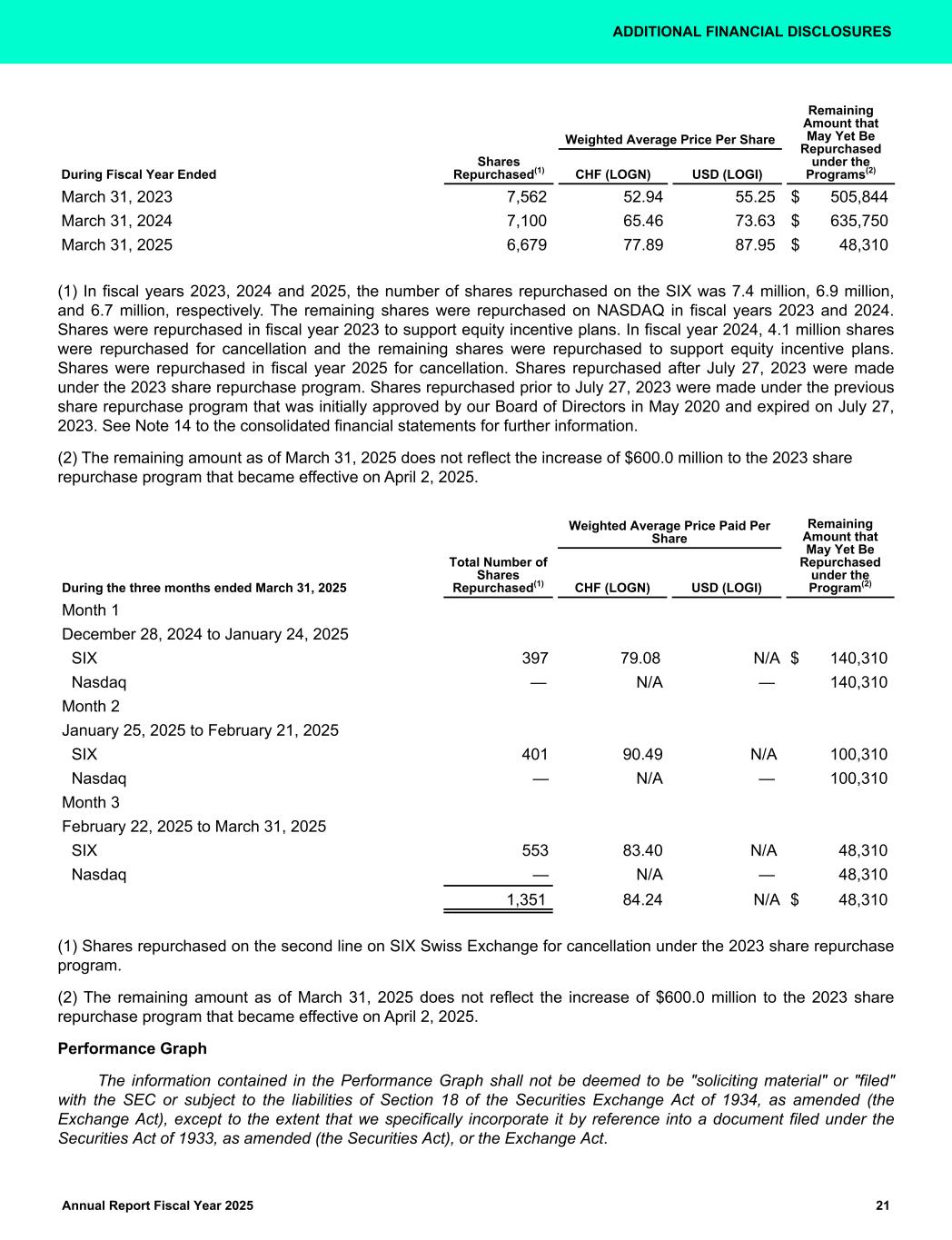
Weighted Average Price Per Share Remaining Amount that May Yet Be Repurchased under the Programs(2)During Fiscal Year Ended Shares Repurchased(1) CHF (LOGN) USD (LOGI) March 31, 2023 7,562 52.94 55.25 $ 505,844 March 31, 2024 7,100 65.46 73.63 $ 635,750 March 31, 2025 6,679 77.89 87.95 $ 48,310 (1) In fiscal years 2023, 2024 and 2025, the number of shares repurchased on the SIX was 7.4 million, 6.9 million, and 6.7 million, respectively. The remaining shares were repurchased on NASDAQ in fiscal years 2023 and 2024. Shares were repurchased in fiscal year 2023 to support equity incentive plans. In fiscal year 2024, 4.1 million shares were repurchased for cancellation and the remaining shares were repurchased to support equity incentive plans. Shares were repurchased in fiscal year 2025 for cancellation. Shares repurchased after July 27, 2023 were made under the 2023 share repurchase program. Shares repurchased prior to July 27, 2023 were made under the previous share repurchase program that was initially approved by our Board of Directors in May 2020 and expired on July 27, 2023. See Note 14 to the consolidated financial statements for further information. (2) The remaining amount as of March 31, 2025 does not reflect the increase of $600.0 million to the 2023 share repurchase program that became effective on April 2, 2025. Total Number of Shares Repurchased(1) Weighted Average Price Paid Per Share Remaining Amount that May Yet Be Repurchased under the Program(2)During the three months ended March 31, 2025 CHF (LOGN) USD (LOGI) Month 1 December 28, 2024 to January 24, 2025 SIX 397 79.08 N/A $ 140,310 Nasdaq — N/A — 140,310 Month 2 January 25, 2025 to February 21, 2025 SIX 401 90.49 N/A 100,310 Nasdaq — N/A — 100,310 Month 3 February 22, 2025 to March 31, 2025 SIX 553 83.40 N/A 48,310 Nasdaq — N/A — 48,310 1,351 84.24 N/A $ 48,310 (1) Shares repurchased on the second line on SIX Swiss Exchange for cancellation under the 2023 share repurchase program. (2) The remaining amount as of March 31, 2025 does not reflect the increase of $600.0 million to the 2023 share repurchase program that became effective on April 2, 2025. Performance Graph The information contained in the Performance Graph shall not be deemed to be "soliciting material" or "filed" with the SEC or subject to the liabilities of Section 18 of the Securities Exchange Act of 1934, as amended (the Exchange Act), except to the extent that we specifically incorporate it by reference into a document filed under the Securities Act of 1933, as amended (the Securities Act), or the Exchange Act. ADDITIONAL FINANCIAL DISCLOSURES Annual Report Fiscal Year 2025 21
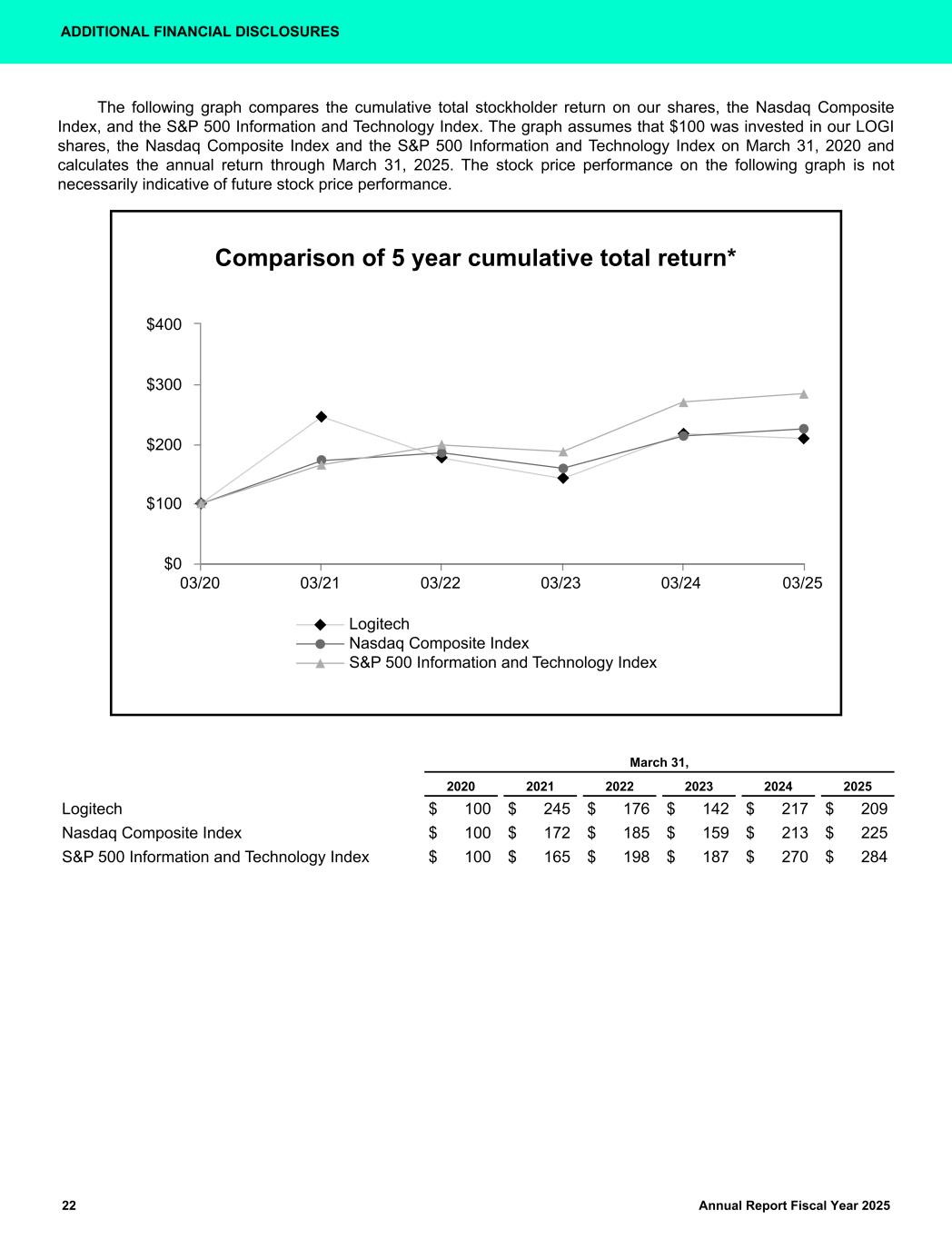
The following graph compares the cumulative total stockholder return on our shares, the Nasdaq Composite Index, and the S&P 500 Information and Technology Index. The graph assumes that $100 was invested in our LOGI shares, the Nasdaq Composite Index and the S&P 500 Information and Technology Index on March 31, 2020 and calculates the annual return through March 31, 2025. The stock price performance on the following graph is not necessarily indicative of future stock price performance. Comparison of 5 year cumulative total return* Logitech Nasdaq Composite Index S&P 500 Information and Technology Index 03/20 03/21 03/22 03/23 03/24 03/25 $0 $100 $200 $300 $400 March 31, 2020 2021 2022 2023 2024 2025 Logitech $ 100 $ 245 $ 176 $ 142 $ 217 $ 209 Nasdaq Composite Index $ 100 $ 172 $ 185 $ 159 $ 213 $ 225 S&P 500 Information and Technology Index $ 100 $ 165 $ 198 $ 187 $ 270 $ 284 ADDITIONAL FINANCIAL DISCLOSURES 22 Annual Report Fiscal Year 2025
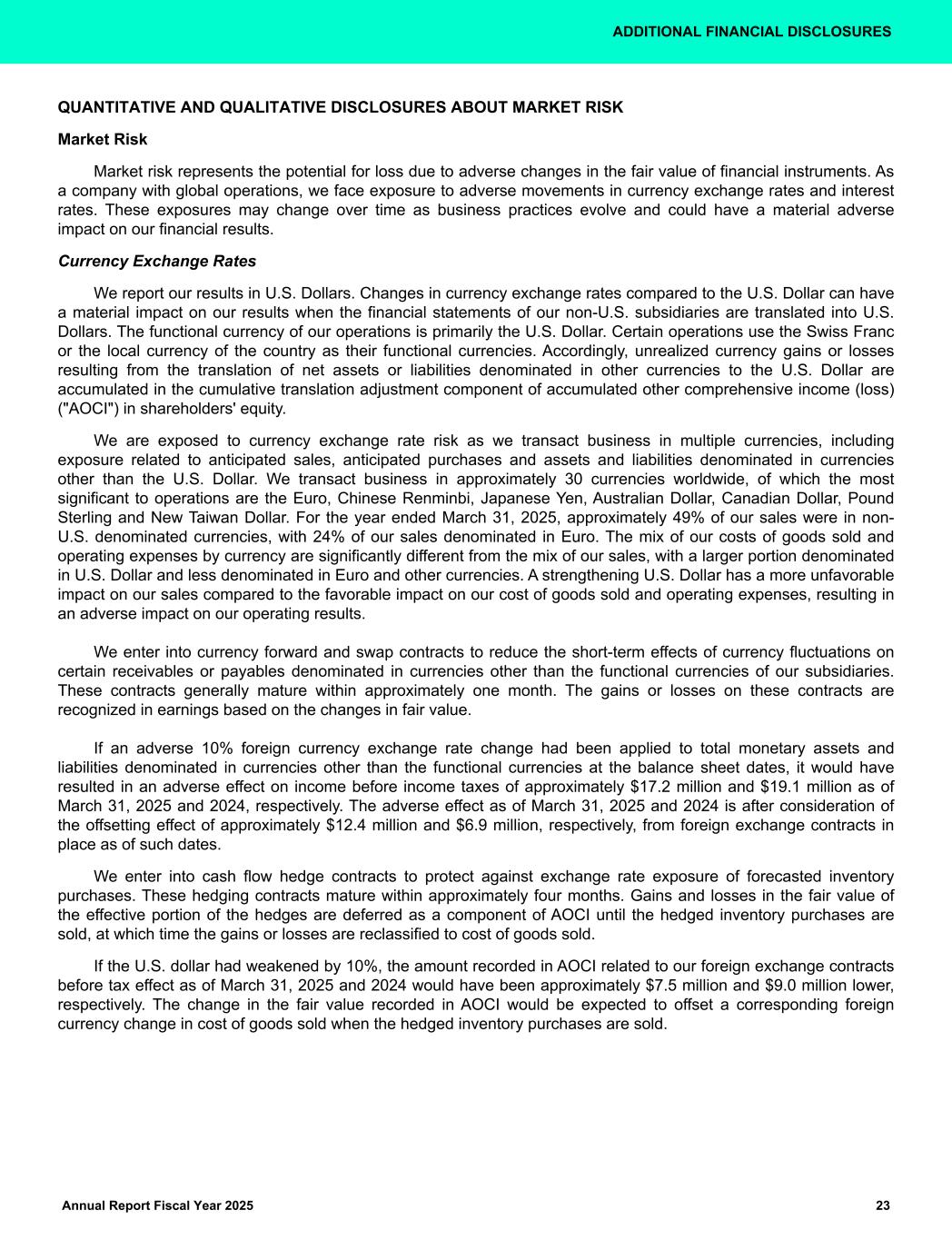
QUANTITATIVE AND QUALITATIVE DISCLOSURES ABOUT MARKET RISK Market Risk Market risk represents the potential for loss due to adverse changes in the fair value of financial instruments. As a company with global operations, we face exposure to adverse movements in currency exchange rates and interest rates. These exposures may change over time as business practices evolve and could have a material adverse impact on our financial results. Currency Exchange Rates We report our results in U.S. Dollars. Changes in currency exchange rates compared to the U.S. Dollar can have a material impact on our results when the financial statements of our non-U.S. subsidiaries are translated into U.S. Dollars. The functional currency of our operations is primarily the U.S. Dollar. Certain operations use the Swiss Franc or the local currency of the country as their functional currencies. Accordingly, unrealized currency gains or losses resulting from the translation of net assets or liabilities denominated in other currencies to the U.S. Dollar are accumulated in the cumulative translation adjustment component of accumulated other comprehensive income (loss) ("AOCI") in shareholders' equity. We are exposed to currency exchange rate risk as we transact business in multiple currencies, including exposure related to anticipated sales, anticipated purchases and assets and liabilities denominated in currencies other than the U.S. Dollar. We transact business in approximately 30 currencies worldwide, of which the most significant to operations are the Euro, Chinese Renminbi, Japanese Yen, Australian Dollar, Canadian Dollar, Pound Sterling and New Taiwan Dollar. For the year ended March 31, 2025, approximately 49% of our sales were in non- U.S. denominated currencies, with 24% of our sales denominated in Euro. The mix of our costs of goods sold and operating expenses by currency are significantly different from the mix of our sales, with a larger portion denominated in U.S. Dollar and less denominated in Euro and other currencies. A strengthening U.S. Dollar has a more unfavorable impact on our sales compared to the favorable impact on our cost of goods sold and operating expenses, resulting in an adverse impact on our operating results. We enter into currency forward and swap contracts to reduce the short-term effects of currency fluctuations on certain receivables or payables denominated in currencies other than the functional currencies of our subsidiaries. These contracts generally mature within approximately one month. The gains or losses on these contracts are recognized in earnings based on the changes in fair value. If an adverse 10% foreign currency exchange rate change had been applied to total monetary assets and liabilities denominated in currencies other than the functional currencies at the balance sheet dates, it would have resulted in an adverse effect on income before income taxes of approximately $17.2 million and $19.1 million as of March 31, 2025 and 2024, respectively. The adverse effect as of March 31, 2025 and 2024 is after consideration of the offsetting effect of approximately $12.4 million and $6.9 million, respectively, from foreign exchange contracts in place as of such dates. We enter into cash flow hedge contracts to protect against exchange rate exposure of forecasted inventory purchases. These hedging contracts mature within approximately four months. Gains and losses in the fair value of the effective portion of the hedges are deferred as a component of AOCI until the hedged inventory purchases are sold, at which time the gains or losses are reclassified to cost of goods sold. If the U.S. dollar had weakened by 10%, the amount recorded in AOCI related to our foreign exchange contracts before tax effect as of March 31, 2025 and 2024 would have been approximately $7.5 million and $9.0 million lower, respectively. The change in the fair value recorded in AOCI would be expected to offset a corresponding foreign currency change in cost of goods sold when the hedged inventory purchases are sold. ADDITIONAL FINANCIAL DISCLOSURES Annual Report Fiscal Year 2025 23

REPORT ON CORPORATE GOVERNANCE 2025 24 Annual Report Fiscal Year 2025
REPORT ON CORPORATE GOVERNANCE Logitech International S.A., together with its consolidated subsidiaries, designs software-enabled hardware solutions that help businesses thrive and bring people together when working, creating and gaming. As the point of connection between people and the digital world, Logitech's mission is to extend human potential in work and play, in a way that is good for people and the planet. We sell the vast majority of our products under the Logitech and Logitech G brand names. Logitech sells its products to a broad network of international customers, in the Americas, Europe, the Middle East, and Africa ("EMEA"), and Asia Pacific. This includes direct sales to retailers, e-tailers, businesses large and small and consumers through our e-commerce platform, and indirect sales to end customers through distributors. Logitech was founded in Switzerland in 1981, and Logitech International S.A. has been the parent holding company of Logitech since 1988. Logitech International S.A. is a Swiss holding company with its registered office in Hautemorges, Switzerland and headquarters in Lausanne, Switzerland. Logitech believes that sound corporate governance practices are essential to an open and responsible corporation. Our corporate governance practices reflect a continuing commitment to corporate accountability, sound judgment, and transparency to shareholders. As a company whose securities are listed on both the SIX Swiss Exchange and the Nasdaq Global Select Market, our commitment to sound corporate governance principles is guided by the legal and regulatory requirements of both Switzerland and the United States. In addition, Logitech’s internal guidelines regarding corporate governance are provided in our Articles of Incorporation, Organizational Regulations (Bylaws), Corporate Governance Principles, and Board Committee Charters. This Report has been designed to comply with the Corporate Governance Directive of the SIX Swiss Exchange. Portions of the Report are also incorporated by reference from elsewhere in our Invitation, Proxy Statement and Annual Report for the 2025 Annual General Meeting, of which this Report is a part. 1. Group Structure and Shareholders 1.1 Operational Group Structure Shares of Logitech International S.A. are listed on both the SIX Swiss Exchange (Ticker: LOGN; security number: 2575132) and the Nasdaq Global Select Market (Ticker: LOGI, CUSIP H50430232). The International Securities Identification Number (ISIN) of our shares is CH0025751329. As of March 31, 2025, our market capitalization, based on outstanding shares of 148,509,018 (excluding treasury shares), amounted to approximately USD 12.5 billion (CHF 11.1 billion). Refer to section 1.2 below for information on Logitech International S.A.’s holdings in its shares as of March 31, 2025. References in this Report on Corporate Governance to the “Company” refers to Logitech International S.A. References to “Logitech,” “we,” “our,” and “us” refer to Logitech International S.A. and its consolidated subsidiaries. Logitech International S.A. wholly owns all companies within the Logitech group, either directly or indirectly, through which it conducts its business operations. Principal operating subsidiaries include: Logitech Europe S.A. (Lausanne, Switzerland), Logitech Inc. (San Jose, California, USA), and Logitech Technology (Suzhou) Co., Ltd. (Suzhou, China). For a list of Logitech subsidiaries, refer to the table in Note 4 of our Swiss Statutory Financial Statements included hereafter in the Annual Report under the heading “Logitech International S.A., Hautemorges - Swiss Statutory Financial Statements.” None of Logitech International S.A.’s subsidiaries have securities listed on a stock exchange as of March 31, 2025. Please refer to "Management’s Discussion and Analysis of Financial Condition and Results of Operations" under the heading “Company Overview” in the Annual Report for further information on Logitech’s operational group structure. REPORT ON CORPORATE GOVERNANCE 2025 Annual Report Fiscal Year 2025 25
1.2 Significant Shareholders Greater than 3% Shareholders as of March 31, 2025 Under Swiss law any person who owns or has the discretionary authority to exercise voting rights exceeding certain percentage thresholds of a company incorporated in Switzerland whose equity securities are listed on a stock exchange in Switzerland is required to notify the company and the relevant Swiss exchange of such holdings. Following receipt of this notification, the company is required to inform the public. Notices received by the Company pursuant to these rules are available on the SIX Swiss Exchange internet platform at https://www.ser-ag.com/en/resources/notifications-market-participants/significant-shareholders.html#/ To the knowledge of the Company, the beneficial owners holding more than 3% of the voting rights of the Company as of March 31, 2025, other than the Company itself, were as follows: Name Number of Shares(1) Percentage of Voting Rights(2) Relevant Date BlackRock, Inc.(3) 9,777,832 5.8% March 31, 2025 UBS Fund Management (Switzerland) AG(4) 10,968,407 6.5% April 30, 2024 (1) In accordance with Swiss law, the number of shares set forth includes (i) shares beneficially owned or deemed to be beneficially owned by the relevant shareholder, (ii) shares borrowed from third parties, held in connection with a repurchase agreement or as a collateral, and (iii) shares held for the account of third parties with a discretionary authority to exercise voting rights. The table does not include positions in derivatives. Positions in derivatives can be accessed on the internet platform operated by the SIX Swiss Exchange at https://www.ser-ag.com/en/resources/notifications-market-participants/significant-shareholders.html#/ (2) Shareholdings are calculated based on the aggregate number of voting rights entered into the Swiss commercial register. Such aggregate number was 168,994,142 voting rights as of March 31, 2025. (3) The number of shares held by BlackRock, Inc. is based on the number of shares reported as beneficially owned by BlackRock, Inc. and its subsidiaries on a Schedule 13G filed with the U.S. Securities and Exchange Commission on April 23, 2025. (4) The number of shares held by UBS Fund Management (Switzerland) AG is based on the number of shares reported as beneficially owned by UBS Group AG and its subsidiaries reported to SIX pursuant to article 120 of the Swiss Financial Market Infrastructure Act on May 8, 2024. Information on the share ownership of the Company by directors, executive officers and large shareholders as of June 30, 2025, as required by Swiss law, based on the number of the Company’s shares outstanding (which is equal to the shares issued less the shares held in the Company’s treasury), is set forth in the Company’s Invitation, Proxy Statement and Annual Report for the 2025 Annual General Meeting, available at http://ir.logitech.com, under the heading “Security Ownership of Certain Beneficial Owners and Management as of June 30, 2025.” Information of the own shares held by the Company in treasury is set forth in section 2.3 below. There are no shareholders' agreements published in this connection. 1.3 Cross-shareholdings Logitech has no shareholdings in companies that to its knowledge have shareholdings in Logitech. 2. Capital Structure 2.1 Share Capital As of March 31, 2025, Logitech International S.A.’s nominal share capital was CHF 42,248,535.50, consisting of 168,994,142 shares with a par value of CHF 0.25 each. 2.2 Capital Band In accordance with the revised Swiss corporate law that became effective January 1, 2023, our shareholders approved a capital band (marge de fluctuation) at the 2023 Annual General Meeting. The capital band authorizes the REPORT ON CORPORATE GOVERNANCE 2024 26 Annual Report Fiscal Year 2025
Board of Directors, within a range of 155,795,958 registered shares to 190,417,282 registered shares for the five-year period ending on September 13, 2028. The capital band replaced the Company's authorized capital which authorized the Board of Directors to issue up to 17,310,662 new registered shares and no longer exists under the revised corporate law. Logitech did not carry out any share capital increases based on its authorized share capital prior to January 1, 2023. Under the capital band, the Board can issue new shares by means of a firm underwriting through financial institutions, a syndicate of financial institutions or another third party and a subsequent offer of these shares to the existing shareholders or third parties (if the subscription rights of the existing shareholders have been withdrawn or have not been duly exercised). The Board can determine the type of contributions, the issue price, the time of the issue, the conditions for the exercise of the preferential subscription rights and the date upon which the new shares become entitled to dividends. The Board is entitled to permit, to restrict or to exclude the trade with subscription rights. The Board may permit the expiration of subscription rights that have not been duly exercised, or it may place such rights or shares as to which subscription rights have been granted, but not duly exercised, at market conditions or may use such rights or shares otherwise in the interest of the Company. The Board can restrict or exclude pre- emptive rights of shareholders to subscribe for the new shares: (a) if the issue price of the new shares is determined by reference to the market price; (b) for raising equity capital in a fast and flexible manner, which would not be possible, or would only be possible with great difficulty or at significantly less favorable conditions, without the exclusion of subscription rights of existing shareholders; (c) the acquisition of companies, part(s) of companies or participations, for the acquisition of products, intellectual property rights, or licenses by or for investment projects of the Company or any of its group companies, or for the financing or refinancing of any such transactions through a placement of shares; (d) for purposes of broadening the shareholder constituency of the Company in certain financial or investor markets, for purposes of the participation of strategy partners, including financial investors, or in connection with the listing of new shares on domestic or foreign stock exchanges; or 9e) for purposes of granting an over-allotment option (Greenshoe) of up to 20% of the total number of shares in a placement or sale of shares to the respective initial purchaser(s) or underwriter(s). In the event of a decrease of the share capital within the capital band, the Board shall, to the extent necessary, determine the use of the decrease amount. Pursuant to the authority granted under the capital band, the Company's Board of Directors decreased the Company’s share capital in October 2024 by cancelling 4.1 million treasury shares which were repurchased in fiscal year 2024 on the SIX second trading line under the 2023 Share Repurchase Program. 2.2 Conditional Share Capital Under Swiss corporate law, the total nominal par value of the shares authorized by shareholders for future issuance on the conversion or exercise of derivative securities issued by a company is referred to as conditional share capital. Under Swiss law, a company must have sufficient conditional capital or available treasury shares to cover any conversion rights under derivative securities at the time the derivative securities are issued. Pursuant to Article 25 of the Articles of Incorporation, the share capital of the Company may be increased by CHF 6,250,000 through the issuance of up to 25,000,000 shares with a par value of CHF 0.25 each (representing 14.7% of the Company's share capital as of March 31, 2025). The purpose of this conditional share capital is to cover option or other equity rights granted or that may be granted to employees, officers and directors of Logitech under its employee equity incentive plans. The conditional share capital increase does not have an expiration date. The shareholders do not have pre-emptive rights to subscribe to the newly issued shares issued out of conditional share capital. For more information on Logitech’s employee equity incentive plans please refer to Note 4 - Employee Stock-Based Compensation - in our Consolidated Financial Statements included hereafter in the Annual Report under the heading “Logitech International S.A. - Consolidated Financial Statements.” Although the Company has been authorized by its shareholders to use conditional capital to meet its obligations to deliver shares as a result of employee purchases or exercises under its employee equity incentive plans, the Company has for some years used shares held in treasury to fulfill its obligations under the plans. In addition, pursuant to Article 26 of the Articles of Incorporation, the share capital of the Company may also be increased by CHF 6,250,000 through the issuance of up to 25,000,000 shares with a par value of CHF 0.25 each (representing 14.7% of the Company's share capital as of March 31, 2025). The purpose of this conditional share capital is to cover conversion rights that may be granted in connection with a future issuance of bonds convertible into REPORT ON CORPORATE GOVERNANCE 2025 Annual Report Fiscal Year 2025 27

Logitech shares. The conditional share capital increase does not have an expiration date. The shareholders do not have preemptive rights to subscribe to the newly issued shares issuable on conversion of the bonds. The Board of Directors may limit or withdraw the shareholders’ right to subscribe for the bonds by preference for valid reasons, in particular (a) if the bonds are issued in connection with the financing or refinancing of the acquisition of one or more companies, businesses or parts of businesses, or (b) to facilitate the placement of the bonds on the international markets or to increase the security holder base of the Company. If the shareholders’ right to subscribe for the bonds by preference is limited or withdrawn, the bonds must be issued at market conditions, the exercise period of the conversion rights must not exceed 7 years from the date of issuance of the bonds, and the conversion price must be set at a level that is not lower than the market price of the shares preceding the determination of the final conditions for the bonds. 2.3 Changes in Shareholders’ Equity No shares have been issued during fiscal years 2025, 2024 and 2023. As of March 31, 2025, 2024 and 2023, balances in shareholders’ equity of Logitech International S.A., based on the Company’s Swiss Statutory Financial Statements, were as follows (in thousands): As of March 31, 2025 2024 2023 Share capital CHF 42,249 CHF 43,277 CHF 43,277 Legal capital reserves: - Reserve for capital contributions — 1,265 1,265 Legal retained earnings reserves - General retained earnings reserves 9,580 9,580 9,580 9,580 10,845 10,845 Available Retained earnings 2,149,402 2,223,893 2,090,571 Treasury shares (1,337,450) (1,242,795) (914,399) Total shareholders’ equity CHF 863,781 CHF 1,035,220 CHF 1,230,294 The following table shows the capital band (as of fiscal year end 2025), the authorized share capital (as of fiscal year end 2024 and 2023) and the conditional share capital as of the last three fiscal year ends (in thousands): As of March 31, 2025 2024 2023 Capital Band / Authorized share capital CHF 4,328 CHF 4,328 CHF 4,328 First conditional share capital CHF 6,250 CHF 6,250 CHF 6,250 Second conditional share capital CHF 6,250 CHF 6,250 CHF 6,250 For information on Logitech’s shareholders’ equity as of March 31, 2025 and 2024, refer to the Swiss Statutory Balance Sheets included hereafter in the Annual Report under the heading “Logitech International S.A., Hautemorges - Swiss Statutory Financial Statements.” A summary of the approved share buyback program during fiscal years 2025, 2024 and 2023 is shown in the following table (in thousands, excluding transaction costs). Approved Accumulative Repurchases as of March 31, 2025 Share Buyback Program Shares Amounts (USD) Shares Amounts (USD) May 2020 17,311 1,500,000 16,656 1,153,068 July 2023 17,311 1,600,000 * 11,138 951,691 * The Board of Directors approved an increase in the amount of USD 600 million on March 4, 2025. The increase became effective on April 2, 2025, please see below for further information. REPORT ON CORPORATE GOVERNANCE 2024 28 Annual Report Fiscal Year 2025
Share Repurchases In May 2020, the Company's Board of Directors approved the 2020 share repurchase program, which authorized the Company to use up to USD 250.0 million to purchase up to 17.3 million of Logitech shares. In April 2021, the Company's Board of Directors approved an increase of $750.0 million to the 2020 share repurchase program, to an aggregate amount of USD 1.0 billion. The Swiss Takeover Board approved this increase and it became effective on May 21, 2021. In July 2022, the Company’s Board of Directors approved an increase of $500 million to the 2020 share repurchase program, to an aggregate amount of up to USD 1.5 billion to purchase up to 17.3 million of Logitech shares. The Swiss Takeover Board approved this increase and it became effective on August 19, 2022. The 2020 share repurchase program expired on July 27, 2023. In June 2023, the Board of Directors approved a new, three-year share repurchase program (the "2023 Share Repurchase Program"). The Swiss Takeover Board approved the 2023 share repurchase program in July 2023 and the program became effective on July 28, 2023. In March 2025, the Company's Board of Directors approved an increase of USD 600.0 million to the 2023 Share Repurchase Program, to an aggregate amount of USD 1.6 billion. The Swiss Takeover Board approved this increase and it became effective on April 2, 2025. The Company is authorized to repurchase shares for cancellation, as well as to support equity incentive plans or potential acquisitions under the 2023 Share Repurchase Program. The 2023 Share Repurchase Program is expected to remain in effect for a period of three years through July 27, 2026. As of March 31, 2025, USD 48.3 million was available for repurchase under the 2023 Share Repurchase Program. During fiscal year 2025, the Company repurchased approximately 6.7 million shares under the 2023 Share Repurchase Program for approximately USD 588.0 million, including transaction costs. During fiscal year 2024, the Company repurchased approximately 7.1 million shares under the 2020 share repurchase program and the 2023 Share Repurchase Program for approximately USD 523.8 million, including transaction costs. During fiscal year 2023, the Company repurchased approximately 7.6 million shares under the 2020 share repurchase program for approximately USD 418.3 million, including transaction costs. For further information on Logitech’s share repurchases please refer to the heading “Additional Financial Disclosures - Market for Registrant’s Common Equity, Related Stockholder Matters and Issuer Purchases of Equity Securities” included in the Annual Report. 2.4 Shares and Participation Certificates (Non-Voting Shares) Registered Shares. Logitech International S.A. has only one category of shares - registered shares with a par value of CHF 0.25 per share. Each of the 168,994,142 issued shares carries the same rights. There are no preferential rights. However, a shareholder must be entered in the share register of the Company to exercise voting rights and the rights deriving therefrom (such as the right to convene a general meeting of shareholders or the right to put an item on the meeting’s agenda). Shareholders holding their shares through a bank, broker or other nominee who wish to exercise their voting rights must follow the instructions provided by such bank, broker or other nominee or, absent instructions, contact such bank, broker or other nominee for instructions. Shareholders holding their shares through a bank, broker or other nominee will not automatically be registered in the Company’s share register. Refer to section 6 below for an outline of participation rights of the Company’s shareholders, in particular section 6.1 below as regards the conditions for the exercise of shareholders’ voting rights. Each share entitles its owner to dividends declared, even if the owner is not registered in the share register of the Company. Under Swiss law, a company pays dividends upon approval by its shareholders. This request for shareholder approval typically follows the recommendation of the Board. Until 2013, other than a one-time distribution to shareholders of additional paid-in capital out of its capital contribution reserves in fiscal year 2012, Logitech had not paid dividends since 1996, using retained earnings to invest in the growth of the Company and, in more recent years, to repurchase the Company’s shares. In 2013, the Board proposed that, beginning with fiscal year 2013 and subject to approval by the Company’s shareholders and statutory auditors each year, Logitech distributes a recurring annual gross dividend. The approximate amounts of dividend distributed to date are reflected below: REPORT ON CORPORATE GOVERNANCE 2025 Annual Report Fiscal Year 2025 29
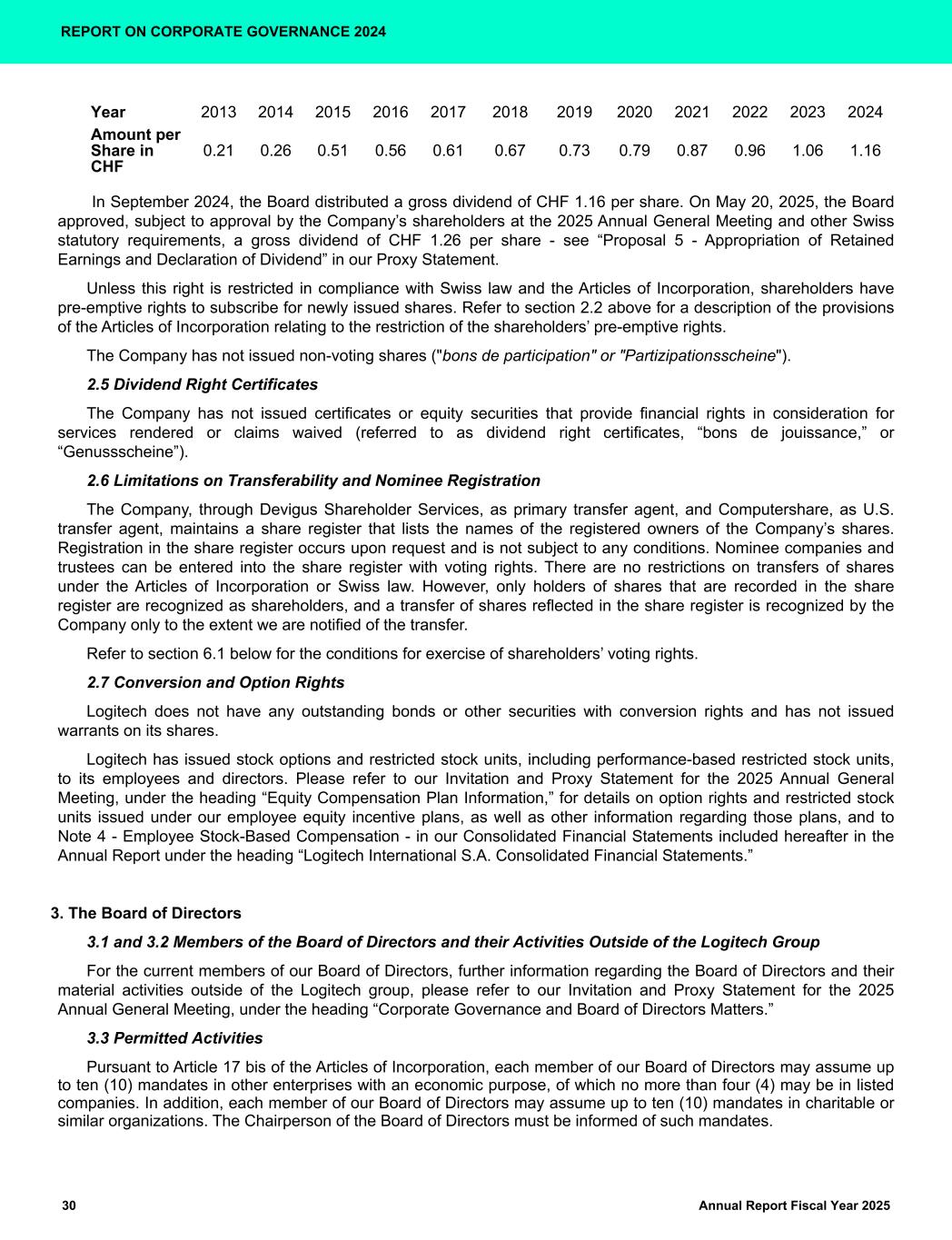
Year 2013 2014 2015 2016 2017 2018 2019 2020 2021 2022 2023 2024 Amount per Share in CHF 0.21 0.26 0.51 0.56 0.61 0.67 0.73 0.79 0.87 0.96 1.06 1.16 In September 2024, the Board distributed a gross dividend of CHF 1.16 per share. On May 20, 2025, the Board approved, subject to approval by the Company’s shareholders at the 2025 Annual General Meeting and other Swiss statutory requirements, a gross dividend of CHF 1.26 per share - see “Proposal 5 - Appropriation of Retained Earnings and Declaration of Dividend” in our Proxy Statement. Unless this right is restricted in compliance with Swiss law and the Articles of Incorporation, shareholders have pre-emptive rights to subscribe for newly issued shares. Refer to section 2.2 above for a description of the provisions of the Articles of Incorporation relating to the restriction of the shareholders’ pre-emptive rights. The Company has not issued non-voting shares ("bons de participation" or "Partizipationsscheine"). 2.5 Dividend Right Certificates The Company has not issued certificates or equity securities that provide financial rights in consideration for services rendered or claims waived (referred to as dividend right certificates, “bons de jouissance,” or “Genussscheine”). 2.6 Limitations on Transferability and Nominee Registration The Company, through Devigus Shareholder Services, as primary transfer agent, and Computershare, as U.S. transfer agent, maintains a share register that lists the names of the registered owners of the Company’s shares. Registration in the share register occurs upon request and is not subject to any conditions. Nominee companies and trustees can be entered into the share register with voting rights. There are no restrictions on transfers of shares under the Articles of Incorporation or Swiss law. However, only holders of shares that are recorded in the share register are recognized as shareholders, and a transfer of shares reflected in the share register is recognized by the Company only to the extent we are notified of the transfer. Refer to section 6.1 below for the conditions for exercise of shareholders’ voting rights. 2.7 Conversion and Option Rights Logitech does not have any outstanding bonds or other securities with conversion rights and has not issued warrants on its shares. Logitech has issued stock options and restricted stock units, including performance-based restricted stock units, to its employees and directors. Please refer to our Invitation and Proxy Statement for the 2025 Annual General Meeting, under the heading “Equity Compensation Plan Information,” for details on option rights and restricted stock units issued under our employee equity incentive plans, as well as other information regarding those plans, and to Note 4 - Employee Stock-Based Compensation - in our Consolidated Financial Statements included hereafter in the Annual Report under the heading “Logitech International S.A. Consolidated Financial Statements.” 3. The Board of Directors 3.1 and 3.2 Members of the Board of Directors and their Activities Outside of the Logitech Group For the current members of our Board of Directors, further information regarding the Board of Directors and their material activities outside of the Logitech group, please refer to our Invitation and Proxy Statement for the 2025 Annual General Meeting, under the heading “Corporate Governance and Board of Directors Matters.” 3.3 Permitted Activities Pursuant to Article 17 bis of the Articles of Incorporation, each member of our Board of Directors may assume up to ten (10) mandates in other enterprises with an economic purpose, of which no more than four (4) may be in listed companies. In addition, each member of our Board of Directors may assume up to ten (10) mandates in charitable or similar organizations. The Chairperson of the Board of Directors must be informed of such mandates. REPORT ON CORPORATE GOVERNANCE 2024 30 Annual Report Fiscal Year 2025
The term "mandates" as used in the Articles of Incorporation shall mean an activity carried out as a member of the board of directors, the executive management or an advisory board or comparable functions thereto. The following mandates are not subject to these limitations: a) mandates in companies controlled by the Company or that control the Company; and b) mandates that a member of our Board of Directors assumes at the request of the Company or of a company controlled by it. Mandates for legal entities under common control or at the request of such legal entities are counted as a single mandate for purposes of determining permitted activities. Each member of our Board of Directors is currently in compliance with the above-mentioned requirements. 3.4 Elections and terms of office For information regarding the time of first election and term of office of each member of our Board of Directors, please refer to our Invitation and Proxy Statement for the 2025 Annual General Meeting, under the heading “Corporate Governance and Board of Directors Matters.” Pursuant to Article 14 of the Articles of Incorporation, the members of the Board of Directors shall be elected individually by the general meeting of shareholders for a term of office expiring after completion of the subsequent annual general meeting of shareholders. Each member of our Board of Director shall be indefinitely re-eligible. The Articles of Incorporation align with the statutory legal provisions concerning the appointment of the chairperson, members of the compensation committee, and the independent proxy. 3.5 Organization For information regarding the organization of the Board of Directors and its committees, please refer to our Invitation and Proxy Statement for the 2025 Annual General Meeting, under the heading “Corporate Governance and Board of Directors Matters.” 3.6 Definition of areas of responsibility Information regarding the powers and duties of the Board of Directors, the Company's Chairperson, the Company’s Chief Executive Officer and the Company's Lead Independent Director are set forth in our Invitation and Proxy Statement for the 2025 Annual General Meeting, under the heading “Corporate Governance and Board of Directors Matters,” including under the subheadings "Board Responsibilities and Structure" and "Board Committees." These powers and duties are further detailed in the Company's Organizational Regulations, which can be accessed on the Company's website at http://ir.logitech.com/corporate-governance/governance-documents/default.aspx, in Sections 2 ("The Board"), 3 ("The Chairperson of the Board"), 4 ("The Chief Executive Officer") and 5 ("The Group Management Team"). 3.7 Information and control instruments The means by which the Board of Directors supervises the Company's executive officers are described in our Invitation and Proxy Statement for the 2025 Annual General Meeting, under the heading “Corporate Governance and Board of Directors Matters.” Additional information and control instruments include: (i) the Company's external auditors, KPMG AG, and independent registered public accounting firm, KPMG LLP, who conduct their audits in compliance with Swiss law and Swiss Auditing Standards and the regulations of the U.S. Securities and Exchange Commission (the "SEC") and the Public Company Accounting Oversight Board (the "PCAOB"), respectively, as well as Auditing Standards Generally Accepted in the United States of America ("U.S. GAAP"); and (ii) the Company's Internal Audit function. Logitech Internal Audit covers all of the Company's business and operations worldwide and completes assignments based on annual internal audit plans approved by the Audit Committee of the Board. Logitech Internal Audit assesses the reliability of financial and operational information and the effectiveness of controls and processes for compliance with internal, legal, regulatory and statutory requirements. Findings are communicated to management and to the Audit Committee in regular quarterly reports as well as in interim communications with the Audit Committee or the Audit Committee Chairperson. The Audit Committee Chairperson provides updates to the Board of Directors at least quarterly. The Audit Committee reviews and monitors management's responsiveness to Internal Audit's findings and recommendations and, as appropriate, follow-up audits are planned to ensure proper remediation. The Audit REPORT ON CORPORATE GOVERNANCE 2025 Annual Report Fiscal Year 2025 31
Committee oversees Logitech's Internal Audit function. Logitech's Compliance function - including Legal, Internal Audit and, where appropriate, People & Culture - also conducts investigations in connection with Internal Audit's findings or other internal or external reports. Logitech's Head of Internal Audit reports administratively to the Chief Financial Officer and has a functional reporting line and direct access to the Audit Committee Chairperson. In addition to overseeing Logitech's Internal Audit function, including reviewing the scope of work, the recommendations made and the progress of implementation, the Audit Committee has responsibility for determining the compensation of the Head of Internal Audit. The Board of Directors' role in risk oversight is described in our Invitation and Proxy Statement for the 2025 Annual General Meeting, under the heading “Corporate Governance and Board of Directors Matters” and the sub- heading "The Board's Role in Risk Oversight." In addition, both executive management and other senior leaders and managers provide risk assessments on various aspects of the Company's business and regions in regular reports to the Board of Directors. The Audit Committee reviews with management and the independent auditors the Company’s major financial risk exposures and the steps management has taken to monitor and control those exposures, including the Company’s guidelines and policies with respect to risk assessment and risk management. The Audit Committee also reviews the Company’s cybersecurity, information security and other technology risks, controls and procedures, including review of the Company’s current threat landscape, strategy to mitigate cybersecurity, information security and other technology risks, and critical incident response plan(s) and reporting, in conjunction with the Technology and Innovation Committee's review of product security risks. Logitech's Internal Audit also has responsibility for enterprise risk management. Logitech's Internal Audit conducts an annual survey from across the Company, including all business functions, product categories and regions of the Company's key risks. The findings and details of this assessment, together with a heat map and recommendations, are presented at least once a year to the Audit Committee by the Head of Internal Audit. The enterprise risk management assessment factors into the development by Logitech's Internal Audit and the Audit Committee of the annual Internal Audit plan and internal controls, which are then implemented or overseen by Logitech's Internal Audit. Progress on the Internal Audit Plan and on internal controls is provided to the Audit Committee in regular quarterly reports as well as in interim communications with the Audit Committee or the Audit Committee Chairperson. The risks identified by Logitech are set forth in the Company's Annual Report on Form 10-K filed with the U.S. Securities and Exchange Commission and posted to the Company's Investor Relations website (https:// ir.logitech.com), under the headings "Item 1A, Risk Factors" and "Item 7A, Quantitative and Qualitative Disclosures about Market Risk." Logitech's financial condition and results of operations, including the manner in which the main risks identified by Logitech may affect those, are discussed under the heading "Item 7 Management's Discussion and Analysis of Financial Condition and Results of Operations" of the Company's Annual Report on Form 10-K referred to above. 4. Group Management Team 4.1 Members of the Group Management Team The members of our Group Management Team as of March 31, 2025 are set forth below: REPORT ON CORPORATE GOVERNANCE 2024 32 Annual Report Fiscal Year 2025
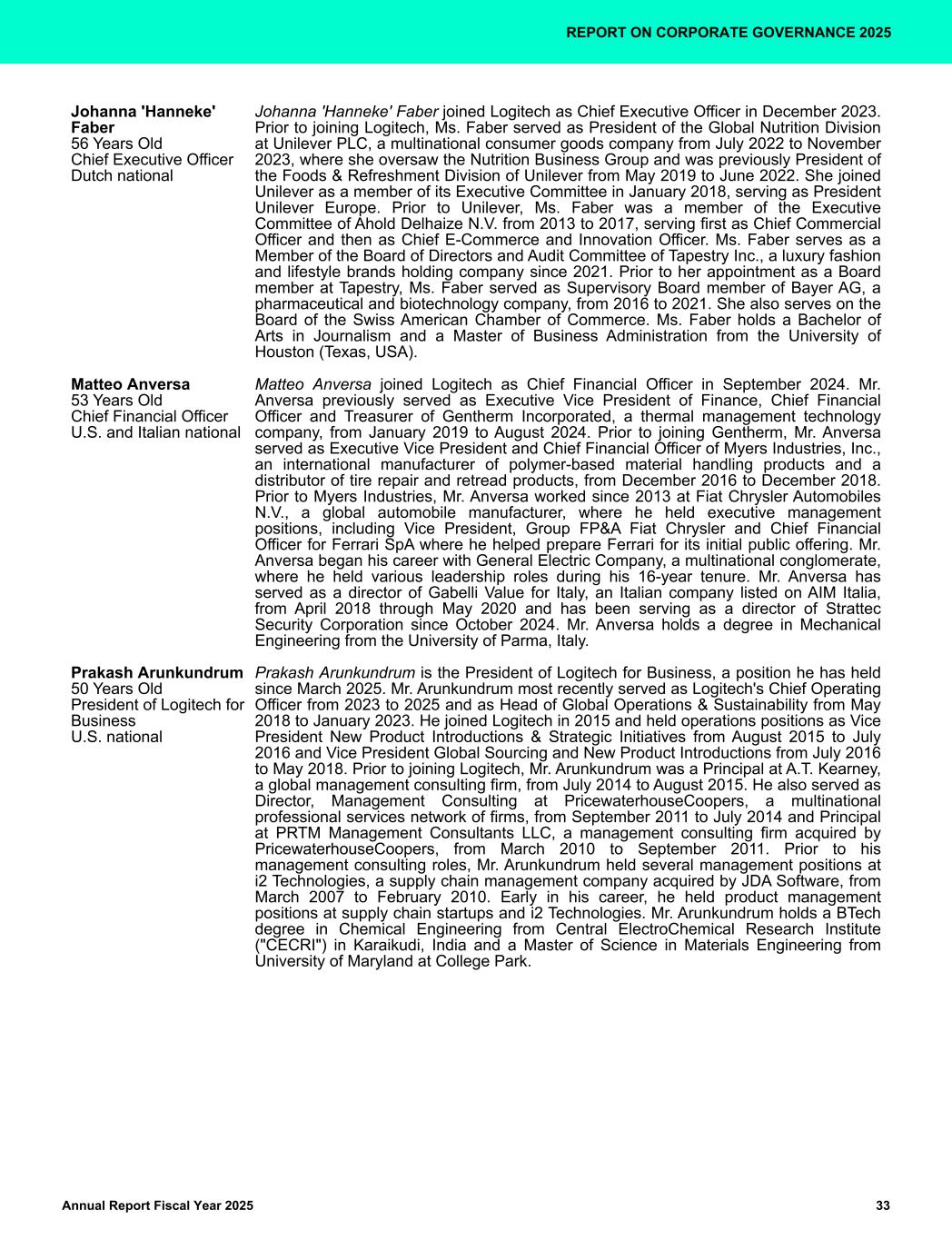
Johanna 'Hanneke' Faber 56 Years Old Chief Executive Officer Dutch national Johanna 'Hanneke' Faber joined Logitech as Chief Executive Officer in December 2023. Prior to joining Logitech, Ms. Faber served as President of the Global Nutrition Division at Unilever PLC, a multinational consumer goods company from July 2022 to November 2023, where she oversaw the Nutrition Business Group and was previously President of the Foods & Refreshment Division of Unilever from May 2019 to June 2022. She joined Unilever as a member of its Executive Committee in January 2018, serving as President Unilever Europe. Prior to Unilever, Ms. Faber was a member of the Executive Committee of Ahold Delhaize N.V. from 2013 to 2017, serving first as Chief Commercial Officer and then as Chief E-Commerce and Innovation Officer. Ms. Faber serves as a Member of the Board of Directors and Audit Committee of Tapestry Inc., a luxury fashion and lifestyle brands holding company since 2021. Prior to her appointment as a Board member at Tapestry, Ms. Faber served as Supervisory Board member of Bayer AG, a pharmaceutical and biotechnology company, from 2016 to 2021. She also serves on the Board of the Swiss American Chamber of Commerce. Ms. Faber holds a Bachelor of Arts in Journalism and a Master of Business Administration from the University of Houston (Texas, USA). Matteo Anversa 53 Years Old Chief Financial Officer U.S. and Italian national Matteo Anversa joined Logitech as Chief Financial Officer in September 2024. Mr. Anversa previously served as Executive Vice President of Finance, Chief Financial Officer and Treasurer of Gentherm Incorporated, a thermal management technology company, from January 2019 to August 2024. Prior to joining Gentherm, Mr. Anversa served as Executive Vice President and Chief Financial Officer of Myers Industries, Inc., an international manufacturer of polymer-based material handling products and a distributor of tire repair and retread products, from December 2016 to December 2018. Prior to Myers Industries, Mr. Anversa worked since 2013 at Fiat Chrysler Automobiles N.V., a global automobile manufacturer, where he held executive management positions, including Vice President, Group FP&A Fiat Chrysler and Chief Financial Officer for Ferrari SpA where he helped prepare Ferrari for its initial public offering. Mr. Anversa began his career with General Electric Company, a multinational conglomerate, where he held various leadership roles during his 16-year tenure. Mr. Anversa has served as a director of Gabelli Value for Italy, an Italian company listed on AIM Italia, from April 2018 through May 2020 and has been serving as a director of Strattec Security Corporation since October 2024. Mr. Anversa holds a degree in Mechanical Engineering from the University of Parma, Italy. Prakash Arunkundrum 50 Years Old President of Logitech for Business U.S. national Prakash Arunkundrum is the President of Logitech for Business, a position he has held since March 2025. Mr. Arunkundrum most recently served as Logitech's Chief Operating Officer from 2023 to 2025 and as Head of Global Operations & Sustainability from May 2018 to January 2023. He joined Logitech in 2015 and held operations positions as Vice President New Product Introductions & Strategic Initiatives from August 2015 to July 2016 and Vice President Global Sourcing and New Product Introductions from July 2016 to May 2018. Prior to joining Logitech, Mr. Arunkundrum was a Principal at A.T. Kearney, a global management consulting firm, from July 2014 to August 2015. He also served as Director, Management Consulting at PricewaterhouseCoopers, a multinational professional services network of firms, from September 2011 to July 2014 and Principal at PRTM Management Consultants LLC, a management consulting firm acquired by PricewaterhouseCoopers, from March 2010 to September 2011. Prior to his management consulting roles, Mr. Arunkundrum held several management positions at i2 Technologies, a supply chain management company acquired by JDA Software, from March 2007 to February 2010. Early in his career, he held product management positions at supply chain startups and i2 Technologies. Mr. Arunkundrum holds a BTech degree in Chemical Engineering from Central ElectroChemical Research Institute ("CECRI") in Karaikudi, India and a Master of Science in Materials Engineering from University of Maryland at College Park. REPORT ON CORPORATE GOVERNANCE 2025 Annual Report Fiscal Year 2025 33
Samantha Harnett 49 Years Old Chief Legal Officer U.S. national Samantha Harnett joined Logitech as General Counsel in June 2020 and became Chief Legal Officer in April 2023. Prior to joining Logitech, Ms. Harnett served in various legal and management roles at Eventbrite, Inc., a global self-service ticketing and experience technology platform, most recently as Chief Legal and Operations Officer from October 2019 to June 2020. While at Eventbrite, she also served as Senior Vice President, General Counsel from May 2018 to October 2019 and Vice President, General Counsel from November 2015 to May 2018. From March 2005 to November 2015, Ms. Harnett served in various positions at ZipRealty, Inc., a real estate technology and online brokerage company, including most recently as General Counsel and Senior Vice President of Business Development from October 2009 to November 2015. She also served as an associate at Wilson Sonsini Goodrich and Rosati, P.C. Ms. Harnett holds a BA degree from California State University, Chico and a JD from Santa Clara University School of Law. 4.2 Involvements outside Logitech of the Members of the Group Management Team Ms. Faber, Logitech's Chief Executive Officer, currently serves on the board of directors of Tapestry, Inc. and Mr. Anversa, Logitech's Chief Financial Officer, currently serves on the board of directors of Strattec Security Corporation and of AAL Scientifics Inc. No other member of Logitech’s Group Management Team as of March 31, 2025 has material supervisory, management, or advisory functions outside Logitech or holds any official functions or political posts. 4.3 Permitted Activities Pursuant to Article 18 ter of the Articles of Incorporation, each member of our Group Management Team may assume up to five (5) mandates in other enterprises with an economic purpose, of which no more than two (2) may be in listed companies. In addition, each member of our Group Management Team may assume up to five (5) mandates in charitable or similar organizations. Any such mandate requires the approval of the Board of Directors. The term "mandates" as used in the Articles of Incorporation shall mean an activity carried out as a member of the board of directors, the executive management or an advisory board or comparable functions thereto. The following mandates are not subject to these limitations: a) mandates in companies controlled by the Company or that control the Company; and b) mandates that a member of our Group Management Team assumes at the request of the Company or of a company controlled by it. Mandates for legal entities under common control are counted as a single mandate for purposes of determining permitted activities. Each member of our Group Management Team is currently in compliance with the above-mentioned requirements. 4.4 Management Contracts Logitech has not entered into any contractual relationships regarding the management of the Company or its subsidiaries. 5. Compensation, Shareholdings and Loans 5.1 Compensation Principles Please refer to Logitech’s "Compensation Report for Fiscal Year 2025" included in our Invitation and Proxy Statement for the 2025 Annual General Meeting for information on Logitech’s compensation of its Board members and executive officers, and regarding how and why we make compensation decisions. In addition, for information required to be disclosed under Swiss law regarding compensation during fiscal year 2025 of the individual members of the Board of Directors and of the members of our Group Management Team, in aggregate, and regarding the security ownership of members of the Board of Directors and of members of the Group Management Team as of March 31, 2025, among other disclosures, please refer to the "Compensation Tables Audited Under Swiss Law" included in our Invitation and Proxy Statement (the "Swiss Statutory Compensation Report") for the 2025 Annual General Meeting. REPORT ON CORPORATE GOVERNANCE 2024 34 Annual Report Fiscal Year 2025
5.2 Rules in the Company's Articles of Incorporation Pursuant to Article 19 bis of the Articles of Incorporation, compensation of non-executive members of our Board of Directors consists of cash payments and shares or share equivalents corresponding to a fixed amount and reflecting the functions and responsibilities assumed. Pursuant to Article 19 bis and Article 19 ter of the Articles of Incorporation, compensation of members of our Board of Directors who have delegated management responsibilities and of our Group Management Team consists principally of (i) base salary, (ii) performance-based cash compensation in the form of incentive cash payments, and (iii) equity incentive awards. Base salary rewards executives for their individual contribution to the Company and their expected day-to-day services. Performance-based cash compensation takes appropriate account of the achievement of the Company’s, individual employees’ or other performance goals. The target level of the performance-based cash compensation elements is determined as a percentage of the base salary. Performance-based cash compensation may amount up to a predetermined multiplier of the target level. Its amount may also reflect an overall assessment of the executive’s performance or the Company’s objectives. Equity incentive awards provide a direct incentive for future performances and align the interest of the executives with those of the Company’s shareholders. Equity incentive awards are governed by performance metrics that take into account strategic or other objectives of the Company or by reference to the duration of the executive’s service to the Company or companies controlled by it. The performance metrics and target levels applicable to performance-based cash compensation and equity incentive awards, as well as their achievement, are determined by our Compensation Committee. Compensation to executives may also be paid or granted in the form of financial instruments or similar units and executives may participate in share purchase plans established by the Company or companies controlled by it, under the terms of which eligible employees may allocate a portion of their compensation to the purchase of shares of the Company at a discount to market price. Our Compensation Committee decides upon each grant as well as the applicable vesting, blocking, exercise and forfeiture conditions; it may provide for continuation, acceleration or removal of vesting and exercise conditions, for payment or grant of compensation assuming target achievement or for forfeiture in the event of predetermined events such as termination of employment or office or change in control. Compensation may be paid by the Company or companies controlled by it. Pursuant to Article 19 quater of the Articles of Incorporation, upon proposal of the Board of Directors, the general meeting of shareholders approves the maximum aggregate amount of the compensation of (i) the Board of Directors, for the period up to the next annual general meeting of shareholders, and (ii) the Group Management Team, for the next business year. The Board of Directors may submit to the general meeting of shareholders for approval proposals in respect of maximum aggregate amounts and/or individual compensation components for other time periods and/or propose the payment of additional amounts for special or extraordinary services of some or all of the members of the Board of Directors or of the Group Management Team. If the general meeting of shareholders rejects a proposal submitted by the Board of Directors, the Board of Directors may submit an alternative proposal to the same or a subsequent general meeting of shareholders. The Company or companies controlled by it may grant or pay compensation subject to subsequent ratification at a general meeting of shareholders and claw-back by the Company in case of rejection by the general meeting of shareholders. Pursuant to Article 19 quinquies of the Articles of Incorporation, if the maximum aggregate amount of compensation already approved by the general meeting of shareholders is not sufficient to also cover the compensation of one or more persons who become members of the Group Management Team during a compensation period for which the general meeting of shareholders has already approved the compensation of the Group Management Team (new hire), the Company or companies controlled by it are authorized to pay an additional amount with respect to the compensation period(s) already approved. Such additional amount shall for each relevant compensation period not exceed: for the head of the Management Team (CEO), 140% of the (maximum) amount allocated to the CEO in the aggregate amount of maximum compensation of the Group Management Team last approved by the shareholders at a general meeting of shareholders; and for any new hire of a member of the Group Management Team other than the CEO, 140% of the highest (maximum) amount allocated to a member of the Group Management Team other than the CEO in the aggregate amount of maximum compensation of the Management Team last approved by shareholders at a general meeting of shareholders. Pursuant to Article 19 sexies of the Articles of Incorporation, members of the Board of Directors and of the Group Management Team may not receive credits or loans from the Company or from a company controlled by it. REPORT ON CORPORATE GOVERNANCE 2025 Annual Report Fiscal Year 2025 35

Compensation paid to members of the Board of Directors or of the Group Management Team for activities in companies that are controlled by the Company is permitted, and this compensation will be included in the total compensation payable to the Board of Directors or to the Group Management Team, as applicable, which is subject to the approval of the general meeting of shareholders. Pension contributions and benefits will be made or provided in accordance with the regulations applicable to the pension schemes in which the Company or the companies controlled by it participate in Switzerland or abroad. 6. Shareholders’ Participation Rights 6.1 Exercise and Limitations to Shareholders’ Voting Rights Each registered share confers the right to one vote at a general meeting of shareholders. There are no limitations to the number of voting rights that a shareholder or group of shareholders is entitled to exercise, and there are no preferential voting rights. To exercise voting rights at a general meeting of shareholders, a shareholder must have registered their shares by the date set by the Board of Directors for the closing of the share register before each general meeting of shareholders. Refer to section 2.6 above for more information on the registration process. Shareholders that have not requested registration in our share register directly and hold shares through a broker, trustee or nominee that is a registered shareholder (which is the typical practice of our shareholders in the U.S. and Canada), are considered beneficial owners of the shares registered in the name of a custodian. These beneficial shareholders may exercise their voting rights through the intermediation of the nominee registered in the share register. Any shareholder may be represented at a meeting by a person of its choice who need not be a shareholder of the Company. The power of attorney must be made in writing. The use of a form prepared by the Company may be required. There are currently no limitations under Swiss law or in the Articles of Incorporation restricting the rights of shareholders outside Switzerland to hold or vote Logitech shares. Swiss law requires that shareholders be allowed to give instructions to the independent proxy by electronic means. 6.2 Majority Requirements for Shareholders’ Resolutions In general, the resolutions of the general meeting of shareholders are passed with a simple majority of the votes cast. However, a number of resolutions may only be passed with a majority of two-thirds of the votes and the absolute majority of the aggregate par value of the shares, each as represented at the general meeting, including in particular, the following: • change in the Company’s corporate purpose; • creation of shares with privileged voting rights; • restriction of the transferability of the shares; • creation of a capital band or conditional share capital; • capital increases out of equity, against contributions in kind, or by set-off with a claim; • grant of special benefits; • any change in the currency of the share capital; • withdrawal or limitation of the shareholders’ preferential subscription right; • a delisting of the Company’s shares from a stock exchange; • change of the registered office of the Company; • a statutory merger or demerger; and • liquidation of the Company. 6.3 Convocation of the General Meeting of Shareholders The Board of Directors generally convenes a general meeting of shareholders. The convocation notice has to be sent in accordance with the Articles of Incorporation at least 20 days prior to the meeting. REPORT ON CORPORATE GOVERNANCE 2024 36 Annual Report Fiscal Year 2025
Under our Articles of Incorporation one or more shareholders who represent together at least 5% of the share capital of the Company may demand that the Board of Directors convene a meeting. Such demands must be made in writing and received by the Board of Directors at least 60 days before the date of the proposed meeting. The Company has received an exemption from compliance with a Nasdaq listing standard that requires that the quorum for shareholder meetings be at least 33⅓% of the outstanding voting shares. Under Swiss law, public companies do not have specific quorum requirements for shareholder meetings. Accordingly, Logitech, like most other Swiss public companies, does not observe quorum requirements with respect to its shareholder meetings. In compliance with Swiss law, Logitech sends an invitation to all of its registered shareholders and publishes the notice of the meeting in the Swiss financial press. It also sends a proxy statement, or a notice of availability of the proxy statement, in either case prepared in accordance with U.S. securities laws, to all registered shareholders and all beneficial shareholders where requested by the registered shareholder or required by law. Logitech has combined the invitation required under Swiss law and the proxy statement required under U.S. law into one document, titled Invitation and Proxy Statement, for its 2025 Annual General Meeting, and combined it with its Annual Report required under Swiss law and U.S. law to create one convenient document for shareholders. Also, to encourage attendance, Logitech holds its annual general meeting close to its operations in Switzerland. 6.4 Shareholders’ Right to Place Items on the Agenda of a Meeting Under the Articles of Incorporation, one or more registered shareholders who together represent shares representing at least 0.5 percent of the share capital or the voting rights may demand that an item be placed on the agenda of a general meeting of shareholders. A request to place an item on the meeting agenda must be in writing, describe the proposal and be received by our Board of Directors at least 60 days prior to the date of the meeting. Demands by registered shareholders to place an item on the agenda of a meeting of shareholders should be sent to: Secretary to the Board of Directors, Logitech International S.A., EPFL - Quartier de l’Innovation, 1015 Lausanne, Switzerland, or c/o Logitech Inc., 3930 North First Street, San Jose, CA 95134, USA. 6.5 Registration in the Company’s Share Register Registration into the Company’s share register, or the sub-register maintained by the Company’s U.S. transfer agent, Computershare, occurs upon request and is not subject to any condition. The Company’s share register closes before a general meeting of shareholders on a date designated by the Board of Directors. Only those shareholders who are registered in the share register on the day the share register is closed have the right to vote at the meeting. 7. Mandatory Offer and Change in Control Provisions 7.1 Mandatory Offer Under Swiss law any shareholder who acquires directly, indirectly or by acting in concert with third parties more than 33⅓% of the voting rights of a Swiss company whose shares are listed in whole or in part in Switzerland is required to make an offer to acquire all listed equity securities of the company at a minimum price. Logitech International S.A.’s Articles of Incorporation do not remove this requirement and do not increase the participation threshold above which an offer must be made. Consequently, any person having acquired more than a third of the Company’s voting rights will be required to make an offer for all outstanding shares of the Company. 7.2 Change in Control Provisions Please refer to our "Compensation Report for Fiscal Year 2025" included in our Invitation and Proxy Statement for the 2025 Annual General Meeting for information on the consequences of change in control on equity awards made to members of the Board of Directors and the Group Management Team. 8. Auditors Under the Articles of Incorporation, the shareholders elect the Company’s independent auditors each year at the Annual General Meeting. Re-election is permitted. The Company’s auditors are currently KPMG AG, Badenerstrasse 172, CH-8036, Zürich, Switzerland. KPMG assumed its first audit mandate for Logitech in 2014. The responsible principal audit partner as of March 31, 2025 is REPORT ON CORPORATE GOVERNANCE 2025 Annual Report Fiscal Year 2025 37
Regula Tobler, who replaced Rolf Hauenstein following the Company's 2021 Annual General Meeting due to partner rotation requirements. The responsible principal audit partner changes at least once every seven years, as required under Swiss law. For purposes of U.S. securities law reporting, KPMG LLP, San Francisco, California, serves as the Company’s independent registered public accounting firm. Please refer to the headings "Corporate Governance and Board of Directors Matters," "Independent Auditors" and "Report of the Audit Committee" included in Logitech’s Invitation, Proxy Statement and Annual Report for the 2025 Annual General Meeting for further information regarding the audit and non-audit fees paid by Logitech to KPMG during fiscal year 2025, pre-approval policies for non-audit work by KPMG, and the supervisory and control instruments of the Board of Directors, including the Audit Committee of the Board, over the work and activities of KPMG. 9. Information Policy The Company reports its financial results quarterly with an earnings press release. Quarterly financial results are currently scheduled to be released as follows: Q1 FY’26 Earnings Release and Conference Call July 29, 2025 Q2 FY’26 Earnings Release and Conference Call October 28, 2025 Q3 FY’26 Earnings Release and Conference Call January 27, 2026 Q4 FY’26 Earnings Release and Conference Call May 5, 2026 The Company’s 2025 Annual General Meeting will be held on September 9, 2025 at the SwissTech Convention Center, EPFL, Lausanne, Switzerland. All registered shareholders and all shareholders in the United States that hold their shares through a U.S. bank or brokerage or other nominee receive a copy of the Logitech Invitation, Proxy Statement and Annual Report, or a notice that such documents are available. The Annual Report section of the document contains an overview of Logitech’s business in the fiscal year, audited financial statements for the group and the Company, the Report on Corporate Governance and other key financial and business information. The Invitation and Proxy Statement section of the document includes a description of the matters to be acted upon at the Annual General Meeting of Shareholders, a "Compensation Report for Fiscal Year 2025" on executive officer and Board member compensation, the Swiss Statutory Compensation Report, and other disclosures required under applicable Swiss and U.S. laws. Logitech holds public conference calls after its quarterly earnings releases to discuss the results and present an opportunity for institutional analysts to ask questions to the Chief Executive Officer and Chief Financial Officer. Logitech also holds periodic analyst days where senior management present reviews of Logitech’s business. These events are webcast and remain available on Logitech’s Investor Relations website for a period of time after the events. Logitech senior management also regularly participates in institutional investor seminars and roadshows, many of which are also webcast. Our Investor Relations website is located at http://ir.logitech.com. We post and maintain an archive of our earnings and other press releases, including ad hoc, current reports, annual and quarterly reports, earnings release schedule, information regarding annual general meetings, further information on corporate governance, and other information regarding the Company on the Investor Relations website. The information we post includes, and in the future will include, filings we make with the U.S. Securities and Exchange Commission, or SEC, including reports on Forms 10-K, 10-Q and 8-K, our proxy statement related to our annual shareholders’ meeting, including our "Compensation Report for Fiscal Year 2025" on executive officer and Board member compensation, the Swiss Statutory Compensation Report and any amendments to those reports or statements filed or furnished pursuant to U.S. securities laws or Swiss laws. All such filings and information are available free of charge on the website, and we make them available on the website as soon as reasonably possible after we file or furnish them with the SEC. The contents of these websites are not intended to be incorporated by reference into this report or in any other report or document we file and our references to these websites are intended to be inactive textual references only. In addition, Logitech publishes press releases upon occurrence of significant events within Logitech. Shareholders and members of the public may elect to receive e-mails when Logitech issues press releases upon occurrence of significant events within Logitech or other press releases by subscribing through https://ir.logitech.com/home/ default.aspx. REPORT ON CORPORATE GOVERNANCE 2024 38 Annual Report Fiscal Year 2025
As a Swiss company traded on the SIX Swiss Exchange, and as a company subject to the provisions of Section 16 of the Securities Exchange Act of 1934, as amended, we file reports on transactions in Logitech securities by members of Logitech’s Board of Directors and executive officers. The reports that we file with the SEC on Forms 3, 4 and 5 may be accessed on our website or on the SEC’s website at http://www.sec.gov, and the reports that we file that are published by the SIX Swiss Exchange may be accessed at https://www.ser-ag.com/en/resources/notifications-market-participants/management-transactions.html#/ For no charge, a copy of our annual reports and filings made with the SEC are available on our website and can be requested by contacting our Investor Relations department: Logitech Investor Relations, 3930 North First Street, San Jose, CA 95134, USA, Main +1-510-916-9842, e-mail: IR@logitech.com. 10. Global Quarterly Blackout Period No director, officer or employee of Logitech, or any consultant or contractor with access to Logitech confidential information, may directly or through others trade in Logitech’s securities during the period starting on the 15th day of the last month of each fiscal quarter until the second day after our earnings are released to the public. 11. Consolidated Subsidiaries For the listing of consolidated subsidiaries as of March 31, 2025, please refer to the table in Note 4 of our Swiss Statutory Financial Statements included hereafter in the Annual Report under the heading “Logitech International S.A., Hautemorges - Swiss Statutory Financial Statements.” REPORT ON CORPORATE GOVERNANCE 2025 Annual Report Fiscal Year 2025 39
LOGITECH INTERNATIONAL S.A. CONSOLIDATED FINANCIAL STATEMENTS 40 Annual Report Fiscal Year 2025
INDEX TO CONSOLIDATED FINANCIAL STATEMENTS Page Report of Independent Registered Public Accounting Firm 42 Consolidated Statements of Operations—Years Ended March 31, 2025, 2024 and 2023 46 Consolidated Statements of Comprehensive Income—Years Ended March 31, 2025, 2024 and 2023 47 Consolidated Balance Sheets — March 31, 2025 and 2024 48 Consolidated Statements of Cash Flows —Years Ended March 31, 2025, 2024 and 2023 49 Consolidated Statements of Changes in Shareholders' Equity—Years Ended March 31, 2025, 2024 and 2023 50 Notes to Consolidated Financial Statements 51 LOGITECH INTERNATIONAL SA CONSOLIDATED FINANCIALS Annual Report Fiscal Year 2025 41
Statutory Auditor's Report To the General Meeting of Logitech International S.A., Hautemorges Report on the Audit of the Consolidated Financial Statements Opinion We have audited the consolidated financial statements of Logitech International S.A. and its subsidiaries (the Group), which comprise the consolidated balance sheets as of March 31, 2025 and 2024, and the related consolidated statements of operations, comprehensive income, cash flows and changes in shareholders’ equity for the years then ended, and the related notes to the consolidated financial statements, including a summary of significant accounting policies. In our opinion, the accompanying consolidated financial statements present fairly, in all material respects, the financial position of the Group as of March 31, 2025, and 2024, and the results of its operations and its cash flows for the years then ended in accordance with U.S. generally accepted accounting principles and comply with Swiss law. Basis for Opinion We conducted our audit in accordance with auditing standards generally accepted in the United States of America (US GAAS) and in accordance with Swiss law and Swiss Standards on Auditing (SA-CH). Our responsibilities under those provisions and standards are further described in the “Auditor’s Responsibilities for the Audit of the Consolidated Financial Statements” section of our report. We are independent of the Group, and have fulfilled our other ethical responsibilities, in accordance with the relevant ethical requirements relating to our audit, which include relevant ethical requirements in the United States of America, with the provisions of Swiss law and the requirements of the Swiss audit profession. We believe that the audit evidence we have obtained is sufficient and appropriate to provide a basis for our opinion. Key Audit Matters ASSESSMENT OF THE ACCRUALS FOR CERTAIN CUSTOMER PROGRAMS Key audit matters are those matters that, in our professional judgment, were of most significance in our audit of the consolidates financial statements of the current period. These matters were addressed in the context of our audit of the consolidates financial statements as a whole, and in forming our opinion thereon, and we do not provide a separate opinion on these matters. LOGITECH INTERNATIONAL SA CONSOLIDATED FINANCIALS 42 Annual Report Fiscal Year 2025
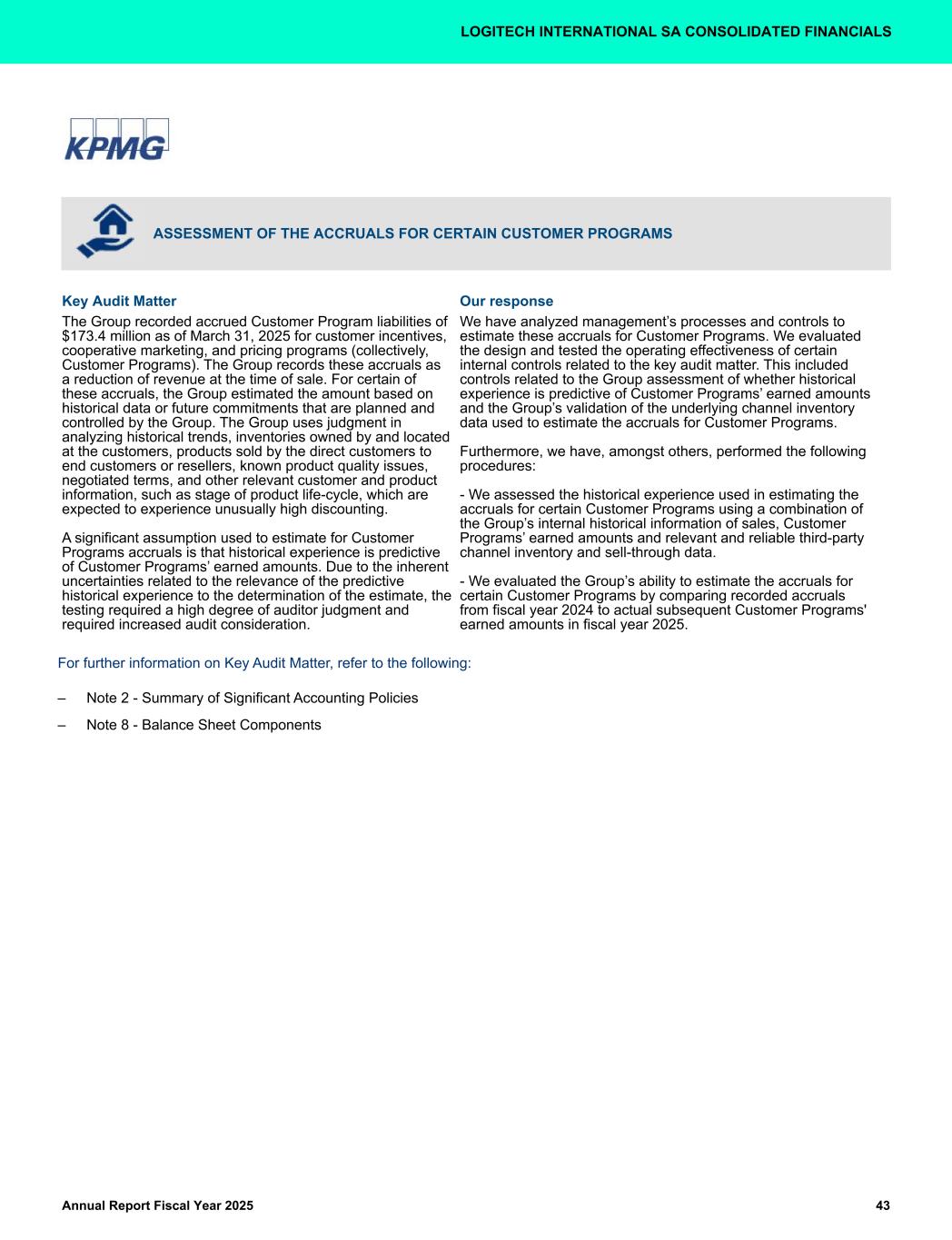
ASSESSMENT OF THE ACCRUALS FOR CERTAIN CUSTOMER PROGRAMS Key Audit Matter Our response The Group recorded accrued Customer Program liabilities of $173.4 million as of March 31, 2025 for customer incentives, cooperative marketing, and pricing programs (collectively, Customer Programs). The Group records these accruals as a reduction of revenue at the time of sale. For certain of these accruals, the Group estimated the amount based on historical data or future commitments that are planned and controlled by the Group. The Group uses judgment in analyzing historical trends, inventories owned by and located at the customers, products sold by the direct customers to end customers or resellers, known product quality issues, negotiated terms, and other relevant customer and product information, such as stage of product life-cycle, which are expected to experience unusually high discounting. A significant assumption used to estimate for Customer Programs accruals is that historical experience is predictive of Customer Programs’ earned amounts. Due to the inherent uncertainties related to the relevance of the predictive historical experience to the determination of the estimate, the testing required a high degree of auditor judgment and required increased audit consideration. We have analyzed management’s processes and controls to estimate these accruals for Customer Programs. We evaluated the design and tested the operating effectiveness of certain internal controls related to the key audit matter. This included controls related to the Group assessment of whether historical experience is predictive of Customer Programs’ earned amounts and the Group’s validation of the underlying channel inventory data used to estimate the accruals for Customer Programs. Furthermore, we have, amongst others, performed the following procedures: - We assessed the historical experience used in estimating the accruals for certain Customer Programs using a combination of the Group’s internal historical information of sales, Customer Programs’ earned amounts and relevant and reliable third-party channel inventory and sell-through data. - We evaluated the Group’s ability to estimate the accruals for certain Customer Programs by comparing recorded accruals from fiscal year 2024 to actual subsequent Customer Programs' earned amounts in fiscal year 2025. For further information on Key Audit Matter, refer to the following: – Note 2 - Summary of Significant Accounting Policies – Note 8 - Balance Sheet Components LOGITECH INTERNATIONAL SA CONSOLIDATED FINANCIALS Annual Report Fiscal Year 2025 43
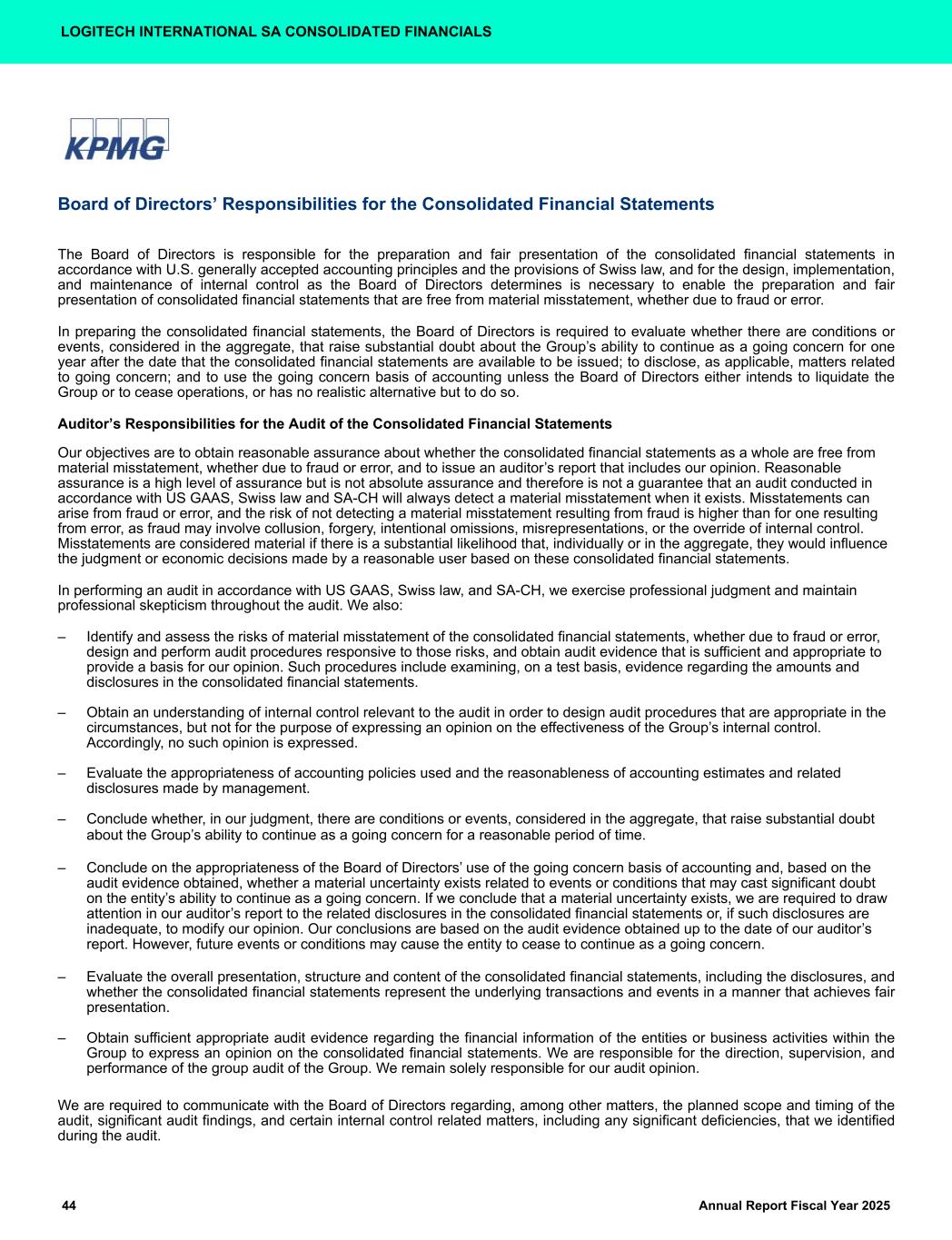
Board of Directors’ Responsibilities for the Consolidated Financial Statements The Board of Directors is responsible for the preparation and fair presentation of the consolidated financial statements in accordance with U.S. generally accepted accounting principles and the provisions of Swiss law, and for the design, implementation, and maintenance of internal control as the Board of Directors determines is necessary to enable the preparation and fair presentation of consolidated financial statements that are free from material misstatement, whether due to fraud or error. In preparing the consolidated financial statements, the Board of Directors is required to evaluate whether there are conditions or events, considered in the aggregate, that raise substantial doubt about the Group’s ability to continue as a going concern for one year after the date that the consolidated financial statements are available to be issued; to disclose, as applicable, matters related to going concern; and to use the going concern basis of accounting unless the Board of Directors either intends to liquidate the Group or to cease operations, or has no realistic alternative but to do so. Auditor’s Responsibilities for the Audit of the Consolidated Financial Statements Our objectives are to obtain reasonable assurance about whether the consolidated financial statements as a whole are free from material misstatement, whether due to fraud or error, and to issue an auditor’s report that includes our opinion. Reasonable assurance is a high level of assurance but is not absolute assurance and therefore is not a guarantee that an audit conducted in accordance with US GAAS, Swiss law and SA-CH will always detect a material misstatement when it exists. Misstatements can arise from fraud or error, and the risk of not detecting a material misstatement resulting from fraud is higher than for one resulting from error, as fraud may involve collusion, forgery, intentional omissions, misrepresentations, or the override of internal control. Misstatements are considered material if there is a substantial likelihood that, individually or in the aggregate, they would influence the judgment or economic decisions made by a reasonable user based on these consolidated financial statements. In performing an audit in accordance with US GAAS, Swiss law, and SA-CH, we exercise professional judgment and maintain professional skepticism throughout the audit. We also: – Identify and assess the risks of material misstatement of the consolidated financial statements, whether due to fraud or error, design and perform audit procedures responsive to those risks, and obtain audit evidence that is sufficient and appropriate to provide a basis for our opinion. Such procedures include examining, on a test basis, evidence regarding the amounts and disclosures in the consolidated financial statements. – Obtain an understanding of internal control relevant to the audit in order to design audit procedures that are appropriate in the circumstances, but not for the purpose of expressing an opinion on the effectiveness of the Group’s internal control. Accordingly, no such opinion is expressed. – Evaluate the appropriateness of accounting policies used and the reasonableness of accounting estimates and related disclosures made by management. – Conclude whether, in our judgment, there are conditions or events, considered in the aggregate, that raise substantial doubt about the Group’s ability to continue as a going concern for a reasonable period of time. – Conclude on the appropriateness of the Board of Directors’ use of the going concern basis of accounting and, based on the audit evidence obtained, whether a material uncertainty exists related to events or conditions that may cast significant doubt on the entity’s ability to continue as a going concern. If we conclude that a material uncertainty exists, we are required to draw attention in our auditor’s report to the related disclosures in the consolidated financial statements or, if such disclosures are inadequate, to modify our opinion. Our conclusions are based on the audit evidence obtained up to the date of our auditor’s report. However, future events or conditions may cause the entity to cease to continue as a going concern. – Evaluate the overall presentation, structure and content of the consolidated financial statements, including the disclosures, and whether the consolidated financial statements represent the underlying transactions and events in a manner that achieves fair presentation. – Obtain sufficient appropriate audit evidence regarding the financial information of the entities or business activities within the Group to express an opinion on the consolidated financial statements. We are responsible for the direction, supervision, and performance of the group audit of the Group. We remain solely responsible for our audit opinion. We are required to communicate with the Board of Directors regarding, among other matters, the planned scope and timing of the audit, significant audit findings, and certain internal control related matters, including any significant deficiencies, that we identified during the audit. LOGITECH INTERNATIONAL SA CONSOLIDATED FINANCIALS 44 Annual Report Fiscal Year 2025
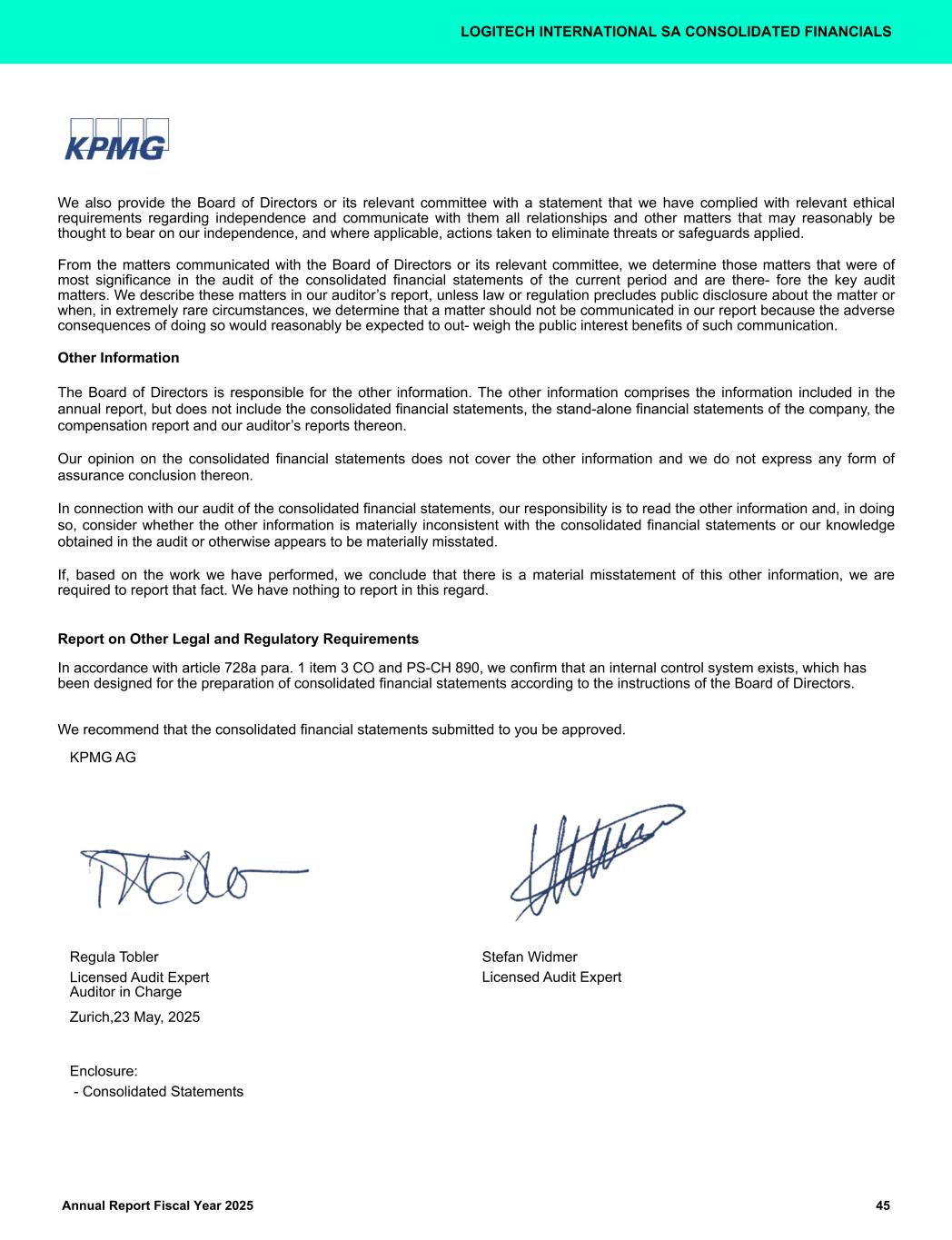
We also provide the Board of Directors or its relevant committee with a statement that we have complied with relevant ethical requirements regarding independence and communicate with them all relationships and other matters that may reasonably be thought to bear on our independence, and where applicable, actions taken to eliminate threats or safeguards applied. From the matters communicated with the Board of Directors or its relevant committee, we determine those matters that were of most significance in the audit of the consolidated financial statements of the current period and are there- fore the key audit matters. We describe these matters in our auditor’s report, unless law or regulation precludes public disclosure about the matter or when, in extremely rare circumstances, we determine that a matter should not be communicated in our report because the adverse consequences of doing so would reasonably be expected to out- weigh the public interest benefits of such communication. Other Information The Board of Directors is responsible for the other information. The other information comprises the information included in the annual report, but does not include the consolidated financial statements, the stand-alone financial statements of the company, the compensation report and our auditor’s reports thereon. Our opinion on the consolidated financial statements does not cover the other information and we do not express any form of assurance conclusion thereon. In connection with our audit of the consolidated financial statements, our responsibility is to read the other information and, in doing so, consider whether the other information is materially inconsistent with the consolidated financial statements or our knowledge obtained in the audit or otherwise appears to be materially misstated. If, based on the work we have performed, we conclude that there is a material misstatement of this other information, we are required to report that fact. We have nothing to report in this regard. Report on Other Legal and Regulatory Requirements In accordance with article 728a para. 1 item 3 CO and PS-CH 890, we confirm that an internal control system exists, which has been designed for the preparation of consolidated financial statements according to the instructions of the Board of Directors. We recommend that the consolidated financial statements submitted to you be approved. KPMG AG Regula Tobler Stefan Widmer Licensed Audit Expert Auditor in Charge Licensed Audit Expert Zurich,23 May, 2025 Enclosure: - Consolidated Statements LOGITECH INTERNATIONAL SA CONSOLIDATED FINANCIALS Annual Report Fiscal Year 2025 45
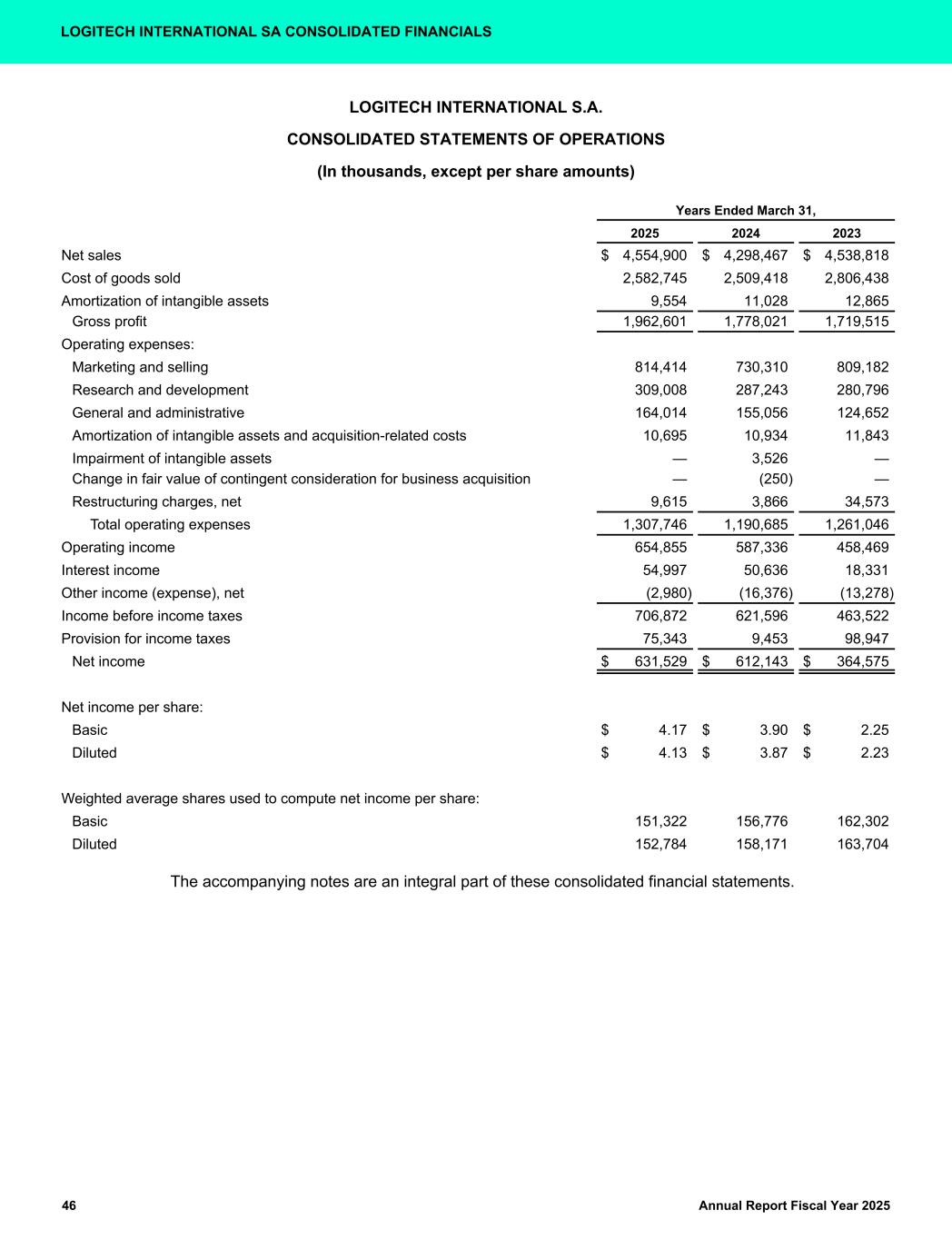
LOGITECH INTERNATIONAL S.A. CONSOLIDATED STATEMENTS OF OPERATIONS (In thousands, except per share amounts) Years Ended March 31, 2025 2024 2023 Net sales $ 4,554,900 $ 4,298,467 $ 4,538,818 Cost of goods sold 2,582,745 2,509,418 2,806,438 Amortization of intangible assets 9,554 11,028 12,865 Gross profit 1,962,601 1,778,021 1,719,515 Operating expenses: Marketing and selling 814,414 730,310 809,182 Research and development 309,008 287,243 280,796 General and administrative 164,014 155,056 124,652 Amortization of intangible assets and acquisition-related costs 10,695 10,934 11,843 Impairment of intangible assets — 3,526 — Change in fair value of contingent consideration for business acquisition — (250) — Restructuring charges, net 9,615 3,866 34,573 Total operating expenses 1,307,746 1,190,685 1,261,046 Operating income 654,855 587,336 458,469 Interest income 54,997 50,636 18,331 Other income (expense), net (2,980) (16,376) (13,278) Income before income taxes 706,872 621,596 463,522 Provision for income taxes 75,343 9,453 98,947 Net income $ 631,529 $ 612,143 $ 364,575 Net income per share: Basic $ 4.17 $ 3.90 $ 2.25 Diluted $ 4.13 $ 3.87 $ 2.23 Weighted average shares used to compute net income per share: Basic 151,322 156,776 162,302 Diluted 152,784 158,171 163,704 The accompanying notes are an integral part of these consolidated financial statements. LOGITECH INTERNATIONAL SA CONSOLIDATED FINANCIALS 46 Annual Report Fiscal Year 2025
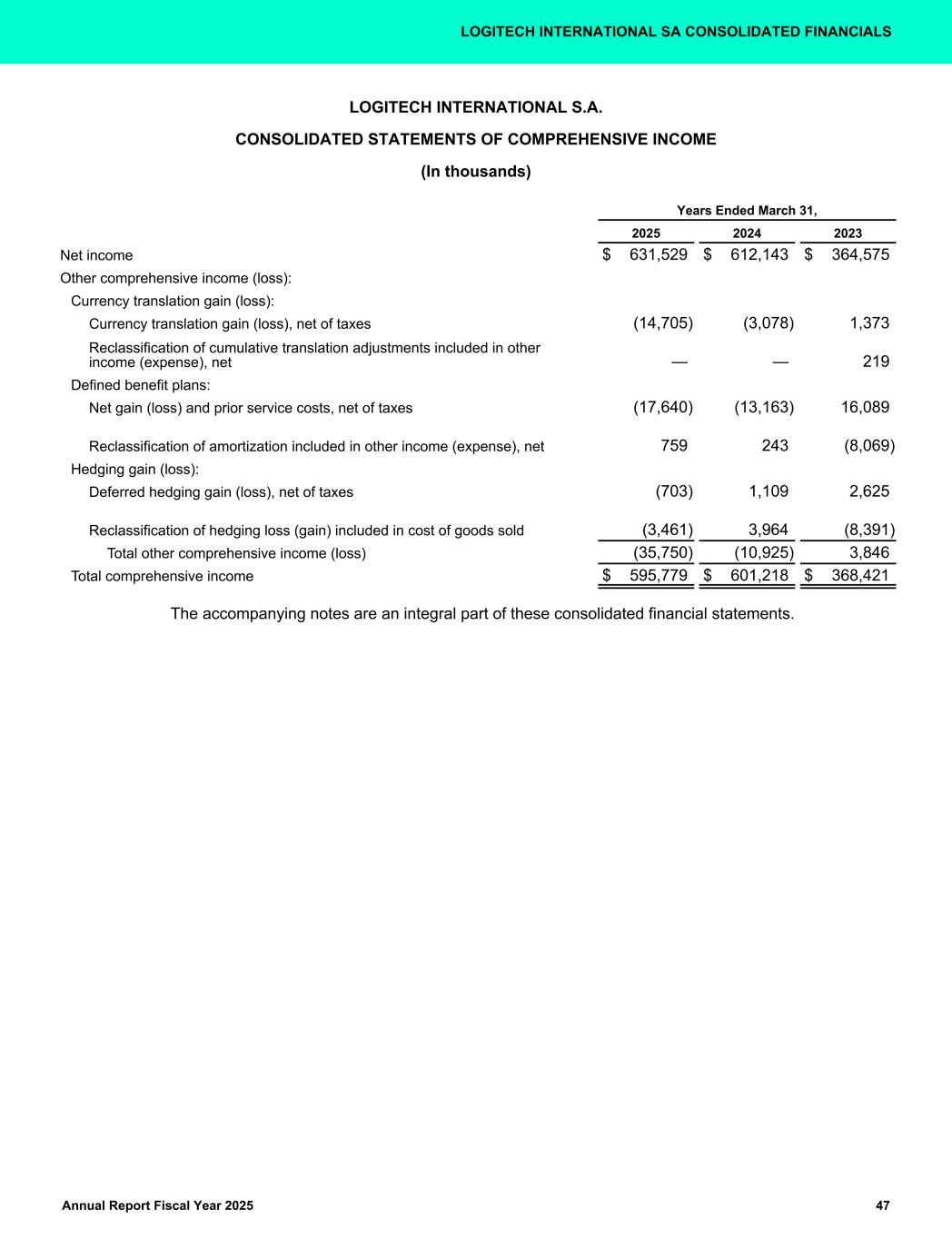
LOGITECH INTERNATIONAL S.A. CONSOLIDATED STATEMENTS OF COMPREHENSIVE INCOME (In thousands) Years Ended March 31, 2025 2024 2023 Net income $ 631,529 $ 612,143 $ 364,575 Other comprehensive income (loss): Currency translation gain (loss): Currency translation gain (loss), net of taxes (14,705) (3,078) 1,373 Reclassification of cumulative translation adjustments included in other income (expense), net — — 219 Defined benefit plans: Net gain (loss) and prior service costs, net of taxes (17,640) (13,163) 16,089 Reclassification of amortization included in other income (expense), net 759 243 (8,069) Hedging gain (loss): Deferred hedging gain (loss), net of taxes (703) 1,109 2,625 Reclassification of hedging loss (gain) included in cost of goods sold (3,461) 3,964 (8,391) Total other comprehensive income (loss) (35,750) (10,925) 3,846 Total comprehensive income $ 595,779 $ 601,218 $ 368,421 The accompanying notes are an integral part of these consolidated financial statements. LOGITECH INTERNATIONAL SA CONSOLIDATED FINANCIALS Annual Report Fiscal Year 2025 47

LOGITECH INTERNATIONAL S.A. CONSOLIDATED BALANCE SHEETS (In thousands, except per share amounts) March 31, 2025 2024 Assets Current assets: Cash and cash equivalents $ 1,503,205 $ 1,520,842 Accounts receivable, net 454,546 541,715 Inventories 503,747 422,513 Other current assets 131,211 146,270 Total current assets 2,592,709 2,631,340 Non-current assets: Property, plant and equipment, net 113,858 116,589 Goodwill 463,230 461,978 Other intangible assets, net 24,630 44,603 Other assets 344,077 350,194 Total assets $ 3,538,504 $ 3,604,704 Liabilities and Shareholders' Equity Current liabilities: Accounts payable $ 414,586 $ 448,627 Accrued and other current liabilities 686,503 637,262 Total current liabilities 1,101,089 1,085,889 Non-current liabilities: Income taxes payable 88,483 112,572 Other non-current liabilities 221,512 172,590 Total liabilities 1,411,084 1,371,051 Commitments and contingencies (Note 13) Shareholders' equity: Registered shares, CHF 0.25 par value: Issued shares: 168,994 and 173,106 at March 31, 2025 and 2024, respectively 29,432 30,148 Additional paid-in capital 82,591 63,524 Shares in treasury, at cost — 20,485 and 19,243 shares at March 31, 2025 and 2024, respectively (1,464,912) (1,351,336) Retained earnings 3,627,261 3,602,519 Accumulated other comprehensive loss (146,952) (111,202) Total shareholders' equity 2,127,420 2,233,653 Total liabilities and shareholders' equity $ 3,538,504 $ 3,604,704 The accompanying notes are an integral part of these consolidated financial statements. LOGITECH INTERNATIONAL SA CONSOLIDATED FINANCIALS 48 Annual Report Fiscal Year 2025
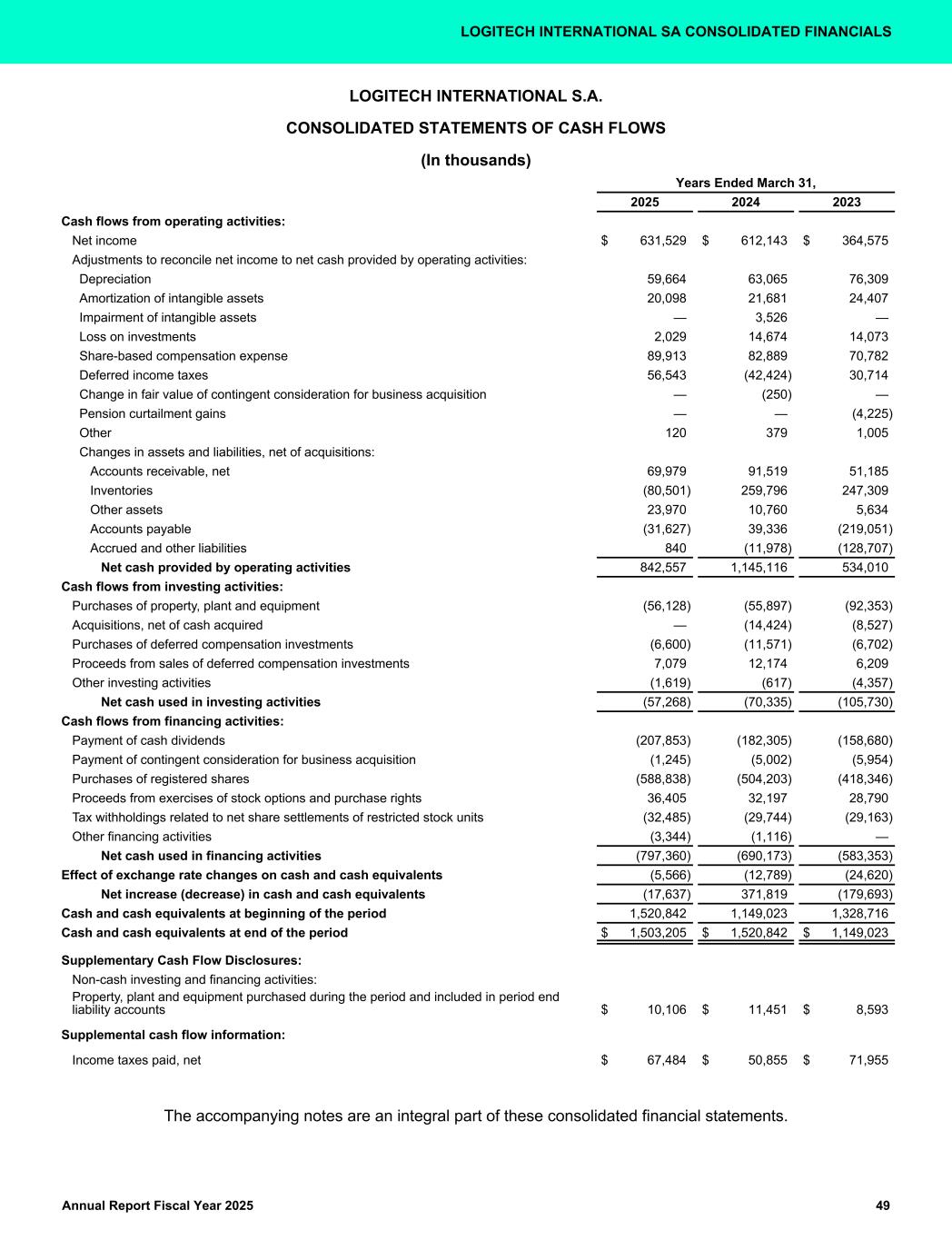
LOGITECH INTERNATIONAL S.A. CONSOLIDATED STATEMENTS OF CASH FLOWS (In thousands) Years Ended March 31, 2025 2024 2023 Cash flows from operating activities: Net income $ 631,529 $ 612,143 $ 364,575 Adjustments to reconcile net income to net cash provided by operating activities: Depreciation 59,664 63,065 76,309 Amortization of intangible assets 20,098 21,681 24,407 Impairment of intangible assets — 3,526 — Loss on investments 2,029 14,674 14,073 Share-based compensation expense 89,913 82,889 70,782 Deferred income taxes 56,543 (42,424) 30,714 Change in fair value of contingent consideration for business acquisition — (250) — Pension curtailment gains — — (4,225) Other 120 379 1,005 Changes in assets and liabilities, net of acquisitions: Accounts receivable, net 69,979 91,519 51,185 Inventories (80,501) 259,796 247,309 Other assets 23,970 10,760 5,634 Accounts payable (31,627) 39,336 (219,051) Accrued and other liabilities 840 (11,978) (128,707) Net cash provided by operating activities 842,557 1,145,116 534,010 Cash flows from investing activities: Purchases of property, plant and equipment (56,128) (55,897) (92,353) Acquisitions, net of cash acquired — (14,424) (8,527) Purchases of deferred compensation investments (6,600) (11,571) (6,702) Proceeds from sales of deferred compensation investments 7,079 12,174 6,209 Other investing activities (1,619) (617) (4,357) Net cash used in investing activities (57,268) (70,335) (105,730) Cash flows from financing activities: Payment of cash dividends (207,853) (182,305) (158,680) Payment of contingent consideration for business acquisition (1,245) (5,002) (5,954) Purchases of registered shares (588,838) (504,203) (418,346) Proceeds from exercises of stock options and purchase rights 36,405 32,197 28,790 Tax withholdings related to net share settlements of restricted stock units (32,485) (29,744) (29,163) Other financing activities (3,344) (1,116) — Net cash used in financing activities (797,360) (690,173) (583,353) Effect of exchange rate changes on cash and cash equivalents (5,566) (12,789) (24,620) Net increase (decrease) in cash and cash equivalents (17,637) 371,819 (179,693) Cash and cash equivalents at beginning of the period 1,520,842 1,149,023 1,328,716 Cash and cash equivalents at end of the period $ 1,503,205 $ 1,520,842 $ 1,149,023 Supplementary Cash Flow Disclosures: Non-cash investing and financing activities: Property, plant and equipment purchased during the period and included in period end liability accounts $ 10,106 $ 11,451 $ 8,593 Supplemental cash flow information: Income taxes paid, net $ 67,484 $ 50,855 $ 71,955 The accompanying notes are an integral part of these consolidated financial statements. LOGITECH INTERNATIONAL SA CONSOLIDATED FINANCIALS Annual Report Fiscal Year 2025 49

LOGITECH INTERNATIONAL S.A. CONSOLIDATED STATEMENTS OF CHANGES IN SHAREHOLDERS' EQUITY (In thousands, except per share amounts) Registered shares Additional paid-in capital Treasury shares Retained earnings Accumulated other comprehensive loss Shares Amount Shares Amount Total March 31, 2022 173,106 $ 30,148 $ 129,925 7,855 $ (632,893) $ 2,975,681 $ (104,123) $ 2,398,738 Total comprehensive income — — — — — 364,575 3,846 368,421 Purchases of registered shares — — — 7,562 (418,346) — — (418,346) Sale of shares upon exercise of stock options and purchase rights — — (5,636) (686) 34,426 — — 28,790 Issuance of shares upon vesting of restricted stock units — — (68,710) (968) 39,547 — — (29,163) Share-based compensation — — 71,801 — — — — 71,801 Cash dividends ($1.00 per share) — — — — — (162,681) — (162,681) March 31, 2023 173,106 $ 30,148 $ 127,380 13,763 $ (977,266) $ 3,177,575 $ (100,277) $ 2,257,560 Total comprehensive income — — — — — 612,143 (10,925) 601,218 Purchases of registered shares — — — 7,100 (523,751) — — (523,751) Sale of shares upon exercise of stock options and purchase rights — — (28,314) (624) 60,511 — — 32,197 Issuance of shares upon vesting of restricted stock units — — (118,771) (994) 89,027 — — (29,744) Issuance of shares related to contingent consideration — — 102 (2) 143 — — 245 Share-based compensation — — 83,127 — — — — 83,127 Cash dividends ($1.19 per share) — — — — — (187,199) — (187,199) March 31, 2024 173,106 $ 30,148 $ 63,524 19,243 $ (1,351,336) $ 3,602,519 $ (111,202) $ 2,233,653 Total comprehensive income — — — — — 631,529 (35,750) 595,779 Purchases of registered shares — — — 6,679 (588,028) — — (588,028) Sale of shares upon exercise of stock options and purchase rights — — (10,588) (492) 52,927 (5,934) — 36,405 Issuance of shares upon vesting of restricted stock units — — (60,422) (833) 89,437 (61,500) — (32,485) Cancellation of treasury shares (4,112) (716) — (4,112) 332,088 (331,372) — — Share-based compensation — — 90,077 — — — — 90,077 Cash dividends ($1.37 per share) — — — — — (207,981) — (207,981) March 31, 2025 168,994 $ 29,432 $ 82,591 20,485 $ (1,464,912) $ 3,627,261 $ (146,952) $ 2,127,420 The accompanying notes are an integral part of these consolidated financial statements. LOGITECH INTERNATIONAL SA CONSOLIDATED FINANCIALS 50 Annual Report Fiscal Year 2025
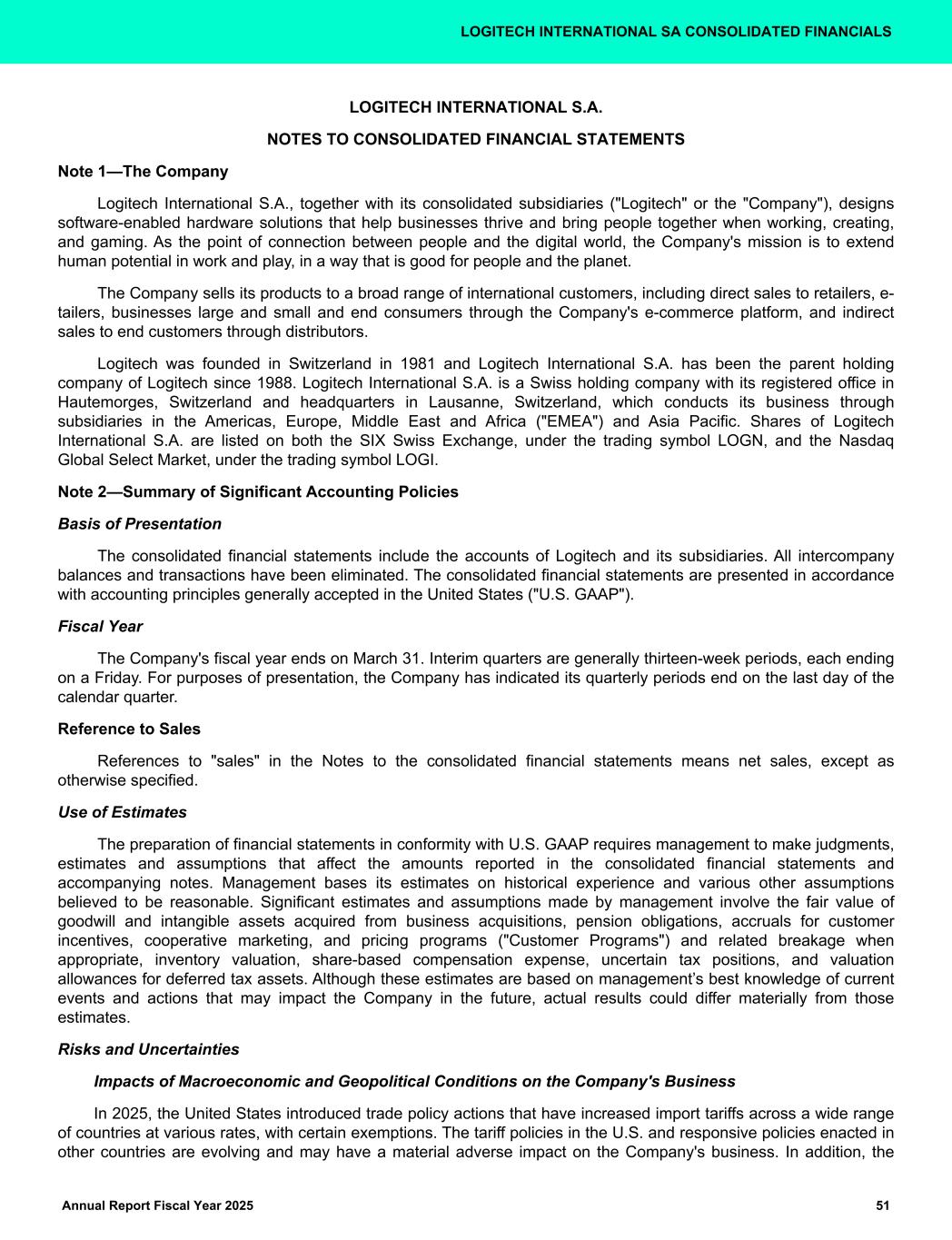
LOGITECH INTERNATIONAL S.A. NOTES TO CONSOLIDATED FINANCIAL STATEMENTS Note 1—The Company Logitech International S.A., together with its consolidated subsidiaries ("Logitech" or the "Company"), designs software-enabled hardware solutions that help businesses thrive and bring people together when working, creating, and gaming. As the point of connection between people and the digital world, the Company's mission is to extend human potential in work and play, in a way that is good for people and the planet. The Company sells its products to a broad range of international customers, including direct sales to retailers, e- tailers, businesses large and small and end consumers through the Company's e-commerce platform, and indirect sales to end customers through distributors. Logitech was founded in Switzerland in 1981 and Logitech International S.A. has been the parent holding company of Logitech since 1988. Logitech International S.A. is a Swiss holding company with its registered office in Hautemorges, Switzerland and headquarters in Lausanne, Switzerland, which conducts its business through subsidiaries in the Americas, Europe, Middle East and Africa ("EMEA") and Asia Pacific. Shares of Logitech International S.A. are listed on both the SIX Swiss Exchange, under the trading symbol LOGN, and the Nasdaq Global Select Market, under the trading symbol LOGI. Note 2—Summary of Significant Accounting Policies Basis of Presentation The consolidated financial statements include the accounts of Logitech and its subsidiaries. All intercompany balances and transactions have been eliminated. The consolidated financial statements are presented in accordance with accounting principles generally accepted in the United States ("U.S. GAAP"). Fiscal Year The Company's fiscal year ends on March 31. Interim quarters are generally thirteen-week periods, each ending on a Friday. For purposes of presentation, the Company has indicated its quarterly periods end on the last day of the calendar quarter. Reference to Sales References to "sales" in the Notes to the consolidated financial statements means net sales, except as otherwise specified. Use of Estimates The preparation of financial statements in conformity with U.S. GAAP requires management to make judgments, estimates and assumptions that affect the amounts reported in the consolidated financial statements and accompanying notes. Management bases its estimates on historical experience and various other assumptions believed to be reasonable. Significant estimates and assumptions made by management involve the fair value of goodwill and intangible assets acquired from business acquisitions, pension obligations, accruals for customer incentives, cooperative marketing, and pricing programs ("Customer Programs") and related breakage when appropriate, inventory valuation, share-based compensation expense, uncertain tax positions, and valuation allowances for deferred tax assets. Although these estimates are based on management’s best knowledge of current events and actions that may impact the Company in the future, actual results could differ materially from those estimates. Risks and Uncertainties Impacts of Macroeconomic and Geopolitical Conditions on the Company's Business In 2025, the United States introduced trade policy actions that have increased import tariffs across a wide range of countries at various rates, with certain exemptions. The tariff policies in the U.S. and responsive policies enacted in other countries are evolving and may have a material adverse impact on the Company's business. In addition, the LOGITECH INTERNATIONAL SA CONSOLIDATED FINANCIALS Annual Report Fiscal Year 2025 51
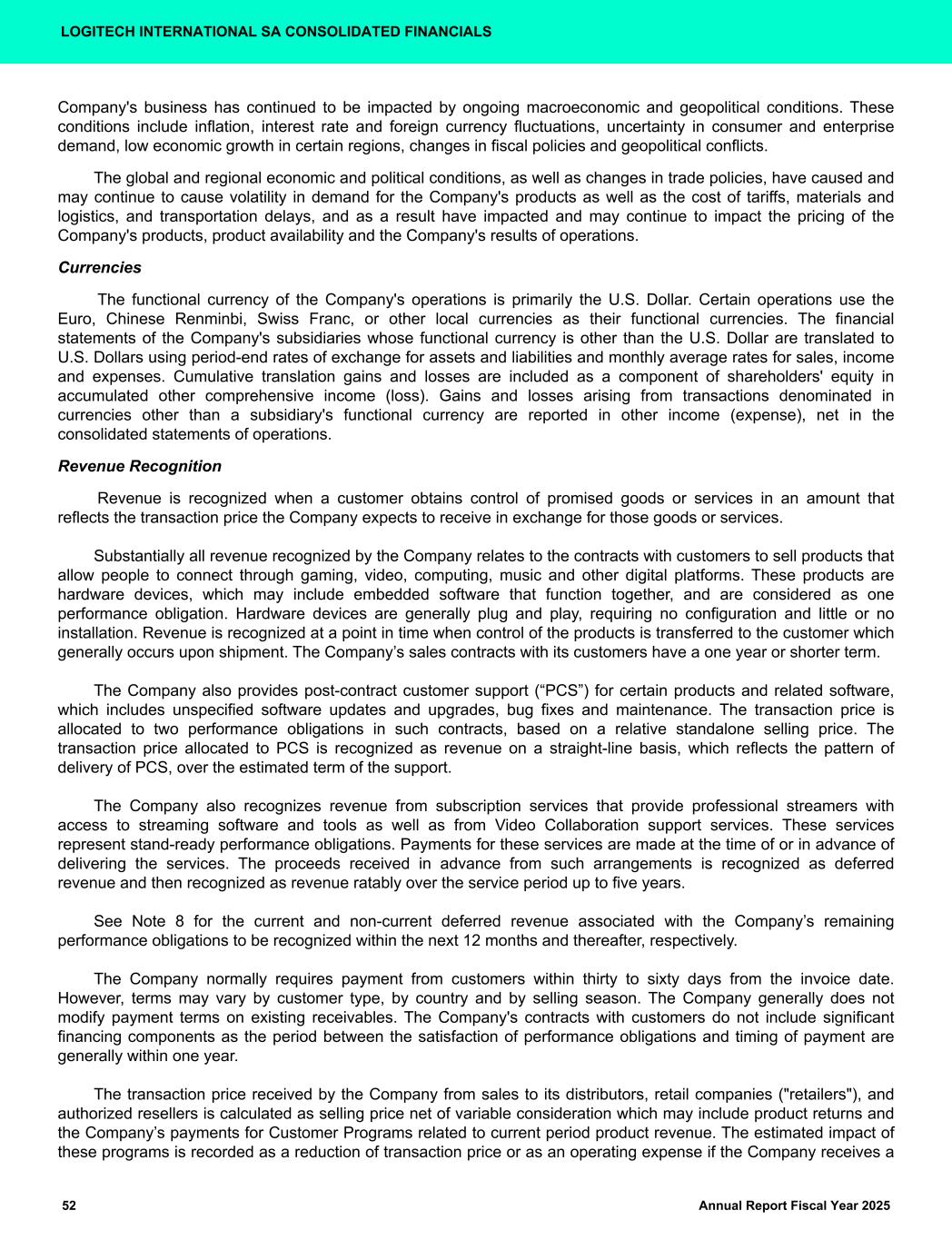
Company's business has continued to be impacted by ongoing macroeconomic and geopolitical conditions. These conditions include inflation, interest rate and foreign currency fluctuations, uncertainty in consumer and enterprise demand, low economic growth in certain regions, changes in fiscal policies and geopolitical conflicts. The global and regional economic and political conditions, as well as changes in trade policies, have caused and may continue to cause volatility in demand for the Company's products as well as the cost of tariffs, materials and logistics, and transportation delays, and as a result have impacted and may continue to impact the pricing of the Company's products, product availability and the Company's results of operations. Currencies The functional currency of the Company's operations is primarily the U.S. Dollar. Certain operations use the Euro, Chinese Renminbi, Swiss Franc, or other local currencies as their functional currencies. The financial statements of the Company's subsidiaries whose functional currency is other than the U.S. Dollar are translated to U.S. Dollars using period-end rates of exchange for assets and liabilities and monthly average rates for sales, income and expenses. Cumulative translation gains and losses are included as a component of shareholders' equity in accumulated other comprehensive income (loss). Gains and losses arising from transactions denominated in currencies other than a subsidiary's functional currency are reported in other income (expense), net in the consolidated statements of operations. Revenue Recognition Revenue is recognized when a customer obtains control of promised goods or services in an amount that reflects the transaction price the Company expects to receive in exchange for those goods or services. Substantially all revenue recognized by the Company relates to the contracts with customers to sell products that allow people to connect through gaming, video, computing, music and other digital platforms. These products are hardware devices, which may include embedded software that function together, and are considered as one performance obligation. Hardware devices are generally plug and play, requiring no configuration and little or no installation. Revenue is recognized at a point in time when control of the products is transferred to the customer which generally occurs upon shipment. The Company’s sales contracts with its customers have a one year or shorter term. The Company also provides post-contract customer support (“PCS”) for certain products and related software, which includes unspecified software updates and upgrades, bug fixes and maintenance. The transaction price is allocated to two performance obligations in such contracts, based on a relative standalone selling price. The transaction price allocated to PCS is recognized as revenue on a straight-line basis, which reflects the pattern of delivery of PCS, over the estimated term of the support. The Company also recognizes revenue from subscription services that provide professional streamers with access to streaming software and tools as well as from Video Collaboration support services. These services represent stand-ready performance obligations. Payments for these services are made at the time of or in advance of delivering the services. The proceeds received in advance from such arrangements is recognized as deferred revenue and then recognized as revenue ratably over the service period up to five years. See Note 8 for the current and non-current deferred revenue associated with the Company’s remaining performance obligations to be recognized within the next 12 months and thereafter, respectively. The Company normally requires payment from customers within thirty to sixty days from the invoice date. However, terms may vary by customer type, by country and by selling season. The Company generally does not modify payment terms on existing receivables. The Company's contracts with customers do not include significant financing components as the period between the satisfaction of performance obligations and timing of payment are generally within one year. The transaction price received by the Company from sales to its distributors, retail companies ("retailers"), and authorized resellers is calculated as selling price net of variable consideration which may include product returns and the Company’s payments for Customer Programs related to current period product revenue. The estimated impact of these programs is recorded as a reduction of transaction price or as an operating expense if the Company receives a LOGITECH INTERNATIONAL SA CONSOLIDATED FINANCIALS 52 Annual Report Fiscal Year 2025
distinct good or service from the customer and can reasonably estimate the fair value of that good or service received. Customer Programs require management to estimate the percentage of those programs which will not be claimed in the current period or will not be earned by customers, which is commonly referred to as "breakage." Breakage is estimated based on historical claim experience, the period in which customer claims are expected to be submitted, specific terms and conditions with customers and other factors. The Company accounts for breakage as part of variable consideration, subject to constraint, and records the estimated impact in the same period when revenue is recognized at the expected value. Assessing the period in which claims are expected to be submitted and the relevance of the historical claim experience require significant management judgment to estimate the breakage of Customer Programs in any accounting period. The Company enters into cooperative marketing arrangements with many of its customers and with certain indirect partners, allowing customers to receive a credit equal to a set percentage of their purchases of the Company's products, or a fixed dollar amount for various marketing and incentive programs. The objective of these arrangements is to encourage advertising and promotional events to increase sales of the Company's products. Customer incentive programs include consumer rebates and performance-based incentives. Consumer rebates are offered to the Company's customers and indirect partners at the Company's discretion for the primary benefit of end-users. In addition, the Company offers performance-based incentives to many of its customers and indirect partners based on predetermined performance criteria. At management's discretion, the Company also offers special pricing discounts to certain customers. Special pricing discounts are usually offered only for limited time periods or for sales of selected products to specific indirect partners. Cooperative marketing arrangements and customer incentive programs are considered variable consideration, which the Company estimates and records as a reduction to revenue at the time of sale based on negotiated terms, historical experiences, forecasted incentives, anticipated volume of future purchases, and inventory levels in the channel. The Company has agreements with certain customers that contain terms allowing price protection credits to be issued in the event of a subsequent price reduction. Management's decision to make price reductions is influenced by product life cycle stage, market acceptance of products, the competitive environment, new product introductions and other factors. Accruals for estimated expected future pricing actions and Customer Programs are recognized at the time of sale based on analyses of historical pricing actions by customer and by product, inventories owned by and located at customers, current customer demand, current operating conditions, and other relevant customer and product information, such as stage of product life-cycle. Product return rights vary by customer. Estimates of expected future product returns qualify as variable consideration and are recorded as a reduction of the transaction price of the contract at the time of sale based on an analyses of historical return trends by customer and by product, inventories owned by and located at customers, current customer demand, current operating conditions, and other relevant customer and product information. The Company assesses the estimated asset for recovery value for impairment and adjusts the value of the asset for any impairment. Return trends are influenced by product life cycle status, new product introductions, market acceptance of products, sales levels, product sell-through, the type of customer, seasonality, product quality issues, competitive pressures, operational policies and procedures, and other factors. Return rates can fluctuate over time but are sufficiently predictable to allow the Company to estimate expected future product returns. Typically, variable consideration does not need to be constrained as estimates are based on predictive historical data or future commitments that are planned and controlled by the Company. However, the Company continues to assess variable consideration estimates such that it is probable that a significant reversal of revenue will not occur. The Company regularly evaluates the adequacy of its estimates for Customer Programs and product returns. Future market conditions and product transitions may require the Company to take action to change such programs and related estimates. When the variables used to estimate these costs change, or if actual costs differ significantly from the estimates, the Company would be required to increase or reduce revenue or operating expenses to reflect LOGITECH INTERNATIONAL SA CONSOLIDATED FINANCIALS Annual Report Fiscal Year 2025 53
the impact. During the year ended March 31, 2025, changes to these estimates related to performance obligations satisfied in prior periods were not material. Sales taxes and value-added taxes (“VAT”) collected from customers, if applicable, which are remitted to governmental authorities are not included in revenue, and are reflected as a liability on the consolidated balance sheets. Shipping and Handling Costs The Company's shipping and handling costs are included in the cost of goods sold in the consolidated statements of operations. Contract Balances The Company records accounts receivable from contracts with customers when it has an unconditional right to consideration, as accounts receivable, net, on the consolidated balance sheets. The Company records contract liabilities when cash payments are received or due in advance of performance, primarily for implied support and subscriptions. Contract liabilities are included in accrued and other current liabilities and other non-current liabilities on the consolidated balance sheets. Contract Costs The Company recognizes the incremental costs of obtaining contracts as an expense when incurred if the amortization period of the assets that otherwise would have been recognized is one year or less. These costs are included in marketing and selling expenses in the consolidated statements of operations. As of March 31, 2025 and 2024, the Company did not have any material deferred contract costs. Research and Development Costs Costs related to research, design and development of products, which consist primarily of personnel, product design and infrastructure expenses, are charged to research and development expense as they are incurred. Advertising Costs Advertising costs are recorded as either a marketing and selling expense or a deduction from revenue as they are incurred. Advertising costs paid or reimbursed by the Company to direct or indirect customers must have an identifiable benefit and an estimable fair value in order to be classified as an operating expense. If these criteria are not met, the payment is classified as a reduction of revenue. Advertising costs recorded as marketing and selling expense are expensed as incurred. Total advertising costs including those characterized as revenue deductions during fiscal years 2025, 2024, and 2023 were $355.1 million, $325.3 million, and $383.7 million, respectively, out of which $53.1 million, $46.6 million, and $67.3 million, respectively, were included as operating expense in the consolidated statements of operations. Cash Equivalents The Company classifies all highly liquid instruments purchased, such as bank demand deposits, short-term time deposits, and U.S. Treasury securities, with an original maturity of three months or less at the date of purchase, to be cash equivalents. Cash equivalents are carried at cost, which approximates their fair value. Concentration of Credit Risk Financial instruments that potentially subject the Company to concentrations of credit risk consist principally of cash and cash equivalents and accounts receivable. The Company maintains cash and cash equivalents with various creditworthy financial institutions and has a policy to limit exposure with any one financial institution, but is exposed to credit risk in the event of default by financial institutions to the extent that cash balances with individual financial institutions are in excess of amounts that are insured. The Company periodically assesses the credit risk associated with these financial institutions. The Company sells to large distributors, retailers, and e-tailers and, as a result, maintains individually significant receivable balances with such customers. LOGITECH INTERNATIONAL SA CONSOLIDATED FINANCIALS 54 Annual Report Fiscal Year 2025
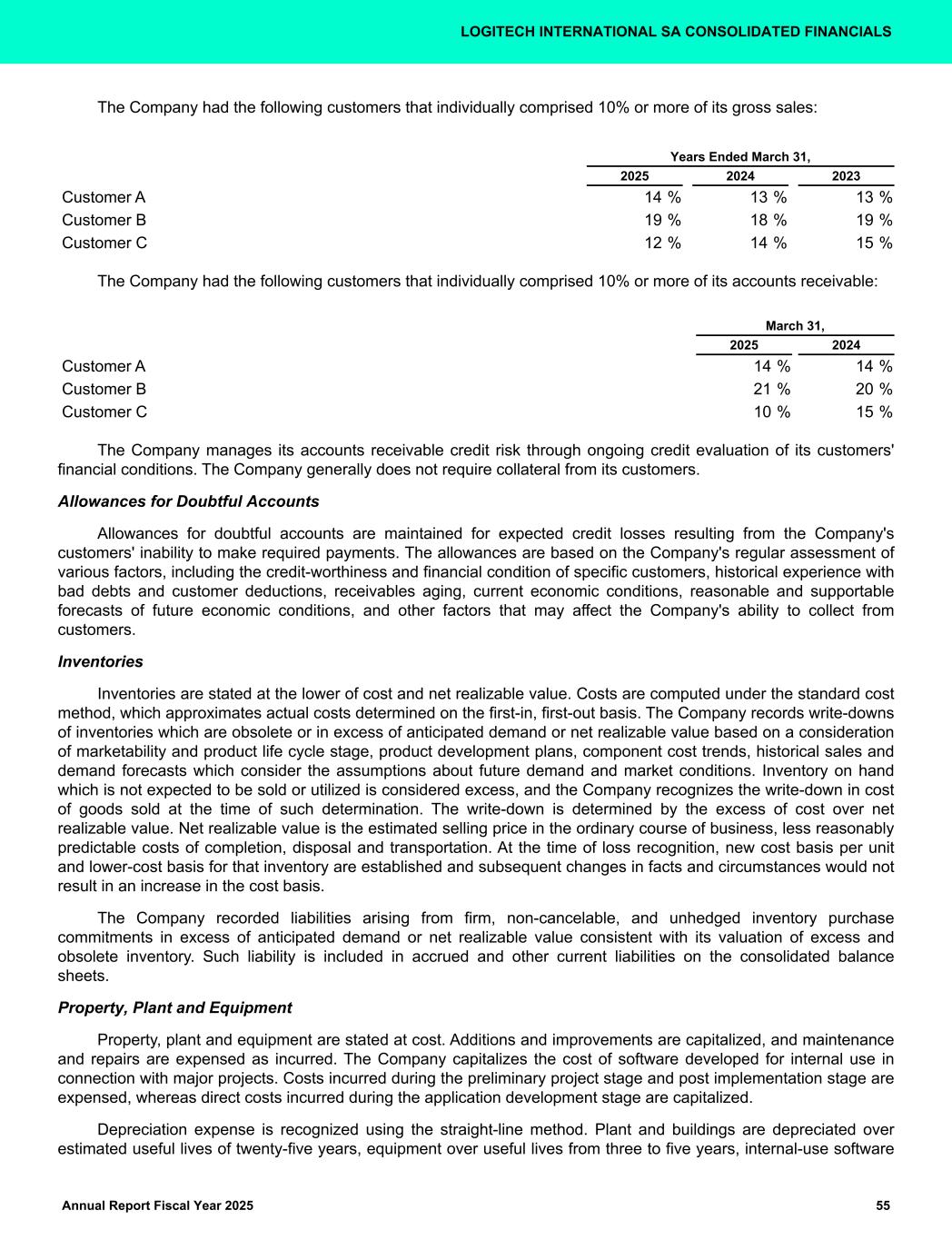
The Company had the following customers that individually comprised 10% or more of its gross sales: Years Ended March 31, 2025 2024 2023 Customer A 14 % 13 % 13 % Customer B 19 % 18 % 19 % Customer C 12 % 14 % 15 % The Company had the following customers that individually comprised 10% or more of its accounts receivable: March 31, 2025 2024 Customer A 14 % 14 % Customer B 21 % 20 % Customer C 10 % 15 % The Company manages its accounts receivable credit risk through ongoing credit evaluation of its customers' financial conditions. The Company generally does not require collateral from its customers. Allowances for Doubtful Accounts Allowances for doubtful accounts are maintained for expected credit losses resulting from the Company's customers' inability to make required payments. The allowances are based on the Company's regular assessment of various factors, including the credit-worthiness and financial condition of specific customers, historical experience with bad debts and customer deductions, receivables aging, current economic conditions, reasonable and supportable forecasts of future economic conditions, and other factors that may affect the Company's ability to collect from customers. Inventories Inventories are stated at the lower of cost and net realizable value. Costs are computed under the standard cost method, which approximates actual costs determined on the first-in, first-out basis. The Company records write-downs of inventories which are obsolete or in excess of anticipated demand or net realizable value based on a consideration of marketability and product life cycle stage, product development plans, component cost trends, historical sales and demand forecasts which consider the assumptions about future demand and market conditions. Inventory on hand which is not expected to be sold or utilized is considered excess, and the Company recognizes the write-down in cost of goods sold at the time of such determination. The write-down is determined by the excess of cost over net realizable value. Net realizable value is the estimated selling price in the ordinary course of business, less reasonably predictable costs of completion, disposal and transportation. At the time of loss recognition, new cost basis per unit and lower-cost basis for that inventory are established and subsequent changes in facts and circumstances would not result in an increase in the cost basis. The Company recorded liabilities arising from firm, non-cancelable, and unhedged inventory purchase commitments in excess of anticipated demand or net realizable value consistent with its valuation of excess and obsolete inventory. Such liability is included in accrued and other current liabilities on the consolidated balance sheets. Property, Plant and Equipment Property, plant and equipment are stated at cost. Additions and improvements are capitalized, and maintenance and repairs are expensed as incurred. The Company capitalizes the cost of software developed for internal use in connection with major projects. Costs incurred during the preliminary project stage and post implementation stage are expensed, whereas direct costs incurred during the application development stage are capitalized. Depreciation expense is recognized using the straight-line method. Plant and buildings are depreciated over estimated useful lives of twenty-five years, equipment over useful lives from three to five years, internal-use software LOGITECH INTERNATIONAL SA CONSOLIDATED FINANCIALS Annual Report Fiscal Year 2025 55
over useful lives from three to seven years, tooling over useful lives from six months to one year, and leasehold improvements over the lesser of the term of the lease or the estimated useful life of leasehold improvements. When property and equipment is retired or otherwise disposed of, the cost and accumulated depreciation are relieved from the accounts and the net gain or loss is included in cost of goods sold or operating expenses, depending on the nature of the property and equipment. Leases The Company determines if an arrangement is a lease or contains a lease at contract inception. The Company determines if a lease is an operating or finance lease and recognizes right-of-use ("ROU") assets and lease liabilities upon lease commencement. Operating lease ROU assets are included in other assets, short-term lease liabilities are included in accrued and other current liabilities, and long-term lease liabilities are included in other non-current liabilities on the Company's consolidated balance sheets. Leases with an initial term of 12 months or less are not recorded on the balance sheet. For the Company's operating leases, the Company accounts for the lease component and related non-lease component as a single lease component. Lease expense is recognized on a straight-line basis over the lease term. For operating leases, the lease liability is initially measured at the present value of the unpaid lease payments at lease commencement date. As most of the leases do not provide an implicit rate, the Company generally uses its incremental borrowing rate as the discount rate for the leases. The Company's incremental borrowing rate is the rate of interest it would have to pay on a collateralized basis to borrow an amount equal to the lease payments under similar terms. Because the Company does not generally borrow on a collateralized basis, it uses its understanding of what its collateralized credit rating would be as an input to deriving an appropriate incremental borrowing rate. The operating lease ROU assets include prepaid lease payments and exclude lease incentives. Intangible Assets The Company's intangible assets include goodwill and intangible assets with finite lives, which primarily include acquired technology and customer contracts and related relationships. Intangible assets with finite lives are carried at cost and amortized using the straight-line method over their useful lives ranging from one to ten years. Impairment of Long-Lived Assets The Company reviews long-lived assets, such as property and equipment, and finite-lived intangible assets, for impairment whenever events indicate that the carrying amounts might not be recoverable. Recoverability of long-lived assets is measured by comparing the projected undiscounted net cash flows associated with those assets to their carrying values. If an asset is considered impaired, it is written down to its fair value, which is determined based on the asset's projected discounted cash flows or appraised value, depending on the nature of the asset. For purposes of recognition of impairment for assets held for use, the Company groups assets and liabilities at the lowest level for which cash flows are separately identifiable. Impairment of Goodwill Goodwill represents the excess of the purchase price over the fair value of the net tangible and identifiable intangible assets acquired in each business combination. The Company conducts a goodwill impairment analysis annually at December 31 or more frequently if indicators of impairment exist or if a decision is made to sell or exit a business. Significant judgments are involved in determining if an indicator of impairment has occurred. Such indicators may include deterioration in general economic conditions, negative developments in equity and credit markets, adverse changes in the markets in which an entity operates, increases in input costs that have a negative effect on earnings and cash flows, or a trend of negative or declining cash flows over multiple periods, among others. The fair value that could be realized in an actual transaction may differ from that used to evaluate the impairment of goodwill. In reviewing goodwill for impairment, the Company has the option to first assess qualitative factors to determine whether the existence of events or circumstances leads to a determination that it is more likely than not (greater than 50%) that the estimated fair value of a reporting unit is less than its carrying amount. The Company also may elect not to perform the qualitative assessment and, instead, proceed directly to the quantitative impairment test. The ultimate outcome of the goodwill impairment review for a reporting unit should be the same whether the Company chooses to LOGITECH INTERNATIONAL SA CONSOLIDATED FINANCIALS 56 Annual Report Fiscal Year 2025
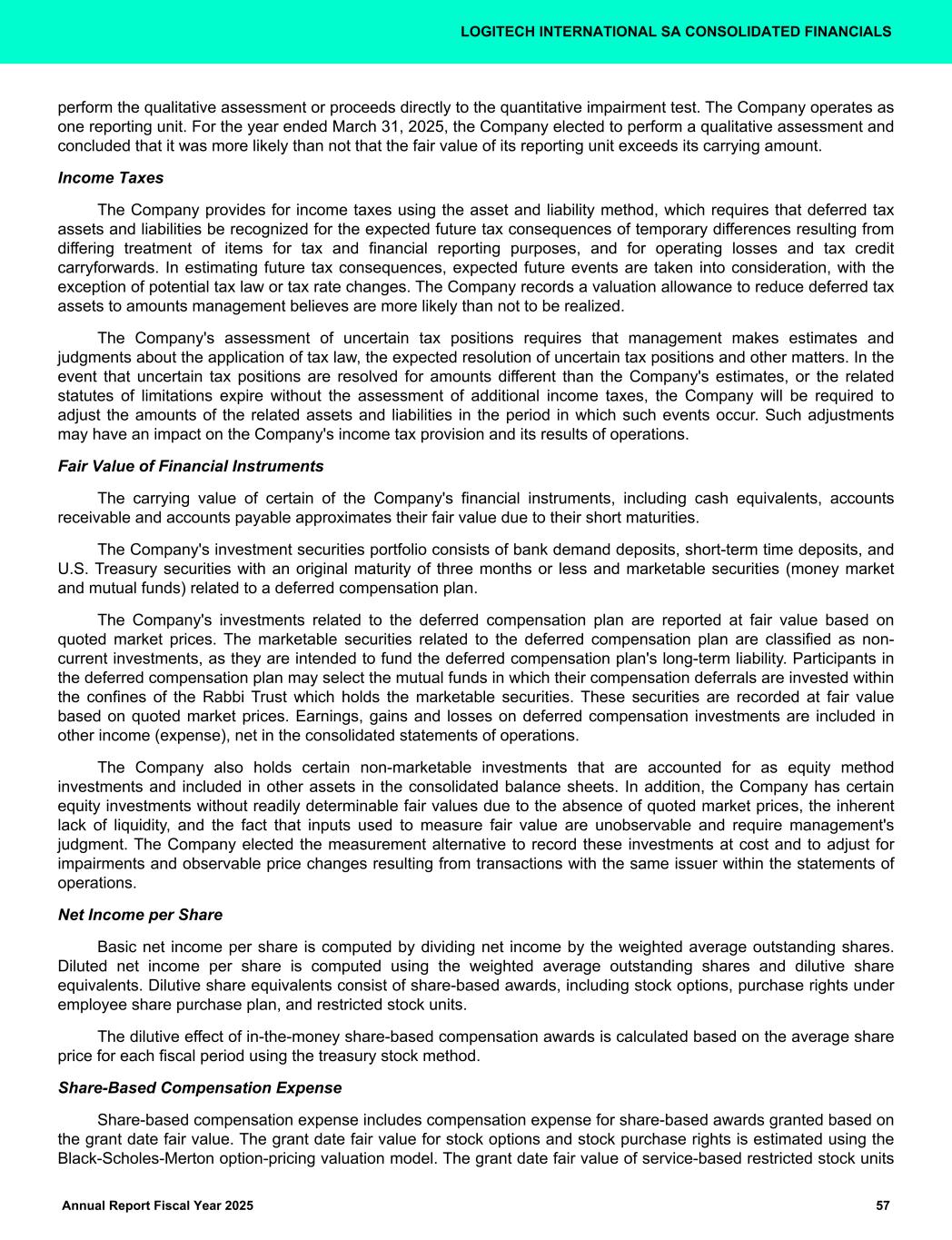
perform the qualitative assessment or proceeds directly to the quantitative impairment test. The Company operates as one reporting unit. For the year ended March 31, 2025, the Company elected to perform a qualitative assessment and concluded that it was more likely than not that the fair value of its reporting unit exceeds its carrying amount. Income Taxes The Company provides for income taxes using the asset and liability method, which requires that deferred tax assets and liabilities be recognized for the expected future tax consequences of temporary differences resulting from differing treatment of items for tax and financial reporting purposes, and for operating losses and tax credit carryforwards. In estimating future tax consequences, expected future events are taken into consideration, with the exception of potential tax law or tax rate changes. The Company records a valuation allowance to reduce deferred tax assets to amounts management believes are more likely than not to be realized. The Company's assessment of uncertain tax positions requires that management makes estimates and judgments about the application of tax law, the expected resolution of uncertain tax positions and other matters. In the event that uncertain tax positions are resolved for amounts different than the Company's estimates, or the related statutes of limitations expire without the assessment of additional income taxes, the Company will be required to adjust the amounts of the related assets and liabilities in the period in which such events occur. Such adjustments may have an impact on the Company's income tax provision and its results of operations. Fair Value of Financial Instruments The carrying value of certain of the Company's financial instruments, including cash equivalents, accounts receivable and accounts payable approximates their fair value due to their short maturities. The Company's investment securities portfolio consists of bank demand deposits, short-term time deposits, and U.S. Treasury securities with an original maturity of three months or less and marketable securities (money market and mutual funds) related to a deferred compensation plan. The Company's investments related to the deferred compensation plan are reported at fair value based on quoted market prices. The marketable securities related to the deferred compensation plan are classified as non- current investments, as they are intended to fund the deferred compensation plan's long-term liability. Participants in the deferred compensation plan may select the mutual funds in which their compensation deferrals are invested within the confines of the Rabbi Trust which holds the marketable securities. These securities are recorded at fair value based on quoted market prices. Earnings, gains and losses on deferred compensation investments are included in other income (expense), net in the consolidated statements of operations. The Company also holds certain non-marketable investments that are accounted for as equity method investments and included in other assets in the consolidated balance sheets. In addition, the Company has certain equity investments without readily determinable fair values due to the absence of quoted market prices, the inherent lack of liquidity, and the fact that inputs used to measure fair value are unobservable and require management's judgment. The Company elected the measurement alternative to record these investments at cost and to adjust for impairments and observable price changes resulting from transactions with the same issuer within the statements of operations. Net Income per Share Basic net income per share is computed by dividing net income by the weighted average outstanding shares. Diluted net income per share is computed using the weighted average outstanding shares and dilutive share equivalents. Dilutive share equivalents consist of share-based awards, including stock options, purchase rights under employee share purchase plan, and restricted stock units. The dilutive effect of in-the-money share-based compensation awards is calculated based on the average share price for each fiscal period using the treasury stock method. Share-Based Compensation Expense Share-based compensation expense includes compensation expense for share-based awards granted based on the grant date fair value. The grant date fair value for stock options and stock purchase rights is estimated using the Black-Scholes-Merton option-pricing valuation model. The grant date fair value of service-based restricted stock units LOGITECH INTERNATIONAL SA CONSOLIDATED FINANCIALS Annual Report Fiscal Year 2025 57
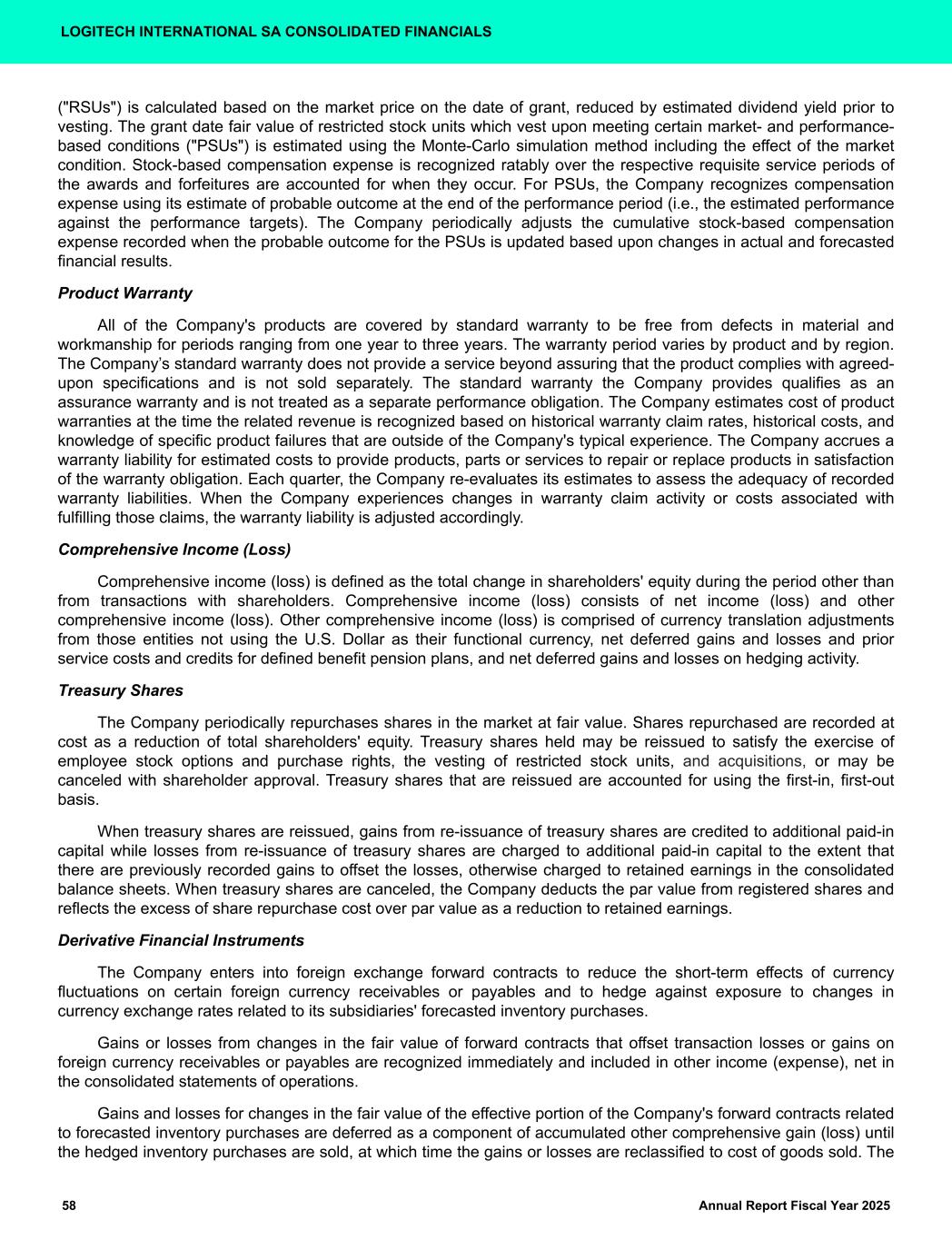
("RSUs") is calculated based on the market price on the date of grant, reduced by estimated dividend yield prior to vesting. The grant date fair value of restricted stock units which vest upon meeting certain market- and performance- based conditions ("PSUs") is estimated using the Monte-Carlo simulation method including the effect of the market condition. Stock-based compensation expense is recognized ratably over the respective requisite service periods of the awards and forfeitures are accounted for when they occur. For PSUs, the Company recognizes compensation expense using its estimate of probable outcome at the end of the performance period (i.e., the estimated performance against the performance targets). The Company periodically adjusts the cumulative stock-based compensation expense recorded when the probable outcome for the PSUs is updated based upon changes in actual and forecasted financial results. Product Warranty All of the Company's products are covered by standard warranty to be free from defects in material and workmanship for periods ranging from one year to three years. The warranty period varies by product and by region. The Company’s standard warranty does not provide a service beyond assuring that the product complies with agreed- upon specifications and is not sold separately. The standard warranty the Company provides qualifies as an assurance warranty and is not treated as a separate performance obligation. The Company estimates cost of product warranties at the time the related revenue is recognized based on historical warranty claim rates, historical costs, and knowledge of specific product failures that are outside of the Company's typical experience. The Company accrues a warranty liability for estimated costs to provide products, parts or services to repair or replace products in satisfaction of the warranty obligation. Each quarter, the Company re-evaluates its estimates to assess the adequacy of recorded warranty liabilities. When the Company experiences changes in warranty claim activity or costs associated with fulfilling those claims, the warranty liability is adjusted accordingly. Comprehensive Income (Loss) Comprehensive income (loss) is defined as the total change in shareholders' equity during the period other than from transactions with shareholders. Comprehensive income (loss) consists of net income (loss) and other comprehensive income (loss). Other comprehensive income (loss) is comprised of currency translation adjustments from those entities not using the U.S. Dollar as their functional currency, net deferred gains and losses and prior service costs and credits for defined benefit pension plans, and net deferred gains and losses on hedging activity. Treasury Shares The Company periodically repurchases shares in the market at fair value. Shares repurchased are recorded at cost as a reduction of total shareholders' equity. Treasury shares held may be reissued to satisfy the exercise of employee stock options and purchase rights, the vesting of restricted stock units, and acquisitions, or may be canceled with shareholder approval. Treasury shares that are reissued are accounted for using the first-in, first-out basis. When treasury shares are reissued, gains from re-issuance of treasury shares are credited to additional paid-in capital while losses from re-issuance of treasury shares are charged to additional paid-in capital to the extent that there are previously recorded gains to offset the losses, otherwise charged to retained earnings in the consolidated balance sheets. When treasury shares are canceled, the Company deducts the par value from registered shares and reflects the excess of share repurchase cost over par value as a reduction to retained earnings. Derivative Financial Instruments The Company enters into foreign exchange forward contracts to reduce the short-term effects of currency fluctuations on certain foreign currency receivables or payables and to hedge against exposure to changes in currency exchange rates related to its subsidiaries' forecasted inventory purchases. Gains or losses from changes in the fair value of forward contracts that offset transaction losses or gains on foreign currency receivables or payables are recognized immediately and included in other income (expense), net in the consolidated statements of operations. Gains and losses for changes in the fair value of the effective portion of the Company's forward contracts related to forecasted inventory purchases are deferred as a component of accumulated other comprehensive gain (loss) until the hedged inventory purchases are sold, at which time the gains or losses are reclassified to cost of goods sold. The LOGITECH INTERNATIONAL SA CONSOLIDATED FINANCIALS 58 Annual Report Fiscal Year 2025
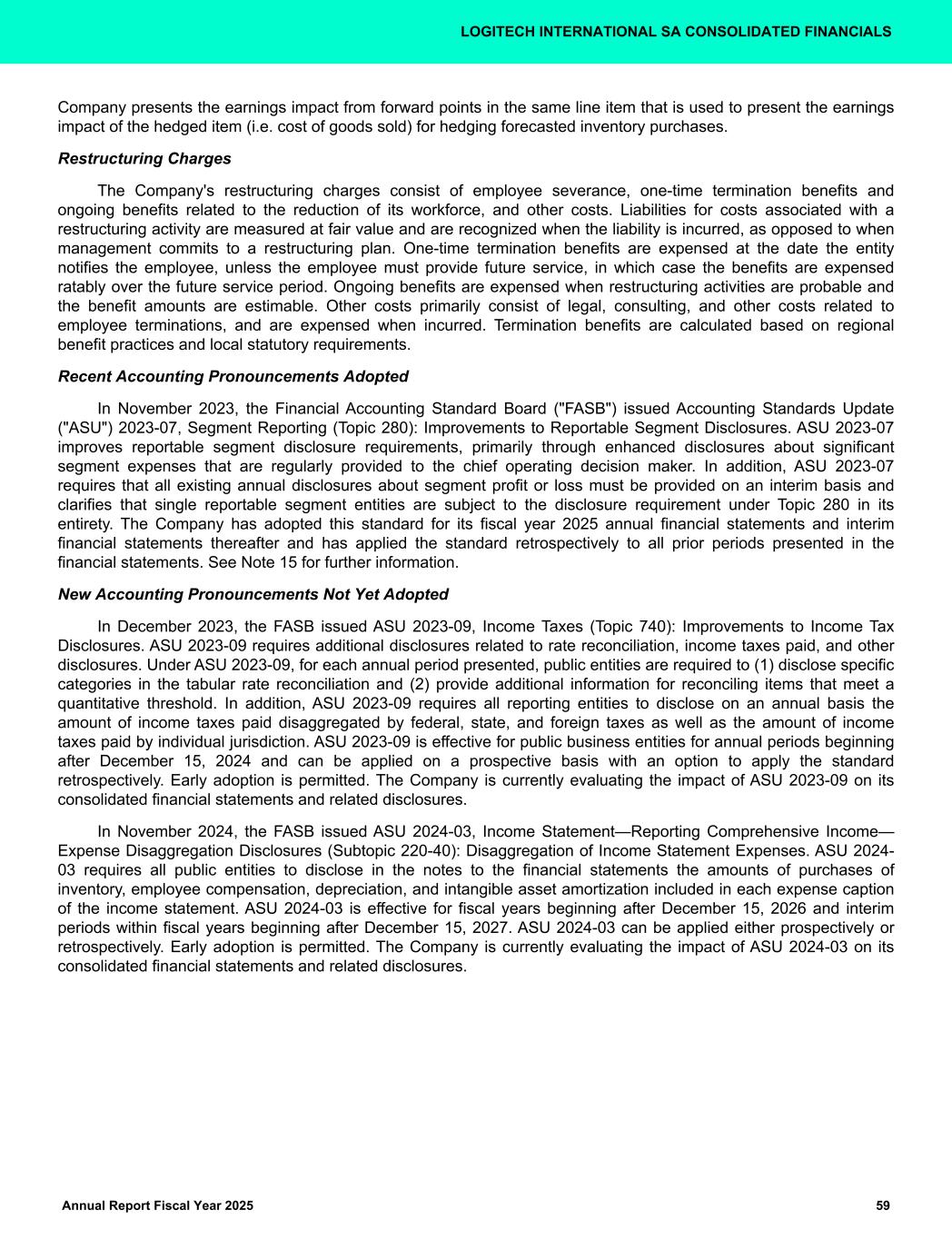
Company presents the earnings impact from forward points in the same line item that is used to present the earnings impact of the hedged item (i.e. cost of goods sold) for hedging forecasted inventory purchases. Restructuring Charges The Company's restructuring charges consist of employee severance, one-time termination benefits and ongoing benefits related to the reduction of its workforce, and other costs. Liabilities for costs associated with a restructuring activity are measured at fair value and are recognized when the liability is incurred, as opposed to when management commits to a restructuring plan. One-time termination benefits are expensed at the date the entity notifies the employee, unless the employee must provide future service, in which case the benefits are expensed ratably over the future service period. Ongoing benefits are expensed when restructuring activities are probable and the benefit amounts are estimable. Other costs primarily consist of legal, consulting, and other costs related to employee terminations, and are expensed when incurred. Termination benefits are calculated based on regional benefit practices and local statutory requirements. Recent Accounting Pronouncements Adopted In November 2023, the Financial Accounting Standard Board ("FASB") issued Accounting Standards Update ("ASU") 2023-07, Segment Reporting (Topic 280): Improvements to Reportable Segment Disclosures. ASU 2023-07 improves reportable segment disclosure requirements, primarily through enhanced disclosures about significant segment expenses that are regularly provided to the chief operating decision maker. In addition, ASU 2023-07 requires that all existing annual disclosures about segment profit or loss must be provided on an interim basis and clarifies that single reportable segment entities are subject to the disclosure requirement under Topic 280 in its entirety. The Company has adopted this standard for its fiscal year 2025 annual financial statements and interim financial statements thereafter and has applied the standard retrospectively to all prior periods presented in the financial statements. See Note 15 for further information. New Accounting Pronouncements Not Yet Adopted In December 2023, the FASB issued ASU 2023-09, Income Taxes (Topic 740): Improvements to Income Tax Disclosures. ASU 2023-09 requires additional disclosures related to rate reconciliation, income taxes paid, and other disclosures. Under ASU 2023-09, for each annual period presented, public entities are required to (1) disclose specific categories in the tabular rate reconciliation and (2) provide additional information for reconciling items that meet a quantitative threshold. In addition, ASU 2023-09 requires all reporting entities to disclose on an annual basis the amount of income taxes paid disaggregated by federal, state, and foreign taxes as well as the amount of income taxes paid by individual jurisdiction. ASU 2023-09 is effective for public business entities for annual periods beginning after December 15, 2024 and can be applied on a prospective basis with an option to apply the standard retrospectively. Early adoption is permitted. The Company is currently evaluating the impact of ASU 2023-09 on its consolidated financial statements and related disclosures. In November 2024, the FASB issued ASU 2024-03, Income Statement—Reporting Comprehensive Income— Expense Disaggregation Disclosures (Subtopic 220-40): Disaggregation of Income Statement Expenses. ASU 2024- 03 requires all public entities to disclose in the notes to the financial statements the amounts of purchases of inventory, employee compensation, depreciation, and intangible asset amortization included in each expense caption of the income statement. ASU 2024-03 is effective for fiscal years beginning after December 15, 2026 and interim periods within fiscal years beginning after December 15, 2027. ASU 2024-03 can be applied either prospectively or retrospectively. Early adoption is permitted. The Company is currently evaluating the impact of ASU 2024-03 on its consolidated financial statements and related disclosures. LOGITECH INTERNATIONAL SA CONSOLIDATED FINANCIALS Annual Report Fiscal Year 2025 59
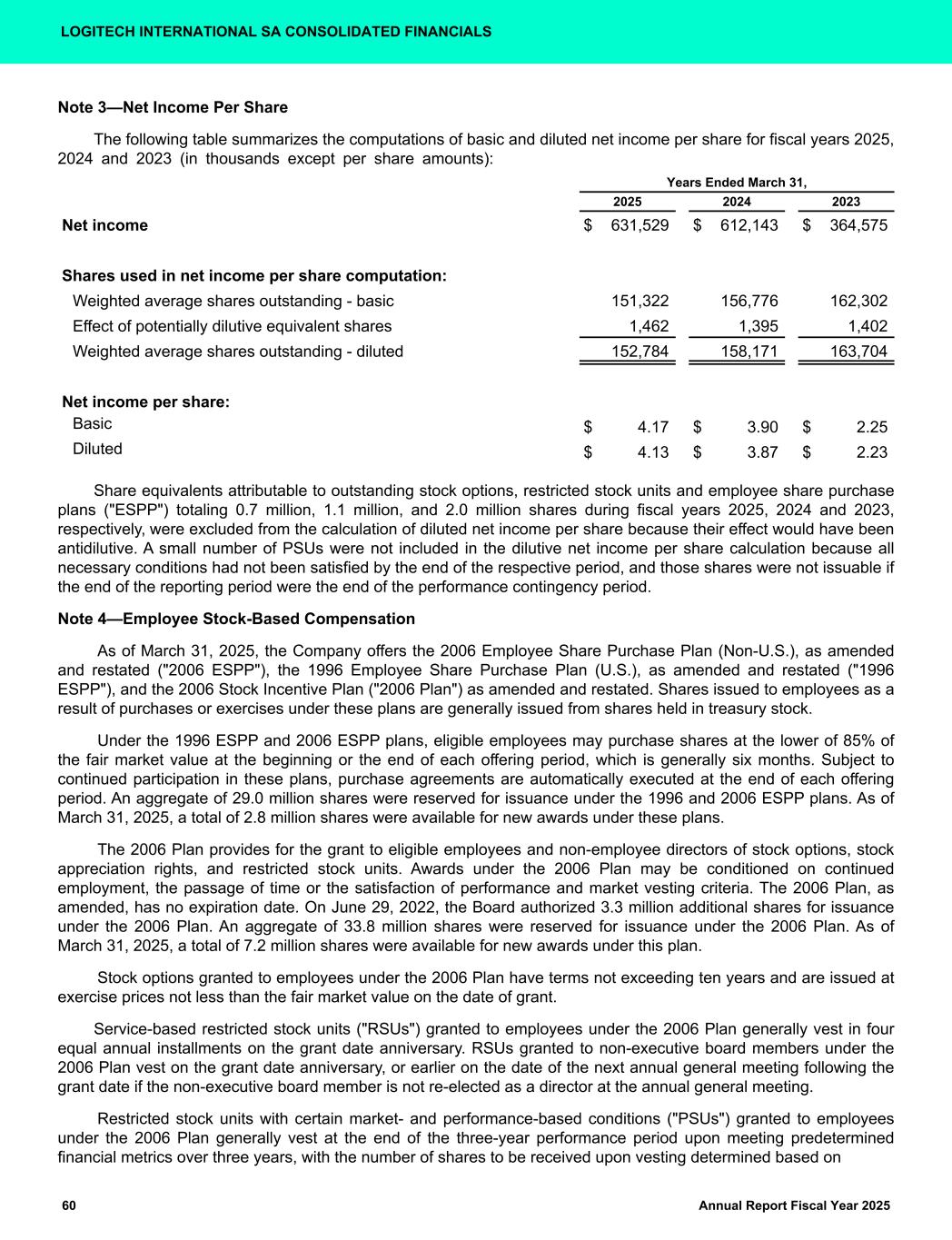
Note 3—Net Income Per Share The following table summarizes the computations of basic and diluted net income per share for fiscal years 2025, 2024 and 2023 (in thousands except per share amounts): Years Ended March 31, 2025 2024 2023 Net income $ 631,529 $ 612,143 $ 364,575 Shares used in net income per share computation: Weighted average shares outstanding - basic 151,322 156,776 162,302 Effect of potentially dilutive equivalent shares 1,462 1,395 1,402 Weighted average shares outstanding - diluted 152,784 158,171 163,704 Net income per share: Basic $ 4.17 $ 3.90 $ 2.25 Diluted $ 4.13 $ 3.87 $ 2.23 Share equivalents attributable to outstanding stock options, restricted stock units and employee share purchase plans ("ESPP") totaling 0.7 million, 1.1 million, and 2.0 million shares during fiscal years 2025, 2024 and 2023, respectively, were excluded from the calculation of diluted net income per share because their effect would have been antidilutive. A small number of PSUs were not included in the dilutive net income per share calculation because all necessary conditions had not been satisfied by the end of the respective period, and those shares were not issuable if the end of the reporting period were the end of the performance contingency period. Note 4—Employee Stock-Based Compensation As of March 31, 2025, the Company offers the 2006 Employee Share Purchase Plan (Non-U.S.), as amended and restated ("2006 ESPP"), the 1996 Employee Share Purchase Plan (U.S.), as amended and restated ("1996 ESPP"), and the 2006 Stock Incentive Plan ("2006 Plan") as amended and restated. Shares issued to employees as a result of purchases or exercises under these plans are generally issued from shares held in treasury stock. Under the 1996 ESPP and 2006 ESPP plans, eligible employees may purchase shares at the lower of 85% of the fair market value at the beginning or the end of each offering period, which is generally six months. Subject to continued participation in these plans, purchase agreements are automatically executed at the end of each offering period. An aggregate of 29.0 million shares were reserved for issuance under the 1996 and 2006 ESPP plans. As of March 31, 2025, a total of 2.8 million shares were available for new awards under these plans. The 2006 Plan provides for the grant to eligible employees and non-employee directors of stock options, stock appreciation rights, and restricted stock units. Awards under the 2006 Plan may be conditioned on continued employment, the passage of time or the satisfaction of performance and market vesting criteria. The 2006 Plan, as amended, has no expiration date. On June 29, 2022, the Board authorized 3.3 million additional shares for issuance under the 2006 Plan. An aggregate of 33.8 million shares were reserved for issuance under the 2006 Plan. As of March 31, 2025, a total of 7.2 million shares were available for new awards under this plan. Stock options granted to employees under the 2006 Plan have terms not exceeding ten years and are issued at exercise prices not less than the fair market value on the date of grant. Service-based restricted stock units ("RSUs") granted to employees under the 2006 Plan generally vest in four equal annual installments on the grant date anniversary. RSUs granted to non-executive board members under the 2006 Plan vest on the grant date anniversary, or earlier on the date of the next annual general meeting following the grant date if the non-executive board member is not re-elected as a director at the annual general meeting. Restricted stock units with certain market- and performance-based conditions ("PSUs") granted to employees under the 2006 Plan generally vest at the end of the three-year performance period upon meeting predetermined financial metrics over three years, with the number of shares to be received upon vesting determined based on LOGITECH INTERNATIONAL SA CONSOLIDATED FINANCIALS 60 Annual Report Fiscal Year 2025
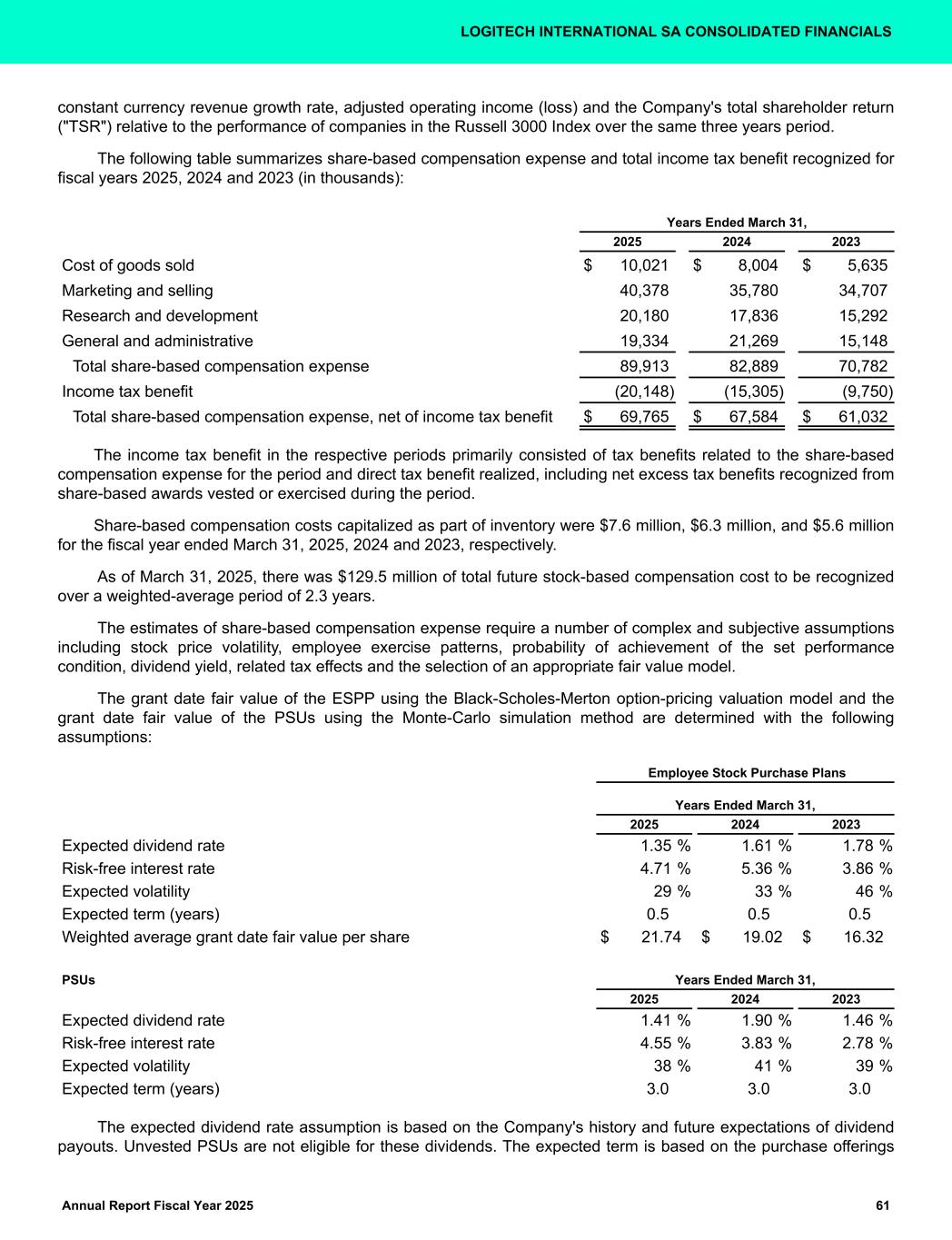
constant currency revenue growth rate, adjusted operating income (loss) and the Company's total shareholder return ("TSR") relative to the performance of companies in the Russell 3000 Index over the same three years period. The following table summarizes share-based compensation expense and total income tax benefit recognized for fiscal years 2025, 2024 and 2023 (in thousands): Years Ended March 31, 2025 2024 2023 Cost of goods sold $ 10,021 $ 8,004 $ 5,635 Marketing and selling 40,378 35,780 34,707 Research and development 20,180 17,836 15,292 General and administrative 19,334 21,269 15,148 Total share-based compensation expense 89,913 82,889 70,782 Income tax benefit (20,148) (15,305) (9,750) Total share-based compensation expense, net of income tax benefit $ 69,765 $ 67,584 $ 61,032 The income tax benefit in the respective periods primarily consisted of tax benefits related to the share-based compensation expense for the period and direct tax benefit realized, including net excess tax benefits recognized from share-based awards vested or exercised during the period. Share-based compensation costs capitalized as part of inventory were $7.6 million, $6.3 million, and $5.6 million for the fiscal year ended March 31, 2025, 2024 and 2023, respectively. As of March 31, 2025, there was $129.5 million of total future stock-based compensation cost to be recognized over a weighted-average period of 2.3 years. The estimates of share-based compensation expense require a number of complex and subjective assumptions including stock price volatility, employee exercise patterns, probability of achievement of the set performance condition, dividend yield, related tax effects and the selection of an appropriate fair value model. The grant date fair value of the ESPP using the Black-Scholes-Merton option-pricing valuation model and the grant date fair value of the PSUs using the Monte-Carlo simulation method are determined with the following assumptions: Employee Stock Purchase Plans Years Ended March 31, 2025 2024 2023 Expected dividend rate 1.35 % 1.61 % 1.78 % Risk-free interest rate 4.71 % 5.36 % 3.86 % Expected volatility 29 % 33 % 46 % Expected term (years) 0.5 0.5 0.5 Weighted average grant date fair value per share $ 21.74 $ 19.02 $ 16.32 PSUs Years Ended March 31, 2025 2024 2023 Expected dividend rate 1.41 % 1.90 % 1.46 % Risk-free interest rate 4.55 % 3.83 % 2.78 % Expected volatility 38 % 41 % 39 % Expected term (years) 3.0 3.0 3.0 The expected dividend rate assumption is based on the Company's history and future expectations of dividend payouts. Unvested PSUs are not eligible for these dividends. The expected term is based on the purchase offerings LOGITECH INTERNATIONAL SA CONSOLIDATED FINANCIALS Annual Report Fiscal Year 2025 61
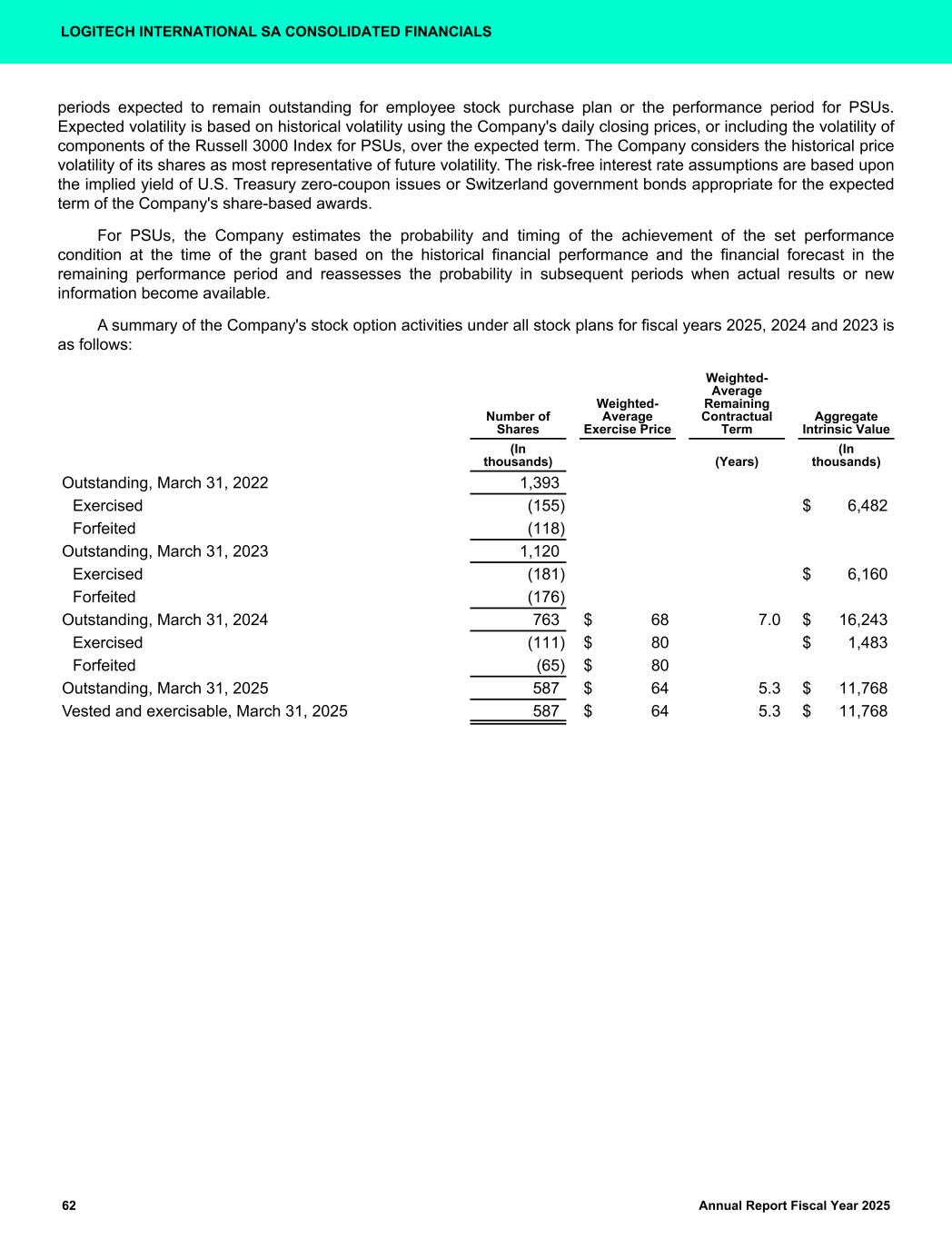
periods expected to remain outstanding for employee stock purchase plan or the performance period for PSUs. Expected volatility is based on historical volatility using the Company's daily closing prices, or including the volatility of components of the Russell 3000 Index for PSUs, over the expected term. The Company considers the historical price volatility of its shares as most representative of future volatility. The risk-free interest rate assumptions are based upon the implied yield of U.S. Treasury zero-coupon issues or Switzerland government bonds appropriate for the expected term of the Company's share-based awards. For PSUs, the Company estimates the probability and timing of the achievement of the set performance condition at the time of the grant based on the historical financial performance and the financial forecast in the remaining performance period and reassesses the probability in subsequent periods when actual results or new information become available. A summary of the Company's stock option activities under all stock plans for fiscal years 2025, 2024 and 2023 is as follows: Number of Shares Weighted- Average Exercise Price Weighted- Average Remaining Contractual Term Aggregate Intrinsic Value (In thousands) (Years) (In thousands) Outstanding, March 31, 2022 1,393 Exercised (155) $ 6,482 Forfeited (118) Outstanding, March 31, 2023 1,120 Exercised (181) $ 6,160 Forfeited (176) Outstanding, March 31, 2024 763 $ 68 7.0 $ 16,243 Exercised (111) $ 80 $ 1,483 Forfeited (65) $ 80 Outstanding, March 31, 2025 587 $ 64 5.3 $ 11,768 Vested and exercisable, March 31, 2025 587 $ 64 5.3 $ 11,768 LOGITECH INTERNATIONAL SA CONSOLIDATED FINANCIALS 62 Annual Report Fiscal Year 2025
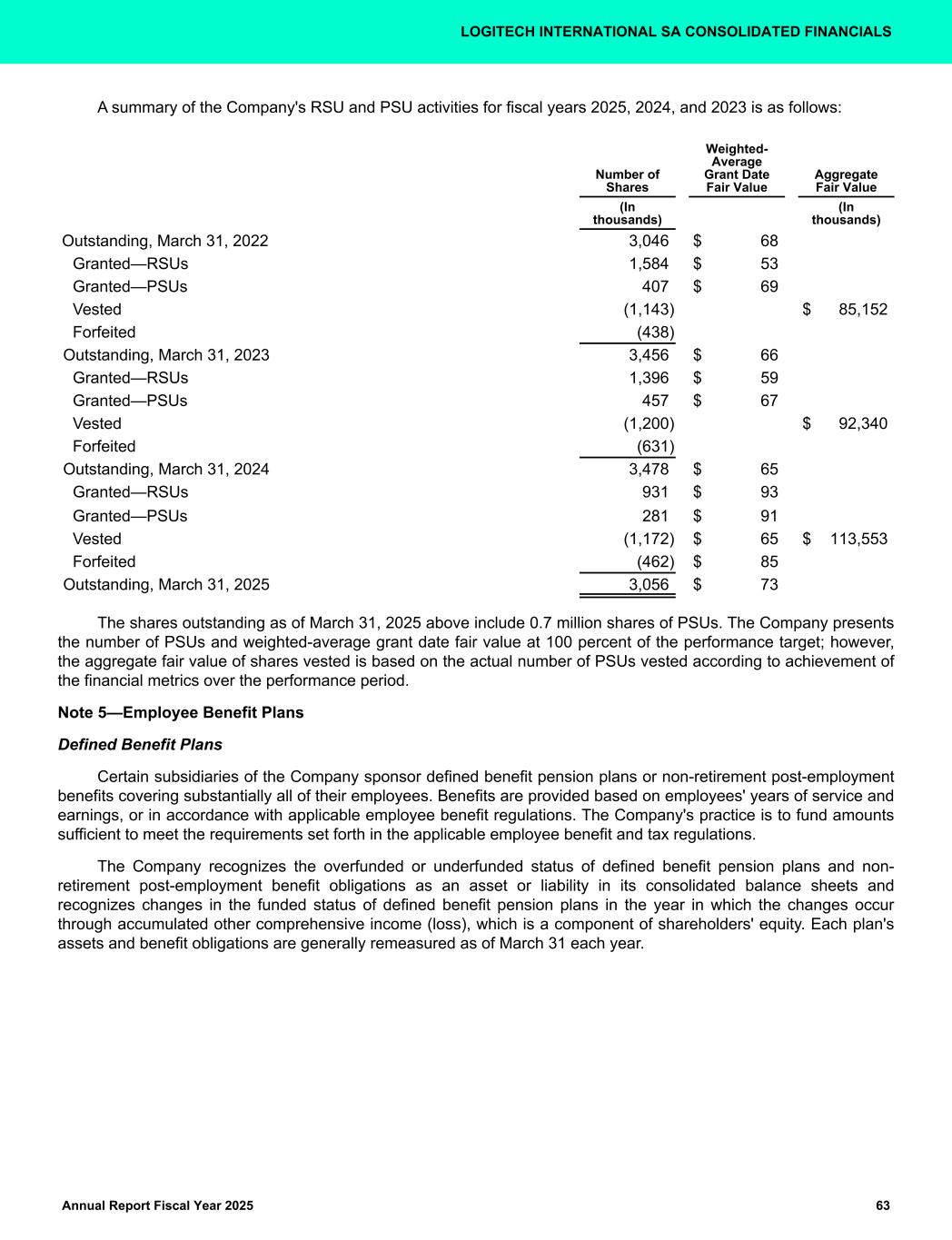
A summary of the Company's RSU and PSU activities for fiscal years 2025, 2024, and 2023 is as follows: Number of Shares Weighted- Average Grant Date Fair Value Aggregate Fair Value (In thousands) (In thousands) Outstanding, March 31, 2022 3,046 $ 68 Granted—RSUs 1,584 $ 53 Granted—PSUs 407 $ 69 Vested (1,143) $ 85,152 Forfeited (438) Outstanding, March 31, 2023 3,456 $ 66 Granted—RSUs 1,396 $ 59 Granted—PSUs 457 $ 67 Vested (1,200) $ 92,340 Forfeited (631) Outstanding, March 31, 2024 3,478 $ 65 Granted—RSUs 931 $ 93 Granted—PSUs 281 $ 91 Vested (1,172) $ 65 $ 113,553 Forfeited (462) $ 85 Outstanding, March 31, 2025 3,056 $ 73 The shares outstanding as of March 31, 2025 above include 0.7 million shares of PSUs. The Company presents the number of PSUs and weighted-average grant date fair value at 100 percent of the performance target; however, the aggregate fair value of shares vested is based on the actual number of PSUs vested according to achievement of the financial metrics over the performance period. Note 5—Employee Benefit Plans Defined Benefit Plans Certain subsidiaries of the Company sponsor defined benefit pension plans or non-retirement post-employment benefits covering substantially all of their employees. Benefits are provided based on employees' years of service and earnings, or in accordance with applicable employee benefit regulations. The Company's practice is to fund amounts sufficient to meet the requirements set forth in the applicable employee benefit and tax regulations. The Company recognizes the overfunded or underfunded status of defined benefit pension plans and non- retirement post-employment benefit obligations as an asset or liability in its consolidated balance sheets and recognizes changes in the funded status of defined benefit pension plans in the year in which the changes occur through accumulated other comprehensive income (loss), which is a component of shareholders' equity. Each plan's assets and benefit obligations are generally remeasured as of March 31 each year. LOGITECH INTERNATIONAL SA CONSOLIDATED FINANCIALS Annual Report Fiscal Year 2025 63
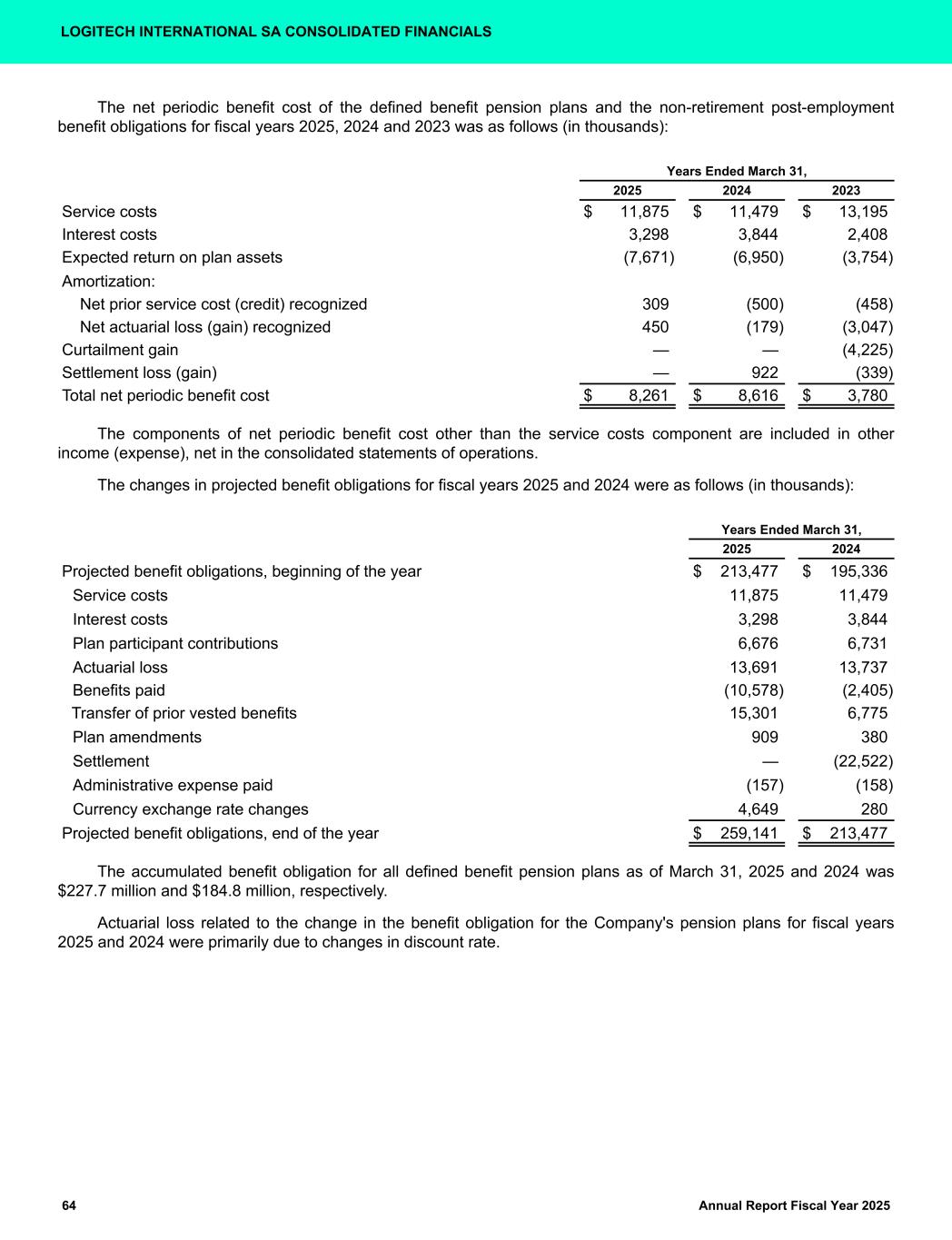
The net periodic benefit cost of the defined benefit pension plans and the non-retirement post-employment benefit obligations for fiscal years 2025, 2024 and 2023 was as follows (in thousands): Years Ended March 31, 2025 2024 2023 Service costs $ 11,875 $ 11,479 $ 13,195 Interest costs 3,298 3,844 2,408 Expected return on plan assets (7,671) (6,950) (3,754) Amortization: Net prior service cost (credit) recognized 309 (500) (458) Net actuarial loss (gain) recognized 450 (179) (3,047) Curtailment gain — — (4,225) Settlement loss (gain) — 922 (339) Total net periodic benefit cost $ 8,261 $ 8,616 $ 3,780 The components of net periodic benefit cost other than the service costs component are included in other income (expense), net in the consolidated statements of operations. The changes in projected benefit obligations for fiscal years 2025 and 2024 were as follows (in thousands): Years Ended March 31, 2025 2024 Projected benefit obligations, beginning of the year $ 213,477 $ 195,336 Service costs 11,875 11,479 Interest costs 3,298 3,844 Plan participant contributions 6,676 6,731 Actuarial loss 13,691 13,737 Benefits paid (10,578) (2,405) Transfer of prior vested benefits 15,301 6,775 Plan amendments 909 380 Settlement — (22,522) Administrative expense paid (157) (158) Currency exchange rate changes 4,649 280 Projected benefit obligations, end of the year $ 259,141 $ 213,477 The accumulated benefit obligation for all defined benefit pension plans as of March 31, 2025 and 2024 was $227.7 million and $184.8 million, respectively. Actuarial loss related to the change in the benefit obligation for the Company's pension plans for fiscal years 2025 and 2024 were primarily due to changes in discount rate. LOGITECH INTERNATIONAL SA CONSOLIDATED FINANCIALS 64 Annual Report Fiscal Year 2025
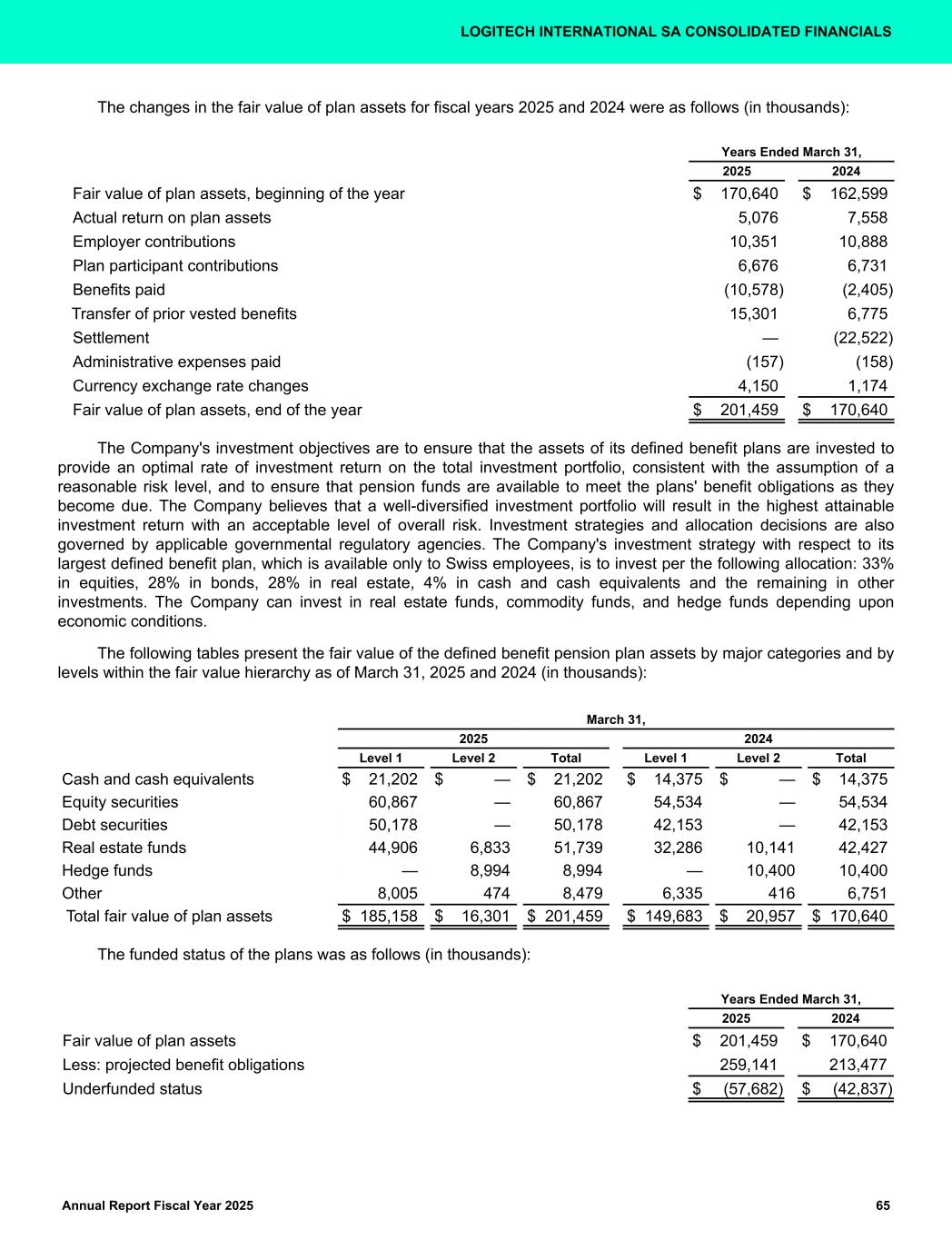
The changes in the fair value of plan assets for fiscal years 2025 and 2024 were as follows (in thousands): Years Ended March 31, 2025 2024 Fair value of plan assets, beginning of the year $ 170,640 $ 162,599 Actual return on plan assets 5,076 7,558 Employer contributions 10,351 10,888 Plan participant contributions 6,676 6,731 Benefits paid (10,578) (2,405) Transfer of prior vested benefits 15,301 6,775 Settlement — (22,522) Administrative expenses paid (157) (158) Currency exchange rate changes 4,150 1,174 Fair value of plan assets, end of the year $ 201,459 $ 170,640 The Company's investment objectives are to ensure that the assets of its defined benefit plans are invested to provide an optimal rate of investment return on the total investment portfolio, consistent with the assumption of a reasonable risk level, and to ensure that pension funds are available to meet the plans' benefit obligations as they become due. The Company believes that a well-diversified investment portfolio will result in the highest attainable investment return with an acceptable level of overall risk. Investment strategies and allocation decisions are also governed by applicable governmental regulatory agencies. The Company's investment strategy with respect to its largest defined benefit plan, which is available only to Swiss employees, is to invest per the following allocation: 33% in equities, 28% in bonds, 28% in real estate, 4% in cash and cash equivalents and the remaining in other investments. The Company can invest in real estate funds, commodity funds, and hedge funds depending upon economic conditions. The following tables present the fair value of the defined benefit pension plan assets by major categories and by levels within the fair value hierarchy as of March 31, 2025 and 2024 (in thousands): March 31, 2025 2024 Level 1 Level 2 Total Level 1 Level 2 Total Cash and cash equivalents $ 21,202 $ — $ 21,202 $ 14,375 $ — $ 14,375 Equity securities 60,867 — 60,867 54,534 — 54,534 Debt securities 50,178 — 50,178 42,153 — 42,153 Real estate funds 44,906 6,833 51,739 32,286 10,141 42,427 Hedge funds — 8,994 8,994 — 10,400 10,400 Other 8,005 474 8,479 6,335 416 6,751 Total fair value of plan assets $ 185,158 $ 16,301 $ 201,459 $ 149,683 $ 20,957 $ 170,640 The funded status of the plans was as follows (in thousands): Years Ended March 31, 2025 2024 Fair value of plan assets $ 201,459 $ 170,640 Less: projected benefit obligations 259,141 213,477 Underfunded status $ (57,682) $ (42,837) LOGITECH INTERNATIONAL SA CONSOLIDATED FINANCIALS Annual Report Fiscal Year 2025 65
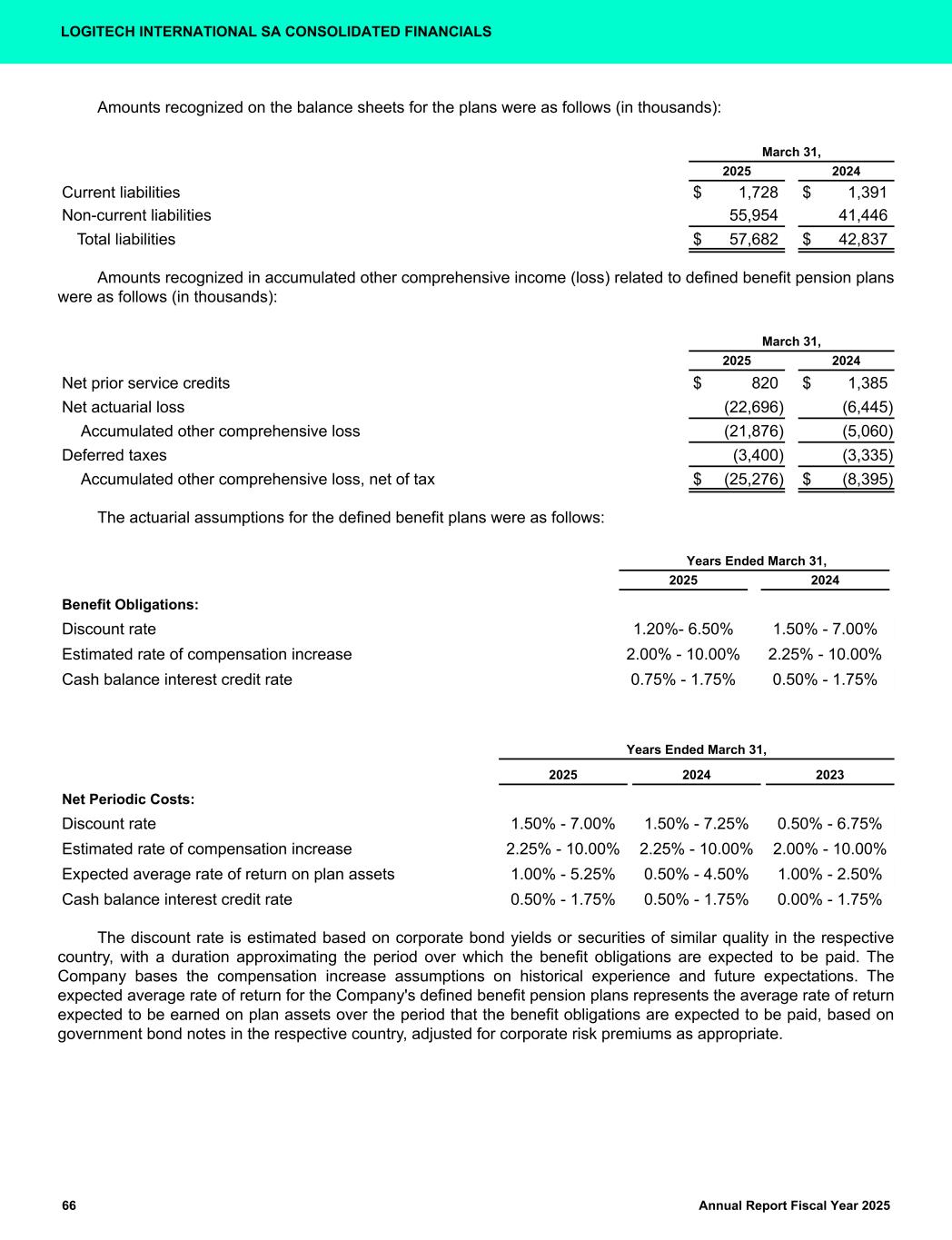
Amounts recognized on the balance sheets for the plans were as follows (in thousands): March 31, 2025 2024 Current liabilities $ 1,728 $ 1,391 Non-current liabilities 55,954 41,446 Total liabilities $ 57,682 $ 42,837 Amounts recognized in accumulated other comprehensive income (loss) related to defined benefit pension plans were as follows (in thousands): March 31, 2025 2024 Net prior service credits $ 820 $ 1,385 Net actuarial loss (22,696) (6,445) Accumulated other comprehensive loss (21,876) (5,060) Deferred taxes (3,400) (3,335) Accumulated other comprehensive loss, net of tax $ (25,276) $ (8,395) The actuarial assumptions for the defined benefit plans were as follows: Years Ended March 31, 2025 2024 Benefit Obligations: Discount rate 1.20%- 6.50% 1.50% - 7.00% Estimated rate of compensation increase 2.00% - 10.00% 2.25% - 10.00% Cash balance interest credit rate 0.75% - 1.75% 0.50% - 1.75% Years Ended March 31, 2025 2024 2023 Net Periodic Costs: Discount rate 1.50% - 7.00% 1.50% - 7.25% 0.50% - 6.75% Estimated rate of compensation increase 2.25% - 10.00% 2.25% - 10.00% 2.00% - 10.00% Expected average rate of return on plan assets 1.00% - 5.25% 0.50% - 4.50% 1.00% - 2.50% Cash balance interest credit rate 0.50% - 1.75% 0.50% - 1.75% 0.00% - 1.75% The discount rate is estimated based on corporate bond yields or securities of similar quality in the respective country, with a duration approximating the period over which the benefit obligations are expected to be paid. The Company bases the compensation increase assumptions on historical experience and future expectations. The expected average rate of return for the Company's defined benefit pension plans represents the average rate of return expected to be earned on plan assets over the period that the benefit obligations are expected to be paid, based on government bond notes in the respective country, adjusted for corporate risk premiums as appropriate. LOGITECH INTERNATIONAL SA CONSOLIDATED FINANCIALS 66 Annual Report Fiscal Year 2025
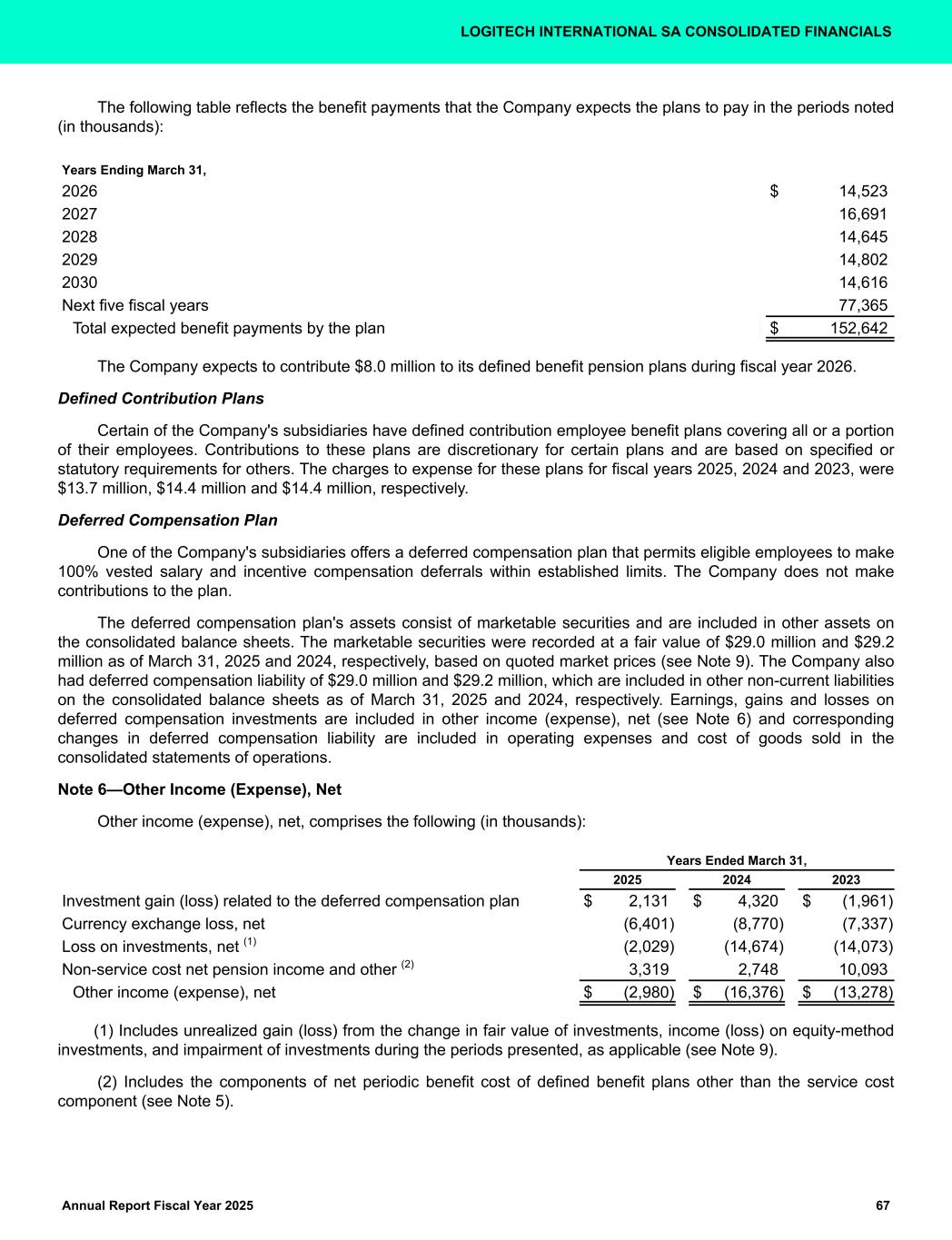
The following table reflects the benefit payments that the Company expects the plans to pay in the periods noted (in thousands): Years Ending March 31, 2026 $ 14,523 2027 16,691 2028 14,645 2029 14,802 2030 14,616 Next five fiscal years 77,365 Total expected benefit payments by the plan $ 152,642 The Company expects to contribute $8.0 million to its defined benefit pension plans during fiscal year 2026. Defined Contribution Plans Certain of the Company's subsidiaries have defined contribution employee benefit plans covering all or a portion of their employees. Contributions to these plans are discretionary for certain plans and are based on specified or statutory requirements for others. The charges to expense for these plans for fiscal years 2025, 2024 and 2023, were $13.7 million, $14.4 million and $14.4 million, respectively. Deferred Compensation Plan One of the Company's subsidiaries offers a deferred compensation plan that permits eligible employees to make 100% vested salary and incentive compensation deferrals within established limits. The Company does not make contributions to the plan. The deferred compensation plan's assets consist of marketable securities and are included in other assets on the consolidated balance sheets. The marketable securities were recorded at a fair value of $29.0 million and $29.2 million as of March 31, 2025 and 2024, respectively, based on quoted market prices (see Note 9). The Company also had deferred compensation liability of $29.0 million and $29.2 million, which are included in other non-current liabilities on the consolidated balance sheets as of March 31, 2025 and 2024, respectively. Earnings, gains and losses on deferred compensation investments are included in other income (expense), net (see Note 6) and corresponding changes in deferred compensation liability are included in operating expenses and cost of goods sold in the consolidated statements of operations. Note 6—Other Income (Expense), Net Other income (expense), net, comprises the following (in thousands): Years Ended March 31, 2025 2024 2023 Investment gain (loss) related to the deferred compensation plan $ 2,131 $ 4,320 $ (1,961) Currency exchange loss, net (6,401) (8,770) (7,337) Loss on investments, net (1) (2,029) (14,674) (14,073) Non-service cost net pension income and other (2) 3,319 2,748 10,093 Other income (expense), net $ (2,980) $ (16,376) $ (13,278) (1) Includes unrealized gain (loss) from the change in fair value of investments, income (loss) on equity-method investments, and impairment of investments during the periods presented, as applicable (see Note 9). (2) Includes the components of net periodic benefit cost of defined benefit plans other than the service cost component (see Note 5). LOGITECH INTERNATIONAL SA CONSOLIDATED FINANCIALS Annual Report Fiscal Year 2025 67
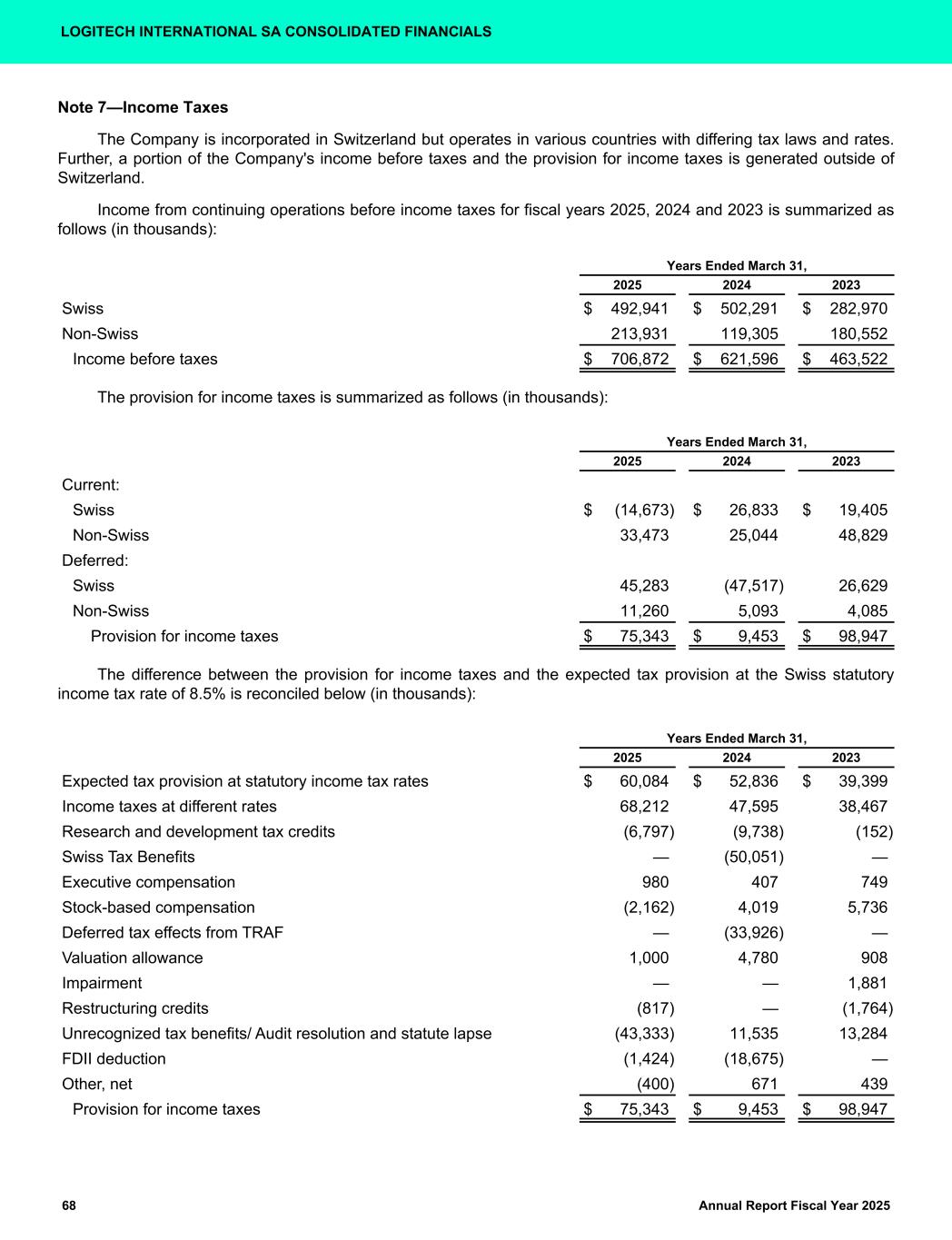
Note 7—Income Taxes The Company is incorporated in Switzerland but operates in various countries with differing tax laws and rates. Further, a portion of the Company's income before taxes and the provision for income taxes is generated outside of Switzerland. Income from continuing operations before income taxes for fiscal years 2025, 2024 and 2023 is summarized as follows (in thousands): Years Ended March 31, 2025 2024 2023 Swiss $ 492,941 $ 502,291 $ 282,970 Non-Swiss 213,931 119,305 180,552 Income before taxes $ 706,872 $ 621,596 $ 463,522 The provision for income taxes is summarized as follows (in thousands): Years Ended March 31, 2025 2024 2023 Current: Swiss $ (14,673) $ 26,833 $ 19,405 Non-Swiss 33,473 25,044 48,829 Deferred: Swiss 45,283 (47,517) 26,629 Non-Swiss 11,260 5,093 4,085 Provision for income taxes $ 75,343 $ 9,453 $ 98,947 The difference between the provision for income taxes and the expected tax provision at the Swiss statutory income tax rate of 8.5% is reconciled below (in thousands): Years Ended March 31, 2025 2024 2023 Expected tax provision at statutory income tax rates $ 60,084 $ 52,836 $ 39,399 Income taxes at different rates 68,212 47,595 38,467 Research and development tax credits (6,797) (9,738) (152) Swiss Tax Benefits — (50,051) — Executive compensation 980 407 749 Stock-based compensation (2,162) 4,019 5,736 Deferred tax effects from TRAF — (33,926) — Valuation allowance 1,000 4,780 908 Impairment — — 1,881 Restructuring credits (817) — (1,764) Unrecognized tax benefits/ Audit resolution and statute lapse (43,333) 11,535 13,284 FDII deduction (1,424) (18,675) — Other, net (400) 671 439 Provision for income taxes $ 75,343 $ 9,453 $ 98,947 LOGITECH INTERNATIONAL SA CONSOLIDATED FINANCIALS 68 Annual Report Fiscal Year 2025
The effective income tax rate in 2025 includes the tax effect of audit resolutions and the expiration of statutes of limitation of uncertain tax positions totaling $53.3 million, offset by the increase to unrecognized tax benefits in 2025 of $10.0 million. The effective tax rate in 2024 includes the discrete tax benefits recognized in fiscal year 2024 for the benefit of future Swiss tax deductions, the remeasurement of the tax basis of goodwill under TRAF (as defined below), FDII (as defined below) incentive provided by the Tax Cuts and Jobs Act and remeasurement of our Swiss deferred tax assets due to a change in tax rate. On March 28, 2024, the Swiss canton of Vaud confirmed a future tax benefit to be recognized for ten years. This resulted in the Company recording an income tax benefit of $50.1 million during the fiscal year ended March 31, 2024, which will be utilized over a ten-year period. The canton of Vaud completed the legislative process to enact the Swiss Federal Act on Tax Reform and AHV Financing (“TRAF”), a reform to better align the Swiss tax system to international tax standards on March 20, 2020 that took effect as of January 1, 2020. In March 2020, the Company increased the tax basis of goodwill, as a transition measure under TRAF, to be amortized over ten years beginning on January 1, 2020. During the fiscal year ended March 31, 2024, the Company remeasured the tax basis of goodwill under TRAF, which resulted in an income tax benefit of $25.1 million, net of assessment for uncertain tax positions. The remeasurement of the step-up will be amortized over the remaining ten-year amortization period. The Tax Cuts and Jobs Act enacted Section 250, which provides for a deduction with respect to Global Intangible Low-Taxed Income ("GILTI") and Foreign-Derived Intangible Income ("FDII") in the US. The application of this tax incentive is inherently complex. During the fiscal year ended March 31, 2024, the Company analyzed the applicability of FDII and determined that this tax incentive applies to fiscal years 2021, 2022 and 2023. As a result, the Company realized a tax benefit of $18.7 million related to FDII. The Company has also concluded that any GILTI tax since the enactment of Tax Cuts and Jobs Act is immaterial. On December 29, 2023, a change to the cantonal tax legislation was published. According to the law approved by the Vaud parliament, a progressive scale will be applicable for cantonal tax purposes resulting in an increase from the then current tax rate of 13.61% to 14.28% effective fiscal year 2025. The increase in tax rate resulted in a tax benefit of $5.1 million due to a remeasurement of the Company's Swiss deferred tax assets in the fiscal year ended March 31, 2024. The Base Erosion and Profit Shifting Project (the “BEPS Project”) undertaken by the Organization for Economic Co-operation and Development (the “OECD”) recommended changes to numerous long-standing tax principles, including a proposal to reallocate profits among tax jurisdictions in which companies do business (“Pillar One”) and establishing a minimum tax on global income (“Pillar Two”). For the year ended March 31, 2025, the Company assessed its exposure to the OECD Pillar Two global minimum tax rules. The Company has determined that, for the fiscal year 2025, certain jurisdictions in which it operates should qualify for the transitional Country-by-Country Reporting ("CbCR") safe harbor, as outlined in the OECD Administrative Guidance and enacted domestic legislation. The Company's CbCR has been prepared in accordance with the requirements for a Qualified CbCR, using qualified financial statements, and has been reviewed to ensure accuracy and completeness. Based on this data, the Company met safe harbor qualifications and therefore is not required to perform a detailed Pillar Two top-up tax calculation for the current reporting period. No Pillar Two top-up tax expense has been recognized in the year ended March 31, 2025. The OECD and participating countries continue to issue underlying rules and administrative guidance related to Pillar Two, and the Company continues to monitor the relevant developments. LOGITECH INTERNATIONAL SA CONSOLIDATED FINANCIALS Annual Report Fiscal Year 2025 69
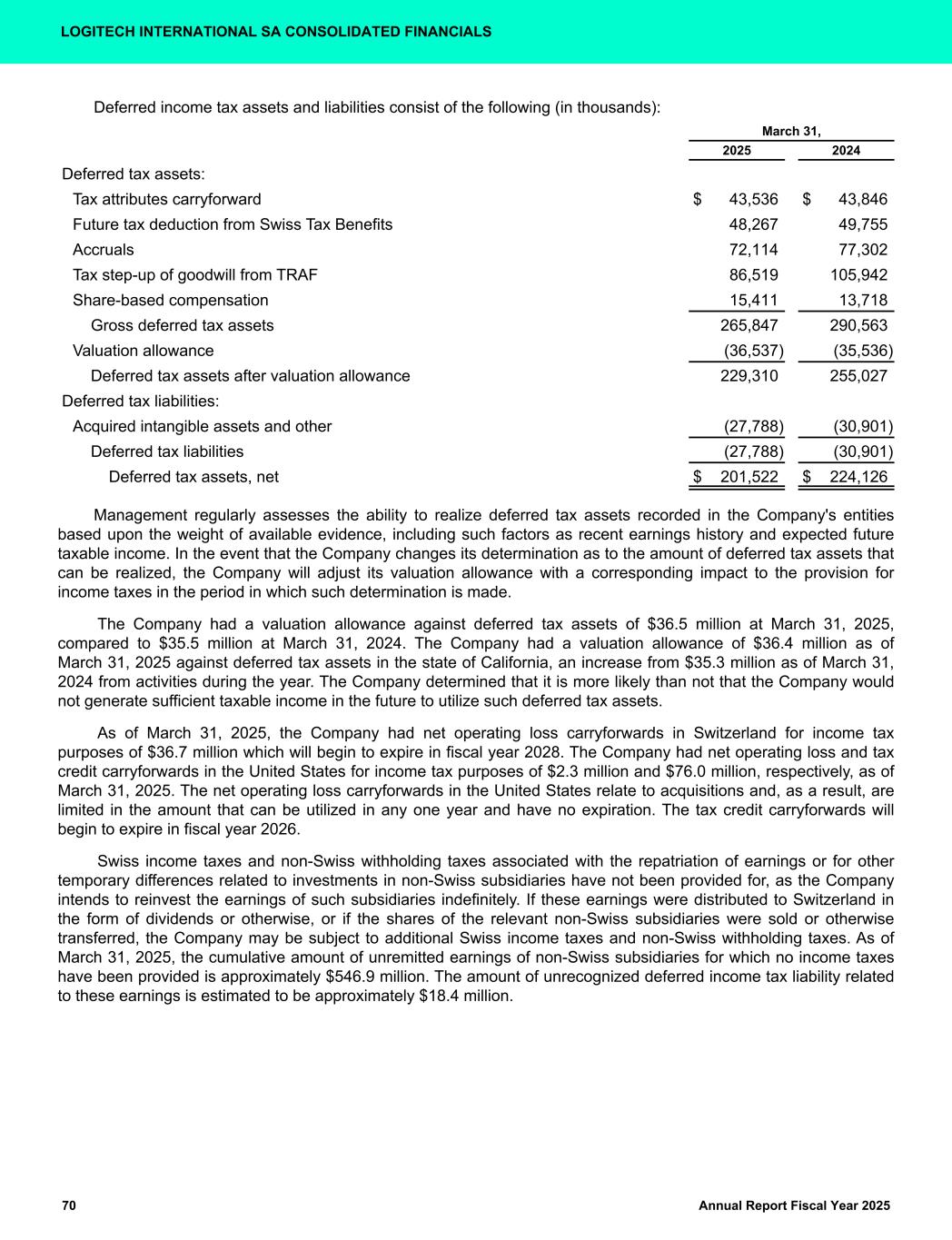
Deferred income tax assets and liabilities consist of the following (in thousands): March 31, 2025 2024 Deferred tax assets: Tax attributes carryforward $ 43,536 $ 43,846 Future tax deduction from Swiss Tax Benefits 48,267 49,755 Accruals 72,114 77,302 Tax step-up of goodwill from TRAF 86,519 105,942 Share-based compensation 15,411 13,718 Gross deferred tax assets 265,847 290,563 Valuation allowance (36,537) (35,536) Deferred tax assets after valuation allowance 229,310 255,027 Deferred tax liabilities: Acquired intangible assets and other (27,788) (30,901) Deferred tax liabilities (27,788) (30,901) Deferred tax assets, net $ 201,522 $ 224,126 Management regularly assesses the ability to realize deferred tax assets recorded in the Company's entities based upon the weight of available evidence, including such factors as recent earnings history and expected future taxable income. In the event that the Company changes its determination as to the amount of deferred tax assets that can be realized, the Company will adjust its valuation allowance with a corresponding impact to the provision for income taxes in the period in which such determination is made. The Company had a valuation allowance against deferred tax assets of $36.5 million at March 31, 2025, compared to $35.5 million at March 31, 2024. The Company had a valuation allowance of $36.4 million as of March 31, 2025 against deferred tax assets in the state of California, an increase from $35.3 million as of March 31, 2024 from activities during the year. The Company determined that it is more likely than not that the Company would not generate sufficient taxable income in the future to utilize such deferred tax assets. As of March 31, 2025, the Company had net operating loss carryforwards in Switzerland for income tax purposes of $36.7 million which will begin to expire in fiscal year 2028. The Company had net operating loss and tax credit carryforwards in the United States for income tax purposes of $2.3 million and $76.0 million, respectively, as of March 31, 2025. The net operating loss carryforwards in the United States relate to acquisitions and, as a result, are limited in the amount that can be utilized in any one year and have no expiration. The tax credit carryforwards will begin to expire in fiscal year 2026. Swiss income taxes and non-Swiss withholding taxes associated with the repatriation of earnings or for other temporary differences related to investments in non-Swiss subsidiaries have not been provided for, as the Company intends to reinvest the earnings of such subsidiaries indefinitely. If these earnings were distributed to Switzerland in the form of dividends or otherwise, or if the shares of the relevant non-Swiss subsidiaries were sold or otherwise transferred, the Company may be subject to additional Swiss income taxes and non-Swiss withholding taxes. As of March 31, 2025, the cumulative amount of unremitted earnings of non-Swiss subsidiaries for which no income taxes have been provided is approximately $546.9 million. The amount of unrecognized deferred income tax liability related to these earnings is estimated to be approximately $18.4 million. LOGITECH INTERNATIONAL SA CONSOLIDATED FINANCIALS 70 Annual Report Fiscal Year 2025
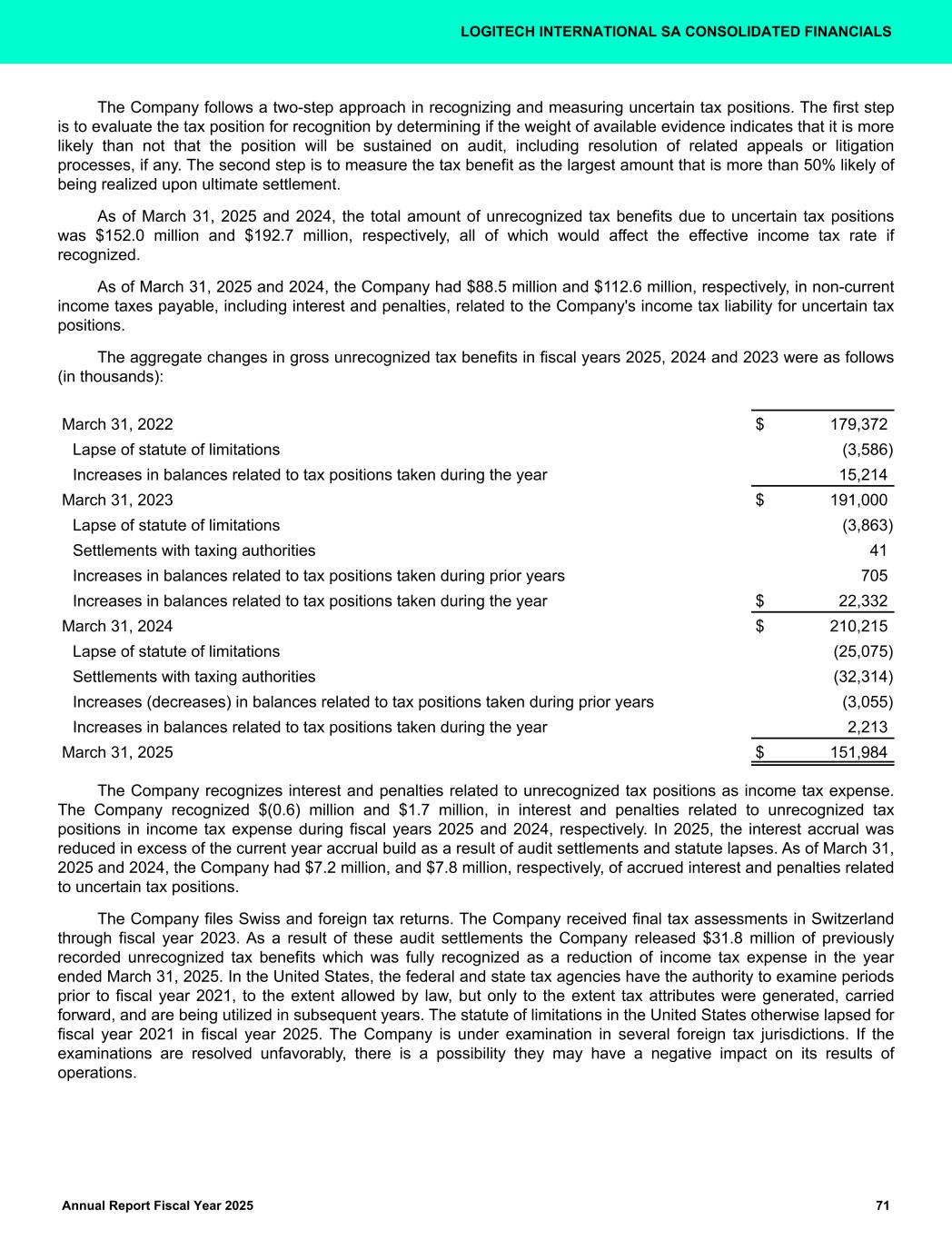
The Company follows a two-step approach in recognizing and measuring uncertain tax positions. The first step is to evaluate the tax position for recognition by determining if the weight of available evidence indicates that it is more likely than not that the position will be sustained on audit, including resolution of related appeals or litigation processes, if any. The second step is to measure the tax benefit as the largest amount that is more than 50% likely of being realized upon ultimate settlement. As of March 31, 2025 and 2024, the total amount of unrecognized tax benefits due to uncertain tax positions was $152.0 million and $192.7 million, respectively, all of which would affect the effective income tax rate if recognized. As of March 31, 2025 and 2024, the Company had $88.5 million and $112.6 million, respectively, in non-current income taxes payable, including interest and penalties, related to the Company's income tax liability for uncertain tax positions. The aggregate changes in gross unrecognized tax benefits in fiscal years 2025, 2024 and 2023 were as follows (in thousands): March 31, 2022 $ 179,372 Lapse of statute of limitations (3,586) Increases in balances related to tax positions taken during the year 15,214 March 31, 2023 $ 191,000 Lapse of statute of limitations (3,863) Settlements with taxing authorities 41 Increases in balances related to tax positions taken during prior years 705 Increases in balances related to tax positions taken during the year $ 22,332 March 31, 2024 $ 210,215 Lapse of statute of limitations (25,075) Settlements with taxing authorities (32,314) Increases (decreases) in balances related to tax positions taken during prior years (3,055) Increases in balances related to tax positions taken during the year 2,213 March 31, 2025 $ 151,984 The Company recognizes interest and penalties related to unrecognized tax positions as income tax expense. The Company recognized $(0.6) million and $1.7 million, in interest and penalties related to unrecognized tax positions in income tax expense during fiscal years 2025 and 2024, respectively. In 2025, the interest accrual was reduced in excess of the current year accrual build as a result of audit settlements and statute lapses. As of March 31, 2025 and 2024, the Company had $7.2 million, and $7.8 million, respectively, of accrued interest and penalties related to uncertain tax positions. The Company files Swiss and foreign tax returns. The Company received final tax assessments in Switzerland through fiscal year 2023. As a result of these audit settlements the Company released $31.8 million of previously recorded unrecognized tax benefits which was fully recognized as a reduction of income tax expense in the year ended March 31, 2025. In the United States, the federal and state tax agencies have the authority to examine periods prior to fiscal year 2021, to the extent allowed by law, but only to the extent tax attributes were generated, carried forward, and are being utilized in subsequent years. The statute of limitations in the United States otherwise lapsed for fiscal year 2021 in fiscal year 2025. The Company is under examination in several foreign tax jurisdictions. If the examinations are resolved unfavorably, there is a possibility they may have a negative impact on its results of operations. LOGITECH INTERNATIONAL SA CONSOLIDATED FINANCIALS Annual Report Fiscal Year 2025 71
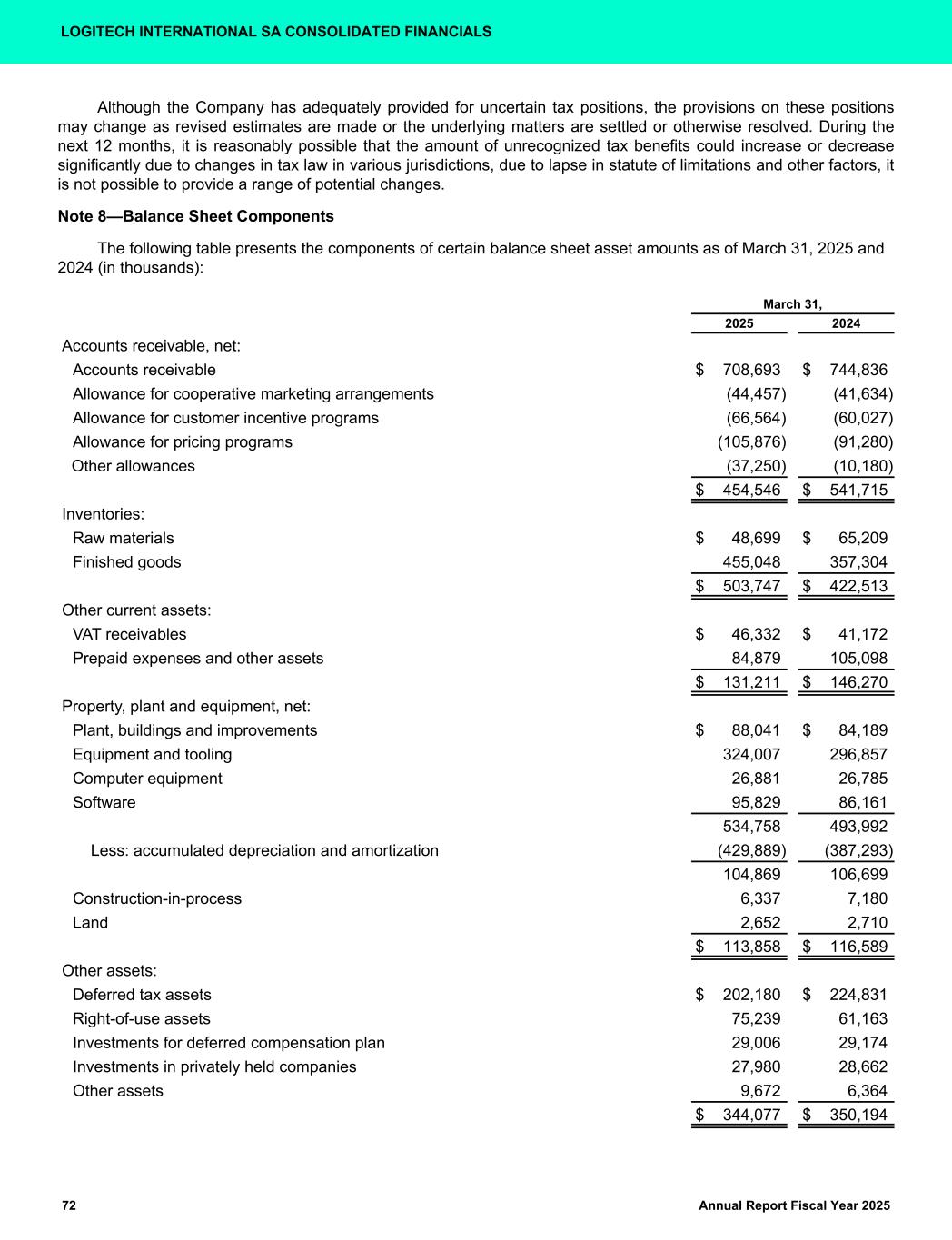
Although the Company has adequately provided for uncertain tax positions, the provisions on these positions may change as revised estimates are made or the underlying matters are settled or otherwise resolved. During the next 12 months, it is reasonably possible that the amount of unrecognized tax benefits could increase or decrease significantly due to changes in tax law in various jurisdictions, due to lapse in statute of limitations and other factors, it is not possible to provide a range of potential changes. Note 8—Balance Sheet Components The following table presents the components of certain balance sheet asset amounts as of March 31, 2025 and 2024 (in thousands): March 31, 2025 2024 Accounts receivable, net: Accounts receivable $ 708,693 $ 744,836 Allowance for cooperative marketing arrangements (44,457) (41,634) Allowance for customer incentive programs (66,564) (60,027) Allowance for pricing programs (105,876) (91,280) Other allowances (37,250) (10,180) $ 454,546 $ 541,715 Inventories: Raw materials $ 48,699 $ 65,209 Finished goods 455,048 357,304 $ 503,747 $ 422,513 Other current assets: VAT receivables $ 46,332 $ 41,172 Prepaid expenses and other assets 84,879 105,098 $ 131,211 $ 146,270 Property, plant and equipment, net: Plant, buildings and improvements $ 88,041 $ 84,189 Equipment and tooling 324,007 296,857 Computer equipment 26,881 26,785 Software 95,829 86,161 534,758 493,992 Less: accumulated depreciation and amortization (429,889) (387,293) 104,869 106,699 Construction-in-process 6,337 7,180 Land 2,652 2,710 $ 113,858 $ 116,589 Other assets: Deferred tax assets $ 202,180 $ 224,831 Right-of-use assets 75,239 61,163 Investments for deferred compensation plan 29,006 29,174 Investments in privately held companies 27,980 28,662 Other assets 9,672 6,364 $ 344,077 $ 350,194 LOGITECH INTERNATIONAL SA CONSOLIDATED FINANCIALS 72 Annual Report Fiscal Year 2025
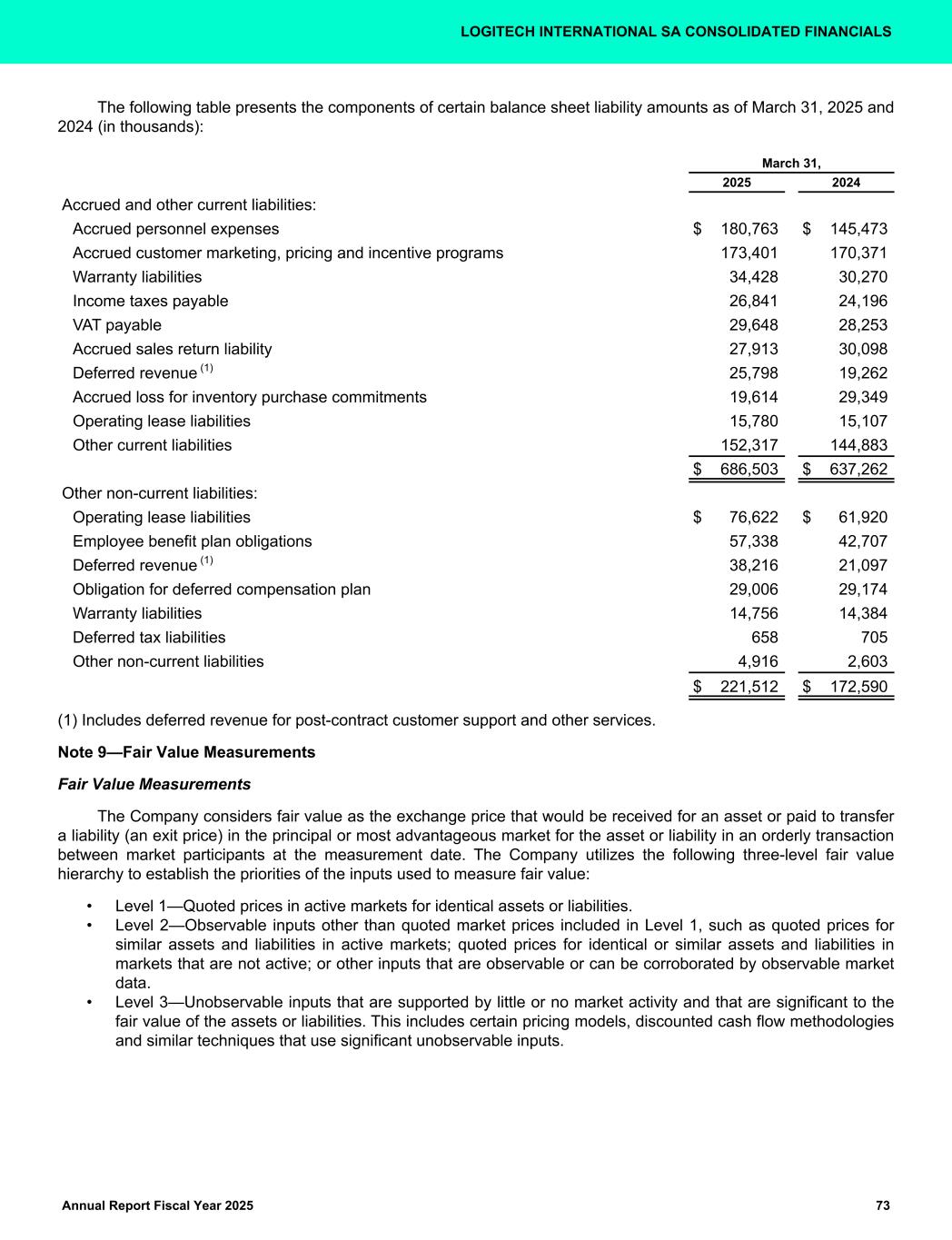
The following table presents the components of certain balance sheet liability amounts as of March 31, 2025 and 2024 (in thousands): March 31, 2025 2024 Accrued and other current liabilities: Accrued personnel expenses $ 180,763 $ 145,473 Accrued customer marketing, pricing and incentive programs 173,401 170,371 Warranty liabilities 34,428 30,270 Income taxes payable 26,841 24,196 VAT payable 29,648 28,253 Accrued sales return liability 27,913 30,098 Deferred revenue (1) 25,798 19,262 Accrued loss for inventory purchase commitments 19,614 29,349 Operating lease liabilities 15,780 15,107 Other current liabilities 152,317 144,883 $ 686,503 $ 637,262 Other non-current liabilities: Operating lease liabilities $ 76,622 $ 61,920 Employee benefit plan obligations 57,338 42,707 Deferred revenue (1) 38,216 21,097 Obligation for deferred compensation plan 29,006 29,174 Warranty liabilities 14,756 14,384 Deferred tax liabilities 658 705 Other non-current liabilities 4,916 2,603 $ 221,512 $ 172,590 (1) Includes deferred revenue for post-contract customer support and other services. Note 9—Fair Value Measurements Fair Value Measurements The Company considers fair value as the exchange price that would be received for an asset or paid to transfer a liability (an exit price) in the principal or most advantageous market for the asset or liability in an orderly transaction between market participants at the measurement date. The Company utilizes the following three-level fair value hierarchy to establish the priorities of the inputs used to measure fair value: • Level 1—Quoted prices in active markets for identical assets or liabilities. • Level 2—Observable inputs other than quoted market prices included in Level 1, such as quoted prices for similar assets and liabilities in active markets; quoted prices for identical or similar assets and liabilities in markets that are not active; or other inputs that are observable or can be corroborated by observable market data. • Level 3—Unobservable inputs that are supported by little or no market activity and that are significant to the fair value of the assets or liabilities. This includes certain pricing models, discounted cash flow methodologies and similar techniques that use significant unobservable inputs. LOGITECH INTERNATIONAL SA CONSOLIDATED FINANCIALS Annual Report Fiscal Year 2025 73
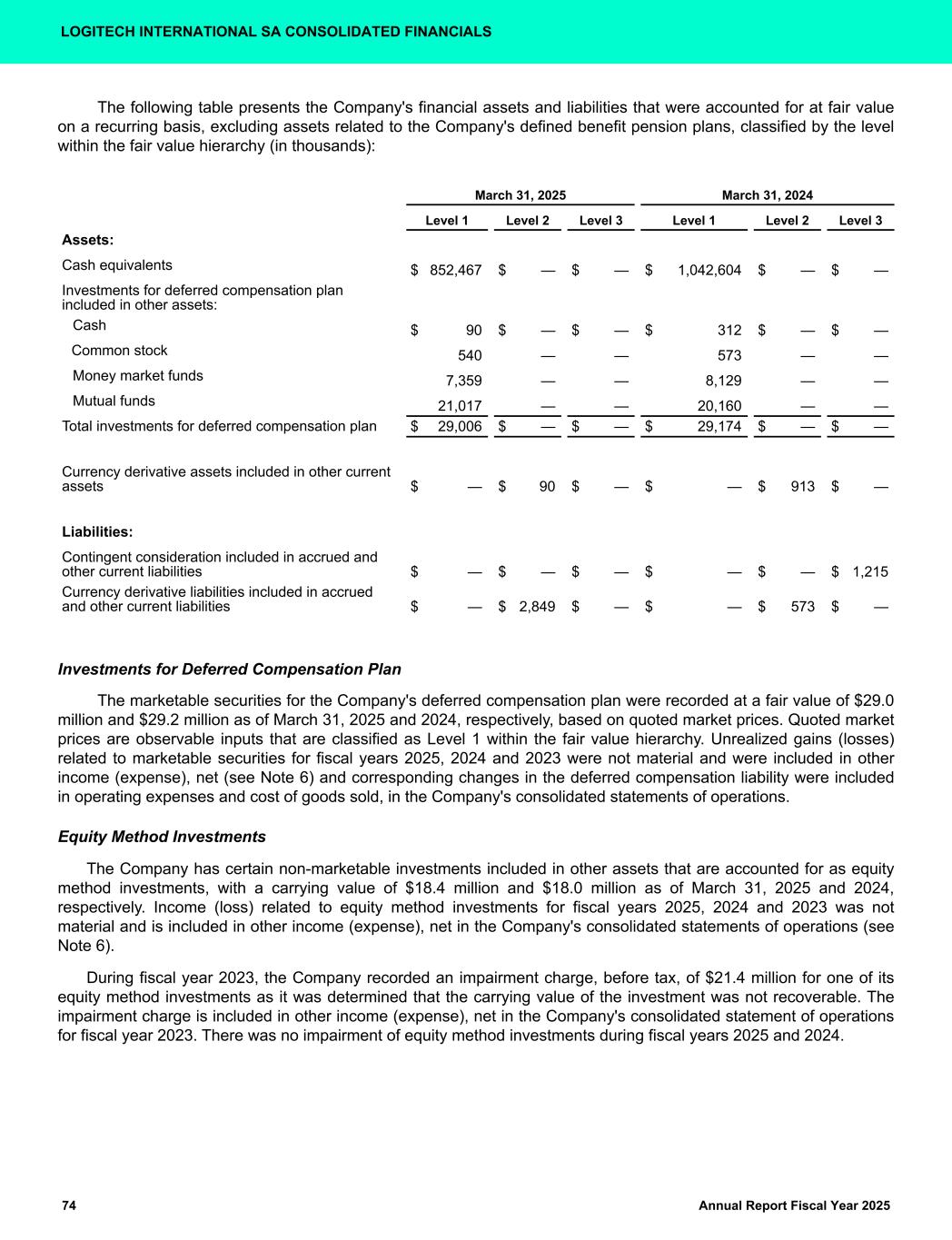
The following table presents the Company's financial assets and liabilities that were accounted for at fair value on a recurring basis, excluding assets related to the Company's defined benefit pension plans, classified by the level within the fair value hierarchy (in thousands): March 31, 2025 March 31, 2024 Level 1 Level 2 Level 3 Level 1 Level 2 Level 3 Assets: Cash equivalents $ 852,467 $ — $ — $ 1,042,604 $ — $ — Investments for deferred compensation plan included in other assets: Cash $ 90 $ — $ — $ 312 $ — $ — Common stock 540 — — 573 — — Money market funds 7,359 — — 8,129 — — Mutual funds 21,017 — — 20,160 — — Total investments for deferred compensation plan $ 29,006 $ — $ — $ 29,174 $ — $ — Currency derivative assets included in other current assets $ — $ 90 $ — $ — $ 913 $ — Liabilities: Contingent consideration included in accrued and other current liabilities $ — $ — $ — $ — $ — $ 1,215 Currency derivative liabilities included in accrued and other current liabilities $ — $ 2,849 $ — $ — $ 573 $ — Investments for Deferred Compensation Plan The marketable securities for the Company's deferred compensation plan were recorded at a fair value of $29.0 million and $29.2 million as of March 31, 2025 and 2024, respectively, based on quoted market prices. Quoted market prices are observable inputs that are classified as Level 1 within the fair value hierarchy. Unrealized gains (losses) related to marketable securities for fiscal years 2025, 2024 and 2023 were not material and were included in other income (expense), net (see Note 6) and corresponding changes in the deferred compensation liability were included in operating expenses and cost of goods sold, in the Company's consolidated statements of operations. Equity Method Investments The Company has certain non-marketable investments included in other assets that are accounted for as equity method investments, with a carrying value of $18.4 million and $18.0 million as of March 31, 2025 and 2024, respectively. Income (loss) related to equity method investments for fiscal years 2025, 2024 and 2023 was not material and is included in other income (expense), net in the Company's consolidated statements of operations (see Note 6). During fiscal year 2023, the Company recorded an impairment charge, before tax, of $21.4 million for one of its equity method investments as it was determined that the carrying value of the investment was not recoverable. The impairment charge is included in other income (expense), net in the Company's consolidated statement of operations for fiscal year 2023. There was no impairment of equity method investments during fiscal years 2025 and 2024. LOGITECH INTERNATIONAL SA CONSOLIDATED FINANCIALS 74 Annual Report Fiscal Year 2025
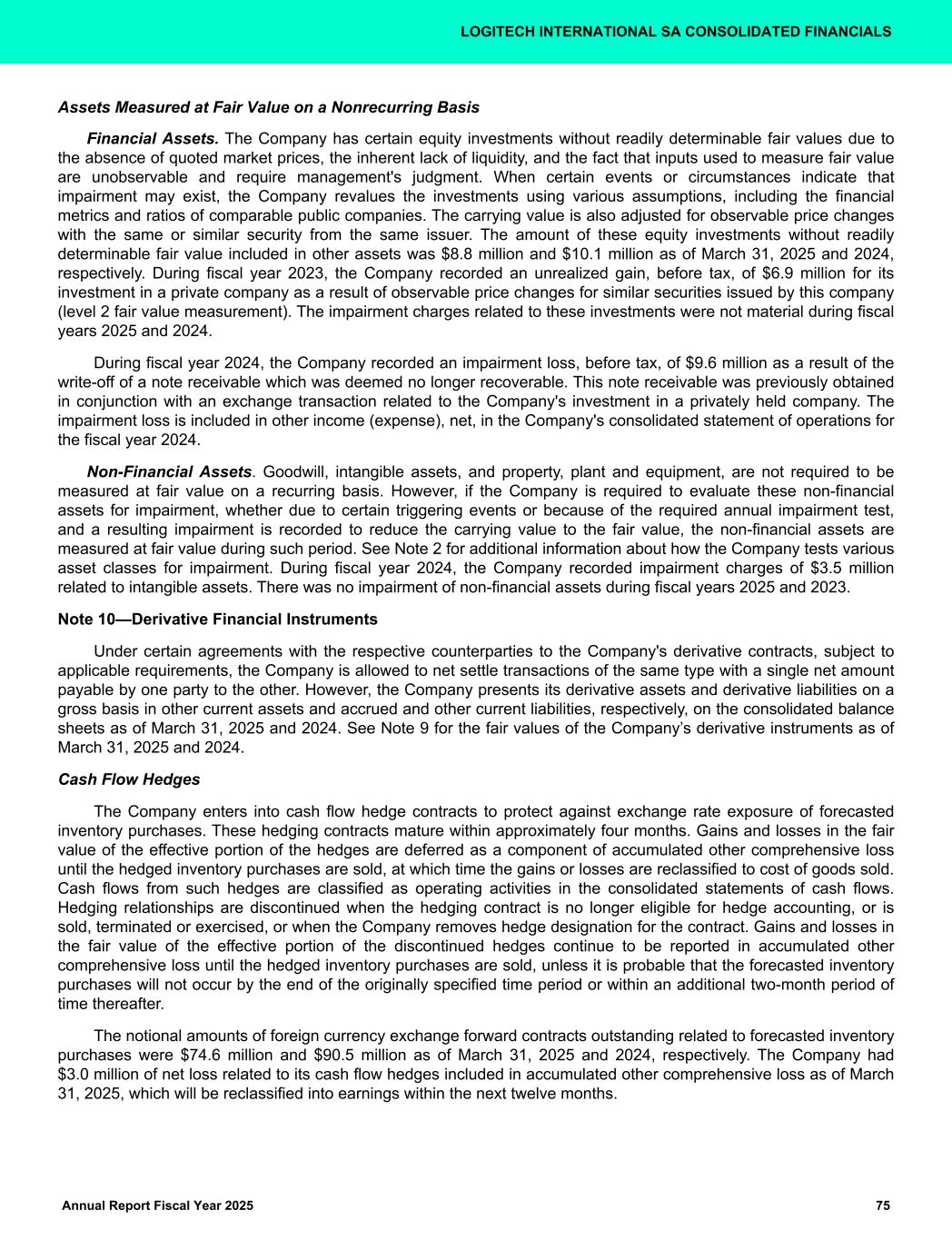
Assets Measured at Fair Value on a Nonrecurring Basis Financial Assets. The Company has certain equity investments without readily determinable fair values due to the absence of quoted market prices, the inherent lack of liquidity, and the fact that inputs used to measure fair value are unobservable and require management's judgment. When certain events or circumstances indicate that impairment may exist, the Company revalues the investments using various assumptions, including the financial metrics and ratios of comparable public companies. The carrying value is also adjusted for observable price changes with the same or similar security from the same issuer. The amount of these equity investments without readily determinable fair value included in other assets was $8.8 million and $10.1 million as of March 31, 2025 and 2024, respectively. During fiscal year 2023, the Company recorded an unrealized gain, before tax, of $6.9 million for its investment in a private company as a result of observable price changes for similar securities issued by this company (level 2 fair value measurement). The impairment charges related to these investments were not material during fiscal years 2025 and 2024. During fiscal year 2024, the Company recorded an impairment loss, before tax, of $9.6 million as a result of the write-off of a note receivable which was deemed no longer recoverable. This note receivable was previously obtained in conjunction with an exchange transaction related to the Company's investment in a privately held company. The impairment loss is included in other income (expense), net, in the Company's consolidated statement of operations for the fiscal year 2024. Non-Financial Assets. Goodwill, intangible assets, and property, plant and equipment, are not required to be measured at fair value on a recurring basis. However, if the Company is required to evaluate these non-financial assets for impairment, whether due to certain triggering events or because of the required annual impairment test, and a resulting impairment is recorded to reduce the carrying value to the fair value, the non-financial assets are measured at fair value during such period. See Note 2 for additional information about how the Company tests various asset classes for impairment. During fiscal year 2024, the Company recorded impairment charges of $3.5 million related to intangible assets. There was no impairment of non-financial assets during fiscal years 2025 and 2023. Note 10—Derivative Financial Instruments Under certain agreements with the respective counterparties to the Company's derivative contracts, subject to applicable requirements, the Company is allowed to net settle transactions of the same type with a single net amount payable by one party to the other. However, the Company presents its derivative assets and derivative liabilities on a gross basis in other current assets and accrued and other current liabilities, respectively, on the consolidated balance sheets as of March 31, 2025 and 2024. See Note 9 for the fair values of the Company’s derivative instruments as of March 31, 2025 and 2024. Cash Flow Hedges The Company enters into cash flow hedge contracts to protect against exchange rate exposure of forecasted inventory purchases. These hedging contracts mature within approximately four months. Gains and losses in the fair value of the effective portion of the hedges are deferred as a component of accumulated other comprehensive loss until the hedged inventory purchases are sold, at which time the gains or losses are reclassified to cost of goods sold. Cash flows from such hedges are classified as operating activities in the consolidated statements of cash flows. Hedging relationships are discontinued when the hedging contract is no longer eligible for hedge accounting, or is sold, terminated or exercised, or when the Company removes hedge designation for the contract. Gains and losses in the fair value of the effective portion of the discontinued hedges continue to be reported in accumulated other comprehensive loss until the hedged inventory purchases are sold, unless it is probable that the forecasted inventory purchases will not occur by the end of the originally specified time period or within an additional two-month period of time thereafter. The notional amounts of foreign currency exchange forward contracts outstanding related to forecasted inventory purchases were $74.6 million and $90.5 million as of March 31, 2025 and 2024, respectively. The Company had $3.0 million of net loss related to its cash flow hedges included in accumulated other comprehensive loss as of March 31, 2025, which will be reclassified into earnings within the next twelve months. LOGITECH INTERNATIONAL SA CONSOLIDATED FINANCIALS Annual Report Fiscal Year 2025 75
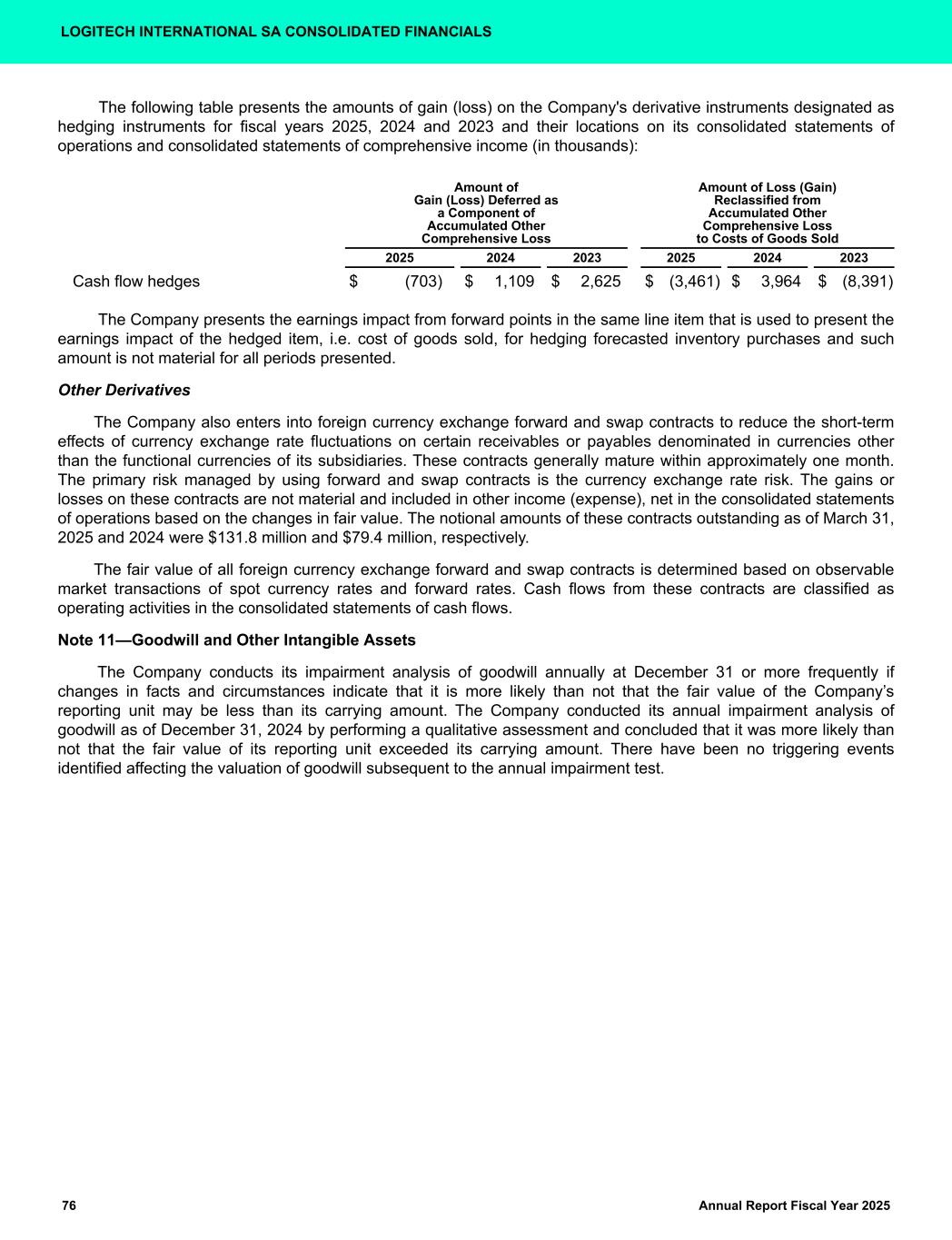
The following table presents the amounts of gain (loss) on the Company's derivative instruments designated as hedging instruments for fiscal years 2025, 2024 and 2023 and their locations on its consolidated statements of operations and consolidated statements of comprehensive income (in thousands): Amount of Gain (Loss) Deferred as a Component of Accumulated Other Comprehensive Loss Amount of Loss (Gain) Reclassified from Accumulated Other Comprehensive Loss to Costs of Goods Sold 2025 2024 2023 2025 2024 2023 Cash flow hedges $ (703) $ 1,109 $ 2,625 $ (3,461) $ 3,964 $ (8,391) The Company presents the earnings impact from forward points in the same line item that is used to present the earnings impact of the hedged item, i.e. cost of goods sold, for hedging forecasted inventory purchases and such amount is not material for all periods presented. Other Derivatives The Company also enters into foreign currency exchange forward and swap contracts to reduce the short-term effects of currency exchange rate fluctuations on certain receivables or payables denominated in currencies other than the functional currencies of its subsidiaries. These contracts generally mature within approximately one month. The primary risk managed by using forward and swap contracts is the currency exchange rate risk. The gains or losses on these contracts are not material and included in other income (expense), net in the consolidated statements of operations based on the changes in fair value. The notional amounts of these contracts outstanding as of March 31, 2025 and 2024 were $131.8 million and $79.4 million, respectively. The fair value of all foreign currency exchange forward and swap contracts is determined based on observable market transactions of spot currency rates and forward rates. Cash flows from these contracts are classified as operating activities in the consolidated statements of cash flows. Note 11—Goodwill and Other Intangible Assets The Company conducts its impairment analysis of goodwill annually at December 31 or more frequently if changes in facts and circumstances indicate that it is more likely than not that the fair value of the Company’s reporting unit may be less than its carrying amount. The Company conducted its annual impairment analysis of goodwill as of December 31, 2024 by performing a qualitative assessment and concluded that it was more likely than not that the fair value of its reporting unit exceeded its carrying amount. There have been no triggering events identified affecting the valuation of goodwill subsequent to the annual impairment test. LOGITECH INTERNATIONAL SA CONSOLIDATED FINANCIALS 76 Annual Report Fiscal Year 2025
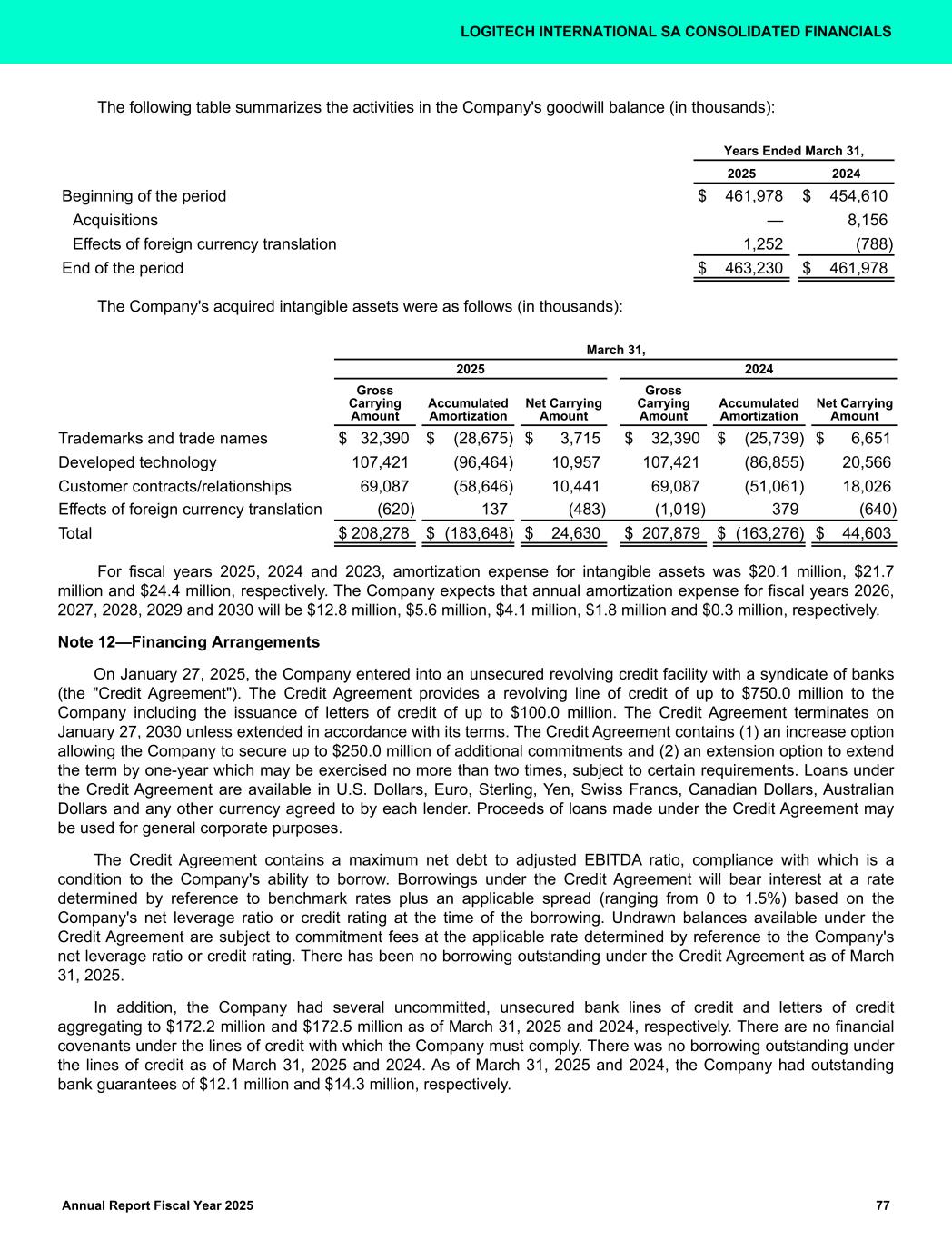
The following table summarizes the activities in the Company's goodwill balance (in thousands): Years Ended March 31, 2025 2024 Beginning of the period $ 461,978 $ 454,610 Acquisitions — 8,156 Effects of foreign currency translation 1,252 (788) End of the period $ 463,230 $ 461,978 The Company's acquired intangible assets were as follows (in thousands): March 31, 2025 2024 Gross Carrying Amount Accumulated Amortization Net Carrying Amount Gross Carrying Amount Accumulated Amortization Net Carrying Amount Trademarks and trade names $ 32,390 $ (28,675) $ 3,715 $ 32,390 $ (25,739) $ 6,651 Developed technology 107,421 (96,464) 10,957 107,421 (86,855) 20,566 Customer contracts/relationships 69,087 (58,646) 10,441 69,087 (51,061) 18,026 Effects of foreign currency translation (620) 137 (483) (1,019) 379 (640) Total $ 208,278 $ (183,648) $ 24,630 $ 207,879 $ (163,276) $ 44,603 For fiscal years 2025, 2024 and 2023, amortization expense for intangible assets was $20.1 million, $21.7 million and $24.4 million, respectively. The Company expects that annual amortization expense for fiscal years 2026, 2027, 2028, 2029 and 2030 will be $12.8 million, $5.6 million, $4.1 million, $1.8 million and $0.3 million, respectively. Note 12—Financing Arrangements On January 27, 2025, the Company entered into an unsecured revolving credit facility with a syndicate of banks (the "Credit Agreement"). The Credit Agreement provides a revolving line of credit of up to $750.0 million to the Company including the issuance of letters of credit of up to $100.0 million. The Credit Agreement terminates on January 27, 2030 unless extended in accordance with its terms. The Credit Agreement contains (1) an increase option allowing the Company to secure up to $250.0 million of additional commitments and (2) an extension option to extend the term by one-year which may be exercised no more than two times, subject to certain requirements. Loans under the Credit Agreement are available in U.S. Dollars, Euro, Sterling, Yen, Swiss Francs, Canadian Dollars, Australian Dollars and any other currency agreed to by each lender. Proceeds of loans made under the Credit Agreement may be used for general corporate purposes. The Credit Agreement contains a maximum net debt to adjusted EBITDA ratio, compliance with which is a condition to the Company's ability to borrow. Borrowings under the Credit Agreement will bear interest at a rate determined by reference to benchmark rates plus an applicable spread (ranging from 0 to 1.5%) based on the Company's net leverage ratio or credit rating at the time of the borrowing. Undrawn balances available under the Credit Agreement are subject to commitment fees at the applicable rate determined by reference to the Company's net leverage ratio or credit rating. There has been no borrowing outstanding under the Credit Agreement as of March 31, 2025. In addition, the Company had several uncommitted, unsecured bank lines of credit and letters of credit aggregating to $172.2 million and $172.5 million as of March 31, 2025 and 2024, respectively. There are no financial covenants under the lines of credit with which the Company must comply. There was no borrowing outstanding under the lines of credit as of March 31, 2025 and 2024. As of March 31, 2025 and 2024, the Company had outstanding bank guarantees of $12.1 million and $14.3 million, respectively. LOGITECH INTERNATIONAL SA CONSOLIDATED FINANCIALS Annual Report Fiscal Year 2025 77
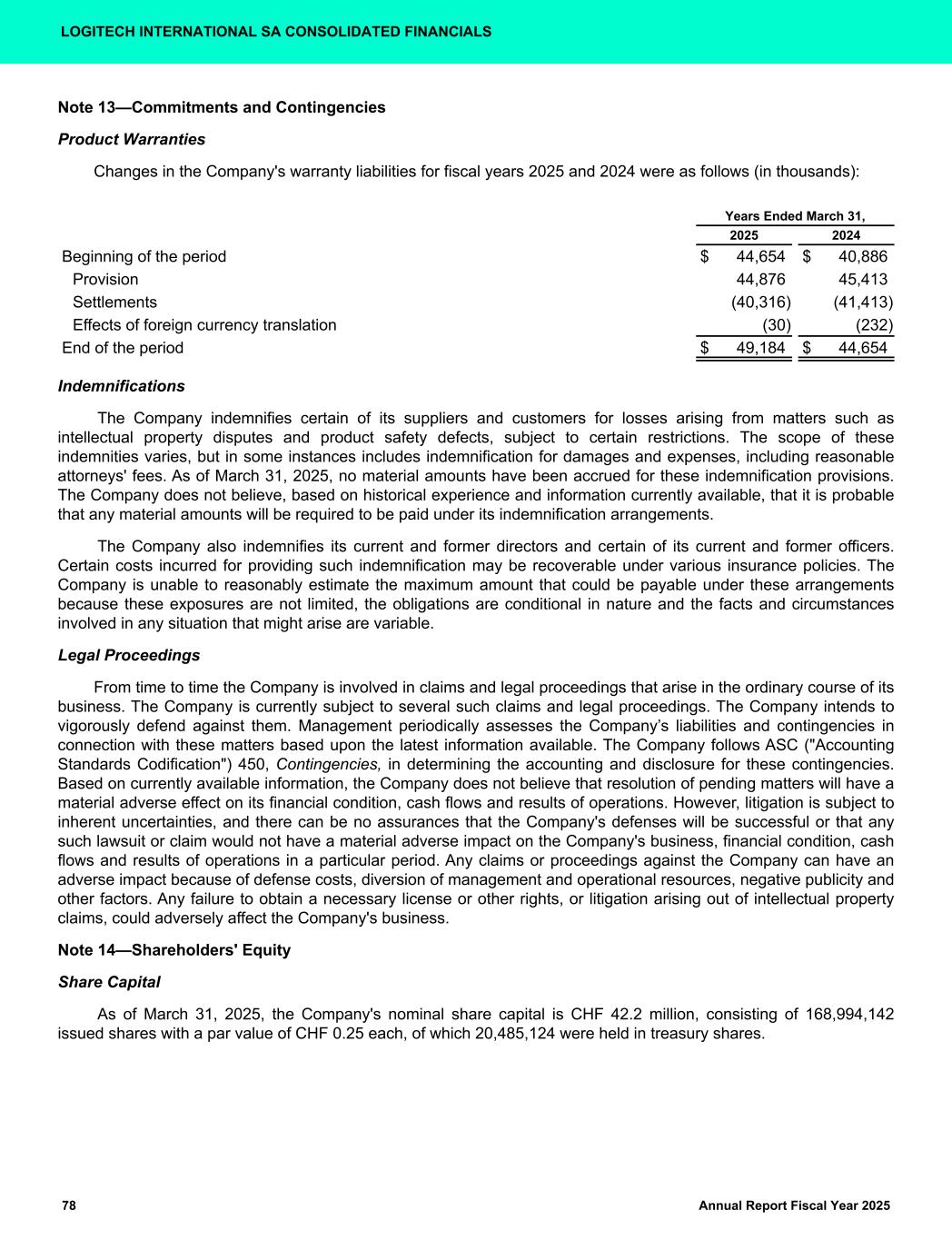
Note 13—Commitments and Contingencies Product Warranties Changes in the Company's warranty liabilities for fiscal years 2025 and 2024 were as follows (in thousands): Years Ended March 31, 2025 2024 Beginning of the period $ 44,654 $ 40,886 Provision 44,876 45,413 Settlements (40,316) (41,413) Effects of foreign currency translation (30) (232) End of the period $ 49,184 $ 44,654 Indemnifications The Company indemnifies certain of its suppliers and customers for losses arising from matters such as intellectual property disputes and product safety defects, subject to certain restrictions. The scope of these indemnities varies, but in some instances includes indemnification for damages and expenses, including reasonable attorneys' fees. As of March 31, 2025, no material amounts have been accrued for these indemnification provisions. The Company does not believe, based on historical experience and information currently available, that it is probable that any material amounts will be required to be paid under its indemnification arrangements. The Company also indemnifies its current and former directors and certain of its current and former officers. Certain costs incurred for providing such indemnification may be recoverable under various insurance policies. The Company is unable to reasonably estimate the maximum amount that could be payable under these arrangements because these exposures are not limited, the obligations are conditional in nature and the facts and circumstances involved in any situation that might arise are variable. Legal Proceedings From time to time the Company is involved in claims and legal proceedings that arise in the ordinary course of its business. The Company is currently subject to several such claims and legal proceedings. The Company intends to vigorously defend against them. Management periodically assesses the Company’s liabilities and contingencies in connection with these matters based upon the latest information available. The Company follows ASC ("Accounting Standards Codification") 450, Contingencies, in determining the accounting and disclosure for these contingencies. Based on currently available information, the Company does not believe that resolution of pending matters will have a material adverse effect on its financial condition, cash flows and results of operations. However, litigation is subject to inherent uncertainties, and there can be no assurances that the Company's defenses will be successful or that any such lawsuit or claim would not have a material adverse impact on the Company's business, financial condition, cash flows and results of operations in a particular period. Any claims or proceedings against the Company can have an adverse impact because of defense costs, diversion of management and operational resources, negative publicity and other factors. Any failure to obtain a necessary license or other rights, or litigation arising out of intellectual property claims, could adversely affect the Company's business. Note 14—Shareholders' Equity Share Capital As of March 31, 2025, the Company's nominal share capital is CHF 42.2 million, consisting of 168,994,142 issued shares with a par value of CHF 0.25 each, of which 20,485,124 were held in treasury shares. LOGITECH INTERNATIONAL SA CONSOLIDATED FINANCIALS 78 Annual Report Fiscal Year 2025
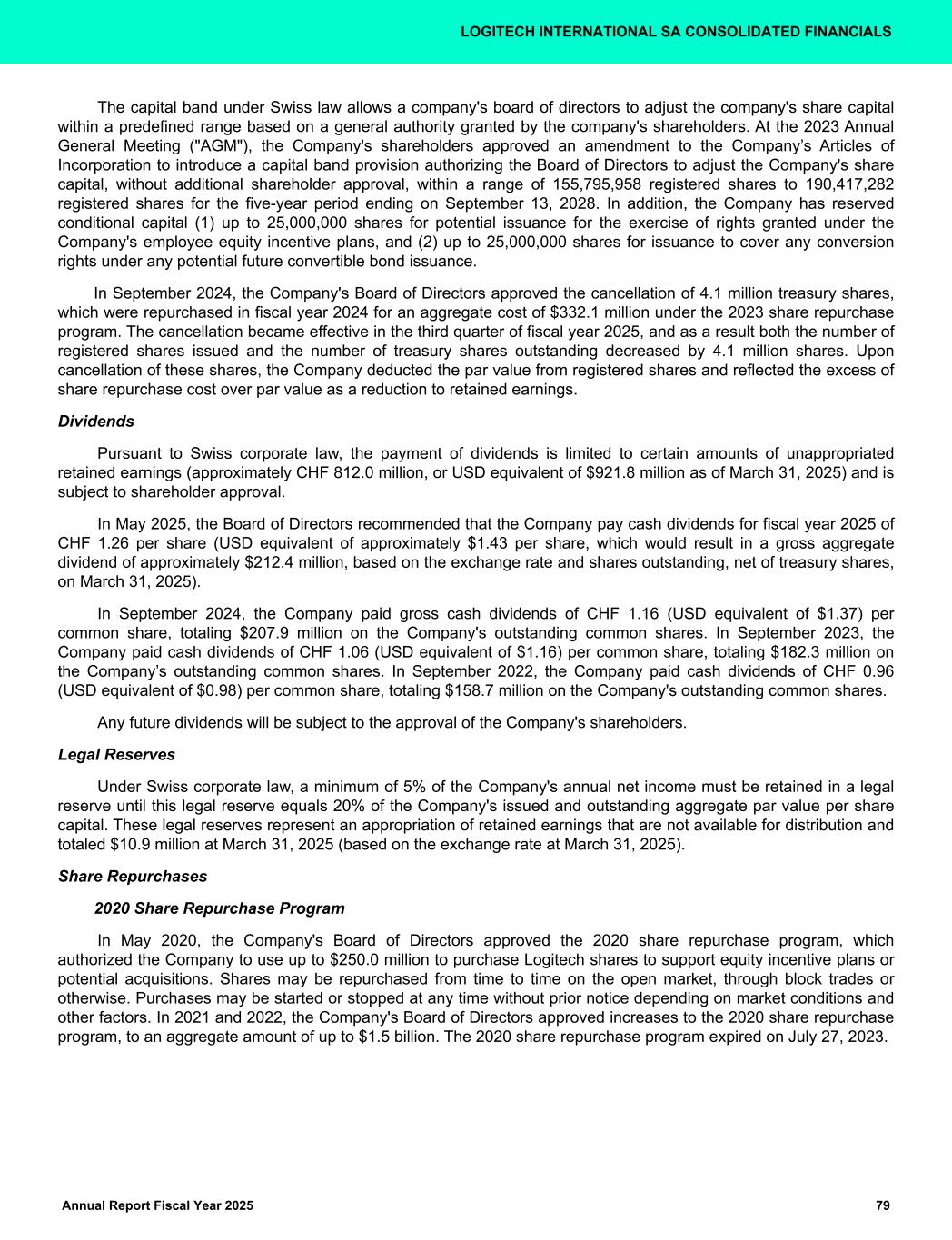
The capital band under Swiss law allows a company's board of directors to adjust the company's share capital within a predefined range based on a general authority granted by the company's shareholders. At the 2023 Annual General Meeting ("AGM"), the Company's shareholders approved an amendment to the Company’s Articles of Incorporation to introduce a capital band provision authorizing the Board of Directors to adjust the Company's share capital, without additional shareholder approval, within a range of 155,795,958 registered shares to 190,417,282 registered shares for the five-year period ending on September 13, 2028. In addition, the Company has reserved conditional capital (1) up to 25,000,000 shares for potential issuance for the exercise of rights granted under the Company's employee equity incentive plans, and (2) up to 25,000,000 shares for issuance to cover any conversion rights under any potential future convertible bond issuance. In September 2024, the Company's Board of Directors approved the cancellation of 4.1 million treasury shares, which were repurchased in fiscal year 2024 for an aggregate cost of $332.1 million under the 2023 share repurchase program. The cancellation became effective in the third quarter of fiscal year 2025, and as a result both the number of registered shares issued and the number of treasury shares outstanding decreased by 4.1 million shares. Upon cancellation of these shares, the Company deducted the par value from registered shares and reflected the excess of share repurchase cost over par value as a reduction to retained earnings. Dividends Pursuant to Swiss corporate law, the payment of dividends is limited to certain amounts of unappropriated retained earnings (approximately CHF 812.0 million, or USD equivalent of $921.8 million as of March 31, 2025) and is subject to shareholder approval. In May 2025, the Board of Directors recommended that the Company pay cash dividends for fiscal year 2025 of CHF 1.26 per share (USD equivalent of approximately $1.43 per share, which would result in a gross aggregate dividend of approximately $212.4 million, based on the exchange rate and shares outstanding, net of treasury shares, on March 31, 2025). In September 2024, the Company paid gross cash dividends of CHF 1.16 (USD equivalent of $1.37) per common share, totaling $207.9 million on the Company's outstanding common shares. In September 2023, the Company paid cash dividends of CHF 1.06 (USD equivalent of $1.16) per common share, totaling $182.3 million on the Company’s outstanding common shares. In September 2022, the Company paid cash dividends of CHF 0.96 (USD equivalent of $0.98) per common share, totaling $158.7 million on the Company's outstanding common shares. Any future dividends will be subject to the approval of the Company's shareholders. Legal Reserves Under Swiss corporate law, a minimum of 5% of the Company's annual net income must be retained in a legal reserve until this legal reserve equals 20% of the Company's issued and outstanding aggregate par value per share capital. These legal reserves represent an appropriation of retained earnings that are not available for distribution and totaled $10.9 million at March 31, 2025 (based on the exchange rate at March 31, 2025). Share Repurchases 2020 Share Repurchase Program In May 2020, the Company's Board of Directors approved the 2020 share repurchase program, which authorized the Company to use up to $250.0 million to purchase Logitech shares to support equity incentive plans or potential acquisitions. Shares may be repurchased from time to time on the open market, through block trades or otherwise. Purchases may be started or stopped at any time without prior notice depending on market conditions and other factors. In 2021 and 2022, the Company's Board of Directors approved increases to the 2020 share repurchase program, to an aggregate amount of up to $1.5 billion. The 2020 share repurchase program expired on July 27, 2023. LOGITECH INTERNATIONAL SA CONSOLIDATED FINANCIALS Annual Report Fiscal Year 2025 79
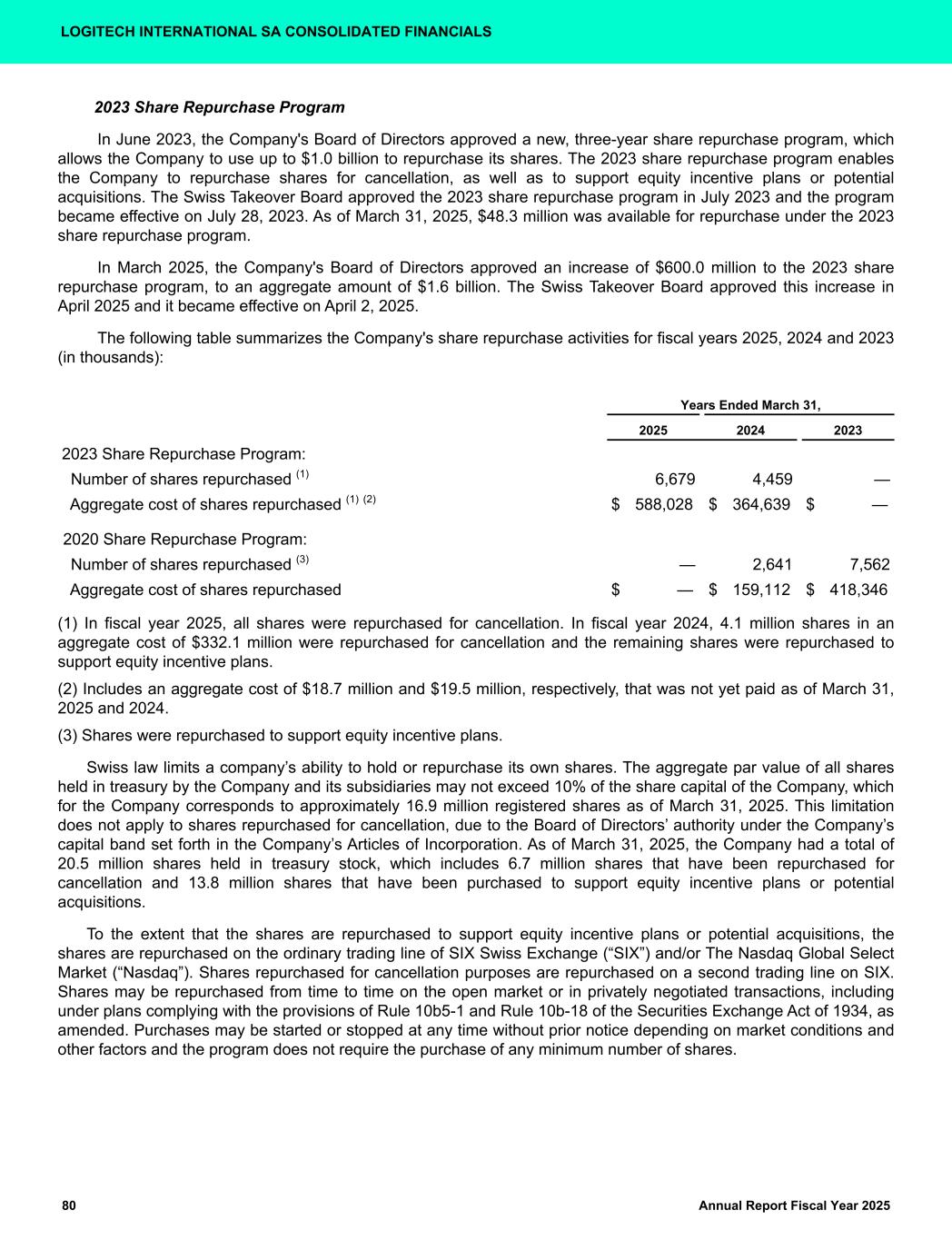
2023 Share Repurchase Program In June 2023, the Company's Board of Directors approved a new, three-year share repurchase program, which allows the Company to use up to $1.0 billion to repurchase its shares. The 2023 share repurchase program enables the Company to repurchase shares for cancellation, as well as to support equity incentive plans or potential acquisitions. The Swiss Takeover Board approved the 2023 share repurchase program in July 2023 and the program became effective on July 28, 2023. As of March 31, 2025, $48.3 million was available for repurchase under the 2023 share repurchase program. In March 2025, the Company's Board of Directors approved an increase of $600.0 million to the 2023 share repurchase program, to an aggregate amount of $1.6 billion. The Swiss Takeover Board approved this increase in April 2025 and it became effective on April 2, 2025. The following table summarizes the Company's share repurchase activities for fiscal years 2025, 2024 and 2023 (in thousands): Years Ended March 31, 2025 2024 2023 2023 Share Repurchase Program: Number of shares repurchased (1) 6,679 4,459 — Aggregate cost of shares repurchased (1) (2) $ 588,028 $ 364,639 $ — 2020 Share Repurchase Program: Number of shares repurchased (3) — 2,641 7,562 Aggregate cost of shares repurchased $ — $ 159,112 $ 418,346 (1) In fiscal year 2025, all shares were repurchased for cancellation. In fiscal year 2024, 4.1 million shares in an aggregate cost of $332.1 million were repurchased for cancellation and the remaining shares were repurchased to support equity incentive plans. (2) Includes an aggregate cost of $18.7 million and $19.5 million, respectively, that was not yet paid as of March 31, 2025 and 2024. (3) Shares were repurchased to support equity incentive plans. Swiss law limits a company’s ability to hold or repurchase its own shares. The aggregate par value of all shares held in treasury by the Company and its subsidiaries may not exceed 10% of the share capital of the Company, which for the Company corresponds to approximately 16.9 million registered shares as of March 31, 2025. This limitation does not apply to shares repurchased for cancellation, due to the Board of Directors’ authority under the Company’s capital band set forth in the Company’s Articles of Incorporation. As of March 31, 2025, the Company had a total of 20.5 million shares held in treasury stock, which includes 6.7 million shares that have been repurchased for cancellation and 13.8 million shares that have been purchased to support equity incentive plans or potential acquisitions. To the extent that the shares are repurchased to support equity incentive plans or potential acquisitions, the shares are repurchased on the ordinary trading line of SIX Swiss Exchange (“SIX”) and/or The Nasdaq Global Select Market (“Nasdaq”). Shares repurchased for cancellation purposes are repurchased on a second trading line on SIX. Shares may be repurchased from time to time on the open market or in privately negotiated transactions, including under plans complying with the provisions of Rule 10b5-1 and Rule 10b-18 of the Securities Exchange Act of 1934, as amended. Purchases may be started or stopped at any time without prior notice depending on market conditions and other factors and the program does not require the purchase of any minimum number of shares. LOGITECH INTERNATIONAL SA CONSOLIDATED FINANCIALS 80 Annual Report Fiscal Year 2025
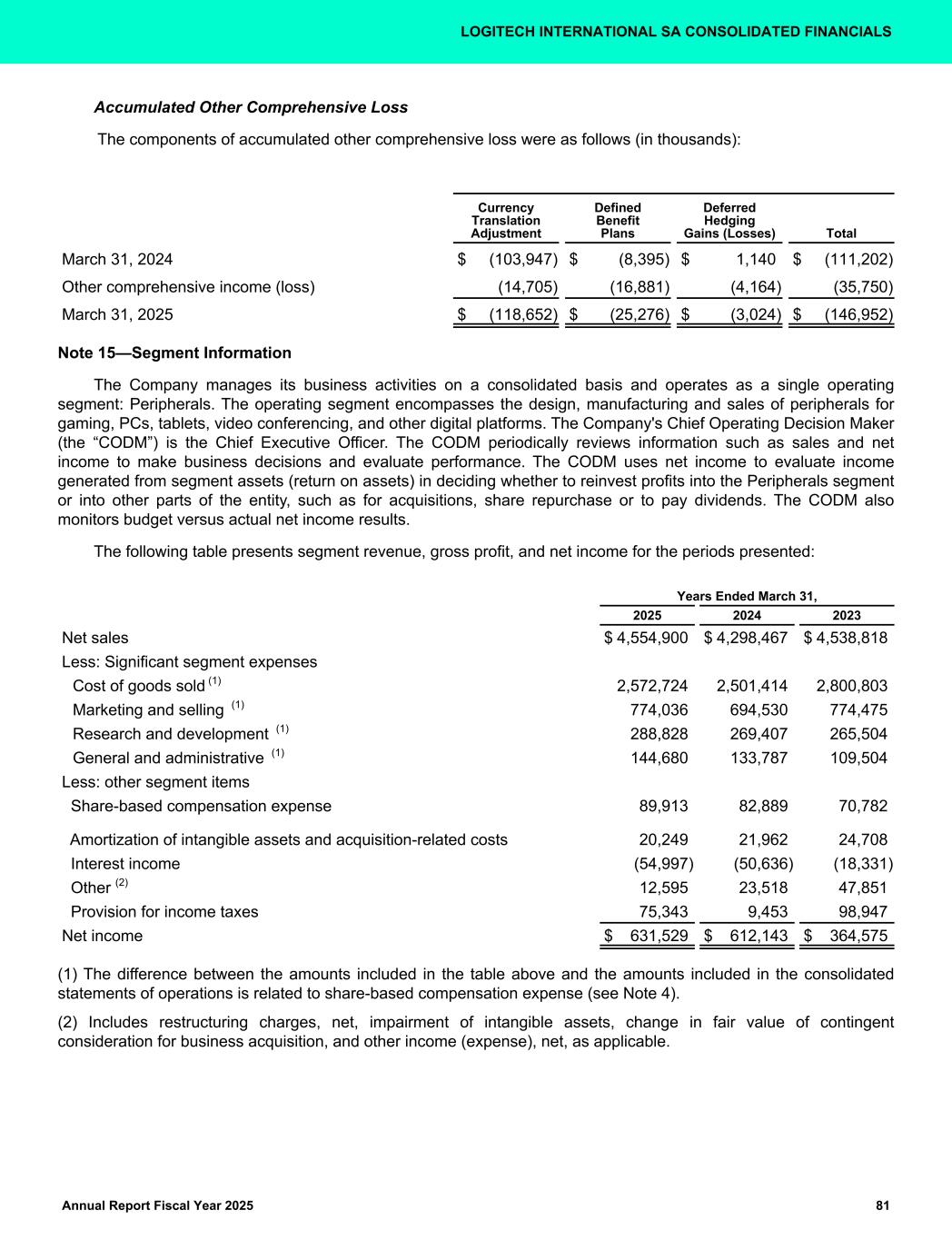
Accumulated Other Comprehensive Loss The components of accumulated other comprehensive loss were as follows (in thousands): Currency Translation Adjustment Defined Benefit Plans Deferred Hedging Gains (Losses) Total March 31, 2024 $ (103,947) $ (8,395) $ 1,140 $ (111,202) Other comprehensive income (loss) (14,705) (16,881) (4,164) (35,750) March 31, 2025 $ (118,652) $ (25,276) $ (3,024) $ (146,952) Note 15—Segment Information The Company manages its business activities on a consolidated basis and operates as a single operating segment: Peripherals. The operating segment encompasses the design, manufacturing and sales of peripherals for gaming, PCs, tablets, video conferencing, and other digital platforms. The Company's Chief Operating Decision Maker (the “CODM”) is the Chief Executive Officer. The CODM periodically reviews information such as sales and net income to make business decisions and evaluate performance. The CODM uses net income to evaluate income generated from segment assets (return on assets) in deciding whether to reinvest profits into the Peripherals segment or into other parts of the entity, such as for acquisitions, share repurchase or to pay dividends. The CODM also monitors budget versus actual net income results. The following table presents segment revenue, gross profit, and net income for the periods presented: Years Ended March 31, 2025 2024 2023 Net sales $ 4,554,900 $ 4,298,467 $ 4,538,818 Less: Significant segment expenses Cost of goods sold (1) 2,572,724 2,501,414 2,800,803 Marketing and selling (1) 774,036 694,530 774,475 Research and development (1) 288,828 269,407 265,504 General and administrative (1) 144,680 133,787 109,504 Less: other segment items Share-based compensation expense 89,913 82,889 70,782 Amortization of intangible assets and acquisition-related costs 20,249 21,962 24,708 Interest income (54,997) (50,636) (18,331) Other (2) 12,595 23,518 47,851 Provision for income taxes 75,343 9,453 98,947 Net income $ 631,529 $ 612,143 $ 364,575 (1) The difference between the amounts included in the table above and the amounts included in the consolidated statements of operations is related to share-based compensation expense (see Note 4). (2) Includes restructuring charges, net, impairment of intangible assets, change in fair value of contingent consideration for business acquisition, and other income (expense), net, as applicable. LOGITECH INTERNATIONAL SA CONSOLIDATED FINANCIALS Annual Report Fiscal Year 2025 81
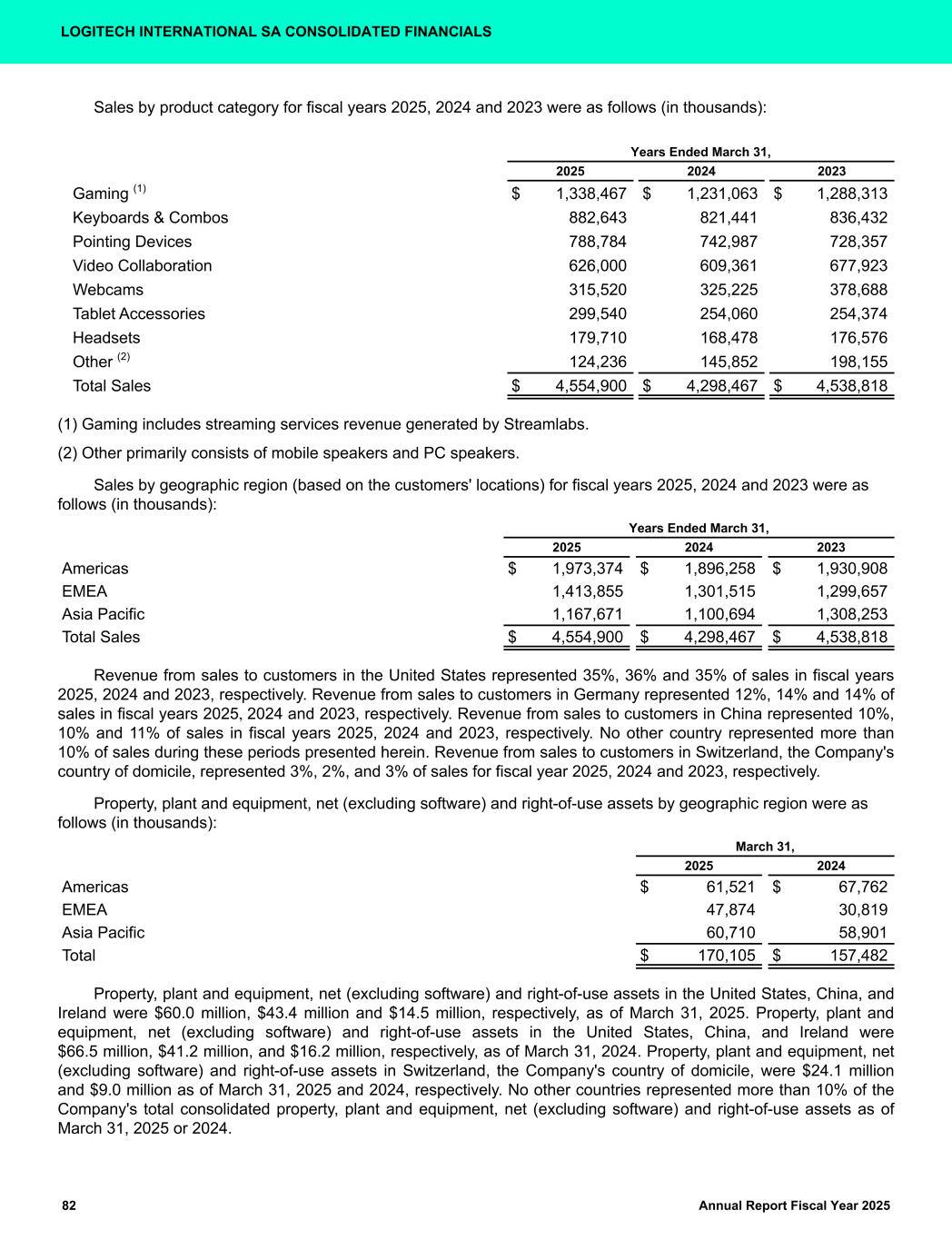
Sales by product category for fiscal years 2025, 2024 and 2023 were as follows (in thousands): Years Ended March 31, 2025 2024 2023 Gaming (1) $ 1,338,467 $ 1,231,063 $ 1,288,313 Keyboards & Combos 882,643 821,441 836,432 Pointing Devices 788,784 742,987 728,357 Video Collaboration 626,000 609,361 677,923 Webcams 315,520 325,225 378,688 Tablet Accessories 299,540 254,060 254,374 Headsets 179,710 168,478 176,576 Other (2) 124,236 145,852 198,155 Total Sales $ 4,554,900 $ 4,298,467 $ 4,538,818 (1) Gaming includes streaming services revenue generated by Streamlabs. (2) Other primarily consists of mobile speakers and PC speakers. Sales by geographic region (based on the customers' locations) for fiscal years 2025, 2024 and 2023 were as follows (in thousands): Years Ended March 31, 2025 2024 2023 Americas $ 1,973,374 $ 1,896,258 $ 1,930,908 EMEA 1,413,855 1,301,515 1,299,657 Asia Pacific 1,167,671 1,100,694 1,308,253 Total Sales $ 4,554,900 $ 4,298,467 $ 4,538,818 Revenue from sales to customers in the United States represented 35%, 36% and 35% of sales in fiscal years 2025, 2024 and 2023, respectively. Revenue from sales to customers in Germany represented 12%, 14% and 14% of sales in fiscal years 2025, 2024 and 2023, respectively. Revenue from sales to customers in China represented 10%, 10% and 11% of sales in fiscal years 2025, 2024 and 2023, respectively. No other country represented more than 10% of sales during these periods presented herein. Revenue from sales to customers in Switzerland, the Company's country of domicile, represented 3%, 2%, and 3% of sales for fiscal year 2025, 2024 and 2023, respectively. Property, plant and equipment, net (excluding software) and right-of-use assets by geographic region were as follows (in thousands): March 31, 2025 2024 Americas $ 61,521 $ 67,762 EMEA 47,874 30,819 Asia Pacific 60,710 58,901 Total $ 170,105 $ 157,482 Property, plant and equipment, net (excluding software) and right-of-use assets in the United States, China, and Ireland were $60.0 million, $43.4 million and $14.5 million, respectively, as of March 31, 2025. Property, plant and equipment, net (excluding software) and right-of-use assets in the United States, China, and Ireland were $66.5 million, $41.2 million, and $16.2 million, respectively, as of March 31, 2024. Property, plant and equipment, net (excluding software) and right-of-use assets in Switzerland, the Company's country of domicile, were $24.1 million and $9.0 million as of March 31, 2025 and 2024, respectively. No other countries represented more than 10% of the Company's total consolidated property, plant and equipment, net (excluding software) and right-of-use assets as of March 31, 2025 or 2024. LOGITECH INTERNATIONAL SA CONSOLIDATED FINANCIALS 82 Annual Report Fiscal Year 2025
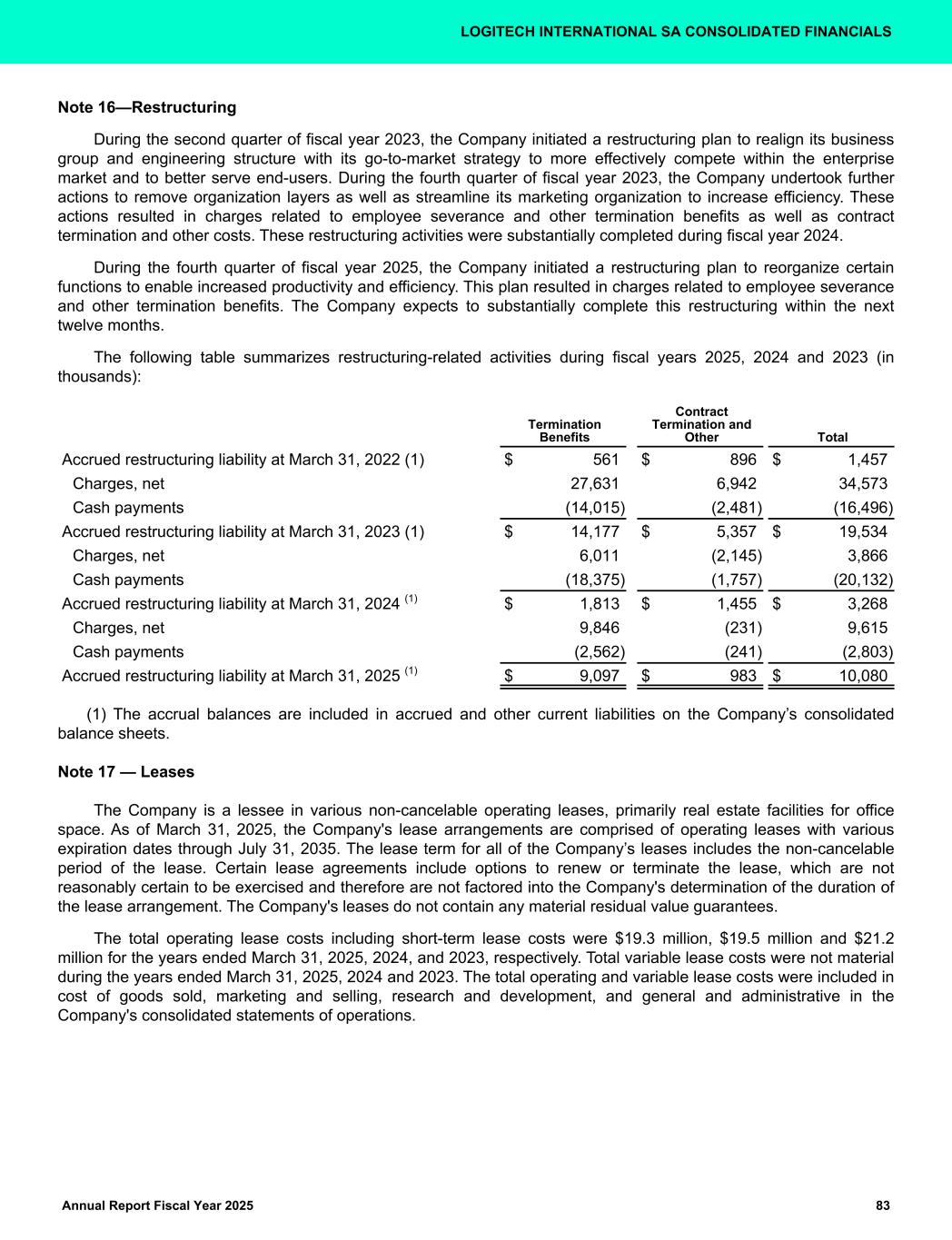
Note 16—Restructuring During the second quarter of fiscal year 2023, the Company initiated a restructuring plan to realign its business group and engineering structure with its go-to-market strategy to more effectively compete within the enterprise market and to better serve end-users. During the fourth quarter of fiscal year 2023, the Company undertook further actions to remove organization layers as well as streamline its marketing organization to increase efficiency. These actions resulted in charges related to employee severance and other termination benefits as well as contract termination and other costs. These restructuring activities were substantially completed during fiscal year 2024. During the fourth quarter of fiscal year 2025, the Company initiated a restructuring plan to reorganize certain functions to enable increased productivity and efficiency. This plan resulted in charges related to employee severance and other termination benefits. The Company expects to substantially complete this restructuring within the next twelve months. The following table summarizes restructuring-related activities during fiscal years 2025, 2024 and 2023 (in thousands): Termination Benefits Contract Termination and Other Total Accrued restructuring liability at March 31, 2022 (1) $ 561 $ 896 $ 1,457 Charges, net 27,631 6,942 34,573 Cash payments (14,015) (2,481) (16,496) Accrued restructuring liability at March 31, 2023 (1) $ 14,177 $ 5,357 $ 19,534 Charges, net 6,011 (2,145) 3,866 Cash payments (18,375) (1,757) (20,132) Accrued restructuring liability at March 31, 2024 (1) $ 1,813 $ 1,455 $ 3,268 Charges, net 9,846 (231) 9,615 Cash payments (2,562) (241) (2,803) Accrued restructuring liability at March 31, 2025 (1) $ 9,097 $ 983 $ 10,080 (1) The accrual balances are included in accrued and other current liabilities on the Company’s consolidated balance sheets. Note 17 — Leases The Company is a lessee in various non-cancelable operating leases, primarily real estate facilities for office space. As of March 31, 2025, the Company's lease arrangements are comprised of operating leases with various expiration dates through July 31, 2035. The lease term for all of the Company’s leases includes the non-cancelable period of the lease. Certain lease agreements include options to renew or terminate the lease, which are not reasonably certain to be exercised and therefore are not factored into the Company's determination of the duration of the lease arrangement. The Company's leases do not contain any material residual value guarantees. The total operating lease costs including short-term lease costs were $19.3 million, $19.5 million and $21.2 million for the years ended March 31, 2025, 2024, and 2023, respectively. Total variable lease costs were not material during the years ended March 31, 2025, 2024 and 2023. The total operating and variable lease costs were included in cost of goods sold, marketing and selling, research and development, and general and administrative in the Company's consolidated statements of operations. LOGITECH INTERNATIONAL SA CONSOLIDATED FINANCIALS Annual Report Fiscal Year 2025 83
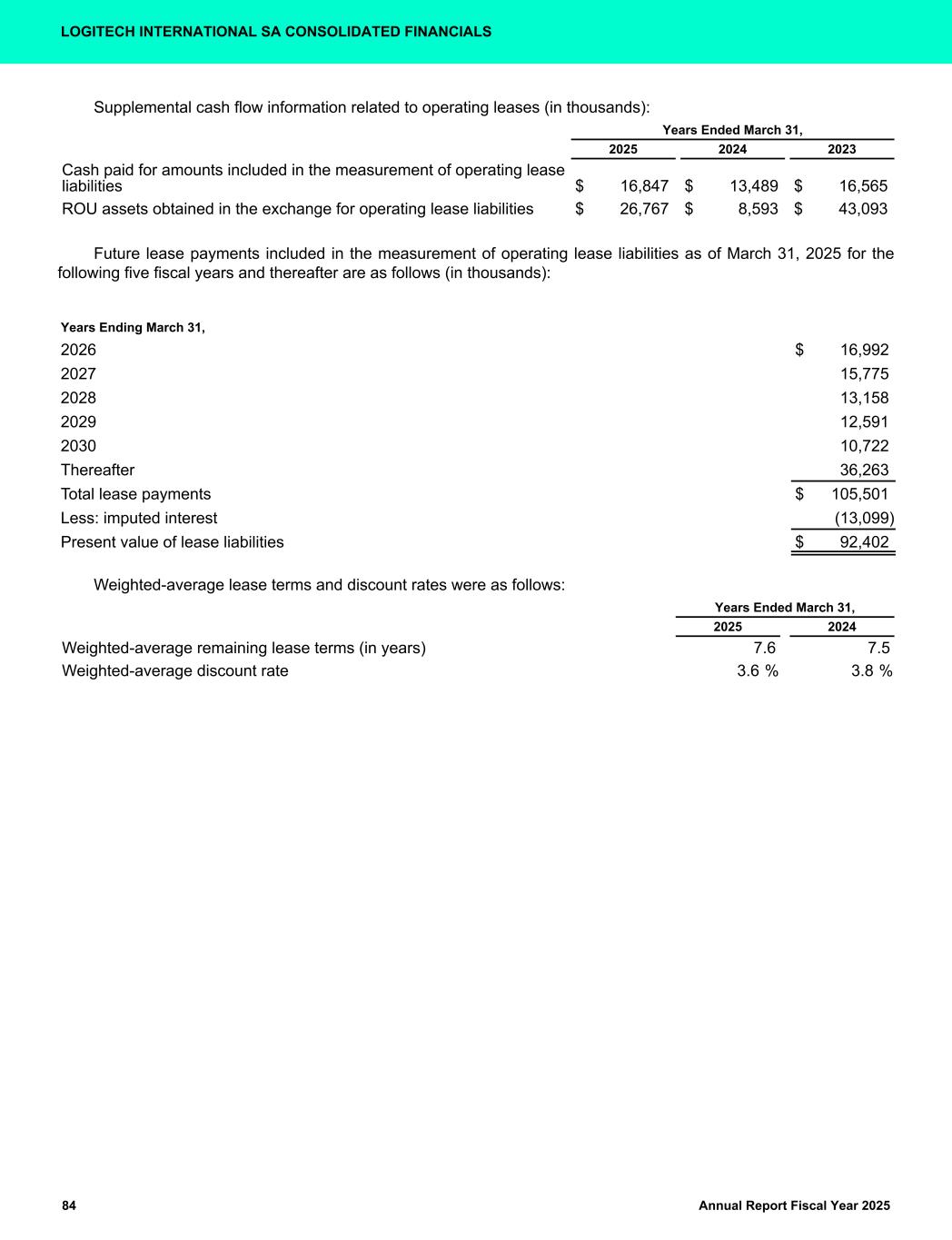
Supplemental cash flow information related to operating leases (in thousands): Years Ended March 31, 2025 2024 2023 Cash paid for amounts included in the measurement of operating lease liabilities $ 16,847 $ 13,489 $ 16,565 ROU assets obtained in the exchange for operating lease liabilities $ 26,767 $ 8,593 $ 43,093 Future lease payments included in the measurement of operating lease liabilities as of March 31, 2025 for the following five fiscal years and thereafter are as follows (in thousands): Years Ending March 31, 2026 $ 16,992 2027 15,775 2028 13,158 2029 12,591 2030 10,722 Thereafter 36,263 Total lease payments $ 105,501 Less: imputed interest (13,099) Present value of lease liabilities $ 92,402 Weighted-average lease terms and discount rates were as follows: Years Ended March 31, 2025 2024 Weighted-average remaining lease terms (in years) 7.6 7.5 Weighted-average discount rate 3.6 % 3.8 % LOGITECH INTERNATIONAL SA CONSOLIDATED FINANCIALS 84 Annual Report Fiscal Year 2025
LOGITECH INTERNATIONAL S.A., HAUTEMORGES SWISS STATUTORY FINANCIAL STATEMENTS TABLE OF CONTENTS Page Report of the Statutory Auditor 86 Swiss Statutory Balance Sheets (unconsolidated) 89 Swiss Statutory Statements of Income (unconsolidated) 90 Notes to Swiss Statutory Financial Statements 91 Proposal of the Board of Directors for Appropriation of Available Earnings 101 Annual Report Fiscal Year 2025 85
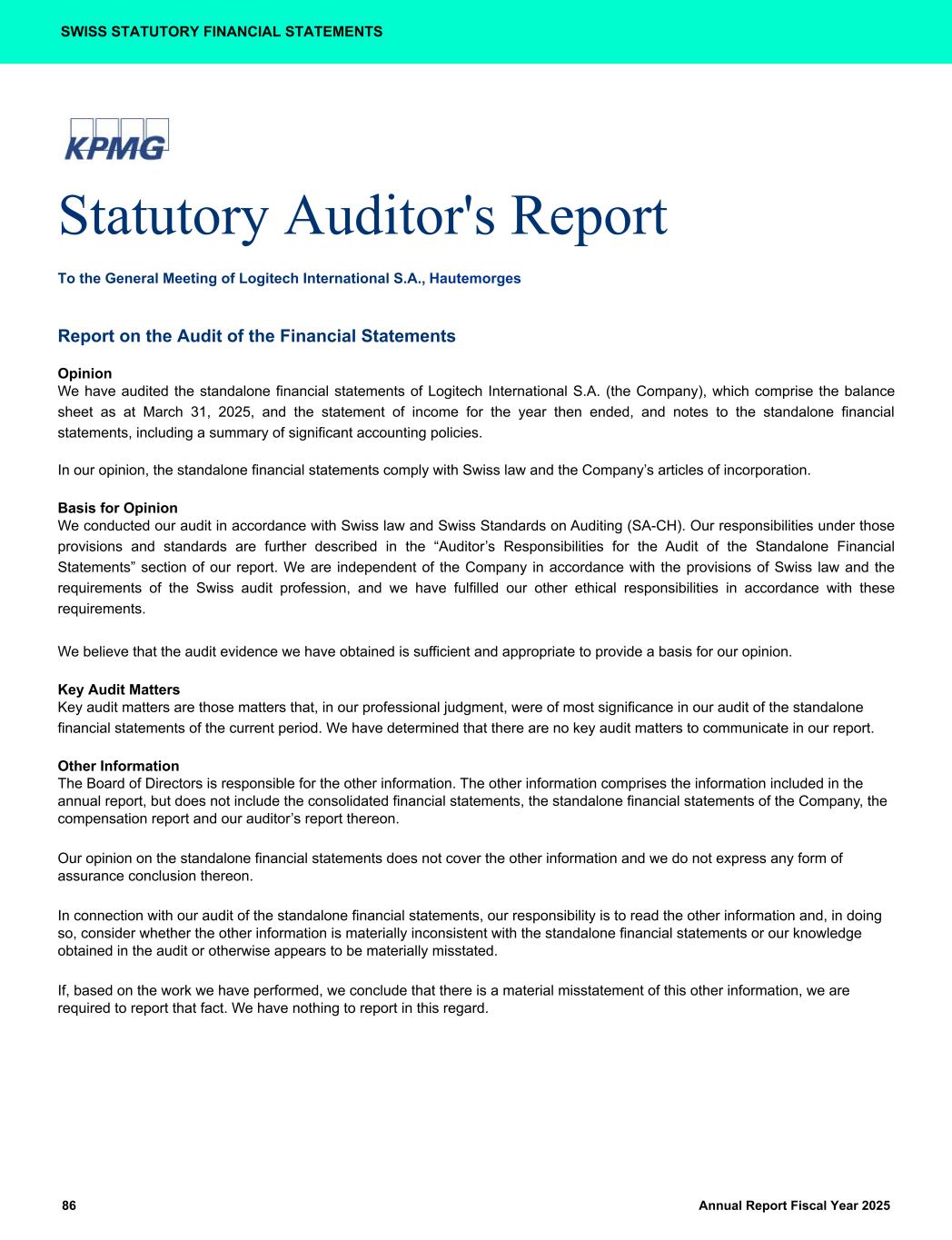
Statutory Auditor's Report To the General Meeting of Logitech International S.A., Hautemorges Report on the Audit of the Financial Statements Opinion We have audited the standalone financial statements of Logitech International S.A. (the Company), which comprise the balance sheet as at March 31, 2025, and the statement of income for the year then ended, and notes to the standalone financial statements, including a summary of significant accounting policies. In our opinion, the standalone financial statements comply with Swiss law and the Company’s articles of incorporation. Basis for Opinion We conducted our audit in accordance with Swiss law and Swiss Standards on Auditing (SA-CH). Our responsibilities under those provisions and standards are further described in the “Auditor’s Responsibilities for the Audit of the Standalone Financial Statements” section of our report. We are independent of the Company in accordance with the provisions of Swiss law and the requirements of the Swiss audit profession, and we have fulfilled our other ethical responsibilities in accordance with these requirements. We believe that the audit evidence we have obtained is sufficient and appropriate to provide a basis for our opinion. Key Audit Matters Key audit matters are those matters that, in our professional judgment, were of most significance in our audit of the standalone financial statements of the current period. We have determined that there are no key audit matters to communicate in our report. Other Information The Board of Directors is responsible for the other information. The other information comprises the information included in the annual report, but does not include the consolidated financial statements, the standalone financial statements of the Company, the compensation report and our auditor’s report thereon. Our opinion on the standalone financial statements does not cover the other information and we do not express any form of assurance conclusion thereon. In connection with our audit of the standalone financial statements, our responsibility is to read the other information and, in doing so, consider whether the other information is materially inconsistent with the standalone financial statements or our knowledge obtained in the audit or otherwise appears to be materially misstated. If, based on the work we have performed, we conclude that there is a material misstatement of this other information, we are required to report that fact. We have nothing to report in this regard. SWISS STATUTORY FINANCIAL STATEMENTS 86 Annual Report Fiscal Year 2025
Board of Directors’ Responsibilities for the Standalone Financial Statements The Board of Directors is responsible for the preparation of the standalone financial statements in accordance with the provisions of Swiss law and the Company’s articles of incorporation, and for such internal control as the Board of Directors determines is necessary to enable the preparation of standalone financial statements that are free from material misstatement, whether due to fraud or error. In preparing the standalone financial statements, the Board of Directors is responsible for assessing the Company’s ability to continue as a going concern, disclosing, as applicable, matters related to going concern and using the going concern basis of accounting unless the Board of Directors either intends to liquidate the Company or to cease operations, or has no realistic alternative but to do so. Auditor’s Responsibilities for the Audit of the Financial Statements Our objectives are to obtain reasonable assurance about whether the standalone financial statements as a whole are free from material misstatement, whether due to fraud or error, and to issue an auditor’s report that includes our opinion. Reasonable assurance is a high level of assurance, but is not a guarantee that an audit conducted in accordance with Swiss law and SA-CH will always detect a material misstatement when it exists. Misstatements can arise from fraud or error and are considered material if, individually or in the aggregate, they could reasonably be expected to influence the economic decisions of users taken on the basis of these standalone financial statements. As part of an audit in accordance with Swiss law and SA-CH, we exercise professional judgment and maintain professional skepticism throughout the audit. We also: – Identify and assess the risks of material misstatement of the standalone financial statements, whether due to fraud or error, design and perform audit procedures responsive to those risks, and obtain audit evidence that is sufficient and appropriate to provide a basis for our opinion. The risk of not detecting a material misstatement resulting from fraud is higher than for one resulting from error, as fraud may involve collusion, forgery, intentional omissions, misrepresentations, or the override of internal control. – Obtain an understanding of internal control relevant to the audit in order to design audit procedures that are appropriate in the circumstances, but not for the purpose of expressing an opinion on the effectiveness of the Company’s internal control. – Evaluate the appropriateness of accounting policies used and the reasonableness of accounting estimates and related disclosures made. – Conclude on the appropriateness of the Board of Directors’ use of the going concern basis of accounting and, based on the audit evidence obtained, whether a material uncertainty exists related to events or conditions that may cast significant doubt on the Company’s ability to continue as a going concern. If we conclude that a material uncertainty exists, we are required to draw attention in our auditor’s report to the related disclosures in the standalone financial statements or, if such disclosures are inadequate, to modify our opinion. Our conclusions are based on the audit evidence obtained up to the date of our auditor’s report. However, future events or conditions may cause the Company to cease to continue as a going concern. We communicate with the Board of Directors or its relevant committee regarding, among other matters, the planned scope and timing of the audit and significant audit findings, including any significant deficiencies in internal control that we identify during our audit. SWISS STATUTORY FINANCIAL STATEMENTS Annual Report Fiscal Year 2025 87
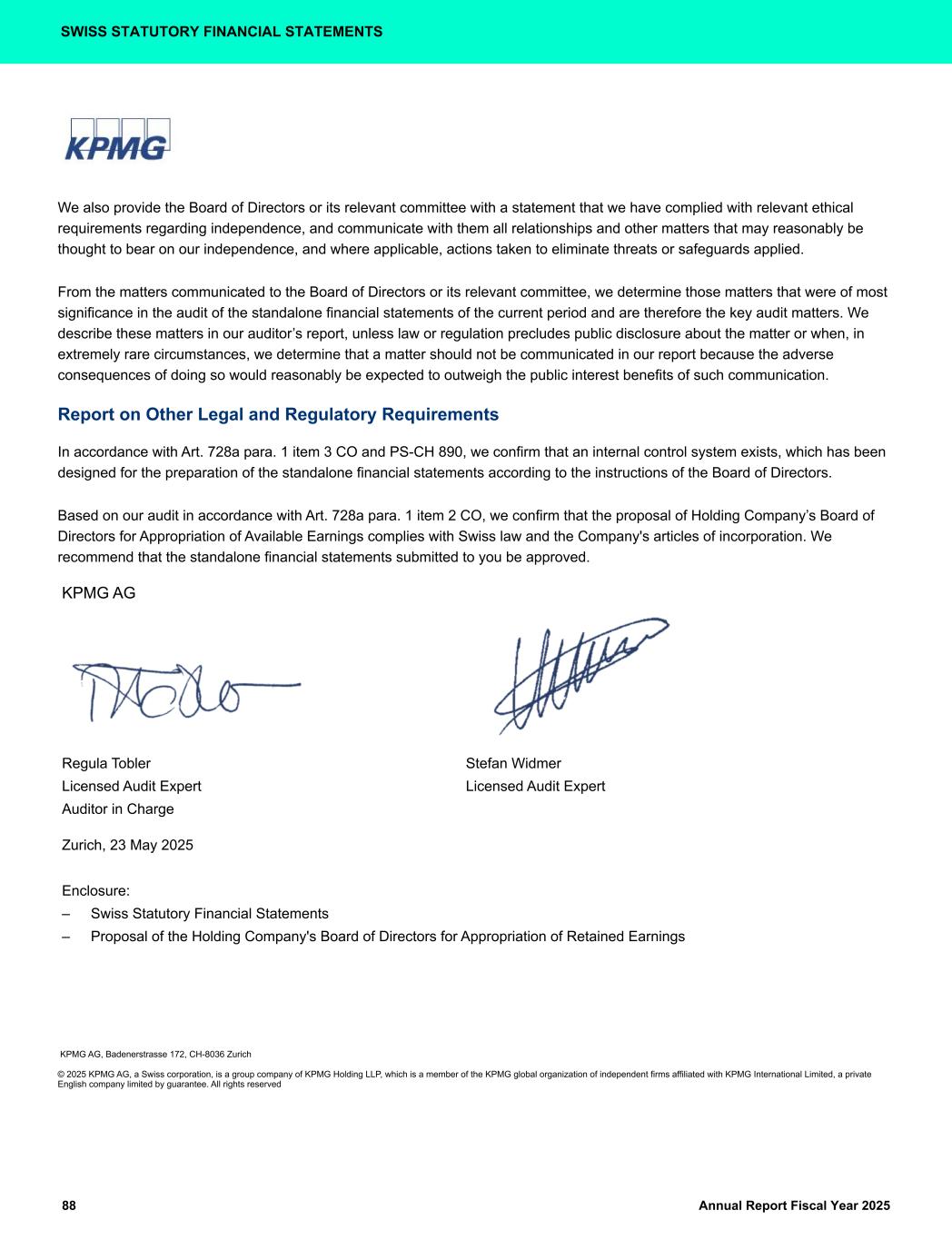
We also provide the Board of Directors or its relevant committee with a statement that we have complied with relevant ethical requirements regarding independence, and communicate with them all relationships and other matters that may reasonably be thought to bear on our independence, and where applicable, actions taken to eliminate threats or safeguards applied. From the matters communicated to the Board of Directors or its relevant committee, we determine those matters that were of most significance in the audit of the standalone financial statements of the current period and are therefore the key audit matters. We describe these matters in our auditor’s report, unless law or regulation precludes public disclosure about the matter or when, in extremely rare circumstances, we determine that a matter should not be communicated in our report because the adverse consequences of doing so would reasonably be expected to outweigh the public interest benefits of such communication. Report on Other Legal and Regulatory Requirements In accordance with Art. 728a para. 1 item 3 CO and PS-CH 890, we confirm that an internal control system exists, which has been designed for the preparation of the standalone financial statements according to the instructions of the Board of Directors. Based on our audit in accordance with Art. 728a para. 1 item 2 CO, we confirm that the proposal of Holding Company’s Board of Directors for Appropriation of Available Earnings complies with Swiss law and the Company's articles of incorporation. We recommend that the standalone financial statements submitted to you be approved. KPMG AG Regula Tobler Stefan Widmer Licensed Audit Expert Licensed Audit Expert Auditor in Charge Zurich, 23 May 2025 Enclosure: – Swiss Statutory Financial Statements – Proposal of the Holding Company's Board of Directors for Appropriation of Retained Earnings KPMG AG, Badenerstrasse 172, CH-8036 Zurich © 2025 KPMG AG, a Swiss corporation, is a group company of KPMG Holding LLP, which is a member of the KPMG global organization of independent firms affiliated with KPMG International Limited, a private English company limited by guarantee. All rights reserved SWISS STATUTORY FINANCIAL STATEMENTS 88 Annual Report Fiscal Year 2025
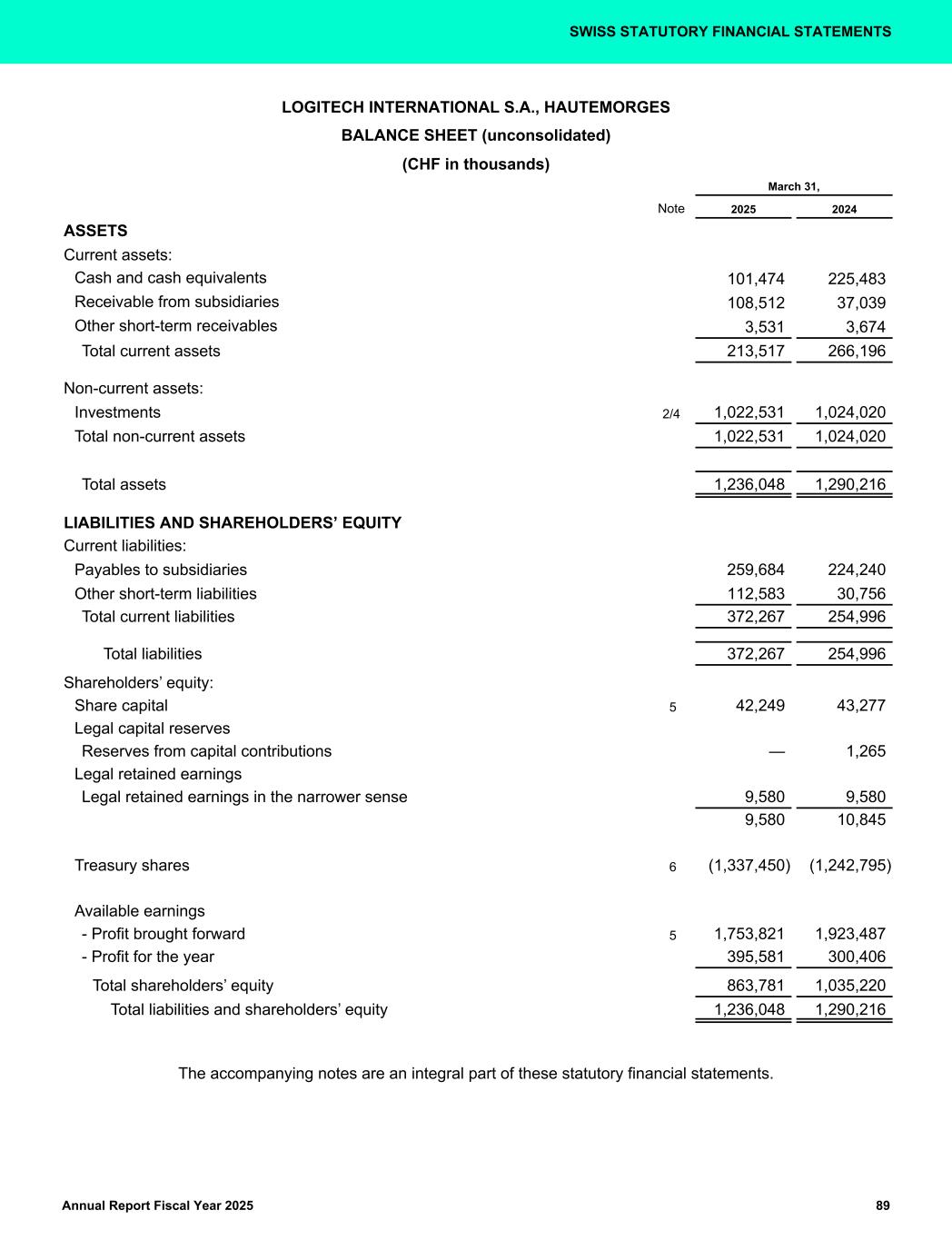
LOGITECH INTERNATIONAL S.A., HAUTEMORGES BALANCE SHEET (unconsolidated) (CHF in thousands) March 31, Note 2025 2024 ASSETS Current assets: Cash and cash equivalents 101,474 225,483 Receivable from subsidiaries 108,512 37,039 Other short-term receivables 3,531 3,674 Total current assets 213,517 266,196 Non-current assets: Investments 2/4 1,022,531 1,024,020 Total non-current assets 1,022,531 1,024,020 Total assets 1,236,048 1,290,216 LIABILITIES AND SHAREHOLDERS’ EQUITY Current liabilities: Payables to subsidiaries 259,684 224,240 Other short-term liabilities 112,583 30,756 Total current liabilities 372,267 254,996 Total liabilities 372,267 254,996 Shareholders’ equity: Share capital 5 42,249 43,277 Legal capital reserves Reserves from capital contributions — 1,265 Legal retained earnings Legal retained earnings in the narrower sense 9,580 9,580 9,580 10,845 Treasury shares 6 (1,337,450) (1,242,795) Available earnings - Profit brought forward 5 1,753,821 1,923,487 - Profit for the year 395,581 300,406 Total shareholders’ equity 863,781 1,035,220 Total liabilities and shareholders’ equity 1,236,048 1,290,216 The accompanying notes are an integral part of these statutory financial statements. SWISS STATUTORY FINANCIAL STATEMENTS Annual Report Fiscal Year 2025 89
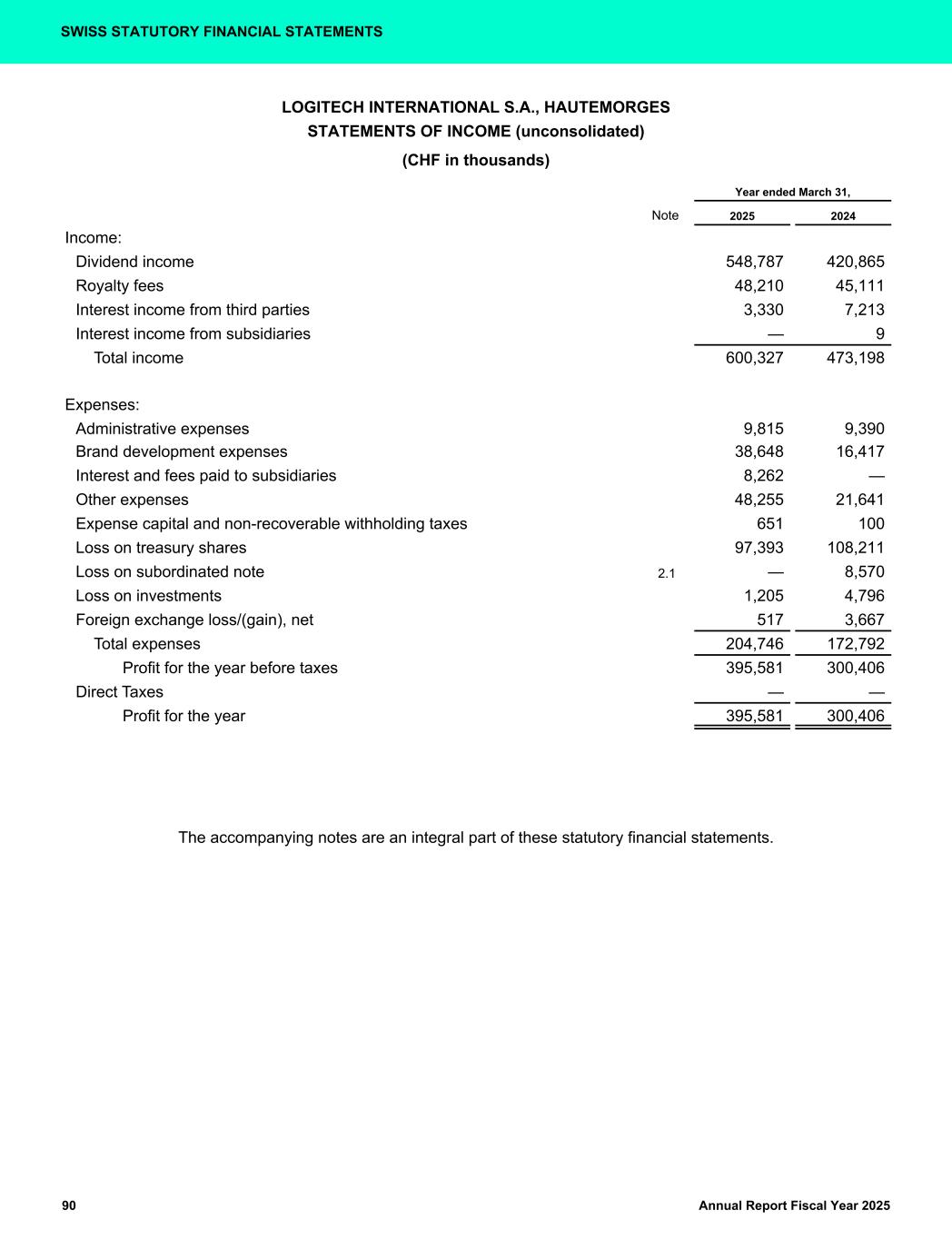
LOGITECH INTERNATIONAL S.A., HAUTEMORGES STATEMENTS OF INCOME (unconsolidated) (CHF in thousands) Year ended March 31, Note 2025 2024 Income: Dividend income 548,787 420,865 Royalty fees 48,210 45,111 Interest income from third parties 3,330 7,213 Interest income from subsidiaries — 9 Total income 600,327 473,198 Expenses: Administrative expenses 9,815 9,390 Brand development expenses 38,648 16,417 Interest and fees paid to subsidiaries 8,262 — Other expenses 48,255 21,641 Expense capital and non-recoverable withholding taxes 651 100 Loss on treasury shares 97,393 108,211 Loss on subordinated note 2.1 — 8,570 Loss on investments 1,205 4,796 Foreign exchange loss/(gain), net 517 3,667 Total expenses 204,746 172,792 Profit for the year before taxes 395,581 300,406 Direct Taxes — — Profit for the year 395,581 300,406 The accompanying notes are an integral part of these statutory financial statements. SWISS STATUTORY FINANCIAL STATEMENTS 90 Annual Report Fiscal Year 2025
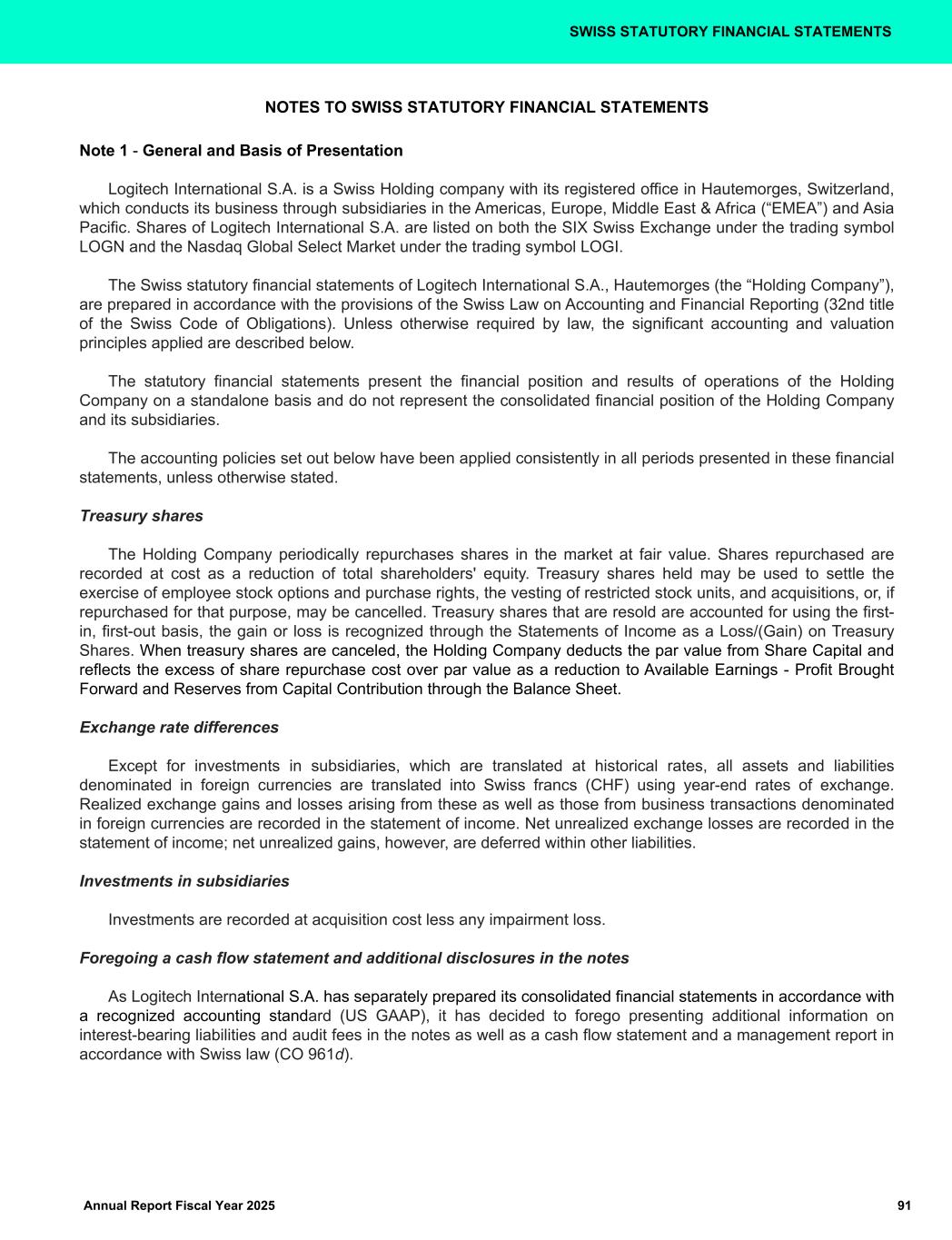
NOTES TO SWISS STATUTORY FINANCIAL STATEMENTS Note 1 - General and Basis of Presentation Logitech International S.A. is a Swiss Holding company with its registered office in Hautemorges, Switzerland, which conducts its business through subsidiaries in the Americas, Europe, Middle East & Africa (“EMEA”) and Asia Pacific. Shares of Logitech International S.A. are listed on both the SIX Swiss Exchange under the trading symbol LOGN and the Nasdaq Global Select Market under the trading symbol LOGI. The Swiss statutory financial statements of Logitech International S.A., Hautemorges (the “Holding Company”), are prepared in accordance with the provisions of the Swiss Law on Accounting and Financial Reporting (32nd title of the Swiss Code of Obligations). Unless otherwise required by law, the significant accounting and valuation principles applied are described below. The statutory financial statements present the financial position and results of operations of the Holding Company on a standalone basis and do not represent the consolidated financial position of the Holding Company and its subsidiaries. The accounting policies set out below have been applied consistently in all periods presented in these financial statements, unless otherwise stated. Treasury shares The Holding Company periodically repurchases shares in the market at fair value. Shares repurchased are recorded at cost as a reduction of total shareholders' equity. Treasury shares held may be used to settle the exercise of employee stock options and purchase rights, the vesting of restricted stock units, and acquisitions, or, if repurchased for that purpose, may be cancelled. Treasury shares that are resold are accounted for using the first- in, first-out basis, the gain or loss is recognized through the Statements of Income as a Loss/(Gain) on Treasury Shares. When treasury shares are canceled, the Holding Company deducts the par value from Share Capital and reflects the excess of share repurchase cost over par value as a reduction to Available Earnings - Profit Brought Forward and Reserves from Capital Contribution through the Balance Sheet. Exchange rate differences Except for investments in subsidiaries, which are translated at historical rates, all assets and liabilities denominated in foreign currencies are translated into Swiss francs (CHF) using year-end rates of exchange. Realized exchange gains and losses arising from these as well as those from business transactions denominated in foreign currencies are recorded in the statement of income. Net unrealized exchange losses are recorded in the statement of income; net unrealized gains, however, are deferred within other liabilities. Investments in subsidiaries Investments are recorded at acquisition cost less any impairment loss. Foregoing a cash flow statement and additional disclosures in the notes As Logitech International S.A. has separately prepared its consolidated financial statements in accordance with a recognized accounting standard (US GAAP), it has decided to forego presenting additional information on interest-bearing liabilities and audit fees in the notes as well as a cash flow statement and a management report in accordance with Swiss law (CO 961d). SWISS STATUTORY FINANCIAL STATEMENTS Annual Report Fiscal Year 2025 91
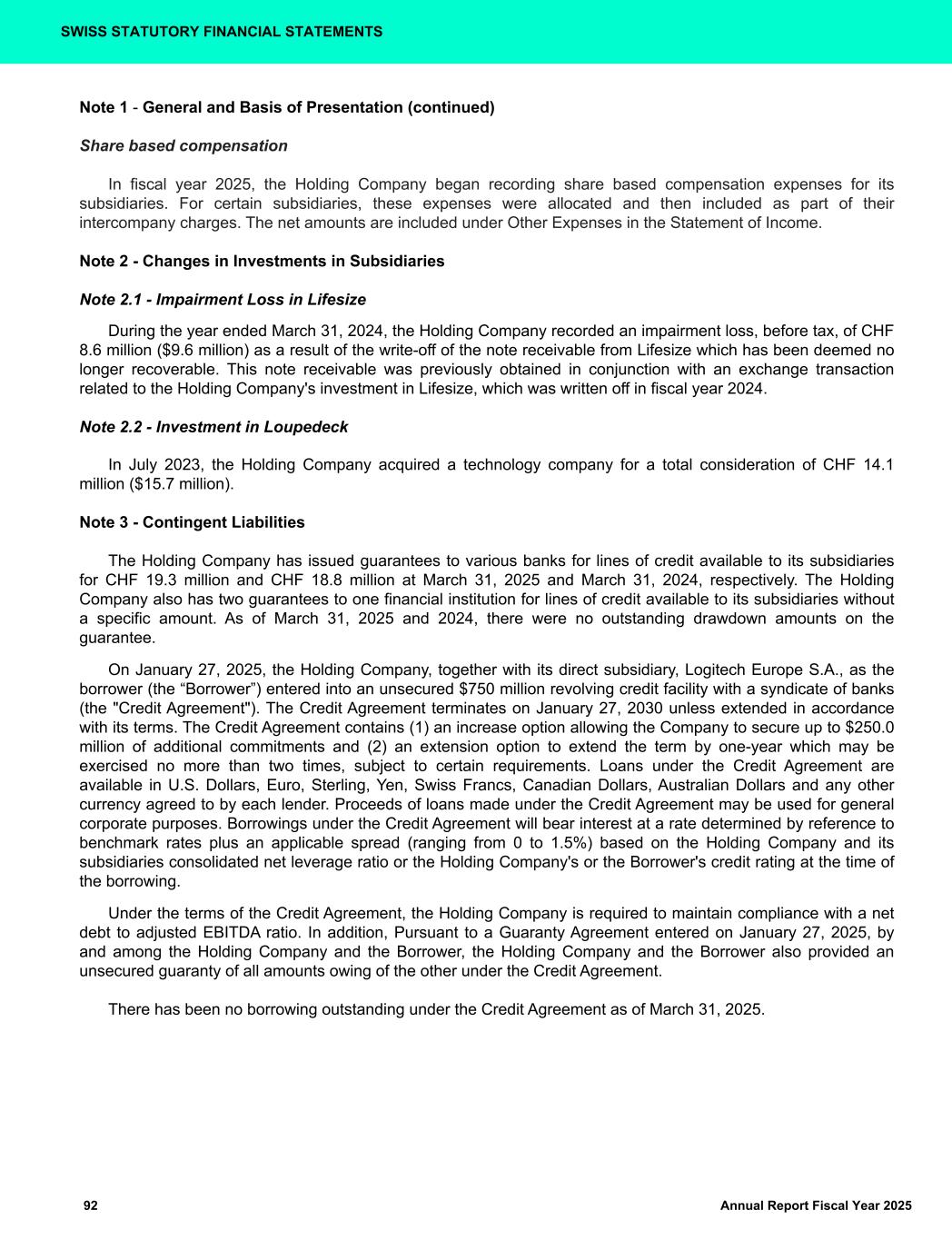
Note 1 - General and Basis of Presentation (continued) Share based compensation In fiscal year 2025, the Holding Company began recording share based compensation expenses for its subsidiaries. For certain subsidiaries, these expenses were allocated and then included as part of their intercompany charges. The net amounts are included under Other Expenses in the Statement of Income. Note 2 - Changes in Investments in Subsidiaries Note 2.1 - Impairment Loss in Lifesize During the year ended March 31, 2024, the Holding Company recorded an impairment loss, before tax, of CHF 8.6 million ($9.6 million) as a result of the write-off of the note receivable from Lifesize which has been deemed no longer recoverable. This note receivable was previously obtained in conjunction with an exchange transaction related to the Holding Company's investment in Lifesize, which was written off in fiscal year 2024. Note 2.2 - Investment in Loupedeck In July 2023, the Holding Company acquired a technology company for a total consideration of CHF 14.1 million ($15.7 million). Note 3 - Contingent Liabilities The Holding Company has issued guarantees to various banks for lines of credit available to its subsidiaries for CHF 19.3 million and CHF 18.8 million at March 31, 2025 and March 31, 2024, respectively. The Holding Company also has two guarantees to one financial institution for lines of credit available to its subsidiaries without a specific amount. As of March 31, 2025 and 2024, there were no outstanding drawdown amounts on the guarantee. On January 27, 2025, the Holding Company, together with its direct subsidiary, Logitech Europe S.A., as the borrower (the “Borrower”) entered into an unsecured $750 million revolving credit facility with a syndicate of banks (the "Credit Agreement"). The Credit Agreement terminates on January 27, 2030 unless extended in accordance with its terms. The Credit Agreement contains (1) an increase option allowing the Company to secure up to $250.0 million of additional commitments and (2) an extension option to extend the term by one-year which may be exercised no more than two times, subject to certain requirements. Loans under the Credit Agreement are available in U.S. Dollars, Euro, Sterling, Yen, Swiss Francs, Canadian Dollars, Australian Dollars and any other currency agreed to by each lender. Proceeds of loans made under the Credit Agreement may be used for general corporate purposes. Borrowings under the Credit Agreement will bear interest at a rate determined by reference to benchmark rates plus an applicable spread (ranging from 0 to 1.5%) based on the Holding Company and its subsidiaries consolidated net leverage ratio or the Holding Company's or the Borrower's credit rating at the time of the borrowing. Under the terms of the Credit Agreement, the Holding Company is required to maintain compliance with a net debt to adjusted EBITDA ratio. In addition, Pursuant to a Guaranty Agreement entered on January 27, 2025, by and among the Holding Company and the Borrower, the Holding Company and the Borrower also provided an unsecured guaranty of all amounts owing of the other under the Credit Agreement. There has been no borrowing outstanding under the Credit Agreement as of March 31, 2025. SWISS STATUTORY FINANCIAL STATEMENTS 92 Annual Report Fiscal Year 2025
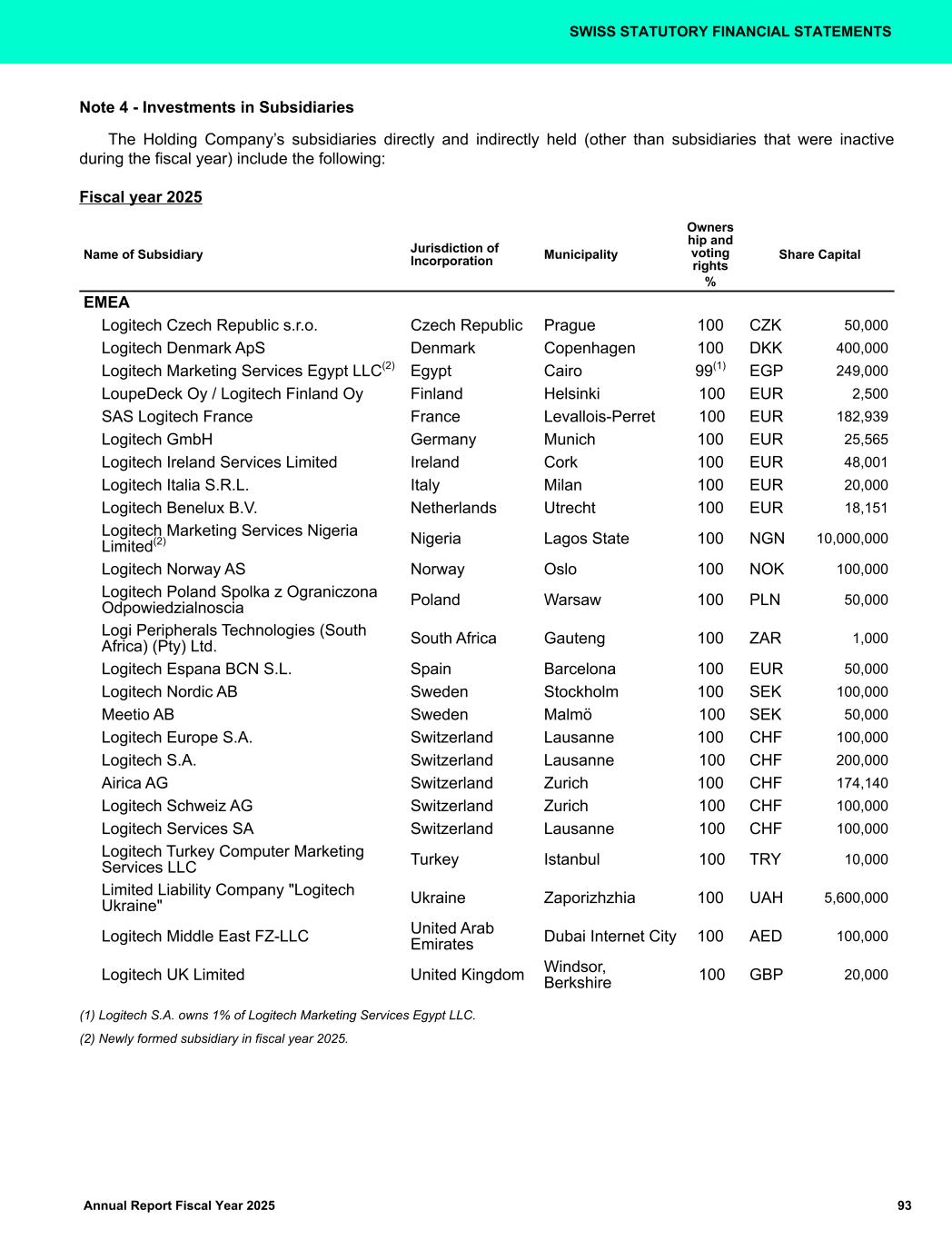
Note 4 - Investments in Subsidiaries The Holding Company’s subsidiaries directly and indirectly held (other than subsidiaries that were inactive during the fiscal year) include the following: Fiscal year 2025 Name of Subsidiary Jurisdiction of Incorporation Municipality Owners hip and voting rights % Share Capital EMEA Logitech Czech Republic s.r.o. Czech Republic Prague 100 CZK 50,000 Logitech Denmark ApS Denmark Copenhagen 100 DKK 400,000 Logitech Marketing Services Egypt LLC(2) Egypt Cairo 99(1) EGP 249,000 LoupeDeck Oy / Logitech Finland Oy Finland Helsinki 100 EUR 2,500 SAS Logitech France France Levallois-Perret 100 EUR 182,939 Logitech GmbH Germany Munich 100 EUR 25,565 Logitech Ireland Services Limited Ireland Cork 100 EUR 48,001 Logitech Italia S.R.L. Italy Milan 100 EUR 20,000 Logitech Benelux B.V. Netherlands Utrecht 100 EUR 18,151 Logitech Marketing Services Nigeria Limited(2) Nigeria Lagos State 100 NGN 10,000,000 Logitech Norway AS Norway Oslo 100 NOK 100,000 Logitech Poland Spolka z Ograniczona Odpowiedzialnoscia Poland Warsaw 100 PLN 50,000 Logi Peripherals Technologies (South Africa) (Pty) Ltd. South Africa Gauteng 100 ZAR 1,000 Logitech Espana BCN S.L. Spain Barcelona 100 EUR 50,000 Logitech Nordic AB Sweden Stockholm 100 SEK 100,000 Meetio AB Sweden Malmö 100 SEK 50,000 Logitech Europe S.A. Switzerland Lausanne 100 CHF 100,000 Logitech S.A. Switzerland Lausanne 100 CHF 200,000 Airica AG Switzerland Zurich 100 CHF 174,140 Logitech Schweiz AG Switzerland Zurich 100 CHF 100,000 Logitech Services SA Switzerland Lausanne 100 CHF 100,000 Logitech Turkey Computer Marketing Services LLC Turkey Istanbul 100 TRY 10,000 Limited Liability Company "Logitech Ukraine" Ukraine Zaporizhzhia 100 UAH 5,600,000 Logitech Middle East FZ-LLC United Arab Emirates Dubai Internet City 100 AED 100,000 Logitech UK Limited United Kingdom Windsor, Berkshire 100 GBP 20,000 (1) Logitech S.A. owns 1% of Logitech Marketing Services Egypt LLC. (2) Newly formed subsidiary in fiscal year 2025. SWISS STATUTORY FINANCIAL STATEMENTS Annual Report Fiscal Year 2025 93
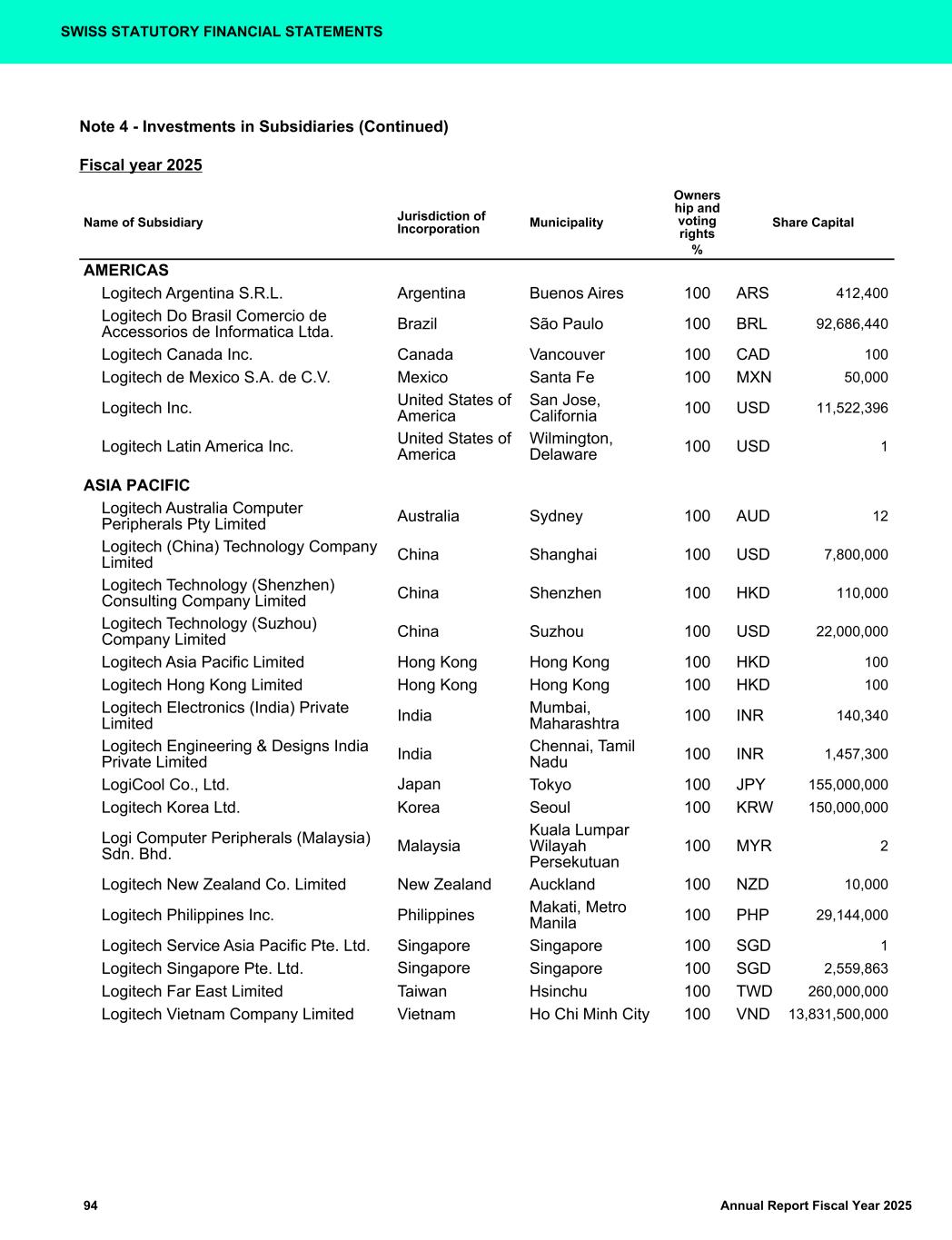
Note 4 - Investments in Subsidiaries (Continued) Fiscal year 2025 AMERICAS Logitech Argentina S.R.L. Argentina Buenos Aires 100 ARS 412,400 Logitech Do Brasil Comercio de Accessorios de Informatica Ltda. Brazil São Paulo 100 BRL 92,686,440 Logitech Canada Inc. Canada Vancouver 100 CAD 100 Logitech de Mexico S.A. de C.V. Mexico Santa Fe 100 MXN 50,000 Logitech Inc. United States of America San Jose, California 100 USD 11,522,396 Logitech Latin America Inc. United States of America Wilmington, Delaware 100 USD 1 ASIA PACIFIC Logitech Australia Computer Peripherals Pty Limited Australia Sydney 100 AUD 12 Logitech (China) Technology Company Limited China Shanghai 100 USD 7,800,000 Logitech Technology (Shenzhen) Consulting Company Limited China Shenzhen 100 HKD 110,000 Logitech Technology (Suzhou) Company Limited China Suzhou 100 USD 22,000,000 Logitech Asia Pacific Limited Hong Kong Hong Kong 100 HKD 100 Logitech Hong Kong Limited Hong Kong Hong Kong 100 HKD 100 Logitech Electronics (India) Private Limited India Mumbai, Maharashtra 100 INR 140,340 Logitech Engineering & Designs India Private Limited India Chennai, Tamil Nadu 100 INR 1,457,300 LogiCool Co., Ltd. Japan Tokyo 100 JPY 155,000,000 Logitech Korea Ltd. Korea Seoul 100 KRW 150,000,000 Logi Computer Peripherals (Malaysia) Sdn. Bhd. Malaysia Kuala Lumpar Wilayah Persekutuan 100 MYR 2 Logitech New Zealand Co. Limited New Zealand Auckland 100 NZD 10,000 Logitech Philippines Inc. Philippines Makati, Metro Manila 100 PHP 29,144,000 Logitech Service Asia Pacific Pte. Ltd. Singapore Singapore 100 SGD 1 Logitech Singapore Pte. Ltd. Singapore Singapore 100 SGD 2,559,863 Logitech Far East Limited Taiwan Hsinchu 100 TWD 260,000,000 Logitech Vietnam Company Limited Vietnam Ho Chi Minh City 100 VND 13,831,500,000 Name of Subsidiary Jurisdiction of Incorporation Municipality Owners hip and voting rights % Share Capital SWISS STATUTORY FINANCIAL STATEMENTS 94 Annual Report Fiscal Year 2025
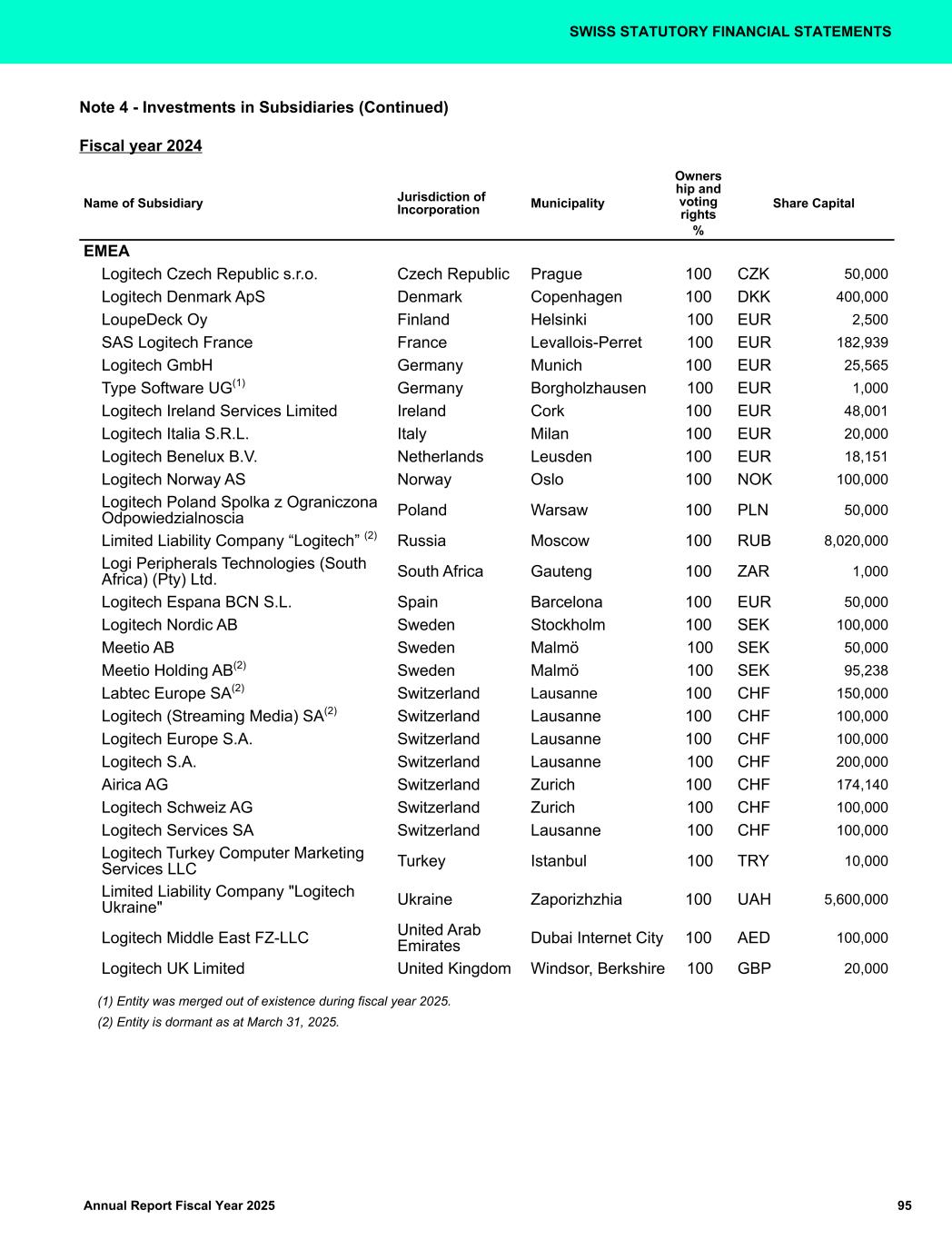
Note 4 - Investments in Subsidiaries (Continued) Fiscal year 2024 Name of Subsidiary Jurisdiction of Incorporation Municipality Owners hip and voting rights % Share Capital EMEA Logitech Czech Republic s.r.o. Czech Republic Prague 100 CZK 50,000 Logitech Denmark ApS Denmark Copenhagen 100 DKK 400,000 LoupeDeck Oy Finland Helsinki 100 EUR 2,500 SAS Logitech France France Levallois-Perret 100 EUR 182,939 Logitech GmbH Germany Munich 100 EUR 25,565 Type Software UG(1) Germany Borgholzhausen 100 EUR 1,000 Logitech Ireland Services Limited Ireland Cork 100 EUR 48,001 Logitech Italia S.R.L. Italy Milan 100 EUR 20,000 Logitech Benelux B.V. Netherlands Leusden 100 EUR 18,151 Logitech Norway AS Norway Oslo 100 NOK 100,000 Logitech Poland Spolka z Ograniczona Odpowiedzialnoscia Poland Warsaw 100 PLN 50,000 Limited Liability Company “Logitech” (2) Russia Moscow 100 RUB 8,020,000 Logi Peripherals Technologies (South Africa) (Pty) Ltd. South Africa Gauteng 100 ZAR 1,000 Logitech Espana BCN S.L. Spain Barcelona 100 EUR 50,000 Logitech Nordic AB Sweden Stockholm 100 SEK 100,000 Meetio AB Sweden Malmö 100 SEK 50,000 Meetio Holding AB(2) Sweden Malmö 100 SEK 95,238 Labtec Europe SA(2) Switzerland Lausanne 100 CHF 150,000 Logitech (Streaming Media) SA(2) Switzerland Lausanne 100 CHF 100,000 Logitech Europe S.A. Switzerland Lausanne 100 CHF 100,000 Logitech S.A. Switzerland Lausanne 100 CHF 200,000 Airica AG Switzerland Zurich 100 CHF 174,140 Logitech Schweiz AG Switzerland Zurich 100 CHF 100,000 Logitech Services SA Switzerland Lausanne 100 CHF 100,000 Logitech Turkey Computer Marketing Services LLC Turkey Istanbul 100 TRY 10,000 Limited Liability Company "Logitech Ukraine" Ukraine Zaporizhzhia 100 UAH 5,600,000 Logitech Middle East FZ-LLC United Arab Emirates Dubai Internet City 100 AED 100,000 Logitech UK Limited United Kingdom Windsor, Berkshire 100 GBP 20,000 (1) Entity was merged out of existence during fiscal year 2025. (2) Entity is dormant as at March 31, 2025. SWISS STATUTORY FINANCIAL STATEMENTS Annual Report Fiscal Year 2025 95
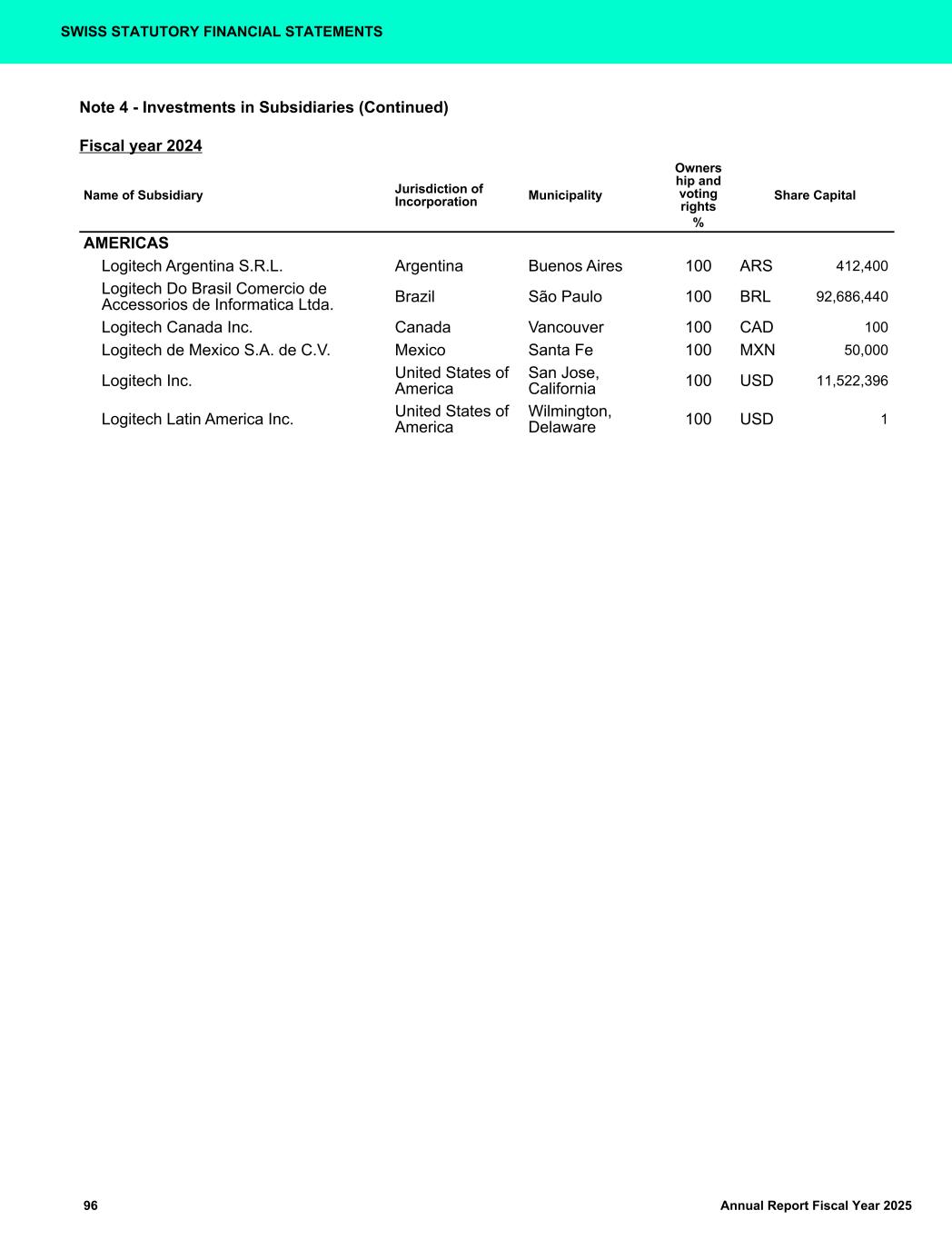
Note 4 - Investments in Subsidiaries (Continued) Fiscal year 2024 Name of Subsidiary Jurisdiction of Incorporation Municipality Owners hip and voting rights % Share Capital AMERICAS Logitech Argentina S.R.L. Argentina Buenos Aires 100 ARS 412,400 Logitech Do Brasil Comercio de Accessorios de Informatica Ltda. Brazil São Paulo 100 BRL 92,686,440 Logitech Canada Inc. Canada Vancouver 100 CAD 100 Logitech de Mexico S.A. de C.V. Mexico Santa Fe 100 MXN 50,000 Logitech Inc. United States of America San Jose, California 100 USD 11,522,396 Logitech Latin America Inc. United States of America Wilmington, Delaware 100 USD 1 SWISS STATUTORY FINANCIAL STATEMENTS 96 Annual Report Fiscal Year 2025
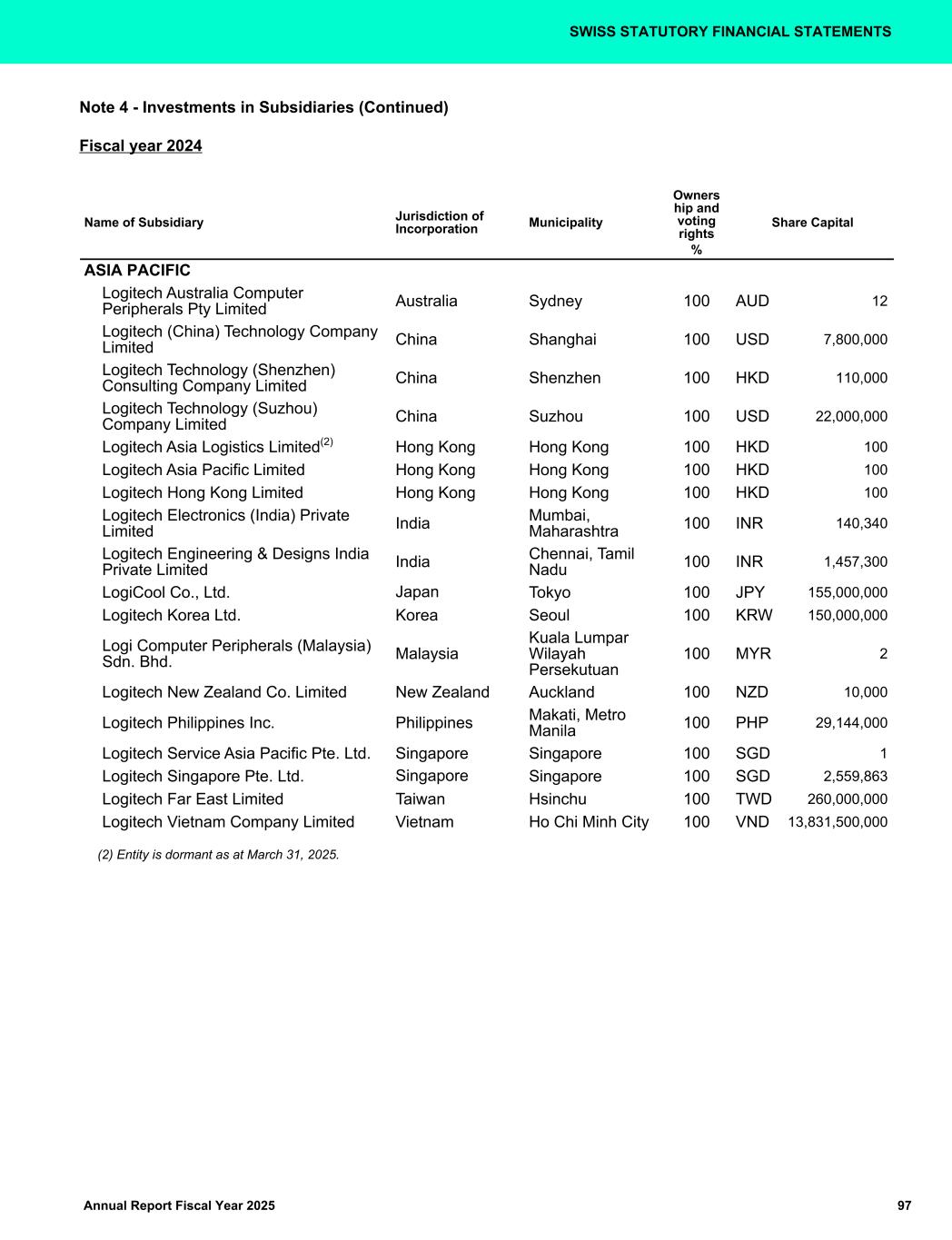
Note 4 - Investments in Subsidiaries (Continued) Fiscal year 2024 Name of Subsidiary Jurisdiction of Incorporation Municipality Owners hip and voting rights % Share Capital ASIA PACIFIC Logitech Australia Computer Peripherals Pty Limited Australia Sydney 100 AUD 12 Logitech (China) Technology Company Limited China Shanghai 100 USD 7,800,000 Logitech Technology (Shenzhen) Consulting Company Limited China Shenzhen 100 HKD 110,000 Logitech Technology (Suzhou) Company Limited China Suzhou 100 USD 22,000,000 Logitech Asia Logistics Limited(2) Hong Kong Hong Kong 100 HKD 100 Logitech Asia Pacific Limited Hong Kong Hong Kong 100 HKD 100 Logitech Hong Kong Limited Hong Kong Hong Kong 100 HKD 100 Logitech Electronics (India) Private Limited India Mumbai, Maharashtra 100 INR 140,340 Logitech Engineering & Designs India Private Limited India Chennai, Tamil Nadu 100 INR 1,457,300 LogiCool Co., Ltd. Japan Tokyo 100 JPY 155,000,000 Logitech Korea Ltd. Korea Seoul 100 KRW 150,000,000 Logi Computer Peripherals (Malaysia) Sdn. Bhd. Malaysia Kuala Lumpar Wilayah Persekutuan 100 MYR 2 Logitech New Zealand Co. Limited New Zealand Auckland 100 NZD 10,000 Logitech Philippines Inc. Philippines Makati, Metro Manila 100 PHP 29,144,000 Logitech Service Asia Pacific Pte. Ltd. Singapore Singapore 100 SGD 1 Logitech Singapore Pte. Ltd. Singapore Singapore 100 SGD 2,559,863 Logitech Far East Limited Taiwan Hsinchu 100 TWD 260,000,000 Logitech Vietnam Company Limited Vietnam Ho Chi Minh City 100 VND 13,831,500,000 (2) Entity is dormant as at March 31, 2025. SWISS STATUTORY FINANCIAL STATEMENTS Annual Report Fiscal Year 2025 97
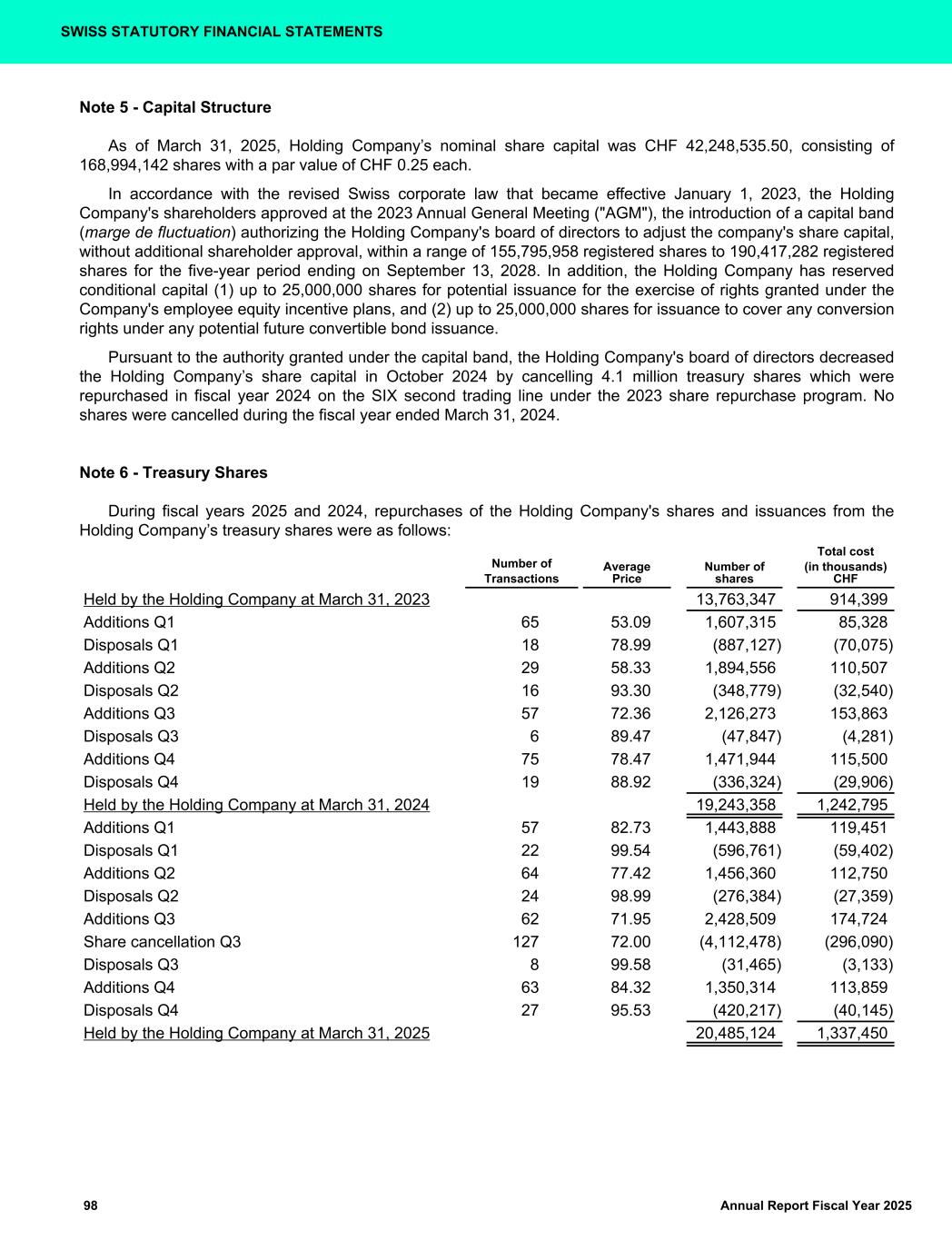
Note 5 - Capital Structure As of March 31, 2025, Holding Company’s nominal share capital was CHF 42,248,535.50, consisting of 168,994,142 shares with a par value of CHF 0.25 each. In accordance with the revised Swiss corporate law that became effective January 1, 2023, the Holding Company's shareholders approved at the 2023 Annual General Meeting ("AGM"), the introduction of a capital band (marge de fluctuation) authorizing the Holding Company's board of directors to adjust the company's share capital, without additional shareholder approval, within a range of 155,795,958 registered shares to 190,417,282 registered shares for the five-year period ending on September 13, 2028. In addition, the Holding Company has reserved conditional capital (1) up to 25,000,000 shares for potential issuance for the exercise of rights granted under the Company's employee equity incentive plans, and (2) up to 25,000,000 shares for issuance to cover any conversion rights under any potential future convertible bond issuance. Pursuant to the authority granted under the capital band, the Holding Company's board of directors decreased the Holding Company’s share capital in October 2024 by cancelling 4.1 million treasury shares which were repurchased in fiscal year 2024 on the SIX second trading line under the 2023 share repurchase program. No shares were cancelled during the fiscal year ended March 31, 2024. Note 6 - Treasury Shares During fiscal years 2025 and 2024, repurchases of the Holding Company's shares and issuances from the Holding Company’s treasury shares were as follows: Number of Transactions Average Price Number of shares Total cost (in thousands) CHF Held by the Holding Company at March 31, 2023 13,763,347 914,399 Additions Q1 65 53.09 1,607,315 85,328 Disposals Q1 18 78.99 (887,127) (70,075) Additions Q2 29 58.33 1,894,556 110,507 Disposals Q2 16 93.30 (348,779) (32,540) Additions Q3 57 72.36 2,126,273 153,863 Disposals Q3 6 89.47 (47,847) (4,281) Additions Q4 75 78.47 1,471,944 115,500 Disposals Q4 19 88.92 (336,324) (29,906) Held by the Holding Company at March 31, 2024 19,243,358 1,242,795 Additions Q1 57 82.73 1,443,888 119,451 Disposals Q1 22 99.54 (596,761) (59,402) Additions Q2 64 77.42 1,456,360 112,750 Disposals Q2 24 98.99 (276,384) (27,359) Additions Q3 62 71.95 2,428,509 174,724 Share cancellation Q3 127 72.00 (4,112,478) (296,090) Disposals Q3 8 99.58 (31,465) (3,133) Additions Q4 63 84.32 1,350,314 113,859 Disposals Q4 27 95.53 (420,217) (40,145) Held by the Holding Company at March 31, 2025 20,485,124 1,337,450 SWISS STATUTORY FINANCIAL STATEMENTS 98 Annual Report Fiscal Year 2025
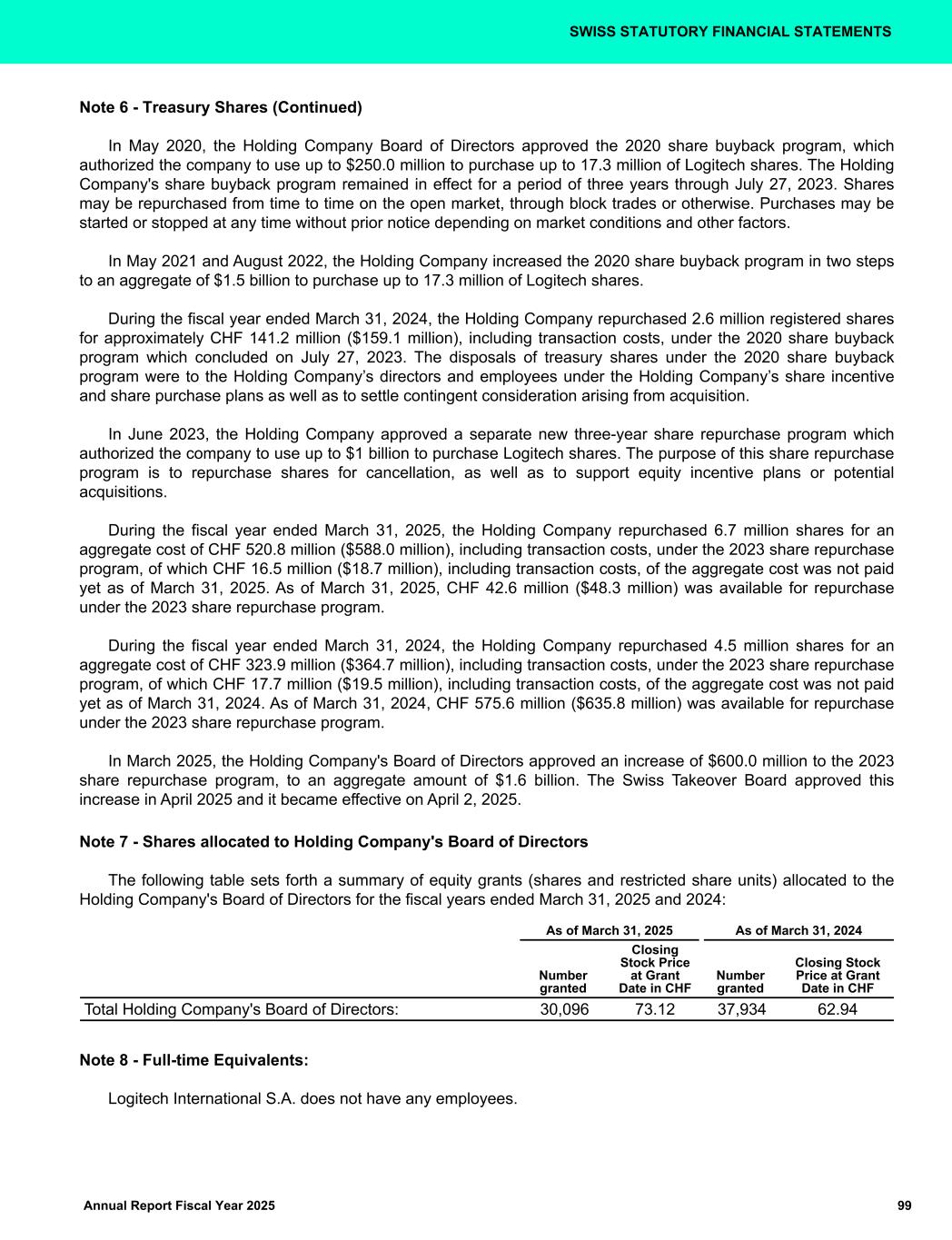
Note 6 - Treasury Shares (Continued) In May 2020, the Holding Company Board of Directors approved the 2020 share buyback program, which authorized the company to use up to $250.0 million to purchase up to 17.3 million of Logitech shares. The Holding Company's share buyback program remained in effect for a period of three years through July 27, 2023. Shares may be repurchased from time to time on the open market, through block trades or otherwise. Purchases may be started or stopped at any time without prior notice depending on market conditions and other factors. In May 2021 and August 2022, the Holding Company increased the 2020 share buyback program in two steps to an aggregate of $1.5 billion to purchase up to 17.3 million of Logitech shares. During the fiscal year ended March 31, 2024, the Holding Company repurchased 2.6 million registered shares for approximately CHF 141.2 million ($159.1 million), including transaction costs, under the 2020 share buyback program which concluded on July 27, 2023. The disposals of treasury shares under the 2020 share buyback program were to the Holding Company’s directors and employees under the Holding Company’s share incentive and share purchase plans as well as to settle contingent consideration arising from acquisition. In June 2023, the Holding Company approved a separate new three-year share repurchase program which authorized the company to use up to $1 billion to purchase Logitech shares. The purpose of this share repurchase program is to repurchase shares for cancellation, as well as to support equity incentive plans or potential acquisitions. During the fiscal year ended March 31, 2025, the Holding Company repurchased 6.7 million shares for an aggregate cost of CHF 520.8 million ($588.0 million), including transaction costs, under the 2023 share repurchase program, of which CHF 16.5 million ($18.7 million), including transaction costs, of the aggregate cost was not paid yet as of March 31, 2025. As of March 31, 2025, CHF 42.6 million ($48.3 million) was available for repurchase under the 2023 share repurchase program. During the fiscal year ended March 31, 2024, the Holding Company repurchased 4.5 million shares for an aggregate cost of CHF 323.9 million ($364.7 million), including transaction costs, under the 2023 share repurchase program, of which CHF 17.7 million ($19.5 million), including transaction costs, of the aggregate cost was not paid yet as of March 31, 2024. As of March 31, 2024, CHF 575.6 million ($635.8 million) was available for repurchase under the 2023 share repurchase program. In March 2025, the Holding Company's Board of Directors approved an increase of $600.0 million to the 2023 share repurchase program, to an aggregate amount of $1.6 billion. The Swiss Takeover Board approved this increase in April 2025 and it became effective on April 2, 2025. Note 7 - Shares allocated to Holding Company's Board of Directors The following table sets forth a summary of equity grants (shares and restricted share units) allocated to the Holding Company's Board of Directors for the fiscal years ended March 31, 2025 and 2024: As of March 31, 2025 As of March 31, 2024 Number granted Closing Stock Price at Grant Date in CHF Number granted Closing Stock Price at Grant Date in CHF Total Holding Company's Board of Directors: 30,096 73.12 37,934 62.94 Note 8 - Full-time Equivalents: Logitech International S.A. does not have any employees. SWISS STATUTORY FINANCIAL STATEMENTS Annual Report Fiscal Year 2025 99
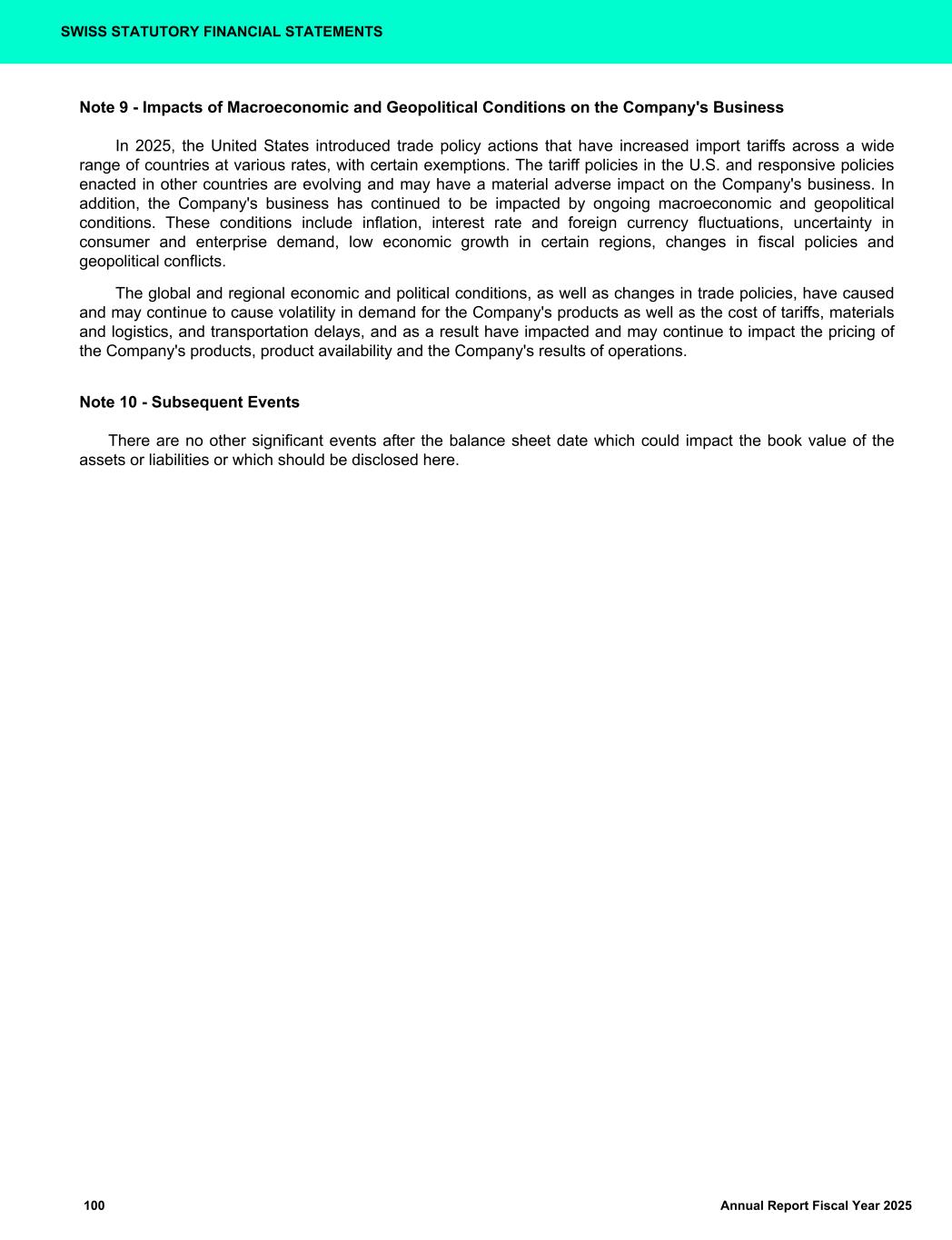
Note 9 - Impacts of Macroeconomic and Geopolitical Conditions on the Company's Business In 2025, the United States introduced trade policy actions that have increased import tariffs across a wide range of countries at various rates, with certain exemptions. The tariff policies in the U.S. and responsive policies enacted in other countries are evolving and may have a material adverse impact on the Company's business. In addition, the Company's business has continued to be impacted by ongoing macroeconomic and geopolitical conditions. These conditions include inflation, interest rate and foreign currency fluctuations, uncertainty in consumer and enterprise demand, low economic growth in certain regions, changes in fiscal policies and geopolitical conflicts. The global and regional economic and political conditions, as well as changes in trade policies, have caused and may continue to cause volatility in demand for the Company's products as well as the cost of tariffs, materials and logistics, and transportation delays, and as a result have impacted and may continue to impact the pricing of the Company's products, product availability and the Company's results of operations. Note 10 - Subsequent Events There are no other significant events after the balance sheet date which could impact the book value of the assets or liabilities or which should be disclosed here. SWISS STATUTORY FINANCIAL STATEMENTS 100 Annual Report Fiscal Year 2025
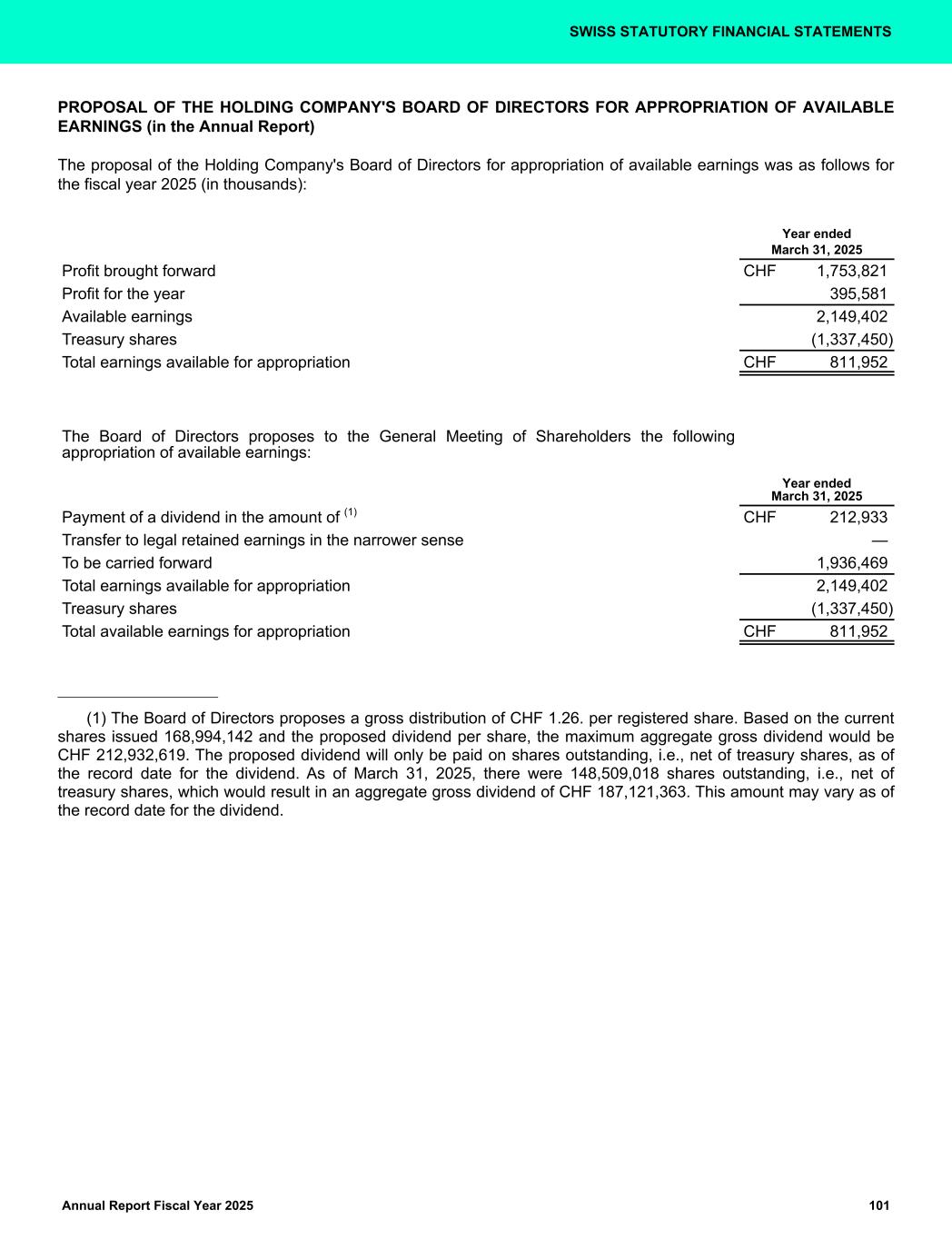
PROPOSAL OF THE HOLDING COMPANY'S BOARD OF DIRECTORS FOR APPROPRIATION OF AVAILABLE EARNINGS (in the Annual Report) The proposal of the Holding Company's Board of Directors for appropriation of available earnings was as follows for the fiscal year 2025 (in thousands): Year ended March 31, 2025 Profit brought forward CHF 1,753,821 Profit for the year 395,581 Available earnings 2,149,402 Treasury shares (1,337,450) Total earnings available for appropriation CHF 811,952 The Board of Directors proposes to the General Meeting of Shareholders the following appropriation of available earnings: Year ended March 31, 2025 Payment of a dividend in the amount of (1) CHF 212,933 Transfer to legal retained earnings in the narrower sense — To be carried forward 1,936,469 Total earnings available for appropriation 2,149,402 Treasury shares (1,337,450) Total available earnings for appropriation CHF 811,952 ____________________ (1) The Board of Directors proposes a gross distribution of CHF 1.26. per registered share. Based on the current shares issued 168,994,142 and the proposed dividend per share, the maximum aggregate gross dividend would be CHF 212,932,619. The proposed dividend will only be paid on shares outstanding, i.e., net of treasury shares, as of the record date for the dividend. As of March 31, 2025, there were 148,509,018 shares outstanding, i.e., net of treasury shares, which would result in an aggregate gross dividend of CHF 187,121,363. This amount may vary as of the record date for the dividend. SWISS STATUTORY FINANCIAL STATEMENTS Annual Report Fiscal Year 2025 101