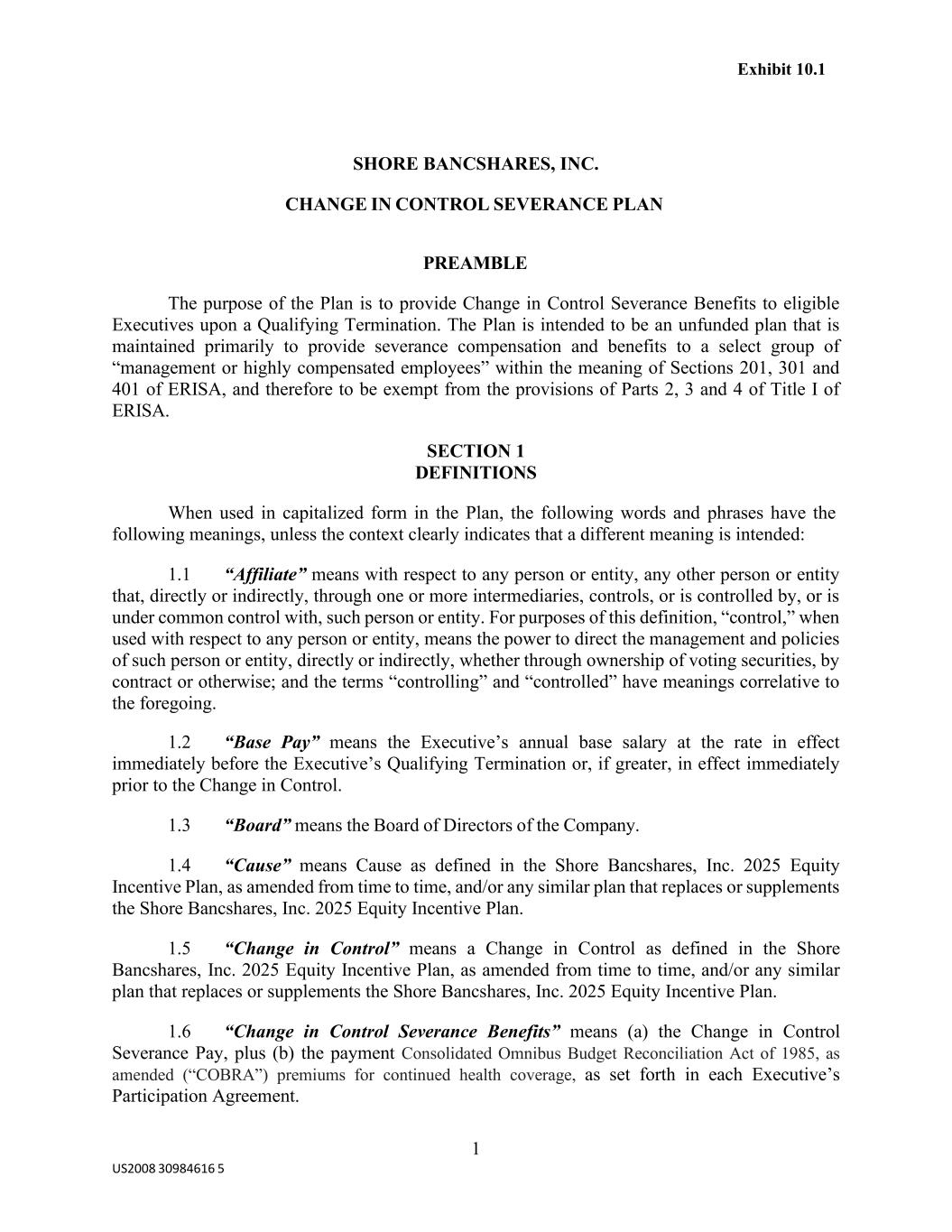
1 US2008 30984616 5 SHORE BANCSHARES, INC. CHANGE IN CONTROL SEVERANCE PLAN PREAMBLE The purpose of the Plan is to provide Change in Control Severance Benefits to eligible Executives upon a Qualifying Termination. The Plan is intended to be an unfunded plan that is maintained primarily to provide severance compensation and benefits to a select group of “management or highly compensated employees” within the meaning of Sections 201, 301 and 401 of ERISA, and therefore to be exempt from the provisions of Parts 2, 3 and 4 of Title I of ERISA. SECTION 1 DEFINITIONS When used in capitalized form in the Plan, the following words and phrases have the following meanings, unless the context clearly indicates that a different meaning is intended: 1.1 “Affiliate” means with respect to any person or entity, any other person or entity that, directly or indirectly, through one or more intermediaries, controls, or is controlled by, or is under common control with, such person or entity. For purposes of this definition, “control,” when used with respect to any person or entity, means the power to direct the management and policies of such person or entity, directly or indirectly, whether through ownership of voting securities, by contract or otherwise; and the terms “controlling” and “controlled” have meanings correlative to the foregoing. 1.2 “Base Pay” means the Executive’s annual base salary at the rate in effect immediately before the Executive’s Qualifying Termination or, if greater, in effect immediately prior to the Change in Control. 1.3 “Board” means the Board of Directors of the Company. 1.4 “Cause” means Cause as defined in the Shore Bancshares, Inc. 2025 Equity Incentive Plan, as amended from time to time, and/or any similar plan that replaces or supplements the Shore Bancshares, Inc. 2025 Equity Incentive Plan. 1.5 “Change in Control” means a Change in Control as defined in the Shore Bancshares, Inc. 2025 Equity Incentive Plan, as amended from time to time, and/or any similar plan that replaces or supplements the Shore Bancshares, Inc. 2025 Equity Incentive Plan. 1.6 “Change in Control Severance Benefits” means (a) the Change in Control Severance Pay, plus (b) the payment Consolidated Omnibus Budget Reconciliation Act of 1985, as amended (“COBRA”) premiums for continued health coverage, as set forth in each Executive’s Participation Agreement. Exhibit 10.1
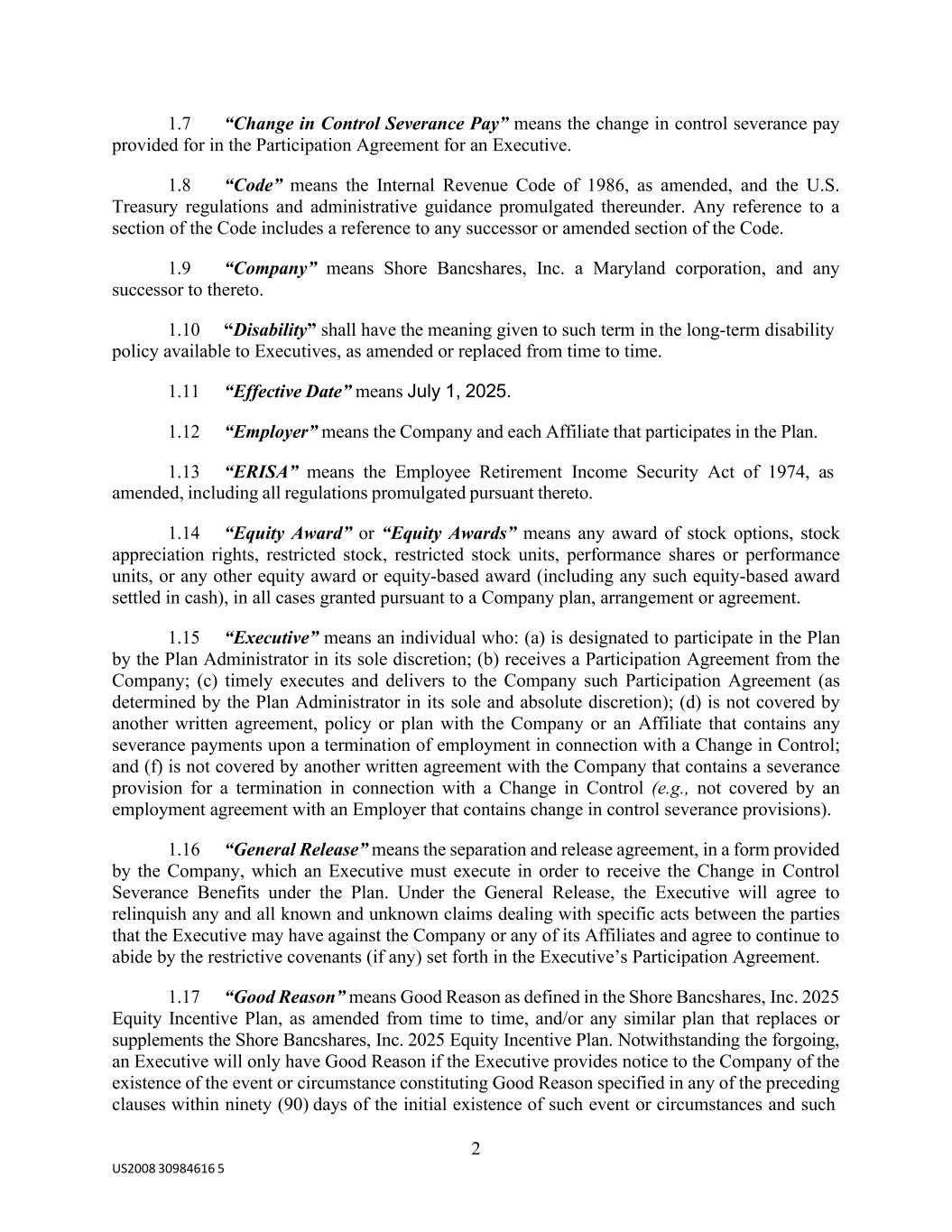
2 US2008 30984616 5 1.7 “Change in Control Severance Pay” means the change in control severance pay provided for in the Participation Agreement for an Executive. 1.8 “Code” means the Internal Revenue Code of 1986, as amended, and the U.S. Treasury regulations and administrative guidance promulgated thereunder. Any reference to a section of the Code includes a reference to any successor or amended section of the Code. 1.9 “Company” means Shore Bancshares, Inc. a Maryland corporation, and any successor to thereto. 1.10 “Disability” shall have the meaning given to such term in the long-term disability policy available to Executives, as amended or replaced from time to time. 1.11 “Effective Date” means July 1, 2025. 1.12 “Employer” means the Company and each Affiliate that participates in the Plan. 1.13 “ERISA” means the Employee Retirement Income Security Act of 1974, as amended, including all regulations promulgated pursuant thereto. 1.14 “Equity Award” or “Equity Awards” means any award of stock options, stock appreciation rights, restricted stock, restricted stock units, performance shares or performance units, or any other equity award or equity-based award (including any such equity-based award settled in cash), in all cases granted pursuant to a Company plan, arrangement or agreement. 1.15 “Executive” means an individual who: (a) is designated to participate in the Plan by the Plan Administrator in its sole discretion; (b) receives a Participation Agreement from the Company; (c) timely executes and delivers to the Company such Participation Agreement (as determined by the Plan Administrator in its sole and absolute discretion); (d) is not covered by another written agreement, policy or plan with the Company or an Affiliate that contains any severance payments upon a termination of employment in connection with a Change in Control; and (f) is not covered by another written agreement with the Company that contains a severance provision for a termination in connection with a Change in Control (e.g., not covered by an employment agreement with an Employer that contains change in control severance provisions). 1.16 “General Release” means the separation and release agreement, in a form provided by the Company, which an Executive must execute in order to receive the Change in Control Severance Benefits under the Plan. Under the General Release, the Executive will agree to relinquish any and all known and unknown claims dealing with specific acts between the parties that the Executive may have against the Company or any of its Affiliates and agree to continue to abide by the restrictive covenants (if any) set forth in the Executive’s Participation Agreement. 1.17 “Good Reason” means Good Reason as defined in the Shore Bancshares, Inc. 2025 Equity Incentive Plan, as amended from time to time, and/or any similar plan that replaces or supplements the Shore Bancshares, Inc. 2025 Equity Incentive Plan. Notwithstanding the forgoing, an Executive will only have Good Reason if the Executive provides notice to the Company of the existence of the event or circumstance constituting Good Reason specified in any of the preceding clauses within ninety (90) days of the initial existence of such event or circumstances and such
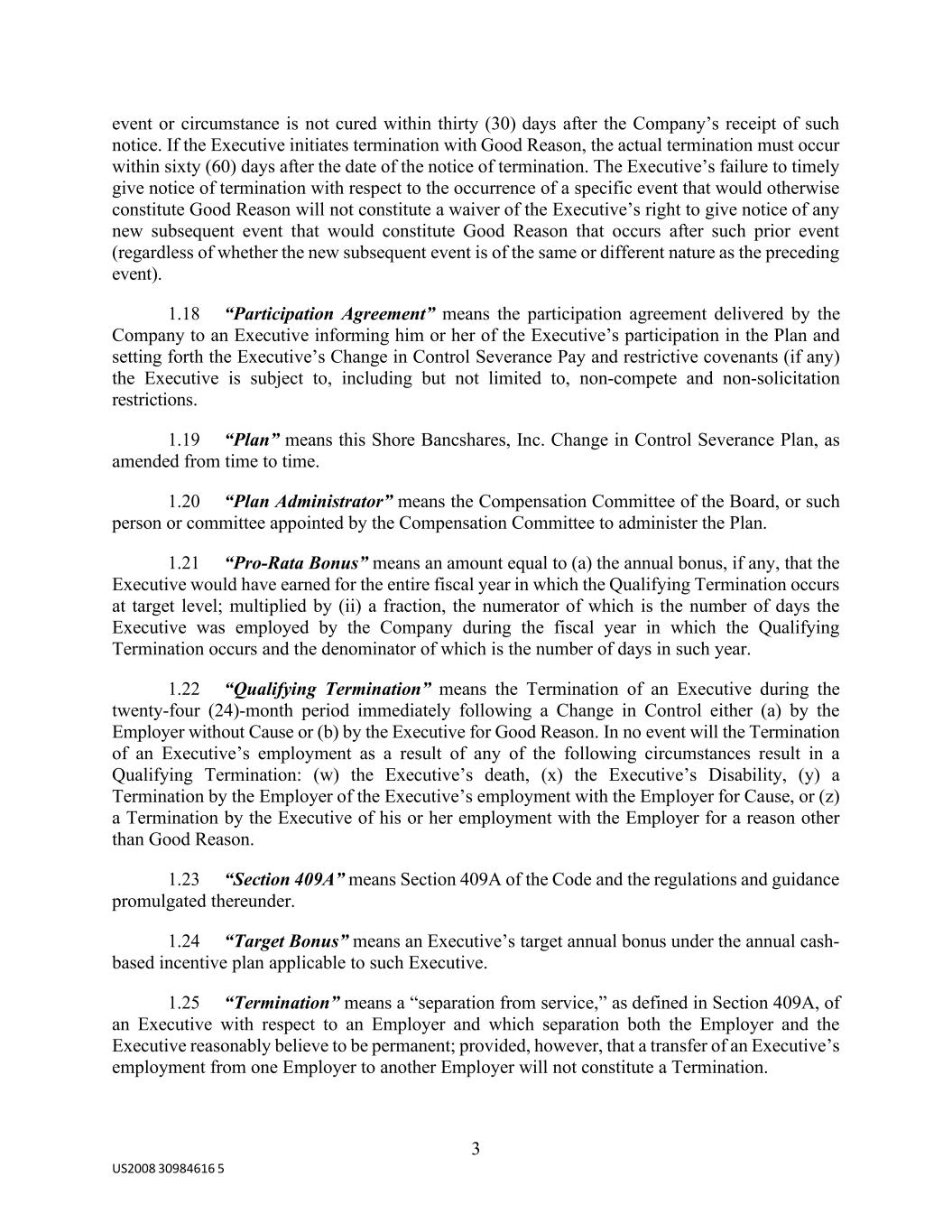
3 US2008 30984616 5 event or circumstance is not cured within thirty (30) days after the Company’s receipt of such notice. If the Executive initiates termination with Good Reason, the actual termination must occur within sixty (60) days after the date of the notice of termination. The Executive’s failure to timely give notice of termination with respect to the occurrence of a specific event that would otherwise constitute Good Reason will not constitute a waiver of the Executive’s right to give notice of any new subsequent event that would constitute Good Reason that occurs after such prior event (regardless of whether the new subsequent event is of the same or different nature as the preceding event). 1.18 “Participation Agreement” means the participation agreement delivered by the Company to an Executive informing him or her of the Executive’s participation in the Plan and setting forth the Executive’s Change in Control Severance Pay and restrictive covenants (if any) the Executive is subject to, including but not limited to, non-compete and non-solicitation restrictions. 1.19 “Plan” means this Shore Bancshares, Inc. Change in Control Severance Plan, as amended from time to time. 1.20 “Plan Administrator” means the Compensation Committee of the Board, or such person or committee appointed by the Compensation Committee to administer the Plan. 1.21 “Pro-Rata Bonus” means an amount equal to (a) the annual bonus, if any, that the Executive would have earned for the entire fiscal year in which the Qualifying Termination occurs at target level; multiplied by (ii) a fraction, the numerator of which is the number of days the Executive was employed by the Company during the fiscal year in which the Qualifying Termination occurs and the denominator of which is the number of days in such year. 1.22 “Qualifying Termination” means the Termination of an Executive during the twenty-four (24)-month period immediately following a Change in Control either (a) by the Employer without Cause or (b) by the Executive for Good Reason. In no event will the Termination of an Executive’s employment as a result of any of the following circumstances result in a Qualifying Termination: (w) the Executive’s death, (x) the Executive’s Disability, (y) a Termination by the Employer of the Executive’s employment with the Employer for Cause, or (z) a Termination by the Executive of his or her employment with the Employer for a reason other than Good Reason. 1.23 “Section 409A” means Section 409A of the Code and the regulations and guidance promulgated thereunder. 1.24 “Target Bonus” means an Executive’s target annual bonus under the annual cash- based incentive plan applicable to such Executive. 1.25 “Termination” means a “separation from service,” as defined in Section 409A, of an Executive with respect to an Employer and which separation both the Employer and the Executive reasonably believe to be permanent; provided, however, that a transfer of an Executive’s employment from one Employer to another Employer will not constitute a Termination.
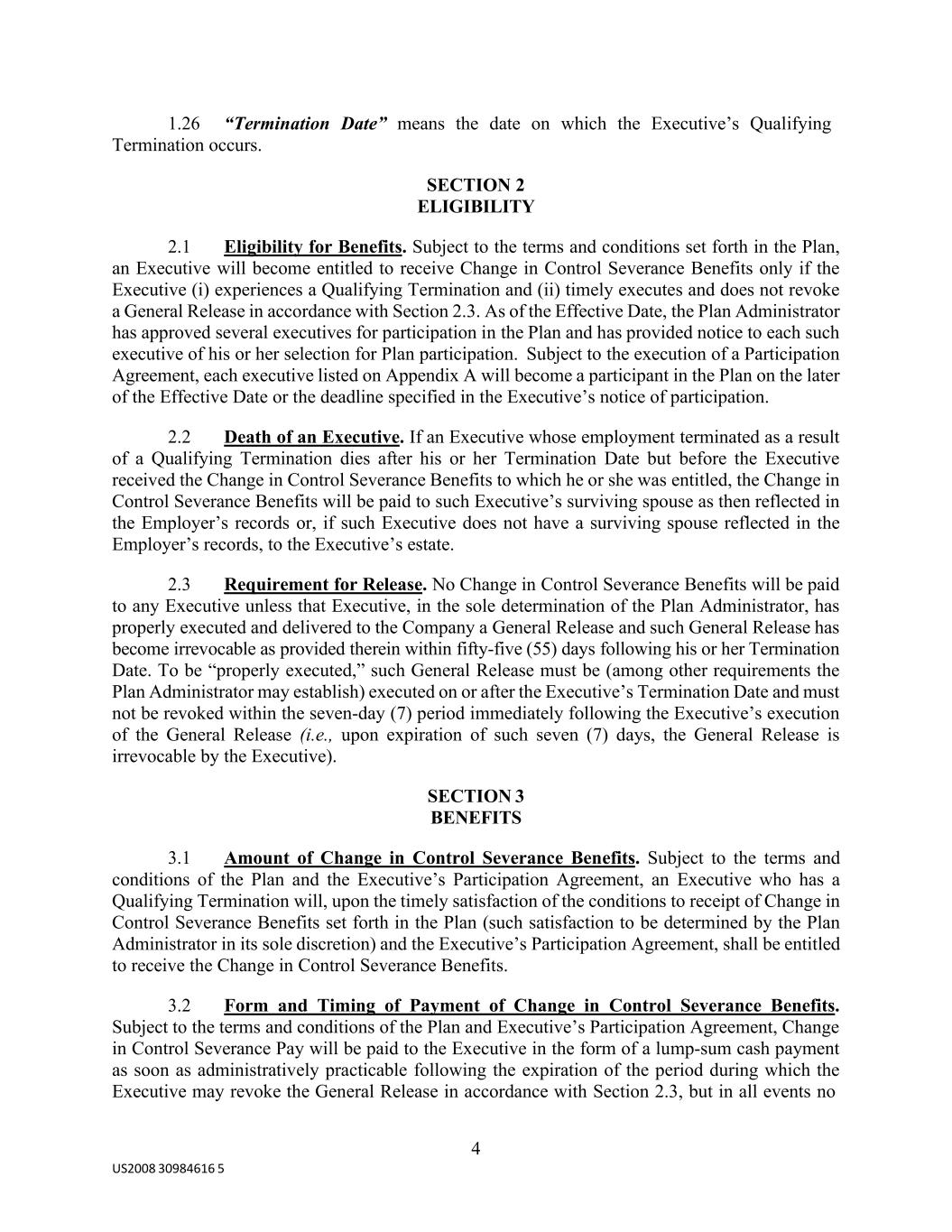
4 US2008 30984616 5 1.26 “Termination Date” means the date on which the Executive’s Qualifying Termination occurs. SECTION 2 ELIGIBILITY 2.1 Eligibility for Benefits. Subject to the terms and conditions set forth in the Plan, an Executive will become entitled to receive Change in Control Severance Benefits only if the Executive (i) experiences a Qualifying Termination and (ii) timely executes and does not revoke a General Release in accordance with Section 2.3. As of the Effective Date, the Plan Administrator has approved several executives for participation in the Plan and has provided notice to each such executive of his or her selection for Plan participation. Subject to the execution of a Participation Agreement, each executive listed on Appendix A will become a participant in the Plan on the later of the Effective Date or the deadline specified in the Executive’s notice of participation. 2.2 Death of an Executive. If an Executive whose employment terminated as a result of a Qualifying Termination dies after his or her Termination Date but before the Executive received the Change in Control Severance Benefits to which he or she was entitled, the Change in Control Severance Benefits will be paid to such Executive’s surviving spouse as then reflected in the Employer’s records or, if such Executive does not have a surviving spouse reflected in the Employer’s records, to the Executive’s estate. 2.3 Requirement for Release. No Change in Control Severance Benefits will be paid to any Executive unless that Executive, in the sole determination of the Plan Administrator, has properly executed and delivered to the Company a General Release and such General Release has become irrevocable as provided therein within fifty-five (55) days following his or her Termination Date. To be “properly executed,” such General Release must be (among other requirements the Plan Administrator may establish) executed on or after the Executive’s Termination Date and must not be revoked within the seven-day (7) period immediately following the Executive’s execution of the General Release (i.e., upon expiration of such seven (7) days, the General Release is irrevocable by the Executive). SECTION 3 BENEFITS 3.1 Amount of Change in Control Severance Benefits. Subject to the terms and conditions of the Plan and the Executive’s Participation Agreement, an Executive who has a Qualifying Termination will, upon the timely satisfaction of the conditions to receipt of Change in Control Severance Benefits set forth in the Plan (such satisfaction to be determined by the Plan Administrator in its sole discretion) and the Executive’s Participation Agreement, shall be entitled to receive the Change in Control Severance Benefits. 3.2 Form and Timing of Payment of Change in Control Severance Benefits. Subject to the terms and conditions of the Plan and Executive’s Participation Agreement, Change in Control Severance Pay will be paid to the Executive in the form of a lump-sum cash payment as soon as administratively practicable following the expiration of the period during which the Executive may revoke the General Release in accordance with Section 2.3, but in all events no
5 US2008 30984616 5 later than the sixtieth (60th) day following the Executive’s Termination Date; but if such sixty-day (60) period begins in one taxable year and ends in a subsequent taxable year, the Change in Control Severance Pay will in all events commence or be paid in such subsequent taxable year. The details of an Executive’s reimbursement or payment of premiums for COBRA continuation coverage (if any) will be set forth in each Executive’s Participation Agreement. 3.3 Treatment of Equity Awards. Following a Qualifying Termination, an Executive’s Equity Awards will be treated in accordance with the terms and conditions of the applicable Company plan, agreement or arrangement. 3.4 Application of Sections 280G and 4999 of the Code. (a) Notwithstanding anything in the Plan to the contrary, if the Executive is a “disqualified individual” (as defined in Section 280G(c) of the Code), and the payments and benefits provided for in the Plan, together with any other payments and benefits which the Executive has the right to receive from the Company or any other person, would constitute a “parachute payment” (as defined in Section 280G(b)(2) of the Code), then the payments and benefits provided for in the Plan will be either (a) reduced (but not below zero) so that the present value of such total amounts and benefits received by the Executive from the Company and/or such person(s) will be $1.00 less than three (3) times the Executive’s “base amount” (as defined in Section 280G(b)(3) of the Code) and so that no portion of such amounts and benefits received by the Executive will be subject to the excise tax imposed by Section 4999 of the Code or (b) paid in full, whichever produces the better “net after-tax position” to the Executive (taking into account any applicable excise tax under Section 4999 of the Code and any other applicable taxes). (b) The reduction of payments and benefits hereunder, if applicable, will be made by reducing, first, payments or benefits to be paid in cash hereunder in the order in which such payment or benefit would be paid or provided (beginning with such payment or benefit that would be made last in time and continuing, to the extent necessary, through to such payment or benefit that would be made first in time) and, then, reducing any benefit to be provided in-kind hereunder in a similar order. (c) The determination as to whether any such reduction in the amount of the payments and benefits provided hereunder, if necessary, will be made applying principles, assumptions and procedures consistent with Section 280G of the Code by an accounting firm, consulting firm or law firm of national reputation that is selected for this purpose by the Company (the “280G Firm”). In order to assess whether payments under the Plan or otherwise qualify as reasonable compensation that is exempt from being a parachute payment under Section 280G of the Code, the 280G Firm or the Company may retain the services of an independent valuation expert. Any determination required under this Section 3.4 will be made by the Company in its sole discretion. The Company’s determination will be final and binding on the Executive. (d) If a payment or benefit is made or provided and through error or otherwise that payment or benefit, when aggregated with other payments and benefits from the Company (or its Affiliates) used in determining if a “parachute payment” exists, exceeds $1.00 less than three (3) times the Executive’s base amount, then the Executive must immediately repay such excess to the Company upon notification that an overpayment has been made. Nothing in this Section 3.4
6 US2008 30984616 5 will require the Company to be responsible for, or have any liability or obligation with respect to, the Executive’s excise tax liabilities under Section 4999 of the Code. SECTION 4 ADMINISTRATION AND CLAIMS PROCEDURE 4.1 Plan Administration. The Plan Administrator has the authority to administer the Plan. The Plan Administrator will perform all such duties as are necessary to supervise the administration of the Plan and to control its operation in accordance with the terms thereof, including, but not limited to, the following: (i) make, amend, interpret and enforce such rules and regulations as the Plan Administrator may deem necessary or proper for the efficient administration of the Plan; (ii) interpret the provisions of the Plan and determine any questions arising under the Plan, or concerning the administration or operation thereof, including all questions of fact; (iii) determine eligibility for and entitlement to benefits, including the existence of a Qualifying Termination or other circumstances provided in Section 2; (iv) resolve and clarify inconsistencies, ambiguities and omissions in the Plan and among and between the Plan and other related documents; and (v) process and approve or deny all claims for benefits. Any action by the Plan Administrator with respect to the Plan (including, without limitation, the Plan Administrator’s interpretation or administration of the Plan) will be conclusive and binding upon any and all persons affected hereby, subject to the exclusive appeal procedure set forth in herein. 4.2 Claims Procedures. An initial claim for benefit payment will be considered filed when the Plan Administrator receives a written request from an Executive or his or her authorized representative(s). (a) Denial of Benefits. Any time a claim for benefits is wholly or partially denied, the person (“Claimant”) must be given written notice of such action within ninety (90) days after the claim is filed, unless circumstances require an extension of time for processing. If there is an extension, the Claimant must be notified of the extension and the reason for the extension within the initial ninety-day (90) period. The extended time must not exceed one hundred and eighty (180) days after the claim is filed. Such notice will indicate (i) the reason for denial, (ii) the pertinent provisions of the Plan on which the denial is based, (iii) an explanation of the claims appeal procedure set forth herein, and (iv) a description of any additional material or information required to perfect the claim and, if necessary, an explanation of why such material or information is required. (b) Appeal of Denial of Benefits. Any person who has had a claim for benefits denied by the Plan Administrator or his or her designee, or is otherwise adversely affected, will have the right to request an appeal to the Plan Administrator. Such a request must be in writing and must be made within sixty (60) days after such person is advised of the initial claim determination or adverse action (otherwise the Claimant’s right to an appeal will be forfeited upon conclusion of the sixty-day (60) period. Additionally, such request must (i) request a review of the claim under the Plan, (ii) set forth all grounds under which the request for review is based and any facts in support thereof, and (iii) set forth any issues or comments that the Claimant deems pertinent to the appeal. The Claimant may also submit documents, records and other information relating to the claim for benefits. In preparing for the request for review, the Claimant will be entitled, upon request and free of charge, reasonable access to, and copies of, all documents,
7 US2008 30984616 5 records and other information relevant to the claim for benefits. The Plan Administrator’s review will take into account all comments, documents, records, and other information submitted by the Claimant and relating to the claim, without regard to whether such information was submitted or considered in the Plan Administrator’s initial benefit determination. The Plan Administrator will notify the Claimant in writing of its decision within sixty (60) days (unless the Plan Administrator determines that special circumstances require an extension of time) after receipt of the request for review. If the Plan Administrator determines that an extension of time is required, it will, prior to expiration of the initial sixty-day (60) period, notify the Claimant, in writing, of the extension, along with an explanation of the special circumstances requiring an extension of time and the date by which the Plan Administrator expects to reach its decision, which must not be later than one hundred twenty (120) days from the Plan Administrator’s receipt of the Claimant’s request for review. If the Claimant’s appeal is denied, the written notification of the Plan Administrator must contain specific reasons for the decision and refer to the specific Plan provisions on which the decision is based, and must contain a statement that the Claimant is entitled to receive, upon request and free of charge, reasonable access to and copies of all documents, records, and other information relevant to the claim for benefits and a statement of the Claimant’s right to bring an action under Section 502(a) of ERISA. The decision of the Plan Administrator will be final and conclusive as to any claim filed hereunder. SECTION 5 GENERAL PROVISIONS 5.1 Amendment and Termination. The Company reserves the right to amend or terminate the Plan at any time. Notwithstanding the foregoing, either the Board or the Plan Administrator may amend the Plan at any time to the extent necessary to comply with Section 409A or any other applicable law. Any such amendment must, to the maximum extent possible, preserve the Plan’s benefits for all then-participating Executives. 5.2 Plan Document. The Plan, including any attached amendments, appendices and/or exhibits that are incorporated herein by reference, sets forth the entire provisions of the Plan. 5.3 Limitations on Assignments and Transfers. Rights to benefits payable under the Plan are not subject in any manner to alienation, sale, transfer, assignment, pledge or encumbrance. 5.4 No Employment Rights. No provisions of the Plan and no action taken by an Employer, the Board, the Plan Administrator, or any officer, employee or director, will give any person any right to be retained in the employ of any Employer or any Affiliate, and each Employer specifically reserves the right and power to dismiss or discharge any Executive for any reason or no reason and at any time. 5.5 Notice. All notices, statements, reports and other communications from the Company to any Executive, employee or other person required or permitted under the Plan will be deemed to have been duly given when delivered to, or when mailed by first- class mail, postage prepaid and addressed to, such Executive, employee, or other person at the address last appearing on the Company’s records.
8 US2008 30984616 5 5.6 Headings. The headings used in this document are for convenience of reference only and may not be given any weight in interpreting any provision of the Plan. 5.7 Severability. If a court of competent jurisdiction determines that any term, provision or portion of the Plan is void, illegal, or unenforceable, the other terms, provisions and portions of the Plan will remain in full force and effect and the terms, provisions, and portions that are determined to be void, illegal or unenforceable will either be limited so that they will remain in effect to the extent permissible by law, or such arbitrator or court will substitute, to the extent enforceable, provisions similar thereto or other provisions, so as to provide to the Company, to the fullest extent permitted by applicable law, the benefits intended by the Plan. 5.8 Section 409A. (a) The Plan will be interpreted to ensure that the payments contemplated hereby to be made by any Employer to an Executive are exempt from or comply with Section 409A; but nothing in the Plan will be interpreted or construed to transfer any liability for any tax (including a tax or penalty due as a result of a failure to comply with Section 409A) from any Executive to any Employer or any other individual or entity. Any payments under the Plan that may be excluded from Section 409A either as separation pay due to an involuntary separation from service or as a short-term deferral will be excluded from Section 409A to the maximum extent possible. (b) Any payment under the Plan that is subject to Section 409A and that is contingent on a termination of employment is contingent on a “separation from service” within the meaning of Section 409A. Each payment will be considered to be a separate payment for purposes of Section 409A. (c) If, upon separation from service, an Executive is a “specified employee” within the meaning of Section 409A, any payment to such Executive that is subject to Section 409A and would otherwise be paid within six months after the Executive’s separation from service will instead be paid in the seventh month following the Executive’s separation from service (to the extent required by Section 409A(a)(2)(B)(i)). (d) Any taxable reimbursement due under the terms of the Plan will be paid no later than December 31st of the year after the year in which the expense is incurred and will comply with Treas. Reg.§ 1.409A-3(i)(l)(iv). 5.9 Governing Law. The Plan is to be construed, administered, and regulated in accordance with the laws of the State of Maryland (excluding any conflicts or choice of law rule or principle), except to the extent that those laws are preempted by federal law. 5.10 Waiver. Failure to insist upon strict compliance with any of the terms, covenants, or conditions hereof will not be deemed to be a waiver of such term, covenant, or condition, nor will any waiver or relinquishment of, or failure to insist upon strict compliance with, any right or power hereunder at any one or more times be deemed to be a waiver or relinquishment of such right or power at any other time or times.
9 US2008 30984616 5 5.11 Tax Withholding Requirements. The amount of any withholding required to be made by any government or government agency will be deducted from the Change in Control Severance Benefits paid under the Plan to the extent deemed necessary by the Plan Administrator. However, the Executive will bear the cost of any taxes not withheld on benefits provided under the Plan, regardless of whether withholding is required. 5.12 Payment Errors. If an incorrect amount is paid to or on behalf of an Executive, any remaining payments will be adjusted to correct the error. If the error was an underpayment, then an additional payment will be made as soon as administratively feasible and such underpayment will not affect the effectiveness of any agreement or release. The Plan Administrator may take such other action it deems necessary and equitable to correct any such error, including recovering any overpayment. 5.13 Status as Unsecured Creditor/Unfunded Obligation. All benefits under the Plan are the unsecured obligations of the Company and its Affiliates. No assets will be placed in trust or otherwise segregated from the general assets of the Company or its Affiliates for the payment of obligations hereunder. To the extent that any person acquires a right to receive payments hereunder, such right is no greater than the right of any unsecured general creditor of the Company or an Affiliate. 5.14 Compensation Recoupment. Any amounts payable under the Plan are subject to any policy (whether in existence as of the Effective Date or later adopted) established by the Company providing for clawback or recovery of amounts that were paid to an Executive. The Company will make any determination for clawback or recovery in its sole discretion and in accordance with any applicable law or regulation. 5.15 FDIC Limitations. If any payment or benefit under the Plan would otherwise be a golden parachute payment within the meaning of section 18(k) of the Federal Deposit Insurance Act (a “Golden Parachute Payment”) that is prohibited by applicable law, then the payments and benefits will be reduced to the greatest amount that can be paid to the Participant without there being a prohibited Golden Parachute Payment. To the extent reasonably practicable, the Company shall seek the approval of the Federal Deposit Insurance Corporation, the Maryland Department of Labor - Office of the Commissioner of Financial Regulation and any other bank regulatory body, as necessary, to make any payment to the Participant that would otherwise constitute a Golden Parachute Payment. * * * *