INSIDER TRADING POLICY Policy Type: General Functional Area: Executive Policy Name: Insider Trading Policy Board Approved: Approved by The Governance Committee February 17, 2026 Ratified by: Shore Bancshares, Inc. Shore United Bank February 18, 2026 Responsible Party: Chief Legal Officer
TABLE OF CONTENTS I. Purpose of Policy .....................................................................................................................1 II. Potential Criminal and Civil Liability and/or Disciplinary Action .............................................1 III. Applicability of Policy .............................................................................................................2 IV. Insider Trading Concepts ..........................................................................................................2 V. Statement of Policy ..................................................................................................................4 VI. Applicability of Policy to Inside Information Regarding Other Companies ...............................8 VII. Individual Responsibility of Each Officer, Director and Employee to Comply with Policy .......8 VIII.Certain Exceptions ...................................................................................................................9 IX. Insider Trading Compliance Officer ....................................................................................... 11 X. Inquiries ............................................................................................................................... 12 XI. Certification ......................................................................................................................... 12 EXHIBIT A – BLACK-OUT PERIODS, TRADING WINDOW AND PRE-CLEARANCE………………A-1 EXHIBIT B – SECTION 16 LIABILITY AND REPORTING ..................................................... B-1
1 SHORE BANCSHARES, INC. INSIDER TRADING POLICY This policy (“Policy”) provides guidelines to employees, officers and directors of Shore Bancshares, Inc., and its related subsidiaries (collectively the “Company”) with respect to transactions in the Company’s securities and the confidentiality of corporate information. I. Purpose of Policy Federal and state securities laws prohibit the purchase or sale of a company’s securities by persons who are aware of material information about that company that is not generally known or available to the public. The purpose of this Policy is to promote compliance with insider trading laws, rules and regulations by directors, officers, and employees of the Company. II. Potential Criminal and Civil Liability and/or Disciplinary Action Liability for Insider Trading As a director, officer, or employee of the Company, you may be subject to criminal penalties of up to $5,000,000 and up to twenty (20) years in jail for engaging in transactions in the Company’s securities at a time when you have knowledge of material non-public information regarding the Company. In addition, you may be liable to pay up to three (3) times the profit gained or loss avoided in civil fines for unlawful insider trading or tipping. The Securities and Exchange Commission (SEC), the stock exchanges and the Financial Industry Regulatory Authority (FINRA), use sophisticated electronic surveillance techniques to uncover insider trading. Liability for Tipping You may also be liable for improper transactions by any person (commonly referred to as (“tippee”) to whom you have disclosed material non-public information regarding the Company or to whom you have made recommendations or expressed opinions on the basis of such information as to trading in the Company’s securities. The SEC has imposed large penalties even when the disclosing person did not profit financially from the trading. Controlling Person Liability The federal securities laws impose liability on the Company and individual directors, officers and other supervisory personnel who control, directly or indirectly, a person at the time such person commits an insider trading violation. The criminal penalties for controlling person liability may be up to $25,000,000, and the civil penalties may be up to the greater of $1 million or three times the amount of profit gained or losses avoided by the controlling person or, if none, the profit gained or losses avoided by the controlled person.
2 Possible Disciplinary Actions Officers and employees of the Company who violate this Policy shall also be subject to disciplinary action by the Company, which may include ineligibility for future participation in the Company’s equity incentive plans or termination of employment for cause. III. Applicability of Policy Persons Covered This Policy applies to all executive officers of the Company, all members of the Company’s board of directors, and all employees of the Company and its subsidiaries. This Policy also applies to family members who reside with you, anyone else who lives in your household and any family members who do not live in your household but whose transactions in the Company’s securities are directed by you or are subject to your influence or control, as well as to any entity controlled by a person or group of persons covered by this Policy, including any corporations, partnerships, or trusts. This Policy also applies to any person who receives material non-public information from any director, officer or employee of the Company. Companies Covered The prohibition on insider trading in this Policy is not limited to trading in the Company’s securities. It includes trading in the securities of other firms, such as customers or suppliers of the Company and those with which the Company may be negotiating major transactions, such as an acquisition, investment or sale. Information that is not material to the Company may nevertheless be material to one of those other firms. Transactions Covered This Policy applies, with limited exceptions set forth below, to all transactions involving the Company’s securities, including common stock, preferred stock, options, restricted stock, restricted stock units, and any other type of securities that the Company may issue. This Policy applies to such securities regardless of whether they are held in a brokerage account, retirement plan, employee stock purchase plan, or otherwise. In addition to the purchase, sale or gift of shares of common stock, this Policy also applies to the purchase or sale of a put, call, straddle, option, privilege or security futures product involving the Company’s securities or group or index of securities that include the Company’s securities. IV. Insider Trading Concepts What is Material Information? It is not possible to define all categories of material information. However, information should be regarded as material if there is reasonable likelihood that it would be considered important to an investor in making an investment decision regarding the purchase, sale or gift of stock or other securities.
3 While it may be difficult under this standard to determine whether particular information is material, there are various categories of information that are particularly sensitive and, as a general rule, should always be considered material. Examples of such information may include: • Financial results • Projections of future earnings or losses • New product announcements of a significant nature • News of a pending or proposed acquisition or merger • Impending bankruptcy or financial liquidity problems • Gain or loss, or change in status, of a significant customer or contract • Stock splits • New equity or debt offerings • Significant exposure due to actual or threatened litigation • Significant governmental regulatory activities • Changes in senior management • Changes in dividend policy Either positive or negative information may be material. If you have any questions regarding whether information you possess is material or not, you should contact the Insider Trading Compliance Officer. What is Non-Public Information? Non-public information is information that has not yet been made public by the Company. Information only becomes public when the Company discloses or publishes the information in a manner that is designed to reach investors generally, such as in a publicly accessible conference call, a press release, or in SEC filings, and the investing public has had an opportunity to see or hear it. A speech to an audience, a TV or radio appearance, or an article in an obscure magazine is not sufficient to make information non-public. Even after public disclosure of information about the Company, you must wait at least two full trading days after the information was disclosed before you can treat the information as public. For example, if the announcement is made on Tuesday at 8:00 a.m., before the opening of the Nasdaq Stock Market, you can begin trading again on Thursday morning. On the other hand, if the announcement were not made until Tuesday at 11:00 a.m., you would not be able to trade until the opening of trading on Friday, after two full trading days have elapsed. As with questions of materiality, if you are not sure whether information is considered public, you should assume that the information is non-public and treat it as confidential.
4 V. Statement of Policy General Policy It is the policy of the Company to oppose the unauthorized disclosure of any non-public information acquired in the workplace and the misuse of material non-public information in securities trading. Policies Applicable to All Employees, Executive Officers and Directors Trading on Material Non-public Information. You may not engage in any transaction involving a purchase, sale or gift of the Company’s securities, including any offer to purchase or offer to sell, while in possession of information that you have reason to believe is material and non-public. This prohibition applies even if you planned to make the transaction before you learned of the material non-public information and even though the failure to execute such transaction may result in an economic loss or the non-realization of anticipated profit. Derivative and Hedging Transactions Prohibited. All directors, officers and employees are prohibited at all times from buying or selling options on Company securities (so called “puts” and “calls”) or other derivative securities that reference Company securities and from entering into hedging or similar transactions that are designed to offset any decrease in the market value of Company securities, even during the Trading Window described below. Selling Short Prohibited. All directors, officers and employees are prohibited at all times from selling short Company stock or otherwise selling any equity securities of the Company that they do not own. Generally, a short sale means any transaction where one may benefit from a decline in the Company’s stock price. Short-Term Trading is Strongly Discouraged. Frequent trading of Company stock can create an appearance of wrongdoing and may become the subject of investigative action by the SEC or another regulatory authority in the event of any unusual activity in the stock or the stock price performance, even if the decision to trade was based solely on public information such as stock price ranges or other market events. You are strongly discouraged from trading in Company securities for short-term trading profits. Avoid Open Orders. A good-til-cancelled order is an order to buy or sell a stock that lasts until the order is completed or cancelled. Such orders are typically coupled with price conditions. An open order with a broker to sell or purchase securities at a specified price leaves you with no control over the timing of the transaction. An order executed by a broker when you are aware of material non-public information may result in unlawful insider trading. The Company therefore discourages placing good-til-cancelled orders on Company stock (other than as a part of a 10b5- 1 trading plan). If you determine that you must use a good-til-cancelled order, the order should be limited to a very short duration and should otherwise comply with the restrictions set forth in this Policy. Tipping. You may not disclose (“tip”) material non-public information to any other person (including family members, friends, or financial advisors) where such information may be used by
5 such person to his or her profit by trading in the securities of companies to which such information relates, nor may you make recommendations or express opinions on the purchase or sale of the Company’s securities while in possession of material non-public information. No Exception for Hardship. The existence of a personal financial emergency does not excuse you from compliance with this Policy. Confidentiality of Non-public Information. Non-public information relating to the Company is the property of the Company and the unauthorized disclosure of such information is forbidden. Serious problems could be caused for the Company by unauthorized disclosure of internal information about the Company, whether or not for the purpose of facilitating improper trading of the Company’s securities. Directors and personnel of the Company should not discuss internal matters or developments with anyone outside of the Company (including family members, analysts, individual investors, and members or the investment community and news media), except as required in the performance of regular corporate duties. Directors and personnel of the Company may assume that its legal counsel, accountants, consultants and other advisers will not disclose to third parties or trade on inside information given to them in confidence. However, with regard to negotiating with third parties at arm’s length for various transactions, including the sale of assets, material confidential information should not be given to such third party unless the third party enters into a confidentiality agreement with the Company which agreement expressly addresses the issue of trading in the Company’s securities. Outside Communications. Announcements of Company information are regulated by Company policy and may only be made by persons specifically authorized by the Company to make such announcements. Laws and regulations govern the nature and timing of such announcements to outsiders or the public and unauthorized disclosure could result in substantial liability for you, the Company and its management. If you receive inquiries by any third party about Company information, you should notify the Insider Trading Compliance Officer or the Company’s Chief Executive Officer immediately. You may not participate in online dialogues (or similar activities) involving the Company, its business or its stock. This Policy applies to social media platforms as well, such as Facebook and Twitter. Application of Policy After Employment Terminates. If your employment terminates at a time when you have or think you may have material non-public information about the Company or its business partners, the prohibition on trading on such information continues until such information is absorbed by the market following public announcement of it by the Company or another authorized party, or until such time as the information is no longer material. If you have questions as to whether you possess material non-public information after you have left the employ of the Company, you should direct questions to the Insider Trading Compliance Officer. Policies Applicable to Directors, Executive Officers and Certain Employees The guidelines regarding a Black-Out Period, Trading Window and the pre-clearance of trades set forth below are applicable to all directors and executive officers of the Company as well as to those other employees that the Company believes have access to material non-public
6 information in the course of their duties whose office, title, or position is listed on Exhibit A to this Policy (collectively, “Restricted Persons”).You are subject to the Black-Out Period, Trading Window and the requirement to pre-clear all transactions if you are on the Restricted Persons list. This list may be changed by the Company from time to time as circumstances require and if your office, title or position is added to this list, you will be notified by the Insider Trading Compliance Officer. Black-Out Period. During the end of each fiscal quarter and until public disclosure of the financial results for that quarter, persons subject to this Policy may possess material non-public information about the expected financial results for the quarter. Even if you do not actually possess any such information, any trades by you during that period may give the appearance that you are trading on inside information. Accordingly, the Company has designated a regularly scheduled quarterly “black-out period” on trading beginning with the 5th business day prior to the end of the final month of each fiscal quarter and ending at the close of the second full Trading Day after disclosure of the quarter’s financial results. In addition to the regularly-scheduled black-out periods, the Company may from time to time designate other periods of time as a special black-out period as further described below under “Event-Specific Blackouts.” The Company prohibits all Restricted Persons from trading during Black-Out Periods (whether regularly scheduled Black-Out Periods or Event-Specific Blackouts). It is your responsibility to know when the Company’s regularly quarterly Black-Out Period begins (you will be notified when they end). If you are informed that the Company has implemented an Event- Specific Blackout, you may not disclose the fact that trading has been suspended to anyone, including other Company employees (who may themselves not be subject to the black-out), family members (other than those subject to this Policy who would be prohibited from trading because you are), friends or brokers. You should treat the imposition of an Event-Specific Blackout as material non-public information. Remember to cancel any “limit” orders or other pending trading orders you have in place during a Black-Out Period (unless the orders were made pursuant to an approved Rule 10b5-1 trading plan). Trading Window. The period outside a Black-Out Period is referred to as the “trading window.” Trading Windows that occur between the regularly scheduled quarterly Black-Out Periods can be “closed” by the imposition of an Event-Specific Blackout if there are developments meriting a suspension of trading by the Insider Trading Compliance Officer. Restricted Persons must refrain from conducting transactions involving the purchase, sale or gift of the Company’s securities other than during the Trading Window. The safest period for trading in the Company’s securities, assuming the absence of material non-public information, is generally the first ten (10) days of each Trading Window. The purpose behind the Company’s Trading Window period is to help establish a diligent effort to avoid any improper transaction. It should be noted, however, that even during the Trading Window, any person possessing material non-public information concerning the Company should not engage in any transactions in the Company’s securities until such information had been known publicly for at least two (2) Trading Days, whether or not the Company has recommended a suspension of trading to that person. Trading in the Company’s securities during the Trading
7 Window should not be considered a “safe harbor,” and all directors, executive, officers and other persons should use good judgment at all times. Interim Earnings Guidance. The Company may on occasion issue interim earnings guidance or other potentially material non-public information by means of a press release or SEC filing on Form 8-K or other means designed to achieve widespread dissemination of the information. You should anticipate that trading will be blacked out while the Company is in the process of assembling the information to be released and until the information has been released and fully absorbed by the market. Event-Specific Blackouts. From time to time, an event may occur that is material to the Company and is known by only a few directors or executive officers. So long as the event remains material non-public information, the persons who are aware of the event, as well as other persons covered by the Trading Window procedures, may not trade in the Company’s securities, as follows: • The existence of an Event-Specific Blackout will not be announced or known, other than to those who are aware of the event giving rise to the blackout; • If, however, a person whose trades are subject to pre-clearance requests permission to trade in the Company’s securities during an Event-Specific Blackout, the Insider Trading Compliance Officer will inform the requesting person of the existence of the Event-Specific Blackout without disclosing the reason for the blackout; • Any person made aware of the existence of an Event-Specific Blackout should not disclose the existence of the blackout to any other person; and • The failure of the Insider Trading Compliance Officer to designate a person as being subject to an Event-Specific Blackout will not relieve that person of the obligation not to trade while aware of material non-public information. The Company may not widely announce the commencement of Event-Specific Blackouts, as that information can itself be sensitive information. For this reason, it is extremely important that you adhere to the pre-clearance procedures outlined in this Policy to ensure that you do not trade during any Event-Specific Blackouts. Pre-clearance of Trades. Restricted Persons must refrain from trading in the Company’s securities, even during the Trading Window, without first complying with the Company’s “pre- clearance” process. If you are on the Restricted Persons list, you must contact the Company’s Insider Trading Compliance Officer prior to commencing any trade in the Company’s securities. The Company may find it necessary, from time to time, to require compliance with the pre-clearance process from additional employees, consultants and contractors. Margin Accounts and Pledges. Securities held in a margin account may be sold by the broker without the customer’s consent if the customer fails to meet a margin call. Similarly, securities held in an account that may be borrowed against or are otherwise pledged (or hypothecated) as collateral for a loan may be sold in foreclosure if the borrower defaults on the loan. A margin sale or foreclosure sale may occur at a time when the pledgor is aware of material non-public information or otherwise is not permitted to trade in Company securities and, as a
8 result, the pledgor may be subject to liability under insider trading laws. To prevent this situation, directors and executive officers may not purchase Company securities on margin, borrow against any account in which Company securities are held, or pledge Company securities as collateral for any loan. An exception to this prohibition may be granted where a person wishes to pledge Company securities as collateral for a loan from a third party (not including margin debt) and clearly demonstrates the financial capacity to repay the loan without resorting to the pledged securities. Any person who wishes to pledge Company securities as collateral for a loan from a third party must submit a request for approval to the Chief Executive Officer at least two weeks prior to the execution of the documents evidencing the proposed pledge. VI. Applicability of Policy to Inside Information Regarding Other Companies This Policy and the guidelines described herein also apply to material non-public information relating to other companies, including the Company’s customers, vendors or suppliers (“Business Partners”), particularly when that -information is obtained in the course of employment with, or other services performed on behalf of the Company. Civil and criminal penalties, and termination of employment, may result from trading on inside information regarding the Company’s Business Partners. All employees should treat material non-public information about the Company’s Business Partners with the same care required with respect to information related directly to the Company. VII. Individual Responsibility of Each Officer, Director and Employee to Comply with Policy Every officer, director and employee has the individual responsibility to comply with this Policy against insider trading regardless of whether the Company has recommended a Trading Window to that person or any other officer, director or employee of the Company. The guidelines set forth in this Policy are guidelines only, and appropriate judgment should be exercised in connection with any trade in the Company’s securities. You may, from time to time, have to forego a proposed transaction to the Company’s securities even if you planned to make the transaction before learning of the material non-public information and even though you believe you may suffer an economic loss or forego anticipated profit by waiting. Observe the Section 16 liability rules applicable to officers and board members and 10% stockholders. Certain officers of the Company, members of the Company’s board of directors and 10% stockholders must also conduct their transactions in the Company’s securities in a manner designed to comply with the “short-swing” trading rules of Section 16(b) of the Securities Exchange Act of 1934 (the “1934 Act”). The practical effect of these provisions is that officers and directors who purchase and sell, or sell and purchase, Company securities within a six-month period must disgorge all profits to the Company whether or not they had any material non-public information at the time of the transactions.
9 You are subject to Section 16, if you hold an office, title or position listed on Exhibit B to this Policy. Comply with public securities law reporting requirements. Federal securities laws require that officers, directors, large stockholders and affiliates of the Company publicly report transactions in the Company’s securities (on Forms 3, 4 and 5 under Section 16, Form 144 with respect to restricted and control securities, and, in certain cases, Schedules 13D and 13G). Please note that the due date for Section 16 insiders to file a (i) Form 3 Initial Statement of Beneficial Ownership is typically 10 days after the date a person became a director or officer subject to Section 16, (ii) Form 4 Statement of Changes in Beneficial Ownership is two business days after the transaction has been executed and (iii) Form 5 Annual Statement of Changes in Beneficial Ownership is 45 days after the end of the Company’s fiscal year. The Form 5 covers exempt transactions and certain smaller transactions that were not required to be reported on Form 4 during the year as well as transactions that should have been reported on Form 4 during the year. As an example, if a Form 4 transaction occurs on Monday, the Form 4 must be filed on Wednesday. The Company takes these reporting requirements very seriously and requires that all persons subject to public reporting of Company stock transactions adhere to the rules applicable to these forms. Where issues arise as to whether reporting is technically required (particularly issues that turn on facts specific to the transaction and the individuals involved, or on unsettled issues of law), the Company encourages its insiders to choose to comply with the spirit and not the letter of the law – in other words, to err on the side of fully and promptly reporting the transaction even if not technically required to do so. The consequences of a late filing or a failure to file under the rules are significant and include: • Public embarrassment to the individual and the Company from the disclosures in the proxy statement and the Form 10-K. • Fines of up to $5,000 per day for each filing violation by a Section 16 reporting person, and up to $500,000 for violations by companies under the Securities Enforcement Remedies Act. In addition, where the Company is required to report transactions by individuals, the Company expects full and timely cooperation by the individual. VIII. Certain Exceptions The only exceptions to the Policy are as follows: 1. Trading Plans pursuant to Rule 10b5-1 under the 1934 Act. Rule 10b5-1(c) of the 1934 Act, provides an affirmative defense against insider trading liability under federal securities laws for a transaction done pursuant to “blind trusts” (generally, trusts or other arrangements in which investment control has been completely delegated to a third party, such as an institutional or professional trustee) or pursuant to a written plan, or a binding contract or instruction, entered into in good faith, or when the person who entered into the written plan, binding contract or instruction has acted in good faith with respect to the written plan, binding contract or instruction, at a time when the person was not aware of material non-public information, even though the transaction in
10 question may occur at a time when the person is aware of material non-public information. An individual who adopted or modifies a written plan, binding contract or instruction will also be subject to any cooling-off period required by applicable law or as set forth in such written plan, binding contract or instruction. The Company may, in appropriate circumstances, permit transactions pursuant to a blind trust or a pre-arranged trading program that complies with Rule 10b5-1 of the 1934 Act (each, a “Rule 10b5-1 trading plan”) to take place during periods in which the individual entering into the transaction may have material non-public information or during Black-Out Periods. If you wish to enter into a blind trust arrangement or Rule 10b5-1 trading plan, you must notify the Insider Trading Compliance Officer and your request will be treated in accordance with the pre-clearance procedures set forth below. The Insider Trading Compliance Officer will review proposed arrangements to determine whether they will or may result in transactions taking place during periods in which you may be in possession of material non-public information. The Company reserves the right to bar any transactions in Company stock, even those pursuant to arrangements previously approved, if the Company determines that such a bar is in the best interests of the Company. If you wish to implement a Rule 10b5-1 trading plan, or revise or amend an existing Rule 10b5-1 trading plan, you must first pre-clear the Rule 10b5-1 trading plan or any revisions or amendments thereto, as applicable, with the Insider Trading Compliance Officer. Any Rule 10b5- 1 trading plan (or any amendment thereto) proposed for use by the Insider Trading Compliance Officer must be cleared with the Chief Executive Officer. You must provide the Insider Trading Compliance Officer an opportunity to review the Rule 10b5-1 trading plan or any amendment thereto. A Rule 10b5-1 trading plan or amendment thereto must be approved by the Insider Trading Compliance Officer at least 120 days in advance of any trades thereunder (or subsequent trades with respect to any revisions or amendments). As required by Rule 10b5-1, you may enter into a Rule 10b5-1 trading plan (or amend such a plan) only when you are not in possession of material non-public information. In addition, you may not enter into a Rule 10b5-1 trading plan during a Black-Out Period. You also may not have another outstanding Rule 10b5-1 trading plan and may not enter subsequently enter into any additional Rule 10b5-1 trading plan for the purchase or sales of any class of securities of the Company on the open market, subject to certain exceptions. If, at the time a Rule 10b5-1 trading plan or any revision or amendment thereto is presented for approval as detailed above, there exists material non-public information about the Company to which you may be deemed to have knowledge, the implementation of such Rule 10b5-1 trading plan or any revision or amendment thereto shall be delayed by until such information has been publicly disclosed. Further, as required by Rule 10b5-1, prior to adopting a Rule 10b5-1 trading plan, you must include a representation in the Rule 10b5-1 trading plan, certifying, at the time of the adoption of a new or modified plan, that (a) they are not aware of material non-public information about the Company and its securities and (b) they are adopting the Rule 10b5-1 trading plan in good faith and not as a part of a plan or a scheme to evade the prohibitions of Rule 10b-5. The Insider Trading Compliance Officer will notify the Company's board of directors quarterly of any Rule 10b5-1 trading plans executed or terminated during the prior quarter.
11 Transactions effected pursuant to a pre-cleared Rule 10b5-1 trading plan will not require further pre-clearance at the time of the transaction if the Rule 10b5-1 trading plan specifies the dates, prices and amounts of the contemplated trades, or establishes a formula for determining the dates, prices and amounts. Notwithstanding this, you or your representatives should give the Insider Trading Compliance Officer (or, as to the Insider Trading Compliance Officer, the Chief Executive Officer) advance notice of upcoming transactions to be effected pursuant to a Rule 10b5-1 trading plan, which will help the Company assist you with your reporting obligations. Importantly, recent amendments to applicable reporting obligations require disclosure regarding whether reported transactions are executed pursuant to a Rule 10b5-1 trading plan. You and your broker must immediately notify the Insider Trading Compliance Officer (or, as to the Insider Trading Compliance Officer, the Chief Executive Officer) upon the completion of such transaction and should have duplicate confirmations of all such transactions sent to the Insider Trading Compliance Officer on your behalf. Notwithstanding any pre-clearance of a Rule 10b5-1 trading plan, the Company, the Insider Trading Compliance Officer and the Company's employees assume no liability for the consequences of any transaction made pursuant to a Rule 10b5-1 trading plan, nor liability for any Rule 10b5-1 trading plan's compliance (or non-compliance) with applicable securities laws. 2. Exercise of Stock Options. Exercise of a stock option under the Company’s equity incentive plans shall not be subject to the restrictions of this Policy. Note that this exception does not include a subsequent sale of the shares acquired pursuant to the exercise of the option under the stock option plan or to a cashless exercise of the option through a broker, as this entails selling a portion of the underlying stock to cover the cost of exercise. 3. Employee Stock Purchase Plan. This Policy’s trading restrictions do not apply to purchases of the Company’s securities in an employee stock purchase plan resulting from your periodic payroll contributions to such a plan under an election made at the time of enrollment in the plan. The trading restrictions do apply to your election to participate in such a plan and if the plan is funded by open market purchases to your sales of the Company’s securities purchased under such a plan. 4. Dividend Reinvestment Plan. This Policy’s trading restrictions do not apply to purchases of the Company’s securities under any dividend reinvestment plan adopted by the Company resulting from your reinvestment of dividends paid on the Company’s securities. The trading restrictions do apply, however, to voluntary purchases of the Company’s securities resulting from additional contributions you choose to make to the plan, and to your election to participate in the plan or increase your level of participation in the plan. This Policy also applies to your sale of any of the Company securities purchased pursuant to the plan. 5. Approved Transactions. Any transaction specifically approved in writing in advance by the Chief Executive Officer or the Chief Financial Officer of the Company. IX. Insider Trading Compliance Officer The Company has designated Andrea Colender, Executive Vice President, Deputy General Counsel, as its current Insider Trading Compliance Officer. Please direct your questions as to any of the matters discussed in this Policy to Andrea Colender who can be reached at 410-260-2081 or Andrea.Colender@shoreunitedbank.com. In the event the Insider Trading Compliance Officer is
12 unavailable, you are to consult with the Company’s Chief Executive Officer, General Counsel, or Chief Financial Officer. X. Inquiries Please direct your questions as to any of the matters discussed in this Policy to the Company’s Insider Trading Compliance Officer. XI. Certification All employees must certify their understanding of, and intent to comply with this Policy.
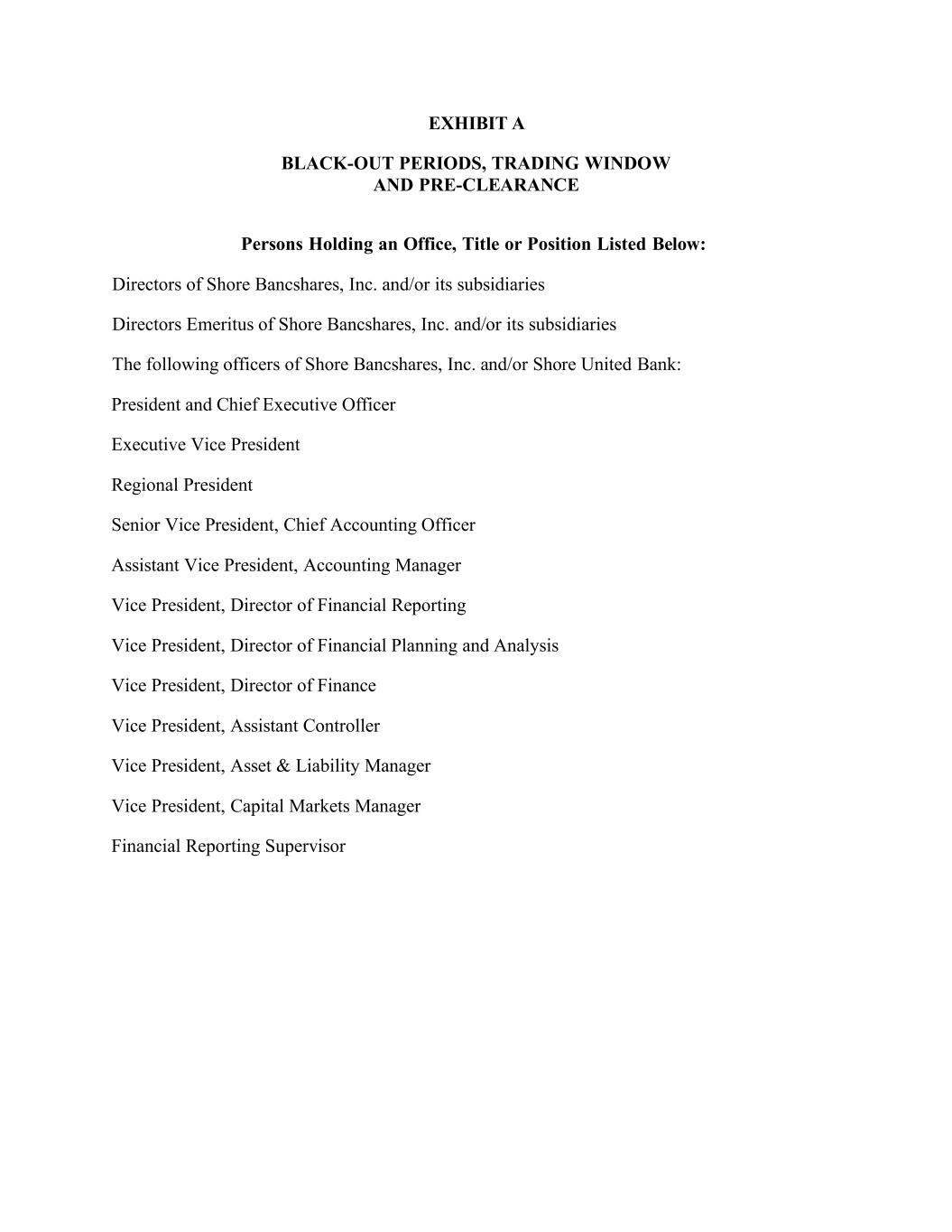
EXHIBIT A BLACK-OUT PERIODS, TRADING WINDOW AND PRE-CLEARANCE Persons Holding an Office, Title or Position Listed Below: Directors of Shore Bancshares, Inc. and/or its subsidiaries Directors Emeritus of Shore Bancshares, Inc. and/or its subsidiaries The following officers of Shore Bancshares, Inc. and/or Shore United Bank: President and Chief Executive Officer Executive Vice President Regional President Senior Vice President, Chief Accounting Officer Assistant Vice President, Accounting Manager Vice President, Director of Financial Reporting Vice President, Director of Financial Planning and Analysis Vice President, Director of Finance Vice President, Assistant Controller Vice President, Asset & Liability Manager Vice President, Capital Markets Manager Financial Reporting Supervisor
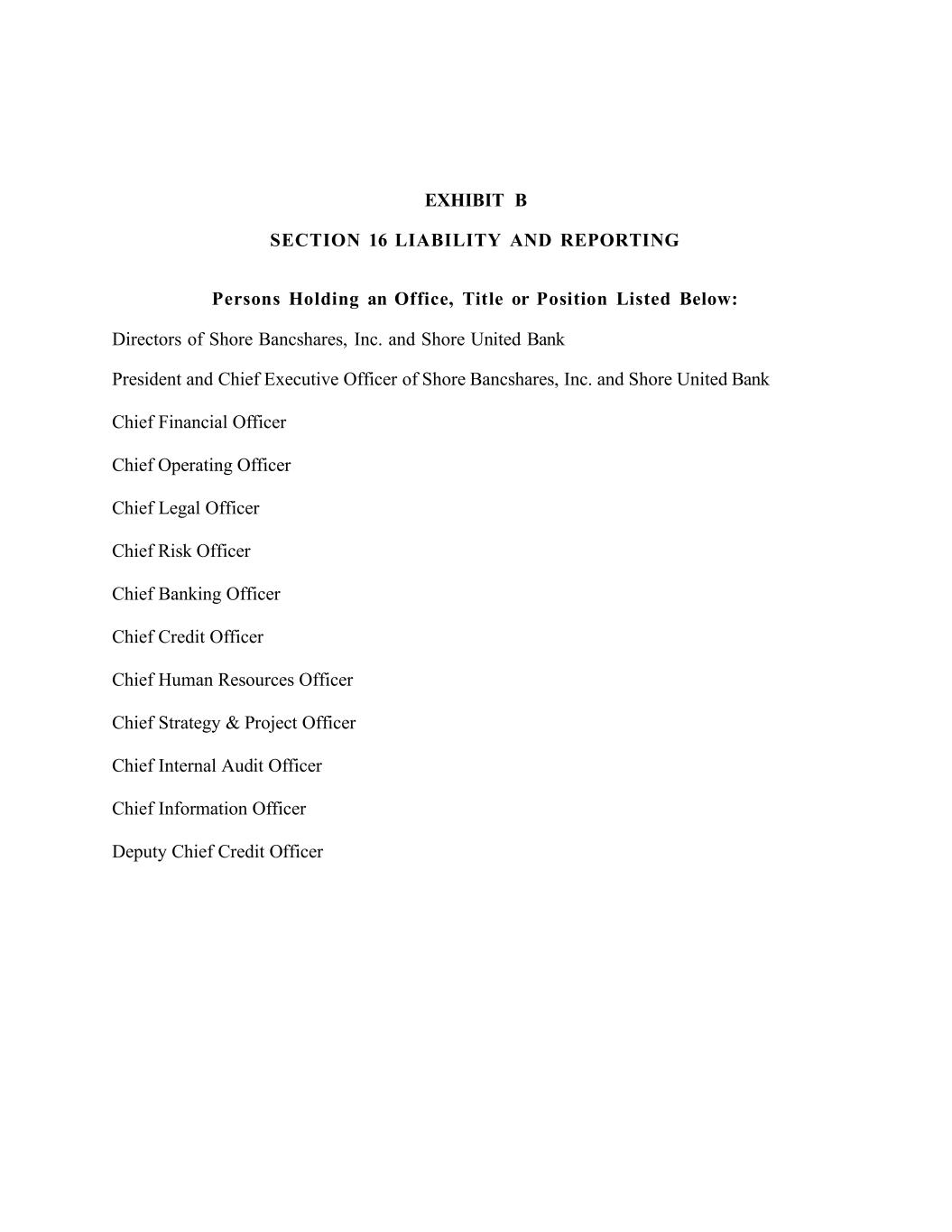
EXHIBIT B SECTION 16 LIABILITY AND REPORTING Persons Holding an Office, Title or Position Listed Below: Directors of Shore Bancshares, Inc. and Shore United Bank President and Chief Executive Officer of Shore Bancshares, Inc. and Shore United Bank Chief Financial Officer Chief Operating Officer Chief Legal Officer Chief Risk Officer Chief Banking Officer Chief Credit Officer Chief Human Resources Officer Chief Strategy & Project Officer Chief Internal Audit Officer Chief Information Officer Deputy Chief Credit Officer