#12708906v9 DB1/ 140819490.8 ONEOK, INC. 2020 NONQUALIFIED DEFERRED COMPENSATION PLAN (Amended and Restated Effective January 1, 2025) 10.22
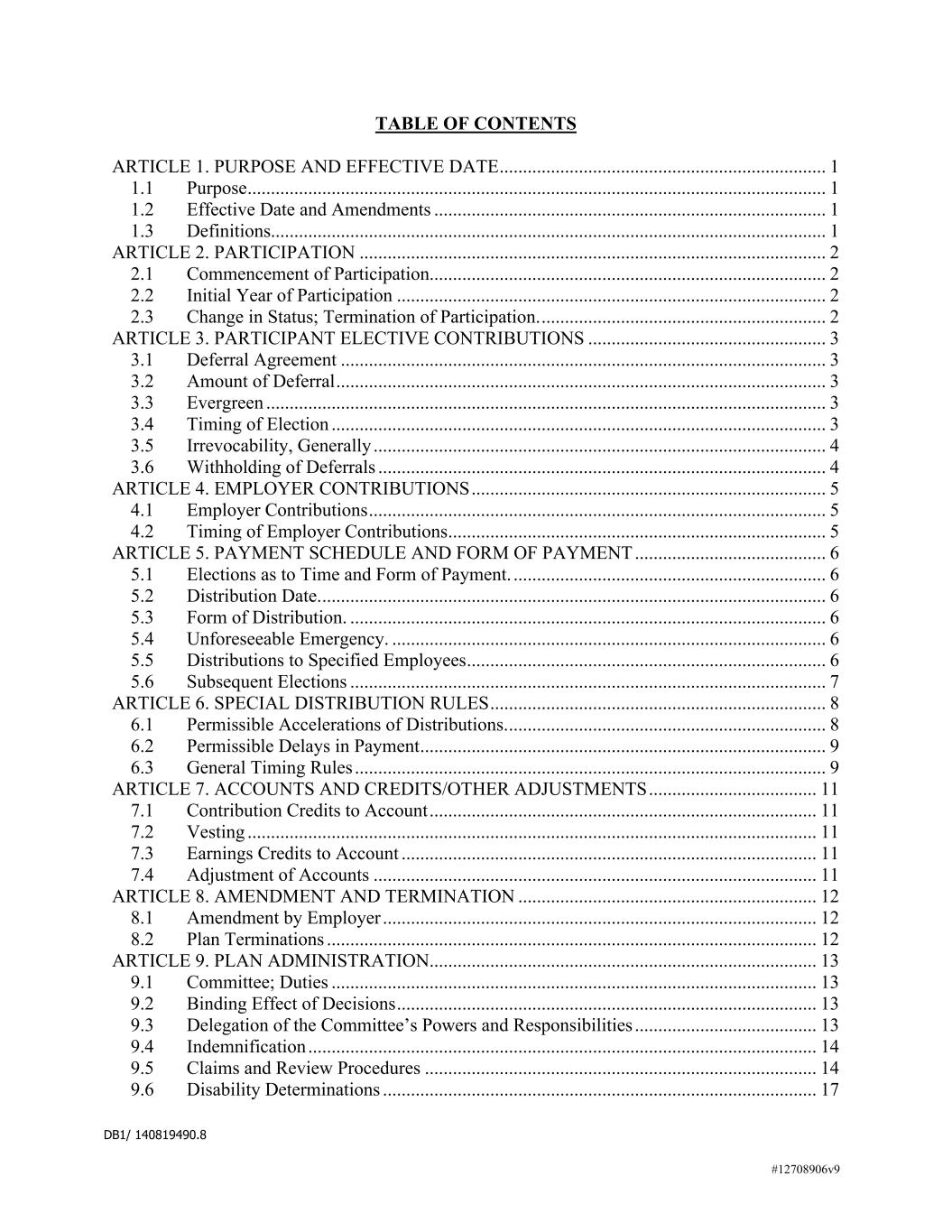
DB1/ 140819490.8 #12708906v9 TABLE OF CONTENTS ARTICLE 1. PURPOSE AND EFFECTIVE DATE ...................................................................... 1 1.1 Purpose ............................................................................................................................ 1 1.2 Effective Date and Amendments .................................................................................... 1 1.3 Definitions....................................................................................................................... 1 ARTICLE 2. PARTICIPATION .................................................................................................... 2 2.1 Commencement of Participation..................................................................................... 2 2.2 Initial Year of Participation ............................................................................................ 2 2.3 Change in Status; Termination of Participation. ............................................................. 2 ARTICLE 3. PARTICIPANT ELECTIVE CONTRIBUTIONS ................................................... 3 3.1 Deferral Agreement ........................................................................................................ 3 3.2 Amount of Deferral ......................................................................................................... 3 3.3 Evergreen ........................................................................................................................ 3 3.4 Timing of Election .......................................................................................................... 3 3.5 Irrevocability, Generally ................................................................................................. 4 3.6 Withholding of Deferrals ................................................................................................ 4 ARTICLE 4. EMPLOYER CONTRIBUTIONS ............................................................................ 5 4.1 Employer Contributions .................................................................................................. 5 4.2 Timing of Employer Contributions ................................................................................. 5 ARTICLE 5. PAYMENT SCHEDULE AND FORM OF PAYMENT ......................................... 6 5.1 Elections as to Time and Form of Payment. ................................................................... 6 5.2 Distribution Date. ............................................................................................................ 6 5.3 Form of Distribution. ...................................................................................................... 6 5.4 Unforeseeable Emergency. ............................................................................................. 6 5.5 Distributions to Specified Employees ............................................................................. 6 5.6 Subsequent Elections ...................................................................................................... 7 ARTICLE 6. SPECIAL DISTRIBUTION RULES ........................................................................ 8 6.1 Permissible Accelerations of Distributions. .................................................................... 8 6.2 Permissible Delays in Payment ....................................................................................... 9 6.3 General Timing Rules ..................................................................................................... 9 ARTICLE 7. ACCOUNTS AND CREDITS/OTHER ADJUSTMENTS .................................... 11 7.1 Contribution Credits to Account ................................................................................... 11 7.2 Vesting .......................................................................................................................... 11 7.3 Earnings Credits to Account ......................................................................................... 11 7.4 Adjustment of Accounts ............................................................................................... 11 ARTICLE 8. AMENDMENT AND TERMINATION ................................................................ 12 8.1 Amendment by Employer ............................................................................................. 12 8.2 Plan Terminations ......................................................................................................... 12 ARTICLE 9. PLAN ADMINISTRATION................................................................................... 13 9.1 Committee; Duties ........................................................................................................ 13 9.2 Binding Effect of Decisions .......................................................................................... 13 9.3 Delegation of the Committee’s Powers and Responsibilities ....................................... 13 9.4 Indemnification ............................................................................................................. 14 9.5 Claims and Review Procedures .................................................................................... 14 9.6 Disability Determinations ............................................................................................. 17
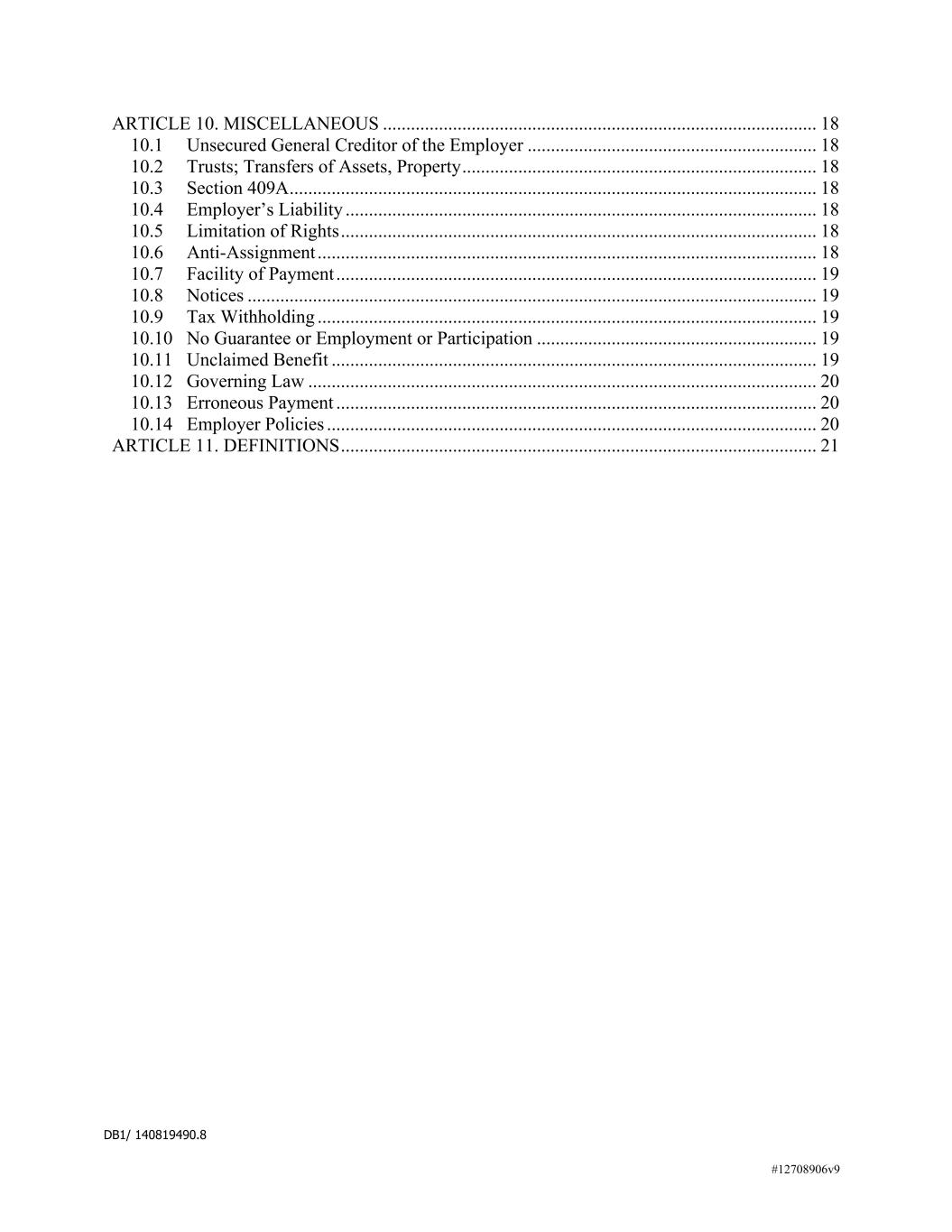
DB1/ 140819490.8 #12708906v9 ARTICLE 10. MISCELLANEOUS ............................................................................................. 18 10.1 Unsecured General Creditor of the Employer .............................................................. 18 10.2 Trusts; Transfers of Assets, Property ............................................................................ 18 10.3 Section 409A ................................................................................................................. 18 10.4 Employer’s Liability ..................................................................................................... 18 10.5 Limitation of Rights ...................................................................................................... 18 10.6 Anti-Assignment ........................................................................................................... 18 10.7 Facility of Payment ....................................................................................................... 19 10.8 Notices .......................................................................................................................... 19 10.9 Tax Withholding ........................................................................................................... 19 10.10 No Guarantee or Employment or Participation ............................................................ 19 10.11 Unclaimed Benefit ........................................................................................................ 19 10.12 Governing Law ............................................................................................................. 20 10.13 Erroneous Payment ....................................................................................................... 20 10.14 Employer Policies ......................................................................................................... 20 ARTICLE 11. DEFINITIONS ...................................................................................................... 21
DB1/ 140819490.8 1 #12708906v9 ARTICLE 1. PURPOSE AND EFFECTIVE DATE Purpose. The purpose of the Plan is to provide a select group of primarily management or highly compensated employees of the Employer the option to defer the receipt of portions of their compensation payable for services rendered to the Employer, and provide nonqualified deferred compensation benefits which are not available to such employees by reason of limitations on employer and employee contributions to qualified pension or profit-sharing plans under the federal tax laws. Effective Date and Amendments. The Plan was originally effective January 1, 2020. The Plan has been and may be amended from time to time. Definitions. Capitalized terms are defined in ARTICLE 11.
DB1/ 140819490.8 2 #12708906v9 ARTICLE 2. PARTICIPATION Commencement of Participation. Each Eligible Employee shall become a Participant upon the earlier of (i) the effective date of an initial Election to defer Base Compensation or Incentive Compensation under the Plan, or (ii) the Eligible Employee first receiving an allocation of Employer Contributions or Supplemental Retirement Contributions. Initial Year of Participation. When an employee first becomes an Eligible Employee, they shall become eligible for Employer Contributions and Supplemental Retirement Contributions. The Participant’s initial Election may be made in the first Election Period to occur on or after becoming an Eligible Employee and shall be effective as of the first full Plan Year following initial eligibility. Notwithstanding anything in the Plan to the contrary, the Committee, in its discretion, may allow an Eligible Employee to make an initial Election within 30 days after first becoming an Eligible Employee, with respect to compensation paid for services performed after the Election. Elections relating to initial participation in the Plan are available only to employees who do not participate in any Aggregated Plans. If an employee’s Plan participation is terminated and the employee subsequently becomes an Eligible Employee again, the employee may make an Election pursuant to this paragraph only if the employee was ineligible to participate in any Aggregated Plans for the 24 months preceding the date on which the employee became an Eligible Employee again. Change in Status; Termination of Participation. The Committee may, for any reason, terminate a Participant’s participation in the Plan, in which case, the Participant shall cease to be an Eligible Employee as of the date specified by the Committee. If a Participant ceases to be eligible to participate in the Plan for any reason, any Elections previously made will continue in effect according to the terms of the Election for the remainder of the Plan Year in which the Participant ceases to be an Eligible Employee, except as provided in Section 3.5 and to the extent required by Code Section 409A. The terms of this Plan shall continue to govern the Participant’s Account until the Participant’s Account is paid in full.
DB1/ 140819490.8 3 #12708906v9 ARTICLE 3. PARTICIPANT ELECTIVE CONTRIBUTIONS Deferral Agreement. Base Compensation. Each Eligible Employee may elect to defer a portion of Base Compensation to be earned for services in a future Plan Year by executing an Election deferring such Base Compensation during the applicable Election Period, except as provided in Section 2.2(b), if applicable. Incentive Compensation. Each Eligible Employee may elect to defer a portion of Incentive Compensation to be earned for services in a future Plan Year by executing an Election deferring such Incentive Compensation during the applicable Election Period, except as provided in Section 2.2(b), if applicable. The Committee will determine which types of Incentive Compensation may be deferred under the Plan. Amount of Deferral. An Eligible Employee may elect to defer between 2% and 90% of the Eligible Employee’s Base Compensation and between 10% and 90% of the Eligible Employee’s Incentive Compensation for a Plan Year; provided, however, that such deferrals shall be made in whole percentages. The deferral amount is the amount designated on the Participant’s Election. Evergreen. A Participant’s Election shall remain in full force and effect for all subsequent Plan Years until (i) modified or revoked in writing during an Election Period, (ii) terminated in accordance with Section 3.5, or (iii) a termination of participation in accordance with Section 2.3. If a Participant’s Election has been deemed continued for a Plan Year in accordance with this Section, it is irrevocable for such Plan Year. Timing of Election. Incentive Compensation. The Election Period for Incentive Compensation (with respect to deferrals of Incentive Compensation, as well as with respect to timing and form of payment upon distribution as described in Section 5.1) shall be within the fourth fiscal quarter of the calendar year immediately preceding the Plan Year in which the Participant will perform the services to earn the Incentive Compensation, with the specific time period determined annually in the discretion of the Committee, except as provided in Section 2.2(b), if applicable. Subject to Section 3.3, above, if a Participant desires to modify the deferral of Incentive Compensation for a future Plan Year, a new Election must be timely executed for the Plan Year during the applicable Election Period. An Eligible Employee who does not timely execute an Election during such Eligible Employee’s initial Election Period to defer Incentive Compensation shall be deemed to have elected zero deferrals of Incentive Compensation for such Plan Year and each subsequent Plan Year until a timely Election is made. Base Compensation. The Election Period for Base Compensation (with respect to deferrals of Base Compensation, as well as with respect to timing and form of payment upon distribution as described in Section 5.1) shall be within the fourth calendar quarter of the year
DB1/ 140819490.8 4 #12708906v9 immediately preceding the Plan Year in which the Participant will perform the services to earn the Base Compensation, with the specific time period determined annually in the discretion of the Committee, except as provided in Section 2.2(b), if applicable. Subject to Section 3.3, above, if a Participant desires to modify the deferral of Base Compensation for a future Plan Year, a new Election must be timely executed for the Plan Year during the applicable Election Period. An Eligible Employee who does not timely execute an Election during such Eligible Employee’s initial Election Period shall be deemed to have elected zero deferrals of Base Compensation for such Plan Year and each subsequent Plan Year until a timely Election is made. Irrevocability, Generally. An Election with respect to a Plan Year may not be changed or revoked for that Plan Year after the last day of the Election Period. A Participant’s deferral Election for the remainder of the Plan Year will be cancelled on account of the Participant’s Disability in accordance with Treasury Regulation Section 1.409A-3(j)(4)(xii). Withholding of Deferrals. The Employer shall have the sole discretion to withhold the percentage of Base Compensation and Incentive Compensation specified in a Participant’s Election for a Plan Year at the times and in the amounts that the Employer, in its sole discretion, selects, which need not be uniform either among Participants or as to payments to a single Participant; provided, however, that deferral amounts must be withheld not later than the end of the calendar year during which the Employer would otherwise have paid the amounts to the Participant but for the Participant’s Election. Deferrals of Base Compensation shall not be withheld during any period in which the Participant is on an unpaid leave of absence and has no Base Compensation. All deferral amounts that are withheld in accordance with this Section shall be deemed for all purposes to comply with the Plan requirements regarding deferrals.
DB1/ 140819490.8 5 #12708906v9 ARTICLE 4. EMPLOYER CONTRIBUTIONS Employer Contributions. Determining Eligible Compensation. Except as provided in Section 2.2(b), if applicable, for purposes of determining Employer Contributions and Supplemental Retirement Contributions, only Eligible Compensation paid on or after becoming an Eligible Employee shall be taken into account. Employer Contribution. Each Plan Year, the Employer shall credit to the Account of each Participant who is an Eligible Employee on the last day of the Plan Year (or who had a Separation from Service as a result of death, Disability or Retirement during the Plan Year) an amount equal 6% of Eligible Compensation for the Plan Year. Supplemental Retirement Contribution. Each Plan Year, the Employer shall credit to the Account of each Participant (x) who is not eligible for or participating in the ONEOK, Inc. 2005 Supplemental Executive Retirement Plan during the Plan Year and (y) who is an Eligible Employee on the last day of the Plan Year (or who had a Separation from Service as a result of death, Disability or Retirement during the Plan Year) a Supplemental Retirement Contribution in an amount equal to the total of subsections (i), (ii), and (iii, if any) as described below: (i) For Plan Years beginning before January 1, 2025, an amount equal to 1% of Eligible Compensation. For Plan Years beginning on or after January 1, 2025, an amount equal to 6% of Eligible Compensation. (ii) A discretionary percentage of Eligible Compensation generally based on the profit sharing contribution issued for the Plan Year to eligible employees under the ONEOK, Inc. 401(k) Plan for the Plan Year. (iii) A supplemental amount determined by the Committee, in its sole discretion. Timing of Employer Contributions. Employer Contributions and Supplemental Retirement Contributions shall be credited to the Participant’s Account as soon as administratively practicable on or following the last day of each Plan Year.
DB1/ 140819490.8 6 #12708906v9 PAYMENT SCHEDULE AND FORM OF PAYMENT. Subject to ARTICLE 6, Accounts shall be distributed in accordance with the provisions of this Article. Elections as to Time and Form of Payment. A Participant may make an Election during the Election Period regarding the time and form of distribution with regard to any deferred Incentive Compensation, Base Compensation, Supplemental Retirement Contributions or Employer Contributions allocated to the Participant’s Account. The elected distribution date shall be a date described in Section 5.2. A Participant may select from the available distribution forms described in Section 5.3. At any time and in its discretion, the Committee may determine that the number of separate Elections as to the time and form of a distribution shall be limited. Following the Committee’s decision to implement a limit, any Participant Election specifying additional times and forms of distribution in excess of such limit will be invalid, subject to Code Section 409A. Distribution Date. Except as otherwise specified in the applicable Election form, amounts allocated to the Participant’s Account shall be paid, or begin to be paid, upon the earliest of: (i) a date, specified in the Participant’s Election, that is no earlier than the January 1 following the fifth anniversary of the Participant’s Election; (ii) the Participant’s Separation from Service; (iii) the Participant’s death; (iv) the Participant’s Disability; or (v) a Change in Control. If a Participant does not have an Election in effect with respect to contributions for specific Plan Year, or if for any reason the Participant’s Election for a Plan Year is invalid, the Participant’s Account attributable to that Plan Year shall be paid upon the Participant’s Separation from Service. The Committee may limit the available distribution options for future Elections at any time, including with respect to timing of distributions. Any such modifications will be communicated to Participants in advance of the Plan Year to which the applicable Election will apply. Form of Distribution. Upon the occurrence of a distribution date in Section 5.2, the Participant’s Account shall be paid, or begin to be paid, in one of the following forms as specified in the Participant’s Election (or Subsequent Election): (i) a single lump sum; (ii) annual installments over five years; or (iii) annual installments over 10 years. In the event there is no Participant Election with respect to a Participant’s contributions for a specific Plan Year, or if for any reason the Participant’s Election for a Plan Year is invalid, the Participant’s Account attributable to that Plan Year shall be paid in a single lump sum. Unforeseeable Emergency. A Participant may submit a written request for a distribution on account of an Unforeseeable Emergency. Upon approval by the Committee of a Participant’s request, the Participant’s Account, or that portion of a Participant’s Account deemed necessary by the Committee to satisfy the Unforeseeable Emergency (determined in a manner consistent with Code Section 409A) plus amounts necessary to pay taxes reasonably anticipated because of the distribution, will be distributed in a single lump sum. Distributions to Specified Employees. Notwithstanding any other provision of the Plan, if a payment is to be made upon Separation from Service and the Participant is determined to be a
DB1/ 140819490.8 7 #12708906v9 “specified employee” as defined in Code Section 409A, then such payment shall not be paid, or commence to be paid, until (i) the first payroll date to occur following the six-month anniversary of the Separation from Service; or (ii) if earlier, on the Participant’s death (the “Specified Employee Payment Date”). Subsequent Elections. If permitted by the Committee, in accordance with rules, procedures and forms specified from time to time by the Committee, a Participant may file a Subsequent Election to change the time on which the distribution is to commence or the form in which the Participant’s Account is distributed, or both. A Participant may file a Subsequent Election only if it complies with the provisions of Code Section 409A and the following conditions are met: The Subsequent Election shall not take effect until at least 12 months after the date on which it is made; Except in the case of an election permitted under Code Section 409A and the Treasury Regulations Section 1.409A-3(a)(2) (payment on account of disability), Section 1.409A- 3(a)(3) (payment on account of death), or Section 1.409A-3(a)(6) (payment on account of the occurrence of an unforeseeable emergency), the payment with respect to which such Subsequent Election is made shall be deferred for a period of not less than five years from the date such payment would otherwise have been paid (or in the case of installment payments treated as a single payment, five years from the date the first amount was scheduled to be paid); and Any Subsequent Election related to a payment described in Treasury Regulations Section 1.409A-3(a)(4) (payment at a specified time or pursuant to a fixed schedule) shall be made not less than 12 months before the date the payment is scheduled to be paid (or in the case of installment payments treated as a single payment, 12 months before the date the first amount was scheduled to be paid). If permitted by the Committee, a Participant who has made a prior Subsequent Election under the Plan shall be allowed to make another Subsequent Election in accordance with this Section 5.6 and other provisions of the Plan. The Committee shall be authorized to administer and interpret the foregoing provisions and the Plan with respect to all Subsequent Elections consistent with of Code Section 409A.
DB1/ 140819490.8 8 #12708906v9 ARTICLE 6. SPECIAL DISTRIBUTION RULES Permissible Accelerations of Distributions. Except as otherwise provided in the Plan and except as may be allowed in guidance from the Secretary of the Treasury, distributions from a Participant’s Account may not be made earlier than the time such amounts would otherwise be distributed pursuant to the terms of the Plan. Taxes. The Employer, in its sole discretion, may accelerate the time in which payment shall be made under the Plan to: (a) pay the FICA tax imposed under Code Sections 3101, 3121(a) and 3121(v)(2) on compensation deferred under the Plan, (b) pay the income tax at source on wages imposed under Code Section 3401 or the corresponding withholding provisions of the applicable, state, local or foreign tax laws as a result of the payment of any FICA tax described in clause (a), and to pay the additional income tax at source on wages attributable to the pyramiding Code Section 3401 wages and taxes, (c) pay state, local, or foreign tax obligations arising from participation in the Plan that apply to an amount deferred under the Plan before the amount is paid or made available to the Participant, (d) pay the income tax at source on wages imposed under Code Section 3401 as a result of the payment described in clause (c) and to pay the additional income tax at source on wages imposed under Code Section 3401 attributable to such additional Code Section 3401 wages and taxes, and (e) pay the amount required to be included in gross income as a result of the failure of the Plan to comply with the requirements of Code Section 409A. The total payment under clauses (a) and (b) shall, in no event, exceed the aggregate of the FICA tax and the income tax withholding related to such FICA tax. The total payment under clause (c) shall, in no event, exceed the amount of such taxes due as a result of participation in the Plan. The total payment under clauses (c) and (d) shall, in no event, exceed the aggregate of the state, local, and foreign tax amount, and the income tax withholding related to such state, local, and foreign tax amount. The total payment under clause (e) shall, in no event, exceed the amount required to be included in income as a result of the failure to comply with requirements of Code Section 409A. Compliance with Ethics Laws or Conflicts of Interests Laws. The Committee is authorized, in its sole discretion, to accelerate the time or schedule of a payment to the extent reasonably necessary to avoid the violation of an applicable federal, state, local, or foreign ethics law or conflicts of interest law (including where such payment is reasonably necessary to permit the Participant to participate in activities in the normal course of the Participant’s position in which the Participant would otherwise not be able to participate under an applicable rule), determined in accordance with Code Section 409A. Small Accounts. The Committee may, in its sole discretion, distribute in a single lump sum the aggregate amounts credited to the Participant’s Account, along with any related earnings, provided: (i) the distribution results in the payment of the Participant’s entire interest in the Account and all Aggregated Plans, and (ii) the total payment does not exceed the applicable dollar limit under Code Section 402(g)(1)(B), consistent with Code Section 409A. The Committee shall notify the Participant in writing if the Committee exercises its discretion pursuant to this Section.
DB1/ 140819490.8 9 #12708906v9 Settlement of a Bona Fide Dispute. The Committee may, in its sole discretion, accelerate the time or schedule of a distribution as part of a settlement of a bona fide dispute between the Participant and the Employer over the Participant’s right to a distribution provided that the distribution relates only to the deferred compensation in dispute and the Employer is not experiencing a downturn in financial health, consistent with Code Section 409A. Settlement of Debt. The Committee may, in its sole discretion, accelerate the time or schedule of a payment to satisfy the debt of a Participant to the Employer or any Related Employer where such debt is incurred in the ordinary course of the service relationship between the Participant and the Employer or Related Employer, as applicable, the entire amount of the reduction in any Plan Year does not exceed $5,000, and the reduction is made at the same time and in the same amount as the debt otherwise would have been due and collected from the Participant, consistent with Code Section 409A. Permissible Delays in Payment. Distributions may be delayed beyond the date payment would otherwise occur in accordance with the Plan in any of the following circumstances: Payments that would violate Federal Securities Laws or Other Applicable Law. The Employer may delay payment under the Plan if the Committee reasonably anticipates that the making of the payment will violate Federal securities laws or other applicable laws, provided payment is made at the earliest date on which the Committee reasonably anticipates that the making of the payment will not cause such violation, consistent with Code Section 409A. Going Concern. The Employer may delay payment under the Plan if the distribution would jeopardize the Employer’s ability to continue as a going concern, provided that the delayed amount is distributed in the first calendar year in which the payment would not have such effect, consistent with Section 409A. Inability to Calculate. If calculation of the amount of a payment is not administratively practicable due to events beyond the control of the Participant (or Participant’s Beneficiary), the payment will be treated as made upon the date contemplated by the Plan if the payment is made during the first calendar year in which the payment is administratively practicable, consistent with Section 409A. Other Events and Conditions. The Employer reserves the right to delay payment upon such other events and conditions as the Secretary of the Treasury may prescribe in generally applicable guidance published with respect to Code Section 409A. General Timing Rules. The general rules in this Section shall apply to all Plan distributions. Except as otherwise provided in this Section, if a distribution is required upon the occurrence of an event specified in Section 5.2, the distribution will commence between the date of the distribution event and the later of (i) the end of the year in which the distribution event occurs, and (ii) 15th day of the third calendar month following the distribution event; provided, however, the Participant will not be permitted, directly or indirectly, to designate the taxable year of the distribution. If a Participant has elected to receive a distribution commencing during a specific calendar year, the distribution may

DB1/ 140819490.8 10 #12708906v9 occur any time during that year; provided, however, that if a Participant’s Election specifies a particular month during which the distribution should commence, the distributions may not commence before the first day of the specified month. Any distribution that complies with this Section shall be deemed for all purposes to comply with the Plan requirements regarding the time and form of distributions.
DB1/ 140819490.8 11 #12708906v9 ARTICLE 7. ACCOUNTS AND CREDITS/OTHER ADJUSTMENTS Contribution Credits to Account. A Participant’s Account will be credited for each Plan Year with: (a) the amount of the Participant’s elective deferrals in accordance with ARTICLE 3, and the amount of any Employer Contributions or Supplemental Retirement Contributions credited on the Participant’s behalf annually under ARTICLE 4. Separate Accounts shall be maintained for each Participant for each Plan Year for which contributions are credited to the Participant. Vesting. A Participant shall always be 100% vested in all contributions allocated to the Participant’s Account. Earnings Credits to Account. The Participant’s Account shall be credited (or debited) on each Valuation Date with income (or loss) based upon a hypothetical investment in any one or more of the investment options available under the Plan, as prescribed by the Committee. In the absence of any affirmative investment decision by the Committee (or any delegate thereof), the investment options available under the Plan shall mirror the then current investment options offered to participants under the ONEOK, Inc. 401(k) Plan (or any successor thereto), excluding common stock of the Employer and any investment fund frozen to new contributions. The crediting or debiting on each Valuation Date of income (or loss) shall be made for each respective Account. All investments of a Participant’s Account shall be valued at fair market value. Additionally, all distributions, investments and investment exchanges allowed and made under the Plan shall be as of the relevant Valuation Date at fair market value. Adjustment of Accounts. Each Account maintained for a Participant shall be adjusted for any expenses allocable under the terms of the Plan to the Account. The Account shall be adjusted as of each Valuation Date to reflect: (a) the earnings credits and expenses described under Section 7.3, above; (b) amounts credited pursuant to ARTICLE 3 and ARTICLE 4; and (c) distributions or withdrawals.
DB1/ 140819490.8 12 #12708906v9 ARTICLE 8. AMENDMENT AND TERMINATION Amendment by Employer. The Company may at any time amend the Plan in whole or in part, except that no amendment may reduce the value of any Participant’s Account as of the date of the amendment. An amendment must be in writing and executed by a representative of the Employer authorized to take such action. Plan Terminations. Company Discretion. The Company retains the discretion to terminate the Plan and distribute each Participant’s Account in a single lump sum if (1) the termination does not occur proximate to a downturn in the financial health of the Employer, (2) all Aggregated Plans are terminated, (3) no payments other than payments that would be payable under the terms of the arrangements if the termination had not occurred are made within 12 months of the termination of the arrangements, (4) all payments are made within 24 months of the termination of the arrangements, and (5) neither the Employer nor any Related Employer adopts a new arrangement that would be aggregated with any terminated arrangement under Treasury Regulation Section 1.409A-1(c), if the same service provider participated in both arrangements, at any time within the three year period following the date of termination of the arrangement, consistent with Code Section 409A. Automatic Termination following distribution of all Accounts. The Plan will terminate automatically as of the date that no amounts remain to be distributed under the Plan. In connection with Change in Control. The Company reserves the right to terminate the Plan and accelerate the time of payment of all amounts to be distributed under the Plan in accordance with the following provisions of this Section 8.2. The Company may make an irrevocable election to terminate the Plan and distribute all amounts credited to Accounts within the 30 days preceding or the 12 months following a change in ownership or effective control of, or a change in ownership of a substantial portion of the assets of, the Company, consistent with Code Section 409A (“409A Change in Control”). For this purpose, the Plan will be treated as terminated only if all other Aggregated Plans are terminated and liquidated with respect to each Participant that experienced the 409A Change in Control, so that under the terms of the termination and liquidation all such Participants are required to receive all amounts of compensation deferred under the terminated arrangements within 12 months of the date the Company irrevocably takes all necessary action to terminate and liquidate the Plan and such other arrangements with respect to such Participants.
DB1/ 140819490.8 13 #12708906v9 ARTICLE 9. PLAN ADMINISTRATION Committee; Duties. This Plan shall be administered by the Committee. The Committee shall have the authority to make, amend, interpret and enforce all appropriate rules and regulations for the administration of the Plan and decide or resolve any and all questions, including interpretations of the Plan, as they may arise in such administration. Binding Effect of Decisions. The decision or action of the Committee with respect to any question arising out of or in connection with the administration, interpretation and application of the Plan and the rules and regulations promulgated hereunder shall be final, conclusive and binding upon all persons having any interest in the Plan. Delegation of the Committee’s Powers and Responsibilities. The Committee may appoint an entity or individual, who may be an employee of the Employer or a third party, to be the Committee’s agent with respect to the day-to-day administration of the Plan. In addition, the Committee may, from time to time, employ other agents and delegate to them such administrative duties as it sees fit, and may from time to time consult with counsel who may be counsel to the Employer. Benefit Plan Sponsor Committee. Except for settlor duties and responsibilities that are specifically reserved to the Employer, the Board or the Committee (including, but not limited to, the ability to terminate the Plan or approve amendments to the Plan), or which have been properly delegated to another person or entity under the terms of the Plan, all settlor duties and responsibilities with respect to the Plan are delegated to the ONEOK, Inc. Benefit Plan Sponsor Committee. President and Chief Executive Officer. The following duties and responsibilities are delegated to the President and Chief Executive Officer of the Company: (i) To adopt amendments which constitute routine, ministerial, clarifying or conforming amendments and do not materially modify the provision or intent of the Plan; (ii) To decide all questions concerning the Plan and the eligibility of any person to participate in the Plan, in the President and Chief Executive Officer’s sole discretion, subject to review by the Committee; and (iii) To determine the amount of any benefit or contribution or to increase any benefit or contribution under the Plan (except for such increases which are related to the President and Chief Executive Officer’s own deferred compensation), so long as such increase does not exceed $1,000,000 for any Plan Year. Benefit Plan Administration Committee. Except for such duties and responsibilities as may be specifically reserved to the Employer, the Board, the Committee or the ONEOK, Inc. Benefit Plan Sponsor Committee, or which have been properly delegated to another
DB1/ 140819490.8 14 #12708906v9 person or entity under the terms of the Plan, the ONEOK, Inc. Benefit Plan Administration Committee shall be responsible for the discretionary administration of the Plan. Indemnification. To the fullest extent allowed by law, the Employer shall indemnify and hold harmless each member of the Committee and each employee, officer, or director of the Employer or any Related Employer to whom is delegated duties, responsibilities, and authority with respect to the Plan against all claims, liabilities, fines and penalties, and all expenses reasonably incurred by or imposed upon such Committee member, employee, officer, or director (including but not limited to reasonable attorneys’ fees) which arise as a result of their actions or failure to act in connection with the operation and administration of the Plan to the extent lawfully allowable and to the extent that such claim, liability, fine, penalty, or expense is not paid for by liability insurance purchased or paid for by the Employer or and Related Employer. Notwithstanding the foregoing, the Employer shall not indemnify any person for any such amount incurred through any settlement or compromise of any action unless the Employer consents in writing to such settlement or compromise. Claims and Review Procedures Claims Procedure. If any person believes such person is being denied any rights or benefits under the Plan, such person (the “Claimant”) may file a claim in writing with the Committee (the “Claims Administrator”). If any such claim is wholly or partially denied, the Claims Administrator will notify the Claimant of its decision in writing. Such notification will contain (i) specific reasons for the denial, (ii) specific reference to pertinent Plan provisions, (iii) a description of any additional material or information necessary for the Claimant to perfect such claim and an explanation of why such material or information is necessary, and (iv) information as to the steps to be taken if the Claimant wishes to submit a request for review. Such notification will be given within 90 days after the claim is received by the Claims Administrator (or within 180 days, if special circumstances require an extension of time for processing the claim, and if written notice of such extension and circumstances is given to such person within the initial 90 day period). If such notification is not given within such period, the claim will be considered denied as of the last day of such period and the Claimant may request a review of the Claimant’s claim. Review Procedure. Within 60 days after the date on which a Claimant receives a written notification of denial of claim (or, if written notification is not provided, within 60 days of the date denial is considered to have occurred), the Claimant (or the Claimant’s duly authorized representative) may (i) file a written request with the Claims Administrator for a review of the Claimant’s denied claim and of pertinent documents and (ii) submit written issues and comments to the Claims Administrator. The Claims Administrator will notify the Claimant of its decision in writing. Such notification will be written in a manner calculated to be understood by the Claimant and will contain specific reasons for the decision as well as specific references to pertinent Plan provisions. The decision on review will be made within 60 days after the request for review is received by the Claims Administrator (or within 120 days, if special circumstances require an extension of time for processing the request, such as an election by the Claims Administrator to hold a hearing, and if written notice of such extension and circumstances is given to the Claimant within the initial 60-day period). If the decision on review is not made within such period, the claim will
DB1/ 140819490.8 15 #12708906v9 be considered denied. Except as otherwise provided in Section 9.5, the decision, action or inaction of the Claims Administrator shall be final, conclusive and binding on all persons having an interest in the Plan. Mandatory Arbitration. If, after exhausting the procedures set forth in this Section, a Claimant wishes to pursue legal action, any action by the Claimant with respect to a claim made under Section 9.5, must be resolved by arbitration in the manner described in this Section. This agreement to arbitrate shall be specifically enforceable. A party may apply to the United States District Court for the Northern District of Oklahoma for interim, injunctive or conservatory relief, including without limitation a proceeding to compel arbitration. If the arbitration provisions herein are determined by any court to be unenforceable, any further legal action must be filed only in the United States District Court for the Northern District of Oklahoma within the time limits, and shall be subject to the standard of review, all as set forth below. (i) Time Limits. A Claimant seeking arbitration of any determination of the Claims Administrator must, within six months of the date of the Claims Administrator’s final decision, file a demand for arbitration with the American Arbitration Association submitting the claim to resolution by arbitration. A Claimant waives any claim not filed timely in accordance with this Section. (ii) Rules Applicable to Arbitration. The arbitration process shall be conducted in accordance with the Commercial Law Rules of the American Arbitration Association. (iii) Venue. The arbitration shall be conducted in Tulsa, Oklahoma. (iv) Binding Effect. The decision of the arbitrator with respect to the claim will be final and binding upon the Employer and the Claimant. By participating in the Plan, and accepting Plan benefits, Participants, on behalf of themselves and any person with a claim relating to Participant’s Plan benefits, agree to waive any right to sue in court or to pursue any other legal right or remedy that might otherwise be available in connection with the resolution of the claim. (v) Enforceability. Judgment upon any award entered by an arbitrator may be entered in any court having jurisdiction over the parties. (vi) Waiver of Class, Collective, and Representative Actions. Any claim shall be heard without consolidation of such claims with any other person or entity. To the fullest extent permitted by law, whether in court or in arbitration, by participating in the Plan, Participants waive any right to commence, be a party to in any way, or be an actual or putative class member of any class, collective, or representative action arising out of or relating to any claim, and Participants agree that any
DB1/ 140819490.8 16 #12708906v9 claim may only be initiated or maintained and decided on an individual basis. (vii) Standard of Review. Any decision of an arbitrator on a claim shall be limited to determining whether the Claim Administrator’s decision or action was arbitrary or capricious or was unlawful. The arbitrator shall adhere to and apply the deferential standard of review set out in Conkright v. Frommert, 559 U.S. 506 (2010), Metropolitan Life Insurance Co. v. Glenn, 554 U.S. 105 (2008), and Firestone Tire and Rubber Co. v. Bruch, 489 U.S. 101 (1989), and shall accord due deference to the determinations, interpretations, and construction of the Plan document of the Claims Administrator. (viii) General Procedures. (1) Arbitration Rules. The arbitration hearing will be conducted under the AAA Commercial Arbitration Rules (as amended or revised from time to time by AAA) (hereinafter the “AAA Rules”), before one AAA arbitrator who is from the Large, Complex Case Panel and who has experience with matters involving executive compensation and equity compensation plans. The AAA Rules and the terms and procedures set forth here may conflict on certain issues. To the extent that the procedures set forth here conflict with the AAA Rules, the procedures set forth here shall control and be applied by the arbitrator. Notwithstanding the amount of the claim, the Procedures for Large, Complex Commercial Disputes shall not apply. (2) Substantive Law. The arbitrator shall apply the substantive law (and the laws of remedies, if applicable) of Oklahoma or federal law, or both, depending upon the claim. Except to the extent required by applicable law, all arbitration decisions and awards shall be kept strictly confidential and shall not be disclosed by the Claimant to anyone other than the Claimant’s spouse, attorney or tax advisor. (3) Authority. The arbitrator shall have jurisdiction to hear and rule on prehearing disputes and is authorized to hold prehearing conferences by telephone or in person as the arbitrator deems necessary. The arbitrator will have the authority to hear a motion to dismiss and/or a motion for summary judgment by any party and in doing so shall apply the standards governing such motions under the Federal Rules of Civil Procedure.
DB1/ 140819490.8 17 #12708906v9 (4) Pre-Hearing Procedures. Each party may take the deposition of not more than one individual and the expert witness, if any, designated by another party. Each party will have the right to subpoena witnesses in accordance with the Arbitration Act. Additional discovery may be had only if the arbitrator so orders, upon a showing of substantial need. (5) Fees and Costs. Administrative arbitration fees and arbitrator compensation shall be borne equally by the parties, and each party shall be responsible for its own attorney’s fees, if any; provided, however, that the Committee will authorize payment by the Employer of all administrative arbitration fees, arbitrator compensation and attorney’s fees if the Committee concludes that a Claimant has substantially prevailed on the Claimant’s claims. Unless prohibited by statute, the arbitrator shall assess attorney’s fees against a party upon a showing that such party’s claim, defense or position is frivolous, or unreasonable, or factually groundless. If either party pursues a claim by any means other than those set forth in this Section, the responding party shall be entitled to dismissal of such action, and the recovery of all costs and attorney’s fees and losses related to such action, unless prohibited by statute. (ix) Interstate Commerce and the Federal Arbitration Act. The Employer is involved in transactions involving interstate commerce, and the employee’s employment with the Employer involves such commerce. Therefore, the Arbitration Act will govern the interpretation, enforcement, and all judicial proceedings regarding the arbitration procedures in this Section. Disability Determinations. Whether a Participant has experienced a Disability will be determined by the Social Security Administration or under the terms of the Employer’s long-term disability plan in accordance with those claims procedures. The claims procedures set forth in this ARTICLE 9 will not apply to the question of whether a Participant has experienced a Disability, but will apply to any other issues relating to Plan benefits.
DB1/ 140819490.8 18 #12708906v9 ARTICLE 10. MISCELLANEOUS Unsecured General Creditor of the Employer. Participants and their Beneficiaries, heirs, successors and assigns shall have no legal or equitable rights, interests or claims in any property or assets of the Employer or any Related Employer. For purposes of the payment of benefits under the plan, the assets of the Employer or of any Related Employer shall be, and shall remain, the general, unpledged, unrestricted assets of the Employer or of such Related Employer, respectively. The Employer’s obligation under the Plan shall be merely that of an unfunded and unsecured promise to pay money in the future. Trusts; Transfers of Assets, Property. Notwithstanding the foregoing, in the event of a Change in Control, the Employer shall create an irrevocable trust, or before such time the Employer may create an irrevocable or revocable trust, to hold funds to be used in payment of the obligations of the Employer or any Related Employer under the Plan. Section 409A. It is intended that the Plan comply with the provisions of Code Section 409A, so as to prevent the inclusion in gross income of any amounts deferred hereunder in a taxable year that is prior to the taxable year or years in which such amounts would otherwise actually be paid or made available to Participants or Beneficiaries. This Plan shall be construed, administered, and governed in a manner that effects such intent, and the Committee shall not take any action that would be inconsistent with such intent. Each installment payment of compensation under this Plan shall be treated as a separate payment of compensation for purposes of applying Code Section 409A. Although the Committee shall use its best efforts to avoid the imposition of taxation, interest and penalties under Code Section 409A, the tax treatment of deferrals under this Plan is not warranted or guaranteed. Neither the Employer, any director, officer, employee and advisor, the Board nor the Committee (or any delegate thereof) shall be held liable for any taxes, interest, penalties or other monetary amounts owed by any Participant, Beneficiary or other taxpayer as a result of the Plan. The Committee is authorized to make any adjustments (including any additional contributions, offsets, recovery or recoupment) that it deems necessary or advisable, in its sole discretion, to comply with Code Section 409A. Employer’s Liability. The Employer’s liability for the payment of benefits under the Plan shall be defined only by the Plan and by the Elections entered into between a Participant and the Employer. The Employer shall have no obligation or liability to a Participant under the Plan except as provided by the Plan and an Election. Limitation of Rights. Neither the establishment of the Plan, nor any amendment thereof, nor the creation of any fund or account, nor the payment of any benefits, will be construed as giving to the Participant or any other person any legal or equitable right against the Employer, the Committee, or any Related Employer except as provided herein; and in no event will the terms of employment or service of the Participant be modified or in any way affected hereby. Anti-Assignment. No right or interest of the eligible employees or retirees under this Plan shall be subject to involuntary alienation, assignment or transfer of any kind. The Employer, the Board, the
DB1/ 140819490.8 19 #12708906v9 Committee and any of their delegates shall not review, confirm, guarantee or otherwise comment on the legal validity of any voluntary assignment. Facility of Payment. If the Employer determines, on the basis of medical reports or other evidence satisfactory to the Employer, that the recipient of any benefit payments under the Plan is incapable of handling the recipient’s affairs by reason of minority, illness, infirmity or other incapacity, the Employer may disburse such payments to a person or institution designated by a court which has jurisdiction over such recipient or a person or institution otherwise having the legal authority under State law for the care and control of such recipient. The receipt by such person or institution of any such payments, and any such payment to the extent thereof, shall discharge the liability of the Employer for the payment of benefits hereunder to such recipient. Notices. Any notice or other communication required or permitted to be given in connection with the Plan shall be in writing and shall be deemed to have been duly given (i) upon request, if delivered personally or via courier, (ii) upon confirmation of receipt, if given by facsimile or electronic transmission, and (iii) on the third business day following mailing, if mailed first-class, postage prepaid, registered or certified mail as follows: If it is sent to the Employer, it will be at the address specified by the Employer; or If it is sent to a Participant or Beneficiary, it will be at the last address filed with the Employer by the Participant (or Beneficiary). Tax Withholding. The Employer shall have the right to deduct from all payments or deferrals made under the Plan any tax required by law to be withheld. If the Employer concludes that tax is owing with respect to any deferral or payment hereunder, the Employer shall withhold such amounts from any payments due the Participant or the Participant’s Beneficiary, as permitted by law, or otherwise make appropriate arrangements with the Participant or the Participant’s Beneficiary for satisfaction of such obligation. Tax, for purposes of this section, means any federal, state, local, foreign or any other governmental income tax, employment or payroll tax, excise tax, or any other tax or assessment owing with respect to amounts deferred, any earnings thereon, and any payments made to Participants or Beneficiaries under the Plan. No Guarantee or Employment or Participation. Nothing in the Plan shall interfere with or limit in any way the right of the Employer to terminate any Participant’s employment at any time and for any reason, nor confer upon any Participant any right to continue in the employ of the Employer or any Related Employer. No employee of the Employer shall have a right to be selected as a Participant under the Plan or, if selected, to continue to participate for any Plan Year. Unclaimed Benefit. Each Participant shall keep the Employer informed of the Participant’s current address and the current address of the Participant’s Beneficiary. The Employer shall not be obligated to search for the whereabouts of any person. If the location of a Participant is not made known to the Employer within three years after the date on which payment of the Participant’s vested Account
DB1/ 140819490.8 20 #12708906v9 is scheduled to be made (or to commence), payment may be made as though the Participant had died at the end of the three-year period. If within one additional year after such three-year period has elapsed, or, within three years after the actual death of a Participant, the Employer is unable to locate the Beneficiary of the Participant, then the Employer shall have no further obligation to pay any benefit hereunder to such Participant or Beneficiary or any other person and such benefit shall be irrevocably forfeited. Governing Law. The Plan will be construed, administered and enforced according to the laws of the State of Oklahoma without regard to principles of conflicts of law to the extent not otherwise preempted by the Code or by ERISA. Erroneous Payment. Any amount paid under this Plan in error to a Participant or to a Participant’s Beneficiary shall be returned to the Employer. A payment made in error does not create on the part of the recipient a legally binding right to such payment. In addition, the Plan and its agents are authorized to (A) recoup overpayments plus any earnings or interest, and (B) if necessary, offset any overpayments that are not returned against other Plan benefits to which the recipient is or becomes entitled. 10.14 Employer Policies. All amounts deferred, accrued, or credited under this Plan on or after October 2, 2023 are subject to forfeiture under the terms of any applicable Clawback Policy and shall not be deemed nonforfeitable until any such Clawback Policy is no longer applicable to such amounts. To the extent permitted by applicable law, including without limitation Code Section 409A, all amounts deferred and/or payable under this Plan are subject to offset in the event that a Participant has an outstanding clawback, recoupment or forfeiture obligation to the Employer under the terms of any applicable Clawback Policy. In the event of a clawback, recoupment, or forfeiture event under an applicable Clawback Policy, any amounts required to be clawed back, recouped or forfeited pursuant to such policy shall be deemed not to have been earned under the terms of the Plan, and the Employer shall be entitled to recover from the Participant the amount specified under the Clawback Policy to be clawed back, recouped, or forfeited (which amount, as applicable, shall be deemed an advance that remained subject to the Participant satisfying all eligibility conditions for earning the amounts deferred, accrued, or credited under this Plan).
DB1/ 140819490.8 21 #12708906v9 ARTICLE 11. DEFINITIONS Wherever used herein, the following terms have the meanings set forth below, unless a different meaning is clearly required by the context: “Account” means an account established for the purpose of recording amounts credited on behalf of a Participant, including (i) Participant deferrals of Base Compensation and Incentive Compensation; (ii) Employer Contributions; (iii) Supplemental Retirement Contributions; and (iv) any income, expenses, gains, losses or distributions included thereon. The Account shall be a bookkeeping entry only and shall be utilized solely as a device for the measurement and determination of the amounts to be paid to a Participant pursuant to the Plan. “Aggregated Plans” means this Plan or a portion of this Plan and all other non-qualified deferred compensation plans which must be aggregated with the Plan or portion of the Plan in accordance with the plan aggregation rules of Code Section 409A. “Base Compensation” means a Participant’s basic wage or salary paid by the Employer to the Participant without regard to any increases or decreases in such basic wage or salary as a result of (i) an Election to defer basic wage or salary under this Plan or (ii) an Election between benefits or cash provided under a plan of the Employer maintained pursuant to Code Sections 125 or 401(k), after deductions and withholdings of all income and employment taxes and any other amounts required under uniform rules and procedures determined by the Committee and the Employer. The Base Compensation does not include any long-term incentive awards or other cash bonus, stock or other equity paid to a Participant, nor any Incentive Compensation, as defined below. “Beneficiary” means the persons, trusts, estates or other entities designated in writing by a Participant, or otherwise entitled to receive benefits under the Plan upon the death of a Participant. If a Participant fails to designate a Beneficiary, then the Participant’s Beneficiary shall be the Participant’s spouse or, if the Participant does not have a spouse on the Participant’s date of death, the Participant’s estate. “Board” means the Board of Directors of ONEOK, Inc. “Change in Control” shall mean any of the following events: (a) a person (or more than one person acting as a group) acquires ownership of stock of the Company that, together with the stock held by such person or group, constitutes more than 50% of the total fair market value or total voting power of the stock of the Company; provided, that, a Change in Control shall not occur if any person (or more than one person acting as a group) owns more than 50% of the total fair market value or total voting power of the Company’s stock and acquires additional stock; (b) one person (or more than one person acting as a group) acquires (or has acquired during the 12-month period ending on the date of the most recent acquisition) ownership of the Company’s stock possessing 30% or more of the total voting power of the stock of such corporation; (c) a majority of the members of the Board are replaced during any 12-month period by directors whose appointment or election is not endorsed by a majority of the Board before the date of appointment or election; or (d) one person (or more
DB1/ 140819490.8 22 #12708906v9 than one person acting as a group), acquires (or has acquired during the 12-month period ending on the date of the most recent acquisition) assets from the Company that have a total gross fair market value equal to or more than 40% of the total gross fair market value of all of the assets of the Company immediately before such acquisition(s). Notwithstanding the foregoing, to the extent required by Code Section 409A, no Change in Control shall be deemed to have occurred unless the event would also constitute a 409A Change in Control. “Clawback Policy” means any applicable clawback policy approved by the Board or the Executive Compensation Committee of the Board, as in effect from time to time, whether approved or amended before or after the Effective Date. “Code” means the Internal Revenue Code of 1986, as amended. “Committee” means the Executive Compensation Committee of the Board or such other person(s) or committee(s) as may be appointed from time to time by the Board to supervise all or a portion of the administration of the Plan. Notwithstanding the foregoing, any ministerial duties assigned to the Committee pursuant to this Plan shall be able to be completed by a designee of the Committee in its discretion. To the extent that the Committee has delegated any of its duties and responsibilities, references to the Committee shall also refer to the delegate. “Company” means ONEOK, Inc., an Oklahoma corporation, or any successor thereto. “Disabled” or “Disability” means a determination that the Participant is (a) totally disabled as determined by the Social Security Administration, or (b) disabled in accordance with a long-term disability insurance program of the Company, provided that the definition of disability applied under such disability insurance program complies with the requirements of Treasury Regulation Section 1.409A-3(i)(4). “Effective Date” generally means January 1, 2020. “Election” means a Participant’s notice, in the form and manner prescribed by the Committee, electing to defer payment of a portion of such Participant’s Incentive Compensation (to the extent the Committee allows elections for an upcoming Plan Year with respect to one or more types of Incentive Compensation) or Base Compensation in accordance with ARTICLE 3, and specifying the time and form of distribution of the deferred Incentive Compensation, Base Compensation, Supplemental Retirement Contributions or Employer Contributions, in accordance with ARTICLE 5, as well as any evergreen election described in Section 3.3. Elections shall be irrevocable except as otherwise provided in the Plan or pursuant to Treasury guidance. “Election Period” means the applicable period during which an Eligible Employee must complete an Election. “Eligible Compensation” means, for any Plan Year, the total amount by which the sum of a Participant’s Base Compensation and Incentive Compensation exceeds the current compensation limit as stated in Code Section 401(a)(17) in effect for that Plan Year.
DB1/ 140819490.8 23 #12708906v9 “Eligible Employee” means an employee of the Employer who is designated by the Committee, by individual name or group or description as eligible to participate in the Plan, and who is a management or highly compensated employee within the meaning of Sections 201(2), 301(a)(3) and 401(a)(1) of ERISA. “Employer” means the Company and any Related Employer which permits its employees to participate in the Plan. “Employer Contribution” means the contribution required by Section 4.1(b). “ERISA” means the Employee Retirement Income Security Act of 1974, as amended. “Incentive Compensation” means amounts paid to Eligible Employees under any applicable performance-based cash incentive compensation plan and which is not Base Compensation, without regard to any decreases as a result of (i) an Election to defer all or any portion of such Incentive Compensation under this Plan or (ii) an Election between benefits or cash provided under any qualified retirement plan of the Employer maintained pursuant to Section 401(k) of the Code. The Committee will determine which types of Incentive Compensation may be deferred under the Plan. “Participant” means an Eligible Employee who commences participation in the Plan in accordance with Article 2. “Plan” means this ONEOK, Inc. 2020 Nonqualified Deferred Compensation Plan, as amended from time to time. “Plan Year” means the calendar year. “Related Employer” means (a) any corporation that is a member of a controlled group of corporations as defined in Code Section 414(b) that includes the Employer, and (b) any trade or business that is under Common Control as defined in Code Section 414(c) that includes the Employer. “Retirement” means Separation from Service on or after age 50 with at least 5 years of service with the Employer or any Related Employer. “Separation from Service” means a Participant’s termination of employment with the Employer or Related Employer for any reason other than death that meets the requirements of the definition of “separation from service” set forth in Treasury Regulation Section 1.409A-1(h). For purposes of determining whether a Separation from Service has occurred, the 20% default threshold set forth in Treasury Regulation Section 1.409A-1(h)(1)(ii) shall be utilized. “Subsequent Election” means the election by a Participant to modify the time of distribution or form of payment of any prior Election in accordance with Section 5.6. “Supplemental Retirement Contribution” means the contribution(s) required by Section 4.1(c).
DB1/ 140819490.8 24 #12708906v9 “Unforeseeable Emergency” means an unanticipated emergency that is caused by an event beyond the control of the Participant that would result in severe financial hardship to the Participant resulting from (i) an illness or accident of the Participant or the Participant’s spouse, the Participant’s Beneficiary, or the Participant’s dependent (as defined in Code Section 152, without regard to Code Sections 152(b)(1), (b)(2), and (d)(1)(B)), (ii) a loss of the Participant’s property due to casualty, or (iii) such other similar extraordinary and unforeseeable circumstances arising as a result of events beyond the control of the Participant, all as determined in the sole discretion of the Administrator. “Valuation Date” means the date or dates specified by the Committee.