Please wait
false0001041061DEF 14A00010410612025-01-012025-12-310001041061ecd:AggtChngPnsnValInSummryCompstnTblForAplblYrMemberecd:NonPeoNeoMember2025-01-012025-12-310001041061ecd:AggtPnsnAdjsSvcCstMemberecd:PeoMember2022-01-012022-12-31000104106122025-01-012025-12-310001041061ecd:EqtyAwrdsInSummryCompstnTblForAplblYrMemberecd:PeoMember2021-01-012021-12-310001041061ecd:NonPeoNeoMemberecd:ChngInFrValAsOfVstngDtOfPrrYrEqtyAwrdsVstdInCvrdYrMember2025-01-012025-12-310001041061yum:DavidGibbsMember2025-01-012025-12-31000104106112025-01-012025-12-310001041061yum:ChrisTurnerMemberecd:PeoMember2025-01-012025-12-310001041061ecd:NonPeoNeoMember2023-01-012023-12-310001041061ecd:PeoMember2022-01-012022-12-310001041061ecd:AggtPnsnAdjsSvcCstMemberecd:PeoMember2023-01-012023-12-310001041061ecd:ChngInFrValAsOfVstngDtOfPrrYrEqtyAwrdsVstdInCvrdYrMemberecd:PeoMember2024-01-012024-12-310001041061ecd:NonPeoNeoMember2022-01-012022-12-310001041061ecd:AggtChngPnsnValInSummryCompstnTblForAplblYrMemberecd:PeoMember2021-01-012021-12-310001041061ecd:NonPeoNeoMember2024-01-012024-12-310001041061ecd:AggtPnsnAdjsSvcCstMemberecd:PeoMember2024-01-012024-12-31000104106152025-01-012025-12-310001041061ecd:NonPeoNeoMemberecd:ChngInFrValOfOutsdngAndUnvstdEqtyAwrdsGrntdInPrrYrsMember2023-01-012023-12-310001041061ecd:AggtChngPnsnValInSummryCompstnTblForAplblYrMemberecd:PeoMember2022-01-012022-12-310001041061ecd:NonPeoNeoMemberecd:EqtyAwrdsInSummryCompstnTblForAplblYrMember2021-01-012021-12-310001041061ecd:ChngInFrValOfOutsdngAndUnvstdEqtyAwrdsGrntdInPrrYrsMemberecd:PeoMember2021-01-012021-12-310001041061ecd:NonPeoNeoMemberecd:AggtPnsnAdjsSvcCstMember2023-01-012023-12-310001041061ecd:NonPeoNeoMemberecd:EqtyAwrdsInSummryCompstnTblForAplblYrMember2022-01-012022-12-310001041061ecd:NonPeoNeoMemberecd:EqtyAwrdsInSummryCompstnTblForAplblYrMember2024-01-012024-12-310001041061yum:ChrisTurnerMemberecd:ChngInFrValOfOutsdngAndUnvstdEqtyAwrdsGrntdInPrrYrsMemberecd:PeoMember2025-01-012025-12-310001041061ecd:NonPeoNeoMemberecd:YrEndFrValOfEqtyAwrdsGrntdInCvrdYrOutsdngAndUnvstdMember2021-01-012021-12-310001041061ecd:EqtyAwrdsInSummryCompstnTblForAplblYrMemberecd:PeoMember2024-01-012024-12-310001041061ecd:NonPeoNeoMemberecd:AggtPnsnAdjsSvcCstMember2022-01-012022-12-310001041061ecd:YrEndFrValOfEqtyAwrdsGrntdInCvrdYrOutsdngAndUnvstdMemberecd:PeoMember2024-01-012024-12-31000104106142025-01-012025-12-3100010410612022-01-012022-12-310001041061ecd:AggtPnsnAdjsSvcCstMemberecd:PeoMember2021-01-012021-12-310001041061ecd:NonPeoNeoMemberecd:YrEndFrValOfEqtyAwrdsGrntdInCvrdYrOutsdngAndUnvstdMember2022-01-012022-12-310001041061yum:ChrisTurnerMemberecd:EqtyAwrdsInSummryCompstnTblForAplblYrMemberecd:PeoMember2025-01-012025-12-310001041061ecd:ChngInFrValAsOfVstngDtOfPrrYrEqtyAwrdsVstdInCvrdYrMemberecd:PeoMember2022-01-012022-12-310001041061ecd:NonPeoNeoMemberecd:YrEndFrValOfEqtyAwrdsGrntdInCvrdYrOutsdngAndUnvstdMember2025-01-012025-12-310001041061ecd:NonPeoNeoMemberecd:EqtyAwrdsInSummryCompstnTblForAplblYrMember2023-01-012023-12-310001041061ecd:NonPeoNeoMemberecd:AggtChngPnsnValInSummryCompstnTblForAplblYrMember2024-01-012024-12-310001041061yum:ChrisTurnerMember2025-01-012025-12-310001041061ecd:NonPeoNeoMemberecd:ChngInFrValOfOutsdngAndUnvstdEqtyAwrdsGrntdInPrrYrsMember2022-01-012022-12-310001041061ecd:EqtyAwrdsInSummryCompstnTblForAplblYrMemberyum:DavidGibbsMemberecd:PeoMember2025-01-012025-12-310001041061ecd:ChngInFrValAsOfVstngDtOfPrrYrEqtyAwrdsVstdInCvrdYrMemberyum:ChrisTurnerMemberecd:PeoMember2025-01-012025-12-310001041061ecd:ChngInFrValAsOfVstngDtOfPrrYrEqtyAwrdsVstdInCvrdYrMemberyum:DavidGibbsMemberecd:PeoMember2025-01-012025-12-310001041061ecd:YrEndFrValOfEqtyAwrdsGrntdInCvrdYrOutsdngAndUnvstdMemberecd:PeoMember2023-01-012023-12-310001041061ecd:ChngInFrValOfOutsdngAndUnvstdEqtyAwrdsGrntdInPrrYrsMemberyum:DavidGibbsMemberecd:PeoMember2025-01-012025-12-310001041061ecd:NonPeoNeoMemberecd:YrEndFrValOfEqtyAwrdsGrntdInCvrdYrOutsdngAndUnvstdMember2024-01-012024-12-310001041061ecd:NonPeoNeoMemberecd:AggtPnsnAdjsSvcCstMember2021-01-012021-12-310001041061ecd:YrEndFrValOfEqtyAwrdsGrntdInCvrdYrOutsdngAndUnvstdMemberecd:PeoMember2022-01-012022-12-3100010410612023-01-012023-12-310001041061ecd:NonPeoNeoMember2025-01-012025-12-310001041061ecd:EqtyAwrdsInSummryCompstnTblForAplblYrMemberecd:PeoMember2023-01-012023-12-310001041061ecd:NonPeoNeoMember2021-01-012021-12-310001041061ecd:ChngInFrValAsOfVstngDtOfPrrYrEqtyAwrdsVstdInCvrdYrMemberecd:PeoMember2023-01-012023-12-310001041061yum:ChrisTurnerMemberecd:YrEndFrValOfEqtyAwrdsGrntdInCvrdYrOutsdngAndUnvstdMemberecd:PeoMember2025-01-012025-12-310001041061ecd:ChngInFrValOfOutsdngAndUnvstdEqtyAwrdsGrntdInPrrYrsMemberecd:PeoMember2022-01-012022-12-310001041061ecd:NonPeoNeoMemberecd:EqtyAwrdsInSummryCompstnTblForAplblYrMember2025-01-012025-12-310001041061ecd:NonPeoNeoMemberecd:ChngInFrValAsOfVstngDtOfPrrYrEqtyAwrdsVstdInCvrdYrMember2024-01-012024-12-310001041061ecd:AggtChngPnsnValInSummryCompstnTblForAplblYrMemberecd:PeoMember2024-01-012024-12-310001041061ecd:AggtChngPnsnValInSummryCompstnTblForAplblYrMemberecd:NonPeoNeoMember2021-01-012021-12-310001041061ecd:NonPeoNeoMemberecd:ChngInFrValOfOutsdngAndUnvstdEqtyAwrdsGrntdInPrrYrsMember2021-01-012021-12-3100010410612021-01-012021-12-310001041061ecd:NonPeoNeoMemberecd:ChngInFrValAsOfVstngDtOfPrrYrEqtyAwrdsVstdInCvrdYrMember2023-01-012023-12-310001041061ecd:AggtChngPnsnValInSummryCompstnTblForAplblYrMemberecd:PeoMember2023-01-012023-12-310001041061ecd:NonPeoNeoMemberecd:YrEndFrValOfEqtyAwrdsGrntdInCvrdYrOutsdngAndUnvstdMember2023-01-012023-12-310001041061ecd:NonPeoNeoMemberecd:AggtChngPnsnValInSummryCompstnTblForAplblYrMember2023-01-012023-12-31000104106132025-01-012025-12-310001041061ecd:YrEndFrValOfEqtyAwrdsGrntdInCvrdYrOutsdngAndUnvstdMemberyum:DavidGibbsMemberecd:PeoMember2025-01-012025-12-310001041061ecd:ChngInFrValOfOutsdngAndUnvstdEqtyAwrdsGrntdInPrrYrsMemberecd:PeoMember2023-01-012023-12-310001041061yum:DavidGibbsMemberecd:PeoMember2025-01-012025-12-310001041061ecd:NonPeoNeoMemberecd:ChngInFrValAsOfVstngDtOfPrrYrEqtyAwrdsVstdInCvrdYrMember2022-01-012022-12-310001041061ecd:YrEndFrValOfEqtyAwrdsGrntdInCvrdYrOutsdngAndUnvstdMemberecd:PeoMember2021-01-012021-12-310001041061ecd:NonPeoNeoMemberecd:ChngInFrValOfOutsdngAndUnvstdEqtyAwrdsGrntdInPrrYrsMember2024-01-012024-12-310001041061ecd:ChngInFrValOfOutsdngAndUnvstdEqtyAwrdsGrntdInPrrYrsMemberecd:PeoMember2024-01-012024-12-3100010410612024-01-012024-12-310001041061ecd:PeoMember2023-01-012023-12-310001041061ecd:NonPeoNeoMemberecd:ChngInFrValOfOutsdngAndUnvstdEqtyAwrdsGrntdInPrrYrsMember2025-01-012025-12-310001041061ecd:PeoMember2021-01-012021-12-310001041061ecd:ChngInFrValAsOfVstngDtOfPrrYrEqtyAwrdsVstdInCvrdYrMemberecd:PeoMember2021-01-012021-12-310001041061ecd:NonPeoNeoMemberecd:ChngInFrValAsOfVstngDtOfPrrYrEqtyAwrdsVstdInCvrdYrMember2021-01-012021-12-310001041061ecd:NonPeoNeoMemberecd:AggtPnsnAdjsSvcCstMember2025-01-012025-12-310001041061ecd:PeoMember2024-01-012024-12-310001041061ecd:EqtyAwrdsInSummryCompstnTblForAplblYrMemberecd:PeoMember2022-01-012022-12-310001041061ecd:AggtPnsnAdjsSvcCstMemberyum:DavidGibbsMemberecd:PeoMember2025-01-012025-12-310001041061ecd:NonPeoNeoMemberecd:AggtPnsnAdjsSvcCstMember2024-01-012024-12-31xbrli:pureiso4217:USD

UNITED STATES

SECURITIES AND EXCHANGE COMMISSION

Washington, D.C. 20549

SCHEDULE 14A

Proxy Statement Pursuant to Section 14(a) of

the Securities Exchange Act of 1934 (Amendment No.)


img231203959_0.jpg Filed by the Registrant

img231203959_1.jpg Filed by a Party other than the Registrant


Check the appropriate box:


img231203959_2.jpg

Preliminary Proxy Statement

img231203959_3.jpg

CONFIDENTIAL, FOR USE OF THE COMMISSION ONLY (AS PERMITTED BY RULE 14a-6(e)(2))

img231203959_4.jpg

Definitive Proxy Statement

img231203959_5.jpg

Definitive Additional Materials

img231203959_6.jpg

Soliciting Material under §240.14a-12


img231203959_7.jpg


YUM! BRANDS, INC.

(Name of Registrant as Specified In Its Charter)

(Name of Person(s) Filing Proxy Statement, if other than the Registrant)


Payment of Filing Fee (Check all boxes that apply):


img231203959_8.jpg


No fee required.

img231203959_9.jpg


Fee paid previously with preliminary materials.


img231203959_10.jpg

Fee computed on table in exhibit required by Item 25(b) per Exchange Act Rules 14a-6(i)(1) and 0-11.


img231203959_11.jpg


YUM! Brands, Inc.

1441 Gardiner Lane

Louisville, Kentucky 40213

April 3, 2026

Dear Fellow Shareholders:

On behalf of your Board of Directors, we are pleased to invite you to attend the 2026 Annual Meeting of Shareholders of YUM! Brands, Inc. The Annual Meeting will be held Thursday, May 14, 2026, at 9:00 a.m., central time, via live webcast at www.virtualshareholdermeeting.com/YUM2026.

Once again, we encourage you to take advantage of the Securities and Exchange Commission rule allowing companies to furnish proxy materials to their shareholders over the internet. We believe that this e-proxy process expedites shareholders’ receipt of proxy materials, lowers the costs of delivery and helps reduce environmental impact.

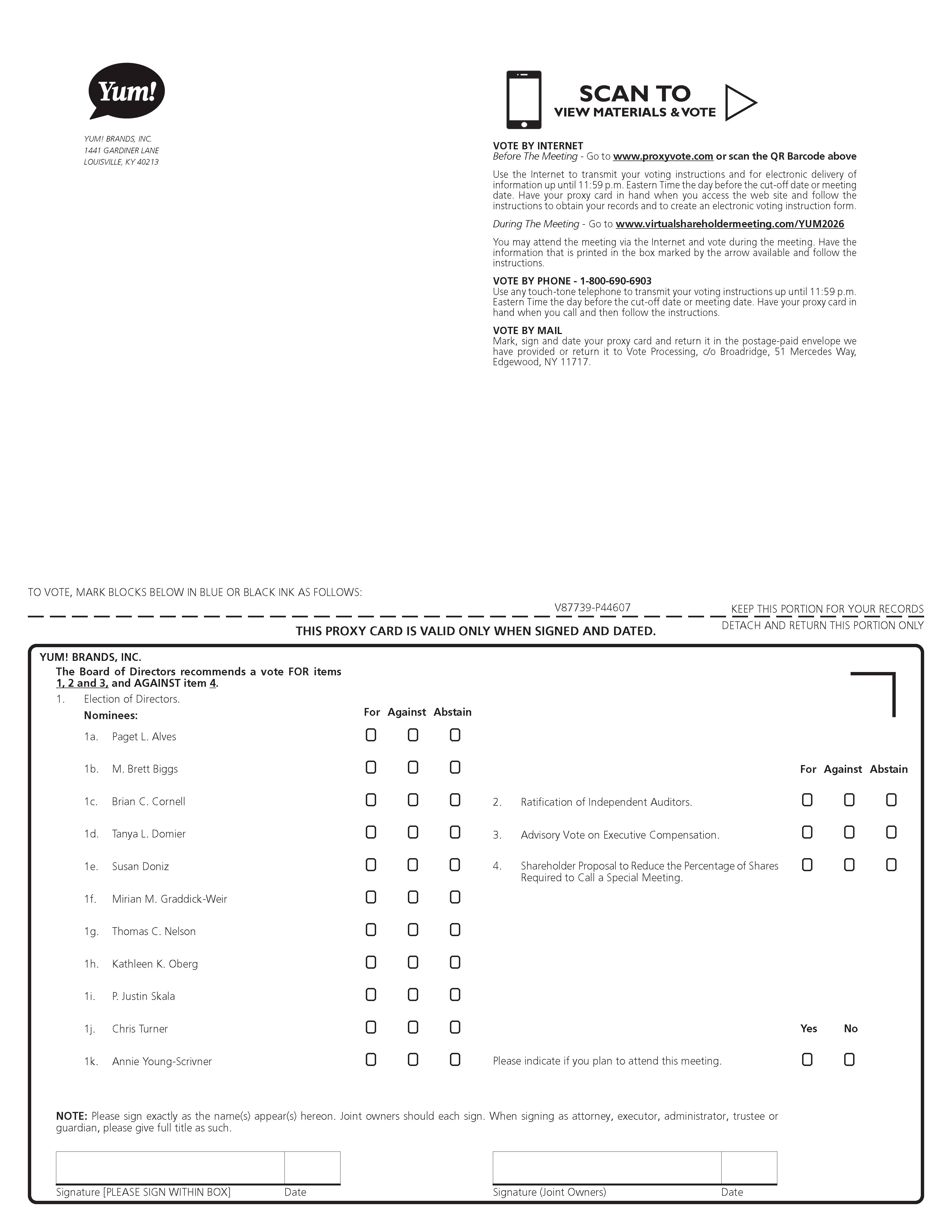
Your vote is important. We encourage you to vote promptly whether or not you plan to attend the meeting. You may vote your shares over the internet or via a toll-free telephone number. If you received a paper copy of the proxy card by mail, you may sign, date and mail the proxy card in the envelope provided. Instructions regarding the three methods of voting prior to the meeting are contained on the Notice of Internet Availability of Proxy Materials or proxy card.

Whether or not you plan to attend the meeting, we encourage you to consider the matters presented in the proxy statement and vote as soon as possible.

Sincerely,


img231203959_12.jpg

img231203959_13.jpg

Chris Turner

Chief Executive Officer


Important Notice Regarding the Availability of Proxy Materials for the Shareholders Meeting to Be Held on May 14, 2026—the proxy statement and the Annual Report on Form 10-K are available at https://investors.yum.com/financial-information/annual-reports/.


YUM! Brands, Inc.

1441 Gardiner Lane

Louisville, Kentucky 40213

Notice of Annual Meeting of Shareholders

Thursday, May 14, 2026 9:00 a.m. (CDT)

Virtual Meeting via live webcast at www.virtualshareholdermeeting.com/YUM2026

Items of Business:


1


2


3


4


5

To elect eleven (11) directors to serve until the 2027 Annual Meeting of Shareholders and until their respective successors are duly elected and qualified.


To ratify the selection of KPMG LLP as our independent auditors for the fiscal year ending December 31, 2026.


To consider and hold an advisory vote on executive compensation.


To consider and vote on one (1) shareholder proposal, if properly presented at the meeting.


To transact such other business as may properly come before the meeting.


Who Can Vote?:

You can vote if you were a shareholder of record as of the close of business on March 18, 2026.

Annual Report:

A copy of our 2025 Annual Report on Form 10-K is included with this proxy statement.

Website:

You may also read the Company’s Annual Report and proxy statement on our website at

https://investors.yum.com/financial-information/annual-reports/.

Date of Mailing:

The Notice of Internet Availability of Proxy Materials, the proxy statement and the form of proxy are first being mailed to shareholders on or about April 3, 2026.


By Order of the Board of Directors

img231203959_14.jpg

Erika Burkhardt

Chief Legal Officer & Corporate Secretary


Your Vote is Important

Under securities exchange rules, brokers cannot vote on your behalf for the election of directors or on executive compensation related matters without your instructions. Whether or not you plan to attend the Annual Meeting, please provide your proxy by following the instructions on your Notice or proxy card. On or about April 3, 2026, we mailed to our shareholders a Notice containing instructions on how to access the proxy statement and our Annual Report and vote online.

If you received a Notice by mail, you will not receive a printed copy of the proxy materials in the mail unless you request a copy. Instead, you should follow the instructions included in the Notice on how to access and review the proxy statement and Annual Report. The Notice also instructs you on how you may submit your vote by proxy over the internet.

If you received the proxy statement and Annual Report in the mail, please submit your proxy by marking, dating and signing the proxy card included and returning it promptly in the envelope enclosed. If you are able to attend the virtual Annual Meeting and wish to vote your shares personally, you may do so at any time before the proxy is exercised.


Table of Contents


Table of Contents


PROXY STATEMENT

1


QUESTIONS AND ANSWERS ABOUT THE MEETING AND VOTING

1


GOVERNANCE OF THE COMPANY

6


Director Biographies

10


Director Compensation

16


MATTERS REQUIRING SHAREHOLDER ACTION

26


ITEM 1

Election of Directors (Item 1 on the Proxy Card)

26


ITEM 2

Ratification of Independent Auditors (Item 2 on the Proxy Card)

27


ITEM 3

Advisory Vote on Executive Compensation (Item 3 on the Proxy Card)

29


ITEM 4

Shareholder Proposal Regarding Shareholder Special Meeting Threshold (Item 4 on the Proxy Card)

30


STOCK OWNERSHIP INFORMATION

33


DELINQUENT SECTION 16(a) REPORTS

35


EXECUTIVE COMPENSATION

36


Compensation Discussion and Analysis

36


Summary Compensation Table

59


All Other Compensation Table

60


Grants of Plan-Based Awards

61


Outstanding Equity Awards at Year-End

63


Option Exercises and Stock Vested

64


Pension Benefits

64


Nonqualified Deferred Compensation

67


Potential Payments Upon Termination or Change in Control

69


CEO Pay Ratio

72


PAY VERSUS PERFORMANCE DISCLOSURE

73


EQUITY COMPENSATION PLAN INFORMATION

77


AUDIT COMMITTEE REPORT

78


ADDITIONAL INFORMATION

80


i


PROXY STATEMENT


YUM! Brands, Inc.

1441 Gardiner Lane

Louisville, Kentucky 40213

PROXY STATEMENT

For Annual Meeting of Shareholders To Be Held On

May 14, 2026

The Board of Directors (the “Board of Directors” or the “Board”) of YUM! Brands, Inc., a North Carolina corporation (“YUM” or the “Company”), solicits the enclosed proxy for use at the Annual Meeting of Shareholders of the Company to be held at 9:00 a.m. (Central Time), on Thursday, May 14, 2026 via live webcast at www.virtualshareholdermeeting.com/YUM2026.

This proxy statement contains information about the matters to be voted on at the Annual Meeting and the voting process, as well as information about our directors and most highly paid executive officers.

QUESTIONS AND ANSWERS ABOUT THE MEETING AND

VOTING

What is the purpose of the Annual Meeting?

At our Annual Meeting, shareholders will vote on several important Company matters. In addition, our management will report on the Company’s performance over the last fiscal year and, following the meeting, respond to questions from shareholders.

Why am I receiving these materials?

The Board has made these materials available to you over the internet or has delivered printed versions of these materials to you by mail, in connection with the Board’s solicitation of proxies for use at the 2026 Annual Meeting of Shareholders (the “Annual Meeting”). The Annual Meeting is scheduled to be held virtually on Thursday, May 14, 2026 at 9:00 a.m. Central Time at the link set forth above. You will need the 16-digit control number provided on the Notice of Internet Availability of Proxy Materials, Voter Instruction Form or your proxy card (see below). This solicitation is for proxies for use at the Annual Meeting or at any reconvened meeting after an adjournment or postponement of the Annual Meeting.

Why did I receive a one-page Notice in the mail regarding internet availability of proxy materials this year instead of a full set of proxy materials?

As permitted by Securities and Exchange Commission (“SEC”) rules, we are making this proxy statement and our Annual Report available to our shareholders electronically via the internet. On or about April 3, 2026, we mailed to our shareholders a Notice containing instructions on how to access this proxy statement and our Annual Report and vote online. If you received a Notice by mail, you will not receive a printed copy of the proxy materials in the mail unless you request a copy. The Notice instructs you on how to access and review all of the important information contained in the proxy statement and Annual Report. The Notice also instructs you on how you may submit your proxy over the internet. If you received a Notice by mail and would like to receive a printed copy of our proxy materials, you should follow the instructions for requesting such materials contained in the Notice.

1


yum! brands, inc.

img231203959_15.jpg

2025 PROXY STATEMENT


We encourage you to take advantage of the internet availability of the proxy materials in order to help lower the costs of delivery and reduce the Company’s environmental impact.

Who may attend the Annual Meeting?

The Annual Meeting is open to all shareholders of record as of close of business on March 18, 2026, or their duly appointed proxies.

How do I attend the Virtual Annual Meeting?

You can attend the Annual Meeting, vote and submit a question during the Annual Meeting by visiting www.virtualshareholdermeeting.com/YUM2026 and using your 16-digit control number (included on your Notice of Internet Availability of Proxy Materials, proxy card or Voter Instruction Form) to enter the meeting. Online access will begin at 8:45 a.m. Central Time, and we encourage you to access the meeting prior to the start time. The meeting webcast will begin promptly at 9:00 a.m. Central Time on May 14, 2026.

May shareholders ask questions?

Yes. Representatives of the Company will answer questions of general interest submitted by shareholders following the Annual Meeting. In order to give a greater number of shareholders an opportunity to ask questions, individuals or groups will be allowed to ask only one question, and no repetitive or follow-up questions will be permitted. You may submit a question during the Annual Meeting by visiting www.virtualshareholdermeeting.com/YUM2026 and using your 16-digit control number to enter the meeting.

Questions will be answered as time allows.

Who may vote?

You may vote if you owned YUM common stock as of the close of business on the record date, March 18, 2026. Each share of YUM common stock is entitled to one vote. As of March 18, 2026, YUM had 276,173,275 million shares of common stock outstanding.

What am I voting on?

You will be voting on the following four (4) items of business at the Annual Meeting:

The election of eleven (11) directors to serve until the next Annual Meeting of Shareholders and until their respective successors are duly elected and qualified;
The ratification of the selection of KPMG LLP as our independent auditors for the fiscal year ending December 31, 2026;
An advisory vote on executive compensation; and
One (1) shareholder proposal.

We will also consider other business that properly comes before the meeting.

How does the Board of Directors recommend that I vote?

Our Board recommends that you vote your shares:

FOR each of the nominees named in this proxy statement for election to the Board;
FOR the ratification of the selection of KPMG LLP as our independent auditors;
FOR the proposal regarding an advisory vote on executive compensation; and
AGAINST the shareholder proposal.

2


QUESTIONS AND ANSWERS ABOUT THE MEETING AND VOTING


How do I vote before the Virtual Annual Meeting?

There are three ways to vote before the meeting:

By internet — we encourage you to vote on www.proxyvote.com by following instructions on the Notice or proxy card;
By telephone — by making a toll-free telephone call from the U.S. or Canada to 1(800) 690-6903 (if you have any questions about how to vote over the phone, call 1(888) 298-6986); or
By mail — If you received your proxy materials by mail, you can vote by completing, signing and returning the enclosed proxy card in the postage-paid envelope provided.

If you are a participant in the direct stock purchase and dividend reinvestment plan (ComputerShare CIP), as a registered shareholder, you will receive all proxy materials and may vote your shares according to the procedures outlined herein.

If you are a participant in the YUM! Brands 401(k) Plan (“401(k) Plan”), the trustee of the 401(k) Plan will only vote the shares for which it has received directions to vote from you.

Proxies submitted through the internet or by telephone as described above must be received by 11:59 p.m., Eastern Time, on May 13, 2026. Proxies submitted by mail must be received prior to the meeting. Directions submitted by 401(k) Plan participants must be received by 12:00 p.m., Eastern Time, on May 12, 2026.

Also, if you hold your shares in the name of a bank or broker, your ability to vote by the internet or telephone depends on their voting processes. Please follow the directions on your Notice carefully. A number of brokerage firms and banks participate in a program provided through Broadridge Financial Solutions, Inc. (“Broadridge”) that offers internet and telephone voting options. If your shares are held in an account with a brokerage firm or bank participating in the Broadridge program, you may vote those shares at Broadridge’s voting website (www.proxyvote.com) or telephonically by calling the telephone number shown on the voting instruction form received from your brokerage firm or bank. Votes submitted online or by telephone through the Broadridge program must be received by 11:59 p.m., Eastern Time, on May 13, 2026.

Can I vote at the Virtual Annual Meeting?

Shares registered directly in your name as the shareholder of record may be voted at the Annual Meeting. Shares held through a broker or nominee may be voted only if you obtain a legal proxy from the broker or nominee that holds your shares giving you the right to vote the shares.

Even if you plan to attend the virtual Annual Meeting, we encourage you to vote your shares by proxy. You may still vote your shares at the meeting even if you have previously voted by proxy.

Can I change my mind after I vote?

You may change your vote at any time before the polls close at the Annual Meeting. You may do this by:

Signing another proxy card with a later date and returning it to us prior to the Annual Meeting;
Voting again online or by telephone prior to 11:59 p.m., Eastern Time, on May 13, 2026;
Giving written notice to the Corporate Secretary of the Company prior to the Annual Meeting; or
Voting again at the Annual Meeting.

Your virtual attendance at the Annual Meeting will not have the effect of revoking a proxy unless you notify our Corporate Secretary in writing before the polls close that you wish to revoke a previous proxy.

Who will count the votes?

Representatives of Computershare, Inc. will count the votes and will serve as the independent inspector of election.

3


yum! brands, inc.

img231203959_15.jpg

2025 PROXY STATEMENT


What if I return my proxy card but do not provide voting instructions?

If you vote by proxy card, your shares will be voted as you instruct by the individuals named on the proxy card. If you sign and return a proxy card but do not specify how your shares are to be voted, the persons named as proxies on the proxy card will vote your shares in accordance with the recommendations of the Board. These recommendations are:

FOR the election of the eleven (11) nominees for director named in this proxy statement (Item 1);
FOR the ratification of the selection of KPMG LLP as our independent auditors for the fiscal year 2026 (Item 2);
FOR the proposal regarding an advisory vote on executive compensation (Item 3); and
AGAINST the shareholder proposal (Item 4).

What does it mean if I receive more than one proxy card?

It means that you have multiple accounts with brokers and/or our transfer agent. Please vote all of these shares. We recommend that you contact your broker and/or our transfer agent to consolidate as many accounts as possible under the same name and address. Our transfer agent is Computershare, Inc., which may be reached at 1 (888) 439-4986 and internationally at 1 (781) 575-2879.

Will my shares be voted if I do not provide my proxy?

Your shares may be voted if they are held in the name of a brokerage firm, even if you do not provide the brokerage firm with voting instructions. Brokerage firms have the authority under the New York Stock Exchange rules to vote shares for which their customers do not provide voting instructions on certain “routine” matters.

The proposal to ratify the selection of KPMG LLP as our independent auditors for fiscal year 2026 is considered a routine matter for which brokerage firms may vote shares for which they have not received voting instructions. The other proposals to be voted on at our Annual Meeting are not considered “routine” under applicable rules. When a proposal is not a routine matter, and the brokerage firm has not received voting instructions from the beneficial owner of the shares with respect to that proposal, the brokerage firm cannot vote the shares on that proposal. This is called a “broker non-vote.”

How many votes must be present to hold the Virtual Annual Meeting?

Your shares are counted as present at the Annual Meeting if you attend the Annual Meeting or if you properly return a proxy by internet, telephone or mail. In order for us to conduct our Annual Meeting, a majority of the outstanding shares of YUM common stock, as of March 18, 2026, must be present or represented by proxy at the Annual Meeting. This is referred to as a quorum. Abstentions and broker non-votes will be counted for purposes of establishing a quorum at the Annual Meeting.

How many votes are needed to elect directors?

You may vote “FOR” each nominee or “AGAINST” each nominee, or “ABSTAIN” from voting on one or more nominees. Unless you mark “AGAINST” or “ABSTAIN” with respect to a particular nominee or nominees, your proxy will be voted “FOR” each of the director nominees named in this proxy statement. In an uncontested election, a nominee will be elected as a director if the number of “FOR” votes exceeds the number of “AGAINST” votes. Abstentions will be counted as present but not voted. Abstentions and broker non-votes will not affect the outcome of the vote on directors. Full details of the Company’s majority voting policy are set out in our Corporate Governance Principles at https://investors.yum.com/governance/governance-documents/ and under “What other significant Board practices does the Company have? — Majority Voting Policy” beginning at page 19 of this proxy statement.

How many votes are needed to approve the other proposals?

The other proposals must receive the “FOR” vote of a majority of the shares, present in person or represented by proxy, and entitled to vote at the Annual Meeting. For each of these items, you may vote “FOR”, “AGAINST” or “ABSTAIN.” Abstentions will be counted as shares present and entitled to vote at the Annual Meeting. Accordingly, abstentions will have the same effect as a vote “AGAINST” the proposals. Broker non-votes will not be counted as shares present and entitled to vote with respect to the particular matter on which the broker has not voted. Thus, broker non-votes will not affect the outcome of any of these proposals.

4


QUESTIONS AND ANSWERS ABOUT THE MEETING AND VOTING


When will the Company announce the voting results?

The Company will announce the voting results of the Annual Meeting on a Current Report on Form 8-K filed within four business days of the Annual Meeting.

What if other matters are presented for consideration at the Annual Meeting?

The Company knows of no other matters to be submitted to the shareholders at the Annual Meeting, other than the proposals referred to in this proxy statement. If any other matters properly come before the shareholders at the Annual Meeting, it is the intention of the persons named on the proxy to vote the shares represented thereby on such matters in accordance with their best judgment.

5


yum! brands, inc.

img231203959_16.jpg

2026 PROXY STATEMENT


GOVERNANCE OF THE COMPANY

The business and affairs of YUM are managed under the direction of the Board of Directors (the "Board"). The Board believes that good corporate governance is essential in achieving long-term business success and in fulfilling the Board’s duties to shareholders. The Board believes that its governance practices are strategically aligned with management objectives and the interests of shareholders.

The corporate governance section of the Company's website makes available the Company’s corporate governance materials, including the Corporate Governance Principles (the “Governance Principles”), the Company’s Articles of Incorporation and Bylaws, the charters for each Board committee, the Company’s Global Code of Conduct, the Company’s Political Contributions and U.S. Government Advocacy Policy, and information about how to report concerns about the Company. To access these documents on the Company’s website, please visit, https://investors.yum.com/governance/governance-documents/.


GOVERNANCE HIGHLIGHTS

Corporate Governance

Shareholder Rights

Compensation

11 Director nominees
10 Independent nominees
Directors with experience, qualification and skills across a wide range of public and private sector companies
Board access to senior management and independent advisors
Independent non-executive chair
Independent board committees
Executive sessions of independent directors at every regular board and committee meeting
Comprehensive risk oversight by board and its committees
Annual board and committee self-evaluations
All directors attended at least 75% of meetings held
YUM’s Global Code of Conduct
Political Contributions and U.S. Government Advocacy Policy
Audit committee complaint procedures policy regarding accounting matters
No hedging or pledging of company stock
Annual election of Directors
Majority voting for Directors
Proxy access
Structured process for shareholder communication with the Board
Active shareholder engagement program
Right to call a special meeting of shareholders
Independent Management Planning and Development Committee
Independent compensation consultant
Executive compensation is highly performance-based to align with shareholder interests and promote company business strategy
At-risk pay tied to performance
Strong stock ownership guidelines
No employment agreements for executive officers or guaranteed bonuses
Compensation Recovery Policy (Clawback) applies to equity and bonus awards
Double trigger vesting upon change in control
No excise tax gross up


6


GOVERNANCE OF THE COMPANY


What is the composition of the Board of Directors and how often are members elected?

Our Board presently consists of 12 directors whose terms expire at this Annual Meeting, including Ms. Oberg who was newly appointed in April 2026 and will be standing for election to the Board for the first time. Mr. Keith Barr served as a director until his resignation from the Board on February 10, 2026. Mr. Christopher Connor is retiring and will not be standing for re-election at the Annual Meeting.

The average director tenure is 8 years, with our longest- and shortest-tenured directors having served for 19 years (Mr. Thomas Nelson) and for 1 month (Ms. Kathleen Oberg), respectively.

As discussed in more detail later in this section, the Board has determined that 10 of the 11 individuals standing for election are independent under the rules of the New York Stock Exchange (“NYSE”). The director tenure of the 11 individuals standing for election is reflected in the following chart:


DIRECTOR TENURE


img231203959_17.jpg img231203959_18.jpg img231203959_19.jpg img231203959_20.jpg

img231203959_21.jpg img231203959_22.jpg img231203959_23.jpg img231203959_24.jpg img231203959_24.jpg

img231203959_25.jpg img231203959_26.jpg

0-5 Years

6-12 Years

12+ Years


How often did the Board meet in 2025?

The Board of Directors met 8 times during 2025. Each of the directors who served in 2025 attended at least 75% of the meetings of the Board and the committees of which he or she was a member and that were held during the period he or she served as a director.

What is the Board’s policy regarding director attendance at the Annual Meeting of Shareholders?

The Board’s policy is that all directors should attend the Annual Meeting, and all persons then serving as directors attended the 2025 Annual Meeting.

How does the Board select nominees for the Board?

The Nominating and Governance Committee considers candidates for Board membership suggested by its members and other Board members, as well as management and shareholders. The Committee’s charter provides that it may retain a third-party executive search firm to identify candidates from time to time.

In accordance with the Governance Principles, our Board seeks members from a wide range of professional backgrounds who combine a broad spectrum of experience and expertise with a reputation for integrity. Directors should have experience in positions with a high degree of responsibility, be leaders in the companies or institutions with which they are affiliated and are selected based upon contributions they can make to the Board and management. The Committee’s assessment of a proposed candidate will include a review of the person’s judgment, experience, independence, understanding of the Company’s business or other related industries and such other factors as the Nominating and Governance Committee determines are relevant in light of the needs of the Board of Directors. The Committee believes that its nominees should reflect a diversity of experience, gender, race, ethnicity and age. The Committee also considers such other relevant factors as it deems appropriate, including the current composition of the Board, the balance of management and independent directors, the need for Audit Committee expertise and the evaluations of other prospective nominees, if any.

In connection with this evaluation, it is expected that each member of the Nominating and Governance Committee will interview the prospective nominee before the prospective nominee is presented to the full Board for consideration. After completing this evaluation and interview process, the Committee will make a recommendation to the full Board as to the person(s) who should be nominated by the Board, and the Board determines the nominee(s) after considering the recommendation and report of the Committee.

7


yum! brands, inc.

img231203959_16.jpg

2026 PROXY STATEMENT


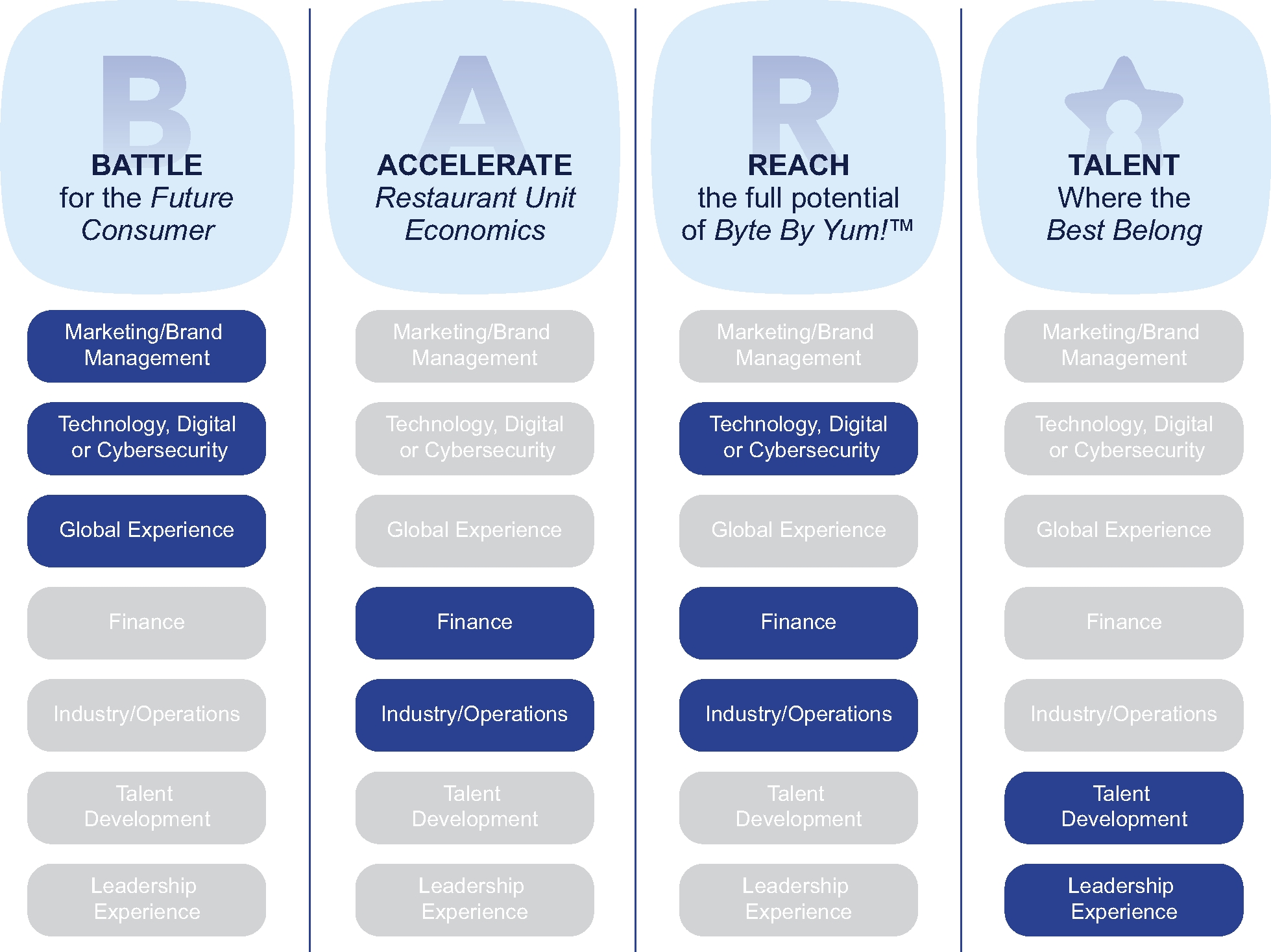
The skills that our directors possess are thoroughly considered to ensure that they align with the Company’s goals and priorities. To best serve YUM and its stakeholders, the Company leverages its Recipe for Good Growth to grow iconic restaurant brands globally. As we work to make the Company's brands the most loved, trusted and connected, we focus on three priorities to Raise the B.A.R.

Battle for the Future Consumer by staying relentlessly focused on their needs and wants.
Accelerate Restaurant Unit Economics by creating value for our franchisees and maximizing the performance of every restaurant, serving as an ongoing catalyst for new unit development and keeping our franchise system healthy.
Reach the full potential of Byte by Yum! by expanding our connected platform built by restaurant operators for restaurant operators to unlock its full potential for our franchise partners and our business.

Raising the B.A.R. is both our rallying cry and our roadmap for driving sustainable growth. It reflects the Company's confidence in the foundation we have built and our ambition to reach higher. Importantly, it is powered by YUM's greatest differentiator: our Unrivaled Culture and Talent, as YUM is where the best belong.

The following table indicates how the skills our Board collectively possesses positively impact the Raising the B.A.R. priorities:

img231203959_27.jpg

8


GOVERNANCE OF THE COMPANY


We believe that each of our directors has met the guidelines set forth in the Governance Principles. As noted in the director biographies that follow in this section, our directors have experience, qualifications and skills across a wide range of public and private companies, possessing a broad spectrum of experience both individually and collectively. In addition to the information provided in the director biographies, our director nominees’ qualifications, experiences and skills are summarized in the following matrix. This matrix is intended to provide a summary of our directors’ qualifications and should not be considered to be a complete list of each nominee’s strengths and contributions to the Board.


Experience/Background

img231203959_28.jpg

img231203959_29.jpg

img231203959_30.jpg

img231203959_31.jpg

img231203959_32.jpg

img231203959_33.jpg

img231203959_34.jpg

img231203959_35.jpg

img231203959_36.jpg

img231203959_37.jpg

img231203959_38.jpg

img231203959_39.jpg

Leadership Experience

img231203959_40.jpg

Global Experience

img231203959_41.jpg

Finance


img231203959_42.jpg

Industry/Operations


img231203959_43.jpg

Marketing/Brand Management


img231203959_44.jpg

Talent Development

img231203959_45.jpg

Technology, Digital or Cybersecurity


For a shareholder to submit a candidate for consideration by the Nominating and Governance Committee, a shareholder must notify YUM’s Corporate Secretary, at YUM! Brands, Inc., 1441 Gardiner Lane, Louisville, Kentucky 40213. The recommendation must contain the information described on page 81.


9


yum! brands, inc.

img231203959_16.jpg

2026 PROXY STATEMENT


Director Biographies


img231203959_46.jpg

Paget L. Alves | Director Since 2016


Background

Paget L. Alves is the current Chairman and Chief Executive Officer of Sorenson Communications, LLC, a global language services provider and a leader in communication solutions for Deaf and hard-of-hearing communities. Previously he served as Chief Sales Officer of Sprint Corporation, a wireless and wireline communications services provider, from January 2012 to September 2013 after serving as President of that company’s Business Markets Group beginning in 2009. Mr. Alves also currently serves on the Board of Synchrony Financial. He previously served as a Director of Assurant, Inc. and International Game Technology PLC.

Specific Qualifications, Experience, Skills and Expertise:

Operating, finance and management experience, including as Chief Sales Officer of a wireless and wireline communications company
Global sales experience
Public company directorship and committee experience

Other Public Companies

Synchrony Financial

Committees

Audit, Chair


img231203959_47.jpg

M. Brett Biggs | Director Since 2023


Background

M. Brett Biggs is the former Executive Vice President and Chief Financial Officer for Walmart having served in that position from 2016 to 2022. Prior to that, Mr. Biggs served as Chief Financial Officer for Walmart International, Walmart U.S. and Sam’s Club. He was also previously the Senior Vice President of International Strategy, Mergers and Acquisitions; Senior Vice President of Corporate Finance and Senior Vice President of Operations for Sam’s Club. Before joining Walmart in 2000, Mr. Biggs held various mergers and acquisitions and corporate finance positions with Leggett & Platt, Phillips Petroleum Co. and Price Waterhouse. Mr. Biggs currently serves on the Board of Directors of The Procter & Gamble Company and J.B. Hunt Transport Services, Inc.

Specific Qualifications, Experience, Skills and Expertise:

Operational and global management experience, including as Chief Financial Officer
Expertise in finance, strategic planning, global branding, franchising and corporate leadership
Public company directorship and committee experience


Other Public Companies

The Procter & Gamble Company
J.B. Hunt Transport Services, Inc.

Committees

Audit
Nominating and Governance


10


GOVERNANCE OF THE COMPANY


img231203959_48.jpg

Brian C. Cornell | Director Since 2015


Background

Brian C. Cornell joined the YUM Board in 2015 and has served as Non-Executive Chair since November 2018. Mr. Cornell previously served as Chief Executive Officer of Target Corporation, a general merchandise retailer, until February 1, 2026, a position he held since August 2014. Mr. Cornell also previously served as the Chief Executive Officer of PepsiCo Americas Foods, a division of PepsiCo, Inc. from March 2012 to July 2014. From April 2009 to January 2012, Mr. Cornell served as the Chief Executive Officer and President of Sam’s Club, a division of Wal-Mart Stores, Inc. and as an Executive Vice President of Wal-Mart Stores, Inc. He has been a Director of Target Corporation since 2014. He has previously served as a Director of Home Depot, OfficeMax, Polaris Industries Inc., Centerplate, Inc. and Kirin-Tropicana, Inc.

Specific Qualifications, Experience, Skills and Expertise:

Operating and management experience, including as Chair and Chief Executive Officer of a merchandise retailer
Expertise in strategic planning, retail business, branding and corporate leadership
Public company directorship experience and committee experience


Other Public Companies

Target Corporation

Committees

Management Planning and Development
Nominating and Governance


img231203959_49.jpg

Tanya L. Domier | Director Since 2018


Background

Tanya L. Domier retired as Chief Executive Officer and Chairperson of Advantage Solutions, Inc., a North American provider of outsourced sales, marketing and business solutions in April 2022. In April 2023 she founded an advisory services company focused on private equity portfolio companies. Prior to serving as Advantage Solutions’ CEO, Ms. Domier served as its President and Chief Operating Officer from 2010 to 2013. Ms. Domier joined Advantage Solutions in 1990 from the J.M. Smucker Company and held a number of executive level roles in sales, marketing and promotions. Ms. Domier currently serves on the board of Little Leaf Farms and is a member of the compensation committee. Ms. Domier also previously served as a Director of Nordstrom, Inc.

Specific Qualifications, Experience, Skills and Expertise:

Operating and management experience as Chief Executive Officer
Expertise in strategic planning, finance, global commerce and corporate  leadership
Public company directorship and committee experience


Other Public Companies

None

Committees

Management Planning and Development


11


yum! brands, inc.

img231203959_16.jpg

2026 PROXY STATEMENT


img231203959_50.jpg

Susan Doniz | Director Since 2023


Background

Susan Doniz is the current Chief Information and Data Officer of The Walt Disney Company, a position she has held since February 2025. Previously, she served as Chief Information Officer and Senior Vice President of Information Technology & Data Analytics of The Boeing Company, a leading global aerospace company. Before joining Boeing in 2020, Ms. Doniz was the Group CIO of Qantas Airways and, prior to that, she served in digital transformation and IT leadership roles at SAP SE and Aimia, Inc. She also spent 17 years at The Procter & Gamble Company leading IT and analytics programs in support of sales, research and development and the supply chain. Ms. Doniz is an adviser to the Center of Digital Transformation at the University of California, Irvine, Paul Merage School of Business. She was also Vice Chair of the Digital Transformation Advisory Council of the International Air Transport Association, and served on the board of IGM Financial. She is also a board member of multiple nonprofit organizations.

Specific Qualifications, Experience, Skills and Expertise:

Technology and cybersecurity experience
Operating and management experience


Other Public Companies

None

Committees

Audit


img231203959_51.jpg

Mirian M. Graddick-Weir | Director Since 2012


Background

Mirian M. Graddick-Weir retired as Executive Vice President of Human Resources for Merck & Co., Inc., a pharmaceutical company, in November 2018. She had held that position since 2008. From 2006 until 2008, she was Senior Vice President of Human Resources of Merck & Co., Inc. Prior to this position, she served as Executive Vice President of Human Resources of AT&T Corp. from 2001 to 2006. Ms. Graddick-Weir has served as a director of Booking Holdings, Inc. since June 2018.

Specific Qualifications, Experience, Skills and Expertise:

Management experience, including as Executive Vice President of human resources for a pharmaceutical company
Expertise in global human resources, corporate governance and public company compensation
Public company directorship and committee experience


Other Public Companies

Booking Holdings, Inc.

Committees

Management Planning and Development
Nominating and Governance, Chair


12


GOVERNANCE OF THE COMPANY


img231203959_52.jpg

Thomas C. Nelson | Director Since 2006


Background

Thomas C. Nelson is President and Chief Executive Officer of National Gypsum Company, a building products manufacturer. He has held this position since 1999 and was elected Chairman of the Board in January 2005. From 1995 to 1999, Mr. Nelson served as the Vice Chairman and Chief Financial Officer of National Gypsum. Mr. Nelson previously worked for Morgan Stanley & Co. and in the United States Defense Department as Assistant to the Secretary and was a White House Fellow. Mr. Nelson previously served as a director of Atrium Health and the Federal Reserve Bank of Richmond.

Specific Qualifications, Experience, Skills and Expertise:

Operational and management experience, including as President and Chief Executive Officer of a building products manufacturer
Senior government experience as Assistant to the Secretary of the United States Defense Department and as a White House Fellow
Expertise in finance, strategic planning, business development and retail business
Public company directorship and committee experience


Other Public Companies

None

Committees

Management Planning and Development
Nominating and Governance


img231203959_53.jpg

Kathleen K. Oberg | Director Since 2026


Background

Kathleen K. Oberg is the former Chief Financial Officer and Executive Vice President, Development of Marriott International, Inc., serving in those roles until March 2026. She served as Chief Financial Officer for Marriott beginning in January 2016 and as Executive Vice President, Development beginning in February 2023. Prior to those roles, Ms. Oberg served in a range of financial leadership positions with Marriott, including Chief Financial Officer for The Ritz-Carlton Hotel Company, Senior Vice President, Corporate and Development Finance and Senior Vice President, International Project Finance and Asset Management for Europe, the Middle East and Africa. Prior to joining Marriott, she held a variety of financial positions at Sodexo (previously Sodexo Marriott Services), Sallie Mae, Goldman Sachs, and Chase Manhattan Bank. She was previously a member of the American Hotel and Lodging Association's IREFAC Council, and she currently serves on the Board of Directors of Adobe, Inc.


Specific Qualifications, Experience, Skills and Expertise:

Operational and global management experience, including as Chief Financial Officer and Executive Vice President, Development
Expertise in finance, strategic planning, global branding, franchising and corporate leadership
Public company directorship and committee experience

Other Public Companies

Adobe, Inc.


Committees

None


13


yum! brands, inc.

img231203959_16.jpg

2026 PROXY STATEMENT


img231203959_54.jpg

P. Justin Skala | Director Since 2016


Background

P. Justin Skala is the current Chief Executive Officer of ZO Skin Health and was appointed to that role in March 2024. Previously he was the Executive Chairman of Standard Building Solutions from March 2023 to September 2023 and served as the CEO of the BMI Group beginning in September 2019. Prior to those roles, Mr. Skala spent 37 years with the Colgate-Palmolive Company, serving as Executive Vice-President, Chief Growth and Strategy Officer and Chief Operating Officer from 2016 to 2019. He was responsible for the company’s Global Sustainability program from 2013 to 2019 in addition to his day to day operating roles. From 2013 to 2016, Mr. Skala was President of Colgate North America, and from 2010 to 2013, he served as President of Colgate Latin America. From 2007 to 2010, Mr. Skala was President of Colgate – Asia.

Specific Qualifications, Experience, Skills and Expertise:

Global operating and management experience, including as Chief Executive Officer at a large international manufacturer and as President of major divisions of a consumer products company
Expertise in branding, marketing, finance, sales, strategic planning and international business development


Other Public Companies

None

Committees

Nominating and Governance


img231203959_55.jpg

Chris Turner | Director Since 2025


Background

Chris Turner is the current Chief Executive Officer of YUM. He has served in that position since October 2025. Prior to that, he served as Chief Financial Officer beginning in August 2019 and Chief Franchise Officer beginning in November 2024. Before joining YUM, Mr. Turner held senior leadership roles at PepsiCo and Frito-Lay North America. Mr. Turner was also previously a partner at McKinsey & Company. Mr. Turner previously served as a director of Academy Sports and Outdoors, Inc.

Specific Qualifications, Experience, Skills and Expertise:

Operational and global management experience, including as Chief Financial Officer of the Company
Expertise in finance, strategic planning, global branding, franchising and corporate leadership
Public company directorship and committee experience


Other Public Companies

None

Committees

None


14


GOVERNANCE OF THE COMPANY


img231203959_56.jpg

Annie Young-Scrivner | Director Since 2020


Background

Annie Young-Scrivner is the co-founder of TwinPoint Collective, a global advisory firm that helps CEOs, boards, and leadership teams translate strategy into measurable results. She previously served as the Chief Executive Officer of Wella Company, the parent of beauty brands, including Clairol and OPI, from December 2020 until January 2025. Ms. Young-Scrivner was also previously the Chief Executive Officer of Godiva Chocolatier, Inc., a manufacturer of Belgian chocolates. Prior to joining Godiva in August 2017, Ms. Young-Scrivner was Executive Vice President, Global Digital & Loyalty Development with Starbucks Corporation from 2015 until her departure in April 2017. At Starbucks, Ms. Young-Scrivner also served as President, Teavana & Executive Vice President of Global Tea from 2014 to 2015, Global Chief Marketing Officer & President of Tazo Tea from 2009 to 2012, and President of Starbucks Canada from 2012 to 2014. Prior to joining Starbucks, Ms. Young-Scrivner held senior leadership positions at PepsiCo, Inc. in sales, marketing and general management, including her role as Region President of PepsiCo Foods Greater China from 2006 to 2008. She has previously served as a director of Tiffany & Co. and Macy’s, Inc.

Specific Qualifications, Experience, Skills and Expertise:

Operating and management experience, including as Chief Executive Officer of consumer goods company
Public company directorship and committee experience


Other Public Companies

None

Committees

Audit


If elected, we expect that all of the aforementioned nominees will serve as directors and hold office until the 2027 Annual Meeting of Shareholders and until their respective successors have been elected and qualified.

15


yum! brands, inc.

img231203959_16.jpg

2026 PROXY STATEMENT


Director Compensation

How are directors compensated?


Employee
Directors

Employee directors do not receive additional compensation for serving on the Board of Directors.

Non-Employee
Directors Annual
Compensation

The annual compensation for each non-employee Director is summarized in the table below. For 2025, each non-employee Director received an annual stock grant retainer with a fair market value of $280,000. Directors may request to receive up to one-half of their stock retainer in cash. The request must be submitted to the Chair of the Management Planning and Development Committee. Directors may also defer payment of their retainers pursuant to the Directors Deferred Compensation Plan. Deferrals are invested in phantom Company stock and paid out in shares of Company stock. Deferrals may not be made for less than two years.

Chair
of the Board
and Committee
Chair
Retainers

In recognition of their added duties, the Chair of the Board (Mr. Cornell in 2025) receives an additional $170,000 stock retainer annually, and the Chairs of the Audit Committee (Mr. Alves in 2025), Management Planning and Development Committee (Mr. Connor in 2025) and the Nominating and Governance Committee (Ms. Graddick-Weir in 2025) receive an additional $30,000, $20,000 and $20,000 annual stock retainer, respectively. These committee chair retainers were paid in February of 2025.

Initial Stock Grant
upon Joining
Board

Non-employee directors also receive a one-time stock grant with a fair market value of $25,000 on the date of grant upon joining the Board, distribution of which is deferred until termination from the Board.

Matching Gifts

To further YUM’s support for charities, non-employee directors are able to participate in the YUM! Brands, Inc. Matching Gifts Program on the same terms as members of YUM’s executive team. Under this program, the YUM! Brands Foundation will match up to $10,000 a year in contributions by the director to a charitable institution approved by the YUM! Brands Foundation. At its discretion, the Foundation may match director contributions exceeding $10,000.

Insurance

We also pay the premiums on directors’ and officers’ liability and business travel accident insurance policies. The annual cost of this coverage was approximately $2 million. This is not included in the tables below as it is not considered compensation to the directors.


In setting director compensation, the Company considers the significant amount of time that directors expend in fulfilling their duties to the Company as well as the skill level required by the Company of members of the Board. The Board reviews each element of director compensation at least every two years.

16


GOVERNANCE OF THE COMPANY


In November 2025, the Management Planning and Development Committee of the Board (“Committee”) benchmarked the Company’s director compensation against director compensation paid by companies comprising the Company’s Executive Peer Group discussed at page 54. Data for this review was prepared for the Committee by its independent consultant, Meridian Compensation Partners LLC. This data revealed that the retainers paid to the Chairs of the Audit and Nominating and Governance Committee were generally consistent with market practice, while the Company’s total director compensation was $10,000 below market median and the Management Planning and Development Committee Chair retainer was $5,000 below market median. Based on the modest differences between the Company’s retainer amounts compared to market practice and the narrowness of the overall market range, the Committee determined that no changes to director and committee chair retainers were necessary at this time.


Name


Fees Earned or
Paid in Cash
($)


Stock
Awards
($)
(1)


All Other
Compensation
($)
(2)


Total
($)


(a)


(b)


(c)


(e)


(f)


Alves, Paget


310,000


310,000


Barr, Keith


280,000


10,000


290,000


Biggs, M. Brett


280,000


3,268


283,268


Connor, Christopher


300,000


300,000


Cornell, Brian


450,000


450,000


Domier, Tanya


280,000


280,000


Doniz, Susan


280,000


280,000


Graddick-Weir, Mirian


300,000


300,000


Nelson, Thomas


280,000


280,000


Skala, Justin


280,000


10,000


290,000


Young-Scrivner, Annie


280,000


280,000


(1) Amounts in column (c) represent the grant date fair value for annual stock retainer awards, Committee Chair retainer awards, and Non-Executive Chair awards granted to directors in 2025. Where applicable, retainer awards for new directors are pro-rated for partial years of service.

(2) Amounts in this column represent charitable matching gifts except with respect to Mr. Biggs, for whom these amounts represent personal use of corporate aircraft.

What are the Company’s policies and procedures with respect to related person transactions?

Under the Company’s policies and procedures for the review of related person transactions, the Nominating and Governance Committee reviews related person transactions in which we are or will be a participant to determine if they are in the best interests of our shareholders and the Company. Transactions, arrangements, or relationships or any series of similar transactions, arrangements or relationships in which a related person had or will have a material interest and that exceed $100,000 are subject to the Nominating and Governance Committee’s review. Any member of the Nominating and Governance Committee who is a related person with respect to a transaction under review may not participate in the deliberation or vote respecting approval or ratification of the transaction.

Related persons are directors, director nominees, executive officers, holders of 5% or more of our voting stock and their immediate family members. Immediate family members are spouses, parents, stepparents, children, stepchildren, siblings, daughters-in-law, sons-in-law and any person, other than a tenant or domestic employee, who resides in the household of a director, director nominee, executive officer or holder of 5% or more of our voting stock.

After its review, the Nominating and Governance Committee may approve the transaction. The related person transaction policies and procedures provide that certain transactions are deemed to be pre-approved, even though they exceed $100,000. Pre-approved transactions include employment of executive officers, director compensation, and transactions with other companies if the aggregate amount of the transaction does not exceed the greater of $1 million or 2% of that other company’s total revenues and the related person is not an executive officer of that other company.

17


yum! brands, inc.

img231203959_16.jpg

2026 PROXY STATEMENT


Does the Company require stock ownership by directors?

The Board believes that the number of shares of the Company’s common stock owned by each non-management director is a personal decision; however, the Board strongly supports the position that non-management directors should own a meaningful number of shares in the Company and expects that each non-management director will (i) own Company common shares with a value of at least five times the annual Board retainer; (ii) accumulate those shares during the first five years of the director’s service on the Board; and (iii) hold these shares at least until the director departs the Board. Each director may sell enough shares to pay taxes in connection with the receipt of his or her retainer or the exercise of stock appreciation rights, and the ownership guideline will be adjusted to reflect the sale to pay taxes.

How much YUM stock do the directors own?

Stock ownership information for each director is shown in the table on page 34.

Does the Company have stock ownership guidelines for executives and senior management?

The Committee has adopted formal stock ownership guidelines that set minimum expectations for executive and senior management ownership. These guidelines are discussed on page 56.

The Company has maintained an ownership culture among its executive and senior managers since its formation. Substantially all executive officers and members of senior management hold stock well in excess of the guidelines.

Has the Company adopted policies and procedures designed to promote compliance with insider trading laws?

The Company's insider trading policies (“Insider Trading Policies”) govern the purchase, sale, and/or other dispositions of the Company's securities by directors and employees (including executive officers). These policies are designed to promote compliance with insider trading laws, rules and regulations, and NYSE listing standards. Although we do not have a formal insider trading policy applicable to the Company, we have established procedures intended to ensure that we do not repurchase shares of our common stock while the Company is in possession of material nonpublic information, except for repurchases conducted in compliance with Rule 10b5-1. The full text of our Insider Trading Policies were filed as Exhibits 19.1 - 19.4 to the Company’s Annual Report on Form 10-K for the year ended December 31, 2025.

How Can Shareholders Nominate for the Board?

Director nominations for inclusion in YUM’s proxy materials (Proxy Access). Our bylaws permit a shareholder, or group of up to 20 shareholders, owning continuously for at least three years shares of YUM stock representing an aggregate of at least 3% of our outstanding shares, to nominate and include in YUM’s proxy materials director nominees constituting up to 20% of YUM’s Board, provided that the shareholder(s) and nominee(s) satisfy the requirements in YUM’s bylaws. Notice of proxy access director nominees for the 2027 Annual Meeting of Shareholders must be received by us no earlier than November 4, 2026, and no later than December 4, 2026.

Director nominations to be brought before the 2027 Annual Meeting of Shareholders. Director nominations that a shareholder intends to present at the 2027 Annual Meeting of Shareholders, other than through the proxy access procedures described above, must be received no later than February 13, 2027. These nominations must be submitted by a shareholder in accordance with the requirements specified in YUM’s bylaws.

Where to send director nominations for the 2027 Annual Meeting of Shareholders. Director nominations brought by shareholders must be delivered to YUM’s Corporate Secretary by mail at YUM! Brands, Inc., 1441 Gardiner Lane, Louisville, Kentucky 40213 and received by YUM’s Corporate Secretary by the dates set forth above.

18


GOVERNANCE OF THE COMPANY


What is the Board’s leadership structure?

In November 2018, Brian C. Cornell assumed the position of Non-Executive Chair of the Board. Applying our Corporate Governance Principles, the Board determined that based on Mr. Cornell's independence, it would not appoint a Lead Director when Mr. Cornell became Non-Executive Chair.

The Nominating and Governance Committee annually reviews the Board’s leadership structure and evaluates the performance and effectiveness of the Board of Directors. The Board retains the authority to modify its leadership structure in order to stay current with our Company’s circumstances and advance the best interests of the Company and its shareholders as and when appropriate. The Board’s annual self-evaluation includes questions regarding the Board’s opportunities for open communication and the effectiveness of executive sessions.

The Company’s Governance Principles provide that the Chief Executive Officer (“CEO”) may serve as Chair of the Board. These Principles also provide for an independent Lead Director when the CEO is serving as Chair. Our CEO does not serve as Chair. Our Board believes that Board independence and oversight of management are effectively maintained through a strong independent Chair or Lead Director and through the Board’s composition, committee system and policy of having regular executive sessions of non-employee directors, all of which are discussed below. As Non-Executive Chair, Mr. Cornell is responsible for supporting the CEO on corporate strategy along with leadership development. Mr. Cornell also works with the CEO in setting the agenda and schedule for meetings of the Board, in addition to performing the duties that would otherwise be performed by a Lead Director, as described below.

As CEO, Mr. Turner is responsible for leading the Company’s strategies, organization design, people development and culture, and for providing the day-to-day leadership over operations.

To ensure effective independent oversight, the Board has adopted a number of governance practices discussed below.

What are the Company’s governance policies and ethical guidelines?

Board Committee Charters. The Audit, Management Planning and Development, and Nominating and Governance Committees of the YUM Board of Directors operate pursuant to written charters. These charters were approved by the Board of Directors and reflect certain best practices in corporate governance. These charters comply with the requirements of the NYSE. Each charter is available on the Company’s website at https://investors.YUM.com/governance/committee-composition-and-charters/.
Governance Principles. The Board of Directors has documented its corporate governance guidelines in the YUM! Brands, Inc. Corporate Governance Principles. These guidelines are available on the Company’s website at https://investors.YUM.com/governance/governance-documents/.
Ethical Guidelines. YUM’s Global Code of Conduct was adopted to emphasize the Company’s commitment to the highest standards of business conduct. The Code of Conduct also sets forth information and procedures for employees to report misconduct, ethical or accounting concerns, or other violations of the Code of Conduct in a confidential manner. The Code of Conduct applies to the Board of Directors and all employees of the Company, including the principal executive officer, the principal financial officer and the principal accounting officer. Our directors and the senior-most employees in the Company are required to regularly complete a conflicts of interest questionnaire and certify in writing that they have read and understand the Code of Conduct. The Code of Conduct is available on the Company’s website at https://investors.YUM.com/governance/governance-documents/. The Company intends to post amendments to or waivers from its Code (to the extent applicable to the Board of Directors or executive officers) on this website.

What other significant Board practices does the Company have?

Private Executive Sessions. Our non-management directors meet in executive session at each regular Board meeting. The executive sessions are attended only by the non-management directors and are presided over by the Lead Director or our Non-Executive Chair, as applicable. Our independent directors meet in executive session at least once per year.
Role of Lead Director. Our Governance Principles require the election, by the independent directors, of a Lead Director when the CEO is also serving as Chair.

19


yum! brands, inc.

img231203959_16.jpg

2026 PROXY STATEMENT


The Lead Director position is structured so that one independent Board member is empowered with sufficient authority to ensure independent oversight of the Company and its management. Since Mr. Cornell is independent, the Board determined that it would not appoint a separate Lead Director upon Mr. Cornell’s appointment as Non-Executive Chair. The Lead Director position has no term limit and is subject only to annual approval by the independent members of the Board. Based upon the recommendation of the Nominating and Governance Committee, the Board has determined that the Lead Director, when appointed, is responsible for:

(a)
Presiding at all executive sessions of the Board and any other meeting of the Board at which the Chair is not present, and advising the Chair and CEO of any decisions reached or suggestions made at any executive session,
(b)
Approving in advance agendas and schedules for Board meetings and the information that is provided to directors,
(c)
If requested by major shareholders, being available for consultations and direct communication,
(d)
Serving as a liaison between the Chair and the independent directors, and
(e)
Calling special meetings of the independent directors.

Since our CEO is not currently serving as Chair, the Board determined that it was appropriate for Mr. Cornell to fulfill the duties of Lead Director as part of his role as Non-Executive Chair.

Advance Materials. Information and data important to the directors’ understanding of the business or matters to be considered at a Board or Board committee meeting are, to the extent practical, distributed to the directors sufficiently in advance of the meeting to allow careful review prior to the meeting.
Board and Committees’ Evaluations. The Board has an annual self-evaluation process that is led by the Nominating and Governance Committee. This assessment focuses on the Board’s contribution to the Company and emphasizes those areas in which the Board believes a better contribution could be made. As a part of this process, the Chair of the Board or the Chair of the Nominating and Governance Committee conduct personal interviews with each member of the Board, the results of which are summarized and discussed in an executive session. In addition, the Audit, Management Planning and Development and Nominating and Governance Committees also each conduct similar annual self-evaluations.
Majority Voting Policy. Our Articles of Incorporation require majority voting for the election of directors in uncontested elections. This means that director nominees in an uncontested election for directors must receive a number of votes “for” his or her election in excess of the number of votes “against.” The Company’s Governance Principles further provide that any incumbent director who does not receive a majority of “for” votes will promptly tender to the Board his or her resignation from the Board. The resignation will specify that it is effective upon the Board’s acceptance of the resignation. The Board will, through a process managed by the Nominating and Governance Committee and excluding the nominee in question, accept or reject the resignation within 90 days after the Board receives the resignation. If the Board rejects the resignation, the reason for the Board’s decision will be publicly disclosed.

What access do the Board and Board committees have to management and to outside advisors?

Access to Management and Employees. Directors have full and unrestricted access to the management and employees of the Company. Additionally, key members of management attend Board meetings to present information about the results, plans and operations of the business within their areas of responsibility.
Access to Outside Advisors. The Board and its committees may retain counsel or consultants without obtaining the approval of any officer of the Company in advance or otherwise. The Audit Committee has the sole authority to retain and terminate the independent auditor. The Nominating and Governance Committee has the sole authority to retain search firms to be used to identify director candidates. The Management Planning and Development Committee has the sole authority to retain compensation consultants for advice on executive compensation matters.

What is the Board’s role in risk oversight?

The Board maintains ultimate oversight of the Company’s risk management framework, including succession planning, food safety, digital/information security and artificial intelligence risks. In furtherance of its responsibility, the Board has delegated specific risk-related responsibilities to each of its three standing Committees.

The Audit Committee engages in substantive discussions of risk management at its regular committee meetings held during the year. At these meetings, it discusses and reviews the Company’s enterprise risk management program and key risks, including cybersecurity and technology risks, as well as risks relating to sustainable stewardship of food that is part of our

20


GOVERNANCE OF THE COMPANY


Good priorities of the YUM Recipe for Good Growth strategy, including food safety and supply chain risk. The Audit Committee receives functional risk review reports covering significant areas of risk from senior managers responsible for these functional areas, as well as receiving reports from the Chief Legal Officer and the Vice President, Internal Audit. Our Vice President, Internal Audit reports directly to the Chair of the Audit Committee and our Chief Financial Officer. The Audit Committee also receives reports at each meeting regarding other legal and regulatory risks from management and meets in separate executive sessions with our independent auditors and our Vice President, Internal Audit. The Audit Committee provides a summary to the full Board at each regular Board meeting of the risk area reviewed together with any other risk-related subjects discussed at the Audit Committee meeting.

The Management Planning and Development Committee oversees the stewardship of people under the Company’s Recipe for Good Growth strategy. It considers the risks that may be implicated by our compensation programs through a risk assessment conducted by management and reports its conclusions to the full Board.

The Nominating & Governance Committee reviews the Company’s commitment to grow sustainably by overseeing the sustainable stewardship of planet-related items under the Company’s Recipe for Good Growth strategy. It considers risk relating to climate impact and operational waste and recycling, and it reports its conclusions to the full Board.

What is the Board’s role in information security?

Information security and data privacy have been and remain of the utmost importance to the Company in light of the value we place on maintaining the trust and confidence of our consumers, employees and other stakeholders. The Company’s information security and cybersecurity risk management processes, which cover the use of artificial intelligence, are integrated into the Company’s enterprise risk management processes. The Board has overall responsibility for the oversight of the Company’s risk management and has delegated the oversight of specific risk-related responsibilities to certain Board committees.

The Audit Committee oversees the Company’s exposure to business and financial technology risks, along with the effectiveness of the controls designed to monitor and mitigate those risks, including data privacy and protection, information security and cybersecurity, as well as risks associated with the use of artificial intelligence, such as regulatory compliance, operational integrity, and responsible innovation. At the management level, our cybersecurity program is led by our Chief Information Security Officer (“CISO”). Additionally, we have a formal data privacy management group made up of privacy professionals, operational experts and specialist legal counsel, which is overseen by our Chief Compliance Officer. Our CISO and Chief Digital and Technology Officer advise the Audit Committee at least four times a year, and the Board regularly, on our management and oversight of information security risks, including data privacy and data protection risks. The Audit Committee also receives periodic updates on data privacy from members of management within our data privacy group, in addition to the regular updates from our CISO.

The Audit Committee provides a summary to the full Board at each regular Board meeting of the information security risk review, together with any other risk related subjects discussed at the Audit Committee meeting. Other aspects of our comprehensive information security and cybersecurity program include:

Information security and privacy modules included in our mandatory onboarding and annual compliance training for restaurant support center employees, as well as targeted specialized training for any employees that routinely have access to personal data;
Periodic testing, both by internal and external resources, of our information security defenses;
Periodic phishing drills with all restaurant support center employees;
Global security and privacy policies; and
Table-top exercises with senior leaders covering ransomware and other third-party data security threats.

In addition, the Company maintains a cyber security risk insurance policy that provides coverage for data security breaches.

What is the Board’s role in the Company’s global sustainability initiatives?

The Company has an integrated, Board and executive-level governance structure to oversee its global sustainability initiatives. Oversight for environmental, social and governance issues (“ESG”) ultimately resides with the Board. The Board receives regular updates on these matters from management through the Audit, Management Planning and Development and Nominating and Governance Committees. The committees have initial board-level oversight responsibilities for ESG-related items which fall within the purview of each of their designated areas of responsibility. The Committees’ charters

21


yum! brands, inc.

img231203959_16.jpg

2026 PROXY STATEMENT


reflect the areas of the Company’s ESG strategy and initiatives for which each committee has initial oversight responsibility. At the operational level, the Chief Communications and Impact Officer is responsible for overseeing the global reputation of YUM Brands and is responsible for shaping the Citizenship and Sustainability strategy, as approved by the Board, along with the Chief Sustainability Officer and Vice President of Government Affairs.

Has the Company conducted a risk assessment of its compensation policies and practices?

As stated in the Compensation Discussion and Analysis at page 36, the philosophy of our compensation programs is to reward performance by designing pay programs that incorporate team and individual performance, and shareholder return; emphasize long-term incentives; drive ownership mentality; and require executives to personally invest in Company stock.

In early 2026, the Committee examined our compensation programs for all employees to determine whether they encourage unnecessary or excessive risk taking. In conducting this review, each of our compensation practices and programs was reviewed against the key risks facing the Company in the conduct of its business. Based on this review, the Committee concluded our compensation policies and practices do not encourage our employees to take unreasonable or excessive risks.

As part of this assessment, the Committee concluded the following policies and practices of the Company’s cash and equity incentive programs serve to reduce the likelihood of excessive risk taking:

Our compensation system is balanced, rewarding both short-term and long-term performance
Long term performance is emphasized—majority of incentive compensation for the top-level employees is associated with the long-term performance
Strong stock ownership guidelines in place for approximately 200 senior employees are enforced
Annual incentive and performance share plans both have caps on the level of performance over which no additional rewards are paid, thereby, mitigating any incentive to take unreasonable risk
Annual incentive target setting process is closely linked to the annual financial planning process and supports the Company’s overall strategic plan, which is reviewed and approved by the Board
With more than 97% of our restaurants franchised, our franchisee performance overwhelmingly drives YUM performance – mitigating risk of the Company manipulating results
Compensation performance measures set for each Division are tied to multiple measurable factors, none of which exceed a 50% weighting. The measures are both apparent to shareholders and drivers of returns
The performance which determines employee rewards is closely monitored by the Audit Committee and the full Board
The Company has a recoupment policy (clawback)

How does the Board determine which directors are considered independent?

The Company’s Governance Principles, adopted by the Board, require that we meet the listing standards of the NYSE. The full text of the Governance Principles can be found on the Company’s website (https://investors.YUM.com/governance/governance-documents/).

Pursuant to the Governance Principles, the Board undertook its annual review of director independence. During this review, the Board considered transactions and relationships between each director or any member of his or her immediate family and the Company and its subsidiaries and affiliates. As provided in the Governance Principles, the purpose of this review was to determine whether any such relationships or transactions were inconsistent with a determination that the director is independent.

As a result of this review, the Board affirmatively determined that all of the directors are independent of the Company and its management under NYSE rules, with the exception of Chris Turner, who is not considered independent because of his employment by the Company.

22


GOVERNANCE OF THE COMPANY


In determining that the other directors did not have a material relationship with the Company, the Board determined that Messrs. Alves, Barr, Biggs, Connor, Nelson, Skala and Mmes. Doniz, Domier, Graddick-Weir, and Young-Scrivner had no other relationship with the Company other than their relationship as a director. The Board did note, as discussed in the next paragraph, that Target Corporation, for which Mr. Cornell serves as Executive Chair, and Marriott International, Inc., for which Ms. Oberg recently served as an executive, have business relationships with the Company; however, as noted below, the Board determined that these relationships were not material to Mr. Cornell or Target Corporation, or to Ms. Oberg and Marriott International, Inc., and therefore determined that Mr. Cornell and Ms. Oberg were independent.

Brian C. Cornell is the Executive Chair of Target Corporation. The Board determined that license fees received by the Company from Target Corporation during 2025 and rebates paid to Target Corporation by Divisions of the Company in 2025 did not create a material relationship between the Company and Mr. Cornell or the Company and Target Corporation as the payments represent less than 1/10th of 1% of Target Corporation’s revenues. Furthermore, the licensing relationship between the Company and Target Corporation was initially entered into before Mr. Cornell joined the Board or became employed by Target Corporation.

Kathleen K. Oberg is the former Chief Financial Officer and Executive Vice President, Development of Marriott International, Inc. The Board determined that payments made to Marriott International, Inc. by the Company during 2025 for employee business travel and events did not create a material relationship between the Company and Ms. Oberg or the Company and Marriott International, Inc., as the payments represent less than 1/10th of 1% of Marriott International, Inc.’s revenues.

How do shareholders communicate with the Board?

Shareholders and other parties interested in communicating directly with individual directors, the non-management directors as a group or the entire Board may do so by writing to the Nominating and Governance Committee, c/o Corporate Secretary, YUM! Brands, Inc., 1441 Gardiner Lane, Louisville, Kentucky 40213. The Nominating and Governance Committee of the Board has approved a process for handling letters received by the Company and addressed to individual directors, non-management members of the Board or the Board. Under that process, the Corporate Secretary of the Company reviews all such correspondence and regularly forwards to a designated individual member of the Nominating and Governance Committee copies of all such correspondence (although we do not forward commercial correspondence and correspondence duplicative in nature; however, we will retain duplicate correspondence and all duplicate correspondence will be available for directors’ review upon their request) and a summary of all such correspondence. The designated director of the Nominating and Governance Committee will forward correspondence directed to individual directors as he or she deems appropriate. Directors may at any time review a log of all correspondence received by the Company that is addressed to members of the Board and request copies of any such correspondence. Written correspondence from shareholders relating to accounting, internal controls or auditing matters are immediately brought to the attention of the Company’s Audit Committee Chair and to the internal audit department and handled in accordance with procedures established by the Audit Committee with respect to such matters (described below). Correspondence from shareholders relating to Management Planning and Development Committee matters are referred to the Chair of the Management Planning and Development Committee.

23


yum! brands, inc.

img231203959_16.jpg

2026 PROXY STATEMENT


What are the Company’s policies on reporting of concerns regarding accounting?

The Audit Committee has established policies on reporting concerns regarding accounting and other matters in addition to our policy on communicating with our non-management directors. Any person, whether or not an employee, who has a concern about the conduct of the Company or any of our people, with respect to accounting, internal accounting controls or auditing matters, may, in a confidential or anonymous manner, communicate that concern to our Chief Legal Officer, Erika Burkhardt. If any person believes that he or she should communicate with our Audit Committee Chair, Paget Alves, he or she may do so by writing to him at c/o YUM! Brands, Inc., 1441 Gardiner Lane, Louisville, KY 40213. In addition, a person who has such a concern about the conduct of the Company or any of our employees may discuss that concern on a confidential or anonymous basis by contacting the Speak Up helpline at 1 (844) 418-4423. The Speak Up helpline is our designated external contact for these issues and is authorized to contact the appropriate members of management and/or the Board of Directors with respect to all concerns it receives. The full text of our Policy on Reporting of Concerns Regarding Accounting and Other Matters is available on our website at https://investors.yum.com/governance/governance-documents/.

What are the Committees of the Board?

The Board of Directors has standing Audit, Management Planning and Development and Nominating and Governance Committees.


Name of Committee

and Members


Functions of the Committee

Number of Meetings

in Fiscal 2025

Audit:

Paget L. Alves, Chair

M. Brett Biggs

Susan Doniz

Annie Young-Scrivner

Possesses sole authority regarding the selection and retention of independent auditors
Reviews and has oversight over the Company’s internal audit function
Reviews and approves the cost and scope of audit and non-audit services provided by the independent auditors
Reviews the independence, qualification and performance of the independent auditors
Reviews the adequacy of the Company’s internal systems of accounting and financial control
Reviews the annual audited financial statements and results of the audit with management and the independent auditors
Reviews the Company’s accounting and financial reporting principles and practices including any significant changes
Advises the Board with respect to Company policies and procedures regarding compliance with applicable laws and regulations and the Company’s Global Code of Conduct and Policy on Conflicts of Interest
Discusses with management the Company’s policies with respect to risk assessment and risk management. Further detail about the role of the Audit Committee in risk assessment and risk management is included in the section entitled “What is the Board’s role in risk oversight?” set forth on page 20

8


24


GOVERNANCE OF THE COMPANY


The Board of Directors has determined that all of the members of the Audit Committee are independent within the meaning of applicable SEC regulations and the listing standards of the NYSE and that Mr. Alves, the Chair of the Committee, is qualified as an audit committee financial expert within the meaning of SEC regulations. The Board has also determined that Mr. Alves has accounting and related financial management expertise within the meaning of the listing standards of the NYSE and that each member is financially literate within the meaning of the listing standards of the NYSE.


Name of Committee

and Members

Functions of the Committee

Number of Meetings

in Fiscal 2025

Management Planning

and Development:

Christopher M. Connor, Chair

Brian C. Cornell

Tanya L. Domier

Mirian M. Graddick-Weir

Thomas C. Nelson

Oversees the Company’s executive compensation plans and programs and associated risks and reviews and recommends changes to these plans and programs
Monitors the performance of the Chief Executive Officer and other senior executives in light of corporate goals set by the Committee
Reviews and approves the compensation of the Chief Executive Officer and other senior executive officers
Reviews management succession planning

5


The Board has determined that all of the members of the Management Planning and Development Committee are independent within the meaning of the listing standards of the NYSE.


Name of Committee

and Members

Functions of the Committee

Number of Meetings

in Fiscal 2025

Nominating and

Governance:

Mirian M. Graddick-Weir, Chair

Brett Biggs

Brian C. Cornell

Thomas C. Nelson

P. Justin Skala

Identifies and proposes to the Board suitable candidates for Board membership
Advises the Board on matters of corporate governance
Reviews and reassesses from time to time the adequacy of the Company’s Corporate Governance Principles
Receives comments from all directors and reports annually to the Board with assessment of the Board’s performance
Prepares and supervises the Board’s annual review of director independence

4


The Board has determined that all of the members of the Nominating and Governance Committee are independent within the meaning of the listing standards of the NYSE.

25


yum! brands, inc.

img231203959_57.jpg

2026 PROXY STATEMENT


MATTERS REQUIRING SHAREHOLDER ACTION


Item 1

Election of Directors (Item 1 on the Proxy Card)

Who are this Year’s Nominees?

There are eleven (11) nominees recommended by the Nominating and Governance Committee of the Board of Directors for election this year to hold office until the 2027 Annual Meeting and until their respective successors are elected and qualified. Their biographies are provided above at pages 10 to 15. The biographies of each of the nominees contain information regarding the person’s service as a director, business experience, public-company director positions held currently or at any time during the last five years, information regarding involvement in certain legal or administrative proceedings, if applicable, and the experiences, qualifications, attributes or skills that caused the Nominating and Governance Committee and the Board to determine that the person should serve as a director for the Company. In addition to the information presented above regarding each nominee’s specific experience, qualifications, attributes and skills that led our Board to the conclusion that he or she should serve as a director, we also believe that all of our director nominees have a reputation for integrity, honesty and adherence to high ethical standards. They each have demonstrated business acumen and an ability to exercise sound judgment, as well as a commitment of service to YUM and our Board. Finally, we value their significant experience on other public company boards of directors and board committees.

There are no family relationships among any of the directors and executive officers of the Company.

As noted above, Kathleen K. Oberg joined the Company’s Board, effective April 1, 2026, and she will stand for election to the Board by our shareholders for the first time. Ms. Oberg served as Chief Financial Officer of Marriott International, Inc. from January 2016 to March 2026 and as Executive Vice President, Development from February 2023 to March 2026. She brings significant global development experience, strategic planning, global branding, and public company directorship experience which the Board intends to leverage. Ms. Oberg was recommended to the Board by Mr. Biggs.

What is the Recommendation of the Board of Directors?


img231203959_58.jpg

The Board of Directors recommends that you vote “FOR” the election of these nominees.


What if a Nominee is Unwilling or Unable to Serve?

That is not expected to occur. If it does, proxies may be voted for a substitute nominated by the Board of Directors.

What Vote is Required to Elect Directors?

A nominee will be elected as a director if the number of “FOR” votes exceeds the number of “AGAINST” votes with respect to his or her election.

Our policy regarding the election of directors can be found in our Governance Principles at https://investors.yum.com/governance/governance-documents/ and at page 20 under “What other significant Board practices does the Company have? — Majority Voting Policy.”

26


MATTERS REQUIRING SHAREHOLDER ACTION


Item 2

Ratification of Independent Auditors (Item 2 on the Proxy Card)

What am I Voting on?

A proposal to ratify the selection of KPMG LLP (“KPMG”) as our independent auditors for fiscal year 2026. The Audit Committee of the Board of Directors has selected KPMG to audit our consolidated financial statements. During fiscal 2025, KPMG served as our independent auditors and also provided other audit-related and non-audit services.

Will a Representative of KPMG be Present at the Meeting?

Representatives of KPMG will attend the Annual Meeting and will have the opportunity to make a statement if they desire and will be available to respond to appropriate questions from shareholders.

What Vote is Required to Approve this Proposal?

Approval of this proposal requires the affirmative vote of a majority of the shares present in person or represented by proxy and entitled to vote at the Annual Meeting. If the selection of KPMG is not ratified, the Audit Committee will reconsider the selection of independent auditors.

What is the Recommendation of the Board of Directors?


img231203959_59.jpg

The Board of Directors recommends that you vote “FOR” approval of this proposal.


What were KPMG’s Fees for Audit and Other Services for Fiscal Years 2025 and 2024?

The following table presents fees for professional services rendered by KPMG for the audit of the Company’s annual financial statements for 2025 and 2024, and fees billed for audit-related services and tax services rendered by KPMG for 2025 and 2024.


2025


2024


Audit fees(1)


$

7,399,000


$

6,079,000


Audit-related fees(2)


$

405,000


$

355,000


Tax fees(3)


$

97,000


$

214,000


All other fees (4)


$

1,385,000


$


TOTAL FEES


$

9,286,000


$

6,648,000


(1) Audit fees include fees for the audit of the annual consolidated financial statements, reviews of the interim condensed consolidated financial statements included in the Company’s quarterly reports, audits of the effectiveness of the Company’s internal controls over financial reporting and statutory audits.

(2) Audit-related fees include fees associated with audits of financial statements of certain employee benefit plans, agreed upon procedures and other attestations and services rendered in connection with the Company’s securities offerings including comfort letters and consents.

(3) Tax fees consist principally of fees for international tax compliance, tax audit assistance, value added tax services, and other tax advisory services.

(4) All other fees consist of fees for other permissible services, principally transaction advisory related services.

27


yum! brands, inc.

img231203959_57.jpg

2026 PROXY STATEMENT


What is the Company’s Policy Regarding the Approval of Audit and Non-Audit Services?

The Audit Committee has implemented a policy for the pre-approval of all audit and permitted non-audit services, including tax services, proposed to be provided to the Company by its independent auditors. Under the policy, the Audit Committee may approve engagements on a case-by-case basis or pre-approve engagements pursuant to the Audit Committee’s pre-approval policy. The Audit Committee may delegate pre-approval authority to one of its independent members and has currently delegated pre-approval authority up to certain amounts to its Chair.

Pre-approvals for services are granted at the January Audit Committee meeting each year. Any incremental audit or permitted non-audit services which are expected to exceed the relevant budgetary guideline must subsequently be pre-approved. In considering pre-approvals, the Audit Committee reviews a description of the scope of services falling within pre-designated services and imposes specific budgetary guidelines. Pre-approvals of designated services are generally effective for the succeeding 12 months.

The Corporate Controller monitors services provided by the independent auditors and overall compliance with the pre-approval policy. The Corporate Controller reports periodically to the Audit Committee about the status of outstanding engagements, including actual services provided and associated fees, and must promptly report any non-compliance with the pre-approval policy to the Chair of the Audit Committee. The complete policy is available on the Company’s website at https://investors.yum.com/governance/committee-composition-and-charters/.

28


MATTERS REQUIRING SHAREHOLDER ACTION


Item 3

Advisory Vote on Executive Compensation (Item 3 on the Proxy Card)

What am I Voting on?

In accordance with SEC rules, we are asking shareholders to approve, on a non-binding basis, the compensation of the Company’s Named Executive Officers as disclosed in this proxy statement.

Our Performance-Based Executive Compensation Program Attracts and Retains Strong Leaders and Closely Aligns with Our Shareholders’ Interests

Our performance-based executive compensation program is designed to attract, reward and retain the talented leaders necessary for our Company to succeed in the highly competitive market for talent, while maximizing shareholder returns. This approach has made our management team a key driver in the Company’s strong performance over both the long- and short-term. We believe that our compensation program has attracted and retained strong leaders and is closely aligned with the interests of our shareholders.

In deciding how to vote on this proposal, we urge you to read the Compensation Discussion and Analysis section of this proxy statement, beginning on page 36, which discusses in detail how our compensation policies and procedures operate and are designed to meet our compensation goals and how our Management Planning and Development Committee makes compensation decisions under our programs.

Accordingly, we ask our shareholders to vote in favor of the following resolution at the Annual Meeting:

RESOLVED, that the shareholders approve, on an advisory basis, the compensation awarded to our Named Executive Officers, as disclosed pursuant to SEC rules, including the Compensation Discussion and Analysis, the compensation tables and related materials included in this proxy statement.

What Vote is Required to Approve this Proposal?

Approval of this proposal requires the affirmative vote of a majority of shares present in person or represented by proxy and entitled to vote at the Annual Meeting. While this vote is advisory and non-binding on the Company, the Board of Directors and the Management Planning and Development Committee will review the voting results and consider shareholder concerns in their continuing evaluation of the Company’s compensation program. Unless the Board of Directors modifies its policy on the frequency of this advisory vote, the next advisory vote on executive compensation will be held at the 2027 Annual Meeting of Shareholders.

What is the Recommendation of the Board of Directors?


img231203959_60.jpg

The Board of Directors recommends that you vote “FOR” approval of this proposal.


29


yum! brands, inc.

img231203959_57.jpg

2026 PROXY STATEMENT


Item 4

Shareholder Proposal Regarding Shareholder Special Meeting Threshold (Item 4 on the Proxy Card)

What am I Voting on?

The Accountability Board, Inc. (TAB) has advised us that it intends to present the following shareholder proposal at the Annual Meeting. We will furnish the address and share ownership of the proponents upon request. In accordance with federal securities regulations, we have included the text of the proposal and supporting statement exactly as submitted by the proponents. We are not responsible for the content of the proposal or any inaccuracies it may contain.

RESOLVED: Shareholders ask the Board to take the steps necessary to amend the governing documents, to give shareholders with an aggregate of 10% or more of outstanding common stock the power to call special meetings of shareholders.

SUPPORTING STATEMENT:

In 2010, a similar shareholder proposal asking that YUM give shareholders of 10% of outstanding stock the power to call special meetings passed with over 55% of the vote.

The Board chose not to implement it though, and instead, adopted an amendment giving holders of 25% of the outstanding shares the right to call special meetings – more than doubling the threshold shareholders had specifically called for.

It’s concerning that YUM (A) didn’t seek to implement the approved proposal, (B) chose instead to adopt a much higher threshold, and (C) has since maintained that higher threshold.

In opposing the 10% proposal, the Board rejected the very notion of shareholders being able to call special meetings, saying the power to control the timing of such meetings “should remain in the hands of the Board.” The next year, in seeking approval of its amendment, the Board changed its tune, claiming that it “supports the concept” of shareholders being able to request special meetings. However, it dismissed shareholders’ request by claiming that “a 25% threshold strikes a better balance than a 10% threshold” in terms of enhancing shareholder rights while mitigating the risk of abuse.

We believe the Board was wrong to reject the concept initially—and wrong about the threshold. Indeed, 10% is widely recognized as appropriate.

In fact, looking just at other companies where YUM directors have served, we note that with governance committee member Brian Cornell as its Board Chair, Target calls its 10% threshold one of its “corporate governance highlights.”

Similarly, with director Brett Biggs on its Board, Adobe calls its (10% threshold) special meeting right one of its “governance highlights.”

With director Keith Barr on its Board, MGM touted its 10% threshold as part of its “longstanding commitment to the highest standards of corporate governance,” and called it one of its governance “highlights.”

And with director Chris Connor on its Board (and governance committee), Eaton said its governance practices help ensure it does business “right,” and touted that “holders of 10% of the outstanding stock may call a special meeting of shareholders.”

While the need to call special shareholder meetings is rare, the ability of shareholders to do so without unreasonable barriers provides a critical accountability tool.

Because they can involve substantial resources, a reasonable threshold certainly should be required to exercise the right; and based on YUM’s size and shareholder composition, we believe 10% offers a meaningful right while mitigating the risk of abuse.

30


MATTERS REQUIRING SHAREHOLDER ACTION


Indeed, the threshold was reasonable when shareholders approved it in 2010, and it’s reasonable now. Implementation would enhance YUM’s governance and finally align it with what shareholders called for more than a decade and a half ago. Thank you.

What is the Company’s Position Regarding this Proposal?

Statement in Opposition to Shareholder Proposal

YUM’s Board of Directors unanimously recommends that shareholders vote AGAINST this proposal, as the Company’s current threshold provides shareholders with a meaningful and adequate opportunity to exercise their right to call a special meeting and is already well-aligned with the thresholds adopted by the majority of public companies. In addition, the Board believes that the Company’s strong corporate governance framework further safeguards the interests of all shareholders, ensuring accountability and transparency.

YUM shareholders’ existing right to call a special meeting is meaningful and sufficient

Our Board recognizes the importance of providing shareholders with the right to call a special meeting, ensuring an appropriate forum to address significant concerns outside the regular annual meeting cycle. We believe our current 25% ownership threshold strikes the right balance, as it empowers shareholders to raise important and time-sensitive matters when warranted, while helping to protect against the potential misuse of this right by a small minority of shareholders whose interests may not align with those of the broader shareholder base. In addition, preparing for special meetings demands considerable time and attention from the Board and management, diverting focus from their core responsibility of operating the business and driving long-term value for shareholders. Special meetings can also require substantial financial expenditures, including legal and administrative fees, costs for preparing, printing, and circulating materials and soliciting proxies.

Accordingly, the Board believes that special meetings should be reserved for situations in which shareholders representing a substantial minority of the Company’s outstanding common stock determine that an issue is sufficiently urgent or extraordinary to warrant consideration between annual meetings. Lowering the ownership threshold required to call a special meeting from 25% to 10%, as proposed, could enable a relatively small group of shareholders to advance narrow agendas, pursue objectives not supported by the broader shareholder base, or exert short-term pressure that may be inconsistent with the Company’s and shareholders’ long-term interests. The inappropriate or excessive use of special meetings could disrupt the effective management of the Company and ultimately harm shareholder value.

YUM’s current special meeting threshold is consistent with prevailing market practice

In addition to the reasons described above, the Board believes the current 25% ownership threshold required for YUM shareholders to call a special meeting is aligned with prevailing practices among the S&P 500 and the Company’s Executive Peer Group.[1] Among companies in the S&P 500 that offer the special meeting right, the most common ownership threshold is 25%, with roughly 47% of companies using a threshold of 25% or higher, according to Deal Point Data, a corporate governance database. A minority of S&P 500 companies require an ownership threshold of 10% or less (approximately 23%), while a notable percentage do not provide shareholders with the right to call special meetings at all (approximately 22%).

Moreover, the Board considered the thresholds adopted by certain Company peers and found that only two companies in YUM’s Executive Peer Group of 19 companies had a special meeting threshold of 10%. Further, among this peer group, eight companies required a threshold of 25% or greater, and four companies in the Executive Peer Group did not offer a special meeting right at all. Accordingly, the Board believes that the Company’s existing special meeting right aligns well with broad market practice and its peers and no change is warranted.

YUM’s robust shareholder engagement process further protects shareholder rights

The Company views shareholder input and engagement as fundamental to effective corporate governance. To that end, the Company maintains a robust shareholder engagement program that provides a meaningful avenue for shareholders to advance their interests, reinforcing Board and management accountability. Throughout the year, Company management, with participation from Board members, maintains an open door policy with investors to encourage active dialogue throughout the year to better understand their views and priorities. In 2025, we proactively reached out to our largest 35 shareholders, representing ownership of greater than 60% of outstanding shares. During these engagements, Board members and management representatives from investor relations, legal, human resources, government relations and

31


yum! brands, inc.

img231203959_57.jpg

2026 PROXY STATEMENT


sustainability gathered stakeholder feedback across a broad range of topics, including corporate governance, business strategy, executive compensation, human capital management and risk oversight. Management regularly presents feedback from these conversations to the Board and its relevant Committees. Notably, these investors have not expressed concerns or asked questions regarding desired changes to shareholders’ special meeting rights as part of this regular outreach.

For the reasons described above, the Board urges shareholders to vote AGAINST this proposal as it remains confident that the Company’s current 25% ownership threshold appropriately balances the interests of all shareholders and reflects prevailing market practice among other large public companies.

[1]The Executive Peer Group is defined and discussed at page 54 in Section V. of the Compensation Discussion and Analysis Section of this proxy statement.

What Vote is Required to Approve this Proposal?

Approval of this proposal requires the affirmative vote of a majority of the shares present in person or represented by proxy and entitled to vote at the Annual Meeting.

What is the Recommendation of the Board of Directors?


img231203959_61.jpg

The Board of Directors recommends that you vote “AGAINST” this proposal.


32


STOCK OWNERSHIP INFORMATION


STOCK OWNERSHIP INFORMATION

Who are Our Largest Shareholders?

This table shows ownership information for each YUM shareholder known to us to be the owner of 5% or more of YUM common stock. The number of shares beneficially owned is based on a stock ownership report on Schedule 13G filed by such shareholders with the SEC. The percent of class is based on the number of shares of common stock outstanding on December 31, 2025, which was 276,569,492 shares.


Name and Address of Beneficial Owner


Number of Shares
Beneficially Owned


Percent
of Class


The Vanguard Group


33,541,268

(1)


12.1%

100 Vanguard Blvd.


Malvern, PA 19355


Blackrock, Inc.


26,718,863

(2)


9.7%

50 Hudson Yards


New York, NY 10001


Capital International Investors


20,123,846

(3)


7.3%

333 South Hope Street, 55th Floor


Los Angeles CA 90071


JP Morgan Chase & Co.


20,055,649

(4)


7.3%

270 Park Avenue


New York, NY 10017


T. Rowe Price Investment Management, Inc.


15,709,499

(5)


5.7%

1307 Point Street


Baltimore MD 21231


(1) The filing indicates sole voting power for 0 shares, shared voting power for 359,197 shares, sole dispositive power for 32,286,594 shares and shared dispositive power for 1,254,674 shares as of September 30, 2024.

(2) The filing indicates sole voting power for 23,209,560 shares, shared voting power for 0 shares, sole dispositive power for 26,718,863 shares and shared dispositive power for 0 shares as of December 31, 2024.

(3) The filing indicates sole voting power for 19,634,153 shares, shared voting power for 0 shares, sole dispositive power for 20,123,846 shares and shared dispositive power for 0 shares as of December 31, 2025.

(4) The filing indicates sole voting power for 17,678,445 shares, shared voting power for 215,513 shares, sole dispositive power for 19,951,509 shares and shared dispositive power for 104,060 shares as of December 31, 2025.

(5) The filing indicates sole voting power for 15,113,038 shares, shared voting power for 0 shares, sole dispositive power for 15,708,068 shares and shared dispositive power for 0 shares as of September 30, 2025.

How Much YUM Common Stock is Owned by Our Directors and Executive Officers?

This table shows the beneficial ownership of YUM common stock as of December 31, 2025 by

each of our directors,
each of the executive officers named in the Summary Compensation Table on page 59, and
all directors and executive officers as a group.

Unless we note otherwise, each of the following persons and their family members have sole voting and investment power with respect to the shares of common stock beneficially owned by him or her. None of the persons in this table (nor the Directors and executive officers as a group) holds in excess of one percent of the outstanding YUM common stock.

33


yum! brands, inc.

img231203959_62.jpg

2025 PROXY STATEMENT


The table shows the number of shares of common stock and common stock equivalents beneficially owned as of December 31, 2025. Included are shares that could have been acquired within 60 days of December 31, 2025 through the exercise of stock options, stock appreciation rights (“SARs”) or distributions from the Company’s deferred compensation plans, together with additional underlying stock units as described in footnote (4) to the table. Under SEC rules, beneficial ownership includes any shares as to which the individual has either sole or shared voting power or investment power and also any shares that the individual has the right to acquire within 60 days through the exercise of any stock option or other right.


Beneficial Ownership


Name


Number
of Shares
Beneficially
Owned
(1)


Options/
SARs
Exercisable
within
60 Days
(2)


Deferral
Plans Stock
Units
(3)


Total
Beneficial
Ownership


Additional
Underlying
Stock
Units
(4)


Total


Paget Alves


17,627


17,627


Brett Biggs


4,571


4,571


Christopher Connor


22,118


22,118


Brian C. Cornell


452


452


37,448


37,900


Tanya Domier(5)


4,957


4,957


14,302


19,259


Susan Doniz


4,571


4,571


Mirian M. Graddick-Weir


1,233


1,233


41,384


42,617


Thomas C. Nelson


23,291


23,291


78,801


102,092


Kathleen Oberg


Justin Skala


19,962


19,962


5,420


25,382


Annie Young-Scrivner


8,209


8,209


4,768


12,977


Christopher Turner


55,464


43,248


98,712


260


98,972


David Gibbs(5)


223,786


305,116


528,902


10,197


539,099


Ranjith Roy


271


33


304


304


Sean Tresvant


4,405


6,832


11,237


11,237


Tracy Skeans(5)


6,194


72,838


79,032


2,675


81,707


Aaron Powell


26,650


2,501


29,151


29,151


All Directors and Executive Officers as a Group (19 persons)(6)


165,773


207,118


372,891


257,475


630,366


(1) Shares owned outright. These amounts include the following shares held pursuant to YUM’s 401(k) Plan as to which each named person has sole voting power:

Ms. Skeans, 3,224 shares
all executive officers as a group, 6,297 shares

(2) The amounts shown include beneficial ownership of shares that may be acquired within 60 days pursuant to SARs awarded under our employee or director incentive compensation plans. For SARs, we report the shares that would be delivered upon exercise (which is equal to the number of SARs multiplied by the difference between the fair market value of our common stock at year-end and the exercise price divided by the fair market value of the stock).

(3) These amounts shown, if any, reflect units denominated as common stock equivalents held in deferred compensation accounts for each of the named persons under our Director Deferred Compensation Plan or our Executive Income Deferral Program ("EID") payable at termination of directorship/employment or within 60 days of December 31, 2025. The Company had no such units payable under its deferred compensation plans as of December 31, 2025, as all amounts following termination of directorship/employment are paid after six months or, if later, as of the April 1 that follows termination.

(4) The amounts shown include units denominated as common stock equivalents held in deferred compensation accounts which become payable in shares of YUM common stock (a) at least 60 days following termination of directorship/employment or (b) otherwise at least 60 days after December 31, 2025. No deferred compensation payments denominated as common stock are payable within 60 days following a termination of directorship/employment under the Company's deferred compensation plans.

(5) For Ms. Domier, these shares are held in a trust for which she retains voting and/or investment power. For Mr. Gibbs and Ms. Skeans, 120,893 and 2,970 of these shares are held in trusts, respectively, for trusts in which they retain voting and/or investment power. Mr. Gibbs’ ownership as reported in this table is measured as of October 1, 2025, the date he ceased to be an executive officer.

(6) The amounts shown in this row do not include Mr. Gibbs' holdings because he was not an executive officer as of December 31, 2025.

34


DELINQUENT SECTION 16(a) REPORTS


DELINQUENT SECTION 16(a) REPORTS

Section 16(a) of the Securities Exchange Act of 1934, as amended, requires our directors, executive officers and persons who own more than 10% of the outstanding shares of YUM common stock to file with the SEC reports of their ownership and changes in their ownership of YUM common stock. Directors, executive officers and greater-than-ten percent shareholders are also required to furnish YUM with copies of all ownership reports they file with the SEC. To our knowledge, based solely on a review of the copies of such reports furnished to YUM and representations that no other reports were required, all of our directors and executive officers complied with all Section 16(a) filing requirements during fiscal 2025.

35


yum! brands, inc.

img231203959_63.jpg

2026 PROXY STATEMENT


EXECUTIVE COMPENSATION

Compensation Discussion and Analysis

This Compensation Discussion and Analysis (“CD&A”) describes our executive compensation philosophy and program, the compensation decisions of the Management Planning and Development Committee (the “Committee”) for our named executive officers (“NEOs”) and factors considered in making those decisions.

Table of Contents


I. Executive Summary


36


A. YUM 2025 Performance


36


B. Named Executive Officers


38


C. Compensation Philosophy


39


D. Compensation Overview


39


E. Relationship between Company Pay and Performance for the CEO


40


II. Elements of Executive Compensation Program


42


A. Base Salary


42


B. Annual Performance-Based Cash Bonuses


42


C. Long-Term Equity Performance-Based Incentives


44


III. 2025 Named Executive Officer Total Direct Compensation and Performance Summary


45


IV. Retirement and Other Benefits


51


V. How Compensation Decisions are Made


52


VI. Compensation Policies and Practices


55


I. Executive Summary

A. YUM 2025 Performance

In 2025, YUM delivered another year of strong, consistent performance, underscoring the power of our proven strategy, disciplined execution and resilient global brands. To that end, the Company achieved 5% System Sales Growth(1), 7% Core Operating Profit Growth(2) and 3% Unit Growth, demonstrating our commitment to creating sustainable, long-term shareholder value. Taco Bell continued to differentiate itself as a true category of one, delivering 8% System Sales Growth(1), 7% Same-Store Sales Growth and 10% Core Operating Profit Growth(2) — on the way to its 22nd consecutive quarter of positive sales growth. The brand expanded its footprint with 376 gross new restaurants, which included 155 international units across ten markets, five of which were new markets for Taco Bell, helping to drive 3% Unit Growth. KFC led global unit development, opening 2,986 gross new units across 105 markets and reaching the milestone of its 30,000th international restaurant. The brand delivered 6% System Sales Growth(1), 3% Same-Store Sales Growth and 10% Core Operating Profit Growth(2), demonstrating the strength and scale of its global system.

The Company's System Sales Growth of 5%(1) was underpinned by record-setting digital system sales approaching $40 billion for 2025, as the Company saw significant growth across all digital channels. This increase represented 20% growth year-over-year and included a digital mix of nearly 60%, reinforcing the strength of the Company's digital and technology strategy. This historic growth was powered by Byte by Yum!, our proprietary, fully integrated digital platform. Launched in the first quarter of 2025, Byte by Yum! brings together essential restaurant technologies — including mobile and web ordering, point of sale, kitchen and delivery optimization, inventory, labor management and team member tools — into a seamless, end-to-end platform designed to scale across brands and markets. In 2025, Byte by Yum! processed more than 370 million digital transactions, with platform transactions growing over 60% year-over-year. At year-end, at least one Byte product was live in 38,000 restaurants globally across the YUM system. As we look ahead, we are seeking to

36


EXECUTIVE COMPENSATION


accelerate adoption within our global franchise network to unlock the full value of a more integrated, data-driven system — one built by restaurant operators, for restaurant operators — and to further enhance operational efficiency, customer experience and long-term growth.

In addition, the Company is accelerating the development of new, innovative offerings and forward-looking concepts to unlock future growth. To that end, Taco Bell opened 31 Live Más Cafes in 2025 featuring premium frozen drinks, refreshers and specialty coffee drinks, all served in a sleek modern interior designed to compete in the growing specialty beverage market and position Taco Bell as an all-day beverage occasion. KFC will also expand its offerings in 2026, introducing more than 20 unique sauces system-wide, expanding the roll-out of Kwench as a KFC beverage destination across multiple markets and elevating limited-time offerings through strategic partnerships designed to deepen cultural relevance and brand engagement.

At the same time, YUM is leveraging proprietary consumer insights generated by Collider, the Company’s in-house insights and analytics agency, to refine menu architecture, expand innovation platforms and strengthen brand expression across the global system. These initiatives are designed to anticipate evolving consumer preferences, strengthen competitive differentiation and drive sustainable market share growth.

In October 2025, we began a review of strategic options for the Pizza Hut brand. The objective of the review is to create value for YUM, Pizza Hut and its franchise partners by determining the optimal approach to best capitalize on Pizza Hut's structural advantages — strong brand equity, experienced franchise partners and meaningful scale — in the highly fragmented pizza market. We currently intend to complete this strategic options review in 2026, and there can be no assurance this review will result in any specific outcome or transaction.

Looking to 2026 and beyond, we intend to build on the impressive momentum achieved in 2025 to drive continued growth and shareholder value. Across YUM, we are anchored in our Recipe for Good Growth and guided by our mission to grow iconic restaurant brands globally. As we work to make our brands the most loved, trusted and connected, we are focused on three priorities to Raise the B.A.R.

Battle for the Future Consumer by staying relentlessly focused on their needs and wants;
Accelerate Restaurant Unit Economics for our franchisees and maximize performance of every restaurant, serving as a catalyst for new unit development and keeping our franchise system healthy; and
Reach the full potential of Byte by effectively operating, innovating and expanding our connected platform built by restaurant operators for restaurant operators to unlock its full potential for our franchise partners and our business.


img231203959_64.jpg


Together, these priorities and our Unrivaled Culture and Talent position YUM to deliver durable performance and create long-term shareholder value.

(1) System Sales Growth excludes the impacts of foreign currency translation and lapping the 53rd week in 2025.

(2) See pages 31-32 and 36-38 in Item 7 of YUM’s Form 10-K for the fiscal year ended on December 31, 2025 for a discussion of Core Operating Profit in 2025. Core Operating Profit Growth excludes the impacts of foreign currency translation and lapping the 53rd week in 2025.


37


yum! brands, inc.

img231203959_63.jpg

2026 PROXY STATEMENT


2025 Performance Highlights


Restaurants


Digital Sales


GAAP

Core


Taco Bell Division

Worldwide


Growth


Operating

Profit

Growth

Operating

Profit

Growth(2)


Core Operating Profit Growth(2)

>63,000


~20%


10%(2)


Gross New Builds


Digital Mix


KFC Division

Core Operating Profit Growth(2)


4,567


~60%


7%

7%


10%(2)


B. Named Executive Officers

The Company’s NEOs for 2025 were as follows:


Name


Title

Chris Turner (1)


Chief Executive Officer

David W. Gibbs (2)


Former Chief Executive Officer

Ranjith Roy (3)


Chief Financial Officer

Sean Tresvant (4)


Chief Executive Officer of Taco Bell Division and YUM Chief Consumer Officer

Tracy L. Skeans


Chief Operating Officer and Chief People and Culture Officer

Aaron Powell


Chief Executive Officer of Pizza Hut Division


(1) Mr. Turner served as the Company's Chief Financial Officer through September 30, 2025 and became the Chief Executive Officer effective October 1, 2025.

(2) Mr. Gibbs ceased to be Chief Executive Officer effective October 1, 2025.

(3) Mr. Roy served as the Company’s Chief Strategy Officer & Treasurer through September 30, 2025 and became the Company's Chief Financial Officer effective October 1, 2025.

(4) Mr. Tresvant became YUM Chief Consumer Officer effective October 1, 2025, in addition to his position as the Chief Executive Officer of the Taco Bell Division.

38


EXECUTIVE COMPENSATION


C. Compensation Philosophy

The business performance of the Company is of the utmost importance in determining how our executives are compensated. Our compensation program is designed to both support our long-term growth model and hold our executives accountable to achieve key annual results year after year. YUM’s compensation philosophy for the NEOs is reviewed annually by the Committee and has the following objectives:


Pay Element

Objective


Base Salary


Annual
Performance-Based
Cash Bonuses


Long-Term Equity
Performance-Based
Incentives

Attract and retain the best talent to achieve superior shareholder results—To be consistently better than our competitors, we need to recruit and retain superior talent — individuals who are able to drive superior results. We have structured our compensation programs to be competitive and to motivate and reward high performers.


ü


ü


ü

Reward performance—The majority of NEO pay is performance-based and therefore at risk. We design pay programs that incorporate team and individual performance goals that lead to shareholder return.


ü


ü

Emphasize long-term value creation—Our belief is simple: if we create value for shareholders, then we share a portion of that value with those responsible for the results.


ü

Drive ownership mentality—We require executives to invest in the Company’s success by owning a substantial amount of Company stock.


ü


D. Compensation Overview

2025 Compensation Highlights

Compensation. In January 2025, the Committee made the following decisions and took the following actions:
The Committee continued to set our CEO target for total direct compensation (base salary, annual cash bonus and annual long-term incentive award value at grant date) at a level between the 50th and 75th percentiles of our Executive Peer Group (defined at page 54) for the CEO role; and
The Committee continued to set the equity mix for our NEOs’ annual long-term incentive awards at 25% stock appreciation rights (“SARs”), 25% restricted stock units (“RSUs”) and 50% performance share units (“PSUs”).
PSU Awards. In February 2025, the Committee certified that our 2022 PSU awards paid out at 111% of target, based on Company System Sales Growth of 6.9%, Core Operating Profit Growth of 9.1% and Total Shareholder Return (“TSR”) at the 49th percentile compared to the S&P 500 Consumer Discretionary Index for the 2022-2024 performance period (see discussion of PSUs at page 45).
Say on Pay. At our May 2025 Annual Meeting of Shareholders, shareholders approved our “Say on Pay” proposal in support of our executive compensation program, with greater than 90% of votes cast in favor of the proposal.
Adopted New Long-Term Incentive Plan ("LTIP"). In May 2025, following Board and shareholder approval, we implemented a new LTIP, which authorized approximately 19,000,000 shares for issuance. The LTIP is designed to attract and retain a top talent pool, motivate LTIP participants to achieve long-range goals and provide incentive compensation opportunities that are competitive with those of other similar companies. We remain committed to granting equity awards prudently, within reasonable limits, and subject to performance- and service-based vesting requirements in order to incentivize long-term performance and align the interests of the LTIP participants with our shareholders.
Shareholder Outreach. We continued our robust shareholder outreach program to better understand our investors’ opinions on our compensation practices and to respond to their questions. Committee and management team members from human resources/compensation, investor relations, government affairs, sustainability and legal continued to be directly involved in engagement efforts during 2025 that served to reinforce our open-door policy. The efforts included contacting our largest 35 shareholders, representing ownership of greater than 60% of our outstanding shares (discussed further on page 52).

39


yum! brands, inc.

img231203959_63.jpg

2026 PROXY STATEMENT


Updated the Company's Executive Peer Group. In November 2024, the Committee approved a revised peer group to be used for NEO pay determinations beginning in 2025. The change to the Executive Peer Group was made to better align the size of the peer group companies with YUM, and to include companies in relevant industry sectors. Many of the included companies have a global reach, franchised operations, multiple brands and a significant digital presence. Relatedly, beginning with 2025 compensation, the Committee determined that it may also consider, as appropriate, compensation data for CEOs at smaller restaurant companies outside of the Executive Peer Group when making pay decisions for certain NEOs, recognizing that the Company’s senior leaders are often candidates for CEO roles at such companies given YUM's strong track record of developing executive talent. The Committee retains flexibility in choosing whether to make decisions based on this data, and its availability allows the Committee to award compensation that best reflects the market where the Company competes for talent.
CEO Compensation. For 2025, Mr. Gibbs’ Committee-approved total direct compensation (base salary, annual cash bonus and annual long- term incentive award value) resulted in compensation that was approximately 21% higher than his total direct compensation for the prior year. The increase was primarily influenced by Mr. Gibbs receiving an annual long-term incentive award with higher value as well as a higher annual cash bonus. The increase in Mr. Gibbs' annual long-term incentive value was intended to incentivize performance and reflect time in role and performance, and the increase in his cash bonus was driven by YUM’s higher team factor performance in 2025 compared to 2024, which is directly tied to business results.

E. Relationship between Company Pay and Performance for the CEO

The discussion in this section is limited to Mr. Gibbs, our CEO from January 1, 2025 through September 30, 2025, since he served as CEO for the majority of the year and his annual target compensation was set by the Committee in January 2025. Mr. Turner’s compensation has been subject to the same considerations described below from the time of his appointment to CEO on October 1, 2025. Our other NEOs’ target annual compensation was subject to a substantially similar set of considerations, which, along with Mr. Turner’s compensation, is discussed in Section III, 2025 Named Executive Officer Total Direct Compensation and Performance Summary, found at pages 45 to 51 of this CD&A.

To focus on both the short-term and long-term success of the Company, approximately 93% of Mr. Gibbs' annual target compensation was “at-risk” pay, with the compensation paid based on Company results. If short-term and long-term financial and operational target goals were not achieved, then performance-related compensation would decrease. If target goals were exceeded, then performance-related compensation would increase. As demonstrated below, our target annual pay mix for our CEO emphasizes our commitment to “at-risk” pay in order to tie pay to performance.


CEO Target Pay Mix–2025


CEO Total Direct Compensation


img231203959_65.jpg


The Committee sets the CEO’s target for total direct compensation (i.e., base salary, annual performance-based cash bonus, and long-term equity incentives) taking into account Company performance, the CEO’s performance, time in role, other job-related factors and the range of market practices of our Executive Peer Group. Long-term equity incentives include

stock appreciation rights (SARs), restricted stock units (RSUs) and performance share units (PSUs).


The Committee was satisfied with Company results and the leadership of Mr. Gibbs in 2024 and expected that the Company would continue to build on that momentum in 2025. In January 2025, Mr. Gibbs’ target total direct compensation was set between the 50th and 75th percentiles of our Executive Peer Group and approximately 78% of Mr. Gibbs' target total direct compensation was in the form of long-term equity incentive compensation.


40


EXECUTIVE COMPENSATION


CEO TOTAL DIRECT COMPENSATION VS. PERFORMANCE


2023


2024


2025


Core Operating Profit Growth1


12%


8%


7%


System Sales Growth2


10%


3%


5%


Total Shareholder Return3


4%


5%


15%


img231203959_66.jpg


(1) Core Operating Profit Growth is a measure of results of operations for the purpose of evaluating performance against targets set under our YUM Leaders’ Bonus Program and the annual PSU grants in 2025, 2024 and 2023. See pages 31-32 and 36-38 in Item 7 of YUM’s Form 10-K for the fiscal year ending on December 31, 2025 for a discussion of Core Operating Profit in 2025. Core Operating Profit Growth as referenced above excludes the impact of foreign currency translation, the impact of the 53rd week in 2024, and the impact of lapping the 53rd week in 2025.

(2) System Sales Growth is a measure in annual PSU grants awarded in 2023, 2024 and 2025 and excludes the impact of foreign currency translation, the impact of the 53rd week in 2024, and the impact of lapping the 53rd week in 2025.

(3) Total Shareholder Return is calculated as the change in YUM share price from the beginning of the respective year until year-end, adjusted for dividends paid.


41


yum! brands, inc.

img231203959_63.jpg

2026 PROXY STATEMENT


II. Elements of Executive Compensation Program

Our annual executive compensation program has three primary pay components: base salary; annual performance-based cash bonuses; and long-term equity incentives (performance and time-based). We also offer retirement and other benefits.


Element


Objective


Form


Base salary


Attract and retain high-caliber talent and provide a fixed level of cash compensation


Cash


Annual Performance-Based Cash

Bonuses


Motivate high performance and reward short-term Company, team and individual performance


Cash


Long-Term Equity Performance-Based

Incentives


Align the interests of executives with shareholders and emphasize long-term results


SARs,

RSUs & PSUs


Retirement and Additional Benefits


Provide for long-term retirement income and basic health and welfare coverage


Various

A. Base Salary

We provide base salary to compensate our NEOs for their primary roles and responsibilities and to provide a stable level of annual compensation. NEO salary (and salary increases) vary based on the role, level of responsibility, experience, individual performance, potential and market value. The Committee reviews each NEO’s salary and performance annually.

B. Annual Performance-Based Cash Bonuses

Our annual performance-based cash bonus program, the YUM Leaders’ Bonus Program, is a cash-based plan. The principal purpose of the YUM Leaders’ Bonus Program is to motivate and reward short-term team and individual performance that drives shareholder value.

The formula for calculating the annual performance-based cash bonus under the YUM Leaders’ Bonus Program is the product of the following:

img231203959_67.jpg

Team Performance

The Committee carefully established final team performance measures, targets and weights in the first quarter of 2025, following an extensive review of these items in August and November 2024 and January 2025, after receiving input and recommendations from management. The team performance targets were also reviewed by the Committee to ensure that the goals support the Company’s overall strategic objectives.

The performance targets were developed through the Company’s annual financial planning process, which takes into account the growth strategies, historical performance, and the expected future operating environment of the KFC, Pizza Hut, Taco Bell and Habit Burger & Grill divisions (each, a “Division”).

When setting targets for each specific team performance measure, the Company takes into account overall business goals and structures targets designed to motivate achievement of desired performance consistent with our growth commitment to shareholders.

42


EXECUTIVE COMPENSATION


A leverage formula for each team performance measure magnifies the potential impact that performance above or below the performance target will have on the calculation of the annual bonus. This leverage increases the payouts when targets are exceeded and reduces payouts when performance is below target. There is a threshold level of performance for all measures that must be met in order for any bonus to be paid, absent the use of discretion by the Committee in extraordinary circumstances. These minimum threshold performance targets are set forth in the Team Performance table that follows.

Additionally, all measures have a cap on the level of performance over which no additional bonus will be paid regardless of performance above the cap. The maximum performance cap for each measure is also set forth in the Team Performance table below.

The Committee may approve adjustments to Division targets or may exclude certain pre-established items from the financial results used to determine the annual bonus when doing so is consistent with the objectives and intent at the time the targets were originally set, in order to focus executives on the fundamentals of the Company’s underlying business performance. As part of the 2025 target-setting process, the Committee decided that KFC, Pizza Hut, Taco Bell, Habit Burger & Grill and/or YUM Operating Profit Growth performance for 2025 annual incentive purposes should be measured adjusting for certain factors that were not considered indicative of underlying business performance for the year. These factors included amounts associated with Special Items(1) and foreign currency translation.

(1) See pages 32 and 36 of YUM’s Form 10-K for the fiscal year ending on December 31, 2025 for a discussion of Special Items.

Detailed Breakdown of 2025 Team Performance

The team performance targets, actual results, weights and overall performance for each measure for our NEOs are outlined below. Key long-term drivers of value for YUM are Core Operating Profit Growth, Same-Store Sales Growth and Net New Unit Growth. Accordingly, the Committee approved these performance measures for the Company’s annual incentive plan and these measures were included at both the corporate and divisional levels. For Division NEOs, the team performances were weighted 75% on Division operating measures and 25% on YUM team performance.


Team Performance

NEO

Measures

Min

Target

Max

Actual

Earned
Award as
% of Target

Weighting

Final Team
Performance


Turner

Core Operating Profit(1)

$2,583MM


$2,703MM


$2,790MM


$2,684MM


92


50%


46

Gibbs

Growth %

2.94%


7.73%


11.19%


6.98%


Roy

Same-Store Sales Growth(2)

0.4%


2.5%


5.2%


2.8%


113


25%


28

Skeans

System Net-New Units

1,800


2,400


2,640


1,939


62


25%


16


Unit Growth %

2.9%


3.9%


4.3%


3.2%


FINAL YUM TEAM FACTOR


90


Tresvant

Core Operating Profit(1)

$1,059MM


$1,115MM


$1,154MM


$1,129MM


134


50%


67


Growth %

3.00%


8.50%


12.25%


9.77%


Same-Store Sales Growth(2)

1.50%


4.5%


7.50%


6.7%


173


25%


43


System Net-New Units

245


325


360


273


68


25%


17


Unit Growth %

2.8%


3.7%


4.1%


3.1%


Total Weighted Team
Performance — Taco Bell (75%)


127


Total Weighted Team
Performance — YUM (25%)


90


FINAL TB TEAM FACTOR


118


Powell

Core Operating Profit(1)

$375MM


$391MM


$401MM


$340MM


0


50%


0


Growth %

2.0%


6.0%


8.75%


(7.79)%


Same-Store Sales Growth(2)

0.0%


1.5%


3.0%


(1.30)%


0


25%


0


System Net-New Units

190


345


430


(251)


0


25%


0


Unit Growth %

0.9%


1.7%


2.1%


(1.2)%


Total Weighted Team
Performance — PH Global (75%)


0


Total Weighted Team
Performance — YUM (25%)


90


FINAL PH TEAM FACTOR


23

(1) See pages 31-32 and 36-38 in Item 7 of YUM’s Form 10-K for the fiscal year ended on December 31, 2025 for a discussion of Core Operating Profit in 2025. Core Operating Profit Growth as referenced above excludes the impacts of foreign currency translation and lapping the 53rd week in 2025.

(2) Same-Store Sales Growth excludes the impact of foreign currency translation.

43


yum! brands, inc.

img231203959_63.jpg

2026 PROXY STATEMENT


Individual Performance

Each NEO’s individual performance factor is determined by the Committee based upon its subjective determination of the NEO’s individual performance for the year, including consideration of specific objective individual performance goals set at the beginning of the year. Performance categories considered by the Committee include the NEO’s performance in: Fostering Unrivaled Culture and Talent; Driving Bold Restaurant Development; Building Relevant, Easy and Distinctive Brands; Developing Unmatched Operating Capability; Driving ESG Progress in Key Areas of People, Food and Planet; and Delivering on Shareholder Promises. The Committee’s determinations with respect to the individual performance of our NEOs is set forth below from pages 45 to 51.

C. Long-Term Equity Incentives (Performance- and Time-Based)

We provide performance- and time-based equity awards weighted 75% and 25% respectively to our NEOs. These awards are designed to encourage long-term decision making that creates shareholder value, as well as to foster retention of executive talent. We use equity vehicles that motivate and balance the tradeoffs between short-term and long-term performance.

Our NEOs are awarded long-term incentives annually based on the Committee’s subjective assessment of the following items for each NEO (without assigning weight to any particular item):

Prior year individual and team performance
Expected contribution in future years
Consideration of the market value of the executive’s role compared with similar roles in our Executive Peer Group
Retention considerations
Achievement of stock ownership guidelines

Equity Mix

Each year, the Committee reviews the mix of long-term incentives. For 2025, the Committee continued to choose SAR, RSU and PSU awards, because these equity vehicles focus and reward management for enhancing long-term shareholder value, thereby aligning our NEOs with the interests of our shareholders.

At the beginning of 2025, the Committee determined a target grant value for each NEO (based on time in role, performance and market practice) and the split of that value between SAR, RSU and PSU grants. For each NEO, the target grant value was allocated 25% to SAR, 25% to RSU and 50% to PSU grants. For each NEO, the breakdown between SAR, RSU and PSU award values can be found under the Summary Compensation Table, page 59 at columns e and f.

Stock Appreciation Rights Awards

Under our LTIP, we granted our NEOs SAR awards in 2025. The Committee believes that SARs reward long-term value-creation generated from sustained results. They are, therefore, strongly linked to and based on, the performance of YUM common stock. In 2025, we granted each of our NEOs SARs which have ten-year terms and vest over four years. The exercise price of each SAR award was based on the closing market price of the underlying YUM common stock on the date of grant. Therefore, our NEOs will only realize value from the SAR awards if they are successful in increasing the share price above the awards’ exercise price.

Restricted Stock Unit Awards

Under our LTIP, we also granted our NEOs RSU awards in 2025. Like SARs, these RSU awards vest ratably over a four-year period at 25% per-year. The Committee believes that having RSUs in the compensation mix is appropriate to incentivize and retain executives and is consistent with shareholder preferences and market practice.

44


EXECUTIVE COMPENSATION


Performance Share Awards

Pursuant to the Performance Share Plan under our LTIP, we granted our NEOs PSU awards in 2025. These PSU awards are earned based on performance against target metrics which include 50% System Sales Growth and 50% Core Operating Profit Growth, with a TSR modifier relative to the S&P 500 Consumer Discretionary Index. The TSR modifier can increase or decrease earned payouts by up to 25% (but cannot result in a payout exceeding 200%). Incorporating System Sales Growth, Core Operating Profit Growth and TSR supports the Company’s pay-for-performance philosophy while diversifying performance criteria by using certain measures not used in the annual bonus plan and aligning our NEOs’ reward with the creation of shareholder value. The target, threshold and maximum number of shares that may be paid under these awards for each NEO are described at page 61.

For the performance period covering 2025 – 2027, each NEO will earn a percentage of his or her target PSU award, with 50% of the payout based on System Sales Growth and the other 50% based on Core Operating Profit Growth targets, with a TSR modifier relative to the S&P 500 Consumer Discretionary Index, as set forth in the table below:


50% SYSTEM SALES
GROWTH


50% CORE OPERATING
PROFIT GROWTH


TSR RELATIVE TO S&P 500
CONSUMER DISCRETIONARY
INDEX


2025-2027
CAGR

Payout %


2025-2027
CAGR

Payout %


TSR Percentile
Ranking

Modifier %


9%

200%


10%

200%


>79th

1.250


8%

150%

+

9%

150%

X

60th – 79th

1.125


7%

100%


8%

100%


40th – 59th

1.000


4%

35%


4%

35%


20th – 39th

0.875


<4%

0%


<4%

0%


<20th

0.750


Dividend equivalents will accrue during the performance period and will be distributed as additional shares but only in the same proportion and at the same time as the original awards are earned. If no shares are earned, no dividend equivalents will be paid.

III. 2025 Named Executive Officer Total Direct Compensation and Performance Summary

Below is a summary of each of our NEOs’ total direct compensation – which generally includes base salary, annual performance-based cash bonuses, and long-term equity incentives – and an overview of their 2025 performance relative to our annual and long-term incentive performance goals. The process the Committee used to determine each officer’s 2025 compensation is described more fully in “How Compensation Decisions Are Made” beginning on page 52. Because Mr. Gibbs was the Company's CEO for the majority of 2025 and when CEO compensation and goals were set at the beginning of the year, discussion of his 2025 compensation and performance against Committee-approved goals is more expansive relative to Mr. Turner and the other NEOs.

45


yum! brands, inc.

img231203959_63.jpg

2026 PROXY STATEMENT


CEO Compensation


David Gibbs

Former Chief Executive Officer

2025 Performance Summary

Our Board, under the leadership of the Committee Chair, approved Mr. Gibbs’ goals as our CEO at the beginning of the year and conducted a mid-year and year-end evaluation of his performance. These evaluations included a review of his leadership, performance versus pre-established goals including business results, leadership in the development and implementation of Company strategies, and development of Company culture and talent.

The Committee determined that Mr. Gibbs’ overall performance for 2025 merited an individual factor of 120. This individual factor was combined with YUM’s team factor of 90 (discussed at page 43) resulting in a slightly above target annual cash bonus. The Committee's determination of his individual factor was based on its subjective assessment of Mr. Gibbs’ performance against his previously established goals which included the following items (without assigning a weight to any particular item):

Driving Bold Restaurant Development and Returns – Modernized concepts in furtherance of global development momentum, including flagship KFC restaurants in Prague and Rome, strategic market entry in Zambia for KFC and entry into five new international markets at Taco Bell; delivered 3% unit growth, reflecting another year of impressive development and a strong foundation with well capitalized franchisees, portfolio diversity and strategic development agreements;
Developing Unmatched Operating Capability – Championed rapid adoption of generative artificial intelligence (AI) tooling across the enterprise, including corporate employee population, AI-driven marketing at scale and voice AI solutions to accelerate growth and productivity; scaled proprietary Byte by Yum! digital tools across 30,000+ restaurants to support restaurant-level management decision making; achieved record-breaking digital sales of nearly $40 billion and digital sales mix of nearly 60%, fueled by increases in loyalty customers at Taco Bell and kiosk adoption and aggregator partnerships at KFC;
Building Relevant, Easy and Distinctive Brands – Drove innovative approaches across the brands to adapt to changing consumer trends and preferences in furtherance of global development momentum, including beverage forward design and global expansion at Taco Bell and introduction of Kwench as a branded beverage destination at KFC across multiple regions;
Delivering on Shareholder Promises – Achieved strong Core Operating Profit Growth of 7% and Same-Store Sales Growth of 3% in support of the Company's long-term growth algorithm, each fueled by strength in twin growth engines, Taco Bell US and KFC International;
Driving ESG in Key Areas of People, Food and Planet – Achieved 25% emissions reduction in Company-owned restaurants and corporate offices compared to 2019; continued integration of sustainable practices in our restaurants to drive energy, cost and operational efficiencies, including energy management systems and energy efficient equipment; invested in improved emissions and sustainability data systems and created new supply chain roles to further embed responsible and resilient practices into the Company's global procurement strategy; and
Fostering Unrivaled Culture and Talent Facilitated smooth transition as Chris Turner successfully assumed the CEO role on October 1, 2025, supported by strong stakeholder engagement to help inform and inspire confidence in long-term strategy; continued to develop and strengthen global leadership pipeline of high-potential leaders to enable successful YUM and brand succession planning for senior leadership roles, including brand CEO roles, deepening enterprise-wide expertise and experience.

2025 Committee Decisions

In January 2025, the Committee made the following determinations with respect to Mr. Gibbs’ compensation:

Base salary was increased to $1,400,000;
Annual cash bonus target percentage remained at 200% of base salary;
Grant value of annual long-term incentive equity awards was increased to $15,000,000;

These determinations were intended to recognize his performance, time in role, and to respond to compensation trends in our Executive Peer Group (defined at page 54).

46


EXECUTIVE COMPENSATION


These decisions regarding the components of the Company’s annual executive compensation program positioned Mr. Gibbs’ 2025 target total direct compensation between the 50th and the 75th percentile of the Company’s Executive Peer Group for his position.

In June 2025 the Company announced that Mr. Gibbs would be stepping down as its CEO and assuming a non-executive special advisory role in support of Mr. Turner’s appointment as CEO, both effective as of October 1, 2025. In August, 2025, the Committee recommended, and the Board approved the parameters of the special advisory role and related compensation for Mr. Gibbs, which was designed to support a smooth transition for Mr. Turner as CEO. The special advisory period for Mr. Gibbs runs from October 1, 2025 through January 3, 2027 (the "Special Advisor Period"). During the Special Advisor Period, Mr. Gibbs will serve as an advisor to Mr. Turner on a part-time basis on matters including, but not limited to, facilitating productive discussions between the Board and management, developing Board agendas and leading the development of organizational strategy. Mr. Gibbs' base salary remained unchanged for the period of October 1, 2025 through December 31, 2025, and he remained eligible for an annual cash bonus for the entire 2025 performance period under the YUM Leaders' Bonus Program. Beginning January 1, 2026 through the end of the Special Advisor Period, Mr. Gibbs will be paid $700,000 annually, and he will continue to be eligible to participate in the Company's benefit plans. During the Special Advisory Period, Mr. Gibbs will not be eligible for a 2026 bonus or equity awards, but will continue to vest in his existing equity awards, consistent with the terms of the Company's LTIP for retirement-eligible participants.

The graphics below illustrate Mr. Gibbs’ direct compensation for 2025:


CEO Awarded Compensation Mix


CEO Total Direct Compensation

img231203959_68.jpg

img231203959_69.jpg


Chris Turner

Chief Executive Officer

2025 Performance Summary

The Committee determined that Mr. Turner’s performance merited a 120 individual performance factor. Mr. Turner's 2025 goals were prepared prior to his appointment to the CEO position and reflect goals related to his prior role as Chief Financial Officer ("CFO"). In awarding the 120 individual performance factor, the Committee recognized Mr. Turner's role in delivering 7% Core Operating growth and 5% System Sales growth for the year in a challenging economic environment. In addition, the Committee recognized Mr. Turner's leadership in successfully implementing organizational strategies designed to better leverage the Company’s scale, strengthening workforce capabilities and optimizing organizational structure. The Committee also considered Mr. Turner's role in initiating the review of strategic options for

47


yum! brands, inc.

img231203959_63.jpg

2026 PROXY STATEMENT


the Pizza Hut Division, as well as meaningful enhancements to YUM's supply chain function through a new Global Supply Chain Center of Excellence, which delivered nearly $100 million in savings for franchisees in 2025. Mr. Turner’s individual factor was combined with YUM's team factor of 90 (discussed at page 43) to calculate his annual cash bonus.

2025 Committee Decisions

In January 2025, the Committee made the following determinations with respect to Mr. Turner’s compensation:

Base salary was increased to $1,000,000;
Annual cash bonus target increased to 140% of base salary;
Grant value of annual long-term incentive equity awards was increased to $4,100,000;

These adjustments were intended to recognize his performance, time in role and to better align with market compensation norms and internal peer equity.

These adjustments positioned Mr. Turner’s 2025 total direct compensation between the 50th and 75th percentiles of the Company’s Executive Peer Group (defined at page 54) for the CFO position.

In June, the Committee made the following recommendations with respect to Mr. Turner’s compensation, which were approved by the Board effective October 1, 2025, in connection with his appointment to CEO:

Base salary was increased to $1,100,000 on a prorated basis;
Annual cash bonus target increased to 200% of base salary on a prorated basis;
Additional long-term incentive equity awards of $1,500,000, consisting of SARs (25%), RSUs (25%) and PSUs (50%) covering the 2025-2027 performance period;

At this time, the Committee also recommended, and the Board approved, an annual long-term equity incentive award grant value of $10,100,000 for Mr. Turner for the 2026 compensation year to be granted in February 2026 in SARs (25%), RSUs (25%) and PSUs (50%) covering the 2026-2028 performance period. These adjustments were intended to recognize his appointment to the CEO role and better align with market compensation norms, and remained subject to the Committee's ordinary review and annual approval process for NEO compensation in January 2026.

These further adjustments positioned Mr. Turner’s 2026 total direct compensation at approximately the 25th percentile of the Company’s Executive Peer Group (defined at page 54) for the CEO role.

Other NEO 2025 Total Direct Compensation


Ranjith Roy

Chief Financial Officer

2025 Performance Summary

Mr. Roy was appointed as the Company’s CFO effective October 1, 2025, and served as the Company's Chief Strategy Officer and Treasurer prior to his appointment to CFO. The Committee determined that Mr. Roy's performance merited a 115 individual performance factor. The Committee recognized Mr. Roy's leadership in advancing the Company’s strategic planning to encompass long-term goals and growth investments, and strong execution of capital markets transactions in debt refinancing and interest rate hedging. The Committee also commended Mr. Roy's oversight of global M&A where the Company completed strategic acquisitions for Taco Bell, KFC and the expansion of Saucy! by KFC, while also contributing to the assessments that led to the review of strategic options for the Pizza Hut Division. In addition, the Committee highlighted Mr. Roy's success in standardizing sourcing policies across YUM and its brands, driving savings in indirect procurement, and strengthening strategic partnerships with aggregators, beverage providers and technology partners. Mr. Roy’s individual factor was combined with YUM's team factor of 90 (discussed at page 43) to calculate his annual cash bonus.

48


EXECUTIVE COMPENSATION


2025 Committee Decisions

In August 2025, the Committee made the following recommendations with respect to Mr. Roy’s compensation, which were approved by the Board effective October 1, 2025, in connection with his appointment to the CFO position:

Base salary was set at $700,000 on a prorated basis;
Annual cash bonus target set at 100% of base salary on a prorated basis;
Grant value of annual long-term incentive equity awards was set at $1,500,000 (beginning with the 2026 annual grant awards);

These adjustments were intended to correlate with his newness in role and to align with market compensation norms and internal peer equity, and remained subject to the Committee's ordinary review and annual approval process for NEO compensation in January 2026.


Sean Tresvant

Chief Executive Officer, Taco Bell Division and Chief Consumer Officer, YUM

2025 Performance Summary

The Committee determined that Mr. Tresvant's 2025 performance merited a 130 individual performance factor. The Committee commended Mr. Tresvant's leadership in achieving 7% Same-Store Sales Growth in a challenging environment, evidencing promising market share gain in the U.S. In addition, he was recognized for Taco Bell’s impressive 8% System Sales Growth and 10% Core Operating Profit Growth performance. The Committee also considered his role in continuing to innovate in consumer engagement through enhancements to Live Más Live and innovations in investor engagement through the Live Más Consumer Day, a first of its kind event. The Committee also noted Mr. Tresvant’s efforts in driving Taco Bell’s development in 2025, opening 376 gross new restaurants, which included 155 international units across ten markets, five of which were new global markets for Taco Bell, including Greece, Sweden, India, Serbia and Ecuador. The Committee also took note of Mr. Tresvant’s success in new concept expansion, with Taco Bell opening 31 new Live Más Cafes during the year. Mr. Tresvant's individual factor was combined with TB's team factor of 118 (discussed at page 43) to calculate his annual cash bonus.

2025 Committee Decisions

In January 2025, the Committee made the following determinations with respect to Mr. Tresvant’s compensation:

Base salary was increased to $1,000,000;
Annual cash bonus target increased to 140% of base salary;
Grant value of annual long-term incentive equity awards was increased to $4,100,000;

These adjustments were intended to recognize his performance and to better align with market compensation norms and internal peer equity.

Additionally, in January, the Committee also approved a cliff-vesting retention award of $5,000,000 in RSUs, which will vest 100% at the end of the four-year retention period. When considering the need for this award, the Committee recognized Mr. Tresvant’s exemplary performance leading the Taco Bell Division, the importance of senior leadership retention, the impact of a potential CEO transition within the Company's existing leadership structure and the highly competitive labor market in the large QSR sector, particularly given YUM's reputation for leadership talent.

In August, the Committee made the following determinations with respect to Mr. Tresvant’s compensation, effective October 1, 2025 in connection with his appointment to the additional role of Chief Consumer Officer, YUM:

Base salary remained at $1,000,000;
Annual cash bonus target increased to 150% of base salary on a prorated basis;
Grant value of annual long-term incentive equity awards was increased to $5,000,000 (beginning with the 2026 annual grant awards);

These adjustments were intended to recognize his performance, appointment to the additional role of YUM Chief Consumer Officer and to better align with market compensation norms and internal peer equity, and remained subject to the Committee's ordinary review and annual approval process for NEO compensation in January 2026.

49


yum! brands, inc.

img231203959_63.jpg

2026 PROXY STATEMENT


Tracy L. Skeans

Chief Operating Officer and Chief People and Culture Officer

2025 Performance Summary

The Committee determined that Ms. Skeans’ performance merited a 130 individual performance factor. The Committee recognized Ms. Skeans’ leadership in achieving 7% Core Operating Profit growth and 5% System Sales growth. The Committee also commended Ms. Skeans' success in leading organizational restructure and change management initiatives designed to better leverage YUM's scale as well as modernizing the employee experience through a new People and Culture operating model. In addition, the Committee noted Ms. Skeans' efforts in aligning “Future of Work” strategies and new industry-leading restaurant HR technologies with measurable improvements to team member engagement, productivity and turnover. The Committee also highlighted Ms. Skeans' leadership in ensuring a successful CEO transition as well as navigating key business, people and culture considerations during the strategic review of the Pizza Hut Division. Moreover, the Committee recognized Ms. Skeans’ role in strengthening senior leadership depth and stability through targeted development, coaching and succession planning processes along with scaling leadership and accelerator programs across the broader YUM system. Ms. Skeans’ individual factor was combined with YUM's team factor of 90 (discussed at page 43) to calculate her annual cash bonus.

2025 Committee Decisions

In January 2025, the Committee made the following determinations with respect to Ms. Skeans’ compensation:

Base salary was increased to $1,000,000;
Annual cash bonus target was increased to 140% of base salary;
Grant value of annual long-term incentive equity awards was increased to $4,100,000;

These adjustments were intended to recognize Ms. Skeans' performance, time in role and to better align with market compensation norms and internal peer equity.

Additionally, in January, the Committee also approved a cliff-vesting retention award grant of $5,000,000 in RSUs, which will vest 100% at the end of the three-year retention period. When considering the need for this award, the Committee recognized Ms. Skeans’ unique role as the head of multiple functions as well as the importance of her position in supporting a seamless CEO transition should one occur within the Company's existing leadership structure. The Committee also considered the highly competitive labor market in the large QSR sector, particularly given YUM's reputation for leadership talent as well as Ms. Skeans' leadership tenure.


Aaron Powell

Chief Executive Officer, Pizza Hut Division

2025 Performance Summary

The Committee determined that Mr. Powell’s performance merited a 100 individual performance factor. The Committee recognized Mr. Powell's commitment to Fostering Unrivaled Culture and Talent by delivering strong overall progress on improved team member experiences. In addition, the Committee recognized Mr. Powell's success in Building Relevant, Easy and Distinctive Brands, highlighting the expansion and growth of Crafted Flatzz in 29 markets with strong results globally. Mr. Powell’s individual factor was combined with PH's team factor of 23 (discussed at page 43) to calculate his annual cash bonus.

2025 Committee Decisions

In January, the Committee made the following determinations with respect to Mr. Powell’s compensation:

Base salary was increased to $1,000,000;
Annual cash bonus target percentage was increased to 140% of base salary;
Grant value of annual long-term incentive equity awards was increased to $4,100,000;

50


EXECUTIVE COMPENSATION


These adjustments were intended to recognize performance in role, incentivize strong results and to better align with market compensation norms and internal peer equity.

In October 2025, following the Company’s announcement of the strategic options review for the Pizza Hut Brand, the Committee approved a retention agreement for Mr. Powell designed to provide leadership continuity at Pizza Hut during the strategic options review process and to maximize the effectiveness of that process for the Company and its shareholders. Under the retention agreement, Mr. Powell's base salary and annual cash bonus target percentage remain unchanged for 2026. Mr. Powell is eligible to receive a prorated bonus for 2026 based on his actual individual factor and actual team factor, in the event that prior to December 31, 2026, he is no longer employed with Pizza Hut or the Pizza Hut business is no longer part of the Company. Mr. Powell will not receive annual equity grants for 2026 under the Company’s LTIP. The retention agreement also provides for cash retention bonuses payable upon Mr. Powell’s continued employment through specified dates and the achievement of strategic review milestones. The aggregate payments under the retention agreement may not exceed $6,000,000.

IV. Retirement and Other Benefits

Retirement Benefits

We offer several types of competitive retirement benefits. The YUM! Brands Retirement Plan (“Retirement Plan”) is a broad-based qualified plan designed to provide a retirement income based on years of service with the Company and average annual earnings. The Retirement Plan is U.S.-based and was closed to new salaried entrants in 2001. Mr. Gibbs and Ms. Skeans are active participants in the Retirement Plan.

For executives hired or re-hired after September 30, 2001, the Company implemented the Leadership Retirement Plan (“LRP”). LRP is an unfunded, unsecured account-based retirement plan which allocates a percentage of pay to an account payable to the executive following the executive’s separation of employment from the Company. For 2025, Messrs. Turner, Roy, Tresvant and Powell were eligible for LRP. Under LRP, Messrs. Turner, Roy, Tresvant and Powell received an annual allocation to their accounts equal to 4% of their base salary and target bonus and will receive an annual earnings credit that is equivalent to the Moody’s Aaa Corporate Bond Yield Average for maturities 20 years and above (5.67% as of December 31, 2025) on the balance. Benefits payable under these plans are described in more detail beginning on page 64.

Medical, Dental, Life Insurance and Disability Coverage

We also provide other benefits such as medical, dental, life insurance and disability coverage to each NEO through benefit plans, which are also offered to all eligible U.S.-based salaried employees. Eligible employees can purchase additional life, dependent life and accidental death and dismemberment coverage as part of their employee benefits package. Our broad-based employee disability plan limits the annual benefit coverage to $300,000.

Other Benefits

The Company provides a very limited number of other benefits to our NEOs. Mr. Gibbs and his spouse were required to use company-owned aircraft, charter or approved commercial aircraft for personal as well as business travel pursuant to the Company’s executive security program established by the Board. Our program provides that any costs for the CEO’s personal aircraft use of above $200,000 will be reimbursed to the Company in accordance with the requirements of the Federal Aviation Administration regulations. We do not provide tax gross-ups on the personal use of the company-owned, charter or approved commercial aircraft. This program also applied to Mr. Turner and his spouse effective October 1, 2025. For 2025, the incremental cost of Mr. Gibbs' and Mr. Turner’s personal use of company-owned, charter or commercial aircraft was $121,205 and $45,539, respectively (the threshold for reimbursement costs was prorated to $50,000 for Mr. Turner).

51


yum! brands, inc.

img231203959_63.jpg

2026 PROXY STATEMENT


V. How Compensation Decisions Are Made

Shareholder Outreach, Engagement and 2025 Advisory Vote on NEO Compensation

At our 2025 Annual Meeting of Shareholders, greater than 90% of votes cast on our annual advisory vote on NEO compensation were in favor of our NEOs’ compensation program as detailed in our 2025 proxy statement. During 2025, we continued our shareholder outreach program to better understand our investors’ opinions on our compensation practices and respond to their questions. Committee members and management team members from compensation, investor relations and legal continued to be directly involved in engagement efforts that served to reinforce our open-door policy. The efforts included:

Contacting our largest 35 shareholders, representing ownership of more than 60% of our shares;
Dialogue with proxy advisory firms;
Investor road shows and conferences; and
Presenting shareholder feedback to the Committee.

Our annual engagement efforts allow many shareholders the opportunity to provide feedback. The Committee carefully considers shareholder and advisor feedback, among other factors discussed in this CD&A, in making its compensation decisions. Shareholder feedback, including the 2025 voting results on NEO compensation, has influenced and reinforced a number of compensation design changes over the years, including:

Added a 50% holding requirement to the stock ownership guidelines applicable to approximately 200 of our senior employees, including the NEOs.
Continued benchmarking of CEO compensation within a range of market values around the median of our Executive Peer Group.
Changed performance metrics under our annual PSU awards (Earnings Per Share and/or TSR in prior years; Core Operating Profit Growth, System Sales Growth and TSR since 2022).
Changed PSU award metrics to include the Company’s 3-year average TSR relative to the companies in the S&P 500 Consumer Discretionary Index, rather than the average relative to the entire S&P 500.
Beginning in 2022, changed our equity mix for NEOs to 50% PSUs, 25% SARs and 25% RSUs, to better align with business objectives, shareholder preferences and market practice.

The Company and the Committee appreciate the feedback from our shareholders and plan to continue these engagement efforts going forward.

Role of the Committee

Compensation decisions are ultimately made by the Committee using its judgment, focusing primarily on each NEO’s performance against his or her financial and strategic objectives, qualitative factors and the Company’s overall performance. The Committee considers the target total direct compensation of each NEO and retains discretion to make decisions that are reflective of overall business performance and each executive’s strategic contributions to the business. In making its compensation decisions, the Committee typically follows the annual process described below, but adds additional meetings or modifies the timing of elements of the process when necessary to address important business considerations.

52


EXECUTIVE COMPENSATION


COMMITTEE ANNUAL COMPENSATION PROCESS


January


March


August


November


Evaluates and approves CEO and direct reports' performance against pre-established goals and compensation decisions
Approves bonus and performance share plan results for the prior year
Approves bonus and performance share plan metrics, targets and leverage for the current year
Reviews tally sheets
Confirms CEO and CEO's direct reports meet ownership guidelines


Completes compensation risk assessment
Conducts independence analysis of compensation consultant, retaining sole authority to continue or terminate its relationship with outside advisors, including consultant
Reviews and approves inclusion of CD&A in proxy statement


Reviews compensation trends
Mid-Year update to full Board on CEO's progress against goals
Evaluates feedback from shareholders and proxy advisors


Reviews competitive analysis/benchmarking for CEO and direct reports
Reviews bonus and performance share plan metrics, targets and leverage recommendations for the following year
Reviews market analysis of Director compensation and makes recommendations to Board

Role of the Independent Consultant

The Committee’s charter states the Committee may retain outside compensation consultants, lawyers or other advisors. The Committee retains an independent consultant, Meridian Compensation Partners, LLC (“Meridian”), to advise it on certain compensation matters. The Committee has instructed Meridian that:

it is to act independently of management and at the direction of the Committee;
its ongoing engagement will be determined by the Committee;
it is to inform the Committee of relevant trends and regulatory developments;
it is to provide compensation comparisons based on information that is derived from comparable businesses of a similar size to the Company for the NEOs; and
it is to assist the Committee in its determination of the annual compensation package for our CEO and other NEOs.

The Committee considered the following factors, among others, in determining that Meridian is independent of management and its provision of services to the Committee did not give rise to a conflict of interest:

Meridian did not provide any services to the Company unrelated to executive compensation;
Meridian has no business or personal relationship with any member of the Committee or management; and
Meridian’s partners and employees who provide services to the Committee are prohibited from owning YUM stock per Meridian’s firm policy.

Comparator Compensation Data

Our Committee evaluates our NEO total target direct compensation levels by comparing them against similarly situated executives at companies that comprise our Executive Peer Group as one of the factors in setting executive compensation. The Executive Peer Group is made up of retail, hospitality, food, nondurable consumer goods companies, specialty eatery and quick service restaurants, as these represent the sectors with which the Company is most likely to compete for executive talent. The companies selected from these sectors must also be reflective of the overall market characteristics of our executive talent market, relative leadership position in their sector, size as measured by revenues, complexity of their business, and in many cases, global reach.

In addition to the Executive Peer Group, beginning with our 2025 NEO compensation, the Committee may also consider the compensation of CEOs at smaller restaurant companies in making its pay decisions, as the Company’s senior executives are often seen as attractive candidates for CEO roles at such companies. This information is useful to the Committee given the Company’s long track record of success in developing capable leaders who are often approached for the top leadership roles at other, smaller restaurant companies. By considering this information in connection with the Executive Peer Group, the Committee may be better positioned to retain talent that is highly sought after, critical to YUM achieving its strategies and/or potential candidates for our CEO role.

53


yum! brands, inc.

img231203959_63.jpg

2026 PROXY STATEMENT


Executive Peer Group

The Committee periodically reviews the peer group to ensure it reflects desired comparisons and appropriate size range. In November 2024, the Committee approved the peer group to be used for NEO pay determinations beginning in 2025 (the “Executive Peer Group”). The updates to the Executive Peer Group were made to better align the size of the peer group companies with YUM and include companies in relevant industry sectors. Many of these companies have a global reach and multiple brands. The Executive Peer Group used for 2025 pay determinations for all NEOs is comprised of the following companies:


Chipotle Mexican Grill, Inc.

The Estee Lauder Companies, Inc.

The Kraft Heinz Corporation

Ralph Lauren Corporation

The Coca Cola Company

General Mills, Inc.

Lululemon Athletica

Restaurant Brands International, Inc.

Colgate-Palmolive Company

Hilton Worldwide
Holdings, Inc.

Marriott International, Inc.

Starbucks Corporation

Darden Restaurants, Inc.

Kellanova

McDonald's Corporation

V.F. Corporation

Domino's Pizza, Inc.

Kimberly-Clark Corporation

Mondelez International, Inc.


At the time a benchmarking analysis was prepared in November 2024, the Executive Peer Group’s median annual revenues were $12.8 billion, while YUM equivalent annual revenues were estimated at $17.5 billion (calculated as described below).

For companies with significant and global franchise operations, measuring size can be complex. In 2025, the Company’s system of global restaurants delivered approximately $68 billion in system sales. Management responsibilities encompass more than just the revenues and operations directly owned and operated by the Company and include responsibilities for managing relationships with franchisees and developing and implementing global growth strategies. Specific responsibilities include managing and implementing product introductions, specifications and supply, management of vendors, marketing, technological innovations and implementations, payment collections, risk management, including setting and monitoring food safety standards, protection of the Company’s trademarks and other intellectual property, new unit development, and customer satisfaction and overall operations improvements across the entire franchise system. As a result of accelerating growth in recent years, the Company’s leadership now oversees approximately 290 brand-country combinations and approximately 1,500 franchisees. To appropriately reflect this complexity in calibrating the size of our organization and underlying operating divisions during the 2024 benchmarking process, our philosophy was to add 25% of franchisee and licensee sales to the GAAP-reported Company sales to establish an appropriate revenue benchmark. The reason for this approach was twofold:

Market-competitive compensation opportunities are related to scope of responsibility, often measured by company size, i.e., revenues; and
Scope of responsibility for a franchising organization lies between corporate-reported revenues and system-wide sales.

Peer groups of other globally prominent companies similarly include companies where the median revenue scope of those peers are materially above the reported corporate revenue. This likely reflects the same assessments of complexity and reach and accordingly appropriate company size profiles. We believe this approach is measured and reasoned in its approach to calibrating market competitive compensation opportunities without using organizations unduly larger than the Company.

Competitive Positioning and Setting Compensation

At the beginning of 2025, the Committee considered Executive Peer Group compensation data as a frame of reference for establishing compensation targets for base salary, annual cash bonus and long-term incentive awards for each NEO. In making compensation decisions, the Committee considers market data for comparable positions to each of our NEO roles. The Committee reviews market data and makes a decision for each NEO, including base salary, target bonus and target long-term incentive award value. NEO pay decisions for these compensation elements are positioned most often in a range around market median for each element of compensation, but can span from below median to the top quartile,

54


EXECUTIVE COMPENSATION


depending on the individual facts and circumstances applicable to each executive, including role, level of responsibility, experience, individual performance and potential of each NEO. The Committee reviews the NEOs’ compensation and performance annually.

VI. Compensation Policies and Practices

Below are compensation and governance best practices we employ that provide a foundation for our pay-for-performance program and align our program with Company and shareholder interests.


We Do


We Don’t Do

img231203959_70.jpg


Have an independent compensation committee (Management Planning & Development Committee), which oversees the Company’s compensation policies and strategic direction


img231203959_71.jpg


Employment agreements for NEOs and executive officers

img231203959_72.jpg


Directly link Company performance to pay outcomes


img231203959_73.jpg


Re-pricing of SARs

img231203959_74.jpg


Have executive ownership guidelines that are reviewed annually against Company guidelines


img231203959_75.jpg


Grants of SARs with exercise price less than fair market value of common stock on date of grant

img231203959_76.jpg


Have a “clawback” policy under which the Company may recoup compensation if executive’s conduct results in significant financial or reputational harm to Company or in the event of a financial restatement


img231203959_77.jpg


Permit executives to hedge or pledge Company stock

img231203959_78.jpg


Make a substantial portion of NEO target pay “at risk”


img231203959_79.jpg


Payment of dividends or dividend equivalents on PSUs unless or until they vest

img231203959_80.jpg


Have double-trigger vesting of equity awards upon a change in control


img231203959_81.jpg


Excise tax gross-ups upon change in control

img231203959_82.jpg


Utilize an independent Compensation Consultant


img231203959_83.jpg


Excessive executive perquisites, such as country club memberships

img231203959_84.jpg


Incorporate comprehensive risk mitigation into plan design


img231203959_85.jpg


Periodically review our Executive Peer Group to align appropriately with Company size and complexity


img231203959_86.jpg


Evaluate CEO and executive succession plans


img231203959_87.jpg


Conduct annual shareholder engagement program to obtain feedback from shareholders for consideration in annual compensation program design


55


yum! brands, inc.

img231203959_63.jpg

2026 PROXY STATEMENT


YUM’s Executive Stock Ownership Guidelines

The Committee has established stock ownership guidelines for approximately 200 of our senior employees, including the NEOs. These guidelines were last updated in August 2023 after the Committee’s review of prevailing market practice. Under our current guidelines, our NEOs are subject to a 50% holding requirement with respect to each equity award granted, until the ownership guidelines are satisfied. In determining whether the guidelines are met, shares owned outright and vested in-the-money SARs are counted, while all unvested awards (including PSUs, RSUs and SARs) and SARs that are not in-the-money are not. If a NEO or other executive does not meet his or her ownership guidelines, he or she may not be eligible for a long-term equity incentive award. At the end of 2025, all NEOs then subject to guidelines met or exceeded their ownership guidelines.


NEO


Ownership Guidelines


Shares Owned(1)


Value of Shares(2)


Multiple of Salary


Turner


7x base salary


95,645


$

14,469,176


14.5


Roy(3)


3x base salary


271


$

40,997


0.1


Tresvant(3)


3x base salary


8,940


$

1,352,443


1.4


Skeans


3x base salary


78,193


$

11,829,037


11.8


Powell


3x base salary


26,650


$

4,031,612


4.0


(1) Shares Owned is calculated as of December 31, 2025 and represents shares beneficially owned outright, shares underlying vested in-the-money SARs, and all shares to be received under the Company’s Executive Income Deferral ("EID") Program. Calculation does not include unvested awards.

(2) Value of Shares is based on YUM closing stock price of $151.28 as of December 31, 2025.

(3) Mr. Turner became CEO in October of 2025, and has up to five years to reach the target level of ownership set forth in our Ownership Guidelines for that role. Prior to his appointment to CEO, Mr. Turner was subject to the 3x base salary ownership requirement for the CFO position and had a 9.8 multiple of salary in 2024. Mr. Roy became CFO in October 2025 and has up to five years to reach the target level of ownership for that role. Mr. Tresvant became CEO of Taco Bell Division in January 2024 and has up to five years to reach the target level of ownership for that role.

Payments upon Termination of Employment

The Company does not have agreements with its executives concerning payments upon termination of employment except in the case of a change in control of the Company. The Committee believes these are appropriate agreements for retaining NEOs and other executive officers to preserve shareholder value in case of a potential change in control. The Committee periodically reviews these agreements and other aspects of the Company’s change-in-control program.

The Company’s change-in-control agreements, in general, entitle certain executives who are direct reports to our CEO and are terminated other than for cause within two years of the change in control, to receive a benefit of two times salary and bonus. The terms of these change-in-control agreements are described beginning on page 69.

The Company does not provide tax gross-ups for executives, including the NEOs, for any excise tax due under the Internal Revenue Code and has implemented a “best net after-tax” approach to address any potential excise tax imposed on executives. If any excise tax is due, the Company will not make a gross-up payment, but instead will reduce payments to an executive if the reduction will provide the NEO the best net after-tax result. If full payment to a NEO will result in the best net after-tax result, the full amount will be paid, but the NEO will be solely responsible for any potential excise tax payment. Also, the Company has implemented “double trigger” vesting for equity awards, pursuant to which outstanding awards will fully and immediately vest only if the executive is employed on the date of a change in control of the Company and is involuntarily terminated (other than by the Company for cause) on or within two years following the change in control.

In case of retirement, the Company provides retirement benefits described above, life insurance benefits (to employees eligible under the Retirement Plan), the continued ability to exercise vested SAR awards and to vest in annual SAR and RSU awards granted at least one year prior to retirement, and the ability to vest in PSU awards on a pro-rata basis.

With respect to consideration of how these benefits fit into the overall compensation policy, the change-in-control benefits are reviewed from time to time by the Committee for competitiveness. The Committee believes the benefits provided in case of a change in control are appropriate, support shareholder interests and are consistent with the policy of attracting and retaining highly qualified employees.

56


EXECUTIVE COMPENSATION


YUM’s Equity Award Granting Practices

Historically, we have fixed the dollar amount of annual SAR awards and, beginning in 2022, annual RSU awards at the Committee’s January meeting. This meeting date is set by the Board of Directors more than six months prior to the actual meeting. The Committee sets the annual grant date for these awards as the second business day after our fourth quarter earnings release. The exercise or grant price of these awards is set as the closing price on the date of grants. We ordinarily determine grant amounts at the same time other elements of annual compensation are determined so that we can consider all elements of compensation when authorizing the grants. We do not backdate or make grants retroactively. In addition, we do not time such grants in coordination with our possession or release of material, non-public or other information, nor do we time the release of material, non-public information for the purpose of affecting the value of executive compensation.

During 2025, we did not grant any awards of SARs or stock options to any NEO during any period beginning four business days before and ending one business day after the filing of any Company periodic report on Form 10-Q or Form 10-K, or the filing or furnishing of any Company Form 8-K that disclosed any material non-public information.

Grants may also be made on other dates the Board meets. These grants generally include CEO Awards, which are awards to individual employees (subject to Committee approval) in recognition of superlative performance and extraordinary impact on business results. These awards are currently made as RSUs which ordinarily vest after three years.

Management recommends the awards be made pursuant to our LTIP to the Committee, however, the Committee determines whether and to whom it will issue grants and determines the amount of the grant. The Board has delegated to our CEO and our Chief People and Culture Officer, the ability to make grants to employees who are not executive officers and whose grants are less than $1,000,000 in accounting value annually. In the case of these grants, the Committee sets all the terms of each award, except the actual number of SARs/RSUs, which is determined by our CEO and our Chief People and Culture Officer pursuant to guidelines approved by the Committee in January of each year.

Limits on Future Severance Agreement Policy

The Committee has adopted a policy to limit future severance agreements with our NEOs and our other executives. The policy requires the Company to seek shareholder approval for future severance payments to a NEO if such payments would exceed 2.99 times the sum of (a) the NEO’s annual base salary as in effect immediately prior to termination of employment; and (b) the highest annual bonus awarded to the NEO by the Company in any of the Company’s three full fiscal years immediately preceding the fiscal year in which termination of employment occurs or, if higher, the executive’s target bonus. Certain types of payments are excluded from this policy, such as amounts payable under arrangements that apply to classes of employees other than the NEOs or that predate the implementation of the policy, as well as any payment the Committee determines is a reasonable settlement of a claim that could be made by the NEO.

Compensation Recovery Policy

In June 2023, the SEC approved the NYSE’s proposed rules implementing the incentive-based compensation recovery provisions of the Dodd-Frank Wall Street Reform and Consumer Protection Act (“Dodd-Frank Act”), which require listed companies to develop and implement a policy providing for the recovery of erroneously awarded incentive-based compensation received by current or former executive officers and to satisfy related disclosure obligations. In November 2023, the Committee amended and restated our Compensation Recovery Policy (i.e., “clawback”) to reflect these new requirements. In addition to requiring the recovery of compensation in the event of a financial restatement, our policy also permits the Committee to recover compensation in the event of other triggering events, including misconduct of covered employees that resulted in significant financial or reputational harm, a violation of Company policy, or contributed to the use of inaccurate metrics in the calculation of incentive compensation.

Hedging and Pledging of Company Stock

Under our Code of Conduct, no employee or director is permitted to engage in securities transactions that would allow them either to insulate themselves from, or profit from, a decline in the Company stock price. Similarly, no employee or director may enter into hedging transactions in the Company’s stock. Such transactions include (without limitation) short sales as well as any hedging transactions in derivative securities (e.g. puts, calls, swaps, or collars) or other speculative transactions related to YUM’s stock. Pledging of Company stock is also prohibited.

57


yum! brands, inc.

img231203959_63.jpg

2026 PROXY STATEMENT


Management Planning and Development Committee Report

The Management Planning and Development Committee of the Board reports that it has reviewed and discussed with management the section of this proxy statement titled “Compensation Discussion and Analysis” and, on the basis of that review and discussion, recommended to the Board that the section be incorporated by reference into the Company’s Annual Report on Form 10-K and included in this proxy statement.

THE MANAGEMENT PLANNING AND DEVELOPMENT COMMITTEE

Christopher M. Connor, Chair

Brian C. Cornell

Tanya Domier

Mirian M. Graddick-Weir

Thomas C. Nelson

The following tables provide information on the compensation of the NEOs for our 2025 fiscal year. The Company’s NEOs are our current and former Chief Executive Officer, Chief Financial Officer and our three other most highly compensated executive officers for our 2025 fiscal year determined in accordance with SEC rules.

58


EXECUTIVE COMPENSATION


Summary Compensation Table


Name and
Principal Position


Year


Salary
($)
(1)

Bonus
($)

Stock
Awards
($)
(2)

Option/
SAR
Awards
($)
(3)

Non-Equity
Incentive Plan
Compensation
($)
(4)

Change in
Pension
Value and
Nonqualified
Deferred
Compensation
Earnings
($)
(5)

All Other
Compensation
($)
(6)

Total 
($)


(a)


(b)


(c)

(d)

(e)

(f)

(g)

(h)

(i)


David W. Gibbs


2025


1,380,769

12,459,226

3,750,012

3,024,000

247,519

20,861,526

Former Chief Executive


2024


1,300,000

9,492,144

3,000,023

1,773,200

8,869,045

272,050

24,706,462

Officer of YUM


2023


1,300,000

9,096,602

2,875,016

4,712,500

2,999,005

255,832

21,238,955


Chris Turner


2025


1,020,288

4,651,763

1,400,032

1,842,862

215,517

9,130,462

Chief Executive


2024


921,154

2,373,212

750,027

963,480

144,575

5,152,448

Officer of YUM


2023


896,154

2,175,374

687,522

1,875,938

109,370

5,744,358


Ranjith Roy


2025


609,262

1,700,138

200,034

547,645

144,025

3,201,104

Chief Financial


Officer of YUM


Sean Tresvant


2025


1,000,000

8,405,748

1,025,000

2,186,266

186,599

12,803,613

Chief Executive Officer


2024


764,423

1,582,185

500,018

811,800

126,330

3,784,756

of Taco Bell Division and YUM Chief Consumer Officer


Tracy L. Skeans


2025


997,981

8,405,748

1,025,000

1,638,000

330,747

18,395

12,415,871

Chief Operating Officer


2024


921,154

2,254,457

712,503

757,020

1,186,089

13,900

5,845,123

and Chief People and


2023


896,154

2,175,374

687,522

1,957,500

375,582

12,176

6,104,308

Culture Officer of YUM


Aaron Powell


2025


995,962

3,405,686

1,025,000

322,000

148,773

5,897,421

Chief Executive Officer


2024


846,154

1,977,559

625,022

163,200

114,449

3,726,384

of Pizza Hut Division


2023


821,154

1,000,000

1,779,851

562,504

948,338

98,804

5,210,651


(1) Salary amounts shown are not reduced to reflect the NEOs’ elections, if any, to defer receipt of salary into the EID Program or into the Company’s 401(k) plan.

(2) Stock Award amounts shown in this column represent the grant date fair values for PSUs granted in 2025, 2024 and/or 2023 and RSUs granted in 2025, 2024 and/or 2023. Further information regarding the 2025 awards is included in the “Grants of Plan-Based Awards” and “Outstanding Equity Awards at Year-End” tables later in this proxy statement. The grant date fair value of the PSUs reflected in this column is the target payout based on the probable outcome of the performance condition, determined as of the grant date. The maximum potential values of the 2025 annual PSUs is 200% of target. For 2025, Mr. Gibbs’ annual PSU maximum value at grant date fair value would be $17,418,209; Mr. Turner’s’ annual PSU maximum value at grant date fair value would be $6,503,213; Mr. Tresvant’s annual PSU maximum value at grant date fair value would be $4,761,272; Ms. Skeans' annual PSU maximum value at grant date fair value would be $4,761,272; and Mr. Powell's annual PSU maximum value at grant date fair value would be $4,761,272. Mr. Roy was not granted PSUs in 2025, and therefore does not have an annual PSU maximum value.

(3) Option/SAR Award amounts shown in this column represent the grant date fair values of the SARs awarded in 2025, 2024 and/or 2023. For a discussion of the assumptions and methodologies used to value the awards reported in column (e) and column (f), please see the discussion of stock awards and option awards contained at Note 16 to the Consolidated Financial Statements in Item 8 of YUM’s Form 10-K for the fiscal year ended December 31, 2025. See the "Grants of Plan-Based Awards" table on page 61 for details.

(4) Non-Equity Incentive Plan Compensation amounts in this column reflect the annual incentive awards earned for the 2025, 2024 and/or 2023 fiscal year performance periods, which were awarded by our Management Planning and Development Committee in January 2026, January 2025 and January 2024, respectively, under the YUM Leaders’ Bonus Program, which is described further beginning at page 42 under the heading “Annual Performance-Based Cash Bonuses”.

(5) Change in Pension Value and Nonqualified Deferred Compensation Earnings amounts in this column represent for Mr. Gibbs and Ms. Skeans the amounts of aggregate change in actuarial present values of their accrued benefits under all actuarial pension plans (using interest rate and mortality assumptions consistent with those used in the Company’s financial statements). For Mr. Gibbs and Ms. Skeans, the actuarial present value of their benefits under the Retirement Plan increased $91,665 and $77,603, respectively, during the 2025 fiscal year. In addition, for Mr. Gibbs the actuarial present value of his benefit under the YUM! Brands Pension Equalization Plan (“PEP”) decreased $741,414 and increased for Ms. Skeans $253,144, during the 2025 fiscal year. In accordance with SEC rules, because the aggregate change in actuarial present value of Mr. Gibbs' benefits was negative, it is not included in the table. The changes in pension value for Mr. Gibbs and Ms. Skeans are primarily influenced by the application of the Company's actuarial pension plans' ordinary benefit formulas, which apply uniformly to all participants in the plans, as well as fluctuations in interest rates and actuarial assumptions which are used to calculate benefits under the plans. External interest rates and mortality assumptions may increase or decrease the pension benefits owed to plan participants in a given year. Messrs. Turner, Roy, Tresvant and Powell were hired after September 30, 2001, and are ineligible for the Company's actuarial pension plans.

59


yum! brands, inc.

img231203959_63.jpg

2026 PROXY STATEMENT


(6) All Other Compensation amounts in this column are explained in the All Other Compensation Table and footnotes to that table, which follows.

All Other Compensation Table

The following table contains a breakdown of the compensation and benefits included under All Other Compensation in the Summary Compensation Table above for 2025.


Name


Perquisites and
Other Personal
Benefits
($)
(1)


Tax
Reimbursements
($)


Insurance
Premiums
($)
(2)


LRP and 401(k)
Contributions
($)
(3)


Other
($)
(4)


Total
($)


(a)


(b)


(c)


(d)


(e)


(f)


(g)


Gibbs


213,391


25,923


8,205


247,519


Turner


45,539


9,314


157,924


2,740


215,517


Roy


60,081


3,098


77,000


3,846


144,025


Tresvant


34,375


13,074


125,167


13,983


186,599


Skeans


10,231


7,939


225


18,395


Powell


15,000


8,919


120,581


4,273


148,773


(1) Perquisites and Other Personal Benefits amounts in this column include: For Mr. Gibbs, the cost of personal use of charter and commercial aircraft ($121,205) and income associated with the payment of FICA taxes incurred upon RSUs vesting in accordance with retirement vesting provisions ($92,186); for Mr. Turner, the cost of personal use of charter and commercial aircraft ($45,539); for Mr. Roy, an executive car allowance that he received prior to becoming the CFO ($18,462) and relocation costs ($41,619); for Mr. Tresvant, the cost of personal use of charter and commercial aircraft ($34,375); for Ms. Skeans, a charitable matching gift on her behalf ($10,231); and for Mr. Powell, a charitable matching gift on his behalf ($15,000).

(2) Insurance Premium amounts reflect the income each executive was deemed to receive from IRS tables related to Company-provided life insurance in excess of $50,000. The Company provides every salaried employee with life insurance coverage up to one times the employee’s base salary plus target bonus.

(3) For Messrs. Turner, Roy, Tresvant and Powell, LRP Contribution amounts in this column represent the Company’s annual allocations to the LRP, which is an unfunded, unsecured account based retirement plan as well as Company 401(k) matching contributions.

(4) Amounts in this column include personal use of charter and commercial aircraft, executive physicals, employee matching gifts and personal security costs that did not individually exceed the greater of $25,000 or 10% of the total amount of perquisites and other personal benefits for each NEO. The amount listed for Mr. Roy includes a perquisite allowance for which he was eligible prior to becoming CFO.

60


EXECUTIVE COMPENSATION


Grants of Plan-Based Awards

The following table provides information on SARs, RSUs, PSUs and other equity awards granted in 2025 to each of the Company’s NEOs. The full grant date fair value of these awards is shown in the Summary Compensation Table at page 59.


Estimated Future Payouts
Under Non-Equity Incentive
Plan Awards
(1)

Estimated Future Payouts
Under Equity Incentive Plan
Awards
(2)

All Other
Stock
Awards:
Number
of Shares
of Stock

All Other
Option/
SAR
Awards;
Number of
Securities
Underlying

Exercise
or Base
Price of
Option/
SAR

Grant
Date Fair

Name

Grant
Date

Threshold
($)

Target
($)

Maximum
($)

Threshold
(#)

Target
(#)

Maximum
(#)

Units
(#)
(3)

Options
(#)
(4)

Awards
($/Sh)
(5)

Value
($)
(6)


(a)

(b)

(c)

(d)

(e)

(f)

(g)

(h)

(i)

(j)

(k)

(l)


Gibbs

2/10/2025

1,400,000

2,800,000

8,400,000


2/10/2025


107,082

148.15

3,750,012

2/10/2025


25,313


3,750,121


3/13/2025


48,886

97,772


8,709,105


Turner

2/10/2025

853,177

1,706,353

5,119,059


2/10/2025


29,269

148.15

1,025,000

11/21/2025


10,136

152.98

375,032


2/10/2025


6,919


1,025,050


11/21/2025


2,452


375,107


3/13/2025


13,363

26,726


2,380,636


11/21/2025


4,903

9,806


870,970


Roy

2/10/2025

264,562

529,123

1,587,370


2/10/2025


5,712

148.15

200,034

2/10/2025


1,350


200,002


5/20/2025


10,066


1,500,136


Tresvant

2/10/2025

712,603

1,425,205

4,275,615


2/10/2025


29,269

148.15

1,025,000

2/10/2025


6,919


1,025,050


2/10/2025


33,750


5,000,062


3/13/2025


13,363

26,726


2,380,636


Skeans

2/10/2025

700,000

1,400,000

4,200,000


2/10/2025


29,269

148.15

1,025,000

2/10/2025


6,919


1,025,050


2/10/2025


33,750


5,000,062


3/13/2025


13,363

26,726


2,380,636


Powell

2/10/2025

700,000

1,400,000

4,200,000


2/10/2025


29,269

148.15

1,025,000


2/10/2025


6,919


1,025,050


3/13/2025


13,363

26,726


2,380,636


(1) Amounts in columns (c), (d) and (e) provide the threshold amount, target amount and maximum amount payable as annual incentive compensation under the YUM Leaders’ Bonus Program (“YLB”) based on the Company’s performance and on each executive’s individual performance during 2025. Performance under the threshold performance level will not result in payouts under the terms of the YLB. The actual amount of annual incentive compensation awards earned are shown in column (g) of the Summary Compensation Table on page 59. The performance measurements, performance targets, and target bonus percentages are described in the CD&A beginning on page 43 under the discussion of annual incentive compensation.

(2) Reflects grants of PSU awards subject to performance-based vesting conditions in 2025. The PSU awards vest on December 31, 2027, and PSU award payouts are weighted 50% on the achievement of specified Core Operating Profit Growth goals and 50% on the achievement of specified System Sales Growth goals, with a positive or negative modifier of 25% based on relative total shareholder return (“TSR”) rankings against the S&P 500 Consumer Discretionary Index during the performance period ending on December 31, 2027. With respect to the 50% weighted on Core Operating Profit Growth measured at the end of the performance period, if Core Operating Profit Growth of 8% compound annual growth rate (“CAGR”) is achieved, this factor would provide for 100% weighting for the PSU payout with respect to this factor; if Core Operating Profit Growth of 9% CAGR is achieved, this factor would provide for 150% weighting for the PSU payout with respect to this factor; if Core Operating Profit Growth of 10% CAGR is achieved, this factor would provide for 200% weighting for the PSU payout with respect to this factor; and if Core Operating Profit Growth of less than 4% CAGR is achieved, this factor would provide for 0% weighting for the PSU payout with respect to this factor. With respect to the 50% weighted on System Sales Growth measured at the end of the performance period, if System Sales Growth of 7% CAGR is achieved, this factor would provide for 100% weighting for the PSU payout with respect to this factor; if System Sales Growth of 8% CAGR is achieved, this factor would provide for 150% weighting for the PSU payout with respect to this factor; if System Sales Growth of 9% CAGR is achieved, this factor would provide for 200% weighting for the PSU payout with respect to this factor; and if System Sales Growth of less than 4% CAGR is achieved, this factor would provide for 0% weighting for the PSU payout with respect to this factor. With respect to the positive

61


yum! brands, inc.

img231203959_63.jpg

2026 PROXY STATEMENT


or negative 25% modifier based on a TSR percentile ranking for the Company, modifications to payouts are determined by comparing the Company’s relative TSR ranking against the S&P 500 Consumer Discretionary Index as measured at the end of the performance period; if a greater than 79th TSR percentile ranking target is achieved, this factor would provide for 25% increase in the PSU payout determined under the Core Operating Profit Growth and System Sales Growth metrics (not to exceed a total payout of 200% in any event); if TSR percentile ranking target is achieved between the 60th and 79th percentile is achieved, this factor would provide for 12.5% increase in the PSU payout determined under the Core Operating Profit Growth and System Sales Growth metrics (not to exceed a total payout of 200% in any event); if TSR percentile ranking target is achieved between the 40th and 59th percentile is achieved, this factor would not impact the PSU payout determined under the Core Operating Profit Growth and System Sales Growth metrics; if TSR percentile ranking target is achieved between the 20th and 39th percentile is achieved, this factor would provide for 12.5% decrease in the PSU payout determined under the Core Operating Profit Growth and System Sales Growth metrics; if TSR percentile ranking target below the 20th percentile is achieved, this factor would provide for 25% decrease in the PSU payout determined under the Core Operating Profit Growth and System Sales Growth metrics. The terms of the annual PSU awards provide that in case of a change in control during the first year of the award, shares will be distributed assuming target performance was achieved subject to reduction to reflect the portion of the performance period following the change in control. In case of a change in control after the first year of the award, shares will be distributed assuming performance at the greater of target level or projected level at the time of the change in control subject to reduction to reflect the portion of the performance period following the change in control.

(3) Amounts in this column reflect the number of RSUs granted to executives during the Company’s 2025 fiscal year. RSUs allow the grantee to receive the number of shares of YUM common stock that is equal to the number of RSUs granted. These RSU grants become vested in equal installments on the first, second, third and fourth anniversaries of the grant date, with the exception of the cliff-vesting retention awards made to Mr. Tresvant and Ms. Skeans in February 2025 that do not vest until the four- and three-year anniversary of the grant date, respectively. The terms of each RSU grant provide that, in case of a change in control, if an executive is employed on the date of a change in control and is involuntarily terminated on or within two years following the change in control (other than by the Company for cause) then all outstanding awards become vested immediately. Executives who have attained age 55 with 10 years of service or 65 with 5 years of service who retire at least one year following the grant date will continue to vest following retirement through the fourth anniversary of the grant date. Unvested RSUs of executives who die will immediately vest. If an executive’s employment is terminated due to gross misconduct, the entire award is forfeited.

(4) Amounts in this column reflect the number of SARs granted to executives during the Company’s 2025 fiscal year. SARs allow the grantee to receive the number of shares of YUM common stock that is equal in value to the appreciation in YUM common stock with respect to the number of SARs granted from the date of grant to the date of exercise. These SAR grants become exercisable in equal installments on the first, second, third and fourth anniversaries of the grant date. The terms of each SAR grant provide that, in case of a change in control, if an executive is employed on the date of a change in control and is involuntarily terminated on or within two years following the change in control (other than by the Company for cause) then all outstanding awards become exercisable immediately. Executives who have attained age 55 with 10 years of service or 65 with 5 years of service who retire at least one year following the grant date will continue to vest following retirement through the fourth anniversary of the grant date. The SARs that vest in retirement must be exercised before the earlier of (i) the five year anniversary of the executive’s retirement or (ii) the expiration dates of the SARs (generally 10 years from the grant date). Unvested SARs of executives who die will immediately vest and may be exercised by the executive’s beneficiary before the earlier of (i) the five year anniversary of the executive’s death or (ii) the expiration dates of the SARs (generally 10 years from the grant date). If an executive’s employment is terminated due to gross misconduct, the entire award is forfeited. For other employment terminations, all vested or previously exercisable SARs as of the last day of employment must be exercised within 90 days following termination of employment.

(5) The exercise price of the SARs granted in 2025 equals the closing price of YUM common stock on the date of grant.

(6) Amounts in this column reflect the full grant date fair value of the PSU awards shown in column (g), the RSUs shown in column (i) and the SARs shown in column (j). The grant date fair value is the amount that the Company is expensing in its financial statements over the award’s vesting schedule. The fair values of RSU awards are based on the closing price of YUM common stock on the date of grant. The fair values of PSU awards have been valued based on the outcome of a Monte Carlo simulation. For SARs, fair value of $35.02 for the February grants and $37.00 for the November grant made to Mr. Turner was calculated using the Black-Scholes method on the grant date. For additional information regarding valuation assumptions of SARs, see the discussion of stock awards and option awards contained at Note 16 to the Consolidated Financial Statements in Item 8 of YUM’s Form 10-K for the fiscal year ended December 31, 2025.

62


EXECUTIVE COMPENSATION


Outstanding Equity Awards at Year-End

The following table shows the number of shares covered by exercisable and unexercisable SARs, and unvested RSUs and PSUs held by the Company’s NEOs on December 31, 2025. Unless otherwise indicated, all outstanding equity awards shown in the table relate to shares of YUM common stock.


Option/SAR Awards(1)


Stock Awards


Name


Grant
Date


Number of
Securities
Underlying
Unexercised
Options/
SARs (#)
Exercisable


Number of
Securities
Underlying
Unexercised
Options/
SARs (#)
Unexercisable


Option/
SAR
Exercise
Price
($)


Option/
SAR
Expiration
Date


Number
of Shares
or Units
of Stock
That
Have Not
Vested
(#)
(2)


Market
Value of
Shares or
Units of
Stock That
Have Not
Vested
($)
(3)


Equity
incentive
plan
awards:
Number of
unearned
shares,
units
or other
rights that
have not
vested
(4)


Equity
incentive
plan
awards:
market or
payout
value of
unearned
shares,
units or
other
rights that
have not
vested


(a)


(b)


(c)


(d)


(e)


(f)


(g)


(h)


(i)


(j)


Gibbs


5/20/2016


6,366


$56.67


5/20/2026


2/10/2017


77,465


$68.00


2/10/2027


2/12/2018


83,842


$78.07


2/12/2028


2/11/2019


111,978


$93.26


2/11/2029


2/10/2020


189,600


$102.87


2/10/2030


2/8/2021


235,073


$103.36


2/8/2031


2/11/2022


79,533


26,511

(i)


$122.07


2/11/2032


2/10/2023


48,029


48,029

(ii)


$131.31


2/10/2033


2/9/2024


26,483


79,450

(iii)


$130.27


2/9/2034


2/10/2025


107,082

(iv)


$148.15


2/10/2035


5/20/2016

*


31,871


$24.03


5/20/2026


60,234


9,112,200


95,033


14,376,592


Turner


2/10/2020


54,172


$102.87


2/10/2030


2/8/2021


52,892


$103.36


2/8/2031


2/11/2022


17,595


5,866

(i)


$122.07


2/11/2032


2/10/2023


11,485


11,486

(ii)


$131.31


2/10/2033


2/9/2024


6,621


19,863

(iii)


$130.27


2/9/2034


2/10/2025


29,269

(iv)


$148.15


2/10/2035


11/21/2025


10,136

(v)


$152.98


11/21/2035


18,152


2,746,035


29,843


4,514,649


Roy


2/10/2025


5,712

(iv)


$148.15


2/10/2035


12,317


1,863,316


Tresvant


2/11/2022


16,892


5,631

(i)


$122.07


2/11/2032


2/10/2023


5,012


5,012

(ii)


$131.31


2/10/2033


2/9/2024


4,414


13,242

(iii)


$130.27


2/9/2034


2/10/2025


29,269

(iv)


$148.15


2/10/2035


49,700


7,518,616


21,129


3,196,395


Skeans


2/12/2018


26,660


$78.07


2/12/2028


2/11/2019


46,452


$93.26


2/11/2029


2/10/2020


43,337


$102.87


2/10/2030


2/8/2021


58,769


$103.36


2/8/2031


2/11/2022


19,356


6,452

(i)


$122.07


2/11/2032


2/10/2023


11,485


11,486

(ii)


$131.31


2/10/2033


2/9/2024


6,289


18,870

(iii)


$130.27


2/9/2034


2/10/2025


29,269

(iv)


$148.15


2/10/2035


2/5/2016

*


5,701


$21.06


2/5/2026


2/5/2016

*


10,144


$21.06


2/5/2026


49,991


7,562,638


24,348


3,683,365


Powell


2/11/2022


4,693

(i)


$122.07


2/11/2032


2/10/2023


9,397

(ii)


$131.31


2/10/2033


2/9/2024


16,553

(iii)


$130.27


2/9/2034


2/10/2025


29,269

(iv)


$148.15


2/10/2035


14,163


2,142,579


23,022


3,482,768


* YUM China Awards

(1) The actual vesting dates for unexercisable awards are as follows:

(i) Remainder of unexercisable award will vest on February 11, 2026.

(ii) One-half of the unexercisable award will vest on each of February 10, 2026 and 2027.

(iii) One-third of the unexercisable award will vest on each of February 9, 2026, 2027 and 2028.

63


yum! brands, inc.

img231203959_63.jpg

2026 PROXY STATEMENT


(iv) One-fourth of the unexercisable award will vest on each of February 10, 2026, 2027, 2028 and 2029.

(v) One-fourth of the unexercisable award will vest on each of November 21, 2026, 2027, 2028 and 2029.

(2) For all NEOs, this column represents annual RSU grants which vest ratably over four years as well as RSU retention grants which vest at the end of a three- or four-year cliff period.

(3) The market value of the YUM awards are calculated by multiplying the number of shares covered by the award by $151.28, the closing price of YUM stock on the NYSE on December 31, 2025.

(4) The awards reflected in this column are unvested performance-based PSU awards with three-year performance periods that are scheduled to vest on December 31, 2026 and 2027 if the performance targets are met. In accordance with SEC rules, the PSU awards are reported at their maximum payout value.

Option Exercises and Stock Vested

The table below shows the number of shares of YUM and YUM China common stock acquired during 2025 upon exercise of stock option and SAR awards and vesting of stock awards in the form of RSUs and PSUs, each including accumulated dividends and before payment of applicable withholding taxes and broker commissions.


Option/SAR Awards


Stock Awards


Name


Number
of Shares
Acquired on
Exercise
(#)


Value
Realized on
Exercise
($)


Number
of Shares
Acquired on
Vesting
(#)
(1)


Value
realized on
Vesting
($)


(a)


(b)


(c)


(d)


(e)


Gibbs


109,834


11,911,171


62,421


9,344,630


Turner


14,827


2,221,271


Roy


359


53,205


Tresvant


3,017


440,382


Skeans


36,552


5,439,828


14,888


2,230,386


Powell


2,790


693,278


12,128


1,816,813


(1) For each of Messrs. Gibbs, Turner, Tresvant, Powell and Ms. Skeans, this amount includes PSUs that vested on December 31, 2025 with respect to the 2023-2025 performance period and were paid out in 2026.

Pension Benefits

The table below shows the present value of accumulated benefits payable to each of the NEOs, including the number of years of service credited to each NEO, under the YUM! Brands Retirement Plan (“Retirement Plan”), and the YUM! Brands Pension Equalization Plan (“PEP”) determined using interest rate and mortality rate assumptions consistent with those used in the Company’s financial statements.


Name


Plan Name


Number of Years of
Credited Service
(#)


Present Value of
Accumulated Benefit
($)


Payments During
Last Fiscal Year
($)


(a)


(b)


(c)


(d)


(e)


Gibbs


Qualified Retirement Plan


37


2,091,241


PEP


37


31,087,850


Skeans


Qualified Retirement Plan


25


810,314


PEP


25


5,732,558


(i) Messrs. Turner, Roy, Tresvant and Powell were hired after September 30, 2001, and are therefore ineligible for the Company’s actuarial pension plans. As discussed at page 68, Messrs. Turner, Roy, Tresvant and Powell participate in LRP.

64


EXECUTIVE COMPENSATION


YUM! Brands Retirement Plan

The Retirement Plan provides an integrated program of retirement benefits for salaried employees who were hired by the Company prior to October 1, 2001. The Retirement Plan replaces the same level of pre-retirement pensionable earnings for all similarly situated participants. The Retirement Plan is a tax qualified plan, and it is designed to provide the maximum possible portion of this integrated benefit on a tax qualified and funded basis.

Benefit Formula

Benefits under the Retirement Plan are based on a participant’s final average earnings (subject to the limits under Internal Revenue Code Section 401(a)(17)) and service under the plan. Upon termination of employment, a participant’s monthly normal retirement benefit from the plan is equal to

A. 3% of Final Average Earnings times Projected Service up to 10 years of service, plus

B. 1% of Final Average Earnings times Projected Service in excess of 10 years of service, minus

C. 0.43% of Final Average Earnings up to Social Security covered compensation multiplied by Projected Service up to 35 years of service

the result of which is multiplied by a fraction, the numerator of which is actual service as of date of termination, and the denominator of which is the participant’s Projected Service.

Projected Service is the service that the participant would have earned if he had remained employed with the Company until his normal retirement age (generally age 65).

If a participant leaves employment after becoming eligible for early or normal retirement, benefits are calculated using the formula above except that actual service attained at the participant’s retirement date is used in place of Projected Service.

Final Average Earnings

A participant’s “Final Average Earnings” is determined based on his or her highest five consecutive years of pensionable earnings. Pensionable earnings is the sum of the participant’s base pay and annual incentive compensation from the Company, including amounts under the YUM Leaders’ Bonus Program. In general, base pay includes salary, vacation pay, sick pay and short-term disability payments. Extraordinary bonuses and lump sum payments made in connection with a participant’s termination of employment are not included.

Vesting

A participant receives a year of vesting service for each year of employment with the Company. A participant is 0% vested until he or she has been credited with at least five years of vesting service. Upon attaining five years of vesting service, a participant becomes 100% vested. All NEOs eligible for the Retirement Plan are 100% vested.

Normal Retirement Eligibility

A participant is eligible for normal retirement following the later of age 65 and 5 years of vesting service.

Early Retirement Eligibility and Reductions

A participant is eligible for early retirement upon reaching age 55 with 10 years of vesting service. A participant who has met the requirements for early retirement and who elects to begin receiving payments from the plan prior to age 62 will receive a reduction of 1/12 of 4% for each month benefits begin before age 62. Benefits are unreduced at age 62.

65


yum! brands, inc.

img231203959_63.jpg

2026 PROXY STATEMENT


The table below shows when each of the NEOs became or becomes eligible for early retirement and the estimated lump sum value of the benefit each participant would receive from YUM plans (both qualified and non-qualified) if he or she retired from the Company on December 31, 2025 and received a lump sum payment.


Name


Earliest Retirement
Date


Estimated Lump
Sum from a
Qualified Plan
(1)


Estimated Lump
Sum from a Non-
Qualified Plan
(2)


Total Estimated
Lump Sums


David W. Gibbs


April 1, 2018


$

2,111,212


$

31,244,211


$

33,355,423


Tracy L. Skeans


February 1, 2028


$

1,528,694


$

9,852,018


$

11,380,712


(1) The Retirement Plan

(2) PEP

The estimated lump sum values in the table above are calculated assuming no increase in the participant’s Final Average Earnings. The lump sums are estimated using the mortality table and interest rate assumptions in the Retirement Plan for participants who would actually commence benefits on January 1, 2026. Actual lump sums may be higher or lower depending on the mortality table and interest rate in effect at the time of distribution and the participant’s Final Average Earnings at his date of retirement.

Lump Sum Availability

Lump sum payments are available to participants who meet the requirements for early or normal retirement. Participants who leave the Company prior to meeting the requirements for Early or Normal Retirement must take their benefits in the form of a monthly annuity and no lump sum is available. When a lump sum is paid from the plan, it is calculated based on actuarial assumptions for lump sums required by Internal Revenue Code Section 417(e)(3).

PEP

The PEP is an unfunded, non-qualified plan that complements the Retirement Plan by providing benefits that federal tax law bars providing under the Retirement Plan. Benefits are generally determined and payable under the same terms and conditions as the Retirement Plan (except as noted below) without regard to federal tax limitations on amounts of includible compensation and maximum benefits. Benefits paid are reduced by the value of benefits payable under the Retirement Plan.

PEP retirement distributions are always paid in the form of a lump sum. Lump sums are calculated as the actuarial equivalent of the participant’s life only annuity. Participants who terminate employment prior to meeting eligibility for Early or Normal Retirement must take their benefits from this plan in the form of a monthly annuity.

Present Value of Accumulated Benefits

For all plans, the present value of accumulated benefits (determined as of December 31, 2025) is calculated assuming that each participant is eligible to receive an unreduced benefit payable in the form of a single lump sum at age 62. This is consistent with the methodologies used in financial accounting calculations. In addition, the economic assumptions for the lump sum interest rate, post retirement mortality, and discount rate are also consistent with those used in financial accounting calculations at each measurement date.

66


EXECUTIVE COMPENSATION


Nonqualified Deferred Compensation

Amounts reflected in the Nonqualified Deferred Compensation table below are provided for under the Company’s EID and LRP plans. These plans are unfunded, unsecured, deferred, account-based compensation plans. For each calendar year, participants are permitted under the EID Program to defer up to 85% of their base pay and up to 100% of their annual cash incentive award.

EID Program

Deferred Investments under the EID Program. Amounts deferred under the EID Program may be invested in the following phantom investment alternatives (12-month investment returns, as of December 31, 2025, are shown in parentheses):

YUM! Stock Fund (14.84%*)
YUM! Matching Stock Fund (14.84%*)
S&P 500 Index Fund (17.85%)
Bond Market Index Fund (7.21%)
Stable Value Fund (2.99%)


* Assumes dividends are reinvested.

All of the phantom investment alternatives offered under the EID Program are designed to match the performance of actual investments; that is, they provide market rate returns and do not provide for preferential earnings. The S&P 500 index fund, bond market index fund and stable value fund are designed to track the investment return of like-named funds offered under the Company’s 401(k) Plan. The YUM! Stock Fund and YUM! Matching Stock Fund track the investment return of the Company’s common stock. Participants may transfer funds between the investment alternatives on a quarterly basis except (1) funds invested in the YUM! Stock Fund or YUM! Matching Stock Fund may not be transferred once invested in these funds and (2) a participant may only elect to invest into the YUM! Matching Stock Fund at the time the annual incentive deferral election is made. In the case of the YUM! Matching Stock Fund, participants who defer their annual incentive into this fund acquire additional phantom shares (RSUs) equal to 33% of the RSUs received with respect to the deferral of their annual incentive into the YUM! Matching Stock Fund (the additional RSUs are referred to as “matching contributions”). The RSUs attributable to the matching contributions are allocated on the same day the RSUs attributable to the annual incentive are allocated, which is the same day we make our annual stock appreciation right grants. Eligible amounts attributable to the matching contribution under the YUM! Matching Stock Fund are included in column (c) below as contributions by the Company (and represent amounts actually credited to the NEO’s account during 2025).

Beginning with their 2009 annual incentive award, those who are eligible for annual PSU awards are no longer eligible to participate in the YUM! Matching Stock Fund.

RSUs attributable to annual incentive deferrals into the YUM! Matching Stock Fund and matching contributions vest on the second anniversary of the grant (or upon a change of control of the Company, if earlier) and are payable as shares of YUM common stock pursuant to the participant’s deferral election. Unvested RSUs held in a participant’s YUM! Matching Stock Fund account are forfeited if the participant voluntarily terminates employment with the Company within two years of the deferral date. If a participant terminates employment involuntarily, the participant will receive an amount equal to the original amount deferred, and effective, January 1, 2024, the portion attributable to the matching contribution. If a participant dies or becomes disabled during the restricted period, the participant fully vests in the RSUs. Dividend equivalents are accrued during the restricted period but are only paid if the RSUs vest. In the case of a participant who has attained age 55 with 10 years of service, or age 65 with five years of service, RSUs attributable to bonus deferrals into the YUM! Matching Stock Fund vest immediately, and RSUs attributable to the matching contribution vest on the second anniversary of the deferral date.

Distributions under EID Program. When participants elect to defer amounts into the EID Program, they also select when the amounts ultimately will be distributed to them. Distributions may either be made in a specific year – whether or not employment has then ended – or at a time that begins at or after the executive’s retirement, separation or termination of employment. Distributions can be made in a lump sum or biannual or annual installments for up to 20 years. Initial deferrals are subject to a minimum two-year deferral. In general, with respect to amounts deferred after 2005 or not fully

67


yum! brands, inc.

img231203959_63.jpg

2026 PROXY STATEMENT


vested as of January 1, 2005, participants may change their distribution schedule, provided the new elections satisfy the requirements of Section 409A of the Internal Revenue Code. In general, Section 409A requires that:

Distribution schedules cannot be accelerated (other than for a hardship)
To delay a previously scheduled distribution,

A participant must make an election at least one year before the distribution otherwise would be made, and

The new distribution cannot begin earlier than five years after it would have begun without the election to re-defer.

With respect to amounts deferred prior to 2005, to delay a distribution the new distribution cannot begin until two years after it would have begun without the election to re-defer.

Investments in the YUM! Stock Fund and YUM! Matching Stock Fund are only distributed in shares of Company stock.

Leadership Retirement Plan

LRP Account Returns. The LRP provides an annual earnings credit to each participant’s account based on the value of participant’s account at the end of each year. Under the LRP, Messrs. Turner, Roy, Tresvant and Powell will receive an annual earnings credit equal to the Moody’s Aaa Corporate Bond Yield Average for maturities 20 years and above (5.67% as of December 31, 2025) of their account balances. The Company’s contribution (“Employer Credit”) for 2025 was equal to 4% of salary plus target bonus for Messrs. Turner, Roy, Tresvant and Powell.

Distributions under LRP. Under the LRP, participants who became eligible to participate in the plan before January 1, 2019 and are age 55 or older are entitled to a lump sum distribution of their account balance in the quarter following their separation of employment. Alternatively, these participants may elect to be paid in 5 or 10-year installments following the attainment of age 55. If these participants are under age 55 with a vested LRP benefit that, combined with any other deferred compensation benefits covered under Code Section 409A exceeds $23,500, they will not receive a distribution until the calendar quarter that follows the participant’s 55th birthday. Participants who become eligible to participate in LRP after January 1, 2019 (including Messrs. Turner, Roy, Tresvant and Powell) will receive a lump sum distribution following separation from employment.


Name


Plan
Name


Executive
Contributions
in Last FY
($)
(1)


Registrant
Contributions
in Last FY
($)
(2)


Aggregate
Earnings in
Last FY
($)
(3)


Aggregate
Withdrawals/
Distributions
($)
(4)


Aggregate
Balance at
Last FYE
($)
(5)


(a)


(b)


(c)


(d)


(e)


(f)


Gibbs


EID


802,383


2,629,402


3,552,722


Total


802,383


2,629,402


3,552,722


Turner


EID


38,539


1,563


40,102


LRP


132,000


20,398


4,924


551,393


Total


38,539


132,000


21,961


4,924


591,495


Roy


EID


LRP


56,000


933


75,413


Total


56,000


933


75,413


Tresvant


EID


LRP


100,000


7,951


4,167


261,233


Total


100,000


7,951


4,167


261,233


Skeans


EID


97,212


753,865


Total


97,212


753,865


Powell


EID


LRP


96,000


11,128


3,581


323,900


Total


96,000


11,128


3,581


323,900


(1) Amounts in column (b) reflect deferred amounts that were also reported as compensation in our Summary Compensation Table filed last year or, would have been reported as compensation in our Summary Compensation Table last year if the executive were a NEO.

68


EXECUTIVE COMPENSATION


(2) Amounts in column (c) reflect Company contributions for EID and LRP allocations. See footnote 6 of the Summary Compensation Table for more detail.

(3) Amounts in column (d) reflect earnings during the last fiscal year on deferred amounts. All earnings are based on the investment alternatives offered under the EID Program or the earnings credits provided under the LRP described in the narrative above this table. The EID Program earnings are market based returns and, therefore, are not reported in the Summary Compensation Table. For Messrs. Turner, Roy, Tresvant and Powell of the earnings reflected in this column, none were deemed above market earnings accruing to their accounts under the LRP.

(4) All amounts shown in column (e) were distributed in accordance with the executive’s deferral election, except in the case of the following amounts distributed to pay payroll taxes due upon their account balance under the EID Program or LRP for 2025.


Gibbs


Turner


4,924


Roy


Tresvant


4,167


Skeans


Powell


3,581


(5) Amounts reflected in column (f) are the year-end balances for each executive under the EID Program and the LRP. As required under SEC rules, below is the portion of the year-end balance for each executive which has previously been reported as compensation to the executive in the Company’s Summary Compensation Table for 2025 and prior years.


Gibbs


Turner


619,109


Roy


56,000


Tresvant


200,000


Skeans


Powell


334,800


Potential Payments Upon Termination or Change in Control

The information below describes and quantifies certain compensation that would become payable under existing plans and arrangements if the NEO’s employment had terminated on December 31, 2025, given the NEO’s compensation and service levels as of such date and, if applicable, based on the Company’s closing stock price on that date. These benefits are in addition to benefits available generally to salaried employees, such as distributions under the Company’s 401(k) Plan, retiree medical benefits, disability benefits and accrued vacation pay.

Due to the number of factors that affect the nature and amount of any benefits provided upon the events discussed below, any actual amounts paid or distributed may be different. Factors that could affect these amounts include the timing during the year of any such event, the Company’s stock price and the executive’s age.

SAR Awards. If one or more NEOs terminated employment for any reason other than retirement, death, or following a change in control as of December 31, 2025, they could exercise the SARs that were exercisable on that date as shown at the Outstanding Equity Awards at Year-End table on page 63, otherwise all SARs, pursuant to their terms, would have been forfeited and cancelled after that date. If the NEO had retired or died as of December 31, 2025, exercisable SARs would remain exercisable through the earlier of the five-year anniversary of the death or retirement and the term of the award, and unvested shares would continue to vest if the award was granted at least one year before retirement, and vesting would be accelerated for all SARs in the event of death. Except in the case of a change in control or death, no SARs become exercisable on an accelerated basis. As of December 31, 2025, in the case of an involuntary termination of employment following a change in control or death, each NEO would receive the following: Mr. Gibbs $3,737,936, Mr. Turner $909,655, Mr. Roy $17,878, Mr. Tresvant $634,398, Ms. Skeans $905,909, and Mr. Powell $764,131.

RSU Awards. If one or more NEOs terminated employment for any reason other than retirement, death, or following a change in control as of December 31, 2025, all unvested RSUs, pursuant to their terms, would have been forfeited and cancelled after that date. If the NEO had retired or died as of December 31, 2025, unvested annual RSUs would continue

69


yum! brands, inc.

img231203959_63.jpg

2026 PROXY STATEMENT


to vest if the award was granted at least one year before retirement, and vesting would be accelerated for all annual RSUs in the event of death (CEO Award RSUs receive pro rata vesting in the event of death or retirement). Except in the case of a change in control or death, no RSUs become vested on an accelerated basis. As of December 31, 2025, in the case of an involuntary termination of employment following a change in control or death, each NEO would receive the following: Mr. Gibbs $9,112,322, Mr. Turner $2,746,160, Mr. Roy $1,863,315, Mr. Tresvant $7,518,738, Ms. Skeans $7,562,638 and Mr. Powell $2,142,589.

Executive Income Deferral Program. As described in more detail beginning at page 67, the NEOs participate in the EID Program, which permits the deferral of salary and annual incentive compensation. The last column of the Nonqualified Deferred Compensation Table on page 67 includes each NEO’s aggregate balance at December 31, 2025. The NEOs are entitled to receive their vested amount under the EID Program in case of voluntary termination of employment. In the case of involuntary termination of employment, they are entitled to receive their vested benefit and the amount of the unvested benefit that corresponds to their deferral. In the case of death, disability or retirement after age 65, they or their beneficiaries are entitled to their entire account balance as shown in the last column of the Nonqualified Deferred Compensation table on page 67.

In the case of an involuntary termination of employment as of December 31, 2025, each NEO would receive the following: Mr. Gibbs $3,552,722, Mr. Turner $40,102, Mr. Roy $0, Mr. Tresvant $0, Ms. Skeans $753,865 and Mr. Powell $0. As discussed at page 67, these amounts reflect base salary or bonuses previously deferred by the executive and appreciation on these deferred amounts (see page 67 for discussion of investment alternatives available under the EID). Thus, these EID account balances represent deferred base salary or bonuses (earned in prior years) and appreciation of their accounts based primarily on the performance of the Company’s stock.

Leadership Retirement Plan. Under the LRP, participants who become eligible to participate after January 1, 2019 (including Messrs. Turner, Roy, Tresvant and Powell) will receive a lump sum distribution following separation from employment unless they elect to be paid in 5 or 10-year installments after attaining age 54. In case of termination of employment as of December 31, 2025, Mr. Turner would have received $551,393, Mr. Roy would have received $75,413, Mr. Tresvant would have received $261,233 and Mr. Powell would have received $323,900.

Performance Share Unit Awards. If one or more NEOs terminated employment for any reason other than retirement or death or following a change in control and prior to achievement of the performance criteria and vesting period, then the award would be cancelled and forfeited. If the NEO had retired or died or been involuntarily terminated following a change in control, as of December 31, 2025, the PSU award would be paid out based on actual performance for the performance period (or target performance if termination were to occur in the same year the PSU was granted), subject to a pro rata reduction reflecting the portion of the performance period not worked by the NEO. If any of these payouts had occurred on December 31, 2025, Messrs. Gibbs, Turner, Roy, Tresvant, Powell and Ms. Skeans would have been entitled to $7,083,714, $2,077,802, $0, $1,447,456, $1,638,374, and $1,772,050, respectively, assuming target performance.

Pension Benefits. The Pension Benefits Table on page 64 describes the general terms of each pension plan in which the NEOs participate, the years of credited service and the present value of the annuity payable to each NEO assuming termination of employment as of December 31, 2025. The table on page 64 provides the present value of the lump sum benefit payable to each NEO when they attain eligibility for Early Retirement (i.e., age 55 with 10 years of service) under the plans.

Life Insurance Benefits. For a description of the supplemental life insurance plans that provide coverage to the NEOs, see the All Other Compensation Table on page 60. If the NEOs had died on December 31, 2025, the survivors of Messrs. Gibbs, Turner, Roy, Tresvant and Powell and Ms. Skeans would have received Company-paid life insurance of $2,050,000, $2,000,000, $1,400,000, $2,000,000, $2,000,000 and $2,000,000, respectively, under this arrangement. Executives and all other salaried employees can purchase additional life insurance benefits up to a maximum combined company paid and additional life insurance of $3 million. This additional benefit is not paid or subsidized by the Company and, therefore, is not shown here.

Change in Control. Change in control severance agreements are in effect between YUM and certain key executives (including Messrs. Turner, Roy, Tresvant and Powell and Ms. Skeans). These agreements are general obligations of YUM, and provide, generally, that if, within two years subsequent to a change in control of YUM, the employment of the executive is terminated (other than for cause, or for other limited reasons specified in the change in control severance agreements) or the executive terminates employment for Good Reason (defined in the change in control severance

70


EXECUTIVE COMPENSATION


agreements to include a diminution of duties and responsibilities or benefits), the executive will be entitled to receive the following:

a proportionate annual incentive assuming achievement of target performance goals under the bonus plan or, if higher, assuming continued achievement of actual Company performance until date of termination;
a severance payment equal to two times the sum of the executive’s base salary and the target bonus or, if higher, the actual bonus for the year preceding the change in control of the Company; and
outplacement services for up to one year following termination.

In March 2013, the Company eliminated excise tax gross-ups and implemented a best net after-tax method. See the Company’s CD&A on page 56 for more detail.

The change in control severance agreements have a three-year term and are automatically renewable each January 1 for another three-year term. An executive whose employment is not terminated within two years of a change in control will not be entitled to receive any severance payments under the change in control severance agreements.

Generally, pursuant to the agreements, a change in control is deemed to occur:

(i)
if any person acquires 20% or more of the Company’s voting securities (other than securities acquired directly from the Company or its affiliates);
(ii)
if a majority of the directors as of the date of the agreement are replaced other than in specific circumstances; or
(iii)
upon the consummation of a merger of the Company or any subsidiary of the Company other than (a) a merger where the Company’s directors immediately before the change in control constitute a majority of the directors of the resulting organization, or (b) a merger effected to implement a recapitalization of the Company in which no person is or becomes the beneficial owner of securities of the Company representing 20% or more of the combined voting power of the Company’s then-outstanding securities.

In addition to the payments described above, upon a change in control:

All outstanding SARs held by the executive and not otherwise exercisable will fully and immediately vest following a change in control if the executive is employed on the date of the change in control of the Company and is involuntarily terminated (other than by the Company for cause) on or within two years following the change in control. See Company’s CD&A on page 36 for more detail;
RSUs under the Company’s EID Program or otherwise held by the executive will automatically vest; and
Pursuant to the Company’s Performance Share Plan under the LTIP, all PSU awards awarded in the year in which the change in control occurs, will be paid out at target assuming a target level performance had been achieved for the entire performance period, subject to a pro rata reduction to reflect the portion of the performance period after the change in control. All PSUs awarded for performance periods that began before the year in which the change in control occurs will be paid out assuming performance achieved for the performance period was at the greater of target level performance or projected level of performance at the time of the change in control, subject to pro rata reduction to reflect the portion of the performance period after the change in control. In all cases, executives must be employed with the Company on the date of the change in control and involuntarily terminated upon or following the change in control and during the performance period. See Company’s CD&A on page 36 for more detail.

If a change in control and each NEO’s involuntary termination had occurred as of December 31, 2025, the following payments or other benefits would have been made or become available.


Gibbs
($)


Turner
($)


Roy
($)


Tresvant
($)


Skeans
($)


Powell
($)

Severance Payment


5,612,706


2,458,246


4,850,410


4,800,000


4,800,000

Annual Incentive


3,024,000


1,842,861


547,643


2,186,264


1,638,000


1,400,000

Accelerated Vesting of SARs


3,737,936


909,655


17,878


634,398


905,909


764,131

Accelerated Vesting of RSUs


9,112,322


2,746,160


1,863,315


7,518,738


7,562,638


2,142,589

Acceleration of PSU Performance/Vesting


7,083,714


2,077,802


1,447,456


1,772,050


1,638,374

Outplacement


25,000


25,000


25,000


25,000


25,000

TOTAL


22,957,972


13,214,184


4,912,082


16,662,266


16,703,597


10,770,094


71


yum! brands, inc.

img231203959_63.jpg

2026 PROXY STATEMENT


In Mr. Gibbs' case, since he was no longer in an executive officer role as of December 31, 2025, he would no longer have been entitled to the severance and outplacement components available to the other NEOs, pursuant to their change in control agreements. However, he would have received accelerated vesting of his outstanding equity by ordinary operation of the LTIP and his award agreements. Separately, and in connection with his retirement from the CEO role effective October 1, 2025, Mr. Gibbs began serving as a special advisor to Mr. Turner, during which time he received his then current salary and benefits and was eligible for an unreduced annual cash incentive award for 2025 (all of which amounts earned in 2025 are reflected in the Summary Compensation Table on page 59). From January 1, 2026 through January 3, 2027, Mr. Gibbs was eligible for an annual salary of $700,000 and continued participation in the Company's benefit plans. Mr. Gibbs will also continue to vest in his existing equity awards.

CEO Pay Ratio

Each year the Company and our franchisees around the world create thousands of restaurant jobs, which are part-time, entry-level opportunities to grow careers at our KFC, Pizza Hut, Taco Bell and Habit Burger & Grill brands. As evidence of the opportunities these positions create, approximately 80% of our Company-owned Restaurant General Managers (“RGMs”) located in the U.S. have been promoted from other positions in our restaurants and such RGMs often earn competitive pay greater than the average American household income. In the United States, approximately 90% of our Company-owned restaurant employees are part-time and at least 50% have been employed by the Company for less than a year.

As required by Section 953(b) of the Dodd-Frank Wall Street Reform and Consumer Protection Act, and applicable SEC rules, we are providing the following information about the relationship of the annual total compensation of our employees and the annual total compensation of our CEOs in 2025. Because the Company had two CEOs in 2025, the ratio reported below reflects the combined aggregate value of the total compensation paid to Mr. Gibbs, our former CEO, from January 1, 2025 through September 30, 2025, and the total compensation paid to Mr. Turner, our current CEO, from October 1, 2025 through December 31, 2025.

To identify the 2025 median employee, we used the December 2025 base wages or base salary information for all employees who were employed by us on December 31, 2025, excluding our CEOs. We included all full-time and part-time employees and annualized the employees’ base salary or base wages to reflect their compensation for 2025. We believe the use of base wages or base salary for all employees is a consistently applied compensation measure.

As of December 31, 2025, our global workforce used for determining the pay ratio was approximately 49,000 employees (approximately 28,000 in the U.S. and 21,000 internationally).

After calculating employee compensation, our median employee was identified as a part-time Taco Bell restaurant employee in the United States. After identifying the median employee, we calculated total annual compensation for each of our CEOs in accordance with the requirements of the Summary Compensation Table. We then determined Mr. Gibbs' and Mr. Turner's pay for the period each served as CEO in 2025 and added those amounts together to arrive at a total 2025 CEO compensation for purposes of the pay ratio calculation.

For 2025, the total compensation of Mr. Gibbs and Mr. Turner, as reported in the Summary Compensation Table at page 59, was $20,861,526 and $9,130,462, respectively. Mr. Gibbs' total compensation for the period of January 1, 2025 to September 30, 2025 was $15,603,278, and Mr. Turner's total compensation for the period of October 1, 2025 to December 31, 2025 was $2,301,377, which when combined, results in a total aggregate compensation amount of $17,904,655 for the 2025 year.

The total compensation of our median employee was estimated to be $15,346. As a result, we estimate that our CEO to median employee pay ratio is 1167:1.

This pay ratio is a reasonable estimate calculated in a manner consistent with SEC rules based on our payroll and employment records and the methodology described above. The SEC rules for identifying the median compensated employee and calculating the pay ratio based on that employee’s annual total compensation allow companies to adopt a variety of methodologies, to apply certain exclusions, and to make reasonable estimates and assumptions that reflect their compensation practices. As such, the pay ratio reported by other companies may not be comparable to the pay ratio reported above, as other companies may have different employment and compensation practices and may utilize different methodologies, exclusions, estimates and assumptions in calculating their own pay ratios.

72


PAY VERSUS PERFORMANCE DISCLOSURE


PAY Versus Performance Disclosure

As required by Section 953(a) of the Dodd-Frank Wall Street Reform and Consumer Protection Act, and Item 402(v) of Regulation S-K, we are providing the following information about the relationship between executive compensation actually paid (as defined by SEC rules) and certain financial performance of the Company. The Management Planning and Development Committee did not consider the pay versus performance disclosure when making its incentive compensation decisions. For further information about how we align executive compensation with the company’s performance, see “Compensation Discussion and Analysis” on page 36 above. The amounts in the table below are calculated in accordance with SEC rules and do not represent amounts actually earned or realized by NEOs, including with respect to SARs, RSUs and PSUs. See the “2025 Option Exercises and Stock Vested” table on page 64 for more information.


The following table sets forth additional compensation information of our Chief Executive Officer (CEO) and our non-CEO NEOs along with total shareholder return, net income, and Core Operating Profit Growth performance results for 2021, 2022, 2023, 2024 and 2025.


Average


Value of Initial Fixed $100
Investment Based On:


Year(1)


Summary
Compensation
Table Total for
CEO
($) - Gibbs


Compensation
Actually
Paid to CEO
($)
(2)(3)  - Gibbs


Summary
Compensation
Table Total for
CEO ($) Turner


Compensation
Actually Paid
to CEO ($)
(2)(3) - Turner


Summary
Compensation
Table Total for
Non-CEO
NEOs ($)


Average
Compensation
Actually Paid
to Non-CEO
NEOs($)
(2)(3)


Total
Shareholder
Return ($)
(9)


Peer Group
Total
Shareholder
Return ($)
(9)


Net Income
in Millions ($)


Core
Operating
Profit
Growth
(10)

2025


20,861,526


24,292,446

(4)

9,130,462


9,565,326

(4)

8,579,502


8,986,821

(4)

153


154


1,559


7%

2024


24,706,462


10,763,339

(5)

N/A


N/A


5,324,145


4,140,120

(5)

133


145


1,486


8%

2023


21,238,955


19,362,404

(6)

N/A


N/A


5,606,206


5,685,564

(6)

127


112


1,597


12%

2022


16,671,654


16,099,314

(7)

N/A


N/A


4,984,077


4,629,758

(7)

122


78


1,325


5%

2021


27,578,659


45,011,805

(8)

N/A


N/A


8,305,919


13,880,647

(8)

130


124


1,575


18%


(1) The CEO and NEOs included in the above compensation columns reflect the following:


Year


CEO


NEOs

2025


David Gibbs and Chris Turner


Ranjith Roy, Sean Tresvant, Tracy Skeans, Aaron Powell

2024


David Gibbs


Chris Turner, Sabir Sami, Tracy Skeans, Sean Tresvant, Scott Catlett

2023


David Gibbs


Chris Turner, Tracy Skeans, Sabir Sami, Aaron Powell

2022


David Gibbs


Chris Turner, Tracy Skeans, Mark King, Aaron Powell

2021


David Gibbs


Chris Turner, Tracy Skeans, Mark King, Tony Lowings


(2) Fair value or change in fair value, as applicable, of equity awards in the “Compensation Actually Paid” columns was determined by reference to (1) for RSU awards, closing price of YUM common stock on applicable year-end dates or, in the case of vesting dates, the actual vesting price, (2) for PSU awards, the same valuation methodology as RSU awards above except year-end and vesting date values are multiplied by the probability of achievement or actual results, as applicable, as of each such date and, for PSU awards with market-based conditions, the probability is determined based on the outcome of a Monte Carlo simulation and (3) for SARs, the fair value calculated by a Black-Scholes option-pricing model as of the applicable year-end or vesting date(s), determined based on the same methodology as used to determine grant date fair values but using the closing YUM or YUM China common stock price on the applicable revaluation date as the current market price as of the revaluation date, and in all cases based on expected term, as determined using the simplified method, volatility, dividend rates and risk free rates determined as of the revaluation date. The simplified method was used to determine expected term as of the revaluation date as we do not have sufficient historical exercise data to provide a reasonable basis upon which to estimate the expected term for awards with remaining contractual terms of less than 10 years.

(3) For the portion of “Compensation Actually Paid” that is based on year-end stock prices, the following prices were used: for 2025: $151.28 (a 13% increase from prior year); for 2024: $134.16 (a 3% increase from prior year); for 2023: $130.66 (a 2% increase from prior year); for 2022: $128.08 (an 8% reduction from prior year), for 2021: $138.86 (a 28% increase from prior year), and for 2020: $108.56 (an 8% increase from prior year).

73


yum! brands, inc.

img231203959_88.jpg

2025 PROXY STATEMENT


(4) 2025 “Compensation Actually Paid” to the CEO and the average “Compensation Actually Paid” to the Non-CEO NEOs reflect the following adjustments from Total Compensation reported in the Summary Compensation Table:


CEO ($) -
Gibbs


CEO ($) -
Turner


Average of Non-CEO
NEOs ($)


Total Reported in 2025 Summary Compensation Table (SCT)


20,861,526


9,130,462


8,579,502


Less, Value of Stock & Option Awards Reported in SCT


16,209,238


6,051,795


6,298,089


Less, Change in Pension Value in SCT


82,687


Plus, Pension Service Cost and impact of Pension Plan Amendments


606,280


90,763


Plus, Year-End value of Awards Granted in Fiscal Year that are Unvested and Outstanding


14,715,474


5,451,440


6,102,213


Plus, Change in Fair Value of Prior Year awards that are Outstanding and Unvested


2,320,522


567,024


363,035


Plus, Fair Value of Awards Granted this Year and that Vested this Year


Plus, Change in Fair Value (from Prior Year-End) of Prior Year awards that Vested this year


1,997,882


468,195


232,084


Less, Prior Year Fair Value of Prior Year awards that failed to vest this year


Total Adjustments


3,430,920


434,864


407,319


“Compensation Actually Paid” for Fiscal Year 2025


24,292,446


9,565,326


8,986,821


(5) 2024 “Compensation Actually Paid” to the CEO and the average “Compensation Actually Paid” to the Non-CEO NEOs reflect the following adjustments from Total Compensation reported in the Summary Compensation Table:


CEO ($)


Average of Non-CEO
NEOs ($)


Total Reported in 2024 Summary Compensation Table (SCT)


24,706,462


5,324,145


Less, Value of Stock & Option Awards Reported in SCT


12,492,167


2,644,292


Less, Change in Pension Value in SCT


8,869,045


237,218


Plus, Pension Service Cost and impact of Pension Plan Amendments


593,949


49,134


Plus, Year-End value of Awards Granted in Fiscal Year that are Unvested and Outstanding


11,145,269


2,359,184


Plus, Change in Fair Value of Prior Year awards that are Outstanding and Unvested


(1,776,592

)


(301,769

)

Plus, Fair Value of Awards Granted this Year and that Vested this Year


Plus, Change in Fair Value (from Prior Year-End) of Prior Year awards that Vested this year


(2,544,537

)


(409,064

)

Less, Prior Year Fair Value of Prior Year awards that failed to vest this year


Total Adjustments


(13,943,123

)


(1,184,025

)

“Compensation Actually Paid” for Fiscal Year 2024


10,763,339


4,140,120


(6) 2023 “Compensation Actually Paid” to the CEO and the average “Compensation Actually Paid” to the Non-CEO NEOs reflect the following adjustments from Total Compensation reported in the Summary Compensation Table:


CEO ($)


Average of Non-CEO
NEOs ($)


Total Reported in 2023 Summary Compensation Table (SCT)


21,238,955


5,606,206


Less, Value of Stock & Option Awards Reported in SCT


11,971,618


2,602,626


Less, Change in Pension Value in SCT


2,999,005


93,896


Plus, Pension Service Cost and impact of Pension Plan Amendments


602,421


57,783


Plus, Year-End value of Awards Granted in Fiscal Year that are Unvested and Outstanding


12,975,399


2,820,850


Plus, Change in Fair Value of Prior Year awards that are Outstanding and Unvested


1,934,143


369,155


Plus, Fair Value of Awards Granted this Year and that Vested this Year


Plus, Change in Fair Value (from Prior Year-End) of Prior Year awards that Vested this year


(2,417,891

)


(471,908

)

Less, Prior Year Fair Value of Prior Year awards that failed to vest this year


Total Adjustments


(1,876,551

)


79,358


“Compensation Actually Paid” for Fiscal Year 2023


19,362,404


5,685,564


74


PAY VERSUS PERFORMANCE DISCLOSURE


(7) 2022 “Compensation Actually Paid” to the CEO and the average “Compensation Actually Paid” to the Non-CEO NEOs reflects the following adjustments from Total Compensation reported in the Summary Compensation Table:


CEO ($)


Average of Non-CEO
NEOs ($)


Total Reported in 2022 Summary Compensation Table (SCT)


16,671,654


4,984,077


Less, Value of Stock & Option Awards Reported in SCT


11,763,389


2,342,510


Less, Change in Pension Value in SCT


367,990


Plus, Pension Service Cost and impact of Pension Plan Amendments


623,605


82,464


Plus, Year-End value of Awards Granted in Fiscal Year that are Unvested and Outstanding


13,486,323


2,685,599


Plus, Change in Fair Value of Prior Year awards that are Outstanding and Unvested


(730,276

)


(185,202

)

Plus, Fair Value of Awards Granted this Year and that Vested this Year


Plus, Change in Fair Value (from Prior Year-End) of Prior Year awards that Vested this year


(1,820,613

)


(594,670

)

Less, Prior Year Fair Value of Prior Year awards that failed to vest this year


Total Adjustments


(572,340

)


(354,319

)

“Compensation Actually Paid” for Fiscal Year 2022


16,099,314


4,629,758


(8) 2021 “Compensation Actually Paid” to the CEO and the average “Compensation Actually Paid” to the Non-CEO NEOs reflects the following adjustments from Total Compensation reported in the Summary Compensation Table:


CEO ($)


Average of Non-CEO
NEOs ($)


Total Reported in 2021 Summary Compensation Table (SCT)


27,578,659


8,305,919


Less, Value of Stock & Option Awards Reported in SCT


15,936,623


4,449,129


Less, Change in Pension Value in SCT


4,789,314


203,750


Plus, Pension Service Cost and impact of Pension Plan Amendments


1,597,763


73,389


Plus, Year-End value of Awards Granted in Fiscal Year that are Unvested and Outstanding


28,021,727


7,768,744


Plus, Change in Fair Value of Prior Year awards that are Outstanding and Unvested


7,360,149


2,090,847


Plus, Fair Value of Awards Granted this Year and that Vested this Year


Plus, Change in Fair Value (from Prior Year-End) of Prior Year awards that Vested this year


1,179,444


294,627


Less, Prior Year Fair Value of Prior Year awards that failed to vest this year


Total Adjustments


17,433,146


5,574,728


“Compensation Actually Paid” for Fiscal Year 2021


45,011,805


13,880,647


(9) Company and Peer Group TSR reflects the Company’s peer group (S&P 500 Consumer Discretionary Index) as reflected in our Annual Report on the Form 10-K for the fiscal year ended December 31, 2025. Each year reflects what the cumulative value of $100 would be, including the reinvestment of dividends, if such amount were invested on December 31, 2020.

(10) Core Operating Profit is a non-GAAP measure. Core Operating Profit is determined by excluding from Operating Profit both Special Items, which the Company does not believe are indicative of our ongoing operations due to their size and/or nature, and the impacts of foreign currency translation. Special Items include, among other items, gain or loss associated with market-wide refranchisings, operating profit or loss associated with the decision to cease operations in Russia, and certain charges associated with resource optimization. See pages 32-33 and 36-37 in Item 7 of YUM’s Form 10-K for the fiscal year ended on December 31, 2025 for a discussion of Core Operating Profit in 2025. Core Operating Profit Growth shown above excludes the impact of lapping the 53rd week in 2024 and for 2020 based on a 53rd week in 2019.

Pay versus Performance Descriptive Disclosure

We chose Core Operating Profit Growth as our Company Selected Measure for evaluating Pay versus Performance because it is a key metric in our annual bonus (50% weighting) and annual PSU plans (50% weighting) in 2025. Over the five-year period from 2021 to 2025, our TSR was generally trending in a similar direction (or exceeding for 2021, 2022, and 2023) as the TSR for our peer group. The increase in the Company’s TSR exceeded our peers in 2021, 2022 and 2023, and lagged in 2024 by 12 percentage points and 2025 by one percentage point. There is generally a directionally corresponding relationship between TSR and “Compensation Actually Paid” between 2021 and 2025. As TSR increased or declined, “Compensation Actually Paid” increased or decreased accordingly, except in 2024, when there was a decrease in Net Income. Between 2021 and 2025, we see a similar directionally corresponding relationship between Net Income and “Compensation Actually Paid.” As Net Income increased or declined over the five-year period, “Compensation Actually Paid” increased or decreased accordingly. Core Operating Profit Growth is a performance measure in both our annual bonus and PSU plans and, accordingly, we observed a correlation between Core Operating Profit Growth and “Compensation Actually Paid,” except in 2025 when our Core Operating Profit Growth decreased one percentage point but our TSR rose 20 percentage points (and "Compensation Actually Paid" increased, driven largely on account of an increase of our stock price).

75


yum! brands, inc.

img231203959_88.jpg

2025 PROXY STATEMENT


Pay versus Performance Tabular List

The table below lists our most important financial performance measures used to link “Compensation Actually Paid” for our CEOs and NEOs to company performance, over the year ending December 31, 2025. These measures are used to determine the annual bonus and PSU payouts for each of the CEOs and the other NEOs. Core Operating Profit Growth, Same Store Sales Growth and Net New Unit Growth are key metrics under our annual bonus plan, while Core Operating Profit Growth and System Sales Growth are the primary metrics under our annual PSU plan. For more information on our annual bonus and PSUs, see the Compensation Discussion and Analysis, beginning on page 36 of this Proxy Statement. The performance measures included in this table are not ranked by relative importance.


Most Important Financial Performance Measures

Core Operating Profit Growth

System Sales Growth

Net New Unit Growth

Same Store Sales Growth

Total Shareholder Return


76


EQUITY COMPENSATION PLAN INFORMATION

Equity Compensation Plan Information

The following table summarizes, as of December 31, 2025, the equity compensation plans under which we may issue shares of common stock to our directors, officers, current employees and former employees. Those plans include the 2025 Long Term Incentive Plan (the "2025 LTIP") and the Long Term Incentive Plan (the “2016 LTIP”), each of which was approved by our shareholders, and the Restaurant General Manager Stock Option Plan (“RGM Plan”).


Plan Category


Number of
Securities To
be Issued Upon
Exercise of
Outstanding
Options, Warrants
and Rights


Weighted-
Average
Exercise Price
of Outstanding
Options, Warrants
and Rights


Number of Securities
Remaining Available for
Future Issuance Under
Equity Compensation
Plans (Excluding
Securities Reflected in
Column (a))


(a)


(b)


(c)


Equity compensation plans approved by security holders


3,794,588

(1)


109.76

(2)


17,119,571

(3)

Equity compensation plans not approved by security holders


4,689

(4)


58.73

(2)


TOTAL


3,799,277


109.71


17,119,571


(1) Includes 1,985,642 shares issuable in respect of RSUs, performance units and deferred units.

(2) Weighted average exercise price of outstanding Options and SARs only.

(3) Under the 2025 LTIP, each share of common stock delivered to satisfy awards of stock units, restricted stock, restricted stock units, performance shares and performance share units ("Full Value Awards"), except those delivered in settlement of earned annual incentive awards, reduces the number of shares available for issuance under the plan by two shares. Accordingly, a maximum number of 8,559,785 shares remained available for issuance of Full Value Awards under the 2025 LTIP.

(4) Awards are made under the RGM Plan.

What are the key features of the RGM Plan?

Effective May 20, 2016, we canceled the remaining shares available for issuance under the RGM Plan, except for those shares necessary to satisfy then outstanding awards. No future awards will be made under the RGM Plan. The RGM Plan has provided for the issuance shares of common stock at a price equal to or greater than the closing price of our stock on the date of grant. The RGM Plan allowed us to award non-qualified stock options, SARs, restricted stock and RSUs. Employees, other than executive officers, have been eligible to receive awards under the RGM Plan. The purpose of the RGM Plan was (i) to give restaurant general managers (“RGMs”) the opportunity to become owners of stock, (ii) to align the interests of RGMs with those of YUM’s other shareholders, (iii) to emphasize that the RGM is YUM’s #1 leader, and (iv) to reward the performance of RGMs. In addition, the Plan provides incentives to Area Coaches, Franchise Business Leaders and other supervisory field operation positions that support RGMs and have profit and loss responsibilities within a defined region or area. While all non-executive officer employees have been eligible to receive awards under the RGM plan, all awards granted have been to RGMs or their direct supervisors in the field. Grants to RGMs generally have four-year vesting and expire after ten years. The RGM Plan is administered by the Committee, and the Committee has delegated its responsibilities to the Chief People and Culture Officer of the Company. The Board of Directors approved the RGM Plan on January 20, 1998.

77


yum! brands, inc.

img231203959_89.jpg

2025 PROXY STATEMENT


Audit Committee Report

Who serves on the Audit Committee of the Board of Directors?

The members of the Audit Committee (for purposes of this report, the “Committee”) are Paget L. Alves, M. Brett Biggs, Susan Doniz, and Annie Young-Scrivner. Mr. Alves serves as chair of the Committee.

The Board of Directors has determined that all of the members of the Audit Committee are independent within the meaning of applicable SEC regulations and the listing standards of the NYSE and that Mr. Alves, the chair of the Committee, is qualified as an audit committee financial expert within the meaning of SEC regulations. The Board has also determined that Mr. Alves has accounting and related financial management expertise within the meaning of the listing standards of the NYSE and that each member of the Committee is financially literate within the meaning of the NYSE listing standards.

What document governs the activities of the Audit Committee?

The Audit Committee operates under a written charter adopted by the Board of Directors. The Committee’s responsibilities are set forth in this charter, which was amended and restated effective January 26, 2023. The charter is reviewed by management at least annually, and any recommended changes are presented to the Audit Committee for review and approval. The charter is available on our Web site at http://investors.yum.com/committee-composition-and-charters.

What are the responsibilities of the Audit Committee?

The Audit Committee assists the Board in fulfilling its responsibilities for general oversight of the integrity of the Company’s financial statements, the adequacy of the Company’s system of internal controls and procedures and disclosure controls and procedures, the Company’s risk management, the Company’s compliance with legal and regulatory requirements, the independent auditors’ qualifications and independence, the performance of the Company’s internal audit function and independent auditors, and the Food pillar of the Company’s environmental, social and governance strategy referred to as the Company's Recipe for Good Growth. The Committee has the authority to obtain advice and assistance from outside legal, accounting or other advisors as the Committee deems necessary to carry out its duties and receive appropriate funding, as determined by the Committee, from the Company for such advice and assistance.

The Committee has sole authority over the selection of the Company’s independent auditors and manages the Company’s relationship with its independent auditors (who report directly to the Committee). KPMG LLP has served as the Company’s independent auditors since 1997. Each year, the Committee evaluates the performance, qualifications and independence of the independent auditors. The Committee is also involved in the selection of the lead audit partner. In evaluating the Company’s independent auditors, the Committee considers the quality of the services provided, as well as the independent auditors’ and lead partner’s capabilities and technical expertise and knowledge of the Company’s operations and industry.

The Committee met 8 times during 2025. The Committee schedules its meetings with a view to ensuring that it devotes appropriate attention to all of its tasks. The Committee’s meetings generally include private sessions with the Company’s independent auditors and with the Company’s internal auditors, in each case without the presence of the Company’s management, as well as executive sessions consisting of only Committee members. In addition to the scheduled meetings, senior management confers with the Committee or its Chair from time to time, as senior management deems advisable or appropriate, in connection with issues or concerns that arise throughout the year.

Management is responsible for the Company’s financial reporting process, including its system of internal control over financial reporting, and for the preparation of consolidated financial statements in accordance with accounting principles generally accepted in the U.S. The Company’s independent auditors are responsible for auditing those financial statements in accordance with professional standards and expressing an opinion as to their material conformity with U.S. generally accepted accounting principles and for auditing the effectiveness of the Company’s internal control over financial reporting. The Committee’s responsibility is to monitor and review the Company’s financial reporting process and discuss management’s report on the Company’s internal control over financial reporting. It is not the Committee’s duty or responsibility to conduct audits or accounting reviews or procedures. The Committee has relied, without independent verification, on management’s representations that the financial statements have been prepared with integrity and objectivity and in conformity with accounting principles generally accepted in the U.S. and that the Company’s internal control over

78


AUDIT COMMITTEE REPORT


financial reporting is effective. The Committee has also relied, without independent verification, on the opinion of the independent auditors included in their report regarding the Company’s financial statements and effectiveness of internal control over financial reporting.

What matters have members of the Audit Committee discussed with management and the independent auditors?

As part of its oversight of the Company’s financial statements, the Committee reviews and discusses with both management and the Company’s independent auditors all annual and quarterly financial statements prior to their issuance. With respect to each 2025 fiscal reporting period, management advised the Committee that each set of financial statements reviewed had been prepared in accordance with accounting principles generally accepted in the U.S., and reviewed significant accounting and disclosure issues with the Committee. These reviews included discussions with the independent auditors of matters required to be discussed pursuant to Public Company Accounting Oversight Board (“PCAOB”) Auditing Standard No. 1301 (Communication with Audit Committees), including the quality (not merely the acceptability) of the Company’s accounting principles, the reasonableness of significant judgments, the clarity of disclosures in the financial statements and disclosures related to critical accounting practices. The Committee has also discussed with KPMG LLP matters relating to its independence, including a review of audit and non-audit fees and the written disclosures and letter received from KPMG LLP required by applicable requirements of the PCAOB regarding KPMG LLP’s communications with the Committee concerning independence. The Committee also considered whether non-audit services provided by the independent auditors are compatible with the independent auditors’ independence. The Committee also received regular updates, and written summaries as required by the PCAOB rules (for tax and other services), on the amount of fees and scope of audit, audit-related, tax and other services provided.

In addition, the Committee reviewed key initiatives and programs aimed at strengthening the effectiveness of the Company’s internal and disclosure control structure. As part of this process, the Committee continued to monitor the scope and adequacy of the Company’s internal auditing program, reviewing staffing levels and steps taken to implement recommended improvements in internal procedures and controls. The Committee reviewed and discussed the Company’s enterprise risk management program and key risks, including the Company’s business and financial technology risk exposure, which includes data privacy and data protection, information security and cybersecurity. It also reviewed and discussed risks relating to the Food pillar of the Company's Recipe for Good Growth, including food safety and supply chain risk. The Committee also reviewed and discussed legal and compliance matters with management, and, as necessary or advisable, the Company’s independent auditors.

Has the Audit Committee made a recommendation regarding the audited financial statements for fiscal 2025?

Based on the Committee’s discussions with management and the independent auditors and the Committee’s review of the representations of management and the report of the independent auditors to the Board of Directors and shareholders, and subject to the limitations on the Committee’s role and responsibilities referred to above and in the Audit Committee Charter, the Committee recommended to the Board of Directors that it include the audited consolidated financial statements in the Company’s Annual Report on Form 10-K for the fiscal year ended December 31, 2025 for filing with the SEC.

Who prepared this report?

This report has been furnished by the members of the Audit Committee:

Paget L. Alves, Chair

M. Brett Biggs

Susan Doniz

Annie Young-Scrivner

79


yum! brands, inc.

img231203959_90.jpg

2025 PROXY STATEMENT


Additional Information

Who pays the expenses incurred in connection with the solicitation of proxies?

Expenses in connection with the solicitation of proxies will be paid by the Company. Proxies are being solicited principally by mail, by telephone and through the Internet. In addition, our directors, officers and regular employees, without additional compensation, may solicit proxies personally, by e-mail, telephone, fax or special letter. We will reimburse brokerage firms and others for their expenses in forwarding proxy materials to the beneficial owners of our shares.

How may I elect to receive shareholder materials electronically and discontinue my receipt of paper copies?

YUM shareholders with shares registered directly in their name who received shareholder materials in the mail may elect to receive future annual reports and proxy statements from us and to vote their shares through the Internet instead of receiving copies through the mail. We are offering this service to provide shareholders with added convenience, to reduce our environmental impact and to reduce Annual Report printing and mailing costs.

To take advantage of this option, shareholders must subscribe to one of the various commercial services that offer access to the Internet. Costs normally associated with electronic access, such as usage and telephone charges, will be borne by the shareholder.

To elect this option, go to www.computershare.com, click on Shareholder Account Access, log in and locate the option to receive Company mailing via e-mail. Shareholders who elect this option will be notified by mail how to access the proxy materials and how to vote their shares on the Internet or by phone.

If you consent to receive future proxy materials electronically, your consent will remain in effect unless it is withdrawn by writing our Transfer Agent, Computershare, Inc., 462 South 4th Street, Suite 1600, Louisville, Kentucky 40202 or by logging onto our Transfer Agent’s website at www.computershare.com and following the applicable instructions. Also, while this consent is in effect, if you decide you would like to receive a hard copy of the proxy materials, you may call, write or e-mail Computershare, Inc.

I share an address with another shareholder and we received only one paper copy of the proxy materials. How may I obtain an additional copy of the proxy materials?

The Company has adopted a procedure called “householding” which has been approved by the SEC. The Company and some brokers household proxy materials, delivering a single Notice of Internet Availability of Proxy Materials and, if applicable, this proxy statement and Annual Report, to multiple shareholders sharing an address unless contrary instructions have been received from the affected shareholders or they participate in electronic delivery of proxy materials. Shareholders who participate in householding will continue to access and receive separate proxy cards. This process will help reduce our printing and postage fees, as well as save natural resources. If at any time you no longer wish to participate in householding and would prefer to receive a separate proxy statement, or if you are receiving multiple copies of the proxy statement and wish to receive only one, please notify your broker if your shares are held in a brokerage account or us if you hold registered shares. You can notify us by sending a written request to YUM! Brands, Inc., Investor Relations, 1441 Gardiner Lane, Louisville, KY 40213 or by calling Investor Relations at 1 (888) 298-6986 or by sending an e-mail to yum.investor@yum.com.

80


ADDITIONAL INFORMATION


May I propose actions for consideration at next year’s Annual Meeting of Shareholders or nominate individuals to serve as directors?

Under the rules of the SEC, if a shareholder wants us to include a proposal in our proxy statement and proxy card for presentation at our 2027 Annual Meeting of Shareholders, the proposal must be received by us at our principal executive offices at YUM! Brands, Inc., 1441 Gardiner Lane, Louisville, Kentucky 40213 by December 4, 2026. The proposal should be sent to the attention of the Corporate Secretary.

Under our bylaws, certain procedures are provided that a shareholder must follow to nominate persons for election as directors or to introduce an item of business at an Annual Meeting of Shareholders that is not included in our proxy statement. These procedures provide that nominations for director nominees and/or an item of business to be introduced at an Annual Meeting of Shareholders must be submitted in writing to our Corporate Secretary at our principal executive offices and you must include information set forth in our bylaws. We must receive the notice of your intention to introduce a nomination or to propose an item of business at our 2027 Annual Meeting no earlier than and no later than the dates specified in our bylaws. If the 2027 Annual Meeting is not held within 30 days before or 60 days after the anniversary of the date of this year’s Annual Meeting, then the nomination or item of business must be received by the later of (1) 90 days prior to such Annual Meeting, and (2) the close of business on the tenth day following the earlier of the date of mailing of the notice of the meeting or the public disclosure of the date of the meeting. Assuming that our 2027 Annual Meeting is held within 30 days before or 60 days after the anniversary of this Annual Meeting, we must receive notice of your intention to introduce a nomination or other item of business at that meeting by February 13, 2027.

In addition to satisfying the foregoing requirements under our bylaws, to comply with the universal proxy rules, shareholders who intend to solicit proxies in support of director nominees other than the Company’s nominees must provide notice that sets forth the information required by the SEC’s Rule 14a-19, which notice must be postmarked or transmitted electronically to our principal executive offices no later than 60 calendar days prior to the anniversary date of this year’s Annual Meeting (or no later than March 15, 2027). However, if the date of the 2027 Annual Meeting is changed by more than 30 calendar days from such anniversary date, then notice must be provided by the later of 60 calendar days prior to the date of the 2027 Annual Meeting or the 10th calendar day following the day on which public announcement of the date of the 2027 Annual Meeting is first made by the Company.

In addition, our bylaws provide for proxy access for director nominations by shareholders (as described at page 18). A shareholder, or group of up to 20 shareholders, owning continuously for at least three years shares of YUM common stock representing an aggregate of at least 3% of our outstanding shares, may nominate, and include in YUM’s proxy materials, director nominees constituting up to 20% of YUM’s Board, provided that the shareholder(s) and nominee(s) satisfy the requirements in YUM’s bylaws. Notice of proxy access director nominees must be received no earlier than November 4, 2026, and no later than December 4, 2026.

The Board is not aware of any matters that are expected to come before the 2026 Annual Meeting other than those referred to in this proxy statement. If any other matter should come before the Annual Meeting, the individuals named on the form of proxy intend to vote the proxies in accordance with their best judgment.

The chairperson of the Annual Meeting may refuse to allow the transaction of any business, or to acknowledge the nomination of any person, not made in compliance with the foregoing procedures.

Bylaw Provisions. You may contact YUM’s Corporate Secretary at the address mentioned above for a copy of the relevant bylaw provisions regarding the requirements for making shareholder proposals and nominating director candidates.


81


img231203959_91.jpg

A black and white logo for a restaurant or food business. AI generated content SCAN TO VIEW MATERIALS & VOTE YUM! BRANDS, INC. 1441 GARDINER LANELOUISVILLE, KY 40213 VOTE BY INTERNET Before The Meeting - Go to www.proxyvote.com or scan the QR Barcode above Use the Internet to transmit your voting instructions and for electronic delivery of information up until 11:59 p.m. Eastern Time the day before the cut-off date or meeting date. Have your proxy card in hand when you access the web site and follow the instructions to obtain your records and to create an electronic voting instruction form. During The Meeting - Go to www.virtualshareholdermeeting.com/YUM2026 You may attend the meeting via the Internet and vote during the meeting. Have the information that is printed in the box marked by the arrow available and follow the instructions. VOTE BY PHONE - 1-800-690-6903 Use any touch-tone telephone to transmit your voting instructions up until 11:59 p.m. Eastern Time the day before the cut-off date or meeting date. Have your proxy card in hand when you call and then follow the instructions. VOTE BY MAIL Mark, sign and date your proxy card and return it in the postage-paid envelope we have provided or return it to Vote Processing, c/o Broadridge, 51 Mercedes Way, Edgewood, NY 11717. V87739-P44607 YUM! BRANDS, INC. The Board of Directors recommends a vote FOR items 1, 2 and 3, and AGAINST item 4.1. Election of Directors. Nominees: 1a.Paget L. Alves For Against Abstain 1b.M. Brett Biggs For Against Abstain 1c.Brian C. Cornell 2. Ratification of Independent Auditors. 1d.Tanya L. Domier 3. Advisory Vote on Executive Compensation. 1e. Susan Doniz 1f. Mirian M. Graddick-Weir 4. Shareholder Proposal to Reduce the Percentage of Shares Required to Call a Special Meeting. 1g. Thomas C. Nelson 1h. Kathleen K. Oberg 1i. P. Justin Skala 1j. Chris Turner Yes No 1k. Annie Young-Scrivner Please indicate if you plan to attend this meeting. NOTE: Please sign exactly as the name(s) appear(s) hereon. Joint owners should each sign. When signing as attorney, executor, administrator, trustee or guardian, please give full title as such. Signature [PLEASE SIGN WITHIN BOX] Date Signature (Joint Owners) Date


img231203959_92.jpg

A black and white logo for a restaurant or food business. AI generated content YUM! BRANDS, INC. ANNUAL MEETING May 14, 2026 9:00 A.M., CDT Live via the Internet at www.virtualshareholdermeeting.com/YUM2026 YUM! BRANDS, INC.'S 2026 ANNUAL SHAREHOLDERS MEETING WILL BE HELD AT 9:00 A.M. (CENTRAL DAYLIGHT TIME) ON THURSDAY, MAY 14, 2026, live via the Internet at www.virtualshareholdermeeting.com/YUM2026. YOUR VOTE IS IMPORTANT. The proxy voting instruction card on the reverse side covers the voting of all shares of common stock of YUM! Brands, Inc., which you are entitled to vote or to direct the voting of, including those shares in the YUM! Brands 401(k) Plan. If you plan to vote by mail, please date and sign the proxy card and return it promptly in the enclosed business reply envelope. If you plan to vote by mail and do not sign and return a proxy, the shares cannot be voted. You may also vote by Internet or phone as described on the reverse side or by attending the Annual Meeting. Important Notice Regarding Internet Availability of Proxy Materials for the Annual Meeting: The Notice, Proxy Statement and Annual Report are available at www.proxyvote.com (PLEASE DETACH PROXY CARD AT PERFORATION) V87740-P44607 A black and white logo for a restaurant or food business. AI generated content YUM! BRANDS, INC. This proxy is solicited on behalf of the Board of Directors The undersigned hereby appoints Erika Burkhardt, Carson T. Stewart and Lawrence Derenge III and each of them, as Proxies with full power of substitution, to vote, as designated on the reverse side, for director substitutes if any nominee becomes unavailable, and in their discretion, on matters properly brought before the Meeting and on matters incident to the conduct of the Meeting, all of the shares of common stock of YUM! Brands, Inc. which the undersigned has power to vote at the Annual Shareholders Meeting to be held on May 14, 2026 at 9:00 a.m. CDT, or any adjournment thereof. NOMINEES FOR DIRECTOR: Paget L. Alves, M. Brett Biggs, Brian C. Cornell, Tanya L. Domier, Susan Doniz, Mirian M. Graddick-Weir, Thomas C. Nelson, Kathleen K. Oberg, P. Justin Skala, Chris Turner and Annie Young-Scrivner. THE BOARD OF DIRECTORS RECOMMENDS A VOTE FOR ITEMS 1, 2 and 3, and AGAINST ITEM 4. This Proxy, when properly executed, will be voted as directed; if no direction is indicated, it will be voted as follows: FOR (1) the Election of All Nominees for Director. FOR (2) the Ratification of Independent Auditors. FOR (3) the Advisory Vote on Executive Compensation. AGAINST (4) the Shareholder Proposal to Reduce the Percentage of Shares Required to Call a Special Meeting. This card also provides voting instructions to the Administrator or Trustee for shares beneficially owned under the YUM! Brands 401(k) Plan. (CONTINUED and To Be Signed and Dated on REVERSE SIDE)