© Mercury Systems, Inc. WEBCAST LOGIN AT WWW.MRCY.COM/INVESTOR WEBCAST REPLAY AVAILABLE BY 7:00 P.M. ET FEBRUARY 3, 2026 Bill Ballhaus Chairman and CEO David Farnsworth Executive Vice President and CFO February 3, 2026, 5:00 pm ET SECOND QUARTER FISCAL YEAR 2026 FINANCIAL RESULTS 1
© Mercury Systems, Inc. /Mercury Proprietary/No Tech Data/ Forward-looking safe harbor statement This presentation contains certain forward-looking statements, as that term is defined in the Private Securities Litigation Reform Act of 1995, including those relating to the Company's focus on enhanced execution of the Company's strategic plan. You can identify these statements by the words “may,” “will,” “could,” “should,” “would,” “plans,” “expects,” “anticipates,” “continue,” “estimate,” “project,” “intend,” “likely,” “forecast,” “probable,” “potential,” and similar expressions. These forward-looking statements involve risks and uncertainties that could cause actual results to differ materially from those projected or anticipated. Such risks and uncertainties include, but are not limited to, continued funding of defense programs, the timing and amounts of such funding, general economic and business conditions, including unforeseen weakness in the Company’s markets, effects of any U.S. federal government shutdown or extended continuing resolution, effects of increasingly volatile geopolitical events and regional conflicts, competition, changes in technology and methods of marketing, delays in or cost increases related to completing development, engineering and manufacturing programs, changes in customer order patterns, changes in product mix, continued success in technological advances and delivering technological innovations, changes in, or in the U.S. government’s interpretation of, federal export control or procurement rules and regulations, including tariffs, changes in, or in the interpretation or enforcement of, environmental rules and regulations, market acceptance of the Company's products, shortages in or delays in receiving components, supply chain delays or volatility for critical components, production delays or unanticipated expenses including due to quality issues or manufacturing execution issues, failure to meet contractual performance specifications, adherence to required manufacturing standards, capacity underutilization, increases in scrap or inventory write-offs, failure to achieve or maintain manufacturing quality certifications, such as AS9100, failure to achieve or maintain qualified business systems, such as those required by the DFARS, adverse findings in government audits or investigations, the impact of supply chain disruption, inflation and labor shortages, among other things, on program execution and the resulting effect on customer satisfaction, inability to fully realize the expected benefits from acquisitions, restructurings, and operational efficiency initiatives or delays in realizing such benefits, challenges in integrating acquired businesses and achieving anticipated synergies, effects of shareholder activism, increases in interest rates, changes to industrial security and cyber-security regulations and requirements and impacts from any cyber or insider threat events, changes in tax rates or tax regulations, changes to interest rate swaps or other cash flow hedging arrangements, changes to generally accepted accounting principles, difficulties in retaining key employees and customers, litigation, unanticipated costs under fixed-price service and system integration engagements, and various other factors beyond our control. These risks and uncertainties also include such additional risk factors as are discussed in the Company's filings with the U.S. Securities and Exchange Commission, including its Annual Report on Form 10-K for the fiscal year ended June 27, 2025 and subsequent Quarterly Reports on Form 10-Q and Current Reports on Form 8-K. The Company cautions readers not to place undue reliance upon any such forward-looking statements, which speak only as of the date made. The Company undertakes no obligation to update any forward-looking statement to reflect events or circumstances after the date on which such statement is made. Use of Non-GAAP (Generally Accepted Accounting Principles) Financial Measures In addition to reporting financial results in accordance with generally accepted accounting principles, or GAAP, the Company provides adjusted EBITDA, adjusted income, adjusted EPS, and free cash flow, which are non-GAAP financial measures. Adjusted EBITDA, adjusted income, and adjusted EPS exclude certain non-cash and other specified charges. The Company believes these non- GAAP financial measures are useful to help investors better understand its past financial performance and prospects for the future. However, these non-GAAP measures should not be considered in isolation or as a substitute for financial information provided in accordance with GAAP. Management believes these non-GAAP measures assist in providing a more complete understanding of the Company’s underlying operational results and trends, and management uses these measures along with the corresponding GAAP financial measures to manage the Company’s business, to evaluate its performance compared to prior periods and the marketplace, and to establish operational goals. A reconciliation of GAAP to non-GAAP financial results discussed in this presentation is contained in the Appendix hereto. 2
© Mercury Systems, Inc. /Mercury Proprietary/No Tech Data/ Today’s call Opening remarks on business and results Update on our four priorities Performance expectations for FY26 and beyond Q&A 3
© Mercury Systems, Inc. /Mercury Proprietary/No Tech Data/ Business and results Results support our expectation to deliver robust organic growth, expanding margins, and positive free cash flow. Quarterly bookings of $288M and a 1.23 book-to-bill resulting in record backlog approaching $1.5B. Q2 revenue of $233M, with record first half revenue up 7.1% year-over-year. Q2 adjusted EBITDA of $30M and adjusted EBITDA margin of 12.9% (up 36.3% and 300 basis points respectively, year-over-year). Free cash flow of $46M, well ahead of our expectations. Ended Q2 with $335M of cash on hand. Solid execution across our broad portfolio of production and development programs. Streamlined operating structure enabling increased positive operating leverage. Continued progress on free cash flow drivers with net working capital down $61M year-over-year. 4
© Mercury Systems, Inc. /Mercury Proprietary/No Tech Data/ Driving performance excellence Our focus on performance excellence positively impacted our results primarily in two areas: • We recognized ~$4M of net adverse EAC changes across our portfolio, which is in line with recent quarters, reflecting sound execution on our development and production programs. • Focus on accelerating customer deliveries led to record first half revenue and the highest first half point-in-time revenue since FY21. Progressed on a number of actions to increase capacity, add automation, and consolidate sub- scale sites as part of ongoing efforts to drive scale and efficiency. 5
© Mercury Systems, Inc. /Mercury Proprietary/No Tech Data/ Driving organic growth Q2 bookings of $288M resulted in a record backlog approaching $1.5B and a book-to-bill of 1.23. Key contract awards received in the quarter included: • Scope expansion on a long-standing cost-plus development program supporting modernization efforts within a core missile defense platform, extending our role through additional hardware content. • Two key development design wins in exciting growth markets: ̶ Major subsystem supporting a leading advanced air mobility manufacturer’s development of its ground control infrastructure. ̶ Design award supporting a space-based application with a leading aerospace and defense prime, expanding Mercury's capability set within the fast-growing space market. • Multiple follow-on production awards, including incremental quantities on a key U.S. missile franchise, plus additional awards supporting deployed naval platforms and international land-based radar and electronic warfare applications. • $20M of follow-on awards that leverage our Common Processing Architecture and include embedded anti- tamper and cybersecurity software from our recent acquisition of Star Lab. Continued customer discussions on potential incremental demand across multiple programs, driven by rising global defense budgets and priorities such as Golden Dome. 6
© Mercury Systems, Inc. /Mercury Proprietary/No Tech Data/ Expanding margins Remain focused on the following drivers in our efforts to achieve targeted adjusted EBITDA margins in the low to mid 20% range: • Backlog margin expansion as we convert low-margin backlog and add new bookings aligned with our target margin profile. • Ongoing initiatives to further simplify, automate, and optimize our operations. • Driving organic growth to realize positive operating leverage. Q2 adjusted EBITDA margin of 12.9% was ahead of our expectations and up 300 basis points year-over-year. Gross margin of 26.0% was slightly down year-over-year driven by an increased mix of low- margin backlog converted in the quarter. Operating expenses were down year-over-year as a result of fully realizing the impact of previously implemented actions to simplify, streamline, and focus our operations. 7
© Mercury Systems, Inc. /Mercury Proprietary/No Tech Data/ Driving improved free cash flow conversion and release Progress on drivers of free cash flow. Net working capital at approximately $414M, is down $61M year over year. Continuous improvement related to program execution, accelerating deliveries, demand planning, and supply chain management will lead to continued reduction in working capital and net debt over time. Allocating factory capacity in FY26 to programs with unbilled receivable balances, which drives free cash flow, although with limited revenue impact. 8
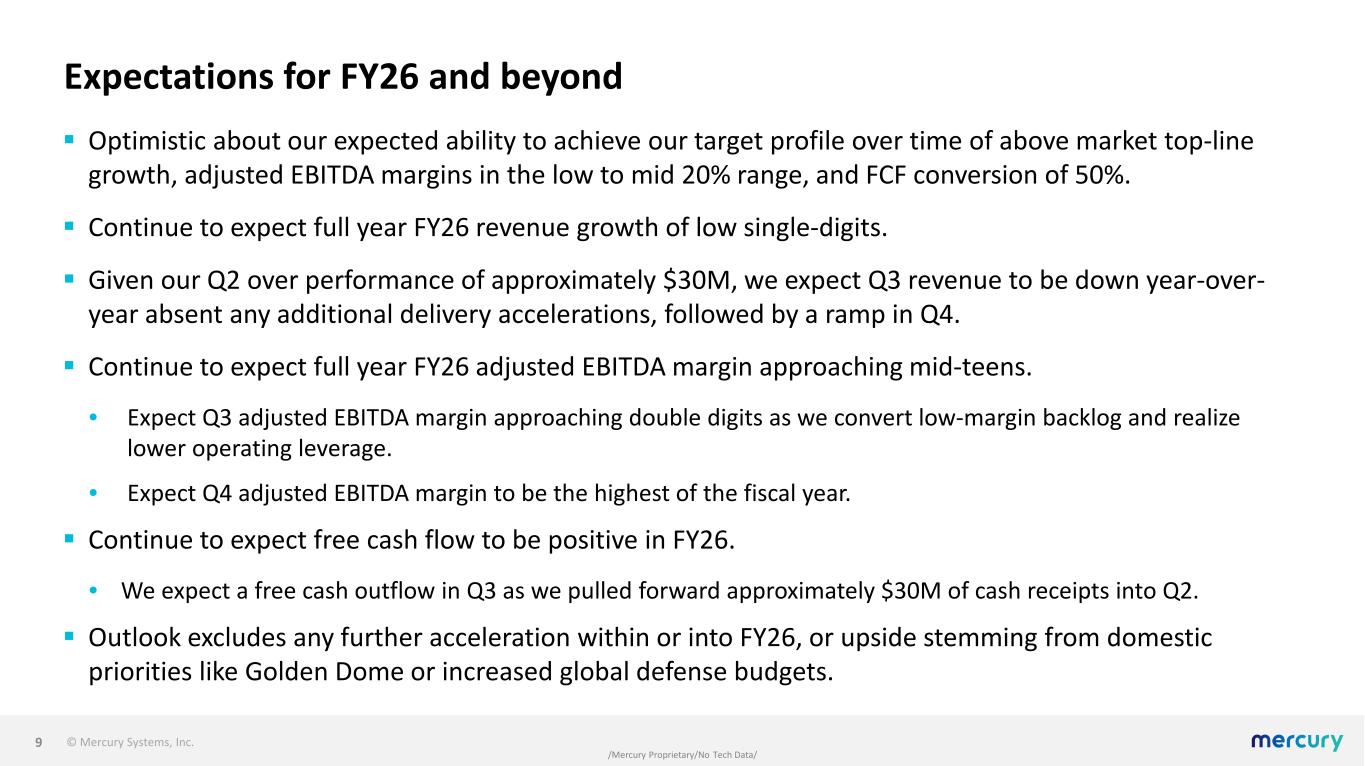
© Mercury Systems, Inc. /Mercury Proprietary/No Tech Data/ Expectations for FY26 and beyond Optimistic about our expected ability to achieve our target profile over time of above market top-line growth, adjusted EBITDA margins in the low to mid 20% range, and FCF conversion of 50%. Continue to expect full year FY26 revenue growth of low single-digits. Given our Q2 over performance of approximately $30M, we expect Q3 revenue to be down year-over- year absent any additional delivery accelerations, followed by a ramp in Q4. Continue to expect full year FY26 adjusted EBITDA margin approaching mid-teens. • Expect Q3 adjusted EBITDA margin approaching double digits as we convert low-margin backlog and realize lower operating leverage. • Expect Q4 adjusted EBITDA margin to be the highest of the fiscal year. Continue to expect free cash flow to be positive in FY26. • We expect a free cash outflow in Q3 as we pulled forward approximately $30M of cash receipts into Q2. Outlook excludes any further acceleration within or into FY26, or upside stemming from domestic priorities like Golden Dome or increased global defense budgets. 9
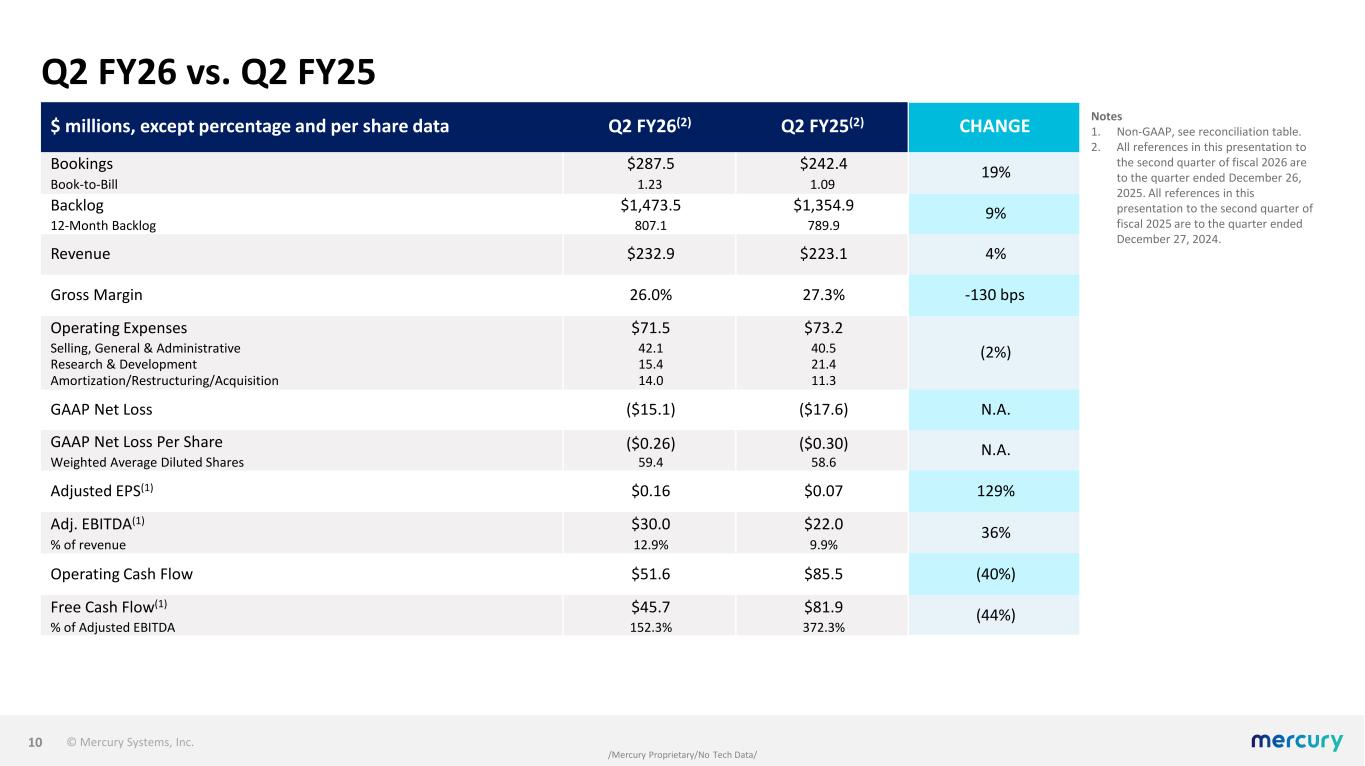
© Mercury Systems, Inc. /Mercury Proprietary/No Tech Data/ Q2 FY26 vs. Q2 FY25 10 Notes 1. Non-GAAP, see reconciliation table. 2. All references in this presentation to the second quarter of fiscal 2026 are to the quarter ended December 26, 2025. All references in this presentation to the second quarter of fiscal 2025 are to the quarter ended December 27, 2024. $ millions, except percentage and per share data Q2 FY26(2) Q2 FY25(2) CHANGE Bookings $287.5 $242.4 19% Book-to-Bill 1.23 1.09 Backlog $1,473.5 $1,354.9 9% 12-Month Backlog 807.1 789.9 Revenue $232.9 $223.1 4% Gross Margin 26.0% 27.3% -130 bps Operating Expenses $71.5 $73.2 (2%)Selling, General & Administrative 42.1 40.5 Research & Development 15.4 21.4 Amortization/Restructuring/Acquisition 14.0 11.3 GAAP Net Loss ($15.1) ($17.6) N.A. GAAP Net Loss Per Share ($0.26) ($0.30) N.A. Weighted Average Diluted Shares 59.4 58.6 Adjusted EPS(1) $0.16 $0.07 129% Adj. EBITDA(1) $30.0 $22.0 36% % of revenue 12.9% 9.9% Operating Cash Flow $51.6 $85.5 (40%) Free Cash Flow(1) $45.7 $81.9 (44%) % of Adjusted EBITDA 152.3% 372.3%
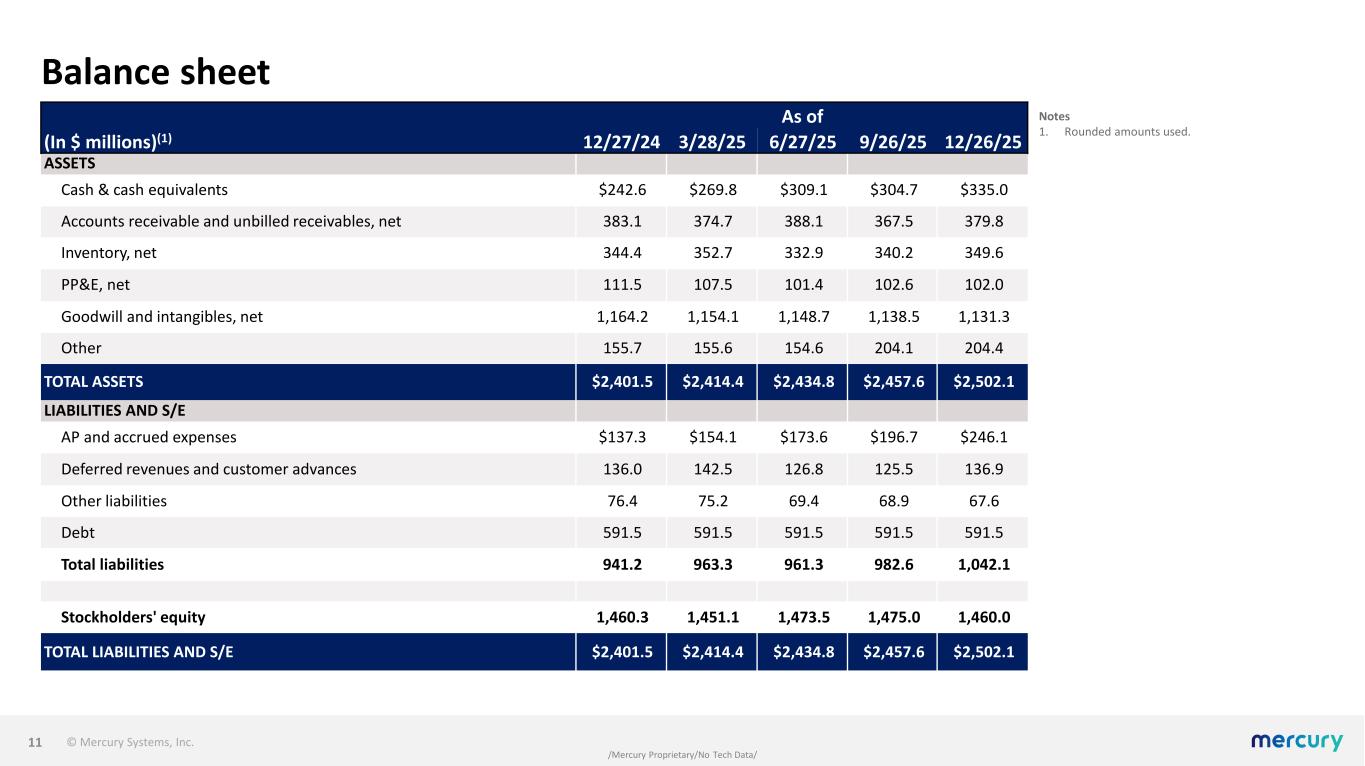
© Mercury Systems, Inc. /Mercury Proprietary/No Tech Data/ Balance sheet 11 Notes 1. Rounded amounts used. As of (In $ millions)(1) 12/27/24 3/28/25 6/27/25 9/26/25 12/26/25 ASSETS Cash & cash equivalents $242.6 $269.8 $309.1 $304.7 $335.0 Accounts receivable and unbilled receivables, net 383.1 374.7 388.1 367.5 379.8 Inventory, net 344.4 352.7 332.9 340.2 349.6 PP&E, net 111.5 107.5 101.4 102.6 102.0 Goodwill and intangibles, net 1,164.2 1,154.1 1,148.7 1,138.5 1,131.3 Other 155.7 155.6 154.6 204.1 204.4 TOTAL ASSETS $2,401.5 $2,414.4 $2,434.8 $2,457.6 $2,502.1 LIABILITIES AND S/E AP and accrued expenses $137.3 $154.1 $173.6 $196.7 $246.1 Deferred revenues and customer advances 136.0 142.5 126.8 125.5 136.9 Other liabilities 76.4 75.2 69.4 68.9 67.6 Debt 591.5 591.5 591.5 591.5 591.5 Total liabilities 941.2 963.3 961.3 982.6 1,042.1 Stockholders' equity 1,460.3 1,451.1 1,473.5 1,475.0 1,460.0 TOTAL LIABILITIES AND S/E $2,401.5 $2,414.4 $2,434.8 $2,457.6 $2,502.1
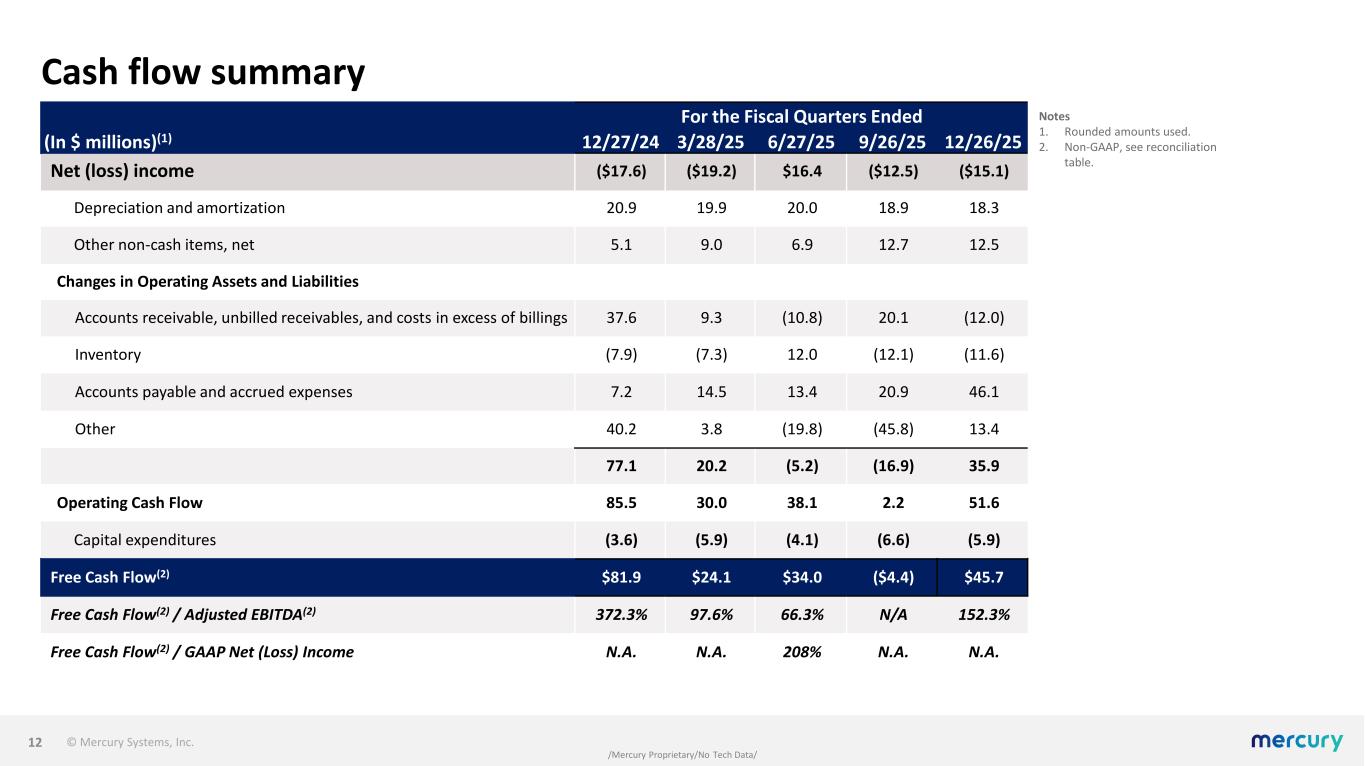
© Mercury Systems, Inc. /Mercury Proprietary/No Tech Data/ Cash flow summary 12 Notes 1. Rounded amounts used. 2. Non-GAAP, see reconciliation table. For the Fiscal Quarters Ended (In $ millions)(1) 12/27/24 3/28/25 6/27/25 9/26/25 12/26/25 Net (loss) income ($17.6) ($19.2) $16.4 ($12.5) ($15.1) Depreciation and amortization 20.9 19.9 20.0 18.9 18.3 Other non-cash items, net 5.1 9.0 6.9 12.7 12.5 Changes in Operating Assets and Liabilities Accounts receivable, unbilled receivables, and costs in excess of billings 37.6 9.3 (10.8) 20.1 (12.0) Inventory (7.9) (7.3) 12.0 (12.1) (11.6) Accounts payable and accrued expenses 7.2 14.5 13.4 20.9 46.1 Other 40.2 3.8 (19.8) (45.8) 13.4 77.1 20.2 (5.2) (16.9) 35.9 Operating Cash Flow 85.5 30.0 38.1 2.2 51.6 Capital expenditures (3.6) (5.9) (4.1) (6.6) (5.9) Free Cash Flow(2) $81.9 $24.1 $34.0 ($4.4) $45.7 Free Cash Flow(2) / Adjusted EBITDA(2) 372.3% 97.6% 66.3% N/A 152.3% Free Cash Flow(2) / GAAP Net (Loss) Income N.A. N.A. 208% N.A. N.A.
© Mercury Systems, Inc. APPENDIX
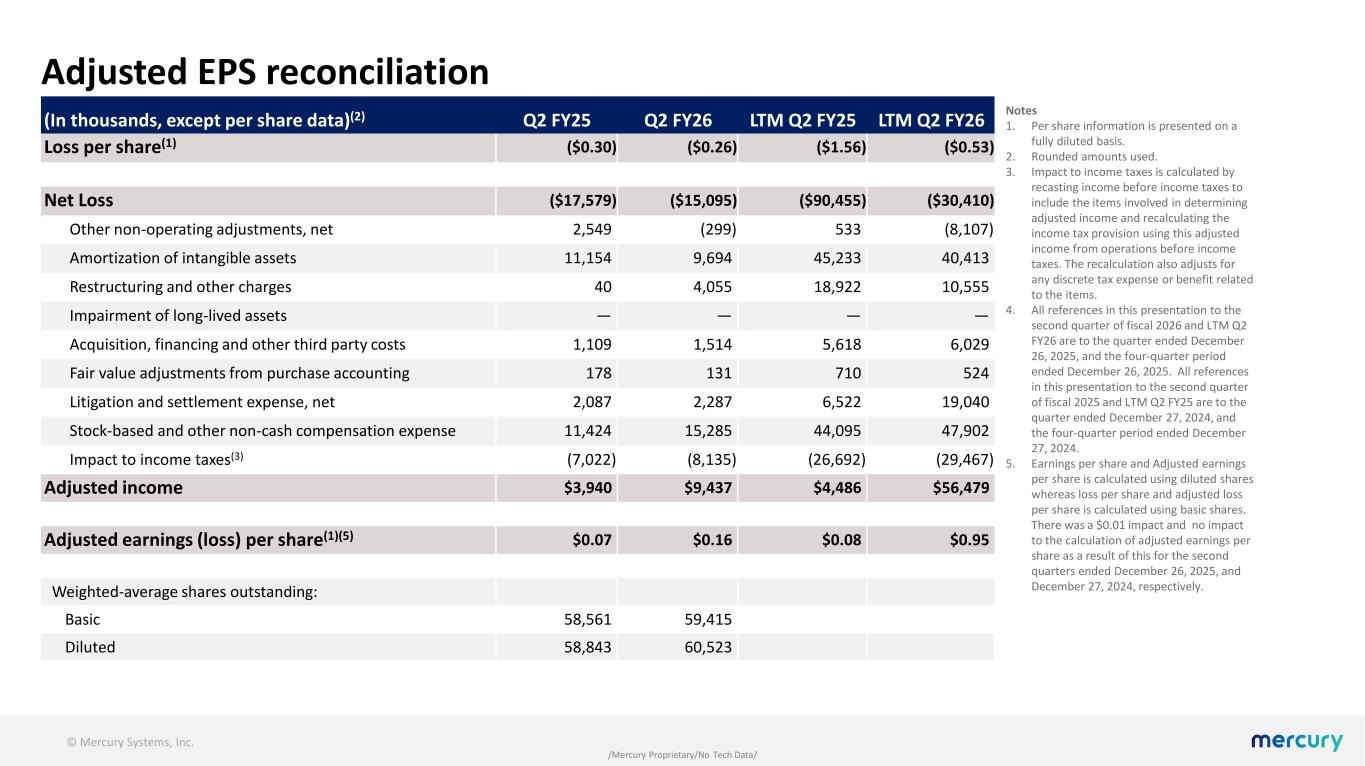
© Mercury Systems, Inc. /Mercury Proprietary/No Tech Data/ Adjusted EPS reconciliation Notes 1. Per share information is presented on a fully diluted basis. 2. Rounded amounts used. 3. Impact to income taxes is calculated by recasting income before income taxes to include the items involved in determining adjusted income and recalculating the income tax provision using this adjusted income from operations before income taxes. The recalculation also adjusts for any discrete tax expense or benefit related to the items. 4. All references in this presentation to the second quarter of fiscal 2026 and LTM Q2 FY26 are to the quarter ended December 26, 2025, and the four-quarter period ended December 26, 2025. All references in this presentation to the second quarter of fiscal 2025 and LTM Q2 FY25 are to the quarter ended December 27, 2024, and the four-quarter period ended December 27, 2024. 5. Earnings per share and Adjusted earnings per share is calculated using diluted shares whereas loss per share and adjusted loss per share is calculated using basic shares. There was a $0.01 impact and no impact to the calculation of adjusted earnings per share as a result of this for the second quarters ended December 26, 2025, and December 27, 2024, respectively. (In thousands, except per share data)(2) Q2 FY25 Q2 FY26 LTM Q2 FY25 LTM Q2 FY26 Loss per share(1) ($0.30) ($0.26) ($1.56) ($0.53) Net Loss ($17,579) ($15,095) ($90,455) ($30,410) Other non-operating adjustments, net 2,549 (299) 533 (8,107) Amortization of intangible assets 11,154 9,694 45,233 40,413 Restructuring and other charges 40 4,055 18,922 10,555 Impairment of long-lived assets — — — — Acquisition, financing and other third party costs 1,109 1,514 5,618 6,029 Fair value adjustments from purchase accounting 178 131 710 524 Litigation and settlement expense, net 2,087 2,287 6,522 19,040 Stock-based and other non-cash compensation expense 11,424 15,285 44,095 47,902 Impact to income taxes(3) (7,022) (8,135) (26,692) (29,467) Adjusted income $3,940 $9,437 $4,486 $56,479 Adjusted earnings (loss) per share(1)(5) $0.07 $0.16 $0.08 $0.95 Weighted-average shares outstanding: Basic 58,561 59,415 Diluted 58,843 60,523
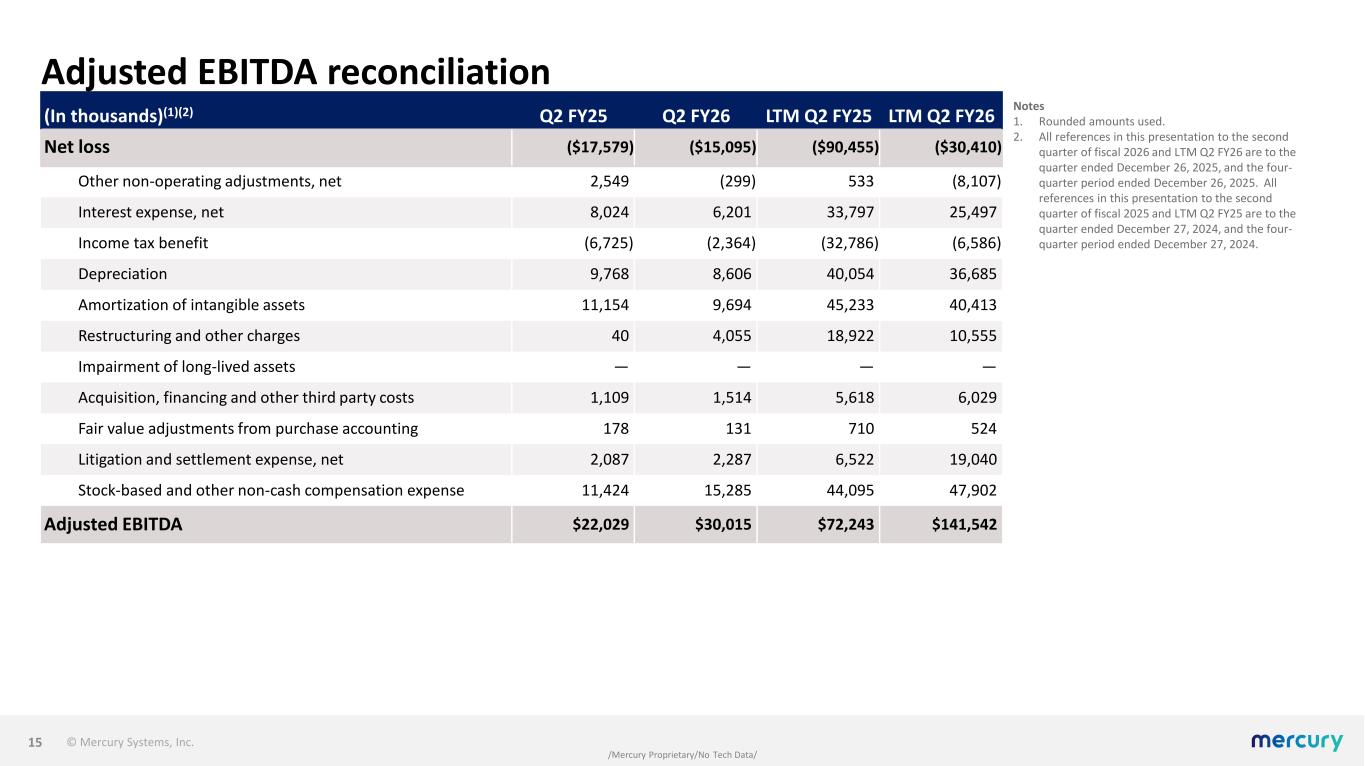
© Mercury Systems, Inc. /Mercury Proprietary/No Tech Data/ Adjusted EBITDA reconciliation 15 Notes 1. Rounded amounts used. 2. All references in this presentation to the second quarter of fiscal 2026 and LTM Q2 FY26 are to the quarter ended December 26, 2025, and the four- quarter period ended December 26, 2025. All references in this presentation to the second quarter of fiscal 2025 and LTM Q2 FY25 are to the quarter ended December 27, 2024, and the four- quarter period ended December 27, 2024. (In thousands)(1)(2) Q2 FY25 Q2 FY26 LTM Q2 FY25 LTM Q2 FY26 Net loss ($17,579) ($15,095) ($90,455) ($30,410) Other non-operating adjustments, net 2,549 (299) 533 (8,107) Interest expense, net 8,024 6,201 33,797 25,497 Income tax benefit (6,725) (2,364) (32,786) (6,586) Depreciation 9,768 8,606 40,054 36,685 Amortization of intangible assets 11,154 9,694 45,233 40,413 Restructuring and other charges 40 4,055 18,922 10,555 Impairment of long-lived assets — — — — Acquisition, financing and other third party costs 1,109 1,514 5,618 6,029 Fair value adjustments from purchase accounting 178 131 710 524 Litigation and settlement expense, net 2,087 2,287 6,522 19,040 Stock-based and other non-cash compensation expense 11,424 15,285 44,095 47,902 Adjusted EBITDA $22,029 $30,015 $72,243 $141,542
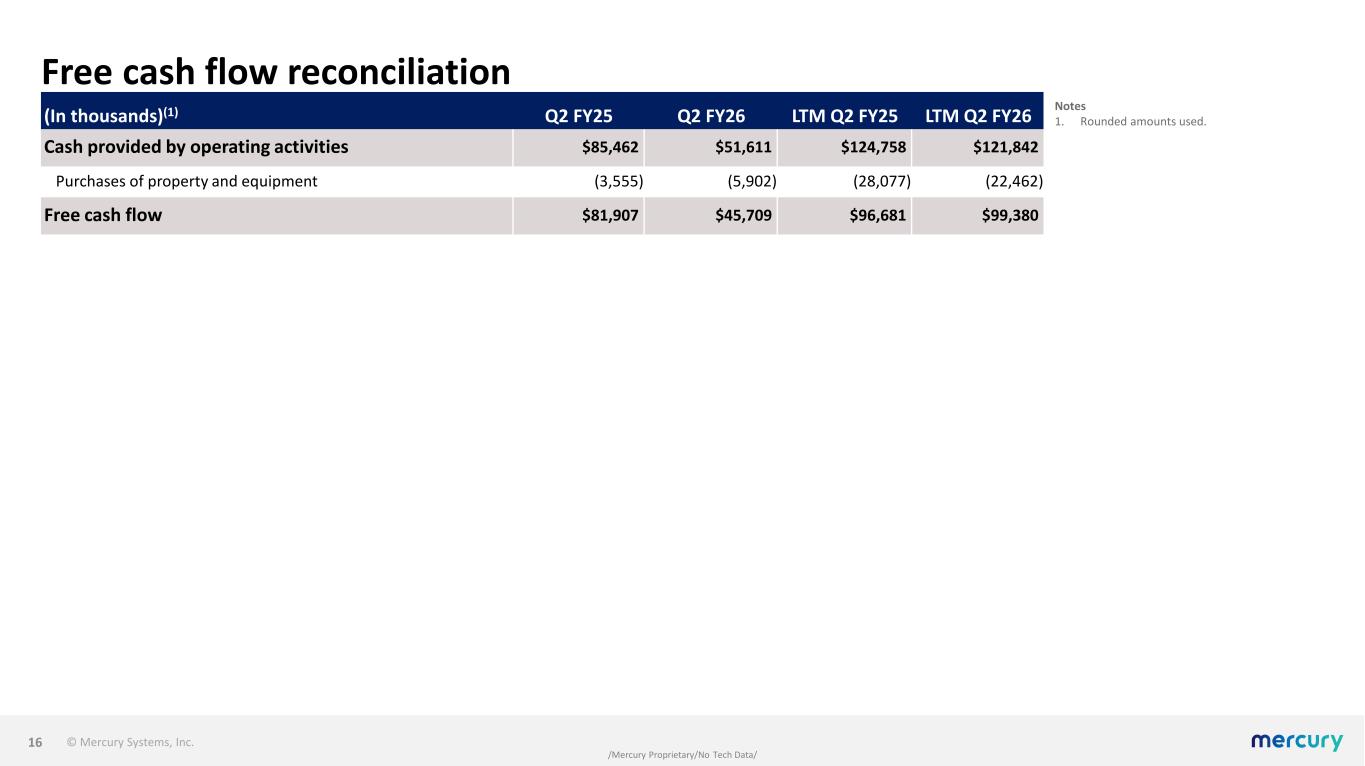
© Mercury Systems, Inc. /Mercury Proprietary/No Tech Data/ Free cash flow reconciliation 16 Notes 1. Rounded amounts used.(In thousands)(1) Q2 FY25 Q2 FY26 LTM Q2 FY25 LTM Q2 FY26 Cash provided by operating activities $85,462 $51,611 $124,758 $121,842 Purchases of property and equipment (3,555) (5,902) (28,077) (22,462) Free cash flow $81,907 $45,709 $96,681 $99,380