AMENDED AND RESTATED BYLAWS OF EAGLE BANCORP, INC. (As amended and restated through November 5, 2025) ARTICLE I Principal Office The principal office of Eagle Bancorp, Inc. (herein the “Corporation”) shall be at 7500 Old Georgetown Road, Bethesda, Maryland 20814 or such other place as the Board of Directors from time to time shall determine. ARTICLE II Meeting of Shareholders SECTION 1 Place of Meetings. All annual and special meetings of shareholders shall be held at such place within or without the State of Maryland or by means of remote communication, or both, as the Board of Directors may determine and as designated in the notice of such meeting. SECTION 2 Annual Meeting. A meeting of the shareholders of the Corporation for the election of directors and for the transaction of any other business of the Corporation shall be held annually at such date and time as the Board of Directors may determine. SECTION 3 Special Meetings. (a) Special meetings of the shareholders for any purpose or purposes may be called at any time by the majority of the Board of Directors in accordance with the provisions of the Corporation’s Articles of Incorporation, or as provided in Section 3(b) below. (b) Special meetings of the shareholders may be called by the Secretary of the Corporation upon the written request of the holders of not less than fifty percent (50%) of all votes entitled to be cast at the meeting. Such written request shall state the purpose or purposes of the meeting and the matters proposed to be acted on at the meeting and shall be delivered at the principal office of the Corporation addressed to the Chairperson of the Board of Directors, the President or the Secretary. The Secretary shall inform the shareholders who make the request of the reasonably estimated costs of preparing and mailing a notice of the meeting and, upon payment of these costs to the Corporation, the Secretary shall then notify each shareholder entitled to notice of the meeting. A request to the Secretary of the Corporation shall be signed by each shareholder, or a duly authorized agent of such shareholder, requesting the special meeting and shall be accompanied by a notice setting forth the information required by Section 14 of this Article II as to the business proposed to be conducted and any nominations proposed to be presented at such special meeting and as to the shareholder(s) proposing such business or nominations, and by a representation by the shareholder(s) that within five (5) business days after the record date for any such special meeting it will provide such information as of the record date for such special meeting. A special meeting requested by shareholders shall be held at such date, time and place within or without the State of Maryland as may be fixed by the Board of Directors; provided, however, that
2 the date of any such special meeting shall not be more than ninety (90) days after the request to call the special meeting is received by the Secretary of the Corporation. Notwithstanding the foregoing, a special meeting requested by shareholders shall not be held if the Board of Directors has called or calls for an annual meeting of shareholders to be held within ninety (90) days after the Secretary of the Corporation receives the request for the special meeting and the Board of Directors determines in good faith that the business of such annual meeting includes (among any other matters properly brought before the annual meeting) the business specified in the request. A shareholder may revoke a request for a special meeting at any time by written revocation delivered to the Secretary of the Corporation, and if such revoking shareholder had joined with other shareholders to submit the request for a special meeting pursuant to this subparagraph (b), and if the remaining unrevoked requests from shareholders joining in such request represent less than the requisite number of shares entitling the shareholders to request the calling of a special meeting, the Board of Directors, in its discretion, may refrain from calling the special meeting or cancel the special meeting, as the case may be. Business transacted at a special meeting requested by shareholders shall be limited to the purpose(s) stated in the request for meeting, provided, however, that the Board of Directors shall have the authority in its discretion to submit additional matters to the shareholders, and to cause other business to be transacted, at any special meeting requested by shareholders. (c) Only such business shall be conducted at a special meeting of shareholders as shall have been brought before the meeting pursuant to the Corporation’s notice of meeting. The Board of Directors or, at a meeting of shareholders (but subject to any rules and regulations adopted by, and the authority of, the Board of Directors), chair of the meeting, shall have the power to determine whether a nomination or any other business brought before a special meeting was made in accordance with the procedures set forth in this section, and, if any nomination or other business is not in compliance with this section (including if the shareholder does not provide the information that it represents it will provide under this section to the Corporation within five (5) business days following the record date for the meeting), to declare that such defective nomination or proposal shall be disregarded, notwithstanding that proxies in respect of such matters may have been received. SECTION 4 Conduct of Meetings. Every meeting of shareholders shall be conducted by an individual appointed by the Board of Directors to be Chairperson of the meeting or, in the absence of such appointment or appointed individual, by the Chairperson of the Board or, in the case of a vacancy in the office or absence of the Chairperson of the Board, by one of the following officers present at the meeting in the following order: the Vice Chairperson of the Board, if there is one, the Chief Executive Officer, the President, the Vice Presidents in their order of rank and seniority, the Secretary or, in the absence of such officers, a Chairperson chosen by the shareholders by the vote of a majority of the votes cast by shareholders present in person or by proxy. The Secretary or, in the Secretary’s absence, an Assistant Secretary or, in the absence of both the Secretary and Assistant Secretaries, an individual appointed by the Board of Directors or, in the absence of such appointment, an individual appointed by the Chairperson of the meeting shall act as Secretary. In the event that the Secretary presides at a meeting of shareholders, an Assistant Secretary or, in the absence of all Assistant Secretaries, an individual appointed by the Board of Directors or the Chairperson of the meeting, shall record the minutes of the meeting. Even if present at the meeting, the person holding the office named herein may delegate to another person the power to act as Chairperson or Secretary of the meeting. The order of business and all

3 other matters of procedure at any meeting of shareholders shall be determined by the Chairperson of the meeting. The Chairperson of the meeting may prescribe such rules, regulations and procedures and take such action as, in the discretion of the Chairperson and without any action by the shareholders, are appropriate for the proper conduct of the meeting, including, without limitation, (a) restricting admission to the time set for the commencement of the meeting; (b) limiting attendance at the meeting to shareholders of record of the Company, their duly authorized proxies and such other individuals as the Chairperson of the meeting may determine; (c) limiting participation at the meeting on any matter to shareholders of record of the Company entitled to vote on such matter, their duly authorized proxies and other such individuals as the Chairperson of the meeting may determine; (d) limiting the time allotted to questions or comments; (e) determining when and for how long the polls should be opened and when the polls should be closed; (f) maintaining order and security at the meeting; (g) removing any shareholder or any other individual who refuses to comply with meeting procedures, rules or guidelines as set forth by the Chairperson of the meeting; (h) concluding a meeting or recessing or adjourning the meeting, whether or not a quorum is present, to a later date and time and at a place either (i) announced at the meeting or (ii) provided at a future time through means announced at the meeting; and (i) complying with any state and local laws and regulations concerning safety and security. Unless otherwise determined by the Chairperson of the meeting, meetings of shareholders shall not be required to be held in accordance with the rules of parliamentary procedure. SECTION 5 Notice of Meeting. Notice stating the place, day and hour of the meeting, the means of electronic communication, if any, by which shareholders and proxyholders may participate in the proceedings of the meeting and vote or grant proxies at such meeting and, in the case of a special meeting, the purpose or purposes for which the meeting is called shall be given either electronically or by mail by or at the direction of the Board of Directors, not less than ten (10) days nor more than sixty (60) days before the date of the meeting to each shareholder of record entitled to vote at such meeting and to each other shareholder entitled to notice of the meeting. If mailed, such notice shall be deemed to be delivered when deposited in the United States mail, addressed to the shareholder at his address as it appears on the stock transfer books of the Corporation as of the record date prescribed in Section 6 of this Article II, with postage thereon prepaid. If transmitted electronically, such notice shall be deemed to be delivered when directed to the shareholder’s electronic mail address as supplied by the shareholder to the Secretary of the Corporation or as otherwise directed pursuant to the shareholder’s authorization or instructions. If a shareholder be present at a meeting electronically, or in writing waives notice thereof before or after the meeting and such waiver is filed with the records of the meeting of shareholders, notice of the meeting to such shareholder shall be unnecessary. When any shareholders’ meeting, either annual or special, is adjourned for more than thirty (30) days, notice of the adjourned meeting shall be given as in the case of an original meeting. It shall not be necessary to give any notice of the time and place of any meeting adjourned for thirty (30) or fewer days or of the business to be transacted at such adjourned meeting, other than an announcement at the meeting at which such adjournment is taken. SECTION 6 Fixing of Record Date. For the purpose of determining the shareholders entitled to notice of or to vote at any meeting of shareholders, or any adjournment thereof, or shareholders entitled to receive payment of any dividend, or in order to make a determination of shareholders for any other proper purpose, the Board of Directors shall fix in advance a date as the record date for any such determination of shareholders. Such date in any case shall be not more
4 than sixty (60) days and, in case of a meeting of shareholders, not less than ten (10) days prior to the date on which the particular action, requiring such determination of shareholders is to be taken. When a determination of shareholders entitled to vote at any meeting of shareholders has been made as provided in this section, such determination shall apply to any adjournment thereof. SECTION 7 Quorum. Unless otherwise provided in the Corporation’s Articles of Incorporation, a majority of the outstanding shares of the Corporation entitled to vote, represented in person or by proxy, shall constitute a quorum at a meeting of shareholders. If less than a majority of the outstanding shares are represented at a meeting, a majority of the shares so represented may adjourn the meeting from time to time without further notice. At such adjourned meeting at which a quorum shall be present or represented, any business may be transacted which might have been transacted at the meeting as originally notified. The shareholders present at a duly organized meeting may continue to transact business until adjournment, notwithstanding the withdrawal of enough shareholders to leave less than a quorum. SECTION 8 Proxies. At all meetings of shareholders, a shareholder may vote by proxy executed or transmitted in any manner permitted by law, including Rule 14a-19 promulgated under the Securities Exchange Act of 1934, as amended (the “Exchange Act”), filed in accordance with the procedure established for the meeting, including but not limited to internet or telephonic voting through a proxy solicitation firm or proxy support service organization authorized or engaged by the Company. All proxies, or evidence or reports thereof, shall be filed with the Secretary of the meeting before being voted. Proxies solicited on behalf of the Board of Directors shall be voted as directed by the shareholder or, in the absence of such direction, as determined by a majority of the Board of Directors. No proxy shall be valid after eleven (11) months from the date of its execution, unless otherwise provided in the proxy. Any shareholder directly or indirectly soliciting proxies from other shareholders must use a proxy card color other than white, which shall be reserved for the exclusive use by the Board of Directors. SECTION 9 Voting. At each election for directors, every shareholder entitled to vote at such election shall be entitled to one vote for each share of stock held. Unless otherwise provided by the Corporation’s Articles of Incorporation, these Bylaws, or the General Laws of the State of Maryland, a majority of those votes cast by shareholders at a lawful meeting shall be sufficient to pass on any transaction or matter. SECTION 10 Informal Action by Shareholders. Any action required or permitted to be taken at a meeting of shareholders may be taken without a meeting if a unanimous written consent to the action is given in writing or by electronic transmission by each shareholder entitled to vote on the matter and a written waiver of any rights to dissent is given in writing or by electronic transmission by each shareholder entitled to notice but not entitled to vote at the meeting. The unanimous written consent and the written waiver, if any, shall be filed with the records of the shareholders’ meetings. SECTION 11 Voting of Shares in the Name of Two or More Persons. When ownership of stock stands in the name of two or more persons, in the absence of written directions to the Corporation to the contrary, at any meeting of the shareholders of the Corporation any one or more of such shareholders may cast, in person or by proxy, all votes to which such ownership is entitled. In the event an attempt is made to cast conflicting votes, in person or by proxy, by the several
5 persons in whose name shares of stock stand, the vote or votes to which these persons are entitled shall be cast as directed by a majority of those holding such stock and present in person or by proxy at such meeting, but no votes shall be cast for such stock if a majority cannot agree. SECTION 12 Voting of Shares by Certain Holders. Shares standing in the name of another corporation may be voted by any officer, agent or proxy as the bylaws of such corporation may provide, or, in the absence of such provision, as the Board of Directors of such corporation may determine. Shares held by an administrator, executor, guardian or conservator may be voted by him, either in person or by proxy, without a transfer of such shares into his name. Shares standing in the name of a trustee may be voted by him, either in person or by proxy, but no trustee shall be entitled to vote shares held by him without a transfer of such shares into his name. Shares standing in the name of a receiver may be voted by such receiver, and shares held by or under the control of a receiver may be voted by such receiver without the transfer thereof into his name if authority to do so is contained in an appropriate order of the court or other public authority by which such receiver was appointed. A shareholder whose shares are pledged shall be entitled to vote such shares until the shares have been transferred into the name of the pledgee and thereafter the pledgee shall be entitled to vote the shares so transferred. Treasury shares of its own stock held by the Corporation shall not be voted at any meeting or counted in determining the total number of outstanding shares at any given time for purposes of any meeting. SECTION 13 Inspectors of Election. The Board of Directors may appoint any persons, other than nominees for office, as inspectors of election to act at such meeting or any adjournment thereof. The number of inspectors shall be either one or three. If the Board of Directors so appoints either one or three inspectors, that appointment shall not be altered at the meeting. If inspectors of election are not so appointed, the Chairperson of the Board of Directors or the President may make such appointment at the meeting. In case any person appointed as inspector fails to appear or fails or refuses to act, the vacancy may be filled by appointment by the Board of Directors in advance of the meeting or at the meeting by the Chairperson of the Board of Directors or the President. Unless otherwise prescribed by applicable law, the duties of such inspectors shall include: determining the number of shares of stock and the voting power of each share, the shares of stock represented at the meeting, the existence of a quorum, the authenticity, validity and effect of proxies; receiving votes, ballots or consents; hearing and determining all challenges and questions in any way arising in connection with the right to vote; counting and tabulating all votes or consents; determining the result; and such acts as may be proper to conduct the election or vote with fairness to all shareholders. SECTION 14 Advance Notice of Nominations and Other Business. (a) Annual Meetings of Shareholders. (1) The Board of Directors, or a committee thereof appointed in accordance with Article IV hereof, shall act as a nominating committee for selecting the Board of Directors’ nominees for election as directors. Except in the case of a nominee substituted as a
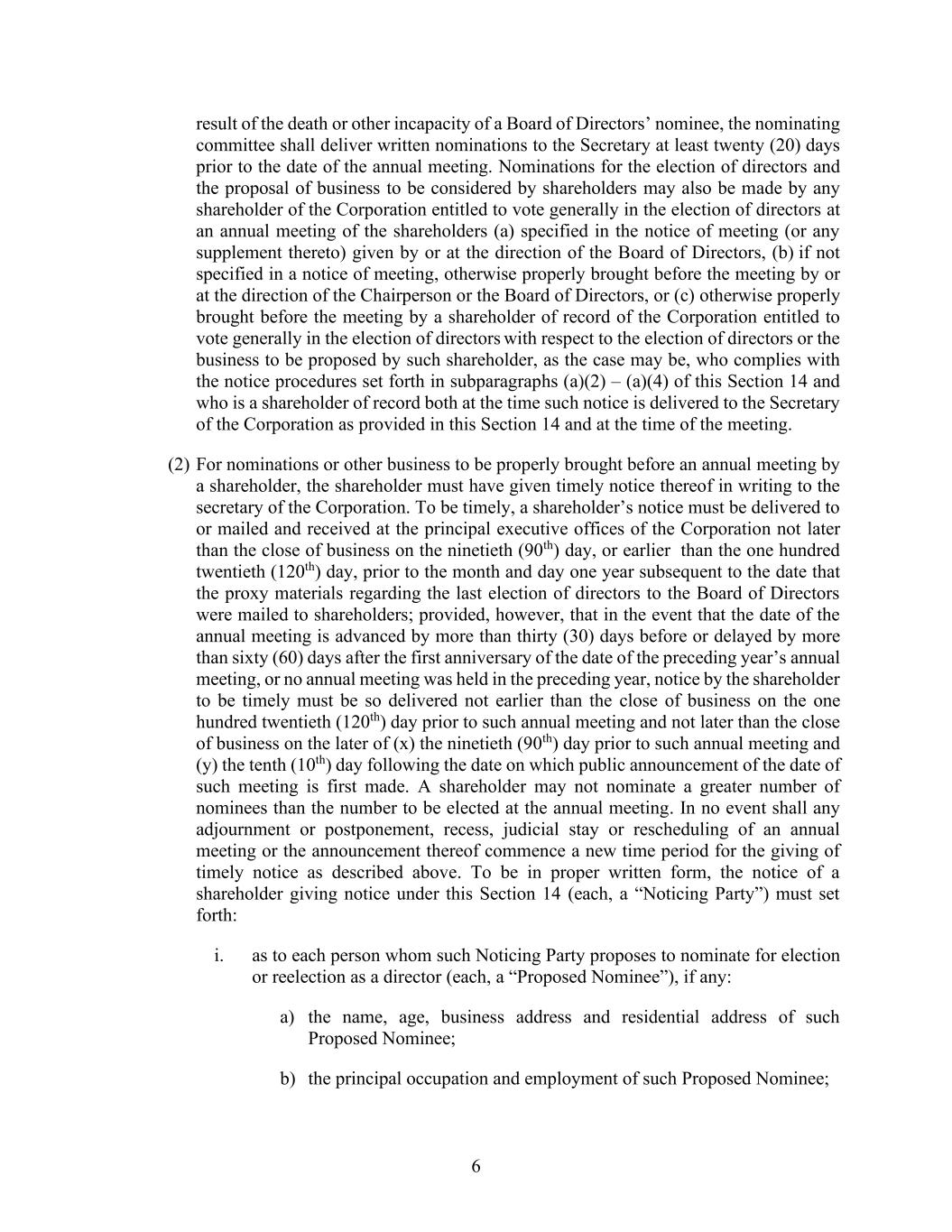
6 result of the death or other incapacity of a Board of Directors’ nominee, the nominating committee shall deliver written nominations to the Secretary at least twenty (20) days prior to the date of the annual meeting. Nominations for the election of directors and the proposal of business to be considered by shareholders may also be made by any shareholder of the Corporation entitled to vote generally in the election of directors at an annual meeting of the shareholders (a) specified in the notice of meeting (or any supplement thereto) given by or at the direction of the Board of Directors, (b) if not specified in a notice of meeting, otherwise properly brought before the meeting by or at the direction of the Chairperson or the Board of Directors, or (c) otherwise properly brought before the meeting by a shareholder of record of the Corporation entitled to vote generally in the election of directors with respect to the election of directors or the business to be proposed by such shareholder, as the case may be, who complies with the notice procedures set forth in subparagraphs (a)(2) – (a)(4) of this Section 14 and who is a shareholder of record both at the time such notice is delivered to the Secretary of the Corporation as provided in this Section 14 and at the time of the meeting. (2) For nominations or other business to be properly brought before an annual meeting by a shareholder, the shareholder must have given timely notice thereof in writing to the secretary of the Corporation. To be timely, a shareholder’s notice must be delivered to or mailed and received at the principal executive offices of the Corporation not later than the close of business on the ninetieth (90th) day, or earlier than the one hundred twentieth (120th) day, prior to the month and day one year subsequent to the date that the proxy materials regarding the last election of directors to the Board of Directors were mailed to shareholders; provided, however, that in the event that the date of the annual meeting is advanced by more than thirty (30) days before or delayed by more than sixty (60) days after the first anniversary of the date of the preceding year’s annual meeting, or no annual meeting was held in the preceding year, notice by the shareholder to be timely must be so delivered not earlier than the close of business on the one hundred twentieth (120th) day prior to such annual meeting and not later than the close of business on the later of (x) the ninetieth (90th) day prior to such annual meeting and (y) the tenth (10th) day following the date on which public announcement of the date of such meeting is first made. A shareholder may not nominate a greater number of nominees than the number to be elected at the annual meeting. In no event shall any adjournment or postponement, recess, judicial stay or rescheduling of an annual meeting or the announcement thereof commence a new time period for the giving of timely notice as described above. To be in proper written form, the notice of a shareholder giving notice under this Section 14 (each, a “Noticing Party”) must set forth: i. as to each person whom such Noticing Party proposes to nominate for election or reelection as a director (each, a “Proposed Nominee”), if any: a) the name, age, business address and residential address of such Proposed Nominee; b) the principal occupation and employment of such Proposed Nominee;
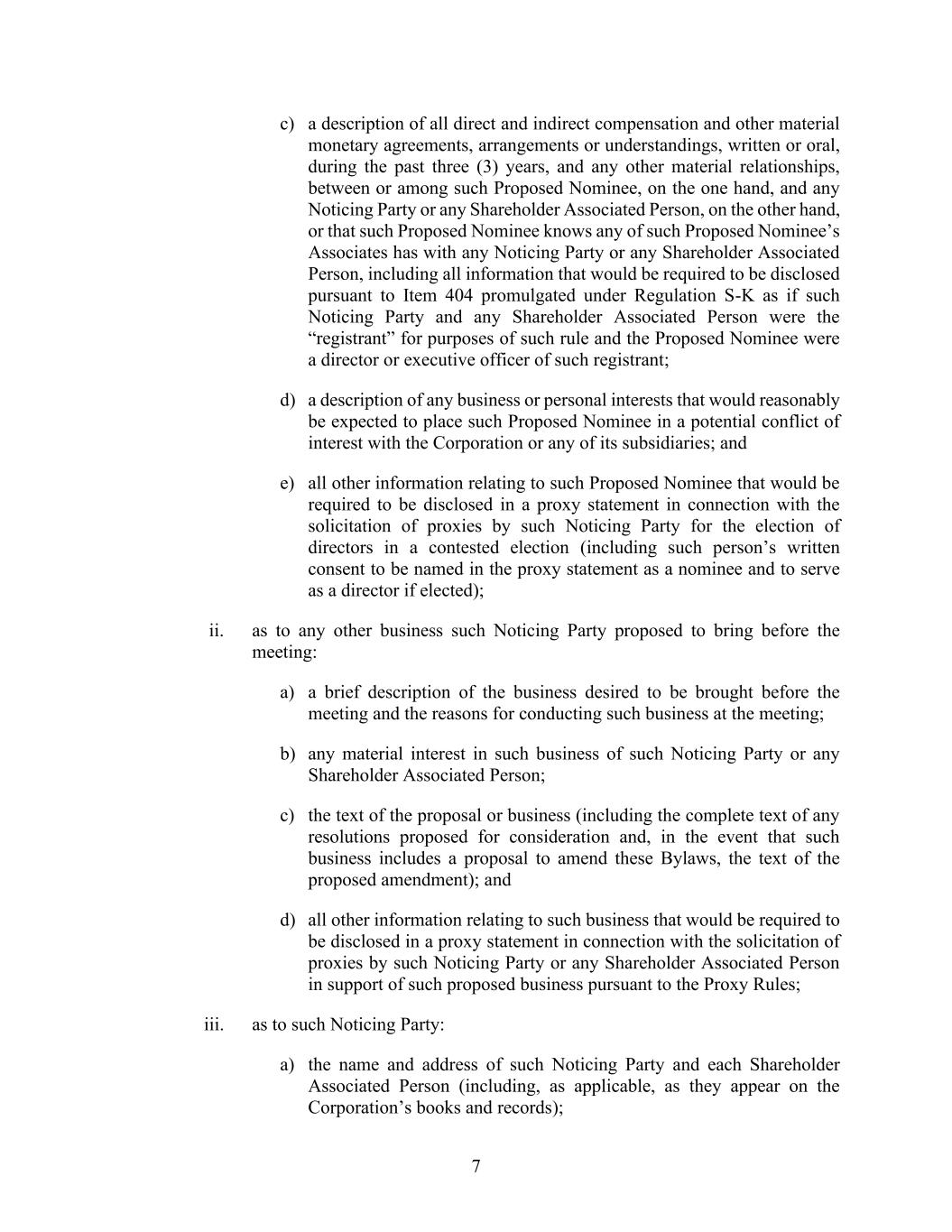
7 c) a description of all direct and indirect compensation and other material monetary agreements, arrangements or understandings, written or oral, during the past three (3) years, and any other material relationships, between or among such Proposed Nominee, on the one hand, and any Noticing Party or any Shareholder Associated Person, on the other hand, or that such Proposed Nominee knows any of such Proposed Nominee’s Associates has with any Noticing Party or any Shareholder Associated Person, including all information that would be required to be disclosed pursuant to Item 404 promulgated under Regulation S-K as if such Noticing Party and any Shareholder Associated Person were the “registrant” for purposes of such rule and the Proposed Nominee were a director or executive officer of such registrant; d) a description of any business or personal interests that would reasonably be expected to place such Proposed Nominee in a potential conflict of interest with the Corporation or any of its subsidiaries; and e) all other information relating to such Proposed Nominee that would be required to be disclosed in a proxy statement in connection with the solicitation of proxies by such Noticing Party for the election of directors in a contested election (including such person’s written consent to be named in the proxy statement as a nominee and to serve as a director if elected); ii. as to any other business such Noticing Party proposed to bring before the meeting: a) a brief description of the business desired to be brought before the meeting and the reasons for conducting such business at the meeting; b) any material interest in such business of such Noticing Party or any Shareholder Associated Person; c) the text of the proposal or business (including the complete text of any resolutions proposed for consideration and, in the event that such business includes a proposal to amend these Bylaws, the text of the proposed amendment); and d) all other information relating to such business that would be required to be disclosed in a proxy statement in connection with the solicitation of proxies by such Noticing Party or any Shareholder Associated Person in support of such proposed business pursuant to the Proxy Rules; iii. as to such Noticing Party: a) the name and address of such Noticing Party and each Shareholder Associated Person (including, as applicable, as they appear on the Corporation’s books and records);
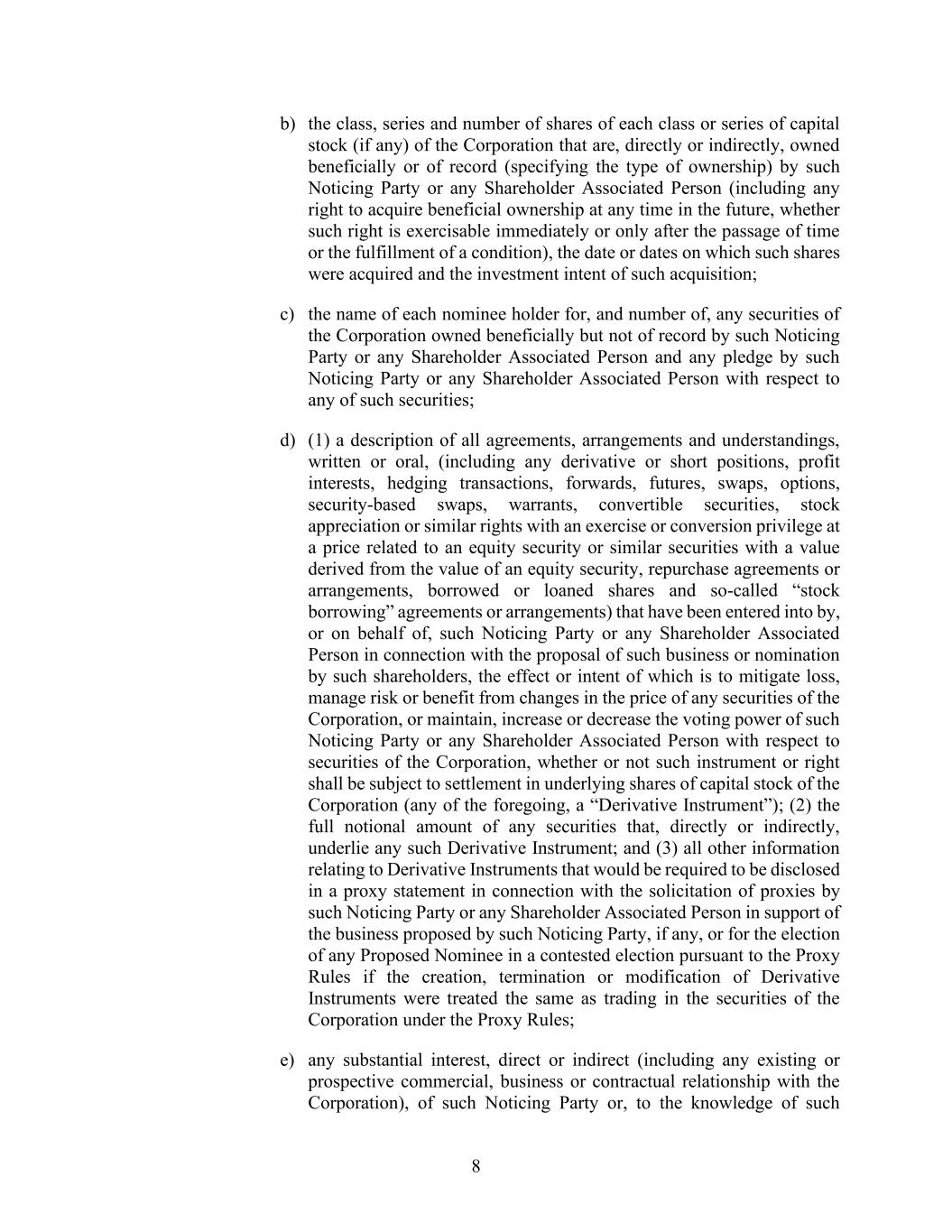
8 b) the class, series and number of shares of each class or series of capital stock (if any) of the Corporation that are, directly or indirectly, owned beneficially or of record (specifying the type of ownership) by such Noticing Party or any Shareholder Associated Person (including any right to acquire beneficial ownership at any time in the future, whether such right is exercisable immediately or only after the passage of time or the fulfillment of a condition), the date or dates on which such shares were acquired and the investment intent of such acquisition; c) the name of each nominee holder for, and number of, any securities of the Corporation owned beneficially but not of record by such Noticing Party or any Shareholder Associated Person and any pledge by such Noticing Party or any Shareholder Associated Person with respect to any of such securities; d) (1) a description of all agreements, arrangements and understandings, written or oral, (including any derivative or short positions, profit interests, hedging transactions, forwards, futures, swaps, options, security-based swaps, warrants, convertible securities, stock appreciation or similar rights with an exercise or conversion privilege at a price related to an equity security or similar securities with a value derived from the value of an equity security, repurchase agreements or arrangements, borrowed or loaned shares and so-called “stock borrowing” agreements or arrangements) that have been entered into by, or on behalf of, such Noticing Party or any Shareholder Associated Person in connection with the proposal of such business or nomination by such shareholders, the effect or intent of which is to mitigate loss, manage risk or benefit from changes in the price of any securities of the Corporation, or maintain, increase or decrease the voting power of such Noticing Party or any Shareholder Associated Person with respect to securities of the Corporation, whether or not such instrument or right shall be subject to settlement in underlying shares of capital stock of the Corporation (any of the foregoing, a “Derivative Instrument”); (2) the full notional amount of any securities that, directly or indirectly, underlie any such Derivative Instrument; and (3) all other information relating to Derivative Instruments that would be required to be disclosed in a proxy statement in connection with the solicitation of proxies by such Noticing Party or any Shareholder Associated Person in support of the business proposed by such Noticing Party, if any, or for the election of any Proposed Nominee in a contested election pursuant to the Proxy Rules if the creation, termination or modification of Derivative Instruments were treated the same as trading in the securities of the Corporation under the Proxy Rules; e) any substantial interest, direct or indirect (including any existing or prospective commercial, business or contractual relationship with the Corporation), of such Noticing Party or, to the knowledge of such
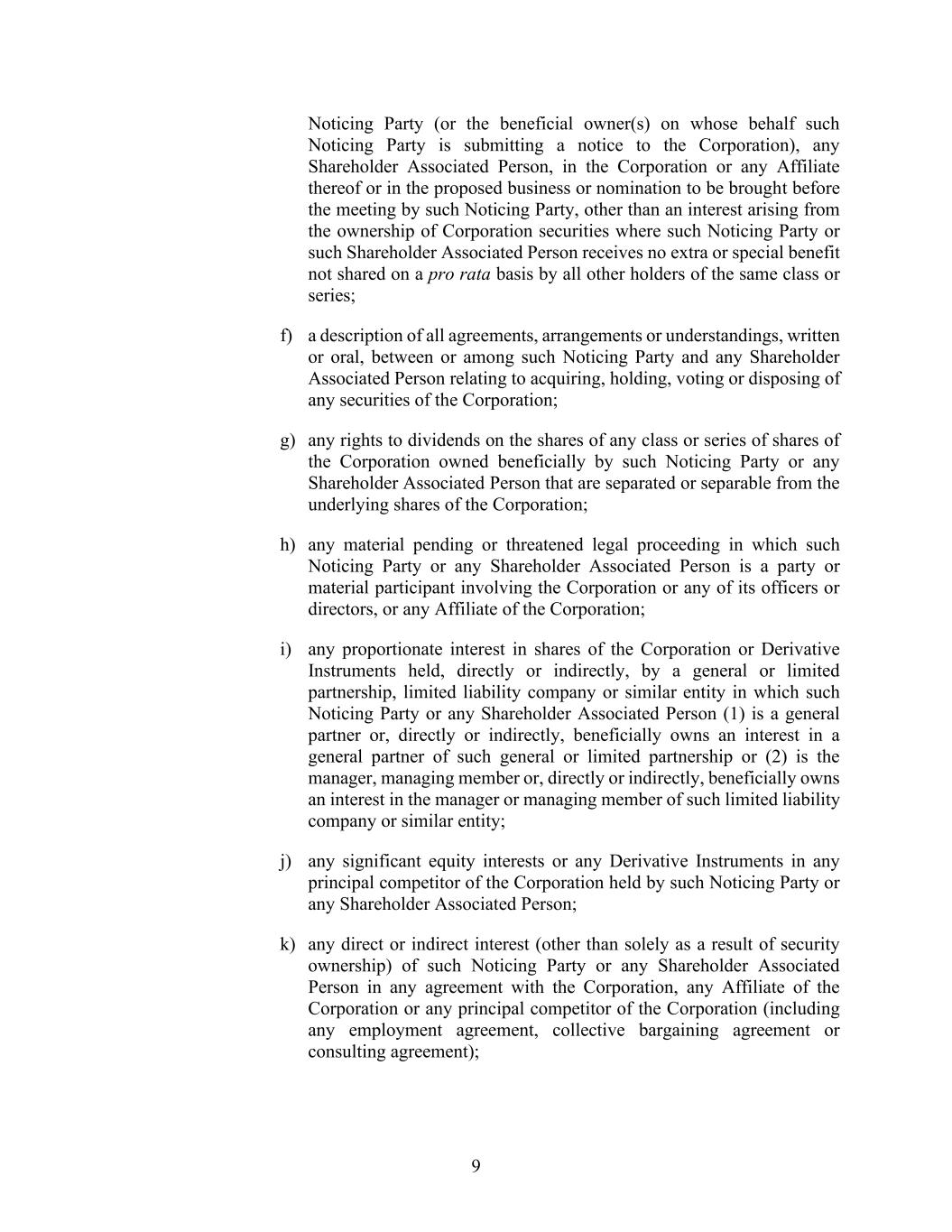
9 Noticing Party (or the beneficial owner(s) on whose behalf such Noticing Party is submitting a notice to the Corporation), any Shareholder Associated Person, in the Corporation or any Affiliate thereof or in the proposed business or nomination to be brought before the meeting by such Noticing Party, other than an interest arising from the ownership of Corporation securities where such Noticing Party or such Shareholder Associated Person receives no extra or special benefit not shared on a pro rata basis by all other holders of the same class or series; f) a description of all agreements, arrangements or understandings, written or oral, between or among such Noticing Party and any Shareholder Associated Person relating to acquiring, holding, voting or disposing of any securities of the Corporation; g) any rights to dividends on the shares of any class or series of shares of the Corporation owned beneficially by such Noticing Party or any Shareholder Associated Person that are separated or separable from the underlying shares of the Corporation; h) any material pending or threatened legal proceeding in which such Noticing Party or any Shareholder Associated Person is a party or material participant involving the Corporation or any of its officers or directors, or any Affiliate of the Corporation; i) any proportionate interest in shares of the Corporation or Derivative Instruments held, directly or indirectly, by a general or limited partnership, limited liability company or similar entity in which such Noticing Party or any Shareholder Associated Person (1) is a general partner or, directly or indirectly, beneficially owns an interest in a general partner of such general or limited partnership or (2) is the manager, managing member or, directly or indirectly, beneficially owns an interest in the manager or managing member of such limited liability company or similar entity; j) any significant equity interests or any Derivative Instruments in any principal competitor of the Corporation held by such Noticing Party or any Shareholder Associated Person; k) any direct or indirect interest (other than solely as a result of security ownership) of such Noticing Party or any Shareholder Associated Person in any agreement with the Corporation, any Affiliate of the Corporation or any principal competitor of the Corporation (including any employment agreement, collective bargaining agreement or consulting agreement);
10 l) a representation that (1) neither such Noticing Party nor any Shareholder Associated Person has breached any agreement, arrangement or understanding with the Corporation except as disclosed to the Corporation pursuant hereto and (2) such Noticing Party and each Shareholder Associated Person has complied, and will comply, with all applicable requirements of state law and the Exchange Act with respect to the matters set forth in this Section 14; m) all information that would be required to be set forth in a Schedule 13D filed pursuant to Rule 13d-1(a) under the Exchange Act or an amendment pursuant to Rule 13d-2(a) under the Exchange Act if such a statement were required to be filed under the Exchange Act by such Noticing Party or any Shareholder Associated Person with respect to the Corporation (regardless of whether such person or entity is actually required to file a Schedule 13D), including a description of any agreement, arrangement or understanding that would be required to be disclosed by such Noticing Party or any Shareholder Associated Person pursuant to Item 5 or Item 6 of Schedule 13D; n) all other information relating to such Noticing Party or any Shareholder Associated Person that would be required to be disclosed in a proxy statement in connection with the solicitation of proxies by such Noticing Party or any Shareholder Associated Person in support of the business proposed by such Noticing Party, if any, or for the election of any Proposed Nominee in a contested election pursuant to the Proxy Rules; o) the names of the Corporation’s incumbent directors that such Noticing Party or any Shareholder Associated Person delivering the shareholder notice intends on opposing at the shareholder meeting based on the composition of the Board of Directors as of the date of such notice; and p) an undertaking by such Noticing Party or any Shareholder Associated Person delivering the shareholder notice to notify the Corporation in writing of any change in the information called for by clauses (a) through (p) as of the record date for such annual meeting, by notice received by the Secretary at the principal executive offices of the Corporation not later than the 10th day following such record date, and thereafter by notice so given and received within two (2) business days of any change in such information and, in any event, as of the close of business on the day preceding the meeting date; provided, however, that the disclosures described in the foregoing subclauses (a) through (p) shall not include any such disclosures with respect to the ordinary course business activities of any depositary or any broker, dealer, commercial bank, trust company or other nominee who is a Noticing Party solely as a result of being the shareholder directed to prepare and submit the notice required by these Bylaws on behalf of a beneficial owner (any such entity, an “Exempt Party”).
11 iv. in the case of a nomination, the written agreement, representation and warranty of the Noticing Party or any Shareholder Associated Person delivering the notice addressed to the Corporation that the Noticing Party and any applicable Shareholder Associated Person has complied with the requirements of Rule 14a-19 under the Exchange Act, including but not limited to the intent to deliver a proxy statement and/or form of proxy to holders of at least 67% of the voting power of the Corporation’s outstanding common shares entitled to vote in the election of directors. (3) In addition to the above requirements, the Corporation may require any Noticing Party to furnish such other information as the Corporation may reasonably require with respect to any item of business proposed by such Noticing Party under this Section 14, with respect to the solicitation of proxies from the Corporation’s shareholders or to determine the eligibility, suitability or qualifications of a Proposed Nominee to serve as a director of the Corporation or that could be material to a reasonable shareholder’s understanding of the independence, or lack thereof, of such Proposed Nominee, under the listing standards of each securities exchange upon which the Corporation’s securities are listed, any applicable rules of the Securities and Exchange Commission, any publicly disclosed standards used by the Board in selecting nominees for election as a director and for determining and disclosing the independence of the Corporation’s directors, including those applicable to a director’s service on any of the committees of the Board, or the requirements of any other laws or regulations applicable to the Corporation. If requested by the Corporation, any supplemental information required under this paragraph shall be provided by a Noticing Party within ten (10) days after it has been requested by the Corporation. In addition, the Board of Directors may require any Proposed Nominee to submit to interviews with the Board of Directors or any committee thereof, and such Proposed Nominee shall make himself or herself available for any such interviews within ten (10) days following any such request therefor from the Board of Directors or any committee thereof. (4) To be eligible to be a candidate for election as a director of the Corporation as a Proposed Nominee, such Proposed Nominee must have previously delivered, in accordance with the time period prescribed for delivery of a notice set forth in Section 14(a)(2), to the Secretary at the principal executive offices of the Corporation, (i) a completed written questionnaire in the form required by the Corporation (to be provided by the Secretary upon written request of any shareholder of record within ten (10) days after receiving such request) and (ii) a written representation and agreement completed by such Proposed Nominee in the form required by the Corporation (to be provided by the Secretary upon written request of any shareholder of record within ten (10) days after receiving such request) providing that such Proposed Nominee (1) is not and will not become a party to any agreement, arrangement or understanding with, and has not given any commitment or assurance to, any person or entity as to how such Proposed Nominee, if elected as a director of the Corporation, will act or vote on any issue or question (a “Voting Commitment”) that has not been disclosed to the Corporation or any Voting Commitment that could limit or interfere with such Proposed Nominee’s ability to comply, if elected as a director of the Corporation, with such Proposed Nominee’s fiduciary duties under applicable law; (2) is not, and will not
12 become a party to, any agreement, arrangement or understanding with any person or entity other than the Corporation with respect to any direct or indirect compensation, reimbursement or indemnification in connection with service or action as a director or nominee with respect to the Corporation that has not been disclosed to the Corporation; (3) will, if elected as a director of the Corporation, comply with all applicable rules of any securities exchanges upon which the Corporation’s securities are listed, the Corporation’s Articles of Incorporation, these Bylaws, all applicable publicly disclosed corporate governance, ethics, conflict of interest, confidentiality, stock ownership and trading policies and all other guidelines and policies of the Corporation generally applicable to directors (which other guidelines and policies will be provided to such Proposed Nominee within five (5) business days after the Secretary receives any written request therefor from such Proposed Nominee), and all applicable fiduciary duties under state law; (4) consents to being named as a nominee in the Corporation’s proxy statement and proxy card for the meeting and consents to the public disclosure of information regarding or relating to such Proposed Nominee provided to the Corporation by such Proposed Nominee or otherwise pursuant to this Section 14; (5) intends to serve a full term as a Director of the Corporation, if elected; and (6) will provide facts, statements and other information in all communications with the Corporation and its shareholders that are or will be true and correct and that do not and will not omit to state any fact necessary in order to make the statements made, in light of the circumstances under which they are made, not misleading. (5) Notwithstanding anything to the contrary in the second sentence of subparagraph (a)(2) of this Section 14, in the event that the number of directors to be elected to the Board of Directors is increased and there is no public announcement naming all of the nominees for director or specifying the size of the increased Board of Directors made by the Corporation at least eighty (80) days prior to the first anniversary of the preceding annual meeting (or, if the annual meeting of shareholders is held more than thirty (30) days before or sixty (60) days after such anniversary date, at least eighty (80) days prior to such annual meeting), a shareholder’s notice required by this Section 14 (a) shall also be considered timely, but only with respect to nominees for any new positions created by such increase, if it shall be delivered to the Secretary of the Corporation at the principal executive offices of the Corporation not later than the close of business on the tenth (10th) day following the day on which such public announcement is first made by the Corporation. (b) Special Meetings of Shareholders. Only such business shall be conducted at a special meeting of shareholders as shall have been brought before the meeting pursuant to the Corporation’s notice of such meeting. Nominations of persons for election to the Board of Directors may be made at a special meeting of shareholders at which directors are to be elected (i) by or at the direction of the Chairperson of the Board or the Board of Directors pursuant to a resolution adopted by a majority of the entire Board, (ii) by any shareholder of the Corporation who is entitled to vote at the meeting with respect to the election of directors, who complies with the notice procedures set forth in this paragraph (b) and who is a shareholder of record both at the time such notice is delivered to the Secretary of the Corporation as provided in this Section 14 and at the time of the special meeting, or (iii) in the case of a shareholder requested special meeting, by any shareholder of the Corporation pursuant to Section 3(b) of this Article II of these Bylaws.
13 Nominations by shareholders of persons for election to the Board of Directors may be made at such a special meeting of shareholders if the shareholder’s notice as required by subparagraphs (a)(2) – (a)(4) of this Section 14, shall have been delivered to the Secretary of the Corporation at the principal executive offices of the Corporation not earlier than the one hundred twentieth (120th) day prior to such special meeting and not later than the close of business on the later of (i) the ninetieth (90th) day prior to such special meeting or (ii) if later, the tenth (10th) day following the day on which public announcement is first made of the date of the special meeting and of the nominees proposed by the Board of Directors to be elected at such meeting. In no event shall any adjournment or postponement, recess, judicial stay or rescheduling of a special meeting or the announcement thereof commence a new time period for the giving of timely notice as described above. (c) General. (1) A Noticing Party shall (i) notify the Corporation of any inaccuracy or change (within two Business Days of becoming aware of such inaccuracy or change) in any such information in such Noticing Party’s notice and (ii) promptly update and supplement such Noticing Party’s notice, if necessary, so that the information provided or required to be provided in such notice pursuant to this Section 14 shall be true and correct in all material respects as of the record date for determining the shareholders entitled to vote at the meeting and as of the date that is ten (10) business days prior to the meeting or any adjournment, postponement or rescheduling thereof, and such update and supplement shall be delivered to the Secretary of the Corporation not later than five (5) business days after the record date for shareholders entitled to vote at the meeting (in the case of the update and supplement required to be made as of such record date), and not later than eight (8) business days prior to the date for the meeting or, if practicable, any adjournment, postponement or rescheduling thereof (and, if not practicable, on the first practicable date prior to the date to which the meeting has been adjourned, postponed or rescheduled) (in the case of the update and supplement required to be made as of ten (10) business days prior to the meeting or any adjournment or postponement thereof). For the avoidance of doubt, the obligation to update and supplement as set forth in this paragraph or any other Section of these Bylaws shall not limit the Corporation’s rights with respect to any deficiencies in any notice provided by a shareholder, extend any applicable deadlines hereunder or enable or be deemed to permit a shareholder who has previously submitted notice hereunder to amend or update any nomination or to submit any new nomination. (2) Except as set forth in or permitted by Rule 14a-8 under the Exchange Act, only persons who are nominated by shareholders in accordance with the procedures set forth in this Section 14 or persons nominated by the Board of Directors shall be eligible for election as a director of the Corporation, and only such business shall be conducted at a meeting of shareholders as shall have been brought before the meeting in accordance with the procedures set forth in this Section 14 or by the Board of Directors. The number of Proposed Nominees a shareholder may nominate for election in a notice under this Section 14 may not exceed the number of directors to be elected at such meeting, and for the avoidance of doubt, no shareholder shall be entitled to identify any additional or substitute persons as Proposed Nominees following the expiration of the time
14 periods set forth in Section 14(a) or Section 14(b), as applicable. Except as otherwise provided by law, the Corporation’s Articles of Incorporation or these Bylaws, the Board of Directors or, at a meeting of shareholders (but subject to any rules and regulations adopted by, and the authority of, the Board of Directors) the Chairperson of the meeting shall have the power to determine whether a nomination or any business proposed to be brought before the meeting was made or proposed in accordance with the procedures set forth in this Section 14 and the applicable requirements of state law and the Exchange Act, including Rule 14a-19 promulgated thereunder, and, if any proposed nomination or business is not in compliance with this Section 14 and applicable law, to declare that such defective nomination or proposal shall be disregarded. Without limiting the other provisions and requirements of Section 14, unless otherwise required by law, if a Noticing Party (A) provides notice pursuant to Rule 14a-19(b) under the Exchange Act and (B) subsequently fails to comply with the requirements of each of Rule 14a-19(a)(2) and Rule 14a-19(a)(3) under the Exchange Act, then the Corporation shall disregard any proxies or votes solicited for such Noticing Party’s Proposed Nominee. Upon request by the Corporation, if any Noticing Party provides notice pursuant to Rule 14a-19(b) under the Exchange Act, such Noticing Party shall deliver to the Corporation, no later than seven (7) business days prior to the applicable meeting, reasonable evidence that it has met the requirements of Rule 14a-19(a)(3) under the Exchange Act. (3) Notwithstanding the foregoing provisions of this Section 14, a shareholder shall also comply with all applicable requirements of state law and the Exchange Act and the rules and regulations thereunder with respect to the matters set forth in this Section 14. Nothing in this Section 14 shall be deemed to affect any rights of (i) shareholders to request inclusion of proposals in the Corporation’s proxy materials with respect to a meeting of shareholders pursuant to Rule 14a-8 under the Exchange Act, (ii) shareholders to request inclusion of nominees in the Corporation’s proxy materials with respect to a meeting of shareholders pursuant to the Proxy Rules or (iii) the holders of any series of preferred stock to elect directors pursuant to any applicable provisions of the Corporation’s Articles of Incorporation. (d) For purposes of this Section 14: (1) “Affiliate” and “Associate” each shall have the respective meanings set forth in Rule 12b-2 under the Exchange Act; (2) “beneficial owner” or “beneficially owned” shall have the meaning set forth for such terms in Section 13(d) of the Exchange Act and the rules promulgated thereunder; (3) “close of business” shall mean 5:00 p.m. local time at the Corporation’s principal executive office. If any deadline in Section 14 falls on a day that is not a business day, then the deadline is the immediately preceding business day;
15 (4) “Proxy Rules” shall mean Section 14 of the Exchange Act and the rules promulgated thereunder; (5) “public announcement” shall mean disclosure in a press release reported by the Dow Jones News Service, Associated Press or comparable national news service or in a document publicly filed by the Corporation with the Securities and Exchange Commission pursuant to Section 13, 14 or 15(d) of the Exchange Act; and (6) “Shareholder Associated Person” shall mean, with respect to a Noticing Party and if different from such Noticing Party, any beneficial owner of shares of stock of the Corporation on whose behalf such Noticing Party is providing notice of any nomination or other business proposed: (i) any person or entity who is a member of a group (as such term is used in Rule 13d-5 under the Exchange Act) with such Noticing Party or such beneficial owner(s) with respect to acquiring, holding, voting or disposing of any securities of the Corporation, (ii) any Affiliate or Associate of such Noticing Party (other than a shareholder Noticing Party that is an Exempt Party) or such beneficial owner(s), (iii) any participant (as defined in Instruction 3 to Item 4 of Schedule 14A under the Exchange Act) with such Noticing Party or such beneficial owner(s) with respect to any proposed business or nomination, as applicable, under these Bylaws, (iv) any beneficial owner of shares of stock of the Corporation owned of record by such Noticing Party (other than a Noticing Party that is an Exempt Party) and (v) any Proposed Nominee. ARTICLE III Board of Directors SECTION 1 General Powers. The business and affairs of the Corporation shall be under the direction of its Board of Directors. In addition to other powers specifically set out in these Bylaws or that apply under the General Laws of the State of Maryland, the Board of Directors and any committees thereof shall have the power to manage and administer the affairs of the Corporation and to do and perform all lawful acts with respect to the affairs of the Corporation except those that may be specifically reserved to the shareholders under the General Laws of the State of Maryland. The Board of Directors shall annually elect a Chairperson of the Board of Directors from among its members and shall designate, when present, either the Chairperson of the Board of Directors or the President to preside at its meetings. SECTION 2 Number, Term and Election. (a) The maximum number of directors is fixed by the Corporation’s Articles of Incorporation and may be altered only by amendment thereto. The minimum number of directors shall be three (3). Directors shall be elected to serve a term of office of one (1) year, until the next Annual Meeting of Shareholders to be held after their election, until their respective successors shall be elected and qualified, or until their prior death, resignation, retirement, disqualification or removal from office. (b) The Board of Directors may, by a vote of a majority of the directors then in office, between Annual Meetings of Shareholders, increase or decrease the membership of the Board of Directors within such limits, provided that no decrease in the number of directors shall have the
16 effect of shortening the term of any incumbent director. Where any vacancy on the Board of Directors is filled by the action of the Board of Directors, the director so elected or appointed shall serve a term of office extending until the next Annual Meeting of Shareholders to be held after their election or appointment, until their respective successors shall be elected and qualified, or until their prior death, resignation, retirement, disqualification or removal from office. (c) If, in any election of directors in which the number of nominees is equal to or less than the number of directors to be elected (an “Uncontested Election”), a nominee (including a currently serving director nominated for reelection) does not receive more votes cast for such nominee’s election than against such nominee’s election, counting votes against such nominee’s election or for which voting authority for such nominee’s election is expressly withheld, but not including unvoted shares or abstentions (a “Majority Vote For Election”), then such nominee shall immediately after the certification of the shareholder vote relating to the election, submit his or her resignation, subject to acceptance or declination by the Board of Directors, as described in Article II, Section 10 of these Bylaws, to be effective upon the first to occur of (i) acceptance by the Board of Directors or (ii) 120 days after the date of such notice. No resignation shall be required to be submitted in the event a nominee does not receive a Majority Vote For Election in an election which is not an Uncontested Election. SECTION 3 Regular Meetings. The annual meeting of the Board of Directors shall be held without other notice than this Bylaw within two weeks after the annual meeting of shareholders. The Board of Directors may provide, by resolution, the time and place for the holding of additional regular meetings without other notice than such resolution. SECTION 4 Special Meetings. Special meetings of the Board of Directors may be called by or at the request of the Chairperson of the Board of Directors of the Corporation, or by a majority of the directors. The persons authorized to call special meetings of the Board of Directors may fix any place as the place for holding any special meeting of the Board of Directors called by such persons. SECTION 5 Conference Telephone Meetings. Members of the Board of Directors may participate in any meetings by means of conference telephone or similar communications equipment by which all persons participating in the meeting can hear each other. Such participation shall constitute presence in person. SECTION 6 Notice of Special Meetings. Notice of any special meeting shall be given to each director at least one hour previous thereto. Notice of a special meeting need not be in writing. Any director may waive notice of any meeting by a writing filed with the Secretary. The attendance of a director at a meeting shall constitute a waiver of notice of such meeting, except where a director attends a meeting for the express purpose of objecting to the transaction of any business because the meeting is not lawfully called or convened. Neither the business to be transacted at, nor the purpose of, any meeting of the Board of Directors need be specified in the notice or waiver of notice of such meeting. SECTION 7 Quorum. A majority of the directors shall constitute a quorum for the transaction of business at any meeting of the Board of Directors. If less than such majority is present at a meeting, a majority of the directors present may adjourn the meeting from time to
17 time. Notice of an adjourned meeting need not be given if the time and place to which the meeting is adjourned are fixed at the meeting at which the adjournment is taken. SECTION 8 Voting. The act of the majority of the directors present at a meeting at which a quorum is present shall be the act of the Board of Directors, unless the vote of a greater number is required by the Corporation’s Articles of Incorporation, these Bylaws, or the General Laws of the State of Maryland. SECTION 9 Action by Written Consent. Any action required or permitted to be taken by the Board of Directors, or any committee thereof, at a meeting may be taken without a meeting if a consent in writing, setting forth the action so taken, shall be signed by all of the directors and filed with the Secretary of the Corporation for inclusion in the corporate minute book. SECTION 10 Resignation. (a) Any director may resign at any time by sending a written notice of such resignation to the principal office of the Corporation addressed to the Chairperson of the Board of Directors, the President, or the Secretary. Unless otherwise specified therein or herein, such resignation shall take effect upon acceptance thereof by the Board of Directors. (b) If a nominee for election or reelection as a director in an Uncontested Election does not receive a Majority Vote For Election but has received a plurality of the votes cast in the election for director, then such nominee shall immediately after the certification of the shareholder vote relating to the election submit to the Corporation, such nominee’s irrevocable written resignation from the Board of Directors of the Corporation and all committees of which such nominee is then a member, which shall state that it shall be effective upon the first to occur of (i) acceptance by the Board of Directors or (ii) 120 days after the date on which a Majority Vote for Election was not received (“Conditional Resignation”). The Board of Directors may require prospective nominees for election or reelection as director to deliver a Conditional Resignation as a requirement for nomination. If a Conditional Resignation has been delivered as a requirement for nomination, then such Conditional Resignation shall be deemed to have been submitted immediately following the certification by the inspector of elections that such nominee did not receive a Majority Vote For Election, and no additional submission shall be required. (c) In the event that a Conditional Resignation is submitted by a director who does not receive a Majority Vote For Election, the Board of Directors will accept or reject the Conditional Resignation no later than 120 days following certification of the shareholder vote at the meeting at which the election occurred (the “Meeting Date”.). Any director who submits his or her Conditional Resignation pursuant to this provision will not participate in the consideration of the Board of Directors or any committee of the Board of Directors, regarding whether to accept or reject the Conditional Resignation. If one or more Conditional Resignations are accepted by the Board of Directors, the Board of Directors will consider whether to fill such vacancy or vacancies or to reduce the size of the Board of Directors. The Board of Directors shall act on the resignation after having received the oral or written report and recommendation of the Governance and Nominating Committee (or successor committee). The Board of Directors and Governance and Nominating Committee may consider any factor they deem relevant in deciding whether to accept the Conditional Resignation.
18 Promptly, and in any event not more than four (4) business days, after having made a determination to accept or decline a Conditional Resignation, the Board of Directors shall disclose its decision to accept a Conditional Resignation, or the reasons for declining the Conditional Resignation, in a Current Report on Form 8-K (or successor report) filed with the Securities and Exchange Commission. SECTION 11 Presumption of Assent. A director of the Corporation who is present at a meeting of the Board of Directors at which action on any corporate matter is taken shall be presumed to have assented to the action taken unless his dissent or abstention shall be entered in the minutes of the meeting or unless he shall file his written dissent to such action with the person acting as the Secretary of the meeting before the adjournment thereof or shall forward such dissent by registered mail to the Secretary of the Corporation immediately after the adjournment of the meeting. Such right to dissent shall not apply to a director who votes in favor of such action. SECTION 12 Advisory Directors and Directors Emeritus. The Board of Directors may by resolution appoint persons to serve as advisory directors, who may also serve as directors emeritus, and shall have such authority and receive such compensation and reimbursement as the Board of Directors shall provide. No advisory director or director emeritus shall have the authority to participate by vote in the transaction of business. SECTION 13 Contracts with Interested Directors. No contract or other transaction between this Corporation and any other corporation shall be affected by the fact that any director of this Corporation is interested in, or is a director or officer of, such other corporation, and any director, individually or jointly, may be a party to, or may be interested in, any contract or transaction of this Corporation or in which this Corporation is interested; and no contract, or other transaction, of this Corporation with any person, firm, or corporation, shall be affected by the fact that any director of this Corporation is a party to, or is interested in, such contract, act or transaction, or is in any way connected with such person, firm, or corporation, and every person who may become a director of this Corporation is hereby relieved from any liability that might otherwise exist from contracting with the Corporation for the benefit of himself or any firm, association, or corporation in which he may be in any way interested. ARTICLE IV Committees of The Board of Directors The Board of Directors may, by resolution passed by a majority of the whole Board, designate one or more committees, as they may determine to be necessary or appropriate for the conduct of the business of the Corporation, and may prescribe the duties, constitution and procedures thereof. The Board of Directors may delegate to an executive committee the power to exercise all the authority of the Board of Directors in the management of the affairs and property of the Corporation, except such authority as may be specifically reserved to the full Board of Directors by the General Laws of the State of Maryland. Each committee shall consist of one or more directors of the Corporation. In the absence or disqualification of a member of a committee, the member or members thereof present at any meeting and not disqualified from voting, whether or not a quorum exists, may unanimously appoint another member of the Board of Directors to act at the meeting in the place of the disqualified or absent member.
19 The Board of Directors shall have power, by the affirmative vote of a majority of the authorized number of directors, at any time to change the members of, to fill vacancies in, and to discharge any committee of the Board. Any member of any committee of the Board of Directors may be removed at any time, either with or without cause, by the affirmative vote of a majority of the authorized number of directors at any meeting of the Board called for that purpose. ARTICLE V Officers SECTION 1 Positions. The officers of the Corporation shall be a President, a Chief Executive Officer, one or more Vice Presidents, a Secretary, a Treasurer, and such other officers as the Board of Directors shall from time to time deem necessary for the conduct of the business of the Corporation. Any two or more offices may be held by the same person. The Board of Directors may designate one or more Vice Presidents as Executive Vice President or Senior Vice President. The officers shall have such authority and perform such duties as the Board of Directors may from time to time authorize or determine by resolution. In the absence of action by the Board of Directors, the officers shall have such powers and duties as are generally incident to their respective offices. SECTION 2 Election and Term of Office. The officers of the Corporation shall be elected annually by the Board of Directors at the first meeting of the Board of Directors held after each annual meeting of the shareholders. If the election of officers is not held at such meeting, such election shall be held as soon thereafter as possible. Each officer shall hold office until his successor shall have been duly elected and qualified or until his death or until he shall resign or shall have been removed in the manner hereinafter provided. Election or appointment of an officer, employee or agent shall not of itself create contract rights. The Board of Directors may authorize the Corporation to enter into an employment contract with any officer in accordance with state law; but no such contract shall impair the right of the Board of Directors to remove any officer at any time in accordance with Section 4 of this Article V. SECTION 3 Resignation. Any officer may resign at any time by giving written notice to the Chairperson of the Board of Directors, the President, or the Secretary. Any such resignation shall take effect at the time specified therein or, if no time is specified, upon its acceptance by the Board of Directors. SECTION 4 Removal. Any officer may be removed by vote of a majority of the Board of Directors whenever, in its judgment, the best interests of the Corporation will be served thereby, but such removal, other than for cause, shall be without prejudice to the contract rights, if any, of the person so removed. SECTION 5 Remuneration. The remuneration of the officers shall be fixed from time to time by the Board of Directors and no officer shall be prevented from receiving such salary by reason of the fact that he is also a director of the Corporation.
20 ARTICLE VI Shares and Their Transfer SECTION 1 Uncertificated Shares; Certificates for Shares. The Board of Directors may authorize the issuance of uncertificated shares by the Corporation, and may prescribe procedures for the issuance and registration of transfer thereof, and with respect such other matters relating to uncertificated shares as the Board of Directors may deem appropriate. No such authorization shall affect previously issued and outstanding shares represented by certificates until such certificates shall have been surrendered to the Corporation. At the time of the issuance or transfer of any uncertificated shares, the Corporation shall issue or cause to be issued to the holder of such shares a written statement of the information set forth in Section 6.2 of these Bylaws, and such other information as may be required to be included on stock certificates under Maryland law. Notwithstanding the adoption of any resolution providing for uncertificated shares, each registered holder of stock represented by uncertificated shares shall be entitled, upon request to the custodian of the stock transfer books of the Company, or other person designated as the custodian of the records of uncertificated shares, to have physical certificates representing such shares registered in such holder’s name. Certificates representing shares of the Corporation shall be signed by the Chairperson of the Board of Directors or by the Vice Chairperson, the President or a Vice President and by the Treasurer or an assistant treasurer or by the Secretary or an assistant secretary of the Corporation, and may be sealed with the seal of the Corporation or a facsimile thereof. Any or all of the signatures upon a certificate may be facsimiles if the such certificate is countersigned by a transfer agent, or registered by a registrar, other than the Corporation itself or an employee of the Corporation. If any officer who has signed or whose facsimile signature has been placed upon such certificate shall have ceased to be such officer before the certificate is issued, it may be issued by the Corporation with the same effect as if he were such officer at the date of its issue. SECTION 2 Form of Certificates. All certificates representing shares issued by the Corporation shall set forth upon the face or back that the Corporation will furnish to any shareholder upon request and without charge a full statement of the designations, preferences, limitations, and relative rights of the shares of each class authorized to be issued, the variations in the relative rights and preferences between the shares of each such series so far as the same have been fixed and determined, and the authority of the Board of Directors to fix and determine the relative rights and preferences of subsequent series. Each certificate representing shares shall state upon the face thereof: that the Corporation is organized under the laws of the State of Maryland; the name of the person to whom issued; the number and class of shares; the date of issue; the designation of the series, if any, which such certificate represents; the par value of each share represented by such certificate, or a statement that the shares are without par value. Other matters in regard to the form of the certificates shall be determined by the Board of Directors. SECTION 3 Payment for Shares. No certificate representing shares of the Corporation or evidence of uncertificated shares of the Corporation shall be issued for any shares until such
21 share is fully paid. The consideration for the issuance of shares shall be paid in accordance with the provisions of the Corporation’s Articles of Incorporation. SECTION 4 Transfer of Shares. Transfer of shares of capital stock of the Corporation shall be made only on its stock transfer books. Authority for such transfer shall be given only by the holder of record thereof or by his legal representative, who shall furnish proper evidence of such authority, or by his attorney thereunto authorized by power of attorney duly executed and filed with the Corporation. Transfer of shares represented by certificates shall be made only on surrender for cancellation of the certificate for such shares. Transfer of uncertificated shares shall be made only upon the receipt of proper transfer instructions from the registered owner thereof. The person in whose name shares of capital stock stand on the books of the Corporation shall be deemed by the Corporation to be the owner thereof for all purposes. SECTION 5 Stock Ledger. The stock ledger of the Corporation shall be the only evidence as to who are the shareholders entitled to examine the stock ledger or the books of the Corporation or to vote in person or by proxy at any meeting of shareholders. SECTION 6 Lost Certificates. The Board of Directors may direct a new certificate to be issued in place of any certificate theretofore issued by the Corporation alleged to have been lost, stolen, or destroyed, upon the making of an affidavit of that fact by the person claiming the certificate of stock to be lost, stolen, or destroyed. When authorizing such issue of a new certificate, the Board of Directors may, in its discretion and as a condition precedent to the issuance thereof, require the owner of such lost, stolen, or destroyed certificate, or his legal representative, to give the Corporation a bond in such sum as it may direct as indemnity against any claim that may be made against the Corporation with respect to the certificate alleged to have been lost, stolen, or destroyed. SECTION 7 Beneficial Owners. The Corporation shall be entitled to recognize the exclusive right of a person registered on its books as the owner of shares to receive dividends, and to vote as such owner, and shall not be bound to recognize any equitable or other claim to or interest in such shares on the part of any other person, whether or not the Corporation shall have express or other notice thereof, except as otherwise provided by law. ARTICLE VII Fiscal Year; Annual Audit The fiscal year of the Corporation shall end on the 31st day of December of each year. The Corporation shall be subject to an annual audit as of the end of its fiscal year by independent public accountants appointed by and responsible to the Board of Directors. ARTICLE VIII Dividends Subject to the provisions of the Corporation’s Articles of Incorporation and applicable law, the Board of Directors may, at any regular or special meeting, declare dividends on the
22 Corporation’s outstanding capital stock. Dividends may be paid in cash, in property or in the Corporation’s own stock. ARTICLE IX Corporate Seal The corporate seal of the Corporation shall be in such form as the Board of Directors shall prescribe. ARTICLE X Amendments The Board of Directors of the Corporation may repeal, alter, amend or rescind these Bylaws by a majority vote of the Board of Directors at a legal meeting held in accordance with the provisions of these Bylaws. These Bylaws may also be repealed, altered, amended or rescinded by action of the shareholders at a meeting duly called and held in accordance with the provisions of these Bylaws and applicable law, upon the affirmative vote of the holders of a majority of all votes entitled to be cast at such meeting. * * * * *