QUARTERLY REPORT PURSUANT TO SECTION 13 OR 15(d) OF THE SECURITIES EXCHANGE ACT OF 1934
For the quarterly period ended March 31, 2026
OR
☐
TRANSITION REPORT PURSUANT TO SECTION 13 OR 15(d) OF THE SECURITIES EXCHANGE ACT OF 1934
For the transition period from to
Commission file number 001-14157
TELEPHONE AND DATA SYSTEMS, INC.
(Exact name of Registrant as specified in its charter)
Delaware
36-2669023
(State or other jurisdiction of incorporation or organization)
(IRS Employer Identification No.)
30 North LaSalle Street, Suite 4000, Chicago, Illinois60602
(Address of principal executive offices) (Zip code)
Registrant's telephone number, including area code: (312)630-1900
Securities registered pursuant to Section 12(b) of the Act:
Title of each class
Trading Symbol
Name of each exchange on which registered
Common Shares, $.01 par value
TDS
New York Stock Exchange
Depository Shares each representing a 1/1000th interest in a share of 6.625% Series UU Cumulative Redeemable Perpetual Preferred Stock, $.01 par value
TDSPrU
New York Stock Exchange
Depository Shares each representing a 1/1000th interest in a share of 6.000% Series VV Cumulative Redeemable Perpetual Preferred Stock, $.01 par value
TDSPrV
New York Stock Exchange
Indicate by check mark whether the registrant (1) has filed all reports required to be filed by Section 13 or 15(d) of the Securities Exchange Act of 1934 during the preceding 12 months (or for such shorter period that the registrant was required to file such reports), and (2) has been subject to such filing requirements for the past 90 days.
Yes
☒
No
☐
Indicate by check mark whether the registrant has submitted electronically every Interactive Data File required to be submitted pursuant to Rule 405 of Regulation S-T during the preceding 12 months (or for such shorter period that the registrant was required to submit such files).
Yes
☒
No
☐
Indicate by check mark whether the registrant is a large accelerated filer, an accelerated filer, a non-accelerated filer, a smaller reporting company, or an emerging growth company. See the definitions of “large accelerated filer,” “accelerated filer,” “smaller reporting company,” and “emerging growth company” in Rule 12b-2 of the Exchange Act.
Large accelerated filer
☒
Accelerated filer
☐
Non-accelerated filer
☐
Smaller reporting company
☐
Emerging growth company
☐
If an emerging growth company, indicate by check mark if the registrant has elected not to use the extended transition period for complying with any new or revised financial accounting standards provided pursuant to Section 13(a) of the Exchange Act.
☐
Indicate by check mark whether the registrant is a shell company (as defined in Rule 12b-2 of the Exchange Act).
Yes
☐
No
☒
The number of shares outstanding of each of the issuer's classes of common stock, as of March 31, 2026, is 106.3 million Common Shares, $.01 par value, and 7.5 million Series A Common Shares, $.01 par value.
The following discussion and analysis compares Telephone and Data Systems, Inc.’s (TDS) financial results for the three months ended March 31, 2026, to the three months ended March 31, 2025. It should be read in conjunction with TDS’ interim consolidated financial statements and notes included herein, and with the description of TDS’ business, its audited consolidated financial statements and Management's Discussion and Analysis of Financial Condition and Results of Operations (MD&A) included in TDS’ Annual Report on Form 10-K (Form 10-K) for the year ended December 31, 2025. Certain numbers included herein are rounded to thousands or millions for ease of presentation; however, certain calculated amounts and percentages are determined using the unrounded numbers.
This report contains statements that are not based on historical facts, which may be identified by words such as “believes,” “anticipates,” “estimates,” “expects,” “plans,” “intends,” “projects,” “will” and similar expressions. These statements constitute and represent “forward looking statements” as this term is defined in the Private Securities Litigation Reform Act of 1995. Such forward looking statements involve known and unknown risks, uncertainties and other factors that may cause actual results, events or developments to be significantly different from any future results, events or developments expressed or implied by such forward looking statements. See the disclosure under the heading Private Securities Litigation Reform Act of 1995 Safe Harbor Cautionary Statement elsewhere in this report for additional information.
The accounting policies of TDS conform to accounting principles generally accepted in the United States of America (GAAP). However, TDS uses certain “non-GAAP financial measures” in the MD&A and the business segment information. A discussion of the reasons TDS determines these metrics to be useful and reconciliations of these measures to their most directly comparable measures determined in accordance with GAAP are included in the disclosure under the heading Supplemental Information Relating to Non-GAAP Financial Measures within the MD&A of this report.
General
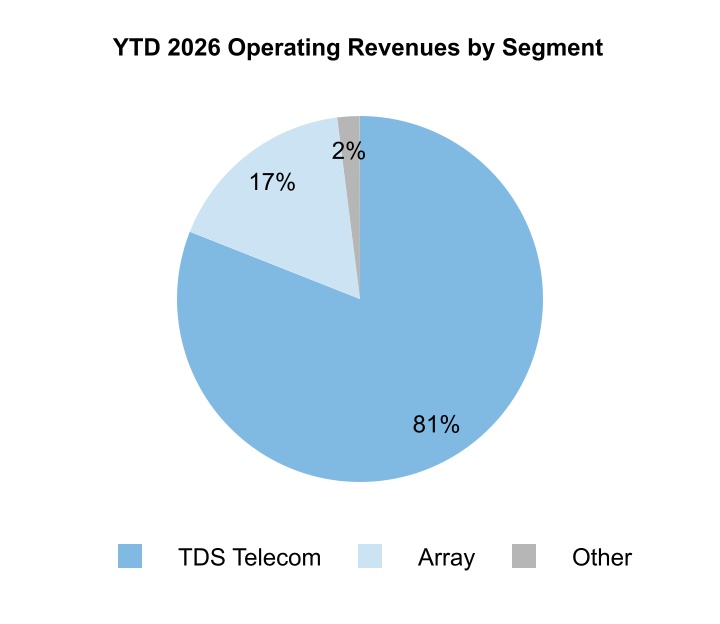
TDS is a diversified telecommunications company that provides high-quality communications services. TDS provides broadband, video, voice and wireless services through its wholly-owned subsidiary, TDS Telecommunications LLC (TDS Telecom). Array Digital Infrastructure, Inc. (Array), an 81.9%-owned subsidiary of TDS, leases tower space to tenants and provides ancillary services, holds noncontrolling interests in primarily wireless operating companies and holds certain wireless spectrum licenses. TDS operates entirely in the United States. See Note 11 — Business Segment Information in the Notes to Consolidated Financial Statements for additional information about TDS' segments.
TDS’ mission is to provide outstanding communications services to its customers and meet the needs of its shareholders, its people, and its communities. In pursuing this mission, TDS seeks to grow its businesses, create opportunities for its associates, support the communities it serves, and build and return value for its shareholders. Since its founding, TDS has been committed to bringing high-quality communications services to rural and underserved communities.
TDS’ strategy has been to re-invest the majority of its operating capital in its businesses to strengthen their competitive positions and financial performance, while also returning value to TDS shareholders.
TDS plans to build shareholder value by continuing to execute on its strategies to build strong, competitive businesses providing high-quality, data-focused services and products. Strategic efforts include:
▪TDS Telecom strives to provide high-quality broadband services in its markets with the ability to provide value-added bundling with video, voice and wireless service options.
▪TDS Telecom seeks to drive growth by investing in fiber deployment and grow its operations by creating clusters of markets in attractive, growing locations and may seek to acquire and/or divest of assets to support its strategy.
▪Array seeks to grow tower revenue primarily through increasing colocations on existing towers and amendments to existing colocations. Array seeks to provide unique tower locations, attractive terms and streamlined implementation to wireless network operators, internet service providers, government and public safety agencies, broadcast and media companies, and other businesses.
▪Array holds noncontrolling interests in primarily wireless operating companies that generate material amounts of income and cash distributions.
▪Array holds wireless spectrum that is subject to sale agreements described below, and additional wireless spectrum not subject to pending sale agreements that Array seeks to opportunistically monetize.
Strategic Alternatives Review
On August 1, 2025, Array sold its wireless operations and select spectrum assets to T-Mobile US, Inc. (T-Mobile) under a Securities Purchase Agreement (Securities Purchase Agreement). Total consideration received was $4,293.8 million after adjustments which included a combination of $2,628.8 million in cash proceeds and $1,665.0 million in debt assumed by T-Mobile through the preliminary results of an exchange offer made to Array's debtholders, which subsequently closed on August 5, 2025. The final cash proceeds are subject to adjustment according to the terms and conditions of the Securities Purchase Agreement. As of March 31, 2026, Array recorded an estimated purchase price true-up due to T-Mobile of $20.2 million. At closing, a $16.7 million deferral of the purchase price was recorded related to certain spectrum licenses included in the transaction that did not transfer to T-Mobile and are subject to FCC approval. In addition, at closing, Array and T-Mobile entered into a Short-Term Spectrum Manager Lease Agreement and Short-Term Spectrum Manager Sublease Agreements which provide T-Mobile with an exclusive license to use certain Array spectrum assets and leases at no cost for up to one year from closing for the sole purpose of providing continued, uninterrupted service to customers. Further, at closing, Array and T-Mobile entered into a Master License Agreement (MLA), pursuant to which, among other things, T-Mobile has agreed to license from Array space on towers owned by Array. The wireless operations and select spectrum assets sold to T-Mobile are presented as discontinued operations throughout this report. See Note 2 — Discontinued Operations in the Notes to Consolidated Financial Statements for additional information.
On January 13, 2026, Array closed on the sale of certain 3.45 GHz and 700 MHz wireless spectrum licenses to AT&T for total proceeds of $1,018.0 million and TDS recorded a book gain on the transaction of $150.9 million ($114.7 million net of tax expense) during the first quarter of 2026. The book gain recorded at TDS is lower than the book gain recorded at Array due primarily to transaction costs paid by TDS.
In addition to the sale of Array's wireless operations and select spectrum assets to T-Mobile pursuant to the Securities Purchase Agreement and the sale of certain spectrum assets to AT&T pursuant to a License Purchase Agreement, Array also separately entered into the following material agreements to sell spectrum assets.
Spectrum Licenses
Buyer
Purchase Price
TDS Book Value as of March 31, 2026
Signing Date
Estimated or Actual Close Date
(Dollars in thousands)
AWS, Cellular and PCS1
Verizon
$
1,000,000
$
588,760
October 17, 2024
Q2/Q3 2026
700 MHz2
T-Mobile
$
74,800
$
53,147
August 29, 2025
May 5, 2026
700 MHz2
T-Mobile
$
10,200
$
11,204
August 29, 2025
2026
600 MHz3
T-Mobile
$
86,387
$
86,387
October 7, 2025
May 2026
1 This license transaction remains subject to regulatory approval and other customary closing conditions.
2 This license transaction involves multiple closing dates. The first group of spectrum licenses received regulatory approval and closed on May 5, 2026. The additional spectrum licenses remain subject to regulatory approval and other customary closing conditions.
3 This license transaction received regulatory approval and is expected to close in May 2026, subject to customary closing conditions.
See Note 6 — Divestitures and Note 12 — Subsequent Events in the Notes to Consolidated Financial Statements for additional information related to the spectrum license transactions.
The strategic alternatives review process is ongoing as Array works toward closing the Verizon and T-Mobile spectrum transactions signed during 2024 and 2025, and seeks to opportunistically monetize its remaining spectrum assets that are not subject to executed agreements.
Recent Development
On May 7, 2026, TDS delivered to the Array Board of Directors a letter setting forth a non-binding proposal to acquire all of the outstanding Array Common Shares that are not owned by TDS (the “Array Proposal”). A special committee of independent and disinterested directors of the Array Board of Directors has been formed to evaluate this proposal. For additional information on the Array Proposal, see TDS’ Current Report on Form 8-K, filed with the U.S. Securities and Exchange Commission on May 8, 2026.
In addition to the transactions at Array and the Array Proposal, TDS continues to explore opportunities to transform its business operations given the change in scale of the overall TDS organization following the divestiture of the wireless operations. Together, these initiatives are referred to as the strategic alternatives review throughout this report.
The following is a list of definitions of certain industry terms that are used throughout this document:
▪Adjusted EBITDA – non-GAAP metric referring to earnings before interest, taxes, depreciation, amortization and accretion, gains and losses and other specified items. See Supplemental Information Relating to Non-GAAP Financial Measures within this MD&A for additional information.
▪Adjusted OIBDA – non-GAAP measure referring to operating income before depreciation, amortization and accretion, gains and losses and other specified items. See Supplemental Information Relating to Non-GAAP Financial Measures within this MD&A for additional information.
▪Broadband Connections – refers to the individual customers provided internet access through various transmission technologies, including fiber, coaxial and copper.
▪Cable Markets – markets where TDS provides service as the cable provider using coaxial cable and fiber technologies.
▪Colocations – represents instances where a third-party leases space on a company-owned tower.
▪Enhanced Alternative Connect America Cost Model (E-ACAM) – a USF support mechanism for certain carriers, which provides revenue support through 2038. This support comes with an obligation to provide 100 megabits per second (Mbps) of download speed and 20 Mbps of upload speed (100/20 Mbps) to a certain number of locations.
▪Expansion Markets – markets utilizing fiber networks in areas where TDS does not serve as the cable or incumbent service provider.
▪Free Cash Flow – non-GAAP metric defined as Cash flows from operating activities less Cash paid for additions to property, plant and equipment and less Cash paid for software license agreements. See Supplemental Information Relating to Non-GAAP Financial Measures within this MD&A for additional information.
▪Incumbent Markets – markets where TDS is positioned as the traditional local telephone company.
▪IPTV – internet protocol television.
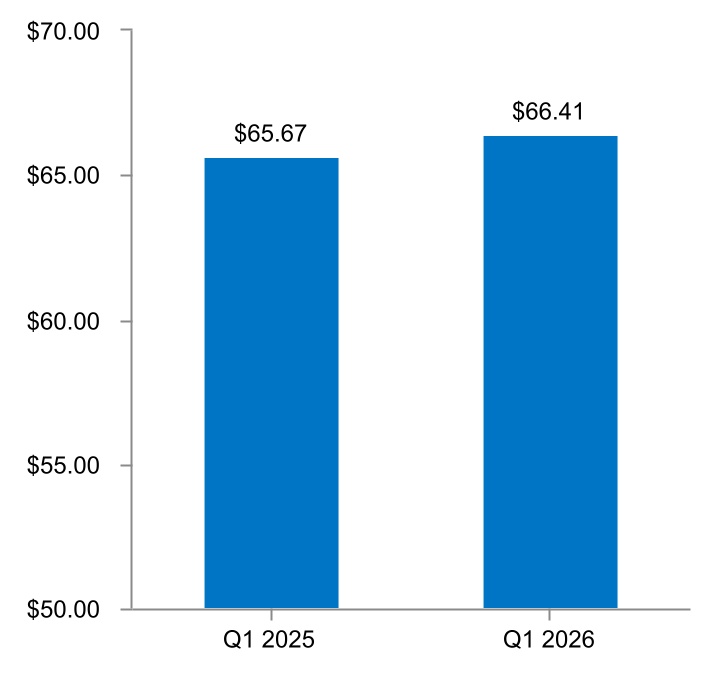
▪Residential Revenue per Connection – metric which is calculated by dividing total residential revenue by the average number of residential connections and by the number of months in the period.
▪Residential Fiber Churn Rate – represents the percentage of incumbent and expansion fiber connections that disconnected service each month. These rates represent the average monthly churn rate for each respective period.
▪Service Addresses – number of single residence homes, multi-dwelling units, and business locations that are capable of being connected to the TDS network, based on best available information.
▪Tower Tenancy Rate – calculated as total number of colocations divided by total number of towers.
▪Universal Service Fund (USF) – a system of telecommunications collected fees and support payments managed by the Federal Communications Commission (FCC) intended to promote universal access to telecommunications services in the United States.
▪Video Connections – represents the individual customers provided video services.
▪Voice Connections – refers to customer services that provide voice calling capability with the public switched telephone network, including both traditional wireline voice services and interconnected VoIP services delivered over broadband.
▪Wireless Connections – refers to an individual mobile line provisioned through TDS' mobile virtual network operator (MVNO) arrangement and delivered under the TDS-branded wireless offering.
Equity in earnings of unconsolidated entities represents TDS' share of net income from entities in which it has a noncontrolling interest and that are accounted for using the equity method or the net asset value practical expedient. See Note 7 — Investments in Unconsolidated Entities in the Notes to Consolidated Financial Statements for additional information.
Interest expense
Interest expense decreased for the three months ended March 31, 2026 due primarily to the repayment of TDS debt facilities in August 2025 and January 2026, partially offset by the new term loan that Array entered into in August 2025 and a decrease in capitalized interest. Interest expense from continuing operations excludes interest costs in all periods associated with Array term loans repaid, and Array debt exchanged, in conjunction with the sale of Array's wireless operations to T-Mobile. See Market Risk for additional information regarding maturities of long-term debt and weighted average interest rates.
Income tax expense (benefit)
Income tax expense on continuing operations increased for the three months ended March 31, 2026, due primarily to the increase in Income before income taxes.
Net income from continuing operations attributable to noncontrolling interests, net of tax
Three Months Ended March 31,
2026
2025
(Dollars in thousands)
Array noncontrolling public shareholders’
$
32,494
$
786
Noncontrolling shareholders’ or partners’
319
938
Net income from continuing operations attributable to noncontrolling interests, net of tax
$
32,813
$
1,724
Net income from continuing operations attributable to noncontrolling interests, net of tax includes the noncontrolling public shareholders’ share of Array’s net income from continuing operations, the noncontrolling shareholders’ or partners’ share of certain Array subsidiaries’ net income from continuing operations and other TDS noncontrolling interests.
Net income (loss) from discontinued operations attributable to TDS shareholders
See Note 2 — Discontinued Operations in the Notes to Consolidated Financial Statements for additional information related to the components of Net income (loss) from discontinued operations.
Earnings
(Dollars in millions)
Three Months Ended
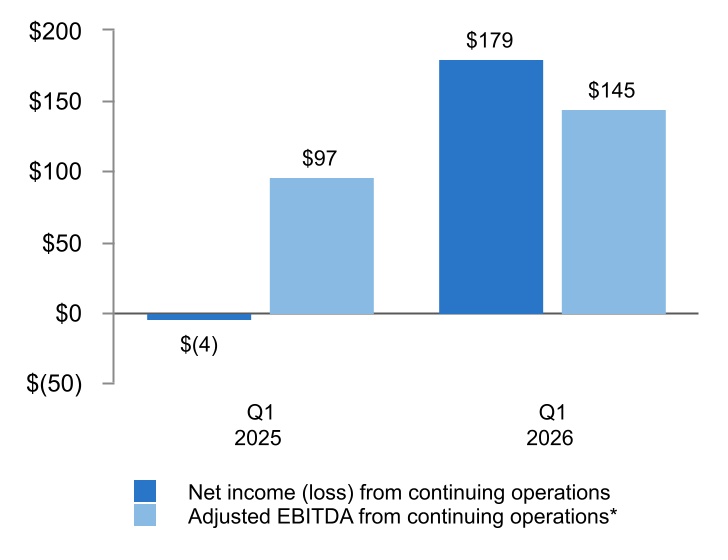
Net income increased due primarily to higher operating revenues, lower operating expenses, short-term imputed spectrum lease income and lower interest expense, partially offset by higher income tax expense.
Adjusted EBITDA increased due primarily to higher operating revenues and lower operating expenses.
*Represents a non-GAAP financial measure. Refer to Supplemental Information Relating to Non-GAAP Financial Measures within this MD&A for a reconciliation of this measure.
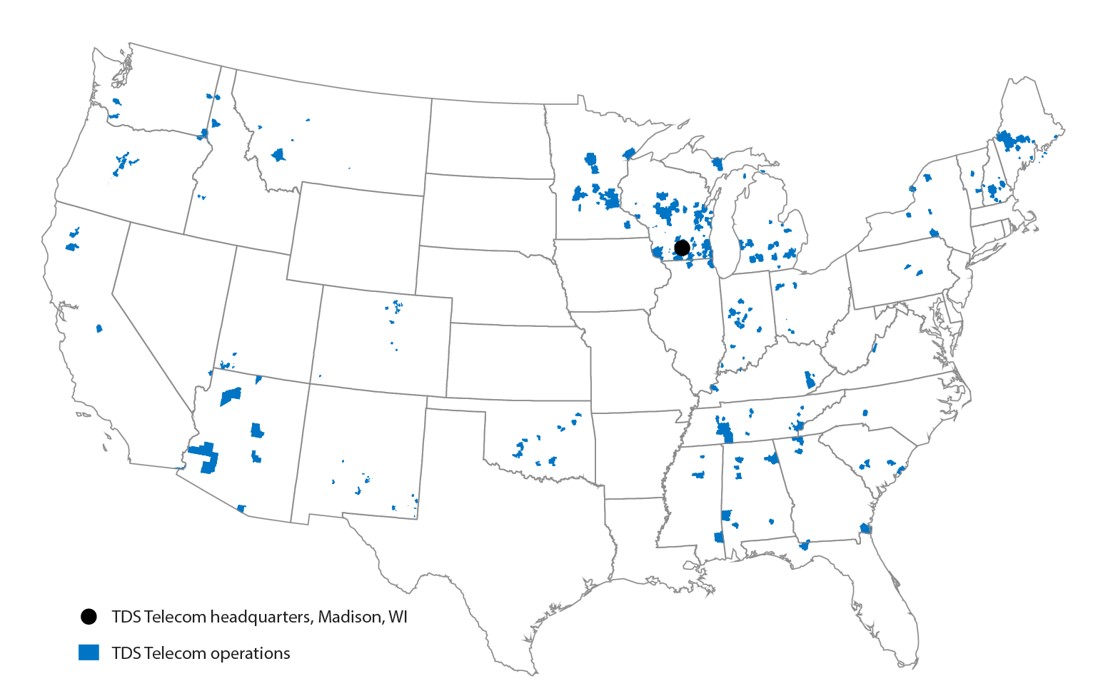
TDS Telecom owns, operates and invests in high-quality networks, services and products in a mix of small to mid-sized urban, suburban and rural communities throughout the United States. TDS Telecom is a wholly-owned subsidiary of TDS and provides a wide range of broadband, video, voice and wireless communications services to residential, commercial and wholesale customers, with a constant focus on delivering outstanding customer service.
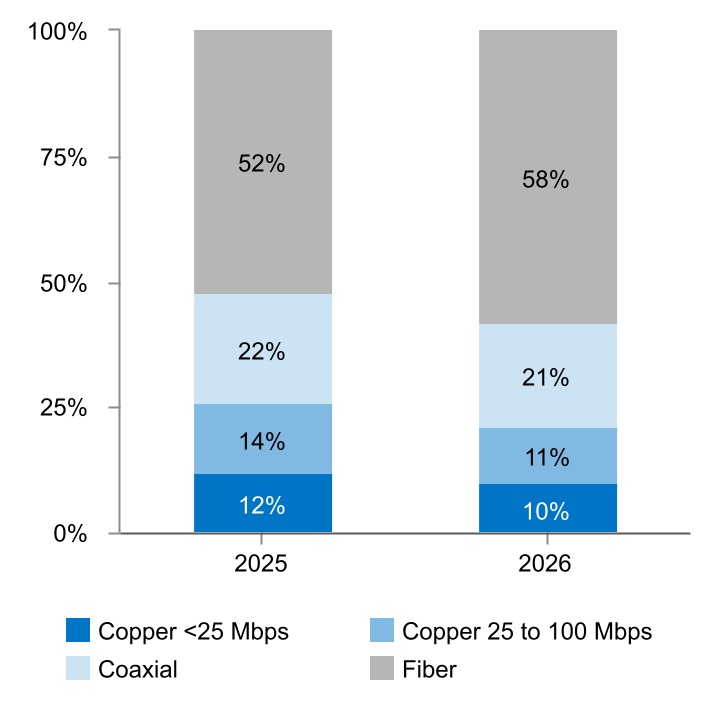
TDS Telecom increased its service addresses 5% from a year ago to 1.9 million as of March 31, 2026 through footprint expansion. TDS Telecom serves 50% of incumbent service addresses with fiber.
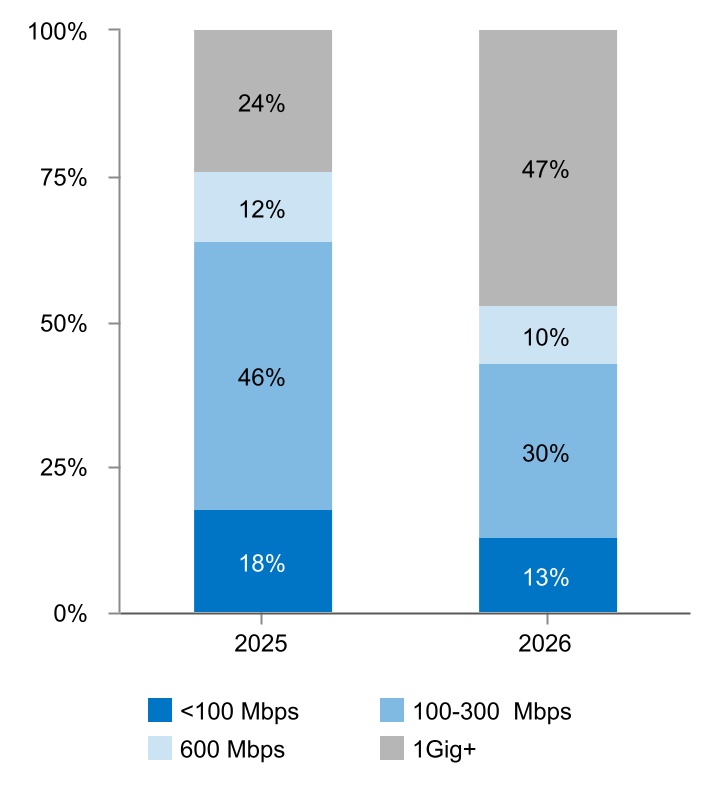
TDS Telecom offers 1Gig+ service to 79% of its total footprint as of March 31, 2026, compared to 74% a year ago.
As of or for the Quarter Ended March 31,
2026
2025
2026 vs. 2025
Residential connections
Broadband
Incumbent Fiber
130,200
119,700
9
%
Incumbent Copper
84,200
112,600
(25)
%
Expansion Fiber
168,500
133,200
26
%
Cable
179,100
190,200
(6)
%
Total Broadband
561,900
555,800
1
%
Video
107,200
118,700
(10)
%
Voice
216,900
256,900
(16)
%
Wireless
5,300
900
N/M
Total Residential Connections
891,400
932,300
(4)
%
Commercial connections
166,500
187,600
(11)
%
Total connections
1,058,000
1,119,900
(6)
%
Total residential fiber net adds
10,900
8,300
Total residential broadband net adds
100
2,800
Residential fiber churn
1.3
%
0.9
%
Total residential broadband churn
1.8
%
1.3
%
N/M - Percentage change not meaningful
Numbers may not foot due to rounding.
Total connections decreased due to legacy voice, video, and competitive local exchange carrier (CLEC) connection declines, partially offset by broadband and wireless connection growth.
Divestitures in 2025 resulted in a decrease of 19,000 connections, including 7,500 residential broadband connections.
Residential broadband customers continue to take higher speeds with 87% on 100 Mbps or higher products and 47% on 1Gig+ products.
Residential Revenue per Connection
Total residential revenue per connection increased by 1% for the three months ended March 31, 2026, due primarily to price increases, partially offset by customer product mix.
•Video services, including IPTV, traditional cable programming and satellite offerings
•Voice services
•Wireless services
Commercial revenues consist of:
•High-speed and dedicated business internet services
•Video services
•Voice services
Wholesale revenues consist of:
•Network access services primarily related to interexchange and wireless carriers for carrying data and voice traffic on TDS Telecom's networks
•Federal and state regulatory support, including E-ACAM
Key components of changes in the statement of operations items were as follows:
Total operating revenues
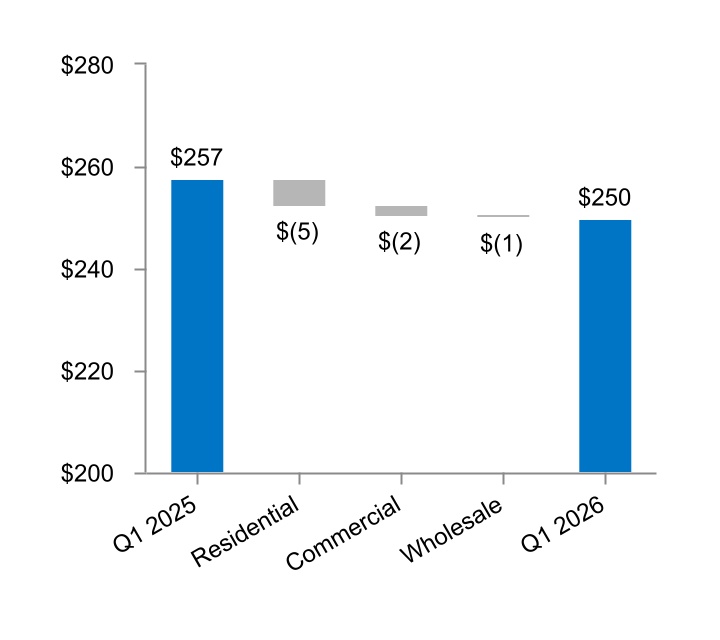
Residential revenues decreased for the three months ended March 31, 2026, due primarily to divestitures and declines in legacy markets, partially offset by growth in expansion markets and price increases.
Commercial revenues decreased for the three months ended March 31, 2026, due primarily to declining connections in legacy markets and divestitures.
Wholesale revenues decreased for the three months ended March 31, 2026, due primarily to divestitures and the continued decline of special access circuits, partially offset by discrete reserve adjustments.
Total operating revenues decreased for the three months ended March 31, 2026 by $5.9 million due to the 2025 divestitures.
Cost of operations
Cost of operations decreased for the three months ended March 31, 2026, due primarily to a decrease in employee-related costs, lower video programming costs, and lower circuit costs, partially offset by higher plant costs.
Selling, general and administrative
Selling, general and administrative expenses decreased for the three months ended March 31, 2026, due primarily to a decrease in employee-related costs, lower IT application costs, and lower regulatory fees, partially offset by higher bad debts expense.
Depreciation, amortization and accretion
Depreciation, amortization and accretion increased for the three months ended March 31, 2026, due primarily to capital expenditures on fiber assets.
Array connects America through digital infrastructure by leasing tower space to tenants and providing ancillary services. Array also holds noncontrolling interests in primarily wireless operating companies and holds certain wireless spectrum licenses. As of March 31, 2026, Array is an 81.9%-owned subsidiary of Telephone and Data Systems, Inc. (TDS).
Towers
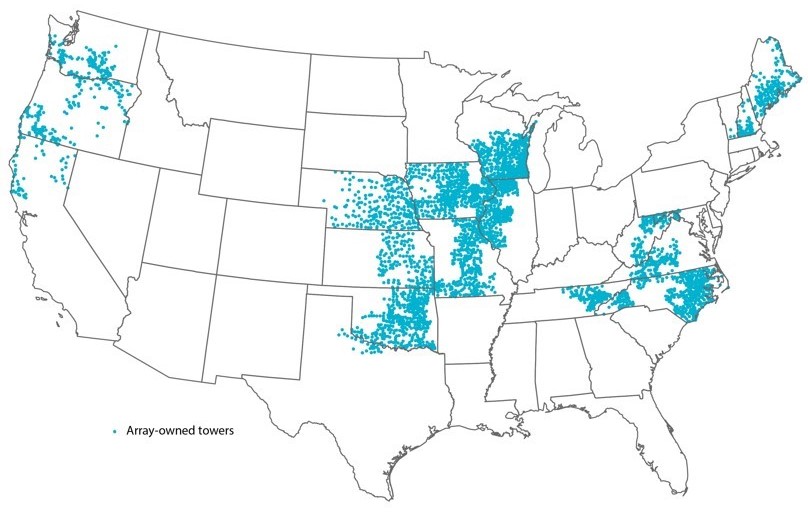
Array seeks to grow tower revenue primarily through increasing colocations on existing towers and amendments to existing colocations. Array seeks to provide unique tower locations, attractive terms and streamlined implementation to wireless network operators, internet service providers, government and public safety agencies, broadcast and media companies, and other businesses. As of March 31, 2026, Array owns 4,452 towers in 19 states.
Noncontrolling interest investments
Array holds noncontrolling interests in primarily wireless operating companies that generate material amounts of income and cash distributions. These entities primarily consist of wireless entities managed by Verizon and AT&T. The noncontrolling entities that are managed by Array consist primarily of tower operations.
Retained spectrum
Array holds wireless spectrum that is subject to sale agreements described above, and additional wireless spectrum not subject to pending sale agreements that Array seeks to opportunistically monetize. As of March 31, 2026, the book value of the remaining spectrum not subject to pending sale agreements was $1,584.7 million and includes primarily C-Band spectrum. Array incurred costs related to the management of the retained spectrum of $1.9 million as a standalone tower company during the three months ended March 31, 2026.
1Includes T-Mobile MLA committed site minimum of 2,015. Excludes Interim Sites whereby T-Mobile is leasing up to 1,800 sites for a period of up to 30 months subject to the terms and conditions of the MLA. As of March 31, 2026, the Number of colocations and the Tower tenancy rate exclude DISH Wireless due to the low probability of collection on outstanding amounts. See Financial Overview within this MD&A for additional information.
The following discussion and analysis compares financial results for the three months ended March 31, 2026, to the three months ended March 31, 2025.
Three Months Ended March 31,
2026
2025
2026 vs. 2025
(Dollars in thousands)
Operating revenues
Site rental
$
51,024
$
26,595
92
%
Services
988
389
N/M
Total operating revenues
52,012
26,984
93
%
Operating expenses
Cost of operations (excluding Depreciation and accretion reported below)
21,609
16,290
33
%
Selling, general and administrative
12,745
29,202
(56)
%
Depreciation and accretion
12,604
11,993
5
%
(Gain) loss on asset disposals, net
904
226
N/M
(Gain) loss on license sales and exchanges, net
(156,635)
(1,100)
N/M
Total operating expenses
(108,773)
56,611
N/M
Operating income (loss)
160,785
(29,627)
N/M
Other income (expense)
Equity in earnings of unconsolidated entities
40,408
35,927
12
%
Interest and dividend income
4,223
2,658
59
%
Interest expense
(7,180)
(3,667)
(96)
%
Short-term imputed spectrum lease income
34,200
—
N/M
Other, net
(14)
—
N/M
Total other income
71,637
34,918
N/M
Income before income taxes
232,422
5,291
N/M
Income tax expense (benefit)
52,398
(192)
N/M
Net income from continuing operations
$
180,024
$
5,483
N/M
Adjusted OIBDA from continuing operations (Non-GAAP)1
$
17,845
$
(17,363)
N/M
Adjusted EBITDA from continuing operations (Non-GAAP)1
$
62,462
$
21,222
N/M
Capital expenditures from continuing operations2
$
8,645
$
4,840
79
%
N/M - Percentage change not meaningful
1Refer to Supplemental Information Relating to Non-GAAP Financial Measures within this MD&A for a reconciliation of this measure.
2Refer to Liquidity and Capital Resources within this MD&A for additional information on Capital expenditures.
Key components of changes in the statement of operations items were as follows:
Site rental revenues
Site rental revenues increased for the three months ended March 31, 2026, primarily as a result of the execution of the T-Mobile MLA, pursuant to which T-Mobile leases space on an additional minimum 2,015 Array-owned towers, which were not under existing leases for T-Mobile, for a minimum of 15 years and leases space on approximately 1,800 Array-owned towers on an interim basis. The duration of the interim lease is 30 months, and T-Mobile may cancel such interim leases at their option on a tower-by-tower basis at any time. Array expects revenue will decline in future periods as T-Mobile terminates these interim leases. Further, the MLA extended the license term for approximately 600 existing T-Mobile colocations on Array towers for a new 15-year term that commenced on August 1, 2025.
This was partially offset by a $4.4 million decrease in site rental revenues from DISH Wireless, including a $2.9 million write-off of contractual assets and liabilities. In September 2025, Array received a letter from DISH Wireless claiming that its obligations under its Master Lease Agreement with Array were excused due to actions taken by the FCC and subsequent agreements to sell spectrum assets. DISH Wireless has subsequently failed to make certain payments due to Array under their contractual commitment. Array believes that DISH Wireless' claim that its obligations under its Agreement with Array are excused is without merit. Beginning in the first quarter of 2026, Array cannot predict with certainty that outstanding amounts will be collected and revenue will only be recognized on a cash basis as payments are received. Site rental revenues from DISH Wireless were $6.5 million in 2025. DISH Wireless is contractually committed to levels of revenue commensurate with 2025, subject to escalators, through 2031, and a declining revenue commitment in 2032-2035.
Services revenues
Services revenues increased for the three months ended March 31, 2026 due primarily to an increase in application and related fees as a result of Array fully insourcing sales and leasing operations in March 2025.
Cost of operations
Cost of operations increased in the three months ended March 31, 2026 due primarily to the classification of property tax and property insurance following the sale of the wireless business, an increase in maintenance expenses and an increase in cell site ground rent due to incremental expense related to customer growth, new leases, lease amendments and escalations.
Selling, general and administrative
Selling, general and administrative expenses decreased for the three months ended March 31, 2026 due primarily to decreases in shared overhead costs, employee expenses and the classification of property tax and property insurance attributed to the sale of the wireless business. Selling, general and administrative expenses in 2026 include costs to support the winddown of the legacy wireless operations. These expenses are expected to persist at a declining rate into future periods.
(Gain) loss on license sales and exchanges, net
(Gain) loss on license sales and exchanges, net increased for the three months ended March 31, 2026 due to the closing of the sale of certain 3.45 GHz and 700 MHz wireless spectrum licenses to AT&T. See Note 6 — Divestitures in the Notes to Consolidated Financial Statements for additional information.
Equity in earnings of unconsolidated entities
Equity in earnings of unconsolidated entities represents Array’s share of net income from entities in which it has a noncontrolling interest and that are accounted for using the equity method or the net asset value practical expedient. See Note 7 — Investments in Unconsolidated Entities in the Notes to Consolidated Financial Statements for additional information.
Interest expense
Interest expense from continuing operations excludes interest costs in all periods associated with term loans repaid, and debt exchanged, in conjunction with the sale of Array's wireless operations to T-Mobile. As a result, the increase in interest expense is primarily attributable to the new term loan that Array entered into in August 2025 and a decrease in capitalized interest.
Short-term imputed spectrum lease income
Short-term imputed spectrum lease income increased for the three months ended March 31, 2026 due to the execution of the Short-Term Spectrum Manager Lease Agreement and Short-Term Spectrum Manager Sublease Agreements, which provide T-Mobile with an exclusive license to use certain Array spectrum assets and leases at no cost for up to one year from closing. The portion of the purchase price allocated to the use of this spectrum will be amortized over one year following the close. Effective April 1, 2026, the Short-Term Spectrum Manager Lease was terminated for certain spectrum assets. The termination of these leases will result in future imputed spectrum lease income of $11.7 million being recognized to (Gain) loss on sale of business and other exit costs, net within discontinued operations during the second quarter of 2026.
Income tax expense (benefit)
Income tax expense on continuing operations increased for the three months ended March 31, 2026, due primarily to the increase in Income before income taxes.
TDS believes that existing cash and investment balances, dividends, distributions from unconsolidated entities, expected cash flows from operating activities and funds available under its financing agreements will provide sufficient liquidity for TDS to meet its funding needs. TDS requires funding for, among other uses, day-to-day operations, capital expenditures, fiber deployments and E-ACAM builds, payment of dividends, debt service requirements, repurchases of shares and potential acquisitions of land, land easements or additional towers.
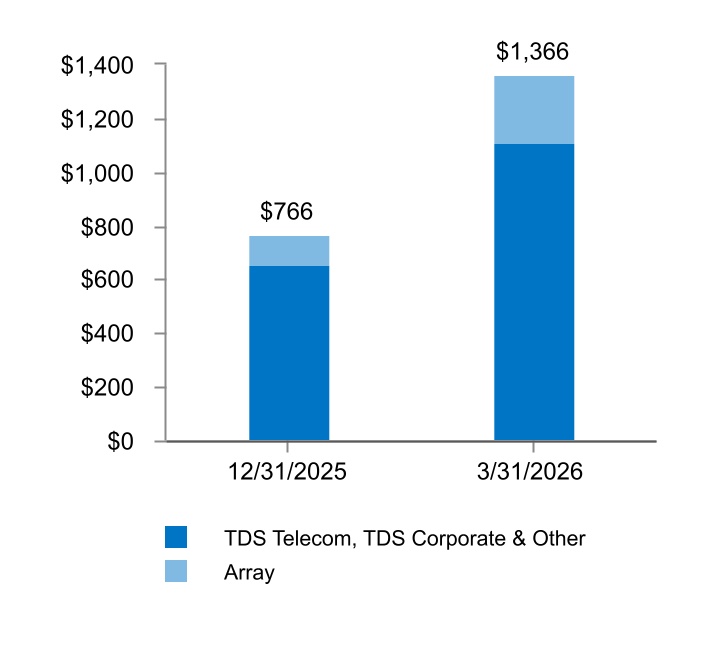
Cash and Cash Equivalents
Cash and cash equivalents include cash and money market investments. TDS does not have direct access to Array cash.
In January 2026, Array closed on the sale of certain 3.45 GHz and 700 MHz wireless spectrum licenses to AT&T for total proceeds of $1,018.0 million and expects a cash income tax liability on the transaction of approximately $130.0 million, which will be paid in future quarters in 2026.
Cash and Cash Equivalents
(Dollars in millions)
The majority of TDS’ Cash and cash equivalents are held in money market funds that purchase only debt issued by the U.S. Treasury or U.S. government agencies and bank deposit accounts. Refer to the Consolidated Cash Flow Analysis for additional information related to changes in Cash and cash equivalents.
Financing
Revolving Credit Agreements
TDS and Array have unsecured revolving credit agreements with maximum borrowing capacities of $400.0 million and $100.0 million, respectively. Amounts under the agreements may be borrowed, repaid and reborrowed from time to time until maturity in December 2030. As of March 31, 2026, there were no outstanding borrowings under the agreements, except for letters of credit, and TDS' and Array's unused borrowing capacity was $399.5 million and $99.9 million, respectively.
Term Loan Agreement
As of March 31, 2026, Array has outstanding borrowings of $325.0 million under a term loan agreement with CoBank, ACB. The maturity date of the term loan is June 2030. Borrowings bear interest at a rate of Secured Overnight Financing Rate (SOFR) plus 2.50%.
Export Credit Financing Agreement
In January 2026, TDS repaid the entire outstanding borrowings under its term loan agreement with Export Development Canada of $150.0 million.
The TDS and Array revolving credit agreements and the Array term loan agreement with CoBank require TDS or Array, as applicable, to comply with certain affirmative and negative covenants, which include certain financial covenants that may restrict the borrowing capacity available. TDS and Array are required to maintain a Consolidated Leverage Ratio, as defined in the agreements, as of the end of any fiscal quarter at a level not to exceed 3.50 to 1.00. TDS and Array are also required to maintain the Consolidated Interest Coverage Ratio at a level not lower than 3.00 to 1.00 as of the end of any fiscal quarter. TDS and Array believe that they were in compliance as of March 31, 2026 with all such financial covenants.
Capital Expenditures
TDS makes substantial investments to acquire, construct and upgrade telecommunications networks and facilities to remain competitive and as a basis for creating long-term value for shareholders. In recent years, changes in technology have required substantial investments in TDS’ networks to remain competitive; this is expected to continue in 2026 and future years with the continued deployment of fiber for TDS Telecom.
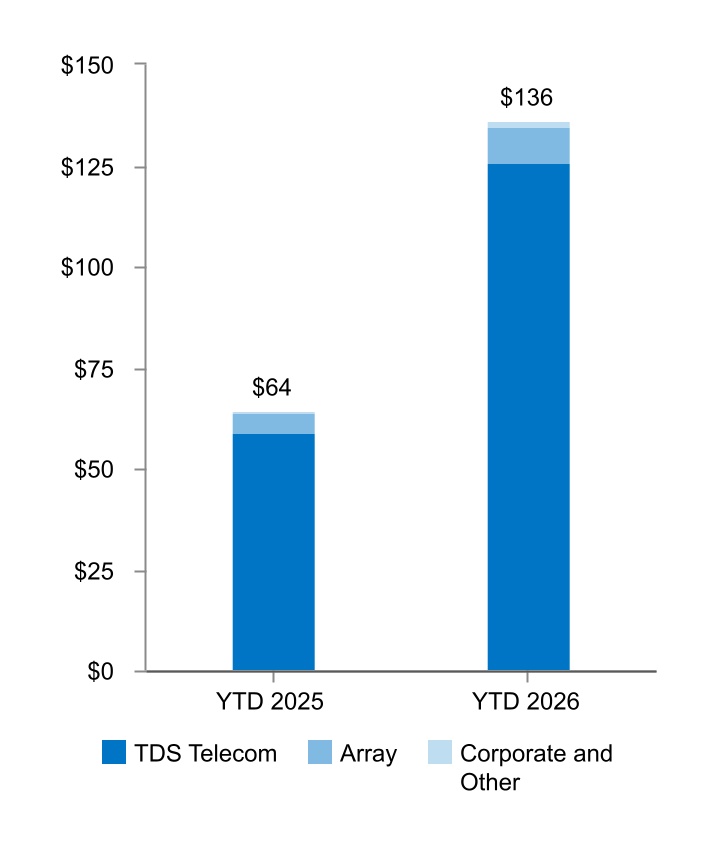
Capital expenditures for continuing operations (i.e., additions to property, plant and equipment), which include the effects of accruals and capitalized interest, for the three months ended March 31, 2026 and 2025, were as follows:
Capital Expenditures
(Dollars in millions)
TDS Telecom’s capital expenditures for the three months ended March 31, 2026 and 2025, were $126.0 million and $58.9 million, respectively.
Capital expenditures for the full year 2026 are expected to be between $550.0 million and $600.0 million. These expenditures are expected to be used principally for the following purposes:
▪Continue fiber deployment in expansion markets and to meet E-ACAM build-out requirements;
▪Support broadband growth and success-based spending; and
▪Maintain and enhance existing infrastructure.
Array's capital expenditures for the three months ended March 31, 2026 and 2025, were $8.6 million and $4.8 million, respectively.
Array's capital expenditures for 2026 are expected to be between $25.0 million and $35.0 million. These capital expenditures are expected to be used for purchases of land interests which are opportunistic in nature, tower maintenance, tower builds and one-time costs of migrating the tower light monitoring function to Array's long-term solution.
TDS intends to finance its capital expenditures for 2026 using primarily Cash flows from operating activities, dividends and existing cash balances.
Divestitures
TDS is engaged and may in the future be engaged in negotiations (subject to all applicable regulations) relating to the divestiture of companies, properties and assets. In general, TDS does not disclose such transactions until there is a definitive agreement.
See Note 6 — Divestitures in the Notes to Consolidated Financial Statements for additional information related to divestitures.
TDS will require capital for future spending on existing contractual obligations, including long-term debt obligations; preferred stock dividend obligations; lease commitments; E-ACAM obligations; and tax payments related to announced wireless spectrum license transactions. Refer to Liquidity and Capital Resources within this MD&A for additional information.
Dividends
TDS paid quarterly dividends per outstanding share of $0.04 in the first quarter of 2026 and 2025. It is uncertain at this time how the outcome of the strategic review process for Array, TDS' available opportunities to reinvest in its businesses, or TDS' ongoing liquidity needs, may impact the decisions of the TDS Board of Directors regarding the declaration of future cash dividends.
TDS paid quarterly dividends per outstanding Series UU depositary share (each representing 1/1,000th of a Preferred Share) of $0.414 in the first quarter of 2026 and 2025.
TDS paid quarterly dividends per outstanding Series VV depositary share (each representing 1/1,000th of a Preferred Share) of $0.375 in the first quarter of 2026 and 2025.
Array has not paid any regular cash dividends in past periods. In conjunction with the close of the transaction of the sale of spectrum licenses to AT&T on January 13, 2026, on this same date, the Array Board of Directors declared a special dividend per Common and Series A outstanding share of $10.25 for shareholders of record on January 23, 2026, which was paid on February 2, 2026 for a total amount of $885.5 million. TDS received its pro-rata share of the special dividend in the amount of $725.6 million. Array expects its pending sale of spectrum licenses to Verizon, which is subject to regulatory approval and customary closing conditions, to deliver substantial proceeds and expects its Board of Directors to declare a special dividend upon closure of the transaction. While no decisions have been made, the Array Board of Directors may declare regular cash dividends in the future.
The following discussion summarizes TDS' cash flow activities for the three months ended March 31, 2026 and 2025. Cash flows may fluctuate from quarter to quarter and year to year due to timing and other factors. This discussion is intended to highlight the significant changes and is not intended to fully reconcile the changes.
2026 Commentary
TDS’ Cash, cash equivalents and restricted cash increased $600.7 million. Net cash provided by operating activities related to continuing operations was $68.1 million due to net income of $179.4 million adjusted for non-cash items of $134.7 million, distributions received from unconsolidated entities of $18.4 million and changes in working capital items which increased net cash by $5.0 million. The working capital changes were primarily driven by the timing of tax payments on the sale of spectrum licenses to AT&T, partially offset by the payment of associate bonuses, deferred revenue related to spectrum leases and the timing of vendor payments. Cash flows used in operating activities related to discontinued operations were $0.6 million.
Cash flows provided by investing activities related to continuing operations were $867.8 million, due primarily to cash received from divestitures of $1,016.5 million, partially offset by payments for property, plant and equipment of $149.0 million. There were no cash flows provided by investing activities related to discontinued operations.
Cash flows used for financing activities related to continuing operations were $334.6 million, due primarily to the payment of $159.9 million in Array dividends to noncontrolling public shareholders, repayments on TDS long-term debt agreements of $150.3 million, and the payment of $21.9 million in TDS dividends. There were no cash flows used for financing activities related to discontinued operations.
2025 Commentary
TDS’ Cash, cash equivalents and restricted cash decreased $12.0 million. Net cash used in operating activities related to continuing operations was $42.5 million due to net loss of $4.2 million adjusted for non-cash items of $56.4 million, distributions received from unconsolidated entities of $11.3 million and changes in working capital items which decreased net cash by $105.9 million. The working capital changes were primarily driven by the payment of associate bonuses and an increase in receivable balances. Cash flows provided by operating activities related to discontinued operations were $228.1 million.
Cash flows used for investing activities related to continuing operations were $58.3 million, due primarily to payments for property, plant and equipment of $64.4 million, partially offset by cash received from divestitures of $8.0 million. Cash flows used for investing activities related to discontinued operations were $64.3 million.
Cash flows used for financing activities related to continuing operations were $66.1 million, due primarily to the payment of $21.9 million in TDS dividends, the repurchase of Array Common Shares of $21.4 million, tax withholdings, net of cash receipts, for TDS and Array stock-based compensation awards of $12.2 million, and repayments on TDS and Array long-term debt agreements of $7.7 million. Cash flows used for financing activities related to discontinued operations were $8.8 million.
The following discussion addresses certain captions in the consolidated balance sheet and changes therein. This discussion is intended to highlight the significant changes and is not intended to fully reconcile the changes. Notable balance sheet changes during 2026 were as follows:
Non-current assets held for sale
Non-current assets held for sale decreased $860.7 million due primarily to the close of the sale of wireless spectrum licenses to AT&T in January 2026. See Note 6 — Divestitures in the Notes to Consolidated Financial Statements for additional information.
Accounts Payable
Accounts payable decreased $18.8 million due to the timing of vendor payments and reduced capital expenditures.
Customer deposits and deferred revenues
Customer deposits and deferred revenues decreased $41.0 million due primarily to the recognition of the deferral of a portion of the T-Mobile purchase price related to T-Mobile's use of certain spectrum assets at no cost for up to one year from closing. See Note 2 — Discontinued Operations in the Notes to Consolidated Financial Statements for additional information.
Accrued taxes
Accrued taxes increased $91.8 million due primarily to the taxable gain on the sale of wireless spectrum licenses to AT&T in January 2026.
Accrued compensation
Accrued compensation decreased $29.1 million due primarily to associate bonus payments in March 2026.
Long-term debt, net
Long-term debt, net decreased $150.7 million due primarily to the repayment of the TDS export credit financing agreement.
Supplemental Information Relating to Non-GAAP Financial Measures
TDS sometimes uses information derived from consolidated financial information but not presented in its financial statements prepared in accordance with GAAP to evaluate the performance of its business. Specifically, TDS has referred to the following measures in this report:
▪EBITDA
▪Adjusted EBITDA
▪Adjusted OIBDA
▪Free cash flow
These measures are considered “non-GAAP financial measures” under U.S. Securities and Exchange Commission Rules. Following are explanations of each of these measures.
EBITDA, Adjusted EBITDA and Adjusted OIBDA
EBITDA, Adjusted EBITDA and Adjusted OIBDA are defined as Net income (loss) from continuing operations adjusted for the items set forth in the reconciliation below. EBITDA, Adjusted EBITDA and Adjusted OIBDA are not measures of financial performance under GAAP and should not be considered as alternatives to Net income (loss) from continuing operations or Cash flows from operating activities - continuing operations, as indicators of cash flows or as measures of liquidity. TDS does not intend to imply that any such items set forth in the reconciliation below are non-recurring, infrequent or unusual; such items may occur in the future.
Adjusted EBITDA is a segment measure reported to the chief operating decision maker for purposes of assessing the segments' performance. See Note 11 — Business Segment Information in the Notes to Consolidated Financial Statements for additional information.
Management uses Adjusted EBITDA and Adjusted OIBDA as measurements of profitability, and therefore reconciliations to applicable GAAP income measures are deemed appropriate. Management believes Adjusted EBITDA and Adjusted OIBDA are useful measures of TDS’ operating results before significant recurring non-cash charges, nonrecurring expenses, gains and losses, and other items as presented below as it provides additional relevant and useful information to investors and other users of TDS’ financial data in evaluating the effectiveness of its operations and underlying business trends in a manner that is consistent with management’s evaluation of business performance. Adjusted EBITDA shows adjusted earnings before interest, taxes, depreciation, amortization and accretion, gains and losses, expenses related to the strategic alternatives review and short-term imputed spectrum lease income, while Adjusted OIBDA reduces this measure further to exclude Equity in earnings of unconsolidated entities and Interest and dividend income in order to more effectively show the performance of operating activities excluding investment activities. The following tables reconcile EBITDA, Adjusted EBITDA and Adjusted OIBDA to the corresponding GAAP measures, Net income (loss) from continuing operations and/or Operating income (loss).
The following table presents Free cash flow from continuing operations, which is defined as Cash flows from operating activities less Cash paid for additions to property, plant and equipment and Cash paid for software license agreements. Free cash flow is a non-GAAP financial measure which TDS believes may be useful to investors and other users of its financial information in evaluating liquidity, specifically, the amount of net cash generated by continuing business operations after deducting Cash paid for additions to property, plant and equipment and Cash paid for software license agreements.
Three Months Ended March 31,
TDS - CONSOLIDATED
2026
2025
(Dollars in thousands)
Cash flows from operating activities - continuing operations (GAAP)
$
68,094
$
(42,460)
Cash paid for additions to property, plant and equipment
Application of Critical Accounting Policies and Estimates
TDS prepares its consolidated financial statements in accordance with GAAP. TDS’ significant accounting policies are discussed in detail in Note 1 — Summary of Significant Accounting Policies and Recent Accounting Pronouncements, Note 3 — Revenue Recognition and Note 11 — Leases in the Notes to Consolidated Financial Statements included in TDS' Form 10-K for the year ended December 31, 2025. TDS’ application of critical accounting policies and estimates is discussed in detail in Management’s Discussion and Analysis of Financial Condition and Results of Operations, included in TDS’ Form 10-K for the year ended December 31, 2025.
This Form 10-Q, including exhibits, contains statements that are not based on historical facts and represent forward-looking statements, as this term is defined in the Private Securities Litigation Reform Act of 1995. All statements, other than statements of historical facts, that address activities, events or developments that TDS intends, expects, projects, believes, estimates, plans or anticipates will or may occur in the future are forward-looking statements. The words “believes,” “anticipates,” “estimates,” “expects,” “plans,” “intends,” “projects” and similar expressions are intended to identify these forward-looking statements, but are not the exclusive means of identifying them. Such forward-looking statements involve known and unknown risks, uncertainties and other factors that may cause actual results, events or developments to be significantly different from any future results, events or developments expressed or implied by such forward-looking statements. Such risks, uncertainties and other factors include, but are not limited to, those set forth below, as more fully described under “Risk Factors” in TDS' Form 10-K for the year ended December 31, 2025. Each of the following risks could have a material adverse effect on TDS’ business, financial condition or results of operations. However, such factors are not necessarily all of the important factors that could cause actual results, performance or achievements to differ materially from those expressed in, or implied by, the forward-looking statements contained in this document. Other unknown or unpredictable factors also could have material adverse effects on future results, performance or achievements. TDS undertakes no obligation to update publicly any forward-looking statements whether as a result of new information, future events or otherwise. You should carefully consider the following factors and other information contained in, or incorporated by reference into, this Form 10-Q to understand the material risks relating to TDS’ business, financial condition or results of operations.
Announced Transactions and Strategic Alternatives Review Risk Factors
▪Closing of the T-Mobile transaction occurred on August 1, 2025, and has required substantial changes to the manner in which Array’s remaining business is conducted, which could have a material adverse effect on Array's financial condition and results of operations.
▪Array entered into License Purchase Agreements with Verizon and T-Mobile to sell certain wireless spectrum licenses. There is no guarantee that such transactions contemplated by the License Purchase Agreements will be consummated. Costs and uncertainties related to these transactions could have adverse effects on Array's financial condition or results of operations.
▪On May 7, 2026, TDS delivered to the Array Board of Directors a non-binding proposal to acquire all of the outstanding Array Common Shares that are not owned by TDS. There can be no guarantee whether any transaction will be accepted, rejected, consummated or abandoned. Further, the proposal (whether accepted, rejected, consummated or abandoned) could result in adverse effects on TDS’ business, financial condition or results of operations.
Operational Risk Factors
▪An inability to monetize the remaining spectrum assets as well as the ongoing costs to retain the spectrum could adversely affect TDS’ operations.
▪A delay or failure by TDS to complete significant network construction and systems implementation activities as part of its plans to expand and improve the quality and capacity of its network and support systems could adversely affect its operations.
▪Increasing competition in the wireline and tower industries could adversely affect TDS’ revenues, negatively impact future growth and increase its costs to compete.
▪There are economic and business risks associated with fixed rate annual escalators on Array's colocation revenue contracts.
▪A substantial portion of Array revenues are derived from a small number of tenants concentrated in the wireless industry and the loss or financial difficulties of such tenants may adversely affect Array’s business, financial condition, results of operations and future growth. Array is particularly reliant on its relationship with T-Mobile. DISH Wireless has failed to make certain payments due to Array under their contractual commitment. Lower demand for wireless services, negative trends in the wireless industry or changes in customer business models may decrease the revenues Array receives from its tenants, which could adversely affect Array’s business, financial condition, results of operations and future growth.
▪TDS’ lack of scale relative to larger competitors that may have greater financial and other resources than TDS could cause TDS to be unable to compete successfully, which could adversely affect its business, financial condition or results of operations.
▪Inability to protect TDS’ real estate rights, with respect to land leases, could have an adverse effect on TDS’ business, financial condition or results of operations.
▪TDS’ business, financial condition or results of operations may be adversely impacted by extreme weather events, climate-related events, natural disasters (including wildfires) and other unforeseen events.
▪An inability to attract people of outstanding talent throughout all levels of the organization, to develop their potential through education and assignments, and to retain them by keeping them engaged, challenged and properly rewarded could have an adverse effect on TDS' business, financial condition or results of operations.
▪Changes in various business factors, including changes in demand, consumer preferences and perceptions, price competition, cost increases and other factors, could have an adverse effect on TDS’ business, financial condition or results of operations.
▪Advances or changes in technology could render certain technologies used by TDS obsolete, could put TDS at a competitive disadvantage, could reduce TDS’ revenues or could increase its costs of doing business. Artificial intelligence advancements may put TDS at a competitive disadvantage, in particular if TDS is not able to keep pace with its competitors, which could have an adverse effect on TDS' business, financial condition or results of operations.
▪Costs, integration problems or other factors associated with acquisitions or divestitures and/or expansion of TDS’ businesses could have an adverse effect on TDS’ business, financial condition or results of operations.
▪Difficulties involving third parties TDS does business with, including changes in the relationship with TDS or financial or operational difficulties, including supply chain disruptions of key suppliers, could adversely affect TDS’ business, financial condition or results of operations.
▪A failure by TDS to maintain flexible and capable telecommunication networks or information technologies, or a material disruption thereof, could have an adverse effect on TDS’ business, financial condition or results of operations.
Financial Risk Factors
▪Uncertainty in TDS’ or Array's future cash flow and liquidity, their level of indebtedness or their inability to access capital, deterioration in the capital markets, changes in interest rates, changes in TDS' or Array’s credit ratings or other factors could limit or restrict the availability of financing on terms and prices acceptable to TDS, which may require TDS to reduce or delay its construction, development or acquisition programs, divest assets, and/or reduce or cease share repurchases and/or the payment of common shareholder dividends.
▪TDS’ assets and revenue are concentrated primarily in the U.S. telecommunications industry. Consequently, its operating results may fluctuate based on factors related primarily to conditions in this industry.
▪TDS has significant investments in wireless operating entities that it does not control. Losses in the value of or cash flows from such investments could have an adverse effect on TDS’ financial condition, cash flows or results of operations.
Regulatory, Legal and Governance Risk Factors
▪Failure by TDS to timely or fully comply with any existing applicable legislative and/or regulatory requirements or changes thereto could adversely affect TDS’ business, financial condition or results of operations.
▪TDS' receipt of financial support through various government programs for its deployment of telecommunications and broadband networks and services, its ability to properly calculate and pay fees and surcharges for its services, and its ability to continue to pass through and collect from its customers certain of those fees and surcharges is subject to uncertainty, the result of which could have an adverse effect on TDS’ business, financial condition or results of operations.
▪Settlements, judgments, restraints on its current or future manner of doing business and/or costs resulting from pending and future legal and policy proceedings could have an adverse effect on TDS’ business, financial condition or results of operations.
▪Certain matters, such as control by the TDS Voting Trust and provisions in the TDS Restated Certificate of Incorporation, may serve to discourage or make more difficult a change in control of TDS or have other consequences.
General Risk Factors
▪TDS has experienced, and in the future expects to experience, cyber-attacks or other breaches of network or information technology security of varying degrees on a regular basis, which could have an adverse effect on TDS' business, financial condition or results of operations.
▪Disruption in credit or other financial markets, a deterioration of U.S. or global economic conditions or other events could, among other things, impede TDS’ access to or increase the cost of financing its operating and investment activities and/or result in reduced revenues and lower operating income and cash flows, which would have an adverse effect on TDS’ business, financial condition or results of operations.
In addition to the information set forth in this Form 10-Q, you should carefully consider the factors discussed in Part I, “Item 1A. Risk Factors” in TDS’ Form 10-K for the year ended December 31, 2025, which could materially affect TDS’ business, financial condition or future results. The risks described in this Form 10-Q and the Form 10-K for the year ended December 31, 2025, may not be the only risks that could affect TDS. Additional unidentified or unrecognized risks and uncertainties could materially adversely affect TDS’ business, financial condition and/or operating results. The following additional risk factor should be read in conjunction with the risk factors previously disclosed in TDS’ Annual Report on Form 10-K for the year ended December 31, 2025.
Announced Transactions and Strategic Alternatives Review Risk Factors
On May 7, 2026, TDS delivered to the Array Board of Directors a non-binding proposal to acquire all of the outstanding Array Common Shares that are not owned by TDS. There can be no guarantee whether any transaction will be accepted, rejected, consummated or abandoned. Further, the proposal (whether accepted, rejected, consummated or abandoned)could result in adverse effects on TDS’ business, financial condition or results of operations.
On May 7, 2026, TDS delivered to the Array Board of Directors a letter setting forth a non-binding proposal to acquire all of the outstanding Array Common Shares that are not owned by TDS. For additional information, see TDS’ Current Report on Form 8-K, filed with the U.S. Securities and Exchange Commission on May 8, 2026. There is no guarantee that any definitive agreement will be entered into or that any transaction will be accepted, rejected, consummated or abandoned, and the terms of any such transaction may differ materially from those originally proposed by TDS. The uncertainty regarding the proposal (whether accepted, rejected, consummated or abandoned) could result in: a diversion of management's attention from TDS’ existing business; a failure to achieve financial and operating objectives; adverse effects on TDS' financial condition or results of operations; a failure to retain key personnel, customers, business partners or contracts; and volatility in TDS' stock price. In addition, the proposal (whether accepted, rejected, consummated or abandoned) may result in the incurrence of significant expenses.
Quantitative and Qualitative Disclosures About Market Risk
Market Risk
As of March 31, 2026, approximately 50% of TDS' long-term debt was in fixed-rate senior notes and approximately 50% in variable-rate debt. Fluctuations in market interest rates can lead to volatility in the fair value of fixed-rate notes and interest expense on variable-rate debt.
The following table presents the scheduled principal payments on long-term debt, lease obligations, and the related weighted average interest rates by maturity dates at March 31, 2026.
Principal Payments Due by Period
Long-Term Debt and Lease Obligations1
Weighted-Avg. Interest Rates on Long-Term Debt Obligations2
(Dollars in thousands)
Remainder of 2026
$
5,176
6.2
%
2027
9,074
6.2
%
2028
8,567
6.2
%
2029
12,647
6.2
%
2030
293,106
6.2
%
Thereafter
365,982
5.9
%
Total
$
694,552
6.0
%
1The total long-term debt obligation differs from Long-term debt in the Consolidated Balance Sheet due to unamortized debt issuance costs on all non-revolving debt instruments and unamortized discounts related to Array's 6.7% Senior Notes.
2Represents the weighted average stated interest rates at March 31, 2026, for debt maturing in the respective periods.
See Note 4 — Fair Value Measurements in the Notes to Consolidated Financial Statements for additional information related to the fair value of TDS’ Long-term debt as of March 31, 2026.
Consolidated Balance Sheet — Liabilities and Equity
(Unaudited)
March 31, 2026
December 31, 2025
(Dollars and shares in thousands, except per share amounts)
Current liabilities
Current portion of long-term debt
$
7,515
$
5,274
Accounts payable
97,068
115,822
Customer deposits and deferred revenues
84,165
125,140
Accrued interest
3,415
2,836
Accrued taxes
138,488
46,721
Accrued compensation
27,630
56,774
Short-term operating lease liabilities
26,297
26,180
Current liabilities of discontinued operations
20,242
20,242
Other current liabilities
38,855
41,322
Total current liabilities
443,675
440,311
Deferred liabilities and credits
Deferred income tax liability, net
699,150
743,633
Long-term operating lease liabilities
548,420
549,617
Other deferred liabilities and credits
584,484
574,025
Long-term debt, net
672,700
823,364
Commitments and contingencies
Equity
TDS shareholders’ equity
Series A Common and Common Shares
Authorized 290,000 shares (25,000 Series A Common and 265,000 Common Shares)
Issued 133,237 shares (7,542 Series A Common and 125,695 Common Shares) and 133,236 shares (7,541 Series A Common and 125,695 Common Shares), respectively
Outstanding 113,850 shares (7,542 Series A Common and 106,308 Common Shares) and 113,783 shares (7,541 Series A Common and 106,242 Common Shares), respectively
Par Value ($0.01 per share)
1,332
1,332
Capital in excess of par value
2,485,605
2,483,654
Preferred Shares, 279,000 shares authorized, par value $0.01 per share, 44,400 shares outstanding (16,800 Series UU and 27,600 Series VV)
1,073,963
1,073,963
Treasury shares, at cost, 19,387 and 19,453 Common Shares, respectively
(471,232)
(473,072)
Accumulated other comprehensive income
21,095
21,506
Retained earnings
1,813,519
1,694,224
Total TDS shareholders' equity
4,924,282
4,801,607
Noncontrolling interests
338,616
465,746
Total equity
5,262,898
5,267,353
Total liabilities and equity1
$
8,211,327
$
8,398,303
The accompanying notes are an integral part of these consolidated financial statements.
1The consolidated total assets as of March 31, 2026 and December 31, 2025, include assets held by current consolidated variable interest entities (VIEs) of $35.1 million and $35.5 million, respectively, which are not available to be used to settle the obligations of TDS. The consolidated total liabilities as of March 31, 2026 and December 31, 2025, include certain liabilities of current consolidated VIEs of $9.4 million and $9.6 million, respectively, for which the creditors of the VIEs have no recourse to the general credit of TDS. See Note 9 — Variable Interest Entities for additional information.
The accounting policies of Telephone and Data Systems, Inc. (TDS) conform to accounting principles generally accepted in the United States of America (GAAP) as set forth in the Financial Accounting Standards Board (FASB) Accounting Standards Codification (ASC). Unless otherwise specified, references to accounting provisions and GAAP in these notes refer to the requirements of the FASB ASC. The consolidated financial statements include the accounts of TDS and subsidiaries in which it has a controlling financial interest, including TDS’ wholly-owned subsidiary, TDS Telecommunications LLC (TDS Telecom) and Array Digital Infrastructure, Inc. (Array), a 81.9%-owned subsidiary of TDS. In addition, the consolidated financial statements include certain entities in which TDS has a variable interest that requires consolidation into the TDS financial statements under GAAP. Intercompany accounts and transactions have been eliminated. The Notes to Consolidated Financial Statements are presented for continuing operations, except for Note 2 — Discontinued Operations.
TDS has the following reportable segments: TDS Telecom and Array. TDS' non-reportable other business activities are presented as "All Other", which includes its wholly-owned subsidiary Suttle-Straus, Inc. (Suttle-Straus). Suttle-Straus’ financial results were not significant to TDS’ operations. All of TDS’ segments operate only in the United States. See Note 11 — Business Segment Information for summary financial information on each business segment.
Certain numbers included herein are rounded to thousands or millions for ease of presentation; however, certain calculated amounts and percentages are determined using the unrounded numbers. These unaudited consolidated financial statements should be read in conjunction with the consolidated financial statements and the notes thereto included in TDS’ Annual Report on Form 10-K (Form 10-K) for the year ended December 31, 2025.
The accompanying unaudited consolidated financial statements contain all adjustments (consisting of normal recurring items, unless otherwise disclosed) necessary for the fair statement of TDS’ financial position as of March 31, 2026 and December 31, 2025, its results of operations, cash flows and changes in equity for the three months ended March 31, 2026 and 2025. The Consolidated Statement of Comprehensive Income was not included because comprehensive income for the three months ended March 31, 2026 and 2025, does not materially differ from net income. These results are not necessarily indicative of the results to be expected for the full year. TDS has not changed its significant accounting and reporting policies from those disclosed in its Form 10-K for the year ended December 31, 2025.
Restricted Cash
TDS presents restricted cash with cash and cash equivalents in the Consolidated Statement of Cash Flows. The following table provides a reconciliation of Cash and cash equivalents and restricted cash reported in the Consolidated Balance Sheet to the total of the amounts in the Consolidated Statement of Cash Flows.
March 31, 2026
December 31, 2025
(Dollars in thousands)
Cash and cash equivalents
$
1,366,604
$
765,952
Restricted cash included in Other current assets
4,198
4,198
Cash, cash equivalents and restricted cash in the statement of cash flows
$
1,370,802
$
770,150
Dividend
On January 13, 2026, the Array Board of Directors declared a special dividend per Common and Series A outstanding share of $10.25 for shareholders of record on January 23, 2026, which was paid on February 2, 2026 for a total amount of $885.5 million. TDS received its pro-rata share of the special dividend in the amount of $725.6 million.
On August 1, 2025, Array sold its wireless operations and select spectrum assets to T-Mobile US, Inc. (T-Mobile) pursuant to a Securities Purchase Agreement (Securities Purchase Agreement). TDS met the criteria to classify the wireless operations and select spectrum assets sold to T-Mobile as discontinued operations following the receipt of regulatory approval and subsequent closing of the transaction, all of which occurred during the three months ended September 30, 2025.
Total consideration received was $4,293.8 million after adjustments which included a combination of $2,628.8 million in cash proceeds and $1,665.0 million in debt assumed by T-Mobile through the preliminary results of an exchange offer made to Array's debtholders, which subsequently closed on August 5, 2025. The final cash proceeds are subject to adjustment according to the terms and conditions of the Securities Purchase Agreement. As of March 31, 2026, Array recorded an estimated purchase price true-up due to T-Mobile of $20.2 million, which is classified as Current liabilities of discontinued operations in the Consolidated Balance Sheet. Certain licenses included in the T-Mobile transaction did not transfer to T-Mobile at the time of close and are subject to FCC approval. At closing, a $16.7 million deferral of the purchase price was recorded related to these spectrum licenses, which is classified as Other deferred liabilities and credits in the Consolidated Balance Sheet. Array also may incur significant decommissioning costs for certain equipment and recorded a liability of $65.8 million as of March 31, 2026, which is classified as Other deferred liabilities and credits in the Consolidated Balance Sheet. During the three months ended March 31, 2026, TDS recognized a loss on the transaction of $0.9 million.
On August 1, 2025, a Short-Term Spectrum Manager Lease Agreement and Short-Term Spectrum Manager Sublease Agreements became effective, which provide T-Mobile with an exclusive license to use certain Array spectrum assets and leases at no cost for up to one year from closing for the sole purpose of providing continued, uninterrupted service to customers. The portion of the purchase price allocated to the use of this spectrum was $149.3 million based on an estimate for fair market value and will be recognized to Short-term imputed spectrum lease income in the continuing operations Consolidated Statement of Operations over the one year term. As of March 31, 2026, the remaining balance of the deferred purchase price is $43.6 million and is classified as Customer deposits and deferred revenues in the Consolidated Balance Sheet. See Note 12 — Subsequent Events for additional information.
Following the close of the transaction, TDS entered into a transition services agreement (TSA) with T-Mobile to provide ongoing services and support. TDS recognized $4.2 million of income related to the TSA in Other, net in the Consolidated Statement of Operations in 2026.
Net income (loss) from discontinued operations in the Consolidated Statement of Operations consists of the following:
Three Months Ended March 31,
2026
2025
(Dollars in thousands)
Operating revenues
Service
$
—
$
713,934
Equipment sales
—
150,090
Total operating revenues
—
864,024
Operating expenses
System operations (excluding Depreciation, amortization and accretion reported below)
509
158,946
Cost of equipment sold
—
175,787
Selling, general and administrative
1,518
308,418
Depreciation, amortization and accretion
—
150,535
(Gain) loss on asset disposals, net
—
1,719
(Gain) loss on sale of business and other exit costs, net
889
—
Total operating expenses
2,916
795,405
Operating income (loss)
(2,916)
68,619
Other income (expense)
Interest expense
(314)
(35,985)
Other, net
—
(6)
Total other expense
(314)
(35,991)
Income (loss) before income taxes
(3,230)
32,628
Income tax expense (benefit)
(841)
16,457
Net income (loss) from discontinued operations
$
(2,389)
$
16,171
Note 3 Revenue Recognition
Disaggregation of Revenue
In the following table, TDS' revenues are disaggregated by type of service, which represents the relevant categorization of revenues for TDS' reportable segments, and timing of recognition. Service revenues are recognized over time and Equipment and product sales are recognized at a point in time.
The following table provides balances for contract assets from contracts with customers, which are recorded in Other current assets and Other assets and deferred charges in the Consolidated Balance Sheet, and contract liabilities from contracts with customers, which are recorded in Customer deposits and deferred revenues and Other deferred liabilities and credits in the Consolidated Balance Sheet.
March 31, 2026
December 31, 2025
(Dollars in thousands)
Contract assets
$
10,665
$
3,508
Contract liabilities
$
48,700
$
39,936
Revenue recognized related to contract liabilities existing at January 1, 2026 was $35.4 million for the three months ended March 31, 2026.
Transaction price allocated to the remaining performance obligations
TDS Telecom provides residential internet, video, mobile, and voice services primarily through monthly subscription arrangements. Each subscription period is treated as a distinct performance obligation, with revenue recognized on a straight-line basis over the service period as the services are delivered. Customers are typically billed in advance and may cancel their subscriptions at the end of any monthly term without incurring penalties.
In addition, as of March 31, 2026, TDS Telecom expects to recognize approximately $74.1 million of revenue in the future related to performance obligations associated with existing circuit contracts that are partially or wholly unsatisfied. As of March 31, 2026, the transaction price related to unsatisfied performance obligations that are expected to be recognized for the remainder of 2026, 2027 and thereafter was $25.6 million, $24.8 million, and $23.7 million, respectively.
Contract Cost Assets
TDS Telecom expects that commission fees paid as a result of obtaining contracts are recoverable, and therefore TDS defers and amortizes these costs. As a practical expedient, costs with an amortization period of one year or less are expensed as incurred. TDS also incurs fulfillment costs, such as installation costs, where there is an expectation that a future benefit will be realized. Deferred commission fees and fulfillment costs are amortized based on the timing of transfer of the goods or services to which the assets relate, typically the contract term. Contract cost asset balances, which are recorded in Other assets and deferred charges in the Consolidated Balance Sheet, were as follows:
March 31, 2026
December 31, 2025
(Dollars in thousands)
Costs to obtain contracts
Sales commissions
$
15,432
$
14,770
Fulfillment costs
Installation costs
1,813
1,872
Total contract cost assets
$
17,245
$
16,642
Amortization of contract cost assets was $2.4 million and $2.6 million for the three months ended March 31, 2026 and 2025, respectively, and was included in Selling, general and administrative expenses and Cost of operations expenses.
As of March 31, 2026 and December 31, 2025, TDS did not have any material financial or nonfinancial assets or liabilities that were required to be recorded at fair value in its Consolidated Balance Sheet in accordance with GAAP.
The provisions of GAAP establish a fair value hierarchy that contains three levels for inputs used in fair value measurements. Level 1 inputs include quoted market prices for identical assets or liabilities in active markets. Level 2 inputs include quoted market prices for similar assets and liabilities in active markets or quoted market prices for identical assets and liabilities in inactive markets. Level 3 inputs are unobservable. A financial instrument’s level within the fair value hierarchy is based on the lowest level of any input that is significant to the fair value measurement. A financial instrument’s level within the fair value hierarchy is not representative of its expected performance or its overall risk profile and, therefore, Level 3 assets are not necessarily higher risk than Level 2 assets or Level 1 assets.
TDS has applied the provisions of fair value accounting for purposes of computing the fair value of financial instruments for disclosure purposes as displayed below.
Level within the Fair Value Hierarchy
March 31, 2026
December 31, 2025
Book Value
Fair Value
Book Value
Fair Value
(Dollars in thousands)
Long-term debt
2
$
683,511
$
604,482
$
834,726
$
757,485
Long-term debt excludes lease obligations, the current portion of Long-term debt and debt financing costs. The fair value of Long-term debt was estimated using various methods, including quoted market prices and discounted cash flow analyses.
The fair values of Cash and cash equivalents and restricted cash approximate their book values due to the short-term nature of these financial instruments.
Basic earnings (loss) per share attributable to TDS common shareholders is computed by dividing Net income (loss) attributable to TDS common shareholders by the weighted average number of Common Shares outstanding during the period. Diluted earnings (loss) per share attributable to TDS common shareholders is computed by dividing Net income (loss) attributable to TDS common shareholders by the weighted average number of Common Shares outstanding during the period adjusted to include the effects of potentially dilutive securities. Potentially dilutive securities primarily include incremental shares issuable upon the exercise of outstanding stock options and the vesting of performance and restricted stock units, as calculated using the treasury stock method.
The amounts used in computing basic and diluted earnings (loss) per share attributable to TDS common shareholders were as follows:
Three Months Ended March 31,
2026
2025
(Dollars and shares in thousands, except per share amounts)
Net income (loss) from continuing operations attributable to TDS common shareholders
$
129,308
$
(23,237)
Net income (loss) from discontinued operations attributable to TDS common shareholders
(2,020)
13,401
Net income (loss) attributable to TDS common shareholders used in basic earnings (loss) per share
127,288
(9,836)
Adjustments to compute diluted earnings (loss):
Noncontrolling interest adjustment
(123)
(134)
Net income (loss) attributable to TDS common shareholders used in diluted earnings (loss) per share
$
127,165
$
(9,970)
Weighted average number of shares used in basic earnings (loss) per share:
Common Shares
106,341
107,048
Series A Common Shares
7,541
7,534
Total
113,882
114,582
Effects of dilutive securities
2,769
—
Weighted average number of shares used in diluted earnings (loss) per share
116,651
114,582
Basic earnings (loss) per share from continuing operations attributable to TDS common shareholders
$
1.14
$
(0.20)
Basic earnings (loss) per share from discontinued operations attributable to TDS common shareholders
(0.02)
0.11
Basic earnings (loss) per share attributable to TDS common shareholders
$
1.12
$
(0.09)
Diluted earnings (loss) per share from continuing operations attributable to TDS common shareholders
$
1.11
$
(0.20)
Diluted earnings (loss) per share from discontinued operations attributable to TDS common shareholders
(0.02)
0.11
Diluted earnings (loss) per share attributable to TDS common shareholders
$
1.09
$
(0.09)
Certain Common Shares issuable upon the exercise of stock options or vesting of performance and restricted stock units were not included in weighted average diluted shares outstanding for the calculation of Diluted earnings (loss) per share attributable to TDS common shareholders because their effects were antidilutive. The number of such Common Shares excluded was less than 0.1 million and 4.2 million for the three months ended March 31, 2026 and 2025, respectively.
In addition to the divestiture of Array's wireless operations, as disclosed in Note 2—Discontinued Operations, other divestiture transactions are disclosed below.
On January 13, 2026, Array closed on the sale of certain 3.45 GHz and 700 MHz wireless spectrum licenses to New Cingular Wireless PCS, LLC (AT&T), a subsidiary of AT&T Inc., for$1,018.0 million and TDS recorded a book gain of $150.9 million ($114.7 million net of tax expense) during the first quarter of 2026. The book gain recorded at TDS is lower than the book gain recorded at Array due primarily to transaction costs paid by TDS.
On October 17, 2024, Array entered into a License Purchase Agreement (Verizon License Purchase Agreement) with Verizon Communications Inc. (Verizon) to sell certain AWS, Cellular and PCS wireless spectrum licenses and agreed to grant Verizon certain rights to lease such licenses prior to the transaction close for total proceeds of $1,000.0 million. As of March 31, 2026, the book value of the wireless spectrum licenses to be sold was $588.8 million and is classified as held for sale in the Consolidated Balance Sheet. The transaction is expected to close in the second or third quarter of 2026, subject to regulatory approval and other customary closing conditions.
On August 29, 2025, Array entered into a License Purchase Agreement (T-Mobile License Purchase Agreement) with T-Mobile to sell certain 700 MHz wireless spectrum licenses and agreed to grant T-Mobile certain rights to lease such licenses prior to the transaction close for total proceeds of $85.0 million. As of March 31, 2026, the book value of the wireless spectrum licenses to be sold was $64.3 million, of which $53.1 million has received regulatory approval and is classified as held for sale in the Consolidated Balance Sheet. See Note 12—Subsequent Events for additional information.
As part of the T-Mobile transaction to sell the wireless operations, Array entered into a Put/Call Agreement with T-Mobile whereby T-Mobile has the right to call certain spectrum assets and Array has the right to put certain spectrum assets to T-Mobile for an aggregate agreed upon price of $106.0 million. The call option notice period started on May 24, 2024, and the put exercise period started on August 1, 2025. Both periods end on July 31, 2026. There was no cash exchanged at the inception of the Put/Call Agreement. All license transfers pursuant to any put/call are subject to Federal Communications Commission (FCC) approval. Array accounted for this instrument as a net written call option and wrote off the entire fair value in 2025. In September 2025, T-Mobile exercised $86.4 million of the call option. As of March 31, 2026, the book value of the spectrum licenses subject to the call notice was $86.4 million and is classified as held for sale in the Consolidated Balance Sheet. The transaction is expected to close in May 2026, subject to customary closing conditions.
Note 7 Investments in Unconsolidated Entities
Investments in unconsolidated entities consist of amounts invested in entities in which TDS holds a noncontrolling interest. TDS’ Investments in unconsolidated entities are accounted for using the equity method, measurement alternative method or net asset value practical expedient method as shown in the table below. The carrying value of measurement alternative method investments represents cost minus any impairments plus or minus any observable price changes.
March 31, 2026
December 31, 2025
(Dollars in thousands)
Equity method investments
$
457,457
$
433,636
Measurement alternative method investments
21,514
20,834
Investments recorded using the net asset value practical expedient
7,161
7,452
Total investments in unconsolidated entities
$
486,132
$
461,922
The following table, which is based on unaudited information provided in part by third parties, summarizes the combined results of operations of TDS’ equity method investments.
In January 2026, TDS repaid the entire outstanding borrowings under its term loan agreement with Export Development Canada of $150.0 million.
Note 9 Variable Interest Entities
Consolidated VIEs
TDS consolidates VIEs in which it has a controlling financial interest as defined by GAAP and is therefore deemed the primary beneficiary. TDS reviews the criteria for a controlling financial interest at the time it enters into agreements and subsequently when events warranting reconsideration occur. These VIEs have risks similar to those described in the “Risk Factors” in TDS' Form 10-K for the year ended December 31, 2025.
TDS consolidates VIEs that are limited partnerships that lease tower space to tenants. A limited partnership is a variable interest entity unless the limited partners hold substantive participating rights or kick-out rights over the general partner. For certain limited partnerships, Array is the general partner and manages the operations. In these partnerships, the limited partners do not have substantive kick-out or participating rights and, further, such limited partners do not have the authority to remove the general partner. Therefore, these limited partnerships also are recognized as VIEs and are consolidated into the TDS financial statements under the variable interest model.
The following table presents the classification and balances of the consolidated VIEs’ assets and liabilities in TDS’ Consolidated Balance Sheet.
March 31, 2026
December 31, 2025
(Dollars in thousands)
Assets
Accounts receivable
$
1,403
$
1,116
Other current assets
251
313
Property, plant and equipment, net
12,211
12,471
Operating lease right-of-use assets
20,276
20,564
Other assets and deferred charges
968
1,041
Total assets
$
35,109
$
35,505
Liabilities
Current liabilities
$
2,235
$
2,675
Long-term operating lease liabilities
22,129
22,400
Other deferred liabilities and credits
11,791
11,693
Total liabilities
$
36,155
$
36,768
Other Related Matters
TDS made contributions, loans or advances to its VIEs totaling $3.0 million and $4.5 million during the three months ended March 31, 2026 and 2025, respectively.
The following schedule discloses the effects of Net income (loss) attributable to TDS shareholders and changes in TDS’ ownership interest in Array on TDS’ equity:
Three Months Ended March 31,
2026
2025
(Dollars in thousands)
Net income attributable to TDS shareholders
$
144,594
$
7,470
Transfers (to) from noncontrolling interests
Change in TDS' Capital in excess of par value from Array's issuance of Array shares
(2,296)
(15,543)
Change in TDS' Capital in excess of par value from Array's repurchases of Array shares
—
(3,199)
Net transfers (to) from noncontrolling interests
(2,296)
(18,742)
Net income (loss) attributable to TDS shareholders after transfers (to) from noncontrolling interests
$
142,298
$
(11,272)
Note 11 Business Segment Information
TDS has the following reportable segments: TDS Telecom and Array. TDS Telecom generates its revenues by providing broadband, video, voice and wireless services. Array generates its revenues primarily by leasing tower space on Array-owned towers to customers.
The reportable segments are billed for services they receive from TDS, consisting primarily of information processing, accounting, finance, and general management services. Such billings are based on expenses specifically identified to the reportable segments and on allocations of common expenses. Management believes the method used to allocate common expenses is reasonable and that all expenses and costs applicable to the reportable segments are reflected in the accompanying business segment information.
Adjusted earnings before interest, taxes, depreciation, amortization and accretion (Adjusted EBITDA) is the segment measure of profit or loss reported to the chief operating decision maker for purposes of assessing the segments' performance and making capital allocation decisions. Adjusted EBITDA is a non-GAAP financial measure that shows adjusted earnings before interest, taxes, depreciation, amortization and accretion, gains and losses, and expenses related to the strategic alternatives review. TDS believes Adjusted EBITDA is a useful measure of TDS’ operating results before significant recurring non-cash charges, gains and losses, and other items as presented below as it provides additional relevant and useful information to investors and other users of TDS' financial data in evaluating the effectiveness of its operations and underlying business trends in a manner that is consistent with management's evaluation of business performance. TDS’ chief operating decision maker is its President and Chief Executive Officer.
Cost of operations (excluding Depreciation, amortization and accretion reported below)
(100,964)
(16,290)
Cost of equipment and products
(263)
—
Selling, general and administrative
(83,148)
(29,202)
Expenses related to strategic alternatives review (included in Selling, general and administrative)
—
1,145
Equity in earnings of unconsolidated entities
—
35,927
Interest and dividend income
1,401
2,658
Other segment items
1,937
—
Segment Adjusted EBITDA (Non-GAAP)
$
76,323
$
21,222
$
97,545
Reconciliation of Segment Adjusted EBITDA to Income before income taxes:
All Other income (loss) before income taxes1
(22,283)
Depreciation, amortization and accretion
(83,433)
Expenses related to strategic alternatives review (included in Selling, general and administrative)
(1,145)
Loss on asset disposals, net
(1,888)
Loss on sale of business and other exit costs, net
(24)
Gain on license sales and exchanges, net
1,100
Interest expense
(2,202)
Income (loss) before income taxes
$
(12,330)
Other segment disclosures
Three Months Ended or as of March 31, 2025
TDS Telecom
Array
Segment Total
All Other1
TDS Consolidated Total
Depreciation, amortization and accretion
$
(71,440)
$
(11,993)
$
(83,433)
$
(896)
$
(84,329)
Loss on asset disposals, net
(1,662)
(226)
(1,888)
—
(1,888)
Gain (loss) on sale of business and other exit costs, net
(24)
—
(24)
1,022
998
Gain on license sales and exchanges, net
—
1,100
1,100
—
1,100
Interest expense
1,465
(3,667)
(2,202)
(21,707)
(23,909)
Investments in unconsolidated entities
3,942
479,127
483,069
43,614
526,683
Total assets
2,906,310
4,865,842
7,772,152
264,663
8,036,815
Capital expenditures from continuing operations
$
58,870
$
4,840
$
63,710
$
433
$
64,143
1"All Other" represents TDS' non-reportable other business activities that do not meet the quantitative thresholds for being a reportable segment and includes cash balances under terms of the TDS cash management arrangement.
2The significant segment expense categories and amounts align with the segment-level information that is regularly provided to the chief operating decision maker. Intersegment expenses are included within the amounts shown.
Effective April 1, 2026, the Short-Term Spectrum Manager Lease Agreement with T-Mobile was terminated for certain spectrum assets. The termination of these leases will result in future imputed spectrum lease income of $11.7 million being recognized to (Gain) loss on sale of business and other exit costs, net within discontinued operations during the second quarter of 2026.
On April 17, 2026, TDS Telecom entered into a stock purchase agreement with Granite State Communications, a fiber operator in New Hampshire, to acquire 100% of the outstanding equity for a base purchase price of $25.4 million, subject to customary purchase price adjustments. The transaction is expected to close in the third quarter of 2026, subject to regulatory approvals and other customary closing conditions.
On May 5, 2026, Array closed on the sale of certain 700 MHz wireless spectrum licenses under the T-Mobile License Purchase Agreement for total proceeds of $74.8 million and expects to record a book gain on the transaction of approximately $3.0 million ($2.3 million net of tax expense) during the second quarter of 2026. This closing includes the first group of wireless spectrum licenses included in the T-Mobile License Purchase Agreement. The additional wireless spectrum licenses remain subject to regulatory approval and other customary closing conditions. At the first closing, $18.6 million of the purchase price was deferred based on the fair market value of all wireless spectrum licenses included in the T-Mobile License Purchase Agreement.
TDS maintains disclosure controls and procedures (as defined in Rules 13a-15(e) and 15d-15(e) under the Securities Exchange Act of 1934, as amended (the Exchange Act)) that are designed to ensure that information required to be disclosed in its reports filed or submitted under the Exchange Act is processed, recorded, summarized and reported within the time periods specified in the SEC’s rules and forms, and that such information is accumulated and communicated to TDS’ management, including its principal executive officer and principal financial officer, as appropriate, to allow for timely decisions regarding required disclosure. In designing and evaluating the disclosure controls and procedures, management recognizes that any controls and procedures, no matter how well designed and operated, can provide only reasonable assurance of achieving the desired control objectives.
As required by SEC Rules 13a-15(b), TDS carried out an evaluation, under the supervision and with the participation of management, including its principal executive officer and principal financial officer, of the effectiveness of the design and operation of TDS’ disclosure controls and procedures as of the end of the period covered by this Quarterly Report. Based on this evaluation, TDS’ principal executive officer and principal financial officer concluded that TDS' disclosure controls and procedures were effective as of March 31, 2026, at the reasonable assurance level.
Changes in Internal Control Over Financial Reporting
There have been no changes in internal controls over financial reporting that have occurred during the three months ended March 31, 2026, that have materially affected, or are reasonably likely to materially affect, TDS' internal control over financial reporting.
In April 2018, the United States Department of Justice (DOJ) notified TDS that it was conducting inquiries of Array and TDS under the federal False Claims Act relating to Array’s participation in wireless spectrum license auctions 58, 66, 73 and 97 conducted by the FCC. Array is or was a limited partner in several limited partnerships which qualified for the 25% bid credit in each auction. The investigation arose from civil actions under the Federal False Claims Act brought by private parties in the U.S. District Court for the Western District of Oklahoma. In 2019, following the DOJ’s investigation, the DOJ informed Advantage Spectrum, L.P. (Advantage) and King Street Wireless, L.P. (King Street) that it would not intervene in the above-referenced actions. Subsequently, the private party plaintiffs decided to continue the actions on their own. In July 2020, these actions were transferred to the U.S. District Court for the District of Columbia upon the request of Advantage and King Street and over the objection of the Relators. In March 2023, the District Court for the District of Columbia granted Advantage’s and King Street’s motion to dismiss the actions with prejudice. The private party plaintiffs appealed the district court’s decision to grant the motions to dismiss. In April 2025, the U.S. Court of Appeals for the D.C. Circuit affirmed the district court’s dismissal as to the case involving King Street. Plaintiffs filed a petition for certiorari with the U.S. Supreme Court on September 5, 2025. On January 12, 2026, the Supreme Court denied the petition. The King Street case is now concluded. In the Advantage case, on September 26, 2025, the D.C. Circuit reversed the district court’s decision dismissing the case and remanded that case to the district court for further proceedings. The district court set a briefing schedule for defendants' motions to dismiss and stayed all other proceedings. On January 22, 2026, the defendants filed a motion to dismiss in the Advantage case. The motion to dismiss is now fully briefed. TDS and Array believe that the Relators' claims are without merit and that Advantage's and King Street's participation in FCC auctions complied with applicable law and FCC Rules.
On January 31, 2025, a stockholder derivative lawsuit was filed in the Circuit Court of Cook County, Illinois, Chancery Division against certain TDS and Array directors and officers, and nominal defendant TDS. The derivative lawsuit takes issue with certain public statements made between May 6, 2022 and November 3, 2022 regarding, among other things, Array's business strategies to address subscriber demand, alleging that the fact that the statements were made was a breach of fiduciary duty on the part of the officer and director defendants, and bringing claims for indemnification and contribution against the officer and director defendants and Array. In addition to indemnification and contribution, the plaintiff seeks money damages and the implementation of certain governance proposals. On July 21, 2025, a motion to intervene in the lawsuit was filed by the stockholder plaintiff who had previously filed a stockholder derivative lawsuit in the United States District Court for the Northern District of Illinois and subsequently dismissed that federal court lawsuit. The defendants filed a motion to dismiss the Circuit Court lawsuit on July 23, 2025. On September 29, 2025, the proposed intervenor withdrew her motion to intervene. A hearing on the motion to dismiss was held on October 6, 2025. A status conference on the motion to dismiss is set for June 12, 2026. TDS is unable at this time to determine whether the outcome of these actions would have a material impact on its results of operations, financial condition, or cash flows. TDS intends to contest plaintiffs' claims vigorously on the merits.
Unregistered Sales of Equity Securities and Use of Proceeds
On August 2, 2013, the Board of Directors of TDS authorized, and TDS announced by Form 8-K, a $250 million stock repurchase program for TDS Common Shares. Depending on market conditions, such shares may be repurchased in compliance with Rule 10b-18 of the Exchange Act, pursuant to Rule 10b5-1 under the Exchange Act, or pursuant to accelerated share repurchase arrangements, prepaid share repurchases, private transactions or as otherwise authorized. This authorization does not have an expiration date. On November 7, 2025, TDS announced that its Board of Directors had authorized an additional $500 million stock repurchase program for TDS Common Shares, which program is incremental to, and has similar terms as, the existing program.
The maximum dollar value of shares that may yet be purchased was $523.9 million as of March 31, 2026. TDS did not determine to terminate the foregoing Common Share repurchase program. There were no purchases made by or on behalf of TDS, or any purchases made by any "affiliated purchaser" (as defined by the SEC) of TDS, of TDS Common Shares during the quarter covered by this Form 10-Q.
During the three months ended March 31, 2026, none of TDS' directors or officers (as defined in Rule 16a-1(f) under the Exchange Act) has adopted or terminated a Rule 10b5-1 trading arrangement or a non-Rule 10b5-1 trading arrangement (each as defined in Item 408 of Regulation S-K under the 1934 Act).
XBRL Instance Document - the instance document does not appear in the Interactive Data File because its XBRL tags are embedded within the Inline XBRL document.
Cover Page Interactive Data File - the cover page interactive data file does not appear in the Interactive Data File because its XBRL tags are embedded within the inline document.
Pursuant to the requirements of the Securities Exchange Act of 1934, the registrant has duly caused this report to be signed on its behalf by the undersigned thereunto duly authorized.
TELEPHONE AND DATA SYSTEMS, INC.
(Registrant)
Date:
May 8, 2026
/s/ Walter C. D. Carlson
Walter C. D. Carlson President and Chief Executive Officer (principal executive officer)
Date:
May 8, 2026
/s/ Vicki L. Villacrez
Vicki L. Villacrez Executive Vice President and Chief Financial Officer (principal financial officer)