INSIDER TRADING POLICY (REVISED ON FEBRUARY 19, 2026) This Insider Trading Policy (the “Policy”) describes the standards of Carter’s, Inc. and its subsidiaries (“Carter’s”) on trading and other transactions involving Carter’s securities or securities of certain other companies (like Carter’s customers). The Policy is designed to promote compliance with insider trading laws, rules, and regulations, as well as listing standards applicable to Carter’s. In addition, it is Carter’s policy not to engage in transactions involving Carter’s securities in violation of applicable laws. The following are high-level questions and answers related to the policy. We encourage you to review these questions and answers, as well as the detailed content in the appendices to this policy. WHY DO WE HAVE THIS POLICY? We have created this policy to ensure that you are aware of the stringent prohibitions, under the U.S. securities laws, against what is called “insider trading”, and to establish that insider trading (as described below) is prohibited under this policy. WHO IS SUBJECT TO THIS POLICY? All directors, officers, employees, contractors, and consultants, of Carter’s. The policy also applies to their respective spouses, minor children, other family members living in each respective person’s household, and any persons or entities whose securities transactions are subject to their direction or over which they exercise control (all of whom are referred to as “related persons”). WHAT IS “INSIDER TRADING” FOR PURPOSES OF THIS POLICY? Insider trading occurs when you use material nonpublic information obtained through involvement with Carter’s to make decisions to purchase, sell, give away, offer to purchase, offer to sell, or offer to give away, or otherwise trade Carter’s securities or the securities of other companies or to provide that information (either on your own or through someone else) to others outside Carter’s who then trade. WHAT IF I RECEIVE MATERIAL NON-PUBLIC INFORMATION ABOUT ANOTHER COMPANY (NOT CARTER’S)? IS TRADING ON THAT INFORMATION PROHIBITED UNDER THIS POLICY? Yes. You are not allowed to purchase, sell, give away, offer to purchase, offer to sell, or offer to give, or otherwise trade any security of any other company, including any customer, supplier or other company with which Carter’s has a contractual relationship or may be negotiating a transaction, while in possession of material nonpublic information about that company that was obtained in the course of your involvement with Carter’s. WHAT IS TIPPING? Tipping includes recommending another person trade in Carter’s or another company’s securities while in possession of material nonpublic information about Carter’s or such other company, even if the information is not also disclosed as the basis for the recommendation. For compliance purposes, you should never trade, tip or recommend securities (or otherwise cause the purchase or sale of securities) while in possession of information that you have reason to believe is material and nonpublic relating to Carter’s or the subject company unless you first consult with, and obtain the advance approval of, the Trading Officer (see below). WHAT IF I GIVE MATERIAL NON-PUBLIC INFORMATION ABOUT CARTER’S OR ANOTHER COMPANY TO SOMEONE ELSE? CAN I BE LIABLE? Yes. The prohibitions against insider trading apply to trades, tips and recommendations by virtually any person, including all persons associated with Carter’s, if the information involved is “material” and “nonpublic.” For example, if you told your friend about material non-public information related to Carter’s, and your friend traded in Carter’s stock, you would have violated insider trading prohibitions. Exhibit 19.1
WHAT DOES THE WORD “MATERIAL” MEAN? In general, information is material if a reasonable investor would believe the information is important in deciding to buy or sell stock of the company. For example, if the information is likely to affect the market price of the stock of a company if it was disclosed, it is generally “material”. ARE THERE ANY EXAMPLES OF INFORMATION THAT COULD BE MATERIAL? Here are just a few examples: • Significant changes in Carter’s results • Significant write-down in assets or increase in reserves • Updates regarding significant litigation or governmental investigations • Liquidity problems • Changes in earnings estimates • Unusual gains or losses in major operations • Major changes in Carter’s leadership team or the Board • Changes in dividends • Extraordinary borrowings • Major changes in accounting methods or policies • Award or loss of a significant contract • Cybersecurity risks and incidents, including vulnerabilities and breaches • Changes in debt ratings ARE THERE EXAMPLES OF WHAT IS CONSIDERED “NON-PUBLIC” INFORMATION? Yes. In general, information is non-public if it has not been disclosed to the public, and can include: • Information selectively provided to a group of investment banks under a confidentiality agreement • Undisclosed facts that are the subject of rumors, even if the rumors are widely circulated • Information that has been entrusted to Carter’s on a confidential basis until a public announcement of the information has been made and enough time has passed for the market to respond to a public announcement of the information (normally two trading days) WHAT IF I AM UNSURE ABOUT WHETHER A PIECE OF INFORMATION IS “MATERIAL” OR “NON-PUBLIC”? When in doubt, you should assume the information is material non-public information and keep it confidential. You should consult Carter’s Chief Financial Officer (the “Trading Officer”) before making any decision to disclose that information (even internally at Carter’s, other than to persons who need to know it for purposes of performing their job) or to trade in or recommend securities to which that information relates. ARE THERE ANY OTHER TYPES OF TRANSACTIONS THAT ARE PROHIBITED UNDER THIS POLICY? Yes. For those subject to this policy, the following are also prohibited without exception: • Short sales: You may not sell Carter’s securities short. • Options trading: You may not buy or sell puts or calls or other derivative securities on Carter’s securities. • Trading on margin or pledging: You may not hold Carter’s securities in a margin account or pledge Carter’s securities as collateral. • Standing and limit orders: You may not give standing or limit orders to a broker trading in Carter’s securities on your behalf, other than under an Approved 10b5-1 Plan described later in this policy. • Hedging: You may not enter into hedging or monetization transactions or similar arrangements with respect to Carter’s securities. WHAT ARE THE POTENTIAL LEGAL PENALTIES FOR VIOLATING THE INSIDER TRADING LAWS? • Substantial jail time; • Criminal penalties several times the amount of profits gained or losses avoided; • Substantial civil penalties, which for control persons (including Carter’s executive officers and other officers) could be up to the greater of: (1) $2.5 million or (2) three times the amount of the profits gained or losses avoided.
ARE THERE ANY POTENTIAL CARTER’S-IMPOSED PENALTIES? Yes. Employees who violate this policy may be subject to disciplinary action by Carter’s, including dismissal for cause. ARE THERE ANY EXCEPTIONS TO THIS POLICY THAT ARE AVAILABLE WITHOUT A PRIOR REQUEST TO THE TRADING OFFICER? Yes, there are four limited exceptions to this policy: • If you exercise stock options granted under Carter’s Amended and Restated Equity Incentive Plan for cash (however, the sale of any shares issued on the exercise of Carter’s-granted stock options, and any cashless exercise of Carter’s-granted stock options, are subject to the trading restrictions under this policy); • If you transfer shares of stock to an entity that does not involve a change in the beneficial ownership of the shares of stock, for example, to an inter vivos trust of which you are the sole beneficiary during your lifetime; • You forfeit shares of stock, upon vesting of your restricted stock, to satisfy tax withholding obligations; and • Your Carter’s stock is purchased or sold under an Approved 10b5-1 Plan described further below. ARE THERE OTHER PARTS OF THIS POLICY? Yes. In the appendices, you will find the following information: • Appendix A: Relates primarily to “blackout periods” when Carter’s stock is not permitted to be traded by certain persons. These additional trading restrictions only apply to “Covered Persons” • Appendix B: Provides information about Carter’s Trading Officer. • Appendix C: Lists additional persons who are considered “Covered Persons” • Appendix D: Summarizes requirements for an Approved 10b5-1 Plan • Appendix E: Form of Pre-Clearance/Approval Request that must be submitted to the Trading Officer prior to any trade or entering into a 10b5-1 Plan • Appendix F: Certification that must be signed by Covered Persons WHO IS A “COVERED PERSON” UNDER THE POLICY? Covered Persons are the following: • Members of Carter’s Board of Directors • Carter’s employees who are at the “director” level or above, including all executive officers • All other employees listed on Appendix C • Employees that Carter’s may designate from time to time because of their position, responsibilities, or their actual or potential access to material information about Carter’s • Any related person of the foregoing IF I HAVE QUESTIONS ABOUT THIS POLICY, WHO SHOULD I CONTACT? Please reach out to the Trading Officer. REVISED BY CARTER’S, INC. BOARD OF DIRECTORS: FEBRUARY 19, 2026 EFFECTIVE DATE: THE DAY THE TRADING WINDOW IS SCHEDULED TO OPEN FOLLOWING THE FISCAL 2025 EARNINGS RELEASE
APPENDIX A BLACKOUT PERIODS APPLICABLE TO COVERED PERSONS SECTION 1. BLACKOUT PERIODS All Covered Persons are prohibited from trading in Carter’s securities during blackout periods as defined below. • Quarterly Blackout Periods. Trading in Carter’s securities is prohibited during the period beginning at the close of the market on the day that is three weeks before the end of each fiscal quarter and ending at the close of business on the second trading day following the date Carter’s financial results are publicly disclosed either by press release or filing of a Form 10-Q or 10-K. (If Carter’s financial results are publicly disclosed before the markets open on a trading day, then that day will count as the first trading day for the purposes of the preceding sentence.) During these periods, Covered Persons generally possess or are presumed to possess material nonpublic information about Carter’s financial results. A Quarterly Blackout Period, however, may begin less than three weeks before the end of each fiscal quarter to the extent necessary to provide at least ten trading days in any fiscal quarter. Exceptions to this requirement are permitted only by the written approval of the Trading Officer. • Special Blackout Periods. From time to time, other types of material nonpublic information regarding Carter’s (such as negotiation of mergers, acquisitions or dispositions, investigation and assessment of cybersecurity incidents or new product developments) may be pending and not be publicly disclosed. While such material nonpublic information is pending, Carter’s may impose special blackout periods during which Covered Persons are prohibited from trading in Carter’s securities. If Carter’s imposes a special blackout period, it will notify the Covered Persons affected. • Exception. These restrictions do not apply to transactions under an Approved 10b5-1 Plan (see Appendix D). SECTION 2. TRADING WINDOW Covered Persons are permitted to trade in Carter’s securities when no blackout period is in effect (we refer to this as a “Trading Window”). However, even if no blackout period is in effect, a Covered Person who is in possession of any material nonpublic information should not trade in Carter’s securities until the information has been made publicly available or is no longer material. Transactions under an Approved 10b5-1 Plan (see Appendix D) may be made outside of a Trading Window. SECTION 3. PRE-CLEARANCE OF SECURITIES TRANSACTIONS Because Covered Persons are likely to obtain material nonpublic information on a regular basis, Carter’s requires all such persons to obtain pre-clearance before trading (even if the proposed trading is during a Trading Window). Subject to the exemptions expressly setout below, no Covered Person may, directly or indirectly, purchase, sell, give away, offer to purchase, offer to sell, or offer to give, or otherwise (or otherwise make any transfer or loan of) any Carter’s security at any time without first obtaining prior approval from the Trading Officer1. Please see Appendix E for the form to be used to request prior approval. The Trading Officer will record the date each request is received and the date and time each request is approved or disapproved. Unless revoked, a grant of permission will normally remain valid until the close of trading day following the day on which it was granted. If the transaction does not occur during that period, pre-clearance of the transaction must be re-requested. Pre-clearance is not required for the transactions under an Approved 10b5-1 Plan, although pre-approval of such a plan is required (see Appendix D and Appendix E). With respect to any purchase or sale under an Approved 10b5-1 Plan, the third party effecting transactions on behalf of the Covered Person should be instructed to send duplicate confirmations of all such transactions to the Trading Officer and to the appropriate members of Carter’s Legal Team. SECTION 4. ACKNOWLEDGMENT AND CERTIFICATION All Covered Persons are required to sign the attached acknowledgment and certification (see Appendix F). 1 If the Chief Financial Officer seeks to trade, the Chief Executive Officer shall serve as the Trading Officer to pre-clear any request to trade made by the Chief Financial Officer. The Chief Executive Officer may consult with the General Counsel in connection with considering to pre-clear any trade by the Chief Financial Officer or to take any other action, as Trading Officer under this Policy.
APPENDIX B TRADING OFFICER Carter’s has appointed the Chief Financial Officer as the Trading Officer for this Policy. The duties of the Trading Officer include, but are not limited to, the following: • assisting with implementation and enforcement of this Policy, including ensuring that the list of Covered Persons is up-to-date; • circulating this Policy to all employees and ensuring that this Policy is amended as necessary to remain up- to-date with insider trading laws; • considering whether to pre-clear any trading in securities of Carter’s by Covered Persons; • approval of a proposed Rule 10b5-1 Plan; and • providing a reporting system with an effective whistleblower protection mechanism. All requests, certifications, questions, and other correspondences may be submitted to the Trading Officer at TradingOfficer@Carters.com. If the Chief Financial Officer seeks to trade or take any other action that requires review or approval by the Trading Officer, the Chief Executive Officer shall serve as the Trading Officer to consider such request, including any pre- clearance request to trade made by the Chief Financial Officer. The Chief Executive Officer may consult with the General Counsel in connection with considering to pre-clear any trade by the Chief Financial Officer or to take any other action as Trading Officer under this Policy.
APPENDIX C** ADDITIONAL EMPLOYEES DESIGNATED AS COVERED PERSONS AND SUBJECT TO TRADING RESTRICTIONS All recipients2 of: • the daily reports or dashboards for the Company’s retail business • the daily reports or dashboards for the Company’s wholesale business • a financial report or dashboards commonly referred to as the “3 pager” • any weekly, monthly, quarterly or annual financial reports of dashboards for the Company or any business segment that are not released publicly by the Company All members of the Legal and Internal Audit functions All members of the Finance Department All executive assistants for members of any Covered Persons. ** This Appendix C will be updated from time to time by the Trading Officer in consultation with the General Counsel. The initial list and updates to the list shall not require Board of Directors or any Board Committee’s approval. 2 It is the intention to include a legend at the start of these reports and dashboards to indicate that a recipient is a “Covered Person” under the Insider Trading Policy, although that legend is not a requirement for this Insider Trading Policy to be applicable to the recipient.
APPENDIX D APPROVED 10B5-1 PLANS BACKGROUND Section 10(b) and Rule 10b-5 of the Securities Exchange Act of 1934, as amended (the “Exchange Act”), prohibit the purchase or sale of a security on the basis of material nonpublic information. More specifically, Rule 10b5-1 provides that a purchase or sale constitutes trading on the basis of material nonpublic information where the person making the purchase or sale was aware of material nonpublic information at the time the purchase or sale was made. Rule 10b5-1 provides an affirmative defense against alleged violations of Rule 10b-5 and Section 10(b). A person with material nonpublic information about a company or its securities may still trade in the company’s securities if the trades are made under a plan that complies with the provisions of Rule 10b5-1(c)(1) (a “10b5-1 plan”). ESTABLISHMENT OF AN APPROVED 10B5-1 PLAN • You may only adopt and operate a 10b5-1 plan in good faith and not as a plan to evade the prohibitions of Rule 10b5-1 (for example, you cannot modify or cancel an existing 10b5-1 plan in order to evade the insider trading rules), you must not have any material nonpublic information at the time your 10b5-1 plan is adopted and adoption must occur within an open trading window, and you must certify as such in writing to the Trading Officer prior to pre-approval of the 10b5-1 plan (see Appendix E for the pre-approval form). • The 10b5-1 plan must give an independent third party the discretionary authority to execute purchases and/or sales, outside of your control, so long as such third party does not possess any material nonpublic information about Carter’s or explicitly specify the security or securities to be purchased or sold, the number of shares or face amount of securities, the prices and/or dates of transactions, or provide an objective formula or formulas for such transactions. • You may not have more than one 10b5-1 plan outstanding at any one time, except as otherwise permitted by Rule 10b5-13. • You may only have one 10b5-1 plan to execute a single trade during any 12-month period. • The 10b5-1 plan may not execute any trades until the expiration of any “cooling off” period required under Rule 10b5-1.4 • You must be otherwise in compliance with this Policy and Section 16 of the Exchange Act (if applicable). • The term of the 10b5-1 plan must be a minimum of six months and a maximum of two years. • The 10b5-1 plan must specifically state that it cannot be voluntarily modified, terminated or suspended without Carter’s approval (any such approval must be in writing from the Trading Officer). • The 10b5-1 plan must comply with, not otherwise violate, and be operated in accordance with, all applicable laws and regulations, including Rule 10b5-1. A 10b5-1 plan meets all of the requirements above is an “Approved 10b5-1 Plan” for the purposes of this Policy. The Trading Officer and members of Carter’s Legal Team (if applicable) must review and sign-off on 10b5-1 plans before approval to execute the plan is provided. Please note that if you establish a 10b5-1 plan, you may not be able to make trades outside of the plan, as transactions outside the plan can call into question whether the plan was entered into and operated in good faith. 3 You are permitted to have (1) multiple plans with different brokers to execute trades covering securities held in different brokerage accounts, and/or (2) two non-overlapping plans (for example, a second plan that does not come into effect until the securities covered under the prior plan are sold). In addition, transactions to sell shares to cover tax withholding obligations are not subject to this restriction. 4 For directors and Section 16 officers, the cooling-off period is defined to mean the later of (1) 90 days after adoption of the 10b5-1 plan and (2) two business days following disclosure of quarterly financial information on either a Form 10-Q or Form 10-K filed with the U.S. Securities and Exchange Commission. For others, the cooling-off period is 30 days after adoption of the 10b5-1 plan.
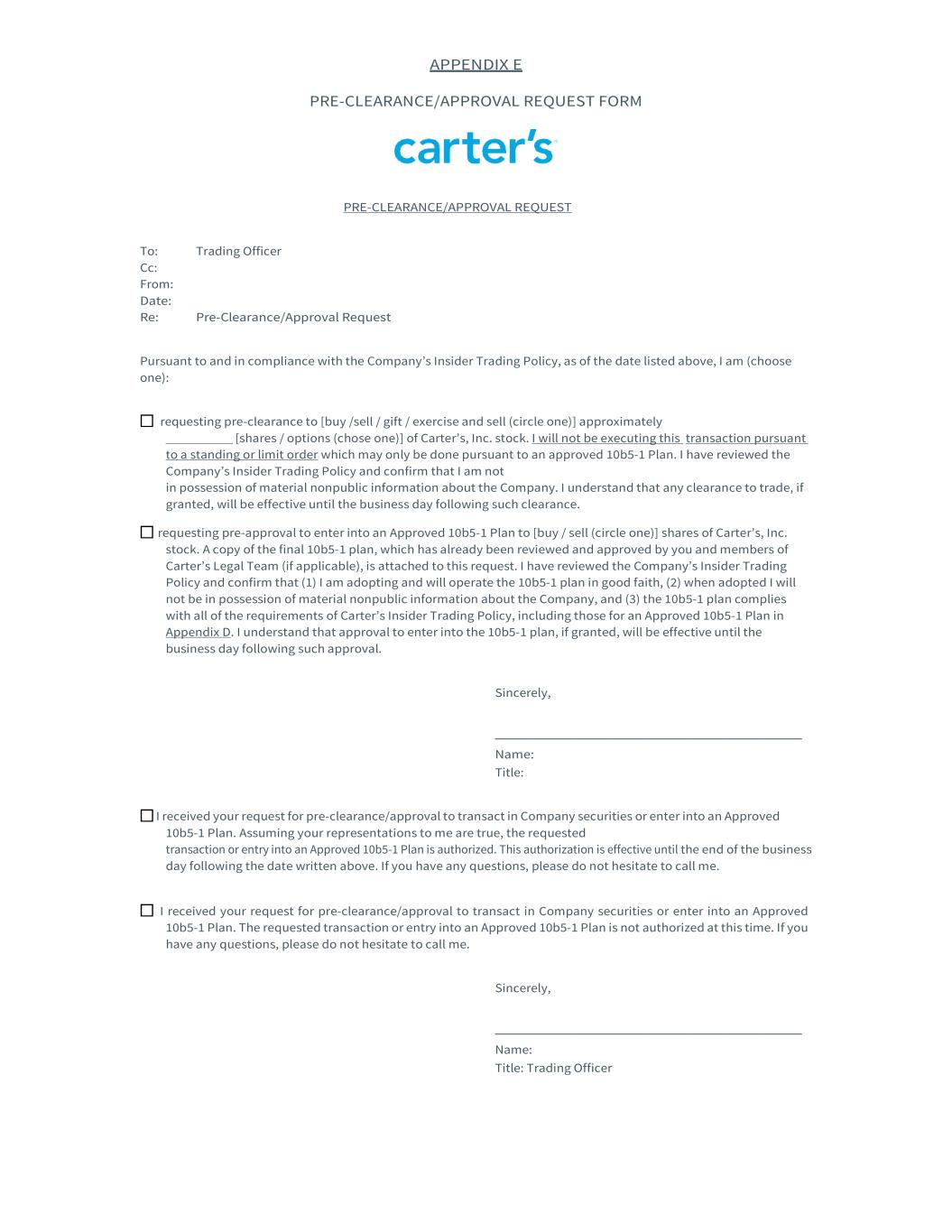
APPENDIX E PRE-CLEARANCE/APPROVAL REQUEST FORM PRE-CLEARANCE/APPROVAL REQUEST To: Trading Officer Cc: From: Date: Re: Pre-Clearance/Approval Request Pursuant to and in compliance with the Company’s Insider Trading Policy, as of the date listed above, I am (choose one): requesting pre-clearance to [buy /sell / gift / exercise and sell (circle one)] approximately [shares / options (chose one)] of Carter’s, Inc. stock. I will not be executing this transaction pursuant to a standing or limit order which may only be done pursuant to an approved 10b5-1 Plan. I have reviewed the Company’s Insider Trading Policy and confirm that I am not in possession of material nonpublic information about the Company. I understand that any clearance to trade, if granted, will be effective until the business day following such clearance. requesting pre-approval to enter into an Approved 10b5-1 Plan to [buy / sell (circle one)] shares of Carter’s, Inc. stock. A copy of the final 10b5-1 plan, which has already been reviewed and approved by you and members of Carter’s Legal Team (if applicable), is attached to this request. I have reviewed the Company’s Insider Trading Policy and confirm that (1) I am adopting and will operate the 10b5-1 plan in good faith, (2) when adopted I will not be in possession of material nonpublic information about the Company, and (3) the 10b5-1 plan complies with all of the requirements of Carter’s Insider Trading Policy, including those for an Approved 10b5-1 Plan in Appendix D. I understand that approval to enter into the 10b5-1 plan, if granted, will be effective until the business day following such approval. Sincerely, Name: Title: I received your request for pre-clearance/approval to transact in Company securities or enter into an Approved 10b5-1 Plan. Assuming your representations to me are true, the requested transaction or entry into an Approved 10b5-1 Plan is authorized. This authorization is effective until the end of the business day following the date written above. If you have any questions, please do not hesitate to call me. I received your request for pre-clearance/approval to transact in Company securities or enter into an Approved 10b5-1 Plan. The requested transaction or entry into an Approved 10b5-1 Plan is not authorized at this time. If you have any questions, please do not hesitate to call me. Sincerely, Name: Title: Trading Officer
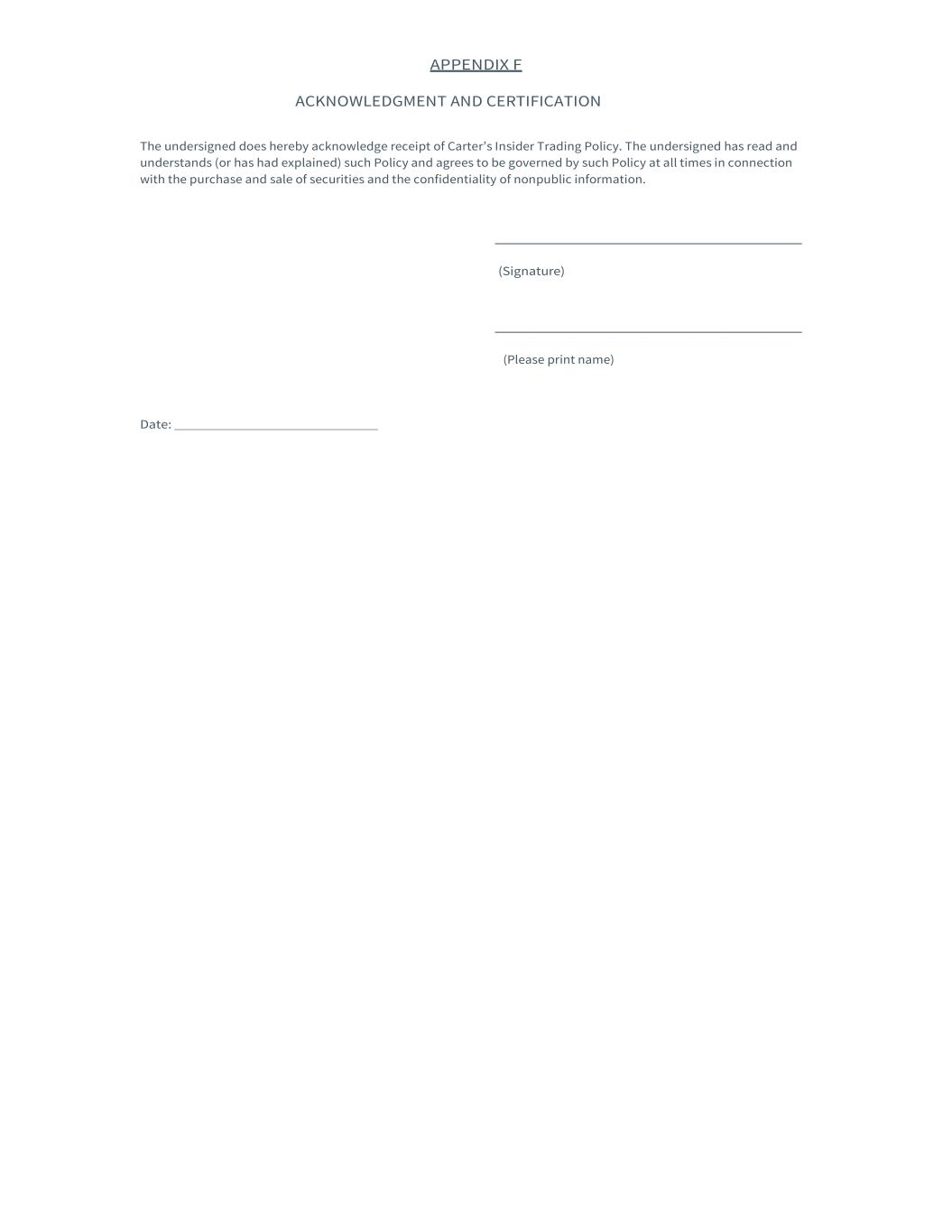
APPENDIX F ACKNOWLEDGMENT AND CERTIFICATION The undersigned does hereby acknowledge receipt of Carter’s Insider Trading Policy. The undersigned has read and understands (or has had explained) such Policy and agrees to be governed by such Policy at all times in connection with the purchase and sale of securities and the confidentiality of nonpublic information. (Signature) (Please print name) Date: