Denison Mines Corp.
Annual General Meeting of
Shareholders
Tuesday, May 12, 2026
Notice of Meeting &
Management Information Circular
Dated March 30, 2026

| What’s Inside | ||
| Notice of Meeting | ||
| Management Information Circular | 1 | |
| Business of the Meeting | 6 | |
| Corporate Governance Practices | 17 | |
| · Roles of Board, Chair, CEO | 17 | |
| · Board Committees | 18 | |
| · Denison’s Core Policies | 22 | |
| · Diversity within Denison | 25 | |
| · CSR & Sustainability | 26 | |
| · Risk Governance & Oversight | 26 | |
| · Director Education | 30 | |
| Director Compensation | 31 | |
| Executive Compensation | 36 | |
| Equity Compensation Plans | 54 | |
| Additional Information | 59 | |
| Appendix A: Mandate of the Board | 61 |
Dear Denison Shareholder,
On behalf of the Board of Directors, I herewith provide notice of the annual general meeting of shareholders (‘Meeting’) of Denison Mines Corp. (‘Denison’ or the ‘Company’)
Meeting Time & Location:
11:30am ET, Tuesday, May 12, 2026
At the offices of the Company,
1100 – 40 University Avenue, Toronto, Ontario, Canada.
If you have general questions about the Company’s business, please do not wait for the meeting. Instead, contact us at any time (see contact details in the Management Information Circular). We also recommend you vote your Denison shares in advance of the Meeting: We believe it is in the best interests of our shareholders, directors and employees for shareholders to communicate their votes and their opinions with the Company in advance of, instead of only at, the meeting.
The Company in 2025:
Over the past twelve months, Denison continued to make significant investments in its assets, including its flagship Phoenix project. With receipt of all regulatory approvals necessary to start construction, significant advancement of construction planning and procurement efforts, appointment of Wood Plc as construction manager, and a strong balance sheet, we are ready to commence site preparation for and construction of the Phoenix ISR uranium mine, which positions Phoenix to become one of the few new sizeable sources of uranium production expected to come to the market before the end of the decade.
We were also active across our development and exploration portfolio during 2025, highlighted by the success of our delineation drilling program at the Gryphon deposit, and the discovery of additional high-grade mineralization proximal to the Gryphon deposit’s D-series lenses. Our ‘Team Denison’ investments also continue to thrive, with Cosa Resources and Foremost Clean Energy generating positive results on our joint venture properties, and the notable formation of four new joint ventures with Skyharbour Resources to increase exploration activity on a group of properties adjacent to Wheeler River. We are pleased to have built an attractive exploration and investment portfolio that provides us with significant exposure to potential uranium discoveries in the Athabasca Basin region.
Our focus in 2026 is to move forward with construction of Phoenix, which we believe is a unique ‘nation building’ project that has the potential to generate significant benefits for our shareholders, employees, contractors, Indigenous partners, and the public through our sustainable development of the project and its contribution of much needed nuclear fuel supply for a growing global fleet of nuclear reactors. Overall, Denison is well positioned to capitalize on the improving fundamentals in the uranium market and nuclear energy sector, which suggest a significant and growing need for new sources of uranium production.
As always, we thank you for your continued support of the Company.
Sincerely,
David Cates, Director, President & Chief Executive Officer
Notice of Annual General Meeting of Shareholders
You are hereby given notice of the Annual General Meeting of the Shareholders of Denison Mines Corp. (“Denison” or the “Company”).
| When | Where |
|
Tuesday, May 12, 2026
11:30 a.m. (Eastern Time)
Please plan to vote in advance of the meeting. |
The offices of the Company 1100 – 40 University Avenue, Toronto, Ontario M5J 1T1
There will be no reception, management presentation or refreshments. |
The purpose of the Meeting is:
| (a) | to receive the consolidated financial statements of the Company for the year ended December 31, 2025, along with the auditor’s report on the statements; |
| (b) | to approve the re-appointment of KPMG LLP as the Company’s auditor for the upcoming year, and to authorize the directors to fix its remuneration; |
| (c) | to elect eight directors to the Board of Directors for the upcoming year; |
| (d) | to consider a non-binding advisory resolution on the Company’s approach to executive compensation; and |
| (e) | to transact such other business as may properly come before the Meeting. |
The Company is not aware of any items of business to be brought before the Meeting other than those noted above and further described in the accompanying Management Information Circular (the “Circular”). If you held shares in Denison on March 24, 2026, you are entitled to receive notice of and vote at this Meeting or any postponement or adjournment of it.
Your vote is important. We recommend you vote your shares in advance of the Meeting. We believe it is in the best interests of our shareholders, directors and employees for shareholders to communicate their votes and their opinions with the Company in advance of, instead of only at, the Meeting. Only registered shareholders and duly appointed proxyholders will be permitted at the Meeting.
We also recommend you refer to the Annual General Meeting page of the Company’s website at www.denisonmines.com for the most up-to-date information regarding the Meeting.
2026 Denison Notice Of Meeting
How to Vote:
This notice is accompanied by the Circular which describes who can vote, how to vote, and what the Meeting will cover.
Please vote by using the proxy form or voting instruction form, as applicable, included with the “notice and access” notification and return it before 11:30 a.m. (Eastern Time) on May 8, 2026 in accordance with the instructions provided.
Meeting Materials:
As described in the “notice and access” notification mailed to shareholders of the Company, Denison has opted to deliver its Meeting materials to shareholders by posting them on its website at www.denisonmines.com. The use of this alternative means of delivery is more environmentally friendly and more economical as it reduces the Company’s paper and printing use and the Company’s printing and mailing costs.
The Meeting materials will be available on the Company’s website by April 8, 2026 and will remain on the website for one full year. The Meeting materials will also be available on SEDAR+ at www.sedarplus.ca and on the Electronic Data Gathering, Analysis, and Retrieval system (“EDGAR”) of the United States Securities and Exchange Commission at www.sec.gov/edgar by April 8, 2026.
Shareholders who wish to receive paper copies of the Meeting materials prior to the Meeting may request copies from Denison by calling 1-888-260-4455 or by sending an email to info@denisonmines.com. We recommend requests be made no later than April 28, 2026. Please note that Denison cannot guarantee delivery, and delivery could be subject to delay.
The 2025 Annual Report, including the audited consolidated financial statements and related management’s discussion and analysis for the year ended December 31, 2025, has been mailed to those shareholders who requested a copy. This information is also available on Denison’s website at www.denisonmines.com, on SEDAR+ and EDGAR, or on request by contacting the Company.
Contact Us:
If you have questions about the matters to be considered at the Meeting and/or if you wish to obtain additional information about Denison’s business, please do not wait until the Meeting. You can contact the Company directly:
| Online: | www.denisonmines.com and https://denisonmines.com/investors/agm-information/ |
| Email: | info@denisonmines.com |
| Regular Mail: | 1100 - 40 University Avenue, Toronto, Ontario M5J 1T1 |
| Phone: | 416-979-1991 or 1-888-260-4455 |
Yours truly,
David Cates
Director, President & Chief Executive Officer
Dated March 30, 2026
2026 Denison Notice Of Meeting
| Management Information Circular | |
About this Circular
You have received this Management Information Circular (the “Circular”) because you owned common shares of Denison Mines Corp. on March 24, 2026 (the “Record Date”) and have the right to vote at the Annual General Meeting of Shareholders on May 12, 2026 (the “Meeting”).
We recommend you refer to the Annual General Meeting page of the Company’s website at www.denisonmines.com for the most up-to-date information regarding the Meeting and as a method to ask questions of the directors and/or management in advance of the Meeting.
Management is soliciting your proxy for the Meeting.
We recommend you vote your Shares in advance of the Meeting. We believe it is in the best interests of our Shareholders, directors and employees for Shareholders to communicate their votes and their opinions with the Company in advance of, instead of only at, the Meeting. There will be no reception, presentation or refreshments. Accordingly, only registered shareholders and duly appointed proxyholders will be permitted access to the Meeting.
This Circular provides the information that you need to have your vote recorded at the Meeting.
| · | If you are a registered holder of Shares, you have been sent a proxy form. |
| · | If your Shares are held by a nominee, you may receive either a proxy form or voting instruction form and should follow the instructions provided by the nominee. |
The Company is not aware of any items of business to be brought before the Meeting other than those described in this Circular and there will be no management presentation on the business and operations of the Company at the Meeting.
The Board of Directors (“Board”) has approved the Circular contents and has directed management to make it available to you. The information in the Circular is given as of March 30, 2026, unless otherwise noted.
Management’s solicitation of proxies is being made by mail and electronic means, at Denison’s expense. Proxies may also be solicited personally or by telephone by directors, officers, employees and agents of the Company.
In this Circular, “Denison” or the “Company” means Denison Mines Corp., “Shares” means Denison’s common shares and “Shareholders” means holders of Shares. All amounts are in Canadian dollars, unless otherwise indicated.
Voting Your Denison Shares
We are encouraging all Shareholders to vote by using the proxy form or voting instruction form provided, to vote their Shares in advance of the Meeting, and avoid voting in person.
|
2026 Denison Management Information Circular
| - 1 - |
Registered Shareholders
If you were a registered Shareholder on the Record Date, you may vote in person at the Meeting or give management, or another person, the authority to represent you and vote your Shares at the Meeting, as described below under “Voting by Proxy”. Importantly, if you vote by proxy and give directions on how to vote your Shares, your proxyholder must vote (or withhold from voting) your Shares according to your instructions, including on any ballot votes that take place at the Meeting.
You are asked to return your proxies using the following methods by the proxy deposit date noted on your proxy, which is by 11:30 a.m. (Eastern Time) on May 8, 2026:
| Internet: | Go to www.investorvote.com and follow the instructions. |
| Telephone: |
You may enter your voting instructions by telephone at:
1-866-732-8683 (toll free within North America), or |
| Facsimile: | Fax to Computershare at 1-866-249-7775 or 416-263-9524. |
| Regular Mail: |
Complete the form of proxy or any other proper form of proxy, sign it and mail it to Computershare at:
Computershare Investor Services Inc. Toronto Office, Proxy Department 320 Bay Street, 14th Floor Toronto, Ontario, Canada M5H 4A6 |
Non-Registered (Beneficial) Shareholders
Your Shares may not be registered in your name but in the name of a nominee, which is usually a trust company, securities broker or other financial institution. If your Shares are registered in the name of a nominee, you are a non-registered Shareholder. Your nominee is entitled to vote the Shares held by it on the Record Date. Your nominee is required to seek your instructions as to how to vote your Shares. You may vote your Shares through your nominee or in-person.
To vote your Shares through your nominee, you should follow the instructions of your nominee with respect to the procedures to be followed for voting. Generally, nominees will provide non-registered Shareholders with either: (a) a voting instruction form for completion and execution by you, or (b) a proxy form, executed by the nominee and restricted to the number of Shares owned by you, but otherwise uncompleted. These procedures are to permit non-registered Shareholders to direct the voting of the Shares that they beneficially own.
Many of the Company’s non-registered Shareholders are asked to return voting instructions using the following methods at least one business day in advance of the proxy deposit date noted on your voting instruction form:
| Internet: | Go to www.proxyvote.com and follow the instructions. |
| Telephone: |
You may enter your voting instructions by telephone
at:
|
| Regular Mail: | Complete the voting instruction form, sign it and mail it in the envelope provided. |
If you are a non-registered Shareholder and would like to vote your Shares in person at the Meeting, you should take the following steps:
| 1. | appoint yourself as the proxyholder by writing your own name in the space provided on the voting instruction form or proxy form, and |
| 2. | follow the nominee’s instructions for return of the executed form or other response. |
Do not otherwise complete the form. Your vote, or your designate’s vote, will be taken at the Meeting.
|
2026 Denison Management Information Circular
| - 2 - |
There are two kinds of non-registered Shareholders (i) those who object to their name being made known to the issuers of securities which they own, known as objecting beneficial owners or “OBOs” and (ii) those who do not object to their name being made known to the issuers of securities they own, known as non-objecting beneficial owners or “NOBOs”.
In accordance with the requirements of National Instrument 54-101 of the Canadian Securities Administrators, Denison has elected to send the notice of meeting, this Circular and proxy form (collectively, the “Meeting Materials”) indirectly to the NOBOs.
Denison intends to pay for intermediaries such as stockbrokers, securities dealers, banks, trust companies, trustees and their agents and nominees (“Intermediaries”) to forward the Meeting Materials to OBOs.
Voting by Proxy
A proxy must be in writing and must be executed by you or by your attorney authorized in writing, unless you have chosen to complete your proxy by telephone or the internet, as described on the proxy form or voting instruction form provided.
Your Proxy Vote and Appointing a Proxyholder
All Shares represented by properly completed proxies received at the Toronto office of Computershare Investor Services Inc. by 11:30 a.m. (Eastern Time) on May 8, 2026 or not less than 48 hours (excluding Saturdays, Sundays and holidays) before any adjourned or postponed Meeting will be voted or withheld from voting at the Meeting in accordance with your instructions on the proxy form. On the proxy form, you can indicate how you want to vote your Shares or you can let your proxyholder decide for you. A proxyholder is the person you appoint to act on your behalf at the Meeting and to vote your Shares.
If you give directions on how to vote your Shares, your proxyholder must vote (or withhold from voting) your Shares according to your instructions, including on any ballot votes that take place at the Meeting. If you have not specified how to vote on a particular matter, then your proxyholder can vote your Shares as he or she sees fit. Your proxy authorizes the proxyholder to vote and act for you at the Meeting, including any continuation after an adjournment of the Meeting.
You may choose anyone to be your proxyholder, including someone who is not a Shareholder of Denison. Simply fill in the name in the blank space provided on the enclosed proxy form. If you leave the space in the proxy form blank, the persons designated in the form, who are officers of Denison, are appointed to act as your proxyholder. If you have not specified whether or how to vote on a particular matter and the persons designated in the form are appointed as your proxyholder, your Shares will be voted as follows:
| · | FOR the re-appointment of KPMG LLP as the Company’s independent auditor until the next Annual Meeting of Shareholders, and authorization of the Board to fix its remuneration; |
| · | FOR the election as directors of all nominees listed in this Circular; and |
| · | FOR the non-binding advisory vote on executive compensation. |
For more information on how to vote, registered Shareholders may contact Computershare by telephone at 1-800-564-6253 or by e-mail to service@computershare.com.
Revoking Your Proxy
If you are a registered Shareholder who has given a proxy, you may revoke it by delivering a written notice, stating that you want to revoke your proxy to: Corporate Secretary, Denison Mines Corp., 1100 - 40 University Avenue, Toronto, Ontario, Canada M5J 1T1 not less than 48 hours (excluding Saturdays, Sundays and holidays) before the time of the Meeting, or by attending the Meeting and notifying the Chair of the Meeting prior to the commencement of the Meeting that you have revoked your proxy. A registered Shareholder may also revoke its proxy by completing and signing a proxy bearing a later date and depositing it with Computershare, provided it is received not less than 48 hours (excluding Saturdays, Sundays and holidays) before the time of the Meeting.
|
2026 Denison Management Information Circular
| - 3 - |
The notice can be from you or your attorney, if he or she has your written authorization. If the Shares are owned by a corporation, the written notice must be from its authorized officer or attorney.
Additional Matters Presented at the Meeting
The proxy form or voting instruction form provided confers discretionary authority upon the persons named as proxies with respect to any amendments or variations to the matters identified in the Notice of Meeting and with respect to other matters which may properly come before the Meeting.
If you sign and return the proxy form and any matter is presented at the Meeting in addition, as an amendment or a variation to the matters described in the Notice of Meeting, the Denison officers named as proxies will vote in their best judgment. When this Circular went to press, Denison’s management was not aware of any matters to be considered at the Meeting other than the matters described in the Notice of Meeting or any amendments or variations to the matters described in the Notice.
Notice and Access
The Company delivers its Meeting materials to Shareholders by posting them on its website at www.denisonmines.com, rather than mailing physical copies of the materials to all Shareholders. The Meeting materials will be available on the Company’s website by April 8, 2026 and will remain on the website for one full year. The Circular will also be available by April 8, 2026 on SEDAR+ at www.sedarplus.ca and on the Electronic Data Gathering, Analysis, and Retrieval system (“EDGAR”) of the United States Securities and Exchange Commission (“SEC”) at www.sec.gov/edgar.
The Company has decided to mail paper copies of the Circular to those registered and non-registered Shareholders who had specifically elected to receive paper copies of the Company’s Meeting materials. All other Shareholders will receive a “notice and access” notification which will contain information on how to obtain electronic and paper copies of the Circular in advance of the Meeting and for a full year following the Meeting.
Electronic Delivery of Documents
Every year, as required by laws governing public companies, the Company delivers documentation to Shareholders. In order to make this process more convenient, Shareholders may choose to be notified by email when the Company’s documentation, including the Meeting materials, is posted on the Company’s website (www.denisonmines.com) and, accordingly, such documentation will not be sent in paper form by mail other than as required by applicable laws.
Delivery in an electronic format, rather than paper, reduces costs to the Company and benefits the environment. Shareholders who do not consent to receive documentation through email notification will continue to receive such documentation by mail or otherwise, in accordance with securities laws. By consenting to electronic delivery, Shareholders:
| (i) | agree to receive all documents to which they are entitled electronically, rather than by mail; and |
| (ii) | understand that access to the internet is required to receive a document electronically and certain system requirements must be installed (currently Adobe Acrobat Reader to view Adobe’s portable document format (“PDF”)). Such documents may include the interim consolidated financial reports, the annual report (including audited annual consolidated financial statements and management’s discussion and analysis (“MD&A”)), the notice of annual and/or special meeting and related management information circular and materials, and other corporate information about the Company. |
|
2026 Denison Management Information Circular
| - 4 - |
Shareholders may request copies of the Meeting materials by mail at no cost for up to one year from the date the Information Circular was filed on SEDAR+ by email to info@denisonmines.com or by calling 1-888-260-4455. For Shareholders who wish to receive copies of the Circular in advance of the voting deadline, we recommend requests be made no later than April 28, 2026.
At any time, Denison may elect to not send a document electronically, or a document may not be available electronically. In either case, a paper copy will be mailed to Shareholders.
Registered Shareholders can consent to electronic delivery by completing and returning the form of consent included with the form of proxy. Non-registered Shareholders can consent to electronic delivery by completing and returning the appropriate form received from the applicable intermediary.
Shareholders are not required to consent to electronic delivery. The Company will notify consenting Shareholders at the email address provided by the Shareholder on the form of proxy when the documents that the Shareholder is entitled to receive are posted on the Company’s website, with a link to the specific pages of the website containing the PDF document.
Voting Securities
Denison’s common shares are the only shares issued by the Company and each Share entitles the holder to one vote on all matters at the Meeting. In accordance with the provisions of the Business Corporations Act (Ontario) (the “OBCA”), the Company prepared a list of Shareholders on the Record Date for the Meeting of March 24, 2026. Each Shareholder named on the list will be entitled to vote at the Meeting the Shares shown on the list opposite such Shareholder’s name.
On March 24, 2026, the Company had 904,015,964 Shares issued and outstanding.
Principal Holders of Shares
To the knowledge of Denison’s directors and executive officers, no person or company beneficially owns or exercises control or direction over, directly or indirectly, more than 10% of Denison’s Shares.
Interest of Certain Persons or Companies in Matters to be Acted Upon
No director or executive officer or any person who has held such a position since January 1, 2025, nor any associate or affiliate of the foregoing persons, has any material interest, direct or indirect, by way of beneficial ownership of securities or otherwise, in matters to be acted upon at the Meeting other than their election pursuant to the election of directors.
|
2026 Denison Management Information Circular
| - 5 - |
Business of the Meeting
The purpose of the Meeting is:
(a) to receive the consolidated financial statements of the Company for the year ended December 31, 2025, along with the auditor’s report on the statements;
(b) to re-appoint KPMG LLP as the Company’s auditor for the upcoming year, and to authorize the directors to fix the remuneration of the auditor;
(c) to elect eight directors to the Board for the upcoming year;
(d) to consider a non-binding advisory resolution on the Company’s approach to executive compensation; and
(e) to transact such other business as may properly come before the Meeting.
|
Receiving the Consolidated Financial Statements
The consolidated financial statements of the Company for the fiscal year ended December 31, 2025 are included in Denison’s 2025 Annual Report. The 2025 Annual Report was mailed to the Company’s registered and non-registered Shareholders who requested it and is available on Denison’s website at www.denisonmines.com, on SEDAR+ at www.sedarplus.ca and EDGAR at www.sec.gov/edgar.
No vote of Shareholders is required with respect to this item of business.
The Re-Appointment of the Auditor
The Board recommends the re-appointment of KPMG LLP (“KPMG”) as the Company’s independent auditor, to hold office until the end of the next annual meeting of Shareholders, with the directors to fix the remuneration to be paid to KPMG for their services. KPMG was initially appointed auditor of the Company effective October 1, 2020 for the fiscal year ended December 31, 2020.
You may either vote for the re-appointment of KPMG as the Company’s auditor, to hold office until the end of the next annual meeting, and authorizing the directors to fix the auditor’s remuneration, or you can withhold your vote. Unless otherwise instructed, the named proxyholders will vote FOR the re-appointment of KPMG and authorizing their appointment and for the directors to fix KPMG’s remuneration.
| 2026 Denison Management Information Circular
| - 6 - |
The Election of Directors
The term of office of each of the present directors of the Company expires at the Meeting. The Board has nominated eight directors to be elected at the Meeting, to serve as a director until the next annual meeting unless he or she resigns or is otherwise removed from office earlier. If the nominees are elected by Shareholders, the Board will be composed of members with a diversity and breadth of backgrounds and experience, along with the integrity and motivation required to properly discharge their fiduciary duties in the long-term best interests of the Company and all of its Shareholders.
Presented to Shareholders for consideration for election are:
| (a) | Jennifer Traub (Board Chair) | |
| (b) | David Cates (Company President & CEO) | |
| (c) | Jinsu Baik | |
| (d) | Wes Carson | |
| (e) | Ken Hartwick | |
| (f) | David Neuburger | |
| (g) | Laurie Sterritt | |
| (h) | Patricia Volker |
More details regarding all the nominees are provided in their profiles below. Each of the nominated directors is eligible to serve as a director and has expressed his or her willingness to do so.
Advance Notice
According to the Company’s by-laws, the Company must receive advance notice of nominations of directors by Shareholders. As at the date of this Circular, the Company has not received notice of any director nominations in connection with this year’s Meeting. Accordingly, the only persons currently nominated for election to the Board at the Meeting are the nominees described herein.
Majority Voting Policy
Shareholders are entitled to vote for, or withhold from voting for, each individual director nominee at a Shareholders’ meeting. The Board has adopted a Majority Voting Policy: if the number of Shares withheld from any nominee exceeds the number of Shares voted for the nominee, then such nominee must immediately tender his or her resignation to the Board. Denison’s Corporate Governance & Nominating Committee (“CGN Committee”) will review the matter and recommend to the Board whether to accept the resignation or not. The Board shall accept the resignation absent exceptional circumstances. The director involved does not participate in any Board or committee deliberations on the matter. The Board must announce its decision within 90 days of the applicable Shareholder meeting.
The Majority Voting Policy applies only in circumstances involving an uncontested election of directors, meaning an election in which the number of nominees is equal to the number of directors to be elected.
| Unless otherwise instructed, proxies and voting instructions given pursuant to this solicitation by Denison’s management will be voted FOR the election of each proposed nominee for director. If any proposed nominee is unable to serve as a director or withdraws his or her name, the named proxyholders reserve the right to nominate and vote for another individual in their discretion. |
| 2026 Denison Management Information Circular
| - 7 - |
Profiles of the Nominated Directors
The tables below set forth information about the nominated directors as of March 24, 2026 (the Record Date for the Meeting).
Jennifer Traub, 54 Vancouver, BC Canada
Shares: 70,719 Options: 116,000 Share Units: 290,000
Total Value2: $1,739,000
|
Independent Board Chair Jennifer Traub is a partner in the Securities Group at Cassels Brock & Blackwell LLP and serves as Co-Chair of the firm’s Mining Group. Ms. Traub represents both issuers and investment dealers in connection with public and private securities offerings, mergers and acquisitions and other financing transactions. She has particular expertise and experience in the resource sector and has played an integral role in managing some of the largest and most complex corporate finance and M&A deals in the mining industry in Canada. In addition to transactional work, Ms. Traub regularly advises public companies regarding general corporate and securities law matters, including continuous disclosure, corporate governance and Canadian stock exchange issues.
In 2025, Ms. Traub was awarded the King Charles III Coronation Medal for her years of service to the Canadian Cancer Society as Co-Chair of the Daffodil Ball.
Ms. Traub has completed the Osgoode Certificate in Mining Law and holds a Bachelor of Laws degree from Osgoode Hall Law School. She is a member of the Law Societies of BC, Ontario and Yukon.
Denison Board Details: · Director since May 6, 2021 · Member of the Corporate Governance & Nominating Committee · Member of the Compensation Committee · 2025 AGM Voting Results: 94.99% For Reelection (367,438,770 votes) · Complies with share ownership requirement for directors (see page 34)
Other Public Boards: None.
|
David D. Cates, 43 Toronto, ON Canada
Shares: 2,120,000 Options: 1,196,000 Share Units: 3,405,250
Total Value2,3: $26,631,000
|
Director, President & CEO David Cates was appointed President & CEO of Denison in 2015 and previously served as Vice President Finance, Tax & Chief Financial Officer during his tenure with the Company, which began in 2008.
Mr. Cates is a Chartered Professional Accountant (CPA, CA) and holds Master of Accounting (MAcc) and Honours Bachelor of Arts (BA) degrees from the University of Waterloo.
Denison Board Details: · Director since August 9, 2018 · Not Independent · 2025 AGM Voting Results: 94.85% For Reelection (366,920,809 votes) · Complies with share ownership requirement (see page 50 for details of the share ownership requirement applicable to executive officers of Denison)
Other Public Boards: Foremost Clean Energy Ltd. (TSX-V) and Skyharbour Resources Ltd. (TSX-V) |
| 2026 Denison Management Information Circular
| - 8 - |
Jinsu Baik, 48 Gyeongju-si, Gyeongsangbuk-do, Republic of Korea
Shares: Nil Options: Nil Share Units: 60,000
Total Value2: $289,000
|
Director Mr. Baik is currently General Manager of the Nuclear Fuel Cyle Management Section of Korea Hydro & Nuclear Power Co., Ltd. (“KHNP”) in Korea. Mr. Baik has substantial professional expertise developed through working in the nuclear industry and has held various positions at KHNP, including his prior positions as General Manager in the Safety Engineering Section and Senior Manager in the Nuclear Fuel Supply Section.
Mr. Baik holds a degree in Nuclear Engineering from HanYang University.
Denison Board Details: · Director since March 13, 2025 · Not independent · 2025 AGM Voting Results: 99.40% For Election (384,502,960 votes) · Complies with share ownership requirement for directors (see page 34)
Other Public Boards: None.
|
Wes Carson, 48 Vancouver, BC Canada
Shares: Nil Options: Nil Share Units: 60,000
Total Value2: $289,000
|
Independent Director Mr. Carson is Vice President, Mining Operations at Wheaton Precious Metals Corp. and has over 25 years of experience in the mining industry holding a variety of leadership roles in operations, project development and engineering. Prior to joining Wheaton Precious Metals Corp. in 2017, he held positions of Vice President, Project Development for Sabina Gold & Silver Corp. (2012 to 2017), Vice President and General Manager, Mt. Milligan Mine for Thompson Creek Metals Company Inc. (2010 to 2012), and Director, Mining for Terrane Metals Corp. (2007 to 2010). Mr. Carson has also worked for Cominco Ltd., Teck Corporation, Placer Dome Inc. and Barrick Gold Corporation in a variety of operating roles in both North America and Africa.
Mr. Carson received his Bachelor of Applied Science, Mining and Mineral Process Engineering at the University of British Columbia and is a registered Professional Engineer in the Province of British Columbia.
Denison Board Details: · Director since May 12, 2025 · Member of the Technical Committee · Member of the Environment, Health, Safety & Sustainability Committee · Member of the Compensation Committee · 2025 AGM Voting Results: 94.73% For Election (366,457,344 votes) · Complies with share ownership requirement for directors (see page 34)
Other Public Boards: Arras Minerals Corporation (TSX-V)
|
| 2026 Denison Management Information Circular
| - 9 - |
Ken Hartwick, 63 Oakville, ON Canada
Shares: Nil Options: Nil Share Units: 60,000
Total Value2: $289,000
|
Independent Director Mr. Hartwick has over 40 years of experience in a variety of fields such as finance, investment, corporate leadership and governance, risk management, and stakeholder engagement, with 35 years in the finance and energy sectors.
In 2024, Mr. Hartwick retired from the position of President and CEO of OPG, one of North America’s largest and most diverse electricity generators, which is also recognized as a clean energy technology innovator. Under Mr. Hartwick’s tenure at OPG, spanning nearly 9 years, OPG released its first Climate Change Plan, advanced Ontario’s electrification efforts through the development of the Ivy charging network and OPG’s PowerON fleet electrification subsidiary, launched its first Reconciliation Action Plan, and took a global leadership position in the deployment of Small Modular Reactors (SMRs) with the advancement of plans to deploy four SMRs at OPG’s Darlington site.
Mr. Hartwick is a Chartered Professional Accountant with an Honours Bachelor of Business Administration degree from Trent University.
Denison Board Details: · Director since March 19, 2025 · Member of the Audit Committee · 2025 AGM Voting Results: 99.42% For Election (384,596,396 votes) · Complies with share ownership requirement for directors (see page 34)
Other Public Boards: MYR Group Inc. (NASDAQ)
|
David Neuburger, 66 Saskatoon, SK Canada
Shares: 138,167 Options: 116,000 Share Units: 225,333
Total Value2: $1,752,000 |
Independent Director David Neuburger is a corporate director and consultant, with more than 30 years’ experience in mining, in executive leadership, operations management, corporate strategic planning, projects and mine engineering for companies involved in uranium, gold, nickel and copper/zinc mining. From 2013 to 2018, Mr. Neuburger was Vice President, General Manager, Kupol Operations for Kinross Gold Corporation; prior to that, he held the positions of Vice President, International Mining (2010 to 2013) and Vice President, Mining Division (2004 to 2010) for Cameco Corporation. Mr. Neuburger has also volunteered as President and in other executive committee roles with the Saskatchewan Mining Association.
Mr. Neuburger is a Professional Engineer registered in Saskatchewan and holds a Master of Business Administration degree from the University of Saskatchewan and a Bachelor of Engineering degree in Mining and a Bachelor of Science degree in Biology from McGill University.
Denison Board Details: · Director since May 6, 2021 · Chair of the Technical Committee · Chair of the Environment, Health, Safety & Sustainability Committee · Member of the Audit Committee · 2025 AGM Voting Results: 98.06% For Reelection (379,319,168 votes) · Complies with share ownership requirement for directors (see page 34)
Other Public Boards: None.
|
| 2026 Denison Management Information Circular
| - 10 - |
Laurie Sterritt, 56 Vancouver, BC Canada
Shares: Nil Options: 20,000 Share Units: 212,000
Total Value2: $1,022,000
|
Independent Director Laurie Sterritt is CEO and Managing Partner of Pathways Executive Search, an executive search firm in Canada. Previously, Ms. Sterritt served as Managing Director of Leaders International. In 2018, Ms. Sterritt formed a non-profit association to launch the first-of-its-kind Indigenous Women’s Leadership Summit (IWLS), with a mandate to inspire and uplift Indigenous women throughout their personal and professional journeys. Prior to that, Ms. Sterritt developed and implemented the Indigenous Employment and Business Development strategy for BC Hydro and led the start-up and growth of the Aboriginal Mentoring and Training Association (AMTA) and its subsidiary social enterprise, First Resources Impact Ventures (FRIV).
Ms. Sterritt is a member of the Kispiox Band of the Gitxsan Nation and has been recognized for her commitment to creating respectful and inclusive workplaces. She has held several board positions, including Director for the Canadian Centre for Arts and Technology (CANCAT), Governor and 1st Vice-Chair of the British Columbia Institute for Technology (BCIT); Council Member of the Real Estate Council of BC; and Director of the Industry Training Authority (now Skilled Trades BC). Ms. Sterritt is a Chartered Director (C.Dir) and holds a Bachelor of Commerce from the University of British Columbia and a Certificate in Professional Fund Raising from the University of Indiana.
Denison Board Details: · Director since January 31, 2022 · Chair of the Corporate Governance & Nominating Committee · Member of the Environmental, Health, Safety & Sustainability Committee · 2025 AGM Voting Results: 97.78% For Reelection (378,238,679 votes) · Complies with share ownership requirement for directors (see page 34)
Other Public Boards: None.
|
Patricia M. Volker, 68 Burlington, ON Canada
Shares: 436,884 Options: 76,000 Share Units: 290,000 Total Value2: $3,504,000 |
Independent Director Patricia Volker is a corporate director, whose experience is highlighted by over 17 years of service at the Chartered Professional Accountants of Ontario, the self-regulating body for Ontario’s Chartered Professional Accountants, including the roles of Director of Standards Enforcement and Director, Public Accounting and Special Projects. Ms. Volker served in various capacities in the accounting profession during her 30+ year career and brings a wealth of advisory, public accounting, banking and regulatory expertise to the Denison Board. Ms. Volker is also on the board, and serves on committees, for Ornge.
Ms. Volker is a CPA, CA and CMA, holds the ICD.D. designation and earned a B.Sc. from the University of Toronto.
Denison Board Details: · Director since August 9, 2018 · Chair of the Audit Committee · Chair of the Compensation Committee · Sole director on the Company’s SOX Steering Committee · 2025 AGM Voting Results: 98.13% For Reelection (379,592,941 votes) · Complies with share ownership requirement for directors (see page 34)
Other Public Boards: The Empire Life Insurance Company (unlisted reporting issuer) and Labrador Iron Ore Royalty Corporation (TSX)
|
Notes to Profiles of the Nominated Directors:
| 1. | Each nominee has provided or confirmed the information about the securities that he or she owns or over which he or she exercises control or direction. |
| 2026 Denison Management Information Circular
| - 11 - |
| 2. | The “Total Value” disclosed above has been calculated as the market value of the Shares and Share Units (and excluding options) on March 24, 2026 of $4.82 per share or underlying share. | |
| 3. | The calculated “Total Value” of Mr. Cates’ Share and full-value equity holdings as at March 24, 2026 was: Shares: $10,218,000; Share Units: $16,413,000. |
Board Composition Guidelines
Denison’s Board recognizes that the quality of its directors is an important factor in the overall success of the Company. Denison is committed to ensuring that the size and composition of the Board enables effective governance and oversight of a diversified and active company. Corporate governance best practices focus on developing high performing boards that have integrity and are accountable, independent and experienced. Under the stewardship of the CGN Committee, the Denison Board has focused on meeting or exceeding regulatory guidelines on governance.
When considering the Board as a whole and assessing directors’ candidacy for the Board, the CGN Committee follows established guidelines for the Board’s composition set forth in the Company’s “Guidelines for the Composition of Denison’s Board” (the “Composition Guidelines”), and seeks directors that have some or all of the following attributes:
| · | Financial accreditation and/or financial literacy | |
| · | Sound business experience and expertise | |
| · | Corporate governance experience | |
| · | Experience in government relations, operations and regulatory issues | |
| · | Industry specific experience and knowledge, including mining and metallurgy, energy, and occupational health and safety | |
| · | Sustainability knowledge, including environmental impacts and management, climate change risks and opportunities, community outreach and stakeholder engagement | |
| · | Financing and merger/acquisition experience | |
| · | Risk management and/or cyber security experience | |
| · | Strong reputation within the financial and business communities | |
| · | Candidacy consistent with the Diversity Policy and the targets set thereunder | |
| · | Candidacy consistent with attaining inclusion and diversity beyond gender | |
| · | Strong board skills, such as integrity, networking abilities, interpersonal skills, ability to think strategically and act independently | |
| · | Independence, as such term is defined by the Canadian Securities Administrators |
| The CGN Committee solicits feedback from each of the current directors and assesses the needs and capabilities of the Board regularly and when there is a vacancy. As a result of their efforts, the CGN Committee is pleased to present Shareholders with candidates for appointment to the Board who have a diversity of skills and experiences and form a well-composed and highly effective Board of Directors for the Company. |
Denison has not adopted a term limit or retirement policy; the Board is of the position that no appreciable benefit would be achieved through the adoption of such policies. Organically, the Board has seen significant renewal in recent years, including the appointments of Mr. Neuburger and Ms. Traub in 2021, Ms. Sterritt in 2022, and Mr. Baik, Mr. Carson, and Mr. Hartwick in 2025.
Independence
The Board is responsible for determining whether or not each director is independent. This assessment is made in accordance with standards of the Canadian Securities Administrators in National Instrument 52-110 – Audit Committees (“NI 52-110”) and governance guidelines. With the assistance of the CGN Committee, the Board reviews each director’s independence annually and upon the appointment or election of a new director. The Board last considered this matter at its meeting on March 10, 2026.
| 2026 Denison Management Information Circular
| - 12 - |
The Board is proposed to be comprised of eight directors, six of whom are independent (75% independent).
| Name | Independent | Not Independent | Commentary on Non-Independence Determinations |
| Jinsu Baik | X | Mr. Baik is regarded as having an indirect material relationship which could reasonably be expected to interfere with his exercise of independent judgment, considering the Company’s strategic relationship with KHNP Canada Energy Ltd. and Mr. Baik’s position with its parent corporation, KHNP (see below for further details). | |
| David Cates | X | As President and Chief Executive Officer of the Company, Mr. Cates is not independent. | |
| Wes Carson | X | ||
| Ken Hartwick | X | ||
| David Neuburger | X | ||
| Laurie Sterritt | X | ||
| Jennifer Traub | X | ||
| Patricia Volker | X |
In addition, the Board believes that adequate structures and processes are in place to facilitate the functioning of the Board independently of management, including:
| · The Board has an independent Chair | Ms. Traub currently serves as the independent Chair of the Board.
The Chair facilitates the functioning of the Board independently of management, serves as an independent leadership contact for directors and assists in maintaining and enhancing the quality of the Company’s corporate governance. |
| · The independent directors have an in camera at every meeting | The Board meets in camera without management, as well as without non-independent directors, at every Board and committee meeting. |
| · The Board has independent directors’ meetings | The independent directors call special meetings, without the non-independent directors, to discuss matters of interest.
There was 1 meeting of the independent directors in 2025. |
| · The Committees of the Board are entirely independent | The standing committees of the Board are composed entirely of independent directors. |
| · The Board, a committee or an individual director may engage an independent advisor | Committees, and individual directors in appropriate circumstances and with the authorization of the applicable committee or the Chair, may engage independent advisors at the expense of the Company. |
The Board takes steps to ensure directors exercise independent judgment if considering transactions and agreements in respect of which a director or executive officer has a material interest. See “Conflicts of Interest and Related Party Transactions” below for further details.
Information about Denison’s Relationship with KEPCO & KHNP
When determining nominees for election, the Board also considers the strategic relationship agreement with KHNP Canada Energy Ltd. (“KHNP Canada”), which sets forth the terms of a long-term collaborative business relationship first established in 2009 (the “KHNP SRA”). Under the KHNP SRA, so long as KHNP Canada or an affiliate holds more than 5% of the Shares, the Board must nominate one person designated by KHNP Canada or its affiliate for election as a director at any Shareholder meeting where directors are to be elected.
| 2026 Denison Management Information Circular
| - 13 - |
KHNP Canada has designated Mr. Baik as its nominee. As General Manager of the Nuclear Fuel Cycle Management Section of Korea Hydro Nuclear Power (“KHNP”), a subsidiary of the Korea Electric Power Corporation (“KEPCO”) and the parent company of KHNP Canada, Mr. Baik brings to the Board substantial industry-specific experience. KEPCO is the primary electric utility in South Korea and KHNP operates all of its nuclear generation. To the knowledge of Denison, KEPCO holds approximately 6.4% of the Shares as at March 24, 2026, through its indirect corporate holdings.
The KHNP SRA also provides KHNP Canada (a) a right of first offer if Denison intends to sell any of its substantial assets and a right to participate in certain purchases of substantial assets which Denison proposes to acquire; and (b) the right to participate in future offerings of Shares of a certain size in order to preserve its interest in the Company. To date, neither KEPCO nor KHNP have exercised such rights.
Skills and Experience
The CGN Committee maintains a competency matrix, reviewed annually, to assess composition of the Board and its committees and ensure it has an appropriate mix of skills and experience to govern effectively and be a strategic resource for the Company.
Each director completes a self-assessment of his or her competencies. The CGN Committee reviews the results for consistency and to be satisfied that the directors possess skills in these areas. Certain key areas of expertise identified for each nominated director are highlighted with boxes below.
| Skills and Experience | Baik | Carson | Cates | Hartwick | Neuburger | Sterritt | Traub | Volker |
Financial Accreditation &/or Literacy Expertise on financial statements and reporting matters, critical accounting policies, issues related to internal and external audits, and internal controls |
ü | ü | ü | ü | ü | ü | ü | ü |
Corporate Governance Experience Sophisticated understanding of corporate governance practices and governance risk oversight |
ü | ü | ü | ü | ü | ü | ü | |
Compensation Literacy Direct experience in compensation practices, talent management and retention, and succession planning |
ü | ü | ü | ü | ü | ü | ü | |
Operations &/or Technical Experience Experience in operations or business management |
ü | ü | ü | ü | ü | ü | ||
Health, Safety & Environment Direct experience with environmental, health and/or safety policy, practices and management |
ü | ü | ü | ü | ü | ü | ||
Sustainability Knowledge Experience or knowledge of ESG, climate change risk management, sustainability and stakeholder engagement |
ü | ü | ü | ü | ü | ü | ||
Mining Industry Experience Industry-specific knowledge of geology, exploration, development, etc., and related risks. |
ü | ü | ü | ü | ü | |||
Uranium Industry Experience Uranium industry-specific knowledge of supply, demand, market participants, and related risks. |
ü | ü | ü | ü | ü | |||
Government & Regulatory Relations Experience or knowledge of the broad regulatory environment in which Denison operates |
ü | ü | ü | ü | ü | ü | ü | |
Financing & M&A Experience Experience with acquisitions, divestitures, joint ventures, M&A transactions, and financings |
ü | ü | ü | ü | ||||
Risk Management Experience identifying, assessing, managing, and reporting on corporate risk |
ü | ü | ü | ü | ü | ü | ü | ü |
| 2026 Denison Management Information Circular
| - 14 - |
2025 Director Attendance Record
At Denison, we believe that attendance at meetings is a critical ingredient to an engaged and effective Board. Personal attendance at Board and committee meetings is expected of all directors. Directors can participate by video or tele-conference if they cannot attend in person.
Meetings of Independent Directors
At every Board and committee meeting, including those held by video and/or tele-conference, directors meet in camera without management present and, if the meeting is not entirely composed of independent directors, the independent directors meet without the non-independent directors. The independent directors also have dedicated independent directors’ meetings at least annually.
In 2025, there was one dedicated meeting of the independent directors, and all independent directors were in attendance at that meeting. |
The table below shows the number of Board and committee meetings each nominated director attended in 2025.
| Name | Board | Audit
Committee |
Corporate Governance & Nominating Committee |
Compensation Committee |
Environment, |
Technical Committee |
Total |
| Jinsu Baik 1 | 4 of 4 | 100 | |||||
| Wes Carson1 | 3 of 3 | 3 of 3 | 4 of 4 | 100 | |||
| David Cates | 5 of 5 | 100 | |||||
| Ken Hartwick1 | 4 of 4 | 3 of 3 | 100 | ||||
| David Neuburger | 5 of 5 | 4 of 4 | 4 of 4 | 4 of 4 | 100 | ||
| Laurie Sterritt | 5 of 5 | 5 of 5 | 4 of 4 | 100 | |||
| Jennifer Traub | 5 of 5 | 5 of 5 | 4 of 4 | 100 | |||
| Patricia Volker | 5 of 5 | 4 of 4 | 4 of 4 | 100 |
Notes:
| 1. | Mr. Baik was appointed to the Board on March 13, 2025; Mr. Hartwick was appointed to the Board on March 19, 2025; Mr. Carson was appointed to the Board on May 12, 2025. Each attended 100% of the meetings after their respective appointments. |
| 2026 Denison Management Information Circular
| - 15 - |
Director Tenure
At December 31, 2025, average director tenure of the Board was approximately 3.8 years:
| Name | Appointment | Approximate Years Served |
| Jinsu Baik | March 13, 2025 | 0.8 |
| David Cates | August 9, 2018 | 7.5 |
| Wes Carson | May 12, 2025 | 0.5 |
| Ken Hartwick | March 19, 2025 | 0.8 |
| David Neuburger | May 6, 2021 | 4.5 |
| Laurie Sterritt | January 31, 2022 | 4.0 |
| Jennifer Traub | May 6, 2021 | 4.5 |
| Patricia Volker | August 9, 2018 | 7.5 |
Advisory Vote on the Company’s Approach to Executive Compensation
The Board has adopted a non-binding shareholder advisory vote on the Company’s approach to executive compensation. As a formal opportunity to provide their views on the disclosed objectives of the Company’s pay for performance compensation model, Shareholders are asked to review and vote, in a non-binding, advisory manner, on the following resolution:
BE IT RESOLVED THAT, on an advisory basis and not to diminish the role and responsibilities of the Board of Directors, the shareholders accept the approach to executive compensation as disclosed in the management information circular of the Company dated March 30, 2026.
The Compensation Committee, and the Board, will take the results of the vote into account, as appropriate, when considering future compensation policies, procedures and decisions (see “Executive Compensation” for details regarding the compensation philosophy and guidelines of the Board and the performance metrics and process used to assess performance).
The Company has held annual advisory votes on executive compensation (say on pay) at its annual shareholder meetings since 2017. In 2025, the advisory vote was approved by 97.16% of Shareholder votes received at the meeting.
| Shareholders who have questions or concerns, or who may vote against the resolution, are encouraged to contact the Board, to enable the Board to better understand their concerns. |
Shareholders may either vote for the non-binding advisory resolution on the Company’s approach to executive compensation, or vote against. The Board recommends that Shareholders vote FOR the resolution to accept the Company’s approach to executive compensation. Unless otherwise instructed, proxies and voting instructions given pursuant to this solicitation by Denison’s management will be voted FOR the approval of the resolution.
| 2026 Denison Management Information Circular
| - 16 - |
Denison’s Corporate Governance Practices
This section of the Circular describes Denison’s corporate governance practices with reference to the framework provided in National Policy 58-201 - Corporate Governance Guidelines and National Instrument 58-101 - Disclosure of Corporate Governance Practices (collectively, the “Governance Guidelines”) of the Canadian Securities Administrators.
Denison is a reporting issuer in all of the provinces and territories of Canada and is classified as a foreign private issuer by the SEC. The Shares trade on the Toronto Stock Exchange (TSX: DML) and the NYSE American (NYSE American: DNN). As such, Denison adheres to Canadian corporate governance requirements and also complies with the requirements of the NYSE American. The Company’s CGN Committee closely monitors this regulatory environment and, where applicable, makes recommendations to the Board to modify the Company’s governance practices as needed.
The Role of the Board
The Board is responsible for overseeing the management of the business and affairs of Denison, with a view to the long-term best interests of the Company. The Board has adopted a formal mandate setting out the role and responsibilities of the Board (see Appendix A).
In discharging its stewardship over the Company, the Board has undertaken the following specific duties and responsibilities:
| · | satisfying itself as to the integrity of the Chief Executive Officer and other executive officers and as to a culture of integrity throughout the Company; |
| · | approving, supervising and providing guidance to management on the Company’s strategic planning process; |
| · | identifying the principal risks of the Company’s business and ensuring management’s implementation and assessment of appropriate risk management systems; |
| · | ensuring that the Company has highly qualified management and adequate and effective succession plans for senior management; |
| · | overseeing the Company’s communications policy with its Shareholders and with the public generally; and |
| · | assessing directly and through its Audit Committee, the integrity of the Company’s internal control and management information systems. |
Generally, decisions relating to matters that are not in the ordinary course or involve material expenditures or commitments on the part of the Company require prior approval of the Board. Any responsibility which is not delegated to management or a Board committee remains with the Board.
The Role of the Chair
In order to delineate the roles and responsibilities of the Chair of the Board, the Board has adopted a written position description. The responsibilities of the Chair of the Board include presiding over Board meetings, assuming principal responsibility for the Board’s operation and functioning independent of management and ensuring that Board functions are effectively carried out. The responsibilities and authorities of the Chair of each committee of the Board are set out in the mandate for each committee and in the Board’s mandate. Generally, the Chair of a committee leads and oversees the activities of the committee to ensure that it fulfills its mandate and operates independently of management.
The Role of the CEO
Denison’s Chief Executive Officer (“CEO”) is appointed by the Board and the Board has adopted a position description for the CEO. Subject to the oversight of the Board, the CEO is responsible for the management of the Company’s business, providing leadership and vision, developing and recommending significant corporate strategies and objectives for approval by the Board, overseeing the development and implementation of, and compliance with, key corporate policies and practices, regarding corporate governance, ESG, climate and sustainability, risk identification and management and financial reporting, as well as compliance with applicable legal and regulatory requirements and developing and recommending to the Board annual operating budgets. Each year, the CEO develops annual objectives which are reviewed by the Compensation Committee and then approved by the Board. The CEO is accountable to the Board and its committees, and the Compensation Committee conducts a formal review of his performance each year. The Board has also established limits of authority for the CEO; these are described in the Company’s delegation of authority policy, which is regularly reviewed and updated.
| 2026 Denison Management Information Circular
| - 17 - |
Board Committees
To assist the Board with its responsibilities, the Board has five standing committees (the Audit Committee, the Compensation Committee, the CGN Committee, the Environment, Health, Safety & Sustainability Committee (the “EHSS Committee”) and the Technical Committee).
Each of the Board’s standing committees has responsibility in its area of expertise for identifying the principal risks in Denison’s business and monitoring management’s implementation and assessment of appropriate risk management systems.
Each standing committee has a written mandate and reviews its mandate annually. Copies of the standing committee mandates are available on the Company’s website.
The Audit Committee
The Audit Committee has three members:
|
| · Patricia Volker (Chair) | |||
| · Ken Hartwick | |||
| · David Neuburger |
The Board has satisfied itself that all members of the Audit Committee are independent and financially literate for the purposes of NI 52-110 and the requirements of the NYSE American. In addition, Ms. Volker and Mr. Hartwick both have financial expertise as defined by the Sarbanes Oxley Act of 2002.
Ms. Volker is a Chartered Professional Accountant, Chartered Accountant and a Certified Management Accountant and has served in various capacities in the accounting profession during her 30+ year career and brings a wealth of advisory, public accounting, banking and regulatory expertise to the Denison Board. Ms. Volker also serves on the audit committee of two other public companies (including one as chair) and chairs the finance and audit committee of a private organization board.
Mr. Hartwick is a Chartered Professional Accountant with over 40 years of experience in a variety of fields, with 35 years in the finance and energy sectors, most recently holding the position of President and CEO of Ontario Power Generation. Mr. Hartwick also serves on the audit committee of another public company board.
Mr. Neuburger holds a Master of Business Administration degree from the University of Saskatchewan, in addition to his Bachelor of Engineering degree in Mining and a Bachelor of Science degree in Biology from McGill University.
The Audit Committee oversees the accounting and financial reporting processes of the Company and its subsidiaries and all audits and external reviews of the financial statements of the Company, on behalf of the Board. The Audit Committee is also responsible for examining all financial information, including annual and quarterly financial statements, prepared for securities commissions and similar regulatory bodies prior to filing or delivery of the same.
| 2026 Denison Management Information Circular
| - 18 - |
The Audit Committee is responsible for considering any risks associated with the Company’s financial reporting, financial compliance and cyber security risks and the oversight of the identification and mitigation of such risks. The Audit Committee also oversees the Company’s internal audit function and oversees the Code of Ethics, the Whistleblower Policy and the Anti-bribery Policy and reviews each such policy annually. The Audit Committee has the responsibility for oversight of internal controls, including the Company’s Internal Audit Charter, and the Company’s Director of Internal Audit & Risk reports directly to the Chair of the Audit Committee on matters related to internal accounting controls.
The Audit Committee recommends to the Board the firm of independent auditors to be nominated for appointment by the Shareholders. All auditing services and non-audit services to be provided to the Company are pre-approved by the Audit Committee, in part to ensure that the independence of the Company’s auditor is not compromised through engaging it for other services. The Audit Committee reviews, on a continuous basis, any reports prepared by the Company’s auditor relating to the Company’s accounting policies and procedures, as well as internal control procedures and systems.
The following table discloses the fees billed to the Company by its independent auditors during the last two fiscal years.
| Financial Year | Audit-Related | |||
| Ending (1) | Audit Fees (2) | Fees (3) | Tax Fees (4) | All Other Fees(5) |
| December 31, 2025 | $845,786 | $41,250 | $99,068 | Nil |
| December 31, 2024 | $585,112 | $34,775 | $99,269 | Nil |
Notes:
| 1. | These amounts include accruals for fees billed outside the period to which the services related. |
| 2. | The aggregate fees billed for audit services of the Company’s consolidated financial statements, including services normally provided by an auditor for statutory or regulatory filings or engagements and other services only the auditor can reasonably provide (such as the quarterly review of interim consolidated financial statements). The audit fees in 2025 increased from 2024, primarily related to: (a) an increase in base fees, and (b) the extensive work required of the auditor in connection with the issuance the Convertible Notes (~$140,000). |
| 3. | The aggregate fees billed for specified audit procedures, assurance and related services that are reasonably related to the performance of the audit or review of the Company’s financial statements and are not disclosed in the Audit Fees column. Audit-related fees in 2024 and 2025 were billed for certain specified procedures engagements and the audit of certain subsidiary financial statements. |
| 4. | The aggregate fees billed for tax compliance, tax advice, and tax planning services, such as transfer pricing and tax return preparation. |
| 5. | The aggregate fees billed for professional services other than those listed in the other three columns. |
For additional information regarding the audit committee required by NI 52-110, please refer to the Company’s Annual Information Form under the heading “Standing Committees – Audit Committee”.
The Audit Committee is required to meet a minimum of four times each year, and it met formally four times in 2025. At every meeting it held an in-camera discussion with the external auditor without management present.
The Compensation Committee
The Compensation Committee had two members in 2025, each of whom is independent for the purposes of section 1.4 of NI 52-110:
| · | Patricia Volker (Chair) |
| · | Jennifer Traub |
In accordance with its mandate, members of the Compensation Committee must be independent and have experience and skills relevant to executive compensation. Ms. Volker draws on the skills and knowledge of executive compensation and related disclosure issues acquired during her varied career as a Chartered Professional Accountant, Chartered Accountant and a Certified Management Accountant. Ms. Volker also sits on the compensation committees of two other public company boards. Ms. Traub is a partner in the Securities Group of Cassels Brock & Blackwell LLP, and is well versed in compensation governance matters and disclosure for public companies.
| 2026 Denison Management Information Circular
| - 19 - |
The Compensation Committee is responsible for the Company’s executive compensation policy and determines the general compensation structure, policies and programs of the Company, including the extent and level of participation in incentive programs, for recommendation to the Board.
The Compensation Committee evaluates the Chief Executive Officer’s performance and recommends to the Board the elements and amounts of the Chief Executive Officer’s compensation. The Compensation Committee reviews management’s recommendations for, and approves the compensation of, the other officers of the Company. The Compensation Committee also reviews and approves the executive compensation disclosure included in the Company’s Circular each year.
The Compensation Committee has also been mandated to review the adequacy and form of the compensation of directors and to ensure that such compensation realistically reflects the responsibilities and risks involved in being an effective director.
The Compensation Committee is responsible for considering any risks associated with the Company’s compensation policies and practices and the steps that may be taken to mitigate any identified risks.
The Compensation Committee met four times during 2025.
The Corporate Governance and Nominating Committee
The CGN Committee has two members, each of whom is independent for the purposes of section 1.4 of NI 52-110:
| · | Laurie Sterritt (Chair) |
| · | Jennifer Traub |
The CGN Committee is responsible for Denison’s approach to corporate governance, monitors the regulatory environment and recommends changes to the Company’s practices when appropriate. The CGN Committee oversees the effective functioning of the Board and the relationship between the Board and management. The CGN Committee ensures that the Board can function independently of management as required, makes recommendations with respect to the appointment of a Chair of the Board and Lead Director, if applicable, identifies individuals qualified to become new Board members and recommends to the Board the director nominees at each annual meeting of Shareholders and, when necessary and with the assistance of management, develops an orientation and education program for new recruits to the Board.
In identifying possible nominees to the Board, the CGN Committee considers the competencies and skills necessary for the Board as a whole, the skills of existing directors and the competencies and skills each new nominee will bring to the Board, as well as whether or not each nominee will devote sufficient time and resources to the Board and whether he or she is independent within the meaning of the Governance Guidelines.
The CGN Committee also annually reviews and makes recommendations to the Board with respect to: (i) the size and composition of the Board; (ii) the independence of Board members; (iii) the composition of the committees of the Board; (iv) the effectiveness and contribution of the Board, its committees and individual directors, having reference to their respective mandates, charters and position descriptions; and (v) compliance with and amendments to the Board mandates, policies and guidelines.
Early in each year the CGN Committee distributes, receives and reviews the results of written board effectiveness assessments. The assessments question members of the Board as to their level of satisfaction with the functioning of the Board, its interaction with management and the performance of the standing committees of the Board. The Board members also conduct peer reviews and a self-assessment as to their effectiveness as a Board member. After the assessments are reviewed, the CGN Committee reports to the Board as to the results and makes recommendations to the Board to improve the Company’s corporate governance practices, as applicable. This process occurs prior to the consideration by the CGN Committee of nominations for Board member elections at the annual meeting of Shareholders each year. In addition, the CGN Committee reviews the Company’s disclosure of its corporate governance practices in the Company’s Circular each year.
| 2026 Denison Management Information Circular
| - 20 - |
The CGN is responsible for oversight of risks related to its mandate, including talent and succession risk. In particular, the CGN Committee has been delegated certain responsibilities under the Company’s Executive Officer Succession Policy, including the review of succession planning matters and reporting to the Board on its findings and recommendations; assuring that Denison has in place appropriate planning to address emergency CEO succession planning in the event of extraordinary circumstances; and reviewing the policy and Denison’s CEO succession plans at least annually.
The CGN Committee met five times during 2025.
The Environment, Health, Safety & Sustainability Committee
The EHSS Committee has three members:
| · | David Neuburger (Chair) |
| · | Wes Carson |
| · | Laurie Sterritt |
The mining industry, by its very nature, can have an impact on the natural environment and can involve certain risks to employees. As a result, environmental planning and compliance and safety programs must play a very important part in the operations of any company engaged in these activities.
The Company takes these issues very seriously and in 2021 renewed the EHSS Committee’s mandate to oversee the Company’s commitment to safety, sustainability and responsible and environmentally sound mineral exploration and development business practices. The mandate also specifically assigns it responsibility for the oversight of risks related to its mandate.
The EHSS Committee met four times during 2025.
The Technical Committee
The Technical Committee has two members:
| · | David Neuburger (Chair) |
| · | Wes Carson |
The Technical Committee also has the ongoing support from board and management advisors and third party external experts as considered appropriate.
The Technical Committee has been formed to assist in fulfilling the Board’s oversight responsibilities for significant technical and operational matters, policies and programs of the Company. The Technical Committee does not have regularly scheduled meetings. At any time, the Board or management of the Company may recommend specific matters for the consideration of the Technical Committee.
The Technical Committee’s responsibilities may include (a) reviewing the technical and operational programs of the Company and any significant technical risks, mitigation strategies and opportunities associated with the Company’s projects; and (b) reporting to the Board with respect to matters within its mandate.
The Technical Committee met four times during 2025.
| 2026 Denison Management Information Circular
| - 21 - |
Denison’s Core Policies
As part of its commitment to best practices, the Board has implemented core policies within its corporate governance framework. Each of the policies are available on the Company’s website at www.denisonmines.com and the Code of Ethics and the Disclosure Policy have been filed on and are accessible through SEDAR+ under the Company’s profile at www.sedarplus.ca.
Code of Ethics
The Company is committed to conducting its business in compliance with the law and the highest ethical standards. The Company has adopted a written Code of Ethics which applies to directors, officers and all employees of the Company. The Code of Ethics sets out principles and standards for honest and ethical behavior at Denison and covers the following key areas:
· compliance with applicable laws
· conflicts of interest
· quality of disclosure and accountability
· reporting illegal or unethical behavior
· human rights
· compliance with anti-bribery and corruption laws in Canada and other jurisdictions
· insider trading
· confidentiality and corporate opportunity
Directors, officers or employees who have concerns about violations of laws, rules or regulations, or the Code of Ethics are to report them to the Corporate Secretary of the Company or to the Chair of the Audit Committee. Following receipt of any complaints, the Corporate Secretary or Chair of the Audit Committee, as the case may be, will investigate each matter so reported and report to the Audit Committee. The Audit Committee has primary authority and responsibility for monitoring compliance with and enforcing the Code of Ethics, subject to the supervision of the Board. There were no identified breaches of the Code of Ethics in 2025.
Whistleblower Policy
The Audit Committee has established a policy and procedures for the receipt, retention and treatment of complaints regarding accounting, internal accounting controls or auditing matters (the “Whistleblower Policy”) to encourage employees, officers and directors to raise concerns regarding accounting, internal controls or auditing matters on a confidential basis, free from discrimination, retaliation or harassment.
In support of the Whistleblower Policy, Denison has established a third party web-based reporting service so that any employee can report any issue or instance of misconduct easily and confidentially.
Anti-bribery Policy
Denison has adopted an Anti-bribery Policy, the purpose of which is to reiterate Denison’s commitment to compliance with Canada’s Corruption of Foreign Public Officials Act (“CFPOA”), the U.S. Foreign Corrupt Practices Act (“FCPA”) and any local anti-bribery or anti-corruption laws that may be applicable. This policy applies to all officers, directors, employees and agents of the Company, and supplements the Code of Ethics and all applicable laws.
The policy provides guidelines for compliance with the CFPOA, the FCPA and Company policies applicable to Denison’s operations world-wide. Denison’s CEO is responsible for administering and interpreting the policy under the oversight of the Audit Committee. There were no identified breaches of the Anti-bribery Policy in 2025.
The Disclosure Policy
Denison has a Disclosure Policy, codifying its ongoing commitment to full and fair financial disclosure and best practices in corporate reporting and governance. This policy outlines the internal control structures that Denison has established to effectively manage the dissemination of material information to the public and remain compliant with all applicable legal and business requirements. Denison has also adopted a guide for employees on the use of social media in compliance with the Disclosure Policy.
| 2026 Denison Management Information Circular
| - 22 - |
Indigenous Peoples Policy
Denison adopted an Indigenous Peoples Policy (the “IPP”) in 2021, to reflect Denison’s recognition of the important role of Canadian business in the process of reconciliation with Indigenous peoples in Canada and outlines the Company's commitment to take action towards advancing reconciliation.
Denison received feedback and guidance from Indigenous communities with whom the Company is actively engaged, which helped inform the development of the IPP. This approach was designed to ensure the IPP appropriately captures a mutual vision for reconciliation. The IPP is available in English, French, Cree and Déne languages on Denison’s website.
Denison operates in various locations across Canada, on lands that are in the traditional territory of Indigenous peoples, including its exploration and evaluation operations in Saskatchewan, which are in regions covered by Treaty 6, Treaty 8 and Treaty 10 encompassing the traditional lands of the Cree, Dakota, Déne, Lakota, Nakota, Saulteaux, and within the homeland of the Métis. As such, Denison's relations with Indigenous People are unique and varied. Denison’s flagship Wheeler River project is located within the boundaries of Treaty 10, in the traditional territory of English River First Nation (“ERFN”), in the homeland of the Métis and within Nuhenéné. The means and methods by which Denison engages with Indigenous people sets the foundation for the development of long-term and mutually respectful relationships.
In accordance with the IPP, Denison intends to promote reconciliation through a continuously evolving Reconciliation Action Plan based upon the following principles: Engagement, Empowerment, Environment, Employment and Education. The Reconciliation Action Plan, in part, reflects Denison’s aim to be a leader in engagement with Indigenous people and communities.
Denison has made notable progress in relation to the key areas identified in its Reconciliation Action Plan, including the following highlights for 2025:
| Engagement | Denison’s engagement practices with northern Saskatchewan Indigenous communities for the Company’s exploration and other activities continue to evolve as it learns from such engagement and reflect the mutually agreed frameworks for information sharing and project permitting set out in its exploration agreements, with each of:
(1) ERFN (2021);
(2) Kineepik Métis Local #9 (“KML”) (2022);
(3) Ya’thi Néné Lands and Resources Office (“YNLRO”), Hatchet Lake Denesułiné First Nation, Black Lake Denesułiné First Nation, Fond du Lac Denesułiné First Nation (collectively, the “Athabasca Nations”) and the Northern Hamlet of Stony Rapids, the Northern Settlement of Uranium City, the Northern Settlement of Wollaston Lake and the Northern Settlement of Camsell Portage (collectively, the “Athabasca Communities”) (2024); and
(4) the Métis Nation–Saskatchewan (“MN–S”), 13 MN–S Locals, MN-S Northern Region 1, and MN–S Northern Region 3 (together, “Métis Parties”) (2025). Denison has also continued engagement and consultation efforts for Wheeler River, to ensure comprehensive involvement of Indigenous communities in the Environmental Assessment (“EA”) and permitting processes and to adapt and be responsive to the needs of the communities with whom we interact. |
| 2026 Denison Management Information Circular
| - 23 - |
| Empowerment | Agreements:
In 2025, Denison signed two additional impact-benefit type agreements for Denison’s projects: (1) a Nuhenéné Regional Agreement with YNLR, and (2) an Impact Benefit Agreement with the Métis Parties.
These are in addition to: (A) the Shared Prosperity Agreement signed with ERFN in 2023; (B) a Mutual Benefits Agreement signed with KML in 2024; (C) a Community Benefit Agreement signed with the northern Village of Pinehouse Lake in 2024; (D) a Sustainable Communities Investment Agreement with the municipalities of the Northern Village of Beauval, the Northern Village of Île-à-la Crosse, the Northern Hamlet of Jans Bay, and the Northern Hamlet of Cole Bay signed in 2024; (E) funding agreements that support the full and meaningful participation of Indigenous interested parties to negotiate impact benefit type agreements for the Wheeler River project; and (F) ongoing discussions and negotiations with other Indigenous communities and nations.
Procurement:
In Saskatchewan, Denison has strong procurement processes in place that ensure decision-making includes consideration of Indigenous-owned businesses for the supply of goods and services, and the satisfaction of its agreement commitments. In 2025, 25% of Saskatchewan evaluation and exploration expenditures (excluding salaries) was with Indigenous vendors.
|
| Environment | Denison maintains high standards of environmental compliance across all of its operations and ensures transparency with local communities.
In addition to the commitments enshrined in its formal agreements described above, Denison has entered into funding agreements to support enhanced participation in the EA process for the Wheeler River project.
|
| Employment | Denison aims to establish a work environment that attracts and supports Indigenous talent. In Saskatchewan, Denison has developed hiring practices and processes that provide early notice to Indigenous communities as part of Denison’s commitment to employment of Indigenous People.
At the end of 2025, 13% of Denison’s employees self-identified as Indigenous, 8 of which were First Nations, 3 were Métis and 1 did not disclose status. 17% of the individuals hired in 2025 self-identified as Indigenous.
|
| Education | Denison has created an environment which encourages participation, and provides supporting resources, with respect to Indigenous educational initiatives. This includes offering opportunities for employees to voluntarily participate in educational initiatives through access to online courses and resources and providing voluntary learning sessions.
In 2025, Denison participated in the Rock Your Roots walk in Saskatoon, bringing the community together to honour the truth of the Residential schools and those who survived them, as well as demonstrate Denison’s collective commitment to reconciliation.
|
| 2026 Denison Management Information Circular
| - 24 - |
Diversity within Denison
Denison’s Board recognizes that diversity enriches the decision-making process and is important to the Company’s good governance. The Board and management strive to ensure gender diversity and pay equity amongst its Board, executive officers and other employees.
The Board has a Diversity Policy, which clarifies the Company’s commitment to identifying and considering women for its Board and in senior officer positions. Each year, the Board adopts targets under the Diversity Policy. The CGN Committee reviews the targets each year and measures and reports to the Board on the Company’s annual and cumulative progress in achieving the Diversity Policy targets for representation of women within Denison. In 2025, the targets were (i) 33.3% female representation among the Company’s directors and senior officers, and (ii) as turnover occurs, consider gender diversity as a key factor in the nomination or hiring process for new directors and officers.
Board Diversity
The Board, through its Diversity Policy and the Composition Guidelines, by which the CGN Committee considers the composition of the Board and evaluates candidates, is committed to gender diversity on the Board and its committees and ensuring the consideration of qualified female candidates for nomination to the Board.
The Board makes a concerted effort to ensure qualified female candidates and candidates with diversity beyond gender are represented amongst the candidates for nomination to the Board, and the Board was very pleased to have join the team each of: Patricia Volker in 2018, with her rich accounting and finance background; Jennifer Traub in 2021, with her extensive and relevant legal expertise; and Laurie Sterritt in 2022, with her significant contributions to Indigenous, government, and community relations and experience in strategy, leadership and executive search.
The CGN Committee reported Denison’s female Board representation at December 31, 2025: · 37.5% (3 of 8 directors) · Female Chair of the Board · Female Chair for each of Audit Committee, CGN Committee, and Compensation Committee |
Diversity of Senior Officers and Management
Similarly, the Diversity Policy expresses the Company’s commitment to seeking to include women, having the necessary skills, knowledge and experience, as potential candidates for senior officer and other positions at the Company.
| As at December 31, 2025, the female senior officer representation was 50% (four female senior officers out of eight senior officers). |
Denison’s team has continued to grow, as Denison advances its flagship Wheeler River project in Northern Saskatchewan. Many new and important portfolios and key technical positions associated with the advancement of the Wheeler River project are led by women, in part due to the Company’s focus on hiring the best candidates for the role and ensuring a balance of gender in those candidates.
As at the end of 2025, Denison’s management team beyond the senior officer level was comprised of 29 “directors”, “managers” and “principals” with responsibilities over various areas including Finance and Financial Reporting, Wheeler River Project and other Technical and Engineering matters, Exploration, Sustainability, the Environment, Regulatory Affairs and Human Resources. 11 (or 38%) of those directors, managers and principals were women.
| 2026 Denison Management Information Circular
| - 25 - |
Diversity Beyond Gender
Denison values diversity across its operations, and diversity is always a consideration for director nominees and employee candidates throughout the organization. The Company also has commitments, including those expressed in the IPP, to providing equitable access to jobs and training and creating a work environment that promotes inclusivity and diversity, such that all are welcome and employees have an opportunity to contribute to reconciliation.
The Company has not set specific objectives for persons with disabilities, Indigenous peoples and members of visible minorities on the Board or within the organization. However, the Company ensures its recruitment methods seek diversity amongst its candidates whenever possible, to ensure Denison’s team is comprised of the best candidates without exclusion of candidates based on age, gender, sexual orientation, national origin, race, creed, ethnicity, or disability. Such principles are also enshrined in the Board’s Composition Guidelines.
To better understand the diversity at Denison, directors and staff have been encouraged to voluntarily disclose how they self-identify with respect to gender and sexual orientation and whether they self-identify as Indigenous, members of visible minorities and/or persons with a disability.
At the Board level, one of the Board director nominees (12.5% of the nominees) is Indigenous, a member of the Kispiox Band of the Gitxsan Nation in British Columbia.
Throughout the Company, based on voluntary and anonymous self-identification by 95 employees, 13% of the employees at the Company in 2025 self-identified as Indigenous. In addition, by anonymous survey of 68 Company participants conducted in February 2026: (a) 26% of respondents self-identify as a member of another visible minority in Canada; (b) 41% of respondents were women; (c) 2% of respondents self-identify as LGBTQ2S+, unsure or other; and (d) 6% of respondents self-identify as a person with a disability.
Corporate Social Responsibility & Sustainability
The Board places a high value on governance, corporate social responsibility and sustainability, recognizing the importance of understanding the impact of the Company’s strategies on its stakeholders, and how such understanding can contribute to the long-term sustainability of the Company’s business, help identify and manage risk and lead to transformative opportunities.
An issue of great importance for Denison and the Board is its desire to operate its business in a progressive and sustainable manner that respects Indigenous rights and advances reconciliation with Indigenous peoples. The Board obtains specific reporting from management on its corporate social responsibility and sustainability goals and efforts, particularly the Company’s efforts at strengthening its relationships with Indigenous peoples interested in our current and proposed operations.
Denison also developed and implemented the IPP, expressing a vision for Denison’s role in reconciliation, based on Denison's experiences with, as well as feedback and guidance received from, Indigenous communities with whom the Company is actively engaged. See “Indigenous Peoples Policy”, above.
Risk Governance & Oversight
The Board oversees the Company’s approach to risk management which is designed to support the achievement of organizational objectives, improve long-term performance and enhance Shareholder value. Denison’s Board is responsible for overseeing the Company’s risks.
| 2026 Denison Management Information Circular
| - 26 - |
Denison has adopted an enterprise risk management program (the “ERM Program”) with respect to risk identification, assessment, management, and mitigation, the elements of which were reviewed and approved by the Board. Each year, the management committee responsible for oversight of the ERM Program provides training to the operational departments on the ERM Program, and coordinates reviews and updates, as applicable. Each operational department then reviews and provides the risk management committee with their comments and updates, as applicable. The ERM Program’s annual review process increases internal communication and awareness about risks and ensures the ERM Program continues to adapt and evolve to reflect Denison’s current risks and opportunities.
As part of the Board’s oversight of the ERM Program, the Board:
| · | receives periodic, and at least annual, reports from management and Board committees with respect to the identification, assessment, management and mitigation of the principal risks to the Company; |
| · | reviews the Company’s risk management framework; |
| · | reviews and discusses with management significant risk exposures and the processes and procedures with respect to risk assessment and risk management; and |
| · | satisfies itself that systems are in place which are designed to effectively monitor and manage the assessed principal risks. |
The Board has delegated greater oversight responsibilities to appropriate Board committees, as reflected in the Board and committee mandates. Each committee of the Board oversees material risks within its functional area (such as sustainability and climate- related risks overseen by the EHSS Committee) and reports to the Board on these matters on a periodic, and at least annual, basis.
| Committee Risk Oversight Responsibilities | ||||
| Audit | CGN | Compensation | EHSS | Technical |
| Oversee financial reporting, financial compliance, information technology, cyber security, and artificial-intelligence risks | Oversee compliance, governance and succession risks | Oversee compensation related risks | Oversee health & safety, environment and sustainability risks, including climate-related risks | Oversee operational performance risks |
Executive Officer Succession Policy
The Board acknowledges that a change in executive leadership can be a critical time in a company’s history and that a smooth transition is essential to maintain the confidence of investors, business partners, employees and other stakeholders and to provide the incoming officer with a solid platform from which to move the company forward. In connection therewith, the Board has adopted an Executive Officer Succession Policy (“Succession Policy”) to help Denison plan for and address a change in leadership, planned or unplanned, to ensure stability.
The Succession Policy provides for detailed contingency planning for an unplanned departure of the Company’s CEO, such as the appointment of an interim CEO, assessment of the Company’s needs and priorities to assist with candidate qualifications, and recruitment and appointment of a new CEO.
In addition, each of the executive officers of the Company, including the CEO, annually review and update a Succession and Contingency Plan, which describes the internal resources being developed to support, and potentially succeed to, each of the executive officer positions. The Plan also details the processes in place, and steps to be taken, to manage an unplanned departure of other members of the Company’s executive team. Each of the Succession Policy and the Plan are presented to the CGN Committee for their review at least annually, the results of which are reported to the Board.
Clawback Policy
Denison has a clawback policy in accordance with the policies of the NYSE American, providing for the recovery from its executive officers of erroneously awarded incentive-based compensation. The clawback policy provides for the forfeiture or reimbursement of any portion of an executive officer’s bonus payment (including equity) which is awarded for achievements that are based upon financial measures that are subsequently restated.
| 2026 Denison Management Information Circular
| - 27 - |
Post-Service Holding Periods
The Compensation Committee has considered whether to implement mandatory holding periods following retirement for senior executives. Such a policy is cited as an important safeguard against short-term risk-taking behaviour by management. The Compensation Committee considers that such a policy could have unintended consequences in terms of retention in a volatile and cyclical industry such as the mining and metals industry and has decided not to impose such a requirement.
Conflicts of Interest and Related Party Transactions
Compliance with the Company’s Code of Ethics requires directors, officers, and employees to avoid conflicts of interest. “Conflict of interest” is defined as a situation in which their personal interest conflicts or might conflict with their duties to the Company or with the economic interest of the Company, and may arise in situations of related party transactions. A “related party” includes: (a) a director or officer of the Company; (b) an affiliate, including an immediate family member, of a director or officer; or (c) a person who beneficially owns more than 10% of the Company’s common shares.
Any situation that presents an actual or potential conflict between a director, officer or employee’s personal interests and the interests of the Company (including related party transactions) is to be reported to the Chair of the Audit Committee. In addition, in the case of any transaction or agreement in respect of which a director of the Company has a material interest, the director is required to disclose his or her interest to the Chair of the Board and is generally required to exclude himself or herself from any deliberations or votes relating to that transaction or agreement.
Each year, the officers, directors, and employees confirm their compliance with the Code of Ethics. In addition, each year the Company’s directors and officers certify questionnaires that include questions regarding related party transactions, and any affirmative responses would be forwarded to the Audit Committee for consideration.
The Audit Committee is responsible for reviewing any proposed related party transactions and situations with a potential conflict of interest involving a director or executive officer of the Company. Any matters reviewed are then to be presented to the Board, subject to requirements under applicable corporate or securities laws.
There were no material conflicts of interest, related party transactions or waivers under the Code of Ethics reported by or granted in favour of any of Denison’s directors, CEO or other executive officers in 2025.
Interest of Informed Persons in Material Transactions
No informed person, including any director, proposed director or executive officer of the Company, had any material interest, direct or indirect, in any transaction since the commencement of the Company's most recently completed financial year or in any proposed transaction which has materially affected or would materially affect the Company or any of its subsidiaries.
Climate & Risk Governance
Denison’s Board recognizes climate change is, and will continue to be, a significant factor in the strategic development of Denison and the industries in which it operates. Denison’s objective is to supply uranium for emission-free nuclear energy production. Denison is working to de-risk the application of in-situ recovery (“ISR”) mining for application at its flagship Wheeler River project, which has the potential to offer significant operational and environmental advantages over other conventional mining methods. Denison has sought to integrate the mitigation of environmental impacts in its project design. With a sustainable method of production in compliance with strict regulatory regimes, Denison would be supporting nuclear energy production, which is a low/zero-carbon emitting source of reliable baseload energy that is widely understood to be required to support countries in meeting their “net-zero” commitments.
| 2026 Denison Management Information Circular
| - 28 - |
The Company has also taken steps to enhance its climate governance in accordance with the recommendations of the Task Force on Climate-related Financial Disclosures (“TCFD”) and enhance its communication with reference to various standards including those published by the Global Reporting Initiative (“GRI”). Denison publishes an annual ESG Report and related ESG Scorecard on its website at www.denisonmines.com.
In connection therewith, the Board amended the Board Mandate in 2022, to recognize the Board’s responsibility for oversight of climate change opportunities and risks. In addition, the EHSS Committee has been given the responsibility, as set forth in its updated mandate, to oversee the Company’s effective management of climate-related opportunities and risks and to monitor environmental performance. The EHSS Committee meets, and reports to the Board, on a quarterly basis.
Along with ensuring alignment of Board governance with TCFD recommendations, additional changes were made to ensure that Denison’s executive team is accountable for climate change risk and opportunity management. The Board amended its mandate and the CEO’s job description to explicitly charge the CEO with the management of Denison’s ESG and climate change related risks and opportunities. The CEO job description is included in the Board Mandate (see Appendix A). An Enterprise Risk Management Committee, comprised of Denison’s Vice President Finance & CFO, Vice President Legal & Corporate Secretary and Director of Internal Audit & Risk, is responsible for facilitating the assessment and management of risks and opportunities (including climate-related risks and opportunities) in consultation with other members of the management team, integrating those risks and opportunities into an enterprise risk management framework, and reporting on material risks to the applicable Committees and the Board of the Company.
Information Technology, Cyber & Artificial Intelligence Risks
Given the focus and scope of Denison’s operations, the varied elements of cyber security have not currently been identified as a material risk to Denison. Notwithstanding that, continuity of information technology is beneficial to any organization, including Denison, and the Company applies technical and process controls in line with industry-accepted standards to protect information, assets and systems, and is always considering initiatives to enhance its cyber and data security. The Audit Committee is responsible for broad oversight of any such mitigation initiatives, and is reported to quarterly with respect to things within its mandate and at least annually with respect to cyber security matters.
The Company is observing a greater number and increasing sophistication of phishing scams attempts. To date the Company has not experienced any material breaches or direct losses relating to cyber attacks.
One of the most important things a company can do to prevent information security breaches is to ensure its people understand the importance of protecting its data and systems. In light of that, the Company has an Information Technology Acceptable Use Policy for its employees, for which it seeks annual review and affirmation of compliance, with procedures and practices in place designed to protect Denison’s information technology infrastructure. Denison also regularly deploys company-wide information technology and cyber-security training, to ensure familiarity with the risks and mitigation strategies, with periodic mandatory training modules.
| 2026 Denison Management Information Circular
| - 29 - |
Director Education
The Board encourages directors and senior management to participate in appropriate professional and personal development activities, courses and programs, and supports management’s commitment to the training and development of all permanent employees.
Director education is implemented in the following ways at Denison:
| · Third-Party Presentations for the Board | Annually, industry or legal speakers have provided topical presentations via webinar or other presentation to Denison’s Board. In addition, KHNP is invited to provide industry updates to the Board, and the Company’s external auditor and/or legal advisors provide director education when requested and warranted.
In 2025, all of the directors were in attendance for a board development session facilitated by Watson Board Advisors focused on effective governance and identifying and addressing expectations of Board and management. |
| · Management Presentations to the Board and to Committees | When appropriate, management prepares and presents relevant information to Board members. For instance: 1. At each quarterly Board meeting, management provides the Board with market, industry, and operational updates 2. Denison’s Chief Financial Officer ensures that the Audit Committee is apprised of relevant developments and issues, including with respect to finance, procurement, and Information Technology matters 3. The Company’s VP Legal provides updates regarding applicable corporate governance and legal matters and related developments |
| · An on-line board portal dedicated exclusively to the Board | In addition to storing meeting materials, Denison’s board portal houses a reference manual, which includes corporate information, industry information, regulatory and governance updates and corporate policies. As a hosted website dedicated to our Board, the portal is current and available to directors wherever they are.
In 2025, the Board Portal was updated with various information, including memoranda on corporate governance updates, corporate safety reporting, and director educational session materials. |
| · Updates and Subscriptions | Management distributes updates, newsletters and articles on industry information to the Board on a regular basis via email. Additionally, the Company maintains subscriptions to newsletters on topics of interest for circulation to the Board. |
The Chair of the CGN Committee also coordinates an interview and orientation package for new Board members, covering a range of topics applicable to the role of the director and the Board.
Directors’ and Officers’ Liability Insurance
The Company maintains liability insurance for its directors and officers acting in their respective capacities in an aggregate amount of $80,000,000, subject to a self insured retention (SIR) of $2,500,000 per occurrence for insured claims including claims under securities laws for which the Company has provided an indemnity. There is no SIR for non-indemnifiable claims. The current policy is for the period from November 1, 2025 to November 1, 2026. The premium paid by the Company in 2025 for its directors’ and officer’s liability insurance was approximately $789,296. No amounts were paid by individual directors and officers for this coverage.
| 2026 Denison Management Information Circular
| - 30 - |
Director Compensation
Denison recognizes the contribution that its directors make to the Company and seeks to compensate them accordingly. The Compensation Committee is responsible for making recommendations as to director compensation for the Board’s consideration and approval. When annually reviewing the Board’s compensation arrangements, the Compensation Committee considers the following objectives:
| · Board compensation should be competitive to attract talent. | Compensation is set at a level that will attract desirable candidates and retain current directors. Denison recognizes that there is considerable competition for qualified directors in the mining sector. | |
| · Board compensation should reward directors appropriately. | Denison recognizes that directors need to be compensated fairly for their time and efforts and the risks and responsibilities which they assume as directors in an increasingly complex regulatory environment. | |
| · Board compensation should align the interests of directors with those of the Shareholders. | Denison’s compensation package, including fees, share units and options, coupled with the share ownership requirement imposed on directors, aligns directors’ interests with those of its Shareholders. | |
| · Board compensation should be fair. | Denison seeks to reward its directors reasonably and on par with directors of comparable companies. |
Cognizant of current market trends in directors’ compensation, and its broader commitment to enhance governance practices, the Board revised the director compensation structure in 2018 and included grants of RSUs under the Company’s Share Unit Plan. In 2019 and 2020, no further changes were made, respectful of the Company’s operations and financial resources.
In 2023, the Compensation Committee conducted a fulsome review of the Company’s director and executive compensation programs, including the engagement of Global Governance Advisors (“GGA”) to analyze the compensation of the Company’s directors and executives relative to its peers. As a result of the Compensation Committee’s review of GGA’s reports and recommendations, modifications to the director and executive compensation arrangements were approved for 2024, to maintain alignment with Denison’s peers, including: (a) an increase to cash compensation, and (b) the removal of share option grants as part of the compensation mix for directors. That compensation structure was maintained for 2025.
Cash Compensation
In 2025, Denison’s director cash compensation included an annual retainer, an annual chair fee for serving as a committee chair and annual committee membership fees. The table below sets out non-employee directors’ retainers and fees as at December 31, 2025.
| Position | |
| Annual Retainer1 | CAD$ |
| Chair of the Board | 150,000 |
| Non-employee Directors | 65,000 |
| Committee / Chair Fees | CAD$ |
| Audit Committee Chair | 18,000 |
| Other Committee Chair | 13,000 |
| Audit Committee membership | 9,000 |
| Other Committee membership | 6,500 |
Note to Cash Compensation:
| 1. | No retainer would be payable to any director who attends less than 50% of Board meetings. |
Denison also reimburses directors for any reasonable travel and out-of-pocket expenses relating to their duties as directors.
| 2026 Denison Management Information Circular
| - 31 - |
Equity Compensation
The Board believes that equity grants help to align directors’ interests with those of Shareholders and also provide additional incentive to directors for corporate performance. In 2025, equity compensation was comprised solely of RSUs under the Company’s Share Unit Plan.
| Position | RSU Grant Value in CAD$ |
| Chair of the Board | 120,000 |
| Non-employee Directors | 120,000 |
| Committee / Chair Fees | CAD$ |
| Audit Committee Chair | Nil |
| Other Committee Chair | Nil |
| Committee membership | Nil |
To align the administration of the director equity grants with the approach used for employee equity grants, the number of RSUs and stock options granted are determined based on an estimated value of each RSU derived from the value of the Company’s Shares as at December 31st. Accordingly, in the case where the Company’s Share price increases subsequent to December 31st, the fair value of the equity grants at the time of grant (normally March) will exceed the targeted levels. Similarly, where the Company’s Share price decreases subsequent to December 31st, the fair value of the equity grants at the time of grant will be lower than the targeted levels.
In 2025, 60,000 RSUs were granted to each Denison director. In 2024 and 2023, 72,000 and 42,000 RSUs, respectively, were issued to each director.
In 2025 and 2024, options were not granted to Denison directors. In 2023, each director received a grant of 60,000 options.
2025 Director Compensation
The table below sets out what Denison paid to non-employee directors in retainers and fees for 2025.
| Name | Retainer and Fees Earned |
Share-based Awards |
Option-based Awards |
All Other Compensation |
Total |
| ($) | ($)1 | ($) | ($) | ($) | |
| Jinsu Baik2,4 | 52,356 | 142,200 | Nil | Nil | 194,556 |
| Wes Carson | 48,750 | 142,200 | Nil | Nil | 190,950 |
| Brian Edgar3 | 32,625 | - | Nil | Nil | 32,625 |
| Ken Hartwick | 58,583 | 142,200 | Nil | Nil | 200,783 |
| Jong Ho Hong2 | 12,644 | - | Nil | Nil | 12,644 |
| David Neuburger | 100,000 | 142,200 | Nil | Nil | 242,200 |
| Laurie Sterritt | 83,146 | 142,200 | Nil | Nil | 225,346 |
| Jennifer Traub5 | 163,000 | 142,200 | Nil | Nil | 305,200 |
| Patricia Volker6 | 91,875 | 142,200 | Nil | Nil | 234,075 |
Notes to 2025 Director Compensation:
| 1. | Represents the fair value at date of grant of awards made under the Share Unit Plan determined using the closing price of the Shares on the TSX on the trading day prior to the grant date. |
| 2. | Mr. Hong resigned from the Board during 2025, as a result of which certain share-based awards expired unvested during 2025. |
| 3. | Mr. Edgar did not stand for re-election to the Board at the May 2025 annual shareholder meeting. |
| 4. | Directors fees for Mr. Hong and Mr. Baik were paid to KHNP Canada Energy Ltd. |
| 5. | Directors fees for Ms. Traub were paid to Cassels Brock & Blackwell LLP. |
| 6. | Includes additional fees of $4,000 earned by Ms. Volker for attendance at SOX meetings in 2025. |
| 2026 Denison Management Information Circular
| - 32 - |
Directors’ Outstanding Option-Based Awards
As at the end of 2025, each non-employee director’s option-based awards outstanding are as follows:
| Name | Number of Shares underlying unexercised options (#) |
Option exercise price ($) |
Option expiration date |
Value
of unexercised in- the-money options ($)1 |
| Jinsu Baik | Nil | N/A | N/A | Nil |
| Total | Nil | Nil | ||
| Wes Carson | Nil | N/A | N/A | Nil |
| Total | Nil | Nil | ||
| Ken Hartwick | Nil | N/A | N/A | Nil |
| Total | Nil | Nil | ||
| David Neuburger | 73,500 | 1.43 | May 10, 2026 | 162,435 |
| 56,000 | 1.84 | March 7, 2027 | 100,800 | |
| 60,000 | 1.49 | March 13, 2028 | 129,000 | |
| Total | 189,500 | 392,235 | ||
| Laurie Sterritt | 56,000 | 1.84 | March 7, 2027 | 100,800 |
| 60,000 | 1.49 | March 13, 2028 | 129,000 | |
| Total | 116,000 | 229,800 | ||
| Jennifer Traub | 147,000 | 1.43 | May 10, 2026 | 324,870 |
| 56,000 | 1.84 | March 7, 2027 | 100,800 | |
| 60,000 | 1.49 | March 13, 2028 | 129,000 | |
| Total | 263,000 | 554,670 | ||
| Patricia Volker | 56,000 | 1.84 | March 7, 2027 | 100,800 |
| 20,000 | 1.49 | March 13, 2028 | 43,000 | |
| Total | 76,000 | 143,800 |
Notes to Directors’ Outstanding Option-Based Awards:
| 1. | Option values have been calculated using the closing price of the Shares on the TSX on the last trading date of 2025 of $3.64, less the applicable exercise price of the options. |
Directors’ Outstanding Share-Based Awards
As at the end of 2025, each non-employee director’s share-based awards outstanding are as follows:
| Name | Unvested Share Units (#) |
Market or payout value of Unvested Share Units2 ($) |
Vested but Unpaid Share Units1 (#) |
Market or payout value of Vested but Unpaid Share Units2 ($) |
| Jinsu Baik | 60,000 | 218,400 | Nil | Nil |
| Wes Carson | 60,000 | 218,400 | Nil | Nil |
| Ken Hartwick | 60,000 | 218,400 | Nil | Nil |
| David Neuburger | 122,000 | 444,080 | 103,333 | 376,132 |
| Laurie Sterritt | 122,000 | 444,080 | 90,000 | 327,600 |
| Jennifer Traub | 122,000 | 444,080 | 168,000 | 611,520 |
| Patricia Volker | 122,000 | 444,080 | 168,000 | 611,520 |
Notes to Directors’ Outstanding Share-Based Awards:
| 1. | As share units have vested, some directors have deferred and others have elected for share settlement. | ||
| 2. | Share units granted to-date vest equally over three years. Share unit values have been calculated using the closing price of the Shares on the TSX on the last trading date of 2025 of $3.64. |
| 2026 Denison Management Information Circular
| - 33 - |
Value Vested or Earned in 2025
The following table sets out for each non-employee director the value of the Company’s equity plan compensation vested or earned during the financial year ended December 31, 2025. The Company had no non-equity incentive plan compensation for directors at December 31, 2025.
| Name | Option-based awards Value vested during the year1 ($) |
Share-based awards Value vested during the year2 ($) |
| Jinsu Baik | Nil | Nil |
| Wes Carson | Nil | Nil |
| Ken Hartwick | Nil | Nil |
| David Neuburger | 13,760 | 104,334 |
| Laurie Sterritt | 13,760 | 104,334 |
| Jennifer Traub | 13,760 | 104,334 |
| Patricia Volker | 13,760 | 104,334 |
Notes to Value Vested or Earned in 2025:
| 1. | The value vested during the year reflects the aggregate dollar value that would have been realized if the options that vested in 2025 were exercised on their vesting dates. | |
| 2. | The value vested during the year reflects the aggregate dollar value that would have been realized if the share units that vested in 2025 were exercised on their vesting dates. Share units have a Nil exercise price. |
Director Share Ownership Requirement
The Board has a share ownership requirement, which requires all non-employee directors to own Shares (including RSUs) with a cost of acquisition (or deemed cost at time of grant) equal to three times the value of their annual cash retainer within five years of becoming a non-employee director or an increase in their cash retainer. Where a nominee director’s annual cash retainer is paid to his or her employer, he or she is exempted from the requirement.
For the purposes of assessing compliance, the share ownership requirement provides that Denison’s securities are valued in the following manner:
| · | Common Shares: The value of the Shares is equal to the actual purchase price. For Shares acquired through the exercise of stock options, the Shares issued upon exercise will be valued at the closing price of the Shares on the TSX on the day before exercise. For Shares acquired through the vesting of RSUs, the value of these Shares shall be calculated as the greater of the market value of the RSUs under the Share Unit Plan at the date of grant and the closing price of the Shares on the day before issue. |
| · | RSUs (and other full value equity awards): The value of the RSUs shall be equal to the closing price of the Shares on the TSX on the day before grant. |
| · | Equity Owned Prior to Joining the Board: Notwithstanding the foregoing, the value of Shares an individual owned prior to becoming subject to the share ownership requirement shall be equal to the greater of their cost of acquisition or the value of the holdings using the closing price of the Shares on the TSX on the day before the individual becomes subject to the requirement. |
Denison’s non-employee directors are all in compliance with the share ownership requirement: (a) owning sufficient Shares, (b) being within the five-year period of becoming a non-employee director or of an increase in their cash retainer, or (c) otherwise exempt (see below).
| 2026 Denison Management Information Circular
| - 34 - |
The approximate share ownership values for the nominated directors are as follows:
| Name | Cash Retainer1 |
Share Ownership Requirement |
Share Ownership Value2 |
Status |
| Jinsu Baik | $65,000 | $195,000 | Shares: $Nil RSUs: $142,000 |
Compliant (see note 3) |
| Wes Carson | $65,000 | $195,000 | Shares: $Nil RSUs: $142,000 |
Compliant (see note 4) |
| Ken Hartwick | $65,000 | $195,000 | Shares: $Nil RSUs: $142,000 |
Compliant (see note 4) |
| David Neuburger | $65,000 | $195,000 | Shares: $497,000 RSUs: $503,000 |
Compliant |
| Laurie Sterritt | $65,000 | $195,000 | Shares: $Nil RSUs: $472,000 |
Compliant |
| Jennifer Traub | $150,000 | $450,000 | Shares: $334,000 RSUs: $628,000 |
Compliant |
| Patricia Volker | $65,000 | $195,000 | Shares: $896,000 RSUs: $623,000 |
Compliant |
Notes:
| 1. | Cash retainer as Board member and/or Board Chair for the year ended December 31, 2025. | ||
| 2. | Calculated in accordance with the share ownership requirement as of March 24, 2026. | ||
| 3. | Exempt from share ownership requirement: nominee director for whom cash retainer is paid to employer. | ||
| 4. | Within 5 years of becoming a non-employee director or an increase in their cash retainer. |
| 2026 Denison Management Information Circular
| - 35 - |
Executive Compensation
This section of the Circular discusses Denison’s executive compensation program and the pay decisions affecting its Named Executive Officers (as defined in applicable securities laws, collectively, the “NEOs”). The NEOs in 2025 were:
| NEO | Position(s) last held during 2024 |
| David Cates | President & Chief Executive Officer |
| Elizabeth Sidle | Vice President Finance & Chief Financial Officer |
| Chad Sorba | Vice President Technical Services & Project Evaluation |
| Geoff Smith | Vice President Corporate Development & Commercial |
| Amanda Willett | Vice President Legal & Corporate Secretary |
The Objectives of the Company’s Compensation Program
Denison strives to improve Shareholder value through sustainable corporate performance. The Company recognizes that its employees and, in particular, the leaders within the organization have a significant impact on Denison’s success.
|
In support of its goal, Denison’s executive compensation program has three objectives:
1. Align the interests of its executive officers with the long-term interests of the Company and its Shareholders. 2. Link compensation to the performance of both the Company and the executive. 3. Compensate executive officers at a level and in a manner that ensures that Denison is capable of attracting and retaining talented executives. |
Managing Risk
When determining an executive’s compensation package, the Compensation Committee seeks to balance: (A) annual performance incentives, which are awarded based on success against pre-established short-term corporate and individual goals, with (B) long-term incentive payments focused on longer term performance of the Company, including stock option grants under the Option Plan and share units granted under the Share Unit Plan.
The Compensation Committee also considers the implications of each of the various components of the Company’s compensation policies and practices to ensure that executive officers are not inappropriately motivated towards shorter-term results, excessive risk taking or illegal behaviour.
The Compensation Committee uses a number of strategies to reduce the risk associated with compensation, including:
| · | Overseeing a structured annual compensation process, to align management’s objectives with the strategy of the Company and minimize discretion in the award of bonuses, by: |
| o | Reviewing and approving annual individual objectives of executives and then assessing performance against these objectives when: (a) awarding the individual performance component of the annual bonus, and (b) determining the quantum of any equity grants; | |
| o | Considering the Company’s performance relative to its peers when reviewing the corporate performance component of the NEO’s annual bonus; and | |
| o | Not guaranteeing the payment of an annual bonus (as a result of which, the NEOs could receive no annual bonus under the annual compensation structure); |
| · | Engaging compensation consultants, to review and provide recommendations with respect to compensation matters, including compensation relative to peers; |
| 2026 Denison Management Information Circular
| - 36 - |
| · | Making the annual bonus payment of the CEO and the CFO conditional upon a claw back agreement, whereby each of them personally agrees to reimburse any portion of their bonus payment which is awarded for achievements that are found to involve their fraud, theft or other illegal conduct; |
| · | Setting equity compensation granting policies, including setting standard vesting and/or settlement terms for share unit and stock option grants, which align equity holders’ interests with the longer term growth of the Company; |
| · | Aligning the measurement date for the assessment of corporate performance with the date used to approximate the value of stock-based compensation instruments, so as to eliminate the risk of timing bias amongst significant company news and developments; |
| · | Instituting a share ownership requirement for executive officers; |
| · | Acknowledging the Board’s role in overseeing compensation policies and practices and exercising discretion to adjust payouts up or down; and |
| · | Prohibiting Denison’s directors and officers from purchasing financial instruments that are designed to hedge or offset a decrease in market value of the Shares. |
Compensation Decision-Making
At the beginning of each year, the Board reviews the Company’s performance and the analysis and recommendations of the Compensation Committee in respect of NEO compensation. As applicable, the Compensation Committee provides to the Board (a) its assessment of the competitiveness of base salaries within Denison's peer group, (b) its recommendations for annual performance incentives for the Company’s executives, based on the prior year’s performance of such executives and the Company as a whole, and (c) its recommendations regarding base salaries, long term incentive awards and annual performance objectives for the current fiscal year.
The Compensation Committee reviews all of Denison’s policies and programs relating to executive compensation and makes recommendations to the Board. This process involves:
| · Benchmarking and Executive Incentive Bonus Plan review | The Compensation Committee periodically reviews Denison’s compensation practices against a peer group of companies to ensure that the Company’s compensation is in line with industry. At the same time, the Compensation Committee reviews the Executive Incentive Bonus Plan (the “Bonus Plan”) annually and considers if any modifications are required. |
| · Establishing objectives to measure performance | The objectives of the CEO are reviewed by the Compensation Committee and recommended to the Board for ultimate approval. The Compensation Committee reviews and approves the annual objectives of the other NEOs. |
| · Evaluating performance | The performance of the CEO is reviewed by the Compensation Committee. The performance of the other NEOs is reviewed by the CEO and reported to the Compensation Committee. |
| · Determining compensation packages | The CEO’s base salary and bonus awards are reviewed by the Compensation Committee prior to recommendation to the Board for ultimate approval. The base salaries and bonuses of the other NEOs are reviewed and approved by the Compensation Committee. The Board approves all equity-based grants. |
| 2026 Denison Management Information Circular
| - 37 - |
Compensation Consultant Advice
Denison seeks to provide competitive total compensation packages to its executive officers to ensure that it attracts and retains the most talented individuals. Accordingly, the Compensation Committee relies on input from independent compensation advisors from time to time and other outside information, including the insight of Board members.
In each of 2020, 2023 and 2024, the Compensation Committee initiated fulsome reviews of the Company’s director and executive compensation programs, including the engagement of GGA to analyze the compensation of the Company’s directors and executives. GGA conducted industry research, peer benchmarking and confidential one-on-one interviews with Board members and select executives at Denison to discuss Denison’s business strategy, compensation philosophy, compensation structure and key performance indicators.
Based on GGA’s 2020 recommendations, in 2021 the Compensation Committee and the Board, as applicable, approved various adjustments to the Company’s compensation arrangements, including the introduction of an executive share ownership requirement. Based on GGA’s 2023 and 2024 recommendations, for each of 2024 and 2025 the Compensation Committee and the Board, as applicable, approved (a) modifications to base compensation for certain executives; and (b) adjustments to the elements of the Bonus Plan. Despite changes being made in 2024, further changes were deemed warranted in 2025, as the Company was experiencing significant change in the composition of its executive team (with several additions and promotions).
The Compensation Committee will continue to evaluate the overall appropriateness of the Company’s NEO compensation.
Benchmarking
Denison’s target compensation position is the median against a selected peer group of similar type and size of Canadian mining companies. Part of GGA’s mandate in 2023 and 2024 was the review the Company’s peer group.
The following criteria were used in creating the Company’s compensation peer group: generally of a similar size to Denison (0.25x to 4x) in terms of total assets and market capitalization, operations in similar geographical locations to account for geographic risk, production phase and primarily mining for uranium, copper and other non-precious metals, with a similar business strategy and scope of operations to Denison, and publicly traded on major North American exchanges. Based on these factors, it was determined that the following companies were suitable peer comparators for consideration in determining levels of senior executive compensation: Altius Minerals Corporation, Centrus Energy Corp., Energy Fuels Inc., Ero Copper Corp., Filo Corp., Fission Uranium Corp., Foran Mining Corp., Lithium Americas (Argentina) Corp., NexGen Energy Ltd., NGEx Minerals Ltd., Paladin Energy Limited, Taseko Mines Ltd., Uranium Energy Corp. and UR-Energy Inc.
Executive Compensation Consultant Related Fees
Fees paid to GGA in 2023 and 2024 were $79,400. GGA was also engaged in 2024 to assist with the review of the Share Unit Plan, for which GGA was paid $41,700.
Compensation Framework
The Company uses three key compensation components to achieve the executive compensation program’s objectives: base salary, annual performance incentive and long-term incentive.
Base Salary
Base salary is a fixed component of pay that compensates executives for fulfilling their roles and responsibilities and aids in attracting and retaining the qualified executives. Base salaries are reviewed annually to ensure that they reflect how an individual fulfills his or her responsibilities and to ensure that Denison’s compensation stays competitive.
| 2026 Denison Management Information Circular
| - 38 - |
Annual Performance Incentives
Denison’s annual performance incentive is a short-term variable element of compensation, typically in the form of a cash bonus, administered in accordance with the Bonus Plan approved and reviewed annually by the Compensation Committee.
The CEO’s awards under the Bonus Plan are approved by the Board, upon recommendation of the Compensation Committee. The Compensation Committee reviews and approves the CEO’s recommendations for awards under the Bonus Plan for the CFO and Vice Presidents of the Company.
The stated goal of Denison’s compensation program is to improve Shareholder value through sustainable corporate performance. Linking corporate and personal performance to support this goal, Denison has incorporated two primary performance measures into its bonus calculations, which are each a blend of pre-defined qualitative and quantitative measures:
1. Corporate performance 2. Individual performance |
Corporate Performance Measures: The Compensation Committee measures corporate performance using a combination of a shareholder return measure and strategic corporate objectives:
Shareholder Return Relative to Industry (SRI): a measure of Denison’s Share price performance relative to a peer group of companies in the uranium mining industry over the 12-month period ended on the last day of the fiscal year.
Corporate Objectives: objectives identified by the Compensation Committee and the Board, as being the strategic focus of the Company and management in the year.
For 2025, Corporate Performance was assessed based on the following weighting:
| Corporate Performance | Weighting | |
| SRI | 15% | |
| Progress the permitting and development of Phoenix at Wheeler River | 40% | |
| Drive value through development portfolio | 12.5% | |
| Drive value through discovery within exploration portfolio | 12.5% | |
| Support Company Growth | 10% | |
| Maintain high standards of EHSS performance | 10% | |
| TOTAL | 100% | |
This allocation is intended to ensure alignment of Bonus Plan compensation with shareholder return, with an incentive for management to (a) drive shareholder returns beyond those of the Company’s peers even in times when market conditions are challenging, while (b) remaining heavily focused on achievement of key short-term objectives linked to the long-term and/or strategic success of the Company. For example, in support of the Company’s strategic prioritization of Environment-Social-Governance objectives, if in any year the Company suffers a fatality at any of its operations, the EHSS component of the Corporate Performance measurement will be assessed at 0% for all executives under the plan.
The calculation of SRI under the Executive Incentive Bonus Plan is based upon an annual selection of a peer group of five directly comparable companies (selected at the beginning of the year), which are expected to be the five largest pure uranium producers, developers and/or explorers with a small to mid-cap range market capitalization (the “SRI Peer Group”). For 2025, the SRI Peer Group was comprised of NexGen Energy Ltd., Uranium Energy Corp., Paladin Energy Ltd., Boss Energy Limited, and Energy Fuels Inc.
| 2026 Denison Management Information Circular
| - 39 - |
The Company’s performance against the SRI measure is determined based on the Company’s Share price at the end of the fiscal year. To eliminate the impact of a single trade at the close of the trading day, the Share price used to evaluate SRI will generally be the single day volume weighted average on the last trading day of the year.
Individual Performance Measures: A variety of individual objectives are set for each participant in the Bonus Plan with a focus on aligning their respective areas of responsibility with the Company’s annual business objectives.
Each year, the CEO meets with the executives participating in the Bonus Plan to develop a set of individual objectives and performance measures for the year, which are then presented to and approved by the Compensation Committee. The CEO also presents his individual objectives and proposed performance measurement criteria to the Compensation Committee for recommendation to the Board for approval.
Bonus Weighting and Proportions
The following are the performance measure categories, and their weighting, for each executive in 2025.
| Corporate (%) | Individual (%) | |
| CEO | 90 | 10 |
| CFO | 70 | 30 |
| VP | 60 | 40 |
Based on the maximum bonus level for the applicable participant in the Bonus Plan (as outlined above), Corporate and Individual performance measures are assessed against three levels of achievement, with the following associated aggregate bonus award amounts expressed as a percentage of base salary:
| Base Target | Stretch Target | Breakthrough Target | |
| CEO | Up to 70% | 130% | 200% |
| CFO | Up to 40% | 80% | 130% |
| VP | Up to 30% | 60% | 90% |
For example, the CEO’s bonus award is based 90% on achievement of corporate performance objectives, of which 15% is weighted to the SRI measure of performance. If performance against the SRI measure is assessed as Breakthrough, then it would contribute 27% of base salary towards the CEO’s bonus award for the year (90% Corporate x 15% Weighting for SRI measure x 200% Breakthrough performance = 27%).
Long-Term Incentives
Equity based compensation, such as stock option and share unit grants to executives, play an important role in helping Denison meet the objectives of its compensation program. Equity compensation rewards long-term growth and an appreciation in Share price, thus promoting the creation of Shareholder value. Additionally, equity compensation is commonplace in the Canadian mining industry and is an important part of keeping Denison’s compensation competitive with that of its peers.
The Compensation Committee has a “Stock Based Compensation Grant Policy” (the “Grant Policy”), which provides for a uniform long-term incentive pay (“LTIP”) program for eligible employees at Denison. Under the Grant Policy, equity grants are made annually following the release of year end results.
| 2026 Denison Management Information Circular
| - 40 - |
For stock options, the exercise price will be set in accordance with the Option Plan and the Company’s Disclosure Policy. The Option Plan is described in detail starting on page 55 of this Circular. All options granted pursuant to the Grant Policy have a five-year term and vest, in equal parts, over 3 years, on the first, second and third anniversaries of the grant.
Under the Company’s Share Unit Plan, Share Units can be granted as RSUs (where the Shares typically vest after the passage of a pre-determined amount of time) or PSUs (where the Shares will only become issuable if, at the time of vesting, certain pre-determined performance conditions have been met). Any such grants would be in keeping with the policies of the Compensation Committee, and in keeping with the provisions of the Grant Policy and Share Unit Plan. The Share Unit Plan is described in detail starting on page 56 of this Circular.
For 2025, the magnitude of an equity compensation grant for an employee is determined with consideration of:
| (a) | Individual and Corporate Performance: the assessment of individual and corporate performance (as detailed above), linking the magnitude of equity-based compensation to the objectives and achievements of each executive officer. |
| (b) | Scope of Role & Responsibility: an employee’s level of responsibility and ability to impact the Company’s results. |
For example, the following target rates, as a percentage of base salary, have been set for long-term incentive grants for executives, but can be adjusted based on the assessment of each executive officer’s individual and corporate objectives and achievements:
| Total
Base LTIP Target |
Stock
Option LTIP Target |
Share
Unit LTIP Target | |
| CEO | 150% | 75% | 75% |
| CFO | 80% | 40% | 40% |
| VP Corp. Dev & Commercial | 80% | 40% | 40% |
| VP | 60% | 30% | 30% |
The number of stock options and restricted share units to be granted pursuant to the LTIP program are determined based on an estimated value of each stock option and restricted share unit derived from the value of the Company’s Shares as at December 31st of the immediately preceding year. This is an important feature of the Company’s compensation scheme as it aligns the date used to approximate the value of stock-based compensation instruments with the measurement date used for the assessment of corporate performance for the Bonus Plan (as described above).
This alignment eliminates the risk of timing bias for the release of significant Company news and developments amongst Denison’s senior management.
The timing of the grants of the actual stock options and share units awarded under the LTIP plan, however, occurs following the assessment of annual performance and the completion of the audit and approval of the year-end financial statements (and financial results) of the Company, which typically occurs in March of the subsequent year.
Accordingly, in the case where the Company’s Share price increases after December 31st, the fair value of the equity grants at the time of grant (i.e., March) will typically exceed the targeted levels in the LTIP program. Similarly, where the Company’s Share price decreases after December 31st, the fair value of the equity grants at the time of grant will typically be lower than the targeted levels.
| 2026 Denison Management Information Circular
| - 41 - |
The Summary Compensation Table below reflects the accounting fair value of the stock-based compensation awards determined using the closing price of the Shares on the trading day prior to the accounting grant date in March of each year.
Compensation of Named Executive Officers
The table below is a summary of base salary, incentive-based awards and other compensation awarded to the current NEOs in the last three financial years. None of the NEOs received any non-equity awards under a long-term incentive plan, and the Company does not have any defined benefit or actuarial plans for active employees.
Summary Compensation Table
| Name
and Principal Position |
Year | Salary ($) |
Share- based awards1,5 ($) |
Option- based awards2,5 ($) |
Non-equity Annual Incentive Plans3 ($) |
All
other compensation4 ($) |
Total
compensation ($) |
David Cates President and CEO |
2025 2024 2023 2022 2021 |
588,800 575,000 497,930 467,100 450,000 |
475,610 772,560 376,970 557,120 599,240 |
350,104 564,993 286,200 302,085 467,666 |
806,070 724,510 341,580 247,680 719,500 |
48,070 45,810 40,914 35,456 28,530 |
2,268,654 2,682,873 1,543,594 1,609,441 2,264,936 |
Elizabeth Sidle6 Vice President |
2025 2024 2023 |
322,600 302,000 247,792 |
149,250 216,330 102,810 |
109,568 158,301 77,910 |
277,760 254,440 97,320 |
51,417 27,281 23,186 |
910,595 958,352 549,018 |
Geoff Smith6 Vice President Corporate Development & Commercial |
2025 2024 2023 |
300,000 265,000 21,234 |
137,310 164,430 109,334 |
101,864 120,978 76,230 |
204,300 172,910 10,000 |
26,638 15,058 1,040 |
770,112 738,376 217,838 |
Chad Sorba6 Vice President Technical Services & Project Evaluation |
2025 2024 2023 |
297,400 270,000 188,000 |
103,480 125,280 35,760 |
75,328 92,664 27,030 |
198,070 161,600 44,900 |
53,088 19,382 13,878 |
727,366 668,926 309,568 |
Amanda Willett Vice President |
2025 2024 2023 |
300,000 290,000 245,160 |
97,510 156,600 99,830 |
71,048 114,543 75,525 |
204,300 164,000 90,070 |
27,342 22,983 22,862 |
700,200 748,126 533,447 |
Notes to Summary Compensation Table:
| 1. | Granted pursuant to the Share Unit Plan. The fair value was determined using the closing price of the Shares on the trading day prior to the accounting grant date. | ||
| 2. | This amount represents the fair value, on the date of grant, of awards made under the Option Plan for the applicable financial year. The grant date fair value has been calculated using the Black Scholes option-pricing model. The key assumptions and estimates used for the calculation of the grant date fair value under this model include the risk-free interest rate and expected stock price volatility, life and dividend yield. | ||
| 3. | The non-equity annual incentive plan awards were earned in the fiscal year noted and were paid in the following fiscal year. For 2025, NEO bonuses were approved in March 2026. | ||
| 4. | These amounts consist of car allowance, travel-to-work or parking benefits, life insurance premiums, retirement savings benefits and, if applicable, other discretionary payments. The retirement savings benefits component exceeds 25% of the benefits included under the heading “All Other Compensation”, in 2025, 2024, and 2023, respectively as applicable, as follows (i) for Mr. Cates: $37,781, $34,500, $29,876; (ii) for Ms. Sidle: $16,130, $15,100, $10,597; (iii) for Mr. Smith, $12,000, $10,600, $849; (iv) for Mr. Sorba: $17,844, $14,738, $9,400; and (v) for Ms. Willett: $16,875, $14,500, $12,258. |
| 2026 Denison Management Information Circular
| - 42 - |
| 5. | Where special grants of equity were made in lieu of cash bonuses, the equity grants are made in the following year (see note 3 for more details) and the fair value of the awards granted in such year, shown in the table, has been reduced by the amount that was recorded under “Non-Equity Annual Incentive Plan” in the prior year, to ensure bonus compensation is not double-counted when settled with equity instead of cash. | ||
| 6. | Ms. Sidle was promoted to Interim CFO in September 2023 and CFO in December 2023; Mr. Smith joined Denison in December 2023; and Mr. Sorba was promoted to Vice President in January 2024. |
Five-Year Trend Discussion
The annual compensation in the graphs below reflect total compensation for the CEO and the other NEOs disclosed in that year, rather than compensation from 2020 to 2025 for the current NEOs who may not have been NEOs in prior years. For example, only Mr. Cates was an NEO from 2020 to 2025.
Base Salaries:
In 2024, Denison engaged GGA to conduct an executive compensation study, including: (a) recommendations for Denison’s compensation peer group; and (b) an analysis of the Company’s executive compensation compared to such peer group. This review was completed due to changes in the composition of Denison’s executive team (with several additions and promotions in 2023 and 2024) and growing competition for qualified employees. See “Executive Compensation – Benchmarking” on page 38 for details of Denison’s peer group for compensation benchmarking.
Based on GGA’s recommendations, the Compensation Committee approved executive compensation adjustments for 2025 as a mix of (a) cost-of-living adjustments (“COLA”) for certain NEO base salaries determined to already reflect alignment with Denison’s compensation peer group; and (b) additional salary adjustments for other NEO base salaries to account for promotions or recommended peer group alignment. The COLA to salaries and related compensation is prepared using the 12-month rolling change in the Canadian Consumer Price Index for each of the Company’s operating locations.
Equity Compensation:
Equity compensation, in the form of options and Share Units, represents a significant portion of the reported value of the Company’s NEO compensation. In each of 2020 and 2024, GGA completed a fulsome review of executive compensation leading to the Compensation Committee adopting changes to several components of Denison’s executive compensation arrangements to better align Denison’s incentive compensation with its peers. An element of that change was to adjust the target thresholds for option and share unit grants, as a percentage of base salary, under the LTIP program.
There were no options or other equity compensation held by the NEOs that were re-priced downward during the most recently completed financial year of the Company.
Performance Graphs
Cumulative Value of $100 Investment
The following graph compares the cumulative total shareholder return for $100 invested in the Shares on the Toronto Stock Exchange for the Company’s five most recently completed financial years with the cumulative total shareholder return of the S&P/TSX Composite Index for the same period. The Share performance as set out in the graph does not necessarily indicate future price performance. The Shares trade on the TSX under the symbol “DML”.
| 2026 Denison Management Information Circular
| - 43 - |
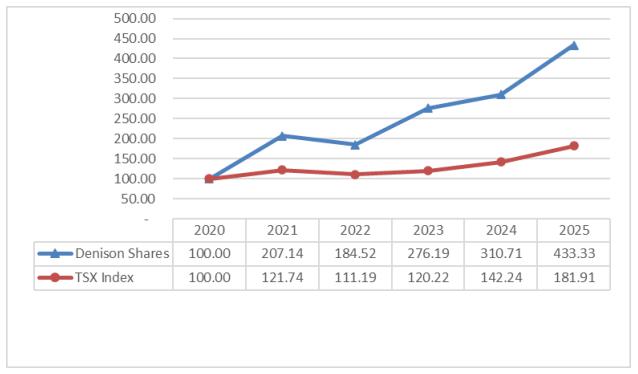
Data supplied by the TSX.
Five-Year Trend in NEO Total Compensation
Compared to Denison Cumulative Value of $100 Investment
To evaluate the trend in Denison compensation levels in relation to Share performance as measured in the graph above, Denison relied on the total annual compensation awarded for fiscal years 2020 through 2025 on the same basis as is currently disclosed in the “Summary Compensation Table” above, using the fiscal year 2020 as a base amount for comparing changes in compensation over time.
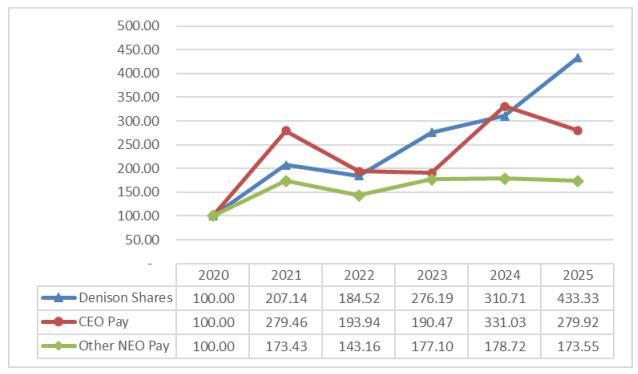
Denison Share data supplied by the TSX.
The chart above reflects the impact of equity-linked compensation for the Company’s NEOs. For 2021 and 2024, the chart reflects adjustments to executive compensation approved by the Compensation Committee after review of recommendations from GGA that: (a) resulted in an increase in executive salaries, to better align with peer benchmarking; and (b) adjustments to the LTIP targets within the Bonus Plan.
See “Compensation of Named Executive Officers – Five Year Trend Discussion” for more details.
| 2026 Denison Management Information Circular
| - 44 - |
Annual Performance Incentives
Denison’s NEOs were eligible to receive a bonus for the year ended December 31, 2025, in accordance with the Company’s Bonus Plan. As previously discussed, computation of bonuses is based on assessments of corporate and individual performance.
2025 Corporate Performance
As explained starting on page 39 of the Circular, Corporate Performance Measures for 2025 were assessed with reference to Shareholder Return Relative to Industry (SRI) and Corporate Objectives.
Corporate Performance - SRI
For SRI, the performance of the Company’s selected SRI Peer Group is used as the benchmark for measuring industry performance. In 2025, the market cap weighted share price performance of the SRI Peer Group (when comparing their share price on the last trading day of the year in 2025 against 2024) was +57.98%, resulting in the following SRI objectives:
½ Base (-5%) |
Base ( - ) |
Stretch (+10%) |
Breakthrough (+20%) |
| Peers – 5% | Peer Group | Peers + 10% | Peers + 20% |
| +52.98 | +57.98% | +67.98% | +77.98% |
Denison’s share price increased from US$1.8152 on December 31, 2024 to US$2.6538 on December 31, 2025, representing a percentage change of +46.20%, which is aligned with a “Below Base” level achievement against its SRI Peer Group. However, Denison significantly outperformed three of the five peer companies (NXE, PDN, and BOE), who taken as a group achieved a market cap weighted performance of only +30.73%. In comparison, the two U.S. based peer companies (EFR and UEC) averaged over ~130% and account for 66.76% of the SRI weighted return of +57.98%, despite market cap weightings accounting for only 37.30%. It was considered that assessing the SRI metric at a “Below Base” does not appropriately reflect the Company’s relative peer performance and the fact that the U.S. peers appear to have disproportionately benefited from U.S. government policy developments in 2025 regarding investments in U.S. critical minerals projects. Therefore, the Board approved an SRI achievement rating of “Stretch” for 2025.
| 2026 Denison Management Information Circular
| - 45 - |
Corporate Performance – Corporate Objectives
The second element of corporate performance is the assessment of performance against specified corporate objectives identified by the Compensation Committee and the Board as being the strategic focus of the Company and management in the year. The Compensation Committee assessed the 2025 performance against corporate objectives, as summarized in the following table:
| Corporate Performance Objectives | Weighting | Assessment |
| 1. SRI | 15% | Stretch
|
| 2. Progress the permitting, development and construction readiness of Phoenix at Wheeler River | 40% | Breakthrough.
Overall, excellent progress has been made advancing the Phoenix project towards the completion of engineering, permitting and procurement scopes during 2025. Highlights of 2025 achievements include: · Advancing detailed engineering design for Wheeler River, with total engineering reaching ~87% completion at year end. · Provincial approval of the EA for the project. · Conclusion of the federal hearings for EA approval and construction licensing, and completion of the project controls and licensing documentation. · Establishing the project procurement framework, with all critical path items awarded to maintain project schedule. · Engaging with various Interested Parties, including execution of impact-benefit agreements with each of the Métis Parties and YNLR. · Completing project financing transactions, including (i) the issuance of US$345M convertible notes with a cash-settled capped call overlay – a novel transaction for a Canadian TSX-listed company, and (ii) sales from the Company’s current physical uranium holdings.
|
| 3. Drive value through development portfolio | 12.5% | Base.
The Company achieved positive results from its field programs and studies for its development portfolio projects. Highlights from 2025 include: (a) the completion of a preliminary economic assessment for the potential use of ISR at the Midwest project; and (b) the completion of additional drilling and evaluation programs for the Wheeler River Gryphon deposit.
|
4. Drive value through the exploration portfolio
|
12.5% | Base.
Highlights of 2025 achievements include a strong year of positive exploration results from its collaborations with each of Foremost Clean Energy (Nasdaq: FMST) and Cosa Resources (TSX-V: COSA); and the execution of a new collaboration with Skyharbour Resources Ltd. (TSX-V: SYH) for the former Russell Lake property.
|
| 5. Support Company Growth | 10% | Stretch.
The success associated with the Company’s commercial, human resources, and financing efforts have significantly advanced key areas of corporate growth. Highlights of 2025 achievements include: · Significant increase in commercial marketing activity. · Great Place to Work® certification awarded for the second consecutive year. · Implementation of inventory-related procurement systems.
|
| 6. Maintain high standards of compliance against regulatory and EHS&S targets | 10% | Base.
Highlights of 2025 achievements include: · No Lost Time Injuries. · No material fines or penalties. · Continued positive performance against Reconciliation Action Plan.
|
| 2026 Denison Management Information Circular
| - 46 - |
2025 Individual Performance
In 2025, the Board of Directors approved individual objectives for Mr. Cates upon the recommendation of the Compensation Committee. In March 2026, the Compensation Committee assessed Mr. Cates’ performance against these objectives in making their recommendation to the Board of Directors as to Mr. Cates’ entitlement under the Bonus Plan. It was determined that Mr. Cates had achieved his objectives, as summarized, in part, as follows:
| Objective | Weighting | Assessment |
1. Lead ongoing efforts to build a high-performing company and leadership culture as we manage our recent and planned future growth.
|
25% | Base.
Highlights of 2025 achievements include: · Supporting executive team alignment and communication, using tools such as management committees and executive meetings. · Holding Annual Denison Town-Hall to review 2024 results and 2025 objectives with all staff. · Employee engagement activities, including summer staff events, winter holiday events, semi-annual staff newsletter, and staff milestone awards.
|
| 2. Continue to dynamically manage the Company’s asset base – including evaluating corporate development opportunities to upgrade or enhance the Company’s exploration and development project portfolio. | 25% | Base.
Highlights of 2025 achievements include Russell Lake transaction with Skyharbour, resulting in the acquisition of ownership interests and earn-in option on four new joint venture properties adjacent to the east / south of Wheeler River from the former Russell Lake property – including Wheeler North, which Denison considers a top exploration prospect.
|
3. Secure financing and advance commercial and financing strategy development in alignment with the Company’s long-term strategic plan, with a focus on obtaining financing for the Phoenix project on attractive terms.
|
25% | Breakthrough.
Highlights of 2025 achievements include raising significant funding during the year – representing the vast majority of Phoenix capital needs, including (i) the issuance of US$345M convertible notes, and (ii) sales from the Company’s physical uranium holdings at an average realized price above the average spot price for the year.
|
4. Support completion of regulatory approvals required to commence Phoenix construction, including negotiation of additional IBA-type agreements.
|
25% | Breakthrough.
Highlights of 2024 achievements include: · Successfully executing IBA-type agreements with the MN-S Parties and YNLR; and · Direct involvement in Part I and Part II Canadian Nuclear Safety Commission (“CNSC”) Commission hearings and related preparations, providing important leadership support to the team and presence and accountability with the Commission.
|
Each of the other NEOs eligible for a bonus for 2025 had individual performance objectives approved by the Compensation Committee, and the Compensation Committee assessed their performance against these objectives in determining an award under the Bonus Plan.
Each executive was assessed as having met or exceeded their 2025 base level objectives.
| 2026 Denison Management Information Circular
| - 47 - |
| Executive | Achievement Highlights |
Elizabeth Sidle Vice President Finance & Chief Financial Officer |
· Led development of Project Control strategy and processes to support cost control activities during Phoenix construction; · Leadership of the procurement team and procurement strategy development to support long-lead contracting, construction, and future operations. · Led the project to enhance the Company’s Information Technology functions, to support Company growth and future operations. · Key contributions to corporate development & other strategic initiatives.
|
Geoff Smith Vice President Corporate Development & Commercial |
· Development and execution of Phoenix project financing strategy. · Completion of several transactions to monetize physical uranium inventory. · Leadership of the Company’s corporate development efforts, evaluating and executing on value-enhancing transactions.
|
Chad Sorba Vice President Technical Services & Project Evaluation |
· Execution of Phoenix pre-construction EA commitments field program · Significant support for the CNSC license approval process, including preparation for and participation in the CNSC Commission hearing. · Leading the Company’s exploration efforts and management project portfolio. · Completion of Gryphon evaluation efforts, to support further study of the deposit. · Completion of the Midwest preliminary economic assessment for the potential application of ISR.
|
Amanda Willett Vice President Legal and Corporate Secretary
|
· Key contributions to the achievement of various Company objectives in the year, including project finance, as well as other corporate development, legal and strategic initiatives · Supporting project development, technical program, and regulatory activities, including the CNSC Commission hearing process, and providing cross-functional legal support for key business activities. · Oversight of the Company’s corporate governance, crisis management, enterprise risk management, and ESG programs and practices.
|
Based on the foregoing, the assessment of the following NEOs’ bonus entitlement was:
| Name | Corporate Calc./Max |
Individual
Calc./Max |
Total
Calc./Max |
| David Cates | 123.3% / 180.00% | 13.6% / 20.0% | 136.9% / 200.0% |
| $725,990 | $80,080 | $806,070 | |
| Elizabeth Sidle | 60.2% / 91.0% | 25.9% / 39.0% | 86.1% / 130.0% |
| $194,210 | $83,550 | $277,760 | |
| Geoff Smith | 36.9% / 54.0% | 31.2% / 36.0% | 68.1% / 90.0% |
| $110,700 | $93,600 | $204,300 | |
| Chad Sorba | 36.9% / 54.00% | 29.7% / 36.00% | 66.6% / 90.0% |
| $109,740 | $88,330 | $198,070 | |
| Amanda Willett | 36.9% / 54.0% | 31.2% / 36.0% | 68.1% / 90.0% |
| $110,700 | $93,600 | $204,300 |
Long Term Incentive Plan Awards
The Company employs three forms of incentive plans to award its employees for individual and Company performance, namely option-based awards, share-based awards and non-equity-based awards in the form of cash bonuses. See “Equity Compensation Plans” below, for more information.
| 2026 Denison Management Information Circular
| - 48 - |
Value Vested or Earned during 2025
The table below sets out information concerning the value of incentive plan awards, including option-based, share-based and non-equity incentive plan compensation, vested or earned during the financial year ended December 31, 2025 for each NEO.
| Name | Option-based
awards Value vested during year ($)1 |
Share-based
awards Value vested during year ($)2 |
Non-equity
incentive plan compensation – Value earned during the year ($) |
| David Cates | (2,110) | 631,656 | 806,070 |
| Elizabeth Sidle | (2,243) | 157,855 | 277,760 |
| Geoff Smith | 29,820 | 84,640 | 204,300 |
| Chad Sorba | (7,007) | 55,170 | 198,070 |
| Amanda Willett | 4,177 | 144,457 | 204,300 |
Note for Value Vested or Earned During 2025:
| 1. | The option value vested during the year reflects the aggregate dollar value that would have been realized if the options that vested in 2025 were exercised on their vesting date. |
| 2. | The share unit value vested during the year reflects the aggregate dollar value realizable if the Shares were issued on their vesting date. |
Outstanding Share-Based Awards
The following table sets out for each NEO the number and value of their share units outstanding on December 31, 2025.
| Name | Unvested (#)1 |
Market
or ($)2 |
Vested
but (#) |
Market
or payout ($) |
| David Cates | 520,667 RSUs | 1,895,228 | 2,697,583 RSUs | 9,819,202 |
| Nil PSUs | Nil | Nil PSUs | Nil | |
| Total | 1,895,228 | 9,819,202 | ||
| Elizabeth Sidle | 153,333 RSUs | 558,132 | 155,500 RSUs | 566,020 |
| Nil PSUs | Nil | Nil PSUs | Nil | |
| Total | 558,132 | 566,020 | ||
| Geoff Smith | 122,000 RSUs | 444,080 | 43,000 RSUs | 156,520 |
| Nil PSUs | Nil | Nil PSUs | Nil | |
| Total | 444,080 | 156,520 | ||
| Chad Sorba | 92,000 RSUs | 334,880 | 44,000 RSUs | 160,160 |
| Nil PSUs | Nil | Nil PSUs | Nil | |
| Total | 334,880 | 160,160 | ||
| Amanda Willett | 111,334 RSUs | 405,256 | 425,916 RSUs | 1,550,334 |
| Nil PSUs | Nil | 200,000 PSUs | 728,000 | |
| Total | 405,256 | 2,278,334 |
Notes for Outstanding Share-Based Awards:
| 1. | Share unit values have been calculated using the closing price of the Shares on the TSX on December 31, 2025 of $3.64. |
| 2026 Denison Management Information Circular
| - 49 - |
Outstanding Option-Based Awards
The following table sets out for each NEO the number and value of their options outstanding on December 31, 2025.
| Name | Shares
underlying unexercised options (#) |
Option
exercise price ($) |
Option
expiration date |
Value
of unexercised in-the- money options ($)1 |
| David Cates | 315,000 | 1.84 | March 7, 2027 | 567,000 |
| 360,000 | 1.49 | March 13, 2028 | 774,000 | |
| 439,000 | 2.61 | March 4, 2029 | 452,170 | |
| 409,000 | 1.99 | March 17, 2030 | 674,850 | |
| Total | 1,523,000 | 2,468,020 | ||
| Elizabeth Sidle | 69,000 | 1.84 | March 7, 2027 | 124,200 |
| 98,000 | 1.49 | March 13, 2028 | 210,700 | |
| 123,000 | 2.61 | March 4, 2029 | 126,690 | |
| 128,000 | 1.99 | March 17, 2030 | 211,200 | |
| Total | 418,000 | 672,790 | ||
| Geoff Smith | 96,000 | 2.31 | December 20, 2028 | 127,680 |
| 94,000 | 2.61 | March 4, 2029 | 96,820 | |
| 119,000 | 1.99 | March 17, 2030 | 196,350 | |
| Total | 309,000 | 420,850 | ||
| Chad Sorba | 13,000 | 1.84 | March 7, 2027 | 23,400 |
| 34,000 | 1.49 | March 13, 2028 | 73,100 | |
| 72,000 | 2.61 | March 4, 2029 | 74,160 | |
| 88,000 | 1.99 | March 17, 2030 | 145,200 | |
| Total | 207,000 | 315,860 | ||
| Amanda Willett | 77,000 | 1.84 | March 7, 2027 | 138,600 |
| 95,000 | 1.49 | March 13, 2023 | 204,250 | |
| 89,000 | 2.61 | March 4, 2029 | 91,670 | |
| 83,000 | 1.99 | March 17, 2030 | 136,950 | |
| Total | 344,000 | 571,470 |
Notes for Outstanding Option-Based Awards:
| 1. | Option values have been calculated using the closing price of the Shares on the TSX on the last trading day of 2025 of $3.64, less the applicable exercise price of the outstanding options. As at December 31, 2025, some of the options had not fully vested. The above value of unexercised in-the-money options has been computed assuming that all of the options have vested. |
Executive Share Ownership Requirement
The Company’s executive officers are subject to the share ownership requirement, requiring them to hold Shares (including RSUs and PSUs) at the following levels, within five years of becoming subject to the requirement.
| Executive | Share Ownership Requirement |
| Chief Executive Officer | 1x base salary |
| Other Officers | 0.5x base salary |
| 2026 Denison Management Information Circular
| - 50 - |
For the purposes of assessing compliance for Denison’s executive officers, the share ownership requirement provides that Denison’s securities are valued in the following manner:
| · | Common Shares: The value of the Shares is equal to the actual purchase price. For Shares acquired through the exercise of stock options, the Shares issued upon exercise will be valued at the closing price of the Shares on the TSX on the day before exercise. For Shares acquired through the vesting of PSUs or RSUs, the value of these Shares shall be calculated as the greater of the market value of the PSUs or RSUs under the Share Unit Plan at the date of grant and the closing price of the Shares on the day before issue. |
| · | RSUs: The value of the RSUs shall be equal to the closing price of the Shares on the TSX on the day before grant. |
| · | PSUs: The value of unvested PSUs shall be equal to half of their market value at the time of grant as determined using the closing price of the Shares on the TSX on the day before grant. The value of vested PSUs shall be equal to the closing price of the Shares on the TSX on the day before grant. |
| · | Equity Owned Prior to Requirement: Notwithstanding the foregoing, the value of equity an individual owned prior to becoming subject to the share ownership requirement shall be equal to the greater of their cost of acquisition or the value of the holdings using the closing price of the Shares on the TSX on the day before the individual becomes subject to the requirement. |
If an executive officer’s share ownership requirement is increased due a change in their position or an increase in base salary, the executive officer will have an additional five-year period from the date of the increase to meet the additional share ownership.
The share ownership requirement for Denison’s executive officers was instituted on March 3, 2022. As of March 24, 2026, the approximate share ownership values for the applicable NEOs are as follows:
| Name | Base Salary1 | Share Ownership Requirement |
Equity Value2 | Status |
| David Cates | $589,000 | $589,000 | Shares: $7,108,000 Share Units: $7,528,000 |
Compliant (approx. 25x base salary) |
| Elizabeth Sidle | $323,000 | $162,000 | Shares: $216,000 Share Units: $940,000 |
Compliant (approx. 4x base salary) |
| Geoff Smith | $300,000 | $150,000 | Shares: $46,000 Share Units: $654,000 |
Compliant (approx. 2x base salary) |
| Chad Sorba | $297,000 | $149,000 | Shares: $Nil Share Units: $518,000 |
Compliant (approx. 2x base salary) |
| Amanda Willett | $300,000 | $150,000 | Shares: $566,000 Share Units: $1,690,000 |
Compliant (approx. 8x base salary) |
Notes for Share Ownership Requirement:
| 1. | The base salary for each NEO disclosed above is as at December 31, 2025. |
| 2. | The equity values of Shares, PSUs and RSUs held by the NEOs have been calculated in accordance with the share ownership requirement as of March 24, 2026. |
Loans to Executives
As of the date of this Circular, Denison and its subsidiaries had no loans outstanding to any current or former NEOs, except routine indebtedness as defined under Canadian securities laws.
| 2026 Denison Management Information Circular
| - 51 - |
Compensation on Termination
Pursuant to Mr. Cates’ executive employment agreement with the Company, upon termination of the employment agreement by either party for any reason, Mr. Cates shall be paid all compensation earned by him (regardless of whether yet paid) as of the effective date of termination. In the event that Mr. Cates's employment is terminated (a) by the Company for a reason other than just cause or (b) by Mr. Cates in the event of a Good Reason, Mr. Cates will be entitled to (i) a payment equal to 24 months’ salary, (ii) a bonus payment in an amount equal to the bonus payment earned by Mr. Cates for the fiscal year ending immediately prior to the effective date of termination, and (iii) a payment equivalent to 19% of the amount determined pursuant to (i) as compensation for discontinued benefits.
Mses. Sidle and Willett and Messrs. Smith and Sorba all have similar written executive employment agreements with the Company at the end of the financial year, which set out their rights in the event of termination, including termination without cause or termination by the executive for “Good Reason” (as defined below). Upon termination of the employment agreement by either party for any reason, the NEO shall be paid all compensation earned by such NEO (regardless of whether yet paid) as of the effective date of termination. In the event that the NEO's employment is terminated (a) by the Company for a reason other than just cause – except as described below, or (b) by the NEO in the event of a Good Reason, the NEO will be entitled to a payment equal to 18 months’ salary and a bonus payment in an amount equal to the bonus payment awarded to such NEO for the fiscal year ending immediately prior to the effective date of termination.
In each contract, a Good Reason means:
| · | the assignment of any duties inconsistent with the status of the executive's assigned office or a material alteration in the executive’s duties, responsibilities, status or reporting relationship; |
| · | a reduction in the executive’s annual base salary; |
| · | requiring the executive to be based in a different location; |
| · | any other events or circumstances which would constitute a constructive dismissal at common law; or |
| · | a “change of control” of the Company. A “change of control” means (a) the acquisition of control or direction by any holder of the voting rights of 50% or more of the Shares, (b) a cessation of the incumbent directors constituting a majority of the Board when the incumbent directors do not recommend or approve of the replacement directors, or (c) the approval by the Shareholders of (i) a business arrangement (such as an amalgamation, arrangement or merger) not approved by the Board which results in the current Shareholders immediately thereafter not holding more than 50% of the Shares; (ii) the liquidation, dissolution or winding up of the Company; or (iii) the sale, lease or other disposition of all or substantially all of the assets of the Company. |
Pursuant to the Company’s Option Plan, subject to a specific provision in an NEO employment agreement, all options held by directors and employees of the Company vest immediately following a change of control, which is defined in the Option Plan as the acquisition of 30% or more of the then outstanding Shares or a sale by the Company of substantially all of its assets. All options are then exercisable for a period of 60 days following the close of any such transaction.
Pursuant to the Share Unit Plan, subject to the provisions of any NEO employment agreement, in the event of a Termination on Change of Control, (a) all unvested RSUs outstanding shall immediately vest on the date of such termination; and (b) all unvested PSUs (with performance criteria outstanding) shall vest on the date of such termination using an Adjustment Factor as determined by the Compensation Committee. See “Equity Compensation Plans – Share Unit Plan”.
Pursuant to the employment agreements for each of Messrs. Cates, Himbeault and Smith and Mses. Sidle and Willett, if the NEO’s employment agreement is terminated by the Company without cause or by the NEO for Good Reason, any of such NEO’s unvested stock options will automatically vest and all stock options held by the NEO will be exercisable for a 90-day period.
| 2026 Denison Management Information Circular
| - 52 - |
The table below is a summary of the compensation that would have been paid to the NEOs if any of them had been terminated without cause on December 31, 2025.
| Name | Separation
Pay ($)1 |
Bonus
Payment ($) |
Value
of In-the- Money Equity Awards2 ($) |
Payment
in lieu of Benefits ($) |
Total ($) |
| David Cates | 1,177,600 | 724,510 | 14,182,450 | 223,744 | 16,308,304 |
| Elizabeth Sidle | 483,900 | 254,440 | 1,796,942 | Nil | 2,535,282 |
| Geoff Smith | 225,000 | 172,910 | 1,021,450 | Nil | 1,419,360 |
| Chad Sorba | 223,050 | 161,600 | 810,900 | Nil | 1,195,550 |
| Amanda Willett | 450,000 | 164,000 | 3,255,060 | Nil | 3,869,060 |
Notes to Termination Payouts:
| 1. | For a termination without cause in the event of a change of control on December 31, 2025, the amounts for each NEO would have been as set forth in the table as Separation Pay, except for Mr. Smith and Mr. Sorba, which would be $450,000 and $446,100, respectively. |
| 2. | The amount shown represents the incremental value of the NEOs’ unexercised in-the-money equity as at December 31, 2025, based on the closing price of the Shares on the TSX on December 31, 2025 of $3.64 and assuming all of the options and share units have vested. The Company would not be required to make any cash payment for this amount upon termination of the NEO. |
| 2026 Denison Management Information Circular
| - 53 - |
Equity Compensation Plans
Denison has two equity compensation plans: Option Plan and Share Unit Plan.
Denison’s Option Plan is a fixed number share option plan under which a maximum of 39,670,000 Shares have been authorized for issuance on the exercise of options, representing 4.4% of the Company’s issued and outstanding Shares at December 31, 2025. The Option Plan was first implemented in 1997, and was amended and updated (with shareholder and regulatory approval) in 2006 and then again in 2013.
Denison’s Share Unit Plan is a fixed number share unit plan under which a maximum of 21,000,000 Shares have been authorized for issuance, representing 2.3% of the Company’s issued and outstanding Shares at December 31, 2025. The Share Unit Plan was first implemented in 2018 and was amended and restated (with shareholder and regulatory approval) in May 2025.
As at December 31, 2025, there were an aggregate of 6,356,165 options, 7,821,087 RSUs and 260,000 PSUs outstanding under their respective plans, and the number and price of Shares to be issued under the Option Plan and Share Unit Plan, and the percentage relative to the number of issued and outstanding Shares of the Company, was as follows:
Plan Category
|
Number
of Shares (a) |
The
number in (a) as Percentage of Issued and Outstanding Shares |
Weighted
– Average Exercise Price of Outstanding Equity Compensation |
Number
of Shares (excluding |
Percentage
of Issued and Outstanding Shares |
Equity Compensation Plans Approved by Shareholders - Option Plan - Share Unit Plan |
6,356,165 8,081,087 |
0.70% 0.90% |
$1.95 N/A3 |
7,827,7401 12,785,2482 |
0.87% 1.32% |
| Equity Compensation Plans Not Approved by Shareholders5 | Nil | Nil | Nil | Nil | Nil |
Notes:
| 1. | The maximum number of Shares issuable under the Option Plan is 39,670,000. As at December 31, 2025, 31,842,260 options had been granted or exercised (less cancellations) since the Option Plan’s inception in 1997. |
| 2. | The maximum number of Shares issuable under the Share Unit Plan is 21,000,000. As at December 31, 2025, 8,214,752 Share Units were outstanding, or had been granted or exercised (less cancellations), since the Share Unit Plan renewal in May 2025. |
| 3. | Share Units issued under the Share Unit Plan do not have an exercise price and they entitle the holder to Shares upon vesting and settlement. As at December 31, 2025, the granted and outstanding Share Units had a fair value of $3.64 per Share Unit, based on the closing price of the Shares on the TSX on December 31, 2025. |
For the fiscal years ended December 31, 2023, 2024 and 2025: (a) the annual burn rate for all of Denison’s equity compensation arrangements is 0.40%, 0.41%, 0.41% and respectively; (b) the annual burn rate for securities issued under the Option Plan is 0.22%, 0.19%, and 0.21% respectively; and (c) the annual burn rate for securities issued under the Share Unit Plan was 0.18%, 0.22%, and 0.20% respectively.
| 2026 Denison Management Information Circular
| - 54 - |
Option Plan
The purpose of the Option Plan is to attract, retain and motivate the Company’s directors, officers, key employees and consultants and to align their interests with those of the Company and its Shareholders. The Compensation Committee administers grants under the Option Plan. All grants are subject to the approval of the Board.
Below are the key provisions of Denison’s Option Plan:
| · | A maximum of 39,670,000 Shares are currently authorized for issuance under the Option Plan. |
| · | Denison’s directors, officers, employees and consultants of the Company or a subsidiary of the Company or any employee of a management company providing services to the Company or a subsidiary of the Company are eligible to participate under the Option Plan. |
| · | Options cannot have a term of over ten years; however, since 2011, the Board has adopted a practice of granting options with five year terms and, for grants prior to 2022, vesting of options in two equal parts on each of the first and second anniversaries of the grant date. In March 2022, the Board adopted a practice of vesting options over three years for subsequent grants. |
| · | Grants are typically done annually. The Compensation Committee takes into account previous grants when it considers recommending to the Board new grants of options. |
| · | The Board fixes the exercise price of an option at the time of the grant at the TSX closing price of Shares on the trading day immediately before the date of the grant, and the exercise price cannot be lower than this price. |
| · | If a director, officer or an employee leaves the Company, all of their options will expire 30 days after they cease to be a director or an employee, except the expiry period is extended if the options would otherwise expire during a period of time when trading Shares is restricted. In certain cases, individual employment agreements may vary vesting rights and expiry periods upon termination or upon a change of control. See “Compensation on Termination” starting on page 52 for more information. The Option Plan provides that options granted to a consultant will terminate 30 days after the consultant agreement terminates. |
| · | The Option Plan does not provide for a restriction on the maximum number of securities issuable to any one person or company. However, no more than 10% of total Shares issued and outstanding can be reserved for issuance to insiders in a one-year period under the Option Plan and any other security-based compensation arrangement, and no more than 10% of total Shares issued and outstanding can be issued to all insiders in a one-year period under the Option Plan and any other share-based compensation arrangement. Options cannot be transferred to another person. |
| · | The following kinds of changes require Shareholder approval under the terms of the Option Plan: |
| ü | any change to the number of Shares that can be issued under the plan, including increasing the fixed maximum number of Shares, or changing from a fixed maximum number to a fixed maximum percentage of Shares |
| ü | any change that increases the number of categories of people who are eligible to receive options, if it could increase the participation of insiders |
| ü | the addition of any form of financial assistance or any amendment to a financial assistance provision which is more favourable to participants |
| ü | the addition of a cashless exercise feature which does not provide for a full deduction of the number of underlying Shares from the plan reserve |
| ü | the addition of a deferred or restricted share unit or any other provision which results in Shares being received while no consideration is received by Denison |
| ü | discontinuance of the Option Plan |
| 2026 Denison Management Information Circular
| - 55 - |
| ü | any other amendments that could lead to a significant dilution of the Company’s outstanding Shares or may provide additional benefits to participants under the Option Plan, especially insiders, at the expense of the Company and its existing Shareholders |
| · | No change to the Option Plan can alter or affect the rights of an option holder in a negative way without his or her consent, except as described in the Option Plan. |
| · | The Board has the power, subject to regulatory approval where required, to make a limited number of changes to the Option Plan, including amendments of a house keeping nature, changes to the vesting provisions of an option, a change to the termination provisions of an option, provided that the extension does not go beyond the original expiry date of the option, and the addition of a cashless exercise feature that provides for a full deduction of Shares from the plan reserve. |
| · | The Company prohibits the giving of financial assistance to facilitate the purchase of Shares to directors, officers or employees who hold options granted under the Option Plan. |
| · | Certain option grants to the executive officers of the Company may be subject to recovery pursuant to the Company’s Clawback Policy (see page 27 for details). |
Share Unit Plan
The Company’s goal with equity compensation in general is for it to act as an important tool to help motivate directors, officers, key employees and consultants, attract and retain the best people, and to align the participant’s interests with those of the Company and its Shareholders. The purpose of the Share Unit Plan is to align the Company’s equity compensation program with current market practices, and to create more flexibility in the types of incentive awards that may be made to eligible participants.
A Share Unit Plan was adopted in 2018, after the Company received feedback from certain investors suggesting the Company’s management could hold more equity in the Company. As a result of that feedback, GGA was requested to provide a report, in part, on the competitiveness of the Company’s long-term incentive plan. The GGA report noted that the grant of share units under a share unit plan would assist management in increasing their respective share ownership levels and increase their exposure to the share price, in a different way than more traditional stock option ownership. The Share Unit Plan was subsequently amended and restated effective May 12, 2025, with approval of shareholders, to increase the maximum number of Shares issuable thereunder to 21,000,000.
Below are the key provisions of Denison’s Share Unit Plan:
| · | The Share Unit Plan authorizes a maximum of 21,000,000 Shares for issuance thereunder. |
| · | Participants may be granted RSUs or PSUs or any combination of the foregoing. The vesting of PSUs is conditional upon achievement by the holder of defined performance objectives. |
| · | Eligible participants in the Share Unit Plan are Denison’s directors, officers, employees and consultants of the Company or an affiliate of the Company or any employee of a management company providing services to the Company or an affiliate of the Company. |
| · | Grants are anticipated to be done annually. |
| · | The Board will approve the terms of the RSUs and PSUs, as applicable, at the time of grant of the applicable Share Units, and each grant letter will describe the vesting and settlement provisions. The Board has adopted a practice of granting RSUs with vesting in three equal parts on each of the first, second and third anniversaries of the grant date. |
| · | Share Units are eligible to be settled on the first business day following the applicable vesting date, unless the holder of the Share Unit has elected to defer settlement. |
| 2026 Denison Management Information Circular
| - 56 - |
| · | Participants shall be entitled to elect, by written notice to the Company, to defer the settlement of their Share Units until the date which is the earlier of (i) the date to which the participant has elected to defer receipt of Shares in accordance with Section 3.4 of the Share Unit Plan; and (ii) the date of the Participant’s Retirement, Resignation, Termination with Cause or Termination Without Cause or Termination after Change of Control of the Company (as each term is defined in the Share Unit Plan). |
| · | The Board will have the option, at the time of the grant of the Share Units, to allow a participant to elect to settle their Share Units in cash instead of Shares issued from treasury. If, at the time of settlement, the participant elects to settle in cash, the cash payment will be determined by the number of Shares the participant would be eligible to receive multiplied by the closing price of the Shares on the TSX on the day before exercise. The Company has the right to override the participant’s election and settle such RSUs or PSUs in shares issued from treasury. If a participant has elected to defer settlement, they will no longer be entitled to elect to receive cash on settlement of their Share Units. |
| · | Subject to the terms of the grant letter or a participant’s employment agreement: |
| · | in the event of Termination Without Cause: (a) if the participant has been continuously employed for at least two years, (i) any unvested RSUs will automatically vest and become available for settlement, and (i) the unvested PSUs will vest using an Adjustment Factor as determined by the Board, and (b) if the participant has been continuously employed for less than two years, all of the unvested RSUs and PSUs shall become void and the participant shall have no entitlement to the issuance of Shares under such Share Units. |
| · | in the event of the Retirement of a participant, their unvested Share Units will automatically vest on the date of Retirement and the Shares underlying such Share Units will be issued to the participant as soon as reasonably practical thereafter. |
| · | in the event of the death of a participant, their unvested Share Units will automatically vest on the date of death and the Shares underlying all Share Units will be issued to the participant’s estate as soon as reasonably practical thereafter. |
| · | in the event of the disability of a participant (as may be determined in accordance with the policies, if any, or general practices of the Company or any subsidiary), any of their unvested Share Units will automatically vest on the date on which the participant is determined to be totally disabled and the Shares underlying the Share Units held will be issued to the Participant as soon as reasonably practical thereafter. |
| · | in the event of a Termination on Change of Control, all unvested Share Units outstanding shall immediately vest on the date of such termination, subject to an adjustment for any performance criteria that have not been satisfied for unvested PSUs. |
| · | Except pursuant to (i) a will or by the laws of descent and distribution, or (ii) any registered retirement savings plans or registered retirement income funds of which the participant is and remains the annuitant, no Share Unit and no other right or interest of a participant is assignable or transferable. |
| · | Unless the Company has received requisite shareholder approval, under no circumstances shall the Share Unit Plan, together with all other security based compensation arrangements of the Company (including the Option Plan), result, at any time, in: (i) the aggregate number of Shares reserved for issuance to insiders (as a group) at any point in time exceeding 10% of the Company’s issued and outstanding Shares; (ii) the issuance to insiders (as a group), within a one-year period, of an aggregate number of Shares exceeding 10% of the Company’s issued and outstanding Shares; (iii) the aggregate number of Shares reserved for issuance to all non-employee directors of the Company exceeding 1% of the Company’s issued and outstanding Shares; or (iv) the grant to any individual non-employee director of the Company of more than $150,000 worth of Shares annually. Subject to compliance with the foregoing, the Share Unit Plan does not provide for a restriction on the maximum number of securities issuable to any one person or company. |
| 2026 Denison Management Information Circular
| - 57 - |
| · | Shareholder and applicable stock exchange approvals will be required for any amendment, modification or change to the provisions of the Share Unit Plan which would: |
| ü | increase the maximum number of Shares which may be issued from treasury pursuant to Share Units granted pursuant to the Share Unit Plan (other than by virtue of adjustments pursuant to the Share Unit Plan); |
| ü | extend the expiry date for Share Units granted to Insiders under the Share Unit Plan; |
| ü | remove or exceed the Insider participation limits set forth in the Share Unit Plan; |
| ü | amend the eligible Participants that may permit the introduction or re-introduction of non-employee directors on a discretionary basis, or any increase to limits previously imposed on non-employee director participation; or |
| ü | modify the amending provisions in section 4.5 of the Share Unit Plan. |
| · | The Board has the power, subject to regulatory approval where required, to make the following changes to the Share Unit Plan: |
| ü | amendments of a “housekeeping” or administrative nature, including, without limitation, any amendment for the purpose of curing any ambiguity, error or omission in the Share Unit Plan, to correct or supplement any provision of the Share Unit Plan that is inconsistent with any other provision of the Share Unit Plan, to correct any grammatical or typographical errors, or to amend the definitions in the Share Unit Plan regarding administration of the Share Unit Plan; |
| ü | changes to the vesting provisions or other restrictions applicable to any Share Unit, grant letter or the Share Unit Plan; |
| ü | changes to the provisions of the Share Unit Plan, any Share Unit or grant letter relating to the expiration of Share Units, provided that the changes do not entail an extension beyond the original expiry date of such award; |
| ü | the cancellation of a Share Unit; |
| ü | amendments necessary to suspend or terminate the Share Unit Plan; |
| ü | amendments necessary to comply with the provisions of applicable law (including the rules, regulations and policies of any applicable stock exchange); or |
| ü | any other amendment to the Share Unit Plan, any Share Units and/or any grant letters that do not require shareholder approval under the rules of any applicable stock exchange. |
| · | Upon the occurrence of a Change of Control, the Board or the Compensation Committee may provide for: (i) the accelerated vesting of unvested Share Units, subject to an adjustment for any performance criteria that have not been satisfied for unvested PSUs, (ii) the assumption or replacement of Share Units by the successor entity, (iii) the surrender of Share Units in exchange for a cash payment made by the successor entity, or (iv) any combination of the foregoing. |
| · | If a dividend becomes payable by the Company on its Shares, at the Board’s discretion participants may be entitled to be credited with dividend equivalent payments in the form of additional RSUs and/or PSUs, as applicable, which additional units will be settled at the same time that the underlying RSUs and/or PSUs, as applicable, are settled. |
| · | PSUs granted to-date, to certain executive officers of the Company, vest in tranches provided the holder satisfies the performance conditions to vesting (an overall base level of achievement as assessed pursuant to the Bonus Plan, as described above, or similar assessment). If those vesting conditions are not satisfied, such PSUs would expire unvested. |
| · | Certain Share Unit awards to the executive officers of the Company may be subject to recovery pursuant to the Company’s Clawback Policy (see page 27 for details). |
| 2026 Denison Management Information Circular
| - 58 - |
The Board or the Compensation Committee administer grants under the Share Unit Plan, and subject to the terms of the Share Unit Plan, certain Grant Letters may alter the terms of the Share Unit Plan as it applies to any particular participant’s grant of share units. In addition, in certain cases, individual employment agreements may vary the rights of participants. All grants are subject to the approval of the Board, unless the Board delegates such approval to the Compensation Committee.
Additional Information
Shareholder Engagement
Denison works to ensure effective communication between the Company and its Shareholders and the public. Shareholders, employees and other interested parties are encouraged to reach out directly to management and/or the Board of the Company, to communicate any questions or concerns, and the Company regularly receives and responds to such inquiries.
The Company’s representatives are always engaged in investor relations and other Shareholder and stakeholder outreach, such as taking part in various public and private conferences throughout the year, and generally making themselves available to respond to inquiries and concerns. The Company’s investor relations procedures are monitored by the Board, and are intended to be a tool for the concerns of Shareholders and other interested parties to be addressed on an individual basis. Shareholders and the public are also informed of developments in the Company by the issuance of timely press releases and quarterly reports which are also posted to the Company’s website and filed on SEDAR+ and EDGAR.
| The Board also adopted the annual Shareholder advisory vote on the Company’s executive compensation practices, as a means for Shareholders to provide their views on the Company’s pay for performance compensation model. While this advisory vote is a useful tool for the Board and management, Shareholders are encouraged to contact the Board directly to enable the Board to better understand the voting results and address any concerns Shareholders may have. |
The Board monitors all the policies and procedures that are in place to ensure a strong, cohesive, sustained and positive image of the Company with Shareholders, governments and the public generally.
Shareholders, employees or other interested parties may communicate directly with management, the Chair of the Board and/or the other directors by writing to them at Denison’s Toronto office (1100 – 40 University Avenue, Toronto, Ontario, M5J 1T1). Correspondence should be marked to the attention of the appropriate party.
The Company can also be contacted:
| Online: | www.denisonmines.com
and https://denisonmines.com/investors/agm-information/ | |
| Email: | info@denisonmines.com | |
| Regular Mail: | 1100 - 40 University Avenue, Toronto, Ontario M5J 1T1 | |
| Phone: | 416-979-1991 or 1-888-260-4455 |
| 2026 Denison Management Information Circular
| - 59 - |
Additional Disclosure
Additional information relating to the Company is available on Denison’s website at www.denisonmines.com, on SEDAR+ under the Company’s profile at www.sedarplus.ca and on EDGAR at www.sec.gov/edgar. Financial information related to the Company is contained in the Company’s financial statements and related management’s discussion and analysis for its most recently completed financial year.
You may request a printed copy of the following documents free of charge by writing to the Corporate Secretary of the Company at 1100 - 40 University Avenue, Toronto, Ontario M5J 1T1:
| · | The Company’s 2025 Annual Report, containing the Company’s consolidated financial statements and related MD&A for its year ended December 31, 2025; |
| · | Any subsequently filed quarterly report; or |
| · | The Company’s most recent Annual Information Form or Annual Report on Form 40-F. |
Approval
The contents and the sending of this Circular to Shareholders, the directors and the auditor of the Company have been approved by the Board.
| By Order of the Board of Directors, | |
| Jennifer Traub | |
| Chair of the Board |
| 2026 Denison Management Information Circular
| - 60 - |
| Appendix A |  |
MANDATE OF THE BOARD, POSITION DESCRIPTIONS
AND LIMITS TO MANAGEMENT’S RESPONSIBILITIES
The Board of Directors of Denison Mines Corp. has adopted this written mandate and position descriptions for the Board, the Chair of the Board, the Chair of each Committee of the Board and the Chief Executive Officer (“CEO”), including the definition of the limits to management’s responsibilities.
On at least an annual basis, the Corporate Governance and Nominating Committee shall review and assess the adequacy of this mandate and make a recommendation to the Board regarding updating or amending the same.
1. MANDATE AND POSITION DESCRIPTION FOR THE BOARD
(a) The Board has adopted the following mandate in which it explicitly acknowledges responsibility for the stewardship of the Company and, as part of the overall stewardship responsibility, responsibility for the following matters:
| (i) | to the extent feasible, satisfying itself as to the integrity of the CEO and other executive officers and that the CEO and other executive officers create a culture of integrity throughout the organization; |
| (ii) | the strategic planning process and approving, on at least an annual basis, a strategic plan which takes into account, among other things, the opportunities and risks of the business; |
| (iii) | the identification of the principal risks of the Company’s business and ensuring the implementation of appropriate systems to manage these risks; |
| (iv) | succession planning, including appointing, training and monitoring of senior management; |
| (v) | the Company’s communications policy; and |
| (vi) | the Company’s internal control and management information systems. |
(b) The Board takes its responsibilities very seriously and expects that all directors will participate in Board and Committee meetings on a regular basis, to the extent reasonably practicable, and will review all meeting materials in advance of each meeting. Attendance of directors shall be taken at each Board meeting by the Corporate Secretary or Assistant Corporate Secretary.
(c) At all times, a majority of the Board will satisfy the independence requirements set out by the Canadian Securities Administrators in National Policy 58-201 and any other applicable laws and regulations as the same may be amended from time to time. The independent directors shall meet at least once per year to discuss the Company’s matters.
(d) The Company, together with its subsidiaries, is committed to conducting its business in compliance with the law and the highest ethical standards, and to the highest standards of openness, honesty and accountability that its various stakeholders are entitled to expect. The Audit Committee of the Board has established a Policy and Procedures for the Receipt, Retention and Treatment of Complaints Regarding Accounting or Auditing Matters, and the Company has established a Code of Ethics for Directors, Officers and Employees, which establishes procedures for directors, officers and employees to report any concerns or questions they may have about violations of the Code or any laws, rules or regulations. In addition, the Board will consider adopting other measures for receiving feedback from stakeholders if at any time the Board or its independent directors consider the foregoing to be inadequate.
(e) All new directors will receive a comprehensive orientation. This orientation may vary from director to director, depending on his or her expertise and past experience, but in each case will be sufficient to ensure that each director fully understands the role of the Board and its committees, the contribution individual directors are expected to make (including the commitment of time and resources that is expected) and an understanding of the nature and operation of the Company’s business.
(f) The Board will provide continuing education opportunities for all directors, where required, so that individual directors may maintain or enhance their skills and abilities as directors, as well as to ensure that their knowledge and understanding of the Company’s business remains current.
(g) Prior to nominating or appointing individuals as directors, the Board will consider the advice and input of the Corporate Governance and Nominating Committee on all relevant matters, including:
(i) the appropriate size of the Board, with a view to facilitating effective decision making; (ii) what competencies and skills the Board, as a whole, should possess; and
(iii) what competencies and skills each existing director possesses.
| 2026 Denison Management Information Circular
| - 61 - |
2. POSITION DESCRIPTIONS FOR THE CHAIR OF THE BOARD, THE LEAD DIRECTOR, THE CHAIR OF BOARD COMMITTEES AND THE CEO
(a) Where the Chair of the Board is not an independent director, in accordance with paragraph 1(c) of this Mandate, or the appointment is otherwise recommended by the Corporate Governance and Nominating Committee, the Board will appoint from among the independent directors, upon a recommendation of the Corporate Governance and Nominating Committee, a Lead Director to serve as such until the next meeting of shareholders where directors are elected, unless otherwise removed by resolution of the Board of Directors.
(b) The Chair of the Board (or Lead Director, in the Chair’s absence or if the Chair is not independent) will:
| (i) | act as the effective leader of the Board and ensure that the Board’s agenda will enable it to successfully carry out its duties; |
| (ii) | organize the Board to function independently of management, and ensure that the responsibilities of the Board are well understood by both the Board and management and that the boundaries between the Board and management responsibilities are clearly understood and respected; |
| (iii) | ensure that the Board has an opportunity to meet without members of management, regularly, and without non-independent directors at least once per year; |
| (iv) | determine, in consultation with the Board and management, the time and places of the meetings of the Board; |
| (v) | manage the affairs of the Board, including ensuring that the Board is organized properly, functions effectively and meets its obligations and responsibilities and mandates, where appropriate, through its duly appointed committees, including: |
| o | ensuring that the Board works as a cohesive team and providing the leadership essential for this purpose; |
| o | ensuring that the resources available to the Board (in particular timely and relevant information) are adequate to support its work; |
| o | ensuring that a process is in place by which the effectiveness of the Board and its committees is assessed on a regular basis; |
| o | ensuring that a process is in place by which the contribution of individual directors to the effectiveness of the board and committees is assessed on a regular basis; and |
| o | ensuring that, where functions are delegated to appropriate committees, the functions are carried out and results are reported to the Board. |
| (vi) | ensure that the Board has a succession planning process is in place to appoint the Chief Executive Officer and other members of management when necessary; |
| (vii) | co-ordinate with management and the Corporate Secretary or Assistant Corporate Secretary to ensure that matters to be considered by the Board are properly presented and given the appropriate opportunity for discussion; |
| (viii) | preside as chair of each meeting of the Board; |
| (ix) | communicate with all members of the Board to co-ordinate their input, ensure their accountability and provide for the effectiveness of the Board; |
| (x) | in consultation with the CEO, and as appropriate, be available to, and respond to inquiries from, internal and external stakeholders; and |
| (xi) | act as liaison between the Board and management to ensure that relationships between the Board and management are conducted in a professional and constructive manner, which will involve working with the Chief Executive Officer to ensure that the conduct of Board meetings provides adequate time for serious discussion of relevant issues and that the Company is building a healthy governance culture. |
The Chair of the Board or the Lead Director may, as the case may be, delegate or share, where appropriate, certain of these responsibilities with any committee of the Board.
(c) In addition to any other duties he or she may perform, the Lead Director will provide leadership for the Board’s independent directors.
(d) Any special responsibilities and authorities of the Chair of any committee of the Board will be set out in the Terms of Reference/Mandate for the Committee. In general, the Chair of a Committee shall lead and oversee the Committee to ensure that it fulfills its mandate as set out in the Committee’s Terms of Reference/Mandate. In particular, the Chair shall:
| (i) | organize the Committee to function independently of management, unless specifically provided otherwise in the Committee’s Mandate; |
| (ii) | ensure that the Committee has an opportunity to meet without members of management as necessary; |
| (iii) | determine, in consultation with the Committee and management, the time and places of the meetings of the Committee; |
| 2026 Denison Management Information Circular
| - 62 - |
| (iv) | manage the affairs of the Committee, including ensuring that the Committee is organized properly, functions effectively and meets its obligations and responsibilities; |
| (v) | co-ordinate with management and the Secretary to the Committee to ensure that matters to be considered by the Committee are properly presented and given the appropriate opportunity for discussion; |
| (vi) | provide advice and counsel to the CEO and other senior members of management in the areas covered by the Committee’s mandate; |
| (vii) | preside as chair of each meeting of the Committee; and |
| (viii) | communicate with all members of the Committee to co-ordinate their input, ensure their accountability and provide for the effectiveness of the Committee. |
(e) The CEO, subject to the authority of the Board, shall have general supervision of the business and affairs of the Company and such other powers and duties as the Board may specify, from time to time. These responsibilities shall include: (i) providing leadership and vision for the Company for it to grow in a sustainable manner; (ii) developing a strategic plan for the Board’s approval, and ensuring implementation of that plan; (iii) overseeing the development and implementation of, and compliance with, key corporate policies and practices, regarding corporate governance, ESG, climate and sustainability, risk identification and management and financial reporting, as well as compliance with applicable legal and regulatory requirements; and (iv) making recommendations to the Board regarding the implementation, performance and monitoring, as the case may be, of each of the items referred to in paragraphs 2(b)(i) to (b)(vii) of this mandate and ensuring that procedures are in place and followed by the Company so that each of those items and any other requirement of the Board is implemented, performed and monitored in a prudent and responsible manner in accordance with the determinations of the Board. The Board will develop and approve periodically, as the Board considers necessary, the corporate goals and objectives that the CEO is responsible for meeting.
3. LIMITS ON THE CEO’S AUTHORITY
(a) Unless specifically instructed otherwise by the Board, and except as set out in Section 127(3) of the Ontario Business Corporations Act (the “OBCA”), the CEO of the Company has the responsibility and authority to transact any business or approve any matter:
| (i) | in the ordinary course of business of the Company; and |
| (ii) | that is not in the ordinary course of business of the Company, but that is not likely to result in a material change, within the meaning of the Ontario Securities Act, with respect to the Company; and |
(b) In addition to those matters referred to in Section 127(3) of the OBCA, Board approval is required with respect to any business or matter that is not in the ordinary course of business of the Company and that is likely to result in a material change, within the meaning of the Ontario Securities Act, with respect to the Company.
| 2026 Denison Management Information Circular
| - 63 - |
 | Denison Mines Corp. 1100 - 40 University Avenue Toronto, ON M5J 1T1 T 416 979 1991 F 416 979 5893
www.denisonmines.com TSX: DML NYSE American: DNN |