Please wait
|
.2
MANAGEMENT’S DISCUSSION & ANALYSIS
|
MANAGEMENT’S DISCUSSION & ANALYSIS
FOR THE YEAR ENDED DECEMBER 31, 2019
|
|
|
|
TABLE OF CONTENTS
|
|
|
2019 PERFORMANCE
HIGHLIGHTS
|
2
|
|
ABOUT
DENISON
|
3
|
|
URANIUM INDUSTRY
OVERVIEW
|
4
|
|
RESULTS OF
OPERATIONS
|
7
|
|
Wheeler River
Project
|
11
|
|
Exploration Pipeline
Properties
|
24
|
|
OUTLOOK FOR
2020
|
35
|
|
ADDITIONAL
INFORMATION
|
37
|
|
CAITIONARY
STATEMENT REGARDING FORWARD-LOOKING
STATEMENTS
|
49
|
|
|
|
This
Management’s Discussion and Analysis (‘MD&A’)
of Denison Mines Corp. and its subsidiary companies, joint
arrangements, and contractual arrangements (collectively,
‘Denison’ or the ‘Company’) provides a
detailed analysis of the Company’s business and compares its
financial results with those of the previous year. This MD&A is
dated as of March 5, 2020 and should be read in conjunction with
the Company’s audited consolidated financial statements and
related notes for the year ended December 31, 2019. The audited
consolidated financial statements are prepared in accordance with
International Financial Reporting Standards (‘IFRS’) as
issued by the International Accounting Standards Board
(‘IASB’). All dollar amounts in this MD&A are
expressed in Canadian dollars, unless otherwise noted.
Additional
information about Denison, including the Company’s press
releases, quarterly and annual reports, Annual Information Form and
Form 40-F is available through the Company’s filings with the
securities regulatory authorities in Canada at www.sedar.com
(‘SEDAR’) and the United States at
www.sec.gov/edgar.shtml (‘EDGAR’).
|
|
MANAGEMENT’S DISCUSSION & ANALYSIS
|
2019 PERFORMANCE
HIGHLIGHTS
■
Initiation of the Environmental Assessment (‘EA’) at
Wheeler River
During the first
quarter of 2019, Denison submitted a Project Description
(‘PD’) to the Canadian Nuclear Safety Commission
(‘CNSC’) and a Technical Proposal to the Saskatchewan
Ministry of Environment (‘SK MOE’) to support the
advancement of an In-Situ Recovery (‘ISR’) uranium mine
at the Company’s 90% owned Wheeler River Uranium Project
(‘Wheeler River’ or ‘the Project’). The
documents were accepted in the second quarter of 2019, initiating
the EA process for the project in accordance with the requirements
of both the Canadian Environmental Assessment Act, 2012
(‘CEAA 2012’) and the Saskatchewan Environmental
Assessment Act. The submission of the PD followed a decision by
Denison’s Board of Directors to approve the advancement of
the Phoenix ISR operation outlined in the Pre-Feasibility Study
(‘PFS’) completed for Wheeler River in 2018. In late
December 2019, Denison received a Record of Decision from the CNSC
on the scope of the factors to be taken into account for the
Wheeler EA, which indicate that the EA will follow the CNSC’s
generic guidelines.
■
Completion of Highly Successful 2019 ISR Field Test at
Phoenix
In December 2019,
Denison reported the completion of a highly successful ISR field
test program, which was carried out at the high-grade Phoenix
uranium deposit (‘Phoenix’) on the Wheeler River
property. The ISR field test program was designed to validate the
permeability of Phoenix, and to collect an extensive database of
hydrogeological data to further evaluate the ISR mining conditions
present at Phoenix. This detailed data is expected to facilitate
detailed mine planning as part of the completion of a future
Feasibility Study (‘FS’). The ISR field test program
included preliminary hydrogeological tests completed by using a
series of small diameter and large diameter test wells to move
water through two test areas defined within the Phoenix ore zone.
The ISR field test successfully achieved each of the
program’s planned objectives, and is highlighted by several
key de-risking accomplishments, including the
following:
●
Confirmation of significant
hydraulic connectivity within the Phoenix ore zone;
●
Installation of the Athabasca
Basin’s first Commercial Scale Wells (‘CSWs’) for
ISR;
●
Confirmation of limited
hydraulic connectivity within the underlying basement units;
and
●
Demonstration of the
effectiveness of MaxPerf to increase access to existing
permeability from a CSW.
Extensive
hydrogeological data sets were collected during the 2019 ISR field
program, and are being incorporated into a hydrogeological model
being developed for Phoenix. In February 2020, Denison reported
that the results from the hydrogeological test work, completed
to-date, have confirmed the ability to achieve bulk hydraulic
conductivity values (a measure of permeability) consistent with the
PFS (see Denison press release dated February 24,
2020).
■
Denison Initiates ISR
Metallurgical
Testing for the Phoenix Deposit and Reports Uranium Concentrations
from Initial Core Leach Tests up to Four Times the Amount Assumed
in PFS for Phoenix ISR
In December 2019,
Denison announced the initiation of the next phase of ISR
metallurgical laboratory testing for uranium recovery, which will
utilize the mineralized drill core recovered through the
installation of various test wells during the 2019 ISR field test
program. The metallurgical laboratory test program builds upon the
laboratory tests completed for the recovery of uranium as part of
the project’s PFS and is expected to further increase
confidence and reduce risk associated with the application of ISR.
The results are expected to facilitate detailed mine and process
plant planning as part of a future FS, and will provide key inputs
for the EA process. Significant components of the metallurgical
laboratory test program include core leach tests, column leach
tests, bench-scale tests and metallurgical modelling.
In February 2020,
Denison reported that initial data from core leach tests includes
elemental uranium concentrations, after test startup, in the range
of 13.5 grams per litre (‘g/L’) to 39.8 g/L, with an
average of 29.8 g/L over 20 days of testing (see Denison’s
press release dated February 19, 2020). This compares favourably to
the previous metallurgical test work completed to assess the use of
the ISR mining method at Phoenix – which supported a uranium
concentration of 10 g/L for the ISR processing plant design used in
the PFS.
■
Denison Reports Favorable Results from Exploration at Wheeler River
and Waterbury Lake
Denison conducted
winter and summer diamond drilling programs at Wheeler River during
2019 – totaling 10,573 metres in 20 holes. The programs were
focused on initial testing of regional target areas (K West, Q
South East, K South, O Zone) with the potential to result in the
discovery of additional high-grade deposits that could form
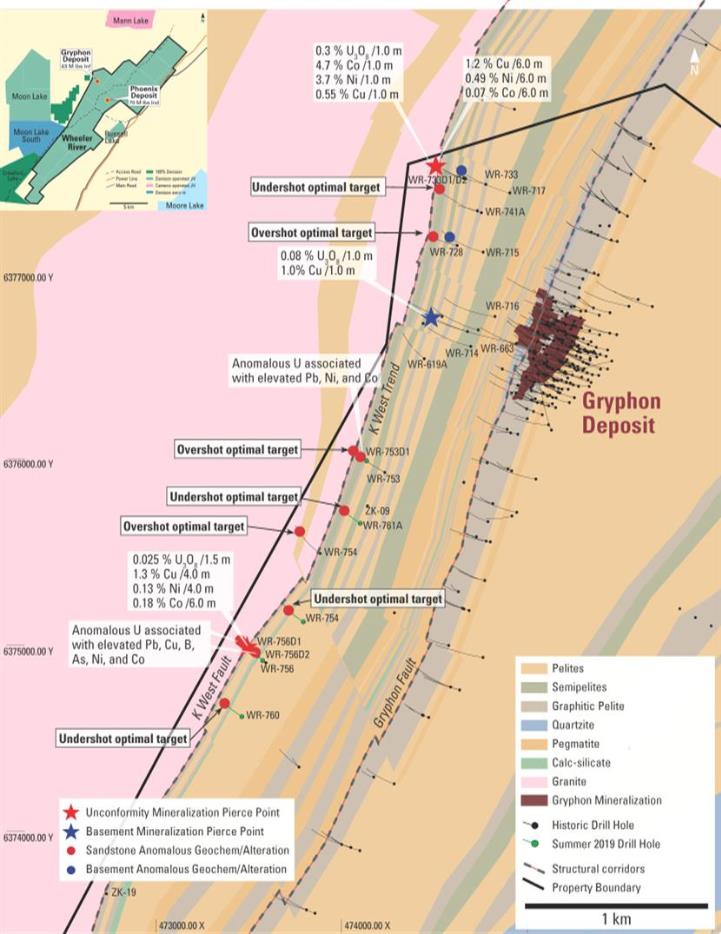
satellite ISR operations. During the 2019 winter program,
unconformity-hosted uranium mineralization was discovered along the
southern portion of the K West trend (approximately 2 kilometres
southwest of the Gryphon deposit) accompanied by strong sulphide
mineralization and other geological features commonly associated
with unconformity-related uranium deposits.
|
|
MANAGEMENT’S DISCUSSION & ANALYSIS
|
Drill hole WR-756
was highlighted by 0.03% U3O8 over 1.5 metres,
1.3% Cu over 4.0 metres, 0.13% Ni over 4.0 metres, and 0.18% Co
over 6.0 metres, located immediately above the sub-Athabasca
unconformity. Additional follow-up drilling during the 2019 summer
program at K West intersected strong hydrothermal alteration
associated with highly anomalous geochemistry within the basal
Athabasca sandstone, indicative of a fertile uranium mineralizing
system along the K West trend and providing evidence for additional
exploration targets.
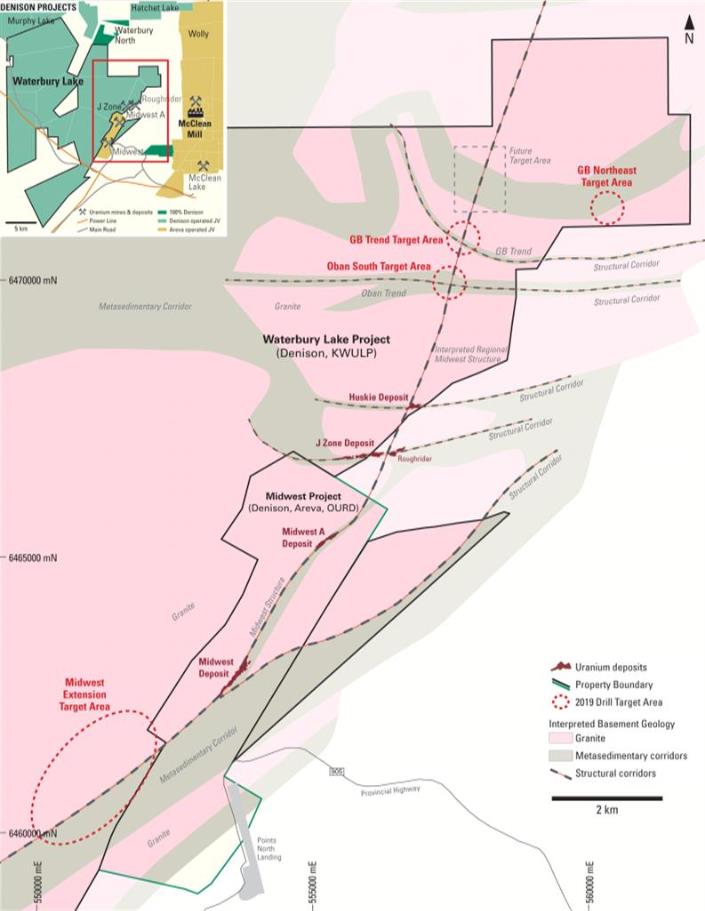
At Waterbury Lake
a winter diamond drilling program was completed during 2019 –
totaling 5,735 metres in 15 holes. The program was focused on drill
testing priority target areas (GB Zone, Oban South, GB Northeast
and the Midwest Extension) associated with the regional Midwest
Structure, which is interpreted to be located along the eastern
portion of the Waterbury Lake property. The program was highlighted
by intersections of basement-hosted uranium mineralization at the
GB Zone including 0.15% U3O8 over 6.0 metres
in drill hole WAT19-480, and 0.25% U3O8 over 2.0 metres
and 0.22% U3O8 over 1.5 metres
in drill hole WAT19-486.
■
Execution of Memoranda of Understanding (‘MOUs’) with
Local Communities for Wheeler River
As reported in
the PD, Denison executed a series of MOUs, in support of the
advancement of Wheeler River, with certain Indigenous communities
who assert that Wheeler River falls partially or entirely within
their traditional territories and where traditional land use
activities are currently practiced within the local and regional
area surrounding the project. These non-binding MOUs formalize the
signing parties’ intent to work together in the spirit of
mutual respect and cooperation, in order to collectively identify
practical means by which to avoid, mitigate, or otherwise address
potential impacts of the project upon the exercise of Indigenous
rights, Treaty rights, and other interests, as well as to
facilitate sharing in the benefits that are expected to flow from
the project.
■
Renewal of Management Services Agreement with Uranium Participation
Corp.
The Company,
through its wholly owned subsidiary Denison Mines Inc., entered
into a new five year agreement to provide management services to
Uranium Participation Corp. (‘UPC’). The new agreement
has the potential to generate $10,000,000 in management fees to
Denison over the five year term.
■
Denison’s Closed Mines Group Renews Cornerstone Environmental
Services Contract with BHP Group Limited
(‘BHP’)
Effective July 1,
2019, Denison’s Closed Mines group entered into a new two
year services agreement with Rio Algom Limited, a subsidiary of
BHP. Under the terms of the agreement, the Closed Mines group is
responsible for carrying out the management and operation of nine
of BHP’s decommissioned mine sites in Ontario and
Quebec.
■
Obtained Financing for the Company’s 2020 Canadian
Exploration Activities
In December 2019,
the Company completed a $4,715,000 bought deal private placement
equity offering for the issuance of 6,934,500 common shares on a
flow-through basis at a price of $0.68 per share. The proceeds from
the financing will be used to fund Canadian exploration activities
through to the end of 2020.
Denison Mines
Corp. was formed under the laws of Ontario and is a reporting
issuer in all Canadian provinces. Denison’s common shares are
listed on the Toronto Stock Exchange (the ‘TSX’) under
the symbol ‘DML’ and on the NYSE American exchange
under the symbol ‘DNN’.
Denison is a
uranium exploration and development company with interests focused
in the Athabasca Basin region of northern Saskatchewan, Canada. The
Company’s flagship project is the 90% owned Wheeler River
Uranium Project, which is the largest undeveloped uranium project
in the infrastructure rich eastern portion of the Athabasca Basin
region of northern Saskatchewan. A PFS was completed for Wheeler
River in late 2018, considering the potential economic merit of
developing the Phoenix deposit as an ISR operation and the Gryphon
deposit as a conventional underground mining operation. Denison's
interests in Saskatchewan also include a 22.5% ownership interest
in the McClean Lake Joint Venture (‘MLJV’), which
includes several uranium deposits and the McClean Lake uranium
mill, which is currently processing ore from the Cigar Lake mine
under a toll milling agreement, plus a 25.17% interest in the
Midwest deposits and a 66.57% interest in the J Zone and Huskie
deposits on the Waterbury Lake property. The Midwest, J Zone and
Huskie deposits are located within 20 kilometres of the McClean
Lake mill. In addition, Denison has an extensive portfolio of
exploration projects in the Athabasca Basin region.
|
|
MANAGEMENT’S DISCUSSION & ANALYSIS
|
Denison is
engaged in mine decommissioning and environmental services through
its Closed Mines group (formerly Denison Environmental Services),
which manages Denison’s Elliot Lake reclamation projects and
provides post-closure mine and maintenance services to a variety of
industry and government clients.
Denison is also
the manager of Uranium Participation Corporation
(‘UPC’), a publicly traded company listed on the TSX
under the symbol ‘U’, which invests in uranium oxide in
concentrates (‘U3O8’) and
uranium hexafluoride (‘UF6’).
STRATEGY
Denison’s
strategy is focused on leveraging its uniquely diversified asset
base to position the Company to take advantage of the strong
long-term fundamentals of the uranium market. The Company has built
a portfolio of strategic uranium deposits, properties, and
investments highlighted by a 90% interest in Wheeler River and a
minority interest in an operating and licensed uranium milling
facility in the MLJV, both located in the infrastructure rich
eastern portion of the Athabasca Basin region. While active in
exploring for new uranium discoveries in the region,
Denison’s present focus is on advancing Wheeler River to a
development decision, with the potential to become the next large
scale uranium producer in Canada. With a shortage of low cost
uranium development projects in the global project pipeline,
Denison offers shareholders exposure to value creation through the
potential future development of Wheeler River as well as an
anticipated increase in future uranium prices.
URANIUM INDUSTRY
OVERVIEW
Much of 2019 was
defined and influenced by policy matters in the United States
(‘US’), which effectively created an overhang of
uncertainty throughout the uranium market. In July 2019, the US
Presidential Administration completed an investigation into a trade
petition, launched under Section 232 of the Trade Expansion Act of
1962 (‘Section 232’), and no trade actions were
implemented. The US President indicated that the
Administration’s investigation did not agree with findings of
the US Department of Commerce (‘DOC’) that uranium
imports threaten to impair US national security. This announcement
was expected to provide clarity to the uranium market; however, the
Administration followed the decision with an order to review the
nuclear fuel supply chain in the US. Accordingly, a Nuclear Fuel
Working Group (‘NFWG’) was commissioned to examine the
current state of domestic nuclear fuel production to reinvigorate
the entire nuclear fuel supply chain, consistent with United States
national security and nonproliferation goals and to make
recommendations, if needed, to further enable US domestic nuclear
fuel production. A report from the NFWG was submitted, after a
brief extension, to the White House in late 2019. To date, no
official recommendations have been made public, however, the
President’s recent Budget Request for Fiscal Year 2021
included $150 million in the Department of Energy budget to
establish a uranium reserve. The budget request also set out a
schedule for a similar amount to be approved in the budget in each
of the next ten years.
Another source of
uranium market uncertainty stems from policies relating to Russian
deliveries of nuclear fuel into the US. Since breaking from the
Joint Comprehensive Plan of Action with Iran, commonly known as the
Iran Nuclear Deal, the US Administration has put in place sanctions
against Iran. The US has also issued waivers to certain of
Iran’s trading partners, allowing entities from particular
nations, including Russia, to continue working with Iran on
civilian nuclear programs. On December 15, 2019, one of those
waivers, related to Iran’s Fordow Fuel Enrichment Plant, was
lifted, which raised concern among market participants regarding
the possibility of other waivers being revoked. The waiver causing
uranium market participants particular concern relates to the
Bushehr nuclear power plant, which Russia is involved in
building. If this waiver is removed, there is concern that
Russia could face sanctions in the US, which would halt deliveries
of Russian nuclear fuel to US utilities and represent a significant
supply-side development.
Also relevant to
Russian nuclear fuel supply into the US is the Agreement Suspending
the Antidumping Investigation on Uranium from the Russian
Federation (also known as the Russian Suspension Agreement, or the
‘RSA’), which established annual quotas limiting the
delivery of nuclear fuel into the US from Russia, Kazakhstan,
Kyrgyzstan, Tajikistan, Ukraine and Uzbekistan. This agreement is
set to expire at the end of 2020 and is currently under review.
Before the agreement expires, a decision needs to be made by the US
DOC as to whether there will be an extension and, if so, whether an
extension will be under existing or revised terms. If the RSA
expires, Russian-origin uranium products and services could be sold
into the US without any restrictions - adding further uncertainty
to the uranium market.
These market dynamics contributed to a soft
uranium price throughout the year. In 2019, the spot uranium price
traded within a narrow band, beginning the year at USD$28.50 per
pound U3O8
and ending it down over 12% at
USD$25.00 per pound U3O8.
Lower prices near the end of the year were attributed to limited
demand in the spot market. While spot uranium volumes did not match
the historic high reached in 2018 (almost 89 million pounds
U3O8),
2019 spot buying remained reasonably strong at 65 million pounds
U3O8.
Similar to 2018, however, despite seeing fairly robust spot market
volumes, long-term utility contracting remained low in
2019.
|
|
MANAGEMENT’S DISCUSSION & ANALYSIS
|
Despite the
impact of these policy matters, there are several indications that
uranium supply and demand fundamentals continue to improve
underneath the cloud of uncertainty that has dominated the market
in 2019. This was underscored in the bi-annual Nuclear Fuel Report
released by the World Nuclear Association (‘WNA’) at
its annual symposium in September 2019. The report evaluates
nuclear fuel demand and supply scenarios for the period from 2019
to 2040, using reference, low and high cases. For the first time in
several years, the WNA’s outlook for global uranium demand
increased for all three scenarios, which is positive for the future
outlook on demand and reflects industry consensus that the demand
picture has improved significantly in recent years. This has been
supported by many positive news stories on the demand side,
including increasing public recognition of the critical role
nuclear energy has to play in combatting climate change. One of the
most significant acknowledgments of this was made by the European
Union (‘EU’), with its leaders recently agreeing that
nuclear energy must be included as part of the solution required to
meet the EU’s goal of becoming carbon neutral by 2050. The
EU’s ‘European Green Deal’ officially
acknowledged the importance of nuclear energy in meeting the
region’s comprehensive climate action goals.
●
In the US, there were a
number of positive announcements through the course of 2019. In
Ohio, a long-awaited energy bill was passed supporting the
continued operation of the Davis-Besse and Perry nuclear power
plants. Previous attempts to secure subsidies for these plants were
unsuccessful, which had led most in the industry to believe the
plants would be shut down by calendar year 2021. Recognizing the
long-term viability of existing nuclear power plants, the Turkey
Point nuclear units 3 and 4 received approval for an additional 20
years of operating life from the US Nuclear Regulatory Commission
(‘NRC’). This additional extension will take the
reactors to a total of 80 years of operating life, which is the
longest license ever issued by the NRC. Turkey Point 3 and 4 are
now licensed to operate to 2052 and 2053, respectively. In the US
Midwest, the life of the Monticello nuclear plant was extended by
another decade to 2040.
●
In Mexico, the
country’s national nuclear utility, the Federal Electricity
Commission (‘CFE’), is considering building four new
nuclear reactors, to add to its existing two units at Laguna Verde.
CFE shared its plans to present a feasibility study to management
and the government in 2020. The study will examine a project to
build 1,400 megawatts electric (‘MWe’) reactors, with
an estimated cost of US$7 billion each.
●
In Canada, with the
longer-term future of nuclear in mind, the provincial governments
of New Brunswick, Ontario and Saskatchewan demonstrated support for
future nuclear new builds. The leaders of these provinces announced
that they had joined efforts to collaborate on advancing small
modular reactor (‘SMR’) technologies. The leaders see
SMRs as a practical solution to help curb carbon emissions, move
away from coal-fired power generation, and create an opportunity
for new economic growth in the provinces.
●
In India, the government
continued to demonstrate its commitment to increase its use of
nuclear energy. At a recent nuclear conference, the Chairman of
India’s Atomic Energy Commission and Secretary of the
Department of Atomic Energy reinforced the country’s
aggressive pursuit of new nuclear power plants in order to improve
the reliability of the country’s power supply. The
government’s Union Minister for Atomic Energy also confirmed
that there are currently nine reactors under construction in India
and indicated that the government had given administrative and
financial support to build an additional 12 new reactors with a
capacity of 9,000 MWe.
●
In the United Kingdom
(‘UK’), a leaked government analysis stressed the need
to build a fleet of new nuclear or carbon capture power plants in
order to meet climate targets. The UK government believes that up
to 40,000 MWe of low carbon power stations could be needed in 2050
to reduce Britain’s emissions to ‘net zero’ and
currently there is just one nuclear power plant under construction
– EDF Energy’s 3,200 MWe Hinkley Point C in
England.
●
In South Korea, Korea Hydro
& Nuclear Power (‘KHNP’) announced the successful
start-up of its Shin Kori 4 nuclear power plant. Initial
criticality was reached and the unit was connected to the grid in
April 2019. The Shin Kori 4 unit is a 1,400 MWe APR-1400, which is
the same design as those currently under construction in the United
Arab Emirates at the Barakah nuclear power plant, which is expected
to begin supplying electricity early in 2020.
●
In Taiwan, sentiment has
shifted away from a previous policy to eliminate nuclear power from
the Taiwan energy mix. In May 2019, the country passed an amendment
to eliminate the ‘Nuclear Free Homeland 2025’ mandate
that was imposed by the anti-nuclear Democratic Progressive Party
in early 2017. This amendment has opened the door for future
pro-nuclear decisions to be made regarding extending the lives of
existing nuclear power plants in the country, as well as the
possible completion of the Lungmen nuclear power plant, where
construction was halted in 2014.
|
|
MANAGEMENT’S DISCUSSION & ANALYSIS
|
●
In Germany, positive
sentiment towards nuclear also appears to be growing. In 2019 the
government received escalating calls from several of the
country’s most prominent businesses to delay the
country’s plans to implement a full-scale nuclear phase-out
by the end of 2022. Some of these businesses emphasized the
importance of nuclear power, highlighting that Germany needs to run
its nuclear power plants longer if climate protection really
matters to the country.
Though much of
the nuclear news out of Asia was positive, news emerged from Japan
early in 2019 that the requirements set by the country’s
Nuclear Regulation Authority (‘NRA’) for utilities to
complete anti-terrorism protection work on each reactor’s
emergency facilities were unlikely to be met on schedule. All three
utilities currently operating units in Japan have said they require
between one and two and a half additional years to complete the
required work. The NRA has indicated, however, that it will not
extend the deadline. Due to this, it was recently announced that
reactors 3 and 4 at the Takahama nuclear power plant will stop
operating by the summer of 2020, with work aimed at meeting the NRA
commitment about one year behind schedule.
Overall, uranium
demand has grown in recent years, having now exceeded the annual
levels that existed prior to Japan shutting all of its nuclear
units following the 2011 Fukushima Daichii nuclear
incident.
The supply side
of the uranium market has also been progressing in the right
direction. This has resulted in a growing gap between annual
utility requirements and primary production, which continues to be
filled by drawing down on inventories and other secondary sources
of supply. Some of the positive supply indicators
include:
●
The world’s largest and
lowest cost uranium producer, National Atomic Company Kazatomprom
announced in August 2019, that it was reaffirming its commitment to
reach and maintain a more commercial balance between supply and
demand by extending its previously announced 20% production
curtailment through to 2021.
●
Other important supply side
changes included Rio Tinto finalizing the sale of its Rössing
operation in Namibia to China’s China National Uranium
Corporation (‘CNUC’). Taken together with the slow wind
down of Rio Tinto’s Ranger operation in Australia, we expect
to see Rio Tinto, one of the world’s largest mining companies
and a long-term major producer in the uranium industry, completely
exit the market.
●
In Niger, it was announced
that the Cominak mine will cease operation in March 2021 due to
depletion of ore. The operation has been a source of supply to the
industry since 1978.
With a
significant shortfall having developed between annual nuclear
utility requirements and primary production, inventories and other
secondary sources of supply are being drawn down to meet utility
needs. This process of inventory drawdowns suggests that we are
nearing an inflection point – where end-users of uranium
begin to question where long-term uranium supplies will come from
and how secure that supply will be over the long lives of their
nuclear reactors. There is already a growing sense that market
participants are beginning to look beyond near-term market
conditions in an attempt to understand what the supply environment
will look like in the mid-2020s and beyond. With a renewed focus on
nuclear energy as a critical element in battling climate change, it
is expected that global utilities will be looking to source future
supply from operations that are not only low-cost, reliable, and
situated in stable jurisdictions (the typical criteria for a good
supplier), but also those which are flexible and environmentally
responsible.
SELECTED ANNUAL FINANCIAL INFORMATION
|
(in
thousands, except for per share amounts)
|
|
|
|
Year
Ended
December
31,
2019
|
|
Year Ended
December 31,
2018
|
|
Year Ended
December 31,
2017
|
|
|
|
|
|
|
|
|
|
|
|
|
|
Continuing Operations:
|
|
|
|
|
|
|
|
|
|
Total
revenues
|
|
|
$
|
15,549
|
$
|
15,550
|
$
|
16,067
|
|
Exploration and
evaluation
|
|
|
$
|
(15,238)
|
$
|
(15,457)
|
$
|
(16,643)
|
|
Operating
expenses
|
|
|
$
|
(14,436)
|
$
|
(15,579)
|
$
|
(13,687)
|
|
Impairment
reversal (expense)
|
|
|
$
|
-
|
$
|
(6,086)
|
$
|
331
|
|
Net
loss
|
|
|
$
|
(18,141)
|
$
|
(30,077)
|
$
|
(19,454)
|
|
Basic and diluted
loss per share
|
$
|
(0.03)
|
$
|
(0.05)
|
$
|
(0.04)
|
|
Discontinued Operations:
|
|
|
|
|
|
|
|
Net
loss
|
$
|
-
|
$
|
-
|
$
|
(109)
|
|
Basic and diluted
loss per share
|
$
|
-
|
$
|
-
|
$
|
-
|
|
|
MANAGEMENT’S DISCUSSION & ANALYSIS
|
|
(in
thousands)
|
|
|
|
As at
December 31,
2019
|
|
As at
December 31,
2018
|
|
As at
December 31,
2017
|
|
|
|
|
|
|
|
|
|
|
|
|
|
Financial Position:
|
|
|
|
|
|
|
|
|
|
Cash and cash
equivalents
|
|
|
$
|
8,190
|
$
|
23,207
|
$
|
3,636
|
|
Investments in
debt instruments (GICs)
|
|
|
$
|
-
|
$
|
-
|
$
|
37,807
|
|
Cash, cash
equivalents and GICs
|
|
|
$
|
8,190
|
$
|
23,207
|
$
|
41,443
|
|
|
|
|
|
|
|
|
|
|
|
Working
capital
|
$
|
1,597
|
$
|
19,221
|
$
|
34,756
|
|
Property, plant
and equipment
|
$
|
257,259
|
$
|
258,291
|
$
|
249,002
|
|
Total
assets
|
$
|
299,998
|
$
|
312,187
|
$
|
326,300
|
|
Total long-term
liabilities
|
$
|
74,903
|
$
|
77,455
|
$
|
80,943
|
SELECTED QUARTERLY FINANCIAL INFORMATION
|
|
|
|
|
2019
|
|
2019
|
|
2019
|
|
2019
|
|
(in
thousands, except for per share amounts)
|
|
Q4
|
|
Q3
|
|
Q2
|
|
Q1
|
|
|
|
|
|
|
|
|
|
|
|
|
|
Total
revenues
|
$
|
3,956
|
$
|
3,478
|
$
|
4,139
|
$
|
3,976
|
|
Net
loss
|
$
|
(1,498)
|
$
|
(6,424)
|
$
|
(4,884)
|
$
|
(5,335)
|
|
Basic and diluted
loss per share
|
$
|
(0.00)
|
$
|
(0.01)
|
$
|
(0.01)
|
$
|
(0.01)
|
|
|
|
|
|
2018
|
|
2018
|
|
2018
|
|
2018
|
|
(in
thousands, except for per share amounts)
|
|
Q4
|
|
Q3
|
|
Q2
|
|
Q1
|
|
|
|
|
|
|
|
|
|
|
|
|
|
Total
revenues
|
$
|
4,144
|
$
|
3,729
|
$
|
4,104
|
$
|
3,573
|
|
Net
loss
|
$
|
(13,642)
|
$
|
(3,884)
|
$
|
(5,583)
|
$
|
(6,968)
|
|
Basic and diluted
loss per share
|
$
|
(0.02)
|
$
|
(0.01)
|
$
|
(0.01)
|
$
|
(0.01)
|
|
|
|
|
|
|
|
|
|
|
Significant items causing variations in quarterly
results
●
The Company’s toll
milling revenues fluctuate due to the timing of uranium processing
at the McClean Lake uranium mill as well as changes to the
estimated mineral resources of the Cigar Lake mine.
●
Revenues from the Closed
Mines group fluctuate due to the timing of projects, which vary
throughout the year in the normal course of business.
●
Operating expenses fluctuate
due to the timing of projects at both the MLJV and the Closed Mines
group, which vary throughout the year in the normal course of
business.
●
Exploration expenses are
generally largest in the first and third quarters, due to the
timing of the winter and summer exploration programs in
Saskatchewan.
●
The Company’s results
are also impacted, from time to time, by other non-recurring events
arising from its ongoing activities, as discussed below where
applicable.
RESULTS OF OPERATIONS
REVENUES
McClean Lake Uranium Mill
The McClean Lake
property is located on the eastern edge of the Athabasca Basin in
northern Saskatchewan, approximately 750 kilometres north of
Saskatoon. Denison holds a 22.5% ownership interest in the MLJV and
the McClean Lake uranium mill, one of the world’s largest
uranium processing facilities. The mill has licensed annual
production capacity of 24.0 million pounds U3O8, and is currently
operating under a 10-year license expiring in 2027. The mill is
currently processing ore from the Cigar Lake mine under a toll
milling agreement.
|
|
MANAGEMENT’S DISCUSSION & ANALYSIS
|
The MLJV is a
unincorporated contractual arrangement between Orano Canada Inc.
(‘Orano Canada’) with a 70% interest, Denison with a
22.5% interest, and OURD (Canada) Co. Ltd. with a 7.5%
interest.
In February 2017,
Denison completed a transaction with Anglo Pacific Group PLC and
one of its wholly owned subsidiaries (the ‘APG
Arrangement’), under which Denison received an upfront
payment of $43,500,000 in exchange for its right to receive future
toll milling cash receipts from the MLJV under the current toll
milling agreement with the Cigar Lake Joint Venture
(‘CLJV’) from July 1, 2016 onwards. The APG Arrangement
consists of certain contractual obligations of Denison to forward
to APG the cash proceeds of future toll milling revenue earned by
the Company related to the processing of the specified Cigar Lake
ore through the McClean Lake mill, and as such, the upfront payment
was accounted for as deferred revenue.
During the year
ended December 31, 2019, the McClean Lake mill processed 18.0
million pounds U3O8 for the CLJV
(2018 – 18.0 million pounds U3O8). In 2019, the
Company recorded toll milling revenue of $4,609,000 (2018 –
$4,239,000). The increase in toll milling revenue in 2019 compared
to the prior year is predominantly the result of an update to the
published Cigar Lake mineral resource estimate in the first quarter
of 2018, which resulted in the Company recording a negative
non-cash cumulative catch-up accounting adjustment of $332,000,
which reduced the recorded toll milling revenue in 2018. During the
first quarter of 2019, the Company recorded a nominal $26,000
positive non-cash cumulative accounting adjustment related to the
Cigar Lake mineral resource estimate update published in that
quarter.
During the year
ended December 31, 2019, the Company also recorded an accretion
expense of $3,203,000 on the toll milling deferred revenue balance
(2018 – $3,314,000). The annual accretion expense will
decrease over the life of the contract as the deferred revenue
liability decreases over time.
During the fourth
quarter of 2019, the McClean Lake Union Unifor Local 48-S ratified
a new collective bargaining agreement. The new three-year agreement
includes the implementation of a new two-weeks-in two-weeks-out
rotation, which will be implemented early in 2020.
Denison Closed Mines Services
Mine
decommissioning and environmental services are provided through
Denison’s Closed Mines group, which has provided long-term
care and maintenance for closed mine sites since 1997. With offices
in Ontario, the Yukon Territory and Quebec, the Closed Mines group
manages Denison’s Elliot Lake reclamation projects and
provides post-closure mine care and maintenance services to various
customers.
Revenue from
Closed Mines services during 2019 was $8,974,000 (2018 -
$9,298,000). The decrease in revenue in 2019, as compared to 2018,
was due to a decrease in activity at certain care and maintenance
sites, as well as a decrease in environmental consulting activities
during the year.
Management Services Agreement with UPC
Denison provides
general administrative and management services to UPC pursuant to a
management services agreement. The current agreement has an
effective date of April 1, 2019, and is for a five year term.
Management fees and commissions earned by Denison provide a source
of cash flow to partly offset corporate administrative expenditures
incurred by the Company.
During 2019,
revenue from the Company’s management contract with UPC was
$1,966,000 (2018 - $2,013,000). The decrease in revenues during
2019, compared to the prior year, was due to a decrease in
commission-based and discretionary fees, partly offset by an
increase in NAV-based management fees. UPC’s balance sheet
consists primarily of uranium held either in the form of
U3O8 or UF6, which is
accounted for at its fair value. The increase in NAV-based
management fees during the year, as compared to the prior period,
was due to the increase in the average fair value of UPC’s
uranium holdings, resulting from both increased uranium spot prices
and increased uranium holdings. The decrease in commission-based
fees in the year was due to a decrease in uranium purchases, and a
decrease in sales of conversion services, by UPC during the current
period, as compared to the prior year. Denison earns a 1%
commission on the gross value of UPC’s uranium purchases and
sales.
|
|
MANAGEMENT’S DISCUSSION & ANALYSIS
|
OPERATING EXPENSES
Mining
Operating
expenses of the mining segment include depreciation and development
costs.
Operating
expenses in 2019 were $6,090,000 (2018 - $7,159,000). In 2019,
operating expenses included depreciation of the McClean Lake mill
of $3,165,000 (2018 - $3,264,000), as a result of processing
approximately 18.0 million pounds U3O8 for the CLJV
(2018 – 18.0 million pounds). The decrease in depreciation
during 2019 was primarily driven by a reduction in the
units-of-production depreciation rate due to an increase in the
estimate of the future CLJV production to be processed through the
mill.
In 2019,
operating expenses also included development and other operating
costs related to the MLJV of $2,925,000 (2018 – $3,893,000),
which relate predominantly to the multi-year test mining program,
operated by Orano Canada within the MLJV, to support the
advancement of the novel Surface Access Borehole Resource
Extraction (‘SABRE’) mining technology.
Closed Mines Services
Operating
expenses during 2019 totaled $8,346,000 (2018 - $8,211,000). The
expenses relate primarily to care and maintenance services provided
to clients, and include labour and other costs. The increase in
operating expenses in 2019, compared to 2018, is predominantly due
to a restructuring that was undertaken in the fourth quarter of
2019, to discontinue environmental consulting activities in order
to focus on the providing care and maintenance services, resulting
in a reduction in headcount and associated severance
expenditures.
CANADIAN MINERAL PROPERTY EXPLORATION & EVALUATION
During 2019, the
Company continued to focus on its high priority projects in the
Athabasca Basin region in Saskatchewan. Denison’s share of
exploration and evaluation expenditures in 2019 was $15,238,000
(2018 – $15,457,000). Exploration spending in Canada is
seasonal, with spending higher during the winter exploration season
(January to mid-April) and summer exploration season (June to
mid-October) in the Athabasca Basin. During 2019, the
Company’s exploration and evaluation expenditures decreased,
primarily due to decreased exploration activity, partially offset
by increased evaluation activities at Wheeler River.
The following
tables summarize the 2019 exploration and evaluation activities
completed through the middle of February 2020. The exploration
drilling relates to the Company’s summer and winter 2019
exploration programs, while the evaluation drilling relates to the
Wheeler River ISR field test which ran from June to December 2019
and included the installation of preliminary ISR test wells in
small diameter diamond drill holes and the completion of two large
diameter drill holes used for the installation of two commercial
scale wells (CSWs).
All exploration
and evaluation expenditure information in this MD&A covers the
twelve months ending December 31, 2019.
|
|
MANAGEMENT’S DISCUSSION & ANALYSIS
|
|
EXPLORATION ACTIVITIES
|
|
Property
|
Denison’s
Ownership(1)
|
Exploration
Drilling(6)
|
|
Wheeler
River
|
90%(2)
|
10,573 m (20
holes)
|
|
Waterbury
Lake
|
66.57%(3)
|
5,735 m (15
holes)
|
|
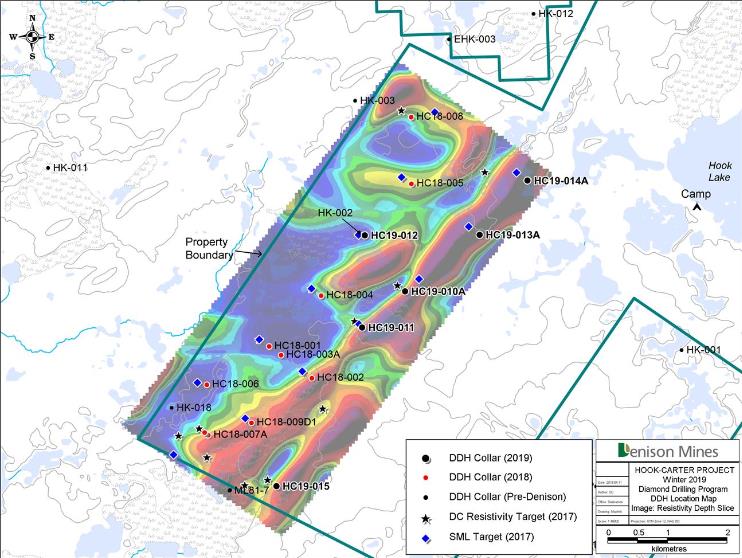
Hook-Carter
|
80%(4)
|
4,797 m (6
holes)
|
|
Waterfound
River
|
12.32%(5)
|
5,110 m (7
holes)
|
|
Total
|
|
26,215 m (48 holes)
|
Notes:
(1) The
Company’s ownership as at December 31, 2019.
(2) JCU (Canada)
Exploration Company Limited (‘JCU’) funded their 10%
portion of exploration and evaluation expenditures during 2019 and
ownership interests are unchanged for 2019.
(3) Denison
earned an additional 0.65% interest in the Waterbury Lake property
during 2019. The partner, Korea Waterbury Uranium Limited
Partnership (‘KWULP’), elected not to fund the 2019
exploration program and therefore diluted its ownership interest.
Refer to RELATED PARTY TRANSACTIONS for further
details.
(4) The Company
acquired an 80% ownership in the Hook-Carter project in November
2016 from ALX Uranium Corp. (‘ALX’) and has agreed to
fund
ALX’s share
of the first $12.0 million in expenditures on the project. See
below for further details.
(5) Denison
elected not to fund its 14.42% share of the $1,508,286 2019
drilling program implemented by the operator, Orano Canada.
Accordingly, Denison’s ownership interest decreased by 2.1%
to 12.32%.
(6) The Company
reports total exploration metres drilled and the number of holes
that were successfully completed to their target
depth.
|
EVALUATION ACTIVITIES
|
|
Property
|
Denison’s
Ownership(1)
|
Evaluation Drilling
|
Other Activities
|
|
Wheeler
River
|
90%(2)
|
9,632 m (30 small
diameter wells)(3)
821 m (2 large
diameter wells)(4)
|
ISR Field
Testing,
Engineering,
Environmental Assessment
|
|
Total
|
|
10,453 m (32 holes)
|
|
Notes:
(1) The
Company’s ownership as at December 31, 2019.
(2) JCU (Canada)
Exploration Company Limited (‘JCU’) funded their 10%
portion of exploration and evaluation expenditures during 2019 and
ownership interests are unchanged for 2019.
(3) Small
diameter evaluation drilling includes HQ/PQ sized diamond drilling
either as the widening (reaming) of existing exploration drill
holes, or the drilling of new holes, for the purposes of installing
test wells for ISR field testing at Phoenix. Figures include total
evaluation metres drilled and total number of holes
completed.
(4) Large
diameter evaluation drilling relates to the drilling and
installation of new large diameter CSWs from surface for the
purposes of ISR field testing at Phoenix. Figures include total
evaluation metres drilled and total number of holes
completed.
The
Company’s Athabasca land package decreased during the fourth
quarter of 2019 from 305,658 hectares (213 claims) to 279,883
hectares (214 claims) due to area reductions of claims belonging to
the Darby, Epp Lake, Hatchet Lake, Johnston Lake, Murphy Lake and
South Dufferin properties, and lapsing of claims belonging to the
Perpete Lake and Waterbury North properties. Claim area reductions
allow the Company to extend tenure of the higher priority portions
of claims and reduce the annual expenditure requirements going
forward.
|
|
MANAGEMENT’S DISCUSSION & ANALYSIS
|
Wheeler River Project
Project Highlights:
●
PFS
results suggest Phoenix could become one of the lowest-cost uranium
mining operation globally
On September 24,
2018, the Company announced the results of the PFS for Wheeler
River. The PFS was completed in accordance with NI 43-101 and is
highlighted by the selection of the ISR mining method for the
development of the Phoenix deposit, with an estimated average
operating cost of $4.33 (USD$3.33) per pound U3O8.
The PFS considers
the potential economic merit of co-developing the Phoenix and
Gryphon deposits. The high-grade Phoenix deposit is designed as an
ISR mining operation, with associated processing to a finished
product occurring at a plant to be built on site at Wheeler River.
The Gryphon deposit is designed as an underground mining operation,
utilizing a conventional long hole mining approach with processing
of mine production assumed at Denison’s 22.5% owned McClean
Lake mill. Taken together, the project is estimated to have mine
production of 109.4 million pounds U3O8 over a 14-year
mine life, with a base case pre-tax net present value
(‘NPV’) of $1.31 billion (8% discount rate), internal
rate of return (‘IRR’) of 38.7%, and initial
pre-production capital expenditures of $322.5 million.
The PFS was
prepared on a project (100% ownership) and pre-tax basis. Denison
completed an indicative post-tax assessment based on a 90%
ownership interest, yielding a base case post-tax NPV of $755.9
million and post-tax IRR of 32.7%, with initial capital costs to
Denison of $290.3 million.
On December 18,
2018, Denison reported that the Company's Board of Directors and
the Wheeler River Joint Venture (‘WRJV’) approved the
advancement of Wheeler River, following a detailed assessment of
the PFS results. In support of the decision to advance Wheeler
River, in 2019 the WRJV initiated the EA process as well as
engineering studies and related programs required to advance the
high-grade Phoenix deposit as an ISR mining operation.
|
|
MANAGEMENT’S DISCUSSION & ANALYSIS
|
●
Environmental
advantages of the proposed Wheeler River ISR mine
The Company's
evaluation of the ISR mining method in the PFS has identified
several significant environmental and permitting advantages –
particularly when compared to the impacts associated with
conventional uranium mining in Canada. The Project's ISR mining
operation is expected to produce no tailings, generate very small
volumes of waste rock, and has the potential for low volumes or
possibly no water discharge to surface water bodies, as well as the
potential to use the existing power grid to operate on a near zero
carbon emissions basis. The planned use of a freeze wall to
encapsulate the ore zone and contain the mining solution used in
the ISR operation streamlines the mining process, minimizes
interaction with the environment, and facilitates controlled
reclamation of the site at decommissioning. Taken together, the
Project has the potential to be one of the most environmentally
friendly uranium mining and processing operations in the world.
Owing largely to these benefits, engagement with local Indigenous
communities, the public, and federal and provincial
representatives, to date, has been encouraging regarding the use of
ISR mining.
●
The
largest undeveloped uranium project in the eastern Athabasca
Basin
Upon completion
of the PFS and in accordance with NI 43-101 standards, the Company
has declared the following mineral reserves and
resources.
●
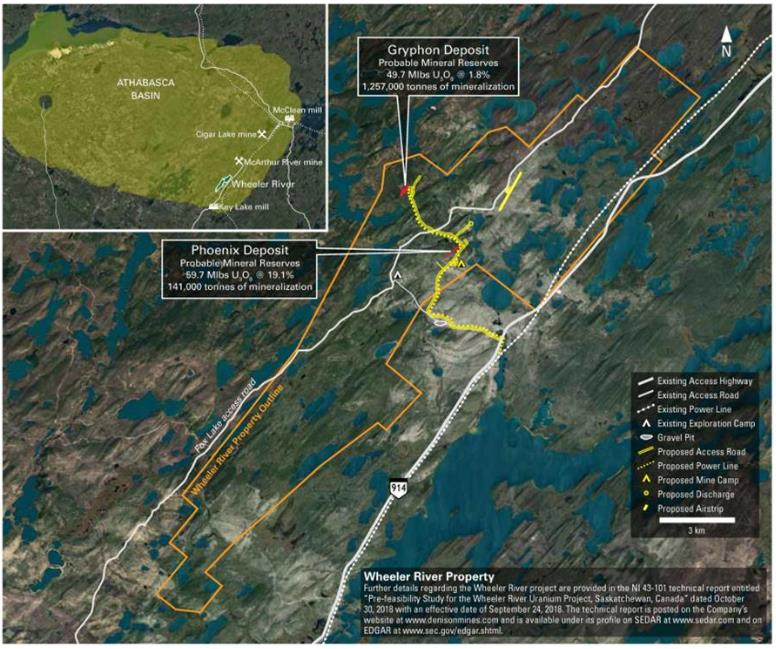
Probable mineral reserves of 109.4 million
pounds U3O8
(Phoenix 59.7 million pounds U3O8 from 141,000
tonnes at 19.1% U3O8; Gryphon 49.7
million pounds U3O8 from 1,257,000
tonnes at 1.8% U3O8);
●
Indicated mineral resources (inclusive of
reserves) of 132.1 million pounds U3O8
(1,809,000 tonnes at an average grade of 3.3% U3O8);
plus
●
Inferred mineral resources of 3.0 million
pounds U3O8 (82,000
tonnes at an average grade of 1.7% U3O8).
●
Potential
for resource growth
Potential exists
for resource growth, outside of the currently defined mineral
resources, at both the Phoenix and Gryphon deposits. At Phoenix,
potential exists particularly around Zone B, where previous
mineralized results remain open on section or the interpreted
optimal exploration target remains untested, and at Zone C, which
is not currently included in the mineral resource estimate, where
similar targets exist. At Gryphon, potential exists to expand
mineral resources both along strike and down-plunge of the
currently defined A Series Lenses.
Outside of the
Phoenix and Gryphon deposits, Wheeler River has significant
exploration potential for the discovery of additional high-grade
uranium deposits. The Project’s significant repository of
geophysical and historic drilling data has facilitated the
identification of numerous high-priority regional target areas in
accordance with the Company’s latest exploration models. Many
of the target areas have the potential to host high-grade
sandstone-hosted deposits, similar to Phoenix, that may be amenable
to the use of the low-cost ISR mining method. Following almost ten
years of exploration drilling focused largely on the Phoenix and
Gryphon deposits, a multi-year plan has been developed to explore
the regional target areas, which commenced in 2018, and continued
in 2019.
Further details
regarding Wheeler River, including the estimated mineral reserves
and resources and PFS, are provided in the Technical Report for the
Wheeler River project titled ‘Pre-feasibility Study Report
for the Wheeler River Uranium Project, Saskatchewan, Canada’
prepared by Mark Liskowich, P.Geo. of SRK Consulting (Canada) Inc.
with an effective date of September 24, 2018 (‘PFS Technical
Report’). A copy of the PFS Technical Report is available on
Denison’s website and under its profile on each of SEDAR and
EDGAR.
|
|
MANAGEMENT’S DISCUSSION & ANALYSIS
|
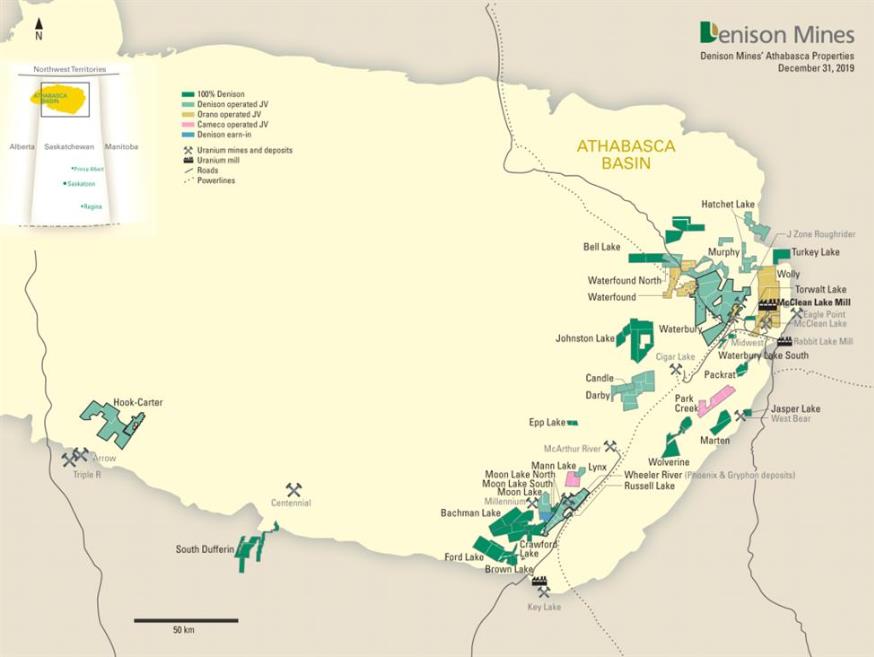
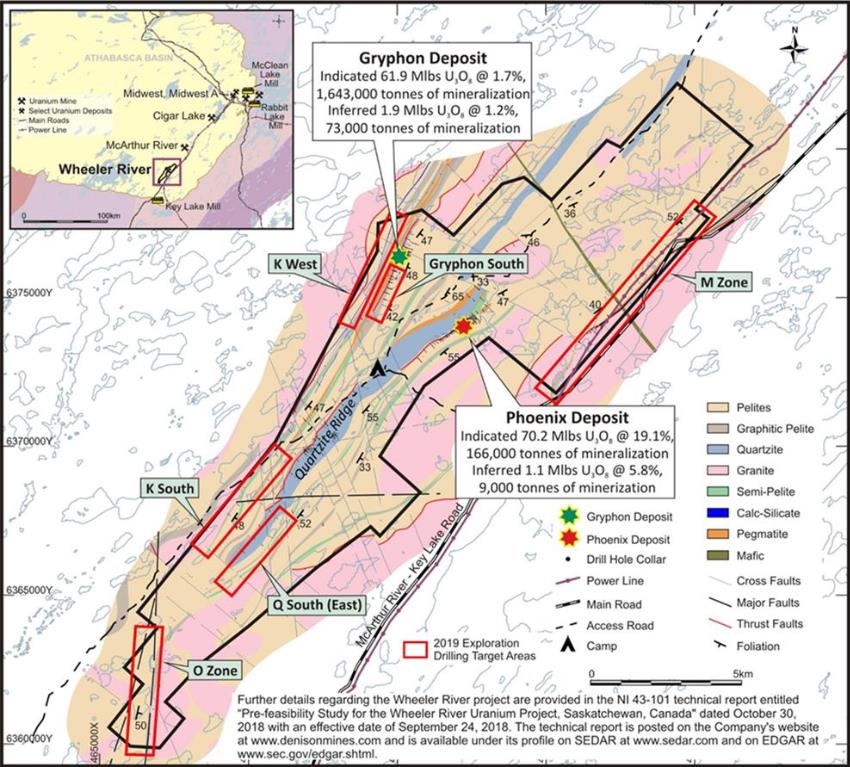
The location of
the Wheeler River property, as well as the Phoenix and Gryphon
deposits, and existing and proposed infrastructure, is shown on the
map provided below.
Evaluation Program
During 2019,
Denison’s share of evaluation costs at Wheeler River amounted
to $9,867,000 (2018 - $3,130,000), which consisted primarily of
work related to the ISR field test program, other engineering
activities (including metallurgical testing) in support of a future
FS, and activities related to the EA process.
Engineering Activities
ISR Field Test
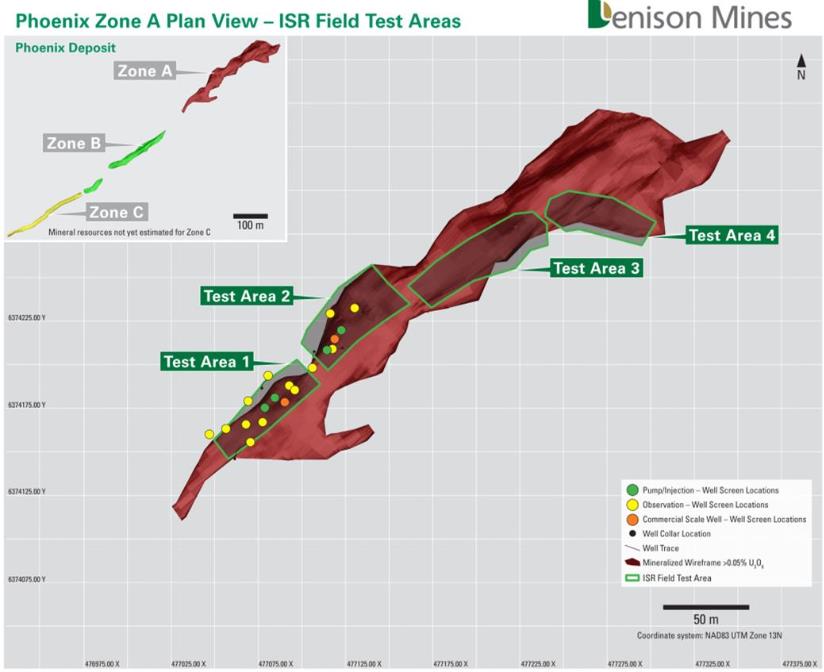
The
ISR field test program was designed to assess the permeability of
Phoenix, and to collect an extensive database of hydrogeological
data to further evaluate the ISR mining conditions present at
Phoenix (see Figure 1). This data is of critical importance to the
advancement of Phoenix as an ISR mining operation – as it is
expected to support a detailed assessment of the ISR requirements
related to permeability, and to be further incorporated into a
detailed ISR mine plan as part of the completion of a future
FS.
The
Company successfully completed the planned ISR field test work and
safely concluded operations on site at Wheeler River during the
fourth quarter of 2019 (see Denison’s press release dated
December 18, 2019). The field activities associated with the 2019
ISR field test program were completed over a period of
approximately 23 weeks (starting in June and completed in late
November), and required the support of approximately 40 Denison
employees and contractor staff.
|
|
MANAGEMENT’S DISCUSSION & ANALYSIS
|
The
objectives of the program were extensive, and the scope of the work
completed on site during the program was considerable. The
following represent the key components of field work completed as
part of the 2019 ISR field test program:
●
Installation
of 4 small-diameter pump/injection (‘P/I’) wells with a
2.5-inch diameter PVC pipe and slotted well-screen set within the
ore zone of Test Area 1 and Test Area 2.
●
Installation
of 5 small-diameter observation wells with a 1.5-inch diameter PVC
pipe and slotted well-screen set at various depths within the ore
zone of Test Area 1 and Test Area 2.
●
Installation
of 6 small-diameter observation wells with a 1.5 inch diameter PVC
pipe and slotted well-screen set at various depths outside of the
ore zone of Test Area 1 and Test Area 2, including wells situated
in the basement formation below Phoenix and in the sandstone above
and adjacent to Phoenix.
●
Installation
of 2 test wells containing Vibrating Wire Piezometers
(‘VWPs’) in each of Test Area 1 and Test Area 2,
equipped with pressure transducers at five different depth
locations – including the overburden (1 transducer),
overlying sandstone (2 transducers), ore zone (1 transducer), and
underlying basement (1 transducer).
●
Installation
of 12 small-diameter regional observation wells with a 1.5 inch
diameter PVC pipe and slotted well-screen set at various depths and
located approximately between 100 metres and 700 metres outside of
the boundaries of the ore zone at Phoenix, for the purposes of
environmental monitoring and baseline data collection.
●
Installation
of 1 re-charge well with a 2.5-inch diameter PVC pipe and slotted
well-screen set within the ore zone horizon for the purposes of
recharging formation test waters.
●
Completion of
a series of short-duration preliminary hydrogeological tests, using
the P/I wells to pump water from or inject water into the ore zone
to collect hydrogeological data and identify hydraulic connectivity
between test wells – validating the ability to move water,
and the existence of significant permeability, within the Phoenix
ore zone.
●
Installation
of 2 large-diameter CSWs within the ore zone – one located in
each of Test Area 1 and Test Area 2 and both designed to meet
expected regulatory and environmental requirements such that they
can ultimately form part of the production ISR well field at
Phoenix.
●
Completion of
a series of short-duration preliminary hydrogeological tests, using
the CSWs to pump water from or inject water into the ore zone to
collect further hydrogeological data and assess the extent of
permeability prior to testing the MaxPERF Drilling
Tool.
●
Deployment of
the MaxPERF Drilling Tool in each of CSW1 and CSW2 to complete an
array of lateral drill holes (penetration tunnels) designed to
enhance access from each CSW to the existing permeability within
the ore zone.
●
Completion of
a further series of short-duration preliminary hydrogeological
tests, using each of CSW1 and CSW2 to pump water from or inject
water into the ore zone following the deployment of the MaxPERF
Drilling Tool – indicating potential increased flow rates
following the application of the MaxPERF drilling.
●
Completion of
long-duration hydrogeological tests, using each of CSW1 and CSW2 to
pump water from or inject water into the ore zone for an extended
period of time, to collect further detailed hydrogeological data
designed to simulate fluid flow under conditions similar to an
envisioned commercial production environment.
●
Completion of
approximately 23 individual hydraulic conductivity tests (downhole
packer testing) in 15 boreholes at various depths within and
adjacent to the ore zone of Test Area 1 and Test Area 2 –
including hydraulic conductivity tests within the underlying
basement formation below Phoenix and in the sandstone above and
adjacent to Phoenix.
●
Completion of
downhole geophysics including nuclear magnetic resonance, dual
neutron, and cement-bond log in CSW2 and dual neutron in GWR-001,
GWR-010, GWR-019 and GWR-022.
●
Recovery of
approximately 100 metres of mineralized drill core in 14 individual
drill holes from the installation of P/I and observation wells, as
well as CSWs, within Test Area 1 and Test Area 2 – subject to
detailed on-site geological and geotechnical logging as well as
permeability (permeameter) testing, prior to portions of the core
being preserved for laboratory-based metallurgical test
work.
●
Completion of
extensive permeameter testing in the field, utilizing a portable
nitrogen gas probe permeameter adapted for testing whole drill core
pieces. Permeameter measurements were taken on core at approximate
10 centimetre intervals, resulting in a total of over 1,200
measurements collected from the 2019 ISR field test
program.
|
|
MANAGEMENT’S DISCUSSION & ANALYSIS
|
The
ISR field test successfully achieved each of the program’s
planned objectives, and is highlighted by several key de-risking
accomplishments, including the following:
Confirmation of significant hydraulic connectivity within the
Phoenix ore zone:
●
85% of test
wells located within Test Area 1 and Test Area 2 of the Phoenix
deposit showed hydraulic connectivity with another test well (see
Figure 2 and Figure 3);
●
Hydraulic
connectivity was observed over 77% of the total strike length
tested in Test Area 1 and Test Area 2 combined, and over 100% of
the total across-strike length tested;
●
Taken
together, the extent of hydraulic connectivity observed during the
ISR field test program is supportive of the permeability of the ore
zone and the potential suitability for ISR mining.
Installation of the Athabasca Basin’s first CSWs for
ISR:
●
ISR mining of
the Phoenix deposit is expected to require the installation of
approximately 300 large-diameter/commercial-scale vertical wells
into and surrounding the Phoenix deposit at approximately 400
metres below surface;
●
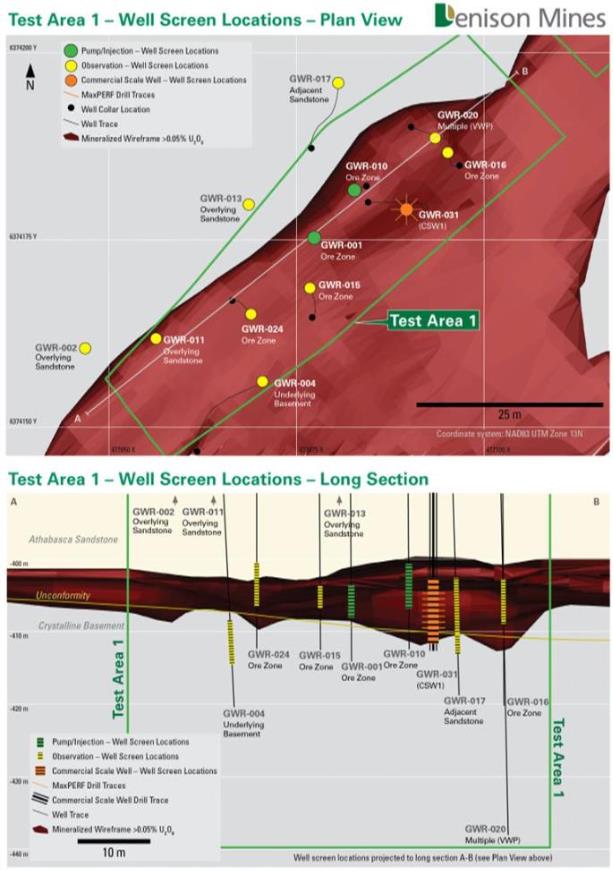
The
installation of CSW1 (GWR-031) and CSW2 (GWR-032) represent a
historic milestone for the advancement of ISR mining within the
Athabasca Basin – as the first wells to have been installed
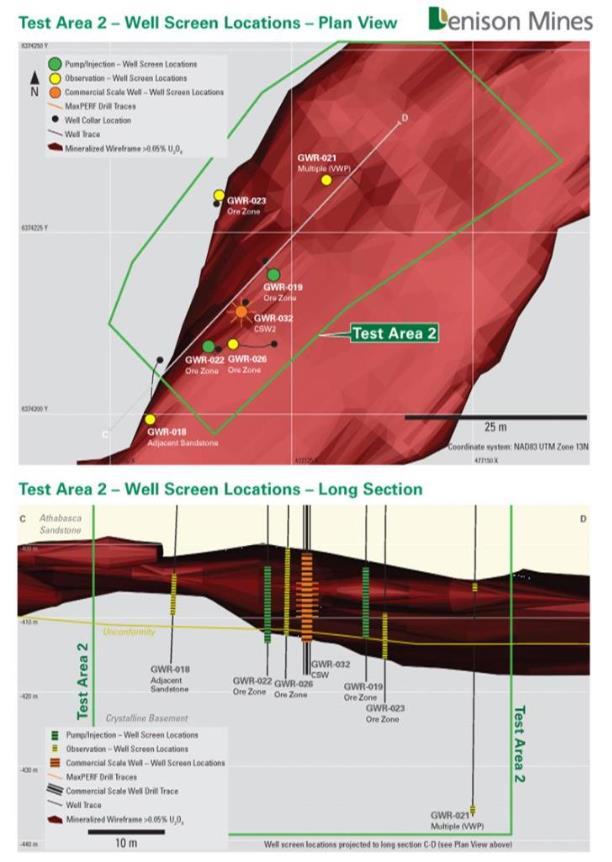
for the purpose of ISR mining (see Figure 2 and Figure
3);
●
Completion of
these wells represents a notable de-risking accomplishment for the
project, as it confirms the ability to drill these large-diameter
holes and install the materials necessary for ISR mining in a
complex and highly altered geological setting that has not
previously been tested for the suitability of the installation of
ISR wells.
Confirmation of limited hydraulic connectivity within the
underlying basement units:
●
During
preliminary tests in Test Area 1 and Test Area 2, negligible
hydraulic responses were observed in the observation wells situated
in the basement rock units underlying the Phoenix
deposit;
●
This result
is indicative of the basement units having relatively low
permeability and is supportive of the PFS design for the Phoenix
ISR operation, which relies on the basement units providing
containment of the ISR mining solution in conjunction with the
planned freeze dome.
Demonstration of the effectiveness of MaxPERF to increase CSW
access to existing permeability:
●
The MaxPERF
Drilling Tool was successfully deployed in CSW1 and CSW2 to create
a series of lateral drill holes (penetration tunnels) roughly 0.7
inches (1.78 centimetres) in diameter, which extend up to 72 inches
(1.83 metres) from the CSW;
●
Initial
short-duration hydrogeological tests confirmed increased flow rates
in Test Area 1 following the completion of the MaxPERF drilling
(see Denison’s press release dated August 27, 2019). In Test
Area 2, initial short-duration hydrogeological tests confirmed
similar flow rates both before and after the completion of the
MaxPERF drilling (See Denison’s press release dated December
18, 2019);
●
These results
confirm that the MaxPERF Drilling Tool can be deployed successfully
within a CSW to mechanically engineer increased access to the
existing permeability of the ore formation. This tool could be of
significant utility in areas of the Phoenix deposit where natural
access to permeability is challenged.
Confirmation of ability to achieve hydraulic conductivity values
consistent with PFS
●
In February
2020, the Company reported further results of the pump and
injection tests performed on the two CSWs. These tests were
designed to allow for the simulation of fluid flow under conditions
similar to an envisioned commercial ISR production environment
– ultimately facilitating a quantitative assessment of the
bulk hydraulic conductivity of the Phoenix orebody and surrounding
rock formations.
●
For ISR
mining operations, the term ‘hydraulic conductivity’ is
used to describe the ease with which a fluid can move through the
pore spaces or fractures within a host rock. Hydraulic
conductivity, commonly represented by the symbol ‘K’,
is often stated as a rate of flow (under a unit hydraulic gradient
through a unit cross-sectional area of aquifer) and is typically
reported in units of metres/sec (‘m/s’) or metres/day
(‘m/d’).
●
The Pump and injection tests completed during the
2019 Field Test from CSW2 (drill hole GWR-032), after deployment of
the MaxPerf Drilling Tool, produced K values ranging from 3.7 x
10-7
to 9.6 x 10⁻⁷
(or 0.033 m/d to 0.084 m/d –
consistent with the K values used in the PFS.
The
extensive hydrogeological data sets collected during the 2019 field
program will be incorporated into the hydrogeological model being
developed for Phoenix, which is expected to facilitate detailed
mine planning. The hydrogeological testing and modelling are being
undertaken by Petrotek Corporation (‘Petrotek’) –
specialists in the technical evaluation and field operation of
subsurface fluid flow and injection projects, including significant
ISR experience in various jurisdictions. Denison expects the
hydrogeological model and final report to be completed in Q1
2020.
|
|
MANAGEMENT’S DISCUSSION & ANALYSIS
|
Figure 1: Phoenix Zone A plan view showing Test Areas and well
installations completed during 2019.
|
|
MANAGEMENT’S DISCUSSION & ANALYSIS
|
Figure 2: Plan map and long section showing Pump/Injection wells,
Observation wells and CSW1 completed
for ISR field testing in Test Area 1.
|
|
MANAGEMENT’S DISCUSSION & ANALYSIS
|
Figure 3:
Plan map and long section showing Pump/Injection wells, Observation
wells and CSW2
completed for ISR field testing in Test Area 2.
|
|
MANAGEMENT’S DISCUSSION & ANALYSIS
|
Other Engineering Activities
Metallurgical Testing
Metallurgical
test work commenced in the fourth quarter of 2019, utilizing core
samples collected during the ISR field test program. The
metallurgical test program is expected to include the
following:
Core Leach Tests:
These specialized tests involve the
testing of intact mineralized core samples, representative of the
in-situ conditions at Phoenix, to evaluate uranium recovery
specifically for the ISR mining method. Mineralized core samples of
between 0.75 metres and 1.5 metres in length were obtained from the
2019 ISR field test program. A triple-tube method of core recovery
was employed to ensure the core could be recovered with minimal
breakage and would be representative of the in-situ Phoenix ore.
Core samples were collected to represent the various ore types and
grade ranges (~1% to 60% U3O8)
at Phoenix.
A specialized laboratory apparatus will be
utilized to completely seal the outer diameter of the intact
mineralized core, thus ensuring that the leach solution travels
through the intact core sample (25 centimetres to 50 centimetres in
length). The tests are expected to utilize mining solution (or
lixiviant) with acid and oxidant concentrations, and injection
pressures, similar to those envisaged during commercial ISR
operations. Denison considers this type of specialized test
of intact competent core samples to be the most representative
available laboratory test of the natural leach conditions of the
host rock. Accordingly, these tests
are expected to provide important detailed metallurgical recovery
data that is expected to inform the Company’s understanding
of the potential scope of the start-up, steady state, and closure
of ISR wells.
In February 2020,
the Company reported on the results from the initial core leach
tests (see Denison press release dated February 19, 2020). At that
time, over 50 days of testing had been completed on a mineralized
core sample recovered from drill hole GWR-016. The core sample was
recovered from between 405 and 407 metres below surface within the
extent of the high-grade core of Phoenix Zone A. Various parameters
for lixiviant composition (including both acid and oxidant
concentration) have been tested to date. In all cases, the
lixiviant is injected into the core continuously and only
interrupted periodically if a change in the lixiviant composition
is required. After the initial test startup, uranium bearing
solution recovered from the core sample returned uranium content in
the range of 13.5 g/L to 39.8 g/L. The average uranium
concentration returned over the last 20 days of testing was 29.8
g/L – which represents a uranium content that is
approximately 200% higher than (or three times) the minimum level
used for the ISR process plant design in the PFS of 10
g/L.
Column Leach Tests:
Additional core samples in the same
grade ranges (~1% to 60% U3O8)
were obtained from the 2019 ISR field test program and preserved
for metallurgical tests. These samples will be crushed and packed
into test columns at the test facility in order to complete
traditional column leach tests utilizing the same mining solutions
as the Core Leach Tests. The testing is expected to provide
additional data on the recovery of uranium, and any other metals,
from the various ore types and grade ranges associated with the
Phoenix deposit under the envisaged ISR mining conditions. The
purpose of the Column Leach Tests is to correlate data from the
specialized Core Leach Tests to the traditional ISR laboratory
testing methods used during the PFS. Additionally, the Column Leach
Tests are able to generate uranium bearing solutions in larger
quantities for further laboratory testing of the process plant
flowsheet.
Bench-Scale Tests:
Upon completion of the Core Leach
Tests and Column Leach Tests (together, the ‘Leach
Tests’), Bench-Scale Tests of each unit operation in the
proposed flowsheet is planned. These tests are expected to use the
uranium-bearing solution produced from the Leach Tests. The data
from the Bench-Scale Tests will provide key details to proceed with
the next stage of process plant design for impurity removal,
uranium precipitation, solid liquid separation, reagent usage and
water treatment.
Metallurgical Modelling:
Concurrent with these tests, Denison
is building a metallurgical simulation model with the basic
parameters for mass, energy and water balances. The data from all
laboratory tests will be incorporated into a model update once
testing is completed.
The
timing of the above noted elements of the metallurgical test
program will be contingent on the Company raising sufficient
capital.
Electrical Power Studies
In July 2019,
Denison submitted a request to the provincial power utility
(SaskPower) for the completion of an interconnection study. The
study is expected to provide Denison with guidance on the
connection schedule, as well as capital and engineering costs
expected to be required to connect the Wheeler River site to the
existing overhead power lines located approximately six kilometres
from the proposed Phoenix ISR operation.
|
|
MANAGEMENT’S DISCUSSION & ANALYSIS
|
Additional Engineering Activities
Certain
additional engineering activities have commenced to complement the
environmental program, including those required to confirm the
water, heat and mass balances for the ISR operation and process
plant. These efforts will provide valuable inputs to the
EA.
Environmental and Sustainability Activities
Project Description and Environmental Assessment
In 2019, the
Company submitted a PD to the CNSC and a Technical Proposal
to the SK MOE to support the advancement of an ISR uranium mine at
Wheeler River. Acceptance of these
documents was announced by both the SK MOE and the CNSC on June
1st,
2019. This milestone marked the official commencement of the EA
process. Additionally, in December 2019, final confirmation of the
EA scope for the Project was received from the
CNSC.
The
Company identified the EA process as a key element of the Project's
critical path. Accordingly, Denison has initiated various studies
and assessments as part of the EA process, which is intended to
culminate in the preparation of the Project EIS. The EA is a
planning and decision-making tool, which involves predicting
potential environmental effects throughout the project lifecycle
(construction, operation, decommissioning and post-decommissioning)
at the site, and within the local and regional assessment
areas.
In
late December 2019, Denison received a Record of Decision from the
CNSC on the scope of the factors to be taken into account for the
Wheeler EA, which indicate that the EA will follow the CNSC’s
generic guidelines.
Environmental Baseline Data Collection
Baseline work
completed during 2019 included ongoing monitoring of ambient radon
and dust in the air, groundwater quality, and waste rock barrel
leachate chemistry. In addition, ambient gamma, sulphur dioxide and
nitrogen dioxide monitoring programs were initiated during the
year, and aquatic, terrestrial and heritage baseline surveys were
conducted to build upon the work completed to date, improving
Denison’s understanding of the existing environment around
the Project area, and supporting the completion of the
EA.
In 2019, 12
regional observation wells were also installed for the purpose of
regional hydrogeological testing outside of the Phoenix deposit
(see ‘Completion of ISR Field Test Program’ above). The
wells will be used to establish baseline conditions within the
local and regional groundwater system and the data collected
(including groundwater levels, flow and quality) will form key
inputs to groundwater models for the EA.
Corporate Social Responsibility
The overall focus
of Denison’s corporate social responsibility program for 2019
has been to build and strengthen relationships with Indigenous and
non-Indigenous communities who have a strong connection to the land
in which the Project is located.
In addition to
various community engagement activities carried out during the
year, Denison conducted site tours during the third quarter for
various Indigenous and municipal leaders, which introduced the
leaders to the site, provided an overview of the summer field
testing activities, and offered an opportunity for collaboration
regarding the advancement of the Project.
Exploration Program
Denison’s
share of exploration costs at Wheeler River during 2019 were
$2,679,000 (2018 – $6,883,000).
Following the
completion of the PFS in the third quarter of 2018, and given the
highly encouraging results from the proposed Phoenix ISR operation,
the 2019 exploration drilling program was focused on initial
testing of regional targets at the sub-Athabasca unconformity, with
the potential to discover additional high-grade deposits that could
form satellite ISR operations.
The winter 2019
drilling program commenced in early January 2019 and was concluded
by the end of March 2019. A single diamond drill rig was utilized,
which completed 7,434 metres in 14 drill holes across regional
target areas including O Zone (2,091 metres; 4 holes), Q South East
(714 metres; 2 holes), K South (1,017 metres; 2 holes), K West
(1,899 metres; 3 holes), M Zone (1,116 metres; 2 holes) and Gryphon
South (597 metres; 1 holes).
|
|
MANAGEMENT’S DISCUSSION & ANALYSIS
|
The location of
the regional target areas are provided in the figure below.
Highlight drilling results included:
K West – Unconformity-hosted
mineralization was intersected in drill hole WR-756, highlighted by
0.03% U3O8 over 1.5 metres,
1.3% Cu over 4.0 metres, 0.13% Ni over 4.0 metres and 0.18% Co over
6.0 metres, immediately above the sub-Athabasca unconformity which
was intersected at 543.8 metres below surface. The mineralization
was accompanied by other geological features commonly associated
with unconformity-related deposits, including highly structured and
hydrothermally altered sandstone and faulted graphitic basement
rocks. Significant fault zones both within the lower sandstone and
upper basement indicate additional unconformity targets exist to
the southeast and northwest along section, respectively. While the
other two holes completed at K West, on 600 metre centers along
strike, did not intersect the optimal target area on their
respective sections, they both intersected significant structure
and alteration in the sandstone – confirming the presence of
a mineralizing system along the southern portion of the K West
trend.
Q South East – Two drill holes,
completed as a fence, were designed to test an unconformity target
on the eastern edge of the Quartzite Ridge - a geological setting
analogous to the Phoenix deposit. The drill holes intersected
structured and hydrothermally altered sandstone, an unconformity
offset of 16 metres and basement stratigraphy identical to the
Phoenix deposit. Targets exist along strike, particularly to the
northeast along the eastern edge of the Quartzite Ridge, which is
largely untested for 8.8 kilometres.
K South – Drill hole WR-749
intersected anomalous uranium in both the upper sandstone (average
1.29 parts per million (‘ppm’) uranium from 15 to 130
metres) and the lower sandstone (average 1.03 ppm uranium from 360
to 435 metres). The lower sandstone was also marked by significant
hydrothermal alteration including anomalous clay signatures up to
80 metres above the unconformity. The granite intersected at the
unconformity, at 465 metres, indicates the drill hole overshot the
optimal target. The highly anomalous sandstone signatures indicate
compelling future targets remain to the southeast, and along
strike, where graphitic basement rocks and associated structure are
interpreted to occur (subcrop) at the unconformity.
O Zone – The testing of DCIP
resistivity targets confirmed the presence of a major
post-Athabasca thrust fault with an unconformity offset of over 60
vertical metres and associated significant sandstone structure and
hydrothermal alteration. Additional targets exist over the 3
kilometres of interpreted strike length along the O Zone thrust
fault.
|
|
MANAGEMENT’S DISCUSSION & ANALYSIS
|
During the summer
2019 exploration program, which commenced in late July and was
concluded by early September, a total of 3,139 metres of diamond
drilling was undertaken in six completed holes utilizing one drill
rig. The drill hole locations are provided in the figure below. The
summer drill holes were undertaken as a follow-up to the winter
2019 program along the southern portion of the K-West trend and
designed to follow-up certain targets on existing drill sections,
and to test along strike of previous drill holes.
In summary, the
six drill holes completed during the third quarter all intersected
favorable hydrothermal alteration within the basal sandstone
associated with the K-West graphitic fault, including bleaching,
desilification, and grey alteration. Three drill holes (WR-756D1,
WR-756D2 and WR753D1) were completed as a wedge (or daughter) hole
from existing drill holes, to follow-up on results from the winter
2019 exploration program. These drill holes intersected strong
alteration associated with highly anomalous geochemistry,
highlighted by WR-756D1 which averaged 3 ppm uranium (partial
digest) over the basal 230 metres of sandstone, indicative of a
potentially fertile uranium mineralizing system along the K-West
trend. Somewhat weaker geochemical results were returned from the
other three holes completed (WR759, WR-760, WR761A) along strike of
the winter 2019 drill holes on an approximate 300 metre spacing.
The drill holes completed along strike are, however, interpreted to
have undershot the optimal target by 45 to 65 metres. Accordingly,
additional exploration along the K-West trend is warranted,
particularly along the northern portion (west and northwest of the
Gryphon deposit), where the strongest geochemical anomalism along
the K-West trend occurs and unconformity targets are largely
untested.
The map below
provides a summary of drill results for K-West.
|
|
MANAGEMENT’S DISCUSSION & ANALYSIS
|
|
|
MANAGEMENT’S DISCUSSION & ANALYSIS
|
Exploration Pipeline Properties
During the 2019
winter season, Denison carried out drilling programs at Waterbury
Lake and Hook-Carter. Additionally, Orano Canada, as operator,
carried out a winter drilling program at the Waterfound River
project. No field exploration programs were conducted during the
fourth quarter of 2019, however, desk-top interpretations of 2019
results and planning activities for the 2020 work programs were
carried out. Exploration pipeline property highlights for 2019
include the results of the Company’s exploration program at
its Waterbury Lake and Hook-Carter properties, as described
below.
Waterbury Lake
Denison’s
Waterbury Lake project, which includes the J Zone and Huskie
uranium deposits, is located within 20 kilometres of the McClean
Lake mill, and is situated near the Roughrider, Midwest Main and
Midwest A deposits. The
project is the
sole asset of the Waterbury Lake Uranium Limited Partnership
(‘WLULP’), which is owned by Denison (66.57%) and its
project partner, Korea Waterbury Uranium Limited Partnership
(‘KWULP’) (33.41%). The remaining 0.02% interest in the
WLULP is held by the WLULP’s general partner, Waterbury Lake
Uranium Corporation (jointly owned by Denison (60%) and KWULP
(40%)). KWULP consists of a consortium of investors in which Korea
Hydro & Nuclear Power (‘KHNP’) holds a majority
position. KWULP elected not to fund the 2019 program and to dilute
their ownership interest.
Total exploration
costs incurred during 2019 were $1,276,000 (2018 –
$3,275,000). While the Company is funding 100% of the project cost,
it accounts for its ownership share of spending by the WLULP
(66.57% effective December 31, 2019) as exploration expense during
the period, and will ultimately account for a large portion of the
remaining expenditures as a mineral property addition related to
the periodic cash contributions made by the Company to the WLULP,
and the subsequent dilution of KWULP’s interest. Accordingly,
Denison’s share of the exploration expenditures during 2019
were $842,000 (2018 – $2,120,000). Refer to
‘Transactions With Related Parties’ below for further
details regarding the dilution of KHNP’s interest that
occurred during the year.
The winter 2019
drilling program commenced in January and was concluded in March
2019. Activities focused on drill testing priority target areas
associated with the regional Midwest Structure, which is
interpreted to be located along the eastern portion of the
Waterbury Lake property (see figure below). Target areas tested
included the GB Zone (3,385 metres; 9 drill holes), Oban South
(1,127 metres; 3 drill holes), GB Northeast (323 metres; 1 drill
hole) and the Midwest Extension (900 metres; 2 drill holes), with
highlight results described below:
GB Zone – Nine drill holes were
completed to follow-up on basement-hosted mineralization discovered
during the summer 2018 drilling program (see Denison’s press
release dated September 17, 2018). The winter 2019 drill holes were
oriented steeply to the northeast on an approximate 100 x 100 metre
spacing to test the faulted graphitic basement sequence, which dips
steeply to the southwest. Basement-hosted mineralization was
intersected in drill hole
WAT19-480,
highlighted by 0.15% U3O8 over 6.0 metres,
including 0.26% U3O8 over 3.0 metres.
Additional basement-hosted mineralized intercepts were obtained
approximately 100 metres to the southeast of WAT19-480 in drill
hole WAT19-486 highlighted by 0.25% U3O8 over 2.0 metres
and 0.22% U3O8 over 1.5 metres.
The remainder of the holes encountered variable amounts of basement
structure and alteration, often associated with anomalous
geochemistry. The up-dip projection of the mineralized faults was
tested at the unconformity, where two drill holes encountered
significant hydrothermal alteration but no significant
mineralization. Highlight assay results are provided in the table
below.
|
|
MANAGEMENT’S DISCUSSION & ANALYSIS
|
|
HIGHLIGHTS OF WINTER 2019 ASSAY RESULTS FOR GB ZONE DRILL
HOLES
|
|
Hole Number
|
From
(m)
|
To
(m)
|
Length5
(m)
|
Grade
(% U3O8)1,2,4
|
|
WAT19-480
|
263.0
|
269.0
|
6.0
|
0.15
|
|
including(3)
|
263.0
|
266.0
|
3.0
|
0.26
|
|
WAT19-486
|
293.5
|
294.5
|
1.0
|
0.15
|
|
and
|
300.0
|
301.0
|
1.0
|
0.10
|
|
and
|
309.5
|
311.5
|
2.0
|
0.25
|
|
and
|
325.0
|
326.0
|
1.0
|
0.10
|
|
and
|
330.0
|
331.5
|
1.5
|
0.22
|
1.
U3O8 is the chemical
assay of mineralized split core samples.
2.
Intersection interval is
composited above a cut-off grade of 0.05% U3O8 unless otherwise
indicated.
3.
Intersection interval is
composited above a cut-off grade of 0.1% U3O8.
4.
Composites are compiled using
1.0 metre minimum thickness and 2.0 metres maximum
waste.
5.
As the drill holes are
oriented steeply toward the northeast and the mineralized lenses
are interpreted to dip steeply to the southwest, the true thickness
of mineralization is expected to be approximately 75% of the
intersection lengths.
Oban South – The target area at
Oban South comprises the interpreted intersection of the east-west
trending Oban South graphitic conductor and the north-northeast
trending regional Midwest structure. Three drill holes were
completed as an initial test of the geological concept. The
drilling successfully identified a faulted graphitic unit within
the basement, which was hydrothermally altered, and a broad zone of
desilicification within the lower sandstone, which included 10 ppm
uranium and over 100 ppm boron within the basal 12.5 metres of
sandstone immediately overlying the unconformity.
GB Northeast – A single
reconnaissance drill hole was completed to test a coincident
airborne electromagnetic conductor and magnetic low approximately
2.5 kilometres to the northeast of the GB Zone. The drill hole
intersected moderately to locally strong sandstone alteration and
an altered and faulted graphitic pelite unit immediately below the
unconformity. The drill hole was highlighted by a discrete spike in
basement radioactivity of 1,520 counts per second
(‘cps’), measured with an RS-125 gamma hand-held
spectrometer, within the faulted graphitic pelite unit accompanied
by elevated uranium (up to 200 ppm over 0.5 metres) and pathfinder
geochemistry.
More information
regarding the Waterbury Lake project is available in the technical
report titled “Technical Report with an Updated Mineral
Resource Estimate for the Waterbury Lake Property, Northern
Saskatchewan, Canada”, dated December 21, 2018, by Serdar
Donmez, P.Geo., E.I.T., Dale Verran, Pr.Sci.Nat., P.Geo., and Paul
Burry, P.Geo. of Denison Mines Corp., Oy Leuangthong, P.Eng and
Cliff Revering, P.Eng of SRK Consulting (Canada) Inc., Allan
Armitage, P.Geo of SGS Geostat, and Alan Sexton, P.Geo of GeoVector
Management Inc.
|
|
MANAGEMENT’S DISCUSSION & ANALYSIS
|
|
|
MANAGEMENT’S DISCUSSION & ANALYSIS
|
Hook-Carter Project
The Hook-Carter
property consists of 6 claims covering 24,262 hectares and is
located in the western portion of the Athabasca Basin. The project
is highlighted by 15 kilometres of strike potential along the
prolific Patterson Corridor – host to the Arrow deposit
(NexGen Energy Ltd.), Triple R deposit (Fission Uranium Corp.), and
Spitfire discovery (Purepoint Uranium Group Inc., Cameco Corp., and
Orano Canada), which occur within 8 to 20 kilometres of the
property. The property is significantly underexplored
compared to other properties along this trend, with only five of
eight historic drill holes (pre-2018) located along the 15
kilometres of Patterson Corridor strike length. The property
also covers significant portions of the Derkson and Carter
Corridors, which provide additional target areas.
The property is
owned 80% by Denison and 20% by ALX. Denison has agreed to fund
ALX's share of the first $12,000,000 in expenditures (see
Denison’s Press Releases dated October 13 and November 7,
2016).
Total exploration
costs incurred during 2019 were $1,787,000, (2018 - $2,818,000). As
at December 31, 2019, the Company has spent $6,712,000 on the
project, since acquisition.
During the first
quarter of 2019, a diamond drilling program was completed
consisting of 4,797 metres in six completed holes (see drill hole
locations in the figure below). The program was aimed at testing
high-priority geophysical targets identified from the 2017
electromagnetic (moving loop TEM) and resistivity (DCIP) surveys
within the interpreted extension of the Patterson Lake
Corridor.
Favorable
structure and alteration was encountered in the majority of the
drill holes completed in the 2019 drilling program, and the initial
batches of geochemical results show significant concentrations of
uranium pathfinder elements, which confirm the presence of a
mineralizing system on the Hook Carter property. Completion of the
2018 and 2019 drilling programs has provided reconnaissance level
drill hole coverage along the Patterson Lake Corridor at an
approximate 1,200 metre spacing within the 2017 geophysical survey
area. These reconnaissance drill holes form an important initial
repository of drilling data, which is expected to be used to
prioritize target horizons and plan future exploration
programs.
Drill hole
highlights from the 2019 drilling program include:
HC19-010A - Targeted a DC resistivity
anomaly located along the eastern edge of the 2017 geophysical
grid. The hole intersected weak to moderate hydrothermal alteration
in the sandstone. Geochemistry results returned anomalous boron
values up to 762 ppm throughout the sandstone column. An additional
DC resistivity target is located to the southeast on this
section.
HC19-011 – Tested a roughly
coincident electromagnetic-resistivity anomaly 900 metres along
strike to the southwest of HC19-010A. Drill hole HC19-011
intersected moderate to locally strong hydrothermal alteration in
the sandstone and weakly elevated radioactivity in hematized clay
near the unconformity (up to 225 cps with a handheld RS-125
spectrometer). Elevated levels of boron, up to 3,320 ppm, were
reported in the sandstone and immediately below the unconformity.
It has been interpreted that HC19-011 likely overshot the optimal
target and additional targets may exist to the southeast on
section.
HC19-013A and HC19-014A – These drill holes
tested electromagnetic targets 1.5 kilometres and 2.7 kilometres
along strike to the northeast of HC19-010A, respectively. HC19-013A
encountered multiple zones of strongly brecciated, faulted and
hydrothermally altered sandstone, particularly near the
unconformity. Strongly silicified pelitic gneisses and a
graphite-rich pelitic gneiss were intersected within the basement
that exhibited extensive shearing, faulting and brecciation.
Elevated radioactivity, with handheld RS-125 spectrometer values of
up to 170 cps, was recorded in some of the fault zones in the
basement. The sandstone column returned highly anomalous boron
values ranging from 45 to 1,110 ppm in the basal 300 metres. One
10-metre composite sandstone sample, from 100 – 110 metres,
averaged 5.79 ppm uranium (partial digest). Collared
approximately 1.2 kilometres northeast of HC19-013A, drill hole
HC19-014A encountered similar sandstone structure and alteration
restricted to the basal portion of the sandstone column. A massive
white clay zone about three metres in thickness was encountered at
the unconformity. HC19-014A encountered strongly sheared, faulted
and brecciated graphitic pelitic gneiss in the basement. Strong
clay alteration and hematization followed the graphitic unit
extending about 10 metres into the underlying quartz-flooded
granitic gneiss. Lithogeochemical samples from HC19-014A did not
yield anomalous uranium values, however one sample from the basal 3
metres of the sandstone column returned 1,380 ppm
boron.
HC19-012 – Targeted a strong
electromagnetic anomaly in the central portion of the 2017
geophysical survey area. The hole was designed to test the basement
below historic drill hole HK-002. Sandstone structure included
several narrow zones of blocky and locally brecciated core.
Significant hydrothermal alteration was noted in the sandstone.
Lithogeochemical samples analyzed from this hole returned strongly
anomalous boron values up to 1,000 ppm for the entire sandstone
column. Structurally-controlled clay alteration was observed in
multi-metre sections. A weakly to moderately bleached, locally
sheared, weakly graphitic unit was intersected in the basement
below HK-002.
|
|
MANAGEMENT’S DISCUSSION & ANALYSIS
|
HC19-015 – Completed approximately
3 kilometres southwest of HC19-011, to test a resistivity target
that is coincident with a historical electromagnetic anomaly. Weak
dravite and pyrite alteration was noted mostly in the upper
portions of the sandstone column. The basal 30 metres were
desilicified with several unconsolidated sections. Basement
lithologies encountered included a graphitic breccia and a weakly
graphitic pelite unit. Pervasive strong quartz flooding was
observed throughout the basement and elevated radioactivity of up
to 350 cps was measured with a hand-held RS-125 scintillometer in a
hematized zone below the unconformity.
Midwest Project
The Midwest
project is owned by Denison (25.17%) and its partners, Orano Canada
(69.16%) and OURD (5.67%) pursuant to the Midwest Joint Venture
Agreement. Orano Canada is the operator of the project. The project
is host to two uranium deposits within close proximity to existing
uranium mining and milling infrastructure.
Total exploration
costs incurred during 2019 were nil (2018 – $1,251,000), and
Denison’s share of the exploration costs during 2019 was $nil
(2018 – $315,000). There is
no significant activity planned for Midwest at this
time.
On March 27,
2018, Denison reported an updated mineral resource estimate for the
Midwest Main and Midwest A deposits located on the Midwest
property, which is available on
the Company’s
profile on the SEDAR website at www.sedar.com.
|
|
MANAGEMENT’S DISCUSSION & ANALYSIS
|
GENERAL AND ADMINISTRATIVE EXPENSES
Total general and
administrative expenses were $7,811,000 during 2019 (2018 -
$7,189,000). These costs are mainly comprised of head office
salaries and benefits, office costs in multiple regions, audit and
regulatory costs, legal fees, investor relations expenses, project
costs, and all other costs related to operating a public company
with listings in Canada and the United States. Included in general
and administrative expense is $2,222,000 in non-cash share-based
compensation expense (2018 - $1,835,000). The increase in general
and administrative expenses during 2019, as compared to the prior
period, was predominantly the result of an increase in share-based
compensation expense related to vesting of the Company’s
initial grants of restricted share units (‘RSUs’) and
performance share units (‘PSUs’) issued in the second
quarter of fiscal 2018, an increase in employee salaries and
benefits, as well as an increase in non-recurring legal costs,
offset by a legal recovery received during the second quarter of
2019.
IMPAIRMENT – MINERAL PROPERTIES
During 2018, the
Company recognized an impairment expense of $6,086,000, due to the
Company’s intention to let claims on three of its Canadian
properties lapse in the normal course.
OTHER INCOME AND EXPENSES
During 2019, the
Company recognized a gain of $2,970,000 in other income/expense
(2018 – loss of $6,234,000). The gain in 2019 is
predominantly due to a deconsolidation gain of $5,267,000 related
to the change in accounting for the Company’s investment in
GoviEx (see below), offset by fair value adjustments related to the
Company’s other investments carried at fair
value.
As discussed more
fully below, on October 1, 2019, the Company ceased to use the
equity method to account for its investment in the common shares of
GoviEx, and began to account for this as a portfolio investment at
fair value through profit and loss. As a result, the Company
recorded other income of $5,267,000 to increase the carrying value
associated with its investment in GoviEx, from its equity method
carrying value as at September 30, 2019, to the fair value of the
common shares at October 1, 2019.
Gains and losses
on investments carried at fair value are driven by the changes in
share prices of the Company’s portfolio investments. During
2019, the Company recorded a loss of $1,085,000 on its portfolio
investments (2018 – loss of $5,411,000) due to unfavourable
mark-to-market adjustments.
During 2019, the
Company recorded an expense of $845,000 in other income and expense
related to an increase in the estimate of reclamation liabilities
at Elliot Lake (2018 - $369,000). In 2019, the increase in the
reclamation liability was predominantly due to changes in the
long-term discount rate used to estimate the present value of the
reclamation liability (2018 – changes in the long-term
discount rate and changes in labour cost estimates). Refer to
Reclamation Sites below for further detail.
EQUITY SHARE OF INCOME (LOSS) FROM ASSOCIATES
During 2019, the
Company recognized a loss of $426,000 from its equity share of its
associate GoviEx (2018 – gain of $277,000). The loss in 2019
is due to an equity loss of $678,000 (2018 – equity loss of
$472,000), based on the Company’s share of GoviEx’s net
loss during the period ending September 30, 2019, offset by a net
dilution gain of $252,000 (2018 – dilution gain of $749,000)
as a result of equity issuances completed by GoviEx, which reduced
the Company’s ownership position in GoviEx from 16.21% at
December 31, 2018, to approximately 15.39% at September 30, 2019.
The Company recorded its share of income from associates a quarter
in arrears, based on the most recent publicly available financial
information, adjusted for any subsequent material transactions that
have occurred.
On October 1,
2019, the Company determined that it no longer exercised
significant influence over GoviEx and began to account for its
investment in the common shares of GoviEx as a portfolio investment
at fair value through profit and loss. See ‘Other Income and
Expenses’ above for the accounting adjustment required to
bring the Company’s investment in GoviEx to fair value as at
October 1, 2019.
INCOME TAX RECOVERY AND EXPENSE
During 2019, the
Company recorded an income tax recovery of $5,376,000 (2018 -
$8,294,000). The decrease in the income tax recovery in 2019 was
predominantly due to the reduced magnitude of tax attributes
renounced to investors from the issuance of flow through shares.
The Company’s accounting policy for flow through shares
results in the recognition of previously unrecognized tax assets
upon the renunciation of tax attributes to investors in the year
following the issuance of the flow through shares. The flow through
share offering in 2018, renounced in 2019, was smaller than the
Company’s 2017 flow through offering, renounced in 2018,
resulting in a smaller deferred tax recovery in 2019.
|
|
MANAGEMENT’S DISCUSSION & ANALYSIS
|
LIQUIDITY AND CAPITAL RESOURCES
Cash and cash
equivalents were $8,190,000 at December 31, 2019 (December 31, 2018
– $23,207,000).
The decrease in
cash and cash equivalents of $15,017,000 was due to net cash used
in operations of $18,801,000 and net cash used in investing
activities of $921,000, partially offset by net cash provided by
financing activities of $4,705,000.
Net cash used in
operating activities of $18,801,000 during 2019 was predominantly
due to the net loss for the period, adjusted for non-cash items and
changes in working capital items.
Net cash used in
investing activities of $921,000 consists primarily of expenditures
for property, plant and equipment, as well as the purchase of
portfolio investments
Net cash provided
by financing activities of $4,705,000 reflects the net proceeds
received from the Company’s December 2019 private placement
issuance of 6,934,500 common shares, on a flow-through basis, at a
price of $0.68, for gross proceeds of $4,715,000 (‘2019 FT
Offering’), as well as the cash proceeds received upon the
exercise of employee stock options. The proceeds of 2019 FT
Offering will be used to fund the Company’s Athabasca Basin
exploration programs through to the end of 2020.
As at December
31, 2019, the Company has fulfilled its obligation to spend
$5,000,000 on eligible Canadian exploration expenditures as a
result of the issuance of common shares on a flow-through basis in
November 2018.
As at December
31, 2019, the Company has spent $120,000 towards its obligation to
spend $4,715,000 on eligible Canadian exploration expenditures
related to the 2019 FT Offering
Refer to
‘OUTLOOK for 2020’ below for details of the
Company’s working capital requirements for the next twelve
months.
Going Concern Assumption
At December 31,
2019, the Company does not have sufficient liquidity on hand to
meet all its obligations over the next 12 months as they become
due. In order to both fund operations and maintain rights under
existing agreements, the Company must secure additional future
funding. The Company is actively pursuing access to different
sources of funding and while it has been successful in the past in
obtaining financing for its activities, there is no assurance that
it will be able to obtain adequate financing in the future. These
events and conditions indicate the existence of material
uncertainties that may cast substantial doubt as to the
Company’s ability to continue as a going
concern.
Accordingly,
additional sources of financing will be required in 2020 to fund
the Company’s operations – including the evaluation
activities required to advance Wheeler River in accordance with the
Company’s plans. In order to raise the capital necessary to
fund future operations, the Company plans to pursue various capital
raising avenues, including asset sales, equity financing, debt
financing, or an alternative financing transaction such as the sale
of a stream and/or royalty on the Wheeler River project There is no
assurance, however, that the Company will be successful in
completing a capital raising transaction in order to secure
additional financing on terms acceptable to the
Company.
Revolving Term Credit Facility
On January 29,
2020, the Company entered into an agreement with the Bank of Nova
Scotia (‘BNS’) to extend the maturity date of the
Company’s credit facility to January 31, 2021 (‘2020
Credit Facility’). Under the 2020 Credit Facility, the
Company continues to have access to letters of credit of up to
$24,000,000, which is fully utilized for non-financial letters of
credit in support of reclamation obligations. All other terms of
the 2020 Credit Facility (tangible net worth covenant, pledged
cash, investments amount and security for the facility) remain
unchanged by the amendment – including a requirement to
provide $9,000,000 in cash collateral on deposit with BNS to
maintain the 2020 Credit Facility.
|
|
MANAGEMENT’S DISCUSSION & ANALYSIS
|
Contractual Obligations and Contingencies
The Company has
the following contractual obligations at December 31,
2019:
|
|
|
|
|
|
|
|
|
|
|
After
|
|
(in
thousands)
|
|
Total
|
|
1
Year
|
|
2-3
Years
|
|
4-5
Years
|
|
5
Years
|
|
Accounts payable
and accrued liabilities
|
$
|
7,930
|
$
|
7,930
|
$
|
-
|
$
|
-
|
$
|
-
|
|
Lease
liabilities
|
|
899
|
|
235
|
|
353
|
|
218
|
|
93
|
|
Debt
obligations
|
|
270
|
|
235
|
|
19
|
|
16
|
|
-
|
|
|
$
|
9,099
|
$
|
8,400
|
$
|
372
|
$
|
234
|
$
|
93
|
Exploration Spending Required to Maintain Exploration Portfolio in
Good Standing
The Company has a
portfolio of mineral properties, predominantly composed of 214
mineral claims in the Athabasca Basin region of Saskatchewan,
Canada as at December 31, 2019. Under The Mineral Tenure Registry
Regulations in Saskatchewan, once a claim has been
‘staked’, it may be held for an initial two-year
period, and this period may be renewed year to year, subject to the
holder expending a minimum required amount on exploration on the
claim lands. Exploration expenditures that exceed the annual
spending requirements may be carried forward and applied against
future spending requirements.
In order to
maintain the Company’s current exploration portfolio in good
standing for a period of five years, the Company’s share of
the required exploration expenditures is outlined in the table
below.
The Company
routinely assesses its exploration portfolio in order to rank
properties in accordance with their exploration potential. From
time to time, strategic decisions are made to either acquire new
claims, through staking or purchase, or to allow claims to lapse.
Claims are allowed to lapse if the Company determines that no
further exploration work is warranted by the Company. In
calculating the amounts in the table below, the Company assumed
that land claims held at the date of the MD&A would be
maintained for the duration of five years. In addition, where
Denison holds a claim with a partner, the Company has assumed that
each partner will fund their share of the required
expenditures.
|
|
|
|
|
|
|
|
|
|
|
|
|
(in
thousands)
|
|
Total
|
|
1
Year
|
|
2
Year
|
|
3
Year
|
|
4-5
Years
|
|
Exploration
expenditures required to maintain claim status
|
$
|
3,333
|
$
|
106
|
$
|
376
|
$
|
800
|
$
|
2,051
|
|
Surface lease
payments
|
|
1,085
|
|
217
|
|
217
|
|
217
|
|
434
|
|
|
$
|
4,418
|
$
|
323
|
$
|
593
|
$
|
1,017
|
$
|
2,485
|
Reclamation Sites
The Company
periodically reviews the anticipated costs of decommissioning and
reclaiming its mill and mine sites as part of its environmental
planning process. The Company’s reclamation liability, at
December 31, 2019, is estimated to be $32,512,000, which is
expected to be sufficient to cover the projected future costs for
reclamation of the Company’s mill and mine operations. There
can be no assurance, however, that the ultimate cost of such
reclamation obligations will not exceed the estimated liability
contained in the Company’s financial statements.
Elliot Lake – The Elliot Lake uranium mine
was closed in 1992 and capital works to decommission the site were
completed in 1997. The remaining provision is for the estimated
cost of monitoring the Tailings Management Areas at the Denison and
Stanrock sites and for treatment of water discharged from these
areas. The Company conducts its activities at both sites pursuant
to licenses issued by the CNSC. In the fourth quarter of 2019, an
adjustment of $845,000 was made to increase the reclamation
liability to reflect the Company’s best estimate of the
present value of the total reclamation cost that will be required
in the future. Spending on restoration activities at the Elliot
Lake sites is funded from the Elliot Lake reclamation trust fund.
At December 31, 2019, the amount of restricted cash and investments
relating to the Elliot Lake reclamation trust fund was
$2,859,000.
McClean Lake and Midwest
– The McClean Lake
and Midwest operations are subject to environmental regulations as
set out by the Saskatchewan government and the CNSC. Cost estimates
of future decommissioning and reclamation activities are prepared
every 5 years and filed with the applicable regulatory authorities
for approval. The most recent approved reclamation plan is dated
March 2016 and the Company’s best estimate of its share of
the present value of the total reclamation liability is derived
from this plan. In the fourth quarter of 2019, the Company
increased the liability by $1,097,000 to reflect changes in the
long-term discount rate used to estimate the present value of the
reclamation liability. The majority of the reclamation costs are
expected to be incurred between 2036 and 2054.
|
|
MANAGEMENT’S DISCUSSION & ANALYSIS
|
Under the
Mineral Industry Environmental
Protection Regulations, 1996, the Company is required to
provide its pro-rata share of financial assurances to the Province
of Saskatchewan. Under the March 2016 approved plan, the Company
has put in place financial assurances of $24,135,000, providing
irrevocable standby letters of credit from BNS in favour of
Saskatchewan’s Ministry of Environment. At present, to
provide the required standby letters of credit, the Company is
utilizing the full capacity of the 2020 Credit Facility and has
committed an additional $135,000 with BNS as restricted cash
collateral.
FINANCIAL INSTRUMENTS
|
|
|
Financial
|
|
Fair
|
|
December
31,
|
|
December
31,
|
|
|
|
Instrument
|
|
Value
|
|
2019
|
|
2018
|
|
(in
thousands)
|
|
Category (1)
|
|
Hierarchy
|
|
Fair
Value
|
|
Fair
Value
|
|
|
|
|
|
|
|
|
|
|
|
Financial
Assets:
|
|
|
|
|
|
|
|
|
|
Cash and
equivalents
|
|
Category
B
|
|
|
$
|
8,190
|
$
|
23,207
|
|
Trade and
other receivables
|
|
Category
B
|
|
|
|
4,023
|
|
4,072
|
|
Investments
|
|
|
|
|
|
|
|
|
|
Debt
instruments (GIC’s)
|
|
Category
A
|
|
Level
2
|
|
-
|
|
-
|
|
Equity
instruments (shares)
|
|
Category
A
|
|
Level
1
|
|
11,971
|
|
2,007
|
|
Equity
instruments (warrants)
|
|
Category
A
|
|
Level
2
|
|
133
|
|
248
|
|
Restricted
cash and equivalents
|
|
|
|
|
|
|
|
|
|
Elliot Lake
reclamation trust fund
Credit
facility pledged assets
Reclamation
letter of credit collateral
|
|
Category
B
Category
B
Category
B
|
|
|
|
2,859
9,000
135
|
|
3,120
9,000
135
|
|
|
|
|
|
|
$
|
36,311
|
$
|
41,789
|
|
|
|
|
|
|
|
|
|
|
|
Financial
Liabilities:
|
|
|
|
|
|
|
|
|
|
Account
payable and accrued liabilities
|
|
Category
C
|
|
|
|
7,930
|
|
5,554
|
|
Debt
obligations
|
|
Category
C
|
|
|
|
1,002
|
|
-
|
|
|
|
|
|
|
$
|
8,932
|
$
|
5,554
|
Notes:
1.
Financial instrument
designations are as follows: Category A=Financial assets and
liabilities at fair value through profit and loss; Category
B=Financial assets at amortized cost; Category C=Financial
liabilities at amortized cost.
The Company is
exposed to credit risk and liquidity risk in relation to its
financial instruments. Its credit risk in relation to its cash and
cash equivalents, debt instruments and restricted cash and cash
equivalents is limited by dealing with credit worthy financial
institutions. The Company’s trade and other receivables
balance relates to a small number of customers who are considered
credit worthy and with whom the Company has established a
relationship through its past dealings.
Liquidity risk,
in which the Company may encounter difficulties in meeting
obligations associated with its financial liabilities as they
become due, is managed through the Company’s planning and
budgeting process, which determines the funds required to support
the Company’s normal operating requirements on an ongoing
basis. The Company ensures that there is sufficient committed
capital to meet its short-term business requirements, taking into
account its anticipated cash flows from operations, its holdings of
cash and equivalents and debt instruments and its access to credit
facilities and capital markets, if required. See Going Concern
Assumption, above, for further details regarding the
Company’s assessment as at December 31, 2019 that it does not
have sufficient liquidity on hand to meet all its obligations over
the next 12 months as they become due. As outlined above, in order
to fund operations, advance the evaluation of Wheeler River, and
maintain rights under existing agreements, the Company must secure
additional future funding.
The Company's
investments that are designated as financial assets at fair value
through profit or loss have resulted in other income of $4,182,000
during 2019 (2018 – other expense of $5,411,000). See OTHER
INCOME AND EXPENSES above for further details.
|
|
MANAGEMENT’S DISCUSSION & ANALYSIS
|
TRANSACTIONS WITH RELATED PARTIES
Uranium Participation Corporation
The previous
management services agreement with UPC expired on March 31, 2019.
Effective April 1, 2019, a new management services agreement
(‘MSA’) was entered into for a term of five years (the
‘Term’). Under the MSA, Denison continues to receive
the following management fees from UPC, unchanged from the previous
agreement: a) a base fee of $400,000 per annum, payable in equal
quarterly installments; b) a variable fee equal to (i) 0.3% per
annum of UPC’s total assets in excess of $100 million and up
to and including $500 million, and (ii) 0.2% per annum of
UPC’s total assets in excess of $500 million; c) a fee, at
the discretion of the Board, for on-going monitoring or work
associated with a transaction or arrangement (other than a
financing, or the acquisition of or sale of U3O8 or UF6); and d) a
commission of 1.0% of the gross value of any purchases or sales of
U3O8 or UF6 or gross interest
fees payable to UPC in connection with any uranium loan
arrangements.
The MSA may be
terminated during the Term by Denison upon the provision of 180
days written notice. The MSA may be terminated during the Term by
UPC (i) in the event of a material breach, (ii) within 90 days of
certain events surrounding a change of both of the individuals
serving as Chief Executive Officer and Chief Financial Officer of
UPC, and / or a change of control of Denison, or (iii) upon the
provision of 30 days written notice and, subject to certain
exceptions, a cash payment to Denison of an amount equal to the
base and variable management fees that would otherwise be payable
to Denison (calculated based on UPC’s current uranium
holdings at the time of termination) for the lesser period of a)
three years, or b) the remaining term of the MSA.
The following
amounts were earned from UPC for the years ended:
|
|
|
|
|
|
|
Year
Ended
|
|
Year
Ended
|
|
|
|
|
|
|
|
December
31,
|
|
December
31,
|
|
(in
thousands)
|
|
|
|
|
|
2019
|
|
2018
|
|
|
|
|
|
|
|
|
|
|
|
Management Fee
Revenue
|
|
|
|
|
|
|
|
|
|
Base and variable
fees
|
|
|
|
|
$
|
1,822
|
$
|
1,739
|
|
Discretionary
fees
|
|
|
|
|
|
-
|
|
50
|
|
Commission
fees
|
|
|
|
|
|
144
|
|
224
|
|
|
|
|
|
|
$
|
1,966
|
$
|
2,013
|
At December 31,
2019, accounts receivable includes $236,000 (December 31, 2018
– $303,000) due from UPC with respect to the fees and
transactions discussed above.
Korea Electric Power Corporation (‘KEPCO’) and
KHNP
In connection
with KEPCO’s investment in Denison in June 2009, KEPCO and
Denison were parties to a strategic relationship agreement. In
December 2016, Denison was notified that KEPCO’s indirect
ownership of Denison’s shares had been transferred from an
affiliate of KEPCO to an affiliate of KEPCO’s wholly-owned
subsidiary, KHNP. In September 2017, Denison and KHNP’s
affiliate, KHNP Canada Energy Ltd. (‘KHNP Canada’)
entered into an amended and restated strategic relationship
agreement, in large part providing KHNP Canada with the same rights
as those previously given to KEPCO under the prior agreement,
including entitling KHNP Canada to: (a) subscribe for additional
common shares in Denison’s future public equity offerings;
(b) a right of first opportunity if Denison intends to sell any of
its substantial assets; (c) a right to participate in certain
purchases of substantial assets which Denison proposes to acquire;
and (d) a right to nominate one director to Denison’s board
so long as its share interest in Denison is above
5.0%.
As at December
31, 2019, KHNP, through its subsidiaries, holds 58,284,000 shares
of Denison representing a share interest of approximately 9.76%.
KHNP Canada is the holder of the majority of these Denison
shares.
KHNP Canada is
also the majority member of the KWULP. KWULP is a consortium of
investors that holds the non-Denison owned interests in Waterbury
Lake Uranium Corporation (‘WLUC’) and Waterbury Lake
Uranium Limited Partnership (‘WLULP’), entities whose
key asset is the Waterbury Lake property. At December 31, 2019,
WLUC was owned by Denison (60%) and KWULP (40%) and the partnership
interests in WLULP were Denison (66.57%), KWULP (33.41%) and WLUC,
as general partner (0.02%). When a spending program is approved,
each of Denison and KWULP is required to fund WLUC and KWULP based
upon its respective ownership interests or be diluted accordingly.
Generally, spending program approval requires 75% of the limited
partners’ voting interest.
|
|
MANAGEMENT’S DISCUSSION & ANALYSIS
|
In January 2014,
Denison agreed to allow KWULP to defer a decision regarding its
funding obligation to WLUC and WLULP until September 30, 2015 and
to not be immediately diluted as per the dilution provisions in the
relevant agreements (‘Dilution Agreement”). Instead,
under the Dilution Agreement, dilution would be delayed until
September 30, 2015 and then applied in each subsequent period, if
applicable, in accordance with the original agreements. In
exchange, Denison received authorization to approve spending
programs on the property, up to an aggregate $10,000,000, until
September 30, 2016 without obtaining approval from 75% of the
voting interest. Under subsequent amendments, Denison and KWULP
have agreed to extend Denison’s authorization under the
Dilution Agreement to approve program spending up to an aggregate
$15,000,000 until December 31, 2020.
In 2019, Denison
funded 100% of the approved fiscal 2019 program for Waterbury Lake
and KWULP continued to dilute its interest in the WLULP. As a
result, Denison increased its interest in the WLULP from 65.92% to
66.57%, in two steps, which has been accounted for using effective
dates of May 31, 2019 and November 30, 2019. The increased
ownership interest resulted in Denison recording its increased
pro-rata share of the assets and liabilities of Waterbury Lake, the
majority of which relates to an addition to mineral property assets
of $448,000.
In 2018, Denison
funded 100% of the approved fiscal 2018 program for Waterbury Lake
and KWULP continued to dilute its interest in the WLULP. As a
result, Denison increased its interest in the WLULP from 64.22% to
65.92%, in two steps, which has been accounted for using effective
dates of May 31, 2018 and October 31, 2018. The increased ownership
interest resulted in Denison recording its increased pro-rata share
of the assets and liabilities of Waterbury Lake, the majority of
which relates to an addition to mineral property assets of
$1,141,000.
Other
All services and
transactions with the following related parties listed below were
made on terms equivalent to those that prevail with arm’s
length transactions:
●
In December 2018, the Company
lent GoviEx $250,000 pursuant to a credit agreement between the
parties. In April 2019, the loan was repaid in full, together with
the interest thereon. The terms of the loan included certain fees
and interest on outstanding amounts at a rate of 7.5% per annum,
resulting in combined fees and interest of $256,000 paid to Denison
in 2019.
●
During 2019, the Company
incurred investor relations, administrative service fees and
certain pass-through expenses of $217,000 (2018 – $209,000)
with Namdo Management Services Ltd, which shares a common director
with Denison. These services were incurred in the normal course of
operating a public company. At December 31, 2019 and 2018, the fees
were paid in full.
●
During 2018, the Company
incurred office and certain pass-through expenses of $81,000 with
Lundin S.A, a company which provides office and administration
services to the former executive chairman, other directors and
management of Denison. The agreement for the office and
administration services was terminated effective September 30,
2018.
COMPENSATION OF KEY MANAGEMENT PERSONNEL
Key management
personnel are those persons having authority and responsibility for
planning, directing and controlling the activities of the Company,
directly or indirectly. Key management personnel include the
Company’s executive officers, vice-presidents and members of
its Board of Directors.
The following
compensation was awarded to key management personnel:
|
|
|
|
|
Year
Ended
December
31,
|
|
Year
Ended
December
31,
|
|
|
(in
thousands)
|
|
|
|
|
2019
|
|
2019
|
|
|
|
|
|
|
|
|
|
|
|
|
Salaries and
short-term employee benefits
|
|
|
|
|
$
|
(2,024)
|
$
|
(1,759)
|
|
Share-based
compensation
|
|
|
|
|
|
(1,881)
|
|
(1,522)
|
|
Termination
benefits
|
|
|
|
|
|
(481)
|
|
-
|
|
|
|
|
|
|
$
|
(4,386)
|
$
|
(3,281)
|
|
|
MANAGEMENT’S DISCUSSION & ANALYSIS
|
OFF-BALANCE SHEET ARRANGEMENTS
The Company does
not have any off-balance sheet arrangements.
SUBSEQUENT EVENTS
Bank of Nova Scotia Credit Facility Renewal
On January 29,
2020, the Company entered into an agreement with BNS to extend the
maturity date of the credit facility. Under the current terms of
the 2020 Credit Facility, the maturity date has been extended to
January 31, 2021 and the Company continues to have access to
credit up to $24,000,000 – the use of which is restricted to
non-financial letters of credit in support of reclamation
obligations. All other terms of the 2020 Credit Facility (tangible
net worth covenant, pledged cash, investments amount and security
for the facility) remain unchanged from those of the earlier credit
facility.
The 2020 Credit
Facility is subject to letter of credit and standby fees of 2.40%
(0.40% on the first $9,000,000) and 0.75%
respectively.
OUTSTANDING SHARE DATA
At March 5, 2020,
there company has the following share instruments issued and
outstanding: (1) 597,192,153 common shares; (2) stock options
entitling the holders to acquire 13,528,743 common shares; and (3)
share units entitling the holders to convert the units into
4,808,432 common shares. On a fully diluted basis, the Company
would have 615,529,328 common shares outstanding.
The 2020 Outlook,
and discussion below, represents the Company’s best estimate
of its cash flows for the year:
|
(‘000)
|
|
2020 OUTLOOK(2)
|
|
|
Mining Segment
|
|
|
|
|
Mineral
Sales
|
|
791
|
|
|
Development &
Operations
|
|
(5,181)
|
|
|
Exploration &
Evaluation
|
|
(8,973)
|
|
|
|
|
(13,363)
|
|
|
Closed Mines Segment
|
|
|
|
|
Closed Mines
Environmental Services
|
|
1,014
|
|
|
|
|
1,014
|
|
|
Corporate and Other Segment
|
|
|
|
|
UPC Management
Services
|
|
2,009
|
|
|
Corporate
Administration & Other
|
|
(5,200)
|
|
|
|
|
(3,191)
|
|
|
Net forecasted cash outflow (1)
|
|
$ (15,540)
|
|
Notes:
1.
Only material operations
shown.
2.
The outlook is prepared on a
cash basis.
Based on the
Company’s net working capital position at December 31, 2019,
adjusted for non-cash working capital items like deferred revenue,
Denison expects that completion of the activities contained within
the Outlook for 2020 will require approximately $9,000,000 in
additional funding. See ‘Going Concern Assumption’
above.
|
|
MANAGEMENT’S DISCUSSION & ANALYSIS
|
MINERAL SALES
Denison’s
revenue, net of sales taxes, from the sale of approximately 26,000
pounds of U3O8 currently held in
inventory, is planned to be $0.8 million. The sale of this material
was previously forecasted to occur in 2019, but was ultimately
deferred into 2020.
DEVELOPMENT & OPERATIONS
In 2020,
Denison’s share of operating and capital expenditures at the
Orano Canada operated McClean Lake and Midwest joint ventures are
budgeted to be $4.1 million. Most of these expenditures relate to
McClean Lake – including $3.6 million in respect of
Denison’s share of SABRE related activities. The 2020 SABRE
program includes the completion of test mining activities within
the McClean North orebody, the completion of mill modifications
required to refurbish the grinding circuit at the McClean Lake
mill, in order to facilitate the possible processing of the ore
generated by test mining activities, and the expected milling costs
related to the possible processing of the SABRE mined
ore.
Operating
expenditures in 2020 are also expected to include $891,000 for
reclamation costs related to Denison’s legacy mine sites in
Elliot Lake.
EXPLORATION & EVALUATION
The total cost of
exploration and evaluation activities in 2020 is expected to be
approximately $9.0 million (Denison’s share). Highlights of
the planned spending is as follows:
Wheeler River – Evaluation and Exploration:
Denison’s
share of evaluation expenditures for Wheeler River is expected to
be $3.0 million. The forecasted expenditures include maintaining
Denison’s current technical services project workforce
throughout 2020 and the costs associated with engineering,
environmental, and corporate social responsibility work planned and
in progress during the first quarter of 2020.
Denison’s
share of the exploration expenditures for Wheeler River is expected
to be $3.4 million. Planned exploration activities involve a
diamond drilling program of an estimated 12,310 metres in
approximately 27 to 30 drill holes. The program is expected to be
focused at the Phoenix deposit, where additional exploration and
delineation drilling is warranted based on previous exploration
drilling and the positive results returned from recent ISR field
tests. The objective of the planned exploration at Phoenix is to
increase mineral resources that may be incorporated into a future
FS. Potential to add additional mineral resources at Phoenix exists
within the boundaries of the existing design of the ISR freeze
dome, but outside of the currently defined extents of the deposit
– particularly around Zone B, where previous mineralized
results remain open on section or the interpreted optimal
exploration target remains untested, and at Zone C, which is not
currently included in the mineral resource estimate, where similar
targets exist.
Other Properties – Exploration:
Exploration
expenditures of $2.6 million are planned for Denison’s other
properties (Denison’s share $2.6 million). Planned project
work includes geophysical surveying during the winter months and
various small-scale field activities during the summer months. A
total of five ground geophysical surveys are planned for six of
Denison’s pipeline properties during 2020 – including
Waterbury Lake, Ford Lake, Moon Lake, Murphy Lake, and Moon Lake
North and South (shared survey). The purpose of these surveys is to
generate targets for future drill testing in areas considered to
have significant exploration potential, and in certain cases to
protect the associated claims from lapsing.
MANAGEMENT AND ENVIRONMENTAL SERVICES
Net management
fees from the management services agreement with UPC are budgeted
at $2.0 million in 2020. A portion of the management fees earned
from UPC is based on UPC’s net asset value and is therefore
dependent upon the spot price for uranium. Denison’s budget
for 2020 assumes a uranium spot price of USD$29.57 per pound
U3O8 (estimated
average spot price for 2020 per UxC). Each USD$2 per pound
U3O8 increase
(decrease) is expected to translate into approximately $0.1 million
in additional (reduced) management fees to Denison.
Revenue from
operations at Denison’s Closed Mines group during 2020 is
budgeted to be $7.9 million, with operating, overhead, and capital
expenditures budgeted to be $6.9 million, resulting in a net
contribution of approximately $1.0 million.
|
|
MANAGEMENT’S DISCUSSION & ANALYSIS
|
CORPORATE ADMINISTRATION AND OTHER
Cash corporate
administration expenses are budgeted to be $5.2 million in 2020,
and include head office salaries and benefits, office costs, audit
and regulatory costs, legal fees, investor relations expenses and
all other costs related to operating a public company with listings
in Canada and the United States. The forecast also includes the
internal cost of providing the UPC management
services.
In addition to
Corporate administration expenses in 2020, letter of credit and
standby fees relating to the 2020 Credit Facility are expected to
be approximately $400,000, which is expected to be partly offset by
estimated interest income of $299,000 on the Company’s
unrestricted and restricted cash and short-term investments, for a
net cash outflow of $101,000.
ADDITIONAL DISCRETIONARY EXPENDITURES AND FINANCING
IMPACTS
Denison has also
identified a number of discretionary spending programs, in support
of Wheeler River, that could be included in the Company’s
2020 plans if sufficient additional capital is available on terms
considered acceptable to the Company. These further programs, not
included in the 2020 Outlook above, include the
following:
Wheeler River – Evaluation:
EIS submission
The objective of
this program would be to complete the work required to enable the
Company to submit a draft EIS to the Federal and Provincial
regulators. In order to achieve this milestone, the Company will
have to fund various associated activities, including (a) continued
environmental baseline work, (b) further metallurgical test work,
(c) completion of technical assessments, (d) drafting of the EIS
document for the project, and (e) related expenditures on corporate
social responsibility activities and community engagement. The
expenses associated with completing this work are estimated to
total approximately $7.0 million.
ISR Field Program
The objective of
this program would be to complete a further ISR field test at
Phoenix. The field test is expected to involve the installation of
a series of CSWs in a single well pattern located within Test Area
2 of the Phoenix deposit. The program is designed to result in the
collection of further data to support detailed wellfield designs
for the FS and is expected to cost approximately $6.6
million.
CONTROLS AND PROCEDURES
The Company
carried out an evaluation, under the supervision and with the
participation of its management, including the President and Chief
Executive Officer and the Vice-President Finance and Chief
Financial Officer, of the effectiveness of the design and operation
of the Company’s ‘disclosure controls and
procedures’ (as defined in the Exchange Act Rule 13a-15(e))
as of the end of the period covered by this report. Based upon that
evaluation, the President and Chief Executive Officer and the
Vice-President Finance and Chief Financial Officer concluded that
the Company’s disclosure controls and procedures are
effective as of December 31, 2019.
The
Company’s management is responsible for establishing and
maintaining an adequate system of internal control over financial
reporting. Management conducted an evaluation of the effectiveness
of internal control over financial reporting based on the
Internal Control –
Integrated Framework, 2013 issued by the Committee of
Sponsoring Organizations of the Treadway Commission. Based on this
evaluation, management concluded that the Company’s internal
control over financial reporting was effective as of December 31,
2019.
There has not
been any change in the Company’s internal control over
financial reporting that occurred during 2019 that has materially
affected, or is reasonably likely to materially affect, the
Company’s internal control over
financial
reporting.
CRITICAL ACCOUNTING ESTIMATES AND JUDGEMENTS
The preparation
of consolidated financial statements in accordance with IFRS
requires the use of certain critical accounting estimates and
judgements that affect the amounts reported. It also requires
management to exercise judgement in applying the Company’s
accounting policies.
|
|
MANAGEMENT’S DISCUSSION & ANALYSIS
|
These judgements
and estimates are based on management’s best knowledge of the
relevant facts and circumstances taking into account previous
experience. Although the Company regularly reviews the estimates
and judgements made that affect these financial statements, actual
results may be materially different.
Significant
estimates and judgements made by management relate to:
Determination of a mineral property being sufficiently
advanced
The Company
follows a policy of capitalizing non-exploration related
expenditures on properties it considers to be sufficiently
advanced. Once a mineral property is determined to be sufficiently
advanced, that determination is irrevocable and the capitalization
policy continues to apply over the life of the property. In
determining whether or not a mineral property is sufficiently
advanced, management considers a number of factors, including, but
not limited to: current uranium market conditions, the quality of
resources identified, access to the resource, the suitability of
the resource to current mining methods, ease of permitting,
confidence in the jurisdiction in which the resource is located and
milling complexity.
Many of these
factors are subject to risks and uncertainties that can support a
“sufficiently advanced” determination as at one point
in time but not support it at another. The final determination
requires significant judgment on the part of the Company’s
management and directly impacts the carrying value of the
Company’s mineral properties.
Mineral property impairment reviews and impairment
adjustments
Mineral
properties are tested for impairment when events or changes in
circumstances indicate that the carrying amount may not be
recoverable. When an indicator is identified, the Company
determines the recoverable amount of the property, which is the
higher of an asset’s fair value less costs of disposal or
value in use. An impairment loss is recognized if the carrying
value exceeds the recoverable amount. The recoverable amount of a
mineral property may be determined by reference to estimated future
operating results and discounted net cash flows, current market
valuations of similar properties or a combination of the above. In
undertaking this review, management of the Company is required to
make significant estimates of, amongst other things: reserve and
resource amounts, future production and sale volumes, forecast
commodity prices, future operating, capital and reclamation costs
to the end of the mine’s life and current market valuations
from observable market data which may not be directly comparable.
These estimates are subject to various risks and uncertainties,
which may ultimately have an effect on the expected recoverable
amount of a specific mineral property asset. Changes in these
estimates could have a material impact on the carrying value of the
mineral property amounts and the impairment losses
recognized.
Deferred revenue – pre-sold toll milling –
classification
In February 2017,
Denison closed an arrangement with Anglo Pacific Group PLC and its
subsidiaries (the “APG Arrangement” and
“APG” respectively). Under the APG Arrangement, Denison
monetized its right to receive future toll milling cash receipts
from July 1, 2016 onwards from the MLJV under the current toll
milling agreement with the CLJV for an upfront cash payment. The
APG Arrangement consisted of a loan structure and a stream
arrangement. Significant judgement was required to determine
whether the APG Arrangement should be accounted for as a financial
obligation (i.e. debt) or deferred revenue.
Key factors that
support the deferred revenue conclusion reached by management
include, but are not limited to: a) Limited recourse loan structure
– amounts due to APG are generally repayable only to the
extent of Denison’s share of the toll milling revenues earned
by the MLJV from the processing of the first 215 million pounds of
U3O8 from the Cigar Lake mine on or after July 1, 2016, under the
terms of the current Cigar Lake toll milling agreement; and b) No
warranty of the future rate of production - no warranty is provided
by Denison to APG regarding the future rate of production at the
Cigar Lake mine and / or the McClean Lake mill, or the amount and /
or collectability of cash receipts to be received by the MLJV in
respect of toll milling of Cigar Lake ore.
Deferred revenue – pre-sold toll milling – revenue
recognition
In February 2017,
Denison closed the APG Arrangement and effectively monetized its
right to receive specified future toll milling cash receipts from
the MLJV related to the current toll milling agreement with the
CLJV. In exchange, Denison received a net up-front payment of
$39,980,000 which has been accounted for as a deferred revenue
liability as at the transaction close date.
Under IFRS 15,
the Company is required to recognize a revenue component and a
financing component as it draws down the deferred revenue
associated with the APG Arrangement over the life of the specified
toll milling production included in the APG
Arrangement.
|
|
MANAGEMENT’S DISCUSSION & ANALYSIS
|
In estimating
both of these components, the Company is required to make
assumptions relating to the future toll milling production volume
associated with Cigar Lake Phase 1 and 2 ore reserves and resources
(to end of mine life) and estimates of the annual timing of that
production. Changes in these estimates affect the underlying
production profile which in turn affects the average toll milling
drawdown rate used to recognize revenue.
When the average
toll milling drawdown rate is changed, the impact is reflected on a
life-to-date production basis with a retroactive adjustment to
revenue recorded in the current period. Going forward, each time
the Company updates its estimates of the underlying production
profile for the APG Arrangement (typically in the quarter that
information relating to Cigar Lake uranium resource updates and /
or production schedules becomes publicly available), retroactive
adjustments to revenue will be recorded in the period that the
revised estimate is determined – such adjustments, which are
non-cash in nature, could be material.
Deferred tax assets and liabilities
Deferred tax
assets and liabilities are computed in respect of taxes that are
based on taxable profit. Taxable profit will often differ from
accounting profit and management may need to exercise judgement to
determine whether some taxes are income taxes (and subject to
deferred tax accounting) or operating expenses.
Deferred tax
assets and liabilities are measured using enacted or substantively
enacted tax rates expected to apply when the temporary differences
between accounting carrying values and tax basis are expected to be
recovered or settled. The determination of the ability of the
Company to utilize tax loss carry forwards to offset deferred tax
liabilities requires management to exercise judgment and make
certain assumptions about the future performance of the Company.
Management is required to assess whether it is
“probable” that the Company will benefit from these
prior losses and other deferred tax assets. Changes in economic
conditions, commodity prices and other factors could result in
revisions to the estimates of the benefits to be realized or the
timing of utilizing the losses.
Reclamation obligations
Asset retirement
obligations are recorded as a liability when the asset is initially
constructed or a constructive or legal obligation exists. The
valuation of the liability typically involves identifying costs to
be incurred in the future and discounting them to the present using
an appropriate discount rate for the liability. The determination
of future costs involves a number of estimates relating to timing,
type of costs, mine closure plans, and review of potential methods
and technical advancements. Furthermore, due to uncertainties
concerning environmental remediation, the ultimate cost of the
Company’s decommissioning liability could differ materially
from amounts provided. The estimate of the Company’s
obligation is subject to change due to amendments to applicable
laws and regulations and as new information concerning the
Company’s operations becomes available. The Company is not
able to determine the impact on its financial position, if any, of
environmental laws and regulations that may be enacted in the
future.
RISK FACTORS
There are a
number of factors that could negatively affect Denison’s
business and the value of Denison’s common shares (the
‘Shares’), including the factors listed below. The
following information pertains to the outlook and conditions
currently known to Denison that could have a material impact on the
financial condition of Denison. Other factors may arise in the
future that are currently not foreseen by management of Denison,
which may present additional risks in the future. Current and
prospective security holders of Denison should carefully consider
these risk factors.
Capital Intensive Industry and Uncertainty of Funding
The
exploration and development of mineral properties and any operation
of mines and facilities requires a substantial amount of capital
and the ability of the Company to proceed with any of its plans
with respect thereto depends on its ability to obtain financing
through joint ventures, equity financing, debt financing or other
means. General market conditions, volatile uranium markets, a claim
against the Company, a significant disruption to the
Company’s business or operations or other factors may make it
difficult to secure financing necessary to fund the substantial
capital that is typically required in order to continue to advance
a mineral project, such as the Wheeler River project, through the
testing, permitting and feasibility processes to a production
decision or to place a property, such as Wheeler River, into
commercial production. Similarly, there is uncertainty regarding
the Company’s ability to fund additional exploration of the
Company’s projects or the acquisition of new
projects.
There
is no assurance that the Company will be successful in obtaining
required financing as and when needed on acceptable terms, and
failure to obtain such additional financing could result in the
delay or indefinite postponement of any or all of the
Company’s exploration, development or other growth
initiatives.
|
|
MANAGEMENT’S DISCUSSION & ANALYSIS
|
Speculative Nature of Exploration and
Development
Exploration for minerals and the
development of mineral properties is speculative, and involves
significant uncertainties and financial risks that even a
combination of careful evaluation, experience and technical
knowledge may not eliminate. While the discovery of an ore body may
result in substantial rewards, few properties which are explored
prove to return the discovery of a commercially mineable deposit
and/or are ultimately developed into producing mines. As at the
date hereof, many of Denison’s projects are preliminary in
nature and mineral resource estimates include inferred mineral
resources, which are considered too speculative geologically to
have the economic considerations applied that would enable them to
be categorized as mineral reserves. Mineral resources that are not
mineral reserves do not have demonstrated economic viability. Major
expenses may be required to properly evaluate the
prospectivity of an exploration property, to develop new ore bodies
and to estimate mineral resources and establish mineral reserves. There
is no assurance that the Company’s uranium deposits are
commercially mineable.
Imprecision of Mineral Reserve and Resource Estimates
Mineral reserve and resource figures are
estimates, and no assurances can be given that the estimated
quantities of uranium are in the ground and could be produced or
that Denison will receive the prices assumed in determining its
mineral reserves. Such
estimates are expressions of judgment based on knowledge, mining
experience, analysis of drilling results and industry best
practices. Valid estimates made
at a given time may significantly change when new information
becomes available. While
Denison believes that the Company’s estimates of mineral
reserves and mineral resources are well established and reflect
management’s best estimates, by their nature, mineral reserve
and resource estimates are imprecise and depend, to a certain
extent, upon statistical inferences and geological interpretations,
which may ultimately prove inaccurate. Furthermore, market price fluctuations, as well as
increased capital or production costs or reduced recovery rates,
may render mineral reserves and resources uneconomic and
may ultimately result in a restatement of mineral reserves and
resources. The evaluation of
mineral reserves or resources is always influenced by economic and
technological factors, which may change over
time.
Risks of, and Market Impacts on, Developing Mineral
Properties
Denison’s current and future uranium
production is dependent in part on the successful development of
its known ore bodies, discovery of new ore bodies and/or revival of
previously existing mining operations. It is impossible to ensure that
Denison’s current exploration
and development programs will result in profitable commercial
mining operations. Where the
Company has been able to estimate the existence of mineral
resources and mineral reserves, such as for the Wheeler River
project, substantial expenditures are still required to establish
economic feasibility for commercial development and to obtain the
required environmental approvals, permitting and assets to commence
commercial operations.
Development projects are subject to the completion
of successful feasibility studies, engineering studies and
environmental assessments, the issuance of necessary governmental
permits and the availability of adequate financing. The economic
feasibility of development projects is based upon many factors,
including, among others: the accuracy of mineral reserve and
resource estimates; metallurgical recoveries; capital and operating
costs of such projects; government regulations relating to prices,
taxes, royalties, infrastructure, land tenure, land use, importing
and exporting, and environmental protection; political and economic
climate; and uranium prices,
which are historically cyclical.
Denison
is currently undertaking various studies and test work in
connection with a feasibility study for Wheeler River, subject to
the availability of capital. If completed, such a feasibility
study, and any estimates of mineral reserves and mineral resources,
development costs, operating costs and estimates of future cash
flow contained therein, will be based on Denison’s
interpretation of the information available to-date. Development
projects have no operating history upon which to base developmental
and operational estimates. Particularly for development projects,
economic analyses and feasibility studies contain estimates based
upon many factors, including estimates of mineral reserves, the
interpretation of geologic and engineering data, anticipated
tonnage and grades of ore to be mined and processed, the
configuration of the ore body, expected recovery rates of uranium
from the ore, estimated operating costs, anticipated climatic
conditions and other factors. As a result, it is possible that
actual capital and operating costs and economic returns will differ
significantly from those estimated for a project prior to
production.
The
decision as to whether a property, such as Wheeler River, contains
a commercial mineral deposit and should be brought into production
will depend upon the results of exploration programs and/or
feasibility studies, and the recommendations of duly qualified
engineers and/or geologists, all of which involves significant
expense and risk.
It
is not unusual in the mining industry for new mining operations to
take longer than originally anticipated to bring into a producing
phase, and to require more capital than anticipated.
|
|
MANAGEMENT’S DISCUSSION & ANALYSIS
|
Any
of the following events, among others, could affect the
profitability or economic feasibility of a project or delay or stop
its advancement: unavailability of necessary capital, unexpected
problems during the start-up phase delaying production,
unanticipated changes in grade and tonnes of ore to be mined and
processed, unanticipated adverse geological conditions,
unanticipated metallurgical recovery problems, incorrect data on
which engineering assumptions are made, unavailability of labour,
increased costs of processing and refining facilities,
unavailability of economic sources of power and water,
unanticipated transportation costs, changes in government
regulations (including regulations with respect to the environment,
prices, royalties, duties, taxes, permitting, restrictions on
production, quotas on exportation of minerals, environmental,
etc.), fluctuations in uranium prices, and accidents, labour
actions and force majeure events.
The
ability to sell and profit from the sale of any eventual mineral
production from a property will be subject to the prevailing
conditions in the applicable marketplace at the time of sale. The
demand for uranium and other minerals is subject to global economic
activity and changing attitudes of consumers and other
end-users’ demand. Many of these factors are beyond the
control of a mining company and therefore represent a market risk
which could impact the long term viability of Denison and its
operations.
Risks Associated with the Selection of Novel Mining
Methods
As
disclosed in the Wheeler PFS Report, Denison has selected the ISR
mining method for production at the Phoenix deposit. While test
work completed to date indicates that ground conditions and the
mineral reserves estimated to be contained within the deposit are
amenable to extraction by way of ISR, actual conditions could be
materially different from those estimated based on the
Company’s technical studies completed to date. While industry
best practices have been utilized in the development of its
estimates, actual results may differ significantly. Denison will
need to complete substantial additional work to further advance
and/or confirm its current estimates and projections for
development to the level of a feasibility study. As a result, it is
possible that actual costs and economic returns of any mining
operations may differ materially from Denison’s best
estimates.
Dependence on Obtaining Licenses and other Regulatory and Policy
Risks
Uranium
mining and milling operations and exploration activities, as well
as the transportation and handling of the products produced, are
subject to extensive regulation by federal, provincial and state
governments. Such regulations relate to production, development,
exploration, exports, imports, taxes and royalties, labour
standards, occupational health, waste disposal, protection and
remediation of the environment, mine decommissioning and
reclamation, mine safety, toxic substances, transportation safety
and emergency response, and other matters. Compliance with such
laws and regulations is currently, and has historically, increased
the costs of exploring, drilling, developing, constructing,
operating and closing Denison’s mines and processing
facilities. It is possible that the costs, delays and other effects
associated with such laws and regulations may impact
Denison’s decision with respect to exploration and
development properties, including whether to proceed with
exploration or development, or that such laws and regulations may
result in Denison incurring significant costs to remediate or
decommission properties that do not comply with applicable
environmental standards at such time.
The
development of mines and related facilities is contingent upon
governmental approvals that are complex and time consuming to
obtain and which involve multiple governmental agencies.
Environmental and regulatory review has become a long, complex and
uncertain process that can cause potentially significant delays. In
addition, future changes in governments, regulations and policies,
such as those affecting Denison’s mining operations and
uranium transport, could materially and adversely affect
Denison’s results of operations and financial condition in a
particular period or its long-term business prospects.
The
ability of the Company to obtain and maintain permits and approvals
and to successfully explore and evaluate properties and/or develop
and operate mines may be adversely affected by real or perceived
impacts associated with its activities that affect the environment
and human health and safety at its projects and in the surrounding
communities. The real or perceived impacts of the activities of
other mining companies, locally or globally, may also adversely
affect our ability to obtain and maintain permits and approvals.
The Company is uncertain as to whether all necessary permits will
be obtained or renewed on acceptable terms or in a timely manner.
Any significant delays in obtaining or renewing such permits or
licences in the future could have a material adverse effect on
Denison.
Denison
expends significant financial and managerial resources to comply
with such laws and regulations. Denison anticipates it will have to
continue to do so as the historic trend toward stricter government
regulation may continue. Because legal requirements are frequently
changing and subject to interpretation, Denison is unable to
predict the ultimate cost of compliance with these requirements or
their effect on operations. While the Company has taken great care
to ensure full compliance with its legal obligations, there can be
no assurance that the Company has been or will be in full
compliance with all of these laws and regulations, or with all
permits and approvals that it is required to have.
|
|
MANAGEMENT’S DISCUSSION & ANALYSIS
|
Failure
to comply with applicable laws, regulations and permitting
requirements, even inadvertently, may result in enforcement
actions. These actions may result in orders issued by regulatory or
judicial authorities causing operations to cease or be curtailed,
and may include corrective measures requiring capital expenditures,
installation of additional equipment or remedial actions. Companies
engaged in uranium exploration operations may be required to
compensate others who suffer loss or damage by reason of such
activities and may have civil or criminal fines or penalties
imposed for violations of applicable laws or
regulations.
Engagement with Canada’s First Nations and
Métis
First
Nations and Métis rights, entitlements and title claims may
impact Denison’s ability and that of its joint venture
partners to pursue exploration, development and mining at its
Saskatchewan properties. Pursuant to historical treaties, First
Nations in northern Saskatchewan ceded title to most traditional
lands but continue to assert title to the minerals within the
lands. Métis people have not signed treaties; they assert
aboriginal rights throughout Saskatchewan, including aboriginal
title over most if not all of the Company’s project
lands.
Managing
relations with the local First Nations and Métis communities
is a matter of paramount importance to Denison. Engagement with,
and consideration of other rights of, potentially affected
indigenous peoples may require accommodations, including
undertakings regarding funding, contracting, environmental
practices, employment and other matters. This may affect the
timetable and costs of exploration, evaluation and development of
the Company’s projects.
The
Company’s relationships with the communities in which it
operates are critical to ensure the future success of its existing
operations and the construction and development of its projects.
There is an increasing level of public concern relating to the
perceived effect of mining activities on the environment and on
communities impacted by such activities. Adverse publicity relating
to the mining industry generated by non-governmental organizations
and others could have an adverse effect on the Company’s
reputation or financial condition and may impact its relationship
with the communities in which it operates. While the Company is
committed to operating in a socially responsible manner, there is
no guarantee that the Company’s efforts in this regard will
mitigate this potential risk.
The
inability of the Company to maintain positive relationships with
local communities, including local First Nations and Métis,
may result in additional obstacles to permitting, increased legal
challenges, or other disruptions to the Company’s
exploration, development and production plans, and could have a
significant adverse impact on the Company’s share price and
financial condition.
Environmental, Health and Safety Risks
Denison has expended significant financial and
managerial resources to comply with environmental protection laws,
regulations and permitting requirements in each jurisdiction where
it operates, and anticipates that it will be required to continue
to do so in the future as the historical trend toward stricter
environmental regulation may continue. The uranium industry is subject to, not only the
worker health, safety and environmental risks associated with all
mining businesses, including potential liabilities to third parties
for environmental damage, but also to additional risks uniquely
associated with uranium mining and processing. The possibility of
more stringent regulations exists in the areas of worker health and
safety, the disposition of wastes, the decommissioning and
reclamation of mining and processing sites, and other environmental
matters each of which could have a material adverse effect on the
costs or the viability of a particular project.
Denison’s facilities operate under various
operating and environmental permits, licences and
approvals that contain conditions that must be met, and
Denison’s right to pursue its development plans is dependent
upon receipt of, and compliance with, additional permits, licences
and approvals. Failure to obtain such permits, licenses and
approvals and/or meet any conditions set forth therein could have a
material adverse effect on Denison’s financial condition or
results of operations.
Although the Company believes its operations are
in compliance, in all material respects, with all relevant
permits, licences
and regulations involving worker
health and safety as well as the environment, there can be no
assurance regarding continued compliance or ability of the Company
to meet stricter environmental regulation, which may also require
the expenditure of significant additional financial and managerial
resources.
Mining companies are often targets of actions by
non-governmental organizations and environmental groups in the
jurisdictions in which they operate. Such organizations and groups may take actions in
the future to disrupt Denison's operations. They may also apply pressure to local, regional
and national government officials to take actions which are adverse
to Denison's operations. Such
actions could have an adverse effect on Denison's ability to
advance its projects and, as a result, on its financial position
and results.
|
|
MANAGEMENT’S DISCUSSION & ANALYSIS
|
Global Demand and International Trade Restrictions
The international uranium industry, including the
supply of uranium concentrates, is relatively small compared to
other minerals, and is generally highly competitive and heavily
regulated. Worldwide demand for
uranium is directly tied to the demand for electricity produced by
the nuclear power industry, which is also subject to extensive
government regulation and policies. In addition, the international marketing of
uranium is subject to governmental policies and certain trade
restrictions. For example, the
supply and marketing of uranium from Russia and from certain
republics of the former Soviet Union is, to some extent, impeded by
a number of international trade agreements and
policies.
In
the United States, certain uranium producers filed a petition with
the U.S. DOC to investigate the import of uranium into the U.S.
under Section 232 of the 1962 Trade Expansion Act. The DOC
completed its investigation and, in July 2019, presented its
findings to the President of the United States, whom is empowered
to use tariffs or other means to adjust the imports of goods or
materials from other countries if it deems the quantity or
circumstances surrounding those imports to threaten national
security. The U.S. President ultimately concluded that uranium
imports do not threaten national security and no trade actions were
implemented under Section 232. The U.S. Administration, however,
ordered a further review of the nuclear supply chain in the U.S.
and commissioned the NFWG. The results of the NFWG review, and any
recommendations therefrom, have not yet been made
public.
The uncertainty
surrounding this Section 232 trade action and the subsequent NFWG
review is believed to have impacted the uranium purchasing
activities of nuclear utilities, especially in the U.S., and
consequently negatively impacted the market price of uranium and
the uranium industry as a whole. Depending on the outcome of the
NWFG’s review, there is the potential for this to have
further negative impacts on the uranium market
globally.
Restrictive
trade agreements, governmental policies and/or trade restrictions
are beyond the control of Denison and may affect the supply of
uranium available for use in markets like the United States and
Europe, which are currently the largest markets for uranium in the
world. Similarly, trade restrictions could impact the ability to
supply uranium to developing markets, such as China and India. If
substantial changes are made to the regulations affecting global
marketing and supply of uranium, the Company’s business,
financial condition and results of operations may be materially
adversely affected.
Volatility and Sensitivity to Market Prices
The value of the Company’s mineral
resources, mineral reserves and estimates of the viability of
future production for its projects is heavily influenced by long
and short term market prices of U3O8.
Historically, these prices have seen significant fluctuations, and
have been and will continue to be affected by numerous factors
beyond Denison’s control. Such factors include, among others: demand for
nuclear power, political and economic conditions in uranium
producing and consuming countries, public and political response to
nuclear incidents, reprocessing of used reactor fuel and the
re-enrichment of depleted uranium tails, sales of excess civilian
and military inventories (including from the dismantling of nuclear
weapons) by governments and industry participants, uranium supplies
from other secondary sources, and production levels and costs of
production from primary uranium suppliers. Uranium prices failing
to reach or sustain projected levels can impact operations by
requiring a reassessment of the economic viability of the
Company’s projects, and such reassessment alone may cause
substantial delays and/or interruptions in project development,
which could have a material adverse effect on the results of
operations and financial condition of Denison.
Public Acceptance of Nuclear Energy and Competition from Other
Energy Sources
Growth of the uranium and nuclear
power industry will depend upon continued and increased acceptance
of nuclear technology as a clean means of generating
electricity. Because of unique political,
technological and environmental factors that affect the nuclear
industry, including the risk of a nuclear incident, the industry is
subject to public opinion risks that could have an adverse impact
on the demand for nuclear power and increase the regulation of the
nuclear power industry. Nuclear energy competes with
other sources of energy, including oil, natural gas, coal and
hydro-electricity. These other energy sources
are,
to some
extent,
interchangeable with
nuclear energy, particularly over the longer term.
Technical
advancements in, and government subsidies
for, renewable
and other alternate forms of energy, such as wind and solar power,
could make these forms of energy more commercially viable and put
additional pressure on the demand for uranium concentrates.
Sustained lower
prices of alternate forms of energy may
result in lower demand for uranium concentrates.
Current
estimates project increases in the world’s nuclear power
generating capacities, primarily as a result of a significant
number of nuclear reactors that are under construction, planned, or
proposed in China, India and various other countries around the
world. Market projections for future demand for uranium are based
on various assumptions regarding the rate of construction and
approval of new nuclear power plants, as well as continued public
acceptance of nuclear energy around the world. The rationale for
adopting nuclear energy can be varied, but often includes the clean
and environmentally friendly operation of nuclear power plants, as
well as the affordability and round-the-clock reliability of
nuclear power.
|
|
MANAGEMENT’S DISCUSSION & ANALYSIS
|
A
change in public sentiment regarding nuclear energy could have a
material impact on the number of nuclear power plants under
construction, planned or proposed, which could have a material
impact on the market’s and the Company’s expectations
for the future demand for uranium and the future price of
uranium.
Market Price of Shares
Securities of mining companies have experienced
substantial volatility in the past, often based on factors
unrelated to the financial performance or prospects of the
companies involved. These
factors include macroeconomic conditions in North America and
globally, and market perceptions of the attractiveness of
particular industries. The
price of Denison's securities is also likely to be significantly
affected by short-term changes in commodity prices, other mineral
prices, currency exchange fluctuation, or changes in its financial
condition or results of operations as reflected in its periodic
earnings reports and/or news releases. Other factors unrelated to
the performance of Denison that may have an effect on the price of
the securities of Denison include the following: the extent of
analytical coverage available to investors concerning the business
of Denison; lessening in trading volume and general market interest
in Denison's securities; the size of Denison's public float and its
inclusion in market indices may limit the ability of some
institutions to invest in Denison's securities; and a substantial
decline in the price of the securities of Denison that persists for
a significant period of time could cause Denison's securities to be
delisted from an exchange. If an active market for the securities
of Denison does not continue, the liquidity of an investor's
investment may be limited and the price of the securities of the
Company may decline such that investors may lose their entire
investment in the Company. As a
result of any of these factors, the market price of the securities
of Denison at any given point in time may not accurately reflect
the long-term value of Denison. Securities class-action litigation often has been
brought against companies following periods of volatility in the
market price of their securities. Denison may in the future be the target of similar
litigation. Securities litigation could result in substantial costs
and damages and divert management's attention and
resources.
Dilution from Further Issuances
While
active in exploring for new uranium discoveries in the Athabasca
Basin region, Denison’s present focus is on advancing Wheeler
River to a development decision, with the potential to become the
next large scale uranium producer in Canada. Denison will require
additional funds to further such activities.
Denison
may sell additional equity securities (including through the sale
of securities convertible into common shares) and may issue
additional debt or equity securities to finance its exploration,
development and other operations, acquisitions or other projects.
Denison is authorized to issue an unlimited number of common
shares. Denison cannot predict the size of future sales and
issuances of debt or equity securities or the effect, if any, that
future sales and issuances of debt or equity securities will have
on the market price of the common shares. Sales or issuances of a
substantial number of equity securities, or the perception that
such sales could occur, may adversely affect prevailing market
prices for the common shares. With any additional sale or issuance
of equity securities, investors may suffer dilution of their voting
power and it could reduce the value of their
investment.
Reliance on Other Operators
At some of its properties, Denison is not the
operator and therefore is not in control of all of the activities
and operations at the site. As
a result, Denison is and will be, to a certain extent, dependent on
the operators for the nature and timing of activities related to
these properties and may be unable to direct or control such
activities.
As an example, Orano Canada
is the operator and majority owner of the McClean Lake and Midwest joint ventures in
Saskatchewan, Canada. The McClean Lake mill employs unionized
workers who work under collective agreements. Orano Canada,
as the operator, is responsible for most operational and production decisions
and all dealings with unionized
employees. Orano
Canada may not be successful in its
attempts to renegotiate the collective agreements, which may impact
mill and mining operations. Similarly, Orano Canada
is responsible for all licensing and dealings with various
regulatory authorities. Orano
Canada maintains the regulatory licences in order to operate the
McClean Lake mill, all of which are subject to renewal from time to
time and are required in order for the mill to operate in
compliance with applicable laws and regulations. Any lengthy work
stoppages or disruption to the
operation of the mill or mining operations as a result of a
licensing matter or regulatory compliance may have a material
adverse impact on the Company’s future cash flows, earnings,
results of operations and financial condition.
Reliance on Contractors and Experts
In
various aspects of its operations, Denison relies on the services,
expertise and recommendations of its service providers and their
employees and contractors, whom often are engaged at significant
expense to the Company. For example, the decision as to whether a
property contains a commercial mineral deposit and should be
brought into production will depend in large part upon the results
of exploration programs and/or feasibility studies, and the
recommendations of duly qualified third party engineers and/or
geologists.
|
|
MANAGEMENT’S DISCUSSION & ANALYSIS
|
In
addition, while Denison emphasizes the importance of conducting
operations in a safe and sustainable manner, it cannot exert
absolute control over the actions of these third parties when
providing services to Denison or otherwise operating on
Denison’s properties. Any material error, omission, act of
negligence or act resulting in environmental pollution, accidents
or spills, industrial and transportation accidents, work stoppages
or other actions could adversely affect the Company’s
operations and financial condition.
Benefits Not Realized From Transactions
Denison has completed a number of transactions
over the last several years, including without limitation the
acquisition of International Enexco Ltd, the acquisition of Fission Energy Corp.,
the acquisition of JNR Resources Inc., the sale of its mining assets and operations located in the
United States to Energy Fuels Inc., the sale of
its mining assets and operations located in Mongolia to Uranium
Industry a.s., the sale of its mining assets and operations located
in Africa to GoviEx, the
optioning of the Moore Lake property to Skyharbour,
the acquisition of an 80% interest in
the Hook-Carter property from ALX, the acquisition of an interest
in the Moon Lake property from CanAlaska, entering into the APG Transaction and the
acquisition of Cameco’s interest in the WRJV.
Despite Denison’s belief that
these transactions, and others which may be completed in the
future, will be in Denison’s best interest and benefit the
Company and Denison’s shareholders, Denison may not realize
the anticipated benefits of such transactions or realize the full
value of the consideration paid or received to complete the
transactions. This could result
in significant accounting impairments or write-downs of the
carrying values of mineral properties or other assets and could
adversely impact the Company and the price of its
Shares.
Inability to Expand and Replace Mineral Reserves and
Resources
Denison’s mineral reserves and resources at
its McClean Lake, Midwest, Wheeler River and Waterbury Lake projects are
Denison’s material
future sources of possible uranium
production. Unless other
mineral reserves or resources are discovered or acquired,
Denison’s sources of future production for uranium
concentrates will decrease over time, as the deposits are being
mined, if its current mineral reserves and resources are
depleted. There can be no
assurance that Denison’s future exploration, development and
acquisition efforts will be successful in replenishing its mineral
reserves and resources. In
addition, while Denison believes that many of its properties
demonstrate development potential,
there can be no assurance that they can or will be successfully
developed and put into
production in future years.
Competition for Properties
Significant competition exists for the limited
supply of mineral lands available for acquisition. Participants in
the mining business include large established companies with long operating
histories. In certain circumstances, the Company may be at a
disadvantage in acquiring new properties as competitors may have
greater financial resources and more technical staff.
Accordingly, there can be no assurance
that the Company will be able to compete successfully to acquire
new properties or that any such acquired assets would yield
resources or reserves or result in commercial mining
operations.
Property Title Risk
The Company has investigated its rights to explore
and exploit all of its material properties and, to the best of its
knowledge, those rights are in good standing. However, no assurance can be given that such
rights will not be revoked, or significantly altered, to its
detriment. There can also be no
assurance that the Company’s rights will not be challenged or
impugned by third parties, including the Canadian federal,
provincial and local
governments, as well as by First
Nations and Métis.
There is also a risk that Denison's title to, or
interest in, its properties may be subject to defects or
challenges. If such defects or
challenges cover a material
portion of Denison's property, they could have a material adverse
effect on Denison's results of operations, financial condition,
reported mineral reserves and resources and/or long
-term business prospects.
Global Financial Conditions
Global financial conditions continue to be subject
to volatility arising from international geopolitical developments
and global economic phenomenon, as well as general financial market
turbulence. Access to public
financing and credit can be negatively impacted by the effect of
these events on Canadian and global credit markets.
The health of the global financing and
credit markets may impact the ability of Denison to obtain equity
or debt financing in the future and the terms at which financing or
credit is available to Denison. These increased levels of volatility and market
turmoil could adversely impact Denison's operations and the trading
price of the Shares.
|
|
MANAGEMENT’S DISCUSSION & ANALYSIS
|
Ability to Maintain Obligations
under the 2020 Credit Facility
and Other Debt
The
2020 Credit Facility only has a term of one year, and will need to
be renewed on or before January 31, 2021. There is no certainty
what terms of any renewal may be, or any assurance that such
renewal will be made available to Denison.
Denison is required to satisfy certain financial
covenants in order to maintain its good standing under the
2020 Credit Facility. Denison is also subject to a number of restrictive
covenants under the 2020 Credit Facility and the APG Transaction,
such as restrictions on Denison’s ability to incur additional
indebtedness and sell, transfer of otherwise dispose of material
assets. Denison may from time
to time enter into other arrangements to borrow money in order to
fund its operations and expansion plans, and such arrangements may
include covenants that have similar obligations or that restrict
its business in some way. Events may occur in the future, including events
out of Denison's control, which
could cause Denison to fail to
satisfy its obligations under the 2020 Credit Facility, APG Transaction or other
debt instruments. In such
circumstances, the amounts drawn under Denison's debt agreements
may become due and payable before the agreed maturity date, and
Denison may not have the financial resources to repay such amounts
when due. The 2020
Credit Facility and APG Transaction
are secured by DMI's main properties by a pledge of the shares of
DMI. If Denison were to default
on its obligations under the 2020 Credit Facility, APG Transaction or other
secured debt instruments in the future, the lender(s) under such
debt instruments could enforce their security and seize significant
portions of Denison's assets.
Change of Control Restrictions
The APG Transaction and certain other of
Denison’s agreements contain provisions that could adversely
impact Denison in the case of a transaction that would result in a
change of control of Denison or certain of its subsidiaries.
In the event that consent is required
from our counterparty and our counterparty chooses to withhold its
consent to a merger or acquisition, then such party could seek to
terminate certain agreements with Denison, including certain
agreements forming part of the APG Transaction, or require Denison to buy the counterparty’s
rights back from them, which could adversely affect Denison’s
financial resources and prospects. If applicable, these restrictive
contractual provisions could delay or discourage a change in
control of our company that could otherwise be beneficial to
Denison or its shareholders.
Decommissioning and Reclamation
As owner of the Elliot Lake decommissioned sites
and part owner of the McClean Lake mill, McClean Lake mines, the
Midwest uranium project and certain exploration properties, and for
so long as the Company remains an owner thereof, the Company is
obligated to eventually reclaim or participate in the reclamation
of such properties. Most, but
not all, of the Company’s reclamation obligations are
secured, and cash and other assets of the Company have been
reserved to secure this obligation. Although the Company’s financial statements
record a liability for the asset retirement obligation, and the
security requirements are periodically reviewed by applicable
regulatory authorities, there can be no assurance or guarantee that
the ultimate cost of such reclamation obligations will not exceed
the estimated liability contained on the Company’s financial
statements.
As
Denison’s properties approach or go into decommissioning,
regulatory review of the Company’s decommissioning plans may
result in additional decommissioning requirements, associated costs
and the requirement to provide additional financial assurances. It
is not possible to predict what level of decommissioning and
reclamation (and financial assurances relating thereto) may be
required from Denison in the future by regulatory
authorities.
Technical Innovation and Obsolescence
Requirements for Denison’s products and
services may be affected by technological changes in nuclear
reactors, enrichment and used uranium fuel reprocessing.
These technological changes could
reduce the demand for uranium or reduce the value of
Denison’s environmental services to potential
customers. In addition,
Denison’s competitors may adopt technological advancements
that give them an advantage over Denison.
Mining and Insurance
Denison’s business is capital intensive and
subject to a number of risks and hazards, including environmental
pollution, accidents or spills, industrial and transportation
accidents, labour disputes, changes in the regulatory environment,
natural phenomena (such as inclement weather conditions,
earthquakes, pit wall failures and cave-ins) and encountering
unusual or unexpected geological conditions.
|
|
MANAGEMENT’S DISCUSSION & ANALYSIS
|
Many of the foregoing risks and hazards could
result in damage to, or destruction of, Denison’s mineral
properties or processing facilities in which it has an interest; personal injury or death; environmental damage;
delays in or interruption of or cessation of exploration,
development, production or processing activities; or costs, monetary losses and
potential legal liability and adverse governmental action.
In addition, due to the radioactive
nature of the materials handled in uranium exploration, mining and processing, as applicable, additional costs and risks are incurred by
Denison and its joint venture
partners on a regular and
ongoing basis.
Although Denison maintains insurance to cover some
of these risks and hazards in amounts it believes to be reasonable,
such insurance may not provide adequate coverage in the event of
certain circumstances. No assurance can be given that such
insurance will continue to be available, that it will be available
at economically feasible premiums, or that it
will provide sufficient coverage for losses related to these or
other risks and hazards.
Denison
may be subject to liability or sustain loss for certain risks and
hazards against which it cannot insure or which it may reasonably
elect not to insure because of the cost. This lack of insurance
coverage could result in material economic harm to
Denison.
Anti-Bribery and Anti-Corruption Laws
The Company is subject to anti-bribery and
anti-corruption laws, including the Corruption of Foreign Public
Officials Act (Canada). Failure
to comply with these laws could subject the Company to, among other
things, reputational damage, civil or criminal penalties, other
remedial measures and legal expenses which could adversely affect
the Company’s business, results from operations, and
financial condition. It may not
be possible for the Company to ensure compliance with anti-bribery
and anti-corruption laws in every jurisdiction in which its
employees, agents, sub-contractors or joint venture partners are
located or may be located in the future.
Climate Change
Due
to changes in local and global climatic conditions, many analysts
and scientists predict an increase in the frequency of extreme
weather events such as floods, droughts, forest and brush fires and
extreme storms. Such events could materially disrupt the
Company’s operations, particularly if they affect the
Company’s sites, impact local infrastructure or threaten the
health and safety of the Company’s employees and contractors.
In addition, reported warming trends could result in later
freeze-ups and warmer lake temperatures, affecting the
Company’s winter exploration programs at certain of its
material projects. Any such event could result in material economic
harm to Denison.
The
Company is focused on operating in a manner designed to minimize
the environmental impacts of its activities; however, environmental
impacts from mineral exploration and mining activities are
inevitable. Increased environmental regulation and/or the use of
fiscal policy by regulators in response to concerns over climate
change and other environmental impacts, such as additional taxes
levied on activities deemed harmful to the environment, could have
a material adverse effect on Denison’s financial condition or
results of operations.
Information Systems and Cyber Security
The Company's operations depend upon the
availability, capacity, reliability and security of its information
technology (IT) infrastructure, and its ability to expand and
update this infrastructure as required, to conduct daily
operations. Denison relies on
various IT systems in all areas of its operations, including
financial reporting, contract management, exploration and
development data analysis, human resource management, regulatory
compliance and communications with employees and third
parties.
These
IT systems could be subject to network disruptions caused by a
variety of sources, including computer viruses, security breaches
and cyber-attacks, as well as network and/or hardware disruptions
resulting from incidents such as unexpected interruptions or
failures, natural disasters, fire, power loss, vandalism and theft.
The Company's operations also depend on the timely maintenance,
upgrade and replacement of networks, equipment, IT systems and
software, as well as pre-emptive expenses to mitigate the risks of
failures.
The ability of the IT function to support the
Company’s business in the event of any such
occurrence and the ability to recover key systems from
unexpected interruptions cannot be fully tested. There is a risk
that, if such an event actually occurs, the Company’s
continuity plan may not be adequate to immediately address all
repercussions of the disaster. In the event of a disaster affecting
a data centre or key office location, key systems may be
unavailable for a number of days, leading to inability to perform
some business processes in a timely manner. As a result, the failure of Denison’s IT
systems or a component thereof could, depending on the nature of
any such failure, adversely impact the Company's reputation and
results of operations.
|
|
MANAGEMENT’S DISCUSSION & ANALYSIS
|
Although to date the Company has not experienced
any material losses relating to cyber-attacks or other information
security breaches, there can be no assurance that the Company will
not incur such losses in the future. Unauthorized access to
Denison’s IT systems by employees or third parties could lead
to corruption or exposure of confidential, fiduciary or proprietary
information, interruption to communications or operations or
disruption to the Company’s business activities or its
competitive position. Further, disruption of critical IT services,
or breaches of information security, could have a negative effect
on the Company’s operational performance and its
reputation. The Company's risk
and exposure to these matters cannot be fully mitigated because of,
among other things, the evolving nature of these threats. As a
result, cyber security and the continued development and
enhancement of controls, processes and practices designed to
protect systems, computers, software, data and networks from
attack, damage or unauthorized access remain a
priority.
The Company applies technical and process controls
in line with industry-accepted standards to protect information,
assets and systems; however these controls may not adequately
prevent cyber-security breaches. There is no assurance that the
Company will not suffer losses associated with cyber-security
breaches in the future, and may be required to expend significant
additional resources to investigate, mitigate and remediate any
potential vulnerabilities. As
cyber threats continue to evolve, the Company may be required to
expend additional resources to continue to modify or enhance
protective measures or to investigate and remediate any security
vulnerabilities.
Dependence on Key Personnel and Qualified and Experienced
Employees
Denison’s success depends on the efforts and
abilities of certain senior officers and key employees.
Certain of Denison’s employees
have significant experience in the uranium industry, and the number
of individuals with significant experience in this industry is
small. While Denison does not foresee any reason why such officers
and key employees will not remain with Denison, if for any reason
they do not, Denison could be adversely affected. Denison has not
purchased key man life insurance for any of these
individuals. Denison’s
success also depends on the availability of qualified and
experienced employees to work in Denison’s operations and
Denison’s ability to attract and retain such
employees.
Conflicts of Interest
Some of the directors and officers of Denison are
also directors of other companies that are similarly engaged in the
business of acquiring, exploring and developing natural resource
properties. Such associations may give rise to conflicts of
interest from time to time. In
particular, one of the consequences would be that corporate
opportunities presented to a director or officer of Denison may be
offered to another company or companies with which the
director or officer is associated, and may not be presented or
made available to Denison. The
directors and officers
of Denison are required by law to act
honestly and in good faith with a view to the best interests of
Denison, to disclose any interest which they may have in any
project or opportunity of Denison, and, where applicable for directors,
to abstain from voting on such
matter. Conflicts of interest
that arise will be subject to and governed by the procedures
prescribed in the Company’s Code of Ethics and by the
Ontario Business Corporations Act
(‘OBCA’).
Disclosure and Internal Controls
Internal controls over financial reporting are
procedures designed to provide reasonable assurance that
transactions are properly authorized, assets are safeguarded
against unauthorized or improper use, and transactions are properly
recorded and reported. Disclosure controls and procedures are designed to
ensure that information required to be disclosed by a company in
reports filed with securities regulatory agencies is recorded,
processed, summarized and reported on a timely basis and is
accumulated and communicated to the company’s management,
including its Chief Executive Officer and Chief Financial Officer,
as appropriate, to allow timely decisions regarding required
disclosure. A control system,
no matter how well designed and operated, can provide only
reasonable, not absolute, assurance with respect to the reliability
of reporting, including financial reporting and financial statement
preparation.
Potential Influence of KEPCO and KHNP
Effective December 2016, KEPCO indirectly
transferred the majority of its interest in Denison to KHNP Canada.
Denison and KHNP Canada subsequently entered into the KHNP SRA (on
substantially similar terms as the original strategic relationship agreement
between Denison and KEPCO), pursuant
to which KHNP Canada is
contractually entitled to Board representation. Provided KHNP
Canada holds over 5% of
the Shares, it is entitled to nominate one director for
election to the Board at any Shareholder
meeting.
KHNP Canada’s shareholding level gives it a large vote
on decisions to be made by shareholders of Denison, and its right
to nominate a director may give KHNP Canada influence on decisions made by Denison's
Board. Although
KHNP Canada’s
director nominee will be subject to duties under the OBCA to act in
the best interests of Denison as a whole, such director nominee is
likely to be an employee of KHNP and he or she may give special attention
to KHNP’s
or KEPCO’s interests as indirect Shareholders. The interests of KHNP and KEPCO, as
indirect Shareholders,
may not always be consistent with the
interests of other
Shareholders.
|
|
MANAGEMENT’S DISCUSSION & ANALYSIS
|
The KHNP
SRA also includes
provisions granting KHNP
Canada a right of first offer
for certain asset sales and the right to be approached to
participate in certain potential acquisitions. The right of first offer and participation right
of KHNP Canada
may negatively affect Denison's
ability or willingness to entertain certain business opportunities,
or the attractiveness of Denison as a potential party for certain
business transactions. KEPCO’s
large indirect
shareholding block may also make
Denison less attractive to third parties considering an acquisition
of Denison if those third parties are not able to negotiate terms
with KEPCO or KHNP
Canada to support such an
acquisition.
QUALIFIED PERSON
The disclosure of
scientific and technical information regarding Denison’s
material properties in this MD&A was prepared by, or reviewed
and approved by, Dale Verran, MSc, Pr.Sci.Nat., the Company’s
Vice President Exploration, or David Bronkhorst, PEng., the
Company’s Vice President Operations, each a Qualified Person
in accordance with the requirements of NI 43-101. For a description
of the quality assurance program and quality control measures
applied by Denison, please see Denison’s Annual Information
Form dated March 12, 2019 available under Denison's profile on
SEDAR at www.sedar.com, and its Form 40-F available on EDGAR at
www.sec.gov/edgar.shtml.
CAUTIONARY STATEMENT
REGARDING FORWARD-LOOKING STATEMENTS
Certain
information contained in this MD&A constitutes
‘forward-looking information’, within the meaning of
the applicable United States and Canadian legislation concerning
the business, operations and financial performance and condition of
Denison.
Generally, these
forward-looking statements can be identified by the use of
forward-looking terminology such as ‘plans’,
‘expects’, ‘budget’,
‘scheduled’, ‘estimates’,
‘forecasts’, ‘intends’,
‘anticipates’, or ‘believes’, or the
negatives and/or variations of such words and phrases, or state
that certain actions, events or results ‘may’,
‘could’, ‘would’, ‘might’ or
‘will be taken’, ‘occur’, ‘be
achieved’ or ‘has the potential to’.
In particular,
this MD&A contains forward-looking information pertaining to
the following: the expectations described in the 2020 Outlook,
including operating budget and capital expenditure programs,
estimated exploration and development expenditures and reclamation
costs and Denison's share of same; exploration, development and
expansion plans and objectives, including the results of the PFS,
and statements regarding anticipated evaluation plans, budgets and
expenditures; statements regarding the completion of a future FS;
expectations regarding Denison’s joint venture ownership
interests and the continuity of its agreements with its partners;
the benefits to be derived from corporate transactions;
expectations regarding adding to its mineral reserves and resources
through acquisitions or exploration; expectations regarding the
toll milling of Cigar Lake ores; expectations regarding revenues
and expenditures from operations at the Closed Mines group; and
expectations regarding revenues from the UPC management contract.
Statements relating to ‘mineral reserves’ or
‘mineral resources’ are deemed to be forward-looking
information, as they involve the implied assessment, based on
certain estimates and assumptions that the mineral reserves and
mineral resources described can be profitably produced in the
future.
Forward looking
statements are based on the opinions and estimates of management as
of the date such statements are made, and they are subject to known
and unknown risks, uncertainties and other factors that may cause
the actual results, level of activity, performance or achievements
of Denison to be materially different from those expressed or
implied by such forward-looking statements. Denison believes that
the expectations reflected in this forward-looking information are
reasonable but no assurance can be given that these expectations
will prove to be accurate and results may differ materially from
those anticipated in this forward-looking information. For a
discussion in respect of risks and other factors that could
influence forward-looking events, please refer to the factors
discussed under the heading ‘Risk Factors’, above.
These factors are not, and should not be construed as being
exhaustive.
Accordingly,
readers should not place undue reliance on forward-looking
statements. The forward-looking information contained in this
MD&A is expressly qualified by this cautionary statement. Any
forward-looking information and the assumptions made with respect
thereto speaks only as of the date of this MD&A. Denison does
not undertake any obligation to publicly update or revise any
forward-looking information after the date of this MD&A to
conform such information to actual results or to changes in
Denison's expectations except as otherwise required by applicable
legislation.
Cautionary Note to United States Investors
Concerning Estimates of Measured, Indicated and Inferred Mineral
Resources and Probable Mineral Reserves: This MD&A may
use the terms 'measured', 'indicated' and 'inferred' mineral
resources. United States investors are advised that such terms have
been prepared in accordance with the definition standards on
mineral reserves of the Canadian Institute of Mining, Metallurgy
and Petroleum referred to in Canadian National Instrument 43-101
Mineral Disclosure Standards ("NI 43-101") and are recognized and
required by Canadian regulations. These definitions differ from the
definitions in Industry Guide 7 (“Industry Guide 7”) under the
United States Securities Act of 1933, as amended.
|
|
MANAGEMENT’S DISCUSSION & ANALYSIS
|
The U.S.
Securities and Exchange Commission (the “SEC”) has adopted amendments to
its disclosure rules to modernize the mineral property disclosure
requirements for issuers whose securities are registered with the
SEC under the Exchange Act. These amendments became effective
February 25, 2019 (the “SEC
Modernization Rules”) with compliance required for the
first fiscal year beginning on or after January 1, 2021. The SEC
Modernization Rules replace Industry Guide 7, which will be
rescinded from and after the required compliance date of the SEC
Modernization Rules. As a result of the adoption of the SEC
Modernization Rules, the SEC now recognizes estimates of
“measured mineral resources”, “indicated mineral
resources” and “inferred mineral resources”. In
addition, the SEC has amended its definitions of “proven
mineral reserves” and “probable mineral reserves”
to be “substantially similar” to the corresponding
definitions under the CIM Standards, as required under NI 43-101.
However, United States investors are cautioned that there are
differences in the definitions under the SEC Modernization Rules
and the CIM Standards. Accordingly, there is no assurance any
mineral reserves or mineral resources that the Company may report
as “proven mineral reserves”, “probable mineral
reserves”, “measured mineral resources”,
“indicated mineral resources” and “inferred
mineral resources” under NI 43-101 would be the same had the
Company prepared the reserve or resource estimates under the
standards adopted under the SEC Modernization Rules.
In addition,
United States investors are cautioned not to assume that all or any
part of measured or indicated mineral resources will ever be
converted into mineral reserves or that all or any part of an
inferred mineral resource exists, or is economically or legally
mineable.