
BMO Global Metals, Mining and Critical Minerals Conference February 23 – 25, 2026
2 Forward Looking Statements This presentation contains forward-looking statements within the meaning of the securities laws. Forward-looking statements can be identified by the fact that they do not relate strictly to historical or current facts. They often include words or variation of words such as "expects," "anticipates," "intends," "plans," "believes," "seeks," "estimates," "projects," "forecasts," "targets," "would," "will," "should," "goal," "could" or "may" or other similar expressions. Forward-looking statements provide management's or the Board’s current expectations or predictions of future conditions, events, or results. All statements that address operating performance, events, or developments that may occur in the future are forward-looking statements, including statements regarding the shareholder return framework, execution of the Company’s operating plans, market conditions for the Company’s products, reclamation obligations, financial outlook, potential acquisitions and strategic investments, the development of the Company’s rare earth elements and critical minerals program, and liquidity requirements. All forward-looking statements speak only as of the date they are made and reflect Peabody's good faith beliefs, assumptions, and expectations, but they are not guarantees of future performance or events. Furthermore, Peabody disclaims any obligation to publicly update or revise any forward-looking statement, except as required by law. By their nature, forward-looking statements are subject to risks and uncertainties that could cause actual results to differ materially from those suggested by the forward-looking statements. Factors that might cause such differences include, but are not limited to, a variety of economic, competitive, and regulatory factors, many of which are beyond Peabody's control, that are described in Peabody's periodic reports filed with the SEC including its Annual Report on Form 10-K for the fiscal year ended Dec. 31, 2025, and other factors that Peabody may describe from time to time in other filings with the SEC. You may get such filings for free at Peabody's website at www.peabodyenergy.com. You should understand that it is not possible to predict or identify all such factors and, consequently, you should not consider any such list to be a complete set of all potential risks or uncertainties.
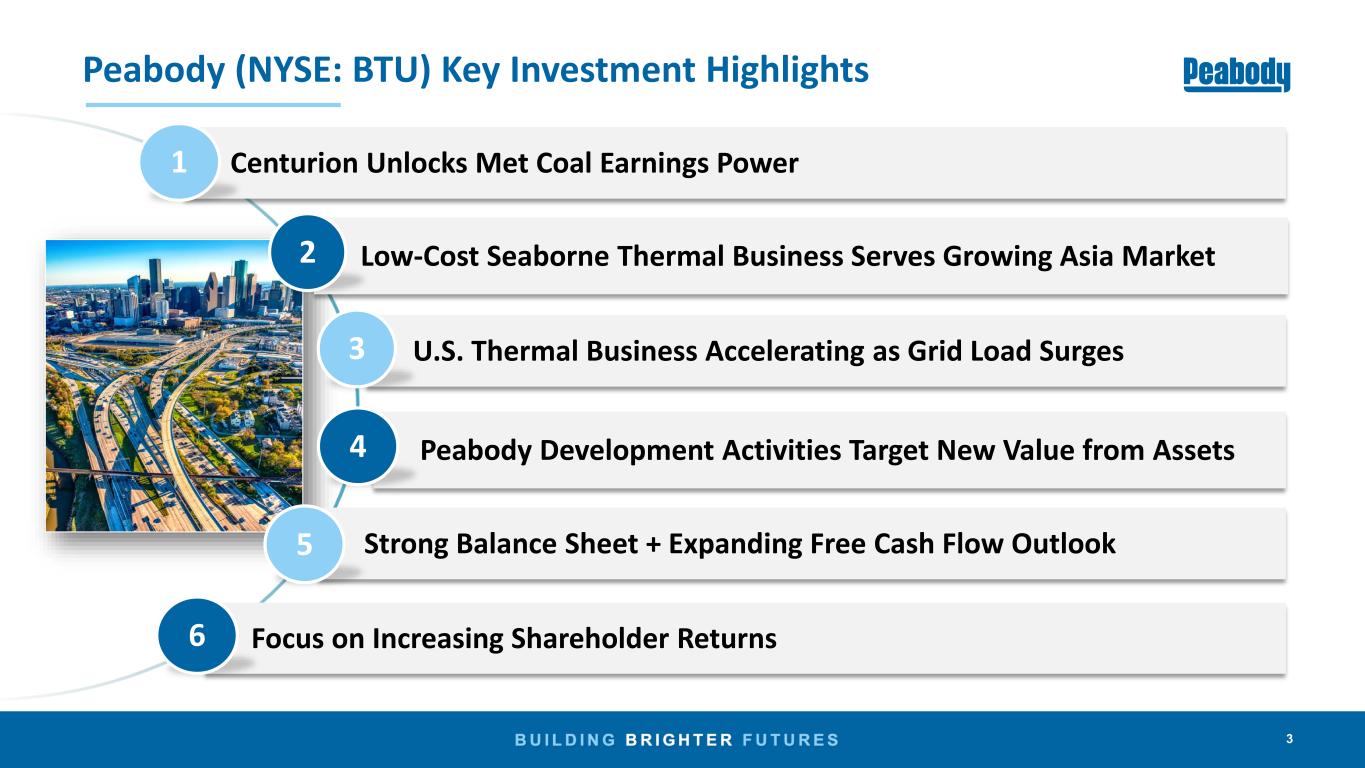
3 Peabody (NYSE: BTU) Key Investment Highlights Centurion Unlocks Met Coal Earnings Power1 U.S. Thermal Business Accelerating as Grid Load Surges 3 Low-Cost Seaborne Thermal Business Serves Growing Asia Market2 Strong Balance Sheet + Expanding Free Cash Flow Outlook 5 Focus on Increasing Shareholder Returns6 Peabody Development Activities Target New Value from Assets4
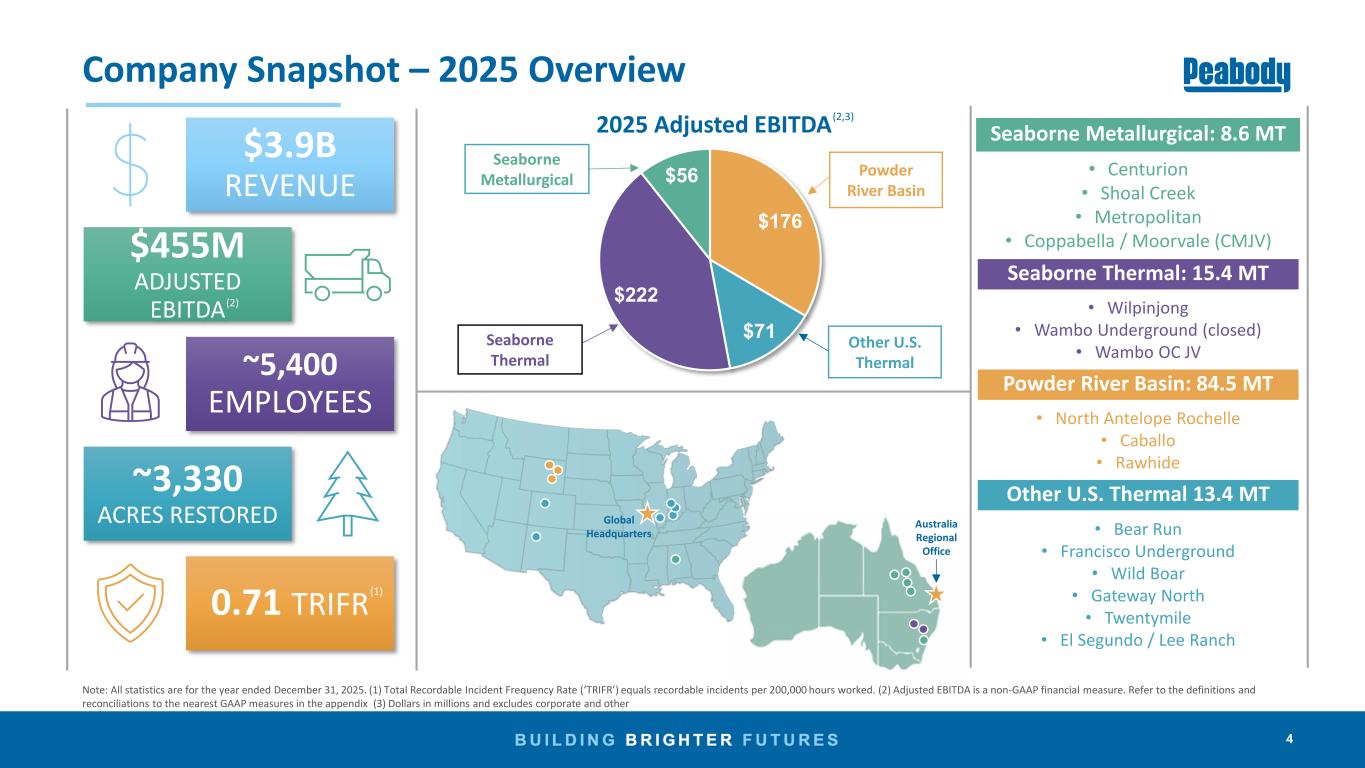
4 Company Snapshot – 2025 Overview Note: All statistics are for the year ended December 31, 2025. (1) Total Recordable Incident Frequency Rate (‘TRIFR’) equals recordable incidents per 200,000 hours worked. (2) Adjusted EBITDA is a non-GAAP financial measure. Refer to the definitions and reconciliations to the nearest GAAP measures in the appendix (3) Dollars in millions and excludes corporate and other Seaborne Metallurgical: 8.6 MT • Centurion • Shoal Creek • Metropolitan • Coppabella / Moorvale (CMJV) Seaborne Thermal: 15.4 MT • Wilpinjong • Wambo Underground (closed) • Wambo OC JV Powder River Basin: 84.5 MT • North Antelope Rochelle • Caballo • Rawhide Other U.S. Thermal 13.4 MT • Bear Run • Francisco Underground • Wild Boar • Gateway North • Twentymile • El Segundo / Lee Ranch $3.9B REVENUE $455M ADJUSTED EBITDA ~5,400 EMPLOYEES ~3,330 ACRES RESTORED 0.71 TRIFR $176 $71 $222 $56 2025 Adjusted EBITDA Powder River Basin Other U.S. Thermal Seaborne Thermal Seaborne Metallurgical (2,3) (1) (2) Global Headquarters Australia Regional Office
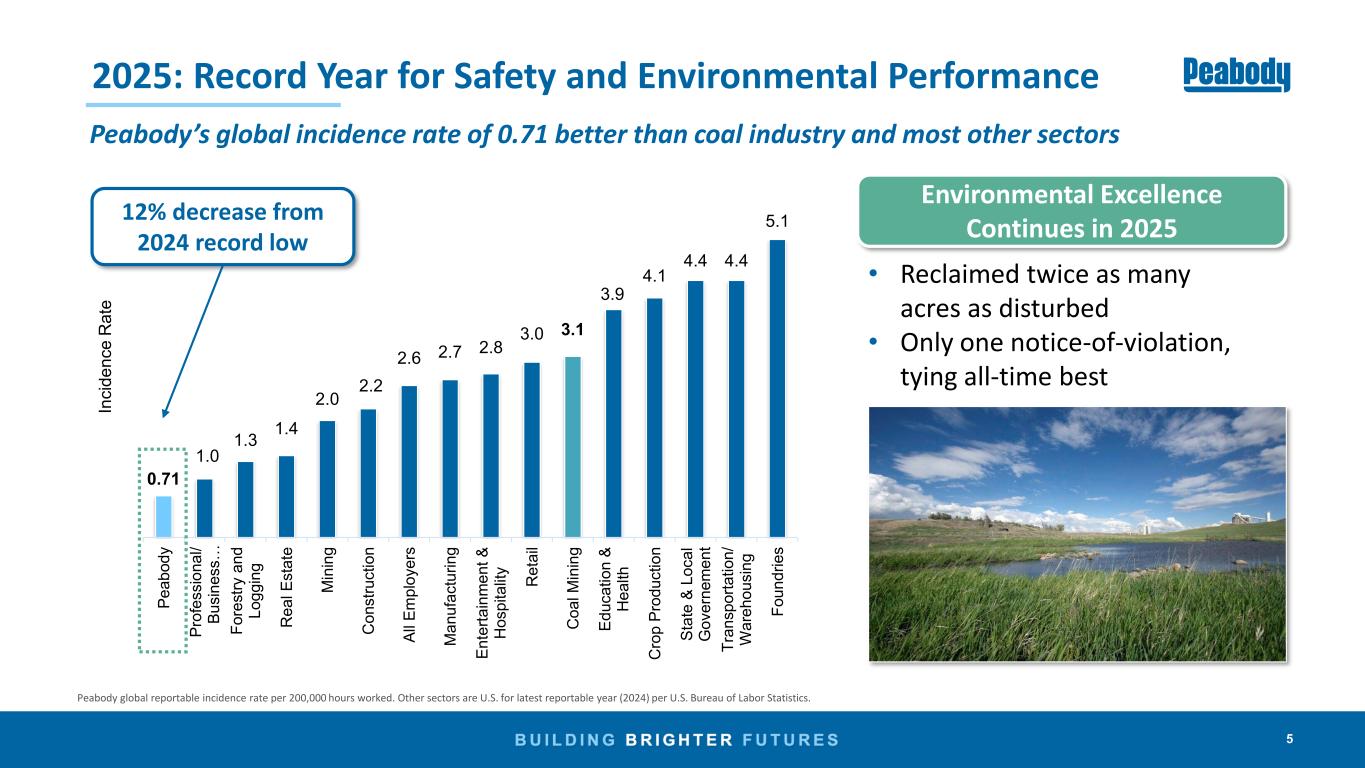
5 2025: Record Year for Safety and Environmental Performance Peabody’s global incidence rate of 0.71 better than coal industry and most other sectors Peabody global reportable incidence rate per 200,000 hours worked. Other sectors are U.S. for latest reportable year (2024) per U.S. Bureau of Labor Statistics. 1.0 1.3 1.4 2.0 2.2 2.6 2.7 2.8 3.0 3.9 4.1 4.4 4.4 5.1 0.71 3.1 P e a b o d y P ro fe s s io n a l/ B u s in e s s … F o re s tr y a n d L o g g in g R e a l E s ta te M in in g C o n s tr u c ti o n A ll E m p lo y e rs M a n u fa c tu ri n g E n te rt a in m e n t & H o s p it a lit y R e ta il C o a l M in in g E d u c a ti o n & H e a lt h C ro p P ro d u c ti o n S ta te & L o c a l G o v e rn e m e n t T ra n s p o rt a ti o n / W a re h o u s in g F o u n d ri e s In c id e n c e R a te 12% decrease from 2024 record low • Reclaimed twice as many acres as disturbed • Only one notice-of-violation, tying all-time best Environmental Excellence Continues in 2025
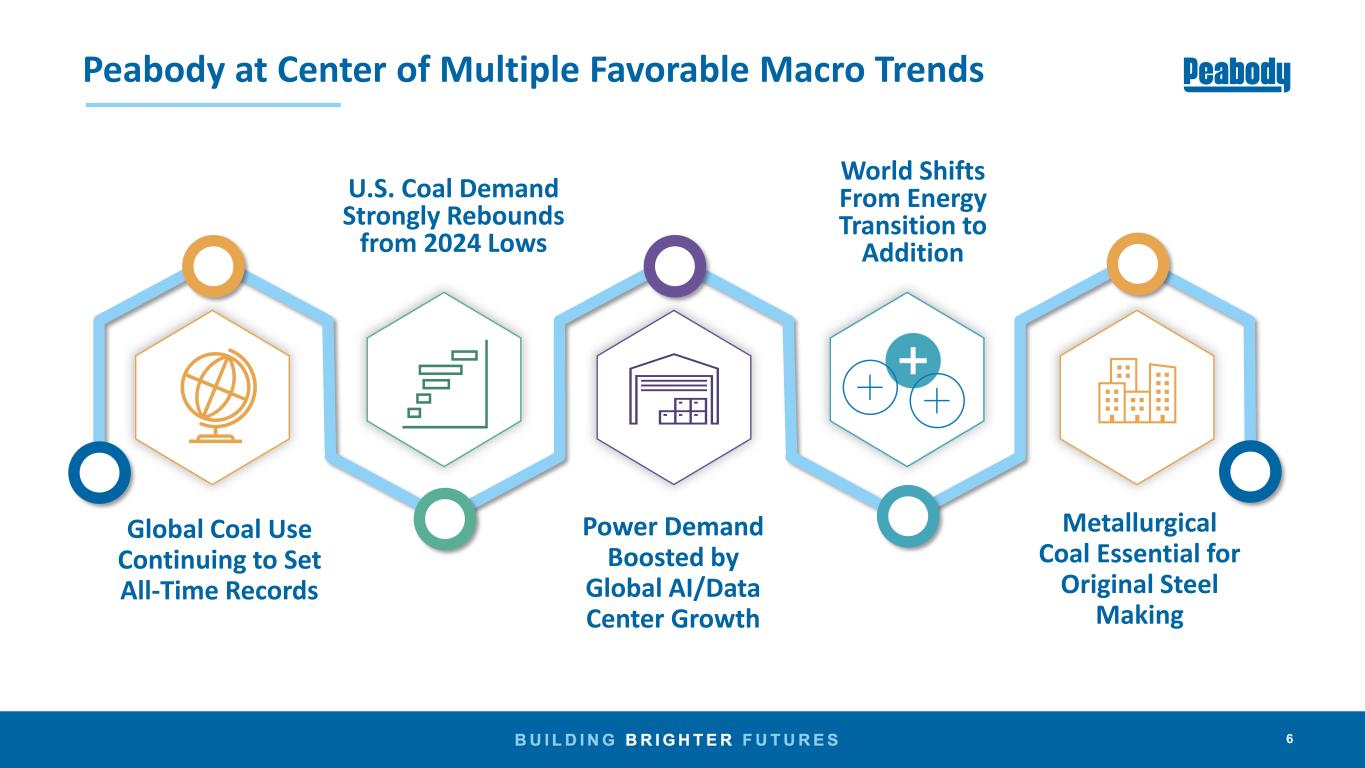
6 Peabody at Center of Multiple Favorable Macro Trends Global Coal Use Continuing to Set All-Time Records Power Demand Boosted by Global AI/Data Center Growth Metallurgical Coal Essential for Original Steel Making U.S. Coal Demand Strongly Rebounds from 2024 Lows World Shifts From Energy Transition to Addition
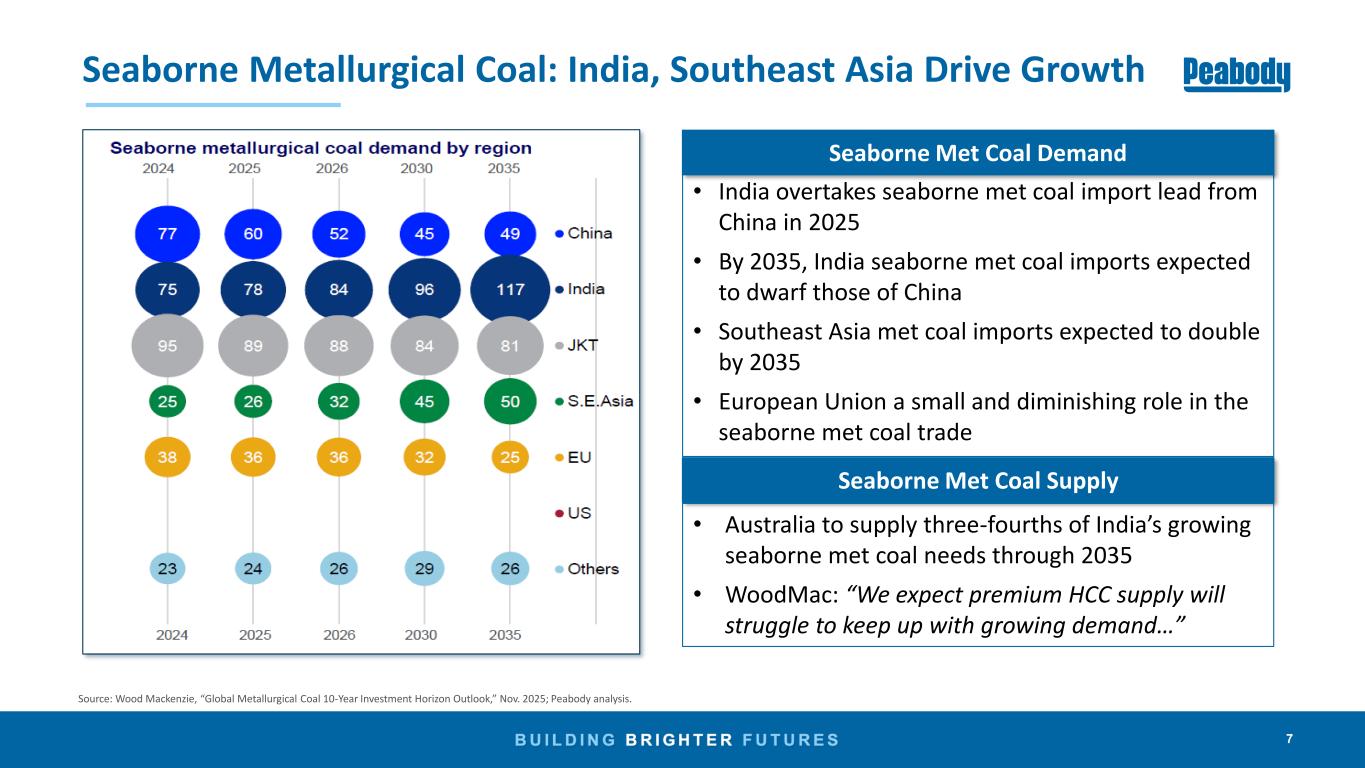
7 Seaborne Metallurgical Coal: India, Southeast Asia Drive Growth • India overtakes seaborne met coal import lead from China in 2025 • By 2035, India seaborne met coal imports expected to dwarf those of China • Southeast Asia met coal imports expected to double by 2035 • European Union a small and diminishing role in the seaborne met coal trade Source: Wood Mackenzie, “Global Metallurgical Coal 10-Year Investment Horizon Outlook,” Nov. 2025; Peabody analysis. Seaborne Met Coal Demand Seaborne Met Coal Supply • Australia to supply three-fourths of India’s growing seaborne met coal needs through 2035 • WoodMac: “We expect premium HCC supply will struggle to keep up with growing demand…”
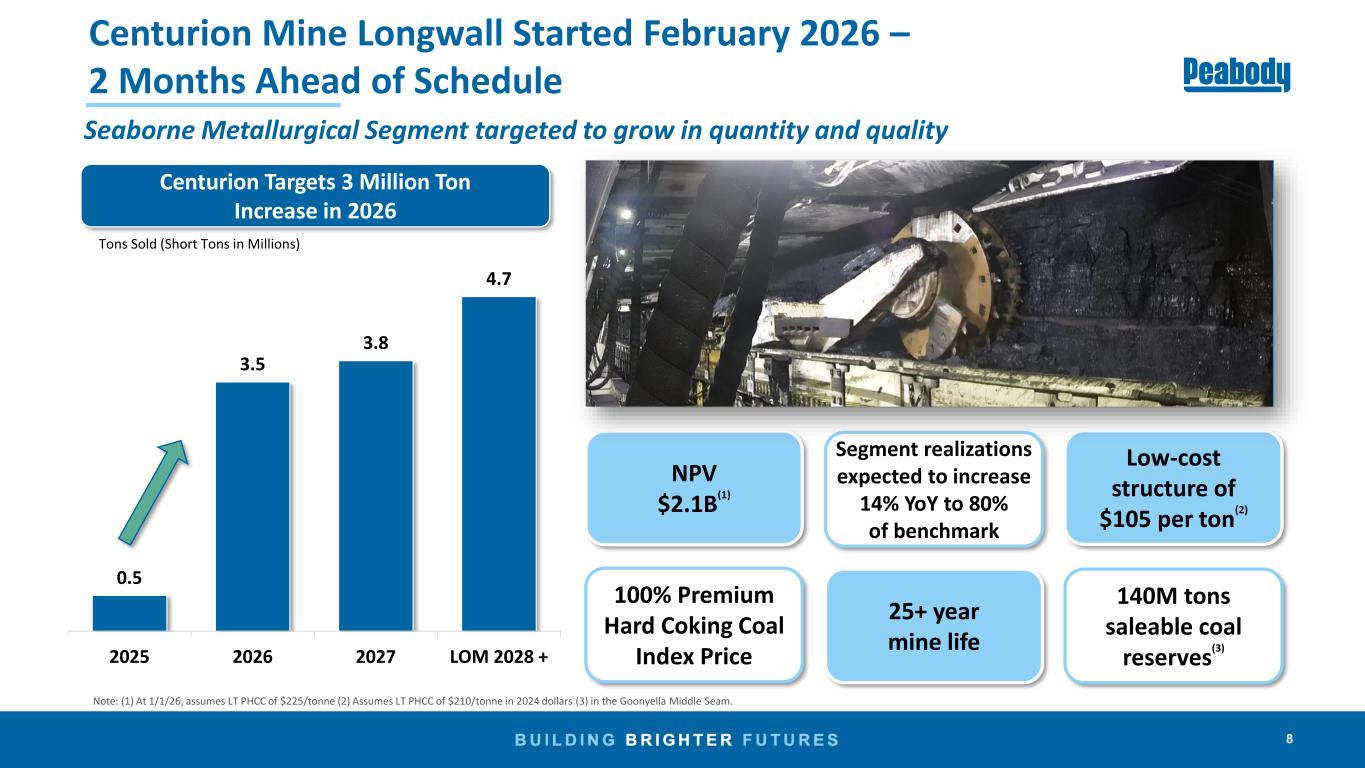
8 Centurion Mine Longwall Started February 2026 – 2 Months Ahead of Schedule Centurion Targets 3 Million Ton Increase in 2026 0.5 3.5 3.8 4.7 2025 2026 2027 LOM 2028 + Tons Sold (Short Tons in Millions) Seaborne Metallurgical Segment targeted to grow in quantity and quality NPV $2.1B (1) 100% Premium Hard Coking Coal Index Price Low-cost structure of $105 per ton (2) Segment realizations expected to increase 14% YoY to 80% of benchmark 25+ year mine life 140M tons saleable coal reserves (3) Note: (1) At 1/1/26, assumes LT PHCC of $225/tonne (2) Assumes LT PHCC of $210/tonne in 2024 dollars (3) in the Goonyella Middle Seam.
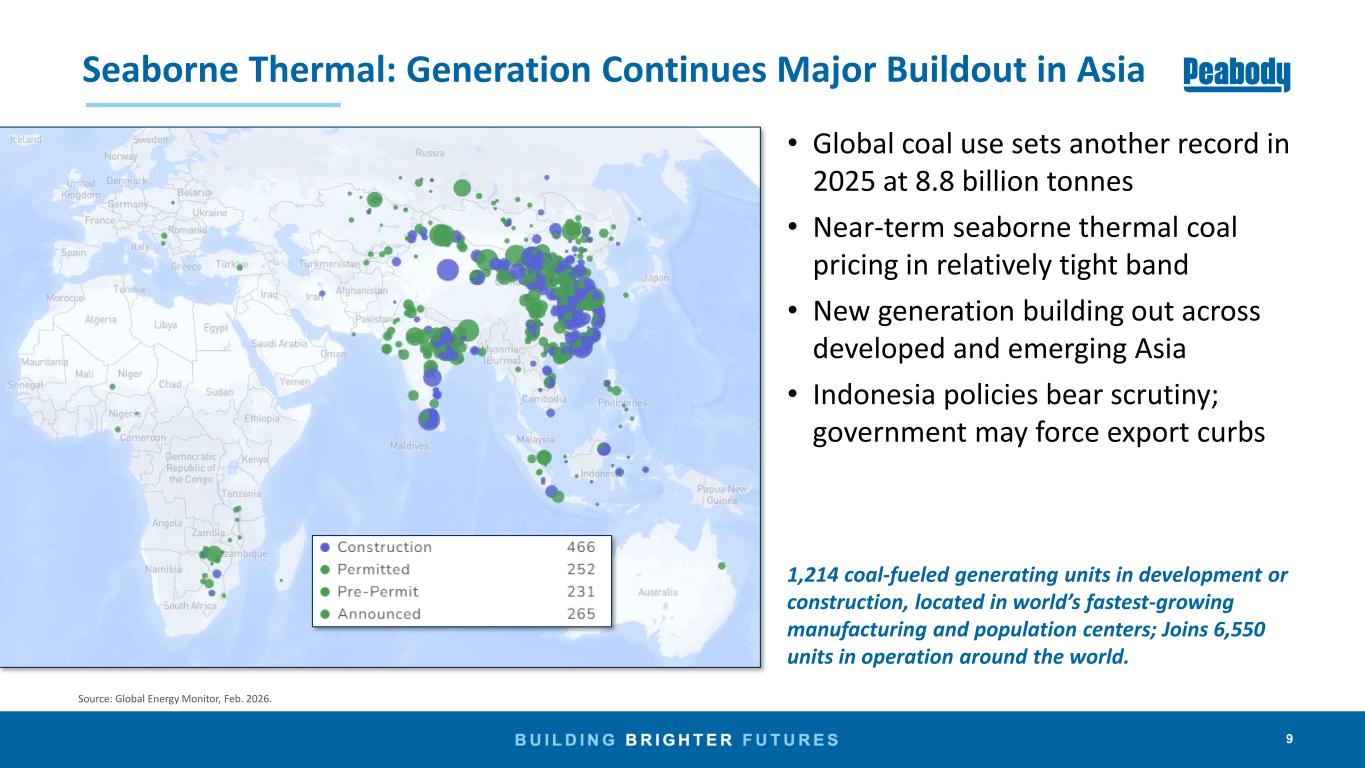
9 Seaborne Thermal: Generation Continues Major Buildout in Asia • Global coal use sets another record in 2025 at 8.8 billion tonnes • Near-term seaborne thermal coal pricing in relatively tight band • New generation building out across developed and emerging Asia • Indonesia policies bear scrutiny; government may force export curbs Source: Global Energy Monitor, Feb. 2026. 1,214 coal-fueled generating units in development or construction, located in world’s fastest-growing manufacturing and population centers; Joins 6,550 units in operation around the world.
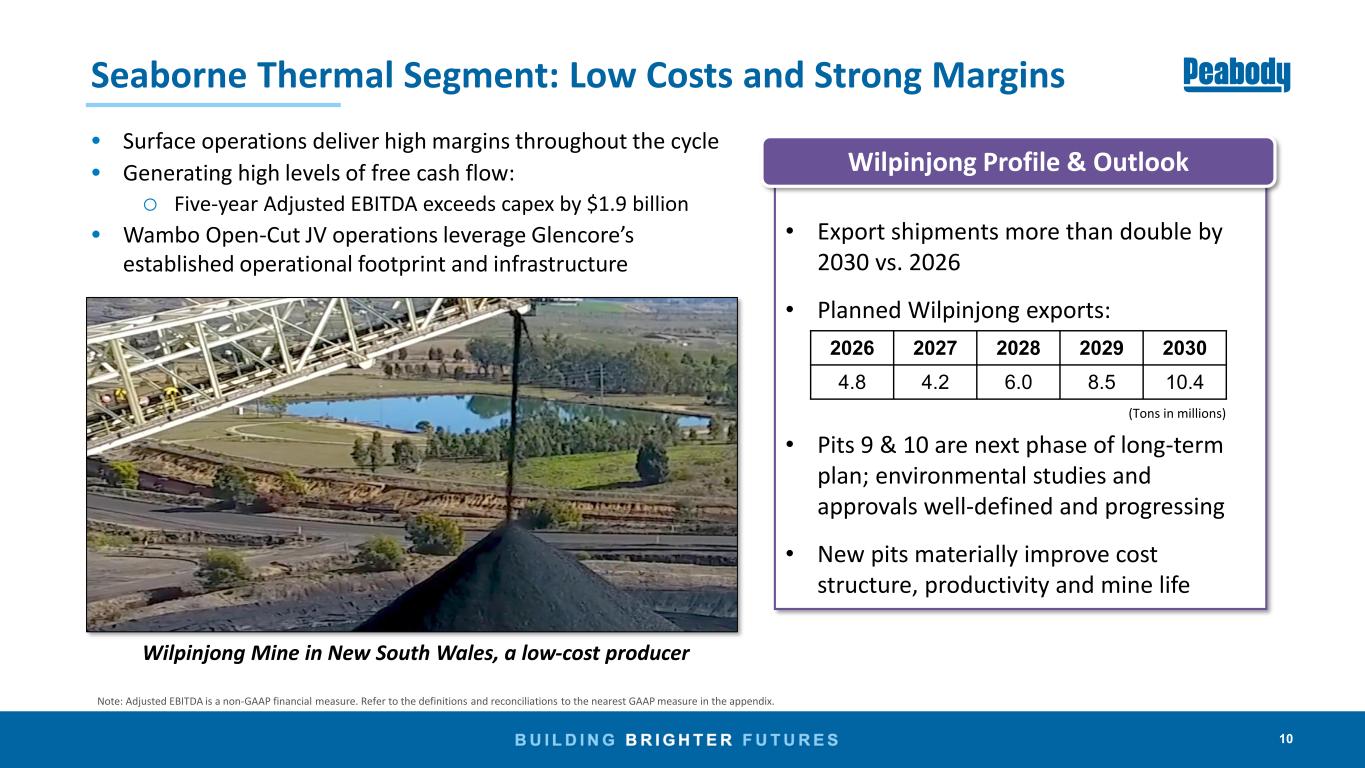
10 Seaborne Thermal Segment: Low Costs and Strong Margins • Surface operations deliver high margins throughout the cycle • Generating high levels of free cash flow: o Five-year Adjusted EBITDA exceeds capex by $1.9 billion • Wambo Open-Cut JV operations leverage Glencore’s established operational footprint and infrastructure Note: Adjusted EBITDA is a non-GAAP financial measure. Refer to the definitions and reconciliations to the nearest GAAP measure in the appendix. Wilpinjong Mine in New South Wales, a low-cost producer • Export shipments more than double by 2030 vs. 2026 • Planned Wilpinjong exports: • Pits 9 & 10 are next phase of long-term plan; environmental studies and approvals well-defined and progressing • New pits materially improve cost structure, productivity and mine life Wilpinjong Profile & Outlook 2026 2027 2028 2029 2030 4.8 4.2 6.0 8.5 10.4 (Tons in millions)
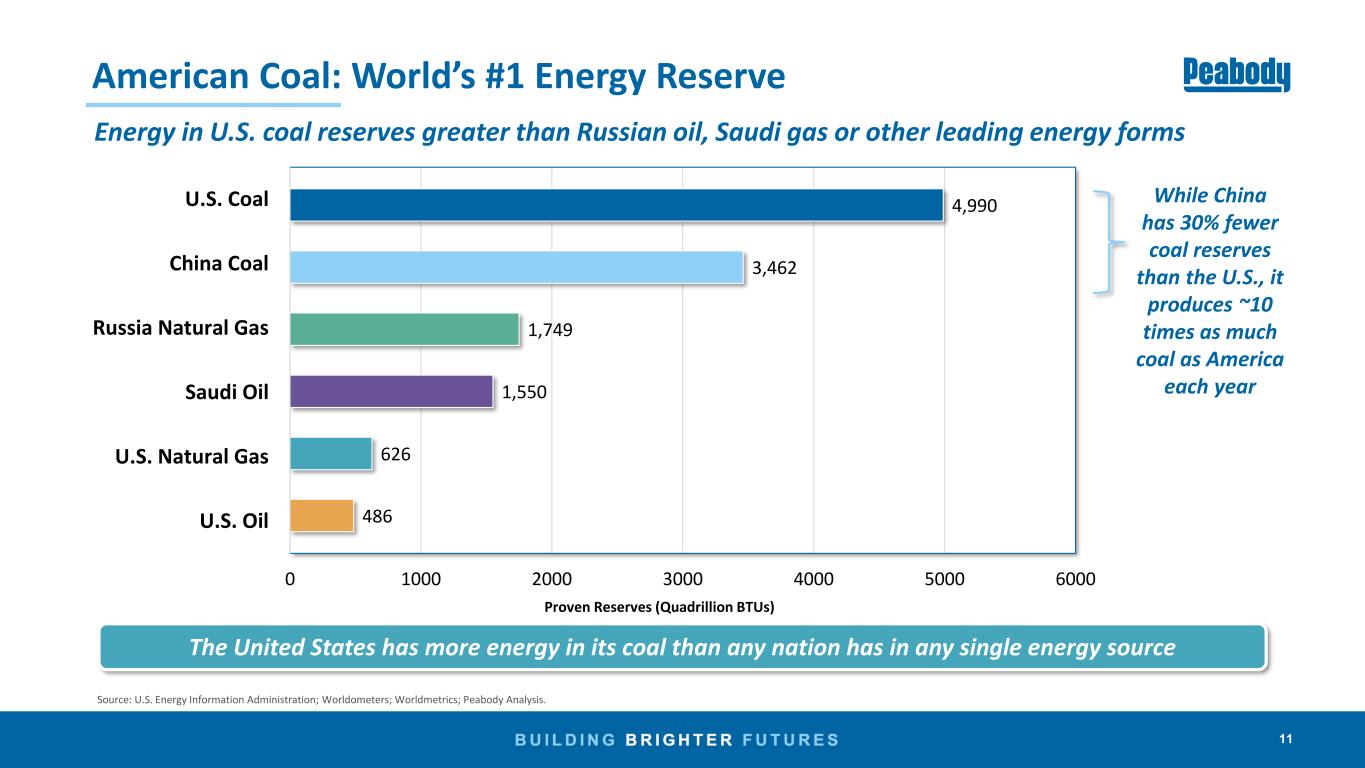
11 American Coal: World’s #1 Energy Reserve Energy in U.S. coal reserves greater than Russian oil, Saudi gas or other leading energy forms 4,990 3,462 1,749 1,550 626 486 0 1000 2000 3000 4000 5000 6000 U.S. Oil U.S. Natural Gas Saudi Oil Russia Natural Gas China Coal U.S. Coal Proven Reserves (Quadrillion BTUs) While China has 30% fewer coal reserves than the U.S., it produces ~10 times as much coal as America each year The United States has more energy in its coal than any nation has in any single energy source Source: U.S. Energy Information Administration; Worldometers; Worldmetrics; Peabody Analysis.
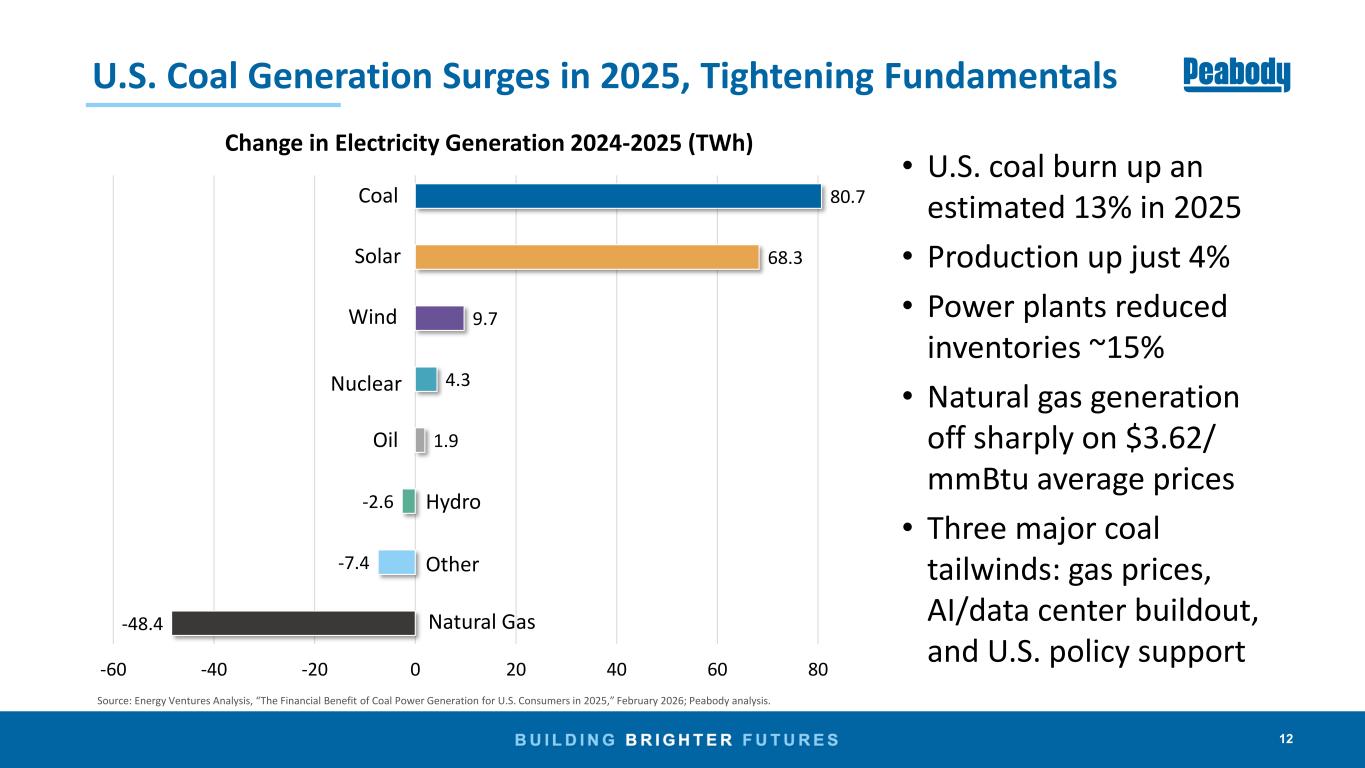
12 U.S. Coal Generation Surges in 2025, Tightening Fundamentals • U.S. coal burn up an estimated 13% in 2025 • Production up just 4% • Power plants reduced inventories ~15% • Natural gas generation off sharply on $3.62/ mmBtu average prices • Three major coal tailwinds: gas prices, AI/data center buildout, and U.S. policy support Source: Energy Ventures Analysis, “The Financial Benefit of Coal Power Generation for U.S. Consumers in 2025,” February 2026; Peabody analysis. -48.4 -7.4 -2.6 1.9 4.3 9.7 68.3 80.7 -60 -40 -20 0 20 40 60 80 Change in Electricity Generation 2024-2025 (TWh) Coal Solar Wind Nuclear Oil Hydro Other Natural Gas
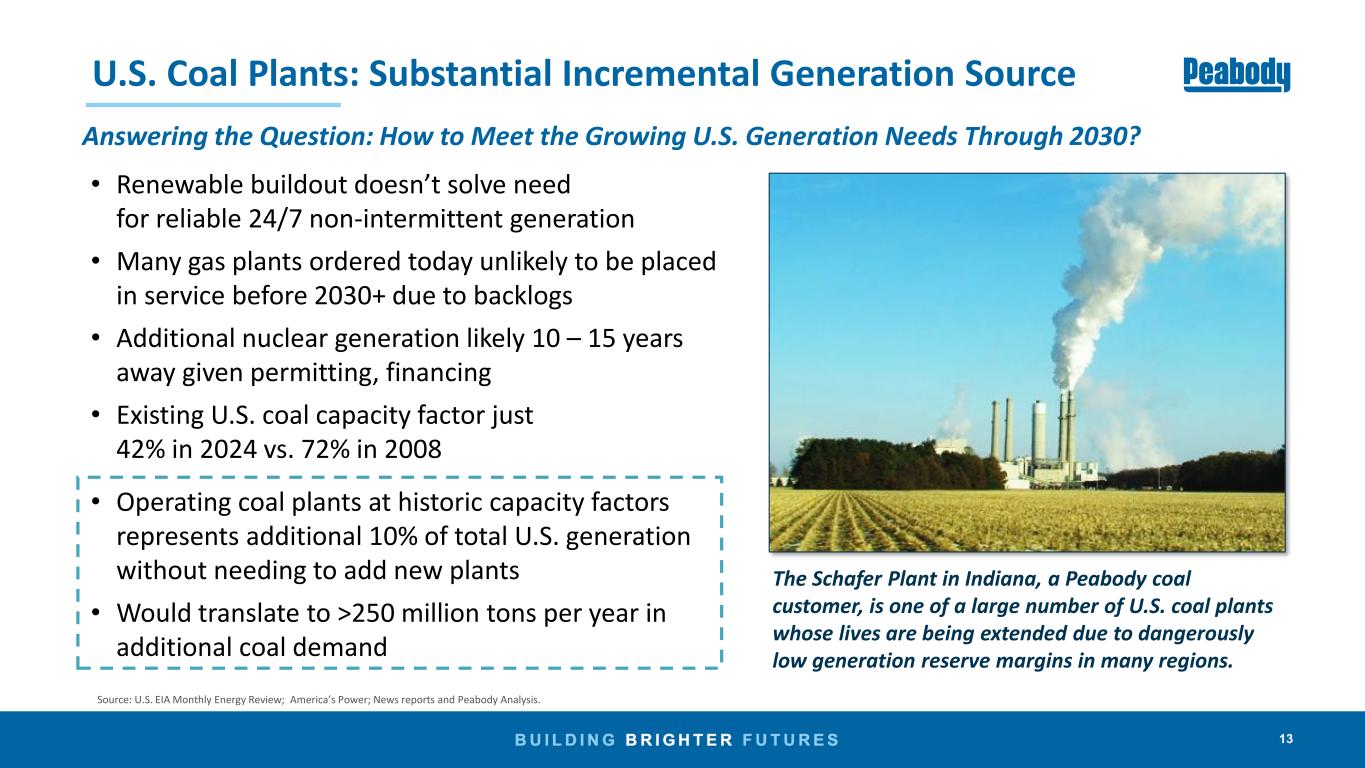
13 Answering the Question: How to Meet the Growing U.S. Generation Needs Through 2030? • Renewable buildout doesn’t solve need for reliable 24/7 non-intermittent generation • Many gas plants ordered today unlikely to be placed in service before 2030+ due to backlogs • Additional nuclear generation likely 10 – 15 years away given permitting, financing • Existing U.S. coal capacity factor just 42% in 2024 vs. 72% in 2008 • Operating coal plants at historic capacity factors represents additional 10% of total U.S. generation without needing to add new plants • Would translate to >250 million tons per year in additional coal demand The Schafer Plant in Indiana, a Peabody coal customer, is one of a large number of U.S. coal plants whose lives are being extended due to dangerously low generation reserve margins in many regions. Source: U.S. EIA Monthly Energy Review; America’s Power; News reports and Peabody Analysis. U.S. Coal Plants: Substantial Incremental Generation Source
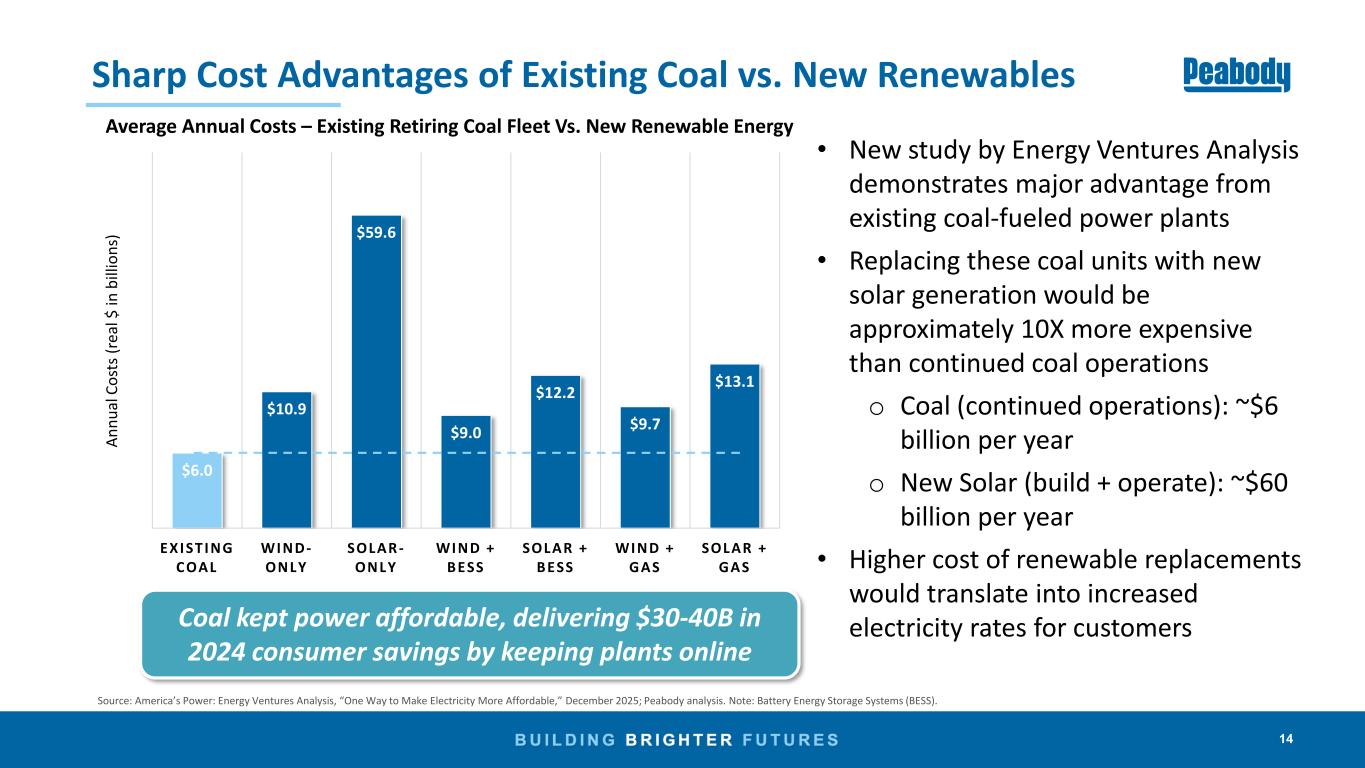
14 Sharp Cost Advantages of Existing Coal vs. New Renewables Coal kept power affordable, delivering $30-40B in 2024 consumer savings by keeping plants online Source: America’s Power: Energy Ventures Analysis, “One Way to Make Electricity More Affordable,” December 2025; Peabody analysis. Note: Battery Energy Storage Systems (BESS). • New study by Energy Ventures Analysis demonstrates major advantage from existing coal-fueled power plants • Replacing these coal units with new solar generation would be approximately 10X more expensive than continued coal operations o Coal (continued operations): ~$6 billion per year o New Solar (build + operate): ~$60 billion per year • Higher cost of renewable replacements would translate into increased electricity rates for customers $6.0 $10.9 $59.6 $9.0 $12.2 $9.7 $13.1 EXIST IN G COAL WIND- ONLY SOLAR - ONLY WIND + BESS SOLAR + BESS WIND + GAS SOLAR + GAS A n n u al C o st s (r ea l $ in b ill io n s) Average Annual Costs – Existing Retiring Coal Fleet Vs. New Renewable Energy
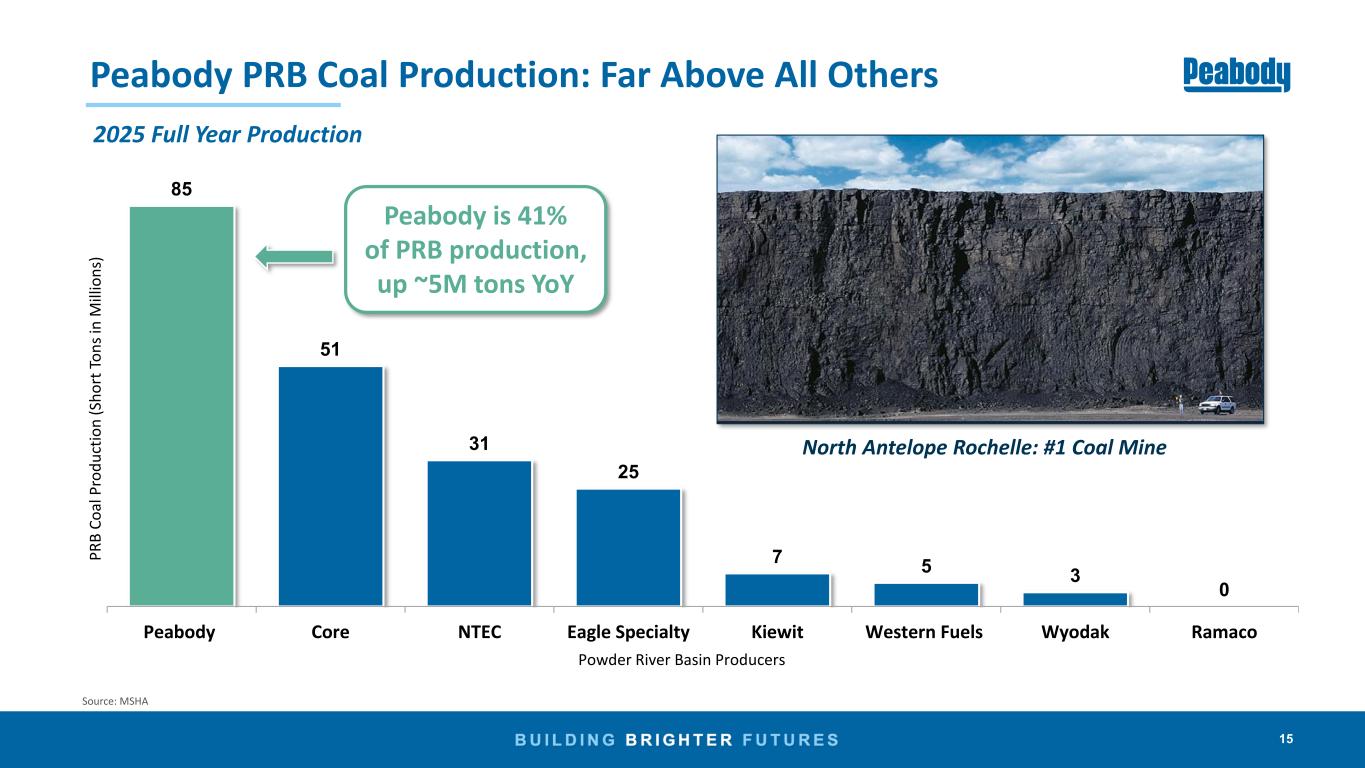
15 Peabody PRB Coal Production: Far Above All Others 2025 Full Year Production 85 51 31 25 7 5 3 0 Peabody Core NTEC Eagle Specialty Kiewit Western Fuels Wyodak Ramaco P R B C o al P ro d u ct io n ( Sh o rt T o n s in M ill io n s) Powder River Basin Producers North Antelope Rochelle: #1 Coal Mine Peabody is 41% of PRB production, up ~5M tons YoY Source: MSHA
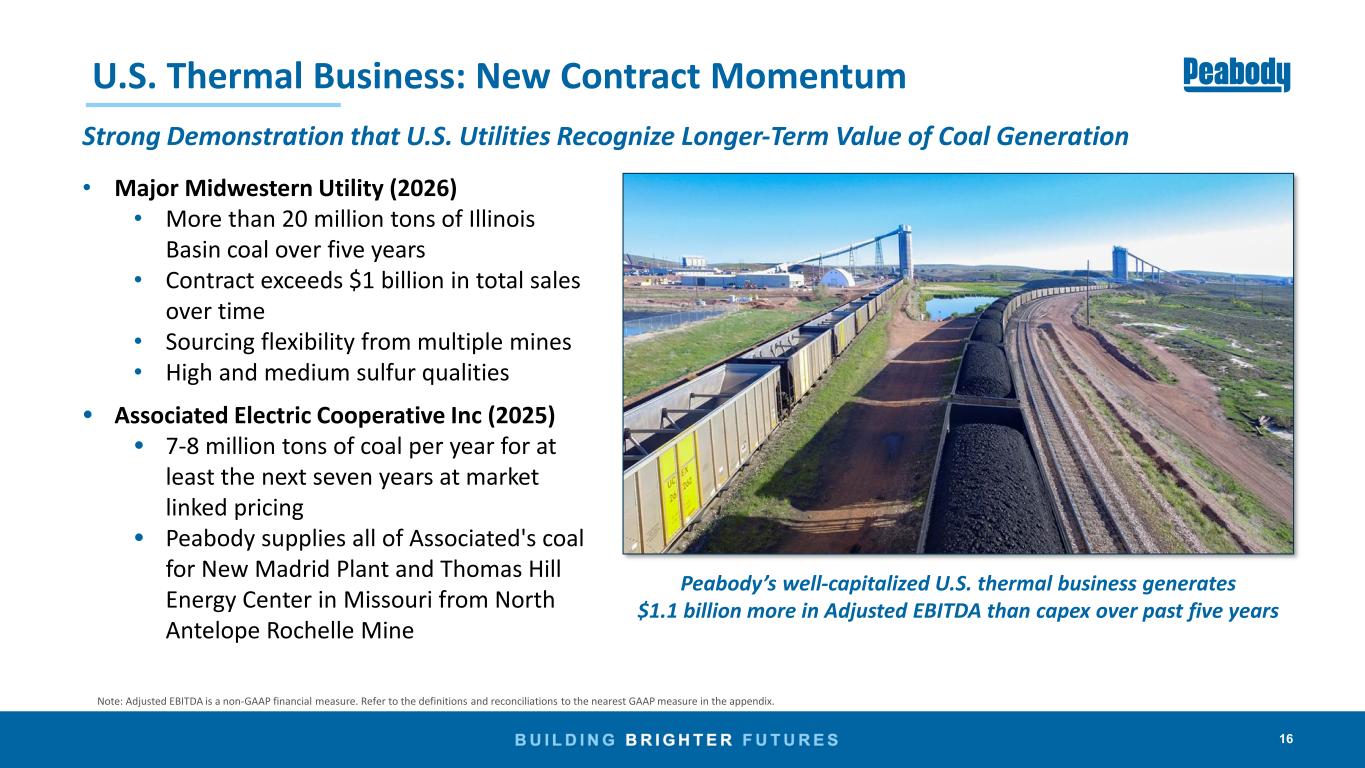
16 U.S. Thermal Business: New Contract Momentum • Major Midwestern Utility (2026) • More than 20 million tons of Illinois Basin coal over five years • Contract exceeds $1 billion in total sales over time • Sourcing flexibility from multiple mines • High and medium sulfur qualities • Associated Electric Cooperative Inc (2025) • 7-8 million tons of coal per year for at least the next seven years at market linked pricing • Peabody supplies all of Associated's coal for New Madrid Plant and Thomas Hill Energy Center in Missouri from North Antelope Rochelle Mine Strong Demonstration that U.S. Utilities Recognize Longer-Term Value of Coal Generation Peabody’s well-capitalized U.S. thermal business generates $1.1 billion more in Adjusted EBITDA than capex over past five years Note: Adjusted EBITDA is a non-GAAP financial measure. Refer to the definitions and reconciliations to the nearest GAAP measure in the appendix.
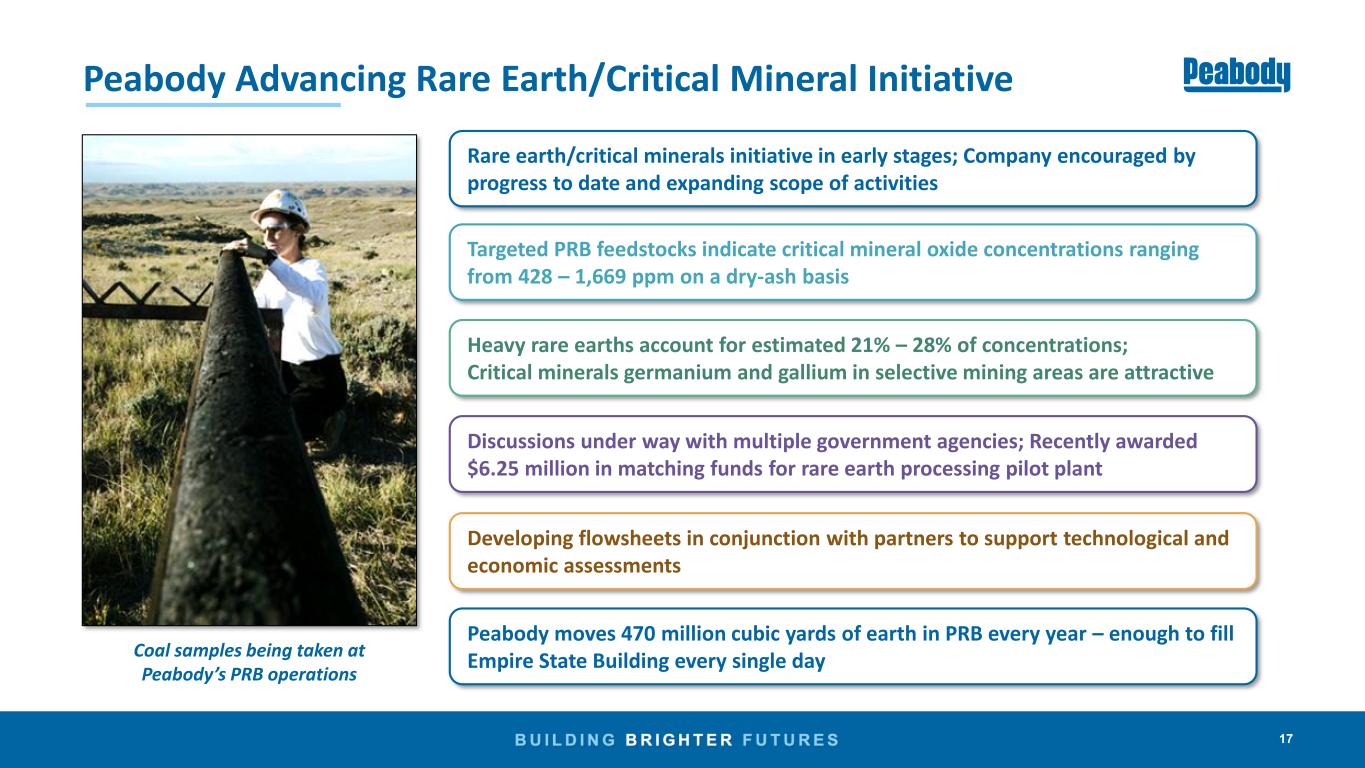
17 Heavy rare earths account for estimated 21% – 28% of concentrations; Critical minerals germanium and gallium in selective mining areas are attractive Discussions under way with multiple government agencies; Recently awarded $6.25 million in matching funds for rare earth processing pilot plant Developing flowsheets in conjunction with partners to support technological and economic assessments Targeted PRB feedstocks indicate critical mineral oxide concentrations ranging from 428 – 1,669 ppm on a dry-ash basis Peabody moves 470 million cubic yards of earth in PRB every year – enough to fill Empire State Building every single day Rare earth/critical minerals initiative in early stages; Company encouraged by progress to date and expanding scope of activities Peabody Advancing Rare Earth/Critical Mineral Initiative Coal samples being taken at Peabody’s PRB operations
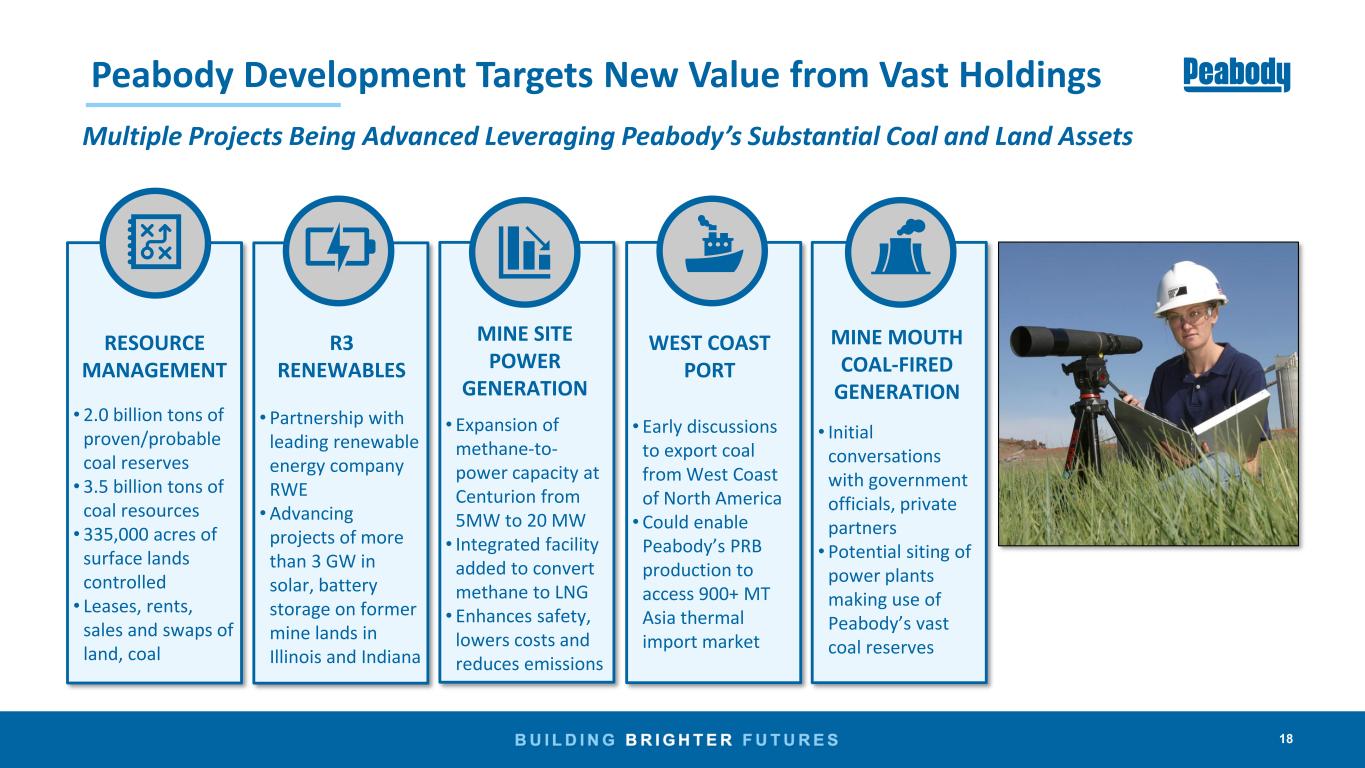
18 • Expansion of methane-to- power capacity at Centurion from 5MW to 20 MW • Integrated facility added to convert methane to LNG • Enhances safety, lowers costs and reduces emissions Peabody Development Targets New Value from Vast Holdings • 2.0 billion tons of proven/probable coal reserves • 3.5 billion tons of coal resources • 335,000 acres of surface lands controlled • Leases, rents, sales and swaps of land, coal • Partnership with leading renewable energy company RWE • Advancing projects of more than 3 GW in solar, battery storage on former mine lands in Illinois and Indiana • Initial conversations with government officials, private partners • Potential siting of power plants making use of Peabody’s vast coal reserves RESOURCE MANAGEMENT R3 RENEWABLES MINE MOUTH COAL-FIRED GENERATION • Early discussions to export coal from West Coast of North America • Could enable Peabody’s PRB production to access 900+ MT Asia thermal import market WEST COAST PORT MINE SITE POWER GENERATION Multiple Projects Being Advanced Leveraging Peabody’s Substantial Coal and Land Assets
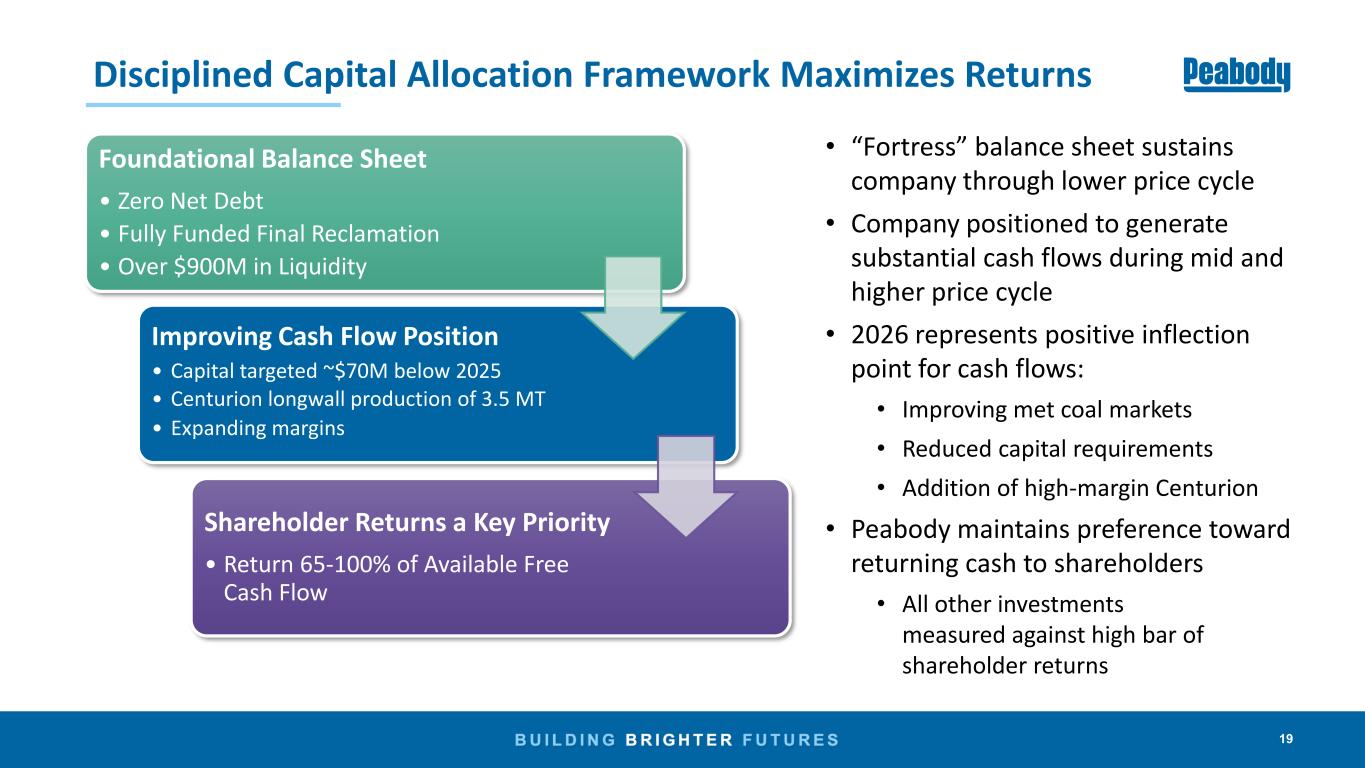
19 Disciplined Capital Allocation Framework Maximizes Returns Foundational Balance Sheet • Zero Net Debt • Fully Funded Final Reclamation • Over $900M in Liquidity Improving Cash Flow Position • Capital targeted ~$70M below 2025 • Centurion longwall production of 3.5 MT • Expanding margins Shareholder Returns a Key Priority • Return 65-100% of Available Free Cash Flow • “Fortress” balance sheet sustains company through lower price cycle • Company positioned to generate substantial cash flows during mid and higher price cycle • 2026 represents positive inflection point for cash flows: • Improving met coal markets • Reduced capital requirements • Addition of high-margin Centurion • Peabody maintains preference toward returning cash to shareholders • All other investments measured against high bar of shareholder returns
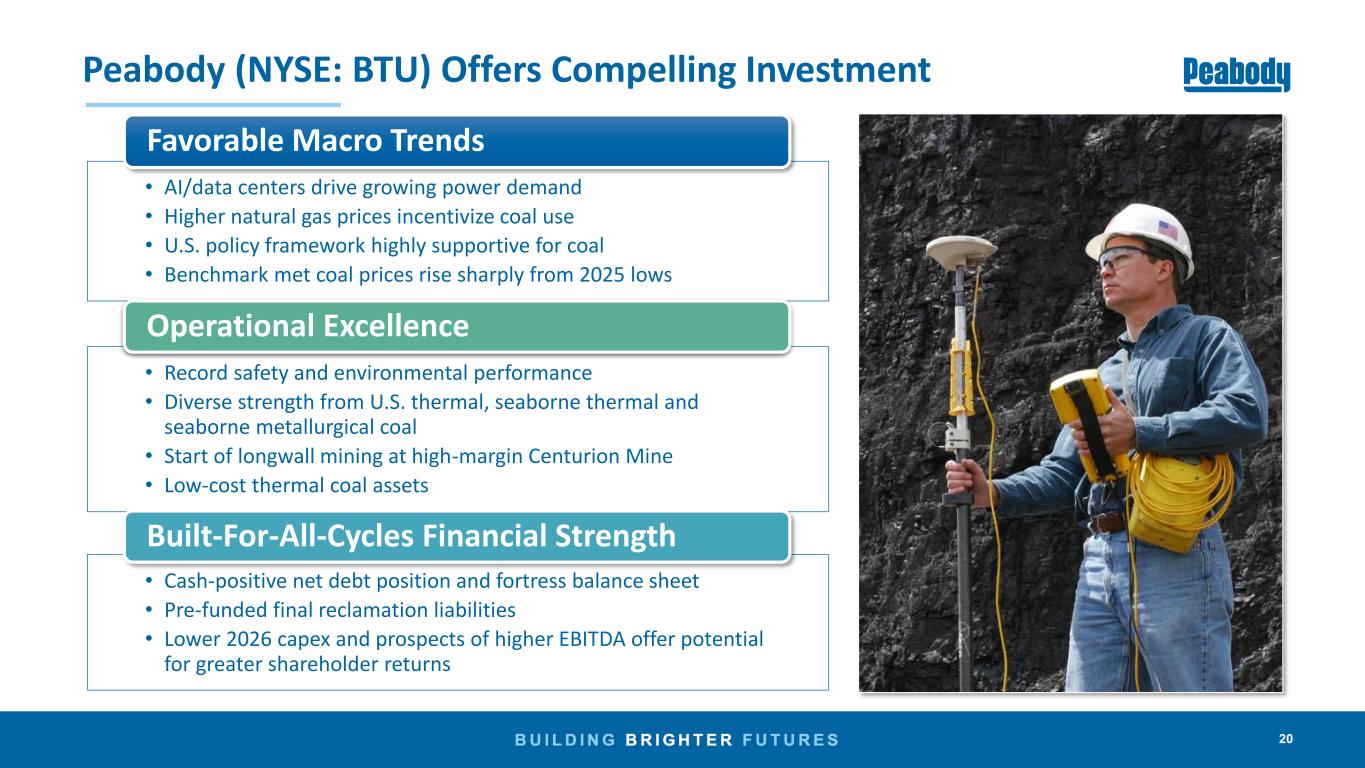
20 Peabody (NYSE: BTU) Offers Compelling Investment • AI/data centers drive growing power demand • Higher natural gas prices incentivize coal use • U.S. policy framework highly supportive for coal • Benchmark met coal prices rise sharply from 2025 lows Favorable Macro Trends • Record safety and environmental performance • Diverse strength from U.S. thermal, seaborne thermal and seaborne metallurgical coal • Start of longwall mining at high-margin Centurion Mine • Low-cost thermal coal assets Operational Excellence • Cash-positive net debt position and fortress balance sheet • Pre-funded final reclamation liabilities • Lower 2026 capex and prospects of higher EBITDA offer potential for greater shareholder returns Built-For-All-Cycles Financial Strength
B U I L D I N G B R I G H T E R F U T U R E S Thank You!
2 22 Appendix
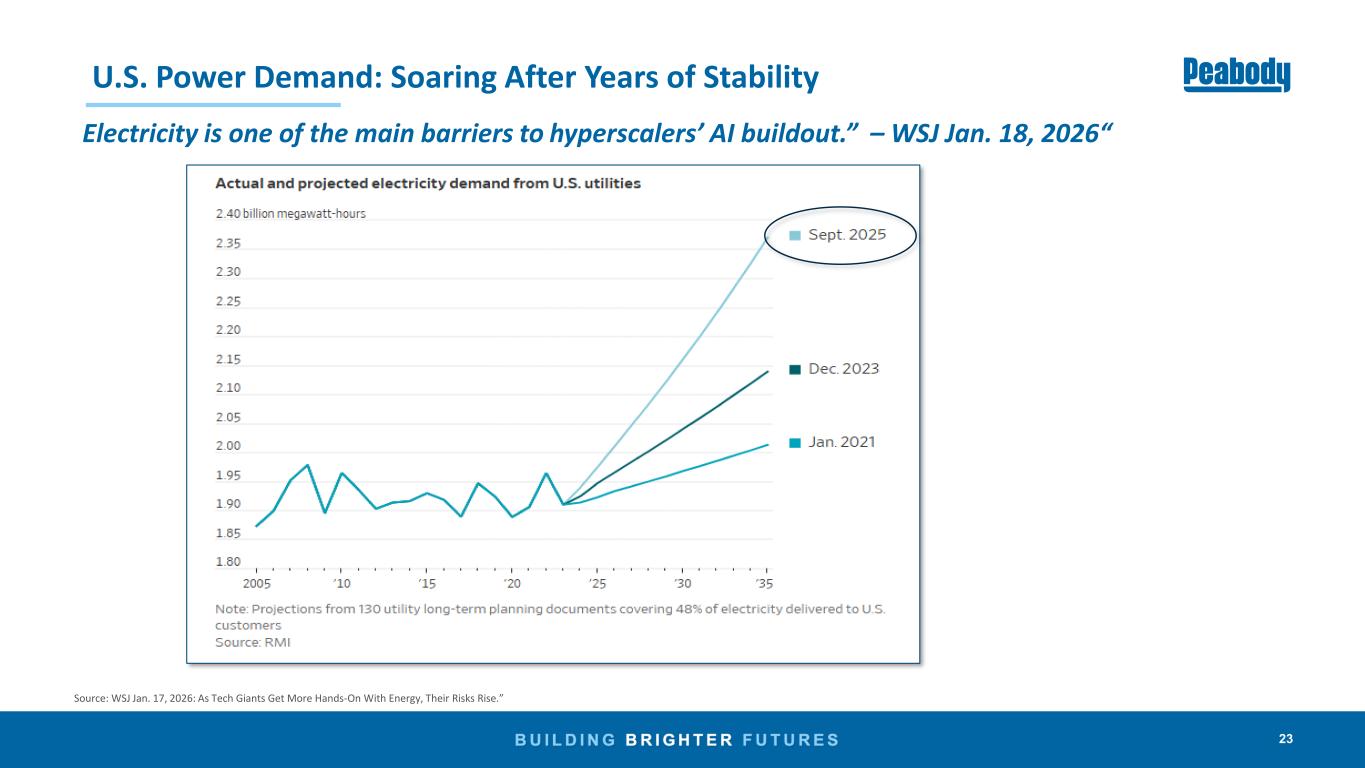
23 U.S. Power Demand: Soaring After Years of Stability Electricity is one of the main barriers to hyperscalers’ AI buildout.” – WSJ Jan. 18, 2026“ Source: WSJ Jan. 17, 2026: As Tech Giants Get More Hands-On With Energy, Their Risks Rise.”
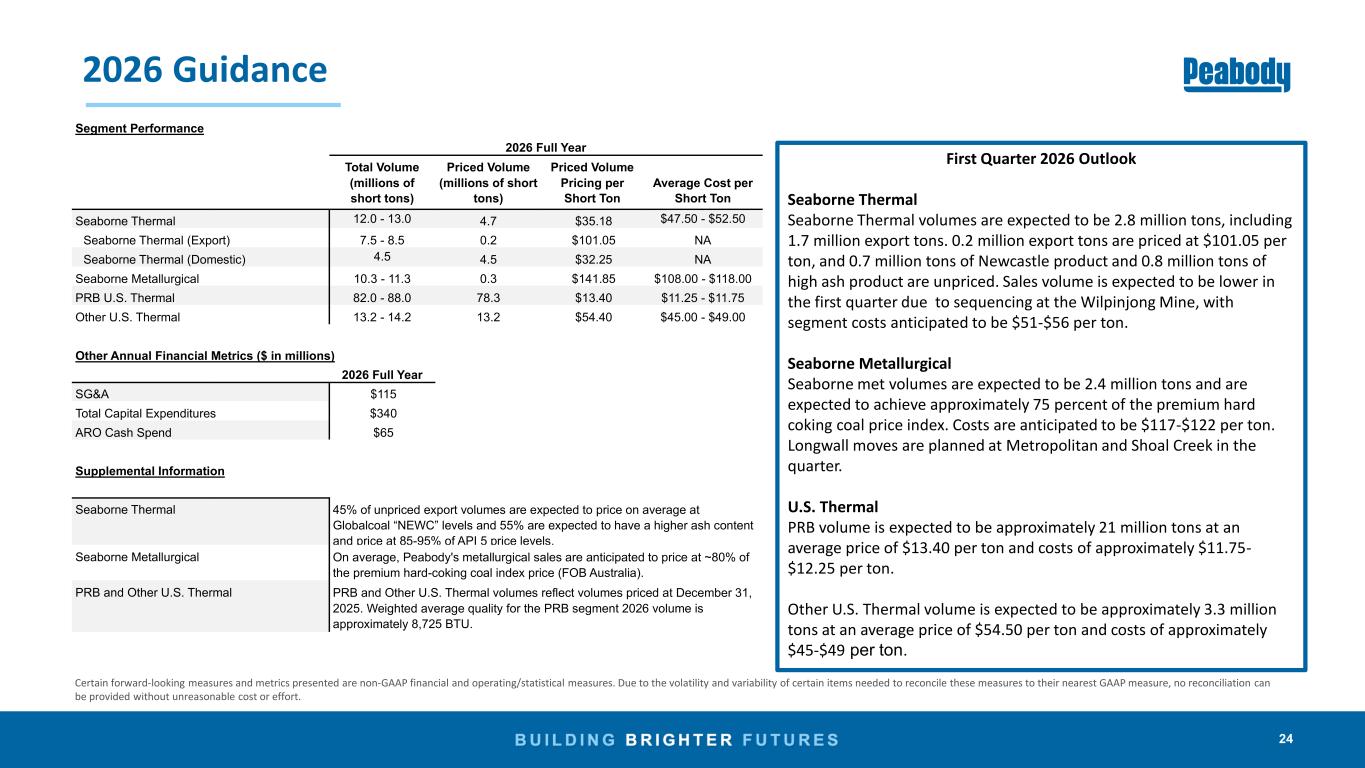
24 2026 Guidance Certain forward-looking measures and metrics presented are non-GAAP financial and operating/statistical measures. Due to the volatility and variability of certain items needed to reconcile these measures to their nearest GAAP measure, no reconciliation can be provided without unreasonable cost or effort. First Quarter 2026 Outlook Seaborne Thermal Seaborne Thermal volumes are expected to be 2.8 million tons, including 1.7 million export tons. 0.2 million export tons are priced at $101.05 per ton, and 0.7 million tons of Newcastle product and 0.8 million tons of high ash product are unpriced. Sales volume is expected to be lower in the first quarter due to sequencing at the Wilpinjong Mine, with segment costs anticipated to be $51-$56 per ton. Seaborne Metallurgical Seaborne met volumes are expected to be 2.4 million tons and are expected to achieve approximately 75 percent of the premium hard coking coal price index. Costs are anticipated to be $117-$122 per ton. Longwall moves are planned at Metropolitan and Shoal Creek in the quarter. U.S. Thermal PRB volume is expected to be approximately 21 million tons at an average price of $13.40 per ton and costs of approximately $11.75- $12.25 per ton. Other U.S. Thermal volume is expected to be approximately 3.3 million tons at an average price of $54.50 per ton and costs of approximately $45-$49 per ton. Segment Performance 2026 Full Year Total Volume (millions of short tons) Priced Volume (millions of short tons) Priced Volume Pricing per Short Ton Average Cost per Short Ton Seaborne Thermal 12.0 - 13.0 4.7 $35.18 $47.50 - $52.50 Seaborne Thermal (Export) 7.5 - 8.5 0.2 $101.05 NA Seaborne Thermal (Domestic) 4.5 4.5 $32.25 NA Seaborne Metallurgical 10.3 - 11.3 0.3 $141.85 $108.00 - $118.00 PRB U.S. Thermal 82.0 - 88.0 78.3 $13.40 $11.25 - $11.75 Other U.S. Thermal 13.2 - 14.2 13.2 $54.40 $45.00 - $49.00 Other Annual Financial Metrics ($ in millions) 2026 Full Year SG&A $115 Total Capital Expenditures $340 ARO Cash Spend $65 Supplemental Information Seaborne Thermal 45% of unpriced export volumes are expected to price on average at Globalcoal “NEWC” levels and 55% are expected to have a higher ash content and price at 85-95% of API 5 price levels. Seaborne Metallurgical On average, Peabody's metallurgical sales are anticipated to price at ~80% of the premium hard-coking coal index price (FOB Australia). PRB and Other U.S. Thermal PRB and Other U.S. Thermal volumes reflect volumes priced at December 31, 2025. Weighted average quality for the PRB segment 2026 volume is approximately 8,725 BTU.
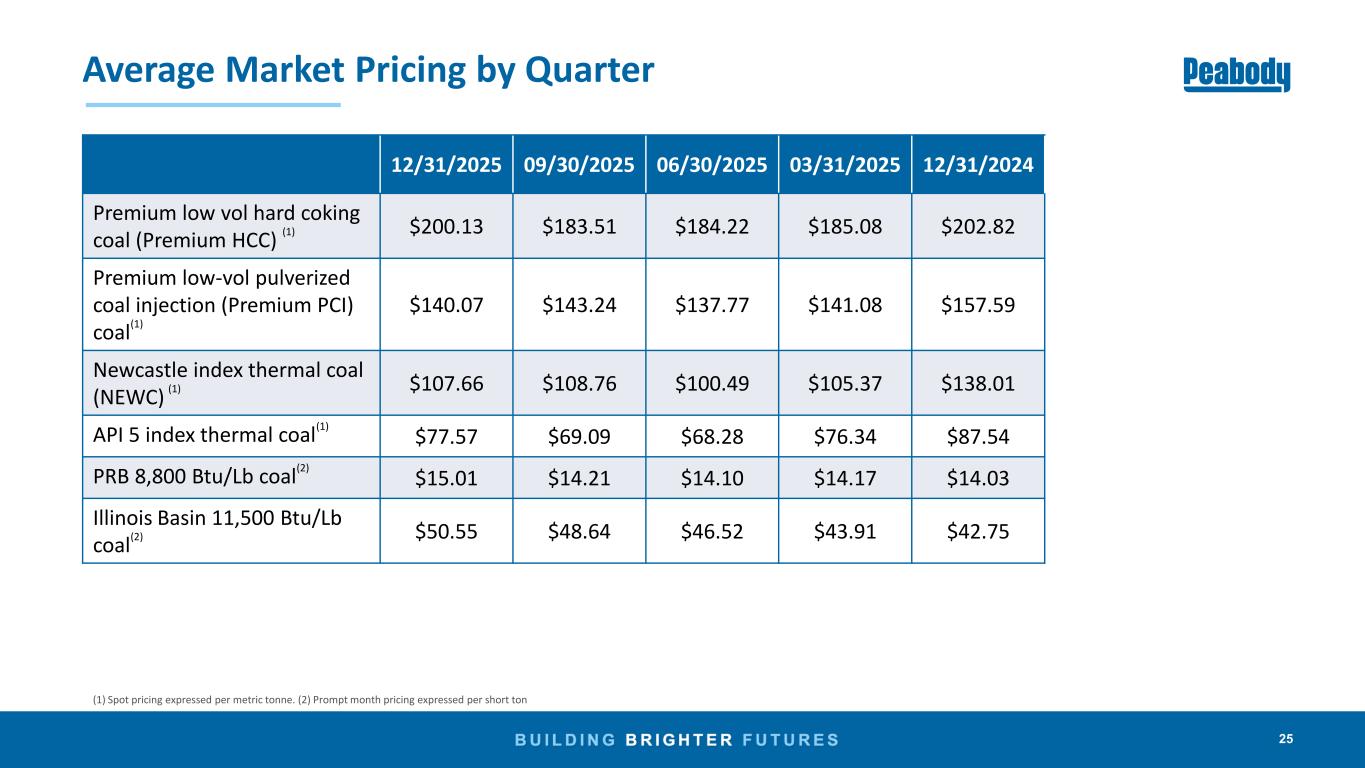
25 Average Market Pricing by Quarter 12/31/2025 09/30/2025 06/30/2025 03/31/2025 12/31/2024 Premium low vol hard coking coal (Premium HCC) (1) $200.13 $183.51 $184.22 $185.08 $202.82 Premium low-vol pulverized coal injection (Premium PCI) coal (1) $140.07 $143.24 $137.77 $141.08 $157.59 Newcastle index thermal coal (NEWC) (1) $107.66 $108.76 $100.49 $105.37 $138.01 API 5 index thermal coal (1) $77.57 $69.09 $68.28 $76.34 $87.54 PRB 8,800 Btu/Lb coal (2) $15.01 $14.21 $14.10 $14.17 $14.03 Illinois Basin 11,500 Btu/Lb coal (2) $50.55 $48.64 $46.52 $43.91 $42.75 (1) Spot pricing expressed per metric tonne. (2) Prompt month pricing expressed per short ton
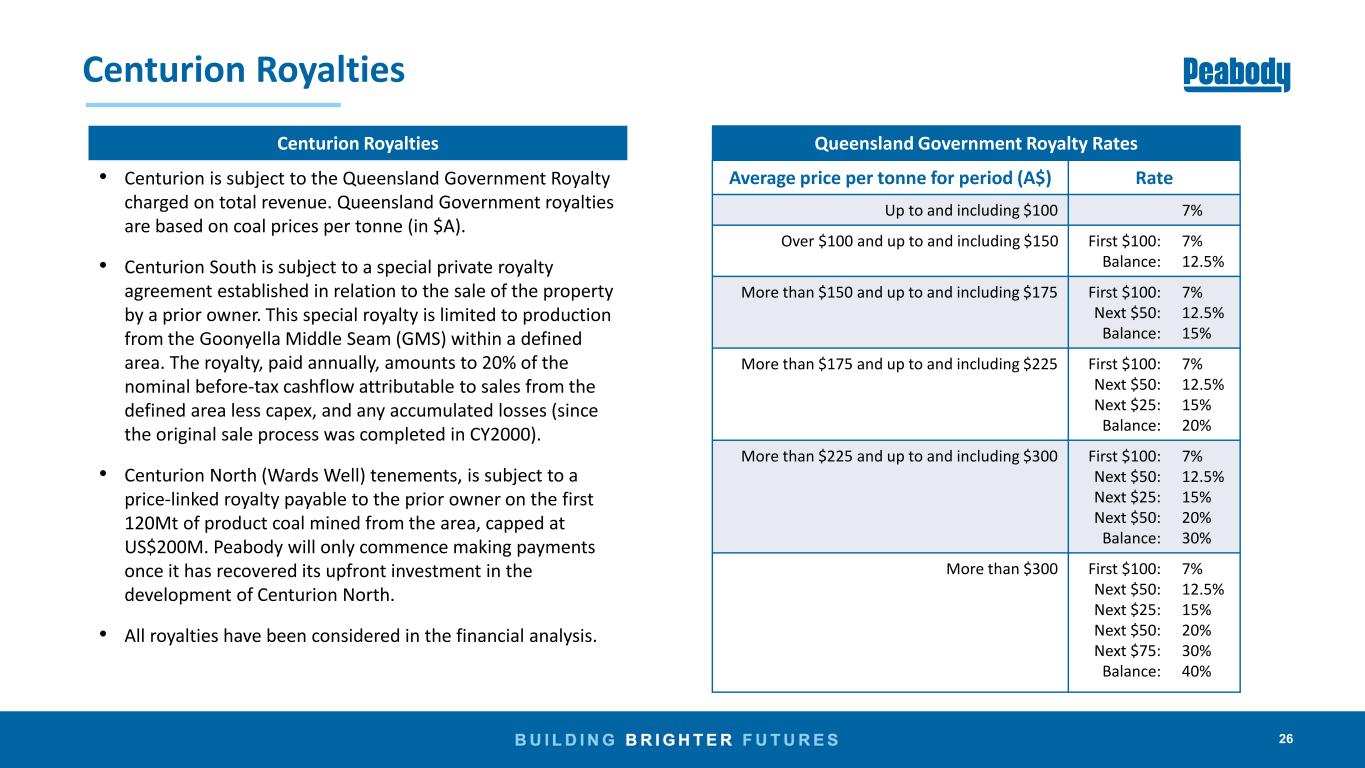
26 Centurion Royalties • Centurion is subject to the Queensland Government Royalty charged on total revenue. Queensland Government royalties are based on coal prices per tonne (in $A). • Centurion South is subject to a special private royalty agreement established in relation to the sale of the property by a prior owner. This special royalty is limited to production from the Goonyella Middle Seam (GMS) within a defined area. The royalty, paid annually, amounts to 20% of the nominal before-tax cashflow attributable to sales from the defined area less capex, and any accumulated losses (since the original sale process was completed in CY2000). • Centurion North (Wards Well) tenements, is subject to a price-linked royalty payable to the prior owner on the first 120Mt of product coal mined from the area, capped at US$200M. Peabody will only commence making payments once it has recovered its upfront investment in the development of Centurion North. • All royalties have been considered in the financial analysis. Average price per tonne for period (A$) Rate Up to and including $100 7% Over $100 and up to and including $150 First $100: Balance: 7% 12.5% More than $150 and up to and including $175 First $100: Next $50: Balance: 7% 12.5% 15% More than $175 and up to and including $225 First $100: Next $50: Next $25: Balance: 7% 12.5% 15% 20% More than $225 and up to and including $300 First $100: Next $50: Next $25: Next $50: Balance: 7% 12.5% 15% 20% 30% More than $300 First $100: Next $50: Next $25: Next $50: Next $75: Balance: 7% 12.5% 15% 20% 30% 40% Queensland Government Royalty RatesCenturion Royalties
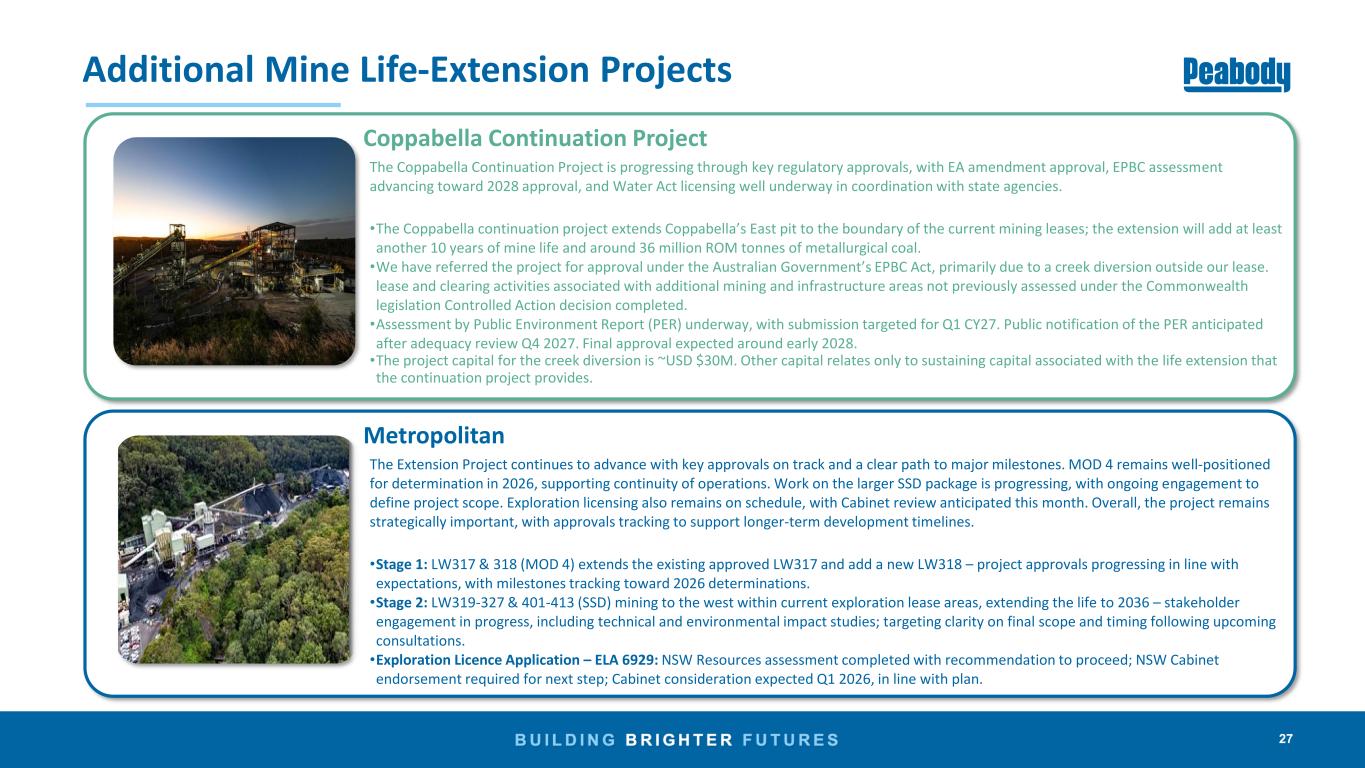
27 Additional Mine Life-Extension Projects Coppabella Continuation Project The Coppabella Continuation Project is progressing through key regulatory approvals, with EA amendment approval, EPBC assessment advancing toward 2028 approval, and Water Act licensing well underway in coordination with state agencies. •The Coppabella continuation project extends Coppabella’s East pit to the boundary of the current mining leases; the extension will add at least another 10 years of mine life and around 36 million ROM tonnes of metallurgical coal. •We have referred the project for approval under the Australian Government’s EPBC Act, primarily due to a creek diversion outside our lease. lease and clearing activities associated with additional mining and infrastructure areas not previously assessed under the Commonwealth legislation Controlled Action decision completed. •Assessment by Public Environment Report (PER) underway, with submission targeted for Q1 CY27. Public notification of the PER anticipated after adequacy review Q4 2027. Final approval expected around early 2028. •The project capital for the creek diversion is ~USD $30M. Other capital relates only to sustaining capital associated with the life extension that the continuation project provides. Metropolitan The Extension Project continues to advance with key approvals on track and a clear path to major milestones. MOD 4 remains well-positioned for determination in 2026, supporting continuity of operations. Work on the larger SSD package is progressing, with ongoing engagement to define project scope. Exploration licensing also remains on schedule, with Cabinet review anticipated this month. Overall, the project remains strategically important, with approvals tracking to support longer-term development timelines. •Stage 1: LW317 & 318 (MOD 4) extends the existing approved LW317 and add a new LW318 – project approvals progressing in line with expectations, with milestones tracking toward 2026 determinations. •Stage 2: LW319-327 & 401-413 (SSD) mining to the west within current exploration lease areas, extending the life to 2036 – stakeholder engagement in progress, including technical and environmental impact studies; targeting clarity on final scope and timing following upcoming consultations. •Exploration Licence Application – ELA 6929: NSW Resources assessment completed with recommendation to proceed; NSW Cabinet endorsement required for next step; Cabinet consideration expected Q1 2026, in line with plan.
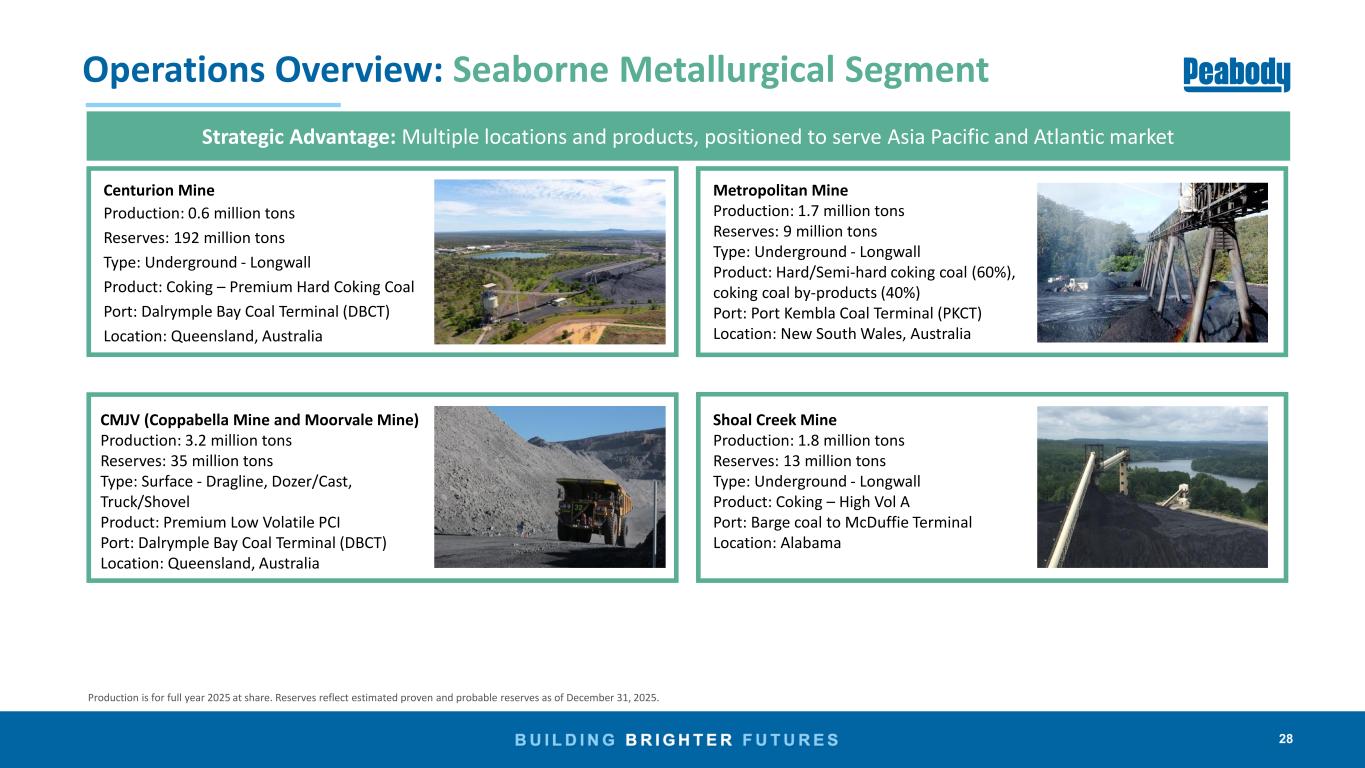
28 Operations Overview: Seaborne Metallurgical Segment Production is for full year 2025 at share. Reserves reflect estimated proven and probable reserves as of December 31, 2025. Strategic Advantage: Multiple locations and products, positioned to serve Asia Pacific and Atlantic market Metropolitan Mine Production: 1.7 million tons Reserves: 9 million tons Type: Underground - Longwall Product: Hard/Semi-hard coking coal (60%), coking coal by-products (40%) Port: Port Kembla Coal Terminal (PKCT) Location: New South Wales, Australia Shoal Creek Mine Production: 1.8 million tons Reserves: 13 million tons Type: Underground - Longwall Product: Coking – High Vol A Port: Barge coal to McDuffie Terminal Location: Alabama CMJV (Coppabella Mine and Moorvale Mine) Production: 3.2 million tons Reserves: 35 million tons Type: Surface - Dragline, Dozer/Cast, Truck/Shovel Product: Premium Low Volatile PCI Port: Dalrymple Bay Coal Terminal (DBCT) Location: Queensland, Australia Centurion Mine Production: 0.6 million tons Reserves: 192 million tons Type: Underground - Longwall Product: Coking – Premium Hard Coking Coal Port: Dalrymple Bay Coal Terminal (DBCT) Location: Queensland, Australia
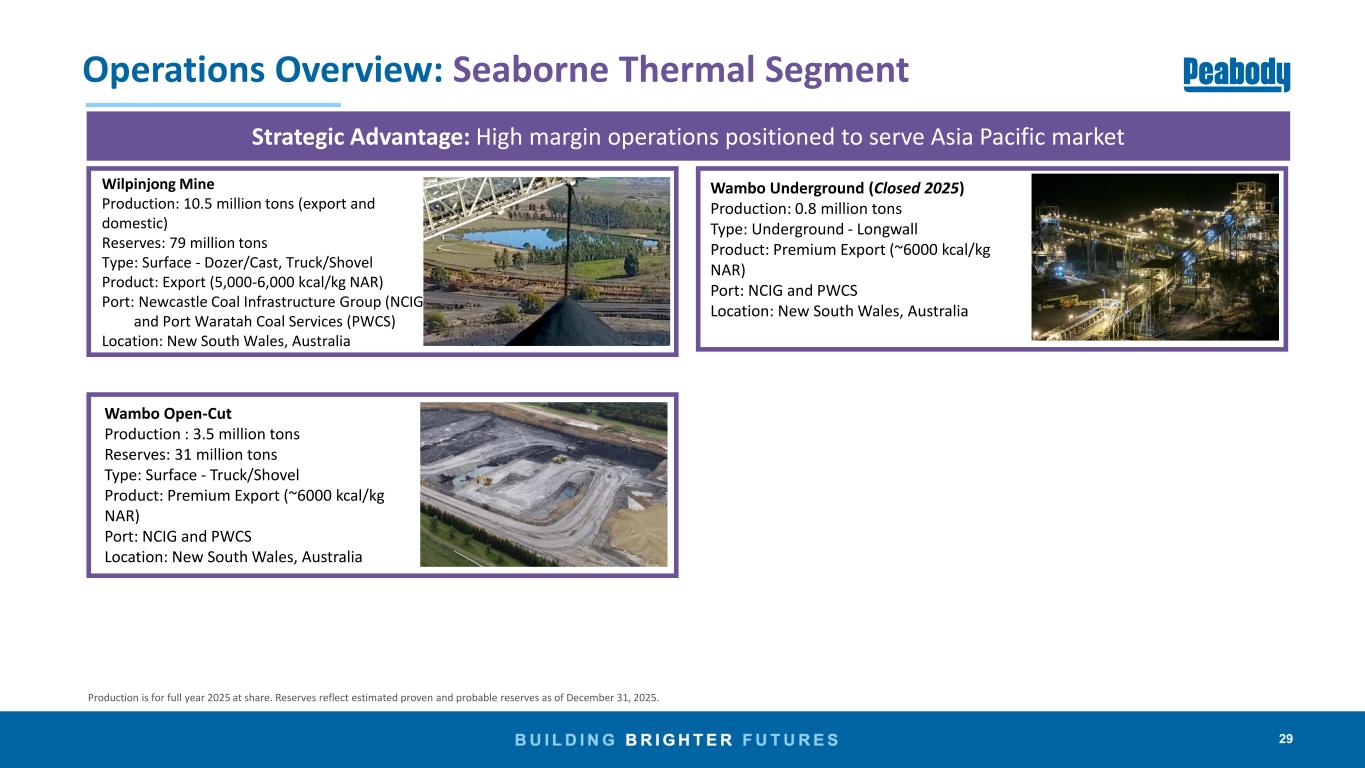
29 Operations Overview: Seaborne Thermal Segment Production is for full year 2025 at share. Reserves reflect estimated proven and probable reserves as of December 31, 2025. Wilpinjong Mine Production: 10.5 million tons (export and domestic) Reserves: 79 million tons Type: Surface - Dozer/Cast, Truck/Shovel Product: Export (5,000-6,000 kcal/kg NAR) Port: Newcastle Coal Infrastructure Group (NCIG) and Port Waratah Coal Services (PWCS) Location: New South Wales, Australia Wambo Open-Cut Production : 3.5 million tons Reserves: 31 million tons Type: Surface - Truck/Shovel Product: Premium Export (~6000 kcal/kg NAR) Port: NCIG and PWCS Location: New South Wales, Australia Wambo Underground (Closed 2025) Production: 0.8 million tons Type: Underground - Longwall Product: Premium Export (~6000 kcal/kg NAR) Port: NCIG and PWCS Location: New South Wales, Australia Strategic Advantage: High margin operations positioned to serve Asia Pacific market
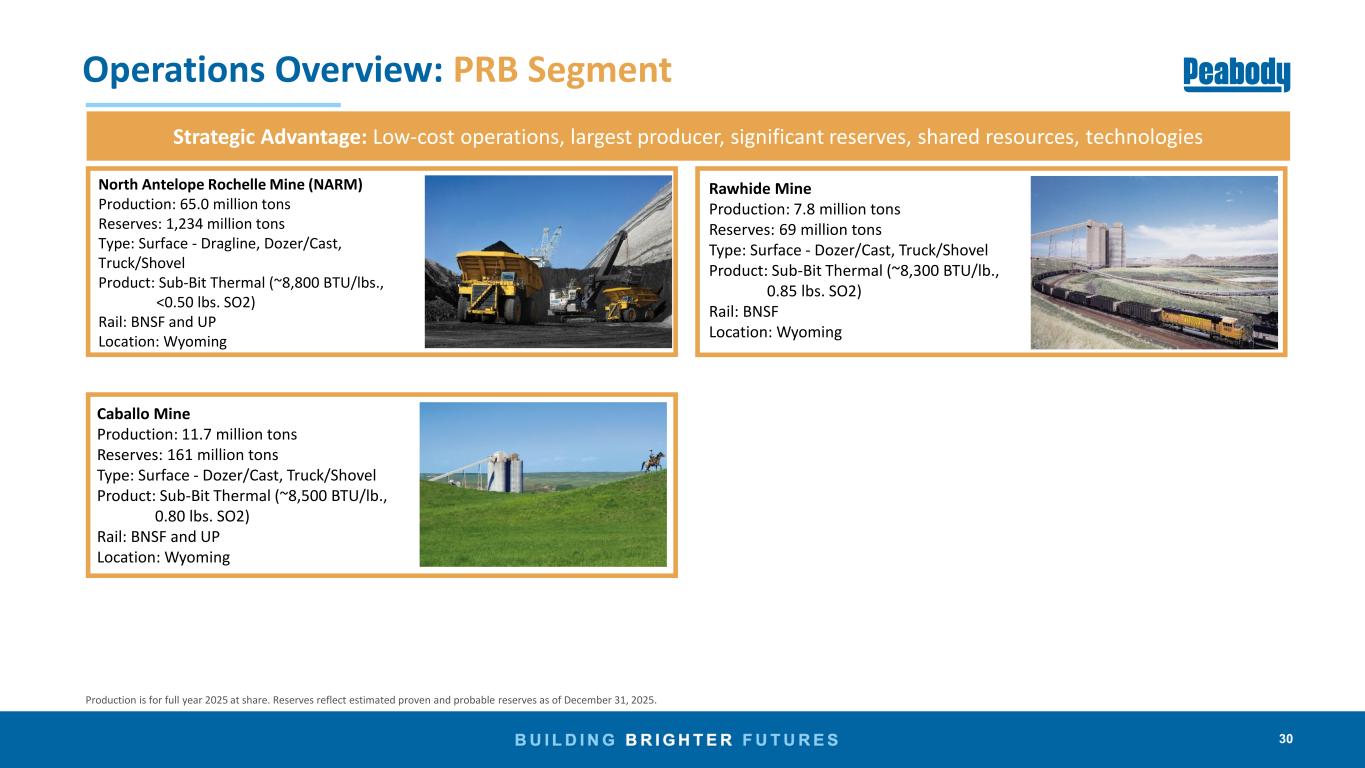
30 Operations Overview: PRB Segment Production is for full year 2025 at share. Reserves reflect estimated proven and probable reserves as of December 31, 2025. Strategic Advantage: Low-cost operations, largest producer, significant reserves, shared resources, technologies North Antelope Rochelle Mine (NARM) Production: 65.0 million tons Reserves: 1,234 million tons Type: Surface - Dragline, Dozer/Cast, Truck/Shovel Product: Sub-Bit Thermal (~8,800 BTU/lbs., <0.50 lbs. SO2) Rail: BNSF and UP Location: Wyoming Caballo Mine Production: 11.7 million tons Reserves: 161 million tons Type: Surface - Dozer/Cast, Truck/Shovel Product: Sub-Bit Thermal (~8,500 BTU/lb., 0.80 lbs. SO2) Rail: BNSF and UP Location: Wyoming Rawhide Mine Production: 7.8 million tons Reserves: 69 million tons Type: Surface - Dozer/Cast, Truck/Shovel Product: Sub-Bit Thermal (~8,300 BTU/lb., 0.85 lbs. SO2) Rail: BNSF Location: Wyoming
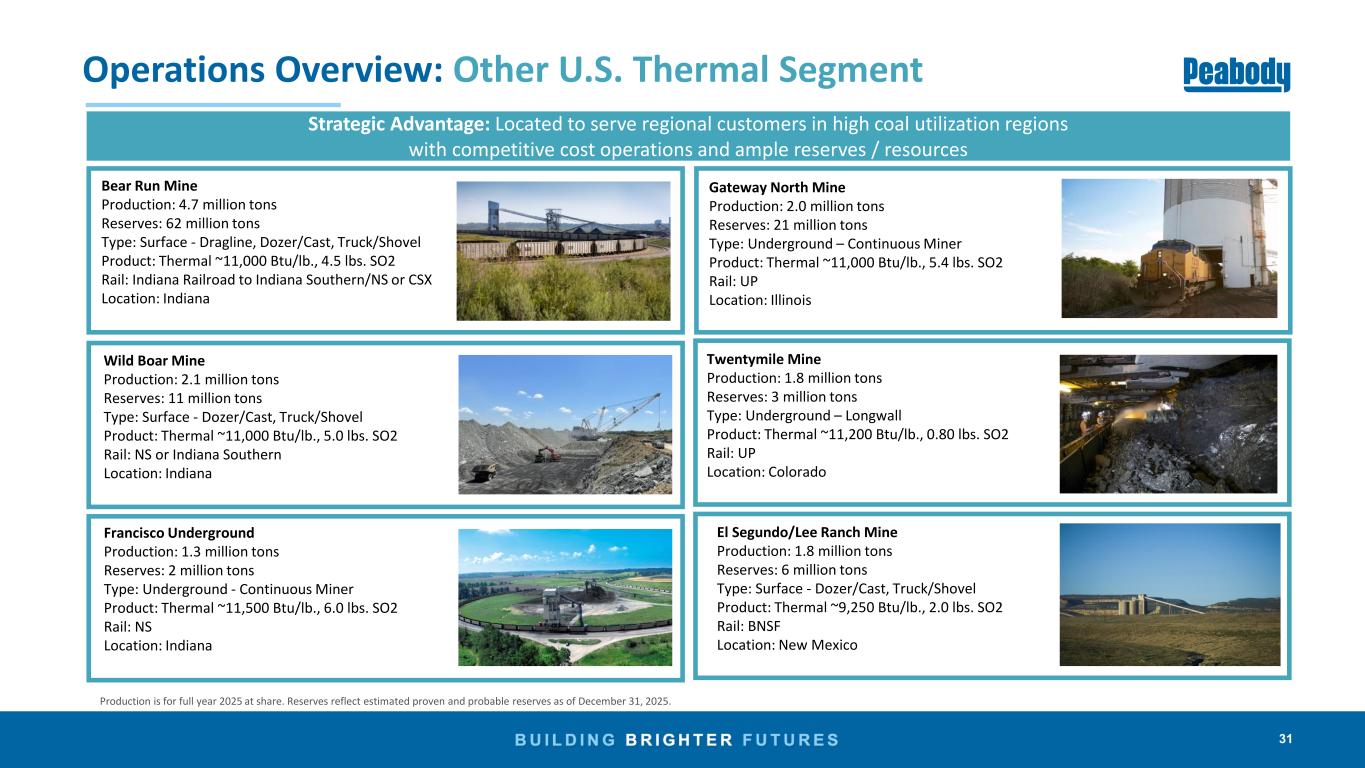
31 Operations Overview: Other U.S. Thermal Segment Production is for full year 2025 at share. Reserves reflect estimated proven and probable reserves as of December 31, 2025. Strategic Advantage: Located to serve regional customers in high coal utilization regions with competitive cost operations and ample reserves / resources Bear Run Mine Production: 4.7 million tons Reserves: 62 million tons Type: Surface - Dragline, Dozer/Cast, Truck/Shovel Product: Thermal ~11,000 Btu/lb., 4.5 lbs. SO2 Rail: Indiana Railroad to Indiana Southern/NS or CSX Location: Indiana Wild Boar Mine Production: 2.1 million tons Reserves: 11 million tons Type: Surface - Dozer/Cast, Truck/Shovel Product: Thermal ~11,000 Btu/lb., 5.0 lbs. SO2 Rail: NS or Indiana Southern Location: Indiana Francisco Underground Production: 1.3 million tons Reserves: 2 million tons Type: Underground - Continuous Miner Product: Thermal ~11,500 Btu/lb., 6.0 lbs. SO2 Rail: NS Location: Indiana Gateway North Mine Production: 2.0 million tons Reserves: 21 million tons Type: Underground – Continuous Miner Product: Thermal ~11,000 Btu/lb., 5.4 lbs. SO2 Rail: UP Location: Illinois Twentymile Mine Production: 1.8 million tons Reserves: 3 million tons Type: Underground – Longwall Product: Thermal ~11,200 Btu/lb., 0.80 lbs. SO2 Rail: UP Location: Colorado El Segundo/Lee Ranch Mine Production: 1.8 million tons Reserves: 6 million tons Type: Surface - Dozer/Cast, Truck/Shovel Product: Thermal ~9,250 Btu/lb., 2.0 lbs. SO2 Rail: BNSF Location: New Mexico
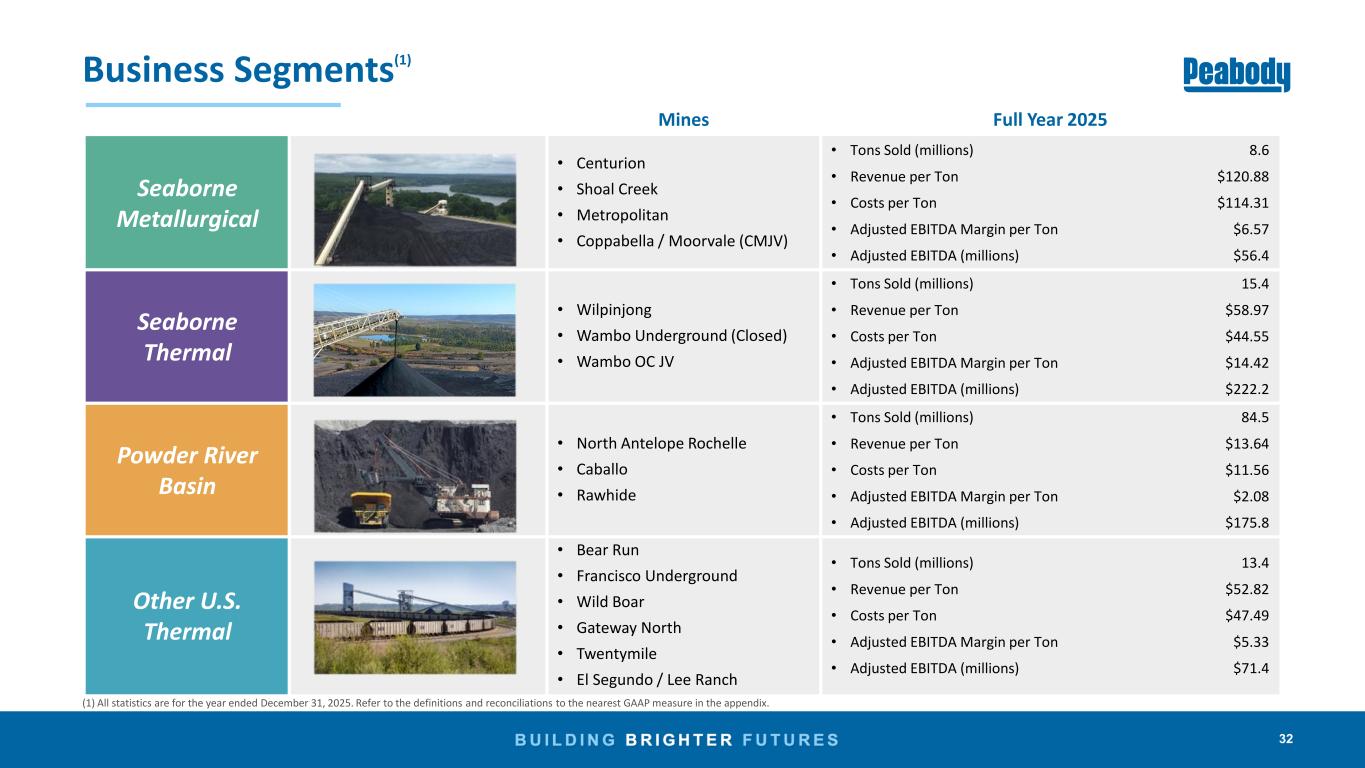
32 Business Segments(1) Mines Full Year 2025 Seaborne Metallurgical • Centurion • Shoal Creek • Metropolitan • Coppabella / Moorvale (CMJV) • Tons Sold (millions) • Revenue per Ton • Costs per Ton • Adjusted EBITDA Margin per Ton • Adjusted EBITDA (millions) 8.6 $120.88 $114.31 $6.57 $56.4 Seaborne Thermal • Wilpinjong • Wambo Underground (Closed) • Wambo OC JV • Tons Sold (millions) • Revenue per Ton • Costs per Ton • Adjusted EBITDA Margin per Ton • Adjusted EBITDA (millions) 15.4 $58.97 $44.55 $14.42 $222.2 Powder River Basin • North Antelope Rochelle • Caballo • Rawhide • Tons Sold (millions) • Revenue per Ton • Costs per Ton • Adjusted EBITDA Margin per Ton • Adjusted EBITDA (millions) 84.5 $13.64 $11.56 $2.08 $175.8 Other U.S. Thermal • Bear Run • Francisco Underground • Wild Boar • Gateway North • Twentymile • El Segundo / Lee Ranch • Tons Sold (millions) • Revenue per Ton • Costs per Ton • Adjusted EBITDA Margin per Ton • Adjusted EBITDA (millions) 13.4 $52.82 $47.49 $5.33 $71.4 (1) All statistics are for the year ended December 31, 2025. Refer to the definitions and reconciliations to the nearest GAAP measure in the appendix.
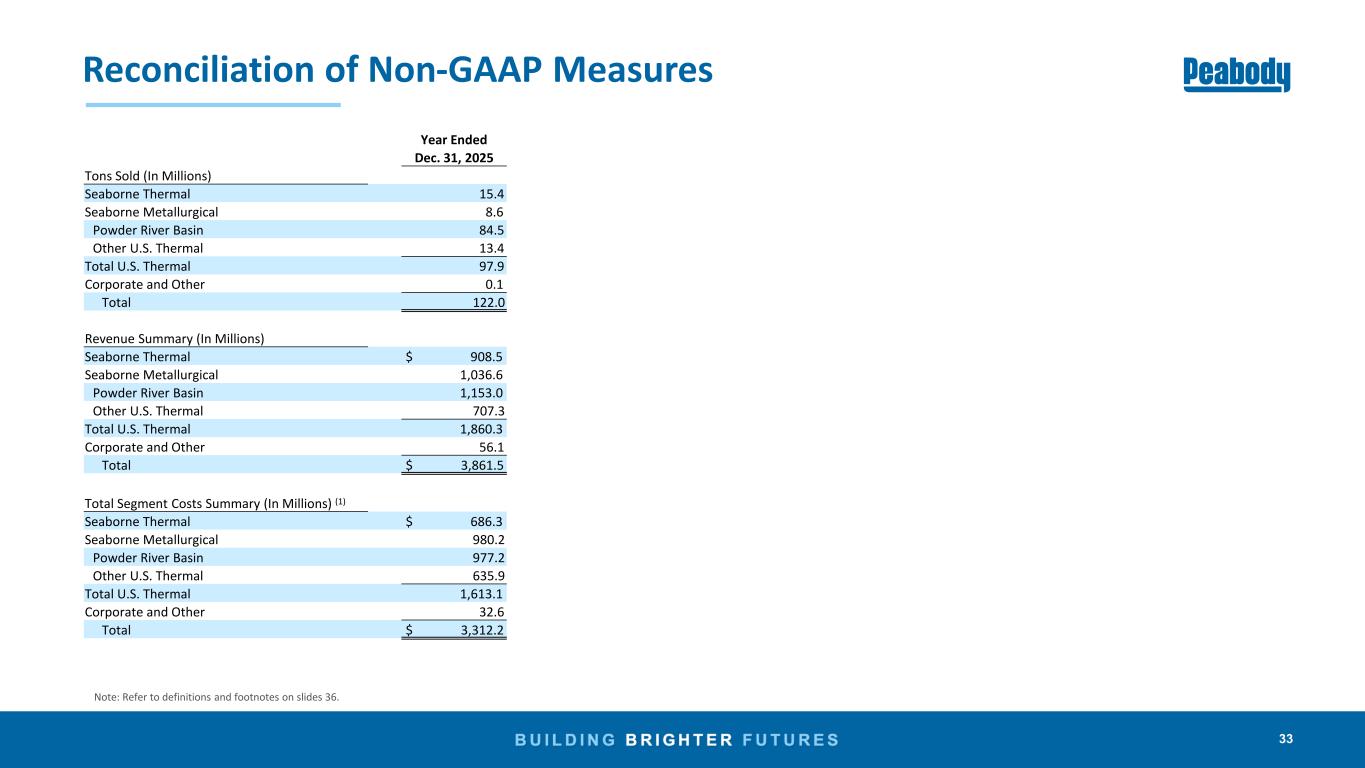
33 Reconciliation of Non-GAAP Measures Note: Refer to definitions and footnotes on slides 36. Year Ended Dec. 31, 2025 Tons Sold (In Millions) Seaborne Thermal 15.4 Seaborne Metallurgical 8.6 Powder River Basin 84.5 Other U.S. Thermal 13.4 Total U.S. Thermal 97.9 Corporate and Other 0.1 Total 122.0 Revenue Summary (In Millions) Seaborne Thermal $ 908.5 Seaborne Metallurgical 1,036.6 Powder River Basin 1,153.0 Other U.S. Thermal 707.3 Total U.S. Thermal 1,860.3 Corporate and Other 56.1 Total $ 3,861.5 Total Segment Costs Summary (In Millions) (1) Seaborne Thermal $ 686.3 Seaborne Metallurgical 980.2 Powder River Basin 977.2 Other U.S. Thermal 635.9 Total U.S. Thermal 1,613.1 Corporate and Other 32.6 Total $ 3,312.2
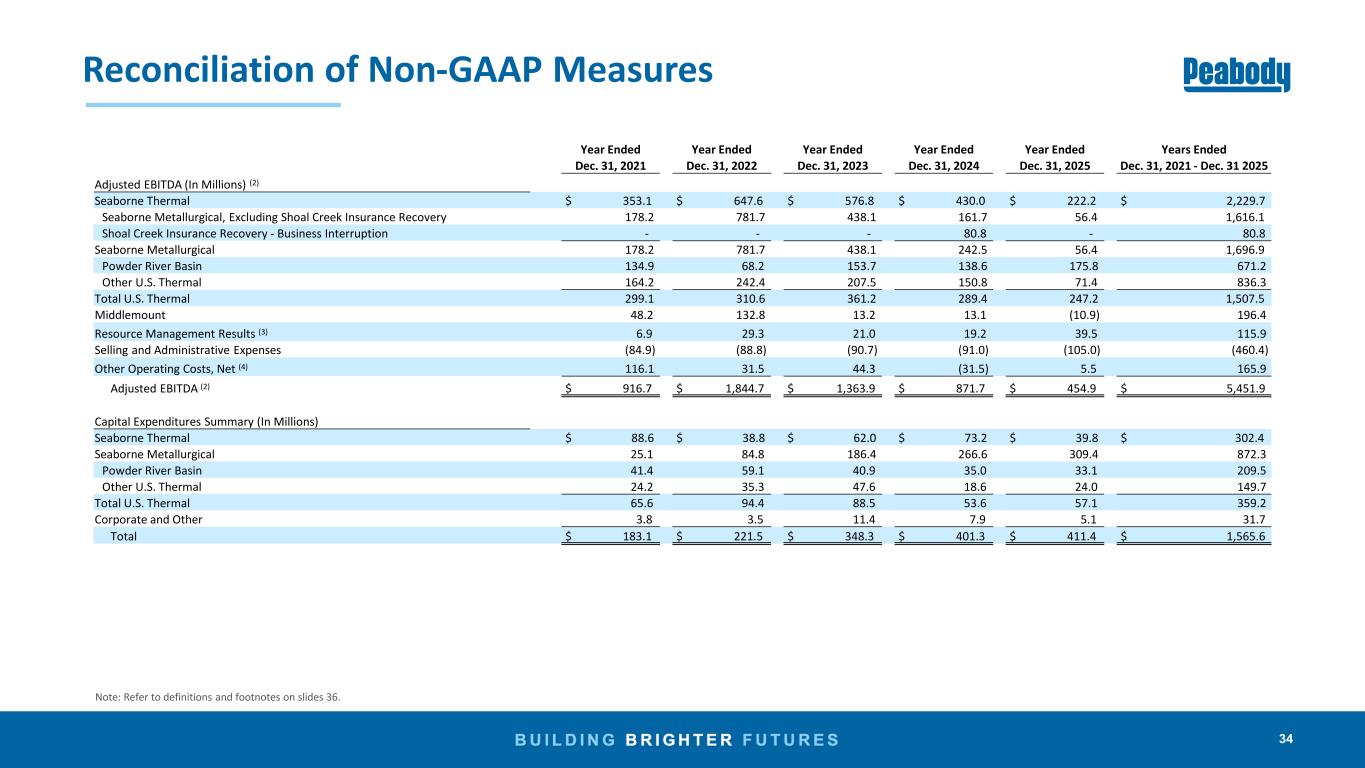
34 Reconciliation of Non-GAAP Measures Note: Refer to definitions and footnotes on slides 36. Year Ended Year Ended Year Ended Year Ended Year Ended Years Ended Dec. 31, 2021 Dec. 31, 2022 Dec. 31, 2023 Dec. 31, 2024 Dec. 31, 2025 Dec. 31, 2021 - Dec. 31 2025 Adjusted EBITDA (In Millions) (2) Seaborne Thermal $ 353.1 $ 647.6 $ 576.8 $ 430.0 $ 222.2 $ 2,229.7 Seaborne Metallurgical, Excluding Shoal Creek Insurance Recovery 178.2 781.7 438.1 161.7 56.4 1,616.1 Shoal Creek Insurance Recovery - Business Interruption - - - 80.8 - 80.8 Seaborne Metallurgical 178.2 781.7 438.1 242.5 56.4 1,696.9 Powder River Basin 134.9 68.2 153.7 138.6 175.8 671.2 Other U.S. Thermal 164.2 242.4 207.5 150.8 71.4 836.3 Total U.S. Thermal 299.1 310.6 361.2 289.4 247.2 1,507.5 Middlemount 48.2 132.8 13.2 13.1 (10.9) 196.4 Resource Management Results (3) 6.9 29.3 21.0 19.2 39.5 115.9 Selling and Administrative Expenses (84.9) (88.8) (90.7) (91.0) (105.0) (460.4) Other Operating Costs, Net (4) 116.1 31.5 44.3 (31.5) 5.5 165.9 Adjusted EBITDA (2) $ 916.7 $ 1,844.7 $ 1,363.9 $ 871.7 $ 454.9 $ 5,451.9 Capital Expenditures Summary (In Millions) Seaborne Thermal $ 88.6 $ 38.8 $ 62.0 $ 73.2 $ 39.8 $ 302.4 Seaborne Metallurgical 25.1 84.8 186.4 266.6 309.4 872.3 Powder River Basin 41.4 59.1 40.9 35.0 33.1 209.5 Other U.S. Thermal 24.2 35.3 47.6 18.6 24.0 149.7 Total U.S. Thermal 65.6 94.4 88.5 53.6 57.1 359.2 Corporate and Other 3.8 3.5 11.4 7.9 5.1 31.7 Total $ 183.1 $ 221.5 $ 348.3 $ 401.3 $ 411.4 $ 1,565.6
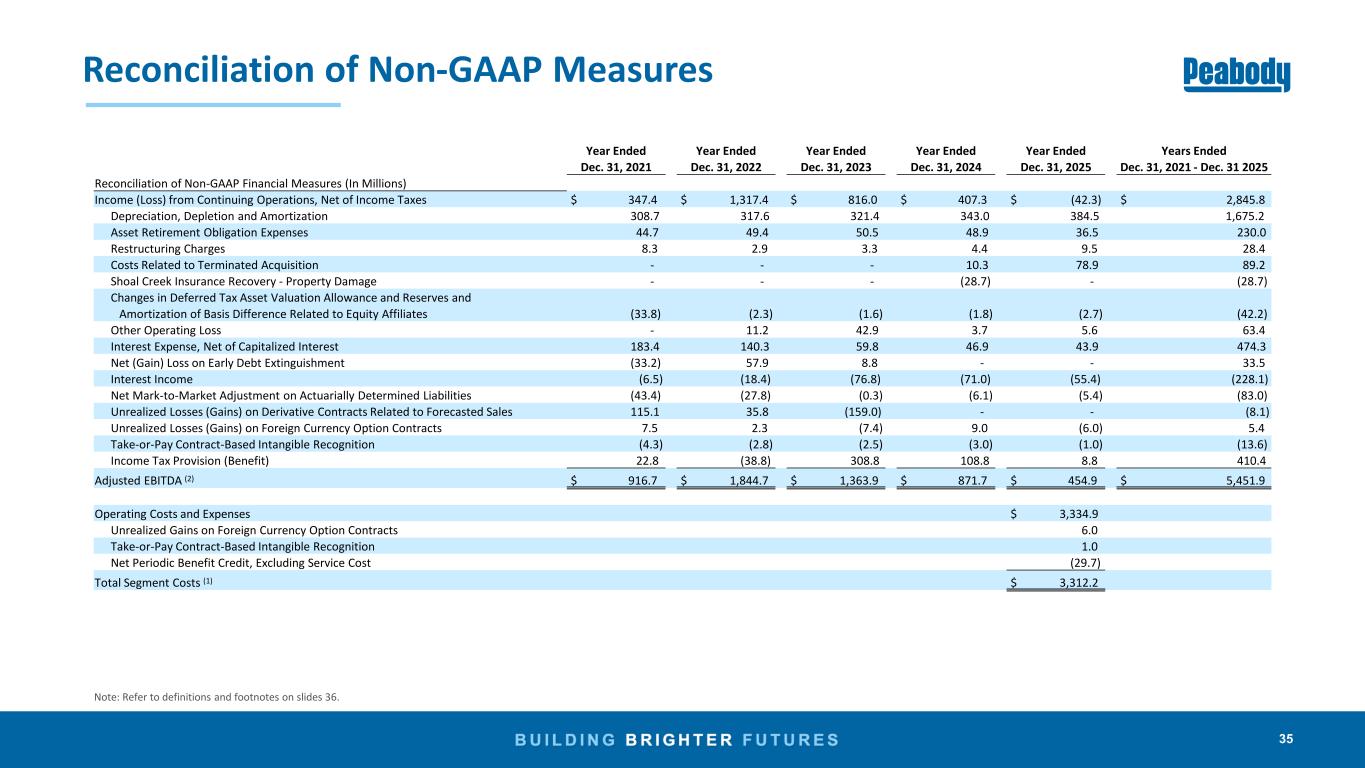
35 Reconciliation of Non-GAAP Measures Note: Refer to definitions and footnotes on slides 36. Year Ended Year Ended Year Ended Year Ended Year Ended Years Ended Dec. 31, 2021 Dec. 31, 2022 Dec. 31, 2023 Dec. 31, 2024 Dec. 31, 2025 Dec. 31, 2021 - Dec. 31 2025 Reconciliation of Non-GAAP Financial Measures (In Millions) Income (Loss) from Continuing Operations, Net of Income Taxes $ 347.4 $ 1,317.4 $ 816.0 $ 407.3 $ (42.3) $ 2,845.8 Depreciation, Depletion and Amortization 308.7 317.6 321.4 343.0 384.5 1,675.2 Asset Retirement Obligation Expenses 44.7 49.4 50.5 48.9 36.5 230.0 Restructuring Charges 8.3 2.9 3.3 4.4 9.5 28.4 Costs Related to Terminated Acquisition - - - 10.3 78.9 89.2 Shoal Creek Insurance Recovery - Property Damage - - - (28.7) - (28.7) Changes in Deferred Tax Asset Valuation Allowance and Reserves and Amortization of Basis Difference Related to Equity Affiliates (33.8) (2.3) (1.6) (1.8) (2.7) (42.2) Other Operating Loss - 11.2 42.9 3.7 5.6 63.4 Interest Expense, Net of Capitalized Interest 183.4 140.3 59.8 46.9 43.9 474.3 Net (Gain) Loss on Early Debt Extinguishment (33.2) 57.9 8.8 - - 33.5 Interest Income (6.5) (18.4) (76.8) (71.0) (55.4) (228.1) Net Mark-to-Market Adjustment on Actuarially Determined Liabilities (43.4) (27.8) (0.3) (6.1) (5.4) (83.0) Unrealized Losses (Gains) on Derivative Contracts Related to Forecasted Sales 115.1 35.8 (159.0) - - (8.1) Unrealized Losses (Gains) on Foreign Currency Option Contracts 7.5 2.3 (7.4) 9.0 (6.0) 5.4 Take-or-Pay Contract-Based Intangible Recognition (4.3) (2.8) (2.5) (3.0) (1.0) (13.6) Income Tax Provision (Benefit) 22.8 (38.8) 308.8 108.8 8.8 410.4 Adjusted EBITDA (2) $ 916.7 $ 1,844.7 $ 1,363.9 $ 871.7 $ 454.9 $ 5,451.9 Operating Costs and Expenses $ 3,334.9 Unrealized Gains on Foreign Currency Option Contracts 6.0 Take-or-Pay Contract-Based Intangible Recognition 1.0 Net Periodic Benefit Credit, Excluding Service Cost (29.7) Total Segment Costs (1) $ 3,312.2
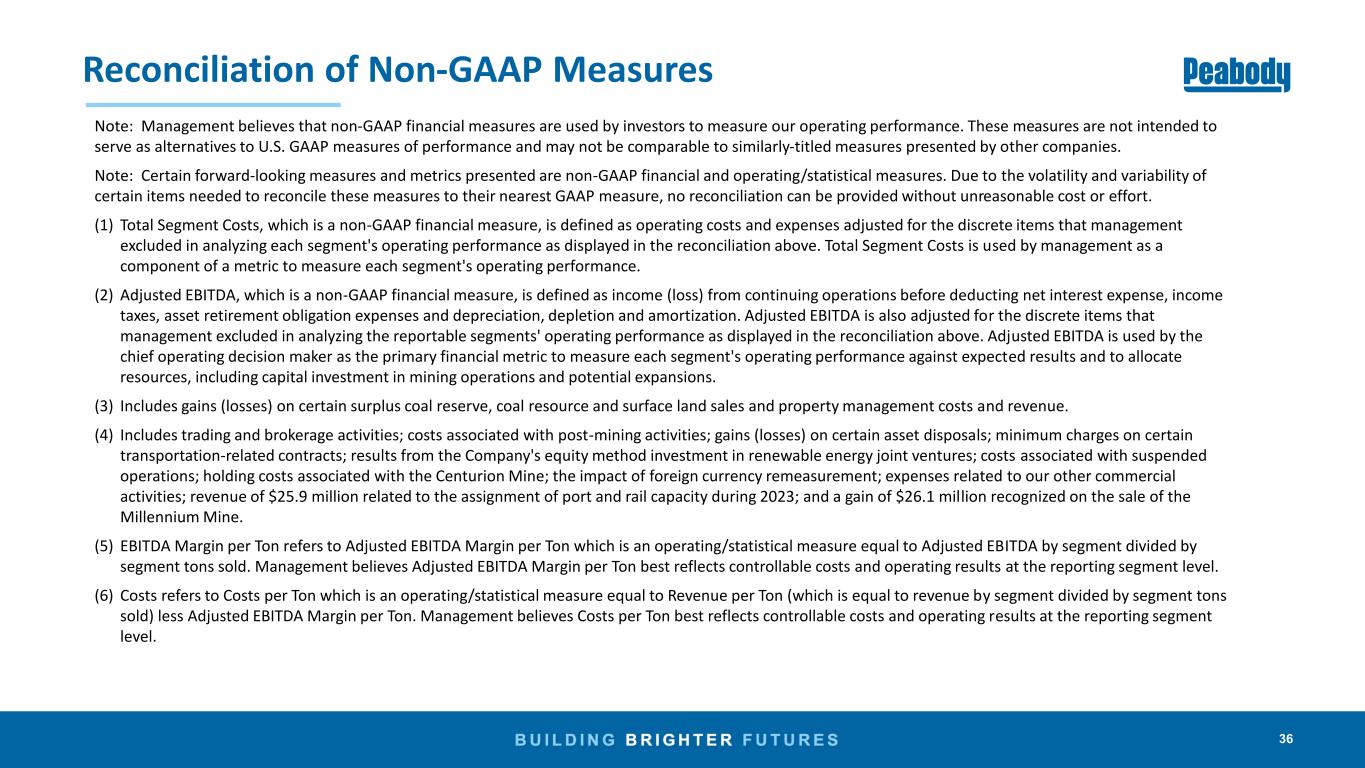
36 Reconciliation of Non-GAAP Measures Note: Management believes that non-GAAP financial measures are used by investors to measure our operating performance. These measures are not intended to serve as alternatives to U.S. GAAP measures of performance and may not be comparable to similarly-titled measures presented by other companies. Note: Certain forward-looking measures and metrics presented are non-GAAP financial and operating/statistical measures. Due to the volatility and variability of certain items needed to reconcile these measures to their nearest GAAP measure, no reconciliation can be provided without unreasonable cost or effort. (1) Total Segment Costs, which is a non-GAAP financial measure, is defined as operating costs and expenses adjusted for the discrete items that management excluded in analyzing each segment's operating performance as displayed in the reconciliation above. Total Segment Costs is used by management as a component of a metric to measure each segment's operating performance. (2) Adjusted EBITDA, which is a non-GAAP financial measure, is defined as income (loss) from continuing operations before deducting net interest expense, income taxes, asset retirement obligation expenses and depreciation, depletion and amortization. Adjusted EBITDA is also adjusted for the discrete items that management excluded in analyzing the reportable segments' operating performance as displayed in the reconciliation above. Adjusted EBITDA is used by the chief operating decision maker as the primary financial metric to measure each segment's operating performance against expected results and to allocate resources, including capital investment in mining operations and potential expansions. (3) Includes gains (losses) on certain surplus coal reserve, coal resource and surface land sales and property management costs and revenue. (4) Includes trading and brokerage activities; costs associated with post-mining activities; gains (losses) on certain asset disposals; minimum charges on certain transportation-related contracts; results from the Company's equity method investment in renewable energy joint ventures; costs associated with suspended operations; holding costs associated with the Centurion Mine; the impact of foreign currency remeasurement; expenses related to our other commercial activities; revenue of $25.9 million related to the assignment of port and rail capacity during 2023; and a gain of $26.1 million recognized on the sale of the Millennium Mine. (5) EBITDA Margin per Ton refers to Adjusted EBITDA Margin per Ton which is an operating/statistical measure equal to Adjusted EBITDA by segment divided by segment tons sold. Management believes Adjusted EBITDA Margin per Ton best reflects controllable costs and operating results at the reporting segment level. (6) Costs refers to Costs per Ton which is an operating/statistical measure equal to Revenue per Ton (which is equal to revenue by segment divided by segment tons sold) less Adjusted EBITDA Margin per Ton. Management believes Costs per Ton best reflects controllable costs and operating results at the reporting segment level.
2 37 Investor Relations Contact: Vic Svec / Kala Finklang ir@peabodyenergy.com