UNITED STATES
SECURITIES AND EXCHANGE COMMISSION
Washington, D.C. 20549
SCHEDULE 14A
Proxy
Statement Pursuant to Section 14(a) of
the Securities Exchange Act of 1934 (Amendment No. )
| Filed by the Registrant ý | ||
Filed by a Party other than the Registrant o |
||
Check the appropriate box: |
||
o |
Preliminary Proxy Statement |
|
o |
Confidential, for Use of the Commission Only (as permitted by Rule 14a-6(e)(2)) |
|
ý |
Definitive Proxy Statement |
|
o |
Definitive Additional Materials |
|
o |
Soliciting Material under §240.14a-12 |
|
| Janus Capital Group Inc. | ||||
|
(Name of Registrant as Specified In Its Charter) |
||||
|
(Name of Person(s) Filing Proxy Statement, if other than the Registrant) |
||||
Payment of Filing Fee (Check the appropriate box): |
||||
ý |
No fee required. |
|||
o |
Fee computed on table below per Exchange Act Rules 14a-6(i)(1) and 0-11. |
|||
| (1) | Title of each class of securities to which transaction applies: |
|||
| (2) | Aggregate number of securities to which transaction applies: |
|||
| (3) | Per unit price or other underlying value of transaction computed pursuant to Exchange Act Rule 0-11 (set forth the amount on which the filing fee is calculated and state how it was determined): |
|||
| (4) | Proposed maximum aggregate value of transaction: |
|||
| (5) | Total fee paid: |
|||
o |
Fee paid previously with preliminary materials. |
|||
o |
Check box if any part of the fee is offset as provided by Exchange Act Rule 0-11(a)(2) and identify the filing for which the offsetting fee was paid previously. Identify the previous filing by registration statement number, or the Form or Schedule and the date of its filing. |
|||
(1) |
Amount Previously Paid: |
|||
| (2) | Form, Schedule or Registration Statement No.: |
|||
| (3) | Filing Party: |
|||
| (4) | Date Filed: |
|||
March 15, 2013
Dear Shareholder:
We cordially invite you to attend the Annual Meeting of Shareholders of Janus Capital Group Inc., which will be held at the JW Marriott Hotel, 150 Clayton Lane, Denver, Colorado, Thursday, April 25, 2013, at 10:00 a.m. local time in Denver.
At the Annual Meeting, you will be asked to vote on proposals to (i) elect seven directors named in the accompanying Proxy Statement; (ii) ratify the appointment of our independent auditor; (iii) approve, by non-binding vote, executive compensation (say on pay vote); (iv) approve the Janus Capital Group Inc. 2013 Management Incentive Compensation Plan; and (v) consider other business as may properly come before the meeting.
Pursuant to the rules of the Securities and Exchange Commission, we have elected to provide access to our proxy materials over the Internet. Accordingly, we will mail, on or before March 15, 2013, a Notice of Internet Availability of Proxy Materials ("Notice") to our shareholders of record and beneficial owners as of the close of business on March 1, 2013, the record date for the Annual Meeting. On the date of mailing of the Notice, all shareholders and beneficial owners will have the ability to access all of the proxy materials on the following websites: www.proxyvote.com and http://ir.janus.com/sec.cfm.
The Notice will also identify (i) the date, time and location of the Annual Meeting; (ii) the matters to be acted upon at the Annual Meeting and the recommendation of our Board of Directors with regard to such matters; (iii) a toll-free telephone number, an email address and a website where shareholders can request a paper or e-mail copy of the Proxy Statement and a form of proxy relating to the Annual Meeting; (iv) information about how to access and vote the form of proxy; and (v) information about how to obtain directions to attend the Annual Meeting and vote in person. These proxy materials will be available free of charge.
Your vote is important. We encourage you to access and read the proxy materials and vote promptly. If you attend the Annual Meeting, you may vote in person even if you previously voted by proxy. Thank you for your interest and support.
Sincerely,
Glenn
S. Schafer
Chairman of the Board
PROXY STATEMENT TABLE OF CONTENTS
ii
JANUS CAPITAL GROUP INC.
151 Detroit Street
Denver, Colorado 80206
PROXY STATEMENT
This Proxy Statement, which was available to shareholders as of March 15, 2013, is in connection with the solicitation of proxies by the Board of Directors of Janus Capital Group Inc. ("Board" or "Board of Directors") for the Annual Meeting of Shareholders ("Annual Meeting") to be held Thursday, April 25, 2013, at 10:00 a.m., local time in Denver. In this Proxy Statement, we may refer to Janus Capital Group Inc. as the "Company," "Janus," "we," "us" or "our."
In accordance with rules and regulations of the U.S. Securities and Exchange Commission ("SEC"), instead of mailing a printed copy of our proxy materials to each shareholder of record or beneficial owner, we are furnishing proxy materials, which include this Proxy Statement, to our shareholders over the Internet. If you have received a Notice of Internet Availability of Proxy Materials ("Notice") by mail, you will not receive a printed copy of the proxy materials unless you have previously made a permanent election to receive these materials in hard copy. Instead, the Notice will instruct you as to how you may access and review all of the important information contained in the proxy materials. The Notice also instructs you as to how you may submit your proxy over the Internet. If you received a Notice by mail and would like to receive a printed copy of our proxy materials, you should follow the instructions in the Notice for requesting such materials.
The Notice will be available to shareholders on or before March 15, 2013.
Record date
The record date for the Annual Meeting was March 1, 2013 ("Record Date"). You may vote all shares of Janus common stock that you owned as of the close of business on that date. On March 1, 2013, 190,333,805 shares of common stock were outstanding and entitled to vote at the Annual Meeting. Each share of common stock is entitled to one vote on each matter to be voted on at the Annual Meeting.
Votes required to conduct business at the Annual Meeting
We need a majority of the shares of common stock issued and outstanding on the Record Date, present in person or by proxy and entitled to vote, to conduct business at the Annual Meeting or at any adjournment or postponement.
If you do not submit your proxy or attend the Annual Meeting, only ratification of our independent auditor may be voted on by your broker-dealer
Many shareholders hold stock in street name through a broker-dealer or other nominee. Most broker-dealers are members of the Financial Industry Regulatory Authority ("FINRA")(formerly known as the National Association of Securities Dealers), which generally does not allow them to vote shares held in street name unless they are permitted to do so under the rules of a national securities exchange to which they belong. Under the New York Stock Exchange ("NYSE") Listed Company Manual (the "NYSE Listing Standards"), NYSE member brokers who do not receive instructions from beneficial owners are not entitled to vote on any of the proposals presented in this Proxy Statement, except with respect to the
1
ratification of the appointment of Deloitte & Touche LLP ("Deloitte") as our independent auditor for 2013. See "Proposals You May Vote On" on page 5 for further information.
Voting to abstain
With regard to the proposals, you can vote to "abstain." If you vote to "abstain" for any proposal other than for the election of directors, your shares will be counted as present at the meeting for purposes of that proposal and your vote will have the effect of a vote against the proposal. Shares voting to "abstain" for one or more director nominees will have no effect on the director vote.
Votes required for each proposal
Director Election. Under our Bylaws, each director in an uncontested election is elected by a majority of votes cast with respect to that director. A majority of the votes cast means that the number of shares voted "for" a director must exceed the number of votes cast "against" that director. If a current director does not receive a majority of the votes cast, the director shall offer to tender his or her resignation to the Board of Directors. The Nominating and Corporate Governance Committee ("Nominating Committee") will make a recommendation to the Board on whether to accept or reject the offer of resignation, or whether other action should be taken. The Board will act on the Nominating Committee's recommendation and publicly disclose its decision within 90 days from the date of the certification of the election results. Abstentions have no effect on this proposal. Brokers do not have discretionary authority to vote shares on this proposal, and broker non-votes will not count as votes cast and will therefore have no effect on the vote of this proposal.
Janus Capital Group Inc. 2013 Management Incentive Compensation Plan. The affirmative vote of a majority of the shares of common stock represented in person or by proxy at the Annual Meeting and entitled to vote on the proposal is required for the approval of the Janus Capital Group Inc. 2013 Management Incentive Compensation Plan ("2013 Management Plan"). Under NYSE Listing Standards, the total votes cast on the 2013 Management Plan must also represent more than 50 percent of the voting power of the total outstanding shares of Janus common stock, which is referred to as the "Outstanding Votes." Votes "for" and "against" and abstentions count as votes cast, while broker non-votes do not count as votes cast but count as Outstanding Votes. Thus, to obtain approval of the 2013 Management Plan, the total sum of votes "for" plus votes "against" plus abstentions (which is referred to as the "NYSE Votes Cast") must be greater than 50 percent of the total Outstanding Votes. Further, the number of votes "for" the proposal must be greater than 50 percent of the NYSE Votes Cast. Accordingly, abstentions have the same effect as a vote against the proposal. Brokers do not have discretionary authority to vote shares on this proposal; therefore, broker non-votes could impair our ability to satisfy the requirement that the NYSE Votes Cast represent more than 50 percent of the Outstanding Votes.
Other Proposals. The affirmative vote of a majority of the shares of common stock represented in person or by proxy at the Annual Meeting and entitled to vote on the proposal is required for (i) the ratification of the appointment of Deloitte as our independent auditor for 2013; and (ii) the vote to approve, by non-binding vote, executive compensation ("say on pay vote"). Abstentions have the same effect as a vote against these proposals. Brokers have discretionary authority to vote shares on the ratification of the appointment of Deloitte as our independent auditor, but not on the say on pay vote. Broker non-votes, if any, will have no effect on the adoption of these proposals.
Voting recommendations
The Board of Directors recommends that you vote FOR the election of each director nominee; FOR the ratification of the appointment of our independent auditor; FOR the advisory say on pay vote; and FOR the 2013 Management Plan.
2
How to vote
As described in the Notice, you may vote by proxy or in person at the Annual Meeting. You may vote by proxy even if you plan to attend the Annual Meeting.
Voting by Proxy. If you hold shares in your name as a holder of record, you can vote your shares (i) over the Internet at www.proxyvote.com until 11:59 p.m. EDT on April 24, 2013; (ii) by telephone, toll-free at 1-800-690-6903 until 11:59 p.m. EDT on April 24, 2013; or (iii) by requesting a paper proxy card in accordance with the instructions contained in the Notice and then completing, signing and dating the proxy card and returning it so that it is received by 11:59 p.m. EDT on April 24, 2013. If you hold your shares through a securities broker or nominee (that is, in "street name"), you may vote your shares by proxy in the manner prescribed in the Notice provided to you by such broker or nominee. Many brokers and nominees permit proxy voting by telephone and the Internet.
Voting at the Annual Meeting. Submitting your proxy prior to the Annual Meeting does not limit your right to vote in person at the Annual Meeting if you decide to do so. If you wish to vote in person at the Annual Meeting, we will pass out written ballots for such purpose as requested; however, if you hold your shares in street name, you must obtain a legal proxy from your broker or nominee and bring it to the Annual Meeting to vote in person at the Annual Meeting. Directions to the Annual Meeting from Denver International Airport are as follows:
Revoking your proxy
You can revoke your proxy at any time before your shares are voted at the Annual Meeting by (i) delivering a written notice of revocation to the General Counsel and Secretary, Janus Capital Group Inc., 151 Detroit Street, Denver, Colorado 80206; (ii) completing, signing and timely submitting a new proxy card with a later date; or (iii) voting in person at the Annual Meeting. Merely attending the Annual Meeting will not revoke your proxy.
Returning your proxy without indicating your vote
If you return a signed proxy card without indicating your vote and do not revoke your proxy, your shares will be voted as follows: FOR the election of the director nominees; FOR the ratification of the appointment of Deloitte as independent auditor of the Company for 2013; FOR the advisory approval of the say on pay vote; FOR the 2013 Management Plan; and, at the discretion of the person voting the proxy, on any other matter properly brought before the Annual Meeting.
No appraisal rights
A shareholder has no right under Delaware law, our Certificate of Incorporation or our Bylaws to exercise dissenters' rights of appraisal with respect to any of the matters to be voted upon at the Annual Meeting.
Other matters to be decided at the Annual Meeting
All of the matters we knew about as of the Record Date to be brought before the Annual Meeting are described in this Proxy Statement. If any matters were to properly come before the Annual Meeting that are not specifically set forth on your proxy card and in this Proxy Statement, the persons appointed by the Company to vote the proxies would vote on such matters at their discretion.
3
Postponement or adjournment of the Annual Meeting
If the Annual Meeting were to be postponed or adjourned, your proxy would still be valid and may be voted at the postponed or adjourned meeting in the manner described in this Proxy Statement. You would still be able to revoke your proxy until it was voted.
Attendance at the Annual Meeting
You will need proof of ownership to enter the Annual Meeting. If your shares are held beneficially in the name of a bank, broker or other holder of record and you plan to attend the Annual Meeting, you must present proof, such as a bank or brokerage account statement, of your ownership of Janus common stock as of March 1, 2013, to be admitted to the Annual Meeting. At the Annual Meeting, representatives of Janus will also confirm your shareholder status. Shareholders must also present a form of personal identification to be admitted to the Annual Meeting. NO CAMERAS, RECORDING EQUIPMENT, ELECTRONIC DEVICES, BAGS, BRIEFCASES, PACKAGES OR SIMILAR ITEMS WILL BE PERMITTED AT THE ANNUAL MEETING.
Special instructions apply for employee plan shares
Each participant in the Employee Stock Ownership Plan ("ESOP") of Janus and the ESOP of Kansas City Southern ("KCS") may instruct the trustee of these ESOPs on how to vote the shares of Janus common stock held on behalf of the participant. The trustee of each ESOP must receive your voting instructions for the common stock allocated to your ESOP account before April 22, 2013. If the trustee for the Janus ESOP or the KCS ESOP does not receive your voting instructions before April 22, 2013, it will vote those shares, subject to the requirements of the Employee Retirement Income Security Act of 1974, as amended, in the same proportion as the voting instructions that it receives from other Janus ESOP or KCS ESOP account holders (as applicable). You may vote your shares (i) over the Internet at www.proxyvote.com until 11:59 p.m. EDT on April 22, 2013; (ii) by telephone, toll-free at 1-800-690-6903 until 11:59 p.m. EDT on April 22, 2013; or (iii) by requesting a paper proxy card from Janus in accordance with the instructions contained in the Notice and completing, signing and dating the proxy card and returning it so that it is received by April 22, 2013.
On March 1, 2013, there were 1,730,435 outstanding Janus shares in the Janus ESOP and 297,263 outstanding Janus shares in the KCS ESOP.
We will pay the expenses of preparing the Notice and other proxy materials and the solicitation by the Board of Directors of your proxy. Our directors, officers and employees (who will receive no additional compensation for soliciting) and Georgeson Inc. may solicit your proxy by telephone or other means. We will pay Georgeson Inc. a fee of $12,000 plus expenses and will reimburse brokers for costs they incur in mailing the Notice and any other proxy materials.
4
Proposal No. 1: Election of Directors
At the Annual Meeting, you will be asked to elect to the Board of Directors Timothy K. Armour, G. Andrew Cox, J. Richard Fredericks, Deborah R. Gatzek, Seiji Inagaki, Lawrence E. Kochard and Richard M. Weil. The director nominees will be elected to one-year terms and will hold office until the 2014 annual shareholders meeting or until their successors are elected and qualified.
Proposal No. 2: Ratification of the Appointment of Deloitte & Touche LLP as Independent Auditor
At the Annual Meeting, you will be asked to ratify the Audit Committee's appointment of Deloitte as the Company's independent auditor for fiscal year 2013. Deloitte has served as our independent auditor since 2002.
Proposal No. 3: Non-Binding Advisory Vote to Approve Executive Compensation (Say on Pay Vote)
At the Annual Meeting, you will be asked to provide an advisory vote to approve the compensation of our named executive officers.
Proposal No. 4: Approval of the Janus Capital Group Inc. 2013 Management Incentive Compensation Plan
At the Annual Meeting, you will be asked to approve the Janus Capital Group Inc. 2013 Management Incentive Compensation Plan (the "2013 Management Plan"). The 2013 Management Plan is being submitted to the shareholders for approval in order to permit certain awards granted to covered employees under the 2013 Management Plan to qualify as "performance-based compensation" under Section 162(m) of the Internal Revenue Code ("Section 162(m)").
THE BOARD OF DIRECTORS UNANIMOUSLY RECOMMENDS THAT THE SHAREHOLDERS VOTE "FOR" EACH OF THE PROPOSALS LISTED ABOVE
The foregoing are only summaries of the proposals. You should review the full discussion of each proposal in this Proxy Statement before casting your vote.
5
PROPOSAL NO. 1: ELECTION OF DIRECTORS
The Board of Directors currently has 11 directors divided into two classes. Effective upon the retirement of Jock Patton on April 24, 2013, the Board will be reduced to ten members with no vacancies pursuant to resolutions adopted by the Board.
In 2012, Company shareholders approved an amendment to the Company's Certificate of Incorporation that provided for the phased-in elimination of the classification of the Board of Directors and the annual election of all directors. The director nominees, Messrs. Timothy K. Armour, G. Andrew Cox, J. Richard Fredericks, Seiji Inagaki, Lawrence E. Kochard, Richard M. Weil and Ms. Deborah R. Gatzek are nominated for election as directors of the Company for one-year terms and, if elected, will hold office until the 2014 annual shareholders meeting or until their successors are elected and qualify. Messrs. Paul F. Balser, Jeffrey J. Diermeier and Glenn S. Schafer, who were each elected for three-year terms in 2011, are eligible to stand for re-election for one-year terms once their current terms expire in 2014. The director nominees, Messrs. Armour, Cox, Fredericks, Inagaki, Kochard, Weil and Ms. Gatzek are current directors of the Company. As described in greater detail under "Certain Relationships and Related Transactions" on page 17, Mr. Inagaki was appointed as a director by the Board of Directors on January 22, 2013, in connection with the Company's strategic alliance with The Dai-ichi Life Insurance Company, Limited. Each nominee has indicated that he or she will serve if elected. We do not anticipate that any of Messrs. Armour, Cox, Fredericks, Inagaki, Kochard, Weil and Ms. Gatzek will be unable to stand for election, but if that were to happen, the Board of Directors may reduce the size of the Board, designate a substitute or leave a vacancy unfilled. If a substitute is designated, proxies cast for the original director candidate will be cast for the substituted candidate.
Information about Nominees and Other Directors
Nominees for election to the Board of Directors
Timothy K. Armour, age 64, has been a director of the Company since March 2008 and served as Interim Chief Executive Officer ("Interim CEO") of the Company from July 2009 until February 2010. He serves as a director of AARP Services Inc. (a non-profit organization for retirees) and as the independent chairman of AQR Funds' Board of Trustees (a mutual fund investment company). In May 2010, Mr. Armour was appointed a director of ETF Securities, a private issuer of exchange traded funds and commodities. He was Managing Director of Morningstar Inc. from 2000 until his retirement in March 2008. Mr. Armour was Morningstar Inc.'s President from 1999 to 2000 and its Chief Operating Officer from 1998 to 1999. Morningstar provides investment research, including stock and fund analysis, reports and tools as well as company, investing and financial news. From 1992 to 1998, he served as President of the Mutual Funds Division of Stein Roe & Farnham, Inc.
In determining that Mr. Armour should serve as a director of the Company, the Board of Directors identified Mr. Armour's extensive experience related to mutual fund and other asset management companies, domestic and international distribution channels, the evaluation of investment products and investment performance, and his experience as an executive officer at Morningstar and Stein Roe & Farnham.
G. Andrew Cox, age 68, has been a director of the Company since October 2002. Mr. Cox served as Vice President of investments and portfolio manager at Founders Family of Mutual Funds from 1976 to 1988, and as a portfolio and security analyst for Berger Associates from 1972 to 1976. Mr. Cox also served as a director of Montgomery Partners and as a Trustee of The Montgomery Funds, The Montgomery Funds II and The Montgomery Funds III from 1989 until 2004. He served as a visiting professor at the Daniels College of Business, University of Denver from 1999 to 2011, and as an adjunct professor at the Daniels
6
College of Business, University of Denver from 1995 to 1999. Mr. Cox has served on the boards of several non-profit organizations and currently serves as Treasurer and as a member of the board of directors for the Rocky Mountain Children's Choir.
In determining that Mr. Cox should serve as a director of the Company, the Board of Directors identified Mr. Cox's extensive investment management, mutual fund and investment adviser experience as a senior member of the investment teams for Founders Family, Berger Associates and Montgomery Partners, and his general executive management experience as a senior executive officer at Founders Family.
J. Richard Fredericks, age 67, has been a director of the Company since October 2006. He also serves as Managing Director of the money management firm Main Management LLC, as a director of Cadence Bancorp LLC (a bank holding company formerly known as Community Bancorp LLC) and Chambers & Chambers Wine Merchants, LLC (an importer and distributor of fine wines), and he serves on the boards of several non-profit organizations. From 1977 to 1999, he worked at Banc of America Securities (formerly Montgomery Securities), initially as a partner and later as Senior Managing Director. From 1999 to 2001, he served as U.S. Ambassador to both Switzerland and Liechtenstein, and from February 2003 to April 2006, he was a director of Chiron Corporation until it was acquired by Novartis International AG.
In determining that Mr. Fredericks should serve as a director of the Company, the Board of Directors identified Mr. Fredericks' extensive investment management, security analyst, and investment banking experience and his corporate oversight experience as a member of several boards of directors.
Deborah R. Gatzek, age 64, has been a director of the Company since March 2004. She is a securities law attorney and serves on the boards of three non-profit organizations. She was Chief Counsel to the Mutual Fund and Broker Dealer subsidiaries of ING Americas (an investment management firm) from 2001 to 2003. She was a partner of Stradley, Ronan, Stevens & Young, a law firm, from 2000 to 2001, and she was Senior Vice President and General Counsel of Franklin Resources, Inc. (an investment management firm) from 1983 through 1999. She also served as special counsel for the SEC and regional counsel for FINRA.
In determining that Ms. Gatzek should serve as a director of the Company, the Board of Directors identified Ms. Gatzek's extensive experience in mutual fund, broker-dealer, investment adviser, and corporate governance matters in her role as the chief legal adviser at ING Americas and Franklin Resources; as a partner at Stradley, Ronan, Stevens & Young; and as special counsel for the SEC. The Board of Directors also considered her legal, academic and general executive management experiences in senior and executive positions at ING Americas; Franklin Resources; and Stradley, Ronan, Stevens & Young. Ms. Gatzek's experience with public company filings, business practices, and strategies also benefits the Board.
Seiji Inagaki, age 49, has been a director of the Company since January 2013. Mr. Inagaki joined the Dai-ichi Mutual Life Insurance Company, the predecessor of The Dai-ichi Life Insurance Company, Limited ("Dai-ichi Life") in April 1986, supporting numerous key areas related to securities research and investments, risk management, investment planning, and corporate planning. Since April 2012, Mr. Inagaki has been an Executive Officer of Dai-ichi and effective April 1, 2013 will oversee Dai-ichi Life's Corporate Planning Department and will serve as Co-Head of Dai-ichi Life's Banc Assurance and Asset Management Business Unit. He is also a member of The Business and Industry Advisory Committee to the Organisation for Economic Co-operation and Development (OECD), serving as Vice Chair of the Economic Policy Committee.
In determining that Mr. Inagaki should serve as a director of the Company, the Board of Directors identified Mr. Inagaki's extensive experience in the financial service industry outside of the U.S., his
7
specific roles supporting securities research and investments, risk management, asset management and corporate planning at Dai-Ichi Life and his role as Vice Chair of the Economic Policy Committee for the OECD.
Lawrence E. Kochard, age 56, has been a director of the Company since March 2008. Mr. Kochard is the Chief Executive Officer of the University of Virginia Investment Management Company and has been a member of the Investment Advisory Committee of the Virginia Retirement System since March 2011. He previously served as the Chairman of the College of William & Mary Investment Committee from October 2005 until October 2011. From 2004 to 2010, he was the Chief Investment Officer for Georgetown University, and, from 2001 to 2004, was Managing Director of Equity and Hedge Fund Investments for the Virginia Retirement System. Mr. Kochard was Assistant Professor of Finance at the McIntire School of Commerce at the University of Virginia from 1999 to 2001. He previously served in financial analysis and planning, corporate finance and capital markets roles with DuPont de Nemours and Company, Fannie Mae and The Goldman Sachs Group, Inc. Mr. Kochard holds the Chartered Financial Analyst designation and a has Ph.D. in Economics.
In determining that Mr. Kochard should serve as a director of the Company, the Board of Directors identified Mr. Kochard's extensive experience related to investment management, investment adviser oversight, general executive management and his economic-focused academic background while a senior executive officer on the investment teams of the University of Virginia, Georgetown University, Virginia Retirement System, Fannie Mae and The Goldman Sachs Group.
Richard M. Weil, age 49, has served as Chief Executive Officer ("CEO") and a director of the Company since February 2010. He is also a member of the Company's executive committee, and the board of directors of the Company's subsidiaries, INTECH Investment Management LLC ("INTECH") and Perkins Investment Management LLC ("Perkins"). Mr. Weil previously served as the global head of Pacific Investment Management Company LLC ("PIMCO") Advisory, was a member of the executive committee of PIMCO (an investment management firm), and was a member of the board of trustees for the PIMCO funds from February 2009 until joining Janus in February 2010. He served as PIMCO's Chief Operating Officer from 2000 to 2009, during which time he led the development of PIMCO's global business; founded PIMCO's German operations; was responsible for PIMCO's operations, technology, fund administration, finance, human resources, legal, compliance, and distribution functions; and managed PIMCO's non-U.S. offices. Mr. Weil served as general counsel for PIMCO Advisors LP from January 1999 through August 2000. Prior to joining PIMCO, Mr. Weil was with Bankers Trust Global Asset Management from 1994 through 1995 and the law firm Simpson Thacher & Bartlett LLP in New York from September 1989 until 1994. He previously chaired the asset management industry group within the Security Industry and Financial Markets Association ("SIFMA") and was a member of SIFMA's board of directors until 2010.
In determining that Mr. Weil should serve as a director of the Company, the Board of Directors believes that the CEO of the Company should be a member of the Board of Directors and identified Mr. Weil's extensive business and legal experience in the investment management industry; his general executive management experience as a senior executive officer at PIMCO; and as a lawyer at Simpson Thacher & Bartlett LLP. The Board of Directors also considered his extensive experience in the development and oversight of global company operations.
8
Vote Required for Approval
For a nominee to be elected, the number of shares voted "for" the nominee must exceed the number of shares voted "against" the nominee. Abstentions and broker non-votes, if any, have no effect on this proposal.
Recommendation
THE BOARD OF DIRECTORS RECOMMENDS A VOTE "FOR" THE ELECTION OF EACH OF THE ABOVE NOMINEES
Directors continuing in office – terms expiring in 2014
Paul F. Balser, age 71, has been a director of the Company since June 2000. He has been a partner of Ironwood Partners, LLC since December 2001; a partner of Ironwood Manufacturing Fund LP since July 2003; and a partner of Ironwood Management Partners Fund II, LP since October 2007. Mr. Balser has been a director of Tweedy, Browne Funds Inc. (a mutual fund investment company) since 2000. He is also a director of several private companies. He was a partner of Generation Partners, L.P. from August 1995 to September 2004. Except for Tweedy, Browne Funds Inc., all of these firms are investment firms specializing in privately negotiated equity transactions. He was a partner of Centre Partners, L.P., which also specialized in privately negotiated equity and venture capital investments, from September 1986 through July 1995.
In determining that Mr. Balser should serve as a director of the Company, the Board of Directors identified Mr. Balser's extensive investment management, private equity, and general executive management experience at Ironwood Partners, LLC and Tweedy, Browne Funds Inc., and his experience on the board of directors of more than 25 public and private companies during his career.
Jeffrey J. Diermeier, age 60, has been a director of the Company since March 2008. Mr. Diermeier is a director of the University of Wisconsin Foundation (a non-profit fundraising corporation) and chairman of its Investment Committee. At the end of 2010, he became an owner and Chairman of L.B. White Company (a heating equipment manufacturer). He is also a minority-owner and advisory board member of Stairway Partners, LLC (a registered investment adviser), and in January 2011 became a director of Adams Street Partners (a private equity firm). Since January 2009, he has been a trustee of the Board of the Financial Accounting Foundation, which oversees the Financial Accounting Standards Board and the Government Accounting Standards Board, and since November 2012 has been Chairman of the trustees of the Board of the Financial Accounting Foundation. From 2005 until January 2009, he served as President and Chief Executive Officer of the CFA Institute (a non-profit educational organization for investment professionals), and was a member of the CFA Institute's Board of Governors. Between 1975 and 2004, Mr. Diermeier served in a number of capacities in the Global Asset Management division of UBS and predecessor organizations, primarily Brinson Partners, Inc., beginning as an equity analyst and culminating as its Global Chief Investment Officer from 2000 to 2004. Mr. Diermeier holds the Chartered Financial Analyst designation.
In determining that Mr. Diermeier should serve as a director of the Company, the Board of Directors identified Mr. Diermeier's extensive oversight experience related to financial reporting and corporate governance standards as a trustee of the Board of the Financial Accounting Foundation, his CFA Institute experience, his mutual fund and investment adviser oversight experience while at UBS, his corporate oversight as a member of several boards of directors and committees, and his general executive management experience at UBS.
9
Glenn S. Schafer, age 63, has been a director of the Company since December 2007 and became Chairman of the Board of Directors on April 27, 2012. Mr. Schafer is also a director of Skilled Healthcare Group, Inc. (a holding company with subsidiaries that operate nursing and assisted living facilities); the Michigan State University Foundation (a non-profit fundraising corporation); and GeoOptics LLC (a weather satellite manufacturer). Mr. Schafer served as Vice Chairman of Pacific Life Insurance Company ("Pacific Life") from April 2005 until his retirement in December 2005. He was a member of Pacific Life's board of directors and President of Pacific Life from 1995 to 2005. He was Executive Vice President and Chief Financial Officer of Pacific Life from 1991 to 1995. From 2006 to 2007, he served on the board of directors for Scottish Re Group.
In determining that Mr. Schafer should serve as a director of the Company, the Board of Directors identified Mr. Schafer's extensive accounting and financial experience as a former Chief Financial Officer at Pacific Life, investment and capital management experience as a senior executive and board member of Pacific Life, corporate oversight experience as a member of several boards of directors and committees, and general executive management experience as a senior executive and board member of Pacific Life.
Retiring Director in April 2013
Jock Patton, age 66, has been a director of the Company since March 2007. Mr. Patton will retire from the Board on April 24, 2013.
Retired Directors – Retired in April 2012
Steven L. Scheid, a director of the Company since 2002, retired from the Board of Directors on April 26, 2012. Robert T. Parry, a director of the Company since 2005, retired from the Board of Directors on April 25, 2012.
Board of Directors Independence Determination
The Board of Directors has established criteria for determining if a director is independent from management. These criteria, which are specified in our Corporate Governance Guidelines ("Governance Guidelines") and are available on the Company's website at http://ir.janus.com/documents.cfm, incorporate the director independence criteria contained in the NYSE Listing Standards. In determining the independence of the directors, the Board reviewed and considered all relationships between each director (and any member of his or her immediate family) and the Company. Based on that review and the Company's independence criteria, the Board affirmatively determined that all directors are independent directors except for Mr. Richard M. Weil (our CEO). In addition, all members of the Audit, Compensation, Nominating, and Planning and Strategy committees are independent.
Board of Directors Meetings and Committees
The Board of Directors met seven times in 2012. Each director attended at least 75 percent of the combined total number of meetings of the Board and Board committees of which he or she was a member.
The Board's committees are described below.
Nominating Committee. The Nominating Committee consists of four directors appointed by the Board of Directors to serve one-year terms. The members of the Nominating Committee are Timothy K. Armour, G. Andrew Cox, Deborah R. Gatzek and Jock Patton, each of whom is independent under the standards established by the Board and the NYSE. Mr. Armour is Chairman of the Nominating Committee. In connection with his retirement, Jock Patton will step down as a member of the Nominating Committee on
10
April 24, 2013. The Nominating Committee assists the Board in promoting the best interests of the Company and its shareholders through the implementation of sound corporate governance principles and practices. The functions performed by the Nominating Committee include (i) identifying individuals qualified to become Board members and recommending the director nominees to the Board; (ii) reviewing the qualifications and independence of the members of the Board and various committees on a regular, periodic basis; (iii) recommending to the Board corporate governance guidelines and reviewing such guidelines on a regular basis to confirm that such guidelines and the Nominating Committee's charter remain consistent with sound corporate governance practices and with legal, regulatory and NYSE requirements; and (iv) leading the Board in the annual review of the Board's performance. We believe that in order for the Board to effectively guide Janus to sustained, long-term success, it must be composed of individuals with sophistication and experience in the many disciplines that impact our business. We sell our products to retail, intermediary, institutional and international clients. To best serve these clients and our shareholders, we seek to ensure that the Board consists of directors who are highly sophisticated in, among other disciplines, domestic and international investment and asset management, finance, economic policy, and the legal and accounting regulations that impact our business. We also believe that the Board should include directors with experience managing, overseeing or advising comparable companies in our industry at the chief executive officer and/or the director level.
The Nominating Committee does not have a formal process for identifying and evaluating director nominees; however, the Nominating Committee in the past has engaged search firms to assist it in identifying director candidates. The Nominating Committee ensures that each director nominee satisfies at least the criteria set forth in the Governance Guidelines. The Nominating Committee considers and evaluates the individual background and qualifications of each director nominee and the extent to which such background and qualifications might benefit the Company based on the size and composition of the Board of Directors at the time. In identifying director nominees, the Nominating Committee seeks talented and experienced candidates with professional backgrounds who support a balance of knowledge, experience, skills, expertise and diversity appropriate for the Board as a whole. We believe that the current Board members collectively possess diverse knowledge and experience in the disciplines that impact our business. Prior to nominating a new director candidate, the Nominating Committee considers the collective experience of the existing Board members. Based on this evaluation, the Nominating Committee nominates individuals who it believes can either strengthen the Board's sophistication and experience or further diversify the collective experience of the Board. Although the Board does not currently have a policy specifically addressing director diversity, the Nominating Committee, guided by the Nominating Committee's charter, generally assesses and considers the diversity of the Board and the effectiveness of its diversity prior to nominating any additional board candidates. The Nominating Committee evaluates the current composition of Board members and reviews each Board member's and any Board candidate's experiences and professional background that may impact our business, including domestic and international investment and asset management, finance, economic policy, legal and accounting regulations, and management oversight at the chief executive officer and/or director level. The Nominating Committee met five times during the 2012 fiscal year including executive sessions without management. The Nominating Committee operates pursuant to a written charter that was adopted by the Board and is available on the Company's website at http://ir.janus.com/documents.cfm.
The Nominating Committee will consider director nominees recommended by shareholders under the same procedure used for considering director nominees recommended by management or other directors. A shareholder who desires to recommend a director nominee for consideration at next year's annual shareholders meeting should send a written statement to our General Counsel and Secretary, Janus Capital Group Inc., 151 Detroit Street, Denver, Colorado 80206, no earlier than December 26, 2013, and no later than January 25, 2014. As more fully set forth in Janus' Bylaws, the written notice should contain, among other things, (i) information regarding the nominating shareholder's ownership of Janus shares (including any derivative ownership); (ii) information concerning (a) any arrangement or agreement
11
between such shareholder and the director nominee, and (b) such shareholder's intention to appear at the annual shareholders meeting for which the proxy relates and whether or not such shareholder intends to solicit proxies in favor of the director nominee; and (iii) biographical information regarding the director nominee of the type required by Regulation 14A under the Securities Exchange Act of 1934, as amended (and any other information that may be required to be disclosed in a proxy statement or otherwise by the SEC), and the delivery of a completed Janus director information questionnaire.
Audit Committee. The Audit Committee consists of four directors appointed by the Board of Directors to serve one-year terms. The members of the Audit Committee are Jeffrey J. Diermeier, Paul F. Balser, J. Richard Fredericks, and Deborah R. Gatzek, each of whom is independent under the standards established by the Board and the NYSE. Mr. Diermeier is Chairman of the Audit Committee. The Audit Committee assists the Board in monitoring (i) the integrity of the Company's financial statements; (ii) the independent auditor's qualifications and independence; (iii) the performance of the Company's internal audit function and independent auditors; (iv) the Company's compliance with legal and regulatory requirements; (v) the Company's system of disclosure controls and system of internal controls over financial reporting; and (vi) the Company's risk management process. The Audit Committee has the authority to select, retain, and terminate when appropriate, the Company's independent auditor. The Audit Committee may, in its discretion, seek a non-binding advisory vote of the Company's stockholders for the ratification of the appointment of the Company's independent auditor. The Audit Committee is responsible for setting the independent auditor's compensation and overseeing the work of the independent auditor. It also approves all audit services and all permitted non-audit services to be provided by the independent auditor. The Audit Committee oversees the resolution of any disagreements between management and the independent auditor. The Board has determined that each member of the Audit Committee meets the accounting or related financial management expertise requirements of the NYSE and that Ms. Gatzek and Messrs. Diermeier, Fredericks, and Balser qualify as "audit committee financial experts" under applicable SEC regulations. No member of the Audit Committee serves on an audit committee of more than two other public companies. The Audit Committee met seven times in 2012, including executive sessions without management. The Audit Committee operates pursuant to a written charter that was adopted by the Board and is available on our website at http://ir.janus.com/documents.cfm/.
Compensation Committee. The Compensation Committee consists of four directors appointed by the Board to serve one-year terms. The members of the Compensation Committee are Jock Patton, Timothy K. Armour, G. Andrew Cox, and Lawrence E. Kochard, each of whom is independent under the standards established by the Board and the NYSE. Mr. Patton is Chairman of the Compensation Committee. In connection with his retirement from the Board , Mr. Patton will step down as a member and Chairman of the Compensation Committee on April 24, 2013. The Compensation Committee determines the compensation of certain executive officers and reviews and approves the compensation policies recommended by management with respect to other employees. The Compensation Committee has the authority to (i) determine all compensation and compensation plans for the senior executive officers; (ii) oversee and administer the incentive compensation plans of the Company in accordance with the authority granted under such plans; (iii) determine any incentive allowances to be made to officers and staff of the Company; (iv) determine, subject to ratification by the majority of independent directors, the compensation package for non-employee directors; and (v) identify and monitor compensation-related risks. The Compensation Committee met eight times during 2012 including executive sessions without management. The Compensation Committee operates pursuant to a written charter that was adopted by the Board and is available on our website at http://ir.janus.com/documents.cfm.
12
Planning and Strategy Committee.
The Planning and Strategy Committee ("Strategy Committee") consists of four directors appointed by the Board of Directors to serve one-year terms. The members of the Strategy Committee are Paul F. Balser, Jeffrey J. Diermeier, J. Richard Fredericks, and Lawrence E. Kochard, each of whom is independent under the standards established by the Board of Directors and the NYSE. Mr. Balser is Chairman of the Strategy Committee. The Strategy Committee is responsible for oversight related to (i) the Company's five-year financial plan and capital structure, including debt and equity financing; (ii) the Company's dividend and share buy-back programs; and (iii) the Company's annual capital expenditure budget. The Strategy Committee met three times during the 2012 fiscal year including executive sessions without management. The Strategy Committee operates pursuant to a written charter that was adopted by the Board and is available on our website at http://ir.janus.com/documents.cfm.
Board Leadership Structure and Risk Oversight
Board Leadership Structure
Mr. Schafer, an independent director, currently serves as Chairman of the Board of Directors. Mr. Weil serves as our CEO. The separation of the roles of Chairman and CEO has been in place since January 2006. We believe this structure positions our CEO as the leader of the Company and provides strong leadership for the Board by its Chairman. We also believe that the current Board leadership structure is appropriate given the industry-specific responsibilities of our CEO, which have increased as a result of the current economic and regulatory climate. However, we recognize that a different board leadership structure may be appropriate under different business circumstances.
The Board of Directors conducts an annual self-evaluation to determine whether it and its committees are functioning effectively. As part of this annual process, the Board evaluates whether the current leadership structure continues to be optimal for our Company and shareholders.
The Board of Directors currently has ten independent members and one non-independent member (our CEO). One independent director, Jock Patton, will retire from the Board on April 24, 2013. A number of the independent Board members are currently serving or have served as members of senior management or directors of other public companies. We have four board committees composed solely of independent directors, each with a different independent director serving as chair of the committee.
Risk Oversight
The Board of Directors is responsible for overseeing Janus' risk management process. The Board reviews management's processes for identifying and managing risks that face the Company, which may include the financial markets, the asset management industry as a whole or Company-specific risks. Based on its periodic reviews, the Board seeks to ensure that management has a robust program for identifying and managing risks and, as appropriate, implementing risk mitigation strategies.
In addition, the Board of Directors focuses on, in its judgment, the most significant risks facing Janus and management's mitigation strategies, and evaluates whether these risks are consistent with the Board's judgment as to the appropriate balance of risk and business objectives. For example, while there are risks inherent in opening new offices for distribution of investment products outside of the United States, the Board will consider with management the various ways in which these risks can be controlled and monitored, as well as the expected benefits to the Company. The Board also considers particular risk management matters in connection with its general oversight and approval of corporate transactions, such as acquisitions and capital usage.
13
The Audit Committee assists the Board of Directors in the oversight of Janus' risk management process. Among other activities, the Audit Committee monitors: (i) the Company's financial statements; (ii) the independent auditors independence and qualifications; (iii) the performance of the Company's internal and independent auditors; (iv) legal and regulatory compliance by the Company; and (v) the Company's system of disclosure controls and internal controls over financial reporting. The Audit Committee also reviews, with the assistance of management and counsel, legislative and regulatory developments that could materially affect the Company's compliance program and material contingent financial liabilities. In addition, the Audit Committee meets at least quarterly with, and receives regular reporting from, the Chief Compliance Officer, the Company's General Counsel, the Chief Accounting Officer and the Chief Risk Officer ("CRO"). The CRO chairs the Global Risk Committee ("GRC") and the Investment Risk Committee ("IRC"), each of which are described below. The Audit Committee reports regularly to the full Board.
The Compensation Committee, in consultation with the Board and management, reviews the material terms of the Company's compensation policies and programs for all employees and identifies (i) compensation-related risks that could have a material adverse impact on Janus, and (ii) features of the Company's compensation programs that could encourage excessive risk-taking.
Our current compensation programs and policies have the following characteristics designed to discourage excessive risk-taking (which are also discussed in the "Compensation Discussion and Analysis" section on page 30):
14
Our management is responsible for day-to-day risk management. Our Compliance and Internal Audit departments serve as the primary monitoring and testing groups for Company-wide policies and procedures. The internal risk management process is managed by the Company's Risk department and the GRC. The GRC is composed of senior managers from our risk management, legal, compliance, finance, international, distribution, product, information technology and operations groups. The GRC takes an enterprise-wide, risk-based view of operational issues that arise in the on-going business of the Company. This may include, but is not limited to, financial risks, risks related to new business or changes in existing business, risks related to market or counter-party exposure, risks arising from new or anticipated regulations or risks related to changes in the Company's sales practices. Risk-based subsidiary committees of the GRC focus on counterparty risk, alternative investments and quality improvement. Investment risk is managed by the Risk department and overseen by the IRC. The IRC is composed of senior managers from our investment risk management, and portfolio management teams. The IRC is responsible for qualifying and quantifying each portfolio's risks versus its established objectives, evaluating firm-wide risk exposures and monitoring significant changes in various risk measures. Our Risk department, with assistance from the IRC, monitors and tests our investment strategies on an individual and firm-wide basis.
We believe the risk management processes described above effectively address the risks facing our Company, our clients and our shareholders. The Board of Directors supports this approach.
Governance Guidelines and Policies
Consistent with the Board's commitment to observing strong corporate governance practices, the Board has policies and procedures concerning compliance with SEC rules and NYSE Listing Standards. In connection therewith, the Board regularly reviews and periodically revises the Company's Governance Guidelines and committee charters, and periodically amends or adopts other related policies and practices. Our Governance Guidelines are available on our website at http://ir.janus.com/documents.cfm. These policies and procedures include the following:
15
Officer Code and Corporate Code of Business Conduct
Our Officer Code of Ethics for the CEO and Senior Financial Officers (including our CEO, Chief Financial Officer ("CFO"), and Chief Accounting Officer) (the "Officer Code") and Corporate Code of Business Conduct for all employees are available on our website at http://ir.janus.com/documents.cfm. Any future amendments to or waivers of the Officer Code or the Corporate Code of Business Conduct will be disclosed on our website at http://ir.janus.com/documents.cfm.
Executive Sessions of the Board of Directors
The independent members of the Board of Directors have executive sessions at all regularly scheduled Board meetings. The purpose of these sessions is to promote open discussion among independent directors and provide an opportunity for them to address concerns about the Company as well as the performance of the Board itself. The Chairman of the Board typically oversees these executive sessions.
Director Attendance at Annual Meeting of Shareholders
The Board of Directors encourages its members to attend each annual meeting of shareholders. A majority of the directors attended our 2012 annual shareholders meeting.
Communications with the Board of Directors
Individuals desiring to communicate with the Board of Directors, the Chairman of the Board, the non-management directors as a group or any individual member of the Board should direct their communications to the attention of Glenn S. Schafer, Janus Capital Group Inc., 151 Detroit Street, Denver, Colorado 80206. All communications received, other than commercial solicitations or communications that are frivolous or deemed to be not relevant to corporate matters, will be forwarded to the Board or to the relevant Board member.
16
Compensation Consultants to the Compensation Committee
In 2012, the Compensation Committee used two independent compensation consultants, McLagan Partners, Inc. ("McLagan") and Semler Brossy Consulting Group, LLC ("Semler Brossy") (collectively the "Compensation Consultants"). The Compensation Consultants were engaged directly by the Compensation Committee. Semler Brossy primarily assisted the Compensation Committee in evaluating our CEO's compensation arrangements. McLagan provided the Compensation Committee with market compensation data and pay trend information, primarily within the financial services industry, and assisted the Compensation Committee with analyses and recommendations related to Janus' various compensation programs. McLagan also provided Janus' Human Resources department with comparative compensation data that was used to evaluate and recommend compensation for certain employees. Semler Brossy provided services solely to the Compensation Committee (and not to the Company). The Compensation Consultants also attended certain Compensation Committee meetings and participated in discussions regarding executive compensation issues.
The vast majority of the services provided to our Human Resources department by McLagan consisted of published survey data. The Compensation Committee reviewed the published survey data that McLagan provided.
Based on the above information and other relevant factors, including the factors set forth under Rule 10C-1 of the Exchange Act, the Compensation Committee assessed the independence of the Compensation Committee Consultants and concluded that no conflict of interest exists that would prevent them from independently advising the Compensation Committee.
Certain Relationships and Related Transactions
Related Party Transaction Policy. Transactions between Janus and related parties can present potential or actual conflicts of interest and create the appearance that our decisions are based on considerations other than our best interests and the best interests of our shareholders. Related parties may include members of the Board of Directors, Janus executives, significant shareholders, and immediate family members and affiliates of such persons.
Several provisions of our Corporate Code of Business Conduct are intended to help us avoid the conflicts and other issues that may arise in transactions between Janus and related parties, including the following:
Our related party transaction approval policy provides that related party transactions must be pre-approved by the Audit Committee. Related party transactions include any financial transaction, arrangement or relationship (including any indebtedness or guarantee of indebtedness) or any series of similar transactions, arrangements or relationships in which the Company was, or is to be a participant and the amount involved exceeds $120,000 and in which any related person had or will have a direct or indirect
17
material interest. Our related party transaction approval policy is part of our Corporate Code of Business Conduct available on our website at http://ir.janus.com/documents.cfm. While the Audit Committee does not have detailed written procedures concerning the approval of related party transactions, it would consider all relevant facts and circumstances in considering any such approval, including:
Related Party Transactions. Certain of the directors and executive officers, as well as their immediate family members, from time to time may invest their personal funds in Janus mutual funds on substantially the same terms and conditions as other similarly situated investors in these mutual funds who are neither directors nor employees of Janus.
On August 10, 2012, the Company entered into an Investment and Strategic Cooperation Agreement (the "Agreement") with Dai-ichi Life. Under the Agreement, Dai-ichi Life agreed to use commercially reasonable efforts to acquire at least 15 percent, and no more than 20 percent, of the issued and outstanding shares of common stock of the Company. On December 4, 2012, Dai-ichi Life reported that it had acquired 37,254,654 shares of common stock of the Company, or 19.90 percent of the Company's then issued and outstanding shares of common stock. In furtherance of the strategic alliance contemplated by the Agreement, subject to certain conditions, Dai-ichi Life is committed to invest at least $2,000,000,000 of its general account assets in investment products managed by one or more of the Company's affiliates in accordance with the terms of the Agreement. These investments will be on substantially the same terms as those prevailing at the time for comparable transactions with unrelated third parties. Dai-ichi Life will also promote the Company's distribution initiatives in Japan. In addition, and in accordance with the Agreement, Dai-ichi Life was granted the right to designate a representative for appointment to the Company's Board of Directors after it acquired at least 15 percent of the issued and outstanding shares of the Company's common stock, such right continuing as long as Dai-ichi Life maintains ownership of at least 15 percent of the issued and outstanding shares of the Company's common stock or until the right is otherwise terminated in accordance with the terms of the Agreement. Dai-ichi Life designated Seiji Inagaki to serve on the Company's Board. The Nominating Committee met with Mr. Inagaki, reviewed his background and business experience and determined that Mr. Inagaki possessed the membership criteria for non-employee directors as set forth in the Governance Guidelines.
The Board appointed Mr. Inagaki as a director on January 22, 2013. At the present time, Mr. Inagaki will not receive any compensation for serving as a director and is not currently expected to serve on any committees of the Board. The foregoing description of the Agreement does not purport to be complete and is qualified in its entirety by reference to the Agreement, a copy of which was filed as Exhibit 10.1 to the Company's Current Report on Form 8-K on August 10, 2012.
18
Director Compensation
Members of the Board of Directors who are employees of Janus or a designee of Dai-ichi Life do not receive any additional compensation for serving on the Board. All other members of the Board received the director compensation described below in 2012.
2012 non-employee director compensation consisted of:
All members of the Board of Directors are reimbursed for reasonable travel and lodging expenses in connection with attending Board and committee meetings. Janus also offers a matching gift program where every dollar contributed by a director to an eligible charity is matched dollar-for-dollar up to $2,000.
2012 Director Compensation
The following chart shows the compensation that each independent director was paid for his or her services in calendar year 2012:
| Name (1) |
Fees Paid (2) |
Stock Awards (3) |
All Other Compensation (5) |
Total |
|||||||||
|---|---|---|---|---|---|---|---|---|---|---|---|---|---|
Timothy K. Armour |
$ | 108,000 | $ | 80,006 | $ | 14,879 | $ | 202,885 | |||||
Paul F. Balser |
$ | 108,000 | $ | 80,006 | $ | 24,097 | $ | 212,103 | |||||
G. Andrew Cox |
$ | 96,000 | $ | 80,006 | $ | 21,726 | $ | 197,732 | |||||
Jeffrey J. Diermeier |
$ | 116,000 | $ | 80,006 | $ | 8,120 | $ | 204,126 | |||||
J. Richard Fredericks |
$ | 96,000 | $ | 80,006 | $ | 14,175 | $ | 190,181 | |||||
Deborah R. Gatzek |
$ | 96,000 | $ | 80,006 | $ | 16,580 | $ | 192,586 | |||||
Lawrence E. Kochard |
$ | 96,000 | $ | 80,006 | $ | 10,852 | $ | 186,858 | |||||
Jock Patton |
$ | 108,000 | $ | 80,006 | $ | 8,158 | $ | 196,164 | |||||
Glenn S. Schafer |
$ | 267,500 | $ | 80,006 | $ | 13,905 | $ | 361,411 | |||||
Steven L. Scheid (4) |
$ | 62,500 | – | $ | 3,075 | $ | 65,575 | ||||||
Robert T. Parry (4) |
– | – | $ | 12,256 | $ | 12,256 | |||||||
19
| Name |
Matching Gifts (a) |
Dividends on Unvested Restricted Stock |
Dividends on Unvested Restricted Stock Units (b) |
Total |
|||||||||
|---|---|---|---|---|---|---|---|---|---|---|---|---|---|
Timothy K. Armour |
$ | 4,000 | $ | 2,682 | $ | 8,197 | $ | 14,879 | |||||
Paul F. Balser |
$ | 2,000 | – | $ | 22,097 | $ | 24,097 | ||||||
G. Andrew Cox |
$ | 2,000 | – | $ | 19,726 | $ | 21,726 | ||||||
Jeffrey J. Diermeier |
– | $ | 4,070 | $ | 4,050 | $ | 8,120 | ||||||
J. Richard Fredericks |
$ | 2,000 | $ | 1,388 | $ | 10,787 | $ | 14,175 | |||||
Deborah R. Gatzek |
– | – | $ | 16,580 | $ | 16,580 | |||||||
Lawrence E. Kochard |
– | – | $ | 10,852 | $ | 10,852 | |||||||
Jock Patton |
– | $ | 1,388 | $ | 6,770 | $ | 8,158 | ||||||
Glenn S. Schafer |
$ | 4,000 | $ | 4,070 | $ | 5,835 | $ | 13,905 | |||||
Steven L. Scheid |
– | $ | 329 | $ | 2,746 | $ | 3,075 | ||||||
Robert T. Parry |
$ | 2,000 | – | $ | 10,256 | $ | 12,256 | ||||||
20
Director Deferred Fee Plan
Under our Amended and Restated Director Deferred Fee Plan ("Director Deferred Fee Plan"), a non-employee director may elect to defer payment of all or any part of the above director fees until his or her service as a director is terminated. All monetary fees deferred under this plan are credited during the deferral period with the gains and losses of certain Janus mutual funds elected by the director. All Janus stock awards deferred under this plan are converted into restricted stock units at the time of grant. A director's interest in the deferred monetary fees is generally payable only in cash in a single payment or in installments upon termination of service as a director. Any restricted stock units granted in connection with the deferral of stock are paid in the form of Janus common stock in a single payment or in installments upon termination of service as a director. The Director Deferred Fee Plan is intended to comply with Section 409A of the Internal Revenue Code (the "Code"). Paul F. Balser, G. Andrew Cox, J. Richard Fredericks, Deborah R. Gatzek, Lawrence E. Kochard and Jock Patton elected to participate in this plan to defer monetary fees, stock fees or a combination of both during the 2012 calendar year.
21
Notwithstanding anything to the contrary set forth in any of Janus' previous filings under the Securities Act of 1933, as amended, or the Securities Exchange Act of 1934, as amended, that incorporated future filings, including this Proxy Statement, the following sections titled "Audit Committee Report" and "Compensation Committee Report on Executive Compensation" (on page 51) are not incorporated by reference into any such filings, except to the extent Janus specifically incorporates any of the reports by reference therein.
The Audit Committee of the Board of Directors is responsible for monitoring (i) the integrity of the financial statements of the Company; (ii) the independent auditor's qualifications and independence; (iii) the performance of the Company's internal audit function and independent auditor; (iv) the compliance by the Company with legal and regulatory requirements; (v) the Company's system of disclosure controls and its system of internal controls over financial reporting; and (vi) the Company's risk management process. The Audit Committee also reviews (with assistance of management and outside counsel) major legislative and regulatory developments that could materially impact the Company's contingent liabilities and risks. In addition, the Audit Committee actively works with, and meets at least quarterly with, the CRO of the Company to oversee the identification of Company risks and potential risk management strategies. The Audit Committee reports regularly to the full Board. The Audit Committee is composed of four directors and operates under a written charter adopted and approved by the Board. Each Audit Committee member is independent under the standards established by the Board and the NYSE.
Management has primary responsibility for the financial reporting process, including the preparation of the Company's consolidated financial statements in accordance with accounting principles generally accepted in the United States of America ("GAAP"). Management also has responsibility for establishing and maintaining the Company's system of internal controls over financial reporting and assessing the effectiveness of those controls annually, as required by Section 404 of the Sarbanes-Oxley Act of 2002. The independent auditor is responsible for auditing the Company's financial statements and the effectiveness of internal control over financial reporting. The Audit Committee's responsibility is to monitor and review these processes. It is not the Audit Committee's duty or responsibility to conduct auditing or accounting reviews or procedures. Therefore, the Audit Committee has relied on the information provided to it and on management's representation that the financial statements have been prepared with integrity and objectivity and in conformity with GAAP. The Audit Committee also relied on the representations of the independent auditor included in its report on the Company's financial statements. In addition, management has responsibility for compliance by the Company with legal and regulatory requirements.
The Audit Committee held seven meetings during 2012 including executive sessions without management. The meetings were designed, among other things, to facilitate and encourage communication among the Audit Committee, management, the internal auditors and the Company's independent auditor, Deloitte. The Audit Committee discussed with the Company's internal auditors and independent auditor the overall scope and plans for their respective audits. The Audit Committee met with each of the internal and independent auditors, the Company's Chief Compliance Officer, CRO, Chief Accounting Officer and other members of management, separately and as a group, to discuss the results of their examinations and their evaluations of the Company's internal controls.
The Audit Committee reviewed and discussed the audited consolidated financial statements for the fiscal year ended December 31, 2012, with management of the Company and Deloitte. The Audit Committee also discussed with Deloitte matters required to be discussed with audit committees based on requirements of the Public Company Accounting Oversight Board ("PCAOB") including, among other things, matters related to the conduct of the audit of the Company's consolidated financial statements and the matters required to be discussed by Codification of Statements on Auditing Standards, AU Sec. 380, formerly Statement on Auditing Standards No. 61, as amended and as adopted by the PCAOB in Rule 3200T. The
22
Audit Committee also reviewed the 2011 Annual 38a-1 Report on the Company's compliance policies and procedures as required under the Investment Company Act of 1940, as amended, and as prepared by the Company's Chief Compliance Officer.
The Company's independent auditor also provided the written disclosures and the letter required by the PCAOB (Rule 3526, Communication with Audit Committees Concerning Independence), and the Audit Committee discussed with the independent auditor its independence from the Company. When considering the independence of Deloitte, the Audit Committee considered whether the provision by Deloitte of services to the Company beyond those rendered in connection with its audit and review of the Company's consolidated financial statements was compatible with maintaining its independence.
Following the Audit Committee's review and these meetings, discussions and reports, and subject to the limitations of the Audit Committee's role and responsibilities referred to above and in the Audit Committee charter, the Audit Committee recommended to the Board that the Company's audited consolidated financial statements for the fiscal year ended December 31, 2012, be included in the Company's Annual Report on Form 10-K filed with the SEC.
Respectfully,
Members of the Audit Committee
Jeffrey
J. Diermeier, Chairman
Paul F. Balser
J. Richard Fredericks
Deborah R. Gatzek
23
PROPOSAL NO. 2: RATIFICATION OF THE APPOINTMENT OF DELOITTE & TOUCHE LLP
AS INDEPENDENT AUDITOR
The Audit Committee appointed, and the Board of Directors ratified the appointment of, Deloitte as independent auditor for the 2013 fiscal year. The Board is proposing that the appointment of Deloitte be ratified by the shareholders of the Company, consistent with the Audit Committee's charter. Deloitte audited our consolidated financial statements for the 2012 fiscal year and performed other services. If the appointment is not ratified by our shareholders, the Audit Committee will take that into account in determining whether to retain Deloitte as our independent auditor.
Fees incurred by Company for Deloitte
The following table shows the fees paid or accrued by the Company for audit and other services provided by Deloitte for fiscal years ending December 31, 2012 and 2011, respectively:
| |
2012 |
2011 |
|||||
|---|---|---|---|---|---|---|---|
Audit Fees (1) |
$ | 987,000 | $ | 925,000 | |||
Audit-Related Fees (2) |
216,000 | 132,000 | |||||
Tax Fees (3) |
77,000 | 45,000 | |||||
All Other Fees |
— | — | |||||
Total |
$ | 1,280,000 | $ | 1,102,000 | |||
The Audit Committee has determined that the provision of the services described above is compatible with maintaining the independence of Deloitte.
Audit Committee Approval Policies and Procedures. All services performed by Deloitte were approved in accordance with the approval policy and procedures adopted by the Audit Committee. This policy describes the permitted audit, audit-related, tax and other services (collectively, the "Disclosure Categories") that our independent auditor may perform. The policy requires that a description of the services expected to be performed by our independent auditor in each of the Disclosure Categories be presented to the Audit Committee for approval and cannot commence until such approval has been granted. Normally, approval is provided at regularly scheduled meetings. However, the authority to grant specific preapproval between meetings, as necessary, has been delegated to the Chairman of the Audit Committee. The Chairman must update the Audit Committee at the next regularly scheduled meeting of any services that were granted specific approval.
24
In addition, although not required by the rules and regulations of the SEC, the Audit Committee generally approves a narrow range of fees associated with each proposed service. Providing a range of fees for a service incorporates appropriate oversight and control of the independent auditor relationship, while permitting the Company to receive immediate assistance from the independent auditor when time is of the essence.
At each meeting, the Audit Committee reviews the status of services and fees incurred year-to-date against the original approved services and the forecast of remaining services and fees for the fiscal year.
Attendance at Annual Meeting. A representative of Deloitte is expected to be present at the Annual Meeting with the opportunity to make a statement and to answer appropriate shareholder questions.
Vote Required for Approval. The affirmative vote of a majority of the shares of common stock represented in person or by proxy at the Annual Meeting and entitled to vote on the proposal is required for this proposal to be approved. Abstentions have the same effect as a vote against the proposal.
Recommendation
THE BOARD OF DIRECTORS UNANIMOUSLY RECOMMENDS A VOTE "FOR"
THE PROPOSAL TO RATIFY THE APPOINTMENT OF DELOITTE & TOUCHE LLP
AS INDEPENDENT AUDITOR FOR FISCAL YEAR 2013
25
STOCK OWNERSHIP OF CERTAIN BENEFICIAL OWNERS AND MANAGEMENT
The table below sets forth information regarding beneficial ownership of our outstanding common stock for purposes of voting at the Annual Meeting as of March 1, 2013, by (i) beneficial owners of more than 5 percent of our outstanding common stock who have publicly disclosed their ownership, (ii) each NEO (the individuals named in the "Summary Compensation Table" on page (52)) and each member of our Board of Directors, and (iii) all of our executive officers and directors as a group. The Company has no knowledge of any arrangement that would at a subsequent date result in a change in control of the Company.
| |
Shares of Common Stock Beneficially Owned (1) |
||||||
|---|---|---|---|---|---|---|---|
Name
|
Number | Percentage | |||||
The Dai-ichi Life Insurance Company, Limited |
37,254,654 | (2) | 19.57 | % | |||
Ariel Investments, LLC |
18,704,998 | (3) | 9.83 | % | |||
Lazard Asset Management, L.L.C. |
10,842,320 | (4) | 5.70 | % | |||
Vanguard Group, Inc. |
9,998,744 | (5) | 5.25 | % | |||
BlackRock, Inc. |
9,809,021 | (6) | 5.15 | % | |||
Glenn S. Schafer, Chairman of the Board of Directors |
39,765 | (7) | |||||
Timothy K. Armour, Director |
121,697 | (7) | * | ||||
Paul F. Balser, Director |
161,681 | (7) | * | ||||
George Batejan, Executive Vice President, Global Head of Technology and Operations |
45,829 | * | |||||
Robin C. Beery, Executive Vice President of U.S. Distribution |
472,154 | * | |||||
Augustus Cheh, President of Janus International |
58,303 | * | |||||
G. Andrew Cox, Director |
82,598 | (7) | * | ||||
Jeffrey J. Diermeier, Director |
67,773 | (7) | * | ||||
J. Richard Fredericks, Director |
47,549 | (7)(8) | * | ||||
Deborah R. Gatzek, Director |
71,525 | (7) | * | ||||
Seiji Inagaki, Director |
0 | * | |||||
Lawrence E. Kochard, Director |
40,155 | (7) | * | ||||
Bruce L. Koepfgen, Executive Vice President and Chief Financial Officer |
196,101 | (7) | * | ||||
Jock Patton, Director |
47,918 | (7)(8) | * | ||||
Richard M. Weil, CEO and Director |
2,040,828 | 1.07 | % | ||||
All Directors and Executive Officers as a Group (15 Persons) (7) |
3,493,876 | 1.84 | % | ||||
As of March 1, 2013 or 60 days thereafter, Mr. Weil, Mr. Koepfgen and Ms. Beery have the right to acquire 351,562, 37,878 and 176,128 shares respectively upon the exercise of stock options.
26
27
EXECUTIVE OFFICERS OF THE COMPANY
The following are the executive officers of the Company as of the date of this Proxy Statement. All executive officers are elected annually by the Board of Directors and serve at the discretion of the Board.
| Name |
Age |
Position |
||
|---|---|---|---|---|
| Richard M. Weil | 49 | CEO and member of the Board of Directors | ||
| Bruce L. Koepfgen | 60 | Executive Vice President and CFO | ||
| Robin C. Beery | 45 | Executive Vice President of U.S. Distribution | ||
| Augustus Cheh | 45 | President of Janus International | ||
| George S. Batejan | 59 | Executive Vice President and Global Head of Technology and Operations | ||
Richard M. Weil's biographical information is included under "Nominees for Election to the Board of Directors" on page 8.
Bruce L. Koepfgen joined Janus in May 2011 as Executive Vice President of Finance and Accounting. In August 2011, Mr. Koepfgen was named Executive Vice President and CFO of Janus. Mr. Koepfgen is a member of the Janus executive committee, INTECH's board of directors and Perkins' board of directors, and oversees Janus' corporate strategy, finance, corporate accounting, tax and corporate services departments. Prior to joining Janus, Mr. Koepfgen was Co-CEO of Allianz Global Investors Management Partners and CEO of Oppenheimer Capital from 2003 to 2009. From August 2010 through October 2011, Mr. Koepfgen was a director of the Mortgage Guaranty Insurance Corporation, and was a director of Thermo Fisher Scientific from May 2005 through September 2008. Mr. Koepfgen was previously a managing director of Salomon Brothers Inc. where he held various positions from 1976 to 1999 and he was President and principal of Koepfgen Company LLC, a management consulting organization, from 1999 to 2003.
Robin C. Beery has been Executive Vice President of Janus since February 2005, and President of Janus Investment Fund and Janus Aspen Series (the two trusts for Janus' investment products) since April 2008. She is a member of the Janus executive committee, INTECH's board of directors and Perkins' board of directors. Since March 2011, she has been Executive Vice President of U.S. Distribution, overseeing Janus' intermediary and institutional businesses along with marketing and product. Ms. Beery had oversight of Intermediary Distribution from September 2009 to March 2011, and was the firm's Chief Marketing Officer from January 2003 to March 2011. She was Vice President of Marketing and Communications for Janus Capital Corporation (the predecessor entity of Janus Capital Management LLC ("JCM")) from January 1997 to January 2003. Ms. Beery joined the Company in August 1994.
Augustus Cheh joined Janus in March 2011 as President of Janus International (a division of Janus), and oversees Janus' non-U.S. businesses in Europe, Asia Pacific, and Latin America. Mr. Cheh also is Executive Vice President of JCM and a member of the Janus executive committee. Prior to joining Janus, Mr. Cheh was at AllianceBernstein from 2003 to 2011. He was serving as CEO of Asia ex-Japan when he left in 2011, with oversight responsibility for the institutional, retail, and Bernstein sell-side businesses for the Asia region. Mr. Cheh was the Global Director of Investments at PricewaterhouseCoopers from 2000 to 2003. From 1994 to 2000 Mr. Cheh was a fixed-income portfolio manager at J.P. Morgan Investment Management where he managed short-duration and intermediate-duration strategies and other fixed income portfolios. He was also portfolio manager of the JP Morgan U.S. Short Duration Bond Fund. Earlier, he was a trader of U.S. government and money market securities and was a senior quantitative research analyst at J.P. Morgan Investment Management. Before joining J.P. Morgan Investment Management, Mr. Cheh was a management and actuarial consultant at Towers Perrin from 1991 to 1994.
28
George S. Batejan joined Janus in October 2010 as Senior Vice President and Global Head of Technology and Operations. Effective January 1, 2012, his title became Executive Vice President and Global Head of Technology and Operations. He is a member of the Janus executive committee and INTECH's board of directors. Prior to joining Janus, Mr. Batejan was senior vice president and chief information officer at Evergreen Investments, Inc. from June 2003 to October 2009. He has more than 30 years of global technology and operations experience in the financial services industry, including serving as executive vice president and chief information officer for Oppenheimer Funds, Inc., senior vice president of American International Underwriters (a division of AIG) with global responsibility for Operations and Technology, and was at The Chase Manhattan Bank, N.A. for 18 years where he served in positions ranging from vice president and division executive for the Americas' Service Delivery Group, Private Banking, to vice president and Chief Information Systems Officer, Asia.
29
COMPENSATION DISCUSSION AND ANALYSIS
This Compensation Discussion and Analysis ("CD&A") describes the material terms of compensation to our named executive officers ("NEOs") listed in the "Summary Compensation Table" on page 52, the objectives of the compensation programs for the NEOs, the compensation decisions we made in 2012 for the NEOs and the factors considered in making those decisions.
Executive Summary
Key points are summarized here and explained in more detail on the following pages. The CD&A is structured to provide an understanding of the Compensation Committee's (defined as "Committee" for purposes of this CD&A) view of 2012 business results, how the 2012 advisory vote on executive compensation influenced the compensation decision process, how the compensation program is structured to ensure that NEO pay is aligned with performance and shareholder interests, and the resulting compensation decisions for NEOs.
2012 Business Performance
Impact of Say on Pay
30
NEO Compensation Program Structure
2012 NEO Compensation Decisions
2012 Business Highlights
Our 2012 business highlights reflect our commitment to our long-term strategic vision of becoming a more globally diversified company. We made significant progress on many of our strategic objectives, and our investment performance improved on several of our largest fundamental equity strategies. However, despite this progress, we faced a challenging environment in 2012 due to a variety of macro-economic and political factors, as well as market conditions in which many investors continued to reduce risk in their investment portfolios. These factors, together with the impact of negative performance fees due to the relatively poor performance of several of our largest mutual funds over the preceding three years, resulted in some disappointing financial results. As discussed in more detail below, despite progress on many of our strategic objectives and the individual accomplishments of our NEOs, the Committee reduced
31
compensation for our NEOs in light of our financial performance. Business highlights for the year included:
Complex-Wide: Percent in Top Two
Morningstar Quartiles Based on Total Returns
% of Assets
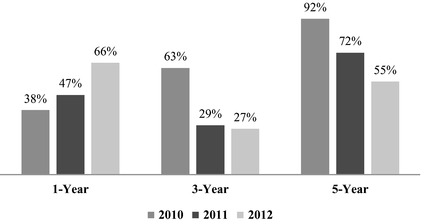
32
Company-Wide Long-Term Net Flows
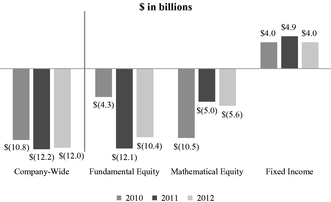
Balance Sheet Profile
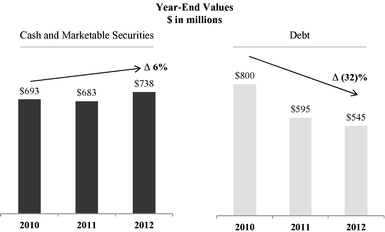
33
Financial Results
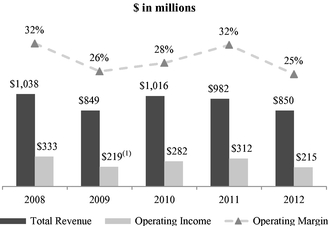
Performance-Based Compensation
The most important objective of our compensation programs is to compensate our executives in a way that encourages them to enhance shareholder value over the long term. In determining our NEOs' compensation levels for 2012, the Committee evaluated a variety of individual and Company performance measures as well as other factors that it deemed important given our compensation programs' objectives. The operating, investing and strategic results described throughout this CD&A represent the important factors considered by the Committee in determining our NEOs' compensation levels for 2012.
We are an asset manager with revenues generally based upon a percentage of the market value of the assets under our management ("AUM"). Although overall market performance is a key driver of our AUM, our investment performance has a significant impact on our sales, redemptions and revenues. Because there is generally a lag between investment performance, and related financial results, the Committee focuses its evaluation of our performance largely on longer-term financial measures (such as our operating income, balance sheet strength and long-term net flows) and the achievement of our strategic objectives, rather than on short-term performance measures. While shorter-term performance measures are given some consideration, the Committee believes an emphasis on longer-term performance best serves the interests of our shareholders.
The decisions and programs described below demonstrate our commitment to aligning the interests of our executives and our employees with those of our shareholders over the long-term.
34
21 percent lower than 2011 and 52 percent lower than 2010 (excluding the CEO's 2010 employment inducement award). The Committee believes this reduction aligns CEO compensation with 2012 Company performance and results in 2012 total compensation that is well below median when compared to our peers. For a more detailed explanation of the Committee's 2012 CEO total compensation determination, please refer to "2012 CEO Variable Compensation Level" on page 39.
Operating Income Results and CEO Total Compensation
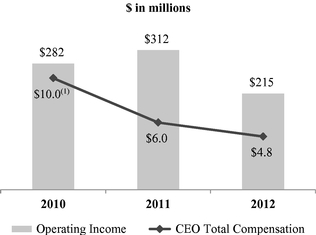
•
|
NEO Variable Compensation. A significant portion, 83 percent, of total compensation is delivered as variable compensation (47 percent is paid in a cash bonus and 53 percent is paid in long term incentives ("LTI")) and is based upon Company and individual performance. Variable compensation for all NEOs declined from 2011 to 2012 by an average of 22 percent based primarily upon Company performance. The 2012 long-term incentives were paid 100 percent in restricted stock (with the exception of our CFO who received a combination of restricted stock and options) with a four-year vesting period. We believe LTI awards, especially restricted stock, reflect further alignment of the interests of our executive officers with the Company stock price that delivers value for our shareholders over the long-term. | NEO Pay Mix 2012 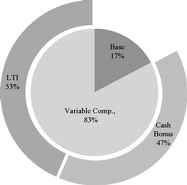
|
||
|
Company-Wide Variable Compensation Program. Beginning in 2011, our Company-wide variable compensation pool for most employees was funded based on operating income before the payment of incentive compensation, which we believe is a key value driver for shareholders. Previously, our variable compensation pools were determined at the discretion of the Committee based upon operating results and the achievement of financial and strategic objectives. Due to lower operating income before the payment of incentive compensation in 2012, the variable compensation pools funded significantly lower in 2012 than in 2011, negatively impacting employees across the Company. We exclude the CEO, CFO and two other officers from this pool in order to mitigate excessive risk-taking and conflicts of interest, but we anticipate that the variable compensation of the excluded officers will continue to be impacted by our operating income before the payment of incentive compensation. |
|||
35
2012 Changes in Response to Shareholder Feedback
We continue to seek shareholder feedback on our compensation programs. In 2012, we spoke to the holders of a majority of our shares, and we received feedback about the complexity of our CEO's variable compensation structure and the performance hurdles required to achieve the formulaic portion of his incentive bonus. Some shareholders wanted Janus to establish a peer group of public companies to improve the comparative information available to them, and others requested more detail about the factors the Committee considers when determining the subjective portion of CEO variable compensation. Based in part on these dialogues, we made the following decisions in 2012:
Compensation Program Objectives and Practices
The primary objectives of our compensation programs are:
The Committee administers our executive compensation programs. On an annual basis, the Committee reviews the elements of our NEOs' compensation, which includes evaluating the program's effectiveness in supporting our compensation objectives. They also consider the broad set of relative compensation and
36
performance information provided by the Compensation Consultants which enables the Committee members to objectively evaluate many factors before applying their judgment to compensation decisions.
In determining the compensation levels for our NEOs, the Committee evaluates all factors that it deems relevant in light of our compensation program objectives. The material factors considered for 2012 included:
All compensation-related factors are considered as a whole without specific weighting of individual factors. The Committee did not rely on formulas in determining compensation for 2012, with the exception of a portion of CEO compensation that was determined based on operating income results. Due to the volatile nature of the broader economy and movements in global markets which have a significant impact on our financial results, we believe that subjectivity in the compensation decision-making process provides our Committee with appropriate flexibility to consider all relevant factors when determining pay and driving desired behaviors. The Committee believes that formulaic-focused compensation programs can create an overemphasis on meeting short-term financial objectives and may result in unintended behaviors. Once determined, NEO compensation is delivered in the form of (i) base salary, and (ii) variable compensation. These key compensation elements are summarized in the following table.
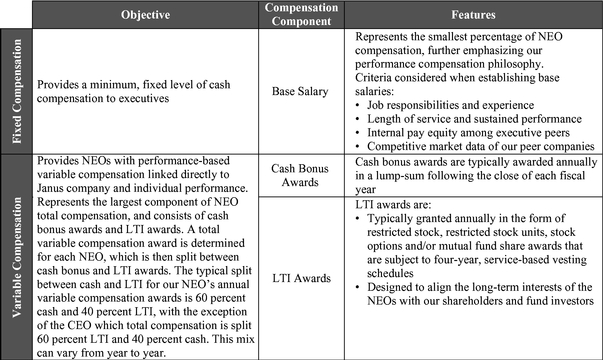
37
CEO Compensation
2012 CEO Objectives and Performance
In addition to the results described above and the other relevant factors described in this CD&A, the Committee considered the individual performance factors described below in determining Mr. Weil's 2012 compensation level.
For 2012, the Board of Directors and the Committee established various performance objectives for our CEO. These objectives were chosen because they are key drivers of our long-term growth and are expected to contribute directly to long-term shareholder value. The Board and the Committee determined that Mr. Weil accomplished a significant number of his 2012 objectives and also made significant progress on his long-term strategic priorities, as described below.
Key Areas of Progress in 2012:
38
2012 CEO Variable Compensation Level
The Committee carefully considered the various relevant factors described in this CD&A and exercised its informed judgment (as described in more detail below) to determine Mr. Weil's 2012 compensation at a level that the Committee believes is consistent with 2012 Company performance and the overall objectives of our compensation program.
Mr. Weil's total compensation was significantly reduced in 2012 to $4.75 million (consisting of a $500,000 base salary and $4.25 million of variable compensation). This reduction resulted in:
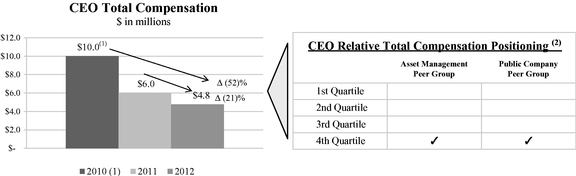
The structure of Mr. Weil's $4.25 million of variable compensation for 2012 is consistent with our previously described emphasis on LTI awards (60 percent of CEO total compensation is paid in LTI awards). In determining the amount of discretionary awards described below, the Committee considered, among other factors described in this CD&A:
39
In total, these factors encouraged the Committee to consider a modest increase in 2012 CEO compensation. However, the Committee also recognized our disappointing net outflows of assets under management, our operating income decline and investment underperformance in certain of our products over a three-year period. In addition, our broad based variable compensation program applicable to most employees is based on operating income before the payment of incentive compensation, which we believe is a key value driver for our shareholders. Primarily as a result of reduced operating income, the corresponding reduction in the Company-wide variable compensation pool, and other disappointing financial results, the Committee ultimately decided to reduce our CEO's 2012 total compensation as described above resulting in $4.25 million in variable compensation for 2012.
Formulaic bonus award of $0.60 million:
Variable compensation of $3.65 million based upon the factors outlined above:
The Committee decided to grant restricted stock with a four-year vesting schedule for these awards rather than a portion in performance share units, as were issued in 2011, to simplify the compensation structure (as recommended by some shareholders), to avoid shareholder confusion about the established performance hurdles and their appropriateness for our Company, to recognize financial performance challenges still facing the Company (especially those associated with mutual fund performance fees), and to address the potential impression of retention concerns resulting from compensating our CEO well below the median as compared to peers.
40
2013 CEO Compensation
In connection with the Committee's ongoing enhancement of our compensation practices and programs, the Committee determined that Mr. Weil's compensation arrangement for 2013 should be structured to maintain our commitment to link pay with performance and encourage CEO retention:
41
Other NEO Compensation
Overview
To determine 2012 compensation for Ms. Robin Beery and Messrs. Bruce Koepfgen, Augustus Cheh and George Batejan (the "other NEOs"), the Committee evaluated the performance of these other NEOs following consultation with the CEO, Janus' Human Resources department and the Compensation Consultants, while recognizing that our recent investment performance challenges are not the direct responsibility of any of the other NEOs. While the variable compensation awards paid to our other NEOs declined from 2011 to 2012 due to Company performance, these awards do still reflect the contribution of each NEO to the achievement of many of our Company-wide strategic priorities and the Committee's evaluation of the other compensation factors described in this CD&A.
For 2012, the other NEOs' mix of variable compensation was generally split 60 percent cash bonus and 40 percent LTI awards to maintain a strong alignment between the interests of the other NEOs and the long-term interests of our shareholders. To strengthen the alignment of our other NEOs' compensation with the performance needed to drive long-term value for our shareholders, the 2012 LTI awards to our other NEOs (other than our CFO) included 100 percent restricted stock with a four-year vesting schedule. Our CFO received a combination of restricted stock and options, both of which have a four-year vesting schedule.
Individual Performance Summary
In addition to our overall Company performance and other relevant compensation factors, the Committee considered the individual other NEO responsibilities, accomplishments and contributions in arriving at compensation decisions for the other NEOs. The Committee decisions reflected in the following tables are based upon NEO performance for 2012. The compensation shown in the tables below differs from the amounts shown in the "Summary Compensation Table" on page 52 because these tables show variable compensation associated with 2012 performance that was determined and paid for the other NEOs in 2013 (the LTI portion of the variable compensation shown below will be reflected, as applicable, in our Summary Compensation Table for 2014 in accordance with SEC rules).
42
| Bruce L. Koepfgen, Executive Vice President and CFO 2012 Total Compensation ($000s): |
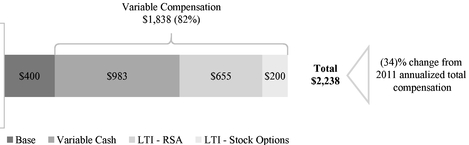
|
| Key 2012 Achievements: |
• Mr. Koepfgen continued to provide financial stewardship, guidance and oversight of long-term strategic priorities, both domestically and internationally, resulting in improvements to our balance sheet and credit ratings. |
• He designed a new subsidiary profits-based variable compensation plan which will be implemented in 2013. |
• Mr. Koepfgen's teams enhanced the financial reporting and decision-making information available to clients both internally and externally (e.g., to the Board of Directors, the Fund Trustees, rating agencies, and others). |
| Additional Notes: |
• To preserve restricted stock award availability under Janus' 2010 Long-Term Incentive Stock Plan ("2010 LTI Plan") while still aligning his interests with those of our shareholders, Mr. Koepfgen was awarded stock options in addition to his restricted stock. |
• Mr. Koepfgen joined Janus on May 23, 2011. His 2011 annualized total compensation was $3.4 million excluding his 2011 relocation costs. |
43
| Robin C. Beery, Executive Vice President of U.S. Distribution 2012 Total Compensation ($000s): |
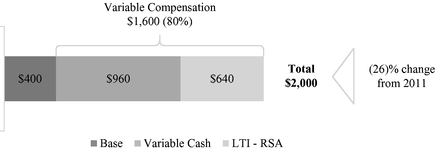
|
| Key 2012 Achievements: |
• Under Ms. Beery's leadership, Janus' business continued to diversify largely through its fixed income expansion and enhanced distribution. |
• Ms. Beery helped to develop and rollout an evolved brand identity and messaging platform for the Company. |
• Despite the continued risk-aversion to equities and our challenging investment performance, Ms. Beery's efforts resulted in increased market share in the advisor channel, recognition as one of the industry's top brands in the Defined Contribution Investment Only ("DCIO") channel and several new and differentiated product launches that are expected to drive future asset flows. |
• She successfully executed on our comprehensive client retention strategy which allowed the Company to retain key platform placements with our distribution partners. |
• Ms. Beery continued to strengthen the U.S. Institutional team, with several new hires and increased sales and consultant activity. |
| Additional Notes: |
• Ms. Beery also serves as President of the Janus mutual funds, acting as the business liaison between Janus and the Fund Trustees. |
44
| Augustus Cheh, President of Janus International 2012 Total Compensation ($000s): |
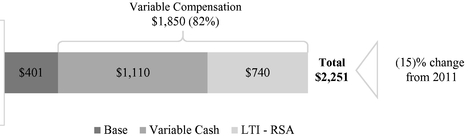
|
| Key 2012 Achievements: |
• Mr. Cheh developed a clear vision for the success of Janus International and established specific operational goals for our business in Europe, Asia-Pacific and Latin America. |
• Mr. Cheh has accelerated the development of our non-U.S. business. Under his leadership, Janus has opened offices in The Hague, Paris, Zurich, Frankfurt, Taipei and Dubai. |
• Mr. Cheh was instrumental in recruiting and hiring top client facing individuals to better serve our clients and to expand our institutional and retail business in non-U.S. markets. |
• Mr. Cheh also led the enhancement of Janus' product platform to better meet non-U.S. investor needs, including the launch of new products and share classes. |
| Additional Notes: |
• Mr. Cheh joined Janus on March 29, 2011 as the leader of all of Janus' non-U.S. businesses. |
• Mr. Cheh's 2012 total compensation is in line with expectations from his hiring process. There are no such expectations going forward. The 15 percent change in total compensation from 2011 excludes Mr. Cheh's 2011 employment inducement award and his annual housing allowance. |
| George S. Batejan, Executive Vice President and Global Head of Technology and Operations 2012 Total Compensation ($000s): |
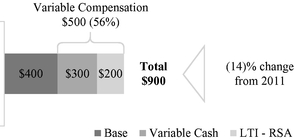
|
| Key 2012 Achievements: |
• Mr. Batejan oversaw the operational aspects of the successful launch of our Diversified Alternatives Fund, several other new product launches and the launch of our new Taipei office. |
• Mr. Batejan's Company-wide efforts to identify and resolve potential operating issues has continued to improve processing efficiency and quality and has minimized errors in trading, cash flow matters and corporate actions. |
• Mr. Batejan has worked with our distribution partners and clients to help improve the overall client experience. |
• Mr. Batejan's contributions have allowed us to facilitate business expansion and develop new operating capabilities while limiting expenses. |
45
Compensation Decision-Making Process
Compensation Committee's Role. The Committee determines the levels and type of compensation paid to our NEOs. In addition to the compensation factors described elsewhere in this CD&A, the Committee considers the scope of each NEO's responsibilities, skills and talents, demonstrated leadership capabilities, compensation relative to similarly situated peers and Company and individual performance on an absolute and relative basis. External factors, such as market compensation levels, unforeseen issues that arise during the year that may lead to a change or reprioritization of pre-established goals or objectives and Compensation Consultant recommendations, are also taken into consideration.
Compensation Consultants' Role. In making compensation decisions, the Committee relies in part on advice from the Compensation Consultants who provide an objective perspective, comprehensive comparative data on the financial services industry, pay for performance approaches and general best practices, which enhance the quality of the Committee's decisions. Please refer to "Compensation Consultants to the Compensation Committee" on page 17 for additional detail as to the Committee Consultants' activities for 2012.
Janus Management's Role. Management assists the Committee by providing information and recommendations on Janus' various compensation programs. At the beginning of each year, the CEO, in conjunction with Janus' Human Resources department and other key leaders within Janus, recommends to the Board and the Committee the financial and strategic objectives for the Company. During the year, management provides the Board and the Committee with periodic progress reports. After the end of each year, management presents the Committee with its evaluation of the Company's performance against those financial and strategic objectives. The CEO then evaluates the individual performance of each member of the senior management team and recommends levels of compensation to the Committee for review and approval.
Our Peer Groups. We review compensation practices at both a broad sampling of asset management companies and across more select peer groups in connection with evaluating our compensation programs. McLagan annually recommends the composition of the primary competitive peer group to the Committee, which then reviews and discusses such proposed peer group with management. The Committee does not benchmark specific elements of compensation or establish target percentiles in determining or justifying individual compensation decisions in comparison to our peers.
For 2012, the Committee used a 14-company peer group as a frame of reference for evaluating the competitiveness and reasonableness of the NEOs' proposed pay levels. In determining the reasonableness of the 14-company peer group, the Committee, supported by guidance from McLagan, recognizes that no single competitor firm is exactly like Janus. The Committee also considered that the competitive labor market for senior executive talent in the asset management industry is broad and diverse, encompassing other publicly owned asset management firms, privately owned asset management firms and asset management subsidiaries of larger financial services firms. Some of the peer compensation data is from confidential, non-publicly available survey data of private firms, which provides the Committee a more complete view of the competitive landscape.
The Committee believes that the following 14 firms provide a reasonable frame of reference for evaluating executive pay levels and practices given a combination of factors, including the competitors' size,
46
geographic scope, operating approach, product breadth, operating complexity, channel coverage, ownership, history and performance:
| Janus Asset Management Peer Group | ||
| AllianceBernstein L.P. | Morgan Stanley Investment Management | |
| American Century Investments | Neuberger Berman Group | |
| Delaware Investments | Nuveen Investments | |
| Eaton Vance Management | Oppenheimer Funds, Inc. | |
| Franklin Templeton Investments (1) | Putnam Investments | |
| Invesco plc. | T. Rowe Price Associates, Inc. (1) | |
| MFS Investment Management | Western Asset Management Co. | |
For 2012, the Committee also utilized a new second public company peer group developed in partnership with Semler Brossy and established in response to shareholder feedback. The feedback was that our traditional peer group, since it includes some non-public information, did not provide shareholders with adequate comparative compensation information, especially with respect to pay for the CEO. This peer group takes into consideration companies with similar business models and peers from which we may attract talent. The Committee considered this second peer group in the same manner as the historical peer group in order to evaluate CEO compensation. The Committee also utilized this peer group to understand our relative Company performance. The peer group of public companies consists of the following firms:
| Janus Public Company Peer Group | ||
| Affiliated Managers Group, Inc. | Franklin Resources, Inc. | |
| AllianceBernstein Holding L.P. | Invesco Ltd. | |
| Ameriprise Financial, Inc. | Legg Mason, Inc. | |
| Cohen & Steers, Inc. | T. Rowe Price Group, Inc. | |
| Eaton Vance Corp. | Waddell & Reed Financial, Inc. | |
| Federated Investors, Inc. | ||
47
Additional Compensation Practices and Policies
Compensation Policies. We continue to maintain compensation practices we believe strongly align the interests of our executives with those of our shareholders, including the following:
|
|
Current Compensation Practices |
|
||
|---|---|---|---|---|
A large majority of NEO compensation is variable, representing 89 percent of our CEO's 2012 total compensation and 78 percent of our other NEOs' 2012 total compensation. |
||||
At least 40 percent of our NEOs annual variable compensation consists of LTI awards. |
||||
We have substantial stock and mutual fund ownership requirements for our NEOs (four times base salary). |
||||
We now only grant LTI awards with a "double-trigger" change in control provision (accelerated vesting of awards after a change in control only occurs if the employee is terminated without cause or has a substantial diminution of duties). |
||||
Annual LTI awards are largely made in less dilutive restricted stock versus stock options. |
||||
We have a one-year, post-vesting holding period on earned performance share units. |
||||
We mitigate potential excessive risk taking with short-selling/hedging/pledging prohibitions, holding requirements for performance share unit awards, a clawback policy, granting procedures for LTI awards, and robust Board and management processes to identify and monitor risk. |
||||
Our clawback policy allows us to recapture LTI awards paid to an executive who engages in financial misconduct. |
||||
The Committee regularly reviews tally sheets, which detail all components of each NEO's compensation, including projected payouts under potential severance and change in control scenarios. |
||||
48
We avoid compensation practices that are generally considered to be problematic, such as:
|
|
Compensation Practices We Avoid |
|
||
|---|---|---|---|---|
No excise tax gross-ups |
||||
No change in control agreements that provide "single trigger" cash severance benefits, and no LTI awards granted since December 30, 2011 have "single trigger" vesting upon a change in control |
||||
No excessive perquisites |
||||
No dividends or dividend equivalents on unvested or unearned performance shares or units |
||||
No repricing or replacing of underwater stock options without shareholder approval |
||||
Risk Consideration. As more fully described in the "Board Leadership Structure and Risk Oversight" section on pages 13 through 15, the Committee carefully reviews the risks and rewards associated with our compensation programs.
Severance Guidelines. We generally believe we should provide reasonable severance benefits to employees whose employment is involuntarily terminated without individual performance issues. Fair and reasonable severance benefits provide some support to terminated employees as they seek new employment. Severance benefits also provide Janus an opportunity to obtain a release of legal claims and enforce additional restrictive covenants (such as non-solicitation clauses), which help protect our business. A description of the severance rights of each NEO is outlined in the "Termination and Change in Control Arrangements with Named Executive Officers" section beginning on page 61.
Change in Control. Change in control severance benefits for certain executives are generally intended to mitigate the potential conflict of interest that may arise in a change in control transaction and therefore align the interests of those executives with the interests of our shareholders. Relative to the overall value of Janus, these potential change in control benefits are reasonable and consistent with the general practice among our peers based upon information provided by McLagan. These benefits are based on a "double trigger" approach and only arise if there is a material negative change to employment arising from, or within two years after, a change in control of Janus. Our change in control benefits do not include any tax gross-up rights and the executives are personally responsible for the payment of any excise tax. The change in control severance rights of our NEOs, if any, are outlined in the "Termination and Change in Control Arrangements with Named Executive Officer" section beginning on page 61. In addition, as of December 30, 2011, all LTI awards are subject to accelerated vesting only if (i) there is a change in control of Janus, and (ii) the executive's employment is terminated either by the Company without cause or for "good reason" by the executive (material diminution in duties, reduction in compensation or relocation of the principal place of employment) within two years after a change in control of Janus.
Clawback Policy. Long-term incentive compensation awarded to members of our senior management team is subject to recovery or "clawback" in the event that there is a material misstatement in our financial statements and such misstatement is found to be the result of such senior executive's active participation in, knowing concealment of or knowing failure to identify such misstatement. Any LTI award granted to the applicable senior executive in the three years prior to the misstatement is subject to recovery by Janus (e.g., by forfeiture of unvested awards or repayment of vested awards). This policy supports our commitment to the accuracy of Janus' financial statements and discourages excessive risk-taking.
Anti-Hedging and Anti-Pledging Policies. Janus prohibits transactions in Janus stock that are speculative in nature. Speculative trading includes "put" or "call" options, short sales, hedging or similar derivative
49
transactions. We also prohibit our directors and executives from pledging Janus shares. These policies support our commitment to maintaining the alignment of the interests of our employees with the long-term interests of our shareholders.
Grant Procedures for Long-Term Incentive Awards. All LTI awards are granted pursuant to written grant procedures that are designed to avoid grants of LTI awards when we are aware of material non-public information concerning Janus. The grant date is established by the Committee and our written grant procedures, and management has no discretion to establish the grant date.
Perquisites and Other Benefits. We annually review other benefits provided to our NEOs. We generally provide benefits to our executives that are similar to (if not the same as) those offered to other Janus employees, except our NEOs are also provided the opportunity to participate in the Executive Income Deferral Program (described below). Although some of our competitors may provide their executives with special perquisites, we believe that we can retain top executive talent by providing market competitive total compensation opportunities and health and retirement benefits. Currently, our NEOs and all other full-time employees can participate in the following benefit programs:
Janus also offers a tax-deferred compensation program to key executives and directors. Under the Janus Executive Income Deferral Program, the NEOs and other executives of the Company and its affiliates may elect to defer receipt of up to 50 percent of their base salary, all or a portion of their annual or periodic cash bonus (and commissions, if applicable), and all or a portion of any restricted stock or mutual fund share awards. None of the NEOs elected to participate in this deferral program in 2012.
Section 162(m) Compliance. Section 162(m) of the Code generally disallows a tax deduction to public companies for compensation greater than $1 million paid in any one fiscal year to a corporation's CEO and three other most highly compensated executive officers (other than the CFO) as of the end of any fiscal year. However, the statute exempts qualifying performance-based compensation from the deduction limit if certain requirements are met. Janus generally intends to structure its variable compensation to achieve tax deductibility under Section 162(m). To facilitate that objective, specified performance thresholds for funding variable compensation must be satisfied before payments are made. Achievement of the threshold performance criteria did not guarantee that our NEOs would receive any specific variable compensation for 2012.
All compensation paid in 2012 was deductible; however, the Committee may make compensation decisions that do not result in tax deductibility. The Committee believes that shareholder interests are best served by allowing the Committee discretion and flexibility in crafting compensation programs, even though such programs may result in certain non-deductible compensation expenses.
50
COMPENSATION COMMITTEE REPORT ON EXECUTIVE COMPENSATION
The Compensation Committee of the Board is primarily responsible for reviewing, approving and overseeing Janus' compensation plans and practices, and works with management and the Committee Consultants to establish Janus' executive compensation philosophy and programs. The Committee is composed entirely of independent directors, as defined under our Governance Guidelines and the NYSE Listing Standards.
The Committee has reviewed and discussed the "Compensation Discussion and Analysis" section with management. Based upon this review and discussion, the Committee has recommended to the Board of Directors that the "Compensation Discussion and Analysis" section be included in this Proxy Statement.
Respectfully,
Members of the Compensation Committee
Jock
Patton, Chairman
Timothy K. Armour
G. Andrew Cox
Lawrence E. Kochard
51
EXECUTIVE COMPENSATION
Summary Compensation Table
The following table contains information about the compensation that Janus paid during 2012, 2011 and 2010 to the NEOs:
| Name and Principal Position |
Year |
Salary ($) |
Restricted Stock Awards ($) (6) |
Option Awards ($) (8) |
Non-Equity Incentive Plan Compensation ($) (9) |
All Other Compensation ($) (10) |
Total ($) |
|||||||||||||||
|---|---|---|---|---|---|---|---|---|---|---|---|---|---|---|---|---|---|---|---|---|---|---|
| Richard M. Weil, | 2012 | $ | 500,000 | $ | 2,850,006 | – | $ | 1,400,000 | $ | 232,283 | $ | 4,982,289 | ||||||||||
| CEO (1) | 2011 | $ | 500,000 | $ | 3,631,099 | (7) | – | $ | 1,900,000 | $ | 120,053 | $ | 6,151,152 | |||||||||
| 2010 | $ | 458,333 | $ | 12,999,996 | $ | 3,000,000 | $ | 3,500,000 | $ | 379,539 | $ | 20,337,868 | ||||||||||
| Bruce L. Koepfgen, | 2012 | $ | 400,000 | $ | 489,998 | $ | 599,999 | $ | 982,800 | $ | 39,593 | $ | 2,512,390 | |||||||||
| CFO (2) | 2011 | $ | 243,056 | – | – | $ | 735,000 | $ | 246,145 | $ | 1,224,201 | |||||||||||
| 2010 | – | – | – | – | – | – | ||||||||||||||||
| Robin C. Beery, | 2012 | $ | 400,000 | $ | 759,996 | – | $ | 960,000 | $ | 65,229 | $ | 2,185,225 | ||||||||||
| EVP of | 2011 | $ | 400,000 | $ | 760,004 | – | $ | 1,540,000 | $ | 41,451 | $ | 2,741,455 | ||||||||||
| U.S. Distribution (3) | 2010 | – | – | – | – | – | – | |||||||||||||||
| Augustus Cheh, | 2012 | $ | 401,175 | $ | 778,002 | – | $ | 1,110,000 | $ | 323,299 | $ | 2,612,476 | ||||||||||
| President of Janus | 2011 | $ | 304,668 | $ | 552,502 | – | $ | 2,119,500 | $ | 220,322 | $ | 3,196,992 | ||||||||||
| International (4) | 2010 | – | – | – | – | – | – | |||||||||||||||
| George S. Batejan, | 2012 | $ | 400,000 | $ | 199,998 | – | $ | 300,000 | $ | 30,373 | $ | 930,371 | ||||||||||
| Global Head of Technology | 2011 | $ | 350,000 | $ | 61,667 | – | $ | 500,000 | $ | 143,428 | $ | 1,055,095 | ||||||||||
| and Operations (5) | 2010 | – | – | – | – | – | – | |||||||||||||||
52
from the awards. Whether, and to what extent, a NEO realizes value will depend on the Janus' stock price and the NEO's continued employment.
| Name |
Year |
Cash Awards |
Mutual Fund Share Awards |
Total |
|||||||||
|---|---|---|---|---|---|---|---|---|---|---|---|---|---|
Richard M. Weil |
2012 | $ | 1,400,000 | – | $ | 1,400,000 | |||||||
|
2011 | $ | 1,900,000 | – | $ | 1,900,000 | |||||||
|
2010 | $ | 3,500,000 | – | $ | 3,500,000 | |||||||
Bruce L. Koepfgen |
2012 | $ | 982,800 | – | $ | 982,800 | |||||||
|
2011 | $ | 735,000 | – | $ | 735,000 | |||||||
|
2010 | – | – | – | |||||||||
Robin C. Beery |
2012 | $ | 960,000 | – | $ | 960,000 | |||||||
|
2011 | $ | 1,140,000 | $ | 400,000 | $ | 1,540,000 | ||||||
|
2010 | – | – | – | |||||||||
Augustus Cheh |
2012 | $ | 1,110,000 | – | $ | 1,110,000 | |||||||
|
2011 | $ | 1,167,000 | $ | 952,500 | (a) | $ | 2,119,500 | |||||
|
2010 | – | – | – | |||||||||
George S. Batejan |
2012 | $ | 300,000 | – | $ | 300,000 | |||||||
|
2011 | $ | 300,000 | $ | 200,000 | $ | 500,000 | ||||||
|
2010 | – | – | – | |||||||||
53
| Name |
Year |
ESOP Contri- butions (a) |
Profit Sharing Contri- butions (a) |
401(k) Contri- butions |
Group Term Life Insurance Premiums (b) |
Health Insurance Premiums (c) |
Dividends on Unvested Restricted Stock |
Other |
Total |
|||||||||||||||||||
|---|---|---|---|---|---|---|---|---|---|---|---|---|---|---|---|---|---|---|---|---|---|---|---|---|---|---|---|---|
Richard M. Weil |
2012 | – | – | $ | 7,500 | $ | 2,612 | $ | 13,135 | $ | 209,036 | – | $ | 232,283 | ||||||||||||||
|
2011 | $ | 2,450 | $ | 2,450 | $ | 7,350 | $ | 2,610 | $ | 12,875 | $ | 92,318 | – | $ | 120,053 | ||||||||||||
|
2010 | $ | 4,900 | $ | 4,900 | $ | 7,350 | $ | 2,075 | $ | 9,884 | $ | 44,143 | $ | 306,287 | (d) | $ | 379,539 | ||||||||||
Bruce L. Koepfgen |
2012 | – | – | $ | 7,500 | $ | 2,377 | $ | 13,135 | $ | 16,581 | – | $ | 39,593 | ||||||||||||||
|
2011 | $ | 2,450 | $ | 2,450 | $ | 7,350 | $ | 1,385 | $ | 7,510 | – | $ | 225,000 | (e) | $ | 246,145 | |||||||||||
|
2010 | – | – | – | – | – | – | – | – | |||||||||||||||||||
Robin C. Beery |
2012 | – | – | $ | 7,500 | $ | 2,377 | $ | 13,360 | $ | 41,992 | – | $ | 65,229 | ||||||||||||||
|
2011 | $ | 2,450 | $ | 2,450 | $ | 7,350 | $ | 2,375 | $ | 13,466 | $ | 13,360 | – | $ | 41,451 | ||||||||||||
|
2010 | – | – | – | – | – | – | – | – | |||||||||||||||||||
Augustus Cheh |
2012 | – | – | $ | 24,955 | (f) | $ | 1,095 | $ | 10,467 | $ | 35,790 | (g) | $ | 250,992 | (h) | $ | 323,299 | ||||||||||
|
2011 | – | – | $ | 15,233 | (f) | $ | 542 | $ | 7,191 | $ | 6,938 | (g) | $ | 190,418 | (h) | $ | 220,322 | ||||||||||
|
2010 | – | – | – | – | – | – | – | – | |||||||||||||||||||
George S. Batejan |
2012 | – | – | $ | 7,500 | $ | 2,377 | $ | 12,681 | $ | 7,815 | – | $ | 30,373 | ||||||||||||||
|
2011 | $ | 2,450 | $ | 2,450 | $ | 7,350 | $ | 2,257 | $ | 13,466 | $ | 722 | $ | 114,733 | (i) | $ | 143,428 | ||||||||||
|
2010 | – | – | – | – | – | – | – | – | |||||||||||||||||||
54
GRANTS OF PLAN-BASED AWARDS IN 2012
| |
|
Estimated Future Payouts Under Non-Equity Incentive Plan |
Estimated Future Payouts Under Equity Incentive Plan (4) |
All Other Stock Awards: Number of Shares of Stock or Units (#) |
All Other Option Awards: Number of Securities Underlying Options (#) (5) |
|
|
|
|||||||||||||||||||||||||||||
|---|---|---|---|---|---|---|---|---|---|---|---|---|---|---|---|---|---|---|---|---|---|---|---|---|---|---|---|---|---|---|---|---|---|---|---|---|---|
| |
|
Exercise or Base Price of Option Awards ($/Sh) (6) |
|
|
|||||||||||||||||||||||||||||||||
| |
|
|
|
||||||||||||||||||||||||||||||||||
| Name |
Grant Date |
Threshold ($) |
Target ($) |
Maximum ($) (3) |
Threshold (#) |
Target (#) |
Maximum (#) |
Closing Market Price on Grant Date ($) |
Grant Date Fair Market Value of Stock and Option Awards ($) (7) |
||||||||||||||||||||||||||||
Richard M. Weil |
12/31/12 | – | – | – | – | 338,079 | – | – | – | – | – | $ | 2,850,006 | ||||||||||||||||||||||||
|
1/1/12 | $ | 1,400,000 | (1) | |||||||||||||||||||||||||||||||||
Bruce L. Koepfgen |
2/3/12 | – | – | – | – | 57,176 | – | – | $ | 489,998 | |||||||||||||||||||||||||||
|
2/3/12 | 151,515 | $ | 8.57 | $ | 8.58 | $ | 599,999 | |||||||||||||||||||||||||||||
|
$ | 1,089,997 | |||||||||||||||||||||||||||||||||||
|
1/1/12 | $ | 982,800 | (1) | |||||||||||||||||||||||||||||||||
Robin C. Beery |
2/3/12 | – | – | – | – | 88,681 | – | – | – | – | – | $ | 759,996 | ||||||||||||||||||||||||
|
1/1/12 | $ | 960,000 | (1) | |||||||||||||||||||||||||||||||||
|
2/3/12 | 400,000 | (2) | ||||||||||||||||||||||||||||||||||
Augustus Cheh |
2/3/12 | – | – | – | – | 95,174 | (8) | – | – | – | – | – | $ | 813,792 | |||||||||||||||||||||||
|
1/1/12 | $ | 1,110,000 | (1) | |||||||||||||||||||||||||||||||||
|
2/3/12 | 400,000 | (2) | ||||||||||||||||||||||||||||||||||
George S. Batejan |
2/3/12 | – | – | – | – | 23,337 | – | – | – | – | – | $ | 199,998 | ||||||||||||||||||||||||
|
1/1/12 | $ | 300,000 | (1) | |||||||||||||||||||||||||||||||||
|
2/3/12 | 200,000 | (2) | ||||||||||||||||||||||||||||||||||
55
EMPLOYMENT ARRANGEMENTS WITH NAMED EXECUTIVE OFFICERS
Richard M. Weil – Employment Arrangement with Our CEO
We do not have a formal written employment agreement with Mr. Weil and do not have established target compensation levels for him. Mr. Weil receives an annual base salary of $500,000. Mr. Weil is also entitled to all health and retirement benefits offered to our other senior executives.
All variable compensation awards are determined by the Compensation Committee. Any awards to Mr. Weil are subject to, at a minimum, at least the achievement of performance criteria in compliance with Section 162(m) of the Code. A more detailed description of Mr. Weil's 2012 and 2013 compensation arrangements can be found in the "Compensation Discussion and Analysis" section of the Proxy Statement, beginning on page 30.
Mr. Weil has agreed that during his employment and for a period of one year after his termination not to (i) employ or attempt to employ or engage on behalf of any competitive business any employee or contractor of Janus or any of its affiliates (individually, a "Janus Entity") or (ii) divert, attempt to divert, solicit or engage on behalf of any competitive business, any business of an investment advisory or investment management client of a Janus Entity, to which a Janus Entity rendered services during the six-month period immediately preceding Mr. Weil's termination. As these restrictions are similar to those applicable to other NEOs, such restrictions are referred to as the "Non-Solicitation Obligations" in this Proxy Statement.
Bruce L. Koepfgen – Employment Arrangement with Our CFO
We do not have a formal written employment agreement with Mr. Koepfgen and have not established target compensation levels for him. Mr. Koepfgen receives an annual base salary of $400,000. Mr. Koepfgen is also entitled to all health and retirement benefits offered to our other senior executives. As with all NEOs, variable compensation awards to Mr. Koepfgen are determined by the Compensation Committee and are subject to at least the achievement of performance criteria in compliance with Section 162(m) of the Code. During his employment and for a period of one year after his termination, Mr. Koepfgen has agreed to restrictive covenants similar to the Non-Solicitation Obligations (as described under the above subsection titled "Richard M. Weil – Employment Arrangement with Our CEO").
Robin C. Beery – Employment Arrangement with Our Executive Vice President of U.S. Distribution
We do not have a formal written employment agreement with Ms. Beery and have not established target compensation levels for her. Ms. Beery is paid an annual base salary of $400,000. Ms. Beery is also entitled to all health and retirement benefits offered to our other senior executives. As with all NEOs, variable compensation awards to Ms. Beery are determined by the Compensation Committee and are subject to at least the achievement of performance criteria in compliance with Section 162(m) of the Code. During her employment and for a period of one year after her termination, Ms. Beery has agreed to restrictive covenants similar to the Non-Solicitation Obligations (as described under the above subsection titled "Richard M. Weil – Employment Arrangement with Our CEO").
56
Augustus Cheh – Employment Arrangement with Our President of Janus International
Although Janus does not have a formal written employment agreement with Mr. Cheh, he and Janus have agreed to certain expectations related to his continued employment under his offer letter and expected compensation structure for 2012 (which may differ slightly due to currency conversion):
Annual Base Salary: |
$ | 400,000 | ||
Annual Variable Cash Target: |
$ | 1,110,000 | ||
Annual Variable Long-Term Incentive Target: |
$ | 740,000 | ||
Annual Housing Allowance: |
$ | 250,000 |
Actual payments to Mr. Cheh may be less than or greater than the target amounts as determined by the Compensation Committee and are subject to at least the achievement of performance criteria in compliance with Section 162(m) of the Code.
Mr. Cheh is also entitled to all health and retirement benefits and other perquisites offered to our other senior executives in Hong Kong.
During his employment and for a period of one year after his termination of employment, Mr. Cheh agreed to restrictive covenants similar to the Non-Solicitation Obligations (as described under the above subsection on page 56 titled "Richard M. Weil – Employment Arrangement with Our CEO"), except that the restrictive covenants related to Janus customers or clients applies to customers of any Janus Entity during the two year period and any competitive business during the one year period, respectively, immediately preceding Mr. Cheh's termination.
George S. Batejan – Employment Arrangement with Our Global Head of Technology and Operations
We do not have a formal written employment agreement with Mr. Batejan and have not established target compensation levels for him. Mr. Batejan is paid an annual base salary of $400,000. Mr. Batejan is also entitled to all health and retirement benefits offered to our other senior executives. As with all NEOs, variable compensation awards to Mr. Batejan are determined by the Compensation Committee and are subject to at least the achievement of performance criteria in compliance with Section 162(m) of the Code. During his employment and for a period of one year after his termination, Mr. Batejan has agreed to restrictive covenants similar to the Non-Solicitation Obligations (as described under the above subsection on page 56 titled "Richard M. Weil – Employment Arrangement with Our CEO").
EQUITY AND OTHER INCENTIVE COMPENSATION ARRANGEMENTS WITH NAMED EXECUTIVE OFFICERS
Restricted stock, stock options, performance share unit and mutual fund share awards set forth in the "Summary Compensation Table" on page 52 were granted pursuant to the terms of the 2010 LTI Plan, the 2005 LTI Plan, the Amended and Restated Janus Mutual Fund Share Investment Plan ("Mutual Fund Plan"), and the Janus 2004 Employment Inducement Award Plan ("2004 EIA Plan").
Restricted Stock. Except for certain employment inducement awards granted to some of our NEOs from the 2004 EIA Plan, restricted stock awards granted since 2009 are subject to a four-year ratable vesting schedule, which is consistent with the minimum vesting period of three years under the plan documents. Vesting of restricted stock awards accelerate if the executive dies or becomes disabled. Additionally, restricted stock awards granted prior to April 25, 2012 accelerate if the executive meets our service requirement of 55 years of age and 10 years of service (referred to collectively as "our service requirement") and terminates employment. Restricted stock awards granted after April 25,
57
2012 continue to vest in accordance with the award's original vesting schedule if the executive meets our service requirement or is 60 years of age ("our age requirement") upon termination of employment due to retirement. Restricted stock awards granted prior to December 30, 2011 have accelerated vesting immediately upon a change in control of Janus. Restricted stock awards granted after such date are subject to accelerated vesting if (i) there is a change in control of Janus and (ii) within two years of the change in control, the executive's employment is terminated either by Janus without cause or for "good reason" by the executive (material diminution in duties, reduction in compensation or relocation of the principal place of employment). Each unvested share of restricted stock held by an executive is entitled to cash dividends declared on Janus common stock. This dividend payment is included within the "All Other Compensation" column of the "Summary Compensation Table" on page 52.
Mutual Fund Share Awards. The Mutual Fund Plan is designed to grant eligible employees LTI awards in the form of cash compensation that is subject to a vesting schedule and credited with income, gains and losses based on the performance of the Janus mutual fund investments selected by the participant from a list of Janus-designated mutual funds. Once vested, the net cash proceeds are used to purchase shares of the Janus mutual funds selected by the participant (or the Janus Money Market Fund if such mutual fund is not available). Awards under the Mutual Fund Plan granted to our NEOs are set forth in the "Non-Equity Incentive Plan Compensation" column of the "Summary Compensation Table" on page 52. Awards made under the Mutual Fund Plan since 2009 have been granted with a four-year ratable vesting schedule (except certain employment inducement awards granted to some of our NEOs). The vesting of all mutual fund share awards will accelerate if the executive dies or becomes disabled. Additionally, mutual fund share awards granted prior to April 25, 2012 accelerate if the executive meets our service requirement. Mutual fund share awards granted after April 25, 2012 continue to vest in accordance with the award's original vesting schedule if the executive meets our service or age requirement upon termination of employment due to retirement. Mutual fund share awards granted prior to December 30, 2011 have accelerated vesting immediately upon a change in control of Janus. Mutual fund share awards granted after such date are subject to accelerated vesting if (i) there is a change in control of Janus and (ii) within two years of the change in control, the executive's employment is terminated either by Janus without cause or for "good reason" by the executive (material diminution in duties, reduction in compensation or relocation of the principal place of employment). Upon vesting, executives receive the cash value of the award adjusted for earnings or losses attributed to the mutual funds to which the award was indexed, subject to legally required tax withholding.
Performance Share Unit Awards. Our CEO's LTI award for 2011 services included performance share unit awards. The performance share unit awards will only vest if both the applicable stock price hurdles ($8.00 and $10.00 per share) and time-based vesting schedule (four-year, pro-rated vesting) are met. To be eligible to vest, our stock price must remain above the applicable stock price hurdle for 20 consecutive trading days at any time during the four-year term of the award. If the stock price does not exceed the respective stock price hurdle for any 20-day period during the four-year term, then the performance share unit award is forfeited. There can be a catch-up of vesting if the stock price hurdle is met later within the four-year term (e.g. if stock price does not meet the $8.00 hurdle until the third year, then on the third vesting date there would be a 50 percent catch up vesting, plus the 25 percent that would otherwise vest on the third vesting date). For a summary of awards vesting in 2012, refer to the "2012 Option Exercises and Restricted Stock Vested" table on page 61. The performance share unit awards have a one-year holding period following vesting, and dividends are not paid on unvested performance share unit awards. Additionally, the vesting of the performance share unit awards accelerates if the executive dies or becomes disabled. Performance share unit awards have accelerated vesting if (i) there is a change in control of Janus and (ii) within two years of the change in control, the executive's employment is terminated by Janus without cause or for "good reason" by the executive
58
(material diminution in duties, reduction in compensation or relocation of the principal place of employment).
Stock Options. Janus has significantly reduced the number of stock option grants it has made to its executives. Stock option awards granted since 2009 are subject to a four-year ratable vesting schedule. The vesting of the stock option awards accelerates if the executive dies or becomes disabled. Additionally stock option awards granted prior to April 25, 2012 accelerate if the executive meets our service or age requirement and terminates employment. Stock option grants made after April 25, 2012 continue to vest in accordance with the award's original vesting schedule if the executive meets our service or age requirement upon termination of employment due to retirement. Stock options granted prior to December 30, 2011 have accelerated vesting immediately upon a change in control of Janus. Stock options granted after such date are subject to accelerated vesting if (i) there is a change in control of Janus and (ii) within two years of the change in control, the executive's employment is terminated either by Janus without cause or for "good reason" by the executive (material diminution in duties, reduction in compensation or relocation of the principal place of employment).
59
OUTSTANDING EQUITY AWARDS AT 2012 YEAR-END
| |
Option Awards |
Stock Awards |
||||||||||||||||||||||||
|---|---|---|---|---|---|---|---|---|---|---|---|---|---|---|---|---|---|---|---|---|---|---|---|---|---|---|
| |
||||||||||||||||||||||||||
| Name |
Number of Securities Underlying Unexercised Options (#) Exercisable |
Number of Securities Underlying Unexercised Options (#) Unexercisable |
Option Exercise Price ($) |
Option Expiration Date |
Number of Shares or Units of Stock That Have Not Vested (#) |
Market Value of Shares or Units of Stock That Have Not Vested ($) |
Equity Incentive Plan Awards: Number of Unearned Shares, Units or Other Rights That Have Not Vested (#) (1) |
Equity Incentive Plan Awards: Market or Payout Value of Unearned Shares, Units or Other Rights That Have Not Vested ($) |
||||||||||||||||||
Richard M. Weil |
234,375 | 234,375 | (2) | $ | 11.78 | 2/5/17 | ||||||||||||||||||||
|
– | – | 963,580 | $ | 8,209,702 | |||||||||||||||||||||
|
– | – | 219,700 | $ | 1,871,844 | |||||||||||||||||||||
Bruce L. Koepfgen |
– | 151,515 | $ | 8.57 | 2/1/19 | – | – | 57,176 | $ | 487,140 | ||||||||||||||||
Robin C. Beery |
9,496 | 9,496 | (2) | $ | 11.78 | 2/5/17 | ||||||||||||||||||||
|
– | 14,264 | (3) | $ | 5.32 | 2/1/16 | ||||||||||||||||||||
|
99,801 | (4) | – | $ | 27.54 | 2/1/15 | ||||||||||||||||||||
|
21,208 | (5) | – | $ | 27.54 | 2/1/15 | ||||||||||||||||||||
|
26,610 | (6) | – | $ | 21.01 | 2/1/14 | ||||||||||||||||||||
|
27,380 | (7) | – | $ | 21.57 | 2/12/13 | ||||||||||||||||||||
|
1 | (8) | – | $ | 16.24 | 2/3/14 | ||||||||||||||||||||
|
– | – | 144,799 | $ | 1,233,687 | |||||||||||||||||||||
Augustus Cheh |
– | – | – | – | – | – | 125,946 | $ | 1,073,060 | |||||||||||||||||
George S. Batejan |
– | – | – | – | – | – | 26,948 | $ | 229,597 | |||||||||||||||||
60
2012 OPTION EXERCISES AND RESTRICTED STOCK VESTED
| |
Option Awards |
Restricted Stock Awards |
|||||||||||
|---|---|---|---|---|---|---|---|---|---|---|---|---|---|
| Name |
Number of Shares Acquired on Exercise (#) |
Value Realized on Exercise ($) |
Number of Shares Acquired on Vesting (#) |
Value Realized on Vesting ($) (1) |
|||||||||
Richard M. Weil |
– | – | 400,604 | (2) | $ | 2,959,647 | (2) | ||||||
Bruce L. Koepfgen |
– | – | – | – | |||||||||
Robin C. Beery |
42,790 | $ | 153,188 | 32,951 | $ | 266,903 | |||||||
Augustus Cheh |
– | – | 16,060 | $ | 122,205 | ||||||||
George S. Batejan |
– | – | 1,203 | $ | 9,744 | ||||||||
None of our NEOs participates in or has benefits accrued under any qualified or non-qualified defined benefit plan sponsored by Janus.
NON-QUALIFIED DEFERRED COMPENSATION
None of our NEOs elected to participate in the Executive Income Deferral Program in 2012 and none have any balances in this program. Under the Executive Income Deferral Program, the NEOs and other executives of the Company and its affiliates may elect to defer payment of up to 50 percent of their base salary, all or a portion of their annual cash bonus, and all or a portion of their restricted stock awards. All compensation deferred under this program is credited during the deferred period with the gains and losses of certain Janus-affiliated mutual funds selected by the participant, and all restricted stock awards deferred will convert into restricted stock units. A participant's interest in the deferred compensation is payable in a single payment or in installments upon a specified date (at least two years after the deferral) following separation from service.
TERMINATION AND CHANGE IN CONTROL ARRANGEMENTS WITH NAMED EXECUTIVE OFFICERS
In addition to the rights and benefits described below for each of our NEOs, all of their LTI awards granted before December 30, 2011 will fully vest in the event of a change in control of Janus. Long-term incentive awards granted on or after such date have a "double trigger" provision. See the "Equity and Other Incentive Compensation Arrangements with Named Executive Officers" section on page 57 for a more detailed description.
61
Richard M. Weil
Termination by Janus (Other Than for Cause) Prior to a Change in Control
Mr. Weil is not a party to a written severance agreement covering terminations prior to a change in control. Janus' severance guidelines are applicable to all employees in the event of an involuntary termination without material performance problems ("Severance Guidelines"). To be eligible to receive any benefits under the Severance Guidelines, Janus requires that the affected employee execute a comprehensive legal release, which would include a 12-month non-solicitation and non-interference covenant relating to employees and clients, and a general non-disparagement covenant. If termination is a result of material performance problems, the employee would only be provided two weeks of base salary in lieu of a two-week notice. Based on our Severance Guidelines, if there is an involuntary termination of Mr. Weil's employment without material performance problems, he would be entitled to receive the following severance benefits, based on his tenure:
| Lump Sum Salary Payment: | Payment equal to six months of salary | |||
Cash Bonus: |
Payment equal to a pro-rata bonus payment (based on prior year's bonus) if termination is after July 1 |
|||
Medical Benefits: |
Company-paid benefits for six months |
Termination by Janus (Other Than for Cause, Death or Disability) or Termination by the Executive for Good Reason Following a Change in Control
Janus has entered into a change in control agreement with Mr. Weil. The term of the change in control agreement ends December 31, 2013, and then extends for one year upon each anniversary unless a notice not to extend is given by Janus. If a change in control (as defined in the agreement) occurs during the term of the agreement or any extension thereof, then the agreement becomes operative for a fixed two-year period from the change in control. The agreement provides generally that the terms and conditions of Mr. Weil's employment (including position, location, compensation and benefits) will not be materially and negatively changed during the two-year period after a change in control.
In the event that Janus terminates Mr. Weil's employment (other than for cause, death or disability), or if Mr. Weil resigns for "good reason" (unless the Company remedies such event within 30 days after he provides a written notice to the Company within 90 days of such event), in each case, within two years following a change in control, Janus will provide the following payments and benefits to Mr. Weil: (i) a lump sum severance payment equal to two times the annual target cash compensation in the calendar year immediately preceding the termination of employment (or if higher, in the calendar year immediately preceding the change in control); (ii) a lump sum severance payment equal to two times the value of Janus' contributions made on behalf of Mr. Weil to the Janus 401(k), Profit Sharing and ESOP Plan in the four calendar quarters prior to termination of employment (or if higher, in the four calendar quarters prior to the change in control); (iii) continued medical, dental and vision insurance benefits for 24 months for Mr. Weil and his dependents; and (iv) outplacement services for three months. Mr. Weil is not entitled to an excise tax gross-up payment. Any cash or non-cash payments will be reduced if such reduction results in a higher after-tax payment to the employee than if the full amounts were paid. Mr. Weil may also exercise any stock option awards until the award's expiration date.
"Good reason" arises when there is (without his express written consent): (i) a material negative change in the nature or status of his responsibilities; (ii) a material negative change to his aggregate
62
target compensation or an adverse change to the compensation calculation methodology; (iii) a relocation of the principal place of employment to a location of more than 40 miles that results in a material negative change to the geographic location where he primarily performs services to Janus; or (iv) a failure to assign his employment-related agreements to a successor company.
Under the terms of the change in control agreement, Janus is responsible for paying all legal fees and expenses reasonably incurred by Mr. Weil arising from any dispute concerning the interpretation or enforcement of the agreement plus interest (subject to reimbursement if he does not prevail).
Termination for Death, Disability or Retirement
If Mr. Weil's employment is terminated as a result of his death or disability, Mr. Weil (or his estate) is entitled to benefits in accordance with Janus' policies generally applicable to all employees. In addition, all unvested LTI awards will immediately vest and be paid in full, and he (or his estate) may exercise any stock options at any time up to the award's expiration date following termination of employment as a result of death or disability.
If Mr. Weil retires, and meets our service or age requirements as applicable, his unvested LTI awards shall vest as described on page 57 under the section titled "Equity and Other Incentive Compensation Arrangements with Named Executive Officers." Mr. Weil will have five years following retirement to exercise any stock options.
Termination by Janus for Cause or by the Executive Other Than for Good Reason
Upon termination for any other reason, Mr. Weil is not entitled to any payment or benefit other than the payment of unpaid salary. In addition, upon termination of his employment for any other reason, Mr. Weil will forfeit any outstanding unvested LTI awards except that he will have three months following termination of employment to exercise any vested stock options.
Bruce L. Koepfgen
Termination by Janus (Other Than for Cause) Prior to or After a Change in Control
Mr. Koepfgen is not a party to a written severance agreement covering terminations either prior to or after a change in control. Based on our Severance Guidelines described above, if there had been an involuntary termination of Mr. Koepfgen without material performance problems, he would be entitled to the following severance benefits based on his tenure:
| Lump Sum Salary Payment: | Payment equal to six months of salary | |||
Cash Bonus: |
Payment equal to a pro-rata bonus payment (based on prior year's bonus) if termination is after July 1 |
|||
Medical Benefits: |
Company-paid benefits for six months |
Termination for Death, Disability or Retirement
If Mr. Koepfgen's employment is terminated as a result of his death or disability, Mr. Koepfgen (or his estate) is entitled to benefits in accordance with Janus' policies generally applicable to all employees. In addition, all unvested LTI awards will immediately vest and be paid in full, and he (or his estate) will have one year to exercise any stock options following termination of employment as a result of death or disability.
63
If Mr. Koepfgen retires, and meets our service or age requirements as applicable, his unvested LTI awards shall vest as described on page 57 under the section titled "Equity and Other Incentive Compensation Arrangements with Named Executive Officers." Mr. Koepfgen will have five years following retirement to exercise any stock options.
Termination by Janus for Cause or by the Executive Other Than for Good Reason
Upon termination for any other reason, Mr. Koepfgen is not entitled to any payment or benefit other than the payment of unpaid salary. In addition, Mr. Koepfgen's outstanding unvested LTI awards will be forfeited and he will have three months following termination of employment to exercise any vested stock options.
Robin C. Beery
Termination by Janus (Other Than for Cause) Prior to a Change in Control
Ms. Beery is not a party to a written severance agreement covering terminations prior to a change in control. Based on our Severance Guidelines described above, if there had been an involuntary termination of Ms. Beery without material performance problems, she would have received the following severance benefits based on her tenure:
| Lump Sum Salary Payment: | Payment equal to 12 months of salary | |||
Cash Bonus: |
Payment equal to a pro-rata bonus payment (based on prior year's bonus) if termination is after July 1 |
|||
Medical Benefits: |
Company-paid benefits for 12 months |
Termination by Janus (Other Than for Cause, Death or Disability) or Termination by the Executive for Good Reason Following a Change in Control
Janus entered into a change in control agreement with Ms. Beery in 2003. The current term of the change in control agreement ends October 1, 2015, and then extends for one year upon each anniversary unless a notice not to extend is given by Janus. If a "change in control" (as defined in the agreement) occurs during the term of an agreement, then the agreement becomes operative for a fixed three-year period. The agreement provides generally that the terms and conditions of Ms. Beery's employment (including position, location, compensation and benefits) will not be materially and negatively changed during the three-year period after a change in control.
In the event that Janus terminates Ms. Beery's employment (other than for cause, death or disability) or if Ms. Beery resigns for "good reason" (as summarized below), unless the Company remedies such "good reason" event within 30 days after she provides a written detailed notice to the Company (within 90 days of the circumstances giving rise to the "good reason"), within three years following a change in control, Janus will pay to Ms. Beery an amount equal to the following: (i) three times her base salary and target bonus compensation; (ii) a pro rata portion of her target bonus compensation; (iii) continued medical, dental and vision insurance benefits for three years for Ms. Beery, her spouse and dependents; and (iv) full vesting of all her LTI awards, and she will have until her stock options grant agreement's expiration date to exercise any stock options. "Good reason" arises when (without her express written consent) any of the following events occur: (i) a material negative change to her current authority, responsibilities or duties; (ii) a relocation of our principal place of business in a manner that is a material negative change in her geographic location where she performs services to
64
Janus; (iii) a failure to pay, or a material reduction in, her base salary or variable cash compensation; or (iv) a failure to assign her change in control agreement to a successor company.
In addition, under the terms of the change in control agreement, Janus is responsible for paying all legal fees and expenses reasonably incurred by Ms. Beery arising from any good faith dispute concerning the interpretation or enforcement of the agreement (subject to reimbursement if Ms. Beery does not prevail). The agreement provides that Janus is not obligated to pay any portion of any amount or distribution in the nature of compensation to or for the benefit of Ms. Beery otherwise due and payable under the agreement if that portion would cause any excise tax imposed by Section 4999 of the Code to become due and payable by her.
Termination for Death, Disability or Retirement
If Ms. Beery's employment is terminated as a result of her death or disability, she (or her estate) is entitled to benefits in accordance with Janus' policies generally applicable to all employees. In addition, all unvested LTI awards will immediately vest and be paid in full. Ms. Beery (or her estate) will have one year to exercise any stock options following termination of employment as a result of death or disability.
If Ms. Beery retires, and meets our service or age requirements as applicable, her unvested LTI awards shall vest as described on page 57 under the section titled "Equity and Other Incentive Compensation Arrangements with Named Executive Officers." Ms. Beery will have five years following retirement to exercise any stock options.
Termination by Janus for Cause or by the Executive Other Than for Good Reason
Upon termination for any other reason, Ms. Beery is not entitled to any payment or benefit other than the payment of unpaid salary. In addition, Ms. Beery's outstanding unvested LTI awards will be forfeited and she will have three months following termination of employment to exercise any vested stock options.
Augustus Cheh
Termination by Janus (Other Than for Cause) Prior to a Change in Control
Under Mr. Cheh's offer letter, he is entitled to severance benefits if, during the third year of his employment, his employment is terminated or his role is substantially diminished. Subject to his signing a full legal release, the amount of his severance benefit would be an amount equal to $2,250,000 plus the value of the unvested portion of his new hire LTI grant, less any amounts paid to him for services rendered during the third year of his employment (excluding from this calculation the unvested portion of his employment inducement LTI award and his annual housing allowance).
Other than as it relates to terminations during his third year of employment (described above), Mr. Cheh is not a party to a written severance agreement covering terminations prior to a change in control. Based on our Severance Guidelines described above, if there had been an involuntary
65
termination of Mr. Cheh without material performance problems, he would have received the following severance benefits based on his tenure:
| Lump Sum Salary Payment: | Payment equal to six months of salary | |||
Cash Bonus: |
Payment equal to a pro-rata bonus payment (based on prior year's bonus) if termination is after July 1 |
|||
Medical Benefits: |
Company-paid benefits for six months |
Termination by Janus (Other Than for Cause, Death or Disability) or Termination by the Executive for Good Reason Following a Change in Control During the First Two Years of Employment
Under Mr. Cheh's offer letter, he is entitled to severance benefits if there is a change in control during the first two years of his employment and his employment is terminated or his role is substantially diminished. Subject to a full legal release, the amount of his change in control severance benefit would be an amount equal to $4,500,000 less any amounts paid to him for services rendered during the first two years of his employment (excluding from this calculation the unvested portion of his new hire LTI grant and his annual housing allowance). Other than his first two years of employment, Mr. Cheh is not a party to a written severance agreement covering terminations after a change in control. Accordingly, please refer to the above subsection on page 65 titled "Termination by Janus (Other Than for Cause) Prior to a Change in Control" for Mr. Cheh's severance rights if a change in control occurs during or after the third year of his employment.
Termination for Death, Disability or Retirement
If Mr. Cheh's employment is terminated as a result of his death or disability, Mr. Cheh (or his estate) is entitled to benefits in accordance with Janus' policies generally applicable to all employees. In addition, all unvested LTI awards will immediately vest and be paid in full.
If Mr. Cheh retires, and meets our service or age requirements as applicable, his unvested LTI awards shall vest as described on page 57 under the section titled "Equity and Other Incentive Compensation Arrangements with Named Executive Officers."
Termination by Janus for Cause or by the Executive Other Than for Good Reason
Upon termination for any other reason, Mr. Cheh is not entitled to any payment or benefit other than the payment of unpaid salary. In addition, Mr. Cheh's outstanding unvested LTI awards will be forfeited.
George S. Batejan
Termination by Janus (Other Than for Cause) Prior to or After a Change in Control
Mr. Batejan is not a party to a written severance agreement covering terminations prior to or after a change in control. Based on our Severance Guidelines described above, if there had been an
66
involuntary termination of Mr. Batejan without material performance problems, he would have received the following severance benefits based on his tenure:
| Lump Sum Salary Payment: | Payment equal to six months of salary | |||
Cash Bonus: |
Payment equal to a pro-rata bonus payment (based on prior year's bonus) if termination is after July 1 |
|||
Medical Benefits: |
Company-paid benefits for six months |
Termination for Death, Disability or Retirement
If Mr. Batejan's employment is terminated as a result of his death or disability, Mr. Batejan (or his estate) is entitled to benefits in accordance with Janus' policies generally applicable to all employees. In addition, all unvested LTI awards will immediately vest and be paid in full.
If Mr. Batejan retires, and meets our service or age requirements as applicable, his unvested LTI awards shall vest as described on page 57 under the section titled "Equity and Other Incentive Compensation Arrangements with Named Executive Officers."
Termination by Janus for Cause or by the Executive Other Than for Good Reason
Upon termination for any other reason, Mr. Batejan is not entitled to any payment or benefit other than the payment of unpaid salary. In addition, Mr. Batejan's outstanding unvested LTI awards will be forfeited and he will have three months following termination of employment to exercise any vested stock options.
67
The following table presents the estimated payments and benefits that would have been payable as of the end of 2012 under the termination scenarios described above in this section. Consistent with SEC requirements, these estimated amounts have been calculated as if each NEO's employment had been terminated as of December 31, 2012, using the closing value of our common stock on December 31, 2012 ($8.52 per share).
| Estimated NEO Post-Termination Payments & Benefits $ actual |
|||||||||||||||
|---|---|---|---|---|---|---|---|---|---|---|---|---|---|---|---|
| |
|
Termination or Separation for: |
|||||||||||||
| |
|
||||||||||||||
| |
|
|
|||||||||||||
| Name |
Payment (1) / Benefit (2) |
Performance Issues |
Without Cause or for Good Reason (No CIC) |
Without Cause or for Good Reason Following a CIC |
Death or Disability |
||||||||||
Richard M. Weil |
Cash Severance | $ | – | $ | 2,150,000 | (3) | $ | 4,800,000 | $ | – | |||||
CEO |
Long-term Incentive Vesting | – | – | 10,081,545 | 10,081,545 | ||||||||||
|
Benefits | – | 13,068 | 44,520 | – | ||||||||||
|
Total | $ | – | $ | 2,163,068 | $ | 14,926,065 | $ | 10,081,545 | ||||||
Bruce L. Koepfgen |
Cash Severance | $ | – | $ | 1,460,000 | $ | 1,460,000 | $ | – | ||||||
CFO |
Long-term Incentive Vesting | – | – | 487,140 | 487,140 | ||||||||||
|
Benefits | – | 13,068 | 13,068 | – | ||||||||||
|
Total | $ | – | $ | 1,473,068 | $ | 1,960,208 | $ | 487,140 | ||||||
Robin C. Beery |
Cash Severance | $ | – | $ | 1,540,000 | $ | 4,260,000 | (4) | $ | – | |||||
EVP of US Distribution |
Long-term Incentive Vesting | – | – | 2,236,909 | 2,236,909 | ||||||||||
|
Benefits | – | 19,860 | 46,580 | – | ||||||||||
|
Total | $ | – | $ | 1,559,860 | $ | 6,543,489 | $ | 2,236,909 | ||||||
Augustus Cheh |
Cash Severance | $ | – | $ | 1,367,588 | $ | 1,449,157 | $ | – | ||||||
President, Janus Int'l |
Long-term Incentive Vesting | – | – | 1,885,662 | 1,885,662 | ||||||||||
|
Benefits | – | 11,734 | 11,734 | – | ||||||||||
|
Total | $ | – | $ | 1,379,322 | $ | 3,346,553 | $ | 1,885,662 | ||||||
George S. Batejan |
Cash Severance | $ | – | $ | 500,000 | $ | 500,000 | $ | – | ||||||
EVP and Global Head of Ops. |
Long-term Incentive Vesting | – | – | 434,484 | 434,484 | ||||||||||
and Tech. |
Benefits | – | 12,841 | 12,841 | – | ||||||||||
|
Total | $ | – | $ | 512,841 | $ | 947,325 | $ | 434,484 | ||||||
68
PROPOSAL NO. 3: NON-BINDING ADVISORY VOTE TO APPROVE EXECUTIVE COMPENSATION (SAY ON PAY VOTE)
As required by the Dodd-Frank Wall Street Reform and Consumer Protection Act (the "Dodd-Frank Act"), we seek a non-binding advisory vote from our shareholders to approve the compensation of our NEOs. This proposal is also referred to as the say on pay vote. At our 2011 annual shareholders meeting, we submitted a non-binding advisory vote to our shareholders to determine the frequency of our future say on pay votes. A majority of our shareholders approved an annual say on pay vote, and the Board of Directors agreed with the shareholders and determined that it would submit a say on pay vote to our shareholders annually.
In deciding how to vote on this proposal, the Board of Directors and the Compensation Committee recommend you review the alignment between NEO compensation and performance, more fully described in the "Compensation Discussion and Analysis" section beginning on page 30, and the 2012 compensation of our NEOs in the "Summary Compensation Table" section beginning on page 52. For the reasons described in those sections, the Board of Directors urges you to approve the following resolution:
RESOLVED, that the shareholders approve, on a non-binding advisory basis, the compensation of the Company's named executive officers, as disclosed in the "Compensation Discussion and Analysis" section, the compensation tables and any related disclosure.
Effect of Say on Pay Vote
Although the say on pay vote is non-binding, the Board of Directors and the Compensation Committee value constructive dialogue on compensation and other important governance topics with our shareholders. As was the case with the 2012 say on pay vote, the Board and the Compensation Committee will carefully consider the 2013 say on pay voting results in order to understand any shareholder issues with our executive compensation. Shareholders who want to communicate with the Board or management should refer to "Communications with the Board of Directors" on page 16 of this Proxy Statement for additional information. However, the say on pay vote is not to be construed as overruling a decision by the Company or its Board, and, in accordance with SEC regulations, the non-binding vote does not create or imply any change to the fiduciary duties of the Company or its Board.
Vote Required for Approval
Approval of Proposal No. 3 requires the affirmative vote of a majority of the shares present or represented by proxy at the Annual Meeting and entitled to vote on this proposal. Abstentions will have the same effect as votes against this proposal. Broker non-votes, if any, will have no effect on the adoption of this proposal.
Recommendation
THE BOARD OF DIRECTORS RECOMMENDS THAT YOU VOTE "FOR"
THE APPROVAL OF THE COMPENSATION OF OUR NAMED EXECUTIVE OFFICERS
AS DISCLOSED IN THE COMPENSATION DISCUSSION AND ANALYSIS SECTION,
THE COMPENSATION TABLES AND ANY RELATED DISCLOSURE
69
PROPOSAL NO. 4: APPROVAL OF THE JANUS CAPITAL GROUP INC. 2013 MANAGEMENT INCENTIVE COMPENSATION PLAN
We are asking shareholders to approve our 2013 Management Incentive Compensation Plan ("2013 Management Plan") in order to permit certain awards granted under the 2013 Management Plan to qualify as "performance-based compensation" under Section 162(m). Upon approval by the shareholders of the 2013 Management Plan, we believe that any amounts payable under the 2013 Management Plan to "covered employees" will be fully tax deductible by us. (Compensation that qualifies as "performance-based compensation" under Section 162(m) is exempt from the $1 million limitation on tax deductibility.) For purposes of Section 162(m), the term "covered employee" means our CEO and our three highest compensated officers other than our CFO as of the end of a taxable year, determined in accordance with federal securities laws. By establishing a plan that requires any payments made under it to be subject to the achievement of performance-based measures, we believe that the 2013 Management Plan supports our objective of paying a large majority of compensation to our "covered employees" based on performance, which should increase shareholder value over the long term.
If shareholder approval of the 2013 Management Plan is not received, we will not be able to grant awards under the 2013 Management Plan. We may make other awards which may not qualify as "performance-based compensation" under Section 162(m) and may not be deductible by us for tax purposes.
In accordance with U.S. Treasury regulations issued under Section 162(m), compensation attributable to an award granted under the 2013 Management Plan will qualify as "performance-based compensation" if (i) the award is granted by a committee of our Board of Directors consisting solely of "outside directors" (in our case, the Compensation Committee); (ii) the award is made or earned only upon the achievement (as certified in writing by the Compensation Committee) of objective performance goals established in writing by the Compensation Committee while the outcome is substantially uncertain; (iii) the maximum amount of compensation payable upon achievement of the performance goals is fixed; and (iv) the material terms of the 2013 Management Plan are approved by shareholders every five years.
To comply with Section 162(m), we need our shareholders to approve the 2013 Management Plan no later than our Annual Meeting of Shareholders to be held on April 25, 2013. Our shareholders previously approved a similar plan titled the "Janus Capital Group Inc. 2008 Management Incentive Compensation Plan" at its Annual Meeting of Shareholders held on May 1, 2008. There is no change to the maximum individual payout ($25,000,000). The primary changes from the 2008 Janus Capital Group Inc. Management Incentive Compensation Plan include:
The following description explains the material terms of the 2013 Management Plan. It is qualified in its entirety by reference to the terms of the 2013 Management Plan, a copy of which is attached to this Proxy Statement as Appendix A.
Purpose. The 2013 Management Plan is intended to provide a significant and variable economic opportunity to selected officers and employees of Janus and its subsidiaries based on the achievement of pre-established performance goals.
Eligibility. Generally, the eligible participants in the 2013 Management Plan include (i) each employee of Janus who is or is expected by the Compensation Committee to be a "covered employee" within the meaning of Section 162(m)(3) for the year in which we expect to be entitled to a federal income tax
70
deduction for the award payable to such employee; and (ii) any other key employee who the Compensation Committee designates as a participant. For the 2013 fiscal year, we expect that the number of employees selected to participate in the 2013 Management Plan will be approximately ten.
Administration. The 2013 Management Plan is currently administered by the Compensation Committee, but can be administered by such other committee of non-employee directors as designated by our Board. Only non-employee directors within the meaning of Section 162(m) act on matters related Section 162(m). Any determinations made by that committee in connection with the 2013 Management Plan will be final and binding on Janus (including its affiliates, subsidiaries and their respective shareholders) and each participant in the 2013 Management Plan.
Measurement Period. Awards under the 2013 Management Plan will be earned based upon the achievement of performance goals over a specified measurement period. The "measurement period" will be our fiscal year, unless another period is selected and established by the Compensation Committee at the time the performance goals are established.
Performance Goals. The "performance goals" for awards under the 2013 Management Plan must be established by the Compensation Committee no later than 90 days after the commencement of each measurement period and will be based on one or more of the following criteria (in no particular order): stock price, market share, sales (gross or net, including flows into our products), asset quality, non-performing assets, earnings per share, return on equity, costs, operating income, net income, earnings, earnings before interest, taxes, depreciation and amortization, marketing-spending efficiency, return on operating assets, return on assets, core non-interest income, fund performance, pre-tax margin (including operating margin), pre-tax income, improvements in productivity, objective operating goals and/or levels of cost savings. Performance goals may be established in respect of Janus or any of its subsidiaries, affiliates, business units or divisions, or any of their respective worldwide, regional or country-specific operations (or any combination of the foregoing). Performance goals will specify whether they are to be measured relative to budgeted or other internal goals, operations, performance or results of Janus and/or any of its subsidiaries, affiliates, business units or divisions, or relative to the performance of one or more peer groups of Janus and/or any of its subsidiaries, affiliates, business units or divisions, with the composition of any such peer group to be determined by the Compensation Committee at the time the performance goal is established. Performance goals may be stated in the alternative or in combination. To the extent permitted under Section 162(m), the Compensation Committee shall make appropriate adjustments in the achievement of performance goals under an award to reflect the impact of extraordinary items not reflected in such goals, including profits or losses attributable to acquisitions or dispositions of stock or assets, changes in accounting standards or treatments, items of gain, loss or expense related to restructuring charges, items of gain, loss or expense determined to be extraordinary or unusual in nature or infrequent in occurrence or related to the disposal of a segment of a business or discontinued operations, the impact of capital expenditures, the impact of share repurchases and other changes in the number of outstanding shares, and fees and expenses associated with a business transaction such as investment banking fees and/or legal, accounting or tax planning fees.
Negative Discretion. The amount payable to participants will be based upon the degree to which the performance goals are met over the measurement period. However, the Compensation Committee may, in its discretion, decide to pay a lesser amount or to make no payment at all with respect to an award. Notwithstanding the foregoing sentence, the Compensation Committee may not alter the terms and conditions of any award contained in any employment contract, or similar agreement, if such terms and conditions have been approved by the Compensation Committee, and provided that such terms and conditions are consistent with the requirements of Section 162(m) and otherwise consistent with the provisions of the 2013 Management Plan. The exercise of negative discretion with respect to one participant is not permitted to result in an increase in the amount payable to another participant. If the amount payable to each participant is stated in terms of a percentage of the pool, the portion of the pool
71
allocated to each participant shall be established by the Compensation Committee. The sum of these individual percentages of the pool is not permitted to exceed 100 percent of the designated pool.
Payment of Award. Awards under the 2013 Management Plan may be payable in cash (including mutual fund shares), shares of Janus common stock (including restricted common stock awards or units) or other equity-based awards from our existing shareholder-approved plans, or a combination thereof.
Maximum Award Payable. The maximum cash award payable to a participant under the 2013 Management Plan for any fiscal year will be $25,000,000. The maximum share-based award payable to a participant under the 2013 Management Plan for any fiscal year will be the number of shares of Janus common stock that has a grant date fair market value (as determined under the 2010 LTI Plan or other applicable effective equity plan) of $25,000,000, subject to the terms of the applicable equity plan; provided, however, that no participant may be granted total annual cash and share-based awards which exceed $25,000,000 in the aggregate. The $25,000,000 limit is greater than the currently approved maximum that will be paid to any participant for fiscal year 2013 based on the performance goals established by the Compensation Committee as of the date of this Proxy Statement.
Termination of Employment. A participant will not be entitled to receive an award under the 2013 Management Plan for a particular measurement period unless he or she is employed by Janus as of the end of the measurement period. A participant who remains employed through the last day of the measurement period but whose employment is terminated by Janus before the payment date will be entitled to receive an award with respect to such measurement period as determined by the Compensation Committee. However, a participant whose employment is terminated for cause will not be entitled to an award under the 2013 Management Plan.
Deferral of Award. The Compensation Committee may at its discretion establish procedures under which participants are permitted to defer the receipt of awards payable hereunder.
Amendment and Termination. The Board will generally have the right to amend or terminate the 2013 Management Plan. However, no such amendment or termination will, without prior approval of our shareholders, alter the business criteria on which the performance goals are based, increase the maximum amount payable under the 2013 Management Plan in any fiscal year to any participant, or materially modify the requirements regarding eligibility for participation in the 2013 Management Plan. No such amendment or termination can impair, without the consent of the participant affected, any award that has been certified and approved by the Compensation Committee before the effective date of the amendment or termination.
Subject to Shareholder Approval. The 2013 Management Plan is subject to the approval by a majority of the votes cast on the proposal at the Annual Meeting of Shareholders to be held on April 25, 2013. For more information about voting and shareholder approval, see "Votes required for each proposal" on page 2.
New Plan Benefits. Future benefits under the 2013 Management Plan are not currently determinable as no awards have been made under it, and the Company does not intend to make any awards under it until after the 2013 Annual Meeting of Shareholders. The table below sets forth the value of cash and equity awards granted in 2012 and paid in 2013 under the 2008 Janus Capital Group Inc. Management Incentive
72
Compensation Plan to each NEO, executive officers as a group and non-executive officer employees as a group for fiscal year 2012.
| Name and Position |
Cash Awards Granted Under Plan in 2012 ($) |
Number of Shares Granted Pursuant to Plan in 2012 (1) |
|||||
|---|---|---|---|---|---|---|---|
Richard M. Weil, |
1,400,000 | 338,079 | |||||
Bruce L. Koepfgen, |
982,800 | 208,691 | (2) | ||||
Robin C. Beery, |
960,000 | 88,681 | |||||
Augustus Cheh, |
1,110,000 | 95,174 | |||||
George S. Batejan, |
300,000 | 23,337 | |||||
Executive Group (Aggregate of five individuals above) |
4,752,800 | 753,962 | |||||
Non-Executive Officer Employee Group |
8,835,675 | 241,902 | |||||
Recommendation
THE BOARD OF DIRECTORS UNANIMOUSLY RECOMMENDS A VOTE "FOR"
THE PROPOSAL TO APPROVE THE JANUS CAPITAL GROUP INC.
2013 MANAGEMENT INCENTIVE COMPENSATION PLAN.
73
EQUITY COMPENSATION PLAN INFORMATION
The following table presents information, determined as of March 1, 2013, about outstanding awards and shares remaining available for issuance under the Company's equity-based LTI plans:
| Plan Category |
Number of securities to be issued upon exercise of outstanding options, warrants and rights (a) |
Weighted-average exercise price of outstanding options, warrants and rights (b) |
Number of securities remaining available for future issuance under equity compensation plans (excluding securities reflected in column (a)) (c) |
|||||||
|---|---|---|---|---|---|---|---|---|---|---|
Equity comp plans approved by shareholders (1) |
9,641,930 | $ | 14.24 | 7,609,404 | (4) | |||||
Equity comp plans not approved by shareholders (2) |
1,850,034 | $ | 14.41 | 1,000,000 | ||||||
Total (3) |
11,491,964 | $ | 14.27 | 8,609,404 | ||||||
SECTION 16(a) BENEFICIAL OWNERSHIP REPORTING COMPLIANCE
Section 16(a) of the Securities Exchange Act of 1934, as amended, requires our directors, executive officers and beneficial owners of more than 10 percent of our equity securities to file reports of holdings and transactions in our equity securities with the SEC and the NYSE generally within two business days of a reportable transaction. The Company seeks to assist its directors and executives by monitoring transactions and completing and filing reports on their behalf. Based solely on its review of Section 16 reports prepared by or furnished to the Company, we believe that all Section 16(a) SEC filing requirements applicable to our directors and executive officers for fiscal year 2012 were timely met.
SHAREHOLDER PROPOSALS FOR THE 2014 ANNUAL MEETING
Under SEC rules, shareholders intending to present a proposal at our 2014 annual shareholders meeting ("2014 Annual Meeting") and have it included in our Proxy Statement pursuant to Rule 14a-8 promulgated under the Securities Exchange Act must submit the proposal in writing to our Secretary, Janus Capital Group Inc., 151 Detroit Street, Denver, Colorado 80206. We must receive the proposal no later than November 15, 2013.
74
Shareholders intending to present a proposal at the 2014 Annual Meeting but not include it in our Proxy Statement, and shareholders intending to nominate a person for election to the Board of Directors must comply with the requirements set forth in our Bylaws. The Bylaws require, among other things, that a shareholder must submit a written notice of intent to present such a proposal or to make such a nomination and set forth other information specified in the Bylaws. The notice must be received by our Secretary, Janus Capital Group Inc., 151 Detroit Street, Denver, Colorado 80206, no more than 120 days and no less than 90 days prior to the anniversary date of the immediately preceding year's annual meeting. Therefore, we must receive any such notice for the 2014 Annual Meeting no earlier than December 26, 2013, and no later than January 25, 2014. If the notice is received before December 26, 2013, or after January 25, 2014, it will be considered untimely and we will not be required to present the proposal or nominee for voting at the 2014 Annual Meeting. We reserve the right to reject, rule out of order or take other appropriate action with respect to any proposal or nomination that does not comply with these and other applicable requirements.
Under SEC rules, we are permitted to deliver a single copy of our Notice and, if requested, Proxy Statement to any household at which two or more shareholders reside if we believe the shareholders are members of the same family. This process, called "householding", allows us to reduce the number of copies of these materials that we must print and mail. Even if householding is used, each shareholder will continue to receive, if requested, a separate proxy card or voting instruction card.
We are not householding with respect to this Proxy Statement for those shareholders who hold their shares directly in their own names. If you share the same last name and address with another Company shareholder who also holds his or her shares directly, and you would each like to start householding for our Notice and, if requested, Proxy Statement for your respective accounts, then please contact us at Janus Capital Group Inc., 151 Detroit Street, Denver, Colorado 80206, Attention: Corporate Secretary, 888-834-2536.
Although not initiated by the Company, some brokers and nominees who hold Company shares on behalf of shareholders may be participating in the practice of householding the Notice and, if requested, the Proxy Statement for those shareholders. If your household received a single Notice and, if requested, Proxy Statement, but you would like to receive your own copy, please contact us at Janus Capital Group Inc., 151 Detroit Street, Denver, Colorado 80206, Attention: Corporate Secretary, 888-834-2536, and we will promptly send you a copy. If a broker or nominee holds Company shares on your behalf and you share the same last name and address with another shareholder for whom a broker or nominee holds Company shares, and together both of you would like to receive only a single copy of our Notice and, if requested, Proxy Statement, please contact ADP Investor Communication Services at 800-542-1061 and inform them of your request, or contact your broker or nominee as described in the voting instruction card or other information you received from your broker or nominee.
If you consent to householding, your election will remain in effect until you revoke it. Should you later revoke your consent, you will be sent separate copies of those documents that are mailed at least 30 days or more after receipt of your revocation.
Important Notice Regarding Internet Availability of Proxy Materials for the Annual Meeting:
The Notice and Proxy Statement are available at www.proxyvote.com and on our website (http://ir.janus.com/sec.cfm).
75
Appendix A
JANUS CAPITAL GROUP INC.
2013 MANAGEMENT INCENTIVE COMPENSATION PLAN
I. PURPOSE
The Janus Capital Group Inc. 2013 Management Incentive Compensation Plan (the "Plan") which, subject to approval by the stockholders of the Company (as defined below), shall be effective as of January 1, 2013, is designed to provide a significant and variable economic opportunity to selected officers and employees of the Company and its subsidiaries. The awards under the Plan are intended to qualify under Section 162(m)(4)(C) of the Code (as defined below) as excluded from the term "applicable employee remuneration".
(a) "Award" shall mean a Cash-Based Award or a Share-Based Award granted by the Committee pursuant to the Plan and contingent upon the attainment of Performance Goals with respect to a Measurement Period,
(b) "Board" shall mean the Board of Directors of the Company.
(c) "Cash-Based Award" shall mean an Award expressed as a dollar amount or otherwise as determined by the Committee (including, without limitation, a mutual fund share award).
(d) "Cause" means (i) "Cause" as defined in any Individual Agreement to which the Participant is a party that is then in effect, or (ii) if there is no such Individual Agreement or if it does not define "cause", termination of the Participant's employment by the Company or any of its subsidiaries or affiliates because of (A) the willful and continued failure of the Participant to perform substantially the Participant's duties with the Company (other than any such failure resulting from incapacity due to physical or mental illness), after a written demand for substantial performance is delivered to the Participant by the Board or its representative, which specifically identifies the manner in which the Board believes that the Participant has not substantially performed the Participant's duties; or (B) the willful engaging by the Participant in illegal conduct or gross misconduct which is materially and demonstrably injurious to the Company; or (C) conviction of a felony (other than a traffic related felony) or guilty or nolo contendere plea by the Participant with respect thereto. The Committee shall, unless otherwise provided in an Individual Agreement with the Participant, have the sole discretion to determine whether "Cause" exists, and its determination shall be final.
(e) "Code" shall mean the Internal Revenue Code of 1986, as amended, and the regulations thereunder.
(f) "Committee" shall mean the Committee of the Board referred to in Article III hereof.
(g) "Company" shall mean Janus Capital Group Inc., a Delaware corporation, and its successors.
(h) "Determination Date" shall mean the date following the conclusion of a particular Measurement Period on which the Committee certifies whether and to what extent the applicable Performance Goals have been satisfied and determines and approves the amount of a Participant's Award under the Plan.
(i) "Disinterested Director" shall mean a director who qualifies as an "outside director" for purposes of Section 162(m) of the Code.
(j) "Equity Plans" shall mean the Company's applicable long term incentive stock plans and the Janus 2012 Employment Inducement Award Plan, or similar then-effective equity plans.
76
(k) "Fair Market Value" shall have the meaning assigned to such term in the Company's Long Term Incentive Stock Plan or similar then-effective equity plan.
(l) "Individual Agreement" shall mean a written employment, change in control, consulting or similar agreement between a Participant and the Company or one of its subsidiaries that is in full force and effect as of a relevant date.
(m) "Measurement Period" shall have the meaning set forth in Article V hereof.
(n) "Participant" shall mean an employee of the Company or any of its subsidiaries who is designated by the Committee and who is or is expected to be a "covered employee" within the meaning of Section 162(m)(3) of the Code in the year in which the Company is expected to be entitled to a federal income tax deduction with respect to the Award payable hereunder and any other key employee who may be designated by the Committee as a Participant from time to time.
(o) "Payment Date" shall mean the date or dates on or following the Determination Date on which all or a portion of a Participant's Award is paid or settled, as selected by the Committee.
(p) "Performance Goals" shall have the meaning set forth in Article V hereof.
(q) "Share-Based Award" shall mean an Award of or based on Shares pursuant to this Plan. Any Shares issued pursuant to any Share-Based Award shall be granted under and subject to the terms and conditions of the Company's Equity Plans.
(r) "Shares" shall mean shares of Company common stock.
The Plan shall be administered by the Compensation Committee ("Committee") of the Board provided that the Committee consists of two or more persons each of whom is a Disinterested Director or such other committee of the Board that is composed of not less than two Disinterested Directors, each of whom shall be appointed by the Board or if no such committee exists, then the Board.
The Plan shall be administered by the Committee. The Plan is intended to be administered so as to qualify incentive pay as "performance based compensation" under Section 162(m) of the Code. The Committee shall have the authority in its sole discretion, subject to and not inconsistent with the express provisions of the Plan, to administer the Plan and to exercise all the powers and authorities either specifically granted to it under the Plan or necessary or advisable in the administration of the Plan, including, without limitation, the authority to grant Awards; to determine the persons to whom and the time or times at which Awards shall be granted; to determine the terms, conditions, restrictions and performance criteria, including Performance Goals, relating to any Award; to determine whether, to what extent, and under what circumstances an Award may be settled, cancelled, forfeited, or surrendered; to the extent permitted by 162(m) of the Code, to make adjustments in the Performance Goals in recognition of unusual or non-recurring events affecting any Company or the financial statements of any Company, or in response to changes in applicable laws, regulations, or accounting principles; to construe and interpret the Plan and any Award; to prescribe, amend and rescind rules and regulations relating to the Plan; to determine the terms and provisions of Awards; and to make all other determinations deemed necessary or advisable for the administration of the Plan.
With respect to Share-Based Awards, in the event any dividend or other distribution (whether in the form of cash, Shares, or other property), recapitalization, Share split, reverse split, reorganization, merger, consolidation, spin-off, combination, repurchase, or share exchange, or other similar corporate transaction or event affects the Shares such that an adjustment is appropriate in order to prevent dilution or
77
enlargement of the rights of Participants under the Plan, the Committee shall make such equitable changes or adjustments as it deems necessary or appropriate to any or all of (i) the number and kind of Shares or other property (including cash) that may thereafter be issued in connection with Share-Based Awards or the number of Shares that may be issued pursuant to Section V(f),, (ii) the number and kind of Shares issued or issuable in respect of outstanding Share-Based Awards, (iii) the exercise price, grant price or purchase price relating to any Share-Based Award, and (iv) any individual limitations or Plan limitations applicable to Share-Based Awards; provided that, no such adjustment shall cause any Share-Based Award which is or becomes subject to Section 409A of the Code to fail to comply with the requirements of such section.
The Committee shall, in its sole discretion, determine for each Measurement Period those officers and other key employees of the Company and its subsidiaries who shall be Participants in the Plan for such Measurement Period. Nothing contained in the Plan shall be construed as or be evidence of any contract of employment with any Participant for a term of any length, nor shall participation in the Plan by any Participant during any Measurement Period entitle such Participant to continued participation in the Plan during any subsequent Measurement Period.
(a) Establishment of Performance Goals. Not later than 90 days after the commencement of each Measurement Period (but in no case after 25 percent of the Measurement Period has elapsed), the Committee shall specify in writing, by resolution of the Committee or other appropriate action, with respect to a Measurement Period, the Performance Goals applicable to each Award. Performance Goals may include a threshold level of performance below which no payment or settlement shall be made, levels of performance at which specified percentages of the Award shall be paid or settled and a maximum level of performance above which no additional payment or settlement shall be made; provided, however, the Committee shall have the authority to make appropriate adjustments in the achievement of Performance Goals under an Award to reflect the impact of extraordinary items not reflected in such goals. Unless otherwise provided by the Committee (or its designee) in connection with specified terminations of employment, payment in respect of Awards shall be made only if and to the extent the Performance Goals with respect to such Measurement Period are attained.
(b) Measurement Period. The "Measurement Period" shall be the fiscal year of the Company, unless another period is selected and established in writing by the Committee at the time the Performance Goals are established with respect to a particular Award or a particular Participant.
(c) Performance Goals. The "Performance Goals" established by the Committee shall be based on one or more of the following criteria, in no particular order: stock price, market share, sales (gross or net, including flows into Company products), asset quality, non-performing assets, earnings per share, return on equity, costs, operating income, net income, earnings, earnings before interest, taxes, depreciation and amortization, marketing-spending efficiency, return on operating assets, return on assets, core non-interest income, fund performance, pre-tax margin (including operating margin), pre-tax income, improvements in productivity, objective operating goals, and/or levels of cost savings. Performance Goals may be established in respect of the Company or any of its subsidiaries, affiliates, business units or divisions and/or the Company's or any of its subsidiaries, affiliates, business units or divisions worldwide, regional or country specific operations (or any combination of the foregoing). Performance Goals shall specify whether they are to be measured relative to budgeted or other internal goals, operations, performance or results of the Company and/or any of its subsidiaries, affiliates, business units or divisions, or relative to the performance of one or more peer groups of the Company and/or any of its subsidiaries, affiliates, business units or divisions, with the composition of any such peer groups to be determined by the Committee at the time the
78
Performance Goal is established. Performance Goals may be stated in the alternative or in combination. To the extent permitted under Section 162(m) of the Code, the Committee shall make appropriate adjustments to the relevant Performance Goals to reflect the impact of extraordinary items not reflected in such goals, including but not limited to: profits or losses attributable to acquisitions or dispositions of stock or assets, changes in accounting standards or treatments that may be required or permitted by the Financial Accounting Standards Board or adopted by the Company, items of gain, loss or expense related to restructuring charges, items of gain, loss or expense determined to be extraordinary or unusual in nature or infrequent in occurrence or related to the disposal of a segment of a business or discontinued operations, the impact of capital expenditures, the impact of share repurchases and other changes in the number of outstanding shares, fees and expenses associated with a business transaction such as investment banking fees and/or legal, accounting or tax planning fees, and such other items as may be prescribed by Section 162(m) of the Code and the treasury regulations thereunder.
(d) Determination of Award. Cash-Based Awards, if any, shall consist of a dollar amount determined by the Committee based upon the degree of attainment of the Performance Goal(s) during the relevant Measurement Period, as established in accordance with the following paragraph. Share-Based Awards, if any, shall consist of the number, or Fair Market Value, of Shares determined by the Committee based upon the degree of attainment of the Performance Goal(s) during the relevant Measurement Period.
Performance Goal(s) and the relevant Measurement Period shall be established by the Committee for a Participant, and subject to written certification by the Committee that the Performance Goals have been satisfied to a particular extent and any other material terms and conditions for the earning and payment or settlement of the Award have been satisfied and the Committee's right, in its sole discretion, to reduce the Award amount as so determined (under which circumstances the Participant shall have no right to receive the amount of such reduction even if the Performance Goals are met). Notwithstanding the foregoing sentence, the Committee may not alter the terms or conditions of any Award set forth in any Individual Agreement provided that such terms and conditions have been approved by the Committee, and are otherwise consistent with the provisions of Section 162(m) of the Code and the terms of the Plan. In no event shall an Award be paid or settled unless and until the Plan has been approved by the Company's stockholders. In addition, the exercise of negative discretion with respect to one Participant is not permitted to result in an increase in the amount payable to or receivable by another Participant. If the amount payable to or receivable by each Participant is stated in terms of a percentage of the pool, the portion of the pool allocated to each Participant shall be established by the Committee within the period prescribed in subsection (a) above and the sum of these individual percentages of the pool is not permitted to exceed 100 percent of the designated pool.
(e) Payment or Settlement of an Award. On the Determination Date of an Award under the Plan, the Committee shall establish the Payment Date (which shall in no event be later than March 15 of the year following the year in which the relevant Measurement Period ends) for all or a portion of such Award. Award under the Plan shall be payable in cash, stock or in such other form as determined by the Committee. The Committee may at its option establish procedures pursuant to which Participants are permitted to defer the receipt of Awards payable hereunder or to elect to accept payment for some or all of such Participant's Award in a different form (including cash or equity award, including restricted shares) provided that such procedures conform to the requirements of Section 409A of the Code.
(f) Maximum Award Payable. The maximum Cash-Based Award payable to a Participant under the Plan for any 12 month Measurement Period shall be $25,000,000. The maximum Share-Based Award granted to a participant under the Plan shall be that number of Shares which has a Fair Market Value of $25,000,000 on the date that such Share-Based Award is granted to the Participant, subject to the terms of the Equity Plans. In no event shall the sum of the Cash-Based Awards and the Fair Market Value of the Share-Based Awards granted to any Participant in any calendar year exceed $25,000,000 in the aggregate.
79
A Participant shall not be entitled to receive an Award hereunder for a particular Measurement Period, unless he or she is employed by the Company as of the end of the Measurement Period. A Participant who remains employed through the last day of the Measurement Period but whose employment is terminated by the Company prior to the Payment Date shall be entitled to receive an Award with respect to such Measurement Period as determined by the Committee in its sole discretion in accordance with the terms of the Plan; provided that, in no event shall a Participant whose employment is terminated by the Company for Cause be eligible to receive an Award under the Plan; and provided further that, in no event shall a Participant whose employment is terminated by the Company prior to the Payment Date be eligible to receive an Award under the Plan unless the Performance Goals for the relevant Measurement Period are achieved.
VII. AMENDMENT AND TERMINATION
The Board shall have the right to amend, modify, suspend or terminate the Plan from time to time, but no such amendment, modification, suspension or termination shall, without prior approval of the Company's stockholders, alter the business criteria on which the Performance Goals are based, increase the amount set forth in Section (f) of Article V or materially modify the requirements regarding eligibility for participation in the Plan, nor shall any such amendment, modification or termination impair, without the consent of the Participant affected, any Award that has been certified and approved by the Committee prior to the effective date of the amendment, modification, suspension or termination.
Award payments or settlements shall be made from the general assets of the Company and no special or separate fund shall be established or other segregation of assets made to assure payment or settlement. Awards paid or settled under the Plan shall be subject to all applicable employment and income tax withholding. No Participant or other person shall have under any circumstances any interest in any particular property or assets of the Company or its subsidiaries. The Plan shall be governed by and construed in accordance with the laws of the State of Delaware, without regard to its principles of conflict of laws.
80

|
|
TO VOTE, MARK BLOCKS BELOW IN BLUE OR BLACK INK AS FOLLOWS: KEEP THIS PORTION FOR YOUR RECORDS DETACH AND RETURN THIS PORTION ONLY THIS PROXY CARD IS VALID ONLY WHEN SIGNED AND DATED. Date Signature (Joint Owners) Date Signature [PLEASE SIGN WITHIN BOX] VOTE BY INTERNET - www.proxyvote.com Use the Internet to transmit your voting instructions and for electronic delivery of information by 11:59 p.m. Eastern time on April 24, 2013. Have your proxy card in hand when you access the web site and follow the instructions to obtain your records and to create an electronic voting instruction form. ELECTRONIC DELIVERY OF FUTURE PROXY MATERIALS If you would like to reduce the costs incurred by our company in mailing proxy materials, you can consent to receiving all future proxy statements, proxy cards and annual reports electronically via e-mail or the Internet. To sign up for electronic delivery, please follow the instructions above to vote using the Internet and, when prompted, indicate that you agree to receive or access proxy materials electronically in future years. VOTE BY PHONE - 1-800-690-6903 Use any touch-tone telephone to transmit your voting instructions by 11:59 p.m. Eastern time on April 24, 2013. Have your proxy card in hand when you call and then follow the instructions. VOTE BY MAIL Mark, sign and date your proxy card and return it in the postage-paid envelope we have provided or return it to Vote Processing, c/o Broadridge, 51 Mercedes Way, Edgewood, NY 11717. JANUS CAPITAL GROUP INC. 151 DETROIT STREET DENVER, CO 80206 M55598-P36227-Z60083 JANUS CAPITAL GROUP INC. The Board of Directors recommends you vote FOR the following: Against For Abstain 1. Election of Directors ! ! ! 1a. Timothy K. Armour ! ! ! 1b. G. Andrew Cox Against For Abstain ! ! ! ! ! ! 1c. J. Richard Fredericks 3. Approval of our named executive officers' compensation. ! ! ! ! ! ! 1d. Deborah R. Gatzek 4. Approval of the Company's 2013 Management Incentive Compensation Plan. ! ! ! NOTE: Such other business as may properly come before the meeting or any adjournment thereof. 1e. Seiji Inagaki ! ! ! The approval of any one matter is not contingent upon the approval of other matters. 1f. Lawrence E. Kochard ! ! ! 1g. Richard M. Weil The Board of Directors recommends you vote FOR proposals 2, 3 and 4. For Against Abstain ! ! ! 2. Ratification of the Audit Committee's appointment of Deloitte and Touche LLP as the Company's independent auditor for fiscal year 2013. Please sign exactly as your name(s) appear(s) hereon. When signing as attorney, executor, administrator, or other fiduciary, please give full title as such. Joint owners should each sign personally. All holders must sign. If a corporation or partnership, please sign in full corporate or partnership name by authorized officer. |
|
|
Important Notice Regarding the Availability of Proxy Materials for the Annual Meeting: The Notice and Proxy Statement and Annual Report are available at www.proxyvote.com. M55599-P36227-Z60083 JANUS CAPITAL GROUP INC. Annual Meeting of Shareholders April 25, 2013 10:00 AM This proxy is solicited by the Board of Directors By signing the proxy, you revoke all prior proxies and appoint Richard M. Weil and Bruce L. Koepfgen, and each acting in the absence of the other, with full power of substitution, to vote the shares on the matters shown on the reverse side and any other matters which may come before the Annual Meeting of Shareholders and all adjournments or postponements. This proxy, when properly executed, will be voted in the manner directed herein. If no such direction is made, this proxy will be voted in accordance with the Board of Directors' recommendations. Continued and to be signed on reverse side |