EAST WEST BANCORP, INC. Insider Trading Policy Exhibit 19
Legal Department Insider Trading Policy Last Modified Date: 02/02/2026 Approval Date: 02/26/2026 2 Table of Contents 1. BACKGROUND / PURPOSE ........................................................................................................... 4 2. SCOPE .............................................................................................................................................. 4 3. DEFINITIONS .................................................................................................................................... 4 4. ROLES AND RESPONSIBILITIES .................................................................................................. 4 5. POLICY REQUIREMENTS ............................................................................................................... 5 5.1. Statement of Policy .............................................................................................................................. 5 5.1.1. No Trading on Inside Information ........................................................................................... 5 5.1.2. No Exception for Hardship ....................................................................................................... 5 5.1.3. No tipping ................................................................................................................................... 5 5.2. Applicability ............................................................................................................................................ 6 5.2.1. Persons Covered (collectively, “Insiders”) ............................................................................. 6 5.2.2. Companies Covered ................................................................................................................. 6 5.2.3. Transactions Covered .............................................................................................................. 6 5.3. When Information is “Material” ........................................................................................................... 7 5.4. When Information is Nonpublic........................................................................................................... 7 5.5. Safeguarding Confidential Information .............................................................................................. 8 5.6. Personal Securities Transactions....................................................................................................... 8 5.7. 10b5-1 Trading Plans ........................................................................................................................... 9 5.8. Certain Transactions .......................................................................................................................... 10 5.8.1. Short Sales ............................................................................................................................... 10 5.8.2. Publicly Traded Options ......................................................................................................... 10 5.8.3. Hedging or Monetization Transactions ................................................................................ 10 5.8.4. Pledging of Securities ............................................................................................................. 10 5.8.5. Post-Termination Transactions ............................................................................................. 11 6. GOVERNANCE............................................................................................................................... 11
Legal Department Insider Trading Policy Last Modified Date: 02/02/2026 Approval Date: 02/26/2026 3 6.1. Policy Oversight .................................................................................................................................. 11 6.2. Policy Exception Request .................................................................................................................. 12 6.3. Policy Violation / Non-Compliance ................................................................................................... 12 7. RECORD RETENTION ................................................................................................................... 12 8. TRAINING ....................................................................................................................................... 12 9. RELATED INFORMATION ............................................................................................................. 12 9.1. Policies / Standards ............................................................................................................................ 12 9.2. Procedures / Handbooks / Manuals / Job Aids .............................................................................. 12 9.3. Forms / Templates .............................................................................................................................. 13 9.4. Laws, Regulations, Regulatory Guidance, etc. .............................................................................. 13 10. REVIEW CYCLE ............................................................................................................................. 13 11. POLICY CHANGE LOG ................................................................................................................. 13
Legal Department Insider Trading Policy Last Modified Date: 02/02/2026 Approval Date: 02/26/2026 4 1. BACKGROUND / PURPOSE In conducting the business of East West Bancorp, Inc. and its subsidiaries including East West Bank (collectively, the “Company”), directors, officers or employees of, or agents, contractors and consultants to the Company may from time to time obtain material nonpublic information regarding the Company or other companies. In recent years, the Securities and Exchange Commission (the “SEC”) and United States Attorneys have aggressively investigated and prosecuted persons who engaged in insider trading or tipped others. The penalties for trading on material nonpublic information are stiff, and include civil suits, criminal charges, and significant fines. The SEC employs sophisticated computer-assisted enforcement techniques to monitor securities trading and detect automatically unusual trading patterns or volumes, particularly in advance of significant (positive or negative) announcements. Thus, the odds that unlawful trading will be detected are far greater than is commonly realized. 2. SCOPE This policy (this “Policy”) applies to East West Bancorp, Inc. and its subsidiaries including East West Bank (collectively, the “Company”), directors, officers or employees of, or agents, contractors and consultants to the Company, as well as other Insiders as defined below. 3. DEFINITIONS Capitalized terms used in this Policy shall have the meanings set forth herein. 4. ROLES AND RESPONSIBILITIES Below are the roles/responsibilities associated with this Policy: 1. Board of Directors: The Board of Directors (or a committee thereof) is responsible for: a. overseeing the adoption and periodic review of this Policy; and b. receiving reports of significant violations or material compliance issues related to insider trading 2. Legal Department: The Legal Department is responsible for: a. administering and interpreting this Policy; b. providing guidance to Insiders regarding the application of insider trading laws and this Policy; c. establishing and overseeing procedures for pre-clearance of trades and blackout periods; d. investigating suspected violation of this Policy; and e. reporting material violations to senior management and the Board of Directors as appropriate.
Legal Department Insider Trading Policy Last Modified Date: 02/02/2026 Approval Date: 02/26/2026 5 3. Management: Senior management is responsible for a. promoting a culture of compliance with securities laws and this Policy; b. helping to ensure employees under their supervision understand and comply with this Policy; and c. promptly escalating potential violations to the Legal Department. 4. Insiders: Each Insider is responsible for: a. understanding and complying with this Policy and applicable securities laws; b. safeguarding material nonpublic information and limiting access to such information on a need-to-know basis; c. refraining from trading or tipping when in possession of material nonpublic information; and d. promptly reporting any suspected violation of this Policy to the Legal Department. 5. POLICY REQUIREMENTS 5.1. Statement of Policy 5.1.1. No Trading on Inside Information You are prohibited from trading in the securities of the Company, directly or through family members or other persons or entities, if you are aware of material nonpublic information relating to the Company, until the end of the second full trading day following public disclosure of the material nonpublic information. Similarly, you may not trade in the securities of any other company if you are aware of material nonpublic information about that company which you obtained in the course of your employment by or association with the Company until the material nonpublic information becomes available to the public. 5.1.2. No Exception for Hardship The existence of a personal financial emergency does not excuse you from compliance with this Policy. 5.1.3. No tipping The Policy also forbids “tipping” others as to the desirability of buying or selling securities (or securities received upon the exercise of options) on the basis of such confidential information. Recommending sales or purchases of the securities to which the material nonpublic information relates, even without disclosing the basis for the recommendation, is prohibited. This applies to “tipping” one’s spouse or other relatives as well as anyone else. It is illegal under the federal securities laws to disclose (or “tip”) material, nonpublic information to another person who subsequently uses that information to his or her profit in effecting securities or options transactions.
Legal Department Insider Trading Policy Last Modified Date: 02/02/2026 Approval Date: 02/26/2026 6 Tippees are also liable for trading on material nonpublic information illegally tipped to them. Consequently, Company directors, officers, employees and consultants must not disclose inside information (or any other confidential information) to another person unless: 1. That person has a need to know such information in connection with his or her employment or supervisory responsibilities within the Company, 2. That person is employed by a firm retained by the Company (i.e., a law, accounting or other firm) and such person needs to know the information in connection with the services that his or her firm is providing to the Company and has an obligation to keep such information confidential, or 3. That person is employed by a company that has entered into a confidentiality agreement with the Company and needs to know the information in connection with the matter that is the subject of the agreement. 5.2. Applicability 5.2.1. Persons Covered (collectively, “Insiders”) As a director, officer, employee of, or agent, contractor or consultant to the Company, this Policy applies to you, partnerships in which you are a general partner, corporations, limited liability companies or other entities in which you are a controlling owner, trusts of which you are a trustee, and estates of which you are an executor. The same restrictions that apply to you apply to your family members (such as your spouse, domestic partner, children) who reside with you, anyone else who lives in your household and any family members who do not live in your household but who rely on you for financial support or whose transactions in Company securities are directed by you or are subject to your influence or control (such as parents or children who consult with you before they trade in Company securities). This Policy also applies to any person who receives material nonpublic information from any Insider. You are responsible for ensuring that the purchase or sale of any security covered by this Policy by any such person complies with this Policy. 5.2.2. Companies Covered The prohibition on insider trading in this Policy is not limited to trading in the Company’s securities. It includes trading in the securities of other firms, such as customers of the Company and those with which the Company may be negotiating major transactions, such as an acquisition, investment or sale. 5.2.3. Transactions Covered This Policy applies to all transactions in the Company’s securities, including common stock (including common stock received upon the exercise of options or vesting of restricted stock), options and warrants to purchase common stock, restricted stock, and any other debt or equity securities the Company may issue, such as bonds, preferred stock and convertible debentures, as well as derivative securities relating to the Company’s stock, whether or not issued by the Company, such as exchange-traded options. Transactions include purchases and sale, transfers, exchanges, loans, gifts, or any other action to take advantage of, or to pass onto others, material nonpublic information. This policy does not generally apply to transactions in Company stock
Legal Department Insider Trading Policy Last Modified Date: 02/02/2026 Approval Date: 02/26/2026 7 effected pursuant to a previously approved Rule 10b5-1 Plan (see Section 5.7). 5.3. When Information is “Material” In general, information is “material” if its disclosure to the public would likely affect investors’ decisions to purchase or sell the securities of the company in question or might have an effect on the market for the company’s securities generally. At all times, information relating to the financial condition of a company should be presumed to be material information. By way of example, though the following list is not exclusive, information concerning the following events may be “material”: • Unpublished financial reports or projections; • Declaration of stock splits and stock dividends; • Defaults under agreements or actions by creditors, customers, or suppliers relating to a company’s credit standing; • Major changes in previously disclosed financial information; • The possibility of mergers, acquisitions, or takeovers or the possible initiation of a proxy fight; • Information about current or proposed significant changes in operations or business plans, or about significant financial restructuring; • Extraordinary borrowings; • Impending bankruptcy or financial liquidity problems; • The purchase or sale of substantial assets; • The possibility of a public offering of securities; • Changes in auditor or auditor notification that the Company may no longer rely on an audit report; • Significant cybersecurity incident(s); • Actual or threatened major litigation, disputes or claims or the resolution thereof; • Regulatory developments; • Significant disputes, claims, or litigation or litigation development; and • Government investigations. Both positive and negative information can be material. Because trading that receives scrutiny will be evaluated after the fact with the benefit of hindsight, questions concerning the materiality of particular information should be resolved in favor of materiality and trading should thus be avoided. 5.4. When Information is Nonpublic Information that has not been disclosed to the public generally is nonpublic. To show that information is public, you should be able to point to some evidence that it is widely disseminated. Information generally would be deemed widely disseminated if it has been disclosed, for example, in the Dow Jones broad tape; news wire services such as AP, UPI or Reuters; radio or television; newspapers or magazines; or widely circulated public disclosure documents filed with the SEC, such as prospectuses or 10-K reports. On the other hand, information may be nonpublic if it is available only to certain employees of an issuer or to a select group of analysts, brokers and institutional investors. The circulation of rumors, even if accurate and reported in the media, does not constitute effective public dissemination. It should be noted that material information does not lose its “nonpublic” status immediately upon a press release being issued disclosing the information. Generally, information is nonpublic until the second full trading day after its release. For example, if the Company announces financial earnings before trading begins on a Friday, the first time you can buy or sell Company securities is the opening of the market on Tuesday (assuming you are not aware of other material nonpublic information at that time). However, if the Company announces earnings after trading begins on that Friday, the first time you can buy or sell Company securities is the opening of the market on Wednesday.
Legal Department Insider Trading Policy Last Modified Date: 02/02/2026 Approval Date: 02/26/2026 8 This Policy is not intended to provide an exhaustive list of either the material nonpublic information that directors, officers, employees or agents of or contractors or consultants to the Company may have about the Company (or other public companies) or the appropriate procedures for safeguarding material nonpublic information. 5.5. Safeguarding Confidential Information Determination of materiality is complex and difficult and depend upon an analysis of complex facts and circumstances. You should assume that any confidential information you possess, about the Company or any other public company, is material. In order to safeguard the Company’s confidential information and to minimize the possibility that a director, officer or employee or agent, contractor or consultant to the Company will violate the law or this Policy, the following guidelines should be followed: 1. All confidential information relating to Company business should be handled on a need-to-know basis. Such information should not be discussed with any person who does not need to know such information for purposes of conducting Company business. Friends and relatives are among the persons with whom confidential information should not be discussed. 2. Whenever confidential information must be disclosed to another employee, consultant or representative, the recipient of such information should be appraised of the confidential nature of the information. 3. Confidential information should not be discussed on Internet bulletin boards, or in hallways, elevators or other public places (such as airplanes or restaurants) where conversations might be overheard and inadvertent disclosure should not be made through speaker phone discussions that can be overheard. 4. In order to prevent access by unauthorized persons, confidential documents should be stored appropriately when not being used, and other appropriate precautions should be taken. 5. Directors, officers, employees, agents, contractors and/or consultants who have any doubt about whether they possess material nonpublic information regarding the Company or any other company should not disseminate such information to anyone outside the company and should consult with the General Counsel, at (626) 768-6688. 5.6. Personal Securities Transactions 1. Directors, officers, employees or agents of or contractors or consultants to the Company may not engage in a transaction (purchase, sale, or transfer) in the Company’s securities during the period beginning 10 days before the end of a quarter and ending at the close of the second full trading day following the release of quarterly and annual earnings information by the Company (a “Blackout Period”). This does not apply to pre-arranged purchase under any Company stock-purchase plan or to any exercise of a stock option (but not the sale of the underlying stock) that expires during a Blackout Period. Information generally will be deemed to have been publicly released if it has been disclosed, for example, in the Dow Jones broad tape; news wire services such as AP, UPI or Reuters; radio or television; or newspapers or magazines. 2. The Company reserves the right to impose additional Blackout Periods at any time. The General Counsel will notify affected persons of the imposition of such Blackout Periods.
Legal Department Insider Trading Policy Last Modified Date: 02/02/2026 Approval Date: 02/26/2026 9 3. Any directors, officers, employees or agents of or contractors or consultants to the Company who knows of material information that has not been disclosed to the public must report such information promptly to the General Counsel. 4. All directors and executive officers should pre-clear all transactions in Company stock. Requests for pre-clearance must be submitted to the General Counsel in advance of the proposed transaction. You are responsible for pre-clearing family members’ transactions as if such transactions were on your account. The General Counsel is not obligated to approve a trade submitted for pre-clearance and may determine not to permit the trade. 5. Directors and executive officers of the Company must also comply with the reporting obligations and limitations on short-swing transactions set forth in Section 16 of the Securities Exchange Act of 1934, as amended. The practical effect of these provisions is that directors and executive officers who purchase and sell the company’s securities within a six-month period must disgorge all profits to the company whether or not they had knowledge of any Material Nonpublic Information. Under these provisions, and so long as certain other criteria are met, neither the receipt of an option under the Company’s option plans, nor the receipt of stock under the Company’s employee stock purchase plan is deemed a purchase under Section 16; however, the sale of any such shares is deemed a sale under Section 16. 5.7. 10b5-1 Trading Plans Notwithstanding the prohibition against insider trading, Rule 10b5-1 of the Exchange Act (“Rule 10b5-1”) permits persons to engage in a transaction (purchase, sale, or transfer) in Company stock regardless of their possession of material nonpublic information or if there is a Blackout Period, if the transaction is made in compliance with Rule 10b5-1 pursuant to a written plan that meets the requirements of Rule 10b5-1 (the “10b5-1 Plan”). 10b5-1 Plans may only be adopted, amended, or terminated when a person is not in possession or aware of material nonpublic information about the Company and during periods when trading is permitted in accordance with this Policy. 10b5-1 Plans must be in writing. Persons who wish to enter into a 10b5-1 Plan must submit the proposed plan to the General Counsel for his approval at least five (5) business days in advance of the adoption date of the 10b5-1 Plan. No trades may occur under adoption of a 10b5-1 Plan until the applicable cooling-off period has elapsed: 1. Directors and executive officers: The later of (i) 90 days following adoption or modification; or (ii) two business days following disclosure of Company’s financial results for the fiscal quarter in which the plan was adopted or modified, subject to maximum of 120 days. 2. All other Insiders: At least 30 days following adoption or modification. The Company reserves the right to terminate any 10b5-1 Plan at any time without prior notice, at the sole discretion of the General Counsel. No approval by the General Counsel, the Board of Directors and/or the Company shall be considered to mean that the 10b5-1 Plan satisfies the requirements of Rule 10b5-1. It shall be the sole responsibility of the person establishing the Rule 10b5-1 Plan (i) to ensure that such plan complies with the requirements of Rule 10b5-1; and (ii) to comply timely and accurately with all disclosure and reporting obligations relating to such plan and transactions thereunder.
Legal Department Insider Trading Policy Last Modified Date: 02/02/2026 Approval Date: 02/26/2026 10 5.8. Certain Transactions The Company considers it improper and inappropriate for those employed by or associated with the Company to engage in short-term or speculative transactions in the Company’s securities or in other transactions in the Company’s securities that may lead to inadvertent violations of the insider trading laws. Accordingly, your trading in Company securities is subject to the following additional limitations regardless of whether you are in possession of material nonpublic information. 5.8.1. Short Sales You may not engage in short sales of the Company’s securities (i.e., sales of securities that are not owned by you), including a “sale against the box” (i.e., a sale with delayed delivery). 5.8.2. Publicly Traded Options You may not engage in transactions in publicly traded options of the Company, such as puts, calls, warrants, and other derivative securities, on an exchange or in any other organized market. 5.8.3. Hedging or Monetization Transactions Certain forms of hedging or monetization transactions, such as zero-cost collars and forward sale contracts, involve the establishment of a short position in the Company’s securities and limit or eliminate your ability to profit from an increase in the value of the Company’s securities. Hedging and monetization transactions are complex and involve many aspects of the federal securities laws, including filing and disclosure requirements. You should not engage in any such hedging or monetization transactions. 5.8.4. Pledging of Securities As a general matter, directors, executive officers, and other Insiders may not pledge Company securities as collateral for a loan or other obligation. The Company encourages ownership of Company stock by Insiders and in excess of the required holdings so that there is even stronger alignment between Insider and stockholder interests. The Company recognizes, however, that a strict no-pledge requirement with no exceptions acts contrary to this intent and may encourage sales of stock for insiders to meet personal financial planning needs. Accordingly, while pledging of Company stock is discouraged, an Insider will have a limited ability to pledge Company stock on a case-by-case basis where the following criteria are reasonably satisfied as determined by the Nominating and Governance Committee: 1. Insiders shall not pledge owned shares of the Company's common stock needed to satisfy the Company's minimum stock ownership guidelines as such guidelines may be amended from time to time. 2. With respect to any Insider’s beneficially owned shares above the guideline requirements, a pledge proposed by such Insider generally shall not exceed 50% of the aggregate market value of all of such Insider's beneficially owned shares as of the effective date of the pledge, to maintain alignment with stockholders.
Legal Department Insider Trading Policy Last Modified Date: 02/02/2026 Approval Date: 02/26/2026 11 3. The Insider must demonstrate the financial ability to repay the loan without having to resort to a margin call, foreclosure, or forced sale. The terms of the pledge must minimize risk of forced sale, for example by one or more of: • Conservative loan-to-value ratios; • No reliance on margin accounts or mark-to-market structures; and • Ability of the pledgor to meet collateral calls without resort to Company securities. 4. The pledged amount, together with any other pledged amounts by other Insiders, must represent less than 5% of the outstanding shares of the Company. No pledge of Company securities may be entered into, modified, or renewed (i) during any Company-imposed trading blackout period; or (ii) at any time the Insider is aware of material nonpublic information regarding the Company. All approved pledges will be disclosed in the annual proxy statement, including nature, size, and risk-mitigating features. Insiders must also file a Form 4 within two business days of a pledge of Company securities. 5.8.5. Post-Termination Transactions If you are aware of material nonpublic information at the time you terminate employment or services, you may not trade in the Company’s securities until that information has become public or is no longer material. The pre-clearance and post-clearance procedures will cease to apply to your transactions in Company securities upon the expiration of any blackout period that is applicable to your transactions at the time of your termination of employment or services. 6. GOVERNANCE 6.1. Policy Oversight The Legal Department is responsible for oversight and administration of this Policy. Any Insider who becomes aware of a potential or suspected violation of this Policy or applicable securities laws must promptly report the matter to the Legal Department or through the Company’s whistleblower reporting channels. Insiders are expected to cooperate fully with any inquiry, review, or investigation conducted in connection with a reported or suspected violation. The Legal Department will investigate any circumstances that come to its attention indicating that any director, officer, employee, agent, contractor or consultant has engaged, or is likely to engage, in conduct that violates the policies and procedures set forth in the Policy. No Insider may interfere with or attempt to influence the outcome of an investigation. The Legal Department will conduct a prompt assessment of reported or suspected violations to determine whether further review or investigation is warranted. Matters that may involve senior officers, directors, material risk, or potential violations of law will be escalated to the General Counsel, senior management and, where appropriate, the Board of Directors or a designated committee thereof. Where
Legal Department Insider Trading Policy Last Modified Date: 02/02/2026 Approval Date: 02/26/2026 12 required by law or deemed appropriate to protect the Company, the Legal Department may notify or cooperate with regulatory authorities, self-regulatory organizations and law enforcement agencies. 6.2. Policy Exception Request The Legal Department will assess for approval an Insider’s request to adopt a Rule 10b5-1 Plan that would exempt such plan from the trading and other restrictions set forth in this Policy. No other exceptions to this Policy will be permitted. 6.3. Policy Violation / Non-Compliance ANY PURCHASES, SALES, OR “TIPS” IN CONTRAVENTION OF THIS POLICY WILL BE THE SUBJECT OF DISCIPLINARY ACTION WHICH COULD INCLUDE TERMINATION OF EMPLOYMENT OR CONTRACT AND/OR MAY ALSO SUBJECT THE INDIVIDUAL TO CIVIL OR CRIMINAL SANCTIONS. Any questions with respect to the applicability of this Policy to any information or transaction should be discussed before and not after any action. A person should consult with the General Counsel at (626) 768-6688 when in any doubt. 7. RECORD RETENTION The Company shall maintain records relating to the administration and enforcement of this Policy in accordance with the Company’s standard record retention schedule and applicable law. 8. TRAINING The Company shall provide to Insiders as appropriate periodic training regarding insider trading laws and this Policy. 9. RELATED INFORMATION 9.1. Policies / Standards List any other policies that are related to this Policy document, including supplemental standards documentation, etc., if applicable, otherwise NA. • N/A 9.2. Procedures / Handbooks / Manuals / Job Aids List other documents that further clarify, explain or support the execution of this Policy, if applicable, otherwise, NA. • N/A
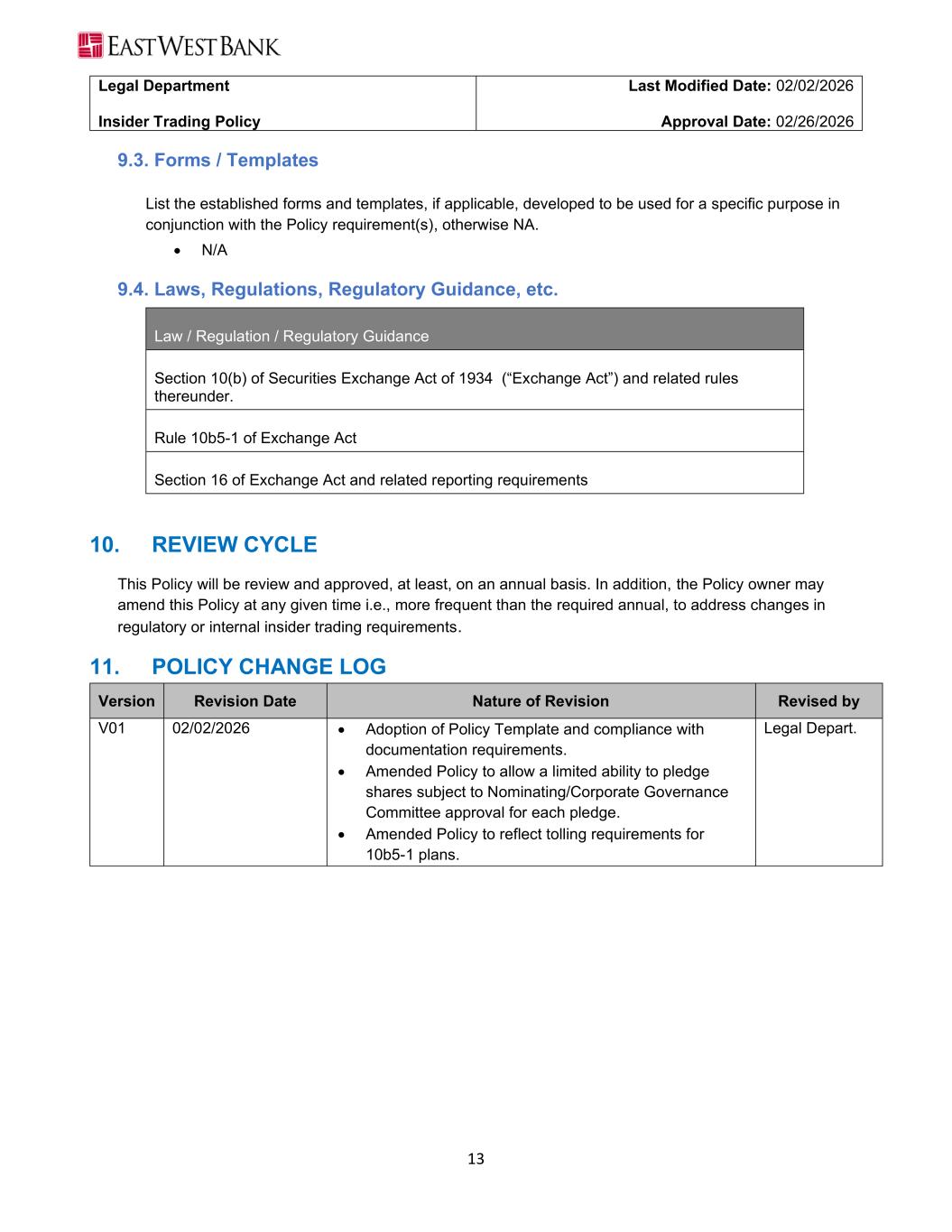
Legal Department Insider Trading Policy Last Modified Date: 02/02/2026 Approval Date: 02/26/2026 13 9.3. Forms / Templates List the established forms and templates, if applicable, developed to be used for a specific purpose in conjunction with the Policy requirement(s), otherwise NA. • N/A 9.4. Laws, Regulations, Regulatory Guidance, etc. Law / Regulation / Regulatory Guidance Section 10(b) of Securities Exchange Act of 1934 (“Exchange Act”) and related rules thereunder. Rule 10b5-1 of Exchange Act Section 16 of Exchange Act and related reporting requirements 10. REVIEW CYCLE This Policy will be review and approved, at least, on an annual basis. In addition, the Policy owner may amend this Policy at any given time i.e., more frequent than the required annual, to address changes in regulatory or internal insider trading requirements. 11. POLICY CHANGE LOG Version Revision Date Nature of Revision Revised by V01 02/02/2026 • Adoption of Policy Template and compliance with documentation requirements. • Amended Policy to allow a limited ability to pledge shares subject to Nominating/Corporate Governance Committee approval for each pledge. • Amended Policy to reflect tolling requirements for 10b5-1 plans. Legal Depart.