SECURITIES AND EXCHANGE COMMISSION
Washington, D.C. 20549
FORM 6-K
REPORT OF FOREIGN PRIVATE ISSUER PURSUANT
TO RULE 13A-16
OR 15D-16 OF THE SECURITIES EXCHANGE ACT OF 1934
For the month of March, 2026
(Commission File No. 1-14862 )
BRASKEM S.A.
(Exact Name as Specified in its Charter)
N/A
(Translation of registrant's name into English)
Rua Eteno, 1561, Polo Petroquimico de Camacari
Camacari, Bahia - CEP 42810-000 Brazil
(Address of principal executive offices)
Indicate by check mark whether the registrant
files or will file annual reports under cover Form 20-F or Form 40-F.
Form 20-F ___X___ Form 40-F ______
Indicate by check mark if the registrant is
submitting the Form 6-K
in paper as permitted by Regulation S-T Rule 101(b)(1). _____
Indicate by check mark if the registrant is
submitting the Form 6-K
in paper as permitted by Regulation S-T Rule 101(b)(7). _____
Indicate by check mark whether the
registrant by furnishing the information contained in this Form is also thereby furnishing the information to the Commission pursuant
to Rule 12g3-2(b) under the Securities Exchange Act of 1934.
Yes ______ No ___X___
If "Yes" is marked, indicate below the file number assigned to the registrant in connection with Rule 12g3-2(b): 82- _____.

SUMMARY
| 1. MESSAGE FROM MANAGEMENT | 4 |
| 2. OUTLOOK | 7 |
| 3. GLOBAL PETROCHEMICAL INDUSTRY 2025 | 8 |
| 4. OPERATING PERFORMANCE 2025 | 10 |
| 4.1 BRAZIL/SOUTH AMERICA | 10 |
| 4.1.1 OPERATIONAL OVERVIEW | 11 |
| 4.1.2 UPDATES ON ALAGOAS | 14 |
| 4.1.3 FINANCIAL OVERVIEW | 15 |
| 4.1.4 RENEWABLES | 17 |
| 4.2 UNITED STATES & EUROPE | 19 |
| 4.3 MEXICO | 22 |
| 5. CONSOLIDATED FINANCIAL OVERVIEW | 26 |
| 6. STRATEGY | 39 |
| RESILIENCE AND FINANCIAL HEALTH PROGRAM | 39 |
| TRANSFORMATION PROGRAM | 40 |
| 7. INVESTMENTS AND INITIATIVES IN RECYCLING | 41 |
| 8. ESG AGENDA – 2025 HIGHLIGHTS | 42 |
| 8.1 ENVIRONMENTAL | 43 |
| 8.1.1 CLIMATE CHANGE | 43 |
| 8.1.2 CIRCULAR ECONOMY | 43 |
| 8.2 SAFETY AND SOCIAL RESPONSIBILITY | 44 |
| 8.2.1 HEALTH & SAFETY | 44 |
| 8.2.2 SOCIAL RESPONSIBILITY AND HUMAN RIGHTS | 44 |
| 8.2.2.1 PEOPLE & ORGANIZATION | 44 |
| 8.2.2.2 CORPORATE SOCIAL RESPONSIBILITY | 47 |
| 8.3 GOVERNANCE | 47 |
| 8.3.1 CORPORATE GOVERNANCE | 47 |
| 8.3.2 OWNERSHIP INTERESTS - INCORPORATION, ACQUISITION OR SALE | 48 |
1
 |
| |
| 8.3.3 COMPLIANCE | 49 |
| 9. SUSTAINABLE INNOVATION | 49 |
| 10. CAPITAL MARKETS AND INVESTOR RELATIONS | 50 |
| 11. EXTERNAL AUDIT | 51 |
| 12. ATTACHMENT LISTING | 52 |
2
| |
| |
FORWARD-LOOKING STATEMENTS
This Management Report may contain forward-looking statements. These statements are not historical facts and are based on the current view and estimates of the Company's management regarding future economic and other circumstances, industry conditions, financial performance and results, including any potential or projected impact regarding the geological event in Alagoas and related legal procedures on the Company's business, financial condition and operating results. The words “project,” “believe,” “estimate,” “expect,” “plan,” “aim” and other similar expressions, when referring to the Company, are used to identify forward-looking statements. Statements related to the possible outcome of legal and administrative proceedings, implementation of operational and financing strategies and investment plans, guidance on future operations, the objective of expanding its efforts to achieve the sustainable macro goals disclosed by the Company, as well as factors or trends that affect the financial condition, liquidity or operating results of the Company are examples of forward-looking statements. Such statements reflect the current views of the Company's management and are subject to various risks and uncertainties, many of which are beyond the Company’s control. There is no guarantee that the events, trends or expected results will occur. The statements are based on various assumptions and factors, including, but not limited to, general economic and market conditions, industry conditions, operating factors, and availability, development and financial access to new technologies. Any change in these assumptions or factors, including the projected impact from the geological event in Alagoas and related legal proceedings and unprecedented impacts on businesses, employees, service providers, shareholders, investors and other stakeholders of the Company could cause actual results to differ significantly from current expectations. For a comprehensive description of the risks and other factors that could impact any forward-looking statements in this document, especially the factors discussed in the sections, see the reports filed with the Brazilian Securities and Exchange Commission (CVM). This Management Report is not an offer of securities for sale in Brazil. No securities may be offered or sold in Brazil without being registered or exempted from registration, and any public offering of securities in Brazil will be carried out by means of a prospectus that may be obtained from Braskem and which will contain detailed information on Braskem and management, as well as its financial statements.
3
| |
| |
MANAGEMENT REPORT
BRASKEM 2025
The Management of Braskem S.A. (“Braskem”) submits for your examination this Management Report and corresponding Financial Statements, accompanied by the opinions of the Independent Auditors and the Audit Board, for the fiscal year ended December 31, 2025.
| 1. | MESSAGE FROM MANAGEMENT |
The global economy is expected to grow by 3.2% in 2025, according to projections from the International Monetary Fund (IMF), in line with the growth seen in 2024 and still below previous trends due to an international scenario marked by persistent uncertainties. This performance reflects: (i) the ongoing trade tensions and increased geopolitical fragmentation, within a context of more interventionist and protectionist industrial policies; (ii) the partial reduction of effective tariffs in some regions and trade renegotiations, which have contributed to a slightly more favorable environment for international trade; (iii) the waning of temporary factors that boosted activity at the start of 2025, such as front-loading associated with the anticipation of operations ahead of tariff changes; (iv) the impetus from investments in technology, especially artificial intelligence (AI); (v) fiscal and monetary support, together with financial conditions that have favored consumption and investment; (vi) the structural slowdown of major economies, including China, whose projected growth for 2025 is 4.8%, influenced by factors such as trade uncertainties, the need for internal adjustments, and a more restrained pace of expansion; (vii) the moderate recovery of advanced economies, which are expected to grow by around 1.5%, influenced by inflation still above target in some regions, the impact of financial conditions, and geopolitical uncertainties; and (viii) the persistence of geopolitical tensions, which continue to pose risks to the global economy by increasing uncertainty and influencing expectations in financial markets, supply chains, and international trade.
In the global petrochemical scenario, in 2025, the level of spreads remained pressured, mainly due to the continuous entry of new PE and PP capacities throughout the year and the uncertainties regarding trade tensions between the United States and China. In addition, oil prices were mainly impacted by the economic uncertainty generated by the tariff war, in addition to the gradual resumption of production by OPEC+, which contributed to adjustments in global supply, which pressured resin price references in the international market.
Regarding Braskem's operational performance in 2025, the average utilization rate of Brazil's petrochemical complexes was 68%, lower than in 2024 mainly due to production adjustments in response to lower demand and the execution of scheduled maintenance shutdowns. The 68% level represents the lowest annual utilization rate recorded in Brazil since 2010. Meanwhile, the average PP utilization rate in the United States and Europe remained consistent with the percentage reported in 2024, representing the second consecutive year at the lowest level since 2010.
Braskem Idesa's operational performance was mainly impacted by the first general maintenance shutdown at the petrochemical complex since its construction. The maintenance operation involved approximately 3,000 people each day, all working under the most stringent safety protocols. The completion of the shutdown in 3Q25 coincided with the beginning of the ramp-up of the Puerto Mexico Chemical Terminal (“TQPM”), which was inaugurated in May 2025 and began supplying ethane, still during its commissioning phase, to Braskem Idesa in September 2025. The ethane supplied through TQPM, in addition to reducing costs associated with importing ethane through the Fast Track solution, allows Braskem Idesa to operate at a higher and more consistent utilization rate, since fluctuations in ethane supply by PEMEX impact Braskem Idesa's operations. In 2025, the average volume of ethane supplied by PEMEX was 17.1 thousand barrels per day, which is lower than the 28.9 thousand barrels per day supplied in 2024 and also below the minimum contractual volume of 30 thousand barrels per day. The volume of imported ethane totaled approximately 24.2 thousand barrels per day, considering the 8.3 thousand barrels per day (on an annual average) supplied by TQPM.
4
| |
| |
In the Brazilian chemical industry, according to preliminary data from the Brazilian Chemical Manufacturers' Association (ABIQUIM), the average utilization rate of installed capacities in the petrochemical industry in 2025 was 59%, representing the lowest utilization level in the past 19 years, mainly as a result of increasing global competition related to product oversupply and predatory dumping prices. Additionally, the trade balance deficit increased by about US$8.5 billion compared to 2024, totaling a deficit of US$72.4 billion in 2025 and threatening the competitiveness of the Brazilian industry.
In this scenario, Braskem reported Recurring EBITDA of US$557 million (R$3.2 billion) in 2025, lower in U.S. dollar (-49%) and in Brazilian real (-45%) compared to 2024, mainly due to a 77% reduction in gross profit, associated with lower spreads of main chemicals and resins in all of the Company's reportable segments, combined with lower sales volume in the Brazil/South America, and Mexico segments.
The Company's pre-debt cash consumption was R$7.3 billion, representing a 116% increase over the R$3.4 billion reported in 2024. This was primarily driven by a R$3.4 billion decrease in Recurring EBITDA during the year, as previously mentioned, and a R$3.0 billion increase in working capital consumption, mainly due to reduced availability of certain payment arrangements with financial institutions and suppliers. Additionally, in October 2025, Braskem drew down the available stand-by facility in the amount of US$1.0 billion to strengthen its liquidity in the face of the industry’s prolonged downturn cycle, in line with the Company’s conservative cash management. Thus, at the end of 2025, the Company's cash position totaled US$2.1 billion (R$11.5 billion).
Braskem's leverage ended the year 2025 at 14.74x, higher than the leverage of 7.42x recorded in 2024, mainly impacted by the reduction in the Company's EBITDA.
Additionally, in September 2025, Braskem engaged financial and legal advisors to assist the Company in preparing an assessment of economic and financial alternatives to optimize its capital structure, given the realization that the downturn cycle is lasting longer than previously expected.
In parallel, and considering all the challenges previously mentioned, Braskem implemented, throughout 2025, initiatives associated with its Global Resilience and Transformation Program, mainly aimed at sustainable value generation, maximization of EBITDA, and mitigation of cash consumption in the face of the prolonged downturn in the Brazilian chemical industry.
The Resilience Program is structured around two pillars: (i) initiatives with an impact on short-term EBITDA and short-term cash generation; and (ii) actions to defend the competitiveness of the Brazilian chemical industry.
Within the pillar of initiatives with impact on EBITDA and cash generation, over 70 action plans have been established globally, comprising more than 700 initiatives distributed across six action fronts: (i) institutional agenda; (ii) commercial; (iii) asset monetization; (iv) supplier negotiations; (v) capital employed optimization; and (vi) operational optimization.
Within the pillar of actions to defend the competitiveness of the Brazilian chemical industry, the following advances stand out:
| (i) | The publication of Law No. 15,294, of December 19, 2025, which establishes the Special Chemical Industry Sustainability Program ("PRESIQ") and establishes a tax incentive regime aimed at promoting the sustainability and competitiveness of the sector, effective from January 1, 2027 to December 31, 2031. In addition, the approval on March 20, 2025 of Complementary Law No. 228, providing for the increase, from 0.73% to 5.8%, of the benefit of the Special Regime for the Chemical Industry ("REIQ"). |
| (ii) | The approval by the Executive Management Committee of the Foreign Trade Chamber (GECEX) of the application of provisional antidumping duties on imports of PE resins from the United States and Canada. This measure was adopted based on investigations that identified dumping practices by foreign producers, with prices significantly lower than those normally prevailing in their home markets, causing losses to the Brazilian industry. |
5
| |
| |
| (iii) | The approval by GECEX of the 20% import duty rate for PE, PP, and PVC products marketed by the Company. This measure contributes to mitigating the effects of international competition under unfavorable conditions of global product oversupply, promoting greater competitive balance and strengthening the Brazilian production chain. |
The Transformation Program, in turn, is focused on ensuring the perpetuity of the business through initiatives aimed at enhancing competitiveness. The Program is structured around three pillars: (i) naphtha-based optimization; (ii) gas-based expansion and flexibility; and (iii) migration to renewables. During 2025, the following advances stand out:
| (i) | Naphtha-based optimization: comprises the implementation of the strategy for the naphtha-based assets, aiming for greater profitability and cash generation. In September 2025, the Company, within the scope of the Transforma Alagoas initiative—which aims to make PVC production more competitive and sustainable—completed the conversion of this unit into a logistics facility dedicated to handling large volumes of ethylene dichloride (EDC), a feedstock used in PVC production. As part of this transformation, chlorine and caustic soda production was hibernated and part of the infrastructure was redirected to logistics operations, expanding flexibility and industrial integration. |
| (ii) | Gas-based expansion and flexibility: (i) enabling projects to increase gas-based capacity (ethane/propane/HLR); (ii) expansion of the flexibility of petrochemical complexes in Brazil; and (iii) assurance of operational stability through stable supply and receipt of feedstock. This pillar includes the Transforma Rio project, announced in 2025, which aims to expand the capacity of the Rio de Janeiro petrochemical complex by 220 thousand tons of ethylene per year and equivalent volumes of PE, with completion expected in 2028. |
| (iii) | Migration to products with renewable sources: aims to expand its production capacity to 1 million tons per year by 2030. Among the initiatives in progress, the following stand out: (i) the Sustainea joint venture, in partnership with Sojitz, which is studying the construction of plants for the production of MEG (monoethylene glycol) from renewable sources ("bioMEG") and MPG (monopropylene glycol) from renewable sources ("bioMPG"), currently in the scope and engineering development phase; (ii) the joint venture Braskem Siam, in partnership with SCG Chemicals, which evaluates the construction of the first green ethylene plant outside Brazil, in Thailand. The project advanced in 2025 in the engineering detailing phase, in addition to advances related to ethanol supply agreements with local players. |
Safety remains a non-negotiable value for Braskem in all its operations, regardless of location. In 2025, its global recordable and lost-time injury frequency rate stood at 0.80 events per million hours worked, which is below the industry average. Also, the frequency rate of Tier 1 and Tier 2 process safety events was 0.12 events per million hours worked.
Regarding the geological event in Alagoas, Braskem continued to advance in fulfilling the commitments related to Maceió. In November 2025, Braskem and the State of Alagoas entered into an agreement related to the geological event that occurred in Alagoas (“State Agreement”), providing for a total payment of R$1.2 billion, of which R$139 million (adjusted to current values) had already been paid, and R$467 million had already been provisioned. The remaining balance is to be settled in 10 variable annual installments, primarily adjusted after 2030. During 2025, approximately R$1.4 billion was paid in relation to the event, and the provision balance closed the year at R$3.5 billion. Braskem continues to demonstrate its dedication to meeting the commitments established in the Maceió agreements.
6
| |
| |
Acknowledgments:
The Management would once again like to thank the Shareholders for the trust they have placed in Braskem, as well as the Clients, Partners and Suppliers, who are essential to our ongoing pursuit of solutions through chemistry and plastics to improve people's lives.
The Management would also like to express special thanks to the Braskem team for their dedication and competence throughout yet another challenging year. Without question, the efforts and proactive contributions of our team are essential to driving sustainable value creation and ensuring Braskem's continued resilience.
| 2. | OUTLOOK |
The IMF's January 2026 projections indicate a 3.3% growth for the global GDP in 2026, higher than forecasted in October 2025 (+0.2 p.p.). Technology-driven investments, fiscal and monetary support, and accommodative financial conditions continue to sustain activity, especially in North America and Asia. On the other hand, changes in trade policies and persistent political uncertainty continue to pose significant obstacles.
Additionally, the IMF expects global disinflation to continue, with 3.8% in 2026 and 3.4% in 2027, gradually converging toward targets in most major economies. This reduction continues to be supported by contractionary monetary policies and lower energy prices.
In this context, the main risks identified by the IMF's assessment are related to productivity expectations associated with AI, geopolitical tensions, uncertainties and emerging trade frictions, and the persistence of large fiscal deficits and public debt. These factors could disrupt supply chains, increase long-term interest rates, and heighten uncertainty.
As for the global petrochemical scenario, external consulting firms anticipate that in 2026 the spread will be similar to 2025, due to the new capacities coming into operation, with around 7 million tons for PE and around 5 million tons for PP. Geopolitical conflicts, such as those between the United States and Iran, can pose risks associated with demand destruction due to potential increases in inflation. However, they can also offer potential benefits, such as higher international resin price parity and the acceleration of rationalization processes for less competitive capacities. These factors may positively affect global operating rates and, consequently, petrochemical spreads. Additionally, the U.S.–Iran conflict may also generate disruptions in global energy and petrochemical markets, mainly due to the risk of a closure of the Strait of Hormuz, through which 30% of the world’s oil supply flows, with direct impacts on oil prices, exchange rates, inflation, and global economic growth. The disruption would particularly affect Asia and Europe, increasing prices of naphtha, natural gas, and petrochemicals, reducing operating rates, pressuring global supply chains, raising freight costs, and prompting competitive shifts between ethane-based and naphtha-based assets.
The expected spending on corporate investments (ex-Braskem Idesa and ex-REIQ Investimento) for 2026 is US$465 million (R$2.6 billion), mainly allocated to operational initiatives focused on the integrity and safety of the Company's assets, including scheduled shutdowns and pit-stops for maintenance of its operational units.
Finally, the Company's focus for 2026 is directed towards: (i) optimizing its capital structure; (ii) advancing the implementation of the Transformation Plan initiatives, ensuring the necessary resources to support growth projects; (iii) implementing contingency measures for the petrochemical cycle, with an emphasis on financial preservation and cash flow; (iv) accelerating the growth of biopolymers through strategic and financial partnerships; and (v) fulfilling the commitments established in the agreements executed in Maceió.
7
| |
| |
| 3. | GLOBAL PETROCHEMICAL INDUSTRY 2025 |
8
| |
| |
BRAZIL/SOUTH AMERICA
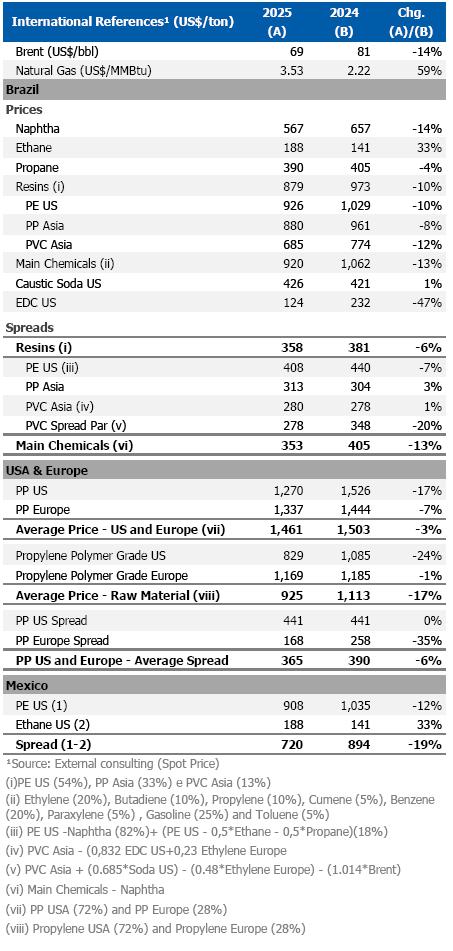
PE Spread[1]: decreased from 2024 (-7%).
| o | The PE price fell by 10%, mainly due to: (i) the increase in supply during the year; and (ii) the reduction of sea freight, which was higher in 2024, due to the conflicts in the Red Sea. |
PP Spread[2]: increased from 2024 (+3%).
| o | The price of naphtha decreased by 14%, primarily due to: (i) a 14% drop in oil prices, which was influenced by the greater supply in the period, associated with the increase in production levels during the year. |
PVC Par Spread[3]: decreased from 2024 (-20%).
| o | The lower PVC price was attributed to the reduction in demand from the civil construction sector, due to global interest rates, offset by the reduction in oil prices. |
PVC Spread[4]: in line with 2024.
| o | The PVC Spread remained in line, mainly due to the lower (-12%) Asia PVC price (-12%), mentioned previously, partially offset by the reduction in the EDC price (-47%). |
Spread on Main Basic Chemicals[5]: decreased from 2024 (-13%).
| o | The spread of main basic chemicals was lower, mainly due to: (i) a reduction in the prices of main chemicals (-13%) as a result of the lower price of propylene (-24%) in the international market, explained mainly by the increased supply of propylene in the United States, and by the reduced demand for PP during the period; (ii) a reduction in the price of butadiene (-17%), mainly due to lower demand from the automotive sector; (iii) a reduction in the price of benzene (-24%), mainly due to oversupply in the United States and by lower prices of oil and naphtha; and (iv) a reduction in gasoline (-11%), explained mainly by the lower price of oil (-14%) during the period. |
UNITED STATES & EUROPE
PP Spread US[6]: remained in line with 2024.
| o | The PP price in the United States decreased (-17%), mainly due to the reduction in the price of propylene, explained by the increase in supply during the year, mainly as a result of the normalization of utilization rates in the region during the period. |
| o | Propylene price in the United States decreased (-24%), mainly due to an increase in the supply of propene. |
PP Spread Europe[7]: decreased from 2024 (-34%).
1 (U.S. PE Price – naphtha ARA price)*82%+(U.S. PE Price – 50% U.S. ethane price – 50% U.S. propane price)*18%.
2 Asia PP price – ARA naphtha price.
3 The PVC Par spread better reflects the profitability of the Vinyls business, which is more profitable compared to the temporary/non-integrated business model of 2019/20, when the Company imported EDC and caustic soda to serve its clients. Its calculation formula is: Asia PVC Price + (0.685*U.S. Caustic Soda) - (0.48*Europe Ethylene) - (1.014*Brent).
4 PVC Asia - (0.832 EDC USA+0.23 Ethylene EU)
[5] Average price of main chemicals (Ethylene (20%), Butadiene (10%), Propylene (10%), Cumene (5%), Benzene (20%), Paraxylene (5%), Gasoline (25%) and Toluene (5%), based on Braskem’s sales mix) – ARA naphtha price.
[6] US PP Price - US Propene
[7] EU PP Price - EU Propene
9
| |
| |
| o | The PP price in Europe decreased (-7%), mainly explained by lower demand from the construction, home appliance, and automotive sectors during the period. |
MEXICO
PE Spread North America[8]: decreased from 2024 (-19%).
The PE price decreased (-12%), mainly due to the oversupply of this product in the year, and the reduction in sea freight, which was higher in 2024, due to the conflicts in the Red Sea.
| o | The price of ethane increased (+33%) compared to the previous year, primarily as a result, of the increase in the price of natural gas and the higher demand for ethane in the period. |
| 4. | OPERATING PERFORMANCE 2025 |
4.1 BRAZIL/SOUTH AMERICA
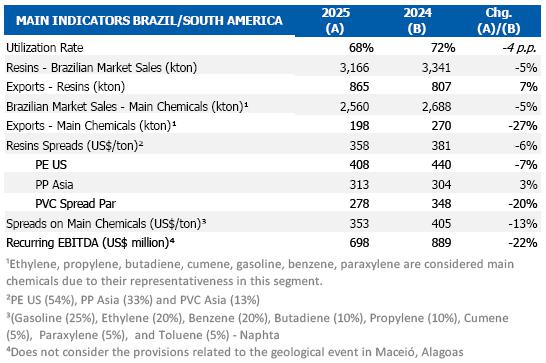
The Recurring EBITDA for the Brazil/South America segment decreased (-22%) compared to 2024, totaling US$698 million (R$3.9 billions) in 2025. The reduction is primarily explained by: (i) lower demand and sales volumes of resins and main chemicals in the Brazilian market; (ii) the extended downturn cycle, which has put downward pressure on the average international benchmarks for resins and main chemicals; and (iii) a decrease in the utilization rate of petrochemical complexes, resulting from adjustments to demand levels and the scheduled maintenance shutdown of the Bahia petrochemical complex, which was completed in January 2026. The decrease was partially offset by: (i) an increased volume of resin exports; and (ii) the positive effect of recognizing presumed PIS/COFINS credits under the REIQ Investimento program.
[8] US PE Price – US Ethane
10
| |
| |
4.1.1 OPERATIONAL OVERVIEW
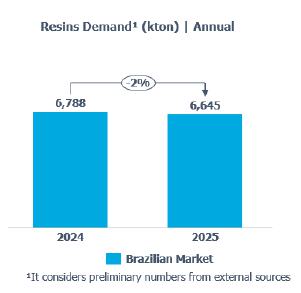
a) Demand for thermoplastic resins (PE+PP+PVC): lower (-2%) compared to 2024, mainly due to reduced demand for: (i) PP (-6%), primarily influenced by the durable consumer goods sector; and (ii) PE (-2%), mainly affected by the construction, automotive, and home appliance sectors. These effects were partially offset by higher PVC demand (+3%), mainly driven by the construction sector.
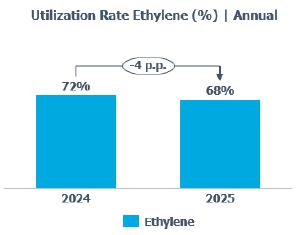
b) Utilization rate of petrochemical plants: In relation to 2024, the reduction (-4 p.p.) is mainly explained by (i) the adequacy of production levels in view of the lower demand in the period; and (ii) scheduled maintenance shutdown at the Bahia petrochemical plant, completed in January 2026.
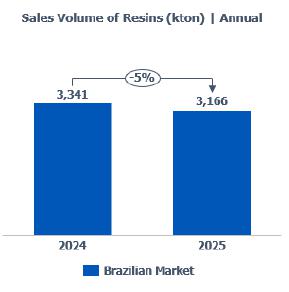
c) Resin Sales: the volume of sales of resins in 2025 was lower (-5%), mainly explained by the lower volume of sales of PP (-8%), PVC (-7%) and PE (-3%) mainly due to (i) the strategy of prioritizing sales with higher added value; and (ii) the lower sales volume of PP and PE due to lower demand in the Brazilian market by -3%.
11
| |
| |
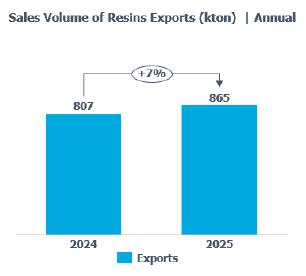
The higher volume of resin exports (+7%) compared to 2024 is mainly explained by the higher export volume of PE (+11%) and PP (+10%) to South America, due to the greater availability of products given the lower demand in the Brazilian market by 3%.
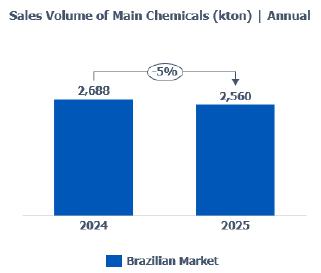
d) Sales of main chemicals: Compared to 2024, the reduction (-5%) is mainly explained by the lower sales volume of propylene, cumene, ethylene and paraxylene, due to the lower demand in the period, given the optimization of customers' operating rates in the Brazilian market.
12
| |
| |
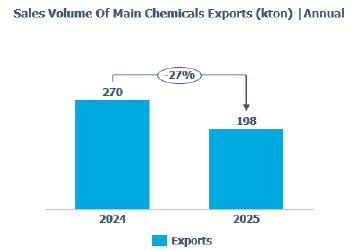
The reduction in the volume of exports of main chemicals (-27%) compared to the previous year is mainly explained by the lower volume of exports of (i) gasoline, due to the prioritization of serving the Brazilian market; (ii) benzene, impacted by U.S. import tariffs; and (iii) toluene, due to the lower demand related to the greater supply of substitute products in the Brazilian market.
13
| |
| |
4.1.2 UPDATES ON ALAGOAS
The provision for the geological event in Alagoas, based on current estimates and assumptions and on the opinions of external advisors, considering the short and long-term effects, and the best estimate of the costs for the implementation of the various measures, showed the following movement at the end of 2025:
| Balance of the Alagoas geological event's provision (R$ million) |
2025 | 2024 | ||
| Balance at the beginning of the period | 5,570 | 5,240 | ||
| Provision Additions (Reversal)[9] | 320 | 2,237 | ||
| Payments and Reclassifications[10] | (2,594) | (2,052) | ||
| Realization of present value adjustment | 207 | 145 | ||
| Balance at the end of the period | 3,503 | 5,570 |
Until December 31, 2025, the main advances on the fronts of action in Maceió were:
| (i) | Financial Compensation Program (FCP): 99,9% (19.201) of the proposals presented, with about 99,5% of proposals paid. |
| (ii) | Closing and Monitoring of salt cavities: the Closure Plan of the 35 Cavities considers 18 cavities with the provision of priority filling with solid material, with 6 cavities already having the filling completed, 4 cavities have reached the technical filling limit, 6 cavities are in the filling process in progress and for the remaining 2 cavities, the activities are in the preparation and planning phase. Additionally, 6 cavities were filled naturally, with confirmation approved by the ANM (National Mining Agency). Another 11 cavities remain within the salt layer and suitable for pressurization, since the Company considers filling them with solid material, in the long term and after the conclusion of the current filling plan, in order to achieve a maintenance-free state for the 35 cavities, suitable for the definitive closure of the field. |
| (iii) | Socio-urban measures: 11 projects were defined for urban mobility, 6 of which were completed, 3 in progress and 2 in the planning phase. |
On November 10, 2025, Braskem and the State of Alagoas entered into the State Agreement, providing for a total payment of R$ 1.2 billion, of which R$ 139 million (on an updated basis) had already been paid. The balance must be paid in 10 adjusted variable annual installments, mainly after 2030. The Company had previously recorded a provision of R$ 467 million for compensation of property damages to the State of Alagoas. The State Agreement establishes compensation, indemnification and/or reimbursement to the State of Alagoas for the full reparation of all property and non-property damages at the state level and grants the Company full discharge from any damages arising from and/or related to the geological event in Alagoas, including the termination of the State of Alagoas’ indemnification lawsuit.
[9] The variation in the provision for the fiscal year ended December 31, 2025 mainly refers to: (i) the signing of the Instrument of Agreement with the State of Alagoas in 3Q25, reversals resulting from updated cost estimates for the action fronts undertaken in Alagoas, and the update of the present value adjustment due to the remeasurement of the discount rate and revised estimates of disbursements over the years. In the fiscal year 2024, the variation in the provision was mainly caused by the update of cost estimates related to the closing of mining areas, the implementation and advancement in the maturity of projects, and initiatives and programs present in Alagoas, and includes inflation/foreign exchange adjustment of R$ 4 million reported under Financial expenses.
[10] Of the total amount by the end of December, 2025, R$ 1.4 billion refers to payments made and R$ 1.2 billion refers to reclassifications made to Other liabilities, which totals a balance of R$ 1,4 referring to accounts payable for the Geological event of Alagoas.
14
| |
| |
For more information on the progress made on the fronts of action in Alagoas during the year, see annex 11.1 of this document.
4.1.3 FINANCIAL OVERVIEW
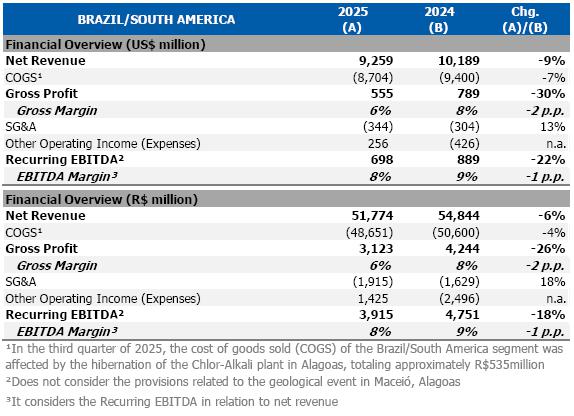
A) NET REVENUE: In January 2025, REIQ Investiments program was announced, which consists of a presumed credit of 1.5% of PIS/COFINS linked to investments in the Brazilian chemical industry. In this context, Braskem advanced its capacity expansion projects throughout the year, and in the fiscal year 2025, Net Revenue was positively impacted by approximately US$59 million (R$327 million) as a result of presumed PIS/COFINS credits under the REIQ Investiments program.
Additionally, in 2025 Net Revenue was positively impacted by approximately (i) US$47 million (R$256 million) due to the recognition of additional PIS/COFINS credits related to REIQ Investments, to projects already approved under REIQ Investments, calculated in accordance with current legislation; and (ii) US$ 23 million (R$125 million) related to PIS/COFINS credits for the current year related to the CIDE-Fuels deduction due to gasoline trading. This credit may be made through the deduction of PIS/COFINS payable or via offsetting with federal taxes, according to applicable legislation.
Excluding these effects, the decrease compared to 2024, both in U.S. dollar (-10%) and in Brazilian real (-7%), is mainly attributable to: (i) a reduction of 5%, or 175 thousand tons, in the sales volume of resins in the Brazilian market; (ii) a 13% decrease in the average international benchmark price of main chemicals; (iii) a reduction of 5%, or 128 thousand tons, in the sales volume of main chemicals in the Brazilian market; (iv) a 10% decrease in the average international benchmark price of resins; and (v) a reduction of 27%, or 72 thousand tons, in the export volume of main chemicals to the international market.
15
| |
| |
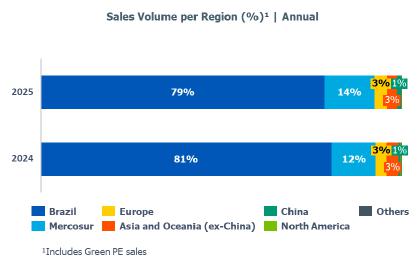
Sales by region (% in tons)
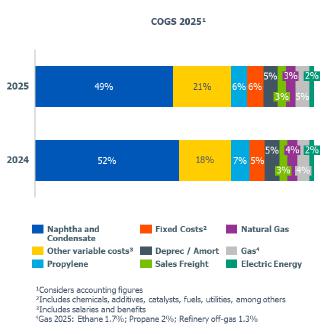
B) COST OF GOODS SOLD (COGS): In 2025, the COGS for the Brazil/South America segment was impacted by the provision for the hibernation of the chlor-alkali plant in Alagoas, as part of the Transforma Alagoas initiative, which aims to make PVC production more competitive and sustainable, by approximately US$100 million (R$546 million), with no impact on the segment's Recurring EBITDA.
Excluding the aforementioned effect, the decrease in U.S. dollar (-8%) and in Brazilian real (-5%) is primarily attributable to: (i) a reduction of 14% and 4% in international benchmark prices for naphtha and propane, respectively; (ii) a 5% decrease, or 175 thousand tons, in the sales volume of resins in the Brazilian market; (iii) a 5% decrease, or 128 thousand tons, in the sales volume of main chemicals in the Brazilian market; and (iv) the Company's initiatives to reduce fixed costs during the period.
Additionally, during 2025, COGS was positively impacted by PIS/COFINS tax credits on the purchase of feedstock (REIQ) amounting to approximately US$46 million (R$273 million) and by Reintegra tax credits of US$1.5 million (R$8.4 million).
16
| |
| |
C) SG&A EXPENSES: In the year, the increase in U.S. dollars (+13%) and in Brazilian real (+18%) is primarily due to the recognition of approximately US$21 million (R$110 million) in provisions for expected credit losses for 2025, compared to the reversal of approximately US$19 million (R$107 million) in 2024.
Excluding this effect, Selling, General and Administrative Expenses remained consistent with 2024, reflecting the Company's efforts in fixed cost reduction initiatives during the period.
D) OTHER REVENUE (EXPENSE), NET: revenue of US$325 million (R$1,8 billion) in 2025 mainly due to:
| (i) | the recovery of PIS/COFINS tax credits related to the deduction of Cide-Fuels in the sale of gasoline of about US$310 million (R$1.7 billion). |
| (ii) | for the recovery of approximately US$51 million (R$275 million) due to the recognition of additional PIS/COFINS credits related to projects already approved under REIQ Investments, calculated in accordance with current legislation; |
| (iii) | the effect of the recognition of the PIS/COFINS credit in the amount of approximately US$53 million (R$293 million) in 2Q25; |
| (iv) | from the recovery of taxes on the purchase of feedstock, totaling approximately US$25 million (R$141 million); and |
| (v) | for receiving insurance of about US$13 million (R$59 million). |
These impacts were partially offset by:
| (i) | the net increase during the year in the provision for the geological event in Alagoas by approximately US$62 million (R$324 million) mainly due to the advance in the maturity of the estimates of expenses with public equipment and the updating of other obligations of the Company; |
| (ii) | the hibernation of the chlorine-alkali plant in Alagoas, within the scope of Transforma Alagoas, with the objective of making PVC production more competitive and sustainable, with an impact of around US$47 million (R$253 million) in 3Q25; |
| (iii) | the discount related to the sale of credit rights of approximately US$39 million (R$208 million) in 3Q25; |
| (iv) | the annual review of the net environmental provisions of the industrial units located in Brazil in the amount of about US$24 million (R$130 million). |
Of the total amount recorded in other income and expenses, the value of approximately US$-12 million (R$-65 million) impacted the segment's Recurring EBITDA in 2025.
17
| |
| |
E) RECURRING EBITDA: totaled US$698 million (R$3.9 billion) in 2025, 22% lower than in 2024 in comparison to dollars.
4.1.4 RENEWABLES
Operational Overview
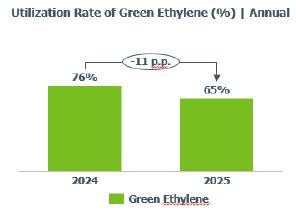
a) Green Ethylene Utilization Rate: compared to 2024, the reduction (-11 p.p.) is mainly explained by (i) unscheduled shutdown due to an electrical failure at the power substation in Rio Grande do Sul in 1Q25; and (ii) optimization of Green PE inventory levels.
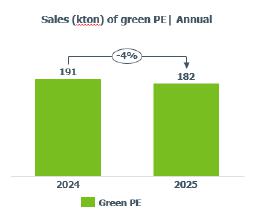
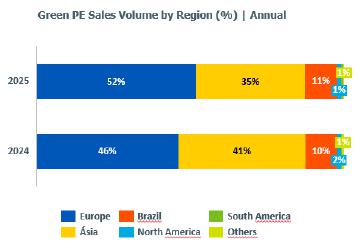
b) Sales Volume of Green PE (I’m greenTM bio-based): The reduction (-4%) is mainly explained by lower demand associated with higher inventory build-up by customers at the end of 2024, combined with unfavorable macroeconomic conditions in 2025.
18
| |
| |
Financial Overview
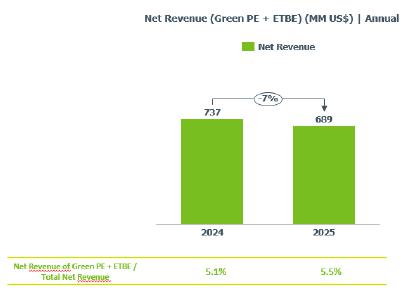
A) NET SALES REVENUE OF I’M GREENTM BIO-BASED PE + ETBE[11]: The decrease (-7%) is mainly explained by a reduction of 8.4 thousand tons, or 4%, in the sales volume of I’m greenTM bio-based PE.
11 Product that contains renewable feedstock, ethanol
19
| |
| |
4.2 UNITED STATES & EUROPE
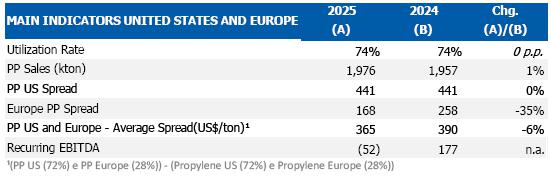
Recurring EBITDA in the United States & Europe segment was negative US$52 million in 2025. The result is explained primarily by: (i) the decrease in international PP benchmark prices in the United States (-17%) and Europe (-7%); and (ii) the higher SG&A expenses, mainly due to the reclassification of costs that were previously recorded under 'Corporate Unit' and expenses related to logistics, personnel, and third-party services.
4.2.1 OPERATIONAL OVERVIEW
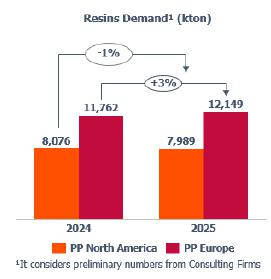
a) Resin demand: In North America, PP demand remained steady (-1%), primarily due to the optimization of inventory levels throughout the processing chain in the region, as well as the maintenance of demand levels compared to the previous year.
In Europe, PP demand was higher (+3%) than in 2024, mainly due to the anticipation of purchases in the processing chain during 4Q25. This was driven by a 7% decrease in the PP price in Europe, along with increased production capacity in China during the period, which led to higher import volumes into Europe.
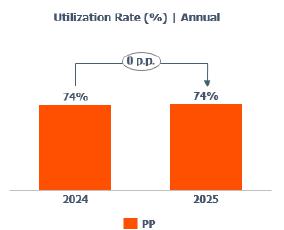
b) Average utilization rate of PP plants: In the annual comparison, the utilization rate remained in line.
20
| |
| |
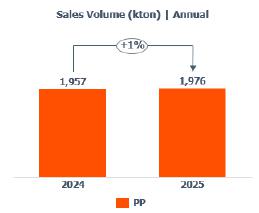
c) Sales volume: Compared to 2024, the volume of sales of PP remained in line
21
| |
| |
4.2.2 FINANCIAL OVERVIEW
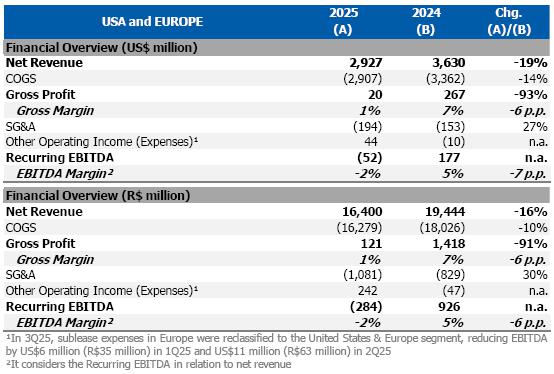
A) NET REVENUE: lower in U.S. dollar (-19%) and in Brazilian real (-16%) mainly due to the 17% and 7% decrease in international PP benchmark prices in the United States and Europe, respectively.
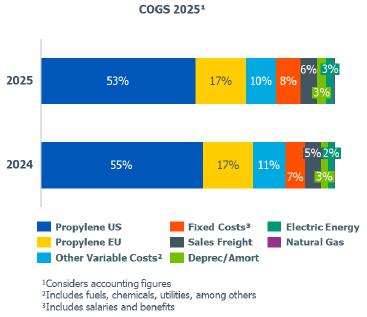
B) COST OF GOODS SOLD (COGS): lower in U.S. dollar (-14%) and in Brazilian real (-10%) mainly due to the reduction of 24% and 1% in international benchmark prices for propylene in the United States and Europe, respectively. These effects were partially offset by commercial expenses associated with the ethane resale operation in the international market. The portion of revenue from this operation impacted on the Other Revenue line item.
C) SG&A EXPENSES: Since 2Q25, due to changes in the organizational structure, the Company has reclassified part of the expenses that were previously classified under "Corporate Unit" to the reportable business segments. Due to this effect, the United States & Europe Segment was impacted by approximately US$25 million (R$139 million) during 2025.
22
| |
| |
Excluding this effect, the increase in U.S. dollar (+11%) and in Brazilian real (+14%) is mainly due to higher expenses related to logistics, personnel, and third-party services.
D) OTHER REVENUE (EXPENSE), NET: revenue of US$44 million (R$242 million) mainly due to (i) revenue related to the ethane resale operation in the international market; and (ii) the sale of logistics railcars in the United States, of approximately US$5 million (R$32 million).
E) RECURRING EBITDA: Recurring EBITDA was negative at US$52 million (R$284 million), lower than in 2024.
4.3 MEXICO
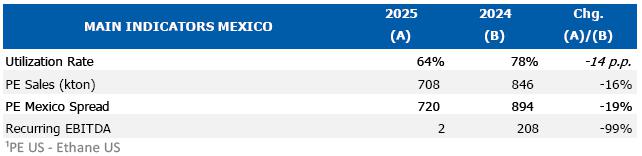
Recurring EBITDA was US$2 million (R$31 million), lower than in 2024. This reduction is mainly explained by (i) a reduction of 138 thousand tons, or 16%, in the volume of PE sales in the year, due to the lower availability of product for sale in 2Q25 and 3Q25, due to the general maintenance shutdown carried out in these quarters; and (ii) a 19% reduction in the PE spread, mainly explained by the increase in the price of ethane.
4.3.1 OPERATIONAL OVERVIEW
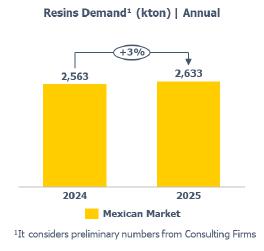
a) Demand for PE in the Mexican market: Resin demand in the Mexican market increased (+3%) compared to 2024, mainly due to the increase in inventory formation in the chain related to (i) tariff uncertainties in the United States; and (ii) the expectations of an increase in PE prices.
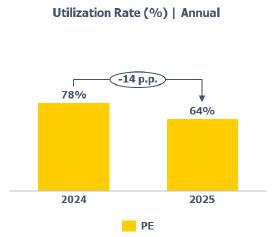
b) Average utilization rate of PE plants: compared to 2024, the reduction (-14 p.p.) in the utilization rate of the PE plants is mainly explained by the general scheduled maintenance shutdown at Braskem Idesa's petrochemical plant in 2Q25 and 3Q25.
23
| |
| |
In 2025, the average volume of ethane supplied by PEMEX was 17.1 thousand barrels per day, below the volume supplied in 2024 of 28.9 thousand barrels per day and below the minimum contractual volume of 30 thousand barrels per day.
Additionally, in May 2025, the Puerto Mexico Chemical Terminal ("TQPM") was inaugurated, which started supplying ethane, still in commissioning, to Braskem Idesa in September 2025. Thus, the volume of imported ethane totaled about 24.2 thousand barrels per day, considering the 8.3 thousand barrels per day (on an annual average) supplied by TQPM and 15.9 thousand barrels per day supplied through the Fast Track solution.
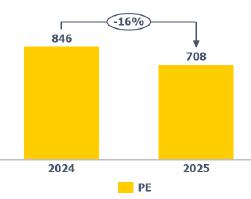
c) Sales volume: compared to 2024, the volume of PE sales was lower (-16%) explained by the lower availability of products for sale in 2Q25 and 3Q25 due to the general maintenance shutdown carried out in these quarters.
24
| |
| |
4.3.2 FINANCIAL OVERVIEW
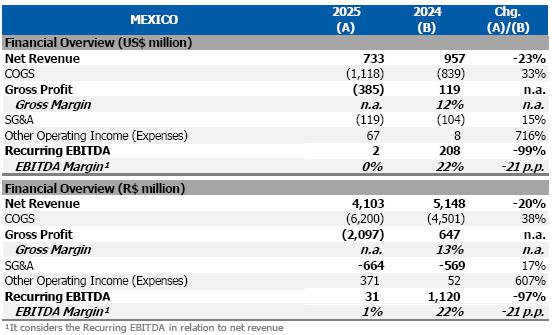
A) NET REVENUE: lower in dollars (-23%) and in reais (-20%) compared to 2024 mainly due to (i) the reduction of 138 thousand tons, or 16%, volume of PE sales; and (ii) the 12% reduction in the international PE price reference of the United States in the period.
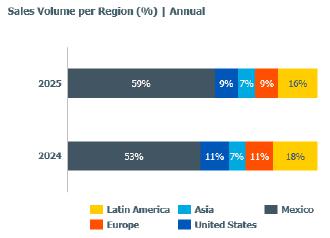
Sales by region (%)
B) COST OF GOODS SOLD (COGS): in 2025, the COGS of the Mexico segment was negatively impacted by US$272 million (R$1.5 billion) related to the recording of impairment loss, after the identification that the recoverable amounts of Braskem Idesa's assets were lower than the respective book values.
Excluding the above effect, the COGS of the Mexico segment remained in line compared to 2024 in the comparison in dollars. The increase in reais (+5%) is mainly explained by the depreciation of the average Brazilian real against the average dollar of 4% in the period.
25
| |
| |
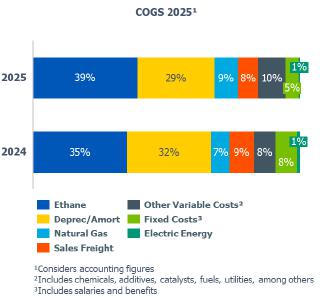
C) SG&A EXPENSES: the increase in U.S. dollar (+15%) and in Brazilian real (+17%) compared to 2024 is mainly due to: (i) higher storage costs as a result of the scheduled shutdown of the Braskem Idesa petrochemical complex during 2Q25 and 3Q25; and (ii) higher expenses related to the ethane resale operation. The portion of revenue from this operation impacted on the Other Revenue line.
D) OTHER REVENUE (EXPENSE), NET: In the year, net revenue totaled US$67 million (R$371 million), primarily due to: (i) the recognition of contractual penalties receivable related to delays in the construction of the ethane import terminal, amounting to approximately US$41 million (R$225 million); and (ii) revenue generated from ethane resale operations during the year.
E) RECURRING EBITDA: in the year, the Recurring EBITDA for the Mexico segment was negative at US$2 million (R$31 million), lower than in 2024.
4.3.3 ETHANE IMPORT TERMINAL
In May 2025, the construction project for the ethane import terminal in Mexico was completed through the subsidiary Terminal Química Puerto México ("TQPM"), a joint venture between Braskem Idesa and Advario, with a 50% stake for each shareholder.
The terminal has the capacity to import up to 80,000 barrels of ethane/day, which is equivalent to 120% of Braskem Idesa's ethane requirement to operate at its maximum capacity. The connection between the terminal and the Mexican Petrochemical Complex is carried out through pipelines and the terminal has 2 tanks with a storage capacity of approximately 50 thousand m³ of ethane each, equivalent to approximately 12 days of stock.
The terminal went into commissioning in September 2025 and started to supply ethane to Braskem Idesa, reducing imports through the Fast Track solution and dependence on ethane supplied by PEMEX, which in 2025 was below the contractual minimum.
26
| |
| |
| 5. | CONSOLIDATED FINANCIAL OVERVIEW |
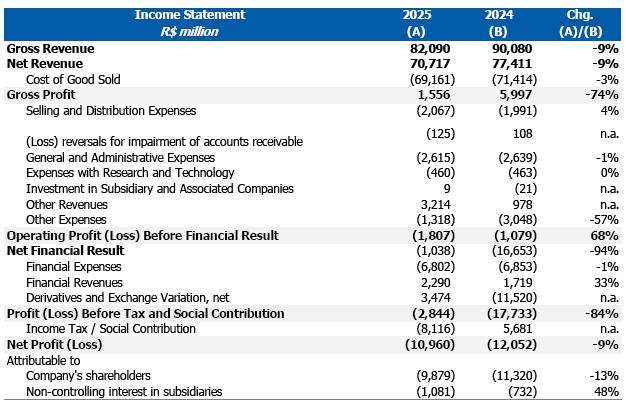
NET REVENUE BY REGION
27
| |
| |
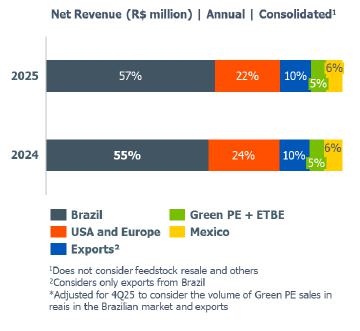
CPV CONSOLIDATED
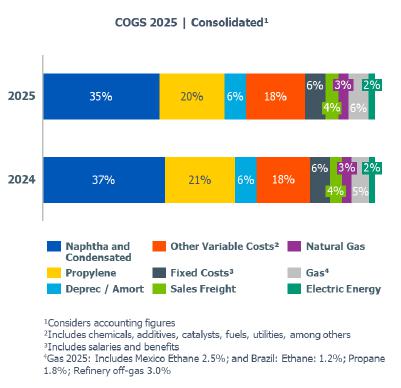
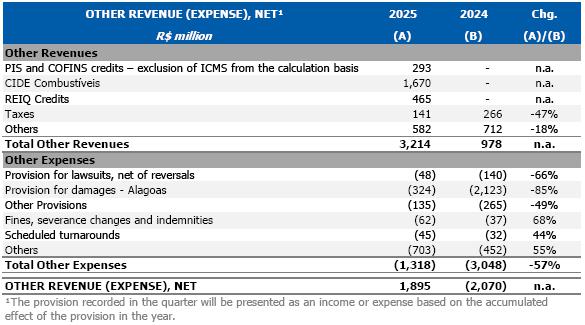
OTHER NET INCOME (EXPENSES) – ORD
In 2025, the Company recorded a total net revenue of R$1.9 billion, mainly due to:
| (i) | the recovery of PIS/COFINS tax credit related to the deduction of Cide-Fuels in the sale of gasoline of about US$310 million (R$1.7 billion) |
| (ii) | the effect of the recognition of the PIS/COFINS credit in the amount of about US$52 million (R$293 million). |
| (iii) | the net recovery of approximately US$51 million (R$275 million) due to the recognition of additional PIS/COFINS credits related to projects already approved under REIQ Investimentos, calculated in accordance with current legislation; |
| (iv) | the provisions of the contractual fine to be received on the delay in the construction of the ethane import terminal in Mexico of about US$41 million (R$225 million); |
| (v) | the net recovery of approximately US$30 million (R$161 million) in presumed PIS/COFINS credits under the Industrial REIQ related to the abrupt suspension of the benefit in July 2022 in disagreement with the National Tax Code; |
| (vi) | the recovery of taxes on the purchase of inputs of about US$25 million (R$141 million); |
| (vii) | for receiving insurance of about US$13 million (R$59 million); |
| (viii) | the adjustment in the appraisal report regarding the sale of Cetrel, of about US$7 million (R$43 million); and |
| (ix) | of the sale of logistics wagons in the United States, of about US$5 million (R$32 million). |
28
| |
| |
These effects were partially offset by expenses related to:
| (i) | net complement of the provision related to the geological event in Alagoas of approximately US$58 million (R$324 million) mainly due to the advance in the maturity of the estimates of expenses with public equipment and the updating of other obligations of the Company; |
| (ii) | hibernation of the chlorine-soda plant in Alagoas in the amount of about US$47 million (R$253 million), within the scope of Transforma Alagoas, which aims to make PVC production more competitive and sustainable; |
| (iii) | discount related to the sale of credit rights of about US$39 million (R$208 million); |
| (iv) | about US$24 million (R$130 million) referring to the annual review of the net environmental provisions of the industrial units located in Brazil; |
| (v) | recognition of US$17 million (R$96 million) referring to the write-off of investment due to sale; and |
| (vi) | to expenses with plant maintenance during the year 2025 in about US$8 million (R$45 million). |
RECURRING EBITDA
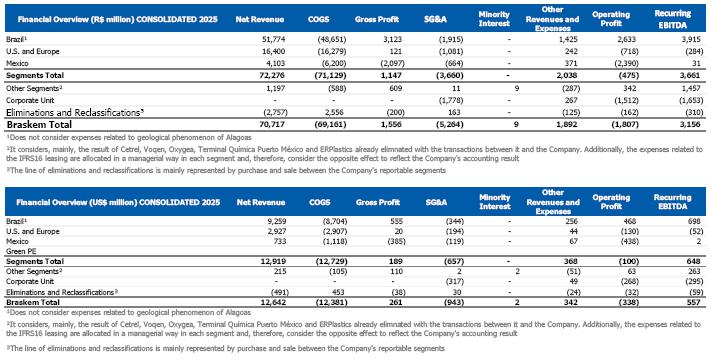
In 2025, recurring EBITDA was US$557 million (R$3.2 billion). The reduction compared to 2024 (-49%) is mainly explained by a decrease in gross profit of US$857 million (-77%), resulting from: (i) lower spreads for main chemicals (-13%) and resins (-6%) in the Brazil/South America segment, and for PE (-19%) in the Mexico segment, and PP (-6%) in the United States and Europe segment; and (ii) lower sales volumes of resins (-5%) and main chemicals (-5%) in the Brazilian market, as well as lower export volumes of main chemicals (-27%) in the Brazil/South America segment, and lower PE sales volume (-16%) in the Mexico segment.
These effects were partially offset by: (i) provision for a contractual fine to be received on the delay in the construction of the ethane import terminal in Mexico of US$ 41 million (R$ 225 million); (ii) reduction of US$ 33 million (R$ 173 million) in the constitution of provisions for reparation of environmental damages; (iii) tax recovery during the year (iv) adjustment in the appraisal report related to the sale of Cetrel, of US$ 7 million (R$ 43 million); and (v) an increase of US$ 6 million (R$ 33 million) in disposals of fixed assets mainly due to the sale of railcars in the United States.
29
| |
| |
NET FINANCIAL RESULT
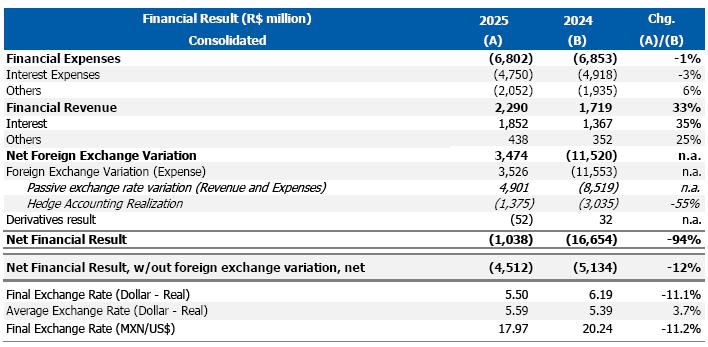
Financial expenses: lower compared to 2024 (-1%), mainly due to: (i) reduced interest expenses related to Braskem Idesa's Shareholder Loan following its capitalization in 2024; and (ii) the appreciation of the Brazilian real against the U.S. dollar by approximately 7.4% at the end of the period. The effect was partially offset by higher financial expenses associated with tax regularization for the settlement and installment payment of ICMS liabilities.
Financial revenues: higher compared to 2024 (+33%), mainly explained by (i) the monetary adjustment related to the recovery of PIS/COFINS tax credits related to the deduction of CIDE-Fuels in the sale of gasoline of about US$165 million (R$890 million); and (ii) interest of approximately US$24 million (R$132 million) related to the recovery of presumed PIS/COFINS credits within the scope of the Industrial REIQ related to the abrupt suspension of the benefit in July 2022 in disagreement with the National Tax Code.
30
| |
| |
Result with derivatives and exchange rate variations, net: positive result compared to 2024, mainly due to: (i) the appreciation of around 11.1% of the end-of-period price of the Brazilian real against the U.S. dollar on the annual average net exposure to the U.S. dollar amounting to US$4.1 billion; and (ii) the appreciation of around 11.4% of the end-of-period Mexican peso against the U.S. dollar on the annual average net exposure to the U.S. dollar of Braskem Idesa amounting to US$1.9 billion.
New designations in the export hedge accounting program of Braskem S.A.
In accordance with the Risk Management Policy, the Company reviewed its hedge accounting program and identified the potential to expand the volume of exports to be designated. During the quarter, new hedge designations totaling US$2.8 billion were made, covering highly probable exports that have been identified and projected for the period from 2029 to 2035. These items are protected by borrowings and financing (hedging instruments). Accordingly, the balance of financial instruments designated for this hedge accounting at the end of 3Q25 was US$8.6 billion, an increase of US$2.6 billion compared to 2Q25. Braskem's net exposure, excluding Braskem Idesa, decreased from US$5.5 billion in 2Q25 to approximately US$2.6 billion in 3Q25.
Transactions in financial instruments designated as hedge accounting
In relation to Braskem S.A.'s export hedge accounting in 2025, the Company recognized R$715 million resulting from export flows totaling US$800 million. The average initial designation rate was R$/US$4.7002, defined between February 2019 and March 2021, while the realization rate was R$/US$5.5944, defined between September 2024 and November 2025. The balance of financial instruments designated for this hedge accounting ended 4Q25 at US$8.4 billion.
In December 2025, Braskem, reassessed, for accounting purposes, the fulfillment of the “highly probable transactions” criterion required under IFRS 9 for the continuation of its hedge accounting program, which resulted in the prospective discontinuation, as of December 31, 2025, of the hedge accounting related to certain future revenues of Braskem S.A.
In relation to Braskem Idesa's export hedge accounting in 2025, the company recognized -MXN 2,279 million resulting from export flows totaling US$400 million. The average initial designation rate was MXN/US$14.3711, defined between September 2014 and October 2021, and the average realization rate was MXN/US$20.0681, defined between May 2016 and April 2025.
In November 2025, Braskem Idesa defaulted on interest due on the bond due in 2029. As a result of the breach of contractual terms under the financing arrangements that supported the hedging relationships, Braskem Idesa discontinued the application of hedge accounting.
Long-term Currency Hedge Program
Braskem’s feedstock and products have prices denominated or strongly influenced by international commodity prices, which are usually denominated in U.S. dollar. Since 2016, Braskem has contracted derivative financial instruments to mitigate part of the exposure of its cash flow denominated in Brazilian real. The main purpose of the program is to mitigate U.S. dollar call and put option agreements, thus protecting the estimated flows for a horizon of up to 18 months.
On December 31, 2025, Braskem had a notional value of outstanding put options of US$0.482 billion, at an average exercise price of R$/US$5.24. At the same time, the Company also had a notional value for outstanding call options of US$0.323 billion, at an average exercise price of R$/US$7.82. The contracted operations have a maximum period of 18 months. The fair value of these Zero Cost Collar (“ZCC”) operations was positive at R$18.4 million at the end of 4Q25.
Due to the volatility of the U.S. dollar during the period, options were exercised, leading to a negative cash impact of approximately R$0.6 million over the course of 2025.
31
| |
| |

NET INCOME/LOSS
In 2025, the Company recorded a net loss attributable to shareholders of US$1.6 billion, (R$9.9 billion), lower when compared to the loss of US$2.1 billion (R$12.1 billion) in 2024, mainly due to (i) the reduction of US$857 million (R$4.4 billion) in gross profit in the period; and (ii) the write-off of deferred tax assets with a net impact on the result of approximately US$1.4 billion (R$7.7 billion), due to factors that indicate potential unavailability of future taxable profits, mainly as a result of current uncertainties in the sector, according to CPC 32.
These effects were partially offset by the increase of US$2.7 billion (R$15.0 billion), in net income from derivatives and exchange rate variations, which reached US$600 million (R$3.5 billion) in 2025.
DIVIDENDS
Braskem has a public dividend policy available on its Investor Relations website, which can be accessed at the following address: https://www.braskem-ri.com.br/a-companhia/estatutos-e-politicas/.
At the end of each fiscal year, the Company will prepare its financial statements. In accordance with the net income calculated under the Brazilian Corporation Law and Braskem's Bylaws, 5% of the calculated amount will be allocated to the Legal Reserve before any other distribution.
Shareholders will be entitled to receive as Mandatory Dividend 25% of the net income for the year, calculated at the end of each fiscal year.
The portion of net income that exceeds the Mandatory Dividend, and provided that the Priority Dividend has been paid, may be retained, based on the capital budget, or distributed as Complementary Dividends.
Shareholders holding class "A" and "B" preferred shares will be entitled to receive a Priority Dividend, with a distribution of 6% of the unit value each fiscal year. Shareholders holding common shares will only be entitled to a Dividend after the payment of the Priority Dividend.
Additionally, payments of Complementary Dividends to the Mandatory Dividend may be made, requiring an assessment by the Company of its cash flow generation capacity, taking into account its long-term projections, including investment plans, as well as other factors that the Company deems relevant.
In relation to the fiscal year ended December 31, 2025, the Company will not pay Dividends as there is no profit basis for the distribution of dividends.
INVESTMENTS
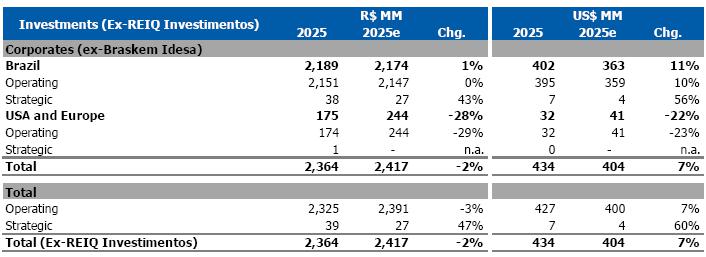
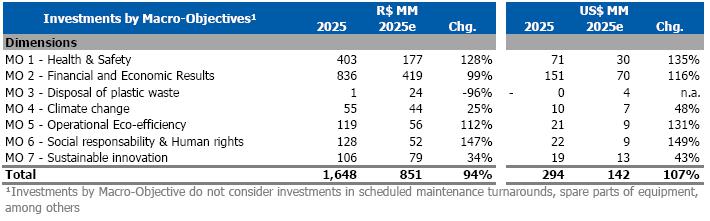
At the end of 2025, Braskem made corporate investments of approximately US$2,364 million, 2% lower than the initial estimate of US$2,417 million.
Operational Investments in 2025: (i) general maintenance shutdown of the petrochemical complex in Rio de Janeiro; (ii) scheduled shutdowns at resin plants; (iii) acquisition of spare parts for operational continuity; (iv) implementation of a new version of the ERP system; and (v) acquisition of licenses and programs to optimize the Company's cybersecurity system.
Strategic investments in 2025: acquisition of land adjacent to the Duque de Caxias plant, in Rio de Janeiro.
32
| |
| |
REIQ Investimento: The REIQ Investimento program was announced in January 2025, which consists of a 1.5% presumed PIS/COFINS credit linked to investments in the Brazilian chemical industry. Braskem continues to advance its capacity expansion projects through the REIQ Investimento program.
At the end of 2025, the Company recorded approximately R$327 million (US$59 million) in net tax credits through REIQ Investimento program, 20% lower than the estimated R$405 million (US$72 million). This amount is mainly related to investments for the implementation of the Transforma Rio project, in technology for efficiency in the resin chain, and in process adaptation for the industrial production of new grades of copolymers.

In 2025, the main investments related to the Macro-Objectives for Sustainable Development were: (i) projects related to industrial safety; (ii) modernization of corporate systems and optimization of the cybersecurity system to achieve operational eco-efficiency gains; and (iii) acquisition of industrial land in the Duque de Caxias hub, in Rio de Janeiro, to enable future strategic projects.
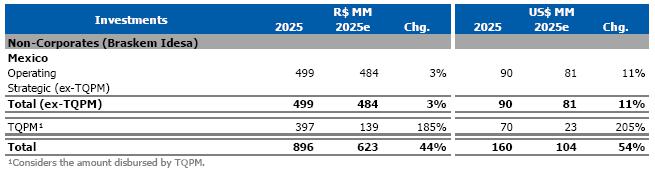
Braskem Idesa Investments
Regarding Braskem Idesa, investments at the end of 2025 totaled US$160 million, about 54% higher than the initial estimate of US$104 million. The values of investments, including Terminal Química Puerto México ("TQPM"), totaled US$160 million in 2025.
Operational Investments in 2025: the main operational investments were related to the scheduled general maintenance shutdown, initiatives for reliability and integrity of assets, and health, safety, and environment, totaling US$90 million for the year.
33
| |
| |
Strategic Investments in 2025: completion of the construction of the ethane import terminal, through Terminal Química Puerto México (TQPM), in the amount of US$70 million.
Investments in 2026
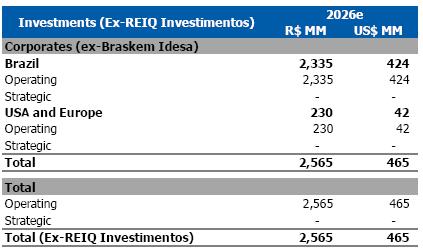
Investments expected for 2026 by Braskem (ex-Braskem Idesa and Ex-REIQ Investimento) total US$465 million (R$2.6 billion), 31% lower than the historical average of the last six years (US$672 million).
Operational investments in 2026: (i) scheduled shutdowns and maintenance pit-stops at the Rio Grande do Sul petrochemical complex and other resin plants in Brazil; (ii) regulatory, and operational and process safety investments; and (iii) mechanical integrity of the assets and acquisition of spare parts for operational continuity.
Strategic investments in 2026: (i) technological developments; and (ii) acquisition of industrial land in the industrial complex of Duque de Caxias, in Rio de Janeiro.
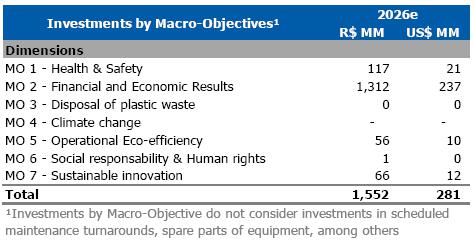
Investments by Macro-Objective for 2026
For 2026, investments related to sustainable development goals will amount to US$281 million (R$1,552 million), accounting for 41% of corporate investments. These funds will be primarily allocated to projects focused on economic and financial results, health and safety, sustainable innovation, and operational eco-efficiency.
34
| |
| |
Braskem Idesa Investments in 2026
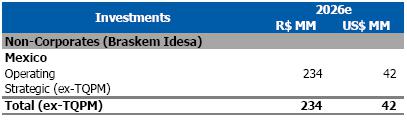
Investments planned for 2026 by Braskem Idesa total US$42 million (R$234 million), allocated to investments for maintenance and operation of the petrochemical complex.
Operational Investments for 2026: operational investments will be mainly allocated to projects related to operational efficiency, such as maintenance, productivity and HSE.
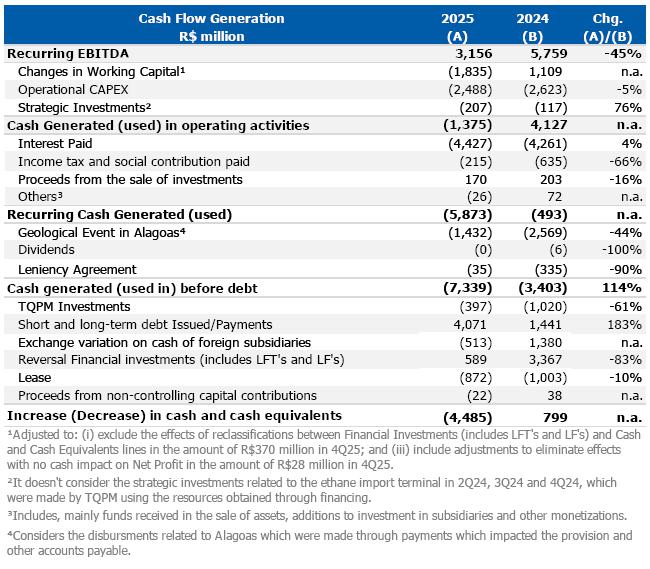
CASH FLOW GENERATION
In 2025, the Company reported an operating cash outflow of approximately R$1.4 billion, compared to a cash generation of R$4.1 billion in 2024, mainly due to: (i) a 45% reduction in consolidated Recurring EBITDA in Brazilian reais compared with the previous year, as explained above; and (ii) a negative variation in working capital of R$2.9 billion during the period.
Throughout 2025, the negative working capital variation was primarily driven by a reduction in accounts payable, mainly as a result of:
| (i) | the reduced availability of certain payment arrangements with financial institutions and suppliers; and |
| (ii) | lower feedstock costs combined with an 11% appreciation of the Brazilian real against the U.S. dollar at year-end. |
These effects were partially offset by the optimization of inventory levels and tax monetization throughout the year, initiatives included under the Resilience Program.
Interest payments in 2025 were higher compared to 2024, mainly due to the increase in gross debt associated with the issuance of international debt securities in October 2024. As a result, recurring cash consumption in 2025 amounted to R$5.9 billion, compared to a cash consumption of R$493 million in 2024.
Considering the disbursements for Alagoas, which were 44% lower in 2025, the Company registered a cash outflow of around R$7.3 billion.
35
| |
| |
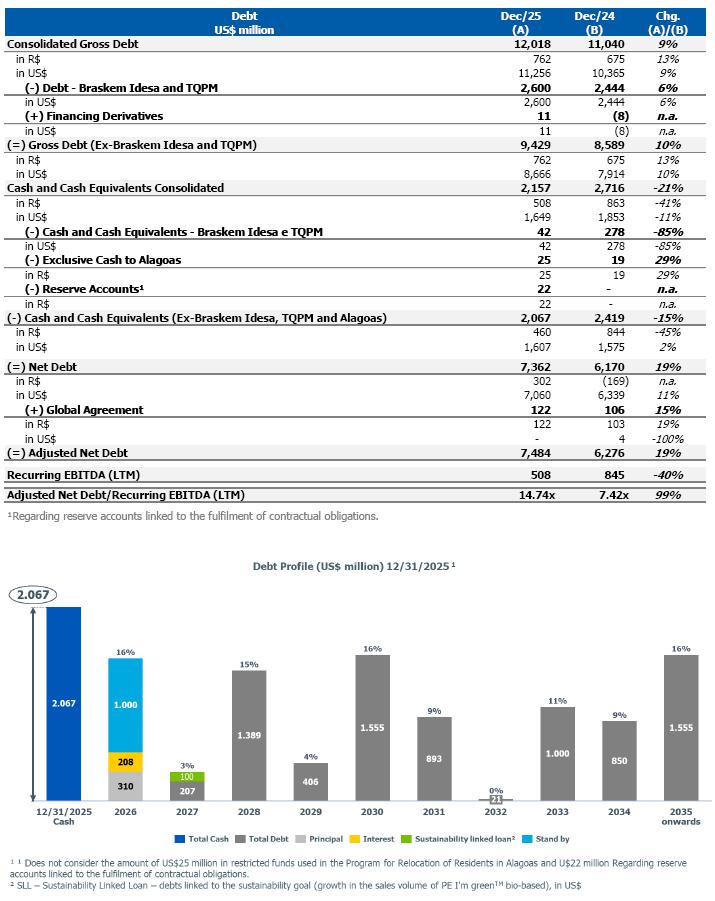
DEBT MATURITY PROFILE AND RATING
Braskem (ex-Braskem Idesa)
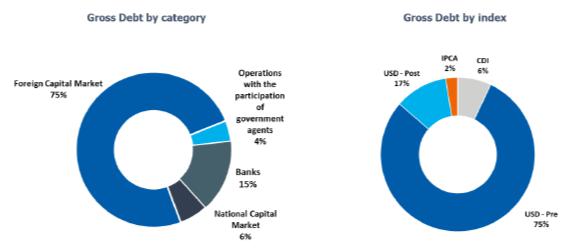
On December 31, 2025, corporate gross debt balance stood at US$9.4 billion, considering the drawdown of the stand-by facility made in October 2025, an increase of US$840 million (+12%) compared to the previous year's balance. At the end of the period, corporate debt in foreign currency accounted for 92% of the Company's total debt.
On December 31, 2025, the average term of corporate debt was around 8 years in December 2025, and the weighted average cost of the Company's corporate debt was +6.20% p.a.
Regarding net debt, the balance at the end of 2025 was US$ 7.5 billion, an increase of 19% compared to 2024. The Company's corporate leverage ended the year at 14.74x.
36
| |
| |
37
| |
| |
In September 2025, Braskem engaged financial and legal advisors to assist it in developing an assessment of economic and financial alternatives to optimize its capital structure. The Company remains focused on implementing resilience and transformation initiatives to mitigate the significant impacts caused by the prolonged downturn affecting the entire petrochemical industry and to enhance the competitiveness of the Brazilian chemical sector.
Ratings
In May 2025, Fitch Ratings downgraded Braskem's global credit rating to "BB" with a stable outlook. The agency reaffirmed the national scale rating at "AAA(bra)."
In May 2025, S&P Global Ratings downgraded Braskem's global rating to "BB" with a negative outlook. The agency reaffirmed the national scale rating at "AAA(bra)."
In September 2025, Fitch Ratings downgraded Braskem's global rating to “CCC+” and its national rating to "CCC+(bra)," while S&P Global Ratings downgraded Braskem's global rating to "CCC-" with a negative outlook and its national rating to "brCCC-" with a negative outlook.
Finally, in December 2025, Fitch Rating downgraded Braskem's global rating to "CC" and its national rating to "CC(Bra)."
| CORPORATE CREDIT RATING - GLOBAL SCALE | |||
| Agency | Rating | Outlook | Date |
| FITCH | CC | - | 12/30/2025 |
| S&P | CCC- | Negative | 9/26/2025 |
| CORPORATE CREDIT RATING - NATIONAL SCALE | |||
| Agency | Rating | Outlook | Date |
| FITCH | CC (bra) | - | 12/30/2025 |
| S&P | brCCC- | Negative | 9/26/2025 |
Braskem Idesa
On December 31, 2025, the average debt term was approximately 4.9 years. Braskem Idesa's weighted average debt cost was a foreign exchange rate variation of +7.3% p.a.
38
| |
| |
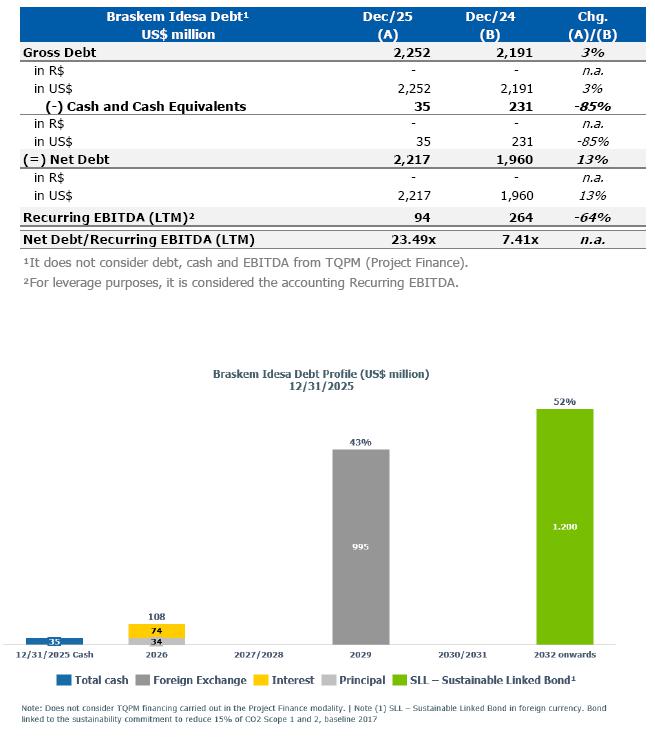
In September 2025, the Company disclosed that Braskem Idesa retained advisors to assist in assessing a comprehensive set of economic and financial options aimed at revisiting its existing capital structure. This decision reflects Braskem Idesa's ongoing efforts to preserve its liquidity and enhance its overall performance, considering the current scenario of macroeconomic uncertainties, commodity price volatility, higher input costs, and weaker-than-expected demand. In November 2025, the Company announced that Braskem Idesa had announced the non-payment of interest scheduled for November 18 on its senior secured notes maturing in 2029. In February 2026, the Company announced that Braskem Idesa had announced the non-payment of interest scheduled for February 20, 2026 on its senior secured notes maturing in 2032.
In October 2025, Braskem Idesa has drew down around R$188 million (US$34 million) from a credit facility contracted with Banco Inbursa, which has a total available limit of R$468 million (US$85 million). This credit facility matures in December 2026.
39
| |
| |
In November 2025, the Company reported that Braskem Idesa had announced the non-payment of scheduled interest due on November 18 related to its senior secured notes maturing in 2029.
In December 2025, Braskem Idesa provided certain holders of the 2029 and 2032 bonds with non-public information in the context of a potential reorganization of its capital structure. Under the terms of the confidentiality agreements signed, such material information was later disclosed to the market, including discussion materials and proposals presented by both Braskem Idesa and the investors. The parties did not reach an agreement, and none of the proposals were accepted.
In February 2026, the Company reported that Braskem Idesa had announced the non-payment of scheduled interest due on February 20, 2026 related to its senior secured notes maturing in 2032.
Braskem Idesa has been holding negotiations with the group of holders of the 2029 and 2032 bonds with a view to reorganizing its capital structure through judicial measures (e.g., Chapter 11 under U.S. law), with potential impacts for Braskem and for the shareholding control of Braskem Idesa.
Rating
In June 2025, S&P Global Ratings downgraded Braskem Idesa's rating to "B" with a stable outlook.
In September 2025, Fitch Ratings and S&P Global Ratings downgraded Braskem Idesa’s rating to "CCC+" and "CCC," respectively, mainly due to the hiring of financial and legal advisors to review its current capital structure.
In November 2025, S&P Global Ratings downgraded Braskem Idesa to "D."
In November 2025, Fitch Ratings downgraded Braskem Idesa's rating to "CC," then to "C,” and finally to “RD.”
| CORPORATE CREDIT RATING - BRASKEM IDESA | |||
| Agency | Rating | Outlook | Date |
| FITCH | RD | - | 11/26/2025 |
| S&P | D | - | 11/20/2025 |
| 6. | STRATEGY |
Braskem continues to focus on implementing the initiatives set out in its Global Resilience and Transformation Program, considering the relevant impacts resulting from the prolonged downturn cycle of the entire industry and the Brazilian chemical sector. In this sense, the Company has adopted measures aimed at sustainable value generation, with an emphasis on maximizing EBITDA and mitigating cash consumption.
RESILIENCE AND FINANCIAL HEALTH PROGRAM
Braskem's Resilience Program aims to implement tactical initiatives in the Company's operations and processes and is structured on two pillars: (i) initiatives with an impact on EBITDA and short-term cash generation; and (ii) actions to defend the competitiveness of the Brazilian chemical industry.
| i. | Initiatives with an impact on EBITDA and short-term cash generation: more than 70 action plans were established globally, totaling more than 700 initiatives, distributed on 6 fronts of action, including the institutional agenda. |
| ii. | Actions to defend the competitiveness of the Brazilian chemical industry: The Brazilian chemical industry, an essential and strategic sector for the country's economic development, faces one of the most challenging scenarios in its history. The sector's idleness rate has been showing historical record levels, reflecting the growing international competition resulting from the greater oversupply of products at predatory dumping prices. In this scenario, within the institutional agenda, anti-dumping measures and incentives capable of ensuring fair conditions of competition and preserving the sustainability of the industry in Brazil become important. The following advances stand out during the year: |
40
| |
| |
| a. | Braskem, together with ABIQUIM and other companies in the Brazilian chemical sector, reinforces the importance of implementing mechanisms to protect and stimulate the national industry in order to promote greater competitive balance and encourage the modernization of the sector. As an example, the publication of Law No. 15,294, of December 19, 2025, which establishes the Special Sustainability Program for the Chemical Industry ("PRESIQ") and establishes a new framework in industrial policies aimed at promoting the sustainability and competitiveness of the sector, effective from January 1, 2027, to December 31, 2031, stands out. |
PRESIQ provides for financial credits that can be offset against federal taxes, structured in two modalities:
| (i) | Industrial, with financial credits of up to 6% on the acquisition value of eligible inputs/chemicals, limited to R$2.5 billion per year with clear and defined counterparts: and |
| (ii) | Investment, with financial credits of up to 3% of gross revenue, limited to the amount of investment incurred in projects to expand or modernize installed capacity, previously approved, and limited to R$ 500 million per year, also with a requirement of minimum allocation for research and development (R&D). |
Additionally, on March 20, 2026, Complementary Law No. 228 was published, providing for the increase, from 0.73% to 5.8%, of the benefit of the Special Regime for the Chemical Industry ("REIQ"), which corresponds to PIS/Cofins credits, levied on feedstocks of the chemical and petrochemical industries, subject to compensation with federal taxes. The benefit will have a budget limit of R$ 2 billion for the sector and will be effective from March to December 31, 2026, and, as of April, it will be subject to a 10% reduction, as provided for in the applicable legislation. For the year 2026, a sectoral ceiling of R$1.1 billion was also established for the use of incremental credit ("REIQ Investment") of 1.5%, linked to investments.
| b. | In September, the Executive Management Committee of the Chamber of Foreign Trade (GECEX) approved the application of provisional antidumping duties, for a period of up to six months, on imports of PE resins originating in the United States and Canada. This measure was adopted based on investigations that identified dumping practices by foreign producers, with prices significantly lower than the prices normally practiced in the markets of origin, causing losses to the domestic industry. The definitive application of antidumping duties is ongoing and seeks to reestablish a level playing field, protecting local production and contributing to the sustainability of the Brazilian petrochemical sector. |
In October 2025, GECEX approved the maintenance, until October 16, 2026, of the 20% import tax rate for PVC, PE and PP products sold by the Company. The measure, part of the List of Temporary Tariff Increases due to Conjunctural Trade Imbalances, contributes to mitigating the effects of international competition in unfavorable conditions of oversupply of products in the world, promoting greater competitive balance and strengthening the Brazilian production chain.
41
| |
| |
TRANSFORMATION PROGRAM
Focused on building a more competitive, resilient and sustainable Braskem, the Transformation Program brings together initiatives that sustain the perpetuity of the business and is structured around three pillars: (i) naphtha-based optimization; (ii) increase and flexibility of the gas base; and (iii) migration to products with renewable sources.
| i. | Optimization based on naphtha: Includes the implementation of the strategy for naphtha base assets seeking greater profitability and cash generation. |
In September 2025, the Company, within the scope of Transforma Alagoas, which aims to make PVC production more competitive and sustainable, completed the conversion of this unit into a logistics unit dedicated to the handling of large volumes of dicloethane (EDC), a feedstock for the production of PVC. As part of this transformation, chlorine and soda production was hibernated and part of the infrastructure was redirected to logistics operations, increasing flexibility and industrial integration.
| ii. | Increased and flexible gas base: (i) feasibility of projects to increase gas-based capacity (ethane/propane/HLR); (ii) expansion of the flexibility of petrochemical plants in Brazil; and (iii) guarantee of operational stability, through stability in the supply and receipt of feedstock. |
Part of this pillar is the Transforma Rio project, announced in February 2025, which aims to expand the capacity of the petrochemical plant in Rio de Janeiro by 220 thousand tons of ethylene per year and equivalent volumes of PE. On October 24, 2025, Braskem's Board of Directors announced its approval of the investment. The total estimated value of the investment is approximately R$4.2 billion, which may vary by up to 30% given the current stage of maturity of the project. The implementation of the Project, estimated to be completed by the end of 2028, is conditional on obtaining financing, in addition to the resources already approved under the REIQ Investments benefit for 2025 and 2026. It is estimated that about 80% of the project will be disbursed from 2027.
| iii. | Migration to renewable products: the goal of expanding its production capacity to 1 million tons per year by 2030. |
Among the initiatives in progress, the following stand out: (i) the Sustainea joint venture, in partnership with Sojitz, which is studying the construction of plants for the production of MEG (monoethylene glycol) from renewable sources ("bioMEG") and MPG (monopropylene glycol) from renewable sources ("bioMPG"), currently in the scope development and engineering phase. Among the main milestones, the strategic agreements that enabled access to proprietary processes for bioMEG production and specialized technical support throughout the project stand out; (ii) the joint venture Braskem Siam, in partnership with SCG Chemicals, which evaluates the construction of the first green ethylene plant outside Brazil, in Thailand. The project advanced in 2025 in the engineering detailing phase, in addition to advances related to ethanol supply agreements with local players. The final investment decision (FID) is expected by the end of 2026, and represents an important step in the implementation project of the company's first industrial park in Asia.
| 7. | INVESTMENTS AND INITIATIVES IN RECYCLING |
The Company continues to pursue its long-term goal of expanding its portfolio of products with recycled content, supporting our clients and society with sustainable and circular solutions for the petrochemical industry. In 2025, Braskem launched its portfolio of sustainable solutions, which is part of the Wenew portfolio, featuring products with recycled content, encompassing more than 90 grades of resins and chemicals. During the year, the sales volume of the Wenew portfolio surpassed 82,000 tons globally.
42
| |
| |
The Company's strategy is based on expanding its operations in the circular economy business by forming partnerships with industry players and pursuing acquisitions, focusing on mechanical and chemical recycling projects. Among the year's highlights, we can mention:
| a. | First sale of circular PE through chemical recycling in South America |
Braskem made its first sale of circular polyethylene (PE) in South America, produced through chemical recycling, to the Copobras Group. The resin will be used in the production of flexible packaging for the pet food segment. This is a significant milestone for Braskem in building a more sustainable portfolio and expanding the circular economy, especially because chemical recycling enables the production of high-purity monomers suitable for packaging in direct contact with food — a progression compared to the limitations of mechanical recycling.
| b. | Wenew is recognized at the Embanews Awards |
In May, Braskem stood out at the 2025 Embanews Awards with two cases that use Wenew post-consumer resins, reinforcing the credibility of the solutions in demanding applications. The case developed with BASF and Lord used stretch film with 30% recycled resin for pallet transportation, ensuring strength and logistical safety. The case with Kimberly-Clark and Rhotoplas, in turn, applied 20% recycled resin in hygienic films for diapers and wet wipes, preserving mechanical and optical properties even in sensitive applications.
| c. | Partnership with MBRF |
In October, in partnership with MBRF, a special edition of Qualy Vegê margarine was developed, featuring a sustainable innovation: the container is made 100% from Wenew bio-circular PP resin. This solution represents an important advance in transforming post-consumer waste into renewable feedstock, without compromising the quality of the packaging.
| d. | Partnership with ICONIC |
In December, ICONIC, a leader in the lubricants sector in Brazil and responsible for the Ipiranga and Texaco brands, began using Braskem's Wenew biocircular polypropylene (PP) in the production of its packaging. This is Braskem's first project with biocircular PP in the greases and lubricants sector, demonstrating that strategic partnerships and leveraging post-consumer waste are essential to accelerate the circular economy.
e. Partnership with Jaguar
Braskem has launched a new grade of 100% post-consumer recycled polypropylene (PCR-PP) with high fluidity. This innovation expands the possibilities for using recycled materials in injection-molded applications that require greater precision and superior finishing. The development was carried out in partnership with Jaguar Plásticos, meeting a real customer need and representing an important advancement for the sector: a high-performance PCR that combines sustainability and productivity. This is yet another solution from the Wenew portfolio, confirming Braskem's commitment to reintegrating plastic waste into the production cycle and driving the circular economy with innovation and quality.
| 8. | ESG AGENDA – 2025 HIGHLIGHTS |
Since its creation in 2002, Braskem has been committed to the principles of sustainable development. In 2020, based on its Sustainable Development strategy and its materiality matrix, Braskem defined its second cycle of long-term goals, composed of seven dimensions, focusing mainly on combating climate change, eliminating plastic waste and social responsibility and human rights. Additionally, the Company continues to advance in the implementation of its sustainable development strategy.
43
| |
| |
8.1 ENVIRONMENTAL
8.1.1 CLIMATE CHANGE
| § | 2020-2030 long-term goals: Braskem continues to advance in its objectives for 2030, reaching 27%[12] so far on Combating Climate Change, driven by the reduction of absolute greenhouse (GHG) gas emissions in scopes 1 and 2. |
| § | GHG Emission Inventory: for the 15th straight year, Braskem obtained the golden seal from the Brazil GHG Protocol Program (PBGHG) for its GHG emissions inventory. The Golden Seal from PBGHG certifies the corporate inventory for achieving the highest qualification, i.e., inventories whose scopes 1, 2 and 3 were audited by an independent third party. |
8.1.2 CIRCULAR ECONOMY
| § | 2020-2030 long-term goals: With respect to Eliminating Plastic Waste, the Company advanced by 8% in its 2030 goals. |
| § | Global Agreement to Eliminate Plastic Waste: Braskem participated in the 5th session of the Intergovernmental Negotiating Committee (INC 5.2) for ending plastic pollution, with the presence of the ICCA[13], which brought together a delegation of manufacturers, including the Brazilian Chemical Manufacturers' Association (Abiquim)[14]. The discussions were centered on issues related to problematic plastics, financing, ban lists for plastic applications, and global resin production limits. Despite the progress, no terms of the Agreement have been finalized. In February 2026, there will be a new one-day meeting between the countries to define the next steps of the Agreement. |
| § | World Circular Economy Forum 2025: in May, Braskem participated in the first edition of the WCEF[15] held in Brazil. The Company held four acceleration sessions at Cazoolo, acting as a catalyst for connections and discussions on the circular economy. The meetings brought together more than 150 in-person participants and about 200 online, fostering discussions on circularity, innovation, and the future of packaging. The initiative reinforced Braskem's role as an active agent in building sustainable solutions and concrete practices for the sector. |
| § | Decree under discussion: transformative solutions: in November, Braskem held a meeting to enhance understanding of the new Decree on Reverse Logistics of Plastic Packaging, discussing its impacts and opportunities, and presenting how the Company can support its clients in this adaptation process. The moment was an excellent opportunity to be close to clients and reinforce Braskem's positioning as a strategic partner in the journey to comply with the new guidelines. |
| § | Sales Volume of Recycled Products: decrease (-4%) in relation to 2024, mainly due to the lower demand for post-consumer recycled (PCR) resin in Brazil in the period, resulting from the global macroeconomic scenario that continues to pressure petrochemical markets and affect the competitiveness of recycled resins. |
[12] The amount refers to the consolidated achievement up to 2024. The GHG emissions inventory for 2025, required for the calculation of this target, was not finalized by the publication date of this report
[13] Life Cycle Assessment
[14] International Congress and Convention Association
[15] Brazilian Chemical Industry Association
[16] Outstanding international event attended by global authorities and sustainability leaders
44
| |
| |
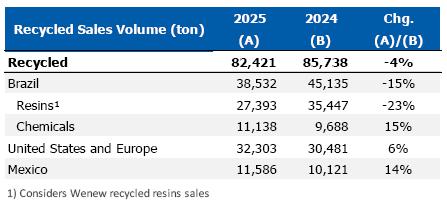
8.2 SAFETY AND SOCIAL RESPONSIBILITY
8.2.1 HEALTH & SAFETY
| § | 2020-2030 long-term goals: For Braskem, safety is a nonnegotiable value. With respect to Health and Safety, in 2024 the Company achieved 83% of its 2030 goals, driven by the reported occupational disease rate, which recorded no occurrences in 2025, and a reduction in the frequency rate of accidents (lost-time injuries and recordable injuries). |
| § | Occupational Safety: in 2025, the recordable and lost-time injury frequency rate, considering employees and third parties, was 0.80 (events per million man-hours worked), which is 12% lower than in 2024. This rate keeps Braskem on par with its peers in the global chemical industry considered industry benchmarks in safety. |
| § | Process Safety: in 2025, the Tier 1[16] rate was 0.06 (events per million man-hours worked), a decrease of 50% compared to 2024. The Tier 2[17] rate was also 0.06 (events per million man-hours worked) during the same period. This rate keeps Braskem on par with its peers in the global chemical industry considered industry benchmarks in safety. |
8.2.2 SOCIAL RESPONSIBILITY AND HUMAN RIGHTS
In 2025, the Company reached 56% of its 2030 goals related to Social Responsibility and Human Rights, with an emphasis on: (i) the number of people benefited in communities (approximately 388 thousand people in 2025); and (ii) managing 100% of high and medium human rights risks.
8.2.2.1 PEOPLE & ORGANIZATION
The Company ended 2025 with 8,233 team members, down 1.8% from 2024. Voluntary turnover rate decreased by 0.2 p.p., while total turnover rate increased by 2 p.p. in 2025.
[17]Incident with loss of containment of products above the limits established in the American Petroleum Institute (API) 754 for TIER 1, based on the product released, or any release that causes: fatality or lost-time injury of an employee or third party, hospital damages or fatality of the external public, financial losses greater than US$100,000, or evacuation of the community.
[18]Incident with loss of containment of products above the limits established in the American Petroleum Institute (API) 754 for Tier 2, based on the product released, or any release that causes: reportable injury of an employee or third party and financial losses greater than US$2,500.
45
| |
| |
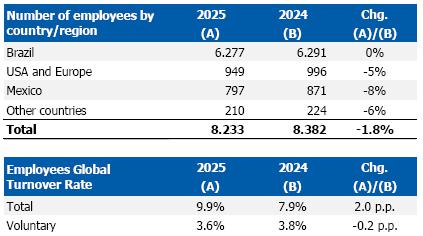
At the end of 2025, the proportion of women hired by Braskem was 52.4% in the administrative sectors and 18.7% in operations.
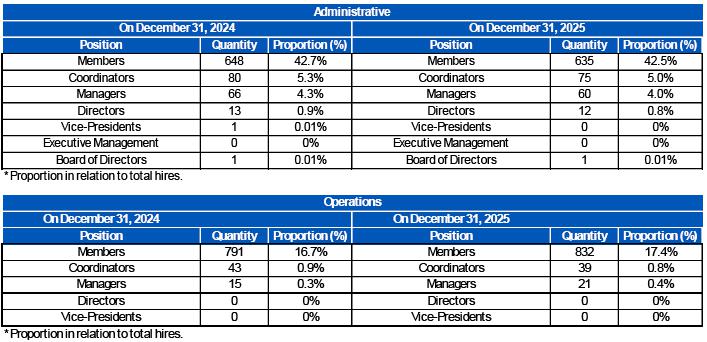
Currently, 9% of the positions on the Board of Directors are held by women.

The following table presents the fixed, variable and occasional compensation, segregated by sex for similar positions and functions of the company:

46
| |
| |

Post-Employment Benefits
| § | Brazil: 91% of the Company's employees participate in the defined contribution pension plan, which pays pension and retirement amounts that supplement the amounts paid by the official pension system of the Brazilian government. In addition to the pension plan, employees who retire through the Company and their dependents have medical and dental assistance. Braskem Brasil also offers employees the benefit of life insurance and disability assistance, both provided for in collective bargaining agreements. |
| § | United States: Braskem America manages a closed defined benefit pension plan that, in 2025, had 26 active members. Braskem America also offers its employees medical, dental, and vision benefits, as well as life insurance and assistance in cases of disability. |
| § | Europe: Braskem Germany has 147 participants (including active and inactive employees) in all pension plans in Germany. In the Netherlands, there are 171 active participants in pension plans. In addition, Braskem offers its employees pension, health insurance, life insurance, and assistance in cases of disability. |
| § | Mexico: in 2025, the government's retirement plan in Mexico included all 797 active members of the Company, and Braskem contributes to the government-managed retirement plan for these members. Braskem Idesa also offers other benefits, including savings plans, meal vouchers, meal allowance, cafeteria, as well as life insurance and health insurance. |
Diversity, Equity & Inclusion (DE&I)
| § | Long-term goals: Braskem ended the year with 33% of women in leadership positions and 34% of Black team members. |
In 2025, we consolidated significant advances in the Diversity, Equity & Inclusion agenda, strengthening actions that increase representation, promote a safe environment, and value the plurality that makes up Braskem. The following results reflect our ongoing commitment to DE&I and Our Culture, driving an increasingly inclusive journey across all regions and operations of the Company.
| § | Anti-Harassment Training (BRA): an initiative that reinforces the commitment to a safer and more respectful workplace through a comprehensive campaign to prevent and combat moral and sexual harassment. The program involves educational communication, training, and awareness-raising actions for all members in Brazil. |
| § | Parental Leave (BRA): Braskem has made progress in equalizing rights by granting parental leave equivalent to maternity leave for same-sex couples in adoption processes, ensuring up to six months of leave depending on the child's age. |
| § | XVII Order of Cultural Merit for LGBT+ Diversity Award Bahia (BRA): Braskem was honored at the XVII Order of Cultural Merit for LGBT+ Diversity Award Bahia, granted by the Grupo Gay da Bahia (GGB), in recognition of its ongoing efforts for the rights and equity of LGBTQIAP+ individuals. |
| § | Internship Program: the selection process for the Internship Program saw over 11,000 applicants for both technical and university internships, with 42% women, 41% Black individuals, and 0.44% people with disabilities represented among the applicants. During the year, the Internship Program promoted workshops and a development pathway, covering topics such as communication, continuous improvement, soft skills, White Belt certification, self-knowledge, and organizational culture, and also offered an English scholarship. Braskem achieved 20th place in the Best Internship Experience (BIE) ranking, becoming the first company in its sector to appear on the list. This result reinforces the positive experiences of young interns, particularly in terms of their professional development, the creation of an inclusive workplace, and the availability of growth opportunities. |
47
| |
| |
| § | Accessibility for Members with visual impairments: progress in eliminating barriers to inclusion with the approval and implementation of visual accessibility software, increasing employee autonomy and ensuring equal access to digital tools for those who need this resource. |
Respect is Non-Negotiable (USA): in 2025, the training was expanded and completed in the United States. The aim of the project is to clarify the concepts of discrimination, workplace bullying, sexual harassment, and microaggressions by presenting definitions and practical examples, as well as offering guidance on how to respond when encountering such situations. In total, more than 700 members participated in the training, adding to the group of over 7,000 people who have already completed the training at the Company.
8.2.2.2 CORPORATE SOCIAL RESPONSIBILITY
In 2025, around R$18.8 million was disbursed in social responsibility initiatives (private social investment, donations, and volunteering) in Brazil, Mexico, United States, Netherlands, and Germany, directly benefiting 388,000 people.
| § | Global Volunteer Program: 1,739 team members and 1,093 guests participated in over 295 actions in five countries, totaling over 13,743 hours of volunteer work within and outside working hours. |
| § | Enrede Project: the project installs eco-barriers in channels of the Santos (SP) estuary to prevent improperly discarded waste from reaching the sea. A total of 3.4 tons of waste were collected, including 1.8 tons of plastic. In addition, environmental education activities and trade shows for exchanging plastic for food baskets were held, benefiting more than 2,700 people. |
| § | Ser+ Program (BRA): initiative that provides technical and structural support to recycling cooperatives, delivering knowledge and tools that strengthen the autonomy and sustainability of these organizations. In 2025, the program allocated more than R$1.8 million to 23 recycling cooperatives, benefiting approximately 680 cooperative members. |
| § | Empreediendo y Cresciendo (Mexico): the project, implemented by Braskem Idesa, organizes activities to support entrepreneurs, offering training and equipment to help create new businesses or improve productive projects. In 2025, the professional training courses that were held benefited 112 people from the Nanchital community. |
| § | Future of STEM Scholars Initiative – FOSSI (USA): Braskem America supported FOSSI, a nonprofit initiative of the American Institute of Chemical Engineers (AIChE) that offers scholarships to students pursuing degrees in Science, Technology, Engineering, and Mathematics (STEM) fields. |
8.3 GOVERNANCE
8.3.1 CORPORATE GOVERNANCE
Regarding the Board of Directors (BoD) of the Company, in the first half of 2025, at the Extraordinary Shareholders Meeting (ESM) held on February 3, 2025, the BoD approved: (i) the replacement of one sitting member of the BoD, elected at the Annual Shareholders Meeting (ASM) on April 29, 2024, to complete the current term, which will end at the ASM that will deliberate on the Company’s financial statements for the fiscal year ended December 31, 2025; and (ii) the election of Héctor Núñez as Chairman of the Board of Directors, replacing José Mauro Mettrau Carneiro da Cunha, who served as sitting member of the Board of Directors, also to complete term that will end at the 2026 ASM. In the second half of 2025, at the EGM held on November 13, 2025, the BoD approved the replacement of one sitting member elected at the ASM on April 29, 2024, to complete the current term, which will end at the ASM that will deliberate on the Company's financial statements for the fiscal year ended December 31, 2025.
48
| |
| |
At the Annual General Meeting (AGM) held on April 28, 2025, the BoD approved the election of five sitting members and five alternates to serve a one-year term in the Audit Board.
In addition, the BoD elected a new member to the Statutory Board of Executive Officers at the BoD meeting held on June 26, 2025, and a new independent member to the Statutory Compliance and Audit Committee at the BoD meeting held on November 10, 2025.
Throughout 2025, the BoD deliberated on, with the aim of adopting best practices: a) the amendment of the Company's Code of Conduct and the Company's policies on Related Party Transactions, on Free Competition, on Compliance System, and on Anti-Corruption System; b) the review of the charters of the BoD of Braskem S.A. and its Advisory Committees; and c) the authorization to convene an ESM to deliberate on amendments to the Bylaws of Braskem S.A., which was held on November 13, 2025, implementing the following proposed updates: (i) amendment of article 2 to adapt the wording of the corporate purpose to the current activities carried out by the Company; (ii) inclusion of a provision in the Bylaws to detail the rules and process for electing the members of the BoD; (iii) amendment of article 26 to update the approval thresholds of the BoD, authorize the Board to decide on the maintenance or update of such thresholds, and remove from the Board's responsibilities the selection and replacement of independent auditors of subsidiaries.
In 2025, the Board took note of the Board of Executive Officers' assessment of the effectiveness of risk management policies and systems, internal controls, and the Compliance program. The Board also reviewed the assessment report, as well as reports from its Advisory Committees and the Corporate Governance Department and continued to oversee the Company's corporate governance system.
Furthermore, the Board of Directors, supported by its Advisory Committees, discussed the Company's relevant matters and Organizational Transformation projects on several occasions, taking into account the resilience scenario, as well as the Strategic Direction of the Company, including corporate sustainability initiatives, and monitored the implementation of the Company's Business Plan for the year 2025.
8.3.2 OWNERSHIP INTERESTS - INCORPORATION, ACQUISITION OR SALE
In June 2025, the Company completed the sale of its entire interest in B&TC B.V. ("B&TC"), which holds 100% of the shares of ER Plastics B.V. ("ER Plastics"), and its wholly-owned subsidiary ER Plastics, which operates in the mechanical recycling of mixed plastic waste into compression molded parts (construction plates and pallets). As a result of this operation, the Company recognized a loss of R$96 million.
In January 2025, the Company decided to reevaluate and discontinue new investments in Oxygea, Braskem's vehicle focused on digital transformation with startups in the market. This decision is in line with the Company's strategic direction of prioritizing its assets and investments, both operational and strategic. As of December 31, 2025, the balance of investment in Oxygea was R$79 million.
In May 2025, four more Special Purpose Entities ("SPEs") were incorporated owned by Braskem Trading and Shipping B.V., a company indirectly controlled by the Company, with the main objective of entering into certain ocean freight agreements and certain commercial transactions for the purchase and sale of chemical and petrochemical products, namely: Mares do Futuro Shipping B.V., Baita Futuro Shipping B.V., Bravo Futuro Shipping B.V. and Fortunate Future Shipping B.V.
In June 2025, the Company concluded the acquisition of 100% of the class B common shares of Serra das Almas F1 Holding S.A. ("Serra das Almas"), equivalent to 49% of its voting capital and 24.5% of its total capital, now holding an indirect interest in five SPEs controlled by Serra das Almas, holders of the authorization for the generation of wind energy from wind farms, namely: Serra das Almas I S.A. Wind Farm, Serra das Almas III S.A. Wind Farm, Serra das Almas IV S.A. Wind Farm, Serra das Almas V S.A. Wind Farm and Serra das Almas VI S.A. Wind Farm.
49
| |
| |
In August 2025, the Company concluded the acquisition of 100% of the Class B Common Shares of the company Folha Larga 1 Holding S.A. ("Folha Larga"), equivalent to 49.89% of its voting capital and 24.95% of its total capital, now holding an indirect interest in four SPEs controlled by Folha Larga and holding the authorization for the generation of wind energy from wind farms, which are: Parque Eólico Ventos de São Januário 01 S.A., Parque Eólico Ventos de São Januário 04 S.A., Parque Eólico Ventos de São Januário 13 S.A. and Parque Eólico Ventos de São Januário 14 S.A.
8.3.3 COMPLIANCE
In 2025, aligned with Braskem's strategic direction, the Company promoted the transformation of the Compliance System through the optimization of practices, review of processes, and globalization of activities. The new multifunctional and integrated structure now involves, in addition to the Compliance area, key areas such as Finance, with responsibility for Controls and Risk, expanding the corporate vision and reinforcing the consistency and maturity already established. In addition, the Company maintained a score of 9.9 points (out of 10 points) in the Integrity, Prevention, and Anti-Corruption Indicator of Instituto Ethos, a performance above the industry average, demonstrating robustness and maturity of its Global Compliance System. Additionally, the Company maintained the ISO 37001 certification (Anti-Bribery Management System), reaffirming our adherence to international standards. We also remain committed to the 100% Transparency Movement, an initiative of the UN Global Compact Network Brazil, which engages companies in the fight against corruption and promotion of the Sustainable Development Goals of the 2030 Agenda. These advances consolidate Braskem as a benchmark in corporate integrity, with solid practices already incorporated into internal policies and aligned with the best global standards.
| 9. | SUSTAINABLE INNOVATION |
The innovation and technology area plays a crucial role, with initiatives closely aligned to Braskem’s strategy, supporting both its core business operations and the Company’s future vision, particularly in areas such as decarbonization, renewable feedstocks, and recycling. With a focus on technology improvement and the development of new solutions, the area is essential for the Company to maintain market competitiveness and achieve its strategic goals.
The Company drives innovation to extract value from existing assets and create value propositions for its clients. As a result of innovation efforts, 6.7% of the product sales volume was introduced in the last five years. The Company employs 352 professionals globally in innovation and technology, distributed across the research and development centers in Pittsburgh and Lexington (United States), Wesseling (Germany), and Triunfo, Campinas, and São Paulo (Brazil).
In 2025, despite a challenging scenario, the Company continued to invest in innovation to accelerate the creation of solutions that meet the demands of society and the market. As part of the efforts to improve the current portfolio, several projects were carried out in 2025. In Brazil, these efforts were driven by the optimization of resin grades, which have reduced property variations during campaigns, resulting in greater operational efficiency and improved adherence to clients' technical requirements. A new bio-based high-density polyethylene (HDPE) was also developed for nonwoven applications, such as diapers, offering better processability, higher thermal resistance, and excellent color stability. Another example of product innovation occurred in Europe, where a new PP copolymer with high optical transparency was launched, specifically designed for modified atmosphere packaging (MAP) for foods such as meat, fish, and vegetables.
In the United States, efforts have focused on enhancing productivity and quality during product changeovers, as well as increasing asset flexibility, resulting in reduced losses and greater value creation for Braskem. Another key aspect of this approach is the reduction in waste generation, which aligns with our sustainability objectives.
50
| |
| |
Braskem believes that the bio-revolution represents one of the most promising pathways toward building a more sustainable society. This concept represents the convergence of various scientific disciplines and has the potential to transform sectors such as healthcare, agriculture, energy, and industry. The large-scale use of biomass converted into products with lower carbon emissions will contribute to the measures established against the effects of climate change.
Within the bio-based pillar, the projects aim to develop low-carbon chemicals on a commercial scale, using renewable feedstocks and sustainable processes to achieve a negative carbon footprint.
In 2025, the Company continued its partnership with Lallemand Biofuels & Distilled Spirits (LBDS) for the development of renewable chemicals as alternatives to fossil-based products.
In the recycling pillar, the Company continues to advance the development of solutions that contribute to the long-term goals of eliminating plastic waste and expanding the use of recycled resins in high-performance applications. In 2025, new grades were launched, strengthening the post-consumer recycled (PCR) resin portfolio, making it one of the most comprehensive in the global market. In the flexible packaging segment, the developments have once again enabled the recovery of millions of plastic packages, covering both primary and secondary packaging. In the rigid packaging segment, we achieved significant progress with the launch of new materials. Another standout was the development of high melt flow PCR PP designed for the injection of household utilities, enabling the use of recycled materials in parts with complex geometries and high technical requirements.
These developments open new doors for the use of PCR in demanding applications, bringing greater competitiveness, innovation, and environmental value to the Company's clients.
In chemical recycling, the Company is studying technologies for large-scale application, especially in synergy with refineries, which will allow the use of various plastic feedstocks, expanding our recycling possibilities.
| 10. | CAPITAL MARKETS AND INVESTOR RELATIONS |
On December 31, 2025, Braskem’s capital stock amounted to R$8,043,222,080.50, divided into 797,207,834 shares, as shown in the following table. Its common shares, class “A" preferred shares and class “B" preferred shares are traded on the Sao Paulo Stock Exchange (B3), under the ticker symbols “BRKM3,” “BRKM5” and “BRKM6,” respectively.
On the New York Stock Exchange (NYSE), its shares are traded through the Level II ADR Program under the ticker “BAK.” On the Madrid Stock Exchange, the shares are traded through the Latibex Program under the ticker “XBRK.”
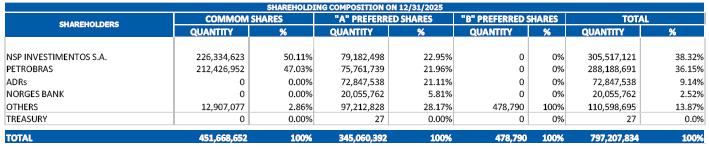
In 2025, there were no material changes in the ownership structure of the Company, such as capital increases, stock splits, reverse stock splits, bonus shares or capital decreases.
51
| |
| |
| § | B3 (Level I Corporate Governance) – BRKM5 & BRKM3 STOCK PERFORMANCE[18] |
Ibovespa, B3's flagship index, ended 2025 up 34%, considering December 30, 2025 closing. The main factors that contributed to the positive performance of the index were: (i) the expectation of macroeconomic and political improvement; (ii) the expectation of a cut in the Selic rate; (iii) Brazilian stocks still trading below pre-pandemic levels, attracting investors; (iv) greater resilience of Brazil in the face of trade tensions; and (v) interest rate cuts in the United States, which stimulated a strong inflow of foreign capital.
The common shares (BRKM3) closed the year, quoted at R$8.09 per share, down 33.1% from end-2024. The class "A" preferred shares (BRKM5) also declined, by 31.9%, in relation to the close of 2024, quoted at R$7.89 per share. The depreciation in Braskem's share prices in 2025 was mainly influenced by: (i) the industry's prolonged downturn exceeding market expectations; (ii) uncertainties regarding the pace of spread recovery in the medium term, given the global oversupply; (iii) the hiring of financial and legal advisors by the Company; (iv) rating reviews by S&P and Fitch; (v) uncertainties related to the Company's change of control process; and (vi) updates related to the geological event in Alagoas.
In the year, the highest one-day gains registered in the BRKM3 and BRKM5 shares were 11.8% and 18%, respectively, in the trading sessions of March 26, 2025, and November 11, 2025.
In the year, the highest one-day losses registered in the BRKM3 and BRKM5 shares were 12.6% and 14.8%, respectively, in the trading session on September 26, 2025.
The average daily financial trading volume registered for BRKM3 shares decreased from R$369,000 in 2024 to R$238,000 in 2025 (-35.6%). The stock’s highest quote during the year was R$14.85 per share on November 27, 2025, and its lowest quote was R$7.05 per share on October 17, 2025.
The average daily financial trading volume registered for BRKM5 shares decreased from R$62 million in 2024 to R$36 million in 2025 (-41.4%). The stock’s highest quote during the year was R$14.89 per share on January 27, 2025, and its lowest quote was R$6.26 per share on October 17, 2025.
| § | LEVEL II ADR PROGRAM – New York Stock Exchange (BAK[19]) |
In 2025, the ADRs representing the class “A" preferred shares ended the year quoted at US$2.95/ADR, registering a decline of 23.6% in relation to 2024. The stock’s high during the year was US$5.04 per ADR on December 10, 2025, and its low was US$2.38 per ADR, on October 10, 2025. Each Braskem ADR (BAK) corresponds to two class “A” preferred shares issued by the Company.
Braskem's ADR program ended the year with approximately 36 million ADRs, representing about 73 million PNAs.
| 11. | EXTERNAL AUDIT |
It is incumbent upon the Board of Directors to choose the Company's independent auditors. When contracting services other than external audit services from its auditors, the Company complies with its Policy on Contracting Independent Auditors to preserve the auditor's independence. The Compliance and Statutory Audit Committee ("CCAE") is responsible for approving the contracting of Independent Auditors to perform extra-audit services.
52
| |
| |
Permitted extra-audit services are those that fully meet and do not compromise the basic principles of autonomy of independent auditors to perform external audit services (e.g., not auditing their own work, not performing management functions or creating conflict of interests), which must be confirmed through a letter issued by the independent auditors. Extra-audit services that could hamper the independence of independent auditors in their performance of external audit services are not permitted by the Policy on Engaging Independent Auditors.
According to a notice to the market dated January 3, 2023, KPMG Auditores Independentes Ltda. were engaged to provide audit services for the Company's annual financial statements and review of quarterly information from 2023 to 2025, regarding compliance with Brazilian legislation and regulations, replacing Grant Thornton Auditores Independentes. KPMG Auditores Independentes Ltda. will also provide independent audit services pursuant to U.S. laws and regulations.
| 12. | ATTACHMENT LISTING |
Sales by sector (%) Brazil/South America
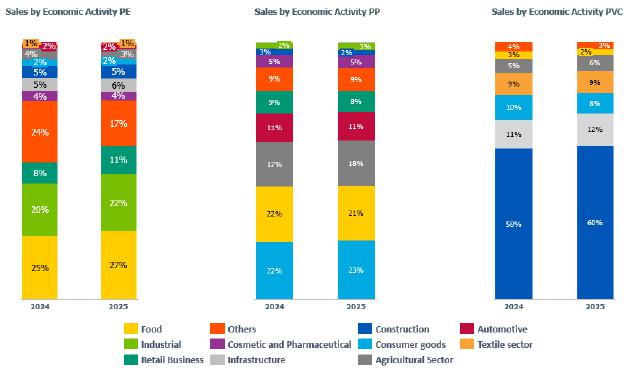
53
| |
| |
Sales by sector (%) Mexico
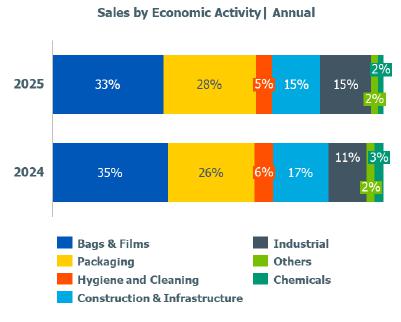
12.1 UPDATES ON ALAGOAS
In May 2019, the Geological Survey of Brazil (“CPRM”) issued a report, indicating that the geological phenomenon identified in certain neighborhoods of the municipality of Maceió, Alagoas, could be related to the rock salt well exploration activities developed by Braskem. The salt mining operation, from this moment on, was fully ended by the Company.
Since then, the Company has been devoting its best efforts to understand the geological event, its possible effects on surfaces, stability of rock salt cavities and in carrying out precautionary measures to ensure public safety. The results arising from the understanding of the geological phenomenon are being shared with the Brazilian National Mining Agency (“ANM”) and other pertinent authorities.
As a result of the geological phenomenon, negotiations were conducted with public and regulatory authorities that resulted in the Agreements executed, including the following agreement in progress:
| i) | Instrument of Agreement to Support the Relocation of People in Risk Areas (“Agreement for Compensation of Residents"), entered into with State Prosecution Office (“MPE”), the State Public Defender’s Office (“DPE”), the Federal Prosecution Office (“MPF”) and the Federal Public Defender’s Office (“DPU”), which was ratified by the court on January 3, 2020, adjusted by its resolutions and subsequent amendments, which establish cooperative actions for relocating residents from risk areas, defined in the Map of Sectors of Damages and Priority Action Lines by the Civil Defense of Maceió (“Civil Defense Map”), with the second amendment to the Agreement being related to the map issued in December 2020 (version 4), and guaranteed their safety, which provides support, under the Financial Compensation and Support for Relocation Program (“PCF”) implemented by Braskem to the population in the areas of the Civil Defense Map. Following ratification by the courts of the Agreement for Compensation of Residents, the Public-Interest Civil Action for Resident Reparation was dismissed; |
54
| |
| |
| ii) | Instrument of Agreement to Dismiss the Public-Interest Civil Action on Socio-Environmental Reparation and the Agreement to define the measures to be adopted regarding the preliminary injunctions of the Public-Interest Civil Action on Socio-Environmental Reparation (jointly referred to as “Agreement for Socio-Environmental Reparation”), signed with the MPF with the MPE as the intervening party, on December 30, 2020, in which the Company mainly undertook to: (i) adopt measures to stabilize and monitor the subsidence phenomenon arising from salt mining; (ii) repair, mitigate or compensate possible environmental impacts and damages arising from salt mining in the Municipality of Maceió; and (iii) repair, mitigate or compensate possible socio-environmental impacts and damages arising from salt mining in the Municipality of Maceió. Following ratification by the courts of this agreement, the Public-Interest Civil Action for Socio-environmental Reparation was dismissed; |
| iii) | Instrument of Agreement for Implementation of Socioeconomic Measures for the Requalification of the Flexal Area (“Flexal Agreement”) entered into with MPF, MPE, DPU and the Municipality of Maceió and ratified on October 26, 2022 by the 3rd Federal Court of Maceió, which establishes the adoption of requalification actions in the Flexais region, compensation to the Municipality of Maceió and indemnities to the residents of this location; |
| iv) | Instrument of Global Agreement with the Municipality of Maceió (“Instrument of Global Agreement”) ratified on July 21, 2023 by the 3rd Federal Court of Maceió, which establishes, among other things: (a) payment of R$1.7 billion as indemnity, compensation and full reimbursement for any property and non-property damages caused to the Municipality of Maceió; (b) adherence of the Municipality of Maceió to the terms of the Socio-environmental Agreement, including the Social Actions Plan (PAS); and |
| v) | Instrument of Agreement with the State of Alagoas (“State Agreement”), executed on November 10, 2025, which provides, among other terms: (a) a total amount of R$ 1.2 billion as compensation, indemnification, and/or reimbursement to the State of Alagoas for the full reparation of all material and non-material damages suffered by the State; (b) grants the Company a full release from any liability for damages arising from and/or related to the geological event in Alagoas, including the dismissal of the State of Alagoas’ Action for Damages. Of the R$ 1.2 billion established in the State Agreement, R$ 139 million (on an updated basis) had already been paid. The remaining balance must be paid in 10 adjusted variable annual installments, mainly after 2030, considering the Company’s payment capacity. |
The Company's Management, based on its assessment and that of its external advisers, taking into account the short and long-term effects of technical studies prepared, available information and the best estimate of expenses for implementing the measures related to the geological event in Alagoas, presents the following changes to the provision in the fiscal years ended December 31, 2025 and 2024:
55
| |
| |
| Balance of the Alagoas geological event's provision (R$ million) |
2025 | 2024 | |||
| Balance at the beginning of the period | 5,570 | 5,240 | |||
| Provision Additions (Reversal)[20] | 320 | 2,237 | |||
| Payments and Reclassifications[21] | (2,594) | (2,052) | |||
| Realization of present value adjustment | 207 | 145 | |||
| Balance at the end of the period | 3,503 | 5,570 |
The total amounts moved, from the beginning of the actions related to the geological event in Alagoas until the period ended on December 31, 2025, are segregated among the following fronts of action:
| Provision by work front (R$ million) | Accumulated provision | Payments and reclassifications | Realization of present value adjustment | Provision balance | |
| a. Support for relocating and compensating | 5,091 | (5,035) | 137 | 192 | |
| b. Actions for closing and monitoring the salt cavities, environmental actions and other technical matters | 5,238 | (3,853) | 345 | 1,730 | |
| c. Social and urban measures | 1,872 | (1,280) | 201 | 793 | |
| d. Additional measures | 5,807 | (5,157) | * | 137 | 788 |
| Total | 18,008 | (15,325) | 820 | 3,503 | |
| *Includes the Instrument of Global Agreement with the Municipality of Maceió and the State Agreement. | |||||
| a) | Support for relocation and compensation: Refers to initiatives to support relocation and compensation of the residents, business and real state owners of properties located in the Civil Defense Map, including indemnifications that require special measures for relocation, such as hospitals, schools and public equipment, either pertaining to private entities or the government. |
[20] The variation in the provision for the fiscal year ended December 31, 2025 mainly refers to the signing of the Instrument of Agreement with the State of Alagoas in 3Q25, the reversals resulting from updated cost estimates for the action fronts undertaken in Alagoas, and the update of the present value adjustment due to the remeasurement of the discount rate and revised estimates of disbursements over the years. In the fiscal year 2024, the variation in the provision was mainly caused by the update of cost estimates related to the closing of mining areas, the implementation and advancement in the maturity of projects, and initiatives and programs present in Alagoas, and includes inflation/foreign exchange adjustment of R$ (4) reported under Financial expenses.
[21] Of the amount at the end of 4Q25, R$ 1,348 refers to payments made and reclassifications of R$ 1,246 to Other liabilities, which totals a balance of R$ 1,416 referring to accounts payable for the Geological event in Alagoas.
56
| |
| |
These actions have a provision of R$ 192 million (2024: R$ 997 million) comprising expenses related to relocation actions, such as relocation allowance, rent allowance, household goods transportation, negotiation of individual agreements for financial compensation and indemnities related to establishments that require special measures for their relocation.
By December 31, 2025, 99.9% of the residents from the total residential, commercial, and mixed-use properties had already been relocated. A total of 19,201 proposals were presented (99.9% of the total submitted). Additionally, 19,131 financial compensation proposals were accepted (99.6% of the total submitted), and 19,118 were paid (99.5% of the total submitted). Under the Financial Compensation and Relocation Support Program (PCF), more than R$ 4.2 billion had been disbursed in financial compensation, temporary assistance, and attorneys’ fees from the start of the program through the end of December 2025.
| b) | Actions for closing and monitoring the salt cavities, environmental actions and other technical matters: Based on the results of sonars and technical studies, stabilization and monitoring actions were defined for all 35 existing mining fronts. |
The closure plan for the 35 mining fronts is currently segregated as follows:
| i) | 18 cavities are expected to be filled with solid material with priority. To date, 6 cavities have already been filled (cavities 04, 07, 11, 17, 19, and 25) with sand, 4 cavities reached the technical filling limit (cavities 03, 15, 16, and 27), 6 cavities are in the filling process (cavities 03, 15, 16, and 27), and 2 cavities (cavities 29 and 34) are in the preparation and planning activities; |
| ii) | 6 cavities were naturally filled and, therefore, do not indicate the need for additional measures to date; |
| iii) | 11 cavities remain within the salt layer and suitable for pressurization. By the end of 2024, the Company based on the technical note issued by expert consultancy, considered the recommendation of filling these pressurized cavities with solid material, in the long term, over the course of several years to decades, and after the completion of the current filling plan, with the purpose of to achieve a maintenance-free state for the 35 cavities, suitable for the final closure of the field. |
Note that any need for additional actions is assessed on an ongoing basis by the Company and are based on technical studies prepared by external specialists, whose recommendations may be updated periodically according to the changes in the geological event and knowledge obtained, being submitted to competent authorities and following the execution timeframe agreed under the mine closure plan, which is public and regularly revaluated with ANM. Subsidence is a dynamic process occurring in the area outlined by the priority action lines map and should continue to be monitored during and after the actions envisaged in the closure plan. The results of the monitoring activities will be important to assess the need for potential future actions, with a focus on security and monitoring of stability in the region. Any potential future actions may result in significant additional costs and expenses that may differ from current estimates and provisions.
The provisioned amount of R$1,730 million (2024: R$ 2,607 million) to implement the actions for closing and monitoring the salt cavities, environmental actions and other technical matters was calculated based on currently known techniques and the solutions planned for the current conditions of the cavities, including expenses with technical studies and monitoring, as well as environmental actions already identified. The provision amount may change based on new information, such as: the results of monitoring of the cavities, the progress of implementing the plans to close mining areas, possible changes that may be required in the environmental plan, the monitoring of the ongoing measures and other possible natural alterations.
57
| |
| |
Regarding environmental actions, in compliance with the Agreement for Socio-environmental Reparation, Braskem continues implementing the actions established in the environmental plan approved by the MPF and sharing the results of its actions with the authorities. As one of the results of the collapse of cavity 18, occurred in December, 2023, as agreed in the Socio-Environmental Reparation Agreement, the specific Environmental Diagnosis and Environmental Plan to evaluate potential impacts caused by the collapse of said cavity, conducted by specialized firm, were completed. The report was acknowledged by the Federal Prosecution Service (MPF) in February 2026, and the action plan remains ongoing.
| c) | Social and urban measures: Refers to actions to implement social and urban measures under the Agreement for Socio-environmental Reparation signed on December 30, 2020 for the adoption of actions and measures in vacated areas, urban mobility and social compensation actions, indemnification for social damages and collective pain and suffering and possible contingencies related to the actions in the vacated areas and related to urban mobility o date, of the 11 projects defined for urban mobility, 6 have been completed (Sistema Chã da Jaqueira, Ladeira Santa Amélia, Rua Marquês de Abrantes, the side road of Av. Menino Marcelo, the Binário da Ladeira do Calmon, and the Intelligent Traffic Signal and Video-Monitoring System, which is in assisted operation), 3 are underway (side roads of Av. Durval de Goes Monteiro – Phase 2, the connection between Av. Durval de Goes and Av. Menino Marcelo, and the Camerino System – North Connection), and the remaining 2 are in the planning stage. Regarding actions in the vacant areas, the Mutange Slope Stabilization project has been completed. Other actions, such as construction of a drainage system in the affected area, are ongoing, with completion scheduled for the fourth quarter of 2026. Other activities related to demolitions had reached 64.9% of the total area to be demolished (76% in number of properties) by the end of December 2025. In addition, the Company maintains neighborhood-care actions, including property security, waste management, and pest control. With respect to the Socio-Urban Actions Plan (PAS), of the 44 planned actions, which may be modified as defined with the authorities, 35 are Braskem’s responsibility (2 completed and 8 in progress) and 9 are the responsibility of the Municipality of Maceió, funded by the Company. The current provision balance is R$793 million (2024: R$1.1 billion). |
| d) | Additional measures: Refers to actions related to: (i) actions related to the Technical Cooperation Instruments signed by the Company; (ii) expenses related to communication, compliance, legal, among others; (iii) additional measures to support the region and maintenance of the areas, including requalification and indemnity actions for the Flexais region; and (iv) other matters classified as present obligations for the Company, even if not formalized. With regard to the Flexais Urban Integration and Development Project, the progress in the process of payment of compensation to residents (Financial Support Program - PAF) stands out, in which, as of December 31, 2025, 1,841 proposals had been submitted (99.9% of the total) and 1,836 payments had already been completed (99.7% of the proposals). The objective of the project is to promote access to essential public services and encourage the local economy of the Flexais, aiming to solve the socioeconomic isolation of the region, and of the 23 actions established in the project, 14 are implemented (6 of continuous implementation and 8 fully completed), 07 are in execution and 02 are planned to start in the coming months. The current balance of the additional measures described in this item totals R$788 million (2024: R$825 million). |
On November 10, 2025, Braskem and the State of Alagoas entered into the State Agreement, providing for a total payment of R$1.2 billion, of which R$139 million (on an updated basis) had already been paid. The balance must be paid in 10 adjusted variable annual installments, mainly after 2030. The Company had previously recorded a provision of R$467 million for compensation of property damages to the State of Alagoas. The State Agreement establishes compensation, indemnification and/or reimbursement to the State of Alagoas for the full reparation of all property and non-property damages at the state level and grants the Company full discharge from any damages arising from and/or related to the geological event in Alagoas, including the termination of the State of Alagoas’ indemnification lawsuit.
58
| |
| |
The provisions of the Company are based on current estimates and assumptions and may be updated in the future due to new facts and circumstances, including, but not limited to: changes in the execution time, scope and method and the success of action plans; new repercussions or developments arising from the geological event, including possible revision of the Civil Defense Map; and possible studies that indicate recommendations from specialists, including the Technical Monitoring Committee, according to Agreement for Compensation of Residents and other new developments in the matter.
The actions to repair, mitigate or offset potential environmental impacts and damages, as provided for in the Socio-environmental Reparation Agreement, are in progress, and additional measures may become necessary and will be implemented as part of the measures for a Plan to Recover Degraded Areas (“PRAD”).
The Company has been making progress in negotiations with private entities and government authorities about other indemnification claims, deepening its understanding, which may lead to future agreements. Although future disbursements may occur as a result of said negotiations, as of the reporting date, the Company is unable to predict the results and timeframe for concluding these negotiations or their scope and the total associated costs in addition to those already provisioned for.
On May 21, 2024, the final report of the Parliamentary Investigative Committee ("CPI"), set up by the Senate on December 13, 2023, was approved, with the purpose of investigating the effects of the Company's socio-environmental legal liability related to the geological event in Alagoas. On this date, the aforementioned CPI was declared closed, with the subsequent submission of the final report to the appropriate institutions.
There are also administrative proceedings related to the geological event in Alagoas in progress before the Federal Accounting Court ("TCU") and the Securities and Exchange Commission of Brazil ("CVM").
In October 2025, the MPF filed charges based on the final report of the Federal Police of October 2024. The Company reaffirms that it is, and has always been, available to the authorities and will provide its statements at the appropriate time in the legal proceedings.
Furthermore, it is not possible to anticipate all new claims, related to damages or other nature, that may be brought by individuals or groups, including public or private entities, that understand they suffered impacts or damages somehow related to the geological phenomenon and the relocation of people from risk areas, as well as new notices of infraction or administrative penalties of diverse natures. Braskem continues to face and could still face administrative procedures and various lawsuits filed by individuals or legal entities not included in the PCF or that disagree with the financial compensation offer for individual settlement, as well as new collective actions and new lawsuits filed by public utility concessionaires, entities of the direct or indirect administration of the State, Municipality or Federal level. Therefore, the number of such actions, their nature or the amounts involved cannot be estimated.
59
| |
| |
Consequently, the Company cannot eliminate the possibility of future developments related to all aspects of the geological event in Alagoas, the relocation process and actions in vacated and adjacent areas, so the expenses to be incurred may differ significantly from its estimates and provisions.
Consequently, the Company cannot rule out future developments related to all aspects of the Alagoas geological event, the relocation process and actions in the vacant and adjacent areas, so that the costs to be incurred by Braskem may be materially different from its estimates and provisions.
For more information, please check note 23 ("Geological event – Alagoas") of the consolidated and individual Financial Statements as of December 31, 2025.
12.2 CONSOLIDATED INCOME STATEMENTS
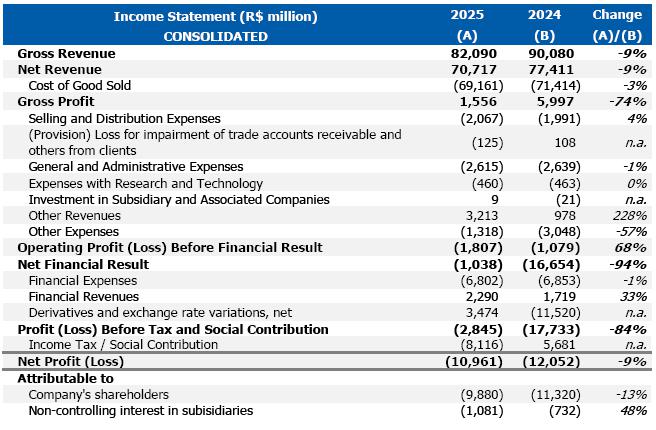
60
| |
| |
12.3 CALCULATION OF CONSOLIDATED RECURRING EBITDA
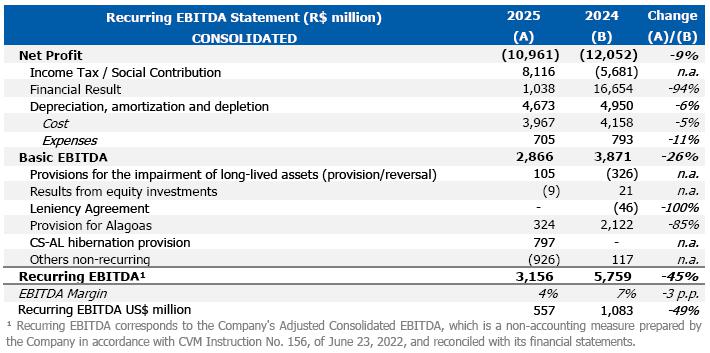
61
| |
| |
12.4 CONSOLIDATED BALANCE SHEET
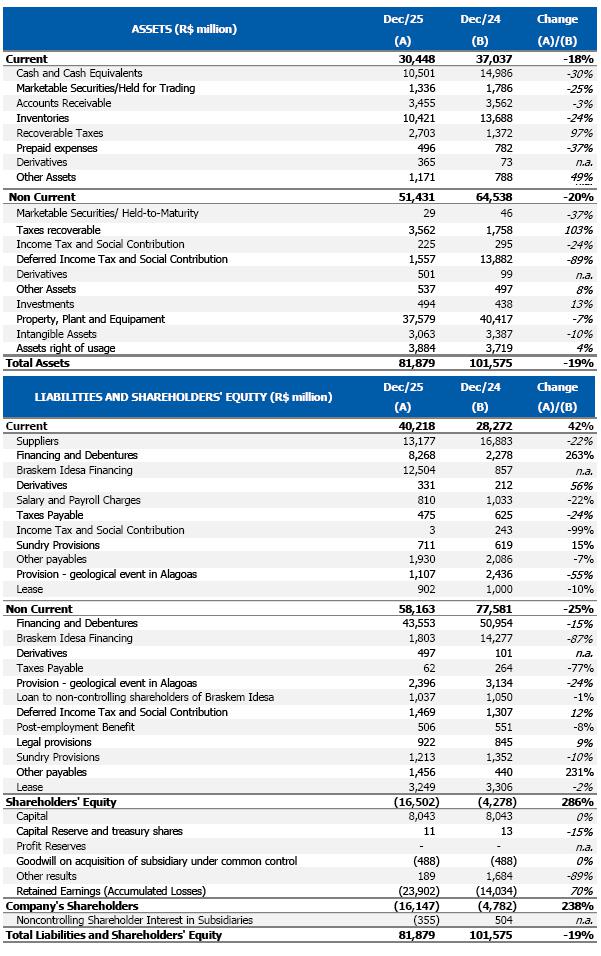
62
| |
| |
12.5 CONSOLIDATED
CASH FLOW
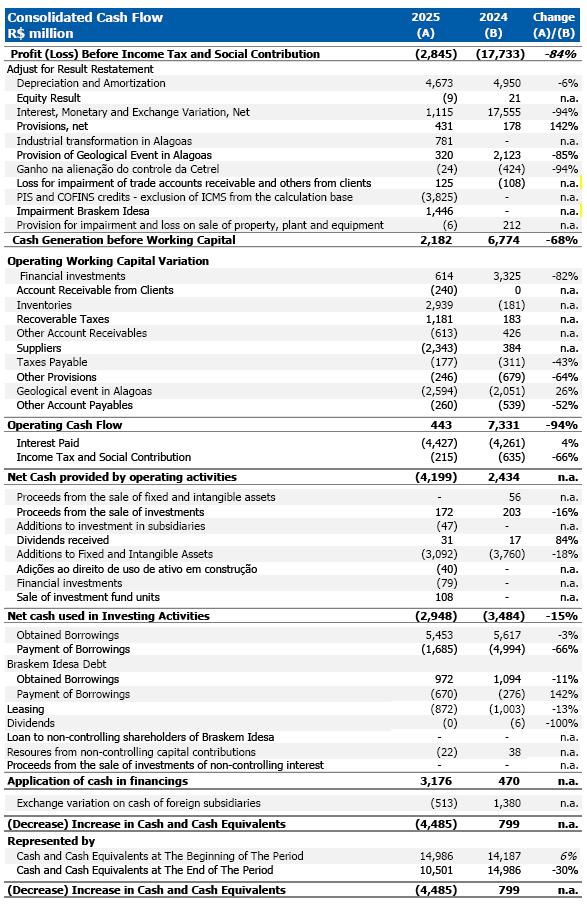
63
| |
| |
12.6 BRASKEM IDESA INCOME STATEMENT
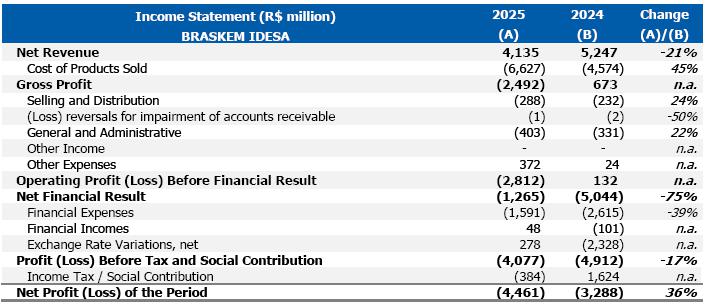
12.7 BRASKEM IDESA BALANCE SHEET
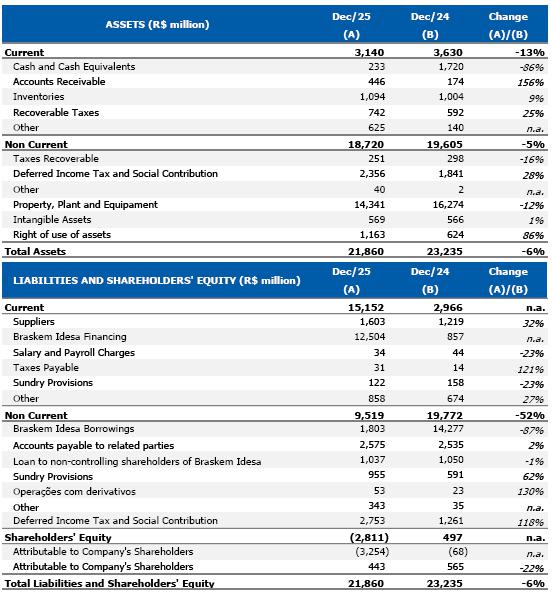
64
| |
| |
12.8 BRASKEM IDESA CASH FLOW STATEMENT
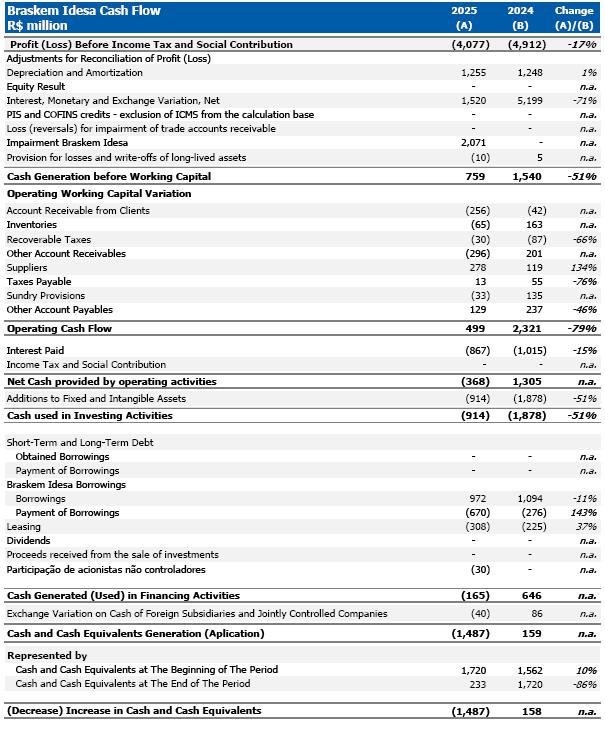
65
| |
SIGNATURES
Pursuant to the requirements of the Securities Exchange Act of 1934, the registrant has duly caused this report to be signed on its behalf by the undersigned, thereunto duly authorized.
Date: March 27, 2026
| BRASKEM S.A. | |||
| By: | /s/ Felipe Montoro Jens | ||
| Name: | Felipe Montoro Jens | ||
| Title: | Chief Financial Officer | ||
DISCLAIMER ON FORWARD-LOOKING STATEMENTS
This report on Form 6-K may contain forward-looking statements within the meaning of the Private Securities Litigation Reform Act of 1995. These statements are statements that are not historical facts, and are based on our management’s current view and estimates of future economic and other circumstances, industry conditions, company performance and financial results, including any potential or projected impact of the geological event in Alagoas and related legal proceedings and of COVID-19 on our business, financial condition and operating results. The words “anticipates,” “believes,” “estimates,” “expects,” “plans” and similar expressions, as they relate to the company, are intended to identify forward-looking statements. Statements regarding the potential outcome of legal and administrative proceedings, the implementation of principal operating and financing strategies and capital expenditure plans, the direction of future operations and the factors or trends affecting our financial condition, liquidity or results of operations are examples of forward-looking statements. Such statements reflect the current views of our management and are subject to a number of risks and uncertainties, many of which are outside of the our control. There is no guarantee that the expected events, trends or results will actually occur. The statements are based on many assumptions and factors, including general economic and market conditions, industry conditions, and operating factors. Any changes in such assumptions or factors, including the projected impact of the geological event in Alagoas and related legal proceedings and the unprecedented impact of COVID-19 pandemic on our business, employees, service providers, stockholders, investors and other stakeholders, could cause actual results to differ materially from current expectations. Please refer to our annual report on Form 20-F for the year ended December 31, 2019 filed with the SEC, as well as any subsequent filings made by us pursuant to the Exchange Act, each of which is available on the SEC’s website (www.sec.gov), for a full discussion of the risks and other factors that may impact any forward-looking statements in this presentation.