Please wait


Information About Forward-Looking Statements


This communication contains forward-looking statements. These forward-looking statements reflect the views of The Priceline Group’s management regarding current expectations and projections about future events and the ability of The Priceline Group to complete the transactions contemplated by the merger agreement, including the parties’ ability to satisfy the conditions to the consummation of the tender offer and the other conditions set forth in the merger agreement, and are based on currently available information and current foreign currency exchange rates. These forward-looking statements are not guarantees of future performance and are subject to risks, uncertainties and assumptions that are difficult to predict; therefore, actual results may differ materially from those expressed, implied or forecasted in any such forward-looking statements. Expressions of future goals and similar expressions including, “may,” “will,” “should,” “could,” “expects,” “plans,” “anticipates,” “intends,” “believes,” “estimates,” “predicts,” “potential,” “targets,” or “continue,” reflecting something other than historical fact are intended to identify forward-looking statements. The proposed transaction has not closed, and the following factors, among others, could cause actual results to differ materially from those described in the forward-looking statements: the possibility that expected benefits of the transaction may not be achieved in a timely manner or at all; revenues following the transaction may be lower than expected; disruption from the transaction may adversely affect OpenTable’s relationships with its customers, business partners or employees; the conditions to the completion of the transaction may not be satisfied in a timely manner or at all; and the other factors described in The Priceline Group’s most recent Quarterly Report on Form 10-Q and Annual Report on Form 10-K filed with the Securities and Exchange Commission. Unless required by law, The Priceline Group undertakes no obligation to update publicly any forward-looking statements, whether as a result of new information, future events or otherwise.


Additional Information


The tender offer described in this communication (the “Offer”) has not yet commenced, and this communication is neither an offer to purchase nor a solicitation of an offer to sell any shares of the common stock of OpenTable or any other securities. On the commencement date of the Offer, a tender offer statement on Schedule TO, including an offer to purchase, a letter of transmittal and related documents, will be filed with the United States Securities and Exchange Commission (the “SEC”) by The Priceline Group and a Solicitation/Recommendation Statement on Schedule 14D-9 will be filed with the SEC by OpenTable. The offer to purchase shares of OpenTable common stock will only be made pursuant to the offer to purchase, the letter of transmittal and related documents filed as a part of the Schedule TO. INVESTORS AND SECURITY HOLDERS ARE URGED TO READ BOTH THE TENDER OFFER STATEMENT AND THE SOLICITATION/RECOMMENDATION STATEMENT REGARDING THE OFFER, AS THEY MAY BE AMENDED FROM TIME TO TIME, WHEN THEY BECOME AVAILABLE BECAUSE THEY WILL CONTAIN IMPORTANT INFORMATION. The tender offer statement will be filed with the SEC by The Priceline Group, Inc. and Rhombus, Inc., a wholly-owned subsidiary of the Priceline Group, and the solicitation/recommendation statement will be filed with the SEC by OpenTable. Investors and security holders may obtain a free copy of these statements (when available) and other documents filed with the SEC at the website maintained by the SEC at www.sec.gov or by directing such requests to the Information Agent for the Offer, which will be named in the tender offer statement.


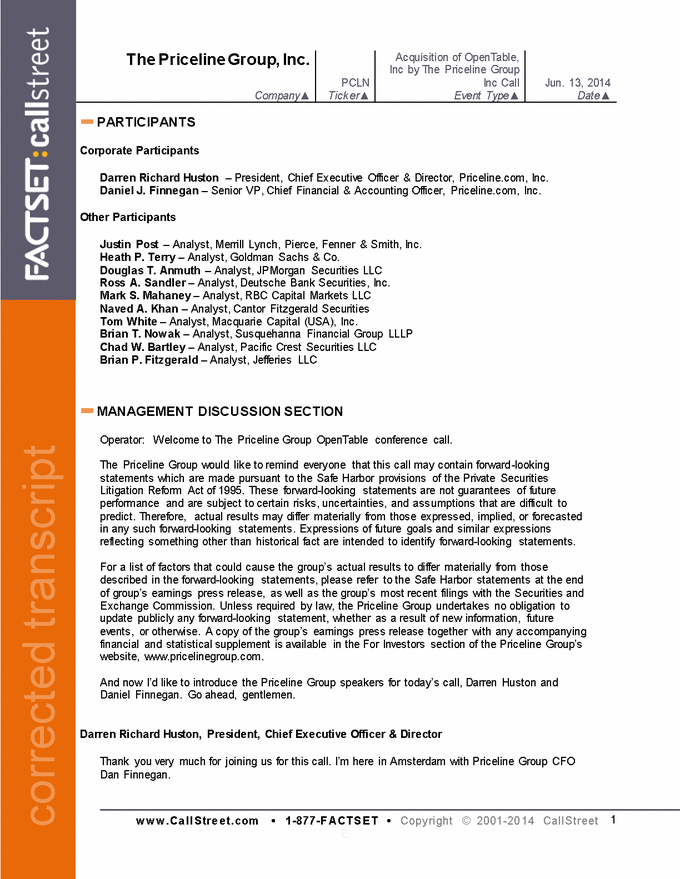
PARTICIPANTS Corporate Participants Darren Richard Huston – President, Chief Executive Officer & Director, Priceline.com, Inc. Daniel J. Finnegan – Senior VP, Chief Financial & Accounting Officer, Priceline.com, Inc. Other Participants Justin Post – Analyst, Merrill Lynch, Pierce, Fenner & Smith, Inc. Heath P. Terry – Analyst, Goldman Sachs & Co. Douglas T. Anmuth – Analyst, JPMorgan Securities LLC Ross A. Sandler – Analyst, Deutsche Bank Securities, Inc. Mark S. Mahaney – Analyst, RBC Capital Markets LLC Naved A. Khan – Analyst, Cantor Fitzgerald Securities Tom White – Analyst, Macquarie Capital (USA), Inc. Brian T. Nowak – Analyst, Susquehanna Financial Group LLLP Chad W. Bartley – Analyst, Pacific Crest Securities LLC Brian P. Fitzgerald – Analyst, Jefferies LLC MANAGEMENT DISCUSSION SECTION Operator: Welcome to The Priceline Group OpenTable conference call. The Priceline Group would like to remind everyone that this call may contain forward-looking statements which are made pursuant to the Safe Harbor provisions of the Private Securities Litigation Reform Act of 1995. These forward-looking statements are not guarantees of future performance and are subject to certain risks, uncertainties, and assumptions that are difficult to predict. Therefore, actual results may differ materially from those expressed, implied, or forecasted in any such forward-looking statements. Expressions of future goals and similar expressions reflecting something other than historical fact are intended to identify forward-looking statements. For a list of factors that could cause the group’s actual results to differ materially from those described in the forward-looking statements, please refer to the Safe Harbor statements at the end of group’s earnings press release, as well as the group’s most recent filings with the Securities and Exchange Commission. Unless required by law, the Priceline Group undertakes no obligation to update publicly any forward-looking statement, whether as a result of new information, future events, or otherwise. A copy of the group’s earnings press release together with any accompanying financial and statistical supplement is available in the For Investors section of the Priceline Group’s website, www.pricelinegroup.com. And now I’d like to introduce the Priceline Group speakers for today’s call, Darren Huston and Daniel Finnegan. Go ahead, gentlemen. Darren Richard Huston, President, Chief Executive Officer & Director Thank you very much for joining us for this call. I’m here in Amsterdam with Priceline Group CFO Dan Finnegan.


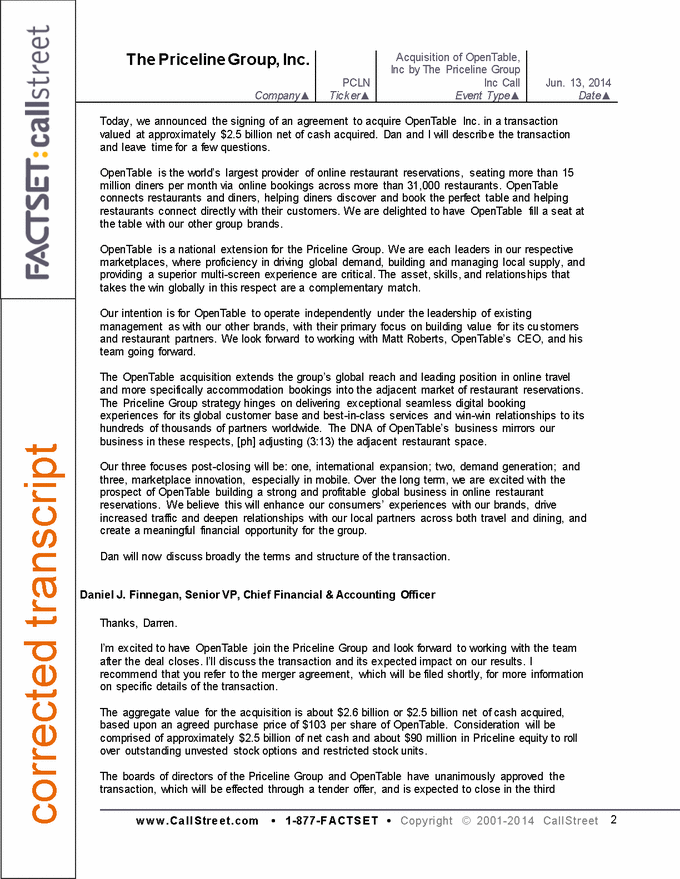
Today, we announced the signing of an agreement to acquire OpenTable Inc. in a transaction valued at approximately $2.5 billion net of cash acquired. Dan and I will describe the transaction and leave time for a few questions. OpenTable is the world’s largest provider of online restaurant reservations, seating more than 15 million diners per month via online bookings across more than 31,000 restaurants. OpenTable connects restaurants and diners, helping diners discover and book the perfect table and helping restaurants connect directly with their customers. We are delighted to have OpenTable fill a seat at the table with our other group brands. OpenTable is a national extension for the Priceline Group. We are each leaders in our respective marketplaces, where proficiency in driving global demand, building and managing local supply, and providing a superior multi-screen experience are critical. The asset, skills, and relationships that takes the win globally in this respect are a complementary match. Our intention is for OpenTable to operate independently under the leadership of existing management as with our other brands, with their primary focus on building value for its customers and restaurant partners. We look forward to working with Matt Roberts, OpenTable’s CEO, and his team going forward. The OpenTable acquisition extends the group’s global reach and leading position in online travel and more specifically accommodation bookings into the adjacent market of restaurant reservations. The Priceline Group strategy hinges on delivering exceptional seamless digital booking experiences for its global customer base and best-in-class services and win-win relationships to its hundreds of thousands of partners worldwide. The DNA of OpenTable’s business mirrors our business in these respects, [ph] adjusting (3:13) the adjacent restaurant space. Our three focuses post-closing will be: one, international expansion; two, demand generation; and three, marketplace innovation, especially in mobile. Over the long term, we are excited with the prospect of OpenTable building a strong and profitable global business in online restaurant reservations. We believe this will enhance our consumers’ experiences with our brands, drive increased traffic and deepen relationships with our local partners across both travel and dining, and create a meaningful financial opportunity for the group. Dan will now discuss broadly the terms and structure of the transaction. Daniel J. Finnegan, Senior VP, Chief Financial & Accounting Officer Thanks, Darren. I’m excited to have OpenTable join the Priceline Group and look forward to working with the team after the deal closes. I’ll discuss the transaction and its expected impact on our results. I recommend that you refer to the merger agreement, which will be filed shortly, for more information on specific details of the transaction. The aggregate value for the acquisition is about $2.6 billion or $2.5 billion net of cash acquired, based upon an agreed purchase price of $103 per share of OpenTable. Consideration will be comprised of approximately $2.5 billion of net cash and about $90 million in Priceline equity to roll over outstanding unvested stock options and restricted stock units. The boards of directors of the Priceline Group and OpenTable have unanimously approved the transaction, which will be effected through a tender offer, and is expected to close in the third


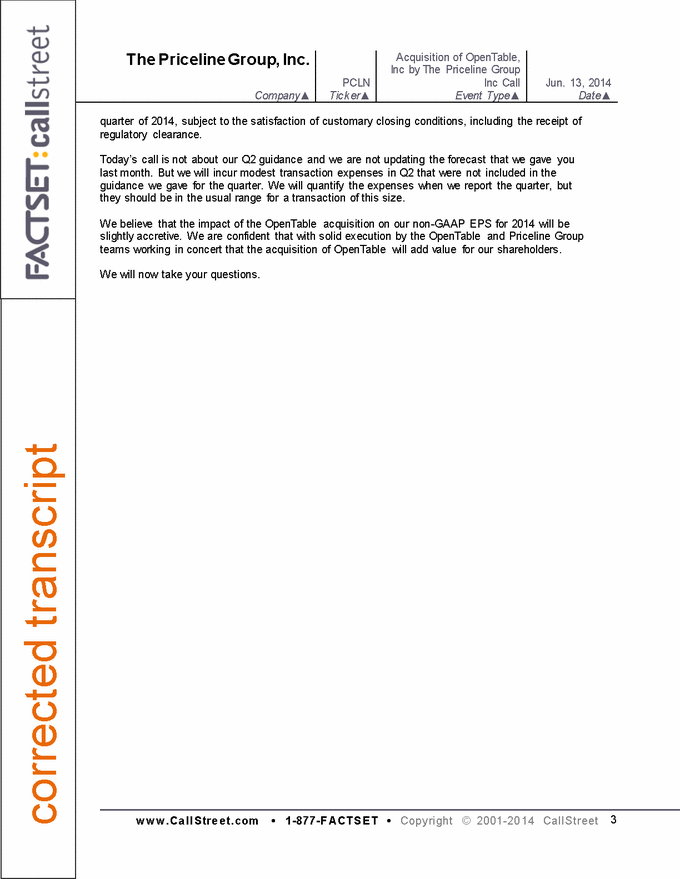
quarter of 2014, subject to the satisfaction of customary closing conditions, including the receipt of regulatory clearance. Today’s call is not about our Q2 guidance and we are not updating the forecast that we gave you last month. But we will incur modest transaction expenses in Q2 that were not included in the guidance we gave for the quarter. We will quantify the expenses when we report the quarter, but they should be in the usual range for a transaction of this size. We believe that the impact of the OpenTable acquisition on our non-GAAP EPS for 2014 will be slightly accretive. We are confident that with solid execution by the OpenTable and Priceline Group teams working in concert that the acquisition of OpenTable will add value for our shareholders. We will now take your questions.


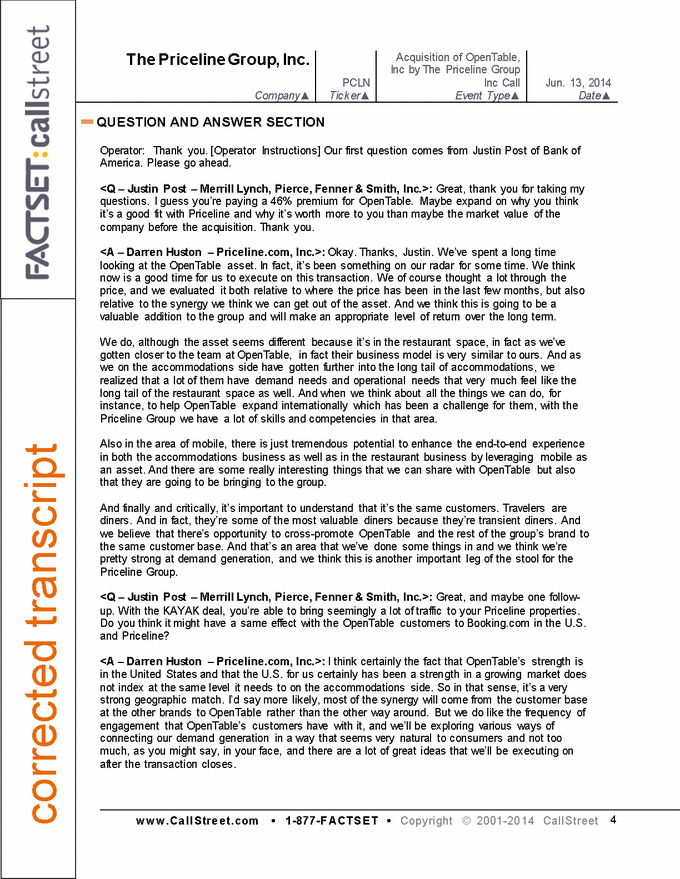
QUESTION AND ANSWER SECTION Operator: Thank you. [Operator Instructions] Our first question comes from Justin Post of Bank of America. Please go ahead. <Q – Justin Post – Merrill Lynch, Pierce, Fenner & Smith, Inc.>: Great, thank you for taking my questions. I guess you’re paying a 46% premium for OpenTable. Maybe expand on why you think it’s a good fit with Priceline and why it’s worth more to you than maybe the market value of the company before the acquisition. Thank you. <A – Darren Huston – Priceline.com, Inc.>: Okay. Thanks, Justin. We’ve spent a long time looking at the OpenTable asset. In fact, it’s been something on our radar for some time. We think now is a good time for us to execute on this transaction. We of course thought a lot through the price, and we evaluated it both relative to where the price has been in the last few months, but also relative to the synergy we think we can get out of the asset. And we think this is going to be a valuable addition to the group and will make an appropriate level of return over the long term. We do, although the asset seems different because it’s in the restaurant space, in fact as we’ve gotten closer to the team at OpenTable, in fact their business model is very similar to ours. And as we on the accommodations side have gotten further into the long tail of accommodations, we realized that a lot of them have demand needs and operational needs that very much feel like the long tail of the restaurant space as well. And when we think about all the things we can do, for instance, to help OpenTable expand internationally which has been a challenge for them, with the Priceline Group we have a lot of skills and competencies in that area. Also in the area of mobile, there is just tremendous potential to enhance the end-to-end experience in both the accommodations business as well as in the restaurant business by leveraging mobile as an asset. And there are some really interesting things that we can share with OpenTable but also that they are going to be bringing to the group. And finally and critically, it’s important to understand that it’s the same customers. Travelers are diners. And in fact, they’re some of the most valuable diners because they’re transient diners. And we believe that there’s opportunity to cross-promote OpenTable and the rest of the group’s brand to the same customer base. And that’s an area that we’ve done some things in and we think we’re pretty strong at demand generation, and we think this is another important leg of the stool for the Priceline Group. <Q – Justin Post – Merrill Lynch, Pierce, Fenner & Smith, Inc.>: Great, and maybe one follow- up. With the KAYAK deal, you’re able to bring seemingly a lot of traffic to your Priceline properties. Do you think it might have a same effect with the OpenTable customers to Booking.com in the U.S. and Priceline? <A – Darren Huston – Priceline.com, Inc.>: I think certainly the fact that OpenTable’s strength is in the United States and that the U.S. for us certainly has been a strength in a growing market does not index at the same level it needs to on the accommodations side. So in that sense, it’s a very strong geographic match. I’d say more likely, most of the synergy will come from the customer base at the other brands to OpenTable rather than the other way around. But we do like the frequency of engagement that OpenTable’s customers have with it, and we’ll be exploring various ways of connecting our demand generation in a way that seems very natural to consumers and not too much, as you might say, in your face, and there are a lot of great ideas that we’ll be executing on after the transaction closes.


<Q – Justin Post – Merrill Lynch, Pierce, Fenner & Smith, Inc.>: Great, thank you for taking my question. <A – Darren Huston – Priceline.com, Inc.>: Thanks, Justin. Operator: Thank you. Our next question comes from Heath Terry of Goldman Sachs. Your line is open. <Q – Heath Terry – Goldman Sachs & Co.>: Great, thanks. Darren, when you look at OpenTable both from an international investment perspective and from an engineering perspective, where do you see the opportunities for the business that potentially haven’t been recognized up to this point? But on Priceline’s platform or as I think you put it recently taking that fifth seat at the table, what kind of impact or advantage do you think that’s going to have for OpenTable’s business on its own? <A – Darren Huston – Priceline.com, Inc.>: Okay, thanks, Heath. I think there are a number of areas. One, when you talk about internationalization, there are so many elements that. It includes translations and languages. And as you know, we have offices all over the world, and certainly they have offices in every large city in the world where a lot of reservation-taking restaurants exist. We’ve got some operating synergy in terms of what it takes to operate in the markets. You’re billing in the markets, provide strong translated content at scale as well as generate demand in these various markets with people from those markets. I’d say another area in your second bucket has to do with technology. OpenTable has on their own, to their credit, begun to make the changes that are necessary to run a modern e-commerce Internet site. And those include the ability to do A/B experimentation at scale and to really add those elements that have proven so successful for us in driving conversion. And we think OpenTable has built – really focused in the beginning on building great B2B software, really software for a restaurant, and has only now started to put a pretty strong focus on the B2C space of their business. And that’s an area that certainly we have very deep experience across the brands and hope to help catalyze their efforts going forward. I will say, as you know, we allow our brands to be independently managed, entrepreneurially led. We really like the team at OpenTable. And this isn’t about us going in and doing their business for them, but it’s really about our success in sharing best practice across the group and bringing a team like that into the performance culture that we have. And we think there’s going to be a nice strong cultural match, and I know we have a lot of respect for what they’ve done and they have a lot of respect for what we’ve done on that basis. And so it would be a great environment for really rapidly getting those learnings into place. <Q – Heath Terry – Goldman Sachs & Co.>: Great. Thanks, Darren. Operator: Thank you. Our next question comes from Douglas Anmuth of JPMorgan. Your line is open. <Q – Doug Anmuth – JPMorgan Securities LLC>: Great, thanks for taking the question. You guys have been a travel company and Darren said we could talk more about how you’re thinking about the company as a marketplace business and are there still some other adjacent areas that you could go into. And also, Dan, perhaps you can explain more on your thought process around using virtually all cash here for the deal. Thanks. <A – Darren Huston – Priceline.com, Inc.>: So thanks, Douglas. I’d first caveat. This has been an exceptional week because we’ve done two acquisitions. This doesn’t at all indicate a new strategy where we’re suddenly becoming extremely acquisitive. Our growth is really going to continue to come through organic growth. I should also say moreover we feel really comfortable


with the way our core business is growing, so this isn’t some reaction to have to buy a bunch of stuff to find growth. We’re getting a great growth out of the core. This is really an opportunity to take a well thought through step in expanding our addressable market. And doing some long-tail accommodations into restaurants isn’t like going from Venus to Mars. It’s actually a fairly strong adjacent space. And the competencies that are used to run a business like an OpenTable are very similar to the competencies that we’ve built to run brands like Booking.com, Agoda, et cetera. So for us this is a big important step, but it’s been well reasoned. And we’re going to spend a lot of time in where we are at our best, which is post-closing really working with the team to work these key synergy areas and really put an accelerator on things like international growth, improvement in the B2C experience of OpenTable, and marketplace innovation in, as I mentioned, areas like mobile. <A – Dan Finnegan – Priceline.com, Inc.>: In terms of the form of consideration, Doug, that was the subject of the negotiation between the parties. We’re comfortable using cash from the perspective that we have a very strong balance sheet. We’ve got the opportunity to raise capital in the capital markets to the extent we need to. And so we were comfortable using cash for the acquisition. <Q – Doug Anmuth – JPMorgan Securities LLC>: That’s great. Thanks, guys. Operator: Thank you. Our next question comes from Ross Sandler of Deutsche Bank. Your line is open. <Q – Ross Sandler – Deutsche Bank Securities, Inc.>: Thanks, guys. So you mentioned the taking OpenTable international as a key part of the strategy, similar to KAYAK. And therefore we understand the international footprint is mostly UK, with some non-UK international at Open. So can you talk about what markets you see as the immediate opportunity? And then the back-end technology at Open is quite a bit different than KAYAK or Booking, with all the labor intensity of plugging into a restaurant. So outside of localizing the service, can you talk about the ability to scale Open in the same fashion that you did KAYAK or Booking as you look to localize and maybe some of the friction that you might see in doing so? <A – Darren Huston – Priceline.com, Inc.>: Thanks a lot, Ross. So first in terms of our global rollout strategy, we don’t have anything to specifically discuss today. Yes, OpenTable has a presence in London and Germany as well as in Japan. And you can imagine, of course, we have offices, as I’ve have mentioned, in every major city in the world, and we will co-design that plan with Matt and his team going forward. But needless to say, it will be a strong and aggressive plan because our vision is that OpenTable becomes a global platform versus just in the countries it’s in. And then secondly, I think the traditional OpenTable model, which is a client server model, where you’re putting physical hardware into restaurants, OpenTable is already working on a cloud-based solution that we really like. And it will provide a more scalable model for rolling out B2B software into restaurants around the world. And we hope that that will help us also accelerate acquisitions going forward. So it’s not as heavy a footprint as they’ve had in the past. We are also, as you know, through things like the Buuteeq acquisition are looking into hotel marketing services and providing related cloud-based marketing solutions into accommodation providers in the long tail as well. So it will be an interesting set of learnings, but we believe internally that there have been some technological innovations that will help us provide some scale to the business for the long term.


<Q – Ross Sandler – Deutsche Bank Securities, Inc.>: Got it. And I think maybe what would also help would be we’re about six quarters into the KAYAK acquisition. So could you just talk to us about maybe how that international footprint has expanded? Did it meet or exceed goals in terms of that international rollout just as a proxy for what we can expect over the next year and a half from Open? Thanks. <A – Darren Huston – Priceline.com, Inc.>: So with KAYAK, I would say that it has certainly met our expectations. We always knew that we would have to go through a methodical process to get the model right as they expanded overseas. We feel good about the traction that we’re seeing in Europe. But we’re doing it in a very moderated way. We’re running a marathon here, and we’re making sure that each step we take is a sustainably profitable step. And we feel really good about the way that Steve [Hafner] and his team are running the business. And we think it will also provide somewhat of a roadmap for OpenTable. But on the other hand, it’s important to understand that KAYAK specifically is a media business, and it has very different dynamics in terms of the way you build demand, and there’s no supply side to it other than just getting people onto the website. And OpenTable will have the same sort of model as Booking.com because it’s a process of building supply and matching demand and moving the ball down the field at the same time. And that’s a model that is even more common in the group in terms of the way we expand internationally. <Q – Ross Sandler – Deutsche Bank Securities, Inc.>: Got it. Thank you, guys. Operator: Thank you. Our next question comes from Mark Mahaney of RBC. Your line is open. <Q – Mark Mahaney – RBC Capital Markets LLC>: Thanks. You talked about these three priorities, and I think the last one was marketplace innovation. Maybe the broad question I want to ask is, there are a lot of other things that Priceline could offer to travelers, other natural marketplace extensions. There may be e-commerce opportunities around local attractions, all the things that people do once they get to a destination other than – in addition to restaurants. Is this part of that broader strategy to build out the e-commerce capabilities of Priceline for all travelers, or should we just view this as a one-off array and just one element of that? <A – Darren Huston – Priceline.com, Inc.>: Thanks, Mark. We look at all aspects of travel certainly. And it’s always a question of renting or buying, as you can imagine, as we look at all these various opportunities. Restaurants end up specifically being a very large marketplace. And because it involves a physical location locally and an entrepreneur that’s running that and all of the credit control aspects, languages, it’s actually a lot of hard work to wire up a restaurant, but the benefit of doing that we believe is quite significant, and that’s why it was a really natural next step for us. And we think with the OpenTable asset, they’ve done a lot of the hard learning and started to build the basis that we think we can scale from. And that’s why it in particular was the right next step. There are a lot of other markets that come to mind. But without going into them on this call, there are always little issues, whether it’s market size or whether the market is really ready to go online and all of these things that we’re always considering. But we’re not again, as I mentioned earlier in the call, we should not take this as a signal that we’re going to be gobbling up all these various aspects of travel and globalizing them. We think this is a nice big other footprint that gets used by millions and millions of people around the world and will be a great opportunity for us to increase the size of our addressable market in a singular way that provides significant potential going forward. <Q – Mark Mahaney – RBC Capital Markets LLC>: Darren, can I try one quick follow-up too?


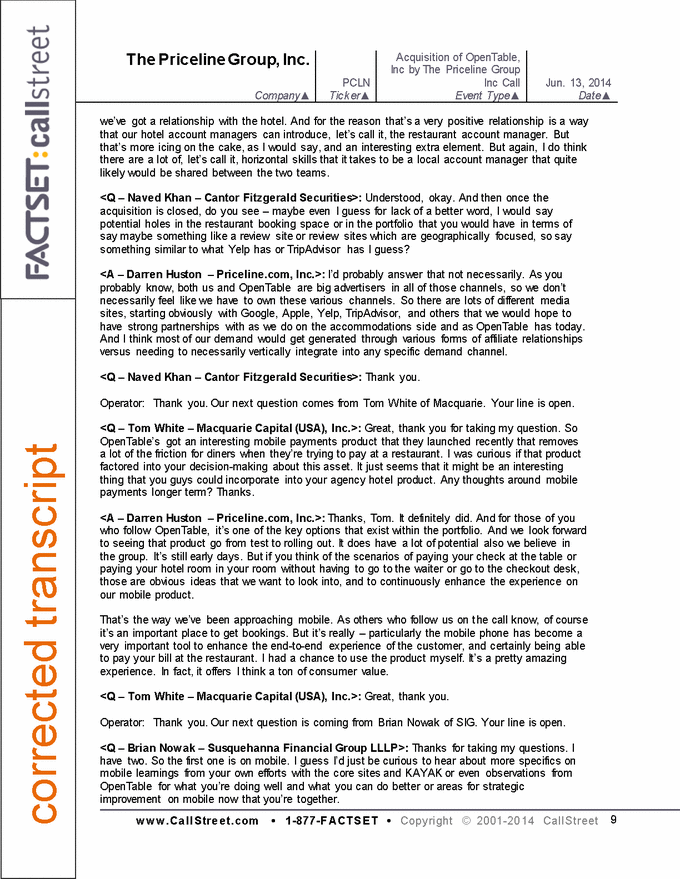
<A – Darren Huston – Priceline.com, Inc.>: Sure. <Q – Mark Mahaney – RBC Capital Markets LLC>: It’s very I guess consistent or similar to what you’ve done over the years with getting literally hundreds of thousands of hotels wired up to Priceline and Booking.com. Could you talk technically about how more challenging it is to get restaurants hooked up to the OpenTable system as it has been in the past to get hotels hooked up to the Priceline booking systems, just technically how greater of a challenge, different of a challenge, similar of a challenge it is? <A – Darren Huston – Priceline.com, Inc.>: I think it relates somewhat to Ross’s question. But if you go to the very biggest of hotels, they often have somebody onsite who is a revenue manager, and they have very sophisticated systems. And often then it’s just a matter of plumbing into their existing systems, and there’s a very sophisticated approach to yield management. But as you get to smaller and smaller properties and at some scale they have no revenue manager, the revenue manager is the owner and/or it’s the desk person at night. And as we’ve grown into those long-tail accommodations, we’ve learned how to deal with those situations. But still in the longest tail, we might be faxing a reservation because the accommodation is working off a book. And it can be a lot of advantage to us to have that accommodation go from working off of a book to working on to some kind of digital system. In a way, OpenTable approached the problem by first addressing the issue of too many restaurants are working off of a white book by creating a reservation system, and then off of that reservation system creating then a booking engine. And almost as we could re-create things we might have approached the long tail in that way as well, and we’re starting to catch up to that because it’s quite cumbersome dealing with someone who’s only working off of a reservation book. So in a way, there are elements historically in the OpenTable system because it was a client server-based execution that made the process of getting a restaurant up and running because it required a physical touch and a bunch of other things. But there’s a lot of technology being put into place that ultimately might require a physical touch by a salesperson but not necessarily a deep engagement to get a restaurant up and going. And we’ve got a lot of experience with that in our long tail on how do you minimize the cost of training and getting things up to a point now that Booking.com is adding 2,000 to 3,000 properties a week, and a lot of that is in the long tail because we’ve figured out ways to systematize and automate that process. And I think ultimately there’s that kind of potential for OpenTable in the long term. <Q – Mark Mahaney – RBC Capital Markets LLC>: Thank you, Darren. Operator: Thank you. Our next question comes from Naved Khan of Cantor Fitzgerald. Your line is open. <Q – Naved Khan – Cantor Fitzgerald Securities>: Thanks, just a question on the potential synergies with regards to the international expansion of OpenTable. Is there potential of Priceline being able to leverage its personnel in these geographies outside the U.S. to establish their presence, or do you think that’s a different skill set? And then I have a follow-up question. <A – Darren Huston – Priceline.com, Inc.>: Thanks, Naved. I would say generally speaking, the teams that would do the restaurant or the OpenTable business would be separate from the teams that would do the accommodation business, although it’s not unlikely that somebody could be brought in as an account manager for one or the other and could actually very easily be joining one team or the other. There is a small amount of synergy because many reservation-taking restaurants are actually in hotels, so there’s an interesting opportunity there. I call that more of a secondary synergy because


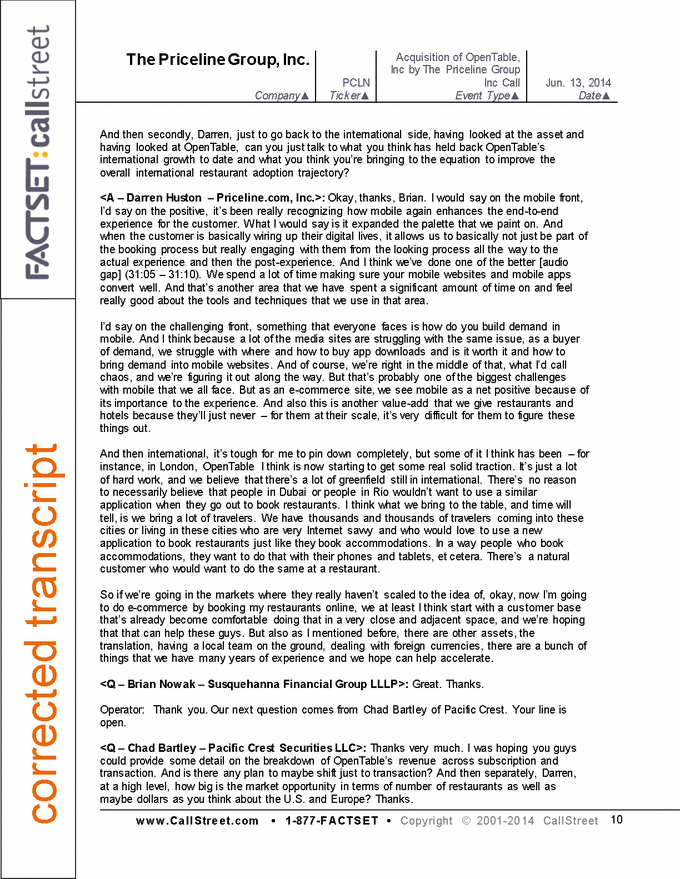
we’ve got a relationship with the hotel. And for the reason that’s a very positive relationship is a way that our hotel account managers can introduce, let’s call it, the restaurant account manager. But that’s more icing on the cake, as I would say, and an interesting extra element. But again, I do think there are a lot of, let’s call it, horizontal skills that it takes to be a local account manager that quite likely would be shared between the two teams. <Q – Naved Khan – Cantor Fitzgerald Securities>: Understood, okay. And then once the acquisition is closed, do you see – maybe even I guess for lack of a better word, I would say potential holes in the restaurant booking space or in the portfolio that you would have in terms of say maybe something like a review site or review sites which are geographically focused, so say something similar to what Yelp has or TripAdvisor has I guess? <A – Darren Huston – Priceline.com, Inc.>: I’d probably answer that not necessarily. As you probably know, both us and OpenTable are big advertisers in all of those channels, so we don’t necessarily feel like we have to own these various channels. So there are lots of different media sites, starting obviously with Google, Apple, Yelp, TripAdvisor, and others that we would hope to have strong partnerships with as we do on the accommodations side and as OpenTable has today. And I think most of our demand would get generated through various forms of affiliate relationships versus needing to necessarily vertically integrate into any specific demand channel. <Q – Naved Khan – Cantor Fitzgerald Securities>: Thank you. Operator: Thank you. Our next question comes from Tom White of Macquarie. Your line is open. <Q – Tom White – Macquarie Capital (USA), Inc.>: Great, thank you for taking my question. So OpenTable’s got an interesting mobile payments product that they launched recently that removes a lot of the friction for diners when they’re trying to pay at a restaurant. I was curious if that product factored into your decision-making about this asset. It just seems that it might be an interesting thing that you guys could incorporate into your agency hotel product. Any thoughts around mobile payments longer term? Thanks. <A – Darren Huston – Priceline.com, Inc.>: Thanks, Tom. It definitely did. And for those of you who follow OpenTable, it’s one of the key options that exist within the portfolio. And we look forward to seeing that product go from test to rolling out. It does have a lot of potential also we believe in the group. It’s still early days. But if you think of the scenarios of paying your check at the table or paying your hotel room in your room without having to go to the waiter or go to the checkout desk, those are obvious ideas that we want to look into, and to continuously enhance the experience on our mobile product. That’s the way we’ve been approaching mobile. As others who follow us on the call know, of course it’s an important place to get bookings. But it’s really – particularly the mobile phone has become a very important tool to enhance the end-to-end experience of the customer, and certainly being able to pay your bill at the restaurant. I had a chance to use the product myself. It’s a pretty amazing experience. In fact, it offers I think a ton of consumer value. <Q – Tom White – Macquarie Capital (USA), Inc.>: Great, thank you. Operator: Thank you. Our next question is coming from Brian Nowak of SIG. Your line is open. <Q – Brian Nowak – Susquehanna Financial Group LLLP>: Thanks for taking my questions. I have two. So the first one is on mobile. I guess I’d just be curious to hear about more specifics on mobile learnings from your own efforts with the core sites and KAYAK or even observations from OpenTable for what you’re doing well and what you can do better or areas for strategic improvement on mobile now that you’re together.


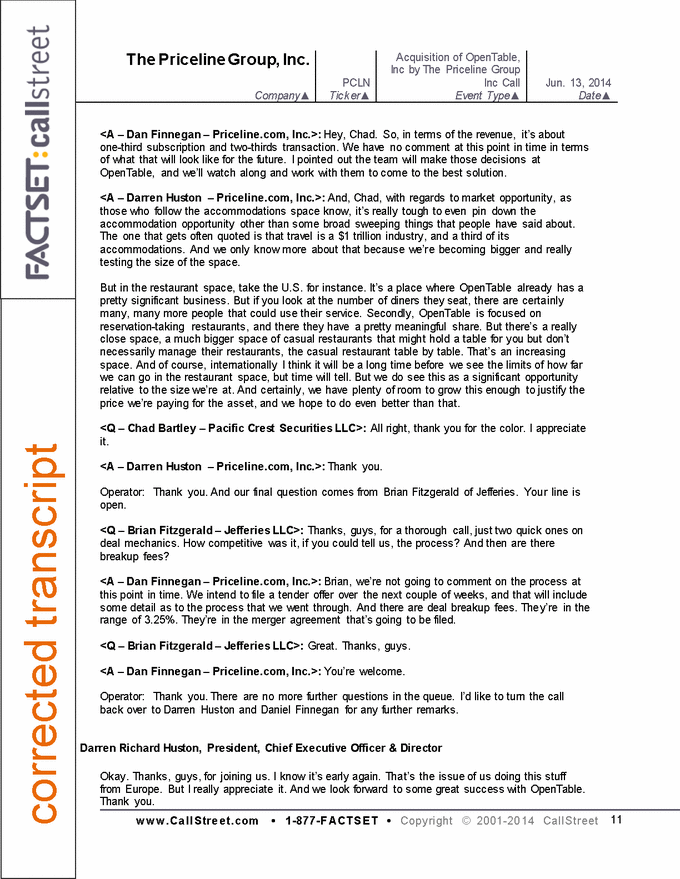
And then secondly, Darren, just to go back to the international side, having looked at the asset and having looked at OpenTable, can you just talk to what you think has held back OpenTable’s international growth to date and what you think you’re bringing to the equation to improve the overall international restaurant adoption trajectory? <A – Darren Huston – Priceline.com, Inc.>: Okay, thanks, Brian. I would say on the mobile front, I’d say on the positive, it’s been really recognizing how mobile again enhances the end-to-end experience for the customer. What I would say is it expanded the palette that we paint on. And when the customer is basically wiring up their digital lives, it allows us to basically not just be part of the booking process but really engaging with them from the looking process all the way to the actual experience and then the post-experience. And I think we’ve done one of the better [audio gap] (31:05 – 31:10). We spend a lot of time making sure your mobile websites and mobile apps convert well. And that’s another area that we have spent a significant amount of time on and feel really good about the tools and techniques that we use in that area. I’d say on the challenging front, something that everyone faces is how do you build demand in mobile. And I think because a lot of the media sites are struggling with the same issue, as a buyer of demand, we struggle with where and how to buy app downloads and is it worth it and how to bring demand into mobile websites. And of course, we’re right in the middle of that, what I’d call chaos, and we’re figuring it out along the way. But that’s probably one of the biggest challenges with mobile that we all face. But as an e-commerce site, we see mobile as a net positive because of its importance to the experience. And also this is another value-add that we give restaurants and hotels because they’ll just never – for them at their scale, it’s very difficult for them to figure these things out. And then international, it’s tough for me to pin down completely, but some of it I think has been – for instance, in London, OpenTable I think is now starting to get some real solid traction. It’s just a lot of hard work, and we believe that there’s a lot of greenfield still in international. There’s no reason to necessarily believe that people in Dubai or people in Rio wouldn’t want to use a similar application when they go out to book restaurants. I think what we bring to the table, and time will tell, is we bring a lot of travelers. We have thousands and thousands of travelers coming into these cities or living in these cities who are very Internet savvy and who would love to use a new application to book restaurants just like they book accommodations. In a way people who book accommodations, they want to do that with their phones and tablets, et cetera. There’s a natural customer who would want to do the same at a restaurant. So if we’re going in the markets where they really haven’t scaled to the idea of, okay, now I’m going to do e-commerce by booking my restaurants online, we at least I think start with a customer base that’s already become comfortable doing that in a very close and adjacent space, and we’re hoping that that can help these guys. But also as I mentioned before, there are other assets, the translation, having a local team on the ground, dealing with foreign currencies, there are a bunch of things that we have many years of experience and we hope can help accelerate. <Q – Brian Nowak – Susquehanna Financial Group LLLP>: Great. Thanks. Operator: Thank you. Our next question comes from Chad Bartley of Pacific Crest. Your line is open. <Q – Chad Bartley – Pacific Crest Securities LLC>: Thanks very much. I was hoping you guys could provide some detail on the breakdown of OpenTable’s revenue across subscription and transaction. And is there any plan to maybe shift just to transaction? And then separately, Darren, at a high level, how big is the market opportunity in terms of number of restaurants as well as maybe dollars as you think about the U.S. and Europe? Thanks.


<A – Dan Finnegan – Priceline.com, Inc.>: Hey, Chad. So, in terms of the revenue, it’s about one-third subscription and two-thirds transaction. We have no comment at this point in time in terms of what that will look like for the future. I pointed out the team will make those decisions at OpenTable, and we’ll watch along and work with them to come to the best solution. <A – Darren Huston – Priceline.com, Inc.>: And, Chad, with regards to market opportunity, as those who follow the accommodations space know, it’s really tough to even pin down the accommodation opportunity other than some broad sweeping things that people have said about. The one that gets often quoted is that travel is a $1 trillion industry, and a third of its accommodations. And we only know more about that because we’re becoming bigger and really testing the size of the space. But in the restaurant space, take the U.S. for instance. It’s a place where OpenTable already has a pretty significant business. But if you look at the number of diners they seat, there are certainly many, many more people that could use their service. Secondly, OpenTable is focused on reservation-taking restaurants, and there they have a pretty meaningful share. But there’s a really close space, a much bigger space of casual restaurants that might hold a table for you but don’t necessarily manage their restaurants, the casual restaurant table by table. That’s an increasing space. And of course, internationally I think it will be a long time before we see the limits of how far we can go in the restaurant space, but time will tell. But we do see this as a significant opportunity relative to the size we’re at. And certainly, we have plenty of room to grow this enough to justify the price we’re paying for the asset, and we hope to do even better than that. <Q – Chad Bartley – Pacific Crest Securities LLC>: All right, thank you for the color. I appreciate it. <A – Darren Huston – Priceline.com, Inc.>: Thank you. Operator: Thank you. And our final question comes from Brian Fitzgerald of Jefferies. Your line is open. <Q – Brian Fitzgerald – Jefferies LLC>: Thanks, guys, for a thorough call, just two quick ones on deal mechanics. How competitive was it, if you could tell us, the process? And then are there breakup fees? <A – Dan Finnegan – Priceline.com, Inc.>: Brian, we’re not going to comment on the process at this point in time. We intend to file a tender offer over the next couple of weeks, and that will include some detail as to the process that we went through. And there are deal breakup fees. They’re in the range of 3.25%. They’re in the merger agreement that’s going to be filed. <Q – Brian Fitzgerald – Jefferies LLC>: Great. Thanks, guys. <A – Dan Finnegan – Priceline.com, Inc.>: You’re welcome. Operator: Thank you. There are no more further questions in the queue. I’d like to turn the call back over to Darren Huston and Daniel Finnegan for any further remarks. Darren Richard Huston, President, Chief Executive Officer & Director Okay. Thanks, guys, for joining us. I know it’s early again. That’s the issue of us doing this stuff from Europe. But I really appreciate it. And we look forward to some great success with OpenTable. Thank you.


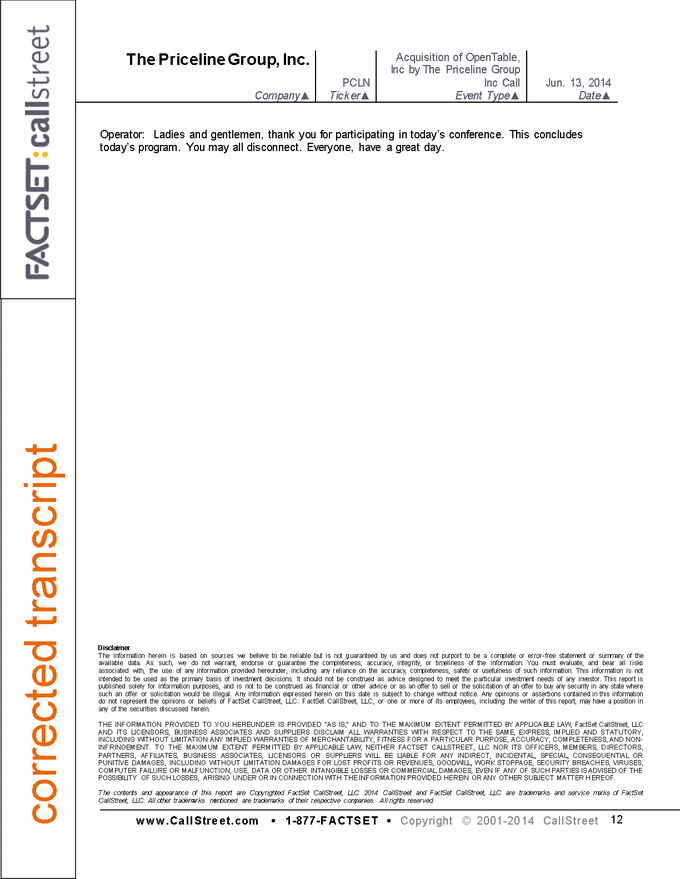
Operator: Ladies and gentlemen, thank you for participating in today’s conference. This concludes today’s program. You may all disconnect. Everyone, have a great day. Disclaimer The information herein is based on sources we believe to be reliable but is not guaranteed by us and does not purport to be a complete or error-free statement or summary of the available data. As such, we do not warrant, endorse or guarantee the completeness, accuracy, integrity, or timeliness of the information. You must evaluate, and bear all risks associated with, the use of any information provided hereunder, including any reliance on the accuracy, completeness, safety or usefulness of such information. This information is not intended to be used as the primary basis of investment decisions. It should not be construed as advice designed to meet the particular investment needs of any investor. This report is published solely for information purposes, and is not to be construed as financial or other advice or as an offer to sell or the solicitation of an offer to buy any security in any state where such an offer or solicitation would be illegal. Any information expressed herein on this date is subject to change without notice. Any opinions or assertions contained in this information do not represent the opinions or beliefs of FactSet CallStreet, LLC. FactSet CallStreet, LLC, or one or more of its employees, including the writer of this report, may have a position in any of the securities discussed herein. THE INFORMATION PROVIDED TO YOU HEREUNDER IS PROVIDED "AS IS," AND TO THE MAXIMUM EXTENT PERMITTED BY APPLICABLE LAW, FactSet CallStreet, LLC AND ITS LICENSORS, BUSINESS ASSOCIATES AND SUPPLIERS DISCLAIM ALL WARRANTIES WITH RESPECT TO THE SAME, EXPRESS, IMPLIED AND STATUTORY, INCLUDING WITHOUT LIMITATION ANY IMPLIED WARRANTIES OF MERCHANTABILITY, FITNESS FOR A PARTICULAR PURPOSE, ACCURACY, COMPLETENESS, AND NON- INFRINGEMENT. TO THE MAXIMUM EXTENT PERMITTED BY APPLICABLE LAW, NEITHER FACTSET CALLSTREET, LLC NOR ITS OFFICERS, MEMBERS, DIRECTORS, PARTNERS, AFFILIATES, BUSINESS ASSOCIATES, LICENSORS OR SUPPLIERS WILL BE LIABLE FOR ANY INDIRECT, INCIDENTAL, SPECIAL, CONSEQUENTIAL OR PUNITIVE DAMAGES, INCLUDING WITHOUT LIMITATION DAMAGES FOR LOST PROFITS OR REVENUES, GOODWILL, WORK STOPPAGE, SECURITY BREACHES, VIRUSES, COMPUTER FAILURE OR MALFUNCTION, USE, DATA OR OTHER INTANGIBLE LOSSES OR COMMERCIAL DAMAGES, EVEN IF ANY OF SUCH PARTIES IS ADVISED OF THE POSSIBILITY OF SUCH LOSSES, ARISING UNDER OR IN CONNECTION WITH THE INFORMATION PROVIDED HEREIN OR ANY OTHER SUBJECT MATTER HEREOF. The contents and appearance of this report are Copyrighted FactSet CallStreet, LLC 2014. CallStreet and FactSet CallStreet, LLC are trademarks and service marks of FactSet CallStreet, LLC. All other trademarks mentioned are trademarks of their respective companies. All rights reserved.