Exhibit 1 Sustainability-related Disclosures Report
Except as the context otherwise may require, references in this report to “Cemex,” “Company,” “we,” “we have,” “our,” or similar expressions refer to Cemex, S.A.B. de C.V. (NYSE: CX; BMV: CEMEX.CPO) and its consolidated entities. This report is presented in accordance to paragraph 6 of subsection a) of fraction I of Article 33 of the “General Provisions Applicable to Issuers of Securities and Other Participants in the Securities Market” issued by the Comisión Nacional Bancaria y de Valores (the “Provisions”). This report constitutes the report containing the Sustainability information (as defined in the Provisions) referred to in Article 82 Bis of the Provisions. Sustainability-related Disclosures Report | 2
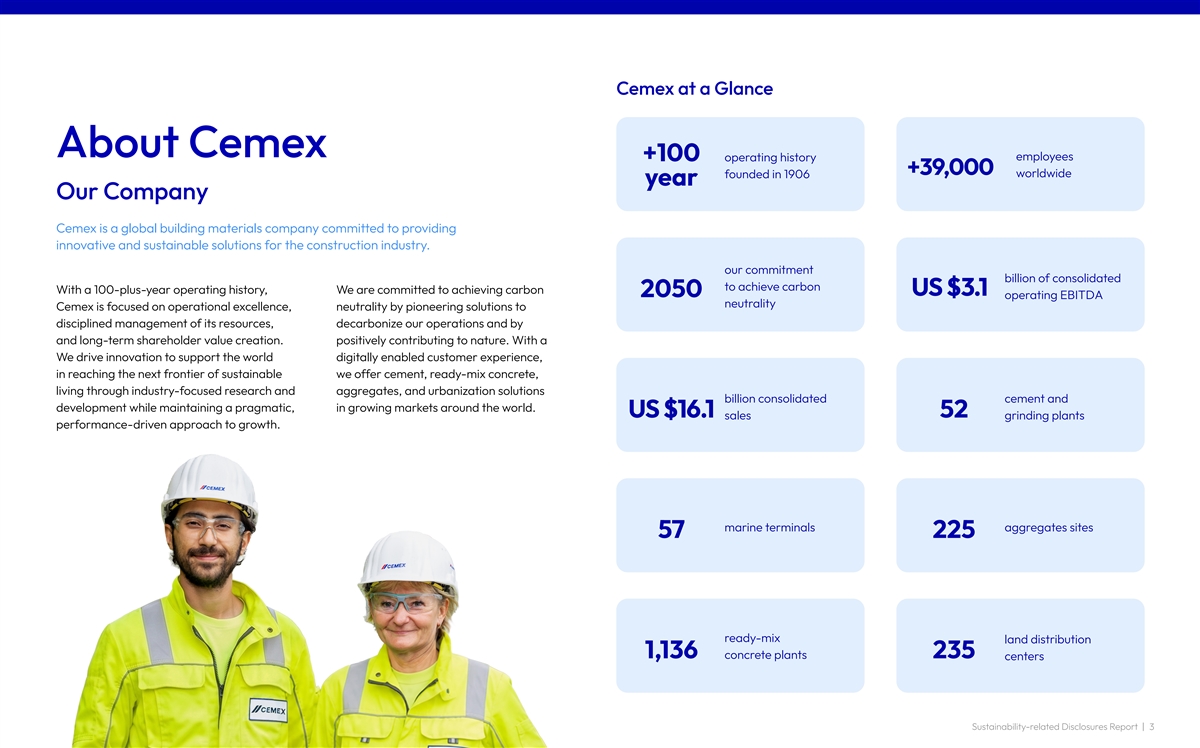
Cemex at a Glance About Cemex employees +100 operating history +39,000 worldwide founded in 1906 year Our Company Cemex is a global building materials company committed to providing innovative and sustainable solutions for the construction industry. our commitment billion of consolidated to achieve carbon With a 100-plus-year operating history, We are committed to achieving carbon US $3.1 2050 operating EBITDA neutrality Cemex is focused on operational excellence, neutrality by pioneering solutions to disciplined management of its resources, decarbonize our operations and by and long-term shareholder value creation. positively contributing to nature. With a We drive innovation to support the world digitally enabled customer experience, in reaching the next frontier of sustainable we offer cement, ready-mix concrete, living through industry-focused research and aggregates, and urbanization solutions billion consolidated cement and development while maintaining a pragmatic, in growing markets around the world. US $16.1 52 sales grinding plants performance-driven approach to growth. marine terminals aggregates sites 57 225 ready-mix land distribution 1,136 235 concrete plants centers Sustainability-related Disclosures Report | 3
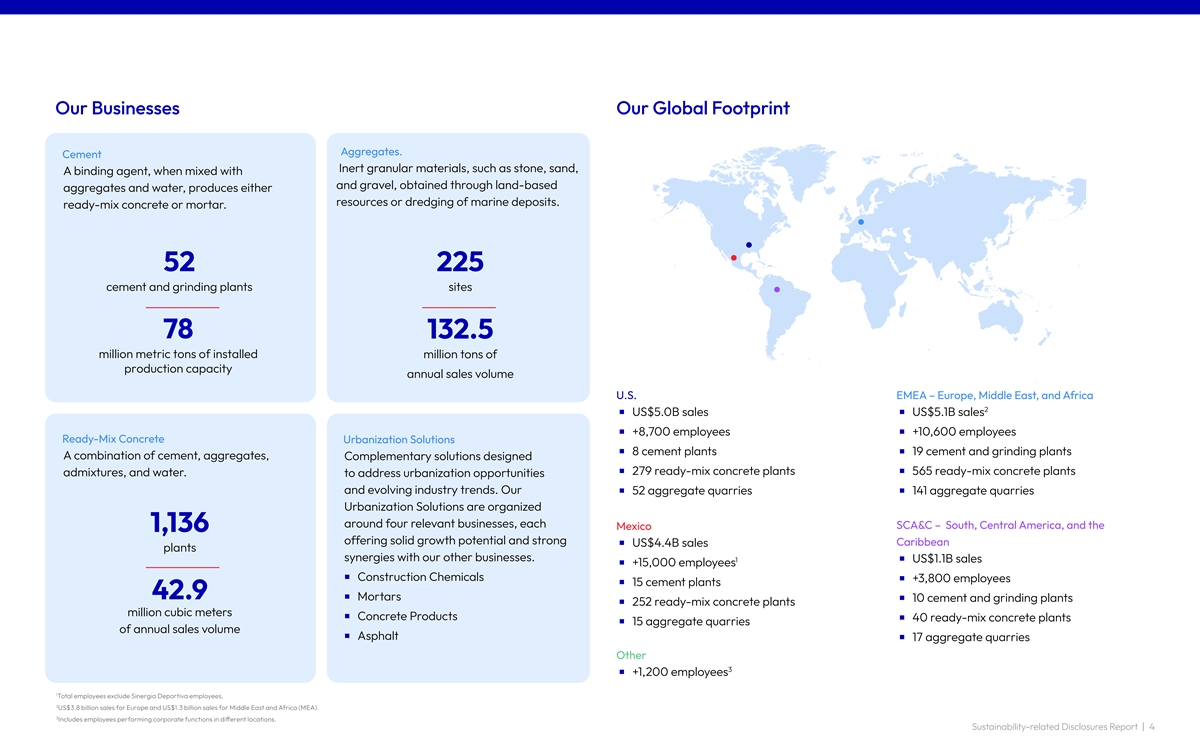
Our Businesses Our Global Footprint Aggregates. Cement Inert granular materials, such as stone, sand, A binding agent, when mixed with and gravel, obtained through land-based aggregates and water, produces either resources or dredging of marine deposits. ready-mix concrete or mortar. 52 225 cement and grinding plants sites 78 132.5 million metric tons of installed million tons of production capacity annual sales volume U.S. EMEA – Europe, Middle East, and Africa 2 ǫ US$5.0B sales ǫ US$5.1B sales ǫ +8,700 employees ǫ +10,600 employees Ready-Mix Concrete Urbanization Solutions ǫ 8 cement plants ǫ 19 cement and grinding plants A combination of cement, aggregates, Complementary solutions designed ǫ 279 ready-mix concrete plants ǫ 565 ready-mix concrete plants admixtures, and water. to address urbanization opportunities and evolving industry trends. Our ǫ 52 aggregate quarries ǫ 141 aggregate quarries Urbanization Solutions are organized around four relevant businesses, each SCA&C – South, Central America, and the Mexico 1,136 offering solid growth potential and strong Caribbean ǫ US$4.4B sales plants synergies with our other businesses. 1 ǫ US$1.1B sales ǫ +15,000 employees ǫ Construction Chemicals ǫ +3,800 employees ǫ 15 cement plants 42.9 ǫ Mortars ǫ 10 cement and grinding plants ǫ 252 ready-mix concrete plants million cubic meters ǫ Concrete Products ǫ 40 ready-mix concrete plants ǫ 15 aggregate quarries of annual sales volume ǫ Asphalt ǫ 17 aggregate quarries Other 3 ǫ +1,200 employees 1 Total employees exclude Sinergia Deportiva employees. 2 US$3.8 billion sales for Europe and US$1.3 billion sales for Middle East and Africa (MEA). 3 Includes employees performing corporate functions in different locations. Sustainability-related Disclosures Report | 4
Our Sustainability Model We recognize that our business has a critical role to play in creating a more sustainable future, and we seek to generate a positive impact for all our stakeholders. To this end, we have set ambitious goals to become a net-zero CO company by 2050, and we 2 strive to make sustainability a part of our everyday decision-making processes. By prioritizing environmental, social, and governance (ESG) issues, we have developed a sustainability roadmap that guides our transformation and evolution alongside society. As we trace this path, we remain dedicated to putting ESG issues at the heart of our corporate policies, culture, and business practices, so that we can continue to make a meaningful difference for years to come. Sustainability-related Disclosures Report | 5
General requirements for the disclosure of financial information related to sustainability and climate Governance ǫ The governance body or bodies, or individuals, responsible for oversight of sustainability- and climate-related risks and opportunities ǫ The governance processes, controls, and procedures the entity uses to monitor and manage sustainability- and climate-related risks and opportunities ǫ Management’s role in the governance processes, controls, and procedures used to monitor, manage, and oversee sustainability- and climate-related risks and opportunities Corporate governance of risks and opportunities Our Board of Directors, through the board level oversight of our sustainability corresponding Board Committees, provides and climate action and nature strategy. strategic guidance and oversight into The Committee is currently comprised of risk and opportunity management by four members of the Board of Directors, regularly discussing the enterprise risk and which are approved by our shareholders opportunity agenda and reviewing the at Cemex S.A.B de C.V.’s ordinary general effectiveness of our risk and opportunity shareholders’ meeting considering 4 management system enforced by our their skills and competencies . During Risk Management Committee. 2025, the Committee met four times with a meeting attendance of 100%. The Sustainability, Climate Action, Social Impact and Diversity Committee provides 4 For more information on our Board of Directors’ expertise, please refer to the Board of Directors Skill Matrix in page 243 of our 2025 Integrated Report. Sustainability-related Disclosures Report | 6
The sessions of the Committee are usually The main responsibilities of the Sustainability, ǫ Reviewing the communication briefed by the Executive Vice President of Climate Action, Social Impact and Diversity strategy in sustainability issues; Sustainability and Operations Development, Committee of the Board of Directors are: ǫ Providing assistance to the CEO and along with the Vice President of Global senior management team regarding ǫ Overseeing sustainability, social Sustainability. These briefings include in- the strategic direction on sustainability impact, and diversity policies, depth reviews of previously defined topics and social responsibilities model; and strategies, goals and programs; as well as unforeseen recent developments ǫ Providing assistance to the Corporate ǫ Reviewing Cemex’s sustainability that are considered material enough to be Practices and Finance Committee risk agenda; brought on or that require guidance from the as needed on diversity matters. ǫ Supporting and overseeing the Sustainability, Climate Action, Social Impact implementation of our Human and Diversity Committee. The Committee also Rights program, including our At the executive level, the Risk Management reviews and discusses Cemex’s Sustainability Human Rights Policy; Committee, which is composed of the Risk and Opportunity Agenda at least once a Executive Committee (ExCo) members ǫ Evaluating the effectiveness of year. This Sustainability Risk and Opportunity at a global level, reviews Cemex’s risk sustainability and climate action, Agenda identifies key sustainability and exposure once a year, as well as its potential social impact, and diversity climate-related risks and opportunities that impact and mitigation and management programs, goals, and initiatives; could impact Cemex’s sustainability priorities, measures, through the discussion of the including but not limited to our Future in ǫ Identifying the main risks concerning enterprise risk and opportunity agenda. Action program, our global climate action and sustainability-related matters nature program to transform our business (including human rights) and through climate action, developing lower- overseeing mitigation action The Executive Vice President of Sustainability carbon products, solutions, and processes to and Operations Development, reporting ǫ Support a model of sustainability, priorities, become a net-zero CO company by 2050. directly to Cemex’s CEO, is a position in the and key indicators, including our Future in 2 ExCo to oversee the areas of Sustainability, Action climate action and nature program; Operations, Technology, Energy, Research Committee members are responsible for ǫ Review of the structure of, content, and Development, Trading and Shipping, providing insights and direction on the and overall performance set forth coordinates and executes the sustainability management of these sustainability- and in Cemex’s integrated reports; and climate change strategy of the climate-related risks and opportunities, ǫ Reviewing notes to the financial Company. The Executive Vice President and for seeking alignment of the strategy statements related to Cemex’s climate of Sustainability and Operations oversees with Cemex’s overall management. action, as well as on CO emissions 2 the integration and progress of all and sustainable financing, if any; sustainability and climate-related initiatives ǫ Reviewing the progress in achieving and targets across all the Company. our sustainability objectives; Sustainability-related Disclosures Report | 7
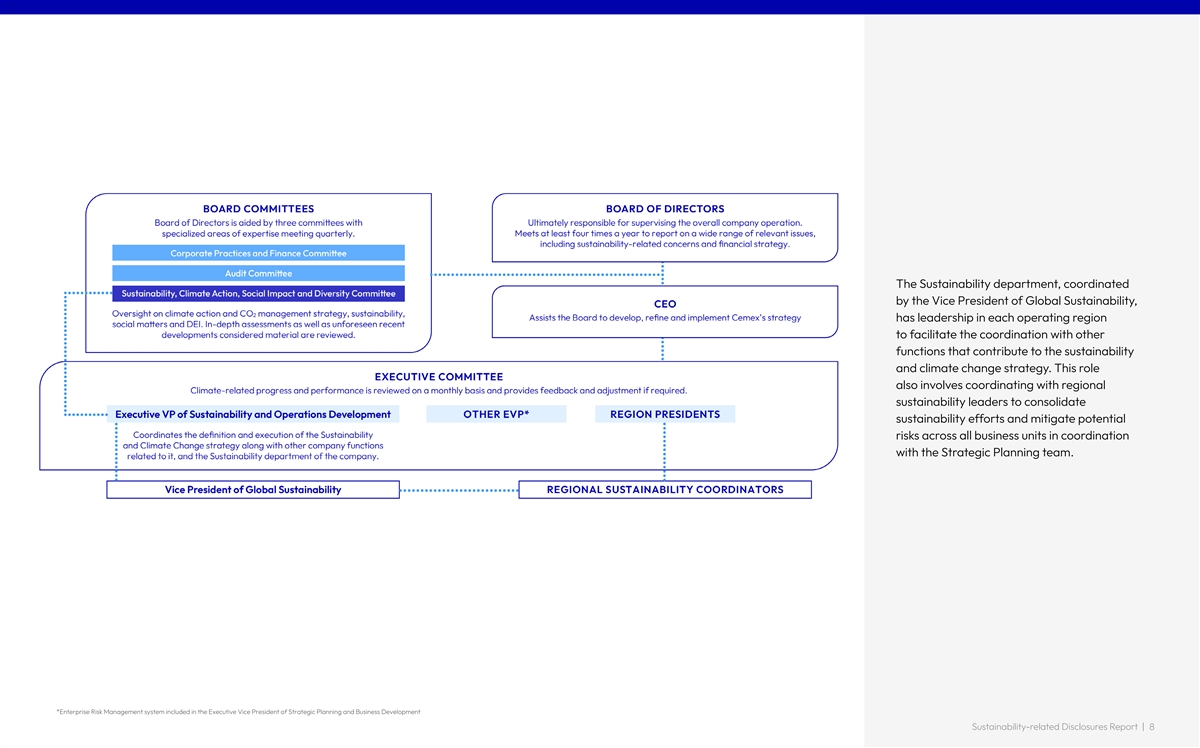
The Sustainability department, coordinated by the Vice President of Global Sustainability, has leadership in each operating region to facilitate the coordination with other functions that contribute to the sustainability and climate change strategy. This role also involves coordinating with regional sustainability leaders to consolidate sustainability efforts and mitigate potential risks across all business units in coordination with the Strategic Planning team. *Enterprise Risk Management system included in the Executive Vice President of Strategic Planning and Business Development Sustainability-related Disclosures Report | 8
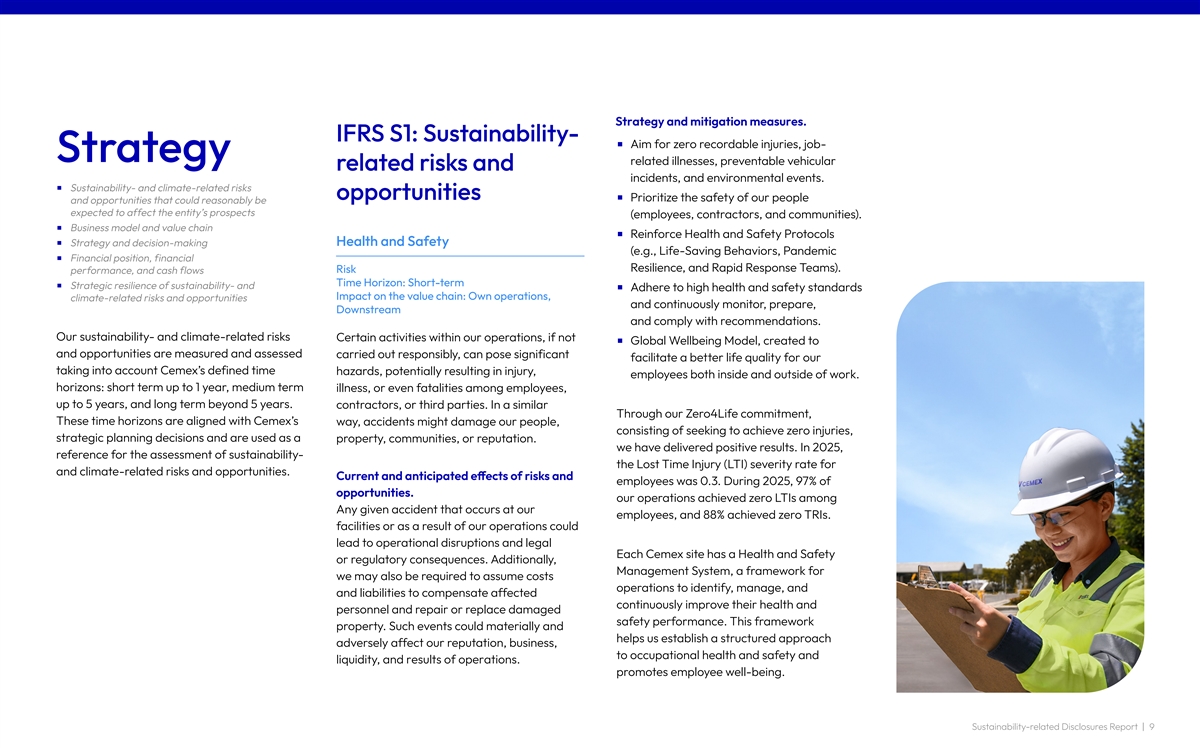
Strategy and mitigation measures. IFRS S1: Sustainability- ǫ Aim for zero recordable injuries, job- Strategy related illnesses, preventable vehicular related risks and incidents, and environmental events. ǫ Sustainability- and climate-related risks opportunities ǫ Prioritize the safety of our people and opportunities that could reasonably be expected to affect the entity’s prospects (employees, contractors, and communities). ǫ Business model and value chain ǫ Reinforce Health and Safety Protocols Health and Safety ǫ Strategy and decision-making (e.g., Life-Saving Behaviors, Pandemic ǫ Financial position, financial Resilience, and Rapid Response Teams). Risk performance, and cash flows Time Horizon: Short-term ǫ Strategic resilience of sustainability- and ǫ Adhere to high health and safety standards Impact on the value chain: Own operations, climate-related risks and opportunities and continuously monitor, prepare, Downstream and comply with recommendations. Our sustainability- and climate-related risks Certain activities within our operations, if not ǫ Global Wellbeing Model, created to and opportunities are measured and assessed carried out responsibly, can pose significant facilitate a better life quality for our taking into account Cemex’s defined time hazards, potentially resulting in injury, employees both inside and outside of work. horizons: short term up to 1 year, medium term illness, or even fatalities among employees, up to 5 years, and long term beyond 5 years. contractors, or third parties. In a similar Through our Zero4Life commitment, These time horizons are aligned with Cemex’s way, accidents might damage our people, consisting of seeking to achieve zero injuries, strategic planning decisions and are used as a property, communities, or reputation. we have delivered positive results. In 2025, reference for the assessment of sustainability- the Lost Time Injury (LTI) severity rate for and climate-related risks and opportunities. Current and anticipated eec ff ts of risks and employees was 0.3. During 2025, 97% of opportunities. our operations achieved zero LTIs among Any given accident that occurs at our employees, and 88% achieved zero TRIs. facilities or as a result of our operations could lead to operational disruptions and legal Each Cemex site has a Health and Safety or regulatory consequences. Additionally, Management System, a framework for we may also be required to assume costs operations to identify, manage, and and liabilities to compensate affected continuously improve their health and personnel and repair or replace damaged safety performance. This framework property. Such events could materially and helps us establish a structured approach adversely affect our reputation, business, to occupational health and safety and liquidity, and results of operations. promotes employee well-being. Sustainability-related Disclosures Report | 9
may lead to compliance challenges, higher Regulatory and compliance ǫ Improve internal controls through continuous operational costs, and potential legal or requirements, including sustainability internal audits and other methods. reputational risks for our business. ǫ Continue sustainability-related governance Risk through committees such as the Global Time horizon: Short-term ESG Committee, regional and country Current and anticipated eec ff ts of risks and Impact on the value chain: Upstream, Own opportunities. sustainability committees, the ETHOS operations, Downstream Any noncompliance or nonadherence to Committee, and the Human Rights As a global company, Cemex is subject to the laws and regulations or any significant Global Committee, among others, via laws and regulations of the countries where delay in adapting to changes may result training, audits, and other initiatives. we operate. These laws and regulations in potential cost increases, investigations, ǫ Ensure Board oversight and guidance include, but are not limited to, areas such as fines and penalties, restrictions or closure on regarding the management of anti-corruption, anti-bribery, anti-money production facilities, among others, which sustainability risks and opportunities laundering, antitrust, anti-boycott, economic could have a material adverse effect on our through the discussion of the Sustainability sanctions, trade embargoes, export controls, reputation, business, financial condition, Risks and Opportunities Agenda by the information security, mining, transportation, liquidity, and results of operations. Board’s Sustainability, Climate Action, insider trading, and tax regulations, as Social Impact, and Diversity Committee. well as laws that regulate our operations. Additionally, these laws and regulations could ǫ Establish accounting reserves for legal Additionally, we are involved in relevant expose Cemex to the risk of reputational proceedings when adverse outcomes are regulatory matters and legal proceedings that damage, loss of customers, difficulty in probable. depend on the application and interpretation retaining and attracting talent, social activism, of the law by local and national authorities. new mandatory operational and disclosure We also face an increasing number of requirements, among other things. environmental (e.g., CO , air emissions, 2 circular economy and waste management, Strategy and mitigation measures. biodiversity, water), social (e.g., labor, human ǫ Monitor and comply with applicable local, rights, diversity), and governance regulations state, and federal laws and regulations. across jurisdictions in which we operate. ǫ Execute Cemex’s sustainability strategy, Sustainability performance, in general, is which includes its Future in Action program. under heightened scrutiny from certain stakeholders and different parts of society. ǫ Monitor and comply with sustainability laws and regulations, seeking for adherence to sustainability standards and practices. The lack of clarity in new legislative ǫ Continue enhancing and enforcing our developments, combined with inconsistent Ethics and Compliance program. and sometimes conflicting frameworks, Sustainability-related Disclosures Report | 10
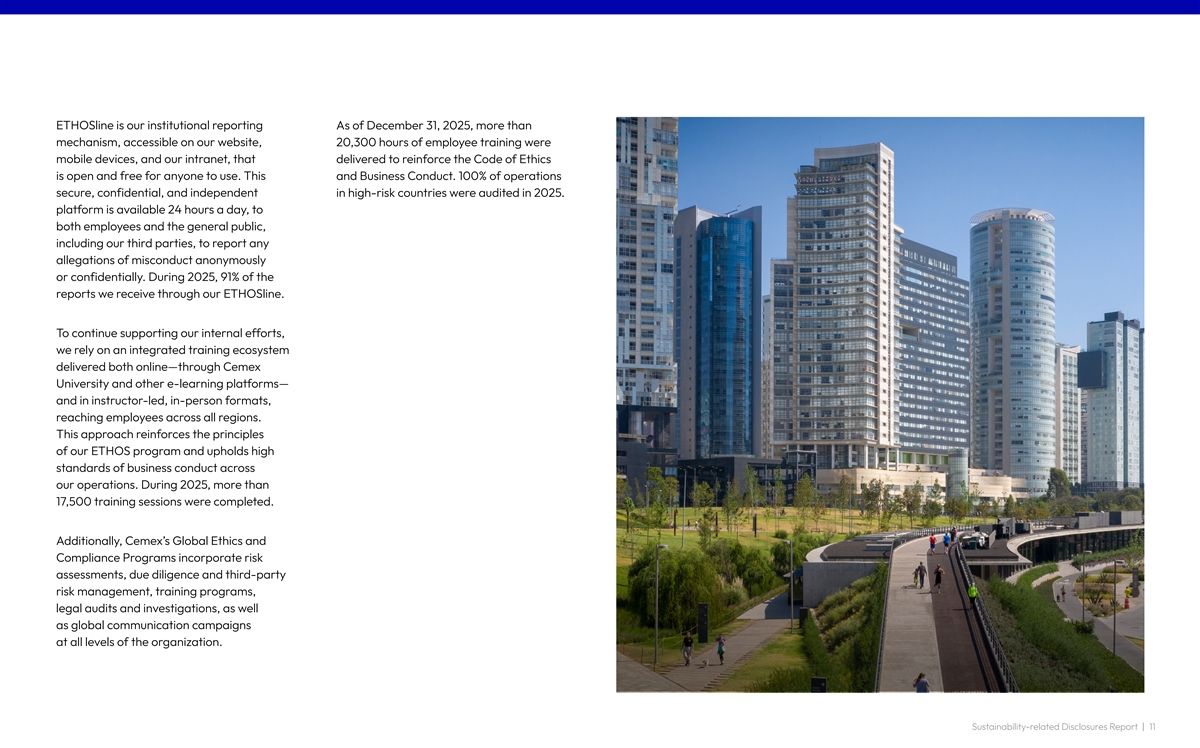
ETHOSline is our institutional reporting As of December 31, 2025, more than mechanism, accessible on our website, 20,300 hours of employee training were mobile devices, and our intranet, that delivered to reinforce the Code of Ethics is open and free for anyone to use. This and Business Conduct. 100% of operations secure, confidential, and independent in high-risk countries were audited in 2025. platform is available 24 hours a day, to both employees and the general public, including our third parties, to report any allegations of misconduct anonymously or confidentially. During 2025, 91% of the reports we receive through our ETHOSline. To continue supporting our internal efforts, we rely on an integrated training ecosystem delivered both online—through Cemex University and other e-learning platforms— and in instructor-led, in-person formats, reaching employees across all regions. This approach reinforces the principles of our ETHOS program and upholds high standards of business conduct across our operations. During 2025, more than 17,500 training sessions were completed. Additionally, Cemex’s Global Ethics and Compliance Programs incorporate risk assessments, due diligence and third-party risk management, training programs, legal audits and investigations, as well as global communication campaigns at all levels of the organization. Sustainability-related Disclosures Report | 11
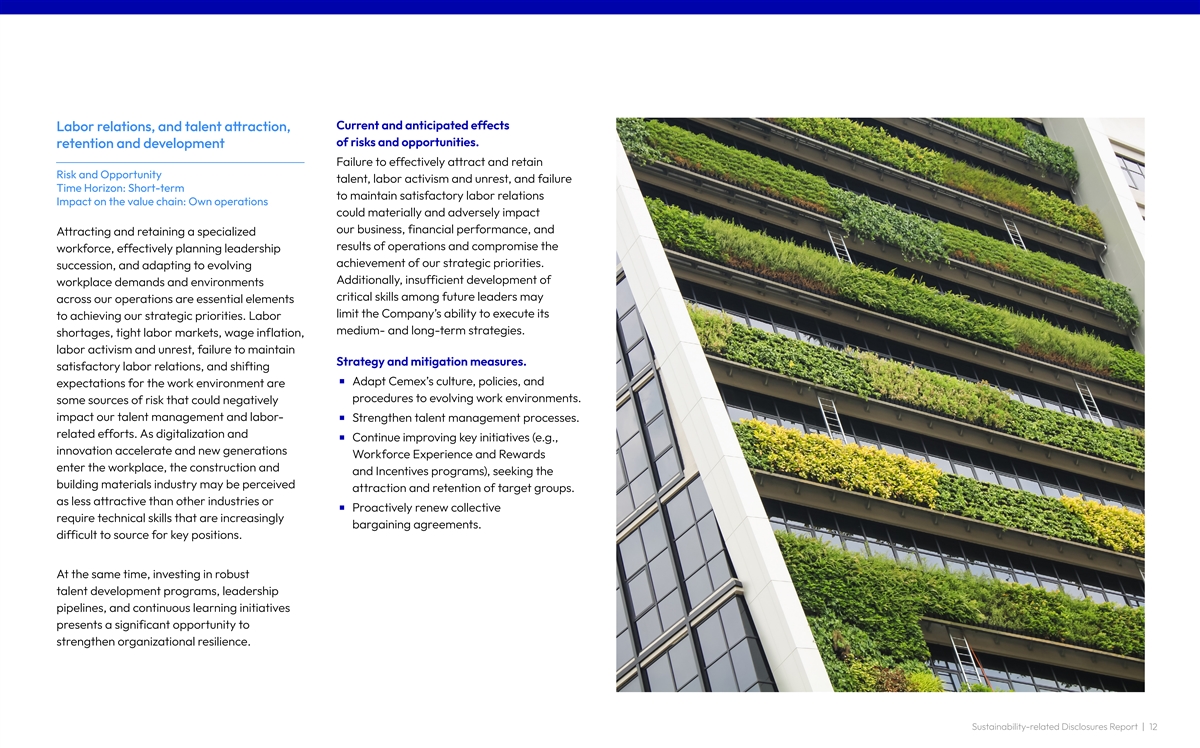
Current and anticipated effects Labor relations, and talent ar tt action, of risks and opportunities. retention and development Failure to effectively attract and retain Risk and Opportunity talent, labor activism and unrest, and failure Time Horizon: Short-term to maintain satisfactory labor relations Impact on the value chain: Own operations could materially and adversely impact our business, financial performance, and Attracting and retaining a specialized results of operations and compromise the workforce, effectively planning leadership achievement of our strategic priorities. succession, and adapting to evolving Additionally, insufficient development of workplace demands and environments critical skills among future leaders may across our operations are essential elements limit the Company’s ability to execute its to achieving our strategic priorities. Labor medium- and long-term strategies. shortages, tight labor markets, wage inflation, labor activism and unrest, failure to maintain Strategy and mitigation measures. satisfactory labor relations, and shifting ǫ Adapt Cemex’s culture, policies, and expectations for the work environment are procedures to evolving work environments. some sources of risk that could negatively impact our talent management and labor-ǫ Strengthen talent management processes. related efforts. As digitalization and ǫ Continue improving key initiatives (e.g., innovation accelerate and new generations Workforce Experience and Rewards enter the workplace, the construction and and Incentives programs), seeking the building materials industry may be perceived attraction and retention of target groups. as less attractive than other industries or ǫ Proactively renew collective require technical skills that are increasingly bargaining agreements. difficult to source for key positions. At the same time, investing in robust talent development programs, leadership pipelines, and continuous learning initiatives presents a significant opportunity to strengthen organizational resilience. Sustainability-related Disclosures Report | 12
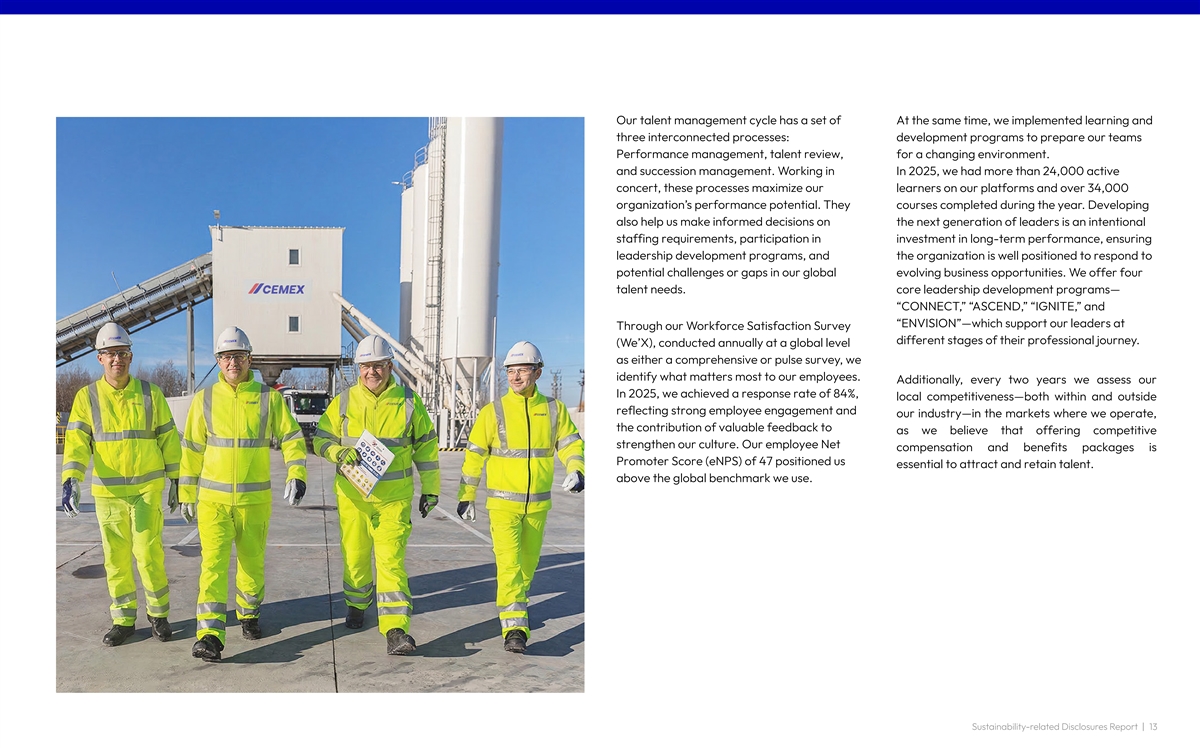
Our talent management cycle has a set of At the same time, we implemented learning and three interconnected processes: development programs to prepare our teams Performance management, talent review, for a changing environment. and succession management. Working in In 2025, we had more than 24,000 active concert, these processes maximize our learners on our platforms and over 34,000 organization’s performance potential. They courses completed during the year. Developing also help us make informed decisions on the next generation of leaders is an intentional staffing requirements, participation in investment in long-term performance, ensuring leadership development programs, and the organization is well positioned to respond to potential challenges or gaps in our global evolving business opportunities. We offer four talent needs. core leadership development programs— “CONNECT,” “ASCEND,” “IGNITE,” and “ENVISION”—which support our leaders at Through our Workforce Satisfaction Survey different stages of their professional journey. (We’X), conducted annually at a global level as either a comprehensive or pulse survey, we identify what matters most to our employees. Additionally, every two years we assess our In 2025, we achieved a response rate of 84%, local competitiveness—both within and outside reflecting strong employee engagement and our industry—in the markets where we operate, the contribution of valuable feedback to as we believe that offering competitive strengthen our culture. Our employee Net compensation and benefits packages is Promoter Score (eNPS) of 47 positioned us essential to attract and retain talent. above the global benchmark we use. Sustainability-related Disclosures Report | 13
Other relevant Sustainability-related risks Nature Risks and at times conflicting frameworks, may our commitment to reduce non-GHG air Higher costs resulting from result in compliance challenges, higher emissions, including particulate matter (PM), emissions regulations operating costs, and potential legal or sulfur oxide (SOx), and nitrogen oxide (NOx), reputational risks for the business. Non- regardless of state or local requirements. Risk compliance with emissions regulations could Time Horizon: Short-term Impact on the value chain: Own operations result in legal fines and reputational damage. During 2025, approximately US$210 million was invested in sustainability- Air emissions not related to primary Strategy and mitigation measures. related projects, including initiatives to GHGs—particulate matter (PM), sulfur ǫ We continue to invest in technologies monitor and reduce our emissions. oxides (SOx), and nitrogen oxides (NOx)— to monitor and reduce air emissions are generated as part of the cement across our operations. Also, our risk-based Environmental manufacturing process. Lower-magnitude ǫ We implement a risk-based Environmental Management System (EMS) systematically air emissions—volatile organic compounds, Management System that systematically audits internal compliance with our dioxins and furans, and other heavy audits compliance with our environmental environmental policy across all our global metals—are released in smaller quantities. policy across our businesses. operations and through our three businesses, ǫ Major emissions are continuously cement, ready-mix, and aggregates. Current and anticipated eec ff ts of risks and monitored, while minor kiln emissions For 2025, 89% of our businesses have an opportunities. are monitored at the frequency required EMS aligned with global environmental We face a growing number of environmental by the Global Cement and Concrete standards, such as ISO 14001 and the EU (e.g., CO , air emissions, circular economy 2 Association (GCCA) protocol. Eco-Management and Audit Scheme. and waste management, biodiversity, ǫ Our Global Procurement and Inventory water), social (e.g., labor, human rights, Policy establish that suppliers are subject diversity), and governance regulations in the to evaluation processes related to jurisdictions where we operate. Sustainability sustainability, including air emissions. performance, overall, is subject to increasing scrutiny from certain stakeholders and different segments of society. Currently, 100% of our clinker production is subject to continuous emission monitoring systems for our major air emissions. This The lack of clarity in new legislative comprehensive monitoring embraces developments, combined with inconsistent Sustainability-related Disclosures Report | 14
stricter limits on water concessions, Zero Freshwater and Zero Discharge Disruption to business conditional renewals, or potential revocations Framework and an associated measurement due to water scarcity in contexts of scarcity. Furthermore, protocol. Cemex became the first company Risk there may be reputational impacts in the world to achieve Zero Freshwater Time Horizon: Medium-term associated with community perceptions certification at 31 plants in Mexico. Impact on the value chain: Own operations in the areas where we operate. Water is a finite, essential resource for As of the end of 2025, more than 50% of ecosystems, communities, and economic Strategy and mitigation measures. our sites located in high and extremely development and an important element ǫ Under our Future in Action high water-stress areas have implemented to Cemex’s operations. We are committed program, water is managed as a Water Management Action Plans, reflecting to minimizing our impact on water material sustainability topic. ongoing progress toward this objective. resources across three key areas: resource ǫ Operations have been identified and availability, quality, and ecosystem prioritized based on their level of We are on track to meet our 2030 freshwater integrity. Water scarcity in certain regions exposure to physical, regulatory, and withdrawal reduction targets, which include and Cemex sites represents a significant reputational water-related risks. a 20% reduction in freshwater withdrawal risk to the Company’s operations. ǫ We have developed Water Management for cement, 10% reduction for ready-mix Action Plans to strengthen water concrete, and 15% reduction for aggregates Current and anticipated eec ff ts of risks and stewardship and conservation—particularly versus our 2021 baseline. To achieve these opportunities. at sites located in water-stressed areas. targets, we are working on gradually Water scarcity at Cemex’s operating increasing the use of non-freshwater, such as ǫ We are working to gradually increase the sites could impact production due to alternative water from treatment plants and use of non-freshwater as an alternative limited availability of water for critical other industries (e.g., bottling and beverages) water source. processes such as cooling, dust control, and rainwater we collect or recover. grinding, and auxiliary services in cement We actively pursue pollution prevention, plants. Additionally, in water-stressed aiming to apply best available techniques regions, there is a likelihood of operational to minimize operational impact. restrictions and prioritization of water use We strive to comply with Company for human consumption and agricultural policies and procedures, as well as with purposes. This could result in increased applicable local laws and regulations. costs to secure reliable water supplies. Working with leading sustainability consulting From a regulatory perspective, there is firm Environmental Resources Management also a risk related to permitting, including (ERM), Cemex has developed a global Sustainability-related Disclosures Report | 15
Transition risks IFRS S2: Climate- geographies in which we operate, which may carbon footprint of the construction slow down the reduction of CO emissions. materials industry through the 2 related risks and Policy definition of ambitious targets. opportunities Time horizon: Short- to medium-term Current and anticipated eec ff ts of risks and ǫ Collaboration and engagement with Impact on the value chain: Upstream, Own opportunities. governments and industry chambers. operations, Downstream The effects of climate change have increased At Cemex, we are experiencing increased ǫ Sustainability initiatives increasingly in severity and intensity over the years. costs in our direct operations and value chain Cemex is subject to a growing number of CO integrated in all our operations. 2 The alarming streak of exceptionally high in countries with existing Emissions Trading regulations aiming to incentivize CO 2 temperatures continued in 2025—a year Systems (ETS), including our European emissions reduction. In jurisdictions with shaping up to be one of the three warmest operations, California and Colorado in the carbon regulation in place, such regulations ever recorded—according to the World United States, and we expect in the future to often manage CO pricing in the form of cap- 2 Meteorological Organization’s (WMO) State increase our costs in Mexico which is still in the and-trade systems, particularly in Europe of the Global Climate Update. The WMO pilot phase as of the date of this report. and in the U.S in California and Colorado. In also warned that the world is not on track Additionally, higher costs are arising in other geographies, new or stricter CO 2 to meet the goals of the Paris Agreement, countries with carbon taxes, such as several regulations are under discussion or and that a more extreme climate is having Mexican states. development and could imply a higher CO 2 significant global impacts on economies and cost for Cemex in the short- and medium- on all aspects of sustainable development. term, for example, in the form of Emissions Furthermore, we may be subject to Trading Systems or CO taxes. Unclear CO 2 2 substantial penalties in the event of non- This situation poses short-, medium-, and regulations could result in double regulations. compliance with laws and regulations, and the long-term climate risks to our business For instance, an entity may be subject to a failure to achieve our carbon emissions environment. Cemex categorizes climate cap-and-trade scheme as well as an reduction targets or other climate-related risks into two main categories: i) transition emissions tax, which may have inconsistent or objectives could have a material adverse risks, which refer to the potential impacts overlapping policy objectives. Likewise, the effect on our business, financial condition, of transitioning toward a low-carbon unequal application of a CO pricing 2 and results of operations. economy; and ii) physical risks, which refer mechanism between local and foreign producers could cause competitive to potential climate events that could Strategy and mitigation measures. disadvantages. On the other hand, directly affect our assets and operations. ǫ Execution of our Future in Action program government policies that incentivize the use to drive a profitable decarbonization of alternative technologies to reduce CO 2 throughout our value chain through the emissions (e.g., circular economy practices) reduction of CO emissions. 2 are not advancing at the required pace or at ǫ Active participation in reducing the the same pace in all Sustainability-related Disclosures Report | 16
At Cemex, we have our cement plant-by- emissions impact of carbon tax regulations plant CO Roadmap, which includes all the versus ETS, which has been analyzed in 2 initiatives to reduce CO needed to accomplish terms of emissions and economic impact. 2 our 2030 targets. We have identified, evaluated and prioritized initiatives to execute Current and anticipated financial effects. during this decade, including the switch to Increased costs resulting from regulation alternative fuels, specifically biomass, clinker and carbon pricing, potentially exacerbated substitutes and the use of decarbonated by competitive pressure from imports from raw materials. As of December 31, 2025, countries with less stringent CO regulations, 2 and since the launch of our Future in Action and penalties for non-compliance with laws program in 2020, we have reduced our and regulations could have a material adverse specific Scope 1 and 2 CO emissions by 14% 2 effect on our business, financial condition, and 37%, respectively, driven primarily by the and results of operations. An increase in reduction of our clinker factor to 70.1%—the production costs is already impacting on lowest level in our history—as well as by an our operating expenses, particularly in alternative fuel substitution rate of 32.1%. our European cement operations and in California, due to regulatory changes. We also participate in the development of Carbon Capture Utilization and Storage (CCUS) technology as a long- term solution beyond 2030. Additionally, as part of our strategy, we have implemented robust advocacy efforts across the geographies where we operate. In Mexico, we collaborate with the Mexican government through the Cámara Nacional del Cemento (CANACEM) in the review of the ETS regulation that will enter into force in Mexico; and in the countries of our SCA&C region, we collaborate with the Federación Interamericana del Cemento (FICEM) to assess the economic and Sustainability-related Disclosures Report | 17
Strategy and mitigation measures. and measurable emissions reductions. gies could limit the range of eligible projects Technology ǫ New innovation framework prioritizes and to which funding resources could be allocated Time horizon: Long-term scales innovation for value creation. and/or make the application of those resour- In addition, we have 26 projects in the Impact on the value chain: Upstream, Own ces less effective than initially anticipated. ǫ Through our Global Research and operations, Downstream pipeline aimed at de-risking and scaling Development teams, the Global emerging technologies, bringing Cemex Operations, Technology and Energy closer to reaching its net-zero emissions The development and scaling of new department, and Cemex Ventures, goal in a profitable and sustainable manner. technologies are essential to reducing CO 2 we constantly evaluate and assess To build and expand this portfolio, we are emissions and meeting our 2050 net-zero CO 2 new climate-related technologies. seeking and expect to continue seeking emissions target, the sustainability-related key ǫ We join forces with startups, universities, government funding in Europe, where performance indicators (KPIs) in our financing and collaborate within our industry and there are well-established programs to arrangements and operating within the limits other sectors, such as the European Climate foster green technology innovation. of any cap-and-trade systems applicable Research Alliance (ECRA) and the GCCA. to Cemex. However, some CO reduction 2 technologies still require validation in terms of ǫ Within our portfolio, we have low- Current and anticipated financial eec ff ts. technical feasibility, viability, and scalability, CO clinker and CCUS projects. High capital investment in research and de- 2 and breakthrough technologies require velopment and new technologies, along with significant capital investment, some of which potential write-offs or early retirement of Innovation plays a vital role and is a might not be efficient in cost for the Company. existing assets and the cost of asset upgrades, competitive advantage in accelerating poor capital allocation, substantial penalties, our operational excellence strategy and higher capital costs, and stake holder activism Current and anticipated eec ff ts of risks and achieving our goal of becoming a net- opportunities. could have a material adverse effect on our zero emissions company by 2050. During We face increased costs due to the business, financial condition, and results of 2025, we established new corporate development and deployment of new operations. thresholds for innovation investments and technologies for products, solutions, and continue to apply discipline and rigor to Access to government funding is highly com- implementation across direct operations our business cases. Our innovation agenda petitive, and incentives are not uniformly and upstream and downstream value has a distinctive focus: contributing to available across regions. Failure to select, chains. In addition, the process to secure smart and cost-effective decarbonization develop, and deploy the necessary techno- government funding is highly competitive, that creates value for our stakeholders. logies on time could jeopardize our ability to and economic or regulatory incentives for comply with the emissions trading limits, meet developing and testing these technologies As of December 31, 2025, Cemex participated our emissions targets, and fulfill sustainabili- are not available in all geographies. in 22 industrial-scale projects supporting ty-linked finance commitments. Furthermore, smart decarbonization priorities, deploying delayed development or scaling up of certain mature solutions that generate direct sustainability- and climate-related technolo- Sustainability-related Disclosures Report | 18
complex processes. Increased capital comprehensive portfolio featuring five ǫ Reduced demand for our products Market expenditure (CapEx) required to adapt verifiable sustainable attributes: a reduced and solutions due to shifting consumer Time horizon: Medium-term new production processes and supply carbon footprint, energy efficiency, water preferences toward sustainable products Impact on the value chain: Upstream, Own chains to new low-carbon specifications. conservation, recycled materials, and design could impact our revenue stream; operations, Downstream Furthermore, new product specifications that optimization. These offerings support our ǫ Increased production costs due to are not aligned with local regulations could customers in meeting net-zero targets, more competition for lower-carbon More stringent construction and energy result in non-compliance with new building carbon regulatory requirements, and and alternative raw materials; efficiency standards are expected to drive codes, requirements, and expectations. sustainability standards and certifications, ǫ Higher capital expenses to adjust demand for new lower-carbon products while contributing to our ambition to production processes and technology to and construction solutions. As consumer achieve net-zero CO emissions by 2050. 2 Strategy and mitigation measures. incorporate lower-carbon alternative raw expectations continue evolving, there is materials, and renewable energy; and a risk that Cemex may fail to meet future ǫ Cemex closely monitors demand for Our low-carbon Vertua® products have been market demands for new or alternative products with lower carbon content. ǫ Potential damage to our reputation if widely accepted, representing 63% of our lower-carbon products and solu tions. sustainability expectations are not met. ǫ Through our three innovation channels, consolidated cement volume and 56% of total we continuously research innovative concrete sales as of December 31, 2025. solutions to expand our solutions portfolio, On the other hand, a lack of regulatory including our family of products with incentives or regulations promoting the use of sustainable attributes, Vertua®. Cemex also shares relevant information lower-carbon products could fail to incentivize regarding the environmental impact of its their adoption. If customers are unwilling to ǫ Through Urbanization Solutions, we aim products to ensure greater transparency bear the additional costs associated with to provide sustainable alternatives for in our key markets, in the form of transitioning to a low-carbon industry, this metropolitan growth, offering the market Environmental Product Declarations or could also compromise our roadmap to high-efficiency construction solutions. detailed carbon footprint reports. This achieving net-zero emissions by 2050. As ǫ Through Cemex Ventures, we seek disclosure is customized by location and industry peers embark on decarbonizing to identify, develop, and partner is valuable for architects, engineers, strategies, the competition for raw materials with disruptive construction projects contractors, and clients seeking sustainable with lower-carbon footprint increases, and companies to accelerate the construction or green certifications. driving up costs and limiting availability. commercialization of low-carbon solutions. ǫ We advance the Company’s priorities in Current and anticipated eec ff ts of risks and legislative and regulatory spheres through Current and anticipated financial eec ff ts. opportunities. data-driven advocacy and coalition The following factors could have a material Pressure on margins stemming from building. adverse effect on our business, financial higher production costs associated with condition, liquidity, and results of operation alternative raw materials, cementitious Through our range of Vertua® products additions, new technologies, or more and solutions, we offer our customers a Sustainability-related Disclosures Report | 19
authorities and impact the demand for our ǫ Identification of priorities through our Reputation products and solutions, the availability or double materiality assessment. Time horizon: Short-term cost of capital, and business continuity. ǫ We maintain open and continuous Impact on the value chain: Upstream, Own communication through various operation, Downstream Strategy and mitigation measures. channels to foster meaningful dialogue ǫ This risk is monitored regularly and guided and promote collaboration. According to the GCCA, the cement industry by our Code of Ethics and Business Conduct accounts for approximately 7% of the world’s ǫ Furthermore, Cemex actively participates and our Public Affairs Policy. CO emissions. Cement could be perceived in industry associations in the jurisdictions 2 as a relevant contributor to CO global where it operates, including the GCCA. 2 emissions. Negative Company reputation Current and anticipated financial eec ff ts. or industry stigmatization to CO emissions, 2 Negative disposition towards Cemex and along with related stakeholder activism could the cement industry could reduce the have a negative impact on our stakeholders’ demand for our products and solutions, preferences for Cemex products, which, affecting our revenue, reducing capital in turn, could affect the demand for our availability and/or increasing our cost of products, solutions, or services, our ability capital, increasing stakeholder’s activism, to attract and retain talent, the availability and business operations disruption. All or cost of capital, and business continuity. these events could have a material adverse Current and anticipated eec ff ts of risks and effect on our business, financial condition, opportunities. liquidity, and results of operations. Due to a negative perception of the business and the industry, Cemex could be impacted by a loss of confidence among its stakeholders, which could affect business continuity and impact demand for our products. Furthermore, this could represent a competitive disadvantage relative to companies perceived as being more responsible regarding sustainability matters. It could also result in higher financing costs, driven by an increased perception of risk among investors and banks, as well as heightened scrutiny from regulatory Sustainability-related Disclosures Report | 20
Physical Risks events across all business units. other legal and financial exposures. Acute and Chronic ǫ Business Continuity and Crisis Management (BC&CM) Program. Additionally, since 2023 we have Time horizon: Short- to medium-term ǫ Local Rapid Response Teams (RRTs). partnered with Risilience, an enterprise Impact on the value chain: Upstream, Own risk management specialist, to assess operation, Downstream Cemex maintains the BC&CM program, our exposure to climate-related risks Climate change is expected to intensify which enables a proactive and effective risk and opportunities under different global the severity and frequency of natural management response during disruptive average-temperature increase scenarios. disasters already experienced in most events by supporting business units in saving geographies, such as tropical cyclones or lives, acting responsibly, and promptly Current and anticipated financial eec ff ts. other extreme storms, while also bringing restoring business operations. The program Asset damage, business disruption, loss of new environmental changes that could implements a business recovery plan at sales, cost increase, and even reputation impact people’s lives and economic activities. each identified site, thereby ensuring the damage or possible litigation. The decrease Our operations and business are exposed continuity and recovery of operations. in sales volume caused by physical hazard to the event-driven acute physical risks and Through continuous training, drills, and events is usually counterbalanced by the the chronic physical risks associated with protocols, we possess the capability to increase in the demand for our products and longer-term shifts in climate patterns. respond to unexpected operational risks solutions during the reconstruction phases. with the potential to disrupt business Chronic physical risks could result also in continuity, thereby protecting people, Current and anticipated eec ff ts of risks and supply chain disruptions that could have a the environment, and our operations. opportunities. negative impact on the product delivery The increased frequency and severity time and the cost of serving our markets. of extreme weather events could cause Increased frequency and strength of tropical The local Rapid Response Teams (RRTs) direct damage to our operations and cyclones, as well as other extreme storms, deployed across our business units are downstream value chain, as well as the can also cause loss of production in our responsible for monitoring, communicating, disruption of our business continuity, operations due to the time to recover a plant activating, coordinating, and delegating specifically in geogr aphies with a high to its original production before the event. the execution of event-driven, stakeholder- occurrence probability of natural disasters, driven, or process-driven protocols, as well including but not limited to the United as timely, objective-driven decisions. More information on our BC&CM program is States, Spain, the Caribbean, and Mexico. available on page 143 of our 2025 Integrated Report. The objective is to protect personnel, support Strategy and mitigation measures. stakeholders, and safeguard reputation, ǫ Continuous monitoring, management, while reducing the cost of disruptions and and response to disruptive natural Sustainability-related Disclosures Report | 21
effects. In the IEA’s Net Zero by 2050 scenario, Climate-related it is recognized that per capita demand opportunities for cement and other materials increases during phases of economic development, particularly in emerging economies, before Market - Products and services - stabilizing and declining as economies Increased sales of existing products mature. Over the past two decades, global and services cement demand has more than doubled, Time horizon: Medium-term driven by population growth and economic Impact on the value chain: Downstream expansion. Looking ahead, demand is expected to continue increasing as cement More stringent building codes are likely to is required to develop additional transport encourage the development and adoption infrastructure—such as roads and facilities of innovative materials and construction supporting bicycles, cars, and trucks—as well solutions, which may provide cement as energy infrastructure, including power innovators with a competitive advantage and plants and wind turbines, to support the support improved margins for existing and transition toward net-zero CO scenarios. 2 new high-performance products, supported by growing demand for low-carbon solutions across regions. We believe that we have several opportunities to expand our business by contributing to the development of sustainable cities, which involves lowering the total energy consumption of buildings through innovative design and construction practices. This transition is expected to increase the construction activity as older buildings are replaced or refurbished. Additionally, there is potential for increased demand for products and solutions that help to comply with new construction standards requirements. There is an opportunity to increase the demand of concrete products to support societal growth and attend to the need of adapting buildings and infrastructure to expected climate change Sustainability-related Disclosures Report | 22
Current and anticipated eec ff ts of risks and These products have been rapidly adopted by opportunities. our customers across different geographies. Our downstream value chain spans multiple As of December 31, 2025, Vertua®, accounted geographies. Given Cemex’s significant for 63% of our total cement sales and 56% of presence in markets within developing our total concrete sales. regions—such as South America, Central America and the Caribbean, Mexico, and Current and anticipated financial eec ff ts. Egypt—demand for concrete products is Increased revenues are expected due to rising expected to rise initially to meet society’s demand for products and services, along growth requirements. Over time, additional with access to new and emerging markets. demand is likely to be driven by the need This competitive edge could also allow for to adapt buildings and infrastructure to higher margins on both existing and newly the anticipated impacts of climate change, developed higher performance products. particularly in geographic areas most exposed to extreme weather events— including, but not limited to, the United States, Spain, the Caribbean, and Mexico. Strategy and mitigation measures. Through our range of Vertua® products and solutions, we offer our customers a comprehensive portfolio featuring five verifiable sustainable attributes: a reduced carbon footprint, energy efficiency, water conservation, recycled materials, and design optimization. These offerings support our customers in meeting net-zero targets, carbon regulatory requirements, and sustainability standards and certifications, while contributing to our ambition to achieve net-zero CO emissions by 2050. 2 Sustainability-related Disclosures Report | 23
be generated, which would result in a seek innovative solutions, incorporating Revenues are primarily influenced by the Market - Products and services reduction in price-based competition. new technologies through three channels: expected increase in sales of resilient and - Development of new products lower-carbon products. As customers or services through research and ǫ Cemex Ventures: Our open innovation Strategy and mitigation measures. gain a deeper understanding of the development and innovation and venture capital unit, dedicated to importance of reducing carbon footprints Innovation plays an essential role and serves identifying innovative technologies and Time horizon: Medium-term and assessing product life-cycle impacts, as a competitive advantage in accelerating developing strategic business opportunities Impact on the value chain: Downstream this opportunity has the potential to our operational excellence strategy and through collaboration, partnerships, and become increasingly significant. achieving our goal of becoming a net-zero investment in disruptive companies. Cement and concrete offer several important emissions company by 2050. We continuously ǫ Global Research and Development: This characteristics for a low-carbon transition, team focuses on developing cutting- including longevity, resistance, thermal edge, cost-effective, and sustainable properties for hot and cold weather, and technologies to meet demanding wide availability. These attributes contribute performance requirements. Its diverse to building resilient infrastructure capable of perspectives enable the collaborative withstanding the detrimental consequences innovation and development of products, of climate change and providing the level of techniques, and technologies that push the climate-proofing that could become manda- boundaries of sustainable construction. tory as national building codes are revised to address more extreme weather events. These ǫ Global Operations, Technology, and building codes foster the development of Energy: Our team drives innovation in new materials and construction solutions and cement production and CCUS technologies. products, creating significant potential for further developments to decrease embodied Additionally, through Urbanization carbon, improve the insulating properties Solutions, Cemex leverages its expertise in of concrete, further increase its strength, building materials to offer complementary and introduce smart functions to extend solutions that address pressing societal maintenance intervals and technical lifespans. needs, such as resilient buildings and infrastructure appropriate for disaster Current and anticipated eec ff ts of risks and relief, energy efficiency, and affordability. opportunities. Cemex has observed increasing demand Current and anticipated financial effects. for lower-carbon products mainly in Increased revenues resulting from increased Europe and other countries like Colombia. demand for products and services and Likewise, competitive differentiation could from access to new and emerging markets. Sustainability-related Disclosures Report | 24
For example, Poland, where appropriate costs where the appropriate legislation Technology - Resource efficiency - Cost waste regulations and economic incentives is in place. This can impact on financial savings are in place, has achieved an alternative planning costs associated with the alternative Time horizon: Long-term fuel substitution rate of more than 90% fuels strategy when the price lowers or is Impact on the value chain: Own operation year-over-year, while Cemex’s 2025 global expected to lower. The impact of this lever alternative fuels substitution rate was 32%. is still low, primarily affecting some EU Both the environment and Cemex’s revenues operations, mainly in the UK and Poland. can benefit from co-processing if the right waste management regulations are in place. It Strategy and mitigation measures. could enable the devel opment of a profitable To capitalize on the opportunity to increase waste management business by, for instance, the use of lower-emissions sources of imposing taxes and bans on landfills. This energy in our kilns, Cemex launched could lead to an increase in the availability Regenera in 2023, a business unit focused of alternative fuels at a lower cost and on circularity services. Regenera offers reduce CO emissions. The benefits of co- waste management solutions to private 2 processing, which consist of switching from and public sectors, including the reception, conventional fossil fuels to alternative fuels, management, recycling, and co-processing mainly Refuse Derived Fuels (RDF), are not of different kinds of waste. The integration widely understood in our areas of influence, of pro cessed waste into the cement and especially in those regions with a lack of or low concrete manufacturing processes decreases regulatory enforcement, like Latin America, the need for natural raw materials and Asia, and Africa and some areas in the United fossil fuels for cement production. States. These are precisely the markets where Cemex could benefit the most from In 2025, Cemex repurposed 25 million tons of increased alternative fuel rates at lower costs. waste. These 25 million tons consist primarily of external waste and by-products from Current and anticipated eec ff ts of risks and other industries and cities. By 2030, we aim opportunities. to increase the amount of waste and by- Positive impact for our direct operations, products we repurpose by more than 50%. including countries such as Egypt, Colombia, Mexico, Nicaragua, Panama, Jamaica, Puerto Current and anticipated financial effects. Rico, Barbados, the United Arab Emirates, Reducing exposure to future fossil fuel price and United States. Countries in Europe increases by switching from fossil fuels to have already leverage on this opportunity. alternative fuels and reducing our direct Sustainability-related Disclosures Report | 25
Cemex’s transition plan Future in Action, our global climate action and To learn more about our Future in Action nature program, is our long-term road map to program and Smart Decarbonization, please achieve carbon neutrality by 2050, reflecting refer to page 30 in our 2025 Integrated our conviction that climate action underpins Report. competitiveness, operational resilience, and sustainable growth. Future in Action addresses this challenge through two core pillars, smart decarbonization and responsible nature and is supported by three enablers, which are innovation and partnerships, advocacy, and sustainable finance. Together, they strengthen focus, integration, accountability, and execution. Within the current Future in Action program, existing initiatives and commitments are consolidated into a sharper, more integrated approach. At its core, Future in Action positions Cemex to effectively address climate risks, opportunities, and impacts. Since 2022, Cemex validated its 2050 net-zero CO roadmap and its 2030 2 decarbonization goals under the Science Based Targets initiative’s (SBTi) 1.5°C Scenario, becoming one of the first companies in the industry to do so. Sustainability-related Disclosures Report | 26
Sustainability and climate resilience Resilience - Sustainability- related risks and opportunities (IFRS S1) Cemex assessed the strategic resilience of sustainability-related risks and opportunities by considering two socioeconomic trajectories consistent with Shared Socioeconomic Pathways (SSPs): SSP2 (continuity) and SSP1 (sustainability acceleration). The impacts on human capital, regulatory compliance, critical resources, and operational performance were analyzed. This analysis evaluates the resilience of Cemex’s sustainability strategy in the short and medium term, analyzing risks and opportunities based on their impact on the Company. Sustainability-related Disclosures Report | 27
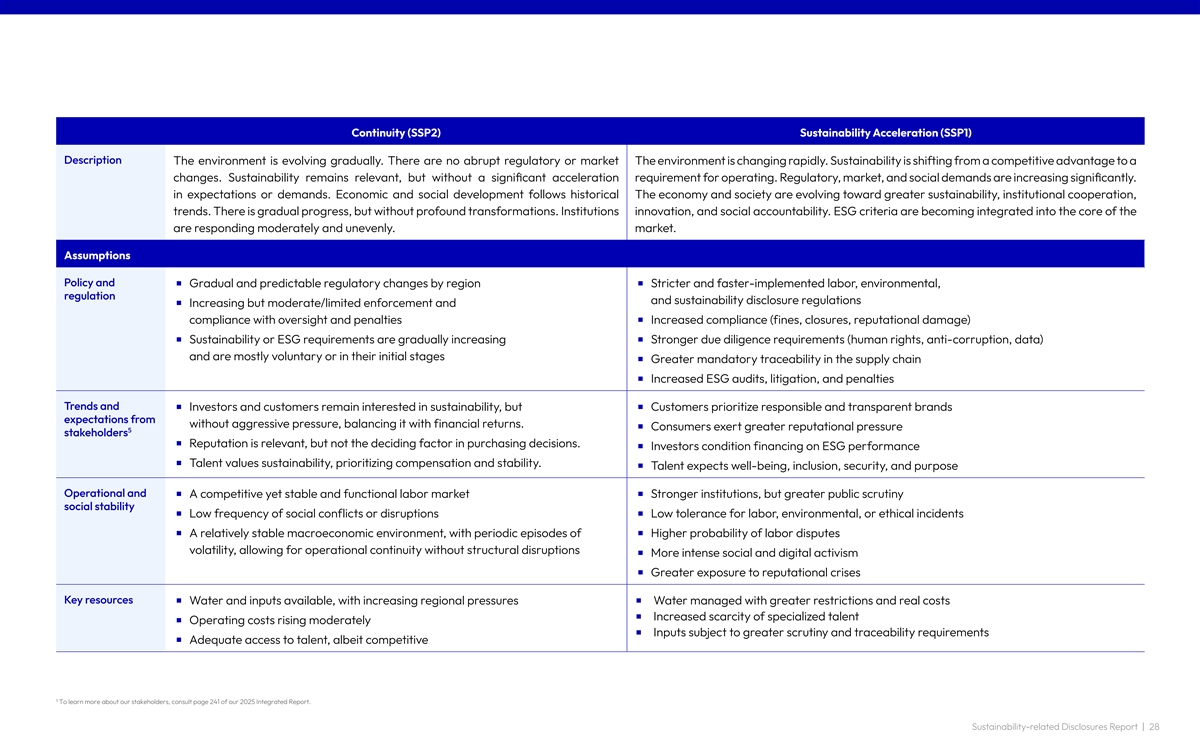
Continuity (SSP2) Sustainability Acceleration (SSP1) Description The environment is evolving gradually. There are no abrupt regulatory or market The environment is changing rapidly. Sustainability is shifting from a competitive advantage to a changes. Sustainability remains relevant, but without a significant acceleration requirement for operating. Regulatory, market, and social demands are increasing significantly. in expectations or demands. Economic and social development follows historical The economy and society are evolving toward greater sustainability, institutional cooperation, trends. There is gradual progress, but without profound transformations. Institutions innovation, and social accountability. ESG criteria are becoming integrated into the core of the are responding moderately and unevenly. market. Assumptions Policy and ǫ Gradual and predictable regulatory changes by region ǫ Stricter and faster-implemented labor, environmental, regulation and sustainability disclosure regulations ǫ Increasing but moderate/limited enforcement and compliance with oversight and penalties ǫ Increased compliance (fines, closures, reputational damage) ǫ Sustainability or ESG requirements are gradually increasing ǫ Stronger due diligence requirements (human rights, anti-corruption, data) and are mostly voluntary or in their initial stages ǫ Greater mandatory traceability in the supply chain ǫ Increased ESG audits, litigation, and penalties Trends and ǫ Investors and customers remain interested in sustainability, but ǫ Customers prioritize responsible and transparent brands expectations from without aggressive pressure, balancing it with financial returns. ǫ Consumers exert greater reputational pressure 5 stakeholders ǫ Reputation is relevant, but not the deciding factor in purchasing decisions. ǫ Investors condition financing on ESG performance ǫ Talent values s ustainability, prioritizing compensation and stability. ǫ Talent expects well-being, inclusion, security, and purpose Operational and ǫ A competitive yet stable and functional labor market ǫ Stronger institutions, but greater public scrutiny social stability ǫ Low frequency of social conflicts or disruptions ǫ Low tolerance for labor, environmental, or ethical incidents ǫ A relatively stable macroeconomic environment, with periodic episodes of ǫ Higher probability of labor disputes volatility, allowing for operational continuity without structural disruptions ǫ More intense social and digital activism ǫ Greater exposure to reputational crises Key resources ǫ Water and inputs available, with increasing regional pressures ǫ Water managed with greater restrictions and real costs ǫ Increased scarcity of specialized talent ǫ Operating costs rising moderately ǫ Inputs subject to greater scrutiny and traceability requirements ǫ Adequate access to talent, albeit competitive 5 To learn more about our stakeholders, consult page 241 of our 2025 Integrated Report. Sustainability-related Disclosures Report | 28
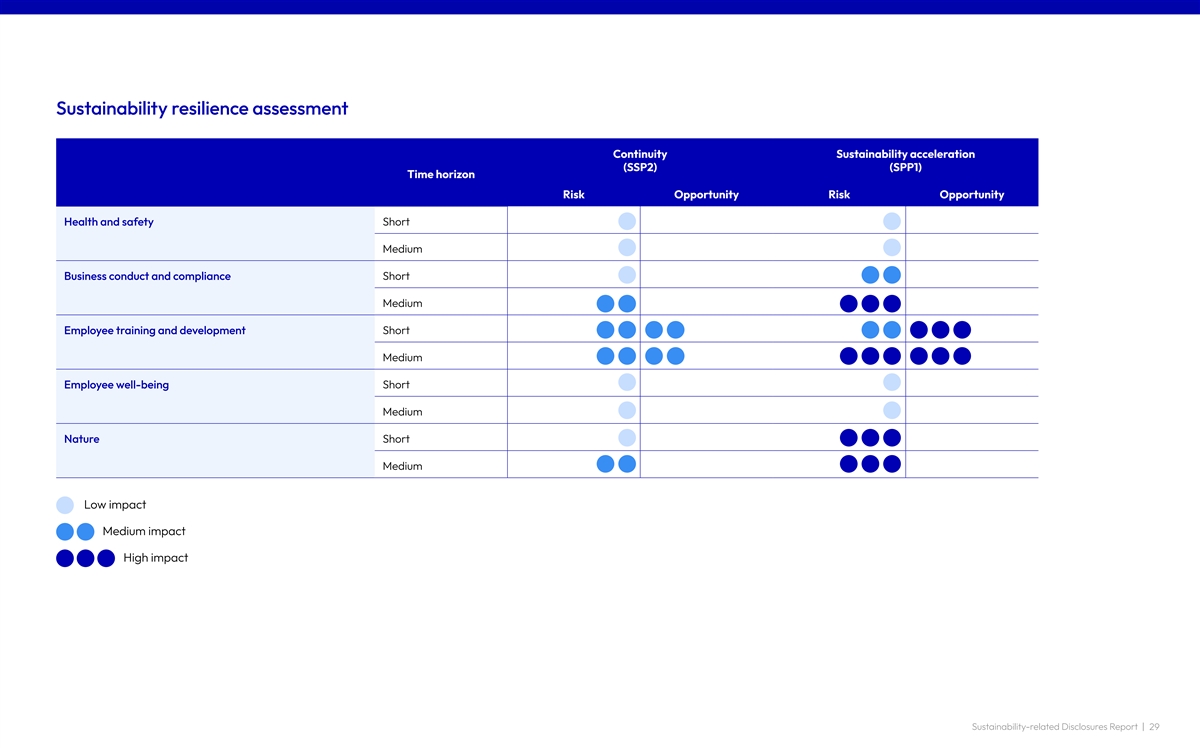
Sustainability resilience assessment Continuity Sustainability acceleration (SSP2) (SPP1) Time horizon Risk Opportunity Risk Opportunity Health and safety Short Medium Business conduct and compliance Short Medium Employee training and development Short Medium Employee well-being Short Medium Nature Short Medium Low impact Medium impact High impact Sustainability-related Disclosures Report | 29
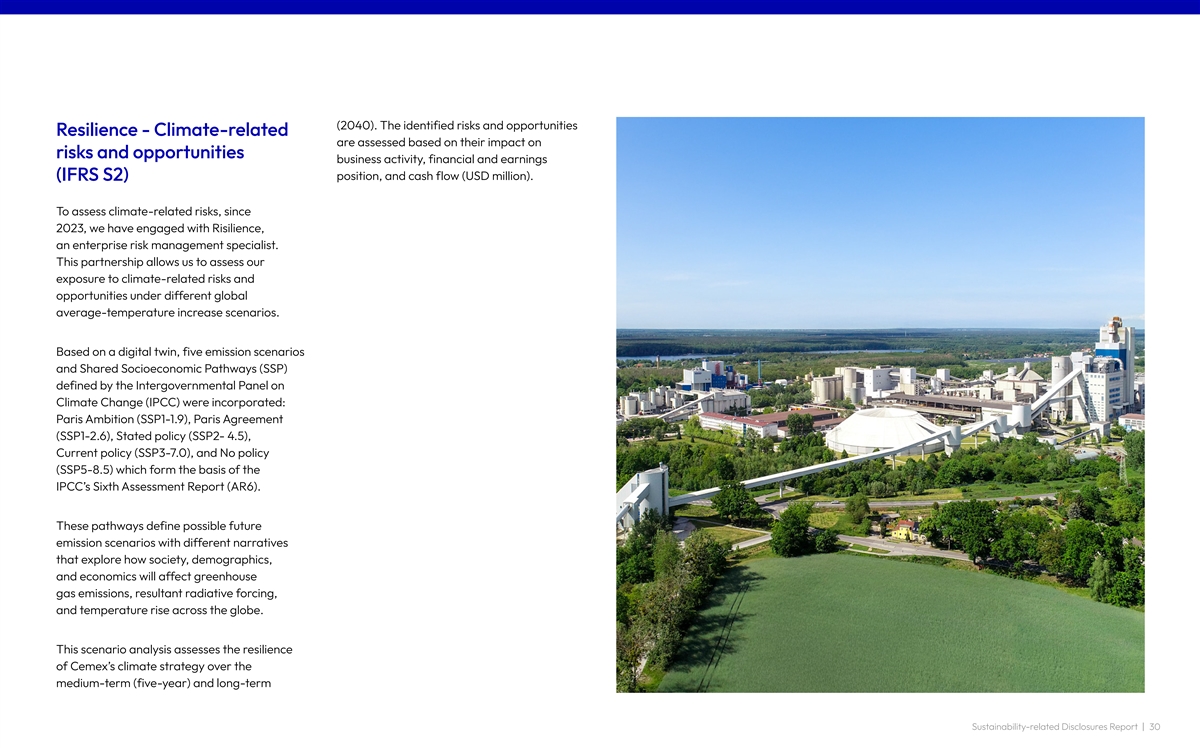
(2040). The identified risks and opportunities Resilience - Climate-related are assessed based on their impact on risks and opportunities business activity, financial and earnings position, and cash flow (USD million). (IFRS S2) To assess climate-related risks, since 2023, we have engaged with Risilience, an enterprise risk management specialist. This partnership allows us to assess our exposure to climate-related risks and opportunities under different global average-temperature increase scenarios. Based on a digital twin, five emission scenarios and Shared Socioeconomic Pathways (SSP) defined by the Intergovernmental Panel on Climate Change (IPCC) were incorporated: Paris Ambition (SSP1-1.9), Paris Agreement (SSP1-2.6), Stated policy (SSP2- 4.5), Current policy (SSP3-7.0), and No policy (SSP5-8.5) which form the basis of the IPCC’s Sixth Assessment Report (AR6). These pathways define possible future emission scenarios with different narratives that explore how society, demographics, and economics will affect greenhouse gas emissions, resultant radiative forcing, and temperature rise across the globe. This scenario analysis assesses the resilience of Cemex’s climate strategy over the medium-term (five-year) and long-term Sustainability-related Disclosures Report | 30
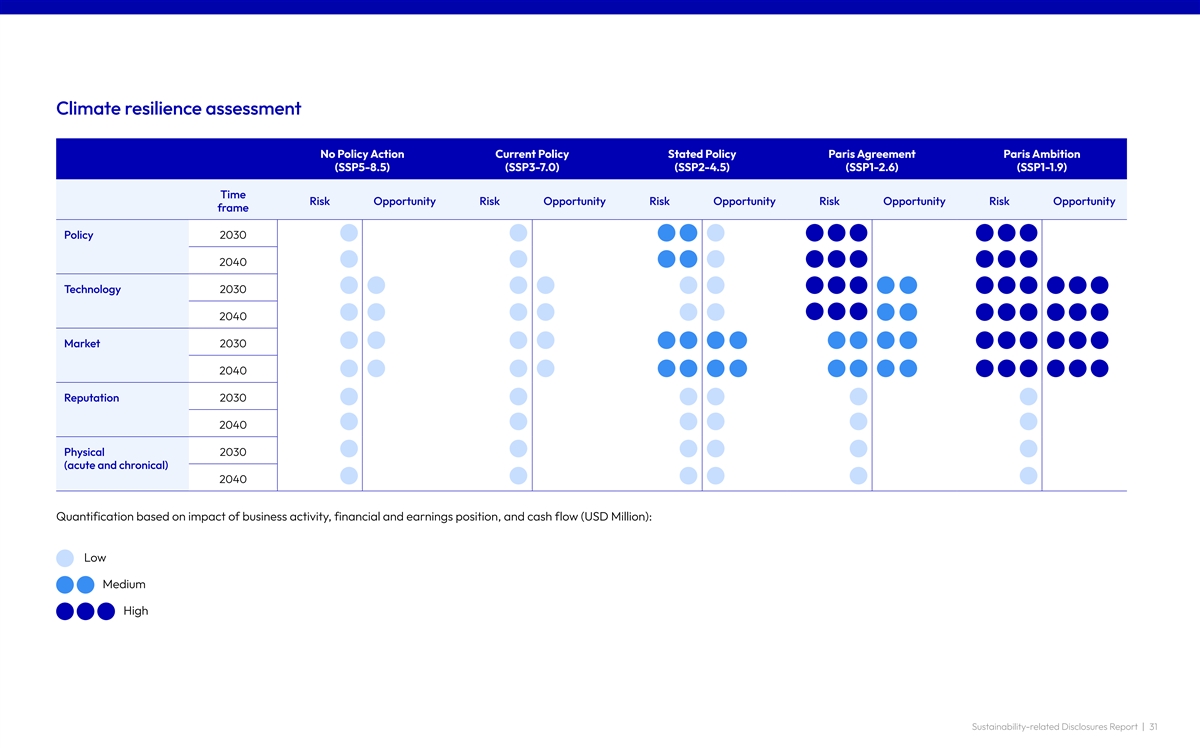
Climate resilience assessment No Policy Action Current Policy Stated Policy Paris Agreement Paris Ambition (SSP5-8.5) (SSP3-7.0) (SSP2-4.5) (SSP1-2.6) (SSP1-1.9) Time Risk Opportunity Risk Opportunity Risk Opportunity Risk Opportunity Risk Opportunity frame Policy 2030 2040 Technology 2030 2040 Market 2030 2040 Reputation 2030 2040 Physical 2030 (acute and chronical) 2040 Quantification based on impact of business activity, financial and earnings position, and cash flow (USD Million): Low Medium High Sustainability-related Disclosures Report | 31
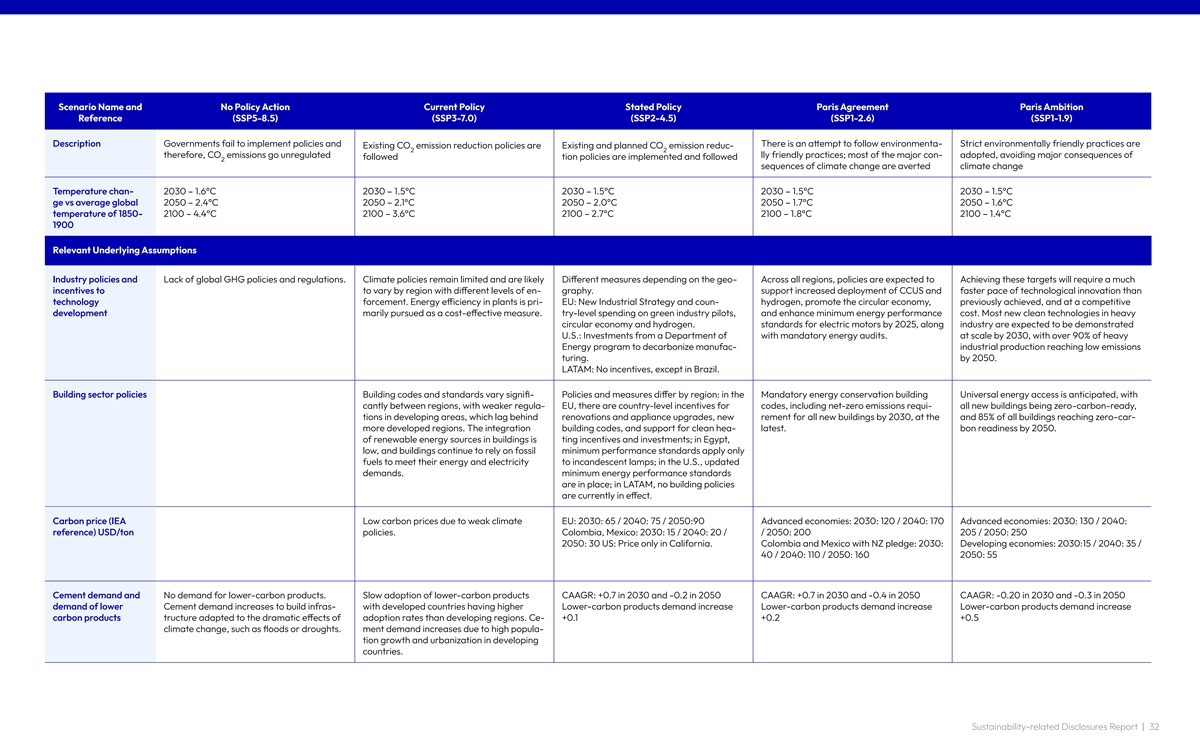
Scenario Name and No Policy Action Current Policy Stated Policy Paris Agreement Paris Ambition Reference (SSP5-8.5) (SSP3-7.0) (SSP2-4.5) (SSP1-2.6) (SSP1-1.9) Description Governments fail to implement policies and There is an attempt to follow environmenta- Strict environmentally friendly practices are Existing CO emission reduction policies are Existing and planned CO emission reduc- 2 2 therefore, CO emissions go unregulated lly friendly practices; most of the major con- adopted, avoiding major consequences of followed tion policies are implemented and followed 2 sequences of climate change are averted climate change Temperature chan- 2030 – 1.6°C 2030 – 1.5°C 2030 – 1.5°C 2030 – 1.5°C 2030 – 1.5°C ge vs average global 2050 – 2.4°C 2050 – 2.1°C 2050 – 2.0°C 2050 – 1.7°C 2050 – 1.6°C temperature of 1850- 2100 – 4.4°C 2100 – 3.6°C 2100 – 2.7°C 2100 – 1.8°C 2100 – 1.4°C 1900 Relevant Underlying Assumptions Industry policies and Lack of global GHG policies and regulations. Climate policies remain limited and are likely Different measures depending on the geo - Across all regions, policies are expected to Achieving these targets will require a much incentives to to vary by region with different levels of en- graphy. support increased deployment of CCUS and faster pace of technological innovation than technology forcement. Energy efficiency in plants is pri- EU: New Industrial Strategy and coun- hydrogen, promote the circular economy, previously achieved, and at a competitive development marily pursued as a cost-eec ff tive measure. try-level spending on green industry pilots, and enhance minimum energy performance cost. Most new clean technologies in heavy circular economy and hydrogen. standards for electric motors by 2025, along industry are expected to be demonstrated U.S.: Investments from a Department of with mandatory energy audits. at scale by 2030, with over 90% of heavy Energy program to decarbonize manufac- industrial production reaching low emissions turing. by 2050. LATAM: No incentives, except in Brazil. Building sector policies Building codes and standards vary signifi- Policies and measures differ by region: in the Mandatory energy conservation building Universal energy access is anticipated, with cantly between regions, with weaker regula- EU, there are country-level incentives for codes, including net-zero emissions requi- all new buildings being zero-carbon-ready, tions in developing areas, which lag behind renovations and appliance upgrades, new rement for all new buildings by 2030, at the and 85% of all buildings reaching zero-car- more developed regions. The integration building codes, and support for clean hea- latest. bon readiness by 2050. of renewable energy sources in buildings is ting incentives and investments; in Egypt, low, and buildings continue to rely on fossil minimum performance standards apply only fuels to meet their energy and electricity to incandescent lamps; in the U.S., updated demands. minimum energy performance standards are in place; in LATAM, no building policies are currently in eec ff t. Carbon price (IEA Low carbon prices due to weak climate EU: 2030: 65 / 2040: 75 / 2050:90 Advanced economies: 2030: 120 / 2040: 170 Advanced economies: 2030: 130 / 2040: reference) USD/ton policies. Colombia, Mexico: 2030: 15 / 2040: 20 / / 2050: 200 205 / 2050: 250 2050: 30 US: Price only in California. Colombia and Mexico with NZ pledge: 2030: Developing economies: 2030:15 / 2040: 35 / 40 / 2040: 110 / 2050: 160 2050: 55 Cement demand and No demand for lower-carbon products. Slow adoption of lower-carbon products CAAGR: +0.7 in 2030 and -0.2 in 2050 CAAGR: +0.7 in 2030 and -0.4 in 2050 CAAGR: -0.20 in 2030 and -0.3 in 2050 demand of lower Cement demand increases to build infras- with developed countries having higher Lower-carbon products demand increase Lower-carbon products demand increase Lower-carbon products demand increase carbon products tructure adapted to the dramatic eec ff ts of adoption rates than developing regions. Ce- +0.1 +0.2 +0.5 climate change, such as floods or droughts. ment demand increases due to high popula- tion growth and urbanization in developing countries. Sustainability-related Disclosures Report | 32
organizational value and is at the core best practices beyond minimum compliance, Cemex to mitigate significant risks, capitalize Resilience - Results from the of everything we do. This approach is strengthens its ability to respond effectively on long-term opportunities, and maintain sustainability and climate underpinned by a strong, externally to an ever-evolving regulatory framework. operational continuity. In this context, validated safety culture, with globally This not only reduces legal, operational, sustainability is consolidated as a key enabler risks analysis recognized industry-leading performance, and/or reputational risks but also reinforces for operational stability, strategic decision- and supported by continuous improvement stakeholder confidence and strengthens making, and the generation of sustainable The sustainability landscape has evolved plans that strengthen and evolve existing the Cemex’s performance alignment value, grounded in an organizational culture rapidly at a global level, with increased practices. In addition, our health and safety with current and future expectations for that goes beyond regulatory compliance. scrutiny and constantly shifting commitments. strategy has evolved to include the holistic sustainability and corporate governance. In In this dynamic context, Cemex reaffirms its well-being of employees both inside and this context, Cemex’s compliance strategy is commitment to leadership and resilience in Regarding our climate resilience, Cemex outside the workplace, with the goal of consolidated as a cross-cutting and enabling sustainability, adapting its strategy to respond recognizes that climate action is the greatest promoting a better quality of life and building component of its sustainability strategy. to the external environment and align it with challenge of our time and our strategy a resilient, future-ready workforce. All of the Company’s strategic priorities. To this remains aligned with the most ambitious this has facilitated the effective fulfillment end, the Company has implemented policies In the environmental sphere, the nature- scenario, Paris Ambition (SSP1-1.9). The of our commitments and the continuous and initiatives that, in various areas, go related strategy is integrated into the assessment considers the inherent risk to improvement of our performance. beyond regulatory compliance, allowing it to Future in Action program and incorporates Cemex but does not account for residual maintain a strategic advantage in the face initiatives related to water, biodiversity, risk. However, the results confirm that of rising ESG expectations and demands. Regarding compliance, Cemex’s proactive and environmental management. Cemex’s carbon strategy is generally robust ESG approach, supported by robust policies, Targets have been set for 2030 to reduce and demonstrates strong climate initiatives solid internal processes, and the adoption of freshwater extraction and emissions and performance. Particularly, we have Health and safety remain Cemex’s top from cement operations, supported by robust efforts in technology and market, improved operational practices and as these two areas show a high impact the progressive adoption of monitoring quantification throughout the two-time and mitigation technologies, exceeding frames considered in this assessment. Our applicable regulatory requirements. innovation and research and development teams are continuously working to identify, develop, and invest in new technologies Taken together, the progress achieved that deliver innovative building materials on material sustainability issues reflects a and solutions to build resilient cities, urban resilient strategy designed to anticipate and projects, buildings, and infrastructure. We are respond effectively. Furthermore, proactive also investing in and forming partnerships management strengthens the Company’s to develop and leverage technologies as ability to face changing scenarios and we enhance our production processes, increasing external pressures, enabling in line with our climate commitments. Sustainability-related Disclosures Report | 33
Additionally, our portfolio of products and We will continue working toward our 2030 solutions with sustainable attributes, Vertua®, target of reducing our net specific CO 2 which includes our lower-carbon concrete emissions by 47% compared to our 1990 and cement, has gained rapid adoption by baseline. Also, Cemex expects to continue customers across the geographies where investing in research and development, we operate. Cemex remains committed to capitalizing on Cemex Ventures and strategic offering products and services that address partnerships to continue at the forefront of our customers’ sustainability-related concerns the building materials industry by offering while maintaining alignment with the most cutting-edge sustainable products and ambitious net-zero scenario efforts by 2050. solutions and improving our production processes in line with our decarbonization roadmap. We anticipate that these The results of this assessment, along with efforts will be further strengthened in the the analysis of our Future in Action program, most carbon-constrained scenarios. with its related initiatives and progress, demonstrate that our strategy is robust and well-prepared to tackle the most ambitious challenges expected under each scenario and to deliver on our climate commitments. Sustainability-related Disclosures Report | 34
Risk management ǫ Processes and related policies the entity uses to identify, assess, prioritize and monitor sustainability- and climate-related risks ǫ Processes the entity uses to identify, assess, prioritize and monitor sustainability-related opportunities ǫ Processes the entity uses to identify, assess, prioritize and monitor climate-related opportunities, including information about whether and how the entity uses climate-related scenario analysis to inform its identification of climate-related opportunities ǫ The extent to which, and how, the processes for identifying, assessing, prioritizing and monitoring sustainability- and climate-related risks and opportunities are integrated into and inform the entity’s overall risk management process Cemex has an Enterprise Risk Management from a comprehensive ERM process that (“ERM”) system established throughout identifies and manages various types of risks, the organization with global policies and trends, emerging concerns, and opportunities procedures designed to anticipate and that could impact Cemex’s strategic priorities risks and opportunities previously identified manage the main risks and opportunities that in the short-, medium-, and long-term. This in the risk and opportunity agenda. These could affect our business. Our ERM system, agenda is presented and reviewed once a risks and opportunities are prioritized based led by our Corporate Strategic Planning team year to the Risk Management Committee, on their overall risk rating assessed by ERM, and supported by cross-functional teams, which is composed of the Executive which is based on their estimated probability combines bottom-up and top-down strategies Committee members, and to the Board of (likelihood of the risk materializing) and to support better-informed decision- Directors through the Sustainability, Climate impact (qualitative/quantitative consequences making and risk-management strategy at Action, Social Impact and Diversity Committee for Cemex if the risk materializes). all levels of the organization. Sustainability for its insight, discussion, and approval. This risks and opportunities, including those agenda includes sustainability, ESG, and For climate-related risks, in addition related to climate change, are managed climate-related risks and opportunities, to our ERM system, a scenario analysis within the ERM system. The ERM and the which are managed within the ERM system. is elaborated, integrating the risks Sustainability functions are the primary and opportunities identified in the responsible departments for assessing The Board of Directors, through the agendas, and using relevant inputs and climate-related risks and opportunities. Sustainability, Climate Action, Social Impact parameters to assess each element. and Diversity Committee, provides strategic Our risk and opportunity agenda, developed guidance, oversight, and detailed discussion at global, regional, and country levels, results of the sustainability and climate-related Sustainability-related Disclosures Report | 35
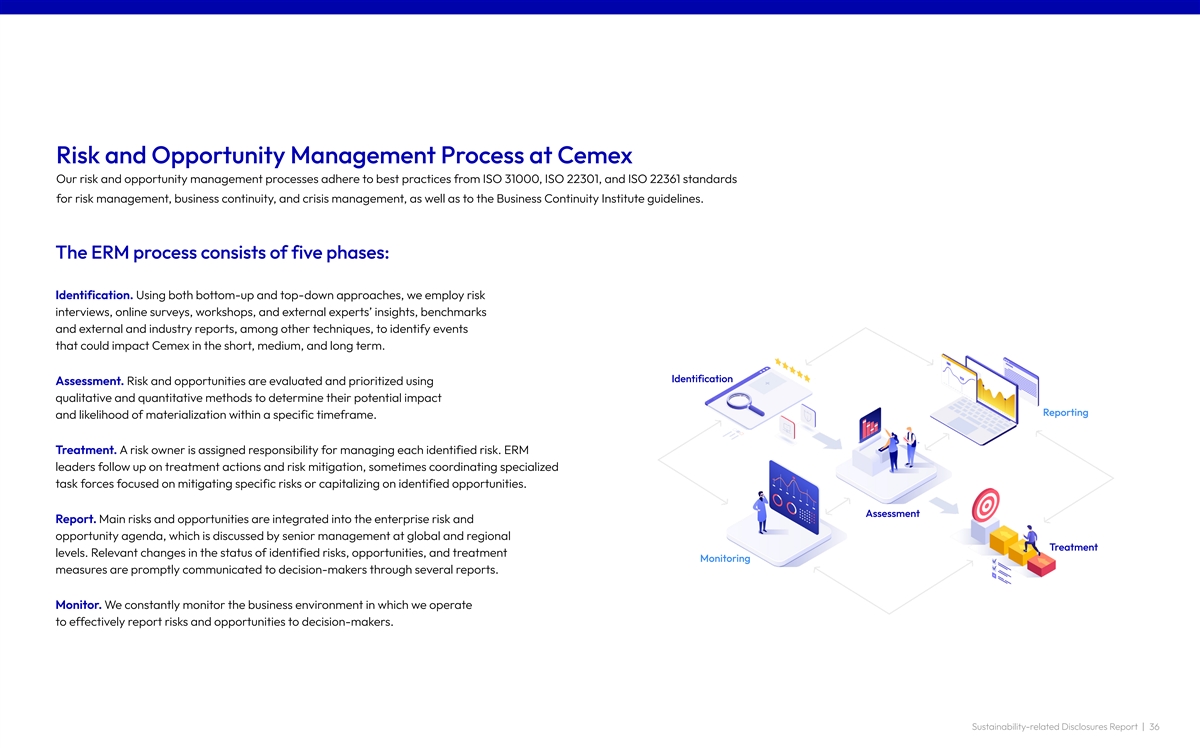
Risk and Opportunity Management Process at Cemex Our risk and opportunity management processes adhere to best practices from ISO 31000, ISO 22301, and ISO 22361 standards for risk management, business continuity, and crisis management, as well as to the Business Continuity Institute guidelines. The ERM process consists of five phases: Identification. Using both bottom-up and top-down approaches, we employ risk interviews, online surveys, workshops, and external experts’ insights, benchmarks and external and industry reports, among other techniques, to identify events that could impact Cemex in the short, medium, and long term. Identification Assessment. Risk and opportunities are evaluated and prioritized using qualitative and quantitative methods to determine their potential impact Reporting and likelihood of materialization within a specific timeframe. Treatment. A risk owner is assigned responsibility for managing each identified risk. ERM leaders follow up on treatment actions and risk mitigation, sometimes coordinating specialized task forces focused on mitigating specific risks or capitalizing on identified opportunities. Assessment Report. Main risks and opportunities are integrated into the enterprise risk and opportunity agenda, which is discussed by senior management at global and regional Treatment levels. Relevant changes in the status of identified risks, opportunities, and treatment Monitoring measures are promptly communicated to decision-makers through several reports. Monitor. We constantly monitor the business environment in which we operate to effectively report risks and opportunities to decision-makers. Sustainability-related Disclosures Report | 36
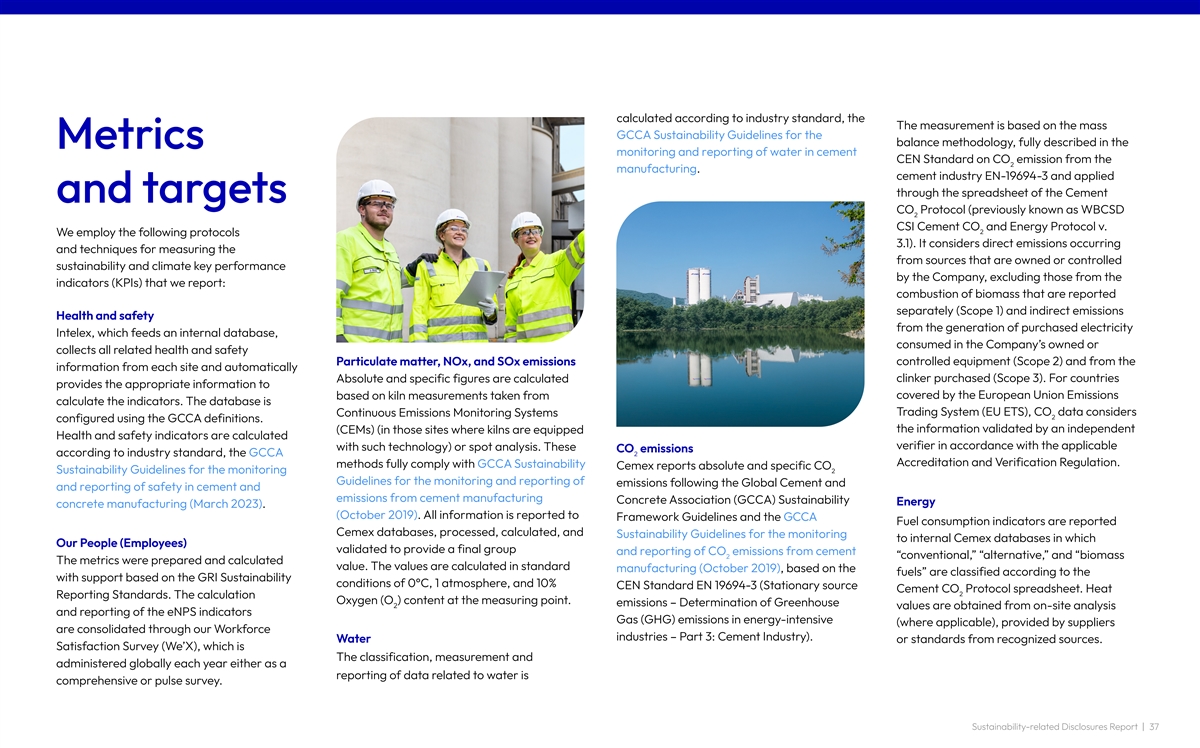
calculated according to industry standard, the The measurement is based on the mass GCCA Sustainability Guidelines for the balance methodology, fully described in the Metrics monitoring and reporting of water in cement CEN Standard on CO emission from the 2 manufacturing. cement industry EN-19694-3 and applied through the spreadsheet of the Cement and targets CO Protocol (previously known as WBCSD 2 CSI Cement CO and Energy Protocol v. 2 We employ the following protocols 3.1). It considers direct emissions occurring and techniques for measuring the from sources that are owned or controlled sustainability and climate key performance by the Company, excluding those from the indicators (KPIs) that we report: combustion of biomass that are reported separately (Scope 1) and indirect emissions Health and safety from the generation of purchased electricity Intelex, which feeds an internal database, consumed in the Company’s owned or collects all related health and safety Particulate matter, NOx, and SOx emissions controlled equipment (Scope 2) and from the information from each site and automatically Absolute and specific figures are calculated clinker purchased (Scope 3). For countries provides the appropriate information to covered by the European Union Emissions based on kiln measurements taken from calculate the indicators. The database is Trading System (EU ETS), CO data considers Continuous Emissions Monitoring Systems 2 configured using the GCCA definitions. the information validated by an independent (CEMs) (in those sites where kilns are equipped Health and safety indicators are calculated verifier in accordance with the applicable with such technology) or spot analysis. These CO emissions 2 according to industry standard, the GCCA Accreditation and Verification Regulation. methods fully comply with GCCA Sustainability Cemex reports absolute and specific CO 2 Sustainability Guidelines for the monitoring Guidelines for the monitoring and reporting of emissions following the Global Cement and and reporting of safety in cement and emissions from cement manufacturing Concrete Association (GCCA) Sustainability Energy concrete manufacturing (March 2023). (October 2019). All information is reported to Framework Guidelines and the GCCA Fuel consumption indicators are reported Cemex databases, processed, calculated, and Sustainability Guidelines for the monitoring to internal Cemex databases in which Our People (Employees) validated to provide a final group and reporting of CO emissions from cement 2 “conventional,” “alternative,” and “biomass The metrics were prepared and calculated value. The values are calculated in standard manufacturing (October 2019), based on the fuels” are classified according to the with support based on the GRI Sustainability conditions of 0°C, 1 atmosphere, and 10% CEN Standard EN 19694-3 (Stationary source Cement CO Protocol spreadsheet. Heat 2 Reporting Standards. The calculation Oxygen (O ) content at the measuring point. emissions – Determination of Greenhouse 2 values are obtained from on-site analysis and reporting of the eNPS indicators Gas (GHG) emissions in energy-intensive (where applicable), provided by suppliers are consolidated through our Workforce industries – Part 3: Cement Industry). Water or standards from recognized sources. Satisfaction Survey (We’X), which is The classification, measurement and administered globally each year either as a reporting of data related to water is comprehensive or pulse survey. Sustainability-related Disclosures Report | 37
Clinker factor and alternative fuels All material consumption is reported to internal Cemex databases in which “alternative materials” are defined following the standards from the GCCA Sustainability Guidelines for co-processing fuels and raw materials in cement manufacturing (October 2019). The “clinker/cement factor” is calculated using the Basic Parameters set out in the GCCA Sustainability Framework Guidelines and according to the GCCA Sustainability Guidelines for the monitoring and reporting of CO emissions from cement 2 manufacturing, procedures indicated in the Cement CO Protocol spreadsheet with 2 information obtained from the databases. For 2025, certain sustainability- and climate- related metrics were validated by a third party under a limited assurance. For more details about the metrics audited, please refer to page 228 of our 2025 Integrated Report. Sustainability-related Disclosures Report | 38
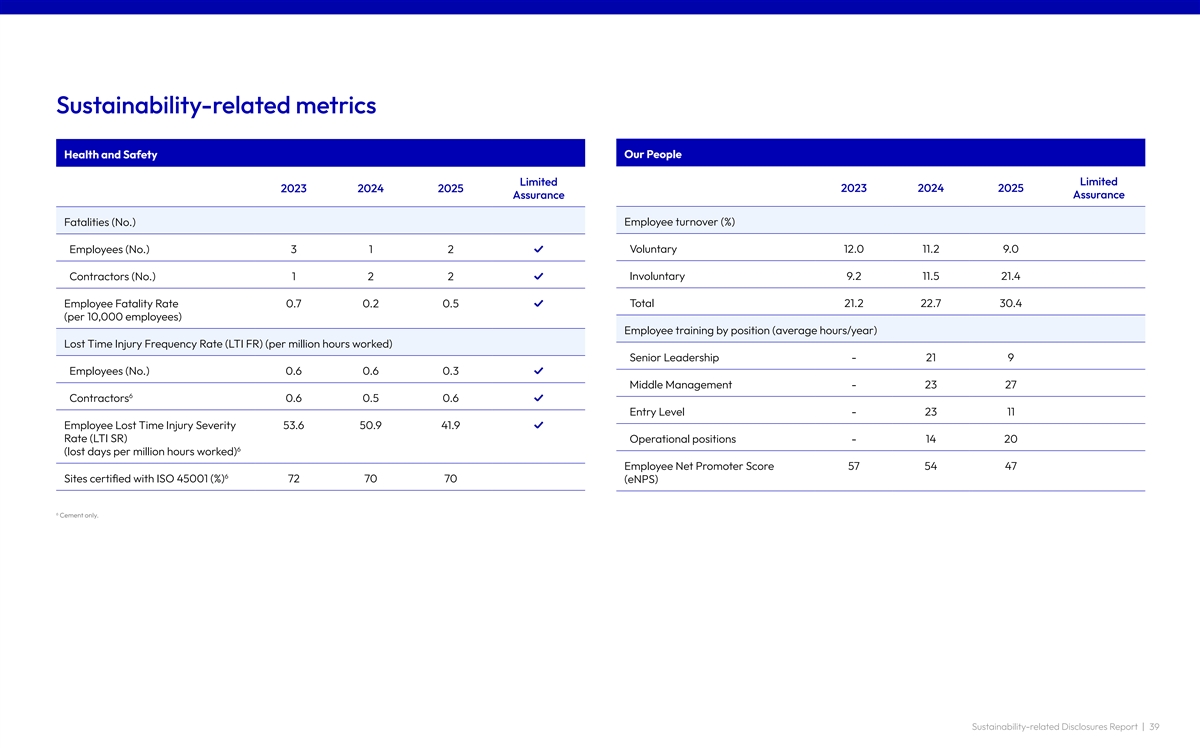
Sustainability-related metrics Health and Safety Our People Limited Limited 2023 2024 2025 2023 2024 2025 Assurance Assurance Fatalities (No.) Employee turnover (%) Employees (No.) 3 1 2✓ Voluntary 12.0 11.2 9.0 Contractors (No.) 1 2 2✓ Involuntary 9.2 11.5 21.4 Employee Fatality Rate 0.7 0.2 0.5✓ Total 21.2 22.7 30.4 (per 10,000 employees) Employee training by position (average hours/year) Lost Time Injury Frequency Rate (LTI FR) (per million hours worked) Senior Leadership - 21 9 Employees (No.) 0.6 0.6 0.3✓ Middle Management - 23 27 6 Contractors 0.6 0.5 0.6✓ Entry Level - 23 11 Employee Lost Time Injury Severity 53.6 50.9 41.9✓ Rate (LTI SR) Operational positions - 14 20 6 (lost days per million hours worked) Employee Net Promoter Score 57 54 47 6 Sites certified with ISO 45001 (%) 72 70 70 (eNPS) 6 Cement only. Sustainability-related Disclosures Report | 39
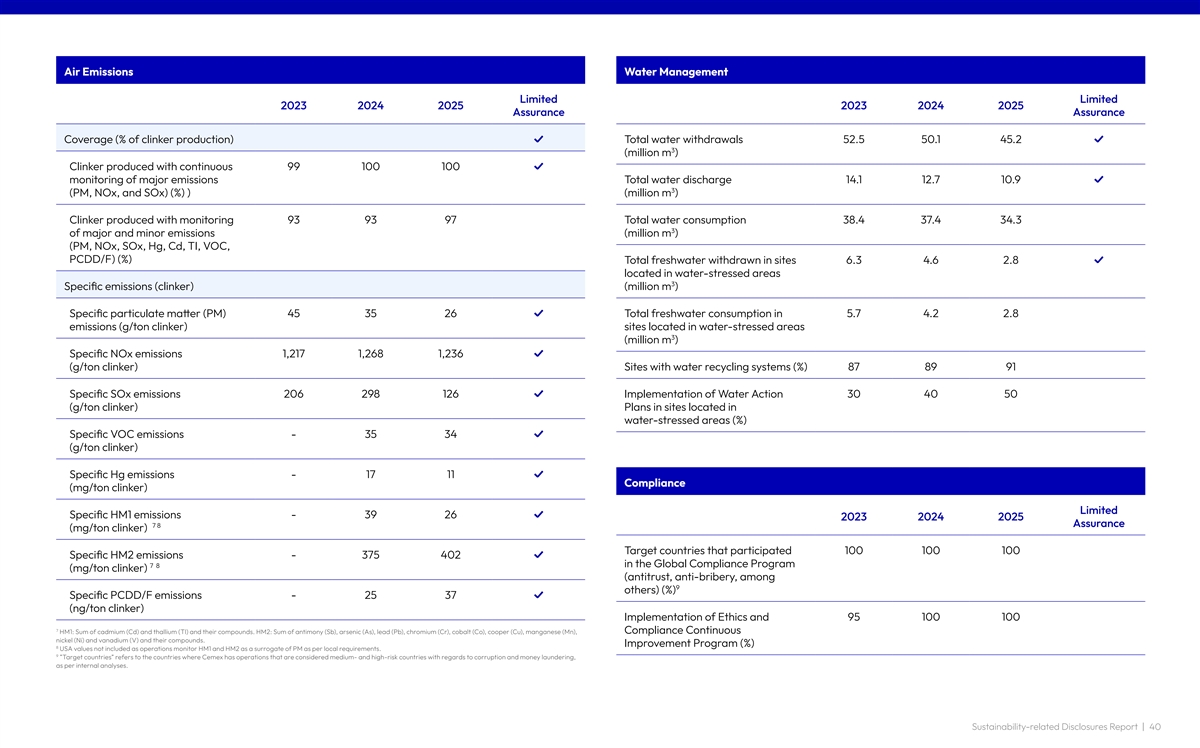
Air Emissions Water Management Limited Limited 2023 2024 2025 2023 2024 2025 Assurance Assurance Coverage (% of clinker production) ✓ Total water withdrawals 52.5 50.1 45.2✓ 3 (million m ) Clinker produced with continuous 99 100 100✓ monitoring of major emissions Total water discharge 14.1 12.7 10.9✓ 3 (PM, NOx, and SOx) (%) ) (million m ) Clinker produced with monitoring 93 93 97 Total water consumption 38.4 37.4 34.3 3 of major and minor emissions (million m ) (PM, NOx, SOx, Hg, Cd, TI, VOC, PCDD/F) (%) Total freshwater withdrawn in sites 6.3 4.6 2.8✓ located in water-stressed areas 3 Specific emissions (clinker) (million m ) Specific particulate matter (PM) 45 35 26✓ Total freshwater consumption in 5.7 4.2 2.8 emissions (g/ton clinker) sites located in water-stressed areas 3 (million m ) Specific NOx emissions 1,217 1,268 1,236✓ (g/ton clinker) Sites with water recycling systems (%) 87 89 91 Specific SOx emissions 206 298 126✓ Implementation of Water Action 30 40 50 (g/ton clinker) Plans in sites located in water-stressed areas (%) Specific VOC emissions - 35 34✓ (g/ton clinker) Specific Hg emissions - 17 11✓ Compliance (mg/ton clinker) Limited Specific HM1 emissions - 39 26✓ 2023 2024 2025 Assurance 7 8 (mg/ton clinker) Target countries that participated 100 100 100 Specific HM2 emissions - 375 402✓ in the Global Compliance Program 7 8 (mg/ton clinker) (antitrust, anti-bribery, among 9 others) (%) Specific PCDD/F emissions - 25 37✓ (ng/ton clinker) Implementation of Ethics and 95 100 100 7 HM1: Sum of cadmium (Cd) and thallium (Tl) and their compounds. HM2: Sum of antimony (Sb), arsenic (As), lead (Pb), chromium (Cr), cobalt (Co), cooper (Cu), manganese (Mn), Compliance Continuous nickel (Ni) and vanadium (V) and their compounds. Improvement Program (%) 8 USA values not included as operations monitor HM1 and HM2 as a surrogate of PM as per local requirements. 9 ”Target countries” refers to the countries where Cemex has operations that are considered medium- and high-risk countries with regards to corruption and money laundering, as per internal analyses. Sustainability-related Disclosures Report | 40
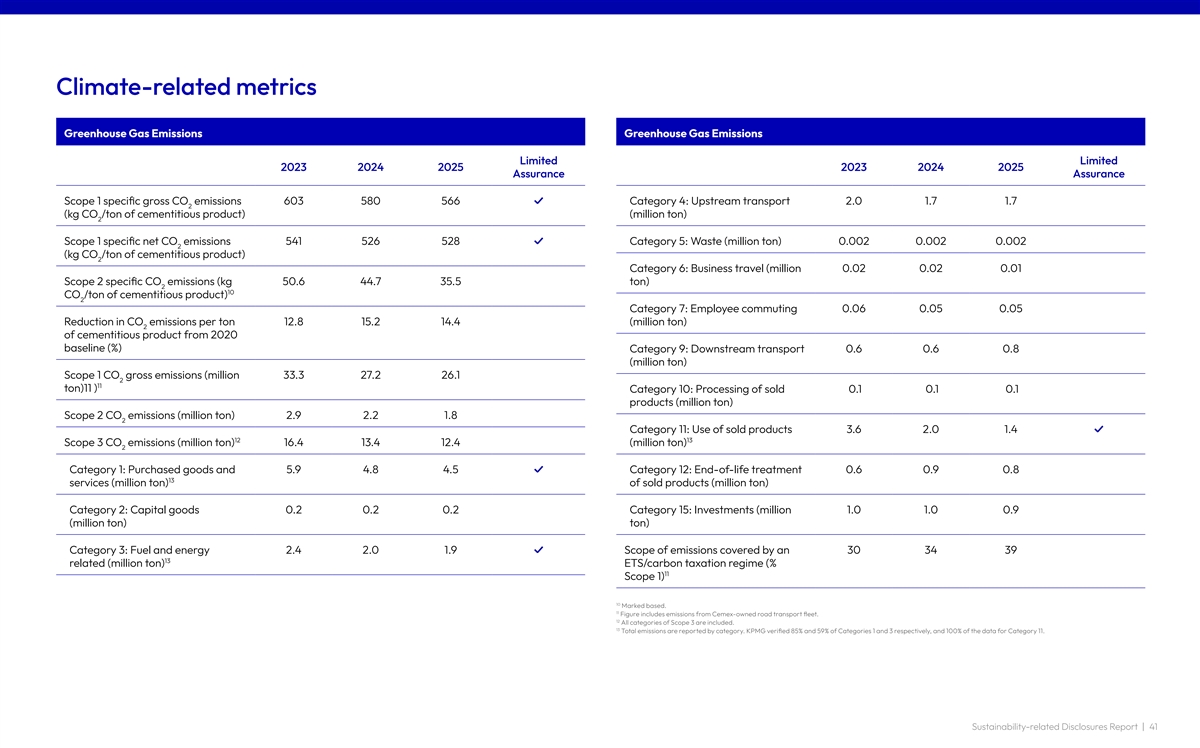
Climate-related metrics Greenhouse Gas Emissions Greenhouse Gas Emissions Limited Limited 2023 2024 2025 2023 2024 2025 Assurance Assurance Scope 1 specific gross CO emissions 603 580 566✓ Category 4: Upstream transport 2.0 1.7 1.7 2 (kg CO /ton of cementitious product) (million ton) 2 Scope 1 specific net CO emissions 541 526 528✓ Category 5: Waste (million ton) 0.002 0.002 0.002 2 (kg CO /ton of cementitious product) 2 Category 6: Business travel (million 0.02 0.02 0.01 Scope 2 specific CO emissions (kg 50.6 44.7 35.5 ton) 2 10 CO /ton of cementitious product) 2 Category 7: Employee commuting 0.06 0.05 0.05 Reduction in CO emissions per ton 12.8 15.2 14.4 (million ton) 2 of cementitious product from 2020 baseline (%) Category 9: Downstream transport 0.6 0.6 0.8 (million ton) Scope 1 CO gross emissions (million 33.3 27.2 26.1 2 11 ton)11 ) Category 10: Processing of sold 0.1 0.1 0.1 products (million ton) Scope 2 CO emissions (million ton) 2.9 2.2 1.8 2 Category 11: Use of sold products 3.6 2.0 1.4✓ 12 13 Scope 3 CO emissions (million ton) 16.4 13.4 12.4 (million ton) 2 Category 1: Purchased goods and 5.9 4.8 4.5✓ Category 12: End-of-life treatment 0.6 0.9 0.8 13 services (million ton) of sold products (million ton) Category 2: Capital goods 0.2 0.2 0.2 Category 15: Investments (million 1.0 1.0 0.9 (million ton) ton) Category 3: Fuel and energy 2.4 2.0 1.9✓ Scope of emissions covered by an 30 34 39 13 related (million ton) ETS/carbon taxation regime (% 11 Scope 1) 10 Marked based. 11 Figure includes emissions from Cemex-owned road transport fleet. 12 All categories of Scope 3 are included. 13 Total emissions are reported by category. KPMG verified 85% and 59% of Categories 1 and 3 respectively, and 100% of the data for Category 11. Sustainability-related Disclosures Report | 41
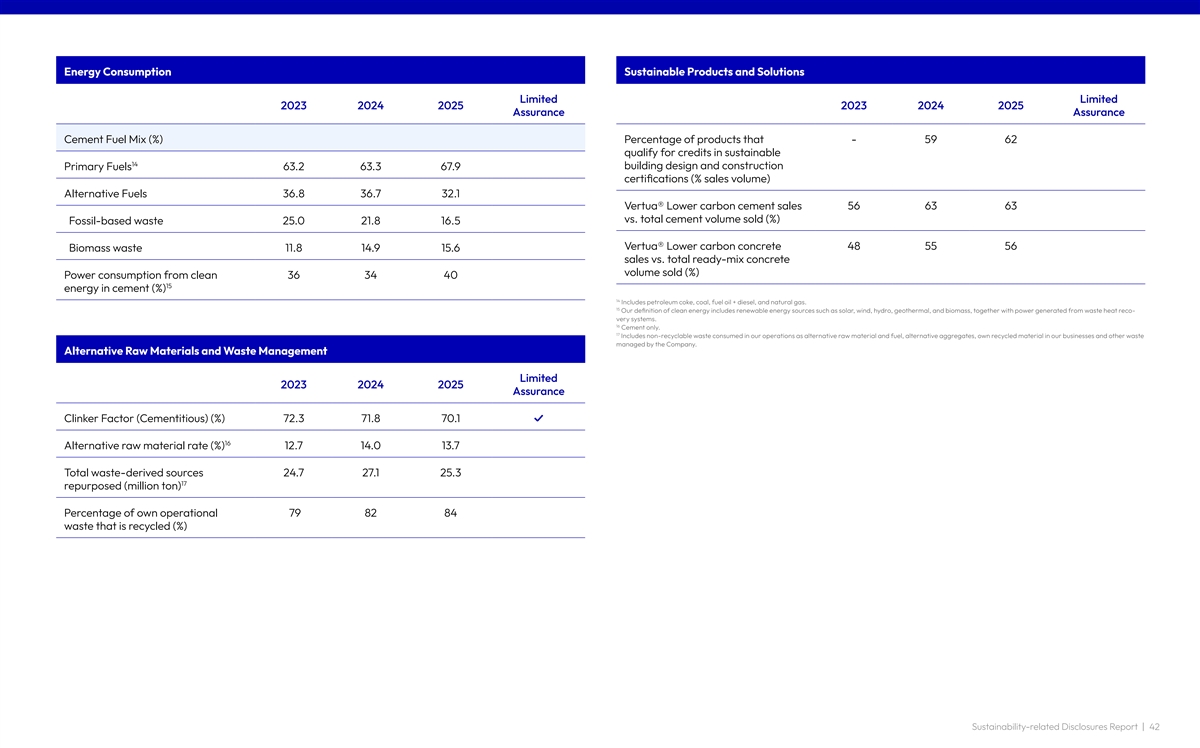
Energy Consumption Sustainable Products and Solutions Limited Limited 2023 2024 2025 2023 2024 2025 Assurance Assurance Cement Fuel Mix (%) Percentage of products that - 59 62 qualify for credits in sustainable 14 building design and construction Primary Fuels 63.2 63.3 67.9 certifications (% sales volume) Alternative Fuels 36.8 36.7 32.1 Vertua® Lower carbon cement sales 56 63 63 vs. total cement volume sold (%) Fossil-based waste 25.0 21.8 16.5 Vertua® Lower carbon concrete 48 55 56 Biomass waste 11.8 14.9 15.6 sales vs. total ready-mix concrete volume sold (%) Power consumption from clean 36 34 40 15 energy in cement (%) 14 Includes petroleum coke, coal, fuel oil + diesel, and natural gas. 15 Our definition of clean energy includes renewable energy sources such as solar, wind, hydro, geothermal, and biomass, together with power generated from waste heat reco - very systems. 16 Cement only. 17 Includes non-recyclable waste consumed in our operations as alternative raw material and fuel, alternative aggregates, own recycled material in our businesses and other waste managed by the Company. Alternative Raw Materials and Waste Management Limited 2023 2024 2025 Assurance Clinker Factor (Cementitious) (%) 72.3 71.8 70.1✓ 16 Alternative raw material rate (%) 12.7 14.0 13.7 Total waste-derived sources 24.7 27.1 25.3 17 repurposed (million ton) Percentage of own operational 79 82 84 waste that is recycled (%) Sustainability-related Disclosures Report | 42
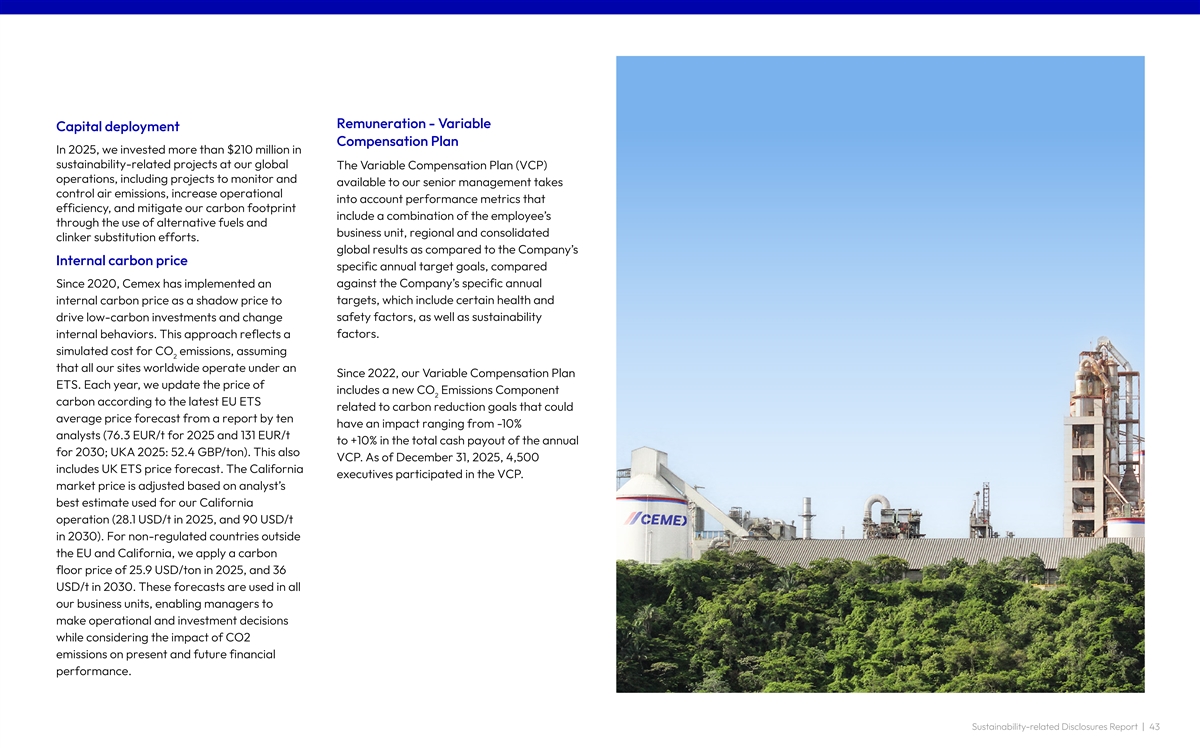
Remuneration - Variable Capital deployment Compensation Plan In 2025, we invested more than $210 million in sustainability-related projects at our global The Variable Compensation Plan (VCP) operations, including projects to monitor and available to our senior management takes control air emissions, increase operational into account performance metrics that efficiency, and mitigate our carbon footprint include a combination of the employee’s through the use of alternative fuels and business unit, regional and consolidated clinker substitution efforts. global results as compared to the Company’s Internal carbon price specific annual target goals, compared Since 2020, Cemex has implemented an against the Company’s specific annual internal carbon price as a shadow price to targets, which include certain health and drive low-carbon investments and change safety factors, as well as sustainability internal behaviors. This approach reflects a factors. simulated cost for CO emissions, assuming 2 that all our sites worldwide operate under an Since 2022, our Variable Compensation Plan ETS. Each year, we update the price of includes a new CO Emissions Component 2 carbon according to the latest EU ETS related to carbon reduction goals that could average price forecast from a report by ten have an impact ranging from -10% analysts (76.3 EUR/t for 2025 and 131 EUR/t to +10% in the total cash payout of the annual for 2030; UKA 2025: 52.4 GBP/ton). This also VCP. As of December 31, 2025, 4,500 includes UK ETS price forecast. The California executives participated in the VCP. market price is adjusted based on analyst’s best estimate used for our California operation (28.1 USD/t in 2025, and 90 USD/t in 2030). For non-regulated countries outside the EU and California, we apply a carbon floor price of 25.9 USD/ton in 2025, and 36 USD/t in 2030. These forecasts are used in all our business units, enabling managers to make operational and investment decisions while considering the impact of CO2 emissions on present and future financial performance. Sustainability-related Disclosures Report | 43
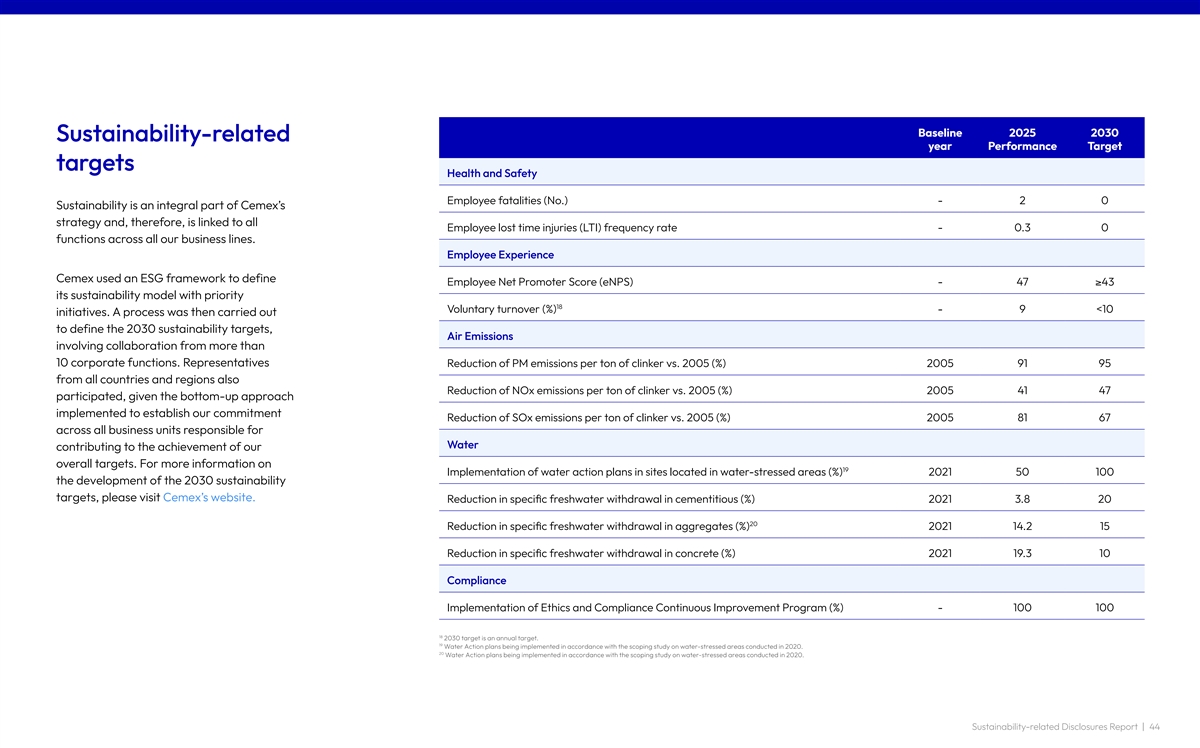
Baseline 2025 2030 Sustainability-related year Performance Target targets Health and Safety Employee fatalities (No.) - 2 0 Sustainability is an integral part of Cemex’s strategy and, therefore, is linked to all Employee lost time injuries (LTI) frequency rate - 0.3 0 functions across all our business lines. Employee Experience Cemex used an ESG framework to define Employee Net Promoter Score (eNPS) - 47≥43 its sustainability model with priority 18 Voluntary turnover (%) - 9 <10 initiatives. A process was then carried out to define the 2030 sustainability targets, Air Emissions involving collaboration from more than 10 corporate functions. Representatives Reduction of PM emissions per ton of clinker vs. 2005 (%) 2005 91 95 from all countries and regions also Reduction of NOx emissions per ton of clinker vs. 2005 (%) 2005 41 47 participated, given the bottom-up approach implemented to establish our commitment Reduction of SOx emissions per ton of clinker vs. 2005 (%) 2005 81 67 across all business units responsible for Water contributing to the achievement of our overall targets. For more information on 19 Implementation of water action plans in sites located in water-stressed areas (%) 2021 50 100 the development of the 2030 sustainability targets, please visit Cemex’s website. Reduction in specific freshwater withdrawal in cementitious (%) 2021 3.8 20 20 Reduction in specific freshwater withdrawal in aggregates (%) 2021 14.2 15 Reduction in specific freshwater withdrawal in concrete (%) 2021 19.3 10 Compliance Implementation of Ethics and Compliance Continuous Improvement Program (%) - 100 100 18 2030 target is an annual target. 19 Water Action plans being implemented in accordance with the scoping study on water-stressed areas conducted in 2020. 20 Water Action plans being implemented in accordance with the scoping study on water-stressed areas conducted in 2020. Sustainability-related Disclosures Report | 44
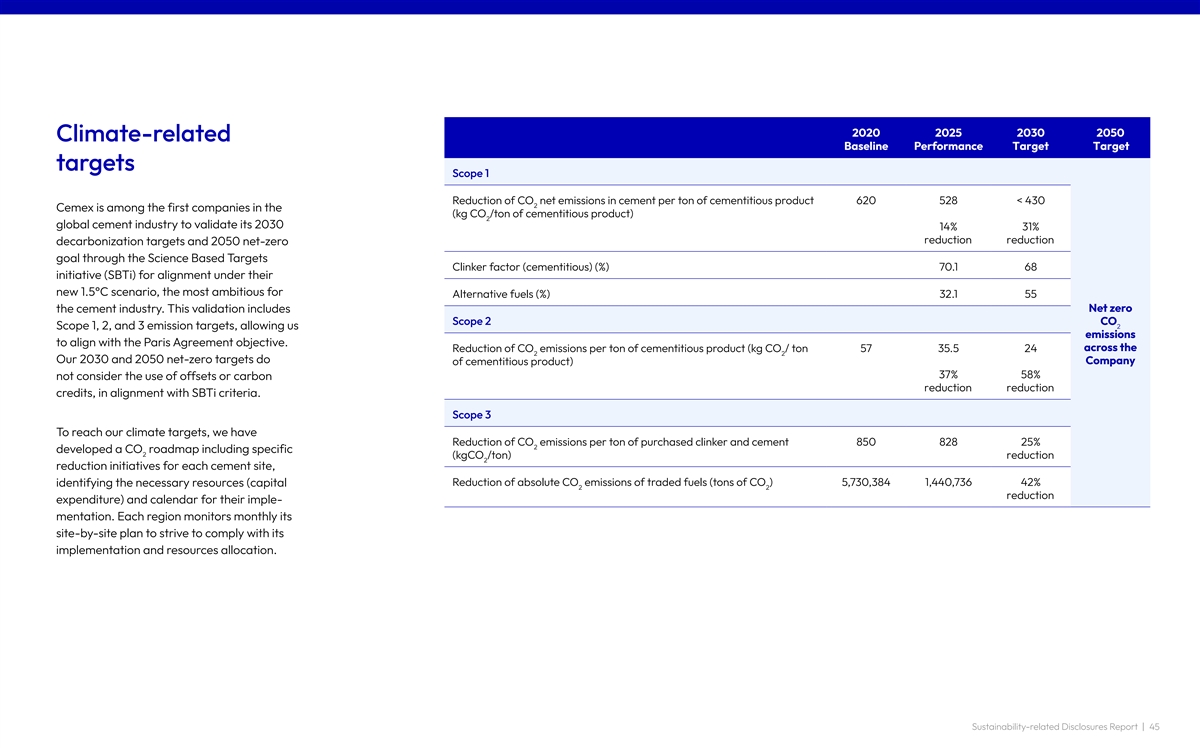
2020 2025 2030 2050 Climate-related Baseline Performance TargetTarget targets Scope 1 Reduction of CO net emissions in cement per ton of cementitious product 620 528 < 430 2 Cemex is among the first companies in the (kg CO /ton of cementitious product) 2 global cement industry to validate its 2030 14% 31% reductionreduction decarbonization targets and 2050 net-zero goal through the Science Based Targets Clinker factor (cementitious) (%) 70.1 68 initiative (SBTi) for alignment under their new 1.5°C scenario, the most ambitious for Alternative fuels (%) 32.1 55 Net zero the cement industry. This validation includes Scope 2 CO 2 Scope 1, 2, and 3 emission targets, allowing us emissions to align with the Paris Agreement objective. across the Reduction of CO emissions per ton of cementitious product (kg CO / ton 57 35.5 24 2 2 Our 2030 and 2050 net-zero targets do Company of cementitious product) 37% 58% not consider the use of offsets or carbon reductionreduction credits, in alignment with SBTi criteria. Scope 3 To reach our climate targets, we have Reduction of CO emissions per ton of purchased clinker and cement 850 828 25% 2 developed a CO roadmap including specific 2 (kgCO /ton) reduction 2 reduction initia tives for each cement site, Reduction of absolute CO emissions of traded fuels (tons of CO ) 5,730,384 1,440,736 42% identifying the necessary resources (capital 2 2 reduction expenditure) and calendar for their imple- mentation. Each region monitors monthly its site-by-site plan to strive to comply with its implement ation and resources allocation. Sustainability-related Disclosures Report | 45
measurement and the quantification of Statement of Judgements, uncertainties and errors; Cautionary certain impacts, particularly those related to climate change, involves inherent uncertainty, compliance statement regarding forward-looking statements as in some cases direct measurement is unavailable and it is necessary to use This report was prepared in accordance with As of year-end 2025, we recognize that was based on our Double Materiality estimates based on activity data, emission 21 the IFRS Sustainability Disclosure Standards additional risks and uncertainties could assessment , which integrates the most factors, and operational assumptions. S1 and S2 issued by the International emerge or materialize in 2026 and relevant financial and non-financial topics Such estimates may vary as information Sustainability Standards Board (ISSB). subsequent years due to changes in market for Cemex and our stakeholders. This process availability improves, methodologies evolve, conditions, business dynamics, regulatory involves applying significant judgments to or new data sources are incorporated. environments, and other external factors. determine which risks and opportunities Since this is the first annual period for which Accordingly, the relative significance of should be disclosed, the applicable time the Company is required to report such Additionally, climate-related projections the risks described in this section may horizons, and the degree to which these information for the first time, Cemex applied, and scenario analysis results depend increase or decrease over time. could affect the Company’s outlook. through the corresponding corporate notice, on assumptions about future conditions the transition exemption contemplated —including macroeconomic variables, in paragraph E4 of the Transition section Furthermore, the preparation of sustainability This assessment is also designed to achieve regulatory changes, technological of Appendix E (Effective Date and and climate-related information requires alignment with the European Union’s evolution, and weather patterns— Transition) of IFRS 1 (General Requirements the application of significant judgments, Corporate Sustainability Reporting Directive which are subject to uncertainty and for Disclosure of Sustainability-Related estimates, and assumptions by Management, (CSRD) and the GRI Sustainability Reporting could differ from actual results. Financial Information), under the terms in particularly in defining the scope of Standards, considering inherent risk prior to which the relief was offered to issuers. the report, identifying relevant risks mitigation measures. In addition, climate- However, we present the sustainability- and opportunities, and measuring non- related risks are assessed based on the joint and climate-related risks and financial metrics, including those related to assessment conducted in collaboration with opportunities considered relevant to greenhouse gas emissions. These judgments Risilience, which is explained in detail in the our operations and the industry. are based on the management team’s climate resilience section of this report. experience, the information available, and Cemex plans to continue strengthening the methodologies considered appropriate After adjusting the materiality of risks efforts to identify and quantify material risks as of the reporting date, and may differ as and opportunities to a financial impact and opportunities across our value chain. the availability and quality of information under International Financial Reporting or measurement practices evolve. Standards (IFRS), based on residual risk The sustainability-related information after considering mitigation measures, presented in this report comes from multiple The identification of our sustainability- no material financial impact for Cemex systems, operations, and geographies, related risks and opportunities (IFRS S1) was identified during 2025. However, the which may imply limitations in terms 21 For more information of our Double Materiality assessment analysis and results, please refer to page 233 of our Integrated Report 2025 Sustainability-related Disclosures Report | 46
of the completeness, consistency, or regulations in all jurisdictions where such results and any estimate, projection and/or Mexico, the United States of America, the comparability of the data. In this context, the provisions exist, including but not limited to the guidance presented in this report to differ European Union (“EU”), the United Kingdom Management applies judgment to assess US Private Securities Litigation Reform Act of materially from historical results, performance or other countries in which we operate; the the quality of the available information 1995. These forward-looking statements and and/or achievements or those anticipated by cyclical activity of the construction sector and and to determine when it is necessary information are necessarily subject to risks, forward-looking statements due to various reduced construction activity in our end to use estimates or assumptions. uncertainties, and assumptions, including but factors. Among others, such risks, markets or reduced use in our end markets for not limited to statements related to our plans, uncertainties, assumptions, and other our products; our exposure to sectors that objectives, and expectations (financial or important factors that could cause results and impact our and our clients’ businesses, Furthermore, the internal systems and otherwise), and typically can be identified by any estimate, projection and/or guidance particularly those operating in the commercial controls associated with non-financial the use of words such as, but not limited to, presented in this report to differ or fail to and residential construction sectors, and the information may differ in their level “will”, “may,” “assume,” “might,” “should,” materialize, or that otherwise could have an public and private infrastructure and energy of development from those used for “could,” “continue,” “would,” “can,” “consider,” impact on us, include those discussed in our sectors; volatility in pension plan asset values traditional financial information, which “anticipate,” “estimate,” “expect,” “envision,” most recent annual report and those detailed and liabilities, which may require cash or other may affect the accuracy, consistency, and “plan,” “believe,” “foresee,” “predict,” from time to time in our other filings with the contributions to the pension plans; changes in comparability of the information disclosed. “potential,” “target,” “goal,” “strategy,” U.S. Securities and the Exchange Commission spending levels for residential and commercial “intend,” “aimed”, or other forward-looking (“SEC”), Mexican National Banking and construction and general infrastructure We will also continue professionalizing our words. Although we believe that our Securities Commission (Comisión Nacional projects; the availability of short-term credit processes and methodologies to consistently expectations are reasonable, we can give no Bancaria y de Valores, the “CNBV”) and the lines or working capital facilities, which can and transparently disclose potential assurance that these expectations will prove Mexican Stock Exchange (Bolsa Mexicana de assist us in connection with market cycles; any impacts, in line with best practices and to be correct, and actual results, performance Valores, the “BMV”), which factors are impact of not maintaining investment grade the expectations of our stakeholders. and/or achievements may vary, including incorporated herein by reference, including, debt rating or not obtaining investment grade materially, from historical results, but not limited to: changes in general debt ratings from additional rating agencies The information disclosed in this report and performance and/or achievements or those economic, political and social conditions, on our cost of capital and on the cost of the the current or future events referenced anticipated by forward-looking statements including government shutdowns, new products and services we purchase; therein may contain forward-looking due to various factors. Unless otherwise governments or regimes and decisions availability of raw materials and related statements within the meaning of applicable indicated, these forward-looking statements implemented by such new governments or fluctuating prices of raw materials, as well as securities laws and regulations, including but reflect our current expectations and regimes, changes in laws or regulations in the of goods and services in general, in particular not limited to Section 27A of the Securities Act projections about the future based on certain countries in which we do business, elections, increases in prices of raw materials, goods of 1933, as amended, and Section 21E of the assumptions and on our knowledge of facts changes in inflation, interest and foreign and services, as a result of inflation, trade Securities Exchange Act of 1934, as amended. and circumstances as of the date such exchange rates, employment levels, barriers, measures imposed by governments We intend these forward-looking statements forward-looking statements are made. These population growth, any slowdown in the flow or as a result of conflicts between countries to be covered by the “safe harbor” provisions forward-looking statements necessarily of remittances into countries where we that disrupt supply chains; our ability to for forward-looking statements within the involve risks, uncertainties, assumptions and operate, consumer confidence and the maintain and expand our distribution network meaning of applicable securities laws and other important factors that could cause liquidity of the financial and capital markets in and maintain favorable relationships with Sustainability-related Disclosures Report | 47
third parties who supply us with equipment, fixed maturity and other financial obligations; offer our products and services or from where from sanctions or restrictions imposed on any services and essential supplies; competition in adverse legal or regulatory proceedings or we source our raw materials; trade barriers, financial institution, including but not limited to the markets in which we offer our products disputes, such as class actions or enforcement including but not limited to tariffs or import banks, common representatives, trustees, and services; the impact of environmental or other proceedings brought by third parties, taxes, including those imposed by the United payment processors, paying agents or other cleanup costs and other remedial actions, and government and regulatory agencies, States of America to key markets in which we financial intermediaries, or any related other environmental, climate and related including antitrust investigations and claims; operate, in particular, Mexico, China and the parties; terrorist and organized criminal liabilities relating to existing and/or divested our ability to protect our reputation and EU, and changes in existing trade policies or activities, social unrest, as well as geopolitical businesses, assets and/or operations; our intellectual property; our ability to changes to, or withdrawals from, free trade events, such as global, regional or national ability to secure and permit aggregates consummate asset sales or consummate asset agreements, including the United States- instability, hostilities, war, and armed conflicts, reserves in strategically located areas in sales in terms favorable to us, fully integrate Mexico-Canada Agreement (the “USMCA”), including the current war between Russia and amounts that our operations require to newly acquired businesses, achieve cost- and the overall impact that the imposition or Ukraine, the ongoing war among Israel, the operate or operate in a cost-efficient manner; savings from our cost-reduction initiatives, threat of trade barriers may cause on the United States and Iran, conflicts in the Middle the timing and amount of federal, state, and implement our pricing and commercial overall economy of the countries in which we East and any insecurity and hostilities in local funding for infrastructure; changes in our initiatives for our products and services, and do business or that are part of our global Mexico related to illegal activities or organized effective tax rate; our ability to comply with generally meet our business strategy’s goals; supply chain; availability and cost of trucks, crime and any actions any government takes regulations and implement technologies and the increasing reliance on information railcars, barges, and ships, terminals, to prevent these illegal activities and other initiatives that aim to reduce and/or technology infrastructure for our sales, warehouses, as well as their licensed organized crime; the impact of pandemics, capture CO emissions and comply with invoicing, procurement, financial statements, operators, drivers, staff and workers for epidemics, or outbreaks of infectious diseases 2 related carbon emissions regulations in place and other processes that can adversely affect transport, loading and unloading of our and the response of governments and other in the jurisdictions where we have operations; our sales and operations in the event that the materials or that are otherwise a part of our third parties, which could adversely affect, the legal and regulatory environment, infrastructure does not work as intended, supply chain; labor shortages and constraints; among other matters, the ability of our including environmental, climate, trade, experiences technical difficulties, or is our ability to hire, effectively compensate and operating facilities to operate at full or any energy, tax, antitrust, sanctions, import and subjected to invasion, disruption, or damage retain our key personnel and maintain capacity, supply chains, international export controls, construction, human rights caused by circumstances beyond our control, satisfactory labor relations; our ability to operations, availability of liquidity, investor and labor welfare, and acquisition-related including cyber-attacks, catastrophic events, detect and prevent money laundering, confidence and consumer spending, as well as rules and regulations in the countries and power outages, natural disasters, computer terrorism financing and corruption, as well as the availability of, and demand for, our regions in which we have operations; the system or network failures, or other security other illegal activities, and how any measures products and services; changes in the effects of currency fluctuations on our results breaches; the effects of climate change, in implemented by governments to detect and economy that affect demand for consumer of operations and financial condition; our particular reflected in weather conditions, prevent money laundering, terrorism goods, consequently affecting demand for ability to satisfy our obligations under our including but not limited to excessive rain and financing and corruption, and other illegal our products and services; the depth and debt agreements, the indentures that govern snow, shortage of usable water, wildfires and activities, affect our customers, suppliers and duration of an economic slowdown or our outstanding notes, and our other debt natural disasters, such as earthquakes, countries in which we do business in general; recession, instability in the business landscape instruments and financial obligations, and also hurricanes, tornadoes and floods, that could defaults, losses or disruptions in agreements, and lack of availability of credit; declarations regarding our subordinated notes with no affect our facilities or the markets in which we financial transactions or operations resulting of insolvency or bankruptcy, or becoming Sustainability-related Disclosures Report | 48
subject to similar proceedings; natural results or developments are not indicative reports filed or furnished by us with the SEC, and services. Unless the context indicates disasters and other unforeseen events of results or developments in subsequent the CNBV and the BMV. Market data used otherwise, all references to pricing initiatives, (including global health hazards such as, for periods. Actual results, performance and/ in this report and events referenced herein price increases or decreases, refer to our example, COVID-19); and our ability to or achievements of our operations and the not attributed to a specific source are our prices for our products. The information, implement our climate action program in development of market conditions in which estimates and have not been independently statements, and opinions contained in effect at any given time, if any, including our we operate, or other circumstances that verified. Certain financial and statistical this report are for informational purposes current “Future in Action” climate action and may materialize, may differ materially from information contained in this report is subject only and do not constitute a public offer nature program, and to achieve our those described in, or suggested by, the to rounding adjustments; accordingly, any under any applicable legislation, an offer sustainability goals and objectives in effect at forward-looking statements contained in discrepancies between the totals and the sums to sell, or solicitation of any offer to buy any given time, if any, including those under this report, and events referenced therein. of the amounts listed are due to rounding. any securities or financial instruments, such program. Any or all of our forward-looking statements Unless otherwise specified, all references or any advice or recommendation with may turn out to be inaccurate and the to records are our internal records. respect to such securities or other financial factors identified above are not exhaustive. instruments. You should not construe any Many factors could cause our expectations, Accordingly, undue reliance on forward- such information or other material as legal, expected results, and/or projections This report includes statistical data regarding looking statements should not be placed, tax, investment, financial, or other advice. expressed in this report and in the events the production, distribution, marketing and as such forward-looking statements speak We are not responsible for any third-party referenced herein not being reached and/ sale of cement, ready-mix concrete, clinker, only as of the dates on which they are made. information referenced in this report. or not producing the expected benefits aggregates and Urbanization Solutions. The forward-looking statements and the and/or results, as any such benefits or We generated some of this data internally, information disclosed in this report are made results are subject to uncertainties, costs, and some was obtained from independent Cautionary Statement Regarding and stated as of the dates specified in such performance, and also rate of success and/ industry publications and reports that we Environmental, Social, and Governance referenced report and are subject to change or implementation of technologies, some believe to be reliable sources. We have not (“ESG”) and Sustainability-Related Data, without notice; and, except to the extent of which are not yet proven, among other independently verified this data nor sought Metrics, and Methodologies. This report legally required, we expressly disclaim any factors. Should one or more of these risks or the consent of any organizations to refer includes non-financial metrics, estimates, obligation or undertaking to update or correct uncertainties materialize, or should underlying to their reports in this report. We act in or other information related to ESG and the information contained in this report, or assumptions prove incorrect, actual results, strict compliance with antitrust laws and as sustainability matters that are subject revise any forward-looking statements in such performance and/or achievements may such, among other measures, maintain an to significant uncertainties, which may referenced report, whether to reflect new vary materially from historical results, independent pricing policy that has been include the methodology, collection, and information, the occurrence of anticipated or performance, and/or achievements and/or independently developed and its core element verification of data, various estimates, and unanticipated future events or circumstances, results; performance and/or achievements is to price our products and services based assumptions, and/or underlying data that is any change in our expectations regarding expressly or implicitly anticipated by the upon their quality and characteristics as well obtained from third parties, some of which those forward-looking statements, any forward-looking statements; or otherwise as their value to our customers. We do not cannot be independently verified. The change in events, conditions or circumstances could have an impact on us. Forward- accept any communications or agreements preparation of certain information on ESG on which any such statement is based, or looking statements should not be considered of any type with competitors regarding the and sustainability matters contained in this otherwise. Readers should review future guarantees of future performance, and past determination of our prices for our products report requires the application of a number of Sustainability-related Disclosures Report | 49
key judgments, assumptions, and estimates. standards could materially impact the requirements, standards, and definitions to be these forward-looking statements which As methodologies, reporting standards, performance metrics, data points, and developed and continuously evolve over time. could cause actual results, performance, and information systems evolve, previously targets contained in this report, and the outcomes or events to differ materially reported information may be subject to reader may not be able to compare non- from those expressed or implied in these Cautionary Statement Regarding Forward- updates, revisions, or reclassification in future financial information performance metrics, forward-looking statements, which include, Looking ESG or Sustainability Statements. periods, particularly considering that this data points, or targets between reporting but are not limited to: the extent and pace Certain sections in this report contain report represents the initial disclosures under periods on a direct like-for-like basis. of climate change, including the timing and ESG- or sustainability-related forward- the IFRS Sustainability Disclosure Standards. Additionally, the information disclosed in manifestation of physical and transition looking statements, such as aims, ambitions, The reported measures reflect good faith this report contains references to “green,” risks; the macroeconomic environment; estimates, forecasts, plans, projections, estimates, assumptions, and judgments at “social,” “sustainable,” or equivalent-labelled uncertainty around future climate-related targets, goals and other metrics, including the given point in time. There is a risk that activities, products, assets, or projects. There policy and regulations, including the timely but not limited to: climate and emissions, these judgments, estimates, or assumptions is currently no single globally recognized or implementation and integration of adequate business and human rights, corporate may subsequently prove to be incorrect and/ accepted, consistent, and comparable set of government policies; the effectiveness governance, research and development and or, to the extent legally required, may need definitions or standards (legal, regulatory, of actions of governments, legislators, partnerships, development of products and to be restated or changed. The disclosure of or otherwise) of, nor widespread cross- regulators, businesses, investors, customers, services that intend to address sustainability- information on sustainability-related matters market consensus i) as to what constitutes, and other stakeholders to mitigate the related concerns and sustainability related is not yet subject to the same recognized or a ‘green’, ‘social,’ or ‘sustainable’ or having impact of climate and sustainability-related targets/ ambitions when finalized, including accepted reporting or accounting principles equivalent-labelled activity, product, or risks; changes in customer behavior and the implementation of technologies and and rules as traditional financial information. asset; or ii) as to what precise attributes are demand, changes in the available technology other initiatives that aim to reduce and/ Consequently, there are no commonly required for a particular activity, product, for mitigation and the effectiveness of any or capture CO emissions. These forward- 2 accepted reporting practices for us to follow, or asset to be defined as ‘green’, ‘social,’ such technologies, as some of these new looking statements also include references and ESG metrics among organizations in our or ‘sustainable’ or such other equivalent technologies may be unproven; excessive to specific programs, such as our current industry may not be comparable. In addition, label; or iii) as to climate and sustainable costs and expenses related to acquire and/ “Future in Action” climate action and nature the underlying data, systems, and controls funding and financing activities and their or develop technology for mitigation; the program, as well as various ESG-related that support non-financial reporting are classification and reporting. Therefore, roll-out of low carbon infrastructure; the indicators, objectives or metrics disclosed generally considerably less sophisticated than there is little certainty, and no assurance or availability and adoption of renewable previously or that may be disclosed in the the systems and internal control for financial representation is given that such activities, energy in our value chain; the development future, none of which are guarantees and reporting and rely on manual processes. This products, assets or projects and/or reporting of carbon capture, circular utilization, and any and all of which may ultimately not be may result in non-comparable information of those activities, products, assets or projects sequestration technologies, including the achieved or may be abandoned at any time, between organizations and/or between will meet any present or future expectations adoption of cost-effective carbon-related whether in part, in full, or within any specific reporting periods within organizations as or requirements for describing or classifying technologies such as carbon capture, timeframe. There are many significant methodologies continue to develop and/or such activities, products, assets or projects as utilization, and storage; the availability of uncertainties, assumptions, judgements, be socialized. The further development of ‘green,’ ‘social,’ or ‘sustainable,’ or attributing accurate, verifiable, reliable, consistent, and opinions, estimates, forecasts and statements or changes to accounting and/or reporting similar labels. We expect policies, regulatory comparable climate-related data; lack of made of future expectations underlying Sustainability-related Disclosures Report | 50
transparency and comparability of climate- related forward-looking methodologies; variation in approaches and outcomes, as variations in methodologies may lead to under or overestimates and consequently present exaggerated indication of climate- related risk; and reliance on assumptions and future uncertainty. Calculations of forward-looking metrics are complex and require many methodological choices and assumptions. Accordingly, undue reliance should not be placed on these forward- looking statements. Furthermore, changing national and international standards, industry and scientific practices, regulatory requirements, and market expectations regarding climate change, which remain under continuous development, are subject to different interpretations. There can be no assurance that these standards, practices, requirements, and expectations will not be interpreted differently than our understanding when defining sustainability-related ambitions and targets or change in a manner that substantially increases the cost or effort for us to achieve such ambitions and targets. Sustainability-related Disclosures Report | 51
Scope and boundaries Connectivity with the financial statements Cemex, S.A.B. de C.V. is incorporated as a Exchange Listings publicly traded variable stock corporation The sustainability-related financial (sociedad anónima bursátil de capital information disclosed in this report refers Bolsa Mexicana de Valores (BMV) variable) organized under the laws of Mexico. to and should be read in conjunction with Cemex, S.A.B. de C.V.’s ordinary participation Mexico the consolidated financial statements of certificates (“CPOs”) are traded on the Ticker symbol: CEMEXCPO Cemex, S.A.B. de C.V. and its subsidiaries BMV (BMV: CEMEX.CPO). Cemex, S.A.B. Listed securities: CPO (representing two Series for the year ended December 31, 2025. de C.V.’s American Depositary Shares, each A shares and one Series B share) representing ten CPOs, are traded on the New York Stock Exchange (NYSE: CX). New York Stock Exchange (NYSE) United States In preparation for this report, we Ticker symbol: CX consolidated information from all of our Listed securities: ADS (each ADS representing 10 CPOs) operations in Mexico, the United States, Europe, Middle East and Africa, and South America, Central America and the Contact Caribbean. Unless otherwise indicated, the information provided in this report is Investor Relations for the Company as a whole and includes ir@cemex.com operations where we have financial and operative control as of December 31, 2025. Sustainability sd@cemex.com Unless expressly stated otherwise, all monetary amounts are reported in US dollars. All references to “tons” refer to metric tons. Sustainability-related Disclosures Report | 52
www.cemex.com www.cemex.com