- 1 CODE FOR HSBC HOLDINGS PLC PDMRS TRANSACTING IN HSBC GROUP SECURITIES 1. Introduction This Code imposes restrictions on transactions in HSBC Group Securities. Its purpose is to ensure that directors and other persons discharging managerial responsibilities (PDMRs) and their closely associated persons (CAPs) do not abuse, and do not place themselves under suspicion of abusing, inside information in relation to transactions relating to Group Securities. Nothing in this Code will be deemed to sanction a breach of any market abuse or insider dealing provisions which are beyond the remit of this Code. This Code contains restrictions on dealings in certain prohibited periods including the closed periods before the announcement of HSBC’s annual, interim or quarterly results. An Executive PDMR is also subject to extended closed periods. Schedule 1 sets out the definitions of terms used in this Code. This Code also requires any proposed transaction by PDMRs to be notified as provided in paragraphs 2 and 6, with an indicative list of notifiable transactions being set out in Schedule 2. Failure to observe and comply with the requirements of this Code may result in the Company imposing sanctions against any persons subject to it. Depending on the circumstance, this non-compliance may also be a civil and/or criminal offence. 2. Clearance Procedures 2.1 A PDMR must not conduct any transactions on his/her own account or for the account of a third party, directly or indirectly, relating to any Group Securities without obtaining clearance to transact in advance in accordance with this Code. 2.2 A PDMR must not submit an application for clearance if he/she is in possession of inside information in relation to HSBC. 2.3 A PDMR must notify his/her intention in writing to conduct any transactions on his/her own account or for the account of a third party, which relates directly or indirectly to any Group Securities to Corporate Governance & Secretariat (CG&S) in order that written clearance for the transaction can be sought from a Designated Director; 2.4 A response to a request for clearance to transact must be provided to the relevant PDMR within five business days of the request being made. CG&S will maintain a record of responses. Reasons may not be given when clearance is refused and all refusals for clearance must remain confidential. 2.5 Clearance may be given subject to conditions with which the PDMR must comply. 2.6 The Company may choose to apply a different clearance procedure in relation to certain events under employee share or incentive plans or corporate actions where the Company considers it to be appropriate. Where this is the case, relevant PDMRs will be notified of this fact by CG&S. 2.7 If clearance is provided, the PDMR: (a) will be provided with a written dated notification of clearance;
- 2 (b) must transact as soon as possible and in any event within one business day of clearance being provided; and (c) must not transact if he or she comes into possession of inside information in relation to HSBC after clearance is provided but before a transaction is concluded. 2.8 A PDMR will not be given clearance to, and must not, conduct any transaction on his/her own account or for the account of a third party, directly or indirectly, relating to any Group Securities during a prohibited period other than in the circumstances set out in paragraph 3 below. 3. Exceptional circumstances 3.1 A PDMR who is not in possession of inside information may be given clearance in a prohibited period: (a) in exceptional circumstances, such as severe financial difficulty requiring the immediate sale of shares; or (b) where it is determined by a Designated Director of HSBC to be appropriate at the time and permitted under MAR and the HKMC, provided, in each case, that the PDMR must be able to demonstrate that the particular transaction cannot be executed at any other time than during the prohibited period. 3.2 The nature of any “exceptional circumstances” will be required to be set out in an announcement published on the Hong Kong Stock Exchange’s website. 4. Transactions by CAPS with a PDMR and Investment Managers 4.1 PDMRs must seek to prevent any transaction by any CAP on that person’s own account which directly or indirectly relates to any Group Securities during a closed period or extended closed period, as applicable. In the case of a prohibited period other than a closed period or extended closed period, PDMRs should prevent such a transaction so far as it is consistent with any obligations of confidentiality and any relevant laws or regulations. Accordingly, PDMRs are required to make a notification in writing to CAPs advising them of their obligations during closed periods and extended closed periods; and to keep a copy of these notifications. CG&S will make available draft communications for this purpose. 4.2 When a PDMR places funds under management, the PDMR must apply the same restrictions and procedures on the investment manager in its dealings on behalf of the PDMR as apply to the PDMR in relation to Group Securities. Similarly, CAPs should be encouraged to advise their investment managers of their disclosure obligations and restrictions on trading in Group Securities. CG&S will make available draft communications for this purpose. 4.3 PDMRs should advise their CAPs and investment managers that they are obliged to notify the Company in respect of any transactions conducted on their own account or on the account of the PDMRs in Group Securities within one business day of the date of a transaction being concluded.
- 3 5. Acting as a trustee 5.1 Where a PDMR is a sole trustee, the provisions of this Code will apply to all transactions conducted by the trust in the same way as if they were transactions conducted on the PDMR’s own account. 5.2 A Director who acts as trustee of a trust must advise the other trustees that he/she is a Director of HSBC. 5.3 A Director who is a beneficiary, but not a trustee, of a trust which conducts any transactions relating to Group Securities must endeavour to ensure that the trustees notify him/ her immediately after they have conducted any transaction relating to Group Securities on behalf of the trust so that he/she can notify CG&S without delay. For this purpose, the Director must ensure that the trustees are aware that they are a Director of HSBC. 6. Notification 6.1 PDMRs must notify the Company in respect of any transactions conducted on their own account in Group Securities within one business day of the date of a transaction being concluded. 6.2 HSBC will: (a) make the relevant regulatory notifications in respect of transactions on behalf of the PDMRs and CAPs; and (b) announce the details of the transactions no later than three business days following the date of the relevant transaction. 7. Disclosure of Information 7.1 A Director must not make any unauthorised disclosure of confidential information, whether to co-trustees or to any other person (even to those to whom they owe a fiduciary duty) or make any use of such information for the advantage of themselves or others. 7.2 Transactions conducted on the account of a Director relating to any Group Securities will be required to be disclosed in HSBC's annual and interim reports including statements to comply with the requirements of the HKMC. 7.3 Directors, in the course of their duties as Directors of HSBC, may come into possession of, or become aware of, inside information regarding other companies. Directors must not deal in the securities of any listed company (including HSBC) when, by virtue of their position as a director of a listed company, they are in possession of inside information relating to that listed company’s securities (including HSBC).
- 4 Schedule 1 Code definitions Definitions In this Code the following definitions apply unless the context requires otherwise: “beneficiary” includes any discretionary object of a discretionary trust (where the Director is aware of the arrangement) and any beneficiary of a non-discretionary trust; “business day(s)” means any day which is not a Saturday or Sunday, Christmas Day, Good Friday or a bank holiday in the United Kingdom; “closed period” means any of the following: (i) Full year and Half year: the longer of the period from the end of the relevant financial period (31 December and 30 June) or the period of 30 calendar days before announcement of HSBC’s results, up to and including 8:30 am (Hong Kong time) on the calendar day following such announcement; and (ii) Quarter 1 and Quarter 3 earnings release: the end of the relevant financial period (31 March and 30 September) up to and including 8:30 am (Hong Kong time) on the calendar day following the announcement of the quarterly earnings release. You will be advised if these periods change. Executive PDMRs are also subject to ‘extended closed periods’. “closely associated person” or “CAP” means: (i) a spouse, or a partner considered to be equivalent to a spouse in accordance with national law; (ii) a minor child; (iii) a relative who has shared the same household for at least one year; (iv) a legal person (including a corporate body), trust or partnership, the managerial responsibilities of which are discharged by a PDMR or by a person referred to in point (i), (ii) or (iii) above, which is directly or indirectly controlled by such a person, which is set up for the benefit of such a person, or the economic interests of which are substantially equivalent to those of such a person; or (v) a discretionary trust which is established by a PDMR (or any of the above) where the trustee would be expected to seek that person’s consent in the exercise of its discretion, or act in accordance with the person’s wishes; “Designated Director” means a Director or officer of HSBC who has been designated to provide clearance to a PDMR to transact in terms of this Code and, in relation to PDMRs who are not Directors, may include the Group Company Secretary and Chief Governance Officer; “Director” means a director of HSBC; “Executive PDMR” means an Executive Director or a senior executive of HSBC who falls within clause (ii) of the definition of PDMR;
- 5 “extended closed period” means every day except for the following periods of permitted trading in HSBC Group securities (“trading windows”): (i) Full year: the period of approximately five weeks from 8:30 am (Hong Kong time) on the calendar day following the announcement of HSBC’s annual results; (ii) Quarter 1 and Quarter 3 earnings release: the period of approximately two weeks from 8:30 am (Hong Kong time) on the calendar day following the announcement of the quarterly earnings release; and (iii) Half-year: the period of approximately two weeks from 8:30 am (Hong Kong time) on the calendar day following the announcement of HSBC’s half-yearly results. You will receive advance notification of the specific dates prior to the commencement of each trading window. Only Executive PDMRs are subject to ‘extended closed periods’. “Group Securities" means: (i) any securities of HSBC and any securities that are convertible or exchangeable into such securities; (ii) any securities of any subsidiary of HSBC and any securities that are convertible or exchangeable into such securities; (iii) any derivatives or other financial instruments (including structured products) linked to any of the securities referred to in (i), or (ii) above; (iv) the securities of any entity whose assets solely or substantially comprise of the securities referred to in (i), (ii) or (iii) above; and, for the avoidance of doubt, “securities” for these purposes includes shares and debt instruments. “HSBC” means HSBC Holdings plc; “inside information” in relation to HSBC means, broadly: (i) Information of a precise or specific nature, which has not been made public, relating, directly or indirectly, to HSBC or to a shareholder or officer of HSBC or to Group Securities which, if it were made public, would be likely to have a significant or material effect on the prices of Group Securities; (ii) Information will be of a precise nature if it indicates a set of circumstances which exists or is reasonably likely to come into existence or an event which has occurred or may reasonably be expected to occur which is specific enough for a conclusion to be drawn as to the possible effect on the prices of Group Securities; (iii) Information likely to have a significant effect on the prices of Group Securities means information a reasonable investor would be likely to use as part of the basis of his or her investment decisions; (iv) Information is of a specific nature if it contains such particulars as to a transaction, event or matter, or proposed transaction, event or matter, so as to allow that transaction, event or matter to be identified and its nature to be coherently described and understood;
- 6 “MAR” means the UK version of Regulation (EU) No 596/2014 of the European Parliament and of the Council of 16 April 2014 on market abuse and repealing directives, which is part of UK law by virtue of the European Union (Withdrawal) Act 2018; “person discharging managerial responsibility” or “PDMR” means: (i) a Director; or (ii) a senior executive of HSBC who: (a) has regular access to inside information relating, directly or indirectly, to HSBC; (b) has power to make managerial decisions affecting the future developments and business prospects of HSBC; and (c) who has been notified by CG&S that they are a PDMR. "prohibited period" means: (i) any closed period; or (ii) any other period when there exists any matter which constitutes inside information in relation to HSBC; or (iii) for Executive PDMRs only, any extended closed period; “SFO” means the Hong Kong Securities and Futures Ordinance (Cap 571) "transaction” / “transact/s”, interpreted in accordance with MAR (and, where relevant for Directors, the SFO), includes any type of transaction in or relating to Group Securities. Schedule 2 sets out a non-exhaustive list of examples of transactions that are notifiable under MAR and the SFO. Types of transactions are both complex and wide ranging and include, among other things, transactions conducted on behalf of a PDMR by a third party. “Wider Group Securities” as that term is used in Schedule 2, means the types of instruments described in the definition of Group Securities in respect of securities of a corporation in which HSBC has an interest of more than 20% of the issued shares of any class of that corporation’s share capital.
- 7 Schedule 2 Notifiable transactions under MAR and the SFO For the avoidance of doubt, clearance to transact must always be obtained prior to: entering into or cancelling any savings scheme; varying the terms of your participation in, or conducting sales of Group Securities within, any savings scheme. Clearance in respect of any savings scheme (or the equivalent) involving Group Securities may be given on terms that subsequent transactions under the scheme do not require clearance (although, as mentioned above, amendment to, or cancellation of any such scheme will require clearance). Transactions conducted on own account relating to Group Securities that are notifiable under MAR and the SFO include, among others, the examples to transact set out below. Unless otherwise indicated, a PDMR should always obtain advance clearance in accordance with paragraph 2 of the Code. (i) subscription, exchange, acquisition, disposal, transfer, (or offer to acquire, dispose of or transfer), stock lending or borrowing, short sale, pledging or lending; (ii) transactions undertaken by professionals arranging or executing transactions, including where discretion is exercised; (iii) transactions made under a life insurance policy where the policyholder is a PDMR or a CAP of the PDMR, the investment risk is borne by the policyholder and the policyholder has the power or discretion to make investment decisions regarding specific instruments in that life insurance policy; (iv) grant, acceptance, acquisition, disposal, transfer, exercise or discharge of any option (whether put or call or both and including options granted as part of a remuneration package) or warrant or rights or obligations to acquire, dispose of or transfer or any interest whether or not for consideration; (v) transactions in or related to (including entering into or exercise of) any type of derivatives, including equity swaps, credit default swaps, contracts for difference (or an auction product based thereon) and cash-settled transactions as well as physically settled transactions; (vi) conditional transactions. Notification of such transactions is required under paragraph 6 of the Code at the time of entering into the transaction and again upon the conditions being fulfilled. Clearance will always be required before such transactions are entered into. However, no further clearance is required upon fulfilment of the conditions provided that no further action is required by the PDMR; (vii) conversion of a financial instrument into another financial instrument, including the exchange of convertible bonds to shares;1 (viii) gifts and donations made or received, and inheritance received; (ix) transactions executed in index-related products, baskets and derivatives based on those products, if the financial instrument provides exposure to a portfolio of assets in which 1 An automatic conversion of such financial instruments will not require advance clearance but will need to be notified to HSBC in accordance with paragraph 6.1 of this Code;
- 8 the exposure to shares or debt instruments of the Group exceeds 20% of the portfolio’s assets;2 (x) transactions executed in shares or units of a collective investment undertaking (including an investment fund), if the exposure to shares or debt instruments of the Group exceeds 20% of the assets held by the collective investment undertaking; Note that, where the manager of the collective investment undertaking does not operate with full discretion (which includes situations where the manager receives any notifications or suggestions on portfolio composition, directly or indirectly, from investors in the collective investment undertaking), transactions executed by the manager directly or indirectly relating to any shares or debt instruments of the Group may also require notification. If you have any influence / discretion whatsoever in relation to the manager or the investments or strategy of the collective investment undertaking you should discuss with CG&S as soon as possible (regardless of whether you are currently proposing to enter into any transaction in the units or shares of the collective investment undertaking) to determine whether any such notification is required; and (xi) transactions executed by a third party under an individual portfolio or asset management mandate on behalf or for the benefit of a PDMR or a person closely associated with such a person. For Directors or their CAPs, in addition to the types of transactions listed above, the term “transaction” for the purpose of disclosures under Part XV of the SFO also includes any event in consequence of which he/she becomes, or ceases to be, interested in Group Securities or Wider Group Securities (or acquires or ceases to have any short position in respect of such securities), or where the nature of such interest changes. A short position is broadly where a person has a right to require another to take delivery of, or an obligation to deliver, relevant shares at a future time (or equivalent economic exposure). An interest for this purpose is defined very widely and guidance should be sought from CG&S in the event of any doubt. 2 Paragraphs (ix) and (x) will not apply where the PDMR or CAP as applicable does not know, and could not know, the investment composition or exposure of such collective investment undertaking or portfolio of assets in relation to shares or debt instruments of the Group and there is no reason for them to believe that the 20% threshold is exceeded. In this context, if information regarding the investment composition or exposure is available, then the PDMR or CAP as applicable must make all reasonable efforts to avail themselves of that information.
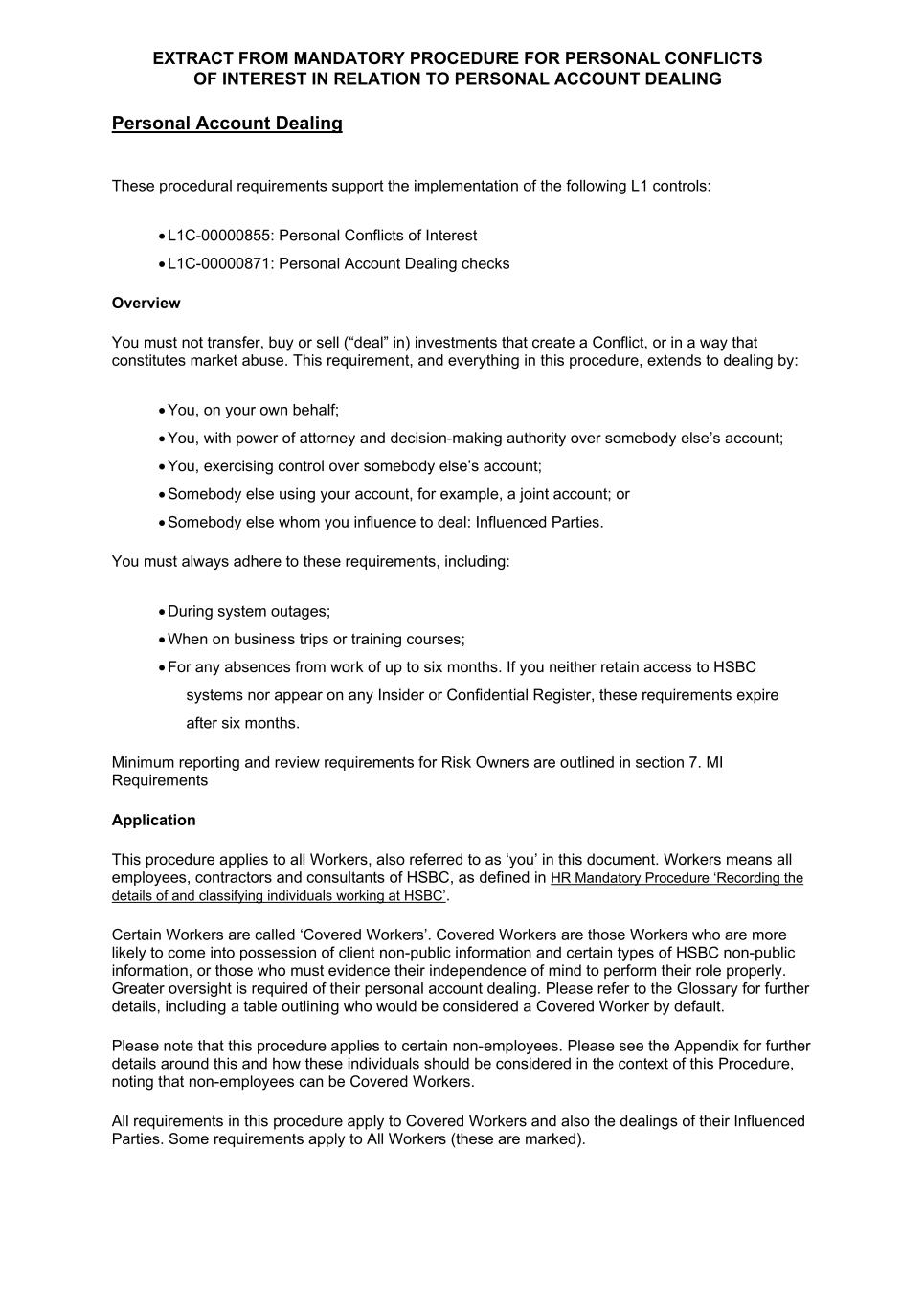
Personal Account Dealing These procedural requirements support the implementation of the following L1 controls: • L1C-00000855: Personal Conflicts of Interest • L1C-00000871: Personal Account Dealing checks Overview You must not transfer, buy or sell (“deal” in) investments that create a Conflict, or in a way that constitutes market abuse. This requirement, and everything in this procedure, extends to dealing by: • You, on your own behalf; • You, with power of attorney and decision-making authority over somebody else’s account; • You, exercising control over somebody else’s account; • Somebody else using your account, for example, a joint account; or • Somebody else whom you influence to deal: Influenced Parties. You must always adhere to these requirements, including: • During system outages; • When on business trips or training courses; • For any absences from work of up to six months. If you neither retain access to HSBC systems nor appear on any Insider or Confidential Register, these requirements expire after six months. Minimum reporting and review requirements for Risk Owners are outlined in section 7. MI Requirements Application This procedure applies to all Workers, also referred to as ‘you’ in this document. Workers means all employees, contractors and consultants of HSBC, as defined in HR Mandatory Procedure ‘Recording the details of and classifying individuals working at HSBC’. Certain Workers are called ‘Covered Workers’. Covered Workers are those Workers who are more likely to come into possession of client non-public information and certain types of HSBC non-public information, or those who must evidence their independence of mind to perform their role properly. Greater oversight is required of their personal account dealing. Please refer to the Glossary for further details, including a table outlining who would be considered a Covered Worker by default. Please note that this procedure applies to certain non-employees. Please see the Appendix for further details around this and how these individuals should be considered in the context of this Procedure, noting that non-employees can be Covered Workers. All requirements in this procedure apply to Covered Workers and also the dealings of their Influenced Parties. Some requirements apply to All Workers (these are marked). EXTRACT FROM MANDATORY PROCEDURE FOR PERSONAL CONFLICTS OF INTEREST IN RELATION TO PERSONAL ACCOUNT DEALING
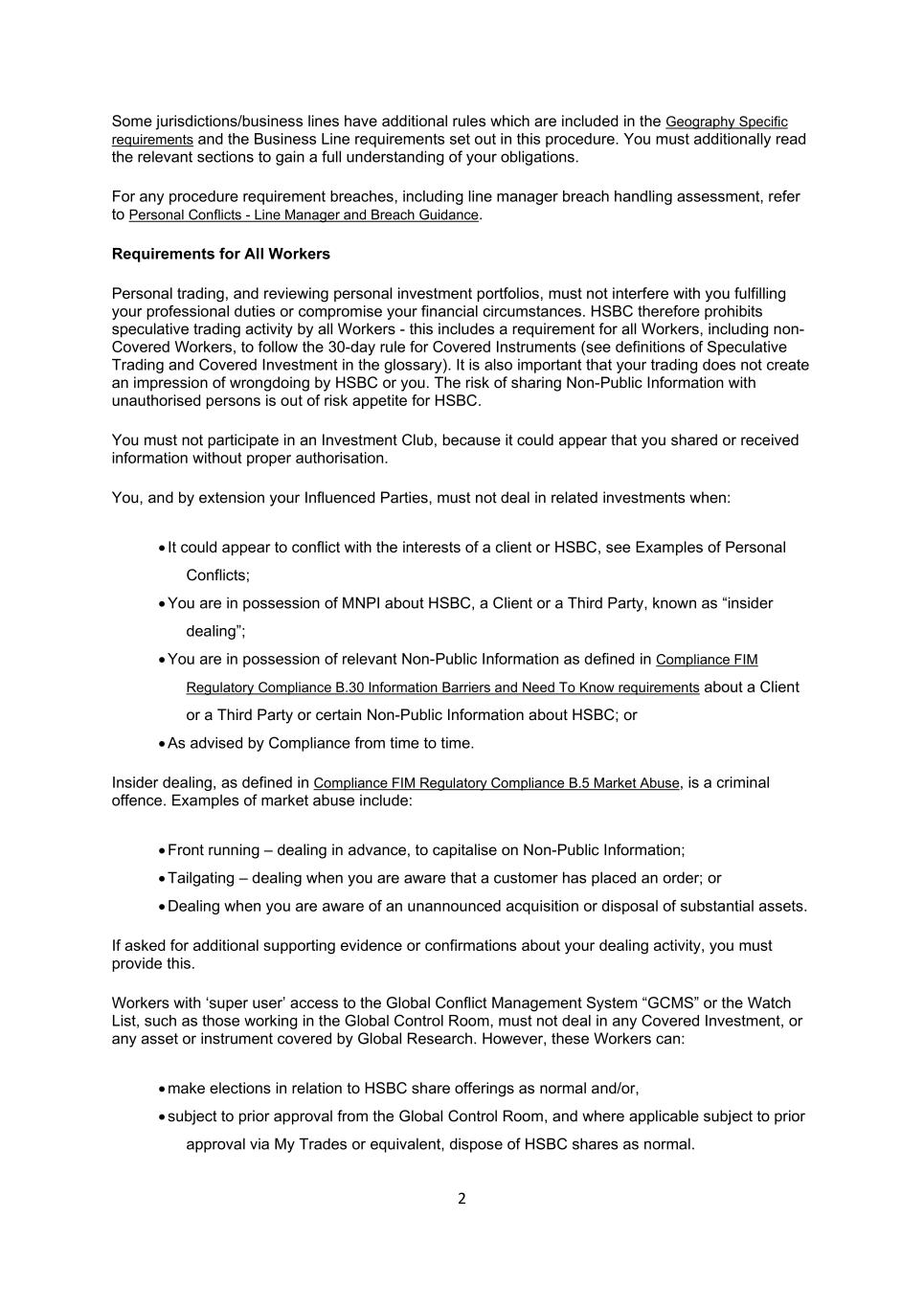
2 Some jurisdictions/business lines have additional rules which are included in the Geography Specific requirements and the Business Line requirements set out in this procedure. You must additionally read the relevant sections to gain a full understanding of your obligations. For any procedure requirement breaches, including line manager breach handling assessment, refer to Personal Conflicts - Line Manager and Breach Guidance. Requirements for All Workers Personal trading, and reviewing personal investment portfolios, must not interfere with you fulfilling your professional duties or compromise your financial circumstances. HSBC therefore prohibits speculative trading activity by all Workers - this includes a requirement for all Workers, including non- Covered Workers, to follow the 30-day rule for Covered Instruments (see definitions of Speculative Trading and Covered Investment in the glossary). It is also important that your trading does not create an impression of wrongdoing by HSBC or you. The risk of sharing Non-Public Information with unauthorised persons is out of risk appetite for HSBC. You must not participate in an Investment Club, because it could appear that you shared or received information without proper authorisation. You, and by extension your Influenced Parties, must not deal in related investments when: • It could appear to conflict with the interests of a client or HSBC, see Examples of Personal Conflicts; • You are in possession of MNPI about HSBC, a Client or a Third Party, known as “insider dealing”; • You are in possession of relevant Non-Public Information as defined in Compliance FIM Regulatory Compliance B.30 Information Barriers and Need To Know requirements about a Client or a Third Party or certain Non-Public Information about HSBC; or • As advised by Compliance from time to time. Insider dealing, as defined in Compliance FIM Regulatory Compliance B.5 Market Abuse, is a criminal offence. Examples of market abuse include: • Front running – dealing in advance, to capitalise on Non-Public Information; • Tailgating – dealing when you are aware that a customer has placed an order; or • Dealing when you are aware of an unannounced acquisition or disposal of substantial assets. If asked for additional supporting evidence or confirmations about your dealing activity, you must provide this. Workers with ‘super user’ access to the Global Conflict Management System “GCMS” or the Watch List, such as those working in the Global Control Room, must not deal in any Covered Investment, or any asset or instrument covered by Global Research. However, these Workers can: • make elections in relation to HSBC share offerings as normal and/or, • subject to prior approval from the Global Control Room, and where applicable subject to prior approval via My Trades or equivalent, dispose of HSBC shares as normal.
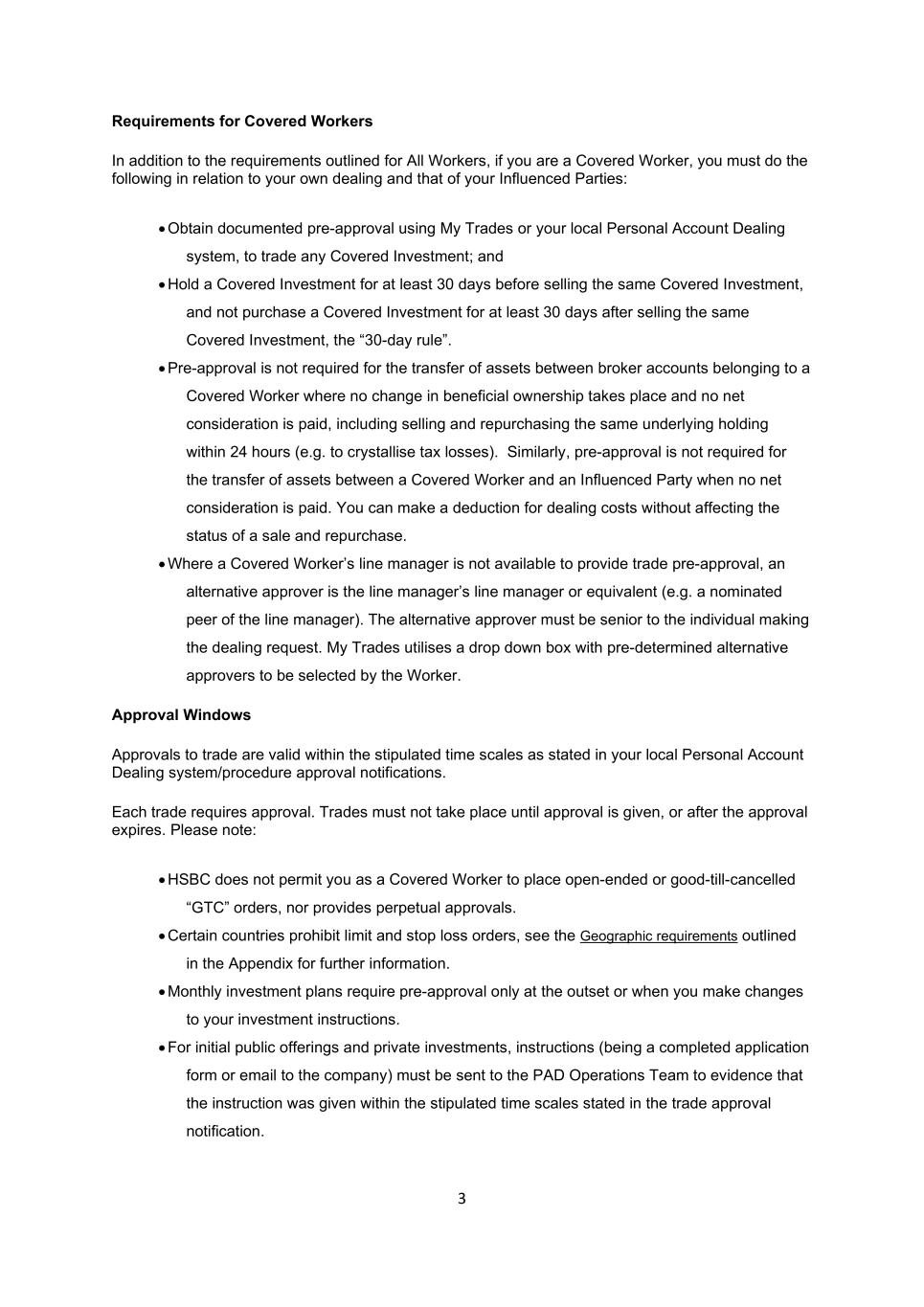
3 Requirements for Covered Workers In addition to the requirements outlined for All Workers, if you are a Covered Worker, you must do the following in relation to your own dealing and that of your Influenced Parties: • Obtain documented pre-approval using My Trades or your local Personal Account Dealing system, to trade any Covered Investment; and • Hold a Covered Investment for at least 30 days before selling the same Covered Investment, and not purchase a Covered Investment for at least 30 days after selling the same Covered Investment, the “30-day rule”. • Pre-approval is not required for the transfer of assets between broker accounts belonging to a Covered Worker where no change in beneficial ownership takes place and no net consideration is paid, including selling and repurchasing the same underlying holding within 24 hours (e.g. to crystallise tax losses). Similarly, pre-approval is not required for the transfer of assets between a Covered Worker and an Influenced Party when no net consideration is paid. You can make a deduction for dealing costs without affecting the status of a sale and repurchase. • Where a Covered Worker’s line manager is not available to provide trade pre-approval, an alternative approver is the line manager’s line manager or equivalent (e.g. a nominated peer of the line manager). The alternative approver must be senior to the individual making the dealing request. My Trades utilises a drop down box with pre-determined alternative approvers to be selected by the Worker. Approval Windows Approvals to trade are valid within the stipulated time scales as stated in your local Personal Account Dealing system/procedure approval notifications. Each trade requires approval. Trades must not take place until approval is given, or after the approval expires. Please note: • HSBC does not permit you as a Covered Worker to place open-ended or good-till-cancelled “GTC” orders, nor provides perpetual approvals. • Certain countries prohibit limit and stop loss orders, see the Geographic requirements outlined in the Appendix for further information. • Monthly investment plans require pre-approval only at the outset or when you make changes to your investment instructions. • For initial public offerings and private investments, instructions (being a completed application form or email to the company) must be sent to the PAD Operations Team to evidence that the instruction was given within the stipulated time scales stated in the trade approval notification.
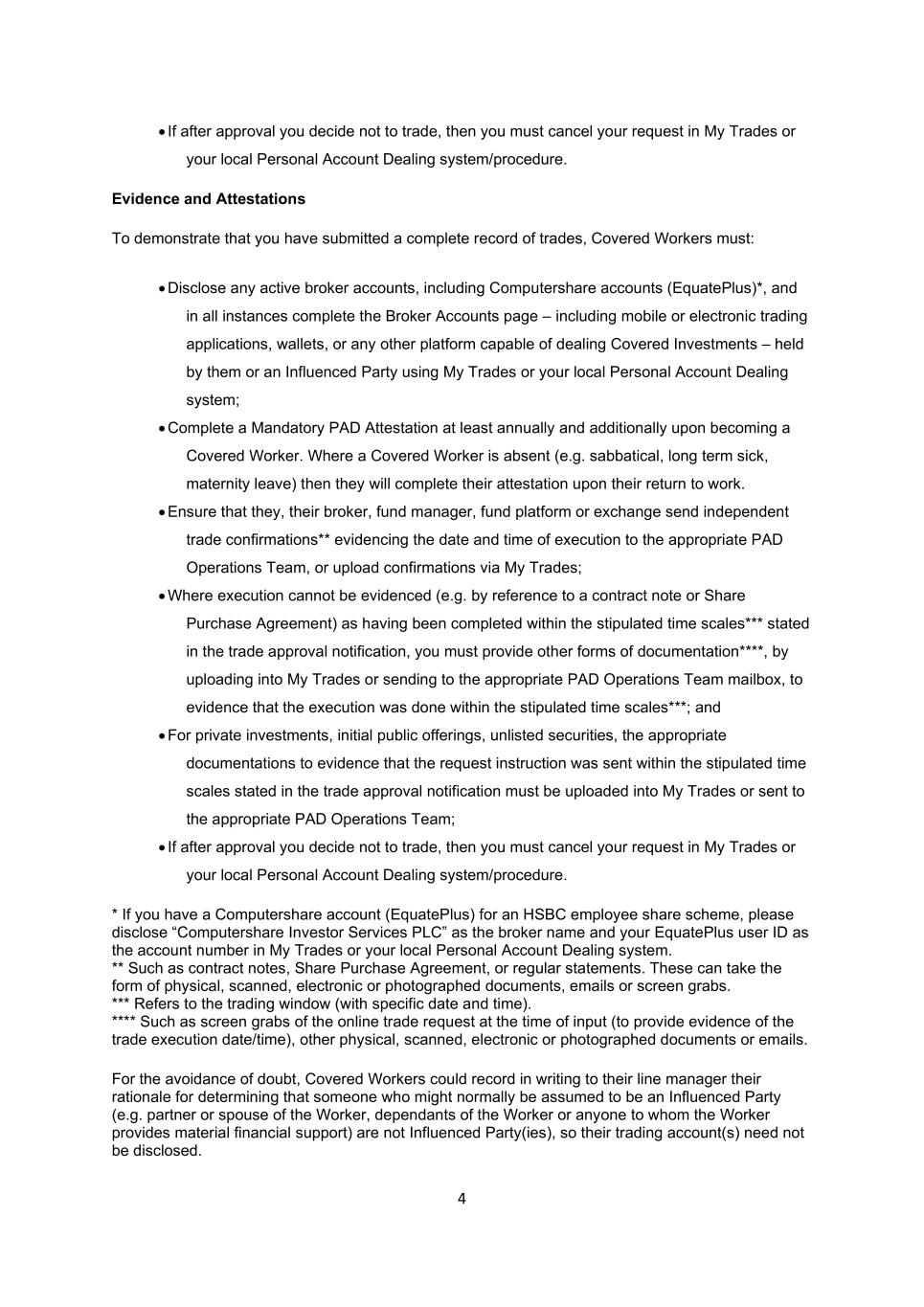
4 • If after approval you decide not to trade, then you must cancel your request in My Trades or your local Personal Account Dealing system/procedure. Evidence and Attestations To demonstrate that you have submitted a complete record of trades, Covered Workers must: • Disclose any active broker accounts, including Computershare accounts (EquatePlus)*, and in all instances complete the Broker Accounts page – including mobile or electronic trading applications, wallets, or any other platform capable of dealing Covered Investments – held by them or an Influenced Party using My Trades or your local Personal Account Dealing system; • Complete a Mandatory PAD Attestation at least annually and additionally upon becoming a Covered Worker. Where a Covered Worker is absent (e.g. sabbatical, long term sick, maternity leave) then they will complete their attestation upon their return to work. • Ensure that they, their broker, fund manager, fund platform or exchange send independent trade confirmations** evidencing the date and time of execution to the appropriate PAD Operations Team, or upload confirmations via My Trades; • Where execution cannot be evidenced (e.g. by reference to a contract note or Share Purchase Agreement) as having been completed within the stipulated time scales*** stated in the trade approval notification, you must provide other forms of documentation****, by uploading into My Trades or sending to the appropriate PAD Operations Team mailbox, to evidence that the execution was done within the stipulated time scales***; and • For private investments, initial public offerings, unlisted securities, the appropriate documentations to evidence that the request instruction was sent within the stipulated time scales stated in the trade approval notification must be uploaded into My Trades or sent to the appropriate PAD Operations Team; • If after approval you decide not to trade, then you must cancel your request in My Trades or your local Personal Account Dealing system/procedure. * If you have a Computershare account (EquatePlus) for an HSBC employee share scheme, please disclose “Computershare Investor Services PLC” as the broker name and your EquatePlus user ID as the account number in My Trades or your local Personal Account Dealing system. ** Such as contract notes, Share Purchase Agreement, or regular statements. These can take the form of physical, scanned, electronic or photographed documents, emails or screen grabs. *** Refers to the trading window (with specific date and time). **** Such as screen grabs of the online trade request at the time of input (to provide evidence of the trade execution date/time), other physical, scanned, electronic or photographed documents or emails. For the avoidance of doubt, Covered Workers could record in writing to their line manager their rationale for determining that someone who might normally be assumed to be an Influenced Party (e.g. partner or spouse of the Worker, dependants of the Worker or anyone to whom the Worker provides material financial support) are not Influenced Party(ies), so their trading account(s) need not be disclosed.
5 If your trading account only provides regular statements and not individual trade confirmations, you need to submit those statements no later than 30 calendar days after the statement period finishes. You must send any other trade confirmation – such as a contract note – within 14 calendar days of the trade execution. You need not disclose discretionary accounts managed entirely at the discretion of an independent fund manager unless required to do so by any Geography Specific or section Business Line Specific requirements that apply to you. Covered Workers dealing in equities in unlisted companies, via My Trades or your local Personal Account Dealing system, must disclose to the PAD Operations Team the percentage of each company’s issued share capital they will cumulatively own as a consequence of a proposed dealing. Such disclosure is not required for Covered Workers using My Trades. Significant Shareholdings create an Outside Activity. Absence or System Outages If you are not able to submit your dealing request via My Trades or your local Personal Account Dealing system because you are travelling or on leave you must submit pre-approval requests via email instead. This requirement continues for six months after you stopped being able to access HSBC systems, or longer if you are still on an Insider or Confidential Register. You must have secured the necessary pre-approvals from your line manager and the PAD Operations Team. In the case of Asset Management and Global Research you must also obtain relevant local Compliance approval before dealing. You must include relevant information in your approval request email: 1. The name, and price or quantity* of the Covered Investment to be transacted; 2. The code of the security and type of instrument; 3. Whether “buy” or “sell”; 4. Confirmation of compliance with all relevant requirements, including the 30-day rule and that you do not have access to Material Non-Public Information or Non-Public Information about the subject entity; and 5. The relevant broker name and account number. HSBC is not responsible for any losses incurred because you cannot trade due to system failure, we decline your trade request, or there is a delay in processing your request. *Please do not disclose the price or quantity to your line manager, only to the PAD team (they use this information for reconciliation purposes only). Persons Discharging Managerial Responsibilities “PDMRs” In this context, PDMR refers to directors of HSBC Holdings plc and certain senior executives of HSBC – as notified by Corporate Governance and Secretariat – who have regular access to MNPI and the power to take managerial decisions affecting the future developments and business prospects of HSBC. Subsidiaries and affiliates of HSBC that issue securities within the European Economic Area have their own list of PDMRs, which are maintained by the relevant Corporate Governance and Secretariat team.
6 PDMRs must seek additional pre-approval from their relevant company secretary to deal in certain HSBC Group securities in accordance with the share dealing code adopted by their particular HSBC Group company; for themselves, and their closely associated person (as defined in the share dealing code). For HSBC Holdings plc, PDMRs must seek this pre-approval by contacting pdmr.transactions@hsbc.com. HSBC Group Securities and Share Schemes Information about who can participate in HSBC employee share plans is available on HR Direct. If you hold MNPI in relation to HSBC, you must not undertake any of the Share Plan Activities listed below. Covered Workers require pre-clearance to undertake certain activities – see the table below. You must not use any personal hedging strategies, or contracts of insurance, to alter the risk alignment between the Bank and your deferred, unvested or retained pay awards of cash or shares. Participating in an Advance Election Facility “AEF” If you participate in any of HSBC’s Group share plans – such as ShareMatch, UK Sharesave, Deferred Share Awards, or MRT Share Awards, Computershare (EquatePlus) can offer you the chance to make an advance election before your shares are released or vest. Unless you have received an email specifically restricting your trading – for example due to a closed period –– or you otherwise hold MNPI in relation to HSBC, you are able to make your election at any time. There is no need for you to obtain pre-approval via My Trades or your local Personal Account Dealing system when making an advance election, since Compliance and HR complete this process on your behalf. If somebody adds you to an Insider Register or Confidential Register after you have made an election, the PAD team will inform you and your election might not be honoured. If you are a Covered Worker and wish to exercise or sell shares from a share plan at any time other than via an AEF, you must obtain pre-approval. Please refer to the below table for details of when pre-approval is required by Covered Workers in relation to all HSBC Group share plans. Share Plan Activities including Closed Periods Compliance notifies selected employees – and others with potential MNPI about HSBC – of “close” or “closed” periods or “trading windows”, and associated dealing restrictions. If you receive an email advising you that you must not trade HSBC shares or securities for a defined period, or otherwise hold MNPI in relation to HSBC, during that period you must not: • Join an HSBC employee share plan, such as UK Share Incentive Plan [UK SIP] or ShareMatch; • Stop, change or restart contributions to an HSBC employee share plan; • Make an advance election for an HSBC employee share plan; • Exercise an option under Sharesave; • Make or change an election to receive dividends in cash or reinvested into HSBC shares; or • Deal in HSBC shares, debt or derivatives. The table below provides details of when Covered Workers need pre-approval for HSBC Group Share Schemes. Covered Workers must declare their Computershare (EquatePlus)* broker account before placing a trade, including where they are exercising the option for the shares to vest.
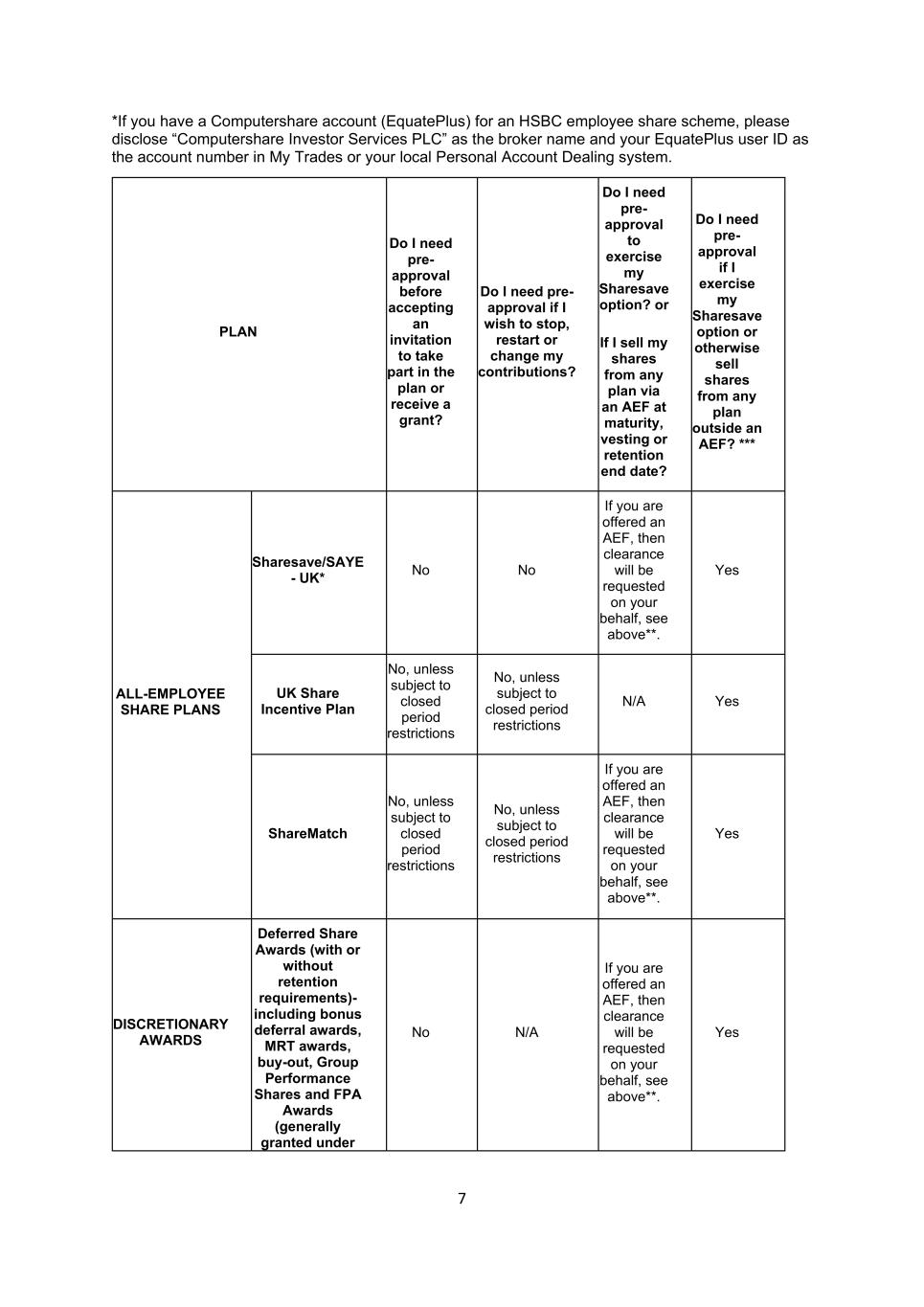
7 *If you have a Computershare account (EquatePlus) for an HSBC employee share scheme, please disclose “Computershare Investor Services PLC” as the broker name and your EquatePlus user ID as the account number in My Trades or your local Personal Account Dealing system. PLAN Do I need pre- approval before accepting an invitation to take part in the plan or receive a grant? Do I need pre- approval if I wish to stop, restart or change my contributions? Do I need pre- approval to exercise my Sharesave option? or If I sell my shares from any plan via an AEF at maturity, vesting or retention end date? Do I need pre- approval if I exercise my Sharesave option or otherwise sell shares from any plan outside an AEF? *** ALL-EMPLOYEE SHARE PLANS Sharesave/SAYE - UK* No No If you are offered an AEF, then clearance will be requested on your behalf, see above**. Yes UK Share Incentive Plan No, unless subject to closed period restrictions No, unless subject to closed period restrictions N/A Yes ShareMatch No, unless subject to closed period restrictions No, unless subject to closed period restrictions If you are offered an AEF, then clearance will be requested on your behalf, see above**. Yes DISCRETIONARY AWARDS Deferred Share Awards (with or without retention requirements)- including bonus deferral awards, MRT awards, buy-out, Group Performance Shares and FPA Awards (generally granted under No N/A If you are offered an AEF, then clearance will be requested on your behalf, see above**. Yes

8 the HSBC Share Plan 2011 rules) * No pre-approval is required if you withdraw from Sharesave and request the refund of your cash savings. ** However, you must not make an advance election if you are subject to closed period restrictions or otherwise hold MNPI. *** Pre-approval is required before exercising your option e.g. ‘exercise and keep’, ‘exercise and sell’, and also to sell any resulting shares from the ‘exercise and keep’.
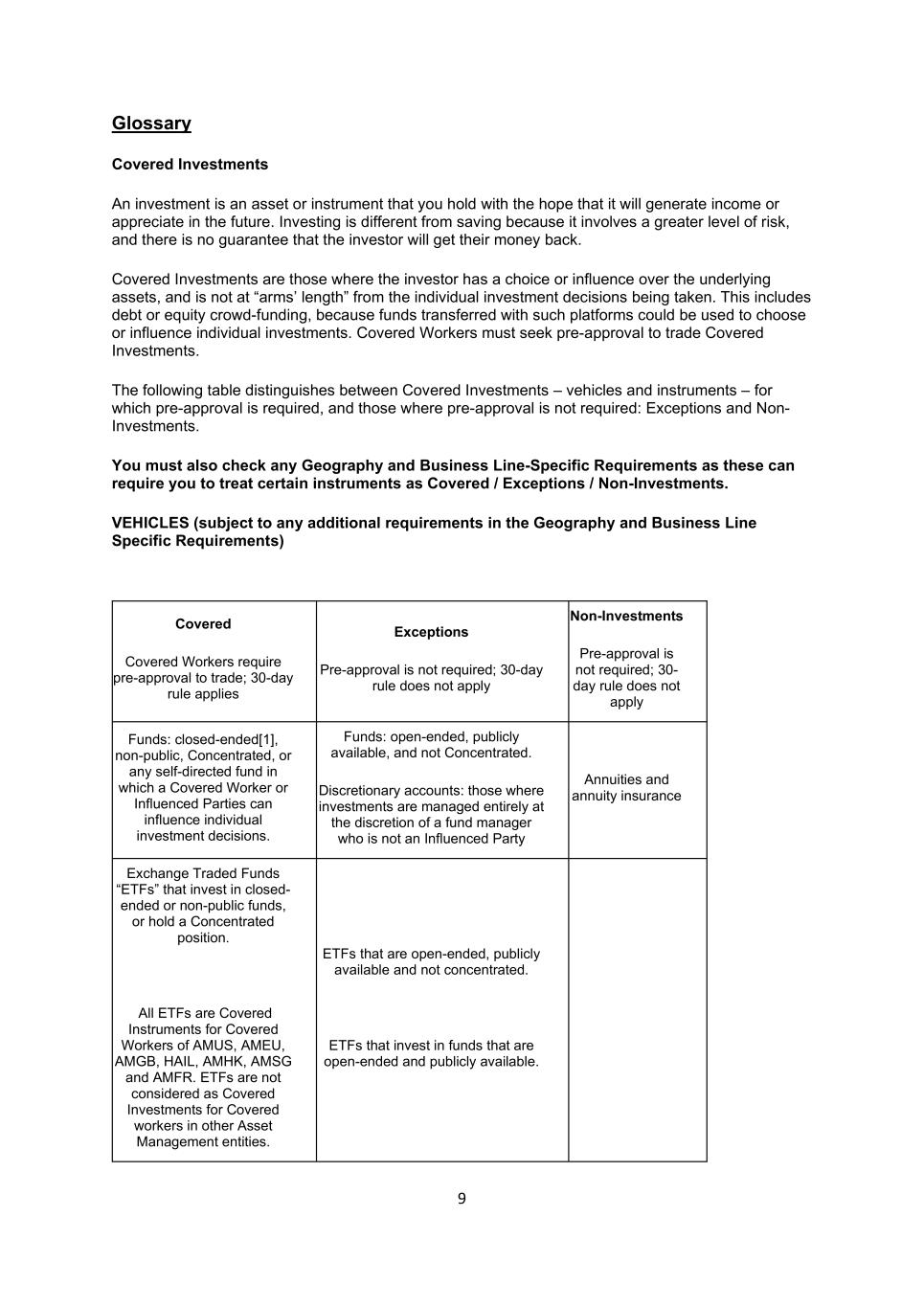
9 Glossary Covered Investments An investment is an asset or instrument that you hold with the hope that it will generate income or appreciate in the future. Investing is different from saving because it involves a greater level of risk, and there is no guarantee that the investor will get their money back. Covered Investments are those where the investor has a choice or influence over the underlying assets, and is not at “arms’ length” from the individual investment decisions being taken. This includes debt or equity crowd-funding, because funds transferred with such platforms could be used to choose or influence individual investments. Covered Workers must seek pre-approval to trade Covered Investments. The following table distinguishes between Covered Investments – vehicles and instruments – for which pre-approval is required, and those where pre-approval is not required: Exceptions and Non- Investments. You must also check any Geography and Business Line-Specific Requirements as these can require you to treat certain instruments as Covered / Exceptions / Non-Investments. VEHICLES (subject to any additional requirements in the Geography and Business Line Specific Requirements) Covered Covered Workers require pre-approval to trade; 30-day rule applies Exceptions Pre-approval is not required; 30-day rule does not apply Non-Investments Pre-approval is not required; 30- day rule does not apply Funds: closed-ended[1], non-public, Concentrated, or any self-directed fund in which a Covered Worker or Influenced Parties can influence individual investment decisions. Funds: open-ended, publicly available, and not Concentrated. Discretionary accounts: those where investments are managed entirely at the discretion of a fund manager who is not an Influenced Party Annuities and annuity insurance Exchange Traded Funds “ETFs” that invest in closed- ended or non-public funds, or hold a Concentrated position. All ETFs are Covered Instruments for Covered Workers of AMUS, AMEU, AMGB, HAIL, AMHK, AMSG and AMFR. ETFs are not considered as Covered Investments for Covered workers in other Asset Management entities. ETFs that are open-ended, publicly available and not concentrated. ETFs that invest in funds that are open-ended and publicly available.
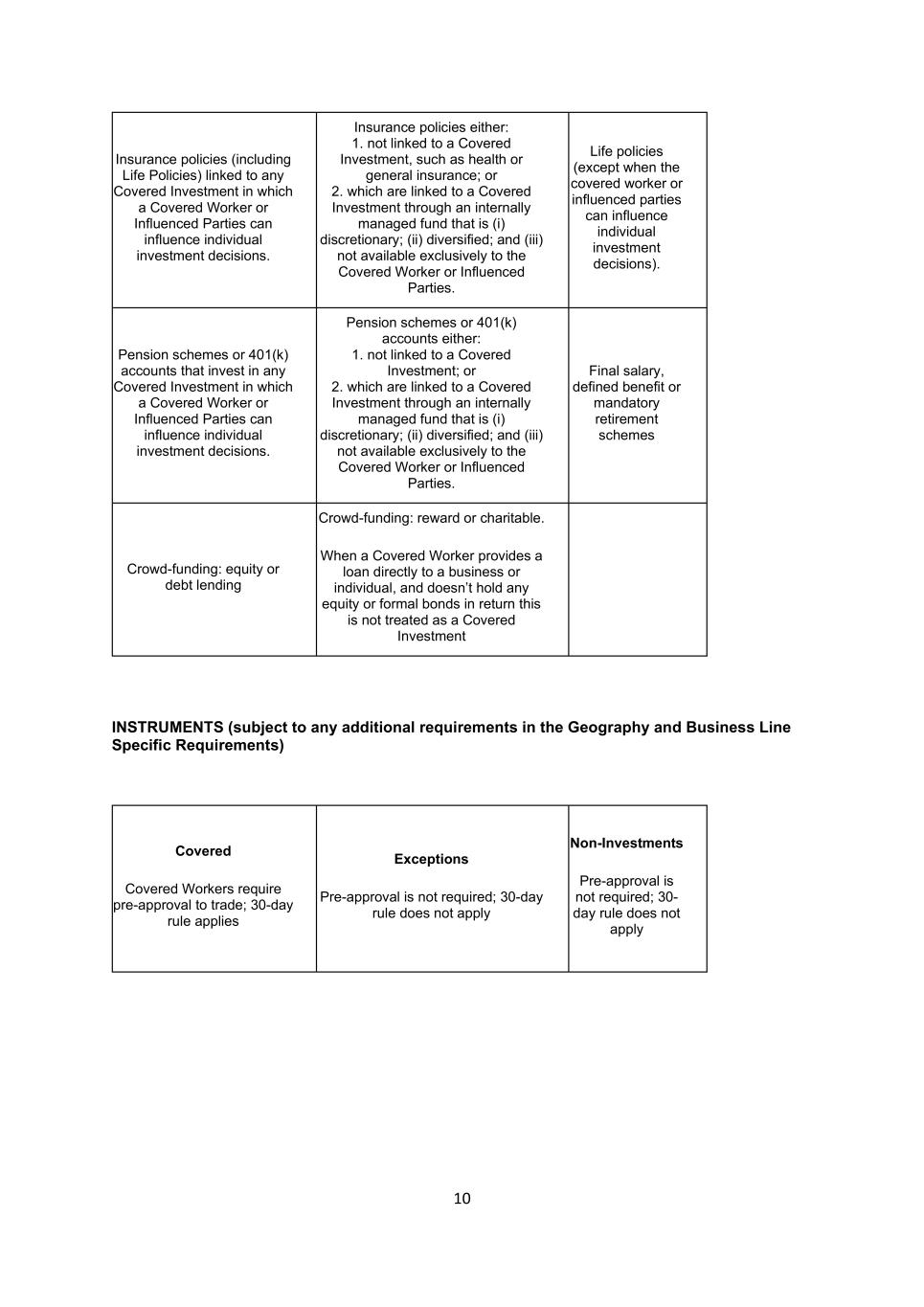
10 Insurance policies (including Life Policies) linked to any Covered Investment in which a Covered Worker or Influenced Parties can influence individual investment decisions. Insurance policies either: 1. not linked to a Covered Investment, such as health or general insurance; or 2. which are linked to a Covered Investment through an internally managed fund that is (i) discretionary; (ii) diversified; and (iii) not available exclusively to the Covered Worker or Influenced Parties. Life policies (except when the covered worker or influenced parties can influence individual investment decisions). Pension schemes or 401(k) accounts that invest in any Covered Investment in which a Covered Worker or Influenced Parties can influence individual investment decisions. Pension schemes or 401(k) accounts either: 1. not linked to a Covered Investment; or 2. which are linked to a Covered Investment through an internally managed fund that is (i) discretionary; (ii) diversified; and (iii) not available exclusively to the Covered Worker or Influenced Parties. Final salary, defined benefit or mandatory retirement schemes Crowd-funding: equity or debt lending Crowd-funding: reward or charitable. When a Covered Worker provides a loan directly to a business or individual, and doesn’t hold any equity or formal bonds in return this is not treated as a Covered Investment INSTRUMENTS (subject to any additional requirements in the Geography and Business Line Specific Requirements) Covered Covered Workers require pre-approval to trade; 30-day rule applies Exceptions Pre-approval is not required; 30-day rule does not apply Non-Investments Pre-approval is not required; 30- day rule does not apply
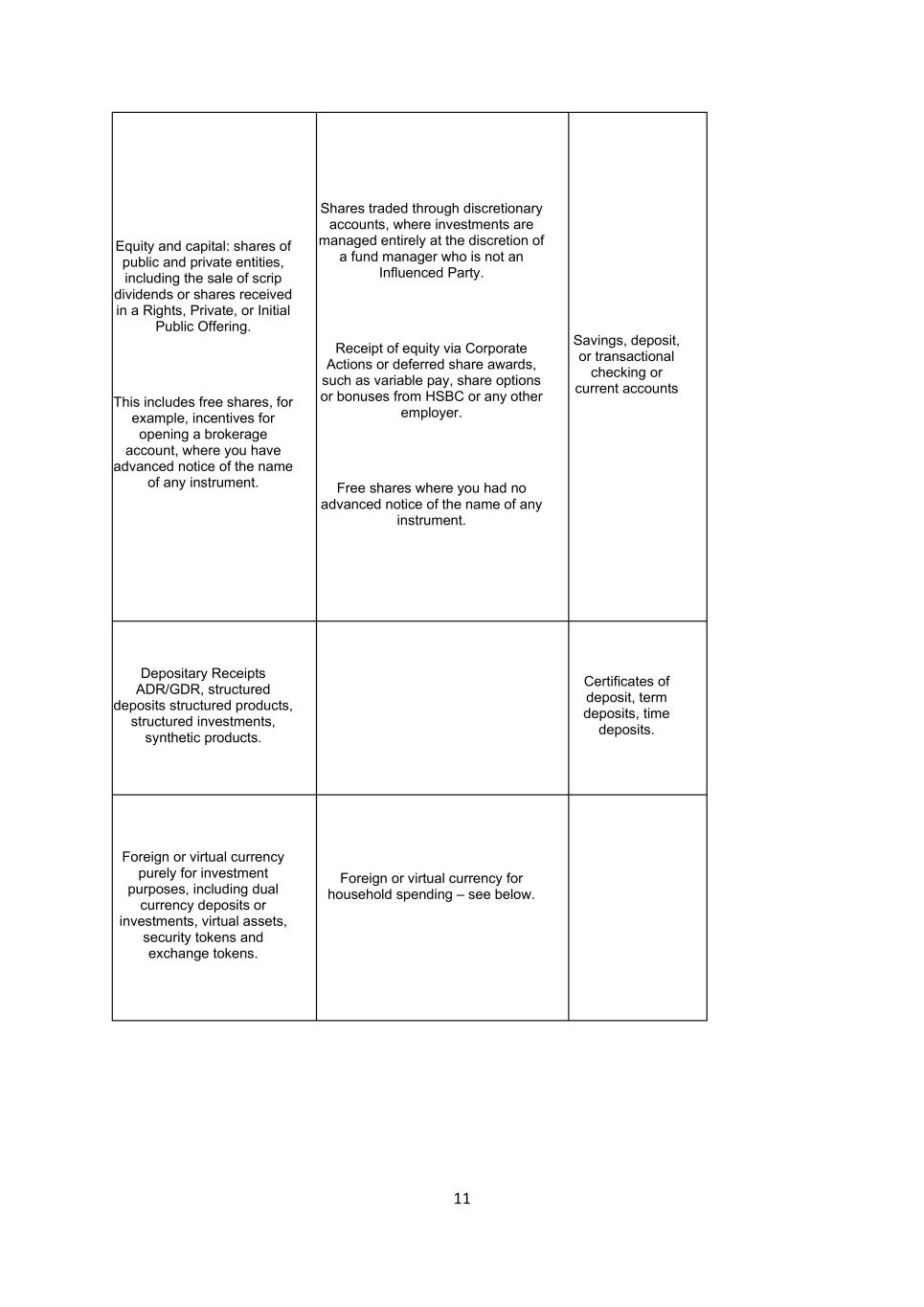
11 Equity and capital: shares of public and private entities, including the sale of scrip dividends or shares received in a Rights, Private, or Initial Public Offering. This includes free shares, for example, incentives for opening a brokerage account, where you have advanced notice of the name of any instrument. Shares traded through discretionary accounts, where investments are managed entirely at the discretion of a fund manager who is not an Influenced Party. Receipt of equity via Corporate Actions or deferred share awards, such as variable pay, share options or bonuses from HSBC or any other employer. Free shares where you had no advanced notice of the name of any instrument. Savings, deposit, or transactional checking or current accounts Depositary Receipts ADR/GDR, structured deposits structured products, structured investments, synthetic products. Certificates of deposit, term deposits, time deposits. Foreign or virtual currency purely for investment purposes, including dual currency deposits or investments, virtual assets, security tokens and exchange tokens. Foreign or virtual currency for household spending – see below.
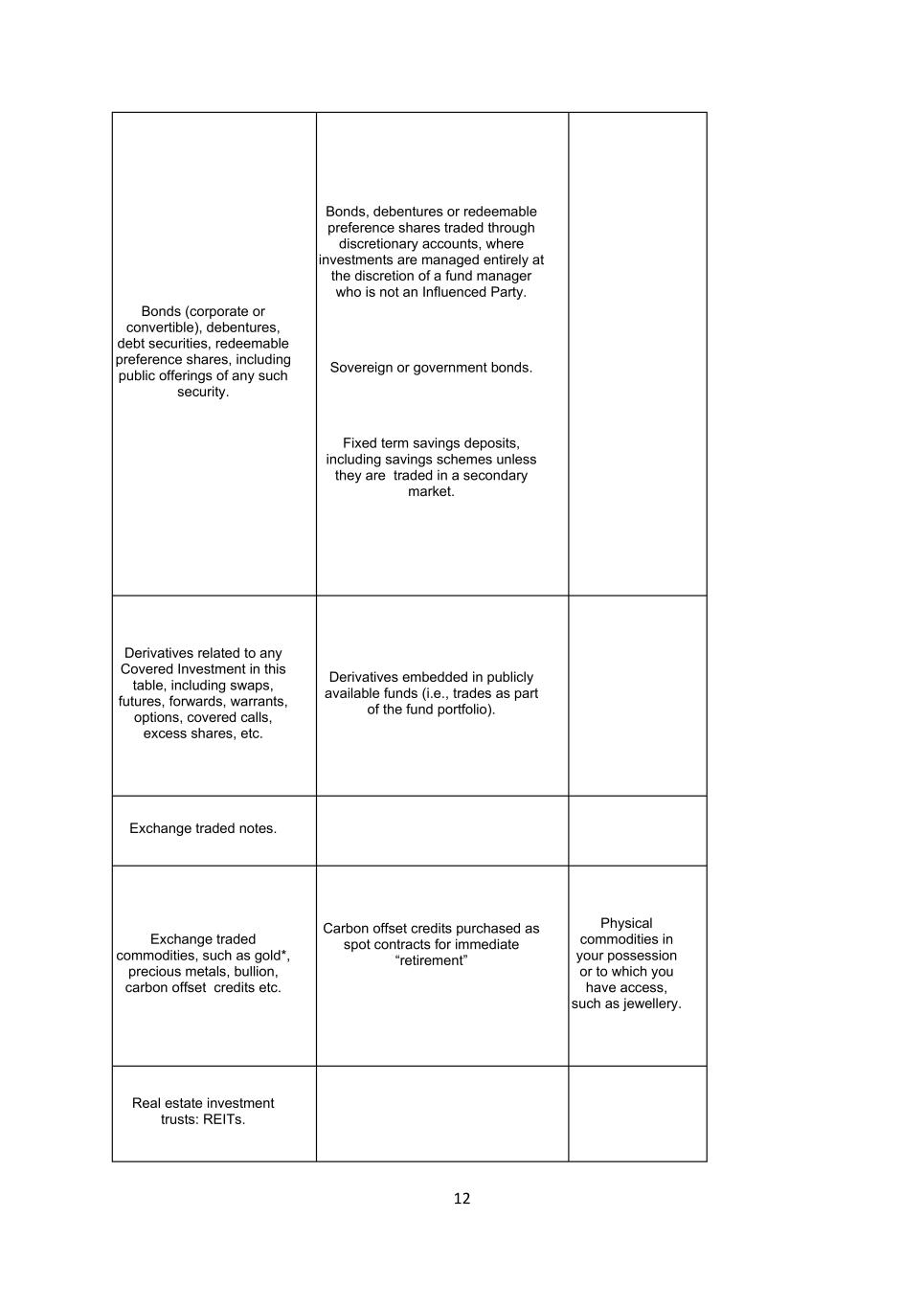
12 Bonds (corporate or convertible), debentures, debt securities, redeemable preference shares, including public offerings of any such security. Bonds, debentures or redeemable preference shares traded through discretionary accounts, where investments are managed entirely at the discretion of a fund manager who is not an Influenced Party. Sovereign or government bonds. Fixed term savings deposits, including savings schemes unless they are traded in a secondary market. Derivatives related to any Covered Investment in this table, including swaps, futures, forwards, warrants, options, covered calls, excess shares, etc. Derivatives embedded in publicly available funds (i.e., trades as part of the fund portfolio). Exchange traded notes. Exchange traded commodities, such as gold*, precious metals, bullion, carbon offset credits etc. Carbon offset credits purchased as spot contracts for immediate “retirement” Physical commodities in your possession or to which you have access, such as jewellery. Real estate investment trusts: REITs.
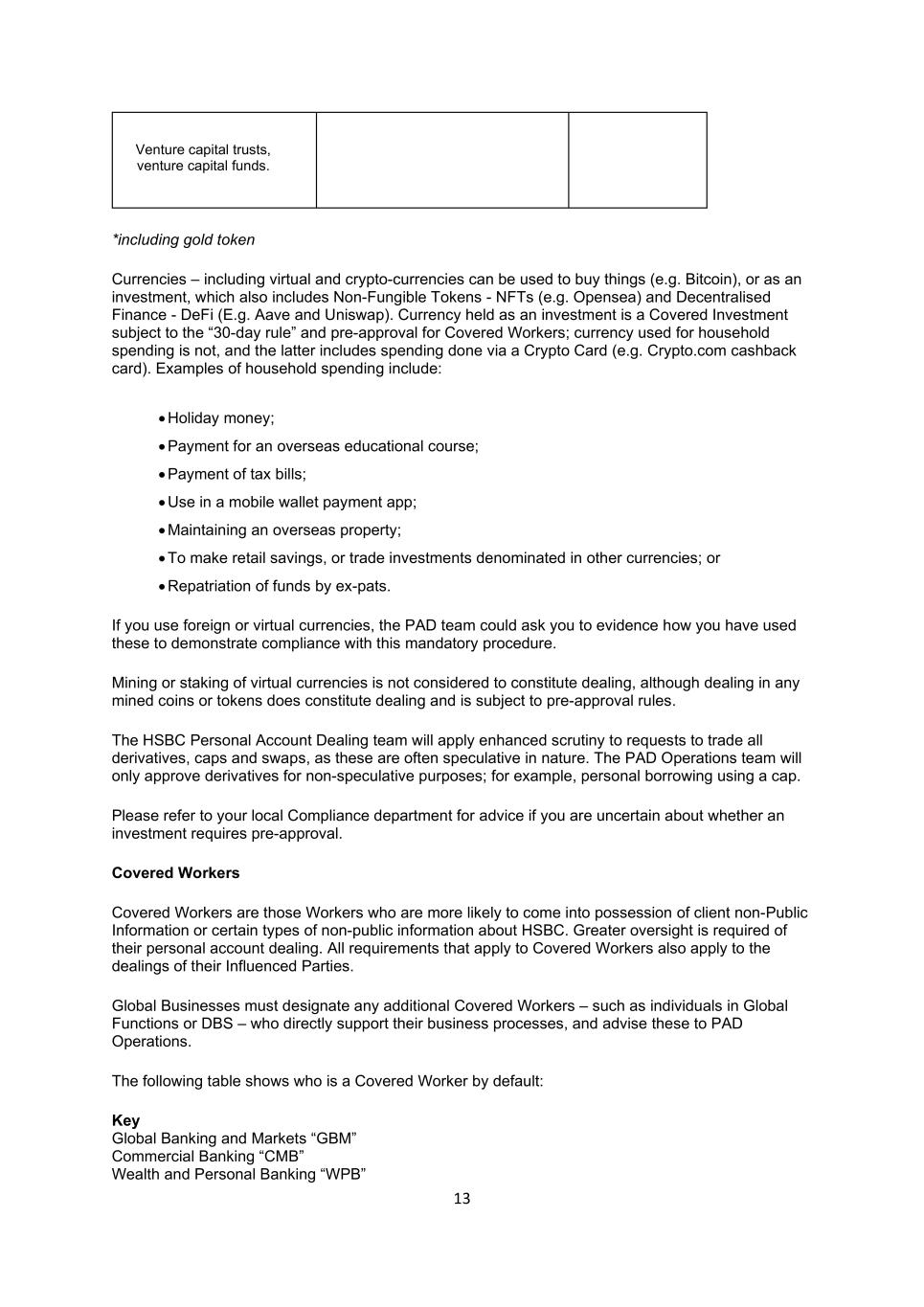
13 Venture capital trusts, venture capital funds. *including gold token Currencies – including virtual and crypto-currencies can be used to buy things (e.g. Bitcoin), or as an investment, which also includes Non-Fungible Tokens - NFTs (e.g. Opensea) and Decentralised Finance - DeFi (E.g. Aave and Uniswap). Currency held as an investment is a Covered Investment subject to the “30-day rule” and pre-approval for Covered Workers; currency used for household spending is not, and the latter includes spending done via a Crypto Card (e.g. Crypto.com cashback card). Examples of household spending include: • Holiday money; • Payment for an overseas educational course; • Payment of tax bills; • Use in a mobile wallet payment app; • Maintaining an overseas property; • To make retail savings, or trade investments denominated in other currencies; or • Repatriation of funds by ex-pats. If you use foreign or virtual currencies, the PAD team could ask you to evidence how you have used these to demonstrate compliance with this mandatory procedure. Mining or staking of virtual currencies is not considered to constitute dealing, although dealing in any mined coins or tokens does constitute dealing and is subject to pre-approval rules. The HSBC Personal Account Dealing team will apply enhanced scrutiny to requests to trade all derivatives, caps and swaps, as these are often speculative in nature. The PAD Operations team will only approve derivatives for non-speculative purposes; for example, personal borrowing using a cap. Please refer to your local Compliance department for advice if you are uncertain about whether an investment requires pre-approval. Covered Workers Covered Workers are those Workers who are more likely to come into possession of client non-Public Information or certain types of non-public information about HSBC. Greater oversight is required of their personal account dealing. All requirements that apply to Covered Workers also apply to the dealings of their Influenced Parties. Global Businesses must designate any additional Covered Workers – such as individuals in Global Functions or DBS – who directly support their business processes, and advise these to PAD Operations. The following table shows who is a Covered Worker by default: Key Global Banking and Markets “GBM” Commercial Banking “CMB” Wealth and Personal Banking “WPB”
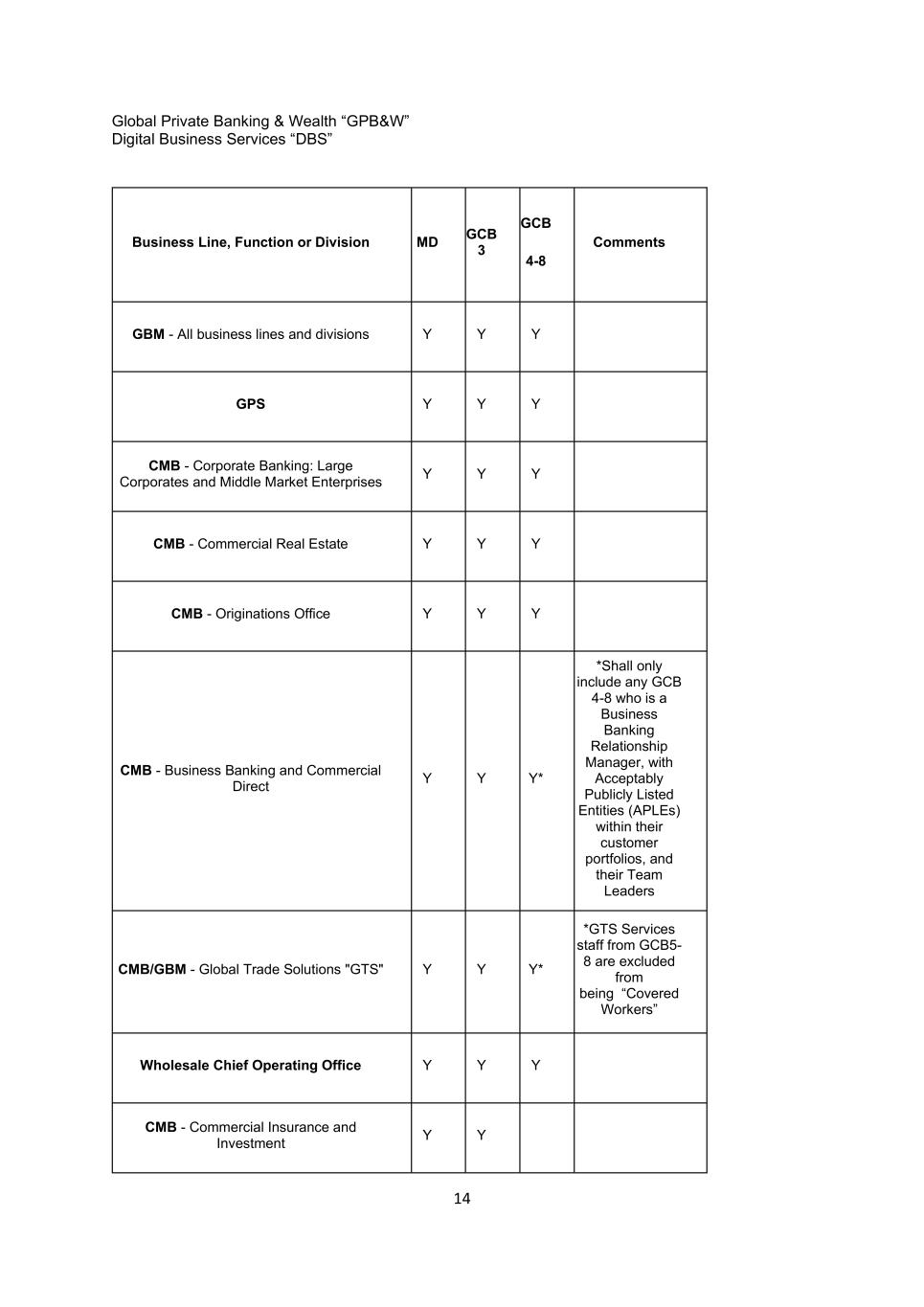
14 Global Private Banking & Wealth “GPB&W” Digital Business Services “DBS” Business Line, Function or Division MD GCB 3 GCB 4-8 Comments GBM - All business lines and divisions Y Y Y GPS Y Y Y CMB - Corporate Banking: Large Corporates and Middle Market Enterprises Y Y Y CMB - Commercial Real Estate Y Y Y CMB - Originations Office Y Y Y CMB - Business Banking and Commercial Direct Y Y Y* *Shall only include any GCB 4-8 who is a Business Banking Relationship Manager, with Acceptably Publicly Listed Entities (APLEs) within their customer portfolios, and their Team Leaders CMB/GBM - Global Trade Solutions "GTS" Y Y Y* *GTS Services staff from GCB5- 8 are excluded from being “Covered Workers” Wholesale Chief Operating Office Y Y Y CMB - Commercial Insurance and Investment Y Y
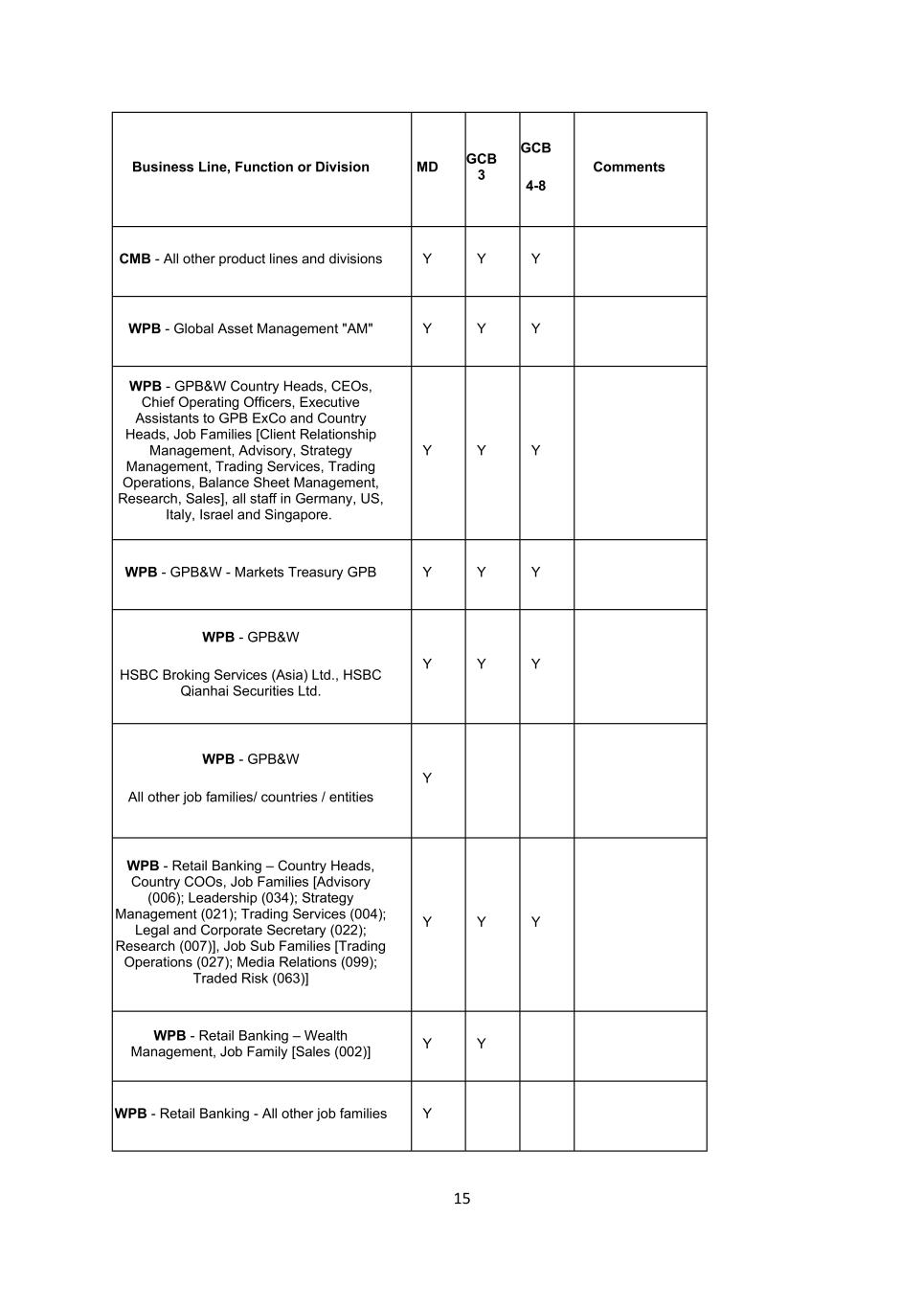
15 Business Line, Function or Division MD GCB 3 GCB 4-8 Comments CMB - All other product lines and divisions Y Y Y WPB - Global Asset Management "AM" Y Y Y WPB - GPB&W Country Heads, CEOs, Chief Operating Officers, Executive Assistants to GPB ExCo and Country Heads, Job Families [Client Relationship Management, Advisory, Strategy Management, Trading Services, Trading Operations, Balance Sheet Management, Research, Sales], all staff in Germany, US, Italy, Israel and Singapore. Y Y Y WPB - GPB&W - Markets Treasury GPB Y Y Y WPB - GPB&W HSBC Broking Services (Asia) Ltd., HSBC Qianhai Securities Ltd. Y Y Y WPB - GPB&W All other job families/ countries / entities Y WPB - Retail Banking – Country Heads, Country COOs, Job Families [Advisory (006); Leadership (034); Strategy Management (021); Trading Services (004); Legal and Corporate Secretary (022); Research (007)], Job Sub Families [Trading Operations (027); Media Relations (099); Traded Risk (063)] Y Y Y WPB - Retail Banking – Wealth Management, Job Family [Sales (002)] Y Y WPB - Retail Banking - All other job families Y
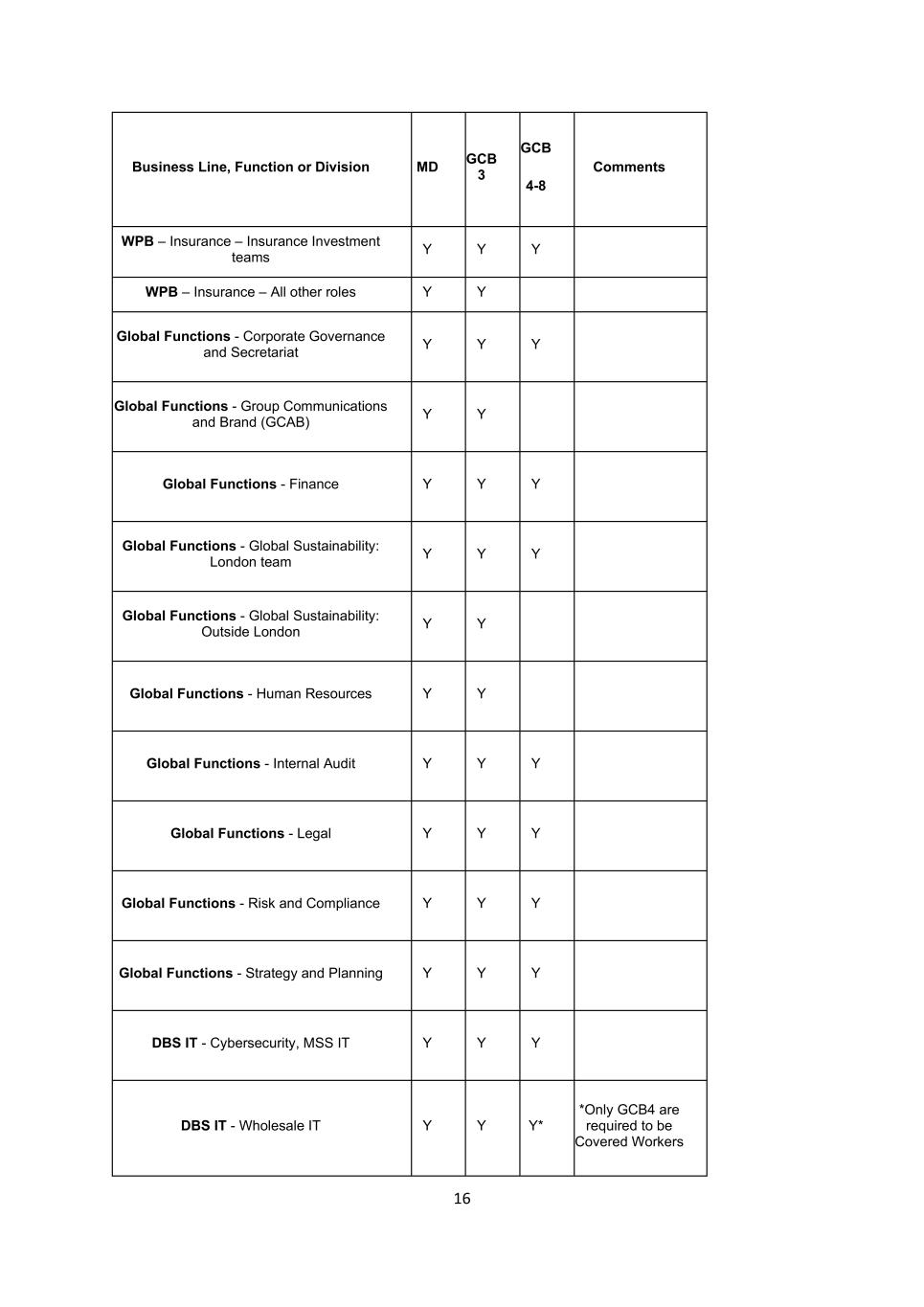
16 Business Line, Function or Division MD GCB 3 GCB 4-8 Comments WPB – Insurance – Insurance Investment teams Y Y Y WPB – Insurance – All other roles Y Y Global Functions - Corporate Governance and Secretariat Y Y Y Global Functions - Group Communications and Brand (GCAB) Y Y Global Functions - Finance Y Y Y Global Functions - Global Sustainability: London team Y Y Y Global Functions - Global Sustainability: Outside London Y Y Global Functions - Human Resources Y Y Global Functions - Internal Audit Y Y Y Global Functions - Legal Y Y Y Global Functions - Risk and Compliance Y Y Y Global Functions - Strategy and Planning Y Y Y DBS IT - Cybersecurity, MSS IT Y Y Y DBS IT - Wholesale IT Y Y Y* *Only GCB4 are required to be Covered Workers
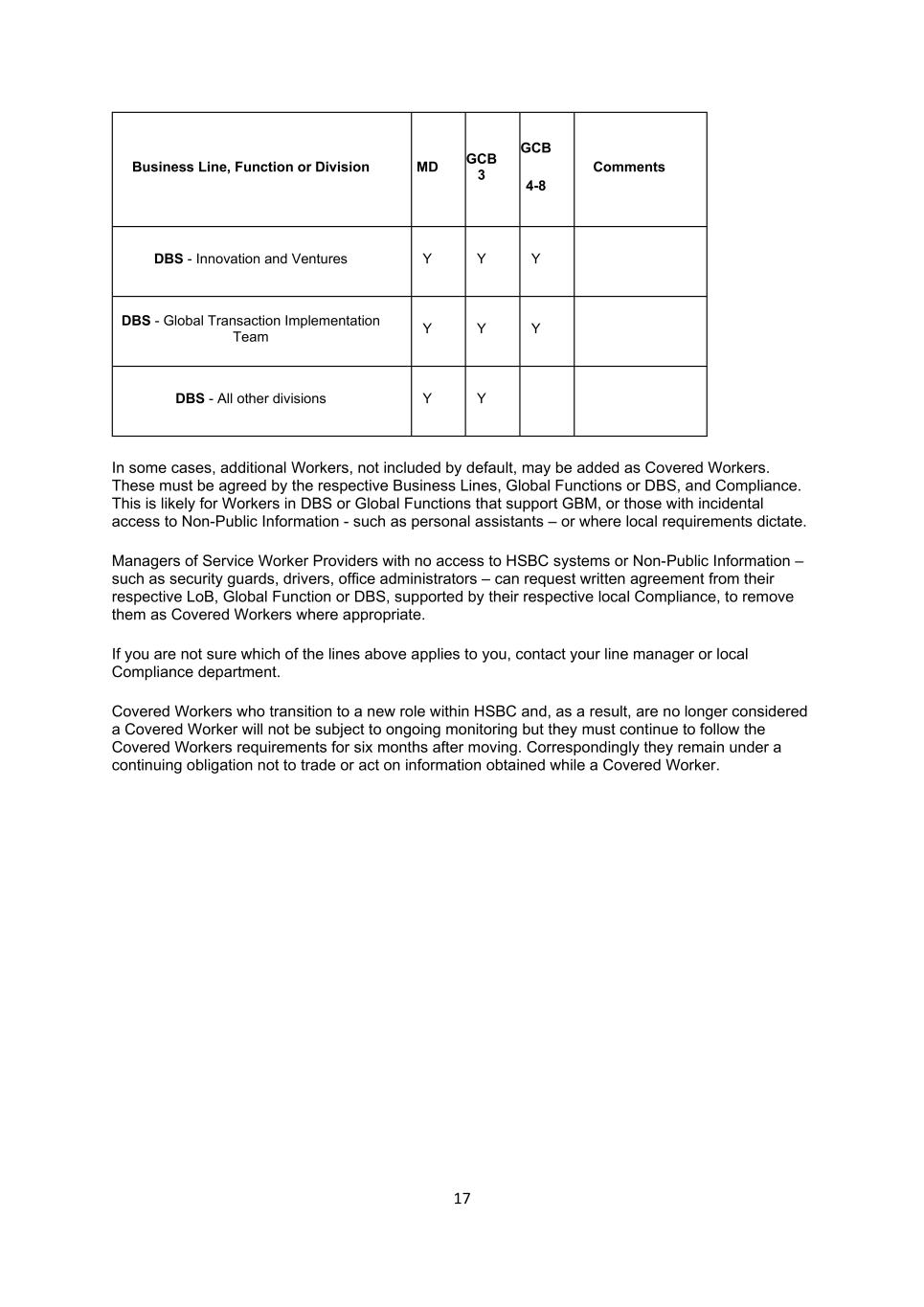
17 Business Line, Function or Division MD GCB 3 GCB 4-8 Comments DBS - Innovation and Ventures Y Y Y DBS - Global Transaction Implementation Team Y Y Y DBS - All other divisions Y Y In some cases, additional Workers, not included by default, may be added as Covered Workers. These must be agreed by the respective Business Lines, Global Functions or DBS, and Compliance. This is likely for Workers in DBS or Global Functions that support GBM, or those with incidental access to Non-Public Information - such as personal assistants – or where local requirements dictate. Managers of Service Worker Providers with no access to HSBC systems or Non-Public Information – such as security guards, drivers, office administrators – can request written agreement from their respective LoB, Global Function or DBS, supported by their respective local Compliance, to remove them as Covered Workers where appropriate. If you are not sure which of the lines above applies to you, contact your line manager or local Compliance department. Covered Workers who transition to a new role within HSBC and, as a result, are no longer considered a Covered Worker will not be subject to ongoing monitoring but they must continue to follow the Covered Workers requirements for six months after moving. Correspondingly they remain under a continuing obligation not to trade or act on information obtained while a Covered Worker.