Please wait

TABLE OF CONTENTS

SCHEDULE 14A INFORMATION
Proxy Statement Pursuant to Section 14(a) of the
Securities Exchange Act of 1934
(Amendment No. )
Filed by the Registrant ☒
Filed by a Party other than the Registrant 
Check the appropriate box:

Preliminary Proxy Statement

Confidential, for Use of the Commission Only (as permitted by Rule 14a-6(e)(2))

Definitive Proxy Statement

Definitive Additional Materials

Soliciting Material Pursuant to §240.14a-12
Charter Communications, Inc.
(Name of Registrant as Specified In Its Charter)
                 
(Name of Person(s) Filing Proxy Statement, if other than the Registrant)
Payment of Filing Fee (Check the appropriate box):

No fee required.

Fee paid previously with preliminary materials.

Fee computed on table in exhibit required by Item 25(b) per Exchange Act Rules 14a-6(i)(1) and 0-11.

TABLE OF CONTENTS


TABLE OF CONTENTS


Dear Stockholder:
You are invited to attend the annual meeting of stockholders of Charter Communications, Inc. (the “Company” or “Charter”), which will be held at 7800 Crescent Executive Drive, Conference Room A131, Charlotte, NC 28217, on Tuesday, April 21, 2026 at 9:00 a.m. (Eastern Daylight Time).
Details of the business to be conducted at the annual meeting are provided in the attached Notice of Annual Meeting of Stockholders and Proxy Statement.
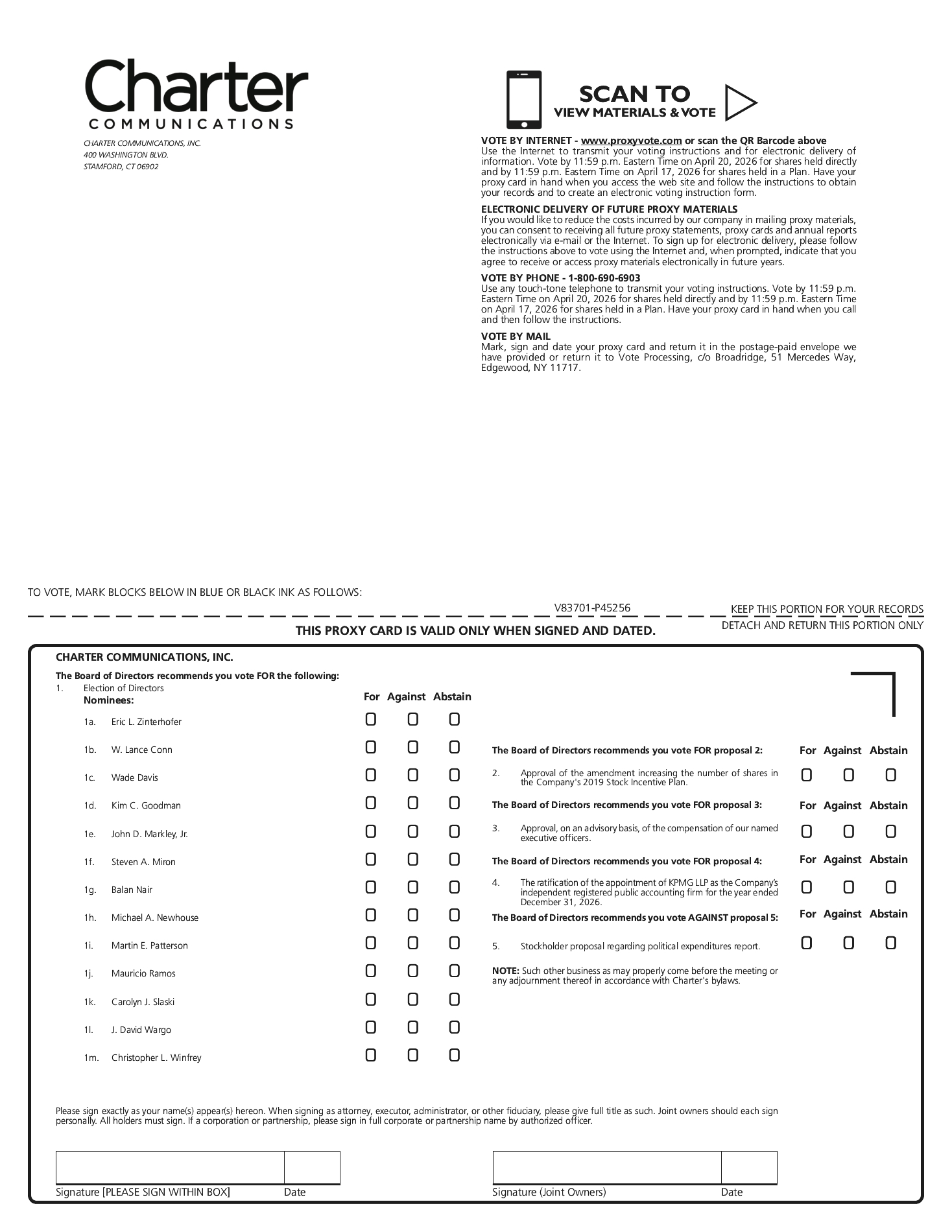
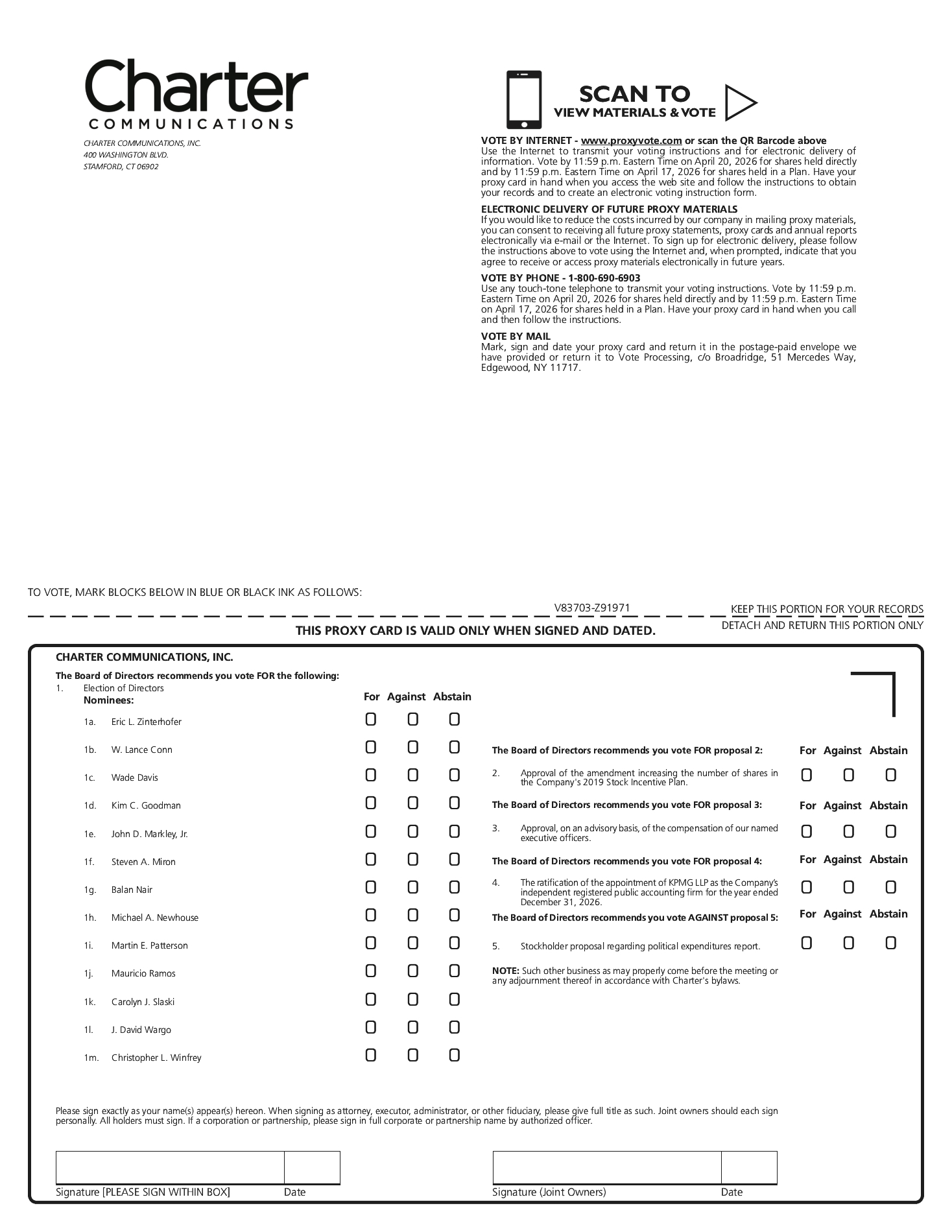
Whether or not you attend the annual meeting, it is important that your shares be represented and voted at the meeting. Therefore, we urge you to sign, date, and promptly return the enclosed proxy in the postage-paid envelope that is provided, or you may vote via the Internet pursuant to the instructions on the proxy card. If you decide to attend the annual meeting, you will have the opportunity to vote in person.
On behalf of management and the Board of Directors, we would like to express our appreciation for your continued interest in Charter.
Sincerely,


Eric L. Zinterhofer
Non-Executive Chairman of the Board
Christopher L. Winfrey
President and Chief Executive Officer, Director
March 12, 2026

TABLE OF CONTENTS


Charter Communications, Inc.
400 Washington Blvd.
Stamford, CT 06902
Notice of Annual Meeting of Stockholders
of Charter Communications, Inc.
 
Date:
April 21, 2026
Time:
9:00 a.m.
(Eastern Daylight Time)
Place:
7800 Crescent Executive Drive
Conference Room A131
Charlotte, NC 28217
 
How to Vote:

By Mail

By Phone

By Internet

At Annual Meeting

Matters to be voted on:
1.
The election of thirteen directors, named in this proxy statement;
2.
An amendment increasing the number of shares in the Company’s 2019 Stock Incentive Plan;
3.
To hold an advisory vote on executive compensation;
4.
The ratification of the appointment of KPMG LLP as the Company’s independent registered public accounting firm for the year ended December 31, 2026;
5.
The stockholder proposal described in the proxy statement if properly presented at the meeting; and
6.
Any other matters properly brought before the stockholders at the meeting.
The proxy statement more fully describes these proposals.
All stockholders of record at the close of business on February 20, 2026 are invited to attend the meeting. For security reasons, however, to gain admission to the meeting you may be required to present identification containing a photograph and to comply with other security measures.
By order of the Board of Directors,

Jamal H. Haughton
Corporate Secretary
March 12, 2026

TABLE OF CONTENTS

Table of Contents

TABLE OF CONTENTS

Charter Communications, Inc.
PROXY STATEMENT
Important Notice Regarding the Availability of Proxy Materials for the Stockholders Meeting to Be Held on April 21, 2026. The 2026 notice and proxy statement and the 2025 annual report to stockholders are available at www.proxyvote.com.
This proxy statement and the Notice of Internet Availability of Proxy Materials were first mailed to stockholders on or about March 12, 2026.
Questions and Answers about Voting
and the Annual Meeting
What matters will be voted on at the annual meeting?
As a holder of Class A common stock, you are being asked to vote on the following:
Proposal 1: To elect thirteen directors, nominated by our Board of Directors and named in this proxy statement;
Proposal 2: To increase the number of shares in the Company’s 2019 Stock Incentive Plan;
Proposal 3: To hold an advisory vote on the compensation of our named executive officers;
Proposal 4: To ratify the appointment of KPMG LLP as the Company’s independent registered public accounting firm for the year ended December 31, 2026;
Proposal 5: To vote on a stockholder proposal regarding political expenditures report if properly presented at the meeting; and
To vote on any other matters properly brought before the stockholders at the meeting.
How does the Board of Directors recommend that I vote?
The Board of Directors recommends that you vote:
FOR the election of the thirteen directors, nominated by our Board of Directors and named in this proxy statement;
FOR the approval of the amendment increasing the number of shares in the Company’s 2019 Stock Incentive Plan;
FOR the approval, on an advisory basis, of the compensation of our named executive officers;
FOR the ratification of the appointment of KPMG LLP as the Company’s independent registered public accounting firm for the year ended December 31, 2026; and
AGAINST the stockholder proposal.
What if other matters come up at the annual meeting?
The items listed on the Notice of Annual Meeting of Stockholders are the only matters that we know will be voted on at the annual meeting. Your proxy gives discretionary authority to the persons named on the proxy card to vote on other matters. On such other business as may properly come before the meeting, your shares will be voted in the discretion and judgment of the proxy holder.
Who has been nominated for election as directors at the annual meeting?
The Board of Directors has nominated thirteen directors for election, each of whom is currently serving on our Board of Directors. The thirteen directors who have been nominated by the Board of Directors and agreed to serve as directors are Mses. Goodman and Slaski and Messrs. Conn, Davis, Markley, Miron, Nair, Newhouse, Patterson, Ramos, Wargo, Winfrey and Zinterhofer.
Charter Communications  | 1 |  2026 Proxy Statement

TABLE OF CONTENTS

Who can vote at the annual meeting?
As of the close of business on February 20, 2026 (the “Record Date”), a total of 141,178,369 shares of Class A common stock, including Charter Communications Holdings, LLC (“Charter Holdings”) common units on an as-if-exchanged basis, are entitled to be voted by our stockholders at the annual meeting. Each holder of Class A common stock is entitled to one vote per share, representing 125,667,086 votes. Advance/Newhouse Partnership (“A/N”) holds one share of our Class B common stock, which is entitled to a number of votes equal to the number of shares of Class A common stock into which the Charter Holdings common units held by A/N may be exchanged, or 15,511,283 votes. The enclosed proxy card indicates the number of Class A shares that our records show you are entitled to vote. There are no other classes of common stock outstanding.
What is the difference between being a stockholder of record and a beneficial owner?
You are a stockholder of record if at the close of business on the Record Date your shares were registered in your name with Computershare Shareowner Services, our transfer agent and registrar.
You are a beneficial owner if at the close of business on the Record Date, your shares were held by a brokerage firm or other nominee and not directly in your name, but are held in “street name.” As the beneficial owner of your shares, you have the right to direct your broker or other nominee how to vote your shares, i.e., for or against the proposals to be considered at the annual meeting. If you do not provide your broker or nominee with instructions on how to vote your shares, your broker or nominee will be able to vote your shares with respect to some of the proposals, but not all. See, “What if I do not provide instructions on how to vote my shares?” below.
What do I do if my shares are held in “street name”?
If your shares are held in the name of your broker or other nominee, you should return your proxy in the envelope provided by your broker or nominee or instruct the person responsible for holding your shares to execute a proxy on your behalf. In either case, your shares will be voted according to your instructions.
What if I do not provide instructions on how to vote my shares?
If you are a stockholder of record and you submit a proxy, but do not provide voting instructions, your shares will be voted “FOR” the election of each of the Company’s director nominees on proposal 1, “FOR” proposals 2 through 4, and “AGAINST” the stockholder proposal.
If you are a beneficial owner and you do not provide the broker or other nominee that holds your shares with voting instructions, the broker or nominee has discretionary authority to vote for certain proposals, but not others pursuant to applicable regulatory requirements. Brokers and other nominees have the discretion to vote on routine matters such as proposal 4, but not on non-routine matters such as proposals 1, 2, 3 and 5. Therefore, if you do not provide voting instructions to the broker or nominee that holds your shares, the broker or nominee may only vote for proposal 4 and any other routine matters properly presented for a vote at the annual meeting.
What is the quorum required for the meeting?
We will hold the annual meeting if holders of shares having a majority of the voting power of Charter’s capital stock as of the Record Date either sign and return their proxy cards, vote via the Internet or attend the meeting. If you sign and return your proxy card or vote via the Internet, your shares will be counted to determine whether we have a quorum, even if you fail to indicate your vote.
Abstentions and broker non-votes will be counted as present for purposes of determining whether a quorum exists at the annual meeting.
How are broker non-votes and abstentions treated?
If an executed proxy is returned by a broker holding shares in street name that indicates that the broker does not have discretionary authority as to certain shares to vote on one or more matters (a broker non-vote), such shares will be considered present at the meeting for purposes of determining a quorum on all matters, but will not be considered to be votes cast with respect to such matters.
Charter Communications  | 2 |  2026 Proxy Statement

TABLE OF CONTENTS

A stockholder may vote to “abstain” on any of the proposals. If you vote to “abstain” on any matter, your shares will be counted as present at the meeting for purposes of determining a quorum on all matters, but will not be considered to be votes cast with respect to such matter. Only “FOR” and “AGAINST” votes are counted for purposes of determining the votes cast in connection with each proposal.
With respect to each of the proposals, broker non-votes and abstentions will have no effect on determining whether the affirmative vote constitutes a majority of the shares present or represented by proxy and voting at the annual meeting. In addition, because they do not count as votes cast, assuming a quorum is present, abstentions from voting, broker non-votes or a stockholder’s other failure to vote will have no effect on the proposals.
In order to minimize the number of broker non-votes, the Company encourages you to vote or to provide voting instructions to the organization that holds your shares by carefully following the instructions provided in the Notice of Internet Availability of Proxy Materials.
What is the vote required for the proposals on the agenda?
The affirmative vote of the holders of a majority of the votes cast is required for approval of the matters in proposals 1 through 5. Abstentions and broker non-votes are not considered votes cast. Accordingly, assuming a quorum is present, abstentions, broker non-votes and a stockholder’s other failure to vote will have no effect on the outcome of the applicable proposal.
What are my choices for each proposal on the agenda?
On proposal 1, for each of the director nominees you can vote your shares “FOR” a nominee or “AGAINST” a nominee, or you can abstain from voting. On proposals 2 through 5 you can vote “FOR” a proposal or “AGAINST” a proposal, or you can abstain from voting.
How do I vote by proxy?
Follow the instructions on the enclosed proxy card. Sign and date the proxy card and mail it back to us in the enclosed envelope. If you receive more than one proxy card it may mean that you hold shares in more than one account. Sign and return all proxy cards to ensure that all of your shares are voted. The proxy holder named on the proxy card will vote your shares as you instruct. If you sign and return the proxy card but do not indicate your vote, the proxy holder will vote on your behalf “FOR” each of the director nominees on proposal 1, “FOR” proposals 2 through 4, and “AGAINST” the stockholder proposal and will also have discretionary authority to vote your shares on any other matter that is properly brought before the annual meeting. Stockholders may also vote their proxy by using the toll-free number listed on the proxy card and following the instructions.
Can I vote via the Internet?
Stockholders with shares registered in their names with Computershare Shareowner Services, our transfer agent, may authorize a proxy via the Internet at the following address: www.proxyvote.com. A number of brokerage firms and banks participate in a program that permits Internet voting. If your shares are held in an account at a brokerage firm or bank that participates in such a program, you may direct the vote of those shares by following the instructions on the voting form enclosed with the proxy from the brokerage firm or bank.
Proxies submitted via the Internet must be received by 11:59 p.m. (EDT) on April 20, 2026. Please refer to your voting instruction form and/or your proxy card for specific voting instructions. If you vote this year’s proxy via the Internet, you may also elect to receive future proxy and other materials electronically by following the instructions when you vote. Making this election will save the Company the cost of producing and mailing these documents.
Can I change my vote after I return my proxy card?
Yes. At any time before the vote at the annual meeting, you can change your vote either by giving our Corporate Secretary a written notice revoking your proxy card, or by signing, dating and submitting a new later-dated proxy card via the Internet, by telephone or by mail. We will honor the latest dated proxy card which has been received prior to the closing of the voting. You may also attend the meeting and vote in person. If you wish to attend the annual meeting and vote your shares in person and you are the beneficial owner of your shares, you must obtain the documents required to vote your shares in person at the annual meeting from your broker or nominee.
Charter Communications  | 3 |  2026 Proxy Statement

TABLE OF CONTENTS

Is my vote confidential?
We will maintain the confidentiality of proxy cards and other votes that identify individual stockholders unless disclosure is required by law.
Who will count the votes?
Broadridge Financial Solutions, Inc. has been appointed to receive and tabulate stockholder votes and American Election Services, LLC will act as the inspector of election and certify the election results.
Who is soliciting my vote?
The Board of Directors is soliciting your vote. In addition, we retained Innisfree M&A Incorporated, a proxy solicitation firm, to solicit proxies in connection with our 2026 annual meeting of stockholders at a total cost of approximately $20,000 plus expenses. Charter expects to solicit proxies primarily by mail, but directors, officers and other employees of Charter may also solicit in person or by internet, telephone or mail. Contact information for the proxy solicitor appears below.
Proxy Solicitor
Charter stockholders who need assistance in voting their shares or need a copy of this proxy statement should contact:
Innisfree M&A Incorporated
501 Madison Avenue, 20th Floor
New York City, New York 10022
Stockholders may call toll free: (888) 750-5834
Banks and brokers may call collect: (212) 750-5833
Who pays for this proxy solicitation?
The Company pays for the proxy solicitation. We will ask banks, brokers and other nominees and fiduciaries to forward the proxy material to the beneficial owners of the Class A common stock and to obtain the authority of executed proxies. We will reimburse them for their reasonable expenses.
Where can I find the voting results of the annual meeting?
We will report the voting results on a Current Report on Form 8-K that we will file with the Securities and Exchange Commission (“SEC”) within four business days after the date of the meeting and that we will post on our website promptly after it is filed.
Charter Communications  | 4 |  2026 Proxy Statement

TABLE OF CONTENTS

Proposal No. 1: Election of Directors
(Item 1 on Proxy Card)
The size of our Board of Directors is thirteen, and we currently have thirteen members standing as nominees for election. Proxies cannot be voted for a greater number of persons than the number of nominees named. As set forth in more detail below, the Nominating and Corporate Governance Committee of the Board of Directors and the Board of Directors have determined that twelve of our thirteen current directors are independent pursuant to NASDAQ rules.
Each of our directors is elected on an annual basis. The Board of Directors is soliciting your vote for the directors to be elected at the annual meeting of stockholders. Once elected, each of the directors will hold office until his or her successor is elected, or he or she resigns or is otherwise removed.
Under the Second Amended and Restated Stockholders Agreement among Charter, Liberty Broadband and A/N, dated as of May 23, 2015 (the “Existing Stockholders Agreement”), as amended by Amendment No. 1 to the Second Amended and Restated Stockholders Agreement and the Letter Agreement, dated as of November 12, 2024 (the “Stockholders and Letter Agreement Amendment”), and Charter’s amended and restated certificate of incorporation, the number of Charter’s directors is fixed at thirteen. Under the Existing Stockholders Agreement, Liberty Broadband currently has the right to designate three directors as nominees for Charter’s Board of Directors and A/N currently has the right to designate two directors as nominees for Charter’s Board of Directors. Of the director nominees named in this proxy statement, Messrs. Nair, Patterson and Wargo were designated by Liberty Broadband and Messrs. Miron and Newhouse were designated by A/N.
David Merritt retired from service on the Board of Directors effective as of January 26, 2026. To fill the vacancy caused by Mr. Merritt’s departure, Wade Davis was appointed by the Board of Directors, based on the recommendation of the Nominating and Corporate Governance Committee, to serve on the Board of Directors effective as of January 27, 2026. Mr. Davis will stand for election at the upcoming annual meeting of stockholders.
THE BOARD OF DIRECTORS RECOMMENDS VOTING “FOR” THE DIRECTOR NOMINEES.
Information about the Director Nominees
The following information concerns the thirteen individuals who have been nominated by the Board of Directors for election by the stockholders. Each of the following individuals currently serves as a director.
Directors
Position(s)
Eric L. Zinterhofer
Non-Executive Chairman
W. Lance Conn
Director
Wade Davis
Director
Kim C. Goodman
Director
John D. Markley, Jr.
Director
Steven A. Miron
Director
Balan Nair
Director
Michael A. Newhouse
Director
Martin E. Patterson
Director
Mauricio Ramos
Director
Carolyn J. Slaski
Director
J. David Wargo
Director
Christopher L. Winfrey
Director
Charter Communications  | 5 |  2026 Proxy Statement

TABLE OF CONTENTS

Director Nominees
Eric L. Zinterhofer
Non-Executive Chairman    Age: 54    Director Since: 2009
Committees: Compensation and Benefits, Nominating and Corporate Governance, Finance
Biographical Information:
Mr. Zinterhofer serves as Non-Executive Chairman of Charter’s board of directors and was previously the Lead Independent Director of the board from May 2016 to November 2023 and served as the Non-Executive Chairman of the board from November 2009 through May 2016. In 2010, Mr. Zinterhofer founded Searchlight Capital Partners, L.P., a private equity firm. Previously, he served as a senior partner at Apollo Management, L.P. and was with Apollo from 1998 until May 2010. Mr. Zinterhofer is a director of The Estée Lauder Companies, Inc., Care Advantage, Inc., Liberty Latin America Ltd., and TelevisaUnivision, Inc. Mr. Zinterhofer previously served as a director of Ziply Fiber LLC until 2025, Hemisphere Media Group until 2022, TouchTunes Interactive until 2022, Global Eagle Entertainment until 2020, Roots Corporation until 2020, Liberty Cablevision of Puerto Rico until 2018, General Communication Inc. until 2018, 160 Over Ninety LLC until 2018, Hunter Boot Limited until 2015, Integra Telecom, Inc. until 2015, and Central European Media Enterprises Ltd. until 2013. Mr. Zinterhofer received B.A. degrees with Honors in Economics and European History from the University of Pennsylvania and received an M.B.A. from Harvard Business School.
Skills and Qualifications:
Mr. Zinterhofer’s qualifications to sit on Charter’s Board include his extensive background in banking and investment industries and his particular knowledge and experience as a financial advisor and investor in the telecommunications industries. This knowledge and experience contributes to the Board’s evaluation of financing opportunities and strategies and consideration of our capital structure, budgets and business plans, provides insight into other company board practices and strengthens the Board’s collective qualifications, skills and attributes.
W. Lance Conn
Independent Director    Age: 57    Director Since: 2004
Committees: Compensation and Benefits (Chair), Finance
Biographical Information:
Mr. Conn is a businessman, investor and conservationist. From July 2004 to May 2009, Mr. Conn served as the President of Vulcan Capital, the investment arm of Vulcan, Inc. Prior to Vulcan, Mr. Conn was employed by America Online, Inc. from March 1996 to May 2003. From September 1994 to February 1996, Mr. Conn was an attorney with Shaw, Pittman, Potts & Trowbridge LLP in Washington, D.C. Mr. Conn holds a J.D. degree from the University of Virginia, a M.A. degree in history from the University of Mississippi and a B.A. degree in history from Princeton University.
Skills and Qualifications:
Mr. Conn’s qualifications to sit on Charter’s Board include his extensive experience in the media and telecommunications industries, his experience in the investment industry and his knowledge of Charter gained from his long-term service as a director.
Charter Communications  | 6 |  2026 Proxy Statement

TABLE OF CONTENTS

Wade Davis
Independent Director    Age: 54    Director Since: 2026
Committees: None
Biographical Information:
Mr. Davis is the Founder of ForgeLight, LLC, an operating and investment company focused on the media and consumer technology sectors, since December 2019. Mr. Davis also serves as Vice Chairman of the Board of TelevisaUnivision, Inc. Mr. Davis previously served as the Chief Executive Officer of TelevisaUnivision from January 2021 to September 2024. Mr. Davis served as Executive Vice President and Chief Financial Officer of Viacom Inc., a multinational mass media conglomerate with interests primarily in film and television, from November 2012 to December 2019. Prior to that, he served in various roles at Viacom, including Executive Vice President, Strategy and Corporate Development from August 2009 to November 2012, Senior Vice President, Mergers & Acquisitions and Strategic Planning from January 2007 to August 2009 and Senior Vice President of Mergers & Acquisitions from January 2006 to January 2007. Prior to joining Viacom, Mr. Davis was an investment banker in the technology and media sectors for more than a decade. Mr. Davis holds degrees with distinction and honors in both philosophy and economics from Williams College.
Skills and Qualifications:
Mr. Davis’s qualifications to sit on Charter’s Board include his extensive experience as a media industry leader, including founding ForgeLight to build, acquire and operate companies in the media and consumer technology sectors. His experience includes serving as a C-Suite Fortune 100 operator, board director, investment banker and entrepreneur.
Kim C. Goodman
Independent Director    Age: 60    Director Since: 2016
Committees: Audit
Biographical Information:
Ms. Goodman is Chief Executive Officer of Smarsh, Inc., a global leader in digital communications compliance and intelligence. Prior to joining Smarsh, Ms. Goodman was President, Payments and Risk Solutions of Fiserv, Inc., a leading global provider of financial services and technology solutions. While at Fiserv, Ms. Goodman also served as Head of Merchant Joint Ventures and Acquirer Processing and Head of Card Services. Prior to Fiserv, Ms. Goodman was Chief Executive Officer of Worldpay US, following seven years at American Express (AMEX), where she served as president of its Global Business Travel and Merchant Services Americas units. Prior to joining AMEX, she held executive leadership roles at Dell Inc. in Software and Peripherals, Marketing and Transactional Sales and Dell Networking. Ms. Goodman began her career in management consulting with Bain & Company, where she ascended to the role of partner. Ms. Goodman previously served as a director of Alcatel-Lucent SA, Brocade Communications Systems, and National Life Insurance Company. A graduate of Stanford University with a Master of Science in Industrial Engineering and Bachelor of Arts in Political Science, Ms. Goodman also earned a Master of Business Administration from Harvard Business School where she was a Baker Scholar.
Skills and Qualifications:
Ms. Goodman’s qualifications to sit on Charter’s Board include her experience in software, networking, financial services and customer service, her experience serving on other public company boards, as well as her experience in executive leadership roles at Smarsh, Fiserv, Worldpay US and AMEX and previous senior leadership positions in both software and networking at Dell Inc.
Charter Communications  | 7 |  2026 Proxy Statement

TABLE OF CONTENTS

John D. Markley, Jr.
Independent Director    Age: 60    Director Since: 2009
Committees: Nominating and Corporate Governance (Chair), Audit
Biographical Information:
Mr. Markley is Managing Director of Bear Creek Capital, an investment firm focused on public and private companies in the communications, media and technology industries. Mr. Markley also is a partner at New Amsterdam Growth Capital. From 1996 to 2009, Mr. Markley was a partner at Columbia Capital, a venture capital firm, where he served on the board of numerous private companies. Mr. Markley is a director of Interdigital, Inc. where he serves as the Chair of its governance committee and member of its compensation committee. Mr. Markley previously served as Chairman of the Board of BroadSoft, Inc. until its acquisition by Cisco Systems, Inc. in February 2018 where he also served on the compensation committee, and as a director of Millennial Media, Inc. from July 2006 to May 2014. Mr. Markley also is currently a director of numerous private companies in the communications, media and technology industries. Mr. Markley received a B.A. degree from Washington & Lee University and an M.B.A degree from Harvard Business School.
Skills and Qualifications:
Mr. Markley’s qualifications to sit on Charter’s Board include his private equity and operating experience and his extensive experience with communications, media and technology companies, which allow him to contribute guidance and advice relating to the development and execution of the company’s strategy and analysis of potential business opportunities.
Steven A. Miron
Independent Director    Age: 59    Director Since: 2016
Committees: Compensation and Benefits
Biographical Information:
Mr. Miron is the chief executive officer of Advance/Newhouse Partnership, a privately-held media company headquartered in Syracuse, New York and a senior executive officer at Advance, a private, family-held business that owns and invests in companies across media, entertainment, technology, communications, education and other promising growth sectors. Advance’s portfolio includes Condé Nast, a global media company that produces award-winning journalism, content, and entertainment for every platform today and operates in 32 markets worldwide; Advance Local, a leading digital journalism, data, and insights company, serving over 50 million people monthly; Stage Entertainment, a leading global producer of musical theatre, owning and operating a network of 16 significant venues across continental Europe; The IRONMAN Group, the largest operator of mass participation sports in the world; American City Business Journals, the largest producer of local business news, information and events in the United States, covering 44 cities; Leaders Group, a global intelligence platform for sports and gaming business professionals; Turnitin, a global company dedicated to ensuring the integrity of education and research; and POP, a digital marketing agency. Advance holds an approximately 13% interest in Charter and is among the largest shareholders in Reddit. Mr. Miron previously served as President of Bright House Networks from July 2002 to May 2008 and as Chief Executive Officer from May 2008 until May 2016, when Bright House Networks was acquired by Charter. Mr. Miron currently serves as a director of C-SPAN and was previously a member of the board of directors of Warner Bros. Discovery, the National Cable & Telecommunications Association and CableLabs. Mr. Miron previously served for several years on the board of directors and executive committee for CTAM and the boards of Emma Bowen Foundation, CTAM Educational Foundation, Crouse Health Foundation and the Jewish Community Foundation of Central New York. Mr. Miron is a graduate of American University.
Skills and Qualifications:
Mr. Miron’s qualifications to sit on Charter’s Board include his extensive experience as a cable television executive and his experience in the media and technology industries. Mr. Miron has developed a deep understanding of our industry and his expertise in the cable television industry makes him a valued presence on our Board.
Charter Communications  | 8 |  2026 Proxy Statement

TABLE OF CONTENTS

Balan Nair
Independent Director    Age: 59    Director Since: 2013
Committees: None
Biographical Information:
Mr. Nair is President and Chief Executive Officer and a director of Liberty Latin America, Ltd., an integrated telecommunications company focused on the Caribbean Islands and Latin America. Mr. Nair is an experienced and proven business executive with more than 20 years in the telecommunications industry. He has been a part of the Liberty family of companies since 2007, when he joined Liberty Global as its Senior Vice President and Chief Technology Officer. He most recently served as Executive Vice President and Chief Technology and Innovation Officer. In this role, he was responsible for overseeing Liberty Global’s worldwide network, as well as Technology and Innovation operations, including Product Development, IT, Network Operations, Mobile Operations and Global Supply Chain functions. He was also responsible for Corporate Strategy and Venture investments. Mr. Nair was an executive officer of Liberty Global and sat on Liberty Global’s Executive Leadership Team and the Investment Committee. Prior to joining Liberty Global, from December 2006 to June 2007, Mr. Nair served as Chief Technology Officer and Executive Vice President for AOL LLC, a global web services company. Prior to his role at AOL, he spent more than 12 years at Qwest Communications International Inc., most recently as Chief Information Officer and Chief Technology Officer. Mr. Nair sits on the board of directors of Adtran Corporation. Mr. Nair previously served as a director of Telenet Group Holding, N.V., which trades on EN Brussels. He holds a patent in systems development and is a Licensed Professional Engineer in Colorado. Mr. Nair holds an M.B.A. and a B.S. in electrical engineering, both from Iowa State University.
Skills and Qualifications:
Mr. Nair’s qualifications to sit on Charter’s Board include his significant executive experience in building, integrating and managing technology businesses and his in-depth knowledge of all aspects of technology for delivering telecommunications systems.
Michael A. Newhouse
Independent Director    Age: 66    Director Since: 2016
Committees: Nominating and Corporate Governance, Finance
Biographical Information:
Mr. Newhouse is a co-president at Advance, a private, family-held business that owns and invests in companies across media, entertainment, technology, communications, education and other promising growth sectors. Advance’s portfolio includes Condé Nast, a global media company that produces award-winning journalism, content, and entertainment for every platform today and operates in 32 markets worldwide; Advance Local, a leading digital journalism, data, and insights company, serving over 50 million people monthly; Stage Entertainment, a leading global producer of musical theatre, owning and operating a network of 16 significant venues across continental Europe; The IRONMAN Group, the largest operator of mass participation sports in the world; American City Business Journals, the largest producer of local business news, information and events in the United States, covering 44 cities; Leaders Group, a global intelligence platform for sports and gaming business professionals; Turnitin, a global company dedicated to ensuring the integrity of education and research; and POP, a digital marketing agency. Advance holds an approximately 13% interest in Charter and is among the largest shareholders in Reddit. Mr. Newhouse is a graduate of Tufts University.
Skills and Qualifications:
Mr. Newhouse’s qualifications to sit on Charter’s Board include his extensive experience in the cable programming, cable infrastructure, media and technology industries. Mr. Newhouse has developed a deep understanding of our industry and his expertise in the cable programming and cable infrastructure industries make him a valued member of our Board.
Charter Communications  | 9 |  2026 Proxy Statement

TABLE OF CONTENTS

Martin E. Patterson
Independent Director Nominee    Age: 39    Director Since: 2025
Committees: Nominating and Corporate Governance, Finance
Biographical Information:
Mr. Patterson is President & CEO of Liberty Broadband. In addition, Mr. Patterson is Senior Vice President and Co-Head of Corporate Development of Liberty Media Corporation, GCI Liberty, Inc. and Liberty Live Holdings, Inc., and was formerly Senior Vice President of Atlanta Braves Holdings, Inc. until August 2024, QVC Group, Inc. until March 2025, Liberty TripAdvisor Holdings, Inc. until April 2025 and Liberty Broadband until July 2025. He has been with Liberty Media Corporation, a media, communications and entertainment company, and its predecessors since 2010. Mr. Patterson was previously a director of ComScore, Inc., Skyhook Wireless, Inc. and Ideiasnet S.A. He received his B.A. from Colorado College and is a CFA Charterholder.
Skills and Qualifications:
Mr. Patterson’s qualifications to sit on Charter’s board includes his extensive experience investing in public and private companies in the technology, media and telecommunications sectors.
Mauricio Ramos
Independent Director    Age: 57    Director Since: 2016
Committees: Nominating and Corporate Governance and Compensation and Benefits
Biographical Information:
Mr. Ramos served as the Chief Executive Officer of Millicom International Cellular S.A. (“Millicom”), a Luxembourg public liability company traded on the Stockholm and U.S. NASDAQ stock exchange (NASDAQ: TIGO) from April 2015 to May 2024; as an Executive Director from June 2020 to September 2024; and as Chairman of the Board from September 2023 to September 2024. Millicom is a leading telecommunications and media company dedicated to emerging markets in Latin America and Africa. Before joining Millicom, Mr. Ramos was President of Liberty Global’s Latin American division, a position he held from 2006 until February 2015. During his career at Liberty Global, Mr. Ramos held several leadership roles, including positions as Chairman and CEO of VTR in Chile and President of Liberty Puerto Rico. Throughout his career he has successfully developed both mobile and broadband businesses in Latin America, delivering solid operational improvement and outstanding financial results. In April 2025, he was appointed Chair of the Board of Directors of WOM Chile, a leading mobile and broadband operator in Chile. In 2024 he was appointed Chair of the Partnership for Central America and became a member of the Board of Trustees of the Meridian International Center. From 2021 to 2023 Mr. Ramos also served on the Broadband Commission for Sustainable Development as a Commissioner and on the INCAE business school Presidential Advisory Council. He has served as Chair of the Digital Communications Industry Community of the World Economic Forum and on the GSMA Board of Directors from 2017-2019. He served as Director of the Biennial of the Americas from 2012 to 2015, Director of Columbus Networks from 2013 to 2014, and Director of the American Chamber of Commerce in Chile from 2007-2011, among various other roles. He is a citizen of the United States and Colombia and received a degree in Economics, a degree in Law, and a postgraduate degree in Financial Law from Universidad de los Andes in Bogota.
Skills and Qualifications:
Mr. Ramos’ qualifications to sit on Charter’s Board include his significant executive experience in the telecommunications and media industries. His experience in these areas as well as his experience developing both mobile and broadband businesses make him a valued member of our Board.
Charter Communications  | 10 |  2026 Proxy Statement

TABLE OF CONTENTS

Carolyn J. Slaski
Independent Director    Age: 63    Director Since: 2024
Committees: Audit
Biographical Information:
Ms. Slaski served as the Americas and US Vice-Chair of Talent of EY LLP from 2015 to 2021. Previously, Ms. Slaski was a Senior Audit Partner from 1984-2021 and, during that time, also served as the East Region Assurance Managing Partner from 2013 to 2015, New Jersey Office Managing Partner and Market Segment Leader from 2010-2013 and European Client Service Partner and Capital Markets Leader from 2002 to 2005. Ms. Slaski serves on the board of TELUS International where she sits on the Audit and HR committees. Ms. Slaski holds a Bachelor of Arts in Economics (Honors) from Rutgers University, a Certified Public Accountant certification and has completed EY’s Strategic Leadership Program by Harvard University.
Skills and Qualifications:
Ms. Slaski’s qualifications to sit on Charter’s Board include her many years of experience as an audit and lead partner with a major accounting firm. As an experienced director and audit committee member with extensive accounting, financial reporting and audit committee experience, Ms. Slaski brings a strong background in strategic leadership, risk management, information technology and information management to our Board.
J. David Wargo
Independent Director Nominee    Age: 72    Director Since: 2025
Committees: Compensation and Benefits
Biographical Information:
Mr. Wargo is the founder and President of Wargo & Company, Inc., a private company specializing in investing in the communications industry since 1993. Mr. Wargo is also the Managing Member of Peters Creek Entertainment. Mr. Wargo is a co-founder and was a member of New Mountain Capital, LLC from 2000 to 2008. Prior to starting Wargo & Company, he was a managing director and senior analyst of The Putnam Companies from 1989 to 1992, senior vice president and a partner in Marble Arch Partners from 1985 to 1989 and senior analyst, assistant director of research and a partner in State Street Research and Management Company from 1978 to 1985. Mr. Wargo has served as a director of Liberty TripAdvisor Holdings, Inc. since August 2014 and Liberty Broadband since March 2015. He has also served as a director of Liberty Global plc since June 2013, having previously served as a director of Liberty Global, Inc. from June 2005 to June 2013 and as a director of Liberty Media International, Inc. from May 2004 to June 2005. He served as a director of Strategic Education, Inc. (formerly Strayer Education, Inc.) from March 2001 to April 2019. He served as a director of Discovery Communications, Inc. from September 2008 until April 2022, after having served as a director of Discovery Holding Company from May 2005 to September 2008. Mr. Wargo also served as a director of Vobile Group Limited from 2018 until 2025.
Skills and Qualifications:
Mr. Wargo’s qualifications to sit on Charter’s Board include extensive background in investment analysis and management, experience as a public company board member and his particular expertise in finance and capital markets will contribute to our Board’s consideration of our capital structure, evaluation of investment, financial opportunities and strategies, and strengthen our Board’s collective qualifications, skills and attributes.
Charter Communications  | 11 |  2026 Proxy Statement

TABLE OF CONTENTS

Christopher L. Winfrey
Director    Age: 50    Director Since: 2023
Committees: None
Biographical Information:
Mr. Winfrey was named President and Chief Executive Officer of Charter Communications in December 2022 and appointed to the Board of Directors in November 2023. He most recently served as Chief Operating Officer since 2021, where he oversaw all cable operations, including marketing, sales, field operations and customer operations, as well as Spectrum Enterprise. Mr. Winfrey joined Charter as Chief Financial Officer in 2010 responsible for Charter’s accounting, financial planning and analysis, procurement, real estate, tax and treasury functions, as well as mergers and acquisitions, capital structure activities and investor relations. Charter added oversight of its fiber-based Spectrum Enterprise business to his CFO responsibilities in 2019, and operational leadership of the residential and SMB Sales and Marketing organization, and Spectrum Community Solutions in February of 2021. Prior to joining Charter, Mr. Winfrey served as Chief Financial Officer of Unitymedia GmbH, Germany’s second-largest cable operator, and as Managing Director for Unitymedia’s cable operations, broadcasting and satellite entities. Earlier in his career, Mr. Winfrey served as Senior Vice President, Corporate Finance and Development at Cablecom, GmbH. He was previously a Director of Financial Planning and Analysis and Director of Operations Services of NTL Incorporated’s continental European operations, and a senior associate in the private equity group at Communications Equity Associates. Mr. Winfrey has spent more than 25 years in the cable industry, and in 2015 received The Internet & Television Association’s (NCTA) Vanguard Award for Young Leadership. He currently serves on the Boards of the NCTA, CableLabs and C-SPAN. He also serves on the University of Florida Business School Advisory Council. He received a B.S. in accounting and an MBA from the University of Florida.
Skills and Qualifications:
Mr. Winfrey’s qualifications to sit on Charter’s Board include his many years of experience as an executive in the telecommunications industry, including as our President and Chief Executive Officer since December 2022. Mr. Winfrey is responsible for setting and executing the goals and strategies related to our business and provides the Board not only with a knowledge of our day-to-day operations, but also with the essential experience, insight and expertise that can be provided only by a person who is intimately involved in running our business.
Board of Directors and Committees of the Board of Directors
Our Board of Directors meets regularly throughout the year on an established schedule. The Board also holds special meetings and executive sessions and acts by written consent from time to time as necessary. The Company held an annual stockholders’ meeting in 2025, which each incumbent director and each director-nominee attended. Members of the Board of Directors are encouraged to attend the annual meeting each year. In 2025, the full Board of Directors held sixteen meetings and acted eight times by unanimous written consent. Each of our incumbent directors attended 75% or more of the aggregate meetings of the Board and of the Board committees on which they served during 2025.
The Board of Directors delegates authority to act with respect to certain matters to Board committees whose members are appointed by the Board of Directors. The current standing committees of the Board of Directors are the following: Audit Committee, Compensation and Benefits Committee, Nominating and Corporate Governance Committee and Finance Committee. The Audit, Compensation and Benefits, Nominating and Corporate Governance and Finance Committees each have a charter that is available on the “Investors” section of our website at ir.charter.com.
Charter’s Audit Committee is responsible for overseeing the Company’s accounting and financial reporting processes and the audits of the Company’s financial statements, reviewing the work of the independent registered public accounting firm (including resolution of disagreements between management and the public accounting firm regarding financial reporting) for the purpose of preparing or issuing an audit report or performing other audit, review or attest services and reviewing our risk management program. In 2025 Mses. Goodman and Slaski and Messrs. Merritt and Markley served on the Audit Committee for the entire year. Ms. Slaski is Chair of the Audit Committee. Charter’s Board of Directors has determined that, in its judgment, Ms. Slaski is an audit committee financial expert within the meaning of the applicable federal regulations. All members of the Audit Committee were determined by the Board of Directors in 2025 to be independent in accordance with the listing standards of NASDAQ and Rule 10A-3 of the Securities Exchange Act of 1934, as amended (the “Exchange Act”). The Audit Committee met four times and acted three times by unanimous written consent in 2025.
Charter Communications  | 12 |  2026 Proxy Statement

TABLE OF CONTENTS

The Compensation and Benefits Committee reviews and approves the compensation of the senior management of the Company. During 2025, Messrs. Conn, Miron, Ramos and Zinterhofer served on the Compensation and Benefits Committee for the entire year. In addition, former director Gregory Maffei served on the Compensation and Benefits Committee through April 22, 2025 and Mr. Wargo was appointed to the Compensation and Benefits Committee as of April 22, 2025. Mr. Conn served as the Chair of the Compensation and Benefits Committee during 2025. All members of the Compensation and Benefits Committee were determined by the Board of Directors in 2025 to be independent in accordance with the listing standards of NASDAQ and Rule 10C of the Exchange Act. The Compensation and Benefits Committee met five times and acted two times by unanimous written consent in 2025.
The Nominating and Corporate Governance Committee oversees corporate governance, including recommending Board and committee nominations, overseeing the Corporate Governance Guidelines, reviewing and reporting to the Board as to director independence, overseeing environmental, social and governance matters, reviewing public policy priorities and political engagement strategy and overseeing lobbying activities. The Nominating and Corporate Governance Committee considers director candidates proposed by stockholders if adequate information is submitted in a timely manner (see “Nomination and Qualifications of Directors” below). During 2025, Messrs. Markley, Newhouse, Ramos and Zinterhofer served on the Nominating and Corporate Governance Committee for the entire year. In addition, former director James Meyer served on the Nominating and Corporate Governance Committee through April 22, 2025 and Mr. Patterson was appointed to the Nominating and Corporate Governance Committee as of April 22, 2025. Mr. Markley is the Chair of the Nominating and Corporate Governance Committee. All members of the Nominating and Corporate Governance Committee were determined by the Board in 2025 to be independent in accordance with the listing standards of NASDAQ. The Nominating and Corporate Governance Committee met four times in 2025.
The Finance Committee reviews the Company’s financing activities and approves the terms and conditions of certain financing transactions, in consultation with the Company’s legal and financial advisors. During 2025, Messrs. Conn, Merritt, Newhouse and Zinterhofer served on the Finance Committee for the entire year. In addition, former director Gregory Maffei served on the Finance Committee through April 22, 2025 and Mr. Patterson was appointed to the Finance Committee as of April 22, 2025. The Finance Committee met one time and acted seven times by unanimous written consent in 2025.
In addition to the standing committees described above, from time to time, the Board of Directors may create “ad hoc” committees for specific projects or transactions. Ad hoc committees acted by written consent during 2025 related to the Company’s stock buyback arrangements with each of A/N and Liberty Broadband.
On August 1, 2024, the Board of Directors established a Special Committee, consisting entirely of independent and disinterested directors, to investigate, explore, evaluate and negotiate any potential transaction involving Liberty Broadband. During 2025, Mses. Goodman and Slaski and Messrs. Conn, Markley and Merritt served on the Special Committee. Mr. Markley served as the Chair of the Special Committee during 2025. The Special Committee met one time and acted two times by unanimous written consent in 2025.
The Nominating and Corporate Governance Committee and the Board of Directors have determined that a majority of the thirteen current directors are independent. The Nominating and Corporate Governance Committee and the Board of Directors have specifically determined that Mses. Goodman and Slaski and Messrs. Conn, Davis, Markley, Ramos and Zinterhofer are independent directors under NASDAQ rules. The Nominating and Corporate Governance Committee and the Board of Directors also determined that Messrs. Nair, Patterson and Wargo are independent under the NASDAQ rules; however, due to their designation as nominees by, or relationship with, Liberty Broadband, a stockholder of the Company, they may not be considered independent under SEC rules for Audit Committee membership purposes. Similarly, the Nominating and Corporate Governance Committee and the Board of Directors determined that Messrs. Miron and Newhouse are independent under the NASDAQ rules; however, due to their designation as nominees by, or relationship with, A/N, a stockholder of the Company, they may not be considered independent under SEC rules for Audit Committee membership purposes. The Nominating and Corporate Governance Committee and the Board of Directors further determined that Messrs. Miron, Nair, Newhouse, Patterson and Wargo’s designation as nominees by, or relationship with, a stockholder of the Company does not prohibit a finding of independence under SEC rules and NASDAQ Rule 5605(d)(2) for Compensation and Benefits Committee membership purposes. Mr. Winfrey is President and Chief Executive Officer of the Company and is thus not independent for NASDAQ Rule purposes as an executive officer of the Company.
Charter Communications  | 13 |  2026 Proxy Statement

TABLE OF CONTENTS

Nomination and Qualifications of Directors
Candidates for director are nominated by the Board of Directors, based on the recommendation of the Nominating and Corporate Governance Committee and subject to certain requirements under the Existing Stockholders Agreement, as amended by the Stockholders and Letter Agreement Amendment. Charter’s Corporate Governance Guidelines provide that, among other things, candidates for new Board membership to be considered by Charter’s Board of Directors should be individuals representing a wide range of business and professional backgrounds and viewpoints with unquestioned high ethical standards and professional achievement, knowledge and experience. The Corporate Governance Guidelines provide that factors such as industry sector, technical expertise and other relevant experiences will be among the many elements considered in evaluating candidates. In considering candidates for the Board of Directors, the Nominating and Corporate Governance Committee considers the entirety of each candidate’s credentials in the context of these standards. In addition, director candidates must be individuals with the time and commitment necessary to perform the duties of a Board member and other special skills that complement or supplement the skill sets of current directors.
We believe that the Board of Directors is comprised of an effective mix of experience, backgrounds, knowledge, and skills, including the following:
Ten directors have experience and demonstrated expertise in managing large, complex organizations, such as serving as CEOs or next-level executives of a significant company or organization;
Seven directors have significant financial, accounting or other risk management expertise;
Two directors have significant technology and product development experience; and
Twelve directors have experience on one or more boards of other significant public or nonprofit organizations.
In addition, we believe that all of our directors have the following attributes that positively contribute to our Board of Directors:
Experience with video, internet, telephone, wireless or media businesses;
Experience with significant transactions, including financings, investments and acquisitions;
Judgment, skill, integrity and reputation; and
Varied business and professional backgrounds.
Stockholders may nominate persons to be directors by following the procedures set forth in our Bylaws. These procedures require the stockholder to deliver timely notice to the Corporate Secretary at our principal executive offices. That notice must contain the information required by the Bylaws about the stockholder proposing the nominee and about the nominee. No stockholder nominees have been proposed for this year’s meeting.
Stockholders also are free to suggest persons directly to the Board of Directors for the Board to consider as nominees. The Board of Directors will consider those individuals if adequate information is submitted in a timely manner (see “Stockholder Proposals for 2027 Annual Meeting” below for deadline requirements) in writing to the Board of Directors at the Company’s principal executive offices, in care of the General Counsel.
In November 2023, Thomas Rutledge retired as Executive Chairman from the Board of Directors, but continues to serve as a Director Emeritus. As a Director Emeritus, Mr. Rutledge continues to attend Board meetings, but does not have a vote on matters presented.
Charter Communications  | 14 |  2026 Proxy Statement

TABLE OF CONTENTS

Governance Under the Stockholders Agreement
On May 23, 2015, the Company entered into an Agreement and Plan of Mergers (the “TWC Merger Agreement”) with the company formerly known as Charter Communications, Inc. (“Legacy Charter”), Time Warner Cable Inc. (“Legacy TWC”), and certain other subsidiary entities, pursuant to which the parties engaged in a series of transactions that resulted in Legacy Charter and Legacy TWC becoming wholly owned subsidiaries of Charter (the “TWC Transaction”) on the terms and subject to the conditions set forth in the TWC Merger Agreement. After giving effect to the TWC Transaction, Charter became the new public company parent that holds the operations of the combined companies.
On March 31, 2015, the Company entered into a definitive Contribution Agreement (the “Contribution Agreement”), which was amended on May 23, 2015 in connection with the execution of the TWC Merger Agreement, with A/N, A/NPC Holdings LLC, Legacy Charter and Charter Holdings, pursuant to which the Company became the owner of the membership interests in Bright House Networks, LLC (“Bright House”) and any other assets (other than certain excluded assets and liabilities and non-operating cash) primarily related to Bright House (the “Bright House Transaction,” and together with the TWC Transaction, the “TWC and Brighthouse Transactions”).
In connection with the TWC and Brighthouse Transactions, Charter entered into the Existing Stockholders Agreement on May 23, 2015. On November 12, 2024, simultaneously with the execution of the merger agreement by and among Charter, Liberty Broadband, Fusion Merger Sub 1, LLC and Fusion Merger Sub 2, Inc., which provides for the merger of Liberty Broadband with and into a wholly owned subsidiary of Charter, Charter, Liberty Broadband and A/N entered into the Stockholders and Letter Agreement Amendment. Under the Existing Stockholders Agreement, as amended by the Stockholders and Letter Agreement Amendment, Liberty Broadband has designated Messrs. Nair, Patterson and Wargo as director nominees and A/N has designated Messrs. Miron and Newhouse as director nominees.
Under the terms of the Existing Stockholders Agreement, as amended by the Stockholders and Letter Agreement Amendment, and Charter’s amended and restated certificate of incorporation, the number of Charter’s directors is fixed at thirteen. Two designees selected by A/N are members of the Board of Directors of Charter and three designees selected by Liberty Broadband are members of the Board of Directors of Charter. The remaining eight directors are not designated by either A/N or Liberty Broadband. Each of A/N and Liberty Broadband is entitled to designate at least one director to each of the committees of Charter’s Board of Directors, subject to applicable stock exchange listing rules and certain specified voting or equity ownership thresholds for each of A/N and Liberty Broadband, and provided that the Nominating and Corporate Governance Committee and the Compensation and Benefits Committee each have at least a majority of directors independent from A/N, Liberty Broadband and the Company. Each of the Nominating and Corporate Governance Committee and the Compensation and Benefits Committee is currently comprised of three directors not designated by either A/N or Liberty Broadband and one designee of each of A/N and Liberty Broadband. The Stockholders and Letter Agreement Amendment provides that, during the pendency of the Liberty Broadband merger agreement, any designees of Liberty Broadband on the Compensation and Benefits Committee will not participate in such designee’s capacity as a member of the Compensation and Benefits Committee in any discussions or decisions relating to the hiring, firing or compensation of the Chief Executive Officer and the Chief Financial Officer of the Company. Neither A/N nor Liberty Broadband has designated a director to serve on the Audit Committee, but each has designated a director to serve in an observer role on the Audit Committee. A/N and Liberty Broadband also have certain other committee designation and governance rights.
Under the Existing Stockholders Agreement, as amended by the Stockholders and Letter Agreement Amendment, Liberty Broadband and A/N are required to vote (subject to the applicable voting cap) their respective shares of Charter Class A common stock and Charter Class B common stock for the director nominees nominated by the Nominating and Corporate Governance Committee, including the respective designees of Liberty Broadband and A/N, and against any other nominees, except that, with respect to the directors not designated by either A/N or Liberty Broadband, Liberty Broadband and A/N must instead vote in the same proportion as the voting securities are voted by stockholders other than A/N and Liberty Broadband or any group which includes any of them are voted, if doing so would cause a different outcome with respect to any such directors.
Board Leadership Structure, Company Strategy and Risk Oversight
Mr. Zinterhofer is the Non-Executive Chairman of the Board. Mr. Winfrey, President and Chief Executive Officer of the Company and a Board member, is responsible for setting the strategic direction for the Company in consultation and with the necessary approvals of the Board of Directors and is responsible for the day-to-day leadership and performance of the Company.
The Non-Executive Chairman presides over meetings of the Board of Directors and executive sessions of independent directors and provides leadership for the non-A/N and non-Liberty Broadband directors. The Non-Executive Chairman serves as a liaison
Charter Communications  | 15 |  2026 Proxy Statement

TABLE OF CONTENTS

between the independent directors and the President and Chief Executive Officer and has authority to call meetings of the independent directors. The Non-Executive Chairman leads the Board’s annual evaluation of the President and Chief Executive Officer’s performance. If requested, the Non-Executive Chairman is available for consultation and direct communication with major stockholders and regulators under appropriate circumstances. The Non-Executive Chairman also monitors and coordinates with management on corporate governance issues and developments.
Every year, the Nominating and Corporate Governance Committee reviews and makes a recommendation on the appropriate governance framework for Board leadership. The Committee takes into consideration governance best practices and the facts and circumstances of our Board. In connection with this process, the Company determined that Board leadership is best provided through a clearly defined and significant Non-Executive Chairman role, active and strong committee chairs, and independent-minded, skilled, engaged, diverse and committed directors. The Board believes that its current structure and governance allows it to provide effective challenge and oversight of management.
The Board regularly discusses with management the Company’s competitive positioning, strategic dynamics and business priorities. We are a leading broadband connectivity company with services available to 58 million homes and small to large businesses across 41 states through our Spectrum® brand. Founded in 1993, we have evolved from providing cable TV to streaming, and from high-speed Internet to a converged broadband, WiFi and mobile experience. Over the Spectrum Fiber Broadband Network and supported by our 100% U.S.-based employees, we offer Seamless Connectivity and Entertainment with Spectrum Internet®, Mobile, TV and Voice products.
The Board discusses and advises management with respect to the Company’s strategies to effectively operate within each of our service areas. These discussions support our core initiatives, which focus on utilizing our fiber-powered network to deliver high-quality, competitively priced products, with outstanding service, allowing us to increase both the number of customers we serve over our network and the number of products we sell to each customer. This combination also reduces the number of service transactions we perform per relationship, yielding higher customer satisfaction and lower customer churn, which results in lower costs to acquire and serve customers and drives greater profitability.
In addition to discussions with management, our non-management directors meet regularly in executive sessions that are chaired by our Non-Executive Chairman with no members of management present. Non-management directors use these executive sessions to discuss matters of concern, as well as evaluations of the President and Chief Executive Officer and senior management, management and Board successions, matters to be included on Board agendas, and additional information the Board would like management to provide to them.
The chairs and all members of the Board committees are independent directors. These chairs shape the agenda and information presented to their committees. Oversight of critical issues within these committees is owned by the independent directors. All directors have full access to all members of management and all employees on a confidential basis.
The full Board of Directors oversees the various risks to the Company, delegating to the various committees specific responsibilities. The Audit Committee reviews our Enterprise Risk Management (“ERM”) Program on a regular basis, and the Board of Directors regularly reviews reports from management and the Audit Committee regarding the ERM Program. The Audit Committee meets regularly with members of management in executive session, as well as separately with each of the General Counsel, the Senior Vice President of Internal Audit Services and representatives of our independent registered public accounting firm. The Compensation and Benefits Committee oversees our succession planning and compensation policies and practices, including reviewing our incentive and equity-based compensation plans and benefits plans. The Nominating and Corporate Governance Committee oversees corporate governance, including recommending Board and committee nominations and the Corporate Governance Guidelines and determining director independence, as well as overseeing the Company’s public policy priorities, political engagement strategy and lobbying activities. The Government Affairs team manages the Company’s lobbying activities and reports directly to the President and Chief Executive Officer, with oversight from the Nominating and Corporate Governance Committee. While the Nominating and Corporate Governance Committee provides oversight, our Government Affairs Team is responsible for the activities, positions and daily decision-making consistent with this oversight. The Board has delegated authority and responsibility for state and local campaign contributions to the President and Chief Executive Officer, subject to the provisions of the Company’s Code of Conduct and any other applicable Company policies. Procedurally, corporate political spending plans and decisions are reviewed and approved by the President and Chief Executive Officer. The Nominating and Corporate Governance Committee receives an annual report from the Government Affairs team on the Company’s political engagement strategy, including lobbying activities and expenditures made during the past year and the framework for the coming year. The Board of Directors receives quarterly updates on regulatory activities and policy priorities and regular updates on significant policy issues facing the Company.
Charter Communications  | 16 |  2026 Proxy Statement

TABLE OF CONTENTS

Compensation Risk Assessment
An independent consultant was engaged to perform a risk assessment of the Company’s compensation programs and did not identify any material risks that might adversely impact the financial health or performance of the Company. After review of the work and conclusion of the independent consultant, the Compensation and Benefits Committee agreed with the conclusion reached by the independent consultant.
Proactive Stockholder Engagement
Charter values and carefully considers the feedback we receive from our stockholders. In 2025, we engaged in constructive dialogue with our leading institutional stockholders. We reached out to and offered to have discussions with our 15 largest stockholders holding approximately 81% of the shares of our outstanding stock. We also engaged with stockholders who contacted us requesting engagement and have engaged with the stockholder who submitted a proposal for consideration at the 2026 annual stockholders’ meeting. We engaged with each stockholder who accepted our offer, making our Executive Vice President, General Counsel and Corporate Secretary, our Senior Vice President, Investor Relations and our Senior Vice President, Deputy General Counsel and Assistant Corporate Secretary available. We also engaged with proxy advisory firms. Stockholder feedback, including through direct discussions and prior stockholder votes, is reported to our Nominating and Corporate Governance Committee regularly throughout the year. We also review our practices against guidelines published by stockholders and proxy advisory firms, among others.
The engagements covered a variety of topics including Board composition and governance, executive compensation and the pending transactions contemplated by the Transaction Agreement by and among the Company, Charter Holdings and Cox Enterprises, Inc. (“Cox Enterprises”), dated May 16, 2025 (the “Cox Transactions”). We take seriously the views of our stockholders and took into consideration all the various input we received, and intend to continue our stockholder engagement efforts in 2026.
Stockholder Contact with Directors
Individuals may communicate directly with members of the Board of Directors or members of the Board’s standing committees by writing to the following address:
Charter Communications, Inc.
400 Washington Blvd.
Stamford, CT 06902
Attn: Corporate Secretary
The Corporate Secretary will summarize all correspondence received, subject to the standards below, and periodically forward summaries to the Board of Directors. Members of the Board may at any time request copies of any such correspondence. Communications may be addressed to the attention of the Board of Directors, a standing committee of the Board of Directors, or any individual member of the Board of Directors. Communication that is primarily commercial in nature, relates to an improper or irrelevant topic, or requires investigation to verify its content may not be forwarded. Communications including substantive accounting matters will be forwarded to the Chair of the Audit Committee.
2025 Director Compensation
The non-employee director compensation package for 2025 included an annual retainer of $120,000 in cash or equity as elected by each director. The non-employee director compensation package also included an annual award of $225,000 in restricted stock, except with respect to the Non-Executive Chairman, who received an annual award of $375,000 in restricted stock. In addition to these annual retainers, under the non-employee director compensation package, the Audit Committee chair receives $30,000 per year, the Compensation and Benefits Committee chair receives $25,000 per year, and the Nominating and Corporate Governance Committee chair receives $20,000 per year. Each Audit Committee member (including the chair) receives $30,000 per year, each Compensation and Benefits Committee member (including the chair) receives $25,000 per year, each Finance Committee member receives $20,000 per year and each Nominating and Corporate Governance Committee member (including the chair) receives $20,000 per year. Mr. Winfrey, Charter’s President and Chief Executive Officer, is the only current director who was also an employee during 2025.
Charter Communications  | 17 |  2026 Proxy Statement

TABLE OF CONTENTS

The Special Committee director compensation package for 2025 included an annual retainer of $20,000 in cash for each Special Committee member, except the Special Committee chair who receives an annual retainer of $40,000 in cash. In addition to these retainers, under the Special Committee director compensation package, each Special Committee member, other than the Special Committee chair, receives $2,000 for each meeting attended in excess of six meetings, and the Special Committee chair receives $3,000 for each meeting attended in excess of six meetings.
The following table sets forth information regarding the compensation paid or issued to those non-employee members of the Board of Directors listed below, as well as to Mr. Rutledge as a non-employee Director Emeritus, for services rendered for the fiscal year ended December 31, 2025.
Name
Fees Earned or
Paid in Cash ($)
(1)
Stock
Awards ($)
(2)
Total ($)
W. Lance Conn
232,000
224,713
456,713
Kim C. Goodman
66,000
344,626
410,626
Gregory B. Maffei
13,962
13,962
John D. Markley, Jr.
263,000
224,713
487,713
David Merritt
207,514
224,713
432,227
James E. Meyer
43,438
43,438
Steven A. Miron
25,000
344,626
369,626
Balan Nair
344,626
344,626
Michael A. Newhouse
160,000
224,713
384,713
Martin E. Patterson
110,685
224,713
335,398
Mauricio Ramos
45,000
344,626
389,626
Thomas M. Rutledge (Director Emeritus)
344,626
344,626
Carolyn J. Slaski
224,589
224,713
449,302
J. David Wargo
100,308
224,713
325,021
Eric L. Zinterhofer
65,000
494,763
559,763
(1)
Cash compensation to the directors, other than Special Committee compensation, is paid in advance on a quarterly basis. Special Committee cash compensation is paid in arrears on a quarterly basis. In addition to the annual retainer, Mr. Conn received payments for his service as the Compensation and Benefits Committee chair, as a member of the Compensation and Benefits Committee and as a member of the Finance Committee. Ms. Goodman elected to receive her annual retainer in equity for 2025 and she received payments for her service as a member of the Audit Committee. Former director Mr. Maffei did not receive an annual retainer in 2025 as he had elected to receive his annual retainer in equity, but he did receive prorated payments for his service as a member of the Compensation and Benefits Committee and as a member of the Finance Committee. In addition to the annual retainer, Mr. Markley received payments for his service on the Audit Committee, and as chair and as a member of the Nominating and Corporate Governance Committee. In addition to the annual retainer, former director Mr. Merritt received prorated payments for his service as chair of the Audit Committee through April 22, 2025, and payments for his service as a member of the Audit Committee and for his service on the Finance Committee. Former director Mr. Meyer received a prorated payment of his annual retainer and a prorated payment for his service as a member of the Nominating and Corporate Governance Committee. Mr. Miron elected to receive his annual retainer in equity for 2025 and he received payments for his service on the Compensation and Benefits Committee. Mr. Nair elected to receive his annual retainer in equity for 2025 and did not serve on any committees during 2025. In addition to the annual retainer, Mr. Newhouse received payments for his service as a member of the Nominating and Corporate Governance Committee and as a member of the Finance Committee. Commencing April 22, 2025, Mr. Patterson received a prorated annual retainer payment and prorated payments for his service as a member of the Nominating and Corporate Governance Committee and as a member of the Finance Committee. Mr. Ramos elected to receive his annual retainer in equity for 2025 and he received payments for his service as a member of the Compensation and Benefits Committee and the Nominating and Corporate Governance Committee. Mr. Rutledge elected to receive his annual director emeritus retainer in equity for 2025. In addition to the annual retainer, Ms. Slaski received prorated payments for her service as chair of the Audit Committee commencing April 22, 2025, and payments for her service as a member of the Audit Committee. Commencing April 22, 2025, Mr. Wargo received a prorated annual retainer payment and a prorated payment for his service as a member of the Compensation and Benefits Committee. Mr. Zinterhofer elected to receive his annual retainer in equity for 2025 and he
Charter Communications  | 18 |  2026 Proxy Statement

TABLE OF CONTENTS

received payments for his service as a member of the Compensation and Benefits Committee, the Nominating and Corporate Governance Committee and the Finance Committee. For their service on the Special Committee, Mses. Goodman and Slaski and Messrs. Conn, Markley (as chair) and Merritt each received an annual retainer and payments for each Special Committee meeting attended in excess of six meetings.
(2)
Represents the grant date fair value of restricted stock grants for directors, which were granted on April 22, 2025 and vest on the date of the Company’s annual meeting of stockholders in 2026. Amounts include the annual equity retainer granted to all directors, and Mr. Rutledge as director emeritus, with a grant date fair value of $224,713 (and $374,850 for Mr. Zinterhofer as the Non-Executive Chairman). For Ms. Goodman and Messrs. Miron, Nair, Ramos and Zinterhofer, and Mr. Rutledge as director emeritus, amounts also include the annual retainer that they elected to receive in the form of equity and which had a grant date fair value of $119,913. The grant date fair value amount was calculated in accordance with accounting guidance related to share-based payment transactions. For more information, see “Tax and Accounting” under Compensation Discussion and Analysis.
Charter Communications  | 19 |  2026 Proxy Statement

TABLE OF CONTENTS

Executive Officers
Our executive officers for purposes of Section 16 of the Exchange Act, listed below, are elected by the Board of Directors annually, and each serves at the pleasure of the Board of Directors or until his or her successor is elected and qualified or until his or her earlier resignation or removal.
Executive Officers
Position
Christopher L. Winfrey
President and Chief Executive Officer
Richard J. DiGeronimo
President, Product and Technology
Jessica M. Fischer
Chief Financial Officer
Jamal H. Haughton
Executive Vice President, General Counsel and Corporate Secretary
Kevin D. Howard
Executive Vice President, Chief Accounting Officer and Controller
R. Adam Ray
Executive Vice President, Chief Commercial Officer
Information regarding our executive officers, other than Mr. Winfrey who also serves as a director, is set forth below. Information regarding our other senior company leaders is available on the “Investors” section of our website at ir.charter.com.
Richard J. DiGeronimo
President, Product and Technology    Age: 48
Mr. DiGeronimo has been President, Product and Technology of the Company since December 2022. Mr. DiGeronimo oversees Charter’s product organizations, software development & IT, connectivity technology, network operations, business development, Spectrum Reach, and programming acquisition. Mr. DiGeronimo joined Charter in 2008 as Vice President of Product Management and has served in several leadership roles, including Senior Vice President of Product and Strategy, Executive Vice President of Product and Strategy, Executive Vice President, Chief Product Officer, and he was appointed Chief Product and Technology Officer in 2019. Mr. DiGeronimo joined Charter from Level 3 Communications, where he served as Vice President and General Manager of the Cable Markets Group. He also held leadership roles in product management and corporate finance over his eight years at Level 3. Mr. DiGeronimo started his career at Bear Stearns where he focused on technology investment banking. Mr. DiGeronimo was named Women in Cable Telecommunications (WICT) Rocky Mountain Mentor of the Year in 2015 and serves on the board of directors and as event co-chair of Adaptive Spirit, the primary fundraiser for the United States Paralympics Ski and Snowboard Teams. He received a BBA from the Ross School of Business at the University of Michigan where he graduated with High Distinction.
Jessica M. Fischer
Chief Financial Officer    Age: 40
Ms. Fischer was named Chief Financial Officer of Charter in October 2021. Ms. Fischer oversees Accounting, Finance, Tax and Risk Management, Procurement, Investor Relations, Internal Audit, Business Intelligence and Corporate Planning. Additionally, she manages Charter’s equity and capital markets strategy and execution, as well as M&A and investing activity. Ms. Fischer most recently served as Executive Vice President, Finance and joined Charter as Deputy Treasurer in 2017. Before joining Charter, she was a partner in the National Tax Department at EY where she advised clients on the tax structuring and implementation of partnership transactions primarily in the media and telecommunications space, including advising Charter on its transactions with Time Warner Cable and Bright House Networks in 2016. She is a graduate of Washington University in St. Louis, where she earned a B.S. in business administration in accounting and managerial economics, and a Master of Science in business administration with a concentration in accounting.
Charter Communications  | 20 |  2026 Proxy Statement

TABLE OF CONTENTS

Jamal H. Haughton
Executive Vice President, General Counsel and Corporate Secretary    Age: 51
Mr. Haughton joined Charter as Executive Vice President, General Counsel and Corporate Secretary in 2023. Mr. Haughton serves as Charter’s chief legal officer and oversees all legal functions across a broad range of disciplines including corporate, commercial, transactional, litigation, product, and programming, as well as regulatory legal matters. Mr. Haughton joined Charter from Madison Square Garden Entertainment Corp. (MSG Entertainment), where he served as the Company’s Executive Vice President, General Counsel and Corporate Secretary, working closely with executive leadership to support MSG Entertainment’s long-term direction and growth. Prior to MSG Entertainment, Mr. Haughton served as Senior Vice President and General Counsel at Samsung Electronics America, Inc. He served as Samsung’s chief legal officer for the U.S. and was responsible for providing counsel to the CEO and senior leadership on all legal matters affecting Samsung and its subsidiaries. Mr. Haughton spent 10 years at Cablevision Systems Corporation in roles of increasing responsibility. In his last role at Cablevision as Senior Vice President, Associate General Counsel and Assistant Secretary, Mr. Haughton provided ongoing legal counsel to the Board of Directors and senior executive management on corporate governance, public company reporting, corporate finance and major strategic company-wide corporate transactions, including Cablevision’s sale to Altice USA in 2016. Mr. Haughton began his legal career in the New York office of Cravath, Swaine & Moore LLP, where he spent seven years in the firm’s Corporate Practice where he specialized in domestic and cross-border mergers and acquisitions, corporate finance, and securities law matters. Mr. Haughton has been recognized with several industry honors including Chambers’ “Global Top 100 GC Influencers” (2019). Mr. Haughton received his J.D. from Yale Law School and his B.A. from the University of Michigan.
Kevin D. Howard
Executive Vice President, Chief Accounting Officer and Controller     Age: 56
Mr. Howard is Executive Vice President, Chief Accounting Officer and Controller at Charter. He joined Charter in 2002 as Director of Financial Reporting and was promoted to Chief Accounting Officer and Controller in 2006. He also served as Interim Chief Financial Officer from August 1, 2010, through October 31, 2010. Mr. Howard is responsible for Charter’s operational and technical accounting, taxes, financial reporting, payables and enterprise resource planning operations. Mr. Howard joined Charter from Arthur Andersen LLP, where he served as an auditor in the audit division for nearly a decade. He is a certified public accountant and a certified managerial accountant. He received a B.S. in finance and economics from the University of Missouri-Columbia.
R. Adam Ray
Executive Vice President, Chief Commercial Officer    Age: 50
Mr. Ray is Executive Vice President, Chief Commercial Officer at Charter. He leads Spectrum’s residential and commercial sales and marketing efforts which includes the Company’s marketing, residential sales, Spectrum Business and Spectrum Community Solutions organizations, as well as operations business planning. Previously, Mr. Ray served as Executive Vice President, Sales Operations and Planning, and held a series of increasingly senior leadership positions in residential sales and Field Operations, including leading the Florida Regional operations for nearly three years. Additionally, he oversaw the Community Solutions team serving multifamily properties, off-campus student housing, senior residences, RV parks and marinas. Prior to that he served as Regional Vice President of Field Operations for the Florida Region, Group Vice President of Residential Direct Sales, and earlier in his career at Charter served as Senior Director, Sales Operations in Los Angeles and Director of Sales Operations in Tennessee. In 2005, Mr. Ray joined Charter from Comcast, where he spent four years as a sales leader in Knoxville, Tennessee. In recognition of his industry leadership, Mr. Ray has appeared multiple times on the Cablefax 100 list which honors the most influential executives in the media, cable and broadband industry. Mr. Ray received a B.A. in biology from Maryville College, a master’s degree from Austin Peay State University, and an MBA from the University of Tennessee-Knoxville. In addition, he is a graduate of the Cable Executive Management program at Harvard Business School.
Charter Communications  | 21 |  2026 Proxy Statement

TABLE OF CONTENTS

Compensation Committee Interlocks
and Insider Participation
During 2025, Messrs. Conn, Miron, Ramos and Zinterhofer served on the Compensation and Benefits Committee for the entire year. Former director Mr. Maffei served on the Compensation and Benefits Committee through April 22, 2025 and Mr. Wargo was appointed to the Compensation and Benefits Committee as of April 22, 2025. None of the members of the Compensation and Benefits Committee was an officer or employee of Charter or any of its subsidiaries. See “Certain Relationships and Related Transactions” below for information on related party transactions.
During 2025: (1) none of Charter’s executive officers served on the compensation committee of any other company that has an executive officer currently serving on Charter’s Board of Directors or Compensation and Benefits Committee; and (2) none of Charter’s executive officers served as a director of another entity in circumstances where an executive officer of that entity served on the Compensation and Benefits Committee of Charter’s Board of Directors.
Report of the Compensation and Benefits Committee
The following report does not constitute soliciting materials and is not considered filed or incorporated by reference into any other filing under the Securities Act of 1933, as amended, or the Exchange Act, unless we specifically state otherwise.
The Compensation and Benefits Committee has reviewed and discussed with management the Compensation Discussion and Analysis set forth below including the accompanying tables and recommended to the board of directors that it be included in this proxy statement.
W. LANCE CONN, Chair
STEVEN A. MIRON
MAURICIO RAMOS
J. DAVID WARGO
ERIC L. ZINTERHOFER
Charter Communications  | 22 |  2026 Proxy Statement

TABLE OF CONTENTS

Compensation Discussion and Analysis
This Compensation Discussion and Analysis (“CD&A”) describes important elements of our executive compensation program and compensation decisions for our named executive officers (“NEOs”) in fiscal year 2025. The Compensation and Benefits Committee of our Board of Directors (the “Committee”), working with management and with input from its independent compensation consultant, oversees these programs and determines compensation for our NEOs. This CD&A should be read together with the compensation tables and related disclosures set forth elsewhere in this proxy statement.
Fiscal Year 2025 Named Executive Officers
Christopher L. Winfrey, President and Chief Executive Officer
Richard J. DiGeronimo, President, Product & Technology
Jessica M. Fischer, Chief Financial Officer
Jamal H. Haughton, EVP, General Counsel & Corporate Secretary
R. Adam Ray, EVP, Chief Commercial Officer
Executive Summary
Fiscal 2025 Operational and Financial Highlights
During 2025, Charter continued to execute against its strategic objectives and position the company for future growth by offering the fastest internet speeds, a converged mobile offering, and a high-quality video product that includes key streaming services – all while saving customers significant money when compared to other service providers. Key operational achievements over the course of the year, which are reflective of the successful execution of our long-term growth strategy, included the following:
Grew mobile lines by 1.9 million with 19% of Internet customers now having Spectrum Mobile, up from 16% in 2024. Despite an overall reduction in Internet customers over 2025, the increased convergence between mobile and wireline connectivity contributed to 4.1% growth in total connectivity revenue.
Expanded our footprint by 1.5 million new passings, including 483,000 new subsidized rural passings. Within Charter’s subsidized rural footprint internet connectivity growth was positive with a total of 186,000 net customer additions.
Enhanced our video product with the launch of a digital marketplace for customers to manage their app subscriptions (including adding or upgrading streaming services) and with now over $125 in monthly streaming app value included in Spectrum TV Select Plus.
Continued Charter’s customer commitment initiative, which was launched in September 2024 along with new pricing and packaging. The marketing and customer service improvements delivered through this initiative have increased yields on sales opportunities, generated more products sold and mobile lines added per connect, increased gig attach rates, and improved video sell-in.
These achievements are the product of Charter’s ongoing, multi-year efforts to drive customer growth by evolving our network, expanding our footprint, and continuously improving the quality of both our customer service as well as the connectivity products and services offered to customers. For the fiscal year ended December 31, 2025, Charter also achieved the following financial performance milestones:
Adjusted EBITDA grew by 0.6% to $22.7 billion(1)
Generated free cash flow of $5.0 billion(1)
Charter also purchased approximately 17.1 million shares of Charter Class A common stock and Charter Holdings common units for approximately $5.4 billion in 2025 at an average price per share of $316.80.
(1)
See “Non-GAAP Financial Measures” in Appendix A.
Charter Communications  | 23 |  2026 Proxy Statement

TABLE OF CONTENTS

The graph below tracks Charter’s 5-year total shareholder return (TSR) against the S&P 500 and Primary Peer Group companies. See “Compensation Peer Groups” section below for further details on Charter’s Primary and Secondary Peer Groups.
COMPARISON OF 5 YEAR CUMULATIVE TOTAL RETURN*
Among Charter Communications, Inc.,
the S&P 500 Index, and a Peer Group

*$100 invested on 12/31/20 in stock or index, including reinvestment of dividends. Fiscal year ending December 31.
Copyright© 2026 Standard & Poor’s, a division of S&P Global. All rights reserved.
Talent Planning
Each year, the Committee works closely with the CEO, management and the Committee’s consultants in talent planning and managing executive transitions for the Company’s executive officers. The work conducted includes promoting or hiring executives in connection with the expansion and transition of responsibilities, conducting talent development processes to support such activity, and crafting the proper compensation packages and incentives. The Committee believes this process has been effective at progressing Charter’s highly experienced management team and maintaining the focus to deliver on Charter’s strategies for growth and value creation. There were no promotions or role changes among the NEOs in 2025 and, while the Company entered into amended employment agreements with Messrs. Winfrey and DiGeronimo and Ms. Fischer over the course of the year, there were no associated changes to their roles in connection with such agreements.
Compensation Structure & Pay for Performance Alignment
Charter structures its NEO compensation packages to provide a total opportunity that is competitive against the median of Charter’s peer group, create a strong linkage between the actual compensation earned by our NEOs and Company performance, and reward both growth-oriented annual operating results as well as sustainable long-term shareholder returns.
Charter Communications  | 24 |  2026 Proxy Statement

TABLE OF CONTENTS

The following table summarizes the performance-focused elements of Charter’s incentive designs in 2025 and the resulting alignment between compensation realized by our NEOs and results achieved by the Company.
Summary of 2025 Performance-Oriented Incentive Program Designs
Annual Incentive Plan
Annual cash incentive with target opportunities based on a percentage of base salary and representing a meaningful portion of the overall cash compensation mix — all NEOs participated in the annual incentive plan with target bonus opportunities ranging from 150% to 300% of base salary, tying a substantial portion of cash compensation to the achievement of financial results and strategic business objectives.
Threshold bonus payout level set at 0% of target and maximum bonus payout level set at 150% of target — the payout range balances downside and upside earnings potential to create a strong incentive for the achievement of sustainable financial and operational performance, delivered through the execution of Charter’s growth-oriented strategy.
Formulaic plan design with financial metrics that are key indicators of Charter’s success and measures of long-term value creation in a subscription business — metrics reward top and bottom-line performance and the achievement of key strategic objectives for the business. For all NEOs, the metrics were total revenue (excluding mobile device related revenue) weighted at 15%, total Adjusted EBITDA weighted at 55%, and Strategic Objectives weighted at 30%. For 2025, Strategic Objectives related to capital and free cash flow management and the execution of several key Charter initiatives, including: network evolution and expansion, customer commitment and reliability, inclusion of direct-to-consumer (DTC) applications, development of AI tools, and new revenue stream development.
Challenging, meaningful performance objectives — performance levels are tied to meaningful growth, motivate strong revenue and Adjusted EBITDA results, and balance reward levels with the relative difficulty of achieving given levels of performance.
Annual Long-Term Incentive Plan
Target long-term incentive opportunities are set as a fixed dollar value and represent the majority of the pay mix for NEO total compensation packages — subject to their participation in the 5-Year Performance-Based Equity Program (the “2023 Performance Equity Program” described further below), all NEOs are eligible to participate in the annual long-term incentive plan, which awards annual equity grants to participants in January of each year. With the exception of Mr. Haughton who joined the Company in November 2023, all of the NEOs participated in the 2023 Performance Equity Program and, for the 2025 annual long-term incentive plan, their grants under the plan are based on the difference between their current target long-term incentive opportunity and their target opportunity as of the grant date for the 2023 Performance Equity Program (i.e., 2023 Performance Equity Program participants did not receive their full target long-term incentive opportunity for 2025). The full annual long-term incentive targets for the NEOs represent between 63% to 75% of total compensation.
Award mix that emphasizes stock price appreciation — grants are generally delivered in a mix of 90% stock options and 10% RSUs, emphasizing the performance-based nature of long-term awards and to reflect the influence of the leadership roles the NEOs hold within Charter.
Grants with multi-year time-based vesting period — grants 100% vest on the third anniversary of the grant date (3-year cliff vesting), ensuring that performance achievement and value delivered under the program are tied to a long-term time horizon.
5-Year Performance-Based Equity Program (the “2023 Performance Equity Program”)
Special equity program providing multiple years of long-term incentive value in a single grant, aligning with multi-year strategic business initiatives — all of the NEOs except for Mr. Haughton participated in the 2023 Performance Equity Program, with awards made to program participants in February 2023 (Mr. Haughton joined in November 2023 after the grants were made and therefore participates only in the annual long-term incentive plan). Under the program, each participant received a target award value equal to 5x their annual target long-term incentive opportunity, less value already delivered through the annual long-term incentive plan in January of that year. By combining equity award value that would ordinarily be granted in future years into a single grant with vesting tied to continued service and stock price achievement, the 2023 Performance Equity Program creates additional incentive for participants to drive sustained stock
Charter Communications  | 25 |  2026 Proxy Statement

TABLE OF CONTENTS

 
price growth. In particular, the size and length of the program aligns with Charter’s multi-year growth initiatives, including network expansion in both rural and existing markets and network evolution to provide converged gigabit connectivity across Charter’s entire footprint, the successful execution of which are key drivers of stock price growth. The 2023 Performance Equity Program is comparable in design to the program Charter adopted in 2016, which was also structured to incentivize management through a multi-year, transformational period, specifically the integration of multiple businesses following the Transactions completed in that year.
Option-heavy award mix that mirrors the annual long-term incentive plan and emphasizes stock price appreciation — all participants received grants such that, of the total number of options and units granted, 90% of such total was stock options and 10% was RSUs. This is comparable to the mix for the annual long-term incentive plan (which uses a mix of 100% stock options for the CEO and 90% stock options and 10% RSUs for the other NEOs, based on the allocation of value between the different vehicles versus the overall number of options and units granted) and ties the substantial majority of value realized to stock price appreciation.
Time-based vesting period of 3 to 5 years, longer than the 3-year cliff vesting schedule used in the annual long-term incentive plan and aligning with the 5-year period over which the program is intended to deliver value — grants are subject to time-based vesting criteria with equal components of the award becoming eligible to vest (subject to additional performance criteria) on each of the third, fourth and fifth anniversaries of the grant date. This vesting structure provides a longer time horizon over which awards are earned relative to the annual long-term incentive plan, consistent with the multiple years of award value delivered under the program.
Performance-based vesting criteria that tie vesting to the achievement of targeted levels of stock price appreciation — in addition to time-based vesting criteria, awards under the 2023 Performance Equity Program require the achievement of significant increases to Charter’s stock price in order to vest, with each tranche of stock options and RSUs having an associated stock price hurdle that must be achieved in order for that tranche to vest. There are a total of six price hurdles ranging from $507 to $1,000 (with the minimum price hurdle for the CEO being higher at $564) and representing between 28% to 152% stock price growth relative to the February 10, 2023 closing stock price of $396.94 (the reference point used by the Committee and the Board when approving performance objectives for the program). These levels of price appreciation correspond to 5-year compound annual growth rates between 5% and 20%, and if a price hurdle is not achieved by the sixth anniversary of the grant date then the associated stock options and RSUs will be forfeited. The specific time and performance-vesting requirements of stock options and RSUs under the 2023 Performance Equity Program, along with other relevant terms and conditions of these awards, are described further in the Long-Term Incentives section of this CD&A.
No accelerated vesting upon any involuntary termination or voluntary resignation occurring outside of a change in control — accelerated vesting is only provided in circumstances where the associated price hurdle has been achieved and either (i) the termination is due to death or disability, or (ii) an involuntary termination without cause or voluntary resignation for good reason in connection with a change in control. This treatment is an important shareholder protection mechanism and ensures that participants only recognize value from the program in connection with the achievement of stock price appreciation over a multi-year time horizon.
Long-Term Incentive Program Aligns Pay and Performance
Since the completion of the Transactions in May 2016, Charter has applied a consistent approach to incentive design. Specifically, Charter’s philosophy has been to deliver the largest portion of NEO compensation in the form of long-term incentives tied to stock price appreciation, i.e., stock options. These long-term awards have either been delivered through annual grants of time-vested awards or as part of special, multi-year performance-based equity programs. In each case, awards utilize an option-heavy mix, and the multi-year programs further incentivize price appreciation by granting multiple years of value up-front and tying such value to additional stock price hurdle vesting requirements.
Charter Communications  | 26 |  2026 Proxy Statement

TABLE OF CONTENTS

From May 2016, Charter achieved a period of significant stock price growth, increasing 261% from $227.41 (the closing price of Charter’s Class A common stock on May 18, 2016) to a high of $821.01 (the closing stock price on September 2, 2021). Following this period of growth, the stock price fell by 75% to $208.75 (the closing stock price on December 31, 2025). This multi-year decline in stock price was driven by a combination of factors, including a macroeconomic environment where lower residential move volumes limited new sales opportunities and an industry environment with increased competition from cell phone internet providers and fiber overbuilders. Charter’s consistent approach to long-term incentive design over this period created a strong linkage between the potential compensation realizable by NEOs and stock price performance. In particular, all of Charter’s outstanding stock option awards granted since May 2016 are underwater, and the weighted average strike price of such options held by the NEOs ($370.69) is 78% higher than the December 31, 2025 closing stock price.
In December 2025 – along with regular grants under the 2026 annual equity program that are described in the Compensation Actions in 2026 section below – the Committee also approved special one-time equity grants for the NEOs to be granted in 2026 contingent upon the close of the Cox Transactions. At the closing date, the NEOs will receive equity awards with a target grant value equal to 1.5 times their annual long-term incentive target and delivered in a mix of 50% time-vested stock options and 50% time-vested RSUs. The stock options will vest entirely on the fourth anniversary of the date of grant, half of the RSUs will vest on the second anniversary of the date of grant, and the remaining half of the RSUs will vest on the fourth anniversary of the date of grant. The Committee approved these awards given the critical nature of the integration work that will need to occur following the close of the Cox Transactions and to ensure that the NEOs were appropriately incentivized to successfully execute on such integration objectives. The special equity grants continued to be designed consistent with the Committee’s historical pay philosophy – in particular delivering half of the award value in stock options – and are necessary to appropriately reward NEOs for driving stock price growth post-transaction.
Additional discussion of the alignment between Charter’s executive pay program and company performance (through the end of the 2025 fiscal year) is provided in the Pay Versus Performance disclosure on page 77 of this proxy statement.
Mix of Pay
Charter’s compensation structure for the NEOs results in an overall mix of pay that is highly performance-based, particularly with respect to the proportion of compensation tied to stock price appreciation via stock options and without taking into account the performance-based incentives derived from previously vested equity awards. In measuring the compensation mix granted in 2025 to the CEO and other NEOs, Charter considers both the value delivered in 2025 (as disclosed in the Summary Compensation Table) plus an annualized portion of the grant value of time and performance-based equity awards granted in 2023, with such value annualized over the 5-year period through the last time-based vesting date of the 2023 Performance Equity Program. Based on these combined values, the 2025 pay mix for Charter’s CEO and other NEOs was as follows:

Charter Communications  | 27 |  2026 Proxy Statement

TABLE OF CONTENTS

Compensation Actions in 2025
Over the course of the year, the Committee undertook compensation actions for the NEOs within the framework of the Committee’s compensation philosophy and in accordance with the section below regarding the process for determining executive compensation. Key elements of the Committee’s process include comparing compensation levels against industry and size-appropriate peer group companies, designing pay for performance incentive programs, linking a significant majority of pay to sustained stock price growth, and ensuring that outstanding incentive value appropriately motivates and retains NEOs. Through this approach, the Committee entered into or amended employment agreements, determined any appropriate changes to NEO compensation levels, and established annual and long-term incentive designs for the 2025 fiscal year. The Committee’s actions for 2025 included the following:
1.
Renewed the employment agreement with Mr. Winfrey in connection with his continued service as President & Chief Executive Officer.
In December 2025, the Committee approved renewing the employment agreement with Mr. Winfrey, increasing his base salary from $1,700,000 to $2,500,000, his annual bonus opportunity from 250% of base salary to 300% of base salary, and his long-term incentive opportunity from $17.0 million to $23.0 million as of the December 1, 2025 effective date of the amended agreement. The agreement has an initial term through December 1, 2028, and Mr. Winfrey’s resulting annual compensation package is detailed as follows:
Pay Element
Prior
New
Base Salary
$1,700,000
$2,500,000*
Annual Incentive
250% of base salary
300% of base salary*
Long-Term Incentive
$17.0 million
$23.0 million**
*
Effective as of the December 1, 2025 effective date of the new employment agreement.
**
For the annual equity grant in January 2026, Mr. Winfrey will be entitled to an equity award of $6.0 million, which represents the increase in his target long-term incentive opportunity, to be delivered 100% in stock options (versus the mix of 90% stock options and 10% RSUs provided to the other NEOs).
2.
Renewed the employment agreement with Mr. DiGeronimo in connection with his continued service as President, Product & Technology.
In July 2025, the Committee approved renewing the employment agreement with Mr. DiGeronimo, increasing his base salary from $1,450,000 to $1,500,000, his annual bonus opportunity from 200% of base salary to 225% of base salary, and his long-term incentive opportunity from $10.0 million to $11.75 million as of the August 1, 2025 effective date of the amended agreement. In connection with the increase to Mr. DiGeronimo’s long-term incentive opportunity, the Committee also approved an off-cycle equity award of $875,000, equal to 50% of the increase in his target long-term incentive opportunity, with an August 1, 2025 grant date. The award was delivered in a mix of 90% stock options and 10% RSUs, vests on the third anniversary of the grant date, and provides a 10-year term to exercise stock options. The number of stock options granted equals the portion of the grant value allocated to stock options divided by the Black-Scholes value per stock option at grant, and the number of RSUs granted equals the portion of the grant value allocated to RSUs divided by the grant price (the average of the high and low prices of Charter common stock on the date of grant). The agreement has an initial term through August 1, 2027, and Mr. DiGeronimo’s resulting annual compensation package is detailed as follows:
Pay Element
Prior
New
Base Salary
$1,450,000
$1,500,000*
Annual Incentive
200% of base salary
225% of base salary*
Long-Term Incentive
$10.0 million
$11.75 million**
*
Effective as of the August 1, 2025 effective date of the new employment agreement.
**
In 2026, Mr. DiGeronimo will be entitled to awards under the annual equity program equal to the difference in his new target long-term incentive opportunity and the prior target long-term incentive opportunity used for purposes of determining his award under the 2023 Performance Equity Program.
3.
Renewed the employment agreement with Ms. Fischer in connection with her continued service as Chief Financial Officer.
In December 2024, the Committee approved renewing the employment agreement with Ms. Fischer, increasing her base salary from $800,000 to $925,000, her annual bonus opportunity from 150% of base salary to 175% of base salary, and her long-term incentive opportunity from $5.5 million to $7.5 million as of the February 5, 2025 effective date of the amended agreement. In connection with the increase to Ms. Fischer’s long-term incentive opportunity, the Committee also approved
Charter Communications  | 28 |  2026 Proxy Statement

TABLE OF CONTENTS

an off-cycle equity award of $2,000,000, equal to the increase in her target long-term incentive opportunity, with a February 5, 2025 grant date. The award was delivered in a mix of 90% stock options and 10% RSUs, vests on the third anniversary of the grant date, and provides a 10-year term to exercise stock options. The number of stock options granted equals the portion of the grant value allocated to stock options divided by the Black-Scholes value per stock option at grant, and the number of RSUs granted equals the portion of the grant value allocated to RSUs divided by the grant price (the average of the high and low prices of Charter common stock on the date of grant). The agreement has an initial term through February 5, 2027, and Ms. Fischer’s resulting annual compensation package is detailed as follows:
Pay Element
Prior
New
Base Salary
$800,000
$925,000*
Annual Incentive
150% of base salary
175% of base salary*
Long-Term Incentive
$5.5 million
$7.5 million**
*
Effective as of the February 5, 2025 effective date of the new employment agreement.
**
In 2026, Ms. Fischer will be entitled to awards under the annual equity program equal to the difference in her new target long-term incentive opportunity and the prior target long-term incentive opportunity used for purposes of determining her award under the 2023 Performance Equity Program.
4.
Established the 2025 annual incentive plan.
Under Charter’s 2025 annual incentive plan design, all NEOs were eligible to earn a cash incentive ranging from 0% to 150% of their target annual incentive opportunity, which is set as a percentage of their annual base salary. Actual performance achievement against the plan’s financial metrics and strategic objectives determined the actual payouts received under the plan. The metrics, weightings and performance ranges were as follows:
Metric
Weighting
(All NEOs)
Threshold / Maximum
Performance
(% of Target)
Revenue
15.0%
97.5% / 100.5%
Adjusted EBITDA
55.0%
97.5% / 100.5%
Strategic Objectives
30.0%
N/A
Strategic objectives for all NEOs related to Free Cash Flow Management and the execution of strategic priorities over the course of the year.
5.
Granted annual equity awards to Messrs. Haughton and Ray on January 15, 2025.
Messrs. Haughton and Ray each received a grant under Charter’s annual equity program on January 15, 2025. Mr. Haughton received a grant based on his target long-term incentive opportunity of $3.125 million, and Mr. Ray received a grant based on the difference between his current target long-term incentive opportunity of $3.75 million and the target long-term incentive opportunity of $3.0 million that was in effect at the time he received an award under the 2023 Performance Equity Program. The awards for Messrs. Haughton and Ray were delivered in a mix of 90% stock options and 10% RSUs, vest on the third anniversary of the grant date, and provide a 10-year term to exercise stock options. The number of stock options granted equals the portion of the executive’s grant value allocated to stock options divided by the Black-Scholes value per stock option at grant, and the number of RSUs granted equals the portion of the grant value allocated to RSUs divided by the grant price (the average of the high and low prices of Charter common stock on the date of grant).
Apart from the actions described above, there were otherwise no changes to the base salary, annual incentive and long-term incentive compensation for the NEOs.
See the “Employment Agreements” section below for additional information on the employment agreements for the NEOs.
Compensation Actions in 2026
In addition to the foregoing, in December 2025 the Committee approved a two-year renewal of Mr. Ray’s employment agreement with a January 19, 2026 effective date, increasing his base salary from $725,000 to $750,000, his target bonus opportunity from 150% to 160% of base salary, and his target long-term incentive opportunity from $3,750,000 to $4,250,000 (in each case
Charter Communications  | 29 |  2026 Proxy Statement

TABLE OF CONTENTS

increased as of the effective date of the amended employment agreement). In addition, the Committee also approved an off-cycle equity grant of $500,000, equal to the increase in his target long-term incentive opportunity provided in connection with the renewal of the agreement, to be granted on the January 19, 2026 effective date.
Also in December 2025, the Committee approved the Company’s annual equity program for 2026, with awards under the program granted on January 15, 2026 to all eligible employees. Each of the NEOs received a grant under the annual equity program, as follows:
Pursuant to the renewal of his employment agreement, Mr. Winfrey received an award of $6.0 million, which was equal to the increase in his target long-term incentive opportunity made in connection with such renewal.
Messrs. DiGeronimo and Ray and Ms. Fischer received awards of $1.75 million, $750,000, and $2.0 million, respectively, and in each case such amount was equal to their current target long-term incentive opportunity less the long-term incentive opportunity that was used for purposes of determining their grant under the 2023 Performance Equity Program. For Mr. Ray, this grant was in addition to the subsequent grant made on January 19, 2026 in connection with the renewal of his employment agreement on that date and described above.
Mr. Haughton received an award of $3.125 million based on his target long-term incentive opportunity.
The award to Mr. Winfrey was delivered in 100% stock options, and the awards to Messrs. DiGeronimo, Ray and Haughton and Ms. Fischer were delivered in a mix of 75% stock options and 25% RSUs. All awards vest in full on the third anniversary of the respective grant date and stock options have a 10-year term to exercise. The number of stock options granted equals the portion of the executive’s grant value allocated to stock options divided by the Black-Scholes value per stock option at grant. The number of RSUs granted equals the portion of the executive’s grant value allocated to RSUs divided by the grant price (the average of the high and low prices of Charter common stock on the date of grant).
As described in the Long-Term Incentive Design Aligns Pay and Performance section above, in December 2025 the Committee approved special one-time equity grants for the NEOs to be granted in 2026 subject to the close of the Cox Transactions. Each NEO will receive an equity award with a grant value equal to 1.5 times the NEO’s annual long-term incentive target and delivered in a mix of 50% time-vested stock options and 50% time-vested RSUs. The stock options will vest entirely on the fourth anniversary of the date of grant and will have a 10-year term to exercise, and the RSUs will vest in two installments, with 50% vesting on the second anniversary of the date of grant and 50% vesting on the fourth anniversary of the date of grant. The number of stock options granted equals the portion of the executive’s grant value allocated to stock options divided by the Black-Scholes value per stock option at grant. The number of RSUs granted equals the portion of the executive’s grant value allocated to RSUs divided by the grant price (the average of the high and low prices of Charter common stock on the date of grant).
Process for Determining Executive Compensation
Role of the CEO and Compensation and Benefits Committee
The Compensation and Benefits Committee of our Board of Directors is responsible for overseeing our overall compensation structure, policies and programs and assessing whether our compensation structure results in appropriate compensation levels and incentives for executive management.
The Committee determines the pay levels for our NEOs in consideration of a number of factors and within the framework of the Company’s compensation philosophy, as described below. Factors considered include each individual’s role and responsibilities within Charter, the individual’s experience and expertise, pay levels for comparable peer positions both within Charter and in the competitive marketplace, and performance of the individual and Charter as a whole. In setting pay levels for each element of compensation, the Committee considers all forms of compensation and benefits and the resulting impact on total value delivered to the executive.
Each year, the CEO reviews the performance of each of the other NEOs and recommends both compensation adjustments based on overall competitiveness and effectiveness of the compensation program as well as actual bonus payouts under the annual incentive plan in light of performance against the objectives approved by the Committee. The Committee regularly meets in executive session to consider these matters, and while the Committee considers the CEO’s recommendations along with analysis provided by the Committee’s compensation consultant, it retains full discretion to set all compensation for our NEOs other than the CEO. With respect to the CEO, the Committee recommends the CEO’s compensation to Charter’s full Board of Directors, with non-employee directors voting on the approval of any recommendations, subject to any employment agreements.
Charter Communications  | 30 |  2026 Proxy Statement

TABLE OF CONTENTS

Role of the Independent Compensation Consultant
The Committee has retained Semler Brossy Consulting Group, LLC (“Semler Brossy”) to serve as its independent compensation consultant and assist in fulfilling its responsibilities. Semler Brossy reports directly to the Committee, providing recommendations and advice related to all aspects of Charter’s executive compensation program. As necessary, Semler Brossy works with management to obtain information necessary to develop their recommendations.
During the year ended December 31, 2025, Semler Brossy provided no services to Charter other than those provided directly to or for the benefit of the Committee, including: attending meetings; providing information, research and analysis pertaining to executive compensation programs; conducting a comprehensive assessment of our annual executive compensation program relative to our peer groups and broader industry data; updating the Committee on market trends and changing practices; and advising on the design of the executive compensation program and the reasonableness of individual compensation targets and awards. The Committee has determined that there was no conflict of interest between its compensation consultant and the Committee during the year ended December 31, 2025.
Compensation Philosophy and Competitive Positioning
The Committee applies the following pay philosophy for purposes of setting NEO compensation and designing annual and long-term incentive programs that motivate the performance and retention of our NEOs:
1.
Base salary, target annual incentive, and annualized grant date values for long-term equity incentive generally positioned between the corresponding 50th and 75th percentile levels of the peer group;
2.
Annual incentive design that rewards the achievement of meaningful year-over-year growth in revenue and Adjusted EBITDA and the execution of key strategic objectives for the business; and
3.
Long-term equity incentive design that emphasizes stock options to create a strong linkage between pay and sustained stock price performance. In order for NEOs to realize their target long-term incentive value, Charter’s stock price must achieve meaningful price appreciation.
Compensation Peer Groups
The Committee maintains a Primary Peer Group and Secondary Peer Group and examines these peer groups on an annual basis. The Committee uses the following criteria to identify members of the Primary Peer Group:
North American publicly traded companies, in particular internet providers and organizations in the video programming distribution, wireless communication or advertising spaces
Size: Approximately $14 billion to $220 billion in annual revenue (0.25x to 4.0x Charter’s revenue)
Relevant Industries: Cable & Satellite, Integrated Telecommunication Services and Wireless Telecommunications, Movies & Entertainment and Broadcast
In addition to the Primary Peer Group, the Committee also examines the executive compensation practices of other larger publicly traded, consumer-oriented companies, which compose the Secondary Peer Group.
In 2025, the Committee reviewed the composition of the peer groups, including the impact of any merger and acquisition activity on companies within the groups, and determined that no additional changes to the peer groups were necessary.
Primary Peer Group
AT&T Inc.
Cisco Systems, Inc.
Comcast Corporation
EchoStar
Fox Corp.
Liberty Global Plc
Lumen Technologies, Inc.
Netflix, Inc.
Paramount Skydance Corp.
The Walt Disney Company
T-Mobile US, Inc.
Verizon Communications Inc.
Warner Bros. Discovery, Inc.
Charter Communications  | 31 |  2026 Proxy Statement

TABLE OF CONTENTS

Secondary Peer Group
3M
American Express Co.
Bristol-Myers Squibb Co.
Caterpillar
Gilead Sciences, Inc.
Honeywell International, Inc.
IBM
Johnson & Johnson
Merck & Co., Inc.
Mondelez International, Inc.
Nike, Inc.
PepsiCo, Inc.
Pfizer Inc.
Philip Morris International, Inc.
Procter & Gamble Co.
Qualcomm
Raytheon Technologies
The Coca-Cola Co.
The Kraft Heinz Co.
Elements of Compensation
Base Salary
Charter sets base salaries in consideration of the level of the individual’s position and the individual’s current and sustained performance results. The Committee annually reviews base salary levels for the NEOs and determines any necessary changes in those salary levels. Adjustments to base salary levels may be based on factors such as new roles and responsibilities assumed by the executive, the executive’s impact on our goals and business objectives, or growth in scope of responsibility and organizational complexity. The Committee may also make salary adjustments in consideration of competitive market pay levels for comparable executive positions.
Charter does not apply specific weighting to any one factor in setting the level of salary, and the process ultimately relies on the Committee’s judgment. We generally target salaries at market median compared to an industry peer group and other compensation survey data for experienced executives, and the Committee also considers historical compensation, potential as a key contributor, and special recruiting or retention situations when deciding to set salaries for individual executives relative to market median pay levels. Consistent with our pay philosophy and taking into consideration the factors set forth above, salary increases are neither automatic nor the same for each individual.
The Committee reviewed base salaries for our NEOs leading up to and over the course of 2025, with base salary increases provided to Messrs. Winfrey and DiGeronimo and Ms. Fischer, in each case in connection with their entry into amended employment agreements with the Company and effective as of the effective date of the respective agreement. In setting these new base salaries for Messrs. Winfrey and DiGeronimo and Ms. Fischer, the Committee considered the factors noted above, in particular each executive’s performance in their roles and scope of their responsibilities. For our other NEOs, the Committee determined that no base salary adjustments were necessary at this time.
Executive Officer
Base Salary as of December 31, 2025
Change from Prior Year
Christopher L. Winfrey
$2,500,000
47.06% increase from $1,700,000 effective December 1, 2025
Richard J. DiGeronimo
$1,500,000
3.45% increase from $1,450,000 effective August 1, 2025
Jessica M. Fischer
$925,000
15.63% increase from $800,000 effective February 5, 2025
Jamal H. Haughton
$750,000
None
R. Adam Ray
$725,000
None
Annual Incentive Plan
Charter established the Annual Incentive Plan for the NEOs to provide a cash-based incentive that rewards the achievement of strong annual operational and financial results and drives annual progress for key strategic objectives. Each year, the actual amount of compensation earned by participants under the plan is dependent upon performance against pre-established objectives set and approved by the Committee. In determining the performance metrics under the plan, the Committee selects what it believes to be the best annual financial and operational metrics that support long-term success with the strongest linkage to shareholder value creation. When establishing the threshold, target and maximum performance objectives for each plan metric, the Committee seeks to set goals that represent challenging but attainable year-over-year improvement in Company performance.
For fiscal year 2025, the Annual Incentive Plan for our NEOs utilized both financial measures of top and bottom-line performance as well as strategic objectives that represented operating priorities important to the success of Charter’s business. The financial
Charter Communications  | 32 |  2026 Proxy Statement

TABLE OF CONTENTS

metrics under the plan were total revenue (weighted 15%) and total Adjusted EBITDA (weighted 55%). The strategic objectives that applied to all NEOs under the plan were Free Cash Flow Management (weighted 15%) and the execution of 2025 Strategic Priorities (weighted 15%) such as network evolution and expansion, customer commitment and reliability, DTC app inclusion, and the development of AI tools and new revenue streams.
Payouts under the Annual Incentive Plan were set to range from 0% to 150% of each NEO’s target annual incentive opportunity based on the actual performance achieved against the Committee-approved goals for each metric. The Committee also has the discretion to increase or decrease payouts under the Annual Incentive Plan based on organizational considerations, such as acquisitions or significant transactions and performance considerations, such as changes in products or markets and other unusual, unforeseen or exogenous situations.
Based on Charter’s 2025 performance achievement against the Annual Incentive Plan’s revenue and Adjusted EBITDA goals and strategic objectives, the Committee approved an overall incentive payout of 94.30% of the target annual incentive opportunities for the NEOs. With respect to the financial performance objectives, Charter’s 2025 revenue and Adjusted EBITDA results both fell between threshold and target performance levels under the plan, with the Committee approving a 73.14% payout for the revenue component of the bonus and an 83.33% payout for the Adjusted EBITDA component of the bonus.
In determining payout levels for the strategic objectives of Free Cash Flow Management and the execution of 2025 Strategic Priorities, the Committee evaluated the Company’s 2025 performance achievement against these objectives, considering the following in particular:
Launched 2x1 Gbps speed in targeted high split markets.
Exceeded the goal for new passings constructed over the year.
Achieved continued decreases in customer-level unplanned outages and exceeded goal for call reductions from improved outage detection and customer communication.
Launched the Spectrum App Store where customers can activate, discover, buy and manage digital services.
Achieved Free Cash Flow that was favorable to budget for the year.
With respect to the strategic objectives that applied for all NEOs, the Committee approved a payout level of 125% for both the Free Cash Flow Management objective as well as the 2025 Strategic Priorities objective, resulting in an overall strategic objectives payout of 125% for the NEOs. The tables below detail the annual incentive calculations for the NEOs.
2025 Annual Incentive Payout
Metric
Target
($ million)
Performance
($ million)
Payout
%
Weighting
Weighted
Payout
%
Revenue
$52,503
$52,225
73.14%
15.0%
10.97%
Adjusted EBITDA
$22,757
$22,682
83.33%
55.0%
45.83%
Strategic Objectives
Discretionary Assessment
125%
30.0%
37.50%
Total


100.0%
94.30%
Note: Adjusted EBITDA is defined as net income attributable to Charter shareholders plus net income attributable to non-controlling interest, net interest expense, income taxes, depreciation and amortization, stock compensation expense, other income (expenses), net and other operating (income) expenses, net, such as special charges, merger and acquisition costs and (gain) loss on sale or retirement of assets. For purposes of calculating bonus attainment, revenue does not include mobile device related revenue and has been adjusted to remove the impact of over-performance of the seamless entertainment applications, and Adjusted EBITDA does not include such revenue or mobile device related expenses. Capital Management is an after-the-fact, objective evaluation of our capital spend by the Committee.
Each NEO has a target annual incentive opportunity set as a percentage of the NEO’s base salary. In setting opportunities each year, the Committee reviews current opportunities relative to those among peer group companies and evaluates criteria with respect to each NEO’s role, including changes in scope and complexity, impact on Company strategy, and degree of enterprise-wide influence. Over the course of 2025, the Committee increased the target annual incentive opportunities for Messrs. Winfrey and DiGeronimo and Ms. Fischer in connection with their entry into amended employment agreements with the
Charter Communications  | 33 |  2026 Proxy Statement

TABLE OF CONTENTS

Company and effective as of the effective date of the respective agreement. The Committee determined that no annual incentive adjustments were necessary for our other NEOs as current opportunities continued to be competitive and appropriate for their roles. The table below summarizes the 2025 target annual incentive opportunities and actual incentive payouts for each of our NEOs.
 
 
Target Annual Incentive
Annual Incentive
Executive Officer
Base Salary
% of Base Salary
$ Value
% of Target
$ Value
Christopher L. Winfrey
$2,500,000
300%
$4,520,833(1)
94.30%
$4,263,146
Richard J. DiGeronimo
$1,500,000
225%
$3,099,110(2)
94.30%
$2,922,460
Jessica M. Fischer
$925,000
175%
$1,578,596(3)
94.30%
$1,488,616
Jamal H. Haughton
$750,000
150%
$1,125,000
94.30%
$1,060,875
R. Adam Ray
$725,000
150%
$1,087,500
94.30%
$1,025,513
(1)
Mr. Winfrey’s target annual incentive is prorated based on the December 1, 2025 effective date of increases to his annual base salary (from $1,700,000 to $2,500,000) and target annual incentive (from 250% of base salary to 300% of base salary).
(2)
Mr. DiGeronimo’s target annual incentive is prorated based on the August 2, 2025 effective date of increases to his annual base salary (from $1,450,000 to $1,500,000) and target annual incentive (from 200% of base salary to 225% of base salary).
(3)
Ms. Fischer’s target annual incentive is prorated based on the February 5, 2025 effective date of increases to her annual base salary (from $800,000 to $925,000) and target annual incentive (from 150% of base salary to 175% of base salary).
Long-Term Incentives
Charter’s long-term incentive awards align the interests of the NEOs with those of our stockholders by linking a significant portion of NEO compensation to sustained growth in the Company’s stock price over multi-year periods. The Committee establishes long-term incentive designs and opportunities in consideration of each NEO’s level within the organization, the nature of their particular role and job responsibilities, the desired mix of short and long-term incentive compensation, retention and succession planning considerations, the executive’s line-of-sight to our stock price performance, competitive pay levels observed among peer and general industry organizations, and how such designs align with overall business financial and strategic objectives.
When determining and approving equity awards to executives, the Committee has consistently authorized the annual equity awards to be granted on January 15, or the next business day if the 15th is not a trading day. Any additional equity awards to NEOs occurring throughout the year are generally made in connection with entering into a new or amended employment agreement and corresponding increase in that NEO’s target long-term incentive opportunity. In these cases, such awards generally occur on the effective date of that agreement. In addition, the special grants made under the 2023 Performance Equity Program were made on February 22, 2023, after the Committee approved the program on February 20, 2023, during an open trading window. The Committee therefore does not consider fluctuations in Charter’s stock price or material nonpublic information when determining the timing of the annual equity awards or any other equity awards granted on an off-cycle basis throughout the year.
For 2025, there were two long-term incentive programs which dictated what equity awards NEOs received during the year: the annual long-term incentive plan and the 2023 Performance Equity Program.
Annual Long-Term Incentive Plan
Under the annual long-term incentive plan, participants receive annual grants of equity in mid-January (the “annual grant date”), delivered in a mix of stock options and RSUs and with the particular mix determined by the participant’s level, vesting in full on the third anniversary of the grant date (i.e., 3-year cliff vesting), and having a 10-year term to exercise stock options. Each year, the Committee determines the target long-term incentive opportunities for NEOs and approves annual equity grants based on these targets. For participants in the 2023 Performance Equity Program, as described further below, additional awards may be granted under the annual long-term incentive plan if their target long-term incentive opportunity is increased relative to the target opportunity used for purposes of determining their grant under the 2023 Performance Equity Program, or for other purposes as the Committee determines necessary to effectively retain executives and further align compensation with the long-term performance of the Company. In such cases, the award value granted is equal to the NEO’s current target long-term incentive opportunity less the target opportunity at the time grants were made under the 2023 Performance Program. In addition, for
Charter Communications  | 34 |  2026 Proxy Statement

TABLE OF CONTENTS

changes to long-term incentive opportunities occurring during the year and after the annual grant date, the Committee generally also approves additional off-cycle equity awards based on the difference between the NEO’s new and prior opportunities and prorates the award value delivered based on the timing of the change. In certain circumstances the Committee may provide for a different off-cycle award amount to ensure that such award delivers the appropriate amount of retentive value and alignment with long-term performance.
For each grant, the number of stock options granted equals the portion of the executive’s grant value allocated to stock options divided by the Black-Scholes value per stock option at grant, and the number of RSUs granted equals the portion of the executive’s grant value allocated to RSUs divided by the grant price (the average of the high and low prices of Charter common stock on the grant date).
Messrs. Haughton and Ray each received a grant under the 2025 annual long-term incentive plan on the January 15, 2025 annual grant date. The value of Mr. Haughton’s long-term incentive award was his full target long-term incentive opportunity, and the value of Mr. Ray’s award was equal to 100% of the difference between his current long-term incentive opportunity and the target opportunity used to calculate his grant under the 2023 Performance Equity Program. Mr. DiGeronimo and Ms. Fischer also received awards under the 2025 annual long-term incentive plan in connection with increases to their target long-term incentive opportunities approved by the Committee in connection with the renewal of their employment agreements. In each case, the awards were granted on the effective date of their amended employment agreement. Mr. DiGeronimo’s award value was equal to 50% of the difference between his new long-term incentive opportunity and the target opportunity used to calculate his grant under the 2023 Performance Equity Program. Ms. Fischer’s award value was equal to 100% of the difference between her new long-term incentive opportunity and the target opportunity used to calculate her grant under the 2023 Performance Equity Program. All grants were delivered in a mix of 90% stock options and 10% RSUs, and the grant details for each NEO are as follows:
2025 Annual Long-Term Incentive Plan Award Details
Executive Officer
Target
Long-Term
Incentive
Opportunity
Target
Long-Term
Incentive
Opportunity
for 2023
Performance
Equity Program
Grant Value
under 2025
Annual
Long-Term
Incentive
Plan
Grant Date
Grant /
Strike Price
# of Stock
Options
Granted
# of RSUs
Granted
Richard J. DiGeronimo
$11,750,000
$10,000,000
$875,000
August 2, 2025
$267.61
8,065
327
Jessica M.  Fischer
$7,500,000
$5,500,000
$2,000,000
February 5, 2025
$342.81
14,024
583
Jamal Haughton
$3,125,000
$3,125,000
January 15, 2025
$349.59
21,264
894
R. Adam Ray
$3,750,000
$3,000,000
$750,000
January 15, 2025
$349.59
5,103
215
2023 Performance Equity Program
In February 2023, the Committee approved the 2023 Performance Equity Program in consideration of Charter’s commitment to a number of multi-year transformational and industry-leading network expansion and evolution initiatives. Under the program, participants received 5x their annual long-term incentive grant value, less the value already issued in January 2023 under the annual long-term incentive plan. Awards were delivered in a mix of 90% stock options and 10% RSUs, subdivided into 18 tranches of stock options and 12 tranches of RSUs, each with a time-based vesting requirement ranging from 3 to 5 years after the grant date and performance-based vesting requirement in the form of a stock price hurdle. There are a total of six price hurdles under the program, representing between 5% to 20% compound annual stock price growth over a 5-year period, and the achievement of each price hurdle is determined based on the 60-trading day average closing stock price of Charter common stock. In order to vest, both the time and performance vesting criteria for a tranche must be satisfied, and if a tranche’s associated price hurdle is not achieved by the sixth anniversary of the grant date, that tranche is forfeited. Furthermore, no awards under the program are eligible to vest in connection with any termination, except upon death or disability or for an involuntary termination without cause or resignation for good reason following a change in control; in each case, only award tranches for which the price hurdle is satisfied at the time of termination are eligible to vest. All stock options granted under the 2023 Performance Equity Program have a 10-year term to exercise.
Charter Communications  | 35 |  2026 Proxy Statement

TABLE OF CONTENTS

The table below summarizes the vesting requirements for all grants made under the program, and both the time and performance-vesting criteria for each tranche must be satisfied in order for the associated tranche to vest.
Vesting Structure of 2023 Performance Equity Program Awards
Vesting Structure
Price Growth(3)
Approximate % of Stock Options Eligible to Vest(1)
Approximate % of RSUs Eligible to Vest(1)
 
On or After 3rd
Anniversary of
the Grant Date
On or After 4th
Anniversary of
the Grant Date
On or After 5th
Anniversary of
the Grant Date
On or After 3rd
Anniversary of
the Grant Date
On or After 4th
Anniversary of
the Grant Date
On or After 5th
Anniversary of
the Grant Date
Price Hurdle
Vesting
Requirement
Total
5-Year
CAGR
6.7%
6.7%
6.7%
$507 / $564(2)
28% / 42%
5% / 7%
6.7%
6.7%
6.7%
$639
61%
10%
6.7%
6.7%
6.7%
11.1%
11.1%
11.1%
$798
101%
15%
6.7%
6.7%
6.7%
11.1%
11.1%
11.1%
$870
119%
17%
3.3%
3.3%
3.3%
5.6%
5.6%
5.6%
$988
149%
20%
3.3%
3.3%
3.3%
5.6%
5.6%
5.6%
$1,000
152%
20%
(1)
Percentages may not sum to 100% due to rounding.
(2)
For Mr. Winfrey who participated in the similar performance-based award program in 2016, the lowest stock price hurdle for awards under the 2023 Program is $564, which is equivalent to the highest stock price hurdle under the 2016 awards.
(3)
Equals stock price growth – both as a total percentage increase and a compound annual growth rate (CAGR) over a 5-year period – relative to Charter’s February 10, 2023 closing stock price of $396.94.
All NEOs except Mr. Haughton participated in the 2023 Performance Equity Program. The number of stock options and RSUs granted to each participant was based upon: (i) the target grant value of the award, (ii) the value per each stock option and RSU for each tranche, as calculated by a Monte Carlo model of the value of such awards, and (iii) the number of stock options and RSUs required to deliver the targeted grant value such that 90% of the total combined number of stock options and RSUs granted was comprised of stock options and 10% of the total combined number of stock options and RSUs granted was comprised of RSUs. Grants under the 2023 Performance Equity Program were made on February 22, 2023, and the grant details for each NEO were as follows:
2023 Performance Equity Program Award Details
Executive Officer
Target Award
Value
Grant Date
Grant /
Strike Price
# of Stock
Options Granted
# of RSUs
Granted
Christopher L. Winfrey
$68.0 million
February 22, 2023
$380.53
531,840
59,093
Richard J. DiGeronimo
$40.0 million
February 22, 2023
$380.53
310,996
34,555
Jessica M. Fischer
$22.0 million
February 22, 2023
$380.53
171,048
19,005
R. Adam Ray
$12.0 million
February 22, 2023
$380.53
93,299
10,366
As noted above, all NEOs except for Mr. Haughton (who joined Charter in November 2023 after the commencement of the program and only participates in the annual equity program) received a total target award value equal to 5x their annual long-term incentive opportunity from the combined grants under the 2023 annual long-term incentive plan and the 2023 Performance Equity Program. Total target award values delivered over the course of 2023 were therefore as follows:
Christopher L. Winfrey - $85.0 million
Richard J. DiGeronimo - $50.0 million
Jessica M. Fischer - $27.5 million
R. Adam Ray - $15.0 million
The target award values described above differ from the corresponding values in the Summary Compensation Table and Grants of Plan-Based Awards Table due to: (i) rounding to the nearest whole stock option and RSU when converting award values into a number of stock options and RSUs to be granted, and (ii) variation between the initial Monte Carlo value estimates used to calculate the number of stock options and RSUs to be granted under the 2023 Performance Equity Program and the finalized Monte Carlo values calculated after the grant date for purposes of expensing and disclosing the value of such awards.
Charter Communications  | 36 |  2026 Proxy Statement

TABLE OF CONTENTS

2009 Stock Incentive Plan and 2019 Stock Incentive Plan
Charter granted long-term incentive awards made prior to April 23, 2019 under the 2009 Stock Incentive Plan (the “2009 Plan”), and granted awards made after this date under the 2019 Stock Incentive Plan (the “2019 Plan” and, collectively, the “Stock Incentive Plans”). Each of the Stock Incentive Plans is an omnibus plan, administered at the discretion of the Committee, that provides for a range of compensation programs including the potential grant of non-qualified stock options, incentive stock options, stock appreciation rights, dividend equivalent rights, performance units and performance share awards, phantom stock, restricted stock units and restricted stock (each term as defined in the Stock Incentive Plans). The Board of Directors approved the 2019 Plan in January 2019 and shareholders approved the 2019 Plan at the annual meeting on April 23, 2019. In January 2024, the Board of Directors approved an amendment to the 2019 Plan, increasing the shares authorized for issuance under the 2019 Plan by 7.0 million, and shareholders approved the amendment at the annual meeting on April 23, 2024.
The terms of the 2019 Plan, after its approval, do not permit additional awards under the 2009 Plan, which terminated on November 30, 2019. Unless terminated sooner, the 2019 Plan terminates on January 29, 2029, with no further options or awards permitted thereafter under that plan.
As of December 31, 2025, 8,253,343 shares remained available for future grants under the 2019 Plan. As of December 31, 2025, there were 5,529 participants in the 2019 Plan and there remained 271 participants with awards outstanding under the 2009 Plan.
The 2009 Plan authorized the repricing of options. No repricing occurred under the 2009 Plan through its termination. While the 2019 Plan also initially authorized the repricing of options, on January 28, 2020 the Board approved an amendment to the 2019 Plan prohibiting the repricing of stock options without shareholder approval.
Other Elements of Compensation
The NEOs are eligible to participate in all other benefit programs offered to all employees generally.
Employment Agreements
During the 2025 fiscal year, Charter entered into new employment agreements with Messrs. Winfrey and DiGeronimo and Ms. Fischer. Mr. Winfrey’s amended agreement was effective December 1, 2025 and provides for a term of employment of three years from the effective date, and Mr. Winfrey’s prior employment agreement was executed on September 20, 2022 with a December 1, 2022 effective date and with a term through December 1, 2025. Mr. DiGeronimo’s amended agreement was effective August 2, 2025 and provides for a term of employment of two years from the effective date, and Mr. DiGeronimo’s prior employment agreement was executed on September 20, 2022 with a December 1, 2022 effective date with a term through December 1, 2025. Ms. Fischer’s amended agreement was effective February 5, 2025 and provides for a term of employment of two years from the effective date, and Ms. Fischer’s prior employment agreement was effective February 5, 2023 with a term through February 5, 2025. There were otherwise no new employment agreements entered into with an NEO or amendments to existing employment agreements during the year. A more detailed description of employment arrangements with our NEOs is set forth below under the section titled “NEO Employment Agreements.”
Tax and Accounting
Prior to the Tax Cuts and Jobs Act, Section 162(m) of the Internal Revenue Code placed a $1 million limit on the amount of non-performance-based compensation the Company can deduct in any year for certain NEOs. The Committee had designed the compensation programs with the intention to qualify a majority of compensation as performance-based compensation under Section 162(m). Effective January 1, 2018, performance-based compensation potentially no longer qualifies for exemption from the Section 162(m) limitation. Certain awards under the existing plans may be deductible, but future awards would be analyzed under the new laws and may not create a tax deduction. Once an individual has become an NEO, these individuals will remain subject to the limitation under Section 162(m) for all current and future compensation. These tax effects are only one factor considered by the Committee when entering into compensation arrangements, and the Committee maintains flexibility in compensating executive officers in a manner designed to promote varying corporate goals, which may not be deductible under Section 162(m).
We account for stock-based compensation in accordance with United States generally accepted accounting principles (“GAAP”). Restricted stock, restricted stock units, stock options as well as equity awards with market conditions are measured at the grant
Charter Communications  | 37 |  2026 Proxy Statement

TABLE OF CONTENTS

date fair value and amortized to stock compensation expense over the requisite service period. The fair value of options is estimated on the grant date using the Black-Scholes option-pricing model and the fair value of equity awards with market conditions is estimated on the grant date using Monte Carlo simulations.
Additional Compensation Governance Policies
Stock Ownership Guidelines
The stock ownership guidelines require the achievement of a certain specified multiple of the applicable officer’s base salary or outside director’s cash retainer. The guidelines do not apply to officers, directors or affiliates of any stockholder of the Company beneficially holding 10% or greater of the outstanding shares of the Company’s stock.
Executive Officer
Ownership Multiple of Salary (for employees)
or Cash Retainer (for directors)
CEO
5x
Executive Vice President
2x
Other Covered Individuals
1x
Outside Director
3x
In determining whether a covered individual has met the applicable stock ownership level, management evaluates annually stock beneficially owned outright and 25% of the value of time-based restricted stock and restricted stock units that are only subject to time-based vesting (the performance-based restricted stock unit awards do not count toward the ownership guidelines). There is no time requirement to meet the guidelines. However, until the officer or outside director achieves the minimum ownership level, a covered individual is required to retain a minimum of 25% of the shares received when options to purchase stock are exercised or restricted stock vests (unless an exemption is granted).
Compensation Recovery Policy
Prior to October 1, 2023, Charter’s Compensation Recovery Policy (the “Prior Policy”) provided that all executive officers, including the NEOs, as well as all members of Company management with the title of executive vice president, may be required under certain circumstances to repay or forfeit annual incentive or other performance-based compensation received in the event of a restatement of Charter’s financial statements filed with the SEC. Under this policy, there was a three-year look back period for compensation recovery and it applied regardless of whether or not the individual was at fault in the circumstances leading to the restatement. In addition, the Prior Policy granted the Committee greater authority to recover any outstanding equity-based awards, vested and unvested, if it determines that a covered executive was engaged in any fraud or intentional misconduct with regard to the circumstances leading to the restatement.
On October 24, 2023, the Committee adopted a new Compensation Recovery Policy (the “New Policy”), which was effective October 1, 2023 (applying to compensation received after such date) and designed to comply with NASDAQ Listing Rule 5608 relating to such policies (with such listing rule itself having been adopted as required by SEC rules adopted pursuant to the Dodd-Frank Act). The New Policy applies to Charter’s executive officers, including the NEOs, and provides for the repayment of certain incentive compensation received over a covered period if the Company is required to prepare an accounting restatement due to the material noncompliance of the Company with any financial reporting requirement under the securities laws. The covered period under the New Policy is the three full fiscal years prior to the date the Company is required to prepare an accounting restatement. Compensation subject to recovery is the amount of incentive-based compensation received that exceeds the amount of incentive-based compensation that otherwise would have been received had it been determined based on the restated amounts, which would include (i) the portion of bonuses received over the covered period due to the financial misstatement, and (ii) performance-based equity vested over the covered period due to the financial misstatement.
In connection with the adoption of the New Policy, the Committee also approved phasing out the Prior Policy, which continues to apply for executive officers and executive vice presidents subject to the Prior Policy as of September 30, 2023, with only compensation realized prior to October 1, 2023 being subject to recovery under the Prior Policy.
Charter Communications  | 38 |  2026 Proxy Statement

TABLE OF CONTENTS

Hedging
The Company prohibits Restricted Employees from hedging transactions or similar arrangements with respect to Company securities without the prior approval of the Company’s Legal department. Specific transactions prohibited are sales of Company securities of the same class for at least six months after the purchase (and vice versa), short sales of Company securities, buying or selling puts or calls or other derivative securities on the Company’s securities, and entering into hedging or monetization transactions or similar arrangements with respect to Company securities.
Restricted Employees include any employee with the title of Vice President or equivalent and above; all persons employed in the Finance, Investor Relations, Legal and Stock Administration departments; members of corporate executive staff; members of the Board of Directors; and any other designated employee identified by senior management as a “Restricted Employee” (e.g., key consultants, executive staff support, compensation personnel, senior Marketing staff).
Stockholder Vote on Say on Pay
At the Company’s 2023 annual stockholders’ meeting, the stockholders considered an advisory proposal on the frequency of holding a vote on executive compensation and, as the Board of Directors recommended, voted to hold an advisory vote on executive compensation every three (3) years with approximately 51% of the votes cast in favor of the triennial frequency proposal. At this same meeting, the stockholders also considered an advisory vote on executive compensation for the NEOs and, as the Board of Directors recommended, the stockholders approved the 2023 executive compensation program with approximately 71% of the votes cast voting in favor of the proposal. At the annual stockholders’ meeting in 2026, stockholders will consider an advisory vote on executive compensation as described in the Compensation Discussion and Analysis. See “Proposal No. 3: Approval, on an Advisory Basis, of the Compensation of our Named Executive Officers (Item 3 on the Proxy Card)” below for additional information on the advisory vote.
Charter designs its executive compensation program to ensure management’s interests align with those of our investors to support long-term value creation, while also maintaining the consistency over time that is imperative for motivating and retaining employees. After considering the stockholders’ advisory votes, including the level of support received for each proposal, the Committee continues to believe that the Company’s executive compensation structure best achieves the desired alignment. In addition, the Committee views a three-year period between advisory votes on executive compensation as the most effective approach, providing investors sufficient time to evaluate the effectiveness of both short and long-term compensation strategies and corresponding business outcomes of the Company. Although the Committee will continue to monitor the frequency of the vote, the Committee considers a triennial vote on executive pay to be the appropriate frequency to provide time to thoughtfully consider and implement appropriate changes to our executive compensation program.
Charter Communications  | 39 |  2026 Proxy Statement

TABLE OF CONTENTS

Summary Compensation Table
The following table sets forth compensation information for our named executive officers (“NEOs”) that were identified as such as of December 31, 2025.
Name and Principal Position
Year
Salary
($)(1)
Bonus
($)
Stock
Awards
($)(2)
Option
Awards
($)(3)
Non-Equity
Incentive Plan
Compensation
($)(4)
Change in
pension
value and
nonqualified
deferred
compensation
earnings
($)
All Other
Compensation
($)(5)
Total
($)
Christopher L. Winfrey
President and
Chief Executive Officer
2025
1,823,846
4,263,146
379,201
6,466,193
2024
1,700,000
3,756,150
296,510
5,752,660
2023
1,700,000
8,696,687
74,956,650
3,499,875
223,866
89,077,078
Richard J. DiGeronimo
President, Product
and Technology
2025
1,525,962
87,508
787,531
2,922,460
251,169
5,574,630
2024
1,450,000
2,563,020
280,601
4,293,621
2023
1,450,000
6,085,226
43,139,414
2,388,150
251,010
53,313,800
Jessica M. Fischer
Chief Financial Officer
2025
942,308
199,858
1,800,051
1,488,616
25,424
4,456,257
2024
800,000
1,060,560
25,659
1,886,219
2023
734,615
3,347,020
23,726,633
988,200
23,188
28,819,656
Jamal H. Haughton
EVP, General Counsel and Corporate Secretary
2025
778,846
312,531
2,812,462
1,060,875
24,298
4,989,012
2024
750,000
312,526
2,812,549
994,275
24,101
4,893,451
R. Adam Ray
EVP, Chief Commercial Officer
2025
752,885
 
75,161
674,943
1,025,513
 
27,058
2,555,560
2024
715,385
75,142
674,988
961,133
27,721
2,454,369
2023
625,000
1,825,353
12,941,899
772,031
25,014
16,189,297
(1)
Mr. Winfrey’s salary calculation is prorated based on the adjustment to his base salary effective December 1, 2025. Mr. DiGeronimo’s salary calculation is prorated based on the adjustment to his base salary effective August 1, 2025. Ms. Fischer’s salary calculation is prorated based on the adjustment to her base salary effective February 5, 2025.
(2)
Amounts reported in this column reflect the aggregate grant date fair value of restricted stock unit grants, if any, to each NEO during the applicable fiscal years set forth above. Amounts reported represent the aggregate grant date fair value based on the average of the high and low stock prices on the applicable grant date. For more information on accounting guidance regarding stock compensation, see “Tax and Accounting” under Compensation Discussion and Analysis.
(3)
Amounts reported in this column were calculated in accordance with GAAP and reflect the aggregate grant date fair value of options granted to each NEO during the applicable fiscal years set forth above. For more information on accounting guidance regarding stock compensation, see “Tax and Accounting” under Compensation Discussion and Analysis.
(4)
The amounts reported under this column for 2025 are executive bonus plan payments made in 2026 for each NEO under the 2025 Executive Bonus Plan.
Charter Communications  | 40 |  2026 Proxy Statement

TABLE OF CONTENTS

(5)
The amounts reported in the “All Other Compensation” column for 2025 include the perquisites and personal benefits received by each NEO that exceeded $10,000 in the aggregate, 401(k) matching contributions, group term life and executive long-term disability premiums and certain tax gross-ups for the year ended December 31, 2025, as detailed in the table below:
Name
Personal
Use of
Corporate
Airplane
($)(a)
401(k)
Matching
Contributions
($)
Group
Term Life
Premiums
($)
Executive
Long-Term
Disability
Premiums
($)
Gross-up for
Executive
Long Term
Disability
($)
Other
($)
Christopher L. Winfrey
350,763
21,000
5,382
715
1,341
Richard J. DiGeronimo
227,303
21,000
810
715
1,341
Jessica M. Fischer
21,000
1,830
1,253
1,341
Jamal H. Haughton
21,000
1,242
715
1,341
R. Adam Ray
21,000
4,002
715
1,341
(a)
As set forth in more detail below under the section titled “NEO Employment Agreements”, Messrs. Winfrey and DiGeronimo are allowed to use the Company’s aircraft for a certain amount of hours of discretionary personal use every year in accordance with their respective employment agreements. Mr. Winfrey also has the authority to allow other executives to use the Company’s aircraft for personal use. Amounts reported above for Messrs. Winfrey and DiGeronimo are calculated as the aggregate incremental cost to the Company using a method that takes into account variable costs such as aircraft fuel and oil expenses per hour of flight; crew travel expenses; landing and parking fees; and trip-related inspections, repairs and maintenance. The aggregate incremental costs reported above also take into account costs associated with private aircraft for hire services. Because the Company’s aircraft is used primarily for business travel, this methodology excludes fixed costs that do not change based on usage, such as salaries of pilots and crew or purchase or lease costs of aircraft. For purposes of determining an executive’s taxable income, personal use of our aircraft is valued using a method based on Standard Industry Fare Level (“SIFL”) rates, as published by the Internal Revenue Service. The amount determined using the SIFL rates is typically lower than the amount determined using the incremental cost method. In addition, there is no aggregate incremental cost to the Company when spouses or other family members of executives accompany executives on business flights and no amounts are included above for such travel.
Charter Communications  | 41 |  2026 Proxy Statement

TABLE OF CONTENTS

2025 Grants of Plan Based Awards
Name
Grant
Date(1)
Estimated Future Payouts
Under Non-Equity Incentive
Plan Awards(2)
All Other
Stock
Awards:
Number
of Shares
of Stock
or Units
(#)(3)
All Other
Option
Awards:
Number of
Securities
Underlying
Options
(#)(4)
Exercise
or Base
Price of
Option
Awards
($)(5)
Grant Date
Fair Value
of Stock
and Option
Awards
($)(6)
Threshold –
0%($)
Target –
100% ($)
Maximum –
150% ($)
Christopher L. Winfrey
4,520,833
6,781,250
Richard J. DiGeronimo
3,099,110
4,648,664
8/1/2025
8,065
267.61
787,531
8/1/2025
327
87,508
Jessica M. Fischer
1,578,596
2,367,894
2/5/2025
14,024
342.81
1,800,051
2/5/2025
583
199,858
Jamal H. Haughton
1,125,000
1,687,500
1/15/2025
21,264
349.59
2,812,462
1/15/2025
894
312,531
R. Adam Ray
1,087,500
1,631,250
1/15/2025
5,103
349.59
674,943
1/15/2025
215
75,161
(1)
As further detailed in the section titled “Compensation Actions in 2025” in the Compensation Discussion and Analysis, Mr. DiGeronimo received an off-cycle equity award on August 1, 2025 in connection with the renewal of his employment agreement and the increase in his target long-term incentive opportunity. As further detailed in the section titled “Compensation Actions in 2025” in the Compensation Discussion and Analysis, Ms. Fischer received an off-cycle equity award on February 5, 2025 in connection with the renewal of her employment agreement and the increase in her target long-term incentive opportunity. As further detailed in the section titled “Compensation Actions in 2025” in the Compensation Discussion and Analysis, Mr. Haughton received an equity grant on January 15, 2025 under Charter’s annual equity program. As further detailed in the section titled “Compensation Actions in 2025” in the Compensation Discussion and Analysis, Mr. Ray received an equity grant on January 15, 2025 under Charter’s annual equity program based on the difference between his current target long-term incentive opportunity and the target long-term incentive opportunity that was in effect at the time he received an award under the 2023 Performance Equity Program.
(2)
These columns show the range of payouts under the 2025 Executive Bonus Plan based on the applicable 2025 performance criteria. Related payments were made in 2026 for 2025 performance based on the metrics described in the section titled “2025 Executive Bonus Plan” in the Compensation Discussion and Analysis. These payments are reflected in the Non-Equity Incentive Plan column in the Summary Compensation Table.
(3)
Awards under this column were granted as restricted stock units under the 2019 Stock Incentive Plan and are more fully described in the “Outstanding Equity Awards at Fiscal Year-End” table.
(4)
These option awards were granted as options under the 2019 Stock Incentive Plan and are more fully described in the “Outstanding Equity Awards at Fiscal Year-End” table.
(5)
The exercise prices of the option awards were determined using the average of high and low stock prices on the date of grant.
(6)
Amounts were calculated in accordance with accounting guidance related to share-based payment transactions and represent the aggregate grant date fair value. For more information, see “Tax and Accounting” under Compensation Discussion and Analysis.
Charter Communications  | 42 |  2026 Proxy Statement

TABLE OF CONTENTS

Outstanding Equity Awards at Fiscal Year End
The following table provides information concerning unexercised options and unvested restricted stock and restricted stock units for each of our NEOs that remained outstanding as of December 31, 2025. In connection with the closing of the TWC and Brighthouse Transactions the merger exchange ratio of 0.9042 was applied to the exercise price and performance targets (divided by 0.9042) and the number of restricted stock units and stock options (multiplied by 0.9042) for all equity awards outstanding on May 18, 2016.
 
Option Awards
Stock Awards
Name
Number of
Securities
Underlying
Unexercised
Options
Exercisable
(#)
Number of
Securities
Underlying
Unexercised
Options
Unexercisable
(#)
Equity
Incentive
Plan Awards:
Number of
Securities
Underlying
Unexercised
Unearned
Options
(#)
Option
Exercise
Price
($)
Option
Expiration
Date
Number of
Shares or
Units of
Stock That
Have Not
Vested
(#)
Market
Value of
Shares or
Units of Stock
That Have
Not Vested
($)(1)
Equity
Incentive
Plan Awards:
Number of
Unearned
Shares, Units
or Other
Rights
That Have
Not Vested
(#)
Equity
Incentive
Plan Awards:
Market or
Payout Value
of Unearned
Shares, Units or
Other Rights
That Have
Not Vested
($)(1)
Christopher L. Winfrey
24,064(2)
183.87
1/15/2026
497,309(3)
221.25
6/17/2026
55,758(4)
512.06
1/15/2030
31,819(5)
625.55
1/15/2031
5,176(6)
704.21
7/15/2031
3,099(7)
714.99
10/19/2031
57,356(8)
588.83
1/18/2032
17,073(9)
342.24
9/22/2032
124,922(10)
387.38
1/17/2033
531,840(11)
380.53
2/22/2033
59,093(12)
12,335,664
Richard J. DiGeronimo
23,620(13)
353.20
1/16/2028
18,101(14)
292.31
1/15/2029
6,760(15)
378.67
8/15/2029
24,781(4)
512.06
1/15/2030
21,212(5)
625.55
1/15/2031
4,462(7)
714.99
10/19/2031
41,296(8)
588.83
1/18/2032
6,146(9)
342.24
9/22/2032
66,135(10)
387.38
1/17/2033
8,065(17)
267.61
8/1/2035
310,996(11)
380.53
2/22/2033
2,908(16)
607,045
34,555(12)
7,213,356
Jessica M. Fischer
5,765(14)
292.31
1/15/2029
3,289(4)
512.06
1/15/2030
2,815(5)
625.55
1/15/2031
4,610(18)
621.71
2/5/2031
2,231(7)
714.99
10/19/2031
18,067(8)
588.83
1/18/2032
36,374(10)
387.38
1/17/2033
14,024(19)
 
342.81
2/5/2035
171,048(11)
380.53
2/22/2033
2,003(20)
418,126
19,005(12)
3,967,294
Charter Communications  | 43 |  2026 Proxy Statement

TABLE OF CONTENTS

 
Option Awards
Stock Awards
Name
Number of
Securities
Underlying
Unexercised
Options
Exercisable
(#)
Number of
Securities
Underlying
Unexercised
Options
Unexercisable
(#)
Equity
Incentive
Plan Awards:
Number of
Securities
Underlying
Unexercised
Unearned
Options
(#)
Option
Exercise
Price
($)
Option
Expiration
Date
Number of
Shares or
Units of
Stock That
Have Not
Vested
(#)
Market
Value of
Shares or
Units of Stock
That Have
Not Vested
($)(1)
Equity
Incentive
Plan Awards:
Number of
Unearned
Shares, Units
or Other
Rights
That Have
Not Vested
(#)
Equity
Incentive
Plan Awards:
Market or
Payout Value
of Unearned
Shares, Units or
Other Rights
That Have
Not Vested
($)(1)
Jamal H. Haughton
21,632(21)
362.98
1/16/2034
21,264(22)
349.59
1/15/2035
7,138(23)
1,490,058
R. Adam Ray
5,015(13)
353.20
1/16/2028
5,765(14)
292.31
1/15/2029
3,289(4)
512.06
1/15/2030
3,802(24)
515.62
7/1/2030
9,280(5)
625.55
1/15/2031
2,570(25)
702.13
6/23/2031
12,905(8)
588.83
1/18/2032
2,602(26)
581.19
1/19/2032
19,841(10)
387.38
1/17/2033
5,141(27)
366.55
1/19/2034
5,103(22)
349.59
1/15/2035
93,299(11)
380.53
2/22/2033
1,194(28)
249,248
10,366(12)
2,163,903
(1)
Based on the closing stock price at December 31, 2025 of $208.75 per share.
(2)
Amounts shown reflect time-vesting stock options granted on January 15, 2016 under the 2009 Stock Incentive Plan that fully vested and became exercisable on the third anniversary of the grant date.
(3)
Amounts shown reflect grants of performance-vesting stock options granted on June 17, 2016 that vested subject to achievement of certain price per share thresholds measured based on the average of the per share closing price of the Company’s Class A common stock on the NASDAQ Global Select for sixty (60) consecutive trading days.
(4)
Amounts shown reflect time-vesting stock options granted on January 15, 2020 under the 2019 Stock Incentive Plan that fully vested and became exercisable on the third anniversary of the grant date.
(5)
Amounts shown reflect time-vesting stock options granted on January 15, 2021 under the 2019 Stock Incentive Plan that fully vested and became exercisable on the third anniversary of the grant date.
(6)
Amounts shown reflect time-vesting stock options granted on July 15, 2021 under the 2019 Stock Incentive Plan that fully vested and became exercisable on the third anniversary of the grant date.
(7)
Amounts shown reflect time-vesting stock options granted on October 19, 2021 under the 2019 Stock Incentive Plan that fully vested and became exercisable on the third anniversary of the grant date.
(8)
Amounts shown reflect time-vesting stock options granted on January 18, 2022 under the 2019 Stock Incentive Plan that fully vested and became exercisable on the third anniversary of the grant date.
(9)
Amounts shown reflect time-vesting stock options granted on September 22, 2022 under the 2019 Stock Incentive Plan that fully vested and became exercisable on the third anniversary of the grant date.
(10)
Amounts shown reflect time-vesting stock options granted on January 17, 2023 under the 2019 Stock Incentive Plan that fully vest and become exercisable on the third anniversary of the grant date.
(11)
Amounts shown reflect grants of performance-vesting options granted on February 22, 2023 that vest subject to achievement of certain price per share thresholds measured based on the average of the per share closing price of the Company’s Class A common stock on the NASDAQ Global Select for sixty (60) consecutive trading days.
(12)
Amounts shown reflect grants of performance-vesting RSUs granted on February 22, 2023 that vest subject to achievement of certain price per share thresholds measured based on the average of the per share closing price of the Company’s Class A common stock on the NASDAQ Global Select for sixty (60) consecutive trading days.
(13)
Amounts shown reflect time-vesting stock options granted on January 16, 2018 under the 2009 Stock Incentive Plan that fully vested and became exercisable on the third anniversary of the grant date.
Charter Communications  | 44 |  2026 Proxy Statement

TABLE OF CONTENTS

(14)
Amounts shown reflect time-vesting stock options granted on January 15, 2019 under the 2009 Stock Incentive Plan that fully vested and became exercisable on the third anniversary of the grant date.
(15)
Amounts shown reflect time-vesting stock options granted on August 15, 2019 under the 2019 Stock Incentive Plan that fully vested and became exercisable on the third anniversary of the grant date.
(16)
Amounts shown reflect time-vesting RSUs granted January 17, 2023 and August 1, 2025 under the 2019 Stock Incentive Plan that fully vest on the third anniversary of the grant date.
(17)
Amounts shown reflect time-vesting stock options granted on August 1, 2025 under the 2019 Stock Incentive Plan that fully vest and become exercisable on the third anniversary of the grant date.
(18)
Amounts shown reflect time-vesting stock options granted on February 5, 2021 under the 2019 Stock Incentive Plan that fully vested and became exercisable on the third anniversary of the grant date.
(19)
Amounts shown reflect time-vesting stock options granted on February 5, 2025 under the 2019 Stock Incentive Plan that fully vest and become exercisable on the third anniversary of the grant date.
(20)
Amounts shown reflect time-vesting RSUs granted on January 17, 2023 and February 5, 2025 under the 2019 Stock Incentive Plan that fully vest on the third anniversary of the grant date.
(21)
Amounts shown reflect time-vesting stock options granted on January 16, 2024 under the 2019 Stock Incentive Plan that fully vest and become exercisable on the third anniversary of the grant date.
(22)
Amounts shown reflect time-vesting stock options granted on January 15, 2025 under the 2019 Stock Incentive Plan that fully vest and become exercisable on the third anniversary of the grant date.
(23)
Amounts shown reflect time-vesting RSUs granted on November 6, 2023, January 16, 2024 and January 15, 2025 under the 2019 Stock Incentive Plan that fully vest on the third anniversary of the grant date.
(24)
Amounts shown reflect time-vesting stock options granted on July 1, 2020 under the 2019 Stock Incentive Plan that fully vested and became exercisable on the third anniversary of the grant date.
(25)
Amounts shown reflect time-vesting stock options granted on June 23, 2021 under the 2019 Stock Incentive Plan that fully vested and became exercisable on the third anniversary of the grant date.
(26)
Amounts shown reflect time-vesting stock options granted on January 19, 2022 under the 2019 Stock Incentive Plan that fully vested and became exercisable on the third anniversary of the grant date.
(27)
Amounts shown reflect time-vesting stock options granted on January 19, 2024 under the 2019 Stock Incentive Plan that fully vest and become exercisable on the third anniversary of the grant date.
(28)
Amounts shown reflect time-vesting RSUs granted on January 17, 2023, January 19, 2024 and January 15, 2025 under the 2019 Stock Incentive Plan that fully vest on the third anniversary of the grant date.
Charter Communications  | 45 |  2026 Proxy Statement

TABLE OF CONTENTS

2025 Options Exercised and Stock Vested
The following table provides information on option awards exercised and restricted stock and stock unit awards that vested during 2025 for each of the Company’s NEOs.
 
Option Awards
Stock Awards
Name
Number of Shares
Acquired on
Exercise (#)
Value Realized
on Exercise ($)
Number of Shares
Acquired on Vesting
or Transfer for
Value (#)
Value Realized on
Vesting ($)(1)
Christopher L. Winfrey(2)
34,046
5,864,083
Richard J. DiGeronimo(3)
9,050
1,196,229
1,593
537,886
Jessica M. Fischer(4)
594
208,280
Jamal H. Haughton
R. Adam Ray(5)
511
179,177
(1)
Amount attributed to the average high and low market values of the stock on the day of vesting.
(2)
Mr. Winfrey exercised 34,046 shares that were set to expire on January 15, 2025 on a net exercise basis at an exercise price of $175.76 per option on January 15, 2025 at a market value of $348.00 (the average of the high and low trading prices on that day) with 25,254 shares withheld to cover the exercise price and taxes.
(3)
Mr. DiGeronimo had 1,359 time-vesting RSUs vest on January 17, 2025 and 437 shares were withheld to cover taxes at a market value of $350.64 (the average of the high and low trading prices on that day). Pursuant to a 10b5-1 Plan, Mr. DiGeronimo exercised 9,050 shares at an exercise price of $292.31 per option on May 16, 2025 at a market value of $424.49 (the average of the high and low trading prices on that day) with 7,499 shares withheld to cover the exercise price and taxes. Mr. DiGeronimo had 234 time-vesting RSUs vest on September 19, 2025 and 109 shares were withheld to cover taxes at a market value of $262.25 (the average of the high and low trading prices on that day).
(4)
Ms. Fischer had 594 time-vesting RSUs vest on January 17, 2025 and 205 shares were withheld to cover taxes at a market value of $350.64 (the average of the high and low trading prices on that day).
(5)
Mr. Ray had 425 time-vesting RSUs vest on January 17, 2025 and 153 shares were withheld to cover taxes at a market value of $350.64 (the average of the high and low trading prices on that day). Mr. Ray also had 86 time-vesting RSUs vest on January 17, 2025 and 27 shares were withheld to cover taxes at a market value of $350.64 (the average of the high and low trading prices on that day).
Retirement Benefits
We sponsor a 401(k) plan, which is a qualified retirement plan offered to all eligible employees, including our NEOs, that permits eligible employees to elect to defer a portion of their compensation on a pre-tax basis.
NEO Employment Agreements
Christopher L. Winfrey
Effective as of December 1, 2025, Charter and Mr. Winfrey entered into an amended and restated employment agreement (the “Winfrey Agreement”). The Winfrey Agreement provides that Mr. Winfrey shall continue to be employed in an executive capacity as President and Chief Executive Officer with such responsibilities, duties and authority as are customary for such role, at a base salary of at least $2,500,000 per year during the term, subject to annual review and, in its discretion, increase by the Compensation and Benefits Committee. Pursuant to the Winfrey Agreement, the Company will continue to nominate Mr. Winfrey for election as a member of the Board of Directors during the term. Under the Winfrey Agreement, Mr. Winfrey is eligible to participate in the Executive Bonus Plan with a target bonus of not less than 300% of his annual base salary. Mr. Winfrey’s annual bonus opportunity for 2025 was prorated based on his bonus opportunity during the portions of the year elapsed before and after the effective date of the Winfrey Agreement. Commencing in 2027 and during the term, Mr. Winfrey will be granted annual stock option awards with a grant date fair value of at least $23,000,000, each of which grant will vest in full on the third anniversary of the grant date, subject to his continued employment or an earlier qualifying termination of service. Pursuant to the Winfrey Agreement, on January 15, 2026, Mr. Winfrey was granted a top-up stock option award with a grant date fair value of $6,000,000,
Charter Communications  | 46 |  2026 Proxy Statement

TABLE OF CONTENTS

representing the difference between $23,000,000 and Mr. Winfrey’s annual equity target grant date fair value immediately prior to the commencement of the term. He is also eligible to receive such other employee benefits as are generally made available to other senior executives. In addition, Charter must reimburse Mr. Winfrey for all reasonable and necessary expenses incurred in connection with the performance of his duties, and Mr. Winfrey is entitled to use Company aircraft for such travel and for up to 125 hours of discretionary personal use per calendar year (without carryover). In addition, Mr. Winfrey is entitled to reimbursement for certain filing fees and reasonable attorneys’ fees incurred in connection with the preparation and filing of documentation pursuant to the Hart-Scott-Rodino Antitrust Improvements Act of 1976 in an amount up to $50,000. The Winfrey Agreement has an initial term from the effective date through December 1, 2028, provided that the term can be extended by the Company for unlimited one-year periods. The Winfrey Agreement contains a two-year non-compete provision and a two-year non-solicitation clause.
Richard J. DiGeronimo
Effective as of August 1, 2025, Charter and Mr. DiGeronimo entered into an employment agreement (the “DiGeronimo Agreement”). The DiGeronimo Agreement provides that Mr. DiGeronimo shall be employed in an executive capacity as President, Product and Technology with such responsibilities, duties and authority as are customary for such role, at a base salary of $1,500,000 per year during the term, subject to annual review and, in its discretion, increase by the Compensation and Benefits Committee. The DiGeronimo Agreement provides that he is eligible to participate in the Executive Bonus Plan with a target bonus of 225% of his annual base salary. He is also eligible to receive such other employee benefits as are generally made available to other senior executives. In addition, Charter must reimburse Mr. DiGeronimo for all reasonable and necessary expenses incurred in connection with the performance of his duties and Mr. DiGeronimo is entitled to use Company aircraft for such travel and for up to 50 hours of discretionary personal use per calendar year (without carryover). The DiGeronimo Agreement has an initial term from the effective date through August 1, 2027 provided that the term can be extended by the Company for unlimited one-year periods. The DiGeronimo Agreement contains a two-year non-compete provision and a one-year non-solicitation clause.
Jessica M. Fischer
Effective as of February 5, 2025, Charter and Ms. Fischer entered into an employment agreement (the “Fischer Agreement”). The Fischer Agreement provides that Ms. Fischer shall be employed in an executive capacity as Chief Financial Officer with such responsibilities, duties and authority as are customary for such role, at a base salary of $925,000 per year during the term, subject to annual review and, in its discretion, increase by the Compensation and Benefits Committee. The Fischer Agreement provides that Ms. Fischer is eligible to participate in the Executive Bonus Plan with a target bonus of 175% of her annual base salary. She is also eligible to receive such other employee benefits as are generally made available to other senior executives. In addition, Charter must reimburse Ms. Fischer for all reasonable and necessary expenses incurred in connection with the performance of her duties. The Fischer Agreement has an initial term from the effective date through February 5, 2027 provided that the term can be extended by the Company for unlimited one-year periods. The Fischer Agreement contains a two-year non-compete provision and a one-year non-solicitation clause.
Jamal H. Haughton
Effective as of November 6, 2023, Charter and Mr. Haughton entered into an employment agreement (the “Haughton Agreement”). The Haughton Agreement provides that Mr. Haughton shall be employed in an executive capacity as Executive Vice President, General Counsel and Corporate Secretary with such responsibilities, duties and authority as are customary for such role, at a base salary of $750,000 per year during the term, subject to annual review and, in its discretion, increase by the Compensation and Benefits Committee. The Haughton Agreement provides that Mr. Haughton is eligible to participate in the Executive Bonus Plan with a target bonus of 150% of his annual base salary. He is also eligible to receive such other employee benefits as are generally made available to other senior executives. In addition, Charter must reimburse Mr. Haughton for all reasonable and necessary expenses incurred in connection with the performance of his duties. The Haughton Agreement has an initial term from the effective date through November 6, 2026 provided that the term can be extended by the Company for unlimited one-year periods. The Haughton Agreement contains a two-year non-compete provision and a one-year non-solicitation clause.
Charter Communications  | 47 |  2026 Proxy Statement

TABLE OF CONTENTS

R. Adam Ray
Effective as of January 19, 2026, Charter and Mr. Ray entered into an employment agreement (the “Ray Agreement”). The Ray Agreement provides that Mr. Ray shall be employed in an executive capacity as Executive Vice President, Chief Commercial Officer with such responsibilities, duties and authority as are customary for such role, at a base salary of $750,000 per year during the term, subject to annual review and, in its discretion, increase by the Compensation and Benefits Committee. The Ray Agreement provides that Mr. Ray is eligible to participate in the Executive Bonus Plan with a target bonus of 160% of his annual base salary. Commencing in 2027 and during the term, Mr. Ray will be granted equity awards with a grant date fair value of at least $4,250,000, with such awards granted in a mix of options and restricted stock units. Pursuant to the Ray Agreement, on January 20, 2026, Mr. Ray was granted a top up award with a grant date fair value of $500,000, consisting of a mix of options and restricted stock units, which award shall cliff vest on the third anniversary of the grant date, subject to his continued employment with the Company through such date. He is also eligible to receive such other employee benefits as are generally made available to other senior executives. In addition, Charter must reimburse Mr. Ray for all reasonable and necessary expenses incurred in connection with the performance of his duties. The Ray Agreement has an initial term from the effective date through January 19, 2028 provided that the term can be extended by the Company for unlimited one-year periods. The Ray Agreement contains a two-year non-compete provision and a one-year non-solicitation clause.
Separation and Related Arrangements
Named Executive Officers
Unless otherwise noted, the stock price used in the separation tables that follow is based on $208.75 per share, the closing price of Charter’s Class A common stock on the NASDAQ Global Select Market on December 31, 2025. The paragraphs that follow describe the payments that each NEO would have received assuming the applicable termination event occurred on December 31, 2025. The descriptions that follow cover only information regarding benefits that are not generally available to other employees. Benefits generally available to other employees include:
Salary earned through date of termination;
Lump sum payment for COBRA coverage; and
Lump sum payment of accrued and unused vacation.
As used in the following sections:
Severance”: NEOs may be eligible for certain payments following the occurrence of certain termination events specified in their employment agreements. If eligible for severance: (1) Mr. Winfrey will receive severance equal to two and one-half times his applicable annual base salary and target bonus; and (2) Ms. Fischer and Messrs. DiGeronimo, Haughton and Ray will each receive severance equal to two times their applicable annual base salary and target bonus.
Bonus”: As used in the tables below, “Bonus” is the target bonus set forth and defined in each NEO’s employment agreement. For the purposes of these separation tables, amounts represent the NEO’s target bonus opportunity under the 2025 Executive Bonus Plan, prorated based on any changes to the NEO’s target bonus opportunity during the year and with an assumed 100% performance attainment under the Plan. See the “Annual Incentive Plan” section in the Compensation Discussion and Analysis for further details of the plan, including the target bonus opportunities which applied for the NEOs under the 2025 Executive Bonus Plan. See the “Summary Compensation Table” for actual 2025 Executive Bonus Plan payouts.
Stock Options” and “Restricted Stock Units”: includes grants made under the Stock Incentive Plans. See “Long-Term Incentives” under the Compensation Discussion and Analysis section for further details on equity incentives offered by the Company.
Termination by Charter for Cause or a Voluntary Termination by the Executive without Good Reason
Under the current employment agreements, equity award agreements and Company policies applicable to our NEOs, in the event of a termination by the Company for cause or a voluntary termination by an NEO without good reason, each NEO would only be entitled to any bonus earned for periods ending on or before the termination date but not yet paid as of such date, including a bonus under the 2025 Executive Bonus Plan for a termination occurring on December 31, 2025. NEOs are otherwise not provided
Charter Communications  | 48 |  2026 Proxy Statement

TABLE OF CONTENTS

any severance and all unvested equity would be forfeited and cancelled effective as of the date of termination. Under the equity award agreements with our NEOs, vested stock options generally may be exercised for a period of six months following a for cause/voluntary termination, or through the original expiration date, if earlier.
“For cause” is generally defined under our NEOs’ employment agreements and applicable Company policies to include: willful breaches of material obligations, fiduciary duties, the Company’s code of conduct or other material Company policies (which, in the case of Mr. Winfrey, causes or should reasonably be expected to cause substantial economic injury to or substantial injury to the business or reputation of the Company); acts of fraud or willful and material misrepresentations or concealments from the Company or the Board of Directors (which, in the case of Mr. Winfrey, causes or should reasonably be expected to cause substantial economic injury to or substantial injury to the business or reputation of the Company); misappropriation of a material amount of Company property; criminal convictions, guilty or no contest pleas with respect to felonies or any crime that materially adversely affects or could reasonably be expected to materially adversely affect the Company or its business reputation; or admission or finding of liability for a knowing and deliberate breach of any securities laws (which, in the case of Mr. Winfrey, materially adversely affects or could reasonably be expected to materially adversely affect the Company or its business reputation). Under our employment agreements with Ms. Fischer and Messrs. DiGeronimo, Haughton and Ray, “for cause” also includes criminal convictions, guilty or no contest pleas with respect to fraud, embezzlement, dishonesty, breach of trust or moral turpitude; illegal possession or use of a controlled substance or excessive alcohol use, in each case in connection with executive’s duties, on the Company’s premises or at a Company function; or willful or grossly negligent commission of an act or willful failure to act in connection with executive’s duties which causes or is reasonably expected to cause substantial economic injury to the business reputation of the Company.
For a definition of “good reason”, see the section below titled “Termination by the Company without Cause or by the Executive for Good Reason (other than for a Change in Control)”.
 
Severance
($)(1)
Bonus ($)(2)
Stock Options
($)(3)
Restricted Stock
and Restricted
Stock Units
($)(4)
Total ($)
Christopher L. Winfrey
4,520,833
4,520,833
Richard J. DiGeronimo
3,096,507
3,096,507
Jessica M. Fischer
1,577,449
1,577,449
Jamal H. Haughton
1,125,000
1,125,000
R. Adam Ray
1,087,500
1,087,500
(1)
No severance is payable in the event of a termination by Charter for cause or a voluntary termination by the executive without good reason.
(2)
“Bonus” is the bonus payable under the 2025 Executive Bonus Plan, which would be earned but unpaid for all NEOs upon a termination on December 31, 2025; performance attainment for such bonuses is assumed at 100% for the purposes of these separation tables. Upon any termination, all NEOs are entitled to any bonus earned for a performance period ending on or before the termination date but unpaid as of such date.
(3)
Upon a termination by Charter for cause or a voluntary resignation by the executive without good reason, all unvested stock option grants made to our NEOs will be forfeited and cancelled.
(4)
Upon a termination by Charter for cause or a voluntary resignation by the executive without good reason, all unvested restricted stock unit grants made to our NEOs will be forfeited and cancelled.
Termination in Connection with Expiration of Term
Under the employment agreements, equity award agreements and Company policies applicable to our NEOs, we may be required to make certain payments to, or allow pro rata or continued equity vesting for, Messrs. Winfrey and DiGeronimo if they are terminated in connection with the expiration of the term of their employment agreements. Unless their respective employment agreement is otherwise renewed or extended, Mr. Winfrey’s employment will terminate immediately upon the expiration of the term of the agreement on December 1, 2028, and Mr. DiGeronimo may terminate his employment for any reason within thirty (30) days following the expiration of the term of his employment agreement on August 1, 2027. In each case, no severance is payable to Messrs. Winfrey and DiGeronimo, but they are entitled to a pro rata bonus in the year of termination based on actual performance. In addition, Mr. Winfrey’s stock options granted on or after September 22, 2022 and pursuant to his employment
Charter Communications  | 49 |  2026 Proxy Statement

TABLE OF CONTENTS

agreement would continue to vest and such stock options would remain exercisable through their original expiration date. Any unvested performance-vesting stock options and RSUs granted to him on February 22, 2023 would remain outstanding and eligible to vest through the second anniversary of the date of termination, contingent upon the applicable time and performance-vesting criteria of such awards being satisfied during that time, and any performance-vesting stock options vested as of the date of termination will remain exercisable for 12 months following such date and performance-vesting stock options vesting after the date of termination will remain exercisable for 12 months following the date of vesting, but in no event will any such option remain exercisable past the original expiration date. If, however, Mr. Winfrey’s termination due to expiration of the term of his employment occurs following the Company’s delivery or deemed delivery to Mr. Winfrey of a non-renewal notice, Mr. Winfrey shall be entitled to the payments and benefits described below under “Termination by Charter Without Cause or by the Executive for Good Reason (other than for a Change in Control),” except that vested options would remain exercisable for their full term. Mr. DiGeronimo’s stock options and RSUs granted on or after September 22, 2022 and pursuant to his employment agreement would pro rata vest and such vested stock options would remain exercisable until the fifth anniversary of the date of his termination, or the original expiration date, if earlier. Any unvested performance-vesting stock options granted to him on February 22, 2023 would be forfeited. As the respective terms for Messrs. Winfrey and DiGeronimo’s employment agreements expire after 2025, no payment or benefit amounts due to a termination in connection with the expiration of the term would apply as of December 31, 2025.
Termination due to Death or Disability
Under the current employment agreements, equity award agreements and Company policies, as applicable, for each of our NEOs, we may be required to make certain payments to, or allow full equity vesting for, these executives or their estates or beneficiaries in the event that the executive is terminated as a result of death or “disability.” Under the equity award agreements with our NEOs, vested stock options generally may be exercised for a period of eighteen months following a termination due to death or disability, or through the original expiration date, if earlier.
An executive is deemed to have a “disability” if, due to illness or injury: the executive is unable to perform his or her duties without accommodation for a certain period of time; or the executive is considered disabled for the purposes of receiving long term disability benefits under a participating plan or policy. In the event there is a period of time during which an NEO is not being paid annual base salary and not receiving long-term disability insurance payments, the executive will receive interim payments equal to such unpaid disability insurance payments until commencement of disability insurance payments.
 
Severance
($)(1)
Bonus ($)(2)
Stock Options
($)(3)
Restricted Stock
and Restricted
Stock Units
($)(4)
Total ($)
Christopher L. Winfrey
4,520,833
4,520,833
Richard J. DiGeronimo
3,096,507
607,045
3,703,552
Jessica M. Fischer
1,577,449
418,126
1,995,575
Jamal H. Haughton
1,125,000
1,490,058
2,615,058
R. Adam Ray
1,087,500
249,248
1,336,748
(1)
No severance is payable in the event of a termination based on death or disability of any NEO.
(2)
“Bonus” is the bonus payable under the 2025 Executive Bonus Plan, which would be earned but unpaid for all NEOs upon a termination on December 31, 2025; performance attainment for such bonuses is assumed at 100% for the purposes of these separation tables. Upon any termination, all NEOs are entitled to any bonus earned for a performance period ending on or before the termination date but unpaid as of such date. Mr. Winfrey is also entitled to a pro rata bonus in the year of termination for a termination due to death or disability occurring during the bonus plan year.
(3)
All unvested time-vesting option grants made to our NEOs are subject to full vesting in the event of a termination due to death or disability, and all unvested performance-vesting option grants where the applicable stock price vesting requirement has been achieved are subject to full vesting.
(4)
All unvested time-vesting restricted stock unit grants made to our NEOs are subject to full vesting in the event of a termination due to death or disability, and all unvested performance-vesting RSU grants where the applicable stock price vesting requirement has been achieved are subject to full vesting.
Charter Communications  | 50 |  2026 Proxy Statement

TABLE OF CONTENTS

Termination due to Retirement by the Executive
Charter generally defines “retirement” eligibility in its long-term incentive plan documents as the employee’s age (at least 55) plus years of service equal to 70 (with a minimum of 5 years of service required for grants made in or after 2021). Under the current employment agreements, equity award agreements and Company policies applicable to our NEOs, in the event that an NEO terminates his or employment with Charter due to retirement, no severance is payable to any NEO but each NEO would be entitled to any bonus earned for periods ending on or before the termination date but not yet paid as of such date, including a bonus under the 2025 Executive Bonus Plan for a termination occurring on December 31, 2025. In addition, time-vesting stock option and RSU grants are subject to continued vesting through the original vesting date if retirement occurs at or above age 60 and are otherwise subject to pro rata vesting after the first anniversary of the respective award’s grant date. Unvested performance-vesting stock option and RSU grants made on February 22, 2023 would be forfeited and cancelled as of the date of termination. For a retirement at or above age 60, all vested time-vesting and performance-vesting stock option awards remain exercisable for five years after the termination date or, in the case of stock options that continue to vest, the vesting date, but in no event will stock options remain exercisable beyond the original expiration date. For a retirement at or above age 55 but below age 60, stock options remain exercisable for three years after the termination date or through the original expiration date, if earlier. None of the NEOs were eligible for retirement as of December 31, 2025.
Termination by Charter Without Cause or by the Executive for Good Reason (other than for a Change in Control)
In the event that Charter terminates an NEO’s employment without cause or the executive terminates his or her employment with Charter for good reason other than in connection with a change in control, Charter may be required to make certain payments to the executive and the executive may be entitled to pro rata or continued vesting of unvested equity awards granted to the executive. Under the equity award agreements with our NEOs, vested stock options generally may be exercised for a period of six months following a termination without cause or resignation for good reason, or through the original expiration date, if earlier.
For a definition of “for cause,” see the prior section titled “Termination by Charter for Cause or a Voluntary Termination by the Executive without Good Reason.”
An NEO may generally only terminate his or her employment for “good reason” following thirty (30) days written notice to the Company of his or her intent to terminate, or, in certain circumstances, advance notice to the Company detailing the “good reason” and giving the Company an opportunity to cure prior to termination. As the term is used in the employment agreements of our NEOs, “good reason” includes: a reduction in base salary or target bonus; a material adverse change or diminution in title, authority, duties, or responsibilities of the executive; a material failure by the Company to comply with provisions of the executive’s employment agreement including paying compensation when due; changing the location of the executive’s primary workplace by more than 50 miles; any change in reporting structure such that the executive no longer reports directly to the Board (for Mr. Winfrey); any failure by a successor company to assume the executive’s employment agreement following a change in control; subject to and following the closing of the Cox Transactions, the appointment of an individual as Chairman of the Board other than Alexander C. Taylor or Mr. Winfrey (for Mr. Winfrey); or executive’s employment is terminated due to expiration of the term following the Company’s delivery or deemed delivery to executive of a non-renewal notice (for Mr. Winfrey).
For a definition of “change in control”, see the section immediately following titled “Termination within 30 days before or 12 months after Change in Control without Cause or for Good Reason.”
 
Severance
($)(1)
Bonus ($)(2)
Stock Options
($)(3)
Restricted Stock
and Restricted
Stock Units
($)(4)
Total ($)
Christopher L. Winfrey
25,000,000
4,520,833
29,520,833
Richard J. DiGeronimo
9,750,000
3,096,507
539,894
13,386,401
Jessica M. Fischer
5,087,500
1,577,449
328,393
6,993,342
Jamal H. Haughton
3,750,000
1,125,000
982,770
5,857,770
R. Adam Ray
3,625,000
1,087,500
201,212
4,913,712
(1)
All NEOs as of December 31, 2025 are entitled to severance in accordance with the terms and conditions of each executive’s respective employment agreement with the Company or the Company’s policies, as applicable.
Charter Communications  | 51 |  2026 Proxy Statement

TABLE OF CONTENTS

(2)
“Bonus” is the bonus payable under the 2025 Executive Bonus Plan, which would be earned but unpaid for all NEOs upon any termination on December 31, 2025; performance attainment for such bonuses is assumed at 100% for the purposes of these separation tables. Upon any termination, all NEOs are entitled to any bonus earned for a performance period ending on or before the termination date but unpaid as of such date. Mr. Winfrey is also entitled to a pro rata bonus in the year of termination for a without cause/good reason termination.
(3)
All unvested time-vesting stock option grants made to our NEOs are subject to pro rata vesting in the event of a without cause/good reason termination. Unvested performance-vesting stock options granted on February 22, 2023 are forfeited.
(4)
All unvested time-vesting restricted stock unit grants made to our NEOs are subject to pro rata vesting in the event of a without cause/good reason termination. Unvested performance-vesting RSUs granted on February 22, 2023 are forfeited.
Termination within 30 days before or 12 months after Change in Control without Cause or for Good Reason
Under the employment agreements, equity award agreements and Company policies, as applicable, for each of our NEOs, we may be required to make payments to, or allow pro rata or full vesting of unvested equity awards for, these executives in the event that, within 30 days before, or 12 months following, the occurrence of a change in control, Charter or any of its subsidiaries terminates the executive’s employment without cause or he or she terminates his or her employment with Charter and its subsidiaries for good reason.
For a definition of “for cause,” see the prior section titled “Termination by Charter for Cause or a Voluntary Termination by the Executive without Good Reason.”
For a definition of “good reason”, see the prior section titled “Termination by the Company without Cause or by the Executive for Good Reason (other than for a Change in Control)”.
A “change in control” is defined to include: any person or entity acquires beneficial ownership of 35% or more of our outstanding common stock or combined voting power over our outstanding voting securities; the incumbent directors (as defined in the employment agreements) cease to constitute a majority of the Board of Directors; the completion of certain corporate transactions including a reorganization or merger subject to certain exceptions; the complete liquidation or dissolution of the Company; and the sale or disposition of all or substantially all of the assets of the Company.
 
Severance
($)(1)
Bonus ($)(2)
Stock Options
($)(3)
Restricted Stock
and Restricted
Stock Units
($)(4)
Total ($)
Christopher L. Winfrey
25,000,000
4,520,833
29,520,833
Richard J. DiGeronimo
9,750,000
3,096,507
607,045
13,453,552
Jessica M. Fischer
5,087,500
1,577,449
418,126
7,083,075
Jamal H. Haughton
3,750,000
1,125,000
1,490,058
6,365,058
R. Adam Ray
3,625,000
1,087,500
249,248
4,961,748
(1)
All NEOs as of December 31, 2025 are entitled to severance in accordance with the terms and conditions of each executive’s respective employment agreement with the Company or the Company’s policies, as applicable.
(2)
“Bonus” is the bonus payable under the 2025 Executive Bonus Plan, which would be earned but unpaid for all NEOs upon any termination on December 31, 2025; performance attainment for such bonuses is assumed at 100% for the purposes of these separation tables. Upon any termination, all NEOs are entitled to any bonus earned for a performance period ending on or before the termination date but unpaid as of such date. Mr. Winfrey is also entitled to a pro rata bonus in the year of termination for a without cause/good reason termination.
(3)
All unvested time-vesting stock option grants made to our NEOs are subject to full vesting in the event of a change in control termination, and all unvested performance-vesting stock options granted on February 22, 2023 are subject to full vesting should the associated stock price performance objective be satisfied as of the date of termination. For the purposes of calculating the amounts set forth in the table above, the Company has assumed that the highest price paid per share in the change in control transaction was $208.75, the closing price of the Company’s Class A common stock on December 31, 2025.
Charter Communications  | 52 |  2026 Proxy Statement

TABLE OF CONTENTS

(4)
All unvested time-vesting RSUs grants made to our NEOs are subject to full vesting in the event of a change in control termination, and all unvested performance-vesting RSUs granted on February 22, 2023 are subject to full vesting should the associated stock price performance objective be satisfied as of the date of termination. For the purposes of calculating the amounts set forth in the table above, the Company has assumed that the highest price paid per share in the change in control transaction was $208.75, the closing price of the Company’s Class A common stock on December 31, 2025.
Limitation of Officers’ and Directors’ Liability and Indemnification Matters
Our Certificate of Incorporation limits the liability of directors and officers to the maximum extent permitted by Delaware law. The Delaware General Corporation Law provides that a corporation may eliminate or limit the personal liability of directors and officers for monetary damages for breach of fiduciary duty as a director or officer, except for liability for:
(1)
any breach of the duty of loyalty to the corporation and its stockholders;
(2)
acts or omissions not in good faith or which involve intentional misconduct or a knowing violation of law;
(3)
unlawful payments of dividends or unlawful stock purchases or redemptions; or
(4)
any transaction from which the director or officer derived an improper personal benefit.
Our Bylaws provide that we will indemnify all persons whom we may indemnify pursuant thereto to the maximum extent permitted by law from and against any claims, damages, liabilities, losses, costs or expenses incurred in connection with or arising out of the performance by them of their duties for us or our subsidiaries.
We have also entered into indemnification agreements that require us to indemnify each of our directors and executive officers to the fullest extent permitted by law for any claims made against each of these persons because he or she is, was or may be deemed to be a stockholder, director, officer, employee, controlling person, agent or fiduciary of Charter or any of our subsidiaries. We are obligated to pay the expenses of these persons in connection with any claims that are subject to the agreement.
Charter Communications  | 53 |  2026 Proxy Statement

TABLE OF CONTENTS

Certain Beneficial Owners of
Charter Class A Common Stock
The following table sets forth information as of February 20, 2026 regarding the beneficial ownership of Charter Class A common stock by:
each holder of more than 5% of outstanding shares of Charter Class A common stock;
each Charter director and named executive officer; and
all Charter directors and executive officers as a group.
 
Shares Beneficially Owned(1)
Name
Number
Percent of Class
5% Stockholders:
 
 
Liberty Broadband Corporation(2)
12300 Liberty Boulevard
Englewood, CO 80112
41,046,352
29.07%
Advance/Newhouse Partnership(3)
One World Trade Center, 44th Floor
New York, NY 10007
18,647,794
13.21%
Dodge & Cox(4)
555 California Street, 40th Floor
San Francisco, CA 94104
14,603,854
10.34%
The Vanguard Group(5)
100 Vanguard Blvd.
Malvern, PA 19355
10,248,252
7.26%
State Street Corporation(6)
One Congress Street, Suite 1
Boston, MA 02114
7,962,425
5.64%
Directors and Executive Officers:
 
 
W. Lance Conn(7)
7,547
*
Wade Davis(8)
279
*
Kim C. Goodman(9)
7,627
*
John D. Markley, Jr.(10)
17,057
*
Steven A. Miron(11)
12,383
*
Balan Nair(12)
9,622
*
Michael A. Newhouse(13)
5,263
*
Martin E. Patterson(14)
684
*
Mauricio Ramos(15)
8,462
*
Carolyn J. Slaski(16)
1,428
*
J. David Wargo(17)
684
*
Eric L. Zinterhofer(18)
51,582
*
Christopher L. Winfrey(19)
1,011,012
*
Richard J. DiGeronimo(20)
221,178
*
Jessica M. Fischer(21)
75,697
*
Jamal H. Haughton
*
R. Adam Ray(22)
66,700
*
All executive officers and directors as a group (18 persons) (23)
1,552,703
1.10%
*
less than 1%
(1)
Beneficial ownership is determined in accordance with the rules and regulations of the SEC. These rules generally provide that a person is the beneficial owner of securities if such person has or shares the power to vote or direct the voting thereof, or to dispose or direct the disposition thereof or has the right to acquire such powers within 60 days. Shares shown in the
Charter Communications  | 54 |  2026 Proxy Statement

TABLE OF CONTENTS

table above include shares held in the beneficial owner’s name or jointly with others, or in the name of a bank, nominee or trustee for the beneficial owner’s account. Common stock subject to options that are currently exercisable or exercisable within 60 days of February 20, 2026 are deemed to be outstanding and beneficially owned by the person holding the options. These shares, however, are not deemed outstanding for the purposes of computing the percentage ownership of any other person. Percentage of beneficial ownership is based on 141,178,369 shares of Class A common stock outstanding as of February 20, 2026, including Charter Holdings common units on an as-if-exchanged basis. Each holder of Class A common stock is entitled to one vote per share. Except as disclosed in the footnotes to this table, we believe that each stockholder identified in the table possesses sole voting and investment power over all shares of common stock shown as beneficially owned by the stockholder. Unless otherwise indicated in the table or footnotes below, the address for each beneficial owner is 400 Washington Blvd., Stamford, CT 06902.
(2)
Based on a Schedule 13D/A, dated May 16, 2025 and filed May 19, 2025 and Form 4s filed by Liberty Broadband on June 12, 2025, July 15, 2025, August 13, 2025, September 12, 2025, October 14, 2025, November 14, 2025, December 11, 2025 and January 14, 2026. For information on Liberty Broadband’s designees to Charter’s Board of Directors and the Existing Stockholders Agreement as amended by the Stockholders and Letter Agreement Amendment, see “Governance Under the Stockholders Agreement” above and “Certain Relationships and Related Transactions” below. Of the shares reported in the Schedule 13D/A, Liberty Broadband reported that it had sole voting and dispositive power over 43,900,886 shares. The Form 4s filed by Liberty Broadband on (i) June 12, 2025 reported that Liberty Broadband sold 246,488 shares of Class A Common Stock to Charter on June 12, 2025; (ii) July 15, 2025 reported that Liberty Broadband sold 254,706 shares of Class A Common Stock to Charter on July 14, 2025; (iii) August 13, 2025 reported that Liberty Broadband sold 262,840 shares of Class A Common Stock to Charter on August 13, 2025; (iv) September 12, 2025 reported that Liberty Broadband sold 376,252 shares of Class A Common Stock to Charter on September 12, 2025; (v) October 14, 2025 reported that Liberty Broadband sold 378,373 shares of Class A Common Stock to Charter on October 14, 2025; (vi) November 14, 2025 reported that Liberty Broadband sold 369,796 shares of Class A Common Stock to Charter on November 14, 2025; (vii) December 11, 2025 reported that Liberty Broadband sold 481,371 shares of Class A Common Stock to Charter on December 11, 2025; and (viii) January 14, 2026 reported that Liberty Broadband sold 484,708 shares of Class A Common Stock to Charter on January 14, 2026.
(3)
Based on a Schedule 13D/A, Amendment No. 19, dated August 4, 2025 and filed on August 4, 2025 and a Form 4 filed August 7, 2025 by A/N, Newhouse Broadcasting Corporation (“NB”), Advance Publications, Inc. (“AP”), Newhouse Family Holdings, L.P. (“NF”) and Advance Long-Term Management Trust (“ALM”). For information on A/N’s designees to Charter’s Board of Directors and the Existing Stockholders Agreement, as amended by the Stockholders and Letter Agreement Amendment, see “Governance Under the Stockholders Agreement” above and “Certain Relationships and Related Transactions” below. The 13D/A, Amendment No. 19, reports as follows: A/N, NB, AP, NF and ALM reported sole voting and dispositive power over all 18,810,488 of the reported shares. The 13D/A, Amendment No. 19, reported that the shares reported as beneficially owned represented 18,810,488 shares of Class A Common Stock (including Class B Common Units on an as-exchanged basis). The Form 4 filed by A/N, NB, AP, NF and ALM on August 7, 2025 reported that A/N, NB, AP, NF and ALM sold 162,694 Class B Common Units to Charter on August 6, 2025.
(4)
Based on a Schedule 13G/A filed by Dodge & Cox on November 6, 2025.
(5)
Based on a Schedule 13G/A filed by The Vanguard Group on January 30, 2026.
(6)
Based on a Schedule 13G filed by State Street Corporation on November 10, 2025.
(7)
Includes 684 shares of restricted stock that are not yet vested but eligible to be voted.
(8)
Includes 279 shares of restricted stock that are not yet vested but eligible to be voted.
(9)
Includes 1,049 shares of restricted stock that are not yet vested but eligible to be voted.
(10)
Includes 15,751 shares held jointly with his spouse, 1,306 shares held by the John Markley Family Trust and 684 shares of restricted stock that are not yet vested but eligible to be voted. Mr. Markley’s jointly held shares are pledged as collateral security for a line of credit.
(11)
Includes 5,667 shares held by his spouse, and 1,049 shares of restricted stock that are not yet vested but eligible to be voted.
(12)
Includes 1,049 shares of restricted stock that are not yet vested but eligible to be voted.
(13)
Includes 684 shares of restricted stock that are not yet vested but eligible to be voted.
(14)
Includes 684 shares of restricted stock that are not yet vested but eligible to be voted.
(15)
Includes 1,049 shares of restricted stock that are not yet vested but eligible to be voted.
Charter Communications  | 55 |  2026 Proxy Statement

TABLE OF CONTENTS

(16)
Includes 684 shares of restricted stock that are not yet vested but eligible to be voted.
(17)
Includes 684 shares of restricted stock that are not yet vested but eligible to be voted.
(18)
Includes 1,506 shares of restricted stock that are not yet vested but eligible to be voted.
(19)
Includes (i) 20,674 shares beneficially held by Mr. Winfrey and owned by Atalaya Management, LLC which is 100% owned by The Christopher Lawrence Winfrey Revocable Trust, a revocable trust pursuant to which Mr. Winfrey is the grantor and beneficiary with the power to revoke the trust (the “Winfrey Revocable Trust”); (ii) 70,941 shares held in the Winfrey Revocable Trust; (iii) 38,385 shares held in the Winfrey Dynasty Trust; (iv) 38,454 shares held in the Yeniley Lorenzo Winfrey Irrevocable Trust; and (v) 50,046 shares held in the GST Non-Exempt Winfrey Dynasty Trust. Also includes 792,512 options that are vested and exercisable. The 70,941 shares held by the Winfrey Revocable Trust and the 20,674 shares owned by Atalaya Management, LLC are pledged as security for securities-backed loans with an aggregate balance of approximately $9.9 million as of the date of this proxy statement.
(20)
Includes 212,513 options that are vested and exercisable.
(21)
Includes 73,151 options that are vested and exercisable.
(22)
Includes 65,069 options that are vested and exercisable.
(23)
Includes options and restricted stock units that are exercisable or eligible to become vested within sixty (60) days of February 20, 2026.
Charter Communications  | 56 |  2026 Proxy Statement

TABLE OF CONTENTS

Certain Relationships and Related Transactions
We maintain written policies and procedures covering related party transactions. The Audit Committee reviews the material facts of Related Party Transactions (as defined below). Management has various procedures in place, e.g., our Code of Conduct, which requires annual certifications from employees that are designed to identify potential related party transactions. Management brings those to the Audit Committee for review as appropriate. Our Related Party Transactions Policy provides that a “Related Party Transaction” is any transaction, arrangement or relationship or series of similar transactions, arrangements or relationships (including any indebtedness or guarantee of indebtedness) in which: (1) the aggregate amount involved will or may be expected to exceed $120,000 in any calendar year; (2) the Company is a participant; and (3) any Related Party has or will have a direct or indirect interest (other than solely as a result of being a director or a less than 10 percent beneficial owner of another entity). A “Related Party” is any person: (a) who is or was (since the beginning of the last fiscal year for which the Company has filed a Form 10-K and proxy statement, even if they do not presently serve in that role) an executive officer, director or nominee for election as a director; (b) who is a greater than 5 percent beneficial owner of the Company’s common stock; or (c) who is an immediate family member of any of the foregoing. Immediate family member includes a person’s spouse, parents, stepparents, children, stepchildren, siblings, mothers- and fathers-in-law, sons- and daughters-in-law, and brothers- and sisters-in-law and anyone residing in such person’s home (other than a tenant or employee). Open market purchases or privately-negotiated transactions, excluding any distributions by the Company, involving any securities of the Company or its subsidiaries, are not deemed to be a “Related Party Transaction” under our Related Party Transactions Policy.
The following sets forth certain transactions in which we are involved and in which a director, executive officer or other Related Party of Charter have or may have a material interest. Charter has determined that all of our transactions entered into with Related Parties are in Charter’s best interest. Related Party Transactions are approved by the Audit Committee or another independent body of Charter’s Board of Directors.
Liberty Broadband and A/N
Under the terms of the Second Amended and Restated Stockholders Agreement among Charter, Liberty Broadband and A/N, dated as of May 23, 2015 (the “Existing Stockholders Agreement”), as amended by Amendment No. 1 to the Second Amended and Restated Stockholders Agreement and the Letter Agreement, dated as of November 12, 2024 (the “Stockholders and Letter Agreement Amendment”), the number of Charter’s directors is fixed at 13. Two designees selected by A/N are members of the Board of Directors of Charter and three designees selected by Liberty Broadband are members of the Board of Directors of Charter. The remaining eight directors are not designated by either A/N or Liberty Broadband. Each of A/N and Liberty Broadband is entitled to nominate at least one director to each of the committees of Charter’s Board of Directors, subject to applicable stock exchange listing rules and certain specified voting or equity ownership thresholds for each of A/N and Liberty Broadband, and provided that the Nominating and Corporate Governance Committee and the Compensation and Benefits Committee each have at least a majority of directors that were not designated by either A/N or Liberty Broadband. Each of the Nominating and Corporate Governance Committee and the Compensation and Benefits Committee is currently comprised of three directors not designated by either A/N or Liberty Broadband and one designee of each of A/N and Liberty Broadband. A/N and Liberty Broadband also have certain other committee designation and governance rights. A description of the terms of the Stockholders and Letter Agreement Amendment is set forth below under “Stockholders and Letter Agreement Amendment.”
In connection with the closing of the TWC and Brighthouse Transactions, a number of agreements were entered into with Liberty Broadband and/or A/N, including the Charter Holdings operating agreement (the “LLC Agreement”), an exchange agreement, a registration rights agreement, a tax receivables agreement and a transition services agreement. These agreements were approved by the Board of Directors. In 2025, Charter paid approximately $130 million to A/N as tax distributions under the LLC Agreement and $10 million to A/N under the tax receivables agreement.
In December 2016, Charter and A/N entered into a letter agreement, as amended in December 2017 (the “Existing A/N Letter Agreement”) that requires A/N to sell to Charter or to Charter Holdings, on a monthly basis, a number of shares of Charter Class A common stock or Charter Holdings common units that represents a pro rata participation by A/N and its affiliates in any repurchases of shares of Charter Class A common stock from persons other than A/N effected by Charter during the immediately preceding calendar month, at a purchase price equal to the average price paid by Charter for the shares repurchased from persons other than A/N during such immediately preceding calendar month. A/N and Charter both have the right to terminate or suspend the pro rata repurchase arrangement on a prospective basis. Pursuant to the tax receivables agreement between Charter and A/N, Charter must pay to A/N 50% of the tax benefit when realized by Charter from the step-up in tax basis resulting from any future exchange or sale of the common units. In connection with the Cox Transactions, Charter, Charter Holdings and A/N entered
Charter Communications  | 57 |  2026 Proxy Statement

TABLE OF CONTENTS

into an amendment to the Existing A/N Repurchase Letter, dated as of May 16, 2025 (the “A/N Repurchase Letter Amendment”) which sets forth, among other things, the updated terms of A/N’s participation in Charter’s share repurchases going forward. A description of the terms of the A/N Repurchase Letter Amendment is set forth below under “A/N Repurchase Letter Amendment.”
On August 4, 2025, Charter received a notice from A/N pursuant to the Existing Letter Agreement, whereby A/N notified Charter that A/N was suspending the standing share repurchase agreement between A/N and Charter (the “Suspension”). The Suspension took effect immediately after the first repurchase closing date under the Existing Letter Agreement to occur following the date of the notice. In the notice, A/N informed Charter that it intends for the Suspension to continue through the consummation of the closing of the Cox Transactions or the termination thereof, but reserved the right to end such Suspension before or after such time.
In February 2021, Charter and Liberty Broadband entered into a letter agreement (the “Existing LBB Letter Agreement”), as amended by the Stockholders and Letter Agreement Amendment. The Existing LBB Letter Agreement implemented Liberty Broadband’s obligations under the Existing Stockholders Agreement to participate in share repurchases by Charter. The Existing LBB Letter Agreement was amended on November 12, 2024 pursuant to the Stockholders and Letter Agreement Amendment as described below under “Stockholders and Letter Agreement Amendment.”
Gregory Maffei, a former director of Charter and former President and CEO and director and holder of a 3.6% voting interest in Liberty Broadband, is Chairman of the board of directors of QVC Group, Inc. (formerly known as Qurate Retail, Inc.) (“QVC Group”). As reported in SEC filings of QVC Group and Mr. Maffei, Mr. Maffei has ownership of an approximate 18.2% voting interest in QVC Group. QVC Group wholly owns HSN, Inc. (“HSN”) and QVC, Inc. (“QVC”). The Company has programming relationships with HSN and QVC. For the year ended December 31, 2025, the Company recorded revenue in aggregate of approximately $39 million from HSN and QVC as part of channel carriage fees and revenue sharing arrangements for home shopping sales made to customers in the Company’s footprint.
Liberty Broadband and A/N each have a number of subsidiary or affiliated companies with which Charter has customer or vendor relationships, some of which involved amounts in excess of $120,000 for 2025 or may involve amounts in excess of $120,000 for 2026. The following summarizes each of these relationships with Liberty Broadband and A/N subsidiaries and affiliates:
GCI Cable, Inc., a former subsidiary of Liberty Broadband, paid Charter approximately $0.4 million for providing back-office services with respect to ad sales transactions and order management in 2025.
Live Nation Entertainment, Inc. (Mr. Maffei, a former director of Charter, is the former Chairman of the Board of Live Nation Entertainment, Inc.) is a customer of Spectrum Business and Spectrum Reach and purchased approximately $0.8 million of services during 2025.
The Republican Company, an A/N company, is a customer of Spectrum Business and purchased approximately $0.1 million of services during 2025.
Liberty Broadband Combination
On November 12, 2024, Charter, Liberty Broadband, Fusion Merger Sub 1, LLC, a wholly owned subsidiary of Charter, and Fusion Merger Sub 2, Inc., a wholly owned subsidiary of Fusion Merger Sub 1, LLC, entered into an Agreement and Plan of Merger (as it may be amended or supplemented from time to time, the “Merger Agreement”), pursuant to which, subject to the terms and conditions set forth therein, Charter will acquire Liberty Broadband through the merger of Fusion Merger Sub 2, Inc. with and into Liberty Broadband (the “Merger”), with Liberty Broadband surviving the Merger and becoming an indirect wholly owned subsidiary of Charter. Immediately following the Merger, Liberty Broadband, as the surviving corporation of the Merger, will merge with and into Fusion Merger Sub 1, LLC (the “Upstream Merger” and together with the Merger, the “Liberty Broadband Combination”), with Fusion Merger Sub 1, LLC surviving the Upstream Merger as a wholly owned subsidiary of Charter.
Charter Communications  | 58 |  2026 Proxy Statement

TABLE OF CONTENTS

At the effective time of the Merger (the “effective time”):
each share of (i) Liberty Broadband Series A common stock, par value $0.01 per share (“Liberty Broadband Series A common stock”), (ii) Liberty Broadband Series B common stock, par value $0.01 per share (“Liberty Broadband Series B common stock”), and (iii) Liberty Broadband Series C common stock, par value $0.01 per share (“Liberty Broadband Series C common stock” and together with the Liberty Broadband Series A common stock and the Liberty Broadband Series B common stock, the “Liberty Broadband common stock”), in each case, issued and outstanding immediately prior to the effective time (other than certain excluded shares as set forth in the Merger Agreement) will be converted into the right to receive 0.236 of a validly issued, fully paid and nonassessable share of Charter Class A common stock, par value $0.001 per share (“Charter Class A common stock”); and
each share of Liberty Broadband Series A cumulative redeemable preferred stock, par value $0.01 per share (“Liberty Broadband preferred stock”), issued and outstanding immediately prior to the effective time (other than excluded treasury shares as set forth in the Merger Agreement) will be converted into the right to receive one share of newly issued Charter Series A cumulative redeemable preferred stock, par value $0.001 per share (“Charter preferred stock”). The Charter preferred stock will have substantially identical terms to the Liberty Broadband preferred stock, including a mandatory redemption date of March 8, 2039.
Pursuant to the Merger Agreement, Liberty Broadband agreed to spin off its subsidiary GCI, LLC, which was comprised of one operating entity, GCI Holdings, LLC (“GCI”), Alaska’s largest communications provider, by way of a distribution to the stockholders of Liberty Broadband prior to the closing of the Liberty Broadband Combination. The GCI distribution was completed on July 14, 2025. The GCI distribution is expected to be taxable to Liberty Broadband and its stockholders, with Charter bearing the corporate level tax liability upon completion of the Liberty Broadband Combination. However, to the extent such corporate level tax liability exceeds $420 million, Charter will be entitled under a tax receivables agreement to the portion of the tax benefits realized by GCI corresponding to such excess. The companies currently expect the transaction to close contemporaneously with the closing of the Cox Transactions, pursuant to the terms of the Liberty Side Letter described below, unless otherwise agreed, subject to customary closing conditions.
For additional information, see the definitive joint proxy statement/prospectus with respect to the Liberty Broadband Combination, filed by Charter on January 22, 2025, including the sections entitled “The Combination” and “The Merger Agreement” included therein.
Liberty Broadband Combination Voting Agreements
In connection with the transactions contemplated by the Merger Agreement, on November 12, 2024, Dr. Malone’s affiliated holders of shares of Liberty Broadband common stock and Liberty Broadband preferred stock (collectively, the “Malone Group) entered into a voting agreement with Charter and Liberty Broadband, pursuant to which, subject to certain conditions, the Malone Group committed to vote its shares of Liberty Broadband common stock and Liberty Broadband preferred stock representing approximately 48.5% of the total voting power of the issued and outstanding shares of Liberty Broadband common stock and Liberty Broadband preferred stock, in the aggregate, in favor of the adoption of the Merger Agreement and the approval of the transactions contemplated thereby.
In addition, on November 12, 2024, Mr. Maffei and certain related holders of shares of Liberty Broadband common stock and Liberty Broadband preferred stock (collectively, the “Maffei Group”) entered into a voting agreement with Charter and Liberty Broadband, pursuant to which, subject to certain conditions, the Maffei Group committed to vote its shares of Liberty Broadband common stock and Liberty Broadband preferred stock representing approximately 3.7% of the total voting power of the issued and outstanding shares of Liberty Broadband common stock and Liberty Broadband preferred stock, in the aggregate, in favor of the adoption of the Merger Agreement and the approval of the transactions contemplated thereby.
For additional information, see the definitive joint proxy statement/prospectus with respect to the Liberty Broadband Combination, filed by Charter on January 22, 2025, including the section entitled “Other Agreements Related to the Combination” included therein.
Stockholders and Letter Agreement Amendment
Simultaneously with the entry into the Merger Agreement, Charter, Liberty Broadband and A/N entered into the Stockholders and Letter Agreement Amendment to amend (i) the Existing Stockholders Agreement and (ii) the Existing LBB Letter Agreement. The Stockholders and Letter Agreement Amendment sets forth, among other things, the terms of Liberty Broadband’s participation in
Charter Communications  | 59 |  2026 Proxy Statement

TABLE OF CONTENTS

Charter’s share repurchases during the period between the execution of the Merger Agreement and the effective time of the Liberty Broadband Combination. Pursuant to the Stockholders and Letter Agreement Amendment, each month during the pendency of the proposed transaction, Charter will repurchase shares of Charter Class A common stock from Liberty Broadband in an amount equal to the greater of (i) $100 million and (ii) the Liberty Broadband minimum liquidity threshold as set forth in the Stockholders and Letter Agreement Amendment, provided that if any repurchase would reduce Liberty Broadband’s equity interest in Charter below 25.25% after giving effect to such repurchase or if all or a portion of such repurchase is not permitted under applicable law, then Charter shall instead loan to Liberty Broadband an amount equal to the lesser of (x) the repurchase amount that cannot be repurchased and (y) the Liberty Broadband minimum liquidity threshold less the repurchase amount that is repurchased, with such loan on the terms set forth in the Stockholders and Letter Agreement Amendment. From and after the date Liberty Broadband’s exchangeable debentures are no longer outstanding, the amount of monthly repurchases will be the lesser of (i) $100 million and (ii) an amount equal to the sum of (x) the amount needed in the reasonable judgment of Charter to maintain unrestricted cash on the balance sheet of Liberty Broadband and its subsidiaries (other than GCI, GCI Spinco (as defined in the Merger Agreement) and their respective subsidiaries) of $50 million plus (y) the aggregate outstanding principal amount of the Liberty Broadband margin loan. The purchase price payable by Charter to Liberty Broadband in connection with such monthly repurchases will equal (i) the average price paid by Charter for shares of Charter Class A common stock repurchased during the immediately preceding calendar month (excluding shares repurchased from A/N and certain other excluded repurchases) or (ii) if Charter has not engaged in any repurchases of shares of Charter Class A common stock during the immediately preceding calendar month (other than any repurchases from A/N and certain other excluded repurchases), a purchase price based on a Bloomberg volume-weighted average price methodology proposed by Charter and reasonably acceptable to Liberty Broadband. Liberty Broadband will apply the proceeds from any such repurchases or borrowings from Charter to repay certain of its outstanding indebtedness in accordance with the Stockholders and Letter Agreement Amendment. The Stockholders and Letter Agreement Amendment provides that Liberty Broadband will be exempt from the standstill restrictions and the ownership cap under the Existing Stockholders Agreement to the extent its ownership in Charter exceeds such ownership cap solely as a result of the repurchase provisions in the Stockholders and Letter Agreement Amendment.
For additional information, see the definitive joint proxy statement/prospectus with respect to the Liberty Broadband Combination, filed by Charter on January 22, 2025, including the section entitled “Other Agreements Related to the Combination” included therein.
On March 5, 2026, Charter, Liberty Broadband and A/N entered into an administrative amendment to the Stockholders and Letter Agreement Amendment (the “Administrative Amendment”). The Administrative Amendment adjusted the monthly look-forward horizon for Liberty Broadband’s monthly liquidity calculation from 30 days to one month and provided a one-time adjustment to accelerate Charter’s March 2026 monthly process for executing share buybacks and managing liquidity at Liberty Broadband.
Liberty Broadband Combination Other Agreements
Simultaneously with the entry into the Merger Agreement, certain additional related agreements were entered into by Charter and Liberty Broadband, including:
An Assumption and Joinder Agreement to Tax Sharing Agreement, by and among Charter, Liberty Broadband, Grizzly Merger Sub 1, LLC (successor to GCI Liberty, Inc.) (“Grizzly Merger Sub”) and Qurate, pursuant to which Charter agrees to assume, effective at the Effective Time, Liberty Broadband’s rights and obligations under the Tax Sharing Agreement, dated as of March 9, 2018, by and between Qurate and Grizzly Merger Sub; and
An Assumption and Joinder Agreement to Indemnification Agreement, by and among Charter, Liberty Broadband, Grizzly Merger Sub, LV Bridge, LLC, Qurate and Liberty Interactive LLC, pursuant to which Charter agrees to assume, effective at the Effective Time, Liberty Broadband’s rights and obligations under the Indemnification Agreement, dated as of March 9, 2018, by and among Grizzly Merger Sub, Qurate, Liberty Interactive LLC and LV Bridge, LLC.
For additional information, see the definitive joint proxy statement/prospectus with respect to the Liberty Broadband Combination, filed by Charter on January 22, 2025, including the section entitled “Other Agreements Related to the Combination” included therein.
Cox Transactions Voting Agreements
In connection with the Cox Transactions, on May 16, 2025, Liberty entered into a voting agreement with Charter and Cox Enterprises, pursuant to which, subject to certain conditions, Liberty committed to vote its shares of Charter Class A common stock beneficially owned as of the applicable record date for the applicable stockholders meeting representing, as of May 16,
Charter Communications  | 60 |  2026 Proxy Statement

TABLE OF CONTENTS

2025, approximately 28% of the total voting power of the issued and outstanding shares of Charter common stock in favor of the Certificate Amendment (as defined in the Transaction Agreement by and among the Company, Charter Holdings and Cox Enterprises, dated May 16, 2025 (the “Transaction Agreement”)) and the issuance of shares and units to Cox Enterprises as the Equity Consideration (as defined in the Transaction Agreement) and against any action or proposal in favor of any Columbus Acquisition Proposal (as defined in the Transaction Agreement) at any meeting of the stockholders of Charter called to vote upon such matters.
In addition, on May 16, 2025, A/N entered into a voting agreement with Charter and Cox Enterprises, pursuant to which, subject to certain conditions, A/N committed to vote its shares of Charter Class A common stock and Class B common stock beneficially owned as of the applicable record date for the applicable stockholders meeting representing, as of May 16, 2025, approximately 12% of the total voting power of the issued and outstanding shares of Charter common stock in favor of the Certificate Amendment (as defined in the Transaction Agreement) and the issuance of shares and units to Cox Enterprises as the Equity Consideration (as defined in the Transaction Agreement) and against any action or proposal in favor of any Charter acquisition proposal (as defined in the Transaction Agreement) at any meeting of the stockholders of Charter called to vote upon such matters.
For additional information, see the definitive proxy statement/prospectus with respect to the Cox Transactions, filed by Charter on July 2, 2025, including the section entitled “Other Agreements Related to the Transaction” included therein.
Liberty Side Letter
In connection with the Cox Transactions, on May 16, 2025, Charter, Liberty, Fusion Merger Sub 1, LLC and Fusion Merger Sub 2, Inc. entered into a side letter (the “Liberty Side Letter”), pursuant to which, among other things, the parties agreed to accelerate the date of the closing of Liberty’s pending transaction with Charter (the “Liberty Closing”), as contemplated by the Merger Agreement, to occur on the earlier of (a) immediately prior to the closing of the Cox Transactions, (b) the later of (i) June 30, 2027 and (ii) the third (3rd) business day after all conditions set forth in the Merger Agreement have been satisfied or waived (to the extent waivable), or at such other date and time as agreed to by the parties in writing or pursuant to Section 5.11(f) of the Merger Agreement and (c) solely if the Transaction Agreement is terminated in accordance with its terms (the “Cox Transaction Termination”), at Liberty’s election, the later of (i) the tenth (10th) business day after the Cox Transaction Termination and (ii) the third (3rd) business day after all conditions set forth in the Liberty Merger Agreement have been satisfied or waived (to the extent waivable), or at such other date and time as agreed to by the parties in writing or pursuant to Section 5.11(f) of the Merger Agreement.
In addition, Liberty has agreed to cause each of its director designees serving on the Board of Directors of Charter to resign, with such resignation conditioned on the occurrence of, and effective as of immediately prior to, the effective time of the Liberty Closing.
For additional information, see the definitive proxy statement/prospectus with respect to the Cox Transactions, filed by Charter on July 2, 2025, including the section entitled “Other Agreements Related to the Transaction” included therein.
A/N Repurchase Letter Amendment
On May 16, 2025, Charter, Charter Holdings and A/N entered into the A/N Repurchase Letter Amendment to amend the Existing A/N Repurchase Letter by and between Charter and A/N, which sets forth, among other things, the updated terms of A/N’s participation in Charter’s share repurchases going forward.
Under the A/N Repurchase Letter Amendment, A/N will sell to Charter or to Charter Holdings, generally on a monthly basis, a number of shares of Charter Class A common stock or Charter Holdings common units that represents a pro rata participation by A/N and its affiliates in any repurchases of shares of Charter Class A common stock from persons other than A/N effected by Charter during the immediately preceding calendar month, at a purchase price equal to the average price paid by Charter for the shares repurchased from persons other than A/N, Liberty or Cox Enterprises during such immediately preceding calendar month and excluding repurchases in privately negotiated transactions or deemed repurchases due to cashless exercise of or payment of withholding taxes with respect to director, officer or employee equity awards of Charter. The right to participate pro rata in repurchases on the terms and conditions set forth in the A/N Repurchase Letter Amendment is effective only from the earlier of the closing of the Cox Transactions and, in the event the Transaction Agreement is terminated in accordance with its terms, the date of such termination (such earlier date, the “Trigger Date”), and Charter has the right to terminate this arrangement (i) prior to the sixth anniversary of the Trigger Date, if an unforeseen circumstance arises that would cause the continued repurchases to

Charter Communications  | 61 |  2026 Proxy Statement

TABLE OF CONTENTS

result in any significant adverse impact to Charter as determined by Charter in good faith or (ii) at any time after such sixth anniversary. A/N has the right to terminate or suspend the repurchase arrangement at any time. Prior to the Trigger Date, the Existing A/N Repurchase Letter shall remain in full force and continue to govern A/N’s participation in Charter’s share repurchases, subject to certain amendments set forth in the A/N Repurchase Letter Agreement.
For additional information, see the definitive proxy statement/prospectus with respect to the Cox Transactions, filed by Charter on July 2, 2025, including the section entitled “Other Agreements Related to the Transaction” included therein.
Charter Communications  | 62 |  2026 Proxy Statement

TABLE OF CONTENTS

Proposal No. 2: Increase the Number of Shares in the
Company’s 2019 Stock Incentive Plan
(Item 2 on Proxy Card)
Our Board of Directors recommends that stockholders approve an amendment to the 2019 Plan (the “2026 Plan Amendment”) to increase the number of shares of Class A common stock available for issuance under the 2019 Plan by 16.0 million shares. The Board adopted the 2026 Plan Amendment on January 20, 2026 upon recommendation of the Compensation and Benefits Committee. The 2026 Plan Amendment will only become effective if approved by stockholders at the annual meeting. If approved, the effective date of the 2026 Plan Amendment will be April 21, 2026.
The 2019 Plan was approved by shareholders on April 23, 2019 with an initial share authorization of 16.0 million shares, and an additional 7.0 million shares were authorized via a plan amendment approved by shareholders on April 23, 2024. Over the approximately seven-year period from adoption through January 31, 2026, the Company made awards of approximately 21.5 million shares under the 2019 Plan. Of these awards, approximately 1.7 million shares have been forfeited or cancelled and approximately 0.9 million shares have been withheld for payment of taxes and exercise prices, leading to approximately 4.2 million shares remaining for future awards. See “Long-Term Incentives” in the Compensation Discussion and Analysis, above, for a description of the 2019 Plan and awards made under the 2019 Plan.
Our long-term incentive award compensation program is designed to recognize scope of responsibilities, reward demonstrated performance and leadership, motivate future superior performance, align the interests of our executives with that of our stockholders, and incentivize and retain our executives through the term of the awards. We believe that performance-based incentives help to drive our performance through their direct linkage to controllable business results while, at the same time, rewarding executives for the value created through stock price appreciation. Approval of the Plan Amendment would allow the Compensation and Benefits Committee to continue making awards to participants as the Committee deems appropriate. The 4,232,058 million shares currently available for future grant under the 2019 Plan represents approximately 2.7% of the Company’s outstanding shares on a fully diluted basis. Approval of the Plan Amendment would result in the Company having 20,232,058 million shares available for future grants under the 2019 Plan, representing approximately 12.7% of the Company’s outstanding shares on a fully diluted basis.
If the 2026 Plan Amendment is approved by stockholders, we intend to file with the SEC a registration statement on Form S-8 to register the increased number of shares issuable under the 2019 Plan pursuant to the 2026 Plan Amendment.
Material Terms of the 2019 Plan
The following summary of the material terms of the 2019 Plan, as amended by the 2026 Plan Amendment, is qualified in its entirety by the full text of the 2019 Plan, as amended, a copy of which is filed with our Annual Report on Form 10-K for the year ended December 31, 2025, as further amended by the 2026 Plan Amendment, a copy of which is attached to this Proxy Statement as Appendix B. You also may obtain a copy of the 2019 Plan, free of charge, by writing to the Company, 400 Washington Boulevard, Stamford, CT 06902, Attention: Investor Relations.
Effective Date; Duration of the 2019 Plan
The 2019 Plan became effective upon approval by the Company’s stockholders on April 23, 2019 and no awards were granted under the 2019 Plan prior to such approval. Except with respect to awards then outstanding, unless sooner terminated, the 2019 Plan will expire on January 29, 2029, the tenth anniversary of the date it was adopted by the Board, and no further awards may be granted after such date.
2019 Plan Administration
The 2019 Plan is administered by the Compensation and Benefits Committee or, in the Board’s discretion, by the Board. The Compensation and Benefits Committee has the authority to, among other things, interpret the 2019 Plan, determine who will be granted awards under the 2019 Plan, prescribe the terms and conditions of each award, interpret, administer, reconcile any inconsistency in, correct any defect in and supply any omission in the 2019 Plan, and exercise discretion to make any and all other determinations which it determines to be necessary or advisable for the administration of the 2019 Plan.
Charter Communications  | 63 |  2026 Proxy Statement

TABLE OF CONTENTS

Eligibility
The Board in its discretion selects participants from among the employees, consultants and directors of the Company and its affiliates and other individuals designated by the Compensation and Benefits Committee who are reasonably expected to become employees, consultants and directors and who, in such capacities, are reasonably expected by the Board to contribute to the Company’s success. Only employees are eligible to receive incentive stock options. Approximately 92,000 employees, twelve non-employee directors and one non-employee director emeritus, and 8,300 consultants are eligible to participate in the 2019 Plan as of January 31, 2026, however, historically the Company has limited awards to a select number of individuals. For example, as of January 31, 2026, only 5,456 eligible persons held awards issued under the 2019 Plan. We do not currently anticipate granting any awards under the 2019 Plan to independent contractors of our Company.
Shares Available for Awards; Limits on Awards
The Company initially reserved an aggregate of 16.0 million shares of Class A common stock to be awarded under the 2019 Plan (the “Initial Share Reserve”) at the time of its adoption and an additional 7.0 million shares of Class A common stock were reserved via plan amendment (the “First Additional Share Authorization”) approved by shareholders at the April 23, 2024 annual meeting. Upon approval, the 2026 Plan Amendment would reserve an additional 16.0 million shares of Class A common stock to be awarded under the 2019 Plan (the “Second Additional Share Authorization”). The Initial Share Reserve, First Additional Share Authorization and Second Additional Share Authorization were each determined after reviewing the comprehensive assessment of our annual executive compensation program relative to our peer groups and broader industry data prepared by Semler Brossy, which included advice regarding the design of the executive compensation program and the reasonableness of individual compensation targets and awards. The Second Additional Share Authorization is intended to cover the remaining three-year period through the January 29, 2029 expiration date of the 2019 Plan. Following the Second Additional Share Authorization, up to 39.0 million shares (the “Total Share Reserve”) could be issued under the 2019 Plan, in the aggregate, through the exercise of incentive stock options. No non-employee director or director emeritus may be granted awards under the 2019 Plan, during any fiscal year, that have a total value that exceeds $3.0 million (calculating the value of any awards based on the grant date fair value for financial reporting purposes).
If any outstanding award expires or is canceled, forfeited, or terminated without issuance of the full number of shares of common stock to which the award related, then the number of shares available under the 2019 Plan is increased by the portion of the award that expired, or was canceled, forfeited or terminated. Shares tendered in payment of the option exercise price or delivered or withheld by the Company to satisfy any tax withholding obligation, or shares covered by a stock-settled stock appreciation right or other awards that were not issued upon the settlement of the award also again become available for future grants under the 2019 Plan. Awards may be granted under the 2019 Plan in assumption of, or in substitution for, outstanding awards previously granted by an entity acquired by the Company or with which the Company combines. The Compensation and Benefits Committee may make appropriate adjustments to these limits to prevent dilution or enlargement of the rights of participants under the 2019 Plan (see Adjustments Upon Changes in Stock).
Available Awards
Awards that may be granted under the 2019 Plan include stock options (including both incentive stock options (ISOs) and nonqualified stock options), stock appreciation rights (SARs), dividend equivalent rights, restricted stock, restricted stock units (RSUs), performance awards and other stock-based awards. The terms of each award will be set forth in a written agreement.
Stock Options
A stock option is the right to purchase shares of Class A common stock at a future date at a specified price per share called the exercise price. An option may be either an ISO or a nonqualified stock option. ISOs and nonqualified stock options are taxed differently, as described under Federal Income Tax Treatment of Awards Under the 2019 Plan. Except in the case of options granted pursuant to an assumption or substitution for another option, the exercise price of a stock option may not be less than the fair market value (or in the case of an ISO granted to a ten percent stockholder, 110% of the fair market value) of a share of common stock on the grant date. Full payment of the exercise price must be made at the time of such exercise in cash, shares of Class A common stock, withholding of shares of Class A common stock deliverable upon exercise or in another manner approved by the Compensation and Benefits Committee. No stock option may be exercisable for a period of more than ten (10) years following the grant date of the stock option (or in the case of an ISO granted to a ten percent stockholder, for a period of more than five (5) years following the grant date). As of January 31, 2026, 14,030,309 options have been granted under the Plan.
Charter Communications  | 64 |  2026 Proxy Statement

TABLE OF CONTENTS

Stock Appreciation Rights
A SAR is the right to receive payment of an amount equal to the excess of the fair market value of a share of common stock on the date of exercise of the SAR over the exercise price. The exercise price of a SAR may not be less than the fair market value of a share of common stock on the grant date. SARs may be granted alone (“freestanding rights”) or in tandem with options (“related rights”).
Dividend Equivalent Rights
Dividend Equivalent Rights represent the right to receive all or some portion of the dividends that are or would be payable with respect to shares of Class A common stock, payable in either cash or shares of Class A common stock.
Restricted Stock
A restricted stock award is an award of actual shares of common stock which are subject to certain restrictions for a period of time determined by the Compensation and Benefits Committee. Restricted stock may be held by the Company in escrow or delivered to the participant pending the release of the restrictions. The participant generally has the rights and privileges of a stockholder as to such restricted stock during the restricted period, including the right to vote the restricted stock and the right to receive dividends.
Restricted Stock Units
An RSU is an award of hypothetical common stock units having a value equal to the fair market value of an identical number of shares of common stock, which are subject to certain restrictions for a period of time determined by the Compensation and Benefits Committee. No shares of common stock are issued at the time an RSU is granted, and the Company is not required to set aside any funds for the payment of any RSU award. Prior to settlement of an RSU award and the receipt of shares, the participant does not have any rights as a stockholder with respect to such shares. The Compensation and Benefits Committee may grant RSUs with a deferral feature, whereby settlement of the RSU is deferred beyond the vesting date until a future payment date or event set out in the participant’s award agreement. The Compensation and Benefits Committee has the discretion to credit RSUs with dividend equivalents.
Performance Awards
A performance award is an award that is only earned if certain conditions are met. Performance awards may be denominated in shares of Class A common stock or in cash. The Compensation and Benefits Committee has the discretion to determine: the number of shares of common stock or stock-denominated units subject to a performance share award; the applicable performance period; the conditions that must be satisfied for a participant to earn an award; and the other terms, conditions and restrictions of the award. Whether a participant earns all or a portion of a performance award depends on the extent to which the performance goals established by the Compensation and Benefits Committee are attained within the applicable performance period. The Compensation and Benefits Committee has the discretion to determine whether the performance award is paid in shares of Class A common stock, cash or a combination of both.
Other Stock-Based Awards
The Compensation and Benefits Committee may grant other stock-based awards, either alone or in tandem with other awards, in amounts and subject to conditions as determined by the Compensation and Benefits Committee as set out in an award agreement.
Vesting
The 2019 Plan allows for awards subject to either time-based vesting or performance-based vesting, or both. The Compensation and Benefits Committee has the authority to determine the vesting schedule of each award, and to accelerate the vesting and exercisability of any award. The Company’s practice with respect to employee grants over the last five years has been to grant awards with a minimum of three years before any part of the award vests. Please see the Compensation Discussion and Analysis for information regarding the Company’s grant practices and outstanding awards for its Named Executive Officers.
Charter Communications  | 65 |  2026 Proxy Statement

TABLE OF CONTENTS

Adjustments Upon Changes in Stock
In the event of changes in the outstanding common stock or in the capital structure of the Company by reason of any stock or extraordinary cash dividend, stock split, reverse stock split, an extraordinary corporate transaction such as any recapitalization, reorganization, merger, consolidation, combination, exchange, or other relevant change in capitalization occurring after the grant date of any award, awards granted under the 2019 Plan and any award agreements, the exercise price of options and SARs, the maximum number of shares of common stock subject to all awards may be equitably adjusted or substituted, as to the number, price or kind of a share of common stock or other consideration subject to such awards to the extent necessary to preserve the economic intent of the award.
Unless the Compensation and Benefits Committee specifically determines that such adjustment is in the best interests of the Company or its affiliates, the Compensation and Benefits Committee will, in the case of non-qualified stock options, ensure that any adjustments will not constitute a modification of such non-qualified stock options within the meaning of Code Section 409A. Any adjustments will be made in a manner which does not adversely affect the exemption provided under Rule 16b-3 under the Exchange Act. The Company will give participants notice of any adjustment.
Change in Control
Unless otherwise provided in an award agreement, in the event of a participant’s termination of service without cause or for good reason, in either case, during the 30-day period prior to or 13-month period following a change in control, the vesting of all awards will fully accelerate and all outstanding options and SARs will become immediately exercisable as of the date of the participant’s termination of service. In the case of performance awards, in the event of a participant’s termination of service without cause or for good reason, in either case, during the 30-day period prior to or 13-month period following a change in control, all performance goals or other vesting criteria will be deemed achieved at 100% of target levels and all other terms and conditions will be deemed met as of the date of the participant’s termination of service.
In the event of a change in control, the Compensation and Benefits Committee may in its discretion cancel any outstanding awards and pay to the holders the value of the awards based upon the price per share of Class A common stock received or to be received by other stockholders of the Company in the event. In the case of any option or SAR with an exercise price that equals or exceeds the price paid for a share of common stock in connection with the change in control, the Compensation and Benefits Committee may cancel the option or SAR without the payment of any consideration.
Unless otherwise provided in an award agreement, a change in control is defined generally as (a) the acquisition by one person or more than one person acting as a group, of beneficial ownership of Class A common stock representing more than 50% of the total voting power of the Company’s stock; (b) a majority of the members of the Board are replaced by directors whose appointment or election is not endorsed by a majority of the Board; (c) a merger, consolidation, reorganization or similar transaction involving the Company or in which securities of the Company are issued unless the Company’s stockholders before the transaction beneficially own at least 50% of the voting power of the resulting company’s equity and at least a majority of the Board prior to the transaction represent a majority of the board of the resulting company; or (d) the sale of all or substantially all of the assets of the Company.
Amendment or Termination of the 2019 Plan
The Board may amend or terminate the 2019 Plan. However, except in the case of adjustments upon changes in Class A common stock, no amendment will be effective unless approved by the stockholders of the Company to the extent stockholder approval is necessary to satisfy any applicable laws or stock exchange rules. The 2019 Plan shall terminate on January 29, 2029, unless previously terminated by the Board.
Amendment of Awards
The Board may amend the terms of any one or more awards. However, the Board may not affect any amendment which would otherwise constitute an impairment of the rights under any award unless the Company requests the consent of the participant and the participant consents in writing.
Charter Communications  | 66 |  2026 Proxy Statement

TABLE OF CONTENTS

Clawback and Recoupment
The Company may cancel any award or require the participant to reimburse any previously paid compensation provided under the 2019 Plan or an award agreement in accordance with (a) any Company recoupment policy (including the Charter Communications, Inc. Compensation Recovery Policy, as amended from time to time), (b) any other agreement or arrangement with a participant, or (c) any right or obligation that the Company may have regarding the clawback of “incentive-based compensation” under Section 10D of the Securities Exchange Act of 1934, as amended, and any applicable rules and regulations promulgated under that act.
Repricing
The 2019 Plan, as amended, prohibits the repricing of options without shareholder approval, including reducing the exercise price per share of any outstanding option, permitting the cancellation, forfeiture or tender of outstanding options in exchange for other awards or for new options with a lower exercise price per share, or repricing or replacing any outstanding options by any other method. While the 2019 Plan initially authorized repricing, the 2019 Plan was amended by the Board on January 28, 2020 to prohibit repricing without shareholder approval and no such repricing has occurred under our equity plans to date.
Federal Income Tax Consequences of Awards
The following is a summary of the U.S. federal income tax consequences of awards granted under the 2019 Plan. This summary is based on U.S. federal income tax laws and regulations in effect on the date of this Proxy Statement and is not a complete description of the U.S. federal income tax laws. This summary is not intended to be exhaustive and does not constitute legal or tax advice. This summary does not address municipal, state or foreign income tax consequences of awards, or federal employment taxes.
Nonqualified Stock Options
The grant of a nonqualified stock option will not result in taxable income to the participant. The participant will recognize ordinary income at the time of exercise equal to the excess of the fair market value of the shares on the date of exercise over the exercise price and the Company will be entitled to a corresponding deduction for tax purposes. Gains or losses realized by the participant upon the sale of the shares acquired on exercise will be treated as capital gains or losses.
Incentive Stock Options (ISOs)
The grant of an ISO will not result in taxable income to the participant. The exercise of an ISO will not result in taxable income to the participant if at the time of exercise the participant has been employed by the Company or its subsidiaries at all times beginning on the date the ISO was granted and ending not more than 90 days before the date of exercise. However, the excess of the fair market value of the shares on the date of exercise over the exercise price is an adjustment that is included in the calculation of the participant’s alternative minimum tax liability for the year the shares are sold.
If the participant does not sell the shares acquired on exercise within two years from the date of grant and one year from the date of exercise then on the sale of the shares any amount realized in excess of the exercise price will be taxed as capital gain. If the amount realized in the sale is less than the exercise price, then the participant will recognize a capital loss. If these holding requirements are not met, then the participant will generally recognize ordinary income at the time the shares are sold in an amount equal to the lesser of (a) the excess of the fair market value of the shares on the date of exercise over the exercise price, or (b) the excess, if any, of the amount realized on the sale of the shares over the exercise price, and the Company will be entitled to a corresponding deduction.
SARs
The grant of a SAR will not result in taxable income to the participant. The participant will recognize ordinary income at the time of exercise equal to the amount of cash received or the fair market value of the shares received and the Company will be entitled to a corresponding deduction for tax purposes. If the SARs are settled in shares, then when the shares are sold the participant will recognize capital gain or loss on the difference between the sale price and the amount recognized at exercise. Whether it is a long-term or short-term gain or loss depends on how long the shares are held.
Charter Communications  | 67 |  2026 Proxy Statement

TABLE OF CONTENTS

Restricted Stock and Performance Awards
Unless a participant makes an election to accelerate the recognition of income to the grant date (as described below), the grant of restricted stock or performance awards will not result in taxable income to the participant. When the restrictions lapse, the participant will recognize ordinary income on the excess of the fair market value of the shares on the vesting date over the amount paid for the shares, if any, or the amount received in the case of awards paid in cash and the Company will be entitled to a corresponding deduction. If the participant makes an election under Code Section 83(b) within thirty days after the grant date, the participant will recognize ordinary income as of the grant date equal to the fair market value of the shares on the grant date over the amount paid, if any, and the Company will be entitled to a corresponding deduction. Any future appreciation will be taxed at capital gains rates. However, if the shares are later forfeited, the participant will not be able to recover any taxes paid.
RSUs
The grant of an RSU will not result in taxable income to the participant. When the RSU vests, the participant will recognize ordinary income equal to the fair market value of the shares or the cash provided on settlement and the Company will be entitled to a corresponding deduction. Any future appreciation will be taxed at capital gains rates.
Section 409A
Code Section 409A imposes complex rules on nonqualified deferred compensation arrangements, including requirements with respect to elections to defer compensation and the timing of payment of deferred amounts. Depending on how they are structured, certain equity-based awards may be subject to Code Section 409A, while others are exempt. If an award is subject to Code Section 409A and a violation occurs, the compensation is includible in income when no longer subject to a substantial risk of forfeiture and the participant may be subject to a 20% penalty tax and, in some cases, interest penalties. The 2019 Plan and awards granted under the 2019 Plan are intended to be exempt from or conform to the requirements of Code Section 409A.
Section 162(m) and the Company’s Deduction
Generally, whenever a participant recognizes ordinary income under the 2019 Plan, a corresponding deduction is available to the Company provided that the Company complies with certain reporting requirements. However, under Code Section 162(m), the Company will be denied a deduction for compensation paid to certain senior executives that exceeds $1.0 million. Beginning January 1, 2018, with the passage and signing of the Tax Cuts and Jobs Act (the “Act”), this limitation will apply to the Company’s Chief Executive Officer, Chief Financial Officer, the Company’s other named executive officers, and anyone who was a covered person after December 31, 2016. Prior to January 1, 2018, certain performance-based compensation was excluded from the $1.0 million deduction limit. With the passage and signing of the Act, beginning January 1, 2018 (with an exception for certain grandfathered arrangements), the Company will be denied a deduction for any compensation exceeding $1.0 million for such covered individuals, regardless of whether the compensation is performance-based compensation.
New Plan Benefits
As of the record date, the closing price of our common stock was $230.16. No determination has yet been made as to the awards, if any, that any eligible individuals will be granted in the future and, therefore, the future benefits to be awarded under the 2019 Plan as amended by the 2026 Plan Amendment, which are subject to the discretion of the Committee, are not determinable at this time. The following table, however, sets forth the aggregate value of benefits or amounts that were received by or allocated to each of the following persons or groups, in each case, under the 2019 Plan with respect to fiscal year 2025:
Name and position
Dollar value
($)(1)
Number of units
(#)(1)
Christopher L. Winfrey, President and Chief Executive Officer
Richard J. DiGeronimo, President, Product & Technology
87,508
8,392
Jessica M. Fischer, Chief Financial Officer
199,858
14,607
Jamal H. Haughton, EVP, General Counsel and Corporate Secretary
312,531
22,158
R. Adam Ray, EVP, Chief Commercial Officer
75,161
5,318
Executive Group
685,197
51,184
Charter Communications  | 68 |  2026 Proxy Statement

TABLE OF CONTENTS

Name and position
Dollar value
($)(1)
Number of units
(#)(1)
Non-Executive Directors Group(2)
3,790,884
11,539
All Employees Group (including all current officers who are not executive officers)
423,892,191
2,666,990
(1)
Such units are inclusive of all awards granted in fiscal 2025, inclusive of restricted stock units, restricted stock and stock options. Restricted stock and restricted stock units are valued based on the average of the high and low prices on the date of grant. No dollar value is ascribed to stock options.
(2)
Includes restricted stock awards granted to Mr. Rutledge in connection with his role as Director Emeritus.
Securities Authorized for Issuance Under Equity Compensation Plans
The following information is provided as of December 31, 2025 with respect to equity compensation plans:
Plan Category
Number of Securities to be
Issued Upon Exercise of
Outstanding Options,
Warrants and Rights
Weighted Average
Exercise Price of
Outstanding
Warrants and
Rights
Number of Securities
Remaining Available for
Future Issuance Under
Equity Compensation Plans
Equity compensation plans approved by security holders
17,375,664(1)
$387.06
9,585,080(1)
Equity compensation plans not approved by security holders
$
 
 
TOTAL
17,375,664(1)
 
9,585,080(1)
(1)
This total does not include 11,539 shares issued pursuant to restricted stock grants made under our 2019 Stock Incentive Plan to our non-employee directors and director emeritus, which are subject to vesting based on continued service.
For information regarding outstanding equity awards granted to our NEOs, see the information contained in the “Outstanding Equity Awards at Fiscal Year End” table in this proxy statement.
Required Vote
Approval of this Proposal No. 2 requires the affirmative vote of the holders of a majority of the votes cast at the annual meeting. Abstentions and broker non-votes are not considered votes cast. Accordingly, assuming a quorum is present, abstentions, broker non-votes and a stockholder’s other failure to vote will have no effect on the approval of this Proposal No. 2.
Board Recommendation
THE BOARD OF DIRECTORS RECOMMENDS A VOTE “FOR” INCREASING THE NUMBER OF
SHARES IN THE COMPANY’S 2019 STOCK INCENTIVE PLAN.
Charter Communications  | 69 |  2026 Proxy Statement

TABLE OF CONTENTS

Proposal No. 3: Approval, on an Advisory Basis, of the
Compensation of our Named Executive Officers
(Item 3 on Proxy Card)
As required by Section 14A of the Exchange Act, we are providing our shareholders with the opportunity to cast a non-binding advisory vote on the compensation of the Company’s Named Executive Officers, as disclosed in the Compensation Discussion and Analysis section above including the accompanying compensation tables.
Charter’s compensation programs are designed to create a strong linkage between the actual compensation earned by our Named Executive Officers and Company performance, and reward both growth-oriented annual operating results as well as sustainable long-term shareholder returns. The compensation structure for Charter’s NEOs results in an overall mix of pay that is highly performance-based, particularly with respect to the proportion of compensation tied to stock price appreciation via stock options and without taking into account the performance-based incentives derived from previously vested equity awards. The compensation mix delivered to the CEO and other NEOs in 2025 – based on the values disclosed in the Summary Compensation Table and, for NEOs that participated in the 2023 Performance Equity Program, the value of equity awards granted in 2023 annualized over a 5-year period – was as follows:


Charter believes that total compensation levels for NEOs are competitive and effectively balanced to align value realized by executives with the achievement of meaningful financial performance and the generation of shareholder returns. The strong alignment between executive compensation and performance outcomes is demonstrated in the Pay Versus Performance section above.
Please review the Compensation Discussion and Analysis included in this proxy statement for a detailed description and discussion of the Company’s compensation process and programs. We believe our compensation program provides the appropriate current compensation and incentivizes value creation for our stockholders.
Your vote is requested. We believe that the information regarding named executive officer compensation as disclosed within the Compensation Discussion and Analysis section of this proxy statement including the accompanying compensation tables and within the Pay Versus Performance discussion demonstrates that the Company’s executive compensation program was designed appropriately and structured to ensure the retention of talented executives and a strong alignment with the long-term interests
Charter Communications  | 70 |  2026 Proxy Statement

TABLE OF CONTENTS

of the Company’s stockholders. This vote is not intended to address any specific item of compensation, but rather the overall compensation of the Company’s Named Executive Officers, as described in this proxy statement. Accordingly, the Company will ask the Company’s shareholders to vote “FOR” the following resolution:
“RESOLVED, that the compensation paid to the Company’s Named Executive Officers as disclosed under “Compensation Discussion and Analysis” pursuant to Item 402 of Regulation S-K, including the accompanying compensation tables and narrative disclosure contained in this proxy statement, is hereby APPROVED.”
Because the vote is advisory, it will not be binding on the Company, the Board or the Compensation and Benefits Committee, nor will it overrule any prior decision or require the Board or the Compensation and Benefits Committee to take any action. However, the Compensation and Benefits Committee and the Board value the opinions of the Company’s stockholders and to the extent there is any significant vote against the named executive officer compensation as disclosed in this proxy statement, the Compensation and Benefits Committee and the Board will consider stockholders’ concerns and the Compensation and Benefits Committee will evaluate whether any actions are necessary to address those concerns.
THE BOARD OF DIRECTORS RECOMMENDS A VOTE “FOR” THE APPROVAL OF THE COMPENSATION OF OUR NAMED EXECUTIVE OFFICERS.
Charter Communications  | 71 |  2026 Proxy Statement

TABLE OF CONTENTS

Proposal No. 4: Ratification of the Appointment of Independent Registered Public Accounting Firm
(Item 4 on Proxy Card)
The Audit Committee of the Board of Directors has appointed KPMG LLP (“KPMG”) as the Company’s independent registered public accounting firm for 2026. Stockholder ratification of the selection of KPMG as the Company’s independent registered public accounting firm is not required by the Company’s Bylaws or other applicable requirement. However, as a matter of corporate responsibility, the Audit Committee decided to solicit stockholder ratification of this appointment. Ratification of the appointment of KPMG as the Company’s independent registered public accounting firm is not required for KPMG’s retention; however, if the appointment is not ratified, the Audit Committee may consider re-evaluating the appointment.
KPMG has been serving as the Company’s independent registered public accounting firm since 2002. The Company has been advised that no member of KPMG had any direct financial interest or material indirect financial interest in the Company or any of its subsidiaries or, during the past three years, has had any connection with the Company or any of its subsidiaries in the capacity of promoter, underwriter, voting trustee, director, officer or employee. The Company has been advised that no other relationship exists between KPMG and the Company that impairs KPMG’s status as the independent registered public accounting firm with respect to the Company within the meaning of the Federal securities laws and the requirements of the Independence Standards Board.
Representatives of KPMG will be in attendance at the annual meeting and will have an opportunity to make a statement if they so desire. The representatives will also be available to respond to appropriate questions.
THE BOARD OF DIRECTORS RECOMMENDS A VOTE “FOR” RATIFICATION OF
THE APPOINTMENT OF KPMG LLP AS THE COMPANY’S INDEPENDENT
REGISTERED PUBLIC ACCOUNTING FIRM FOR 2026.
Charter Communications  | 72 |  2026 Proxy Statement

TABLE OF CONTENTS

Accounting Matters
Principal Accounting Firm
KPMG acted as the Company’s independent registered public accounting firm since 2002, and, subject to ratification by stockholders at the annual meeting, KPMG is expected to serve as the Company’s independent registered public accounting firm for 2026.
Services of Independent Registered Public Accounting Firm
The Audit Committee has adopted policies and procedures requiring the pre-approval of non-audit services that may be provided by our independent registered public accounting firm. We have also complied and will continue to comply with the provisions of the Sarbanes-Oxley Act of 2002 and the related SEC rules pertaining to auditor independence and audit committee pre-approval of audit and non-audit services.
Audit Fees
During the years ended December 31, 2025 and 2024, we incurred fees and related expenses for professional services rendered by KPMG for the audits of Charter and its subsidiaries’ financial statements, for the review of Charter and its subsidiaries’ interim financial statements, registration statement filings and offering memoranda filings totaling approximately $8 million and $7 million, respectively.
Audit-Related Fees
Charter did not incur any audit-related fees during the year ended December 31, 2025 and incurred approximately $0.2 million during the year ended December 31, 2024.
Tax Fees
Charter incurred tax fees to KPMG of approximately $1 million during each of the years ended December 31, 2025 and 2024.
All Other Fees
Charter incurred other fees of approximately $0.1 million during the year ended December 31, 2025 and none during the year ended December 31, 2024.
The Audit Committee appoints, retains, compensates and oversees the independent registered public accounting firm (subject, if applicable, to Board of Director and/or stockholder ratification), and approves in advance all fees and terms for the audit engagement and non-audit engagements where non-audit services are not prohibited by Section 10A of the Exchange Act, with respect to independent registered public accounting firms. Pre-approvals of non-audit services are sometimes delegated to a single member of the Audit Committee. However, any pre-approvals made by the Audit Committee’s designee are presented at the Audit Committee’s next regularly scheduled meeting. The Audit Committee has an obligation to consult with management on these matters. The Audit Committee approved 100% of the KPMG fees for the years ended December 31, 2025 and 2024. The Audit Committee considered whether the provision of non-audit services was compatible with KPMG’s independence. Each year, including 2025, with respect to the proposed audit engagement, the Audit Committee reviews the proposed risk assessment process in establishing the scope of examination and the reports to be rendered.
In its capacity as a committee of the board, the Audit Committee oversees the work of the independent registered public accounting firm (including resolution of disagreements between management and the public accounting firm regarding financial reporting) for the purpose of preparing or issuing an audit report or performing other audit, review or attest services. The independent registered public accounting firm reports directly to the Audit Committee. In performing its functions, the Audit Committee undertakes those tasks and responsibilities that, in its judgment, most effectively contribute to and implement the purposes of the Audit Committee charter. For more detail of the Audit Committee’s authority and responsibilities, see the Company’s Audit Committee charter on the “Investors” section of our website at ir.charter.com.
Charter Communications  | 73 |  2026 Proxy Statement

TABLE OF CONTENTS

Report of the Audit Committee
The following report does not constitute soliciting materials and is not considered filed or incorporated by reference into any other Company filing under the Securities Act of 1933, as amended, or the Exchange Act, unless we state otherwise.
The Audit Committee was established to oversee the Company’s accounting and financial reporting processes and the audits of the Company’s annual financial statements. In 2025 Mses. Goodman and Slaski and Messrs. Merritt and Markley served on the Audit Committee for the entire year. Mr. Merritt retired from the Board of Directors on January 26, 2026. All members were determined by the Board to be independent in accordance with the applicable corporate governance listing standards of the NASDAQ Global Select Market. The Company’s Board of Directors has determined that, in its judgment, Ms. Slaski is an audit committee financial expert within the meaning of the applicable federal regulations.
The Audit Committee’s functions are detailed in a written amended and restated Audit Committee charter adopted by the Board of Directors, a copy of which is available on the “Investors” section of our website at ir.charter.com. As more fully described in its charter, the Audit Committee reviews the Company’s financial reporting process on behalf of the Board of Directors. Company management has the primary responsibility for the Company’s financial statements and the reporting process. The Company’s independent registered public accounting firm is responsible for performing an audit of the Company’s consolidated financial statements in accordance with generally accepted auditing standards and expressing an opinion on the conformity of the financial statements to generally accepted accounting principles. The internal auditors are responsible to the Audit Committee and the Board of Directors for testing the integrity of the financial accounting and reporting control systems and such other matters as the Audit Committee and Board of Directors determine. The Audit Committee held four meetings in 2025.
The Audit Committee has reviewed and discussed with management and the internal auditors the Company’s audited financial statements and effectiveness of internal controls for the year ended December 31, 2025. The Audit Committee has discussed the matters required to be discussed by the applicable requirements of the Public Company Accounting Oversight Board and the SEC, including those described in Auditing Standard No. 1301, as amended (Communications with Audit Committees), with KPMG, the independent registered public accounting firm for the Company’s audited financial statements for the year ended December 31, 2025.
The Audit Committee has also received the written disclosures and the letter from KPMG required by applicable requirements of the Public Company Accounting Oversight Board regarding the independent accountant’s communications with the Audit Committee concerning independence, and the Audit Committee has discussed the independence of KPMG with that firm and has considered the compatibility of non-audit services with KPMG’s independence.
Based on the Audit Committee’s review and discussions noted above, the Audit Committee recommended to the Board of Directors that the Company’s audited financial statements be included in the Company’s Annual Report on Form 10-K for the fiscal year ended December 31, 2025 for filing with the SEC.
The Audit Committee evaluated KPMG’s independence, performance, qualifications, tenure, partnership rotation and relationship management and based on that evaluation approved the appointment of KPMG as the Company’s independent registered public accounting firm for 2026.
CAROLYN J. SLASKI, Chair
KIM C. GOODMAN
JOHN D. MARKLEY, JR.
Charter Communications  | 74 |  2026 Proxy Statement

TABLE OF CONTENTS

Proposal No. 5: Stockholder Proposal Regarding
Political Expenditures Report
(Item 5 on Proxy Card)
This proposal was submitted by the New York State Common Retirement Fund, the beneficial owner of at least $2,000 worth of shares of our Class A common stock. The proposal reads as follows:
“Resolved, that the shareholders of Charter Communications, Inc. (Charter or Company) hereby request that the Company provide a periodic report disclosing the identity of recipients, as well as the amount, of contributions or expenditures made from the Company’s corporate funds or assets to be used to (a) participate or intervene in any campaign on behalf of (or in opposition to) any candidate for public office, or (b) influence the general public, or any segment thereof, with respect to an election or referendum.
This proposal does not encompass lobbying spending or spending by Charter state and federal Employees Political Action Committees.
Supporting Statement
Corporate participation in electoral politics carries significant regulatory risk that can be exacerbated by opacity.
Cable systems are extensively regulated by the federal government, certain state governments and many local governments. Charter acknowledges that its “business can be dramatically impacted by changes to the existing regulatory framework,” and that the Company is “…subject to extensive regulation at the federal and state levels and are involved in a number of legislative initiatives across a broad spectrum of policy areas that can have an immediate and dramatic effect on our business and operations.”
Charter addresses this risk stating, “The Company actively participate[s] in the political process … with the ultimate goal of promoting and protecting the economic future of our Company and our stockholders and employees.” However, its policy does not include disclosure of the identity of recipients and the amounts of contributions.
Charter’s peers, including AT&T, Comcast, and Verizon, all report their election-related spending including the identity of recipients and the amounts of contributions. Charter, however, does not disclose these items, making it a conspicuous outlier among its competitors. Charter’s lack of transparency regarding its political spending leaves its investors in the dark as to whether it is effectively managing highly impactful regulatory risk. As long-term shareholders of Charter, we support transparency in corporate electoral spending. This includes any activity considered intervention in a political campaign under the Internal Revenue Code, such as direct and indirect contributions to political candidates, parties, or organizations, and independent expenditures or electioneering communications on behalf of federal, state, or local candidates.
Shareholder support for proposals seeking greater transparency around corporate political activities is growing, with average support rising from 26% in 2024 to more than 41% in 2025.
Last year, 25.5% of Charter’s unaffiliated shareholders supported a similar version of this proposal.
We ask Charter to join its peers by disclosing its political spending, including payments to trade associations and other tax-exempt organizations which may be used for electoral purposes. Without this transparency, we cannot sufficiently assess whether Charter’s political spending addresses regulatory risk consistent with its business strategy, corporate priorities, or other areas of concern. We urge your support for this widely adopted governance best practice.
Statement Against Stockholder Proposal Regarding Political Expenditures Report
The proponent submitted a similar proposal last year and the year prior which were voted upon by our stockholders at the Company’s 2025 and 2024 Annual Meeting of Stockholders, receiving only 18.72% of votes cast in its favor in 2025 and only 22.01% of votes cast in its favor in 2024. Our Board believes that our Company’s participation in the political, legislative and regulatory processes at all levels of government enhances stockholder value. Our Company participates constructively in the political process to increase shareholder value and in full compliance with applicable rules and regulations. Our Company’s political contributions and expenditures are made to further the best interests of the Company and our stockholders and are made without regard to the personal political preferences of individual board members, officers, or employees. We are subject to
Charter Communications  | 75 |  2026 Proxy Statement

TABLE OF CONTENTS

extensive regulation at the federal and state levels and are involved in a number of legislative initiatives across a broad spectrum of policy areas that can have an immediate and dramatic effect on our business and operations. We ethically and constructively promote legislative and regulatory actions that further the business objectives of our Company and attempt to protect our Company from unreasonable, unnecessary, or burdensome legislative or regulatory actions at all levels of government.
We actively participate in the political process and maintain memberships with a variety of trade associations with the ultimate goal of promoting and protecting the economic future of our Company and our stockholders and employees. An important part of participating effectively in the political process is making prudent political contributions and focused lobbying expenditures — but only where permitted by applicable law.
Participation in the political process and as a member of various trade associations comes with the understanding that we may not always agree with all of the positions of the recipients, organizations, or organizations’ other members. However, as detailed in our Company’s Political Activities Policy Statement, available on our website at https://policy.charter.com, we believe that these recipients take many positions and address many issues of importance to our Company in a meaningful manner, and the associations take positions and address issues in a collective industry manner and predominantly advance positions consistent with company interests, that will help us provide strong financial returns, enhance long-term stockholder value, and advance the best interests of our Company.
Our Board believes that the information currently made available strikes the appropriate balance between transparency and excessive burden and cost, and that additional disclosures with respect to lobbying and political expenditures would not provide useful information to stockholders. The implementation of the proposal’s additional requirements would result in the unproductive consumption of valuable time and corporate resources without materially enhancing existing disclosures.
Additional detailed disclosures regarding our participation or contribution to any tax-exempt industry organization or trade associations may further encourage issue activists, some motivated by special or short-term interests, to pressure us to alter our political participation in a manner that could adversely affect stockholder interests, or require us to disclose proprietary information, putting us at a competitive disadvantage. For these reasons, additional disclosures regarding contributions to such organizations and associations would not provide useful information to stockholders.
Because parties with interests adverse to our Company also participate in the political process to their business advantage, any unilateral expanded disclosure, above what is required by law and equally applicable to all similar parties engaged in public debate, could benefit those parties while harming the interests of our Company and our stockholders. The Board believes any reporting requirements that go beyond those required under existing law should be applicable to all participants in the process, rather than our Company alone (as the proponent requests).
In short, we believe our current policies and procedures governing political contributions, including our Political Activities Policy Statement, adequately protect our corporate brand, values and reputation, while allowing our Company to actively and effectively participate in the political process with the ultimate goal of promoting and protecting the best interests of the Company and our stockholders and employees. If adopted, the proposal would cause our Company to incur undue cost and administrative burden, as well as competitive harm given the level of detail it seeks and the complexity of the political advocacy process, without commensurate benefit to our stockholders.
THE BOARD OF DIRECTORS RECOMMENDS A VOTE “AGAINST” THIS PROPOSAL.
Charter Communications  | 76 |  2026 Proxy Statement

TABLE OF CONTENTS

Pay Versus Performance
Pay Versus Performance Results & Discussion
An assessment of Charter’s pay versus performance alignment was conducted pursuant to Item 402(v) of Regulation S-K, evaluating the alignment of Charter’s executive pay, stock price performance, and financial performance for the five-year period from January 1, 2021 through December 31, 2025 (referred to as the “measurement period” throughout this Pay Versus Performance discussion).
As discussed in the Compensation Discussion and Analysis, Charter’s philosophy for NEO compensation is to provide the largest portion of pay in the form of long-term incentives that vest over a multi-year timeframe and are tied to stock price appreciation; it is Charter’s view that this creates the strongest possible alignment between executives and shareholders. When evaluating this philosophy through the lens of pay versus performance, actual compensation realized or earned by NEOs should therefore be primarily dependent upon Charter creating sustained stock price growth, with increases in executive pay from periods of stock price appreciation and decreases in executive pay from periods where the stock price declines. Furthermore, while financial performance achievement drives payouts under Charter’s annual bonus plan, such outcomes should have a lesser impact than stock price performance given that the majority of executive compensation is delivered in the form of long-term incentives which, as calculated and shown in the pay mix charts on page 27, represent 72% of Mr. Winfrey’s total compensation and 70% of total compensation for the other NEOs.
For purposes of evaluating the impact of performance on pay, the required disclosure utilizes two measurements of compensation, referred to as the “Summary Compensation Table Total” and “Compensation Actually Paid”. These measures are formally defined under “Description of Disclosure Requirements” at the end of this section (which also provides complete information on the methodology for the pay versus performance analysis), but are summarized as follows:
Summary Compensation Table Total – Total compensation as disclosed in the Summary Compensation Table for each year, approximating an NEO’s target compensation opportunity with the exception that it reflects actual payouts from the annual bonus plan (versus target opportunities) and includes certain other compensation and benefits items not traditionally included in target compensation, such as matching contributions to the Company’s 401(k) plan.
Compensation Actually Paid – The Summary Compensation Table Total with certain modifications applied to capture the change in the actual value of such compensation over time. With respect to Charter’s executive pay program, the difference between the Summary Compensation Table Total and Compensation Actually Paid primarily represents the change in fair value of unvested long-term incentive awards, mainly stock options, over the course of the year.
As outlined above, to demonstrate alignment between pay and performance for Charter’s executive compensation program, Compensation Actually Paid should be greater than or less than the Summary Compensation Table Total in proportion to respective positive or negative TSR achievement and, to a lesser degree, financial performance. Based on the outcomes observed from the pay versus performance analysis as applied to Charter – detailed below in both the required Tabular Disclosure of Pay Versus Performance as well as the Pay Versus Performance Graph – Charter’s executive pay program demonstrates the anticipated alignment between targeted compensation, actual compensation, stock price performance, and financial performance.
Tabular Disclosure of Pay Versus Performance(1)
Year
Summary
Compensation
Table Total
for CEO
(Rutledge)(2)(3)
Compensation
Actually Paid
to CEO
(Rutledge)(2)(3)
Summary
Compensation
Table Total
for CEO
(Winfrey)(2)(3)
Compensation
Actually Paid
to CEO
(Winfrey)(2)(3)
Average
Summary
Compensation
Table Total for
Other NEOs(2)(3)
Average
Compensation
Actually Paid
to Other
NEOs(2)(3)
Value of Initial Fixed $100
Investment Based On:
Net
Income
($M)
Adjusted
EBITDA
($M)
Charter
Total
Shareholder
Return
Primary
Peer Group
Total
Shareholder
Return
2025
n/a
n/a
$6,466,193
($46,096,708)
$4,393,865
($11,507,605)
$32
$127
$5,766
$22,708
2024
n/a
n/a
$5,752,660
($24,899,026)
$3,381,915
($5,058,139)
$52
$114
$5,853
$22,569
2023
n/a
n/a
$89,077,078
$93,575,272
$25,243,133
$27,459,371
$59
$87
$5,261
$21,894
2022
$39,213,350
($35,738,207)
$15,626,967
($7,482,444)
$7,482,328
($4,316,044)
$51
$75
$5,849
$21,616
2021
$41,860,263
$39,859,417
n/a
n/a
$8,196,657
$11,663,225
$99
$101
$5,320
$20,630
(1)
See the “Description of Disclosure Requirements” section below for additional information on the requirements for this Pay Versus Performance Disclosure and the required Tabular List of Additional Performance Metrics.
Charter Communications  | 77 |  2026 Proxy Statement

TABLE OF CONTENTS

(2)
Mr. Rutledge served as Chairman and CEO in each of 2021 and 2022 and is therefore included as the CEO in the table for each such year. Mr. Winfrey served as President and CEO from December 1, 2022 and is therefore included as the CEO for 2022, 2023, 2024 and 2025. The average values for Other NEOs pertain to the following executives and their roles for each year:
2021 – John R. Bickham (Vice Chairman), Mr. DiGeronimo (Chief Product & Technology Officer), David G. Ellen (Senior Executive Vice President), Ms. Fischer (Chief Financial Officer), and Mr. Winfrey (Chief Operating Officer)
2022 – Mr. DiGeronimo (President, Product & Technology), Mr. Ellen (Senior Executive Vice President), Ms. Fischer (Chief Financial Officer), and Jonathan Hargis (Special Advisor to the COO).
2023 – Mr. DiGeronimo (President, Product & Technology), Ms. Fischer (Chief Financial Officer), Mr. Howard (EVP, Chief Accounting Officer & Controller), Mr. Ray (EVP, Chief Commercial Officer), and Mr. Rutledge (Former Executive Chairman)
2024 & 2025 – Mr. DiGeronimo (President, Product & Technology), Ms. Fischer (Chief Financial Officer), Mr. Haughton (EVP, General Counsel & Corporate Secretary), and Mr. Ray (EVP, Chief Commercial Officer)
(3)
The table below provides a reconciliation of the adjustments to Summary Compensation Table Totals to Compensation Actually Paid; refer to the “Determination of Compensation Actually Paid” section below for additional information on the methodology and assumptions for determining the fair value of stock and option awards.


Chief Executive Officer
Other Named Executive Officers
 
 
2021
(Rutledge)
2022
(Rutledge)
2022
(Winfrey)
2023
(Winfrey)
2024
(Winfrey)
2025
(Winfrey)
2021
2022
2023
2024
2025
 
 
Summary Compensation Table Total
$41,860,263
$39,213,350
$15,626,967
$89,077,078
$5,752,660
$6,466,193
$8,196,657
$7,482,328
$25,243,133
$3,381,915
$4,393,865
 
 
Less change in pension value
(59,302)
$249,614
$0   
$0   
$0   
$0   
($11,136)
$0   
$0   
$0   
$0   
 
 
Plus additional service cost of pension plan
$0   
$0   
$0   
$0   
$0   
$0   
$0   
$0   
$0   
$0   
$0   
 
 
Less grant value of stock and option awards made during the year, as disclosed in the Summary Compensation Table
($30,004,409)
($30,005,043)
($12,001,909)
($83,653,337)
$0   
$0   
($4,000,613)
($5,325,719)
($22,689,724)
($968,801)
($1,687,511)
 
Plus the fair value of unvested stock and option awards made during the year, measured as of year-end
$32,007,744
$9,911,059
$5,490,586
$87,091,096
$0   
$0   
$4,093,165
$2,034,016
$23,621,816
$821,107
$563,297
 
 
Plus the change in fair value of unvested stock and option awards granted in prior years, measured as of year-end or the vesting date, if earlier
($3,944,879)
($55,107,188)
($16,598,088)
$1,060,435
($30,651,686)
($52,562,901)
$3,385,151
($8,506,669)
$1,284,147
($8,292,361)
($14,777,255)
 
 
Compensation Actually Paid
$39,859,417
($35,738,207)
($7,482,444)
$93,575,272
($24,899,026)
($46,096,708)
$11,663,225
($4,316,044)
$27,459,371
($5,058,139)
($11,507,605)
Charter believes that the pay versus performance statistics above demonstrate the desired linkage between NEO compensation and stock price performance and affirm the effectiveness of Charter’s executive compensation philosophy and the compensation-setting process described in the Compensation Discussion and Analysis. In particular, for each year of the analysis, the ratio of Compensation Actually Paid to the Summary Compensation Table Total aligned with corresponding TSR performance (i.e., higher or lower in proportion to an increase or decrease in TSR). From a financial performance perspective, Charter has generally achieved growth in both Net Income and Adjusted EBITDA across the 5-year measurement period of the analysis, although such performance does not directly impact any variance between the Summary Compensation Table Total and Compensation Actually Paid (while financial performance achievement impacts Charter’s actual bonus payouts, such payouts are included in both the Summary Compensation Table Total and Compensation Actually Paid). However, Charter views the financial metrics in its annual bonus plan – specifically Revenue and Adjusted EBITDA – as important drivers of stock price performance over the long-term, and such measures will therefore generally align with Charter’s executive pay outcomes that are driven predominately by stock price performance.
Over the 5-year measurement period for this pay versus performance analysis, there were no circumstances where NEOs realized higher levels of Compensation Actually Paid (relative to Summary Compensation Table Totals) in connection with TSR underperformance on a relative basis. The chart and table below provide detail regarding what Charter views as the highlights demonstrating pay versus performance alignment in each year of the analysis. In particular, these outcomes illustrate how the design of Charter’s executive compensation programs create alignment under varied performance scenarios (i.e., periods of positive, flat and negative stock price performance).
Charter Communications  | 78 |  2026 Proxy Statement

TABLE OF CONTENTS

Pay Versus Performance Graph

(1)
The ratio of Compensation Actually Paid to Summary Compensation Table Total is calculated based on the corresponding CEO and Other NEO values disclosed in the Tabular Disclosure of Pay Versus Performance.
Pay Versus Performance Annual Highlights
2021 – Flat stock price performance resulted in neutral compensation outcomes for NEOs.
Charter’s stock price was overall flat over the course of the year (the closing stock price of $661.55 on 12/31/2020 increased to a high of $821.01 on 9/2/2021 but then fell to $651.97 on 12/31/2021), with comparable stock price performance observed among Primary Peers; the value of an initial $100 investment made in Charter on 12/31/2020 fell 1.0% over 2021 (from $100 to $99) versus a 1.0% increase (from $100 to $101) for such an investment among Primary Peers.
The ratios of Compensation Actually Paid to Summary Compensation Table Totals were 1.0x for the CEO and 1.4x for the other NEOs. In general, Compensation Actually Paid should trend near 1.0x of Summary Compensation Table Totals for a short-term, single-year period of flat stock price performance (as was the case for 2021), since the corresponding valuations of stock option and RSU awards should also remain flat over that period.
The higher ratio of Compensation Actually Paid to Summary Compensation Table Totals for other NEOs (1.4x) relative to Mr. Rutledge as CEO (1.0x) was driven primarily by the timing of when the 2016 performance-based awards vested during the year. In particular, Mr. Rutledge’s awards vested in April and were valued for purposes of calculating Compensation Actually Paid based on a fair market value of $654.88 (the average of the high and low prices on the vesting date, approximately equal to the year-ending fair market value of $655.55), and the awards for the other NEOs vested in June and were valued based upon a fair market value of $691.87 (the average of the high and low prices on the vesting date and approximately 5.5% above the year-ending fair market value).
Financial performance results were strong in 2021 – with 11.4% Adjusted EBITDA growth and 44.7% growth in Net Income(1). However, these results did not translate into stock price appreciation – and therefore had no impact on Compensation Actually Paid as compared to Summary Compensation Table Totals – as challenging macroeconomic conditions and an inflationary environment weighed on stock prices among Charter, Primary Peers, and the broader market as a whole.
2022 – Declining stock price performance resulted in a significant contraction in value for NEOs.
Stock prices for both Charter and Primary Peer companies fell over the course of 2022; the value of an initial $100 investment made in Charter on 12/31/2020 fell 48.5% over 2022 (from $99 to $51) versus a 25.7% decline (from $101 to $75) for such an investment among Primary Peers.
The decline in stock price had a significant impact on Charter’s levels of Compensation Actually Paid, with all NEOs recognizing overall negative values of Compensation Actually Paid (i.e., the net losses in equity value driven by the declining stock price exceeded the Summary Compensation Table Totals).
Charter Communications  | 79 |  2026 Proxy Statement

TABLE OF CONTENTS

Charter continued to achieve annual growth in both Net Income (increasing 9.9% from the prior year) and Adjusted EBITDA (increasing 4.8% from the prior year). As such growth in financial performance did not correspond to an increase in stock price, these results had no direct impact on Compensation Actually Paid as compared to Summary Compensation Table Totals.
2023 – A rebound in stock price performance over the year did not immediately translate into growth in value for NEOs due to the long-term, performance-based nature of Charter’s compensation program.
Over the year, stock prices for both Charter and Primary Peer companies recovered from multi-year lows in 2022, with the value of an initial $100 investment made in Charter on 12/31/2020 increasing 15.7% over 2023 (from $51 to $59), approximately equal to the corresponding 16.0% increase (from $75 to $87) in such an investment among Primary Peers.
The increase in stock price did not yield meaningfully higher Compensation Actually Paid levels relative to Summary Compensation Table Totals, with the ratio of Compensation Actually Paid to Summary Compensation Table Totals equal to 1.1x for the CEO and 1.1x for the other NEOs. This outcome was driven primarily by awards under the 2023 Performance Equity Program, which were granted in February 2023, providing value equivalent to 5.0x each participating NEO’s annual LTI target in a single grant (net of the grant value from time-vested awards delivered earlier in January 2023), and with vesting tied to the achievement of stock price hurdles over a 3 to 5-year period following the grant date. The grant value of these awards therefore represented the substantial portion of unvested equity value for NEOs (including unvested grants from prior years), but saw limited appreciation in their fair market value between the grant date and year-end due to (i) the longer-time horizon for vesting (between 3 to 5 years) and (ii) aggressive stock price hurdle vesting requirements, with the lowest stock price hurdle of $507 representing approximately 30% appreciation relative to the fair market value of Charter stock at year-end ($390.73, equal to the average of Charter’s high and low stock price on December 29, 2023).
Charter’s Net Income decreased by 10.1% from $5.8 billion to $5.3 billion and Adjusted EBITDA increased 1.3% from $21.6 billion to $21.9 billion. As noted above, financial performance achievement only impacts Charter’s Compensation Actually Paid to the extent that such results translate into stock price performance. However, the mixed performance results reflected in these earnings measures – a $500 million decline in Net Income against a $300 million increase in Adjusted EBITDA – do align with the flat relationship between Compensation Actually Paid and Summary Compensation Table Totals. In particular, the limited change in equity value over 2023 resulted in Compensation Actually Paid that was approximately the same as the Summary Compensation Table Totals, and this is an appropriate outcome given the mixed earnings results.
The pay versus performance outcome in 2023 continues to demonstrate a high degree of performance accountability in Charter’s compensation program, with Compensation Actually Paid levels being comparable to Summary Compensation Table Totals despite stock price growth over the year (a similar outcome to 2021 but with positive versus flat stock price performance). In addition, given the multi-year nature of the 2023 Performance Equity Program – which is heavily tied to stock price performance through an option-heavy mix and stock price vesting hurdles – the awards made under the program will continue to be key drivers of pay versus performance outcomes in future years.
2024 – The stock price declined over 2024, resulting in effectively flat performance since the end of 2022, and the 2023 Performance Equity Program drove negative Compensation Actually Paid values among the NEOs.
Stock price performance for both Charter and Primary Peer companies diverged over the course of 2024, with the value of an initial $100 investment made in Charter on 12/31/2020 falling 11.9% over 2024 (from $59 to $52) versus a 31.0% increase (from $87 to $114) for such an investment among Primary Peers.
The decline in Charter’s stock price – although less than what was observed in 2022 – had an outsized impact on Charter’s Compensation Actually Paid values due to the outstanding awards under the 2023 Performance Equity Program. These awards, which as described above delivered significant value tied to the achievement of stock price hurdles, saw a substantial decline in their valuation due to the impact of stock price decline being amplified by the awards’ stock price hurdles. As a result of the decline in the valuations of both the 2023 Performance Equity Program awards as well as other outstanding time-vested awards, all NEOs recognized overall negative values of Compensation Actually Paid that exceeded the total compensation reflected in the Summary Compensation Table.
The resulting ratios of Compensation Actually Paid to Summary Compensation Table Total values shifted significantly from 2023 to 2024 – falling from 1.1x to -4.3x for the CEO and from 1.1x to -1.5x for the other NEOs. The magnitude of this shift in relation to the corresponding decline in stock price demonstrates the degree of pay versus performance accountability built into Charter’s executive compensation program. In particular, the 12.2% decline in stock price from $390.73 on December 29, 2023 to $343.03 on December 31, 2024 (in each case the average of the high and low prices of Charter common stock on such date) translated into a $30.7M decline in equity value for the CEO and an $8.4M average decline in equity value for the other NEOs.
Charter Communications  | 80 |  2026 Proxy Statement

TABLE OF CONTENTS

Charter also achieved annual growth in Net Income (increasing 11.3% from the prior year) and continued to grow Adjusted EBITDA (increasing 3.1% from the prior year). As such growth in financial performance did not correspond to an increase in stock price, these results had no direct impact on Compensation Actually Paid as compared to Summary Compensation Table Totals.
2025 – Charter’s stock price continued to decline, and the corresponding reduction in Compensation Actually Paid accelerated relative to the prior year.
The value of an initial $100 investment made in Charter on 12/31/2020 fell an additional 38.5% through December 31, 2025 (from $52 to $32) against a corresponding investment in Primary Peers growing 11.4% (from $114 to $127). Over the 5-year measurement period for this pay versus performance analysis, Charter’s stock price cumulatively fell 68% versus a 27% cumulative increase for Primary Peers.
Awards under the 2023 Performance Equity Program continued to represent most of the outstanding, unvested equity value held by NEOs. As of December 31, 2025, Charter’s closing stock price of $208.75 was 59% below the program’s lowest stock price hurdle ($507) and 45% below the grant price of stock options granted under the program ($380.53). In addition, there are just over three years remaining for the program’s performance window (which runs through February 2029), and awards will be forfeited if the corresponding price hurdles are not achieved by the end of the window. These collective factors translated into major declines in equity value over 2025, with a $52.6M decrease in such value for the CEO and an average decrease of $14.8M for the other NEOs (amounts are inclusive of both awards under the 2023 Performance Equity Program as well as time-vested stock option and RSU awards).
The resulting ratios of Compensation Actually Paid to Summary Compensation Table Total values fell further in 2025 with a -7.1x ratio for the CEO (versus -4.3x in 2024) and -2.6x for the other NEOs (versus -1.5x in 2024). These ratios for 2025 are even more pronounced given that they represent value declines that are largely cumulative to declines already observed in 2024 (i.e., declining equity values in 2025 are incremental to declines already observed in 2024).
Charter’s Net Income fell 1.5% from the prior year and Adjusted EBITDA grew 0.6% from the prior year. As such financial performance did not correspond to an increase in stock price, these results had no direct impact on Compensation Actually Paid as compared to Summary Compensation Table Totals.
(1)
Based on 2020 Adjusted EBITDA of $18.5 billion and Net Income of $3.7 billion.
Description of Disclosure Requirements
The assessment of Charter’s pay versus performance was conducted pursuant to Item 402(v) of Regulation S-K, comparing the following elements of pay and performance for the measurement period (the five-year period from January 1, 2021 through December 31, 2025):
Pay
Summary Compensation Table Total
Total compensation disclosed in the Summary Compensation Table. Generally representative of target compensation for NEOs, with the main exception being that amounts in the non-equity incentive compensation plan column represent actual payout levels under the annual incentive plan(1).
 
Compensation Actually Paid
The Summary Compensation Table Total adjusted to reflect: (i) the replacement of the aggregate change in present value of defined benefit plans with the annual service cost for defined benefit plans, including modifications, (ii) the replacement of the amounts disclosed in the Stock Awards and Option Awards columns (which represent the fair value of awards at grant) with the fair value of such awards as of the end of the year, and (iii) the addition of the change in fair value of stock and options awards granted in prior years and either vesting during the year or outstanding at the end of the year.
 
Charter Communications  | 81 |  2026 Proxy Statement

TABLE OF CONTENTS

Performance
 
Total shareholder return (TSR) for Charter and Primary Peer companies
Equals the change in value of a notional $100 investment in Charter and a $100 investment in Primary Peer organizations(1) (with such investment weighted between peers based on market capitalization) from the beginning of the pay versus performance analysis period through the end of each year of the analysis.
 
 
Charter’s GAAP net income
Consolidated net income as disclosed in Charter’s annual report on Form 10-K for each year.
 
 
An additional financial performance measure considered to be the most important non-TSR related metric in determining compensation (Adjusted EBITDA)
Charter identified Adjusted EBITDA, as disclosed in Charter’s annual report on Form 10-K for each year, as the appropriate metric based on the higher weighting of Adjusted EBITDA in the annual bonus plan relative to other metrics(1). Adjusted EBITDA is defined as net income attributable to Charter shareholders plus net income attributable to noncontrolling interest, net interest expense, income taxes, depreciation and amortization, stock compensation expense, other income (expenses), net and other operating (income) expenses, net, such as special charges and (gain) loss on sale or retirement of assets.
 
 
Identification of three to seven additional performance metrics most important for assessing pay
Although not included in the analysis of pay and performance, regulations require the identification of additional performance measures tied to compensation, which for Charter applies to five performance metrics in the annual bonus plan(1) and listed below
 
 
Tabular List of Additional Performance Metrics


Metric
Description


Revenue
Financial metric used in 2021 – 2025 bonus designs for all NEOs


Capital and Free Cash Flow Management
Non-financial metric used in 2021 – 2025 bonus designs for all NEOs


Network Expansion and Evolution
Non-financial metric used in 2023 – 2024 bonus designs for all NEOs


Strategic Priorities
Non-financial metric used in 2025 bonus designs for all NEOs


(1)
Refer to the Compensation Discussion and Analysis for a description of Charter’s Primary Peer group and the annual bonus plan design and performance metrics.
Determination of “Compensation Actually Paid”
Since Charter did not have any additional annual service cost for its frozen defined benefit pension plan and the change in pension value did not exceed 2.5% of the Total from the Summary Compensation Table in any given year, the variation in fair value of Charter stock and option awards over the measurement period exclusively drove any material difference between the Summary Compensation Table Total and Compensation Actually Paid. For awards granted during each year of the measurement period, Compensation Actually Paid replaces the value at grant disclosed in the Stock and Option Awards columns of the Summary Compensation Table with the fair value of such awards calculated as of year-end although such awards were unvested. In addition, for awards granted in prior years and unvested at the beginning of the applicable year of the measurement period, the change in value of such awards is included in Compensation Actually Paid and is equal to (i) the fair value calculated as of the end of the year or, if the award vested during the year, the vesting date, less (ii) the fair value calculated as of the beginning of the year.
The applicable Charter equity awards included in the pay versus performance analysis – all of which were outstanding for at least a portion of the measurement period – and their corresponding valuation methodology were as follows:
Time-vested RSUs – Included grants made from 2018 – 2025, valued at the average of the high and low prices of Charter common stock on each applicable valuation date.
Charter Communications  | 82 |  2026 Proxy Statement

TABLE OF CONTENTS

Time-vested stock options – Included grants made from 2018 – 2025, valued using the Black-Scholes option-pricing model. For each valuation date, the fair value was determined using the average of the high and low prices of Charter common stock on such date, the volatility and risk-free rate assumptions that were in effect for the given year, and the expected life assumption that was in effect on the original grant date of the stock options, less the time that had elapsed since the grant date.
Performance-based stock options & RSUs – Included portions of performance-based awards granted in 2016 and 2023 and vesting based upon the achievement of certain stock price objectives over a period of up to six years. The final tranches of the 2016 awards vested in 2021, and all of the tranches of the 2023 awards were outstanding and unvested as of December 31, 2025. For valuation dates on which awards were outstanding and unvested, the fair value was calculated using a Monte Carlo valuation analysis. For valuation dates on which awards were vesting, stock options were valued using the Black-Scholes option-pricing model with the same assumptions as noted above for time-vested stock options, and RSUs were valued at the average of the high and low prices of Charter common stock on the applicable valuation date.
Charter Communications  | 83 |  2026 Proxy Statement

TABLE OF CONTENTS

CEO Pay Ratio
Charter’s CEO to Median Employee pay ratio for 2025 was calculated pursuant to Item 402(u) of Regulation S-K, comparing total annual compensation for the CEO to that of the Median Employee. In 2025, a new Median Employee was identified for purposes of calculating our CEO Pay Ratio. The Median Employee for 2025 was identified using the same methodology as in prior years and based on an analysis of the median 2025 W-2 Box 1 income among the approximately 92,000 full and part-time U.S. employees, other than the CEO, who were actively employed by Charter as of December 31, 2025 (Charter has no employees outside of the U.S.). No adjustments were applied to W-2 Box 1 income for purposes of determining the Median Employee, such as for employees who were employed for only part of the year or on unpaid leave of absence at some point during the year.
Charter’s CEO Pay Ratio is a reasonable estimate calculated in a manner consistent with Item 402(u). However, due to the flexibility afforded by Item 402(u) in calculating the CEO Pay Ratio, our CEO Pay Ratio may not be comparable to the CEO pay ratios presented by other companies.
For 2025, the Median Employee had total annual compensation of $79,159, calculated using the same methodology as applied for NEOs in the Summary Compensation Table. Full-time Charter employees in the U.S., including the Median Employee, are also eligible to participate in Company-sponsored retirement and health and welfare benefits programs and receive complimentary cable services, which provide significant additional value but are not included in the measure of total annual compensation used to calculate the pay ratio.
The ratio of the CEO’s total annual compensation as disclosed in the Summary Compensation Table relative to that of the Median Employee was as follows:
CEO Total Annual Compensation
$6,466,193
Median Employee Total Annual Compensation
$79,159
Ratio of CEO to Median Employee Total Annual Compensation
81.7
Charter Communications  | 84 |  2026 Proxy Statement

TABLE OF CONTENTS

Code of Ethics
We have adopted a Financial Code of Ethics within the meaning of federal securities regulations for our employees, including all executive officers and directors. We also established a hotline and website for reporting alleged violations of the Financial Code of Ethics, established procedures for processing complaints and implemented educational programs to inform our employees regarding the Financial Code of Ethics. A copy of our Financial Code of Ethics is available on the “Investors” section of our website at ir.charter.com.
Insider Trading Arrangements and Policies
We have adopted insider trading policies and procedures that govern the purchase, sale, and other disposition of our securities by our employees, officers and directors. We believe our insider trading policies and procedures are reasonably designed to promote compliance with insider trading laws, rules, and regulations as well as the exchange listing standards applicable to us. Our insider trading policies and procedures prohibit our employees, officers and directors from trading in our securities while in possession of material non-public information, among other things. The foregoing summary of our insider trading policies and procedures does not purport to be complete and is qualified by reference to our Securities Trading Policy, a copy of which can be found as an exhibit to our Annual Report on Form 10-K for the fiscal year ended December 31, 2025.
Delinquent Section 16(a) Reports
To the Company’s knowledge, with respect to the fiscal year ended December 31, 2025, all applicable filings were timely made.
Stockholder Proposals for 2027 Annual Meeting
To be included in the proxy statement for the 2027 annual meeting, a stockholder proposal must be delivered to the Corporate Secretary at the Company’s executive offices no later than November 12, 2026. The federal proxy rules specify what constitutes timely submission and whether a stockholder proposal is eligible to be included in the proxy statement.
If a stockholder desires to bring business before the meeting that is not the subject of a proposal timely and properly submitted for inclusion in the proxy statement or to make a nomination of a person for election to the Board of Directors, the stockholder must follow procedures outlined in the Company’s Bylaws. One of the procedural requirements in the Bylaws is timely notice in writing of the business the stockholder proposes to bring before the meeting. To be timely with respect to the 2027 annual meeting, such a notice must be delivered to the Company’s Corporate Secretary at the Company’s executive offices no earlier than the close of business on December 22, 2026 and no later than the close of business on January 21, 2027. However, in the event that the Company elects to hold its next annual meeting more than 30 days before or more than 70 days after the anniversary of this annual meeting, such stockholder proposals would have to be received by the Company not earlier than 120 days prior to the next annual meeting date and not later than the later of (i) the close of business on the 90th day prior to the next annual meeting date or (ii) the tenth day following the day on which public announcement of the date of such meeting is first made by the Company.
Such notice must include the information required by the Company’s Bylaws, including: (1) for a nomination for director, all information relating to such person that is outlined in the Company’s Bylaws, including all information required to be disclosed in a proxy for election of directors; (2) as to any other business, a description of the proposed business, the text of the proposal, the reasons therefore, and any material interest the stockholder may have in that business; and (3) certain information regarding the stockholder making the proposal. These requirements are separate from the requirements a stockholder must meet to have a proposal included in the Company’s proxy statement. In addition, stockholders who intend to solicit proxies in support of director nominees other than the Company’s nominees must also comply with the additional requirements of Rule 14a-19(b). The foregoing time limits also apply in determining whether notice is timely for purposes of rules adopted by the SEC relating to the exercise of discretionary voting authority.
Any stockholder desiring a copy of the Company’s Bylaws will be furnished one without charge upon written request to the Corporate Secretary. A copy of the amended and restated Bylaws was filed as an exhibit to the Company’s Quarterly Report on Form 10-Q filed on October 27, 2023 and is available at the SEC Internet site (http://www.sec.gov).
Charter Communications  | 85 |  2026 Proxy Statement

TABLE OF CONTENTS

Other Matters
At the date of mailing of this proxy statement, we are not aware of any business to be presented at the annual meeting other than the matters discussed above. If other proposals are properly brought before the meeting, any proxies returned to us will be voted as the proxyholder sees fit.
Our Annual Report on Form 10-K for the year ended December 31, 2025 is available without charge by accessing the “Investors” section of our website at ir.charter.com. You also may obtain a copy of the Form 10-K, without exhibits, at no charge by writing to the Company at 400 Washington Blvd., Stamford, CT 06902, Attention: Investor Relations.
In addition, certain financial and other related information, which is required to be furnished to our stockholders, is provided to stockholders concurrently with this Proxy Statement in our 2025 Annual Report. The SEC has enacted a rule that allows the Company to deliver only one copy of our Proxy Statement and 2025 Annual Report to multiple security holders sharing an address if they so consent. This is known as “householding.” The householding election, which appears on your proxy card, provides you with a means for you to notify us whether you consent to participate in householding. By marking “Yes” in the block provided, you will consent to participate in householding and by marking “no” you will withhold your consent to participate. If you do nothing, you will be deemed to have given your consent to participate in householding. Your consent to householding will be perpetual unless you withhold or revoke it. You may revoke your consent at any time by contacting Broadridge Financial Solutions (“Broadridge”), either by writing to Broadridge, Householding Department, 51 Mercedes Way, Edgewood, New York 11717, or by calling (866) 540-7095. We will remove you from the householding program, following which you will promptly receive an individual copy of our Annual Report and this Proxy Statement. Even if your household receives only one Annual Report and one Proxy Statement, a separate proxy card will be provided for each stockholder. If you vote using the proxy card, please sign and return it in the enclosed postage-paid envelope. If you vote by Internet or telephone, there is no need to mail the proxy card.
All trademarks used in this report remain the property of their respective owners.
Charter Communications  | 86 |  2026 Proxy Statement

TABLE OF CONTENTS

APPENDIX A
Non-GAAP Financial Measures
The Company uses certain measures that are not defined by U.S. generally accepted accounting principles (“GAAP”) to evaluate various aspects of its business. Adjusted EBITDA and free cash flow are non-GAAP financial measures and should be considered in addition to, not as a substitute for, net income attributable to Charter shareholders and net cash flows from operating activities reported in accordance with GAAP. These terms, as defined by Charter, may not be comparable to similarly titled measures used by other companies. Adjusted EBITDA and free cash flow are reconciled to net income attributable to Charter shareholders and net cash flows from operating activities, respectively, below.
Adjusted EBITDA is defined as net income attributable to Charter shareholders plus net income attributable to noncontrolling interest, net interest expense, income taxes, depreciation and amortization, stock compensation expense, other income (expense), net and other operating (income) expense, net, such as special charges, merger and acquisition costs and (gain) loss on sale or retirement of assets. As such, it eliminates the significant non-cash depreciation and amortization expense that results from the capital-intensive nature of the Company’s businesses as well as other non-cash or special items, and is unaffected by the Company’s capital structure or investment activities. However, this measure is limited in that it does not reflect the periodic costs of certain capitalized tangible and intangible assets used in generating revenues and the cash cost of financing. These costs are evaluated through other financial measures.
Free cash flow is defined as net cash flows from operating activities, less capital expenditures and changes in accrued expenses related to capital expenditures.
Management and Charter’s Board of Directors use Adjusted EBITDA and free cash flow to assess Charter’s performance and its ability to service its debt, fund operations and make additional investments with internally generated funds. In addition, Adjusted EBITDA generally correlates to the leverage ratio calculation under the Company’s credit facilities or outstanding notes to determine compliance with the covenants contained in the facilities and notes (all such documents have been previously filed with the SEC). For the purpose of calculating compliance with leverage covenants, the Company uses Adjusted EBITDA, as presented, excluding certain expenses paid by its operating subsidiaries to other Charter entities. The Company’s debt covenants refer to these expenses as management fees, which were $1.4 billion and $1.5 billion for the years ended December 31, 2025 and 2024, respectively.
A reconciliation of Adjusted EBITDA and free cash flow to net income attributable to Charter shareholders and net cash flows from operating activities, respectively, is as follows (dollars in millions):
 
Year Ended December 31,
 
2025
2024
Net income attributable to Charter shareholders
$4,987
$5,083
Plus: Net income attributable to noncontrolling interest
779
770
Interest expense, net
5,042
5,229
Income tax expense
1,692
1,649
Depreciation and amortization
8,711
8,673
Stock compensation expense
673
651
Other, net
824
514


Adjusted EBITDA
$22,708
$22,569
Net cash flows from operating activities
$16,077
$14,430
Less: Purchases of property, plant and equipment
(11,659)
(11,269)
Change in accrued expenses related to capital expenditures
586
1,096


Free cash flow
$5,004
$4,257
The above schedule is presented in order to reconcile Adjusted EBITDA and free cash flow, non-GAAP measures, to the most directly comparable GAAP measures in accordance with Section 401(b) of the Sarbanes-Oxley Act.
Charter Communications  | A-1 |  2026 Proxy Statement

TABLE OF CONTENTS

APPENDIX B
THIRD AMENDMENT TO
CHARTER COMMUNICATIONS, INC.
2019 STOCK INCENTIVE PLAN
THIS THIRD AMENDMENT (this “Third Amendment”) to the Charter Communications, Inc. 2019 Stock Incentive Plan, as amended January 28, 2020, and as further amended April 23, 2024 (the “Plan”), is dated as of April 21, 2026 (the “Amendment Effective Date”).
1. Stock Subject to the Plan; Grant Limitations. Section 4.2 of the Plan is hereby amended and restated as follows:
Subject to adjustment pursuant to Section 13, the maximum number of Shares that may be made the subject of Options and Awards granted under the Plan is 39,000,000. Following the effective date of this Plan (as described in Section 20.3 hereof), no additional awards shall be made under the Amended and Restated 2009 Stock Incentive Plan, as amended through May 18, 2016. The Company shall reserve for the purposes of the Plan, out of its authorized but unissued Shares or out of Shares held in the Company’s treasury, or partly out of each, such number of Shares as shall be determined by the Board in its discretion. The aggregate number of Shares that may be issued pursuant to the exercise of Incentive Stock Options granted under this Plan shall not exceed 39,000,000 which number shall be calculated and adjusted pursuant to Section 13 only to the extent that such calculation or adjustment will not affect the status of any Option intended to qualify as an Incentive Stock Option under Code Section 422.
2. Effective Date. This Amendment shall become effective as of the Amendment Effective Date. Except as expressly set forth herein, the Plan shall remain in full force and effect in accordance with its terms.
[End of Document]
Charter Communications  | B-1 |  2026 Proxy Statement

TABLE OF CONTENTS


TABLE OF CONTENTS


TABLE OF CONTENTS


TABLE OF CONTENTS


DEF 14A 0001091667 false 0001091667 2025-01-01 2025-12-31 0001091667 chtr:MrWinfreyMember 2025-01-01 2025-12-31 0001091667 chtr:MrWinfreyMember 2024-01-01 2024-12-31 0001091667 2024-01-01 2024-12-31 0001091667 chtr:MrWinfreyMember 2023-01-01 2023-12-31 0001091667 2023-01-01 2023-12-31 0001091667 chtr:MrRutledgeMember 2022-01-01 2022-12-31 0001091667 chtr:MrWinfreyMember 2022-01-01 2022-12-31 0001091667 2022-01-01 2022-12-31 0001091667 chtr:MrRutledgeMember 2021-01-01 2021-12-31 0001091667 2021-01-01 2021-12-31 0001091667 2022-01-01 2022-11-30 0001091667 2022-12-01 2022-12-31 0001091667 ecd:AggtChngPnsnValInSummryCompstnTblForAplblYrMember ecd:PeoMember chtr:MrRutledgeMember 2021-01-01 2021-12-31 0001091667 ecd:AggtChngPnsnValInSummryCompstnTblForAplblYrMember ecd:PeoMember chtr:MrRutledgeMember 2022-01-01 2022-12-31 0001091667 ecd:AggtChngPnsnValInSummryCompstnTblForAplblYrMember ecd:PeoMember chtr:MrWinfreyMember 2022-01-01 2022-12-31 0001091667 ecd:AggtChngPnsnValInSummryCompstnTblForAplblYrMember ecd:PeoMember chtr:MrWinfreyMember 2023-01-01 2023-12-31 0001091667 ecd:AggtChngPnsnValInSummryCompstnTblForAplblYrMember ecd:PeoMember chtr:MrWinfreyMember 2024-01-01 2024-12-31 0001091667 ecd:AggtChngPnsnValInSummryCompstnTblForAplblYrMember ecd:PeoMember chtr:MrWinfreyMember 2025-01-01 2025-12-31 0001091667 ecd:AggtChngPnsnValInSummryCompstnTblForAplblYrMember ecd:NonPeoNeoMember 2021-01-01 2021-12-31 0001091667 ecd:AggtChngPnsnValInSummryCompstnTblForAplblYrMember ecd:NonPeoNeoMember 2022-01-01 2022-12-31 0001091667 ecd:AggtChngPnsnValInSummryCompstnTblForAplblYrMember ecd:NonPeoNeoMember 2023-01-01 2023-12-31 0001091667 ecd:AggtChngPnsnValInSummryCompstnTblForAplblYrMember ecd:NonPeoNeoMember 2024-01-01 2024-12-31 0001091667 ecd:AggtChngPnsnValInSummryCompstnTblForAplblYrMember ecd:NonPeoNeoMember 2025-01-01 2025-12-31 0001091667 ecd:AggtPnsnAdjsSvcCstMember ecd:PeoMember chtr:MrRutledgeMember 2021-01-01 2021-12-31 0001091667 ecd:AggtPnsnAdjsSvcCstMember ecd:PeoMember chtr:MrRutledgeMember 2022-01-01 2022-12-31 0001091667 ecd:AggtPnsnAdjsSvcCstMember ecd:PeoMember chtr:MrWinfreyMember 2022-01-01 2022-12-31 0001091667 ecd:AggtPnsnAdjsSvcCstMember ecd:PeoMember chtr:MrWinfreyMember 2023-01-01 2023-12-31 0001091667 ecd:AggtPnsnAdjsSvcCstMember ecd:PeoMember chtr:MrWinfreyMember 2024-01-01 2024-12-31 0001091667 ecd:AggtPnsnAdjsSvcCstMember ecd:PeoMember chtr:MrWinfreyMember 2025-01-01 2025-12-31 0001091667 ecd:AggtPnsnAdjsSvcCstMember ecd:NonPeoNeoMember 2021-01-01 2021-12-31 0001091667 ecd:AggtPnsnAdjsSvcCstMember ecd:NonPeoNeoMember 2022-01-01 2022-12-31 0001091667 ecd:AggtPnsnAdjsSvcCstMember ecd:NonPeoNeoMember 2023-01-01 2023-12-31 0001091667 ecd:AggtPnsnAdjsSvcCstMember ecd:NonPeoNeoMember 2024-01-01 2024-12-31 0001091667 ecd:AggtPnsnAdjsSvcCstMember ecd:NonPeoNeoMember 2025-01-01 2025-12-31 0001091667 ecd:EqtyAwrdsInSummryCompstnTblForAplblYrMember ecd:PeoMember chtr:MrRutledgeMember 2021-01-01 2021-12-31 0001091667 ecd:EqtyAwrdsInSummryCompstnTblForAplblYrMember ecd:PeoMember chtr:MrRutledgeMember 2022-01-01 2022-12-31 0001091667 ecd:EqtyAwrdsInSummryCompstnTblForAplblYrMember ecd:PeoMember chtr:MrWinfreyMember 2022-01-01 2022-12-31 0001091667 ecd:EqtyAwrdsInSummryCompstnTblForAplblYrMember ecd:PeoMember chtr:MrWinfreyMember 2023-01-01 2023-12-31 0001091667 ecd:EqtyAwrdsInSummryCompstnTblForAplblYrMember ecd:PeoMember chtr:MrWinfreyMember 2024-01-01 2024-12-31 0001091667 ecd:EqtyAwrdsInSummryCompstnTblForAplblYrMember ecd:PeoMember chtr:MrWinfreyMember 2025-01-01 2025-12-31 0001091667 ecd:EqtyAwrdsInSummryCompstnTblForAplblYrMember ecd:NonPeoNeoMember 2021-01-01 2021-12-31 0001091667 ecd:EqtyAwrdsInSummryCompstnTblForAplblYrMember ecd:NonPeoNeoMember 2022-01-01 2022-12-31 0001091667 ecd:EqtyAwrdsInSummryCompstnTblForAplblYrMember ecd:NonPeoNeoMember 2023-01-01 2023-12-31 0001091667 ecd:EqtyAwrdsInSummryCompstnTblForAplblYrMember ecd:NonPeoNeoMember 2024-01-01 2024-12-31 0001091667 ecd:EqtyAwrdsInSummryCompstnTblForAplblYrMember ecd:NonPeoNeoMember 2025-01-01 2025-12-31 0001091667 ecd:YrEndFrValOfEqtyAwrdsGrntdInCvrdYrOutsdngAndUnvstdMember ecd:PeoMember chtr:MrRutledgeMember 2021-01-01 2021-12-31 0001091667 ecd:YrEndFrValOfEqtyAwrdsGrntdInCvrdYrOutsdngAndUnvstdMember ecd:PeoMember chtr:MrRutledgeMember 2022-01-01 2022-12-31 0001091667 ecd:YrEndFrValOfEqtyAwrdsGrntdInCvrdYrOutsdngAndUnvstdMember ecd:PeoMember chtr:MrWinfreyMember 2022-01-01 2022-12-31 0001091667 ecd:YrEndFrValOfEqtyAwrdsGrntdInCvrdYrOutsdngAndUnvstdMember ecd:PeoMember chtr:MrWinfreyMember 2023-01-01 2023-12-31 0001091667 ecd:YrEndFrValOfEqtyAwrdsGrntdInCvrdYrOutsdngAndUnvstdMember ecd:PeoMember chtr:MrWinfreyMember 2024-01-01 2024-12-31 0001091667 ecd:YrEndFrValOfEqtyAwrdsGrntdInCvrdYrOutsdngAndUnvstdMember ecd:PeoMember chtr:MrWinfreyMember 2025-01-01 2025-12-31 0001091667 ecd:YrEndFrValOfEqtyAwrdsGrntdInCvrdYrOutsdngAndUnvstdMember ecd:NonPeoNeoMember 2021-01-01 2021-12-31 0001091667 ecd:YrEndFrValOfEqtyAwrdsGrntdInCvrdYrOutsdngAndUnvstdMember ecd:NonPeoNeoMember 2022-01-01 2022-12-31 0001091667 ecd:YrEndFrValOfEqtyAwrdsGrntdInCvrdYrOutsdngAndUnvstdMember ecd:NonPeoNeoMember 2023-01-01 2023-12-31 0001091667 ecd:YrEndFrValOfEqtyAwrdsGrntdInCvrdYrOutsdngAndUnvstdMember ecd:NonPeoNeoMember 2024-01-01 2024-12-31 0001091667 ecd:YrEndFrValOfEqtyAwrdsGrntdInCvrdYrOutsdngAndUnvstdMember ecd:NonPeoNeoMember 2025-01-01 2025-12-31 0001091667 ecd:ChngInFrValOfOutsdngAndUnvstdEqtyAwrdsGrntdInPrrYrsMember ecd:PeoMember chtr:MrRutledgeMember 2021-01-01 2021-12-31 0001091667 ecd:ChngInFrValOfOutsdngAndUnvstdEqtyAwrdsGrntdInPrrYrsMember ecd:PeoMember chtr:MrRutledgeMember 2022-01-01 2022-12-31 0001091667 ecd:ChngInFrValOfOutsdngAndUnvstdEqtyAwrdsGrntdInPrrYrsMember ecd:PeoMember chtr:MrWinfreyMember 2022-01-01 2022-12-31 0001091667 ecd:ChngInFrValOfOutsdngAndUnvstdEqtyAwrdsGrntdInPrrYrsMember ecd:PeoMember chtr:MrWinfreyMember 2023-01-01 2023-12-31 0001091667 ecd:ChngInFrValOfOutsdngAndUnvstdEqtyAwrdsGrntdInPrrYrsMember ecd:PeoMember chtr:MrWinfreyMember 2024-01-01 2024-12-31 0001091667 ecd:ChngInFrValOfOutsdngAndUnvstdEqtyAwrdsGrntdInPrrYrsMember ecd:PeoMember chtr:MrWinfreyMember 2025-01-01 2025-12-31 0001091667 ecd:ChngInFrValOfOutsdngAndUnvstdEqtyAwrdsGrntdInPrrYrsMember ecd:NonPeoNeoMember 2021-01-01 2021-12-31 0001091667 ecd:ChngInFrValOfOutsdngAndUnvstdEqtyAwrdsGrntdInPrrYrsMember ecd:NonPeoNeoMember 2022-01-01 2022-12-31 0001091667 ecd:ChngInFrValOfOutsdngAndUnvstdEqtyAwrdsGrntdInPrrYrsMember ecd:NonPeoNeoMember 2023-01-01 2023-12-31 0001091667 ecd:ChngInFrValOfOutsdngAndUnvstdEqtyAwrdsGrntdInPrrYrsMember ecd:NonPeoNeoMember 2024-01-01 2024-12-31 0001091667 ecd:ChngInFrValOfOutsdngAndUnvstdEqtyAwrdsGrntdInPrrYrsMember ecd:NonPeoNeoMember 2025-01-01 2025-12-31 0001091667 1 2025-01-01 2025-12-31 0001091667 2 2025-01-01 2025-12-31 0001091667 3 2025-01-01 2025-12-31 0001091667 4 2025-01-01 2025-12-31 0001091667 5 2025-01-01 2025-12-31 iso4217:USD