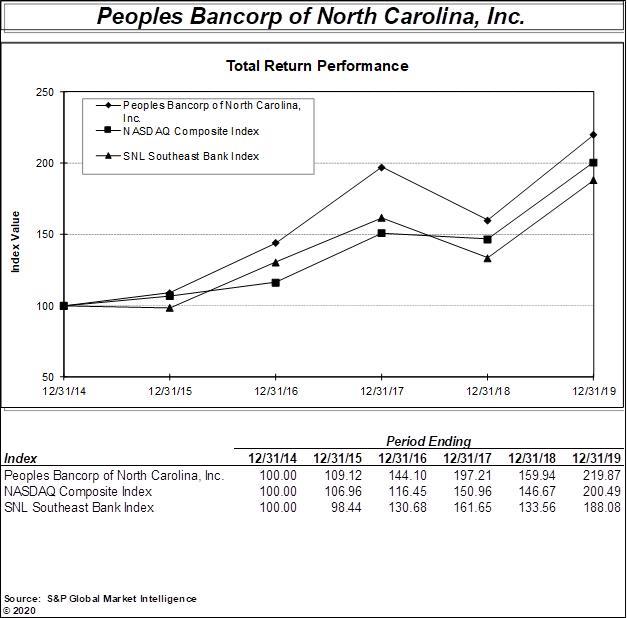
Please wait
UNITED STATES
SECURITIES AND EXCHANGE COMMISSION
Washington, D.C. 20549
SCHEDULE 14A
(Rule 14a-101)
Proxy Statement Pursuant to Section 14(a)
of the Securities Exchange Act of 1934
Filed
by the Registrant [X
]
Filed
by a Party other than the Registrant [
]
Check
the appropriate box:
[
] Preliminary
Proxy Statement [
] Confidential,
for Use of the Commission
[X]
Definitive
Proxy Statement Only
(as permitted by Rule 14a-6(e)(2))
[
] Definitive
Additional Materials
[
] Soliciting
Material Pursuant to
§240.14a-1
|
Peoples Bancorp of North Carolina, Inc.
|
|
(Name
of Registrant as Specified In Its Charter)
|
|
|
|
|
|
(Name
of Person(s) Filing Proxy Statement, if other than the
Registrant)
|
|
Payment
of Filing Fee (Check the appropriate box):
|
|
|
[X]
|
|
No
fee required.
|
|
|
|
|
|
|
|
[
]
|
|
Fee
computed on table below per Exchange Act Rules 14a-6(i)(1) and
0-11.
|
|
|
|
(1)
|
Title
of each class of securities to which transaction
applies:
|
|
|
|
(2)
|
Aggregate
number of securities to which transaction applies:
|
|
|
|
(3)
|
Per
unit price or other underlying value of transaction computed
pursuant to Exchange Act Rule 0-11 (set forth the amount on which
the filing fee is calculated and state how it was
determined):
|
|
|
|
(4)
|
Proposed
maximum aggregate value of transaction:
|
|
|
|
(5)
|
Total
fee paid:
|
|
|
|
|
|
|
|
[
]
|
|
Fee
paid previously with preliminary materials:
|
|
|
|
|
|
|
|
[
]
|
|
Check
box if any part of the fee is offset as provided by Exchange Act
Rule 0-11(a)(2) and identify the filing for which the offsetting
fee was paid previously. Identify the previous filing by
registration statement number, or the Form or Schedule and the date
of its filing.
|
|
|
|
(1)
|
Amount
Previously Paid:
|
|
|
|
(2)
|
Form,
Schedule or Registration Statement No:
|
|
|
|
(3)
|
Filing
Party:
|
|
|
|
(4)
|
Date
Filed:
|

Notice
of 2020 Annual Meeting,
Proxy
Statement and
Annual
Report
PEOPLES
BANCORP OF NORTH CAROLINA, INC.
PROXY
STATEMENT
Table
of Contents
|
Notice
of 2020 Annual Meeting of Shareholders
|
iii
|
|
|
|
|
Proxy
Statement
|
1
|
|
|
|
|
Information
About The Annual Meeting
|
1
|
|
|
|
|
Security Ownership
Of Certain Beneficial Owners and Management |
4
|
|
|
|
|
Section
16(a) Beneficial Ownership Reporting
Compliance
|
6
|
|
|
|
|
Proposal
1 - Election of Directors
|
6
|
|
|
|
|
Director
Nominees
|
7
|
|
|
|
|
Executive
Officers of the Company
|
9
|
|
|
|
|
How
often did our Board of Directors meet during
2019?
|
9
|
|
|
|
|
What is
our policy for director attendance at Annual
Meetings?
|
9
|
|
|
|
|
How can
you communicate with the Board or its
members?
|
9
|
|
|
|
|
Board
Leadership Structure and Risk Oversight
|
9
|
|
|
|
|
Code of
Business Conduct and Ethics
|
10
|
|
|
|
|
Diversity
of the Board of Directors
|
10
|
|
|
|
|
How
can a shareholder nominate someone for election to the Board of
Directors?
|
10
|
|
|
|
|
Who
serves on the Board of Directors of the
Bank?
|
11
|
|
|
|
|
Board
Committees
|
11
|
|
|
|
|
Executive
Committee
|
11
|
|
|
|
|
Governance
Committee
|
11
|
|
|
|
|
Audit
and Enterprise Risk Committee
|
11
|
|
|
|
|
Compensation
Discussion and Analysis
|
13
|
|
|
|
|
Summary
Compensation Table
|
17
|
|
|
|
|
Grants
of Plan-Based Awards
|
18
|
|
|
|
|
Outstanding
Equity Awards at Fiscal Year End
|
18
|
|
|
|
|
Option
Exercises and Stock Vested
|
19
|
|
|
|
|
Pension
Benefits
|
19
|
|
|
|
|
Nonqualified
Deferred Compensation
|
20
|
|
|
|
|
Employment
Agreements
|
20
|
|
|
|
|
Potential
Payments upon Termination or Change in
Control
|
21
|
|
|
|
|
2009
Omnibus Stock Option and Long Term Incentive
Plan
|
21
|
|
|
|
|
Director
Compensation
|
22
|
|
|
|
Indebtedness of and
Transactions with Management and Directors
|
24
|
|
|
|
|
Equity
Compensation Plan Information
|
26
|
|
|
|
|
Stock
Performance Graph
|
27
|
|
|
|
Proposal 2 -
Approval of the Company’s 2020 Omnibus Stock Option and Long
Term Incentive Plan
|
28
|
|
|
|
Proposal 3 -
Ratification of Selection of Independent Registered Public
Accounting Firm
|
32
|
|
|
|
|
Audit
Fees Paid to Independent Auditors
|
32
|
|
|
|
|
Date
for Receipt of Shareholder Proposals
|
33
|
|
|
|
|
Other
Matters
|
33
|
|
|
|
|
Miscellaneous
|
33
|
Appendices
Appendix A –
Annual Report
Appendix B –
2020 Omnibus Plan
PEOPLES
BANCORP OF NORTH CAROLINA, INC.
Post
Office Box 467
518
West C Street
Newton,
North Carolina 28658-0467
(828)
464-5620
NOTICE
OF 2020 ANNUAL MEETING OF SHAREHOLDERS
NOTICE
IS HEREBY GIVEN that the 2020 Annual Meeting of Shareholders of
Peoples Bancorp of North Carolina, Inc. (the “Company”) will be held as
follows:
|
Place:
|
Catawba Country
Club
1154 Country Club
Road
Newton, North
Carolina
|
|
|
|
|
Date:
|
May 7,
2020
|
|
|
|
|
Time:
|
11:00 a.m., Eastern
Time
|
The
purposes of the Annual Meeting are to consider and vote upon the
following matters:
●
To elect ten
persons who will serve as members of the Board of Directors until
the 2021 Annual Meeting of Shareholders or until their successors
are duly elected and qualified;
●
To approve a new
Peoples Bancorp of North Carolina, Inc. 2020 Omnibus Stock
Ownership and Long Term Incentive Plan;
●
To ratify the
appointment of Elliott Davis, PLLC as the Company’s
independent registered public accounting firm for the fiscal year
ending December 31, 2020; and
●
To consider and act
on any other matters that may properly come before the Annual
Meeting or any adjournment.
The
Board of Directors has established March 6, 2020, as the record
date for the determination of shareholders entitled to notice of
and to vote at the Annual Meeting. If an insufficient number of
shares is present in person or by proxy to constitute a quorum at
the time of the Annual Meeting, the Annual Meeting may be adjourned
in order to permit further solicitation of proxies by the
Company.
Your
vote is important. We urge you to vote as soon as possible so that
your votes will be properly recorded. You may vote by executing and
returning your proxy card in the accompanying envelope, or by
voting electronically over the Internet or by telephone. Please
refer to the proxy card enclosed for information on voting
electronically and by phone. If you attend the Annual Meeting, you
may vote in person and the proxy will not be used.
We are actively monitoring the public health and travel concerns
relating to the coronavirus (COVID-19) and the protocols that
federal, state, and local governments may impose. In the event it
is not possible or advisable to hold the annual meeting in person,
we will announce alternative arrangements for the meeting, which
may include holding the meeting by means of remote participation.
Please monitor the Company’s website at www.peoplesbanknc.com
under the heading “About Us—Investor Relations”
for updated information. If you are planning to attend the meeting,
please check the website one week prior to the meeting date. As
always, we encourage you to vote your shares prior to the annual
meeting.
By
Order of the Board of Directors,
Lance A.
Sellers
President and Chief
Executive Officer
Newton,
North Carolina
March
25, 2020
PEOPLES
BANCORP OF NORTH CAROLINA, INC.
______________________________________
______________________________________
Annual
Meeting of Shareholders
To Be
Held On May 7, 2020
_____________________________________
This
Proxy Statement is being mailed to our shareholders on or about
March 25, 2020, for solicitation of proxies by the Board of
Directors of Peoples Bancorp of North Carolina, Inc. Our principal
executive offices are located at 518 West C Street, Newton, North
Carolina 28658. Our telephone number is (828)
464-5620.
In this
Proxy Statement, the terms “we,” “us,” “our” and the
“Company” refer to Peoples
Bancorp of North Carolina, Inc. The term “Bank” means Peoples Bank,
our wholly-owned, North Carolina-chartered bank subsidiary. The
terms “you” and
“your”
refer to the shareholders of the Company.
Important
Notice Regarding the Availability of Proxy Materials for the
Shareholder Meeting to Be Held on May 7, 2020. The Notice, Proxy
Statement and the Annual Report to Shareholders for the year ended
December 31, 2019 are also available at https://www.snl.com/IRWebLinkX/GenPage.aspx?IID=4050385&GKP=202713.
You may also access the above off-site website by going to
www.peoplesbanknc.com
and click on the link.
INFORMATION
ABOUT THE ANNUAL MEETING
Your
vote is very important. For this reason, our Board of Directors is
requesting that you allow your common stock to be represented at
the 2020 Annual Meeting of Shareholders by the proxies named on the
enclosed proxy card.
When is the Annual
Meeting?
May 7, 2020, at 11
a.m., Eastern Time.
Where will the
Annual Meeting be held?
At the Catawba
Country Club, 1154 Country Club Road, Newton, North
Carolina.
What
items will be voted on at the
Annual
Meeting?
1.
ELECTION OF
DIRECTORS. To elect ten directors to serve until the 2021 Annual
Meeting of Shareholders.
2.
APPROVAL OF THE
2020 OMNIBUS PLAN. To approve a new Peoples Bancorp of North
Carolina, Inc. 2020 Omnibus Stock Ownership and Long Term Incentive
Plan (the “2020
Omnibus Plan”).
3.
RATIFICATION OF
SELECTION OF INDEPENDENT REGISTERED PUBLIC ACCOUNTING FIRM. To
ratify the appointment of Elliott Davis, PLLC (“Elliott Davis”) as the
Company’s independent registered public accounting firm for
fiscal year 2020.
4.
OTHER BUSINESS. To
consider any other business as may properly come before the Annual
Meeting or any adjournment.
Who can
vote?
Only holders of
record of our common stock at the close of business on March 6,
2020 (the “Record
Date”) will be entitled to notice of and to vote at
the Annual Meeting and any adjournment of the Annual Meeting. On
the Record Date, there were 5,914,304 shares of our common stock
outstanding and entitled to vote and 655 shareholders of
record.
How do I vote by
proxy?
You may vote your
shares by marking, signing and dating the enclosed proxy card and
returning it in the enclosed postage-paid envelope or by voting
electronically over the Internet or by telephone using the
information on the proxy card. If you return your signed proxy card
before the Annual Meeting, the proxies will vote your shares as you
direct. The Board of Directors has appointed proxies to represent
shareholders who cannot attend the Annual Meeting in
person.
For the
election of directors, you may vote for (1) all of the nominees,
(2) none of the nominees, or (3) all of the nominees except those
you designate. If a nominee for election as a director becomes
unavailable for election at any time at or before the Annual
Meeting, the proxies will vote your shares for a substitute
nominee. For each other item of business, you may vote
“FOR” or “AGAINST” or you may
“ABSTAIN” from voting.
If you
return your signed proxy card but do not specify how you want to
vote your shares, the proxies will vote them “FOR” the
election of all of our nominees for directors and “FOR”
all other proposals presented in this Proxy Statement in accordance
with recommendations from the Board of Directors.
If your
shares are held in the name of a broker or other nominee
(i.e., held in
“street name”), you will need to obtain a proxy
instruction card from the broker holding your shares and return the
card as directed by your broker. Your broker is not permitted to vote on your
behalf on the election of directors unless you provide specific
instructions by following the instructions from your broker about
voting your shares by telephone or Internet or completing and
returning the voting instruction card provided by your broker. For
your vote to be counted in the election of directors you will need
to communicate your voting decision to your bank, broker or other
holder of record before the date of the Annual
Meeting.
We are
not aware of any other matters to be brought before the Annual
Meeting. If matters other than those discussed above are properly
brought before the Annual Meeting, the proxies may vote your shares
in accordance with their best judgment.
How do I change or
revoke my proxy?
You can change or
revoke your proxy at any time before it is voted at the Annual
Meeting in any of three ways: (1) by delivering a written notice of
revocation to the Secretary of the Company; (2) by delivering
another properly signed proxy card to the Secretary of the Company
with a more recent date than your first proxy card or by changing
your vote by telephone or the Internet; or (3) by attending the
Annual Meeting and voting in person. You should deliver your
written notice or superseding proxy to the Secretary of the Company
at our principal executive offices listed above.
How many votes can
I cast?
You are entitled to
one vote for each share held as of the Record Date on each nominee
for election and each other matter presented for a vote at the
Annual Meeting. You may not vote your shares cumulatively in the
election of directors.
How
many votes are required to approve
the
proposals?
If a quorum is
present at the Annual Meeting, each director nominee will be
elected by a plurality of the votes cast in person or by proxy. If
you withhold your vote on a nominee, your shares will not be
counted as having voted for that nominee. The proposal to approve
the 2020 Omnibus Plan will be approved by the affirmative vote of
the holders of a majority of the shares present, or represented by
proxy, at the Annual Meeting. The proposal to ratify the
appointment of the Company’s independent registered public
accounting firm for 2020 will be approved if the votes cast in
favor exceed the votes cast in opposition.
Any
other matters properly coming before the Annual Meeting for a vote
will require the affirmative vote of the holders of a majority of
the shares represented in person or by proxy at the Annual Meeting
and entitled to vote on that matter.
In the
event there are insufficient votes present at the Annual Meeting
for a quorum or to approve or ratify any proposal, the Annual
Meeting may be adjourned in order to permit the further
solicitation of proxies.
What
constitutes a “quorum” for
the Annual
Meeting?
A majority of the
outstanding shares of our common stock entitled to vote at the
Annual Meeting, present in person or represented by proxy,
constitutes a quorum (a quorum is necessary to conduct business at
the Annual Meeting). Your shares will be considered part of the
quorum if you have voted your shares by proxy or by telephone or
Internet. Abstentions, broker non-votes and votes withheld from any
director nominee count as shares present at the Annual Meeting for
purposes of determining a quorum.
Who pays for the
solicitation of proxies?
We will pay the
cost of preparing, printing and mailing materials in connection
with this solicitation of proxies. In addition to solicitation by
mail, our officers, directors and regular employees, as well as
those of the Bank, may make solicitations personally, by telephone
or otherwise without additional compensation for doing so. We
reserve the right to engage a proxy solicitation firm to assist in
the solicitation of proxies for the Annual Meeting. We will, upon
request, reimburse brokerage firms, banks and others for their
reasonable out-of-pocket expenses in forwarding proxy materials to
beneficial owners of stock or otherwise in connection with this
solicitation of proxies.
3
SECURITY
OWNERSHIP OF CERTAIN BENEFICIAL OWNERS AND MANAGEMENT
The
Exchange Act requires that any person who acquires the beneficial
ownership of more than five percent (5%) of the Company’s
common stock notify the Securities and Exchange Commission (the
“SEC”)
and the Company. Following is certain information, as of the Record
Date, regarding those persons or groups who held of record, or who
are known to the Company to own beneficially, more than five
percent (5%) of the Company’s outstanding common
stock.
|
Name and Address
of Beneficial Owner
|
Amount and
Nature of Beneficial Ownership1
|
|
|
Christine S.
Abernethy
P.O. Box
386
Newton, NC
28658
|
725,3383
|
12.26%
|
|
Tontine Financial
Partners, LP
55 Railroad Avenue,
3rd Floor
Greenwich, CT
06830-6378
|
347,6514
|
5.88%
|
|
Tontine Management,
LLC
55 Railroad
Avenue
Greenwich, CT
06830
|
347,6515
|
5.88%
|
|
Tontine Asset
Associates, LLC
55 Railroad
Avenue
Greenwich, CT
06830
|
142,5806
|
2.41%
|
|
Jeffrey L.
Gendell
55 Railroad
Avenue
Greenwich, CT
06830
|
490,2317
|
8.29%
|
________________________________
1
Unless otherwise
noted, all shares are owned directly of record by the named
individuals, by their spouses and minor children, or by other
entities controlled by the named individuals. Voting and investment
power is not shared unless otherwise indicated.
2
Based upon a total
of 5,914,304 shares of
common stock outstanding as of the Record Date.
3
Carolina Glove
Company, Inc. owns 118,363 shares of common stock. These shares are
included in the calculation of Ms. Abernethy’s total
beneficial ownership interest. Ms. Abernethy owns approximately 50%
of the stock of Carolina Glove Company, Inc. The business is
operated by a family committee. Ms. Abernethy has no active
day-to-day participation in the business affairs of Carolina Glove
Company, Inc.
4
Based on a Schedule
13G/A (Amendment No. 12) filed by Tontine Financial Partners, L.P.,
Tontine Management, LLC, Tontine Overseas Associates, LLC, Tontine
Asset Associates, LLC and Jeffrey L. Gendell with the SEC on
February 13, 2020 (the “2020 Schedule 13G/A”).
Represents the number of shares of common stock owned directly by
Tontine Financial Partners, L.P.
5 Based on the 2020
Schedule 13G/A, Tontine Management, LLC is the general partner of
Tontine Financial Partners, L.P. Represents the number of shares of
common stock owned by Tontine Financial Partners, L.P.
6 Based on the 2020
Schedule 13G/A, Tontine Asset Associates, LLC is the general
partner of Tontine Capital Overseas Master Fund II, LP. Represents
the number of shares of common stock owned by Tontine Capital
Overseas Master Fund II, LP.
7 Represents the
number of shares of common stock owned directly by Tontine
Financial Partners, L.P. and Tontine Capital Overseas Master Fund
II, LP.
Set
forth below is certain information, as of the Record Date (unless
otherwise indicated), regarding those shares of common stock owned
beneficially by each of the persons who currently serves as a
member of the Board of Directors, is a nominee for election to the
Board of Directors at the Annual Meeting, or is a named executive
officer of the Company. Also shown is the number of shares of
common stock owned by the directors and executive officers of the
Company as a group.
|
Name and
Address
|
Amount and
Nature
of
Beneficial
Ownership1
|
|
|
James S.
Abernethy
Post Office Box
327
Newton, NC
28658
|
137,2403
|
2.32%
|
|
Robert C.
Abernethy
Post Office Box
366
Newton, NC
28658
|
172,7104
|
2.92%
|
|
William D. Cable,
Sr.
Post Office Box
467
Newton, NC
28658
|
23,606
|
*
|
|
Douglas S.
Howard
Post Office Box
587
Denver, NC
28037
|
19,9405
|
*
|
|
A. Joseph Lampron,
Jr.
Post Office Box
467
Newton, NC
28658
|
16,934
|
*
|
|
John W. Lineberger,
Jr.
Post Office Box
481
Lincolnton, NC
28092
|
4,610
|
*
|
|
Gary E.
Matthews
210 First Avenue
South
Conover, NC
28613
|
26,738
|
*
|
|
Billy L. Price,
Jr., M.D.
540 11th Ave. Place
NW
Hickory, NC
28601
|
10,091
|
*
|
|
Larry E.
Robinson
Post Office Box
723
Newton, NC
28658
|
66,8746
|
1.13%
|
|
Lance A.
Sellers
Post Office Box
467
Newton, NC
28658
|
25,750
|
*
|
|
William Gregory
Terry
Post Office Box
610
Newton, NC
28658
|
20,234
|
*
|
|
Dan Ray Timmerman,
Sr.
Post Office Box
1148
Conover, NC
28613
|
100,9087
|
1.71%
|
|
Benjamin I.
Zachary
Post Office Box
277
Taylorsville, NC
28681
|
110,6168
|
1.87%
|
All
current directors and nominees and executive officers as a group
(13 people) 665,8109 11.26%
*Does
not exceed one percent of the common stock
outstanding.
______________________________________________
1
Unless otherwise
noted, all shares are owned directly of record by the named
individuals, by their spouses and minor children, or by other
entities controlled by the named individuals. Voting and investment
power is not shared unless otherwise indicated.
2
Based upon a total
of 5,914,304 shares of common
stock outstanding as of the Record Date.
3
Includes 70,441
shares of common stock owned by Alexander Railroad Company. Mr. J.
Abernethy is Vice President, Secretary and Chairman of the Board of
Directors of Alexander Railroad Company.
4
Includes 7,159
shares of common stock owned by Mr. R. Abernethy’s spouse,
for which Mr. R. Abernethy disclaims beneficial
ownership.
5
Includes 495 shares
of common stock owned by Mr. Howard’s spouse, for which Mr.
Howard disclaims beneficial ownership.
6
Includes 19,344
shares of common stock owned by Mr. Robinson’s spouse, for
which Mr. Robinson disclaims beneficial ownership.
7
Includes 2,994
shares of common stock owned by Timmerman Manufacturing, Inc. Mr.
Timmerman is a shareholder, director, Chairman of the Board and the
Chief Executive Officer of Timmerman Manufacturing,
Inc.
8
Includes 70,441
shares of common stock owned by Alexander Railroad Company. Mr.
Zachary is President, Treasurer, General Manager and a Director of
Alexander Railroad Company.
9
The 70,441 shares
owned by Alexander Railroad Company and attributed to Mr. J.
Abernethy and Mr. Zachary are only included once in calculating
this total.
Directors
James S. Abernethy and Robert C. Abernethy are brothers and are
sons of Christine S. Abernethy, who owns in excess of ten percent
(10%) of the common stock of the Company.
SECTION
16(a) BENEFICIAL OWNERSHIP REPORTING COMPLIANCE
Section
16(a) of the Exchange Act requires the Company’s executive
officers and directors, and persons who own more than ten percent
(10%) of the common stock, to file reports of ownership and changes
in ownership with the SEC. Executive officers, directors and
greater than ten percent (10%) beneficial owners are required by
SEC regulations to furnish the Company with copies of all Section
16(a) forms they file.
Based
solely on a review of the copies of such forms furnished to the
Company and written representations from the Company’s
executive officers and directors, the Company believes that during
the fiscal year ended December 31, 2019, its executive officers and
directors and greater than ten percent (10%) beneficial owners
complied with all applicable Section 16(a) filing
requirements.
PROPOSAL
1
ELECTION OF
DIRECTORS
Our
Board of Directors has set its number at ten members. Our current
Bylaws provide that in order to be eligible for consideration at
the Annual Meeting of Shareholders, all nominations of directors,
other than those made by the Governance Committee or the Board of
Directors, must be in writing and must be delivered to the
Secretary of the Company not less than 50 days nor more than 90
days prior to the meeting at which such nominations will be made;
provided, however, that if less than 60 days’ notice of the
meeting is given to the shareholders, such nominations must be
delivered to the Secretary of the Company not later than the close
of business on the tenth day following the day on which the notice
of meeting was mailed.
Information about
the nominees for election to the Board of Directors for a one-year
term until the 2021 Annual Meeting of Shareholders appears below.
All of the nominees are currently serving on the Board of
Directors.
James S.
Abernethy, age 65 (as of February 1, 2020), is employed by
Carolina Glove Company, Inc., a glove manufacturing company as its
Vice President. Mr. Abernethy continues to serve as President and
Assistant Secretary of Midstate Contractors, Inc., a paving company
and also as Vice President, Secretary and Chairman of the Board of
Directors of Alexander Railroad Company. He has served as a
director of the Company since 1992. Mr. Abernethy has a total of 27
years of banking experience and is a graduate of the North Carolina
Bank Directors’ College and attended the initial Advanced
Directors’ Training session offered by the North Carolina
Bank Directors’ College in association with the College of
Management at North Carolina State University. Mr. Abernethy earned
a business administration degree from Gardner Webb University in
North Carolina. Over his 26 years of service on the Board of
Directors, Mr. Abernethy has served on all the Bank’s and the
Company’s committees.
Robert C.
Abernethy, age 69 (as of February 1, 2020), is employed by
Carolina Glove Company, Inc., a glove manufacturing company, as its
President, Secretary and Treasurer. Mr. Abernethy continues to
serve as Secretary and Assistant Treasurer of Midstate Contractors,
Inc., a paving company. He has served as a director of the Company
since 1976 and as Chairman since 1991. Mr. Abernethy has a total of
43 years of banking experience and is a graduate of the North
Carolina Bank Directors’ College and attended the initial
Advanced Directors’ Training session offered by the North
Carolina Bank Directors’ College in association with the
College of Management at North Carolina State University. Mr.
Abernethy earned a B.S. degree from Gardner Webb University in
North Carolina. He serves on the Finance Committee and Investment
Committee of Grace United Church of Christ. Mr. Abernethy also
serves on the board of directors of Carolina Glove Company, Inc.
and Midstate Contractors, Inc. both privately held
companies.
Douglas S.
Howard, age 61 (as of February 1, 2020), is employed by
Denver Equipment Company of Charlotte, Inc. as Vice President and
Treasurer. Mr. Howard is also an owner of Howard, Helderman,
Howard, LLC. He has served as a director of the Company since 2004.
Mr. Howard has a total of 21 years of banking experience and is a
graduate of the North Carolina Bank Directors’ College and
attended the initial Advanced Directors’ Training session
offered by the NC Bank Directors’ College in association with
the College of Management at North Carolina State University. Mr.
Howard also serves as the Chairman of the Board of Trustees of
Catawba Valley Medical Center and as a director of the Board of
Directors of Catawba Valley Medical Group.
John W.
Lineberger, Jr., age 69 (as of February 1, 2020), is
employed by Lincoln Bonded Warehouse Company, a commercial
warehousing facility, as President. He has served as a director of
the Company since 2004. Mr. Lineberger has a total of 15 years of
banking experience and is a graduate of the North Carolina Bank
Directors’ College and attended the initial Advanced
Directors’ Training session offered by the NC Bank
Directors’ College in association with the College of
Management at North Carolina State University. Mr. Lineberger
earned a B.S. degree in business administration from Western
Carolina University.
Gary E.
Matthews, age 64 (as of February 1, 2020), is employed by
Matthews Construction Company, Inc. as its President and a
Director. He has served as a director of the Company since 2001.
Mr. Matthews has a total of 18 years of banking experience, is a
graduate of the North Carolina Bank Directors’ College, and
attended the initial Advanced Directors’ Training session
offered by the NC Bank Directors’ College in association with
the College of Management at North Carolina State University. Mr.
Matthews is also a director of Conover Metal Products, a privately
held company. Mr. Matthews earned a B.S. degree in civil
engineering/construction from North Carolina State
University.
Billy L. Price,
Jr., M.D., age 63 (as of February 1, 2020), is a
Practitioner of Internal Medicine at BL Price Jr Medical
Consultants, PLLC. Dr. Price served on the Board of Trustees of
Catawba Valley Medical Center through 2018. He has served as a
director of the Company since 2004. Dr. Price has a total of 15
years of banking experience and is a graduate of the North Carolina
Bank Directors’ College and attended the initial Advanced
Directors’ Training session offered by the NC Bank
Directors’ College in association with the College of
Management at North Carolina State University. Dr. Price was
previously the owner/pharmacist of Conover Drug Company. He is also
a Medical Director of Healthgram Medical, a private company. Dr.
Price earned a B.S. degree in pharmacy from the University of North
Carolina at Chapel Hill and his MD from East Carolina University
School of Medicine. He serves as Medical Director and Assistant
Professor to Lenoir Rhyne University Physician Assistants Master of
Science Program.
Larry E.
Robinson, age 74 (as of February 1, 2020, is a shareholder,
director and Chief Executive Officer of The Blue Ridge Distributing
Company, Inc., a beer and wine distributor. He is also a director
and member of the Board of Directors of United Beverages of North
Carolina, LLC, a malt beverage beer distributor. He has served as a
director of the Company since 1993. Mr. Robinson has a total of 26
years of banking experience and is a graduate of the North Carolina
Bank Directors’ College. Mr. Robinson attended Western
Carolina University and received an Associate Degree in Business
and Accounting from Catawba Valley Community College in North
Carolina.
William Gregory
Terry, age 52 (as of February 1, 2020), is President of DFH
Holdings and Operator/General Manager of Drum & Willis-Reynolds
Funeral Homes and Crematory and President of Hole-in-One Advantage,
LLC. He has served as a director of the Company since 2004. Mr.
Terry has a total of 15 years of banking experience and is a
graduate of the North Carolina Bank Directors’ College and
attended the initial Advanced Directors’ Training session
offered by the NC Bank Directors’ College in association with
the College of Management at North Carolina State University. Mr.
Terry graduated with a B.S. degree in business management from
Clemson University in South Carolina. Mr. Terry serves on numerous
civic and community boards.
Dan Ray
Timmerman, Sr., age 72 (as of February 1, 2020), is a
shareholder, director, Chairman of the Board of Directors and the
Chief Executive Officer of Timmerman Manufacturing, Inc., a wrought
iron furniture, railings and gates manufacturer. He has served as a
director of the Company since 1995. Mr. Timmerman has a total of 24
years of banking experience and is a graduate of the North Carolina
Bank Directors’ College and attended the initial Advanced
Directors’ Training session offered by the NC Bank
Directors’ College in association with the College of
Management at North Carolina State University. Mr. Timmerman earned
a B.S. degree in business administration with a concentration in
accounting from Lenoir-Rhyne University in North
Carolina.
Benjamin I.
Zachary, age 63 (as of February 1, 2020), is employed by
Alexander Railroad Company as its President, Treasurer, General
Manager and Director. He has served as a director of the Company
since 1995. Mr. Zachary has a total of 24 years of banking
experience and is a graduate of the North Carolina Bank
Directors’ College. Mr. Zachary earned a B.S. degree in
business administration with a concentration in accounting from the
University of North Carolina at Chapel Hill. He worked as a CPA for
a national accounting firm for eight years following graduation
where his assignments included financial statement audits of
several banks. Mr. Zachary is a member of the Taylorsville
Rotary Club and serves as Treasurer for the Taylorsville Rotary
Club and its Foundation.
We have
no reason to believe that any of the nominees for election will be
unable or will decline to serve if elected. In the event of death
or disqualification of any nominee or the refusal or inability of
any nominee to serve as a director, however, the proxies will vote
for the election of another person as they determine in their
discretion or may allow the vacancy to remain open until filled by
the Board of Directors. In no circumstance will any proxy be voted
for more than two nominees who are not named in this Proxy
Statement. Properly executed and returned proxies, unless revoked,
will be voted as directed by you or, in the absence of direction,
will be voted in favor of the election of the recommended nominees.
An affirmative vote of a plurality of votes cast at the Annual
Meeting is necessary to elect a nominee as a director.
THE
BOARD OF DIRECTORS RECOMMENDS YOU VOTE “FOR” ALL OF THE NOMINEES
NAMED ABOVE AS DIRECTORS
Executive
Officers of the Company
During
2019, our executive officers were:
Lance A.
Sellers, age 57 (as of February 1, 2020), serves as the
President and Chief Executive Officer of the Company and the Bank.
Prior to becoming the President and Chief Executive Officer of the
Company and the Bank, Mr. Sellers served as Executive Vice
President and Assistant Corporate Secretary of the Company and
Executive Vice President and Chief Credit Officer of the Bank. He
has been employed by the Company and the Bank since 1998. Mr.
Sellers has a total of 35 years of banking experience. He is a
graduate of the University of North Carolina at Chapel Hill and
served as a senior credit officer at a regional bank headquartered
in North Carolina.
William D.
Cable, Sr., age 51 (as of February 1, 2020), serves as
Executive Vice President, Assistant Corporate Treasurer and
Corporate Secretary of the Company and Executive Vice President and
Chief Operating Officer of the Bank. He has been employed by the
Company and the Bank since 1995, where he has served as Senior Vice
President-Information Services. Mr. Cable has a total of 28 years
of banking experience. Prior to joining the Company, Mr. Cable was
a regulatory examiner with the Federal Deposit Insurance
Corporation. He is a graduate of Western Carolina University and
the School of Banking of the South at Louisiana State
University.
A. Joseph
Lampron, Jr., age 65 (as of February 1, 2020), serves as
Executive Vice President, Chief Financial Officer, Corporate
Treasurer and Assistant Corporate Secretary of the Company and
Executive Vice President and Chief Financial Officer of the Bank.
He has been employed by the Company and the Bank since 2001. Mr.
Lampron is a graduate of the University of North Carolina at Chapel
Hill and upon graduation worked as a certified public accountant
with a national accounting firm. His work with the firm included
audits of banks and thrift institutions. Mr. Lampron has also
served as Chief Financial Officer of a thrift institution and as a
senior change manager in the finance group of a large North
Carolina bank. Mr. Lampron has a total of 40 years of banking
experience.
How
often did our Board of Directors meet during 2019?
Our
Board of Directors held 15 meetings during 2019. All incumbent
directors attended more than 75% of the total number of meetings of
the Board of Directors and its committees on which they served
during the year.
What is
our policy for director attendance at Annual Meetings?
Although it is
customary for all of our directors to attend Annual Meetings of
Shareholders, we have no formal policy in place requiring
attendance. All members of the Board of Directors attended our 2019
Annual Meeting of Shareholders held on May 2, 2019.
How can
you communicate with the Board or its members?
We do
not have formal procedures for shareholder communication with our
Board of Directors. In general, our directors and officers are
easily accessible by telephone, postal mail or e-mail. Any matter
intended for your Board of Directors, or any individual director,
can be directed to Lance Sellers, our President and Chief Executive
Officer, or Joe Lampron, our Chief Financial Officer, at our
principal executive offices at 518 West C Street, Newton, North
Carolina 28658. You also may direct correspondence to our Board of
Directors, or any of its members, in care of the Company at the
foregoing address. Your communication will be forwarded to the
intended recipient unopened.
Board
Leadership Structure and Risk Oversight
Our
Company and the Bank have traditionally operated with separate
Chief Executive Officer and Chairman of the Board of Directors
positions. We believe it is our Chief Executive Officer’s
responsibility to manage the Company and the Chairman’s
responsibility to lead the Board of Directors. Robert Abernethy is
currently serving as Chairman of the Board of Directors, and James
Abernethy is currently serving as the Vice
Chairman of the
Board of Directors. Other than Directors Lineberger and Matthews,
all of the members of the Board of Directors are independent under
applicable NASDAQ listing requirements. The Company has five
standing committees: Executive, Loan Sub-Committee, Governance,
Audit and Enterprise Risk and Compensation. The Chief Executive
Officer serves on the Executive Committee. The Bank, in addition to
the above-named committees, has a Loan Committee and a Loan
Sub-Committee. The duties of the Company’s committees are
described below. Each of the Company’s and the Bank’s
committees considers risk within its area of responsibility. The
Audit and Enterprise Risk Committee and the full Board of Directors
focus on the Company’s most significant risks in the areas of
liquidity, credit, interest rate and general risk management
strategy. The Board of Directors sets policy guidelines in the
areas of loans and asset/liability management which are reviewed on
an on-going basis. While the Board of Directors oversees the
Company’s risk management, the Company’s and the
Bank’s management are responsible for day-to-day risk
management following the dictates of the policy decisions set by
the Board of Directors.
The
Governance Committee, as part of its annual review, evaluates the
Board of Directors leadership structure and performance and reports
its findings to the whole Board of Directors. The Board of
Directors believes that having separate persons serving as Chief
Executive Officer and Chairman provides the optimal board
leadership structure for the Company and its
shareholders.
Code of
Business Conduct and Ethics
The
Company and the Bank have a Code of Business Conduct and Ethics for
its directors, officers and employees. The Code of Business Conduct
and Ethics requires that individuals avoid conflicts of interest,
comply with all laws and other legal requirements, conduct business
in an honest and ethical manner and otherwise act with integrity
and in the best interests of the Company and the Bank. The Code of
Business Conduct and Ethics is a guide to help ensure that all
employees live up to the highest ethical standards of
behavior.
A copy
of the Code of Business Conduct and Ethics is available on the
Bank’s website (www.peoplesbanknc.com)
under Investor Relations.
As is
permitted by SEC rules, the Company intends to post on its website
any amendment to or waiver from any provision in the Code of
Business Conduct and Ethics that applies to the Chief Executive
Officer, the Chief Financial Officer, the Controller, or persons
performing similar functions, and that relates to any element of
the standards enumerated in the rules of the SEC.
Diversity
of the Board of Directors
The
Bank has adopted written diversity policy in its employee handbook,
and such diversity policy was approved by the Board of Directors of
the Bank. The Company and the Bank value diversity in
society, and believe that the virtues and pursuit of diversity are
just as important within the Company and the Bank. The
Company and the Bank adhere to a policy prohibiting discrimination
and harassment on the basis of legally protected characteristics,
including sex, pregnancy, race, color, religion, national origin,
veteran status, age, and disability. While there are currently no
women or minorities serving on the Board of Directors, any
qualified candidate receives equal consideration.
How can
a shareholder nominate someone for election to the Board of
Directors?
Our
Bylaws provide that in order to be eligible for consideration at
the Annual Meeting of Shareholders, all nominations of directors,
other than those made by the Governance Committee or the Board of
Directors, must be in writing and must be delivered to the
Secretary of the Company not less than 50 days nor more than 90
days prior to the meeting at which such nominations will be made.
However, if less than 60 days’ notice of the meeting is given
to the shareholders, such nominations must be delivered to the
Secretary of the Company not later than the close of business on
the tenth day following the day on which the notice of meeting was
mailed.
The
Board of Directors may disregard any nominations that do not comply
with these requirements. Upon the instruction of the Board of
Directors, the inspector of voting for the Annual Meeting may
disregard all votes cast
for a
nominee if the nomination does not comply with these requirements.
Written notice of nominations should be directed to the Secretary
of the Company.
Who
serves on the Board of Directors of the Bank?
The
Bank has ten directors currently serving on its Board of Directors,
who are the same people who are currently directors of the
Company.
During
2019, our Board of Directors had five standing committees, the
Audit and Enterprise Risk Committee, the Governance Committee, the
Compensation Committee, the Executive Committee and the Loan
Sub-Committee. The voting members of these Committees are appointed
by the Board of Directors annually from among its members. Certain
of our executive officers also serve as non-voting, advisory
members of these committees.
Executive Committee. The Executive
Committee performs duties as assigned by the full Board of
Directors. Actions taken by the Executive Committee must be
approved by the full Board of Directors. The following persons
currently serve on the Executive Committee: Directors R. Abernethy,
J. Abernethy, Lineberger, Robinson and Terry, as well as the
President and Chief Executive Officer of the Company in a
non-voting capacity. It meets on an “as needed” basis
and did not meet during 2019.
Governance Committee. The Governance
Committee is responsible for developing and maintaining the
corporate governance policy, as well as acting as the nominating
committee for the Board of Directors. The following persons
currently serve on the Governance Committee: Directors R.
Abernethy, J. Abernethy, Howard, Terry, and Timmerman. All of the
members of the Governance Committee are independent as defined in
the applicable NASDAQ listing standards. The Board of Directors
determines on an annual basis each director’s
independence.
The
Governance Committee, serving as the nominating committee of the
Board of Directors, interviews candidates for membership to the
Board of Directors, recommends candidates to the full Board of
Directors, slates candidates for shareholder votes, and fills any
vacancies on the Board of Directors which occur between shareholder
meetings. The Governance Committee’s identification of
candidates for director typically results from the business
interactions of the members of the Governance Committee or from
recommendations received from other directors or from the
Company’s management.
If a
shareholder recommends a director candidate to the Governance
Committee in accordance with the Company’s Bylaws, the
Governance Committee will consider the candidate and apply the same
considerations that it would to its own candidates. The
recommendation of a candidate by a shareholder should be made in
writing, addressed to the attention of the Governance Committee at
the Company’s corporate headquarters. The recommendation
should include a description of the candidate’s background,
his or her contact information, and any other information the
shareholder considers useful and appropriate for the Governance
Committee’s consideration of the candidate. The criteria
which have been established by the Governance Committee as bearing
on the consideration of a candidate’s qualification to serve
as a director include the following: the candidate’s ethics,
integrity, involvement in the community, success in business,
relationship with the Bank, investment in the Company, place of
residence (i.e., proximity
to the Bank’s market area), and financial
expertise.
The
Governance Committee met twice during the year ended December 31,
2019.
The
Governance Committee has a written charter which is reviewed
annually, and amended as needed, by the Governance Committee. A
copy of the Governance Committee Charter is available on the
Bank’s website (www.peoplesbanknc.com)
under Investor Relations.
Audit and Enterprise Risk Committee.
The Company has a separately designated standing Audit and Risk
Enterprise Committee (the “Audit Committee”) which
was established in accordance with Section 3(a)(58)(A) of the
Exchange Act. The Audit Committee’s responsibilities include
oversight of enterprise risk. The Audit Committee
has a written
charter which is reviewed annually, and amended as needed, by the
Audit Committee. A copy of the Audit Committee Charter is available
on the Bank’s website (www.peoplesbanknc.com)
under Investor Relations. The following persons currently serve on
the Audit Committee: Directors R. Abernethy, J. Abernethy, Howard,
Price, Timmerman and Zachary.
The
Audit Committee meets at least quarterly and, among other
responsibilities, oversees (i) the independent auditing of the
Company; (ii) the system of internal controls that management has
established; and (iii) the quarterly and annual financial
information to be provided to shareholders and the SEC. The Audit
Committee met eight times during the year ended December 31,
2019.
Audit Committee Report. The Audit
Committee has reviewed and discussed the audited financial
statements with management of the Company and has discussed with
the independent auditors the matters required to be discussed by
Auditing Standards No. 16 as amended (AICPA, Professional
Standards, Vol. 1 AU section 380) as adopted by the Public Company
Accounting Oversight Board in Rule 3200T. In addition, the Audit
Committee has received the written disclosures and the letter from
the independent accountants required by the applicable requirements
of the Public Company Accounting Oversight Board regarding the
independent accountant’s communications with the Audit
Committee concerning independence, and has discussed with the
independent accountant the independent accountant’s
independence. Based upon these reviews and discussions, the Audit
Committee recommended to the Board of Directors that the audited
financial statements be included in the Company’s Annual
Report on Form 10-K for the fiscal year ended December 31, 2019 for
filing with the SEC.
|
|
Robert
C. Abernethy
|
Dan R.
Timmerman, Sr.
|
|
|
|
Benjamin I.
Zachary
Douglas
S. Howard
|
James
S. Abernethy
Billy L
Price, Jr. MD, Committee Chair
|
|
Compensation Committee. The Company’s Compensation
Committee is responsible for developing, reviewing, implementing
and maintaining the Bank’s salary, bonus, and incentive award
programs and for making recommendations to the Company’s and
the Bank’s Board of Directors regarding compensation of the
executive officers. Upon recommendation from the Compensation
Committee, the Company’s Board of Directors ultimately
determines such compensation.
All of
the members of the Compensation Committee are independent as
defined in the applicable NASDAQ’s listing standards. The
Board of Directors determines on an annual basis each
director’s independence. The following persons currently
serve on the Compensation Committee: Directors R. Abernethy, J.
Abernethy, Howard, Terry and Timmerman. The Compensation Committee
met three times during the year ended December 31,
2019.
The
Compensation Committee has a written charter which is reviewed
annually, and amended as needed, by the Compensation Committee. A
copy of the Compensation Committee’s Charter is available on
the Bank’s website (www.peoplesbanknc.com)
under Investor Relations.
Compensation Committee Interlocks and Insider
Participation. No member of the Compensation Committee is
now, or formerly was, an officer or employee of the Company or the
Bank. None of the named executive officers serve as a member of the
board of directors of another entity whose executive officers or
directors serve on the Company’s Board of
Directors.
Compensation Committee
Report. The
Compensation Committee has reviewed and discussed the Compensation
Discussion and Analysis in this Proxy Statement with management and
has recommended that it be included in this Proxy Statement and our
Annual Report on Form 10-K filed with the SEC for the year ended
December 31,
2019.
Compensation
Committee
Robert
C. Abernethy
James
S. Abernethy
Douglas
S. Howard
William
Gregory Terry
Dan R.
Timmerman, Sr., Committee Chair
Compensation
Discussion and Analysis
The
following Compensation Discussion and Analysis provides information
with respect to the compensation paid during the year ended
December 31, 2019 to our President and Chief Executive Officer,
Lance A. Sellers, our Chief Financial Officer, A. Joseph Lampron,
Jr. and William D. Cable, Sr. (together, our “named executive
officers”).
Compensation Committee Processes and
Procedures. The
Compensation Committee assists the Board of Directors in
determining appropriate compensation levels for the members of the
Board of Directors and our named executive officers. It also has
strategic and administrative responsibility for a broad range of
compensation issues. It seeks to ensure that we compensate key
management employees effectively and in a manner consistent with
the Compensation Committee’s stated compensation strategy and
relevant requirements of various regulatory entities. A part of
these responsibilities is overseeing the administration of
executive compensation and employee benefit plans, including the
design, selection of participants, establishment of performance
measures, and evaluation of awards pursuant to our annual and
long-term incentive programs.
Compensation Philosophy. The overall
objective of our executive compensation program is to align total
compensation so that the individual executive believes it is fair
and equitable and provides the highest perceived value to our
shareholders and to that individual. In order to accomplish this
overall objective, our executive compensation program is designed
to: (i) attract qualified executives necessary to meet our needs as
defined by the Company’s strategic plans, and (ii) retain and
motivate executives whose performance supports the achievement of
our long-term plans and short-term goals. The executive
compensation program is founded upon the idea that a strong,
performance-oriented compensation program, which is generally
consistent with the practices of our peers, is a key ingredient in
becoming a leading performer among financial institutions of
similar size, and is, therefore, in the best interests of our
shareholders.
The
Compensation Committee considers a number of factors specific to
each executive’s role when determining the amount and mix of
compensation to be paid. These factors are:
●
compensation of the
comparable executives at comparable financial
institutions;
●
financial
performance of the Company (especially on a “net
operating” basis, which excludes the effect of one-time gains
and expenses) over the most recent fiscal year and the prior three
years;
●
composition of
earnings;
●
asset quality
relative to the banking industry;
●
responsiveness to
the economic environment;
●
the Company’s
achievement compared to its corporate, financial, strategic and
operational objectives and business plans; and
●
cumulative
shareholder return.
Elements of the Executive Compensation
Program. The Company’s and the Bank’s
compensation program consists of the following
elements:
Base
Salary. The salaries of our named executive officers are
designed to provide a reasonable level of compensation that is
affordable to the Company and fair to the executive. Salaries are
reviewed annually, and adjustments, if any, are made based on the
review of competitive salaries in our peer group, as well as an
evaluation of the individual officer’s responsibilities, job
scope, and individual performance. For example, we
assess
each officer’s success in achieving budgeted earnings and
return ratios, business conduct and integrity, and leadership and
team building skills.
Annual Cash
Incentive Awards. We believe that annual cash incentive
awards encourage our named executive officers to achieve short-term
targets that are critical to achievement of our long-term strategic
plan. The Bank has a Management Incentive Plan for officers of the
Bank. Participants in the Management Incentive Plan are recommended
annually by the President and Chief Executive Officer to the
Bank’s Board of Directors. Each individual’s incentive
pool is determined by a formula which links attainment of corporate
budget with attainment of individual goals and objectives.
Incentives under the Management Incentive Plan are paid annually.
No named executive officer earned or was paid a cash incentive
under the Management Incentive Plan during the fiscal year ended
December 31, 2019.
Discretionary
Bonus and Service Awards. From time to time the Compensation
Committee may recommend to the Board of Directors that additional
bonuses be paid based on accomplishments that significantly exceed
expectations during the fiscal year. These bonuses are totally
discretionary as to who will receive a bonus and the amount of any
such bonus. In 2019, the Compensation Committee recommended, and
the Board of Directors approved, discretionary bonuses as follows:
$115,000 for Mr. Sellers; $150,000 for Mr. Lampron; and $55,000 for
Mr. Cable. These discretionary bonuses were paid in January of
2020. Under the Service Recognition Program, the Bank gives service
awards to each employee and director for every five years of
service with the Bank to promote longevity of service for both
directors and employees. Service awards are made in the form of
shares of the Company’s common stock plus cash in the amount
necessary to pay taxes on the award. The number of shares awarded
increases with the number of years of service to the
Bank.
Long-Term Equity
Incentive Awards. During part of the fiscal year ended
December 31, 2009, the Company maintained the 2009 Omnibus Stock
Ownership and Long Term Incentive Plan (“2009 Omnibus Plan”),
under which it was permitted to grant incentive stock options,
restricted stock, restricted stock units, stock appreciation
rights, book value shares, and performance units. The purpose of
the 2009 Omnibus Plan was to promote the interests of the Company
by attracting and retaining directors and employees of outstanding
ability and to provide executives of the Company greater incentive
to make material contributions to the success of the Company by
providing them with stock-based compensation which would increase
in value based upon the market performance of the common stock
and/or the corporate achievement of financial and other performance
objectives. The 2009 Omnibus Plan expired on May 7,
2019.
In
making its decision to grant awards to the Company’s named
executive officers under the 2009 Omnibus Plan, the Compensation
Committee considered all elements of such named executive
officer’s compensation. In considering the number of awards
to grant to the Company’s named executive officers, the
Compensation Committee considered each named executive
officer’s contribution to the Company’s
performance.
See
“Grants of Plan-Based Awards” on page 19 of this Proxy Statement,
“Outstanding Equity Awards at Fiscal Year-End” on page
19 of this Proxy Statement and “Option Exercises and Stock
Vested” on page 20 of this Proxy Statement for information on
grants and vesting of restricted stock units to the named executed
officers under the 2009 Omnibus Plan. See “2009 Omnibus Plan
and Long Term Incentive Plan” starting on page 22 of this
Proxy Statement for additional information on the 2009 Omnibus
Plan.
Supplemental
Executive Retirement Agreements. The Bank provides a
non-qualified supplemental executive retirement benefit in the form
of Amended and Restated Executive Salary Continuation Agreements
with Messrs. Sellers, Lampron and Cable. The Committee’s goal
is to provide competitive retirement benefits given the
restrictions on executives within tax-qualified plans. In prior
years, the Compensation Committee worked with a compensation
consultant in analyzing the possible benefits of using supplemental
retirement benefits to address the issues of internal and external
equity in terms of retirement benefits offered to all employees at
the Company as a percentage of final average pay and executives in
our peer group. In connection with the non-qualified supplemental
executive retirement benefits, the Bank purchased life insurance
contracts on the lives of the named executive officers. The
increase in cash surrender value of the life insurance contracts
constitutes the Bank’s contribution to the plan each year.
The Bank will pay benefits to participating officers for a period
between 13 years and the life of the officer. The Bank is the sole
owner of all of the insurance contracts.
Profit Sharing
Plan and 401(k) Plan. The Bank has a Profit Sharing Plan
and 401(k) Plan for all eligible employees. The Bank made no
contribution to the Profit Sharing Plan for the year ended December
31, 2019. No investments in Bank stock have been made by the plan.
Under the Bank’s 401(k) Plan, the Bank matches employee
contributions to a maximum of 4.00% of annual compensation. The
Bank’s 2019 contribution to the 401(k) Plan pursuant to this
formula was approximately $691,000. All contributions to the 401(k)
Plan are tax deferred. The Profit Sharing Plan and 401(k) Plan
permit participants to choose from investment funds which are
selected by a committee comprised of senior management. Employees
are eligible to participate in both the 401(k) Plan and Profit
Sharing Plan beginning in the second month of employment. Both
plans are now “safe harbor” plans, and all participants
are immediately 100% vested in all employer
contributions.
Deferred
Compensation Plan. The Bank maintains a non-qualified
deferred compensation plan for directors and certain officers.
Eligible officers selected by the Bank’s Board of Directors
may elect to contribute a percentage of their compensation to the
plan. Participating officers may elect to invest their deferred
compensation in a restricted list of investment funds. The Bank may
make matching or other contributions to the plan as well, in
amounts determined at the discretion of the Bank. Participants are
fully vested in all amounts contributed to the plan by them or on
their behalf. The Bank has established a Rabbi Trust to hold the
accrued benefits of the participants under the plan. There are no
“above-market” returns provided for in this plan. The
Bank made no contributions to the plan in 2019. Benefits under the
plan are payable in the event of the participant’s
retirement, death, termination, or as a result of hardship. Benefit
payments may be made in a lump sum or in installments, as selected
by the participant.
Employment
Agreements. The Company has employment agreements with each
named executive officer, which the Board of Directors believes
serve a number of functions, including (i) retention of the
executive team; (ii) mitigation of any uncertainty about future
employment and continuity of management in the event of a change in
control; and (iii) protection of the Company and customers through
non-compete and non-solicitation covenants. Additional information
regarding the employment agreements, including a description of key
terms may be found under the heading “Employment
Agreements” starting on page 21 of this Proxy
Statement.
Other
Benefits. Executive
officers are entitled to participate in fringe benefit plans
offered to employees including health and dental insurance plans
and life, accidental death and dismemberment and long-term
disability plans. In addition, the Bank has paid country club dues
for each named executive officer and provides a car allowance to
Mr. Sellers.
The
above elements of each named executive officer’s compensation
are not inter-related. For example, if vesting standards on
restricted stock awards are not achieved, the executive’s
base salary is not increased to make up the difference. Similarly,
the value of previously granted options is not considered by the
Compensation Committee in recommending the other elements of the
compensation package.
The
Compensation Committee did not engage a compensation consultant
during the year ended December 31, 2019. The President and Chief
Executive Officer of the Company and the Bank makes recommendations
to the Committee regarding the compensation of the executive
officers other than his own. The President and Chief Executive
Officer participates in the deliberations, but not in the
decisions, of the Compensation Committee regarding compensation of
executive officers. He does not participate in the Compensation
Committee’s discussion or decisions regarding his own
compensation. The Compensation Committee reports its actions to the
Board of Directors and keeps written minutes of its meetings, which
minutes are maintained with the books and records of the
Company.
The
Compensation Committee also considers the results of the
shareholders’ non-binding vote on executive compensation. At
the 2019 Annual Meeting of Shareholders, 57.78% of the shareholders
who voted at the 2019 Annual Meeting of Shareholders elected to
review the executive compensation of the Company’s named
executive officers once every three years. As such, The Company
will submit a vote to the shareholders on the compensation of its
named executive officers at the 2022 Annual Meeting of
Shareholders. At the 2019 Annual Meeting of Shareholders, 85.40% of
the Shareholders who voted at the 2019 Annual Meeting of
Shareholders approved the executive compensation of the
Company’s named executive officers as presented in the 2019
proxy statement.
2019
Compensation Disclosure Ratio of the Median Annual Total
Compensation of All Company Employees to the Annual Total
Compensation of the Company’s Chief Executive
Officer
We
believe our executive compensation program must be consistent and
internally equitable to motivate our employees to perform in ways
that enhance shareholder value. We are committed to internal pay
equity, and the Compensation Committee monitors the relationship
between the pay of our executive officers and the pay of our
non-executive employees. The Compensation Committee reviewed
a comparison of our Chief Executive Officer’s annual total
compensation in fiscal year 2019 to that of all other Company
employees (including all employees of the Bank) for the same
period. The calculation of annual total compensation of all
employees was determined in the same manner as the “Total
Compensation” shown for our Chief Executive Officer in the
“Summary Compensation Table” on page 18 of this Proxy
Statement.
The
calculation below includes all employees as of October 31,
2019.
The
2019 compensation disclosure ratio of the median annual total
compensation of all Company employees to the annual total
compensation of the Company’s chief executive officer is as
follows:
|
Median Annual Total
Compensation of All Employees
(excluding Lance A. Sellers, Chief Executive
Officer)
|
$43,950
|
|
Annual Total
Compensation of Lance A. Sellers, Chief Executive
Officer
|
$552,257
|
|
Ratio of the Median
Annual Total Compensation of All Employees to
the Annual Total Compensation of Lance A.
Sellers, Chief Executive Officer
|
12.57
|
Summary
Compensation Table
The
executive officers of the Company are not paid any cash
compensation by the Company. However, the executive officers of the
Company also are executive officers of the Bank and receive
compensation from the Bank. The below tables show, for the fiscal
years ended December 31, 2019, 2018 and 2017, the cash compensation
received by, as well as certain other compensation paid or accrued
for those years, to each named executive officer.
SUMMARY
COMPENSATION TABLE
|
Name and
Principal Position
|
Year
|
|
|
|
Change in
Pension Value and Nonqualified Deferred Compensation
Earnings($)
|
All Other
Compensation($)2
|
|
|
|
|
|
|
|
|
|
|
|
Lance A.
Sellers
|
2019
|
336,980
|
115,000
|
-
|
74,098
|
26,179
|
552,257
|
|
President and Chief
Executive
|
2018
|
328,760
|
90,000
|
-
|
68,064
|
30,454
|
517,278
|
|
Officer
|
2017
|
319,185
|
55,000
|
-
|
62,493
|
29,080
|
465,758
|
|
|
|
|
|
|
|
|
|
A. Joseph Lampron,
Jr.
|
2019
|
216,309
|
150,000
|
-
|
25,658
|
24,802
|
416,769
|
|
Executive Vice
President,
|
2018
|
210,009
|
55,000
|
-
|
120,772
|
22,224
|
408,005
|
|
Chief Financial
Officer
|
2017
|
203,892
|
45,000
|
-
|
112,658
|
23,020
|
384,570
|
|
|
|
|
|
|
|
|
|
William D. Cable,
Sr.
|
2019
|
228,174
|
55,000
|
40,086
|
29,227
|
25,081
|
377,568
|
|
Executive Vice
President,
|
2018
|
216,125
|
50,000
|
-
|
26,837
|
24,365
|
317,327
|
|
Chief Operating
Officer
|
2017
|
209,830
|
45,000
|
-
|
24,608
|
24,506
|
303,944
|
________________
1 Amount represents the aggregate
grant date fair value computed in accordance with FASB ASC Topic
718. See Note 1 in the Notes to the Company’s Consolidated
Financial Statements included in the Company’s Annual Report,
which Annual Report is attached here to as Appendix A.
2 All other
compensation is comprised of the following:
|
Name and Principal Position
|
Year
|
Employer
Match($)
|
Car
Allowance($)
|
Country
Club
Dues($)
|
Split
Dollar
Death
Benefit($)
|
Group
Term
Life($)(a)
|
Disability
and
LTC
Premiums($)(b)
|
Dividends
Accrued on Restricted Stock Units($)
|
Other($)
|
|
Lance
A. Sellers
President
and Chief Executive Officer
|
2019
|
11,200
|
1,872
|
3,825
|
570
|
1,548
|
5,894
|
1,270
|
0
|
|
2018
|
11,000
|
2,888
|
3,730
|
539
|
2,899
|
5,628
|
1,270
|
2,500(c)
|
|
|
2017
|
10,800
|
2,888
|
3,636
|
501
|
3,456
|
5,628
|
2,171
|
0
|
|
A.
Joseph Lampron, Jr.
Executive
Vice President, Chief Financial Officer
|
2019
|
11,200
|
0
|
3,660
|
1,464
|
5,626
|
1,900
|
952
|
0
|
|
|
2018
|
10,610
|
0
|
3,630
|
1,359
|
3,688
|
1,984
|
953
|
0
|
|
2017
|
10,800
|
0
|
3,460
|
1,234
|
3,951
|
1,984
|
1,591
|
0
|
|
William
D. Cable, Sr.
Executive
Vice President, Chief Operating Officer
|
2019
|
11,118
|
0
|
3,780
|
496
|
1,047
|
7,688
|
952
|
0
|
|
2018
|
10,795
|
0
|
3,730
|
463
|
2.050
|
6,375
|
952
|
0
|
|
|
2017
|
10,675
|
0
|
3,636
|
433
|
1,796
|
6,375
|
1,591
|
0
|
_________
(a)Represents amounts paid by the Bank for premiums on group
term life insurance in excess of $50,000 for each named executive
officer.
(b)Represents amounts paid by the Bank for premiums on
disability and long-term care insurance for each named executive
officer.
(c)In 2018, Mr. Sellers received 68 shares for 20 years of
service with the Bank and $528 in cash to pay taxes associated with
the award under the Bank’s Service Recognition
Program.
Grants
of Plan-Based Awards
The
Company did not grant any plan-based awards to Messrs. Sellers and
Lampron during the fiscal year ended December 31, 2019. The
following table shows certain information for those grants of
plan-based awards that we made to Mr. Cable during the fiscal year
ended December 31, 2019.
GRANTS
OF PLAN-BASED AWARDS TABLE
|
|
Estimated
Future Payouts Under Equity Incentive Plan
Awards
|
|
|
|
|
|
Name
|
Grant
DateThreshold (#)
|
|
|
All
Other Stock Awards:Numberof Sharesof Stockor Units
(#)
|
All
Other Option Awards: Number of Securities Under- lying Options
(#)
|
Exercise
or Base Price of Option Awards ($/Sh)
|
Grant
Date Fair Value of Stock and Option
Awards
($)
|
|
William D. Cable,
Sr.
|
February 21,
2019
|
--
|
--
|
1,400(1)
|
--
|
--
|
28.43
|
____________________________________
(1) Restricted stock
units vest in full on February 21, 2023.
Outstanding
Equity Awards at Fiscal Year End
Messrs.
Sellers and Lampron did not have any outstanding equity awards at
December 31, 2019. The following table shows certain information
for those outstanding equity awards at December 31,
2019.
OUTSTANDING EQUITY
AWARDS AT FISCAL YEAR-END TABLE
|
|
|
|
Name
|
Number
of Shares or Units of Stock That Have Not Vested
(#)
|
Market
Value of Shares or Units of Stock That Have
Not
Vested ($)
|
Equity
Incentive Plan Awards: Number of Unearned Shares, Units or Other
Rights That Have Not Vested (#)
|
Equity
Incentive Plan Awards: Market or Payout Value of Unearned Shares,
Units or Other Rights That Have Not Vested(2)
($)
|
|
William D. Cable,
Sr.
|
--
|
--
|
1,410(1)
|
46,319
|
______________________________________
(1)
Represents 1,410
restricted stock units that were granted on February 21, 2019 (with
a grant date fair value for each restricted stock unit of $28.43 on
February 21, 2019) and will vest on February 21, 2023.
(2)
Based on a stock
price of $32.85 per share on December 31, 2019.
Option
Exercises and Stock Vested
The
following tables shows, for the fiscal year ended December 31,
2019, those stock options and restricted stock units that vested
for each Messrs. Sellers, Lampron and Cable.
OPTION EXERCISES AND STOCK VESTED TABLE
|
|
|
|
|
Name
|
Number of shares acquired on exercise
(#)
|
Value realized on
exercise (#)
|
Number of shares acquired on vesting
(#)
|
Value realized on vesting
($)
|
|
Lance
A. Sellers
|
--
|
--
|
2,442
|
$68,5471
|
|
A.
Joseph Lampron, Jr.
|
--
|
--
|
1,832
|
$51,4102
|
|
William
D. Cable, Sr.
|
--
|
--
|
1,832
|
$51,4102
|
_________________________________________________________________
1 Represents 2,442 Restricted
Stock Units that vested on February 19, 2019 at a fair market value
on the date of vesting of $68,547.
2 Represents 1,832 Restricted
Stock Units that vested on February 19, 2019 at a fair market value
on the date of vesting of $51,410.
The
following table shows, for the fiscal year ended December 31,
2019, the pension benefits paid or earned by Messrs. Sellers,
Lampron and Cable.
|
|
|
Name
|
Plan
Name
|
Number
of
Years
Credited
Service
|
Present
Value
of
Accumulated
Benefit($)
|
Payments
During
Last
Fiscal
Year($)
|
|
Lance A.
Sellers
|
Amended and
Restated Executive Salary Continuation Agreement1
|
18
|
575,269
|
--
|
|
A. Joseph Lampron,
Jr.
|
Amended and
Restated Executive Salary Continuation Agreement1,2
|
18
|
784,162
|
--
|
|
William D. Cable,
Sr.
|
Amended and
Restated Executive Salary Continuation Agreement1
|
18
|
217,817
|
--
|
_______________________
1 The Bank entered into Amended and Restated Executive
Salary Continuation Agreement with Messrs. Sellers, Lampron and
Cable effective on December 18, 2008. The Amended and Restated
Executive Salary Continuation Agreements for Messrs. Sellers,
Lampron and Cable were further amended on December 10, 2014, and
such amendments were memorialized in a First Amendment to the
Amended and Restated Executive Salary Continuation Agreements
effective February 16, 2018. Unless a separation from service or a
change in control (as defined in the Amended and Restated Executive
Salary Continuation Agreements) occurs before the retirement age
set forth in each Amended and Restated Executive Salary
Continuation Agreement, the Amended and Restated Executive Salary
Continuation Agreements provide for an annual supplemental
retirement benefit to be paid to each of the named executive
officers in 12 equal monthly installments payable on the first day
of each month, beginning with the month immediately after the month
in which the named executive officer attains the normal retirement
age and for the named executive officer’s lifetime, or if
longer, a 13-year term. Under the terms of the Amended and Restated
Executive Salary Continuation Agreements, Mr. Sellers will receive
an annual supplemental retirement benefit of $130,495, Mr. Lampron
will receive an annual supplemental retirement benefit of
$76,554 and Mr. Cable
will receive an annual supplemental retirement benefit of $93,872.
2 As of December 31, 2019, Mr. Lampron was the only named
executive officer eligible to withdraw funds from the plan. Mr.
Lampron, if he elected, could withdrawal 100% of the annual benefit
of $76,554.
Nonqualified
Deferred Compensation
The below table shows the compensation deferred by Messrs. Lampron
and Cable during the year ended December 31, 2019. Mr. Sellers
elected not to defer any portion of his compensation during the
year ended December 31, 2019.
NONQUALIFIED
DEFERRED COMPENSATION TABLE
|
Name
|
Executive
Contributions
in the Last FY ($)(1)
|
Registrant
Contributions
In Last FY ($)
|
Aggregate
Earnings in
Last FY ($)(2)
|
Aggregate
Withdrawals/
Distributions ($)
|
Aggregate
Balance at
Last FYE ($)(3)
|
|
A. Joseph Lampron,
Jr.
|
$6,489
|
--
|
$79,333
|
0
|
$298,595
|
|
William D. Cable,
Sr.
|
$17,809
|
--
|
$153,549
|
0
|
$660,347
|
|
|
|
|
|
|
|
___________________
(1)
The above
contributions were based on the named executive officer’s
deferral elections and the salaries shown in the Summary
Compensation Table. The salaries in the Summary Compensation Table
include these contributions.
(2)
This column
reflects earnings or losses on plan balances in 2019. Earnings may
increase or decrease depending on the performance of the elected
hypothetical investment options. Earnings on these plans are not
“above-market” and thus are not reported in the Summary
Compensation Table. Plan balances may be hypothetically invested in
various mutual funds and common stock as described below.
Investment returns on those funds and common stock ranged from 0%
to 37.47% for the year ended
December 31, 2019.
(3)
This column
represents the year-end balances of the named executive
officer’s nonqualified deferred compensation accounts. These
balances include contributions that were included in the Summary
Compensation Tables in previous years. Amounts in this column
include earnings that were not previously reported in the Summary
Compensation Table because they were not “above-market”
earnings.
On
January 22, 2015, the Company, the Bank and each of (i) Lance A.
Sellers, the President and Chief Executive Officer of the Company
and the Bank, (ii) A. Joseph Lampron, Jr., Executive Vice President
and Chief Financial Officer of the Bank and Executive Vice
President, Chief Financial Officer and Corporate Treasurer of the
Company and (iii) William D. Cable, Sr., Executive Vice President
and Chief Operating Officer of the Bank and Executive Vice
President, Assistant Corporate Treasurer and Assistant Corporate
Secretary of the Company executed an Employment Agreement which
replaced and superseded such executive’s prior employment
agreement (collectively, the “Employment
Agreements”).
Each
Employment Agreement provides for an initial term of 36 months
beginning on January 22, 2015 (the “Effective Date”). On the
first anniversary of the Effective Date and on each anniversary
thereafter (the “Renewal Date”), each
Employment Agreement shall be extended automatically for one
additional year unless the Board of Directors of the Company or the
executive determines, and prior to the Renewal Date sends to the
other party written notice, that the term shall not be extended. If
the Board of Directors of the Company decides not to extend the
term, the Employment Agreement shall nevertheless remain in force
until its existing term expires. Under the Employment Agreements,
the Bank will pay Mr. Sellers a base salary at the rate of at least
$311,400 per year, Mr. Lampron a base salary at the rate of at
least $193,125 per year and Mr. Cable a base salary at the rate of
at least $198,750 per year. The Bank will review each
executive’s total compensation at least annually and in its
sole discretion may adjust an executive’s total compensation
from year to year, but during the term of the Employment Agreement,
Mr. Sellers’s base salary may not decrease below $311,400,
Mr. Lampron’s base salary may not decrease below $193,125 and
Mr. Cable’s base salary may not decrease below $198,750;
provided, however, that periodic increases in base salary, once
granted, may not be subject to revocation. In addition, the
Employment Agreements provide for discretionary bonuses and
participation in other management incentive, pension,
profit-sharing, medical and retirement plans maintained by the
Bank, as well as fringe benefits normally associated with such
executive’s office.
Under
the Employment Agreements, each executive’s employment will
terminate automatically upon death. Otherwise, the Company and the
Bank may terminate each executive’s employment for
“cause”, “without cause” or in the event of
a “disability” (each as defined in the Employment
Agreements). In addition, each executive may voluntarily terminate
his employment upon 60 days prior written notice to
the
Company
and the Bank or for “good reason” (as defined in the
Employment Agreement). Under the Employment Agreements, if the
Company and the Bank terminate an executive’s employment
“without cause”, or an executive terminates his
employment for “good reason”, in each case, other than
in connection with a change of control, then in each case, the
executive would be entitled to receive certain severance payments
and access to welfare benefit plans as more particularly set forth
in the Employment Agreements. Under the Employment Agreements, in
the event that the Company and the Bank terminate an
executive’s employment “without cause”, or an
executive terminates his employment for “good reason”,
in any such case at the time of or within one year after a Change
of Control, then the executive will be entitled to receive certain
change in control payments as more particularly set forth in the
Employment Agreements.
In
addition, each Employment Agreement contains certain restrictive
covenants prohibiting the executive from competing against the
Company and the Bank or soliciting the Company’s or the
Bank’s customers for a period of time following termination
of employment, all as more particularly set forth in the Employment
Agreements.
Potential Payments
upon Termination or Change in Control
Each of
the Employment Agreements provide that in the event the Company
terminates the employment of a named executive officers
“without cause” (as defined in the Employment
Agreements), or the officer terminates his or her employment for
“good reason” (as defined in the Employment
Agreements), in any such case during the employment and at the time
of or within one year after a “change of control” (as
defined in the Employment Agreements), the officer will be entitled
to receive the following payments and benefits: (1) the Company
will pay the officer the aggregate of the following amounts: (a)
the sum of his accrued obligations; (b) the greater of his base
salary, divided by 365 and multiplied by the number of days
remaining in the employment period, or an amount equal to 2.99
times his base salary; and (c) the product of his aggregate cash
bonus for the last completed fiscal year, and a fraction, the
numerator of which is the number of days in the current fiscal year
through the date of termination, and the denominator of which is
365; (2) all restricted stock or restricted stock unit awards
previously granted to the executive and which have not already
become vested and released from restrictions on transfer,
repurchase and forfeiture rights, either as a result of the change
of control or otherwise, shall immediately vest and be released
from such restrictions as of the change of control termination
date; and (3) all options previously granted to the officer that
are unvested as of the change of control termination date will be
deemed vested, fully exercisable and non-forfeitable as of the
change of control termination date (other than transfer
restrictions applicable to incentive stock options) and all
previously granted options that are vested, but unexercised, on the
change of control termination date will remain exercisable, in each
case for the period during which they would have been exercisable
absent the termination of his employment, except as otherwise
specifically provided by the Internal Revenue Code; and (4) his
benefits under all benefit plans that are non-qualified plans will
be 100% vested, regardless of his age or years of service, as of
the change of control termination date.
If the
named executive officers were terminated on December 31, 2019,
“without cause” or for “good reason” at the
time of or within one year after a “change of control”,
Mr. Sellers, Mr. Lampron and Mr. Cable would have been entitled to
receive compensation of approximately $1,355,938, $1,098,927 and
$849,523, respectively, pursuant to their Employment Agreements.
These amounts are calculated based on each officer’s 2019
“Salary” and “Bonus” as shown in the
“Summary Compensation Table” on page 18 of this Proxy
Statement. In addition, if a “change in control” (as
defined in the 2009 Omnibus Plan) had occurred on December 31,
2019, all unvested restricted stock units previously granted to
each of Mr. Sellers, Mr. Lampron and Mr. Cable would have vested
immediately. On December 31, 2019, these unvested restricted stock
units had a fair market value of $46,319 for Mr. Cable. Neither Mr.
Sellers nor Mr. Lampron had outstanding restricted stock units at
December 31, 2019.
2009
Omnibus Stock Option and Long Term Incentive Plan
The
purpose of the 2009 Omnibus Plan was to promote the interests of
the Company by attracting and retaining directors and employees of
outstanding ability and to provide executive and other key
employees of the Company and its subsidiaries greater incentive to
make material contributions to the success of the Company by
providing them with stock-based compensation which would increase
in value based upon the market performance of the common stock
and/or the corporate achievement of financial and other performance
objectives.
Rights Which May Be Granted. Under the
2009 Omnibus Plan, the Committee had the right to grant or award
eligible participants stock options, rights to receive restricted
shares of common stock, restricted stock units, performance units
(each equivalent to one share of common stock), SARs, and/or book
value shares. All stock options, rights to receive restricted
shares of common stock, restricted stock units, performance units
(each equivalent to one share of common stock), SARs, and/or book
value shares under the 2009 Omnibus Plan had to be granted or
awarded by May 7, 2019. The Board of Directors had provided for
360,000 shares of the Company’s common stock to be included
in the 2009 Omnibus Plan to underlie stock options, rights to
receive restricted shares of common stock, restricted stock units,
performance units (each equivalent to one share of common stock),
SARs, and/or book value shares which may have been granted
thereunder. The 2009 Omnibus Plan expired on May 7, 2019. See
“Proposal 2 –Approval of the Company’s 2020
Omnibus Stock Option and Long Term Incentive Plan” beginning
on page 29 of this Proxy Statement for a description of the types
of rights that could have been awarded under the 2009 Omnibus Plan
and that may be awarded under the 2020 Omnibus Plan if approved by
the shareholders at the Annual Meeting.
Director
Compensation
Directors’ Fees. Members of the
Company’s Board of Directors receive no fees or compensation
for their service. However, all members of the Board of Directors
are also directors of the Bank and are compensated for that
service.
During
the year ended December 31, 2019, each director received a fee of
$1,200 for each Bank Board of Directors meeting attended, an
additional fee of $750 for each committee meeting attended and a
retainer of $15,000. In addition, the Chairman of the Bank’s
Board of Directors received an additional $250 per meeting attended
and the chairpersons of each committee received an additional $150
per meeting attended. Directors receive $500 for special meetings
held via conference call in lieu of the Board of Director and
committee meeting fees set forth above.
Directors who are
members of the Board of Directors of Real Estate Advisory Services,
Inc., Peoples Investment Services, Inc. and PB Real Estate
Holdings, LLC, and Community Bank Real Estate Solutions, LLC,
subsidiaries of the Bank, receive $750 per meeting.
The
Bank maintains a Service Recognition Program, under which
directors, officers and employees are eligible for awards. Under
the Service Recognition Program, directors, officers and employees
are awarded a combination of common stock of the Company and cash
in the amount necessary to pay taxes on the award, with the amount
of the award based upon the length of service to the Bank. Any
common stock awarded under the Service Recognition Program is
purchased by the Bank on the open market, and no new shares are
issued by the Company under the Service Recognition
Program.
Directors’ Stock Benefits Plan.
Members of the Board of Directors were eligible to participate in
the 2009 Omnibus Plan. On March 22, 2012, the Company granted 891
Restricted Stock Units, each Restricted Stock Unit being comprised
of the right to receive one share of the Company’s common
stock, to each director. The Restricted Stock Units awarded to
directors on March 22, 2012 vested in full on March 22, 2017, and
upon vesting, each Restricted Stock Unit had a market value of
$25.91 for a total value of $23,085, which was distributed to each
director in a combination of stock or cash, as chosen by each
director. On May 23, 2013, the Company granted 891 Restricted Stock
Units, each Restricted Stock Unit being comprised of the right to
receive one share of the Company’s common stock, to each
director. The Restricted Stock Units awarded to directors on May
23, 2013 vested in full on May 23, 2017, and upon vesting, each
Restricted Stock Unit had a market value of $24.94 for a total
value of $22,218, which was distributed to each director in a
combination of stock or cash, as chosen by each director. On
February 20, 2014, the Company granted 715 Restricted Stock Units,
each Restricted Stock Unit being comprised of the right to receive
one share of the Company’s common stock, to each director.
The Restricted Stock Units awarded to directors on February 20,
2014 vested in full on February 20, 2017, and upon vesting, each
Restricted Stock Unit had a market value of $24.78 for a total
value of $17,719, which was distributed to each director in a
combination of stock or cash, as chosen by each director. On
February 19, 2015, the Company granted 413 Restricted Stock Units,
each unit being comprised of the right to receive one share of the
Company’s common stock, to each director. The Restricted
Stock Units awarded to directors on February 19, 2015 vested in
full on February 19, 2019, and upon vesting, each Restricted Stock
Unit had a market value of $28.07 for a total value of
$11,593, which was
distributed to each director in a combination of stock or cash, as
chosen by each director. The number of Restricted Stock Units
described above have been restated to reflect the 10% stock
dividend issued in December, 2017. The Company did not grant any
plan-based awards to directors during the fiscal year ended
December 31, 2019.
Directors’ Deferred Compensation
Plan. The Bank maintains a non-qualified deferred
compensation plan for all of its directors. The Bank’s
directors are also directors of the Company. Under the deferred
compensation plan, each director may defer all or a portion of his
fees to the plan each year. The director may elect to invest the
deferred compensation in a restricted list of investment funds. The
Bank may make matching contributions to the plan for the benefit of
the director from time to time at the discretion of the Bank.
Directors are fully vested in all amounts they contribute to the
plan and in any amounts contributed by the Bank. The Bank has
established a Rabbi Trust to hold the directors’ accrued
benefits under the plan. There are no “above-market”
returns provided for in the deferred compensation plan. The Bank
made no contributions to this plan in 2019.
Benefits under the
plan are payable in the event of the director’s death,
resignation, removal, failure to be re-elected, retirement or in
cases of hardship. Directors may elect to receive deferred
compensation payments in one lump sum or in
installments.
Directors’ Supplemental Retirement
Plan. The Bank maintains a non-qualified supplemental
retirement benefits plan for all its directors. The supplemental
retirement benefits plan is designed to provide a retirement
benefit to the directors while at the same time minimizing the
financial impact on the Bank’s earnings. Under the
supplemental retirement benefits plan, the Company purchased life
insurance contracts on the lives of each director. The increase in
cash surrender value of the contracts constitutes the
Company’s contribution to the supplemental retirement
benefits plan each year. The Bank will pay annual benefits to each
director for 15 years beginning upon retirement from the Board of
Directors. The Bank is the sole owner of all of the insurance
contracts.
The
following table reports all forms of compensation paid to or
accrued for the benefit of each director during the 2019 fiscal
year.
DIRECTOR
COMPENSATION
|
Name
|
Fees Earned or Paid in Cash ($)
|
|
|
Non-Equity Incentive Plan Compensation ($)
|
Change in Pension Value and Nonqualified Deferred Compensation
Earnings2
($)
|
All Other Compensation ($)3
|
|
|
James S.
Abernethy
|
40,600
|
--
|
--
|
--
|
8,795
|
--
|
49,395
|
|
Robert C.
Abernethy
|
48,850
|
--
|
--
|
--
|
13,317
|
--
|
62,167
|
|
Douglas S.
Howard
|
42,800
|
--
|
--
|
--
|
5,459
|
1,275
|
49,534
|
|
John W. Lineberger,
Jr.
|
34,050
|
--
|
--
|
--
|
12,622
|
1,275
|
47,947
|
|
Gary E.
Matthews
|
32,100
|
--
|
--
|
--
|
7,974
|
--
|
40,074
|
|
Billy L. Price,
Jr., M.D.
|
40,750
|
--
|
--
|
--
|
7,212
|
1,275
|
49,237
|
|
Larry E.
Robinson
|
34,800
|
--
|
--
|
--
|
6,279
|
--
|
41,079
|
|
William Gregory
Terry
|
36,300
|
--
|
--
|
--
|
2,672
|
1,275
|
40,247
|
|
Dan Ray Timmerman,
Sr.
|
44,350
|
--
|
--
|
--
|
6,279
|
--
|
50,629
|
|
Benjamin I.
Zachary
|
39,550
|
--
|
--
|
--
|
7,243
|
--
|
46,793
|
_________________________
1
The Company did not
grant any plan-based awards to directors during the fiscal year
ended December 31, 2019. At December 31, 2019, no director had
restricted stock units outstanding. See information above under the
heading “Directors Stock Benefit Plan” for information
on each individual grant of restricted stock units.
2
Change in Pension
Value and Nonqualified Deferred Compensation Earnings represents
the expense accrued by the Bank for each director under the
Directors’ Supplemental Retirement Plan as described
above.
3
In 2019, Directors
Howard, Lineberger, Price and Terry received 33 shares of the
Company’s stock and $285.00 in cash for their 15 years of
service as a director under the Bank’s Service Recognition
Program
Indebtedness
of and Transactions with Management and Directors
The
Company is a “listed issuer” under the rules and
regulations of the Exchange Act whose common stock is listed on
NASDAQ. The Company uses the definition of independence contained
in NASDAQ’s listing standards to determine the independence
of its directors and that the Board of Directors and each standing
committee of the Board of Directors is in compliance with NASDAQ
listing standards for independence.
Certain directors and executive officers of the
Bank and their immediate families and associates were customers of
and had transactions with the Bank in the ordinary course of
business during 2019. All outstanding loans, extensions of credit
or overdrafts, endorsements and guarantees outstanding at any time
during 2019 to the Bank’s executive officers and directors
and their family members were made in the ordinary course of its
business. These loans are currently made on substantially the same
terms, including interest rates and collateral, as those then
prevailing for comparable transactions with persons not related to
the lender, and did not involve more than the normal risk of collectability or
present any other unfavorable features.
The
Board of Directors routinely, and no less than annually, reviews
all transactions, direct and indirect, between the Company or the
Bank and any employee or director, or any of such person’s
immediate family members. The standard applied to such transactions
are to review such transactions for comparable market values for
similar transactions. All material facts of the transactions and
the director’s interest are discussed by all disinterested
directors and a decision is made about whether the transaction is
fair to the Company and the Bank. A majority vote of all
disinterested directors is required to approve the transaction. See
“Code of Business Conduct and Ethics” on page
11
of this
Proxy Statement. During the fiscal year ended December 31, 2019,
there were no related party transactions that would be required to
be reported that were not reviewed in accordance with the
above.
The
Bank leases two of its facilities from Shortgrass Associates,
L.L.C. (“Shortgrass”). Director
John W. Lineberger, Jr. owns 25% of the membership interests in
Shortgrass. Each of the facilities is subject to a 20-year lease
between the Bank and Shortgrass. Pursuant to the terms of the
leases for the two facilities leased by the Bank, during 2019 the
Bank paid a total of $230,926 to Shortgrass in lease payments for
these facilities, and the dollar value of Director John W.
Lineberger, Jr.’s interest in such lease payments was
approximately $57,731 (or 25% x $230,926). The total aggregate
dollar value of all lease payments due by the Bank to Shortgrass
starting on January 1, 2020 and continuing until the end of each
lease, is $444,979, and the total aggregate dollar value of
Director John W. Lineberger, Jr.’s interest in all such lease
payments is approximately $111,245 (or 25% x
$444,979).
The
Board of Directors also evaluates the influence family
relationships may have on the independence of directors who are
related by blood or marriage. Christine S. Abernethy, a greater
than ten percent (10%) shareholder of the Company, has two sons,
Robert C. Abernethy and James S. Abernethy, who serve on the Board
of Directors. All of the non-related directors have determined that
the family relationships among Christine S. Abernethy, James S.
Abernethy and Robert C. Abernethy do not affect the brothers’
independence as directors.
Equity
Compensation Plan Information
The following table sets forth certain information regarding
outstanding options and shares for future issuance under the Equity
Compensation Plans as of December 31, 2019. Individual equity
compensation arrangements are aggregated and included within this
table. This table excludes any plan, contract or arrangement that
provides for the issuance of options, warrants or other rights that
are given to our shareholders on a pro rata basis and any employee
benefit plan that is intended to meet the qualification
requirements of Section 401(a) of the Internal Revenue
Code.
|
Plan Category
|
Number of securities to be issued upon exercise of
outstanding option, warrants and rights (1), (2), (3) and
(4)
|
Weighted-average exercise price of outstanding options, warrants
and rights (3)
|
Number of securities remaining available for future issuance under
equity compensation plans (excluding securities reflected in column
(a)) (5) (6)
|
|
|
|
|
|
|
Equity compensation
plans approved by security holders
|
18,233
|
$32.85
|
-
|
|
Equity compensation
plans not approved by security holders
|
-
|
-
|
-
|
|
Total
|
18,233
|
$32.85
|
-
|
|
|
|
|
|
|
(1)
Includes 5,104 restricted stock units (adjusted for the 10% stock
dividend granted in December of 2017) granted on February 18, 2016
under the 2009 Omnibus Plan. These restricted stock grants vested
on February 20, 2020
|
|
|
|
|
|
|
(2)
Includes 4,114 restricted stock units (adjusted for the 10% stock
dividend granted in December, 2017) granted on March 1, 2017 under
the 2009 Omnibus Plan. The restricted stock grants vest on March 1,
2021.
|
|
|
|
|
|
|
(3)
Includes 3,725 restricted stock units granted on January 24, 2018
under the 2009 Omnibus Plan. These restricted stock units vest on
January 24, 2022.
|
|
|
|
|
|
|
(4)
Includes 5,290 restricted stock units granted on February 21, 2019
under the 2009 Omnibus Plan. These restricted stock units vest on
February 21, 2023.
|
|
|
|
|
|
|
(5) The
exercise price used for the grants of restricted stock units under
the 2009 Omnibus Plan is $32.85, the closing price for the
Company’s stock on December 31, 2019.
|
|
|
|
|
|
|
(6)
Reflects shares currently reserved for possible issuance under the
2009 Omnibus Plan. The 2009 Omnibus Plan expired on May 7,
2019.
|
PROPOSAL
2
APPROVAL
OF THE COMPANY’S 2020 OMNIBUS STOCK OPTION
AND
LONG TERM INCENTIVE PLAN
The
2009 Omnibus Plan was approved by shareholders in May of
2009. The 2009 Omnibus Plan expired under its own terms on
May 7, 2019. The Board of Directors has determined that it is
in the best interests of the Company and its shareholders to
propose shareholder approval of the 2020 Omnibus Plan.
General. The purpose of the 2020
Omnibus Plan is to promote the interests of the Company by
attracting and retaining directors and employees of outstanding
ability and to provide executive and other key employees of the
Company and its subsidiaries greater incentive to make material
contributions to the success of the Company by providing them with
stock-based compensation which will increase in value based upon
the market performance of the common stock and/or the corporate
achievement of financial and other performance objectives. A
copy of the 2020 Omnibus Plan is attached hereto as Appendix
B.
The
2020 Omnibus Plan will be administered by the Governance Committee
of the Board of Directors (the “Committee”).
Subject to the terms of the 2020 Omnibus Plan, the Committee and
the Board of Directors have authority to construe and interpret,
for eligible employees and eligible directors, respectively, the
2020 Omnibus Plan, to determine the terms and provisions of Rights
(as defined below) to be granted under the 2020 Omnibus Plan, to
define the terms used in the 2020 Omnibus Plan and in the Rights
granted thereunder, to prescribe, amend and rescind rules and
regulations relating to the 2020 Omnibus Plan, to determine the
individuals to whom and the times at which Rights shall be granted
and the number of shares to be subject to, or to underlie, each
Right awarded, and to make all other determinations necessary or
advisable for the administration of the 2020 Omnibus
Plan.
Rights Which May Be Granted.
Under the 2020 Omnibus Plan, the Committee may grant or award
eligible participants Options, rights to receive restricted shares
of common stock, long term incentive units (each equivalent to one
share of common stock), and/or stock appreciation rights. These
grants and awards are referred to herein as the
“Rights.” If approved by the shareholders at the
Annual Meeting, all Rights must be granted or awarded by May 7,
2029, the tenth anniversary of the date the shareholders approve
the 2020 Omnibus Plan. The Board of Directors has provided
for 300,000 shares of the Company’s common stock be included
in the 2020 Omnibus Plan to underlie Rights which may be granted
thereunder.
Options. Options granted under
the 2020 Omnibus Plan to eligible directors and employees may be
either incentive stock options (“ISOs”) or
non-qualified stock options (“NSOs”). The
exercise price of an Option may not be less than 100% of the
last-transaction price for the common stock quoted by the Nasdaq
Market on the date of grant.
The
Committee shall determine the expiration date of each Option
granted, up to a maximum of ten years from the date of grant.
In the Committee’s discretion, it may specify the period or
periods of time within which each Option will first become
exercisable, which period or periods may be accelerated or
shortened by the Committee.
Each
Option granted will terminate upon the expiration date established
by the Committee or if earlier, immediately as of the date the
holder is no longer an eligible employee or director for any reason
other than death or disability. In the event the holder ceases to
be an eligible employee or director by reason of death or
disability, each Option granted will terminate upon the earlier of
(i) twelve months after the holder ceases to be an eligible
employee or director by reason of death or disability, and
(ii) the expiration date established by the
Committee.
Restricted Stock and Restricted Stock
Units. The Committee may award Rights to acquire
shares of common stock or restricted stock units, subject to
certain transfer restrictions (“Restricted Stock” or
“Restricted Stock Unit”) to eligible participants under
the 2020 Omnibus Plan for such purchase price per share, if any, as
the Committee, in its discretion, may determine appropriate.
The Committee shall determine the expiration date for each
Restricted Stock or Restricted Stock Unit award, up to a maximum of
ten years from the date of grant. In the Committee’s
discretion, it may specify the period or periods of time within
which each Restricted Stock or Restricted Stock Unit award will
first become exercisable, which period or periods may be
accelerated or shortened
by the
Committee. Under the terms of the 2020 Omnibus Plan, the
Committee also has the discretion to pay out awards of Restricted
Stock Units in the Company’s common stock, cash or a
combination of stock and cash.
Awards
of Restricted Stock and Restricted Stock Units shall terminate in
the same manner as described above in connection with the
termination of Options.
Performance Units. Under the 2020
Omnibus Plan, the Committee may grant to eligible directors and
employees awards of long term incentive performance units, each
equivalent in value to one share of common stock
(“Units”). Except as otherwise provided, Units
awarded may be distributed only after the end of a performance
period of two or more years, as determined by the Committee,
beginning with the year in which the awards are
granted.
The
percentage of the Units awarded that are to be distributed will
depend on the level of financial and other performance goals
achieved by the Company during the performance period. The
Committee may adopt one or more performance categories in addition
to, or in substitution for, a performance category or may eliminate
all performance categories other than financial performance.
All performance categories other than financial performance may not
be applied in the aggregate as a factor of more than one against
financial performance.
As soon
as practicable after each performance period, the percentage of
Units awarded that are to be distributed, based on the levels of
performance achieved, will be determined and distributed to the
recipients of such awards in the form of a combination of shares of
common stock and cash. No distribution of Units, based on
financial and other performance, will be made if a minimum average
percentage of the applicable measurement of performance, as
established by the Committee, is not achieved for the performance
period. Units awarded, but which the recipients are not entitled to
receive, will be cancelled.
In the
event of the death or disability of a Unit recipient prior to the
end of any performance period, the number of Units awarded for such
performance period will be reduced in proportion to the number of
months remaining in the performance period after the date of death
or disability; and the remaining portion of the award, if any, may,
in the discretion of the Committee, be adjusted based upon the
levels of performance achieved prior to the date of death or
disability, and distributed within a reasonable time after death or
disability. In the event a recipient of Units ceases to be an
eligible director or employee for any reason other than death or
disability, all Units awarded, but not yet distributed, will be
cancelled.
If the
recipient’s award agreement so provides, an amount equal to
the dividend payable on one share of common stock (a
“dividend equivalent credit”) will be determined and
credited on the payment date to each Unit recipient’s account
for each Unit awarded and not yet distributed or cancelled.
Such amount will be converted within the account to an additional
number of Units equal to the number of shares of common stock which
could be purchased at the last-transaction price of the common
stock on the Nasdaq Market on the dividend payment
date.
No
dividend equivalent credits may be credited or distribution of
Units made if, at the time of crediting or distribution, (i)
the regular quarterly dividend on the common stock has been omitted
and not subsequently paid or there exists any default in payment of
dividends on any such outstanding shares of common stock;
(ii) the rate of dividends on the common stock is lower than
at the time the Units to which the dividend equivalent credit
relates were awarded, adjusted for certain changes; (iii)
estimated consolidated net income of the Company for the
twelve-month period preceding the month the dividend equivalent
credit or distribution would otherwise have been made is less than
the sum of the amount of the dividend equivalent credits and Units
eligible for distribution under the 2020 Omnibus Plan in that month
plus all dividends applicable to such period on an accrual basis,
either paid, declared or accrued at the most recently paid rate, on
all outstanding shares of common stock; or (iv) the dividend
equivalent credit or distribution would result in a default in any
agreement by which the Company is bound.
If an
extraordinary event occurs during a performance period which
significantly alters the basis upon which the performance levels
were established, the Committee may make adjustments which it deems
appropriate in the performance levels. Such events may
include changes in accounting practices, tax, financial institution
laws or regulations or other laws or regulations, economic changes
not in the ordinary course of business cycles, or compliance with
judicial decrees or other legal requirements.
Stock Appreciation Rights. The
2020 Omnibus Plan provides that the Committee may award to eligible
directors and employees rights to receive cash based upon increases
in the market price of common stock over the last transaction price
of the common stock on the Nasdaq Market (the “Base
Price”) on the date of the award
(“SAR’s”). The expiration date of a SAR may
be no more than ten years from the date of award.
Each
SAR awarded by the Committee may be exercisable immediately or may
become vested over such period or periods as the Committee may
establish, which periods may be accelerated or shortened in the
Committee's discretion.
Each
SAR awarded will terminate upon the expiration date established by
the Committee, or upon termination of the employment or
directorship of the SAR recipient as described above in connection
with the termination of Options.
Adjustments. In the event the
outstanding shares of the common stock are increased, decreased,
changed into or exchanged for a different number or kind of
securities as a result of a stock split, reverse stock split, stock
dividend, recapitalization, merger, share exchange acquisition, or
reclassification, appropriate proportionate adjustments will be
made in (i) the aggregate number or kind of shares which may be
issued pursuant to exercise of, or which underlie, Rights; (ii) the
exercise or other purchase price, or Base Price, and the number
and/or kind of shares acquirable under, or underlying, Rights;
(iii) and rights and matters determined on a per share basis under
the 2020 Omnibus Plan. Any such adjustment will be made by
the Committee, subject to ratification by the Board of
Directors. Except with regard to Units awarded under
the 2020 Omnibus Plan, no adjustment in the Rights will be required
by reason of the issuance of common stock, or securities
convertible into common stock, by the Company for cash or the
issuance of shares of common stock by the Company in exchange for
shares of the capital stock of any corporation, financial
institution or other organization acquired by the Company or a
subsidiary thereof in connection therewith.
Any
shares of common stock allocated to Rights granted under the 2020
Omnibus Plan, which Rights are subsequently cancelled or forfeited,
will be available for further allocation upon such cancellation or
forfeiture.
Change in Control. In the event of a
change in control (as such term is defined in the 2020 Omnibus
Plan), all Rights under the 2020 Omnibus Plan will fully vest and
be released from any restrictions on transfer. In addition, in the
event of a change in control, the Committee may, with 10
days’ advance notice to affected persons, cancel any Right
and pay to the holders thereof in cash or common stock or both, the
value of the Right based upon the price per share of common stock
received or to be received by the Company’s shareholders in
the change in control. The Committee may also elect in its
discretion to cancel underwater Options or SARs without the payment
of consideration therefor.
Clawback. The Company may cancel any
Right, require reimbursement of any Right or previously paid
compensation under the Plan or an award agreement, or use any other
right of recoupment of equity or compensation in accordance with
any clawback policy adopted by the Company and as may be in effect
from time to time.
Federal Income Tax Treatment of Rights.
Options. Under current provisions
of the Internal Revenue Code of 1986, as amended (the “
Code”), the federal income tax treatment of ISOs and NSOs is
different. Options granted to employees under the 2020
Omnibus Plan may be ISOs which are designed to result in beneficial
tax treatment to the employee but not a tax deduction to the
Company.
The
holder of an ISO generally is not taxed for federal income tax
purposes on either the grant or the exercise of the option.
However, the optionee must include in his or her federal
alternative minimum tax income any excess (the “Bargain
Element”) of the acquired common stock’s fair market
value at the time of exercise over the exercise price paid by the
optionee. Furthermore, if the optionee sells, exchanges, gives or
otherwise disposes of such common stock (other than in certain
types of transactions) either within two years after the ISO was
granted or within one year after the ISO was exercised (an
“Early Disposition”), the optionee generally must
recognize the Bargain Element as compensation income for regular
federal income tax purposes. Any gain realized on the disposition
in excess of the Bargain Element is subject to recognition under
the usual rules applying to dispositions
of property.
If a taxable sale or exchange is made after such holding periods
are satisfied, the difference between the exercise price and the
amount realized upon the disposition of the common stock generally
will constitute a capital gain or loss for tax
purposes.
Options
granted to directors under the 2020 Omnibus must be
“NSOs.” In general, the holder of an NSO will
recognize at the time of exercise of the NSO, compensation income
equal to the amount by which the fair market value of the common
stock received on the date of exercise exceeds the sum of the
exercise price and any amount paid for the NSO.
If an
optionee exercises an ISO or NSO and delivers shares of common
stock as payment for part or all of the exercise price of the stock
purchased (the “Payment Stock”), no gain or loss
generally will be recognized with respect to the Payment Stock;
provided, however, if the Payment Stock was acquired pursuant to
the exercise of an ISO, the optionee will be subject to recognizing
as compensation income the Bargain Element on the Payment Stock as
an Early Disposition if the exchange for the new shares occurs
prior to the expiration of the holding periods for the Payment
Stock.
The
Company generally would not recognize gain or loss or be entitled
to a deduction upon either the grant of an ISO or NSO or the
optionee’s exercise of an ISO. The Company generally will
recognize gain or loss or be entitled to a deduction upon the
exercise of an NSO. If there is an Early Disposition, the Company
generally would be entitled to deduct the Bargain Element as
compensation paid to the optionee.
Restricted Stock and Restricted Stock
Units. Pursuant to Section 83 of the Code, recipients
of Restricted Stock awards under the 2020 Omnibus Plan will
recognize ordinary income in an amount equal to the fair market
value of the shares of common stock granted to them at the time
that the shares vest and become transferable unless a timely
election to be taxed upon grant is made by the recipient under
Section 83(b) of the Code. Recipients of Restricted Stock Unit
awards will recognize ordinary income in an amount equal to the
fair market value of the shares of common stock granted to them at
the time the shares vest and are distributed to them. The Company
will be entitled to deduct as a compensation expense for tax
purposes the same amounts recognized as income by recipients of
Restricted Stock and Restricted Stock Unit awards in the year in
which such amounts are included in income.
Performance Units. The Company
expects that participants generally will not be taxed on the award
of Units. Instead, any cash and the then fair market value of
any common stock received by the participants upon the distribution
of a Unit generally will be taxable to the participants as
compensation income upon such distribution. At that time, the
Company generally will be entitled to claim a deduction in an
amount equal to the compensation income.
SARs. Pursuant to Section
83 of the Code, recipients of SARs under the 2020 Omnibus Plan will
recognize, at the time a SAR award is exercised, ordinary income in
an amount equal to the difference between the fair market value of
the common stock at the time of award of the SAR and the fair
market value of the common stock at the time that the SAR is
exercised. The Company will be entitled to deduct as a
compensation expense for tax purposes the same amounts recognized
as income by recipients of SAR awards in the year in which such
amounts are included in income.
The information
above and other descriptions of federal income tax consequences are
necessarily general in nature and do not purport to be
complete. Moreover, statutory provisions are subject to
change, as are their interpretations, and their application may
vary in individual circumstances. Such descriptions may not
be used to avoid any federal tax penalty. Such descriptions
are written to support this proxy statement. Each taxpayer should
seek advice based on the taxpayer’s particular circumstances
from an independent tax advisor. Finally, the consequences
under applicable state and local income tax laws may not be the
same as under the federal income tax laws.
PROPOSAL
3
RATIFICATION
OF SELECTION OF INDEPENDENT REGISTERED PUBLIC ACCOUNTING
FIRM
Elliott
Davis, our registered independent public accounting firm for the
fiscal year ended December 31, 2019, has been appointed by the
Audit Committee as our registered independent public accounting
firm for the fiscal year ending December 31, 2020, and you are
being asked to ratify this appointment. Fees charged by this firm
are at rates and upon terms that are customarily charged by other
registered independent public accounting firms. A representative of
the firm will be present at the Annual Meeting and will have an
opportunity to make a statement if he or she desires to do so and
to respond to appropriate questions.
Audit
Fees Paid to Independent Auditors
The
following table represents the approximate fees for professional
services rendered by Elliott Davis for the audit of our annual
financial statements and review of our financial statements
included in our Forms 10-Q for the fiscal years ended December 31,
2019 and 2018 and fees billed for audit-related services, tax
services and all other services rendered, for each of such
years.
|
|
|
|
|
|
|
|
|
|
Audit
Fees1
|
$202,445
|
$194,626
|
|
|
|
Audit-Related
Fees2
|
$12,660
|
$10,593
|
|
|
|
Tax
Fees3
|
$25,750
|
$38,500
|
|
|
|
All Other
Fees
|
--
|
--
|
|
|
__________________________
1 Includes amounts for the testing of
management’s assertions regarding internal controls in
accordance with the Federal Deposit Insurance Corporation
Improvement Act. Audit Fees include amounts for the integrated
audit of the consolidated financial statements and internal control
over financial reporting (Sarbanes-Oxley Section 404).
2 Represents amounts
for the audit of the Company’s Profit Sharing and 401(k)
Plan.
3 Represents amounts for assistance in the preparation of
our various federal, state and local tax returns.
All
audit related services, tax services and other services giving rise
to the fees listed under “Audit-Related Fees”,
“Tax Fees” and “All Other Fees” in the
table above were pre-approved by the Audit Committee, which
concluded that the provision of such services was compatible with
the maintenance of that firm’s independence in the conduct of
its auditing functions. The Audit Committee’s Charter
provides for pre-approval of all audit and non-audit services to be
provided by our independent auditors. The Charter authorizes the
Audit Committee to delegate to one or more of its members
pre-approval authority with respect to permitted services, provided
that any such approvals are presented to the Audit Committee at its
next scheduled meeting.
THE
BOARD OF DIRECTORS RECOMMENDS THAT THE SHAREHOLDERS VOTE
FOR RATIFICATION OF
THE APPOINTMENT OF ELLIOTT DAVIS AS THE COMPANY’S INDEPENDENT
REGISTERED PUBLIC ACCOUNTING FIRM FOR THE FISCAL YEAR ENDING
DECEMBER 31, 2020.
DATE
FOR RECEIPT OF SHAREHOLDER PROPOSALS
It is
presently anticipated that the 2021 Annual Meeting of Shareholders
of the Company will be held on May 6, 2021. In order for
shareholder proposals to be included in the Company’s proxy
materials for that meeting, such proposals must be received by the
Secretary of the Company at the Company’s principal executive
office no later than November 24, 2020 and meet all other
applicable requirements for inclusion in the Proxy
Statement.
In the
alternative, a shareholder may commence his or her own proxy
solicitation and present a proposal from the floor at the 2021
Annual Meeting of Shareholders of the Company. In order to do so,
the shareholder must notify the Secretary of the Company in
writing, at the Company’s principal executive office no later
than February 8, 2021, of his or her proposal. If the Secretary of
the Company is not notified of the shareholder’s proposal by
February 8, 2021, the Board of Directors may vote on the proposal
pursuant to the discretionary authority granted by the proxies
solicited by the Board of Directors for the 2021 Annual Meeting of
Shareholders.
OTHER
MATTERS
Management knows of
no other matters to be presented for consideration at the Annual
Meeting or any adjournments thereof. If any other matters shall
properly come before the Annual Meeting, it is intended that the
proxyholders named in the enclosed form of proxy will vote the
shares represented thereby in accordance with their judgment,
pursuant to the discretionary authority granted
therein.
MISCELLANEOUS
The
Annual Report of the Company for the year ended December 31, 2019,
which includes financial statements audited and reported upon by
the Company’s registered independent public accounting firm,
is being mailed as Appendix A to this Proxy Statement; however, it
is not intended that the Annual Report be deemed a part of this
Proxy Statement or a solicitation of proxies.
THE
FORM 10-K FILED BY THE COMPANY WITH THE SEC, INCLUDING THE
FINANCIAL STATEMENTS AND SCHEDULES THERETO, WILL BE PROVIDED FREE
OF CHARGE UPON WRITTEN REQUEST DIRECTED TO: PEOPLES BANCORP OF
NORTH CAROLINA, INC., POST OFFICE BOX 467, 518 WEST C STREET,
NEWTON, NORTH CAROLINA 28658-0467, ATTENTION: A. JOSEPH LAMPRON,
JR.
By
Order of the Board of Directors,
Lance
A. Sellers
President and Chief
Executive Officer
Newton,
North Carolina
March
25, 2020
APPENDIX
A
ANNUAL
REPORT
OF
PEOPLES
BANCORP OF NORTH CAROLINA, INC.
PEOPLES
BANCORP OF NORTH CAROLINA, INC.
General Description of Business
Peoples
Bancorp of North Carolina, Inc. (“Bancorp”), was formed
in 1999 to serve as the holding company for Peoples Bank (the
“Bank”). Bancorp is a bank holding company registered
with the Board of Governors of the Federal Reserve System (the
“Federal Reserve”) under the Bank Holding Company Act
of 1956, as amended (the “BHCA”). Bancorp’s
principal source of income is dividends declared and paid by the
Bank on its capital stock, if any. Bancorp has no operations and
conducts no business of its own other than owning the Bank.
Accordingly, the discussion of the business which follows concerns
the business conducted by the Bank, unless otherwise indicated.
Bancorp and its wholly owned subsidiary, the Bank, along with the
Bank’s wholly owned subsidiaries are collectively called the
“Company”.
The
Bank, founded in 1912, is a state-chartered commercial bank serving
the citizens and business interests of the Catawba Valley and
surrounding communities through 20 banking offices, as of December
31, 2019, located in Lincolnton, Newton, Denver, Catawba, Conover,
Maiden, Claremont, Hiddenite, Hickory, Charlotte, Cornelius,
Mooresville, Raleigh, and Cary North Carolina. The Bank also
operates loan production offices in Charlotte, Denver and Durham,
North Carolina. The Company’s fiscal year ends December 31.
At December 31, 2019, the Company had total assets of $1.2 billion,
net loans of $843.2 million, deposits of $966.5 million, total
securities of $200.0 million, and shareholders’ equity of
$134.1 million.
The
Bank operates three banking offices focused on the Latino
population that were formerly operated as a division of the Bank
under the name Banco de la Gente (“Banco”). These
offices are now branded as Bank branches and considered a separate
market territory of the Bank as they offer normal and customary
banking services as are offered in the Bank’s other branches
such as the taking of deposits and the making of
loans.
The
Bank has a diversified loan portfolio, with no foreign loans and
few agricultural loans. Real estate loans are predominately
variable rate and fixed rate commercial property loans, which
include residential development loans to commercial customers.
Commercial loans are spread throughout a variety of industries with
no one particular industry or group of related industries
accounting for a significant portion of the commercial loan
portfolio. The majority of the Bank’s deposit and loan
customers are individuals and small to medium-sized businesses
located in the Bank’s market area. The Bank’s loan
portfolio also includes Individual Taxpayer Identification Number
(ITIN) mortgage loans generated thorough the Bank’s Banco
offices. Additional discussion of the Bank’s loan portfolio
and sources of funds for loans can be found in
“Management’s Discussion and Analysis of Financial
Condition and Results of Operations” on pages A-4 through
A-23 of the Annual Report, which is included in this Form 10-K as
Exhibit (13).
The
operations of the Bank and depository institutions in general are
significantly influenced by general economic conditions and by
related monetary and fiscal policies of depository institution
regulatory agencies, including the Federal Reserve, the Federal
Deposit Insurance Corporation (the “FDIC”) and the
North Carolina Commissioner of Banks (the
“Commissioner”).
At
December 31, 2019, the Company employed 306 full-time employees and
31 part-time employees, which equated to 326 full-time equivalent
employees.
Subsidiaries
The
Bank is a subsidiary of the Company. At December 31, 2019, the Bank
had four subsidiaries, Peoples Investment Services, Inc., Real
Estate Advisory Services, Inc., Community Bank Real Estate
Solutions, LLC (“CBRES”) and PB Real Estate Holdings,
LLC. Through a relationship with Raymond James Financial Services,
Inc., Peoples Investment Services, Inc. provides the Bank’s
customers access to investment counseling and non-deposit
investment products such as stocks, bonds, mutual funds, tax
deferred annuities, and related brokerage services. Real Estate
Advisory Services, Inc. provides real estate appraisal and real
estate brokerage services. CBRES serves as a
“clearing-house” for appraisal services for community
banks. Other banks are able to contract with CBRES to find and
engage appropriate appraisal companies in the area where the
property to be appraised is located. This type of service ensures
that the appraisal process remains independent from the financing
process within the Bank. PB Real Estate Holdings, LLC acquires,
manages and disposes of real property, other collateral and other
assets obtained in the ordinary course of collecting debts
previously contracted. In 2019 the Company launched PB Insurance
Agency, which is part of CBRES.
In June
2006, the Company formed a wholly owned Delaware statutory trust,
PEBK Capital Trust II (“PEBK Trust II”), which issued
$20.0 million of guaranteed preferred beneficial interests in the
Company’s junior subordinated deferrable interest debentures.
All of the common securities of PEBK Trust II are owned by the
Company. The proceeds from the issuance of the common securities
and the trust preferred securities were used by PEBK Trust II to
purchase $20.6 million of junior subordinated debentures of the
Company, which pay a floating rate equal to three-month LIBOR plus
163 basis points. The proceeds received by the Company from the
sale of the junior subordinated debentures were used in December
2006 to repay the trust preferred securities issued in December
2001 by PEBK Capital Trust, a wholly owned Delaware statutory
trust
of the
Company, and for general purposes. The debentures represent the
sole asset of PEBK Trust II. PEBK Trust II is not included in the
consolidated financial statements. The Company redeemed $5.0
million of outstanding trust preferred securities in December
2019.
The
trust preferred securities issued by PEBK Trust II accrue and pay
quarterly at a floating rate of three-month LIBOR plus 163 basis
points. The Company has guaranteed distributions and other payments
due on the trust preferred securities to the extent PEBK Trust II
does not have funds with which to make the distributions and other
payments. The net combined effect of the trust preferred securities
transaction is that the Company is obligated to make the
distributions and other payments required on the trust preferred
securities.
These
trust preferred securities are mandatorily redeemable upon maturity
of the debentures on June 28, 2036, or upon earlier redemption as
provided in the indenture. The Company has the right to redeem the
debentures purchased by PEBK Trust II, in whole or in part, which
became effective on June 28, 2011. As specified in the indenture,
if the debentures are redeemed prior to maturity, the redemption
price will be the principal amount plus any accrued but unpaid
interest.
This report contains certain forward-looking statements with
respect to the financial condition, results of operations and
business of the Company. These forward-looking statements involve
risks and uncertainties and are based on the beliefs and
assumptions of management of the Company and on the information
available to management at the time that these disclosures were
prepared. These statements can be identified by the use of words
like “expect,” “anticipate,”
“estimate” and “believe,” variations of
these words and other similar expressions. Readers should not place
undue reliance on forward-looking statements as a number of
important factors could cause actual results to differ materially
from those in the forward-looking statements. Factors that could
cause actual results to differ materially include, but are not
limited to, (1) competition in the markets served by the Bank, (2)
changes in the interest rate environment, (3) general national,
regional or local economic conditions may be less favorable than
expected, resulting in, among other things, a deterioration in
credit quality and the possible impairment of collectibility of
loans, (4) legislative or regulatory changes, including changes in
accounting standards, (5) significant changes in the federal and
state legal and regulatory environment and tax laws, (6) the impact
of changes in monetary and fiscal policies, laws, rules and
regulations and (7) other risks and factors identified in the
Company’s other filings with the Securities and Exchange
Commission. The Company undertakes no obligation to update any
forward-looking statements
|
|
Dollars in Thousands Except Per Share Amounts
|
|
|
|
|
|
|
|
|
|
|
|
|
|
|
|
Summary of Operations
|
|
|
|
|
|
|
Interest
income
|
$49,601
|
45,350
|
41,949
|
39,809
|
38,666
|
|
Interest
expense
|
3,757
|
2,146
|
2,377
|
3,271
|
3,484
|
|
Net
interest income
|
45,844
|
43,204
|
39,572
|
36,538
|
35,182
|
|
Provision
for (reduction of) loan losses
|
863
|
790
|
(507)
|
(1,206)
|
(17)
|
|
Net
interest income after provision
|
|
|
|
|
|
|
for
loan losses
|
44,981
|
42,414
|
40,079
|
37,744
|
35,199
|
|
Non-interest
income (1)
|
17,739
|
16,166
|
15,364
|
16,236
|
15,256
|
|
Non-interest
expense (1)
|
45,517
|
42,574
|
41,228
|
42,242
|
37,722
|
|
Earnings
before income taxes
|
17,203
|
16,006
|
14,215
|
11,738
|
12,733
|
|
Income
tax expense
|
3,136
|
2,624
|
3,947
|
2,561
|
3,100
|
|
Net
earnings
|
$14,067
|
13,382
|
10,268
|
9,177
|
9,633
|
|
|
|
|
|
|
|
|
Selected Year-End Balances
|
|
|
|
|
|
|
Assets
|
$1,154,882
|
1,093,251
|
1,092,166
|
1,087,991
|
1,038,481
|
|
Investment
securities available for sale
|
195,746
|
194,578
|
229,321
|
249,946
|
268,530
|
|
Net
loans
|
843,194
|
797,578
|
753,398
|
716,261
|
679,502
|
|
Mortgage
loans held for sale
|
4,417
|
680
|
857
|
5,709
|
4,149
|
|
Interest-earning
assets
|
1,058,937
|
1,007,078
|
996,509
|
999,201
|
977,079
|
|
Deposits
|
966,517
|
877,213
|
906,952
|
892,918
|
832,175
|
|
Interest-bearing
liabilities
|
668,353
|
657,110
|
679,922
|
698,120
|
679,937
|
|
Shareholders'
equity
|
$134,120
|
123,617
|
115,975
|
107,428
|
104,864
|
|
Shares
outstanding
|
5,912,300
|
5,995,256
|
5,995,256
|
5,417,800
|
5,510,538
|
|
|
|
|
|
|
|
|
Selected Average Balances
|
|
|
|
|
|
|
Assets
|
$1,143,338
|
1,094,707
|
1,098,992
|
1,076,604
|
1,038,594
|
|
Investment
securities available for sale
|
185,302
|
209,742
|
234,278
|
252,725
|
266,830
|
|
Loans
|
834,517
|
777,098
|
741,655
|
703,484
|
669,628
|
|
Interest-earning
assets
|
1,055,730
|
1,007,484
|
998,821
|
985,236
|
952,251
|
|
Deposits
|
932,647
|
903,120
|
895,129
|
856,313
|
816,628
|
|
Interest-bearing
liabilities
|
675,992
|
665,165
|
700,559
|
705,291
|
707,611
|
|
Shareholders'
equity
|
$134,670
|
123,797
|
116,883
|
113,196
|
106,644
|
|
Shares
outstanding (2)
|
5,941,873
|
5,995,256
|
5,988,183
|
6,024,970
|
6,115,159
|
|
|
|
|
|
|
|
|
Profitability Ratios
|
|
|
|
|
|
|
Return
on average total assets
|
1.23%
|
1.22%
|
0.93%
|
0.85%
|
0.93%
|
|
Return
on average shareholders' equity
|
10.45%
|
10.81%
|
8.78%
|
8.11%
|
9.03%
|
|
Dividend
payout ratio
|
28.00%
|
23.41%
|
25.67%
|
22.95%
|
16.34%
|
|
|
|
|
|
|
|
|
Liquidity and Capital Ratios (averages)
|
|
|
|
|
|
|
Loan
to deposit
|
89.48%
|
86.05%
|
82.85%
|
82.15%
|
82.00%
|
|
Shareholders'
equity to total assets
|
11.78%
|
11.31%
|
10.64%
|
10.51%
|
10.27%
|
|
|
|
|
|
|
|
|
Per share of Common Stock (2)
|
|
|
|
|
|
|
Basic
net earnings
|
$2.37
|
2.23
|
1.71
|
1.53
|
1.57
|
|
Diluted
net earnings
|
$2.36
|
2.22
|
1.69
|
1.50
|
1.56
|
|
Cash
dividends
|
$0.66
|
0.52
|
0.44
|
0.35
|
0.25
|
|
Book
value
|
$22.68
|
20.62
|
19.34
|
18.03
|
17.30
|
(1)
Appraisal management fee income and expense from the Bank’s
subsidiary, CBRES, was reported as a net amount prior to March 31,
2018, which was included in miscellaneous non-interest income. This
income and expense is now reported on separate line items under
non-interest income and non-interest expense. Prior periods have
been restated to reflect this change.
(2)
Average shares outstanding and per share computations have been
restated to reflect a 10% stock dividend paid during the fourth
quarter of 2017.
MANAGEMENT'S
DISCUSSION AND ANALYSIS OF FINANCIAL CONDITION
AND
RESULTS OF OPERATIONS
The following is a discussion of our financial position and results
of operations and should be read in conjunction with the
information set forth under Item 1A Risk Factors in the
Company’s annual report on Form 10-K and the Company’s
consolidated financial statements and notes thereto on pages A-24
through A-68.
Introduction
Management’s
discussion and analysis of earnings and related data are presented
to assist in understanding the consolidated financial condition and
results of operations of Peoples Bancorp of North Carolina, Inc.
(“Bancorp”), for the years ended December 31, 2019,
2018 and 2017. Bancorp is a registered bank holding company
operating under the supervision of the Federal Reserve Board (the
“FRB”) and the parent company of Peoples Bank (the
“Bank”). The Bank is a North Carolina-chartered bank,
with offices in Catawba, Lincoln, Alexander, Mecklenburg, Iredell,
Wake and Durham counties, operating under the banking laws of North
Carolina and the rules and regulations of the Federal Deposit
Insurance Corporation (the “FDIC”).
Overview
Our business
consists principally of attracting deposits from the general public
and investing these funds in commercial loans, real estate mortgage
loans, real estate construction loans and consumer loans. Our
profitability depends primarily on our net interest income, which
is the difference between the income we receive on our loan and
investment securities portfolios and our cost of funds, which
consists of interest paid on deposits and borrowed funds. Net
interest income also is affected by the relative amounts of our
interest-earning assets and interest-bearing liabilities. When
interest-earning assets approximate or exceed interest-bearing
liabilities, a positive interest rate spread will generate net
interest income. Our profitability is also affected by the level of
other income and operating expenses. Other income consists
primarily of miscellaneous fees related to our loans and deposits,
mortgage banking income and commissions from sales of annuities and
mutual funds. Operating expenses consist of compensation and
benefits, occupancy related expenses, federal deposit and other
insurance premiums, data processing, advertising and other
expenses.
Our operations are
influenced significantly by local economic conditions and by
policies of financial institution regulatory authorities. The
earnings on our assets are influenced by the effects of, and
changes in, trade, monetary and fiscal policies and laws, including
interest rate policies of the Board of Governors of the Federal
Reserve System (the “Federal Reserve”), inflation,
interest rates, market and monetary fluctuations. Lending
activities are affected by the demand for commercial and other
types of loans, which in turn is affected by the interest rates at
which such financing may be offered. Our cost of funds is
influenced by interest rates on competing investments and by rates
offered on similar investments by competing financial institutions
in our market area, as well as general market interest rates. These
factors can cause fluctuations in our net interest income and other
income. In addition, local economic conditions can impact the
credit risk of our loan portfolio, in that (1) local employers may
be required to eliminate employment positions of individual
borrowers, and (2) small businesses and commercial borrowers may
experience a downturn in their operating performance and become
unable to make timely payments on their loans. Management evaluates
these factors in estimating the allowance for loan losses and
changes in these economic factors could result in increases or
decreases to the provision for loan losses.
Our business
emphasis has been and continues to be to operate as a
well-capitalized, profitable and independent community-oriented
financial institution dedicated to providing quality customer
service. We are committed to meeting the financial needs of the
communities in which we operate. We expect growth to be achieved in
our local markets and through expansion opportunities in contiguous
or nearby markets. While we would be willing to consider growth by
acquisition in certain circumstances, we do not consider the
acquisition of another company to be necessary for our continued
ability to provide a reasonable return to our shareholders. We
believe that we can be more effective in serving our customers than
many of our non-local competitors because of our ability to quickly
and effectively provide senior management responses to customer
needs and inquiries. Our ability to provide these services is
enhanced by the stability and experience of our Bank officers and
managers.
The Federal Reserve
maintained the Federal Funds rate at 0.25% from December 2008 to
December 2015 before increasing the Fed Funds rate nine times since
December 2015 to the Fed Funds rate of 2.50% at June 30, 2019.
Those increases had a positive impact on earnings in recent
periods. The Fed Funds rate decreased 0.25% three times during 2019
to a rate of 1.75% at December 31, 2019. These recent Fed Funds
rate reductions are expected to have a negative impact on the
Bank’s net interest income in future periods.
The Company plans
to relocate its Raleigh branch office in 2020. The Company does not
have specific plans for additional offices in 2020 but will
continue to look for growth opportunities in nearby markets and may
expand if considered a worthwhile opportunity.
On August 31, 2015,
the FDIC and the North Carolina Office of the Commissioner of Banks
(“Commissioner”) issued a Consent Order (the
“Order”) in connection with compliance by the Bank with
the Bank Secrecy Act and its implementing regulations
(collectively, the “BSA”). The Order was issued
pursuant to the consent of the Bank. In consenting to the issuance
of the Order, the Bank did not admit or deny any unsafe or unsound
banking practices or violations of law or regulation.
The Order required
the Bank to take certain affirmative actions to comply with its
obligations under the BSA, including, without limitation,
strengthening its Board of Directors’ oversight of BSA
activities; reviewing, enhancing, adopting and implementing a
revised BSA compliance program; completing a BSA risk assessment;
developing a revised system of internal controls designed to ensure
full compliance with the BSA; reviewing and revising customer due
diligence and risk assessment processes, policies and procedures;
developing, adopting and implementing effective BSA training
programs; assessing BSA staffing needs and resources and appointing
a qualified BSA officer; establishing an independent BSA testing
program; ensuring that all reports required by the BSA are
accurately and properly filed and engaging an independent firm to
review past account activity to determine whether suspicious
activity was properly identified and reported.
During the third
quarter of 2017 the Bank received notice that the Order was
terminated effective August 30, 2017.
Summary
of Significant and Critical Accounting Policies
The consolidated
financial statements include the financial statements of Bancorp
and its wholly owned subsidiary, the Bank, along with the
Bank’s wholly owned subsidiaries, Peoples Investment
Services, Inc., Real Estate Advisory Services, Inc.
(“REAS”), Community Bank Real Estate Solutions, LLC
(“CBRES”) and PB Real Estate Holdings, LLC
(collectively called the “Company”). All significant
intercompany balances and transactions have been eliminated in
consolidation.
The Company’s
accounting policies are fundamental to understanding
management’s discussion and analysis of results of operations
and financial condition. Many of the Company’s accounting
policies require significant judgment regarding valuation of assets
and liabilities and/or significant interpretation of specific
accounting guidance. The following is a summary of some of the more
subjective and complex accounting policies of the Company. A more
complete description of the Company’s significant accounting
policies can be found in Note 1 of the Notes to Consolidated
Financial Statements in the Company’s 2019 Annual Report to
Shareholders which is Appendix A to the Proxy Statement for the May
7, 2020 Annual Meeting of Shareholders.
The allowance for
loan losses reflects management’s assessment and estimate of
the risks associated with extending credit and its evaluation of
the quality of the loan portfolio. The Bank periodically analyzes
the loan portfolio in an effort to review asset quality and to
establish an allowance for loan losses that management believes
will be adequate in light of anticipated risks and loan
losses.
Many of the
Company’s assets and liabilities are recorded using various
techniques that require significant judgment as to recoverability.
The collectability of loans is reflected through the
Company’s estimate of the allowance for loan losses. The
Company performs periodic and systematic detailed reviews of its
lending portfolio to assess overall collectability. In addition,
certain assets and liabilities are reflected at their estimated
fair value in the consolidated financial statements. Such amounts
are based on either quoted market prices or estimated values
derived from dealer quotes used by the Company, market comparisons
or internally generated modeling techniques. The Company’s
internal models generally involve present value of cash flow
techniques. The various techniques are discussed in greater detail
elsewhere in this management’s discussion and analysis and
the Notes to Consolidated Financial Statements.
There are other
complex accounting standards that require the Company to employ
significant judgment in interpreting and applying certain of the
principles prescribed by those standards. These judgments include,
but are not limited to, the determination of whether a financial
instrument or other contract meets the definition of a derivative
in accordance with U.S. Generally Accepted Accounting Principles
(“GAAP”).
The
disclosure requirements for derivatives and hedging activities are
intended to provide users of financial statements with an enhanced
understanding of: (a) how and why an entity uses derivative
instruments, (b) how derivative instruments and related hedged
items are accounted for and (c) how derivative instruments and
related hedged items affect an entity’s financial position,
financial performance, and cash flows. The disclosure requirements
include qualitative disclosures about objectives and strategies for
using derivatives, quantitative disclosures about the fair value
of, and gains and losses, on derivative instruments, and
disclosures about credit-risk-related contingent features in
derivative instruments.
The Company has an
overall interest rate risk management strategy that has, in prior
years, incorporated the use of derivative instruments to minimize
significant unplanned fluctuations in earnings that are caused by
interest rate volatility. When using derivative instruments, the
Company is exposed to credit and market risk. If the counterparty
fails to perform, credit risk is equal to the extent of the
fair-value gain in the derivative. The Company minimized the credit
risk in derivative instruments by entering into transactions with
high-quality counterparties that were reviewed periodically by the
Company. The Company did not have any interest rate derivatives
outstanding as of December 31, 2019 or 2018.
Management of the
Company has made a number of estimates and assumptions relating to
reporting of assets and liabilities and the disclosure of
contingent assets and liabilities to prepare the accompanying
consolidated financial statements in conformity with GAAP. Actual
results could differ from those estimates.
Results
of Operations
Summary. The Company reported earnings
of $14.1 million or $2.37 basic net earnings per share and $2.36
diluted net earnings per share for the year ended December 31,
2019, as compared to $13.4 million or $2.23 basic net earnings per
share and $2.22 diluted net earnings per share for the same period
one year ago. The increase in year-to-date net earnings is
primarily attributable to an increase in net interest income and an
increase in non-interest income, which were partially offset by an
increase in the provision for loan losses and an increase in
non-interest expense, as discussed below.
The Company
reported earnings of $13.4 million or $2.23 basic net earnings per
share and $2.22 diluted net earnings per share for the year ended
December 31, 2018, as compared to $10.3 million or $1.71 basic net
earnings per share and $1.69 diluted net earnings per share for the
same period one year ago. The increase in year-to-date net earnings
is primarily attributable to an increase in net interest income, an
increase in non-interest income and a decrease in income tax
expense, which were partially offset by an increase in the
provision for loan losses and an increase in non-interest
expense.
The return on
average assets in 2019 was 1.23%, as compared to 1.22% in 2018 and
0.93% in 2017. The return on average shareholders’ equity was
10.45% in 2019, as compared to 10.81% in 2018 and 8.78% in
2017.
Net Interest Income. Net interest
income, the major component of the Company’s net income, is
the amount by which interest and fees generated by interest-earning
assets exceed the total cost of funds used to carry them. Net
interest income is affected by changes in the volume and mix of
interest-earning assets and interest-bearing liabilities, as well
as changes in the yields earned and rates paid. Net interest margin
is calculated by dividing tax-equivalent net interest income by
average interest-earning assets, and represents the Company’s
net yield on its interest-earning assets.
Net interest income
for 2019 was $45.8 million, as compared to $43.2 million in 2018.
The increase in net interest income was primarily due to a $4.3
million increase in interest income, which was partially offset by
a $1.6 million increase in interest expense. The increase in
interest income was primarily attributable to an increase in the
average outstanding balance of loans and a higher average prime
rate during the year ended December 31, 2019, as compared to the
same period last year. The increase in interest expense was
primarily due to an increase in interest rates on deposits. Net
interest income increased to $43.2 million in 2018 from $39.6
million in 2017.
Table 1 sets forth
for each category of interest-earning assets and interest-bearing
liabilities, the average amounts outstanding, the interest incurred
on such amounts and the average rate earned or incurred for
the years ended December 31, 2019, 2018 and 2017. The table also
sets forth the average rate earned on total interest-earning
assets, the average rate paid on total interest-bearing
liabilities, and the net yield on total average interest-earning
assets for the same periods. Yield information does not give effect
to changes in fair value that are reflected as a component of
shareholders’ equity. Yields and interest income on
tax-exempt investments have been adjusted to a tax equivalent basis
using an effective tax rate of 22.98% for securities that are both
federal and state tax exempt and an effective tax rate of 20.48%
for federal tax exempt securities. Non-accrual loans and the
interest income that was recorded on non-accrual loans, if any, are
included in the yield calculations for loans in all periods
reported.
|
Table 1- Average Balance Table
|
|
|
|
|
|
|
|
|
|
|
|
|
|
|
|
|
|
(Dollars
in thousands)
|
|
|
|
|
|
|
|
|
|
|
Interest-earning assets:
|
|
|
|
|
|
|
|
|
|
|
Loans
|
$834,517
|
43,301
|
5.19%
|
777,098
|
38,654
|
4.97%
|
741,655
|
34,888
|
4.70%
|
|
Investments
- taxable
|
77,945
|
2,254
|
2.89%
|
71,093
|
1,936
|
2.72%
|
64,341
|
1,693
|
2.63%
|
|
Investments
- nontaxable*
|
113,117
|
4,293
|
3.80%
|
142,832
|
5,508
|
3.86%
|
173,069
|
7,314
|
4.23%
|
|
Federal
funds sold
|
19,078
|
331
|
1.73%
|
-
|
-
|
0.00%
|
-
|
-
|
0.00%
|
|
Other
|
11,073
|
213
|
1.92%
|
16,461
|
304
|
1.85%
|
19,756
|
219
|
1.11%
|
|
|
|
|
|
|
|
|
|
|
|
|
Total interest-earning assets
|
1,055,730
|
50,392
|
4.77%
|
1,007,484
|
46,402
|
4.61%
|
998,821
|
44,114
|
4.42%
|
|
|
|
|
|
|
|
|
|
|
|
|
Cash
and due from banks
|
36,227
|
|
|
41,840
|
|
|
53,805
|
|
|
|
Other
assets
|
57,880
|
|
|
51,704
|
|
|
53,557
|
|
|
|
Allowance
for loan losses
|
(6,499)
|
|
|
(6,321)
|
|
|
(7,191)
|
|
|
|
Total assets
|
$1,143,338
|
|
|
1,094,707
|
|
|
1,098,992
|
|
|
|
|
|
|
|
|
|
|
|
|
|
|
|
|
|
|
|
|
|
|
|
|
|
Interest-bearing liabilities:
|
|
|
|
|
|
|
|
|
|
|
|
|
|
|
|
|
|
|
|
|
|
NOW,
MMDA & savings deposits
|
$495,509
|
1,596
|
0.32%
|
484,180
|
769
|
0.16%
|
481,455
|
598
|
0.12%
|
|
Time
deposits
|
105,458
|
909
|
0.86%
|
112,398
|
472
|
0.42%
|
132,626
|
466
|
0.35%
|
|
FHLB
borrowings
|
19,625
|
205
|
1.04%
|
-
|
-
|
0.00%
|
16,329
|
662
|
4.05%
|
|
Trust
preferred securities
|
20,619
|
844
|
4.09%
|
20,619
|
790
|
3.83%
|
20,619
|
590
|
2.86%
|
|
Other
|
34,781
|
203
|
0.58%
|
47,968
|
115
|
0.24%
|
49,530
|
61
|
0.12%
|
|
|
|
|
|
|
|
|
|
|
|
|
Total interest-bearing liabilities
|
675,992
|
3,757
|
0.56%
|
665,165
|
2,146
|
0.32%
|
700,559
|
2,377
|
0.34%
|
|
|
|
|
|
|
|
|
|
|
|
|
Demand
deposits
|
331,680
|
|
|
306,544
|
|
|
281,048
|
|
|
|
Other
liabilities
|
996
|
|
|
(799)
|
|
|
502
|
|
|
|
Shareholders'
equity
|
134,670
|
|
|
123,797
|
|
|
116,883
|
|
|
|
Total liabilities and shareholder's equity
|
$1,143,338
|
|
|
1,094,707
|
|
|
1,098,992
|
|
|
|
|
|
|
|
|
|
|
|
|
|
|
Net interest spread
|
|
$46,635
|
4.21%
|
|
$44,256
|
4.29%
|
|
$41,737
|
4.08%
|
|
|
|
|
|
|
|
|
|
|
|
|
Net yield on interest-earning assets
|
|
|
4.42%
|
|
|
4.39%
|
|
|
4.18%
|
|
|
|
|
|
|
|
|
|
|
|
|
Taxable equivalent adjustment
|
|
|
|
|
|
|
|
|
|
|
Investment
securities
|
|
$791
|
|
|
$1,052
|
|
|
$2,165
|
|
|
|
|
|
|
|
|
|
|
|
|
|
Net interest income
|
|
$45,844
|
|
|
$43,204
|
|
|
$39,572
|
|
*
Includes
U.S. Government agency securities that are non-taxable for state
income tax purposes of $32.0 million in 2019, $38.0 million in 2018
and $40.3 million in 2017. The tax rates of 2.50%, 2.50% and 3.00%
were used to calculate the tax equivalent yields on these
securities in 2019, 2018 and 2017, respectively.
Changes in interest
income and interest expense can result from variances in both
volume and rates. Table 2 describes the impact on the
Company’s tax equivalent net interest income resulting from
changes in average balances and average rates for the periods
indicated. The changes in net interest income due to both volume
and rate changes have been allocated to volume and rate changes in
proportion to the relationship of the absolute dollar amounts of
the changes in each.
|
Table 2 - Rate/Volume Variance Analysis-Tax Equivalent Basis
|
|
|
|
|
|
|
|
|
|
|
|
|
|
(Dollars
in thousands)
|
Changes
in average volume
|
|
Total
Increase (Decrease)
|
Changes
in average volume
|
|
Total
Increase (Decrease)
|
|
Interest
income:
|
|
|
|
|
|
|
|
Loans: Net of
unearned income
|
$2,918
|
1,729
|
4,647
|
1,715
|
2,051
|
3,766
|
|
|
|
|
|
|
|
|
|
Investments -
taxable
|
192
|
126
|
318
|
181
|
62
|
243
|
|
Investments -
nontaxable
|
(1,137)
|
(78)
|
(1,215)
|
(1,222)
|
(584)
|
(1,806)
|
|
Federal funds
sold
|
166
|
165
|
331
|
-
|
-
|
-
|
|
Other
|
(102)
|
12
|
(90)
|
(49)
|
134
|
85
|
|
Total
interest income
|
2,037
|
1,954
|
3,991
|
625
|
1,663
|
2,288
|
|
|
|
|
|
|
|
|
|
Interest
expense:
|
|
|
|
|
|
|
|
NOW, MMDA &
savings deposits
|
27
|
800
|
827
|
4
|
167
|
171
|
|
Time
deposits
|
(44)
|
481
|
437
|
(78)
|
84
|
6
|
|
FHLB / FRB
Borrowings
|
103
|
102
|
205
|
(331)
|
(331)
|
(662)
|
|
Trust Preferred
Securities
|
-
|
54
|
54
|
-
|
200
|
200
|
|
Other
|
(54)
|
142
|
88
|
(3)
|
57
|
54
|
|
Total
interest expense
|
32
|
1,579
|
1,611
|
(408)
|
177
|
(231)
|
|
Net
interest income
|
$2,005
|
375
|
2,380
|
1,033
|
1,486
|
2,519
|
Net interest income
on a tax equivalent basis totaled $46.6 million in 2019, as
compared to $44.3 million in 2018. The net interest rate spread,
which represents the rate earned on interest-earning assets less
the rate paid on interest-bearing liabilities, was 4.21% in 2019,
as compared to a net interest rate spread of 4.29% in 2018. The net
yield on interest-earning assets was 4.42% in 2019 and 4.39% in
2018.
Tax equivalent
interest income increased $4.0 million in 2019 primarily due
to an increase in interest income resulting from an increase
in the average outstanding principal balance of loans, which was
partially offset by a decrease in the average outstanding
balance of investment securities. The average outstanding principal
balance of loans increased $57.4 million to $834.5 million in 2019,
as compared to $777.1 million in 2018. The average outstanding
balance of investment securities decreased $22.8 million to $191.1
million in 2019, as compared to $213.9 million in 2018. The yield
on interest-earning assets was 4.77% in 2019, as compared to 4.61%
in 2018.
Interest expense
increased $1.6 million in 2019, as compared to 2018. The increase
in interest expense is primarily due to an increase in interest
rates on deposits and an increase in the average outstanding
balance of Federal Home Loan Bank (“FHLB”) borrowings.
Average interest-bearing liabilities increased by $10.8 million to
$676.0 million in 2019, as compared to $665.2 million in 2018. The
cost of funds increased to 0.56% in 2019 from 0.32% in
2018.
In 2018, net
interest income on a tax equivalent basis was $44.3 million, as
compared to $41.7 million in 2017. The net interest spread was
4.29% in 2018, as compared to 4.08% in 2017. The net yield on
interest-earning assets was 4.39% in 2018, as compared to 4.18% in
2017.
Provision for Loan Losses. Provisions
for loan losses are charged to income in order to bring the total
allowance for loan losses to a level deemed appropriate by
management of the Company based on factors such as
management’s judgment as to losses within the Bank’s
loan portfolio, including the valuation of impaired loans, loan
growth, net charge-offs, changes in the composition of the loan
portfolio, delinquencies and management’s assessment of the
quality of the loan portfolio and general economic
climate.
The provision for
loan losses for the year ended December 31, 2019 was an expense of
$863,000, as compared to an expense of $790,000 for the year ended
December 31, 2018. The decrease in the provision for loan losses is
primarily attributable to a reduction in the required level of the
allowance for loan losses resulting from lower historical loss
rates used to calculate the reserve in accordance with Accounting
Standards Codification 450-20. The credit to provision for loan
losses for the year ended December 31, 2017 resulted from, and was
considered appropriate as part of, management’s assessment
and estimate of the risks in the total loan portfolio and
determination of the total allowance for loan losses for the year
ended December 31, 2017. The primary factors
contributing to the
continued decrease in the allowance for loan losses as a percent of
total loans outstanding were the continuing positive trends in
indicators of potential losses on loans, primarily non-accrual
loans and the reduction in the level of net charge-offs since 2015,
as shown in Table 3 below:
|
Table
3 - Net Charge-off Analysis
|
|
|
|
|
|
|
|
|
|
|
|
|
|
|
|
Net
charge-offs/(recoveries)
|
Net
charge-offs/(recoveries) as a percent of average loans
outstanding
|
|
|
|
|
|
(Dollars
in thousands)
|
|
|
|
|
|
|
|
|
|
|
|
Real estate
loans
|
|
|
|
|
|
|
|
|
|
|
|
Construction and land
development
|
$(24)
|
$43
|
(14)
|
(3)
|
153
|
-0.03%
|
0.05%
|
(0.02%)
|
(0.01%)
|
0.25%
|
|
Single-family
residential
|
(24)
|
10
|
164
|
220
|
584
|
-0.01%
|
0.00%
|
0.07%
|
0.09%
|
0.27%
|
Single-family residential
- Banco de la Gente
non-traditional
|
-
|
-
|
-
|
-
|
95
|
0.00%
|
0.00%
|
0.00%
|
0.00%
|
0.21%
|
|
Commercial
|
(48)
|
348
|
(21)
|
299
|
308
|
-0.02%
|
0.13%
|
-0.01%
|
0.12%
|
0.13%
|
|
Multifamily and
farmland
|
-
|
4
|
66
|
-
|
-
|
0.00%
|
0.01%
|
0.23%
|
0.00%
|
0.00%
|
|
Total real estate
loans
|
(96)
|
405
|
195
|
516
|
1,140
|
-0.01%
|
0.06%
|
0.03%
|
0.09%
|
0.20%
|
|
|
|
|
|
|
|
|
|
|
|
|
|
Loans not secured by real
estate
|
|
|
|
|
|
|
|
|
|
|
|
Commercial loans
|
306
|
22
|
163
|
(25)
|
(64)
|
0.31%
|
0.02%
|
(0.03%)
|
(0.03%)
|
(0.07%)
|
|
Farm loans
|
-
|
-
|
-
|
-
|
-
|
0.00%
|
0.00%
|
0.00%
|
0.00%
|
0.00%
|
|
Consumer loans
(1)
|
418
|
284
|
319
|
342
|
400
|
4.95%
|
3.11%
|
3.10%
|
3.38%
|
4.00%
|
|
All other loans
|
-
|
-
|
-
|
-
|
-
|
0.00%
|
0.00%
|
0.00%
|
0.00%
|
0.00%
|
|
Total loans
|
$628
|
$711
|
677
|
833
|
1,476
|
0.07%
|
0.09%
|
0.09%
|
0.12%
|
0.22%
|
|
|
|
|
|
|
|
|
|
|
|
|
Provision for (reduction of) loan
losses for the period
|
$863
|
$790
|
(507)
|
(1,206)
|
(17)
|
|
|
|
|
|
|
|
|
|
|
|
|
|
|
|
|
|
|
Allowance for loan losses at end of
period
|
$6,680
|
$6,445
|
6,366
|
7,550
|
9,589
|
|
|
|
|
|
|
|
|
|
|
|
|
|
|
|
|
|
|
Total loans at end of
period
|
$849,874
|
$804,023
|
759,764
|
723,811
|
689,091
|
|
|
|
|
|
|
|
|
|
|
|
|
|
|
|
|
|
|
Non-accrual loans at end of
period
|
$3,553
|
$3,314
|
3,711
|
3,825
|
8,432
|
|
|
|
|
|
|
|
|
|
|
|
|
|
|
|
|
|
Allowance for loan losses as a
percent of total loans outstanding at end of
period
|
0.79%
|
0.80%
|
0.84%
|
1.04%
|
1.39%
|
|
|
|
|
|
|
|
|
|
|
|
|
|
|
|
|
|
Non-accrual loans as a percent
of total loans outstanding at end of
period
|
0.42%
|
0.41%
|
0.49%
|
0.53%
|
1.22%
|
|
|
|
|
|
(1) The
loss ratio for consumer loans is elevated because overdraft
charge-offs related to DDA and NOW accounts are reported in
consumer loan charge-offs and recoveries. The net overdraft
charge-offs are not considered material and are therefore not shown
separately.
Please see the
section below entitled “Allowance for Loan Losses” for
a more complete discussion of the Bank’s policy for
addressing potential loan losses.
Non-Interest Income. Non-interest
income was $17.7 million for the year ended December 31, 2019, as
compared to $16.2 million for the year ended December 31, 2018. The
increase in non-interest income is primarily attributable to a $1.3
million increase in appraisal management fee income due to an
increase in the volume of appraisals and a $413,000 increase in
mortgage banking income due to an increase in mortgage loan
volume.
Non-interest income
was $16.2 million for the year ended December 31, 2018, as compared
to $15.4 million for the year ended December 31, 2017. The increase
in non-interest income is primarily attributable to an $893,000
increase in miscellaneous non-interest income, which was partially
offset by a $339,000 decrease in mortgage banking income during the
year ended December 31, 2018, as compared to the year ended
December 31, 2017. The increase in miscellaneous non-interest
income is primarily due to a $576,000 increase in net gains
associated with the disposal of premises and equipment, as compared
to the year ended December 31, 2017. The decrease in mortgage
banking income is primarily due to a decrease in mortgage loan
volume resulting from an increase in mortgage loan
rates.
The Company
periodically evaluates its investments for any impairment which
would be deemed other-than-temporary. No investment
impairments were deemed other-than-temporary in 2019, 2018 or
2017.
Table 4 presents a
summary of non-interest income for the years ended December 31,
2019, 2018 and 2017.
|
Table
4 - Non-Interest Income
|
|
|
|
|
|
|
|
|
|
(Dollars
in thousands)
|
|
|
|
|
Service
charges
|
$4,576
|
4,355
|
4,453
|
|
Other service
charges and fees
|
714
|
705
|
593
|
|
Gain on sale of
securities
|
226
|
15
|
-
|
|
Mortgage banking
income
|
1,264
|
851
|
1,190
|
|
Insurance and
brokerage commissions
|
877
|
824
|
761
|
|
Gain/(loss) on sale
and write-down of other real estate
|
(11)
|
17
|
(239)
|
|
Visa debit card
income
|
4,145
|
3,911
|
3,757
|
|
Appraisal
management fee income
|
4,484
|
3,206
|
3,306
|
|
Miscellaneous
|
1,464
|
2,282
|
1,543
|
|
Total
non-interest income
|
$17,739
|
16,166
|
15,364
|
Non-Interest Expense. Non-interest
expense was $45.5 million for the year ended December 31, 2019, as
compared to $42.6 million for the year ended December 31, 2018. The
increase in non-interest expense was primarily due to a $1.7
million increase in salaries and benefits expense and a $961,000
increase in appraisal management fee expense. The increase in
salaries and benefits expense was primarily attributable to an
increase in salary expense primarily due to annual salary
increases, an increase in incentive compensation expense, an
increase in insurance costs and an increase in commission expense
primarily due to an increase in mortgage loan production. The
increase in appraisal management fee expense was primarily due to
an increase in the volume of appraisals.
Non-interest
expense was $42.6 million for the year ended December 31, 2018, as
compared to $41.2 million for the year ended December 31, 2017. The
increase in non-interest expense was primarily due to a $1.5
million increase in salaries and benefits expense and a $469,000
increase in occupancy expense, which were partially offset by
decreases in adverting expense, debit card expense and other
non-interest expense, during the year ended December 31, 2018, as
compared to the year ended December 31, 2017. The increase in
salaries and benefits expense is primarily due to an increase in
the number of full-time equivalent employees and annual salary
increases. The increase in occupancy expense is primarily due to an
increase in depreciation expense during the year ended December 31,
2018, as compared to the year ended December 31, 2017.
Table 5 presents a
summary of non-interest expense for the years ended December 31,
2019, 2018 and 2017.
Table
5 - Non-Interest Expense
|
(Dollars
in thousands)
|
|
|
|
|
Salaries and
employee benefits
|
$23,238
|
21,530
|
20,058
|
|
Occupancy
expense
|
7,364
|
7,170
|
6,701
|
|
Office
supplies
|
467
|
503
|
517
|
|
FDIC deposit
insurance
|
119
|
328
|
347
|
|
Visa debit card
expense
|
890
|
994
|
1,248
|
|
Professional
services
|
517
|
513
|
451
|
|
Postage
|
294
|
249
|
258
|
|
Telephone
|
802
|
678
|
855
|
|
Director fees and
expense
|
394
|
312
|
317
|
|
Advertising
|
1,021
|
922
|
1,195
|
|
Consulting
fees
|
972
|
1,012
|
785
|
|
Taxes and
licenses
|
287
|
288
|
263
|
|
Foreclosure/OREO
expense
|
28
|
58
|
46
|
|
Internet banking
expense
|
681
|
603
|
720
|
|
FHLB advance
prepayment penalty
|
-
|
-
|
508
|
|
Appraisal
management fee expense
|
3,421
|
2,460
|
2,526
|
|
Other operating
expense
|
5,022
|
4,954
|
4,433
|
|
Total
non-interest expense
|
$45,517
|
42,574
|
41,228
|
Income Taxes. The Company reported
income tax expense of $3.1 million, $2.6 million and $3.9 million
for the years ended December 31, 2019, 2018 and 2017, respectively.
The Company’s effective tax rates were 18.23%, 16.39% and
27.77% in 2019, 2018 and 2017, respectively. Income tax expense for
the year ended December 31, 2017 includes $588,000 additional tax
expense due to the revaluation of the Company’s deferred tax
asset as a result of the TCJA, which reduced the Company’s
federal corporate tax rate from 34% to 21% effective January 1,
2018.
Liquidity. The objectives of the
Company’s liquidity policy are to provide for the
availability of adequate funds to meet the needs of loan demand,
deposit withdrawals, maturing liabilities and to satisfy regulatory
requirements. Both deposit and loan customer cash needs can
fluctuate significantly depending upon business cycles, economic
conditions and yields and returns available from alternative
investment opportunities. In addition, the Company’s
liquidity is affected by off-balance sheet commitments to lend in
the form of unfunded commitments to extend credit and standby
letters of credit. As of December 31, 2019, such unfunded
commitments to extend credit were $276.3 million, while commitments
in the form of standby letters of credit totaled $3.6
million.
The Company uses
several funding sources to meet its liquidity requirements. The
primary funding source is core deposits, which includes demand
deposits, savings accounts and non-brokered certificates of
deposits of denominations less than $250,000. The Company considers
these to be a stable portion of the Company’s liability mix
and the result of on-going consumer and commercial banking
relationships. As of December 31, 2019, the Company’s core
deposits totaled $932.2 million, or 96% of total
deposits.
The Bank’s
five largest deposit relationships, including securities sold under
agreements to repurchase, amounted to $121.9 million and $126.9
million at December 31, 2019 and 2018, respectively. These balances
represent 12.30% of total deposits and securities sold under
agreements to repurchase combined at December 31, 2019, as compared
to 13.51% of total deposits and securities sold under agreements to
repurchase combined at December 31, 2018. Total deposits for the
five largest relationships referenced above amounted to $107.7
million, or 11.14% of total deposits at December 31, 2019, as
compared to $75.3 million, or 8.58% of total deposits at December
31, 2018. Total securities sold under agreements to repurchase for
the five largest relationships referenced above amounted to $14.2
million, or 58.76% of total securities sold under agreements to
repurchase at December 31, 2019, as compared to $51.6 million, or
87.89% of total securities sold under agreements to repurchase at
December 31, 2018.
The other sources
of funding for the Company are through large denomination
certificates of deposit, including brokered deposits, federal funds
purchased, securities under agreement to repurchase and FHLB
borrowings. The Bank is also able to borrow from the FRB on a
short-term basis. The Bank’s policies include the ability to
access wholesale funding up to 40% of total assets. The
Bank’s wholesale funding includes FHLB borrowings, FRB
borrowings, brokered deposits and internet certificates of deposit.
The Company’s ratio of wholesale funding to total assets was
1.93% as of December 31, 2019.
The Bank has a line
of credit with the FHLB equal to 20% of the Bank’s total
assets, with no balances outstanding at December 31, 2019. At
December 31, 2019, the carrying value of loans pledged as
collateral totaled approximately $139.4 million. The remaining
availability under the line of credit with the FHLB was $86.1
million at December 31, 2019. The Bank had no borrowings from the
FRB at December 31, 2019. The FRB borrowings are collateralized by
a blanket assignment on all qualifying loans that the Bank owns
which are not pledged to the FHLB. At December 31, 2019, the
carrying value of loans pledged as collateral to the FRB totaled
approximately $452.6 million.
The Bank also had
the ability to borrow up to $82.5 million for the purchase of
overnight federal funds from six correspondent financial
institutions as of December 31, 2019.
The liquidity ratio
for the Bank, which is defined as net cash, interest-bearing
deposits with banks, federal funds sold and certain investment
securities, as a percentage of net deposits and short-term
liabilities was 18.20%, 16.09% and 20.62% at December 31, 2019,
2018 and 2017, respectively. The minimum required liquidity ratio
as defined in the Bank’s Asset/Liability and Interest Rate
Risk Management Policy for on balance sheet liquidity was 10% at
December 31, 2019, 2018 and 2017.
As disclosed in the
Company’s Consolidated Statements of Cash Flows included
elsewhere herein, net cash provided by operating activities was
approximately $13.2 million during 2019. Net cash used in investing
activities was $48.2 million during 2019 and net cash provided by
financing activities was $44.0 million during 2019.
Asset Liability and Interest Rate Risk
Management. The objective of the Company’s Asset
Liability and Interest Rate Risk strategies is to identify and
manage the sensitivity of net interest income to changing interest
rates and to minimize the interest rate risk between
interest-earning assets and interest-bearing liabilities at various
maturities. This is done in conjunction with the need to maintain
adequate liquidity and the overall goal of maximizing net interest
income. Table 6 presents an interest rate sensitivity analysis for
the interest-earning assets and interest-bearing liabilities for
the year ended December 31, 2019.
|
Table 6 - Interest Sensitivity Analysis
|
|
|
|
|
|
|
|
(Dollars
in thousands)
|
|
|
|
|
Over One
Year & Non-sensitive
|
|
|
Interest-earning
assets:
|
|
|
|
|
|
|
|
Loans
|
$254,120
|
15,170
|
15,584
|
284,874
|
565,000
|
849,874
|
|
Mortgage loans held
for sale
|
4,417
|
-
|
-
|
4,417
|
-
|
4,417
|
|
Investment
securities available for sale
|
-
|
5,107
|
9,624
|
14,731
|
181,015
|
195,746
|
|
Interest-bearing
deposit accounts
|
720
|
-
|
-
|
720
|
-
|
720
|
|
Federal funds
sold
|
3,330
|
-
|
-
|
3,330
|
-
|
3,330
|
|
Other
interest-earning assets
|
-
|
-
|
-
|
-
|
4,850
|
4,850
|
|
Total
interest-earning assets
|
262,587
|
20,277
|
25,208
|
308,072
|
750,865
|
1,058,937
|
|
|
|
|
|
|
|
|
|
Interest-bearing
liabilities:
|
|
|
|
|
|
|
|
NOW, savings, and
money market deposits
|
516,757
|
-
|
-
|
516,757
|
-
|
516,757
|
|
Time
deposits
|
9,252
|
11,843
|
32,810
|
53,905
|
57,851
|
111,756
|
|
FHLB
borrowings
|
-
|
-
|
-
|
-
|
-
|
-
|
|
Securities sold
under
|
|
|
|
|
|
|
|
agreement to
repurchase
|
24,221
|
-
|
-
|
24,221
|
-
|
24,221
|
|
Trust preferred
securities
|
-
|
15,619
|
-
|
15,619
|
-
|
15,619
|
|
Total
interest-bearing liabilities
|
550,230
|
27,462
|
32,810
|
610,502
|
57,851
|
668,353
|
|
|
|
|
|
|
|
|
|
Interest-sensitive
gap
|
$(287,643)
|
(7,185)
|
(7,602)
|
(302,430)
|
693,014
|
390,584
|
|
|
|
|
|
|
|
|
|
Cumulative
interest-sensitive gap
|
$(287,643)
|
(294,828)
|
(302,430)
|
(302,430)
|
390,584
|
|
|
|
|
|
|
|
|
|
|
Interest-earning
assets as a percentage of interest-bearing liabilities
|
47.72%
|
73.84%
|
76.83%
|
50.46%
|
1297.93%
|
|
The Company manages
its exposure to fluctuations in interest rates through policies
established by the Asset/Liability Committee (“ALCO”)
of the Bank. The ALCO meets quarterly and has the responsibility
for approving asset/liability management policies, formulating and
implementing strategies to improve balance sheet positioning and/or
earnings and reviewing the interest rate sensitivity of the
Company. ALCO tries to minimize interest rate risk between
interest-earning assets and interest-bearing liabilities by
attempting to minimize wide fluctuations in net interest income due
to interest rate movements. The ability to control these
fluctuations has a direct impact on the profitability of the
Company. Management monitors this activity on a regular basis
through analysis of its portfolios to determine the difference
between rate sensitive assets and rate sensitive
liabilities.
The Company’s
rate sensitive assets are those earning interest at variable rates
and those with contractual maturities within one year. Rate
sensitive assets therefore include both loans and available for
sale (“AFS”) securities. Rate sensitive liabilities
include interest-bearing checking accounts, money market deposit
accounts, savings accounts, time deposits and borrowed funds. At
December 31, 2019, rate sensitive assets and rate sensitive
liabilities totaled $1.1 billion and $668.4 million,
respectively.
Included in the
rate sensitive assets are $251.5 million in variable rate loans
indexed to prime rate subject to immediate repricing upon changes
by the Federal Open Market Committee (“FOMC”). The Bank
utilizes interest rate floors on certain variable rate loans to
protect against further downward movements in the prime rate. At
December 31, 2019, the Bank had $143.9 million in loans with
interest rate floors. The floors were in effect on $20.3 million of
these loans pursuant to the terms of the promissory notes on these
loans. The weighted average rate on these loans is 0.51% higher
than the indexed rate on the promissory notes without interest rate
floors.
An analysis of the
Company’s financial condition and growth can be made by
examining the changes and trends in interest-earning assets and
interest-bearing liabilities. A discussion of these changes and
trends follows.
Analysis
of Financial Condition
Investment Securities. The composition
of the investment securities portfolio reflects the Company’s
investment strategy of maintaining an appropriate level of
liquidity while providing a relatively stable source of income. The
investment portfolio also provides a balance to interest rate risk
and credit risk in other categories of the balance sheet while
providing a vehicle for the investment of available funds,
furnishing liquidity, and supplying securities to pledge as
required collateral for certain deposits.
All of the
Company’s investment securities are held in the AFS
category. At December 31,
2019, the market value of AFS securities totaled $195.7 million, as
compared to $194.6 million and $229.3 million at December 31, 2018
and 2017, respectively. Table 7 presents the fair value of the AFS
securities held at December 31, 2019, 2018 and 2017.
|
Table 7 - Summary of Investment Portfolio
|
|
|
|
|
|
|
(Dollars in thousands)
|
|
|
|
|
U.
S. Government sponsored enterprises
|
$28,397
|
$34,634
|
40,380
|
|
State
and political subdivisions
|
88,143
|
107,591
|
133,570
|
|
Mortgage-backed
securities
|
78,956
|
52,103
|
53,609
|
|
Corporate
bonds
|
-
|
-
|
1,512
|
|
Trust
preferred securities
|
250
|
250
|
250
|
|
Total securities
|
$195,746
|
$194,578
|
229,321
|
The Company’s
investment portfolio consists of U.S. Government sponsored
enterprise securities, municipal securities, U.S. Government
sponsored enterprise mortgage-backed securities, corporate bonds,
trust preferred securities and equity securities. AFS securities
averaged $185.3 million in 2019, $209.7 million in 2018 and $234.3
million in 2017. Table 8 presents the book value of AFS securities
held by the Company by maturity category at December 31, 2019.
Yield information does not give effect to changes in fair value
that are reflected as a component of shareholders’ equity.
Yields are calculated on a tax equivalent basis. Yields and
interest income on tax-exempt investments have been adjusted to a
tax equivalent basis using an effective tax rate of 22.98% for
securities that are both federal and state tax exempt and an
effective tax rate of 20.48% for federal tax exempt
securities.
|
Table
8 - Maturity Distribution and Weighted Average Yield on
Investments
|
|
|
|
|
|
|
|
|
|
|
|
|
|
|
|
|
|
|
(Dollars in
thousands)
|
|
|
|
|
|
|
|
|
|
|
|
Book
value:
|
|
|
|
|
|
|
|
|
|
|
|
U.S.
Government
|
|
|
|
|
|
|
|
|
|
|
|
sponsored
enterprises
|
$1,060
|
1.56%
|
11,076
|
2.45%
|
15,245
|
2.78%
|
1,016
|
3.39%
|
28,397
|
2.27%
|
|
State and political
subdivisions
|
4,405
|
3.34%
|
47,239
|
3.06%
|
34,048
|
3.25%
|
2,451
|
3.52%
|
88,143
|
3.29%
|
|
Mortgage-backed
securities
|
9,266
|
2.97%
|
28,408
|
2.97%
|
24,434
|
3.00%
|
16,848
|
2.98%
|
78,956
|
2.98%
|
|
Trust preferred
securities
|
-
|
-
|
-
|
-
|
-
|
-
|
250
|
8.11%
|
250
|
8.11%
|
|
Total
securities
|
$14,731
|
2.88%
|
86,723
|
2.90%
|
73,727
|
2.86%
|
20,565
|
3.91%
|
195,746
|
2.96%
|
Loans. The loan portfolio is the
largest category of the Company’s earning assets and is
comprised of commercial loans, real estate mortgage loans, real
estate construction loans and consumer loans. The Bank grants loans
and extensions of credit primarily within the Catawba Valley region
of North Carolina, which encompasses Catawba, Alexander, Iredell
and Lincoln counties and also in Mecklenburg, Wake and Durham
counties in North Carolina.
Although the
Company has a diversified loan portfolio, a substantial portion of
the loan portfolio is collateralized by real estate, which is
dependent upon the real estate market. Real estate mortgage loans
include both commercial and residential mortgage loans. At December
31, 2019, the Company had $99.3 million in residential mortgage
loans, $109.2 million in home equity loans and $427.7 million in
commercial mortgage loans, which include $338.4 million secured by
commercial property and $89.3 million secured by residential
property. Residential mortgage loans include $30.8 million in
non-traditional mortgage loans from the former Banco division of
the Bank. All residential mortgage loans are originated as fully
amortizing loans, with no negative amortization.
At December 31,
2019, the Bank had $92.6 million in construction and land
development loans. Table 9 presents a breakout of these
loans.
|
Table
9 - Construction and Land Development Loans
|
|
|
|
|
(Dollars
in thousands)
|
|
|
|
|
Land acquisition
and development - commercial purposes
|
39
|
$8,765
|
-
|
|
Land acquisition
and development - residential purposes
|
175
|
19,718
|
-
|
|
1 to 4 family
residential construction
|
139
|
30,595
|
-
|
|
Commercial
construction
|
23
|
33,518
|
-
|
|
Total acquisition,
development and construction
|
376
|
$92,596
|
-
|
The mortgage loans
originated in the traditional banking offices are generally 15 to
30 year fixed rate loans with attributes that prevent the loans
from being sellable in the secondary market. These factors may
include higher loan-to-value ratio, limited documentation on
income, non-conforming appraisal or non-conforming property type.
These loans are generally made to existing Bank customers and have
been originated throughout the Bank’s seven county service
area, with no geographic concentration.
The composition of
the Bank’s loan portfolio at December 31 is presented in
Table 10.
|
Table 10 - Loan Portfolio
|
|
|
|
|
|
|
|
|
|
|
|
|
|
|
|
|
|
|
|
|
|
|
(Dollars
in thousands)
|
|
|
|
|
|
|
|
|
|
|
|
Real
estate loans
|
|
|
|
|
|
|
|
|
|
|
|
Construction
and land development
|
$92,596
|
10.90%
|
94,178
|
11.71%
|
84,987
|
11.19%
|
61,749
|
8.53%
|
65,791
|
9.55%
|
|
Single-family
residential
|
269,475
|
31.71%
|
252,983
|
31.47%
|
246,703
|
32.47%
|
240,700
|
33.25%
|
220,690
|
32.03%
|
|
Single-family
residential- Banco de la
|
|
|
|
|
|
|
|
|
|
|
|
Gente
non-traditional
|
30,793
|
3.62%
|
34,261
|
4.26%
|
37,249
|
4.90%
|
40,189
|
5.55%
|
43,733
|
6.35%
|
|
Commercial
|
291,255
|
34.27%
|
270,055
|
33.59%
|
248,637
|
32.73%
|
247,521
|
34.20%
|
228,526
|
33.16%
|
|
Multifamily
and farmland
|
48,090
|
5.66%
|
33,163
|
4.12%
|
28,937
|
3.81%
|
21,047
|
2.91%
|
18,080
|
2.62%
|
|
Total
real estate loans
|
732,209
|
86.16%
|
684,640
|
85.15%
|
646,513
|
85.10%
|
611,206
|
84.44%
|
576,820
|
83.71%
|
|
|
|
|
|
|
|
|
|
|
|
|
|
Loans
not secured by real estate
|
|
|
|
|
|
|
|
|
|
|
|
Commercial
loans
|
100,263
|
11.80%
|
97,465
|
12.12%
|
89,022
|
11.71%
|
87,596
|
12.11%
|
91,010
|
13.22%
|
|
Farm
loans
|
1,033
|
0.12%
|
926
|
0.12%
|
1,204
|
0.16%
|
-
|
0.00%
|
3
|
0.00%
|
|
Consumer
loans
|
8,432
|
0.99%
|
9,165
|
1.14%
|
9,888
|
1.30%
|
9,832
|
1.36%
|
10,027
|
1.46%
|
|
All
other loans
|
7,937
|
0.93%
|
11,827
|
1.47%
|
13,137
|
1.73%
|
15,177
|
2.10%
|
11,231
|
1.63%
|
|
Total loans
|
849,874
|
100.00%
|
804,023
|
100.00%
|
759,764
|
100.00%
|
723,811
|
100.00%
|
689,091
|
100.00%
|
|
|
|
|
|
|
|
|
|
|
|
|
|
Less:
Allowance for loan losses
|
6,680
|
|
6,445
|
|
6,366
|
|
7,550
|
|
9,589
|
|
|
|
|
|
|
|
|
|
|
|
|
|
|
Net loans
|
$843,194
|
|
797,578
|
|
753,398
|
|
716,261
|
|
679,502
|
|
As of December 31,
2019, gross loans outstanding were $849.9 million, as compared to
$804.0 million at December 31, 2018. Average loans represented 79%
and 77% of average total earning assets for the years ended
December 31, 2019 and 2018, respectively. The Bank had $4.4 million
and $680,000 in mortgage loans held for sale as of December 31,
2019 and 2018, respectively.
Troubled debt
restructured (“TDR”) loans modified in 2019, past due
TDR loans and non-accrual TDR loans totaled $4.3 million and $4.7
million at December 31, 2019 and December 31, 2018, respectively.
The terms of these loans have been renegotiated to provide a
concession to original terms, including a reduction in principal or
interest as a result of the deteriorating financial position of the
borrower. There were zero and $92,000 in performing loans
classified as TDR loans at December 31, 2019 and December 31, 2018,
respectively.
Table 11 identifies
the maturities of all loans as of December 31, 2019 and addresses
the sensitivity of these loans to changes in interest
rates.
|
Table 11 - Maturity and Repricing Data for Loans
|
|
|
|
|
|
|
|
|
|
|
(Dollars
in thousands)
|
|
After
one year through five years
|
|
|
|
Real estate loans
|
|
|
|
|
|
Construction
and land development
|
$41,099
|
23,261
|
28,236
|
92,596
|
|
Single-family
residential
|
121,190
|
98,237
|
50,048
|
269,475
|
|
Single-family
residential- Banco de la Gente
|
|
|
|
|
|
stated
income
|
14,057
|
-
|
16,736
|
30,793
|
|
Commercial
|
73,047
|
161,988
|
56,220
|
291,255
|
|
Multifamily
and farmland
|
5,318
|
15,721
|
27,051
|
48,090
|
|
Total
real estate loans
|
254,711
|
299,207
|
178,291
|
732,209
|
|
|
|
|
|
|
|
Loans not secured
by real estate
|
|
|
|
|
|
Commercial
loans
|
45,985
|
34,837
|
19,441
|
100,263
|
|
Farm
loans
|
929
|
104
|
-
|
1,033
|
|
Consumer
loans
|
4,647
|
3,228
|
557
|
8,432
|
|
All other
loans
|
2,463
|
2,428
|
3,046
|
7,937
|
|
Total
loans
|
$308,735
|
339,804
|
201,335
|
849,874
|
|
|
|
|
|
|
|
Total fixed rate
loans
|
$23,861
|
286,023
|
201,335
|
511,219
|
|
Total floating rate
loans
|
284,874
|
53,781
|
-
|
338,655
|
|
|
|
|
|
|
|
Total
loans
|
$308,735
|
339,804
|
201,335
|
849,874
|
In the normal
course of business, there are various commitments outstanding to
extend credit that are not reflected in the financial statements.
At December 31, 2019, outstanding loan commitments totaled $279.9
million. Commitments to extend credit are agreements to lend to a
customer as long as there is no violation of any condition
established in the commitment contract. Commitments generally have
fixed expiration dates or other termination clauses and may require
payment of a fee. Since many of the commitments may expire without
being drawn upon, the total commitment amounts do not necessarily
represent future cash requirements. Additional information
regarding commitments is provided below in the section entitled
“Commitments and Contingencies” and in Note 11 to the
Consolidated Financial Statements.
Allowance for Loan Losses. The
allowance for loan losses reflects management’s assessment
and estimate of the risks associated with extending credit and its
evaluation of the quality of the loan portfolio. The Bank
periodically analyzes the loan portfolio in an effort to review
asset quality and to establish an allowance for loan losses that
management believes will be adequate in light of anticipated risks
and loan losses. In assessing the adequacy of the allowance, size,
quality and risk of loans in the portfolio are reviewed. Other
factors considered are:
●
the Bank’s
loan loss experience;
●
the amount of past
due and non-performing loans;
●
the status and
amount of other past due and non-performing assets;
●
underlying
estimated values of collateral securing loans;
●
current and
anticipated economic conditions; and
●
other factors which
management believes affect the allowance for potential credit
losses.
Management uses
several measures to assess and monitor the credit risks in the loan
portfolio, including a loan grading system that begins upon loan
origination and continues until the loan is collected or
collectability becomes doubtful. Upon loan origination, the
Bank’s originating loan officer evaluates the quality of the
loan and assigns one of eight risk grades. The loan officer
monitors the loan’s performance and credit quality and makes
changes to the credit grade as conditions warrant. When originated
or renewed, all loans over a certain dollar amount receive in-depth
reviews and risk assessments by the Bank’s Credit
Administration. Before making any changes in these risk grades,
management considers assessments as determined by the third party
credit review firm (as described below), regulatory examiners and
the Bank’s Credit Administration. Any issues regarding the
risk assessments are addressed by the Bank’s senior credit
administrators and factored into management’s decision to
originate or renew the loan. The Bank’s Board of Directors
reviews, on a monthly basis, an analysis of the Bank’s
reserves relative to the range of reserves estimated by the
Bank’s Credit Administration.
As an additional
measure, the Bank engages an independent third party to review the
underwriting, documentation and risk grading analyses. This
independent third party reviews and evaluates loan relationships
greater than $1.0 million, excluding loans in default, and loans in
process of litigation or liquidation. The third party’s
evaluation and report is shared with management and the
Bank’s Board of Directors.
Management
considers certain commercial loans with weak credit risk grades to
be individually impaired and measures such impairment based upon
available cash flows and the value of the collateral. Allowance or
reserve levels are estimated for all other graded loans in the
portfolio based on their assigned credit risk grade, type of loan
and other matters related to credit risk.
Management uses the
information developed from the procedures described above in
evaluating and grading the loan portfolio. This continual grading
process is used to monitor the credit quality of the loan portfolio
and to assist management in estimating the allowance for loan
losses. The provision for loan losses charged or credited to
earnings is based upon management’s judgment of the amount
necessary to maintain the allowance at a level appropriate to
absorb probable incurred losses in the loan portfolio at the
balance sheet date. The amount each quarter is dependent upon many
factors, including growth and changes in the composition of the
loan portfolio, net charge-offs, delinquencies, management’s
assessment of loan portfolio quality, the value of collateral, and
other macro-economic factors and trends. The evaluation of these
factors is performed quarterly by management through an analysis of
the appropriateness of the allowance for loan losses.
The allowance for
loan losses is comprised of three components: specific reserves,
general reserves and unallocated reserves. After a loan has been
identified as impaired, management measures impairment. When the
measure of the impaired loan is less than the recorded investment
in the loan, the amount of the impairment is recorded as a specific
reserve. These specific reserves are determined on an individual
loan basis based on management’s current evaluation of the
Bank’s loss exposure for each credit, given the appraised
value of any underlying collateral. Loans for which specific
reserves are provided are excluded from the general allowance
calculations as described below.
The general
allowance reflects reserves established under GAAP for collective
loan impairment. These reserves are based upon historical net
charge-offs using the greater of the last two, three, four or five
years’ loss experience. This charge-off experience may be
adjusted to reflect the effects of current conditions. The Bank
considers information derived from its loan risk ratings and
external data related to industry and general economic trends in
establishing reserves.
The unallocated
allowance is determined through management’s assessment of
probable losses that are in the portfolio but are not adequately
captured by the other two components of the allowance, including
consideration of current economic and business conditions and
regulatory requirements. The unallocated allowance also reflects
management’s acknowledgement of the imprecision and
subjectivity that underlie the modeling of credit risk. Due to the
subjectivity involved in determining the overall allowance,
including the unallocated portion, the unallocated portion may
fluctuate from period to period based on management’s
evaluation of the factors affecting the assumptions used in
calculating the allowance.
There were no
significant changes in the estimation methods or fundamental
assumptions used in the evaluation of the allowance for loan losses
for the year ended December 31, 2019, as compared to the year ended
December 31, 2018. Revisions, estimates and assumptions may be made
in any period in which the supporting factors indicate that loss
levels may vary from the previous estimates.
Effective December
31, 2012, certain mortgage loans from the former Banco division of
the Bank were analyzed separately from other single family
residential loans in the Bank’s loan portfolio. These loans
are first mortgage loans made to the Latino market, primarily in
Mecklenburg County, North Carolina and surrounding counties. These
loans are non-traditional mortgages in that the customer normally
did not have a credit history, so all credit information was
accumulated by the loan officers.
Various regulatory
agencies, as an integral part of their examination process,
periodically review the Bank’s allowance for loan losses.
Such agencies may require adjustments to the allowance based on
their judgments of information available to them at the time of
their examinations. Management believes it has established the
allowance for credit losses pursuant to GAAP, and has taken into
account the views of its regulators and the current economic
environment. Management considers the allowance for loan losses
adequate to cover the estimated losses inherent in the Bank’s
loan portfolio as of the date of the financial statements. Although
management uses the best information available to make evaluations,
significant future additions to the allowance may be necessary
based on changes in economic and other conditions, thus adversely
affecting the operating results of the Company.
Net charge-offs for
2019, 2018 and 2017 were $628,000, $711,000 and $677,000,
respectively. The ratio of net charge-offs to average total loans
was 0.07% in 2019,
0.09% in 2018 and 0.09% in 2017. The years ended December 31, 2017,
2018 and 2019 saw net charge-offs at historically low levels. The
current level of past due and non-accrual loans currently indicate
that net charge-offs may remain near these historical lows. The
allowance for loan losses was $6.7 million or 0.79% of total loans
outstanding at December 31, 2019. For December 31, 2018 and 2017,
the allowance for loan losses amounted to $6.4 million or 0.80% of
total loans outstanding and $6.4 million, or 0.84% of total loans
outstanding, respectively.
Table 12 presents
the percentage of loans assigned to each risk grade at December 31,
2019 and 2018.
|
Table
12 - Loan Risk Grade Analysis
|
|
|
|
|
|
|
|
Risk
Grade
|
|
|
|
Risk Grade 1
(Excellent Quality)
|
1.16%
|
0.94%
|
|
Risk Grade 2 (High
Quality)
|
24.46%
|
25.47%
|
|
Risk Grade 3 (Good
Quality)
|
62.15%
|
60.84%
|
|
Risk Grade 4
(Management Attention)
|
10.02%
|
10.19%
|
|
Risk Grade 5
(Watch)
|
1.45%
|
1.72%
|
|
Risk Grade 6
(Substandard)
|
0.76%
|
0.84%
|
|
Risk Grade 7
(Doubtful)
|
0.00%
|
0.00%
|
|
Risk Grade 8
(Loss)
|
0.00%
|
0.00%
|
Table 13 presents
an analysis of the allowance for loan losses, including charge-off
activity.
|
Table
13 - Analysis of Allowance for Loan Losses
|
|
(Dollars
in thousands)
|
|
|
|
|
|
|
Allowance for loan
losses at beginning
|
$6,445
|
6,366
|
7,550
|
9,589
|
11,082
|
|
|
|
|
|
|
|
|
Loans charged
off:
|
|
|
|
|
|
|
Commercial
|
389
|
54
|
194
|
146
|
38
|
|
Real estate -
mortgage
|
43
|
574
|
315
|
593
|
1,064
|
|
Real estate -
construction
|
21
|
53
|
-
|
7
|
197
|
|
Consumer
|
623
|
452
|
473
|
492
|
545
|
|
Total
loans charged off
|
1,076
|
1,133
|
982
|
1,238
|
1,844
|
|
|
|
|
|
|
|
|
Recoveries of
losses previously charged off:
|
|
|
|
|
|
|
Commercial
|
83
|
32
|
31
|
170
|
101
|
|
Real estate -
mortgage
|
115
|
212
|
106
|
74
|
77
|
|
Real estate -
construction
|
45
|
10
|
14
|
10
|
45
|
|
Consumer
|
205
|
168
|
154
|
151
|
145
|
|
Total
recoveries
|
448
|
422
|
305
|
405
|
368
|
|
Net
loans charged off
|
628
|
711
|
677
|
833
|
1,476
|
|
|
|
|
|
|
|
|
Provision for loan
losses
|
863
|
790
|
(507)
|
(1,206)
|
(17)
|
|
|
|
|
|
|
|
|
Allowance
for loan losses at end of year
|
$6,680
|
6,445
|
6,366
|
7,550
|
9,589
|
|
|
|
|
|
|
|
|
Loans charged off
net of recoveries, as
|
|
|
|
|
|
|
a percent of
average loans outstanding
|
0.07%
|
0.09%
|
0.09%
|
0.12%
|
0.22%
|
|
|
|
|
|
|
|
|
Allowance for loan
losses as a percent
|
|
|
|
|
|
|
of total loans
outstanding at end of year
|
0.79%
|
0.80%
|
0.84%
|
1.04%
|
1.39%
|
Non-performing Assets. Non-performing
assets were $3.6 million or 0.31% of total assets at December 31,
2019, as compared to $3.3 million or 0.31% of total assets at
December 31, 2018. Non-performing loans include $3.4 million in
commercial and residential mortgage loans and $155,000 in other
loans at December 31, 2019, as compared to $3.2 million in
commercial and residential mortgage loans, $1,000 in construction
and land development loans and $99,000 in other loans at December
31, 2018. Other real estate owned totaled zero and $27,000 as of
December 31, 2019 and 2018, respectively. The Bank had no
repossessed assets as of December 31, 2019 and 2018.
At December 31,
2019, the Bank had non-performing loans, defined as non-accrual and
accruing loans past due more than 90 days, of $3.6 million or 0.42%
of total loans. Non-performing loans at December 31, 2018 were $3.3
million or 0.41% of total loans.
Management
continually monitors the loan portfolio to ensure that all loans
potentially having a material adverse impact on future operating
results, liquidity or capital resources have been classified as
non-performing. Should economic conditions deteriorate, the
inability of distressed customers to service their existing debt
could cause higher levels of non-performing loans. Management
expects the level of non-accrual loans to continue to be in-line
with the level of non-accrual loans at December 31, 2019 and
2018.
It is the general
policy of the Bank to stop accruing interest income when a loan is
placed on non-accrual status and any interest previously accrued
but not collected is reversed against current income. Generally a
loan is placed on non-accrual status when it is over 90 days past
due and there is reasonable doubt that all principal will be
collected.
A summary of
non-performing assets at December 31 for each of the years
presented is shown in Table 14.
|
Table
14 - Non-performing Assets
|
|
(Dollars
in thousands)
|
|
|
|
|
|
|
Non-accrual
loans
|
$3,553
|
3,314
|
3,711
|
3,825
|
8,432
|
|
Loans 90 days or
more past due and still accruing
|
-
|
-
|
-
|
-
|
17
|
|
Total
non-performing loans
|
3,553
|
3,314
|
3,711
|
3,825
|
8,449
|
|
All other real
estate owned
|
-
|
27
|
118
|
283
|
739
|
|
Repossessed
assets
|
-
|
-
|
-
|
-
|
-
|
|
Total
non-performing assets
|
$3,553
|
3,341
|
3,829
|
4,108
|
9,188
|
|
|
|
|
|
|
|
|
TDR loans not
included in above,
|
|
|
|
|
|
|
(not 90 days past
due or on nonaccrual)
|
2,533
|
3,173
|
2,543
|
3,337
|
5,102
|
|
|
|
|
|
|
|
|
As
a percent of total loans at year end
|
|
|
|
|
|
|
Non-accrual
loans
|
0.42%
|
0.41%
|
0.49%
|
0.53%
|
1.22%
|
|
Loans 90 days or
more past due and still accruing
|
0.00%
|
0.00%
|
0.00%
|
0.00%
|
0.00%
|
|
|
|
|
|
|
|
|
Total
non-performing assets
|
|
|
|
|
|
|
as
a percent of total assets at year end
|
0.31%
|
0.31%
|
0.35%
|
0.38%
|
0.88%
|
|
|
|
|
|
|
|
|
Total
non-performing loans
|
|
|
|
|
|
|
as
a percent of total loans at year-end
|
0.42%
|
0.41%
|
0.49%
|
0.53%
|
1.23%
|
Deposits. The Company primarily uses
deposits to fund its loan and investment portfolios. The Company
offers a variety of deposit accounts to individuals and businesses.
Deposit accounts include checking, savings, money market and time
deposits. As of December 31, 2019, total deposits were $966.5
million, as compared to $877.2 million at December 31, 2018.
Core deposits, which
include demand deposits, savings accounts and non-brokered
certificates of deposits of denominations less than $250,000,
amounted to $932.2 million at December 31, 2019, as compared to
$859.2 million at December 31, 2018.
Time deposits in
amounts of $250,000 or more totaled $34.3 million and $16.2 million
at December 31, 2019 and 2018, respectively. At December 31, 2019,
brokered deposits amounted to $22.3 million, as compared to $3.4
million at December 31, 2018. Certificates of deposit participated
through the Certificate of Deposit Account Registry Service
(“CDARS”) included in brokered deposits amounted to
$3.1 million and $3.4 million as of December 31, 2019 and 2018,
respectively. Brokered deposits are generally considered to be more
susceptible to withdrawal as a result of interest rate changes and
to be a less stable source of funds, as compared to deposits from
the local market. Brokered deposits outstanding as of December 31,
2019 have a weighted average rate of 1.96% with a weighted average
original term of 49 months.
Table 15 is a
summary of the maturity distribution of time deposits in amounts of
$250,000 or more as of December 31, 2019.
|
Table
15 - Maturities of Time Deposits of $250,000 or
greater
|
|
|
|
|
(Dollars in
thousands)
|
|
|
Three months or
less
|
$4,033
|
|
Over three months
through six months
|
3,414
|
|
Over six months
through twelve months
|
1,410
|
|
Over twelve
months
|
25,412
|
|
Total
|
$34,269
|
Borrowed Funds. The Company has access
to various short-term borrowings, including the purchase of federal
funds and borrowing arrangements from the FHLB and other financial
institutions. There were no FHLB borrowings outstanding at December
31, 2019 and 2018. Average FHLB borrowings for 2019 and 2018 were
$19.6 million and zero, respectively. The maximum amount of
outstanding FHLB borrowings was $70.0 million in 2019. Additional information regarding
FHLB borrowings is provided in Note 7 to the Consolidated Financial
Statements.
The Bank had no
borrowings from the FRB at December 31, 2019 and 2018. FRB
borrowings are collateralized by a blanket assignment on all
qualifying loans that the Bank owns which are not pledged to the
FHLB. At December 31, 2019, the carrying value of loans pledged as
collateral totaled approximately $452.6 million.
Securities sold
under agreements to repurchase were $24.2 million at December 31,
2019, as compared to $58.1 million at December 31,
2018.
Junior subordinated
debentures were $15.6 million and $20.6 million as of December 31,
2019 and 2018, respectively. The decrease in junior subordinated
debentures is due to the redemption of $5.0 million of outstanding
trust preferred securities in December 2019.
Contractual Obligations and Off-Balance Sheet
Arrangements. The Company’s contractual obligations
and other commitments as of December 31, 2019 are summarized in
Table 16 below. The Company’s contractual obligations include
junior subordinated debentures, as well as certain payments under
current lease agreements. Other commitments include commitments to
extend credit. Because not all of these commitments to extend
credit will be drawn upon, the actual cash requirements are likely
to be significantly less than the amounts reported for other
commitments below.
|
Table 16 - Contractual Obligations and Other Commitments
|
|
(Dollars in thousands)
|
|
|
|
|
|
|
Contractual Cash Obligations
|
|
|
|
|
|
|
Junior subordinated
debentures
|
$-
|
-
|
-
|
15,619
|
15,619
|
|
Operating lease
obligations
|
823
|
1,294
|
697
|
1,320
|
4,134
|
|
Total
|
$823
|
1,294
|
697
|
16,939
|
19,753
|
|
|
|
|
|
|
|
|
Other Commitments
|
|
|
|
|
|
|
Commitments to
extend credit
|
$109,436
|
31,840
|
16,807
|
118,255
|
276,338
|
|
Standby letters of
credit
|
|
|
|
|
|
|
and financial
guarantees written
|
3,558
|
-
|
-
|
-
|
3,558
|
|
Income tax
credits
|
184
|
65
|
33
|
51
|
333
|
|
Total
|
$113,178
|
31,905
|
16,840
|
118,306
|
280,229
|
The Company enters
into derivative contracts to manage various financial risks. A
derivative is a financial instrument that derives its cash flows,
and therefore its value, by reference to an underlying instrument,
index or referenced interest rate. Derivative contracts are carried
at fair value on the consolidated balance sheet with the fair value
representing the net present value of expected future cash receipts
or payments based on market interest rates as of the balance sheet
date. Derivative contracts are written in amounts referred to as
notional amounts, which only provide the basis for calculating
payments between counterparties and are not a measure of financial
risk. Therefore, the derivative amounts recorded on the balance
sheet do not represent the amounts that may ultimately be paid
under these contracts. Further discussions of derivative
instruments are included above in the section entitled “Asset
Liability and Interest Rate Risk Management” beginning on
page A-11 and in Notes 1, 11 and 16 to the Consolidated Financial
Statements. There were no derivatives at December 31, 2019 or
2018.
Capital Resources. Shareholders’
equity was $134.1 million, or 11.61% of total assets, as of
December 31, 2019, as compared to $123.6 million, or 11.31% of
total assets, as of December 31, 2018. The increase in
shareholders’ equity is primarily due to an increase in
retained earnings due to net income.
Average
shareholders’ equity as a percentage of total average assets
is one measure used to determine capital strength. Average
shareholders’ equity as a percentage of total average assets
was 11.61%, 11.31% and 10.64% for 2019, 2018 and 2017,
respectively. The return on average shareholders’ equity was
10.45% at December 31, 2019, as compared to 10.81% and 8.78% at
December 31, 2018 and December 31, 2017, respectively. Total cash
dividends paid on common stock were $3.9 million, $3.1 million and
$2.6 million during 2019, 2018 and 2017, respectively.
The Board of
Directors, at its discretion, can issue shares of preferred stock
up to a maximum of 5,000,000 shares. The Board is authorized to
determine the number of shares, voting powers, designations,
preferences, limitations and relative rights.
In 2019, the
Company’s Board of Directors authorized a stock repurchase
program, whereby up to $5 million will be allocated to repurchase
the Company’s common stock. Any purchases under the
Company’s stock repurchase program may be made periodically
as permitted by securities laws and other legal requirements in the
open market or in privately-negotiated transactions. The timing and
amount of any repurchase of shares will be determined by the
Company’s management, based on its evaluation of market
conditions and other factors. The stock repurchase program may be
suspended at any time or from time-to-time without prior notice.
The Company has repurchased approximately $2.5 million, or 90,354
shares of its common stock, under this stock repurchase program as
of December 31, 2019.
In 2013, the FRB
approved its final rule on the Basel III capital standards, which
implement changes to the regulatory capital framework for banking
organizations. The Basel III capital standards, which became
effective January 1, 2015, include new risk-based capital and
leverage ratios, which were phased in from 2015 to 2019. The new
minimum capital level requirements applicable to the Company and
the Bank under the final rules are as follows: (i) a new common
equity Tier 1 capital ratio of 4.5%; (ii) a Tier 1 capital ratio of
6% (increased from 4%); (iii) a total risk based capital ratio of
8% (unchanged from previous rules); and (iv) a Tier 1 leverage
ratio of 4% (unchanged from previous rules). An additional capital
conservation buffer was added to the minimum requirements for
capital adequacy purposes beginning on January 1, 2016 and was
phased in through 2019 (increasing by 0.625% on January 1, 2016 and
each subsequent January 1, until it reached 2.5% on January 1,
2019). This resulted in the following minimum ratios beginning in
2019: (i) a common equity Tier 1 capital ratio of 7.0%, (ii) a Tier
1 capital ratio of 8.5%, and (iii) a total capital ratio of 10.5%.
Under the final rules, institutions would be subject to limitations
on paying dividends, engaging in share repurchases, and paying
discretionary bonuses if its capital level falls below the buffer
amount. These limitations establish a maximum percentage of
eligible retained earnings that could be utilized for such
actions.
Under the
regulatory capital guidelines, financial institutions are currently
required to maintain a total risk-based capital ratio of 8.0% or
greater, with a Tier 1 risk-based capital ratio of 6.0% or greater
and a common equity Tier 1 capital ratio of 4.5% or greater, as
required by the Basel III capital standards referenced above. Tier
1 capital is generally defined as shareholders’ equity and
trust preferred securities less all intangible assets and goodwill.
Tier 1 capital includes $15.0 million and $20.0 million in trust
preferred securities at December 31, 2019 and December 31, 2018,
respectively. The Company’s Tier 1 capital ratio was 15.37%
and 15.46% at December 31, 2019 and December 31, 2018,
respectively. Total risk-based capital is defined as Tier 1 capital
plus supplementary capital. Supplementary capital, or Tier 2
capital, consists of the Company’s allowance for loan losses,
not exceeding 1.25% of the Company’s risk-weighted assets.
Total risk-based capital ratio is therefore defined as the ratio of
total capital (Tier 1 capital and Tier 2 capital) to risk-weighted
assets. The Company’s total risk-based capital ratio was
16.08% and 16.15% at December 31, 2019 and December 31, 2018,
respectively. The Company’s common equity Tier 1 capital
consists of common stock and retained earnings. The Company’s
common equity Tier 1 capital ratio was 13.79% and 13.29% at
December 31, 2019 and December 31, 2018, respectively. Financial
institutions are also required to maintain a leverage ratio of Tier
1 capital to total average assets of 4.0% or greater. The
Company’s Tier 1 leverage capital ratio was 11.91% and 13.05%
at December 31, 2019 and December 31, 2018,
respectively.
The Bank’s
Tier 1 risk-based capital ratio was 15.09% and 15.21% at December
31, 2019 and December 31, 2018, respectively. The total risk-based
capital ratio for the Bank was 15.79% and 15.91% at December 31,
2019 and December 31, 2018, respectively. The Bank’s common
equity Tier 1 capital ratio was 15.09% and 15.21% at December 31,
2019 and December 31, 2018, respectively. The Bank’s Tier 1
leverage capital ratio was 11.61% and 12.76% at December 31, 2019
and December 31, 2018, respectively.
A bank is
considered to be “well capitalized” if it has a total
risk-based capital ratio of 10.0% or greater, a Tier 1 risk-based
capital ratio of 8.0% or greater, a common equity Tier 1 capital
ratio of 6.5% or greater and a leverage ratio of 5.0% or greater.
Based upon these guidelines, the Bank was considered to be
“well capitalized” at December 31, 2019.
The Company’s
key equity ratios as of December 31, 2019, 2018 and 2017 are
presented in Table 17.
|
|
|
|
|
|
Return on average
assets
|
1.23%
|
1.22%
|
0.93%
|
|
Return on average
equity
|
10.45%
|
10.81%
|
8.78%
|
|
Dividend payout
ratio
|
28.00%
|
23.41%
|
25.67%
|
|
Average equity to
average assets
|
11.78%
|
11.31%
|
10.64%
|
Quarterly Financial Data. The
Company’s consolidated quarterly operating results for the
years ended December 31, 2019 and 2018 are presented in Table
18.
|
|
|
|
|
(Dollars in
thousands, except per share amounts)
|
|
|
|
|
|
|
|
|
|
Total interest
income
|
$12,183
|
12,375
|
12,430
|
12,613
|
$10,759
|
11,059
|
11,608
|
11,924
|
|
Total interest
expense
|
757
|
781
|
994
|
1,225
|
467
|
513
|
557
|
609
|
|
Net
interest income
|
11,426
|
11,594
|
11,436
|
11,388
|
10,292
|
10,546
|
11,051
|
11,315
|
|
|
|
|
|
|
|
|
|
|
|
Provision for loan
losses
|
178
|
77
|
422
|
186
|
31
|
231
|
110
|
418
|
|
Other
income
|
4,120
|
4,385
|
4,708
|
4,526
|
3,736
|
4,016
|
3,915
|
4,499
|
|
Other
expense
|
10,916
|
11,244
|
11,267
|
12,090
|
10,042
|
10,560
|
10,702
|
11,270
|
|
Income
before income taxes
|
4,452
|
4,658
|
4,455
|
3,638
|
3,955
|
3,771
|
4,154
|
4,126
|
|
|
|
|
|
|
|
|
|
|
|
Income tax
expense
|
785
|
845
|
834
|
672
|
652
|
595
|
687
|
690
|
|
Net
earnings
|
3,667
|
3,813
|
3,621
|
2,966
|
3,303
|
3,176
|
3,467
|
3,436
|
|
|
|
|
|
|
|
|
|
|
|
|
|
|
|
|
|
|
|
|
|
Basic
net earnings per share
|
$0.61
|
0.64
|
0.62
|
0.50
|
$0.55
|
0.53
|
0.58
|
0.57
|
|
Diluted
net earnings per share
|
$0.61
|
0.64
|
0.61
|
0.50
|
$0.55
|
0.53
|
0.57
|
0.57
|
QUANTITATIVE
AND QUALITATIVE DISCLOSURES ABOUT MARKET RISK
Market risk
reflects the risk of economic loss resulting from adverse changes
in market prices and interest rates. This risk of loss can be
reflected in either diminished current market values or reduced
potential net interest income in future periods.
The Company’s
market risk arises primarily from interest rate risk inherent in
its lending and deposit taking activities. The structure of the
Company’s loan and deposit portfolios is such that a
significant decline (increase) in interest rates may adversely
(positively) impact net
market values and interest income. Management seeks to manage the
risk through the utilization of its investment securities and
off-balance sheet derivative instruments. During the years ended
December 31, 2019, 2018 and 2017, the Company used interest rate
contracts to manage market risk as discussed above in the section
entitled “Asset Liability and Interest Rate Risk
Management.”
Table 19 presents
in tabular form the contractual balances and the estimated fair
value of the Company’s on-balance sheet financial instruments
at their expected maturity dates for the period ended December 31,
2019. The expected maturity categories take into consideration
historical prepayment experience as well as management’s
expectations based on the interest rate environment at December 31,
2019. For core deposits without contractual maturity (i.e.
interest-bearing checking, savings, and money market accounts), the
table presents principal cash flows based on management’s
judgment concerning their most likely runoff or repricing
behaviors.
|
Table
19 - Market Risk Table
|
|
(Dollars
in thousands)
|
|
|
|
|
Loans
Receivable
|
|
|
|
|
|
|
|
|
|
Fixed
rate
|
$35,524
|
42,507
|
67,695
|
82,226
|
93,595
|
206,216
|
527,763
|
503,966
|
|
Average interest
rate
|
4.84%
|
4.77%
|
4.87%
|
5.25%
|
5.28%
|
4.95%
|
|
|
|
Variable
rate
|
$66,551
|
28,811
|
17,834
|
27,003
|
17,380
|
168,949
|
326,528
|
326,528
|
|
Average interest
rate
|
5.31%
|
5.34%
|
5.48%
|
5.22%
|
5.30%
|
5.10%
|
|
|
|
Total
|
|
|
|
|
|
|
854,291
|
830,494
|
|
|
|
|
|
|
|
|
|
|
|
Investment Securities
|
|
|
|
|
|
|
|
|
|
Interest bearing
deposits
|
$720
|
-
|
-
|
-
|
-
|
-
|
720
|
720
|
|
Average interest
rate
|
2.10%
|
-
|
-
|
-
|
-
|
-
|
|
|
|
Federal funds
sold
|
$3,330
|
-
|
-
|
-
|
-
|
-
|
3,330
|
3,330
|
|
Average interest
rate
|
1.63%
|
-
|
-
|
-
|
-
|
-
|
|
|
|
Securities
available for sale
|
$7,928
|
8,948
|
22,903
|
22,736
|
3,105
|
130,126
|
195,746
|
195,746
|
|
Average interest
rate
|
3.73%
|
4.58%
|
4.44%
|
4.46%
|
2.86%
|
4.01%
|
|
|
|
Nonmarketable
equity securities
|
$-
|
-
|
-
|
-
|
-
|
4,231
|
4,231
|
4,231
|
|
Average interest
rate
|
-
|
-
|
-
|
-
|
-
|
2.43%
|
|
|
|
|
|
|
|
|
|
|
|
|
|
Debt Obligations
|
|
|
|
|
|
|
|
|
|
Deposits
|
$50,577
|
22,047
|
10,960
|
3,117
|
21,818
|
857,998
|
966,517
|
955,766
|
|
Average interest
rate
|
0.41%
|
0.60%
|
0.90%
|
0.99%
|
1.23%
|
0.05%
|
|
|
|
Securities sold
under agreement
|
|
|
|
|
|
|
|
|
|
to
repurchase
|
$24,221
|
-
|
-
|
-
|
-
|
-
|
24,221
|
24,221
|
|
Average interest
rate
|
0.57%
|
-
|
-
|
-
|
-
|
-
|
|
|
|
Junior subordinated
debentures
|
$-
|
-
|
-
|
-
|
-
|
15,619
|
15,619
|
15,619
|
|
Average interest
rate
|
-
|
-
|
-
|
-
|
-
|
3.52%
|
|
|
Table 20 presents
the simulated impact to net interest income under varying interest
rate scenarios and the theoretical impact of rate changes over a
twelve-month period referred to as “rate ramps.” The
table shows the estimated theoretical impact on the Company’s
tax equivalent net interest income from hypothetical rate changes
of plus and minus 1%, 2% and 3%, as compared to the estimated
theoretical impact of rates remaining unchanged. The table also
shows the simulated impact to market value of equity under varying
interest rate scenarios and the theoretical impact of immediate and
sustained rate changes referred to as “rate shocks” of
plus and minus 1%, 2% and 3%, as compared to the theoretical impact
of rates remaining unchanged. The prospective effects of the
hypothetical interest rate changes are based upon various
assumptions, including relative and estimated levels of key
interest rates. This type of modeling has limited usefulness
because it does not allow for the strategies management would
utilize in response to sudden and sustained rate changes. Also,
management does not believe that rate changes of the magnitude
presented are likely in the forecast period presented.
|
Table
20 - Interest Rate Risk
|
|
|
|
(Dollars
in thousands)
|
|
|
Estimated
Resulting Theoretical Net Interest Income
|
|
Hypothetical rate
change (ramp over 12 months)
|
|
|
|
+3%
|
$48,075
|
3.59%
|
|
+2%
|
$47,906
|
3.22%
|
|
+1%
|
$47,276
|
1.87%
|
|
0%
|
$46,410
|
0.00%
|
|
-1%
|
$45,324
|
-2.34%
|
|
-2%
|
$44,695
|
-3.70%
|
|
-3%
|
$44,631
|
-3.83%
|
|
|
Estimated
Resulting Theoretical Market Value of Equity
|
|
Hypothetical rate
change (immediate shock)
|
|
|
|
+3%
|
$180,259
|
17.15%
|
|
+2%
|
$182,065
|
18.33%
|
|
+1%
|
$173,722
|
12.90%
|
|
0%
|
$153,868
|
0.00%
|
|
-1%
|
$124,049
|
-19.38%
|
|
-2%
|
$90,851
|
-40.96%
|
|
-3%
|
$94,994
|
-38.26%
|
|
|
|
|
PEOPLES BANCORP OF NORTH CAROLINA, INC.
Consolidated Financial Statements
December 31, 2019, 2018 and 2017
INDEX
|
|
PAGE(S)
|
|
|
|
|
Reports
of Independent Registered Public Accounting Firm on the
Consolidated Financial Statements
|
A-25-
A-27
|
|
|
|
|
Financial
Statements
|
|
|
Consolidated
Balance Sheets at December 31, 2019 and 2018
|
A-28
|
|
|
|
|
Consolidated
Statements of Earnings for the years ended December 31, 2019, 2018
and 2017
|
A-29
|
|
|
|
|
Consolidated
Statements of Comprehensive Income for the years ended December 31,
2019, 2018 and 2017
|
A-30
|
|
|
|
|
Consolidated
Statements of Changes in Shareholders' Equity for the years ended
December 31, 2019, 2018 and 2017
|
A-31
|
|
|
|
|
Consolidated
Statements of Cash Flows for the years ended December 31, 2019,
2018 and 2017
|
A-32
- A-33
|
|
|
|
|
Notes
to Consolidated Financial Statements
|
A-34
- A-68
|
Report
of Independent Registered Public Accounting Firm
To the Shareholders
and the Board of Directors of Peoples Bancorp of North Carolina,
Inc.
Opinion on the Financial Statements
We
have audited the accompanying consolidated balance sheets of
Peoples Bancorp of North Carolina, Inc. and its subsidiaries (the
Company) as of December 31, 2019 and 2018, the related consolidated
statements of earnings, comprehensive income, changes in
shareholders’ equity and cash flows for each of the three
years in the period ended December 31, 2019, and the related notes
to the consolidated financial statements (collectively, the
financial statements). In our opinion, the financial statements
present fairly, in all material respects, the financial position of
the Company as of December 31, 2019 and 2018, and the results of
its operations and its cash flows for each of the three years in
the period ended December 31, 2019, in conformity with accounting
principles generally accepted in the United States of
America.
We have also audited, in accordance with the
standards of the Public Company Accounting Oversight Board
(United States) (PCAOB), the Company's internal control
over financial reporting as of December 31, 2019, based on criteria
established in Internal Control —
Integrated Framework issued by
the Committee of Sponsoring Organizations of the Treadway
Commission in 2013, and our report dated March 13, 2020 expressed
an unqualified opinion on the effectiveness of the Company's
internal control over financial reporting.
Basis for Opinion
These
financial statements are the responsibility of the Company’s
management. Our responsibility is to express an opinion on the
Company’s financial statements based on our audits. We are a
public accounting firm registered with the PCAOB and are required
to be independent with respect to the Company in accordance with
U.S. federal securities laws and the applicable rules and
regulations of the Securities and Exchange Commission and the
PCAOB.
We
conducted our audits in accordance with the standards of the PCAOB.
Those standards require that we plan and perform the audits to
obtain reasonable assurance about whether the financial statements
are free of material misstatement, whether due to error or fraud.
Our audits included performing procedures to assess the risks of
material misstatement of the financial statements, whether due to
error or fraud, and performing procedures that respond to those
risks. Such procedures included examining, on a test basis,
evidence regarding the amounts and disclosures in the financial
statements. Our audits also included evaluating the accounting
principles used and significant estimates made by management, as
well as evaluating the overall presentation of the financial
statements. We believe that our audits provide a reasonable basis
for our opinion.
/s/
Elliott Davis, PLLC
We have served as
the Company's auditor since 2015.
Charlotte, North
Carolina
March 13,
2020
Report
of Independent Registered Public Accounting Firm
To
the Shareholders and the Board of Directors of Peoples Bancorp of
North Carolina, Inc.
Opinion on the Internal Control Over Financial
Reporting
We have audited Peoples Bancorp of North Carolina,
Inc.'s (the Company) internal control over financial reporting as
of December 31, 2019, based on criteria established in
Internal Control
— Integrated Framework issued by the Committee of Sponsoring
Organizations of the Treadway Commission in 2013. In our opinion,
the Company maintained, in all material respects, effective
internal control over financial reporting as of December 31, 2019,
based on criteria established in Internal Control —
Integrated Framework issued by
the Committee of Sponsoring Organizations of the Treadway
Commission in 2013.
We have also
audited, in accordance with the standards of the Public Company
Accounting Oversight Board (United States) (PCAOB), the
consolidated balance sheets of the Company as of December 31, 2019
and 2018, the related consolidated statements of earnings,
comprehensive income, changes in shareholders' equity and cash
flows for each of the three years in the period ended December 31,
2019, and the related notes to the consolidated financial
statements and our report dated March 13, 2020 expressed an
unqualified opinion.
Basis for Opinion
The
Company’s management is responsible for maintaining effective
internal control over financial reporting and for its assessment of
the effectiveness of internal control over financial reporting in
the accompanying Management’s Annual Report on Internal
Controls over Financial Reporting Our responsibility is to express
an opinion on the Company’s internal control over financial
reporting based on our audit. We are a public accounting firm
registered with the PCAOB and are required to be independent with
respect to the Company in accordance with U.S. federal securities
laws and the applicable rules and regulations of the Securities and
Exchange Commission and the PCAOB.
We
conducted our audit in accordance with the standards of the PCAOB.
Those standards require that we plan and perform the audit to
obtain reasonable assurance about whether effective internal
control over financial reporting was maintained in all material
respects. Our audit included obtaining an understanding of internal
control over financial reporting, assessing the risk that a
material weakness exists, and testing and evaluating the design and
operating effectiveness of internal control based on the assessed
risk. Our audit also included performing such other procedures as
we considered necessary in the circumstances. We believe that our
audit provides a reasonable basis for our opinion.
Definition and Limitations of Internal Control Over Financial
Reporting
A
company's internal control over financial reporting is a process
designed to provide reasonable assurance regarding the reliability
of financial reporting and the preparation of financial statements
for external purposes in accordance with generally accepted
accounting principles. A company's internal control over financial
reporting includes those policies and procedures that (1) pertain
to the maintenance of records that, in reasonable detail,
accurately and fairly reflect the transactions and dispositions of
the assets of the company; (2) provide reasonable assurance that
transactions are recorded as necessary to permit preparation of
financial statements in accordance with generally accepted
accounting principles, and that receipts and expenditures of the
company are being made only in accordance with authorizations of
management and directors of the company; and (3) provide reasonable
assurance regarding prevention or timely detection of unauthorized
acquisition, use or disposition of the company's assets that could
have a material effect on the financial statements.
Because
of its inherent limitations, internal control over financial
reporting may not prevent or detect misstatements. Also,
projections of any evaluation of effectiveness to future periods
are subject to the risk that controls may become inadequate because
of changes in conditions, or that the degree of compliance with the
policies or procedures may deteriorate.
/s/ Elliott Davis,
PLLC
Charlotte, North
Carolina
March 13,
2020
PEOPLES BANCORP OF NORTH CAROLINA, INC.
Consolidated Balance Sheets
December 31, 2019 and December 31, 2018
(Dollars in thousands)
|
|
|
|
|
Assets
|
|
|
|
|
|
|
|
Cash
and due from banks, including reserve requirements
of
$13,210 at 12/31/19 and $8,918 at 12/31/18
|
$48,337
|
40,553
|
|
|
|
|
|
Interest-bearing
deposits
|
720
|
2,817
|
|
Federal
funds sold
|
3,330
|
-
|
|
Cash
and cash equivalents
|
52,387
|
43,370
|
|
|
|
|
|
Investment
securities available for sale
|
195,746
|
194,578
|
|
Other
investments
|
4,231
|
4,361
|
|
Total
securities
|
199,977
|
198,939
|
|
|
|
|
|
Mortgage
loans held for sale
|
4,417
|
680
|
|
|
|
|
|
Loans
|
849,874
|
804,023
|
|
Less
allowance for loan losses
|
(6,680)
|
(6,445)
|
|
Net
loans
|
843,194
|
797,578
|
|
|
|
|
|
Premises
and equipment, net
|
18,604
|
18,450
|
|
Cash
surrender value of life insurance
|
16,319
|
15,936
|
|
Other
real estate
|
-
|
27
|
|
Right
of use lease asset
|
3,622
|
-
|
|
Accrued
interest receivable and other assets
|
16,362
|
18,271
|
|
Total
assets
|
$1,154,882
|
1,093,251
|
|
|
|
|
|
Liabilities
and Shareholders' Equity
|
|
|
|
|
|
|
|
Deposits:
|
|
|
|
Noninterest-bearing
demand
|
$338,004
|
298,817
|
|
NOW,
MMDA & savings
|
516,757
|
475,223
|
|
Time,
$250,000 or more
|
34,269
|
16,239
|
|
Other
time
|
77,487
|
86,934
|
|
Total
deposits
|
966,517
|
877,213
|
|
|
|
|
|
Securities
sold under agreements to repurchase
|
24,221
|
58,095
|
|
Junior
subordinated debentures
|
15,619
|
20,619
|
|
Lease
liability
|
3,647
|
-
|
|
Accrued
interest payable and other liabilities
|
10,758
|
13,707
|
|
Total
liabilities
|
1,020,762
|
969,634
|
|
|
|
|
|
Commitments
(Note 11)
|
|
|
|
|
|
|
|
Shareholders'
equity:
|
|
|
|
|
|
|
|
Series
A preferred stock, $1,000 stated value; authorized
5,000,000
shares; no shares issued and outstanding
|
-
|
-
|
Common
stock, no par value; authorized 20,000,000
shares; issued and outstanding 5,912,300 shares at
December 31, 2019 and 5,995,256 shares at December 31,
2018
|
59,813
|
62,096
|
|
Retained
earnings
|
70,663
|
60,535
|
|
Accumulated
other comprehensive income
|
3,644
|
986
|
|
Total
shareholders' equity
|
134,120
|
123,617
|
|
|
|
|
|
Total
liabilities and shareholders' equity
|
$1,154,882
|
1,093,251
|
See
accompanying Notes to Consolidated Financial
Statements.
PEOPLES BANCORP OF NORTH CAROLINA, INC.
Consolidated Statements of Earnings
For the Years Ended December 31, 2019, 2018 and 2017
(Dollars in thousands, except per share amounts)
|
|
|
|
|
|
|
|
|
|
|
Interest
income:
|
|
|
|
|
Interest
and fees on loans
|
$43,301
|
38,654
|
34,888
|
|
Interest
on due from banks
|
213
|
304
|
219
|
|
Interest
on federal funds sold
|
331
|
-
|
-
|
|
Interest
on investment securities:
|
|
|
|
|
U.S.
Government sponsored enterprises
|
2,670
|
2,333
|
2,404
|
|
States
and political subdivisions
|
2,915
|
3,877
|
4,236
|
|
Other
|
171
|
182
|
202
|
|
Total
interest income
|
49,601
|
45,350
|
41,949
|
|
|
|
|
|
|
Interest
expense:
|
|
|
|
|
NOW,
MMDA & savings deposits
|
1,596
|
769
|
598
|
|
Time
deposits
|
909
|
472
|
466
|
|
FHLB
borrowings
|
205
|
-
|
662
|
|
Junior
subordinated debentures
|
844
|
790
|
590
|
|
Other
|
203
|
115
|
61
|
|
Total
interest expense
|
3,757
|
2,146
|
2,377
|
|
|
|
|
|
|
Net
interest income
|
45,844
|
43,204
|
39,572
|
|
|
|
|
|
|
Provision
for (reduction of) loan losses
|
863
|
790
|
(507)
|
|
|
|
|
|
|
Net
interest income after provision for loan losses
|
44,981
|
42,414
|
40,079
|
|
|
|
|
|
|
Non-interest
income:
|
|
|
|
|
Service
charges
|
4,576
|
4,355
|
4,453
|
|
Other
service charges and fees
|
714
|
705
|
593
|
|
Gain
on sale of securities
|
226
|
15
|
-
|
|
Mortgage
banking income
|
1,264
|
851
|
1,190
|
|
Insurance
and brokerage commissions
|
877
|
824
|
761
|
|
Appraisal
management fee income
|
4,484
|
3,206
|
3,306
|
|
Gain
(loss) on sales and write-downs of other
real estate
|
(11)
|
17
|
(239)
|
|
Miscellaneous
|
5,609
|
6,193
|
5,300
|
|
Total
non-interest income
|
17,739
|
16,166
|
15,364
|
|
|
|
|
|
|
Non-interest
expense:
|
|
|
|
|
Salaries
and employee benefits
|
23,238
|
21,530
|
20,058
|
|
Occupancy
|
7,364
|
7,170
|
6,701
|
|
Professional
fees
|
1,490
|
1,525
|
1,236
|
|
Advertising
|
1,021
|
922
|
1,195
|
|
Debit
card expense
|
890
|
994
|
1,248
|
|
FDIC
insurance
|
119
|
328
|
347
|
|
Appraisal
management fee expense
|
3,421
|
2,460
|
2,526
|
|
Other
|
7,974
|
7,645
|
7,917
|
|
Total
non-interest expense
|
45,517
|
42,574
|
41,228
|
|
|
|
|
|
|
Earnings
before income taxes
|
17,203
|
16,006
|
14,215
|
|
|
|
|
|
|
Income
tax expense
|
3,136
|
2,624
|
3,947
|
|
|
|
|
|
|
Net
earnings
|
$14,067
|
13,382
|
10,268
|
|
|
|
|
|
|
Basic
net earnings per share
|
$2.37
|
2.23
|
1.71
|
|
Diluted
net earnings per share
|
$2.36
|
2.22
|
1.69
|
|
Cash
dividends declared per share
|
$0.66
|
0.52
|
0.44
|
See
accompanying Notes to Consolidated Financial Statements.
PEOPLES BANCORP OF NORTH CAROLINA, INC.
Consolidated Statements of Comprehensive Income
For the Years Ended December 31, 2019, 2018 and 2017
(Dollars in thousands)
|
|
|
|
|
|
|
|
|
|
|
Net
earnings
|
$14,067
|
13,382
|
10,268
|
|
|
|
|
|
|
Other
comprehensive income (loss):
|
|
|
|
|
Unrealized
holding gains (losses) on securities available
for sale
|
3,677
|
(3,370)
|
(355)
|
|
Reclassification
adjustment for gains on securities
available for sale included
in net earnings
|
(226)
|
(15)
|
-
|
|
|
|
|
|
|
Total
other comprehensive gain (loss), before
income taxes
|
3,451
|
(3,385)
|
(355)
|
|
|
|
|
|
Income
tax expense (benefit) related to other comprehensive
gain (loss):
|
|
|
|
|
|
|
|
|
Unrealized
holding gain (losses) on securities available
for sale
|
845
|
(774)
|
(354)
|
Reclassification
adjustment for gains on securities
available for sale included
in net earnings
|
(52)
|
(4)
|
-
|
|
|
|
|
|
Total
income tax expense (benefit) related to other
comprehensive gain (loss)
|
793
|
(778)
|
(354)
|
|
|
|
|
|
Total
other comprehensive gain (loss), net
of tax
|
2,658
|
(2,607)
|
(1)
|
|
|
|
|
|
|
Total
comprehensive income
|
$16,725
|
10,775
|
10,267
|
See
accompanying Notes to Consolidated Financial
Statements.
PEOPLES BANCORP OF NORTH CAROLINA, INC.
Consolidated Statements of Changes in Shareholders'
Equity
For the Years Ended December 31, 2019, 2018 and 2017
(Dollars in thousands)
|
|
|
|
|
|
|
|
|
|
|
|
|
|
|
|
|
|
|
Comprehensive
|
|
|
|
|
|
|
|
|
|
Balance,
December 31, 2016
|
5,417,800
|
$44,187
|
60,254
|
2,987
|
107,428
|
|
|
|
|
|
|
|
Cash
dividends declared on common
stock
|
-
|
-
|
(2,629)
|
-
|
(2,629)
|
|
10%
stock dividend
|
544,844
|
16,994
|
(17,000)
|
-
|
(6)
|
|
Restricted
stock units exercised
|
32,612
|
915
|
-
|
-
|
915
|
|
Net
earnings
|
-
|
-
|
10,268
|
-
|
10,268
|
Change
in accumulated other comprehensive
income due to Tax
Cuts and Jobs Act
|
-
|
-
|
(607)
|
607
|
-
|
Change
in accumulated other comprehensive
income, net
of tax
|
-
|
-
|
-
|
(1)
|
(1)
|
|
Balance,
December 31, 2017
|
5,995,256
|
$62,096
|
50,286
|
3,593
|
115,975
|
|
|
|
|
|
|
|
|
|
|
|
|
|
|
Cash
dividends declared on common
stock
|
-
|
-
|
(3,133)
|
-
|
(3,133)
|
|
Net
earnings
|
|
|
13,382
|
|
13,382
|
Change
in accumulated other comprehensive
income due to
|
-
|
-
|
-
|
(2,607)
|
(2,607)
|
|
Balance,
December 31, 2018
|
5,995,256
|
$62,096
|
60,535
|
986
|
123,617
|
|
|
|
|
|
|
|
|
Common
stock repurchase
|
(90,354)
|
(2,490)
|
-
|
-
|
(2,490)
|
Cash
dividends declared on common
stock
|
-
|
-
|
(3,939)
|
-
|
(3,939)
|
|
Restricted
stock units exercised
|
7,398
|
207
|
|
|
207
|
|
Net
earnings
|
-
|
-
|
14,067
|
-
|
14,067
|
Change
in accumulated other comprehensive
income, net
of tax
|
-
|
-
|
-
|
2,658
|
2,658
|
|
Balance,
December 31, 2019
|
5,912,300
|
$59,813
|
70,663
|
3,644
|
134,120
|
See
accompanying Notes to Consolidated Financial
Statements.
PEOPLES BANCORP OF NORTH CAROLINA, INC.
Consolidated Statements of Cash Flows
For the Years Ended December 31, 2019, 2018 and 2017
(Dollars in thousands)
|
|
|
|
|
|
|
|
|
|
|
Cash
flows from operating activities:
|
|
|
|
|
Net
earnings
|
$14,067
|
13,382
|
10,268
|
|
Adjustments
to reconcile net earnings to net
cash provided by operating activities:
|
|
|
|
|
Depreciation,
amortization and accretion
|
3,964
|
4,571
|
5,018
|
|
Provision
for (reduction of) loan losses
|
863
|
790
|
(507)
|
|
Deferred
income taxes
|
176
|
78
|
2,120
|
|
Gain
on sale of investment securities
|
(226)
|
(15)
|
-
|
|
Gain
on sale of other real estate
|
(6)
|
(17)
|
-
|
|
Write-down
of other real estate
|
17
|
-
|
239
|
|
(Gain)
loss on sale and writedowns of premises and equipment
|
239
|
(544)
|
-
|
|
Restricted
stock expense
|
270
|
85
|
592
|
|
Proceeds
from sales of loans held for sale
|
56,364
|
35,922
|
59,193
|
|
Origination
of loans held for sale
|
(60,101)
|
(35,745)
|
(54,341)
|
|
Change
in:
|
|
|
|
|
Cash
surrender value of life insurance
|
(383)
|
(384)
|
(600)
|
|
Right
of use lease asset
|
787
|
-
|
-
|
|
Other
assets
|
940
|
(3,695)
|
(3,982)
|
|
Lease
liability
|
(762)
|
-
|
-
|
|
Other
liabilities
|
(3,012)
|
2,759
|
594
|
|
|
|
|
|
|
Net
cash provided by operating activities
|
13,197
|
17,187
|
18,594
|
|
|
|
|
|
|
Cash
flows from investing activities:
|
|
|
|
|
Purchases
of investment securities available for sale
|
(54,212)
|
(34,692)
|
(10,014)
|
Proceeds
from sales, calls and maturities of investment securities
available
for sale
|
40,561
|
48,241
|
10,162
|
|
Proceeds
from paydowns of investment securities available for
sale
|
14,489
|
15,556
|
17,202
|
|
Purchases
of other investments
|
(45)
|
(2,611)
|
(45)
|
|
Proceeds
from paydowns of other investment securities
|
176
|
117
|
-
|
|
Net
change in FHLB stock
|
(1)
|
(4)
|
850
|
|
Net
change in loans
|
(46,505)
|
(45,094)
|
(36,748)
|
|
Purchases
of premises and equipment
|
(2,835)
|
(1,742)
|
(5,557)
|
|
Proceeds
from sale of premises and equipment
|
149
|
1,410
|
-
|
|
Proceeds
from sale of other real estate and repossessions
|
42
|
232
|
44
|
|
|
|
|
|
|
Net
cash used by investing activities
|
(48,181)
|
(18,587)
|
(24,106)
|
|
|
|
|
|
|
Cash
flows from financing activities:
|
|
|
|
|
Net
change in deposits
|
89,304
|
(29,739)
|
14,034
|
|
Net
change in securities sold under agreement to
repurchase
|
(33,874)
|
20,338
|
1,323
|
|
Proceeds
from FHLB borrowings
|
184,500
|
-
|
1
|
|
Repayments
of FHLB borrowings
|
(184,500)
|
-
|
(20,001)
|
|
Proceeds
from FRB borrowings
|
1
|
1
|
1
|
|
Repayments
of FRB borrowings
|
(1)
|
(1)
|
(1)
|
|
Proceeds
from Fed Funds Purchased
|
100,252
|
4,277
|
187
|
|
Repayments
of Fed Funds Purchased
|
(100,252)
|
(4,277)
|
(187)
|
|
Repayments
of Junior Subordinated Debentures
|
(5,000)
|
-
|
-
|
|
Common
stock repurchased
|
(2,490)
|
-
|
-
|
|
Cash
dividends paid in lieu of fractional shares
|
-
|
-
|
(6)
|
|
Cash
dividends paid on common stock
|
(3,939)
|
(3,133)
|
(2,629)
|
|
|
|
|
|
|
Net
cash (used) provided by financing activities
|
44,001
|
(12,534)
|
(7,278)
|
|
|
|
|
|
|
Net
change in cash and cash equivalents
|
9,017
|
(13,934)
|
(12,790)
|
|
|
|
|
|
|
Cash
and cash equivalents at beginning of period
|
43,370
|
57,304
|
70,094
|
|
|
|
|
|
|
Cash
and cash equivalents at end of period
|
$52,387
|
43,370
|
57,304
|
PEOPLES BANCORP OF NORTH CAROLINA, INC.
Consolidated Statements of Cash Flows, continued
For the Years Ended December 31, 2019, 2018 and 2017
(Dollars in thousands)
|
|
|
|
|
|
|
|
|
|
|
Supplemental
disclosures of cash flow information:
|
|
|
|
|
Cash
paid during the year for:
|
|
|
|
|
Interest
|
$3,750
|
2,128
|
2,526
|
|
Income
taxes
|
$3,206
|
1,163
|
2,408
|
|
|
|
|
|
|
Noncash
investing and financing activities:
|
|
|
|
|
Change
in unrealized gain on investment securities available
for sale, net
|
$2,658
|
(2,607)
|
(1)
|
|
Transfer
of loans to other real estate
|
$26
|
124
|
118
|
|
Issuance
of accrued restricted stock units
|
$207
|
-
|
(915)
|
Initial
recognition of lease right of use asset and lease liability
recorded
upon adoption of ASU 2016-02
|
$4,401
|
|
|
|
Recognition
of right of use lease asset and lease liability
|
$8
|
-
|
-
|
See
accompanying Notes to Consolidated Financial Statements.
PEOPLES
BANCORP OF NORTH CAROLINA, INC.
Notes
to Consolidated Financial Statements
(1)
Summary
of Significant Accounting Policies
Organization
Peoples Bancorp of
North Carolina, Inc. (“Bancorp”) received regulatory
approval to operate as a bank holding company on July 22, 1999, and
became effective August 31, 1999. Bancorp is primarily regulated by
the Board of Governors of the Federal Reserve System, and serves as
the one-bank holding company for Peoples Bank (the
“Bank”).
The Bank commenced
business in 1912 upon receipt of its banking charter from the North
Carolina Commissioner of Banks (the “Commissioner”).
The Bank is primarily regulated by the Commissioner and the Federal
Deposit Insurance Corporation (the “FDIC”) and
undergoes periodic examinations by these regulatory agencies. The
Bank, whose main office is in Newton, North Carolina, provides a
full range of commercial and consumer banking services primarily in
Catawba, Alexander, Lincoln, Mecklenburg, Iredell, Wake and Durham
counties in North Carolina.
Peoples Investment
Services, Inc. (“PIS”) is a wholly owned subsidiary of
the Bank and began operations in 1996 to provide investment and
trust services through agreements with an outside
party.
Real Estate
Advisory Services, Inc. (“REAS”) is a wholly owned
subsidiary of the Bank and began operations in 1997 to provide real
estate appraisal and property management services to individuals
and commercial customers of the Bank.
Community Bank Real
Estate Solutions, LLC (“CBRES”) is a wholly owned
subsidiary of the Bank and began operations in 2009 as a
“clearing house” for appraisal services for community
banks. Other banks are able to contract with CBRES to find and
engage appropriate appraisal companies in the area where the
property is located. In 2019, the Company lauched PB Insurance
Agency, which is part of CBRES.
PB Real Estate
Holdings, LLC (“PBREH”) is a wholly owned subsidiary of
the Bank and began operation in 2015. PBREH acquires, manages and
disposes of real property, other collateral and other assets
obtained in the ordinary course of collecting debts previously
contracted.
The Bank operates
three banking offices focused on the Latino population that were
formerly operated as a division of the Bank under the name Banco de
la Gente (“Banco”). These offices are now branded as
Bank branches and considered a separate market territory of the
Bank as they offer normal and customary banking services as are
offered in the Bank’s other branches such as the taking of
deposits and the making of loans.
Principles of Consolidation
The consolidated
financial statements include the financial statements of Bancorp
and its wholly owned subsidiary, the Bank, along with the
Bank’s wholly owned subsidiaries, Peoples Investment
Services, Inc., REAS, CBRES and PBREH (collectively called the
“Company”). All significant intercompany balances and
transactions have been eliminated in
consolidation.
Basis of Presentation
The accounting
principles followed by the Company, and the methods of applying
these principles, conform with accounting principles generally
accepted in the United States of America (“GAAP”) and
with general practices in the banking industry. In preparing the
financial statements in conformity with GAAP, management is
required to make estimates and assumptions that affect the reported
amounts in the financial statements. Actual results could differ
significantly from these estimates. Material estimates common to
the banking industry that are particularly susceptible to
significant change in the near term include, but are not limited
to, the determination of the allowance for loan losses and
valuation of real estate acquired in connection with or in lieu of
foreclosure on loans.
Cash and Cash Equivalents
Cash, due from
banks, interest-bearing deposits and federal funds sold are
considered cash and cash equivalents for cash flow reporting
purposes.
Investment Securities
There are three
classifications the Company is able to classify its investment
securities: trading, available for sale, or held to maturity.
Trading securities are bought and held principally for sale in the
near term. Held to maturity securities are those securities for
which the Company has the ability and intent to hold until
maturity. All other securities not included in trading or held to
maturity are classified as available for sale. At December 31, 2019
and 2018, the Company classified all of its investment securities
as available for sale.
Available for sale
securities are recorded at fair value. Unrealized holding gains and
losses, net of the related tax effect, are excluded from earnings
and are reported as a separate component of shareholders’
equity until realized.
Management
evaluates investment securities for other-than-temporary impairment
on an annual basis. A decline in the market value of any investment
below cost that is deemed other-than-temporary is charged to
earnings for the decline in value deemed to be credit related and a
new cost basis in the security is established. The decline in value
attributed to non-credit related factors is recognized in
comprehensive income.
Premiums and
discounts are amortized or accreted over the life of the related
security as an adjustment to the yield. Realized gains and losses
for securities classified as available for sale are included in
earnings and are derived using the specific identification method
for determining the cost of securities sold.
Other Investments
Other investments
include equity securities with no readily determinable fair value.
These investments are carried at cost.
Mortgage Loans Held for Sale
Mortgage loans held
for sale are carried at lower of aggregate cost or market value.
The cost of mortgage loans held for sale approximates the market
value.
Loans
Loans that
management has the intent and ability to hold for the foreseeable
future or until maturity are reported at the principal amount
outstanding, net of the allowance for loan losses. Interest on
loans is calculated by using the simple interest method on daily
balances of the principal amount outstanding. The recognition of
certain loan origination fee income and certain loan origination
costs is deferred when such loans are originated and amortized over
the life of the loan.
A loan is impaired
when, based on current information and events, it is probable that
all amounts due according to the contractual terms of the loan will
not be collected. Impaired loans are measured based on the present
value of expected future cash flows, discounted at the loan’s
effective interest rate, or at the loan’s observable market
price, or the fair value of the collateral if the loan is
collateral dependent.
Accrual of interest
is discontinued on a loan when management believes, after
considering economic conditions and collection efforts, that the
borrower’s financial condition is such that collection of
interest is doubtful. Interest previously accrued but not collected
is reversed against current period earnings.
Allowance for Loan Losses
The allowance for
loan losses reflects management’s assessment and estimate of
the risks associated with extending credit and its evaluation of
the quality of the loan portfolio. The Bank periodically analyzes
the loan portfolio in an effort to review asset quality and to
establish an allowance for loan losses that management believes
will be adequate in light of anticipated risks and loan losses. In
assessing the adequacy of the allowance, size, quality and risk of
loans in the portfolio are reviewed. Other factors considered
are:
●
the Bank’s
loan loss experience;
●
the amount of past
due and non-performing loans;
●
the status and
amount of other past due and non-performing assets;
●
underlying
estimated values of collateral securing loans;
●
current and
anticipated economic conditions; and
●
other factors which
management believes affect the allowance for potential credit
losses.
Management uses
several measures to assess and monitor the credit risks in the loan
portfolio, including a loan grading system that begins upon loan
origination and continues until the loan is collected or
collectability becomes doubtful. Upon loan origination, the
Bank’s originating loan officer evaluates the quality of the
loan and assigns one of eight risk grades. The loan officer
monitors the loan’s performance and credit quality and makes
changes to the credit grade as conditions warrant. When originated
or renewed, all loans over a certain dollar amount receive in-depth
reviews and risk assessments by the Bank’s Credit
Administration. Before making any changes in these risk grades,
management considers assessments as determined by the third party
credit review firm (as described below), regulatory examiners and
the Bank’s Credit Administration. Any issues regarding the
risk assessments are addressed by the Bank’s senior credit
administrators and factored into management’s decision to
originate or renew the loan. The Bank’s Board of Directors
reviews, on a monthly basis, an analysis of the Bank’s
reserves relative to the range of reserves estimated by the
Bank’s Credit Administration.
As an additional
measure, the Bank engages an independent third party to review the
underwriting, documentation and risk grading analyses. This
independent third party reviews and evaluates loan relationships
greater than $1.0 million, excluding loans in default, and loans in
process of litigation or liquidation. The third party’s
evaluation and report is shared with management and the
Bank’s Board of Directors.
Management
considers certain commercial loans with weak credit risk grades to
be individually impaired and measures such impairment based upon
available cash flows and the value of the collateral. Allowance or
reserve levels are estimated for all other graded loans in the
portfolio based on their assigned credit risk grade, type of loan
and other matters related to credit risk.
Management uses the
information developed from the procedures described above in
evaluating and grading the loan portfolio. This continual grading
process is used to monitor the credit quality of the loan portfolio
and to assist management in estimating the allowance for loan
losses. The provision for loan losses charged or credited to
earnings is based upon management’s judgment of the amount
necessary to maintain the allowance at a level appropriate to
absorb probable incurred losses in the loan portfolio at the
balance sheet date. The amount each quarter is dependent upon many
factors, including growth and changes in the composition of the
loan portfolio, net charge-offs, delinquencies, management’s
assessment of loan portfolio quality, the value of collateral, and
other macro-economic factors and trends. The evaluation of these
factors is performed quarterly by management through an analysis of
the appropriateness of the allowance for loan losses.
The allowance for
loan losses is comprised of three components: specific reserves,
general reserves and unallocated reserves. After a loan has been
identified as impaired, management measures impairment. When the
measure of the impaired loan is less than the recorded investment
in the loan, the amount of the impairment is recorded as a specific
reserve. These specific reserves are determined on an individual
loan basis based on management’s current evaluation of the
Bank’s loss exposure for each credit, given the appraised
value of any underlying collateral. Loans for which specific
reserves are provided are excluded from the general allowance
calculations as described below.
The general
allowance reflects reserves established under GAAP for collective
loan impairment. These reserves are based upon historical net
charge-offs using the greater of the last two, three, four or five
years’ loss experience. This charge-off experience may be
adjusted to reflect the effects of current conditions. The Bank
considers information derived from its loan risk ratings and
external data related to industry and general economic trends in
establishing reserves.
The unallocated
allowance is determined through management’s assessment of
probable losses that are in the portfolio but are not adequately
captured by the other two components of the allowance, including
consideration of current economic and business conditions and
regulatory requirements. The unallocated allowance also reflects
management’s acknowledgement of the imprecision and
subjectivity that underlie the modeling of credit risk. Due to the
subjectivity involved in determining the overall allowance,
including the unallocated portion, the unallocated portion may
fluctuate from period to period based on management’s
evaluation of the factors affecting the assumptions used in
calculating the allowance.
There were no
significant changes in the estimation methods or fundamental
assumptions used in the evaluation of the allowance for loan losses
for the year ended December 31, 2019 as compared to the year ended
December 31, 2018. Revisions, estimates and assumptions may be
made in any period in which the supporting factors indicate that
loss levels may vary from the previous estimates.
Effective December
31, 2012, certain mortgage loans from the former Banco division of
the Bank were analyzed separately from other single family
residential loans in the Bank’s loan portfolio. These loans
are first mortgage loans made to the Latino market, primarily in
Mecklenburg, North Carolina and surrounding counties. These loans
are non-traditional mortgages in that the customer normally did not
have a credit history, so all credit information was accumulated by
the loan officers.
Various regulatory
agencies, as an integral part of their examination process,
periodically review the Bank’s allowance for loan losses.
Such agencies may require adjustments to the allowance based on
their judgments of information available to them at the time of
their examinations. Management believes it has established the
allowance for credit losses pursuant to GAAP, and has taken into
account the views of its regulators and the current economic
environment. Management considers the allowance for loan
losses adequate to cover the estimated losses inherent in the
Bank’s loan portfolio as of the date of the financial
statements. Although management uses the best information available
to make evaluations, significant future additions to the allowance
may be necessary based on changes in economic and other conditions,
thus adversely affecting the operating results of the
Company.
Mortgage Banking Activities
Mortgage banking
income represents net gains from the sale of mortgage loans and
fees received from borrowers and loan investors related to the
Bank’s origination of single-family residential mortgage
loans.
Mortgage loans
serviced for others are not included in the accompanying balance
sheets. The unpaid principal balances of mortgage loans serviced
for others was approximately $729,000, $866,000 and $1.0 million at
December 31, 2019, 2018 and 2017, respectively.
The Bank originates
certain fixed rate mortgage loans and commits these loans for sale.
The commitments to originate fixed rate mortgage loans and the
commitments to sell these loans to a third party are both
derivative contracts. The fair value of these derivative contracts
is immaterial and has no effect on the recorded amounts in the
financial statements.
Premises and Equipment
Premises and
equipment are stated at cost less accumulated depreciation.
Depreciation is computed primarily using the straight-line method
over the estimated useful lives of the assets. When assets are
retired or otherwise disposed, the cost and related accumulated
depreciation are removed from the accounts, and any gain or loss is
reflected in earnings for that period. The cost of maintenance and
repairs that do not improve or extend the useful life of the
respective asset is charged to earnings as incurred, whereas
significant renewals and improvements are capitalized. The range of
estimated useful lives for premises and equipment are generally as
follows:
|
Buildings
and improvements
|
10
- 50 years
|
|
Furniture
and equipment
|
3 -
10 years
|
Other Real Estate
Foreclosed assets
include all assets received in full or partial satisfaction of a
loan. Foreclosed assets are reported at fair value less estimated
selling costs. Any write-downs at the time of foreclosure are
charged to the allowance for loan losses. Subsequent to
foreclosure, valuations are periodically performed by management,
and a valuation allowance is established if fair value less
estimated selling costs declines below carrying value. Costs
relating to the development and improvement of the property are
capitalized. Revenues and expenses from operations are included in
other expenses. Changes in the valuation allowance are included in
loss on sale and write-down of other real estate.
Income Taxes
Deferred tax assets
and liabilities are recognized for the future tax consequences
attributable to differences between the financial statement
carrying amounts of existing assets and liabilities and their
respective tax bases. Additionally, the recognition of future tax
benefits, such as net operating loss carryforwards, is required to
the extent that the realization of such benefits is more likely
than not to occur. Deferred tax assets and liabilities are measured
using enacted tax rates expected to apply to taxable income in the
years in which the assets and liabilities are expected to be
recovered or settled. The effect on deferred tax assets and
liabilities of a change in tax rates is recognized in income tax
expense in the period that includes the enactment
date.
In the event the
future tax consequences of differences between the financial
reporting bases and the tax bases of the Company’s assets and
liabilities results in a deferred tax asset, an evaluation of the
probability of being able to realize the future benefits indicated
by such asset is required. A valuation allowance is provided for
the portion of the deferred tax asset when it is more likely than
not that some portion or all of the deferred tax asset will not be
realized. In assessing the realizability of a deferred tax asset,
management considers the scheduled reversals of deferred tax
liabilities, projected future taxable income, and tax planning
strategies.
Tax effects from an
uncertain tax position can be recognized in the financial
statements only when it is more likely than not that the tax
position will be sustained upon examination by the appropriate
taxing authority that would have full knowledge of all relevant
information. A tax position that meets the more likely than not
recognition threshold is measured at the largest amount of benefit
that is greater than fifty percent likely of being realized upon
ultimate settlement. Previously recognized tax positions that no
longer meet the more likely than not recognition threshold should
be derecognized in the first subsequent financial reporting period
in which that threshold is no longer met. The Company assessed the
impact of this guidance and determined that it did not have a
material impact on the Company’s financial position, results
of operations or disclosures.
Derivative Financial Instruments and Hedging
Activities
In the normal
course of business, the Company enters into derivative contracts to
manage interest rate risk by modifying the characteristics of the
related balance sheet instruments in order to reduce the adverse
effect of changes in interest rates. All material derivative
financial instruments are recorded at fair value in the financial
statements. The fair value of derivative contracts related to the
origination of fixed rate mortgage loans and the commitments to
sell these loans to a third party is immaterial and has no effect
on the recorded amounts in the financial statements.
The
disclosure requirements for derivatives and hedging activities have
the intent to provide users of financial statements with an
enhanced understanding of: (a) how and why an entity uses
derivative instruments, (b) how derivative instruments and related
hedged items are accounted for and (c) how derivative instruments
and related hedged items affect an entity’s financial
position, financial performance, and cash flows. The disclosure
requirements include qualitative disclosures about objectives and
strategies for using derivatives, quantitative disclosures about
the fair value of, and gains and losses on, derivative instruments,
and disclosures about credit-risk-related contingent features in
derivative instruments.
On the date a
derivative contract is entered into, the Company designates the
derivative as a fair value hedge, a cash flow hedge, or a trading
instrument. Changes in the fair value of instruments used as fair
value hedges are accounted for in the earnings of the period
simultaneous with accounting for the fair value change of the item
being hedged. Changes in the fair value of the effective portion of
cash flow hedges are accounted for in other comprehensive income
rather than earnings. Changes in fair value of instruments that are
not intended as a hedge are accounted for in the earnings of the
period of the change.
If a derivative
instrument designated as a fair value hedge is terminated or the
hedge designation removed, the difference between a hedged
item’s then carrying amount and its face amount is recognized
into income over the original hedge period. Likewise, if a
derivative instrument designated as a cash flow hedge is terminated
or the hedge designation removed, related amounts accumulated in
other accumulated comprehensive income are reclassified into
earnings over the original hedge period during which the hedged
item affects income.
The accounting for
changes in the fair value of derivatives depends on the intended
use of the derivative, whether the Company has elected to designate
a derivative in a hedging relationship and apply hedge accounting
and whether the hedging relationship has satisfied the criteria
necessary to apply hedge accounting. Derivatives designated and
qualifying as a hedge of the exposure to changes in the fair value
of an asset, liability, or firm commitment attributable to a
particular risk, such as interest rate risk, are considered fair
value hedges. Derivatives designated and qualifying as a hedge of
the exposure to variability in expected future cash flows, or other
types of forecasted transactions, are considered cash flow hedges.
Hedge accounting generally provides for the matching of the timing
of gain or loss recognition on the hedging instrument with the
recognition of the changes in the fair value of the hedged asset or
liability that are attributable to the hedged risk in a fair value
hedge or the earnings effect of the hedged forecasted transactions
in a cash flow hedge. The Company may enter into derivative
contracts that are intended to economically hedge certain of its
risks, even though hedge accounting does not apply or the Company
elects not to apply hedge accounting.
The Company
formally documents all hedging relationships, including an
assessment that the derivative instruments are expected to be
highly effective in offsetting the changes in fair values or cash
flows of the hedged items.
Advertising Costs
Advertising costs
are expensed as incurred.
Stock-Based Compensation
The Company has an
Omnibus Stock Ownership and Long Term Incentive Plan that was
approved by shareholders on May 7, 2009 (the “Plan”)
whereby certain stock-based rights, such as stock options,
restricted stock, restricted stock units, performance units, stock
appreciation rights or book value shares, may be granted to
eligible directors and employees. No shares were available for
issuance under the Plan at December 31, 2019 as all stock-based
rights under the Plan must have been granted or awarded by May 7,
2019 (i.e., ten years from the Plan effective date).
The Company granted
32,465 restricted stock units under the Plan at a grant date fair
value of $7.18 per share during the first quarter of 2012, of which
5,891 restricted stock units were forfeited by the executive
officers of the Company as required by the agreement with the U.S.
Department of the Treasury in conjunction with the Company’s
participation in the Capital Purchase Program under the Troubled
Asset Relief Program. In July 2012, the Company granted 5,891
restricted stock units at a grant date fair value of $7.50 per
share. The Company granted 29,475 restricted stock units under the
Plan at a grant date fair value of $10.82 per share during the
second quarter of 2013. The Company granted 23,162 restricted stock
units under the Plan at a grant date fair value of $14.27 per share
during the first quarter of 2014. The Company granted 16,583
restricted stock units under the Plan at a grant date fair value of
$16.34 per share during the first quarter of 2015. The Company
granted 5,544 restricted stock units under the Plan at a grant date
fair value of $16.91 per share during the first quarter of 2016.
The Company granted 4,114 restricted stock units under the Plan at
a grant date fair value of $25.00 per share during the first
quarter of 2017. The Company granted 3,725 restricted stock units
under the Plan at a grant date fair value of $31.43 per share
during the first quarter of 2018. The Company granted 5,290
restricted stock units under the Plan at a grant date fair value of
$28.43 per share during the first quarter of 2019. The number of
restricted stock units granted and grant date fair values for the
restricted stock units granted in 2012 through 2017 have been
restated to reflect the 10% stock dividend that was paid in the
fourth quarter of 2017. The Company recognizes compensation expense
on the restricted stock units over the period of time the
restrictions are in place (five years from the grant date for the
2012 grants, four years from the grant date for the 2013, 2015,
2016, 2017, 2018 and 2019 grants and three years from the grant
date for the 2014 grants). The amount of expense recorded each
period reflects the changes in the Company’s stock price
during such period. As of December 31, 2019, the total unrecognized
compensation expense related to the restricted stock unit grants
under the Plan was $238,000.
The Company
recognized compensation expense for restricted stock units granted
under the Plan of $270,000, $85,000 and $592,000 for the years
ended December 31, 2019, 2018 and 2017, respectively.
Net Earnings Per Share
Net earnings per
common share is based on the weighted average number of common
shares outstanding during the period while the effects of potential
common shares outstanding during the period are included in diluted
earnings per common share. The average market price during the year
is used to compute equivalent shares.
The reconciliations
of the amounts used in the computation of both “basic
earnings per common share” and “diluted earnings per
common share” for the years ended December 31, 2019, 2018 and
2017 are as follows:
For the year ended December 31, 2019
|
|
Net
Earnings
(Dollars in
thousands)
|
Weighted
Average
Number of
Shares
|
|
|
Basic
earnings per share
|
$14,067
|
5,941,873
|
$2.37
|
|
Effect
of dilutive securities:
|
|
|
|
|
Restricted
stock units
|
-
|
25,438
|
|
|
Diluted
earnings per share
|
$14,067
|
5,967,311
|
$2.36
|
For the year ended December 31, 2018
|
|
Net
Earnings
(Dollars in
thousands)
|
Weighted
Average
Number of
Shares
|
|
|
Basic
earnings per share
|
$13,382
|
5,995,256
|
$2.23
|
|
Effect
of dilutive securities:
|
|
|
|
|
Restricted
stock units
|
-
|
20,240
|
|
|
Diluted
earnings per share
|
$13,382
|
6,015,496
|
$2.22
|
For the year ended December 31, 2017
|
|
Net
Earnings
(Dollars in
thousands)
|
Weighted
Average
Number of
Shares
|
|
|
Basic
earnings per share
|
$10,268
|
5,988,183
|
$1.71
|
|
Effect
of dilutive securities:
|
|
|
|
|
Restricted
stock units
|
-
|
74,667
|
|
|
Diluted
earnings per share
|
$10,268
|
6,062,850
|
$1.69
|
Recent Accounting Pronouncements
The following
tables provide a summary of Accounting Standards Updates
(“ASU”) issued by the Financial Accounting Standards
Board (“FASB”) that the Company has recently
adopted.
|
Recently Adopted Accounting Guidance
|
|
|
|
|
|
|
|
|
ASU
|
Description
|
Effective
Date
|
Effect
on Financial Statements or Other Significant Matters
|
|
ASU
2014-09: Revenue from Contracts with Customers
|
Provides
guidance on the recognition of revenue from contracts with
customers. The core principle of this guidance is that an entity
should recognize revenue to reflect the transfer of goods and
services to customers in an amount equal to the consideration the
entity receives or expects to receive.
|
January
1, 2018
|
See
section titled "ASU 2014-09" below for a description of the effect
on the Company’s results of operations, financial position
and disclosures.
|
|
ASU
2016-01: Recognition and Measurement of Financial Assets and
Financial Liabilities
|
Addresses
certain aspects of recognition, measurement, presentation, and
disclosure of financial instruments.
|
January
1, 2018
|
The
adoption of this guidance did not have a material impact on the
Company’s results of operations, financial position or
disclosures.
|
|
ASU
2017-07: Improving the Presentation of Net Periodic Pension Cost
and Net Periodic Postretirement Benefit Costs
|
Amended
the requirements related to the income statement presentation of
the components of net periodic benefit cost for an
entity’s sponsored defined benefit pension and
other postretirement plans.
|
January
1, 2018
|
The
adoption of this guidance did not have a material impact on the
Company’s results of operations, financial position or
disclosures.
|
|
ASU
2017-09: Scope of Modification Accounting
|
Amended
the requirements related to changes to the terms or conditions of a
share-based payment award.
|
January
1, 2018
|
The
adoption of this guidance did not have a material impact on the
Company’s results of operations, financial position or
disclosures.
|
|
ASU
2017-14: Income Statement—Reporting Comprehensive, Income
(Topic 220), Revenue Recognition (Topic 605), and Revenue from
Contracts with Customers (Topic 606)
|
Incorporates
into the Accounting Standards Codification ("ASC") recent
Securities and Exchange Commission ("SEC") guidance related to
revenue recognition.
|
Effective
upon issuance
|
The
adoption of this guidance did not have a material impact on the
Company’s results of operations, financial position or
disclosures.
|
|
ASU
|
Description
|
Effective
Date
|
Effect
on Financial Statements or Other Significant Matters
|
|
ASU
2018-03: Technical Corrections and Improvements to Financial
Instruments—Overall (Subtopic 825-10) Recognition and
Measurement of Financial Assets and Financial
Liabilities
|
Clarifies
certain aspects of the guidance issued in ASU 2016-01.
|
January
1, 2018
|
The
adoption of this guidance did not have a material impact on the
Company’s results of operations, financial position or
disclosures.
|
|
ASU
2018-04: Investments—Debt Securities (Topic 320) and
Regulated Operations (Topic 980): Amendments to SEC Paragraphs
Pursuant to SEC Staff Accounting Bulletin No. 117 and SEC Release
No. 33-9273 (SEC Update)
|
Incorporates
recent SEC guidance which was issued in order to make the relevant
interpretive guidance consistent with current authoritative
accounting and auditing guidance and SEC rules and
regulation.
|
Effective
upon issuance
|
The
adoption of this guidance did not have a material impact on the
Company’s results of operations, financial position or
disclosures.
|
|
ASU
2018-06: Codification Improvements to Topic 942: Financial
Services—Depository and Lending
|
Eliminates
a reference to the Office of the Comptroller of the
Currency’s Banking Circular 202, Accounting for Net Deferred
Tax Charges, from the ASC. The Office of the Comptroller of the
Currency published the guidance in 1985 but has since rescinded
it.
|
Effective
upon issuance
|
The
adoption of this guidance did not have a material impact on the
Company’s results of operations, financial position or
disclosures.
|
|
ASU
2016-02: Leases
|
Increases
transparency and comparability among organizations by recognizing
lease assets and lease liabilities on the balance sheet and
disclosing key information about leasing arrangements.
|
January
1, 2019
|
See
section titled "ASU 2016-02" below for a description of the effect
on the Company’s results of operations, financial position
and disclosures.
|
|
ASU
2017-08: Premium Amortization on Purchased Callable Debt
Securities
|
Amended
the requirements related to the amortization period for certain
purchased callable debt securities held at a premium.
|
January
1, 2019
|
The
adoption of this guidance did not have a material impact on the
Company’s results of operations, financial position or
disclosures.
|
|
ASU
2018-11: Leases (Topic 842): Targeted Improvements
|
Intended
to reduce costs and ease implementation of ASU
2016-02.
|
January
1, 2019
|
The
adoption of this guidance did not have a material impact on the
Company’s results of operations, financial position or
disclosures.
|
|
ASU
2018-20: Narrow- Scope Improvements for Lessors
|
Provides
narrow-scope improvements for lessors, that provide relief in the
accounting for sales, use and similar taxes, the accounting for
other costs paid by a lessee that may benefit a lessor, and
variable payments when contracts have lease and non-lease
components.
|
January
1, 2019
|
See
comments for ASU 2016-02 below.
|
|
ASU
2019-07: Codification Updates to SEC Sections
|
Guidance
updated for various Topics of the ASC to align the guidance in
various SEC sections of the ASC with the requirements of certain
SEC final rules.
|
Effective
upon issuance
|
The
adoption of this guidance did not have a material impact on the
Company’s results of operations, financial position or
disclosures.
|
ASU 2014-09
The Company has
applied ASU 2014-09 using a modified retrospective approach. The
Company’s revenue is comprised of net interest income and
noninterest income. The scope of ASU 2014-09 explicitly excludes
net interest income as well as many other revenues for financial
assets and liabilities including loans, leases, securities, and
derivatives. Accordingly, the majority of the Company’s
revenues are not affected. Appraisal management fee income and
expense from the Bank’s subsidiary, CBRES, was reported as a
net amount prior to March 31, 2018, which was included in
miscellaneous non-interest income. This income and expense is now
reported on separate line items under non-interest income and
non-interest expense. See below for additional information
related to revenue generated from contracts with
customers.
Revenue and Method of Adoption
The majority of the
Company’s revenue is derived primarily from interest income
from receivables (loans) and securities. Other revenues are derived
from fees received in connection with deposit accounts,
investment
advisory, and
appraisal services. On January 1, 2018, the Company adopted the
requirements of ASU 2014-09. The core principle of the new standard
is that a company should recognize revenue to depict the transfer
of promised goods or services to customers in an amount that
reflects the consideration to which the entity expects to be
entitled in exchange for those goods or services.
The Company adopted
ASU 2014-09 using the modified retrospective transition approach
which does not require restatement of prior periods. The method was
selected as there were no material changes in the timing of revenue
recognition resulting in no comparability issues with prior
periods. This adoption method is considered a change in accounting
principle requiring additional disclosure of the nature of, and
reason for, the change, which is solely a result of the adoption of
the required standard. When applying the modified retrospective
approach under ASU 2014-09, the Company has elected, as a practical
expedient, to apply this approach only to contracts that were not
completed as of January 1, 2018. A completed contract is considered
to be a contract for which all (or substantially all) of the
revenue was recognized in accordance with revenue guidance that was
in effect before January 1, 2018. There were no uncompleted
contracts as of January 1, 2018 for which application of the new
standard required an adjustment to retained earnings.
The following
disclosures involve the Company’s material income streams
derived from contracts with customers which are within the scope of
ASU 2014-09. Through the Company’s wholly-owned subsidiary,
PIS, the Company contracts with a registered investment advisor to
perform investment advisory services on behalf of the
Company’s customers. The Company receives commissions from
this third party investment advisor based on the volume of business
that the Company’s customers do with such investment advisor.
Total revenue recognized from these contracts was $876,000 and
$823,000 for the years ended December 31, 2019 and 2018,
respectively. The Company utilizes third parties to contract with
the Company’s customers to perform debit and credit card
clearing services. These third parties pay the Company commissions
based on the volume of transactions that they process on behalf of
the Company’s customers. Total revenue recognized from these
contracts with these third parties was $4.1 million and $3.9
million for the years ended December 31, 2019 and 2018,
respectively. Through the Company’s wholly-owned subsidiary,
REAS, the Company provides property appraisal services for
negotiated fee amounts on a per appraisal basis. Total revenue
recognized from these contracts with customers was $692,000 and
$597,000 for the years ended December 31, 2019 and 2018,
respectively. Through the Company’s wholly-owned subsidiary,
CBRES, the Company provides appraisal management services. Total
revenue recognized from these contracts with customers was $4.5
million and $3.2 million for the years ended December 31, 2019
and 2018, respectively. Due to the nature of the Company’s
relationship with the customers that the Company provides services,
the Company does not incur costs to obtain contracts and there are
no material incremental costs to fulfill these contracts that
should be capitalized.
Disaggregation of Revenue. The
Company’s portfolio of services provided to the
Company’s customers consists of over 50,000 active contracts.
The Company has disaggregated revenue according to timing of the
transfer of service. Total revenue for the years ended December 31,
2019 derived from contracts in which services are transferred at a
point in time was approximately $9.0 million. None of the
Company’s revenue is derived from contracts in which services
are transferred over time. Revenue is recognized as the services
are provided to the customers. Economic factors impacting the
customers could affect the nature, amount, and timing of these cash
flows, as unfavorable economic conditions could impair the
customers’ ability to provide payment for services. For the
Company’s deposit contracts, this risk is mitigated as the
Company generally deducts payments from customers’ accounts
as services are rendered. For the Company’s appraisal
services, the risk is mitigated in that the appraisal is not
released until payment is received.
Contract Balances. The timing of
revenue recognition, billings, and cash collections results in
billed accounts receivable on the balance sheet. Most contracts
call for payment by a charge or deduction to the respective
customer account but there are some that require a receipt of
payment from the customer. For fee per transaction contracts, the
customers are billed as the transactions are processed. The Company
has no contracts in which customers are billed in advance for
services to be performed. These types of contracts would create
contract liabilities or deferred revenue, as the customers pay in
advance for services. There are no contract liabilities or accounts
receivables balances that are material to the Company’s
balance sheet.
Performance Obligations. A performance
obligation is a promise in a contract to transfer a distinct good
or service to the customer, and is the unit of account in ASU
2014-09. A contract’s transaction price is allocated to each
distinct performance obligation and recognized as revenue when, or
as, the performance obligation is satisfied. Performance
obligations are satisfied as the service is provided to the
customer at a point in time. There are no significant financing
components in the Company’s contracts. Excluding deposit and
appraisal service revenues which are primarily billed at a point in
time as a fee for services incurred, all other contracts within the
scope of ASU 2014-09 contain variable consideration in that fees
earned are derived from market values of accounts which determine
the amount of consideration to which the Company is entitled. The
variability is
resolved when the
services are provided. The contracts do not include obligations for
returns, refunds, or warranties. The contracts are specific to the
amounts owed to the Company for services performed during a period
should the contracts be terminated.
Significant Judgements. All of the
Company’s contracts create performance obligations that are
satisfied at a point in time excluding some immaterial deposit
revenues. Revenue is recognized as services are billed to the
customers. Variable consideration does exist for contracts related
to the Company’s contract with its registered investment
advisor as some revenues earned pursuant to that contract are based
on market values of accounts at the end of the period.
ASU 2016-02
On January 1, 2019,
the Company adopted the requirements of ASU 2016-02, Leases (Topic
842). Topic 842 was subsequently amended by ASU 2018-01, Land
Easement Practical Expedient for Transition to Topic 842; ASU
2018-10, Codification Improvements to Topic 842, Leases; and ASU
2018-11, Targeted Improvements. The purpose of Topic 842 is to
increase transparency and comparability between organizations that
enter into lease agreements. The key difference of Topic 842 from
the previous guidance (Topic 840) is the recognition of a
right-of-use (“ROU”) asset and lease liability on the
statement of financial position for those leases previously
classified as operating leases under the previous guidance. Topic
842 states that a contract is or contains a lease if the contract
conveys the right to control the use of identified property, plant,
or equipment (an identified asset) for a period of time in exchange
for consideration. The Company reviewed its material non-real
estate contracts to determine if they included a lease and did not
note any that would need to be considered under Topic 842. The
Company’s lease agreements in which Topic 842 has been
applied are primarily for retail branch real estate properties.
These real estate leases have lease terms from less than 12 months
to leases with options up to 15 years, and payment terms vary with
some being fixed payments or based on a fixed annual increase while
others are variable and the annual increases are based on market
rates or other indexes.
Initially
transition from Topic 840 to Topic 842 required a modified
retrospective approach for leases existing at, or entered into
after, the beginning of the earliest comparative period presented
in the financial statements. ASU 2018-11, which, among other
things, provided an additional transition method that would allow
entities to not apply the initial guidance of ASU 2016-02 to the
comparative periods presented in the financial statements and
instead recognize a cumulative-effect adjustment to the opening
balance of retained earnings in the period of adoption. The Company
chose the transition method of adoption provided by ASU 2018-11,
therefore, the Company will apply this standard to all existing
leases as of the adoption date of January 1, 2019, recording a ROU
asset and a lease liability and a cumulative-effect adjustment to
the opening balance of retained earnings (if applicable) in the
period of adoption. With this transition method, comparative prior
period disclosures will be under the previous accounting guidance
for leases (Topic 840). This adoption method is considered a change
in accounting principle requiring additional disclosure of the
nature of and reason for the change, which is solely a result of
the adoption of the required standard.
Topic 842 provides
a package of practical expedients in applying the lease standard to
be chosen at the date of adoption. The Company has chosen to elect
the package of practical expedients provided under ASU 2016-02
whereby it will not reassess (i) whether any expired or existing
contracts are or contain leases, (ii) the lease classification for
any expired or existing leases and (iii) initial direct costs for
any existing leases. The Company has also chosen not to apply the
recognition requirements of ASU 2016-02 to any short-term leases
(as defined by related accounting guidance). The Company will
account for lease and non-lease components separately becausesuch
amounts are readily determinable under its lease contracts.
Additionally, the Company has chosen to elect the use of hindsight,
when applicable, in determining the lease term, in assessing the
likelihood that a lessee purchase option will be exercised; and in
assessing the impairment of ROU assets.
ROU assets
represent the Company’s right to use an underlying asset for
the lease term and lease liabilities represent the Company’s
obligation to make lease payments arising from the lease. The
Company determined that all of its leases are classified as
operating leases under Topic 842. For operating and finance leases,
lease liabilities are initially measured at commencement date based
on the present value of lease payments not yet paid, discounted
using the discount rate for the lease at the lease commencement
date over the lease term. For operating and finance leases, ROU
assets are measured at the commencement date as the amount of the
initial liability, adjusted for lease payments made to the lessor
at or before commencement date, minus incentives; and for any
initial direct costs incurred by the lessee. Based on the
transition method that the Company has chosen to follow, the
initial application date of the lease term for all existing leases
is January 1, 2019.
For operating
leases, after lease commencement, the lease liability is recorded
at the present value of the unpaid lease payments discounted at the
discount rate for the lease established at the commencement date.
Lease expense is determined by the sum of the lease payments to be
recognized on a straight-line basis over the lease term.
The
ROU asset is
subsequently amortized as the difference between the straight line
lease cost for the period and the periodic accretion of the lease
liability. The lease term used for the calculation of the initial
operating ROU asset and lease liability will include the initial
lease term in addition to one renewal option the Company thinks it
is reasonably certain to exercise or incur. Regarding the discount
rate, Topic 842 requires that the implicit rate within the lease
agreement be used if available. If not available, the Company
should use its incremental borrowing rate in effect at the time of
the lease commencement date. The Company utilized Federal Home Loan
Bank (“FHLB”) Atlanta’s Fixed Rate Credit rates
for terms consistent with the Company’s lease
terms.
The Company
recorded operating ROU assets and operating lease liabilities of
$4.4 million and $4.4 million, respectively at the
commencement date of January 1, 2019. The Company did not have a
cumulative-effect adjustment to the opening balance of retained
earnings. The adoption of ASU 2016-02 did not have a material
impact on the Company’s results of operations, financial
position or disclosures.
A director of the
Company has a membership interest in a company that leases two
branch facilities to the Bank. The Bank’s lease payments for
these facilities totaled $231,000 and $230,000 for the years ended
December 31, 2019 and 2018, respectively.
The following
tables provide a summary of ASU’s issued by the FASB that the
Company has not adopted as of December 31, 2019, which may impact
the Company’s financial statements.
|
Recently Issued Accounting Guidance Not Yet Adopted
|
|
|
|
|
|
|
|
|
ASU
|
Description
|
Effective
Date
|
Effect
on Financial Statements or Other Significant Matters
|
|
ASU
2016-13: Measurement of Credit Losses on Financial
Instruments
|
Provides
guidance to change the accounting for credit losses and modify the
impairment model for certain debt securities.
|
January
1, 2020 Early adoption permitted
|
The
Company will apply this guidance through a cumulative-effect
adjustment to retained earnings as of the beginning of the year of
adoption. The Company is still evaluating the impact of this
guidance on its consolidated financial statements. The Company has
formed a Current Expected Credit Losses (“CECL”)
committee and implemented a model from a third-party vendor for
running CECL calculations. The Company is currently developing CECL
model assumptions and comparing results to current allowance for
loan loss calculations. The Company plans to run parallel
calculations leading up to the effective date of this guidance to
ensure it is prepared for implementation by the effective date. In
addition to the Company’s allowance for loan losses, it will
also record an allowance for credit losses on debt securities
instead of applying the impairment model currently utilized. The
amount of the adjustments will be impacted by each
portfolio’s composition and credit quality at the adoption
date as well as economic conditions and forecasts at that
time.
|
|
|
|
See
ASU 2019-10 below.
|
|
|
ASU
2018-13: Disclosure Framework—Changes to the Disclosure
Requirements for Fair Value Measurement (Topic 820)
|
Updates
the disclosure requirements on fair value measurements in ASC 820,
Fair Value Measurement.
|
January
1, 2020
|
The
adoption of this guidance is not expected to have a material impact
on the Company’s results of operations, financial position or
disclosures.
|
|
ASU
2018-14: Disclosure Framework—Changes to the Disclosure
Requirements for Defined Benefit Plans (Subtopic
715-20)
|
Updates
disclosure requirements for employers that sponsor defined benefit
pension or other postretirement plans.
|
January
1, 2021
|
The
adoption of this guidance is not expected to have a material impact
on the Company’s results of operations, financial position or
disclosures.
|
|
ASU
2018-18: Clarifying the Interaction between Topic 808 and Topic
606
|
Clarifies
the interaction between the guidance for certain collaborative
arrangements and the new revenue recognition financial accounting
and reporting standard.
|
January
1, 2020 Early adoption permitted
|
The
Company does not intend to adopt this guidance early. The adoption
of this guidance is not expected to have a material impact on the
Company’s results of operations, financial position or
disclosures.
|
|
ASU
2018-19: Codification Improvements to Topic 326, Financial
Instruments—Credit Losses
|
Aligns
the implementation date of the topic for annual financial
statements of nonpublic companies with the implementation date for
their interim financial statements. The guidance also clarifies
that receivables arising from operating leases are not within the
scope of the topic, but rather, should be accounted for in
accordance with the leases topic.
|
See
ASU 2019-10 below.
|
The
adoption of this guidance is not expected to have a material impact
on the Company’s results of operations, financial position or
disclosures. See ASU 2016-13 above.
|
|
ASU
|
Description
|
Effective
Date
|
Effect
on Financial Statements or Other Significant Matters
|
|
ASU
2018-19: Leases (Topic 842): Codification Improvements
|
Provides
guidance to address concerns companies had raised about an
accounting exception they would lose when assessing the fair value
of underlying assets under the leases standard and clarify that
lessees and lessors are exempt from a certain interim disclosure
requirement associated with adopting the new standard.
|
January
1, 2020
|
The
adoption of this guidance is not expected to have a material impact
on the Company’s results of operations, financial position or
disclosures.
|
|
ASU
2019-04: Codification Improvements to Topic 326, Financial
Instruments—Credit Losses, Topic 815, Derivatives and
Hedging, and Topic 825, Financial Instruments
|
Addresses
unintended issues accountants flagged when implementing ASU
2016-01, Recognition and Measurement of Financial Assets and
Financial Liabilities, ASU 2016-13, Measurement of Credit Losses on
Financial Instruments, and ASU 2017-12, Targeted Improvements to
Accounting for Hedging Activities.
|
See
ASU 2019-10 below.
|
The
adoption of this guidance is not expected to have a material impact
on the Company’s results of operations, financial position or
disclosures. See ASU 2016-13 above.
|
|
ASU
2019-05: Financial Instruments—Credit Losses (Topic 326):
Targeted Transition Relief
|
Guidance
to provide entities with an option to irrevocably elect the fair
value option, applied on an instrument-by-instrument basis for
eligible instruments, upon adoption of ASU 2016-13, Measurement of
Credit Losses on Financial Instruments.
|
See
ASU 2019-10 below.
|
The
adoption of this guidance is not expected to have a material impact
on the Company’s results of operations, financial position or
disclosures. See ASU 2016-13 above.
|
|
ASU
2019-10: Financial Instruments—Credit Losses (Topic 326),
Derivatives and Hedging (Topic 815), and Leases (Topic 842):
Effective Dates
|
Guidance
to defer the effective dates for private companies, not-for-profit
organizations, and certain smaller reporting companies applying
standards on current expected credit losses (CECL), leases,
hedging.
|
January
1, 2023
|
The
adoption of this guidance is not expected to have a material impact
on the Company’s results of operations, financial position or
disclosures.
|
|
ASU
2019-11: Codification Improvements to Topic 326, Financial
Instruments—Credit Losses
|
Guidance
that addresses issues raised by stakeholders during the
implementation of ASU 2016-13, Financial Instruments—Credit
Losses (Topic 326): Measurement of Credit Losses on Financial
Instruments. The amendments affect a variety of Topics in the
ASC.
|
January
1, 2023
|
The
adoption of this guidance is not expected to have a material impact
on the Company’s results of operations, financial position or
disclosures.
|
|
ASU
2019-12: Income Taxes (Topic 740): Simplifying the Accounting for
Income Taxes
|
Guidance
to simplify accounting for income taxes by removing specific
technical exceptions that often produce information investors have
a hard time understanding. The amendments also improve consistent
application of and simplify GAAP for other areas of Topic 740 by
clarifying and amending existing guidance.
|
January
1, 2021
|
The
adoption of this guidance is not expected to have a material impact
on the Company’s results of operations, financial position or
disclosures.
|
|
ASU
2020-01: Investments—Equity Securities (Topic 321),
Investments—Equity Method and Joint Ventures (Topic 323), and
Derivatives and Hedging (Topic 815)—Clarifying the
Interactions between Topic 321, Topic 323, and Topic 815 (a
consensus of the FASB Emerging Issues Task Force)
|
Guidance
to clarify the interaction of the accounting for equity securities
under Topic 321 and investments accounted for under the equity
method of accounting in Topic 323 and the accounting for certain
forward contracts and purchased options accounted for under Topic
815.
|
January
1, 2021
|
The
adoption of this guidance is not expected to have a material impact
on the Company’s results of operations, financial position or
disclosures.
|
Other accounting
standards that have been issued or proposed by FASB or other
standards-setting bodies are not expected to have a material impact
on the Company’s results of operations, financial
position or disclosures.
Reclassification
Certain amounts in
the 2018 and 2017 consolidated financial statements have been
reclassified to conform to the 2019 presentation.
(2)
Investment
Securities
Investment
securities available for sale at December 31, 2019 and 2018 are as
follows:
(Dollars in
thousands)
|
|
|
|
|
|
|
|
|
|
Mortgage-backed
securities
|
$77,812
|
1,371
|
227
|
78,956
|
|
U.S.
Government sponsored
enterprises
|
28,265
|
443
|
311
|
28,397
|
|
State and political
subdivisions
|
84,686
|
3,657
|
200
|
88,143
|
|
Trust preferred
securities
|
250
|
-
|
-
|
250
|
|
Total
|
$191,013
|
5,471
|
738
|
195,746
|
(Dollars
in thousands)
|
|
|
|
|
|
|
|
|
|
Mortgage-backed
securities
|
$52,145
|
516
|
558
|
52,103
|
|
U.S.
Government sponsored
enterprises
|
35,356
|
71
|
793
|
34,634
|
|
State
and political subdivisions
|
105,545
|
2,089
|
43
|
107,591
|
|
Trust
preferred securities
|
250
|
-
|
-
|
250
|
|
Total
|
$193,296
|
2,676
|
1,394
|
194,578
|
The current fair
value and associated unrealized losses on investments in debt
securities with unrealized losses at December 31, 2019 and 2018 are
summarized in the tables below, with the length of time the
individual securities have been in a continuous loss
position.
(Dollars
in thousands)
|
|
|
|
|
|
|
|
|
|
|
|
|
|
|
|
|
Mortgage-backed
securities
|
$28,395
|
177
|
6,351
|
50
|
34,746
|
227
|
U.S.
Government sponsored
enterprises
|
2,899
|
10
|
6,151
|
301
|
9,050
|
311
|
|
State
and political subdivisions
|
7,367
|
200
|
-
|
-
|
7,367
|
200
|
|
Total
|
$38,661
|
387
|
12,502
|
351
|
51,163
|
738
|
(Dollars in
thousands)
|
|
|
|
|
|
|
|
|
|
|
|
|
|
|
|
|
Mortgage-backed
securities
|
$6,932
|
56
|
17,670
|
502
|
24,602
|
558
|
U.S.
Government sponsored
enterprises
|
1,784
|
69
|
25,172
|
724
|
26,956
|
793
|
|
State
and political subdivisions
|
4,815
|
26
|
1,578
|
17
|
6,393
|
43
|
|
Total
|
$13,531
|
151
|
44,420
|
1,243
|
57,951
|
1,394
|
At December 31,
2019, unrealized losses in the investment securities portfolio
relating to debt securities totaled $738,000. The unrealized losses
on these debt securities arose due to changing interest rates and
are considered to be temporary. From the December 31, 2019 tables
above, seven out of 90 securities issued by state and political
subdivisions contained unrealized losses and 24 out of 57
securities issued by U.S. Government sponsored
enterprises,
including mortgage-backed securities, contained unrealized losses.
These unrealized losses are considered temporary because of
acceptable financial condition and results of operations on each
security and the repayment sources of principal and interest on
U.S. Government sponsored enterprises, including mortgage-backed
securities, are government backed.
The Company
periodically evaluates its investments for any impairment which
would be deemed other-than-temporary. No investment
impairments were deemed other-than-temporary in 2019, 2018 or
2017.
The amortized cost
and estimated fair value of investment securities available for
sale at December 31, 2019, by contractual maturity, are shown
below. Expected maturities of mortgage-backed securities will
differ from contractual maturities because borrowers have the right
to call or prepay obligations with or without call or prepayment
penalties.
December
31, 2019
(Dollars
in thousands)
|
|
|
|
|
Due
within one year
|
$5,490
|
5,465
|
|
Due
from one to five years
|
56,399
|
58,315
|
|
Due
from five to ten years
|
47,717
|
49,293
|
|
Due
after ten years
|
3,595
|
3,717
|
|
Mortgage-backed
securities
|
77,812
|
78,956
|
|
Total
|
$191,013
|
195,746
|
During 2019,
proceeds from sales of securities available for sale were $20.7
million and resulted in net gains of $226,000. During 2018,
proceeds from sales of securities available for sale were $36.0
million and resulted in gross gains of $15,000. No securities
available for sale were sold during the year ended December 31,
2017.
Securities with a
fair value of approximately $66.0 million and $93.0 million at
December 31, 2019 and 2018, respectively, were pledged to secure
public deposits, FHLB borrowings and for other purposes as required
by law.
GAAP establishes a
framework for measuring fair value and expands disclosures about
fair value measurements. There is a
three-level fair value hierarchy for fair value measurements. Level
1 inputs are quoted prices in active markets for identical assets
or liabilities that a company has the ability to access at the
measurement date. Level 2 inputs are inputs other than quoted
prices included within Level 1 that are observable for the asset or
liability, either directly or indirectly. Level 3 inputs are
unobservable inputs for the asset or liability. The table below
presents the balance of securities available for sale, which are
measured at fair value on a recurring basis by level within the
fair value hierarchy as of December 31, 2019 and
2018.
(Dollars
in thousands)
|
|
|
|
|
|
|
|
|
|
Mortgage-backed
securities
|
$78,956
|
-
|
78,956
|
-
|
U.S.
Government sponsored
enterprises
|
$28,397
|
-
|
28,397
|
-
|
|
State
and political subdivisions
|
$88,143
|
-
|
88,143
|
-
|
|
Trust
preferred securities
|
$250
|
-
|
-
|
250
|
(Dollars
in thousands)
|
|
|
|
|
|
|
|
|
|
Mortgage-backed
securities
|
$52,103
|
-
|
52,103
|
-
|
U.S.
Government sponsored
enterprises
|
$34,634
|
-
|
34,634
|
-
|
|
State
and political subdivisions
|
$107,591
|
-
|
107,591
|
-
|
|
Trust
preferred securities
|
$250
|
-
|
-
|
250
|
Fair
values of investment securities available for sale are determined
by obtaining quoted prices on nationally recognized securities
exchanges when available. If quoted prices are not available, fair
value is determined using matrix pricing, which is a mathematical
technique used widely in the industry to value debt securities
without relying exclusively on quoted prices for the specific
securities but rather by relying on the securities’
relationship to other benchmark quoted securities.
The following is an
analysis of fair value measurements of investment securities
available for sale using Level 3, significant unobservable inputs,
for the year ended December 31, 2019.
(Dollars
in thousands)
|
|
Investment
Securities Available for Sale
|
|
|
|
|
Balance,
beginning of period
|
$250
|
|
Change
in book value
|
-
|
|
Change
in gain/(loss) realized and unrealized
|
-
|
|
Purchases/(sales
and calls)
|
-
|
|
Transfers
in and/or (out) of Level 3
|
-
|
|
Balance,
end of period
|
$250
|
|
|
|
|
Change
in unrealized gain/(loss) for assets still held in Level
3
|
$-
|
Major
classifications of loans at December 31, 2019 and 2018 are
summarized as follows:
(Dollars
in thousands)
|
|
|
|
|
Real
estate loans:
|
|
|
|
Construction
and land development
|
$92,596
|
94,178
|
|
Single-family
residential
|
269,475
|
252,983
|
|
Single-family
residential - Banco
de la Gente non-traditional
|
30,793
|
34,261
|
|
Commercial
|
291,255
|
270,055
|
|
Multifamily
and farmland
|
48,090
|
33,163
|
|
Total
real estate loans
|
732,209
|
684,640
|
|
|
|
|
|
Loans
not secured by real estate:
|
|
|
|
Commercial
loans
|
100,263
|
97,465
|
|
Farm
loans
|
1,033
|
926
|
|
Consumer
loans
|
8,432
|
9,165
|
|
All
other loans
|
7,937
|
11,827
|
|
|
|
|
|
Total
loans
|
849,874
|
804,023
|
|
|
|
|
|
Less
allowance for loan losses
|
6,680
|
6,445
|
|
|
|
|
|
Total
net loans
|
$843,194
|
797,578
|
The above table
includes deferred costs, net of deferred fees, totaling $1.5
million and $1.6 million at December 31, 2019 and 2018,
respectively.
The Bank grants
loans and extensions of credit primarily within the Catawba Valley
region of North Carolina, which encompasses Catawba, Alexander,
Iredell and Lincoln counties and also in Mecklenburg, Wake and
Durham counties of North Carolina. Although the Bank has a
diversified loan portfolio, a substantial portion of the loan
portfolio is collateralized by improved and unimproved real estate,
the value of which is dependent upon the real estate market. Risk
characteristics of the major components of the Bank’s loan
portfolio are discussed below:
●
Construction and
land development loans – The risk of loss is largely
dependent on the initial estimate of whether the property’s
value at completion equals or exceeds the cost of property
construction and the availability of take-out financing. During the
construction phase, a number of factors can result in delays or
cost overruns. If the estimate is inaccurate or if actual
construction costs exceed estimates, the value of the property
securing the loan may be insufficient to ensure full repayment when
completed through a permanent loan, sale of the property, or by
seizure of collateral. As of December 31, 2019, construction and
land development loans comprised approximately 11% of the
Bank’s total loan portfolio.
●
Single-family
residential loans – Declining home sales volumes, decreased
real estate values and higher than normal levels of unemployment
could contribute to losses on these loans. As of December 31, 2019,
single-family residential loans comprised approximately 35% of the
Bank’s total loan portfolio, including Banco single-family
residential non-traditional loans which were approximately 4% of
the Bank’s total loan portfolio.
●
Commercial real
estate loans – Repayment is dependent on income being
generated in amounts sufficient to cover operating expenses and
debt service. These loans also involve greater risk because they
are generally not fully amortizing over a loan period, but rather
have a balloon payment due at maturity. A borrower’s ability
to make a balloon payment typically will depend on being able to
either refinance the loan or timely sell the underlying property.
As of December 31, 2019, commercial real estate loans comprised
approximately 34% of the Bank’s total loan
portfolio.
●
Commercial loans
– Repayment is generally dependent upon the successful
operation of the borrower’s business. In addition, the
collateral securing the loans may depreciate over time, be
difficult to appraise, be illiquid, or fluctuate in value based on
the success of the business. As of December 31, 2019, commercial
loans comprised approximately 12% of the Bank’s total loan
portfolio.
Loans are
considered past due if the required principal and interest payments
have not been received as of the date such payments were due. Loans
are placed on non-accrual status when, in management’s
opinion, the borrower may be unable to meet payment obligations as
they become due, as well as when required by regulatory provisions.
Loans may be placed on non-accrual status regardless of whether or
not such loans are considered past due. When interest accrual is
discontinued, all unpaid accrued interest is reversed. Interest
income is subsequently recognized only to the extent cash payments
are received in excess of principal due. Loans are returned to
accrual status when all the principal and interest amounts
contractually due are brought current and future payments are
reasonably assured.
The following
tables present an age analysis of past due loans, by loan type, as
of December 31, 2019 and 2018:
December
31, 2019
(Dollars
in thousands)
|
|
Loans 30-89 Days
Past Due
|
Loans 90 or More
Days Past Due
|
|
|
|
Accruing Loans 90
or More Days Past Due
|
|
Real
estate loans:
|
|
|
|
|
|
|
|
Construction
and land development
|
$803
|
-
|
803
|
91,793
|
92,596
|
-
|
|
Single-family
residential
|
3,000
|
126
|
3,126
|
266,349
|
269,475
|
-
|
|
Single-family
residential -
|
|
|
|
|
|
|
|
Banco
de la Gente non-traditional
|
4,834
|
413
|
5,247
|
25,546
|
30,793
|
-
|
|
Commercial
|
504
|
176
|
680
|
290,575
|
291,255
|
-
|
|
Multifamily
and farmland
|
-
|
-
|
-
|
48,090
|
48,090
|
-
|
|
Total
real estate loans
|
9,141
|
715
|
9,856
|
722,353
|
732,209
|
-
|
|
|
|
|
|
|
|
|
|
Loans
not secured by real estate:
|
|
|
|
|
|
|
|
Commercial
loans
|
432
|
-
|
432
|
99,831
|
100,263
|
-
|
|
Farm
loans
|
-
|
-
|
-
|
1,033
|
1,033
|
-
|
|
Consumer
loans
|
170
|
22
|
192
|
8,240
|
8,432
|
-
|
|
All
other loans
|
-
|
-
|
-
|
7,937
|
7,937
|
-
|
|
Total
loans
|
$9,743
|
737
|
10,480
|
839,394
|
849,874
|
-
|
December
31, 2018
(Dollars
in thousands)
|
|
Loans 30-89 Days
Past Due
|
Loans 90 or More
Days Past Due
|
|
|
|
Accruing Loans 90
or More Days Past Due
|
|
Real
estate loans:
|
|
|
|
|
|
|
|
Construction
and land development
|
$3
|
-
|
3
|
94,175
|
94,178
|
-
|
|
Single-family
residential
|
4,162
|
570
|
4,732
|
248,251
|
252,983
|
-
|
|
Single-family
residential -
|
|
|
|
|
|
|
|
Banco
de la Gente non-traditional
|
4,627
|
580
|
5,207
|
29,054
|
34,261
|
-
|
|
Commercial
|
228
|
-
|
228
|
269,827
|
270,055
|
-
|
|
Multifamily
and farmland
|
-
|
-
|
-
|
33,163
|
33,163
|
-
|
|
Total
real estate loans
|
9,020
|
1,150
|
10,170
|
674,470
|
684,640
|
-
|
|
|
|
|
|
|
|
|
|
Loans
not secured by real estate:
|
|
|
|
|
|
|
|
Commercial
loans
|
445
|
90
|
535
|
96,930
|
97,465
|
-
|
|
Farm
loans
|
-
|
-
|
-
|
926
|
926
|
-
|
|
Consumer
loans
|
99
|
4
|
103
|
9,062
|
9,165
|
-
|
|
All
other loans
|
-
|
-
|
-
|
11,827
|
11,827
|
-
|
|
Total
loans
|
$9,564
|
1,244
|
10,808
|
793,215
|
804,023
|
-
|
The following table
presents the Bank’s non-accrual loans as of December 31, 2019
and 2018:
|
|
|
|
|
Real
estate loans:
|
|
|
|
Construction
and land development
|
$-
|
1
|
|
Single-family
residential
|
1,378
|
1,530
|
|
Single-family
residential -
|
|
|
|
Banco
de la Gente non-traditional
|
1,764
|
1,440
|
|
Commercial
|
256
|
244
|
|
Total
real estate loans
|
3,398
|
3,215
|
|
|
|
|
|
Loans
not secured by real estate:
|
|
|
|
Commercial
loans
|
122
|
89
|
|
Consumer
loans
|
33
|
10
|
|
Total
|
$3,553
|
3,314
|
At each reporting
period, the Bank determines which loans are impaired. Accordingly,
the Bank’s impaired loans are reported at their estimated
fair value on a non-recurring basis. An allowance for each impaired
loan that is collateral-dependent is calculated based on the fair
value of its collateral. The fair value of the collateral is based
on appraisals performed by REAS, a subsidiary of the Bank. REAS is
staffed by certified appraisers that also perform appraisals for
other companies. Factors, including the assumptions and techniques
utilized by the appraiser, are considered by management. If the
recorded investment in the impaired loan exceeds the measure of
fair value of the collateral, a valuation allowance is recorded as
a component of the allowance for loan losses. An allowance for each
impaired loan that is not collateral dependent is calculated based
on the present value of projected cash flows. If the recorded
investment in the impaired loan exceeds the present value of
projected cash flows, a valuation allowance is recorded as a
component of the allowance for loan losses. Impaired loans under
$250,000 are not individually evaluated for impairment with the
exception of the Bank’s troubled debt restructured
(“TDR”) loans in the residential mortgage loan
portfolio, which are individually evaluated for impairment.
Impaired loans collectively evaluated for impairment totaled $5.3
million and $4.8 million at December 31, 2019 and 2018,
respectively. Accruing impaired loans were $21.3 million and $22.8
million at December 31, 2019 and December 31, 2018, respectively.
Interest income recognized on accruing impaired loans was $1.3
million for the years ended December 31, 2019 and 2018. No interest
income is recognized on non-accrual impaired loans subsequent to
their classification as non-accrual.
The following
tables present the Bank’s impaired loans as of December 31,
2019, 2018 and 2017:
December
31, 2019
(Dollars
in thousands)
|
|
Unpaid Contractual
Principal Balance
|
Recorded Investment
With No Allowance
|
Recorded Investment
With Allowance
|
Recorded Investment
in Impaired Loans
|
|
Average Outstanding
Impaired Loans
|
YTD Interest Income
Recognized
|
|
Real
estate loans:
|
|
|
|
|
|
|
|
|
Construction
and land development
|
$183
|
-
|
183
|
183
|
7
|
231
|
12
|
|
Single-family
residential
|
5,152
|
403
|
4,243
|
4,646
|
36
|
4,678
|
269
|
|
Single-family
residential -
|
|
|
|
|
|
|
|
|
Banco
de la Gente non-traditional
|
15,165
|
-
|
14,371
|
14,371
|
944
|
14,925
|
956
|
|
Commercial
|
1,879
|
-
|
1,871
|
1,871
|
7
|
1,822
|
91
|
|
Total
impaired real estate loans
|
22,379
|
403
|
20,668
|
21,071
|
994
|
21,656
|
1,328
|
|
|
|
|
|
|
|
|
|
|
Loans
not secured by real estate:
|
|
|
|
|
|
|
|
|
Commercial
loans
|
180
|
92
|
84
|
176
|
-
|
134
|
9
|
|
Consumer
loans
|
100
|
-
|
96
|
96
|
2
|
105
|
7
|
|
Total
impaired loans
|
$22,659
|
495
|
20,848
|
21,343
|
996
|
21,895
|
1,344
|
December
31, 2018
(Dollars
in thousands)
|
|
Unpaid
Contractual Principal Balance
|
Recorded
Investment With No Allowance
|
Recorded
Investment With Allowance
|
Recorded
Investment in Impaired Loans
|
|
Average
Outstanding Impaired Loans
|
YTD Interest
Income Recognized
|
|
Real
estate loans:
|
|
|
|
|
|
|
|
|
Construction
and land development
|
$281
|
-
|
279
|
279
|
5
|
327
|
19
|
|
Single-family
residential
|
5,059
|
422
|
4,188
|
4,610
|
32
|
6,271
|
261
|
|
Single-family
residential -
|
|
|
|
|
|
|
|
|
Banco
de la Gente non-traditional
|
16,424
|
-
|
15,776
|
15,776
|
1,042
|
14,619
|
944
|
|
Commercial
|
1,995
|
-
|
1,925
|
1,925
|
17
|
2,171
|
111
|
|
Total
impaired real estate loans
|
23,759
|
422
|
22,168
|
22,590
|
1,096
|
23,388
|
1,335
|
|
|
|
|
|
|
|
|
|
|
Loans
not secured by real estate:
|
|
|
|
|
|
|
|
|
Commercial
loans
|
251
|
89
|
1
|
90
|
-
|
96
|
-
|
|
Consumer
loans
|
116
|
-
|
113
|
113
|
2
|
137
|
7
|
|
Total
impaired loans
|
$24,126
|
511
|
22,282
|
22,793
|
1,098
|
23,621
|
1,342
|
December
31, 2017
(Dollars
in thousands)
|
|
Unpaid Contractual
Principal Balance
|
Recorded Investment With
No Allowance
|
Recorded Investment With
Allowance
|
Recorded Investment in
Impaired Loans
|
|
Average Outstanding
Impaired Loans
|
YTD Interest Income
Recognized
|
|
Real
estate loans:
|
|
|
|
|
|
|
|
|
Construction
and land development
|
$282
|
-
|
277
|
277
|
6
|
253
|
17
|
|
Single-family
residential
|
5,226
|
1,135
|
3,686
|
4,821
|
41
|
5,113
|
265
|
|
Single-family
residential -
|
|
|
|
|
|
|
|
|
Banco
de la Gente non-traditional
|
17,360
|
-
|
16,805
|
16,805
|
1,149
|
16,867
|
920
|
|
Commercial
|
2,761
|
807
|
1,661
|
2,468
|
1
|
3,411
|
148
|
|
Multifamily
and farmland
|
78
|
-
|
12
|
12
|
-
|
28
|
-
|
|
Total
impaired real estate loans
|
25,707
|
1,942
|
22,441
|
24,383
|
1,197
|
25,672
|
1,350
|
|
|
|
|
|
|
|
|
|
|
Loans
not secured by real estate:
|
|
|
|
|
|
|
|
|
Commercial
loans
|
264
|
100
|
4
|
104
|
-
|
149
|
3
|
|
Farm
loans (non RE)
|
|
|
-
|
|
|
|
|
|
Consumer
loans
|
158
|
-
|
154
|
154
|
2
|
194
|
9
|
|
All
other loans (not secured by real estate)
|
-
|
-
|
-
|
-
|
-
|
-
|
-
|
|
Total
impaired loans
|
$26,129
|
2,042
|
22,599
|
24,641
|
1,199
|
26,015
|
1,362
|
The fair value
measurements for mortgage loans held for sale, impaired loans and
other real estate on a non-recurring basis at December 31, 2019 and
2018 are presented below. The Company’s valuation methodology
is discussed in Note 15.
(Dollars
in thousands)
|
|
Fair Value
Measurements December 31, 2019
|
|
|
|
|
Mortgage
loans held for sale
|
$4,417
|
-
|
-
|
4,417
|
|
Impaired
loans
|
$20,347
|
-
|
-
|
20,347
|
|
Other
real estate
|
$-
|
-
|
-
|
-
|
(Dollars
in thousands)
|
|
Fair Value Measurements
December 31, 2018
|
|
|
|
|
Mortgage
loans held for sale
|
$680
|
-
|
-
|
680
|
|
Impaired
loans
|
$21,695
|
-
|
-
|
21,695
|
|
Other
real estate
|
$27
|
-
|
-
|
27
|
Changes in the
allowance for loan losses for the year ended December 31, 2019 were
as follows:
|
|
|
|
|
Construction and Land
Development
|
Single-Family
Residential
|
Single-Family Residential
- Banco de la Gente Non-traditional
|
|
|
|
|
|
|
|
|
Allowance
for loan losses:
|
|
|
|
|
|
|
|
|
|
|
|
Beginning
balance
|
$813
|
1,325
|
1,177
|
1,278
|
83
|
626
|
-
|
161
|
982
|
6,445
|
|
Charge-offs
|
(21)
|
(42)
|
-
|
(1)
|
-
|
(389)
|
-
|
(623)
|
-
|
(1,076)
|
|
Recoveries
|
45
|
66
|
-
|
49
|
-
|
83
|
-
|
205
|
-
|
448
|
|
Provision
|
(143)
|
(75)
|
(104)
|
(21)
|
37
|
368
|
-
|
395
|
406
|
863
|
|
Ending
balance
|
$694
|
1,274
|
1,073
|
1,305
|
120
|
688
|
-
|
138
|
1,388
|
6,680
|
|
|
|
|
|
|
|
|
|
|
|
|
Ending
balance: individuallyevaluated
for impairment
|
$2
|
6
|
925
|
4
|
-
|
-
|
-
|
-
|
-
|
937
|
|
|
|
|
|
|
|
|
|
|
|
|
Ending
balance: collectivelyevaluated
for impairment
|
692
|
1,268
|
148
|
1,301
|
120
|
688
|
-
|
138
|
1,388
|
5,743
|
|
Ending
balance
|
$694
|
1,274
|
1,073
|
1,305
|
120
|
688
|
-
|
138
|
1,388
|
6,680
|
|
|
|
|
|
|
|
|
|
|
|
|
|
Loans:
|
|
|
|
|
|
|
|
|
|
|
|
Ending
balance
|
$92,596
|
269,475
|
30,793
|
291,255
|
48,090
|
100,263
|
1,033
|
16,369
|
-
|
849,874
|
|
|
|
|
|
|
|
|
|
|
|
|
Ending
balance: individually evaluated
for impairment
|
$10
|
1,697
|
12,899
|
1,365
|
-
|
92
|
-
|
-
|
-
|
16,063
|
Ending
balance: collectively evaluated
for impairment
|
$92,586
|
267,778
|
17,894
|
289,890
|
48,090
|
100,171
|
1,033
|
16,369
|
-
|
833,811
|
Changes in
the allowance for loan losses for the year ended December 31, 2018
were as follows:
(Dollars
in thousands)
|
|
|
|
|
Construction and Land
Development
|
Single-Family
Residential
|
Single-Family Residential
- Banco de la Gente Non-traditional
|
|
|
|
|
|
|
|
|
Allowance
for loan losses:
|
|
|
|
|
|
|
|
|
|
|
|
Beginning
balance
|
$804
|
1,812
|
1,280
|
1,193
|
72
|
574
|
-
|
155
|
476
|
6,366
|
|
Charge-offs
|
(53)
|
(116)
|
-
|
(453)
|
(5)
|
(54)
|
-
|
(452)
|
-
|
(1,133)
|
|
Recoveries
|
10
|
106
|
-
|
105
|
1
|
32
|
-
|
168
|
-
|
422
|
|
Provision
|
52
|
(477)
|
(103)
|
433
|
15
|
74
|
-
|
290
|
506
|
790
|
|
Ending
balance
|
$813
|
1,325
|
1,177
|
1,278
|
83
|
626
|
-
|
161
|
982
|
6,445
|
|
|
|
|
|
|
|
|
|
|
|
|
|
Ending
balance: individually evaluated
for impairment
|
$-
|
-
|
1,023
|
15
|
-
|
-
|
-
|
-
|
-
|
1,038
|
|
Ending
balance: collectively evaluated
for impairment
|
813
|
1,325
|
154
|
1,263
|
83
|
626
|
-
|
161
|
982
|
5,407
|
|
Ending
balance
|
$813
|
1,325
|
1,177
|
1,278
|
83
|
626
|
-
|
161
|
982
|
6,445
|
|
|
|
|
|
|
|
|
|
|
|
|
|
Loans:
|
|
|
|
|
|
|
|
|
|
|
|
Ending
balance
|
$94,178
|
252,983
|
34,261
|
270,055
|
33,163
|
97,465
|
926
|
20,992
|
-
|
804,023
|
|
|
|
|
|
|
|
|
|
|
|
|
|
Ending
balance: individually evaluated
for impairment
|
$96
|
1,779
|
14,310
|
1,673
|
-
|
89
|
-
|
-
|
-
|
17,947
|
|
Ending
balance: collectively evaluated
for impairment
|
$94,082
|
251,204
|
19,951
|
268,382
|
33,163
|
97,376
|
926
|
20,992
|
-
|
786,076
|
Changes in the
allowance for loan losses for the year ended December 31, 2017 were
as follows:
(Dollars
in thousands)
|
|
|
|
|
Construction and Land
Development
|
Single-Family
Residential
|
Single-Family Residential
- Banco de la Gente Non-traditional
|
|
|
|
|
|
|
|
|
Allowance
for loan losses:
|
|
|
|
|
|
|
|
|
|
|
|
Beginning
balance
|
$1,152
|
2,126
|
1,377
|
1,593
|
52
|
675
|
-
|
204
|
371
|
7,550
|
|
Charge-offs
|
-
|
(249)
|
-
|
-
|
(66)
|
(194)
|
-
|
(473)
|
-
|
(982)
|
|
Recoveries
|
14
|
85
|
-
|
21
|
-
|
31
|
-
|
154
|
-
|
305
|
|
Provision
|
(362)
|
(150)
|
(97)
|
(421)
|
86
|
62
|
-
|
270
|
105
|
(507)
|
|
Ending
balance
|
$804
|
1,812
|
1,280
|
1,193
|
72
|
574
|
-
|
155
|
476
|
6,366
|
|
|
|
|
|
|
|
|
|
|
|
|
|
Ending
balance: individually evaluated
for impairment
|
$-
|
-
|
1,093
|
37
|
-
|
-
|
-
|
-
|
-
|
1,130
|
|
|
|
|
|
|
|
|
|
|
|
|
|
Ending
balance: collectively evaluated
for impairment
|
804
|
1,812
|
187
|
1,156
|
72
|
574
|
-
|
155
|
476
|
5,236
|
|
Ending
balance
|
$804
|
1,812
|
1,280
|
1,193
|
72
|
574
|
-
|
155
|
476
|
6,366
|
|
|
|
|
|
|
|
|
|
|
|
|
|
Loans:
|
|
|
|
|
|
|
|
|
|
|
|
Ending
balance
|
$84,987
|
246,703
|
37,249
|
248,637
|
28,937
|
89,022
|
1,204
|
23,025
|
-
|
759,764
|
|
|
|
|
|
|
|
|
|
|
|
|
|
Ending
balance: individually evaluated
for impairment
|
$98
|
1,855
|
15,460
|
2,251
|
-
|
100
|
-
|
-
|
-
|
19,764
|
|
|
|
|
|
|
|
|
|
|
|
|
|
Ending
balance: collectively evaluated
for impairment
|
$84,889
|
244,848
|
21,789
|
246,386
|
28,937
|
88,922
|
1,204
|
23,025
|
-
|
740,000
|
The Bank
utilizes an internal risk grading matrix to assign a risk grade to
each of its loans. Loans are graded on a scale of 1 to 8. These
risk grades are evaluated on an ongoing basis. A description of the
general characteristics of the eight risk grades is as
follows:
●
Risk Grade 1
– Excellent Quality: Loans are well above average quality and
a minimal amount of credit risk exists. CD or cash secured loans or
properly margined actively traded stock or bond secured loans would
fall in this grade.
●
Risk Grade 2
– High Quality: Loans are of good quality with risk levels
well within the Company’s range of acceptability. The
organization or individual is established with a history of
successful performance though somewhat susceptible to economic
changes.
●
Risk Grade 3
– Good Quality: Loans of average quality with risk levels
within the Company’s range of acceptability but higher than
normal. This may be a new organization or an existing organization
in a transitional phase (e.g. expansion, acquisition, market
change).
●
Risk Grade 4
– Management Attention: These loans have higher risk and
servicing needs but still are acceptable. Evidence of marginal
performance or deteriorating trends is observed. These are not
problem credits presently, but may be in the future if the borrower
is unable to change its present course.
●
Risk Grade 5
– Watch: These loans are currently performing satisfactorily,
but there has been some recent past due history on repayment and
there are potential weaknesses that may, if not corrected, weaken
the asset or inadequately protect the Company’s position at
some future date.
●
Risk Grade 6
– Substandard: A Substandard loan is inadequately protected
by the current sound net worth and paying capacity of the obligor
or the collateral pledged (if there is any). There is a
well-defined weakness or weaknesses that jeopardize the liquidation
of the debt. There is a distinct possibility that the Company will
sustain some loss if the deficiencies are not
corrected.
●
Risk Grade 7
– Doubtful: Loans classified as Doubtful have all the
weaknesses inherent in loans classified Substandard, plus the added
characteristic that the weaknesses make collection or liquidation
in full on the basis of currently existing facts, conditions, and
values highly questionable and improbable. Doubtful is a temporary
grade where a loss is expected but is presently not quantified with
any degree of accuracy. Once the loss position is determined, the
amount is charged off.
●
Risk Grade 8
– Loss: Loans classified as Loss
are considered uncollectable and of such little value that their
continuance as bankable assets is not warranted. This
classification does not mean that the asset has absolutely no
recovery or salvage value, but rather that it is not practical or
desirable to defer writing off this worthless loan even though
partial recovery may be realized in the future. Loss is a temporary
grade until the appropriate authority is obtained to charge the
loan off.
The following
tables present the credit risk profile of each loan type based on
internally assigned risk grades as of December 31, 2019 and
2018.
December
31, 2019
(Dollars
in thousands)
|
|
|
|
|
Construction and Land
Development
|
Single-Family
Residential
|
Single-Family Residential
- Banco de la Gente non-traditional
|
|
|
|
|
|
|
|
|
|
|
|
|
|
|
|
|
|
|
|
|
1-
Excellent Quality
|
$-
|
8,819
|
-
|
-
|
-
|
330
|
-
|
693
|
-
|
9,842
|
|
2-
High Quality
|
32,029
|
128,757
|
-
|
21,829
|
256
|
20,480
|
-
|
2,708
|
1,860
|
207,919
|
|
3-
Good Quality
|
52,009
|
107,246
|
12,103
|
231,003
|
42,527
|
72,417
|
948
|
4,517
|
5,352
|
528,122
|
|
4-
Management Attention
|
5,487
|
18,409
|
13,737
|
35,095
|
4,764
|
6,420
|
85
|
458
|
725
|
85,180
|
|
5-
Watch
|
3,007
|
3,196
|
2,027
|
3,072
|
543
|
492
|
-
|
8
|
-
|
12,345
|
|
6-
Substandard
|
64
|
3,048
|
2,926
|
256
|
-
|
124
|
-
|
48
|
-
|
6,466
|
|
7-
Doubtful
|
-
|
-
|
-
|
-
|
-
|
-
|
-
|
-
|
-
|
-
|
|
8-
Loss
|
-
|
-
|
-
|
-
|
-
|
-
|
-
|
-
|
-
|
-
|
|
Total
|
$92,596
|
269,475
|
30,793
|
291,255
|
48,090
|
100,263
|
1,033
|
8,432
|
7,937
|
849,874
|
|
|
|
|
|
|
|
|
|
|
|
|
December
31, 2018
(Dollars
in thousands)
|
|
|
|
|
Construction and Land
Development
|
Single-Family
Residential
|
Single-Family
Residential - Banco de la Gente Non-traditional
|
|
|
|
|
|
|
|
|
|
|
|
|
|
|
|
|
|
|
|
|
1-
Excellent Quality
|
$504
|
5,795
|
-
|
-
|
-
|
605
|
-
|
673
|
-
|
7,577
|
|
2-
High Quality
|
24,594
|
128,588
|
-
|
25,321
|
395
|
20,520
|
-
|
3,229
|
2,145
|
204,792
|
|
3-
Good Quality
|
59,549
|
92,435
|
13,776
|
211,541
|
27,774
|
69,651
|
785
|
4,699
|
8,932
|
489,142
|
|
4-
Management Attention
|
5,707
|
19,200
|
15,012
|
30,333
|
3,906
|
6,325
|
141
|
529
|
750
|
81,903
|
|
5-
Watch
|
3,669
|
3,761
|
2,408
|
2,616
|
1,088
|
264
|
-
|
18
|
-
|
13,824
|
|
6-
Substandard
|
155
|
3,204
|
3,065
|
244
|
-
|
100
|
-
|
17
|
-
|
6,785
|
|
7-
Doubtful
|
-
|
-
|
-
|
-
|
-
|
-
|
-
|
-
|
-
|
-
|
|
8-
Loss
|
-
|
-
|
-
|
-
|
-
|
-
|
-
|
-
|
-
|
-
|
|
Total
|
$94,178
|
252,983
|
34,261
|
270,055
|
33,163
|
97,465
|
926
|
9,165
|
11,827
|
804,023
|
TDR loans modified
in 2019, past due TDR loans and non-accrual TDR loans totaled $4.3
million and $4.7 million at December 31, 2019 and December 31,
2018, respectively. The terms of these loans have been renegotiated
to provide a concession to original terms, including a reduction in
principal or interest as a result of the deteriorating financial
position of the borrower. There were zero and $92,000 in performing
loans classified as TDR loans at December 31, 2019 and December 31,
2018, respectively.
There were no new
TDR modifications during the year ended December 31,
2019.
The following table
presents an analysis of loan modifications during the year ended
December 31, 2018:
Year ended December
31, 2018
(Dollars in
thousands)
|
|
|
Pre-Modification Outstanding
Recorded Investment
|
Post-Modification Outstanding
Recorded Investment
|
|
Real estate
loans:
|
|
|
|
|
Single-family
residential
|
2
|
$94
|
94
|
|
Total TDR
loans
|
2
|
$94
|
94
|
During the year
ended December 31, 2018, two loans were modified that were
considered to be new TDR loans. The interest rate was modified on
these TDR loans.
There were no TDR
loans with a payment default occurring within 12 months of the
restructure date, and the payment default occurring during the
years ended December 31, 2019 and 2018. TDR loans are deemed to be
in default if they become past due by 90 days or more.
(4) Premises
and Equipment
Major
classifications of premises and equipment at December 31, 2019 and
2018 are summarized as follows:
(Dollars
in thousands)
|
|
|
|
|
|
|
|
|
Land
|
$2,793
|
2,889
|
|
Buildings
and improvements
|
18,931
|
19,796
|
|
Furniture
and equipment
|
24,743
|
22,443
|
|
Construction
in process
|
395
|
381
|
|
|
|
|
|
Total
premises and equipment
|
46,862
|
45,509
|
|
|
|
|
|
Less
accumulated depreciation
|
28,258
|
27,059
|
|
|
|
|
|
Total
net premises and equipment
|
$18,604
|
18,450
|
The Company
recognized approximately $2.3 million in depreciation expense for
the years ended December 31, 2019 and 2018. Depreciation expense
was approximately $2.1 million for the year ended December 31,
2017.
The Company had
$239,000 and $544,000 net losses on the sale of and write-downs on
premises and equipment for the years ended December 31, 2019 and
2018, respectively.
(5) Leases
The Company leases
various office spaces for banking and operational facilities and
equipment under operating lease arrangements.
Total rent expense
was approximately $949,000, $785,000 and $756,000 for the years
ended December 31, 2019, 2018 and 2017, respectively.
As of December 31,
2019 the Company had operating ROU assets of $3.6 million and
operating lease liabilities of $3.6 million. The Company maintains
operating leases on land and buildings for some of the Bank’s
branch facilities and loan production offices. Most leases include
one option to renew, with renewal terms extending up to 15 years.
The exercise of renewal options is based on the judgment of
management as to whether or not the renewal option is reasonably
certain to be exercised. Factors in determining whether an option
is reasonably certain of exercise include, but are not limited to,
the value of leasehold improvements, the value of renewal rates
compared to market rates, and the presence of factors that would
cause a significant economic penalty to the Company if the option
is not exercised. As allowed by the standard, leases with a term of
12 months or less are not recorded on the balance sheet and instead
are recognized in lease expense on a straight-line basis over the
lease term.
The following table
presents lease cost and other lease information as of December 31,
2019.
(Dollars
in thousands)
|
|
|
|
|
|
|
Operating
lease cost
|
$893
|
|
|
|
|
Other
information:
|
|
|
Cash
paid for amounts included in the measurement of lease
liabilities
|
850
|
|
Operating
cash flows from operating leases
|
-
|
|
Right-of-use
assets obtained in exchange for new lease liabilities - operating
leases
|
8
|
|
Weighted-average
remaining lease term - operating leases
|
7.27
|
|
Weighted-average
discount rate - operating leases
|
3.19%
|
The following table
presents lease maturities as of December 31, 2019.
(Dollars
in thousands)
|
Maturity
Analysis of Operating Lease Liabilities:
|
|
|
2020
|
$823
|
|
2021
|
793
|
|
2022
|
501
|
|
2023
|
393
|
|
2024
|
304
|
|
Thereafter
|
1,320
|
|
Total
|
4,134
|
|
Less:
Imputed Interest
|
(487)
|
|
Operating
Lease Liability
|
$3,647
|
(6) Time
Deposits
At December 31,
2019, the scheduled maturities of time deposits are as
follows:
(Dollars
in thousands)
|
2020
|
$53,905
|
|
2021
|
21,997
|
|
2022
|
10,919
|
|
2023
|
3,117
|
|
2024
and thereafter
|
21,818
|
|
|
|
|
Total
|
$111,756
|
At December 31,
2019 and 2018, the Bank had approximately $22.3 million and $3.4
million, respectively, in time deposits purchased through third
party brokers, including certificates of deposit participated
through the Certificate of Deposit Account Registry Service
(“CDARS”) on behalf of local customers. CDARS balances
totaled $3.1 million and $3.4 million as of December 31, 2019 and
2018, respectively. The weighted average rate of brokered deposits
as of December 31, 2019 and 2018 was 1.96% and 0.07%,
respectively.
(7) Federal
Home Loan Bank and Federal Reserve Bank Borrowings
The Bank had no
borrowings from the FHLB at December 31, 2019 and 2018. FHLB
borrowings are collateralized by a blanket assignment on all
residential first mortgage loans, home equity lines of credit and
loans secured by multi-family real estate that the Bank owns. At
December 31, 2019, the carrying value of loans pledged as
collateral totaled approximately $139.4 million. The remaining
availability under the line of credit with the FHLB was $86.1
million at December 31, 2019.
The Bank is
required to purchase and hold certain amounts of FHLB stock in
order to obtain FHLB borrowings. No ready market exists for the
FHLB stock, and it has no quoted market value. The stock is
redeemable at $100 per share subject to certain limitations set by
the FHLB. The Bank owned $983,000 and $982,000 of FHLB stock,
included in other investments, at December 31, 2019 and 2018,
respectively.
As of December 31,
2019 and 2018, the Bank had no borrowings from the Federal Reserve
Bank (“FRB”). FRB borrowings are collateralized by a
blanket assignment on all qualifying loans that the Bank owns which
are not pledged to the FHLB. At December 31, 2019, the carrying
value of loans pledged as collateral totaled approximately $452.6
million. Availability under the line of credit with the FRB was
$344.7 million at December 31, 2019.
(8) Junior
Subordinated Debentures
In June 2006, the
Company formed a second wholly owned Delaware statutory trust, PEBK
Capital Trust II (“PEBK Trust II”), which issued $20.0
million of guaranteed preferred beneficial interests in the
Company’s junior subordinated deferrable interest debentures.
All of the common securities of PEBK Trust II are owned by the
Company. The proceeds from the issuance of the common securities
and the trust preferred securities were used by PEBK Trust II to
purchase $20.6 million of junior subordinated debentures of the
Company. The proceeds received by the Company from the sale of the
junior subordinated debentures were used to repay in December 2006
the trust preferred securities issued in December 2001 by PEBK
Capital Trust, a wholly owned Delaware statutory trust of the
Company, and for general purposes. The debentures represent the
sole assets of PEBK Trust II. PEBK Trust II is not included in the
consolidated financial statements.
The trust preferred
securities issued by PEBK Trust II accrue and pay interest
quarterly at a floating rate of three-month LIBOR plus 163 basis
points. The Company has guaranteed distributions and other payments
due on the trust preferred securities to the extent PEBK Trust II
does not have funds with which to make the distributions and other
payments. The net combined effect of all the documents entered into
in connection with the trust preferred securities is that the
Company is liable to make the distributions and other payments
required on the trust preferred securities.
These trust
preferred securities are mandatorily redeemable upon maturity of
the debentures on June 28, 2036, or upon earlier redemption as
provided in the indenture. The Company has the right to redeem the
debentures purchased by PEBK Trust II, in whole or in part, which
became effective on June 28, 2011. As specified in the indenture,
if the debentures are redeemed prior to maturity, the redemption
price will be the principal amount plus any accrued but unpaid
interest.
The Company
redeemed $5.0 million of outstanding trust preferred securities in
December 2019.
(9) Income
Taxes
On December 22,
2017, the President of the United States signed into law the Tax
Cuts and Jobs Act (“TCJA”). The TCJA includes a number
of changes to existing U.S. tax laws that impact the Company, most
notably a reduction of the U.S. corporate income tax rate from 34
percent to 21 percent for tax years beginning after December 31,
2017.
The Company
recognized the income tax effects of the TCJA in its 2017 financial
statements in accordance with Staff Accounting Bulletin No. 118,
which provides SEC staff guidance for the application of ASC Topic
740, Income Taxes, in the
reporting period in which the TCJA was signed into law. As such,
the Company’s financial results reflect the income tax
effects of the TCJA for which the accounting under ASC Topic 740 is
complete and provisional amounts for those specific income tax
effects of the TCJA for which the accounting under ASC Topic 740 is
incomplete but a reasonable estimate could be determined. The
Company did not identify items for which the income tax effects of
the TCJA have not been completed and a reasonable estimate could
not be determined as of December 31, 2017.
The provision for
income taxes is summarized as follows:
(Dollars
in thousands)
|
|
|
|
|
|
Current
expense
|
$2,960
|
2,546
|
1,827
|
|
Deferred
income tax expense
|
176
|
78
|
2,120
|
|
Total
income tax
|
$3,136
|
2,624
|
3,947
|
The differences
between the provision for income taxes and the amount computed by
applying the statutory federal income tax rate to earnings before
income taxes are as follows:
(Dollars
in thousands)
|
|
|
|
|
|
Tax
expense at statutory rate (21% in 2018 and 2019)
|
$3,613
|
3,361
|
4,833
|
|
State
income tax, net of federal income tax effect
|
327
|
358
|
307
|
|
Tax-exempt
interest income
|
(802)
|
(990)
|
(1,594)
|
|
Increase
in cash surrender value of life insurance
|
(81)
|
(81)
|
(136)
|
|
Nondeductible
interest and other expense
|
40
|
23
|
46
|
|
Impact
of TCJA
|
-
|
-
|
588
|
|
Other
|
39
|
(47)
|
(97)
|
|
Total
|
$3,136
|
2,624
|
3,947
|
The following
summarizes the tax effects of temporary differences that give rise
to significant portions of the deferred tax assets and deferred tax
liabilities. The net deferred tax asset is included as a component
of other assets at December 31, 2019 and 2018.
(Dollars
in thousands)
|
|
|
|
|
Deferred
tax assets:
|
|
|
|
Allowance
for loan losses
|
$1,535
|
1,481
|
|
Accrued
retirement expense
|
1,150
|
1,119
|
|
Restricted
stock
|
217
|
262
|
|
Accrued
bonuses
|
266
|
211
|
|
Interest
income on nonaccrual loans
|
2
|
1
|
|
Total
gross deferred tax assets
|
3,170
|
3,074
|
|
|
|
|
|
Deferred
tax liabilities:
|
|
|
|
Deferred
loan fees
|
343
|
379
|
|
Accumulated
depreciation
|
873
|
610
|
|
Prepaid
expenses
|
7
|
10
|
|
Other
|
53
|
5
|
|
Unrealized
gain on available for sale securities
|
1,087
|
294
|
|
Total
gross deferred tax liabilities
|
2,363
|
1,298
|
|
|
|
|
|
Net
deferred tax asset
|
$807
|
1,776
|
The Company
measures deferred tax assets and liabilities using enacted tax
rates that will apply in the years in which the temporary
differences are expected to be recovered or paid. Accordingly, the
Company’s deferred tax assets and liabilities were remeasured
to reflect the reduction in the U.S. corporate income tax rate from
34 percent to 21 percent, resulting in a $588,000 increase in
income tax expense for the year ended December 31, 2017 and a
corresponding $588,000 decrease in net deferred tax assets as of
December 31, 2017.
The Company has
analyzed the tax positions taken or expected to be taken in its tax
returns and has concluded that it has no liability related to
uncertain tax positions.
The Company’s
Federal income tax filings for years 2016 through 2019 were at year
end 2019 open to audit under statutes of limitations by the
Internal Revenue Service. The Company’s North Carolina income
tax returns are currently under audit for tax year 2014-2016, tax
years 2017 and 2018 are open to audit under the statutes of
limitations by the North Carolina Department of
Revenue.
(10) Related
Party Transactions
The Company
conducts transactions with its directors and executive officers,
including companies in which they have beneficial interests, in the
normal course of business. It is the policy of the Company that
loan transactions with directors and officers are made on
substantially the same terms as those prevailing at the time made
for comparable loans to other persons. The following is a summary
of activity for related party loans for 2019 and 2018:
(Dollars
in thousands)
|
|
|
|
|
Beginning
balance
|
$3,192
|
3,679
|
|
New
loans
|
5,716
|
8,030
|
|
Repayments
|
(5,436)
|
(8,517)
|
|
Ending
balance
|
$3,472
|
3,192
|
At December 31,
2019 and 2018, the Company had deposit relationships with related
parties of approximately $30.4 million and $31.6 million,
respectively.
A director of the
Company has a membership interest in a company that leases two
branch facilities to the Bank. The Bank’s lease payments for
these facilities totaled $231,000 and $230,000 during 2019 and
2018, respectively.
(11) Commitments
and Contingencies
The Bank is party
to financial instruments with off-balance-sheet risk in the normal
course of business to meet the financing needs of its customers.
These financial instruments include commitments to extend credit,
standby letters of credit and financial guarantees. Those
instruments involve, to varying degrees, elements of credit risk in
excess of the amount recognized in the balance sheet. The contract
amounts of those instruments reflect the extent of involvement the
Bank has in particular classes of financial
instruments.
The exposure to
credit loss in the event of nonperformance by the other party to
the financial instrument for commitments to extend credit and
standby letters of credit and financial guarantees written is
represented by the contractual amount of those instruments. The
Bank uses the same credit policies in making commitments and
conditional obligations as it does for on-balance-sheet
instruments.
In most cases, the
Bank requires collateral or other security to support financial
instruments with credit risk.
(Dollars
in thousands)
|
|
|
|
|
|
|
|
Financial
instruments whose contract amount represent credit
risk:
|
|
|
|
|
|
|
|
Commitments
to extend credit
|
$276,338
|
268,708
|
|
|
|
|
|
Standby
letters of credit and financial guarantees written
|
$3,558
|
3,651
|
|
|
|
|
Commitments to
extend credit are agreements to lend to a customer as long as there
is no violation of any condition established in the contract.
Commitments generally have fixed expiration dates and because they
may expire without being drawn upon, the total commitment amount of
$279.9 million does not necessarily represent future cash
requirements.
Standby letters of
credit and financial guarantees written are conditional commitments
issued by the Bank to guarantee the performance of a customer to a
third party. Those guarantees are primarily issued to businesses in
the Bank’s delineated market area. The credit risk involved
in issuing letters of credit is essentially the same as that
involved in extending loan facilities to customers. The Bank holds
real estate, equipment, automobiles and customer deposits as
collateral supporting those commitments for which collateral is
deemed necessary.
In the normal
course of business, the Company is a party (both as plaintiff and
defendant) to a number of lawsuits. In the opinion of management
and counsel, none of these cases should have a material adverse
effect on the financial position of the Company.
Bancorp and the
Bank have employment agreements with certain key employees. The
agreements, among other things, include salary, bonus, incentive
compensation, and change in control provisions.
The Company has
$82.5 million available for the purchase of overnight federal funds
from six correspondent financial institutions as of December 31,
2019.
At December 31,
2017, the Bank committed to invest $3.0 million in an income tax
credit partnership owning and developing two multifamily housing
developments in Charlotte, North Carolina, with $1.5 million
allocated to each property. The Bank has funded $2.7 million of
this commitment at December 31, 2019.
(12) Employee
and Director Benefit Programs
The Company has a
profit sharing and 401(k) plan for the benefit of substantially all
employees subject to certain minimum age and service requirements.
Under the 401(k) plan, the Company matched employee contributions
to a maximum of 4.00% of annual compensation in 2017, 2018 and
2019. The Company’s contribution pursuant to this formula was
approximately $691,000, $670,000 and $622,000 for the years 2019,
2018 and 2017, respectively. Investments of the 401(k) plan are
determined by a committee comprised of senior management. No
investments in Company stock have been made by the 401(k) plan.
Contributions to the 401(k) plan are vested
immediately.
In December 2001,
the Company initiated a postretirement benefit plan to provide
retirement benefits to key officers and its Board of Directors and
to provide death benefits for their designated beneficiaries. Under
the postretirement benefit plan, the Company purchased life
insurance contracts on the lives of the key officers and each
director. The increase in cash surrender value of the contracts
constitutes the Company’s contribution to the postretirement
benefit plan each year. Postretirement benefit plan participants
are to be paid annual benefits for a specified number of years
commencing upon retirement. Expenses incurred for benefits relating
to the postretirement benefit plan were approximately $361,000,
$423,000 and $428,000 for the years 2019, 2018 and 2017,
respectively.
The Company is
currently paying medical benefits for certain retired employees.
The Company did not incur any postretirement medical benefits
expense in 2019, 2018 and 2017 due to an excess accrual
balance.
The following table
sets forth the change in the accumulated benefit obligation for the
Company’s two postretirement benefit plans described
above:
(Dollars
in thousands)
|
|
|
|
|
|
|
|
|
Benefit
obligation at beginning of period
|
$4,566
|
4,361
|
|
Service
cost
|
299
|
362
|
|
Interest
cost
|
58
|
70
|
|
Benefits
paid
|
(223)
|
(227)
|
|
|
|
|
|
Benefit
obligation at end of period
|
$4,700
|
4,566
|
The amounts
recognized in the Company’s Consolidated Balance Sheet as of
December 31, 2019 and 2018 are shown in the following two
tables:
(Dollars
in thousands)
|
|
|
|
|
|
|
|
|
Benefit
obligation
|
$4,700
|
4,566
|
|
Fair
value of plan assets
|
-
|
-
|
(Dollars
in thousands)
|
|
|
|
|
|
|
|
|
Funded
status
|
$(4,700)
|
(4,566)
|
|
Unrecognized
prior service cost/benefit
|
-
|
-
|
|
Unrecognized
net actuarial loss
|
-
|
-
|
|
|
|
|
|
Net
amount recognized
|
$(4,700)
|
(4,566)
|
|
|
|
|
|
Unfunded
accrued liability
|
$(4,700)
|
(4,566)
|
|
Intangible
assets
|
-
|
-
|
|
|
|
|
|
Net
amount recognized
|
$(4,700)
|
(4,566)
|
Net periodic
benefit cost of the Company’s postretirement benefit plans
for the years ended December 31, 2019, 2018 and 2017 consisted of
the following:
(Dollars
in thousands)
|
|
|
|
|
|
|
|
|
|
|
Service
cost
|
$299
|
362
|
348
|
|
Interest
cost
|
58
|
70
|
68
|
|
|
|
|
|
|
Net
periodic cost
|
$357
|
432
|
416
|
|
|
|
|
|
Weighted
average discount rate assumption used
to determine benefit obligation
|
5.49%
|
5.49%
|
5.49%
|
The Company paid
benefits under the two postretirement plans totaling $223,000 and
$227,000 during the years ended December 31, 2019 and 2018,
respectively. Information about the expected benefit payments for
the Company’s two postretirement benefit plans is as
follows:
(Dollars
in thousands)
|
Year
ending December 31,
|
|
|
2020
|
$237
|
|
2021
|
$353
|
|
2022
|
$342
|
|
2023
|
$342
|
|
2024
|
$354
|
|
Thereafter
|
$8,715
|
(13) Regulatory
Matters
The Company is
subject to various regulatory capital requirements administered by
the federal banking agencies. Failure to meet minimum capital
requirements can initiate certain mandatory and possibly additional
discretionary actions by regulators that, if undertaken, could have
a direct material effect on the Company’s financial
statements. Under capital adequacy guidelines and the regulatory
framework for prompt corrective action, the Company must meet
specific capital guidelines that involve quantitative measures of
the assets, liabilities and certain off-balance-sheet items as
calculated under regulatory accounting practices. The capital
amounts and classification are also subject to qualitative
judgments by the regulators about components, risk weightings, and
other factors.
Quantitative
measures established by regulation to ensure capital adequacy
require the Company to maintain minimum amounts and ratios of
capital in relation to both on- and off-balance sheet items at
various risk weights. Total capital consists of two tiers of
capital. Tier 1 capital includes common shareholders’ equity
and trust preferred securities less adjustments for intangible
assets. Tier 2 capital consists of the allowance for loan losses,
up to 1.25% of risk-weighted assets and other adjustments.
Management believes, as of December 31, 2019, that the Company and
the Bank meet all capital adequacy requirements to which they are
subject.
As of December 31,
2019, the most recent notification from the FDIC categorized the
Bank as well capitalized under the regulatory framework for prompt
corrective action. To be categorized as well capitalized the Bank
must maintain minimum total risk-based, Tier 1 risk-based and Tier
1 leverage ratios as set forth in the table below. There have been
no conditions or events since that notification that management
believes have changed the Bank’s category.
In 2013, the FRB
approved its final rule on the Basel III capital standards, which
implement changes to the regulatory capital framework for banking
organizations. The Basel III capital standards, which became
effective January 1, 2015, include new risk-based capital and
leverage ratios, which were phased in from 2015 to 2019. The new
minimum capital level requirements applicable to the Company and
the Bank under the final rules are as follows: (i) a new common
equity Tier 1 capital ratio of 4.5%; (ii) a Tier 1 capital ratio of
6% (increased from 4%); (iii) a total risk based capital ratio of
8% (unchanged from previous rules); and (iv) a Tier 1 leverage
ratio of 4% (unchanged from previous rules). An additional capital
conservation buffer was added to the minimum requirements for
capital adequacy purposes beginning on January 1, 2016 and was
phased in through 2019 (increasing by 0.625% on January 1, 2016 and
each subsequent January 1, until it reached 2.5% on January 1,
2019). This resulted in the following minimum ratios beginning in
2019: (i) a common equity Tier 1 capital ratio of 7.0%, (ii) a Tier
1 capital ratio of 8.5%, and (iii) a total capital ratio of 10.5%.
Under the final rules, institutions would be subject to limitations
on paying dividends, engaging in share repurchases, and paying
discretionary bonuses if its capital level falls below the buffer
amount. These limitations establish a maximum percentage of
eligible retained earnings that could be utilized for such
actions.
The Company’s
and the Bank’s actual capital amounts and ratios are
presented below:
(Dollars
in thousands)
|
|
|
Minimum Regulatory
Capital Ratio
|
Minimum Ratio plus
Capital Conservation Buffer
|
|
|
|
|
|
|
|
|
|
|
|
|
|
|
|
|
|
|
|
|
|
|
|
|
|
As
of December 31, 2019:
|
|
|
|
|
|
|
|
|
|
|
|
|
|
|
|
Total
Capital (to Risk-Weighted Assets)
|
|
|
|
|
|
|
|
Consolidated
|
$152,156
|
16.08%
|
75,710
|
8.00%
|
N/A
|
N/A
|
|
Bank
|
$149,266
|
15.79%
|
75,602
|
8.00%
|
99,228
|
10.50%
|
|
Tier
1 Capital (to Risk-Weighted Assets)
|
|
|
|
|
|
|
|
Consolidated
|
$145,476
|
15.37%
|
56,783
|
6.00%
|
N/A
|
N/A
|
|
Bank
|
$142,586
|
15.09%
|
56,702
|
6.00%
|
80,328
|
8.50%
|
|
Tier
1 Capital (to Average Assets)
|
|
|
|
|
|
|
|
Consolidated
|
$145,476
|
11.91%
|
48,872
|
4.00%
|
N/A
|
N/A
|
|
Bank
|
$142,586
|
11.61%
|
49,106
|
4.00%
|
49,106
|
4.00%
|
|
Common
Equity Tier 1 (to Risk-Weighted Assets)
|
|
|
|
|
|
|
|
Consolidated
|
$130,476
|
13.79%
|
42,587
|
4.50%
|
N/A
|
N/A
|
|
Bank
|
$142,586
|
15.09%
|
42,526
|
4.50%
|
66,152
|
7.00%
|
(Dollars
in thousands)
|
|
|
Minimum Regulatory
Capital Ratio
|
Minimum Ratio plus
Capital Conservation Buffer
|
|
|
|
|
|
|
|
|
|
|
|
|
|
|
|
|
|
|
|
|
|
|
|
|
|
As
of December 31, 2018:
|
|
|
|
|
|
|
|
|
|
|
|
|
|
|
|
Total
Capital (to Risk-Weighted Assets)
|
|
|
|
|
|
|
|
Consolidated
|
$149,076
|
16.15%
|
73,830
|
8.00%
|
N/A
|
N/A
|
|
Bank
|
$146,640
|
15.91%
|
73,717
|
8.00%
|
91,041
|
9.88%
|
|
Tier
1 Capital (to Risk-Weighted Assets)
|
|
|
|
|
|
|
|
Consolidated
|
$142,631
|
15.46%
|
55,372
|
6.00%
|
N/A
|
N/A
|
|
Bank
|
$140,195
|
15.21%
|
55,288
|
6.00%
|
72,612
|
7.88%
|
|
Tier
1 Capital (to Average Assets)
|
|
|
|
|
|
|
|
Consolidated
|
$142,631
|
13.05%
|
43,723
|
4.00%
|
N/A
|
N/A
|
|
Bank
|
$140,195
|
12.76%
|
43,950
|
4.00%
|
43,950
|
4.00%
|
|
Common
Equity Tier 1 (to Risk-Weighted Assets)
|
|
|
|
|
|
|
|
Consolidated
|
$122,631
|
13.29%
|
41,529
|
4.50%
|
N/A
|
N/A
|
|
Bank
|
$140,195
|
15.21%
|
41,466
|
4.50%
|
58,790
|
6.38%
|
(14) Shareholders’
Equity
Shareholders’
equity was $134.1 million, or 11.59% of total assets, at December
31, 2019, compared to $123.6 million, or 11.31% of total assets, at
December 31, 2018. The increase in shareholders’ equity is
primarily due to an increase in retained earnings due to net
income.
Annualized return
on average equity for the year ended December 31, 2019 was 10.45%
compared to 10.81% for the year ended December 31, 2018. Total cash
dividends paid on common stock were $3.9 million and $3.1 million
for the years ended December 31, 2019 and 2018,
respectively.
The Board of
Directors, at its discretion, can issue shares of preferred stock
up to a maximum of 5,000,000 shares. The Board is authorized to
determine the number of shares, voting powers, designations,
preferences, limitations and relative rights. The Board of
Directors does not currently anticipate issuing shares of preferred
stock.
In 2019, the
Company’s Board of Directors authorized a stock repurchase
program, whereby up to $5 million will be allocated to repurchase
the Company’s common stock. Any purchases under the
Company’s stock repurchase program may be made periodically
as permitted by securities laws and other legal requirements in the
open market or in privately-negotiated transactions. The timing and
amount of any repurchase of shares will be determined by the
Company’s management, based on its evaluation of market
conditions and other factors. The stock repurchase program may be
suspended at any time or from time-to-time without prior notice.
The Company has repurchased approximately $2.5 million, or 90,354
shares of its common stock, under this stock repurchase program as
of December 31, 2019.
(15) Other
Operating Income and Expense
Miscellaneous
non-interest income for the years ended December 31, 2019, 2018 and
2017 included the following items:
|
(Dollars
in thousands)
|
|
|
|
|
|
|
|
|
|
Visa
debit card income
|
$4,145
|
3,911
|
3,757
|
|
Bank
owned life insurance income
|
383
|
384
|
400
|
|
Gain
(loss) on sale of premises and equipment
|
(239)
|
544
|
(32)
|
|
Other
|
1,320
|
1,354
|
1,175
|
|
|
$5,609
|
6,193
|
5,300
|
Other non-interest
expense for the years ended December 31, 2019, 2018 and 2017
included the following items:
|
(Dollars
in thousands)
|
|
|
|
|
|
|
|
|
|
ATM
expense
|
$579
|
542
|
673
|
|
Consulting
|
972
|
1,012
|
785
|
|
Data
processing
|
616
|
466
|
426
|
|
Deposit
program expense
|
515
|
586
|
539
|
|
Dues
and subscriptions
|
421
|
421
|
354
|
|
FHLB
advance prepayment penalty
|
-
|
-
|
508
|
|
Internet
banking expense
|
681
|
603
|
720
|
|
Office
supplies
|
467
|
503
|
517
|
|
Telephone
|
802
|
678
|
855
|
|
Other
|
2,921
|
2,834
|
2,540
|
|
|
$7,974
|
7,645
|
7,917
|
(16) Fair
Value of Financial Instruments
The Company is
required to disclose fair value information about financial
instruments, whether or not recognized on the face of the balance
sheet, for which it is practicable to estimate that value. The
assumptions used in the estimation of the fair value of the
Company’s financial instruments are detailed below. Where
quoted prices are not available, fair values are based on estimates
using discounted cash flows and other valuation techniques. The use
of discounted cash flows can be significantly affected by the
assumptions used, including the discount rate and estimates of
future cash flows. The following disclosures should not be
considered a surrogate of the liquidation value of the Company, but
rather a good faith estimate of the increase or decrease in the
value of financial instruments held by the Company since purchase,
origination, or issuance.
The Company groups
assets and liabilities at fair value in three levels, based on the
markets in which the assets and liabilities are traded and the
reliability of the assumptions used to determine fair value. These
levels are:
●
Level 1 –
Valuation is based upon quoted prices for identical instruments
traded in active markets.
●
Level 2 –
Valuation is based upon quoted prices for similar instruments in
active markets, quoted prices for identical or similar instruments
in markets that are not active, and model-based valuation
techniques for which all significant assumptions are observable in
the market.
●
Level 3 –
Valuation is generated from model-based techniques that use at
least one significant assumption not observable in the market.
These unobservable assumptions reflect estimates of assumptions
that market participants would use in pricing the asset or
liability. Valuation techniques include use of option pricing
models, discounted cash flow models and similar
techniques.
Cash and Cash Equivalents
For cash, due from
banks and interest-bearing deposits, the carrying amount is a
reasonable estimate of fair value. Cash and cash equivalents are
reported in the Level 1 fair value category.
Investment Securities Available for Sale
Fair values of
investment securities available for sale are determined by
obtaining quoted prices on nationally recognized securities
exchanges when available. If quoted prices are not available, fair
value is determined using matrix pricing, which is a mathematical
technique used widely in the industry to value debt securities
without relying exclusively on quoted prices for the specific
securities but rather by relying on the securities’
relationship to other benchmark quoted securities. Fair values for
investment securities with quoted market prices are reported in the
Level 1 fair value category. Fair value measurements obtained from
independent pricing services are reported in the Level 2 fair value
category. All other fair value measurements are reported in the
Level 3 fair value category.
Other Investments
For other
investments, the carrying value is a reasonable estimate of fair
value. Other investments are reported in the Level 3 fair value
category.
Mortgage Loans Held for Sale
Mortgage loans held
for sale are carried at lower of aggregate cost or market value.
The cost of mortgage loans held for sale approximates the market
value. Mortgage loans held for sale are reported in the Level 3
fair value category.
Loans
The fair value of
fixed rate loans is estimated by discounting the future cash flows
using the current rates at which similar loans would be made to
borrowers with similar credit ratings. For variable rate loans, the
carrying amount is a reasonable estimate of fair value. Loans are
reported in the Level 3 fair value category, as the pricing of
loans is more subjective than the pricing of other financial
instruments.
Cash Surrender Value of Life Insurance
For cash surrender
value of life insurance, the carrying value is a reasonable
estimate of fair value. Cash surrender value of life insurance is
reported in the Level 2 fair value category.
Other Real Estate
The fair value of
other real estate is based upon independent market prices,
appraised values of the collateral or management’s estimation
of the value of the collateral. Other real estate is reported in
the Level 3 fair value category.
Deposits
The fair value of
demand deposits, interest-bearing demand deposits and savings is
the amount payable on demand at the reporting date. The fair value
of certificates of deposit is estimated by discounting the future
cash flows using the rates currently offered for deposits of
similar remaining maturities. Deposits are reported in the Level 2
fair value category.
Securities Sold Under Agreements to Repurchase
For securities sold
under agreements to repurchase, the carrying value is a reasonable
estimate of fair value. Securities sold under agreements to
repurchase are reported in the Level 2 fair value
category.
FHLB Borrowings
The fair value of
FHLB borrowings is estimated based upon discounted future cash
flows using a discount rate comparable to the current market rate
for such borrowings. FHLB borrowings are reported in the Level 2
fair value category.
Junior Subordinated Debentures
Because the
Company’s junior subordinated debentures were issued at a
floating rate, the carrying amount is a reasonable estimate of fair
value. Junior subordinated debentures are reported in the Level 2
fair value category.
Commitments to Extend Credit and Standby Letters of
Credit
Commitments to
extend credit and standby letters of credit are generally
short-term and at variable interest rates. Therefore, both the
carrying value and estimated fair value associated with these
instruments are immaterial.
Limitations
Fair value
estimates are made at a specific point in time, based on relevant
market information and information about the financial instrument.
These estimates do not reflect any premium or discount that could
result from offering for sale at one time the Company’s
entire holdings of a particular financial instrument. Because no
market exists for a significant portion of the Company’s
financial instruments, fair value estimates are based on many
judgments. These estimates are subjective in nature and involve
uncertainties and matters of significant judgment and therefore
cannot be determined with precision. Changes in assumptions could
significantly affect the estimates.
Fair value
estimates are based on existing on and off-balance sheet financial
instruments without attempting to estimate the value of anticipated
future business and the value of assets and liabilities that are
not considered financial instruments. Significant assets and
liabilities that are not considered financial instruments include
deferred income taxes and premises and equipment. In addition, the
tax ramifications related to the realization of unrealized gains
and losses can have a significant effect on fair value estimates
and have not been considered in the estimates.
The fair value
presentation for recurring assets is presented in Note 2. There
were no recurring liabilities at December 31, 2019 and 2018. The
fair value presentation for non-recurring assets is presented in
Note 3. There were no non-recurring liabilities at December 31,
2019 and 2018. The carrying amount and estimated fair value of the
Company’s financial instruments at December 31, 2019 and 2018
are as follows:
|
(Dollars
in thousands)
|
|
|
|
|
|
|
|
|
Fair Value
Measurements at December 31, 2019
|
|
|
|
|
|
|
|
|
Assets:
|
|
|
|
|
|
|
Cash
and cash equivalents
|
$52,387
|
52,387
|
-
|
-
|
52,387
|
|
Investment
securities available for sale
|
$195,746
|
-
|
195,496
|
250
|
195,746
|
|
Other
investments
|
$4,231
|
-
|
-
|
4,231
|
4,231
|
|
Mortgage
loans held for sale
|
$4,417
|
-
|
-
|
4,417
|
4,417
|
|
Loans,
net
|
$843,194
|
-
|
-
|
819,397
|
819,397
|
|
Cash
surrender value of life insurance
|
$16,319
|
-
|
16,319
|
-
|
16,319
|
|
|
|
|
|
|
|
|
Liabilities:
|
|
|
|
|
|
|
Deposits
|
$966,517
|
-
|
-
|
955,766
|
955,766
|
Securities
sold under agreements to
repurchase
|
$24,221
|
-
|
24,221
|
-
|
24,221
|
|
Junior
subordinated debentures
|
$15,619
|
-
|
15,619
|
-
|
15,619
|
|
(Dollars
in thousands)
|
|
|
|
|
|
|
|
|
Fair Value Measurements
at December 31, 2018
|
|
|
|
|
|
|
|
|
Assets:
|
|
|
|
|
|
|
Cash
and cash equivalents
|
$43,370
|
43,370
|
-
|
-
|
43,370
|
|
Investment
securities available for sale
|
$194,578
|
-
|
194,328
|
250
|
194,578
|
|
Other
investments
|
$4,361
|
-
|
-
|
4,361
|
4,361
|
|
Mortgage
loans held for sale
|
$680
|
-
|
-
|
680
|
680
|
|
Loans,
net
|
$797,578
|
-
|
-
|
748,917
|
748,917
|
|
Cash
surrender value of life insurance
|
$15,936
|
-
|
15,936
|
-
|
15,936
|
|
|
|
|
|
|
|
|
Liabilities:
|
|
|
|
|
|
|
Deposits
|
$877,213
|
-
|
-
|
857,999
|
857,999
|
Securities
sold under agreements to
repurchase
|
$58,095
|
-
|
58,095
|
-
|
58,095
|
|
Junior
subordinated debentures
|
$20,619
|
-
|
20,619
|
-
|
20,619
|
(17) Peoples
Bancorp of North Carolina, Inc. (Parent Company Only) Condensed
Financial Statements
Balance Sheets
December 31, 2019 and 2018
(Dollars in thousands)
|
Assets
|
|
|
|
|
|
|
|
Cash
|
$1,187
|
689
|
|
Interest-bearing
time deposit
|
1,000
|
1,000
|
|
Investment
in subsidiaries
|
146,230
|
141,181
|
|
Investment
in PEBK Capital Trust II
|
619
|
619
|
|
Investment
securities available for sale
|
250
|
250
|
|
Other
assets
|
476
|
533
|
|
|
|
|
|
Total
assets
|
$149,762
|
144,272
|
|
|
|
|
|
Liabilities and Shareholders' Equity
|
|
|
|
|
|
|
|
Junior
subordinated debentures
|
$15,619
|
20,619
|
|
Liabilities
|
23
|
36
|
|
Shareholders'
equity
|
134,120
|
123,617
|
|
|
|
|
|
Total
liabilities and shareholders' equity
|
$149,762
|
144,272
|
Statements of Earnings
For the Years Ended December 31, 2019, 2018 and 2017
(Dollars in thousands)
|
Revenues:
|
|
|
|
|
|
|
|
|
|
Interest
and dividend income
|
$12,850
|
4,544
|
1,839
|
|
|
|
|
|
|
Total
revenues
|
12,850
|
4,544
|
1,839
|
|
|
|
|
|
|
Expenses:
|
|
|
|
|
|
|
|
|
|
Interest
|
844
|
790
|
590
|
|
Other
operating expenses
|
629
|
678
|
725
|
|
|
|
|
|
|
Total
expenses
|
1,473
|
1,468
|
1,315
|
|
|
|
|
|
|
Income
before income tax benefit and equity in undistributed
earnings of subsidiaries
|
11,377
|
3,076
|
524
|
|
|
|
|
|
|
Income
tax benefit
|
299
|
299
|
434
|
|
|
|
|
|
Income
before equity in undistributed earnings
of subsidiaries
|
11,676
|
3,375
|
958
|
|
|
|
|
|
|
Equity
in undistributed earnings of subsidiaries
|
2,391
|
10,007
|
9,310
|
|
|
|
|
|
|
Net
earnings
|
$14,067
|
13,382
|
10,268
|
Statements of Cash Flows
For the Years Ended December 31, 2019, 2018 and 2017
(Dollars in thousands)
|
|
|
|
|
|
Cash
flows from operating activities:
|
|
|
|
|
|
|
|
|
|
Net
earnings
|
$14,067
|
13,382
|
10,268
|
|
Adjustments
to reconcile net earnings to net cash
provided by operating activities:
|
|
|
|
|
Equity
in undistributed earnings of subsidiaries
|
(2,391)
|
(10,007)
|
(9,310)
|
|
Change
in:
|
|
|
|
|
Other
assets
|
57
|
13
|
(272)
|
|
Other
liabilities
|
(13)
|
6
|
5
|
|
|
|
|
|
|
Net
cash provided by operating activities
|
11,720
|
3,394
|
691
|
|
|
|
|
|
|
Cash
flows from investing activities:
|
|
|
|
|
|
|
|
|
|
Proceeds
from calls and maturities of investment securities
available
for sale
|
-
|
-
|
500
|
|
|
|
|
|
|
Net
cash provided by investing activities
|
-
|
-
|
500
|
|
|
|
|
|
|
Cash
flows from financing activities:
|
|
|
|
|
|
|
|
|
|
Repayment
of junior subordinated debentures
|
(5,000)
|
-
|
-
|
|
Cash
dividends paid on common stock
|
(3,939)
|
(3,133)
|
(2,629)
|
|
Cash
in lieu stock dividend
|
-
|
-
|
(6)
|
|
Stock
repurchase
|
(2,490)
|
-
|
-
|
|
Proceeds
from exercise of restricted stock units
|
207
|
-
|
915
|
|
|
|
|
|
|
Net
cash used by financing activities
|
(11,222)
|
(3,133)
|
(1,720)
|
|
|
|
|
|
|
Net
change in cash
|
498
|
261
|
(529)
|
|
|
|
|
|
|
Cash
at beginning of year
|
689
|
428
|
957
|
|
|
|
|
|
|
Cash
at end of year
|
$1,187
|
689
|
428
|
|
|
|
|
|
|
Noncash
investing and financing activities:
|
-
|
|
|
|
|
|
|
|
|
Change
in unrealized gain on investment securities available
for sale, net
|
$2,658
|
(2,607)
|
(1)
|
(18) Quarterly
Data
|
(Dollars
in thousands, except per share amounts)
|
|
|
|
|
|
|
|
|
|
Total
interest income
|
$12,183
|
12,375
|
12,430
|
12,613
|
$10,759
|
11,059
|
11,608
|
11,924
|
|
Total
interest expense
|
757
|
781
|
994
|
1,225
|
467
|
513
|
557
|
609
|
|
Net interest income
|
11,426
|
11,594
|
11,436
|
11,388
|
10,292
|
10,546
|
11,051
|
11,315
|
|
|
|
|
|
|
|
|
|
|
|
Provision
for loan losses
|
178
|
77
|
422
|
186
|
31
|
231
|
110
|
418
|
|
Other
income
|
4,120
|
4,385
|
4,708
|
4,526
|
3,736
|
4,016
|
3,915
|
4,499
|
|
Other
expense
|
10,916
|
11,244
|
11,267
|
12,090
|
10,042
|
10,560
|
10,702
|
11,270
|
|
Income before income taxes
|
4,452
|
4,658
|
4,455
|
3,638
|
3,955
|
3,771
|
4,154
|
4,126
|
|
|
|
|
|
|
|
|
|
|
|
Income
tax expense
|
785
|
845
|
834
|
672
|
652
|
595
|
687
|
690
|
|
Net earnings
|
3,667
|
3,813
|
3,621
|
2,966
|
3,303
|
3,176
|
3,467
|
3,436
|
|
|
|
|
|
|
|
|
|
|
|
|
|
|
|
|
|
|
|
|
|
Basic net earnings per share
|
$0.61
|
0.64
|
0.62
|
0.50
|
$0.55
|
0.53
|
0.58
|
0.57
|
|
Diluted net earnings per share
|
$0.61
|
0.64
|
0.61
|
0.50
|
$0.55
|
0.53
|
0.57
|
0.57
|
DIRECTORS
AND OFFICERS OF THE COMPANY
DIRECTORS
Robert C. Abernethy – Chairman
Chairman of the
Board, Peoples Bancorp of North Carolina, Inc. and Peoples
Bank;
President,
Secretary and Treasurer, Carolina Glove Company, Inc. (glove
manufacturer)
Secretary and
Assistant Treasurer, Midstate Contractors, Inc. (paving
company)
James S. Abernethy
Vice President,
Carolina Glove Company, Inc. (glove manufacturer)
President and
Assistant Secretary, Midstate Contractors, Inc. (paving
company)
Vice President,
Secretary and Chairman of the Board of Directors, Alexander
Railroad Company
Douglas S. Howard
Vice President and
Treasurer, Denver Equipment Company of Charlotte, Inc.
John W. Lineberger, Jr.
President, Lincoln
Bonded Warehouse Company (commercial warehousing
facility)
Gary E. Matthews
President and
Director, Matthews Construction Company, Inc. (general
contractor)
Billy L. Price, Jr. MD
Practitioner of
Internal Medicine, BL Price Jr. Medical Consultants,
PLLC
Larry E. Robinson
Shareholder,
Director, Chairman of the Board and Chief Executive Officer, The
Blue Ridge Distributing Co., Inc. (beer and wine
distributor)
Director and member
of the Board of Directors, United Beverages of North Carolina, LLC
(beer distributor)
William Gregory (Greg) Terry
President, DFH
Holdings
Operator/General
Manager, Drum & Willis-Reynolds Funeral Homes and
Crematory
President,
Hole-In-One Advantage, LLC
Dan Ray Timmerman, Sr.
Chairman of the
Board and Chief Executive Officer, Timmerman Manufacturing, Inc.
(wrought iron furniture, railings and gates
manufacturer)
Benjamin I. Zachary
President,
Treasurer, General Manager and Director, Alexander Railroad
Company
OFFICERS
Lance A. Sellers
President and Chief
Executive Officer
A. Joseph Lampron, Jr.
Executive Vice
President, Chief Financial Officer, Corporate Treasurer and
Assistant Corporate Secretary
William D. Cable, Sr.
APPENDIX
B
2020
OMNIBUS PLAN
PEOPLES
BANCORP OF NORTH CAROLINA, INC.
2020 OMNIBUS STOCK OWNERSHIP AND
LONG
TERM INCENTIVE PLAN
__________,
2020
THIS IS
THE 2020 OMNIBUS STOCK OWNERSHIP AND LONG TERM INCENTIVE PLAN
(“Plan”) of Peoples Bancorp of North Carolina, Inc.
(the “Company”), a North Carolina corporation with its
principal office in Newton, Catawba County, North Carolina, under
which Incentive Stock Options and Non-Qualified Options to acquire
Shares of Common Stock, Restricted Stock, Restricted Stock Units,
Stock Appreciation Rights, and/or Performance Units may be granted
from time to time to Eligible Directors and Eligible Employees of
the Company and of any of its Subsidiaries, subject to the
following provisions.
ARTICLE
I
DEFINITIONS
The
following terms shall have the meanings set forth below. Additional
terms defined in this Plan shall have the meanings ascribed to them
when first used herein.
Award.
An award, grant or issuance of any of the Rights available under
this Plan.
Award
Agreement. The
written agreement between the Company and/or the Bank and the
Grantee that evidences and sets out the terms and conditions of an
Award, subject to the provisions of this Plan.
Bank.
Peoples Bank, Newton, North Carolina.
Board.
The Board of Directors of Peoples Bancorp of North Carolina,
Inc.
Change in
Control. Any one of
the following corporate events: (i) a Change of Ownership; (ii) a
Change in Effective Control; or (iii) a Change of Asset Ownership;
in each case, as defined herein and as further defined and
interpreted in Section 409A.
(i)
“Change of Ownership” shall mean the date one person
(or group) acquires ownership of stock of the Company that,
together with stock previously held, constitutes more than 50% of
the total fair market value or total voting power of the stock of
the Company; provided that such person (or group) did not
previously own 50% or more of the value or voting power of the
stock of the Company.
(ii)
“Change in Effective Control” means the date either (A)
one person (or group) acquires (or has acquired during the
preceding 12 months ending on the date of the most recent
acquisition) ownership of stock of the Company possessing 30% or
more of the total voting power of the Company stock or (B) a
majority of the board of directors of the Company
is
replaced during any
12 month period by directors whose election is not endorsed by a
majority of the members of the board of directors of the Company
prior to the date of such appointment or election.
(iii)
“Change of Asset Ownership” means the date one person
(or group) acquires (or has acquired during the preceding 12 months
ending on the date of the most recent acquisition) assets from the
Company that have a total gross fair market value that is equal to
or exceeds 40% of the total gross fair market value of all the
Company’s assets immediately prior to such
acquisition.
(iv)
For purposes of determining whether the Company has undergone a
Change in Control under the Plan, the term “Company”
shall include any corporation that is a majority shareholder of the
Company within the meaning of Section 409A (i.e., owning more than
50% of the total fair market value and total voting power of the
Company).
Code.
The Internal Revenue Code of 1986, as amended. Any reference to a
section of the Code shall be deemed to include a reference to any
regulations promulgated thereunder.
Committee.
The Compensation Committee of the Board, which shall be composed
solely of two or more members of the Board who are
“non-employee directors” as described in Rule 16(b)(3)
of the Rules and Regulations under the Securities Exchange Act of
1934, as amended.
Common
Stock. The Common
Stock, no par value, of the Company.
Corporate
Transaction. Any one
or more of the following transactions:
(i)
a merger or
consolidation in which the Company is not the surviving entity,
except for a transaction the principal purpose of which is to
change the state in which the Company is incorporated;
(ii)
the sale, transfer,
or other disposition of all or substantially all of the assets of
the Company (including without limitation the capital stock of the
Company’s Subsidiaries);
(iii)
approval by the
Company’s shareholders of any plan or proposal for the
complete liquidation or dissolution of the Company;
(iv)
any reverse merger
in which the Company is the surviving entity but in which
securities possessing more than fifty (50%) percent of the total
combined voting power of the Company’s outstanding securities
are transferred to a person or entity or persons or entities
different from those that held such securities immediately prior to
such merger; or
(v)
acquisition by any
person or entity or related group of persons or entities (other
than the Company or a Company-sponsored employee benefit plan) of
beneficiary ownership (within the meaning of Rule 13d-3 of the
Exchange Act) of securities
possessing more
than fifty (50%) percent of the total combined voting power of the
Company’s outstanding securities (whether or not in a
transaction also constituting a Change in Control).
Death.
The date and time of death of an Eligible Director or Eligible
Employee who has received Rights, as established by the relevant
death certificate.
Disability.
The date on which an Eligible Director or Eligible Employee who has
received Rights is:
(i)
unable to engage in
any substantial gainful activity by reason of any medically
determinable physical or mental impairment which can be expected to
result in death or can be expected to last for a continuous period
of not less than 12 months, or
(ii)
by reason of any
medically determinable physical or mental impairment (which can be
expected to result in death or can be expected to last for a
continuous period of not less than 12 months), receiving income
replacement benefits for a period of 3 or more months under an
accident and health plan covering employees of the Company and/or
the Bank, or
(iii)
determined to be
disabled by the Social Security Administration.
Effective
Date. Pursuant to the
action of the Board adopting the Plan, the date as of which this
Plan is effective is the date it is approved by the Company’s
shareholders.
Eligible
Directors. Those
individuals who are duly elected directors of the Company or any
Subsidiary who are serving in such capacity and who have been
selected by the Committee as a person to whom a Right or Rights
shall be granted under the Plan.
Eligible
Employees. Those
individuals who meet the following eligibility
requirements:
(i)
Such individual
must be a full time employee of the Company or a Subsidiary. For
this purpose, an individual shall be considered to be an
“employee” only if there exists between the Company or
a Subsidiary and the individual the legal and bona fide
relationship of employer and employee. In determining whether such
relationship exists, the regulations of the United States Treasury
Department relating to the determination of such relationship for
the purpose of collection of income tax at the source on wages
shall be applied. Notwithstanding the foregoing, for purposes of
determining eligibility to receive ISOs, an Eligible Employee shall
mean a full time employee of the Company or a parent or subsidiary
corporation within the meaning of Section 424 of the
Code.
(ii)
If the Registration
shall not have occurred, such individual must have such knowledge
and experience in financial and business matters that he or she
is
capable of
evaluating the merits and risks of the investment involved in the
receipt and/or exercise of a Right.
(iii)
Such individual,
being otherwise an Eligible Employee under the foregoing items,
shall have been selected by the Committee as a person to whom a
Right or Rights shall be granted under the Plan.
Fair Market
Value. With respect
to the Company’s Common Stock, the market price per share of
such Common Stock determined by the Committee, consistent with the
requirements of Sections 409A and 422 of the Code and to the extent
consistent therewith, determined as follows, as of the date
specified in the context within which such term is
used:
(i)
When there is a
public market for the Common Stock, the Fair Market Value shall be
determined by (A) the closing price for a share on the market
trading day on the date of the determination (and if a closing
price was not reported on that date, then the arithmetic mean of
the closing bid and asked prices at the close of the market on that
date, and if these prices were not reported on that date, then the
closing price on the last trading date on which a closing price was
reported) on the stock exchange or national market system that is
the primary market for the Shares; and (B) if the shares are not
traded on such stock exchange or national market system, the
arithmetic mean of the closing bid and asked prices for a share on
the Nasdaq Stock Market for the day prior to the date of the
determination (and if these prices were not reported on that date,
then on the last date on which these prices were reported), in each
case as reported in The Wall Street Journal or such other source
that the Committee considers reliable in its exclusive
discretion.
(ii)
If the Committee,
in its exclusive discretion, determines that the foregoing methods
do not apply or produce a reasonable valuation, then Fair Market
Value shall be determined by an independent appraisal that
satisfies the requirements of Code Section 401(a)(28)(C) as of a
date within twelve (12) months before the date of the transaction
for which the appraisal is used, e.g., the date of grant of an
Award (the “Appraisal”). If the Committee, in its
exclusive discretion, determines that the Appraisal does not
reflect information available after the date of the Appraisal that
may materially affect the value of the shares, then Fair Market
Value shall be determined by a new Appraisal.
(iii)
The Committee shall
maintain a written record of its method of determining Fair Market
Value.
Grantee.
A person who receives or holds an
Award under the Plan.
ISO.
An “incentive stock option” as defined in Section 422
of the Code.
Non-Qualified
Option. Any Option
granted under Article III whether designated by the Committee as a
Non-Qualified Option or otherwise, other than an Option designated
by the Committee as an ISO, or any Option so designated but which,
for any reason, fails to qualify as an ISO pursuant to Section 422
of the Code and the rules and regulations thereunder.
Option
Agreement. The
agreement between the Company and a Grantee with respect to Options
granted to such Grantee, including such terms and provisions as are
necessary or appropriate under Article III.
Options.
ISOs and Non-Qualified Options are collectively referred to herein
as “Options;” provided, however, whenever reference is
specifically made only to ISOs or Non-Qualified Options, such
reference shall be deemed to be made to the exclusion of the
other.
Parent.
A corporation, other than the Company, in an unbroken chain of
corporations ending with the Company, if on the date of grant of an
Award each corporation, other than the Company, owns stock
possessing at least fifty (50%) percent of the total combined
voting power of all classes of stock in one of the other
corporations in the chain.
Performance
Units. The Right of a
Grantee to receive a combination of cash and Shares under such
terms and conditions as described in Article V.
Performance Unit
Agreement. The
agreement between the Company and a Grantee with respect to the
award of Performance Units to the Grantee, including such terms and
conditions as are necessary or appropriate under Article
V.
Plan
Pool. A total of
300,000 shares of authorized but unissued Common Stock, as such
number may be adjusted from time to time in accordance with the
provisions of the Plan.
Registration.
The registration by the Company under the 1933 Act and applicable
state “Blue Sky” and securities laws of this Plan, the
offering of Rights under this Plan, the offering of Shares under
this Plan, and/or the Shares acquirable under this
Plan.
Related
Entity. A corporation
or other entity, other than the Company, to which the Grantee
primarily provides services on the date of grant of an Award, and
any corporation or other entity, other than the Company, in an
unbroken chain of corporations or other entities beginning with the
Company in which each corporation or other entity has a controlling
interest in another corporation or other entity in the chain,
ending with the corporation or other entity that has a controlling
interest in the corporation or other entity to which the Grantee
primarily provides services on the date of grant of an Award. For a
corporation, a controlling interest means ownership of stock
possessing at least fifty (50%) percent of total combined voting
power of all classes of stock, or at least fifty (50%) percent of
the total value of all classes of stock. For a partnership or
limited liability company, a controlling interest means ownership
of at least fifty (50%) percent of the profits interest or capital
interest of the entity. In determining ownership, the rules of
Treasury Regulation §§1.414(c)-3 and 1.414(c)-4
apply.
Related Entity
Disposition. The
sale, distribution, or other disposition by the Company, Parent, or
a Subsidiary of all or substantially all of the interests of the
Company, Parent, or a Subsidiary in any Related Entity effected by
a sale, merger, consolidation, or other transaction involving that
Related Entity, or the sale of all or substantially all of the
assets of that Related Entity, other than any Related Entity
Disposition to the Company, Parent, or a Subsidiary.
Restricted
Stock. The Shares
which a Grantee shall be entitled to receive under such terms and
conditions as described in Article IV.
Restricted Stock
Agreement. The
agreement between the Company and a Grantee with respect to Rights
to receive Restricted Stock, including such terms and provisions as
are necessary or appropriate under Article IV.
Restricted Stock
Units. The Right of a
Grantee to receive cash and/or Shares under such terms and
conditions as described in Article IV.
Restricted Stock
Unit Agreement. The
agreement between the Company and a Grantee with respect to Rights
to receive the value of Shares, either in the form of cash or
Shares, including such terms and provisions as are necessary or
appropriate under Article IV.
Rights.
The rights to exercise, purchase or receive the Options, Restricted
Stock, Restricted Stock Units, Performance Units, and SARs
described herein.
SAR.
The Right of a Grantee to receive cash under such terms and
conditions as described in Article VI.
SAR
Agreement. The
agreement between the Company and a Grantee with respect to the SAR
awarded to the Grantee, including such terms and conditions as are
necessary or appropriate under Article VI.
SEC.
The Securities and Exchange Commission.
Section
409A. Internal
Revenue Code Section 409A, including guidance and regulations
issued thereunder.
Section 424
Corporate Transaction. The occurrence, in a single
transaction or a series of related transactions, of any one or more
of the following: (i) a sale or disposition of all or substantially
all of the assets of the Company and its Subsidiaries; (ii) a sale
or other disposition of more than fifty (50%) percent of the
outstanding stock of the Company; (iii) the consummation of a
merger, consolidation, or similar transaction after which the
Company is not the surviving corporation; (iv) the consummation of
a merger, consolidation, or similar transaction after which the
Company is the surviving corporation but the shares outstanding
immediately preceding the merger, consolidation, or similar
transaction are converted or exchanged by reason of the transaction
into other stock, property, or cash; or (v) a distribution by the
Company (excluding an ordinary dividend or a stock split or stock
dividend described in Treasury Regulation
§1.424-1(e)(4)(v)).
Separation from
Service. When an
employee, director, and contractor to the Company, Bank, and all
Parents and Related Entities has a “separation from
service” within the meaning of Section 409A, including when
the Grantee dies, retires or has a termination of service in as
explained in the following provisions:
(i)
The employment
relationship is treated as continuing intact while the Grantee is
on military leave, sick leave, or other bona fide leave of absence,
if the period of leave does not exceed six (6) months or, if
longer, as long as the employee’s right to reemployment with
the Company, Bank, a Parent or a Related Entity is provided by
statute or contract. A leave of absence is bona fide only if there
is a reasonable expectation that the employee will return to
perform services for the Company, Bank, Parent, or Related Entity.
If the period of leave exceeds six (6) months and the
Grantee’s right to reemployment is not provided by statute or
contract, the employment relationship is deemed to terminate on the
first day immediately following the six (6) month
period.
(ii)
A director or
contractor has a separation from service upon the expiration of the
contract, and if there is more than one contract, all contracts,
under which the director or contractor performs services as long as
the expiration is a good faith and complete termination of the
contractual relationship.
(iii)
If a Grantee
performs services in more than one capacity, the Grantee must
separate from service in all capacities as an employee, director,
and contractor. Notwithstanding the foregoing, if a Grantee
provides services both as an employee and a director, the services
provided as a director are not taken into account in determining
whether the Grantee has a separation from service as an employee
under a nonqualified deferred compensation plan in which the
Grantee participates as an employee and that is not aggregated
under Section 409A with any plan in which the Grantee participates
as a director. In addition, if a Grantee provides services both as
an employee and a director, the services provided as an employee
are not taken into account in determining whether the Grantee has a
separation from service as a director under a nonqualified deferred
compensation plan in which the Grantee participates as a director
and that is not aggregated under Section 409A with any plan in
which the Grantee participates as an employee.
Share.
A share of Common Stock.
Specified
Employee. A
“specified employee” as defined by Section 409A. As of
the date of the adoption of this amended and restated Plan, Section
409A provides that if the Company’s Common Stock is publicly
traded on an established securities market or otherwise, then
“specified employee” means senior officers who make
$185,000 or more annually (indexed) (limited to the top 3 such
officers or, if greater (up to a maximum of 50), the top 10%)); 1%
owners whose compensation is $150,000 or more annually; and 5%
owners regardless of their compensation).
Subsidiary.
A subsidiary corporation, whether now or hereafter existing, under
Code Section 424(f).
Tax Withholding
Liability. All
federal and state income taxes, social security tax, and any other
taxes applicable to the compensation income arising from the
transaction required by applicable law to be withheld by the
Company.
Termination of
Employment. In this
Plan, all references to termination of employment mean that the
Eligible Employee or Eligible Director has had a Separation from
Service.
Transfer.
The sale, assignment, transfer, conveyance, pledge, hypothecation,
encumbrance, loan, gift, attachment, levy upon, assignment for the
benefit of creditors, by operation of law (by will or descent and
distribution), transfer by a qualified domestic relations order, a
property settlement or maintenance agreement, transfer by result of
the bankruptcy laws or otherwise of a Share or of a
Right.
1933
Act. The Securities
Act of 1933, as amended.
1934
Act. The Securities
Exchange Act of 1934, as amended.
ARTICLE
II
GENERAL
Section
2.1. Purpose.
The purposes of this Plan are to encourage and motivate directors
and key employees to contribute to the successful performance of
the Company and its Subsidiaries and the growth of the market value
of the Common Stock; to achieve a unity of purpose among such
directors, key employees and the Company’s shareholders by
providing ownership opportunities, and a unity of interest among
such parties in the achievement of the Company’s primary long
term performance objectives; and to retain key employees by
rewarding them with potentially tax-advantageous future
compensation. These objectives will be promoted through the
granting of Rights to designated Eligible Directors and Eligible
Employees pursuant to the terms of this Plan.
Section
2.2. Administration.
(a) The
Plan shall be administered by the Committee which meets, and shall
continue to meet, the standards of Rule 16b-3(d)(1) promulgated by
the SEC under the 1934 Act. Subject to the provisions of SEC Rule
16b-3(d)(1), the Committee may designate any officers or employees
of the Company or any Subsidiary to assist in the administration of
the Plan, to execute documents on behalf of the Committee and to
perform such other ministerial duties as may be delegated to them
by the Committee.
(b)
Subject to the provisions of the Plan, the determinations and the
interpretation and construction of any provision of the Plan by the
Committee shall be final and conclusive upon all persons affected
thereby. By way of illustration and not of limitation, the
Committee shall have the discretion (a) to construe and interpret
the Plan and all Rights granted hereunder and to
determine the terms
and provisions (and amendments thereof) of the Rights granted under
the Plan (which need not be identical); (b) to define the terms
used in the Plan and in the Rights granted hereunder; (c) to
prescribe, amend and rescind the rules and regulations relating to
the Plan; (d) to determine the Eligible Employees to whom and the
time or times at which such Rights shall be granted, the number of
Shares, as and when applicable, to be subject to each Right, the
exercise, other relevant purchase price or value pertaining to a
Right, and the determination of leaves of absence which may be
granted to Eligible Employees without constituting a termination of
their employment for the purposes of the Plan, provided that the
determination must be in compliance with Section 409A if Section
409A applies to the Rights; and (e) to make all other
determinations necessary or advisable for the administration of the
Plan. Provided, however, that the Committee shall administer and
interpret the Plan in a manner so as to comply with Section 409A to
the extent that Section 409A applies to any portion(s) of the Plan.
Only the full Board has the discretion to determine the Eligible
Directors to whom and the time or times at which such Rights shall
be granted, the number of Shares, as and when applicable, to be
subject to each Right, the exercise, and other relevant purchase
price or value pertaining to a Right. References to the Committee
contained in this Agreement will also mean the Board wherever
Rights of Eligible Directors are addressed.
(c) It
shall be in the discretion of the Committee to grant Options to
purchase Shares which qualify as ISOs under the Code or which will
be given tax treatment as Non-Qualified Options. Any Options
granted which fail to satisfy the requirements for ISOs shall
become Non-Qualified Options.
(d) The
intent of the Company is to register the (i) offering of Shares
pertaining to or underlying the Rights and the offering of Rights
pursuant to this Plan, (ii) this Plan and (iii) the Rights, to the
extent required, under the 1933 Act and applicable state securities
and “Blue Sky” laws. In such event, the Company shall
make available to Eligible Directors and Eligible Employees
receiving Rights, and/or Shares in connection therewith, all
disclosure documents required under such federal and state laws. If
such Registration shall not occur, the Committee shall be
responsible for supplying the recipient of a Right, and/or Shares
in connection therewith, with such information about the Company as
is contemplated by the federal and state securities laws in
connection with exemptions from the registration requirements of
such laws, as well as providing the recipient of a Right with the
opportunity to ask questions and receive answers concerning the
Company and the terms and conditions of the Rights granted under
this Plan. In addition, if such Registration shall not occur, the
Committee shall be responsible for determining the maximum number
of Eligible Directors and Eligible Employees and the suitability of
particular persons to be Eligible Directors and Eligible Employees
in order to comply with applicable federal and state securities
statutes and regulations governing such exemptions.
(e) In
determining the Eligible Directors and Eligible Employees to whom
Rights shall be granted and the number of Shares to be covered by
each Right, the Committee shall take into account the nature of the
services rendered by such Eligible Directors and Eligible
Employees, their present and potential contributions to the success
of the Company and/or the Subsidiaries and such other factors as
the Committee shall deem relevant. An Eligible Director or Eligible
Employee who has been granted a Right under the Plan may be granted
additional Rights under the Plan if the Committee shall so
determine.
If,
pursuant to the terms of the Plan, or otherwise in connection with
the Plan, it is necessary that the percentage of stock ownership of
an Eligible Director or Eligible Employee be determined, the
ownership attribution provisions set forth in Section 424(d) of the
Code shall be controlling.
(f) The
granting of Rights pursuant to this Plan is in the exclusive
discretion of the Committee, and until the Committee acts, no
individual shall have any rights under this Plan. The terms of this
Plan shall be interpreted in accordance with this
intent.
Section
2.3. Stock
Matters.
(a)
Shares Available for
Rights. Shares shall be subject to, or underlying, grants of
Options, Restricted Stock, Restricted Stock Units, SARs,
Performance Units and Book Value Shares under this Plan. The total
number of Shares for which, or with respect to which, Rights may be
granted (including the number of Shares in respect of which
Restricted Stock, Restricted Stock Units, SARs, Performance Units
and Book Value Shares may be granted) under this Plan shall be
those designated in the Plan Pool. In the event that a Right
granted under the Plan to any Eligible Director or Eligible
Employee expires or is terminated unexercised as to any Shares
covered thereby, such Shares thereafter shall be deemed available
in the Plan Pool for the granting of Rights under this Plan;
provided, however, if the expiration or termination date of a Right
is beyond the term of the Plan as described in Section 7.3, then
any Shares covered by unexercised or terminated Rights shall not
reactivate the existence of this Plan and therefore shall not be
available for additional grants of Rights under this
Plan.
(b)
Adjustments upon Changes
in Capitalization. In the event of changes in the
outstanding Common Stock or in the capital structure of the Company
by reason of any stock or extraordinary cash dividend, stock split,
reverse stock split, an extraordinary corporate transaction such as
any recapitalization, reorganization, merger, consolidation,
combination, exchange, or other relevant change in capitalization
occurring after the grant date of any Award, Awards granted under
the Plan and any Award Agreements, the exercise price of
Options and SARs, the performance goals to which Performance Units
are subject, the maximum number of shares of Common Stock in the
Plan Pool subject to all Awards will be equitably adjusted or
substituted, as to the number, price or kind of a share of Common
Stock or other consideration subject to such Awards to the extent
necessary to preserve the economic intent of such Award. In the
case of adjustments made pursuant to this Section 2.3(b), unless
the Committee specifically determines that such adjustment is in
the best interests of the Company or its affiliates, the Committee
shall, in the case of ISOs, ensure that any adjustments under
this Section 2.3(b) will not constitute a modification, extension
or renewal of the ISOs within the meaning of Section 424(h)(3) of
the Code and in the case of Non-qualified Options, ensure that any
adjustments under this Section 2.3(b) will not constitute a
modification of such Non-qualified Options within the meaning of
Section 409A. Any adjustments made under this Section 2.3(b) shall
be made in a manner which does not adversely affect the exemption
provided pursuant to Rule 16b-3 under the 1934 Act. The Company
shall give each affected Grantee notice of an adjustment hereunder
and, upon notice, such adjustment shall be conclusive and binding
for all purposes.
(c)
Corporate
Transactions/Changes in Control/Related Entity Dispositions.
Except as otherwise provided in an Award Agreement:
(i)
On the specified
effective date of a Corporate Transaction or Change in Control,
each Award that is at the time outstanding automatically shall
become fully vested and exercisable and be released from any
restrictions on transfer (other than transfer restrictions
applicable to ISOs) and repurchase or forfeiture rights,
immediately prior to the specified effective date of such Corporate
Transaction or Change in Control, for all the Shares at the time
represented by such Award (except to the extent that such
acceleration of exercisability would result in an “excess
parachute payment” within the meaning of Section 280G of the
Code). Notwithstanding the foregoing provisions, the Committee may,
in its exclusive discretion, provide as part of a Section 424
Corporate Transaction that any one or more of the foregoing
provisions shall not apply.
(ii)
On the specified
effective date of a Related Entity Disposition, for each Grantee
who on such specified effective date is engaged primarily in
service to the Related Entity that is the subject of the Related
Entity Disposition, each Award that is at the time outstanding
automatically shall become fully vested and exercisable and be
released from any restrictions on transfer (other than transfer
restrictions applicable to ISOs) and repurchase and forfeiture
rights, immediately prior to the specified effective date of such
Related Entity Disposition, for all the Shares at the time
represented by such Award. Notwithstanding the foregoing
provisions, the Committee may, in its exclusive discretion, provide
as part of a Section 424 Corporate Transaction that any one or more
of the foregoing provisions shall not apply.
(iii)
The Committee may
provide in any Award, Award Agreement, or as part of a Section 424
Corporate Transaction, that if the requirements of Treas. Reg.
§1.424-1 (without regard to the requirement described in
Treas. Reg. §1.424-1(a)(2) that an eligible corporation be the
employer of the optionee) would be met if the stock right were an
ISO, the substitution of a new stock right pursuant to a Section
424 Corporate Transaction for an outstanding stock right or the
assumption of an outstanding stock right pursuant to a Section 424
Corporate Transaction shall not be treated as the grant of a new
stock right or a change in the form of payment. The requirement of
Treas. Reg. §1.424-1(a)(5)(iii) is deemed satisfied if the
ratio of the exercise price to the Fair Market Value of the Shares
immediately after the substitution or assumption is not greater
than the ratio of the exercise price to the Fair Market Value of
the Shares immediately before the substitution or assumption. In
the case of a transaction described in Code Section 355 in which
the stock of the distributing corporation and the stock distributed
in the transaction are both readily tradable on an established
securities market immediately after the transaction, the
requirements of Treas. Reg. §1.424-1(a)(5) may be satisfied
by:
(1)
using the last sale
before or the first sale after the specified date as of which such
valuation is being made, the closing price on the last trading day
before or the trading day of a specified date, the arithmetic mean
of the high and low prices on the last trading day before or the
trading day of such specified date, or any other reasonable method
using actual transactions in such stock as reported by such market
on a specified date, for the stock of the distributing corporation
and the stock distributed in the transaction, provided the
specified date is designated before such specified date, and such
specified date is not more than sixty (60) days after the
transaction;
(2)
using the
arithmetic mean of such market price on trading days during a
specified period designated before the beginning of such specified
period, when such specified period is not longer than thirty (30)
days and ends no later than sixty (60) days after the transaction;
or
(3)
using an average of
such prices during such prespecified period weighted based on the
volume of trading of such stock on each trading day during such
prespecified period.
(d)
No Limitations on Power of
Company. The grant of a Right pursuant to this Plan shall
not affect in any way the right or power of the Company to make
adjustments, reclassification, reorganizations or changes of its
capital or business structure or to merge or to consolidate or to
dissolve, liquidate or sell, or transfer all or any part of its
business or assets.
(e) No
fractional Shares shall be issued under this Plan for any
adjustment under Section 2.3(b).
(f) In
the event of a Change in Control or pending Change in Control, the
Committee may in its discretion and upon at least 10 days' advance
notice to the affected persons, cancel any outstanding Awards and
pay to the holders thereof, in cash or stock, or any combination
thereof, the value of such Awards based upon the price per share of
Common Stock received or to be received by other shareholders of
the Company in the event. In the case of any Option or SAR with an
exercise price (or SAR Exercise Price in the case of a SAR) that
equals or exceeds the price paid for a share of Common Stock in
connection with the Change in Control, the Committee may cancel the
Option or SAR without the payment of consideration
therefor.
Section
2.4. Section 409A
Matters.
The Plan and the Awards issued
hereunder are intended to fall within available exemptions from the
application of Section 409A of the Code (the incentive stock option
exemption, the exemption for certain nonqualified stock options and
stock appreciation rights issued at Fair Market Value, the
restricted property exemption, and/or the short-term deferral
exemption). Thus, it is intended that the Awards fall outside the
scope of Section 409A and are not required to comply with the
Section 409A requirements. The Plan and the Awards will be
administered and interpreted in a manner consistent with the intent
set forth herein. Notwithstanding anything to the contrary in this
Plan or in any Award Agreement, (i) this Plan and each Award
Agreement may be amended from time to time as the Committee may
determine to be necessary or appropriate in order to avoid any
grant of any Rights, this Plan, or any Award Agreement from
resulting in the inclusion of any compensation in the gross income
of any Grantee under Section 409A as amended from time to time, and
(ii) if any provision of
this Plan or of any Award Agreement would
otherwise result in the inclusion of any compensation in the gross
income of any Grantee under Section 409A as amended from time to
time, then such provision shall not apply as to such Grantee and
the Committee, in its discretion, may apply in lieu thereof another
provision that (in the judgment of the Committee) accomplishes the
intent of this Plan or such Award Agreement without resulting in
such inclusion so long as such action by the Committee does not
violate Section 409A. The Company makes no representation or
warranty regarding the treatment of this Plan or the benefits
payable under this Plan or any Award Agreement under federal, state
or local income tax laws, including Section 409A.
Section
2.5. Amendment and
Discontinuance. The
Board may at any time alter, suspend, terminate or discontinue the
Plan, subject to Section 409A, and subject to any applicable
regulatory requirements and any required shareholder approval or
any shareholder approval which the Board may deem advisable for any
reason, such as for the purpose of obtaining or retaining any
statutory or regulatory benefits under tax, securities or other
laws or satisfying applicable stock exchange or quotation system
listing requirements. The Board may not, without the consent of the
Grantee of an Award previously granted, make any alteration which
would deprive the Grantee of his rights with respect thereto,
except to the extent an amendment is required in order for the
Award to comply with Section 409A, if applicable to the Award, or
to fall within an exemption from Section 409A.
Section
2.6. Compliance with
Rule 16b-3. It is the
intent of the Company that the Plan satisfy, and be
interpreted in a manner that satisfies, the applicable requirements
of Rule 16b-3 as promulgated under Section 16 of the 1934 Act so
that Grantees will be entitled to the benefit of Rule 16b-3, or any
other rule promulgated under Section 16 of the 1934 Act, and will
not be subject to short-swing liability under Section 16 of the
1934 Act. Accordingly, if the operation of any provision of
the Plan would conflict with the intent expressed in this
Section 2.6, such provision to the extent possible shall be
interpreted and/or deemed amended so as to avoid such
conflict.
Section 2.7. Term
and Termination of Awards other than Performance
Units.
(a) The
Committee shall determine, and each Award Agreement shall state,
the expiration date or dates of each Award, but such expiration
date shall be not later than ten (10) years after the date such
Award is granted (the “Award Period”). In the event an
ISO is granted to a shareholder who owns more than 10% of the total
combined voting power of the Company, its Parent, or its Subsidiary
(a “10% Shareholder”), the expiration date or dates of
each Award Period shall be not later than five (5) years after the
date such ISO is granted. The Committee, in its discretion, may
extend the expiration date or dates of an Award Period after such
date was originally set; provided, however, such expiration date
may not exceed the maximum expiration date described in this
Section 2.7(a). Provided further that no extension will be granted
if it would violate Section 409A to the extent that Section 409A
applies to the Award.
(b) To
the extent not previously exercised, each Award will terminate upon
the expiration of the Award Period specified in the Award
Agreement; provided, however, that each such Award will terminate
immediately as of the date that the Grantee ceases to be an
Eligible Director or Eligible Employee for any reason other than
Death or Disability. In the event the Grantee ceases to be an
Eligible Director or Eligible Employee by reason of Death or
Disability, each Award will terminate upon the earlier of: (i)
twelve (12) months after the date that the Grantee ceases to be an
Eligible Director or Eligible Employee by reason of Death or
Disability; or (ii) the expiration of the Award Period specified in
the Award Agreement. Any portions of Awards not exercised within
the foregoing periods shall terminate.
(c)
This Section 2.7 applies to all Awards other than Performance
Units.
Section
2.8. Delay of Certain
Payments upon Termination of Employment. Notwithstanding anything in the Plan
to the contrary, to the extent any Right is subject to Section
409A, and payment or exercise of such Right is on account of a
Termination of Employment, such payment or exercise shall only be
effectuated if the Grantee incurs a Separation from Service.
Payment will occur on the 60th day after the
Separation from Service. Provided, however, that if the Grantee is
a Specified Employee, payment or exercise shall be effectuated on
the first day of the seventh month following the Separation from
Service.
ARTICLE
III
OPTIONS
Section 3.1. Grant
of Options.
(a) The
Company may grant Options to Eligible Directors and Eligible
Employees as provided in this Article III. Options will be deemed
granted pursuant to this Article III only upon (i) authorization by
the Committee, and (ii) the execution and delivery of an Option
Agreement by the Grantee and a duly authorized officer of the
Company. Options will not be deemed granted hereunder merely upon
authorization of such grant by the Committee. The aggregate number
of Shares potentially acquirable under all Options granted shall
not exceed the total number of Shares in the Plan Pool, less all
Shares potentially acquired under, or underlying, all other Rights
outstanding under this Plan.
(b) The
Committee shall designate Options at the time a grant is authorized
as either ISOs or Non-Qualified Options. The aggregate Fair Market
Value (determined as of the time an ISO is granted) of the Shares
as to which an ISO may first become exercisable by a Grantee in a
particular calendar year (pursuant to Article III and all other
plans of the Company and/or its Subsidiaries) may not exceed
$100,000 (the “$100,000 Limitation”). If a Grantee is
granted Options in excess of the $100,000 Limitation, or if such
Options otherwise become exercisable with respect to the number of
Shares which would exceed the $100,000 Limitation, such excess
Options shall be Non-Qualified Options.
Section
3.2. Exercise
Price. The exercise
price of each Option granted under the Plan (the “Exercise
Price”) shall be not less than one hundred percent (100%) of
the Fair Market Value of the Common Stock on the date of grant of
the Option. In the case of ISOs granted to a shareholder who owns
capital stock of the Company possessing more than ten percent (10%)
of the total combined voting power of all classes of the capital
stock of the Company (a “10% Shareholder”), the
Exercise Price of each Option granted under the Plan to such 10%
Shareholder shall not be less than one hundred and ten percent
(110%) of the Fair Market Value of the Common Stock on the date of
grant of the Option.
Section 3.3. Terms
and Conditions of Options.
(a) All
Options must be granted within ten (10) years of the Effective
Date.
(b) The
Committee may grant ISOs and Non-Qualified Options, either
separately or jointly, to an Eligible Employee. The Committee may
grant Non-Qualified Options to an Eligible Director but may not
grant ISOs to an Eligible Director.
(c) The
grant of Options shall be evidenced by an Option Agreement in form
and substance satisfactory to the Committee in its discretion,
consistent with the provisions of this Article III, and the Option
Agreement will fix the number of Shares subject to the
Option.
(d) At
the discretion of the Committee, a Grantee, as a condition to the
granting of the Option, must execute and deliver to the Company a
confidential information agreement approved by the
Committee.
(e)
Nothing contained in Article III, any Option Agreement or in any
other agreement executed in connection with the granting of an
Option under this Article III will confer upon any Grantee any
right with respect to the continuation of his or her status as an
employee or director of the Company or any of its
Subsidiaries.
(f)
Except as otherwise provided herein, each Option Agreement may
specify the period or periods of time within which each Option or
portion thereof will first become exercisable (the “Vesting
Period”) with respect to the total number of Shares
acquirable thereunder. Such Vesting Periods will be fixed by the
Committee in its discretion, and may be accelerated or shortened by
the Committee in its discretion.
(g) Not
less than one hundred (100) Shares may be purchased at any one time
through the exercise of an Option unless the number purchased is
the total number at that time purchasable under all Options granted
to the Grantee. No Option may be exercised for a fraction of a
share of Common Stock.
(h) A
Grantee shall have no rights as a shareholder of the Company with
respect to any Shares underlying such Option until payment in full
of the Exercise Price by such Grantee for the stock being
purchased. No adjustment shall be made for dividends (ordinary or
extraordinary, whether in cash, securities or other property) or
distributions or other rights for which the record date is prior to
the date such Shares is fully paid for, except as provided in
Sections 2.3(b) and 2.3(c).
(i) All
Shares obtained pursuant to an Option which is designated and
qualifies as an ISO shall be held in escrow for a period which ends
on the later of (i) two (2) years from the date of the granting of
the ISO or (ii) one (1) year after the issuance of such Shares
pursuant to the exercise of the ISO. Such Shares shall be held by
the Company or its designee. The Grantee who has exercised the ISO
shall have all rights of a shareholder, including, but not limited,
to the rights to vote, receive dividends and sell such shares. The
sole purpose of the escrow is to inform the Company of a
disqualifying disposition of the Shares acquired within the meaning
of Section 422 of the Code, and it shall be administered solely for
this purpose.
(j) When
Non-Qualified Options are transferred or exercised, the transfer or
exercise shall be subject to taxation under Code Section 83 and
Treasury Regulation §1.83-7. No Non-Qualified Option awarded
hereunder shall contain any feature for the deferral of
compensation other than the deferral of recognition of income until
the later of exercise or disposition of the Option under Treasury
Regulation §1.83-7 or the time the stock acquired pursuant to
the exercise of the option first becomes substantially vested as
defined in Treasury Regulation §1.83-3(b). Further, each
Non-Qualified Option will comply with any other applicable Section
409A requirement in order to maintain the status of the
Non-Qualified Option as exempt from the requirements of Section
409A.
Section 3.4. Exercise of
Options.
(a) A
Grantee must at all times be an Eligible Director or Eligible
Employee from the date of grant until the exercise of the Options
granted, except as provided in Section 2.7(b).
(b) An
Option may be exercised to the extent exercisable (i) by giving
written notice of exercise to the Company, specifying the number of
Shares to be purchased and, if applicable, accompanied by full
payment of the Exercise Price thereof and the amount of withholding
taxes pursuant to Section 3.4(c) below; and (ii) by giving
assurances satisfactory to the Company that the Shares to be
purchased upon such exercise are being purchased for investment and
not with a view to resale in connection with any distribution of
such Shares in violation of the 1933 Act; provided, however, that
in the event of the prior occurrence of the Registration or in the
event resale of such Shares without such Registration would
otherwise be permissible, the second condition will be inoperative
if, in the opinion of counsel for the Company, such condition is
not
required under the
1933 Act or any other applicable law, regulation or rule of any
governmental agency.
(c) As
a condition to the issuance of the Shares upon full or partial
exercise of a Non-Qualified Option, the Grantee will pay to the
Company in cash, or in such other form as the Committee may
determine in its discretion, the amount of the Company’s Tax
Withholding Liability required in connection with such
exercise.
(d) The
Exercise Price of an Option shall be payable to the Company either
(i) in United States dollars, in cash or by check, bank draft or
money order payable to the order of the Company, or (ii) at the
discretion of the Committee, through the delivery of outstanding
shares of the Common Stock owned by the Grantee with a Fair Market
Value at the date of delivery equal to the aggregate Exercise Price
of the Option(s) being exercised, or (iii) at the discretion of the
Committee by reduction in the number of shares of Common Stock
otherwise deliverable upon exercise of such Option with a Fair
Market Value at the date of delivery equal to the aggregate
Exercise Price of the Option(s) being exercised, or (iv) at the
discretion of the Committee by a combination of (i), (ii) or (iii)
above. No Shares shall be delivered until full payment has been
made. Except as provided in Sections 2.3(b) and 2.3(c), the
Committee may not approve a reduction of such Exercise Price in any
such Option, or the cancellation of any such Options and the
regranting thereof to the same Grantee at a lower Exercise Price,
at a time when the Fair Market Value of the Common Stock is lower
than it was when such Option was granted. Notwithstanding the
foregoing, during any period for which the Common Stock is publicly
traded (i.e., the Common Stock is listed on any established stock
exchange or a national market system) an exercise by a Director or
Officer that involves or may involve a direct or indirect extension
of credit or arrangement of an extension of credit by the Company,
directly or indirectly, in violation of Section 402(a) of the
Sarbanes-Oxley Act of 2002 shall be prohibited with respect to any
Award under this Plan.
Section
3.5. Restrictions on
Transfer. An Option
granted under Article III may not be Transferred except by will or
the laws of descent and distribution and, during the lifetime of
the Grantee to whom it was granted, may be exercised only by such
Grantee.
Section
3.6. Stock
Certificates.
Certificates representing the Shares issued pursuant to the
exercise of Options will bear all legends required by law and
necessary to effectuate the provisions hereof. The Company may
place a “stop transfer” order against such Shares until
all restrictions and conditions set forth in this Article III, the
applicable Option Agreement, and in the legends referred to in this
Section 3.6 have been complied with.
ARTICLE IV
RESTRICTED STOCK AND RESTRICTED STOCK UNIT GRANTS
Section 4.1. Grants
of Restricted Stock.
(a) The
Company may grant Restricted Stock or Restricted Stock Units to
Eligible Directors and Eligible Employees as provided in this
Article IV. Shares of Restricted Stock or Restricted Stock Units
will be deemed granted only upon (i) authorization by the Committee
and (ii) the execution and delivery of a Restricted Stock Agreement
or Restricted Stock Unit Agreement, as applicable, by the Grantee
and a duly authorized officer of the Company. Restricted Stock and
Restricted Stock Units will not be deemed to have been granted
merely upon authorization by the Committee. The aggregate number of
Shares potentially acquirable under all Restricted Stock Agreements
and all Restricted Stock Unit Agreements shall not exceed the total
number of Shares in the Plan Pool, less all Shares potentially
acquirable under, or underlying, all other Rights outstanding under
this Plan.
(b)
Each grant of Restricted Stock or Restricted Stock Units pursuant
to this Article IV will be evidenced by a Restricted Stock
Agreement or Restricted Stock Unit Agreement, as applicable,
between the Company and the Grantee in form and substance
satisfactory to the Committee in its sole discretion, consistent
with this Article IV. Each Restricted Stock Agreement and
Restricted Stock Unit Agreement will specify the purchase price per
share (the “Purchase Price”), if any, with respect to
the Restricted Stock or Restricted Stock Units to be issued to the
Grantee thereunder. The Purchase Price will be fixed by the
Committee in its exclusive discretion. The Purchase Price will be
payable to the Company in United States dollars in cash or by check
or such other legal consideration as may be approved by the
Committee, in its exclusive discretion.
(c)
Without limiting the foregoing, each Restricted Stock Agreement and
Restricted Stock Unit Agreement shall include the following terms
and conditions:
(i)
Nothing contained in this Article IV, any Restricted Stock
Agreement, any Restricted Stock Unit Agreement, or in any other
agreement executed in connection with the issuance of Restricted
Stock or Restricted Stock Units under this Article IV will confer
upon any Grantee any right with respect to the continuation of his
or her status as an employee or director of the Company or any of
its Subsidiaries.
(ii)
Except as otherwise provided herein, each Restricted Stock
Agreement and each Restricted Stock Unit Agreement shall specify
the period or periods of time within which each share of Restricted
Stock or Restricted Stock Unit or portion thereof will first become
exercisable (the "Vesting Period") with respect to the total number
of shares of Restricted Stock acquirable thereunder. Such Vesting
Period will be fixed by the Committee in its discretion, but
generally shall be at least two (2) years and one day of continued
service with the Company. The Committee may, in its discretion,
establish a shorter Vesting Period by specifically providing for
such shorter period in the Restricted Stock Agreement;
provided, however,
that the Vesting Period shall not be less than one (1) year and one
day of continued service with the Company after the date on which
the Restricted Stock Right is granted.
(iii)
Each Restricted Stock Unit Agreement shall specify whether the
distribution will be in the form of cash, shares or a combination
of cash and shares.
(iv)
Upon satisfaction of the Vesting Period and any other applicable
restrictions, terms and conditions, the Grantee shall be entitled
to receive his Restricted Stock or payment of his Restricted Stock
Unit(s) on or before the sixtieth (60th) day following
satisfaction of the Vesting Period as provided in the Restricted
Stock Agreement or Restricted Stock Unit Agreement, as
applicable.
Section 4.2. Restrictions on Transfer of Restricted
Stock and Restricted Stock Units.
(a)
Restricted Stock Units may not be Transferred, and shares of
Restricted Stock acquired by a Grantee may be Transferred only in
accordance with the specific limitations on the Transfer of
Restricted Stock imposed by applicable state or federal securities
laws and set forth below, and subject to certain undertakings of
the transferee set forth in Section 4.2(c). All Transfers of
Restricted Stock not meeting the conditions set forth in this
Section 4.2(a) are expressly prohibited.
(b) Any
Transfer of Restricted Stock Units and any prohibited Transfer of
Restricted Stock is void and of no effect. Should such a Transfer
purport to occur, the Company may refuse to carry out the Transfer
on its books, attempt to set aside the Transfer, enforce any
undertaking or right under this Section 4.2, or exercise any other
legal or equitable remedy.
(c) Any
Transfer of Restricted Stock that would otherwise be permitted
under the terms of this Plan is prohibited unless the transferee
executes such documents as the Company may reasonably require to
ensure the Company’s rights under a Restricted Stock
Agreement and this Article IV are adequately protected with respect
to the Restricted Stock so Transferred. Such documents may include,
without limitation, an agreement by the transferee to be bound by
all of the terms of this Plan applicable to Restricted Stock, and
of the applicable Restricted Stock Agreement, as if the transferee
were the original Grantee of such Restricted Stock.
(d) To
facilitate the enforcement of the restrictions on Transfer set
forth in this Article IV, the Committee may, at its discretion,
require the Grantee of shares of Restricted Stock to deliver the
certificate(s) for such shares with a stock power executed in blank
by the Grantee and the Grantee’s spouse, to the Secretary of
the Company or his or her designee, to hold said certificate(s) and
stock power(s) in escrow and to take all such actions and to
effectuate all such Transfers and/or releases as are in accordance
with the terms of this Plan and the Restricted Stock Agreement. The
certificates may be held in escrow so long as the shares of
Restricted Stock whose ownership they evidence are subject to any
restriction on Transfer under this Article IV or under a Restricted
Stock Agreement. Each Grantee acknowledges that the Secretary of
the
Company
(or his or her designee) is so appointed as the escrow holder with
the foregoing authorities as a material inducement to the issuance
of shares of Restricted Stock under this Article IV, that the
appointment is coupled with an interest, and that it accordingly
will be irrevocable. The escrow holder will not be liable to any
party to a Restricted Stock Agreement (or to any other party) for
any actions or omissions unless the escrow holder is grossly
negligent relative thereto. The escrow holder may rely upon any
letter, notice or other document executed by any signature
purported to be genuine.
Section
4.3. Compliance with
Law. Notwithstanding
any other provision of this Article IV, Restricted Stock and
Restricted Stock Units may be issued pursuant to this Article IV
only after there has been compliance with all applicable federal
and state securities laws, and such issuance will be subject to
this overriding condition. The Company may include shares of
Restricted Stock and Restricted Stock Units in a Registration, but
will not be required to register or qualify Restricted Stock or
Restricted Stock Units with the SEC or any state agency, except
that the Company will register with, or as required by local law,
file for and secure an exemption from such registration
requirements from, the applicable securities administrator and
other officials of each jurisdiction in which an Eligible Director
or Eligible Employee would be issued Restricted Stock or Restricted
Stock Units hereunder prior to such issuance.
Section
4.4. Stock
Certificates.
Certificates representing the Restricted Stock issued pursuant to
this Article IV will bear all legends required by law and necessary
to effectuate the provisions hereof. The Company may place a
“stop transfer” order against shares of Restricted
Stock until all restrictions and conditions set forth in this
Article IV, the applicable Restricted Stock Agreement and in the
legends referred to in this Section 4.4, have been complied
with.
Section
4.5. Market
Standoff. To the
extent requested by the Company and any underwriter of securities
of the Company in connection with a firm commitment underwriting,
no Grantee of any shares of Restricted Stock will sell or otherwise
Transfer any such shares not included in such underwriting, or not
previously registered in a Registration, during the one hundred
twenty (120) day period following the effective date of the
registration statement filed with the SEC in connection with such
offering.
Section 4.6. Rights
of Grantees of Restricted Stock or Restricted Stock
Units.
(a) A
Grantee shall have no rights as a stockholder of the Company unless
and until he receives Restricted Shares at the conclusion of the
Vesting Period.
(b) A
Grantee shall have no rights other than those of a general creditor
of the Company. Restricted Stock and Restricted Stock Units
represent an unfunded and unsecured obligation of the
Company.
(c)
Unless the Committee otherwise provides in a dividend agreement
awarded to the Grantee at the time of the Award Agreement, the
Grantee shall have no rights to dividends, whether cash or stock,
until the Restricted Stock and/or Restricted Stock Units vest and
Shares are delivered to the Grantee except as provided in Sections
2.3(b) and 2.3(c).
ARTICLE
V
PERFORMANCE
UNITS
Section 5.1. Awards
of Performance Units.
(a) The
Committee may grant awards of Performance Units to Eligible
Directors and Eligible Employees as provided in this Article V.
Performance Units will be deemed granted only upon (i)
authorization by the Committee and (ii) the execution and delivery
of a Performance Unit Agreement by the Grantee and an authorized
officer of the Company. Performance Units will not be deemed
granted merely upon authorization by the Committee. Performance
Units may be granted in such amounts and to such Grantees as the
Committee may determine in its sole discretion subject to the
limitation in Section 5.2 below.
(b)
Each grant of Performance Units pursuant to this Article V will be
evidenced by a Performance Unit Agreement between the Company and
the Grantee in form and substance satisfactory to the Committee in
its sole discretion, consistent with this Article V.
(c)
Except as otherwise provided herein, Performance Units will be
distributed only after the end of a performance period of two or
more years (“Performance Period”) beginning with the
year in which such Performance Units were awarded. The Performance
Period shall be set by the Committee for each year’s
awards.
(d) The
percentage of the Performance Units awarded under this Section 5.1
that will be distributed to Grantees shall depend on the levels of
financial performance and other performance objectives achieved
during each year of the Performance Period; provided, however, that
the Committee may adopt one or more performance categories or
eliminate all performance categories other than financial
performance. Financial performance shall be based on the
consolidated results of the Company and its Subsidiaries prepared
on the same basis as the financial statements published for
financial reporting purposes and determined in accordance with
Section 5.1(e) below. Other performance categories adopted by the
Committee shall be based on measurements of performance as the
Committee shall deem appropriate.
(e)
Distributions of Performance Units awarded will be based on the
Company’s financial performance with results from other
performance categories applied as a factor, not exceeding one,
against financial results. The annual financial and other
performance results will be averaged over the Performance Period
and translated into percentage factors according to graduated
criteria established by the Committee for the entire Performance
Period. The resulting percentage factors shall determine the
percentage of Units to be distributed.
No
distributions of Performance Units, based on financial performance
and other performance, shall be made if a minimum average
percentage of the applicable measurement of performance, to be
established by the Committee, is not achieved for the Performance
Period. The performance levels achieved for each Performance Period
and percentage of Performance Units to be distributed shall be
conclusively determined by the Committee.
(f) The
percentage of Performance Units awarded and which Grantees become
entitled to receive based on the levels of performance will be
determined as soon as practicable after each Performance Period and
are called “Retained Performance Units.”
(g) On
or before the 60th day after
determination of the number of Retained Performance Units, such
Retained Performance Units shall be distributed in the form of a
combination of shares and cash. The Committee, in its sole
discretion, will determine how much of the Retained Performance
Unit will be distributed in cash and how much will be distributed
in Shares. The Performance Units awarded, but which Grantees do not
become entitled to receive, shall be cancelled.
(h)
Notwithstanding any other provision in this Article V, the
Committee, if it determines in its sole discretion that it is
necessary or advisable under the circumstances, may adopt rules
pursuant to which Eligible Employees by virtue of hire, or
promotion or upgrade to a higher employee grade classification, or
special individual circumstances, may be granted the total award of
Performance Units or any portion thereof, with respect to one or
more Performance Periods that began in prior years and at the time
of the awards have not yet been completed.
Section
5.2. Limitations.
The aggregate number of Shares potentially distributable under all
Units granted shall not exceed the total number of Shares in the
Plan Pool, less all Shares potentially acquirable under, or
underlying, all other Rights outstanding under this
Plan.
Section
5.3. Terms and
Conditions.
(a) All
awards of Performance Units must be made within ten (10) years of
the original Effective Date.
(b) The
award of Performance Units shall be evidenced by a Performance Unit
Agreement in form and substance satisfactory to the Committee in
its discretion, consistent with the provisions of this Article
V.
(c)
Nothing contained in this Article V, any Performance Unit Agreement
or in any other agreement executed in connection with the award of
Performance Units under this Article V will confer upon any Grantee
any right with respect to the continuation of his or her status as
an employee or director of the Company or any of its
Subsidiaries.
Section 5.4. Special Distribution
Rules.
(a)
Except as otherwise provided in this Section 5.4, a Grantee must be
an Eligible Director or Eligible Employee from the date a Unit is
awarded to him or her continuously through and including the date
of distribution of such Unit.
(b) In
case of the Death or Disability of a Grantee prior to the end of
any Performance Period, whether before or after any event set forth
in Section 2.3(c), the number of Performance Units awarded to the
Grantee for such Performance Period shall be reduced pro rata based
on the
number
of months remaining in the Performance Period after the month of
Death or Disability. The remaining Performance Units, reduced in
the discretion of the Committee to the percentage indicated by the
levels of performance achieved prior to the date of Death or
Disability, if any, shall be distributed within a reasonable time
after Death or Disability, but in no event
later than March 15 of the year following the year of the
Grantee’s Death or Disability. All other Units awarded to the
Grantee for such Performance Period shall be
cancelled.
(c) In
case of the termination of the Grantee’s status as an
Eligible Director or Eligible Employee prior to the end of any
Performance Period for any reason other than Death or Disability,
all Performance Units awarded to the Grantee with respect to any
such Performance Period shall be immediately forfeited and
cancelled.
(d)
Upon a Grantee’s promotion to a higher employee grade
classification, the Committee may award to the Grantee the total
Performance Units, or any portion thereof, which are associated
with the higher employee grade classification for the current
Performance Period.
Notwithstanding any
other provision of the Plan, the Committee may reduce or eliminate
awards to a Grantee who has been demoted to a lower employee grade
classification, and where circumstances warrant, may permit
continued participation, proration, or a combination thereof, of
awards which would otherwise be cancelled.
Section 5.5. Rights
of Grantees of Performance Units.
(a) A
Grantee shall have no rights as a stockholder of the Company unless
and until he receives Shares, if any.
(b) A
Grantee shall have no rights other than those of a general creditor
of the Company. Performance Units represent an unfunded and
unsecured obligation of the Company.
(c)
Unless the Committee otherwise provides in a dividend agreement
awarded to the Grantee at the time of the Performance Unit
Agreement, the Grantee shall have no rights to dividends, whether
cash or stock, unless and until Shares are delivered to the Grantee
except as provided in Sections 2.3(b) and 2.3(c).
Section
5.6. Extraordinary
Adjustment. In
addition to the provisions of Section 2.3(b), if an extraordinary
change occurs during a Performance Period which significantly
alters the basis upon which the performance levels were established
under Section 5.1 for that Performance Period, to avoid distortion
in the operation of this Article V, but subject to Section 5.2, the
Committee may make adjustments in such performance levels to
preserve the incentive features of this Article V, whether before
or after the end of the Performance Period, to the extent it deems
appropriate in its sole discretion, which adjustments shall be
conclusive and binding upon all parties concerned. Provided,
however, that such adjustment must comply with Section 409A. Such
changes may include, without limitation, adoption of, or changes
in, accounting practices, tax laws and regulatory or other laws or
regulations; economic changes not in the ordinary course of
business cycles; or compliance with judicial decrees or other legal
authorities. In addition, in the event of a Change in Control, the
Committee may reduce the
number
of outstanding Units as it deems appropriate in its sole discretion
to reflect a shorter Performance Period, to the extent permitted by
Section 409A.
Section 5.7. Other
Conditions.
(a) No
person shall have any claim to be granted an award of Performance
Units under this Article V and there is no obligation for
uniformity of treatment of Eligible Directors, Eligible Employees
or Grantees under this Article V. Performance Units under this
Article V may not be Transferred.
(b) The
Company shall have the right to deduct from any distribution or
payment in cash under this Article V, and the Grantee or other
person receiving Shares under this Article V shall be required to
pay to the Company, any Tax Withholding Liability. The number of
Shares to be distributed to any individual Grantee may be reduced
by the number of Shares, the Fair Market Value on the Distribution
Date (as defined in Section 5.7(d) below) of which is equivalent to
the cash necessary to pay any Tax Withholding Liability, where the
cash to be distributed is not sufficient to pay such Tax
Withholding Liability or the Grantee may deliver to the Company
cash sufficient to pay such Tax Withholding Liability.
(c) Any
distribution of Shares under this Article V may be delayed until
the requirements of any applicable laws or regulations, and any
stock exchange or Nasdaq National Market requirements, are
satisfied. The Shares distributed under this Article V shall be
subject to such restrictions and conditions on disposition as
counsel for the Company shall determine to be desirable or
necessary under applicable law.
(d) For
the purpose of distribution of Performance Units in cash, the value
of a Performance Unit shall be the Fair Market Value on the
Distribution Date. The “Distribution Date” shall be the
first business day of April in the year of distribution, except
that in the case of special distributions the Distribution Date
shall be the first business day of the month following the month in
which the Committee determines the distribution.
(e)
Notwithstanding any other provision of this Article V and subject
also to Section 5.5(c), no dividends shall accrue and no
distributions of Performance Units shall be made if at the time a
dividend would otherwise have accrued or distribution would
otherwise have been made:
(i) the
regular quarterly dividend on the Common Stock has been omitted and
not subsequently paid or there exists any default in payment of
dividends on any such outstanding shares of capital stock of the
Company;
(ii)
the rate of dividends on the Common Stock is lower than at the time
the Performance Units to which the accrued dividend relates were
awarded, adjusted for any change of the type referred to in Section
2.3(b);
(iii)
estimated consolidated net income of the Company for the
twelve-month period preceding the month the dividend would
otherwise have accrued and distribution would otherwise have been
made is less than the sum of the amount of the accrued dividends
and Performance Units eligible for distribution under this Article
V in that month plus all dividends applicable to such period on an
accrual basis, either paid, declared or accrued at the most
recently paid rate, on all outstanding shares of Common Stock;
or
(iv)
the dividend accrual or distribution would result in a default in
any agreement by which the Company is bound.
(f) In
the event net income available under Section 5.7(e) above for
accrued dividends and awards eligible for distribution under this
Article V is sufficient to cover part but not all of such amounts,
the following order shall be applied in making payments: (i)
accrued dividends, and (ii) Performance Units eligible for
distribution under this Article V.
Section
5.8. Restrictions on
Transfer. Performance
Units granted under Article V may not be Transferred except by will
or the laws of descent and distribution or as otherwise provided in
Section 5.9, and during the lifetime of the Grantee to whom it was
awarded, cash and Shares receivable with respect to Performance
Units may be received only by such Grantee.
Section
5.9. Designation of
Beneficiaries. A
Grantee may designate a beneficiary or beneficiaries to receive all
or part of the Shares and/or cash to be distributed to the Grantee
under this Article V in case of Death, and such designation will
revoke all prior designations by the same Grantee. A designation of
beneficiary may be replaced by a new designation or may be revoked
by the Grantee at any time. A designation or revocation shall be on
a form to be provided for that purpose and shall be signed by the
Grantee and delivered to the Company prior to the Grantee’s
Death. In case of the Grantee’s Death, the amounts to be
distributed to the Grantee under this Article V with respect to
which a designation of beneficiary has been made (to the extent it
is valid and enforceable under applicable law) shall be distributed
in accordance with this Article V to the designated beneficiary or
beneficiaries. The amount distributable to a Grantee upon Death and
not subject to such a designation shall be distributed to the
Grantee’s estate. If there shall be any question as to the
legal right of any beneficiary to receive a distribution under this
Article V, the amount in question may be paid to the estate of the
Grantee, in which event the Company shall have no further liability
to anyone with respect to such amount.
ARTICLE VI
STOCK
APPRECIATION RIGHTS
Section 6.1.
Grants
of SARs.
(a) The
Company may grant SARs to Eligible Directors and Eligible Employees
under this Article VI. SARs will be deemed granted only upon (i)
authorization by the Committee and (ii) the execution and delivery
of a SAR Agreement by the Grantee and a duly authorized officer of
the Company. SARs will not be deemed granted merely upon
authorization by the Committee. The aggregate number of Shares
which shall underlie SARs granted hereunder shall not exceed the
total number of Shares in the Plan Pool, less all Shares
potentially acquirable under, or underlying, all other Rights
outstanding under this Plan.
(b)
Each grant of SARs pursuant to this Article VI shall be evidenced
by a SAR Agreement between the Company and the Grantee, in form and
substance satisfactory to the Committee in its sole discretion,
consistent with this Article VI.
Section 6.2.
Terms
and Conditions of SARs.
(a) All
SARs must be granted within ten (10) years of the Effective
Date.
(b)
Each SAR issued pursuant to this Article VI shall have an initial
base value (the “Base Value”) equal to the Fair Market
Value of a share of Common Stock on the date of issuance of the SAR
(the “SAR Issuance Date”).
(c)
Nothing contained in this Article VI, any SAR Agreement or in any
other agreement executed in connection with the granting of a SAR
under this Article VI will confer upon any Grantee any right with
respect to the continuation of his or her status as an employee or
director of the Company or any of its Subsidiaries.
(d)
Except as otherwise provided herein, each SAR Agreement shall
specify the number of Shares covered by the SAR and the period or
periods of time within which each SAR or portion thereof will first
become exercisable (the “SAR Vesting Period”) with
respect to the total Cash Payment (as defined in Section 6.4(b))
receivable thereunder. Such SAR Vesting Period will be fixed by the
Committee in its discretion, and may be accelerated or shortened by
the Committee in its discretion.
(e)
SARs relating to no less than one hundred (100) Shares may be
exercised at any one time unless the number exercised is the total
number at that time exercisable under all SARs granted to the
Grantee. No SAR may be exercised for a fraction of a share of
Common Stock.
(f) A
Grantee shall have no rights as a shareholder of the Company with
respect to any Shares covered by such SAR. No adjustment shall be
made to a SAR for dividends (ordinary or extraordinary, whether in
cash, securities or other property).
(g)
Notwithstanding anything in the Plan to the contrary, no SAR shall
contain any feature for the deferral of compensation other than the
right to receive compensation equal to the difference between the
Base Value on the date of grant and the Fair Market Value of the
Share on the date of Exercise.
Section 6.3.
Restrictions on
Transfer of SARs. Each SAR granted under this Article VI may
not be Transferred except by will or the laws of descent and
distribution or as otherwise provided in Section 6.5, and during
the lifetime of the Grantee to whom it was granted, may be
exercised only by such Grantee.
Section 6.4.
Exercise of
SARs.
(a) A
Grantee, or his or her executors or administrators, or heirs or
legatees, shall exercise a SAR of the Grantee by giving written
notice of such exercise to the Company (the “SAR Exercise
Date”). SARs may be exercised only upon the completion of the
SAR Vesting Period applicable to such SAR.
(b)
Within ten (10) days of the SAR Exercise Date applicable to a SAR
exercised in accordance with Section 6.4(a), the Grantee shall be
paid in cash the difference between the Base Value of such SAR and
the Fair Market Value of the Common Stock as of the SAR Exercise
Date (the “Cash Payment”), reduced by the Tax
Withholding Liability arising from such exercise.
Section 6.5.
Designation of
Beneficiaries. A Grantee may designate a beneficiary or
beneficiaries to receive all or part of the cash to be paid to the
Grantee under this Article VI in case of Death, and such
designation will revoke all prior designations by the same Grantee.
A designation of beneficiary may be replaced by a new designation
or may be revoked by the Grantee at any time. A designation or
revocation shall be on a form to be provided for that purpose and
shall be signed by the Grantee and delivered to the Company prior
to the Grantee’s Death. In case of the Grantee’s Death,
the amounts to be distributed to the Grantee under this Article VI
with respect to which a designation of beneficiary has been made
(to the extent it is valid and enforceable under applicable law)
shall be distributed in accordance with this Article VI to the
designated beneficiary or beneficiaries. The amount distributable
to a Grantee upon Death and not subject to such a designation shall
be distributed to the Grantee’s estate. If there shall be any
question as to the legal right of any beneficiary to receive a
distribution under this Article VI, the amount in question may be
paid to the estate of the Grantee, in which event the Company shall
have no further liability to anyone with respect to such
amount.
ARTICLE
VII
MISCELLANEOUS
Section
7.1. Application of
Funds. The proceeds
received by the Company from the sale of Shares pursuant to the
exercise of Rights will be used for general corporate
purposes.
Section
7.2. No Obligation to
Exercise Right. The
granting of a Right shall impose no obligation upon the recipient
to exercise such Right.
Section
7.3. Term of
Plan. Except as
otherwise specifically provided herein, Rights may be granted
pursuant to this Plan from time to time within ten (10) years from
the Effective Date.
Section
7.4. Captions and
Headings; Gender and Number. Captions and paragraph headings used
herein are for convenience only, do not modify or affect the
meaning of any provision herein, are not a part, and shall not
serve as a basis for interpretation or construction of this Plan.
As used herein, the masculine gender shall include the feminine and
neuter, and the singular number shall include the plural, and vice
versa, whenever such meanings are appropriate.
Section
7.5. Expenses of
Administration of Plan. All costs and expenses incurred in the
operation and administration of this Plan shall be borne by the
Company or by one or more Subsidiaries. The Company shall
indemnify, defend and hold each member of the Committee harmless
against all claims, expenses and liabilities arising out of or
related to the exercise of the Committee’s powers and the
discharge of the Committee’s duties hereunder.
Section
7.6. Transfer; Approved
Leave of Absence. For
purposes of the Plan, no termination of employment by an
Eligible Employee shall be deemed to result from either (a) a
transfer of employment to the Company from an affiliate of the
Company, or from the Company to an affiliate, or from one affiliate
to another, or (b) an approved leave of absence for military
service or sickness, or for any other purpose approved by the
Company, if the Eligible Employee's right to reemployment is
guaranteed either by a statute or by contract or under the policy
pursuant to which the leave of absence was granted or if the
Committee otherwise so provides in writing, in either case, except
to the extent inconsistent with Section 409A if the applicable
Award is subject thereto.
Section
7.7. Clawback.
Notwithstanding any other provisions in this Plan, the Company
may cancel any Award, require reimbursement of any Award by a
Participant, and effect any other right of recoupment
of equity or other compensation provided under
the Plan in accordance with any Company policies that may
be adopted and/or modified from time to time ("Clawback Policy").
In addition, a Participant may be required to repay to the Company
previously paid compensation, whether provided pursuant to
the Plan or an Award Agreement, in accordance with the
Clawback Policy. By accepting an Award, the Participant is agreeing
to be bound by the Clawback Policy, as in effect or as may be
adopted and/or modified from time to time by the Company in its
discretion (including, without limitation, to comply with
applicable law or stock exchange listing
requirements).
Section
7.8. No Fractional
Shares. No fractional
shares of Common Stock shall be issued or delivered pursuant to
the Plan. The Committee shall determine whether cash,
additional Awards or other securities or property shall be issued
or paid in lieu of fractional shares of Common Stock or whether any
fractional shares should be rounded, forfeited or otherwise
eliminated.
Section
7.9. Non-Uniform
Treatment. The
Committee's determinations under the Plan need not be
uniform and may be made by it selectively among persons who are
eligible to receive, or actually receive, Awards. Without limiting
the generality of the foregoing, the Committee shall be entitled to
make non-uniform and selective determinations, amendments and
adjustments, and to enter into non-uniform and selective Award
Agreements.
Section
7.10. Governing
Law. Without regard
to the principles of conflicts of laws, the laws of the State of
North Carolina shall govern and control the validity,
interpretation, performance, and enforcement of this
Plan.
Section
7.11. Inspection of
Plan. A copy of this
Plan, and any amendments thereto, shall be maintained by the
Secretary of the Company and shall be shown to any proper person
making inquiry about it.
Section
7.12. Severable
Provisions. The
Company intends that the provisions of Articles III, IV, V and VI,
in each case together with Articles I, II and VII, shall each be
deemed to be effective on an independent basis, and that if one or
more of such Articles, or the operative provisions thereof, shall
be deemed invalid, void or voidable, the remainder of such Articles
shall continue in full force and effect.
As
Adopted by the Company’s Board of Directors on January 16 ,
2020.
As
Approved by the Company’s Shareholders on
____________________, 2020.