UNITED STATES SECURITIES AND EXCHANGE COMMISSION
Washington, D.C. 20549
FORM
Commission File Number:

(Name of registrant in its charter)
| ||
(State or other jurisdiction of incorporation or organization) | (I.R.S. Employer Identification No.) |
| ||
(Address of principal executive offices) | (Zip Code) |
( | | |
(Issuer’s telephone number) |
(Former name, former address and former fiscal year, if changed since last report) |
Securities registered pursuant to Section 12(b) of the Act:
Title of each class | | Trading Symbol(s) | | Name of each exchange on which registered |
The |
Indicate by check mark whether the registrant (1) filed all reports required to be filed by Section 13 or 15(d) of the Securities Exchange Act of 1934 during the preceding 12 months (or for such shorter period that the registrant was required to file such reports), and (2) has been subject to such filing requirements for the past 90 days.
Indicate by check mark whether the registrant has submitted electronically every Interactive Data File required to be submitted pursuant to Rule 405 of Regulation S-T (§232.405 of this chapter) during the preceding 12 months (or for such shorter period that the registrant was required to submit such files).
Indicate by checkmark whether the registrant is a large accelerated filer, an accelerated filer, a non-accelerated filer, or a smaller reporting company, or an emerging growth company. See the definitions of “large accelerated filer,” accelerated filer”, “smaller reporting company,” and “emerging growth company” in Rule 12b-2 of the Exchange Act.
Large accelerated filer | ☐ | Accelerated filer | ☐ |
☒ | Smaller reporting company | ||
Emerging growth company |
If an emerging growth company, indicate by check mark if the registrant has elected not to use the extended transition period for complying with any new or revised financial accounting standards provided pursuant to Section 13(a) of the Exchange Act. ☐
Indicate by check mark whether the registrant is a shell company (as defined in Rule 12b-2 of the Exchange Act). Yes
The registrant had
PART I. FINANCIAL INFORMATION
Item 1. Financial Statements
MARKER THERAPEUTICS, INC.
CONDENSED CONSOLIDATED BALANCE SHEETS
(UNAUDITED)
| March 31, | | December 31, | |||
| 2026 | 2025 | ||||
ASSETS | ||||||
Current assets: | ||||||
Cash and cash equivalents | $ | | $ | | ||
Restricted cash | | | ||||
Prepaid expenses and other current assets | | | ||||
Other receivables | | | ||||
Total current assets |
| |
| | ||
Total assets | $ | | $ | | ||
LIABILITIES AND STOCKHOLDERS’ EQUITY |
| |
| | ||
Current liabilities: |
| |
| | ||
Accounts payable and accrued liabilities | $ | | $ | | ||
| — | |||||
Deferred grant income | | | ||||
Total current liabilities | | | ||||
Total liabilities |
| |
| | ||
Stockholders’ equity: |
|
| ||||
Preferred stock, $ | ||||||
Common stock, $ | | | ||||
Additional paid-in capital |
| |
| | ||
Accumulated deficit |
| ( |
| ( | ||
Total stockholders’ equity |
| |
| | ||
Total liabilities and stockholders’ equity | $ | | $ | | ||
See accompanying notes to these unaudited condensed consolidated financial statements.
1
MARKER THERAPEUTICS, INC.
CONDENSED CONSOLIDATED STATEMENTS OF OPERATIONS
(UNAUDITED)
| For the Three Months Ended | |||||
March 31, | ||||||
| 2026 | | 2025 | |||
Operating expenses: | ||||||
Research and development | $ | | $ | | ||
General and administrative | | | ||||
Loss on early termination of vendor agreement |
| — |
| | ||
Total operating expenses |
| |
| | ||
Loss from operations |
| ( |
| ( | ||
Other income: |
|
| ||||
Grant income | | | ||||
Interest income |
| | | |||
Other income | | — | ||||
Net loss | $ | ( | $ | ( | ||
|
|
| ||||
Net loss per share: |
|
| ||||
Net loss per share, basic and diluted | $ | ( | $ | ( | ||
|
|
| ||||
Weighted average number of common shares outstanding: | ||||||
Basic | | | ||||
Diluted | | | ||||
Certain prior period amounts have been reclassified to conform to the current year presentation.
See accompanying notes to these unaudited condensed consolidated financial statements.
2
MARKER THERAPEUTICS, INC.
CONDENSED CONSOLIDATED STATEMENTS OF STOCKHOLDERS’ EQUITY
(UNAUDITED)
For the Three Months Ended March 31, 2026 | ||||||||||||||
Total | ||||||||||||||
Common Stock | Additional Paid- | Accumulated | Stockholders’ | |||||||||||
| Shares | | Par value | | in Capital | | Deficit | | Equity | |||||
Balance at December 31, 2025 | | $ | | $ | | $ | ( | $ | | |||||
Stock-based compensation | — | — | | — | | |||||||||
Net loss | — | — | — | ( | ( | |||||||||
Balance at March 31, 2026 | | $ | | $ | | $ | ( | $ | | |||||
For the Three Months Ended March 31, 2025 | ||||||||||||||
Total | ||||||||||||||
Common Stock | Additional Paid- | Accumulated | Stockholders’ | |||||||||||
| Shares | | Par value | | in Capital | | Deficit | | Equity | |||||
Balance at December 31, 2024 | | $ | | $ | | $ | ( | $ | | |||||
Issuance of common stock from exercise of prefunded warrants | | | — | — | | |||||||||
Stock-based compensation | — | — | | — | | |||||||||
Net loss | — | — | — | ( | ( | |||||||||
Balance at March 31, 2025 | | $ | | $ | | $ | ( | $ | | |||||
See accompanying notes to these unaudited condensed consolidated financial statements.
3
MARKER THERAPEUTICS, INC.
CONDENSED CONSOLIDATED STATEMENTS OF CASH FLOWS
(UNAUDITED)
For the Three Months Ended | ||||||
March 31, | ||||||
| 2026 | | 2025 | |||
Cash Flows from Operating Activities: | ||||||
Net loss | $ | ( | $ | ( | ||
Reconciliation of net loss to net cash used in operating activities: |
|
|
| |||
Stock-based compensation | | | ||||
Changes in operating assets and liabilities: |
|
| ||||
Prepaid expenses and other current assets |
| |
| ( | ||
Other receivables | ( | ( | ||||
Related party payable |
| |
| ( | ||
Accounts payable and accrued expenses | | | ||||
Deferred grant income | ( | — | ||||
Net cash used in operating activities |
| ( |
| ( | ||
Cash Flows from Financing Activities: |
|
|
|
| ||
Proceeds from exercise of warrants and stock options |
| — |
| | ||
Net cash provided by financing activities |
| — |
| | ||
Net decrease in cash, cash equivalents, and restricted cash |
| ( |
| ( | ||
Cash, cash equivalents, and restricted cash at beginning of the period |
| |
| | ||
Cash, cash equivalents, and restricted cash at end of the period | $ | | $ | | ||
See accompanying notes to these unaudited condensed consolidated financial statements.
4
MARKER THERAPEUTICS, INC.
NOTES TO CONDENSED CONSOLIDATED FINANCIAL STATEMENTS
March 31, 2026
(Unaudited)
NOTE 1: NATURE OF OPERATIONS
Marker Therapeutics, Inc., a Delaware corporation (the “Company” or “we”), is a clinical-stage immuno-oncology company specializing in the development and commercialization of novel T cell-based immunotherapies for the treatment of hematological malignancies and solid tumor indications. The Company’s multi antigen recognizing (“MAR”)-T cell technology is based on the selective expansion of non-engineered, tumor-specific T cells that recognize tumor associated antigens, which are tumor targets, and kill tumor cells expressing those targets. These T cells are designed to recognize multiple tumor targets to produce broad spectrum anti-tumor activity. The Company was incorporated in Nevada in 1992 and reincorporated in Delaware in October 2018.
Currently, the Baylor College of Medicine (“BCM”) supplies the Company with its Multi-Antigen Recognizing (MAR)-T cell products, including MT-601, the Company’s lead MAR-T cell product.
On June 16, 2025, the Company entered into a Statement of Work (the “SOW”) with Cellipont Bioservices (“Cellipont”), a leading cell therapy Contract Development and Manufacturing Organization (“CDMO”), for the manufacturing of MT-601. Pursuant to the SOW, Cellipont will provide technology transfer and cGMP manufacturing services to support the scale-up and production of MT-601 for the Company’s APOLLO study.
NOTE 2: BASIS OF PRESENTATION
The accompanying unaudited condensed consolidated financial statements have been prepared in accordance with the accounting principles generally accepted in the United States of America (“U.S. GAAP”) for interim financial information and pursuant to the instructions to Form 10-Q and Article 8 of Regulation S-X of the Securities and Exchange Commission (“SEC”) and on the same basis as the Company prepares its annual audited consolidated financial statements. In the opinion of management, the accompanying unaudited condensed consolidated financial statements reflect all adjustments, consisting of normal recurring adjustments, considered necessary for a fair presentation of such interim results.
The results for the unaudited condensed consolidated statement of operations are not necessarily indicative of results to be expected for the year ending December 31, 2026, or for any future interim period. The condensed consolidated balance sheet at December 31, 2025 has been derived from audited financial statements, however, it does not include all of the information and notes required by U.S. GAAP for complete financial statements. The accompanying condensed consolidated financial statements should be read in conjunction with the consolidated financial statements for the year ended December 31, 2025 and notes thereto included in the Company’s annual report on Form 10-K filed on March 18, 2026.
Certain prior year revenue amounts have been reclassified as other income to conform to the current year presentation. See Note 4 for further information on the Company’s adoption of ASU 2025-10 and the related reclassification.
NOTE 3: LIQUIDITY AND FINANCIAL CONDITION
As of March 31, 2026, the Company had cash, cash equivalents, and restricted cash of approximately $
5
In November 2024, the Company entered into an At The Market Offering Agreement, or the Sales Agreement, with H.C. Wainwright & Co. LLC, relating to the sale of shares of its common stock having an agreement offering price of up to $
In August 2021, the Company received notice of a Product Development Research award totaling approximately $
In September 2022, the Company received notice from the FDA that it had awarded the Company a $
In May 2023, the Company announced that it had received a $
The above funding agencies have agreed to continue their financial support and to shift funds to the MT-401-OTS program.
In June 2024, the Company received notice of a $
In August 2024, the Company received notice of a $
In August 2024, the Company received another $
In December 2024, the Company received notice of an additional $
Refer to Note 6 and Note 10 for grant income receivable and grant income recorded for each grant, respectively, for the periods presented.
On December 19, 2024, the Company entered into a Securities Purchase Agreement (the “Purchase Agreement”), pursuant to which the Company issued and sold in a private Placement the following securities: (i)
6
The Company expects to continue to incur substantial losses over the next several years during its development phase.
Based on the Company’s lack of recurring revenues, anticipated uses of cash and historical recurring cash losses from operating activities, and cash, cash equivalents, and restricted cash as of March 31, 2026, the Company anticipates that it will be able to fund its operating expenses and capital expenditure requirements into the first quarter of 2027 assuming no additional grant funds are received, either from new grants or from existing awarded grants. These factors raise substantial doubt regarding the Company’s ability to continue as a going concern.
Management is considering raising additional capital through the issuance of securities and intends to apply for additional grant funds, which could enable the Company to fund its operating expenses and capital expenditure requirements beyond the first quarter of 2027, although no assurance can be given that such capital or existing awarded grants will be earned or future grants will be awarded. The Company’s future cash requirements are based on the Company’s clinical and research and development plans, timing expectations related to the progress of its programs, and is subject to the Company’s ability to effectively manage its costs, raise additional capital, and receive additional grant funds, of which there can be no assurances.
The Company’s assumptions may prove to be wrong, and the Company could utilize its available capital resources sooner than it currently expects. Furthermore, the Company’s operating plan may change, and it may need additional funds sooner than planned in order to meet operational needs and capital requirements for product development and commercialization. Because of the numerous risks and uncertainties associated with the development and commercialization of the Company’s product candidates and the extent to which the Company may enter into additional collaborations with third parties to participate in their development and commercialization, the Company is unable to estimate the amounts of increased capital outlays and operating expenditures associated with its current and anticipated clinical trials. The Company’s future funding requirements will depend on many factors, as it:
| ● | Initiates, continues, or accelerates clinical trials of its product candidates; |
| ● | continues the research and development of its product candidates and seeks to discover additional product candidates; |
| ● | seeks regulatory approvals for any product candidates that successfully complete clinical trials; |
| ● | maintains and enforces intellectual property rights; |
| ● | enters into contract manufacturing arrangements with contract manufacturing organizations for clinical manufacturing supply; |
| ● | establishes sales, marketing and distribution infrastructure and scale-up manufacturing capabilities to commercialize any product candidates that may receive regulatory approval; |
| ● | evaluates strategic transactions the Company may undertake; and |
| ● | enhances operational, financial and information management systems and hires additional personnel, including personnel to support development of product candidates and, if a product candidate is approved, commercialization efforts. |
The Company’s unaudited condensed consolidated financial statements have been prepared on a going concern basis, which implies that the Company will continue to realize its assets and discharge its liabilities in the normal course of business. The Company’s financial statements do not include any adjustments to the recoverability and classification of recorded asset amounts and classification of liabilities that might be necessary should the Company be unable to continue as a going concern.
In addition to the foregoing, high inflation and concerns about an economic recession in the United States or other major markets have resulted in, among other things, volatility in the capital markets that may have the effect of reducing the Company’s ability to access capital, which could in the future negatively affect the Company’s liquidity. In addition, a recession or market correction due to these factors could materially affect the Company’s business and the value of its common stock.
7
NOTE 4: SIGNIFICANT ACCOUNTING POLICIES
There have been no material changes in the Company’s significant accounting policies to those previously disclosed in the Annual Report on Form 10-K for the year ended December 31, 2025 filed on March 18, 2026.
Principles of Consolidation
These consolidated financial statements include the accounts of the Company and its wholly-owned subsidiaries, Marker Cell Therapy, Inc. and GeneMax Pharmaceuticals Inc. – a dormant subsidiary that wholly owns GeneMax Pharmaceuticals Canada, Inc. All significant intercompany balances and transactions are eliminated upon consolidation.
Use of Estimates
Preparation of the Company’s consolidated financial statements in conformity with GAAP requires management to make estimates and assumptions that affect reported amounts of assets and liabilities and disclosure of contingent assets and liabilities at the date of the financial statements and the reported amounts of expenses during the reporting period. Accordingly, actual results may differ materially from those estimates. Management considers many factors in selecting appropriate financial accounting policies, controls, and in developing the estimates and assumptions that are used in the preparation of these financial statements. Management must apply significant judgment in this process. In addition, other factors may affect estimates, including expected business and operational changes, sensitivity and volatility associated with the assumptions used in developing estimates, and whether historical trends are expected to be representative of future trends. The estimation process often may yield a range of potentially reasonable estimates of the ultimate future outcomes, and management must select an amount that falls within that range of reasonable estimates. Estimates are used in the following areas, among others: stock-based compensation expense and income taxes.
Cash, Cash Equivalents, Restricted Cash, and Credit Risk
The Company considers highly liquid investments with a maturity of three months or less when purchased to be cash equivalents. Cash and cash equivalents at March 31, 2026 consisted of cash and certificates of deposit in institutions in the United States. The Company maintains cash in accounts which are in excess of the Federal Deposit Insurance Corporation (“FDIC”) insured limits of $
In the event cash is received from grants in advance of incurring qualifying costs, it is recorded as restricted cash and deferred grant income until it is earned and recorded to grant income. As of March 31, 2026, $
Modification of Stock Options
During the three months ended March 31, 2025, the Company recorded incremental stock-based compensation expense of $
There were
Segment Reporting
Operating segments are defined as components of an entity for which separate discrete financial information is made available and that is regularly evaluated by the chief operating decision maker (“CODM”) in making decisions regarding resource allocation and assessing performance. The Company is a clinical-stage immuno-oncology company specializing in the development and commercialization of novel T cell-based immunotherapies for the treatment of hematological malignancies and solid tumor indications. The Company’s
8
operations are organized and reported as a single reportable segment, which includes all activities related to the discovery, development, and commercialization of its products. The Company’s CODM, its chief executive officer, reviews operating results on an aggregate basis and manages the operations as a single operating segment.
The accounting policies of the Company’s single operating and reportable segment are the same as those described in the Company’s summary of significant accounting policies as previously disclosed in the Annual Report on Form 10-K for the year ended December 31, 2025 filed on March 18, 2026. The measure of segment assets is reported on the condensed consolidated balance sheets as total assets. The CODM evaluates performance and allocates resources based on consolidated net income (loss) that also is reported on the condensed consolidated statements of operations as net loss, and consolidated cash used in operations. The Company’s significant expenses are consistent with the expenses presented on the consolidated statement of operations. The CODM makes operating decisions based on the availability of cash and the allocation of cash to the required expenditures. The significant expenses regularly reviewed by the CODM are consistent with those reported on the Company’s consolidated statements of operations, and expenses are not regularly reviewed on a more disaggregated basis for purposes of assessing segment performance and deciding how to allocate resources.
Recently Adopted Accounting Standards
Government Grants (Topic 832): Accounting for Government Grants Received by Business Entities
In December 2025, the FASB issued ASU 2025-10, Government Grants (Topic 832): Accounting for Government Grants Received by Business Entities. The new standard is intended to establish authoritative guidance on the accounting for government grants received by business entities and reduce diversity in practice. The amendments establish the timing and methods of recognition of both (1) a grant related to an asset and (2) a grant related to income. The amendments also require certain disclosures including the nature of the grant received, the accounting policies used to account for the grant, and significant terms and conditions for the grant. Effective January 1, 2026, the Company adopted the new standard and applied it retrospectively to prior periods presented. The Company continues to recognize grant income when the Company incurs qualifying expenses related to the grants for the amount the Company is entitled to under the provisions of the contract. This methodology is consistent with the guidance under ASU 2025-10, which states that an entity should not recognize a government grant until it is probable that 1) the entity will comply with the conditions attached to the government grant and 2) the government grant will be received. Accordingly, the Company does not believe the new disclosure requirements had a material impact to its financial positions, results of operations and cash flows, other than the reclassification of grant income from revenue into other income.
Recently Issued Accounting Standards Not Yet Adopted
From time to time, new accounting pronouncements are issued by the Financial Accounting Standards Board (“FASB”) or other standard setting bodies that the Company adopts as of the specified effective date. Unless otherwise discussed, the Company does not believe that the impact of recently issued standards that are not yet effective will have a material impact on its consolidated financial position or results of operations upon adoption.
Income Statement – Reporting Comprehensive Income – Expense Disaggregation Disclosures
In November 2024, the FASB issued ASU No. 2024-03, Income Statement - Reporting Comprehensive Income - Expense Disaggregation Disclosures, to improve transparency in financial reporting by requiring entities to present more detailed information about the nature of expenses included within the Income Statement. The guidance will be effective for annual reporting periods beginning after December 15, 2026, and interim reporting periods beginning after December 15, 2027. Early adoption is permitted. Upon adoption, the guidance can be applied prospectively or retrospectively. The Company is in the process of assessing the impact of ASU 2024-03 on its disclosures.
U.S Tax Law Changes
On July 4, 2025, the One Big Beautiful Bill Act (OBBBA) was enacted, introducing significant changes to U.S. tax law, including provisions related to bonus depreciation, interest expense limitations, and the treatment of domestic research and development expenditures.
9
The Company evaluated the legislation in accordance with ASC 740 and determined that the enactment did not have a material impact on its financial statements for the three months ended March 31, 2026.
NOTE 5: NET LOSS PER SHARE
Basic loss per common share is computed by dividing net loss by the weighted average number of common shares outstanding during the reporting period. Diluted loss per common share is computed similarly to basic loss per common share except that it reflects the potential dilution that could occur if dilutive securities or other obligations to issue common stock were exercised or converted into common stock.
The following table sets forth the computation of net loss per share for the three months ended March 31, 2026 and 2025, respectively:
| For the Three Months Ended | |||||
March 31, | ||||||
| 2026 | | 2025 | |||
Numerator: | ||||||
Net loss | $ | ( | $ | ( | ||
Denominator: |
|
| ||||
Weighted average common shares outstanding, basic |
| |
| | ||
Weighted average common shares outstanding, diluted |
| |
| | ||
Net loss per share: |
|
| ||||
Net loss per share, basic | $ | ( | $ | ( | ||
The following securities were not included in the diluted net loss per share calculation because their effect was anti-dilutive for the periods presented:
For the Three Months Ended | ||||
March 31, | ||||
| 2026 | | 2025 | |
Common stock options | |
| | |
Common stock purchase warrants | |
| | |
Potentially dilutive securities | |
| | |
10
NOTE 6: OTHER RECEIVABLE
Other receivable mainly consists of grant income receivable. Qualifying grant income earned in advance of cash received from grants is recognized as other income and recorded as other receivable. The following table summarizes the Company’s other receivable balance as of March 31, 2026 and December 31, 2025, respectively:
| March 31, | | December 31, | |||
2026 | 2025 | |||||
Grant income receivable: |
| |
| | ||
CPRIT AML Grant | $ | | $ | | ||
FDA Grant |
| |
| | ||
SBIR AML Grant |
| |
| | ||
Decoy Grant |
| |
| | ||
SBIR NHL Grant |
| — |
| | ||
PANACEA Grant |
| |
| | ||
Total grant income receivable |
| |
| | ||
Interest receivable |
| |
| | ||
Other |
| |
| — | ||
Total other receivable | $ | | $ | | ||
Refer to Note 3 for details related to awarded grants and Note 10 for more information on grant income.
NOTE 7: ACCOUNTS PAYABLE, ACCRUED LIABILITIES AND RELATED PARTY PAYABLE
Accounts payable, accrued liabilities, and related party payable consist of the following as of March 31, 2026 and December 31, 2025, respectively:
| March 31, | | December 31, | |||
2026 | 2025 | |||||
Accounts payable | $ | | $ | | ||
Compensation and benefits |
| |
| | ||
Professional fees | | | ||||
| |
| — | |||
Tax fees |
| |
| | ||
Other |
| |
| | ||
Total accounts payable and accrued liabilities | $ | | $ | | ||
The $
NOTE 8: STOCKHOLDERS’ EQUITY
Warrant Summary
The following table summarizes the total warrants outstanding at March 31, 2026:
Outstanding | Outstanding | ||||||||||||||
Exercise | as of | as of | |||||||||||||
Price Per | Expiration | December 31, | New | March 31, | |||||||||||
| Issue Date | | Share | | Date | | 2025 | | Issuance | | Exercised | | 2026 | ||
Private placement warrants |
| December 2024 | $ | |
|
| |
|
|
| | ||||
Pre-funded warrants |
| December 2024 | $ | |
|
| |
| |
| |
| | ||
| |
| |
| |
| | ||||||||
11
NOTE 9: STOCK-BASED COMPENSATION
Stock Options
2026 Equity Incentive Awards
A summary of the Company’s stock option activity for the three months ended March 31, 2026 is as follows:
| | | Weighted Average | |||||||
Remaining | ||||||||||
Weighted Average | Contractual | |||||||||
| Number of Shares | | Exercise Price | | Total Intrinsic Value | | Life (in years) | |||
Outstanding as of December 31, 2025 |
| | $ | | $ | | ||||
Granted | — | — | — | — | ||||||
Exercised | — | — | — | — | ||||||
Cancelled/Expired |
| — | — | — | — | |||||
Outstanding as of March 31, 2026 |
| | $ | | $ | | ||||
Options vested and exercisable |
| | $ | | $ | | ||||
The following table sets forth stock-based compensation expenses recorded during the respective periods:
| For the Three Months Ended | |||||
March 31, | ||||||
| 2026 | | 2025 | |||
Stock Compensation expenses: |
| |
| | ||
Research and development | $ | | $ | | ||
General and administrative |
| |
| | ||
Total stock compensation expenses | $ | | $ | | ||
As of March 31, 2026, the total stock-based compensation cost related to unvested awards not yet recognized was $
During the three months ended March 31, 2025, the Company recorded incremental stock-based compensation expense of $
NOTE 10: GRANT INCOME
If restricted cash is received from grants in advance of incurring qualifying costs, it is recorded as deferred grant income and recognized as other income when qualifying costs are incurred. The Company had $
The following table summarizes grant income recorded for the three months ended March 31, 2026 and 2025, by grant:
12
| For the Three Months Ended | |||||
March 31, | ||||||
| 2026 | | 2025 | |||
Grant income: |
|
| ||||
CPRIT AML Grant1 | $ | | $ | | ||
FDA Grant |
| |
| — | ||
SBIR AML Grant |
| |
| | ||
Decoy Grant |
| |
| | ||
PANACEA Grant |
| |
| | ||
CPRIT Pancreatic Grant1 |
| |
| | ||
Total grant income | $ | | $ | | ||
(1) | Both CPRIT grants are subject to certain revenue-sharing arrangements, as per the grant agreements (see Note 11). |
If qualifying grant income is earned in advance of cash received from grants, it is recognized as other income and recorded as other receivable (see Note 6).
NOTE 11: COMMITMENTS AND CONTINGENCIES
Cancer Prevention and Research Institute of Texas
In August 2021, the Company received notice of a Product Development Research award totaling approximately $
Per the CPRIT grant agreements, the Company will retain ownership over any intellectual property developed under the contracts (the “Project Results”). With respect to non-commercial use of any Project Results, the Company agreed to grant to CPRIT a nonexclusive, irrevocable, royalty-free, perpetual, worldwide license with the right to sublicense any necessary additional intellectual property rights to exploit all Project Results by CPRIT, other governmental entities and agencies of the State of Texas, and private or independent institutions of higher education located in Texas, solely for academic, research, and other non-commercial purposes.
If the Company’s products become commercially saleable, the Company is obligated to make payments to CPRIT, with respect to net sales of any product covered in the contract, equal to a percentage of revenue ranging from the low-to-mid single digits. These payments will continue up to and until CPRIT receives an aggregate amount of
License Agreement with the Baylor College of Medicine
In March 2018, the Company entered into an exclusive license agreement with BCM under which the Company acquired a worldwide, exclusive license to BCM’s rights in and to certain intellectual property rights, including a European patent to develop and commercialize MAR-T cell product candidates (the “BCM License Agreement”). In exchange for the license, the Company issued shares of its common stock to BCM valued at approximately $
13
Legal Proceedings
From time to time, we may become involved in legal proceedings, including those arising in the ordinary course of our business. We are not currently a party to any material legal proceedings that we believe could have an adverse effect on our business, operating results or financial condition.
NOTE 12: RELATED PARTY EXPENSES
The following table sets forth related party transaction expenses recorded for the three months ended March 31, 2026 and 2025, respectively.
For the Three Months Ended | ||||||
March 31, | ||||||
| 2026 | | 2025 | |||
Baylor College of Medicine | $ | | $ | | ||
Cell Ready | — | | ||||
Wilson Wolf Manufacturing Corporation | — | | ||||
Total related party expenses | $ | |
| $ | | |
$
Agreements with The Baylor College of Medicine (“BCM”)
In November 2018, January 2020 and February 2020, the Company entered in Sponsored Research Agreements with BCM, which provided for the conduct of research for the Company by credentialed personnel at BCM’s Center for Cell and Gene Therapy. On April 1, 2025, the Company signed Amendment #1 to the Sponsored Research and Product Development Agreement with BCM to perform research on “Controlling Tumor Immune Escape in Pancreatic Cancer using a Dual T-Cell Product Strategy.”
In September 2019, May 2020 and July 2021, the Company entered into Clinical Supply Agreements with BCM, which provided for BCM to provide to the Company multi tumor antigen specific products.
In October 2019, the Company entered in a Workforce Grant Agreement with BCM, which provided for BCM to provide to the Company manpower costs of projects for manufacturing, quality control testing and validation run activities.
In August 2020, the Company entered in a Clinical Trial Agreement with BCM, which provided for BCM to provide to the Company investigator-initiated research studies.
The Company has also entered into a Clinical Site Agreement and Laboratory Service Agreement with BCM, pursuant to which BCM conducts clinical trials for the Company and testing of Marker’s product candidates to develop an optimized potency assay.
BCM is also a shareholder of the Company’s common stock.
During the three months ended March 31, 2026, the Company incurred $
Purchases from Wilson Wolf
In 2025, the Company utilized Wilson Wolf for the purchases of cell culture devices. Mr. John Wilson is a former director and current shareholder and is serving as the CEO of Wilson Wolf Manufacturing Corporation.
During the three months ended March 31, 2025, the Company incurred approximately $
14
Purchases from Cell Ready, LLC
The Company has utilized Cell Ready, LLC for clinical manufacturing supply and product development. Cell Ready, which is owned by a former director, Mr. John Wilson, is a contract development and manufacturing organization (“CDMO”). On February 22, 2024, the Company entered into a
On March 27, 2025, the Company mutually agreed with Cell Ready to terminate the MSA. In connection therewith, the Company entered into a settlement and release agreement with Cell Ready pursuant to which the Company paid Cell Ready approximately $
NOTE 13: SUBSEQUENT EVENTS
On May 1, 2026, the Company held its 2026 Annual Meeting of Stockholders, at which meeting the Company’s stockholders approved an amendment to the Company’s Certificate of Incorporation, as amended, to increase the number of authorized shares of our Common Stock from
Item 2. Management’s Discussion and Analysis of Financial Condition and Results of Operations
This Quarterly Report on Form 10-Q contains forward-looking statements within the meaning of Section 21E of the Securities Exchange Act of 1934, as amended, that involve risks and uncertainties. All statements other than statements relating to historical matters including statements to the effect that we “believe”, “expect”, “anticipate”, “plan”, “target”, “intend” and similar expressions should be considered forward-looking statements. Our actual results could differ materially from those discussed in the forward-looking statements as a result of a number of important factors, including factors discussed in this section and elsewhere in this Quarterly Report on Form 10-Q, and the risks discussed in our other filings with the SEC. Readers are cautioned not to place undue reliance on these forward-looking statements, which reflect management’s analysis, judgment, belief, or expectation only as of the date hereof. We assume no obligation to update these forward-looking statements to reflect events or circumstances that arise after the date hereof.
As used in this quarterly report: (i) the terms “we”, “us”, “our”, “Marker” and the “Company” mean Marker Therapeutics, Inc. and its wholly owned subsidiaries, Marker Cell Therapy, Inc. and GeneMax Pharmaceuticals Inc. which wholly owns GeneMax Pharmaceuticals Canada Inc., unless the context otherwise requires; (ii) “SEC” refers to the Securities and Exchange Commission; (iii) “Securities Act” refers to the Securities Act of 1933, as amended; (iv) “Exchange Act” refers to the Securities Exchange Act of 1934, as amended; and (v) all dollar amounts refer to United States dollars unless otherwise indicated.
The following should be read in conjunction with our unaudited condensed consolidated interim financial statements and related notes included in this Quarterly Report on Form 10-Q.
Company Overview
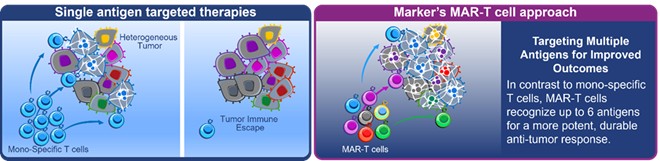
We are a clinical-stage immuno-oncology company specializing in the development and commercialization of novel T cell-based immunotherapies for the treatment of hematological malignancies and solid tumor indications. Harnessing millions of years of immunologic evolution, Marker’s multi antigen recognizing (“MAR”)-T cell technology is designed to recognize and kill highly heterogeneous tumors without the need for genetic modifications. This approach selectively expands natural tumor-specific T cells from a patient’s/donor’s blood that are capable of recognizing a broad range of tumor associated antigens, or TAAs. Unlike other T cell therapies, MAR-T cells are able to recognize hundreds of different epitopes within up to six tumor-specific antigens to produce broad spectrum anti-tumor activity. Targeting multiple antigens simultaneously exploits the natural capacity of T cells to recognize and kill tumor targets via native T cell receptors (“TCR”), while limiting tumor adaptation/escape by antigen-negative selection or antigen down-regulation. When infused into a patient with cancer, the MAR-T cells are designed to kill cancer cells expressing the TAA and potentially recruit the patient’s immune system to participate in the cancer killing process.
15
We licensed the underlying technology for MAR-T cell therapy from Baylor College of Medicine, or BCM, in March 2018. BCM had utilized the therapy in seven exploratory clinical trials. In these studies, BCM treated over 150 patients suffering from a variety of cancers including lymphoma, multiple myeloma, acute myeloid leukemia, or AML, acute lymphoblastic leukemia, or ALL, pancreatic cancer, breast cancer and various sarcomas. In those studies, BCM saw evidence of clinical benefit, expansion of infused cells, and decreased toxicity compared to other cellular therapies.
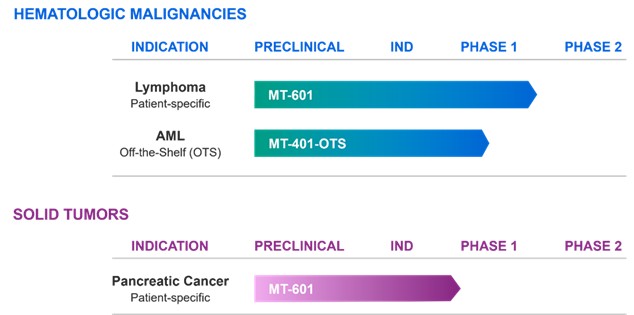
We anticipate continuing to advance two product candidates for 3 clinical indications as part of our MAR-T cell program for:
| ● | Autologous MAR-T cell product for the treatment of lymphoma and pancreatic cancer (MT-601) |
| ● | Off-the-Shelf (OTS) product in various indications (e.g., MT-401-OTS in AML or MDS) |
We do not genetically engineer our MAR-T cell therapies and we believe that our product candidates are superior to T cells engineered with chimeric antigen receptors, or CAR-T, for several reasons including:
| ● | Multiple targets → enhanced tumoricidal effect→ minimized tumor immune escape |
| ● | Clinical safety → no treatment-related side effects, including immune effector cell-associated neurotoxicity syndrome (ICANS) or other severe adverse effects (SAEs), were attributed to the use of MAR-T cell therapies to date |
| ● | Non-genetically engineered T cell products → selective expansion of tumor-specific T cells from a patient’s or donor’s blood capable of recognizing a broad range of tumor antigens→ no risk of mutagenesis and reduced manufacturing complexity → lower cost |

For these reasons, we believe our endogenous T cell receptor-based therapies may provide meaningful clinical benefit and safety to patients with both hematological and solid tumors.
We believe that the simplicity of our manufacturing process allows additional modifications to expand MAR-T cell recognition of cancer targets. For example, we are assessing the potential of combining MAR-T cell products with other products.
In August 2025, we issued a press release providing an update on the progress and clinical observations from the Phase 1 APOLLO study, with a data cutoff date of June 2025. Our Phase 1 APOLLO study is investigating MT-601, a MAR-T cell product, in patients with lymphoma who have relapsed after anti-CD19 chimeric antigen receptor (CAR) T cell therapy or for whom anti-CD19 CAR-T cells are not an option. In this update, clinical data was available for a total of 24 B-cell lymphoma patients from 7 clinical sites across the United States, including 15 patients with Non-Hodgkin Lymphoma (“NHL”) and 9 patients with Hodgkin Lymphoma (“HL”). At the time of the data cutoff, 12 NHL and 9 HL patients have been assessed. Study participants showed objective responses and a favorable safety profile with and without lymphodepletion.
16
Pipeline
Our clinical-stage pipeline is set forth below:

Manufacturing
Our manufacturing process was originally developed at Baylor College of Medicine, where we initially conducted our clinical trials. We continue to contract and collaborate with BCM and others to perform a wide variety of services to ensure the continuation of our research and development efforts, with the goal of optimizing our manufacturing process, product quality and commercial scalability.
On February 22, 2024, we entered into a Master Services Agreement for Product Supply (the “MSA”) with Cell Ready for the provision of various products and services by Cell Ready pursuant to work orders that may be entered into from time to time. Cell Ready, which is owned by one of our former directors, Mr. John Wilson, is a contract development and manufacturing organization (CDMO). The MSA contains customary representations, warranties and indemnification provision. The initial term of the MSA is three years and may be extended upon the mutual written agreement of the parties. On March 27, 2025, we mutually agreed with Cell Ready to terminate the MSA. In connection therewith, we and Cell Ready entered into a settlement and release agreement pursuant to which we paid Cell Ready approximately $453,000 and we and Cell Ready provided one another with mutual releases of all claims associated with any and all agreements between Marker and Cell Ready.
While BCM continues to supply us with products as we continue our clinical trials, in anticipation of the commencement of our larger pivotal trial for lymphoma in 2026, as well as the eventual need for commercial scale production, on June 16, 2025, the Company entered into a Statement of Work (the “SOW”) with Cellipont Bioservices (“Cellipont”), a leading cell therapy Contract Development and Manufacturing Organization (“CDMO”), for the manufacturing of MT-601, the Company’s lead MAR-T cell product. Pursuant to the SOW, Cellipont will provide technology transfer and cGMP manufacturing services to support the scale-up and production of MT-601 for Marker’s APOLLO study.
However, there is no guarantee that we will have or have properly estimated our required manufacturing capacities or that the third parties on which we rely to manufacture our products will be able or willing to perform on our proposed timelines or to meet our manufacturing demands, if at all. If any of our third-party vendors experience disruptions, or otherwise cease or substantially reduce the amount of products they are willing to supply us, our business and operations could be adversely affected. See “Risk Factors”.
Recent Developments
On May 4, 2026, the Company filed a Certificate of Amendment to its Certificate of Incorporation, increasing its authorized shares of Common Stock from 30,000,000 to 130,000,000.
17
Results of Operations
In this discussion of our results of operations and financial condition, amounts in financial tables, other than per-share amounts, have been rounded to the nearest thousand.
Comparison of the Three months Ended March 31, 2026 and 2025
The following table summarizes the results of our continuing operations for the three months ended March 31, 2026 and 2025:
| For the Three Months Ended | | | | |
| ||||||
March 31, | |
| ||||||||||
| 2026 | | 2025 | | Change |
| ||||||
Operating expenses: |
|
|
|
| | |||||||
Research and development |
| 2,842,728 |
| 3,135,427 |
| (292,699) |
| (9) | % | |||
General and administrative |
| 1,229,807 |
| 1,369,215 |
| (139,408) |
| (10) | % | |||
Loss on early termination of vendor agreement | — | 453,135 | (453,135) | NM | % | |||||||
Total operating expenses |
| 4,072,535 |
| 4,957,777 |
| (885,242) |
| (18) | % | |||
Loss from operations |
| (4,072,535) |
| (4,957,777) |
| 885,242 |
| (18) | % | |||
Other income (expenses): |
|
|
|
|
|
|
| |||||
Grant income | 751,691 | 349,104 | 402,587 | 115 | % | |||||||
Interest income |
| 132,889 | 162,489 |
| (29,600) | (18) | % | |||||
Other income | 8,677 | — | 8,677 | NM | % | |||||||
Net loss | $ | (3,179,278) | (4,446,184) | $ | 1,266,906 |
| (28) | % | ||||
Operating Expenses
Operating expenses incurred during the three months ended March 31, 2026 were $4.1 million compared to $5.0 million during the same period ended March 31, 2025. Significant changes and expenditures in operating expenses are outlined as follows:
Research and Development Expenses
Research and development expenses decreased by 9% to $2.8 million for the three months ended March 31, 2026, compared to $3.1 million for the three months ended March 31, 2025.
The decrease of $0.3 million in 2026 was primarily attributable to a decrease of $0.3 million in stock-based compensation expense due to the modification of certain options in the prior year.
General and Administrative Expenses
General and administrative expenses decreased by 10% to $1.2 million for the three months ended March 31, 2026, compared to $1.4 million during the same period ended March 31, 2025.
The decrease of $0.1 million in 2026 was primarily attributable to legal and professional fees and other administrative expenses.
Loss on Early Termination of Vendor Agreement
During the three months ended March 31, 2025, we mutually agreed with Cell Ready to terminate the MSA. In connection therewith, we entered into a settlement and release agreement with Cell Ready pursuant to which we paid Cell Ready approximately $453,000 and the parties provided one another with mutual releases of all claims associated with any and all agreements between us and Cell Ready.
18
Other Income (Expense)
Grant Income
In August 2021, we received notice of a Product Development Research award totaling approximately $13.1 million from the Cancer Prevention and Research Institute of Texas (“CPRIT”), to support the clinical investigation of MT-401 as an Off-the-Shelf (“OTS”) product in patients with Acute Myeloid Leukemia (“AML”) (the “CPRIT AML Grant”).
In September 2022, we received notice from the FDA that we had been awarded a $2.0 million grant from the FDA’s Orphan Products Grant program to support the clinical investigation of MT-401 for the treatment of AML (the “FDA Grant”).
In May 2023, we received notice of a $2.0 million grant from the National Institutes of Health (“NIH”) Small Business Innovation Research (“SBIR”) program to support the development and investigation of MT-401 for the treatment of AML patients following standard-of-care therapy with hypomethylating agents (the “SBIR AML Grant”).
The above funding agencies have agreed to continue their financial support and to shift funds to the MT-401-OTS program.
In June 2024, we received notice of a $2.0 million grant over a 2-year period from the National Institutes of Health SBIR program to support control over tumor immune escape in pancreatic cancer using a dual T cell product strategy (the “Decoy Grant”).
In August 2024, we received notice of an additional $2.0 million grant from the NIH SBIR program to support the clinical investigation of MT-601 in patients with non-Hodgkin’s lymphoma (“NHL”) who have relapsed following anti-CD19 chimeric antigen receptor (“CAR”) T cell therapy (the “SBIR NHL Grant”).
In August 2024, we received another $2.0 million grant from the National Institutes of Health SBIR Program to support the advancement of MT-601 in patients with pancreatic cancer (the “PANACEA Grant”).
In December 2024, we received notice an additional $9.5 million grant from CPRIT to support the clinical investigation of MT-601 in patients with metastatic pancreatic cancer (the “CPRIT Pancreatic Grant”).
The following table summarizes grant income recorded for the three months ended March 31, 2026 and 2025, by grant:
| For the Three Months Ended | |||||
March 31, | ||||||
2026 | | 2025 | ||||
Grant income: |
| |
| | ||
CPRIT AML Grant1 | $ | 208,509 | $ | 217,641 | ||
FDA Grant |
| 2,903 |
| — | ||
SBIR AML Grant |
| 116,504 |
| 96,724 | ||
Decoy Grant |
| 98,634 |
| 14,216 | ||
PANACEA Grant |
| 73,478 |
| 7,979 | ||
CPRIT Pancreatic Grant1 |
| 251,663 |
| 12,544 | ||
Total grant income | $ | 751,691 | $ | 349,104 | ||
(1) Both CPRIT grants are subject to certain revenue - sharing arrangements, as per the grant agreements (see Note 11).
Interest Income
Interest income was $0.1 million and $0.2 million for the three months ended March 31, 2026 and 2025, respectively, and was attributable to interest income relating to funds that are held in U.S. Treasury notes and U.S. government agency-backed securities.
19
Other Income
Other income was immaterial and nil for the three months ended March 31, 2026 and 2025, respectively, and was attributable to a vendor refund.
Net Loss
The decrease in our net loss during the three months ended March 31, 2026 compared to the three months ended March 31, 2025 was primarily due to cost decreases in our research and development activities and in our general and administrative expenses, as well as higher grant income. We anticipate that we will continue to incur net losses in the future as we continue to invest in research and development activities, including clinical development of our MAR-T cell product candidates.
Liquidity and Capital Resources
We have not generated any revenues from the sales or licensing of our product candidates since inception and only have limited grant income associated with grants to fund research. We have financed our operations primarily through public and private offerings of our stock and debt including warrants and the exercise thereof, as well as grants.
Based on our lack of recurring revenues, anticipated uses of cash and historical recurring cash losses from operating activities, and cash, cash equivalents, and restricted cash as of December 31, 2025, and taking into consideration the net proceeds received in July and August of 2025 through the sale of Common Stock pursuant to its ATM Agreement with H.C. Wainwright & Co., LLC, we anticipate that we will be able to fund our operating expenses and capital expenditure requirements into the first quarter of 2027, assuming no additional grant funds are received, either from new grants or from existing awarded grants. We are considering raising additional capital through the issuance of common shares or preferred shares and intend to apply for additional grant funds, which could enable us to fund our operating expenses and capital expenditure requirements beyond the first quarter of 2027, although no assurance can be given that such capital or existing awarded grants will be earned or future grants will be awarded. This estimate is subject to our ability to effectively manage our costs, raise additional capital, and receive additional grant funds, of which there can be no assurance.
Cash and Working Capital
The following table sets forth our cash, cash equivalents, and restricted cash and working capital as of March 31, 2026 and December 31, 2025:
| March 31, | | December 31, | |||
2026 | 2025 | |||||
Cash, cash equivalents, and restricted cash | $ | 15,638,655 | $ | 17,042,847 | ||
Working capital | $ | 13,795,958 | $ | 16,796,814 | ||
Cash Flows
The following table summarizes our cash flows for the three months ended March 31, 2026 and 2025:
For the Three Months Ended | ||||||
March 31, | ||||||
| 2026 | | 2025 | |||
Net cash provided by (used in): |
|
| ||||
Operating activities | $ | (1,404,192) | $ | (5,499,737) | ||
Investing activities | — | — | ||||
Financing activities | — | 505 | ||||
Net decrease in cash, cash equivalents, and restricted cash | $ | (1,404,192) | $ | (5,499,232) | ||
20
Operating Activities
Net cash used in operating activities during the three months ended March 31, 2026 was $1.4 million. The use of cash primarily related to our net loss of $3.2 million, offset by $0.2 million of non-cash stock-based compensation, and a $1.6 million increase from changes in assets and liabilities.
Net cash used in operating activities during the three months ended March 31, 2025 was $5.5 million. The use of cash primarily related to our net loss of $4.4 million, offset by $0.4 million of non-cash stock-based compensation, and a $1.5 million decrease from changes in assets and liabilities.
Financing Activities
There was no cash provided by financing during the three months ended March 31, 2026.
Net cash provided by financing activities was $505 during the three months ended March 31, 2025, due to the net proceeds from the exercise of warrants and stock options, respectively.
Future Capital Requirements
To date, we have not generated any revenues from the commercial sale of approved drug products, and we do not expect to generate substantial revenue for at least the next several years. If we fail to complete the development of our product candidates in a timely manner or fail to obtain their regulatory approval, our ability to generate future revenue will be compromised. We do not know when, or if, we will generate any revenue from our product candidates, and we do not expect to generate significant revenue unless and until we obtain regulatory approval of, and commercialize, our product candidates. We expect our expenses to increase in connection with our ongoing activities, particularly as we continue the research and development of, continue or initiate clinical trials of and seek marketing approval for our product candidates. In addition, if we obtain approval for any of our product candidates, we expect to incur significant commercialization expenses related to sales, marketing, manufacturing and distribution. We anticipate that we will need substantial additional funding in connection with our continuing operations. If we are unable to raise capital when needed or on attractive terms, we could be forced to delay, reduce or eliminate our research and development programs or future commercialization efforts.
Other receivable mainly consists of grant income receivable. Qualifying grant income earned in advance of cash received from grants is recognized as other income and recorded as other receivable. The following table summarizes the Company’s other receivable balance as of March 31, 2026 and December 31, 2025, respectively:
| March 31, | | December 31, | |||
2026 | 2025 | |||||
Grant income receivable: |
| |
| | ||
CPRIT AML Grant | $ | 1,060,666 | $ | 815,436 | ||
FDA Grant |
| 2,903 |
| 3,678 | ||
SBIR AML Grant |
| 116,504 |
| 162,897 | ||
Decoy Grant |
| 73,328 |
| 59,501 | ||
SBIR NHL Grant |
| — |
| 87,417 | ||
PANACEA Grant |
| 73,478 |
| 190,052 | ||
Total grant income receivable |
| 1,326,879 |
| 1,318,981 | ||
Interest receivable |
| 43,218 |
| 50,419 | ||
Other |
| 7,203 |
| — | ||
Total other receivable | $ | 1,377,300 | $ | 1,369,400 | ||
As of March 31, 2026, we had working capital of $13.8 million, compared to working capital of $16.8 million as of December 31, 2025. Operating expenses incurred during the three months ended March 31, 2026 were $4.1 million compared to $5.0 million during the equivalent prior year period. Based on our lack of recurring revenues, anticipated uses of cash and historical recurring cash losses from operating activities, and cash, cash equivalents, and restricted cash as of March 31, 2026, we anticipate that we will be able to fund our operating expenses and capital expenditure requirements into the first quarter of 2027, assuming no additional grant funds are received. We currently plan to raise additional capital through the issuance of common shares and receive additional grant funds, which could
21
enable us to fund our operating expenses and capital expenditure requirements beyond the first quarter of 2027 although no assurance can be given that such capital or existing awarded grants will be earned or future grants will be awarded. This estimate is subject to our ability to effectively manage our costs, raise additional capital, and receive additional grant funds. Our assumptions may prove to be wrong, and we could utilize our available capital resources sooner than we currently expect. Furthermore, our operating plan may change, and we may need additional funds sooner than planned in order to meet operational needs and capital requirements for product development and commercialization. Because of the numerous risks and uncertainties associated with the development and commercialization of our product candidates and the extent to which we may enter into additional collaborations with third parties to participate in their development and commercialization, we are unable to estimate the amounts of increased capital outlays and operating expenditures associated with our current and anticipated clinical trials. Our future funding requirements will depend on many factors, as we:
| ● | initiate or continue clinical trials of our product candidates; |
| ● | continue the research and development of our product candidates and seek to discover additional product candidates; seek regulatory approvals for our product candidates if they successfully complete clinical trials; |
| ● | continue development of our manufacturing capabilities; |
| ● | establish sales, marketing and distribution infrastructure and scale-up manufacturing capabilities to commercialize any product candidates that may receive regulatory approval; |
| ● | evaluate strategic transactions we may undertake; and |
| ● | enhance operational, financial and information management systems and hire additional personnel, including personnel to support development of our product candidates and, if a product candidate is approved, our commercialization efforts. |
Because all of our product candidates are in the early stages of clinical and preclinical development and the outcome of these efforts is uncertain, we cannot estimate the actual amounts necessary to successfully complete the development and commercialization of product candidates or whether, or when, we may achieve profitability. Until such time, if ever, that we can generate substantial product revenue, we expect to finance our cash needs through a combination of equity or debt financings and collaboration arrangements.
We plan to continue to fund our operations and capital funding needs through equity and/or debt financing. We may also consider new collaborations or selectively partner our technology. To the extent that we raise additional capital through the sale of equity or convertible debt securities, the ownership interests of our stockholders will be diluted, and the terms may include liquidation or other preferences that adversely affect the rights of our existing stockholders’ common stock. The incurrence of indebtedness would result in increased fixed payment obligations and could involve certain restrictive covenants, such as limitations on our ability to incur additional debt, limitations on our ability to acquire or license intellectual property rights and other operating restrictions that could adversely impact our ability to conduct our business. If we raise additional funds through strategic partnerships and alliances and licensing arrangements with third parties, we may have to relinquish valuable rights to our technologies or product candidates or grant licenses on terms unfavorable to us. We may also be required to pay damages or have liabilities associated with litigation or other legal proceedings involving our company.
In addition to the foregoing, high inflation and concerns about an economic recession in the United States or other major markets have resulted in, among other things, volatility in the capital markets that may have the effect of reducing our ability to access capital, which could in the future negatively affect our liquidity. In addition, a recession or market correction due to these factors could materially affect our business and the value of our common stock.
ATM Agreement
In November 2024, we entered into an At The Market Offering Agreement (the “Sales Agreement”), with H.C. Wainwright & Co. LLC, relating to the sale of shares of our common stock having an agreement offering price of up to $11,431,713 from time to time through H.C. Wainwright & Co. LLC. Any shares of our common stock sold will be issued pursuant to our shelf registration statement on Form S-3 (File No. 333-283512), which the SEC declared effective on December 6, 2024. However, our use of the shelf registration statement on Form S-3 will be limited for so long as we are subject to General Instruction I.B.6 of Form S-3, which limits the amounts that we
22
may sell under the registration statement and in accordance with the ATM agreement. H.C. Wainwright & Co. LLC will be entitled to compensation under the Sales Agreement at a commission rate equal to 3.0% of the gross sales price per share sold under the ATM Agreement, and we have provided H.C. Wainwright & Co. LLC with indemnification and contribution rights. There was no activity under the ATM Agreement during either period presented.
Private Placement
On December 19, 2024, the Company entered into a Securities Purchase Agreement (the “Purchase Agreement”), pursuant to which the Company issued and sold in a private Placement the following securities: (i) 1,783,805 shares of common stock, (ii) Series B Warrants, or Pre-Funded Warrants, to purchase an aggregate of 3,247,445 shares of common stock in lieu of shares of common stock and (iii) Series A Warrants, or Private Placement Warrants, to purchase an aggregate of 5,031,250 shares of common stock. The purchase price per share of common stock and accompanying Private Placement Warrant to purchase a share of common stock was $3.20, and the purchase price per Pre-Funded Warrant and accompanying Private Placement Warrant to purchase a share of common stock was $3.199. Total gross proceeds from the sale of securities in the Private Placement, before deducting commissions to the placement agent and estimated offering expenses, was approximately $16.1 million, which did not include any proceeds that may be received upon exercise of any warrants issued in the Private Placement. Both the Pre-Funded Warrants and the Private Placement Warrants were not exercisable until the Company obtained shareholder approval. On March 21, 2025, the Company obtained shareholder approval for the exercise of such warrants. The transaction closed on December 23, 2024.
Going Concern
We have no sources of income, other than grant income, to provide incoming cash flows to sustain our future operations. As outlined above, our ability to pursue our long-term planned business activities is dependent upon our successful efforts to raise additional capital.
These factors raise substantial doubt regarding our ability to continue as a going concern. Our condensed consolidated financial statements have been prepared on a going concern basis, which implies that we will continue to realize our assets and discharge our liabilities in the normal course of business. Our financial statements do not include any adjustments to the recoverability and classification of recorded asset amounts and classification of liabilities that might be necessary should we be unable to continue as a going concern.
Critical Accounting Policies and Estimates
The condensed consolidated financial statements are prepared in conformity with U.S. GAAP, which require the use of estimates, judgments and assumptions that affect the reported amounts of assets and liabilities, the disclosure of contingent liabilities at the date of the financial statements, and the reported amounts of expenses in the periods presented.
The Company’s critical accounting policies include grant income. The Company does not have any critical accounting estimates.
With respect to grant income, the Company recognizes grant income when qualifying costs are incurred for the amount the Company is entitled to under the provisions of the contract.
Item 3. Quantitative and Qualitative Disclosures About Market Risk
We are a smaller reporting company as defined by Rule 12b-2 of the Exchange Act and are not required to provide the information required under this item.
23
Item 4. Controls and Procedures
(a)Evaluation of Disclosure Controls and Procedures
We have established disclosure controls and procedures, as such term is defined in Rule 13a-15(e) under the Securities Exchange Act of 1934. Under the supervision and with the participation of our management, we conducted an evaluation of the effectiveness of our disclosure controls and procedures as of the end of the period covered by this report to ensure that the information required to be disclosed by us in the reports that we file or submit under the Securities Exchange Act of 1934 is recorded, processed, summarized, and reported within the time periods specified in the SEC’s rules and forms. Disclosure controls and procedures include, without limitation, controls and procedures designed to ensure that information required to be disclosed by us in the reports that we file or submit under the Securities Exchange Act of 1934 is accumulated and communicated to our management, including our principal executive officer and principal financial officer as appropriate, to allow timely decisions regarding required disclosure. Our management, with participation of our principal executive officer and principal financial officer, has evaluated the effectiveness of our disclosure controls and procedures as of the end of the period covered by this report. Based on that evaluation, our principal executive officer and principal financial officer concluded that our disclosure controls and procedures are effective in recording, processing, summarizing, and reporting, on a timely basis, information required to be disclosed by us in the reports that we file or submit under the Exchange Act.
In designing and evaluating the disclosure controls and procedures, management does not expect that our internal control over financial reporting will prevent or detect all errors and all fraud. A control system, no matter how well conceived and operated, can provide only reasonable, not absolute, assurance that the objectives of the control systems are met. Further, the design of a control system must reflect the fact that there are resource constraints, and the benefits of controls must be considered relative to their costs. The design of any disclosure controls and procedures also is based in part upon certain assumptions about the likelihood of future events, and there can be no assurance that any design will succeed in achieving its stated goals under all potential future conditions. Our management, including our Chief Executive Officer and Principal Financial and Accounting Officer, believes that our disclosure controls and procedures and internal control over financial reporting are designed to provide reasonable assurance of achieving their objectives and are effective at the reasonable assurance level. However, our management does not expect that our disclosure controls and procedures or our internal control over financial reporting will prevent all errors and all fraud.
(b)Changes in Internal Control Over Financial Reporting
There were no changes in our internal control over financial reporting (as defined in Exchange Act Rules 13a-15(f) and 15d-15(f)) during the fiscal quarter ended March 31, 2026 that materially affected, or are reasonably likely to materially affect, our internal control over financial reporting.
24
PART II – OTHER INFORMATION
Item 1. Legal Proceedings
From time to time, we may become involved in legal proceedings, including those arising in the ordinary course of our business. We are not currently a party to any material legal proceedings, and we are not aware of any pending or threatened legal proceeding against us that we believe could have an adverse effect on our business, operating results, or financial condition.
Item 1A. Risk Factors
Our business is subject to risks and events that, if they occur, could adversely affect our financial condition and results of operations and the trading price of our securities. In addition to the other information set forth in this quarterly report on Form 10-Q, you should carefully consider the factors described in Part I, Item 1A. “Risk Factors” of our Annual Report on Form 10-K for the fiscal year ended December 31, 2025, filed with the Securities and Exchange Commission on March 18, 2026. There have been no material changes to the risk factors described in that report.
Item 2. Unregistered Sales of Equity Securities and Use of Proceeds
We did not record any issuances of unregistered securities during the three months ended March 31, 2026.
Item 3. Defaults Upon Senior Securities
None.
Item 4. Mine Safety Disclosure
Not applicable.
Item 5. Other Information
(a) | None. |
(b) | None. |
(c) | Director and Officer Trading Plans and Arrangements. During the quarterly period ended March 31, 2026, no director or officer of the Company |
25
Item 6. Exhibits
The following exhibits are included with this Quarterly Report on Form 10-Q:
| Incorporated by Reference | |||||||||||
Exhibit | | Exhibit description | | Form | | File no. | | Exhibit | | Filing | | Filed |
3.1 | 8-K | 001-37939 | 3.4 | 10/17/18 | ||||||||
3.1.1 | 8-K | 001-37939 | 3.1 | 5/27/2022 | ||||||||
3.1.2 | 8-K | 001-37939 | 3.1 | 1/26/2023 | ||||||||
3.1.3 | 8-K | 001-37939 | 3.1 | 5/4/2026 | ||||||||
3.2 | 8-K | 001-37939 | 3.6 | 10/17/18 | ||||||||
31.1 | X | |||||||||||
32.1* | X | |||||||||||
32.2* | X | |||||||||||
26
Exhibit 101
101.INS - XBRL Instance Document
101.SCH - XBRL Taxonomy Extension Schema Document
101.CAL - XBRL Taxonomy Extension Calculation Linkbase Document
101.DEF - XBRL Taxonomy Extension Definition Linkbase Document
101.LAB - XBRL Taxonomy Extension Label Linkbase Document
101.PRE - XBRL Taxonomy Extension Presentation Linkbase Document
104 - Cover Page Interactive Data File (formatted as Inline XBRL and contained in Exhibit 101 filed herewith).
* | Furnished herewith and not deemed to be “filed” for purposes of Section 18 of the Securities Exchange Act of 1934, as amended (the “Exchange Act”), and shall not be deemed to be incorporated by reference into any filing under the Securities Act of 1933, as amended, or the Exchange Act (whether made before or after the date of the Form 10-Q), irrespective of any general incorporation language contained in such filing. |
** | Confidential treatment has been granted as to certain portions of this exhibit pursuant to Rule 406 of the Securities Act of 1933, as amended, or Rule 24b-2 of the Securities Exchange Act of 1934, as amended. |
27
SIGNATURES
In accordance with the requirements of the Exchange Act, the registrant caused this report to be signed on its behalf by the undersigned, thereunto duly authorized.
Date: May 15, 2026
MARKER THERAPEUTICS, INC.
/s/ Juan Vera | ||
Juan Vera | ||
President, Chief Executive Officer and Treasurer (Principal Executive Officer and Principal Financial and Accounting Officer) |
28