Please wait
MANAGEMENT'S DISCUSSION & ANALYSIS
2024
March 6, 2025
MANAGEMENT'S DISCUSSION AND ANALYSIS OF FINANCIAL CONDITION AND RESULTS OF OPERATIONS
BASIS OF PRESENTATION
Our Management's Discussion and Analysis of Financial Condition and Results of Operations ("MD&A") should be read in conjunction with our audited consolidated financial statements and notes thereto as at and for the year ended December 31, 2024, which have been prepared in accordance with International Financial Reporting Standards ("IFRS") as issued by the International Accounting Standards Board ("IASB"). Our IFRS accounting policies are set in note 3 in our audited consolidated financial statements for the year ended December 31, 2024. This MD&A, along with our audited consolidated financial statements for the year ended December 31, 2024, were authorized for issue in accordance with a resolution of the Board of Directors (the "Board") on March 6, 2025. Unless otherwise indicated, all references to "$" and "dollars" in this discussion and analysis mean thousands of Canadian dollars.
All references in this MD&A to "the Company", "Oncolytics", "we", "us", or "our" and similar expressions refer to Oncolytics Biotech Inc. and the subsidiaries through which it conducts its business, unless otherwise indicated.
FORWARD-LOOKING STATEMENTS
The following discussion contains forward-looking statements, within the meaning of Section 21E of the United States Securities Exchange Act of 1934, as amended and forward-looking information under applicable Canadian securities laws (such forward-looking statements and forward-looking information are collectively referred to herein as "forward-looking statements"). Forward-looking statements, including: our belief as to the potential and mechanism of action of pelareorep, an intravenously delivered immunotherapeutic agent, as a cancer therapeutic; our business strategy, goals, focus, and objectives for the development of pelareorep, including our immediate primary focus on advancing our programs in hormone receptor-positive / human epidermal growth factor 2-negative advanced and metastatic breast cancer and metastatic pancreatic ductal adenocarcinoma to registration-enabling clinical studies and our exploration of opportunities for registrational programs in other gastrointestinal cancers through our GOBLET platform study; our expectation that pelareorep’s ability to enhance innate and adaptive immune responses within the TME will play an increasingly important role as our clinical development program advances, and our belief that this approach increases opportunities for expanding our clinical program and business development and partnering opportunities, has the most promise for generating clinically impactful data and offers the most expeditious path to regulatory approval; our belief that by priming the immunce system with pelareorep, we can increase the proportion of patients who respond to various cancer treatments, including immunotherapies, especially in cancers where existing treatment regimens have failed or provided limited benefit; our expectation that we will incur substantial losses and will not generate significant revenues until and unless pelareorep becomes commercially viable; our estimations regarding cash and cash equivalents on hand being sufficient to fund operations into the third quarter of 2025; our plans to fund ongoing operations by raising additional funds through the sale of our common shares or other capital resources, such as strategic collaborations and debt; the availability of additional liquidity and the terms thereof; our ability to reduce or eliminate planned expenditures to extend our operating runway if additional financing cannot be obtained when required; the anticipated design and outcomes of our various planned studies; our plans to finalize our submission to the FDA for a randomized phase 2 trial examining pelareorep + paclitaxel combination therapy in breast cancer and enroll the first patient; our belief that using PFS as our primary endpoint will allow us to reach the final analysis within two years of the start of the proposed study's enrollment; our belief that continued positive results in the anal cancer cohort could potentially expand pelareorep's opportunity beyond breast and pancreatic cancers and that anal cancer has the potential for accelerated approval, based on a relatively small clinical study; our plans to continue to enrol GOBLET’s expanded anal cancer and newly added pancreatic cancer cohorts; our expectations regarding the announcement of interim efficacy data from GOBLET Cohort 5 in the second half of 2025; our plans to finalize the master protocol associated with a pancreatic study with GCAR and to engage the FDA to discuss the adaptive design; the focus of and plans for our manufacturing program; our plans for our intellectual property program; our ongoing evaluation of all types of financing arrangements; the sale of securities under the Base Shelf (as defined herein) and our expectations regarding the ability of the Base Shelf to shorten the time required to close a financing and increase the number of potential investors that may be prepared to invest in the Company; our plans to use our ATM equity distribution agreement to assist us in achieving our capital objective; our expectation that we will continue to access equity arrangements to help support our operations; our assessment of marketable securities; our objective to maintain adequate cash reserves to support our planned activities, including our clinical trial program, product manufacturing, administrative costs and intellectual property protection and the methods used to achieve such objective; our continued management of our research and development plan; our
expectation to fund our expenditure requirements and commitments with existing working capital; the judgment applied in assessing our ability to continue as a going concern and the material uncertainties that raise substantial doubt on our ability to continue as a going concern; our belief that we are not able to fund our operations for at least the next twelve months from the balance sheet date with the cash and cash equivalents on hand; the factors that affect our cash usage; our expectation that we will increase our spending in connection with the research and development of pelareorep over the next several years as we look to advance our breast and gastrointestinal cancer programs into later stages of clinical development and the increased costs associated with later stages of clinical development; our expectation that we will continue to incur additional costs associated with operating as a public company; our plans for raising additional funds; the potential for adjustments to our audited consolidated financial statements; the dilutive effects of raising funds by issuing equity; the potential that debt financing may involve restrictive covenants that may impact our ability to conduct our business; making reductions in spending, including potentially delaying, scaling back or eliminating certain of our development programs, extending payment terms with suppliers, or liquidating assets in the event we are unable to secure additional funding, and the effects thereof on our business, results of operations and future prospects; the cost and time associated with conducting clinical trials and obtaining regulatory approval; the factors that may affect the probability of successful commercialization of our drug candidates; potential changes to the amount and timing of payments under our contractual obligations and commitments; the expectation that counterparties to financial instruments will meet their contractual obligations; our approach to credit rate, interest rate, foreign exchange, and liquidity risk mitigation; our anticipated use of the remaining proceeds raised as part of our 2023 public offering of common shares and warrants; the effectiveness of our internal control systems; and other statements that are not historical facts or which are related to anticipated developments in our business and technologies. In any forward-looking statement in which we express an expectation or belief as to future results, such expectations or beliefs are expressed in good faith and are believed to have a reasonable basis, but there can be no assurance that the statement or expectation, or belief will be achieved. Forward-looking statements involve known and unknown risks and uncertainties, which could cause our actual results to differ materially from those in the forward-looking statements.
Such risks and uncertainties include, among others, the need for and availability of funds and resources to pursue research and development projects, the efficacy of pelareorep as a cancer treatment, the success and timely completion of clinical studies and trials, our ability to successfully commercialize pelareorep, uncertainties related to the research, development, and manufacturing of pelareorep, uncertainties related to competition, changes in technology, the regulatory process, and general changes to the economic environment.
With respect to the forward-looking statements made within this MD&A, we have made numerous assumptions regarding, among other things: our ability to recruit and retain employees, our continued ability to obtain financing to fund our clinical development plan, our ability to receive regulatory approval to commence enrollment in the clinical studies which are part of our clinical development plan, our ability to maintain our supply of pelareorep, and future expense levels being within our current expectations.
Investors should consult our quarterly and annual filings with the Canadian and U.S. securities commissions for additional information on risks and uncertainties relating to the forward-looking statements. Forward-looking statements are based on assumptions, projections, estimates, and expectations of management at the time such forward-looking statements are made, and such assumptions, projections, estimates and/or expectations could change or prove to be incorrect or inaccurate. Investors are cautioned against placing undue reliance on forward-looking statements. We do not undertake any obligation to update these forward-looking statements except as required by applicable law.
Company Overview
We are a clinical-stage biopharmaceutical company developing pelareorep, a well-tolerated intravenously delivered immunotherapeutic agent that activates the innate and adaptive immune systems and weakens tumor defense mechanisms. This improves the ability of the immune system to fight cancer, making tumors more susceptible to a broad range of oncology treatments.
Pelareorep is a proprietary isolate of reovirus, a naturally occurring, non-pathogenic double-stranded RNA (dsRNA) virus commonly found in environmental waters. Pelareorep has shown promising results in changing the tumor microenvironment (TME). This creates a more immunologically favorable TME, which in turn makes the tumor more susceptible to various treatment combinations. These treatments include chemotherapies, checkpoint inhibitors, and other immuno-oncology approaches such as CAR T therapies, bispecific antibodies, and CDK4/6 inhibitors. Pelareorep induces a new army of tumor-reactive T cells, helps these cells to infiltrate the tumor through an inflammatory process, and promotes the overexpression of PD-1/PD-L1. By priming the immune system with pelareorep, we believe we can increase the proportion of patients who respond to various cancer treatments, including immunotherapies, especially in cancers where existing treatment regimens have failed or provided limited benefit.
As our clinical development program advances, we anticipate pelareorep's ability to enhance innate and adaptive immune responses within the TME will play an increasingly important role. This greatly increases opportunities for expanding our clinical program, business development, and partnering opportunities to address a broad range of cancers in combination with various other therapies. We believe this approach has the most promise for generating clinically impactful data and offers the most expeditious path to regulatory approval.
Our primary focus is to advance our programs in hormone receptor-positive / human epidermal growth factor 2-negative (HR+/HER2-) advanced and metastatic breast cancer (mBC) and metastatic pancreatic ductal adenocarcinoma (PDAC) to registration-enabling clinical studies. In addition, we are exploring opportunities for registrational programs in other gastrointestinal cancers, including anal cancer, through our GOBLET platform study.
Going Concern
We have not been profitable since our inception and expect to continue to incur substantial losses as we continue research and development efforts. We do not expect to generate significant revenues until and unless pelareorep becomes commercially viable. As at December 31, 2024, we had cash and cash equivalents of $15,942. Subsequent to December 31, 2024, we raised net proceeds of $6,041 (see "Cash Resources"). Without raising additional funding or reducing or eliminating our planned expenditures, we estimate our cash and cash equivalents to fund our operations into the third quarter of 2025. We plan on raising additional funds through the sale of our common shares or other capital resources, such as collaborations and debt, to fund our ongoing operations. However, given the difficulty for micro-cap market capitalization companies to raise significant capital and the Nasdaq delinquency notification matter discussed below, there can be no assurance that additional liquidity will be available under acceptable terms or at all. Furthermore, if we are unable to obtain additional financing when required, there can be no assurance that we will be able to sufficiently reduce or eliminate our planned expenditures to extend our operating runway. These material uncertainties raise substantial doubt on our ability to continue as a going concern. See further discussion in "Liquidity and Capital Resources".
Program Development Updates and Outlook
The following are the development updates and outlook for each of our programs for the year ended December 31, 2024, through to the date hereof:
Clinical Trial Program
Breast cancer program
Defining a path to registration: Type C meeting with the FDA and BRACELET-1 final results
In the second quarter of 2024, we held a Type C meeting with the U.S. Food and Drug Administration (FDA) to discuss our planned potential registration-enabling trial for pelareorep in HR+/HER2- mBC. The FDA provided its feedback including
support for progression-free survival (PFS) as the study's primary endpoint, with overall survival (OS) as a key secondary endpoint.
In the third quarter of 2024, we announced the final BRACELET-1 results. BRACELET-1 was a randomized open-label study that enrolled 48 patients with HR+/HER2- mBC into three cohorts: paclitaxel (PTX) alone, PTX in combination with pelareorep, and PTX in combination with both pelareorep and avelumab, a human anti-PD-L1 antibody. The results were based on efficacy data collected and analyzed two years after the last patient was enrolled as specified by the protocol. Results of the final BRACELET-1 analysis demonstrated that the median OS could not be calculated in the PTX + pelareorep arm due to the number of patients still alive at the time of the final analysis, in contrast with a median OS of 18.2 months in the PTX monotherapy arm. A conservative estimate of median OS for the pelareorep arm is 32.1 months, demonstrating that PTX + pelareorep delivered a greater than 12-month survival advantage compared to PTX alone. This survival benefit is further illustrated by the 24-month overall survival rate, which showed that 64% of patients treated with PTX + pelareorep survived at least 2 years compared to only 33% of patients treated with PTX alone. In addition, final PFS was 12.1 months for PTX + pelareorep compared to 6.4 months for PTX alone, a benefit of 5.7 months. These results substantiated the statistically significant near doubling of median OS observed in our earlier randomized IND.213 study in a similar HR+/HER2- patient population treated with PTX + pelareorep compared to PTX alone. The strong survival data from the BRACELET-1 and IND.213 studies, along with the FDA's guidance on our registration study plan from the Type C meeting, provided the foundation for our plan to conduct a registration-enabling study to assess pelareorep-based combination therapy in patients with advanced or metastatic HR+/HER2- breast cancer.
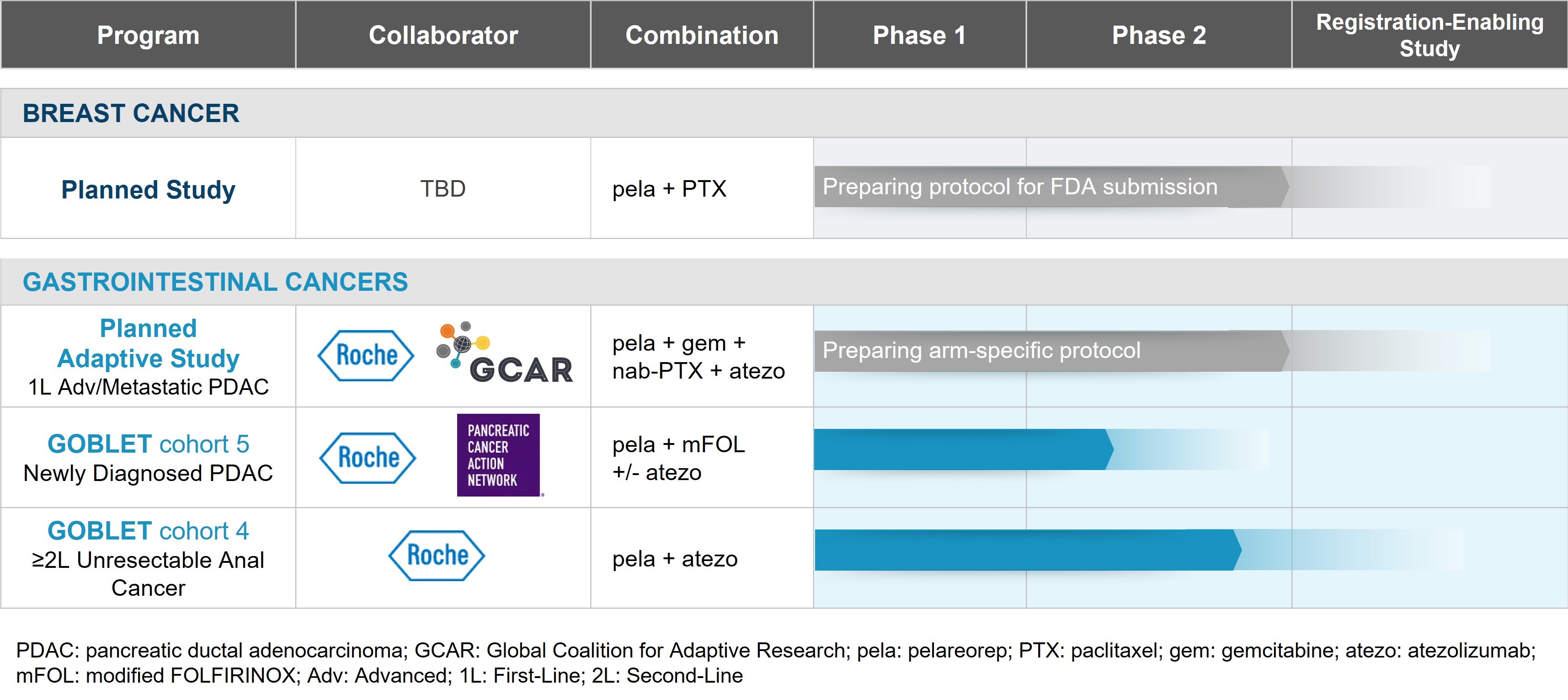
In 2025, we intend to finalize our submission to the FDA for a randomized phase 2 trial examining pelareorep + paclitaxel combination therapy in breast cancer and enroll the first patient. This registration-enabling trial will enroll approximately 180 patients with HR+/HER2- advanced/metastatic breast cancer who have progressed on antibody-drug conjugates (ADCs) like Enhertu, who are not eligible for ADCs, or who cannot tolerate ADCs. We believe that using PFS as our primary endpoint will allow us to reach the final analysis within two years of the start of the proposed study's enrollment.
Gastrointestinal cancer program
Collaboration with Roche and AIO-Studien-gGmbH: GOBLET platform study
Our GOBLET platform study is a collaboration with Roche and AIO-Studien-gGmbH, a leading academic cooperative medical oncology group based in Germany. The study is investigating the use of pelareorep, in combination with Roche's anti-PD-L1 checkpoint inhibitor atezolizumab (Tecentriq®) and/or chemotherapy (gemcitabine and nab-paclitaxel, TAS-102, or modified FOLFIRINOX (mFOLFIRINOX)), where appropriate, in advanced or metastatic gastrointestinal tumors. The study is being conducted at 17 centers in Germany. The study's co-primary endpoints are safety and objective response rate and/or disease control rate at week 16. Key secondary and exploratory endpoints include additional efficacy assessments and evaluation of potential biomarkers. The study employs a two-stage design comprising patients with first-line advanced/metastatic and newly diagnosed metastatic PDAC, first- and third-line metastatic colorectal (CRC), and second-line or later anal cancer. Any cohort meeting pre-specified efficacy criteria in Stage 1 may be advanced to Stage 2 and enroll additional patients. Our first-line advanced/metastatic PDAC, third-line metastatic CRC, and second-line or later anal cancer cohorts have completed Stage 1 and met the pre-specified success criteria. Our cohort evaluating newly diagnosed metastatic PDAC patients treated with pelareorep in combination with mFOLFIRINOX with or without atezolizumab (Tecentriq®) is supported by the Pancreatic Cancer Action Network (PanCAN) Therapeutic Accelerator Award for up to US$5 million.
The following were the key highlights of the GOBLET study:
Enrollment expansion of GOBLET anal cancer cohort
In 2024, based on the positive Stage 1 interim data presented at the 2nd International Multidisciplinary Anal Cancer Conference 2023, where we showed a tripling of objective response rate compared to similar studies investigating checkpoint inhibitor therapy alone, we began expanded enrollment into GOBLET's anal cancer cohort. Stage 2 will enroll 18 additional evaluable patients. As there is currently no established standard therapy for anal carcinoma patients who have failed first-line treatment, continued positive results in the anal cancer cohort could potentially expand pelareorep's opportunity beyond breast and pancreatic cancers. Due to the current lack of treatment options, anal cancer has the potential for accelerated approval, based on a relatively small clinical study.
In January 2025, we presented updated results from this cohort at the 2025 American Society of Clinical Oncology (ASCO) Gastrointestinal Cancers Symposium. The updated results showed that four of twelve evaluable patients achieved a partial response for an objective response rate of 33%. This includes one patient with a prolonged complete response that persisted for over 15 months. This was notable because historical response rates to checkpoint inhibitor monotherapy were low, generally 10-24%1-3. There continued to be no safety concerns with the treatment regimen. At treatment cycle four, tumor-infiltrating lymphocyte (TIL) clonal expansion has been observed in the three responding patients for which data is available. It is
anticipated that the additional data from Stage 2 of this cohort will provide a sufficiently strong efficacy signal to move this treatment regimen into a registration-enabling study.
Reference:
1.Rao S, et al. Phase II study of retifanlimab in patients (pts) with squamous carcinoma of the anal canal (SCAC) who progressed following platinum-based chemotherapy. Annals of Oncology. 2020 September. doi: https://doi.org/10.1016/j.annonc.2020.08.2272.
2.Marabelle A, et al. Pembrolizumab for previously treated advanced anal squamous cell carcinoma: results from the non-randomised, multicohort, multicentre, phase 2 KEYNOTE-158 study. Lancet Gastroenterol Hepatol. 2022 May;7(5):446-454. doi: 10.1016/S2468-1253(21)00382-4.
3.Lonardi S, et al. Randomized phase II trial of avelumab alone or in combination with cetuximab for patients with previously treated, locally advanced, or metastatic squamous cell anal carcinoma: the CARACAS study. J Immunother Cancer. 2021 November;9(11):e002996. doi: 10.1136/jitc-2021-002996. PMID: 34815354; PMCID: PMC8611452.
Initiation of new pancreatic cancer GOBLET cohort
In 2024, we initiated, commenced enrollment, and dosed patients in GOBLET's new PDAC mFOLFIRINOX cohort (GOBLET Cohort 5). We completed the safety run-in for this cohort and received favorable feedback from the GOBLET Data Safety Monitoring Board. In January 2025, we received regulatory approval to allow GOBLET Cohort 5 to progress to full enrollment and presented the safety run-in results at the 2025 ASCO Gastrointestinal Cancers Symposium.
In 2025, we plan to continue enrolling GOBLET's expanded anal cancer and newly added pancreatic cancer cohorts. We also anticipate announcing interim efficacy data from GOBLET Cohort 5 in the second half of 2025.
Preliminary collaboration agreement with GCAR for inclusion in anticipated pancreatic cancer trial
In 2024, we entered into a preliminary collaboration with the Global Coalition for Adaptive Research (GCAR) to incorporate a pelareorep combination therapy arm into GCAR's anticipated master protocol for the evaluation of new therapeutic approaches in metastatic pancreatic cancer patients. Compared to a chemotherapy control arm, the investigational treatment regimen is expected to be pelareorep combined with chemotherapy, either with or without a checkpoint inhibitor. This adaptively designed trial could accelerate the registrational timeline and provide substantial cost savings compared to traditional trial designs.
In 2025, working with GCAR, we intend to finalize the master protocol associated with a pancreatic cancer study and engage the FDA to discuss the adaptive design.
Pelareorep’s mechanism of action
In 2024, we presented data showing pelareorep’s ability to induce the expansion of tumor-infiltrating lymphocytes (TILs) across multiple cancers and the correlation between TIL expansion and tumor response at the American Society of Clinical Oncology Annual Meeting. Pelareorep’s ability to expand TILs highlights its immunotherapeutic mechanism of action and potential as a backbone immunotherapy for multiple indications.
Highlights include:
•The presence and expansion of TILs are associated with a better prognosis and response to treatment in cancer patients.
•Pelareorep treatment increased TIL expansion in the blood in all pancreatic, breast, and colorectal cancer patients evaluated after one cycle of treatment.
•Pre-existing TIL clonal expansion in the blood appears to correlate with tumor responses in pancreatic cancer patients.
•The addition of the PD-L1 inhibitor avelumab, unlike atezolizumab, eliminated pre-existing TIL expansion in the blood and reduced pelareorep’s clinical activity.
These data suggest that pelareorep offers a simple, reliable way to expand TILs to provide clinical benefit.
Manufacturing and Process Development
While we currently have sufficient drug product supply to support our clinical development program, we continued our activities to expand our production capabilities as we focus on advancing our active drug substance and finished drug product towards registration and commercial readiness. In 2024, we executed two scaled-up cGMP (current Good Manufacturing Practice) production runs and the related batch testing. We initiated potency assay validation using the master cell bank created in 2023 and completed production of a new working cell bank. We also sourced materials required for our planned product fills,
executed one product fill, and incurred storage and distribution costs to maintain our product supply. Ongoing bulk manufacturing and expanded filling capabilities are both part of the planned process validation. Process validation is required to ensure that the resulting product meets the specifications and quality standards and will form part of our submission to regulators, including the FDA, for product approval.
In 2025, our manufacturing program will focus on filling product with a secondary fill/finish supplier, executing a formal assessment of the drug substance production process in preparation for performance qualification, executing a cGMP production run, completing the potency assay validation, and supply distribution for our ongoing and planned studies.
Intellectual Property
At the end of 2024, we had 147 patents, including 12 U.S. and 7 Canadian patents, as well as issuances in other jurisdictions. We have an extensive patent portfolio covering pelareorep and formulations that we use in our clinical trial program. We also have patents covering methods for manufacturing pelareorep and screening for susceptibility to pelareorep. These patent rights extend to at least the end of 2031. In addition, we have ongoing patent applications that may extend the patent rights beyond 2031.
Financing Activity
U.S. "at-the-market" (ATM) equity distribution agreement
In 2024, we sold 5,410,143 common shares for gross proceeds of $7,670 (US$5,526) at an average price of $1.42 (US$1.02). We received proceeds of $7,439 (US$5,360) after commissions of $231 (US$166). In total, we incurred share issue costs (including commissions) of $751.
From January 1, 2025, to March 6, 2025, we sold 5,302,950 shares for gross proceeds of $6,228 (US$4,327) at an average price of $1.17 (US$0.82). We received proceeds of $6,041 (US$4,197), after commissions of $187 (US$130).
Cash Resources
We ended 2024 with cash and cash equivalents of $15,942 (see "Liquidity and Capital Resources").
Other Corporate Matters
On February 7, 2025, we announced that Dr. Matt Coffey, President and Chief Executive Officer (CEO), will not be returning following a medical leave of absence announced in the second quarter of 2024 and ongoing health concerns. Wayne Pisano, Chair of Oncolytics' Board of Directors, will remain Interim CEO until the new CEO is hired. We have commenced a search for a CEO.
On February 13, 2025, we received a delinquency notification letter (the "Notice") from the Listing Qualifications Department of The Nasdaq Stock Market LLC ("Nasdaq") indicating that, for the prior 30 consecutive business days, the closing bid price for our ordinary shares listed on the Nasdaq Capital Market was below the minimum $1.00 per share required for continued listing on the Nasdaq Capital Market pursuant to Nasdaq Listing Rule 5550(a)(2). The Notice provides that we have a period of 180 calendar days from the date of the Notice, or until August 12, 2025, to regain compliance with the minimum bid price requirement. The receipt of the Notice has no immediate effect on our business operations or the listing of our ordinary shares, which will continue to trade uninterrupted on the Nasdaq under the ticker "ONCY." If at any time before August 12, 2025, the bid price of our ordinary shares closes at or above $1.00 per share for a minimum of 10 consecutive business days, Nasdaq will provide written confirmation of compliance to us. In the event that we do not regain compliance by August 12, 2025, we may be eligible for additional time to regain compliance. To qualify, we would be required to meet the continued listing requirement for the market value of publicly held shares and all other initial listing standards for the Nasdaq Capital Market, except for the minimum bid price requirement. In addition, we would be required to notify Nasdaq of its intent to cure the deficiency during the second compliance period.
In early 2025, the President of the United States issued executive orders directing the United States to impose new tariffs on imports originating from Canada, Mexico, and China. The impacts of these tariffs on our operations remain uncertain. New or increased tariffs, export controls, or other measures discouraging contracts with Chinese companies could materially impact our supply chain and manufacturing costs and our licensing agreement with Adlai Nortye Biopharma Co., Ltd. ("Adlai"). We are assessing the direct and indirect impacts of such trade protectionist measures to our operations as this situation develops.
Selected Annual Information
Unless otherwise indicated, all amounts below are presented in thousands of Canadian dollars, except for share amounts.
| | | | | | | | | | | | | | | | | |
| 2024 | | 2023 | | 2022 |
| Revenue | $ | — | | | $ | — | | | $ | — | |
Net loss(1)(2)(3)(4) | $ | (31,710) | | | $ | (27,752) | | | $ | (24,835) | |
Basic and diluted loss per share(1)(2)(3)(4) | $ | (0.41) | | | $ | (0.41) | | | $ | (0.43) | |
Total assets(5) | $ | 20,187 | | | $ | 38,820 | | | $ | 37,334 | |
| Total non-current financial liabilities | $ | 787 | | | $ | 290 | | | $ | 157 | |
Cash dividends declared per share(6) | Nil | | Nil | | Nil |
| Notes: |
(1) Included in consolidated net loss and loss per common share for 2024, 2023, and 2022 were non-cash changes in fair value of warrant derivative gain (loss) of $1,242, $5,285, and $(20), respectively. |
(2) Included in consolidated net loss and loss per common share for 2024, 2023, and 2022 were share-based compensation expenses of $2,723, $1,917, and $2,378, respectively. |
(3) Included in consolidated net loss and loss per common share for 2024, 2023, and 2022 were foreign exchange (losses) gains of $961, $(475), and $1,665, respectively. |
(3) Included in consolidated net loss and loss per common share for 2024, 2023, and 2022 was interest income of $1,339, $1,398, and $609, respectively. |
(5) We issued 5,596,171 common shares for net cash proceeds of $7.0 million in 2024 (2023 - 13,096,046 common shares for net cash proceeds of $31.8 million; 2022 - 6,284,125 common shares for net cash proceeds of $12.6 million). |
| (6) We have not declared or paid any dividends since incorporation. |
Components of Results of Operations
Research and Development Expenses ("R&D")
Our R&D expenses consist primarily of costs incurred to conduct research and development on pelareorep.
Clinical trial expenses include the preparation and development of our breast and gastrointestinal cancer programs. Clinical trial expenses include regulatory and consulting activities, contract research organization expenses, data management expenses, and other costs associated with our clinical trial program.
Manufacturing & related process development (“M&P”) expenses include product manufacturing and process development activities. Product manufacturing expenses include third-party direct manufacturing costs, quality control testing, filling, labeling, packaging, and storage costs. Process development expenses include costs associated with studies examining components of our manufacturing and analytical processes and costs associated with planned process validation and related conformity testing.
Intellectual property expenses include legal and filing fees associated with our patent portfolio.
Translational science expenses are intended to expand our intellectual property related to pelareorep and identify potential licensing opportunities arising from our technology base.
Personnel-related, share-based compensation, and other expenses are employee-related expenses.
General and Administrative Expenses ("G&A")
Our G&A expenses consist primarily of public company-related expenses, personnel-related, office expenses, share-based compensation expense, and depreciation. Public company-related expenses include investor, media, and public relations, marketing communications, business development, financial advisory activities, legal and accounting fees, corporate insurance, director fees and transfer agent, and other fees relating to our U.S. and Canadian stock listings. Office expenses include rent related to short-term leases and other office-related costs.
Change in Fair Value of Warrant Derivative
Warrants issued with an exercise price denominated in a foreign currency are reported as a liability until exercised or expired. These warrants are adjusted to fair value at each exercise date and reporting period. Any change in fair value is recorded in the
consolidated statements of loss and comprehensive loss. Gains and losses resulting from the revaluation of the warrant derivative are non-cash and do not impact our cash flows.
Results of Operations
Unless otherwise indicated, all amounts below are presented in thousands of Canadian dollars, except for share amounts.
Net loss for the year ended December 31, 2024, was $31,710 compared to $27,752 and $24,835 for the years ended December 31, 2023, and December 31, 2022, respectively.
Research and Development Expenses ("R&D")
Our R&D expenses increased by $3,938 for the year ended December 31, 2024, compared to 2023, and increased by $2,277 for the year ended December 31, 2023, compared to 2022. The following table summarizes our R&D expenses for the years ended December 31, 2024, 2023, and 2022:
| | | | | | | | | | | | | | | | | | | | | | | | | | | | | |
| Year Ended December 31, | | Change | | Change |
| 2024 | | 2023 | | 2022 | | 2023 to 2024 | | 2022 to 2023 |
| Clinical trial expenses | $ | 5,463 | | | $ | 3,675 | | | $ | 4,970 | | | $ | 1,788 | | | $ | (1,295) | |
| M&P expenses | 8,267 | | | 5,789 | | | 2,148 | | | 2,478 | | | 3,641 | |
| Intellectual property expenses | 433 | | | 397 | | | 544 | | | 36 | | | (147) | |
| Translational science expenses | 101 | | | — | | | 264 | | | 101 | | | (264) | |
| Personnel-related expenses | 5,451 | | | 6,324 | | | 6,023 | | | (873) | | | 301 | |
| Share-based compensation expense | 1,717 | | | 1,305 | | | 1,371 | | | 412 | | | (66) | |
| Other expenses | 215 | | | 219 | | | 112 | | | (4) | | | 107 | |
| Research and development expenses | $ | 21,647 | | | $ | 17,709 | | | $ | 15,432 | | | $ | 3,938 | | | $ | 2,277 | |
The increase in our R&D expenses for the year ended December 31, 2024, was primarily due to the following:
•Increased M&P expenses associated with completing two cGMP production runs compared to an engineering production run during the same period in the prior year;
•Increased clinical trial expenses related to planning activities as part of GCAR’s anticipated pancreatic cancer master protocol and BRACELET-1's patient data management and analysis. The increase was partly offset by lower GOBLET study costs as we focus on enrolling the new mFOLFIRINOX cohort, which is supported by the PanCAN Therapeutic Accelerator Award ($1,609 of the funds received were applied); and
•Increased share-based compensation expense resulting from the impact of the vesting of options and share awards granted. In 2024, share awards were granted to senior management in lieu of cash annual short-term incentive awards.
The above increases were partly offset by decreased personnel-related expenses mainly due to lower cash annual short-term incentive awards.
The increase in our R&D expenses for the year ended December 31, 2023, was primarily due to the following:
•Increased M&P expenses associated with completing a process development and a scaled-up engineering production run, along with the related batch testing. We also initiated a scaled-up cGMP production run. As part of the production runs, we also implemented new procedures to match evolving industry standards and environmental regulations as we focus on advancing toward registration readiness; and
•Increased personnel-related expenses due to changes in salary levels and the strengthening of the U.S. dollar.
The above increases were partly offset by the following:
•Decreased clinical trial expenses due to lower BRACELET-1, GOBLET, and AWARE-1 study costs, as well as reduced clinical and safety data management. The BRACELET-1 trial was in the patient follow-up phase throughout 2023, whereas patients were enrolled and treated during the same period in the previous year. Enrollment and treatment for GOBLET's advanced/metastatic PDAC and third-line metastatic CRC cohorts largely occurred in 2022. We incurred AWARE-1 data analysis costs during 2022 for various conference presentations; and
•Decreased translational science expenses as we focus on biomarker activities related to our ongoing clinical trials. In 2022, we incurred costs related to our bispecific antibodies and CAR T studies.
General and Administrative Expenses ("G&A")
Our G&A expenses decreased by $2,747 for the year ended December 31, 2024, compared to 2023, and increased by $4,590 for the year ended December 31, 2023, compared to 2022. The following table summarizes our G&A expenses for the years ended December 31, 2024, 2023, and 2022:
| | | | | | | | | | | | | | | | | | | | | | | | | | | | | |
| Year Ended December 31, | | Change | | Change |
| 2024 | | 2023 | | 2022 | | 2023 to 2024 | | 2022 to 2023 |
| Public company-related expenses | $ | 8,565 | | | $ | 11,278 | | | $ | 6,790 | | | $ | (2,713) | | | $ | 4,488 | |
| Personnel-related expenses | 2,848 | | | 3,332 | | | 2,870 | | | (484) | | | 462 | |
| Office expenses | 492 | | | 457 | | | 433 | | | 35 | | | 24 | |
| Share-based compensation expense | 1,006 | | | 612 | | | 1,007 | | | 394 | | | (395) | |
| Depreciation - property and equipment | 120 | | | 81 | | | 93 | | | 39 | | | (12) | |
| Depreciation - right-of-use assets | 304 | | | 322 | | | 299 | | | (18) | | | 23 | |
| General and administrative expenses | $ | 13,335 | | | $ | 16,082 | | | $ | 11,492 | | | $ | (2,747) | | | $ | 4,590 | |
The decrease in our G&A expenses for the year ended December 31, 2024, was primarily due to the following:
•Decreased public company-related expenses associated with lower investor, media and public relations activities, lower financing-related transaction costs, and lower directors and officers liability insurance premiums; and
•Decreased personnel-related expense due to changes in personnel costs incurred in 2023 and lower cash annual short-term incentive awards.
The above decrease was partly offset by increased share-based compensation expense resulting from the impact of the vesting of options and share awards granted. In 2024, share awards were granted to senior management in lieu of cash annual short-term incentive awards.
The increase in our G&A expenses for the year ended December 31, 2023, was primarily due to the following:
•Increased public company-related expenses due to higher investor relations activities along with media and public relations activities associated with our BRACELET data presented at 2023 ASCO. In addition, a portion of the 2023 public offering transaction costs allocated to warrants were treated as public company-related expenses (see note 10 in our audited consolidated financial statements); and
•Increased personnel-related expenses due to changes in personnel costs and a change in salary level.
The above increases were partly offset by decreased share-based compensation expense reflecting the impact of changes in personnel, including a recovery due to the forfeiture of unvested options.
Change in Fair Value of Warrant Derivative
For the year ended December 31, 2024, we recognized a gain of $1,242 on the change in fair value of our warrant derivative compared to a gain and loss of $5,285 and $20 for the years ended December 31, 2023, and December 31, 2022, respectively. The gains recognized in 2024 and 2023 primarily related to the 7,667,050 warrants issued as part of our 2023 financing, where the underlying market price of these warrants changed from a weighted average price of US$2.28 at issuance to US$1.35 at December 31, 2023, and to US$0.92 at December 31, 2024. The number of outstanding warrants was 7,667,050, 7,731,085, and 64,035 as at December 31, 2024, December 31, 2023, and December 31, 2022, respectively.
Foreign Exchange
For the year ended December 31, 2024, our foreign exchange gains were $961 compared to losses and gains of $475 and $1,665 for the years ended December 31, 2023, and December 31, 2022, respectively. The foreign exchange gains/losses incurred in all three years mainly reflected the fluctuation of the U.S. dollar versus the Canadian dollar throughout the respective periods, primarily on our U.S. dollar-denominated cash and cash equivalents and marketable securities balances.
Summary of Quarterly Results
Historical patterns of expenditures cannot be taken as an indication of future expenditures. Our current and future expenditures are subject to numerous uncertainties, including the duration, timing, and costs of R&D activities ongoing during each period and the availability of funding from investors and prospective partners. As a result, the amount and timing of expenditures and, therefore, liquidity and capital resources may vary substantially from period to period.
| | | | | | | | | | | | | | | | | | | | | | | | | | |
| 2024 | 2023 |
| Dec.(4) | Sept.(4) | June(4) | March(4) | Dec.(4) | Sept. | June | March |
| Revenue | — | | — | | — | | — | | — | | — | | — | | — | |
Net loss(1)(2)(3) | (8,017) | (9,543) | | (7,256) | | (6,894) | | (3,949) | | (9,925) | | (7,441) | | (6,437) | |
Basic and diluted loss per common share(1)(2)(3) | $ | (0.10) | | $ | (0.12) | | $ | (0.10) | | $ | (0.09) | | $ | (0.05) | | $ | (0.14) | | $ | (0.12) | | $ | (0.10) | |
Total assets(4) | 20,187 | 24,262 | | 32,069 | | 34,750 | | 38,820 | | 46,089 | | 31,966 | | 35,328 | |
Total cash, cash equivalents, and marketable securities(4) | 15,942 | | 19,598 | | 24,850 | | 29,603 | | 34,912 | | 39,981 | | 24,351 | | 29,670 | |
| Total long-term debt | — | | — | | — | | — | | — | | — | | — | | — | |
Cash dividends declared(5) | Nil | Nil | Nil | Nil | Nil | Nil | Nil | Nil |
(1)Included in consolidated net loss and loss per common share were share-based compensation expenses of $1,196, $445, $506, $576, $759, $599, $242, and $317, respectively.
(2)Included in consolidated net loss and loss per common share were foreign exchange gains (losses) of $382, $(122), $184, $517, $(392), $310, $(394), and $1, respectively.
(3)Included in consolidated net loss and loss per common share was interest income of $193, $303, $382, $461, $508, $324, $286, and $280, respectively.
(4)Included in consolidated net loss and loss per common share were (losses) gains resulting from a change in fair value of warrant derivative of $(91), $229, $235, $869, and $4,846, respectively.
(5)We raised net cash proceeds of $3,439, nil, $2,040, $1,598, $1,846, $20,802, $3,792, and $5,372, respectively, from issuing common shares.
(6)We have not declared or paid any dividends since incorporation.
During the quarter ended September 30, 2023, we completed an engineering production run, resulting in higher manufacturing and related process development expenses. We also incurred higher public company-related expenses associated with higher investor relations activities and the portion of the 2023 public offering transaction costs allocated to warrants (see note 7(b) in our audited consolidated financial statements). During the quarter ended September 30, 2024, we completed a cGMP production run, resulting in higher manufacturing and related process development expenses. During the quarters ended December 31, 2024, and 2023, we incurred expenses related to annual short-term incentive awards.
Fourth Quarter
Statement of loss for the three months ended December 31, 2024, and 2023, was as follows:
| | | | | | | | | | | |
| 2024 | | 2023 |
| Expenses | | | |
| Research and development | $ | 4,552 | | | $ | 4,658 | |
| General and administrative | 3,885 | | | 4,191 | |
| Loss before the following | (8,437) | | | (8,849) | |
| Change in fair value of warrant derivative | (91) | | | 4,846 | |
| Foreign exchange gain (loss) | 382 | | | (392) | |
| Interest income, net | 152 | | | 489 | |
| Loss before income taxes | (7,994) | | | (3,906) | |
| Income tax expense | (23) | | | (43) | |
| Net loss | (8,017) | | | (3,949) | |
| Other comprehensive income (loss) - translation adjustment | 308 | | | (111) | |
| Comprehensive loss | $ | (7,709) | | | $ | (4,060) | |
| | | |
| Basic and diluted loss per common share | $ | (0.10) | | | $ | (0.05) | |
| Weighted average number of shares (basic and diluted) | 77,721,690 | | | 73,731,359 | |
Fourth Quarter Review of Operations
Net loss for the three months ended December 31, 2024, was $8,017 compared to $3,949 for the three months ended December 31, 2023.
Research and Development Expenses ("R&D")
Our R&D expenses decreased by $106 from $4,658 for the three months ended December 31, 2023, to $4,552 for the three months ended December 31, 2024. The following table summarizes our R&D expenses for the three months ended December 31, 2024, and 2023:
| | | | | | | | | | | | | | | | | |
| Three Months Ended December 31, | | |
| 2024 | | 2023 | | Change |
| Clinical trial expenses | $ | 1,078 | | | $ | 734 | | | $ | 344 | |
| M&P expenses | 842 | | | 933 | | | (91) | |
| Intellectual property expenses | 134 | | | 70 | | | 64 | |
| Translational science expenses | 54 | | | — | | | 54 | |
| Personnel-related expenses | 1,595 | | | 2,253 | | | (658) | |
| Share-based compensation expense | 785 | | | 570 | | | 215 | |
| Other expenses | 64 | | | 98 | | | (34) | |
| Research and development expenses | $ | 4,552 | | | $ | 4,658 | | | $ | (106) | |
The decrease in our R&D expenses for the three months ended December 31, 2024, was primarily due to lower personnel-related expenses related to lower cash annual short-term incentive awards.
The decrease was partly offset by the following:
•Increased clinical trial expenses associated with planning activities as part of GCAR’s anticipated metastatic pancreatic cancer master protocol. The increase was partly offset by lower GOBLET study costs as we focus on enrolling the new mFOLFIRINOX cohort, which is supported by the PanCAN Therapeutic Accelerator Award ($390 of the funds received were applied); and
•Increased shared-based compensation expenses resulting from the impact of the vesting of options and share awards granted. In 2024, share awards were granted to senior management in lieu of cash annual short-term incentive awards.
General and Administrative Expenses ("G&A")
Our G&A expenses decreased by $306 from $4,191 for the three months ended December 31, 2023, to $3,885 for the three months ended December 31, 2024. The following table summarizes our G&A expenses for the three months ended December 31, 2024, and 2023:
| | | | | | | | | | | | | | | | | |
| 2024 | | 2023 | | Change |
| Public company-related expenses | $ | 2,405 | | | $ | 2,410 | | | $ | (5) | |
| Personnel-related expenses | 848 | | | 1,360 | | | (512) | |
| Office expenses | 123 | | | 125 | | | (2) | |
| Share-based compensation expense | 411 | | | 189 | | | 222 | |
| Depreciation - property and equipment | 28 | | | 19 | | | 9 | |
| Depreciation - right-of-use assets | 70 | | | 88 | | | (18) | |
| General and administrative expenses | $ | 3,885 | | | $ | 4,191 | | | $ | (306) | |
The decrease in our G&A expenses for the three months ended December 31, 2024, was primarily due to lower personnel-related expenses due to changes in personnel costs incurred in 2023 and lower cash annual short-term incentive awards. The decrease was partly offset by higher share-based compensation expense resulting from the impact of the vesting of share awards granted. In 2024, share awards were granted to senior management in lieu of cash annual short-term incentive awards.
Change in Fair Value of Warrant Derivative
For the three months ended December 31, 2024, we recorded a loss of $91 on the change in fair value of our warrant derivative compared to a gain of $4,846 for the three months ended December 31, 2023. The gain recognized in 2023 primarily related to the 7,667,050 warrants issued as part of our 2023 financing, where the underlying market price of these warrants changed from US$2.20 at September 30, 2023, to US$1.35 at December 31, 2023.
Foreign Exchange
For the three months ended December 31, 2024, our foreign exchange gains were $382 compared to losses of $392. The foreign exchange gains/losses incurred mainly reflected the fluctuation of the U.S. dollar versus the Canadian dollar throughout the respective periods, primarily on our U.S. dollar-denominated cash and cash equivalents.
Liquidity and Capital Resources
As a clinical-stage biopharmaceutical company, we have not been profitable since our inception. We expect to continue to incur substantial losses as we continue our research and development efforts. We do not expect to generate significant revenues until and unless pelareorep becomes commercially viable. See "Operating Capital Requirements" below for the discussion on our ability to continue as a going concern. To date, we have funded our operations mainly through issuing additional capital via public offerings, equity distribution arrangements, and the exercise of warrants and stock options. For the year ended December 31, 2024, we were able to raise funds through our U.S. ATM.
We have no assurances that we will be able to raise additional funds through the sale of our common shares. Consequently, we will continue to evaluate all types of financing arrangements.
On July 19, 2024, we renewed our short form base shelf prospectus (the "Base Shelf") that qualifies for distribution of up to $150 million of common shares, subscription receipts, warrants, or units (the "Securities") in either Canada, the U.S. or both. The Base Shelf will be effective until August 19, 2026. Under the Base Shelf, we may sell Securities to or through underwriters, dealers, placement agents, or other intermediaries. We may also sell Securities directly to purchasers or through agents, subject to obtaining any applicable exemption from registration requirements. The distribution of Securities may be performed from time to time in one or more transactions at a fixed price or prices, which may be subject to change, at market prices prevailing at the time of sale or at prices related to such prevailing market prices to be negotiated with purchasers and as set forth in an accompanying Prospectus Supplement.
Renewing our Base Shelf provides additional flexibility when managing our cash resources as, under certain circumstances, it shortens the time required to close a financing and is expected to increase the number of potential investors that may be prepared to invest in the Company. Funds received from using our Base Shelf would be used in line with our Board-approved budget and multi-year plan.
Our Base Shelf allowed us to enter into our ATM equity distribution agreement (see note 10 in our audited consolidated financial statements). We plan to use this equity arrangement to assist us in achieving our capital objective. This arrangement provided us with the opportunity to raise capital and better manage our cash resources. We expect to continue to access equity arrangements to help support our operations.
As at December 31, 2024, and 2023, we had cash and cash equivalents as follows:
| | | | | | | | | | | |
| 2024 | | 2023 |
| Cash and cash equivalents | $ | 15,942 | | | $ | 34,912 | |
We have no debt other than accounts payable and accrued liabilities and lease liabilities. We also have commitments and potential contingent obligations relating to the completion of our research and development of pelareorep.
The following table summarizes our cash flows for the periods indicated:
| | | | | | | | | | | | | | | | | | | | | | | | | | | | | |
| Year Ended December 31, | | Change | | Change |
| 2024 | | 2023 | | 2022 | | 2023 to 2024 | | 2022 to 2023 |
| Cash used in operating activities | $ | (26,966) | | | $ | (28,448) | | | $ | (23,355) | | | $ | 1,482 | | | $ | (5,093) | |
| Cash (used in) provided by investing activities | (239) | | | 20,222 | | | (20,403) | | | (20,461) | | | 40,625 | |
| Cash provided by financing activities | 6,636 | | | 31,994 | | | 12,205 | | | (25,358) | | | 19,789 | |
| Impact of foreign exchange on cash and cash equivalents | 1,599 | | | (522) | | | 1,957 | | | 2,121 | | | (2,479) | |
| (Decrease) increase in cash and cash equivalents | $ | (18,970) | | | $ | 23,246 | | | $ | (29,596) | | | $ | (42,216) | | | $ | 52,842 | |
Cash used in operating activities
The changes between 2024, 2023, and 2022 reflected higher net operating activities and non-cash working capital changes.
Net cash used in operating activities for the year ended December 31, 2024, consisted of a net loss of $31,710 offset by non-cash adjustments of $1,206 and non-cash working capital changes of $3,538. Non-cash items primarily included share-based compensation expense, change in fair value of warrant derivative, and unrealized foreign exchange gains. Non-cash working capital changes mainly reflected decreased prepaid expenses, increased accounts payable and accrued liabilities, and increased other liabilities with unapplied funding received from PanCAN.
Net cash used in operating activities for the year ended December 31, 2023, included a net loss of $27,752 less non-cash adjustments of $2,461 offset by non-cash working capital changes of $1,765. Non-cash items primarily included change in fair value of warrant derivative and share-based compensation expense. Non-cash working capital changes mainly reflected decreased prepaid expenses, decreased other receivables with cash collected from Pfizer, and increased other liabilities with unapplied funding received from PanCAN.
Net cash used in operating activities for the year ended December 31, 2022, comprised a net loss of $24,835 offset by non-cash adjustments of $1,089 and non-working capital changes of $391. Non-cash items primarily included share-based compensation expense and unrealized foreign exchange gains. Non-cash working capital changes were mainly due to additions to accounts payable and accrued liabilities and prepaid expenses.
Cash (used in) provided by investing activities
The changes between 2024, 2023, and 2022 were mainly due to the acquisition and maturities of marketable securities. The acquisition of marketable securities was based on a comparative analysis of the anticipated yield from an investment in marketable securities versus the interest earnings from our cash deposits in interest-bearing accounts.
Cash provided by financing activities
During the year ended December 31, 2024, we sold 5,410,143 common shares for gross proceeds of $7,670 (US$5,526) at an average price of $1.42 (US$1.02) through our U.S. ATM. During the year ended December 31, 2023, pursuant to an underwritten public offering, we issued 7,667,050 units for gross proceeds of $23,262 (US$17,251) at a price of US$2.25 per unit. We also sold 4,978,605 common shares for gross proceeds of $10,676 (US$7,904) at an average price of $2.14 (US$1.59) through our U.S. ATM. During the year ended December 31, 2022, we sold 6,235,232 common shares for gross proceeds of $13,338 (US$10,192) at an average price of $2.14 (US$1.63) through our U.S. ATM.
Operating Capital Requirements
Our objective is to maintain adequate cash reserves to support our planned activities, including our clinical trial program, product manufacturing, administrative costs, and intellectual property protection. To do so, we estimate our future cash requirements by preparing a budget and a multi-year plan annually for review and approval by our Board. The budget establishes the approved activities for the upcoming year and estimates the associated costs. The multi-year plan estimates future activity along with the potential cash requirements and is based on our assessment of our current clinical trial progress along with the expected results from the coming year’s activity. Budget to actual variances are prepared and reviewed by management and are presented quarterly to the Board. We continue to manage our research and development plan to ensure optimal use of our existing resources as we expect to fund our expenditure requirements and commitments with existing working capital.
Management assesses our ability to continue as a going concern. In our going concern assessment, management takes into account all available information about the future, which is at least, but not limited to, twelve months from the end of the reporting period. We have concluded that our cash and cash equivalents is not sufficient to fund our planned operations and meet our obligations for the twelve months following the balance sheet date without raising additional funding or reducing or eliminating our planned expenditures. Factors that will affect our anticipated cash usage for which additional funding might be required include, but are not limited to, expansion of our clinical trial program, the timing of patient enrollment in our clinical trials, the actual costs incurred to support each clinical trial, the number of treatments each patient will receive, the timing of R&D activity with our clinical trial research collaborations, the number, timing and costs of manufacturing runs required to conclude the validation process and supply product to our clinical trial program, and the level of collaborative activity undertaken, and other factors described in the "Risk Factors" section of our most recent annual report on Form 20-F. The judgment and assumptions applied by management may prove to be wrong, and actual results could vary materially from our expectations as significant risks and uncertainties are involved.
We expect to increase our spending in connection with the research and development of pelareorep over the next several years as we look to advance our breast and gastrointestinal cancer programs into later stages of clinical development. A product candidate in later stages of clinical development generally has higher costs than those in earlier stages, primarily due to the increased size and duration of later-stage clinical trials. Additionally, we expect to continue to incur additional costs associated with operating as a public company.
We plan on raising additional funds through the sale of our common shares or other capital resources, such as strategic collaborations and debt, to fund our ongoing operations. However, given the difficulty for micro-cap market capitalization companies to raise significant capital, there can be no assurance that additional liquidity will be available under acceptable terms or at all. Furthermore, if we are unable to obtain additional financing when required, there can be no assurance that we will be able to sufficiently reduce or eliminate our planned expenditures to extend our operating runway until we obtain sufficient financing. These material uncertainties raise substantial doubt on our ability to continue as a going concern. Our audited consolidated financial statements do not reflect the adjustments that may result from the outcome of these uncertainties. Such adjustments could be material.
To the extent that we can raise additional funds by issuing equity, our shareholders may experience significant dilution. Any debt financing, if available, may involve restrictive covenants that may impact our ability to conduct our business. If we are unable to secure adequate additional funding, we may be forced to make reductions in spending, including potentially delaying, scaling back or eliminating certain of our development programs, extending payment terms with suppliers, or liquidating assets where possible. Any of these actions could materially harm our business, results of operations and future prospects.
Conducting clinical trials necessary to obtain regulatory approval is costly and time-consuming. We may never succeed in achieving marketing approval. The probability of successful commercialization of our drug candidates may be affected by numerous factors, including clinical data obtained in future trials, competition, manufacturing capability and commercial viability. As a result, we are unable to determine the duration and completion costs of our research and development projects or when and to what extent we will generate revenue from the commercialization and sale of any of our product candidates.
We are not subject to externally imposed capital requirements, and there have been no changes in how we define or manage our capital in 2024.
Contractual Obligations and Commitments
The following table summarizes our significant contractual obligations as at December 31, 2024:
| | | | | | | | | | | | | | | | | |
|
Total | Less than 1 year |
1 - 3 years |
4 - 5 years | More than
5 years |
| Accounts payable and accrued liabilities | $ | 4,792 | | $ | 4,792 | | $ | — | | $ | — | | $ | — | |
| Lease obligations | 1,413 | | 418 | | 862 | | 133 | | — | |
| Total contractual obligations | $ | 6,205 | | $ | 5,210 | | $ | 862 | | $ | 133 | | $ | — | |
In addition, we are committed to payments of approximately $7,793 for activities mainly related to our clinical trial and manufacturing programs, which are expected to occur over the next two years. Approximately one-third of the committed payments relate to a production service agreement with our primary toll manufacturer, which cannot be canceled without a significant penalty. We are able to cancel most of the remaining agreements with notice. The ultimate amount and timing of these payments are subject to changes in our research and development plan.
Off-Balance Sheet Arrangements
As at December 31, 2024, we had not entered into any off-balance sheet arrangements.
Transactions with Related Parties
For the years ended December 31, 2024, 2023, and 2022, we did not enter into any related party transactions other than compensation paid to key management personnel. Key management personnel are those persons having authority and responsibility for planning, directing, and controlling our activities as a whole. We have determined that key management personnel comprise the Board of Directors, Executive Officers, President, and Vice Presidents.
| | | | | | | | | | | | | | | | | |
| 2024 | | 2023 | | 2022 |
| Short-term employee compensation and benefits | $ | 4,267 | | | $ | 4,870 | | | $ | 4,308 | |
| Termination benefits | — | | | 319 | | | — | |
| Share-based compensation expense | 2,349 | | | 1,496 | | | 1,615 | |
| $ | 6,616 | | | $ | 6,685 | | | $ | 5,923 | |
Critical Accounting Estimates
In preparing our audited consolidated financial statements, we use IFRS as issued by the IASB. IFRS requires us to make certain estimates, judgements, and assumptions that we believe are reasonable based upon the information available in applying our accounting policies. These estimates and assumptions affect the reported amounts and disclosures in our audited consolidated financial statements and accompanying notes. Actual results could differ from those estimates, and such differences could be material.
Judgment, estimates and assumptions made by management that are significant to the financial statements are described below and in note 4 in our audited consolidated financial statements for the year ended December 31, 2024.
Revenue recognition
We entered into a Licensing Agreement with Adlai, which provides, among other payments, upfront license fees in exchange for a regional license to our intellectual property. Management uses its judgment in applying the input method when determining the extent of progress toward completion of the performance obligation. Revenue recognition requires assumptions and estimates regarding total estimated costs, the complexity of the work to be performed, and the length of time to complete the performance obligation, among other variables.
Clinical trial and manufacturing expenses
Clinical trial and manufacturing expenses represent significant components of our research and development expenses, and we outsource a significant portion of these activities to third-party contract research/manufacturing organizations. The financial terms of these agreements are subject to negotiation, vary from contract to contract, and may result in uneven payment flows to these organizations. Payments under the contracts depend on factors such as achieving certain milestones. As part of preparing our audited consolidated financial statements, we estimate the expense to recognize based on services that the contract research/manufacturing organizations have performed. When making these estimates, we use operational and contractual information
from third-party service providers, operational data from internal personnel, and considerable judgment. We base our estimates on the best information available at the time. However, additional information may become available to us which may allow us to make a more accurate estimate in future periods. In this event, we may be required to record adjustments to research and development expenses in future periods when the actual level of activity becomes more certain. Such increases or decreases in cost are generally considered to be changes in estimates and will be reflected in research and development expenses in the period identified.
Valuation of share-based compensation
Estimating the fair value of share-based compensation requires determining the most appropriate valuation model which is dependent on the terms and conditions of the grant. We have chosen to use the Black-Scholes valuation model ("Black-Scholes" or the "Model") to calculate the fair value of our stock options. Black-Scholes is widely used and accepted by other publicly traded companies. Therefore, we have concluded that Black-Scholes is the appropriate option pricing model to use for our stock options at this time. This estimate also requires determining the most appropriate inputs to the model, including the expected life, share price volatility, and dividend yield, and making assumptions about them. The assumptions and inputs used for estimating fair value for stock options granted are disclosed in note 11 in our audited consolidated financial statements. Consequently, in complying with IFRS and selecting what we believe are the most appropriate assumptions under the circumstances, we recorded non-cash share-based compensation expense for the years ended December 31, 2024, 2023, and 2022, of $2,723, $1,917, and $2,378, respectively.
Valuation of warrant derivative
Estimating the fair value of the warrant derivative at initial measurement, at each exercise date and at each reporting period requires determining the most appropriate valuation model. We have chosen to use Black-Scholes to calculate the fair value of our warrant derivative. This estimate also requires determining the most appropriate inputs to the model including, the expected life, share price volatility, and dividend yield, and making assumptions about them, as discussed in note 9 in our audited consolidated financial statements. Consequently, in complying with IFRS and selecting what we believe are the most appropriate assumptions under the circumstances, we recorded a non-cash change in fair value of warrant derivative for the years ended December 31, 2024, 2023, and 2022, of $1,242, $5,285, and $(20), respectively.
Income taxes
Uncertainties exist with respect to the interpretation of complex tax regulations and the amount and timing of future taxable income. Currently, we are accumulating tax loss carry-forward balances in various tax jurisdictions creating a deferred tax asset. Deferred tax assets are recognized for all unused tax losses to the extent that it is probable that taxable profit will be available against which the losses can be utilized. Management's judgment is required to determine the amount of deferred tax assets that can be recognized based on the likely timing and the level of future taxable profits together with future tax planning strategies.
To date, we have determined that none of our deferred tax assets should be recognized. Our deferred tax assets are mainly comprised of our net operating losses from prior years, prior year research and development expenses, and non-refundable investment tax credits. These tax pools relate to entities that have a history of losses, have varying expiry dates, and may not be used to offset taxable income within our other subsidiaries. There are also no taxable temporary differences or any tax planning opportunities available that could partly support the recognition of these losses as deferred tax assets.
Functional currency
We assess the relevant factors related to the primary economic environment in which our entities operate to determine the functional currency. Where the assessment of primary indicators are mixed, we assess the secondary indicators, including the relationship between the foreign operations and reporting entity.
Accounting Policies
Our material accounting policies are described in note 3 in our audited consolidated financial statements for the year ended December 31, 2024.
Adoption of new accounting standards
IAS 1 Classification of Liabilities as Current or Non-Current
In October 2022, the IASB issued amendments to clarify how conditions with which an entity must comply within 12 months after the reporting period affect the classification of a liability. This is in addition to the amendment from January 2020 where the IASB issued amendments to IAS 1 Presentation of Financial Statements, to provide a more general approach to the presentation of liabilities as current or non-current based on contractual arrangements in place at the reporting date. These amendments specify that the rights and conditions existing at the end of the reporting period are relevant in determining
whether the Company has a right to defer settlement of a liability by at least 12 months, provided that management's expectations are not a relevant consideration as to whether the Company will exercise its rights to defer settlement of a liability and clarify when a liability is considered settled. The amendments became effective on January 1, 2024. Adopting the amendments did not have a material impact on our audited consolidated financial statements.
Accounting standards and interpretations issued but not yet effective
IFRS 18 Presentation and Disclosure in Financial Statements
In April 2024, the IASB issued IFRS 18 Presentation and Disclosure in Financial Statements which replaces IAS 1 Presentation of Financial Statements. IFRS 18 introduces new requirements on presentation within the statement of profit or loss, including specified totals and subtotals. It also requires disclosure of management-defined performance measures and includes new requirements for aggregation and disaggregation of financial information based on the identified roles of the primary financial statements and the notes. Narrow scope amendments have been made to IAS 7 Statement of Cash Flows and some requirements previously included within IAS 1 have been moved to IAS 8 Accounting Policies, Changes in Accounting Estimates and Errors, which has also been renamed IAS 8 Basis of Preparation of Financial Statements. IAS 34 Interim Financial Reporting has also been amended to require disclosure of management-defined performance measures. IFRS 18 and the amendments to the other standards are effective for annual periods beginning on or after January 1, 2027, with early application permitted. IFRS 18 applies retrospectively to both annual and interim financial statements. We are assessing the impact of adopting this standard on our audited consolidated financial statements.
Financial Instruments and Other Instruments
Fair value of financial instruments
As at December 31, 2024, and December 31, 2023, the carrying amount of our cash and cash equivalents, other receivables, accounts payable and accrued liabilities, and other liabilities approximated their fair value due to their short-term maturity. The warrant derivative is a recurring Level 2 fair value measurement as these warrants have not been listed on an exchange and, therefore, do not trade on an active market. As at December 31, 2024, the fair value of our warrant derivative was presented as an asset of $980 (December 31, 2023 - liability of $200). The change was mainly due to the revaluation of our warrants issued as part of our 2023 public offering. As the unamortized discount balance was greater than the fair value of the warrant derivative liability at December 31, 2024, the net balance was presented as an asset on our audited consolidated statement of financial position. An initial discount was recognized as the difference between the fair value of the warrants and their allocated proceeds, which is amortized on a straight-line basis over the expected life of the warrants (see note 9 in our audited consolidated financial statements). We use the Black-Scholes valuation model to estimate fair value.
Financial risk management
Credit risk
Credit risk is the risk of a financial loss if a counterparty to a financial instrument fails to meet its contractual obligations. As at December 31, 2024, we were exposed to credit risk on our cash and cash equivalents in the event of non-performance by counterparties, but we do not anticipate such non-performance. Our maximum exposure to credit risk at the end of the period is the carrying value of our cash and cash equivalents.
We mitigate our exposure to credit risk connected to our cash and cash equivalents by maintaining our primary operating and investment bank accounts with Schedule I banks in Canada. For our foreign-domiciled bank accounts, we use referrals or recommendations from our Canadian banks to open foreign bank accounts. Our foreign-domiciled bank accounts are used solely for the purpose of settling accounts payable and accrued liabilities or payroll.
Interest rate risk
Interest rate risk is the risk that the fair value or future cash flows of a financial instrument will fluctuate because of changes in market interest rates. We hold our cash and cash equivalents in bank accounts or high-interest investment accounts with variable interest rates. We mitigate interest rate risk through our investment policy that only allows the investment of excess cash resources in investment-grade vehicles while matching maturities with our operational requirements.
Fluctuations in market interest rates do not significantly impact our results of operations due to the short-term maturity of the investments held.
Foreign exchange risk
Foreign exchange risk arises from changes in foreign exchange rates that may affect the fair value or future cash flows of our financial assets or liabilities. For the year ended December 31, 2024, we were primarily exposed to the risk of changes in the
Canadian dollar relative to the U.S. dollar and Euro as a portion of our financial assets and liabilities were denominated in such currencies. The impact of a $0.01 increase in the value of the U.S. dollar against the Canadian dollar would have increased our comprehensive loss for the year ended December 31, 2024, by approximately $34 (December 31, 2023 - decrease by approximately $139). The impact of a $0.01 increase in the value of the Euro against the Canadian dollar would have increased our comprehensive loss for the year ended December 31, 2024, by approximately $30 (December 31, 2023 - $15).
Significant balances denominated in U.S. dollars were as follows:
| | | | | | | | | | | |
| December 31, 2024 | | December 31, 2023 |
| Cash and cash equivalents | $ | 9,534 | | | $ | 24,294 | |
| Accounts payable and accrued liabilities | (1,722) | | | (1,476) | |
| Other liabilities | (1,125) | | | (251) | |
| $ | 6,687 | | | $ | 22,567 | |
Significant balances denominated in Euros were as follows:
| | | | | | | | | | | |
| December 31, 2024 | | December 31, 2023 |
| Accounts payable and accrued liabilities | $ | (1,114) | | | $ | (673) | |
We mitigate our foreign exchange risk by maintaining sufficient foreign currencies by purchasing foreign currencies or receiving foreign currencies from financing activities to settle our foreign accounts payable and accrued liabilities.
Liquidity risk
Liquidity risk is the risk that we will encounter difficulty in meeting obligations associated with financial liabilities. We manage liquidity risk through the management of our capital structure as outlined in the notes to our audited financial statements. Accounts payable and accrued liabilities are all due within the current operating period. Other liabilities associated with funding received from PanCAN (see note 5 in our audited consolidated financial statements) are expected to be applied within the current operating period. See note 8 in our audited financial statements for a maturity analysis of our lease liabilities.
Use of Proceeds
2023 Public Offering and Use of Proceeds
The following table provides an update on the anticipated use of proceeds raised as part of our 2023 public offering of common shares and warrants along with amounts actually expended. Following the announcement of our final BRACELET-1 results in the third quarter of 2024, we redirected proceeds to the breast cancer program. As at December 31, 2024, the following expenditures have been incurred (in thousands of U.S. dollars):
| | | | | | | | | | | | | | | | | | | | | | | |
| Item | Amount to Spend | | Spent to Date | | Adjustments | | Remaining to Spend |
| Pancreatic Cancer Program | $ | 10,500 | | | $ | (2,716) | | | $ | (3,846) | | | $ | 3,938 | |
| Breast Cancer Program | 500 | | | (1,028) | | | 3,846 | | | 3,318 | |
| General and Administrative Expenses | 2,650 | | | (690) | | | — | | | 1,960 | |
| Total | $ | 13,650 | | | $ | (4,434) | | | $ | — | | | $ | 9,216 | |
ATM Facility
On August 2, 2024, we entered into an ATM equity distribution agreement with Cantor Fitzgerald & Co. The ATM allows us to issue common shares, at prevailing market prices, with an aggregate offering value of up to US$50.0 million through the facilities of the Nasdaq Capital Market in the United States until August 19, 2026. During the year ended December 31, 2024, we sold 2,849,210 common shares for gross proceeds of $3,654 (US$2,562). As at December 31, 2024, approximately $68.3 million (US$47.4 million) remains unused under the ATM equity distribution agreement.
Other MD&A Requirements
We have 86,421,592 common shares outstanding at March 6, 2025. If all of our options and restricted share awards (7,233,216) and warrants and compensation warrants (8,203,743) were exercised or were to vest, we would have 101,858,551 common shares outstanding.
Our most recent annual report on Form 20-F is available on SEDAR+ at www.sedarplus.ca and EDGAR at www.sec.gov/edgar.
Disclosure Controls and Procedures
Evaluation of Disclosure Controls and Procedures:
Our chief executive and financial officers reviewed and evaluated our disclosure controls and procedures. Based on that evaluation, they have concluded that our disclosure controls and procedures are effective in providing timely material information relating to the Company.
Management's Annual Report on Internal Control Over Financial Reporting:
Our management is responsible for establishing and maintaining adequate internal control over financial reporting and has designed such internal control over financial reporting to provide reasonable assurance regarding the reliability of financial reporting and the preparation and fair presentation of financial statements for external purposes in accordance with International Financial Reporting Standards.
Management, including the Chief Executive Officer and Chief Financial Officer, does not expect that our internal controls and procedures over financial reporting will prevent all errors and all fraud. A control system can provide only reasonable, not absolute, assurance that the objectives of the control system are met. Because of the inherent limitations in all control systems, no evaluation of controls can provide absolute assurance that all control issues and instances of fraud, if any, within the Company have been detected. These inherent limitations include the realities that judgments in decision-making can be faulty and that breakdowns can occur because of simple errors or mistakes. Additionally, controls can be circumvented by the individual acts of some persons, by collusion of two or more people, or by management override of the control. The design of any system of controls also is based in part upon certain assumptions about the likelihood of future events, and there can be no assurance that any design will succeed in achieving our stated goals under all potential future conditions. Because of the inherent limitations in a cost-effective control system, misstatements due to error or fraud may occur and not be detected. Also, projections of any evaluation of effectiveness to future periods are subject to the risk that the controls may become inadequate because of changes in conditions or that the degree of compliance with the policies or procedures may deteriorate.
Management has evaluated the design and operation of our internal control over financial reporting as of December 31, 2024, and has concluded that such internal control over financial reporting is effective as of December 31, 2024. There are no material weaknesses that have been identified by management in this regard. This assessment was based on criteria for effective internal control over financial reporting described in Internal Control - Integrated Framework issued by the Committee of Sponsoring Organizations of the Treadway Commission (2013 Framework).
Changes in Internal Controls over Financial Reporting
There were no changes in our internal control over financial reporting that occurred during the year ended December 31, 2024, that have materially affected or are reasonably likely to materially affect, our internal control over financial reporting.
Risks and Uncertainties
We are a clinical-stage biopharmaceutical company. Prospects for biotechnology companies in the research and development stage should generally be regarded as speculative. It is not possible to predict, based on studies in animals, or early studies in humans, whether a new therapeutic will ultimately prove to be safe and effective in humans, or whether necessary and sufficient data can be developed through the clinical trial process to support a successful product application and approval. If a product is approved for sale, product manufacturing at a commercial scale and significant sales to end users at a commercially reasonable price may not be successful. There can be no assurance that we will generate adequate funds to continue development, or will ever achieve significant revenues or profitable operations. Many factors (e.g., competition, patent protection, appropriate regulatory approvals) can influence the revenue and product profitability potential. In developing a pharmaceutical product, we rely on our employees, contractors, consultants and collaborators, and other third-party relationships, including the ability to obtain appropriate product liability insurance. There can be no assurance that this reliance and these relationships will continue as required. In addition to developmental and operational considerations, market prices for securities of biotechnology companies generally are volatile, and may or may not move in a manner consistent with the progress we have made or are making.
Investment in our common shares involves a high degree of risk. An investor should carefully consider, among other matters, the risk factors in addition to the other information in our annual report on Form 20-F filed with the U.S. Securities and Exchange Commission (the "SEC"), as well as our other public filings with the Canadian securities regulatory authorities and the SEC, when evaluating our business because these risk factors may have a significant impact on our business, financial condition, operating results or cash flow. If any of the described material risks in our annual report or in subsequent reports we file with the regulatory authorities actually occur, they may materially harm our business, financial condition, operating results or cash flow. Additional risks and uncertainties that we have not yet identified or that we presently consider to be immaterial may also materially harm our business, financial condition, operating results, or cash flow. For information on risks and uncertainties, please refer to the "Risk Factors" section of our most recent annual report on Form 20-F and our other public filings available on www.sedarplus.ca and www.sec.gov/edgar.