Please wait

October 8, 2026

Prudential Life Insurance Co., Ltd.

Publication of the Special Investigation Committee’s Investigation Report and Initiatives to Ensure Thorough Customer-Centric Business Operations

Prudential Life Insurance Co., Ltd. (hereinafter the “Company”) once again expresses its deepest apologies to affected customers and all other stakeholders for the significant inconvenience and concern caused by inappropriate monetary conduct by current and former sales employees (hereinafter “Inappropriate Monetary Conduct”).

As announced in the Company’s October 5, 2026 press release titled “Receipt of the Special Investigation Committee’s Investigation Report,” the Company is publishing the full investigation report received from the Special Investigation Committee regarding its examination of the facts surrounding the Inappropriate Monetary Conduct, analysis of its causes, and consideration and development of measures to prevent recurrence, among other matters (the “Investigation Report”), after applying the necessary non-disclosure measures to protect personal information and other such information, as well as trade secrets, and obtaining confirmation from the Committee.


  •  

Investigation Report (Public Version): https://www.prudential.co.jp/assets_item/26/20261008_4.pdf

Under the new management structure in place since February 2026, the Company has further advanced its structural root cause analysis of the Inappropriate Monetary Conduct and has been implementing structural reforms to prevent recurrence, including ensuring the soundness of sales activities, reviewing evaluation and compensation systems, reforming the agency and sales structure, reforming management and the head office structure, and transforming corporate and organizational culture.

The Company takes the findings and recommendations in the Investigation Report very seriously, and, after reviewing the effectiveness of the measures implemented to date, will further enhance these measures and advance its efforts to fully embed customer-centric business operations.


1.

The Company’s Recognition and View of the Key Findings of the Special Investigation Committee

The Company recognizes that the Inappropriate Monetary Conduct was not limited to issues involving individual sales employees, but was a structural problem arising from its management framework and business model. The Company believes that the root of the problem was that management remained bound by past successes, regarded the existing business model as absolute, and failed to advance the reforms necessary to respond to changes in the environment surrounding the Company and shifts in societal expectations.

As a result, the Company recognizes that an organizational culture that placed undue emphasis on acquiring new contracts, shortcomings in the sales management framework, and governance issues at head office combined to create conditions that allowed inappropriate conduct to occur and persist over an extended period.


1


The analysis in the Investigation Report overlaps in many respects with issues identified through the Company’s root cause analysis to date. At the same time, the Company recognizes that the Investigation Report also includes findings and recommendations that it must take even more seriously.


(1)

The Company’s Recognition of the Key Findings of the Special Investigation Committee

The Special Investigation Committee assessed that the issues were not isolated instances of misconduct by certain sales employees or at certain sales locations, but rather structural problems resulting from the interplay among the business model, systems, organizational culture, sales management framework, head office functions, and governance. The Committee further assessed that the issues arose because a business model that relied excessively on individuals’ personal networks and relationships of trust had deviated from its intended course.

The Committee also found that the highly individualized and closed nature of relationships between sales employees and customers made it difficult for sales managers and head office to gain sufficient visibility into actual sales activities, hindering the early detection and correction of signs of inappropriate exchanges of money, investment solicitation, and similar conduct between sales employees and customers. It further identified shortcomings in the compensation system for sales employees and in the management and oversight framework for sales managers, noting that many cases involving monetary transactions that occurred repeatedly over extended periods remained undetected for long periods of time.

The Committee also identified significant management issues with respect to head office and the Board of Directors. It found that the Company lacked sufficient mechanisms to aggregate and analyze risk information across the organization, including complaints, whistleblower reports, misconduct cases, and internal audit findings, and to identify and elevate structural risks as management issues, with the result that governance functions were not fully effective. The Committee further noted that, despite opportunities to recognize these issues through past individual cases and external observations and concerns, the Company’s responses remained limited to case-by-case measures and partial strengthening of controls and did not lead to fundamental reform.


(2)

Company’s View on the Investigation Report

The Company takes these findings of the Special Investigation Committee with the utmost seriousness. The Company recognizes that these issues were not limited to particular parts of the organization or particular employees, but became a company-wide structural problem because the Company’s management approach itself contributed to the occurrence and prolongation of the misconduct.

The Company also takes very seriously the fact that, despite having opportunities to recognize the structural nature of these issues, it failed to translate that recognition into fundamental reform. The Company also recognizes that it lacked sufficient urgency to proactively reassess the appropriateness of its systems and practices in light of customer protection needs and evolving societal expectations.

The Investigation Report also refers to suspected inappropriate conduct in insurance solicitation. The Company is conducting a Self-Review to determine whether such conduct occurred and to examine the details of individual cases.

In light of the findings of the Investigation Report, the Company will go beyond individual measures and, with customers at the center, review its business model and the roles and positioning of sales employees and sales managers, while pursuing an integrated transformation of its systems, governance, and organizational culture.


2


2.

Status of Customer Reimbursement (Customer Reimbursement Committee)

Prudential Holdings of Japan (hereinafter, the “Holding Company”) has established the Customer Reimbursement Committee, composed of third parties and operating independently from the Prudential Group, to review and determine whether reimbursement should be provided and the amount of any reimbursement. The Holding Company is giving the highest priority to providing prompt and sincere reimbursement to customers affected by the Inappropriate Monetary Conduct.

Of the cases announced by the Company on January 16, reviews have been completed for 492 of the 498 affected individuals. Further details on the progress of customer reimbursement are provided in today’s press release titled “Update on the Progress of Customer Reimbursement (As of September 16, 2026).”


3.

Status of Disciplinary Actions Against Sales Employees

With regard to the Company’s current and former sales employees who were involved in the Inappropriate Monetary Conduct, the Company is taking strict action under consistent standards in accordance with applicable laws and Company regulations, taking into account the confirmed facts, the severity of each case, and legal considerations.

Following further review of the cases announced by the Company on January 16, 2026, the Company determined that a total of 146 current and former sales employees had been involved in Inappropriate Monetary Conduct. Of these, 53 were subject to disciplinary dismissal or resignation under instruction, 68 to suspension from duty, and 25 to other disciplinary measures, including admonitions and reprimands. Disciplinary action against all 146 individuals was completed by April 2026. (These figures include equivalent measures taken with respect to former sales employees.) Separately, in cases other than those announced on January 16, all 11 individuals who were employed by the Company at the time reimbursement was approved or the violation was determined were subject to disciplinary dismissal or resignation under instruction. The Company will continue to take strict disciplinary action in response to Inappropriate Monetary Conduct.

Current and former sales employees who were subject to disciplinary dismissal or resignation under instruction are registered in the System for Registration of Information on Former Insurance Agents, operated by the Life Insurance Association of Japan, where they meet the criteria established under the system (hereinafter, “System Registration”).

If concerns arise in the future regarding the soundness of a sales employee, we will immediately take necessary measures, including suspending the sales employee from duties involving contact with customers, and verifying the relevant facts. Based on the findings, we will take strict action as appropriate. The Company will also verify the relevant facts with respect to former sales employees and take appropriate action.


3


4.

Approach to Management Responsibility

As described above, management recognizes that the issues were structural problems arising from the management framework and business model, and takes very seriously management’s responsibility for having failed to correct these issues in the past.

In order to clarify the responsibility of the current management team, including responsibility for misconduct that occurred during the voluntary suspension period, the current President and Vice Presidents will voluntarily return a portion of their remuneration as follows.

This represents one aspect of management responsibility. With respect to management responsibility, including that of former management, the Company will determine its response after taking into account advice from external experts and other relevant factors and completing the necessary procedures, including resolutions by the Boards of Directors of the Company and the Holding Company.


Name


Position


Voluntary Return of Remuneration

Hiromitsu Tokumaru    Representative Director and President    30% of monthly remuneration for three months
Yasuhiro Akiyama    Director and Executive    30% of monthly remuneration for three months
Kuniyoshi Hayashi    Executive Officer and Executive    30% of monthly remuneration for three months


5.

Initiatives to Fully Embed Customer-Centric Business Operations

Since February 2026, under the new management, the Company has been pursuing initiatives to address structural issues. Through these efforts, we aim not only to prevent the recurrence of Inappropriate Monetary Conduct, but also to review the Company’s underlying systems and structures from a customer-centric perspective.

In our sales activities, we are strengthening measures to ensure the soundness of sales employees and enhance activity management. We are also providing customers with additional points of contact and strengthening our customer protection framework. In addition, we are reviewing the roles, evaluation and compensation systems for sales employees and sales managers, which had placed excessive emphasis on acquiring new contracts and recruitment, and overhauling the agency structure. To strengthen governance by head office, we are also strengthening the sales oversight function and reforming our management and head office structure. Through these reforms, we will also transform our corporate and organizational culture.

By changing both our systems and structures and the mindset and behavior of our executives and employees, we aim to transform into an organization capable of identifying issues independently and proactively taking corrective and improvement actions. Details of each initiative are set out below.


4


(1)

Ensuring the Soundness of Sales Activities and Strengthening the Management of Sales Activities

The Company is strengthening the management and oversight of sales employee activities to establish a framework that enables customers to engage with sales employees with greater confidence.


  a.

Daily Management of Sales Activities

We have introduced a process under which sales employees submit activity records so that their schedules and activities are recorded on a daily basis and reviewed by sales managers, who provide guidance as necessary. This has established a framework that enables the Company to monitor the activities of sales employees.


  b.

Implementation of Training

During the voluntary suspension of new business sales activities, we provided governance training to all of our approximately 4,000 sales employees, covering compliance, insurance solicitation, conduct risk, money management, and other relevant topics. We also monitor training completion and the results of assessments of employees’ understanding. Going forward, we will continue to provide training in light of changes in the broader social environment.

We also provided intensive training to all sales managers, covering the background and purpose of recent regulatory changes, the management capabilities required to strengthen governance going forward, and the roles expected of them in implementing customer-centric sales activities.


  c.

Strengthening Personal Information Management

We have clarified the rules governing the management of personal information and will continue to monitor compliance with these rules. We are also strengthening our management framework to prevent personal information leaks and detect any such leaks at an early stage, including through the introduction of management tools and the transition to Company-issued smartphones.


  d.

Employee Declarations and Verification of the Soundness of Sales Activities

We have obtained declarations from all sales employees confirming that they have not engaged in inappropriate handling of money or similar conduct. Where necessary, with the individual’s consent, we will also request the voluntary submission of credit information and tax returns as appropriate. We will continuously manage the risk associated with each sales employee based on information including their activities, sales quality, and complaints, and will take necessary measures, including suspending sales activities, where concerns are identified. Through these measures, we will strengthen our framework under which the Company takes responsibility for continuously monitoring the soundness of sales activities.


(2)

Strengthening Customer Protection

Customer contact had been concentrated around individual sales employees, making it difficult for the Company to directly identify customer concerns and inquiries. To address this issue of individualized and “closed-door” customer relationships and strengthen customer protection, we are introducing measures to provide customers with multiple points of contact and support them across the Company.


  a.

Diversifying Customer Touchpoints

The Company has established the “Customer Office” to promote a management approach driven by the voice of customers. The Customer Office will systematically capture customer feedback and inquiries and serve as an appropriate check on sales activities while ensuring that the voice of customers is reflected in management and operational improvements.


5


In addition, the Company introduced the “Customer Support Partner Program” in April this year as a new point of contact through which customers can connect directly with head office staff, rather than relying solely on their sales employees. Under the program, head office staff regularly contact customers to confirm their circumstances and intentions, as well as whether there have been any inappropriate incidents involving exchanges of money, investment solicitation, or similar conduct.

Even during the voluntary suspension of new business sales activities, the Company has continued to contact customers through the program and, where concerns are identified, coordinate with the relevant departments to address them. The Company also gathers customer feedback and information on customer satisfaction and uses these insights to improve the operation of the program.

The program is currently supported by 51 Customer Support Partners, and the Company will continue to expand the team from fiscal year 2027 onward.

Going forward, the role of the program will extend beyond the early identification of inappropriate conduct. As needed, the Company will work with sales employees and relevant departments to respond to customer inquiries and provide follow-up support in light of changes in customers’ life events. Through these efforts, the Company will continue to support customers on an ongoing basis across the Company and further enhance its services to provide them with greater peace of mind.


  b.

Introduction of a Meeting-Recording System

Because the Company had not been able to sufficiently understand what was occurring in meetings between sales employees and customers, we are introducing a system that, subject to customer consent, records customer meetings and uses AI to summarize the content, so that customers can engage with sales employees with greater confidence. The system began operating on October 7, 2026, for all designated meetings, including those relating to existing policies.

Sales employees will use the meeting-recording tool for applicable meetings, including those relating to new contracts and policy servicing. Recorded information will be used in accordance with the applicable usage and monitoring rules to help ensure the quality of insurance sales and identify customer-protection concerns at an early stage.


(3)

Revision of Evaluation and Compensation Systems

To address the structural issue that an evaluation and compensation system closely linked to new contracts had created stronger incentives to prioritize short-term results, the Company will revise its evaluation system and compensation structure to provide greater income stability and encourage conduct that emphasizes long-term customer relationships, compliance, and sound sales activities. The core design of the new systems has already been completed, and preparations are underway for implementation in 2027.

An overview of the new evaluation and compensation system is as follows.


  •  

To provide greater income stability, we will introduce minimum guaranteed compensation under which the difference will be paid if monthly compensation falls below a specified guaranteed amount.


  •  

We will increase the proportion of compensation for after-sales service from less than 5% of total compensation to approximately 20%.


6


  •  

To support long-term relationships with customers, we will extend the payment period for sales commissions per new contract from four years to seven years.


  •  

We will incorporate contract retention, compliance, and sales quality into evaluations.


  •  

We will also expand allowances for sales employees in their first five years with the Company to support them as they establish a stable income.


(4)

Revision of Roles, Evaluation and Compensation Systems for Sales Managers

Under the previous agency structure, agency managers were individually responsible for a broad range of areas, from driving sales to developing and managing sales employees and recruitment. As a result, balancing sales promotion with management and oversight depended heavily on the capabilities of individual agency managers, while head office lacked sufficient visibility across agencies.

To address these issues, the Company will establish new sales management positions responsible for overseeing sales employees at each agency: Managing Director, Executive Manager, and Unit Manager. The roles and responsibilities of each position will be clearly defined.

For appointments and evaluations, the Company will establish an assessment process independent of sales interests and ensure objectivity through the involvement of external experts.


Managing Director

(MD)


Executive Manager (EM)


Unit Manager

(UM)

•

Ultimate accountability for the new agency structure and first-line risk ownership


•

Responsibility for agency management, coordination with head office, compliance, and governance


•

Oversees multiple units


•

Responsible for performance management, talent development, recruitment, compliance management, and other areas across the units


•

Responsible for unit operations and the development and management of sales employees within the unit.

The Company will also revise the incentives for sales managers, who play a central role in the sales structure. Under the previous system, the number of new hires was directly linked to compensation, while evaluations focused primarily on the acquisition of new contracts by the sales employees they managed. This made it difficult for sales managers to focus on their management and oversight responsibilities.

Under the new system, the Company will review the structure under which head office and agencies have operated as separate operating units and transition to a framework in which the organization as a whole is responsible for customer protection and governance.


  •  

The proportion of sales manager compensation represented by base salary will be increased to approximately 30%. Allowances will reflect compliance and governance performance and the quality of sales processes, while the direct link between the number of new hires and compensation will be eliminated.


  •  

To enable sales managers to focus on management and oversight, they will, in principle, no longer be permitted to sell insurance themselves.


7


(5)

Transition to the New Agency Structure

The Company is designing a new agency structure that will include sales managers with clearly defined roles, together with independent oversight functions, to enable effective management of sales employee activities, customer protection, and enhanced monitoring by head office. The 139 agencies that were in place nationwide as of July 2026 will be gradually phased out, with plans to ultimately establish 40 to 50 agencies under the new structure.

On November 1, 2026, the Company will establish seven agencies that will begin operating under the new agency structure ahead of the broader rollout. In conjunction with this, 30 agencies under the existing structure will be closed. The Company aims to complete the transition to the new agency structure during 2027, while using the initial rollout to assess its effectiveness.

The Company will also continue to suspend the recruitment of new sales employees. A decision on whether to resume recruitment will be made after confirming that the management and oversight of sales employees are functioning effectively under the new agency structure, reviewing recruitment standards at head office, and strengthening the objectivity of and checks and balances within the recruitment process.


(6)

Strengthening Head Office Sales Oversight

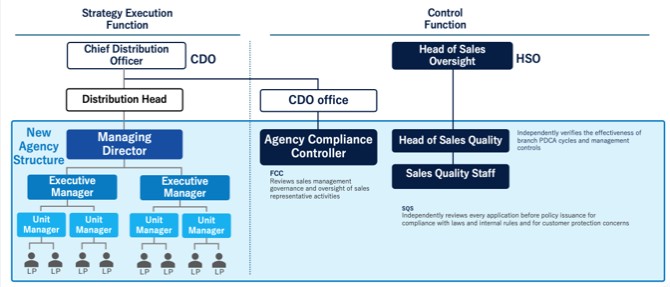
To ensure that the PDCA cycle within the sales organization functions effectively, the Company will establish an independent oversight and supervisory framework at head office. To this end, in July 2026, the Company separated the sales strategy and sales oversight functions at head office and established the new position of Head of Sales Oversight (HSO), reporting to the President. Effective November 1, 2026, the Company will establish a new Sales Oversight Division under the HSO.

To strengthen the sales oversight function of head office, head office employees will be assigned to agencies to perform three roles.


  •  

A new Head of Sales Quality position will be established under the Sales Oversight Division and assigned to each agency. The Head of Sales Quality will independently ensure the effectiveness of the agency’s management framework. They will centrally collect, manage, and use data relating to insurance sales quality, sales activities, and the conduct of sales employees as part of a risk-based approach to identifying early warning signs at the individual sales employee level and preventing inappropriate conduct and other issues before they occur.


  •  

Sales Quality Staff will be assigned under the Head of Sales Quality, with an appropriate number of staff assigned based on the size of each agency. Previously, these employees worked as internal agency staff responsible for checking application documents for deficiencies. Their role will now be revised so that, from a position independent of the agency, they review all applications handled by their assigned agency before policies are issued to identify any issues from the perspectives of compliance with laws, regulations, and internal rules, as well as customer protection. Where concerns or issues are identified, the results of these reviews will be reported to the Head of Sales Quality and necessary corrective action will be taken.


  •  

In addition, Agency Compliance Controllers will be assigned to each agency. Under the Chief Distribution Officer, they will further strengthen the first-line management framework by objectively reviewing governance by sales managers and how sales employee activities are being managed.


8


  •  

Organizational Structure of the Sales Strategy and Sales Oversight Functions


LOGO


(7)

Reform of Management and Head Office Structure

Effective July 1, 2026, the Company reorganized its head office and transitioned to a Chief Officer (CxO) structure, assigning a designated executive to each function and clarifying accountability in each area. As part of this reorganization, we established a Chief Remediation Officer to drive reform initiatives across the organization, a Chief Governance Officer to oversee compliance, risk management, and legal functions in an integrated manner, and the Head of Sales Oversight described above.

Since the reorganization, we have been reviewing the operation of management meetings and relevant committees, as well as reporting processes, to ensure that progress on reform measures, risk information, and issues identified on the front lines are continuously reviewed, and that signs of significant risks or issues are shared with management in a timely manner and lead to necessary decision-making and corrective action. The Company is also continuing to review its executive officer structure.

The Board of Directors is also strengthening its oversight function by receiving regular reports on the progress of reform initiatives and significant risk information, and by directly monitoring the status of remediation in response to serious incidents.

We have also clarified the roles and responsibilities under the three-line management framework. The first line (the sales organization) is responsible for its own risks and implementing controls; the second line (risk management and compliance) independently assesses the effectiveness of those controls; and the third line (internal audit) independently reviews the overall framework. Based on these principles, we are working to eliminate the structure under which functions assess controls that they themselves have performed. For example, responsibilities previously performed by the second line, including contract monitoring and agency inspections, have been transferred to the first line.

For the third line of internal audit, significant findings will continue to be monitored, including any residual risks, until remediation is complete and independent validation has been completed, with interim and permanent remediation clearly distinguished. For high-risk findings, the status of remediation will be managed under the responsibility of the President.


9


(8)

Improvement of Corporate and Organizational Culture

Alongside reforms to our systems and organizational structures, we will establish a framework for management to continuously monitor and improve both “conduct,” where organizational culture manifests itself in actual behavior, and “culture,” which shapes that behavior. Through this framework, we aim to strengthen our ability to identify and correct issues from the perspective of customers and society.


  a.

Redefining Values and Behaviors

We will revisit the core values, “Worthy of Trust,” “Customer Focused,” “Respect for Each Other,” and “Winning with Integrity,” reaffirm their purpose and relevance today, and redefine them as shared values for determining the behaviors we should adopt and those we should avoid from the perspective of customers and society.

Management and managers will take the lead in putting these values into practice, while strengthening leadership that encourages employees to raise concerns and express differing views, and ensures that these are translated into corrective action. We will also review recruitment, development, placement, evaluation, compensation, and other personnel practices to encourage customer-centric decision-making, high ethical standards, compliance, and sound organizational management.


  b.

Strengthening Conduct Risk Management

Going beyond mere compliance with laws and internal rules, we will clarify the definition, assessment criteria, and response processes for conduct risk in order to identify and manage risks arising from whether the conduct of executives and employees and the Company’s business operations are appropriate from the perspective of customers and society. We will also establish a Conduct Risk Committee that includes external experts to provide ongoing review incorporating external perspectives. A preparatory committee will be established in October, with the Conduct Risk Committee scheduled to be established by November.


  c.

Continuous Review and Improvement

To embed these initiatives throughout the Company and drive changes in the mindset of each employee, we are continuing to communicate and engage in dialogue with employees through initiatives including visits by management to all agencies and messages from the president and chief executive officer. We will also continuously monitor and assess changes in our corporate and organizational culture through employee attitudes and behavior, customer complaints and feedback, and other indicators. We will use the findings to inform reviews by management and seek to transform into an organization capable of identifying issues itself and taking corrective and improvement actions.


(9)

Strengthening Governance in Coordination with the Holding Company

The Holding Company also continues to monitor the progress of the Company’s structural reforms, including through deliberations by its Board of Directors, and is strengthening its management and oversight functions. In response to the findings and recommendations in the Investigation Report, the Holding Company will re-examine its approach to management and supervision across the Group. Taking into account the differences in business models among the subsidiaries, the Holding Company will strengthen the group-wide identification and sharing of risk information, as well as management and supervision in accordance with common standards.


10


In addition, the Holding Company has established a new “Remediation Advisory Committee” (provisional name), composed of external experts, in October 2026. The Committee provides advice and recommendations regarding the sufficiency and effectiveness of Group business improvement measures.


6.

New Business Sales Activities

Taking into account the findings and recommendations in the Investigation Report and other relevant matters, the Company will consider additional measures to prevent recurrence and carefully determine whether and when to resume new business sales activities.

In addition, only sales employees who meet the standards set by the Company and whose soundness has been confirmed will be permitted to resume new business sales activities.


7.

Our Vision for the Future

The Company aims to transform into an organization that puts customers firmly at the center of its thinking and actions. We believe that Life Planners who combine high ethical standards, comprehensive financial knowledge, and life-planning skills, and engage with customers with integrity, should be the reason the Company is chosen by society. It is management’s responsibility to ensure that the quality of this conduct does not depend solely on individual Life Planners, but is consistently upheld by the Company. We also aim to become an organization with a robust and consistent capacity to identify and correct issues on its own when they arise.

We would like to once again express our deepest apologies to our customers and all other stakeholders for the significant inconvenience and concern caused by this matter.

In coordination with the Holding Company, we will continue to fully embed customer-centric business operations and steadily advance our efforts to prevent recurrence and restore trust.

###


<Customer Inquiries>

Prudential Life Insurance Co., Ltd. Customer Service Center

0120-810740

Hours: Weekdays 9:00 a.m. to 5:30 p.m., Saturdays 9:00 a.m. to 5:00 p.m.

(Closed on Sundays, national holidays, and during the year-end and New Year holidays)


11


FORWARD-LOOKING STATEMENTS

Certain of the statements included in this release, including those regarding the plans and expectations to implement structural, governance, compensation, sales-oversight, customer-protection and cultural reforms, evaluate the resumption of new-business sales and recruitment, prevent recurrence of misconduct, and restore stakeholder trust, constitute forward-looking statements within the meaning of the U.S. Private Securities Litigation Reform Act of 1995. Words such as “expects,” “believes,” “anticipates,” “includes,” “plans,” “assumes,” “estimates,” “projects,” “intends,” “should,” “will,” “shall” or variations of such words are generally part of forward-looking statements. Forward-looking statements are made based on management’s current expectations and beliefs concerning future developments and their potential effects upon Prudential Financial, Inc. and its subsidiaries. Prudential Financial, Inc.’s actual results may differ, possibly materially, from expectations or estimates reflected in such forward-looking statements. Certain important factors that could cause actual results to differ, possibly materially, from expectations or estimates reflected in such forward-looking statements include, among others, losses on investments or financial contracts due to deterioration in credit quality or value, or counterparty default; losses on insurance products due to mortality experience, morbidity experience or policyholder behavior experience that differs significantly from our expectations when we price our products; and uncertainty regarding investigations into and remediation of matters such as the misconduct in Japan. Additional factors and uncertainties that could cause actual results to differ can be found in the “Risk Factors” and “Forward-Looking Statements” sections included in Prudential Financial, Inc.’s Annual Reports on Form 10-K and Quarterly Reports on Form 10-Q. The forward-looking statements herein are subject to the risk, among others, that we will be unable to execute our strategy because of market or competitive conditions or other factors. Prudential Financial, Inc. does not undertake to update any particular forward-looking statement included in this document.


12