Board statement on corporate governance
Message from the chair of the board of directors
Together with Equinor’s values, risk management principles and our Code of Conduct, the principles for corporate governance are
Equinor’s most important management framework. Equinor’s board of directors adheres to good corporate governance standards and
will ensure that Equinor either complies with the Norwegian Code of Practice for Corporate Governance (the Code of Practice) or
explains possible deviations from the Code of Practice. The Code of Practice can be found at www.nues.no .
The principles and legislation for reporting are evolving. Last year, we published our first integrated annual report which combined
financial and sustainability reporting into one report. This year, we present the board’s statement on corporate governance separately
for the first time, highlighting the importance of our principles for corporate governance. Next year, the European Sustainability
Reporting Standards (ESRS) will shape our reporting, as we also expect the Corporate Sustainability Reporting Directive (CSRD) to
add further requirements to our reporting, including on corporate governance.
The board of directors are closely following the changes and will continue to do so in 2024 to ensure that our corporate governance
principles and practices are of the highest quality.
Table of contents
1 Implementation and reporting ................................................................ ................................ ................................ ...........................3
Compliance with New York Stock Exchange listing rules ................................................................ ................................ .................3
2 Business ................................ ................................ ................................ ................................ ................................ ...........................4
3 Equity and dividends ................................ ................................ ................................ ................................ ................................ .........5
4 Equal treatment of shareholders and transactions with close associates ................................ ................................ ..........................6
5 Freely negotiable shares................................................................ ................................ ................................ ................................ ...7
6 General meeting of shareholders ................................ ................................ ................................ ................................ ......................7
7 Nomination committee ................................ ................................ ................................ ................................ ................................ ......8
8 Corporate assembly, board of directors and corporate executive committee ................................ ................................ ..................10
Corporate assembly ................................................................ ................................ ................................ ................................ .......10
Board of directors ................................ ................................ ................................ ................................ ................................ ...........12
Corporate executive committee (CEC) ................................ ................................ ................................ ................................ ...........12
9 The work of the board of directors ................................................................ ................................ ................................ ..................13
The board of directors’ committees ................................................................ ................................ ................................ ................14
10 Risk management and internal control ................................ ................................ ................................ ................................ ..........16
Risk management ................................................................ ................................ ................................ ................................ ..........16
Code of Conduct ................................................................ ................................ ................................ ................................ ............17
11 Remuneration to the board of directors and corporate assembly ................................ ................................ ................................ ..18
12 Remuneration to the corporate executive committee ................................ ................................ ................................ ....................18
13 Information and communications ................................ ................................ ................................ ................................ ..................18
14 Take-overs ................................ ................................ ................................ ................................ ................................ ....................19
15 External auditor................................................................ ................................ ................................ ................................ .............19
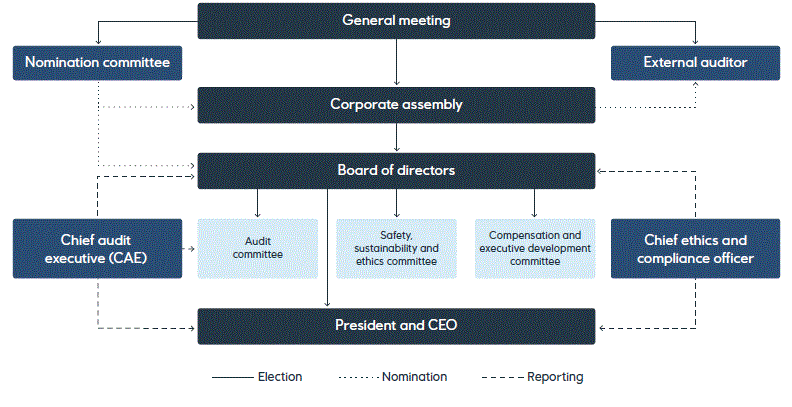
This statement provides a detailed overview of how Equinor follows the Norwegian Code of Practice for Corporate Governance (the
Code of Practice) and describes the foundation and principles for Equinor’s corporate governance structure which should be seen in
context with information in the Integrated Annual Report, section 1.9 Corporate governance and risk management. Further information
can be found on www.equinor.com,
The Code of Practice covers 15 topics, and this board statement covers each of these topics and describes Equinor’s adherence to
the Code of Practice. The information concerning corporate governance that is required to be disclosed under the Norwegian
Accounting Act Section 3-3b is included in this board statement as follows:
1.
otherwise chooses to comply with”: Described in this introduction as well as in section 1 Implementation and reporting.
2.
introduction.
3.
Code of Practice’ recommendations, one in section 6 General meeting of shareholders and the other in section 14 Take-overs.
The reasons for these deviations are described under the respective sections of this statement.
4.
Group’s (if relevant) internal control and risk management systems linked to the financial reporting process”: Described in section
10 Risk management and internal control.
5.
Companies Act”: Described in section 6 General meeting of shareholders.
6.
Control Committee and any working committees related to these bodies, as well as a description of the main instructions and
guidelines that apply to the work of the bodies and any committees”: Described in section 8 Corporate assembly, board of
directors and corporate executive committee and section 9 The work of the board of directors.
7.
board of directors and corporate executive committee under the sub-heading Board of directors.
8.
its own shares or equity certificates”: Described in section 3 Equity and dividends.
9.
educational and professional background for the composition of boards, management and governing bodies and if relevant any
sub-committees. The objective of the guidelines, how they have been implemented and their effect during the reporting period
shall be stated. If the enterprise does not have such guidelines, this must be justified”: Described in section 7 Nomination
committee.
Nomination, elections and reporting in Equinor ASA
1 Implementation and reporting
Equinor ASA is a Norwegian-registered public limited liability company with its primary listing on Oslo Stock Exchange (Oslo Børs),
and the foundation for the Equinor group’s governance structure is Norwegian law. American Depositary Receipts (ADRs)
representing ordinary shares are listed on the New York Stock Exchange (NYSE), and Equinor is therefore subject to the listing
requirements of NYSE and the applicable reporting requirements of the US Securities and Exchange Commission (SEC rules).
The board of directors focuses on maintaining a high standard of corporate governance in line with Norwegian and international
standards of best practice. Good corporate governance is a prerequisite for a sound and sustainable company, and our corporate
governance is based on openness and equal treatment of shareholders. Governing structures and controls help to ensure that we run
our business in a justifiable and profitable manner for the benefit of employees, shareholders, partners, customers and society.
The work of the board of directors is based on the existence of a clearly defined division of roles and responsibilities between the
shareholders, the board of directors and the company’s corporate executive committee.
The following principles underline Equinor’s approach to corporate governance:
●
●
●
committee. The board of directors focuses on preventing conflicts of interest between shareholders, the board of directors and
the company’s corporate executive committee.
●
The governance and management system is further elaborated on at www.equinor.com/cg where shareholders and stakeholders can
explore any topic of interest in more detail.
Compliance with New York Stock Exchange listing rules
Equinor’s primary listing is on the Oslo Børs. Equinor is also registered as a foreign private issuer with the US Securities and
Exchange Commission with ADRs representing its ordinary shares listed on the NYSE.
While Equinor’s corporate governance practices follow the requirements of Norwegian law, Equinor is also subject to the NYSE’s
listing rules.
Equinor is considered a foreign private issuer in the US and is thus exempted from most of the NYSE corporate governance
standards that domestic US companies must comply with. However, Equinor is required to disclose any significant ways in which its
corporate governance practices differ from those applicable to domestic US companies under the NYSE rules. A statement of
differences is set out below:
Corporate governance guidelines
The NYSE rules require domestic US companies to adopt and disclose corporate governance guidelines. Equinor’s corporate
governance principles are developed by the corporate executive committee and the board of directors, in accordance with the Code of
Practice and applicable law. Oversight of the board of directors and the CEO’s management of the company is exercised by the
corporate assembly.
Director independence
The NYSE rules require domestic US companies to have a majority of “independent directors”. The NYSE definition of an
“independent director” sets out five specific tests of independence and requires an affirmative determination by the board of directors
that the director has no material relationship with the company.
Pursuant to Norwegian company law, Equinor’s board of directors consists of members elected by the corporate assembly as
representatives for both shareholders and employees. Equinor’s board of directors has determined that, in its judgment, all
shareholder-representatives are independent. In making its determinations of independence, the board of directors focuses inter alia
on there not being any conflicts of interest between shareholders, the board of directors and the company’s corporate executive
committee. It does not strictly make its determination based on the NYSE’s five specific tests but takes into consideration all relevant
circumstances which may in the board of director’s view affect the directors’ independence. The directors elected from among
Equinor’s employees would not be considered independent under the NYSE rules as they are employees of Equinor. None of these
employee representatives are executive officers of the company.
For further information about the board of directors, see 8 Corporate assembly, board of directors and corporate executive committee.
Board committees
Pursuant to Norwegian company law, managing the company is the responsibility of the board of directors. Equinor has the following
board committees; an audit committee, a safety, sustainability and ethics committee and a compensation and executive development
committee. The audit committee and the compensation and executive development committee operate pursuant to instructions that
are broadly comparable to the applicable committee charters required by the NYSE rules. They report on a regular basis to, and are
subject to, oversight by the board of directors. For further information about the board committees, see 9 The work of the board of
directors.
Equinor complies with the NYSE rule regarding the obligation to have an audit committee that meets the requirements of Rule 10A-3
of the US Securities Exchange Act of 1934.
The members of Equinor’s audit committee include an employee representative director. Equinor relies on the exemption provided in
Rule 10A-3(b)(1)(iv)(C) from the independence requirements of the US Securities Exchange Act of 1934 with respect to the employee
representative director. Equinor believes that its reliance on this exemption will not materially adversely affect the ability of the audit
committee to act independently or to satisfy the other requirements of Rule 10A-3 relating to audit committees. The other members of
the audit committee meet the independence requirements under Rule 10A-3.
Among other things, the audit committee evaluates the qualifications and independence of the company’s external auditor.
However,
in accordance with Norwegian law, the auditor is elected by the annual general meeting of the company’s shareholders.
Equinor does not have a nominating/corporate governance committee formed from its board of directors. Instead, the roles prescribed
under the NYSE rules for such committee are principally carried out by the corporate assembly and the nomination committee. The
nomination committee is elected by the general meeting of shareholders, and the corporate assembly is elected partly by the general
meeting of shareholders and partly by and among the employees. The nomination committee, which is elected by the general meeting
of shareholders, recommends to the corporate assembly the candidates and remuneration for the board of directors. The nomination
committee also recommends to the general meeting of shareholders the candidates and remuneration for the nomination committee
and the shareholder representative candidates and remuneration for the corporate assembly.
NYSE rules require the compensation committee of US companies to comprise independent directors, recommend senior
management remuneration and determine the independence of advisors when engaging them. Equinor, as a foreign private issuer, is
exempted from complying with these rules and is permitted to follow its home country regulations. The compensation committee
consists of four shareholder representatives and one employee representative. Equinor’s compensation committee makes
recommendations to the board of directors regarding remuneration to the corporate executive committee, including that of the CEO.
Further, the compensation committee assesses its own performance and has the authority to hire external advisors.
Shareholder approval of equity compensation plans
The NYSE rules require that, with limited exemptions, all equity compensation plans must be subject to a shareholder vote. Equinor
ASA remuneration schemes, including equity compensation plans, are approved by the CEO. The BoD is informed if the terms and
conditions affect executives and senior executives. Issuance of shares and authority to buy-back company shares for the company’s
equity compensation plans must be proposed by the BoD and approved by Equinor's annual general meeting of shareholders.
Deviations from the Code of Practice: None
2 Business
Equinor is an international energy company headquartered in Stavanger, Norway. The company has business operations in around
30 countries and approximately 23,000 employees worldwide. Equinor ASA is a public limited liability company organised under the
laws of Norway and subject to the provisions of the Norwegian Public Limited Liability Companies Act. The Norwegian State is the
largest shareholder of Equinor ASA, with a direct ownership interest of 67%. Equinor is continuously developing the Norwegian
Continental Shelf (NCS) and focusing its international portfolio to deliver sustainable value in the decades to come, at the same time
as it develops a profitable renewables business and secure opportunities in the low carbon market.
Equinor is the largest oil and gas operator in the NCS and is among the world's largest net sellers of crude oil and condensate.
Equinor is the largest supplier of energy to Europe and still has positions on processing and refining operations. Equinor also markets
and sells the Norwegian State’s share of the natural gas and crude oil produced on the NCS. Equinor contributes to the development
of new low carbon energy resources, has on-going offshore and onshore renewables activities internationally and is at the forefront of
the implementation of technology for carbon capture and storage (CCS) in Europe and US.
Objective, strategies and risk profiles
Equinor’s objective is defined in the articles of association section 1 and is to develop, produce and market various forms of energy
and derived products and services, as well as other business. The activities may also be carried out through participation in or
cooperation with other companies. Equinor's current articles of association were adopted at the annual general meeting of
shareholders on 10 May 2023 and are available at www.equinor.com/articlesofassociation.
Equinor’s purpose is turning natural resources into energy for people and progress for society. The board of directors has approved a
corporate strategy to deliver on this purpose and the strategy has been translated into concrete objectives and targets to align
execution.
Equinor’s corporate strategy is presented in the Integrated Annual Report in section 1.5 Our Strategy.
In pursuing the vision and strategy, Equinor is committed to the highest standard of governance and to cultivating a values-based
performance culture that rewards exemplary ethical practices, respect for the environment and personal and corporate integrity. The
company continuously considers prevailing international standards of best practice when defining and implementing company policies,
as Equinor believes that there is a clear link between high-quality governance and the creation of shareholder value.
At Equinor, the way we deliver is as important as what we deliver. The Equinor Book, which addresses all Equinor employees, sets
the standards for behaviour, delivery and leadership.
The values guide the behaviour of all Equinor employees. The corporate values are "courageous", "open", "collaborative" and
"caring". Both the values and ethics are treated as an integral part of business activities. The Code of Conduct is further described in
section 10 Risk management and internal control.
Equinor also focus on managing the impacts of its activities on people, society and the environment, in line with corporate policies for
health, safety, security, sustainability and climate, human rights and ethics. Areas covered by these policies include labour standards,
transparency, anti-corruption, local hiring and procurement, health and safety, the working environment, security and broader
environmental issues. These efforts and policies are further described in the Integrated Annual Report section 2.2 Sustainability
Performance.
The Equinor risk profile is a composite view of risks and supports current and future portfolio considerations. The focus is to strive for
a portfolio that is robust and value creating through the cycles. Risk is an embedded part of the board’s strategy discussions and
investment decisions. The board of directors regularly evaluates Equinor’s strategy, risk profile and target setting as part of its annual
plan. See also sections 9 The work of the board of directors and 10 Risk management and internal control.
Deviations from the Code of Practice: None
3 Equity and dividends
Shareholders' equity and capital structure
The company's shareholders' equity as of 31 December 2023 amounted to USD 48,490 million (excluding USD 10 million in non-
controlling interest, minority interest), equivalent to 33.8% of the company's total assets. The net debt ratio was negative 21.6%
1
.
Cash, cash equivalents and current financial investments amounted to USD 38,865 million. The board of directors considers this to be
satisfactory given the company's requirements for financial robustness in relation to its expressed goals, strategy and risk profile.
Any increase of the company’s share capital must be adopted or mandated by the general meeting by at least two-thirds majority vote.
If a mandate was to be granted to the board of directors to increase the company's share capital, such mandate would be restricted to
a defined purpose. If the general meeting is to consider mandates to the board of directors for the issue of shares for different
purposes, each mandate would be considered separately by the general meeting.
Dividend policy
It is Equinor's ambition to grow the annual cash dividend, measured in USD per share, in line with long-term underlying earnings.
Equinor announces dividends on a quarterly basis. The board of directors approves first to third quarter interim dividends based on an
authorisation from the annual general meeting, while the annual general meeting approves the fourth quarter (and total annual)
dividend based on a proposal from the board of directors. When deciding the interim dividends and recommending the total annual
dividend level, the board of directors will take into consideration expected cash flow, capital expenditure plans, financing requirements
and appropriate financial flexibility. In addition to cash dividends, Equinor might buy-back shares as part of the distribution of capital to
the shareholders.
The shareholders at the annual general meeting may vote to reduce, but may not vote to increase, the fourth quarter dividend
proposed by the board of directors. Equinor announces dividend payments in connection with quarterly results. Payment of quarterly
dividends is expected to take place approximately four months after the announcement of each quarterly dividend.
Equinor declares dividends in USD. Dividends in NOK per share will be calculated and communicated four business days after record
date for shareholders at Oslo Børs.
1
employed and net debt to capital employed ratio as shown in the Integrated Annual Report under section 5.6 Use and reconciliation of
non-GAAP financial measures.
The board of directors proposes to the annual general meeting an ordinary dividend of USD 0.35 per share and an extraordinary
dividend of USD 0.35 per share for the fourth quarter 2023.
Buy-back of own shares for subsequent cancellation
In addition to cash dividend, Equinor may buy-back shares as part of the total distribution of capital to the shareholders. To buy-back
shares, the board of directors will need an authorisation from the general meeting. On 10 May 2023, the annual general meeting
authorised the board of directors to acquire Equinor ASA shares in the market, on behalf of the company, with a total nominal value of
up to NOK 235,000,000. The board of directors was authorised to decide at what price within minimum and maximum prices of NOK
50 and NOK 1,000, respectively, and at what time such acquisitions shall take place. It is a precondition that shares acquired pursuant
to the authorisation are subsequently cancelled through a reduction of the company’s share capital, pursuant to the Norwegian Public
Limited Liability Companies Act section 12-1. It is also a precondition for the repurchase and cancellation of shares that the
Norwegian State’s ownership interest in Equinor ASA is not changed. Accordingly, a proposal for the redemption of a proportionate
number of the State’s shares, ensuring that the State’s ownership interest in the company remains unchanged, will also be put
forward at the annual general meeting to decide on the cancellation of repurchased shares. The authorisation remains valid until the
next annual general meeting in the company, but no later than 30 June 2024. New share buy-back tranches are subject to existing
and new agreements with the Norwegian state regarding share buy-back.
Purchase of own shares for use in the share savings plan
Since 2004, Equinor has had a share savings plan for its employees. The purpose of this plan is to strengthen the business culture
and encourage loyalty through employees becoming part-owners of the company. The annual general meeting annually authorises
the board of directors to acquire Equinor ASA shares in the market in order to continue implementation of the employees share
savings plan.
On 10 May 2023, the board of directors was authorised on behalf of the company to acquire Equinor ASA shares for a total nominal
value of up to NOK 27,500,000 for use in the share savings plan. This authorisation remains valid until a new authorisation has been
adopted in the next general meeting and registered in the Register of Business Enterprises, but no later than 30 June 2024.
Deviations from the Code of Practice: None
4 Equal treatment of shareholders and transactions with close associates
Equal treatment of all shareholders is a core governance principle in Equinor. Equinor has one class of shares, and each share
confers one vote at the general meeting. The articles of association contain no restrictions on voting rights and all shares have equal
rights.
The Norwegian State as majority owner
The Norwegian State (the State) is the majority shareholder of Equinor and also holds major investments in other Norwegian
companies. As of 31 December 2023, the State had an ownership interest in Equinor of 67% (excluding Folketrygdfondet’s
(Norwegian national insurance fund) ownership interest of 3.6%). The State is also a majority owner in other companies or enterprises
that are under a common ownership structure and therefore meet the definition of a related party. Equinor may participate in
transactions with such companies or enterprises. All such transactions are always entered into on an arm’s length basis. The State’s
ownership interest in Equinor is managed by the Ministry of Trade, Industry and Fisheries (MTIF). The State’s ownership interests in
related parties may be managed by the MTIF or other Ministries in the Norwegian government, depending on the line of business
such related parties are engaged in.
Contact between the State as owner and Equinor takes in principle place in the same manner as for other institutional investors,
however, with the difference that there are more frequent meetings with the MTIF. Topics discussed includes Equinor’s economic and
strategic development, sustainability and the State’s expectations regarding results and returns on investments. Such meetings
comply with Norwegian company and securities legislation, hereunder equal treatment of shareholders and limitations for discussing
inside information.
available to all shareholders. If state participation is imperative and the government must seek approval from the Norwegian
Parliament (Stortinget), it may be necessary to provide the Ministry with insider information. The State will be subject to general rules
that apply to the handling of such information. Equinor ensures that, in any interaction between the State and Equinor, a distinction is
drawn between the State’s different roles.
The State has no appointed board members or members of the corporate assembly in Equinor. As majority shareholder, the State has
appointed a member of Equinor’s nomination committee.
Sale of the State’s oil and gas
Pursuant to Equinor’s articles of association, Equinor markets and sells the State’s share of oil and gas production from the NCS
together with its own production. The State has a common ownership strategy aimed at maximising the total value of its ownership
interests in Equinor and its own oil and gas interests. This strategy is incorporated in the marketing instruction, which obliges Equinor,
in its activities on the NCS, to emphasise these overall interests in decisions that may be of significance to the implementation of the
sales arrangements.
The State-owned company Petoro AS handles commercial matters relating to the State’s direct involvement in petroleum activities on
the NCS and related activities and is responsible for overseeing that Equinor performs its tasks in accordance with the marketing
instruction.
Other transactions
In relation to its ordinary business operations such as pipeline transport, gas storage and processing of petroleum products, Equinor
also has regular transactions with certain entities in which Equinor has ownership interests. Such transactions are carried out on an
arm’s length basis.
Deviations from the Code of Practice: None
5 Freely negotiable shares
Equinor’s primary listing is on Oslo Børs. ADRs are traded on the NYSE. Each Equinor ADR represents one underlying ordinary
share.
The articles of association of Equinor do not include any form of restrictions on the ownership, negotiability or voting related to its
shares and the ADRs.
Deviations from the Code of Practice: None
6 General meeting of shareholders
The general meeting of shareholders is Equinor’s supreme corporate body. It serves as a democratic and effective forum for
interaction between the company’s shareholders, board of directors and corporate executive committee.
The next annual general meeting (AGM) is scheduled for 14 May 2024. At Equinor’s AGM on 10 May 2023, 78.02 % of the share
capital was represented either by personal attendance or by advance voting.
Pursuant to Equinor’s articles of association, the AGM must be held by the end of June each year. Notice of the meeting and
documents relating to the AGM are published on Equinor’s website and notice is sent to all shareholders with known addresses at
least 21 days prior to the meeting. All shareholders who are registered in the Norwegian Central Securities Depository (VPS) will
receive a notice to the AGM. Other documents relating to Equinor’s AGM will be made available on Equinor’s website. A shareholder
may request that these documents be sent to him/her.
Shareholders are entitled to have their proposals dealt with at the AGM if the proposal has been submitted in writing to the board of
directors in sufficient time to enable it to be included in the notice of meeting, i.e. no later than 28 days before the meeting.
As described in the notice of the general meeting, shareholders may vote in writing, including through electronic communication,
during a specified period before the general meeting.
The AGM is normally opened and chaired by the chair of the corporate assembly. If there is a dispute concerning individual matters
and the chair of the corporate assembly belongs to one of the disputing parties or is for some other reason not perceived as being
impartial, another person will be appointed to chair the AGM. This is in order to ensure impartiality in relation to the matters to be
considered.
The following matters are required to be decided at the AGM:
●
recommended by the corporate assembly.
●
●
●
●
All shares carry an equal right to vote at general meetings. Resolutions at general meetings are normally passed by simple majority.
However, Norwegian company law requires a qualified majority for certain resolutions, including resolutions to waive preferential rights
in connection with any share issue, approval of a merger or demerger, amendment of the articles of association or authorisation to
increase or reduce the share capital. Such matters require approval of at least two-thirds of the aggregate number of votes cast as
well as two-thirds of the share capital represented at the general meeting.
If shares are registered by a nominee in the Norwegian Central Securities Depository (VPS), cf. section 4-10 of the Norwegian Public
Limited Liability Companies Act, and the beneficial shareholder wants to vote such shares, the beneficial shareholder does not have
to re-register the shares in a separate VPS account, however, the beneficial shareholder must give advance notice to the company.
The minutes of the AGM are made available on Equinor’s website immediately after the AGM.
An extraordinary general meeting (EGM) can be held in order to consider and decide a specific matter if demanded by the corporate
assembly, the chair of the corporate assembly, the auditor or shareholders representing at least 5% of the share capital. The board of
directors must ensure that an EGM is held within a month of such demand being submitted.
Deviations from the Code of Practice
The Code of Practice recommends that the board of directors and chair of the nomination committee are present at the general
meetings. Equinor has not deemed it necessary to require the presence of all members of the board of directors. However, the chair of
the board of directors, the chair of the nomination committee, as well as the chair of the corporate assembly, our external auditor, the
CEO and other members of management are always present at general meetings.
7 Nomination committee
Pursuant to Equinor's articles of association, the nomination committee shall consist of four members who are shareholders or
representatives of shareholders. The duties of the nomination committee are set forth in the articles of association, and the
instructions for the committee are adopted by the general meeting of shareholders.
The duties of the nomination committee are to submit recommendations to:
●
and the remuneration for members of the corporate assembly.
●
●
members of the board of directors.
●
The nomination committee seeks to ensure that the shareholders’ views are taken into consideration when candidates to the
governing bodies of Equinor ASA are proposed. The nomination committee invites Equinor's largest shareholders to propose
shareholder-representatives to the board of directors and the corporate assembly, as well as members of the nomination committee.
The shareholders are also invited to provide input to the nomination committee in respect of the composition and competence of
Equinor's governing bodies considering Equinor's strategy and opportunities going forward. Such input may be taken into account in
the upcoming nominations. In addition, all shareholders have an opportunity to submit proposals through an electronic mailbox as
described on Equinor’s website. The results from an annual board evaluation, normally externally facilitated, are made available to the
nomination committee for the board nomination process. Separate meetings are held between the nomination committee and each
board member, including employee-representatives. The chair of the board of directors and the CEO are invited, without having the
right to vote, to attend at least one meeting of the nomination committee before it makes its final recommendations. The committee
regularly utilises external expertise in its work and provides reasons for its recommendations of candidates.
When it comes to the subject of diversity and inclusion for the composition of the board of directors and the corporate assembly, it is
stated in the instructions for the nomination committee section 3.5 that “Emphasis will also be given to ensuring reasonable
representation in terms of gender and background, and to the independence of members of the board of directors and corporate
assembly in relation to the company.” The company’s guidelines on diversity and inclusion are described in the Integrated Annual
Report under the section 2.2 Workforce for the future.
The members of the nomination committee are elected by the annual general meeting. The chair of the nomination committee and
one other member are elected from and among the shareholder-representatives of the corporate assembly. Members of the
nomination committee are normally elected for a term of two years.
Equinor's nomination committee had the following members as of 31 December 2023 which are elected for the period up to the annual
general meeting in 2024:
●
●
●
●
The nomination committee held 21 meetings in 2023. The instructions for the nomination committee are available at
www.equinor.com/nominationcommittee.
Deviations from the Code of Practice: None
8 Corporate assembly, board of directors and corporate executive committee
Corporate assembly
Pursuant to the Norwegian Public Limited Liability Companies Act, companies with more than 200 employees must elect a corporate
assembly unless otherwise agreed between the company and a majority of its employees.
The corporate assembly is Equinor’s body for supervision of the board of directors and the CEO’s management of the company. The
members of the corporate assembly represent a broad cross-section of the company’s shareholders and stakeholders, and one of
their main duties is to elect the company’s board of directors. In accordance with Equinor's articles of association, the corporate
assembly consists of 18 members and three observers. Of the 18 members, 12 (with four deputy members) are nominated by the
nomination committee and elected by the annual general meeting and they represent a broad cross-section of the company's
shareholders and stakeholders. Six members (with deputy members) and three observers are elected by and among the employees in
Equinor ASA or a subsidiary in Norway, which are non-executive employees. The corporate assembly elects its own chair and deputy
chair from and among its members.
Members of the corporate assembly are normally elected for a term of two years. Members of the board of directors and the corporate
executive committee cannot be members of the corporate assembly, but they are entitled to attend and to speak at meetings unless
the corporate assembly decides otherwise in individual cases. Members of the corporate assembly do not have service contracts with
the company or its subsidiaries providing for benefits upon termination of office. All members of the corporate assembly are
Norwegian residents.
An overview of the members and observers of the corporate assembly as of 31 December 2023 follows.
Name
Occupation per
31.12.2023
Place of
residence
Year
of
birth
Position
Family
relations to
corporate
executive
committee,
board or
corporate
assembly
members
Share
ownership
for
members
as of 31
December
2023
Share
ownersh
ip for
member
s as of
12
March
2024
First
time
electe
d
Expiratio
n date of
current
term
Jarle Roth
Independent advisor
Bærum
1960
Chair,
Shareholder-
elected
No
500
500
2016
2024
Nils Bastiansen
Independent advisor
Oslo
1960
Deputy chair,
Shareholder-
elected
No
1,000
1,000
2016
2024
Finn Kinserdal
Associate professor,
Norwegian School of
Economics and Business
(NHH)
Bergen
1960
Shareholder-
elected
No
0
0
2018
2024
Kari Skeidsvoll Moe
EVP, Growth Renewable
Energy Aneo AS
Trondheim
1975
Shareholder-
elected
No
0
0
2018
2024
Kjerstin Fyllingen
CEO at Haraldsplass
Diakonale Sykehus AS
Paradis
1958
Shareholder-
elected
No
0
0
2020
2024
Kjerstin Rasmussen
Braathen
CEO of DNB Bank ASA
Oslo
1970
Shareholder-
elected
No
353
353
2020
2024
Mari Rege
Professor of Economics at
the UiS Business School at
the University of Stavanger
Stavanger
1974
Shareholder-
elected
No
0
0
2020
2024
Trond Straume
CEO of Volue ASA
Sandnes
1977
Shareholder-
elected
No
100
100
2020
2024
Martin Wien Fjell
President Kongsberg
Sensors and Robotics,
Kongsberg Group
Asker
1980
Shareholder-
elected
No
202
202
2022
2024
Merete Hverven
CEO of Visma
Oslo
1977
Shareholder-
elected
No
0
0
2022
2024
Helge Aasen
CEO of Elkem ASA
Kristiansan
d
1963
Shareholder-
elected
No
0
0
2022
2024
Liv B. Ulriksen
CEO of Sparebank 1 Nord-
Norge
Tromsø
1960
Shareholder-
elected
No
0
0
2022
2024
Peter B. Sabel
Union representative,
Tekna/NITO, Project
Leader Geophysics
Hafrsfjord
1968
Employee-
elected
No
0
0
2019
2025
Trine Hansen
Stavland
Union representative,
Industri Energi
Sandnes
1963
Employee-
elected
No
2,697
2,937
2023
2025
Ingvild Berg
Martiniussen
Union representative,
Tekna/NITO, Principal
Researcher Production
Technology
Porsgrunn
1976
Employee-
elected
No
2,890
3,021
2019
2025
Berit Søgnen
Sandven
Union representative,
Tekna/NITO, Principal
Engineer Fiscal metering
Kalandseid
et
1962
Employee-
elected
No
2,992
3,904
2019
2025
Frank Indreland
Gundersen
Union representative,
Industri Energi
Skjold
1990
Employee-
elected
No
370
556
2021
2025
Per Helge Ødegård
Union representative,
Lederne, Discipl resp
operation process
Porsgrunn
1963
Employee-
elected
No
377
568
1994
2025
Raymond Midtgård
Union representative,
YS/SAFE
Hjelmås
1976
Employee-
elected,
observer
No
642
769
2023
2025
Vidar Frøseth
Union representative,
Tekna/NITO, Leading
Engineer O&M
Nyborg
1978
Employee-
elected,
observer
No
6,204
6,480
2019
2025
Kjetil Gjerstad
Union representative,
Industri Energi
Hundvin
1976
Employee-
elected,
observer
No
467
645
2019
2025
Total
18,794
21,035
The duties of the corporate assembly are defined in section 6-37 of the Norwegian Public Limited Liability Companies Act. The
corporate assembly elects the board of directors and the chair of the board of directors and can vote separately on each nominated
candidate. Its responsibilities also include overseeing the board of directors and the CEO's management of the company, making
decisions on investments of considerable magnitude in relation to the company's resources, and making decisions involving the
rationalisation or reorganisation of operations that will entail major changes in or reallocation of the workforce.
Equinor's corporate assembly held four ordinary meetings in 2023. The chair of the board of directors and the CEO participated in all
four meetings. Other members of management were also present at the meetings.
The procedure for the work of the corporate assembly, as well as an updated overview of its members, is available at
www.equinor.com/corporateassembly.
Board of directors
Pursuant to Equinor's articles of association, the board of directors shall consist of between nine to eleven members elected by the
corporate assembly. The chair and the deputy chair of the board of directors are also elected by the corporate assembly. At present,
Equinor's board of directors consists of ten members. Six are men, four are women and two are non-Norwegians resident outside of
Norway. As required by Norwegian company law, the company's employees are represented by three board members. The
employee-representatives of the board of directors have three deputy members who attend board meetings in the event an employee-
representative of the board of directors is unable to attend. Members of the corporate executive committee is not represented on the
board of directors. Members of the board of directors are elected for a term of up to two years, normally for one year at a time. There
are no board member service contracts that provide for benefits upon termination of office.
The board of directors considers its composition to be competent with respect to the expertise, capacity and diversity appropriate to
attend to the company's strategy, goals, main challenges, and the common interest of all shareholders. The board of directors also
deems its composition to consist of individuals who are willing and able to work as a team, resulting in an efficient and collegiate
board of directors. The board of directors has determined that, in its judgment, all the shareholder-representatives on the board of
directors are considered independent. At least one board member qualifies as an "audit committee financial expert", as defined in the
SEC rules. The board members have experience from inter alia oil, gas, renewables, shipping, telecom and Norwegian defence
forces.
An induction programme with members of the corporate executive committee is arranged for new board members. They receive an
introduction to Equinor’s business and relevant information about the company and the board of directors’ work.
Equinor ASA has purchased and maintains a Directors and Officers Liability Insurance on behalf of the members of the board of
directors and the CEO. The insurance also covers any employee acting in a managerial capacity and includes controlled subsidiaries.
The insurance policy is issued by a reputable insurer with an appropriate rating.
The board of directors held eight ordinary board meetings and three extraordinary meetings in 2023. Average attendance at these
board meetings was 99,02%.
Members of the board of directors as of 31 December 2023:
[Links to CV’s on equinor.com]
There were no changes to the composition of the board of directors in 2023. The corporate assembly re-elected all members in June
2023.
Corporate executive committee (CEC)
The president and chief executive officer (CEO) has the overall responsibility for day-to-day operations in Equinor. The CEO appoints
the corporate executive committee, which considers proposals for strategy, goals, financial statements, as well as important
investments prior to submission to the BoD. The purpose of the CEC is to set direction, drive prioritisation and execution, build
capabilities and ensure compliance. The CEC works to safeguard and promote the corporate interests of the company through
developing the management system and securing adequate risk management and control systems. The CEC includes the CEO, the
chief financial officer (CFO), the executive vice presidents of the business areas; Exploration & Production International (EPI),
Exploration & Production Norway (EPN), Marketing, Midstream & Processing (MMP), Renewables (REN), Projects, Drilling &
Procurement (PDP), Technology, Digital & Innovation (TDI), and the executive vice presidents for Safety, Security & Sustainability,
Legal & Compliance, People & Organisation and Communication.
The CEC ensures proactive management and control of sustainability related impacts through the safety, sustainability and ethics
committee held on a quarterly basis. Risk, performance, and mitigating actions are key topics for the work in the committee. Ethical
and reputational issues such as anti-corruption are monitored and mitigated through the CEC ethics committee. The ethics committee
meet as needed and at least three times a year.
In addition, through the corporate risk committee the CEC manages Equinor’s overall risk exposure, and material topics related to
health and safety, human rights, corruption, climate and environment is assessed as part of the overall risk management. The
corporate risk committee functions as an advisory body to the CEO and CFO, and the work of the corporate risk committee is
presented to the CEC on a regular basis.
Members of Equinor's corporate executive committee as of 31 December 2023:
[Links to CV’s on equinor.com]
As part of its general loan arrangement for Equinor employees, Equinor has granted loans to Equinor-employed spouses of certain
members of the corporate executive committee. Permanent employees in certain specified employee categories may take out a car
loan from Equinor in accordance with standardised provisions set by the company. The standard maximum car loan is limited to the
cost of the car, including registration fees, but not exceeding NOK 400,000. Employees outside the collective labour area are entitled
to a car loan up to NOK 600,000 (managers) or NOK 700,000 (vice presidents and senior vice presidents). The car loan is interest-
free, but the tax value, "interest advantage", must be reported as salary. Permanent employees of Equinor ASA may also apply for a
consumer loan up to NOK 350,000. The interest rate on consumer loans corresponds to the standard rate in effect at any time for
“reasonable loans” from employer as decided by the Norwegian Ministry of Finance, i.e., the lowest rate an employer may offer
without triggering taxation of the benefit for the employee.
Deviations from the Code of Practice: None
9 The work of the board of directors
The board of directors is responsible for managing the Equinor group and for monitoring day-to-day management and the group's
business activities. The board of directors has established control systems to ensure that Equinor operates in compliance with laws
and regulations, with the values as stated in the Equinor Book and the Code of Conduct, as well as in accordance with the owners'
expectations of good corporate governance. The board of directors emphasises the safeguarding of the interests of all shareholders,
but also the interests of Equinor's other stakeholders.
Matters of major importance, or of an extraordinary nature, are handled by the board of directors and it may require the corporate
executive committee to present other matters. An important task of the board of directors is to appoint the CEO and to stipulate their
job instructions, and terms and conditions of employment.
An annual plan is adopted by the board of directors and revised with regular intervals. Recurring items on the board of director's
annual plan include safety, security, sustainability and climate, corporate strategy, business plans and targets, quarterly and annual
results, annual reporting, ethics and compliance, performance reporting, leadership assessment and compensation and succession
planning, project status review, people and organisation strategy and priorities, and an annual review of the board of directors'
governing documentation.
The board of directors has dedicated strategy and risk sessions twice a year where the corporate executive committee presents, and
they align on the strategy going forward. Climate-related upside and downside risks, and Equinor’s strategic response to these are
also discussed frequently by the board of directors. In 2023, the board of directors discussed climate change and the energy
transition in all ordinary board meetings either as integral parts of strategy and investment discussions or as separate topics.
The board of directors developed its knowledge and competence through deep-dives in the following topics;
●
●
●
●
●
Furthermore, external speakers presented to the board of directors their view on the energy transition in a geopolitical and a financial
context.
At the beginning of each board meeting, the CEO meets separately with the board of directors to discuss key matters in the company.
At the end of all board meetings, the board of directors has a closed session with only board members attending the discussions and
evaluating the meeting. The CEO, the CFO, the General Counsel, executive vice presidents for Safety, Security & Sustainability and
Communication and the company secretary attend all board meetings. Other members of the executive committee and senior
management attend board meetings by invitation in connection with specific matters.
Reports from the committees are given on each board meeting to update the board of directors on matters handled by each
committee. BAC had two competence days with deep-dives into different topics such as data governance, structure for trading
mandates, internal control over financial reporting framework, EU ESRS reporting requirements, material topics for sustainability
reporting and inflation pressure impact on the portfolio. SSEC had deep-dives on topics within human rights, compliance, cyber
security, net zero and safety. BCC attended a yearly session on development and trends within executive talent market. The entire
board of directors, or part of it, regularly visits several Equinor locations in Norway and globally, and a longer board trip for all board
members to an international location is made at least every two years. When visiting Equinor locations globally, the board of directors
emphasises the importance of improving its insight into, and knowledge about, safety and security in Equinor’s operations, Equinor’s
technical and commercial activities as well as the company's local organisations. The next board trip will be in 2024.
The board of directors conducts an annual self-evaluation of its own work and competence, which is externally facilitated and handled
in a board meeting. Climate change capabilities and knowledge are included as key components in the annual board evaluation. The
evaluation report is made available to the nomination committee and discussed between the chair of the board of directors and the
nomination committee to give input to the committee’s work.
Requirements for board members
The work of the board of directors is based on rules of procedure that describe the board of director's responsibilities, duties and
administrative procedures. They also describe the CEO’s duties vis-à-vis the board of directors.
Further, they state that members of the board of directors and the CEO may not participate in any discussion or decision of issues
which are of special personal importance or special financial interest to them, or to any closely related party. Each board member and
the CEO are individually responsible for ensuring that they are not disqualified from discussing any particular matter. Members of the
board of directors are obliged to disclose any interests they or their closely related parties may have in the outcome of a particular
issue. The board of directors must approve any agreement between a company in the Equinor group and a member of the board of
directors or the CEO. The board of directors must also approve any agreement between a company in the Equinor group and a third
party in which a member of the board of directors or the CEO may have a special interest. Each member of the board of directors shall
also continuously assess whether there are circumstances which could undermine the general confidence in the director’s
independence. It is incumbent on each board member to be especially vigilant when making such assessments in connection with the
board of directors' handling of transactions, investments and strategic decisions. The board member shall immediately notify the chair
of the board of directors if such circumstances are present or arise and the chair of the board of directors will determine how the
matter will be dealt with. The board of directors' rules of procedure are available on our website at www.equinor.com/board.
The Equinor Code of Conduct applies to all employees and board members, individuals must behave impartially in all business
dealings and not give other companies, organisations or individuals improper advantages.
The board of directors’ committees
Equinor ASA’s board of directors has three sub-committees: the audit committee; the compensation and executive development
committee; and the safety, sustainability and ethics committee. The committees prepare items for consideration by the board of
directors and their authority is limited to making such recommendations. The committees consist entirely of board members and
answer to the board of directors alone for the performance of their duties. The composition and work of the committees are further
described below.
The audit committee
and financial and sustainability reporting. In particular, the BAC shall assist the board of directors in exercising its oversight
responsibilities in relation to:
●
●
●
management framework.
●
●
●
Securities Exchange Act and applicable listing requirements.
The BAC reviews the effectiveness of the system for monitoring compliance with laws and regulations pertaining to business integrity
and compliance with Equinor’s Code of Conduct relevant to the committee’s responsibilities.
Under Norwegian law, the external auditor is appointed by the shareholders at the annual general meeting based on a proposal from
the corporate assembly. The audit committee is responsible for making recommendations regarding appointment, re-appointment or
removal of the company’s external auditor, and supports the board of directors and the corporate assembly in their roles related to the
election of external auditors for Equinor ASA at the annual general meeting.
The BAC meets as often as it deems necessary, normally five to seven times every year, and holds meetings with the internal auditor
and the external auditor on a regular basis without the company’s management being present, including in relation to the financial
statement and annual report.
The BAC is also responsible for:
●
●
accounting, internal control or auditing matters.
●
regarding accounting or auditing matters, as well as other matters regarded as being in breach of the group's Code of Conduct, a
material violation of an applicable US federal or state securities law, a material breach of fiduciary duties or a similar material
violation of any other US or Norwegian statutory provision.
The BAC is designated as the company's qualified legal compliance committee for the purposes of Part 205 in Title 17 of the US Code
of Federal Regulations.
Corporate Audit and Investigation reports administratively to the president and CEO and functionally to the chair of the audit
committee.
The board of directors elects at least three of its members to serve on the audit committee and appoints one of them to act as chair.
The employee-representative members of the board of directors may nominate one member to the audit committee.
At year-end 2023, the BAC members were Anne Drinkwater (chair), Rebekka Glasser Herlofsen, Jonathan Lewis, Finn Bjørn Ruyter
and Hilde Møllerstad (employee-representative board member).
The board of directors has determined that both Anne Drinkwater and Rebekka Glasser Herlofsen, qualify as "audit committee
financial expert", as defined in the SEC rules. The board of directors has also determined that the committee has the qualifications
needed as defined in the Norwegian Public Limited Liability Companies Act. In addition, the board of directors has concluded that
Anne Drinkwater Rebekka Glasser Herlofsen, Jonathan Lewis and Finn Bjørn Ruyter are independent within the meaning of the
requirements in the Norwegian Public Limited Liability Companies Act and Rule 10A-3 under the Securities Exchange Act.
The CFO, general counsel, senior vice president for Accounting and Financial Compliance and senior vice president for Corporate
Audit and Investigation participate in the BAC meetings, as well as representatives from the external auditor.
The BAC held six regular meetings in 2023, in addition to two Competence days with deep dive sessions into issues relevant to the
committee, and attendance was 100%.
For a more detailed description of the objective and duties of the committee, see the instructions available at
www.equinor.com/auditcommittee.
The compensation and executive development committee
in matters relating to management compensation and leadership development.
The main responsibilities of the compensation and executive development committee are:
●
remuneration strategies and concepts, the CEO's contract and terms of employment, and leadership development, assessments
and succession planning.
●
executives and in drawing up appropriate remuneration policies for senior executives.
●
The BCC assists the board of directors on the philosophy, principles and strategy for the compensation of senior executives in
Equinor, as well as climate and energy transition related goals as part of the remuneration policies.
At year-end 2023, the BCC members were Jon Erik Reinhardsen (chair), Rebekka Herlofsen, Finn Bjørn Ruyter, Haakon Bruun-
Hanssen and Per Martin Labråten (employee-representative board member). All the committee members are non-executive directors
and the shareholder-representative committee members are deemed independent (under Equinor’s framework).
The executive vice president People & Organisation participates in the BCC meetings.
The committee held six meetings in 2023 and attendance was 96,88%.
For a more detailed description of the objective and duties of the committee, see the instructions available at
www.equinor.com/compensationcommittee.
The safety, sustainability, and ethics committee
reviewing the practices and performance of the company primarily in matters regarding safety, security, ethics, sustainability and
climate.
This includes review of the company’s policies, risk, practices and performance related to
●
●
●
●
●
●
●
The SSEC ensures that the board of directors has a strong focus on and knowledge of these complex, important and constantly
evolving areas of safety, security, ethics, sustainability and climate.
At year-end 2023, the SSEC members were Jonathan Lewis (chair), Anne Drinkwater, Tove Andersen, Haakon Bruun-Hanssen, Stig
Lægreid (employee-representative board member) and Per Martin Labråten (employee-representative board member).
The executive vice president Safety, Security & Sustainability, senior vice president Safety, General Counsel, senior vice president
Corporate Sustainability, senior vice president Corporate Audit and Investigation and the chief ethics and compliance officer
participate in the SSEC meetings.
The SSEC held four ordinary meetings and one extraordinary meeting in 2023 and attendance was 100%.
For a more detailed description of the objective and duties of the committee, see the instructions available at
www.equinor.com/ssecommittee.
Deviations from the Code of Practice: None
10 Risk management and internal control
Risk management
The board of directors oversees the company’s internal control, and overall risk management and assurance, and through its audit
committee, reviews and monitors the effectiveness of the company's policies and practices in such regard. On an ongoing basis, the
board of directors and board audit committee discuss the company’s enterprise risk management framework and three-lines model
and learning from risk-adjusting actions and assurance activities. The board of directors, board audit committee and board safety,
sustainability and ethics committee, together, monitor and assess risks including legal, regulatory, financial, safety, security,
sustainability and climate-related risks and the associated measures put in place to manage them. Twice a year, the board of directors
receives and reviews an assessment of all material risks, and risk-issues and discusses the company's risk profile.
Equinor manages risk to ensure that operations and other business activities are conducted in a safe and secure manner, in
compliance with external and internal standards and requirements, so that unwanted incidents are avoided, and maximum value is
created. The company's enterprise risk management framework endeavours to make risk considerations an integral part of realising
its purpose and vision, and of driving day-to-day performance.
Through its three lines model, company-wide accountabilities for risk management, and responsibilities for risk analysis, monitoring,
advise and assurance are defined across all relevant risks, including business integrity risks (fraud, sanctions, competition, money
laundering), safety/security/sustainability risks, financial/legal/regulatory risks, people related risks and political/public affairs risks.
Procedures and systems are in place to assess both potential financial impacts of risks on cash-flows and potential non-financial
impacts of risks on people, the environment, physical assets, and ultimately, the company's reputation. Where necessary, operational
risks are insured by the company's captive insurance company, that operates in both Norwegian and international insurance markets.
Further information about the risks and risk factors that the company's financial and operating results are subject to are presented in
the Integrated Annual Report in section 1.9 Governance and risk management and section 5.2 Risk factors.
Internal control over financial reporting
Equinor’s internal control over financial reporting is a process designed, under the supervision of the chief executive officer and chief
financial officer, to provide reasonable assurance regarding the reliability of financial reporting and the preparation of Equinor’s
financial statements in accordance with International Financial Reporting Standards.
Equinor’s internal control over financial reporting framework is based on COSO 2013 Internal Controls Integrated Framework. The
framework is governed by Equinor’s management system and implemented through a top-down, risk-based approach across all
relevant functions and business areas within the company.
Equinor has established a global function (the ICoFR function), which is responsible for governing Equinor’s internal control over
financial reporting on behalf of the CFO. The ICoFR function manages Equinor’s annual process for internal control over financial
reporting and provides support and expertise to the organisation to secure an effective and continuously improved internal control
framework. The annual process includes formalized processes for scoping and risk assessment; control design improvement and
maintenance; assurance of control design and operating effectiveness; deficiency management and evaluations; communications,
training and stakeholder reporting. Key assurance activities include independent verification testing of controls, quarterly management
sign-offs, and internal audits conducted by Equinor’s corporate audit and investigation function.
Equinor’s disclosure committee assists the CEO and CFO in assessing the status of internal control over financial reporting on a
quarterly basis and reviewing Equinor’s public filings and disclosures, including its consolidated financial statements and non-financial
disclosures, to ensure that the contents of Equinor’s results announcements, Integrated Annual Report and Form 20-F appropriately
reflect the non-financial and financial position and results of the company.
The board of directors has delegated authority to the board audit committee to assist it in overseeing the effectiveness of Equinor’s
internal control over financial reporting. The board audit committee reviews and discusses quarterly updates from management on the
status of key financial reporting risks, control assurance activities and remediation of identified deficiencies, and internal control
improvement initiatives. The board audit committee also reviews management’s evaluation of the effectiveness of Equinor’s internal
control over financial reporting as required under Section 404 of the Sarbanes-Oxley Act (refer to management’s report on internal
control over financial reporting included in Equinor’s Form 20-F filed with the SEC) and updates the board of directors on the status of
compliance and any significant issues that warrant the attention of the board of directors.
Code of Conduct
Ethics – Equinor’s approach
Equinor believes that responsible and ethical behaviour is a necessary condition for a sustainable business. Equinor’s Code of
Conduct is based on its values and reflects Equinor’s commitment to high ethical standards in all its activities.
Our Code of Conduct
The Code of Conduct describes Equinor’s code of business practice and the requirements for expected behaviour. The Code of
Conduct applies to Equinor’s board members, employees and hired personnel. It is divided into five main categories: The Equinor
way, Respecting our people, Conducting our operations, Relating to our business partners and Communities and environment.
The Code of Conduct is approved by the board of directors.
Equinor seeks to work with others who share its commitment to ethics and compliance, and Equinor manages its risks by carrying out
integrity due diligence processes on suppliers, business partners and markets. Equinor expects its suppliers and business partners to
comply with applicable laws, respect internationally recognised human rights and adhere to ethical standards which are consistent
with Equinor’s ethical requirements when working for or together with Equinor. In joint ventures and entities where Equinor does not
have control, Equinor makes good faith efforts to encourage the adoption of ethics and anti-corruption policies and procedures that
are consistent with its standards. Equinor will not tolerate any breaches of the Code of Conduct. Remedial measures may include
termination of employment and reporting to relevant authorities.
Training and certifying the Code of Conduct
All Equinor employees must annually confirm electronically that they understand and will comply with the Code of Conduct and pass a
quiz to certify as competent (Code certification). The Code certification reminds the individuals of their duty to comply with Equinor’s
values and ethical requirements, including how to report concerns.
The Code of certification is included in Equinor’s competence assurance management solution (CAMS), provides management with
the opportunity to monitor the completion rates and follow up any gaps.
Further, there are specific training on various compliance topics, including anti-corruption, anti-trust, anti-money laundering and
sanctions and export controls. The training consists of e-learning and more in-depth workshops for those assessed to need a deeper
knowledge of a specific subject area.
Anti-corruption compliance program
Equinor is against all forms of corruption including bribery, facilitation payments and trading in influence. There is a company-wide
anti-corruption compliance program which implements the zero-tolerance policy. The program includes mandatory procedures
designed to comply with applicable laws and regulations, as well as guidance and training on relevant topics such as gifts, hospitality
and conflict of interest. A global network of compliance officers, who support the integration of ethics and anti-corruption
considerations into Equinor’s business activities, constitute an important part of the program.
Equinor consistently works with its partners and suppliers on ethics and anti-corruption compliance and has initiated dialogue with
several partners on the risks that are jointly faced and actions that can be taken to address them. There are separate compliance
policies and procedures describing Equinor’s management of third-party corruption risk both in operated and non-operated joint
ventures, and on integrity due diligence of third parties.
Open dialogue and raising concerns
Equinor is committed to maintain an open dialogue on ethical issues. The Code of Conduct requires those who suspect a violation of
the Code of Conduct or other unethical conduct to raise their concern. Employees are encouraged to discuss concerns with their
leader. Equinor recognises that raising a concern is not always easy so there are several internal channels for taking concerns
forward, including through People and Organisation or the ethics and compliance function in the legal department. Concerns can also
be raised through the externally operated Ethics Helpline which is available 24/7 and allows for anonymous reporting and two-way
communication. Equinor has a non-retaliation policy for anyone who raises an ethical or legal concern in good faith.
More information about Equinor’s policies and requirements related to the Code of Conduct is available on
www.equinor.com/en/about-us/ethics-and-compliance-in-equinor.html .
Deviations from the Code of Practice: None
11 Remuneration to the board of directors and corporate assembly
Reference is made to the Remuneration report
Deviations from the Code of Practice: None
12 Remuneration to the corporate executive committee
Reference is made to the Remuneration report
Deviations from the Code of Practice: None
13 Information and communications
Equinor’s reporting is based on openness and it takes into account the requirement for equal treatment of all participants in the
securities market. Equinor has established guidelines for the company's reporting of financial and other information and the purpose of
these guidelines is to ensure that timely and correct information about the company is made available to our shareholders and society
in general.
A financial calendar and shareholder information is published at www.equinor.com/calendar.
The investor relations are responsible for coordinating the company's communication with capital markets and for relations between
Equinor and existing and potential investors. Investor relations is responsible for distributing and registering information in accordance
with the legislation and regulations that apply where Equinor securities are listed. Investor relations reports directly to the chief
financial officer.
The company holds regular presentations for investors and analysts. The quarterly presentations are broadcasted live on Equinor’s
website. Investor relations communicate with present and potential shareholders. Reports and other relevant information are available
at www.equinor.com/investor.
All information distributed to the company's shareholders is published on the company's website at the same time as it is sent to the
shareholders.
Deviations from the Code of Practice: None
14 Take-overs
The board of directors endorses the principles concerning equal treatment of all shareholders and Equinor's articles of association do
not set limits on share acquisitions. Equinor has no defence mechanisms against take-over bids in its articles of association, nor has it
implemented other measures that limit the opportunity to acquire shares in the company. The Norwegian State owns 67% of the
shares, and the marketability of these shares is subject to parliamentary decree.
Deviations from the Code of Practice:
The Code of Practice recommends that the board of directors establish guiding principles for how it will act in the event of a take-over
bid. The board of directors has not established such guidelines, due to Equinor's ownership structure. In the event of a bid as
discussed in section 14 of the Code of Practice, the board of directors will, in addition to complying with relevant legislation and
regulations, seek to comply with the recommendations in the Code of Practice. The board of directors has no other explicit basic
principles or written guidelines for procedures to be followed in the event of a take-over bid. The board of directors otherwise concurs
with what is stated in the Code of Practice regarding this issue.
15 External auditor
Our independent registered public accounting firm (external auditor) is independent in relation to Equinor and is appointed by the
general meeting of shareholders. Our independent registered public accounting firm, Ernst & Young AS, has been engaged to provide
and audit in accordance with standards of the Public Company Accounting Oversight Board (United States). Ernst & Young AS will
also issue a report in accordance with law, regulations, and auditing standards and practices generally accepted in Norway, including
International Standards on Auditing (ISAs), which includes opinions on the Consolidated financial statements and the parent company
financial statements of Equinor ASA. The reports are set out in the Integrated Annual Report in section 5.5 Statements on this report
incl. independent auditor reports.
The external auditor's fee must be approved by the general meeting of shareholders.
Pursuant to the instructions for the board's audit committee approved by the board of directors, the audit committee is responsible for
ensuring that the company is subject to an independent and effective external and internal audit. Every year, the external auditor
presents a plan to the audit committee for the execution of the external auditor's work. The external auditor attends the meeting of the
board of directors that deals with the preparation of the annual accounts.
The external auditor also participates in meetings of the audit committee. The audit committee considers all reports from the external
auditor before they are considered by the board of directors. The audit committee meets at least five times a year, and both the board
of directors and the board’s audit committee hold meetings with the internal auditor and the external auditor on a regular basis without
the company’s management being present.
The audit committee evaluates and makes a recommendation to the board of directors, the corporate assembly and the general
meeting of shareholders regarding the choice of external auditor. The committee is responsible for ensuring that the external auditor
meets the requirements in Norway and in the countries where Equinor is listed. The external auditor is subject to the provisions of US
securities legislation, which stipulates that a responsible partner may not lead the engagement for more than five consecutive years.
When evaluating the external auditor, emphasis is placed on the firm's qualifications, expertise, resources, objectivity, independence
and the auditor’s fee within the context of the standards required by applicable law, regulation and listing requirements.
The audit committee's policies and procedures for pre-approval
In its instructions for the audit committee, the board of directors has delegated authority to the audit committee to pre-approve
assignments to be performed by the external auditor. Within this pre-approval, the audit committee has issued further guidelines. The
audit committee has issued guidelines for the management's pre-approval of assignments to be performed by the external auditor.
All audit-related and other services provided by the external auditor must be pre-approved by the audit committee. Provided that the
types of services proposed are permissible under SEC guidelines and Norwegian Auditors Act requirements, pre-approval is usually
granted at a regular audit committee meeting. The chair of the audit committee has been authorised to pre-approve services that are
in accordance with policies established by the audit committee that specify in detail the types of services that qualify. It is a condition
that any services pre-approved in this manner are presented to the full audit committee at its next meeting. Some pre-approvals can
therefore be granted by the chair of the audit committee if an urgent reply is deemed necessary.
Remuneration of the external auditor in 2021 – 2023
In the annual Consolidated financial statements and in the parent company's financial statements, the independent auditor's
remuneration is split between the audit fee and the fee for audit-related, tax and other services. The breakdown between the audit fee
and the fee for audit-related, tax and other services is presented to the annual general meeting of shareholders.
Reference is made to the table in note 9 Auditor’s remuneration and Research and development expenditures in the Consolidated
financial statements showing the aggregate fees related to professional services rendered by Equinor's external auditor Ernst &
Young AS, for the fiscal years 2021, 2022, and 2023. All fees included in this table have been approved by the board's audit
committee.
Audit fee
is defined as the fee for standard audit work that must be performed every year in order to issue an opinion on Equinor's
Consolidated financial statements, on Equinor's internal control over annual reporting and to issue reports on the statutory financial
statements. It also includes other audit services, which are services that only the independent auditor can reasonably provide, such as
the auditing of non-recurring transactions and the application of new accounting policies, audits of significant and newly implemented
system controls and limited reviews of quarterly financial results.
Audit-related fees
include other assurance and related services provided by auditors, but not limited to those that can only
reasonably be provided by the external auditor who signs the audit report, that are reasonably related to the performance of the audit
or review of the company's financial statements, such as acquisition due diligence, audits of pension and benefit plans, consultations
concerning financial accounting and reporting standards.
Tax and Other services fees
include services, if any, provided by the auditors within the framework of the Sarbanes-Oxley Act, i.e.
certain agreed procedures.
Deviations from the Code of Practice: None