Equinor 2023 Integrated annual report 2025 Annual Report Report overview 2 Report overview INTRODUCTION CONTENTS ABOUT US OUR PERFORMANCE SUSTAINABILITY STATEMENT FINANCIAL STATEMENTS ADDITIONAL INFORMATION Equinor 2025 Annual report About us An introduction to who we are, our business and our strategy. Our performance Operational, financial and sustainability performance review, including updates on our strategic progress and technological innovation. Sustainability statement Our performance on material sustainability topics reported in accordance with ESRS. Financial statements Consolidated financial statements of the Equinor group and parent company financial statements of Equinor ASA. Additional information Complementary sections supporting the total report. Contents Report overview 2 Key figures 4 Key figures by segment 5 A message from the Chair and CEO 6 Key events in 2025 8 About the report 9 INTRODUCTION ABOUT US 1.1 We are Equinor 11 1.2 Our history: decades of progress 13 1.3 The world in which we operate 14 1.4 Our strategy and transition ambitions 15 1.5 Our business 17 1.6 Our people 24 1.7 Governance and risk management 25 OUR PERFORMANCE Our 2025 performance 35 2.1 Operational performance 36 Our upstream oil and gas portfolio 38 Renewable portfolio and flexible power 44 2.2 Financial performance 51 Financial framework 54 Our market perspective 56 2.3 Sustainability performance 71 Progress on our Energy transition plan 72 Nature 74 Human rights 75 Health and safety 76 Security 77 2.4. Fuelling innovation 78 SUSTAINABILITY STATEMENT 3.1 General disclosures 82 3.2 Environment 98 E1 - Climate change 99 E2 - Pollution 118 E4 - Biodiversity and ecosystems 122 E5 - Resource use and circular economy 127 3.3 Social 131 S1 - Own workforce 132 S2 - Workers in the value chain 143 S3 - Affected communities 150 EQN - Health and safety 154 3.4 Governance 162 G1 - Business conduct 163 EQN - Security 168 3.5 ESRS index 170 FINANCIAL STATEMENTS 4.1 Consolidated financial statements 175 Consolidated statement of income 176 Consolidated statement of comprehensive income 177 Consolidated balance sheet 178 Consolidated statement of changes in equity 179 Consolidated statement of cash flows 180 Notes to the consolidated financial statements 181 4.2 Parent company financial statements 250 Statement of income Equinor ASA 251 Statement of comprehensive income Equinor ASA 252 Balance sheet Equinor ASA 253 Statement of cash flows Equinor ASA 254 Notes to the financial statements Equinor ASA 255 ADDITIONAL INFORMATION 5.1 Shareholder information 281 5.2 Risk factors 284 5.3 Additional sustainability information 292 5.4 Statements on this report incl. independent auditor reports 295 5.5 Use and reconciliation of non- GAAP financial measures 307 5.6 Other definitions and abbreviations 317 5.7 Forward-looking statements 320 3 Contents INTRODUCTION CONTENTS ABOUT US OUR PERFORMANCE SUSTAINABILITY STATEMENT FINANCIAL STATEMENTS ADDITIONAL INFORMATION Equinor 2025 Annual report Key figures 4 Key figures INTRODUCTION CONTENTS ABOUT US OUR PERFORMANCE SUSTAINABILITY STATEMENT FINANCIAL STATEMENTS ADDITIONAL INFORMATION Equinor 2025 Annual report Operational 2,137 MBOE/D Equity oil & gas production per day in 2025 48% RRR Oil & gas reserves replacement ratio for 2025 5.65 TWh Total power generation, Equinor share in 2025 3.67 TWh Renewable power generation, Equinor share in 2025 More key figures in 2.1 Operational performance Financial 27.6 USD BILLION Adjusted operating income* 18.0 USD BILLION Cash flow from operations after tax* (CFFO) 9 USD BILLION Capital distribution 14.5% ROACE Return on average capital employed, adjusted* More key figures in 2.2 Financial performance Sustainability 0.21 SIF Serious incident frequency (per million hours worked) 6.3 KG/BOE Upstream CO2 intensity 34% EMISSIONS REDUCTIONS Reduction in Scope 1+2 operated emissions since 2015 4% NCI REDUCTIONS Net carbon intensity reduction since 2019 * For items marked with an asterisk throughout this report, see section 5.5 Use and reconciliation of non-GAAP financial measures.
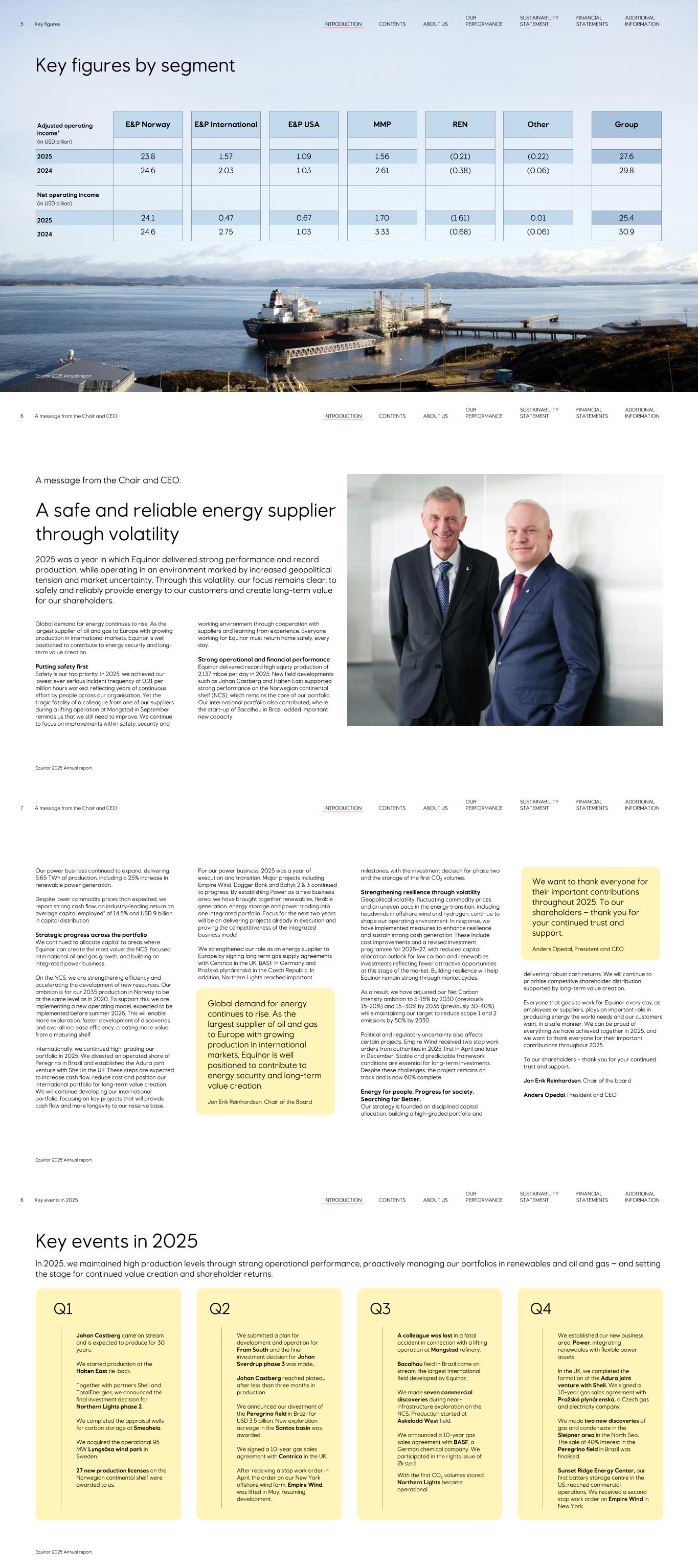
Key figures by segment 5 Key figures INTRODUCTION CONTENTS ABOUT US OUR PERFORMANCE SUSTAINABILITY STATEMENT FINANCIAL STATEMENTS ADDITIONAL INFORMATION Equinor 2025 Annual report Adjusted operating income* E&P Norway E&P International E&P USA MMP REN Other Group (in USD billion) 2025 23.8 1.57 1.09 1.56 (0.21) (0.22) 27.6 2024 24.6 2.03 1.03 2.61 (0.38) (0.06) 29.8 Net operating income (in USD billion) 2025 24.1 0.47 0.67 1.70 (1.61) 0.01 25.4 2024 24.6 2.75 1.03 3.33 (0.68) (0.06) 30.9 A message from the Chair and CEO: A safe and reliable energy supplier through volatility 2025 was a year in which Equinor delivered strong performance and record production, while operating in an environment marked by increased geopolitical tension and market uncertainty. Through this volatility, our focus remains clear: to safely and reliably provide energy to our customers and create long-term value for our shareholders. Global demand for energy continues to rise. As the largest supplier of oil and gas to Europe with growing production in international markets, Equinor is well positioned to contribute to energy security and long- term value creation. Putting safety first Safety is our top priority. In 2025, we achieved our lowest ever serious incident frequency of 0.21 per million hours worked, reflecting years of continuous effort by people across our organisation. Yet the tragic fatality of a colleague from one of our suppliers during a lifting operation at Mongstad in September reminds us that we still need to improve. We continue to focus on improvements within safety, security and working environment through cooperation with suppliers and learning from experience. Everyone working for Equinor must return home safely, every day. Strong operational and financial performance Equinor delivered record high equity production of 2,137 mboe per day in 2025. New field developments such as Johan Castberg and Halten East supported strong performance on the Norwegian continental shelf (NCS), which remains the core of our portfolio. Our international portfolio also contributed, where the start-up of Bacalhau in Brazil added important new capacity. 6 A message from the Chair and CEO INTRODUCTION CONTENTS ABOUT US OUR PERFORMANCE SUSTAINABILITY STATEMENT FINANCIAL STATEMENTS ADDITIONAL INFORMATION Equinor 2025 Annual report Our power business continued to expand, delivering 5.65 TWh of production, including a 25% increase in renewable power generation. Despite lower commodity prices than expected, we report strong cash flow, an industry-leading return on average capital employed* of 14.5% and USD 9 billion in capital distribution. Strategic progress across the portfolio We continued to allocate capital to areas where Equinor can create the most value: the NCS, focused international oil and gas growth, and building an integrated power business. On the NCS, we are strengthening efficiency and accelerating the development of new resources. Our ambition is for our 2035 production in Norway to be at the same level as in 2020. To support this, we are implementing a new operating model, expected to be implemented before summer 2026. This will enable more exploration, faster development of discoveries and overall increase efficiency, creating more value from a maturing shelf. Internationally, we continued high-grading our portfolio in 2025. We divested an operated share of Peregrino in Brazil and established the Adura joint venture with Shell in the UK. These steps are expected to increase cash flow, reduce cost and position our international portfolio for long-term value creation. We will continue developing our international portfolio, focusing on key projects that will provide cash flow and more longevity to our reserve base. For our power business, 2025 was a year of execution and transition. Major projects including Empire Wind, Dogger Bank and Bałtyk 2 & 3 continued to progress. By establishing Power as a new business area, we have brought together renewables, flexible generation, energy storage and power trading into one integrated portfolio. Focus for the next two years will be on delivering projects already in execution and proving the competitiveness of the integrated business model. We strengthened our role as an energy supplier to Europe by signing long term gas supply agreements with Centrica in the UK, BASF in Germany and Pražská plynárenská in the Czech Republic. In addition, Northern Lights reached important milestones, with the investment decision for phase two and the storage of the first CO2 volumes. Strengthening resilience through volatility Geopolitical volatility, fluctuating commodity prices and an uneven pace in the energy transition, including headwinds in offshore wind and hydrogen, continue to shape our operating environment. In response, we have implemented measures to enhance resilience and sustain strong cash generation. These include cost improvements and a revised investment programme for 2026–27, with reduced capital allocation outlook for low carbon and renewables investments reflecting fewer attractive opportunities at this stage of the market. Building resilience will help Equinor remain strong through market cycles. As a result, we have adjusted our Net Carbon Intensity ambition to 5-15% by 2030 (previously 15-20%) and 15–30% by 2035 (previously 30-40%), while maintaining our target to reduce scope 1 and 2 emissions by 50% by 2030. Political and regulatory uncertainty also affects certain projects. Empire Wind received two stop work orders from authorities in 2025, first in April and later in December. Stable and predictable framework conditions are essential for long-term investments. Despite these challenges, the project remains on track and is now 60% complete. Energy for people. Progress for society. Searching for Better. Our strategy is founded on disciplined capital allocation, building a high-graded portfolio and delivering robust cash returns. We will continue to prioritise competitive shareholder distribution supported by long-term value creation. Everyone that goes to work for Equinor every day, as employees or suppliers, plays an important role in producing energy the world needs and our customers want, in a safe manner. We can be proud of everything we have achieved together in 2025, and we want to thank everyone for their important contributions throughout 2025. To our shareholders – thank you for your continued trust and support. Jon Erik Reinhardsen, Chair of the board Anders Opedal, President and CEO 7 A message from the Chair and CEO INTRODUCTION CONTENTS ABOUT US OUR PERFORMANCE SUSTAINABILITY STATEMENT FINANCIAL STATEMENTS ADDITIONAL INFORMATION Equinor 2025 Annual report Global demand for energy continues to rise. As the largest supplier of oil and gas to Europe with growing production in international markets, Equinor is well positioned to contribute to energy security and long-term value creation. Jon Erik Reinhardsen, Chair of the Board We want to thank everyone for their important contributions throughout 2025. To our shareholders – thank you for your continued trust and support. Anders Opedal, President and CEO Key events in 2025 In 2025, we maintained high production levels through strong operational performance, proactively managing our portfolios in renewables and oil and gas — and setting the stage for continued value creation and shareholder returns. 8 Key events in 2025 INTRODUCTION CONTENTS ABOUT US OUR PERFORMANCE SUSTAINABILITY STATEMENT FINANCIAL STATEMENTS ADDITIONAL INFORMATION Equinor 2025 Annual report Q1 Johan Castberg came on stream and is expected to produce for 30 years. We started production at the Halten East tie-back. Together with partners Shell and TotalEnergies, we announced the final investment decision for Northern Lights phase 2. We completed the appraisal wells for carbon storage at Smeaheia. We acquired the operational 95 MW Lyngsåsa wind park in Sweden. 27 new production licenses on the Norwegian continental shelf were awarded to us. Q2 We submitted a plan for development and operation for Fram South and the final investment decision for Johan Sverdrup phase 3 was made. Johan Castberg reached plateau after less than three months in production. We announced our divestment of the Peregrino field in Brazil for USD 3.5 billion. New exploration acreage in the Santos basin was awarded. We signed a 10-year gas sales agreement with Centrica in the UK. After receiving a stop work order in April, the order on our New York offshore wind farm, Empire Wind, was lifted in May, resuming development. Q3 A colleague was lost in a fatal accident in connection with a lifting operation at Mongstad refinery. Bacalhau field in Brazil came on stream, the largest international field developed by Equinor. We made seven commercial discoveries during near- infrastructure exploration on the NCS. Production started at Askeladd West field. We announced a 10-year gas sales agreement with BASF, a German chemical company. We participated in the rights issue of Ørsted. With the first CO₂ volumes stored, Northern Lights became operational. Q4 We established our new business area, Power, integrating renewables with flexible power assets. In the UK, we completed the formation of the Adura joint venture with Shell. We signed a 10-year gas sales agreement with Pražská plynárenská, a Czech gas and electricity company. We made two new discoveries of gas and condensate in the Sleipner area in the North Sea. The sale of 40% interest in the Peregrino field in Brazil was finalised. Sunset Ridge Energy Center, our first battery storage centre in the US, reached commercial operations. We received a second stop work order on Empire Wind in New York.
About the report The Annual Report for 2025 presents the: • Board of Director’s Report: Introduction, chapters 1, 2 (excluding section 2.3 on Norwegian Transparency Act), 3 and chapter 5 (excluding sections 5.3 Physical climate risk, 5.4, 5.6, 5.7) • Consolidated sustainability statement of the Equinor group (chapter 3) • Consolidated financial statements of the Equinor group (section 4.1) • Parent company financial statements of Equinor ASA (section 4.2) • The Norwegian Transparency Act — Statement of due diligence (section 2.3) Other 2025 reporting published on www.equinor.com/reports • Remuneration report • Oil and gas reserves report • Payments to governments • Board statement on corporate governance • Statement on equality and anti-discrimination • Annual report on Form 20-F • Annual report – Norwegian (XBRL data ESEF) • ESRS index • UK modern slavery statement This publication constitutes the Statutory annual report in accordance with Norwegian requirements for Equinor ASA for the year ended 31 December 2025. The Annual Report is filed with the Norwegian Register of company accounts. The version prepared in accordance with the European Single Electronic Format (“ESEF”), filed with Oslo Børs, is the official version of the company’s annual report and the ESEF version prevails in case of any questions or conflicts to other versions. This report should be read in conjunction with the cautionary statement in section 5.7 Forward- Looking statements. The Annual report is available for download from our website at www.equinor.com/reports. References in this document or other documents to our website are included for navigation purposes only, unless otherwise stated. Sustainability-related statements Materiality, as used in the context of sustainability, is distinct from and should not be confused with, such terms as defined for US Securities and Exchange Commission (SEC) reporting purposes. Any issues or topics identified as material for purposes of sustainability in this document, including the materiality assessment undertaken by Equinor based on European Sustainability Reporting Standards, are therefore not necessarily material as defined for SEC reporting purposes. 9 About the report INTRODUCTION CONTENTS ABOUT US OUR PERFORMANCE SUSTAINABILITY STATEMENT FINANCIAL STATEMENTS ADDITIONAL INFORMATION Equinor 2025 Annual report 1.1 We are Equinor 11 1.2 Our history: decades of progress 13 1.3 The world in which we operate 14 1.4 Our strategy and transition ambitions 15 1.5 Our business 17 1.6 Our people 24 1.7 Governance and risk management 25 10 INTRODUCTION CONTENTS ABOUT US OUR PERFORMANCE SUSTAINABILITY STATEMENT FINANCIAL STATEMENTS ADDITIONAL INFORMATION Equinor 2025 Annual report 1 About us 1.1 We are Equinor We are an international energy company founded in 1972 and headquartered in Stavanger, Norway. Our portfolio encompasses oil and gas, renewables and low carbon solutions. 11 1.1 We are Equinor INTRODUCTION CONTENTS ABOUT US OUR PERFORMANCE SUSTAINABILITY STATEMENT FINANCIAL STATEMENTS ADDITIONAL INFORMATION Equinor 2025 Annual report A major supplier of energy to Europe. A value-driven developer in renewables and low carbon solutions. A leading offshore oil and gas operator. Offices in more than 20 countries and around 24,600 employees. Driven by our purpose Energy for people. Progress for society. Searching for better. Delivering on our ambition To be a leading company in the energy transition. Guided by our values Open. Collaborative. Caring. Courageous. What we deliver 12 1.1 We are Equinor INTRODUCTION CONTENTS ABOUT US OUR PERFORMANCE SUSTAINABILITY STATEMENT FINANCIAL STATEMENTS ADDITIONAL INFORMATION Equinor 2025 Annual report Oil and gas We produce around two million barrels of oil equivalent daily, where two-thirds of our equity production comes from the Norwegian continental shelf (NCS). Our production of oil and gas on the NCS plays a vital role in delivering necessary energy to Europe. We expect substantial value creation from the NCS in the years to come. Outside Norway, we produce oil and gas in countries including the US, the UK, Angola, Algeria and Brazil, while building a next generation portfolio focused on growing cash flow, longevity and reducing emissions from production. Renewable energy We are a value driven developer and producer of renewable energy and have a long-term view on renewables’ importance and competitiveness in the energy mix. We are developing some of the world’s largest offshore wind farms, located in Europe and the US and have a renewables power production equivalent to powering over one million homes. We have expanded into onshore renewables and energy storage and are building positions in our selected markets including Poland, Denmark, the UK, the US and Brazil. Refining, processing and marketing We refine and market crude oil and natural gas, including the Norwegian state’s share from the NCS, for export as petrol, diesel, gas and heating oil to continental Europe, the UK, North America, Asia and Africa. Danske Commodities is a leading tech-driven energy trading house, wholly owned by Equinor. It trades power, gas, and certificates across 40 markets worldwide, effectively connecting producers with large- scale consumers in wholesale markets. Carbon capture & storage (CCS) We are a leading CCS developer and operate the world’s first commercial cross-border CO2 transport and storage facility. We have nearly 30 years’ experience with successful CCS in Norway and have sanctioned four major projects in the last five years. We are well positioned to develop CCS solutions and continue to pursue commercial opportunities in CCS. A strong competitive position We have played a pivotal role in the development of Norway’s offshore industry since 1972. Today, in an increasingly unpredictable world, our deliveries of oil, gas and renewable energy provide a vital and stabilising contribution to Europe’s energy security. Our 50 years of experience from developing the oil and gas industry in Norway represent a worldwide competitive advantage for us today and we continuously seek to create value as an early mover and industry shaper. We are one of the world’s leading offshore producers of oil and gas and a global offshore wind major. We are commercialising floating offshore wind and have built a substantial onshore renewables portfolio. We have been safely storing CO2 at the Sleipner field since the 1990s and are the technical service provider for the first commercial CO2 transport and storage facility, Northern Lights. We have a strong and proven ability to develop and apply new technologies and digital solutions. As we pursue our ambition to be a leading company in the energy transition, technology leadership will be a key enabler. We aim to become a net-zero energy company by 2050 and we believe in long-term value creation in a low-carbon future.
1.2 Our history: decades of progress 13 1.2 Our history: decades of progress INTRODUCTION CONTENTS ABOUT US OUR PERFORMANCE SUSTAINABILITY STATEMENT FINANCIAL STATEMENTS ADDITIONAL INFORMATION Equinor 2025 Annual report 1970s A foundation built on a vision We were founded as Statoil, the Norwegian State Oil company in September 1972. Statoil was to be the government’s commercial instrument in the development of the oil and gas industry in Norway. In our early years, our operations focused on exploration, development and production of oil and gas on the Norwegian continental shelf (NCS). In 1974, the Statfjord field was discovered in the North Sea and production commenced in 1979. 1980s Major expansion in Norway and abroad The 1980s were a period of major expansion for us, both in Norway and abroad, with discoveries and developments of large oil and gas fields, advancements in offshore technology and significant growth in production. In 1981, we became the first Norwegian operator in the North Sea with Gullfaks, and in 1987 we took over the operatorship of Statfjord. We achieved solid financial performance and laid the groundwork for sustainable practices in our oil and gas production. 1990s A global energy player In the 1990s, we consolidated our position as a global energy player, including regions such as the Middle East, Asia and the Americas, driven by strategic expansion, innovation, and a commitment to sustainable growth. We became a major supplier to the European gas market, and in 1992, we entered an alliance with bp to grow internationally. We recognised the importance of sustainable practices, developing cleaner technologies and setting higher environmental standards in our operations. 2000s Strategic transformation In 2001, we were listed on both the Oslo Børs and the New York Stock Exchange, becoming a public limited company with a 67% majority stake owned by the Norwegian state. The merger with Norsk Hydro’s oil and gas division strengthened our ability to fully realise the potential on the NCS and to grow internationally. Our international exploration and partnerships included countries such as Angola, Algeria, Brazil, Canada and Tanzania, as well as onshore and offshore activities in the US. We also began investing in renewable energy, particularly in offshore wind. 2010s Broader focus inspires a new name The 2010s marked growth in renewables, dedication to digital transformation, and rebranding to Equinor. We achieved international growth, with acquisitions in the US onshore market and the start-up of the Peregrino field in 2011, making us an operator in Brazil. In 2017, we announced a strategy to become a broader energy company, and in 2018, we changed our name to Equinor to reflect this strategic direction. Johan Sverdrup came on stream in 2019 as one of the world’s most carbon-efficient fields, powered by renewable electricity from shore. 2020s Ambitions in the energy transition In 2020, we set the ambition to become a net zero energy company by 2050. Our Energy Transition Plan, published in 2022 and updated in 2025, outlines our strategy and pathway to net zero. We continue to focus on being a safe and reliable producer of the energy the world needs today, while also developing energy solutions for the future. Despite global challenges and changing markets, we demonstrate sustained production and financial resilience. 1.3 The world in which we operate Equinor is a trusted energy provider in a challenging market and uncertain world. We remain committed to long-term value creation while being a secure and reliable energy provider. We operate in a world where geopolitical uncertainty and shifting priorities impact the energy industry. As globalism and protectionism shape trade and countries balance energy security, affordability and climate goals, we remain focused on being a reliable energy provider and adapting to these changes. In 2024, over half of the global population participated in national elections. As a result, several new governments came into power in 2025. International leadership is changing and while countries are working to deliver on shared strategic priorities and agreements, there is a growing risk that short-term national interests may slow global progress. Technology is developing quickly, driven by advancements in artificial intelligence and digital solutions. These developments bring clear benefits, but they also create new risks, including security challenges and exposing gaps in regulation. This can make it harder to keep focus on important long-term priorities such as sustainable development and well-functioning energy markets. A challenging geopolitical situation Geopolitical instability deepened in 2025. Ongoing conflicts, rapidly changing tariff policies and stronger competition between major powers have disrupted global trade and energy flows. The US-China rivalry and less international cooperation have accelerated supply chain diversifications and weakened global norms. In Europe, fiscal constraints, political fragmentation and low economic growth reduce governments’ room to act. The main focus remains on energy security and affordability. Demand for oil and gas remains robust as geopolitical tensions and cost challenges have slowed the pace of the energy transition, shifting governmental attention from decarbonisation toward resilience. Security As an energy company, Equinor faces increasing security threats, both digital and physical. Our role as a leading energy provider to Europe makes us particularly vulnerable to various actors aiming to disrupt operations, impact reputation, or gain access to financial resources and sensitive information. Equinor has responded with increased vigilance and collaboration across sites, municipalities and national authorities. We recognise that energy security and national security are closely interconnected, particularly given the company’s role as provider of gas and electricity to Europe and the UK. Emissions 10 years after the Paris Agreement, global energy-related CO2 emissions are still increasing, driven by economic and population growth, especially in emerging economies. Per capita emissions have been on a downward trend in industrialised regions for a long time. On a global level this is offset by the growth in energy demand and increased emissions in China and other emerging economies. Coupled with shifting political priorities, the ambition to deliver a significant reduction in global emissions is yet to be realised. A further need for stable policies and commercial frameworks There is a need for supporting policies and frameworks to drive large-scale investments. While there have been favourable policy developments, such as support for industrial decarbonisation in Europe, more is required to support industry investments. Decisions regarding where to invest and the pace of the energy transition present strategic and financial risks. These must be balanced with the need for financial stability, resilience and value creation for shareholders. 14 1.3 The world in which we operate INTRODUCTION CONTENTS ABOUT US OUR PERFORMANCE SUSTAINABILITY STATEMENT FINANCIAL STATEMENTS ADDITIONAL INFORMATION Equinor 2025 Annual report The energy trilemma The Energy Trilemma is the challenge of balancing three core dimensions of energy sustainability: energy security, energy equity (affordability and access) and environmental sustainability (decarbonisation). Source: World Energy Council. 1.4 Our strategy and transition ambitions 15 1.4 Our strategy and transition ambitions INTRODUCTION CONTENTS ABOUT US OUR PERFORMANCE SUSTAINABILITY STATEMENT FINANCIAL STATEMENTS ADDITIONAL INFORMATION Equinor 2025 Annual report Energy systems around the world are transitioning amid geopolitical turbulence. As Equinor transforms, we seek to strike the right balance between being a safe and reliable energy provider, with lower emissions, while creating value for our shareholders and the societies where we operate. Our strategy is designed to give us flexibility in execution as conditions change. We aim to maintain a strong financial position and a solid balance sheet, to remain robust in uncertain markets and able to capitalise on opportunities provided by the energy transition. Our strategic pillars – embedded in everything we do Always safe Protecting our people, the environment and our assets High value Prioritising value over volume Low carbon Carbon-efficient operations Strategic priorities guiding capital allocation Developing the NCS to maximise value Working to deliver strong production today and in the coming decades Focused growth in international oil and gas Adding new volumes and opportunities for longevity in key geographies Building an integrated power business Strengthening our competitiveness by combining our renewables portfolio with flexible power Creating value by tying our business together through marketing and trading capabilities Our transition ambitions and approach Our energy transition ambitions reflect our strategic direction and value-driven plan for execution. Our focus is on value creation, emissions reductions and the development of energy solutions. 16 1.4 Our strategy and transition ambitions INTRODUCTION CONTENTS ABOUT US OUR PERFORMANCE SUSTAINABILITY STATEMENT FINANCIAL STATEMENTS ADDITIONAL INFORMATION Equinor 2025 Annual report Emissions reductions Our ambition is a 50% net reduction in operated (scope 1+2) emissions by 20301. Integrated power A portfolio combining renewables, battery storage, flexible power and trading. Executing on existing renewables pipeline and pursuing growth subject to value-creating opportunities and enabling policies. Low carbon solutions Pursuing commercial opportunities in low-carbon value chains. Developing a portfolio of options to pursue subject to supportive policies, market developments and customer demand. Net zero Our ambition is to reduce the net carbon intensity3 of the energy we provide by 5–15% by 2030 and by 15–30% by 2035 compared to 2019 levels. We aim to achieve net zero by 2050. Equinor’s Energy Transition Plan 2025 is available at our website, www.equinor.com An update on the progress of the Energy Transition Plan is provided in section 2.3 Sustainability performance of this report, and more information about the plan and ambitions is available in Section 3.2. 1) Base year 2015: Equinor operated (100% basis): 90% to be met through absolute reductions. 2) Equinor share. 3) Includes scope 3 emissions from use of energy products that we produce.
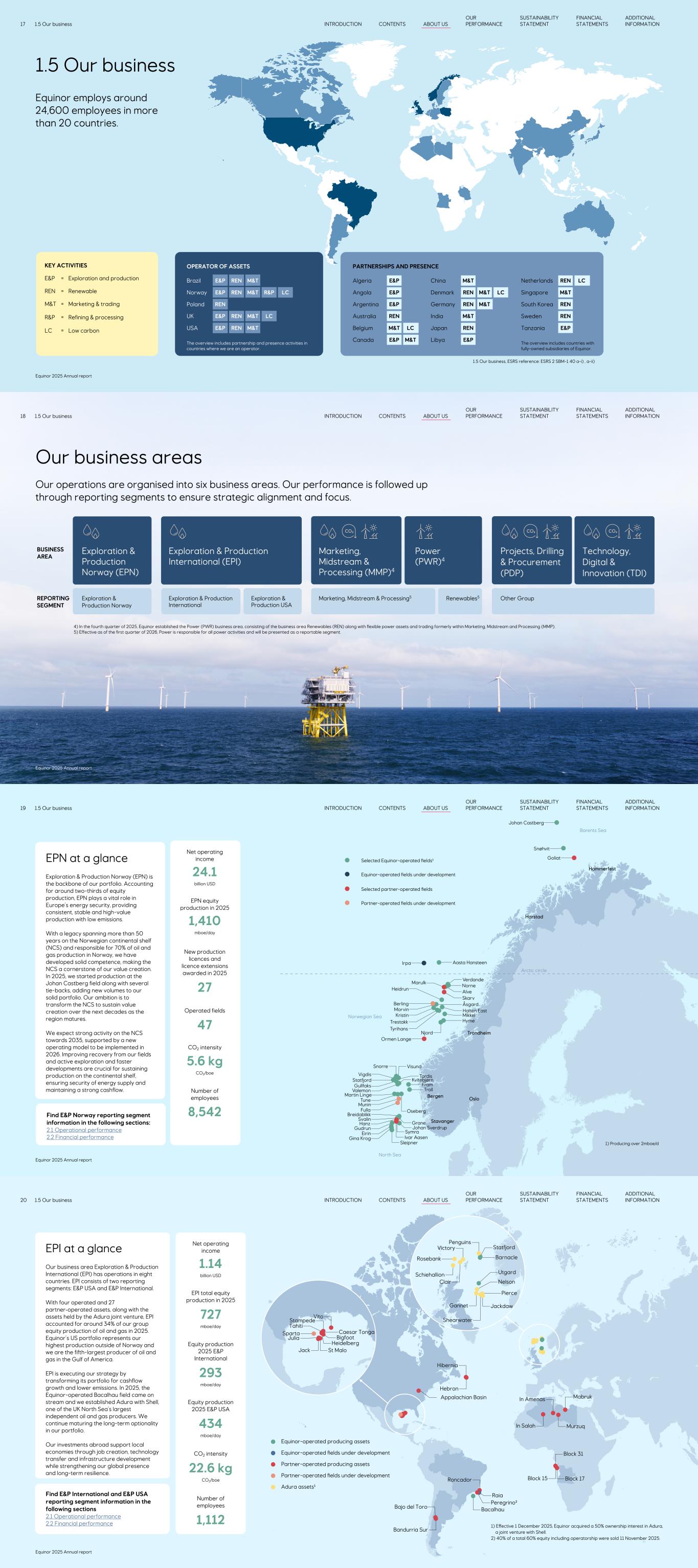
1.5 Our business Equinor employs around 24,600 employees in more than 20 countries. 17 1.5 Our business INTRODUCTION CONTENTS ABOUT US OUR PERFORMANCE SUSTAINABILITY STATEMENT FINANCIAL STATEMENTS ADDITIONAL INFORMATION Equinor 2025 Annual report KEY ACTIVITIES E&P = Exploration and production REN = Renewable M&T = Marketing & trading R&P = Refining & processing LC = Low carbon OPERATOR OF ASSETS Brazil E&P REN M&T Norway E&P REN M&T R&P LC Poland REN UK E&P REN M&T LC USA E&P REN M&T The overview includes partnership and presence activities in countries where we are an operator. PARTNERSHIPS AND PRESENCE Algeria E&P China M&T Netherlands REN LC Angola E&P Denmark REN M&T LC Singapore M&T Argentina E&P Germany REN M&T South Korea REN Australia REN India M&T Sweden REN Belgium M&T LC Japan REN Tanzania E&P Canada E&P M&T Libya E&P The overview includes countries with fully-owned subsidiaries of Equinor. 1.5 Our business, ESRS reference: ESRS 2 SBM-1 40 a-i) , a-ii) Our business areas Our operations are organised into six business areas. Our performance is followed up through reporting segments to ensure strategic alignment and focus. 18 1.5 Our business INTRODUCTION CONTENTS ABOUT US OUR PERFORMANCE SUSTAINABILITY STATEMENT FINANCIAL STATEMENTS ADDITIONAL INFORMATION Equinor 2025 Annual report BUSINESS AREA Exploration & Production Norway (EPN) Exploration & Production International (EPI) Marketing, Midstream & Processing (MMP)4 Power (PWR)4 Projects, Drilling & Procurement (PDP) Technology, Digital & Innovation (TDI) REPORTING SEGMENT Exploration & Production Norway Exploration & Production International Exploration & Production USA Marketing, Midstream & Processing5 Renewables5 Other Group 4) In the fourth quarter of 2025, Equinor established the Power (PWR) business area, consisting of the business area Renewables (REN) along with flexible power assets and trading formerly within Marketing, Midstream and Processing (MMP). 5) Effective as of the first quarter of 2026, Power is responsible for all power activities and will be presented as a reportable segment. EPN at a glance Exploration & Production Norway (EPN) is the backbone of our portfolio. Accounting for around two-thirds of equity production, EPN plays a vital role in Europe’s energy security, providing consistent, stable and high-value production with low emissions. With a legacy spanning more than 50 years on the Norwegian continental shelf (NCS) and responsible for 70% of oil and gas production in Norway, we have developed solid competence, making the NCS a cornerstone of our value creation. In 2025, we started production at the Johan Castberg field along with several tie-backs, adding new volumes to our solid portfolio. Our ambition is to transform the NCS to sustain value creation over the next decades as the region matures. We expect strong activity on the NCS towards 2035, supported by a new operating model to be implemented in 2026. Improving recovery from our fields and active exploration and faster developments are crucial for sustaining production on the continental shelf, ensuring security of energy supply and maintaining a strong cashflow. Find E&P Norway reporting segment information in the following sections: 2.1 Operational performance 2.2 Financial performance 19 1.5 Our business INTRODUCTION CONTENTS ABOUT US OUR PERFORMANCE SUSTAINABILITY STATEMENT FINANCIAL STATEMENTS ADDITIONAL INFORMATION Equinor 2025 Annual report Net operating income 24.1 billion USD EPN equity production in 2025 1,410 mboe/day New production licences and licence extensions awarded in 2025 27 Operated fields 47 CO2 intensity 5.6 kg CO2/boe Number of employees 8,542 EPI at a glance Our business area Exploration & Production International (EPI) has operations in eight countries. EPI consists of two reporting segments: E&P USA and E&P International. With four operated and 27 partner-operated assets, along with the assets held by the Adura joint venture, EPI accounted for around 34% of our group equity production of oil and gas in 2025. Equinor’s US portfolio represents our highest production outside of Norway and we are the fifth-largest producer of oil and gas in the Gulf of America. EPI is executing our strategy by transforming its portfolio for cashflow growth and lower emissions. In 2025, the Equinor-operated Bacalhau field came on stream and we established Adura with Shell, one of the UK North Sea’s largest independent oil and gas producers. We continue maturing the long-term optionality in our portfolio. Our investments abroad support local economies through job creation, technology transfer and infrastructure development while strengthening our global presence and long-term resilience. Find E&P International and E&P USA reporting segment information in the following sections 2.1 Operational performance 2.2 Financial performance 20 1.5 Our business INTRODUCTION CONTENTS ABOUT US OUR PERFORMANCE SUSTAINABILITY STATEMENT FINANCIAL STATEMENTS ADDITIONAL INFORMATION Equinor 2025 Annual report Net operating income 1.14 billion USD EPI total equity production in 2025 727 mboe/day Equity production 2025 E&P International 293 mboe/day Equity production 2025 E&P USA 434 mboe/day CO2 intensity 22.6 kg CO2/boe Number of employees 1,112
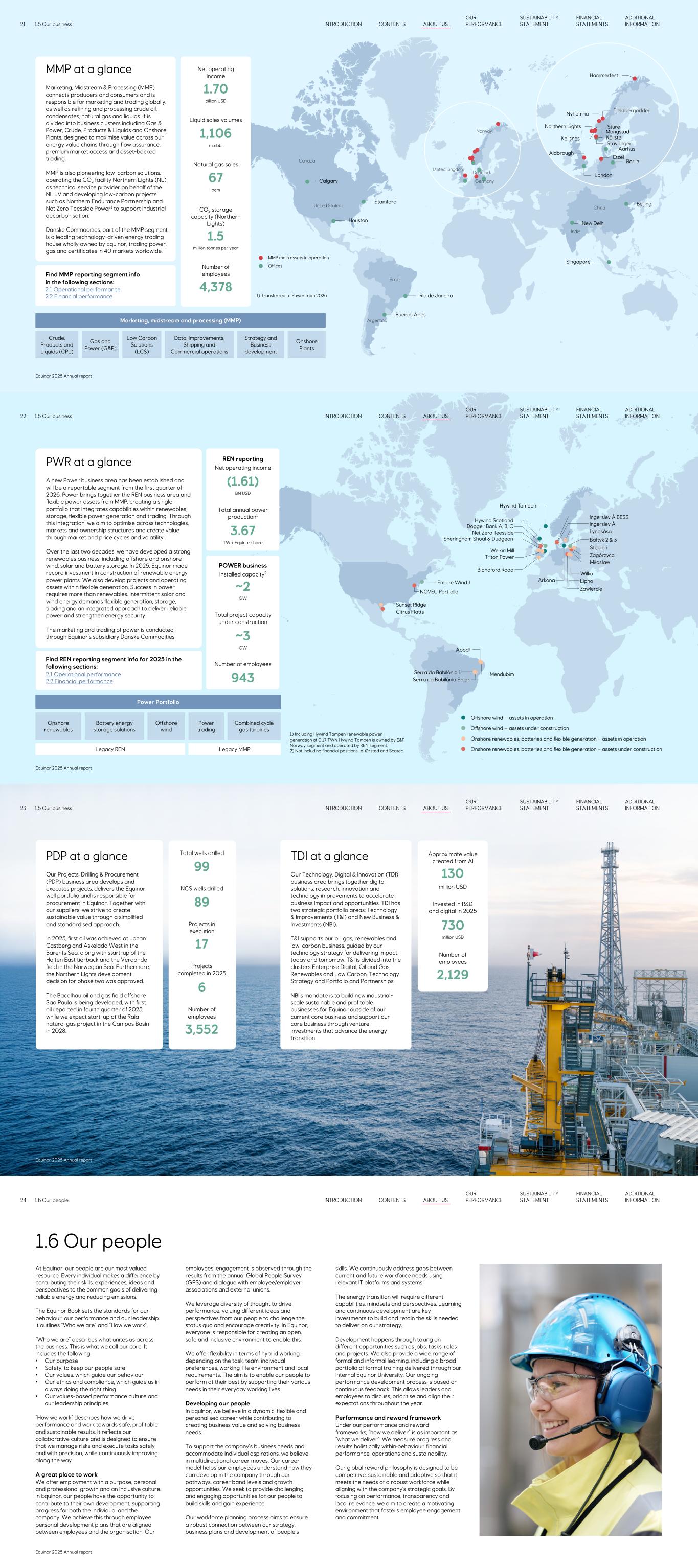
MMP at a glance Marketing, Midstream & Processing (MMP) connects producers and consumers and is responsible for marketing and trading globally, as well as refining and processing crude oil, condensates, natural gas and liquids. It is divided into business clusters including Gas & Power, Crude, Products & Liquids and Onshore Plants, designed to maximise value across our energy value chains through flow assurance, premium market access and asset-backed trading. MMP is also pioneering low-carbon solutions, operating the CO₂ facility Northern Lights (NL) as technical service provider on behalf of the NL JV and developing low-carbon projects such as Northern Endurance Partnership and Net Zero Teesside Power1 to support industrial decarbonisation. Danske Commodities, part of the MMP segment, is a leading technology-driven energy trading house wholly owned by Equinor, trading power, gas and certificates in 40 markets worldwide. Find MMP reporting segment info in the following sections: 2.1 Operational performance 2.2 Financial performance 21 1.5 Our business INTRODUCTION CONTENTS ABOUT US OUR PERFORMANCE SUSTAINABILITY STATEMENT FINANCIAL STATEMENTS ADDITIONAL INFORMATION Equinor 2025 Annual report Net operating income 1.70 billion USD Liquid sales volumes 1,106 mmbbl Natural gas sales 67 bcm CO2 storage capacity (Northern Lights) 1.5 million tonnes per year Number of employees 4,378 Marketing, midstream and processing (MMP) Crude, Products and Liquids (CPL) Gas and Power (G&P) Low Carbon Solutions (LCS) Data, Improvements, Shipping and Commercial operations Strategy and Business development Onshore Plants 1) Transferred to Power from 2026 PWR at a glance A new Power business area has been established and will be a reportable segment from the first quarter of 2026. Power brings together the REN business area and flexible power assets from MMP, creating a single portfolio that integrates capabilities within renewables, storage, flexible power generation and trading. Through this integration, we aim to optimise across technologies, markets and ownership structures and create value through market and price cycles and volatility. Over the last two decades, we have developed a strong renewables business, including offshore and onshore wind, solar and battery storage. In 2025, Equinor made record investment in construction of renewable energy power plants. We also develop projects and operating assets within flexible generation. Success in power requires more than renewables. Intermittent solar and wind energy demands flexible generation, storage, trading and an integrated approach to deliver reliable power and strengthen energy security. The marketing and trading of power is conducted through Equinor’s subsidiary Danske Commodities. Find REN reporting segment info for 2025 in the following sections: 2.1 Operational performance 2.2 Financial performance 22 1.5 Our business INTRODUCTION CONTENTS ABOUT US OUR PERFORMANCE SUSTAINABILITY STATEMENT FINANCIAL STATEMENTS ADDITIONAL INFORMATION Equinor 2025 Annual report 1) Including Hywind Tampen renewable power generation of 0.17 TWh. Hywind Tampen is owned by E&P Norway segment and operated by REN segment. 2) Not including financial positions i.e. Ørsted and Scatec. Power Portfolio Onshore renewables Battery energy storage solutions Offshore wind Power trading Combined cycle gas turbines Legacy REN Legacy MMP REN reporting Net operating income (1.61) BN USD Total annual power production1 3.67 TWh, Equinor share POWER business Installed capacity2 ~2 GW Total project capacity under construction ~3 GW Number of employees 943 PDP at a glance Our Projects, Drilling & Procurement (PDP) business area develops and executes projects, delivers the Equinor well portfolio and is responsible for procurement in Equinor. Together with our suppliers, we strive to create sustainable value through a simplified and standardised approach. In 2025, first oil was achieved at Johan Castberg and Askeladd West in the Barents Sea, along with start-up of the Halten East tie-back and the Verdande field in the Norwegian Sea. Furthermore, the Northern Lights development decision for phase two was approved. The Bacalhau oil and gas field offshore Sao Paulo is being developed, with first oil reported in fourth quarter of 2025, while we expect start-up at the Raia natural gas project in the Campos Basin in 2028. TDI at a glance Our Technology, Digital & Innovation (TDI) business area brings together digital solutions, research, innovation and technology improvements to accelerate business impact and opportunities. TDI has two strategic portfolio areas: Technology & Improvements (T&I) and New Business & Investments (NBI). T&I supports our oil, gas, renewables and low-carbon business, guided by our technology strategy for delivering impact today and tomorrow. T&I is divided into the clusters Enterprise Digital, Oil and Gas, Renewables and Low Carbon, Technology Strategy and Portfolio and Partnerships. NBI’s mandate is to build new industrial- scale sustainable and profitable businesses for Equinor outside of our current core business and support our core business through venture investments that advance the energy transition. 23 1.5 Our business INTRODUCTION CONTENTS ABOUT US OUR PERFORMANCE SUSTAINABILITY STATEMENT FINANCIAL STATEMENTS ADDITIONAL INFORMATION Equinor 2025 Annual report Total wells drilled 99 NCS wells drilled 89 Projects in execution 17 Projects completed in 2025 6 Number of employees 3,552 Approximate value created from AI 130 million USD Invested in R&D and digital in 2025 730 million USD Number of employees 2,129 1.6 Our people At Equinor, our people are our most valued resource. Every individual makes a difference by contributing their skills, experiences, ideas and perspectives to the common goals of delivering reliable energy and reducing emissions. The Equinor Book sets the standards for our behaviour, our performance and our leadership. It outlines “Who we are” and “How we work”. “Who we are” describes what unites us across the business. This is what we call our core. It includes the following: • Our purpose • Safety, to keep our people safe • Our values, which guide our behaviour • Our ethics and compliance, which guide us in always doing the right thing • Our values-based performance culture and our leadership principles “How we work” describes how we drive performance and work towards safe, profitable and sustainable results. It reflects our collaborative culture and is designed to ensure that we manage risks and execute tasks safely and with precision, while continuously improving along the way. A great place to work We offer employment with a purpose, personal and professional growth and an inclusive culture. In Equinor, our people have the opportunity to contribute to their own development, supporting progress for both the individual and the company. We achieve this through employee personal development plans that are aligned between employees and the organisation. Our employees’ engagement is observed through the results from the annual Global People Survey (GPS) and dialogue with employee/employer associations and external unions. We leverage diversity of thought to drive performance, valuing different ideas and perspectives from our people to challenge the status quo and encourage creativity. In Equinor, everyone is responsible for creating an open, safe and inclusive environment to enable this. We offer flexibility in terms of hybrid working, depending on the task, team, individual preferences, working-life environment and local requirements. The aim is to enable our people to perform at their best by supporting their various needs in their everyday working lives. Developing our people In Equinor, we believe in a dynamic, flexible and personalised career while contributing to creating business value and solving business needs. To support the company’s business needs and accommodate individual aspirations, we believe in multidirectional career moves. Our career model helps our employees understand how they can develop in the company through our pathways, career band levels and growth opportunities. We seek to provide challenging and engaging opportunities for our people to build skills and gain experience. Our workforce planning process aims to ensure a robust connection between our strategy, business plans and development of people’s skills. We continuously address gaps between current and future workforce needs using relevant IT platforms and systems. The energy transition will require different capabilities, mindsets and perspectives. Learning and continuous development are key investments to build and retain the skills needed to deliver on our strategy. Development happens through taking on different opportunities such as jobs, tasks, roles and projects. We also provide a wide range of formal and informal learning, including a broad portfolio of formal training delivered through our internal Equinor University. Our ongoing performance development process is based on continuous feedback. This allows leaders and employees to discuss, prioritise and align their expectations throughout the year. Performance and reward framework Under our performance and reward frameworks, “how we deliver” is as important as “what we deliver”. We measure progress and results holistically within behaviour, financial performance, operations and sustainability. Our global reward philosophy is designed to be competitive, sustainable and adaptive so that it meets the needs of a robust workforce while aligning with the company's strategic goals. By focusing on performance, transparency and local relevance, we aim to create a motivating environment that fosters employee engagement and commitment. 24 1.6 Our people INTRODUCTION CONTENTS ABOUT US OUR PERFORMANCE SUSTAINABILITY STATEMENT FINANCIAL STATEMENTS ADDITIONAL INFORMATION Equinor 2025 Annual report
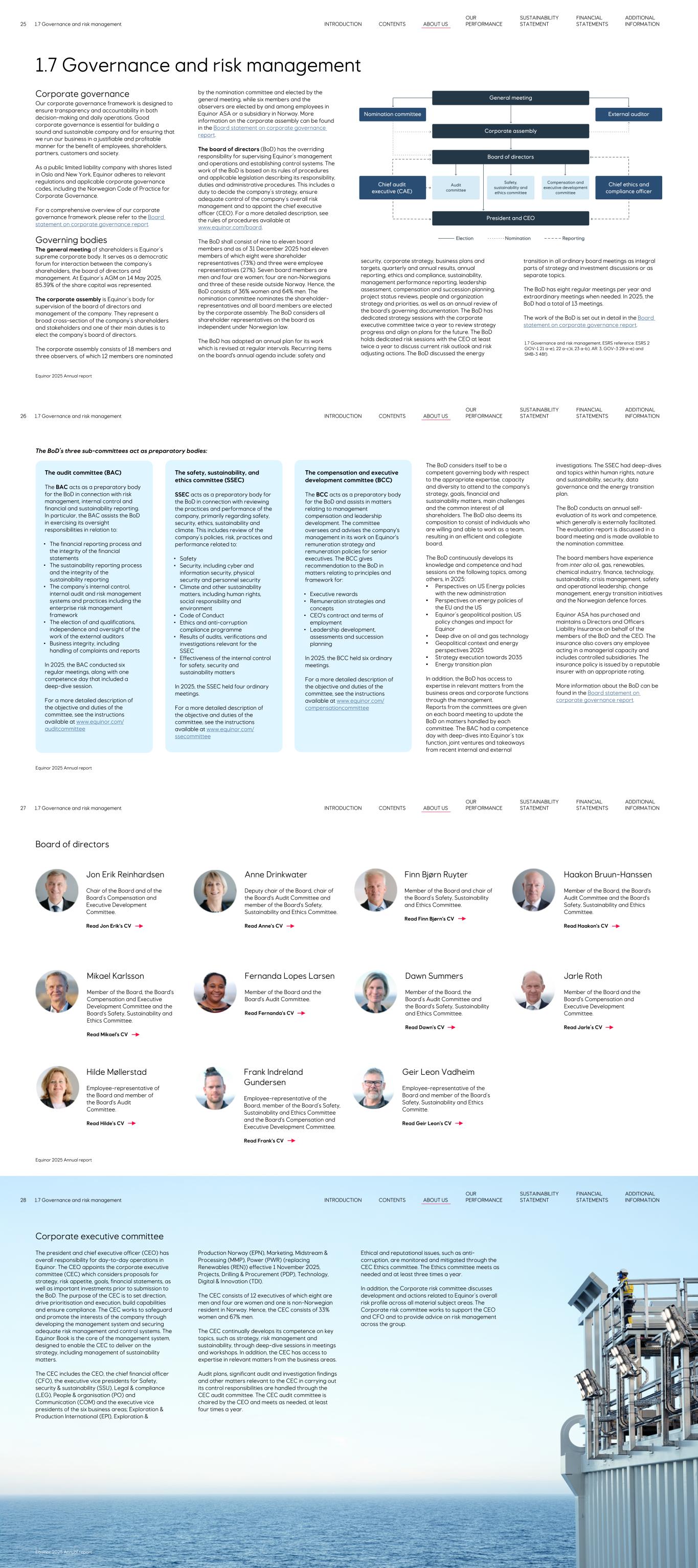
1.7 Governance and risk management Corporate governance Our corporate governance framework is designed to ensure transparency and accountability in both decision-making and daily operations. Good corporate governance is essential for building a sound and sustainable company and for ensuring that we run our business in a justifiable and profitable manner for the benefit of employees, shareholders, partners, customers and society. As a public limited liability company with shares listed in Oslo and New York, Equinor adheres to relevant regulations and applicable corporate governance codes, including the Norwegian Code of Practice for Corporate Governance. For a comprehensive overview of our corporate governance framework, please refer to the Board statement on corporate governance report. Governing bodies The general meeting of shareholders is Equinor’s supreme corporate body. It serves as a democratic forum for interaction between the company’s shareholders, the board of directors and management. At Equinor’s AGM on 14 May 2025, 85.39% of the share capital was represented. The corporate assembly is Equinor’s body for supervision of the board of directors and management of the company. They represent a broad cross-section of the company’s shareholders and stakeholders and one of their main duties is to elect the company’s board of directors. The corporate assembly consists of 18 members and three observers, of which 12 members are nominated by the nomination committee and elected by the general meeting, while six members and the observers are elected by and among employees in Equinor ASA or a subsidiary in Norway. More information on the corporate assembly can be found in the Board statement on corporate governance report. The board of directors (BoD) has the overriding responsibility for supervising Equinor’s management and operations and establishing control systems. The work of the BoD is based on its rules of procedures and applicable legislation describing its responsibility, duties and administrative procedures. This includes a duty to decide the company’s strategy, ensure adequate control of the company’s overall risk management and to appoint the chief executive officer (CEO). For a more detailed description, see the rules of procedures available at www.equinor.com/board. The BoD shall consist of nine to eleven board members and as of 31 December 2025 had eleven members of which eight were shareholder representatives (73%) and three were employee representatives (27%). Seven board members are men and four are women; four are non-Norwegians and three of these reside outside Norway. Hence, the BoD consists of 36% women and 64% men. The nomination committee nominates the shareholder- representatives and all board members are elected by the corporate assembly. The BoD considers all shareholder representatives on the board as independent under Norwegian law. The BoD has adopted an annual plan for its work which is revised at regular intervals. Recurring items on the board's annual agenda include: safety and security, corporate strategy, business plans and targets, quarterly and annual results, annual reporting, ethics and compliance, sustainability, management performance reporting, leadership assessment, compensation and succession planning, project status reviews, people and organization strategy and priorities, as well as an annual review of the board's governing documentation. The BoD has dedicated strategy sessions with the corporate executive committee twice a year to review strategy progress and align on plans for the future. The BoD holds dedicated risk sessions with the CEO at least twice a year to discuss current risk outlook and risk adjusting actions. The BoD discussed the energy transition in all ordinary board meetings as integral parts of strategy and investment discussions or as separate topics. The BoD has eight regular meetings per year and extraordinary meetings when needed. In 2025, the BoD had a total of 13 meetings. The work of the BoD is set out in detail in the Board statement on corporate governance report. 25 1.7 Governance and risk management INTRODUCTION CONTENTS ABOUT US OUR PERFORMANCE SUSTAINABILITY STATEMENT FINANCIAL STATEMENTS ADDITIONAL INFORMATION Equinor 2025 Annual report 1.7 Governance and risk management, ESRS reference: ESRS 2 GOV-1 21 a-e), 22 a-c)ii, 23 a-b), AR. 3, GOV-3 29 a-e) and SMB-3 48f). The BoD’s three sub-committees act as preparatory bodies: The audit committee (BAC) The BAC acts as a preparatory body for the BoD in connection with risk management, internal control and financial and sustainability reporting. In particular, the BAC assists the BoD in exercising its oversight responsibilities in relation to: ▪ The financial reporting process and the integrity of the financial statements ▪ The sustainability reporting process and the integrity of the sustainability reporting ▪ The company’s internal control, internal audit and risk management systems and practices including the enterprise risk management framework ▪ The election of and qualifications, independence and oversight of the work of the external auditors ▪ Business integrity, including handling of complaints and reports In 2025, the BAC conducted six regular meetings, along with one competence day that included a deep-dive session. For a more detailed description of the objective and duties of the committee, see the instructions available at www.equinor.com/ auditcommittee The safety, sustainability, and ethics committee (SSEC) SSEC acts as a preparatory body for the BoD in connection with reviewing the practices and performance of the company, primarily regarding safety, security, ethics, sustainability and climate. This includes review of the company’s policies, risk, practices and performance related to: ▪ Safety ▪ Security, including cyber and information security, physical security and personnel security ▪ Climate and other sustainability matters, including human rights, social responsibility and environment ▪ Code of Conduct ▪ Ethics and anti-corruption compliance programme ▪ Results of audits, verifications and investigations relevant for the SSEC ▪ Effectiveness of the internal control for safety, security and sustainability matters In 2025, the SSEC held four ordinary meetings. For a more detailed description of the objective and duties of the committee, see the instructions available at www.equinor.com/ ssecommittee The compensation and executive development committee (BCC) The BCC acts as a preparatory body for the BoD and assists in matters relating to management compensation and leadership development. The committee oversees and advises the company's management in its work on Equinor's remuneration strategy and remuneration policies for senior executives. The BCC gives recommendation to the BoD in matters relating to principles and framework for: ▪ Executive rewards ▪ Remuneration strategies and concepts ▪ CEO's contract and terms of employment ▪ Leadership development, assessments and succession planning In 2025, the BCC held six ordinary meetings. For a more detailed description of the objective and duties of the committee, see the instructions available at www.equinor.com/ compensationcommittee The BoD considers itself to be a competent governing body with respect to the appropriate expertise, capacity and diversity to attend to the company's strategy, goals, financial and sustainability matters, main challenges and the common interest of all shareholders. The BoD also deems its composition to consist of individuals who are willing and able to work as a team, resulting in an efficient and collegiate board. The BoD continuously develops its knowledge and competence and had sessions on the following topics, among others, in 2025: • Perspectives on US Energy policies with the new administration • Perspectives on energy policies of the EU and the US • Equinor’s geopolitical position, US policy changes and impact for Equinor • Deep dive on oil and gas technology • Geopolitical context and energy perspectives 2025 • Strategy execution towards 2035 • Energy transition plan In addition, the BoD has access to expertise in relevant matters from the business areas and corporate functions through the management. Reports from the committees are given on each board meeting to update the BoD on matters handled by each committee. The BAC had a competence day with deep-dives into Equinor’s tax function, joint ventures and takeaways from recent internal and external investigations. The SSEC had deep-dives and topics within human rights, nature and sustainability, security, data governance and the energy transition plan. The BoD conducts an annual self- evaluation of its work and competence, which generally is externally facilitated. The evaluation report is discussed in a board meeting and is made available to the nomination committee. The board members have experience from inter alia oil, gas, renewables, chemical industry, finance, technology, sustainability, crisis management, safety and operational leadership, change management, energy transition initiatives and the Norwegian defence forces. Equinor ASA has purchased and maintains a Directors and Officers Liability Insurance on behalf of the members of the BoD and the CEO. The insurance also covers any employee acting in a managerial capacity and includes controlled subsidiaries. The insurance policy is issued by a reputable insurer with an appropriate rating. More information about the BoD can be found in the Board statement on corporate governance report. 26 1.7 Governance and risk management INTRODUCTION CONTENTS ABOUT US OUR PERFORMANCE SUSTAINABILITY STATEMENT FINANCIAL STATEMENTS ADDITIONAL INFORMATION Equinor 2025 Annual report Board of directors 27 1.7 Governance and risk management INTRODUCTION CONTENTS ABOUT US OUR PERFORMANCE SUSTAINABILITY STATEMENT FINANCIAL STATEMENTS ADDITIONAL INFORMATION Equinor 2025 Annual report Jon Erik Reinhardsen Chair of the Board and of the Board’s Compensation and Executive Development Committee. Read Jon Erik's CV Anne Drinkwater Deputy chair of the Board, chair of the Board's Audit Committee and member of the Board's Safety, Sustainability and Ethics Committee. Read Anne's CV Finn Bjørn Ruyter Member of the Board and chair of the Board’s Safety, Sustainability and Ethics Committee. Read Finn Bjørn's CV Haakon Bruun-Hanssen Member of the Board, the Board's Audit Committee and the Board's Safety, Sustainability and Ethics Committee. Read Haakon's CV Fernanda Lopes Larsen Member of the Board and the Board's Audit Committee. Read Fernanda's CV Mikael Karlsson Member of the Board, the Board's Compensation and Executive Development Committee and the Board's Safety, Sustainability and Ethics Committee. Read Mikael's CV Hilde Møllerstad Employee-representative of the Board and member of the Board's Audit Committee. Read Hilde's CV Geir Leon Vadheim Employee-representative of the Board and member of the Board’s Safety, Sustainability and Ethics Committe. Read Geir Leon's CV Jarle Roth Member of the Board and the Board's Compensation and Executive Development Committee. Read Jarle’s CV Dawn Summers Member of the Board, the Board’s Audit Committee and the Board's Safety, Sustainability and Ethics Committee. Read Dawn's CV Frank Indreland Gundersen Employee-representative of the Board, member of the Board’s Safety, Sustainability and Ethics Committee and the Board's Compensation and Executive Development Committee. Read Frank's CV Corporate executive committee The president and chief executive officer (CEO) has overall responsibility for day-to-day operations in Equinor. The CEO appoints the corporate executive committee (CEC) which considers proposals for strategy, risk appetite, goals, financial statements, as well as important investments prior to submission to the BoD. The purpose of the CEC is to set direction, drive prioritisation and execution, build capabilities and ensure compliance. The CEC works to safeguard and promote the interests of the company through developing the management system and securing adequate risk management and control systems. The Equinor Book is the core of the management system, designed to enable the CEC to deliver on the strategy, including management of sustainability matters. The CEC includes the CEO, the chief financial officer (CFO), the executive vice presidents for Safety, security & sustainability (SSU), Legal & compliance (LEG), People & organisation (PO) and Communication (COM) and the executive vice presidents of the six business areas; Exploration & Production International (EPI), Exploration & Production Norway (EPN), Marketing, Midstream & Processing (MMP), Power (PWR) (replacing Renewables (REN)) effective 1 November 2025, Projects, Drilling & Procurement (PDP), Technology, Digital & Innovation (TDI). The CEC consists of 12 executives of which eight are men and four are women and one is non-Norwegian resident in Norway. Hence, the CEC consists of 33% women and 67% men. The CEC continually develops its competence on key topics, such as strategy, risk management and sustainability, through deep-dive sessions in meetings and workshops. In addition, the CEC has access to expertise in relevant matters from the business areas. Audit plans, significant audit and investigation findings and other matters relevant to the CEC in carrying out its control responsibilities are handled through the CEC audit committee. The CEC audit committee is chaired by the CEO and meets as needed, at least four times a year. Ethical and reputational issues, such as anti- corruption, are monitored and mitigated through the CEC Ethics committee. The Ethics committee meets as needed and at least three times a year. In addition, the Corporate risk committee discusses development and actions related to Equinor’s overall risk profile across all material subject areas. The Corporate risk committee works to support the CEO and CFO and to provide advice on risk management across the group. 28 1.7 Governance and risk management INTRODUCTION CONTENTS ABOUT US OUR PERFORMANCE SUSTAINABILITY STATEMENT FINANCIAL STATEMENTS ADDITIONAL INFORMATION Equinor 2025 Annual report
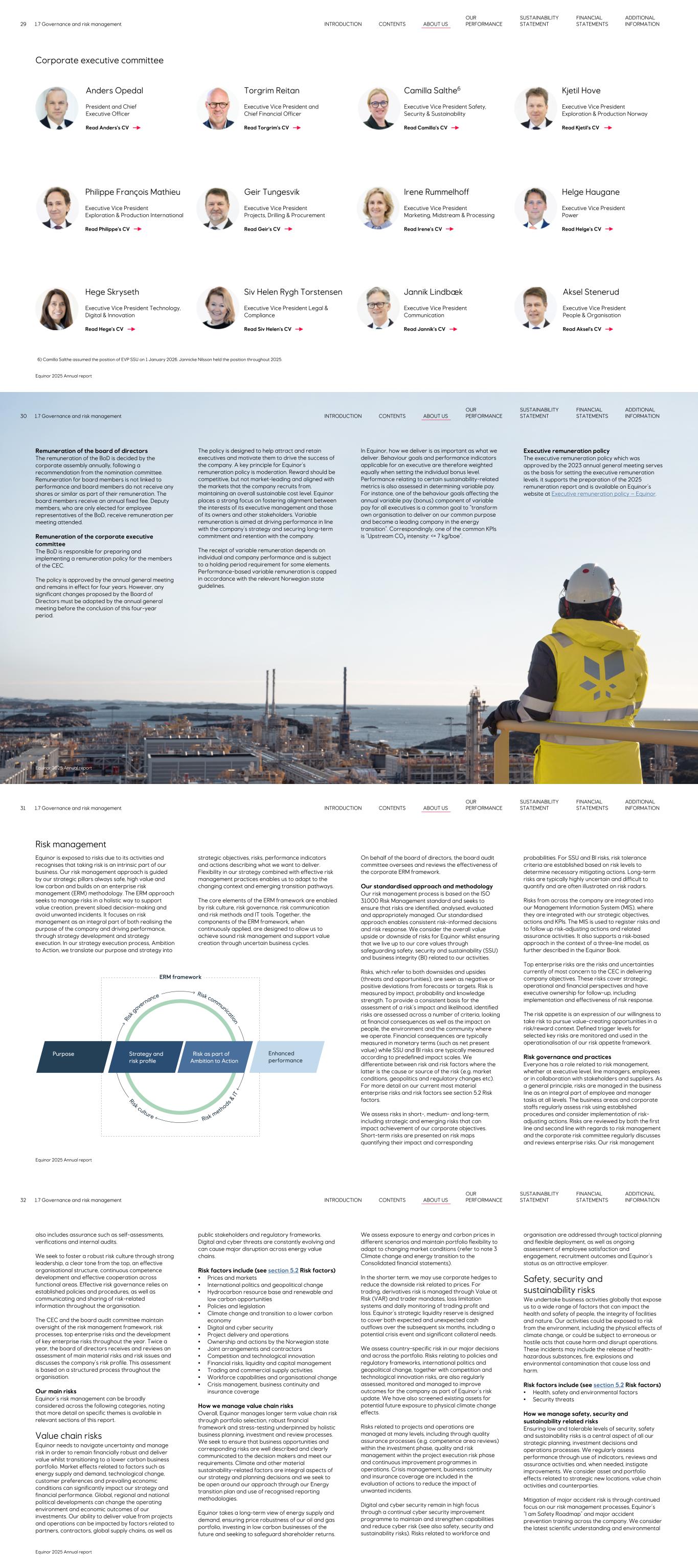
Corporate executive committee 29 1.7 Governance and risk management INTRODUCTION CONTENTS ABOUT US OUR PERFORMANCE SUSTAINABILITY STATEMENT FINANCIAL STATEMENTS ADDITIONAL INFORMATION Equinor 2025 Annual report Anders Opedal President and Chief Executive Officer Read Anders's CV Torgrim Reitan Executive Vice President and Chief Financial Officer Read Torgrim's CV Camilla Salthe6 Executive Vice President Safety, Security & Sustainability Read Camilla's CV Kjetil Hove Executive Vice President Exploration & Production Norway Read Kjetil's CV Philippe François Mathieu Executive Vice President Exploration & Production International Read Philippe's CV Geir Tungesvik Executive Vice President Projects, Drilling & Procurement Read Geir's CV Irene Rummelhoff Executive Vice President Marketing, Midstream & Processing Read Irene's CV Helge Haugane Executive Vice President Power Read Helge's CV Hege Skryseth Executive Vice President Technology, Digital & Innovation Read Hege's CV Siv Helen Rygh Torstensen Executive Vice President Legal & Compliance Read Siv Helen's CV Jannik Lindbæk Executive Vice President Communication Read Jannik's CV Aksel Stenerud Executive Vice President People & Organisation Read Aksel's CV 6) Camilla Salthe assumed the position of EVP SSU on 1 January 2026. Jannicke Nilsson held the position throughout 2025. Remuneration of the board of directors The remuneration of the BoD is decided by the corporate assembly annually, following a recommendation from the nomination committee. Remuneration for board members is not linked to performance and board members do not receive any shares or similar as part of their remuneration. The board members receive an annual fixed fee. Deputy members, who are only elected for employee representatives of the BoD, receive remuneration per meeting attended. Remuneration of the corporate executive committee The BoD is responsible for preparing and implementing a remuneration policy for the members of the CEC. The policy is approved by the annual general meeting and remains in effect for four years. However, any significant changes proposed by the Board of Directors must be adopted by the annual general meeting before the conclusion of this four-year period. The policy is designed to help attract and retain executives and motivate them to drive the success of the company. A key principle for Equinor’s remuneration policy is moderation. Reward should be competitive, but not market-leading and aligned with the markets that the company recruits from, maintaining an overall sustainable cost level. Equinor places a strong focus on fostering alignment between the interests of its executive management and those of its owners and other stakeholders. Variable remuneration is aimed at driving performance in line with the company’s strategy and securing long-term commitment and retention with the company. The receipt of variable remuneration depends on individual and company performance and is subject to a holding period requirement for some elements. Performance-based variable remuneration is capped in accordance with the relevant Norwegian state guidelines. In Equinor, how we deliver is as important as what we deliver. Behaviour goals and performance indicators applicable for an executive are therefore weighted equally when setting the individual bonus level. Performance relating to certain sustainability-related metrics is also assessed in determining variable pay. For instance, one of the behaviour goals affecting the annual variable pay (bonus) component of variable pay for all executives is a common goal to “transform own organisation to deliver on our common purpose and become a leading company in the energy transition”. Correspondingly, one of the common KPIs is “Upstream CO₂ intensity: <= 7 kg/boe”. Executive remuneration policy The executive remuneration policy which was approved by the 2023 annual general meeting serves as the basis for setting the executive remuneration levels. it supports the preparation of the 2025 remuneration report and is available on Equinor’s website at Executive remuneration policy — Equinor. 30 1.7 Governance and risk management INTRODUCTION CONTENTS ABOUT US OUR PERFORMANCE SUSTAINABILITY STATEMENT FINANCIAL STATEMENTS ADDITIONAL INFORMATION Equinor 2025 Annual report Risk management Equinor is exposed to risks due to its activities and recognises that taking risk is an intrinsic part of our business. Our risk management approach is guided by our strategic pillars always safe, high value and low carbon and builds on an enterprise risk management (ERM) methodology. The ERM approach seeks to manage risks in a holistic way to support value creation, prevent siloed decision-making and avoid unwanted incidents. It focuses on risk management as an integral part of both realising the purpose of the company and driving performance, through strategy development and strategy execution. In our strategy execution process, Ambition to Action, we translate our purpose and strategy into strategic objectives, risks, performance indicators and actions describing what we want to deliver. Flexibility in our strategy combined with effective risk management practices enables us to adapt to the changing context and emerging transition pathways. The core elements of the ERM framework are enabled by risk culture, risk governance, risk communication and risk methods and IT tools. Together, the components of the ERM framework, when continuously applied, are designed to allow us to achieve sound risk management and support value creation through uncertain business cycles. On behalf of the board of directors, the board audit committee oversees and reviews the effectiveness of the corporate ERM framework. Our standardised approach and methodology Our risk management process is based on the ISO 31000 Risk Management standard and seeks to ensure that risks are identified, analysed, evaluated and appropriately managed. Our standardised approach enables consistent risk-informed decisions and risk response. We consider the overall value upside or downside of risks for Equinor whilst ensuring that we live up to our core values through safeguarding safety, security and sustainability (SSU) and business integrity (BI) related to our activities. Risks, which refer to both downsides and upsides (threats and opportunities), are seen as negative or positive deviations from forecasts or targets. Risk is measured by impact, probability and knowledge strength. To provide a consistent basis for the assessment of a risk’s impact and likelihood, identified risks are assessed across a number of criteria, looking at financial consequences as well as the impact on people, the environment and the community where we operate. Financial consequences are typically measured in monetary terms (such as net present value) while SSU and BI risks are typically measured according to predefined impact scales. We differentiate between risk and risk factors where the latter is the cause or source of the risk (e.g. market conditions, geopolitics and regulatory changes etc). For more detail on our current most material enterprise risks and risk factors see section 5.2 Risk factors. We assess risks in short-, medium- and long-term, including strategic and emerging risks that can impact achievement of our corporate objectives. Short-term risks are presented on risk maps quantifying their impact and corresponding probabilities. For SSU and BI risks, risk tolerance criteria are established based on risk levels to determine necessary mitigating actions. Long-term risks are typically highly uncertain and difficult to quantify and are often illustrated on risk radars. Risks from across the company are integrated into our Management Information System (MIS), where they are integrated with our strategic objectives, actions and KPIs. The MIS is used to register risks and to follow up risk-adjusting actions and related assurance activities. It also supports a risk-based approach in the context of a three-line model, as further described in the Equinor Book. Top enterprise risks are the risks and uncertainties currently of most concern to the CEC in delivering company objectives. These risks cover strategic, operational and financial perspectives and have executive ownership for follow-up, including implementation and effectiveness of risk response. The risk appetite is an expression of our willingness to take risk to pursue value-creating opportunities in a risk/reward context. Defined trigger levels for selected key risks are monitored and used in the operationalisation of our risk appetite framework. Risk governance and practices Everyone has a role related to risk management, whether at executive level, line managers, employees or in collaboration with stakeholders and suppliers. As a general principle, risks are managed in the business line as an integral part of employee and manager tasks at all levels. The business areas and corporate staffs regularly assess risk using established procedures and consider implementation of risk- adjusting actions. Risks are reviewed by both the first line and second line with regards to risk management and the corporate risk committee regularly discusses and reviews enterprise risks. Our risk management 31 1.7 Governance and risk management INTRODUCTION CONTENTS ABOUT US OUR PERFORMANCE SUSTAINABILITY STATEMENT FINANCIAL STATEMENTS ADDITIONAL INFORMATION Equinor 2025 Annual report also includes assurance such as self-assessments, verifications and internal audits. We seek to foster a robust risk culture through strong leadership, a clear tone from the top, an effective organisational structure, continuous competence development and effective cooperation across functional areas. Effective risk governance relies on established policies and procedures, as well as communicating and sharing of risk-related information throughout the organisation. The CEC and the board audit committee maintain oversight of the risk management framework, risk processes, top enterprise risks and the development of key enterprise risks throughout the year. Twice a year, the board of directors receives and reviews an assessment of main material risks and risk issues and discusses the company’s risk profile. This assessment is based on a structured process throughout the organisation. Our main risks Equinor’s risk management can be broadly considered across the following categories, noting that more detail on specific themes is available in relevant sections of this report. Value chain risks Equinor needs to navigate uncertainty and manage risk in order to remain financially robust and deliver value whilst transitioning to a lower carbon business portfolio. Market effects related to factors such as energy supply and demand, technological change, customer preferences and prevailing economic conditions can significantly impact our strategy and financial performance. Global, regional and national political developments can change the operating environment and economic outcomes of our investments. Our ability to deliver value from projects and operations can be impacted by factors related to partners, contractors, global supply chains, as well as public stakeholders and regulatory frameworks. Digital and cyber threats are constantly evolving and can cause major disruption across energy value chains. Risk factors include (see section 5.2 Risk factors) • Prices and markets • International politics and geopolitical change • Hydrocarbon resource base and renewable and low carbon opportunities • Policies and legislation • Climate change and transition to a lower carbon economy • Digital and cyber security • Project delivery and operations • Ownership and actions by the Norwegian state • Joint arrangements and contractors • Competition and technological innovation • Financial risks, liquidity and capital management • Trading and commercial supply activities • Workforce capabilities and organisational change • Crisis management, business continuity and insurance coverage How we manage value chain risks Overall, Equinor manages longer term value chain risk through portfolio selection, robust financial framework and stress-testing underpinned by holistic business planning, investment and review processes. We seek to ensure that business opportunities and corresponding risks are well described and clearly communicated to the decision makers and meet our requirements. Climate and other material sustainability-related factors are integral aspects of our strategy and planning decisions and we seek to be open around our approach through our Energy transition plan and use of recognised reporting methodologies. Equinor takes a long-term view of energy supply and demand, ensuring price robustness of our oil and gas portfolio, investing in low carbon businesses of the future and seeking to safeguard shareholder returns. We assess exposure to energy and carbon prices in different scenarios and maintain portfolio flexibility to adapt to changing market conditions (refer to note 3 Climate change and energy transition to the Consolidated financial statements). In the shorter term, we may use corporate hedges to reduce the downside risk related to prices. For trading, derivatives risk is managed through Value at Risk (VAR) and trader mandates, loss limitation systems and daily monitoring of trading profit and loss. Equinor’s strategic liquidity reserve is designed to cover both expected and unexpected cash outflows over the subsequent six months, including a potential crisis event and significant collateral needs. We assess country-specific risk in our major decisions and across the portfolio. Risks relating to policies and regulatory frameworks, international politics and geopolitical change, together with competition and technological innovation risks, are also regularly assessed, monitored and managed to improve outcomes for the company as part of Equinor’s risk update. We have also screened existing assets for potential future exposure to physical climate change effects. Risks related to projects and operations are managed at many levels, including through quality assurance processes (e.g. competence area reviews) within the investment phase, quality and risk management within the project execution risk phase and continuous improvement programmes in operations. Crisis management, business continuity and insurance coverage are included in the evaluation of actions to reduce the impact of unwanted incidents. Digital and cyber security remain in high focus through a continual cyber security improvement programme to maintain and strengthen capabilities and reduce cyber risk (see also safety, security and sustainability risks). Risks related to workforce and organisation are addressed through tactical planning and flexible deployment, as well as ongoing assessment of employee satisfaction and engagement, recruitment outcomes and Equinor’s status as an attractive employer. Safety, security and sustainability risks We undertake business activities globally that expose us to a wide range of factors that can impact the health and safety of people, the integrity of facilities and nature. Our activities could be exposed to risk from the environment, including the physical effects of climate change, or could be subject to erroneous or hostile acts that cause harm and disrupt operations. These incidents may include the release of health- hazardous substances, fire, explosions and environmental contamination that cause loss and harm. Risk factors include (see section 5.2 Risk factors) • Health, safety and environmental factors • Security threats How we manage safety, security and sustainability related risks Ensuring low and tolerable levels of security, safety and sustainability risks is a central aspect of all our strategic planning, investment decisions and operations processes. We regularly assess performance through use of indicators, reviews and assurance activities and, when needed, instigate improvements. We consider asset and portfolio effects related to strategic new locations, value chain activities and counterparties. Mitigation of major accident risk is through continued focus on our risk management processes, Equinor’s “I am Safety Roadmap” and major accident prevention training across the company. We consider the latest scientific understanding and environmental 32 1.7 Governance and risk management INTRODUCTION CONTENTS ABOUT US OUR PERFORMANCE SUSTAINABILITY STATEMENT FINANCIAL STATEMENTS ADDITIONAL INFORMATION Equinor 2025 Annual report
data to inform risk management when planning and executing our projects and continue to deepen our understanding to support management of material physical climate risk to our business activities. Risk exposure to human rights impacts is addressed through risk-based human rights due diligence as outlined in the UN Guiding Principles on Business and Human Rights. This includes prioritised actions based on our most salient human rights issues. We maintain a close focus on security risk management in light of the unpredictable global security environment and increasingly sophisticated threats. We work to mitigate security risks by safeguarding people, assets and operations, both offshore and onshore and by continually developing our physical, cyber and personnel security systems. Threats associated with third parties are consistently assessed and addressed as an integral part of cyber risk management. Security risk assessments and risk management services are delivered by company professionals who draw on a wide external expert network. External assessors are engaged to monitor security discipline maturity levels. Compliance and business integrity risks Breaches of laws, regulations or guidelines, or ethical misconduct can lead to public or regulatory responses that affect our reputation, operating results, shareholder value and continued licence to operate. Failure to control data related to external reporting and risks related to trading processes and transactions can result in fines and monetary losses and potentially affect Equinor’s brand, reputation and licence to trade. Risk factors include (see section 5.2 Risk factors) • Supervisions, regulatory reviews and reporting • Business integrity and ethical misconduct How we manage compliance and business integrity Our Code of Conduct sets out our commitment and requirements for how we do business at Equinor, including expectations for ethical behaviour and legal compliance. We train our employees on how to apply the Code of Conduct in their daily work and require annual confirmation that all employees understand and will comply with requirements. We require our suppliers to act in a way that is consistent with our Code of Conduct and engage with them to help them understand our ethical requirements and how we do business. We operate a compliance programme with the aim to ensure that anti-bribery and corruption risks are identified, reported and mitigated and have a network of compliance officers who support the business areas globally. Equinor manages risks related to external reporting through early consideration of future reporting requirements, cross-functional collaboration and implementation of established internal control systems with assigned roles, responsibilities and third- party review. 33 1.7 Governance and risk management INTRODUCTION CONTENTS ABOUT US OUR PERFORMANCE SUSTAINABILITY STATEMENT FINANCIAL STATEMENTS ADDITIONAL INFORMATION Equinor 2025 Annual report Our 2025 performance 35 2.1 Operational performance 36 Our upstream oil and gas portfolio 38 Renewable portfolio and flexible power 44 2.2 Financial performance 51 Financial framework 54 Our market perspective 56 2.3 Sustainability performance 71 Progress on our Energy transition plan 72 Nature 74 Human rights 75 Health and safety 76 Security 77 2.4. Fuelling innovation 78 34 INTRODUCTION CONTENTS ABOUT US OUR PERFORMANCE SUSTAINABILITY STATEMENT FINANCIAL STATEMENTS ADDITIONAL INFORMATION Equinor 2025 Annual report 2 Our performance Our 2025 performance 35 Our 2025 performance INTRODUCTION CONTENTS ABOUT US OUR PERFORMANCE SUSTAINABILITY STATEMENT FINANCIAL STATEMENTS ADDITIONAL INFORMATION Equinor 2025 Annual report 2.1 Operational performance Equinor presents its 2025 operational results and provides insight into future portfolio developments. 2.2 Financial performance We present our 2025 financial results, capital and liquidity management strategies, future outlook and an update on our oil and gas reserves. 2.3 Sustainability performance We present our progress towards ambitions in the Energy transition plan, as well as developments in our work related to nature, human rights, safety and security in 2025. 2.4 Fuelling innovation Learn about our research and innovation activities and the technological developments that can improve our performance and strengthen our competitiveness. 2.1 Operational performance In 2025, with new oil and gas fields on stream and strong operational performance, Equinor achieved record-high production, driving returns and cash flow. Equinor’s renewable power generation continued to increase and was 25% higher than in 2024. Equinor made further progress in its carbon capture and storage activities. 36 2.1 Operational performance INTRODUCTION CONTENTS ABOUT US OUR PERFORMANCE SUSTAINABILITY STATEMENT FINANCIAL STATEMENTS ADDITIONAL INFORMATION Equinor 2025 Annual report
Our strategy in execution Certain milestones have marked the year 2025, supporting our strategy towards stronger operations. 37 2.1 Operational performance INTRODUCTION CONTENTS ABOUT US OUR PERFORMANCE SUSTAINABILITY STATEMENT FINANCIAL STATEMENTS ADDITIONAL INFORMATION Equinor 2025 Annual report Record production Oil and gas production reached a record high of 2,137 mboe per day. Exploration results NCS 2025 was a successful exploration year with 14 commercial discoveries on the NCS, contributing volumes to meet the ambition of maintaining the production level from 2020 in 2035. NCS 2035 A new EPN and PDP organisational structure has been announced to maintain competitiveness on the NCS. International portfolio Continued high-grading of the international portfolio through targeted divestments and the establishment of Adura in the UK. Integrating Power A new business area was established to bring together the REN business area and flexible power assets from MMP, to integrate capabilities within renewables, storage, flexible power generation and trading. 38 2.1 Operational performance INTRODUCTION CONTENTS ABOUT US OUR PERFORMANCE SUSTAINABILITY STATEMENT FINANCIAL STATEMENTS ADDITIONAL INFORMATION Equinor 2025 Annual report Our upstream oil and gas portfolio Equinor will continue to develop existing fields and an attractive project portfolio, both on the NCS and internationally. Driving increased recovery and exploration near infrastructure on the NCS is expected to bring high-value volumes with short lead time, low cost and low emissions from production. Several major Equinor-operated fields started production this year, including Johan Castberg, Halten East and Verdande in Norway and Bacalhau in Brazil. Management of oil and gas assets in operation Exploration and production Equinor is the largest producer of oil and gas on the NCS and a significant supplier of natural gas in Europe. Our daily oil and gas production was a record-high of 2,137 mboe/d in 2025. Equinor emphasises operational excellence and environmental awareness. Our commitment to high production reliability and resource efficiency is underscored by rigorous safety standards, strategic collaboration and innovative technology and digital solutions. Through optimised turnaround programmes and asset portfolio enhancements, Equinor's focus remains on profitable low-emission field developments and operational advancements. Strong project development and strategic acquisitions further strengthen our position in the global oil and gas market, aligning with our commitment to sustainable energy practices. On the NCS, Johan Sverdrup continued to deliver strong performance and exceeded expectations. In addition, new fields like Johan Castberg and several tie-ins were put on stream. Many of our mature fields were also operating with high regularity. In sum, this contributed to the highest annual production on the NCS in more than 15 years. This year we continued to high-grade our asset portfolio through acquisitions and divestments. In December 2025 we completed the divestment of our offshore UK assets, including interests in Rosebank, Mariner and Buzzard and received a 50% ownership interest in Adura, a joint venture with Shell. Furthermore, we closed the transaction to sell a 40% operated interest in Peregrino in November 2025. Our oil and gas exploration activities are designed to meet the global demand for energy. Going forward, we expect to continue drilling wells in growth and frontier basins,while mainly focusing on mature areas where we already have activity and existing infrastructure. This supports a shorter time from discovery to production and enables us to extract additional value from previous investments. Midstream, marketing and processing Midstream, marketing and processing activities are carried out and reported through our reporting segment MMP. Equinor’s Gas and Power trading business is conducted from Norway and from offices in Belgium, the UK, Denmark, Germany and the US. The major export markets for natural gas produced from the NCS are Northwest Europe and the UK. LNG from the Snøhvit field, combined with third-party LNG cargoes, allows Equinor to reach global gas markets. In the US Equinor’s equity share of gas is sold in the domestic market and in Canada. MMP is active in both the physical and exchange markets and optimises the value of the gas volumes through a mix of bilateral contracts and over the trading desk, via its production and transportation systems and downstream assets. MMP receives a marketing fee from E&P Norway for the Norwegian gas sold on behalf of the company. In addition, Gas and Power owns Danske Commodities (DC), a trading company for power and gas with its headquarters in Aarhus, Denmark. DC has trading hubs in Europe, the US, Brazil, Singapore, Australia and trades in over 40 countries. Crude Products and Liquids is responsible for the sale of crude oil and NGL produced on the NCS and markets the equity volumes from Equinor’s assets in the US, Brazil, Canada, Argentina, Angola, Algeria and the UK, as well as third-party volumes. Value is maximised through marketing, physical and financial trading and the optimisation of owned and leased capacity such as refineries, processing, terminals, storage, pipelines, railcars and vessels. These operations are headquartered in Norway, with offices in the UK, Singapore, the US and Canada. In addition to Equinor’s own volumes, MMP markets and sells oil and gas owned by the Norwegian state (the State's Direct Financial Interest, SDFI). Our onshore facilities in Norway include activities in crude oil reception, gas processing, crude refining and methanol production. We also have operational responsibility for the world's most extensive subsea pipeline system for transportation of gas. 39 2.1 Operational performance INTRODUCTION CONTENTS ABOUT US OUR PERFORMANCE SUSTAINABILITY STATEMENT FINANCIAL STATEMENTS ADDITIONAL INFORMATION Equinor 2025 Annual report MMP main assets in operation The below table shows MMP’s main assets including ownership and operator responsibilities. Asset Type Country Capacity/Size Ownership Operated Mongstad refinery Refinery Norway 226,000 bbl/day 100% Y Tjeldbergodden Methanol plant Norway 2,600 ton/day 82% Y Kårstø Gas processing plant Norway 97 MSm3/day —% TSP Kollsnes Gas processing plant Norway 156 MSm3/day —% TSP Nyhamna Gas processing plant Norway 84 MSm3/day 5% N Aldbrough Gas Storage Gas Storage U.K. 260 MSm3 storage 33.3% N Etzel Gas Lager Gas Storage Germany 1,200 MSm3 storage 24.8% Y Mongstad terminal Crude oil terminal Norway 9.4 mbbl storage 65% Y Sture terminal Crude oil terminal Norway 6.7 mbbl storage 36% Y Hammerfest LNG LNG plant Norway 6.5 BCM/year 37% Y Gassled Pipelines N.W.E —% TSP/N Kårstø and Kollsnes are part of Gassled. Equinor divested its ownership in Gassled JV and reduced its ownership in Nyhamna JV in 2024. TSP = Technical service provider Operational performance for oil and gas Group Equinor delivered record-high production for the year, supported by strong operational performance across the portfolio. Total volumes increased by more than 3% compared to 2024, with higher production on the NCS driven by the ramp-up of Johan Castberg and Halten East, alongside sustained performance from Johan Sverdrup. Developments in the international upstream business further shaped production levels for the year. The E&P International segment divested its offshore UK assets and received a 50% ownership interest in Adura, a joint venture with Shell. In Brazil, the segment sold a 40% Peregrino-operated interest, while the remaining 20% interest continues to be classified as held for sale. Higher natural gas production from the Appalachia onshore assets in E&P USA contributed to full-year production, reflecting the acquisition of additional EQT interests in late 2024 and increased operational activity in the region through 2025. 40 2.1 Operational performance INTRODUCTION CONTENTS ABOUT US OUR PERFORMANCE SUSTAINABILITY STATEMENT FINANCIAL STATEMENTS ADDITIONAL INFORMATION Equinor 2025 Annual report 1,386 340 341 1,410 293 434 E&P Norway In 2025, E&P Norway delivered solid production throughout the year, continuing to be a reliable energy provider to Europe. Total production from the NCS in 2025 was higher than in 2024, where ramp-up of Johan Castberg and Halten East, new wells, continued strong performance from Johan Sverdrup and a lower level of planned maintenance were the main contributors. Operational performance in 2025 was also impacted by natural decline on several fields. In total for 2025, liquids production increased by 7% while gas production decreased by 2%. The increase in liquids production was driven by new fields coming on stream with a higher proportion of liquids in the production mix. E&P International In 2025, E&P International average daily production of liquids and gas decreased by 14% compared to 2024. The decrease was mainly due to the divestment of assets in Azerbaijan and Nigeria late in 2024 along with the production stop in Peregrino from August to October 2025 and natural decline in certain fields. The sale of the 40% operated interest in Peregrino to PRIO in the middle of November 2025 further contributed to the overall drop in production. The decrease was partially offset by contributions from new wells, mainly in Argentina and Angola, in addition to the establishment of Adura in December 2025 and Bacalhau coming on stream in the middle of October 2025. Liquid volumes decreased by 17%, while gas volumes increased by 10%, compared to the previous year. The effects of production sharing agreements (PSA) in 2025 reduced by 26% mainly reflecting higher divestments and lower prices. E&P USA The average daily production of liquids and gas increased by 27% compared to 2024. The increase is mainly due to additional working interests acquired at the end of 2024 and higher activity in Appalachia. The US offshore production is stable compared to 2024 due to additional infill wells offset by natural decline on several assets. E&P equity liquids and gas production 2025 Group 2,137 mboe/day VS Group 2,067 mboe/day 2024
Liquids and gas production 41 2.1 Operational performance INTRODUCTION CONTENTS ABOUT US OUR PERFORMANCE SUSTAINABILITY STATEMENT FINANCIAL STATEMENTS ADDITIONAL INFORMATION Equinor 2025 Annual report Average equity production of top 15 assets in 2025 (mboe/day) 310 305 215 103 81 71 61 57 51 48 48 41 35 33 32 E&P Norway E&P International E&P USA Johan Sverdrup Appalachian (APB) Troll Phase 1 (Gas) Oseberg Gullfaks Block 17 Aasta Hansteen Visund Johan Castberg Åsgard Skarv Peregrino Ormen Lange Gina Krog Caesar Tonga Average equity production by country in 2025 (mboe/day) 1410 434 99 67 40 35 24 17 11 Norway USA Angola Brazil Algeria UK Argentina Canada Libya Group 2,137 mboe/day 2025 was marked by record- high production. NCS production increased compared to 2024 as new fields and new wells more than offset natural decline. Johan Sverdrup also delivered above expectations in 2025 as a result of production optimisation, successful new infill and multilateral wells. Approximately 44% of Equinor’s EPI annual production in 2025 was gas and 88% of this was sourced from the US. 60% of Equinor’s total international production in 2025 came from the US, hitting a record high of more than 158 million barrels of oil equivalent. Sold volumes in MMP In total, MMP markets, trades and transports around 70% of all Norwegian gas exports and 60% of all liquids exports. This comprises Equinor’s own products, the Norwegian state’s direct financial interest (SDFI) equity production and third-party volumes. For details on sales volumes of Equinor as a whole, please see sales volumes at the end of section 2.1 Operational performance. The total natural gas sales volumes were 67.4 bcm in 2025, an increase of 6% compared to 2024. This increase is mainly due to increased equity volumes from EPI. Natural gas sales (excl. piped SDFI volumes) bcm NCS equity gas INT equity gas 3rd party gas 2023 2024 2025 0 10 20 30 40 50 60 70 The average crude, condensate and NGL sales were 3 mmbbl per day in 2025, 10% higher than 2024 due to increased sales of equity and third-party volumes. MMP continues to be a reliable provider of energy in Europe, utilising its gas processing plants to facilitate deliveries and to allow portfolio flexibility. MMP utilised its transport systems and shipping portfolio to optimise crude, LNG and products deliveries. In 2025, the average realised piped gas price in Europe was USD 12.20 per MMBtu, up from Liquids sold volumes per day Mill bbls per day Equinor NCS Equinor INT SDFI 3rd party 2023 2024 2025 0 0.5 1 1.5 2 2.5 3 3.5 USD 11.03 per MMBtu in 2024. European gas prices rose compared to 2024 due to higher gas consumption and increased LNG imports. In 2025, the average realised piped gas price in North America was USD 3.07 MMBtu, up from USD 2.00 MMBtu in 2024. North American gas price increase was driven by higher demand from power generation and increased LNG exports. All of Equinor's gas produced on the NCS is sold by MMP and purchased from E&P Norway at the fields’ lifting point at a market-based internal price, with a deduction for the cost of bringing the gas from the field to the market and a marketing fee. The NCS transfer price for gas was 10.7 USD/MMBtu in 2025, an increase from 9.47 USD/MMBtu in 2024, aligned with market price developments. 42 2.1 Operational performance INTRODUCTION CONTENTS ABOUT US OUR PERFORMANCE SUSTAINABILITY STATEMENT FINANCIAL STATEMENTS ADDITIONAL INFORMATION Equinor 2025 Annual report For the year ended 31 December Operational information MMP 2025 2024 Change Liquid sales volume (mmbbl) 1,106.3 1,008.8 10 % Natural gas sales Equinor (bcm) 67.4 63.6 6 % Natural gas entitlement sales Equinor (bcm) 56.6 53.2 6 % Realised piped gas price Europe (USD/MMBtu) 12.20 11.03 11 % Realised piped gas price US (USD/MMBtu) 3.07 2.00 54 % The future of our oil and gas portfolio Exploration Continued exploration of hydrocarbons is important for maintaining long-term energy deliveries. On the NCS, we aim to maximise value creation around existing infrastructure through near-field exploration. At the same time we continue to explore new areas and new ideas, which have a potential for larger volumes. Internationally we focus on exploration close to infrastructure and prioritise material opportunities in other regions. E&P Norway exploration activity resulted in 14 commercial discoveries in 2025, all of which were made close to existing infrastructure. Exploration activity was carried out in 36 wells with 32 wells completed in 2025, including six appraisal wells, compared to activity in 30 wells with 26 wells completed in 2024, also including six appraisal wells. E&P International exploration activity resulted in two discoveries in 2025. One is in Argentina onshore, Bajo del Toro operated by YPF with evaluations of test production ongoing and the second one is in Angola Block 1/14, Gajajeira operated by Azule with evaluations ongoing. Equinor and its partners drilled and completed a total of four wells in 2025, of which two wells were in Angola, one in Argentina onshore and one in Libya. E&P USA exploration activity in 2025 consisted of seismic purchases evaluating potential drilling candidates in US offshore. Project pipeline PDP is responsible for oil and gas field development, well delivery and low-carbon solutions in Equinor. In 2025, PDP had 23 projects (including third-party projects) in execution six of which came on stream during the year. 99 wells were delivered and 89 of these were on the Norwegian continental shelf. Through 2025, PDP contributed to the Equinor strategy by executing and driving projects, such as those mentioned below. 43 2.1 Operational performance INTRODUCTION CONTENTS ABOUT US OUR PERFORMANCE SUSTAINABILITY STATEMENT FINANCIAL STATEMENTS ADDITIONAL INFORMATION Equinor 2025 Annual report Exploratory wells drilled1) For the year ended 31 December 2025 2024 2023 Norway Equinor-operated 14 16 15 Partner operated 18 10 11 Americas (excl. US), Africa and other regions Equinor-operated 0 4 0 Partner operated 0 6 4 US Equinor-operated 0 0 0 Partner operated 0 2 4 Total (gross) 32 38 34 1) Wells completed during the year, including appraisals of earlier discoveries. E&P Norway has more than 20 projects under development. The largest are: • Munin (Equinor 50%, non-operated) and Fulla (Equinor 40%, non-operated), part of the Yggdrasil field development with scheduled start-up in 2027. • Irpa (Equinor 51%, operator), a tie-in project to Aasta Hansteen with planned start-up in 2026. • Oseberg gas phase 2 and power-from-shore (Equinor 49.3%, operator), includes a gas-capacity upgrade project on the Oseberg field centre and partial electrification of the Oseberg field centre and Oseberg South, with scheduled start-up in 2027. • Johan Sverdrup phase 3 (Equinor 42.6%, operator), two new subsea templates that will be tied into existing infrastructure via new pipelines, with an expected production start-up in 2027. • Fram South (Equinor 45%, operator), a new subsea development connected to Troll C with scheduled start- up in 2029. E&P International has been engaged in two major project developments in 2025. Brazil • Raia (Equinor 35%, operator) includes both oil and gas discoveries and is planned to be developed with a new FPSO, with scheduled start-up in 2028. Raia represents one of the main gas projects in the country, playing a key role in the further development of the Brazilian gas market. UK • The development plan for the Rosebank field includes subsea wells tied back to a redeployed FPSO. Rosebank was operated by Equinor until late 2025 when it was transferred to the Adura joint venture, in which Equinor has a 50% interest. E&P USA continued development included: • Sparta (Equinor 49%, non-operated) development was sanctioned at the end of 2023, which currently includes eight production wells tied back to a semi-submersible floating production unit. Start-up is targeted for 2028. • Vito (Equinor 36.89%, non-operated) water flood project was sanctioned during 2024. The project will be the second phase of the Vito asset in US offshore. The first phase began production in 2023. Start-up is targeted for 2027. 44 2.1 Operational performance INTRODUCTION CONTENTS ABOUT US OUR PERFORMANCE SUSTAINABILITY STATEMENT FINANCIAL STATEMENTS ADDITIONAL INFORMATION Equinor 2025 Annual report Renewable portfolio and flexible power In 2025, Equinor continued to focus on its renewable portfolio to optimise value creation and realised disciplined, returns-driven growth. During 2025, the low-carbon portfolio was prioritised and refocused to align with the pace of the energy transition. We started operations of Northern Lights phase 1 and reached FID for Northern Lights phase 2 and we were awarded one new CO₂ storage licence during 2025.
Renewables, flexible power and low carbon assets in operation Management of renewable assets in operation In 2025, we continued to adapt to the dynamic operating environment. Our portfolio is more focused with fewer markets and fewer early-phase activities and we continue resetting our cost base. Assets in operation are less affected and our primary focus is to operate these safely and efficiently while bringing new assets into operation in a robust way. Maintenance is primarily scheduled during periods of low or no wind to optimise the production availability of the assets. The Equinor-operated offshore wind assets had higher availability in 2025 than in 2024. Equinor’s strategy for onshore renewables is market driven, with activities mainly in selected markets in Europe and the Americas. The onshore renewables business demands local knowledge and agility. To address these needs, we have developed a distinct business model based on acquiring local renewables companies in selected markets and transforming them into multi-technology power producers, supported by Equinor’s ownership and Danske Commodities (DC) trading capabilities. DC, part of the MMP reporting segment, has responsibility for balancing several of Equinor’s renewable assets, as well as optimising battery assets. Since 2021, Equinor has acquired several renewable power and battery storage solution developers, such as Wento in Poland, BeGreen and the Lyngsåsa wind farm in northern Europe, East Point Energy in the US and Rio Energy in Brazil. The number of onshore assets in operation has grown significantly over the last years and power generation increased by 25% compared to 2024. The increase is due to new assets in Brazil, Poland and Scandinavia. Management of low carbon assets in operation MMP operates Northern Lights, a first of a kind CO2 storage facility in Øygarden, on behalf of NL joint venture, in which Equinor owns a 33% share. Northern lights has a current storage capacity of 1.5 million tonnes of CO2 and started operations in the summer of 2025. 45 2.1 Operational performance INTRODUCTION CONTENTS ABOUT US OUR PERFORMANCE SUSTAINABILITY STATEMENT FINANCIAL STATEMENTS ADDITIONAL INFORMATION Equinor 2025 Annual report Offshore wind Equinor has built a GW-scale renewable portfolio and project pipeline focused on growth in key markets. The table below shows REN’s offshore wind assets in operation including ownership and operator responsibilities. REN’s offshore portfolio includes five wind projects currently in operation with a total generation capacity owned by Equinor of 426 MW. Asset1) Asset type Country Generation capacity Equinor (MW) Ownership Operated by Sheringham Shoal Fixed UK 127 40% Equinor Dudgeon Offshore Wind Farm Fixed UK 141 35% Equinor Hywind Scotland Floating UK 23 75% Equinor Arkona Fixed Germany 96 25% RWE Hywind Tampen Floating Norway 39 41% Equinor 1) Hywind Tampen is owned by E&P Norway segment and operated by REN segment. Onshore renewables and energy storage solutions The table below shows REN’s onshore assets in operation including ownership and operator responsibilities. REN's onshore renewables and energy storage solutions portfolio includes seven solar projects, three onshore wind projects and three battery storage projects currently in operation with a total generation capacity owned by Equinor of 1020 MW. Asset Asset type Country Generation capacity Equinor (MW) Storage capacity (MW/MWh) Ownership Operated by Apodi Complex Solar Brazil 71 44% Scatec Wilko Onshore wind Poland 26 100% Wento Stępień Solar Poland 58 100% Wento Zagórzyca Solar Poland 60 100% Wento Mendubim Complex of solar plants Solar Brazil 159 30% Scatec Serra da Babilônia 1 Wind Complex Onshore wind Brazil 223 100% Rio Energy Lipno Solar Poland 53 100% Wento Blandford Road Battery storage UK 25/50 100% Equinor Welkin Mill Battery storage UK 35/70 100% Equinor Lyngsåsa Onshore wind Sweden 95 100% BayWa r.e Ingerslev Å Solar Denmark 65 100% BeGreen Serra da Babilônia Solar Complex Solar Brazil 140 100% Rio Energy Sunset Ridge Battery storage US 10/20 100% East Point Energy Operational performance for renewables, flexible power and low-carbon solutions Group Growth in the renewable energy portfolio drove the increase in Equinor’s total power generation compared to 2024. The ramp-up of Dogger Bank A and the addition of new onshore power plants in Scandinavia and Brazil in 2025 contributed to a 25% increase in renewable power generation, while gas-to-power generation remained stable compared to the previous year. 46 2.1 Operational performance INTRODUCTION CONTENTS ABOUT US OUR PERFORMANCE SUSTAINABILITY STATEMENT FINANCIAL STATEMENTS ADDITIONAL INFORMATION Equinor 2025 Annual report 1.98 2.93 1.98 3.67 REN In 2025, Equinor’s power generation (Equinor share) reached 3.67 TWh, an increase from 2.93 TWh in 2024. Offshore wind farms contributed 2.06 TWh, with the majority coming from Dogger Bank A, Dudgeon and Sheringham Shoal. Onshore renewables contributed an additional 1.61 TWh, with the main source being the Serra da Babilônia 1 Wind Complex in Brazil. The addition of new onshore power plants in Scandinavia and Brazil increased power generation for the full year of 2025 compared to 2024. In 2026, Dogger Bank A will enter full production and first production at Dogger Bank B is expected to start up. Renewable power generation (TWh) Equinor share 1.66 1.56 1.65 1.94 2.93 3.67 2020 2021 2022 2023 2024 2025 MMP Power generation from CCGTs remained at similar levels to the previous year. Power generation Equinor share 2025 Group 5.651 TWh VS Group 4.921 TWh 2024 1) Including Hywind Tampen renewable-power generation of 0.17 TWh in 2025 and 0.13 TWh in 2024. Hywind Tampen is owned by E&P Norway and operated by REN. 47 2.1 Operational performance INTRODUCTION CONTENTS ABOUT US OUR PERFORMANCE SUSTAINABILITY STATEMENT FINANCIAL STATEMENTS ADDITIONAL INFORMATION Equinor 2025 Annual report Low carbon solutions pipeline Equinor considers carbon capture and storage (CCS) as crucial for achieving net zero. Leveraging nearly three decades of CCS experience on the NCS, reservoir knowledge and value-chain development, MMP is focused on creating commercially viable, large-scale decarbonisation solutions. The following projects provide services to industries based on CO2 transport and storage: • Northern Lights: Equinor together with Shell and TotalEnergies, is developing infrastructure for CO2 transport and storage on the NCS. Phase 1 started operations in 2025 and has a total capacity of 1.5 million tonnes of CO2 annually. The second phase of the project is under construction and will increase the injection capacity to 5.8 million tonnes of CO2 annually. • Northern Endurance Partnership and Net Zero Teesside Power: Equinor is a partner together with bp and TotalEnergies in the CO2 transport and storage project Northern Endurance Partnership (NEP) in the UK. NEP will serve CO2-capture projects and have an annual storage capacity of 4 million tonnes. Net Zero Teesside Power, developed with bp, is an approx. 750 MW first- of-a-kind gas-fired power plant with carbon capture that is connected to NEP. FID for the two projects was taken in December 2024. Expected start-up of operations is 2029. • Smeaheia: In 2025, Equinor completed the drilling of two wells in Smeaheia to prove favourable conditions for injection. The CO2 Highway project is being matured in order to connect CO2 capture projects in North-West Europe to Smeaheia and other storages on the NCS. • Bayou Bend CCS: Equinor, together with Chevron and TotalEnergies, is developing Bayou Bend CCS, expected to be positioned as one of the largest US CCS projects located along the Southeast Texas coast, including offshore storage. • CO2 Storage Kalundborg: Equinor together with Ørsted and Nordsøfonden is maturing an onshore CO2 transport and storage project in the Kalundborg area in Denmark. The project completed a seismic survey in 2025. Renewables pipeline For Offshore renewables, Equinor is currently developing several offshore wind projects. • Empire Wind, owned 100% by Equinor, received the final investment decision (FID) and secured a project financing package of USD 3 billion in 2024. During 2025, the project progressed according to plan despite a challenging political environment in the US. All monopiles and transition pieces have been installed in 2025. The offshore substation was installed in January 2026. First power production is expected in late 2026. The project received a second stop-work order from BOEM on 22 December citing national-security concerns. A preliminary injunction was granted on 15 January 2026 allowing the construction to resume while the litigation proceeds. • MFW Bałtyk II and MFW Bałtyk III are offshore wind farms being developed in the Baltic Sea with 50:50 joint ventures (JVs) between Equinor and Polenergia. The FID for the two projects was taken in the first half of 2025 with expected power delivery in 2027. The projects have secured a project financing package of over EUR 6 billion. • At Dogger Bank A, preparations are underway to complete commissioning. Construction continues at Dogger Bank B and C, with each phase completion expected 12 months after the previous phase. A seabed lease has also been finalised for a potential fourth phase of the project – Dogger Bank D. We are developing a diversified onshore renewables and battery storage portfolio in selected markets in Europe and the Americas. Currently, we have 19 assets in operation or under construction, totalling over 1.3 GW in equity capacity. This includes assets in Poland (Wento), Scandinavia (Lyngsåsa asset and BeGreen), US (East Point Energy) and Brazil (Rio Energy and Scatec). Additionally, we are maturing options in select power markets to further grow our presence in these regions.Through the integration of flexible power assets from MMP, we can optimise across technologies, markets and ownership structures and create value through market and price cycles and volatility. How our operations contributed to our strategic progress Below is a strategic update for each of Equinor’s reporting segments. For an introduction to each business area, please refer to section 1.5 Our business. 48 2.1 Operational performance INTRODUCTION CONTENTS ABOUT US OUR PERFORMANCE SUSTAINABILITY STATEMENT FINANCIAL STATEMENTS ADDITIONAL INFORMATION Equinor 2025 Annual report E&P Norway • Several new projects and tie-backs launched in 2025 highlight progress in our field development. The tie-back portfolio — including Linnorm, Peon and Atlantis — is advancing alongside approximately 50 other named projects. The NCS2035 initiative marks our largest organisational change on the NCS since 2007, aimed at maintaining competitiveness. • In 2025, Equinor approved 59 improved recovery wells, completed 286 well interventions, and delivered two LPP projects, strengthening our long-term position on the NCS. • Exploration activity was high, with Equinor involved in two-thirds of all commercial volumes discovered, resulting in 14 commercially viable discoveries. • Equinor continues to pursue its ambition to achieve net zero goal by 2050, with ongoing maturation of energy efficiency projects such as Grane and Balder, supporting future progress. MMP • Equinor has two CCS projects under construction: Northern Lights phase 2 and the Northern Endurance Partnership (UK). In addition, Northern Lights phase 1 is operational. • Markets for low-carbon alternatives have been slower to develop than initially assumed. However, CCS is progressing faster than low-carbon fuels due to lower unit-abatement cost and premiums from carbon-dioxide-removal (CDR) credit sales. • The global commodity trading environment is becoming more competitive, requiring sophisticated IT infrastructure, digital analytical skills and increased focus on where to create value. Equinor’s Norwegian and European positions are the backbone of our trading and bilateral sales, but the US is also an attractive market for Gas and Power and Crude Products and Liquids. In addition, demand for our commodities in Asia is expected to continue to grow. Other group PDP PDP is responsible for the development and execution of oil and gas projects, as well as the delivery of the Equinor’s well portfolio. PDP also oversees procurement within Equinor and the development of low-carbon solutions. Throughout 2025, PDP contributed to Equinor‘s strategy by executing and driving projects. TDI Equinor prioritises innovation. In 2025, we stabilised investments in R&D and digital technology within the energy sector, with the mission to drive transformation through technology.E&P International and E&P USA • We executed on our major project portfolio and achieved a key milestone in Brazil with first oil from the Bacalhau field. • We continued our disciplined high-grading efforts and finalised the sale of our 40% operated interest in the Peregrino field. We also completed the formation of Adura to help maximise long-term value from the UK North Sea. • We remain committed to maturing the optionality in our portfolio to ensure longevity. We secured four exploration licences in Brazil, reinforcing its long-term strategic importance. REN • Established the PWR organisation, bringing renewables, battery storage, flexible generation and power trading under one business area while continuing to focus our project portfolio and improve business cases. • Offshore: Executing on three offshore wind projects. Empire Wind progressed according to schedule despite stop-work orders. Progress on options by securing a Contract for Difference (CfD) for Bałtyk 1 and licences for Utsira Nord and the Celtic Sea. • Onshore: 300 MW of generation capacity and 45 MW of storage capacity added through acquisitions in Sweden and new assets in Poland, Denmark and the US. Increasing focus on hybrid opportunities while executing on projects in Poland, Denmark and the US.
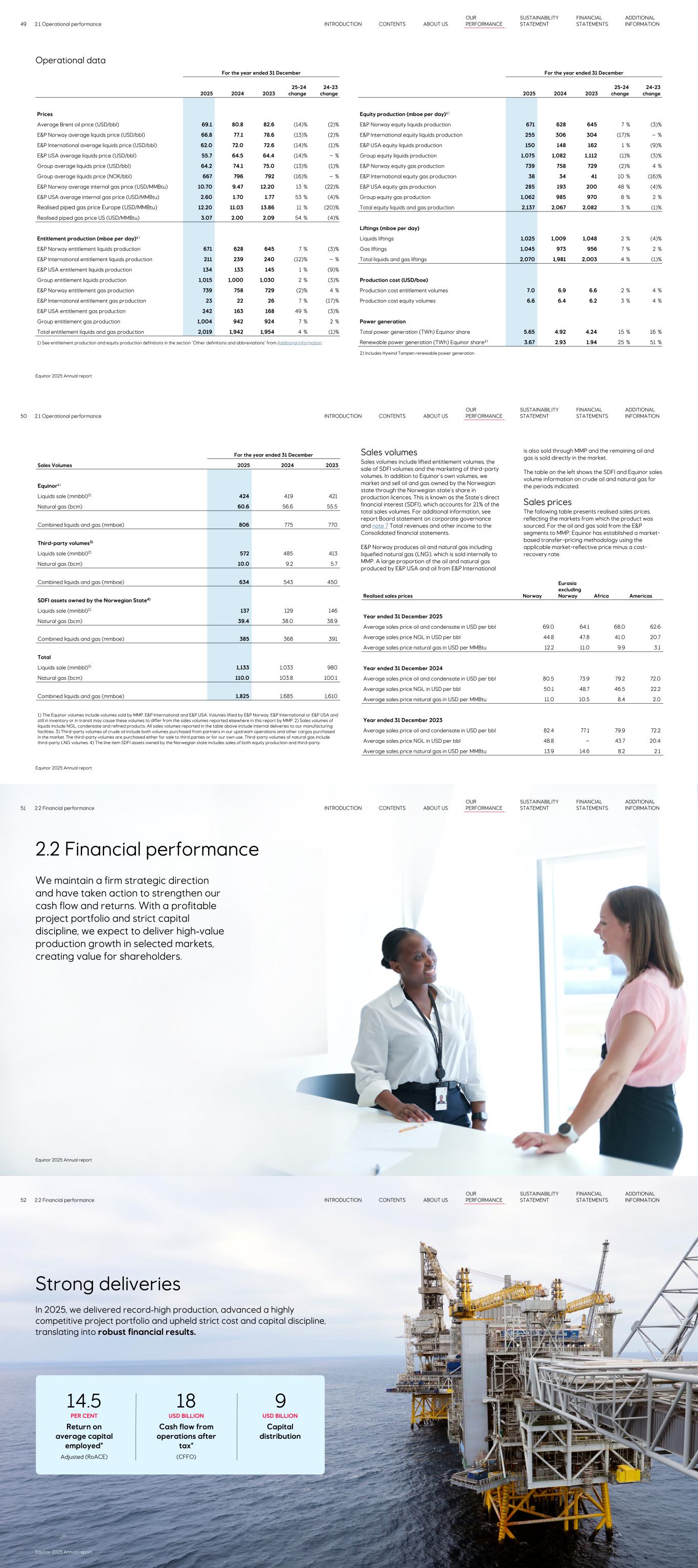
Operational data 49 2.1 Operational performance INTRODUCTION CONTENTS ABOUT US OUR PERFORMANCE SUSTAINABILITY STATEMENT FINANCIAL STATEMENTS ADDITIONAL INFORMATION Equinor 2025 Annual report For the year ended 31 December 25-24 change 24-23 change2025 2024 2023 Prices Average Brent oil price (USD/bbl) 69.1 80.8 82.6 (14) % (2) % E&P Norway average liquids price (USD/bbl) 66.8 77.1 78.6 (13) % (2) % E&P International average liquids price (USD/bbl) 62.0 72.0 72.6 (14) % (1) % E&P USA average liquids price (USD/bbl) 55.7 64.5 64.4 (14) % — % Group average liquids price (USD/bbl) 64.2 74.1 75.0 (13) % (1) % Group average liquids price (NOK/bbl) 667 796 792 (16) % — % E&P Norway average internal gas price (USD/MMBtu) 10.70 9.47 12.20 13 % (22) % E&P USA average internal gas price (USD/MMBtu) 2.60 1.70 1.77 53 % (4) % Realised piped gas price Europe (USD/MMBtu) 12.20 11.03 13.86 11 % (20) % Realised piped gas price US (USD/MMBtu) 3.07 2.00 2.09 54 % (4) % Entitlement production (mboe per day)¹⁾ E&P Norway entitlement liquids production 671 628 645 7 % (3) % E&P International entitlement liquids production 211 239 240 (12) % — % E&P USA entitlement liquids production 134 133 145 1 % (9) % Group entitlement liquids production 1,015 1,000 1,030 2 % (3) % E&P Norway entitlement gas production 739 758 729 (2) % 4 % E&P International entitlement gas production 23 22 26 7 % (17) % E&P USA entitlement gas production 242 163 168 49 % (3) % Group entitlement gas production 1,004 942 924 7 % 2 % Total entitlement liquids and gas production 2,019 1,942 1,954 4 % (1) % 1) See entitlement production and equity production definitions in the section “Other definitions and abbreviations” from Additional information. For the year ended 31 December 25-24 change 24-23 change2025 2024 2023 Equity production (mboe per day)¹⁾ E&P Norway equity liquids production 671 628 645 7 % (3) % E&P International equity liquids production 255 306 304 (17) % — % E&P USA equity liquids production 150 148 162 1 % (9) % Group equity liquids production 1,075 1,082 1,112 (1) % (3) % E&P Norway equity gas production 739 758 729 (2) % 4 % E&P International equity gas production 38 34 41 10 % (16) % E&P USA equity gas production 285 193 200 48 % (4) % Group equity gas production 1,062 985 970 8 % 2 % Total equity liquids and gas production 2,137 2,067 2,082 3 % (1) % Liftings (mboe per day) Liquids liftings 1,025 1,009 1,048 2 % (4) % Gas liftings 1,045 973 956 7 % 2 % Total liquids and gas liftings 2,070 1,981 2,003 4 % (1) % Production cost (USD/boe) Production cost entitlement volumes 7.0 6.9 6.6 2 % 4 % Production cost equity volumes 6.6 6.4 6.2 3 % 4 % Power generation Total power generation (TWh) Equinor share 5.65 4.92 4.24 15 % 16 % Renewable power generation (TWh) Equinor share²⁾ 3.67 2.93 1.94 25 % 51 % 2) Includes Hywind Tampen renewable power generation. Sales volumes Sales volumes include lifted entitlement volumes, the sale of SDFI volumes and the marketing of third-party volumes. In addition to Equinor’s own volumes, we market and sell oil and gas owned by the Norwegian state through the Norwegian state’s share in production licences. This is known as the State’s direct financial interest (SDFI), which accounts for 21% of the total sales volumes. For additional information, see report Board statement on corporate governance and note 7 Total revenues and other income to the Consolidated financial statements. E&P Norway produces oil and natural gas including liquefied natural gas (LNG), which is sold internally to MMP. A large proportion of the oil and natural gas produced by E&P USA and oil from E&P International is also sold through MMP and the remaining oil and gas is sold directly in the market. The table on the left shows the SDFI and Equinor sales volume information on crude oil and natural gas for the periods indicated. Sales prices The following table presents realised sales prices, reflecting the markets from which the product was sourced. For the oil and gas sold from the E&P segments to MMP, Equinor has established a market- based transfer-pricing methodology using the applicable market-reflective price minus a cost- recovery rate. 50 2.1 Operational performance INTRODUCTION CONTENTS ABOUT US OUR PERFORMANCE SUSTAINABILITY STATEMENT FINANCIAL STATEMENTS ADDITIONAL INFORMATION Equinor 2025 Annual report For the year ended 31 December Sales Volumes 2025 2024 2023 Equinor¹⁾ Liquids sale (mmbbl)2) 424 419 421 Natural gas (bcm) 60.6 56.6 55.5 Combined liquids and gas (mmboe) 806 775 770 Third-party volumes3) Liquids sale (mmbbl)2) 572 485 413 Natural gas (bcm) 10.0 9.2 5.7 Combined liquids and gas (mmboe) 634 543 450 SDFI assets owned by the Norwegian State4) Liquids sale (mmbbl)2) 137 129 146 Natural gas (bcm) 39.4 38.0 38.9 Combined liquids and gas (mmboe) 385 368 391 Total Liquids sale (mmbbl)2) 1,133 1,033 980 Natural gas (bcm) 110.0 103.8 100.1 Combined liquids and gas (mmboe) 1,825 1,685 1,610 1) The Equinor volumes include volumes sold by MMP, E&P International and E&P USA. Volumes lifted by E&P Norway, E&P International or E&P USA and still in inventory or in transit may cause these volumes to differ from the sales volumes reported elsewhere in this report by MMP. 2) Sales volumes of liquids include NGL, condensate and refined products. All sales volumes reported in the table above include internal deliveries to our manufacturing facilities. 3) Third-party volumes of crude oil include both volumes purchased from partners in our upstream operations and other cargos purchased in the market. The third-party volumes are purchased either for sale to third parties or for our own use. Third-party volumes of natural gas include third-party LNG volumes. 4) The line item SDFI assets owned by the Norwegian state includes sales of both equity production and third-party. Realised sales prices Norway Eurasia excluding Norway Africa Americas Year ended 31 December 2025 Average sales price oil and condensate in USD per bbl 69.0 64.1 68.0 62.6 Average sales price NGL in USD per bbl 44.8 47.8 41.0 20.7 Average sales price natural gas in USD per MMBtu 12.2 11.0 9.9 3.1 Year ended 31 December 2024 Average sales price oil and condensate in USD per bbl 80.5 73.9 79.2 72.0 Average sales price NGL in USD per bbl 50.1 48.7 46.5 22.2 Average sales price natural gas in USD per MMBtu 11.0 10.5 8.4 2.0 Year ended 31 December 2023 Average sales price oil and condensate in USD per bbl 82.4 77.1 79.9 72.2 Average sales price NGL in USD per bbl 48.8 — 43.7 20.4 Average sales price natural gas in USD per MMBtu 13.9 14.6 8.2 2.1 2.2 Financial performance We maintain a firm strategic direction and have taken action to strengthen our cash flow and returns. With a profitable project portfolio and strict capital discipline, we expect to deliver high-value production growth in selected markets, creating value for shareholders. 51 2.2 Financial performance INTRODUCTION CONTENTS ABOUT US OUR PERFORMANCE SUSTAINABILITY STATEMENT FINANCIAL STATEMENTS ADDITIONAL INFORMATION Equinor 2025 Annual report Strong deliveries In 2025, we delivered record-high production, advanced a highly competitive project portfolio and upheld strict cost and capital discipline, translating into robust financial results. 52 2.2 Financial performance INTRODUCTION CONTENTS ABOUT US OUR PERFORMANCE SUSTAINABILITY STATEMENT FINANCIAL STATEMENTS ADDITIONAL INFORMATION Equinor 2025 Annual report 14.5 18 9 PER CENT USD BILLION USD BILLION Return on average capital employed* Cash flow from operations after tax* Capital distribution Adjusted (RoACE) (CFFO)
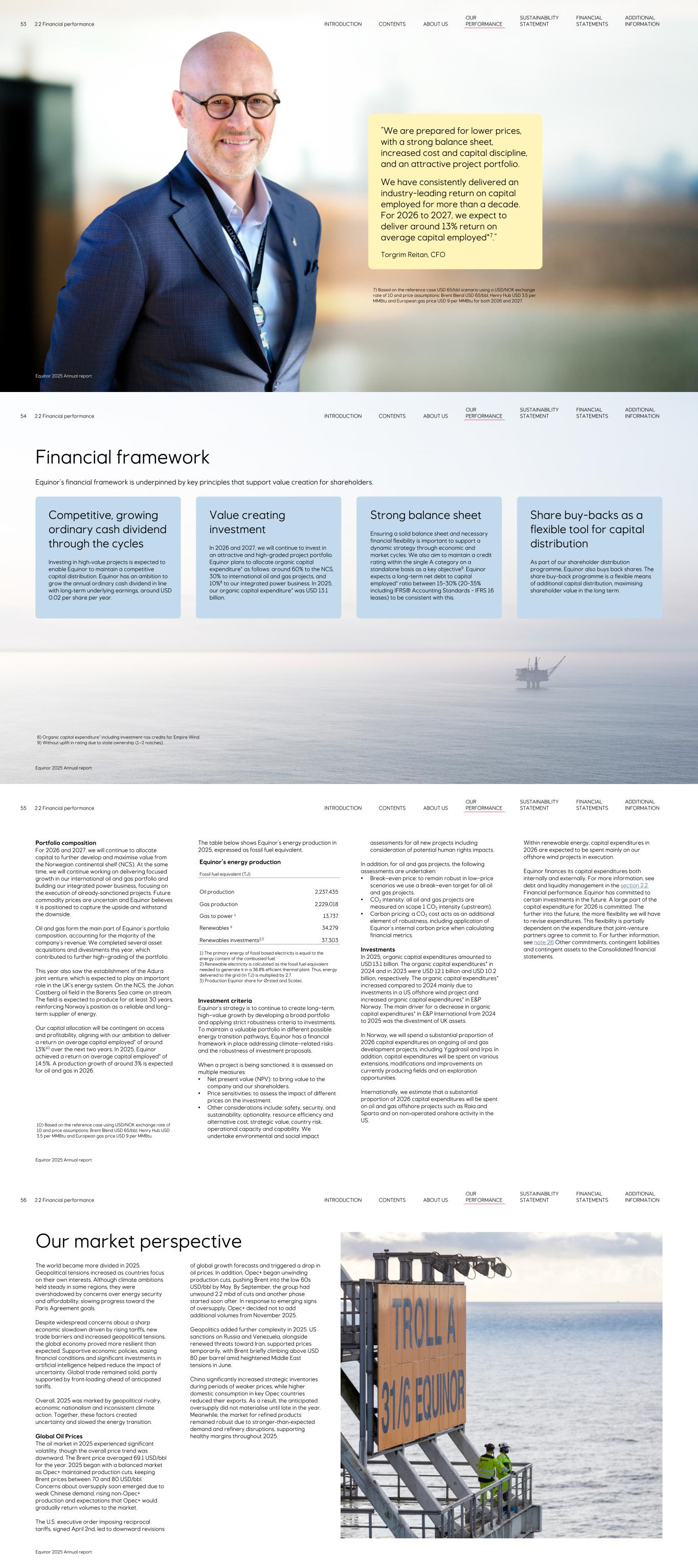
53 2.2 Financial performance INTRODUCTION CONTENTS ABOUT US OUR PERFORMANCE SUSTAINABILITY STATEMENT FINANCIAL STATEMENTS ADDITIONAL INFORMATION Equinor 2025 Annual report “We are prepared for lower prices, with a strong balance sheet, increased cost and capital discipline, and an attractive project portfolio. We have consistently delivered an industry-leading return on capital employed for more than a decade. For 2026 to 2027, we expect to deliver around 13% return on average capital employed*7.” Torgrim Reitan, CFO 7) Based on the reference case USD 65/bbl scenario using a USD/NOK exchange rate of 10 and price assumptions: Brent Blend USD 65/bbl, Henry Hub USD 3.5 per MMBtu and European gas price USD 9 per MMBtu for both 2026 and 2027. Financial framework Equinor’s financial framework is underpinned by key principles that support value creation for shareholders. 54 2.2 Financial performance INTRODUCTION CONTENTS ABOUT US OUR PERFORMANCE SUSTAINABILITY STATEMENT FINANCIAL STATEMENTS ADDITIONAL INFORMATION Equinor 2025 Annual report Competitive, growing ordinary cash dividend through the cycles Investing in high-value projects is expected to enable Equinor to maintain a competitive capital distribution. Equinor has an ambition to grow the annual ordinary cash dividend in line with long-term underlying earnings, around USD 0.02 per share per year. Value creating investment In 2026 and 2027, we will continue to invest in an attractive and high-graded project portfolio. Equinor plans to allocate organic capital expenditure* as follows: around 60% to the NCS, 30% to international oil and gas projects, and 10%8 to our integrated power business. In 2025, our organic capital expenditure* was USD 13.1 billion. Strong balance sheet Ensuring a solid balance sheet and necessary financial flexibility is important to support a dynamic strategy through economic and market cycles. We also aim to maintain a credit rating within the single A category on a standalone basis as a key objective9. Equinor expects a long-term net debt to capital employed* ratio between 15-30% (20-35% including IFRS® Accounting Standards - IFRS 16 leases) to be consistent with this. Share buy-backs as a flexible tool for capital distribution As part of our shareholder distribution programme, Equinor also buys back shares. The share buy-back programme is a flexible means of additional capital distribution, maximising shareholder value in the long term. 8) Organic capital expenditure* including investment-tax credits for Empire Wind. 9) Without uplift in rating due to state ownership (1–2 notches). Portfolio composition For 2026 and 2027, we will continue to allocate capital to further develop and maximise value from the Norwegian continental shelf (NCS). At the same time, we will continue working on delivering focused growth in our international oil and gas portfolio and building our integrated power business, focusing on the execution of already-sanctioned projects. Future commodity prices are uncertain and Equinor believes it is positioned to capture the upside and withstand the downside. Oil and gas form the main part of Equinor’s portfolio composition, accounting for the majority of the company’s revenue. We completed several asset acquisitions and divestments this year, which contributed to further high–grading of the portfolio. This year also saw the establishment of the Adura joint venture, which is expected to play an important role in the UK’s energy system. On the NCS, the Johan Castberg oil field in the Barents Sea came on stream. The field is expected to produce for at least 30 years, reinforcing Norway’s position as a reliable and long– term supplier of energy. Our capital allocation will be contingent on access and profitability, aligning with our ambition to deliver a return on average capital employed* of around 13%10 over the next two years. In 2025, Equinor achieved a return on average capital employed* of 14.5%. A production growth of around 3% is expected for oil and gas in 2026. The table below shows Equinor’s energy production in 2025, expressed as fossil fuel equivalent. Investment criteria Equinor’s strategy is to continue to create long–term, high–value growth by developing a broad portfolio and applying strict robustness criteria to investments. To maintain a valuable portfolio in different possible energy transition pathways, Equinor has a financial framework in place addressing climate–related risks and the robustness of investment proposals. When a project is being sanctioned, it is assessed on multiple measures: • Net present value (NPV): to bring value to the company and our shareholders. • Price sensitivities: to assess the impact of different prices on the investment. • Other considerations include: safety, security, and sustainability, optionality, resource efficiency and alternative cost, strategic value, country risk, operational capacity and capability. We undertake environmental and social impact assessments for all new projects including consideration of potential human rights impacts. In addition, for oil and gas projects, the following assessments are undertaken: • Break–even price: to remain robust in low–price scenarios we use a break–even target for all oil and gas projects. • CO2 intensity: all oil and gas projects are measured on scope 1 CO2 intensity (upstream). • Carbon pricing: a CO2 cost acts as an additional element of robustness, including application of Equinor’s internal carbon price when calculating financial metrics. Investments In 2025, organic capital expenditures amounted to USD 13.1 billion. The organic capital expenditures* in 2024 and in 2023 were USD 12.1 billion and USD 10.2 billion, respectively. The organic capital expenditures* increased compared to 2024 mainly due to investments in a US offshore wind project and increased organic capital expenditures* in E&P Norway. The main driver for a decrease in organic capital expenditures* in E&P International from 2024 to 2025 was the divestment of UK assets. In Norway, we will spend a substantial proportion of 2026 capital expenditures on ongoing oil and gas development projects, including Yggdrasil and Irpa. In addition, capital expenditures will be spent on various extensions, modifications and improvements on currently producing fields and on exploration opportunities. Internationally, we estimate that a substantial proportion of 2026 capital expenditures will be spent on oil and gas offshore projects such as Raia and Sparta and on non-operated onshore activity in the US. Within renewable energy, capital expenditures in 2026 are expected to be spent mainly on our offshore wind projects in execution. Equinor finances its capital expenditures both internally and externally. For more information, see debt and liquidity management in the section 2.2 Financial performance. Equinor has committed to certain investments in the future. A large part of the capital expenditure for 2026 is committed. The further into the future, the more flexibility we will have to revise expenditures. This flexibility is partially dependent on the expenditure that joint-venture partners agree to commit to. For further information, see note 26 Other commitments, contingent liabilities and contingent assets to the Consolidated financial statements. 55 2.2 Financial performance INTRODUCTION CONTENTS ABOUT US OUR PERFORMANCE SUSTAINABILITY STATEMENT FINANCIAL STATEMENTS ADDITIONAL INFORMATION Equinor 2025 Annual report Equinor’s energy production Fossil fuel equivalent (TJ) Oil production 2,237,435 Gas production 2,229,018 Gas to power ¹ 13,737 Renewables ² 34,279 Renewables investments2,3 37,303 1) The primary energy of fossil based electricity is equal to the energy content of the combusted fuel. 2) Renewable electricity is calculated as the fossil fuel equivalent needed to generate it in a 36.8% efficient thermal plant. Thus, energy delivered to the grid (in TJ) is multiplied by 2.7. 3) Production Equinor share for Ørsted and Scatec. 10) Based on the reference case using USD/NOK exchange rate of 10 and price assumptions: Brent Blend USD 65/bbl, Henry Hub USD 3.5 per MMBtu and European gas price USD 9 per MMBtu. Our market perspective The world became more divided in 2025. Geopolitical tensions increased as countries focus on their own interests. Although climate ambitions held steady in some regions, they were overshadowed by concerns over energy security and affordability, slowing progress toward the Paris Agreement goals. Despite widespread concerns about a sharp economic slowdown driven by rising tariffs, new trade barriers and increased geopolitical tensions, the global economy proved more resilient than expected. Supportive economic policies, easing financial conditions and significant investments in artificial intelligence helped reduce the impact of uncertainty. Global trade remained solid, partly supported by front-loading ahead of anticipated tariffs. Overall, 2025 was marked by geopolitical rivalry, economic nationalism and inconsistent climate action. Together, these factors created uncertainty and slowed the energy transition. Global Oil Prices The oil market in 2025 experienced significant volatility, though the overall price trend was downward. The Brent price averaged 69.1 USD/bbl for the year. 2025 began with a balanced market as Opec+ maintained production cuts, keeping Brent prices between 70 and 80 USD/bbl. Concerns about oversupply soon emerged due to weak Chinese demand, rising non-Opec+ production and expectations that Opec+ would gradually return volumes to the market. The U.S. executive order imposing reciprocal tariffs, signed April 2nd, led to downward revisions of global growth forecasts and triggered a drop in oil prices. In addition, Opec+ began unwinding production cuts, pushing Brent into the low 60s USD/bbl by May. By September, the group had unwound 2.2 mbd of cuts and another phase started soon after. In response to emerging signs of oversupply, Opec+ decided not to add additional volumes from November 2025. Geopolitics added further complexity in 2025. US sanctions on Russia and Venezuela, alongside renewed threats toward Iran, supported prices temporarily, with Brent briefly climbing above USD 80 per barrel amid heightened Middle East tensions in June. China significantly increased strategic inventories during periods of weaker prices, while higher domestic consumption in key Opec countries reduced their exports. As a result, the anticipated oversupply did not materialise until late in the year. Meanwhile, the market for refined products remained robust due to stronger-than-expected demand and refinery disruptions, supporting healthy margins throughout 2025. 56 2.2 Financial performance INTRODUCTION CONTENTS ABOUT US OUR PERFORMANCE SUSTAINABILITY STATEMENT FINANCIAL STATEMENTS ADDITIONAL INFORMATION Equinor 2025 Annual report
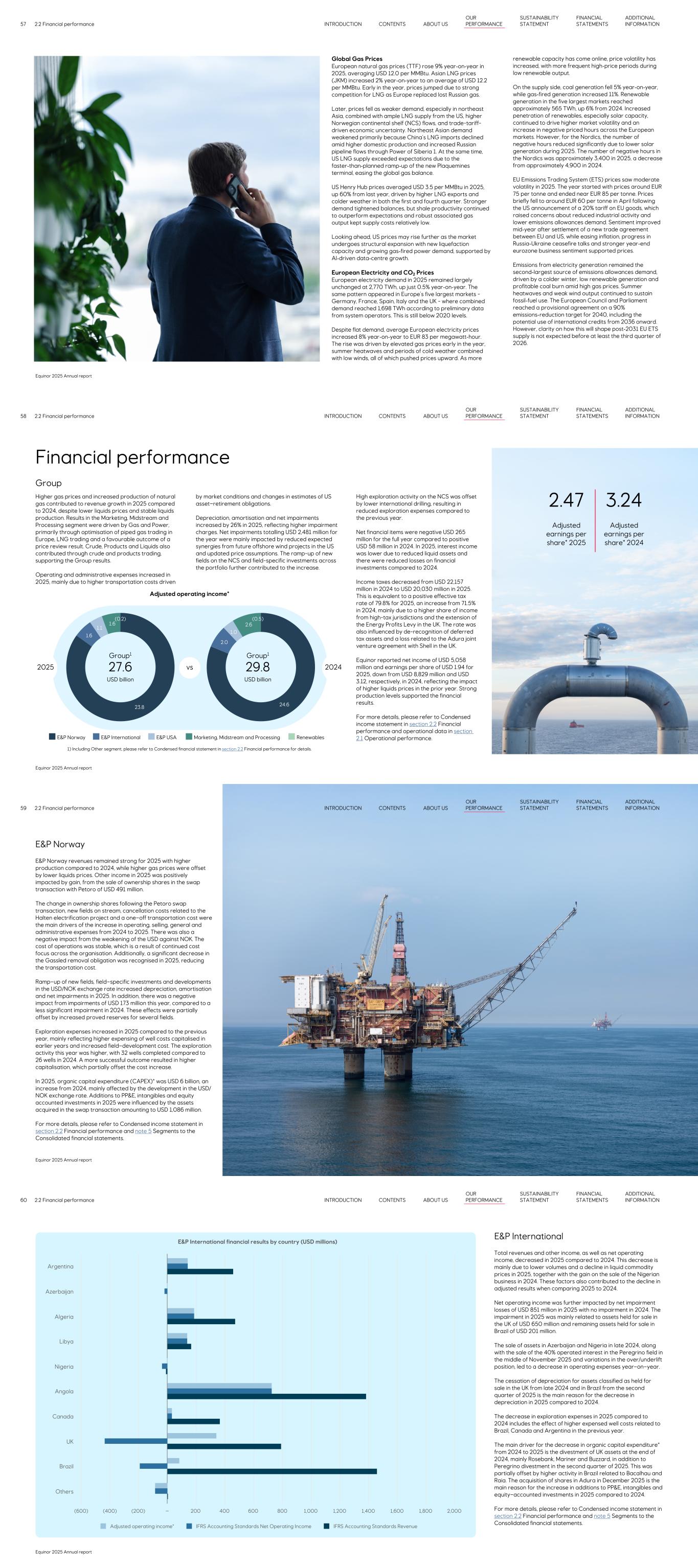
Global Gas Prices European natural gas prices (TTF) rose 9% year-on-year in 2025, averaging USD 12.0 per MMBtu. Asian LNG prices (JKM) increased 2% year-on-year to an average of USD 12.2 per MMBtu. Early in the year, prices jumped due to strong competition for LNG as Europe replaced lost Russian gas. Later, prices fell as weaker demand, especially in northeast Asia, combined with ample LNG supply from the US, higher Norwegian continental shelf (NCS) flows, and trade-tariff- driven economic uncertainty. Northeast Asian demand weakened primarily because China’s LNG imports declined amid higher domestic production and increased Russian pipeline flows through Power of Siberia 1. At the same time, US LNG supply exceeded expectations due to the faster-than-planned ramp-up of the new Plaquemines terminal, easing the global gas balance. US Henry Hub prices averaged USD 3.5 per MMBtu in 2025, up 60% from last year, driven by higher LNG exports and colder weather in both the first and fourth quarter. Stronger demand tightened balances, but shale productivity continued to outperform expectations and robust associated gas output kept supply costs relatively low. Looking ahead, US prices may rise further as the market undergoes structural expansion with new liquefaction capacity and growing gas-fired power demand, supported by AI-driven data-centre growth. European Electricity and CO2 Prices European electricity demand in 2025 remained largely unchanged at 2,770 TWh, up just 0.5% year-on-year. The same pattern appeared in Europe’s five largest markets - Germany, France, Spain, Italy and the UK - where combined demand reached 1,698 TWh according to preliminary data from system operators. This is still below 2020 levels. Despite flat demand, average European electricity prices increased 8% year-on-year to EUR 83 per megawatt-hour. The rise was driven by elevated gas prices early in the year, summer heatwaves and periods of cold weather combined with low winds, all of which pushed prices upward. As more renewable capacity has come online, price volatility has increased, with more frequent high-price periods during low renewable output. On the supply side, coal generation fell 5% year-on-year, while gas-fired generation increased 11%. Renewable generation in the five largest markets reached approximately 565 TWh, up 6% from 2024. Increased penetration of renewables, especially solar capacity, continued to drive higher market volatility and an increase in negative priced hours across the European markets. However, for the Nordics, the number of negative hours reduced significantly due to lower solar generation during 2025. The number of negative hours in the Nordics was approximately 3,400 in 2025, a decrease from approximately 4,900 in 2024. EU Emissions Trading System (ETS) prices saw moderate volatility in 2025. The year started with prices around EUR 75 per tonne and ended near EUR 85 per tonne. Prices briefly fell to around EUR 60 per tonne in April following the US announcement of a 20% tariff on EU goods, which raised concerns about reduced industrial activity and lower emissions allowances demand. Sentiment improved mid-year after settlement of a new trade agreement between EU and US, while easing inflation, progress in Russia-Ukraine ceasefire talks and stronger year-end eurozone business sentiment supported prices. Emissions from electricity generation remained the second-largest source of emissions allowances demand, driven by a colder winter, low renewable generation and profitable coal burn amid high gas prices. Summer heatwaves and weak wind output continued to sustain fossil-fuel use. The European Council and Parliament reached a provisional agreement on a 90% emissions-reduction target for 2040, including the potential use of international credits from 2036 onward. However, clarity on how this will shape post-2031 EU ETS supply is not expected before at least the third quarter of 2026. 57 2.2 Financial performance INTRODUCTION CONTENTS ABOUT US OUR PERFORMANCE SUSTAINABILITY STATEMENT FINANCIAL STATEMENTS ADDITIONAL INFORMATION Equinor 2025 Annual report Financial performance Group Higher gas prices and increased production of natural gas contributed to revenue growth in 2025 compared to 2024, despite lower liquids prices and stable liquids production. Results in the Marketing, Midstream and Processing segment were driven by Gas and Power, primarily through optimisation of piped gas trading in Europe, LNG trading and a favourable outcome of a price review result. Crude, Products and Liquids also contributed through crude and products trading, supporting the Group results. Operating and administrative expenses increased in 2025, mainly due to higher transportation costs driven by market conditions and changes in estimates of US asset–retirement obligations. Depreciation, amortisation and net impairments increased by 26% in 2025, reflecting higher impairment charges. Net impairments totalling USD 2,481 million for the year were mainly impacted by reduced expected synergies from future offshore wind projects in the US and updated price assumptions. The ramp-up of new fields on the NCS and field-specific investments across the portfolio further contributed to the increase. High exploration activity on the NCS was offset by lower international drilling, resulting in reduced exploration expenses compared to the previous year. Net financial items were negative USD 265 million for the full year compared to positive USD 58 million in 2024. In 2025, interest income was lower due to reduced liquid assets and there were reduced losses on financial investments compared to 2024. Income taxes decreased from USD 22,157 million in 2024 to USD 20,030 million in 2025. This is equivalent to a positive effective tax rate of 79.8% for 2025, an increase from 71.5% in 2024, mainly due to a higher share of income from high-tax jurisdictions and the extension of the Energy Profits Levy in the UK. The rate was also influenced by de-recognition of deferred tax assets and a loss related to the Adura joint venture agreement with Shell in the UK. Equinor reported net income of USD 5,058 million and earnings per share of USD 1.94 for 2025, down from USD 8,829 million and USD 3.12, respectively, in 2024, reflecting the impact of higher liquids prices in the prior year. Strong production levels supported the financial results. For more details, please refer to Condensed income statement in section 2.2 Financial performance and operational data in section 2.1 Operational performance. 58 2.2 Financial performance INTRODUCTION CONTENTS ABOUT US OUR PERFORMANCE SUSTAINABILITY STATEMENT FINANCIAL STATEMENTS ADDITIONAL INFORMATION Equinor 2025 Annual report 23.8 1.6 1.1 1.6 24.6 2.0 1.0 2.6 Adjusted operating income* (0.2) (0.5) 2025 Group1 27.6 USD billion vs Group1 29.8 USD billion 2024 E&P Norway E&P International E&P USA Marketing, Midstream and Processing Renewables 1) Including Other segment, please refer to Condensed financial statement in section 2.2 Financial performance for details. 2.47 Adjusted earnings per share* 2025 3.24 Adjusted earnings per share* 2024 E&P Norway E&P Norway revenues remained strong for 2025 with higher production compared to 2024, while higher gas prices were offset by lower liquids prices. Other income in 2025 was positively impacted by gain, from the sale of ownership shares in the swap transaction with Petoro of USD 491 million. The change in ownership shares following the Petoro swap transaction, new fields on stream, cancellation costs related to the Halten electrification project and a one–off transportation cost were the main drivers of the increase in operating, selling, general and administrative expenses from 2024 to 2025. There was also a negative impact from the weakening of the USD against NOK. The cost of operations was stable, which is a result of continued cost focus across the organisation. Additionally, a significant decrease in the Gassled removal obligation was recognised in 2025, reducing the transportation cost. Ramp–up of new fields, field–specific investments and developments in the USD/NOK exchange rate increased depreciation, amortisation and net impairments in 2025. In addition, there was a negative impact from impairments of USD 173 million this year, compared to a less significant impairment in 2024. These effects were partially offset by increased proved reserves for several fields. Exploration expenses increased in 2025 compared to the previous year, mainly reflecting higher expensing of well costs capitalised in earlier years and increased field–development cost. The exploration activity this year was higher, with 32 wells completed compared to 26 wells in 2024. A more successful outcome resulted in higher capitalisation, which partially offset the cost increase. In 2025, organic capital expenditure (CAPEX)* was USD 6 billion, an increase from 2024, mainly affected by the development in the USD/ NOK exchange rate. Additions to PP&E, intangibles and equity accounted investments in 2025 were influenced by the assets acquired in the swap transaction amounting to USD 1,086 million. For more details, please refer to Condensed income statement in section 2.2 Financial performance and note 5 Segments to the Consolidated financial statements. 59 2.2 Financial performance INTRODUCTION CONTENTS ABOUT US OUR PERFORMANCE SUSTAINABILITY STATEMENT FINANCIAL STATEMENTS ADDITIONAL INFORMATION Equinor 2025 Annual report E&P International Total revenues and other income, as well as net operating income, decreased in 2025 compared to 2024. This decrease is mainly due to lower volumes and a decline in liquid commodity prices in 2025, together with the gain on the sale of the Nigerian business in 2024. These factors also contributed to the decline in adjusted results when comparing 2025 to 2024. Net operating income was further impacted by net impairment losses of USD 851 million in 2025 with no impairment in 2024. The impairment in 2025 was mainly related to assets held for sale in the UK of USD 650 million and remaining assets held for sale in Brazil of USD 201 million. The sale of assets in Azerbaijan and Nigeria in late 2024, along with the sale of the 40% operated interest in the Peregrino field in the middle of November 2025 and variations in the over/underlift position, led to a decrease in operating expenses year–on–year. The cessation of depreciation for assets classified as held for sale in the UK from late 2024 and in Brazil from the second quarter of 2025 is the main reason for the decrease in depreciation in 2025 compared to 2024. The decrease in exploration expenses in 2025 compared to 2024 includes the effect of higher expensed well costs related to Brazil, Canada and Argentina in the previous year. The main driver for the decrease in organic capital expenditure* from 2024 to 2025 is the divestment of UK assets at the end of 2024, mainly Rosebank, Mariner and Buzzard, in addition to Peregrino divestment in the second quarter of 2025. This was partially offset by higher activity in Brazil related to Bacalhau and Raia. The acquisition of shares in Adura in December 2025 is the main reason for the increase in additions to PP&E, intangibles and equity–accounted investments in 2025 compared to 2024. For more details, please refer to Condensed income statement in section 2.2 Financial performance and note 5 Segments to the Consolidated financial statements. 60 2.2 Financial performance INTRODUCTION CONTENTS ABOUT US OUR PERFORMANCE SUSTAINABILITY STATEMENT FINANCIAL STATEMENTS ADDITIONAL INFORMATION Equinor 2025 Annual report E&P International financial results by country (USD millions) Adjusted operating income* IFRS Accounting Standards Net Operating Income IFRS Accounting Standards Revenue (600) (400) (200) — 200 400 600 800 1,000 1,200 1,400 1,600 1,800 2,000 Argentina Azerbaijan Algeria Libya Nigeria Angola Canada UK Brazil Others
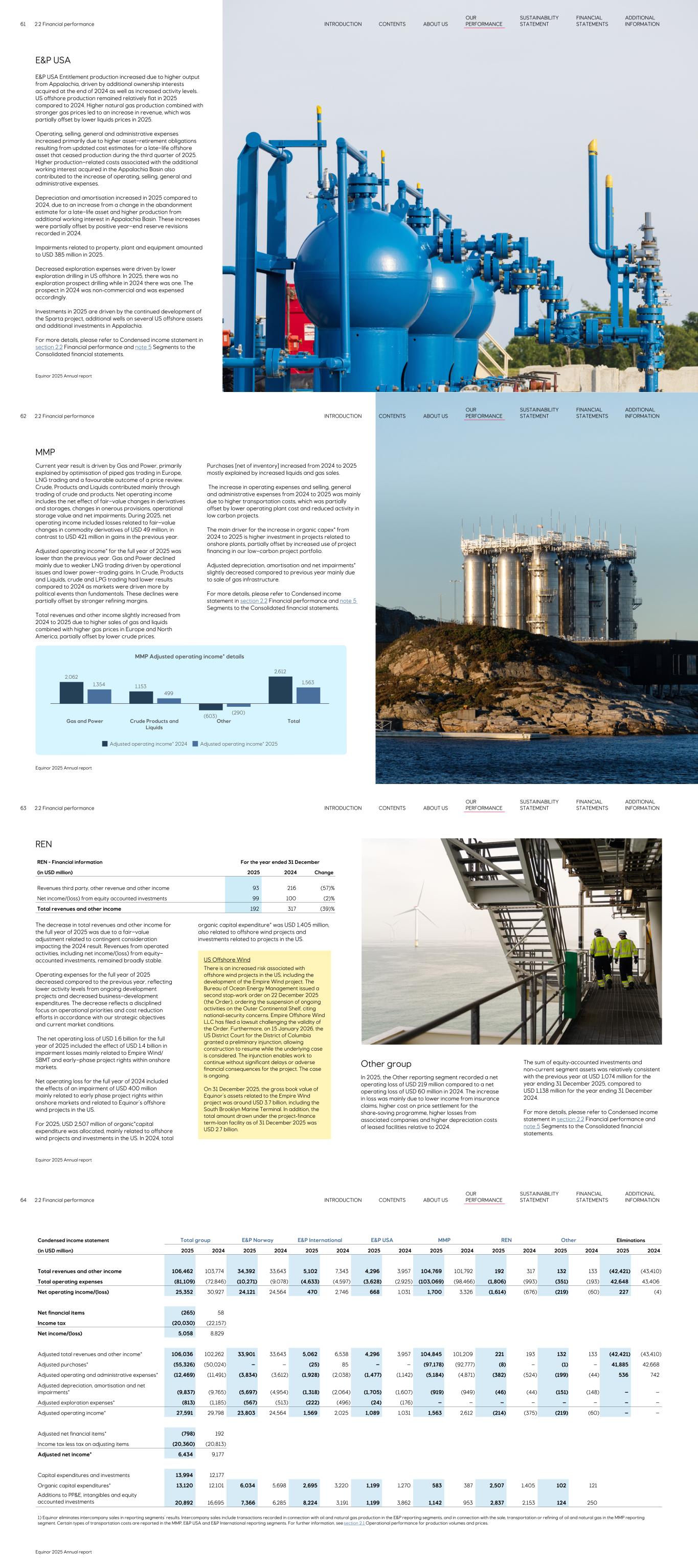
E&P USA E&P USA Entitlement production increased due to higher output from Appalachia, driven by additional ownership interests acquired at the end of 2024 as well as increased activity levels. US offshore production remained relatively flat in 2025 compared to 2024. Higher natural gas production combined with stronger gas prices led to an increase in revenue, which was partially offset by lower liquids prices in 2025. Operating, selling, general and administrative expenses increased primarily due to higher asset–retirement obligations resulting from updated cost estimates for a late–life offshore asset that ceased production during the third quarter of 2025. Higher production–related costs associated with the additional working interest acquired in the Appalachia Basin also contributed to the increase of operating, selling, general and administrative expenses. Depreciation and amortisation increased in 2025 compared to 2024, due to an increase from a change in the abandonment estimate for a late–life asset and higher production from additional working interest in Appalachia Basin. These increases were partially offset by positive year–end reserve revisions recorded in 2024. Impairments related to property, plant and equipment amounted to USD 385 million in 2025. Decreased exploration expenses were driven by lower exploration drilling in US offshore. In 2025, there was no exploration prospect drilling while in 2024 there was one. The prospect in 2024 was non-commercial and was expensed accordingly. Investments in 2025 are driven by the continued development of the Sparta project, additional wells on several US offshore assets and additional investments in Appalachia. For more details, please refer to Condensed income statement in section 2.2 Financial performance and note 5 Segments to the Consolidated financial statements. 61 2.2 Financial performance INTRODUCTION CONTENTS ABOUT US OUR PERFORMANCE SUSTAINABILITY STATEMENT FINANCIAL STATEMENTS ADDITIONAL INFORMATION Equinor 2025 Annual report MMP Current year result is driven by Gas and Power, primarily explained by optimisation of piped gas trading in Europe, LNG trading and a favourable outcome of a price review. Crude, Products and Liquids contributed mainly through trading of crude and products. Net operating income includes the net effect of fair–value changes in derivatives and storages, changes in onerous provisions, operational storage value and net impairments. During 2025, net operating income included losses related to fair–value changes in commodity derivatives of USD 49 million, in contrast to USD 421 million in gains in the previous year. Adjusted operating income* for the full year of 2025 was lower than the previous year. Gas and Power declined mainly due to weaker LNG trading driven by operational issues and lower power–trading gains. In Crude, Products and Liquids, crude and LPG trading had lower results compared to 2024 as markets were driven more by political events than fundamentals. These declines were partially offset by stronger refining margins. Total revenues and other income slightly increased from 2024 to 2025 due to higher sales of gas and liquids combined with higher gas prices in Europe and North America, partially offset by lower crude prices. Purchases [net of inventory] increased from 2024 to 2025 mostly explained by increased liquids and gas sales. The increase in operating expenses and selling, general and administrative expenses from 2024 to 2025 was mainly due to higher transportation costs, which was partially offset by lower operating plant cost and reduced activity in low carbon projects. The main driver for the increase in organic capex* from 2024 to 2025 is higher investment in projects related to onshore plants, partially offset by increased use of project financing in our low–carbon project portfolio. Adjusted depreciation, amortisation and net impairments* slightly decreased compared to previous year mainly due to sale of gas infrastructure. For more details, please refer to Condensed income statement in section 2.2 Financial performance and note 5 Segments to the Consolidated financial statements. 62 2.2 Financial performance INTRODUCTION CONTENTS ABOUT US OUR PERFORMANCE SUSTAINABILITY STATEMENT FINANCIAL STATEMENTS ADDITIONAL INFORMATION Equinor 2025 Annual report MMP Adjusted operating income* details 2,062 1,153 (603) 2,612 1,354 499 (290) 1,563 Adjusted operating income* 2024 Adjusted operating income* 2025 Gas and Power Crude Products and Liquids Other Total REN The decrease in total revenues and other income for the full year of 2025 was due to a fair–value adjustment related to contingent consideration impacting the 2024 result. Revenues from operated activities, including net income/(loss) from equity– accounted investments, remained broadly stable. Operating expenses for the full year of 2025 decreased compared to the previous year, reflecting lower activity levels from ongoing development projects and decreased business–development expenditures. The decrease reflects a disciplined focus on operational priorities and cost reduction efforts in accordance with our strategic objectives and current market conditions. The net operating loss of USD 1.6 billion for the full year of 2025 included the effect of USD 1.4 billion in impairment losses mainly related to Empire Wind/ SBMT and early–phase project rights within onshore markets. Net operating loss for the full year of 2024 included the effects of an impairment of USD 400 million mainly related to early phase project rights within onshore markets and related to Equinor’s offshore wind projects in the US. For 2025, USD 2,507 million of organic*capital expenditure was allocated, mainly related to offshore wind projects and investments in the US. In 2024, total organic capital expenditure* was USD 1,405 million, also related to offshore wind projects and investments related to projects in the US. US Offshore Wind There is an increased risk associated with offshore wind projects in the US, including the development of the Empire Wind project. The Bureau of Ocean Energy Management issued a second stop-work order on 22 December 2025 (the Order), ordering the suspension of ongoing activities on the Outer Continental Shelf, citing national-security concerns. Empire Offshore Wind LLC has filed a lawsuit challenging the validity of the Order. Furthermore, on 15 January 2026, the US District Court for the District of Columbia granted a preliminary injunction, allowing construction to resume while the underlying case is considered. The injunction enables work to continue without significant delays or adverse financial consequences for the project. The case is ongoing. On 31 December 2025, the gross book value of Equinor’s assets related to the Empire Wind project was around USD 3.7 billion, including the South Brooklyn Marine Terminal. In addition, the total amount drawn under the project-finance term-loan facility as of 31 December 2025 was USD 2.7 billion. Other group In 2025, the Other reporting segment recorded a net operating loss of USD 219 million compared to a net operating loss of USD 60 million in 2024. The increase in loss was mainly due to lower income from insurance claims, higher cost on price settlement for the share-saving programme, higher losses from associated companies and higher depreciation costs of leased facilities relative to 2024. The sum of equity-accounted investments and non-current segment assets was relatively consistent with the previous year at USD 1,074 million for the year ending 31 December 2025, compared to USD 1,138 million for the year ending 31 December 2024. For more details, please refer to Condensed income statement in section 2.2 Financial performance and note 5 Segments to the Consolidated financial statements. 63 2.2 Financial performance INTRODUCTION CONTENTS ABOUT US OUR PERFORMANCE SUSTAINABILITY STATEMENT FINANCIAL STATEMENTS ADDITIONAL INFORMATION Equinor 2025 Annual report REN - Financial information For the year ended 31 December (in USD million) 2025 2024 Change Revenues third party, other revenue and other income 93 216 (57) % Net income/(loss) from equity accounted investments 99 100 (2) % Total revenues and other income 192 317 (39) % 64 2.2 Financial performance INTRODUCTION CONTENTS ABOUT US OUR PERFORMANCE SUSTAINABILITY STATEMENT FINANCIAL STATEMENTS ADDITIONAL INFORMATION Equinor 2025 Annual report Condensed income statement Total group E&P Norway E&P International E&P USA MMP REN Other Eliminations (in USD million) 2025 2024 2025 2024 2025 2024 2025 2024 2025 2024 2025 2024 2025 2024 2025 2024 Total revenues and other income 106,462 103,774 34,392 33,643 5,102 7,343 4,296 3,957 104,769 101,792 192 317 132 133 (42,421) (43,410) Total operating expenses (81,109) (72,846) (10,271) (9,078) (4,633) (4,597) (3,628) (2,925) (103,069) (98,466) (1,806) (993) (351) (193) 42,648 43,406 Net operating income/(loss) 25,352 30,927 24,121 24,564 470 2,746 668 1,031 1,700 3,326 (1,614) (676) (219) (60) 227 (4) Net financial items (265) 58 Income tax (20,030) (22,157) Net income/(loss) 5,058 8,829 Adjusted total revenues and other income* 106,036 102,262 33,901 33,643 5,062 6,538 4,296 3,957 104,845 101,209 221 193 132 133 (42,421) (43,410) Adjusted purchases* (55,326) (50,024) — — (25) 85 — — (97,178) (92,777) (8) — (1) — 41,885 42,668 Adjusted operating and administrative expenses* (12,469) (11,491) (3,834) (3,612) (1,928) (2,038) (1,477) (1,142) (5,184) (4,871) (382) (524) (199) (44) 536 742 Adjusted depreciation, amortisation and net impairments* (9,837) (9,765) (5,697) (4,954) (1,318) (2,064) (1,705) (1,607) (919) (949) (46) (44) (151) (148) — — Adjusted exploration expenses* (813) (1,185) (567) (513) (222) (496) (24) (176) — — — — — — — — Adjusted operating income* 27,591 29,798 23,803 24,564 1,569 2,025 1,089 1,031 1,563 2,612 (214) (375) (219) (60) — — Adjusted net financial items* (798) 192 Income tax less tax on adjusting items (20,360) (20,813) Adjusted net income* 6,434 9,177 Capital expenditures and investments 13,994 12,177 Organic capital expenditures* 13,120 12,101 6,034 5,698 2,695 3,220 1,199 1,270 583 387 2,507 1,405 102 121 Additions to PP&E, intangibles and equity accounted investments 20,892 16,695 7,366 6,285 8,224 3,191 1,199 3,862 1,142 953 2,837 2,153 124 250 1) Equinor eliminates intercompany sales in reporting segments’ results. Intercompany sales include transactions recorded in connection with oil and natural gas production in the E&P reporting segments, and in connection with the sale, transportation or refining of oil and natural gas in the MMP reporting segment. Certain types of transportation costs are reported in the MMP, E&P USA and E&P International reporting segments. For further information, see section 2.1 Operational performance for production volumes and prices.
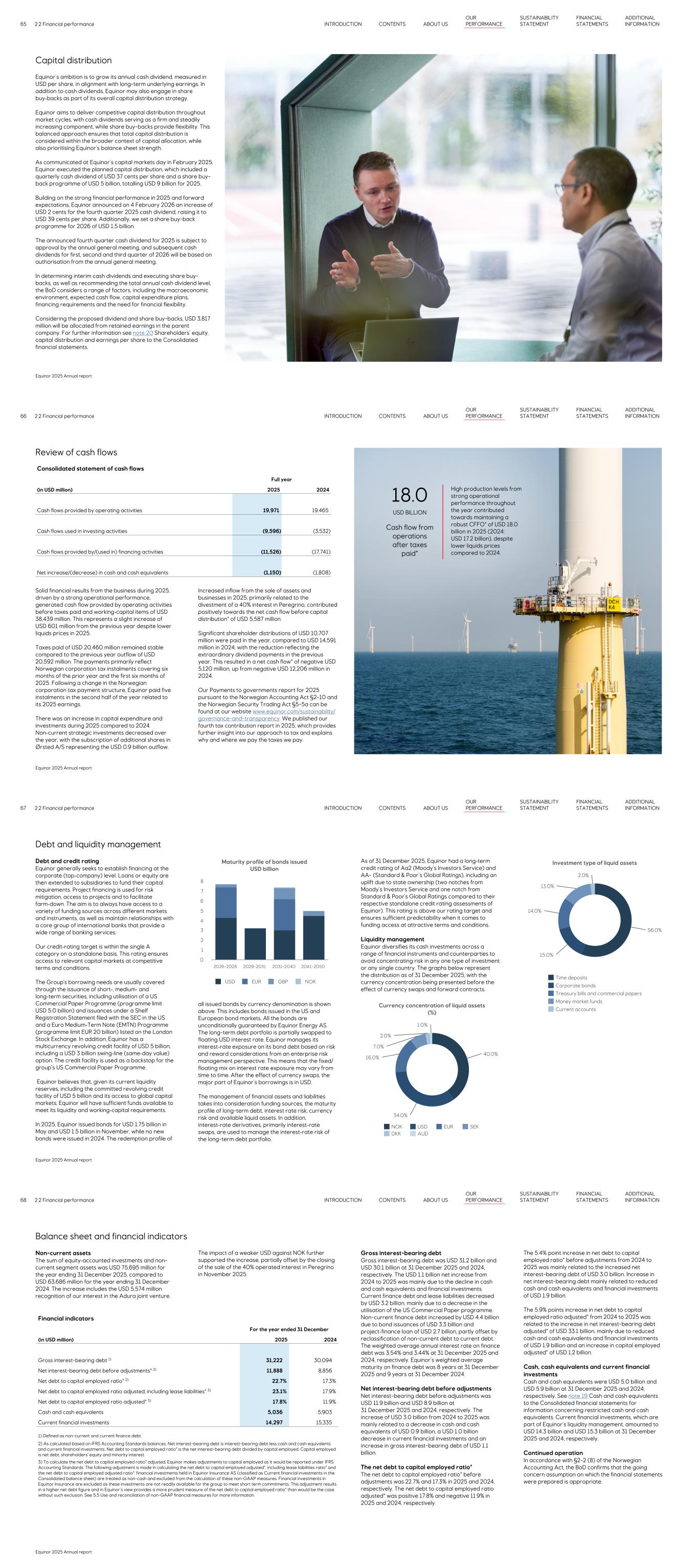
Capital distribution Equinor’s ambition is to grow its annual cash dividend, measured in USD per share, in alignment with long-term underlying earnings. In addition to cash dividends, Equinor may also engage in share buy-backs as part of its overall capital distribution strategy. Equinor aims to deliver competitive capital distribution throughout market cycles, with cash dividends serving as a firm and steadily increasing component, while share buy-backs provide flexibility. This balanced approach ensures that total capital distribution is considered within the broader context of capital allocation, while also prioritising Equinor’s balance sheet strength. As communicated at Equinor’s capital markets day in February 2025, Equinor executed the planned capital distribution, which included a quarterly cash dividend of USD 37 cents per share and a share buy- back programme of USD 5 billion, totalling USD 9 billion for 2025. Building on the strong financial performance in 2025 and forward expectations, Equinor announced on 4 February 2026 an increase of USD 2 cents for the fourth quarter 2025 cash dividend, raising it to USD 39 cents per share. Additionally, we set a share buy-back programme for 2026 of USD 1.5 billion. The announced fourth quarter cash dividend for 2025 is subject to approval by the annual general meeting, and subsequent cash dividends for first, second and third quarter of 2026 will be based on authorisation from the annual general meeting. In determining interim cash dividends and executing share buy- backs, as well as recommending the total annual cash dividend level, the BoD considers a range of factors, including the macroeconomic environment, expected cash flow, capital expenditure plans, financing requirements and the need for financial flexibility. Considering the proposed dividend and share buy-backs, USD 3,817 million will be allocated from retained earnings in the parent company. For further information see note 20 Shareholders’ equity, capital distribution and earnings per share to the Consolidated financial statements. 65 2.2 Financial performance INTRODUCTION CONTENTS ABOUT US OUR PERFORMANCE SUSTAINABILITY STATEMENT FINANCIAL STATEMENTS ADDITIONAL INFORMATION Equinor 2025 Annual report Review of cash flows Solid financial results from the business during 2025, driven by a strong operational performance, generated cash flow provided by operating activities before taxes paid and working-capital items of USD 38,439 million. This represents a slight increase of USD 601 million from the previous year despite lower liquids prices in 2025. Taxes paid of USD 20,460 million remained stable compared to the previous year outflow of USD 20,592 million. The payments primarily reflect Norwegian corporation tax instalments covering six months of the prior year and the first six months of 2025. Following a change in the Norwegian corporation tax payment structure, Equinor paid five instalments in the second half of the year related to its 2025 earnings. There was an increase in capital expenditure and investments during 2025 compared to 2024. Non-current strategic investments decreased over the year, with the subscription of additional shares in Ørsted A/S representing the USD 0.9 billion outflow. Increased inflow from the sale of assets and businesses in 2025, primarily related to the divestment of a 40% interest in Peregrino, contributed positively towards the net cash flow before capital distribution* of USD 5,587 million. Significant shareholder distributions of USD 10,707 million were paid in the year, compared to USD 14,591 million in 2024, with the reduction reflecting the extraordinary dividend payments in the previous year. This resulted in a net cash flow* of negative USD 5,120 million, up from negative USD 12,206 million in 2024. Our Payments to governments report for 2025 pursuant to the Norwegian Accounting Act §2-10 and the Norwegian Security Trading Act §5-5a can be found at our website www.equinor.com/sustainability/ governance-and-transparency. We published our fourth tax contribution report in 2025, which provides further insight into our approach to tax and explains why and where we pay the taxes we pay. 66 2.2 Financial performance INTRODUCTION CONTENTS ABOUT US OUR PERFORMANCE SUSTAINABILITY STATEMENT FINANCIAL STATEMENTS ADDITIONAL INFORMATION Equinor 2025 Annual report Consolidated statement of cash flows Full year (in USD million) 2025 2024 Cash flows provided by operating activities 19,971 19,465 Cash flows used in investing activities (9,596) (3,532) Cash flows provided by/(used in) financing activities (11,526) (17,741) Net increase/(decrease) in cash and cash equivalents (1,150) (1,808) 18.0 USD BILLION Cash flow from operations after taxes paid* High production levels from strong operational performance throughout the year contributed towards maintaining a robust CFFO* of USD 18.0 billion in 2025 (2024: USD 17.2 billion), despite lower liquids prices compared to 2024. Debt and liquidity management Debt and credit rating Equinor generally seeks to establish financing at the corporate (top-company) level. Loans or equity are then extended to subsidiaries to fund their capital requirements. Project financing is used for risk mitigation, access to projects and to facilitate farm-down. The aim is to always have access to a variety of funding sources across different markets and instruments, as well as maintain relationships with a core group of international banks that provide a wide range of banking services. Our credit-rating target is within the single A category on a standalone basis. This rating ensures access to relevant capital markets at competitive terms and conditions. The Group's borrowing needs are usually covered through the issuance of short-, medium- and long-term securities, including utilisation of a US Commercial Paper Programme (programme limit USD 5.0 billion) and issuances under a Shelf Registration Statement filed with the SEC in the US and a Euro Medium-Term Note (EMTN) Programme (programme limit EUR 20 billion) listed on the London Stock Exchange. In addition, Equinor has a multicurrency revolving credit facility of USD 5 billion, including a USD 3 billion swing-line (same-day value) option. The credit facility is used as a backstop for the group’s US Commercial Paper Programme. Equinor believes that, given its current liquidity reserves, including the committed revolving credit facility of USD 5 billion and its access to global capital markets, Equinor will have sufficient funds available to meet its liquidity and working-capital requirements. In 2025, Equinor issued bonds for USD 1.75 billion in May and USD 1.5 billion in November, while no new bonds were issued in 2024. The redemption profile of all issued bonds by currency denomination is shown above. This includes bonds issued in the US and European bond markets. All the bonds are unconditionally guaranteed by Equinor Energy AS. The long-term debt portfolio is partially swapped to floating USD interest rate. Equinor manages its interest-rate exposure on its bond debt based on risk and reward considerations from an enterprise risk management perspective. This means that the fixed/ floating mix on interest rate exposure may vary from time to time. After the effect of currency swaps, the major part of Equinor’s borrowings is in USD. The management of financial assets and liabilities takes into consideration funding sources, the maturity profile of long-term debt, interest rate risk, currency risk and available liquid assets. In addition, interest-rate derivatives, primarily interest-rate swaps, are used to manage the interest-rate risk of the long-term debt portfolio. As of 31 December 2025, Equinor had a long-term credit rating of Aa2 (Moody’s Investors Service) and AA- (Standard & Poor’s Global Ratings), including an uplift due to state ownership (two notches from Moody’s Investors Service and one notch from Standard & Poor’s Global Ratings compared to their respective standalone credit rating assessments of Equinor). This rating is above our rating target and ensures sufficient predictability when it comes to funding access at attractive terms and conditions. Liquidity management Equinor diversifies its cash investments across a range of financial instruments and counterparties to avoid concentrating risk in any one type of investment or any single country. The graphs below represent the distribution as of 31 December 2025, with the currency concentration being presented before the effect of currency swaps and forward contracts. Currency concentration of liquid assets (%) 40.0% 34.0% 16.0% 7.0% 2.0% 1.0% NOK USD EUR SEK DKK AUD Investment type of liquid assets 56.0% 15.0% 14.0% 13.0% 2.0% Time deposits Corporate bonds Treasury bills and commercial papers Money market funds Current accounts 67 2.2 Financial performance INTRODUCTION CONTENTS ABOUT US OUR PERFORMANCE SUSTAINABILITY STATEMENT FINANCIAL STATEMENTS ADDITIONAL INFORMATION Equinor 2025 Annual report Maturity profile of bonds issued USD billion USD EUR GBP NOK 2026-2028 2029-2031 2031-2040 2041-2050 0 1 2 3 4 5 6 7 8 Balance sheet and financial indicators Non-current assets The sum of equity-accounted investments and non- current segment assets was USD 75,695 million for the year ending 31 December 2025, compared to USD 63,686 million for the year ending 31 December 2024. The increase includes the USD 5,574 million recognition of our interest in the Adura joint venture. The impact of a weaker USD against NOK further supported the increase, partially offset by the closing of the sale of the 40% operated interest in Peregrino in November 2025. Gross interest-bearing debt Gross interest-bearing debt was USD 31.2 billion and USD 30.1 billion at 31 December 2025 and 2024, respectively. The USD 1.1 billion net increase from 2024 to 2025 was mainly due to the decline in cash and cash equivalents and financial investments. Current finance debt and lease liabilities decreased by USD 3.2 billion, mainly due to a decrease in the utilisation of the US Commercial Paper programme. Non-current finance debt increased by USD 4.4 billion due to bond issuances of USD 3.3 billion and project-finance loan of USD 2.7 billion, partly offset by reclassification of non-current debt to current debt. The weighted average annual interest rate on finance debt was 3.54% and 3.44% at 31 December 2025 and 2024, respectively. Equinor’s weighted average maturity on finance debt was 8 years at 31 December 2025 and 9 years at 31 December 2024. Net interest-bearing debt before adjustments Net interest-bearing debt before adjustments was USD 11.9 billion and USD 8.9 billion at 31 December 2025 and 2024, respectively. The increase of USD 3.0 billion from 2024 to 2025 was mainly related to a decrease in cash and cash equivalents of USD 0.9 billion, a USD 1.0 billion decrease in current financial investments and an increase in gross interest-bearing debt of USD 1.1 billion. The net debt to capital employed ratio* The net debt to capital employed ratio* before adjustments was 22.7% and 17.3% in 2025 and 2024, respectively. The net debt to capital employed ratio adjusted* was positive 17.8% and negative 11.9% in 2025 and 2024, respectively. The 5.4% point increase in net debt to capital employed ratio* before adjustments from 2024 to 2025 was mainly related to the increased net interest-bearing debt of USD 3.0 billion. Increase in net interest-bearing debt mainly related to reduced cash and cash equivalents and financial investments of USD 1.9 billion. The 5.9% points increase in net debt to capital employed ratio adjusted* from 2024 to 2025 was related to the increase in net interest-bearing debt adjusted* of USD 33.1 billion, mainly due to reduced cash and cash equivalents and financial investments of USD 1.9 billion and an increase in capital employed adjusted* of USD 1.2 billion. Cash, cash equivalents and current financial investments Cash and cash equivalents were USD 5.0 billion and USD 5.9 billion at 31 December 2025 and 2024, respectively. See note 19 Cash and cash equivalents to the Consolidated financial statements for information concerning restricted cash and cash equivalents. Current financial investments, which are part of Equinor’s liquidity management, amounted to USD 14.3 billion and USD 15.3 billion at 31 December 2025 and 2024, respectively. Continued operation In accordance with §2-2 (8) of the Norwegian Accounting Act, the BoD confirms that the going concern assumption on which the financial statements were prepared is appropriate. 68 2.2 Financial performance INTRODUCTION CONTENTS ABOUT US OUR PERFORMANCE SUSTAINABILITY STATEMENT FINANCIAL STATEMENTS ADDITIONAL INFORMATION Equinor 2025 Annual report Financial indicators For the year ended 31 December (in USD million) 2025 2024 Gross interest-bearing debt 1) 31,222 30,094 Net interest-bearing debt before adjustments* 2) 11,888 8,856 Net debt to capital employed ratio* 2) 22.7% 17.3% Net debt to capital employed ratio adjusted, including lease liabilities* 3) 23.1% 17.9% Net debt to capital employed ratio adjusted* 3) 17.8% 11.9% Cash and cash equivalents 5,036 5,903 Current financial investments 14,297 15,335 1) Defined as non-current and current finance debt. 2) As calculated based on IFRS Accounting Standards balances. Net interest-bearing debt is interest-bearing debt less cash and cash equivalents and current financial investments. Net debt to capital employed ratio* is the net interest-bearing debt divided by capital employed. Capital employed is net debt, shareholders' equity and minority interest. 3) To calculate the net debt to capital employed ratio* adjusted, Equinor makes adjustments to capital employed as it would be reported under IFRS Accounting Standards. The following adjustment is made in calculating the net debt to capital employed adjusted*, including lease liabilities ratio* and the net debt to capital employed adjusted ratio*: financial investments held in Equinor Insurance AS (classified as Current financial investments in the Consolidated balance sheet) are treated as non-cash and excluded from the calculation of these non-GAAP measures. Financial investments in Equinor Insurance are excluded as these investments are not readily available for the group to meet short term commitments. This adjustment results in a higher net debt figure and in Equinor’s view provides a more prudent measure of the net debt to capital employed ratio* than would be the case without such exclusion. See 5.5 Use and reconciliation of non-GAAP financial measures for more information.
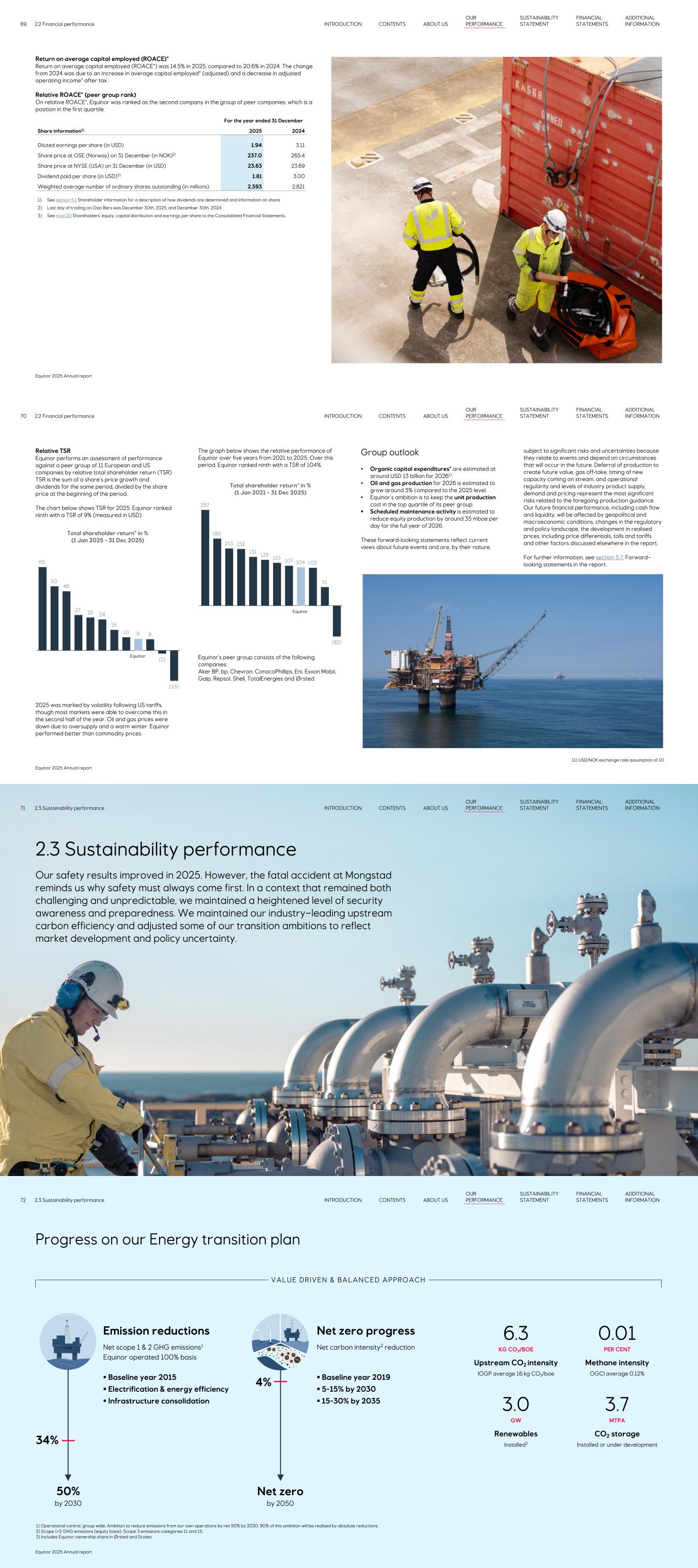
Return on average capital employed (ROACE)* Return on average capital employed (ROACE*) was 14.5% in 2025, compared to 20.6% in 2024. The change from 2024 was due to an increase in average capital employed* (adjusted) and a decrease in adjusted operating income* after tax. Relative ROACE* (peer group rank) On relative ROACE*, Equinor was ranked as the second company in the group of peer companies, which is a position in the first quartile. 69 2.2 Financial performance INTRODUCTION CONTENTS ABOUT US OUR PERFORMANCE SUSTAINABILITY STATEMENT FINANCIAL STATEMENTS ADDITIONAL INFORMATION Equinor 2025 Annual report For the year ended 31 December Share information1) 2025 2024 Diluted earnings per share (in USD) 1.94 3.11 Share price at OSE (Norway) on 31 December (in NOK)2) 237.0 265.4 Share price at NYSE (USA) on 31 December (in USD) 23.63 23.69 Dividend paid per share (in USD)3) 1.81 3.00 Weighted average number of ordinary shares outstanding (in millions) 2,593 2,821 1) See section 5.1 Shareholder information for a description of how dividends are determined and information on share repurchases.2) Last day of trading on Oslo Børs was December 30th, 2025, and December 30th, 2024. 3) See note 20 Shareholders' equity, capital distribution and earnings per share to the Consolidated Financial Statements. Relative TSR Equinor performs an assessment of performance against a peer group of 11 European and US companies by relative total shareholder return (TSR). TSR is the sum of a share’s price growth and dividends for the same period, divided by the share price at the beginning of the period. The chart below shows TSR for 2025. Equinor ranked ninth with a TSR of 9% (measured in USD). 2025 was marked by volatility following US tariffs, though most markets were able to overcome this in the second half of the year. Oil and gas prices were down due to oversupply and a warm winter. Equinor performed better than commodity prices. The graph below shows the relative performance of Equinor over five years from 2021 to 2025. Over this period, Equinor ranked ninth with a TSR of 104%. Equinor’s peer group consists of the following companies: Aker BP, bp, Chevron, ConocoPhillips, Eni, Exxon Mobil, Galp, Repsol, Shell, TotalEnergies and Ørsted. Group outlook • Organic capital expenditures* are estimated at around USD 13 billion for 202611. • Oil and gas production for 2026 is estimated to grow around 3% compared to the 2025 level. • Equinor’s ambition is to keep the unit production cost in the top quartile of its peer group. • Scheduled maintenance activity is estimated to reduce equity production by around 35 mboe per day for the full year of 2026. These forward-looking statements reflect current views about future events and are, by their nature, subject to significant risks and uncertainties because they relate to events and depend on circumstances that will occur in the future. Deferral of production to create future value, gas off-take, timing of new capacity coming on stream, and operational regularity and levels of industry product supply, demand and pricing represent the most significant risks related to the foregoing production guidance. Our future financial performance, including cash flow and liquidity, will be affected by geopolitical and macroeconomic conditions, changes in the regulatory and policy landscape, the development in realised prices, including price differentials, tolls and tariffs and other factors discussed elsewhere in the report. For further information, see section 5.7. Forward– looking statements in the report. 70 2.2 Financial performance INTRODUCTION CONTENTS ABOUT US OUR PERFORMANCE SUSTAINABILITY STATEMENT FINANCIAL STATEMENTS ADDITIONAL INFORMATION Equinor 2025 Annual report Total shareholder return* in % (1 Jan 2025 - 31 Dec 2025) 65 50 46 27 25 24 16 10 9 9 (2) (23) Total shareholder return* in % (1 Jan 2021 - 31 Dec 2025) 257 180 153 152 131 123 115 107 104 102 51 (82) 11) USD/NOK exchange rate assumption of 10 Equinor Equinor 2.3 Sustainability performance Our safety results improved in 2025. However, the fatal accident at Mongstad reminds us why safety must always come first. In a context that remained both challenging and unpredictable, we maintained a heightened level of security awareness and preparedness. We maintained our industry–leading upstream carbon efficiency and adjusted some of our transition ambitions to reflect market development and policy uncertainty. 71 2.3 Sustainability performance INTRODUCTION CONTENTS ABOUT US OUR PERFORMANCE SUSTAINABILITY STATEMENT FINANCIAL STATEMENTS ADDITIONAL INFORMATION Equinor 2025 Annual report Progress on our Energy transition plan 72 2.3 Sustainability performance INTRODUCTION CONTENTS ABOUT US OUR PERFORMANCE SUSTAINABILITY STATEMENT FINANCIAL STATEMENTS ADDITIONAL INFORMATION Equinor 2025 Annual report Emission reductions Net scope 1 & 2 GHG emissions1 Equinor operated 100% basis • Baseline year 2015 • Electrification & energy efficiency • Infrastructure consolidation 34% 4% Net zero progress Net carbon intensity2 reduction • Baseline year 2019 • 5-15% by 2030 • 15-30% by 2035 50% by 2030 Net zero by 2050 VALUE DRIVEN & BALANCED APPROACH 6.3 0.01 KG CO2/BOE PER CENT Upstream CO2 intensity Methane intensity IOGP average 16 kg CO2/boe OGCI average 0.12% 3.0 3.7 GW MTPA Renewables CO2 storage Installed3 Installed or under development 1) Operational control, group wide. Ambition to reduce emissions from our own operations by net 50% by 2030. 90% of this ambition will be realised by absolute reductions 2) Scope 1+2 GHG emissions (equity basis). Scope 3 emissions categories 11 and 15. 3) Includes Equinor ownership share in Ørsted and Scatec
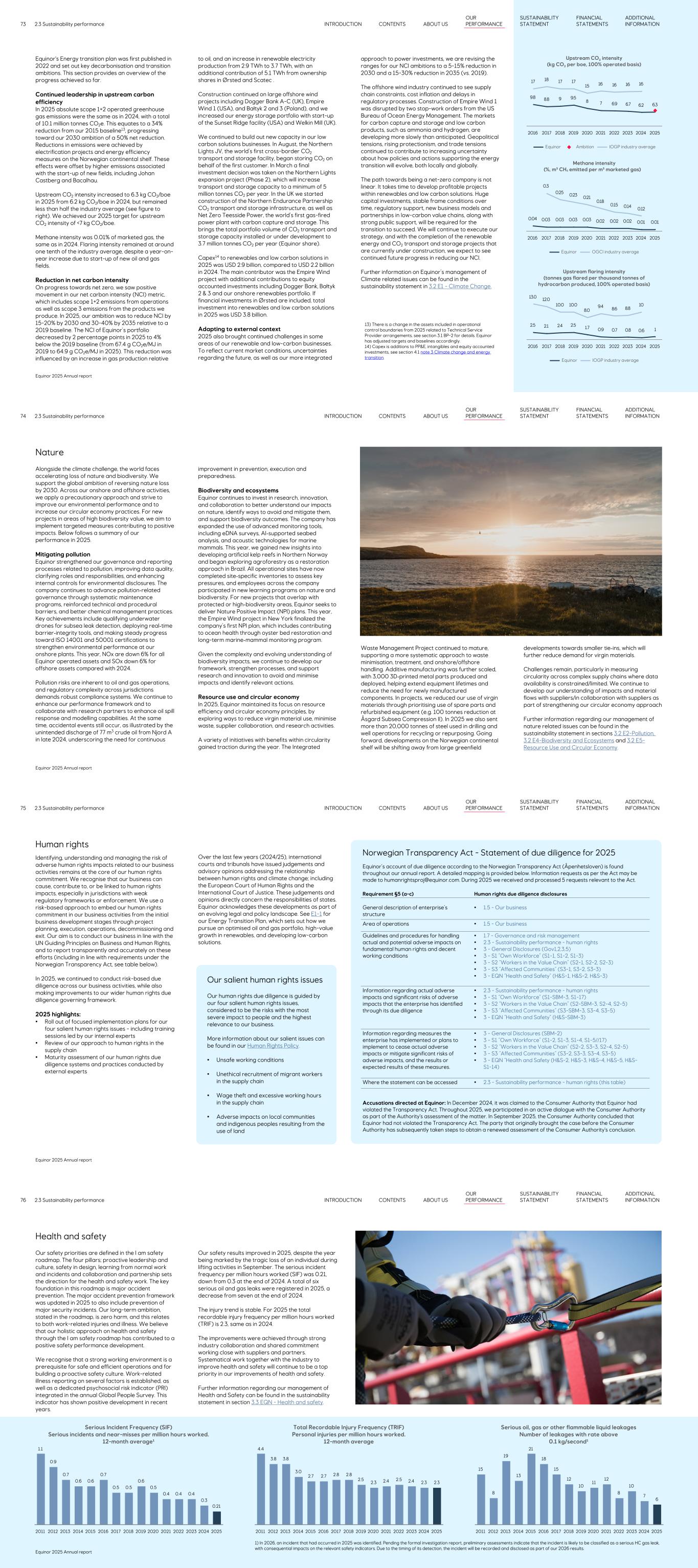
Equinor's Energy transition plan was first published in 2022 and set out key decarbonisation and transition ambitions. This section provides an overview of the progress achieved so far. Continued leadership in upstream carbon efficiency In 2025 absolute scope 1+2 operated greenhouse gas emissions were the same as in 2024, with a total of 10.1 million tonnes CO2e. This equates to a 34% reduction from our 2015 baseline13, progressing toward our 2030 ambition of a 50% net reduction. Reductions in emissions were achieved by electrification projects and energy efficiency measures on the Norwegian continental shelf. These effects were offset by higher emissions associated with the start-up of new fields, including Johan Castberg and Bacalhau. Upstream CO2 intensity increased to 6.3 kg CO2/boe in 2025 from 6.2 kg CO2/boe in 2024, but remained less than half the industry average (see figure to right). We achieved our 2025 target for upstream CO2 intensity of <7 kg CO2/boe. Methane intensity was 0.01% of marketed gas, the same as in 2024. Flaring intensity remained at around one tenth of the industry average, despite a year-on- year increase due to start-up of new oil and gas fields. Reduction in net carbon intensity On progress towards net zero, we saw positive movement in our net carbon intensity (NCI) metric, which includes scope 1+2 emissions from operations as well as scope 3 emissions from the products we produce. In 2025, our ambition was to reduce NCI by 15-20% by 2030 and 30-40% by 2035 relative to a 2019 baseline. The NCI of Equinor’s portfolio decreased by 2 percentage points in 2025 to 4% below the 2019 baseline (from 67.4 g CO2e/MJ in 2019 to 64.9 g CO2e/MJ in 2025). This reduction was influenced by an increase in gas production relative to oil, and an increase in renewable electricity production from 2.9 TWh to 3.7 TWh, with an additional contribution of 5.1 TWh from ownership shares in Ørsted and Scatec . Construction continued on large offshore wind projects including Dogger Bank A-C (UK), Empire Wind 1 (USA), and Bałtyk 2 and 3 (Poland), and we increased our energy storage portfolio with start-up of the Sunset Ridge facility (USA) and Welkin Mill (UK). We continued to build out new capacity in our low carbon solutions businesses. In August, the Northern Lights JV, the world’s first cross-border CO2 transport and storage facility, began storing CO2 on behalf of the first customer. In March a final investment decision was taken on the Northern Lights expansion project (Phase 2), which will increase transport and storage capacity to a minimum of 5 million tonnes CO2 per year. In the UK we started construction of the Northern Endurance Partnership CO2 transport and storage infrastructure, as well as Net Zero Teesside Power, the world’s first gas-fired power plant with carbon capture and storage. This brings the total portfolio volume of CO2 transport and storage capacity installed or under development to 3.7 million tonnes CO2 per year (Equinor share). Capex14 to renewables and low carbon solutions in 2025 was USD 2.9 billion, compared to USD 2.2 billion in 2024. The main contributor was the Empire Wind project with additional contributions to equity accounted investments including Dogger Bank, Bałtyk 2 & 3 and our onshore renewables portfolio. If financial investments in Ørsted are included, total investment into renewables and low carbon solutions in 2025 was USD 3.8 billion. Adapting to external context 2025 also brought continued challenges in some areas of our renewable and low-carbon businesses. To reflect current market conditions, uncertainties regarding the future, as well as our more integrated approach to power investments, we are revising the ranges for our NCI ambitions to a 5-15% reduction in 2030 and a 15-30% reduction in 2035 (vs. 2019). The offshore wind industry continued to see supply chain constraints, cost inflation and delays in regulatory processes. Construction of Empire Wind 1 was disrupted by two stop-work orders from the US Bureau of Ocean Energy Management. The markets for carbon capture and storage and low carbon products, such as ammonia and hydrogen, are developing more slowly than anticipated. Geopolitical tensions, rising protectionism, and trade tensions continued to contribute to increasing uncertainty about how policies and actions supporting the energy transition will evolve, both locally and globally. The path towards being a net-zero company is not linear. It takes time to develop profitable projects within renewables and low carbon solutions. Huge capital investments, stable frame conditions over time, regulatory support, new business models and partnerships in low-carbon value chains, along with strong public support, will be required for the transition to succeed. We will continue to execute our strategy, and with the completion of the renewable energy and CO2 transport and storage projects that are currently under construction, we expect to see continued future progress in reducing our NCI. Further information on Equinor’s management of Climate related issues can be found in the sustainability statement in 3.2 E1 - Climate Change. 73 2.3 Sustainability performance INTRODUCTION CONTENTS ABOUT US OUR PERFORMANCE SUSTAINABILITY STATEMENT FINANCIAL STATEMENTS ADDITIONAL INFORMATION Equinor 2025 Annual report Methane intensity (%, m³ CH₄ emitted per m³ marketed gas) 0.04 0.03 0.03 0.03 0.03 0.02 0.02 0.02 0.01 0.01 0.3 0.25 0.23 0.21 0.18 0.15 0.14 0.12 Equinor OGCI industry average 2016 2017 2018 2019 2020 2021 2022 2023 2024 2025 Upstream flaring intensity (tonnes gas flared per thousand tonnes of hydrocarbon produced, 100% operated basis) 2.5 2.1 2.4 2.5 1.7 0.9 0.7 0.8 0.6 1 13.0 12.0 10.0 10.0 8.0 9.4 8.6 8.8 10 Equinor IOGP industry average 2016 2017 2018 2019 2020 2021 2022 2023 2024 2025 Upstream CO₂ intensity (kg CO₂ per boe, 100% operated basis) 9.8 8.8 9 9.5 8 7 6.9 6.7 6.2 6.3 17 18 17 17 15 16 16 16 16 Equinor Ambition IOGP industry average 2016 2017 2018 2019 2020 2021 2022 2023 2024 2025 13) There is a change in the assets included in operational control boundaries from 2025 related to Technical Service Provider arrangements, see section 3.1 BP-2 for details. Equinor has adjusted targets and baselines accordingly. 14) Capex is additions to PP&E, intangibles and equity accounted investments, see section 4.1 note 3 Climate change and energy transition. Nature Alongside the climate challenge, the world faces accelerating loss of nature and biodiversity. We support the global ambition of reversing nature loss by 2030. Across our onshore and offshore activities, we apply a precautionary approach and strive to improve our environmental performance and to increase our circular economy practices. For new projects in areas of high biodiversity value, we aim to implement targeted measures contributing to positive impacts. Below follows a summary of our performance in 2025. Mitigating pollution Equinor strengthened our governance and reporting processes related to pollution, improving data quality, clarifying roles and responsibilities, and enhancing internal controls for environmental disclosures. The company continues to advance pollution-related governance through systematic maintenance programs, reinforced technical and procedural barriers, and better chemical management practices. Key achievements include qualifying underwater drones for subsea leak detection, deploying real-time barrier-integrity tools, and making steady progress toward ISO 14001 and 50001 certifications to strengthen environmental performance at our onshore plants. This year, NOx are down 6% for all Equinor operated assets and SOx down 6% for offshore assets compared with 2024. Pollution risks are inherent to oil and gas operations, and regulatory complexity across jurisdictions demands robust compliance systems. We continue to enhance our performance framework and to collaborate with research partners to enhance oil spill response and modelling capabilities. At the same time, accidental events still occur, as illustrated by the unintended discharge of 77 m3 crude oil from Njord A in late 2024, underscoring the need for continuous improvement in prevention, execution and preparedness. Biodiversity and ecosystems Equinor continues to invest in research, innovation, and collaboration to better understand our impacts on nature, identify ways to avoid and mitigate them, and support biodiversity outcomes. The company has expanded the use of advanced monitoring tools, including eDNA surveys, AI-supported seabed analysis, and acoustic technologies for marine mammals. This year, we gained new insights into developing artificial kelp reefs in Northern Norway and began exploring agroforestry as a restoration approach in Brazil. All operational sites have now completed site-specific inventories to assess key pressures, and employees across the company participated in new learning programs on nature and biodiversity. For new projects that overlap with protected or high-biodiversity areas, Equinor seeks to deliver Nature Positive Impact (NPI) plans. This year, the Empire Wind project in New York finalized the company’s first NPI plan, which includes contributing to ocean health through oyster bed restoration and long-term marine-mammal monitoring program. Given the complexity and evolving understanding of biodiversity impacts, we continue to develop our framework, strengthen processes, and support research and innovation to avoid and minimise impacts and identify relevant actions. Resource use and circular economy In 2025, Equinor maintained its focus on resource efficiency and circular economy principles, by exploring ways to reduce virgin material use, minimise waste, supplier collaboration, and research activities. A variety of initiatives with benefits within circularity gained traction during the year. The Integrated Waste Management Project continued to mature, supporting a more systematic approach to waste minimisation, treatment, and onshore/offshore handling. Additive manufacturing was further scaled, with 3,000 3D-printed metal parts produced and deployed, helping extend equipment lifetimes and reduce the need for newly manufactured components. In projects, we reduced our use of virgin materials through prioritising use of spare parts and refurbished equipment (e.g. 100 tonnes reduction at Åsgard Subsea Compression II). In 2025 we also sent more than 20,000 tonnes of steel used in drilling and well operations for recycling or repurposing. Going forward, developments on the Norwegian continental shelf will be shifting away from large greenfield developments towards smaller tie-ins, which will further reduce demand for virgin materials. Challenges remain, particularly in measuring circularity across complex supply chains where data availability is constrained/limited. We continue to develop our understanding of impacts and material flows with suppliers/in collaboration with suppliers as part of strengthening our circular economy approach Further information regarding our management of nature related issues can be found in the sustainability statement in sections 3.2 E2-Pollution, 3.2 E4-Biodiversity and Ecosystems and 3.2 E5- Resource Use and Circular Economy. 74 2.3 Sustainability performance INTRODUCTION CONTENTS ABOUT US OUR PERFORMANCE SUSTAINABILITY STATEMENT FINANCIAL STATEMENTS ADDITIONAL INFORMATION Equinor 2025 Annual report Human rights Identifying, understanding and managing the risk of adverse human rights impacts related to our business activities remains at the core of our human rights commitment. We recognise that our business can cause, contribute to, or be linked to human rights impacts, especially in jurisdictions with weak regulatory frameworks or enforcement. We use a risk-based approach to embed our human rights commitment in our business activities from the initial business development stages through project planning, execution, operations, decommissioning and exit. Our aim is to conduct our business in line with the UN Guiding Principles on Business and Human Rights, and to report transparently and accurately on these efforts (including in line with requirements under the Norwegian Transparency Act, see table below). In 2025, we continued to conduct risk-based due diligence across our business activities, while also making improvements to our wider human rights due diligence governing framework. 2025 highlights: • Roll out of focused implementation plans for our four salient human rights issues - including training sessions led by our internal experts • Review of our approach to human rights in the supply chain • Maturity assessment of our human rights due diligence systems and practices conducted by external experts Over the last few years (2024/25), international courts and tribunals have issued judgements and advisory opinions addressing the relationship between human rights and climate change; including the European Court of Human Rights and the International Court of Justice. These judgements and opinions directly concern the responsibilities of states. Equinor acknowledges these developments as part of an evolving legal and policy landscape. See E1-1 for our Energy Transition Plan, which sets out how we pursue an optimised oil and gas portfolio, high-value growth in renewables, and developing low-carbon solutions. Norwegian Transparency Act - Statement of due diligence for 2025 Equinor’s account of due diligence according to the Norwegian Transparency Act (Åpenhetsloven) is found throughout our annual report. A detailed mapping is provided below. Information requests as per the Act may be made to humanrightsproj@equinor.com. During 2025 we received and processed 5 requests relevant to the Act. Requirement §5 (a-c) Human rights due diligence disclosures General description of enterprise’s structure • 1.5 - Our business Area of operations • 1.5 - Our business Guidelines and procedures for handling actual and potential adverse impacts on fundamental human rights and decent working conditions • 1.7 - Governance and risk management • 2.3 - Sustainability performance - human rights • 3 - General Disclosures (Gov1,2,3,5) • 3 - S1 “Own Workforce” (S1-1, S1-2, S1-3) • 3 - S2 “Workers in the Value Chain” (S2-1, S2-2, S2-3) • 3 - S3 “Affected Communities” (S3-1, S3-2, S3-3) • 3 - EQN “Health and Safety” (H&S-1, H&S-2, H&S-3) Information regarding actual adverse impacts and significant risks of adverse impacts that the enterprise has identified through its due diligence • 2.3 - Sustainability performance - human rights • 3 - S1 “Own Workforce” (S1-SBM-3, S1-17) • 3 - S2 “Workers in the Value Chain” (S2-SBM-3, S2-4, S2-5) • 3 - S3 “Affected Communities” (S3-SBM-3, S3-4, S3-5) • 3 - EQN “Health and Safety” (H&S-SBM-3) Information regarding measures the enterprise has implemented or plans to implement to cease actual adverse impacts or mitigate significant risks of adverse impacts, and the results or expected results of these measures. • 3 - General Disclosures (SBM-2) • 3 - S1 “Own Workforce” (S1-2, S1-3, S1-4, S1-5//17) • 3 - S2 “Workers in the Value Chain” (S2-2, S3-3, S2-4, S2-5) • 3 - S3 “Affected Communities” (S3-2, S3-3, S3-4, S3-5) • 3 - EQN “Health and Safety (H&S-2, H&S-3, H&S-4, H&S-5, H&S- S1-14) Where the statement can be accessed • 2.3 - Sustainability performance - human rights (this table) Accusations directed at Equinor: In December 2024, it was claimed to the Consumer Authority that Equinor had violated the Transparency Act. Throughout 2025, we participated in an active dialogue with the Consumer Authority as part of the Authority's assessment of the matter. In September 2025, the Consumer Authority concluded that Equinor had not violated the Transparency Act. The party that originally brought the case before the Consumer Authority has subsequently taken steps to obtain a renewed assessment of the Consumer Authority's conclusion. 75 2.3 Sustainability performance INTRODUCTION CONTENTS ABOUT US OUR PERFORMANCE SUSTAINABILITY STATEMENT FINANCIAL STATEMENTS ADDITIONAL INFORMATION Equinor 2025 Annual report Our salient human rights issues Our human rights due diligence is guided by our four salient human rights issues, considered to be the risks with the most severe impact to people and the highest relevance to our business. More information about our salient issues can be found in our Human Rights Policy. • Unsafe working conditions • Unethical recruitment of migrant workers in the supply chain • Wage theft and excessive working hours in the supply chain • Adverse impacts on local communities and indigenous peoples resulting from the use of land Health and safety Our safety priorities are defined in the I am safety roadmap. The four pillars; proactive leadership and culture, safety in design, learning from normal work and incidents and collaboration and partnership sets the direction for the health and safety work. The key foundation in this roadmap is major accident prevention. The major accident prevention framework was updated in 2025 to also include prevention of major security incidents. Our long-term ambition, stated in the roadmap, is zero harm, and this relates to both work-related injuries and illness. We believe that our holistic approach on health and safety through the I am safety roadmap has contributed to a positive safety performance development. We recognise that a strong working environment is a prerequisite for safe and efficient operations and for building a proactive safety culture. Work-related illness reporting on several factors is established, as well as a dedicated psychosocial risk indicator (PRI) integrated in the annual Global People Survey. This indicator has shown positive development in recent years. Our safety results improved in 2025, despite the year being marked by the tragic loss of an individual during lifting activities in September. The serious incident frequency per million hours worked (SIF) was 0.21, down from 0.3 at the end of 2024. A total of six serious oil and gas leaks were registered in 2025, a decrease from seven at the end of 2024. The injury trend is stable. For 2025 the total recordable injury frequency per million hours worked (TRIF) is 2.3, same as in 2024. The improvements were achieved through strong industry collaboration and shared commitment working close with suppliers and partners. Systematical work together with the industry to improve health and safety will continue to be a top priority in our improvements of health and safety. Further information regarding our management of Health and Safety can be found in the sustainability statement in section 3.3 EQN - Health and safety. 76 2.3 Sustainability performance INTRODUCTION CONTENTS ABOUT US OUR PERFORMANCE SUSTAINABILITY STATEMENT FINANCIAL STATEMENTS ADDITIONAL INFORMATION Equinor 2025 Annual report Serious Incident Frequency (SIF) Serious incidents and near-misses per million hours worked. 12-month average¹ 1.1 0.9 0.7 0.6 0.6 0.7 0.5 0.5 0.6 0.5 0.4 0.4 0.4 0.3 0.21 2011 2012 2013 2014 2015 2016 2017 2018 2019 2020 2021 2022 2023 2024 2025 Total Recordable Injury Frequency (TRIF) Personal injuries per million hours worked. 12-month average 4.4 3.8 3.8 3.0 2.7 2.7 2.8 2.8 2.5 2.3 2.4 2.5 2.4 2.3 2.3 2011 2012 2013 2014 2015 2016 2017 2018 2019 2020 2021 2022 2023 2024 2025 Serious oil, gas or other flammable liquid leakages Number of leakages with rate above 0.1 kg/second¹ 15 8 19 13 21 18 15 12 10 11 12 8 10 7 6 2011 2012 2013 2014 2015 2016 2017 2018 2019 2020 2021 2022 2023 2024 2025 1) In 2026, an incident that had occurred in 2025 was identified. Pending the formal investigation report, preliminary assessments indicate that the incident is likely to be classified as a serious HC gas leak, with consequential impacts on the relevant safety indicators. Due to the timing of its detection, the incident will be recorded and disclosed as part of our 2026 results.
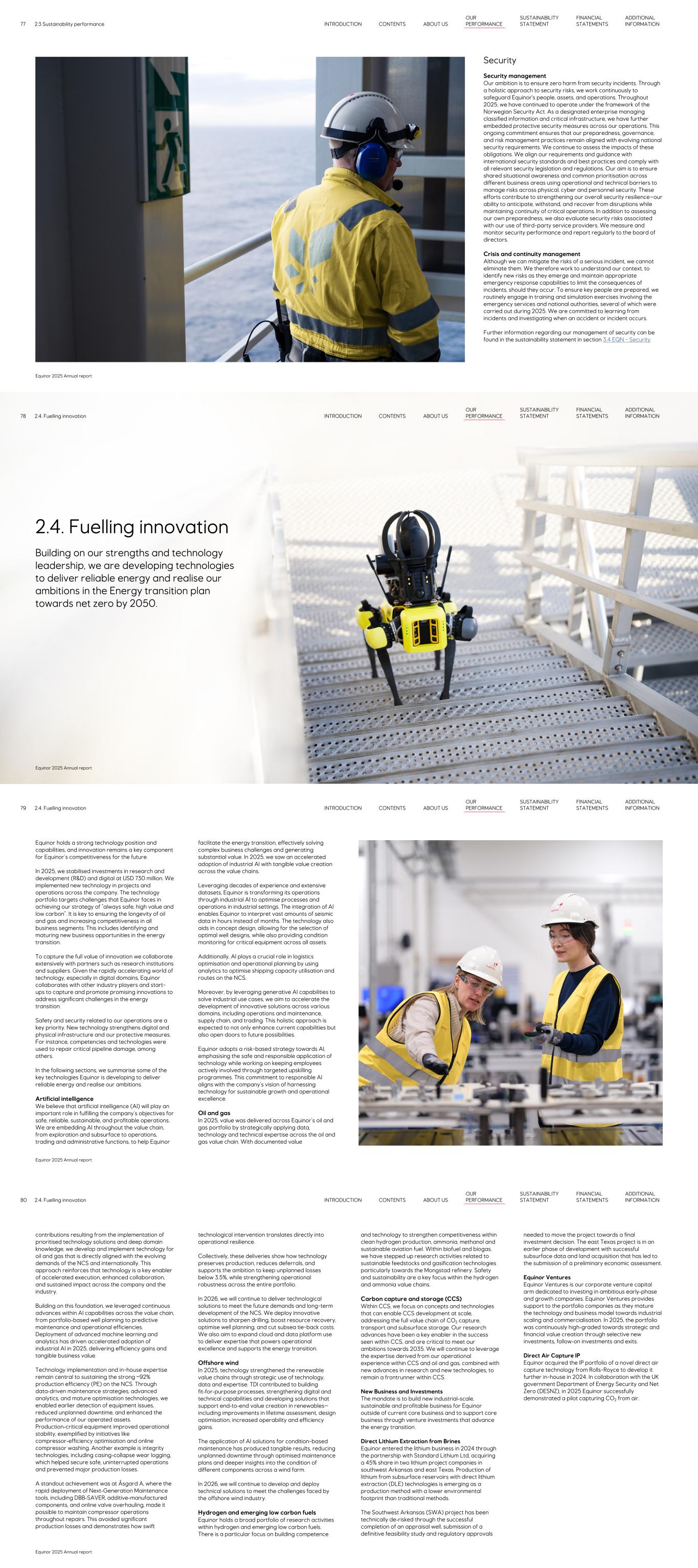
Security Security management Our ambition is to ensure zero harm from security incidents. Through a holistic approach to security risks, we work continuously to safeguard Equinor's people, assets, and operations. Throughout 2025, we have continued to operate under the framework of the Norwegian Security Act. As a designated enterprise managing classified information and critical infrastructure, we have further embedded protective security measures across our operations. This ongoing commitment ensures that our preparedness, governance, and risk management practices remain aligned with evolving national security requirements. We continue to assess the impacts of these obligations. We align our requirements and guidance with international security standards and best practices and comply with all relevant security legislation and regulations. Our aim is to ensure shared situational awareness and common prioritisation across different business areas using operational and technical barriers to manage risks across physical, cyber and personnel security. These efforts contribute to strengthening our overall security resilience—our ability to anticipate, withstand, and recover from disruptions while maintaining continuity of critical operations. In addition to assessing our own preparedness, we also evaluate security risks associated with our use of third-party service providers. We measure and monitor security performance and report regularly to the board of directors. Crisis and continuity management Although we can mitigate the risks of a serious incident, we cannot eliminate them. We therefore work to understand our context, to identify new risks as they emerge and maintain appropriate emergency response capabilities to limit the consequences of incidents, should they occur. To ensure key people are prepared, we routinely engage in training and simulation exercises involving the emergency services and national authorities, several of which were carried out during 2025. We are committed to learning from incidents and investigating when an accident or incident occurs. Further information regarding our management of security can be found in the sustainability statement in section 3.4 EQN - Security. 77 2.3 Sustainability performance INTRODUCTION CONTENTS ABOUT US OUR PERFORMANCE SUSTAINABILITY STATEMENT FINANCIAL STATEMENTS ADDITIONAL INFORMATION Equinor 2025 Annual report 78 2.4. Fuelling innovation INTRODUCTION CONTENTS ABOUT US OUR PERFORMANCE SUSTAINABILITY STATEMENT FINANCIAL STATEMENTS ADDITIONAL INFORMATION Equinor 2025 Annual report 2.4. Fuelling innovation Building on our strengths and technology leadership, we are developing technologies to deliver reliable energy and realise our ambitions in the Energy transition plan towards net zero by 2050. Equinor holds a strong technology position and capabilities, and innovation remains a key component for Equinor’s competitiveness for the future. In 2025, we stabilised investments in research and development (R&D) and digital at USD 730 million. We implemented new technology in projects and operations across the company. The technology portfolio targets challenges that Equinor faces in achieving our strategy of “always safe, high value and low carbon”. It is key to ensuring the longevity of oil and gas and increasing competitiveness in all business segments. This includes identifying and maturing new business opportunities in the energy transition. To capture the full value of innovation we collaborate extensively with partners such as research institutions and suppliers. Given the rapidly accelerating world of technology, especially in digital domains, Equinor collaborates with other industry players and start- ups to capture and promote promising innovations to address significant challenges in the energy transition. Safety and security related to our operations are a key priority. New technology strengthens digital and physical infrastructure and our protective measures. For instance, competencies and technologies were used to repair critical pipeline damage, among others. In the following sections, we summarise some of the key technologies Equinor is developing to deliver reliable energy and realise our ambitions. Artificial intelligence We believe that artificial intelligence (AI) will play an important role in fulfilling the company’s objectives for safe, reliable, sustainable, and profitable operations. We are embedding AI throughout the value chain, from exploration and subsurface to operations, trading and administrative functions, to help Equinor facilitate the energy transition, effectively solving complex business challenges and generating substantial value. In 2025, we saw an accelerated adoption of industrial AI with tangible value creation across the value chains. Leveraging decades of experience and extensive datasets, Equinor is transforming its operations through industrial AI to optimise processes and operations in industrial settings. The integration of AI enables Equinor to interpret vast amounts of seismic data in hours instead of months. The technology also aids in concept design, allowing for the selection of optimal well designs, while also providing condition monitoring for critical equipment across all assets. Additionally, AI plays a crucial role in logistics optimisation and operational planning by using analytics to optimise shipping capacity utilisation and routes on the NCS. Moreover, by leveraging generative AI capabilities to solve industrial use cases, we aim to accelerate the development of innovative solutions across various domains, including operations and maintenance, supply chain, and trading. This holistic approach is expected to not only enhance current capabilities but also open doors to future possibilities. Equinor adopts a risk-based strategy towards AI, emphasising the safe and responsible application of technology while working on keeping employees actively involved through targeted upskilling programmes. This commitment to responsible AI aligns with the company’s vision of harnessing technology for sustainable growth and operational excellence. Oil and gas In 2025, value was delivered across Equinor’s oil and gas portfolio by strategically applying data, technology and technical expertise across the oil and gas value chain. With documented value 79 2.4. Fuelling innovation INTRODUCTION CONTENTS ABOUT US OUR PERFORMANCE SUSTAINABILITY STATEMENT FINANCIAL STATEMENTS ADDITIONAL INFORMATION Equinor 2025 Annual report contributions resulting from the implementation of prioritised technology solutions and deep domain knowledge, we develop and implement technology for oil and gas that is directly aligned with the evolving demands of the NCS and internationally. This approach reinforces that technology is a key enabler of accelerated execution, enhanced collaboration, and sustained impact across the company and the industry. Building on this foundation, we leveraged continuous advances within AI capabilities across the value chain, from portfolio-based well planning to predictive maintenance and operational efficiencies. Deployment of advanced machine learning and analytics has driven accelerated adoption of industrial AI in 2025, delivering efficiency gains and tangible business value. Technology implementation and in-house expertise remain central to sustaining the strong ~92% production efficiency (PE) on the NCS. Through data-driven maintenance strategies, advanced analytics, and mature optimisation technologies, we enabled earlier detection of equipment issues, reduced unplanned downtime, and enhanced the performance of our operated assets. Production-critical equipment improved operational stability, exemplified by initiatives like compressor-efficiency optimisation and online compressor washing. Another example is integrity technologies, including casing-collapse wear logging, which helped secure safe, uninterrupted operations and prevented major production losses. A standout achievement was at Åsgard A, where the rapid deployment of Next-Generation Maintenance tools, including DBB-SAVER, additive-manufactured components, and online valve overhauling, made it possible to maintain compressor operations throughout repairs. This avoided significant production losses and demonstrates how swift technological intervention translates directly into operational resilience. Collectively, these deliveries show how technology preserves production, reduces deferrals, and supports the ambition to keep unplanned losses below 3.5%, while strengthening operational robustness across the entire portfolio. In 2026, we will continue to deliver technological solutions to meet the future demands and long-term development of the NCS. We deploy innovative solutions to sharpen drilling, boost resource recovery, optimise well planning, and cut subsea tie-back costs. We also aim to expand cloud and data platform use to deliver expertise that powers operational excellence and supports the energy transition. Offshore wind In 2025, technology strengthened the renewable value chains through strategic use of technology, data and expertise. TDI contributed to building fit-for-purpose processes, strengthening digital and technical capabilities and developing solutions that support end-to-end value creation in renewables— including improvements in lifetime assessment, design optimisation, increased operability and efficiency gains. The application of AI solutions for condition-based maintenance has produced tangible results, reducing unplanned downtime through optimised maintenance plans and deeper insights into the condition of different components across a wind farm. In 2026, we will continue to develop and deploy technical solutions to meet the challenges faced by the offshore wind industry. Hydrogen and emerging low carbon fuels Equinor holds a broad portfolio of research activities within hydrogen and emerging low carbon fuels. There is a particular focus on building competence and technology to strengthen competitiveness within clean hydrogen production, ammonia, methanol and sustainable aviation fuel. Within biofuel and biogas, we have stepped up research activities related to sustainable feedstocks and gasification technologies particularly towards the Mongstad refinery. Safety and sustainability are a key focus within the hydrogen and ammonia value chains. Carbon capture and storage (CCS) Within CCS, we focus on concepts and technologies that can enable CCS development at scale, addressing the full value chain of CO2 capture, transport and subsurface storage. Our research advances have been a key enabler in the success seen within CCS, and are critical to meet our ambitions towards 2035. We will continue to leverage the expertise derived from our operational experience within CCS and oil and gas, combined with new advances in research and new technologies, to remain a frontrunner within CCS. New Business and Investments The mandate is to build new industrial-scale, sustainable and profitable business for Equinor outside of current core business and to support core business through venture investments that advance the energy transition. Direct Lithium Extraction from Brines Equinor entered the lithium business in 2024 through the partnership with Standard Lithium Ltd, acquiring a 45% share in two lithium project companies in southwest Arkansas and east Texas. Production of lithium from subsurface reservoirs with direct lithium extraction (DLE) technologies is emerging as a production method with a lower environmental footprint than traditional methods. The Southwest Arkansas (SWA) project has been technically de-risked through the successful completion of an appraisal well, submission of a definitive feasibility study and regulatory approvals needed to move the project towards a final investment decision. The east Texas project is in an earlier phase of development with successful subsurface data and land acquisition that has led to the submission of a preliminary economic assessment. Equinor Ventures Equinor Ventures is our corporate venture capital arm dedicated to investing in ambitious early-phase and growth companies. Equinor Ventures provides support to the portfolio companies as they mature the technology and business model towards industrial scaling and commercialisation. In 2025, the portfolio was continuously high-graded towards strategic and financial value creation through selective new investments, follow-on investments and exits. Direct Air Capture IP Equinor acquired the IP portfolio of a novel direct air capture technology from Rolls-Royce to develop it further in-house in 2024. In collaboration with the UK government Department of Energy Security and Net Zero (DESNZ), in 2025 Equinor successfully demonstrated a pilot capturing CO2 from air. 80 2.4. Fuelling innovation INTRODUCTION CONTENTS ABOUT US OUR PERFORMANCE SUSTAINABILITY STATEMENT FINANCIAL STATEMENTS ADDITIONAL INFORMATION Equinor 2025 Annual report
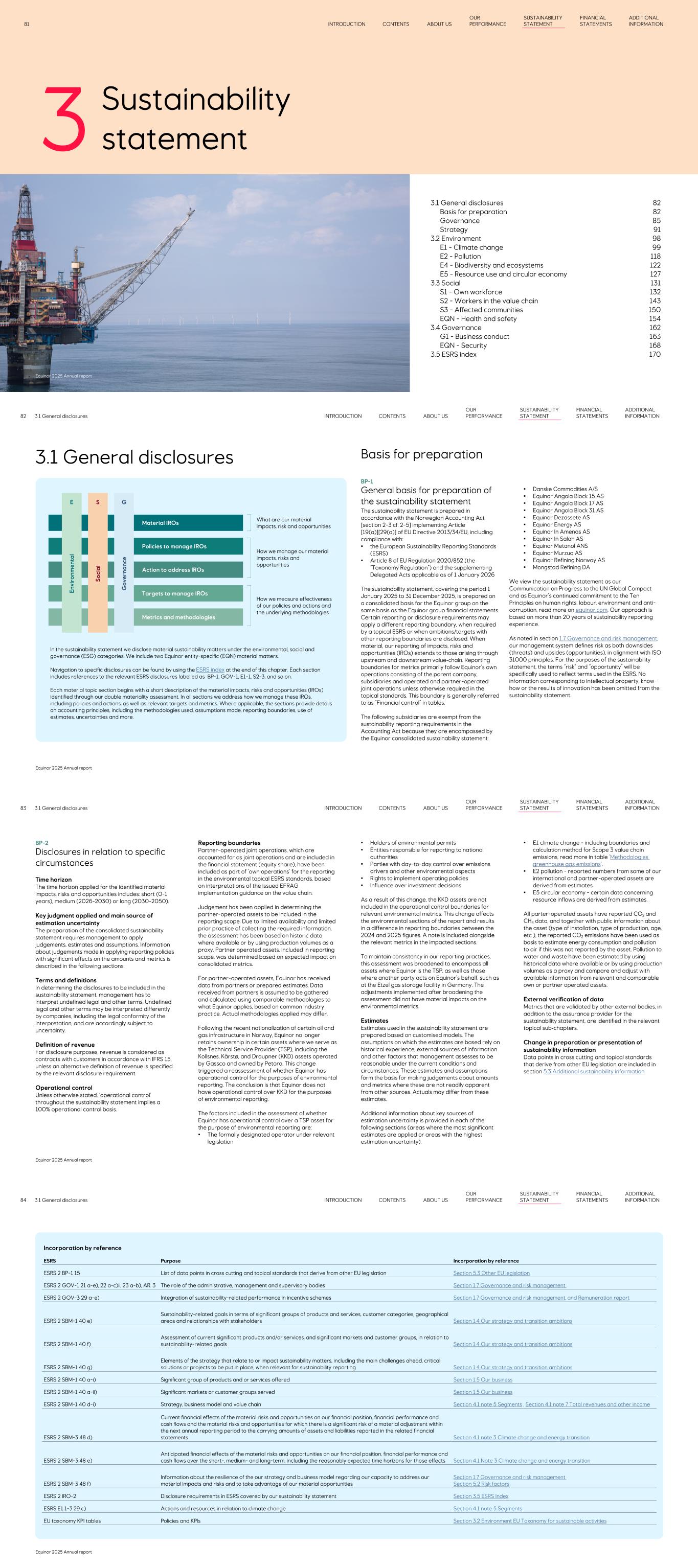
3.1 General disclosures 82 Basis for preparation 82 Governance 85 Strategy 91 3.2 Environment 98 E1 - Climate change 99 E2 - Pollution 118 E4 - Biodiversity and ecosystems 122 E5 - Resource use and circular economy 127 3.3 Social 131 S1 - Own workforce 132 S2 - Workers in the value chain 143 S3 - Affected communities 150 EQN - Health and safety 154 3.4 Governance 162 G1 - Business conduct 163 EQN - Security 168 3.5 ESRS index 170 81 INTRODUCTION CONTENTS ABOUT US OUR PERFORMANCE SUSTAINABILITY STATEMENT FINANCIAL STATEMENTS ADDITIONAL INFORMATION Equinor 2025 Annual report 3 Sustainability statement 3.1 General disclosures Basis for preparation BP-1 General basis for preparation of the sustainability statement The sustainability statement is prepared in accordance with the Norwegian Accounting Act [section 2-3 cf. 2-5] implementing Article [19(a)][29(a)] of EU Directive 2013/34/EU, including compliance with: • the European Sustainability Reporting Standards (ESRS) • Article 8 of EU Regulation 2020/852 (the “Taxonomy Regulation”) and the supplementing Delegated Acts applicable as of 1 January 2026 The sustainability statement, covering the period 1 January 2025 to 31 December 2025, is prepared on a consolidated basis for the Equinor group on the same basis as the Equinor group financial statements. Certain reporting or disclosure requirements may apply a different reporting boundary, when required by a topical ESRS or when ambitions/targets with other reporting boundaries are disclosed. When material, our reporting of impacts, risks and opportunities (IROs) extends to those arising through upstream and downstream value-chain. Reporting boundaries for metrics primarily follow Equinor’s own operations consisting of the parent company, subsidiaries and operated and partner-operated joint operations unless otherwise required in the topical standards. This boundary is generally referred to as “Financial control” in tables. The following subsidiaries are exempt from the sustainability reporting requirements in the Accounting Act because they are encompassed by the Equinor consolidated sustainability statement: • Danske Commodities A/S • Equinor Angola Block 15 AS • Equinor Angola Block 17 AS • Equinor Angola Block 31 AS • Equinor Dezassete AS • Equinor Energy AS • Equinor In Amenas AS • Equinor In Salah AS • Equinor Metanol ANS • Equinor Murzuq AS • Equinor Refining Norway AS • Mongstad Refining DA We view the sustainability statement as our Communication on Progress to the UN Global Compact and as Equinor’s continued commitment to the Ten Principles on human rights, labour, environment and anti- corruption, read more on equinor.com. Our approach is based on more than 20 years of sustainability reporting experience. As noted in section 1.7 Governance and risk management, our management system defines risk as both downsides (threats) and upsides (opportunities), in alignment with ISO 31000 principles. For the purposes of the sustainability statement, the terms “risk” and “opportunity” will be specifically used to reflect terms used in the ESRS. No information corresponding to intellectual property, know- how or the results of innovation has been omitted from the sustainability statement. 82 3.1 General disclosures INTRODUCTION CONTENTS ABOUT US OUR PERFORMANCE SUSTAINABILITY STATEMENT FINANCIAL STATEMENTS ADDITIONAL INFORMATION Equinor 2025 Annual report E S G En vi ro nm en ta l So ci a l G o ve rn a nc e Material IROs What are our material impacts, risk and opportunities Policies to manage IROs How we manage our material impacts, risks and opportunities Action to address IROs Targets to manage IROs How we measure effectiveness of our policies and actions and the underlying methodologies Metrics and methodologies In the sustainability statement we disclose material sustainability matters under the environmental, social and governance (ESG) categories. We include two Equinor entity-specific (EQN) material matters. Navigation to specific disclosures can be found by using the ESRS index at the end of this chapter. Each section includes references to the relevant ESRS disclosures labelled as BP-1, GOV-1, E1-1, S2-3, and so on. Each material topic section begins with a short description of the material impacts, risks and opportunities (IROs) identified through our double materiality assessment. In all sections we address how we manage these IROs, including policies and actions, as well as relevant targets and metrics. Where applicable, the sections provide details on accounting principles, including the methodologies used, assumptions made, reporting boundaries, use of estimates, uncertainties and more. BP-2 Disclosures in relation to specific circumstances Time horizon The time horizon applied for the identified material impacts, risks and opportunities includes: short (0-1 years), medium (2026-2030) or long (2030-2050). Key judgment applied and main source of estimation uncertainty The preparation of the consolidated sustainability statement requires management to apply judgements, estimates and assumptions. Information about judgements made in applying reporting policies with significant effects on the amounts and metrics is described in the following sections. Terms and definitions In determining the disclosures to be included in the sustainability statement, management has to interpret undefined legal and other terms. Undefined legal and other terms may be interpreted differently by companies, including the legal conformity of the interpretation, and are accordingly subject to uncertainty. Definition of revenue For disclosure purposes, revenue is considered as contracts with customers in accordance with IFRS 15, unless an alternative definition of revenue is specified by the relevant disclosure requirement. Operational control Unless otherwise stated, ‘operational control’ throughout the sustainability statement implies a 100% operational control basis. Reporting boundaries Partner-operated joint operations, which are accounted for as joint operations and are included in the financial statement (equity share), have been included as part of ‘own operations’ for the reporting in the environmental topical ESRS standards, based on interpretations of the issued EFRAG implementation guidance on the value chain. Judgement has been applied in determining the partner-operated assets to be included in the reporting scope. Due to limited availability and limited prior practice of collecting the required information, the assessment has been based on historic data where available or by using production volumes as a proxy. Partner operated assets, included in reporting scope, was determined based on expected impact on consolidated metrics. For partner-operated assets, Equinor has received data from partners or prepared estimates. Data received from partners is assumed to be gathered and calculated using comparable methodologies to what Equinor applies, based on common industry practice. Actual methodologies applied may differ. Following the recent nationalization of certain oil and gas infrastructure in Norway, Equinor no longer retains ownership in certain assets where we serve as the Technical Service Provider (TSP), including the Kollsnes, Kårstø, and Draupner (KKD) assets operated by Gassco and owned by Petoro. This change triggered a reassessment of whether Equinor has operational control for the purposes of environmental reporting. The conclusion is that Equinor does not have operational control over KKD for the purposes of environmental reporting. The factors included in the assessment of whether Equinor has operational control over a TSP asset for the purpose of environmental reporting are: • The formally designated operator under relevant legislation • Holders of environmental permits • Entities responsible for reporting to national authorities • Parties with day-to-day control over emissions drivers and other environmental aspects • Rights to implement operating policies • Influence over investment decisions As a result of this change, the KKD assets are not included in the operational control boundaries for relevant environmental metrics. This change affects the environmental sections of the report and results in a difference in reporting boundaries between the 2024 and 2025 figures. A note is included alongside the relevant metrics in the impacted sections. To maintain consistency in our reporting practices, this assessment was broadened to encompass all assets where Equinor is the TSP, as well as those where another party acts on Equinor’s behalf, such as at the Etzel gas storage facility in Germany. The adjustments implemented after broadening the assessment did not have material impacts on the environmental metrics. Estimates Estimates used in the sustainability statement are prepared based on customised models. The assumptions on which the estimates are based rely on historical experience, external sources of information and other factors that management assesses to be reasonable under the current conditions and circumstances. These estimates and assumptions form the basis for making judgements about amounts and metrics where these are not readily apparent from other sources. Actuals may differ from these estimates. Additional information about key sources of estimation uncertainty is provided in each of the following sections (areas where the most significant estimates are applied or areas with the highest estimation uncertainty): • E1 climate change - including boundaries and calculation method for Scope 3 value chain emissions, read more in table ‘Methodologies greenhouse gas emissions´. • E2 pollution - reported numbers from some of our international and partner-operated assets are derived from estimates. • E5 circular economy - certain data concerning resource inflows are derived from estimates. All parter-operated assets have reported CO2 and CH4 data, and together with public information about the asset (type of installation, type of production, age, etc ), the reported CO2 emissions have been used as basis to estimate energy consumption and pollution to air if this was not reported by the asset. Pollution to water and waste have been estimated by using historical data where available or by using production volumes as a proxy and compare and adjust with available information from relevant and comparable own or partner operated assets. External verification of data Metrics that are validated by other external bodies, in addition to the assurance provider for the sustainability statement, are identified in the relevant topical sub-chapters. Change in preparation or presentation of sustainability information Data points in cross cutting and topical standards that derive from other EU legislation are included in section 5.3 Additional sustainability information. 83 3.1 General disclosures INTRODUCTION CONTENTS ABOUT US OUR PERFORMANCE SUSTAINABILITY STATEMENT FINANCIAL STATEMENTS ADDITIONAL INFORMATION Equinor 2025 Annual report 84 3.1 General disclosures INTRODUCTION CONTENTS ABOUT US OUR PERFORMANCE SUSTAINABILITY STATEMENT FINANCIAL STATEMENTS ADDITIONAL INFORMATION Equinor 2025 Annual report Incorporation by reference ESRS Purpose Incorporation by reference ESRS 2 BP-1 15 List of data points in cross cutting and topical standards that derive from other EU legislation Section 5.3 Other EU legislation ESRS 2 GOV-1 21 a-e), 22 a-c)ii, 23 a-b), AR. 3 The role of the administrative, management and supervisory bodies Section 1.7 Governance and risk management ESRS 2 GOV-3 29 a-e) Integration of sustainability-related performance in incentive schemes Section 1.7 Governance and risk management, and Remuneration report ESRS 2 SBM-1 40 e) Sustainability-related goals in terms of significant groups of products and services, customer categories, geographical areas and relationships with stakeholders Section 1.4 Our strategy and transition ambitions ESRS 2 SBM-1 40 f) Assessment of current significant products and/or services, and significant markets and customer groups, in relation to sustainability-related goals Section 1.4 Our strategy and transition ambitions ESRS 2 SBM-1 40 g) Elements of the strategy that relate to or impact sustainability matters, including the main challenges ahead, critical solutions or projects to be put in place, when relevant for sustainability reporting Section 1.4 Our strategy and transition ambitions ESRS 2 SBM-1 40 a-i) Significant group of products and or services offered Section 1.5 Our business ESRS 2 SBM-1 40 a-ii) Significant markets or customer groups served Section 1.5 Our business ESRS 2 SBM-1 40 d-i) Strategy, business model and value chain Section 4.1 note 5 Segments , Section 4.1 note 7 Total revenues and other income ESRS 2 SBM-3 48 d) Current financial effects of the material risks and opportunities on our financial position, financial performance and cash flows and the material risks and opportunities for which there is a significant risk of a material adjustment within the next annual reporting period to the carrying amounts of assets and liabilities reported in the related financial statements Section 4.1 note 3 Climate change and energy transition ESRS 2 SBM-3 48 e) Anticipated financial effects of the material risks and opportunities on our financial position, financial performance and cash flows over the short-, medium- and long-term, including the reasonably expected time horizons for those effects Section 4.1 Note 3 Climate change and energy transition ESRS 2 SBM-3 48 f) Information about the resilience of the our strategy and business model regarding our capacity to address our material impacts and risks and to take advantage of our material opportunities Section 1.7 Governance and risk management Section 5.2 Risk factors ESRS 2 IRO-2 Disclosure requirements in ESRS covered by our sustainability statement Section 3.5 ESRS Index ESRS E1 1-3 29 c) Actions and resources in relation to climate change Section 4.1 note 5 Segments EU taxonomy KPI tables Policies and KPIs Section 3.2 Environment EU Taxonomy for sustainable activities
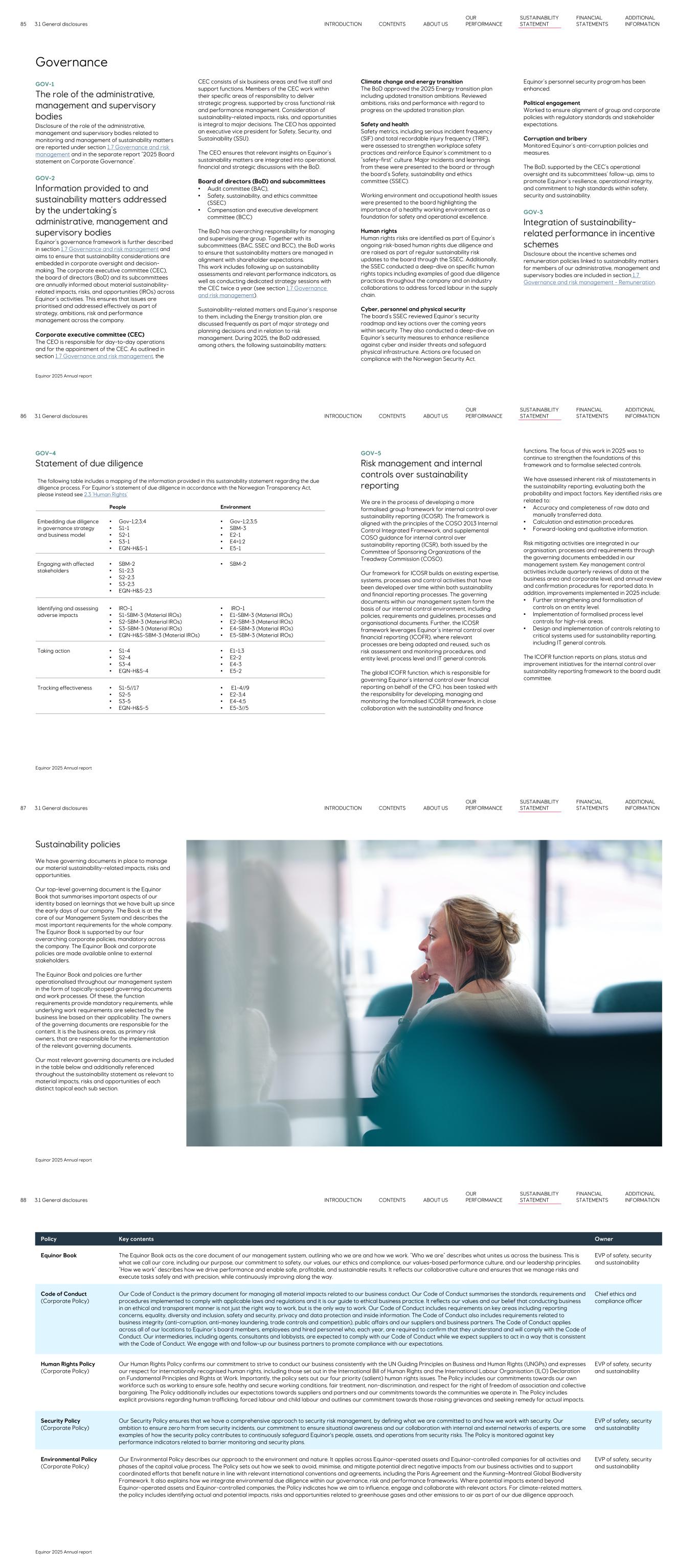
Governance GOV-1 The role of the administrative, management and supervisory bodies Disclosure of the role of the administrative, management and supervisory bodies related to monitoring and management of sustainability matters are reported under section 1.7 Governance and risk management and in the separate report “2025 Board statement on Corporate Governance”. GOV-2 Information provided to and sustainability matters addressed by the undertaking’s administrative, management and supervisory bodies Equinor’s governance framework is further described in section 1.7 Governance and risk management and aims to ensure that sustainability considerations are embedded in corporate oversight and decision- making. The corporate executive committee (CEC), the board of directors (BoD) and its subcommittees are annually informed about material sustainability- related impacts, risks, and opportunities (IROs) across Equinor’s activities. This ensures that issues are prioritised and addressed effectively as part of strategy, ambitions, risk and performance management across the company. Corporate executive committee (CEC) The CEO is responsible for day-to-day operations and for the appointment of the CEC. As outlined in section 1.7 Governance and risk management, the CEC consists of six business areas and five staff and support functions. Members of the CEC work within their specific areas of responsibility to deliver strategic progress, supported by cross functional risk and performance management. Consideration of sustainability-related impacts, risks, and opportunities is integral to major decisions. The CEO has appointed an executive vice president for Safety, Security, and Sustainability (SSU). The CEO ensures that relevant insights on Equinor’s sustainability matters are integrated into operational, financial and strategic discussions with the BoD. Board of directors (BoD) and subcommittees • Audit committee (BAC), • Safety, sustainability, and ethics committee (SSEC) • Compensation and executive development committee (BCC) The BoD has overarching responsibility for managing and supervising the group. Together with its subcommittees (BAC, SSEC and BCC), the BoD works to ensure that sustainability matters are managed in alignment with shareholder expectations. This work includes following up on sustainability assessments and relevant performance indicators, as well as conducting dedicated strategy sessions with the CEC twice a year (see section 1.7 Governance and risk management). Sustainability-related matters and Equinor’s response to them, including the Energy transition plan, are discussed frequently as part of major strategy and planning decisions and in relation to risk management. During 2025, the BoD addressed, among others, the following sustainability matters: Climate change and energy transition The BoD approved the 2025 Energy transition plan including updated transition ambitions. Reviewed ambitions, risks and performance with regard to progress on the updated transition plan. Safety and health Safety metrics, including serious incident frequency (SIF) and total recordable injury frequency (TRIF), were assessed to strengthen workplace safety practices and reinforce Equinor’s commitment to a “safety-first” culture. Major incidents and learnings from these were presented to the board or through the board’s Safety, sustainability and ethics committee (SSEC). Working environment and occupational health issues were presented to the board highlighting the importance of a healthy working environment as a foundation for safety and operational excellence. Human rights Human rights risks are identified as part of Equinor’s ongoing risk-based human rights due diligence and are raised as part of regular sustainability risk updates to the board through the SSEC. Additionally, the SSEC conducted a deep-dive on specific human rights topics including examples of good due diligence practices throughout the company and on industry collaborations to address forced labour in the supply chain. Cyber, personnel and physical security The board’s SSEC reviewed Equinor’s security roadmap and key actions over the coming years within security. They also conducted a deep-dive on Equinor’s security measures to enhance resilience against cyber and insider threats and safeguard physical infrastructure. Actions are focused on compliance with the Norwegian Security Act. Equinor’s personnel security program has been enhanced. Political engagement Worked to ensure alignment of group and corporate policies with regulatory standards and stakeholder expectations. Corruption and bribery Monitored Equinor’s anti-corruption policies and measures. The BoD, supported by the CEC’s operational oversight and its subcommittees’ follow-up, aims to promote Equinor’s resilience, operational integrity, and commitment to high standards within safety, security and sustainability. GOV-3 Integration of sustainability- related performance in incentive schemes Disclosure about the incentive schemes and remuneration policies linked to sustainability matters for members of our administrative, management and supervisory bodies are included in section 1.7 Governance and risk management - Remuneration. 85 3.1 General disclosures INTRODUCTION CONTENTS ABOUT US OUR PERFORMANCE SUSTAINABILITY STATEMENT FINANCIAL STATEMENTS ADDITIONAL INFORMATION Equinor 2025 Annual report GOV–4 Statement of due diligence GOV–5 Risk management and internal controls over sustainability reporting We are in the process of developing a more formalised group framework for internal control over sustainability reporting (ICOSR). The framework is aligned with the principles of the COSO 2013 Internal Control Integrated Framework, and supplemental COSO guidance for internal control over sustainability reporting (ICSR), both issued by the Committee of Sponsoring Organizations of the Treadway Commission (COSO). Our framework for ICOSR builds on existing expertise, systems, processes and control activities that have been developed over time within both sustainability and financial reporting processes. The governing documents within our management system form the basis of our internal control environment, including policies, requirements and guidelines, processes and organisational documents. Further, the ICOSR framework leverages Equinor’s internal control over financial reporting (ICOFR), where relevant processes are being adapted and reused, such as risk assessment and monitoring procedures, and entity level, process level and IT general controls. The global ICOFR function, which is responsible for governing Equinor’s internal control over financial reporting on behalf of the CFO, has been tasked with the responsibility for developing, managing and monitoring the formalised ICOSR framework, in close collaboration with the sustainability and finance functions. The focus of this work in 2025 was to continue to strengthen the foundations of this framework and to formalise selected controls. We have assessed inherent risk of misstatements in the sustainability reporting, evaluating both the probability and impact factors. Key identified risks are related to: • Accuracy and completeness of raw data and manually transferred data. • Calculation and estimation procedures. • Forward-looking and qualitative information. Risk mitigating activities are integrated in our organisation, processes and requirements through the governing documents embedded in our management system. Key management control activities include quarterly reviews of data at the business area and corporate level, and annual review and confirmation procedures for reported data. In addition, improvements implemented in 2025 include: • Further strengthening and formalisation of controls on an entity level. • Implementation of formalised process level controls for high-risk areas. • Design and implementation of controls relating to critical systems used for sustainability reporting, including IT general controls. The ICOFR function reports on plans, status and improvement initiatives for the internal control over sustainability reporting framework to the board audit committee. 86 3.1 General disclosures INTRODUCTION CONTENTS ABOUT US OUR PERFORMANCE SUSTAINABILITY STATEMENT FINANCIAL STATEMENTS ADDITIONAL INFORMATION Equinor 2025 Annual report The following table includes a mapping of the information provided in this sustainability statement regarding the due diligence process. For Equinor’s statement of due diligence in accordance with the Norwegian Transparency Act, please instead see 2.3 ‘Human Rights’ People Environment Embedding due diligence in governance strategy and business model • Gov-1;2;3;4 • S1-1 • S2-1 • S3-1 • EQN-H&S-1 • Gov-1;2;3;5 • SBM-3 • E2-1 • E4=1:2 • E5-1 Engaging with affected stakeholders • SBM-2 • S1-2;3 • S2-2;3 • S3-2;3 • EQN-H&S-2;3 • SBM-2 Identifying and assessing adverse impacts • IRO-1 • S1-SBM-3 (Material IROs) • S2-SBM-3 (Material IROs) • S3-SBM-3 (Material IROs) • EQN-H&S-SBM-3 (Material IROs) • IRO-1 • E1-SBM-3 (Material IROs) • E2-SBM-3 (Material IROs) • E4-SBM-3 (Material IROs) • E5-SBM-3 (Material IROs) Taking action • S1-4 • S2-4 • S3-4 • EQN-H&S-4 • E1-1;3 • E2-2 • E4-3 • E5-2 Tracking effectiveness • S1-5//17 • S2-5 • S3-5 • EQN-H&S-5 • E1-4//9 • E2-3;4 • E4-4;5 • E5-3//5 Sustainability policies We have governing documents in place to manage our material sustainability-related impacts, risks and opportunities. Our top-level governing document is the Equinor Book that summarises important aspects of our identity based on learnings that we have built up since the early days of our company. The Book is at the core of our Management System and describes the most important requirements for the whole company. The Equinor Book is supported by our four overarching corporate policies, mandatory across the company. The Equinor Book and corporate policies are made available online to external stakeholders. The Equinor Book and policies are further operationalised throughout our management system in the form of topically-scoped governing documents and work processes. Of these, the function requirements provide mandatory requirements, while underlying work requirements are selected by the business line based on their applicability. The owners of the governing documents are responsible for the content. It is the business areas, as primary risk owners, that are responsible for the implementation of the relevant governing documents. Our most relevant governing documents are included in the table below and additionally referenced throughout the sustainability statement as relevant to material impacts, risks and opportunities of each distinct topical each sub section. 87 3.1 General disclosures INTRODUCTION CONTENTS ABOUT US OUR PERFORMANCE SUSTAINABILITY STATEMENT FINANCIAL STATEMENTS ADDITIONAL INFORMATION Equinor 2025 Annual report 88 3.1 General disclosures INTRODUCTION CONTENTS ABOUT US OUR PERFORMANCE SUSTAINABILITY STATEMENT FINANCIAL STATEMENTS ADDITIONAL INFORMATION Equinor 2025 Annual report Policy Key contents Owner Equinor Book The Equinor Book acts as the core document of our management system, outlining who we are and how we work. “Who we are” describes what unites us across the business. This is what we call our core, including our purpose, our commitment to safety, our values, our ethics and compliance, our values-based performance culture, and our leadership principles. “How we work” describes how we drive performance and enable safe, profitable, and sustainable results. It reflects our collaborative culture and ensures that we manage risks and execute tasks safely and with precision, while continuously improving along the way. EVP of safety, security and sustainability Code of Conduct (Corporate Policy) Our Code of Conduct is the primary document for managing all material impacts related to our business conduct. Our Code of Conduct summarises the standards, requirements and procedures implemented to comply with applicable laws and regulations and it is our guide to ethical business practice. It reflects our values and our belief that conducting business in an ethical and transparent manner is not just the right way to work, but is the only way to work. Our Code of Conduct includes requirements on key areas including reporting concerns, equality, diversity and inclusion, safety and security, privacy and data protection and inside information. The Code of Conduct also includes requirements related to business integrity (anti-corruption, anti-money laundering, trade controls and competition), public affairs and our suppliers and business partners. The Code of Conduct applies across all of our locations to Equinor’s board members, employees and hired personnel who, each year, are required to confirm that they understand and will comply with the Code of Conduct. Our intermediaries, including agents, consultants and lobbyists, are expected to comply with our Code of Conduct while we expect suppliers to act in a way that is consistent with the Code of Conduct. We engage with and follow-up our business partners to promote compliance with our expectations. Chief ethics and compliance officer Human Rights Policy (Corporate Policy) Our Human Rights Policy confirms our commitment to strive to conduct our business consistently with the UN Guiding Principles on Business and Human Rights (UNGPs) and expresses our respect for internationally recognised human rights, including those set out in the International Bill of Human Rights and the International Labour Organisation (ILO) Declaration on Fundamental Principles and Rights at Work. Importantly, the policy sets out our four priority (salient) human rights issues. The Policy includes our commitments towards our own workforce such as working to ensure safe, healthy and secure working conditions, fair treatment, non-discrimination, and respect for the right of freedom of association and collective bargaining. The Policy additionally includes our expectations towards suppliers and partners and our commitments towards the communities we operate in. The Policy includes explicit provisions regarding human trafficking, forced labour and child labour and outlines our commitment towards those raising grievances and seeking remedy for actual impacts. EVP of safety, security and sustainability Security Policy (Corporate Policy) Our Security Policy ensures that we have a comprehensive approach to security risk management, by defining what we are committed to and how we work with security. Our ambition to ensure zero harm from security incidents, our commitment to ensure situational awareness and our collaboration with internal and external networks of experts, are some examples of how the security policy contributes to continuously safeguard Equinor's people, assets, and operations from security risks. The Policy is monitored against key performance indicators related to barrier monitoring and security plans. EVP of safety, security and sustainability Environmental Policy (Corporate Policy) Our Environmental Policy describes our approach to the environment and nature. It applies across Equinor-operated assets and Equinor-controlled companies for all activities and phases of the capital value process. The Policy sets out how we seek to avoid, minimise, and mitigate potential direct negative impacts from our business activities and to support coordinated efforts that benefit nature in line with relevant international conventions and agreements, including the Paris Agreement and the Kunming–Montreal Global Biodiversity Framework. It also explains how we integrate environmental due diligence within our governance, risk and performance frameworks. Where potential impacts extend beyond Equinor-operated assets and Equinor-controlled companies, the Policy indicates how we aim to influence, engage and collaborate with relevant actors. For climate-related matters, the policy includes identifying actual and potential impacts, risks and opportunities related to greenhouse gases and other emissions to air as part of our due diligence approach. EVP of safety, security and sustainability
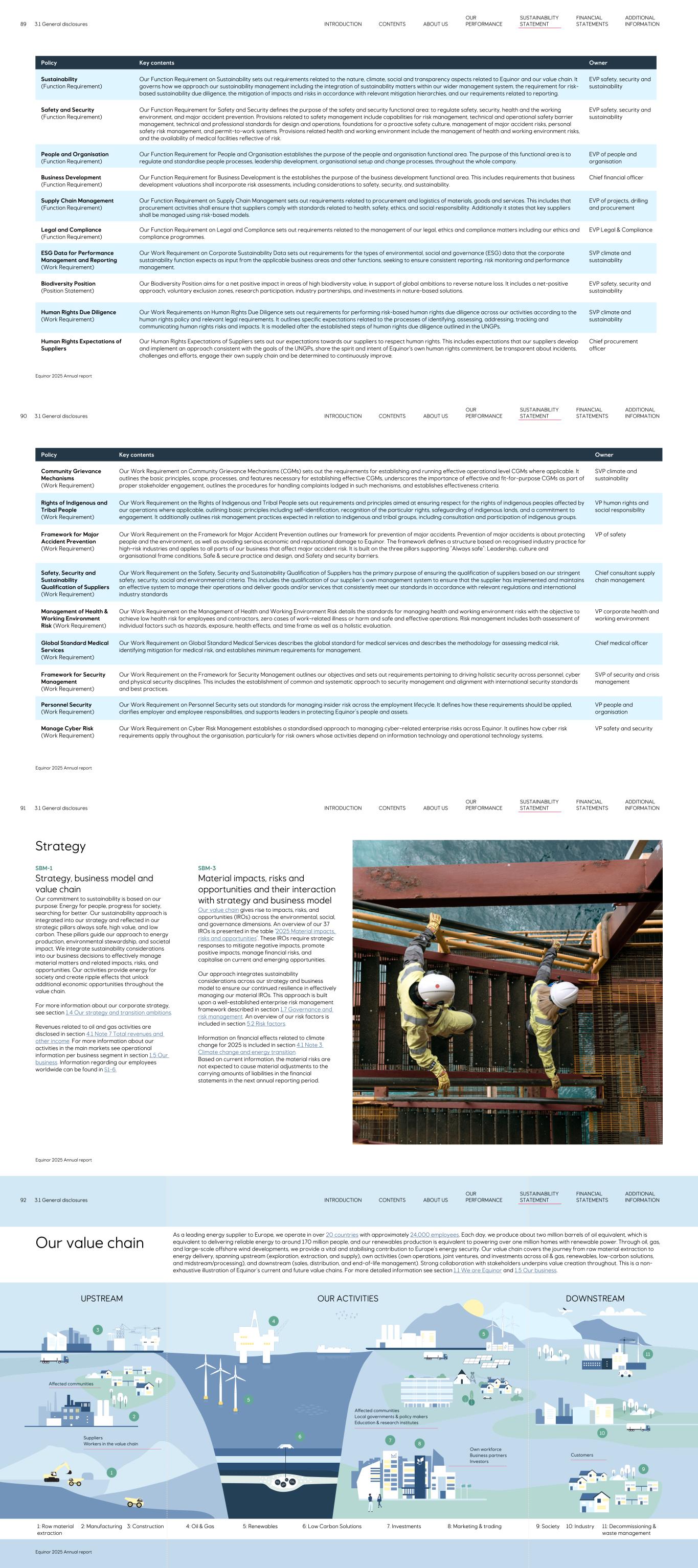
Policy Key contents Owner Sustainability (Function Requirement) Our Function Requirement on Sustainability sets out requirements related to the nature, climate, social and transparency aspects related to Equinor and our value chain. It governs how we approach our sustainability management including the integration of sustainability matters within our wider management system, the requirement for risk- based sustainability due diligence, the mitigation of impacts and risks in accordance with relevant mitigation hierarchies, and our requirements related to reporting. EVP safety, security and sustainability Safety and Security (Function Requirement) Our Function Requirement for Safety and Security defines the purpose of the safety and security functional area: to regulate safety, security, health and the working environment, and major accident prevention. Provisions related to safety management include capabilities for risk management, technical and operational safety barrier management, technical and professional standards for design and operations, foundations for a proactive safety culture, management of major accident risks, personal safety risk management, and permit-to-work systems. Provisions related health and working environment include the management of health and working environment risks, and the availability of medical facilities reflective of risk. EVP safety, security and sustainability People and Organisation (Function Requirement) Our Function Requirement for People and Organisation establishes the purpose of the people and organisation functional area. The purpose of this functional area is to regulate and standardise people processes, leadership development, organisational setup and change processes, throughout the whole company. EVP of people and organisation Business Development (Function Requirement) Our Function Requirement for Business Development is the establishes the purpose of the business development functional area. This includes requirements that business development valuations shall incorporate risk assessments, including considerations to safety, security, and sustainability. Chief financial officer Supply Chain Management (Function Requirement) Our Function Requirement on Supply Chain Management sets out requirements related to procurement and logistics of materials, goods and services. This includes that procurement activities shall ensure that suppliers comply with standards related to health, safety, ethics, and social responsibility. Additionally it states that key suppliers shall be managed using risk-based models. EVP of projects, drilling and procurement Legal and Compliance (Function Requirement) Our Function Requirement on Legal and Compliance sets out requirements related to the management of our legal, ethics and compliance matters including our ethics and compliance programmes. EVP Legal & Compliance ESG Data for Performance Management and Reporting (Work Requirement) Our Work Requirement on Corporate Sustainability Data sets out requirements for the types of environmental, social and governance (ESG) data that the corporate sustainability function expects as input from the applicable business areas and other functions, seeking to ensure consistent reporting, risk monitoring and performance management. SVP climate and sustainability Biodiversity Position (Position Statement) Our Biodiversity Position aims for a net positive impact in areas of high biodiversity value, in support of global ambitions to reverse nature loss. It includes a net-positive approach, voluntary exclusion zones, research participation, industry partnerships, and investments in nature-based solutions. EVP safety, security and sustainability Human Rights Due Diligence (Work Requirement) Our Work Requirements on Human Rights Due Diligence sets out requirements for performing risk-based human rights due diligence across our activities according to the human rights policy and relevant legal requirements. It outlines specific expectations related to the processes of identifying, assessing, addressing, tracking and communicating human rights risks and impacts. It is modelled after the established steps of human rights due diligence outlined in the UNGPs. SVP climate and sustainability Human Rights Expectations of Suppliers Our Human Rights Expectations of Suppliers sets out our expectations towards our suppliers to respect human rights. This includes expectations that our suppliers develop and implement an approach consistent with the goals of the UNGPs, share the spirit and intent of Equinor's own human rights commitment, be transparent about incidents, challenges and efforts, engage their own supply chain and be determined to continuously improve. Chief procurement officer 89 3.1 General disclosures INTRODUCTION CONTENTS ABOUT US OUR PERFORMANCE SUSTAINABILITY STATEMENT FINANCIAL STATEMENTS ADDITIONAL INFORMATION Equinor 2025 Annual report Policy Key contents Owner Community Grievance Mechanisms (Work Requirement) Our Work Requirement on Community Grievance Mechanisms (CGMs) sets out the requirements for establishing and running effective operational level CGMs where applicable. It outlines the basic principles, scope, processes, and features necessary for establishing effective CGMs, underscores the importance of effective and fit-for-purpose CGMs as part of proper stakeholder engagement, outlines the procedures for handling complaints lodged in such mechanisms, and establishes effectiveness criteria. SVP climate and sustainability Rights of Indigenous and Tribal People (Work Requirement) Our Work Requirement on the Rights of Indigenous and Tribal People sets out requirements and principles aimed at ensuring respect for the rights of indigenous peoples affected by our operations where applicable, outlining basic principles including self-identification, recognition of the particular rights, safeguarding of indigenous lands, and a commitment to engagement. It additionally outlines risk management practices expected in relation to indigenous and tribal groups, including consultation and participation of indigenous groups. VP human rights and social responsibility Framework for Major Accident Prevention (Work Requirement) Our Work Requirement on the Framework for Major Accident Prevention outlines our framework for prevention of major accidents. Prevention of major accidents is about protecting people and the environment, as well as avoiding serious economic and reputational damage to Equinor. The framework defines a structure based on recognised industry practice for high-risk industries and applies to all parts of our business that affect major accident risk. It is built on the three pillars supporting “Always safe”: Leadership, culture and organisational frame conditions, Safe & secure practice and design, and Safety and security barriers. VP of safety Safety, Security and Sustainability Qualification of Suppliers (Work Requirement) Our Work Requirement on the Safety, Security and Sustainability Qualification of Suppliers has the primary purpose of ensuring the qualification of suppliers based on our stringent safety, security, social and environmental criteria. This includes the qualification of our supplier’s own management system to ensure that the supplier has implemented and maintains an effective system to manage their operations and deliver goods and/or services that consistently meet our standards in accordance with relevant regulations and international industry standards Chief consultant supply chain management Management of Health & Working Environment Risk (Work Requirement) Our Work Requirement on the Management of Health and Working Environment Risk details the standards for managing health and working environment risks with the objective to achieve low health risk for employees and contractors, zero cases of work-related illness or harm and safe and effective operations. Risk management includes both assessment of individual factors such as hazards, exposure, health effects, and time frame as well as a holistic evaluation. VP corporate health and working environment Global Standard Medical Services (Work Requirement) Our Work Requirement on Global Standard Medical Services describes the global standard for medical services and describes the methodology for assessing medical risk, identifying mitigation for medical risk, and establishes minimum requirements for management. Chief medical officer Framework for Security Management (Work Requirement) Our Work Requirement on the Framework for Security Management outlines our objectives and sets out requirements pertaining to driving holistic security across personnel, cyber and physical security disciplines. This includes the establishment of common and systematic approach to security management and alignment with international security standards and best practices. SVP of security and crisis management Personnel Security (Work Requirement) Our Work Requirement on Personnel Security sets out standards for managing insider risk across the employment lifecycle. It defines how these requirements should be applied, clarifies employer and employee responsibilities, and supports leaders in protecting Equinor’s people and assets. VP people and organisation Manage Cyber Risk (Work Requirement) Our Work Requirement on Cyber Risk Management establishes a standardised approach to managing cyber-related enterprise risks across Equinor. It outlines how cyber risk requirements apply throughout the organisation, particularly for risk owners whose activities depend on information technology and operational technology systems. VP safety and security 90 3.1 General disclosures INTRODUCTION CONTENTS ABOUT US OUR PERFORMANCE SUSTAINABILITY STATEMENT FINANCIAL STATEMENTS ADDITIONAL INFORMATION Equinor 2025 Annual report Strategy SBM-1 Strategy, business model and value chain Our commitment to sustainability is based on our purpose: Energy for people, progress for society, searching for better. Our sustainability approach is integrated into our strategy and reflected in our strategic pillars always safe, high value, and low carbon. These pillars guide our approach to energy production, environmental stewardship, and societal impact. We integrate sustainability considerations into our business decisions to effectively manage material matters and related impacts, risks, and opportunities. Our activities provide energy for society and create ripple effects that unlock additional economic opportunities throughout the value chain. For more information about our corporate strategy, see section 1.4 Our strategy and transition ambitions. Revenues related to oil and gas activities are disclosed in section 4.1 Note 7 Total revenues and other income. For more information about our activities in the main markets see operational information per business segment in section 1.5 Our business. Information regarding our employees worldwide can be found in S1-6. SBM-3 Material impacts, risks and opportunities and their interaction with strategy and business model Our value chain gives rise to impacts, risks, and opportunities (IROs) across the environmental, social, and governance dimensions. An overview of our 37 IROs is presented in the table ‘2025 Material impacts, risks and opportunities’. These IROs require strategic responses to mitigate negative impacts, promote positive impacts, manage financial risks, and capitalise on current and emerging opportunities. Our approach integrates sustainability considerations across our strategy and business model to ensure our continued resilience in effectively managing our material IROs. This approach is built upon a well-established enterprise risk management framework described in section 1.7 Governance and risk management. An overview of our risk factors is included in section 5.2 Risk factors. Information on financial effects related to climate change for 2025 is included in section 4.1 Note 3 Climate change and energy transition. Based on current information, the material risks are not expected to cause material adjustments to the carrying amounts of liabilities in the financial statements in the next annual reporting period. 91 3.1 General disclosures INTRODUCTION CONTENTS ABOUT US OUR PERFORMANCE SUSTAINABILITY STATEMENT FINANCIAL STATEMENTS ADDITIONAL INFORMATION Equinor 2025 Annual report 92 3.1 General disclosures INTRODUCTION CONTENTS ABOUT US OUR PERFORMANCE SUSTAINABILITY STATEMENT FINANCIAL STATEMENTS ADDITIONAL INFORMATION Equinor 2025 Annual report OUR ACTIVITIES 4: Oil & Gas 5: Renewables 6: Low Carbon Solutions 7. Investments 8: Marketing & trading UPSTREAM 1: Row material extraction 2: Manufacturing 3: Construction DOWNSTREAM 9: Society 10: Industry 11: Decommissioning & waste management As a leading energy supplier to Europe, we operate in over 20 countries with approximately 24,000 employees. Each day, we produce about two million barrels of oil equivalent, which is equivalent to delivering reliable energy to around 170 million people, and our renewables production is equivalent to powering over one million homes with renewable power. Through oil, gas, and large-scale offshore wind developments, we provide a vital and stabilising contribution to Europe’s energy security. Our value chain covers the journey from raw material extraction to energy delivery, spanning upstream (exploration, extraction, and supply), own activities (own operations, joint ventures, and investments across oil & gas, renewables, low-carbon solutions, and midstream/processing), and downstream (sales, distribution, and end-of-life management). Strong collaboration with stakeholders underpins value creation throughout. This is a non- exhaustive illustration of Equinor’s current and future value chains. For more detailed information see section 1.1 We are Equinor and 1.5 Our business. Our value chain
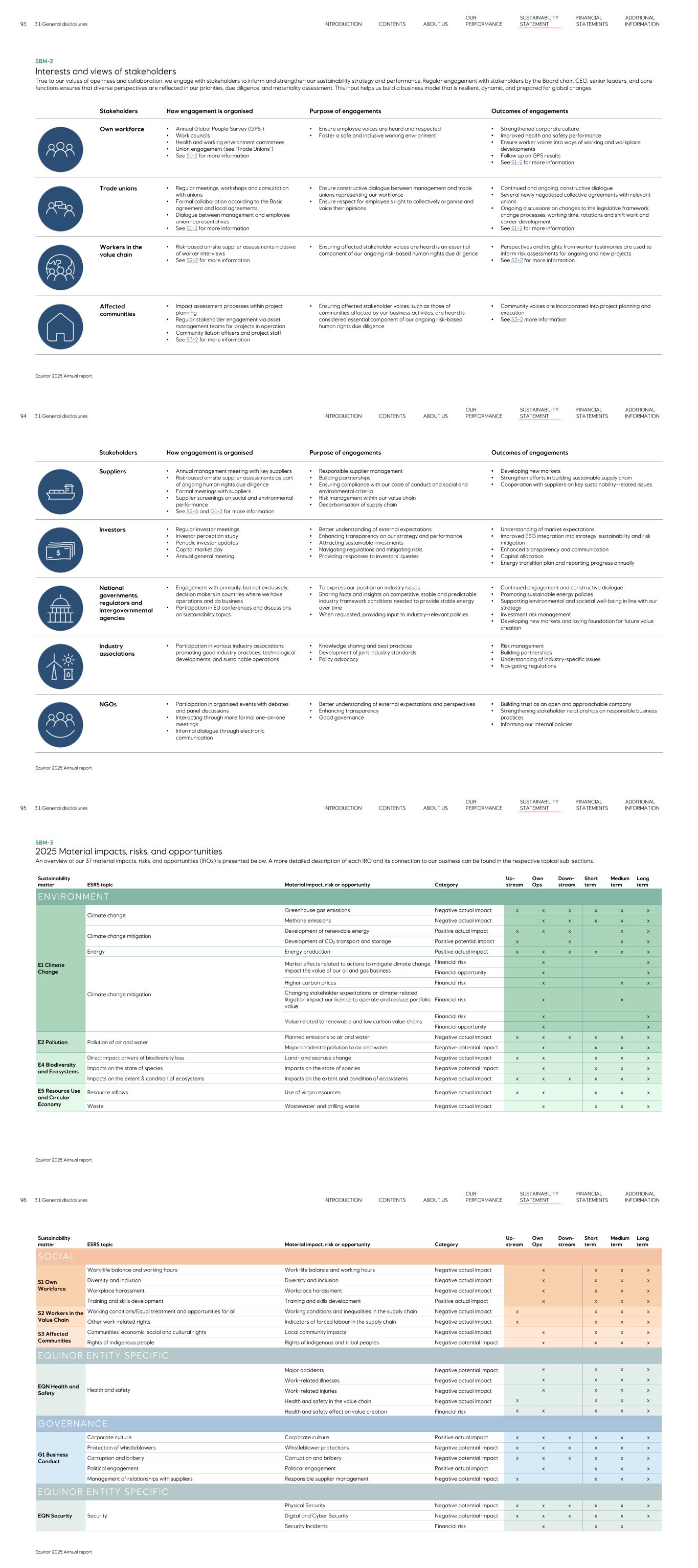
SBM-2 Interests and views of stakeholders True to our values of openness and collaboration, we engage with stakeholders to inform and strengthen our sustainability strategy and performance. Regular engagement with stakeholders by the Board chair, CEO, senior leaders, and core functions ensures that diverse perspectives are reflected in our priorities, due diligence, and materiality assessment. This input helps us build a business model that is resilient, dynamic, and prepared for global changes. 93 3.1 General disclosures INTRODUCTION CONTENTS ABOUT US OUR PERFORMANCE SUSTAINABILITY STATEMENT FINANCIAL STATEMENTS ADDITIONAL INFORMATION Equinor 2025 Annual report Stakeholders How engagement is organised Purpose of engagements Outcomes of engagements Own workforce • Annual Global People Survey (GPS ) • Work councils • Health and working environment committees • Union engagement (see “Trade Unions”) • See S1-2 for more information • Ensure employee voices are heard and respected • Foster a safe and inclusive working environment • Strengthened corporate culture • Improved health and safety performance • Ensure worker voices into ways of working and workplace developments • Follow up on GPS results • See S1-2 for more information Trade unions • Regular meetings, workshops and consultation with unions • Formal collaboration according to the Basic agreement and local agreements. • Dialogue between management and employee union representatives • See S1-2 for more information • Ensure constructive dialogue between management and trade unions representing our workforce • Ensure respect for employee’s right to collectively organise and voice their opinions • Continued and ongoing, constructive dialogue • Several newly negotiated collective agreements with relevant unions • Ongoing discussions on changes to the legislative framework, change processes, working time, rotations and shift work and career development • See S1-2 for more information Workers in the value chain • Risk-based on-site supplier assessments inclusive of worker interviews • See S2-2 for more information • Ensuring affected stakeholder voices are heard is an essential component of our ongoing risk-based human rights due diligence • Perspectives and insights from worker testimonies are used to inform risk assessments for ongoing and new projects • See S2-2 for more information Affected communities • Impact assessment processes within project planning • Regular stakeholder engagement via asset management teams for projects in operation • Community liaison officers and project staff • See S3-2 for more information • Ensuring affected stakeholder voices, such as those of communities affected by our business activities, are heard is considered essential component of our ongoing risk-based human rights due diligence • Community voices are incorporated into project planning and execution • See S3-2 more information 94 3.1 General disclosures INTRODUCTION CONTENTS ABOUT US OUR PERFORMANCE SUSTAINABILITY STATEMENT FINANCIAL STATEMENTS ADDITIONAL INFORMATION Equinor 2025 Annual report Stakeholders How engagement is organised Purpose of engagements Outcomes of engagements Suppliers • Annual management meeting with key suppliers • Risk-based on-site supplier assessments as part of ongoing human rights due diligence • Formal meetings with suppliers • Supplier screenings on social and environmental performance • See S2-5 and G1-2 for more information • Responsible supplier management • Building partnerships • Ensuring compliance with our code of conduct and social and environmental criteria • Risk management within our value chain • Decarbonisation of supply chain • Developing new markets • Strengthen efforts in building sustainable supply chain • Cooperation with suppliers on key sustainability-related issues Investors • Regular investor meetings • Investor perception study • Periodic investor updates • Capital market day • Annual general meeting • Better understanding of external expectations • Enhancing transparency on our strategy and performance • Attracting sustainable investments • Navigating regulations and mitigating risks • Providing responses to investors’ queries • Understanding of market expectations • Improved ESG integration into strategy, sustainability and risk mitigation • Enhanced transparency and communication • Capital allocation • Energy transition plan and reporting progress annually National governments, regulators and intergovernmental agencies • Engagement with primarily, but not exclusively, decision makers in countries where we have operations and do business • Participation in EU conferences and discussions on sustainability topics • To express our position on industry issues • Sharing facts and insights on competitive, stable and predictable industry framework conditions needed to provide stable energy over time • When requested, providing input to industry-relevant policies • Continued engagement and constructive dialogue • Promoting sustainable energy policies • Supporting environmental and societal well-being in line with our strategy • Investment risk management • Developing new markets and laying foundation for future value creation Industry associations • Participation in various industry associations promoting good industry practices, technological developments, and sustainable operations • Knowledge sharing and best practices • Development of joint industry standards • Policy advocacy • Risk management • Building partnerships • Understanding of industry-specific issues • Navigating regulations NGOs • Participation in organised events with debates and panel discussions • Interacting through more formal one-on-one meetings • Informal dialogue through electronic communication • Better understanding of external expectations and perspectives • Enhancing transparency • Good governance • Building trust as an open and approachable company • Strengthening stakeholder relationships on responsible business practices • Informing our internal policies SBM-3 2025 Material impacts, risks, and opportunities An overview of our 37 material impacts, risks, and opportunities (IROs) is presented below. A more detailed description of each IRO and its connection to our business can be found in the respective topical sub-sections. 95 3.1 General disclosures INTRODUCTION CONTENTS ABOUT US OUR PERFORMANCE SUSTAINABILITY STATEMENT FINANCIAL STATEMENTS ADDITIONAL INFORMATION Equinor 2025 Annual report Sustainability matter ESRS topic Material impact, risk or opportunity Category Up- stream Own Ops Down- stream Short term Medium term Long term ENVIRONMENT E1 Climate Change Climate change Greenhouse gas emissions Negative actual impact x x x x x x Methane emissions Negative actual impact x x x x x Climate change mitigation Development of renewable energy Positive actual impact x x x x x Development of CO2 transport and storage Positive potential impact x x x x Energy Energy production Positive actual impact x x x x x x Climate change mitigation Market effects related to actions to mitigate climate change impact the value of our oil and gas business Financial risk x x Financial opportunity x x Higher carbon prices Financial risk x x x Changing stakeholder expectations or climate-related litigation impact our licence to operate and reduce portfolio value Financial risk x x Value related to renewable and low carbon value chains Financial risk x x Financial opportunity x x E2 Pollution Pollution of air and water Planned emissions to air and water Negative actual impact x x x x x x Major accidental pollution to air and water Negative potential impact x x x x E4 Biodiversity and Ecosystems Direct impact drivers of biodiversity loss Land- and sea-use change Negative actual impact x x x x x Impacts on the state of species Impacts on the state of species Negative potential impact x x x x Impacts on the extent & condition of ecosystems Impacts on the extent and condition of ecosystems Negative actual impact x x x x x x E5 Resource Use and Circular Economy Resource inflows Use of virgin resources Negative actual impact x x x x x Waste Wastewater and drilling waste Negative actual impact x x x x 96 3.1 General disclosures INTRODUCTION CONTENTS ABOUT US OUR PERFORMANCE SUSTAINABILITY STATEMENT FINANCIAL STATEMENTS ADDITIONAL INFORMATION Equinor 2025 Annual report Sustainability matter ESRS topic Material impact, risk or opportunity Category Up- stream Own Ops Down- stream Short term Medium term Long term SOCIAL S1 Own Workforce Work-life balance and working hours Work-life balance and working hours Negative actual impact x x x x Diversity and Inclusion Diversity and inclusion Negative actual impact x x x x Workplace harassment Workplace harassment Negative actual impact x x x x Training and skills development Training and skills development Positive actual impact x x x x S2 Workers in the Value Chain Working conditions/Equal treatment and opportunities for all Working conditions and inequalities in the supply chain Negative actual impact x x x x Other work-related rights Indicators of forced labour in the supply chain Negative actual impact x x x x S3 Affected Communities Communities’ economic, social and cultural rights Local community impacts Negative actual impact x x x x Rights of indigenous people Rights of indigenous and tribal peoples Negative potential impact x x x x EQUINOR ENTITY SPECIFIC EQN Health and Safety Health and safety Major accidents Negative potential impact x x x x Work-related illnesses Negative actual impact x x x x Work-related injuries Negative actual impact x x x x Health and safety in the value chain Negative actual impact x x x x Health and safety effect on value creation Financial risk x x x x x GOVERNANCE G1 Business Conduct Corporate culture Corporate culture Positive actual impact x x x x x x Protection of whistleblowers Whistleblower protections Negative potential impact x x x x x x Corruption and bribery Corruption and bribery Negative potential impact x x x x x x Political engagement Political engagement Positive actual impact x x x x Management of relationships with suppliers Responsible supplier management Negative potential impact x x x x EQUINOR ENTITY SPECIFIC EQN Security Security Physical Security Negative potential impact x x x x x x Digital and Cyber Security Negative potential impact x x x x x x Security Incidents Financial risk x x x
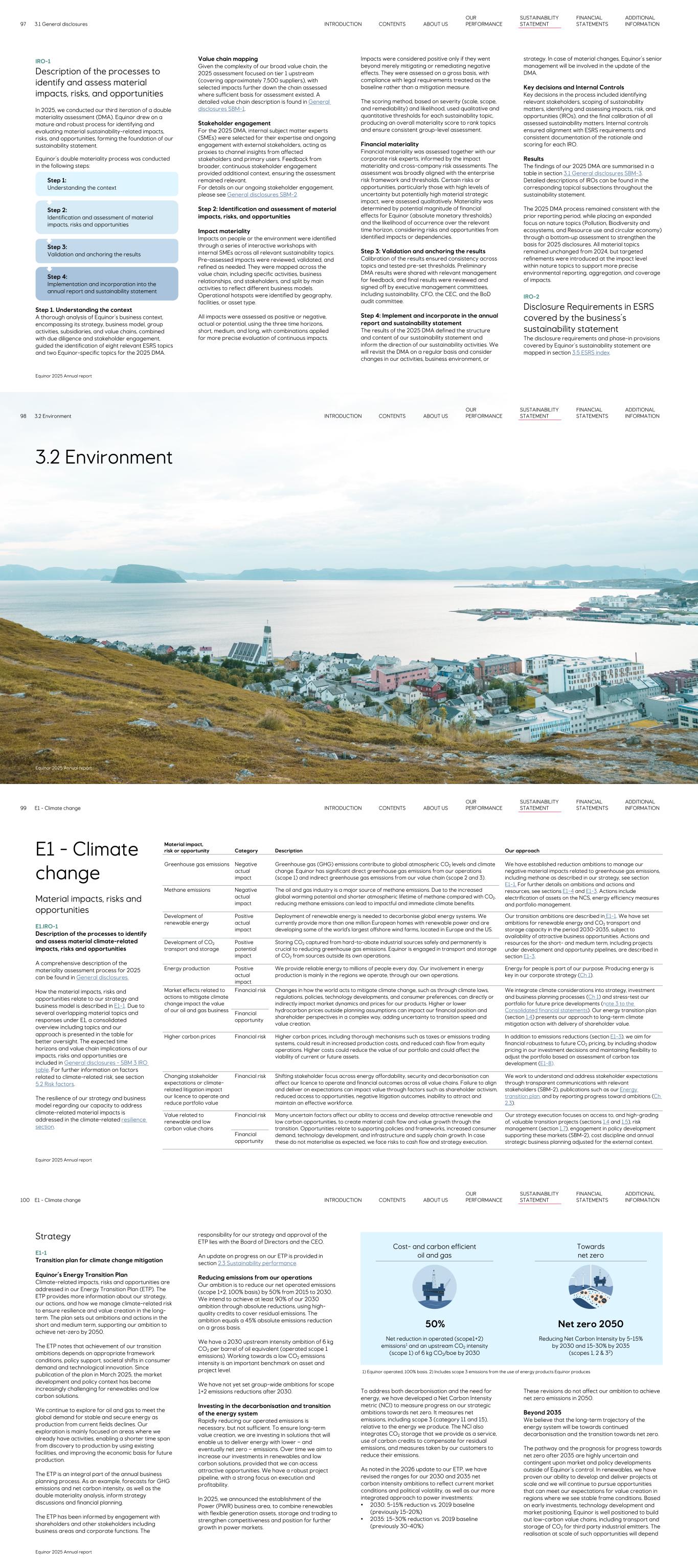
IRO-1 Description of the processes to identify and assess material impacts, risks, and opportunities In 2025, we conducted our third iteration of a double materiality assessment (DMA). Equinor drew on a mature and robust process for identifying and evaluating material sustainability-related impacts, risks, and opportunities, forming the foundation of our sustainability statement. Step 1. Understanding the context A thorough analysis of Equinor’s business context, encompassing its strategy, business model, group activities, subsidiaries, and value chains, combined with due diligence and stakeholder engagement, guided the identification of eight relevant ESRS topics and two Equinor-specific topics for the 2025 DMA. Value chain mapping Given the complexity of our broad value chain, the 2025 assessment focused on tier 1 upstream (covering approximately 7,500 suppliers), with selected impacts further down the chain assessed where sufficient basis for assessment existed. A detailed value chain description is found in General disclosures SBM-1. Stakeholder engagement For the 2025 DMA, internal subject matter experts (SMEs) were selected for their expertise and ongoing engagement with external stakeholders, acting as proxies to channel insights from affected stakeholders and primary users. Feedback from broader, continuous stakeholder engagement provided additional context, ensuring the assessment remained relevant. For details on our ongoing stakeholder engagement, please see General disclosures SBM-2. Step 2: Identification and assessment of material impacts, risks, and opportunities Impact materiality Impacts on people or the environment were identified through a series of interactive workshops with internal SMEs across all relevant sustainability topics. Pre-assessed impacts were reviewed, validated, and refined as needed. They were mapped across the value chain, including specific activities, business relationships, and stakeholders, and split by main activities to reflect different business models. Operational hotspots were identified by geography, facilities, or asset type. All impacts were assessed as positive or negative, actual or potential, using the three time horizons, short, medium, and long, with combinations applied for more precise evaluation of continuous impacts. Impacts were considered positive only if they went beyond merely mitigating or remediating negative effects. They were assessed on a gross basis, with compliance with legal requirements treated as the baseline rather than a mitigation measure. The scoring method, based on severity (scale, scope, and remediability) and likelihood, used qualitative and quantitative thresholds for each sustainability topic, producing an overall materiality score to rank topics and ensure consistent group-level assessment. Financial materiality Financial materiality was assessed together with our corporate risk experts, informed by the impact materiality and cross-company risk assessments. The assessment was broadly aligned with the enterprise risk framework and thresholds. Certain risks or opportunities, particularly those with high levels of uncertainty but potentially high material strategic impact, were assessed qualitatively. Materiality was determined by potential magnitude of financial effects for Equinor (absolute monetary thresholds) and the likelihood of occurrence over the relevant time horizon, considering risks and opportunities from identified impacts or dependencies. Step 3: Validation and anchoring the results Calibration of the results ensured consistency across topics and tested pre-set thresholds. Preliminary DMA results were shared with relevant management for feedback, and final results were reviewed and signed off by executive management committees, including sustainability, CFO, the CEC, and the BoD audit committee. Step 4: Implement and incorporate in the annual report and sustainability statement The results of the 2025 DMA defined the structure and content of our sustainability statement and inform the direction of our sustainability activities. We will revisit the DMA on a regular basis and consider changes in our activities, business environment, or strategy. In case of material changes, Equinor’s senior management will be involved in the update of the DMA. Key decisions and Internal Controls Key decisions in the process included identifying relevant stakeholders, scoping of sustainability matters, identifying and assessing impacts, risk, and opportunities (IROs), and the final calibration of all assessed sustainability matters. Internal controls ensured alignment with ESRS requirements and consistent documentation of the rationale and scoring for each IRO. Results The findings of our 2025 DMA are summarised in a table in section 3.1 General disclosures SBM-3. Detailed descriptions of IROs can be found in the corresponding topical subsections throughout the sustainability statement. The 2025 DMA process remained consistent with the prior reporting period, while placing an expanded focus on nature topics (Pollution, Biodiversity and ecosystems, and Resource use and circular economy) through a bottom-up assessment to strengthen the basis for 2025 disclosures. All material topics remained unchanged from 2024, but targeted refinements were introduced at the impact level within nature topics to support more precise environmental reporting, aggregation, and coverage of impacts. IRO-2 Disclosure Requirements in ESRS covered by the business’s sustainability statement The disclosure requirements and phase-in provisions covered by Equinor’s sustainability statement are mapped in section 3.5 ESRS index. 97 3.1 General disclosures INTRODUCTION CONTENTS ABOUT US OUR PERFORMANCE SUSTAINABILITY STATEMENT FINANCIAL STATEMENTS ADDITIONAL INFORMATION Equinor 2025 Annual report Equinor’s double materiality process was conducted in the following steps: Step 1: Understanding the context Step 2: Identification and assessment of material impacts, risks and opportunities Step 3: Validation and anchoring the results Step 4: Implementation and incorporation into the annual report and sustainability statement 3.2 Environment 98 3.2 Environment INTRODUCTION CONTENTS ABOUT US OUR PERFORMANCE SUSTAINABILITY STATEMENT FINANCIAL STATEMENTS ADDITIONAL INFORMATION Equinor 2025 Annual report E1 - Climate change Material impacts, risks and opportunities E1.IRO-1 Description of the processes to identify and assess material climate-related impacts, risks and opportunities A comprehensive description of the materiality assessment process for 2025 can be found in General disclosures. How the material impacts, risks and opportunities relate to our strategy and business model is described in E1-1. Due to several overlapping material topics and responses under E1, a consolidated overview including topics and our approach is presented in the table for better oversight. The expected time horizons and value chain implications of our impacts, risks and opportunities are included in General disclosures - SBM 3 IRO table. For further information on factors related to climate-related risk, see section 5.2 Risk factors. The resilience of our strategy and business model regarding our capacity to address climate-related material impacts is addressed in the climate-related resilience section. 99 E1 - Climate change INTRODUCTION CONTENTS ABOUT US OUR PERFORMANCE SUSTAINABILITY STATEMENT FINANCIAL STATEMENTS ADDITIONAL INFORMATION Equinor 2025 Annual report Material impact, risk or opportunity Category Description Our approach Greenhouse gas emissions Negative actual impact Greenhouse gas (GHG) emissions contribute to global atmospheric CO2 levels and climate change. Equinor has significant direct greenhouse gas emissions from our operations (scope 1) and indirect greenhouse gas emissions from our value chain (scope 2 and 3). We have established reduction ambitions to manage our negative material impacts related to greenhouse gas emissions, including methane as described in our strategy, see section E1-1. For further details on ambitions and actions and resources, see sections E1-4 and E1-3. Actions include electrification of assets on the NCS, energy efficiency measures and portfolio management. Methane emissions Negative actual impact The oil and gas industry is a major source of methane emissions. Due to the increased global warming potential and shorter atmospheric lifetime of methane compared with CO2, reducing methane emissions can lead to impactful and immediate climate benefits. Development of renewable energy Positive actual impact Deployment of renewable energy is needed to decarbonise global energy systems. We currently provide more than one million European homes with renewable power and are developing some of the world's largest offshore wind farms, located in Europe and the US. Our transition ambitions are described in E1-1. We have set ambitions for renewable energy and CO2 transport and storage capacity in the period 2030-2035, subject to availability of attractive business opportunities. Actions and resources for the short- and medium term, including projects under development and opportunity pipelines, are described in section E1-3. Development of CO2 transport and storage Positive potential impact Storing CO2 captured from hard-to-abate industrial sources safely and permanently is crucial to reducing greenhouse gas emissions. Equinor is engaged in transport and storage of CO2 from sources outside its own operations. Energy production Positive actual impact We provide reliable energy to millions of people every day. Our involvement in energy production is mainly in the regions we operate, through our own operations. Energy for people is part of our purpose. Producing energy is key in our corporate strategy (Ch 1). Market effects related to actions to mitigate climate change impact the value of our oil and gas business Financial risk Changes in how the world acts to mitigate climate change, such as through climate laws, regulations, policies, technology developments, and consumer preferences, can directly or indirectly impact market dynamics and prices for our products. Higher or lower hydrocarbon prices outside planning assumptions can impact our financial position and shareholder perspectives in a complex way, adding uncertainty to transition speed and value creation. We integrate climate considerations into strategy, investment and business planning processes (Ch 1) and stress-test our portfolio for future price developments (note 3 to the Consolidated financial statements). Our energy transition plan (section 1.4) presents our approach to long-term climate mitigation action with delivery of shareholder value. Financial opportunity Higher carbon prices Financial risk Higher carbon prices, including thorough mechanisms such as taxes or emissions trading systems, could result in increased production costs, and reduced cash flow from equity operations. Higher costs could reduce the value of our portfolio and could affect the viability of current or future assets. In addition to emissions reductions (section E1-3), we aim for financial robustness to future CO2 pricing, by including shadow pricing in our investment decisions and maintaining flexibility to adjust the portfolio based on assessment of carbon tax development (E1-8). Changing stakeholder expectations or climate- related litigation impact our licence to operate and reduce portfolio value Financial risk Shifting stakeholder focus across energy affordability, security and decarbonisation can affect our licence to operate and financial outcomes across all value chains. Failure to align and deliver on expectations can impact value through factors such as shareholder activism, reduced access to opportunities, negative litigation outcomes, inability to attract and maintain an effective workforce. We work to understand and address stakeholder expectations through transparent communications with relevant stakeholders (SBM-2), publications such as our Energy transition plan, and by reporting progress toward ambitions (Ch 2.3). Value related to renewable and low carbon value chains Financial risk Many uncertain factors affect our ability to access and develop attractive renewable and low carbon opportunities, to create material cash flow and value growth through the transition. Opportunities relate to supporting policies and frameworks, increased consumer demand, technology development, and infrastructure and supply chain growth. In case these do not materialise as expected, we face risks to cash flow and strategy execution. Our strategy execution focuses on access to, and high-grading of, valuable transition projects (sections 1.4 and 1.5), risk management (section 1.7), engagement in policy development supporting these markets (SBM-2), cost discipline and annual strategic business planning adjusted for the external context. Financial opportunity Strategy E1-1 Transition plan for climate change mitigation Equinor’s Energy Transition Plan Climate-related impacts, risks and opportunities are addressed in our Energy Transition Plan (ETP). The ETP provides more information about our strategy, our actions, and how we manage climate-related risk to ensure resilience and value creation in the long- term. The plan sets out ambitions and actions in the short and medium term, supporting our ambition to achieve net-zero by 2050. The ETP notes that achievement of our transition ambitions depends on appropriate framework conditions, policy support, societal shifts in consumer demand and technological innovation. Since publication of the plan in March 2025, the market development and policy context has become increasingly challenging for renewables and low carbon solutions. We continue to explore for oil and gas to meet the global demand for stable and secure energy as production from current fields declines. Our exploration is mainly focused on areas where we already have activities, enabling a shorter time span from discovery to production by using existing facilities, and improving the economic basis for future production. The ETP is an integral part of the annual business planning process. As an example, forecasts for GHG emissions and net carbon intensity, as well as the double materiality analysis, inform strategy discussions and financial planning. The ETP has been informed by engagement with shareholders and other stakeholders including business areas and corporate functions. The responsibility for our strategy and approval of the ETP lies with the Board of Directors and the CEO. An update on progress on our ETP is provided in section 2.3 Sustainability performance. Reducing emissions from our operations Our ambition is to reduce our net operated emissions (scope 1+2, 100% basis) by 50% from 2015 to 2030. We intend to achieve at least 90% of our 2030 ambition through absolute reductions, using high- quality credits to cover residual emissions. The ambition equals a 45% absolute emissions reduction on a gross basis. We have a 2030 upstream intensity ambition of 6 kg CO2 per barrel of oil equivalent (operated scope 1 emissions). Working towards a low CO2 emissions intensity is an important benchmark on asset and project level. We have not yet set group-wide ambitions for scope 1+2 emissions reductions after 2030. Investing in the decarbonisation and transition of the energy system Rapidly reducing our operated emissions is necessary, but not sufficient. To ensure long-term value creation, we are investing in solutions that will enable us to deliver energy with lower – and eventually net zero – emissions. Over time we aim to increase our investments in renewables and low carbon solutions, provided that we can access attractive opportunities. We have a robust project pipeline, with a strong focus on execution and profitability. In 2025, we announced the establishment of the Power (PWR) business area, to combine renewables with flexible generation assets, storage and trading to strengthen competitiveness and position for further growth in power markets. To address both decarbonisation and the need for energy, we have developed a Net Carbon Intensity metric (NCI) to measure progress on our strategic ambitions towards net zero. It measures net emissions, including scope 3 (category 11 and 15), relative to the energy we produce. The NCI also integrates CO2 storage that we provide as a service, use of carbon credits to compensate for residual emissions, and measures taken by our customers to reduce their emissions. As noted in the 2026 update to our ETP, we have revised the ranges for our 2030 and 2035 net carbon intensity ambitions to reflect current market conditions and political volatility, as well as our more integrated approach to power investments: • 2030: 5-15% reduction vs. 2019 baseline (previously 15-20%) • 2035: 15-30% reduction vs. 2019 baseline (previously 30-40%) These revisions do not affect our ambition to achieve net zero emissions in 2050. Beyond 2035 We believe that the long-term trajectory of the energy system will be towards continued decarbonisation and the transition towards net zero. The pathway and the prognosis for progress towards net zero after 2035 are highly uncertain and contingent upon market and policy developments outside of Equinor’s control. In renewables, we have proven our ability to develop and deliver projects at scale and we will continue to pursue opportunities that can meet our expectations for value creation in regions where we see stable frame conditions. Based on early investments, technology development and market positioning, Equinor is well positioned to build out low-carbon value chains, including transport and storage of CO2 for third party industrial emitters. The realisation at scale of such opportunities will depend 100 E1 - Climate change INTRODUCTION CONTENTS ABOUT US OUR PERFORMANCE SUSTAINABILITY STATEMENT FINANCIAL STATEMENTS ADDITIONAL INFORMATION Equinor 2025 Annual report Cost- and carbon efficient oil and gas Towards net zero 50% Net zero 2050 Net reduction in operated (scope1+2) emissions1 and an upstream CO2 intensity (scope 1) of 6 kg CO2/boe by 2030 Reducing Net Carbon Intensity by 5-15% by 2030 and 15-30% by 2035 (scopes 1, 2 & 32) 1) Equinor operated, 100% basis. 2) Includes scope 3 emissions from the use of energy products Equinor produces
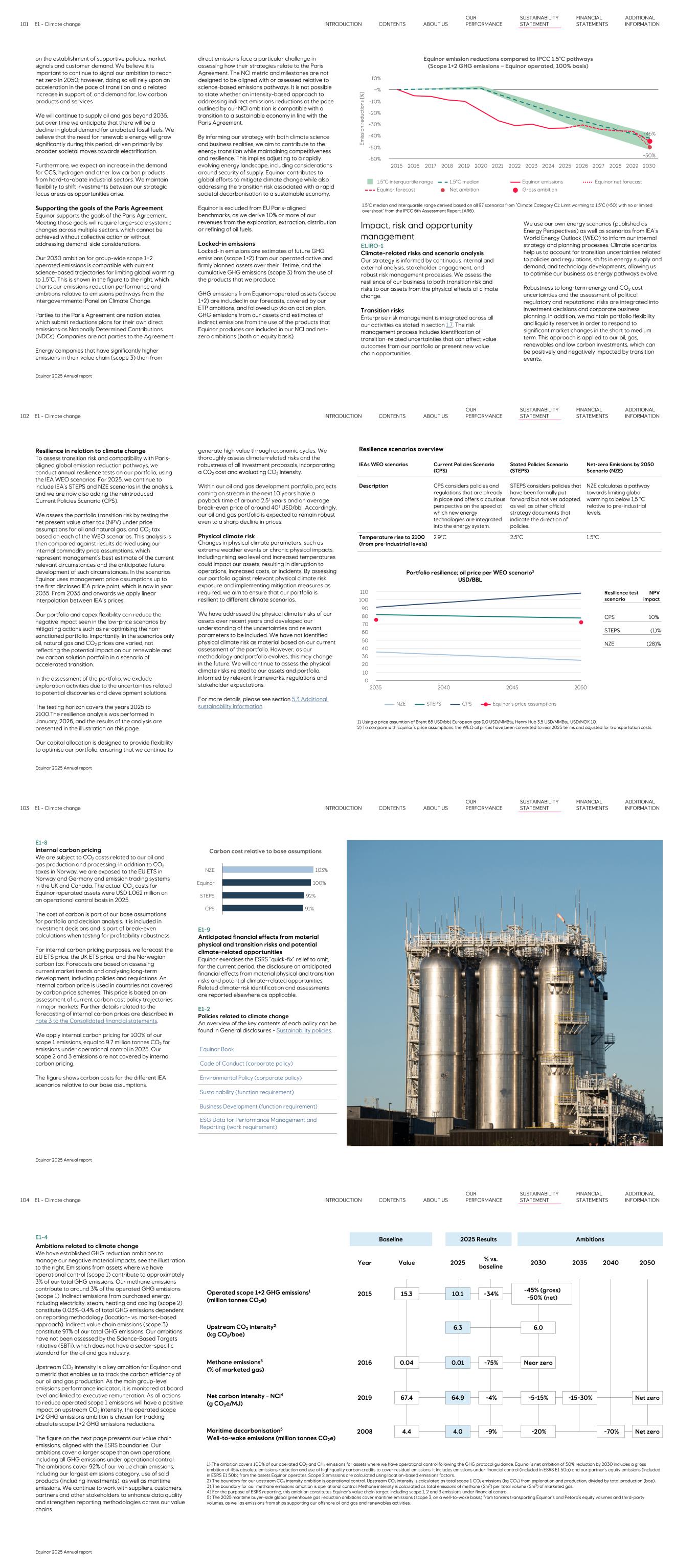
on the establishment of supportive policies, market signals and customer demand. We believe it is important to continue to signal our ambition to reach net zero in 2050; however, doing so will rely upon an acceleration in the pace of transition and a related increase in support of, and demand for, low carbon products and services We will continue to supply oil and gas beyond 2035, but over time we anticipate that there will be a decline in global demand for unabated fossil fuels. We believe that the need for renewable energy will grow significantly during this period, driven primarily by broader societal moves towards electrification. Furthermore, we expect an increase in the demand for CCS, hydrogen and other low carbon products from hard-to-abate industrial sectors. We maintain flexibility to shift investments between our strategic focus areas as opportunities arise. Supporting the goals of the Paris Agreement Equinor supports the goals of the Paris Agreement. Meeting those goals will require large-scale systemic changes across multiple sectors, which cannot be achieved without collective action or without addressing demand-side considerations. Our 2030 ambition for group-wide scope 1+2 operated emissions is compatible with current science-based trajectories for limiting global warming to 1.5˚C. This is shown in the figure to the right, which charts our emissions reduction performance and ambitions relative to emissions pathways from the Intergovernmental Panel on Climate Change. Parties to the Paris Agreement are nation states, which submit reductions plans for their own direct emissions as Nationally Determined Contributions (NDCs). Companies are not parties to the Agreement. Energy companies that have significantly higher emissions in their value chain (scope 3) than from direct emissions face a particular challenge in assessing how their strategies relate to the Paris Agreement. The NCI metric and milestones are not designed to be aligned with or assessed relative to science-based emissions pathways. It is not possible to state whether an intensity-based approach to addressing indirect emissions reductions at the pace outlined by our NCI ambition is compatible with a transition to a sustainable economy in line with the Paris Agreement. By informing our strategy with both climate science and business realities, we aim to contribute to the energy transition while maintaining competitiveness and resilience. This implies adjusting to a rapidly evolving energy landscape, including considerations around security of supply. Equinor contributes to global efforts to mitigate climate change while also addressing the transition risk associated with a rapid societal decarbonisation to a sustainable economy. Equinor is excluded from EU Paris-aligned benchmarks, as we derive 10% or more of our revenues from the exploration, extraction, distribution or refining of oil fuels. Locked-in emissions Locked-in emissions are estimates of future GHG emissions (scope 1+2) from our operated active and firmly planned assets over their lifetime, and the cumulative GHG emissions (scope 3) from the use of the products that we produce. GHG emissions from Equinor-operated assets (scope 1+2) are included in our forecasts, covered by our ETP ambitions, and followed up via an action plan. GHG emissions from our assets and estimates of indirect emissions from the use of the products that Equinor produces are included in our NCI and net- zero ambitions (both on equity basis). Impact, risk and opportunity management E1.IRO-1 Climate-related risks and scenario analysis Our strategy is informed by continuous internal and external analysis, stakeholder engagement, and robust risk management processes. We assess the resilience of our business to both transition risk and risks to our assets from the physical effects of climate change. Transition risks Enterprise risk management is integrated across all our activities as stated in section 1.7. The risk management process includes identification of transition-related uncertainties that can affect value outcomes from our portfolio or present new value chain opportunities. We use our own energy scenarios (published as Energy Perspectives) as well as scenarios from IEA’s World Energy Outlook (WEO) to inform our internal strategy and planning processes. Climate scenarios help us to account for transition uncertainties related to policies and regulations, shifts in energy supply and demand, and technology developments, allowing us to optimise our business as energy pathways evolve. Robustness to long-term energy and CO2 cost uncertainties and the assessment of political, regulatory and reputational risks are integrated into investment decisions and corporate business planning. In addition, we maintain portfolio flexibility and liquidity reserves in order to respond to significant market changes in the short to medium term. This approach is applied to our oil, gas, renewables and low carbon investments, which can be positively and negatively impacted by transition events. 101 E1 - Climate change INTRODUCTION CONTENTS ABOUT US OUR PERFORMANCE SUSTAINABILITY STATEMENT FINANCIAL STATEMENTS ADDITIONAL INFORMATION Equinor 2025 Annual report Em is si on r ed uc tio ns [% ] Equinor emission reductions compared to IPCC 1.5°C pathways (Scope 1+2 GHG emissions – Equinor operated, 100% basis) -50% -45% 1.5°C interquartile range 1.5°C median Equinor emissions Equinor net forecast Equinor forecast Net ambition Gross ambition 2015 2016 2017 2018 2019 2020 2021 2022 2023 2024 2025 2026 2027 2028 2029 2030 -60% -50% -40% -30% -20% -10% —% 10% 1.5˚C median and interquartile range derived based on all 97 scenarios from “Climate Category C1: Limit warming to 1.5˚C (>50) with no or limited overshoot” from the IPCC 6th Assessment Report (AR6). Resilience in relation to climate change To assess transition risk and compatibility with Paris- aligned global emission reduction pathways, we conduct annual resilience tests on our portfolio, using the IEA WEO scenarios. For 2025, we continue to include IEA’s STEPS and NZE scenarios in the analysis, and we are now also adding the reintroduced Current Policies Scenario (CPS). We assess the portfolio transition risk by testing the net present value after tax (NPV) under price assumptions for oil and natural gas, and CO2 tax based on each of the WEO scenarios. This analysis is then compared against results derived using our internal commodity price assumptions, which represent management’s best estimate of the current relevant circumstances and the anticipated future development of such circumstances. In the scenarios Equinor uses management price assumptions up to the first disclosed IEA price point, which is now in year 2035. From 2035 and onwards we apply linear interpolation between IEA´s prices. Our portfolio and capex flexibility can reduce the negative impact seen in the low-price scenarios by mitigating actions such as re-optimising the non- sanctioned portfolio. Importantly, in the scenarios only oil, natural gas and CO2 prices are varied, not reflecting the potential impact on our renewable and low carbon solution portfolio in a scenario of accelerated transition. In the assessment of the portfolio, we exclude exploration activities due to the uncertainties related to potential discoveries and development solutions. The testing horizon covers the years 2025 to 2100.The resilience analysis was performed in January, 2026, and the results of the analysis are presented in the illustration on this page. Our capital allocation is designed to provide flexibility to optimise our portfolio, ensuring that we continue to generate high value through economic cycles. We thoroughly assess climate-related risks and the robustness of all investment proposals, incorporating a CO2 cost and evaluating CO2 intensity. Within our oil and gas development portfolio, projects coming on stream in the next 10 years have a payback time of around 2.51 years and an average break-even price of around 401 USD/bbl. Accordingly, our oil and gas portfolio is expected to remain robust even to a sharp decline in prices. Physical climate risk Changes in physical climate parameters, such as extreme weather events or chronic physical impacts, including rising sea level and increased temperatures could impact our assets, resulting in disruption to operations, increased costs, or incidents. By assessing our portfolio against relevant physical climate risk exposure and implementing mitigation measures as required, we aim to ensure that our portfolio is resilient to different climate scenarios. We have addressed the physical climate risks of our assets over recent years and developed our understanding of the uncertainties and relevant parameters to be included. We have not identified physical climate risk as material based on our current assessment of the portfolio. However, as our methodology and portfolio evolves, this may change in the future. We will continue to assess the physical climate risks related to our assets and portfolio, informed by relevant frameworks, regulations and stakeholder expectations. For more details, please see section 5.3 Additional sustainability information. 102 E1 - Climate change INTRODUCTION CONTENTS ABOUT US OUR PERFORMANCE SUSTAINABILITY STATEMENT FINANCIAL STATEMENTS ADDITIONAL INFORMATION Equinor 2025 Annual report Portfolio resilience; oil price per WEO scenario² USD/BBL NZE STEPS CPS Equinor’s price assumptions 2035 2040 2045 2050 0 10 20 30 40 50 60 70 80 90 100 110 1) Using a price assumtion of Brent 65 USD/bbl, European gas 9,0 USD/MMBtu, Henry Hub 3,5 USD/MMBtu, USD/NOK 10. 2) To compare with Equinor’s price assumptions, the WEO oil prices have been converted to real 2025 terms and adjusted for transportation costs. Resilience test scenario NPV impact CPS 10% STEPS (1) % NZE (28) % Resilience scenarios overview IEAs WEO scenarios Current Policies Scenario (CPS) Stated Policies Scenario (STEPS) Net-zero Emissions by 2050 Scenario (NZE) Description CPS considers policies and regulations that are already in place and offers a cautious perspective on the speed at which new energy technologies are integrated into the energy system. STEPS considers policies that have been formally put forward but not yet adopted, as well as other official strategy documents that indicate the direction of policies. NZE calculates a pathway towards limiting global warming to below 1,5 °C relative to pre-industrial levels. Temperature rise to 2100 (from pre-industrial levels) 2.9°C 2.5°C 1.5°C E1-8 Internal carbon pricing We are subject to CO2 costs related to our oil and gas production and processing. In addition to CO2 taxes in Norway, we are exposed to the EU ETS in Norway and Germany and emission trading systems in the UK and Canada. The actual CO₂ costs for Equinor-operated assets were USD 1,062 million on an operational control basis in 2025. The cost of carbon is part of our base assumptions for portfolio and decision analysis. It is included in investment decisions and is part of break-even calculations when testing for profitability robustness. For internal carbon pricing purposes, we forecast the EU ETS price, the UK ETS price, and the Norwegian carbon tax. Forecasts are based on assessing current market trends and analysing long-term development, including policies and regulations. An internal carbon price is used in countries not covered by carbon price schemes. This price is based on an assessment of current carbon cost policy trajectories in major markets. Further details related to the forecasting of internal carbon prices are described in note 3 to the Consolidated financial statements. We apply internal carbon pricing for 100% of our scope 1 emissions, equal to 9.7 million tonnes CO2 for emissions under operational control in 2025. Our scope 2 and 3 emissions are not covered by internal carbon pricing. The figure shows carbon costs for the different IEA scenarios relative to our base assumptions. E1-9 Anticipated financial effects from material physical and transition risks and potential climate-related opportunities Equinor exercises the ESRS “quick-fix” relief to omit, for the current period, the disclosure on anticipated financial effects from material physical and transition risks and potential climate-related opportunities. Related climate-risk identification and assessments are reported elsewhere as applicable. E1-2 Policies related to climate change An overview of the key contents of each policy can be found in General disclosures - Sustainability policies. Equinor Book Code of Conduct (corporate policy) Environmental Policy (corporate policy) Sustainability (function requirement) Business Development (function requirement) ESG Data for Performance Management and Reporting (work requirement) 103 E1 - Climate change INTRODUCTION CONTENTS ABOUT US OUR PERFORMANCE SUSTAINABILITY STATEMENT FINANCIAL STATEMENTS ADDITIONAL INFORMATION Equinor 2025 Annual report Carbon cost relative to base assumptions 103% 100% 92% 91% NZE Equinor STEPS CPS E1-4 Ambitions related to climate change We have established GHG reduction ambitions to manage our negative material impacts, see the illustration to the right. Emissions from assets where we have operational control (scope 1) contribute to approximately 3% of our total GHG emissions. Our methane emissions contribute to around 3% of the operated GHG emissions (scope 1). Indirect emissions from purchased energy, including electricity, steam, heating and cooling (scope 2) constitute 0.03%-0.4% of total GHG emissions dependent on reporting methodology (location- vs. market-based approach). Indirect value chain emissions (scope 3) constitute 97% of our total GHG emissions. Our ambitions have not been assessed by the Science-Based Targets initiative (SBTi), which does not have a sector-specific standard for the oil and gas industry. Upstream CO2 intensity is a key ambition for Equinor and a metric that enables us to track the carbon efficiency of our oil and gas production. As the main group-level emissions performance indicator, it is monitored at board level and linked to executive remuneration. As all actions to reduce operated scope 1 emissions will have a positive impact on upstream CO2 intensity, the operated scope 1+2 GHG emissions ambition is chosen for tracking absolute scope 1+2 GHG emissions reductions. The figure on the next page presents our value chain emissions, aligned with the ESRS boundaries. Our ambitions cover a larger scope than own operations including all GHG emissions under operational control. The ambitions cover 92% of our value chain emissions, including our largest emissions category, use of sold products (including investments), as well as maritime emissions. We continue to work with suppliers, customers, partners and other stakeholders to enhance data quality and strengthen reporting methodologies across our value chains. 104 E1 - Climate change INTRODUCTION CONTENTS ABOUT US OUR PERFORMANCE SUSTAINABILITY STATEMENT FINANCIAL STATEMENTS ADDITIONAL INFORMATION Equinor 2025 Annual report Baseline 2025 Results Ambitions Year Value 2025 % vs. baseline 2030 2035 2040 2050 Operated scope 1+2 GHG emissions1 (million tonnes CO2e) -45% (gross) -50% (net) 2015 15.3 10.1 -34% Upstream CO2 intensity2 (kg CO2/boe) 6.3 6.0 Methane emissions3 (% of marketed gas) 2016 0.04 0.01 -75% Near zero Net carbon intensity - NCI4 (g CO2e/MJ) 2019 67.4 64.9 -4% -5-15% -15-30% Net zero Maritime decarbonisation5 Well-to-wake emissions (million tonnes CO2e) 2008 4.4 4.0 -9% -20% -70% Net zero 1) The ambition covers 100% of our operated CO2 and CH4 emissions for assets where we have operational control following the GHG protocol guidance. Equinor’s net ambition of 50% reduction by 2030 includes a gross ambition of 45% absolute emissions reduction and use of high-quality carbon credits to cover residual emissions. It includes emissions under financial control (included in ESRS E1 50a) and our partner’s equity emissions (included in ESRS E1 50b) from the assets Equinor operates. Scope 2 emissions are calculated using location-based emissions factors. 2) The boundary for our upstream CO2 intensity ambition is operational control. Upstream CO2 intensity is calculated as total scope 1 CO2 emissions (kg CO2) from exploration and production, divided by total production (boe). 3) The boundary for our methane emissions ambition is operational control. Methane intensity is calculated as total emissions of methane (Sm3) per total volume (Sm3) of marketed gas. 4) For the purpose of ESRS reporting, this ambition constitutes Equinor’s value chain target, including scope 1, 2 and 3 emissions under financial control. 5) The 2025 maritime buyer-side global greenhouse gas reduction ambitions cover maritime emissions (scope 3, on a well-to-wake basis) from tankers transporting Equinor’s and Petoro’s equity volumes and third-party volumes, as well as emissions from ships supporting our offshore oil and gas and renewables activities.
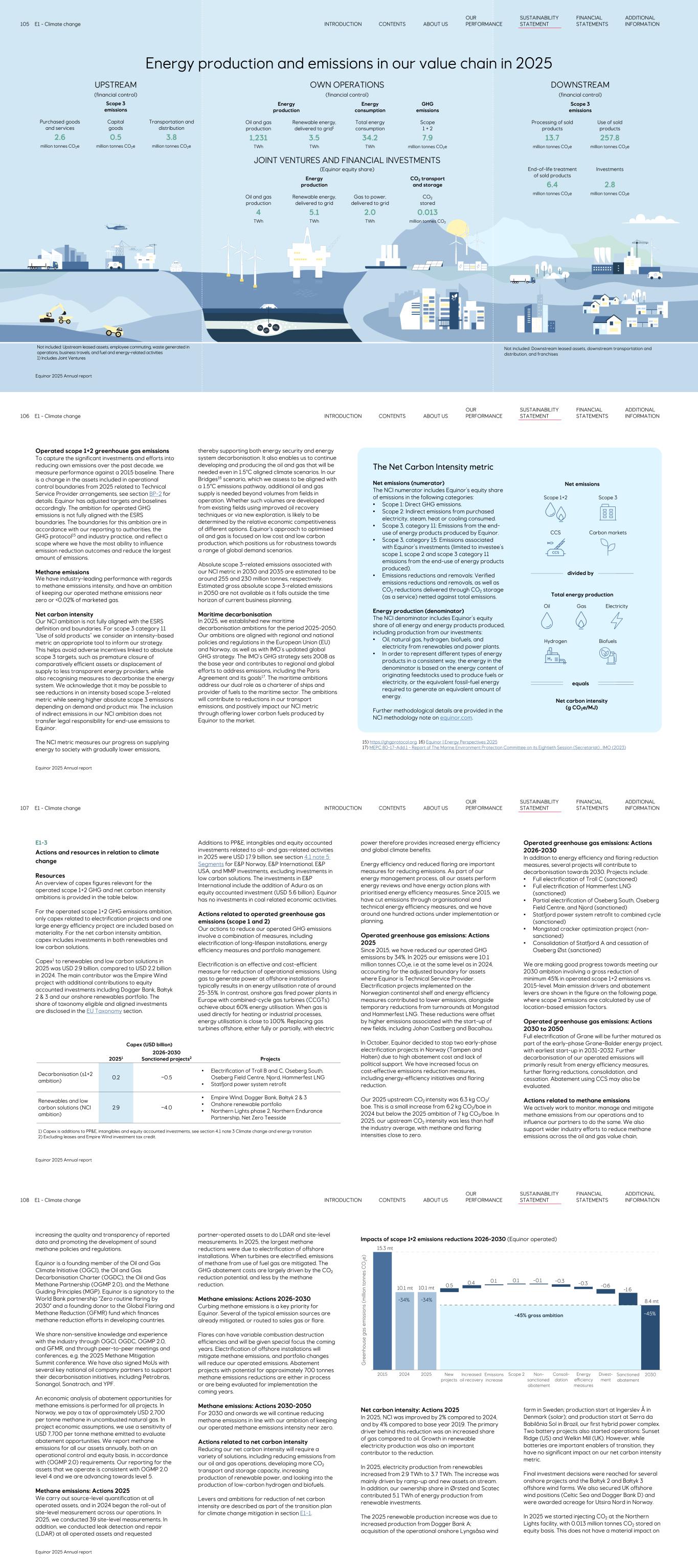
Energy production and emissions in our value chain in 2025 105 E1 - Climate change INTRODUCTION CONTENTS ABOUT US OUR PERFORMANCE SUSTAINABILITY STATEMENT FINANCIAL STATEMENTS ADDITIONAL INFORMATION Equinor 2025 Annual report UPSTREAM (financial control) Scope 3 emissions Purchased goods and services Capital goods Transportation and distribution 2.6 0.5 3.8 million tonnes CO2e million tonnes CO2e million tonnes CO2e Not included: Upstream leased assets, employee commuting, waste generated in operations, business travels, and fuel and energy-related activities 1) Includes Joint Ventures DOWNSTREAM (financial control) Scope 3 emissions Processing of sold products Use of sold products 13.7 257.8 million tonnes CO2e million tonnes CO2e End-of-life treatment of sold products Investments 6.4 2.8 million tonnes CO2e million tonnes CO2e Not included: Downstream leased assets, downstream transportation and distribution, and franchises OWN OPERATIONS (financial control) Energy production Energy consumption GHG emissions Oil and gas production Renewable energy, delivered to grid1 Total energy consumption Scope 1 + 2 1,231 3.5 34.2 7.9 TWh TWh TWh million tonnes CO2e JOINT VENTURES AND FINANCIAL INVESTMENTS (Equinor equity share) Energy production CO2 transport and storage Oil and gas production Renewable energy, delivered to grid Gas to power, delivered to grid CO2 stored 4 5.1 2.0 0.013 TWh TWh TWh million tonnes CO2 Operated scope 1+2 greenhouse gas emissions To capture the significant investments and efforts into reducing own emissions over the past decade, we measure performance against a 2015 baseline. There is a change in the assets included in operational control boundaries from 2025 related to Technical Service Provider arrangements, see section BP-2 for details. Equinor has adjusted targets and baselines accordingly. The ambition for operated GHG emissions is not fully aligned with the ESRS boundaries. The boundaries for this ambition are in accordance with our reporting to authorities, the GHG protocol15 and industry practice, and reflect a scope where we have the most ability to influence emission reduction outcomes and reduce the largest amount of emissions. Methane emissions We have industry-leading performance with regards to methane emissions intensity, and have an ambition of keeping our operated methane emissions near zero or <0.02% of marketed gas. Net carbon intensity Our NCI ambition is not fully aligned with the ESRS definition and boundaries. For scope 3 category 11 “Use of sold products” we consider an intensity-based metric an appropriate tool to inform our strategy. This helps avoid adverse incentives linked to absolute scope 3 targets, such as premature closure of comparatively efficient assets or displacement of supply to less transparent energy providers, while also recognising measures to decarbonise the energy system. We acknowledge that it may be possible to see reductions in an intensity based scope 3-related metric while seeing higher absolute scope 3 emissions depending on demand and product mix. The inclusion of indirect emissions in our NCI ambition does not transfer legal responsibility for end-use emissions to Equinor. The NCI metric measures our progress on supplying energy to society with gradually lower emissions, thereby supporting both energy security and energy system decarbonisation. It also enables us to continue developing and producing the oil and gas that will be needed even in 1.5°C aligned climate scenarios. In our Bridges16 scenario, which we assess to be aligned with a 1.5°C emissions pathway, additional oil and gas supply is needed beyond volumes from fields in operation. Whether such volumes are developed from existing fields using improved oil recovery techniques or via new exploration, is likely to be determined by the relative economic competitiveness of different options. Equinor's approach to optimised oil and gas is focused on low cost and low carbon production, which positions us for robustness towards a range of global demand scenarios. Absolute scope 3-related emissions associated with our NCI metric in 2030 and 2035 are estimated to be around 255 and 230 million tonnes, respectively. Estimated gross absolute scope 3-related emissions in 2050 are not available as it falls outside the time horizon of current business planning. Maritime decarbonisation In 2025, we established new maritime decarbonisation ambitions for the period 2025-2050. Our ambitions are aligned with regional and national policies and regulations in the European Union (EU) and Norway, as well as with IMO’s updated global GHG strategy. The IMO’s GHG strategy sets 2008 as the base year and contributes to regional and global efforts to address emissions, including the Paris Agreement and its goals17. The maritime ambitions address our dual role as a charterer of ships and provider of fuels to the maritime sector. The ambitions will contribute to reductions in our transport emissions, and positively impact our NCI metric through offering lower carbon fuels produced by Equinor to the market. 106 E1 - Climate change INTRODUCTION CONTENTS ABOUT US OUR PERFORMANCE SUSTAINABILITY STATEMENT FINANCIAL STATEMENTS ADDITIONAL INFORMATION Equinor 2025 Annual report The Net Carbon Intensity metric Net emissions (numerator) The NCI numerator includes Equinor’s equity share of emissions in the following categories: • Scope 1: Direct GHG emissions. • Scope 2: Indirect emissions from purchased electricity, steam, heat or cooling consumed. • Scope 3, category 11: Emissions from the end- use of energy products produced by Equinor. • Scope 3, category 15: Emissions associated with Equinor’s investments (limited to investee’s scope 1, scope 2 and scope 3 category 11 emissions from the end-use of energy products produced). • Emissions reductions and removals: Verified emissions reductions and removals, as well as CO2 reductions delivered through CO2 storage (as a service) netted against total emissions. Energy production (denominator) The NCI denominator includes Equinor’s equity share of all energy and energy products produced, including production from our investments: • Oil, natural gas, hydrogen, biofuels, and electricity from renewables and power plants. • In order to represent different types of energy products in a consistent way, the energy in the denominator is based on the energy content of originating feedstocks used to produce fuels or electricity, or the equivalent fossil-fuel energy required to generate an equivalent amount of energy. Further methodological details are provided in the NCI methodology note on equinor.com. 15) https://ghgprotocol.org, 16) Equinor | Energy Perspectives 2025 17) MEPC 80-17-Add.1 - Report of The Marine Environment Protection Committee on its Eightieth Session (Secretariat) , IMO (2023) Net emissions Scope 1+2 Scope 3 CCS Carbon markets divided by Total energy production Oil Gas Electricity Hydrogen Biofuels equals Net carbon intensity (g CO2e/MJ) E1-3 Actions and resources in relation to climate change Resources An overview of capex figures relevant for the operated scope 1+2 GHG and net carbon intensity ambitions is provided in the table below. For the operated scope 1+2 GHG emissions ambition, only capex related to electrification projects and one large energy efficiency project are included based on materiality. For the net carbon intensity ambition, capex includes investments in both renewables and low carbon solutions. Capex1 to renewables and low carbon solutions in 2025 was USD 2.9 billion, compared to USD 2.2 billion in 2024. The main contributor was the Empire Wind project with additional contributions to equity accounted investments including Dogger Bank, Bałtyk 2 & 3 and our onshore renewables portfolio. The share of taxonomy eligible and aligned investments are disclosed in the EU Taxonomy section. Additions to PP&E, intangibles and equity accounted investments related to oil- and gas-related activities in 2025 were USD 17.9 billion, see section 4.1 note 5 Segments for E&P Norway, E&P International, E&P USA, and MMP investments, excluding investments in low carbon solutions. The investments in E&P International include the addition of Adura as an equity accounted investment (USD 5.6 billion). Equinor has no investments in coal related economic activities. Actions related to operated greenhouse gas emissions (scope 1 and 2) Our actions to reduce our operated GHG emissions involve a combination of measures, including electrification of long-lifespan installations, energy efficiency measures and portfolio management. Electrification is an effective and cost-efficient measure for reduction of operational emissions. Using gas to generate power at offshore installations typically results in an energy utilisation rate of around 25-35%. In contrast, onshore gas fired power plants in Europe with combined-cycle gas turbines (CCGTs) achieve about 60% energy utilisation. When gas is used directly for heating or industrial processes, energy utilisation is close to 100%. Replacing gas turbines offshore, either fully or partially, with electric power therefore provides increased energy efficiency and global climate benefits. Energy efficiency and reduced flaring are important measures for reducing emissions. As part of our energy management process, all our assets perform energy reviews and have energy action plans with prioritised energy efficiency measures. Since 2015, we have cut emissions through organisational and technical energy efficiency measures, and we have around one hundred actions under implementation or planning. Operated greenhouse gas emissions: Actions 2025 Since 2015, we have reduced our operated GHG emissions by 34%. In 2025 our emissions were 10.1 million tonnes CO2e, i.e at the same level as in 2024, accounting for the adjusted boundary for assets where Equinor is Technical Service Provider. Electrification projects implemented on the Norwegian continental shelf and energy efficiency measures contributed to lower emissions, alongside temporary reductions from turnarounds at Mongstad and Hammerfest LNG. These reductions were offset by higher emissions associated with the start-up of new fields, including Johan Castberg and Bacalhau. In October, Equinor decided to stop two early-phase electrification projects in Norway (Tampen and Halten) due to high abatement cost and lack of political support. We have increased focus on cost-effective emissions reduction measures, including energy-efficiency initiatives and flaring reduction. Our 2025 upstream CO2 intensity was 6.3 kg CO2/ boe. This is a small increase from 6.2 kg CO2/boe in 2024 but below the 2025 ambition of 7 kg CO2/boe. In 2025, our upstream CO2 intensity was less than half the industry average, with methane and flaring intensities close to zero. Operated greenhouse gas emissions: Actions 2026-2030 In addition to energy efficiency and flaring reduction measures, several projects will contribute to decarbonisation towards 2030. Projects include: • Full electrification of Troll C (sanctioned) • Full electrification of Hammerfest LNG (sanctioned) • Partial electrification of Oseberg South, Oseberg Field Centre, and Njord (sanctioned) • Statfjord power system retrofit to combined cycle (sanctioned) • Mongstad cracker optimization project (non- sanctioned) • Consolidation of Statfjord A and cessation of Oseberg Øst (sanctioned) We are making good progress towards meeting our 2030 ambition involving a gross reduction of minimum 45% in operated scope 1+2 emissions vs. 2015-level. Main emission drivers and abatement levers are shown in the figure on the following page, where scope 2 emissions are calculated by use of location-based emission factors. Operated greenhouse gas emissions: Actions 2030 to 2050 Full electrification of Grane will be further matured as part of the early-phase Grane-Balder energy project, with earliest start-up in 2031-2032. Further decarbonisation of our operated emissions will primarily result from energy efficiency measures, further flaring reductions, consolidation, and cessation. Abatement using CCS may also be evaluated. Actions related to methane emissions We actively work to monitor, manage and mitigate methane emissions from our operations and to influence our partners to do the same. We also support wider industry efforts to reduce methane emissions across the oil and gas value chain, 107 E1 - Climate change INTRODUCTION CONTENTS ABOUT US OUR PERFORMANCE SUSTAINABILITY STATEMENT FINANCIAL STATEMENTS ADDITIONAL INFORMATION Equinor 2025 Annual report Capex (USD billion) 20251 2026-2030 Sanctioned projects2 Projects Decarbonisation (s1+2 ambition) 0.2 ~0.5 • Electrification of Troll B and C, Oseberg South, Oseberg Field Centre, Njord, Hammerfest LNG • Statfjord power system retrofit Renewables and low carbon solutions (NCI ambition) 2.9 ~4.0 • Empire Wind, Dogger Bank, Bałtyk 2 & 3 • Onshore renewable portfolio • Northern Lights phase 2, Northern Endurance Partnership, Net Zero Teesside 1) Capex is additions to PP&E, intangibles and equity accounted investments, see section 4.1 note 3 Climate change and energy transition 2) Excluding leases and Empire Wind investment tax credit. increasing the quality and transparency of reported data and promoting the development of sound methane policies and regulations. Equinor is a founding member of the Oil and Gas Climate Initiative (OGCI), the Oil and Gas Decarbonisation Charter (OGDC), the Oil and Gas Methane Partnership (OGMP 2.0), and the Methane Guiding Principles (MGP). Equinor is a signatory to the World Bank partnership "Zero routine flaring by 2030" and a founding donor to the Global Flaring and Methane Reduction (GFMR) fund which finances methane reduction efforts in developing countries. We share non-sensitive knowledge and experience with the industry through OGCI, OGDC, OGMP 2.0, and GFMR, and through peer-to-peer meetings and conferences, e.g. the 2025 Methane Mitigation Summit conference. We have also signed MoUs with several key national oil company partners to support their decarbonisation initiatives, including Petrobras, Sonangol, Sonatrach, and YPF. An economic analysis of abatement opportunities for methane emissions is performed for all projects. In Norway, we pay a tax of approximately USD 2,700 per tonne methane in uncombusted natural gas. In project economic assumptions, we use a sensitivity of USD 7,700 per tonne methane emitted to evaluate abatement opportunities. We report methane emissions for all our assets annually, both on an operational control and equity basis, in accordance with (OGMP 2.0) requirements. Our reporting for the assets that we operate is consistent with OGMP 2.0 level 4 and we are advancing towards level 5. Methane emissions: Actions 2025 We carry out source-level quantification at all operated assets, and in 2024 began the roll-out of site-level measurement across our operations. In 2025, we conducted 39 site-level measurements. In addition, we conducted leak detection and repair (LDAR) at all operated assets and requested partner-operated assets to do LDAR and site-level measurements. In 2025, the largest methane reductions were due to electrification of offshore installations. When turbines are electrified, emissions of methane from use of fuel gas are mitigated. The GHG abatement costs are largely driven by the CO2 reduction potential, and less by the methane reduction. Methane emissions: Actions 2026-2030 Curbing methane emissions is a key priority for Equinor. Several of the typical emission sources are already mitigated, or routed to sales gas or flare. Flares can have variable combustion destruction efficiencies and will be given special focus the coming years. Electrification of offshore installations will mitigate methane emissions, and portfolio changes will reduce our operated emissions. Abatement projects with potential for approximately 700 tonnes methane emissions reductions are either in process or are being evaluated for implementation the coming years. Methane emissions: Actions 2030-2050 For 2030 and onwards we will continue reducing methane emissions in line with our ambition of keeping our operated methane emissions intensity near zero. Actions related to net carbon intensity Reducing our net carbon intensity will require a variety of solutions, including reducing emissions from our oil and gas operations, developing more CO2 transport and storage capacity, increasing production of renewable power, and looking into the production of low-carbon hydrogen and biofuels. Levers and ambitions for reduction of net carbon intensity are described as part of the transition plan for climate change mitigation in section E1-1. Net carbon intensity: Actions 2025 In 2025, NCI was improved by 2% compared to 2024, and by 4% compared to base year 2019. The primary driver behind this reduction was an increased share of gas compared to oil. Growth in renewable electricity production was also an important contributor to the reduction. In 2025, electricity production from renewables increased from 2.9 TWh to 3.7 TWh. The increase was mainly driven by ramp-up and new assets on stream. In addition, our ownership share in Ørsted and Scatec contributed 5.1 TWh of energy production from renewable investments. The 2025 renewable production increase was due to increased production from Dogger Bank A; acquisition of the operational onshore Lyngsåsa wind farm in Sweden; production start at Ingerslev Å in Denmark (solar); and production start at Serra da Babilônia Sol in Brazil, our first hybrid power complex. Two battery projects also started operations: Sunset Ridge (US) and Welkin Mill (UK). However, while batteries are important enablers of transition, they have no significant impact on our net carbon intensity metric. Final investment decisions were reached for several onshore projects and the Bałtyk 2 and Bałtyk 3 offshore wind farms. We also secured UK offshore wind positions (Celtic Sea and Dogger Bank D) and were awarded acreage for Utsira Nord in Norway. In 2025 we started injecting CO2 at the Northern Lights facility, with 0.013 million tonnes CO2 stored on equity basis. This does not have a material impact on 108 E1 - Climate change INTRODUCTION CONTENTS ABOUT US OUR PERFORMANCE SUSTAINABILITY STATEMENT FINANCIAL STATEMENTS ADDITIONAL INFORMATION Equinor 2025 Annual report
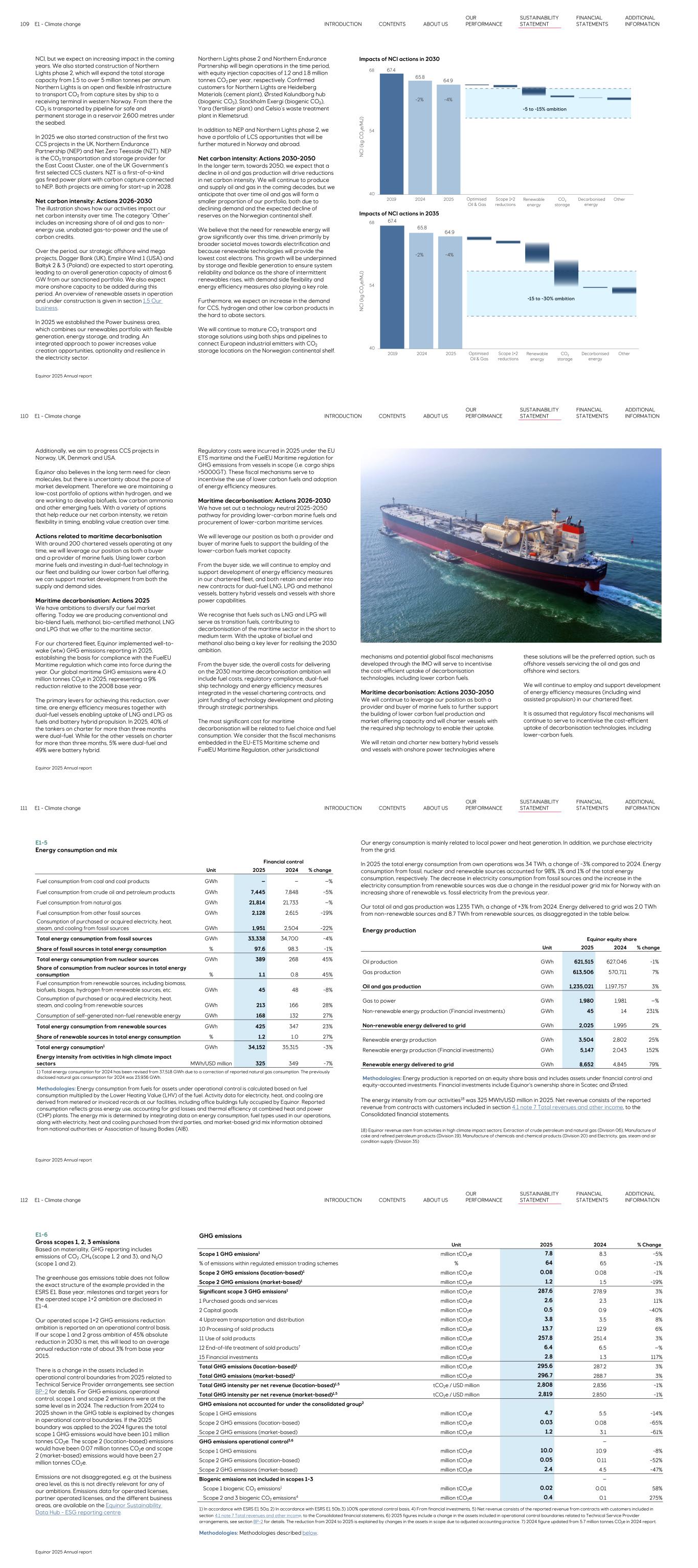
NCI, but we expect an increasing impact in the coming years. We also started construction of Northern Lights phase 2, which will expand the total storage capacity from 1.5 to over 5 million tonnes per annum. Northern Lights is an open and flexible infrastructure to transport CO2 from capture sites by ship to a receiving terminal in western Norway. From there the CO2 is transported by pipeline for safe and permanent storage in a reservoir 2,600 metres under the seabed. In 2025 we also started construction of the first two CCS projects in the UK, Northern Endurance Partnership (NEP) and Net Zero Teesside (NZT). NEP is the CO2 transportation and storage provider for the East Coast Cluster, one of the UK Government’s first selected CCS clusters. NZT is a first-of-a-kind gas fired power plant with carbon capture connected to NEP. Both projects are aiming for start-up in 2028. Net carbon intensity: Actions 2026-2030 The illustration shows how our activities impact our net carbon intensity over time. The category “Other” includes an increasing share of oil and gas to non- energy use, unabated gas-to-power and the use of carbon credits. Over the period, our strategic offshore wind mega projects, Dogger Bank (UK), Empire Wind 1 (USA) and Bałtyk 2 & 3 (Poland) are expected to start operating, leading to an overall generation capacity of almost 6 GW from our sanctioned portfolio. We also expect more onshore capacity to be added during this period. An overview of renewable assets in operation and under construction is given in section 1.5 Our business. In 2025 we established the Power business area, which combines our renewables portfolio with flexible generation, energy storage, and trading. An integrated approach to power increases value creation opportunities, optionality and resilience in the electricity sector. Northern Lights phase 2 and Northern Endurance Partnership will begin operations in the time period, with equity injection capacities of 1.2 and 1.8 million tonnes CO2 per year, respectively. Confirmed customers for Northern Lights are Heidelberg Materials (cement plant), Ørsted Kalundborg hub (biogenic CO2), Stockholm Exergi (biogenic CO2), Yara (fertiliser plant) and Celsio’s waste treatment plant in Klemetsrud. In addition to NEP and Northern Lights phase 2, we have a portfolio of LCS opportunities that will be further matured in Norway and abroad. Net carbon intensity: Actions 2030-2050 In the longer term, towards 2050, we expect that a decline in oil and gas production will drive reductions in net carbon intensity. We will continue to produce and supply oil and gas in the coming decades, but we anticipate that over time oil and gas will form a smaller proportion of our portfolio, both due to declining demand and the expected decline of reserves on the Norwegian continental shelf. We believe that the need for renewable energy will grow significantly over this time, driven primarily by broader societal moves towards electrification and because renewable technologies will provide the lowest cost electrons. This growth will be underpinned by storage and flexible generation to ensure system reliability and balance as the share of intermittent renewables rises, with demand side flexibility and energy efficiency measures also playing a key role. Furthermore, we expect an increase in the demand for CCS, hydrogen and other low carbon products in the hard to abate sectors. We will continue to mature CO2 transport and storage solutions using both ships and pipelines to connect European industrial emitters with CO2 storage locations on the Norwegian continental shelf. 109 E1 - Climate change INTRODUCTION CONTENTS ABOUT US OUR PERFORMANCE SUSTAINABILITY STATEMENT FINANCIAL STATEMENTS ADDITIONAL INFORMATION Equinor 2025 Annual report Additionally, we aim to progress CCS projects in Norway, UK, Denmark and USA. Equinor also believes in the long term need for clean molecules, but there is uncertainty about the pace of market development. Therefore we are maintaining a low-cost portfolio of options within hydrogen, and we are working to develop biofuels, low carbon ammonia and other emerging fuels. With a variety of options that help reduce our net carbon intensity, we retain flexibility in timing, enabling value creation over time. Actions related to maritime decarbonisation With around 200 chartered vessels operating at any time, we will leverage our position as both a buyer and a provider of marine fuels. Using lower carbon marine fuels and investing in dual-fuel technology in our fleet and building our lower carbon fuel offering, we can support market development from both the supply and demand sides. Maritime decarbonisation: Actions 2025 We have ambitions to diversify our fuel market offering. Today we are producing conventional and bio-blend fuels, methanol, bio-certified methanol, LNG and LPG that we offer to the maritime sector. For our chartered fleet, Equinor implemented well-to- wake (wtw) GHG emissions reporting in 2025, establishing the basis for compliance with the FuelEU Maritime regulation which came into force during the year. Our global maritime GHG emissions were 4.0 million tonnes CO2e in 2025, representing a 9% reduction relative to the 2008 base year. The primary levers for achieving this reduction, over time, are energy efficiency measures together with dual-fuel vessels enabling uptake of LNG and LPG as fuels and battery hybrid propulsion. In 2025, 40% of the tankers on charter for more than three months were dual-fuel. While for the other vessels on charter for more than three months, 5% were dual-fuel and 49% were battery hybrid. Regulatory costs were incurred in 2025 under the EU ETS maritime and the FuelEU Maritime regulation for GHG emissions from vessels in scope (i.e. cargo ships >5000GT). These fiscal mechanisms serve to incentivise the use of lower carbon fuels and adoption of energy efficiency measures. Maritime decarbonisation: Actions 2026-2030 We have set out a technology neutral 2025-2050 pathway for providing lower-carbon marine fuels and procurement of lower-carbon maritime services. We will leverage our position as both a provider and buyer of marine fuels to support the building of the lower-carbon fuels market capacity. From the buyer side, we will continue to employ and support development of energy efficiency measures in our chartered fleet, and both retain and enter into new contracts for dual-fuel LNG, LPG and methanol vessels, battery hybrid vessels and vessels with shore power capabilities. We recognise that fuels such as LNG and LPG will serve as transition fuels, contributing to decarbonisation of the maritime sector in the short to medium term. With the uptake of biofuel and methanol also being a key lever for realising the 2030 ambition. From the buyer side, the overall costs for delivering on the 2030 maritime decarbonisation ambition will include fuel costs, regulatory compliance, dual-fuel ship technology and energy efficiency measures integrated in the vessel chartering contracts, and joint funding of technology development and piloting through strategic partnerships. The most significant cost for maritime decarbonisation will be related to fuel choice and fuel consumption. We consider that the fiscal mechanisms embedded in the EU-ETS Maritime scheme and FuelEU Maritime Regulation, other jurisdictional mechanisms and potential global fiscal mechanisms developed through the IMO will serve to incentivise the cost-efficient uptake of decarbonisation technologies, including lower carbon fuels. Maritime decarbonisation: Actions 2030-2050 We will continue to leverage our position as both a provider and buyer of marine fuels to further support the building of lower carbon fuel production and market offering capacity and will charter vessels with the required ship technology to enable their uptake. We will retain and charter new battery hybrid vessels and vessels with onshore power technologies where these solutions will be the preferred option, such as offshore vessels servicing the oil and gas and offshore wind sectors. We will continue to employ and support development of energy efficiency measures (including wind assisted propulsion) in our chartered fleet. It is assumed that regulatory fiscal mechanisms will continue to serve to incentivise the cost-efficient uptake of decarbonisation technologies, including lower-carbon fuels. 110 E1 - Climate change INTRODUCTION CONTENTS ABOUT US OUR PERFORMANCE SUSTAINABILITY STATEMENT FINANCIAL STATEMENTS ADDITIONAL INFORMATION Equinor 2025 Annual report E1-5 Energy consumption and mix Our energy consumption is mainly related to local power and heat generation. In addition, we purchase electricity from the grid. In 2025 the total energy consumption from own operations was 34 TWh, a change of -3% compared to 2024. Energy consumption from fossil, nuclear and renewable sources accounted for 98%, 1% and 1% of the total energy consumption, respectively. The decrease in electricity consumption from fossil sources and the increase in the electricity consumption from renewable sources was due a change in the residual power grid mix for Norway with an increasing share of renewable vs. fossil electricity from the previous year. Our total oil and gas production was 1,235 TWh, a change of +3% from 2024. Energy delivered to grid was 2.0 TWh from non-renewable sources and 8.7 TWh from renewable sources, as disaggregated in the table below. The energy intensity from our activities18 was 325 MWh/USD million in 2025. Net revenue consists of the reported revenue from contracts with customers included in section 4.1 note 7 Total revenues and other income, to the Consolidated financial statements. 111 E1 - Climate change INTRODUCTION CONTENTS ABOUT US OUR PERFORMANCE SUSTAINABILITY STATEMENT FINANCIAL STATEMENTS ADDITIONAL INFORMATION Equinor 2025 Annual report Financial control Unit 2025 2024 % change Fuel consumption from coal and coal products GWh — — — % Fuel consumption from crude oil and petroleum products GWh 7,445 7,848 -5 % Fuel consumption from natural gas GWh 21,814 21,733 — % Fuel consumption from other fossil sources GWh 2,128 2,615 -19 % Consumption of purchased or acquired electricity, heat, steam, and cooling from fossil sources GWh 1,951 2,504 -22 % Total energy consumption from fossil sources GWh 33,338 34,700 -4 % Share of fossil sources in total energy consumption % 97.6 98.3 -1 % Total energy consumption from nuclear sources GWh 389 268 45 % Share of consumption from nuclear sources in total energy consumption % 1.1 0.8 45 % Fuel consumption from renewable sources, including biomass, biofuels, biogas, hydrogen from renewable sources, etc. GWh 45 48 -8 % Consumption of purchased or acquired electricity, heat, steam, and cooling from renewable sources GWh 213 166 28 % Consumption of self-generated non-fuel renewable energy GWh 168 132 27 % Total energy consumption from renewable sources GWh 425 347 23 % Share of renewable sources in total energy consumption % 1.2 1.0 27 % Total energy consumption1 GWh 34,152 35,315 -3 % Energy intensity from activities in high climate impact sectors MWh/USD million 325 349 -7 % 1) Total energy consumption for 2024 has been revised from 37,518 GWh due to a correction of reported natural gas consumption. The previously disclosed natural gas consumption for 2024 was 23,936 GWh. Methodologies: Energy consumption from fuels for assets under operational control is calculated based on fuel consumption multiplied by the Lower Heating Value (LHV) of the fuel. Activity data for electricity, heat, and cooling are derived from metered or invoiced records at our facilities, including office buildings fully occupied by Equinor. Reported consumption reflects gross energy use, accounting for grid losses and thermal efficiency at combined heat and power (CHP) plants. The energy mix is determined by integrating data on energy consumption, fuel types used in our operations, along with electricity, heat and cooling purchased from third parties, and market-based grid mix information obtained from national authorities or Association of Issuing Bodies (AIB). Energy production Equinor equity share Unit 2025 2024 % change Oil production GWh 621,515 627,046 -1% Gas production GWh 613,506 570,711 7% Oil and gas production GWh 1,235,021 1,197,757 3% Gas to power GWh 1,980 1,981 —% Non-renewable energy production (Financial investments) GWh 45 14 231% Non-renewable energy delivered to grid GWh 2,025 1,995 2% Renewable energy production GWh 3,504 2,802 25% Renewable energy production (Financial investments) GWh 5,147 2,043 152% Renewable energy delivered to grid GWh 8,652 4,845 79% Methodologies: Energy production is reported on an equity share basis and includes assets under financial control and equity-accounted investments. Financial investments include Equinor's ownership share in Scatec and Ørsted. 18) Equinor revenue stem from activities in high climate impact sectors; Extraction of crude petroleum and natural gas (Division 06), Manufacture of coke and refined petroleum products (Division 19), Manufacture of chemicals and chemical products (Division 20) and Electricity, gas, steam and air condition supply (Division 35) E1-6 Gross scopes 1, 2, 3 emissions Based on materiality, GHG reporting includes emissions of CO2 ,CH4 (scope 1, 2 and 3), and N2O (scope 1 and 2). The greenhouse gas emissions table does not follow the exact structure of the example provided in the ESRS E1. Base year, milestones and target years for the operated scope 1+2 ambition are disclosed in E1-4. Our operated scope 1+2 GHG emissions reduction ambition is reported on an operational control basis. If our scope 1 and 2 gross ambition of 45% absolute reduction in 2030 is met, this will lead to an average annual reduction rate of about 3% from base year 2015. There is a change in the assets included in operational control boundaries from 2025 related to Technical Service Provider arrangements, see section BP-2 for details. For GHG emissions, operational control, scope 1 and scope 2 emissions were at the same level as in 2024. The reduction from 2024 to 2025 shown in the GHG table is explained by changes in operational control boundaries. If the 2025 boundary was applied to the 2024 figures the total scope 1 GHG emissions would have been 10.1 million tonnes CO2e. The scope 2 (location-based) emissions would have been 0.07 million tonnes CO2e and scope 2 (market-based) emissions would have been 2.7 million tonnes CO2e. Emissions are not disaggregated, e.g. at the business area level, as this is not directly relevant for any of our ambitions. Emissions data for operated licenses, partner operated licenses, and the different business areas, are available on the Equinor Sustainability Data Hub - ESG reporting centre. 112 E1 - Climate change INTRODUCTION CONTENTS ABOUT US OUR PERFORMANCE SUSTAINABILITY STATEMENT FINANCIAL STATEMENTS ADDITIONAL INFORMATION Equinor 2025 Annual report GHG emissions Unit 2025 2024 % Change Scope 1 GHG emissions1 million tCO2e 7.8 8.3 -5 % % of emissions within regulated emission trading schemes % 64 65 -1 % Scope 2 GHG emissions (location-based)1 million tCO2e 0.08 0.08 -1 % Scope 2 GHG emissions (market-based)1 million tCO2e 1.2 1.5 -19 % Significant scope 3 GHG emissions1 million tCO2e 287.6 278.9 3 % 1 Purchased goods and services million tCO2e 2.6 2.3 11 % 2 Capital goods million tCO2e 0.5 0.9 -40 % 4 Upstream transportation and distribution million tCO2e 3.8 3.5 8 % 10 Processing of sold products million tCO2e 13.7 12.9 6 % 11 Use of sold products million tCO2e 257.8 251.4 3 % 12 End-of-life treatment of sold products7 million tCO2e 6.4 6.5 — % 15 Financial investments million tCO2e 2.8 1.3 117 % Total GHG emissions (location-based)1 million tCO2e 295.6 287.2 3 % Total GHG emissions (market-based)1 million tCO2e 296.7 288.7 3 % Total GHG intensity per net revenue (location-based)1,5 tCO2e / USD million 2,808 2,836 -1 % Total GHG intensity per net revenue (market-based)1,5 tCO2e / USD million 2,819 2,850 -1 % GHG emissions not accounted for under the consolidated group2 Scope 1 GHG emissions million tCO2e 4.7 5.5 -14 % Scope 2 GHG emissions (location-based) million tCO2e 0.03 0.08 -65 % Scope 2 GHG emissions (market-based) million tCO2e 1.2 3.1 -61 % GHG emissions operational control3,6 — Scope 1 GHG emissions million tCO2e 10.0 10.9 -8 % Scope 2 GHG emissions (location-based) million tCO2e 0.05 0.11 -52 % Scope 2 GHG emissions (market-based) million tCO2e 2.4 4.5 -47 % Biogenic emissions not included in scopes 1-3 — Scope 1 biogenic CO2 emissions1 million tCO2e 0.02 0.01 58 % Scope 2 and 3 biogenic CO2 emissions4 million tCO2e 0.4 0.1 275 % 1) In accordance with ESRS E1 50a, 2) In accordance with ESRS E1 50b, 3) 100% operational control basis, 4) From financial investments, 5) Net revenue consists of the reported revenue from contracts with customers included in section 4.1 note 7 Total revenues and other income, to the Consolidated financial statements, 6) 2025 figures include a change in the assets included in operational control boundaries related to Technical Service Provider arrangements, see section BP-2 for details. The reduction from 2024 to 2025 is explained by changes in the assets in scope due to adjusted accounting practice. 7) 2024 figure updated from 5.7 million tonnes CO2e in 2024 report. Methodologies: Methodologies described below.
Scope 1 Power and heat generation represents the largest source of GHG emissions (scope 1) from our own operations. In 2025, our total scope 1 GHG emissions from own operations amounted to 7.8 million tonnes CO2e, a change of -5% from 2024. This reduction is primarily a result of divestments in the international portfolio. Equinor receives a share of free quotas under the EU Emission Trading System (EU ETS). The share of free quotas is expected to be significantly reduced in the future, partially due to the phasing out of free quotas for gas production by 2030. In 2025, 64% of our CO2 emissions (scope 1) from own operations were covered by regulated emissions trading schemes. For CO2 emissions under operational control, 89% of the emissions were covered by regulated emissions trading schemes. Scope 2 The main source of scope 2 emissions is electricity purchased from the grid for our onshore plants and offshore electrified assets in Norway. Scope 2 emissions from own operations amounted to 0.08 million tonnes CO2e (location-based) and 1.2 million tonnes CO2e (market-based) in 2025. The change in scope 2 emissions from 2024 is mainly related to updated emissions factors, positively impacting both location-based and market-based scope 2 emissions. Scope 3 Downstream scope 3 emissions accounted for 97.6% of total scope 3 emissions in 2025. Scope 3 emissions in category 11, use of sold products, were 258 million tonnes CO2e in 2025, up 3% from 2024. This increase is mainly driven by higher gas production in the US portfolio. Scope 3 categories 3 (Fuel-and energy-related activities), 5 (Waste generated in operation), 6 (Business travel) and 7 (Employee commuting) are not included in the reporting based on a materiality assessment (<0,2% of total scope 3 emissions). Categories 13 (Downstream leased assets) and 14 (Franchises) are excluded, as they are not relevant to Equinor’s operations. Emissions associated with category 8 (Upstream leased assets) are currently covered in category 1 (Purchased goods and services). Additionally, category 9 (Downstream transportation and distribution) is not currently reported; however, we expect progress with regards to data collection as we enhance our collaboration with our partners on data sharing. Estimates for categories 1-2 and 10-12 are based on either spend or production volumes, which are considered secondary data. The remaining categories (2% of total scope 3 emissions) are based on primary data. Equinor expects to increase the primary data collection going forward as processes for data sharing are established with partners. An overview of the included scope 3 categories, along with their boundaries and methodologies, is provided under ”Methodologies greenhouse gas emissions” on the next page. Use of contractual instruments Equinor generated contractual instruments through renewable energy production from European assets in 2025. An overview of volumes of different contractual instruments generated is given in the table. No merchant electricity sales were bundled with attributes related to these contractual instruments. Equinor did not purchase electricity bundled with contractual instruments for our own consumption. E1-7 Greenhouse gas removals and greenhouse gas mitigation projects financed through carbon credits CO2 handling for three of the five confirmed customers for Northern Lights will result in GHG removals. In its first phase, Northern Lights will transport and store biogenic CO2 removals from the Celsio waste-to-energy plant in Oslo and the Ørsted biomass power stations Asnæs and Avedøre in Denmark. Starting from 2028, as part of the announced phase 2 expansion, Northern Lights will transport and store up to 900,000 tonnes of biogenic CO2 removals annually from the Stockholm Exergi bio-energy carbon capture and storage (BECCS) facility. Equinor has purchased and retired carbon credits outside our own value chain for the emissions associated with our employee’s business flights outside Europe (upstream scope 3, category 6). In the reporting period 2025, Equinor retired 41,385 metric tonnes of CO2e carbon credits that were verified against a recognised quality standard. In 2025, Equinor used only Verra`s Verified Carbon Standard (VCS) and 100% reduction credits. The reduction credits were not purchased from European projects and did not qualify as a corresponding adjustment under Article 6 of the Paris Agreement. Equinor plans to retire credits outside its value chain in the future, including from existing contractual agreements. Only credits that are sufficiently substantiated and verified according to relevant industry standards will be considered as allowable as negative emissions levers in the NCI. Equinor has not made public claims of greenhouse gas neutrality involving the use of carbon credits. 113 E1 - Climate change INTRODUCTION CONTENTS ABOUT US OUR PERFORMANCE SUSTAINABILITY STATEMENT FINANCIAL STATEMENTS ADDITIONAL INFORMATION Equinor 2025 Annual report Generation of contractual instruments 2025 2024 2025 2025 Contractual instrument Contractual instruments (MWh) Contractual instruments (MWh) Share of contractual instrument generation (%) Electricity sales bundled with attributes related to contractual instruments (%) Guarantees of Origin (GOs)1 217,073 227,688 7 % – Renewable Obligation Certificates (ROCs)2 1,110,942 1,068,444 38 % – Renewable Energy Guarantees of Origin (REGOs)3 1,611,309 1,073,290 55 % – 1) Stępień, Zagórzyca, Lipno, Strzałkowo & Wilko (Poland), 2) Hywind & Sheringham Shoal (UK), 3) Sheringham Shoal, Dogger Bank A, Dudgeon & Hywind (UK) Methodologies: Generation of contractual instruments is calculated based on equity energy production from the relevant assets 114 E1 - Climate change INTRODUCTION CONTENTS ABOUT US OUR PERFORMANCE SUSTAINABILITY STATEMENT FINANCIAL STATEMENTS ADDITIONAL INFORMATION Equinor 2025 Annual report Methodologies greenhouse gas emissions Equinor follows the accounting principles outlined in the Greenhouse Gas Protocol for reporting of greenhouse gas emissions. The reporting covers carbon dioxide (CO2), methane (CH4), and nitrous oxide (N2O). The Global Warming Potentials (GWPs) used to express these emissions as CO2 equivalents are based on the AR-6 reference. The methodology descriptions apply to Equinor operated licenses. This information is currently not collected from our partners. Reported figures are a combination of own data and collected data/estimates from our partners. Gathering of data from our partners and our approach for estimates are further described in General disclosures BP-2. Direct greenhouse gas emissions (scope 1) The main sources of Equinor’s CO2 emissions for assets under operational control are combustion of fuel gas in equipment such as turbines and heaters used for power and heat generation, and gas flaring. The emissions are calculated by measuring the volumes of fuel gas and flare gas consumed, multiplied with specific CO2 emissions factors (Tier 2). Fuel gas and flare gas flow is determined by continuous metering and the emission factors are determined by sampling and analysing the gas composition (fuel gas) or simulations (flare gas). For refinery operations, CO2 concentrations are commonly measured in the stack and multiplied by flue gas volumes (Tier 3). CO2 emissions from the combustion of diesel are calculated from volumes of consumed diesel and a country- or sector specific emissions factor (Tier 1). N2O emissions are associated with diesel combustion and are calculated in the same manner (Tier 1). Methane emissions are typically associated with venting, incomplete combustion, crude storage and loading, and fugitive and equipment leaks. Emissions of methane associated with venting and incomplete combustion are quantified by either generic emissions factors, measurement-based emissions factors, detailed engineering calculations, simulation tools or continuous measurement, depending on the type of source. Methane emissions from crude oil loading and storage are determined by loaded and stored volumes along with measurement-based emission factors. Fugitive leakages are determined by periodic detection campaigns in combination with experience-based leak factors. We use source-level quantification as a basis for our methane emissions reporting. However, as technology has evolved, we’re increasingly using site-level measurement to complement our emissions inventories. When there are discrepancies between the emissions quantified at the source-level and the site-level measurements, we investigate and correct the source-level quantification as needed. Indirect greenhouse gas emissions (scope 2) Scope 2 emissions for assets under operational control are calculated based on purchased electricity, heat, and cooling, combined with country-specific emission factors. Location-based emissions are calculated using average emission factors for each country. Market-based emissions calculations are based on the residual power grid mix of the respective country or region when trading with contractual instruments are taken into consideration. Indirect greenhouse gas emissions (scope 3) Scope 3 categories with associated methodologies are described below. All scope 3 categories are reported based on a financial control approach: • Category 1 - Purchased goods and services: The majority of the calculations rely on a spend-based approach, using categorised 2025 expenditure multiplied by spend-based emission factors. The remaining emissions are quantified using an average-based methodology with relevant emission factors. Emission factors have been sourced from recognized and publicly available databases and references, selected based on relevance, geographical applicability, and the most up-to-date methodology available at the time of reporting. • Category 2 – Capital goods: Cradle-to-gate emissions from a wide range of components used in our projects and operations, such as pipes, casings, foundations, and equipment. The majority of the emissions are based on supplier-specific, or component-level, data, with some emissions estimated at the raw material level using relevant emission factors. The production of low- and high-alloyed steel is the main contributor. • Category 4 – Upstream transportation and distribution: Emissions in this category comprise maritime transportation, including tankers and offshore vessels (such as supply, project, and seismic vessels), onshore transportation of goods and waste, and helicopter operations. Emissions are calculated based on fuel consumption or distance travelled, applying appropriate emission factors. Maritime vessel transport accounts for the majority of emissions. Emissions from offshore vessels are reported based on Equinor’s equity share of production, aligned with the financial consolidation approach, while tanker emissions are reported on a 100% basis, reflecting the transportation of products sold by Equinor. This includes Equinor’s Norwegian continental shelf (NCS) and international production, as well as SDFI and third-party volumes. • Category 10 – Processing of sold products: Emissions from the processing of Equinor's equity liquid and gas volumes at third party facilities are calculated by combining equity production volumes with emission factors derived from an average European refinery, based on Concawe report “15/22: Estimating the CO2 intensity of EU refinery products”. This method extrapolates emissions associated with the processing of equity volumes across Equinor's total portfolio. The distribution of refined end products (e.g gasoline, diesel, and jet fuel) is estimated using regional statistics from the IEA. • Category 11- Use of sold products: Emissions are calculated based on equity liquid and gas production volumes. The distribution of refined end products is determined using statistics from the IEA. Emissions from the combustion of energy products are calculated using emissions factors from the Intergovernmental Panel on Climate Change (IPCC). Emissions associated with non-energy products are excluded from this category and reported under category 12. • Category 12 – End-of-life treatment of sold products: Includes emissions from the end-of-life treatment of non-energy products reported in Category 11. Assumed end-of-life pathways (e.g. incineration or use as fuel) are applied to relevant product shares. Emissions are calculated by applying IPCC emission factors to the share of products assumed to be incinerated or blended into/utilised as fuel at the end of their life cycle. • Category 15 – Investment: Equity scope 1, scope 2 and significant scope 3 emissions from investments, which include associated companies and joint ventures where we do not have operational control. EU Taxonomy for sustainable activities Equinor prepares its EU Taxonomy disclosure in accordance with the Taxonomy Regulation (2020/852) and all supplementing Delegated Acts applicable as of 1 January 2026 (the Taxonomy regulation). On 8 January 2026, the Norwegian Ministry of Finance announced that Norwegian companies are permitted to apply Delegated Act (2026/73) when preparing the 2025 EU Taxonomy disclosure, despite the Delegated Act not yet being incorporated into the European Economic Area (EEA) Agreement and implemented into Norwegian law. Equinor’s EU Taxonomy disclosure for 2025 is in accordance with Delegated Act (2026/73). The Taxonomy regulation establishes environmentally sustainable economic activities, across six environmental objectives, and defines quantitative economic performance indicators (KPIs) for companies to disclose respective EU Taxonomy eligibility and alignment. Environmentally sustainable economic activities identified under the Taxonomy regulation are expected to evolve over time. In order to achieve its ambition to become a net zero emissions company by 2050, Equinor undertakes emission-reducing activities that support the continued operation of oil and gas production. While these help Equinor towards its ambition, some of these activities (notably onshore electrification of offshore assets) are not eligible under the Taxonomy regulation and are therefore excluded from the EU Taxonomy disclosure. Contributions from equity accounted investments (EAIs) are also excluded from the EU Taxonomy disclosure, in accordance with the Taxonomy regulation. While Equinor has previously included voluntary CapEx KPI information from its EAIs, related to wind electricity generation and CO2 transport and storage, this voluntary disclosure is excluded from 2025. The change is the result of a reassessment of Equinor’s EU Taxonomy disclosure approach, prompted by the release of Delegated Act (2026/73) during the year. For details on sustainable activities, including those conducted through EAIs, see section 2.1 Operational performance - Renewables and low- carbon solutions. Equinor's EU Taxonomy alignment is primarily attributable to its Empire Wind project in the US (economic activity: electricity generation from wind power), which is expected to start production in late 2026. Equinor’s other wind power projects contribute insignificantly to the Taxonomy KPIs and, as a result, were not assessed for alignment during the year. Equinor also engages in taxonomy-eligible activities related to solar electricity and energy storage, which are below the materiality thresholds in the Taxonomy regulation and hence not assessed for alignment in 2025. Taxonomy alignment in the CapEx KPI increased by 4.5% in 2025 compared to 2024. This was due to two main factors: the continued development of Empire Wind, which contributed USD 2,118 million towards taxonomy-aligned activities in 2025 (an increase of USD 500 million from the previous year), and a decrease in the CapEx denominator by approximately USD 1,580 million, reflecting lower overall capital expenditure during the year. 115 EU Taxonomy for sustainable activities INTRODUCTION CONTENTS ABOUT US OUR PERFORMANCE SUSTAINABILITY STATEMENT FINANCIAL STATEMENTS ADDITIONAL INFORMATION Equinor 2025 Annual report 2025 Summary KPI Table KPI Total (in USD million) Proportion of Taxonomy eligible activities (%) Taxonomy aligned activities (in USD million) Proportion of Taxonomy aligned activities (%) Breakdown by environmental objectives of Taxonomy aligned activities (%) Proportion of enabling activities (%) Proportion of transitional activities (%) Not assessed activities considered non- material (%) 1) Taxonomy aligned activities in 2024 (in USD million) Proportion of Taxonomy aligned activities in 2024 (%) Climate Change Mitigation Climate Change Adaptation Water Circular Economy Pollution Biodiversity Turnover2) 105,242 0.1 % — — — — — — — — — — 0.1 % 2 0.0 % CapEx 14,440 17.2 % 2,118 14.7 % 14.7 % — — — — — — — 1.1 % 1,634 10.2 % OpEx3) 1,916 0.6 % — — — — — — — — — — 0.6 % 0 0.0 % 1) Activities considered non-material are eligible under the Taxonomy regulation but not assessed for alignment as they are, at an economic activity level, less than 10% of the KPI Total. Non-material activities for 2025 include electricity generation using solar photovoltaic technology and storage of electricity. Values attributed to the Turnover and OpEx KPIs include the electricity generation from wind power activity as a non-material activity for 2025. 2) Total Revenue from contracts with customers, refer to note 7. Total revenues and other income in Equinor’s consolidated financial statements. 3) Total OpEx includes direct non-capitalised costs relating to research and development, as well as direct expenditure required for day-to-day servicing of assets. OpEx is a subset of the Operating expenses financial statement caption in Equinor’s Consolidated statement of income. CapEx KPI 82.8% 14.7% 2.5% Non - Eligible activities Aligned activities Eligible activities, immaterial for alignment assessment 14,440 USD million Equinor assesses its business operations each year to identify which activities are taxonomy eligible, based on the activity definitions set forth in the Taxonomy regulation. For the reporting year 2025, Equinor’s taxonomy-eligible activities are exclusively related to the climate change mitigation objective. Technical screening procedures Taxonomy-eligible activities that are material for the year are assessed for Taxonomy alignment. If an activity meets the technical screening criteria for both substantial contribution and do no significant harm, as well as meets the minimum safeguard requirements, then the activity is assessed as being taxonomy aligned. Equinor carries out its assessment process as follows: Substantial contribution (SC) assessment Compliance with the SC criteria was assessed for Equinor’s electricity generation from wind power activity. Equinor’s offshore wind projects meet the SC criterion, as they generate electricity from wind power or will do so once operational. Do no significant harm (DNSH) assessment The DNSH assessment ensures taxonomy-aligned activities are not, in parallel, detrimental to other environmental objectives. The assessment mainly reflects regulatory requirements under EU legislation. Where required, environmental impact assessments have been conducted and activities assessed are within normal lawful operations. When DNSH assessments have been performed in previous years, the current year DNSH assessment consists of a review and updates to reflect project developments. The electricity generation from wind power activity considers the following environmental objectives in its DNSH criteria: Climate Change Adaptation Equinor has conducted a climate risk and vulnerability mapping of its material eligible assets, covering the climate-related hazards considered most relevant. The assessment was conducted for the Representative Concentration Pathway (RCP) scenario’s RCP 2.6, RCP 4.5 and RCP 8.5 including 10, 30 and 50 year climate projections. Equinor’s installations are designed with margins to tolerate a range of meteorological conditions. No material physical climate risks were identified for the eligible activities assessed. Circular economy The availability of, and where feasible, use of equipment and components of high durability and recyclability, which are easy to dismantle and refurbish, have been assessed. Water and Marine Resources / Biodiversity For activities situated in or near water sources or areas sensitive to biodiversity, Equinor conducts assessments and implements appropriate measures in line with applicable EU directives. In the case of offshore wind projects, these directives specifically address the prevention and mitigation of noise and energy impacts on water sources, as well as the protection of biodiversity and seabed integrity. Minimum safeguards assessment Equinor is committed to respecting internationally recognised human rights and strives to conduct its business consistently with the UN Guiding Principles on Business and Human Rights (UNGPs), including undertaking risk-based human rights due diligence. This commitment is anchored in internal policies and procedures. Equinor’s minimum safeguards procedures are based on the UNGPs. Compliance with the minimum safeguard requirements was determined by assessing policies and indications of non-compliance across the following areas: human rights and workers’ rights, anti-bribery and corruption, fair taxation, and fair competition, both at the Equinor group level and project sites. Technical screening conclusions Based on the described technical screening procedures, Equinor has concluded that its Empire wind project is Taxonomy aligned for 2025 (economic activity: electricity generation from wind power). Other wind power projects in which Equinor is engaged contribute insignificantly to the Taxonomy KPIs and, as a result, were not assessed for alignment during the year. KPI calculations and data integrity In determining KPI inputs, financial data is collected from reporting entities within the Equinor consolidated group. Data is then assigned to various projects within the eligible activities and aggregated into activity- and entity-level KPI details. As Equinor’s taxonomy-eligible activities are managed through projects, financial data for each activity is monitored separately and kept distinct from other activities. This approach minimises the risk of data duplication in the Taxonomy KPI calculations. 116 EU Taxonomy for sustainable activities INTRODUCTION CONTENTS ABOUT US OUR PERFORMANCE SUSTAINABILITY STATEMENT FINANCIAL STATEMENTS ADDITIONAL INFORMATION Equinor 2025 Annual report Equinor’s Environmentally Sustainable Economic Activities, per the EU Taxonomy: Material taxonomy-eligible activities Electricity generation from wind power: Equinor’s offshore wind activities consist of the development of the Empire Wind farm in US which is consolidated into Equinor’s group financial statements. Non-material taxonomy-eligible activities Electricity generation using solar photovoltaic technology: Equinor has onshore solar projects in Poland, Denmark and Brazil covering construction or operation of electricity generation facilities that produce electricity using solar photovoltaic (PV). Storage of electricity: The activity consists of storing electricity from renewable sources to return to the grid at a later time and includes battery storage development projects in the US and UK.
CapEx KPI Definition Total capital expenditure (CapEx) comprises additions to property, plant and equipment, including right of use assets, as specified in note 12 Property, plant and equipment, and additions to intangible assets, as specified in note 13 Intangible assets to the consolidated financial statements. Additions exclude asset retirement obligations, based on policy interpretation of the Disclosure Delegated Act. Exploration and acquisition costs Capitalised exploration and acquisition costs of oil and gas prospects related to exploration are recognised as intangible assets and, by interpretation of the Taxonomy regulation, are considered to be included in the KPI denominator, as this forms part of Equinor’s ongoing activities. Goodwill acquired through business combinations is excluded from the CapEx KPI. The CapEx KPI definition includes intangible assets in accordance with IAS 38. Goodwill acquired through business combinations and capitalised costs under the successful efforts method (IFRS 6) fall outside the scope of IAS 38. While the Taxonomy Regulation does not explicitly address the exclusion of IFRS 6, Equinor considers exploration activities part of its ongoing core operations and therefore includes related capitalised costs in the CapEx KPI denominator. The capitalised exploration expenditures did not have a significant effect on the reported CapEx KPI for year-end 2025. 117 EU Taxonomy for sustainable activities INTRODUCTION CONTENTS ABOUT US OUR PERFORMANCE SUSTAINABILITY STATEMENT FINANCIAL STATEMENTS ADDITIONAL INFORMATION Equinor 2025 Annual report Proportion of CapEx associated with taxonomy-eligible or taxonomy-aligned economic activities CapEx KPI 2025 Economic Activities Code Taxonomy eligible KPI (%) Taxonomy aligned CapEx KPI (in USD million) Taxonomy aligned KPI (%) Environmental objectives of Taxonomy aligned activities (%) Enabling activity Transitional activity Proportion of Taxonomy aligned in Taxonomy eligible (%) 1) Climate Change Mitigation Climate Change Adaptation Water Circular Economy Pollution Biodiversity Electricity generation from wind power CCM 4.3. 16.1% 2,118 14.7% 14,7% — — — — — — — 91.1% Total CapEx KPI 16.1% 2,118 14.7% 14.7% — — — — — — — 91.1% 1) Taxonomy eligible, not aligned CapEx relates to wind projects with a non-material contribution to the Taxonomy KPIs. As such, these projects were not assessed for Taxonomy alignment in 2025. Reconciliation of CapEx KPI denominator to financial statements (in USD million) Note 2025 Property, plant and equipment Additions through business acquisitions 12 805 Additions 1) 13,167 Intangible assets Additions 13 468 CapEx denominator, as defined by the EU Taxonomy 14,440 1) Additions, excluding transfers, from the Additions and transfers caption reported in note 12 Property, plant and equipment to the financial statements. E2 - Pollution Material impact, risk and opportunity IRO-1 Description of the processes to identify and assess material pollution-related impacts, risks and opportunities In 2025, we conducted a targeted bottom-up double materiality assessment to identify pollution-related impacts, risks, and opportunities across the value chain building on the LEAP approach (Locate, Evaluate, Assess, Prepare). Site locations and business activities were screened based on environmental monitoring data collected in line with relevant requirements. A comprehensive description of the double materiality assessment process can be found in General disclosures. SBM-3 Material impacts, risks and opportunities and their interaction with strategy and business model Material impacts Material impact: Planned emissions to air and water Our oil and gas activities carry inherent environmental risks of pollution across our value chain, from operational emissions to air and discharges to water. Pollution in our value chain is mainly related to production or processing at our assets, while in the downstream, it is linked to waste handling and consumption of products. Non-GHG emissions to air include air pollutants such as CO, SOx, NOx, PCB, nmVOC, particulate matter and metals. Discharges to water primarily consist of produced and process water, drainage water, drilling fluids and cuttings. These emissions and discharges may affect local air quality and contribute to the contamination of biota and sediments in the marine environment. We continuously monitor and evaluate our performance, commit to comply with relevant regulations and strive to improve. Our governance, risk and performance frameworks intend to systematically manage environmental risk factors, prioritising to avoid or minimise negative impacts and focus on continuous improvement. Material impact: Major accidental pollution to air and water Oil and gas activities pose a potential risk of major accidents that may have significant impact on nature. Major accidental pollution to air may degrade air quality, damage ecosystems, or impact wildlife and flora via contamination. Major accidental pollution to water, such as an oil spill, may contaminate shorelines and damage natural habitats, leading to loss of flora and fauna and a consequent decline in biodiversity. Depending on the substances involved (e.g. light or heavy hydrocarbons) a pollution accident may result in major environmental impact with long term pollution. Managing these risks is embedded in our business lifecycle, from evaluating business opportunities to delivering products and decommissioning. We monitor our suppliers’ compliance through verifications, contractual requirements and environmental management. Should a major accidental pollution occur, established emergency response measures enable immediate action and efforts will be made to restore affected areas. Impact, risk and opportunity management E2-1 Policies related to pollution An overview of the key contents of each policy can be found in General disclosures - Sustainability policies. Code of Conduct (corporate policy) Environmental Policy (corporate policy) Sustainability (function requirement) Business Development (function requirement) Supply Chain Management (function requirement) ESG Data for Performance Management and Reporting (work requirement) Framework for Major Accident Prevention (work requirement) Biodiversity Position (position statement) 118 E2 - Pollution INTRODUCTION CONTENTS ABOUT US OUR PERFORMANCE SUSTAINABILITY STATEMENT FINANCIAL STATEMENTS ADDITIONAL INFORMATION Equinor 2025 Annual report Material impact, risk or opportunity Category Up- stream Own Ops Down- stream Short term Medium term Long term Planned emissions to air and water Negative actual impact x x x x x x Major accidental pollution to air and water Negative potential impact x x x x E2-2 Actions and resources related to pollution Pollution control and environmental management Pollution control is an integrated part of our maintenance programs, management of technical integrity and process optimisation across all our operations. To reduce the risk of leakage and spills, equipment is evaluated and tagged based on its health, safety & environment criticality. Maintenance activities are prioritised accordingly. We have both technical (e.g. valves, tanks, pumps.) and non- technical (e.g. organisational, procedural) barrier management systems in place to support risk reduction. We are continuously working to improve early detection of any signs of leakages from our infrastructure, and have now qualified the use of underwater drones to collect subsea leak detection data. Monitoring of our emissions and discharges helps ensure minimal environmental impact from our operations, with any deviations promptly addressed. In 2025, measurements indicated a 3% reduction in NOx emissions and a 6% reduction in SOx emissions compared to the levels recorded in 2024 for our offshore assets. We regularly monitor environmental compliance performance through indicators and verify through internal audits, verifications and inspections. Scope and interval of internal inspections and verifications are risk-based. In addition, several internal networks are in place to ensure effective environmental management in our operations by integrating standards, developing best practices and work processes, and facilitate experience sharing across units. Continuous improvement regarding chemical optimisation and substitution of hazardous chemicals have been strategic priorities over several years and are embedded in our chemical management process. We hold yearly meetings with our chemical suppliers to discuss key topics such as substituting hazardous chemicals, testing and qualifying new alternatives, and upgrading equipment and processes to reduce chemical usage and discharges. This collaboration is essential to achieve our ambition to either substitute or significantly reduce the discharge of environmentally hazardous chemicals. ISO14001 and ISO50001 certification of onshore assets In 2025, our onshore facilities in Norway continued the efforts to certify their energy and environmental management system to ISO 14001 and ISO 50001. While the formal certification audits are aimed to be scheduled for 2026, significant progress has been made in standardizing practices, strengthening our environmental aspects, compliance evaluations, and raising general awareness. Enhancing major accident prevention and oil spill preparedness Guided by our Environmental Policy, to prevent major oil spill accidents, we continuously work to improve our oil spill preparedness and response efforts. Environmental risk- and oil spill preparedness analyses and oil spill response plans are regularly updated based on best available methodologies, risk models and business activity. Development and implementation of methodology is coordinated closely through national and international industry organisations, industry partners and academic partners. We are engaged in several research and development projects related to environmental risk and oil spill preparedness. We have supported experimental studies in SINTEF, independent research organization, showing effect of subsea dispersant injection also at shallower depths relevant for the Norwegian continental shelf. These studies are finalised and a module in Oil Spill Contingency and Response (OSCAR) is now available to realistically model subsea dispersant injection. We are part of a consortium of industry partners collaborating to develop a new subsea mechanical dispersion technology that can be used either as replacement, or in combination with subsea dispersant injection. Adding subsea mechanical dispersion to the toolbox can remove complex and expensive logistics of dispersants supply and vessels. The construction of a full-scale prototype has started, and is expected to be completed in 2026. Conducting training and exercises is central to develop and maintain a robust oil spill preparedness. This covers both regular training of the emergency response organization and field training with equipment and personnel near shore and offshore. This activity has been conducted as a component in the yearly training cycle for vessels and crew, and also as dedicated exercises. As in previous years, in 2025, we have emphasized vessel training and exercises under realistic and challenging conditions with, regards to wind, waves and low temperatures. 119 E2 - Pollution INTRODUCTION CONTENTS ABOUT US OUR PERFORMANCE SUSTAINABILITY STATEMENT FINANCIAL STATEMENTS ADDITIONAL INFORMATION Equinor 2025 Annual report Metrics and targets Review of environmental aspects is conducted according to our internal guidelines. The management is responsible for identification and implementation of relevant actions to mitigate and handle the identified environmental aspects, impacts and risks. We track the effectiveness of our policies and actions related to emissions to air and discharge to sea through close follow up of performance related to permit limits. E2-3 Targets related to pollution Frequency of oil spills and gas leakages We maintain a specific target for the frequency of oil spills and gas leakages across all Equinor operated assets, established through engagement with internal stakeholders and with reference to industry standards. This target reflects our commitment to identifying and managing both technical and non-technical barriers. The target is evaluated in the management information system (MIS) at various management levels to ensure that necessary actions are implemented and contribute to achieving the target. The target is 0.5 incidents per month. In 2025, the annual average was 0.58 incidents per month, exceeding the target and remaining unchanged from 2024. This performance highlights the need for continuous focus on strengthening barrier management and general awareness. Target: 0.5 incidents per month Instances per month Number 0.58 0.58 0.83 Methodologies: The target includes incidents classified as red or yellow following Equinor’s risk matrix (e.g. >0.1 kg/sec or brief leakages >1kg). The target is an ongoing objective, without a specified baseline year or value. Performance against the target is evaluated in the management information system (MIS) across relevant management levels to ensure that necessary actions are implemented and support progress. Frequency of oil spills and gas leakages Unit 2025 2024 2023 E2-4 Pollution of air and water Our discharges to sea and emissions to air are carefully monitored, quantified and reported in accordance with national regulatory requirements. Measurements and calculations are carried out using industry standard methods, when available. Accounting for emissions to air and discharges to sea is governed through Equinor’s management system. Data from a wide range of source systems are systematically imported into our corporate environmental accounting tool and is subject to multi-level quality assurance. This process provides traceability, secures data quality and supports accurate performance management. The scope of data collected covers a broad span of our activities, including drilling, production, transport, and other operational processes, to support consistent accounting and performance management. Annually reported environmental data for our Norwegian assets, including emissions and discharges, are made publicly available by the Norwegian Environmental Agency on www.norskeutslipp.no. Environmental monitoring results are also made publicly available in national environmental data platforms where applicable. Selected environmental data is subject to external verification in addition to the one conducted by the assurance provider for the sustainability statement. Analyses for discharges to sea and environmental monitoring are performed by accredited or independent third-party laboratories. Environmental data reported through national schemes for Norwegian assets are subject to additional external quality assurance. For our operated assets, emissions to air and discharges to sea that exceed the Annex II thresholds of the European Pollutant Release and Transfer Register (E-PRTR) are presented in the tables below. Amounts represent the total quantity of each pollutant above the reporting threshold for each asset. Overall, we report a decreasing trend of NOx emissions to air compared with 2024. The 6% reduction reflects the absence of mobile drilling activity on Johan Sverdrup, continued electrification efforts at Troll C and turnaround activities at the Hammerfest LNG plant and Mongstad facility. Reported SOx emissions have increased compared with 2024. This increase is attributed to 2.5 months of turnaround activities at the Mongstad facility. However, our offshore assets show an overall decreasing trend in SOx emissions. The 6% reduction for offshore assets is linked to the transfer of operatorship for the Peregrino field in November 2025. Compared with 2024, reported emissions of HFCs to air from our operated assets have increased. The increase is primarily attributable to accidental releases occurring at Gullfaks and turnaround activities at the Mongstad facility. These events have contributed significantly to the overall yearly emission level. Follow-up activities and corrective actions have been initiated in accordance with relevant operational and environmental management requirements. In 2025, an increase in the reported discharges to sea of Benzene (as BTEX), Phenols and PAH is observed compared with 2024. This increase is primarily attributable to changes in calculation methodology and improved data quality and collection. This ensures more accurate and conservative estimates of discharges. Consequently, the change does not reflect an actual decline in environmental performance, but rather a methodological adjustment that ensures more precise reporting in accordance with current requirements and quality standards. In November 2025, Equinor Refining Norway AS (“Equinor Mongstad”) was charged with violations of the Pollution Control Act. The case concerns historical emissions and discharges that the company itself has uncovered, investigated, and improved. The proposed penalty from Økokrim is a fine of NOK 220 million and a confiscation claim of NOK 500 million. Equinor has contested the penalty notice from Økokrim and intends to litigate this matter. On December 31, 2024 approximately 77 m3 crude oil was unintentionally discharged from the Njord A platform due to failure in the produced water treatment system. Equinor's internal investigation has been completed and confirms that the incident could not have developed into a major incident. There is no documented oil-damaged wildlife or other environmental damage following the spill. The mapping and collection of oil clumps has been completed for 2025 and Equinor plans to undertake inspection and verification activities in 2026. The investigation highlights several areas for improvement to strengthen accident prevention and oil spill preparedness. Key findings cover the 120 E2 - Pollution INTRODUCTION CONTENTS ABOUT US OUR PERFORMANCE SUSTAINABILITY STATEMENT FINANCIAL STATEMENTS ADDITIONAL INFORMATION Equinor 2025 Annual report
cause of the spill, preparedness and response, and will be followed up as learning points through mitigating actions. Two research and development initiatives to be followed up are improvement of oil drift modelling of waxy oils, and fate of stranded waxy oils. 121 E2 - Pollution INTRODUCTION CONTENTS ABOUT US OUR PERFORMANCE SUSTAINABILITY STATEMENT FINANCIAL STATEMENTS ADDITIONAL INFORMATION Equinor 2025 Annual report Pollutants discharged to water 2025 2024 Pollutants Unit Operational control Financial control Operational control Financial control Arsenic and compounds (as As) Kg/ year 512 195 526 192 Benzene (as BTEX) Kg/ year 1,246,077 532,778 509,248 230,933 Benzen Kg/year 621,244 257,492 – – Toluene Kg/year 412,707 176,458 – – Ethyl benzene Kg/year 32,942 13,566 – – Xylene Kg/year 177,448 73,911 – – Benzo (g,h,i) pyrelene Kg/year 3 1 – – Cadmium and compounds (as Cd) Kg/ year – 22 – 11 Chromium and compounds (as Cr) Kg/ year 59 38 81 41 Copper and compounds (as Cu) Kg/ year – 22 – 25 Cyanides (as total CN) 1 Kg/ year 61 61 64 64 Lead and compounds (as Pb) Kg/ year – – 28 17 Mercury and compounds (as Hg) Kg/ year – – – 0.412 Naphthalene Kg/ year 28,652 12,847 26,900 17,132 Nickel and compounds (as Ni) Kg/ year 121 75 36 36 Phenols 2 Kg/ year 244,477 108,716 111,170 54,273 Polycyclic aromatic hydrocarbons (PAHs)3 Kg/ year 68,520 29,402 10 176 Nitrogen 1 Kg/ year 57,710 57,710 51,083 51,083 Organic carbon (TOC) 1 Kg/ year 64,121 64,121 73,583 73,583 Phosphorus 1 Kg/ year 8,028 8,028 8,474 8,474 Zinc and compounds (as Zn) Kg/ year 535 567 396 172 "-"Not above threshold 1) Onshore oil and gas processing facilities only. 2) Phenols are reported as grand total Phenols, including C1-C9 Alkylphenols. 3) PAH is reported as PAH16 EPA Methodologies: The reported amounts of pollutants to sea are based on measurements from 2025, except for assets in countries where measurement of pollutants to water are not mandatory. For these assets, in Brazil and US, estimates are reported. For partner-operated assets, pollution are reported based on equity share and information provided by the operator. The scope of the consolidation includes all assets in Equinor’s financial reporting that are operated by Equinor. If assets consist of multiple facilities, these facilities are grouped according to regulation in the environmental permit issued by the national regulator. Pollutant contributions of partner-operated assets with less than 1.5% of Equinor’s production volume are excluded. There is a change in the assets included in operational control boundaries from 2025 related to Technical Service Provider arrangements, see section BP-2 for details. Pollutants emitted to air 2025 2024 Pollutants Unit Operational control Financial control Operational control Financial control Benzene 1 Kg/ year 7,973 6,607 7,514 376 Carbon monoxide (CO) Kg/ year 1,879,275 2,424,552 1,727,252 2,994,753 Hydro-fluorocarbons (HFCs) Kg/ year 1,031 796 214 52 Nickel and compounds Kg/year 51 51 — — Nitrogen oxides (NOx/NO2) Kg/ year 27,094,096 15,766,798 28,760,543 18,461,758 Non-methane volatile organic compounds (nmVOC) Kg/ year 24,328,589 16,633,773 24,282,556 17,590,041 Particulate matter (PM10) Kg/ year 71,746 79,220 83,100 115,856 PCDD + PCDF (dioxins + furans) 1 Kg/ year 0.0250 0.0092 0.0206 0.0206 Polychlorinated biphenyls (PCBs) 2 Kg/ year — — 0.1174 0.1174 Zinc and compounds (as Zn) 1 Kg/ year 432 432 434 434 Sulphur oxides (SOx/SO2) Kg/ year 1,524,984 1,316,353 1,006,704 717,372 "-"Not above threshold 1) Onshore oil and gas processing facilities only 2) Mongstad Refinery only Methodologies: The reported amounts of pollutants to air, except carbon monoxide (CO) and particulate matter (PM), are based on measurements from 2025. CO and PM emissions are calculated by the use of corresponding CO2 numbers and known industry-specific emission factors. For partner-operated assets, pollution are reported based on equity share and information provided by the operator. The scope of the consolidation includes all assets in Equinor’s financial reporting that are operated by Equinor. If assets consist of multiple facilities, these facilities are grouped according to regulation in the environmental permit issued by the national regulator. Pollutant contributions of partner-operated assets with less than 1.5% of Equinor’s production volume are excluded. The amount of carbon dioxide (CO2), methane (CH4) and nitrous oxide (N20) is excluded from the table as these numbers are disclosed in E1 Climate change. There is a change in the assets included in operational control boundaries from 2025 related to Technical Service Provider arrangements, see section BP-2 for details. E4 - Biodiversity and ecosystems Material impact, risk and opportunity IRO-1 Description of processes to identify and assess material biodiversity and ecosystem-related impacts, risks and opportunities In 2025, we conducted a targeted bottom-up double materiality assessment. Internal experts assessed biodiversity and ecosystem impacts, risks, and opportunities across the value chain building on the LEAP approach (Locate, Evaluate, Assess, Prepare). The assessment drew on site screenings, impact assessments, biodiversity data, risk management procedures, and early stakeholder engagement. Sites in or near biodiversity-sensitive areas were prioritized, based on the assumption that proximity increases potential impacts. Our materiality assessment focused on contribution to direct impact drivers on biodiversity loss. Impacts resulting from climate change or pollution, including potential major accidents, are covered in their respective sections (E1 and E2) to ensure clarity and avoid overlap. A comprehensive description of the materiality assessment process can be found in General disclosures. SBM-3 Material impacts, risks and opportunities and their interaction with strategy and business model Material impacts Material impact: Land- and sea-use change Our operations and infrastructure can affect terrestrial and marine ecosystems. On land, energy developments, including onshore renewables, can cause habitat loss, fragmentation, and changes to critical ecological resources, potentially affecting species populations and communities. At sea, oil and gas, offshore wind, and low-carbon activities can disturb habitats, create new habitats, and displace species, impacting marine biodiversity. These effects can occur immediately during construction and extend over the operational lifetime of projects, reflecting both direct impacts from our activities and indirect effects through our value chain. Material impact: Impacts on the state of species All of our activities may contribute with direct or cumulative effects on the state of species across ecosystems. These impacts could arise from turbine collisions and other operational effects, behavioural changes caused by noise, and habitat disturbance due to sedimentation during construction. Effects are generally concentrated near operational sites but could extend due to species migration and food web dependencies. They may occur directly from our activities including construction and throughout the operational life of assets. Recovery depends on species resilience and reproductive rates. Material impact: Impacts on the extent and condition of ecosystems Our impacts on the extent and condition of ecosystems stem primarily from energy infrastructure development and reliance on international transport, particularly marine traffic. These activities can directly and indirectly contribute to the spread of non-native species, which may lead to the outcompeting of local organisms, disruption of food webs, and long-term biodiversity loss. Being interconnected across sectors, these impacts are partly systemic. While their effects may develop gradually, we manage the risks continually. We manage and mitigate our impacts on biodiversity and ecosystems through environmental impact assessments, and environmental monitoring. We are guided by the mitigation hierarchy, best available techniques (BAT) and industry standards. This work spans all stages of our activities and is carried out in close collaboration with authorities and local stakeholders. Specific examples can be found in 2025 Cases. E4-1 Transition plan and consideration of biodiversity and ecosystems in strategy and business model We recognize the importance of a well-functioning natural environment and that actions are needed to meet the challenges of biodiversity loss. We integrate biodiversity considerations into planning, development and operations (E4-2) in recognition of the need to halt and reverse nature loss as set out in relevant international frameworks such as the Kunming Montreal Global Biodiversity Framework and the EU Biodiversity Strategy for 2030. Our business decisions therefore rest on thorough risk based due- diligence, impact assessments and application of the mitigation hierarchy, to focus on avoidance and minimisation of harm (See ‘Our Approach graphic in E4-3). This is evaluated at planning and monitored through operation and across the life of the project. We work closely with external stakeholders, such as local authorities and local communities, and consult with external experts. 122 E4 - Biodiversity and ecosystems INTRODUCTION CONTENTS ABOUT US OUR PERFORMANCE SUSTAINABILITY STATEMENT FINANCIAL STATEMENTS ADDITIONAL INFORMATION Equinor 2025 Annual report Material impact, risk or opportunity Category Up- stream Own Ops Down- stream Short term Medium term Long term Land- and sea-use change Negative actual impact x x x x x Impacts on the state of species Negative potential impact x x x x Impacts on the extent and condition of ecosystems Negative actual impact x x x x x x Impact, risk and opportunity management E4-2 Policies related to biodiversity and ecosystems An overview of the key contents of each policy can be found in General disclosures - Sustainability policies Code of Conduct (corporate policy) Environmental Policy (corporate policy) Sustainability (function requirement) Business Development (function requirement) Supply Chain Management (function requirement) ESG Data for Performance Management and Reporting (work requirement) Biodiversity Position (position statement) E4-3 Actions and resources related to biodiversity and ecosystems Actions support our Environmental Policy and Biodiversity Position and are implemented based on requirements, and findings from activities such as environmental impact assessment and due diligence processes. These short- to medium-term actions focus on our own operations, principally to understand, avoid and minimise potential impacts while identifying relevant opportunities for further nature enhancing measures. No biodiversity offset projects or credits were used in our actions in 2025. Research and innovation We participate in multiple collaborative biodiversity and nature related research projects led by universities, research institutes, and other organisations in Norway, and internationally. We maintain research portfolios that build understanding of our impacts on nature, relevant metrics, and measures to avoid and minimise harm. In 2025, we launched a new project in Brazil on combined land restoration and sustainable biofuel production, exploring how emerging fuel projects can be grounded in ecological principles. Our research includes developing and maturing potential positive measures relevant for our areas of operation. A pilot project was completed in 2025, supporting kelp restoration in Northern Norway through the development of artificial kelp reefs in Melkøysund with the Institute of Marine Research and the local municipality. This work has expanded to include research on wolf fish (Anarhichas lupus) reintroduction to support ecosystem regeneration. Environmental Monitoring Technologies Throughout all of our actions, and at all project stages, our research & innovation supports biodiversity and ecological monitoring. In recent years we have piloted emerging technologies, with several trialled at our floating offshore wind parks, as well as key oil and gas installations. Once qualified in applied settings, technologies are implemented for biodiversity management and monitoring at relevant installations. This year the following technologies are presented as examples of note: Environmental DNA (eDNA) • Used for early detection of invasive sea-vomit (Didemnum vexillum) in Norway • Piloting an automatic underwater eDNA sampler • Water column sampling to monitor potential wind park impacts to fish communities AI & Machine Learning • Used for automated detection of seabed biology from video captured by our underwater drones • Detection of birds to monitor and mitigate collision risk with turbines, and monitor populations on and in the vicinity of our O&G installations Underwater acoustics • Sound source characterisation of offshore floating wind parks • Sound field measurements to monitor noise levels that could impact fish spawning • Sound source characterisation of (Åsgard) Subsea compressor to understand potential impact on fish and marine mammals Voluntary Exclusion Zones To support our actions to avoid harm, we are committed to not undertake any industrial activity in i) UNESCO world heritage sites, or ii) areas classified under the 2021 International Union for Conservation of Nature (IUCN) categories 1a “Strict nature reserve” or 1b “Wilderness area”. Net Positive Approach In 2024, we reported on the prior development of our Net Positive Approach methodology. This year we have started to review its achievements, and efficacy. This includes reviewing our governance, 123 E4 - Biodiversity and ecosystems INTRODUCTION CONTENTS ABOUT US OUR PERFORMANCE SUSTAINABILITY STATEMENT FINANCIAL STATEMENTS ADDITIONAL INFORMATION Equinor 2025 Annual report methodologies and ambitions relating to biodiversity, and testing the resilience of the current approach to anticipated regulatory, economic and environmental pressures in different areas of the business. The outcomes of this review will inform our approach going forward. Measuring net positive outcomes, particularly in marine environments, remains challenging as industry standards evolve, and we actively collaborate with peers on this topic (See Collaboration). Net positive impact plans From 2023, Equinor operated projects that geographically overlap with a protected area or area of high biodiversity value, are required to develop a net positive impact plan (NPI) (see E4-5 Methodologies for details). In 2025 our first NPI plan was completed by Empire Wind in New York, USA. This offshore wind project has been the pathfinder for others that are working towards our NPI process and the learnings will be shared across our business and the wider industry. Measures to protect the environment and avoid specific harm are taken following the mitigation hierarchy (see 2025 Cases), and the project will contribute to ocean health through oyster bed restoration. and additional long-term marine mammal monitoring programmes Site specific inventories Our operational sites, and new projects not in scope for NPI, can identify voluntary enhancement opportunities through the site specific inventories (SSI) (See E4-5 Methodologies). This provides an overview of key biodiversity features at existing sites and potential negative impacts of the company’s activities on these features. In 2025 we can report that all of our operational sites have identified their SSI’s, and we are currently reviewing targeted opportunities for mitigating and supporting positive measures. Key biodiversity features recorded are primarily seabirds, including Black-legged kitiwakes (Rissa tridactyla), and Atlantic puffins (Fratercula arctica). An SSI dashboard and Nature catalogue (NatCat) has been developed to assist projects in identifying nature enhancing measures. The NatCat includes, for example, relevant research projects, examples of implemented measures, and approximate costs. Employee engagement and biodiversity uplift at our offices In 2025, we strengthened our internal understanding of the nature crisis and our role in addressing it. An internal communications campaign, company-wide events, leadership sessions, and a new digital course on biodiversity and nature loss increased awareness of gaps, opportunities, and available resources across Equinor. Biodiversity is part of a joint sustainability roadmap with our facilities management supplier to reduce the footprint of our Norwegian offices and support actions that benefit biodiversity. Measures have been implemented to enhance pollinator habitats and provide shelters for birds and insects, alongside ongoing seabird monitoring at our Stavanger headquarters, while work on larger-scale opportunities began in 2025. Collaboration Interdisciplinary collaboration is central to developing effective approaches, and we continue to work with key industry associations, including the World Business Council for Sustainable Development, Offshore Norge, and Ipieca. In 2025, we co-chaired the Ipieca task force behind the report “Marine net positive impact concepts and approaches”. We also partner with conservation organisations such as the International Union for Conservation of Nature, UNESCO’s Intergovernmental Oceanographic Commission, and UNEP’s World Conservation Monitoring Centre 124 E4 - Biodiversity and ecosystems INTRODUCTION CONTENTS ABOUT US OUR PERFORMANCE SUSTAINABILITY STATEMENT FINANCIAL STATEMENTS ADDITIONAL INFORMATION Equinor 2025 Annual report In addition to our ongoing processes and actions, we aim to actively address actual material adverse impacts and mitigate significant risks of these occurring as early as possible. The following highlights selected cases from 2025 that demonstrate how we managed these specific material impacts risks. Material impact 2025 case Overview Outcome Land- and Sea-use Minimising sea- bed use and avoiding harm to habitats Our activities on the Norwegian continental shelf require sea-bed use through anchor operations, placement of infrastructure, drilling or trenching. To avoid unnecessary harm and sea-bed use, we map seabed fauna using visual and acoustic techniques. The data is then made available for planning purposes & visualized in our Coral Map. Impacts on the state of species Operational effects from wind farms Our environmental impact assessment identified that the Baltyk 2 & 3 site was located within migratory seabird routes, presenting an unacceptable risk of collisions Project’s final position was adjusted and migration corridors created., Ahead of construction automatic bird monitoring systems are reviewed for implementation Mitigating behavioural change due to noise The construction of offshore wind projects can create underwater noise that may affect the behaviour of marine species. This is of particular concern at Empire Wind, in order to not affect the endangered North Atlantic Right Whale (Eubalaena glacialis). Actions include temporal restrictions on pile driving to avoid construction in migration seasons; clearance and shutdown zones when marine mammals are observed through visual or acoustic monitoring; and the use of technologies such as ‘double big bubble’ curtains. Minimising disturbance from sedimentation Activities on the seabed can pose a risk to fragile species and high- biodiversity value areas, such as sponges and sea pens, while the suspension or deposition of fine sediments, an inherent aspect of our operations, can exacerbate this impact. Risk is understood & managed by modelling sediment dispersal in line with industry guidance. Larger cuttings are transported away from the area/species. We also provide guidance information to our external contractors to minimise impacts. Impacts on the extent and condition of ecosystems Mitigating the spread of invasive species The invasive sun coral (Tubastraea coccinea) is negatively impacting marine ecosystems in Brazil. This species is frequently associated with artificial structures related to oil and gas activities, where it can establish and spread rapidly. Preliminary risk assessments are carried out for every vessel, drilling rig, or FPSO that begins operations with Equinor. Additionally, biologists carry out periodic hull inspections, cleaning vessels returning from offshore fields to minimise transport of alien species to the coastline.
Metrics and Targets E4-4 Targets related to biodiversity and ecosystems We track the effectiveness of the actions to address material impacts and measure the progress of our policies’ objectives as part of our risk-based management approach, as described above. Corporate targets in relation to biodiversity and ecosystems are yet to be set. Our medium to long term ambition is to set targets that build on the mitigation hierarchy. This year’s review and ongoing research will inform future target-setting approaches. SBM-3 Material sites negatively affecting biodiversity sensitive areas Material sites are defined as sites where the avoidance and minimisation measures, as defined by the mitigation hierarchy, have not been deemed sufficient to fully mitigate the environmental impacts such that restoration and/or compensation/offset efforts are necessary. Residual impacts can be direct or cumulative. Five assets were identified this year as material due to project specific impacts. E4-5 Impact metrics related to biodiversity and ecosystems Sites located in or near biodiversity-sensitive areas The tables below show the number of Equinor sites, owned, leased or managed, that are located in or near biodiversity-sensitive areas (ESRS 2 IRO-1) with potential negative impacts on said areas (see E4- SBM-3). The level of impact will vary from significant to negligible depending upon the type of asset, type of activities and time since asset was installed/ became operational. 125 E4 - Biodiversity and ecosystems INTRODUCTION CONTENTS ABOUT US OUR PERFORMANCE SUSTAINABILITY STATEMENT FINANCIAL STATEMENTS ADDITIONAL INFORMATION Equinor 2025 Annual report Assets and activities in or near biodiversity sensitive areas 2025 20244,6 Operational control Partner operated1,2 Operational control Partner operated1 Number of assets Area (ha) of overlap Number of assets3 Area (ha) of overlap Number of assets Area (ha) of overlap Number of assets Area (ha) of overlap Assets in protected areas 9 11,604 2 179,614 25 1,421 2 153,437 Assets in KBA/SVO5 11 103,643 2 1,364 36 71,923 1 30 Assets near protected areas 9 4,661 7 24,580 18 2,057 1 24,394 Assets near KBA/SVO5 7 11,670 2 2,182 20 78,846 1 1,514 1) 100% of asset included as basis for evaluation 2) Average ownership 37%; 3) One onshore partnered asset accounts for 820 ha ‘in’ and also 2410 ha ‘near’ a PA, however most of the intersecting activity is subsurface; 4) In addition to methodology/data changes from 2024, there is a change in the assets included in operational control boundaries for 2025 related to Technical Service Provider arrangements, see section BP-2 for details; 5) Key Biodiversity Area (KBA) and Particularly Valuable and Vulnerable Areas in Norway (SVO) 6) Data for 2024 are adjusted to reflect corrections in asset classification and consolidation of data inputs. Material sites Impact Asset 1 2 3 Activity adversely affecting biodiversity Impact Sensitive areas Sheringham Shoal x Production of wind energy causes collision risk for key seabird species Cumulative Adjacent to Greater Wash (Emerald Network and OSPAR Marine Protected Area (MPA) - seabird breeding colonies and species of local conservation importance Dudgeon x x Production of wind energy causes collision risk for key seabird species and physical structures may increase invasive species introduction risk Cumulative Adjacent to North Norfolk Sandbanks and Saturn Reef (Emerald Network) and Greater Wash (Emerald Network and OSPAR MPA) - seabird breeding colonies and species of local conservation importance Serra da Babilonia x Development of solar complex used land with impacts to endangered species habitat. Restoration & compensation undertaken Direct In critical habitat for threatened species and adjacent to Parque Estadual Do Morro Do Chapéu (Bahia State Park) Raia x Pipeline lands onshore using terrestrial area with impacts to vegetation requiring compensation Direct Borders Parque Nacional Restinga De Jurubatiba (Brazilian National Park) and affects habitat with several endemic or endangered species Empire Wind x Development of wind farm increases underwater noise that may affect the behaviour of marine mammals. Direct No protected areas, but intersects with migration route of endangered marine mammal species (Eubalaena glacialis). Impact 1: Material impact - Land and sea use change Impact 2: Material impact - Impacts on sensitive species Impact 3: Material Impact - Impacts on the extent and condition of ecosystems We have material sites that affect threatened species. Methodology for material sites Material sites were identified through GIS analysis mapping all Equinor assets within 20 km of biodiversity sensitive areas. Subject matter experts then assessed biodiversity impacts—particularly on sensitive species and habitats—using project specific impact assessments, monitoring reports, site inventories, and general project knowledge. Methodology for assessing sites located in or near biodiversity-sensitive areas This year we focused on the quality of our underlying asset and activity database, improving coverage compared to 2024. We have grouped smaller infrastructure with their controlling asset to improve site accountability, and improved our resolution of partner sites, included subsidiary sites, offices and potentially transient activities such as seismic surveys or exploration drilling. Screening for protected areas uses the World Database on Protected Areas (WDPA), whilst high biodiversity value is defined by the International Union for the Conservation of Nature (IUCN) Key Biodiversity Area (KBA) or Særlig Verdifulle og sårbare Områder (SVO) on the Norwegian continental shelf. We have added the MAREM dataset for Brazil to improve resolution of regional KBA. A consequence of increased data quality is a change in the reported assets and activities in 2025. A buffer of 1 km is used for all activities, with the exception of pipelines and cables which used a 5 m buffer. To protect against double counting where WDPA and a KBA databases overlap, a precautionary principle is applied and the larger protected area intersect is used. Methodology for Net Positive Impact (NPI) plan An NPI plan will follow steps as shown below, and be developed with internal biodiversity experts in collaboration with relevant external experts and stakeholders as appropriate. Implementation of the measures in the NPI plan should also include ongoing monitoring. Experience transfer is through our internal NatCat tool (E4-3) to show examples of measures considered and implemented in projects. In jurisdictions where equivalent frameworks are implemented (e.g. Biodiversity Net Gain in the UK) we follow this framework and consider whether this fulfils the internal NPI requirement. Methodology for Site Specific Inventories (SSI) All existing operated sites are required to develop SSI. Mapping of biodiversity value in the vicinity of an asset is required at either a 1km radius (for linear infrastructure, subsea templates, and offices) or 20km (for all other assets). The guidelines allow for a broader ecosystem approach that may indirectly benefit a specific biodiversity feature, as well as targeted measures. An expected timeline for delivery of measures has not yet been established. 126 E4 - Biodiversity and ecosystems INTRODUCTION CONTENTS ABOUT US OUR PERFORMANCE SUSTAINABILITY STATEMENT FINANCIAL STATEMENTS ADDITIONAL INFORMATION Equinor 2025 Annual report Stepwise methodologies to our Net Positive Approach Net Positive Impact plan Step 1 Screen NPI potential Step 2 Identify key biodiversity features Step 3 Set project specific targets Step 4 Baseline data assessment Step 5 Identify relevant measures Step 6 Implement & monitor Stakeholder Engagement Site Specific Inventories Step 1 Define area of interest Step 2 Identify key biodiversity features Step 3 Assess pressures Step 4 Identify relevant management plan Step 5 Identify enhancing opportunities E5 - Resource use and circular economy Material impact, risk and opportunity IRO-1 Description of the processes to identify and assess material resource use and circular economy-related impacts, risks and opportunities In 2025, we conducted a targeted bottom-up double materiality assessment to identify material impacts on resource use and circular economy across the value chain. Internal subject matter experts screened assets and activities, building on material flow analysis and the LEAP approach (Locate, Evaluate, Assess, Prepare). A comprehensive description of the materiality assessment can be found in General disclosures. SBM-3 Material impacts, risks and opportunities and their interaction with strategy and business model Material impacts Material impact: Use of virgin resources A key principle of the circular economy is maintaining resource value and minimizing virgin material use. Our primary material impacts arise from value loss associated with the use of chemicals and steel. Chemicals generally have a short lifespan, leading to rapid value loss, Steel, though technically recyclable, is often downcycled, limiting circular recovery. For chemicals, we extend their lifespan through regeneration, such as extracting components, optimizing their composition, or repurposing them. For steel, we are strengthening our management practices by enhancing our internal tracking of steel usage and post-use destinations, thereby supporting resource optimization. Material impact: Wastewater and drilling waste In line with the principle of maintaining resource value, a key objective of the circular economy is also reducing waste. Our activities generate substantial volumes of waste, with wastewater and drilling waste being the two primary waste streams. We strive to minimise waste generation, and continuously seek new ways to reduce waste volumes at the source and maximise the reuse and recycling of materials. Despite the importance of acknowledging the overarching environmental impact of our end products, our products were not deemed relevant for consideration in the circular economy section, given their exhaustible nature. Impact, risk and opportunity management E5-1 Policies related to resource use and circular economy An overview of the key contents of each policy can be found in General disclosures - Sustainability policies. Code of Conduct (corporate policy) Environmental Policy (corporate policy) Sustainability (function requirement) Business Development (function requirement) Supply Chain Management (function requirement) ESG Data for Performance Management and Reporting (work requirement) E5-2 Actions related to resource use and circular economy In 2025, we built on our existing initiatives and launched new ones to advance our environmental ambitions and reduce our impacts through a stronger circular economy approach. Our actions are aimed to be completed over the short to long term. Reducing value loss from resource use In 2025, additive manufacturing continued to grow in application in our business. 3D printing enables local on-demand manufacturing and enhanced resource optimisation through extended lifetime of equipment due to access to spare parts and new repair solutions. In 2025, we have upscaled the application of 3D printing technology together with our suppliers, and approximately 3,000 3D printed metal parts were produced and installed. Within project development, we have been prompted over the past couple of years to cultivate a culture focused on a marginal mindset, yielding benefits in the circular economy. For example, on the Norwegian continental shelf, we expect a shift from large new fields to smaller tie-in projects, resulting in decreased demand for virgin materials. (See 2025 case “Circular mindset in projects” below). In 2025, we reinforced this approach with a strategic initiative within projects and drilling aimed at transforming marginal business cases into valuable outcomes, emphasising standardisation and simplification in our requirements. These practices enable more efficient and predictable resource management. By prioritising simpler technical solutions and focusing on smaller tie-in projects, we 127 E5 - Resource use and circular economy INTRODUCTION CONTENTS ABOUT US OUR PERFORMANCE SUSTAINABILITY STATEMENT FINANCIAL STATEMENTS ADDITIONAL INFORMATION Equinor 2025 Annual report Material impact, risk or opportunity Category Up- stream Own Ops Down- stream Short term Medium term Long term Use of virgin resources Negative actual impact x x x x x Wastewater and drilling waste Negative actual impact x x x x anticipate a reduction in the consumption of materials and increased reuse of equipment. We are also working across the industry to streamline product requirements, enable future reuse, and strengthen inventory management practices. These initiatives aim to reduce surplus stock, improve accuracy of demand forecasting. We are continuously exploring opportunities to reduce the carbon footprint associated with the fabrication of infrastructure in renewables that relies on virgin materials to support our renewables activities’net zero ambition. In 2025, we incorporated ambitions to use recycled steel in a future offshore wind project. Critical raw materials (CRMs), although not material, are of growing strategic importance to Equinor. Thus, in 2025, we initiated a task on CRMs to enhance our understanding of their role and presence in our operations and activities. The aim is to identify the CRMs we use most frequently, and to estimate quantities. This baseline will allow us to monitor our dependencies and impacts, helping to inform potential future areas of focus. Minimising waste Our waste procedure focuses on proper storage, handling, labelling, and declaration. We adopt a risk- based approach that prioritises waste reduction through avoidance and minimisation, while exploring opportunities for reuse, recycling and value creation. Each installation must have a waste handling plan compliant with national legislation. Waste disposal is managed by suppliers, with procedures established during the contracting phase. Close collaboration with suppliers is essential for ensuring proper end-of- life treatment in line with circular economy principles. Drilling waste remains a major fraction of our total waste. In 2025, we have continued our efforts to reduce the amount of waste from oil- and water- based mud. Our contracts include systems that compensate for the use of the fluids, which provides suppliers, as owners of the fluids, with an economic incentive to reuse them. We are also exploring opportunities to insert drill cuttings back into the loop, for instance through use in cement, which in turn reduces the amount sent to landfill (see 2025 case “Repurposing drilling chemicals” to the right). Our efforts to minimise drilling waste are planned to continue in the long term. In 2024, we initiated the Integrated Waste Management Project to ensure a coherent approach to waste management across our activities. In 2025, the project progressed towards launch and implementation through three strategic workstreams: developing innovative solutions to address treatment and storage capacity challenges, fostering stronger industry collaboration, and reducing waste at source. To further strengthen our efforts on waste management, Equinor is also part of the Offshore Norway Working Group, which is dedicated to optimizing waste handling across the NCS and foster collaboration to achieve this." 128 E5 - Resource use and circular economy INTRODUCTION CONTENTS ABOUT US OUR PERFORMANCE SUSTAINABILITY STATEMENT FINANCIAL STATEMENTS ADDITIONAL INFORMATION Equinor 2025 Annual report In addition to our ongoing processes and actions, we aim to actively address actual adverse impacts and mitigate significant risks of adverse impacts when identified. The following highlights selected cases from 2025 that demonstrate how we managed these impacts 2025 case Overview Outcomes Repurposing drilling chemicals For oil-based drilling fluids we facilitate the reuse of the base oil and upcycle the remaining materials—primarily consisting of drill cuttings— into ingredients for our cement chemicals. This approach not only helps reduce our reliance on virgin chemicals but also minimizes drill cuttings sent to landfill through facilitating the use of it in cement. Although still in its early stages and limited in scale, it holds potential for growth. Circular mindset in projects One of the examples of how the marginal mindset has increased circularity in 2025 is the Åsgard Subsea Compression 2 project which applied a circular approach by using spare parts from existing inventories for parts of one module, and refurbished equipment for another. This led to the reduction of virgin steel by approx. 100 tonnes. Reducing value loss of steel by repurposing and recycling A significant portion of our steel consumption is from oil country tubular goods used in drilling activities. To minimise the value loss associated with steel that is removed from our wells, we closely monitor its destination after our use. In 2025, 1,500 tonnes were successfully recycled, while close to 20,000 tonnes were repurposed mainly for piling foundation.
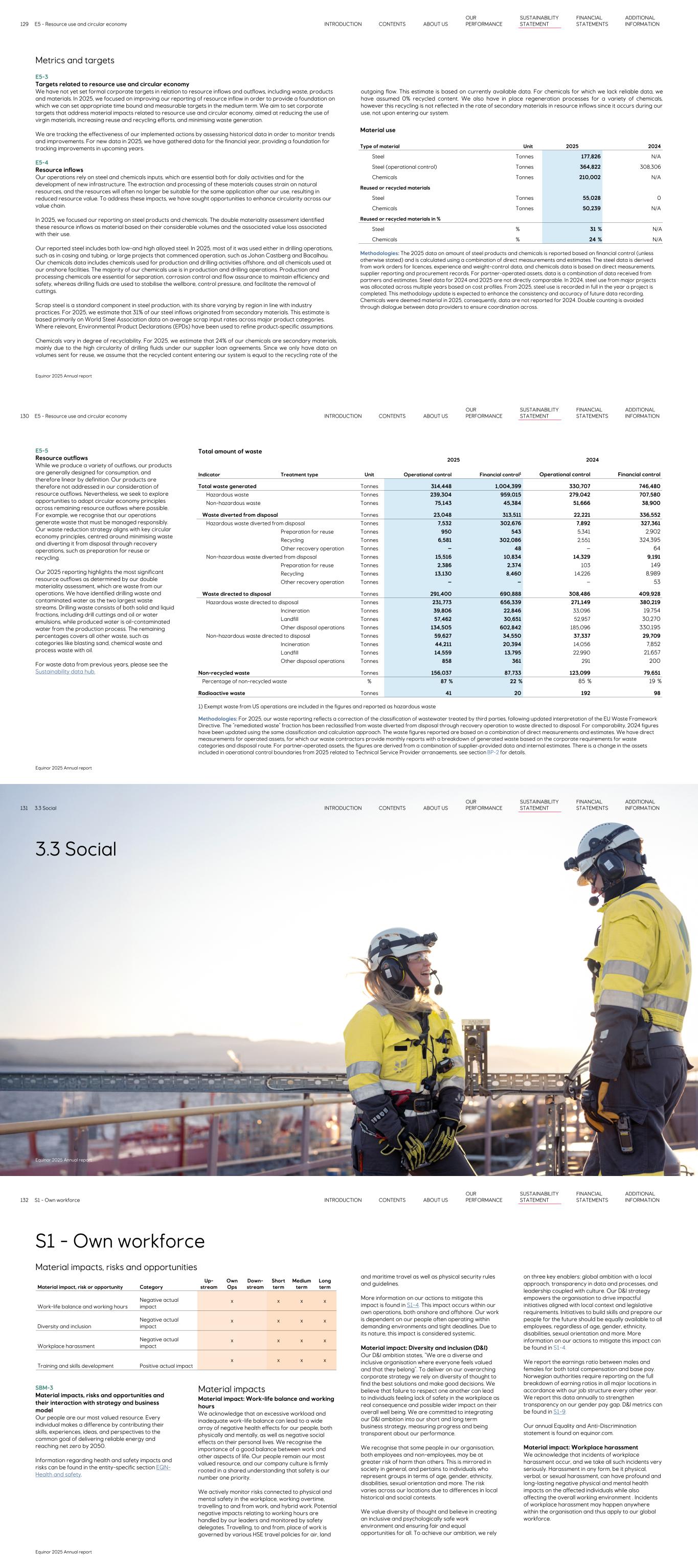
Metrics and targets E5-3 Targets related to resource use and circular economy We have not yet set formal corporate targets in relation to resource inflows and outflows, including waste, products and materials. In 2025, we focused on improving our reporting of resource inflow in order to provide a foundation on which we can set appropriate time bound and measurable targets in the medium term. We aim to set corporate targets that address material impacts related to resource use and circular economy, aimed at reducing the use of virgin materials, increasing reuse and recycling efforts, and minimising waste generation. We are tracking the effectiveness of our implemented actions by assessing historical data in order to monitor trends and improvements. For new data in 2025, we have gathered data for the financial year, providing a foundation for tracking improvements in upcoming years. E5-4 Resource inflows Our operations rely on steel and chemicals inputs, which are essential both for daily activities and for the development of new infrastructure. The extraction and processing of these materials causes strain on natural resources, and the resources will often no longer be suitable for the same application after our use, resulting in reduced resource value. To address these impacts, we have sought opportunities to enhance circularity across our value chain. In 2025, we focused our reporting on steel products and chemicals. The double materiality assessment identified these resource inflows as material based on their considerable volumes and the associated value loss associated with their use. Our reported steel includes both low-and high alloyed steel. In 2025, most of it was used either in drilling operations, such as in casing and tubing, or large projects that commenced operation, such as Johan Castberg and Bacalhau. Our chemicals data includes chemicals used for production and drilling activities offshore, and all chemicals used at our onshore facilities. The majority of our chemicals use is in production and drilling operations. Production and processing chemicals are essential for separation, corrosion control and flow assurance to maintain efficiency and safety, whereas drilling fluids are used to stabilise the wellbore, control pressure, and facilitate the removal of cuttings. Scrap steel is a standard component in steel production, with its share varying by region in line with industry practices. For 2025, we estimate that 31% of our steel inflows originated from secondary materials. This estimate is based primarily on World Steel Association data on average scrap input rates across major product categories. Where relevant, Environmental Product Declarations (EPDs) have been used to refine product-specific assumptions. Chemicals vary in degree of recyclability. For 2025, we estimate that 24% of our chemicals are secondary materials, mainly due to the high circularity of drilling fluids under our supplier loan agreements. Since we only have data on volumes sent for reuse, we assume that the recycled content entering our system is equal to the recycling rate of the outgoing flow. This estimate is based on currently available data. For chemicals for which we lack reliable data, we have assumed 0% recycled content. We also have in place regeneration processes for a variety of chemicals, however this recycling is not reflected in the rate of secondary materials in resource inflows since it occurs during our use, not upon entering our system. 129 E5 - Resource use and circular economy INTRODUCTION CONTENTS ABOUT US OUR PERFORMANCE SUSTAINABILITY STATEMENT FINANCIAL STATEMENTS ADDITIONAL INFORMATION Equinor 2025 Annual report Material use Type of material Unit 2025 2024 Steel Tonnes 177,826 N/A Steel (operational control) Tonnes 364,822 308,306 Chemicals Tonnes 210,002 N/A Reused or recycled materials Steel Tonnes 55,028 0 Chemicals Tonnes 50,239 N/A Reused or recycled materials in % Steel % 31 % N/A Chemicals % 24 % N/A Methodologies: The 2025 data on amount of steel products and chemicals is reported based on financial control (unless otherwise stated) and is calculated using a combination of direct measurements and estimates. The steel data is derived from work orders for licences, experience and weight-control data, and chemicals data is based on direct measurements, supplier reporting and procurement records. For partner-operated assets, data is a combination of data received from partners and estimates. Steel data for 2024 and 2025 are not directly comparable. In 2024, steel use from major projects was allocated across multiple years based on cost profiles. From 2025, steel use is recorded in full in the year a project is completed. This methodology update is expected to enhance the consistency and accuracy of future data recording. Chemicals were deemed material in 2025, consequently, data are not reported for 2024. Double counting is avoided through dialogue between data providers to ensure coordination across. E5-5 Resource outflows While we produce a variety of outflows, our products are generally designed for consumption, and therefore linear by definition. Our products are therefore not addressed in our consideration of resource outflows. Nevertheless, we seek to explore opportunities to adopt circular economy principles across remaining resource outflows where possible. For example, we recognise that our operations generate waste that must be managed responsibly. Our waste reduction strategy aligns with key circular economy principles, centred around minimising waste and diverting it from disposal through recovery operations, such as preparation for reuse or recycling. Our 2025 reporting highlights the most significant resource outflows as determined by our double materiality assessment, which are waste from our operations. We have identified drilling waste and contaminated water as the two largest waste streams. Drilling waste consists of both solid and liquid fractions, including drill cuttings and oil or water emulsions, while produced water is oil-contaminated water from the production process. The remaining percentages covers all other waste, such as categories like blasting sand, chemical waste and process waste with oil. For waste data from previous years, please see the Sustainability data hub. 130 E5 - Resource use and circular economy INTRODUCTION CONTENTS ABOUT US OUR PERFORMANCE SUSTAINABILITY STATEMENT FINANCIAL STATEMENTS ADDITIONAL INFORMATION Equinor 2025 Annual report Total amount of waste 2025 2024 Indicator Treatment type Unit Operational control Financial control1 Operational control Financial control Total waste generated Tonnes 314,448 1,004,399 330,707 746,480 Hazardous waste Tonnes 239,304 959,015 279,042 707,580 Non-hazardous waste Tonnes 75,143 45,384 51,666 38,900 Waste diverted from disposal Tonnes 23,048 313,511 22,221 336,552 Hazardous waste diverted from disposal Tonnes 7,532 302,676 7,892 327,361 Preparation for reuse Tonnes 950 543 5,341 2,902 Recycling Tonnes 6,581 302,086 2,551 324,395 Other recovery operation Tonnes — 48 — 64 Non-hazardous waste diverted from disposal Tonnes 15,516 10,834 14,329 9,191 Preparation for reuse Tonnes 2,386 2,374 103 149 Recycling Tonnes 13,130 8,460 14,226 8,989 Other recovery operation Tonnes — — — 53 Waste directed to disposal Tonnes 291,400 690,888 308,486 409,928 Hazardous waste directed to disposal Tonnes 231,773 656,339 271,149 380,219 Incineration Tonnes 39,806 22,846 33,096 19,754 Landfill Tonnes 57,462 30,651 52,957 30,270 Other disposal operations Tonnes 134,505 602,842 185,096 330,195 Non-hazardous waste directed to disposal Tonnes 59,627 34,550 37,337 29,709 Incineration Tonnes 44,211 20,394 14,056 7,852 Landfill Tonnes 14,559 13,795 22,990 21,657 Other disposal operations Tonnes 858 361 291 200 Non-recycled waste Tonnes 156,037 87,733 123,099 79,651 Percentage of non-recycled waste % 87 % 22 % 85 % 19 % Radioactive waste Tonnes 41 20 192 98 1) Exempt waste from US operations are included in the figures and reported as hazardous waste Methodologies: For 2025, our waste reporting reflects a correction of the classification of wastewater treated by third parties, following updated interpretation of the EU Waste Framework Directive. The “remediated waste” fraction has been reclassified from waste diverted from disposal through recovery operation to waste directed to disposal. For comparability, 2024 figures have been updated using the same classification and calculation approach. The waste figures reported are based on a combination of direct measurements and estimates. We have direct measurements for operated assets, for which our waste contractors provide monthly reports with a breakdown of generated waste based on the corporate requirements for waste categories and disposal route. For partner-operated assets, the figures are derived from a combination of supplier-provided data and internal estimates. There is a change in the assets included in operational control boundaries from 2025 related to Technical Service Provider arrangements, see section BP-2 for details. 3.3 Social 131 3.3 Social INTRODUCTION CONTENTS ABOUT US OUR PERFORMANCE SUSTAINABILITY STATEMENT FINANCIAL STATEMENTS ADDITIONAL INFORMATION Equinor 2025 Annual report S1 - Own workforce Material impacts, risks and opportunities SBM-3 Material impacts, risks and opportunities and their interaction with strategy and business model Our people are our most valued resource. Every individual makes a difference by contributing their skills, experiences, ideas, and perspectives to the common goal of delivering reliable energy and reaching net zero by 2050. Information regarding health and safety impacts and risks can be found in the entity-specific section EQN- Health and safety. Material impacts Material impact: Work-life balance and working hours We acknowledge that an excessive workload and inadequate work-life balance can lead to a wide array of negative health effects for our people, both physically and mentally, as well as negative social effects on their personal lives. We recognise the importance of a good balance between work and other aspects of life. Our people remain our most valued resource, and our company culture is firmly rooted in a shared understanding that safety is our number one priority. We actively monitor risks connected to physical and mental safety in the workplace, working overtime, travelling to and from work, and hybrid work. Potential negative impacts relating to working hours are handled by our leaders and monitored by safety delegates. Travelling, to and from, place of work is governed by various HSE travel policies for air, land and maritime travel as well as physical security rules and guidelines. More information on our actions to mitigate this impact is found in S1-4. This impact occurs within our own operations, both onshore and offshore. Our work is dependent on our people often operating within demanding environments and tight deadlines. Due to its nature, this impact is considered systemic. Material impact: Diversity and inclusion (D&I) Our D&I ambition states, “We are a diverse and inclusive organisation where everyone feels valued and that they belong”. To deliver on our overarching corporate strategy we rely on diversity of thought to find the best solutions and make good decisions. We believe that failure to respect one another can lead to individuals feeling lack of safety in the workplace as real consequence and possible wider impact on their overall well being. We are committed to integrating our D&I ambition into our short and long term business strategy, measuring progress and being transparent about our performance. We recognise that some people in our organisation, both employees and non-employees, may be at greater risk of harm than others. This is mirrored in society in general, and pertains to individuals who represent groups in terms of age, gender, ethnicity, disabilities, sexual orientation and more. The risk varies across our locations due to differences in local historical and social contexts. We value diversity of thought and believe in creating an inclusive and psychologically safe work environment and ensuring fair and equal opportunities for all. To achieve our ambition, we rely on three key enablers: global ambition with a local approach, transparency in data and processes, and leadership coupled with culture. Our D&I strategy empowers the organisation to drive impactful initiatives aligned with local context and legislative requirements. Initiatives to build skills and prepare our people for the future should be equally available to all employees, regardless of age, gender, ethnicity, disabilities, sexual orientation and more. More information on our actions to mitigate this impact can be found in S1-4. We report the earnings ratio between males and females for both total compensation and base pay. Norwegian authorities require reporting on the full breakdown of earning ratios in all major locations in accordance with our job structure every other year. We report this data annually to strengthen transparency on our gender pay gap. D&I metrics can be found in S1-9. Our annual Equality and Anti-Discrimination statement is found on equinor.com. Material impact: Workplace harassment We acknowledge that incidents of workplace harassment occur, and we take all such incidents very seriously. Harassment in any form, be it physical, verbal, or sexual harassment, can have profound and long-lasting negative physical and mental health impacts on the affected individuals while also affecting the overall working environment . Incidents of workplace harassment may happen anywhere within the organisation and thus apply to our global workforce. 132 S1 - Own workforce INTRODUCTION CONTENTS ABOUT US OUR PERFORMANCE SUSTAINABILITY STATEMENT FINANCIAL STATEMENTS ADDITIONAL INFORMATION Equinor 2025 Annual report Material impact, risk or opportunity Category Up- stream Own Ops Down- stream Short term Medium term Long term Work-life balance and working hours Negative actual impact x x x x Diversity and inclusion Negative actual impact x x x x Workplace harassment Negative actual impact x x x x Training and skills development Positive actual impact x x x x
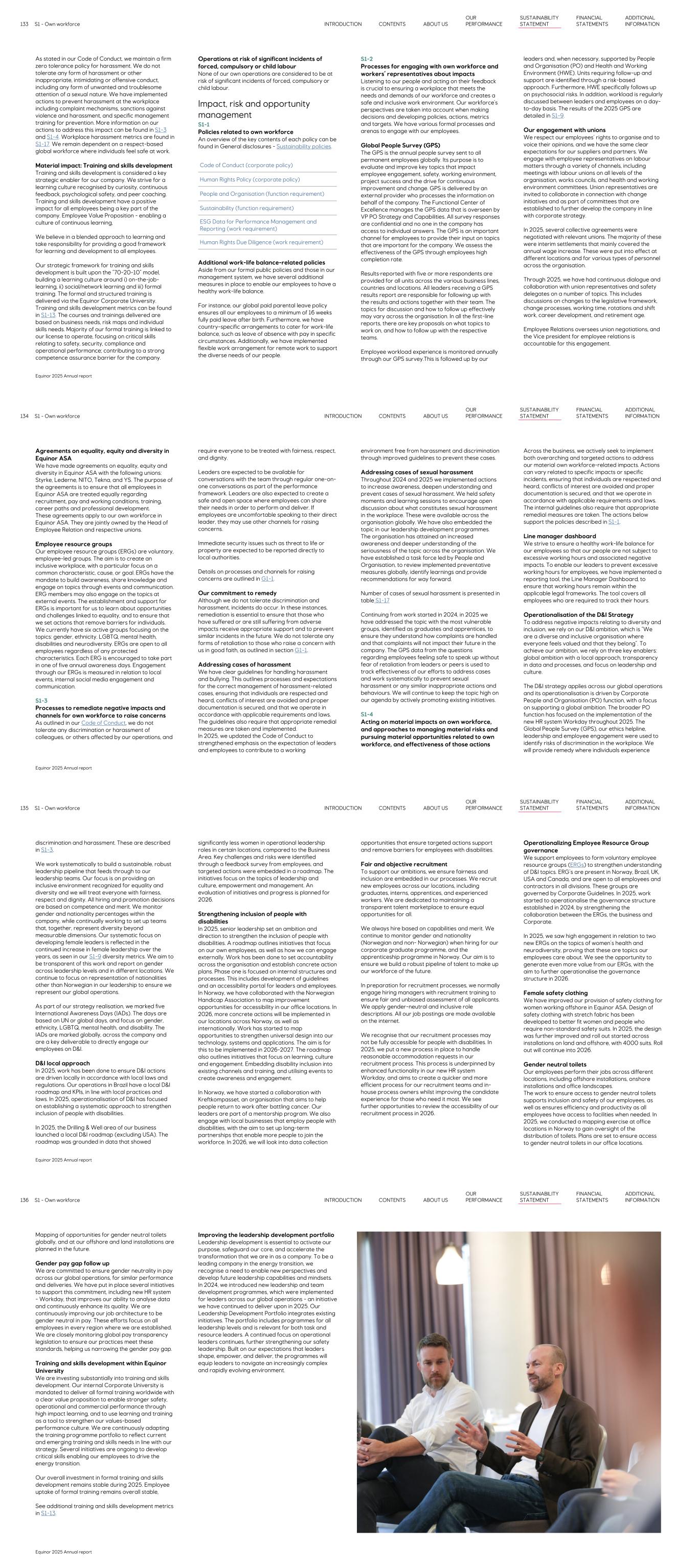
As stated in our Code of Conduct, we maintain a firm zero tolerance policy for harassment. We do not tolerate any form of harassment or other inappropriate, intimidating or offensive conduct, including any form of unwanted and troublesome attention of a sexual nature. We have implemented actions to prevent harassment at the workplace including complaint mechanisms, sanctions against violence and harassment, and specific management training for prevention. More information on our actions to address this impact can be found in S1-3 and S1-4. Workplace harassment metrics are found in S1-17. We remain dependent on a respect-based global workforce where individuals feel safe at work. Material impact: Training and skills development Training and skills development is considered a key strategic enabler for our company. We strive for a learning culture recognised by curiosity, continuous feedback, psychological safety, and peer coaching. Training and skills development have a positive impact for all employees being a key part of the company. Employee Value Proposition - enabling a culture of continuous learning, We believe in a blended approach to learning and take responsibility for providing a good framework for learning and development to all employees. Our strategic framework for training and skills development is built upon the “70-20-10” model, building a learning culture around i) on-the-job- learning, ii) social/network learning and iii) formal training. The formal and structured training is delivered via the Equinor Corporate University. Training and skills development metrics can be found in S1-13. The courses and trainings delivered are based on business needs, risk maps and individual skills needs. Majority of our formal training is linked to our license to operate, focusing on critical skills relating to safety, security, compliance and operational performance; contributing to a strong competence assurance barrier for the company. Operations at risk of significant incidents of forced, compulsory or child labour None of our own operations are considered to be at risk of significant incidents of forced, compulsory or child labour. Impact, risk and opportunity management S1-1 Policies related to own workforce An overview of the key contents of each policy can be found in General disclosures - Sustainability policies. Code of Conduct (corporate policy) Human Rights Policy (corporate policy) People and Organisation (function requirement) Sustainability (function requirement) ESG Data for Performance Management and Reporting (work requirement) Human Rights Due Diligence (work requirement) Additional work-life balance-related policies Aside from our formal public policies and those in our management system, we have several additional measures in place to enable our employees to have a healthy work-life balance. For instance, our global paid parental leave policy ensures all our employees to a minimum of 16 weeks fully paid leave after birth. Furthermore, we have country-specific arrangements to cater for work-life balance, such as leave of absence with pay in specific circumstances. Additionally, we have implemented flexible work arrangement for remote work to support the diverse needs of our people. S1-2 Processes for engaging with own workforce and workers’ representatives about impacts Listening to our people and acting on their feedback is crucial to ensuring a workplace that meets the needs and demands of our workforce and creates a safe and inclusive work environment. Our workforce’s perspectives are taken into account when making decisions and developing policies, actions, metrics and targets. We have various formal processes and arenas to engage with our employees. Global People Survey (GPS) The GPS is the annual people survey sent to all permanent employees globally. Its purpose is to evaluate and improve key topics that impact employee engagement, safety, working environment, project success and the drive for continuous improvement and change. GPS is delivered by an external provider who processes the information on behalf of the company. The Functional Center of Excellence manages the GPS data that is overseen by VP PO Strategy and Capabilities. All survey responses are confidential and no one in the company has access to individual answers. The GPS is an important channel for employees to provide their input on topics that are important for the company. We assess the effectiveness of the GPS through employees high completion rate. Results reported with five or more respondents are provided for all units across the various business lines, countries and locations. All leaders receiving a GPS results report are responsible for following up with the results and actions together with their team. The topics for discussion and how to follow up effectively may vary across the organisation. In all the first-line reports, there are key proposals on what topics to work on, and how to follow up with the respective teams. Employee workload experience is monitored annually through our GPS survey.This is followed up by our leaders and, when necessary, supported by People and Organisation (PO) and Health and Working Environment (HWE). Units requiring follow-up and support are identified through a risk-based approach. Furthermore, HWE specifically follows up on psychosocial risks. In addition, workload is regularly discussed between leaders and employees on a day- to-day basis. The results of the 2025 GPS are detailed in S1-9. Our engagement with unions We respect our employees’ rights to organise and to voice their opinions, and we have the same clear expectations for our suppliers and partners. We engage with employee representatives on labour matters through a variety of channels, including meetings with labour unions on all levels of the organisation, works councils, and health and working environment committees. Union representatives are invited to collaborate in connection with change initiatives and as part of committees that are established to further develop the company in line with corporate strategy. In 2025, several collective agreements were negotiated with relevant unions. The majority of these were interim settlements that mainly covered the annual wage increase. These were put into effect at different locations and for various types of personnel across the organisation. Through 2025, we have had continuous dialogue and collaboration with union representatives and safety delegates on a number of topics. This includes discussions on changes to the legislative framework, change processes, working time, rotations and shift work, career development, and retirement age. Employee Relations oversees union negotiations, and the Vice president for employee relations is accountable for this engagement. 133 S1 - Own workforce INTRODUCTION CONTENTS ABOUT US OUR PERFORMANCE SUSTAINABILITY STATEMENT FINANCIAL STATEMENTS ADDITIONAL INFORMATION Equinor 2025 Annual report Agreements on equality, equity and diversity in Equinor ASA We have made agreements on equality, equity and diversity in Equinor ASA with the following unions: Styrke, Lederne, NITO, Tekna, and YS. The purpose of the agreements is to ensure that all employees in Equinor ASA are treated equally regarding recruitment, pay and working conditions, training, career paths and professional development. These agreements apply to our own workforce in Equinor ASA. They are jointly owned by the Head of Employee Relation and respective unions. Employee resource groups Our employee resource groups (ERGs) are voluntary, employee-led groups. The aim is to create an inclusive workplace, with a particular focus on a common characteristic, cause, or goal. ERGs have the mandate to build awareness, share knowledge and engage on topics through events and communication. ERG members may also engage on the topics at external events. The establishment and support for ERGs is important for us to learn about opportunities and challenges linked to equality, and to ensure that we set actions that remove barriers for individuals. We currently have six active groups focusing on the topics: gender, ethnicity. LGBTQ, mental health, disabilities and neurodiversity. ERGs are open to all employees regardless of any protected characteristics. Each ERG is encouraged to take part in one of five annual awareness days. Engagement through our ERGs is measured in relation to local events, internal social media engagement and communication. S1-3 Processes to remediate negative impacts and channels for own workforce to raise concerns As outlined in our Code of Conduct, we do not tolerate any discrimination or harassment of colleagues, or others affected by our operations, and require everyone to be treated with fairness, respect, and dignity. Leaders are expected to be available for conversations with the team through regular one-on- one conversations as part of the performance framework. Leaders are also expected to create a safe and open space where employees can share their needs in order to perform and deliver. If employees are uncomfortable speaking to their direct leader, they may use other channels for raising concerns. Immediate security issues such as threat to life or property are expected to be reported directly to local authorities. Details on processes and channels for raising concerns are outlined in G1-1. Our commitment to remedy Although we do not tolerate discrimination and harassment, incidents do occur. In these instances, remediation is essential to ensure that those who have suffered or are still suffering from adverse impacts receive appropriate support and to prevent similar incidents in the future. We do not tolerate any forms of retaliation to those who raise a concern with us in good faith, as outlined in section G1-1. Addressing cases of harassment We have clear guidelines for handling harassment and bullying. This outlines processes and expectations for the correct management of harassment-related cases, ensuring that individuals are respected and heard, conflicts of interest are avoided and proper documentation is secured, and that we operate in accordance with applicable requirements and laws. The guidelines also require that appropriate remedial measures are taken and implemented. In 2025, we updated the Code of Conduct to strengthened emphasis on the expectation of leaders and employees to contribute to a working environment free from harassment and discrimination through improved guidelines to prevent these cases. Addressing cases of sexual harassment Throughout 2024 and 2025 we implemented actions to increase awareness, deepen understanding and prevent cases of sexual harassment. We held safety moments and learning sessions to encourage open discussion about what constitutes sexual harassment in the workplace. These were available across the organisation globally. We have also embedded the topic in our leadership development programmes. The organisation has attained an increased awareness and deeper understanding of the seriousness of the topic across the organisation. We have established a task force led by People and Organisation, to review implemented preventative measures globally, identify learnings and provide recommendations for way forward. Number of cases of sexual harassment is presented in table S1-17 Continuing from work started in 2024, in 2025 we have addressed the topic with the most vulnerable groups, identified as graduates and apprentices, to ensure they understand how complaints are handled and that complaints will not impact their future in the company. The GPS data from the questions regarding employees feeling safe to speak up without fear of retaliation from leaders or peers is used to track effectiveness of our efforts to address cases and work systematically to prevent sexual harassment or any similar inappropriate actions and behaviours. We will continue to keep the topic high on our agenda by actively promoting existing initiatives. S1-4 Acting on material impacts on own workforce, and approaches to managing material risks and pursuing material opportunities related to own workforce, and effectiveness of those actions Across the business, we actively seek to implement both overarching and targeted actions to address our material own workforce-related impacts. Actions can vary related to specific impacts or specific incidents, ensuring that individuals are respected and heard, conflicts of interest are avoided and proper documentation is secured, and that we operate in accordance with applicable requirements and laws. The internal guidelines also require that appropriate remedial measures are taken. The actions below support the policies described in S1-1. Line manager dashboard We strive to ensure a healthy work-life balance for our employees so that our people are not subject to excessive working hours and associated negative impacts. To enable our leaders to prevent excessive working hours for employees, we have implemented a reporting tool, the Line Manager Dashboard, to ensure that working hours remain within the applicable legal frameworks. The tool covers all employees who are required to track their hours. Operationalisation of the D&I Strategy To address negative impacts relating to diversity and inclusion, we rely on our D&I ambition, which is “We are a diverse and inclusive organisation where everyone feels valued and that they belong”. To achieve our ambition, we rely on three key enablers: global ambition with a local approach, transparency in data and processes, and focus on leadership and culture. The D&I strategy applies across our global operations and its operationalisation is driven by Corporate People and Organisation (PO) function, with a focus on supporting a global ambition. The broader PO function has focused on the implementation of the new HR system Workday throughout 2025. The Global People Survey (GPS), our ethics helpline, leadership and employee engagement were used to identify risks of discrimination in the workplace. We will provide remedy where individuals experience 134 S1 - Own workforce INTRODUCTION CONTENTS ABOUT US OUR PERFORMANCE SUSTAINABILITY STATEMENT FINANCIAL STATEMENTS ADDITIONAL INFORMATION Equinor 2025 Annual report discrimination and harassment. These are described in S1-3. We work systematically to build a sustainable, robust leadership pipeline that feeds through to our leadership teams. Our focus is on providing an inclusive environment recognized for equality and diversity and we will treat everyone with fairness, respect and dignity. All hiring and promotion decisions are based on competence and merit. We monitor gender and nationality percentages within the company, while continually working to set up teams that, together, represent diversity beyond measurable dimensions. Our systematic focus on developing female leaders is reflected in the continued increase in female leadership over the years, as seen in our S1-9 diversity metrics. We aim to be transparent of this work and report on gender across leadership levels and in different locations. We continue to focus on representation of nationalities other than Norwegian in our leadership to ensure we represent our global operations. As part of our strategy realisation, we marked five International Awareness Days (IADs). The days are based on UN or global days, and focus on gender, ethnicity, LGBTQ, mental health, and disability. The IADs are marked globally, across the company and are a key deliverable to directly engage our employees on D&I. D&I local approach In 2025, work has been done to ensure D&I actions are driven locally in accordance with local laws and regulations. Our operations in Brazil have a local D&I roadmap and KPIs, in line with local practices and laws. In 2025, operationalisation of D&I has focused on establishing a systematic approach to strengthen inclusion of people with disabilities. In 2025, the Drilling & Well area of our business launched a local D&I roadmap (excluding USA). The roadmap was grounded in data that showed significantly less women in operational leadership roles in certain locations, compared to the Business Area. Key challenges and risks were identified through a feedback survey from employees, and targeted actions were embedded in a roadmap. The initiatives focus on the topics of leadership and culture, empowerment and management. An evaluation of initiatives and progress is planned for 2026. Strengthening inclusion of people with disabilities In 2025, senior leadership set an ambition and direction to strengthen the inclusion of people with disabilities. A roadmap outlines initiatives that focus on our own employees, as well as how we can engage externally. Work has been done to set accountability across the organisation and establish concrete action plans. Phase one is focused on internal structures and processes. This includes development of guidelines and an accessibility portal for leaders and employees. In Norway, we have collaborated with the Norwegian Handicap Association to map improvement opportunities for accessibility in our office locations. In 2026, more concrete actions will be implemented in our locations across Norway, as well as internationally. Work has started to map opportunities to strengthen universal design into our technology, systems and applications. The aim is for this to be implemented in 2026-2027. The roadmap also outlines initiatives that focus on learning, culture and engagement. Embedding disability inclusion into existing channels and training, and utilising events to create awareness and engagement. In Norway, we have started a collaboration with Kreftkompasset, an organisation that aims to help people return to work after battling cancer. Our leaders are part of a mentorship program. We also engage with local businesses that employ people with disabilities, with the aim to set up long-term partnerships that enable more people to join the workforce. In 2026, we will look into data collection opportunities that ensure targeted actions support and remove barriers for employees with disabilities. Fair and objective recruitment To support our ambitions, we ensure fairness and inclusion are embedded in our processes. We recruit new employees across our locations, including graduates, interns, apprentices, and experienced workers. We are dedicated to maintaining a transparent talent marketplace to ensure equal opportunities for all. We always hire based on capabilities and merit. We continue to monitor gender and nationality (Norwegian and non- Norwegian) when hiring for our corporate graduate programme, and the apprenticeship programme in Norway. Our aim is to ensure we build a robust pipeline of talent to make up our workforce of the future. In preparation for recruitment processes, we normally engage hiring managers with recruitment training to ensure fair and unbiased assessment of all applicants. We apply gender-neutral and inclusive role descriptions. All our job postings are made available on the internet. We recognise that our recruitment processes may not be fully accessible for people with disabilities. In 2025, we put a new process in place to handle reasonable accommodation requests in our recruitment process. This process is underpinned by enhanced functionality in our new HR system Workday, and aims to create a quicker and more efficient process for our recruitment teams and in- house process owners whilst improving the candidate experience for those who need it most. We see further opportunities to review the accessibility of our recruitment process in 2026. Operationalizing Employee Resource Group governance We support employees to form voluntary employee resource groups (ERGs) to strengthen understanding of D&I topics. ERG’s are present in Norway, Brazil, UK, USA and Canada, and are open to all employees and contractors in all divisions. These groups are governed by Corporate Guidelines. In 2025, work started to operationalise the governance structure established in 2024, by strengthening the collaboration between the ERGs, the business and Corporate. In 2025, we saw high engagement in relation to two new ERGs on the topics of women’s health and neurodiversity, proving that these are topics our employees care about. We see the opportunity to generate even more value from our ERGs, with the aim to further operationalise the governance structure in 2026. Female safety clothing We have improved our provision of safety clothing for women working offshore in Equinor ASA. Design of safety clothing with stretch fabric has been developed to better fit women and people who require non-standard safety suits. In 2025, the design was further improved and roll out started across installations on land and offshore, with 4000 suits. Roll out will continue into 2026. Gender neutral toilets Our employees perform their jobs across different locations, including offshore installations, onshore installations and office landscapes. The work to ensure access to gender neutral toilets supports inclusion and safety of our employees, as well as ensures efficiency and productivity as all employees have access to facilities when needed. In 2025, we conducted a mapping exercise at office locations in Norway to gain oversight of the distribution of toilets. Plans are set to ensure access to gender neutral toilets in our office locations. 135 S1 - Own workforce INTRODUCTION CONTENTS ABOUT US OUR PERFORMANCE SUSTAINABILITY STATEMENT FINANCIAL STATEMENTS ADDITIONAL INFORMATION Equinor 2025 Annual report Mapping of opportunities for gender neutral toilets globally, and at our offshore and land installations are planned in the future. Gender pay gap follow up We are committed to ensure gender neutrality in pay across our global operations, for similar performance and deliveries. We have put in place several initiatives to support this commitment, including new HR system - Workday, that improves our ability to analyse data and continuously enhance its quality. We are continuously improving our job architecture to be gender neutral in pay. These efforts focus on all employees in every region where we are established. We are closely monitoring global pay transparency legislation to ensure our practices meet these standards, helping us narrowing the gender pay gap. Training and skills development within Equinor University We are investing substantially into training and skills development. Our internal Corporate University is mandated to deliver all formal training worldwide with a clear value proposition to enable stronger safety, operational and commercial performance through high impact learning, and to use learning and training as a tool to strengthen our values-based performance culture. We are continuously adapting the training programme portfolio to reflect current and emerging training and skills needs in line with our strategy. Several initiatives are ongoing to develop critical skills enabling our employees to drive the energy transition. Our overall investment in formal training and skills development remains stable during 2025. Employee uptake of formal training remains overall stable, See additional training and skills development metrics in S1-13. Improving the leadership development portfolio Leadership development is essential to activate our purpose, safeguard our core, and accelerate the transformation that we are in as a company. To be a leading company in the energy transition, we recognise a need to enable new perspectives and develop future leadership capabilities and mindsets. In 2024, we introduced new leadership and team development programmes, which were implemented for leaders across our global operations - an initiative we have continued to deliver upon in 2025. Our Leadership Development Portfolio integrates existing initiatives. The portfolio includes programmes for all leadership levels and is relevant for both task and resource leaders. A continued focus on operational leaders continues, further strengthening our safety leadership. Built on our expectations that leaders shape, empower, and deliver, the programmes will equip leaders to navigate an increasingly complex and rapidly evolving environment. 136 S1 - Own workforce INTRODUCTION CONTENTS ABOUT US OUR PERFORMANCE SUSTAINABILITY STATEMENT FINANCIAL STATEMENTS ADDITIONAL INFORMATION Equinor 2025 Annual report
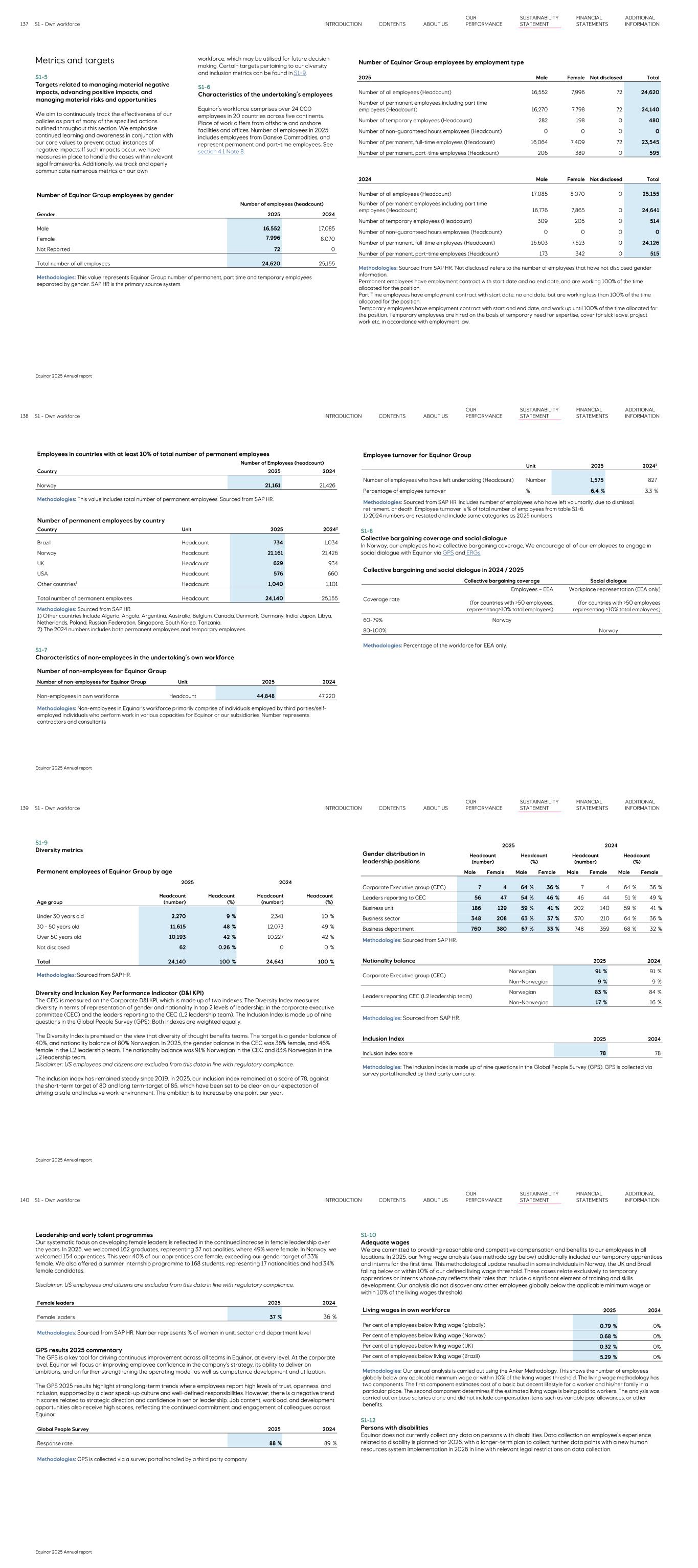
Metrics and targets S1-5 Targets related to managing material negative impacts, advancing positive impacts, and managing material risks and opportunities We aim to continuously track the effectiveness of our policies as part of many of the specified actions outlined throughout this section. We emphasise continued learning and awareness in conjunction with our core values to prevent actual instances of negative impacts. If such impacts occur, we have measures in place to handle the cases within relevant legal frameworks. Additionally, we track and openly communicate numerous metrics on our own workforce, which may be utilised for future decision making. Certain targets pertaining to our diversity and inclusion metrics can be found in S1-9. S1-6 Characteristics of the undertaking’s employees Equinor’s workforce comprises over 24 000 employees in 20 countries across five continents. Place of work differs from offshore and onshore facilities and offices. Number of employees in 2025 includes employees from Danske Commodities, and represent permanent and part-time employees. See section 4.1 Note 8. 137 S1 - Own workforce INTRODUCTION CONTENTS ABOUT US OUR PERFORMANCE SUSTAINABILITY STATEMENT FINANCIAL STATEMENTS ADDITIONAL INFORMATION Equinor 2025 Annual report Number of Equinor Group employees by gender Number of employees (headcount) Gender 2025 2024 Male 16,552 17,085 Female 7,996 8,070 Not Reported 72 0 Total number of all employees 24,620 25,155 Methodologies: This value represents Equinor Group number of permanent, part time and temporary employees separated by gender. SAP HR is the primary source system. Number of Equinor Group employees by employment type 2025 Male Female Not disclosed Total Number of all employees (Headcount) 16,552 7,996 72 24,620 Number of permanent employees including part time employees (Headcount) 16,270 7,798 72 24,140 Number of temporary employees (Headcount) 282 198 0 480 Number of non-guaranteed hours employees (Headcount) 0 0 0 0 Number of permanent, full-time employees (Headcount) 16,064 7,409 72 23,545 Number of permanent, part-time employees (Headcount) 206 389 0 595 2024 Male Female Not disclosed Total Number of all employees (Headcount) 17,085 8,070 0 25,155 Number of permanent employees including part time employees (Headcount) 16,776 7,865 0 24,641 Number of temporary employees (Headcount) 309 205 0 514 Number of non-guaranteed hours employees (Headcount) 0 0 0 0 Number of permanent, full-time employees (Headcount) 16,603 7,523 0 24,126 Number of permanent, part-time employees (Headcount) 173 342 0 515 Methodologies: Sourced from SAP HR. ‘Not disclosed’ refers to the number of employees that have not disclosed gender information. Permanent employees have employment contract with start date and no end date, and are working 100% of the time allocated for the position. Part Time employees have employment contract with start date, no end date, but are working less than 100% of the time allocated for the position. Temporary employees have employment contract with start and end date, and work up until 100% of the time allocated for the position. Temporary employees are hired on the basis of temporary need for expertise, cover for sick leave, project work etc, in accordance with employment law. Employees in countries with at least 10% of total number of permanent employees Number of Employees (headcount) Country 2025 2024 Norway 21,161 21,426 Methodologies: This value includes total number of permanent employees. Sourced from SAP HR. S1-7 Characteristics of non-employees in the undertaking’s own workforce Number of non-employees for Equinor Group Number of non-employees for Equinor Group Unit 2025 2024 Non-employees in own workforce Headcount 44,848 47,220 Methodologies: Non-employees in Equinor's workforce primarily comprise of individuals employed by third parties/self- employed individuals who perform work in various capacities for Equinor or our subsidiaries. Number represents contractors and consultants S1-8 Collective bargaining coverage and social dialogue In Norway, our employees have collective bargaining coverage, We encourage all of our employees to engage in social dialogue with Equinor via GPS and ERGs. 138 S1 - Own workforce INTRODUCTION CONTENTS ABOUT US OUR PERFORMANCE SUSTAINABILITY STATEMENT FINANCIAL STATEMENTS ADDITIONAL INFORMATION Equinor 2025 Annual report Employee turnover for Equinor Group Unit 2025 20241 Number of employees who have left undertaking (Headcount) Number 1,575 827 Percentage of employee turnover % 6.4 % 3.3 % Methodologies: Sourced from SAP HR. Includes number of employees who have left voluntarily, due to dismissal, retirement, or death. Employee turnover is % of total number of employees from table S1-6. 1) 2024 numbers are restated and include same categories as 2025 numbers Collective bargaining and social dialogue in 2024 / 2025 Collective bargaining coverage Social dialogue Coverage rate Employees – EEA (for countries with >50 employees, representing>10% total employees) Workplace representation (EEA only) (for countries with >50 employees representing >10% total employees) 60-79% Norway 80-100% Norway Methodologies: Percentage of the workforce for EEA only. Number of permanent employees by country Country Unit 2025 20242 Brazil Headcount 734 1,034 Norway Headcount 21,161 21,426 UK Headcount 629 934 USA Headcount 576 660 Other countries1 Headcount 1,040 1,101 Total number of permanent employees Headcount 24,140 25,155 Methodologies: Sourced from SAP HR. 1) Other countries Include Algeria, Angola, Argentina, Australia, Belgium, Canada, Denmark, Germany, India, Japan, Libya, Netherlands, Poland, Russian Federation, Singapore, South Korea, Tanzania. 2) The 2024 numbers includes both permanent employees and temporary employees. S1-9 Diversity metrics Diversity and Inclusion Key Performance Indicator (D&I KPI) The CEO is measured on the Corporate D&I KPI, which is made up of two indexes. The Diversity Index measures diversity in terms of representation of gender and nationality in top 2 levels of leadership, in the corporate executive committee (CEC) and the leaders reporting to the CEC (L2 leadership team). The Inclusion Index is made up of nine questions in the Global People Survey (GPS). Both indexes are weighted equally. The Diversity Index is premised on the view that diversity of thought benefits teams. The target is a gender balance of 40%, and nationality balance of 80% Norwegian. In 2025, the gender balance in the CEC was 36% female, and 46% female in the L2 leadership team. The nationality balance was 91% Norwegian in the CEC and 83% Norwegian in the L2 leadership team. Disclaimer: US employees and citizens are excluded from this data in line with regulatory compliance. The inclusion index has remained steady since 2019. In 2025, our inclusion index remained at a score of 78, against the short-term target of 80 and long term-target of 85, which have been set to be clear on our expectation of driving a safe and inclusive work-environment. The ambition is to increase by one point per year. Corporate Executive group (CEC) 7 4 64 % 36 % 7 4 64 % 36 % Leaders reporting to CEC 56 47 54 % 46 % 46 44 51 % 49 % Business unit 186 129 59 % 41 % 202 140 59 % 41 % Business sector 348 208 63 % 37 % 370 210 64 % 36 % Business department 760 380 67 % 33 % 748 359 68 % 32 % Methodologies: Sourced from SAP HR. Gender distribution in leadership positions 2025 2024 Headcount (number) Headcount (%) Headcount (number) Headcount (%) Male Female Male Female Male Female Male Female Corporate Executive group (CEC) Norwegian 91 % 91 % Non-Norwegian 9 % 9 % Leaders reporting CEC (L2 leadership team) Norwegian 83 % 84 % Non-Norwegian 17 % 16 % Methodologies: Sourced from SAP HR. Nationality balance 2025 2024 Inclusion index score 78 78 Methodologies: The inclusion index is made up of nine questions in the Global People Survey (GPS). GPS is collected via survey portal handled by third party company. Inclusion Index 2025 2024 139 S1 - Own workforce INTRODUCTION CONTENTS ABOUT US OUR PERFORMANCE SUSTAINABILITY STATEMENT FINANCIAL STATEMENTS ADDITIONAL INFORMATION Equinor 2025 Annual report Permanent employees of Equinor Group by age 2025 2024 Age group Headcount (number) Headcount (%) Headcount (number) Headcount (%) Under 30 years old 2,270 9 % 2,341 10 % 30 - 50 years old 11,615 48 % 12,073 49 % Over 50 years old 10,193 42 % 10,227 42 % Not disclosed 62 0.26 % 0 0 % Total 24,140 100 % 24,641 100 % Methodologies: Sourced from SAP HR. Leadership and early talent programmes Our systematic focus on developing female leaders is reflected in the continued increase in female leadership over the years. In 2025, we welcomed 162 graduates, representing 37 nationalities, where 49% were female. In Norway, we welcomed 154 apprentices. This year 40% of our apprentices are female, exceeding our gender target of 33% female. We also offered a summer internship programme to 168 students, representing 17 nationalities and had 34% female candidates. Disclaimer: US employees and citizens are excluded from this data in line with regulatory compliance. Female leaders 2025 2024 Female leaders 37 % 36 % Methodologies: Sourced from SAP HR. Number represents % of women in unit, sector and department level GPS results 2025 commentary The GPS is a key tool for driving continuous improvement across all teams in Equinor, at every level. At the corporate level, Equinor will focus on improving employee confidence in the company's strategy, its ability to deliver on ambitions, and on further strengthening the operating model, as well as competence development and utilization. The GPS 2025 results highlight strong long-term trends where employees report high levels of trust, openness, and inclusion, supported by a clear speak-up culture and well-defined responsibilities. However, there is a negative trend in scores related to strategic direction and confidence in senior leadership. Job content, workload, and development opportunities also receive high scores, reflecting the continued commitment and engagement of colleagues across Equinor. Response rate 88 % 89 % Methodologies: GPS is collected via a survey portal handled by a third party company Global People Survey 2025 2024 S1-10 Adequate wages We are committed to providing reasonable and competitive compensation and benefits to our employees in all locations. In 2025, our living wage analysis (see methodology below) additionally included our temporary apprentices and interns for the first time. This methodological update resulted in some individuals in Norway, the UK and Brazil falling below or within 10% of our defined living wage threshold. These cases relate exclusively to temporary apprentices or interns whose pay reflects their roles that include a significant element of training and skills development. Our analysis did not discover any other employees globally below the applicable minimum wage or within 10% of the living wages threshold. Per cent of employees below living wage (globally) 0.79 % 0% Per cent of employees below living wage (Norway) 0.68 % 0% Per cent of employees below living wage (UK) 0.32 % 0% Per cent of employees below living wage (Brazil) 5.29 % 0% Methodologies: Our annual analysis is carried out using the Anker Methodology. This shows the number of employees globally below any applicable minimum wage or within 10% of the living wages threshold. The living wage methodology has two components. The first component estimates cost of a basic but decent lifestyle for a worker and his/her family in a particular place. The second component determines if the estimated living wage is being paid to workers. The analysis was carried out on base salaries alone and did not include compensation items such as variable pay, allowances, or other benefits. Living wages in own workforce 2025 2024 S1-12 Persons with disabilities Equinor does not currently collect any data on persons with disabilities. Data collection on employee’s experience related to disability is planned for 2026, with a longer-term plan to collect further data points with a new human resources system implementation in 2026 in line with relevant legal restrictions on data collection. 140 S1 - Own workforce INTRODUCTION CONTENTS ABOUT US OUR PERFORMANCE SUSTAINABILITY STATEMENT FINANCIAL STATEMENTS ADDITIONAL INFORMATION Equinor 2025 Annual report
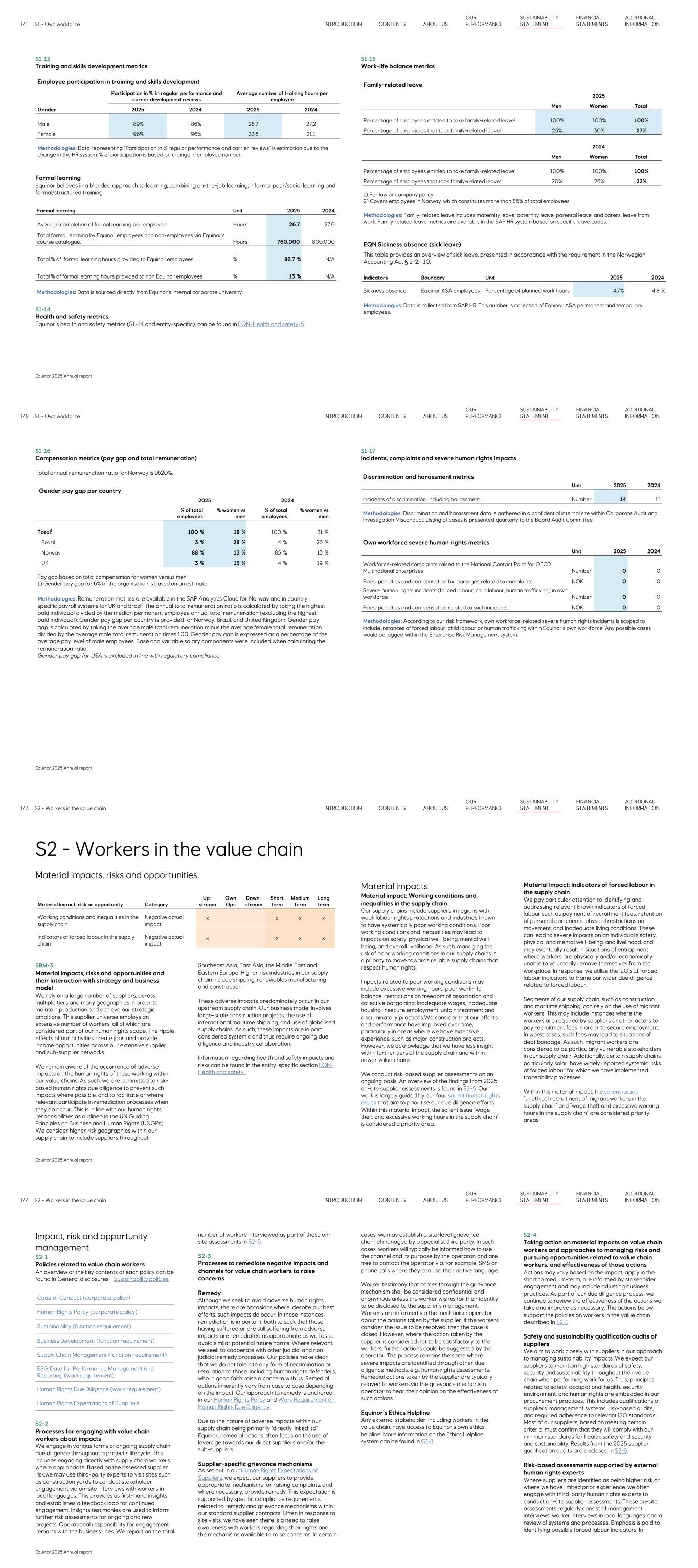
S1-13 Training and skills development metrics Formal learning Equinor believes in a blended approach to learning, combining on-the-job learning, informal peer/social learning and formal/structured training. Average completion of formal learning per employee Hours 26.7 27.0 Total formal learning by Equinor employees and non-employees via Equinor's course catalogue. Hours 760,000 800,000 Total % of formal learning hours provided to Equinor employees % 86.7 % N/A Total % of formal learning hours provided to non Equinor employees % 13 % N/A Methodologies: Data is sourced directly from Equinor’s internal corporate university. Formal learning Unit 2025 2024 S1-14 Health and safety metrics Equinor’s health and safety metrics (S1-14 and entity-specific), can be found in EQN-Health and safety-5. S1-15 Work-life balance metrics 141 S1 - Own workforce INTRODUCTION CONTENTS ABOUT US OUR PERFORMANCE SUSTAINABILITY STATEMENT FINANCIAL STATEMENTS ADDITIONAL INFORMATION Equinor 2025 Annual report Family-related leave 2025 Men Women Total Percentage of employees entitled to take family-related leave1 100% 100% 100% Percentage of employees that took family-related leave2 25% 30% 27% 2024 Men Women Total Percentage of employees entitled to take family-related leave1 100% 100% 100% Percentage of employees that took family-related leave2 20% 26% 22% 1) Per law or company policy 2) Covers employees in Norway, which constitutes more than 85% of total employees Methodologies: Family-related leave includes maternity leave, paternity leave, parental leave, and carers’ leave from work. Family related leave metrics are available in the SAP HR system based on specific leave codes. Employee participation in training and skills development Participation in % in regular performance and career development reviews Average number of training hours per employee Gender 2025 2024 2025 2024 Male 89% 86% 28.7 27.2 Female 96% 96% 22.6 21.1 Methodologies: Data representing “Participation in % regular performance and carrier reviews” is estimation due to the change in the HR system. % of participation is based on change in employee number. EQN Sickness absence (sick leave) This table provides an overview of sick leave, presented in accordance with the requirement in the Norwegian Accounting Act § 2-2,- 10. Indicators Boundary Unit 2025 2024 Sickness absence Equinor ASA employees Percentage of planned work hours 4,7% 4.8 % Methodologies: Data is collected from SAP HR. This number is collection of Equinor ASA permanent and temporary employees. S1-16 Compensation metrics (pay gap and total remuneration) Total annual remuneration ratio for Norway is 1620%. S1-17 Incidents, complaints and severe human rights impacts 142 S1 - Own workforce INTRODUCTION CONTENTS ABOUT US OUR PERFORMANCE SUSTAINABILITY STATEMENT FINANCIAL STATEMENTS ADDITIONAL INFORMATION Equinor 2025 Annual report Gender pay gap per country 2025 2024 % of total employees % women vs men % of total employees % women vs men Total1 100 % 18 % 100 % 21 % Brazil 3 % 28 % 4 % 26 % Norway 88 % 13 % 85 % 13 % UK 3 % 13 % 4 % 19 % Pay gap based on total compensation for women versus men. 1) Gender pay gap for 6% of the organisation is based on an estimate. Methodologies: Remuneration metrics are available in the SAP Analytics Cloud for Norway and in country specific payroll systems for UK and Brazil. The annual total remuneration ratio is calculated by taking the highest paid individual divided by the median permanent employee annual total remuneration (excluding the highest- paid individual). Gender pay gap per country is provided for Norway, Brazil, and United Kingdom. Gender pay gap is calculated by taking the average male total remuneration minus the average female total remuneration divided by the average male total remuneration times 100. Gender pay gap is expressed as a percentage of the average pay level of male employees. Base and variable salary components were included when calculating the remuneration ratio. Gender pay gap for USA is excluded in line with regulatory compliance Discrimination and harassment metrics Unit 2025 2024 Incidents of discrimination, including harassment Number 14 11 Methodologies: Discrimination and harassment data is gathered in a confidential internal site within Corporate Audit and Investigation Misconduct. Listing of cases is presented quarterly to the Board Audit Committee. Own workforce severe human rights metrics Unit 2025 2024 Workforce-related complaints raised to the National Contact Point for OECD Multinational Enterprises Number 0 0 Fines, penalties and compensation for damages related to complaints NOK 0 0 Severe human rights incidents (forced labour, child labour, human trafficking) in own workforce Number 0 0 Fines, penalties and compensation related to such incidents NOK 0 0 Methodologies: According to our risk framework, own workforce-related severe human rights incidents is scoped to include instances of forced labour, child labour or human trafficking within Equinor’s own workforce. Any possible cases would be logged within the Enterprise Risk Management system. S2 - Workers in the value chain Material impacts, risks and opportunities SBM-3 Material impacts, risks and opportunities and their interaction with strategy and business model We rely on a large number of suppliers, across multiple tiers and many geographies in order to maintain production and achieve our strategic ambitions. This supplier universe employs an extensive number of workers, all of which are considered part of our human rights scope. The ripple effects of our activities create jobs and provide income opportunities across our extensive supplier and sub-supplier networks. We remain aware of the occurrence of adverse impacts on the human rights of those working within our value chains. As such, we are committed to risk- based human rights due diligence to prevent such impacts where possible, and to facilitate or where relevant participate in remediation processes when they do occur. This is in line with our human rights responsibilities as outlined in the UN Guiding Principles on Business and Human Rights (UNGPs). We consider higher risk geographies within our supply chain to include suppliers throughout Southeast Asia, East Asia, the Middle East and Eastern Europe. Higher risk industries in our supply chain include shipping, renewables manufacturing and construction. These adverse impacts predominately occur in our upstream supply chain. Our business model involves large-scale construction projects, the use of international maritime shipping, and use of globalised supply chains. As such, these impacts are in part considered systemic and thus require ongoing due diligence and industry collaboration. Information regarding health and safety impacts and risks can be found in the entity-specific section EQN- Health and safety. Material impacts Material impact: Working conditions and inequalities in the supply chain Our supply chains include suppliers in regions with weak labour rights protections and industries known to have systemically poor working conditions. Poor working conditions and inequalities may lead to impacts on safety, physical well-being, mental well- being, and overall livelihood. As such, managing the risk of poor working conditions in our supply chains is a priority to move towards reliable supply chains that respect human rights. Impacts related to poor working conditions may include excessive working hours, poor work-life balance, restrictions on freedom of association and collective bargaining, inadequate wages, inadequate housing, insecure employment, unfair treatment and discriminatory practices.We consider that our efforts and performance have improved over time, particularly in areas where we have extensive experience, such as major construction projects. However, we acknowledge that we have less insight within further tiers of the supply chain and within newer value chains. We conduct risk-based supplier assessments on an ongoing basis. An overview of the findings from 2025 on-site supplier assessments is found in S2-5. Our work is largely guided by our four salient human rights issues that aim to prioritise our due diligence efforts. Within this material impact, the salient issue “wage theft and excessive working hours in the supply chain” is considered a priority area. Material impact: Indicators of forced labour in the supply chain We pay particular attention to identifying and addressing relevant known indicators of forced labour such as payment of recruitment fees, retention of personal documents, physical restrictions on movement, and inadequate living conditions. These can lead to severe impacts on an individual’s safety, physical and mental well-being, and livelihood, and may eventually result in situations of entrapment where workers are physically and/or economically unable to voluntarily remove themselves from the workplace. In response, we utilise the ILO’s 11 forced labour indicators to frame our wider due diligence related to forced labour. Segments of our supply chain, such as construction and maritime shipping, can rely on the use of migrant workers. This may include instances where the workers are required by suppliers or other actors to pay recruitment fees in order to secure employment. In worst cases, such fees may lead to situations of debt bondage. As such, migrant workers are considered to be particularly vulnerable stakeholders in our supply chain. Additionally, certain supply chains, particularly solar, have widely reported systemic risks of forced labour for which we have implemented traceability processes. Within this material impact, the salient issues “unethical recruitment of migrant workers in the supply chain” and “wage theft and excessive working hours in the supply chain” are considered priority areas. 143 S2 - Workers in the value chain INTRODUCTION CONTENTS ABOUT US OUR PERFORMANCE SUSTAINABILITY STATEMENT FINANCIAL STATEMENTS ADDITIONAL INFORMATION Equinor 2025 Annual report Material impact, risk or opportunity Category Up- stream Own Ops Down- stream Short term Medium term Long term Working conditions and inequalities in the supply chain Negative actual impact x x x x Indicators of forced labour in the supply chain Negative actual impact x x x x Impact, risk and opportunity management S2-1 Policies related to value chain workers An overview of the key contents of each policy can be found in General disclosures - Sustainability policies. Code of Conduct (corporate policy) Human Rights Policy (corporate policy) Sustainability (function requirement) Business Development (function requirement) Supply Chain Management (function requirement) ESG Data for Performance Management and Reporting (work requirement) Human Rights Due Diligence (work requirement) Human Rights Expectations of Suppliers S2-2 Processes for engaging with value chain workers about impacts We engage in various forms of ongoing supply chain due diligence throughout a project’s lifecycle. This includes engaging directly with supply chain workers where appropriate. Based on the assessed supplier risk,we may use third-party experts to visit sites such as construction yards to conduct stakeholder engagement via on-site interviews with workers in local languages. This provides us first-hand insights and establishes a feedback loop for continued engagement. Insights testimonies are used to inform further risk assessments for ongoing and new projects. Operational responsibility for engagement remains with the business lines. We report on the total number of workers interviewed as part of these on- site assessments in S2-5. S2-3 Processes to remediate negative impacts and channels for value chain workers to raise concerns Remedy Although we seek to avoid adverse human rights impacts, there are occasions where, despite our best efforts, such impacts do occur. In these instances, remediation is important, both to seek that those having suffered or are still suffering from adverse impacts are remediated as appropriate as well as to avoid similar potential future harms. Where relevant, we seek to cooperate with other judicial and non- judicial remedy processes. Our policies make clear that we do not tolerate any form of recrimination or retaliation to those, including human rights defenders, who in good faith raise a concern with us. Remedial actions inherently vary from case to case depending on the impact. Our approach to remedy is anchored in our Human Rights Policy and Work Requirement on Human Rights Due Diligence. Due to the nature of adverse impacts within our supply chain being primarily "directly linked-to" Equinor, remedial actions often focus on the use of leverage towards our direct suppliers and/or their sub-suppliers. Supplier-specific grievance mechanisms As set out in our Human Rights Expectations of Suppliers, we expect our suppliers to provide appropriate mechanisms for raising complaints, and where necessary, provide remedy. This expectation is supported by specific compliance requirements related to remedy and grievance mechanisms within our standard supplier contracts. Often in response to site visits, we have seen there is a need to raise awareness with workers regarding their rights and the mechanisms available to raise concerns. In certain cases, we may establish a site-level grievance channel managed by a specialist third party. In such cases, workers will typically be informed how to use the channel and its purpose by the operator, and are free to contact the operator via, for example, SMS or phone calls where they can use their native language. Worker testimony that comes through the grievance mechanism shall be considered confidential and anonymous unless the worker wishes for their identity to be disclosed to the supplier’s management. Workers are informed via the mechanism operator about the actions taken by the supplier. If the workers consider the issue to be resolved, then the case is closed. However, where the action taken by the supplier is considered not to be satisfactory to the workers, further actions could be suggested by the operator. The process remains the same where severe impacts are identified through other due diligence methods, e.g., human rights assessments. Remedial actions taken by the supplier are typically relayed to workers via the grievance mechanism operator to hear their opinion on the effectiveness of such actions. Equinor’s Ethics Helpline Any external stakeholder, including workers in the value chain, have access to Equinor’s own ethics helpline. More information on the Ethics Helpline system can be found in G1-1. S2-4 Taking action on material impacts on value chain workers and approaches to managing risks and pursuing opportunities related to value chain workers, and effectiveness of those actions Actions may vary based on the impact, apply in the short to medium-term, are informed by stakeholder engagement and may include adjusting business practices. As part of our due diligence process, we continue to review the effectiveness of the actions we take and improve as necessary. The actions below support the policies on workers in the value chain described in S2-1. Safety and sustainability qualification audits of suppliers We aim to work closely with suppliers in our approach to managing sustainability impacts. We expect our suppliers to maintain high standards of safety, security and sustainability throughout their value chain when performing work for us. Thus, principles related to safety, occupational health, security, environment, and human rights are embedded in our procurement practices. This includes qualifications of suppliers’ management systems, risk-based audits, and required adherence to relevant ISO standards. Most of our suppliers, based on meeting certain criteria, must confirm that they will comply with our minimum standards for health, safety and security and sustainability. Results from the 2025 supplier qualification audits are disclosed in S2-5. Risk-based assessments supported by external human rights experts Where suppliers are identified as being higher risk or where we have limited prior experience, we often engage with third-party human rights experts to conduct on-site supplier assessments. These on-site assessments regularly consist of management interviews, worker interviews in local languages, and a review of systems and processes. Emphasis is paid to identifying possible forced labour indicators. In 144 S2 - Workers in the value chain INTRODUCTION CONTENTS ABOUT US OUR PERFORMANCE SUSTAINABILITY STATEMENT FINANCIAL STATEMENTS ADDITIONAL INFORMATION Equinor 2025 Annual report
addition to the Equinor-commissioned on-site assessments, several of our direct suppliers perform their own assessments. We do not currently have reporting procedures in place to systematically capture and track the findings and outcomes of these independent supplier-performed assessments. However, we seek to engage on a case-by-case basis with suppliers in addressing findings and following up so that appropriate actions are taken. Findings from the 2025 on-site supplier assessments are found in S2-5. Factoring compliance with human rights expectations into contracting Where relevant, our supply chain management- process has requirements to include the commercial elements of addressing human rights risks in the procurement phase. The requirements include confirmation that bids account for the costs associated with meeting human rights expectations, such as the cost of closing identified gaps, are included in commercial evaluation. Internal training We prioritise internal human rights training to build awareness of our human rights responsibilities, policies, and procedures, and enable employees to apply them appropriately to their area of work. Additionally, we seek to ensure that employees that are particularly exposed to handling human rights risks receive additional targeted training. Supplier training We conduct various trainings and awareness sessions with key suppliers on relevant human rights topics in order to build competence across our value chain and to better equip our suppliers to independently manage their human rights risks and impacts. Addressing systemic issues in the supply chain At times, specific impacts are not unique to our supply chains alone. Rather, they can be considered more systemic in nature, often forming an integral part of an economy, sector or industry. Systemic challenges are too large for one company to successfully address alone, and require us to explore a broader set of tools and levers including collective efforts of governments and companies alike. We actively pursue opportunities for collaborations. An example of this is our involvement with Ipieca, the global oil and gas association dedicated to advancing environmental and social performance, as well as through smaller and less formal engagements with other companies. Additionally we pursue targeted collaborations together with partners and industry groups where appropriate to exercise joint leverage. Human rights due diligence within enterprise risk management The elements of human rights due diligence are largely embedded within our enterprise risk management framework (ERM), a mandatory tool for risk management across all business activities. By utilising the tool, we set out to assess, document, report and follow-up the risk of adverse impacts on the human rights of people touched by our business, including relevant activities of our suppliers and partners. Risks above a defined threshold shall be mitigated as soon as possible, and be reported upward in the organisation as part of regular risk updates. In 2025, we updated the human rights risk factors and methodology within the ERM framework to improve human rights risk assessments and better track risks related to our salient issues. Human rights due diligence within business development A toolbox for implementing human rights due diligence within business development exists as part of the larger business development process. This includes targeted questionnaires, templates for contract clauses, guidelines for the consideration of potential red flags, examples of best practices and recommendations for actions per project development decision gate. These tools aim to support the early identification of risks and allow for decisions to be made based on all available information, including to which extent risks can be prevented or effectively mitigated. This also allows for early identification of actions to enable effective risk management as well as implied resource allocation. Requirements for conducting human rights due diligence also apply to country or asset exits. Salient human rights - implementation of action plans In 2024, we undertook a company-wide review of our salient human rights issues, resulting in the identification of four updated issues. In 2025, we have focused on developing and rolling out action plans for each of our salient issues. These plans aim to identify and replicate best practices throughout the company. As part of these plans, tools have been developed to assist the business areas in better addressing these issues. Supply chain management framework review In 2025, we reviewed our supply chain management framework with the aim to better prioritise our human rights efforts in the supply chain. Key experts were consulted as part of this process. We reviewed our current approach , and adjusted our priorities to make them more proportional and fit for purpose. This aims to create a more strategic approach with our various types of suppliers, helping them to build increased capabilities towards their own due diligence work. Human rights maturity review Our formal human rights due diligence framework has been established progressively following the establishment of our first Human Rights Policy in 2015. The Policy outlines a commitment to regularly assess our progress and performance. Accordingly, in 2025 we engaged with Shift, the leading center of expertise on the UNGPs, to review the maturity of our human rights work. This review highlighted strengths of our work including our policy commitment, board oversight, leadership engagement, and public reporting. Areas of improvement raised in the review included competence building beyond training, systemisation of due diligence, and anchoring of roles and responsibilities. 145 S2 - Workers in the value chain INTRODUCTION CONTENTS ABOUT US OUR PERFORMANCE SUSTAINABILITY STATEMENT FINANCIAL STATEMENTS ADDITIONAL INFORMATION Equinor 2025 Annual report 146 S2 - Workers in the value chain INTRODUCTION CONTENTS ABOUT US OUR PERFORMANCE SUSTAINABILITY STATEMENT FINANCIAL STATEMENTS ADDITIONAL INFORMATION Equinor 2025 Annual report As part of our ongoing processes and actions, we aim to actively address actual adverse impacts and mitigate significant risks of adverse impacts when identified. Listed here are actions taken in 2025 related to specific adverse impacts or significant risks of adverse impacts on workers in the value chain. Overview Actions and outcomes Adverse findings at construction yards - offshore wind (i) Previous onsite assessments have identified adverse findings at a fabrication yard in Asia related to recruitment fees, working conditions and living conditions. In response, we have continued to follow up previous due diligence actions, and have conducted new onsite assessments at the yard as well as at an overseas recruitment centre in a country where a large part of the migrant workforce is recruited from. We have also defined new improvement actions, conducted supervisor behaviour training and supported the supplier in planning for remediation, including through close dialogue with senior management. Adverse findings at construction yards - offshore wind (ii) Previous onsite assessment identified adverse findings at a European fabrication yard related to migrant workers. In response, we have continued to follow up previous due diligence actions. Following sustained engagement, our supplier has revised contracts to enhance benefits for workers, implemented responsible recruitment requirements towards sub-suppliers, engaged an external firm for ongoing compliance monitoring and support, and is making efforts towards the reimbursement of recruitment fees in 2026. Adverse findings at construction yards - offshore oil and gas installations (i) Previous onsite assessments at a construction yard in Asia identified adverse findings in the sub-supply chain related to recruitment fees, passport retention, wage deductions and excessive working hours. In response, we have continued to follow up previous due diligence actions. In 2025, we worked with the primary supplier to assist in implementing a responsible recruitment system and more effective monitoring of subcontractor due diligence. Other improvements includes safety improvements at workers’ dormitories and workplace. A follow up on site assessment was conducted which confirmed appropriate remediation including repayment of fees and return of identification documents. Adverse findings at construction yards - offshore oil and gas installations (ii) Previous on-site assessments at a construction yard in Asia have identified adverse findings among sub-suppliers related to recruitment fees, excessive working hours, wage deductions, insufficient rest days, and poor living conditions. In response, through our follow-up of our immediate supplier, certain minor and moderate issues have been closed, The more systemic issues have, however, proved difficult to progress. Adverse findings at construction yards - offshore oil and gas installations (iii) An onsite assessment of a yard in Asia identified lack of compliance with local labour laws. The most significant issues include unlawful deductions, excessive working hours and insufficient rest periods. In response, we have engaged with the supplier on the findings resulting in various actions including the establishment of a grievance mechanism, establishment of systems to manage excessive working hours, and ceasing monetary penalties. Adverse findings at fabrication site - oil and gas modules An onsite assessment at an Asian fabrication site identified that workers were denied rights under local labour law, including excessive working hours, underpayment, and penalizing by use of wage deductions. In response, we developed an action plan with the supplier to ensure access to remedies. We provided awareness training on human rights expectations and preventive measures and developed a set of interventions to address identified issues at the site-level. Adverse findings at construction yards - ship building An onsite assessment at an Asian shipyard for a supplier’s new build project revealed issues such as recruitment fees, abusive behaviour, poor heat management, worker deposits, contract discrepancies, and lack of subcontractor due diligence. In response, we have engaged actively with the supplier, working towards improvements within areas related to responsible recruitment, worker engagement, grievance mechanisms, training, cooling systems and subcontractor due diligence. 147 S2 - Workers in the value chain INTRODUCTION CONTENTS ABOUT US OUR PERFORMANCE SUSTAINABILITY STATEMENT FINANCIAL STATEMENTS ADDITIONAL INFORMATION Equinor 2025 Annual report Overview Actions and outcomes Industry collaboration - construction yards Due to the often systemic nature of adverse human rights impacts at construction yards for our industry, we prioritise engagement with our peers aiming for sustained improvements. In 2025, we continued to work with BP, Ørsted, Shell, TenneT and Petrobras to further develop the Worker Welfare Group, our collaboration focused on labour rights and worker welfare requirements within the marine construction sector. The group has developed a set of principles and guidelines to initially support the Singapore marine construction sector to meet international standards for worker rights and worker welfare, particularly focusing on responsible recruitment, improved accommodation, safe and better transport, and improved access to grievance mechanisms. The group has also engaged with key stakeholders to advocate for systemic improvements and, additionally, has worked with local organisations to facilitate access to remedy for workers. Adverse impacts in the subsea supply chain (i) A supplier’s previous own due diligence uncovered adverse impacts in their supply chain related to migrant workers, including recruitment fees, excessive working hours, insufficient rest, and inadequate accommodation. In response, we have supported the supplier in their efforts to address the findings, including contributing towards investigating the scope of recruitment fee. We collaborate with the supplier and sub-supplier to remediate impacts, and we are working with the supplier to strengthen their overarching human rights due diligence governance. Adverse findings in the subsea supply chain (ii) Ongoing supplier engagement and onsite assessments with a subsea supplier and it’s sub- suppliers identified various findings. At our supplier, these include significant policy gaps. At the select sub-suppliers, findings included unpaid benefits and fees, lack of policies and grievance mechanisms, incomplete contracts, and a risk of excessive working hours. In response, we held monthly follow-up meetings with our primary supplier to track progress on the findings. The supplier is updating its human rights manual and developing a Subcontractor Handbook to align practices, which we provided input towards. For sub-suppliers, Equinor, alongside our supplier, conducted monthly forums to monitor remediation, ensure repayments, and implemented preventive measures such as improving timekeeping systems, workplace conditions, training, and grievance mechanisms. We are reviewing new sub-suppliers and engaging our primary supplier to update audit plans for 2026. Periods of high activity - Norway onshore plants Through reviews of serious incidents during periods of high activity at onshore plants in Norway, risks have been identified related to working conditions of suppliers and sub- suppliers. Measures are being taken together with suppliers to ensure safe working conditions, improve ‘speak up’ culture and secure appropriate contracts for supplier personnel. Concerns related to working conditions are regularly addressed with our suppliers through existing arenas for follow-up at the project, plant and corporate level. Additionally, in relation to the mentioned incidents, we have taken a number of additional steps to clarify fact patterns and, where possible, identify new and improved ways of working. Said initiatives have included the participation of union representatives, as well as external expertise as appropriate. Similarly, a working group for improved supplier oversight and cooperation was formed. It is expected that the mentioned initiatives will lead to suggestions for how to improve and strengthen efforts regarding HSE and working conditions – particularly during periods of high activity. However, a more finalised set of conclusions will only be available later in 2026. Decommissioning - US offshore There are often human rights risks associated with the decommission of an asset. For a current decommissioning project, potential risk factors include poor working and living conditions for low-skilled workers, limited oversight of subcontractors, and lack of regional experience. Disposal yard options are generally limited, which increases the risk. In response, we have assessed and addressed these risks during the project planning. This includes ensuring that human rights assessments are included in potential subcontracting. Risks of adverse human rights impacts will be integrated in yard evaluation processes and follow-up actions post-contract to manage remaining risks will be planned for. Metrics and Targets S2-5 Targets related to managing material negative impacts, advancing positive impacts, and managing material risks and opportunities We aim to continuously track the effectiveness of our policies and actions as part of our overarching risk-based human rights due diligence efforts as outlined throughout this section. We have not yet specified time-bound targets related to the metrics outlined in this section. Internal human rights monitoring indicators - review project We have a set of two internal human rights monitoring indicators that focus on: • Tracking remediation of identified priority forced labour indicators • Tracking the performance of human rights due diligence within procurement processes In the second half of 2025, we undertook a review of the effectiveness of the remediation indicator, resulting in a set of improvements to be tested moving forward. The procurement pilot indicator is temporarily paused as internal systems undergo changes. Establishing relevant, quantitative human rights related targets is often challenging. Nevertheless, we remain committed to working towards action-based indicators related to our most salient human rights issues. See 2025 metrics below. 148 S2 - Workers in the value chain INTRODUCTION CONTENTS ABOUT US OUR PERFORMANCE SUSTAINABILITY STATEMENT FINANCIAL STATEMENTS ADDITIONAL INFORMATION Equinor 2025 Annual report Overview Actions and outcomes Adverse impacts on marine construction workers Our risk-based approach has led to several human rights risk assessments, including by way of onsite assessments onboard vessels used to support our offshore operations. Various actual and potential human rights impacts on construction workers and crew and crew have been identified, including excessive working hours, uncompensated overtime, poor accommodation, safety risks, mistreatment, and lack of grievance mechanisms. In response, we have taken various actions towards responsible parties. These include enforcing proper shift schedules, improving overtime recording, pre- boarding checks, and training crew on labour rights and ethical recruitment. Systemic risks in the solar supply chain Within the solar supply chain, there is a known risk of forced labour particularly related to the production of solar photovoltaics (PV) modules. In 2025, PV module procurement was conducted for three projects across our solar platform companies. In response, we have delivered training and implemented due diligence requirements for our solar platform companies, including audits, contractual clauses, traceability requirements, and pre-contract checks. Additionally, we have engaged in industry initiatives. We recognise that a residual risk remains despite mitigation measures implemented. Systemic risks in the battery supply chain Within the battery supply chain, there are known concerns related to the sourcing and processing of raw materials, linked to risk of modern slavery including forced labour. In response, we have assessed the potential human rights risks in these supply chains . For our platform companies, due diligence requirements were established regarding supply chain mapping, traceability of components, and verifications. Additionally, we have strengthened our contract clauses and supply chain follow up and assurance activities. Despite such mitigating steps taken, a residual risk of adverse human rights impacts remains.
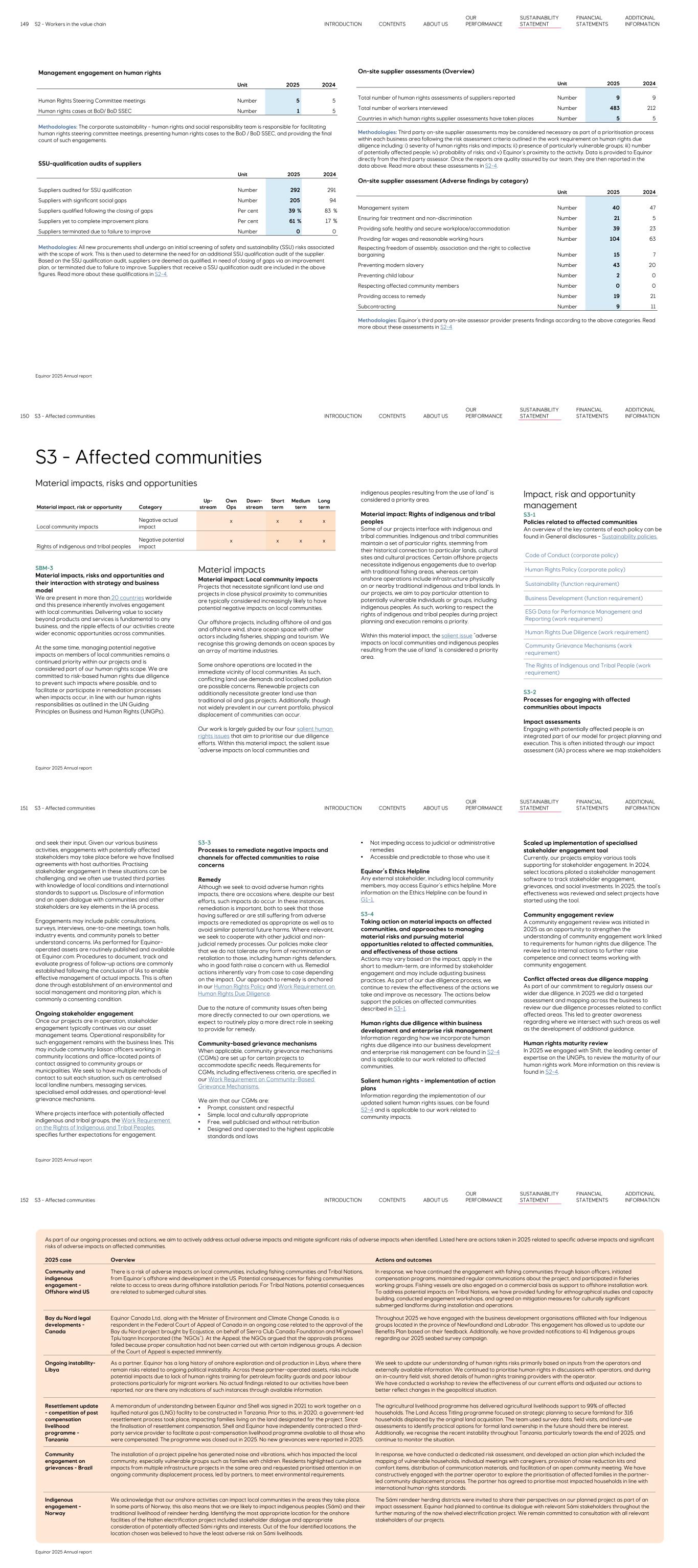
149 S2 - Workers in the value chain INTRODUCTION CONTENTS ABOUT US OUR PERFORMANCE SUSTAINABILITY STATEMENT FINANCIAL STATEMENTS ADDITIONAL INFORMATION Equinor 2025 Annual report SSU-qualification audits of suppliers Unit 2025 2024 Suppliers audited for SSU qualification Number 292 291 Suppliers with significant social gaps Number 205 94 Suppliers qualified following the closing of gaps Per cent 39 % 83 % Suppliers yet to complete improvement plans Per cent 61 % 17 % Suppliers terminated due to failure to improve Number 0 0 Methodologies: All new procurements shall undergo an initial screening of safety and sustainability (SSU) risks associated with the scope of work. This is then used to determine the need for an additional SSU qualification audit of the supplier. Based on the SSU qualification audit, suppliers are deemed as qualified, in need of closing of gaps via an improvement plan, or terminated due to failure to improve. Suppliers that receive a SSU qualification audit are included in the above figures. Read more about these qualifications in S2-4. On-site supplier assessments (Overview) Unit 2025 2024 Total number of human rights assessments of suppliers reported Number 9 9 Total number of workers interviewed Number 483 212 Countries in which human rights supplier assessments have taken places Number 5 5 Methodologies: Third party on-site supplier assessments may be considered necessary as part of a prioritisation process within each business area following the risk assessment criteria outlined in the work requirement on human rights due diligence including: i) severity of human rights risks and impacts; ii) presence of particularly vulnerable groups; iii) number of potentially affected people; iv) probability of risks; and v) Equinor’s proximity to the activity. Data is provided to Equinor directly from the third party assessor. Once the reports are quality assured by our team, they are then reported in the data above. Read more about these assessments in S2-4. On-site supplier assessment (Adverse findings by category) Unit 2025 2024 Management system Number 40 47 Ensuring fair treatment and non-discrimination Number 21 5 Providing safe, healthy and secure workplace/accommodation Number 39 23 Providing fair wages and reasonable working hours Number 104 63 Respecting freedom of assembly, association and the right to collective bargaining Number 15 7 Preventing modern slavery Number 43 20 Preventing child labour Number 2 0 Respecting affected community members Number 0 0 Providing access to remedy Number 19 21 Subcontracting Number 9 11 Methodologies: Equinor’s third party on-site assessor provider presents findings according to the above categories. Read more about these assessments in S2-4. Management engagement on human rights Unit 2025 2024 Human Rights Steering Committee meetings Number 5 5 Human rights cases at BoD/ BoD SSEC Number 1 5 Methodologies: The corporate sustainability - human rights and social responsibility team is responsible for facilitating human rights steering committee meetings, presenting human rights cases to the BoD / BoD SSEC, and providing the final count of such engagements. S3 - Affected communities Material impacts, risks and opportunities SBM-3 Material impacts, risks and opportunities and their interaction with strategy and business model We are present in more than 20 countries worldwide and this presence inherently involves engagement with local communities. Delivering value to society beyond products and services is fundamental to any business, and the ripple effects of our activities create wider economic opportunities across communities. At the same time, managing potential negative impacts on members of local communities remains a continued priority within our projects and is considered part of our human rights scope. We are committed to risk-based human rights due diligence to prevent such impacts where possible, and to facilitate or participate in remediation processes when impacts occur, in line with our human rights responsibilities as outlined in the UN Guiding Principles on Business and Human Rights (UNGPs). Material impacts Material impact: Local community impacts Projects that necessitate significant land use and projects in close physical proximity to communities are typically considered increasingly likely to have potential negative impacts on local communities. Our offshore projects, including offshore oil and gas and offshore wind, share ocean space with other actors including fisheries, shipping and tourism. We recognise this growing demands on ocean spaces by an array of maritime industries. Some onshore operations are located in the immediate vicinity of local communities. As such, conflicting land use demands and localised pollution are possible concerns. Renewable projects can additionally necessitate greater land use than traditional oil and gas projects. Additionally, though not widely prevalent in our current portfolio, physical displacement of communities can occur. Our work is largely guided by our four salient human rights issues that aim to prioritise our due diligence efforts. Within this material impact, the salient issue “adverse impacts on local communities and indigenous peoples resulting from the use of land” is considered a priority area. Material impact: Rights of indigenous and tribal peoples Some of our projects interface with indigenous and tribal communities. Indigenous and tribal communities maintain a set of particular rights, stemming from their historical connection to particular lands, cultural sites and cultural practices. Certain offshore projects necessitate indigenous engagements due to overlap with traditional fishing areas, whereas certain onshore operations include infrastructure physically on or nearby traditional indigenous and tribal lands. In our projects, we aim to pay particular attention to potentially vulnerable individuals or groups, including indigenous peoples. As such, working to respect the rights of indigenous and tribal peoples during project planning and execution remains a priority. Within this material impact, the salient issue “adverse impacts on local communities and indigenous peoples resulting from the use of land” is considered a priority area. Impact, risk and opportunity management S3-1 Policies related to affected communities An overview of the key contents of each policy can be found in General disclosures - Sustainability policies. Code of Conduct (corporate policy) Human Rights Policy (corporate policy) Sustainability (function requirement) Business Development (function requirement) ESG Data for Performance Management and Reporting (work requirement) Human Rights Due Diligence (work requirement) Community Grievance Mechanisms (work requirement) The Rights of Indigenous and Tribal People (work requirement) S3-2 Processes for engaging with affected communities about impacts Impact assessments Engaging with potentially affected people is an integrated part of our model for project planning and execution. This is often initiated through our impact assessment (IA) process where we map stakeholders 150 S3 - Affected communities INTRODUCTION CONTENTS ABOUT US OUR PERFORMANCE SUSTAINABILITY STATEMENT FINANCIAL STATEMENTS ADDITIONAL INFORMATION Equinor 2025 Annual report Material impact, risk or opportunity Category Up- stream Own Ops Down- stream Short term Medium term Long term Local community impacts Negative actual impact x x x x Rights of indigenous and tribal peoples Negative potential impact x x x x and seek their input. Given our various business activities, engagements with potentially affected stakeholders may take place before we have finalised agreements with host authorities. Practising stakeholder engagement in these situations can be challenging, and we often use trusted third parties with knowledge of local conditions and international standards to support us. Disclosure of information and an open dialogue with communities and other stakeholders are key elements in the IA process. Engagements may include public consultations, surveys, interviews, one-to-one meetings, town halls, industry events, and community panels to better understand concerns. IAs performed for Equinor- operated assets are routinely published and available at Equinor.com. Procedures to document, track and evaluate progress of follow-up actions are commonly established following the conclusion of IAs to enable effective management of actual impacts. This is often done through establishment of an environmental and social management and monitoring plan, which is commonly a consenting condition. Ongoing stakeholder engagement Once our projects are in operation, stakeholder engagement typically continues via our asset management teams. Operational responsibility for such engagement remains with the business lines. This may include community liaison officers working in community locations and office-located points of contact assigned to community groups or municipalities. We seek to have multiple methods of contact to suit each situation, such as centralised local landline numbers, messaging services, specialised email addresses, and operational-level grievance mechanisms. Where projects interface with potentially affected indigenous and tribal groups, the Work Requirement on the Rights of Indigenous and Tribal Peoples specifies further expectations for engagement. S3-3 Processes to remediate negative impacts and channels for affected communities to raise concerns Remedy Although we seek to avoid adverse human rights impacts, there are occasions where, despite our best efforts, such impacts do occur. In these instances, remediation is important, both to seek that those having suffered or are still suffering from adverse impacts are remediated as appropriate as well as to avoid similar potential future harms. Where relevant, we seek to cooperate with other judicial and non- judicial remedy processes. Our policies make clear that we do not tolerate any form of recrimination or retaliation to those, including human rights defenders, who in good faith raise a concern with us. Remedial actions inherently vary from case to case depending on the impact. Our approach to remedy is anchored in our Human Rights Policy and Work Requirement on Human Rights Due Diligence. Due to the nature of community issues often being more directly connected to our own operations, we expect to routinely play a more direct role in seeking to provide for remedy. Community-based grievance mechanisms When applicable, community grievance mechanisms (CGMs) are set up for certain projects to accommodate specific needs. Requirements for CGMs, including effectiveness criteria, are specified in our Work Requirement on Community-Based Grievance Mechanisms. We aim that our CGMs are: • Prompt, consistent and respectful • Simple, local and culturally appropriate • Free, well publicised and without retribution • Designed and operated to the highest applicable standards and laws • Not impeding access to judicial or administrative remedies • Accessible and predictable to those who use it Equinor’s Ethics Helpline Any external stakeholder, including local community members, may access Equinor’s ethics helpline. More information on the Ethics Helpline can be found in G1-1. S3-4 Taking action on material impacts on affected communities, and approaches to managing material risks and pursuing material opportunities related to affected communities, and effectiveness of those actions Actions may vary based on the impact, apply in the short to medium-term, are informed by stakeholder engagement and may include adjusting business practices. As part of our due diligence process, we continue to review the effectiveness of the actions we take and improve as necessary. The actions below support the policies on affected communities described in S3-1. Human rights due diligence within business development and enterprise risk management Information regarding how we incorporate human rights due diligence into our business development and enterprise risk management can be found in S2-4 and is applicable to our work related to affected communities. Salient human rights - implementation of action plans Information regarding the implementation of our updated salient human rights issues, can be found S2-4 and is applicable to our work related to community impacts. Scaled up implementation of specialised stakeholder engagement tool Currently, our projects employ various tools supporting for stakeholder engagement. In 2024, select locations piloted a stakeholder management software to track stakeholder engagement, grievances, and social investments. In 2025, the tool’s effectiveness was reviewed and select projects have started using the tool. Community engagement review A community engagement review was initiated in 2025 as an opportunity to strengthen the understanding of community engagement work linked to requirements for human rights due diligence. The review led to internal actions to further raise competence and connect teams working with community engagement. Conflict affected areas due diligence mapping As part of our commitment to regularly assess our wider due diligence, in 2025 we did a targeted assessment and mapping across the business to review our due diligence processes related to conflict affected areas. This led to greater awareness regarding where we intersect with such areas as well as the development of additional guidance. Human rights maturity review In 2025 we engaged with Shift, the leading center of expertise on the UNGPs, to review the maturity of our human rights work. More information on this review is found in S2-4. 151 S3 - Affected communities INTRODUCTION CONTENTS ABOUT US OUR PERFORMANCE SUSTAINABILITY STATEMENT FINANCIAL STATEMENTS ADDITIONAL INFORMATION Equinor 2025 Annual report 152 S3 - Affected communities INTRODUCTION CONTENTS ABOUT US OUR PERFORMANCE SUSTAINABILITY STATEMENT FINANCIAL STATEMENTS ADDITIONAL INFORMATION Equinor 2025 Annual report As part of our ongoing processes and actions, we aim to actively address actual adverse impacts and mitigate significant risks of adverse impacts when identified. Listed here are actions taken in 2025 related to specific adverse impacts and significant risks of adverse impacts on affected communities. 2025 case Overview Actions and outcomes Community and indigenous engagement - Offshore wind US There is a risk of adverse impacts on local communities, including fishing communities and Tribal Nations, from Equinor’s offshore wind development in the US. Potential consequences for fishing communities relate to access to areas during offshore installation periods. For Tribal Nations, potential consequences are related to submerged cultural sites. In response, we have continued the engagement with fishing communities through liaison officers, initiated compensation programs, maintained regular communications about the project, and participated in fisheries working groups. Fishing vessels are also engaged on a commercial basis as support to offshore installation work. To address potential impacts on Tribal Nations, we have provided funding for ethnographical studies and capacity building, conducted engagement workshops, and agreed on mitigation measures for culturally significant submerged landforms during installation and operations. Bay du Nord legal developments - Canada Equinor Canada Ltd., along with the Minister of Environment and Climate Change Canada, is a respondent in the Federal Court of Appeal of Canada in an ongoing case related to the approval of the Bay du Nord project brought by Ecojustice, on behalf of Sierra Club Canada Foundation and Mi’gmawe’l Tplu’taqnn Incorporated (the “NGOs”). At the Appeal, the NGOs argued that the approvals process failed because proper consultation had not been carried out with certain indigenous groups. A decision of the Court of Appeal is expected imminently. Throughout 2025 we have engaged with the business development organisations affiliated with four Indigenous groups located in the province of Newfoundland and Labrador. This engagement has allowed us to update our Benefits Plan based on their feedback. Additionally, we have provided notifications to 41 Indigenous groups regarding our 2025 seabed survey campaign. Ongoing instability- Libya As a partner, Equinor has a long history of onshore exploration and oil production in Libya, where there remain risks related to ongoing political instability. Across these partner-operated assets, risks include potential impacts due to lack of human rights training for petroleum facility guards and poor labour protections particularly for migrant workers. No actual findings related to our activities have been reported, nor are there any indications of such instances through available information. We seek to update our understanding of human rights risks primarily based on inputs from the operators and externally available information. We continued to prioritise human rights in discussions with operators, and during an in-country field visit, shared details of human rights training providers with the operator. We have conducted a workshop to review the effectiveness of our current efforts and adjusted our actions to better reflect changes in the geopolitical situation. Resettlement update - competition of post compensation livelihood programme - Tanzania A memorandum of understanding between Equinor and Shell was signed in 2021 to work together on a liquified natural gas (LNG) facility to be constructed in Tanzania. Prior to this, in 2020, a government-led resettlement process took place, impacting families living on the land designated for the project. Since the finalisation of resettlement compensation, Shell and Equinor have independently contracted a third- party service provider to facilitate a post-compensation livelihood programme available to all those who were compensated. The programme was closed out in 2025. No new grievances were reported in 2025. The agricultural livelihood programme has delivered agricultural livelihoods support to 99% of affected households. The Land Access Titling programme focused on strategic planning to secure farmland for 316 households displaced by the original land acquisition. The team used survey data, field visits, and land-use assessments to identify practical options for formal land ownership in the future should there be interest. Additionally, we recognise the recent instability throughout Tanzania, particularly towards the end of 2025, and continue to monitor the situation. Community engagement on grievances - Brazil The installation of a project pipeline has generated noise and vibrations, which has impacted the local community, especially vulnerable groups such as families with children. Residents highlighted cumulative impacts from multiple infrastructure projects in the same area and requested prioritised attention in an ongoing community displacement process, led by partners, to meet environmental requirements. In response, we have conducted a dedicated risk assessment, and developed an action plan which included the mapping of vulnerable households, individual meetings with caregivers, provision of noise reduction kits and comfort items, distribution of communication materials, and facilitation of an open community meeting. We have constructively engaged with the partner operator to explore the prioritisation of affected families in the partner- led community displacement process. The partner has agreed to prioritise most impacted households in line with international human rights standards. Indigenous engagement - Norway We acknowledge that our onshore activities can impact local communities in the areas they take place. In some parts of Norway, this also means that we are likely to impact indigenous peoples (Sámi) and their traditional livelihood of reindeer herding. Identifying the most appropriate location for the onshore facilities of the Halten electrification project included stakeholder dialogue and appropriate consideration of potentially affected Sámi rights and interests. Out of the four identified locations, the location chosen was believed to have the least adverse risk on Sámi livelihoods. The Sámi reindeer herding districts were invited to share their perspectives on our planned project as part of an impact assessment. Equinor had planned to continue its dialogue with relevant Sámi stakeholders throughout the further maturing of the now shelved electrification project. We remain committed to consultation with all relevant stakeholders of our projects.
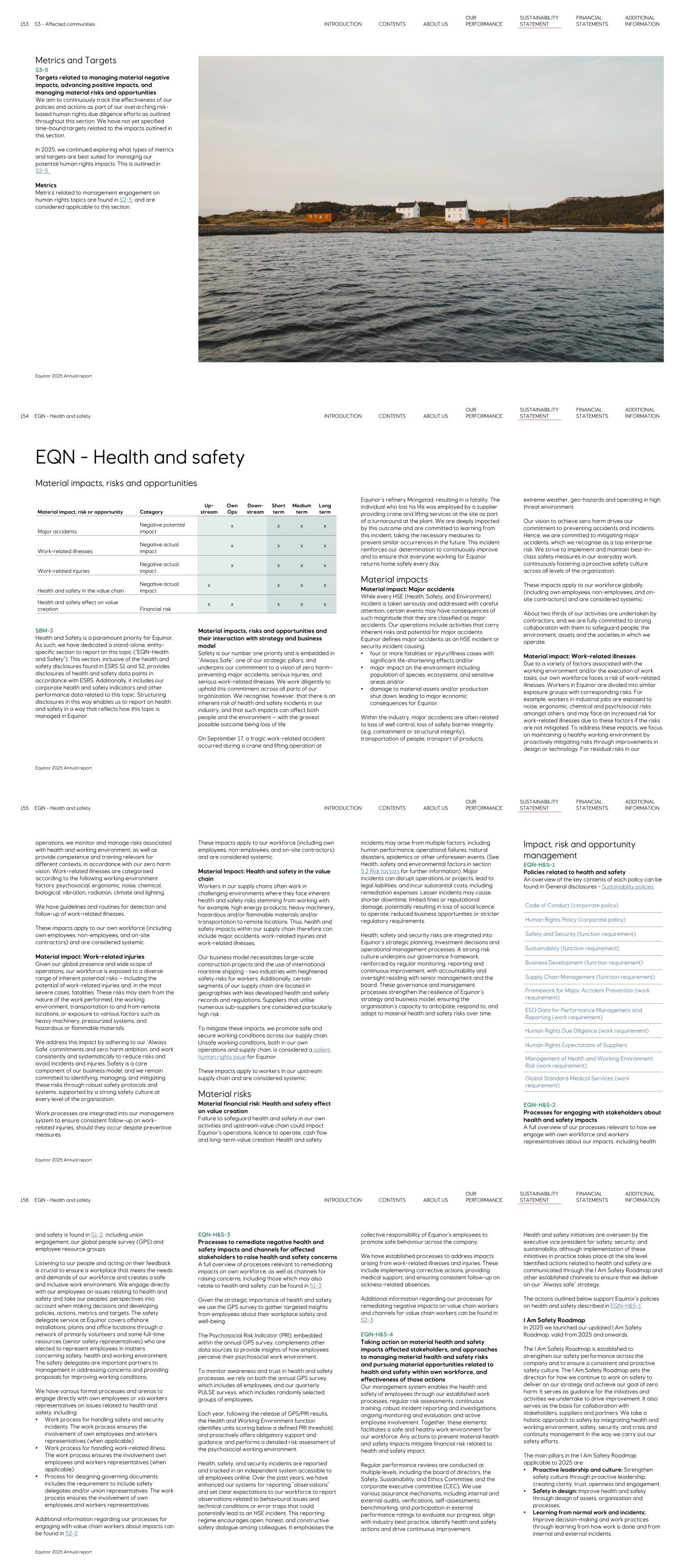
Metrics and Targets S3-5 Targets related to managing material negative impacts, advancing positive impacts, and managing material risks and opportunities We aim to continuously track the effectiveness of our policies and actions as part of our overarching risk- based human rights due diligence efforts as outlined throughout this section. We have not yet specified time-bound targets related to the impacts outlined in this section. In 2025, we continued exploring what types of metrics and targets are best suited for managing our potential human rights impacts. This is outlined in S2-5. Metrics Metrics related to management engagement on human rights topics are found in S2-5, and are considered applicable to this section. 153 S3 - Affected communities INTRODUCTION CONTENTS ABOUT US OUR PERFORMANCE SUSTAINABILITY STATEMENT FINANCIAL STATEMENTS ADDITIONAL INFORMATION Equinor 2025 Annual report EQN - Health and safety Material impacts, risks and opportunities SBM-3 Health and Safety is a paramount priority for Equinor. As such, we have dedicated a stand-alone, entity- specific section to report on this topic (“EQN-Health and Safety”). This section, inclusive of the health and safety disclosures found in ESRS S1 and S2, provides disclosures of health and safety data points in accordance with ESRS. Additionally, it includes our corporate health and safety indicators and other performance data related to this topic. Structuring disclosures in this way enables us to report on health and safety in a way that reflects how this topic is managed in Equinor. Material impacts, risks and opportunities and their interaction with strategy and business model Safety is our number one priority and is embedded in “Always Safe”, one of our strategic pillars, and underpins our commitment to a vision of zero harm— preventing major accidents, serious injuries, and serious work-related illnesses. We work diligently to uphold this commitment across all parts of our organization. We recognise, however, that there is an inherent risk of health and safety incidents in our industry, and that such impacts can affect both people and the environment — with the gravest possible outcome being loss of life. On September 17, a tragic work-related accident occurred during a crane and lifting operation at Equinor’s refinery Mongstad, resulting in a fatality. The individual who lost his life was employed by a supplier providing crane and lifting services at the site as part of a turnaround at the plant. We are deeply impacted by this outcome and are committed to learning from this incident, taking the necessary measures to prevent similar occurrences in the future. This incident reinforces our determination to continuously improve and to ensure that everyone working for Equinor returns home safely every day. Material impacts Material impact: Major accidents While every HSE (Health, Safety, and Environment) incident is taken seriously and addressed with careful attention, certain events may have consequences of such magnitude that they are classified as major accidents. Our operations include activities that carry inherent risks and potential for major accidents. Equinor defines major accidents as an HSE incident or security incident causing: • four or more fatalities or injury/illness cases with significant life-shortening effects and/or • major impact on the environment including population of species, ecosystems, and sensitive areas and/or • damage to material assets and/or production shut down, leading to major economic consequences for Equinor. Within the industry, major accidents are often related to loss of well control, loss of safety barrier integrity (e.g. containment or structural integrity), transportation of people, transport of products, extreme weather, geo-hazards and operating in high threat environment. Our vision to achieve zero harm drives our commitment to preventing accidents and incidents. Hence, we are committed to mitigating major accidents, which we recognise as a top enterprise risk. We strive to implement and maintain best-in- class safety measures in our everyday work, continuously fostering a proactive safety culture across all levels of the organization. These impacts apply to our workforce globally, (including own employees, non-employees, and on- site contractors) and are considered systemic. About two thirds of our activities are undertaken by contractors, and we are fully committed to strong collaboration with them to safeguard people, the environment, assets and the societies in which we operate. Material impact: Work-related illnesses Due to a variety of factors associated with the working environment and/or the execution of work tasks, our own workforce faces a risk of work-related illnesses. Workers in Equinor are divided into similar exposure groups with corresponding risks. For example, workers in industrial jobs are exposed to noise, ergonomic, chemical and psychosocial risks amongst others, and may face an increased risk for work-related illnesses due to these factors if the risks are not mitigated. To address these impacts, we focus on maintaining a healthy working environment by proactively mitigating risks through improvements in design or technology. For residual risks in our 154 EQN - Health and safety INTRODUCTION CONTENTS ABOUT US OUR PERFORMANCE SUSTAINABILITY STATEMENT FINANCIAL STATEMENTS ADDITIONAL INFORMATION Equinor 2025 Annual report Material impact, risk or opportunity Category Up- stream Own Ops Down- stream Short term Medium term Long term Major accidents Negative potential impact x x x x Work-related illnesses Negative actual impact x x x x Work-related injuries Negative actual impact x x x x Health and safety in the value chain Negative actual impact x x x x Health and safety effect on value creation Financial risk x x x x x operations, we monitor and manage risks associated with health and working environment, as well as provide competence and training relevant for different contexts, in accordance with our zero harm vision. Work-related illnesses are categorised according to the following working environment factors: psychosocial, ergonomic, noise, chemical, biological, vibration, radiation, climate and lighting. We have guidelines and routines for detection and follow-up of work-related illnesses. These impacts apply to our own workforce (including own employees, non-employees, and on-site contractors) and are considered systemic. Material impact: Work-related injuries Given our global presence and wide scope of operations, our workforce is exposed to a diverse range of inherent potential risks — including the potential of work-related injuries and, in the most severe cases, fatalities. These risks may stem from the nature of the work performed, the working environment, transportation to and from remote locations, or exposure to various factors such as heavy machinery, pressurized systems, and hazardous or flammable materials. We address this impact by adhering to our 'Always Safe' commitments and zero harm ambition, and work consistently and systematically to reduce risks and avoid incidents and injuries. Safety is a core component of our business model, and we remain committed to identifying, managing, and mitigating these risks through robust safety protocols and systems, supported by a strong safety culture at every level of the organization. Work processes are integrated into our management system to ensure consistent follow-up on work- related injuries, should they occur despite preventive measures. These impacts apply to our workforce (including own employees, non-employees, and on-site contractors) and are considered systemic. Material Impact: Health and safety in the value chain Workers in our supply chains often work in challenging environments where they face inherent health and safety risks stemming from working with, for example, high energy products, heavy machinery, hazardous and/or flammable materials and/or transportation to remote locations. Thus, health and safety impacts within our supply chain therefore can include major accidents, work-related injuries and work-related illnesses. Our business model necessitates large-scale construction projects and the use of international maritime shipping - two industries with heightened safety risks for workers. Additionally, certain segments of our supply chain are located in geographies with less developed health and safety records and regulations. Suppliers that utilise numerous sub-suppliers are considered particularly high risk. To mitigate these impacts, we promote safe and secure working conditions across our supply chain. Unsafe working conditions, both in our own operations and supply chain, is considered a salient human rights issue for Equinor. These impacts apply to workers in our upstream supply chain and are considered systemic. Material risks Material financial risk: Health and safety effect on value creation Failure to safeguard health and safety in our own activities and upstream value chain could impact Equinor’s operations, licence to operate, cash flow and long-term value creation. Health and safety incidents may arise from multiple factors, including human performance, operational failures, natural disasters, epidemics or other unforeseen events. (See Health, safety and environmental factors in section 5.2 Risk factors for further information). Major incidents can disrupt operations or projects, lead to legal liabilities, and incur substantial costs, including remediation expenses. Lesser incidents may cause shorter downtime, limited fines or reputational damage, potentially resulting in loss of social licence to operate, reduced business opportunities or stricter regulatory requirements. Health, safety and security risks are integrated into Equinor’s strategic planning, investment decisions and operational management processes. A strong risk culture underpins our governance framework, reinforced by regular monitoring, reporting and continuous improvement, with accountability and oversight residing with senior management and the board. These governance and management processes strengthen the resilience of Equinor’s strategy and business model, ensuring the organisation’s capacity to anticipate, respond to, and adapt to material health and safety risks over time. Impact, risk and opportunity management EQN-H&S-1 Policies related to health and safety An overview of the key contents of each policy can be found in General disclosures - Sustainability policies. Code of Conduct (corporate policy) Human Rights Policy (corporate policy) Safety and Security (function requirement) Sustainability (function requirement) Business Development (function requirement) Supply Chain Management (function requirement) Framework for Major Accident Prevention (work requirement) ESG Data for Performance Management and Reporting (work requirement) Human Rights Due Diligence (work requirement) Human Rights Expectations of Suppliers Management of Health and Working Environment Risk (work requirement) Global Standard Medical Services (work requirement) EQN-H&S-2 Processes for engaging with stakeholders about health and safety impacts A full overview of our processes relevant to how we engage with own workforce and workers’ representatives about our impacts, including health 155 EQN - Health and safety INTRODUCTION CONTENTS ABOUT US OUR PERFORMANCE SUSTAINABILITY STATEMENT FINANCIAL STATEMENTS ADDITIONAL INFORMATION Equinor 2025 Annual report and safety is found in S1-2, including union engagement, our global people survey (GPS) and employee resource groups. Listening to our people and acting on their feedback is crucial to ensure a workplace that meets the needs and demands of our workforce and creates a safe and inclusive work environment. We engage directly with our employees on issues relating to health and safety and take our peoples’ perspectives into account when making decisions and developing policies, actions, metrics and targets. The safety delegate service at Equinor covers offshore installations, plants and office locations through a network of primarily volunteers and some full-time resources (senior safety representatives) who are elected to represent employees in matters concerning safety, health and working environment. The safety delegates are important partners to management in addressing concerns and providing proposals for improving working conditions. We have various formal processes and arenas to engage directly with own employees or via workers representatives on issues related to health and safety, including: • Work process for handling safety and security incidents. The work process ensures the involvement of own employees and workers representatives (when applicable) • Work process for handling work-related illness. The work process ensures the involvement own employees and workers representatives (when applicable) • Process for designing governing documents includes the requirement to include safety delegates and/or union representatives. The work process ensures the involvement of own employees and workers representatives. Additional information regarding our processes for engaging with value chain workers about impacts can be found in S2-2. EQN-H&S-3 Processes to remediate negative health and safety impacts and channels for affected stakeholders to raise health and safety concerns A full overview of processes relevant to remediating impacts on own workforce, as well as channels for raising concerns, including those which may also relate to health and safety, can be found in S1-3. Given the strategic importance of health and safety, we use the GPS survey to gather targeted insights from employees about their workplace safety and well-being. The Psychosocial Risk Indicator (PRI), embedded within the annual GPS survey, complements other data sources to provide insights of how employees perceive their psychosocial work environment. To monitor awareness and trust in health and safety processes, we rely on both the annual GPS survey, which includes all employees, and our quarterly PULSE surveys, which includes randomly selected groups of employees. Each year, following the release of GPS/PRI results, the Health and Working Environment function identifies units scoring below a defined PRI threshold, and proactively offers obligatory support and guidance, and performs a detailed risk assessment of the psychosocial working environment. Health, safety, and security incidents are reported and tracked in an independent system accessible to all employees online. Over the past years, we have enhanced our systems for reporting “observations” and set clear expectations to our workforce to report observations related to behavioural issues and technical conditions or error traps that could potentially lead to an HSE incident. This reporting regime encourages open, honest, and constructive safety dialogue among colleagues. It emphasises the collective responsibility of Equinor’s employees to promote safe behaviour across the company. We have established processes to address impacts arising from work-related illnesses and injuries. These include implementing corrective actions, providing medical support, and ensuring consistent follow-up on sickness-related absences. Additional information regarding our processes for remediating negative impacts on value chain workers and channels for value chain workers can be found in S2-3. EQN-H&S-4 Taking action on material health and safety impacts affected stakeholders, and approaches to managing material health and safety risks and pursuing material opportunities related to health and safety within own workforce, and effectiveness of those actions Our management system enables the health and safety of employees through our established work processes, regular risk assessments, continuous training, robust incident reporting and investigations, ongoing monitoring and evaluation, and active employee involvement. Together, these elements facilitates a safe and healthy work environment for our workforce. Any actions to prevent material health and safety impacts mitigate financial risk related to health and safety impact. Regular performance reviews are conducted at multiple levels, including the board of directors, the Safety, Sustainability, and Ethics Committee, and the corporate executive committee (CEC). We use various assurance mechanisms, including internal and external audits, verifications, self-assessments, benchmarking, and participation in external performance ratings to evaluate our progress, align with industry best practice, identify health and safety actions and drive continuous improvement. Health and safety initiatives are overseen by the executive vice president for safety, security, and sustainability, although implementation of these initiatives in practice takes place at the site level. Identified actions related to health and safety are communicated through the I Am Safety Roadmap and other established channels to ensure that we deliver on our “Always safe” strategy. The actions outlined below support Equinor’s policies on health and safety described in EQN-H&S-1. I Am Safety Roadmap In 2025 we launched our updated I Am Safety Roadmap, valid from 2025 and onwards. The I Am Safety Roadmap is established to strengthen our safety performance across the company and to ensure a consistent and proactive safety culture. The I Am Safety Roadmap sets the direction for how we continue to work on safety to deliver on our strategy and achieve our goal of zero harm. It serves as guidance for the initiatives and activities we undertake to drive improvement. It also serves as the basis for collaboration with stakeholders, suppliers and partners. We take a holistic approach to safety by integrating health and working environment, safety, security, and crisis and continuity management in the way we carry out our safety efforts. The main pillars in the I Am Safety Roadmap applicable to 2025 are: • Proactive leadership and culture: Strengthen safety culture through proactive leadership, creating clarity, trust, openness and engagement. • Safety in design: Improve health and safety through design of assets, organisation and processes. • Learning from normal work and incidents: Improve decision-making and work practices through learning from how work is done and from internal and external incidents. 156 EQN - Health and safety INTRODUCTION CONTENTS ABOUT US OUR PERFORMANCE SUSTAINABILITY STATEMENT FINANCIAL STATEMENTS ADDITIONAL INFORMATION Equinor 2025 Annual report
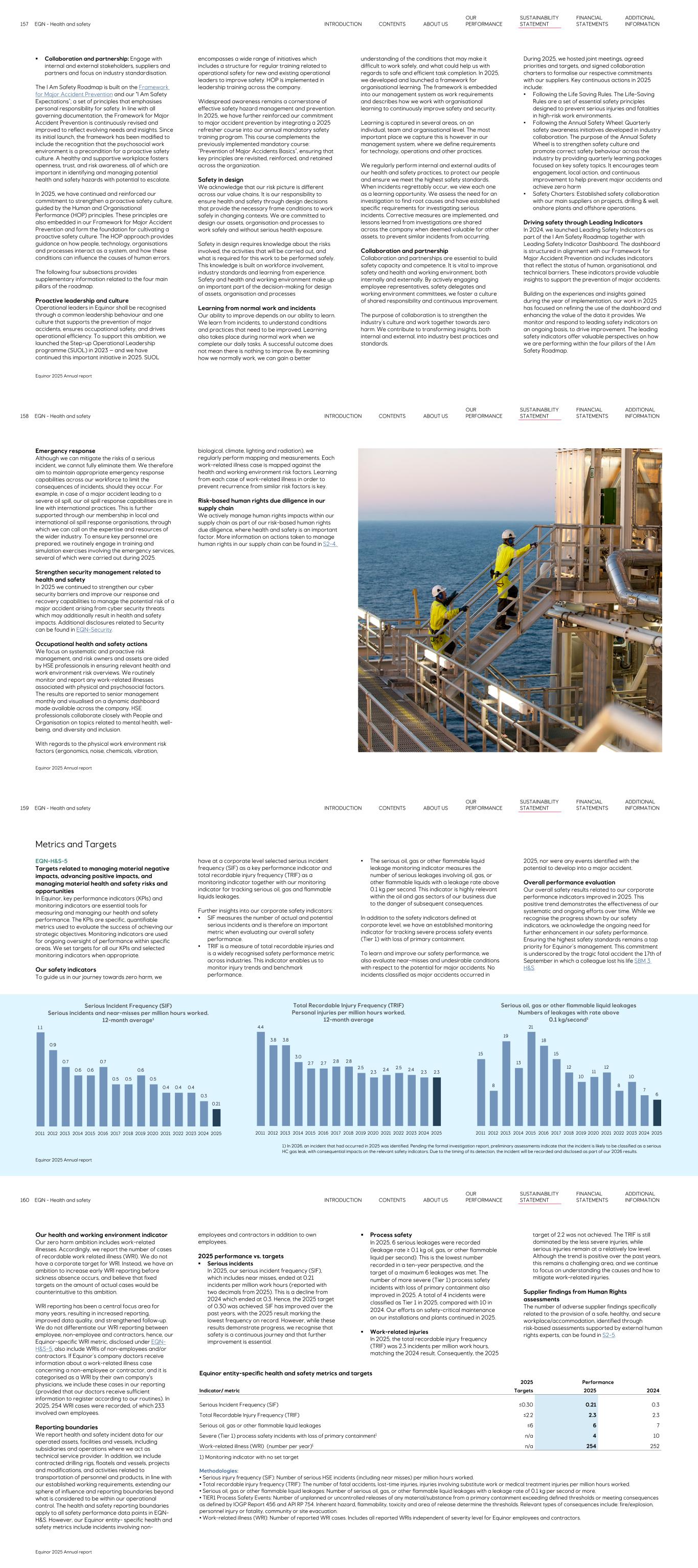
• Collaboration and partnership: Engage with internal and external stakeholders, suppliers and partners and focus on industry standardisation. The I Am Safety Roadmap is built on the Framework for Major Accident Prevention and our "I Am Safety Expectations”; a set of principles that emphasises personal responsibility for safety. In line with all governing documentation, the Framework for Major Accident Prevention is continuously revised and improved to reflect evolving needs and insights. Since its initial launch, the framework has been modified to include the recognition that the psychosocial work environment is a precondition for a proactive safety culture. A healthy and supportive workplace fosters openness, trust, and risk awareness, all of which are important in identifying and managing potential health and safety hazards with potential to escalate. In 2025, we have continued and reinforced our commitment to strengthen a proactive safety culture, guided by the Human and Organisational Performance (HOP) principles. These principles are also embedded in our Framework for Major Accident Prevention and form the foundation for cultivating a proactive safety culture. The HOP approach provides guidance on how people, technology, organisations and processes interact as a system, and how these conditions can influence the causes of human errors. The following four subsections provides supplementary information related to the four main pillars of the roadmap. Proactive leadership and culture Operational leaders in Equinor shall be recognised through a common leadership behaviour and one culture that supports the prevention of major accidents, ensures occupational safety, and drives operational efficiency. To support this ambition, we launched the Step-up Operational Leadership programme (SUOL) in 2023 — and we have continued this important initiative in 2025. SUOL encompasses a wide range of initiatives which includes a structure for regular training related to operational safety for new and existing operational leaders to improve safety. HOP is implemented in leadership training across the company. Widespread awareness remains a cornerstone of effective safety hazard management and prevention. In 2025, we have further reinforced our commitment to major accident prevention by integrating a 2025 refresher course into our annual mandatory safety training program. This course complements the previously implemented mandatory course: “Prevention of Major Accidents Basics”, ensuring that key principles are revisited, reinforced, and retained across the organization. Safety in design We acknowledge that our risk picture is different across our value chains. It is our responsibility to ensure health and safety through design decisions that provide the necessary frame conditions to work safely in changing contexts. We are committed to design our assets, organisation and processes to work safely and without serious health exposure. Safety in design requires knowledge about the risks involved, the activities that will be carried out, and what is required for this work to be performed safely. This knowledge is built on workforce involvement, industry standards and learning from experience. Safety and health and working environment make up an important part of the decision-making for design of assets, organisation and processes Learning from normal work and incidents Our ability to improve depends on our ability to learn. We learn from incidents, to understand conditions and practices that need to be improved. Learning also takes place during normal work when we complete our daily tasks. A successful outcome does not mean there is nothing to improve. By examining how we normally work, we can gain a better understanding of the conditions that may make it difficult to work safely, and what could help us with regards to safe and efficient task completion. In 2025, we developed and launched a framework for organisational learning. The framework is embedded into our management system as work requirements and describes how we work with organisational learning to continuously improve safety and security. Learning is captured in several areas, on an individual, team and organisational level. The most important place we capture this is however in our management system, where we define requirements for technology, operations and other practices. We regularly perform internal and external audits of our health and safety practices, to protect our people and ensure we meet the highest safety standards. When incidents regrettably occur, we view each one as a learning opportunity. We assess the need for an investigation to find root causes and have established specific requirements for investigating serious incidents. Corrective measures are implemented, and lessons learned from investigations are shared across the company when deemed valuable for other assets, to prevent similar incidents from occurring. Collaboration and partnership Collaboration and partnerships are essential to build safety capacity and competence. It is vital to improve safety and health and working environment, both internally and externally. By actively engaging employee representatives, safety delegates and working environment committees, we foster a culture of shared responsibility and continuous improvement. The purpose of collaboration is to strengthen the industry’s culture and work together towards zero harm. We contribute to transforming insights, both internal and external, into industry best practices and standards. During 2025, we hosted joint meetings, agreed priorities and targets, and signed collaboration charters to formalise our respective commitments with our suppliers. Key continuous actions in 2025 include: • Following the Life Saving Rules. The Life-Saving Rules are a set of essential safety principles designed to prevent serious injuries and fatalities in high-risk work environments. • Following the Annual Safety Wheel: Quarterly safety awareness initiatives developed in industry collaboration. The purpose of the Annual Safety Wheel is to strengthen safety culture and promote correct safety behaviour across the industry by providing quarterly learning packages focused on key safety topics. It encourages team engagement, local action, and continuous improvement to help prevent major accidents and achieve zero harm • Safety Charters: Established safety collaboration with our main suppliers on projects, drilling & well, onshore plants and offshore operations. Driving safety through Leading Indicators In 2024, we launched Leading Safety Indicators as part of the I Am Safety Roadmap together with Leading Safety Indicator Dashboard. The dashboard is structured in alignment with our Framework for Major Accident Prevention and includes indicators that reflect the status of human, organisational, and technical barriers. These indicators provide valuable insights to support the prevention of major accidents. Building on the experiences and insights gained during the year of implementation, our work in 2025 has focused on refining the use of the dashboard and enhancing the value of the data it provides. We monitor and respond to leading safety indicators on an ongoing basis, to drive improvement. The leading safety indicators offer valuable perspectives on how we are performing within the four pillars of the I Am Safety Roadmap. 157 EQN - Health and safety INTRODUCTION CONTENTS ABOUT US OUR PERFORMANCE SUSTAINABILITY STATEMENT FINANCIAL STATEMENTS ADDITIONAL INFORMATION Equinor 2025 Annual report Emergency response Although we can mitigate the risks of a serious incident, we cannot fully eliminate them. We therefore aim to maintain appropriate emergency response capabilities across our workforce to limit the consequences of incidents, should they occur. For example, in case of a major accident leading to a severe oil spill, our oil spill response capabilities are in line with international practices. This is further supported through our membership in local and international oil spill response organisations, through which we can call on the expertise and resources of the wider industry. To ensure key personnel are prepared, we routinely engage in training and simulation exercises involving the emergency services, several of which were carried out during 2025. Strengthen security management related to health and safety In 2025 we continued to strengthen our cyber security barriers and improve our response and recovery capabilities to manage the potential risk of a major accident arising from cyber security threats which may additionally result in health and safety impacts. Additional disclosures related to Security can be found in EQN-Security. Occupational health and safety actions We focus on systematic and proactive risk management, and risk owners and assets are aided by HSE professionals in ensuring relevant health and work environment risk overviews. We routinely monitor and report any work-related illnesses associated with physical and psychosocial factors. The results are reported to senior management monthly and visualised on a dynamic dashboard made available across the company. HSE professionals collaborate closely with People and Organisation on topics related to mental health, well- being, and diversity and inclusion. With regards to the physical work environment risk factors (ergonomics, noise, chemicals, vibration, biological, climate, lighting and radiation), we regularly perform mapping and measurements. Each work-related illness case is mapped against the health and working environment risk factors. Learning from each case of work-related illness in order to prevent recurrence from similar risk factors is key. Risk-based human rights due diligence in our supply chain We actively manage human rights impacts within our supply chain as part of our risk-based human rights due diligence, where health and safety is an important factor. More information on actions taken to manage human rights in our supply chain can be found in S2-4. 158 EQN - Health and safety INTRODUCTION CONTENTS ABOUT US OUR PERFORMANCE SUSTAINABILITY STATEMENT FINANCIAL STATEMENTS ADDITIONAL INFORMATION Equinor 2025 Annual report Metrics and Targets EQN-H&S-5 Targets related to managing material negative impacts, advancing positive impacts, and managing material health and safety risks and opportunities In Equinor, key performance indicators (KPIs) and monitoring indicators are essential tools for measuring and managing our health and safety performance. The KPIs are specific, quantifiable metrics used to evaluate the success of achieving our strategic objectives. Monitoring indicators are used for ongoing oversight of performance within specific areas. We set targets for all our KPIs and selected monitoring indicators when appropriate. Our safety indicators To guide us in our journey towards zero harm, we have at a corporate level selected serious incident frequency (SIF) as a key performance indicator and total recordable injury frequency (TRIF) as a monitoring indicator together with our monitoring indicator for tracking serious oil, gas and flammable liquids leakages. Further insights into our corporate safety indicators: • SIF measures the number of actual and potential serious incidents and is therefore an important metric when evaluating our overall safety performance. • TRIF is a measure of total recordable injuries and is a widely recognised safety performance metric across industries. This indicator enables us to monitor injury trends and benchmark performance. • The serious oil, gas or other flammable liquid leakage monitoring indicator measures the number of serious leakages involving oil, gas, or other flammable liquids with a leakage rate above 0.1 kg per second. This indicator is highly relevant within the oil and gas sectors of our business due to the danger of subsequent consequences. In addition to the safety indicators defined at corporate level, we have an established monitoring indicator for tracking severe process safety events (Tier 1) with loss of primary containment. To learn and improve our safety performance, we also evaluate near-misses and undesirable conditions with respect to the potential for major accidents. No incidents classified as major accidents occurred in 2025, nor were any events identified with the potential to develop into a major accident. Overall performance evaluation Our overall safety results related to our corporate performance indicators improved in 2025. This positive trend demonstrates the effectiveness of our systematic and ongoing efforts over time. While we recognise the progress shown by our safety indicators, we acknowledge the ongoing need for further enhancement in our safety performance. Ensuring the highest safety standards remains a top priority for Equinor’s management. This commitment is underscored by the tragic fatal accident the 17th of September in which a colleague lost his life SBM 3 H&S. 159 EQN - Health and safety INTRODUCTION CONTENTS ABOUT US OUR PERFORMANCE SUSTAINABILITY STATEMENT FINANCIAL STATEMENTS ADDITIONAL INFORMATION Equinor 2025 Annual report Serious Incident Frequency (SIF) Serious incidents and near-misses per million hours worked. 12-month average¹ 1.1 0.9 0.7 0.6 0.6 0.7 0.5 0.5 0.6 0.5 0.4 0.4 0.4 0.3 0.21 2011 2012 2013 2014 2015 2016 2017 2018 2019 2020 2021 2022 2023 2024 2025 Total Recordable Injury Frequency (TRIF) Personal injuries per million hours worked. 12-month average 4.4 3.8 3.8 3.0 2.7 2.7 2.8 2.8 2.5 2.3 2.4 2.5 2.4 2.3 2.3 2011 2012 2013 2014 2015 2016 2017 2018 2019 2020 2021 2022 2023 2024 2025 Serious oil, gas or other flammable liquid leakages Numbers of leakages with rate above 0.1 kg/second¹ 15 8 19 13 21 18 15 12 10 11 12 8 10 7 6 2011 2012 2013 2014 2015 2016 2017 2018 2019 2020 2021 2022 2023 2024 2025 1) In 2026, an incident that had occurred in 2025 was identified. Pending the formal investigation report, preliminary assessments indicate that the incident is likely to be classified as a serious HC gas leak, with consequential impacts on the relevant safety indicators. Due to the timing of its detection, the incident will be recorded and disclosed as part of our 2026 results. Our health and working environment indicator Our zero harm ambition includes work-related illnesses. Accordingly, we report the number of cases of recordable work related illness (WRI). We do not have a corporate target for WRI. Instead, we have an ambition to increase early WRI reporting before sickness absence occurs, and believe that fixed targets on the amount of actual cases would be counterintuitive to this ambition. WRI reporting has been a central focus area for many years, resulting in increased reporting, improved data quality, and strengthened follow-up. We do not differentiate our WRI reporting between employee, non-employee and contractors, hence, our Equinor-specific WRI metric, disclosed under EQN- H&S-5, also include WRIs of non-employees and/or contractors. If Equinor’s company doctors receive information about a work-related illness case concerning a non-employee or contractor, and it is categorised as a WRI by their own company's physicians, we include these cases in our reporting (provided that our doctors receive sufficient information to register according to our routines). In 2025, 254 WRI cases were recorded, of which 233 involved own employees. Reporting boundaries We report health and safety incident data for our operated assets, facilities and vessels, including subsidiaries and operations where we act as technical service provider. In addition, we include contracted drilling rigs, floatels and vessels, projects and modifications, and activities related to transportation of personnel and products, in line with our established working requirements, extending our sphere of influence and reporting boundaries beyond what is considered to be within our operational control. The health and safety reporting boundaries apply to all safety performance data points in EQN- H&S. However, our Equinor entity- specific health and safety metrics include incidents involving non- employees and contractors in addition to own employees. 2025 performance vs. targets • Serious incidents In 2025, our serious incident frequency (SIF), which includes near misses, ended at 0.21 incidents per million work hours (reported with two decimals from 2025). This is a decline from 2024 which ended at 0.3. Hence, the 2025 target of 0.30 was achieved. SIF has improved over the past years, with the 2025 result marking the lowest frequency on record. However, while these results demonstrate progress, we recognise that safety is a continuous journey and that further improvement is essential. • Process safety In 2025, 6 serious leakages were recorded (leakage rate ≥ 0.1 kg oil, gas, or other flammable liquid per second). This is the lowest number recorded in a ten-year perspective, and the target of a maximum 6 leakages was met. The number of more severe (Tier 1) process safety incidents with loss of primary containment also improved in 2025. A total of 4 incidents were classified as Tier 1 in 2025, compared with 10 in 2024. Our efforts on safety-critical maintenance on our installations and plants continued in 2025. • Work-related injuries In 2025, the total recordable injury frequency (TRIF) was 2.3 incidents per million work hours, matching the 2024 result. Consequently, the 2025 target of 2.2 was not achieved. The TRIF is still dominated by the less severe injuries, while serious injuries remain at a relatively low level. Although the trend is positive over the past years, this remains a challenging area, and we continue to focus on understanding the causes and how to mitigate work-related injuries. Supplier findings from Human Rights assessments The number of adverse supplier findings specifically related to the provision of a safe, healthy, and secure workplace/accommodation, identified through risk-based assessments supported by external human rights experts, can be found in S2-5. 160 EQN - Health and safety INTRODUCTION CONTENTS ABOUT US OUR PERFORMANCE SUSTAINABILITY STATEMENT FINANCIAL STATEMENTS ADDITIONAL INFORMATION Equinor 2025 Annual report Equinor entity-specific health and safety metrics and targets 2025 Performance Indicator/ metric Targets 2025 2024 Serious Incident Frequency (SIF) ≤0.30 0.21 0.3 Total Recordable Injury Frequency (TRIF) ≤2.2 2.3 2.3 Serious oil, gas or other flammable liquid leakages ≤6 6 7 Severe (Tier 1) process safety incidents with loss of primary containment1 n/a 4 10 Work-related illness (WRI) (number per year)1 n/a 254 252 1) Monitoring indicator with no set target Methodologies: • Serious injury frequency (SIF): Number of serious HSE incidents (including near misses) per million hours worked. • Total recordable injury frequency (TRIF): The number of fatal accidents, lost-time injuries, injuries involving substitute work or medical treatment injuries per million hours worked. • Serious oil, gas or other flammable liquid leakages: Number of serious oil, gas, or other flammable liquid leakages with a leakage rate of 0.1 kg per second or more. • TIER1 Process Safety Events: Number of unplanned or uncontrolled releases of any material/substance from a primary containment exceeding defined thresholds or meeting consequences as defined by IOGP Report 456 and API RP 754. Inherent hazard, flammability, toxicity and area of release determine the thresholds. Relevant types of consequences include: fire/explosion, personnel injury or fatality, community or site evacuation. • Work-related illness (WRI): Number of reported WRI cases. Includes all reported WRIs independent of severity level for Equinor employees and contractors.
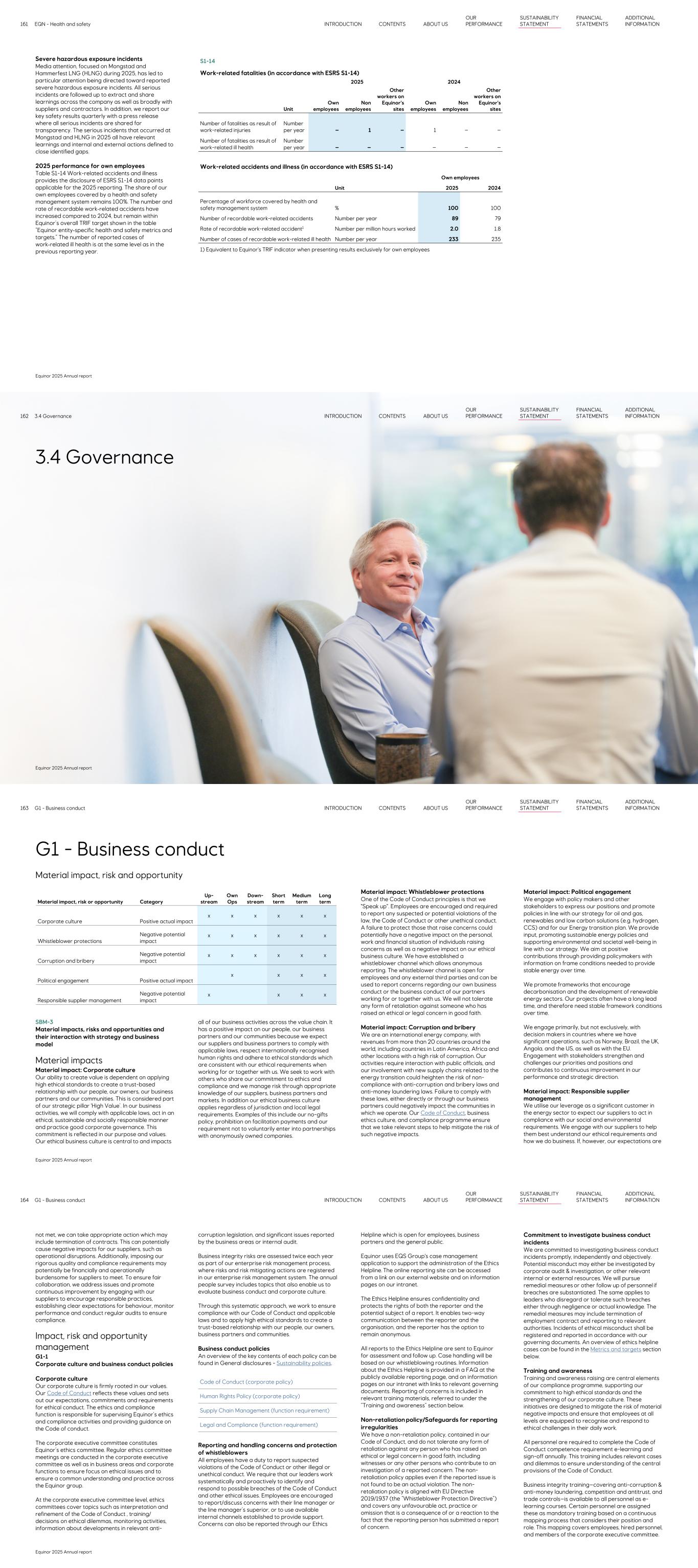
Severe hazardous exposure incidents Media attention, focused on Mongstad and Hammerfest LNG (HLNG) during 2025, has led to particular attention being directed toward reported severe hazardous exposure incidents. All serious incidents are followed up to extract and share learnings across the company as well as broadly with suppliers and contractors. In addition, we report our key safety results quarterly with a press release where all serious incidents are shared for transparency. The serious incidents that occurred at Mongstad and HLNG in 2025 all have relevant learnings and internal and external actions defined to close identified gaps. 2025 performance for own employees Table S1-14 Work-related accidents and illness provides the disclosure of ESRS S1-14 data points applicable for the 2025 reporting. The share of our own employees covered by a health and safety management system remains 100%. The number and rate of recordable work-related accidents have increased compared to 2024, but remain within Equinor’s overall TRIF target shown in the table “Equinor entity-specific health and safety metrics and targets.” The number of reported cases of work-related ill health is at the same level as in the previous reporting year. 161 EQN - Health and safety INTRODUCTION CONTENTS ABOUT US OUR PERFORMANCE SUSTAINABILITY STATEMENT FINANCIAL STATEMENTS ADDITIONAL INFORMATION Equinor 2025 Annual report Work-related accidents and illness (in accordance with ESRS S1-14) Own employees Unit 2025 2024 Percentage of workforce covered by health and safety management system % 100 100 Number of recordable work-related accidents Number per year 89 79 Rate of recordable work-related accident1 Number per million hours worked 2.0 1.8 Number of cases of recordable work-related ill health Number per year 233 235 1) Equivalent to Equinor's TRIF indicator when presenting results exclusively for own employees S1-14 Work-related fatalities (in accordance with ESRS S1-14) 2025 2024 Unit Own employees Non employees Other workers on Equinor's sites Own employees Non employees Other workers on Equinor's sites Number of fatalities as result of work-related injuries Number per year — 1 — 1 — — Number of fatalities as result of work-related ill health Number per year — — — — — — 3.4 Governance 162 3.4 Governance INTRODUCTION CONTENTS ABOUT US OUR PERFORMANCE SUSTAINABILITY STATEMENT FINANCIAL STATEMENTS ADDITIONAL INFORMATION Equinor 2025 Annual report G1 - Business conduct Material impact, risk and opportunity SBM-3 Material impacts, risks and opportunities and their interaction with strategy and business model Material impacts Material impact: Corporate culture Our ability to create value is dependent on applying high ethical standards to create a trust-based relationship with our people, our owners, our business partners and our communities. This is considered part of our strategic pillar 'High Value’. In our business activities, we will comply with applicable laws, act in an ethical, sustainable and socially responsible manner and practice good corporate governance. This commitment is reflected in our purpose and values. Our ethical business culture is central to and impacts all of our business activities across the value chain. It has a positive impact on our people, our business partners and our communities because we expect our suppliers and business partners to comply with applicable laws, respect internationally recognised human rights and adhere to ethical standards which are consistent with our ethical requirements when working for or together with us. We seek to work with others who share our commitment to ethics and compliance and we manage risk through appropriate knowledge of our suppliers, business partners and markets. In addition our ethical business culture applies regardless of jurisdiction and local legal requirements. Examples of this include our no-gifts policy, prohibition on facilitation payments and our requirement not to voluntarily enter into partnerships with anonymously owned companies. Material impact: Whistleblower protections One of the Code of Conduct principles is that we "Speak up". Employees are encouraged and required to report any suspected or potential violations of the law, the Code of Conduct or other unethical conduct. A failure to protect those that raise concerns could potentially have a negative impact on the personal, work and financial situation of individuals raising concerns as well as a negative impact on our ethical business culture. We have established a whistleblower channel which allows anonymous reporting. The whistleblower channel is open for employees and any external third parties and can be used to report concerns regarding our own business conduct or the business conduct of our partners working for or together with us. We will not tolerate any form of retaliation against someone who has raised an ethical or legal concern in good faith. Material impact: Corruption and bribery We are an international energy company, with revenues from more than 20 countries around the world, including countries in Latin America, Africa and other locations with a high risk of corruption. Our activities require interaction with public officials, and our involvement with new supply chains related to the energy transition could heighten the risk of non- compliance with anti-corruption and bribery laws and anti-money laundering laws. Failure to comply with these laws, either directly or through our business partners could negatively impact the communities in which we operate. Our Code of Conduct, business ethics culture, and compliance programme ensure that we take relevant steps to help mitigate the risk of such negative impacts. Material impact: Political engagement We engage with policy makers and other stakeholders to express our positions and promote policies in line with our strategy for oil and gas, renewables and low carbon solutions (e.g. hydrogen, CCS) and for our Energy transition plan. We provide input, promoting sustainable energy policies and supporting environmental and societal well-being in line with our strategy. We aim at positive contributions through providing policymakers with information on frame conditions needed to provide stable energy over time. We promote frameworks that encourage decarbonisation and the development of renewable energy sectors. Our projects often have a long lead time, and therefore need stable framework conditions over time. We engage primarily, but not exclusively, with decision makers in countries where we have significant operations, such as Norway, Brazil, the UK, Angola, and the US, as well as with the EU. Engagement with stakeholders strengthen and challenges our priorities and positions and contributes to continuous improvement in our performance and strategic direction. Material impact: Responsible supplier management We utilise our leverage as a significant customer in the energy sector to expect our suppliers to act in compliance with our social and environmental requirements. We engage with our suppliers to help them best understand our ethical requirements and how we do business. If, however, our expectations are 163 G1 - Business conduct INTRODUCTION CONTENTS ABOUT US OUR PERFORMANCE SUSTAINABILITY STATEMENT FINANCIAL STATEMENTS ADDITIONAL INFORMATION Equinor 2025 Annual report Material impact, risk or opportunity Category Up- stream Own Ops Down- stream Short term Medium term Long term Corporate culture Positive actual impact x x x x x x Whistleblower protections Negative potential impact x x x x x x Corruption and bribery Negative potential impact x x x x x x Political engagement Positive actual impact x x x x Responsible supplier management Negative potential impact x x x x not met, we can take appropriate action which may include termination of contracts. This can potentially cause negative impacts for our suppliers, such as operational disruptions. Additionally, imposing our rigorous quality and compliance requirements may potentially be financially and operationally burdensome for suppliers to meet. To ensure fair collaboration, we address issues and promote continuous improvement by engaging with our suppliers to encourage responsible practices, establishing clear expectations for behaviour, monitor performance and conduct regular audits to ensure compliance. Impact, risk and opportunity management G1-1 Corporate culture and business conduct policies Corporate culture Our corporate culture is firmly rooted in our values. Our Code of Conduct reflects these values and sets out our expectations, commitments and requirements for ethical conduct. The ethics and compliance function is responsible for supervising Equinor’s ethics and compliance activities and providing guidance on the Code of conduct. The corporate executive committee constitutes Equinor’s ethics committee. Regular ethics committee meetings are conducted in the corporate executive committee as well as in business areas and corporate functions to ensure focus on ethical issues and to ensure a common understanding and practice across the Equinor group. At the corporate executive committee level, ethics committees cover topics such as interpretation and refinement of the Code of Conduct , training/ decisions on ethical dilemmas, monitoring activities, information about developments in relevant anti- corruption legislation, and significant issues reported by the business areas or internal audit. Business integrity risks are assessed twice each year as part of our enterprise risk management process, where risks and risk mitigating actions are registered in our enterprise risk management system. The annual people survey includes topics that also enable us to evaluate business conduct and corporate culture. Through this systematic approach, we work to ensure compliance with our Code of Conduct and applicable laws and to apply high ethical standards to create a trust-based relationship with our people, our owners, business partners and communities. Business conduct policies An overview of the key contents of each policy can be found in General disclosures - Sustainability policies. Code of Conduct (corporate policy) Human Rights Policy (corporate policy) Supply Chain Management (function requirement) Legal and Compliance (function requirement) Reporting and handling concerns and protection of whistleblowers All employees have a duty to report suspected violations of the Code of Conduct or other illegal or unethical conduct. We require that our leaders work systematically and proactively to identify and respond to possible breaches of the Code of Conduct and other ethical issues. Employees are encouraged to report/discuss concerns with their line manager or the line manager’s superior, or to use available internal channels established to provide support. Concerns can also be reported through our Ethics Helpline which is open for employees, business partners and the general public. Equinor uses EQS Group's case management application to support the administration of the Ethics Helpline. The online reporting site can be accessed from a link on our external website and on information pages on our intranet. The Ethics Helpline ensures confidentiality and protects the rights of both the reporter and the potential subject of a report. It enables two-way communication between the reporter and the organisation, and the reporter has the option to remain anonymous. All reports to the Ethics Helpline are sent to Equinor for assessment and follow up. Case handling will be based on our whistleblowing routines. Information about the Ethics Helpline is provided in a FAQ at the publicly available reporting page, and on information pages on our intranet with links to relevant governing documents. Reporting of concerns is included in relevant training materials, referred to under the “Training and awareness” section below. Non-retaliation policy/Safeguards for reporting irregularities We have a non-retaliation policy, contained in our Code of Conduct, and do not tolerate any form of retaliation against any person who has raised an ethical or legal concern in good faith, including witnesses or any other persons who contribute to an investigation of a reported concern. The non- retaliation policy applies even if the reported issue is not found to be an actual violation. The non- retaliation policy is aligned with EU Directive 2019/1937 (the “Whistleblower Protection Directive”) and covers any unfavourable act, practice or omission that is a consequence of or a reaction to the fact that the reporting person has submitted a report of concern. Commitment to investigate business conduct incidents We are committed to investigating business conduct incidents promptly, independently and objectively. Potential misconduct may either be investigated by corporate audit & investigation, or other relevant internal or external resources. We will pursue remedial measures or other follow up of personnel if breaches are substantiated. The same applies to leaders who disregard or tolerate such breaches either through negligence or actual knowledge. The remedial measures may include termination of employment contract and reporting to relevant authorities. Incidents of ethical misconduct shall be registered and reported in accordance with our governing documents. An overview of ethics helpline cases can be found in the Metrics and targets section below. Training and awareness Training and awareness raising are central elements of our compliance programme, supporting our commitment to high ethical standards and the strengthening of our corporate culture. These initiatives are designed to mitigate the risk of material negative impacts and ensure that employees at all levels are equipped to recognise and respond to ethical challenges in their daily work. All personnel are required to complete the Code of Conduct competence requirement e-learning and sign-off annually. This training includes relevant cases and dilemmas to ensure understanding of the central provisions of the Code of Conduct. Business integrity training—covering anti-corruption & anti-money laundering, competition and antitrust, and trade controls—is available to all personnel as e- learning courses. Certain personnel are assigned these as mandatory training based on a continuous mapping process that considers their position and role. This mapping covers employees, hired personnel, and members of the corporate executive committee. 164 G1 - Business conduct INTRODUCTION CONTENTS ABOUT US OUR PERFORMANCE SUSTAINABILITY STATEMENT FINANCIAL STATEMENTS ADDITIONAL INFORMATION Equinor 2025 Annual report
The implementation of competence requirements ensures that personnel complete fundamental business integrity training (e-learning) every second year and advanced training (instructor-led online workshops) every third year. Personnel in countries with high corruption risk are required to complete both the fundamental and advanced anti-corruption and anti-money laundering training. The Code of Conduct training provides a brief introduction to anti-corruption, while the fundamental and advanced courses on anti-corruption and anti- money laundering offer more comprehensive coverage. The advanced courses include interactive elements such as case studies and ethical dilemmas to deepen understanding. Topics covered include gifts and hospitality, social contributions, managing third-party risks, conflicts of interest, and reporting concerns, in addition to anti-corruption and anti- money laundering. The compliance function also delivers ad hoc training sessions on business integrity issues, tailored to the needs of leadership teams and business units across the organisation. Completion of mandatory training is recorded internally, monitored by both the compliance function and business areas, and discussed where relevant as part of ethics committees. See completion rates in the ‘Metrics and targets’ section below. Risk of bribery and corruption in particular business areas Our business integrity risk assessments included in our enterprise risk management process are a central part of our compliance programme and aim to ensure compliance with, among other things, the anti-corruption and anti-bribery legislation which we are subject to. The business integrity risk assessments conducted in the first and third quarter each year assess the risk of bribery and corruption as well as money laundering, competition, trade controls and employee fraud at different levels of the organisation. The risk based assessment process takes into account the location of assets and units in the assessment. Exploration & Production International, Renewables and Projects, Drilling & Procurement were identified as the business areas most at risk of bribery, corruption and money laundering. This is because of the inherent nature of their activities which includes partner-operated assets and interaction with public officials and third parties (including intermediaries and contractors) and the potential to receive or process proceeds of crime in relation to vendors, suppliers, partners and assets. Our compliance programme seeks to mitigate the risks identified and in 2025 particular focus was given to review governance related to follow up of compliance risk in partner-operated assets. G1-2 Management of relationships with suppliers Our supplier management is governed by a structured management system that includes directives, guidelines, and governing documents applicable to all suppliers. Payment processes are designed to ensure that suppliers, regardless of their size, are paid accurately and on time, adhering to Equinor’s standard 30-day payment terms. Social and Environmental Selection Criteria We integrate social and environmental criteria into supplier selection and contract management processes. These criteria are used as part of the overall risk assessment and are reflected in contractual templates, ensuring that suppliers meet our sustainability expectations. A global category management approach facilitates structured portfolio management, with regular meetings at all contract and management levels to engage with key suppliers and address sustainability-related risks and opportunities. Procedure - payment terms The purpose of this procedure is to ensure that payments from Equinor to all suppliers are made on the due date, based on our stringent compliance and finance requirements. Through regular monitoring of our payment performance, we secure that our financial guidelines are followed in the supply chain and in the business line. The process implements the principles of relevant internal and external standards. It is implemented within Equinor’s management system. G1-3 Prevention and detection of corruption and bribery Equinor and our personnel worldwide are subject to various anti-corruption and anti-bribery laws, including the Norwegian Penal Code, the U.K. Bribery Act, the U.S. Foreign Corrupt Practices Act and other anti-corruption laws in effect in the countries where we do business. Our Code of Conduct explicitly prohibits engaging in bribery and corruption in any form. Our anti- corruption compliance programme, anchored in our Code of Conduct, includes standards, requirements and procedures to comply with applicable laws and regulations and maintain our high ethical standards. The programme lays the foundation for ensuring that bribery and corruption risks are identified, concerns are reported, and measures are taken to mitigate risks in all parts of the organisation. Central elements of the programme include business integrity risk assessments, reporting of concerns and training, as referred to in G1-1, and internal audit and investigations, as referred to in “Internal investigations and reporting” below. In addition, we have a global network of compliance officers who support the business in identifying and handling business integrity risks and ensuring that ethical and anti-corruption considerations are integrated into our activities no matter where they take place. Compliance officers support the organisation by holding regular ethics committees, supporting risk assessments and the mapping of relevant mandatory training and being a central point of contact to discuss questions related to the Code of conduct. We communicate our expectations in respect of our anti-bribery and anti-corruption compliance programme as part of communicating our expectations in respect of our Code of Conduct and through training, as set out in G1-1 and the ‘Training; section below. In addition Equinor’s expectations are communicated through integrity due diligence processes with third parties and through our standard compliance requirements which are included in relevant contracts with third parties. Internal investigations and reporting We have an independent investigation unit. Corporate audit & investigation (CAI) is the Equinor group’s third line of defence and independent control body responsible to monitor the business to assure that it is subject to adequate management and control. The role of CAI is to provide independent, objective assurance and advisory services designed to protect, add value and improve the organisation’s operations. CAI helps the organisation accomplish its objectives by bringing a systematic, disciplined approach to evaluating and improving the effectiveness of governance, risk management and control processes. CAI’s responsibilities include performing internal audits across Equinor and performing investigations of undesirable incidents and ethical misconduct, including corruption and bribery. The head of CAI has a formal mandate approved by the board of director’s audit committee (BAC) and reports administratively to the president and CEO and functionally to the chair of the BAC. CAI’s internal audit activities are organised and performed in accordance with the requirements of the Institute of 165 G1 - Business conduct INTRODUCTION CONTENTS ABOUT US OUR PERFORMANCE SUSTAINABILITY STATEMENT FINANCIAL STATEMENTS ADDITIONAL INFORMATION Equinor 2025 Annual report Internal Auditors’ (IIA) international professional practices framework (IPPF). The compliance function is headed by the chief ethics and compliance officer (CECO), who reports to the executive vice president legal and compliance. The CECO is also able to report matters directly to the CEO, the Board of directors, BAC and the Board of director’s safety, sustainability and ethics committee (SSEC). All audits and investigations performed by CAI are reported on a quarterly basis to the Corporate executive committee and BAC. The SSEC reviews the results of significant audits and investigations within the areas of safety, security, sustainability and ethics on a regular basis. Metrics and Targets We aim to continuously monitor and evaluate the effectiveness of our compliance program as part of our overarching risk-based approach described in this section. Metrics are applied to provide insight into compliance performance and support ongoing improvements. 166 G1 - Business conduct INTRODUCTION CONTENTS ABOUT US OUR PERFORMANCE SUSTAINABILITY STATEMENT FINANCIAL STATEMENTS ADDITIONAL INFORMATION Equinor 2025 Annual report Anti-corruption and anti-bribery training Course Requirement % Completed 2025 % Completed 2024 % Target Code of Conduct1 All personnel 98 96 95 Anti-Corruption & Anti-Money Laundering -Fundamental2 Mapped personnel 98 98 n/a Anti-Corruption & Anti-Money Laundering - Advanced2 Mapped personnel 95 92 n/a 1) Training is available for all personnel including employees and hired-inn personnel. % completed reflect employees completed training. 2) Applicable to certain employees,based on a comprehensive target group mapping relating to anti-corruption and anti- money laundering risk exposure. Methodologies: Code of Conduct sign-off/anti-corruption & anti-money laundering training each include the percentage of required personnel who, as of 31 December 2025, have completed the applicable training within the required time frame. Cases and enquiries to the ethics helpline Unit 2025 2024 Total cases received number 310 323 Reports of concern number 237 256 Questions about the Code of Conduct number 40 47 Test cases number 33 20 Reports of concern regarding harassment discrimination and other conduct affecting the working environment number 110 138 Reports of concern regarding partners and supply chain number 51 38 Reports of concern regarding asset and business integrity number 31 42 Reports of concern regarding safety and security number 26 31 Reports of concern regarding environment and community number 19 7 Reports of concern closed by end of year percentage 75 71 Reports of concern which were substantiated percentage 16 14 Methodologies: Ethics Helpline cases include all reports received through Equinor’s ethics helpline system in 2025. G1-4 Incidents of corruption or bribery In 2025 Equinor received no fines or convictions for violation of anti-corruption and anti-bribery laws and it was not involved in any public legal proceedings related to corruption or bribery. Incidents of corruption or bribery includes fines, and convictions for violation of anti-corruption or anti- bribery laws and ongoing legal proceedings related to corruption or bribery in 2025. G1-5 Political influence and lobbying activities Oversight and Governance Political engagement and lobbying activities are overseen by the executive vice president for communication, through the public and political affairs function. This governance structure ensures that political activities are aligned with Equinor’s broader strategy and sustainability agenda and that they uphold the strict standards of transparency and integrity. Political contributions In 2025, adhering to the company’s policy prohibiting direct financial donations to political entities, we made no such contributions to political parties, their elected representatives, or individuals seeking political office. There are instances where we extend support to political processes indirectly by contributing to intermediary entities, such as industry associations and trade groups, which may engage in political activities. We also engage actively with policymakers, non-governmental organisations (NGOs), and industry associations by offering our industry expertise and participating in various forums, including industry panels, conferences, and policy workshops. These contributions aim at enriching dialogues concerning climate and energy transition, industrial competitiveness, and energy security. Main Topics and Positions in Political Engagement Equinor’s political engagement activities in 2025 focused on several priority areas, central to its sustainability strategy, and reflecting our material impacts, risks, and opportunities identified in the materiality assessment. We engage to shape policies in line with our strategy for oil and gas, renewables and low carbon solutions and for our Energy transition plan. 1. Energy Transition Policies Main Position: We engage in dialogue with policymakers on the energy transition. These engagements include advocating for stable regulatory environments that support emissions reduction efforts, low-carbon technologies and development of offshore wind, ensuring that policy developments remain practical and economically viable for industry. Alignment with our material IROs: Our lobbying efforts support Equinor’s ambitions related to reducing greenhouse gas emissions and promoting cleaner energy, as outlined in section E1 Climate Change. Through advocacy for electrification of the NCS, renewable energy development, carbon capture and storage and low-carbon hydrogen. We contributes to shaping a regulatory environment that encourages a balanced transition. These engagements are aligned with our material impacts, risks and opportunities identified in section E1 Climate change. 2. Energy Security and Critical Infrastructure Protection Main Position: Recognising the critical importance of security in the energy sector, We collaborate with governments and industry partners to strengthen resilience in protecting essential infrastructure and security of supply. Alignment with our material IROs: Our involvement in security policy discussions, around digital and cyber security, physical protection, and incident prevention, is aligned with our material impacts and risks related to security. For details on security IROs, please see EQN-Security. This engagement allows Equinor to contribute to shared industry insights on resilience- building, focusing on safeguarding critical infrastructure and advancing security strategies that protect societal interests. Through targeted initiatives and collaboration, We seek to enhance readiness and response protocols, reducing vulnerability to security incidents that could impact operational continuity, environmental health, and broader community safety. 3. Projects implementation Main Position: Access to energy and solutions for the energy transition is dependent on public authorities supporting the development of key projects. We actively engage with authorities in processes and dialogue for the realisation of such projects on their territories. Alignment with our material IROs: We play a key role in producing energy across different value chains as well as in providing solutions for the energy transition. Underpinned by our strategy, Equinor actively engages in promoting the availability of new acreage and projects to provide for energy security, energy affordability and solutions for the energy transition. Our lobbying activities reflect our commitment to ongoing dialogue and strategic engagement with key stakeholders across multiple regulatory domains. Our approach is calibrated to ensure that its voice contributes constructively to sector-wide discussions, aligning with evolving standards while supporting its operational objectives within the broader energy landscape. EU Transparency Register Equinor is registered in the EU Transparency Register under registration number 4447605981-76. This registration has been in place since 19 January 2009. The register allows for openness around resource use related to political advocacy. Members with Public Administration Background In 2025, Equinor has not appointed in its administrative, management and supervisory bodies, the Corporate executive committee and Board of directors, any members who held a comparable position in public administration (including regulators) in the two years preceding such appointment. 167 G1 - Business conduct INTRODUCTION CONTENTS ABOUT US OUR PERFORMANCE SUSTAINABILITY STATEMENT FINANCIAL STATEMENTS ADDITIONAL INFORMATION Equinor 2025 Annual report EQN - Security Material impacts, risks and opportunities While not included in the ESRS topics, security is considered an Equinor entity-specific topic. As such, we have elected to disclose these material impacts, risks and opportunities as a stand-alone, entity- specific section “EQN-Security”. SBM-3 Material impacts, risks and opportunities and their interaction with strategy and business model Material impacts Material impact: Physical Security Due to our global presence and wide range of operations, we face a diverse range of physical security risks. Our personnel, assets, infrastructure and operations may be subject to hostile or malicious acts that disrupt our operations, cause harm to people, assets, or the environment. Such acts may result in a major security incident, as described in EQN- Health and safety. Physical security threats may arise from terrorism, crime, acts of sabotage, armed conflict, civil unrest, maritime crime, insiders and social engineering or illegal and unsafe activism. A changing geopolitical, political, technological and social context make these factors increasingly unpredictable. We therefore maintained a heightened level of security awareness and preparedness in 2025, both within Norway and across our international operations. This includes increased state of alert levels, enhanced technical and operational barriers, testing and assurance. Additionally, this includes security training of personnel, conducting security awareness campaigns, updates of physical security governing documents and enhanced monitoring of security, crisis management and business continuity plans. For operational strategies and decision-making, security risks are reviewed to ensure that the risk exposure is adequately identified and mitigated. Material impact: Digital and Cyber Security Increasing digitalisation and reliance on information technology (IT) and operational technology (OT) mean that an attack on systems and networks can cause disruption to our operations, and may lead to inaccessible safety barriers, causing harm to people, assets or the environment. Such disruptions may impact our capability to continue delivering energy to customers and end-users globally. For operational strategies and decision-making, security risks are reviewed to ensure that the risk exposure is adequately identified and mitigated. To mitigate these potential negative impacts, we maintained a heightened state of alert on IT and OT security, and continued our security awareness and leadership training covering insider risk for both our own employees and in collaboration with suppliers. We also continue to strengthen digital and cyber security barriers and improve our response and recover capabilities. To identify, assess and manage risks from digital and cyber security threats, we use a variety of tools and processes. Our aim is to ensure shared situational awareness and common prioritisation across different business areas related to management of risk from digital and cyber security threats. In addition to assessing our own digital and cyber security preparedness, we also evaluate digital and cyber security risks associated with our use of third-party service providers. Material risks Material financial risk: Security Incidents An attack on Equinor, whether it is carried out in the physical, digital or cyber domain, or in multiple domains, could materially impact our operations and financial condition. A major security incident can disrupt our operations and cause the loss, misuse or manipulation of data. Additionally it could cause harm to our people, assets, or the environment, and impact our reputation and future business. All of these factors may affect our financial performance. we could be required to use significant resources to avoid, limit or remedy the damage caused by a security incident, which in turn may adversely affect our operational and financial performance. In 2025 there were no security incidents that caused significant financial effects. Security measures are implemented to continuously strengthen barriers within physical, cyber and personnel security. During 2025 we have continued to improve our business continuity strategies to strengthen the resilience in case of a disruptive incident. 168 EQN - Security INTRODUCTION CONTENTS ABOUT US OUR PERFORMANCE SUSTAINABILITY STATEMENT FINANCIAL STATEMENTS ADDITIONAL INFORMATION Equinor 2025 Annual report Material impact, risk or opportunity Category Up- stream Own Ops Down- stream Short term Medium term Long term Physical Security Negative potential impact x x x x x x Digital and Cyber Security Negative potential impact x x x x x x Security Incidents Financial risk x x x
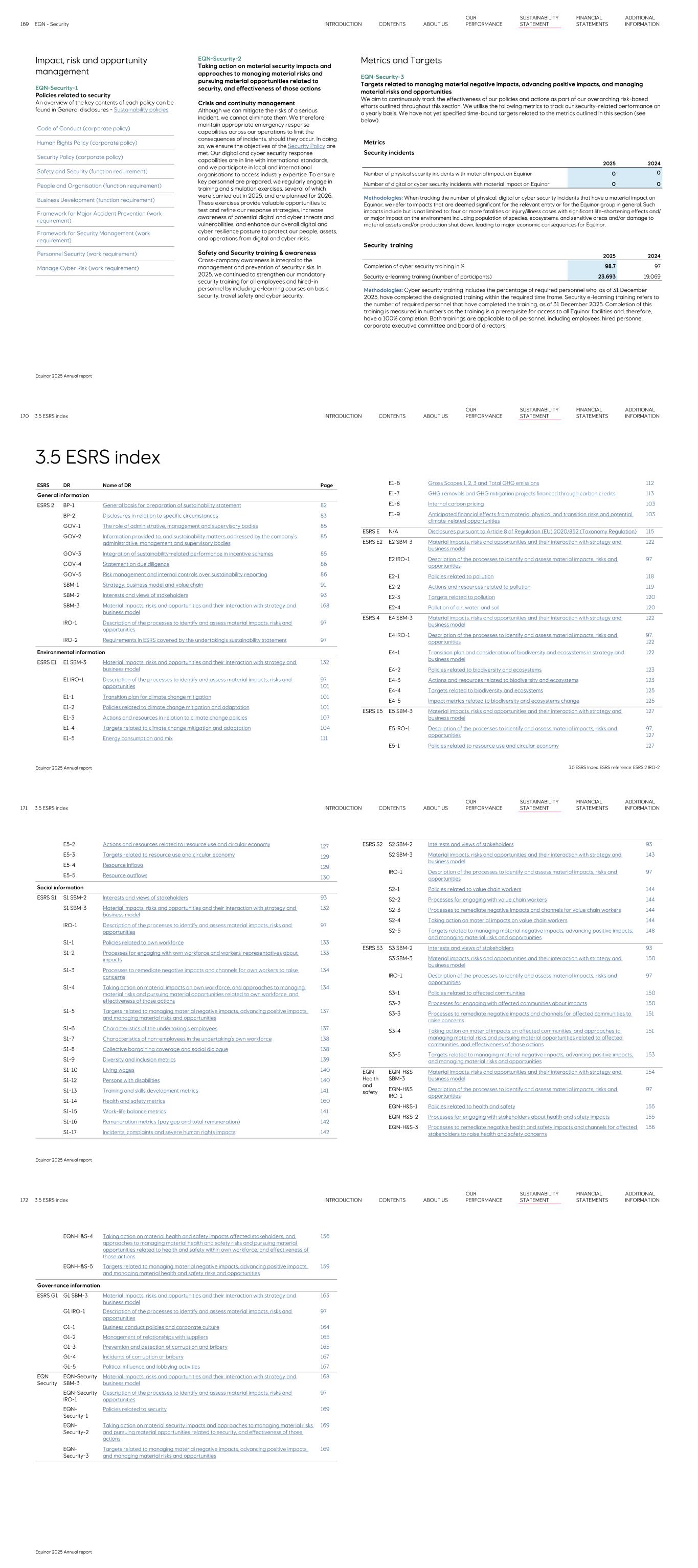
Impact, risk and opportunity management EQN-Security-1 Policies related to security An overview of the key contents of each policy can be found in General disclosures - Sustainability policies. Code of Conduct (corporate policy) Human Rights Policy (corporate policy) Security Policy (corporate policy) Safety and Security (function requirement) People and Organisation (function requirement) Business Development (function requirement) Framework for Major Accident Prevention (work requirement) Framework for Security Management (work requirement) Personnel Security (work requirement) Manage Cyber Risk (work requirement) EQN-Security-2 Taking action on material security impacts and approaches to managing material risks and pursuing material opportunities related to security, and effectiveness of those actions Crisis and continuity management Although we can mitigate the risks of a serious incident, we cannot eliminate them. We therefore maintain appropriate emergency response capabilities across our operations to limit the consequences of incidents, should they occur. In doing so, we ensure the objectives of the Security Policy are met. Our digital and cyber security response capabilities are in line with international standards, and we participate in local and international organisations to access industry expertise. To ensure key personnel are prepared, we regularly engage in training and simulation exercises, several of which were carried out in 2025, and are planned for 2026. These exercises provide valuable opportunities to test and refine our response strategies, increase awareness of potential digital and cyber threats and vulnerabilities, and enhance our overall digital and cyber resilience posture to protect our people, assets, and operations from digital and cyber risks. Safety and Security training & awareness Cross-company awareness is integral to the management and prevention of security risks. In 2025, we continued to strengthen our mandatory security training for all employees and hired-in personnel by including e-learning courses on basic security, travel safety and cyber security. Metrics and Targets EQN-Security-3 Targets related to managing material negative impacts, advancing positive impacts, and managing material risks and opportunities We aim to continuously track the effectiveness of our policies and actions as part of our overarching risk-based efforts outlined throughout this section. We utilise the following metrics to track our security-related performance on a yearly basis. We have not yet specified time-bound targets related to the metrics outlined in this section (see below). 169 EQN - Security INTRODUCTION CONTENTS ABOUT US OUR PERFORMANCE SUSTAINABILITY STATEMENT FINANCIAL STATEMENTS ADDITIONAL INFORMATION Equinor 2025 Annual report Metrics Security incidents 2025 2024 Number of physical security incidents with material impact on Equinor 0 0 Number of digital or cyber security incidents with material impact on Equinor 0 0 Methodologies: When tracking the number of physical, digital or cyber security incidents that have a material impact on Equinor, we refer to impacts that are deemed significant for the relevant entity or for the Equinor group in general. Such impacts include but is not limited to: four or more fatalities or injury/illness cases with significant life-shortening effects and/ or major impact on the environment including population of species, ecosystems, and sensitive areas and/or damage to material assets and/or production shut down, leading to major economic consequences for Equinor. Security training 2025 2024 Completion of cyber security training in % 98.7 97 Security e-learning training (number of participants) 23,693 19,069 Methodologies: Cyber security training includes the percentage of required personnel who, as of 31 December 2025, have completed the designated training within the required time frame. Security e-learning training refers to the number of required personnel that have completed the training, as of 31 December 2025. Completion of this training is measured in numbers as the training is a prerequisite for access to all Equinor facilities and, therefore, have a 100% completion. Both trainings are applicable to all personnel, including employees, hired personnel, corporate executive committee and board of directors. 3.5 ESRS index ESRS DR Name of DR Page General information ESRS 2 BP-1 General basis for preparation of sustainability statement 82 BP-2 Disclosures in relation to specific circumstances 83 GOV-1 The role of administrative, management and supervisory bodies 85 GOV-2 Information provided to, and sustainability matters addressed by the company’s administrative, management and supervisory bodies 85 GOV-3 Integration of sustainability-related performance in incentive schemes 85 GOV-4 Statement on due diligence 86 GOV-5 Risk management and internal controls over sustainability reporting 86 SBM-1 Strategy, business model and value chain 91 SBM-2 Interests and views of stakeholders 93 SBM-3 Material impacts, risks and opportunities and their interaction with strategy and business model 168 IRO-1 Description of the processes to identify and assess material impacts, risks and opportunities 97 IRO-2 Requirements in ESRS covered by the undertaking’s sustainability statement 97 Environmental information ESRS E1 E1 SBM-3 Material impacts, risks and opportunities and their interaction with strategy and business model 132 E1 IRO-1 Description of the processes to identify and assess material impacts, risks and opportunities 97, 101 E1-1 Transition plan for climate change mitigation 101 E1-2 Policies related to climate change mitigation and adaptation 101 E1-3 Actions and resources in relation to climate change policies 107 E1-4 Targets related to climate change mitigation and adaptation 104 E1-5 Energy consumption and mix 111 E1-6 Gross Scopes 1, 2, 3 and Total GHG emissions 112 E1-7 GHG removals and GHG mitigation projects financed through carbon credits 113 E1-8 Internal carbon pricing 103 E1-9 Anticipated financial effects from material physical and transition risks and potential climate-related opportunities 103 ESRS E N/A Disclosures pursuant to Article 8 of Regulation (EU) 2020/852 (Taxonomy Regulation) 115 ESRS E2 E2 SBM-3 Material impacts, risks and opportunities and their interaction with strategy and business model 122 E2 IRO-1 Description of the processes to identify and assess material impacts, risks and opportunities 97 E2-1 Policies related to pollution 118 E2-2 Actions and resources related to pollution 119 E2-3 Targets related to pollution 120 E2-4 Pollution of air, water and soil 120 ESRS 4 E4 SBM-3 Material impacts, risks and opportunities and their interaction with strategy and business model 122 E4 IRO-1 Description of the processes to identify and assess material impacts, risks and opportunities 97, 122 E4-1 Transition plan and consideration of biodiversity and ecosystems in strategy and business model 122 E4-2 Policies related to biodiversity and ecosystems 123 E4-3 Actions and resources related to biodiversity and ecosystems 123 E4-4 Targets related to biodiversity and ecosystems 125 E4-5 Impact metrics related to biodiversity and ecosystems change 125 ESRS E5 E5 SBM-3 Material impacts, risks and opportunities and their interaction with strategy and business model 127 E5 IRO-1 Description of the processes to identify and assess material impacts, risks and opportunities 97, 127 E5-1 Policies related to resource use and circular economy 127 170 3.5 ESRS index INTRODUCTION CONTENTS ABOUT US OUR PERFORMANCE SUSTAINABILITY STATEMENT FINANCIAL STATEMENTS ADDITIONAL INFORMATION Equinor 2025 Annual report 3.5 ESRS Index, ESRS reference: ESRS 2 IRO-2 E5-2 Actions and resources related to resource use and circular economy 127 E5-3 Targets related to resource use and circular economy 129 E5-4 Resource inflows 129 E5-5 Resource outflows 130 Social information ESRS S1 S1 SBM-2 Interests and views of stakeholders 93 S1 SBM-3 Material impacts, risks and opportunities and their interaction with strategy and business model 132 IRO-1 Description of the processes to identify and assess material impacts, risks and opportunities 97 S1-1 Policies related to own workforce 133 S1-2 Processes for engaging with own workforce and workers’ representatives about impacts 133 S1-3 Processes to remediate negative impacts and channels for own workers to raise concerns 134 S1-4 Taking action on material impacts on own workforce, and approaches to managing material risks and pursuing material opportunities related to own workforce, and effectiveness of those actions 134 S1-5 Targets related to managing material negative impacts, advancing positive impacts, and managing material risks and opportunities 137 S1-6 Characteristics of the undertaking’s employees 137 S1-7 Characteristics of non-employees in the undertaking’s own workforce 138 S1-8 Collective bargaining coverage and social dialogue 138 S1-9 Diversity and inclusion metrics 139 S1-10 Living wages 140 S1-12 Persons with disabilities 140 S1-13 Training and skills development metrics 141 S1-14 Health and safety metrics 160 S1-15 Work-life balance metrics 141 S1-16 Remuneration metrics (pay gap and total remuneration) 142 S1-17 Incidents, complaints and severe human rights impacts 142 ESRS S2 S2 SBM-2 Interests and views of stakeholders 93 S2 SBM-3 Material impacts, risks and opportunities and their interaction with strategy and business model 143 IRO-1 Description of the processes to identify and assess material impacts, risks and opportunities 97 S2-1 Policies related to value chain workers 144 S2-2 Processes for engaging with value chain workers 144 S2-3 Processes to remediate negative impacts and channels for value chain workers 144 S2-4 Taking action on material impacts on value chain workers 144 S2-5 Targets related to managing material negative impacts, advancing positive impacts, and managing material risks and opportunities 148 ESRS S3 S3 SBM-2 Interests and views of stakeholders 93 S3 SBM-3 Material impacts, risks and opportunities and their interaction with strategy and business model 150 IRO-1 Description of the processes to identify and assess material impacts, risks and opportunities 97 S3-1 Policies related to affected communities 150 S3-2 Processes for engaging with affected communities about impacts 150 S3-3 Processes to remediate negative impacts and channels for affected communities to raise concerns 151 S3-4 Taking action on material impacts on affected communities, and approaches to managing material risks and pursuing material opportunities related to affected communities, and effectiveness of those actions 151 S3-5 Targets related to managing material negative impacts, advancing positive impacts, and managing material risks and opportunities 153 EQN Health and safety EQN-H&S SBM-3 Material impacts, risks and opportunities and their interaction with strategy and business model 154 EQN-H&S IRO-1 Description of the processes to identify and assess material impacts, risks and opportunities 97 EQN-H&S-1 Policies related to health and safety 155 EQN-H&S-2 Processes for engaging with stakeholders about health and safety impacts 155 EQN-H&S-3 Processes to remediate negative health and safety impacts and channels for affected stakeholders to raise health and safety concerns 156 171 3.5 ESRS index INTRODUCTION CONTENTS ABOUT US OUR PERFORMANCE SUSTAINABILITY STATEMENT FINANCIAL STATEMENTS ADDITIONAL INFORMATION Equinor 2025 Annual report EQN-H&S-4 Taking action on material health and safety impacts affected stakeholders, and approaches to managing material health and safety risks and pursuing material opportunities related to health and safety within own workforce, and effectiveness of those actions 156 EQN-H&S-5 Targets related to managing material negative impacts, advancing positive impacts, and managing material health and safety risks and opportunities 159 Governance information ESRS G1 G1 SBM-3 Material impacts, risks and opportunities and their interaction with strategy and business model 163 G1 IRO-1 Description of the processes to identify and assess material impacts, risks and opportunities 97 G1-1 Business conduct policies and corporate culture 164 G1-2 Management of relationships with suppliers 165 G1-3 Prevention and detection of corruption and bribery 165 G1-4 Incidents of corruption or bribery 167 G1-5 Political influence and lobbying activities 167 EQN Security EQN-Security SBM-3 Material impacts, risks and opportunities and their interaction with strategy and business model 168 EQN-Security IRO-1 Description of the processes to identify and assess material impacts, risks and opportunities 97 EQN- Security-1 Policies related to security 169 EQN- Security-2 Taking action on material security impacts and approaches to managing material risks and pursuing material opportunities related to security, and effectiveness of those actions 169 EQN- Security-3 Targets related to managing material negative impacts, advancing positive impacts, and managing material risks and opportunities 169 172 3.5 ESRS index INTRODUCTION CONTENTS ABOUT US OUR PERFORMANCE SUSTAINABILITY STATEMENT FINANCIAL STATEMENTS ADDITIONAL INFORMATION Equinor 2025 Annual report
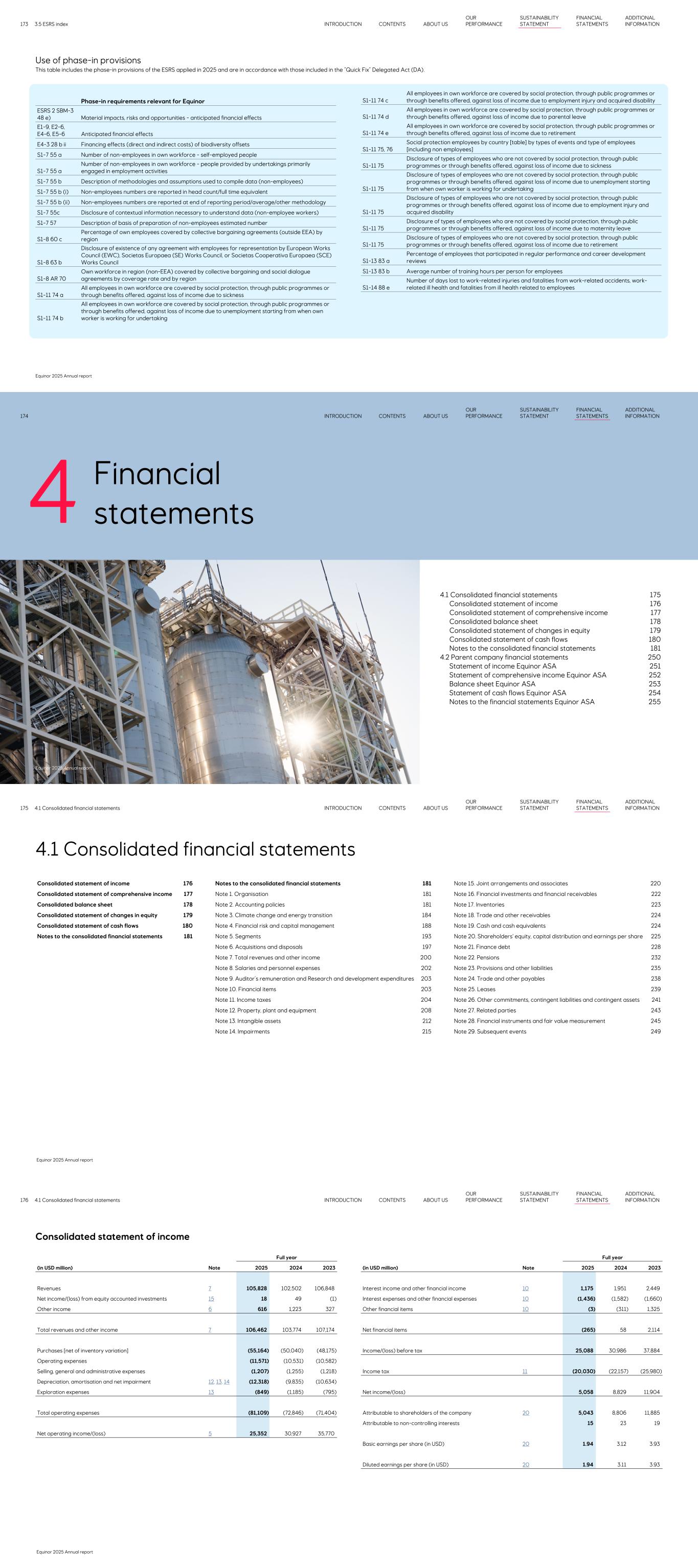
Use of phase-in provisions This table includes the phase-in provisions of the ESRS applied in 2025 and are in accordance with those included in the “Quick Fix” Delegated Act (DA). Phase-in requirements relevant for Equinor ESRS 2 SBM-3 48 e) Material impacts, risks and opportunities - anticipated financial effects E1-9, E2-6, E4-6, E5-6 Anticipated financial effects E4-3 28 b ii Financing effects (direct and indirect costs) of biodiversity offsets S1-7 55 a Number of non-employees in own workforce - self-employed people S1-7 55 a Number of non-employees in own workforce - people provided by undertakings primarily engaged in employment activities S1-7 55 b Description of methodologies and assumptions used to compile data (non-employees) S1-7 55 b (i) Non-employees numbers are reported in head count/full time equivalent S1-7 55 b (ii) Non-employees numbers are reported at end of reporting period/average/other methodology S1-7 55c Disclosure of contextual information necessary to understand data (non-employee workers) S1-7 57 Description of basis of preparation of non-employees estimated number S1-8 60 c Percentage of own employees covered by collective bargaining agreements (outside EEA) by region S1-8 63 b Disclosure of existence of any agreement with employees for representation by European Works Council (EWC), Societas Europaea (SE) Works Council, or Societas Cooperativa Europaea (SCE) Works Council S1-8 AR 70 Own workforce in region (non-EEA) covered by collective bargaining and social dialogue agreements by coverage rate and by region S1-11 74 a All employees in own workforce are covered by social protection, through public programmes or through benefits offered, against loss of income due to sickness S1-11 74 b All employees in own workforce are covered by social protection, through public programmes or through benefits offered, against loss of income due to unemployment starting from when own worker is working for undertaking S1-11 74 c All employees in own workforce are covered by social protection, through public programmes or through benefits offered, against loss of income due to employment injury and acquired disability S1-11 74 d All employees in own workforce are covered by social protection, through public programmes or through benefits offered, against loss of income due to parental leave S1-11 74 e All employees in own workforce are covered by social protection, through public programmes or through benefits offered, against loss of income due to retirement S1-11 75, 76 Social protection employees by country [table] by types of events and type of employees [including non employees] S1-11 75 Disclosure of types of employees who are not covered by social protection, through public programmes or through benefits offered, against loss of income due to sickness S1-11 75 Disclosure of types of employees who are not covered by social protection, through public programmes or through benefits offered, against loss of income due to unemployment starting from when own worker is working for undertaking S1-11 75 Disclosure of types of employees who are not covered by social protection, through public programmes or through benefits offered, against loss of income due to employment injury and acquired disability S1-11 75 Disclosure of types of employees who are not covered by social protection, through public programmes or through benefits offered, against loss of income due to maternity leave S1-11 75 Disclosure of types of employees who are not covered by social protection, through public programmes or through benefits offered, against loss of income due to retirement S1-13 83 a Percentage of employees that participated in regular performance and career development reviews S1-13 83 b Average number of training hours per person for employees S1-14 88 e Number of days lost to work-related injuries and fatalities from work-related accidents, work- related ill health and fatalities from ill health related to employees 173 3.5 ESRS index INTRODUCTION CONTENTS ABOUT US OUR PERFORMANCE SUSTAINABILITY STATEMENT FINANCIAL STATEMENTS ADDITIONAL INFORMATION Equinor 2025 Annual report 4.1 Consolidated financial statements 175 Consolidated statement of income 176 Consolidated statement of comprehensive income 177 Consolidated balance sheet 178 Consolidated statement of changes in equity 179 Consolidated statement of cash flows 180 Notes to the consolidated financial statements 181 4.2 Parent company financial statements 250 Statement of income Equinor ASA 251 Statement of comprehensive income Equinor ASA 252 Balance sheet Equinor ASA 253 Statement of cash flows Equinor ASA 254 Notes to the financial statements Equinor ASA 255 174 INTRODUCTION CONTENTS ABOUT US OUR PERFORMANCE SUSTAINABILITY STATEMENT FINANCIAL STATEMENTS ADDITIONAL INFORMATION Equinor 2025 Annual report Financial statements4 4.1 Consolidated financial statements Consolidated statement of income 176 Consolidated statement of comprehensive income 177 Consolidated balance sheet 178 Consolidated statement of changes in equity 179 Consolidated statement of cash flows 180 Notes to the consolidated financial statements 181 Notes to the consolidated financial statements 181 Note 1. Organisation 181 Note 2. Accounting policies 181 Note 3. Climate change and energy transition 184 Note 4. Financial risk and capital management 188 Note 5. Segments 193 Note 6. Acquisitions and disposals 197 Note 7. Total revenues and other income 200 Note 8. Salaries and personnel expenses 202 Note 9. Auditor’s remuneration and Research and development expenditures 203 Note 10. Financial items 203 Note 11. Income taxes 204 Note 12. Property, plant and equipment 208 Note 13. Intangible assets 212 Note 14. Impairments 215 Note 15. Joint arrangements and associates 220 Note 16. Financial investments and financial receivables 222 Note 17. Inventories 223 Note 18. Trade and other receivables 224 Note 19. Cash and cash equivalents 224 Note 20. Shareholders' equity, capital distribution and earnings per share 225 Note 21. Finance debt 228 Note 22. Pensions 232 Note 23. Provisions and other liabilities 235 Note 24. Trade and other payables 238 Note 25. Leases 239 Note 26. Other commitments, contingent liabilities and contingent assets 241 Note 27. Related parties 243 Note 28. Financial instruments and fair value measurement 245 Note 29. Subsequent events 249 175 4.1 Consolidated financial statements INTRODUCTION CONTENTS ABOUT US OUR PERFORMANCE SUSTAINABILITY STATEMENT FINANCIAL STATEMENTS ADDITIONAL INFORMATION Equinor 2025 Annual report Consolidated statement of income Revenues 7 105,828 102,502 106,848 Net income/(loss) from equity accounted investments 15 18 49 (1) Other income 6 616 1,223 327 Total revenues and other income 7 106,462 103,774 107,174 Purchases [net of inventory variation] (55,164) (50,040) (48,175) Operating expenses (11,571) (10,531) (10,582) Selling, general and administrative expenses (1,207) (1,255) (1,218) Depreciation, amortisation and net impairment 12, 13, 14 (12,318) (9,835) (10,634) Exploration expenses 13 (849) (1,185) (795) Total operating expenses (81,109) (72,846) (71,404) Net operating income/(loss) 5 25,352 30,927 35,770 Full year (in USD million) Note 2025 2024 2023 Interest income and other financial income 10 1,175 1,951 2,449 Interest expenses and other financial expenses 10 (1,436) (1,582) (1,660) Other financial items 10 (3) (311) 1,325 Net financial items (265) 58 2,114 Income/(loss) before tax 25,088 30,986 37,884 Income tax 11 (20,030) (22,157) (25,980) Net income/(loss) 5,058 8,829 11,904 Attributable to shareholders of the company 20 5,043 8,806 11,885 Attributable to non-controlling interests 15 23 19 Basic earnings per share (in USD) 20 1.94 3.12 3.93 Diluted earnings per share (in USD) 20 1.94 3.11 3.93 Full year (in USD million) Note 2025 2024 2023 176 4.1 Consolidated financial statements INTRODUCTION CONTENTS ABOUT US OUR PERFORMANCE SUSTAINABILITY STATEMENT FINANCIAL STATEMENTS ADDITIONAL INFORMATION Equinor 2025 Annual report
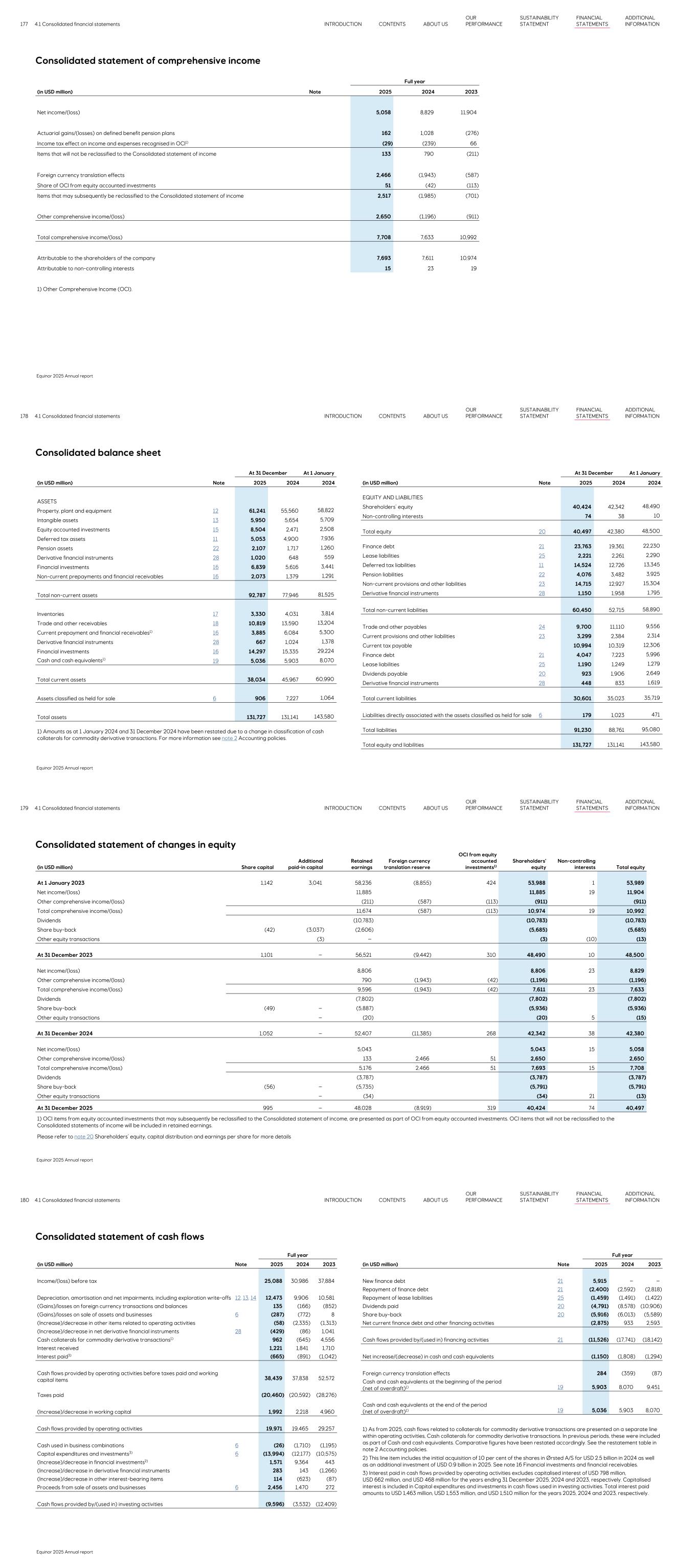
Consolidated statement of comprehensive income Net income/(loss) 5,058 8,829 11,904 Actuarial gains/(losses) on defined benefit pension plans 162 1,028 (276) Income tax effect on income and expenses recognised in OCI1) (29) (239) 66 Items that will not be reclassified to the Consolidated statement of income 133 790 (211) Foreign currency translation effects 2,466 (1,943) (587) Share of OCI from equity accounted investments 51 (42) (113) Items that may subsequently be reclassified to the Consolidated statement of income 2,517 (1,985) (701) Other comprehensive income/(loss) 2,650 (1,196) (911) Total comprehensive income/(loss) 7,708 7,633 10,992 Attributable to the shareholders of the company 7,693 7,611 10,974 Attributable to non-controlling interests 15 23 19 1) Other Comprehensive Income (OCI). Full year (in USD million) Note 2025 2024 2023 177 4.1 Consolidated financial statements INTRODUCTION CONTENTS ABOUT US OUR PERFORMANCE SUSTAINABILITY STATEMENT FINANCIAL STATEMENTS ADDITIONAL INFORMATION Equinor 2025 Annual report Consolidated balance sheet ASSETS Property, plant and equipment 12 61,241 55,560 58,822 Intangible assets 13 5,950 5,654 5,709 Equity accounted investments 15 8,504 2,471 2,508 Deferred tax assets 11 5,053 4,900 7,936 Pension assets 22 2,107 1,717 1,260 Derivative financial instruments 28 1,020 648 559 Financial investments 16 6,839 5,616 3,441 Non-current prepayments and financial receivables 16 2,073 1,379 1,291 Total non-current assets 92,787 77,946 81,525 Inventories 17 3,330 4,031 3,814 Trade and other receivables 18 10,819 13,590 13,204 Current prepayment and financial receivables1) 16 3,885 6,084 5,300 Derivative financial instruments 28 667 1,024 1,378 Financial investments 16 14,297 15,335 29,224 Cash and cash equivalents1) 19 5,036 5,903 8,070 Total current assets 38,034 45,967 60,990 Assets classified as held for sale 6 906 7,227 1,064 Total assets 131,727 131,141 143,580 1) Amounts as at 1 January 2024 and 31 December 2024 have been restated due to a change in classification of cash collaterals for commodity derivative transactions. For more information see note 2 Accounting policies. At 31 December At 1 January (in USD million) Note 2025 2024 2024 EQUITY AND LIABILITIES Shareholders’ equity 40,424 42,342 48,490 Non-controlling interests 74 38 10 Total equity 20 40,497 42,380 48,500 Finance debt 21 23,763 19,361 22,230 Lease liabilities 25 2,221 2,261 2,290 Deferred tax liabilities 11 14,524 12,726 13,345 Pension liabilities 22 4,076 3,482 3,925 Non-current provisions and other liabilities 23 14,715 12,927 15,304 Derivative financial instruments 28 1,150 1,958 1,795 Total non-current liabilities 60,450 52,715 58,890 Trade and other payables 24 9,700 11,110 9,556 Current provisions and other liabilities 23 3,299 2,384 2,314 Current tax payable 10,994 10,319 12,306 Finance debt 21 4,047 7,223 5,996 Lease liabilities 25 1,190 1,249 1,279 Dividends payable 20 923 1,906 2,649 Derivative financial instruments 28 448 833 1,619 Total current liabilities 30,601 35,023 35,719 Liabilities directly associated with the assets classified as held for sale 6 179 1,023 471 Total liabilities 91,230 88,761 95,080 Total equity and liabilities 131,727 131,141 143,580 At 31 December At 1 January (in USD million) Note 2025 2024 2024 178 4.1 Consolidated financial statements INTRODUCTION CONTENTS ABOUT US OUR PERFORMANCE SUSTAINABILITY STATEMENT FINANCIAL STATEMENTS ADDITIONAL INFORMATION Equinor 2025 Annual report Consolidated statement of changes in equity At 1 January 2023 1,142 3,041 58,236 (8,855) 424 53,988 1 53,989 Net income/(loss) 11,885 11,885 19 11,904 Other comprehensive income/(loss) (211) (587) (113) (911) (911) Total comprehensive income/(loss) 11,674 (587) (113) 10,974 19 10,992 Dividends (10,783) (10,783) (10,783) Share buy-back (42) (3,037) (2,606) (5,685) (5,685) Other equity transactions (3) — (3) (10) (13) At 31 December 2023 1,101 — 56,521 (9,442) 310 48,490 10 48,500 Net income/(loss) 8,806 8,806 23 8,829 Other comprehensive income/(loss) 790 (1,943) (42) (1,196) (1,196) Total comprehensive income/(loss) 9,596 (1,943) (42) 7,611 23 7,633 Dividends (7,802) (7,802) (7,802) Share buy-back (49) — (5,887) (5,936) (5,936) Other equity transactions — (20) (20) 5 (15) At 31 December 2024 1,052 — 52,407 (11,385) 268 42,342 38 42,380 Net income/(loss) 5,043 5,043 15 5,058 Other comprehensive income/(loss) 133 2,466 51 2,650 2,650 Total comprehensive income/(loss) 5,176 2,466 51 7,693 15 7,708 Dividends (3,787) (3,787) (3,787) Share buy-back (56) — (5,735) (5,791) (5,791) Other equity transactions — (34) (34) 21 (13) At 31 December 2025 995 — 48,028 (8,919) 319 40,424 74 40,497 1) OCI items from equity accounted investments that may subsequently be reclassified to the Consolidated statement of income, are presented as part of OCI from equity accounted investments. OCI items that will not be reclassified to the Consolidated statements of income will be included in retained earnings. Please refer to note 20 Shareholders’ equity, capital distribution and earnings per share for more details (in USD million) Share capital Additional paid-in capital Retained earnings Foreign currency translation reserve OCI from equity accounted investments1) Shareholders' equity Non-controlling interests Total equity 179 4.1 Consolidated financial statements INTRODUCTION CONTENTS ABOUT US OUR PERFORMANCE SUSTAINABILITY STATEMENT FINANCIAL STATEMENTS ADDITIONAL INFORMATION Equinor 2025 Annual report Consolidated statement of cash flows Income/(loss) before tax 25,088 30,986 37,884 Depreciation, amortisation and net impairments, including exploration write-offs 12, 13, 14 12,473 9,906 10,581 (Gains)/losses on foreign currency transactions and balances 135 (166) (852) (Gains)/losses on sale of assets and businesses 6 (287) (772) 8 (Increase)/decrease in other items related to operating activities (58) (2,335) (1,313) (Increase)/decrease in net derivative financial instruments 28 (429) (86) 1,041 Cash collaterals for commodity derivative transactions1) 962 (645) 4,556 Interest received 1,221 1,841 1,710 Interest paid3) (665) (891) (1,042) Cash flows provided by operating activities before taxes paid and working capital items 38,439 37,838 52,572 Taxes paid (20,460) (20,592) (28,276) (Increase)/decrease in working capital 1,992 2,218 4,960 Cash flows provided by operating activities 19,971 19,465 29,257 Cash used in business combinations 6 (26) (1,710) (1,195) Capital expenditures and investments3) 6 (13,994) (12,177) (10,575) (Increase)/decrease in financial investments2) 1,571 9,364 443 (Increase)/decrease in derivative financial instruments 283 143 (1,266) (Increase)/decrease in other interest-bearing items 114 (623) (87) Proceeds from sale of assets and businesses 6 2,456 1,470 272 Cash flows provided by/(used in) investing activities (9,596) (3,532) (12,409) Full year (in USD million) Note 2025 2024 2023 New finance debt 21 5,915 — — Repayment of finance debt 21 (2,400) (2,592) (2,818) Repayment of lease liabilities 25 (1,459) (1,491) (1,422) Dividends paid 20 (4,791) (8,578) (10,906) Share buy-back 20 (5,916) (6,013) (5,589) Net current finance debt and other financing activities (2,875) 933 2,593 Cash flows provided by/(used in) financing activities 21 (11,526) (17,741) (18,142) Net increase/(decrease) in cash and cash equivalents (1,150) (1,808) (1,294) Foreign currency translation effects 284 (359) (87) Cash and cash equivalents at the beginning of the period (net of overdraft)1) 19 5,903 8,070 9,451 Cash and cash equivalents at the end of the period (net of overdraft)1) 19 5,036 5,903 8,070 1) As from 2025, cash flows related to collaterals for commodity derivative transactions are presented on a separate line within operating activities, Cash collaterals for commodity derivative transactions. In previous periods, these were included as part of Cash and cash equivalents. Comparative figures have been restated accordingly. See the restatement table in note 2 Accounting policies. 2) This line item includes the initial acquisition of 10 per cent of the shares in Ørsted A/S for USD 2.5 billion in 2024 as well as an additional investment of USD 0.9 billion in 2025. See note 16 Financial investments and financial receivables. 3) Interest paid in cash flows provided by operating activities excludes capitalised interest of USD 798 million, USD 662 million, and USD 468 million for the years ending 31 December 2025, 2024 and 2023, respectively. Capitalised interest is included in Capital expenditures and investments in cash flows used in investing activities. Total interest paid amounts to USD 1,463 million, USD 1,553 million, and USD 1,510 million for the years 2025, 2024 and 2023, respectively. Full year (in USD million) Note 2025 2024 2023 180 4.1 Consolidated financial statements INTRODUCTION CONTENTS ABOUT US OUR PERFORMANCE SUSTAINABILITY STATEMENT FINANCIAL STATEMENTS ADDITIONAL INFORMATION Equinor 2025 Annual report
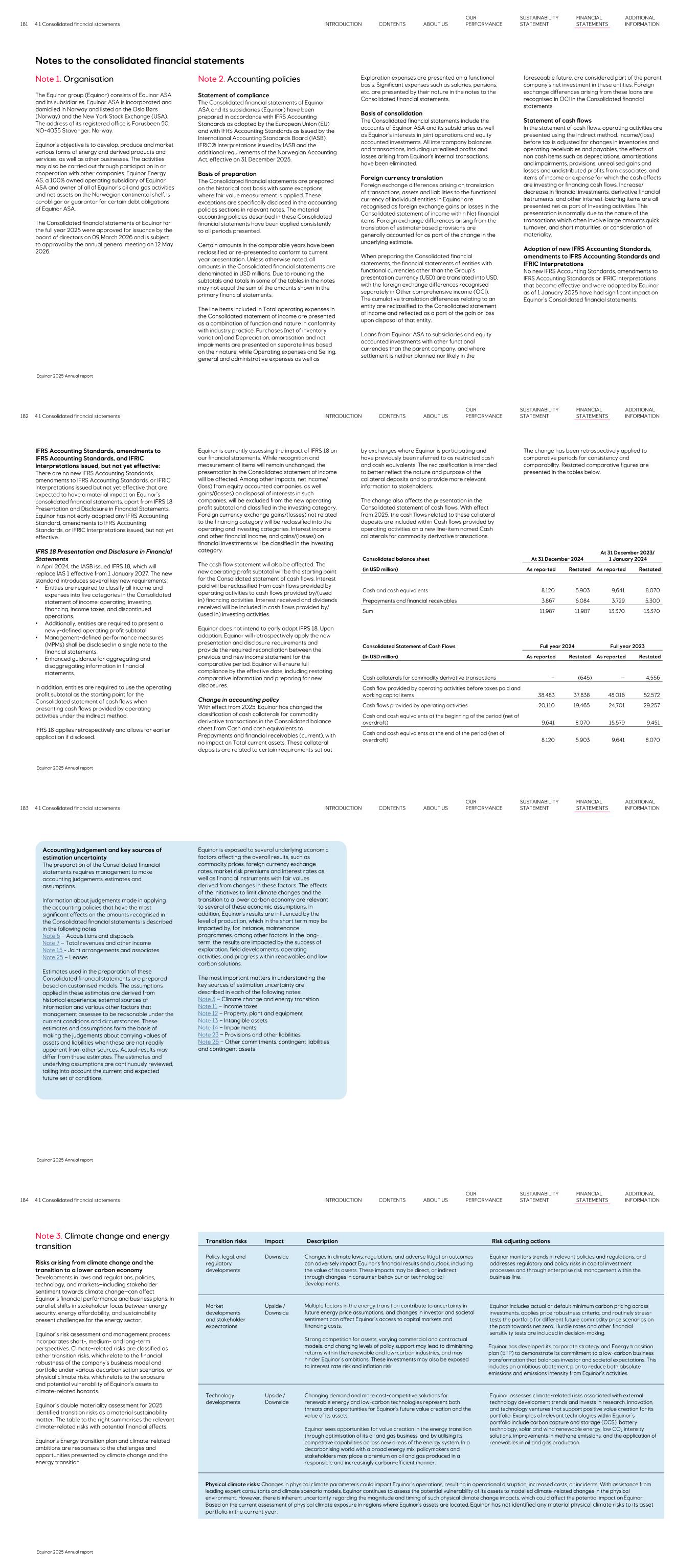
Notes to the consolidated financial statements Note 1. Organisation The Equinor group (Equinor) consists of Equinor ASA and its subsidiaries. Equinor ASA is incorporated and domiciled in Norway and listed on the Oslo Børs (Norway) and the New York Stock Exchange (USA). The address of its registered office is Forusbeen 50, NO-4035 Stavanger, Norway. Equinor’s objective is to develop, produce and market various forms of energy and derived products and services, as well as other businesses. The activities may also be carried out through participation in or cooperation with other companies. Equinor Energy AS, a 100% owned operating subsidiary of Equinor ASA and owner of all of Equinor's oil and gas activities and net assets on the Norwegian continental shelf, is co-obligor or guarantor for certain debt obligations of Equinor ASA. The Consolidated financial statements of Equinor for the full year 2025 were approved for issuance by the board of directors on 09 March 2026 and is subject to approval by the annual general meeting on 12 May 2026. Note 2. Accounting policies Statement of compliance The Consolidated financial statements of Equinor ASA and its subsidiaries (Equinor) have been prepared in accordance with IFRS Accounting Standards as adopted by the European Union (EU) and with IFRS Accounting Standards as issued by the International Accounting Standards Board (IASB), IFRIC® Interpretations issued by IASB and the additional requirements of the Norwegian Accounting Act, effective on 31 December 2025. Basis of preparation The Consolidated financial statements are prepared on the historical cost basis with some exceptions where fair value measurement is applied. These exceptions are specifically disclosed in the accounting policies sections in relevant notes. The material accounting policies described in these Consolidated financial statements have been applied consistently to all periods presented. Certain amounts in the comparable years have been reclassified or re-presented to conform to current year presentation. Unless otherwise noted, all amounts in the Consolidated financial statements are denominated in USD millions. Due to rounding the subtotals and totals in some of the tables in the notes may not equal the sum of the amounts shown in the primary financial statements. The line items included in Total operating expenses in the Consolidated statement of income are presented as a combination of function and nature in conformity with industry practice. Purchases [net of inventory variation] and Depreciation, amortisation and net impairments are presented on separate lines based on their nature, while Operating expenses and Selling, general and administrative expenses as well as Exploration expenses are presented on a functional basis. Significant expenses such as salaries, pensions, etc. are presented by their nature in the notes to the Consolidated financial statements. Basis of consolidation The Consolidated financial statements include the accounts of Equinor ASA and its subsidiaries as well as Equinor’s interests in joint operations and equity accounted investments. All intercompany balances and transactions, including unrealised profits and losses arising from Equinor's internal transactions, have been eliminated. Foreign currency translation Foreign exchange differences arising on translation of transactions, assets and liabilities to the functional currency of individual entities in Equinor are recognised as foreign exchange gains or losses in the Consolidated statement of income within Net financial items. Foreign exchange differences arising from the translation of estimate-based provisions are generally accounted for as part of the change in the underlying estimate. When preparing the Consolidated financial statements, the financial statements of entities with functional currencies other than the Group’s presentation currency (USD) are translated into USD, with the foreign exchange differences recognised separately in Other comprehensive income (OCI). The cumulative translation differences relating to an entity are reclassified to the Consolidated statement of income and reflected as a part of the gain or loss upon disposal of that entity. Loans from Equinor ASA to subsidiaries and equity accounted investments with other functional currencies than the parent company, and where settlement is neither planned nor likely in the foreseeable future, are considered part of the parent company’s net investment in these entities. Foreign exchange differences arising from these loans are recognised in OCI in the Consolidated financial statements. Statement of cash flows In the statement of cash flows, operating activities are presented using the indirect method. Income/(loss) before tax is adjusted for changes in inventories and operating receivables and payables, the effects of non cash items such as depreciations, amortisations and impairments, provisions, unrealised gains and losses and undistributed profits from associates, and items of income or expense for which the cash effects are investing or financing cash flows. Increase/ decrease in financial investments, derivative financial instruments, and other interest-bearing items are all presented net as part of Investing activities. This presentation is normally due to the nature of the transactions which often involve large amounts,quick turnover, and short maturities, or consideration of materiality. Adoption of new IFRS Accounting Standards, amendments to IFRS Accounting Standards and IFRIC Interpretations No new IFRS Accounting Standards, amendments to IFRS Accounting Standards or IFRIC Interpretations that became effective and were adopted by Equinor as of 1 January 2025 have had significant impact on Equinor’s Consolidated financial statements. 181 4.1 Consolidated financial statements INTRODUCTION CONTENTS ABOUT US OUR PERFORMANCE SUSTAINABILITY STATEMENT FINANCIAL STATEMENTS ADDITIONAL INFORMATION Equinor 2025 Annual report IFRS Accounting Standards, amendments to IFRS Accounting Standards, and IFRIC Interpretations issued, but not yet effective: There are no new IFRS Accounting Standards, amendments to IFRS Accounting Standards, or IFRIC Interpretations issued but not yet effective that are expected to have a material impact on Equinor’s consolidated financial statements, apart from IFRS 18 Presentation and Disclosure in Financial Statements. Equinor has not early adopted any IFRS Accounting Standard, amendments to IFRS Accounting Standards, or IFRIC Interpretations issued, but not yet effective. IFRS 18 Presentation and Disclosure in Financial Statements In April 2024, the IASB issued IFRS 18, which will replace IAS 1 effective from 1 January 2027. The new standard introduces several key new requirements: • Entities are required to classify all income and expenses into five categories in the Consolidated statement of income: operating, investing, financing, income taxes, and discontinued operations. • Additionally, entities are required to present a newly-defined operating profit subtotal. • Management-defined performance measures (MPMs) shall be disclosed in a single note to the financial statements. • Enhanced guidance for aggregating and disaggregating information in financial statements. In addition, entities are required to use the operating profit subtotal as the starting point for the Consolidated statement of cash flows when presenting cash flows provided by operating activities under the indirect method. IFRS 18 applies retrospectively and allows for earlier application if disclosed. Equinor is currently assessing the impact of IFRS 18 on our financial statements. While recognition and measurement of items will remain unchanged, the presentation in the Consolidated statement of income will be affected. Among other impacts, net income/ (loss) from equity accounted companies, as well gains/(losses) on disposal of interests in such companies, will be excluded from the new operating profit subtotal and classified in the investing category. Foreign currency exchange gains/(losses) not related to the financing category will be reclassified into the operating and investing categories. Interest income and other financial income, and gains/(losses) on financial investments will be classified in the investing category. The cash flow statement will also be affected. The new operating profit subtotal will be the starting point for the Consolidated statement of cash flows. Interest paid will be reclassified from cash flows provided by operating activities to cash flows provided by/(used in) financing activities. Interest received and dividends received will be included in cash flows provided by/ (used in) investing activities. Equinor does not intend to early adopt IFRS 18. Upon adoption, Equinor will retrospectively apply the new presentation and disclosure requirements and provide the required reconciliation between the previous and new income statement for the comparative period. Equinor will ensure full compliance by the effective date, including restating comparative information and preparing for new disclosures. Change in accounting policy With effect from 2025, Equinor has changed the classification of cash collaterals for commodity derivative transactions in the Consolidated balance sheet from Cash and cash equivalents to Prepayments and financial receivables (current), with no impact on Total current assets. These collateral deposits are related to certain requirements set out by exchanges where Equinor is participating and have previously been referred to as restricted cash and cash equivalents. The reclassification is intended to better reflect the nature and purpose of the collateral deposits and to provide more relevant information to stakeholders. The change also affects the presentation in the Consolidated statement of cash flows. With effect from 2025, the cash flows related to these collateral deposits are included within Cash flows provided by operating activities on a new line-item named Cash collaterals for commodity derivative transactions. Cash and cash equivalents 8,120 5,903 9,641 8,070 Prepayments and financial receivables 3,867 6,084 3,729 5,300 Sum 11,987 11,987 13,370 13,370 Consolidated balance sheet At 31 December 2024 At 31 December 2023/ 1 January 2024 (in USD million) As reported Restated As reported Restated Cash collaterals for commodity derivative transactions — (645) — 4,556 Cash flow provided by operating activities before taxes paid and working capital items 38,483 37,838 48,016 52,572 Cash flows provided by operating activities 20,110 19,465 24,701 29,257 Cash and cash equivalents at the beginning of the period (net of overdraft) 9,641 8,070 15,579 9,451 Cash and cash equivalents at the end of the period (net of overdraft) 8,120 5,903 9,641 8,070 Consolidated Statement of Cash Flows Full year 2024 Full year 2023 (in USD million) As reported Restated As reported Restated The change has been retrospectively applied to comparative periods for consistency and comparability. Restated comparative figures are presented in the tables below. 182 4.1 Consolidated financial statements INTRODUCTION CONTENTS ABOUT US OUR PERFORMANCE SUSTAINABILITY STATEMENT FINANCIAL STATEMENTS ADDITIONAL INFORMATION Equinor 2025 Annual report Accounting judgement and key sources of estimation uncertainty The preparation of the Consolidated financial statements requires management to make accounting judgements, estimates and assumptions. Information about judgements made in applying the accounting policies that have the most significant effects on the amounts recognised in the Consolidated financial statements is described in the following notes: Note 6 – Acquisitions and disposals Note 7 – Total revenues and other income Note 15 - Joint arrangements and associates Note 25 – Leases Estimates used in the preparation of these Consolidated financial statements are prepared based on customised models. The assumptions applied in these estimates are derived from historical experience, external sources of information and various other factors that management assesses to be reasonable under the current conditions and circumstances. These estimates and assumptions form the basis of making the judgements about carrying values of assets and liabilities when these are not readily apparent from other sources. Actual results may differ from these estimates. The estimates and underlying assumptions are continuously reviewed, taking into account the current and expected future set of conditions. Equinor is exposed to several underlying economic factors affecting the overall results, such as commodity prices, foreign currency exchange rates, market risk premiums and interest rates as well as financial instruments with fair values derived from changes in these factors. The effects of the initiatives to limit climate changes and the transition to a lower carbon economy are relevant to several of these economic assumptions. In addition, Equinor's results are influenced by the level of production, which in the short term may be impacted by, for instance, maintenance programmes, among other factors. In the long- term, the results are impacted by the success of exploration, field developments, operating activities, and progress within renewables and low carbon solutions. The most important matters in understanding the key sources of estimation uncertainty are described in each of the following notes: Note 3 – Climate change and energy transition Note 11 – Income taxes Note 12 – Property, plant and equipment Note 13 – Intangible assets Note 14 – Impairments Note 23 – Provisions and other liabilities Note 26 – Other commitments, contingent liabilities and contingent assets 183 4.1 Consolidated financial statements INTRODUCTION CONTENTS ABOUT US OUR PERFORMANCE SUSTAINABILITY STATEMENT FINANCIAL STATEMENTS ADDITIONAL INFORMATION Equinor 2025 Annual report Note 3. Climate change and energy transition Risks arising from climate change and the transition to a lower carbon economy Developments in laws and regulations, policies, technology, and markets—including stakeholder sentiment towards climate change—can affect Equinor’s financial performance and business plans. In parallel, shifts in stakeholder focus between energy security, energy affordability, and sustainability present challenges for the energy sector. Equinor’s risk assessment and management process incorporates short-, medium- and long-term perspectives. Climate-related risks are classified as either transition risks, which relate to the financial robustness of the company’s business model and portfolio under various decarbonisation scenarios, or physical climate risks, which relate to the exposure and potential vulnerability of Equinor’s assets to climate-related hazards. Equinor’s double materiality assessment for 2025 identified transition risks as a material sustainability matter. The table to the right summarises the relevant climate-related risks with potential financial effects. Equinor’s Energy transition plan and climate-related ambitions are responses to the challenges and opportunities presented by climate change and the energy transition. Policy, legal, and regulatory developments Downside Changes in climate laws, regulations, and adverse litigation outcomes can adversely impact Equinor's financial results and outlook, including the value of its assets. These impacts may be direct, or indirect through changes in consumer behaviour or technological developments. Equinor monitors trends in relevant policies and regulations, and addresses regulatory and policy risks in capital investment processes and through enterprise risk management within the business line. Market developments and stakeholder expectations Upside / Downside Multiple factors in the energy transition contribute to uncertainty in future energy price assumptions, and changes in investor and societal sentiment can affect Equinor’s access to capital markets and financing costs. Strong competition for assets, varying commercial and contractual models, and changing levels of policy support may lead to diminishing returns within the renewable and low-carbon industries, and may hinder Equinor’s ambitions. These investments may also be exposed to interest rate risk and inflation risk. Equinor includes actual or default minimum carbon pricing across investments, applies price robustness criteria, and routinely stress- tests the portfolio for different future commodity price scenarios on the path towards net zero. Hurdle rates and other financial sensitivity tests are included in decision-making. Equinor has developed its corporate strategy and Energy transition plan (ETP) to demonstrate its commitment to a low-carbon business transformation that balances investor and societal expectations. This includes an ambitious abatement plan to reduce both absolute emissions and emissions intensity from Equinor’s activities. Technology developments Upside / Downside Changing demand and more cost-competitive solutions for renewable energy and low-carbon technologies represent both threats and opportunities for Equinor’s future value creation and the value of its assets. Equinor sees opportunities for value creation in the energy transition through optimisation of its oil and gas business, and by utilising its competitive capabilities across new areas of the energy system. In a decarbonising world with a broad energy mix, policymakers and stakeholders may place a premium on oil and gas produced in a responsible and increasingly carbon-efficient manner. Equinor assesses climate-related risks associated with external technology development trends and invests in research, innovation, and technology ventures that support positive value creation for its portfolio. Examples of relevant technologies within Equinor’s portfolio include carbon capture and storage (CCS), battery technology, solar and wind renewable energy, low CO₂ intensity solutions, improvements in methane emissions, and the application of renewables in oil and gas production. Physical climate risks: Changes in physical climate parameters could impact Equinor's operations, resulting in operational disruption, increased costs, or incidents. With assistance from leading expert consultants and climate scenario models, Equinor continues to assess the potential vulnerability of its assets to modelled climate-related changes in the physical environment. However, there is inherent uncertainty regarding the magnitude and timing of such physical climate change impacts, which could affect the potential impact on Equinor. Based on the current assessment of physical climate exposure in regions where Equinor’s assets are located, Equinor has not identified any material physical climate risks to its asset portfolio in the current year. Transition risks Impact Description Risk adjusting actions 184 4.1 Consolidated financial statements INTRODUCTION CONTENTS ABOUT US OUR PERFORMANCE SUSTAINABILITY STATEMENT FINANCIAL STATEMENTS ADDITIONAL INFORMATION Equinor 2025 Annual report
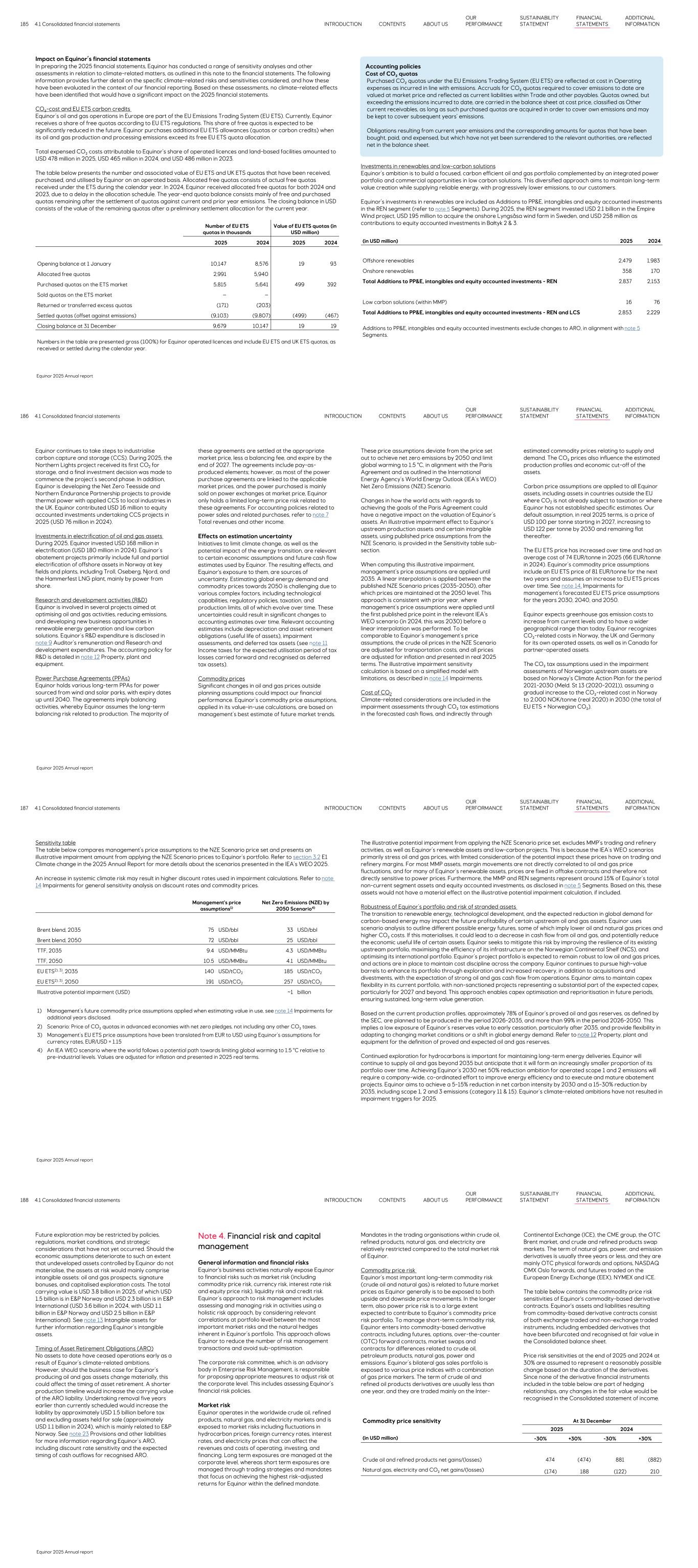
Impact on Equinor’s financial statements In preparing the 2025 financial statements, Equinor has conducted a range of sensitivity analyses and other assessments in relation to climate-related matters, as outlined in this note to the financial statements. The following information provides further detail on the specific climate-related risks and sensitivities considered, and how these have been evaluated in the context of our financial reporting. Based on these assessments, no climate-related effects have been identified that would have a significant impact on the 2025 financial statements. CO₂-cost and EU ETS carbon credits Equinor’s oil and gas operations in Europe are part of the EU Emissions Trading System (EU ETS). Currently, Equinor receives a share of free quotas according to EU ETS regulations. This share of free quotas is expected to be significantly reduced in the future. Equinor purchases additional EU ETS allowances (quotas or carbon credits) when its oil and gas production and processing emissions exceed its free EU ETS quota allocation. Total expensed CO₂ costs attributable to Equinor’s share of operated licences and land-based facilities amounted to USD 478 million in 2025, USD 465 million in 2024, and USD 486 million in 2023. The table below presents the number and associated value of EU ETS and UK ETS quotas that have been received, purchased, and utilised by Equinor on an operated basis. Allocated free quotas consists of actual free quotas received under the ETS during the calendar year. In 2024, Equinor received allocated free quotas for both 2024 and 2023, due to a delay in the allocation schedule. The year-end quota balance consists mainly of free and purchased quotas remaining after the settlement of quotas against current and prior year emissions. The closing balance in USD consists of the value of the remaining quotas after a preliminary settlement allocation for the current year. Opening balance at 1 January 10,147 8,576 19 93 Allocated free quotas 2,991 5,940 Purchased quotas on the ETS market 5,815 5,641 499 392 Sold quotas on the ETS market — — Returned or transferred excess quotas (171) (203) Settled quotas (offset against emissions) (9,103) (9,807) (499) (467) Closing balance at 31 December 9,679 10,147 19 19 Numbers in the table are presented gross (100%) for Equinor operated licences and include EU ETS and UK ETS quotas, as received or settled during the calendar year. Number of EU ETS quotas in thousands Value of EU ETS quotas (in USD million) 2025 2024 2025 2024 Accounting policies Cost of CO₂ quotas Purchased CO₂ quotas under the EU Emissions Trading System (EU ETS) are reflected at cost in Operating expenses as incurred in line with emissions. Accruals for CO₂ quotas required to cover emissions to date are valued at market price and reflected as current liabilities within Trade and other payables. Quotas owned, but exceeding the emissions incurred to date, are carried in the balance sheet at cost price, classified as Other current receivables, as long as such purchased quotas are acquired in order to cover own emissions and may be kept to cover subsequent years’ emissions. Obligations resulting from current year emissions and the corresponding amounts for quotas that have been bought, paid, and expensed, but which have not yet been surrendered to the relevant authorities, are reflected net in the balance sheet. Investments in renewables and low-carbon solutions Equinor’s ambition is to build a focused, carbon efficient oil and gas portfolio complemented by an integrated power portfolio and commercial opportunities in low carbon solutions. This diversified approach aims to maintain long-term value creation while supplying reliable energy, with progressively lower emissions, to our customers. Equinor’s investments in renewables are included as Additions to PP&E, intangibles and equity accounted investments in the REN segment (refer to note 5 Segments). During 2025, the REN segment invested USD 2.1 billion in the Empire Wind project, USD 195 million to acquire the onshore Lyngsåsa wind farm in Sweden, and USD 258 million as contributions to equity accounted investments in Bałtyk 2 & 3. Offshore renewables 2,479 1,983 Onshore renewables 358 170 Total Additions to PP&E, intangibles and equity accounted investments - REN 2,837 2,153 Low carbon solutions (within MMP) 16 76 Total Additions to PP&E, intangibles and equity accounted investments - REN and LCS 2,853 2,229 Additions to PP&E, intangibles and equity accounted investments exclude changes to ARO, in alignment with note 5 Segments. (in USD million) 2025 2024 185 4.1 Consolidated financial statements INTRODUCTION CONTENTS ABOUT US OUR PERFORMANCE SUSTAINABILITY STATEMENT FINANCIAL STATEMENTS ADDITIONAL INFORMATION Equinor 2025 Annual report Equinor continues to take steps to industrialise carbon capture and storage (CCS). During 2025, the Northern Lights project received its first CO2 for storage, and a final investment decision was made to commence the project’s second phase. In addition, Equinor is developing the Net Zero Teesside and Northern Endurance Partnership projects to provide thermal power with applied CCS to local industries in the UK. Equinor contributed USD 16 million to equity accounted investments undertaking CCS projects in 2025 (USD 76 million in 2024). Investments in electrification of oil and gas assets During 2025, Equinor invested USD 168 million in electrification (USD 180 million in 2024). Equinor’s abatement projects primarily include full and partial electrification of offshore assets in Norway at key fields and plants, including Troll, Oseberg, Njord, and the Hammerfest LNG plant, mainly by power from shore. Research and development activities (R&D) Equinor is involved in several projects aimed at optimising oil and gas activities, reducing emissions, and developing new business opportunities in renewable energy generation and low carbon solutions. Equinor’s R&D expenditure is disclosed in note 9 Auditor’s remuneration and Research and development expenditures. The accounting policy for R&D is detailed in note 12 Property, plant and equipment. Power Purchase Agreements (PPAs) Equinor holds various long-term PPAs for power sourced from wind and solar parks, with expiry dates up until 2040. The agreements imply balancing activities, whereby Equinor assumes the long-term balancing risk related to production. The majority of these agreements are settled at the appropriate market price, less a balancing fee, and expire by the end of 2027. The agreements include pay-as- produced elements; however, as most of the power purchase agreements are linked to the applicable market prices, and the power purchased is mainly sold on power exchanges at market price, Equinor only holds a limited long-term price risk related to these agreements. For accounting policies related to power sales and related purchases, refer to note 7 Total revenues and other income. Effects on estimation uncertainty Initiatives to limit climate change, as well as the potential impact of the energy transition, are relevant to certain economic assumptions and future cash flow estimates used by Equinor. The resulting effects, and Equinor's exposure to them, are sources of uncertainty. Estimating global energy demand and commodity prices towards 2050 is challenging due to various complex factors, including technological capabilities, regulatory policies, taxation, and production limits, all of which evolve over time. These uncertainties could result in significant changes to accounting estimates over time. Relevant accounting estimates include depreciation and asset retirement obligations (useful life of assets), impairment assessments, and deferred tax assets (see note 11 Income taxes for the expected utilisation period of tax losses carried forward and recognised as deferred tax assets). Commodity prices Significant changes in oil and gas prices outside planning assumptions could impact our financial performance. Equinor’s commodity price assumptions, applied in its value-in-use calculations, are based on management’s best estimate of future market trends. These price assumptions deviate from the price set out to achieve net zero emissions by 2050 and limit global warming to 1.5 °C, in alignment with the Paris Agreement and as outlined in the International Energy Agency’s World Energy Outlook (IEA’s WEO) Net Zero Emissions (NZE) Scenario. Changes in how the world acts with regards to achieving the goals of the Paris Agreement could have a negative impact on the valuation of Equinor’s assets. An illustrative impairment effect to Equinor’s upstream production assets and certain intangible assets, using published price assumptions from the NZE Scenario, is provided in the Sensitivity table sub- section. When computing this illustrative impairment, management’s price assumptions are applied until 2035. A linear interpolation is applied between the published NZE Scenario prices (2035-2050), after which prices are maintained at the 2050 level. This approach is consistent with prior year, where management’s price assumptions were applied until the first published price point in the relevant IEA’s WEO scenario (in 2024, this was 2030) before a linear interpolation was performed. To be comparable to Equinor’s management’s price assumptions, the crude oil prices in the NZE Scenario are adjusted for transportation costs, and all prices are adjusted for inflation and presented in real 2025 terms. The illustrative impairment sensitivity calculation is based on a simplified model with limitations, as described in note 14 Impairments. Cost of CO2 Climate-related considerations are included in the impairment assessments through CO₂ tax estimations in the forecasted cash flows, and indirectly through estimated commodity prices relating to supply and demand. The CO₂ prices also influence the estimated production profiles and economic cut-off of the assets. Carbon price assumptions are applied to all Equinor assets, including assets in countries outside the EU where CO2 is not already subject to taxation or where Equinor has not established specific estimates. Our default assumption, in real 2025 terms, is a price of USD 100 per tonne starting in 2027, increasing to USD 122 per tonne by 2030 and remaining flat thereafter. The EU ETS price has increased over time and had an average cost of 74 EUR/tonne in 2025 (66 EUR/tonne in 2024). Equinor’s commodity price assumptions include an EU ETS price of 81 EUR/tonne for the next two years and assumes an increase to EU ETS prices over time. See note 14. Impairments for management’s forecasted EU ETS price assumptions for the years 2030, 2040, and 2050. Equinor expects greenhouse gas emission costs to increase from current levels and to have a wider geographical range than today. Equinor recognizes CO₂-related costs in Norway, the UK and Germany for its own operated assets, as well as in Canada for partner-operated assets. The CO₂ tax assumptions used in the impairment assessments of Norwegian upstream assets are based on Norway’s Climate Action Plan for the period 2021-2030 (Meld. St 13 (2020-2021)), assuming a gradual increase to the CO₂-related cost in Norway to 2,000 NOK/tonne (real 2020) in 2030 (the total of EU ETS + Norwegian CO₂). 186 4.1 Consolidated financial statements INTRODUCTION CONTENTS ABOUT US OUR PERFORMANCE SUSTAINABILITY STATEMENT FINANCIAL STATEMENTS ADDITIONAL INFORMATION Equinor 2025 Annual report Sensitivity table The table below compares management’s price assumptions to the NZE Scenario price set and presents an illustrative impairment amount from applying the NZE Scenario prices to Equinor’s portfolio. Refer to section 3.2 E1 Climate change in the 2025 Annual Report for more details about the scenarios presented in the IEA’s WEO 2025. An increase in systemic climate risk may result in higher discount rates used in impairment calculations. Refer to note 14 Impairments for general sensitivity analysis on discount rates and commodity prices. Brent blend, 2035 75 USD/bbl 33 USD/bbl Brent blend, 2050 72 USD/bbl 25 USD/bbl TTF, 2035 9.4 USD/MMBtu 4.3 USD/MMBtu TTF, 2050 10.5 USD/MMBtu 4.1 USD/MMBtu EU ETS2), 3), 2035 140 USD/tCO2 185 USD/tCO2 EU ETS2), 3), 2050 191 USD/tCO2 257 USD/tCO2 Illustrative potential impairment (USD) ~1 billion 1) Management’s future commodity price assumptions applied when estimating value in use, see note 14 Impairments for additional years disclosed. 2) Scenario: Price of CO₂ quotas in advanced economies with net zero pledges, not including any other CO₂ taxes. 3) Management’s EU ETS price assumptions have been translated from EUR to USD using Equinor’s assumptions for currency rates, EUR/USD = 1.15 4) An IEA WEO scenario where the world follows a potential path towards limiting global warming to 1.5 °C relative to pre-industrial levels. Values are adjusted for inflation and presented in 2025 real terms. Management's price assumptions1) Net Zero Emissions (NZE) by 2050 Scenario4) The illustrative potential impairment from applying the NZE Scenario price set, excludes MMP’s trading and refinery activities, as well as Equinor’s renewable assets and low-carbon projects. This is because the IEA’s WEO scenarios primarily stress oil and gas prices, with limited consideration of the potential impact these prices have on trading and refinery margins. For most MMP assets, margin movements are not directly correlated to oil and gas price fluctuations, and for many of Equinor’s renewable assets, prices are fixed in offtake contracts and therefore not directly sensitive to power prices. Furthermore, the MMP and REN segments represent around 15% of Equinor’s total non-current segment assets and equity accounted investments, as disclosed in note 5 Segments. Based on this, these assets would not have a material effect on the illustrative potential impairment calculation, if included. Robustness of Equinor’s portfolio and risk of stranded assets The transition to renewable energy, technological development, and the expected reduction in global demand for carbon-based energy may impact the future profitability of certain upstream oil and gas assets. Equinor uses scenario analysis to outline different possible energy futures, some of which imply lower oil and natural gas prices and higher CO₂ costs. If this materialises, it could lead to a decrease in cash flow from oil and gas, and potentially reduce the economic useful life of certain assets. Equinor seeks to mitigate this risk by improving the resilience of its existing upstream portfolio, maximising the efficiency of its infrastructure on the Norwegian Continental Shelf (NCS), and optimising its international portfolio. Equinor’s project portfolio is expected to remain robust to low oil and gas prices, and actions are in place to maintain cost discipline across the company. Equinor continues to pursue high-value barrels to enhance its portfolio through exploration and increased recovery, in addition to acquisitions and divestments, with the expectation of strong oil and gas cash flow from operations. Equinor aims to maintain capex flexibility in its current portfolio, with non-sanctioned projects representing a substantial part of the expected capex, particularly for 2027 and beyond. This approach enables capex optimisation and reprioritisation in future periods, ensuring sustained, long-term value generation. Based on the current production profiles, approximately 78% of Equinor’s proved oil and gas reserves, as defined by the SEC, are planned to be produced in the period 2026-2035, and more than 99% in the period 2026-2050. This implies a low exposure of Equinor’s reserves value to early cessation, particularly after 2035, and provide flexibility in adapting to changing market conditions or a shift in global energy demand. Refer to note 12 Property, plant and equipment for the definition of proved and expected oil and gas reserves. Continued exploration for hydrocarbons is important for maintaining long-term energy deliveries. Equinor will continue to supply oil and gas beyond 2035 but anticipate that it will form an increasingly smaller proportion of its portfolio over time. Achieving Equinor’s 2030 net 50% reduction ambition for operated scope 1 and 2 emissions will require a company-wide, co-ordinated effort to improve energy efficiency and to execute and mature abatement projects. Equinor aims to achieve a 5-15% reduction in net carbon intensity by 2030 and a 15-30% reduction by 2035, including scope 1, 2 and 3 emissions (category 11 & 15). Equinor’s climate-related ambitions have not resulted in impairment triggers for 2025. 187 4.1 Consolidated financial statements INTRODUCTION CONTENTS ABOUT US OUR PERFORMANCE SUSTAINABILITY STATEMENT FINANCIAL STATEMENTS ADDITIONAL INFORMATION Equinor 2025 Annual report Future exploration may be restricted by policies, regulations, market conditions, and strategic considerations that have not yet occurred. Should the economic assumptions deteriorate to such an extent that undeveloped assets controlled by Equinor do not materialise, the assets at risk would mainly comprise intangible assets: oil and gas prospects, signature bonuses, and capitalised exploration costs. The total carrying value is USD 3.8 billion in 2025, of which USD 1.5 billion is in E&P Norway and USD 2.3 billion is in E&P International (USD 3.6 billion in 2024, with USD 1.1 billion in E&P Norway and USD 2.5 billion in E&P International). See note 13 Intangible assets for further information regarding Equinor’s intangible assets. Timing of Asset Retirement Obligations (ARO) No assets to date have ceased operations early as a result of Equinor’s climate-related ambitions. However, should the business case for Equinor’s producing oil and gas assets change materially, this could affect the timing of asset retirement. A shorter production timeline would increase the carrying value of the ARO liability. Undertaking removal five years earlier than currently scheduled would increase the liability by approximately USD 1.5 billion before tax and excluding assets held for sale (approximately USD 1.1 billion in 2024), which is mainly related to E&P Norway. See note 23 Provisions and other liabilities for more information regarding Equinor’s ARO, including discount rate sensitivity and the expected timing of cash outflows for recognised ARO. Note 4. Financial risk and capital management General information and financial risks Equinor's business activities naturally expose Equinor to financial risks such as market risk (including commodity price risk, currency risk, interest rate risk and equity price risk), liquidity risk and credit risk. Equinor’s approach to risk management includes assessing and managing risk in activities using a holistic risk approach, by considering relevant correlations at portfolio level between the most important market risks and the natural hedges inherent in Equinor’s portfolio. This approach allows Equinor to reduce the number of risk management transactions and avoid sub-optimisation. The corporate risk committee, which is an advisory body in Enterprise Risk Management, is responsible for proposing appropriate measures to adjust risk at the corporate level. This includes assessing Equinor’s financial risk policies. Market risk Equinor operates in the worldwide crude oil, refined products, natural gas, and electricity markets and is exposed to market risks including fluctuations in hydrocarbon prices, foreign currency rates, interest rates, and electricity prices that can affect the revenues and costs of operating, investing, and financing. Long term exposures are managed at the corporate level, whereas short term exposures are managed through trading strategies and mandates that focus on achieving the highest risk-adjusted returns for Equinor within the defined mandate. Mandates in the trading organisations within crude oil, refined products, natural gas, and electricity are relatively restricted compared to the total market risk of Equinor. Commodity price risk Equinor’s most important long-term commodity risk (crude oil and natural gas) is related to future market prices as Equinor generally is to be exposed to both upside and downside price movements. In the longer term, also power price risk is to a large extent expected to contribute to Equinor’s commodity price risk portfolio. To manage short-term commodity risk, Equinor enters into commodity-based derivative contracts, including futures, options, over-the-counter (OTC) forward contracts, market swaps and contracts for differences related to crude oil, petroleum products, natural gas, power and emissions. Equinor’s bilateral gas sales portfolio is exposed to various price indices with a combination of gas price markers. The term of crude oil and refined oil products derivatives are usually less than one year, and they are traded mainly on the Inter- Crude oil and refined products net gains/(losses) 474 (474) 881 (882) Natural gas, electricity and CO₂ net gains/(losses) (174) 188 (122) 210 Commodity price sensitivity At 31 December 2025 2024 (in USD million) -30% +30% -30% +30% Continental Exchange (ICE), the CME group, the OTC Brent market, and crude and refined products swap markets. The term of natural gas, power, and emission derivatives is usually three years or less, and they are mainly OTC physical forwards and options, NASDAQ OMX Oslo forwards, and futures traded on the European Energy Exchange (EEX), NYMEX and ICE. The table below contains the commodity price risk sensitivities of Equinor's commodity-based derivative contracts. Equinor's assets and liabilities resulting from commodity-based derivative contracts consist of both exchange traded and non-exchange traded instruments, including embedded derivatives that have been bifurcated and recognised at fair value in the Consolidated balance sheet. Price risk sensitivities at the end of 2025 and 2024 at 30% are assumed to represent a reasonably possible change based on the duration of the derivatives. Since none of the derivative financial instruments included in the table below are part of hedging relationships, any changes in the fair value would be recognised in the Consolidated statement of income. 188 4.1 Consolidated financial statements INTRODUCTION CONTENTS ABOUT US OUR PERFORMANCE SUSTAINABILITY STATEMENT FINANCIAL STATEMENTS ADDITIONAL INFORMATION Equinor 2025 Annual report
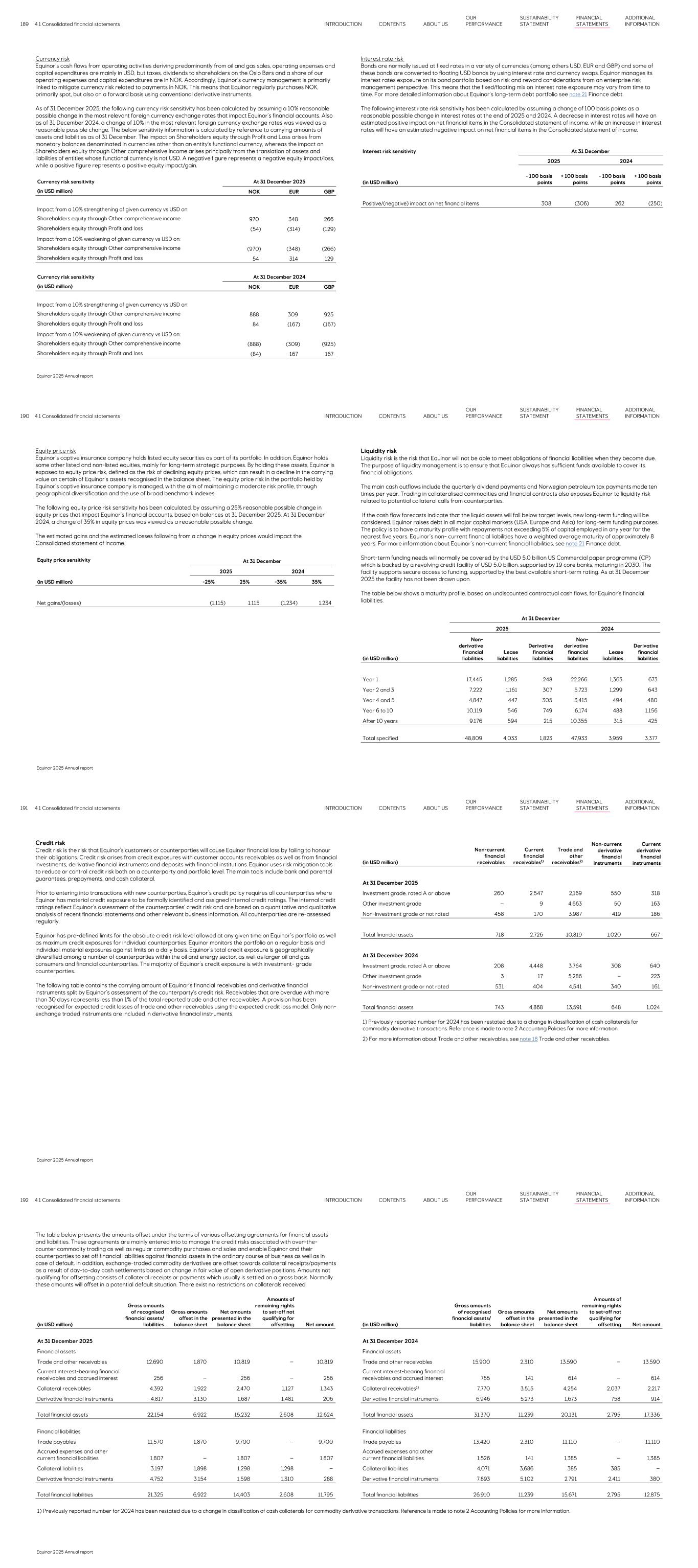
Currency risk Equinor’s cash flows from operating activities deriving predominantly from oil and gas sales, operating expenses and capital expenditures are mainly in USD, but taxes, dividends to shareholders on the Oslo Børs and a share of our operating expenses and capital expenditures are in NOK. Accordingly, Equinor’s currency management is primarily linked to mitigate currency risk related to payments in NOK. This means that Equinor regularly purchases NOK, primarily spot, but also on a forward basis using conventional derivative instruments. As of 31 December 2025, the following currency risk sensitivity has been calculated by assuming a 10% reasonable possible change in the most relevant foreign currency exchange rates that impact Equinor’s financial accounts. Also as of 31 December 2024, a change of 10% in the most relevant foreign currency exchange rates was viewed as a reasonable possible change. The below sensitivity information is calculated by reference to carrying amounts of assets and liabilities as of 31 December. The impact on Shareholders equity through Profit and Loss arises from monetary balances denominated in currencies other than an entity's functional currency, whereas the impact on Shareholders equity through Other comprehensive income arises principally from the translation of assets and liabilities of entities whose functional currency is not USD. A negative figure represents a negative equity impact/loss, while a positive figure represents a positive equity impact/gain. Impact from a 10% strengthening of given currency vs USD on: Shareholders equity through Other comprehensive income 970 348 266 Shareholders equity through Profit and loss (54) (314) (129) Impact from a 10% weakening of given currency vs USD on: Shareholders equity through Other comprehensive income (970) (348) (266) Shareholders equity through Profit and loss 54 314 129 Currency risk sensitivity At 31 December 2024 (in USD million) NOK EUR GBP Impact from a 10% strengthening of given currency vs USD on: Shareholders equity through Other comprehensive income 888 309 925 Shareholders equity through Profit and loss 84 (167) (167) Impact from a 10% weakening of given currency vs USD on: Shareholders equity through Other comprehensive income (888) (309) (925) Shareholders equity through Profit and loss (84) 167 167 Currency risk sensitivity At 31 December 2025 (in USD million) NOK EUR GBP Interest rate risk Bonds are normally issued at fixed rates in a variety of currencies (among others USD, EUR and GBP) and some of these bonds are converted to floating USD bonds by using interest rate and currency swaps. Equinor manages its interest rates exposure on its bond portfolio based on risk and reward considerations from an enterprise risk management perspective. This means that the fixed/floating mix on interest rate exposure may vary from time to time. For more detailed information about Equinor’s long-term debt portfolio see note 21 Finance debt. The following interest rate risk sensitivity has been calculated by assuming a change of 100 basis points as a reasonable possible change in interest rates at the end of 2025 and 2024. A decrease in interest rates will have an estimated positive impact on net financial items in the Consolidated statement of income, while an increase in interest rates will have an estimated negative impact on net financial items in the Consolidated statement of income. (in USD million) - 100 basis points + 100 basis points - 100 basis points + 100 basis points Positive/(negative) impact on net financial items 308 (306) 262 (250) Interest risk sensitivity At 31 December 2025 2024 189 4.1 Consolidated financial statements INTRODUCTION CONTENTS ABOUT US OUR PERFORMANCE SUSTAINABILITY STATEMENT FINANCIAL STATEMENTS ADDITIONAL INFORMATION Equinor 2025 Annual report Equity price risk Equinor’s captive insurance company holds listed equity securities as part of its portfolio. In addition, Equinor holds some other listed and non-listed equities, mainly for long-term strategic purposes. By holding these assets, Equinor is exposed to equity price risk, defined as the risk of declining equity prices, which can result in a decline in the carrying value on certain of Equinor’s assets recognised in the balance sheet. The equity price risk in the portfolio held by Equinor’s captive insurance company is managed, with the aim of maintaining a moderate risk profile, through geographical diversification and the use of broad benchmark indexes. The following equity price risk sensitivity has been calculated, by assuming a 25% reasonable possible change in equity prices that impact Equinor’s financial accounts, based on balances at 31 December 2025. At 31 December 2024, a change of 35% in equity prices was viewed as a reasonable possible change. The estimated gains and the estimated losses following from a change in equity prices would impact the Consolidated statement of income. (in USD million) -25% 25% -35% 35% Net gains/(losses) (1,115) 1,115 (1,234) 1,234 Equity price sensitivity At 31 December 2025 2024 Liquidity risk Liquidity risk is the risk that Equinor will not be able to meet obligations of financial liabilities when they become due. The purpose of liquidity management is to ensure that Equinor always has sufficient funds available to cover its financial obligations. The main cash outflows include the quarterly dividend payments and Norwegian petroleum tax payments made ten times per year. Trading in collateralised commodities and financial contracts also exposes Equinor to liquidity risk related to potential collateral calls from counterparties. If the cash flow forecasts indicate that the liquid assets will fall below target levels, new long-term funding will be considered. Equinor raises debt in all major capital markets (USA, Europe and Asia) for long-term funding purposes. The policy is to have a maturity profile with repayments not exceeding 5% of capital employed in any year for the nearest five years. Equinor’s non- current financial liabilities have a weighted average maturity of approximately 8 years. For more information about Equinor’s non-current financial liabilities, see note 21 Finance debt. Short-term funding needs will normally be covered by the USD 5.0 billion US Commercial paper programme (CP) which is backed by a revolving credit facility of USD 5.0 billion, supported by 19 core banks, maturing in 2030. The facility supports secure access to funding, supported by the best available short-term rating. As at 31 December 2025 the facility has not been drawn upon. The table below shows a maturity profile, based on undiscounted contractual cash flows, for Equinor’s financial liabilities. Year 1 17,445 1,285 248 22,266 1,363 673 Year 2 and 3 7,222 1,161 307 5,723 1,299 643 Year 4 and 5 4,847 447 305 3,415 494 480 Year 6 to 10 10,119 546 749 6,174 488 1,156 After 10 years 9,176 594 215 10,355 315 425 Total specified 48,809 4,033 1,823 47,933 3,959 3,377 At 31 December 2025 2024 (in USD million) Non- derivative financial liabilities Lease liabilities Derivative financial liabilities Non- derivative financial liabilities Lease liabilities Derivative financial liabilities 190 4.1 Consolidated financial statements INTRODUCTION CONTENTS ABOUT US OUR PERFORMANCE SUSTAINABILITY STATEMENT FINANCIAL STATEMENTS ADDITIONAL INFORMATION Equinor 2025 Annual report Credit risk Credit risk is the risk that Equinor’s customers or counterparties will cause Equinor financial loss by failing to honour their obligations. Credit risk arises from credit exposures with customer accounts receivables as well as from financial investments, derivative financial instruments and deposits with financial institutions. Equinor uses risk mitigation tools to reduce or control credit risk both on a counterparty and portfolio level. The main tools include bank and parental guarantees, prepayments, and cash collateral. Prior to entering into transactions with new counterparties, Equinor’s credit policy requires all counterparties where Equinor has material credit exposure to be formally identified and assigned internal credit ratings. The internal credit ratings reflect Equinor’s assessment of the counterparties' credit risk and are based on a quantitative and qualitative analysis of recent financial statements and other relevant business information. All counterparties are re-assessed regularly. Equinor has pre-defined limits for the absolute credit risk level allowed at any given time on Equinor’s portfolio as well as maximum credit exposures for individual counterparties. Equinor monitors the portfolio on a regular basis and individual, material exposures against limits on a daily basis. Equinor’s total credit exposure is geographically diversified among a number of counterparties within the oil and energy sector, as well as larger oil and gas consumers and financial counterparties. The majority of Equinor’s credit exposure is with investment- grade counterparties. The following table contains the carrying amount of Equinor’s financial receivables and derivative financial instruments split by Equinor’s assessment of the counterparty's credit risk. Receivables that are overdue with more than 30 days represents less than 1% of the total reported trade and other receivables. A provision has been recognised for expected credit losses of trade and other receivables using the expected credit loss model. Only non- exchange traded instruments are included in derivative financial instruments. At 31 December 2025 Investment grade, rated A or above 260 2,547 2,169 550 318 Other investment grade — 9 4,663 50 163 Non-investment grade or not rated 458 170 3,987 419 186 Total financial assets 718 2,726 10,819 1,020 667 At 31 December 2024 Investment grade, rated A or above 208 4,448 3,764 308 640 Other investment grade 3 17 5,286 — 223 Non-investment grade or not rated 531 404 4,541 340 161 Total financial assets 743 4,868 13,591 648 1,024 1) Previously reported number for 2024 has been restated due to a change in classification of cash collaterals for commodity derivative transactions. Reference is made to note 2 Accounting Policies for more information. 2) For more information about Trade and other receivables, see note 18 Trade and other receivables. (in USD million) Non-current financial receivables Current financial receivables1) Trade and other receivables2) Non-current derivative financial instruments Current derivative financial instruments 191 4.1 Consolidated financial statements INTRODUCTION CONTENTS ABOUT US OUR PERFORMANCE SUSTAINABILITY STATEMENT FINANCIAL STATEMENTS ADDITIONAL INFORMATION Equinor 2025 Annual report The table below presents the amounts offset under the terms of various offsetting agreements for financial assets and liabilities. These agreements are mainly entered into to manage the credit risks associated with over-the- counter commodity trading as well as regular commodity purchases and sales and enable Equinor and their counterparties to set off financial liabilities against financial assets in the ordinary course of business as well as in case of default. In addition, exchange-traded commodity derivatives are offset towards collateral receipts/payments as a result of day-to-day cash settlements based on change in fair value of open derivative positions. Amounts not qualifying for offsetting consists of collateral receipts or payments which usually is settled on a gross basis. Normally these amounts will offset in a potential default situation. There exist no restrictions on collaterals received. At 31 December 2025 At 31 December 2024 Financial assets Financial assets Trade and other receivables 12,690 1,870 10,819 — 10,819 Trade and other receivables 15,900 2,310 13,590 — 13,590 Current interest-bearing financial receivables and accrued interest 256 — 256 — 256 Current interest-bearing financial receivables and accrued interest 755 141 614 — 614 Collateral receivables 4,392 1,922 2,470 1,127 1,343 Collateral receivables1) 7,770 3,515 4,254 2,037 2,217 Derivative financial instruments 4,817 3,130 1,687 1,481 206 Derivative financial instruments 6,946 5,273 1,673 758 914 Total financial assets 22,154 6,922 15,232 2,608 12,624 Total financial assets 31,370 11,239 20,131 2,795 17,336 Financial liabilities Financial liabilities Trade payables 11,570 1,870 9,700 — 9,700 Trade payables 13,420 2,310 11,110 — 11,110 Accrued expenses and other current financial liabilities 1,807 — 1,807 — 1,807 Accrued expenses and other current financial liabilities 1,526 141 1,385 — 1,385 Collateral liabilities 3,197 1,898 1,298 1,298 — Collateral liabilities 4,071 3,686 385 385 — Derivative financial instruments 4,752 3,154 1,598 1,310 288 Derivative financial instruments 7,893 5,102 2,791 2,411 380 Total financial liabilities 21,325 6,922 14,403 2,608 11,795 Total financial liabilities 26,910 11,239 15,671 2,795 12,875 1) Previously reported number for 2024 has been restated due to a change in classification of cash collaterals for commodity derivative transactions. Reference is made to note 2 Accounting Policies for more information. (in USD million) Gross amounts of recognised financial assets/ liabilities Gross amounts offset in the balance sheet Net amounts presented in the balance sheet Amounts of remaining rights to set-off not qualifying for offsetting Net amount (in USD million) Gross amounts of recognised financial assets/ liabilities Gross amounts offset in the balance sheet Net amounts presented in the balance sheet Amounts of remaining rights to set-off not qualifying for offsetting Net amount 192 4.1 Consolidated financial statements INTRODUCTION CONTENTS ABOUT US OUR PERFORMANCE SUSTAINABILITY STATEMENT FINANCIAL STATEMENTS ADDITIONAL INFORMATION Equinor 2025 Annual report
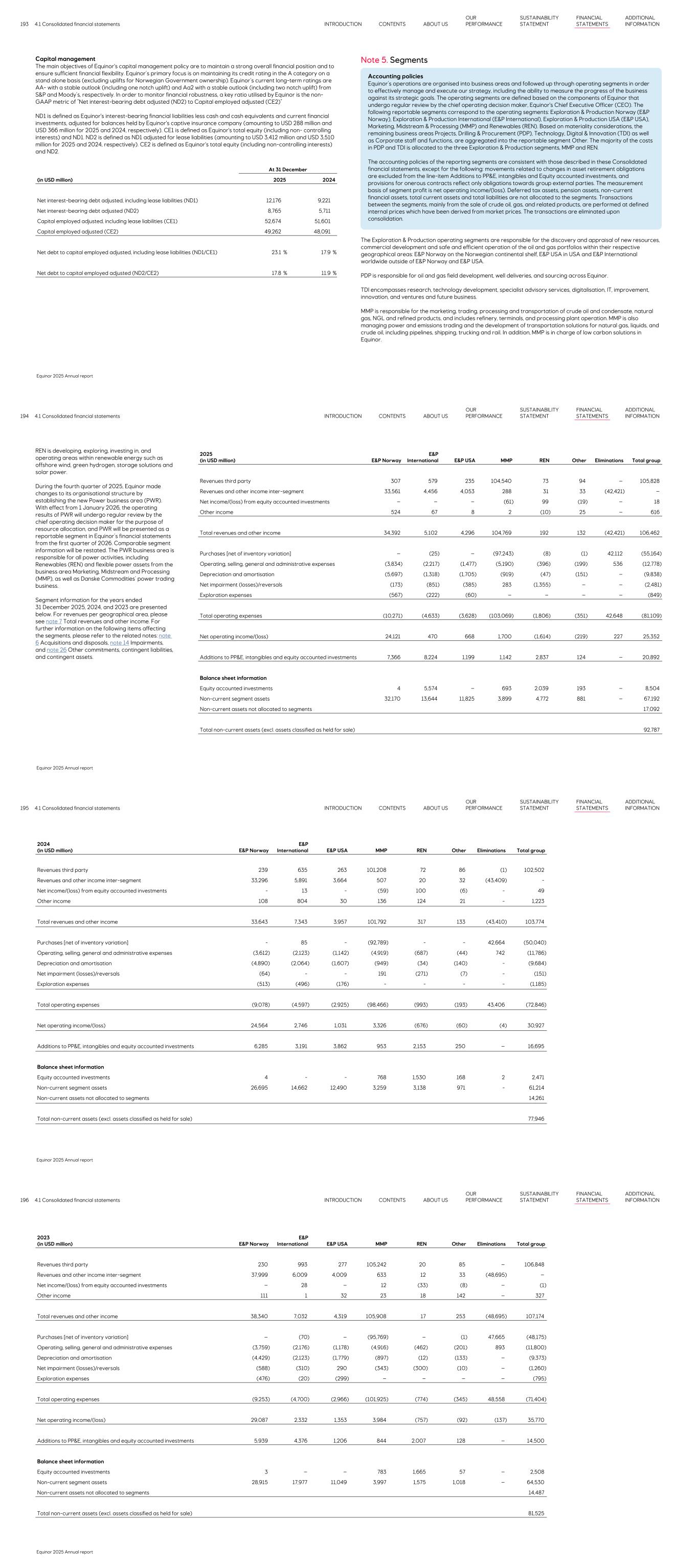
Capital management The main objectives of Equinor's capital management policy are to maintain a strong overall financial position and to ensure sufficient financial flexibility. Equinor’s primary focus is on maintaining its credit rating in the A category on a stand alone basis (excluding uplifts for Norwegian Government ownership). Equinor’s current long-term ratings are AA- with a stable outlook (including one notch uplift) and Aa2 with a stable outlook (including two notch uplift) from S&P and Moody’s, respectively. In order to monitor financial robustness, a key ratio utilised by Equinor is the non- GAAP metric of “Net interest-bearing debt adjusted (ND2) to Capital employed adjusted (CE2)” ND1 is defined as Equinor's interest-bearing financial liabilities less cash and cash equivalents and current financial investments, adjusted for balances held by Equinor's captive insurance company (amounting to USD 288 million and USD 366 million for 2025 and 2024, respectively). CE1 is defined as Equinor's total equity (including non- controlling interests) and ND1. ND2 is defined as ND1 adjusted for lease liabilities (amounting to USD 3,412 million and USD 3,510 million for 2025 and 2024, respectively). CE2 is defined as Equinor's total equity (including non-controlling interests) and ND2. Net interest-bearing debt adjusted, including lease liabilities (ND1) 12,176 9,221 Net interest-bearing debt adjusted (ND2) 8,765 5,711 Capital employed adjusted, including lease liabilities (CE1) 52,674 51,601 Capital employed adjusted (CE2) 49,262 48,091 Net debt to capital employed adjusted, including lease liabilities (ND1/CE1) 23.1 % 17.9 % Net debt to capital employed adjusted (ND2/CE2) 17.8 % 11.9 % At 31 December (in USD million) 2025 2024 Note 5. Segments Accounting policies Equinor’s operations are organised into business areas and followed up through operating segments in order to effectively manage and execute our strategy, including the ability to measure the progress of the business against its strategic goals. The operating segments are defined based on the components of Equinor that undergo regular review by the chief operating decision maker, Equinor's Chief Executive Officer (CEO). The following reportable segments correspond to the operating segments: Exploration & Production Norway (E&P Norway), Exploration & Production International (E&P International), Exploration & Production USA (E&P USA), Marketing, Midstream & Processing (MMP) and Renewables (REN). Based on materiality considerations, the remaining business areas Projects, Drilling & Procurement (PDP), Technology, Digital & Innovation (TDI) as well as Corporate staff and functions, are aggregated into the reportable segment Other. The majority of the costs in PDP and TDI is allocated to the three Exploration & Production segments, MMP and REN. The accounting policies of the reporting segments are consistent with those described in these Consolidated financial statements, except for the following: movements related to changes in asset retirement obligations are excluded from the line-item Additions to PP&E, intangibles and Equity accounted investments, and provisions for onerous contracts reflect only obligations towards group external parties. The measurement basis of segment profit is net operating income/(loss). Deferred tax assets, pension assets, non-current financial assets, total current assets and total liabilities are not allocated to the segments. Transactions between the segments, mainly from the sale of crude oil, gas, and related products, are performed at defined internal prices which have been derived from market prices. The transactions are eliminated upon consolidation. The Exploration & Production operating segments are responsible for the discovery and appraisal of new resources, commercial development and safe and efficient operation of the oil and gas portfolios within their respective geographical areas: E&P Norway on the Norwegian continental shelf, E&P USA in USA and E&P International worldwide outside of E&P Norway and E&P USA. PDP is responsible for oil and gas field development, well deliveries, and sourcing across Equinor. TDI encompasses research, technology development, specialist advisory services, digitalisation, IT, improvement, innovation, and ventures and future business. MMP is responsible for the marketing, trading, processing and transportation of crude oil and condensate, natural gas, NGL and refined products, and includes refinery, terminals, and processing plant operation. MMP is also managing power and emissions trading and the development of transportation solutions for natural gas, liquids, and crude oil, including pipelines, shipping, trucking and rail. In addition, MMP is in charge of low carbon solutions in Equinor. 193 4.1 Consolidated financial statements INTRODUCTION CONTENTS ABOUT US OUR PERFORMANCE SUSTAINABILITY STATEMENT FINANCIAL STATEMENTS ADDITIONAL INFORMATION Equinor 2025 Annual report REN is developing, exploring, investing in, and operating areas within renewable energy such as offshore wind, green hydrogen, storage solutions and solar power. During the fourth quarter of 2025, Equinor made changes to its organisational structure by establishing the new Power business area (PWR). With effect from 1 January 2026, the operating results of PWR will undergo regular review by the chief operating decision maker for the purpose of resource allocation, and PWR will be presented as a reportable segment in Equinor’s financial statements from the first quarter of 2026. Comparable segment information will be restated. The PWR business area is responsible for all power activities, including Renewables (REN) and flexible power assets from the business area Marketing, Midstream and Processing (MMP), as well as Danske Commodities’ power trading business. Segment information for the years ended 31 December 2025, 2024, and 2023 are presented below. For revenues per geographical area, please see note 7 Total revenues and other income. For further information on the following items affecting the segments, please refer to the related notes: note 6 Acquisitions and disposals, note 14 Impairments, and note 26 Other commitments, contingent liabilities, and contingent assets. Revenues third party 307 579 235 104,540 73 94 — 105,828 Revenues and other income inter-segment 33,561 4,456 4,053 288 31 33 (42,421) — Net income/(loss) from equity accounted investments — — — (61) 99 (19) — 18 Other income 524 67 8 2 (10) 25 — 616 Total revenues and other income 34,392 5,102 4,296 104,769 192 132 (42,421) 106,462 Purchases [net of inventory variation] — (25) — (97,243) (8) (1) 42,112 (55,164) Operating, selling, general and administrative expenses (3,834) (2,217) (1,477) (5,190) (396) (199) 536 (12,778) Depreciation and amortisation (5,697) (1,318) (1,705) (919) (47) (151) — (9,838) Net impairment (losses)/reversals (173) (851) (385) 283 (1,355) — — (2,481) Exploration expenses (567) (222) (60) — — — — (849) Total operating expenses (10,271) (4,633) (3,628) (103,069) (1,806) (351) 42,648 (81,109) Net operating income/(loss) 24,121 470 668 1,700 (1,614) (219) 227 25,352 Additions to PP&E, intangibles and equity accounted investments 7,366 8,224 1,199 1,142 2,837 124 — 20,892 Balance sheet information Equity accounted investments 4 5,574 — 693 2,039 193 — 8,504 Non-current segment assets 32,170 13,644 11,825 3,899 4,772 881 — 67,192 Non-current assets not allocated to segments 17,092 Total non-current assets (excl. assets classified as held for sale) 92,787 2025 (in USD million) E&P Norway E&P International E&P USA MMP REN Other Eliminations Total group 194 4.1 Consolidated financial statements INTRODUCTION CONTENTS ABOUT US OUR PERFORMANCE SUSTAINABILITY STATEMENT FINANCIAL STATEMENTS ADDITIONAL INFORMATION Equinor 2025 Annual report Revenues third party 239 635 263 101,208 72 86 (1) 102,502 Revenues and other income inter-segment 33,296 5,891 3,664 507 20 32 (43,409) - Net income/(loss) from equity accounted investments - 13 - (59) 100 (6) - 49 Other income 108 804 30 136 124 21 - 1,223 Total revenues and other income 33,643 7,343 3,957 101,792 317 133 (43,410) 103,774 Purchases [net of inventory variation] - 85 - (92,789) - - 42,664 (50,040) Operating, selling, general and administrative expenses (3,612) (2,123) (1,142) (4,919) (687) (44) 742 (11,786) Depreciation and amortisation (4,890) (2,064) (1,607) (949) (34) (140) - (9,684) Net impairment (losses)/reversals (64) - - 191 (271) (7) - (151) Exploration expenses (513) (496) (176) - - - - (1,185) Total operating expenses (9,078) (4,597) (2,925) (98,466) (993) (193) 43,406 (72,846) Net operating income/(loss) 24,564 2,746 1,031 3,326 (676) (60) (4) 30,927 Additions to PP&E, intangibles and equity accounted investments 6,285 3,191 3,862 953 2,153 250 — 16,695 Balance sheet information Equity accounted investments 4 - - 768 1,530 168 2 2,471 Non-current segment assets 26,695 14,662 12,490 3,259 3,138 971 - 61,214 Non-current assets not allocated to segments 14,261 Total non-current assets (excl. assets classified as held for sale) 77,946 2024 (in USD million) E&P Norway E&P International E&P USA MMP REN Other Eliminations Total group 195 4.1 Consolidated financial statements INTRODUCTION CONTENTS ABOUT US OUR PERFORMANCE SUSTAINABILITY STATEMENT FINANCIAL STATEMENTS ADDITIONAL INFORMATION Equinor 2025 Annual report Revenues third party 230 993 277 105,242 20 85 — 106,848 Revenues and other income inter-segment 37,999 6,009 4,009 633 12 33 (48,695) — Net income/(loss) from equity accounted investments — 28 — 12 (33) (8) — (1) Other income 111 1 32 23 18 142 — 327 Total revenues and other income 38,340 7,032 4,319 105,908 17 253 (48,695) 107,174 Purchases [net of inventory variation] — (70) — (95,769) — (1) 47,665 (48,175) Operating, selling, general and administrative expenses (3,759) (2,176) (1,178) (4,916) (462) (201) 893 (11,800) Depreciation and amortisation (4,429) (2,123) (1,779) (897) (12) (133) — (9,373) Net impairment (losses)/reversals (588) (310) 290 (343) (300) (10) — (1,260) Exploration expenses (476) (20) (299) — — — — (795) Total operating expenses (9,253) (4,700) (2,966) (101,925) (774) (345) 48,558 (71,404) Net operating income/(loss) 29,087 2,332 1,353 3,984 (757) (92) (137) 35,770 Additions to PP&E, intangibles and equity accounted investments 5,939 4,376 1,206 844 2,007 128 — 14,500 Balance sheet information Equity accounted investments 3 — — 783 1,665 57 — 2,508 Non-current segment assets 28,915 17,977 11,049 3,997 1,575 1,018 — 64,530 Non-current assets not allocated to segments 14,487 Total non-current assets (excl. assets classified as held for sale) 81,525 2023 (in USD million) E&P Norway E&P International E&P USA MMP REN Other Eliminations Total group 196 4.1 Consolidated financial statements INTRODUCTION CONTENTS ABOUT US OUR PERFORMANCE SUSTAINABILITY STATEMENT FINANCIAL STATEMENTS ADDITIONAL INFORMATION Equinor 2025 Annual report
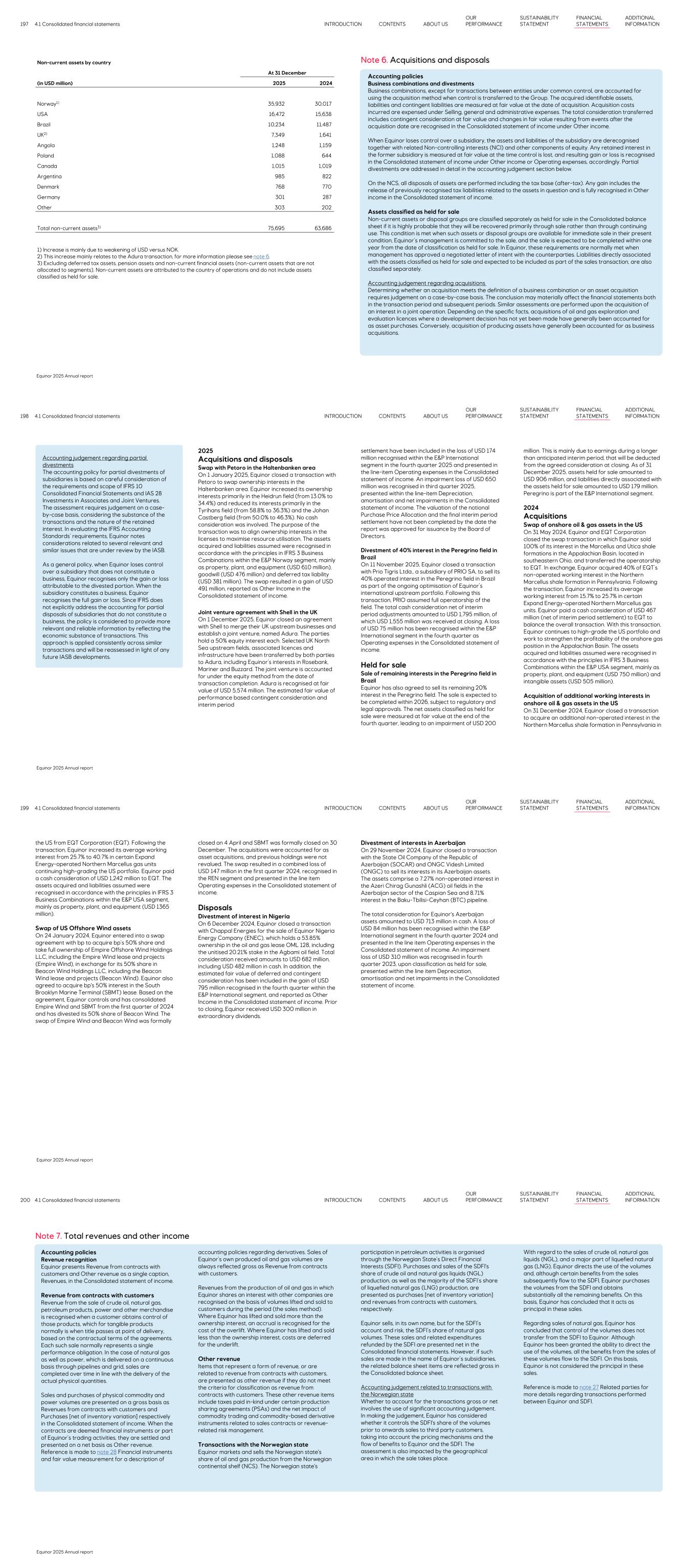
Norway1) 35,932 30,017 USA 16,472 15,638 Brazil 10,234 11,487 UK2) 7,349 1,641 Angola 1,248 1,159 Poland 1,088 644 Canada 1,015 1,019 Argentina 985 822 Denmark 768 770 Germany 301 287 Other 303 202 Total non-current assets3) 75,695 63,686 1) Increase is mainly due to weakening of USD versus NOK. 2) This increase mainly relates to the Adura transaction, for more information please see note 6. 3) Excluding deferred tax assets, pension assets and non-current financial assets (non-current assets that are not allocated to segments). Non-current assets are attributed to the country of operations and do not include assets classified as held for sale. Non-current assets by country At 31 December (in USD million) 2025 2024 Note 6. Acquisitions and disposals Accounting policies Business combinations and divestments Business combinations, except for transactions between entities under common control, are accounted for using the acquisition method when control is transferred to the Group. The acquired identifiable assets, liabilities and contingent liabilities are measured at fair value at the date of acquisition. Acquisition costs incurred are expensed under Selling, general and administrative expenses. The total consideration transferred includes contingent consideration at fair value and changes in fair value resulting from events after the acquisition date are recognised in the Consolidated statement of income under Other income. When Equinor loses control over a subsidiary, the assets and liabilities of the subsidiary are derecognised together with related Non-controlling interests (NCI) and other components of equity. Any retained interest in the former subsidiary is measured at fair value at the time control is lost, and resulting gain or loss is recognised in the Consolidated statement of income under Other income or Operating expenses, accordingly. Partial divestments are addressed in detail in the accounting judgement section below. On the NCS, all disposals of assets are performed including the tax base (after-tax). Any gain includes the release of previously recognised tax liabilities related to the assets in question and is fully recognised in Other income in the Consolidated statement of income. Assets classified as held for sale Non-current assets or disposal groups are classified separately as held for sale in the Consolidated balance sheet if it is highly probable that they will be recovered primarily through sale rather than through continuing use. This condition is met when such assets or disposal groups are available for immediate sale in their present condition, Equinor’s management is committed to the sale, and the sale is expected to be completed within one year from the date of classification as held for sale. In Equinor, these requirements are normally met when management has approved a negotiated letter of intent with the counterparties. Liabilities directly associated with the assets classified as held for sale and expected to be included as part of the sales transaction, are also classified separately. Accounting judgement regarding acquisitions Determining whether an acquisition meets the definition of a business combination or an asset acquisition requires judgement on a case-by-case basis. The conclusion may materially affect the financial statements both in the transaction period and subsequent periods. Similar assessments are performed upon the acquisition of an interest in a joint operation. Depending on the specific facts, acquisitions of oil and gas exploration and evaluation licences where a development decision has not yet been made have generally been accounted for as asset purchases. Conversely, acquisition of producing assets have generally been accounted for as business acquisitions. 197 4.1 Consolidated financial statements INTRODUCTION CONTENTS ABOUT US OUR PERFORMANCE SUSTAINABILITY STATEMENT FINANCIAL STATEMENTS ADDITIONAL INFORMATION Equinor 2025 Annual report Accounting judgement regarding partial divestments The accounting policy for partial divestments of subsidiaries is based on careful consideration of the requirements and scope of IFRS 10 Consolidated Financial Statements and IAS 28 Investments in Associates and Joint Ventures. The assessment requires judgement on a case- by-case basis, considering the substance of the transactions and the nature of the retained interest. In evaluating the IFRS Accounting Standards’ requirements, Equinor notes considerations related to several relevant and similar issues that are under review by the IASB. As a general policy, when Equinor loses control over a subsidiary that does not constitute a business, Equinor recognises only the gain or loss attributable to the divested portion. When the subsidiary constitutes a business, Equinor recognises the full gain or loss. Since IFRS does not explicitly address the accounting for partial disposals of subsidiaries that do not constitute a business, the policy is considered to provide more relevant and reliable information by reflecting the economic substance of transactions. This approach is applied consistently across similar transactions and will be reassessed in light of any future IASB developments. 2025 Acquisitions and disposals Swap with Petoro in the Haltenbanken area On 1 January 2025, Equinor closed a transaction with Petoro to swap ownership interests in the Haltenbanken area. Equinor increased its ownership interests primarily in the Heidrun field (from 13.0% to 34.4%) and reduced its interests primarily in the Tyrihans field (from 58.8% to 36.3%) and the Johan Castberg field (from 50.0% to 46.3%). No cash consideration was involved. The purpose of the transaction was to align ownership interests in the licenses to maximise resource utilisation. The assets acquired and liabilities assumed were recognised in accordance with the principles in IFRS 3 Business Combinations within the E&P Norway segment, mainly as property, plant, and equipment (USD 610 million), goodwill (USD 476 million) and deferred tax liability (USD 381 million). The swap resulted in a gain of USD 491 million, reported as Other Income in the Consolidated statement of income. Joint venture agreement with Shell in the UK On 1 December 2025, Equinor closed an agreement with Shell to merge their UK upstream businesses and establish a joint venture, named Adura. The parties hold a 50% equity interest each. Selected UK North Sea upstream fields, associated licences and infrastructure have been transferred by both parties to Adura, including Equinor’s interests in Rosebank, Mariner and Buzzard. The joint venture is accounted for under the equity method from the date of transaction completion. Adura is recognised at fair value of USD 5,574 million. The estimated fair value of performance based contingent consideration and interim period settlement have been included in the loss of USD 174 million recognised within the E&P International segment in the fourth quarter 2025 and presented in the line-item Operating expenses in the Consolidated statement of income. An impairment loss of USD 650 million was recognised in third quarter 2025, presented within the line-item Depreciation, amortisation and net impairments in the Consolidated statement of income. The valuation of the notional Purchase Price Allocation and the final interim period settlement have not been completed by the date the report was approved for issuance by the Board of Directors. Divestment of 40% interest in the Peregrino field in Brazil On 11 November 2025, Equinor closed a transaction with Prio Tigris Ltda., a subsidiary of PRIO SA, to sell its 40% operated interest in the Peregrino field in Brazil as part of the ongoing optimisation of Equinor’s international upstream portfolio. Following this transaction, PRIO assumed full operatorship of the field. The total cash consideration net of interim period adjustments amounted to USD 1,795 million, of which USD 1,555 million was received at closing. A loss of USD 75 million has been recognised within the E&P International segment in the fourth quarter as Operating expenses in the Consolidated statement of income. Held for sale Sale of remaining interests in the Peregrino field in Brazil Equinor has also agreed to sell its remaining 20% interest in the Peregrino field. The sale is expected to be completed within 2026, subject to regulatory and legal approvals. The net assets classified as held for sale were measured at fair value at the end of the fourth quarter, leading to an impairment of USD 200 million. This is mainly due to earnings during a longer than anticipated interim period, that will be deducted from the agreed consideration at closing. As of 31 December 2025, assets held for sale amounted to USD 906 million, and liabilities directly associated with the assets held for sale amounted to USD 179 million. Peregrino is part of the E&P International segment. 2024 Acquisitions Swap of onshore oil & gas assets in the US On 31 May 2024, Equinor and EQT Corporation closed the swap transaction in which Equinor sold 100% of its interest in the Marcellus and Utica shale formations in the Appalachian Basin, located in southeastern Ohio, and transferred the operatorship to EQT. In exchange, Equinor acquired 40% of EQT’s non-operated working interest in the Northern Marcellus shale formation in Pennsylvania. Following the transaction, Equinor increased its average working interest from 15.7% to 25.7% in certain Expand Energy-operated Northern Marcellus gas units. Equinor paid a cash consideration of USD 467 million (net of interim period settlement) to EQT to balance the overall transaction. With this transaction, Equinor continues to high-grade the US portfolio and work to strengthen the profitability of the onshore gas position in the Appalachian Basin. The assets acquired and liabilities assumed were recognised in accordance with the principles in IFRS 3 Business Combinations within the E&P USA segment, mainly as property, plant, and equipment (USD 750 million) and intangible assets (USD 505 million). Acquisition of additional working interests in onshore oil & gas assets in the US On 31 December 2024, Equinor closed a transaction to acquire an additional non-operated interest in the Northern Marcellus shale formation in Pennsylvania in 198 4.1 Consolidated financial statements INTRODUCTION CONTENTS ABOUT US OUR PERFORMANCE SUSTAINABILITY STATEMENT FINANCIAL STATEMENTS ADDITIONAL INFORMATION Equinor 2025 Annual report the US from EQT Corporation (EQT). Following the transaction, Equinor increased its average working interest from 25.7% to 40.7% in certain Expand Energy-operated Northern Marcellus gas units continuing high-grading the US portfolio. Equinor paid a cash consideration of USD 1,242 million to EQT. The assets acquired and liabilities assumed were recognised in accordance with the principles in IFRS 3 Business Combinations within the E&P USA segment, mainly as property, plant, and equipment (USD 1365 million). Swap of US Offshore Wind assets On 24 January 2024, Equinor entered into a swap agreement with bp to acquire bp’s 50% share and take full ownership of Empire Offshore Wind Holdings LLC, including the Empire Wind lease and projects (Empire Wind), in exchange for its 50% share in Beacon Wind Holdings LLC, including the Beacon Wind lease and projects (Beacon Wind). Equinor also agreed to acquire bp's 50% interest in the South Brooklyn Marine Terminal (SBMT) lease. Based on the agreement, Equinor controls and has consolidated Empire Wind and SBMT from the first quarter of 2024 and has divested its 50% share of Beacon Wind. The swap of Empire Wind and Beacon Wind was formally closed on 4 April and SBMT was formally closed on 30 December. The acquisitions were accounted for as asset acquisitions, and previous holdings were not revalued. The swap resulted in a combined loss of USD 147 million in the first quarter 2024, recognised in the REN segment and presented in the line item Operating expenses in the Consolidated statement of income. Disposals Divestment of interest in Nigeria On 6 December 2024, Equinor closed a transaction with Chappal Energies for the sale of Equinor Nigeria Energy Company (ENEC), which holds a 53.85% ownership in the oil and gas lease OML 128, including the unitised 20.21% stake in the Agbami oil field. Total consideration received amounts to USD 682 million, including USD 482 million in cash. In addition, the estimated fair value of deferred and contingent consideration has been included in the gain of USD 795 million recognised in the fourth quarter within the E&P International segment, and reported as Other Income in the Consolidated statement of income. Prior to closing, Equinor received USD 300 million in extraordinary dividends. Divestment of interests in Azerbaijan On 29 November 2024, Equinor closed a transaction with the State Oil Company of the Republic of Azerbaijan (SOCAR) and ONGC Videsh Limited (ONGC) to sell its interests in its Azerbaijan assets. The assets comprise a 7.27% non-operated interest in the Azeri Chirag Gunashli (ACG) oil fields in the Azerbaijan sector of the Caspian Sea and 8.71% interest in the Baku-Tbilisi-Ceyhan (BTC) pipeline. The total consideration for Equinor's Azerbaijan assets amounted to USD 713 million in cash. A loss of USD 84 million has been recognised within the E&P International segment in the fourth quarter 2024 and presented in the line item Operating expenses in the Consolidated statement of income. An impairment loss of USD 310 million was recognised in fourth quarter 2023, upon classification as held for sale, presented within the line item Depreciation, amortisation and net impairments in the Consolidated statement of income. 199 4.1 Consolidated financial statements INTRODUCTION CONTENTS ABOUT US OUR PERFORMANCE SUSTAINABILITY STATEMENT FINANCIAL STATEMENTS ADDITIONAL INFORMATION Equinor 2025 Annual report Note 7. Total revenues and other income Accounting policies Revenue recognition Equinor presents Revenue from contracts with customers and Other revenue as a single caption, Revenues, in the Consolidated statement of income. Revenue from contracts with customers Revenue from the sale of crude oil, natural gas, petroleum products, power and other merchandise is recognised when a customer obtains control of those products, which for tangible products normally is when title passes at point of delivery, based on the contractual terms of the agreements. Each such sale normally represents a single performance obligation. In the case of natural gas as well as power, which is delivered on a continuous basis through pipelines and grid, sales are completed over time in line with the delivery of the actual physical quantities. Sales and purchases of physical commodity and power volumes are presented on a gross basis as Revenues from contracts with customers and Purchases [net of inventory variation] respectively in the Consolidated statement of income. When the contracts are deemed financial instruments or part of Equinor’s trading activities, they are settled and presented on a net basis as Other revenue. Reference is made to note 28 Financial instruments and fair value measurement for a description of accounting policies regarding derivatives. Sales of Equinor’s own produced oil and gas volumes are always reflected gross as Revenue from contracts with customers. Revenues from the production of oil and gas in which Equinor shares an interest with other companies are recognised on the basis of volumes lifted and sold to customers during the period (the sales method). Where Equinor has lifted and sold more than the ownership interest, an accrual is recognised for the cost of the overlift. Where Equinor has lifted and sold less than the ownership interest, costs are deferred for the underlift. Other revenue Items that represent a form of revenue, or are related to revenue from contracts with customers, are presented as other revenue if they do not meet the criteria for classification as revenue from contracts with customers. These other revenue items include taxes paid in-kind under certain production sharing agreements (PSAs) and the net impact of commodity trading and commodity-based derivative instruments related to sales contracts or revenue- related risk management. Transactions with the Norwegian state Equinor markets and sells the Norwegian state's share of oil and gas production from the Norwegian continental shelf (NCS). The Norwegian state's participation in petroleum activities is organised through the Norwegian State’s Direct Financial Interests (SDFI). Purchases and sales of the SDFI's share of crude oil and natural gas liquids (NGL) production, as well as the majority of the SDFI’s share of liquefied natural gas (LNG) production, are presented as purchases [net of inventory variation] and revenues from contracts with customers, respectively. Equinor sells, in its own name, but for the SDFI’s account and risk, the SDFI’s share of natural gas volumes. These sales and related expenditures refunded by the SDFI are presented net in the Consolidated financial statements. However, if such sales are made in the name of Equinor’s subsidiaries, the related balance sheet items are reflected gross in the Consolidated balance sheet. Accounting judgement related to transactions with the Norwegian state Whether to account for the transactions gross or net involves the use of significant accounting judgement. In making the judgement, Equinor has considered whether it controls the SDFI's share of the volumes prior to onwards sales to third party customers, taking into account the pricing mechanisms and the flow of benefits to Equinor and the SDFI. The assessment is also impacted by the geographical area in which the sale takes place. With regard to the sales of crude oil, natural gas liquids (NGL), and a major part of liquefied natural gas (LNG), Equinor directs the use of the volumes and, although certain benefits from the sales subsequently flow to the SDFI, Equinor purchases the volumes from the SDFI and obtains substantially all the remaining benefits. On this basis, Equinor has concluded that it acts as principal in these sales. Regarding sales of natural gas, Equinor has concluded that control of the volumes does not transfer from the SDFI to Equinor. Although Equinor has been granted the ability to direct the use of the volumes, all the benefits from the sales of these volumes flow to the SDFI. On this basis, Equinor is not considered the principal in these sales. Reference is made to note 27 Related parties for more details regarding transactions performed between Equinor and SDFI. 200 4.1 Consolidated financial statements INTRODUCTION CONTENTS ABOUT US OUR PERFORMANCE SUSTAINABILITY STATEMENT FINANCIAL STATEMENTS ADDITIONAL INFORMATION Equinor 2025 Annual report
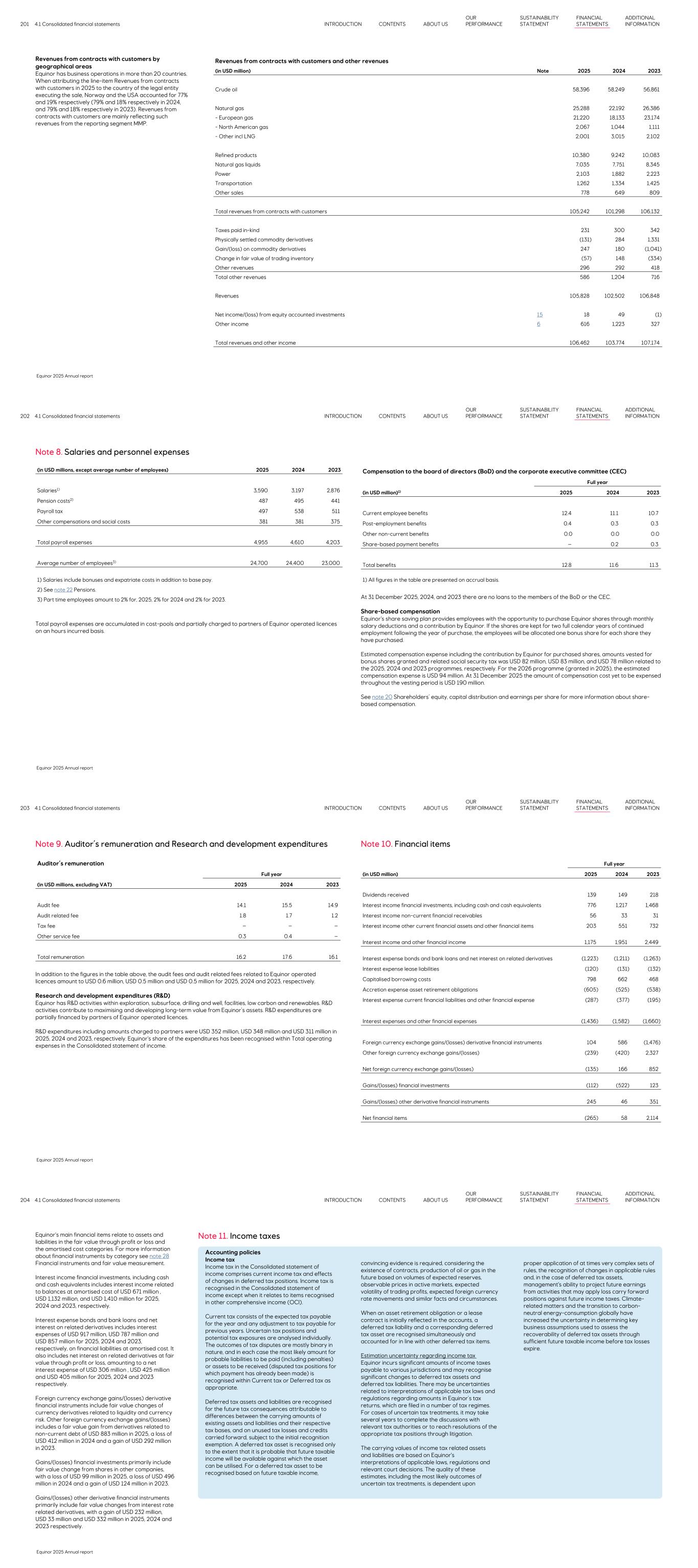
Revenues from contracts with customers by geographical areas Equinor has business operations in more than 20 countries. When attributing the line-item Revenues from contracts with customers in 2025 to the country of the legal entity executing the sale, Norway and the USA accounted for 77% and 19% respectively (79% and 18% respectively in 2024, and 79% and 18% respectively in 2023). Revenues from contracts with customers are mainly reflecting such revenues from the reporting segment MMP. Crude oil 58,396 58,249 56,861 Natural gas 25,288 22,192 26,386 - European gas 21,220 18,133 23,174 - North American gas 2,067 1,044 1,111 - Other incl LNG 2,001 3,015 2,102 Refined products 10,380 9,242 10,083 Natural gas liquids 7,035 7,751 8,345 Power 2,103 1,882 2,223 Transportation 1,262 1,334 1,425 Other sales 778 649 809 Total revenues from contracts with customers 105,242 101,298 106,132 Taxes paid in-kind 231 300 342 Physically settled commodity derivatives (131) 284 1,331 Gain/(loss) on commodity derivatives 247 180 (1,041) Change in fair value of trading inventory (57) 148 (334) Other revenues 296 292 418 Total other revenues 586 1,204 716 Revenues 105,828 102,502 106,848 Net income/(loss) from equity accounted investments 15 18 49 (1) Other income 6 616 1,223 327 Total revenues and other income 106,462 103,774 107,174 Revenues from contracts with customers and other revenues (in USD million) Note 2025 2024 2023 201 4.1 Consolidated financial statements INTRODUCTION CONTENTS ABOUT US OUR PERFORMANCE SUSTAINABILITY STATEMENT FINANCIAL STATEMENTS ADDITIONAL INFORMATION Equinor 2025 Annual report Note 8. Salaries and personnel expenses (in USD millions, except average number of employees) 2025 2024 2023 Salaries1) 3,590 3,197 2,876 Pension costs2) 487 495 441 Payroll tax 497 538 511 Other compensations and social costs 381 381 375 Total payroll expenses 4,955 4,610 4,203 Average number of employees3) 24,700 24,400 23,000 1) Salaries include bonuses and expatriate costs in addition to base pay. 2) See note 22 Pensions. 3) Part time employees amount to 2% for, 2025, 2% for 2024 and 2% for 2023. Total payroll expenses are accumulated in cost-pools and partially charged to partners of Equinor operated licences on an hours incurred basis. Current employee benefits 12.4 11.1 10.7 Post-employment benefits 0.4 0.3 0.3 Other non-current benefits 0.0 0.0 0.0 Share-based payment benefits — 0.2 0.3 Total benefits 12.8 11.6 11.3 1) All figures in the table are presented on accrual basis. Compensation to the board of directors (BoD) and the corporate executive committee (CEC) Full year (in USD million)1) 2025 2024 2023 At 31 December 2025, 2024, and 2023 there are no loans to the members of the BoD or the CEC. Share-based compensation Equinor's share saving plan provides employees with the opportunity to purchase Equinor shares through monthly salary deductions and a contribution by Equinor. If the shares are kept for two full calendar years of continued employment following the year of purchase, the employees will be allocated one bonus share for each share they have purchased. Estimated compensation expense including the contribution by Equinor for purchased shares, amounts vested for bonus shares granted and related social security tax was USD 82 million, USD 83 million, and USD 78 million related to the 2025, 2024 and 2023 programmes, respectively. For the 2026 programme (granted in 2025), the estimated compensation expense is USD 94 million. At 31 December 2025 the amount of compensation cost yet to be expensed throughout the vesting period is USD 190 million. See note 20 Shareholders’ equity, capital distribution and earnings per share for more information about share- based compensation. 202 4.1 Consolidated financial statements INTRODUCTION CONTENTS ABOUT US OUR PERFORMANCE SUSTAINABILITY STATEMENT FINANCIAL STATEMENTS ADDITIONAL INFORMATION Equinor 2025 Annual report Note 9. Auditor’s remuneration and Research and development expenditures Audit fee 14.1 15.5 14.9 Audit related fee 1.8 1.7 1.2 Tax fee — — — Other service fee 0.3 0.4 — Total remuneration 16.2 17.6 16.1 Auditor’s remuneration Full year (in USD millions, excluding VAT) 2025 2024 2023 In addition to the figures in the table above, the audit fees and audit related fees related to Equinor operated licences amount to USD 0.6 million, USD 0.5 million and USD 0.5 million for 2025, 2024 and 2023, respectively. Research and development expenditures (R&D) Equinor has R&D activities within exploration, subsurface, drilling and well, facilities, low carbon and renewables. R&D activities contribute to maximising and developing long-term value from Equinor’s assets. R&D expenditures are partially financed by partners of Equinor operated licences. R&D expenditures including amounts charged to partners were USD 352 million, USD 348 million and USD 311 million in 2025, 2024 and 2023, respectively. Equinor's share of the expenditures has been recognised within Total operating expenses in the Consolidated statement of income. Note 10. Financial items Dividends received 139 149 218 Interest income financial investments, including cash and cash equivalents 776 1,217 1,468 Interest income non-current financial receivables 56 33 31 Interest income other current financial assets and other financial items 203 551 732 Interest income and other financial income 1,175 1,951 2,449 Interest expense bonds and bank loans and net interest on related derivatives (1,223) (1,211) (1,263) Interest expense lease liabilities (120) (131) (132) Capitalised borrowing costs 798 662 468 Accretion expense asset retirement obligations (605) (525) (538) Interest expense current financial liabilities and other financial expense (287) (377) (195) Interest expenses and other financial expenses (1,436) (1,582) (1,660) Foreign currency exchange gains/(losses) derivative financial instruments 104 586 (1,476) Other foreign currency exchange gains/(losses) (239) (420) 2,327 Net foreign currency exchange gains/(losses) (135) 166 852 Gains/(losses) financial investments (112) (522) 123 Gains/(losses) other derivative financial instruments 245 46 351 Net financial items (265) 58 2,114 Full year (in USD million) 2025 2024 2023 203 4.1 Consolidated financial statements INTRODUCTION CONTENTS ABOUT US OUR PERFORMANCE SUSTAINABILITY STATEMENT FINANCIAL STATEMENTS ADDITIONAL INFORMATION Equinor 2025 Annual report Equinor's main financial items relate to assets and liabilities in the fair value through profit or loss and the amortised cost categories. For more information about financial instruments by category see note 28 Financial instruments and fair value measurement. Interest income financial investments, including cash and cash equivalents includes interest income related to balances at amortised cost of USD 671 million , USD 1,132 million, and USD 1,410 million for 2025, 2024 and 2023, respectively. Interest expense bonds and bank loans and net interest on related derivatives includes interest expenses of USD 917 million, USD 787 million and USD 857 million for 2025, 2024 and 2023, respectively, on financial liabilities at amortised cost. It also includes net interest on related derivatives at fair value through profit or loss, amounting to a net interest expense of USD 306 million , USD 425 million and USD 405 million for 2025, 2024 and 2023 respectively. Foreign currency exchange gains/(losses) derivative financial instruments include fair value changes of currency derivatives related to liquidity and currency risk. Other foreign currency exchange gains/(losses) includes a fair value gain from derivatives related to non-current debt of USD 883 million in 2025, a loss of USD 412 million in 2024 and a gain of USD 292 million in 2023. Gains/(losses) financial investments primarily include fair value change from shares in other companies, with a loss of USD 99 million in 2025, a loss of USD 496 million in 2024 and a gain of USD 124 million in 2023. Gains/(losses) other derivative financial instruments primarily include fair value changes from interest rate related derivatives, with a gain of USD 232 million, USD 33 million and USD 332 million in 2025, 2024 and 2023 respectively. Note 11. Income taxes Accounting policies Income tax Income tax in the Consolidated statement of income comprises current income tax and effects of changes in deferred tax positions. Income tax is recognised in the Consolidated statement of income except when it relates to items recognised in other comprehensive income (OCI). Current tax consists of the expected tax payable for the year and any adjustment to tax payable for previous years. Uncertain tax positions and potential tax exposures are analysed individually. The outcomes of tax disputes are mostly binary in nature, and in each case the most likely amount for probable liabilities to be paid (including penalties) or assets to be received (disputed tax positions for which payment has already been made) is recognised within Current tax or Deferred tax as appropriate. Deferred tax assets and liabilities are recognised for the future tax consequences attributable to differences between the carrying amounts of existing assets and liabilities and their respective tax bases, and on unused tax losses and credits carried forward, subject to the initial recognition exemption. A deferred tax asset is recognised only to the extent that it is probable that future taxable income will be available against which the asset can be utilised. For a deferred tax asset to be recognised based on future taxable income, convincing evidence is required, considering the existence of contracts, production of oil or gas in the future based on volumes of expected reserves, observable prices in active markets, expected volatility of trading profits, expected foreign currency rate movements and similar facts and circumstances. When an asset retirement obligation or a lease contract is initially reflected in the accounts, a deferred tax liability and a corresponding deferred tax asset are recognised simultaneously and accounted for in line with other deferred tax items. Estimation uncertainty regarding income tax Equinor incurs significant amounts of income taxes payable to various jurisdictions and may recognise significant changes to deferred tax assets and deferred tax liabilities. There may be uncertainties related to interpretations of applicable tax laws and regulations regarding amounts in Equinor’s tax returns, which are filed in a number of tax regimes. For cases of uncertain tax treatments, it may take several years to complete the discussions with relevant tax authorities or to reach resolutions of the appropriate tax positions through litigation. The carrying values of income tax related assets and liabilities are based on Equinor's interpretations of applicable laws, regulations and relevant court decisions. The quality of these estimates, including the most likely outcomes of uncertain tax treatments, is dependent upon proper application of at times very complex sets of rules, the recognition of changes in applicable rules and, in the case of deferred tax assets, management's ability to project future earnings from activities that may apply loss carry forward positions against future income taxes. Climate- related matters and the transition to carbon- neutral energy-consumption globally have increased the uncertainty in determining key business assumptions used to assess the recoverability of deferred tax assets through sufficient future taxable income before tax losses expire. 204 4.1 Consolidated financial statements INTRODUCTION CONTENTS ABOUT US OUR PERFORMANCE SUSTAINABILITY STATEMENT FINANCIAL STATEMENTS ADDITIONAL INFORMATION Equinor 2025 Annual report
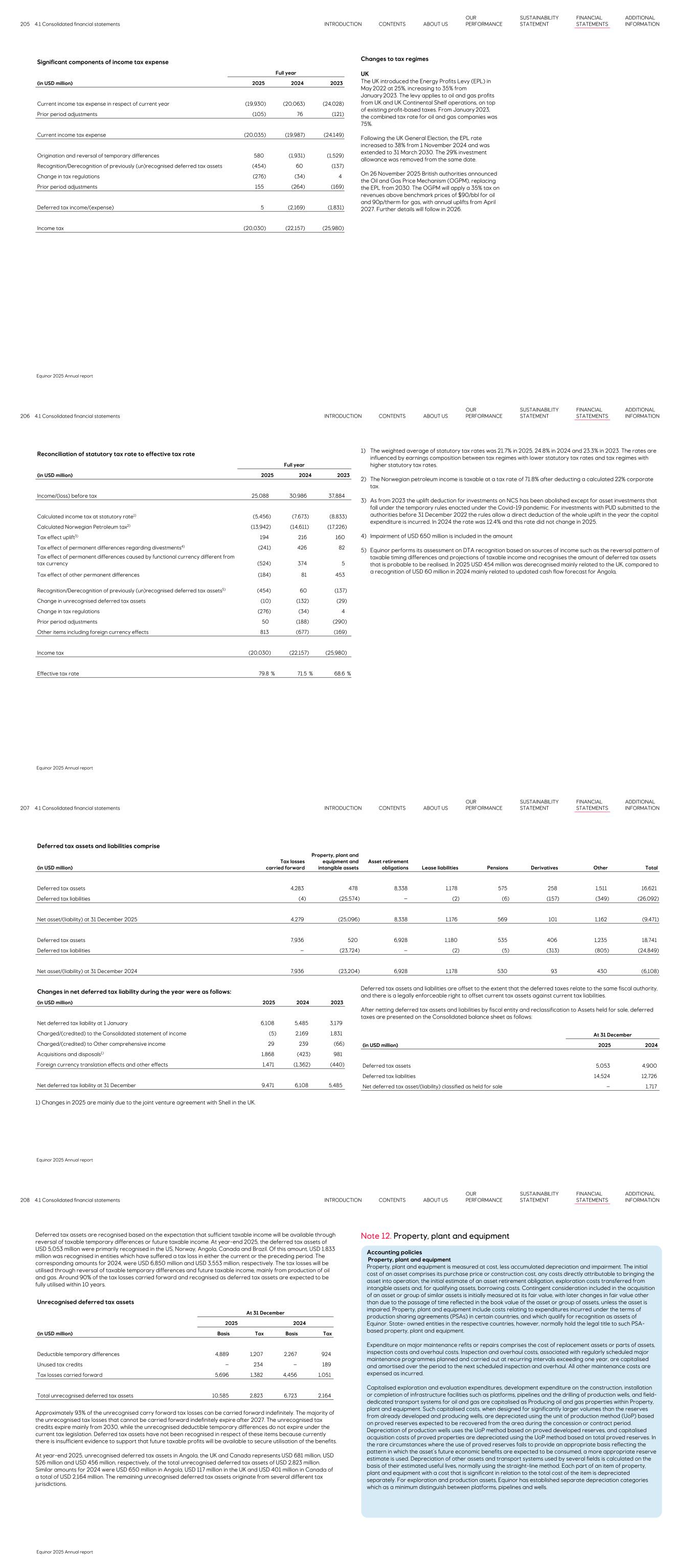
Current income tax expense in respect of current year (19,930) (20,063) (24,028) Prior period adjustments (105) 76 (121) Current income tax expense (20,035) (19,987) (24,149) Origination and reversal of temporary differences 580 (1,931) (1,529) Recognition/Derecognition of previously (un)recognised deferred tax assets (454) 60 (137) Change in tax regulations (276) (34) 4 Prior period adjustments 155 (264) (169) Deferred tax income/(expense) 5 (2,169) (1,831) Income tax (20,030) (22,157) (25,980) Significant components of income tax expense Full year (in USD million) 2025 2024 2023 Changes to tax regimes UK The UK introduced the Energy Profits Levy (EPL) in May 2022 at 25%, increasing to 35% from January 2023. The levy applies to oil and gas profits from UK and UK Continental Shelf operations, on top of existing profit-based taxes. From January 2023, the combined tax rate for oil and gas companies was 75%. Following the UK General Election, the EPL rate increased to 38% from 1 November 2024 and was extended to 31 March 2030. The 29% investment allowance was removed from the same date. On 26 November 2025 British authorities announced the Oil and Gas Price Mechanism (OGPM), replacing the EPL from 2030. The OGPM will apply a 35% tax on revenues above benchmark prices of $90/bbl for oil and 90p/therm for gas, with annual uplifts from April 2027. Further details will follow in 2026. 205 4.1 Consolidated financial statements INTRODUCTION CONTENTS ABOUT US OUR PERFORMANCE SUSTAINABILITY STATEMENT FINANCIAL STATEMENTS ADDITIONAL INFORMATION Equinor 2025 Annual report Income/(loss) before tax 25,088 30,986 37,884 Calculated income tax at statutory rate1) (5,456) (7,673) (8,833) Calculated Norwegian Petroleum tax2) (13,942) (14,611) (17,226) Tax effect uplift3) 194 216 160 Tax effect of permanent differences regarding divestments4) (241) 426 82 Tax effect of permanent differences caused by functional currency different from tax currency (524) 374 5 Tax effect of other permanent differences (184) 81 453 Recognition/Derecognition of previously (un)recognised deferred tax assets5) (454) 60 (137) Change in unrecognised deferred tax assets (10) (132) (29) Change in tax regulations (276) (34) 4 Prior period adjustments 50 (188) (290) Other items including foreign currency effects 813 (677) (169) Income tax (20,030) (22,157) (25,980) Effective tax rate 79.8 % 71.5 % 68.6 % Reconciliation of statutory tax rate to effective tax rate Full year (in USD million) 2025 2024 2023 1) The weighted average of statutory tax rates was 21.7% in 2025, 24.8% in 2024 and 23.3% in 2023. The rates are influenced by earnings composition between tax regimes with lower statutory tax rates and tax regimes with higher statutory tax rates. 2) The Norwegian petroleum income is taxable at a tax rate of 71.8% after deducting a calculated 22% corporate tax. 3) As from 2023 the uplift deduction for investments on NCS has been abolished except for asset investments that fall under the temporary rules enacted under the Covid-19 pandemic. For investments with PUD submitted to the authorities before 31 December 2022 the rules allow a direct deduction of the whole uplift in the year the capital expenditure is incurred. In 2024 the rate was 12.4% and this rate did not change in 2025. 4) Impairment of USD 650 million is included in the amount 5) Equinor performs its assessment on DTA recognition based on sources of income such as the reversal pattern of taxable timing differences and projections of taxable income and recognises the amount of deferred tax assets that is probable to be realised. In 2025 USD 454 million was derecognised mainly related to the UK, compared to a recognition of USD 60 million in 2024 mainly related to updated cash flow forecast for Angola, 206 4.1 Consolidated financial statements INTRODUCTION CONTENTS ABOUT US OUR PERFORMANCE SUSTAINABILITY STATEMENT FINANCIAL STATEMENTS ADDITIONAL INFORMATION Equinor 2025 Annual report Deferred tax assets 4,283 478 8,338 1,178 575 258 1,511 16,621 Deferred tax liabilities (4) (25,574) — (2) (6) (157) (349) (26,092) Net asset/(liability) at 31 December 2025 4,279 (25,096) 8,338 1,176 569 101 1,162 (9,471) Deferred tax assets 7,936 520 6,928 1,180 535 406 1,235 18,741 Deferred tax liabilities — (23,724) — (2) (5) (313) (805) (24,849) Net asset/(liability) at 31 December 2024 7,936 (23,204) 6,928 1,178 530 93 430 (6,108) Deferred tax assets and liabilities comprise (in USD million) Tax losses carried forward Property, plant and equipment and intangible assets Asset retirement obligations Lease liabilities Pensions Derivatives Other Total Net deferred tax liability at 1 January 6,108 5,485 3,179 Charged/(credited) to the Consolidated statement of income (5) 2,169 1,831 Charged/(credited) to Other comprehensive income 29 239 (66) Acquisitions and disposals1) 1,868 (423) 981 Foreign currency translation effects and other effects 1,471 (1,362) (440) Net deferred tax liability at 31 December 9,471 6,108 5,485 Changes in net deferred tax liability during the year were as follows: (in USD million) 2025 2024 2023 1) Changes in 2025 are mainly due to the joint venture agreement with Shell in the UK. Deferred tax assets and liabilities are offset to the extent that the deferred taxes relate to the same fiscal authority, and there is a legally enforceable right to offset current tax assets against current tax liabilities. After netting deferred tax assets and liabilities by fiscal entity and reclassification to Assets held for sale, deferred taxes are presented on the Consolidated balance sheet as follows: Deferred tax assets 5,053 4,900 Deferred tax liabilities 14,524 12,726 Net deferred tax asset/(liability) classified as held for sale — 1,717 At 31 December (in USD million) 2025 2024 207 4.1 Consolidated financial statements INTRODUCTION CONTENTS ABOUT US OUR PERFORMANCE SUSTAINABILITY STATEMENT FINANCIAL STATEMENTS ADDITIONAL INFORMATION Equinor 2025 Annual report Deferred tax assets are recognised based on the expectation that sufficient taxable income will be available through reversal of taxable temporary differences or future taxable income. At year-end 2025, the deferred tax assets of USD 5,053 million were primarily recognised in the US, Norway, Angola, Canada and Brazil. Of this amount, USD 1,833 million was recognised in entities which have suffered a tax loss in either the current or the preceding period. The corresponding amounts for 2024, were USD 6,850 million and USD 3,553 million, respectively. The tax losses will be utilised through reversal of taxable temporary differences and future taxable income, mainly from production of oil and gas. Around 90% of the tax losses carried forward and recognised as deferred tax assets are expected to be fully utilised within 10 years. Deductible temporary differences 4,889 1,207 2,267 924 Unused tax credits — 234 — 189 Tax losses carried forward 5,696 1,382 4,456 1,051 Total unrecognised deferred tax assets 10,585 2,823 6,723 2,164 Unrecognised deferred tax assets At 31 December 2025 2024 (in USD million) Basis Tax Basis Tax Approximately 93% of the unrecognised carry forward tax losses can be carried forward indefinitely. The majority of the unrecognised tax losses that cannot be carried forward indefinitely expire after 2027. The unrecognised tax credits expire mainly from 2030, while the unrecognised deductible temporary differences do not expire under the current tax legislation. Deferred tax assets have not been recognised in respect of these items because currently there is insufficient evidence to support that future taxable profits will be available to secure utilisation of the benefits. At year-end 2025, unrecognised deferred tax assets in Angola, the UK and Canada represents USD 681 million, USD 526 million and USD 456 million, respectively, of the total unrecognised deferred tax assets of USD 2,823 million. Similar amounts for 2024 were USD 650 million in Angola, USD 117 million in the UK and USD 401 million in Canada of a total of USD 2,164 million. The remaining unrecognised deferred tax assets originate from several different tax jurisdictions. Note 12. Property, plant and equipment Accounting policies Property, plant and equipment Property, plant and equipment is measured at cost, less accumulated depreciation and impairment. The initial cost of an asset comprises its purchase price or construction cost, any costs directly attributable to bringing the asset into operation, the initial estimate of an asset retirement obligation, exploration costs transferred from intangible assets and, for qualifying assets, borrowing costs. Contingent consideration included in the acquisition of an asset or group of similar assets is initially measured at its fair value, with later changes in fair value other than due to the passage of time reflected in the book value of the asset or group of assets, unless the asset is impaired. Property, plant and equipment include costs relating to expenditures incurred under the terms of production sharing agreements (PSAs) in certain countries, and which qualify for recognition as assets of Equinor. State- owned entities in the respective countries, however, normally hold the legal title to such PSA- based property, plant and equipment. Expenditure on major maintenance refits or repairs comprises the cost of replacement assets or parts of assets, inspection costs and overhaul costs. Inspection and overhaul costs, associated with regularly scheduled major maintenance programmes planned and carried out at recurring intervals exceeding one year, are capitalised and amortised over the period to the next scheduled inspection and overhaul. All other maintenance costs are expensed as incurred. Capitalised exploration and evaluation expenditures, development expenditure on the construction, installation or completion of infrastructure facilities such as platforms, pipelines and the drilling of production wells, and field- dedicated transport systems for oil and gas are capitalised as Producing oil and gas properties within Property, plant and equipment. Such capitalised costs, when designed for significantly larger volumes than the reserves from already developed and producing wells, are depreciated using the unit of production method (UoP) based on proved reserves expected to be recovered from the area during the concession or contract period. Depreciation of production wells uses the UoP method based on proved developed reserves, and capitalised acquisition costs of proved properties are depreciated using the UoP method based on total proved reserves. In the rare circumstances where the use of proved reserves fails to provide an appropriate basis reflecting the pattern in which the asset’s future economic benefits are expected to be consumed, a more appropriate reserve estimate is used. Depreciation of other assets and transport systems used by several fields is calculated on the basis of their estimated useful lives, normally using the straight-line method. Each part of an item of property, plant and equipment with a cost that is significant in relation to the total cost of the item is depreciated separately. For exploration and production assets, Equinor has established separate depreciation categories which as a minimum distinguish between platforms, pipelines and wells. 208 4.1 Consolidated financial statements INTRODUCTION CONTENTS ABOUT US OUR PERFORMANCE SUSTAINABILITY STATEMENT FINANCIAL STATEMENTS ADDITIONAL INFORMATION Equinor 2025 Annual report
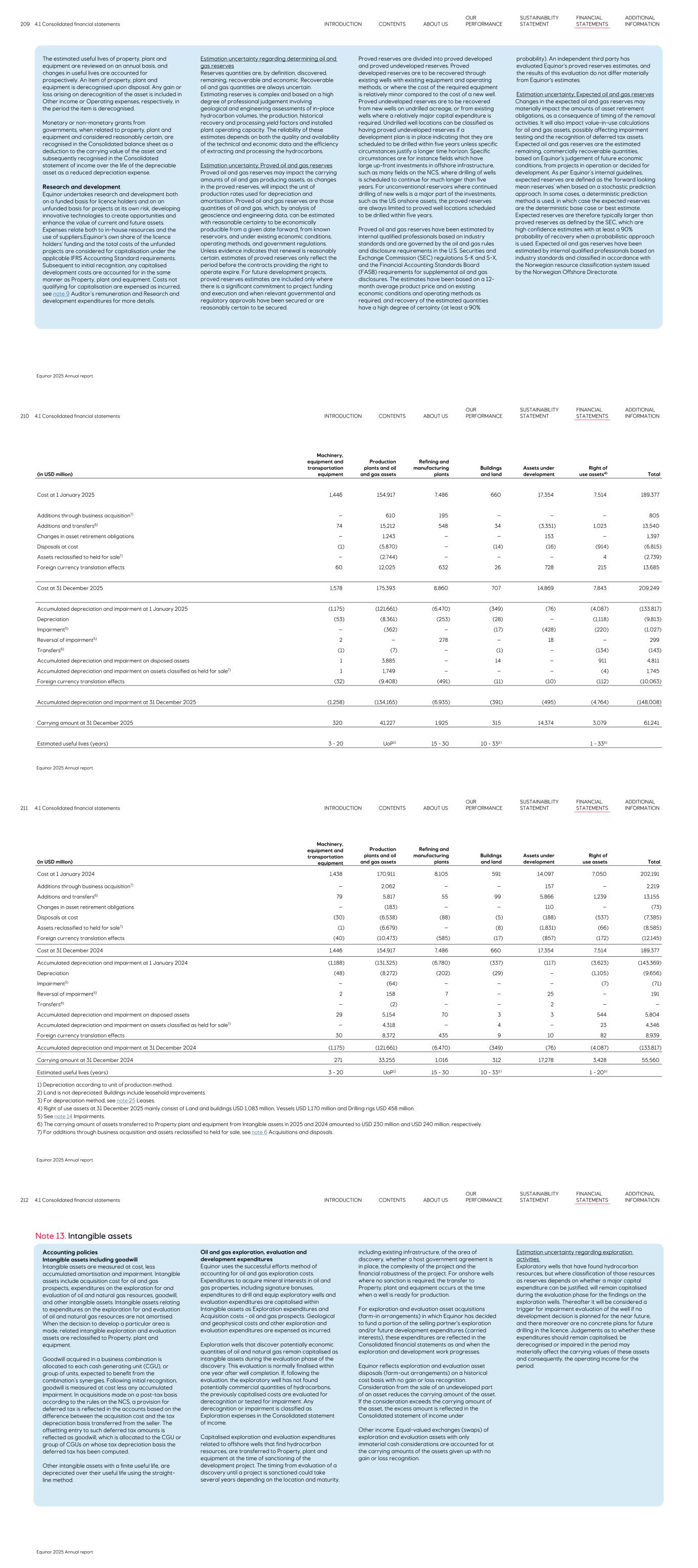
The estimated useful lives of property, plant and equipment are reviewed on an annual basis, and changes in useful lives are accounted for prospectively. An item of property, plant and equipment is derecognised upon disposal. Any gain or loss arising on derecognition of the asset is included in Other income or Operating expenses, respectively, in the period the item is derecognised. Monetary or non-monetary grants from governments, when related to property, plant and equipment and considered reasonably certain, are recognised in the Consolidated balance sheet as a deduction to the carrying value of the asset and subsequently recognised in the Consolidated statement of income over the life of the depreciable asset as a reduced depreciation expense. Research and development Equinor undertakes research and development both on a funded basis for licence holders and on an unfunded basis for projects at its own risk, developing innovative technologies to create opportunities and enhance the value of current and future assets. Expenses relate both to in-house resources and the use of suppliers.Equinor's own share of the licence holders' funding and the total costs of the unfunded projects are considered for capitalisation under the applicable IFRS Accounting Standard requirements. Subsequent to initial recognition, any capitalised development costs are accounted for in the same manner as Property, plant and equipment. Costs not qualifying for capitalisation are expensed as incurred, see note 9 Auditor’s remuneration and Research and development expenditures for more details. Estimation uncertainty regarding determining oil and gas reserves Reserves quantities are, by definition, discovered, remaining, recoverable and economic. Recoverable oil and gas quantities are always uncertain. Estimating reserves is complex and based on a high degree of professional judgement involving geological and engineering assessments of in-place hydrocarbon volumes, the production, historical recovery and processing yield factors and installed plant operating capacity. The reliability of these estimates depends on both the quality and availability of the technical and economic data and the efficiency of extracting and processing the hydrocarbons. Estimation uncertainty; Proved oil and gas reserves Proved oil and gas reserves may impact the carrying amounts of oil and gas producing assets, as changes in the proved reserves, will impact the unit of production rates used for depreciation and amortisation. Proved oil and gas reserves are those quantities of oil and gas, which, by analysis of geoscience and engineering data, can be estimated with reasonable certainty to be economically producible from a given date forward, from known reservoirs, and under existing economic conditions, operating methods, and government regulations. Unless evidence indicates that renewal is reasonably certain, estimates of proved reserves only reflect the period before the contracts providing the right to operate expire. For future development projects, proved reserves estimates are included only where there is a significant commitment to project funding and execution and when relevant governmental and regulatory approvals have been secured or are reasonably certain to be secured. Proved reserves are divided into proved developed and proved undeveloped reserves. Proved developed reserves are to be recovered through existing wells with existing equipment and operating methods, or where the cost of the required equipment is relatively minor compared to the cost of a new well. Proved undeveloped reserves are to be recovered from new wells on undrilled acreage, or from existing wells where a relatively major capital expenditure is required. Undrilled well locations can be classified as having proved undeveloped reserves if a development plan is in place indicating that they are scheduled to be drilled within five years unless specific circumstances justify a longer time horizon. Specific circumstances are for instance fields which have large up-front investments in offshore infrastructure, such as many fields on the NCS, where drilling of wells is scheduled to continue for much longer than five years. For unconventional reservoirs where continued drilling of new wells is a major part of the investments, such as the US onshore assets, the proved reserves are always limited to proved well locations scheduled to be drilled within five years. Proved oil and gas reserves have been estimated by internal qualified professionals based on industry standards and are governed by the oil and gas rules and disclosure requirements in the U.S. Securities and Exchange Commission (SEC) regulations S-K and S-X, and the Financial Accounting Standards Board (FASB) requirements for supplemental oil and gas disclosures. The estimates have been based on a 12- month average product price and on existing economic conditions and operating methods as required, and recovery of the estimated quantities have a high degree of certainty (at least a 90% probability). An independent third party has evaluated Equinor's proved reserves estimates, and the results of this evaluation do not differ materially from Equinor's estimates. Estimation uncertainty; Expected oil and gas reserves Changes in the expected oil and gas reserves may materially impact the amounts of asset retirement obligations, as a consequence of timing of the removal activities. It will also impact value-in-use calculations for oil and gas assets, possibly affecting impairment testing and the recognition of deferred tax assets. Expected oil and gas reserves are the estimated remaining, commercially recoverable quantities, based on Equinor's judgement of future economic conditions, from projects in operation or decided for development. As per Equinor’s internal guidelines, expected reserves are defined as the ‘forward looking mean reserves’ when based on a stochastic prediction approach. In some cases, a deterministic prediction method is used, in which case the expected reserves are the deterministic base case or best estimate. Expected reserves are therefore typically larger than proved reserves as defined by the SEC, which are high confidence estimates with at least a 90% probability of recovery when a probabilistic approach is used. Expected oil and gas reserves have been estimated by internal qualified professionals based on industry standards and classified in accordance with the Norwegian resource classification system issued by the Norwegian Offshore Directorate. 209 4.1 Consolidated financial statements INTRODUCTION CONTENTS ABOUT US OUR PERFORMANCE SUSTAINABILITY STATEMENT FINANCIAL STATEMENTS ADDITIONAL INFORMATION Equinor 2025 Annual report Cost at 1 January 2025 1,446 154,917 7,486 660 17,354 7,514 189,377 Additions through business acquisition7) — 610 195 — — — 805 Additions and transfers6) 74 15,212 548 34 (3,351) 1,023 13,540 Changes in asset retirement obligations — 1,243 — — 153 — 1,397 Disposals at cost (1) (5,870) — (14) (16) (914) (6,815) Assets reclassified to held for sale7) — (2,744) — — — 4 (2,739) Foreign currency translation effects 60 12,025 632 26 728 215 13,685 Cost at 31 December 2025 1,578 175,393 8,860 707 14,869 7,843 209,249 Accumulated depreciation and impairment at 1 January 2025 (1,175) (121,661) (6,470) (349) (76) (4,087) (133,817) Depreciation (53) (8,361) (253) (28) — (1,118) (9,813) Impairment5) — (362) — (17) (428) (220) (1,027) Reversal of impairment5) 2 — 278 — 18 — 299 Transfers6) (1) (7) — (1) — (134) (143) Accumulated depreciation and impairment on disposed assets 1 3,885 — 14 — 911 4,811 Accumulated depreciation and impairment on assets classified as held for sale7) 1 1,749 — — — (4) 1,745 Foreign currency translation effects (32) (9,408) (491) (11) (10) (112) (10,063) Accumulated depreciation and impairment at 31 December 2025 (1,258) (134,165) (6,935) (391) (495) (4,764) (148,008) Carrying amount at 31 December 2025 320 41,227 1,925 315 14,374 3,079 61,241 Estimated useful lives (years) 3 - 20 UoP1) 15 - 30 10 - 33²⁾ 1 - 33³⁾ (in USD million) Machinery, equipment and transportation equipment Production plants and oil and gas assets Refining and manufacturing plants Buildings and land Assets under development Right of use assets4) Total 210 4.1 Consolidated financial statements INTRODUCTION CONTENTS ABOUT US OUR PERFORMANCE SUSTAINABILITY STATEMENT FINANCIAL STATEMENTS ADDITIONAL INFORMATION Equinor 2025 Annual report Cost at 1 January 2024 1,438 170,911 8,105 591 14,097 7,050 202,191 Additions through business acquisition7) — 2,062 — — 157 — 2,219 Additions and transfers6) 79 5,817 55 99 5,866 1,239 13,155 Changes in asset retirement obligations — (183) — — 110 — (73) Disposals at cost (30) (6,538) (88) (5) (188) (537) (7,385) Assets reclassified to held for sale7) (1) (6,679) — (8) (1,831) (66) (8,585) Foreign currency translation effects (40) (10,473) (585) (17) (857) (172) (12,145) Cost at 31 December 2024 1,446 154,917 7,486 660 17,354 7,514 189,377 Accumulated depreciation and impairment at 1 January 2024 (1,188) (131,325) (6,780) (337) (117) (3,623) (143,369) Depreciation (48) (8,272) (202) (29) — (1,105) (9,656) Impairment5) — (64) — — — (7) (71) Reversal of impairment5) 2 158 7 — 25 — 191 Transfers6) — (2) — — 2 — — Accumulated depreciation and impairment on disposed assets 29 5,154 70 3 3 544 5,804 Accumulated depreciation and impairment on assets classified as held for sale7) — 4,318 — 4 — 23 4,346 Foreign currency translation effects 30 8,372 435 9 10 82 8,939 Accumulated depreciation and impairment at 31 December 2024 (1,175) (121,661) (6,470) (349) (76) (4,087) (133,817) Carrying amount at 31 December 2024 271 33,255 1,016 312 17,278 3,428 55,560 Estimated useful lives (years) 3 - 20 UoP1) 15 - 30 10 - 33²⁾ 1 - 20³⁾ 1) Depreciation according to unit of production method. 2) Land is not depreciated. Buildings include leasehold improvements. 3) For depreciation method, see note 25 Leases. 4) Right of use assets at 31 December 2025 mainly consist of Land and buildings USD 1,083 million, Vessels USD 1,170 million and Drilling rigs USD 458 million. 5) See note 14 Impairments. 6) The carrying amount of assets transferred to Property plant and equipment from Intangible assets in 2025 and 2024 amounted to USD 230 million and USD 240 million, respectively. 7) For additions through business acquisition and assets reclassified to held for sale, see note 6 Acquisitions and disposals. (in USD million) Machinery, equipment and transportation equipment Production plants and oil and gas assets Refining and manufacturing plants Buildings and land Assets under development Right of use assets Total 211 4.1 Consolidated financial statements INTRODUCTION CONTENTS ABOUT US OUR PERFORMANCE SUSTAINABILITY STATEMENT FINANCIAL STATEMENTS ADDITIONAL INFORMATION Equinor 2025 Annual report Note 13. Intangible assets Accounting policies Intangible assets including goodwill Intangible assets are measured at cost, less accumulated amortisation and impairment. Intangible assets include acquisition cost for oil and gas prospects, expenditures on the exploration for and evaluation of oil and natural gas resources, goodwill, and other intangible assets. Intangible assets relating to expenditures on the exploration for and evaluation of oil and natural gas resources are not amortised. When the decision to develop a particular area is made, related intangible exploration and evaluation assets are reclassified to Property, plant and equipment. Goodwill acquired in a business combination is allocated to each cash generating unit (CGU), or group of units, expected to benefit from the combination’s synergies. Following initial recognition, goodwill is measured at cost less any accumulated impairment. In acquisitions made on a post-tax basis according to the rules on the NCS, a provision for deferred tax is reflected in the accounts based on the difference between the acquisition cost and the tax depreciation basis transferred from the seller. The offsetting entry to such deferred tax amounts is reflected as goodwill, which is allocated to the CGU or group of CGUs on whose tax depreciation basis the deferred tax has been computed. Other intangible assets with a finite useful life, are depreciated over their useful life using the straight- line method. Oil and gas exploration, evaluation and development expenditures Equinor uses the successful efforts method of accounting for oil and gas exploration costs. Expenditures to acquire mineral interests in oil and gas properties, including signature bonuses, expenditures to drill and equip exploratory wells and evaluation expenditures are capitalised within Intangible assets as Exploration expenditures and Acquisition costs - oil and gas prospects. Geological and geophysical costs and other exploration and evaluation expenditures are expensed as incurred. Exploration wells that discover potentially economic quantities of oil and natural gas remain capitalised as intangible assets during the evaluation phase of the discovery. This evaluation is normally finalised within one year after well completion. If, following the evaluation, the exploratory well has not found potentially commercial quantities of hydrocarbons, the previously capitalised costs are evaluated for derecognition or tested for impairment. Any derecognition or impairment is classified as Exploration expenses in the Consolidated statement of income. Capitalised exploration and evaluation expenditures related to offshore wells that find hydrocarbon resources, are transferred to Property, plant and equipment at the time of sanctioning of the development project. The timing from evaluation of a discovery until a project is sanctioned could take several years depending on the location and maturity, including existing infrastructure, of the area of discovery, whether a host government agreement is in place, the complexity of the project and the financial robustness of the project. For onshore wells where no sanction is required, the transfer to Property, plant and equipment occurs at the time when a well is ready for production. For exploration and evaluation asset acquisitions (farm-in arrangements) in which Equinor has decided to fund a portion of the selling partner's exploration and/or future development expenditures (carried interests), these expenditures are reflected in the Consolidated financial statements as and when the exploration and development work progresses. Equinor reflects exploration and evaluation asset disposals (farm-out arrangements) on a historical cost basis with no gain or loss recognition. Consideration from the sale of an undeveloped part of an asset reduces the carrying amount of the asset. If the consideration exceeds the carrying amount of the asset, the excess amount is reflected in the Consolidated statement of income under Other income. Equal-valued exchanges (swaps) of exploration and evaluation assets with only immaterial cash considerations are accounted for at the carrying amounts of the assets given up with no gain or loss recognition. Estimation uncertainty regarding exploration activities Exploratory wells that have found hydrocarbon resources, but where classification of those resources as reserves depends on whether a major capital expenditure can be justified, will remain capitalised during the evaluation phase for the findings on the exploration wells. Thereafter it will be considered a trigger for impairment evaluation of the well if no development decision is planned for the near future, and there moreover are no concrete plans for future drilling in the licence. Judgements as to whether these expenditures should remain capitalised, be derecognised or impaired in the period may materially affect the carrying values of these assets and consequently, the operating income for the period. 212 4.1 Consolidated financial statements INTRODUCTION CONTENTS ABOUT US OUR PERFORMANCE SUSTAINABILITY STATEMENT FINANCIAL STATEMENTS ADDITIONAL INFORMATION Equinor 2025 Annual report
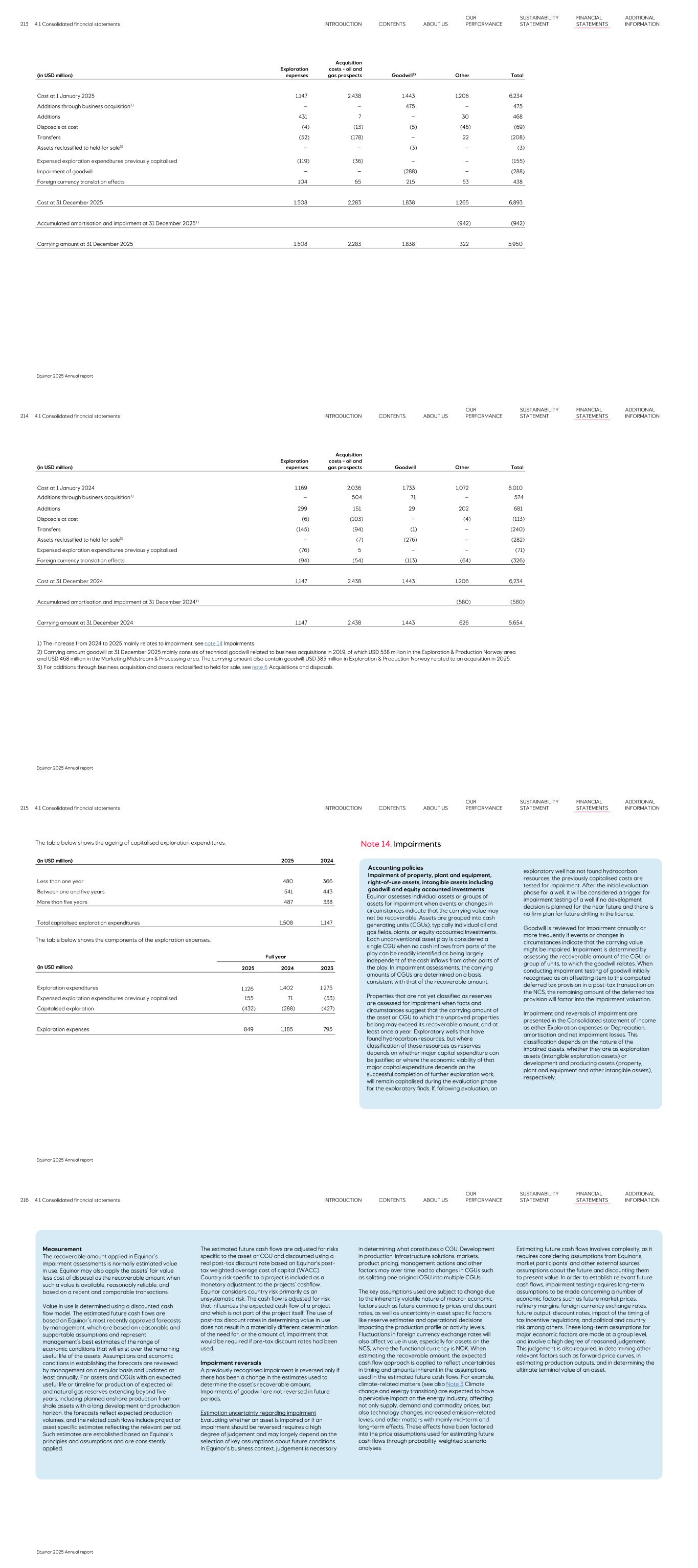
Cost at 1 January 2025 1,147 2,438 1,443 1,206 6,234 Additions through business acquisition3) — — 475 — 475 Additions 431 7 — 30 468 Disposals at cost (4) (13) (5) (46) (69) Transfers (52) (178) — 22 (208) Assets reclassified to held for sale3) — — (3) — (3) Expensed exploration expenditures previously capitalised (119) (36) — — (155) Impairment of goodwill — — (288) — (288) Foreign currency translation effects 104 65 215 53 438 Cost at 31 December 2025 1,508 2,283 1,838 1,265 6,893 Accumulated amortisation and impairment at 31 December 2025¹⁾ (942) (942) Carrying amount at 31 December 2025 1,508 2,283 1,838 322 5,950 (in USD million) Exploration expenses Acquisition costs - oil and gas prospects Goodwill2) Other Total 213 4.1 Consolidated financial statements INTRODUCTION CONTENTS ABOUT US OUR PERFORMANCE SUSTAINABILITY STATEMENT FINANCIAL STATEMENTS ADDITIONAL INFORMATION Equinor 2025 Annual report Cost at 1 January 2024 1,169 2,036 1,733 1,072 6,010 Additions through business acquisition3) — 504 71 — 574 Additions 299 151 29 202 681 Disposals at cost (6) (103) — (4) (113) Transfers (145) (94) (1) — (240) Assets reclassified to held for sale3) — (7) (276) — (282) Expensed exploration expenditures previously capitalised (76) 5 — — (71) Foreign currency translation effects (94) (54) (113) (64) (326) Cost at 31 December 2024 1,147 2,438 1,443 1,206 6,234 Accumulated amortisation and impairment at 31 December 2024¹⁾ (580) (580) Carrying amount at 31 December 2024 1,147 2,438 1,443 626 5,654 1) The increase from 2024 to 2025 mainly relates to impairment, see note 14 Impairments. 2) Carrying amount goodwill at 31 December 2025 mainly consists of technical goodwill related to business acquisitions in 2019, of which USD 538 million in the Exploration & Production Norway area and USD 468 million in the Marketing Midstream & Processing area. The carrying amount also contain goodwill USD 383 million in Exploration & Production Norway related to an acquisition in 2025. 3) For additions through business acquisition and assets reclassified to held for sale, see note 6 Acquisitions and disposals. (in USD million) Exploration expenses Acquisition costs - oil and gas prospects Goodwill Other Total 214 4.1 Consolidated financial statements INTRODUCTION CONTENTS ABOUT US OUR PERFORMANCE SUSTAINABILITY STATEMENT FINANCIAL STATEMENTS ADDITIONAL INFORMATION Equinor 2025 Annual report The table below shows the ageing of capitalised exploration expenditures. Less than one year 480 366 Between one and five years 541 443 More than five years 487 338 Total capitalised exploration expenditures 1,508 1,147 (in USD million) 2025 2024 The table below shows the components of the exploration expenses. Exploration expenditures 1,126 1,402 1,275 Expensed exploration expenditures previously capitalised 155 71 (53) Capitalised exploration (432) (288) (427) Exploration expenses 849 1,185 795 Full year (in USD million) 2025 2024 2023 Note 14. Impairments Accounting policies Impairment of property, plant and equipment, right-of-use assets, intangible assets including goodwill and equity accounted investments Equinor assesses individual assets or groups of assets for impairment when events or changes in circumstances indicate that the carrying value may not be recoverable. Assets are grouped into cash generating units (CGUs), typically individual oil and gas fields, plants, or equity accounted investments. Each unconventional asset play is considered a single CGU when no cash inflows from parts of the play can be readily identified as being largely independent of the cash inflows from other parts of the play. In impairment assessments, the carrying amounts of CGUs are determined on a basis consistent with that of the recoverable amount. Properties that are not yet classified as reserves are assessed for impairment when facts and circumstances suggest that the carrying amount of the asset or CGU to which the unproved properties belong may exceed its recoverable amount, and at least once a year. Exploratory wells that have found hydrocarbon resources, but where classification of those resources as reserves depends on whether major capital expenditure can be justified or where the economic viability of that major capital expenditure depends on the successful completion of further exploration work, will remain capitalised during the evaluation phase for the exploratory finds. If, following evaluation, an exploratory well has not found hydrocarbon resources, the previously capitalised costs are tested for impairment. After the initial evaluation phase for a well, it will be considered a trigger for impairment testing of a well if no development decision is planned for the near future and there is no firm plan for future drilling in the licence. Goodwill is reviewed for impairment annually or more frequently if events or changes in circumstances indicate that the carrying value might be impaired. Impairment is determined by assessing the recoverable amount of the CGU, or group of units, to which the goodwill relates. When conducting impairment testing of goodwill initially recognised as an offsetting item to the computed deferred tax provision in a post-tax transaction on the NCS, the remaining amount of the deferred tax provision will factor into the impairment valuation. Impairment and reversals of impairment are presented in the Consolidated statement of income as either Exploration expenses or Depreciation, amortisation and net impairment losses. This classification depends on the nature of the impaired assets, whether they are as exploration assets (intangible exploration assets) or development and producing assets (property, plant and equipment and other intangible assets), respectively. 215 4.1 Consolidated financial statements INTRODUCTION CONTENTS ABOUT US OUR PERFORMANCE SUSTAINABILITY STATEMENT FINANCIAL STATEMENTS ADDITIONAL INFORMATION Equinor 2025 Annual report Measurement The recoverable amount applied in Equinor’s impairment assessments is normally estimated value in use. Equinor may also apply the assets’ fair value less cost of disposal as the recoverable amount when such a value is available, reasonably reliable, and based on a recent and comparable transactions. Value in use is determined using a discounted cash flow model. The estimated future cash flows are based on Equinor’s most recently approved forecasts by management, which are based on reasonable and supportable assumptions and represent management’s best estimates of the range of economic conditions that will exist over the remaining useful life of the assets. Assumptions and economic conditions in establishing the forecasts are reviewed by management on a regular basis and updated at least annually. For assets and CGUs with an expected useful life or timeline for production of expected oil and natural gas reserves extending beyond five years, including planned onshore production from shale assets with a long development and production horizon, the forecasts reflect expected production volumes, and the related cash flows include project or asset specific estimates reflecting the relevant period. Such estimates are established based on Equinor's principles and assumptions and are consistently applied. The estimated future cash flows are adjusted for risks specific to the asset or CGU and discounted using a real post-tax discount rate based on Equinor's post- tax weighted average cost of capital (WACC). Country risk specific to a project is included as a monetary adjustment to the projects’ cashflow. Equinor considers country risk primarily as an unsystematic risk. The cash flow is adjusted for risk that influences the expected cash flow of a project and which is not part of the project itself. The use of post-tax discount rates in determining value in use does not result in a materially different determination of the need for, or the amount of, impairment that would be required if pre-tax discount rates had been used. Impairment reversals A previously recognised impairment is reversed only if there has been a change in the estimates used to determine the asset’s recoverable amount. Impairments of goodwill are not reversed in future periods. Estimation uncertainty regarding impairment Evaluating whether an asset is impaired or if an impairment should be reversed requires a high degree of judgement and may largely depend on the selection of key assumptions about future conditions. In Equinor's business context, judgement is necessary in determining what constitutes a CGU. Development in production, infrastructure solutions, markets, product pricing, management actions and other factors may over time lead to changes in CGUs such as splitting one original CGU into multiple CGUs. The key assumptions used are subject to change due to the inherently volatile nature of macro- economic factors such as future commodity prices and discount rates, as well as uncertainty in asset specific factors like reserve estimates and operational decisions impacting the production profile or activity levels. Fluctuations in foreign currency exchange rates will also affect value in use, especially for assets on the NCS, where the functional currency is NOK. When estimating the recoverable amount, the expected cash flow approach is applied to reflect uncertainties in timing and amounts inherent in the assumptions used in the estimated future cash flows. For example, climate-related matters (see also Note 3 Climate change and energy transition) are expected to have a pervasive impact on the energy industry, affecting not only supply, demand and commodity prices, but also technology changes, increased emission-related levies, and other matters with mainly mid-term and long-term effects. These effects have been factored into the price assumptions used for estimating future cash flows through probability-weighted scenario analyses. Estimating future cash flows involves complexity, as it requires considering assumptions from Equinor’s, market participants’ and other external sources’ assumptions about the future and discounting them to present value. In order to establish relevant future cash flows, impairment testing requires long-term assumptions to be made concerning a number of economic factors such as future market prices, refinery margins, foreign currency exchange rates, future output, discount rates, impact of the timing of tax incentive regulations, and political and country risk among others. These long-term assumptions for major economic factors are made at a group level, and involve a high degree of reasoned judgement. This judgement is also required, in determining other relevant factors such as forward price curves, in estimating production outputs, and in determining the ultimate terminal value of an asset. 216 4.1 Consolidated financial statements INTRODUCTION CONTENTS ABOUT US OUR PERFORMANCE SUSTAINABILITY STATEMENT FINANCIAL STATEMENTS ADDITIONAL INFORMATION Equinor 2025 Annual report
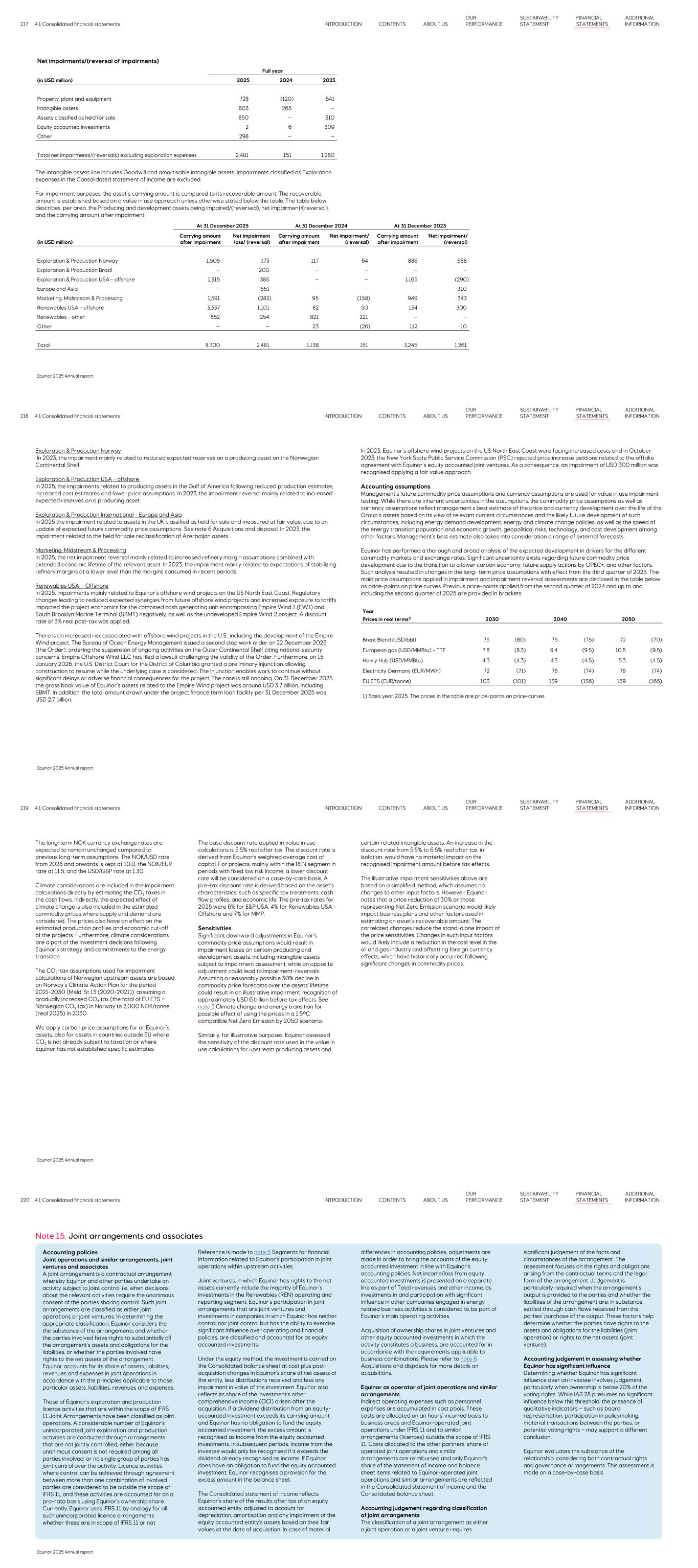
Property, plant and equipment 728 (120) 641 Intangible assets 603 265 — Assets classified as held for sale 850 — 310 Equity accounted investments 2 6 309 Other 298 — — Total net impairments/(reversals) excluding exploration expenses 2,481 151 1,260 Net impairments/(reversal of impairments) Full year (in USD million) 2025 2024 2023 The intangible assets line includes Goodwill and amortisable intangible assets. Impairments classified as Exploration expenses in the Consolidated statement of income are excluded. For impairment purposes, the asset’s carrying amount is compared to its recoverable amount. The recoverable amount is established based on a value in use approach unless otherwise stated below the table. The table below describes, per area, the Producing and development assets being impaired/(reversed), net impairment/(reversal), and the carrying amount after impairment. Exploration & Production Norway 1,505 173 117 64 886 588 Exploration & Production Brazil — 200 — — — — Exploration & Production USA - offshore 1,315 385 — — 1,165 (290) Europe and Asia — 651 — — — 310 Marketing, Midstream & Processing 1,591 (283) 95 (158) 949 343 Renewables USA - offshore 3,337 1,101 82 50 134 300 Renewables - other 552 254 821 221 — — Other — — 23 (26) 112 10 Total 8,300 2,481 1,138 151 3,245 1,261 At 31 December 2025 At 31 December 2024 At 31 December 2023 (in USD million) Carrying amount after impairment Net impairment loss/ (reversal) Carrying amount after impairment Net impairment/ (reversal) Carrying amount after impairment Net impairment/ (reversal) 217 4.1 Consolidated financial statements INTRODUCTION CONTENTS ABOUT US OUR PERFORMANCE SUSTAINABILITY STATEMENT FINANCIAL STATEMENTS ADDITIONAL INFORMATION Equinor 2025 Annual report Exploration & Production Norway In 2023, the impairment mainly related to reduced expected reserves on a producing asset on the Norwegian Continental Shelf. Exploration & Production USA - offshore In 2025, the impairments related to producing assets in the Gulf of America following reduced production estimates, increased cost estimates and lower price assumptions. In 2023, the impairment reversal mainly related to increased expected reserves on a producing asset. Exploration & Production International - Europe and Asia In 2025 the impairment related to assets in the UK classified as held for sale and measured at fair value, due to an update of expected future commodity price assumptions. See note 6 Acquisitions and disposal. In 2023, the impairment related to the held for sale reclassification of Azerbaijan assets. Marketing, Midstream & Processing In 2025, the net impairment reversal mainly related to increased refinery margin assumptions combined with extended economic lifetime of the relevant asset. In 2023, the impairment mainly related to expectations of stabilizing refinery margins at a lower level than the margins consumed in recent periods. Renewables USA – Offshore In 2025, impairments mainly related to Equinor’s offshore wind projects on the US North East Coast. Regulatory changes leading to reduced expected synergies from future offshore wind projects and increased exposure to tariffs impacted the project economics for the combined cash generating unit encompassing Empire Wind 1 (EW1) and South Brooklyn Marine Terminal (SBMT) negatively, as well as the undeveloped Empire Wind 2 project. A discount rate of 3% real post-tax was applied. There is an increased risk associated with offshore wind projects in the U.S., including the development of the Empire Wind project. The Bureau of Ocean Energy Management issued a second stop work order on 22 December 2025 (the Order), ordering the suspension of ongoing activities on the Outer Continental Shelf citing national security concerns. Empire Offshore Wind LLC has filed a lawsuit challenging the validity of the Order. Furthermore, on 15 January 2026, the U.S. District Court for the District of Columbia granted a preliminary injunction allowing construction to resume while the underlying case is considered. The injunction enables work to continue without significant delays or adverse financial consequences for the project. The case is still ongoing. On 31 December 2025, the gross book value of Equinor’s assets related to the Empire Wind project was around USD 3.7 billion, including SBMT. In addition, the total amount drawn under the project finance term loan facility per 31 December 2025 was USD 2.7 billion. In 2023, Equinor’s offshore wind projects on the US North East Coast were facing increased costs and in October 2023, the New York State Public Service Commission (PSC) rejected price increase petitions related to the offtake agreement with Equinor’s equity accounted joint ventures. As a consequence, an impairment of USD 300 million was recognised applying a fair value approach. Accounting assumptions Management’s future commodity price assumptions and currency assumptions are used for value in use impairment testing. While there are inherent uncertainties in the assumptions, the commodity price assumptions as well as currency assumptions reflect management’s best estimate of the price and currency development over the life of the Group’s assets based on its view of relevant current circumstances and the likely future development of such circumstances, including energy demand development, energy and climate change policies, as well as the speed of the energy transition population and economic growth, geopolitical risks, technology, and cost development among other factors. Management’s best estimate also takes into consideration a range of external forecasts. Equinor has performed a thorough and broad analysis of the expected development in drivers for the different commodity markets and exchange rates. Significant uncertainty exists regarding future commodity price development due to the transition to a lower carbon economy, future supply actions by OPEC+, and other factors. Such analysis resulted in changes in the long- term price assumptions with effect from the third quarter of 2025. The main price assumptions applied in impairment and impairment reversal assessments are disclosed in the table below as price-points on price curves. Previous price-points applied from the second quarter of 2024 and up to and including the second quarter of 2025 are provided in brackets. Brent Blend (USD/bbl) 75 (80) 75 (75) 72 (70) European gas (USD/MMBtu) - TTF 7.8 (8.3) 9.4 (9.5) 10.5 (9.5) Henry Hub (USD/MMBtu) 4.3 (4.3) 4.3 (4.5) 5.3 (4.5) Electricity Germany (EUR/MWh) 72 (71) 76 (74) 76 (74) EU ETS (EUR/tonne) 103 (101) 139 (136) 169 (165) 1) Basis year 2025. The prices in the table are price-points on price-curves. Year Prices in real terms1) 2030 2040 2050 218 4.1 Consolidated financial statements INTRODUCTION CONTENTS ABOUT US OUR PERFORMANCE SUSTAINABILITY STATEMENT FINANCIAL STATEMENTS ADDITIONAL INFORMATION Equinor 2025 Annual report The long-term NOK currency exchange rates are expected to remain unchanged compared to previous long-term assumptions. The NOK/USD rate from 2028 and onwards is kept at 10.0, the NOK/EUR rate at 11.5, and the USD/GBP rate at 1.30. Climate considerations are included in the impairment calculations directly by estimating the CO₂ taxes in the cash flows. Indirectly, the expected effect of climate change is also included in the estimated commodity prices where supply and demand are considered. The prices also have an effect on the estimated production profiles and economic cut-off of the projects. Furthermore, climate considerations are a part of the investment decisions following Equinor’s strategy and commitments to the energy transition. The CO₂-tax assumptions used for impairment calculations of Norwegian upstream assets are based on Norway’s Climate Action Plan for the period 2021-2030 (Meld. St 13 (2020-2021)), assuming a gradually increased CO₂ tax (the total of EU ETS + Norwegian CO₂ tax) in Norway to 2,000 NOK/tonne (real 2025) in 2030. We apply carbon price assumptions for all Equinor’s assets, also for assets in countries outside EU where CO2 is not already subject to taxation or where Equinor has not established specific estimates. The base discount rate applied in value in use calculations is 5.5% real after tax. The discount rate is derived from Equinor’s weighted average cost of capital. For projects, mainly within the REN segment in periods with fixed low risk income, a lower discount rate will be considered on a case-by-case basis. A pre-tax discount rate is derived based on the asset’s characteristics, such as specific tax treatments, cash flow profiles, and economic life. The pre-tax rates for 2025 were 6% for E&P USA, 4% for Renewables USA - Offshore and 7% for MMP. Sensitivities Significant downward adjustments in Equinor's commodity price assumptions would result in impairment losses on certain producing and development assets, including intangible assets subject to impairment assessment, while an opposite adjustment could lead to impairment-reversals. Assuming a reasonably possible 30% decline in commodity price forecasts over the assets' lifetime could result in an illustrative impairment recognition of approximately USD 6 billion before tax effects. See note 3 Climate change and energy transition for possible effect of using the prices in a 1.5ºC compatible Net Zero Emission by 2050 scenario. Similarly, for illustrative purposes, Equinor assessed the sensitivity of the discount rate used in the value in use calculations for upstream producing assets and certain related intangible assets. An increase in the discount rate from 5.5% to 6.5% real after tax, in isolation, would have no material impact on the recognised impairment amount before tax effects. The illustrative impairment sensitivities above are based on a simplified method, which assumes no changes to other input factors. However, Equinor notes that a price reduction of 30% or those representing Net Zero Emission scenario would likely impact business plans and other factors used in estimating an asset’s recoverable amount. The correlated changes reduce the stand-alone impact of the price sensitivities. Changes in such input factors would likely include a reduction in the cost level in the oil and gas industry and offsetting foreign currency effects, which have historically occurred following significant changes in commodity prices. 219 4.1 Consolidated financial statements INTRODUCTION CONTENTS ABOUT US OUR PERFORMANCE SUSTAINABILITY STATEMENT FINANCIAL STATEMENTS ADDITIONAL INFORMATION Equinor 2025 Annual report Note 15. Joint arrangements and associates Accounting policies Joint operations and similar arrangements, joint ventures and associates A joint arrangement is a contractual arrangement whereby Equinor and other parties undertake an activity subject to joint control, i.e. when decisions about the relevant activities require the unanimous consent of the parties sharing control. Such joint arrangements are classified as either joint operations or joint ventures. In determining the appropriate classification, Equinor considers the the substance of the arrangements and whether the parties involved have rights to substantially all the arrangement's assets and obligations for the liabilities, or whether the parties involved have rights to the net assets of the arrangement. Equinor accounts for its share of assets, liabilities, revenues and expenses in joint operations in accordance with the principles applicable to those particular assets, liabilities, revenues and expenses. Those of Equinor's exploration and production licence activities that are within the scope of IFRS 11 Joint Arrangements have been classified as joint operations. A considerable number of Equinor's unincorporated joint exploration and production activities are conducted through arrangements that are not jointly controlled, either because unanimous consent is not required among all parties involved, or no single group of parties has joint control over the activity. Licence activities where control can be achieved through agreement between more than one combination of involved parties are considered to be outside the scope of IFRS 11, and these activities are accounted for on a pro-rata basis using Equinor's ownership share. Currently, Equinor uses IFRS 11 by analogy for all such unincorporated licence arrangements whether these are in scope of IFRS 11 or not Reference is made to note 5 Segments for financial information related to Equinor’s participation in joint operations within upstream activities. Joint ventures, in which Equinor has rights to the net assets currently include the majority of Equinor’s investments in the Renewables (REN) operating and reporting segment. Equinor’s participation in joint arrangements that are joint ventures and investments in companies in which Equinor has neither control nor joint control but has the ability to exercise significant influence over operating and financial policies, are classified and accounted for as equity accounted investments. Under the equity method, the investment is carried on the Consolidated balance sheet at cost plus post- acquisition changes in Equinor’s share of net assets of the entity, less distributions received and less any impairment in value of the investment. Equinor also reflects its share of the investment’s other comprehensive income (OCI) arisen after the acquisition. If a dividend distribution from an equity- accounted investment exceeds its carrying amount, and Equinor has no obligation to fund the equity accounted investment, the excess amount is recognised as income from the equity accounted investments. In subsequent periods, income from the investee would only be recognised if it exceeds the dividend already recognised as income. If Equinor does have an obligation to fund the equity accounted investment, Equinor recognises a provision for the excess amount in the balance sheet. The Consolidated statement of income reflects Equinor’s share of the results after tax of an equity accounted entity, adjusted to account for depreciation, amortisation and any impairment of the equity accounted entity’s assets based on their fair values at the date of acquisition. In case of material differences in accounting policies, adjustments are made in order to bring the accounts of the equity accounted investment in line with Equinor’s accounting policies. Net income/loss from equity accounted investments is presented on a separate line as part of Total revenues and other income, as investments in and participation with significant influence in other companies engaged in energy- related business activities is considered to be part of Equinor’s main operating activities. Acquisition of ownership shares in joint ventures and other equity accounted investments in which the activity constitutes a business, are accounted for in accordance with the requirements applicable to business combinations. Please refer to note 6 Acquisitions and disposals for more details on acquisitions. Equinor as operator of joint operations and similar arrangements Indirect operating expenses such as personnel expenses are accumulated in cost pools. These costs are allocated on an hours’ incurred basis to business areas and Equinor-operated joint operations under IFRS 11 and to similar arrangements (licences) outside the scope of IFRS 11. Costs allocated to the other partners' share of operated joint operations and similar arrangements are reimbursed and only Equinor's share of the statement of income and balance sheet items related to Equinor-operated joint operations and similar arrangements are reflected in the Consolidated statement of income and the Consolidated balance sheet. Accounting judgement regarding classification of joint arrangements The classification of a joint arrangement as either a joint operation or a joint venture requires significant judgement of the facts and circumstances of the arrangement. The assessment focuses on the rights and obligations arising from the contractual terms and the legal form of the arrangement. Judgement is particularly required when the arrangement’s output is provided to the parties and whether the liabilities of the arrangement are, in substance, settled through cash flows received from the parties’ purchase of the output. These factors help determine whether the parties have rights to the assets and obligations for the liabilities (joint operation) or rights to the net assets (joint venture). Accounting judgement in assessing whether Equinor has significant influence Determining whether Equinor has significant influence over an investee involves judgement, particularly when ownership is below 20% of the voting rights. While IAS 28 presumes no significant influence below this threshold, the presence of qualitative indicators – such as board representation, participation in policymaking, material transactions between the parties, or potential voting rights – may support a different conclusion. Equinor evaluates the substance of the relationship, considering both contractual rights and governance arrangements. This assessment is made on a case-by-case basis 220 4.1 Consolidated financial statements INTRODUCTION CONTENTS ABOUT US OUR PERFORMANCE SUSTAINABILITY STATEMENT FINANCIAL STATEMENTS ADDITIONAL INFORMATION Equinor 2025 Annual report
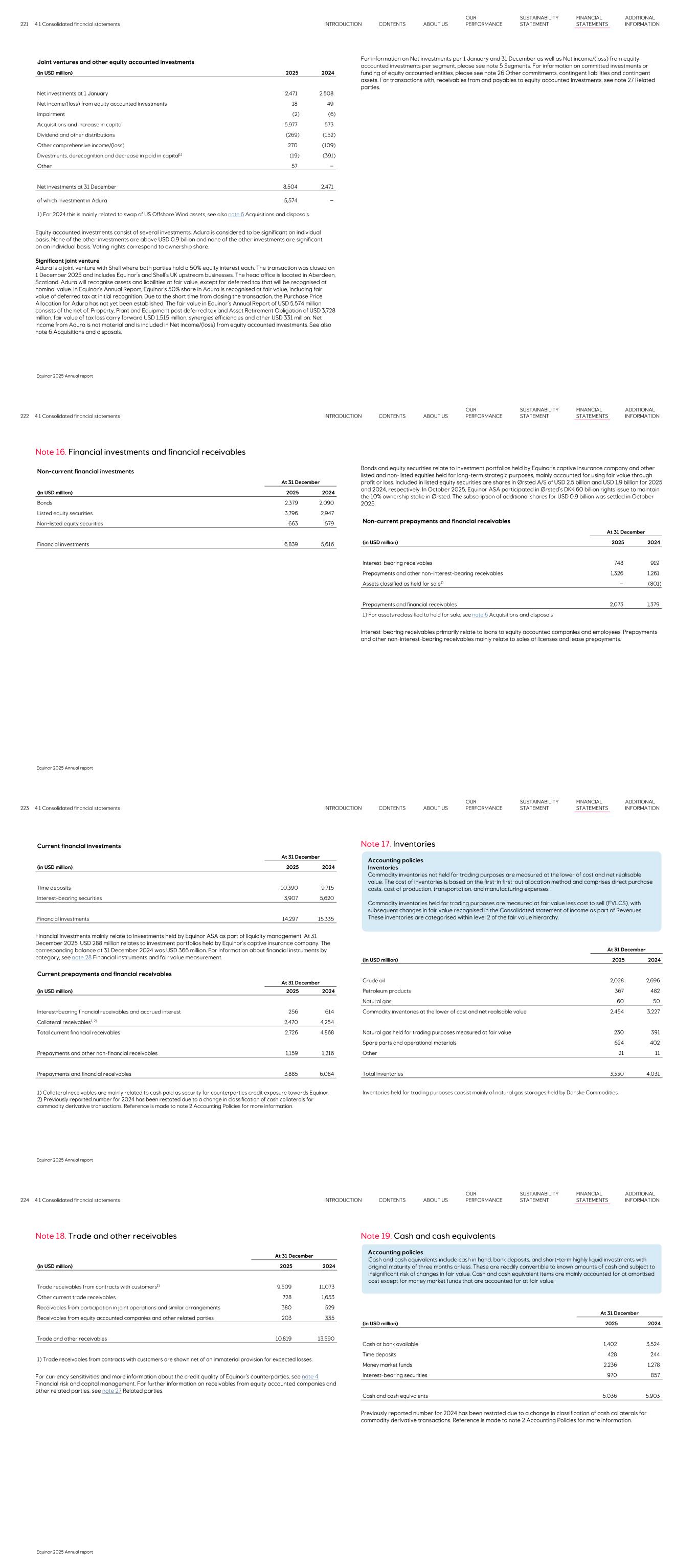
Net investments at 1 January 2,471 2,508 Net income/(loss) from equity accounted investments 18 49 Impairment (2) (6) Acquisitions and increase in capital 5,977 573 Dividend and other distributions (269) (152) Other comprehensive income/(loss) 270 (109) Divestments, derecognition and decrease in paid in capital1) (19) (391) Other 57 — Net investments at 31 December 8,504 2,471 of which investment in Adura 5,574 — 1) For 2024 this is mainly related to swap of US Offshore Wind assets, see also note 6 Acquisitions and disposals. Joint ventures and other equity accounted investments (in USD million) 2025 2024 Equity accounted investments consist of several investments, Adura is considered to be significant on individual basis. None of the other investments are above USD 0.9 billion and none of the other investments are significant on an individual basis. Voting rights correspond to ownership share. Significant joint venture Adura is a joint venture with Shell where both parties hold a 50% equity interest each. The transaction was closed on 1 December 2025 and includes Equinor’s and Shell’s UK upstream businesses. The head office is located in Aberdeen, Scotland. Adura will recognise assets and liabilities at fair value, except for deferred tax that will be recognised at nominal value. In Equinor’s Annual Report, Equinor's 50% share in Adura is recognised at fair value, including fair value of deferred tax at initial recognition. Due to the short time from closing the transaction, the Purchase Price Allocation for Adura has not yet been established. The fair value in Equinor’s Annual Report of USD 5,574 million consists of the net of: Property, Plant and Equipment post deferred tax and Asset Retirement Obligation of USD 3,728 million, fair value of tax loss carry forward USD 1,515 million, synergies efficiencies and other USD 331 million. Net income from Adura is not material and is included in Net income/(loss) from equity accounted investments. See also note 6 Acquisitions and disposals. For information on Net investments per 1 January and 31 December as well as Net income/(loss) from equity accounted investments per segment, please see note 5 Segments. For information on committed investments or funding of equity accounted entities, please see note 26 Other commitments, contingent liabilities and contingent assets. For transactions with, receivables from and payables to equity accounted investments, see note 27 Related parties. 221 4.1 Consolidated financial statements INTRODUCTION CONTENTS ABOUT US OUR PERFORMANCE SUSTAINABILITY STATEMENT FINANCIAL STATEMENTS ADDITIONAL INFORMATION Equinor 2025 Annual report Note 16. Financial investments and financial receivables Bonds 2,379 2,090 Listed equity securities 3,796 2,947 Non-listed equity securities 663 579 Financial investments 6,839 5,616 Non-current financial investments At 31 December (in USD million) 2025 2024 Bonds and equity securities relate to investment portfolios held by Equinor’s captive insurance company and other listed and non-listed equities held for long-term strategic purposes, mainly accounted for using fair value through profit or loss. Included in listed equity securities are shares in Ørsted A/S of USD 2.5 billion and USD 1.9 billion for 2025 and 2024, respectively. In October 2025, Equinor ASA participated in Ørsted’s DKK 60 billion rights issue to maintain the 10% ownership stake in Ørsted. The subscription of additional shares for USD 0.9 billion was settled in October 2025. Interest-bearing receivables 748 919 Prepayments and other non-interest-bearing receivables 1,326 1,261 Assets classified as held for sale1) — (801) Prepayments and financial receivables 2,073 1,379 1) For assets reclassified to held for sale, see note 6 Acquisitions and disposals Non-current prepayments and financial receivables At 31 December (in USD million) 2025 2024 Interest-bearing receivables primarily relate to loans to equity accounted companies and employees. Prepayments and other non-interest-bearing receivables mainly relate to sales of licenses and lease prepayments. 222 4.1 Consolidated financial statements INTRODUCTION CONTENTS ABOUT US OUR PERFORMANCE SUSTAINABILITY STATEMENT FINANCIAL STATEMENTS ADDITIONAL INFORMATION Equinor 2025 Annual report Time deposits 10,390 9,715 Interest-bearing securities 3,907 5,620 Financial investments 14,297 15,335 Current financial investments At 31 December (in USD million) 2025 2024 Financial investments mainly relate to investments held by Equinor ASA as part of liquidity management. At 31 December 2025, USD 288 million relates to investment portfolios held by Equinor’s captive insurance company. The corresponding balance at 31 December 2024 was USD 366 million. For information about financial instruments by category, see note 28 Financial instruments and fair value measurement. Interest-bearing financial receivables and accrued interest 256 614 Collateral receivables1, 2) 2,470 4,254 Total current financial receivables 2,726 4,868 Prepayments and other non-financial receivables 1,159 1,216 Prepayments and financial receivables 3,885 6,084 1) Collateral receivables are mainly related to cash paid as security for counterparties credit exposure towards Equinor. 2) Previously reported number for 2024 has been restated due to a change in classification of cash collaterals for commodity derivative transactions. Reference is made to note 2 Accounting Policies for more information. Current prepayments and financial receivables At 31 December (in USD million) 2025 2024 Note 17. Inventories Accounting policies Inventories Commodity inventories not held for trading purposes are measured at the lower of cost and net realisable value. The cost of inventories is based on the first-in first-out allocation method and comprises direct purchase costs, cost of production, transportation, and manufacturing expenses. Commodity inventories held for trading purposes are measured at fair value less cost to sell (FVLCS), with subsequent changes in fair value recognised in the Consolidated statement of income as part of Revenues. These inventories are categorised within level 2 of the fair value hierarchy. Crude oil 2,028 2,696 Petroleum products 367 482 Natural gas 60 50 Commodity inventories at the lower of cost and net realisable value 2,454 3,227 Natural gas held for trading purposes measured at fair value 230 391 Spare parts and operational materials 624 402 Other 21 11 Total inventories 3,330 4,031 Inventories held for trading purposes consist mainly of natural gas storages held by Danske Commodities. At 31 December (in USD million) 2025 2024 223 4.1 Consolidated financial statements INTRODUCTION CONTENTS ABOUT US OUR PERFORMANCE SUSTAINABILITY STATEMENT FINANCIAL STATEMENTS ADDITIONAL INFORMATION Equinor 2025 Annual report Note 18. Trade and other receivables Trade receivables from contracts with customers1) 9,509 11,073 Other current trade receivables 728 1,653 Receivables from participation in joint operations and similar arrangements 380 529 Receivables from equity accounted companies and other related parties 203 335 Trade and other receivables 10,819 13,590 1) Trade receivables from contracts with customers are shown net of an immaterial provision for expected losses. At 31 December (in USD million) 2025 2024 For currency sensitivities and more information about the credit quality of Equinor's counterparties, see note 4 Financial risk and capital management. For further information on receivables from equity accounted companies and other related parties, see note 27 Related parties. Note 19. Cash and cash equivalents Accounting policies Cash and cash equivalents include cash in hand, bank deposits, and short-term highly liquid investments with original maturity of three months or less. These are readily convertible to known amounts of cash and subject to insignificant risk of changes in fair value. Cash and cash equivalent items are mainly accounted for at amortised cost except for money market funds that are accounted for at fair value. Cash at bank available 1,402 3,524 Time deposits 428 244 Money market funds 2,236 1,278 Interest-bearing securities 970 857 Cash and cash equivalents 5,036 5,903 At 31 December (in USD million) 2025 2024 Previously reported number for 2024 has been restated due to a change in classification of cash collaterals for commodity derivative transactions. Reference is made to note 2 Accounting Policies for more information. 224 4.1 Consolidated financial statements INTRODUCTION CONTENTS ABOUT US OUR PERFORMANCE SUSTAINABILITY STATEMENT FINANCIAL STATEMENTS ADDITIONAL INFORMATION Equinor 2025 Annual report
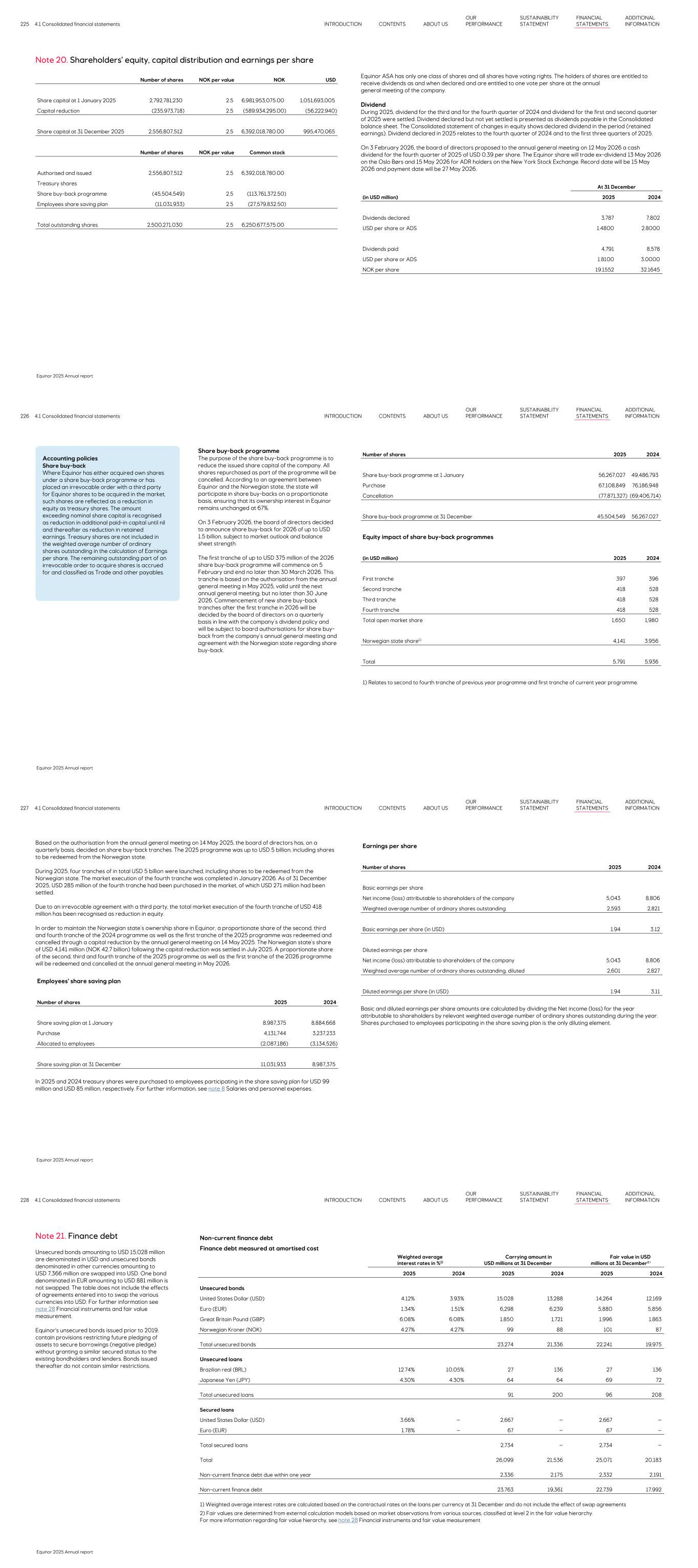
Note 20. Shareholders' equity, capital distribution and earnings per share Share capital at 1 January 2025 2,792,781,230 2.5 6,981,953,075.00 1,051,693,005 Capital reduction (235,973,718) 2.5 (589,934,295.00) (56,222,940) Share capital at 31 December 2025 2,556,807,512 2.5 6,392,018,780.00 995,470,065 Number of shares NOK per value NOK USD Authorised and issued 2,556,807,512 2.5 6,392,018,780.00 Treasury shares Share buy-back programme (45,504,549) 2.5 (113,761,372.50) Employees share saving plan (11,031,933) 2.5 (27,579,832.50) Total outstanding shares 2,500,271,030 2.5 6,250,677,575.00 Number of shares NOK per value Common stock Equinor ASA has only one class of shares and all shares have voting rights. The holders of shares are entitled to receive dividends as and when declared and are entitled to one vote per share at the annual general meeting of the company. Dividend During 2025, dividend for the third and for the fourth quarter of 2024 and dividend for the first and second quarter of 2025 were settled. Dividend declared but not yet settled is presented as dividends payable in the Consolidated balance sheet. The Consolidated statement of changes in equity shows declared dividend in the period (retained earnings). Dividend declared in 2025 relates to the fourth quarter of 2024 and to the first three quarters of 2025. On 3 February 2026, the board of directors proposed to the annual general meeting on 12 May 2026 a cash dividend for the fourth quarter of 2025 of USD 0.39 per share. The Equinor share will trade ex-dividend 13 May 2026 on the Oslo Børs and 15 May 2026 for ADR holders on the New York Stock Exchange. Record date will be 15 May 2026 and payment date will be 27 May 2026. Dividends declared 3,787 7,802 USD per share or ADS 1.4800 2.8000 Dividends paid 4,791 8,578 USD per share or ADS 1.8100 3.0000 NOK per share 19.1552 32.1645 At 31 December (in USD million) 2025 2024 225 4.1 Consolidated financial statements INTRODUCTION CONTENTS ABOUT US OUR PERFORMANCE SUSTAINABILITY STATEMENT FINANCIAL STATEMENTS ADDITIONAL INFORMATION Equinor 2025 Annual report Accounting policies Share buy-back Where Equinor has either acquired own shares under a share buy-back programme or has placed an irrevocable order with a third party for Equinor shares to be acquired in the market, such shares are reflected as a reduction in equity as treasury shares. The amount exceeding nominal share capital is recognised as reduction in additional paid-in capital until nil and thereafter as reduction in retained earnings. Treasury shares are not included in the weighted average number of ordinary shares outstanding in the calculation of Earnings per share. The remaining outstanding part of an irrevocable order to acquire shares is accrued for and classified as Trade and other payables. Share buy-back programme The purpose of the share buy-back programme is to reduce the issued share capital of the company. All shares repurchased as part of the programme will be cancelled. According to an agreement between Equinor and the Norwegian state, the state will participate in share buy-backs on a proportionate basis, ensuring that its ownership interest in Equinor remains unchanged at 67%. On 3 February 2026, the board of directors decided to announce share buy-back for 2026 of up to USD 1.5 billion, subject to market outlook and balance sheet strength. The first tranche of up to USD 375 million of the 2026 share buy-back programme will commence on 5 February and end no later than 30 March 2026. This tranche is based on the authorisation from the annual general meeting in May 2025, valid until the next annual general meeting, but no later than 30 June 2026. Commencement of new share buy-back tranches after the first tranche in 2026 will be decided by the board of directors on a quarterly basis in line with the company’s dividend policy and will be subject to board authorisations for share buy- back from the company’s annual general meeting and agreement with the Norwegian state regarding share buy-back. Share buy-back programme at 1 January 56,267,027 49,486,793 Purchase 67,108,849 76,186,948 Cancellation (77,871,327) (69,406,714) Share buy-back programme at 31 December 45,504,549 56,267,027 Equity impact of share buy-back programmes (in USD million) 2025 2024 First tranche 397 396 Second tranche 418 528 Third tranche 418 528 Fourth tranche 418 528 Total open market share 1,650 1,980 Norwegian state share1) 4,141 3,956 Total 5,791 5,936 1) Relates to second to fourth tranche of previous year programme and first tranche of current year programme. Number of shares 2025 2024 226 4.1 Consolidated financial statements INTRODUCTION CONTENTS ABOUT US OUR PERFORMANCE SUSTAINABILITY STATEMENT FINANCIAL STATEMENTS ADDITIONAL INFORMATION Equinor 2025 Annual report Based on the authorisation from the annual general meeting on 14 May 2025, the board of directors has, on a quarterly basis, decided on share buy-back tranches. The 2025 programme was up to USD 5 billion, including shares to be redeemed from the Norwegian state. During 2025, four tranches of in total USD 5 billion were launched, including shares to be redeemed from the Norwegian state. The market execution of the fourth tranche was completed in January 2026. As of 31 December 2025, USD 285 million of the fourth tranche had been purchased in the market, of which USD 271 million had been settled. Due to an irrevocable agreement with a third party, the total market execution of the fourth tranche of USD 418 million has been recognised as reduction in equity. In order to maintain the Norwegian state’s ownership share in Equinor, a proportionate share of the second, third and fourth tranche of the 2024 programme as well as the first tranche of the 2025 programme was redeemed and cancelled through a capital reduction by the annual general meeting on 14 May 2025. The Norwegian state’s share of USD 4,141 million (NOK 42.7 billion) following the capital reduction was settled in July 2025. A proportionate share of the second, third and fourth tranche of the 2025 programme as well as the first tranche of the 2026 programme will be redeemed and cancelled at the annual general meeting in May 2026. Share saving plan at 1 January 8,987,375 8,884,668 Purchase 4,131,744 3,237,233 Allocated to employees (2,087,186) (3,134,526) Share saving plan at 31 December 11,031,933 8,987,375 Employees' share saving plan Number of shares 2025 2024 In 2025 and 2024 treasury shares were purchased to employees participating in the share saving plan for USD 99 million and USD 85 million, respectively. For further information, see note 8 Salaries and personnel expenses. Basic earnings per share Net income (loss) attributable to shareholders of the company 5,043 8,806 Weighted average number of ordinary shares outstanding 2,593 2,821 Basic earnings per share (in USD) 1.94 3.12 Diluted earnings per share Net income (loss) attributable to shareholders of the company 5,043 8,806 Weighted average number of ordinary shares outstanding, diluted 2,601 2,827 Diluted earnings per share (in USD) 1.94 3.11 Earnings per share Number of shares 2025 2024 Basic and diluted earnings per share amounts are calculated by dividing the Net income (loss) for the year attributable to shareholders by relevant weighted average number of ordinary shares outstanding during the year. Shares purchased to employees participating in the share saving plan is the only diluting element. 227 4.1 Consolidated financial statements INTRODUCTION CONTENTS ABOUT US OUR PERFORMANCE SUSTAINABILITY STATEMENT FINANCIAL STATEMENTS ADDITIONAL INFORMATION Equinor 2025 Annual report Note 21. Finance debt Unsecured bonds amounting to USD 15,028 million are denominated in USD and unsecured bonds denominated in other currencies amounting to USD 7,366 million are swapped into USD. One bond denominated in EUR amounting to USD 881 million is not swapped. The table does not include the effects of agreements entered into to swap the various currencies into USD. For further information see note 28 Financial instruments and fair value measurement. Equinor's unsecured bonds issued prior to 2019, contain provisions restricting future pledging of assets to secure borrowings (negative pledge) without granting a similar secured status to the existing bondholders and lenders. Bonds issued thereafter do not contain similar restrictions. Unsecured bonds United States Dollar (USD) 4.12% 3.93% 15,028 13,288 14,264 12,169 Euro (EUR) 1.34% 1.51% 6,298 6,239 5,880 5,856 Great Britain Pound (GBP) 6.08% 6.08% 1,850 1,721 1,996 1,863 Norwegian Kroner (NOK) 4.27% 4.27% 99 88 101 87 Total unsecured bonds 23,274 21,336 22,241 19,975 Unsecured loans Brazilian real (BRL) 12.74% 10.05% 27 136 27 136 Japanese Yen (JPY) 4.30% 4.30% 64 64 69 72 Total unsecured loans 91 200 96 208 Secured loans United States Dollar (USD) 3.66% — 2,667 — 2,667 — Euro (EUR) 1.78% — 67 — 67 — Total secured loans 2,734 — 2,734 — Total 26,099 21,536 25,071 20,183 Non-current finance debt due within one year 2,336 2,175 2,332 2,191 Non-current finance debt 23,763 19,361 22,739 17,992 1) Weighted average interest rates are calculated based on the contractual rates on the loans per currency at 31 December and do not include the effect of swap agreements 2) Fair values are determined from external calculation models based on market observations from various sources, classified at level 2 in the fair value hierarchy. For more information regarding fair value hierarchy, see note 28 Financial instruments and fair value measurement Non-current finance debt Finance debt measured at amortised cost Weighted average interest rates in %1) Carrying amount in USD millions at 31 December Fair value in USD millions at 31 December²⁾ 2025 2024 2025 2024 2025 2024 228 4.1 Consolidated financial statements INTRODUCTION CONTENTS ABOUT US OUR PERFORMANCE SUSTAINABILITY STATEMENT FINANCIAL STATEMENTS ADDITIONAL INFORMATION Equinor 2025 Annual report
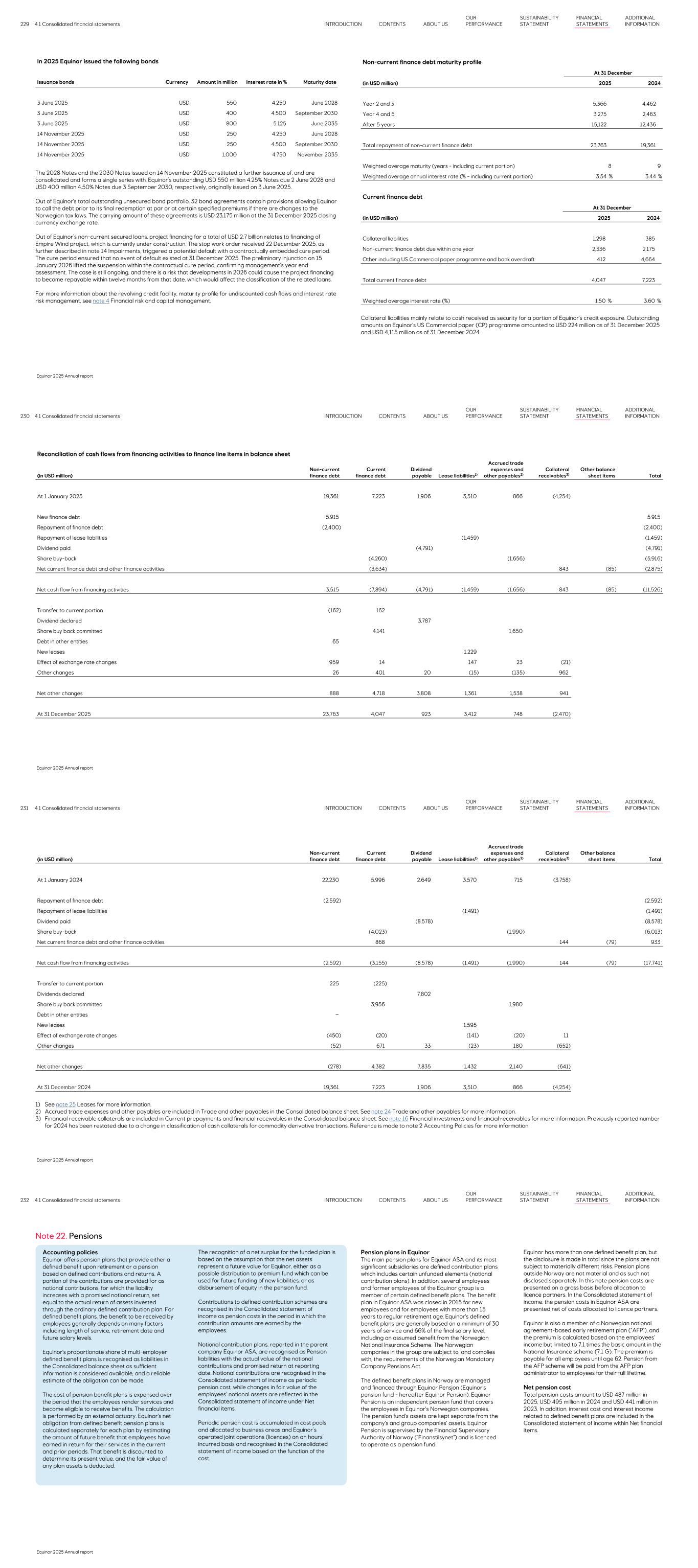
3 June 2025 USD 550 4.250 June 2028 3 June 2025 USD 400 4.500 September 2030 3 June 2025 USD 800 5.125 June 2035 14 November 2025 USD 250 4.250 June 2028 14 November 2025 USD 250 4.500 September 2030 14 November 2025 USD 1,000 4.750 November 2035 In 2025 Equinor issued the following bonds Issuance bonds Currency Amount in million Interest rate in % Maturity date The 2028 Notes and the 2030 Notes issued on 14 November 2025 constituted a further issuance of, and are consolidated and forms a single series with, Equinor’s outstanding USD 550 million 4.25% Notes due 2 June 2028 and USD 400 million 4.50% Notes due 3 September 2030, respectively, originally issued on 3 June 2025. Out of Equinor's total outstanding unsecured bond portfolio, 32 bond agreements contain provisions allowing Equinor to call the debt prior to its final redemption at par or at certain specified premiums if there are changes to the Norwegian tax laws. The carrying amount of these agreements is USD 23,175 million at the 31 December 2025 closing currency exchange rate. Out of Equinor’s non-current secured loans, project financing for a total of USD 2.7 billion relates to financing of Empire Wind project, which is currently under construction. The stop work order received 22 December 2025, as further described in note 14 Impairments, triggered a potential default with a contractually embedded cure period. The cure period ensured that no event of default existed at 31 December 2025. The preliminary injunction on 15 January 2026 lifted the suspension within the contractual cure period, confirming management’s year end assessment. The case is still ongoing, and there is a risk that developments in 2026 could cause the project financing to become repayable within twelve months from that date, which would affect the classification of the related loans. For more information about the revolving credit facility, maturity profile for undiscounted cash flows and interest rate risk management, see note 4 Financial risk and capital management. Year 2 and 3 5,366 4,462 Year 4 and 5 3,275 2,463 After 5 years 15,122 12,436 Total repayment of non-current finance debt 23,763 19,361 Weighted average maturity (years - including current portion) 8 9 Weighted average annual interest rate (% - including current portion) 3.54 % 3.44 % Non-current finance debt maturity profile At 31 December (in USD million) 2025 2024 Collateral liabilities 1,298 385 Non-current finance debt due within one year 2,336 2,175 Other including US Commercial paper programme and bank overdraft 412 4,664 Total current finance debt 4,047 7,223 Weighted average interest rate (%) 1.50 % 3.60 % Current finance debt At 31 December (in USD million) 2025 2024 Collateral liabilities mainly relate to cash received as security for a portion of Equinor's credit exposure. Outstanding amounts on Equinor's US Commercial paper (CP) programme amounted to USD 224 million as of 31 December 2025 and USD 4,115 million as of 31 December 2024. 229 4.1 Consolidated financial statements INTRODUCTION CONTENTS ABOUT US OUR PERFORMANCE SUSTAINABILITY STATEMENT FINANCIAL STATEMENTS ADDITIONAL INFORMATION Equinor 2025 Annual report At 1 January 2025 19,361 7,223 1,906 3,510 866 (4,254) New finance debt 5,915 5,915 Repayment of finance debt (2,400) (2,400) Repayment of lease liabilities (1,459) (1,459) Dividend paid (4,791) (4,791) Share buy-back (4,260) (1,656) (5,916) Net current finance debt and other finance activities (3,634) 843 (85) (2,875) Net cash flow from financing activities 3,515 (7,894) (4,791) (1,459) (1,656) 843 (85) (11,526) Transfer to current portion (162) 162 Dividend declared 3,787 Share buy back committed 4,141 1,650 Debt in other entities 65 New leases 1,229 Effect of exchange rate changes 959 14 147 23 (21) Other changes 26 401 20 (15) (135) 962 Net other changes 888 4,718 3,808 1,361 1,538 941 At 31 December 2025 23,763 4,047 923 3,412 748 (2,470) Reconciliation of cash flows from financing activities to finance line items in balance sheet (in USD million) Non-current finance debt Current finance debt Dividend payable Lease liabilities1) Accrued trade expenses and other payables2) Collateral receivables3) Other balance sheet items Total 230 4.1 Consolidated financial statements INTRODUCTION CONTENTS ABOUT US OUR PERFORMANCE SUSTAINABILITY STATEMENT FINANCIAL STATEMENTS ADDITIONAL INFORMATION Equinor 2025 Annual report At 1 January 2024 22,230 5,996 2,649 3,570 715 (3,758) Repayment of finance debt (2,592) (2,592) Repayment of lease liabilities (1,491) (1,491) Dividend paid (8,578) (8,578) Share buy-back (4,023) (1,990) (6,013) Net current finance debt and other finance activities 868 144 (79) 933 Net cash flow from financing activities (2,592) (3,155) (8,578) (1,491) (1,990) 144 (79) (17,741) Transfer to current portion 225 (225) Dividends declared 7,802 Share buy back committed 3,956 1,980 Debt in other entities — New leases 1,595 Effect of exchange rate changes (450) (20) (141) (20) 11 Other changes (52) 671 33 (23) 180 (652) Net other changes (278) 4,382 7,835 1,432 2,140 (641) At 31 December 2024 19,361 7,223 1,906 3,510 866 (4,254) (in USD million) Non-current finance debt Current finance debt Dividend payable Lease liabilities1) Accrued trade expenses and other payables2) Collateral receivables3) Other balance sheet items Total 1) See note 25 Leases for more information. 2) Accrued trade expenses and other payables are included in Trade and other payables in the Consolidated balance sheet. See note 24 Trade and other payables for more information. 3) Financial receivable collaterals are included in Current prepayments and financial receivables in the Consolidated balance sheet. See note 16 Financial investments and financial receivables for more information. Previously reported number for 2024 has been restated due to a change in classification of cash collaterals for commodity derivative transactions. Reference is made to note 2 Accounting Policies for more information. 231 4.1 Consolidated financial statements INTRODUCTION CONTENTS ABOUT US OUR PERFORMANCE SUSTAINABILITY STATEMENT FINANCIAL STATEMENTS ADDITIONAL INFORMATION Equinor 2025 Annual report Note 22. Pensions Accounting policies Equinor offers pension plans that provide either a defined benefit upon retirement or a pension based on defined contributions and returns. A portion of the contributions are provided for as notional contributions, for which the liability increases with a promised notional return, set equal to the actual return of assets invested through the ordinary defined contribution plan. For defined benefit plans, the benefit to be received by employees generally depends on many factors including length of service, retirement date and future salary levels. Equinor's proportionate share of multi-employer defined benefit plans is recognised as liabilities in the Consolidated balance sheet as sufficient information is considered available, and a reliable estimate of the obligation can be made. The cost of pension benefit plans is expensed over the period that the employees render services and become eligible to receive benefits. The calculation is performed by an external actuary. Equinor's net obligation from defined benefit pension plans is calculated separately for each plan by estimating the amount of future benefit that employees have earned in return for their services in the current and prior periods. That benefit is discounted to determine its present value, and the fair value of any plan assets is deducted. The recognition of a net surplus for the funded plan is based on the assumption that the net assets represent a future value for Equinor, either as a possible distribution to premium fund which can be used for future funding of new liabilities, or as disbursement of equity in the pension fund. Contributions to defined contribution schemes are recognised in the Consolidated statement of income as pension costs in the period in which the contribution amounts are earned by the employees. Notional contribution plans, reported in the parent company Equinor ASA, are recognised as Pension liabilities with the actual value of the notional contributions and promised return at reporting date. Notional contributions are recognised in the Consolidated statement of income as periodic pension cost, while changes in fair value of the employees’ notional assets are reflected in the Consolidated statement of income under Net financial items. Periodic pension cost is accumulated in cost pools and allocated to business areas and Equinor’s operated joint operations (licences) on an hours’ incurred basis and recognised in the Consolidated statement of income based on the function of the cost. Pension plans in Equinor The main pension plans for Equinor ASA and its most significant subsidiaries are defined contribution plans which includes certain unfunded elements (notional contribution plans). In addition, several employees and former employees of the Equinor group is a member of certain defined benefit plans. The benefit plan in Equinor ASA was closed in 2015 for new employees and for employees with more than 15 years to regular retirement age. Equinor's defined benefit plans are generally based on a minimum of 30 years of service and 66% of the final salary level, including an assumed benefit from the Norwegian National Insurance Scheme. The Norwegian companies in the group are subject to, and complies with, the requirements of the Norwegian Mandatory Company Pensions Act. The defined benefit plans in Norway are managed and financed through Equinor Pensjon (Equinor's pension fund - hereafter Equinor Pension). Equinor Pension is an independent pension fund that covers the employees in Equinor's Norwegian companies. The pension fund's assets are kept separate from the company's and group companies' assets. Equinor Pension is supervised by the Financial Supervisory Authority of Norway ("Finanstilsynet") and is licenced to operate as a pension fund. Equinor has more than one defined benefit plan, but the disclosure is made in total since the plans are not subject to materially different risks. Pension plans outside Norway are not material and as such not disclosed separately. In this note pension costs are presented on a gross basis before allocation to licence partners. In the Consolidated statement of income, the pension costs in Equinor ASA are presented net of costs allocated to licence partners. Equinor is also a member of a Norwegian national agreement-based early retirement plan (“AFP”), and the premium is calculated based on the employees' income but limited to 7.1 times the basic amount in the National Insurance scheme (7.1 G). The premium is payable for all employees until age 62. Pension from the AFP scheme will be paid from the AFP plan administrator to employees for their full lifetime. Net pension cost Total pension costs amount to USD 487 million in 2025, USD 495 million in 2024 and USD 441 million in 2023. In addition, interest cost and interest income related to defined benefit plans are included in the Consolidated statement of income within Net financial items. 232 4.1 Consolidated financial statements INTRODUCTION CONTENTS ABOUT US OUR PERFORMANCE SUSTAINABILITY STATEMENT FINANCIAL STATEMENTS ADDITIONAL INFORMATION Equinor 2025 Annual report
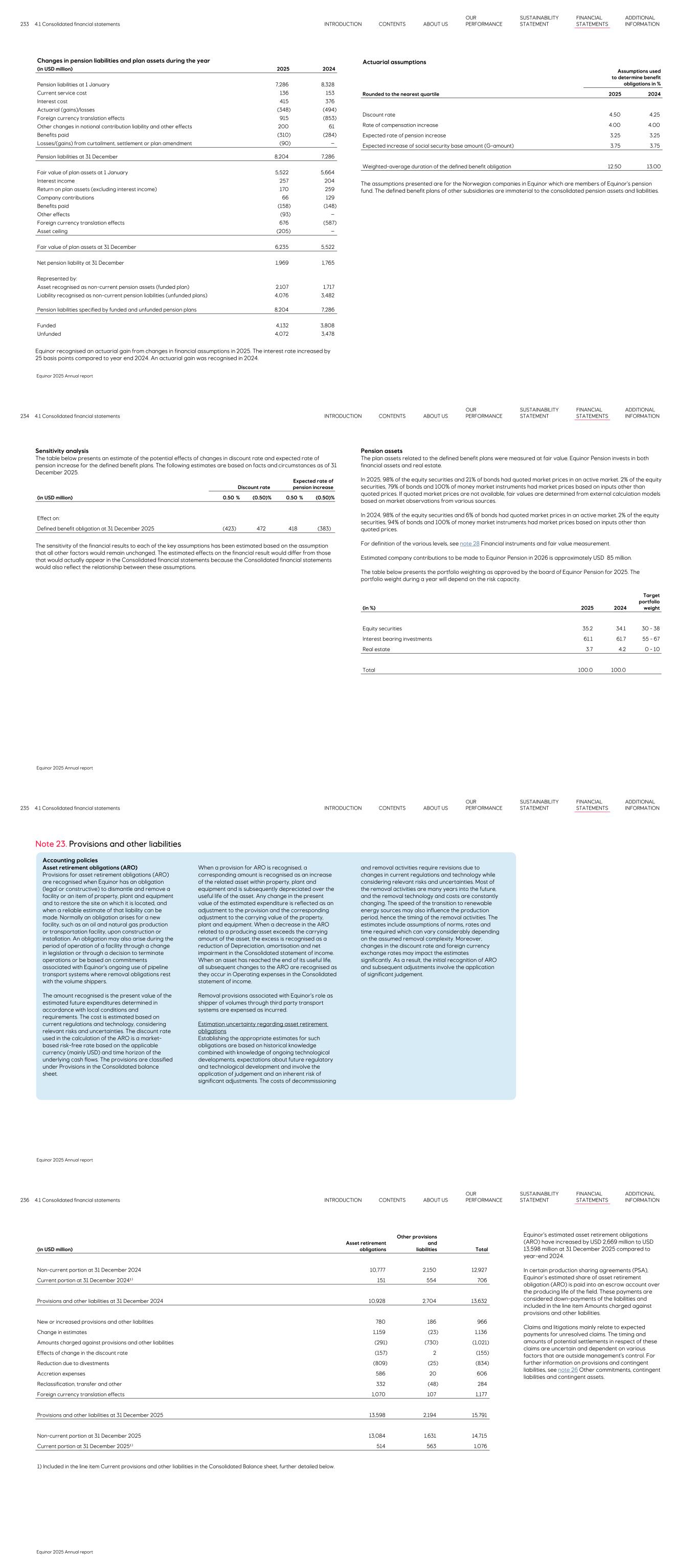
Pension liabilities at 1 January 7,286 8,328 Current service cost 136 153 Interest cost 415 376 Actuarial (gains)/losses (348) (494) Foreign currency translation effects 915 (853) Other changes in notional contribution liability and other effects 200 61 Benefits paid (310) (284) Losses/(gains) from curtailment, settlement or plan amendment (90) — Pension liabilities at 31 December 8,204 7,286 Fair value of plan assets at 1 January 5,522 5,664 Interest income 257 204 Return on plan assets (excluding interest income) 170 259 Company contributions 66 129 Benefits paid (158) (148) Other effects (93) — Foreign currency translation effects 676 (587) Asset ceiling (205) — Fair value of plan assets at 31 December 6,235 5,522 Net pension liability at 31 December 1,969 1,765 Represented by: Asset recognised as non-current pension assets (funded plan) 2,107 1,717 Liability recognised as non-current pension liabilities (unfunded plans) 4,076 3,482 Pension liabilities specified by funded and unfunded pension plans 8,204 7,286 Funded 4,132 3,808 Unfunded 4,072 3,478 Changes in pension liabilities and plan assets during the year (in USD million) 2025 2024 Equinor recognised an actuarial gain from changes in financial assumptions in 2025. The interest rate increased by 25 basis points compared to year end 2024. An actuarial gain was recognised in 2024. Discount rate 4.50 4.25 Rate of compensation increase 4.00 4.00 Expected rate of pension increase 3.25 3.25 Expected increase of social security base amount (G-amount) 3.75 3.75 Weighted-average duration of the defined benefit obligation 12.50 13.00 Actuarial assumptions Assumptions used to determine benefit obligations in % Rounded to the nearest quartile 2025 2024 The assumptions presented are for the Norwegian companies in Equinor which are members of Equinor's pension fund. The defined benefit plans of other subsidiaries are immaterial to the consolidated pension assets and liabilities. 233 4.1 Consolidated financial statements INTRODUCTION CONTENTS ABOUT US OUR PERFORMANCE SUSTAINABILITY STATEMENT FINANCIAL STATEMENTS ADDITIONAL INFORMATION Equinor 2025 Annual report Sensitivity analysis The table below presents an estimate of the potential effects of changes in discount rate and expected rate of pension increase for the defined benefit plans. The following estimates are based on facts and circumstances as of 31 December 2025. Effect on: Defined benefit obligation at 31 December 2025 (423) 472 418 (383) Discount rate Expected rate of pension increase (in USD million) 0.50 % (0.50) % 0.50 % (0.50) % The sensitivity of the financial results to each of the key assumptions has been estimated based on the assumption that all other factors would remain unchanged. The estimated effects on the financial result would differ from those that would actually appear in the Consolidated financial statements because the Consolidated financial statements would also reflect the relationship between these assumptions. Pension assets The plan assets related to the defined benefit plans were measured at fair value. Equinor Pension invests in both financial assets and real estate. In 2025, 98% of the equity securities and 21% of bonds had quoted market prices in an active market. 2% of the equity securities, 79% of bonds and 100% of money market instruments had market prices based on inputs other than quoted prices. If quoted market prices are not available, fair values are determined from external calculation models based on market observations from various sources. In 2024, 98% of the equity securities and 6% of bonds had quoted market prices in an active market. 2% of the equity securities, 94% of bonds and 100% of money market instruments had market prices based on inputs other than quoted prices. For definition of the various levels, see note 28 Financial instruments and fair value measurement. Estimated company contributions to be made to Equinor Pension in 2026 is approximately USD 85 million. The table below presents the portfolio weighting as approved by the board of Equinor Pension for 2025. The portfolio weight during a year will depend on the risk capacity. Equity securities 35.2 34.1 30 - 38 Interest bearing investments 61.1 61.7 55 - 67 Real estate 3.7 4.2 0 - 10 Total 100.0 100.0 (in %) 2025 2024 Target portfolio weight 234 4.1 Consolidated financial statements INTRODUCTION CONTENTS ABOUT US OUR PERFORMANCE SUSTAINABILITY STATEMENT FINANCIAL STATEMENTS ADDITIONAL INFORMATION Equinor 2025 Annual report Note 23. Provisions and other liabilities Accounting policies Asset retirement obligations (ARO) Provisions for asset retirement obligations (ARO) are recognised when Equinor has an obligation (legal or constructive) to dismantle and remove a facility or an item of property, plant and equipment and to restore the site on which it is located, and when a reliable estimate of that liability can be made. Normally an obligation arises for a new facility, such as an oil and natural gas production or transportation facility, upon construction or installation. An obligation may also arise during the period of operation of a facility through a change in legislation or through a decision to terminate operations or be based on commitments associated with Equinor's ongoing use of pipeline transport systems where removal obligations rest with the volume shippers. The amount recognised is the present value of the estimated future expenditures determined in accordance with local conditions and requirements. The cost is estimated based on current regulations and technology, considering relevant risks and uncertainties. The discount rate used in the calculation of the ARO is a market- based risk-free rate based on the applicable currency (mainly USD) and time horizon of the underlying cash flows. The provisions are classified under Provisions in the Consolidated balance sheet. When a provision for ARO is recognised, a corresponding amount is recognised as an increase of the related asset within property, plant and equipment and is subsequently depreciated over the useful life of the asset. Any change in the present value of the estimated expenditure is reflected as an adjustment to the provision and the corresponding adjustment to the carrying value of the property, plant and equipment. When a decrease in the ARO related to a producing asset exceeds the carrying amount of the asset, the excess is recognised as a reduction of Depreciation, amortisation and net impairment in the Consolidated statement of income. When an asset has reached the end of its useful life, all subsequent changes to the ARO are recognised as they occur in Operating expenses in the Consolidated statement of income. Removal provisions associated with Equinor's role as shipper of volumes through third party transport systems are expensed as incurred. Estimation uncertainty regarding asset retirement obligations Establishing the appropriate estimates for such obligations are based on historical knowledge combined with knowledge of ongoing technological developments, expectations about future regulatory and technological development and involve the application of judgement and an inherent risk of significant adjustments. The costs of decommissioning and removal activities require revisions due to changes in current regulations and technology while considering relevant risks and uncertainties. Most of the removal activities are many years into the future, and the removal technology and costs are constantly changing. The speed of the transition to renewable energy sources may also influence the production period, hence the timing of the removal activities. The estimates include assumptions of norms, rates and time required which can vary considerably depending on the assumed removal complexity. Moreover, changes in the discount rate and foreign currency exchange rates may impact the estimates significantly. As a result, the initial recognition of ARO and subsequent adjustments involve the application of significant judgement. 235 4.1 Consolidated financial statements INTRODUCTION CONTENTS ABOUT US OUR PERFORMANCE SUSTAINABILITY STATEMENT FINANCIAL STATEMENTS ADDITIONAL INFORMATION Equinor 2025 Annual report Non-current portion at 31 December 2024 10,777 2,150 12,927 Current portion at 31 December 2024¹⁾ 151 554 706 Provisions and other liabilities at 31 December 2024 10,928 2,704 13,632 New or increased provisions and other liabilities 780 186 966 Change in estimates 1,159 (23) 1,136 Amounts charged against provisions and other liabilities (291) (730) (1,021) Effects of change in the discount rate (157) 2 (155) Reduction due to divestments (809) (25) (834) Accretion expenses 586 20 606 Reclassification, transfer and other 332 (48) 284 Foreign currency translation effects 1,070 107 1,177 Provisions and other liabilities at 31 December 2025 13,598 2,194 15,791 Non-current portion at 31 December 2025 13,084 1,631 14,715 Current portion at 31 December 2025¹⁾ 514 563 1,076 1) Included in the line item Current provisions and other liabilities in the Consolidated Balance sheet, further detailed below. (in USD million) Asset retirement obligations Other provisions and liabilities Total Equinor's estimated asset retirement obligations (ARO) have increased by USD 2,669 million to USD 13,598 million at 31 December 2025 compared to year-end 2024. In certain production sharing agreements (PSA), Equinor’s estimated share of asset retirement obligation (ARO) is paid into an escrow account over the producing life of the field. These payments are considered down-payments of the liabilities and included in the line item Amounts charged against provisions and other liabilities. Claims and litigations mainly relate to expected payments for unresolved claims. The timing and amounts of potential settlements in respect of these claims are uncertain and dependent on various factors that are outside management's control. For further information on provisions and contingent liabilities, see note 26 Other commitments, contingent liabilities and contingent assets. 236 4.1 Consolidated financial statements INTRODUCTION CONTENTS ABOUT US OUR PERFORMANCE SUSTAINABILITY STATEMENT FINANCIAL STATEMENTS ADDITIONAL INFORMATION Equinor 2025 Annual report
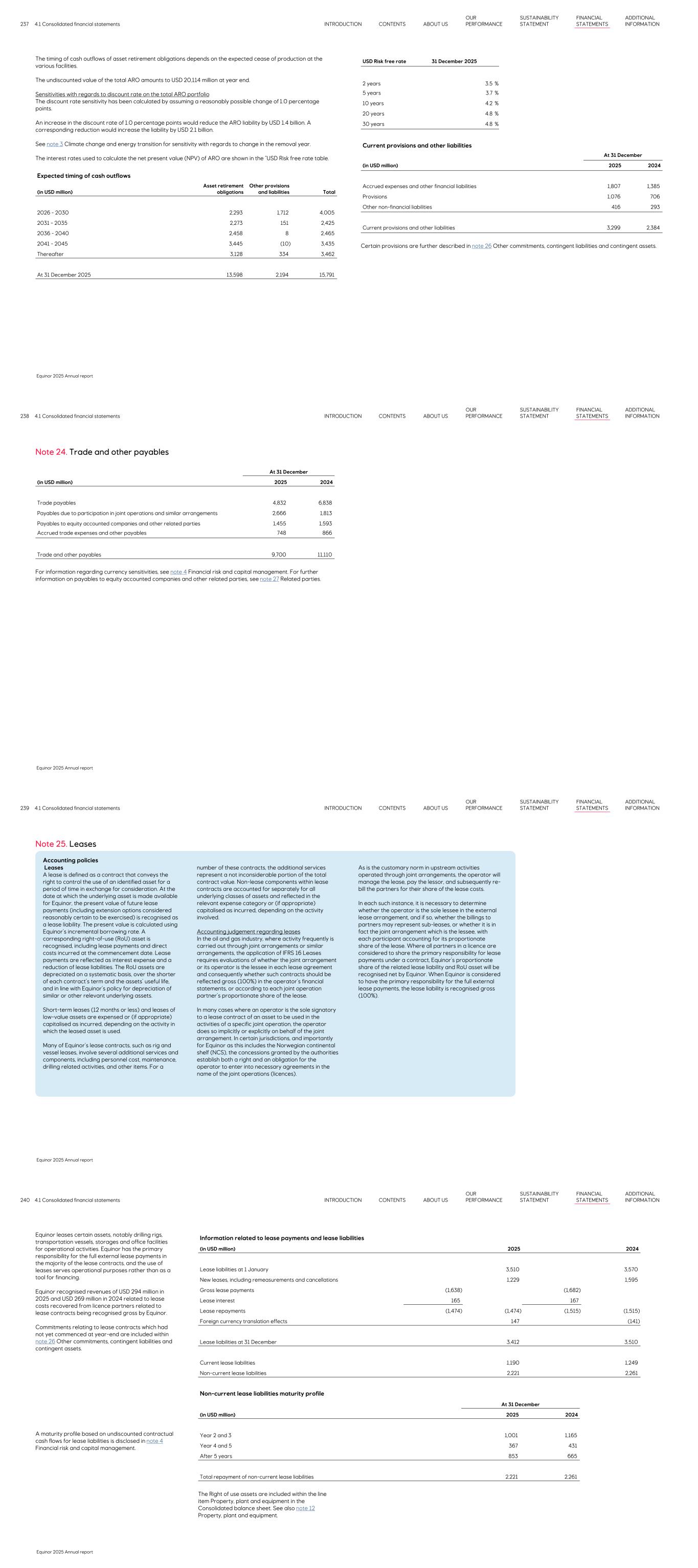
The timing of cash outflows of asset retirement obligations depends on the expected cease of production at the various facilities. The undiscounted value of the total ARO amounts to USD 20,114 million at year end. Sensitivities with regards to discount rate on the total ARO portfolio The discount rate sensitivity has been calculated by assuming a reasonably possible change of 1.0 percentage points. An increase in the discount rate of 1.0 percentage points would reduce the ARO liability by USD 1.4 billion. A corresponding reduction would increase the liability by USD 2.1 billion. See note 3 Climate change and energy transition for sensitivity with regards to change in the removal year. The interest rates used to calculate the net present value (NPV) of ARO are shown in the “USD Risk free rate table. 2026 - 2030 2,293 1,712 4,005 2031 - 2035 2,273 151 2,425 2036 - 2040 2,458 8 2,465 2041 - 2045 3,445 (10) 3,435 Thereafter 3,128 334 3,462 At 31 December 2025 13,598 2,194 15,791 Expected timing of cash outflows (in USD million) Asset retirement obligations Other provisions and liabilities Total 2 years 3.5 % 5 years 3.7 % 10 years 4.2 % 20 years 4.8 % 30 years 4.8 % USD Risk free rate 31 December 2025 Accrued expenses and other financial liabilities 1,807 1,385 Provisions 1,076 706 Other non-financial liabilities 416 293 Current provisions and other liabilities 3,299 2,384 Current provisions and other liabilities At 31 December (in USD million) 2025 2024 Certain provisions are further described in note 26 Other commitments, contingent liabilities and contingent assets. 237 4.1 Consolidated financial statements INTRODUCTION CONTENTS ABOUT US OUR PERFORMANCE SUSTAINABILITY STATEMENT FINANCIAL STATEMENTS ADDITIONAL INFORMATION Equinor 2025 Annual report Note 24. Trade and other payables Trade payables 4,832 6,838 Payables due to participation in joint operations and similar arrangements 2,666 1,813 Payables to equity accounted companies and other related parties 1,455 1,593 Accrued trade expenses and other payables 748 866 Trade and other payables 9,700 11,110 At 31 December (in USD million) 2025 2024 For information regarding currency sensitivities, see note 4 Financial risk and capital management. For further information on payables to equity accounted companies and other related parties, see note 27 Related parties. 238 4.1 Consolidated financial statements INTRODUCTION CONTENTS ABOUT US OUR PERFORMANCE SUSTAINABILITY STATEMENT FINANCIAL STATEMENTS ADDITIONAL INFORMATION Equinor 2025 Annual report 4.1 Consolidated financial statements Note 25. Leases Accounting policies Leases A lease is defined as a contract that conveys the right to control the use of an identified asset for a period of time in exchange for consideration. At the date at which the underlying asset is made available for Equinor, the present value of future lease payments (including extension options considered reasonably certain to be exercised) is recognised as a lease liability. The present value is calculated using Equinor’s incremental borrowing rate. A corresponding right-of-use (RoU) asset is recognised, including lease payments and direct costs incurred at the commencement date. Lease payments are reflected as interest expense and a reduction of lease liabilities. The RoU assets are depreciated on a systematic basis, over the shorter of each contract’s term and the assets’ useful life, and in line with Equinor’s policy for depreciation of similar or other relevant underlying assets. Short-term leases (12 months or less) and leases of low-value assets are expensed or (if appropriate) capitalised as incurred, depending on the activity in which the leased asset is used. Many of Equinor’s lease contracts, such as rig and vessel leases, involve several additional services and components, including personnel cost, maintenance, drilling related activities, and other items. For a number of these contracts, the additional services represent a not inconsiderable portion of the total contract value. Non-lease components within lease contracts are accounted for separately for all underlying classes of assets and reflected in the relevant expense category or (if appropriate) capitalised as incurred, depending on the activity involved. Accounting judgement regarding leases In the oil and gas industry, where activity frequently is carried out through joint arrangements or similar arrangements, the application of IFRS 16 Leases requires evaluations of whether the joint arrangement or its operator is the lessee in each lease agreement and consequently whether such contracts should be reflected gross (100%) in the operator’s financial statements, or according to each joint operation partner’s proportionate share of the lease. In many cases where an operator is the sole signatory to a lease contract of an asset to be used in the activities of a specific joint operation, the operator does so implicitly or explicitly on behalf of the joint arrangement. In certain jurisdictions, and importantly for Equinor as this includes the Norwegian continental shelf (NCS), the concessions granted by the authorities establish both a right and an obligation for the operator to enter into necessary agreements in the name of the joint operations (licences). As is the customary norm in upstream activities operated through joint arrangements, the operator will manage the lease, pay the lessor, and subsequently re- bill the partners for their share of the lease costs. In each such instance, it is necessary to determine whether the operator is the sole lessee in the external lease arrangement, and if so, whether the billings to partners may represent sub-leases, or whether it is in fact the joint arrangement which is the lessee, with each participant accounting for its proportionate share of the lease. Where all partners in a licence are considered to share the primary responsibility for lease payments under a contract, Equinor’s proportionate share of the related lease liability and RoU asset will be recognised net by Equinor. When Equinor is considered to have the primary responsibility for the full external lease payments, the lease liability is recognised gross (100%). 239 4.1 Consolidated financial statements INTRODUCTION CONTENTS ABOUT US OUR PERFORMANCE SUSTAINABILITY STATEMENT FINANCIAL STATEMENTS ADDITIONAL INFORMATION Equinor 2025 Annual report Equinor leases certain assets, notably drilling rigs, transportation vessels, storages and office facilities for operational activities. Equinor has the primary responsibility for the full external lease payments in the majority of the lease contracts, and the use of leases serves operational purposes rather than as a tool for financing. Equinor recognised revenues of USD 294 million in 2025 and USD 269 million in 2024 related to lease costs recovered from licence partners related to lease contracts being recognised gross by Equinor. Commitments relating to lease contracts which had not yet commenced at year-end are included within note 26 Other commitments, contingent liabilities and contingent assets. A maturity profile based on undiscounted contractual cash flows for lease liabilities is disclosed in note 4 Financial risk and capital management. Lease liabilities at 1 January 3,510 3,570 New leases, including remeasurements and cancellations 1,229 1,595 Gross lease payments (1,638) (1,682) Lease interest 165 167 Lease repayments (1,474) (1,474) (1,515) (1,515) Foreign currency translation effects 147 (141) Lease liabilities at 31 December 3,412 3,510 Current lease liabilities 1,190 1,249 Non-current lease liabilities 2,221 2,261 Information related to lease payments and lease liabilities (in USD million) 2025 2024 Year 2 and 3 1,001 1,165 Year 4 and 5 367 431 After 5 years 853 665 Total repayment of non-current lease liabilities 2,221 2,261 Non-current lease liabilities maturity profile At 31 December (in USD million) 2025 2024 The Right of use assets are included within the line item Property, plant and equipment in the Consolidated balance sheet. See also note 12 Property, plant and equipment. 240 4.1 Consolidated financial statements INTRODUCTION CONTENTS ABOUT US OUR PERFORMANCE SUSTAINABILITY STATEMENT FINANCIAL STATEMENTS ADDITIONAL INFORMATION Equinor 2025 Annual report
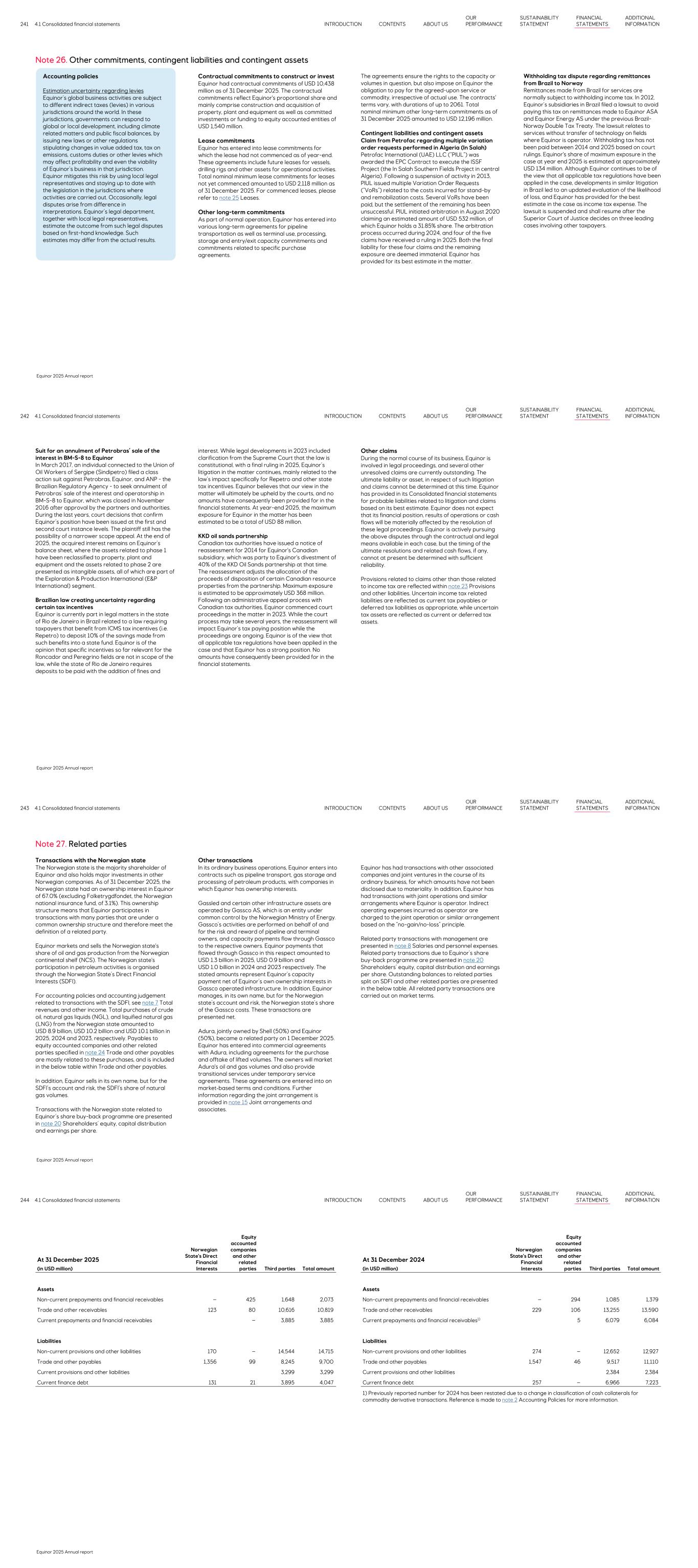
Note 26. Other commitments, contingent liabilities and contingent assets Accounting policies Estimation uncertainty regarding levies Equinor’s global business activities are subject to different indirect taxes (levies) in various jurisdictions around the world. In these jurisdictions, governments can respond to global or local development, including climate related matters and public fiscal balances, by issuing new laws or other regulations stipulating changes in value added tax, tax on emissions, customs duties or other levies which may affect profitability and even the viability of Equinor’s business in that jurisdiction. Equinor mitigates this risk by using local legal representatives and staying up to date with the legislation in the jurisdictions where activities are carried out. Occasionally, legal disputes arise from difference in interpretations. Equinor’s legal department, together with local legal representatives, estimate the outcome from such legal disputes based on first-hand knowledge. Such estimates may differ from the actual results. Contractual commitments to construct or invest Equinor had contractual commitments of USD 10,438 million as of 31 December 2025. The contractual commitments reflect Equinor's proportional share and mainly comprise construction and acquisition of property, plant and equipment as well as committed investments or funding to equity accounted entities of USD 1,540 million. Lease commitments Equinor has entered into lease commitments for which the lease had not commenced as of year-end. These agreements include future leases for vessels, drilling rigs and other assets for operational activities. Total nominal minimum lease commitments for leases not yet commenced amounted to USD 2,118 million as of 31 December 2025. For commenced leases, please refer to note 25 Leases. Other long-term commitments As part of normal operation, Equinor has entered into various long-term agreements for pipeline transportation as well as terminal use, processing, storage and entry/exit capacity commitments and commitments related to specific purchase agreements. The agreements ensure the rights to the capacity or volumes in question, but also impose on Equinor the obligation to pay for the agreed-upon service or commodity, irrespective of actual use. The contracts' terms vary, with durations of up to 2061. Total nominal minimum other long-term commitments as of 31 December 2025 amounted to USD 12,196 million. Contingent liabilities and contingent assets Claim from Petrofac regarding multiple variation order requests performed in Algeria (In Salah) Petrofac International (UAE) LLC (“PIUL”) was awarded the EPC Contract to execute the ISSF Project (the In Salah Southern Fields Project in central Algeria). Following a suspension of activity in 2013, PIUL issued multiple Variation Order Requests (“VoRs”) related to the costs incurred for stand-by and remobilization costs. Several VoRs have been paid, but the settlement of the remaining has been unsuccessful. PIUL initiated arbitration in August 2020 claiming an estimated amount of USD 532 million, of which Equinor holds a 31.85% share. The arbitration process occurred during 2024, and four of the five claims have received a ruling in 2025. Both the final liability for these four claims and the remaining exposure are deemed immaterial. Equinor has provided for its best estimate in the matter. Withholding tax dispute regarding remittances from Brazil to Norway Remittances made from Brazil for services are normally subject to withholding income tax. In 2012, Equinor’s subsidiaries in Brazil filed a lawsuit to avoid paying this tax on remittances made to Equinor ASA and Equinor Energy AS under the previous Brazil- Norway Double Tax Treaty. The lawsuit relates to services without transfer of technology on fields where Equinor is operator. Withholding tax has not been paid between 2014 and 2025 based on court rulings. Equinor's share of maximum exposure in the case at year end 2025 is estimated at approximately USD 134 million. Although Equinor continues to be of the view that all applicable tax regulations have been applied in the case, developments in similar litigation in Brazil led to an updated evaluation of the likelihood of loss, and Equinor has provided for the best estimate in the case as income tax expense. The lawsuit is suspended and shall resume after the Superior Court of Justice decides on three leading cases involving other taxpayers. 241 4.1 Consolidated financial statements INTRODUCTION CONTENTS ABOUT US OUR PERFORMANCE SUSTAINABILITY STATEMENT FINANCIAL STATEMENTS ADDITIONAL INFORMATION Equinor 2025 Annual report Suit for an annulment of Petrobras’ sale of the interest in BM-S-8 to Equinor In March 2017, an individual connected to the Union of Oil Workers of Sergipe (Sindipetro) filed a class action suit against Petrobras, Equinor, and ANP - the Brazilian Regulatory Agency - to seek annulment of Petrobras’ sale of the interest and operatorship in BM-S-8 to Equinor, which was closed in November 2016 after approval by the partners and authorities. During the last years, court decisions that confirm Equinor’s position have been issued at the first and second court instance levels. The plaintiff still has the possibility of a narrower scope appeal. At the end of 2025, the acquired interest remains on Equinor’s balance sheet, where the assets related to phase 1 have been reclassified to property, plant and equipment and the assets related to phase 2 are presented as intangible assets, all of which are part of the Exploration & Production International (E&P International) segment. Brazilian law creating uncertainty regarding certain tax incentives Equinor is currently part in legal matters in the state of Rio de Janeiro in Brazil related to a law requiring taxpayers that benefit from ICMS tax incentives (i.e. Repetro) to deposit 10% of the savings made from such benefits into a state fund. Equinor is of the opinion that specific incentives so far relevant for the Roncador and Peregrino fields are not in scope of the law, while the state of Rio de Janeiro requires deposits to be paid with the addition of fines and interest. While legal developments in 2023 included clarification from the Supreme Court that the law is constitutional, with a final ruling in 2025, Equinor’s litigation in the matter continues, mainly related to the law’s impact specifically for Repetro and other state tax incentives. Equinor believes that our view in the matter will ultimately be upheld by the courts, and no amounts have consequently been provided for in the financial statements. At year-end 2025, the maximum exposure for Equinor in the matter has been estimated to be a total of USD 88 million. KKD oil sands partnership Canadian tax authorities have issued a notice of reassessment for 2014 for Equinor's Canadian subsidiary, which was party to Equinor's divestment of 40% of the KKD Oil Sands partnership at that time. The reassessment adjusts the allocation of the proceeds of disposition of certain Canadian resource properties from the partnership. Maximum exposure is estimated to be approximately USD 368 million. Following an administrative appeal process with Canadian tax authorities, Equinor commenced court proceedings in the matter in 2023. While the court process may take several years, the reassessment will impact Equinor’s tax paying position while the proceedings are ongoing. Equinor is of the view that all applicable tax regulations have been applied in the case and that Equinor has a strong position. No amounts have consequently been provided for in the financial statements. Other claims During the normal course of its business, Equinor is involved in legal proceedings, and several other unresolved claims are currently outstanding. The ultimate liability or asset, in respect of such litigation and claims cannot be determined at this time. Equinor has provided in its Consolidated financial statements for probable liabilities related to litigation and claims based on its best estimate. Equinor does not expect that its financial position, results of operations or cash flows will be materially affected by the resolution of these legal proceedings. Equinor is actively pursuing the above disputes through the contractual and legal means available in each case, but the timing of the ultimate resolutions and related cash flows, if any, cannot at present be determined with sufficient reliability. Provisions related to claims other than those related to income tax are reflected within note 23 Provisions and other liabilities. Uncertain income tax related liabilities are reflected as current tax payables or deferred tax liabilities as appropriate, while uncertain tax assets are reflected as current or deferred tax assets. 242 4.1 Consolidated financial statements INTRODUCTION CONTENTS ABOUT US OUR PERFORMANCE SUSTAINABILITY STATEMENT FINANCIAL STATEMENTS ADDITIONAL INFORMATION Equinor 2025 Annual report Note 27. Related parties Transactions with the Norwegian state The Norwegian state is the majority shareholder of Equinor and also holds major investments in other Norwegian companies. As of 31 December 2025, the Norwegian state had an ownership interest in Equinor of 67.0% (excluding Folketrygdfondet, the Norwegian national insurance fund, of 3.1%). This ownership structure means that Equinor participates in transactions with many parties that are under a common ownership structure and therefore meet the definition of a related party. Equinor markets and sells the Norwegian state's share of oil and gas production from the Norwegian continental shelf (NCS). The Norwegian state's participation in petroleum activities is organised through the Norwegian State’s Direct Financial Interests (SDFI). For accounting policies and accounting judgement related to transactions with the SDFI, see note 7 Total revenues and other income. Total purchases of crude oil, natural gas liquids (NGL), and liquified natural gas (LNG) from the Norwegian state amounted to USD 8.9 billion, USD 10.2 billion and USD 10.1 billion in 2025, 2024 and 2023, respectively. Payables to equity accounted companies and other related parties specified in note 24 Trade and other payables are mostly related to these purchases, and is included in the below table within Trade and other payables. In addition, Equinor sells in its own name, but for the SDFI’s account and risk, the SDFI’s share of natural gas volumes. Transactions with the Norwegian state related to Equinor’s share buy-back programme are presented in note 20 Shareholders’ equity, capital distribution and earnings per share. Other transactions In its ordinary business operations, Equinor enters into contracts such as pipeline transport, gas storage and processing of petroleum products, with companies in which Equinor has ownership interests. Gassled and certain other infrastructure assets are operated by Gassco AS, which is an entity under common control by the Norwegian Ministry of Energy. Gassco’s activities are performed on behalf of and for the risk and reward of pipeline and terminal owners, and capacity payments flow through Gassco to the respective owners. Equinor payments that flowed through Gassco in this respect amounted to USD 1.3 billion in 2025, USD 0.9 billion and USD 1.0 billion in 2024 and 2023 respectively. The stated amounts represent Equinor’s capacity payment net of Equinor’s own ownership interests in Gassco operated infrastructure. In addition, Equinor manages, in its own name, but for the Norwegian state’s account and risk, the Norwegian state’s share of the Gassco costs. These transactions are presented net. Adura, jointly owned by Shell (50%) and Equinor (50%), became a related party on 1 December 2025. Equinor has entered into commercial agreements with Adura, including agreements for the purchase and offtake of lifted volumes. The owners will market Adura's oil and gas volumes and also provide transitional services under temporary service agreements. These agreements are entered into on market-based terms and conditions. Further information regarding the joint arrangement is provided in note 15 Joint arrangements and associates. Equinor has had transactions with other associated companies and joint ventures in the course of its ordinary business, for which amounts have not been disclosed due to materiality. In addition, Equinor has had transactions with joint operations and similar arrangements where Equinor is operator. Indirect operating expenses incurred as operator are charged to the joint operation or similar arrangement based on the “no-gain/no-loss” principle. Related party transactions with management are presented in note 8 Salaries and personnel expenses. Related party transactions due to Equinor’s share buy-back programme are presented in note 20 Shareholders’ equity, capital distribution and earnings per share. Outstanding balances to related parties split on SDFI and other related parties are presented in the below table. All related party transactions are carried out on market terms. 243 4.1 Consolidated financial statements INTRODUCTION CONTENTS ABOUT US OUR PERFORMANCE SUSTAINABILITY STATEMENT FINANCIAL STATEMENTS ADDITIONAL INFORMATION Equinor 2025 Annual report (in USD million) Assets Non-current prepayments and financial receivables — 425 1,648 2,073 Trade and other receivables 123 80 10,616 10,819 Current prepayments and financial receivables — 3,885 3,885 Liabilities Non-current provisions and other liabilities 170 — 14,544 14,715 Trade and other payables 1,356 99 8,245 9,700 Current provisions and other liabilities 3,299 3,299 Current finance debt 131 21 3,895 4,047 At 31 December 2025 Norwegian State's Direct Financial Interests Equity accounted companies and other related parties Third parties Total amount (in USD million) Assets Non-current prepayments and financial receivables — 294 1,085 1,379 Trade and other receivables 229 106 13,255 13,590 Current prepayments and financial receivables1) 5 6,079 6,084 Liabilities Non-current provisions and other liabilities 274 — 12,652 12,927 Trade and other payables 1,547 46 9,517 11,110 Current provisions and other liabilities 2,384 2,384 Current finance debt 257 — 6,966 7,223 1) Previously reported number for 2024 has been restated due to a change in classification of cash collaterals for commodity derivative transactions. Reference is made to note 2 Accounting Policies for more information. At 31 December 2024 Norwegian State's Direct Financial Interests Equity accounted companies and other related parties Third parties Total amount 244 4.1 Consolidated financial statements INTRODUCTION CONTENTS ABOUT US OUR PERFORMANCE SUSTAINABILITY STATEMENT FINANCIAL STATEMENTS ADDITIONAL INFORMATION Equinor 2025 Annual report
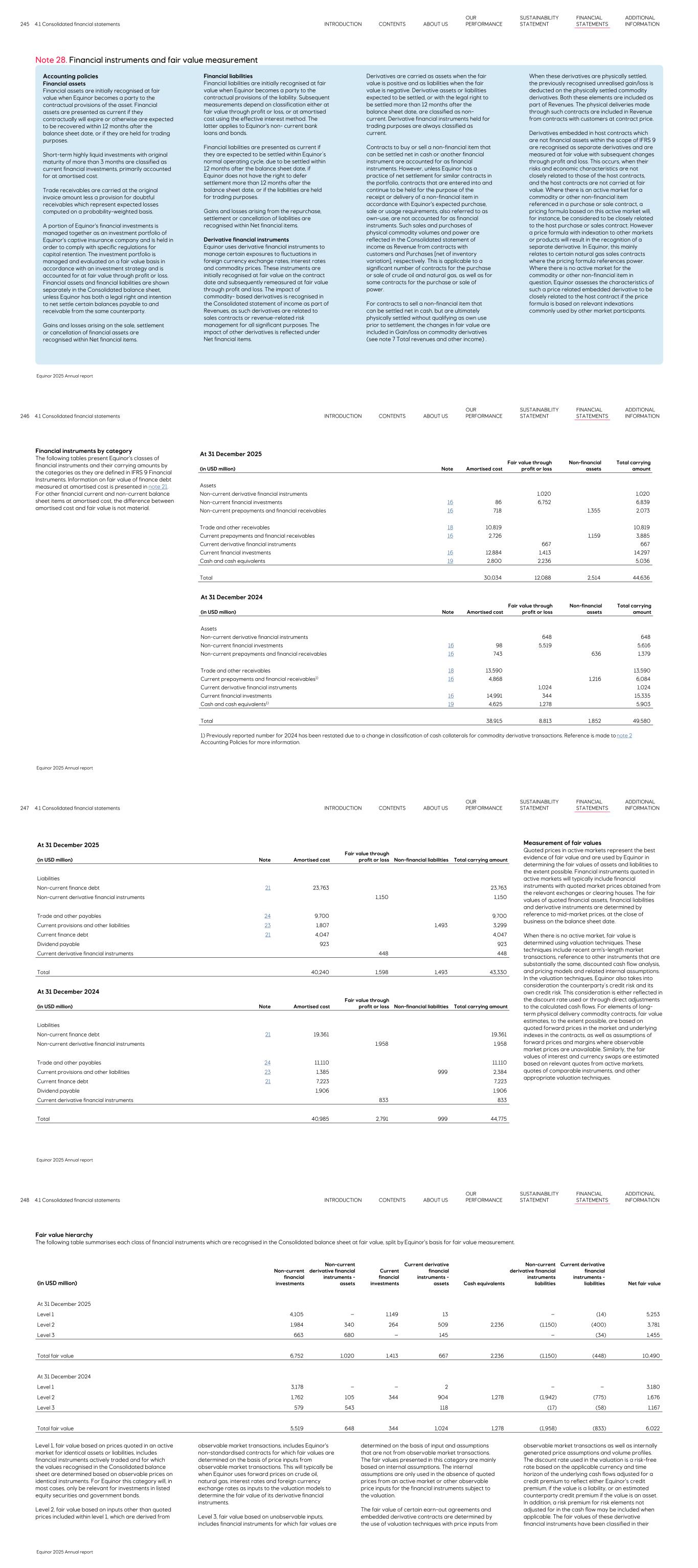
Note 28. Financial instruments and fair value measurement Accounting policies Financial assets Financial assets are initially recognised at fair value when Equinor becomes a party to the contractual provisions of the asset. Financial assets are presented as current if they contractually will expire or otherwise are expected to be recovered within 12 months after the balance sheet date, or if they are held for trading purposes. Short-term highly liquid investments with original maturity of more than 3 months are classified as current financial investments, primarily accounted for at amortised cost. Trade receivables are carried at the original invoice amount less a provision for doubtful receivables which represent expected losses computed on a probability-weighted basis. A portion of Equinor's financial investments is managed together as an investment portfolio of Equinor's captive insurance company and is held in order to comply with specific regulations for capital retention. The investment portfolio is managed and evaluated on a fair value basis in accordance with an investment strategy and is accounted for at fair value through profit or loss. Financial assets and financial liabilities are shown separately in the Consolidated balance sheet, unless Equinor has both a legal right and intention to net settle certain balances payable to and receivable from the same counterparty. Gains and losses arising on the sale, settlement or cancellation of financial assets are recognised within Net financial items. Financial liabilities Financial liabilities are initially recognised at fair value when Equinor becomes a party to the contractual provisions of the liability. Subsequent measurements depend on classification either at fair value through profit or loss, or at amortised cost using the effective interest method. The latter applies to Equinor's non- current bank loans and bonds. Financial liabilities are presented as current if they are expected to be settled within Equinor’s normal operating cycle, due to be settled within 12 months after the balance sheet date, if Equinor does not have the right to defer settlement more than 12 months after the balance sheet date, or if the liabilities are held for trading purposes. Gains and losses arising from the repurchase, settlement or cancellation of liabilities are recognised within Net financial items. Derivative financial instruments Equinor uses derivative financial instruments to manage certain exposures to fluctuations in foreign currency exchange rates, interest rates and commodity prices. These instruments are initially recognised at fair value on the contract date and subsequently remeasured at fair value through profit and loss. The impact of commodity- based derivatives is recognised in the Consolidated statement of income as part of Revenues, as such derivatives are related to sales contracts or revenue-related risk management for all significant purposes. The impact of other derivatives is reflected under Net financial items. Derivatives are carried as assets when the fair value is positive and as liabilities when the fair value is negative. Derivative assets or liabilities expected to be settled, or with the legal right to be settled more than 12 months after the balance sheet date, are classified as non- current. Derivative financial instruments held for trading purposes are always classified as current. Contracts to buy or sell a non-financial item that can be settled net in cash or another financial instrument are accounted for as financial instruments. However, unless Equinor has a practice of net settlement for similar contracts in the portfolio, contracts that are entered into and continue to be held for the purpose of the receipt or delivery of a non-financial item in accordance with Equinor's expected purchase, sale or usage requirements, also referred to as own-use, are not accounted for as financial instruments. Such sales and purchases of physical commodity volumes and power are reflected in the Consolidated statement of income as Revenue from contracts with customers and Purchases [net of inventory variation], respectively. This is applicable to a significant number of contracts for the purchase or sale of crude oil and natural gas, as well as for some contracts for the purchase or sale of power. For contracts to sell a non-financial item that can be settled net in cash, but are ultimately physically settled without qualifying as own use prior to settlement, the changes in fair value are included in Gain/loss on commodity derivatives (see note 7 Total revenues and other income) . When these derivatives are physically settled, the previously recognised unrealised gain/loss is deducted on the physically settled commodity derivatives. Both these elements are included as part of Revenues. The physical deliveries made through such contracts are included in Revenue from contracts with customers at contract price. Derivatives embedded in host contracts which are not financial assets within the scope of IFRS 9 are recognised as separate derivatives and are measured at fair value with subsequent changes through profit and loss. This occurs, when their risks and economic characteristics are not closely related to those of the host contracts, and the host contracts are not carried at fair value. Where there is an active market for a commodity or other non-financial item referenced in a purchase or sale contract, a pricing formula based on this active market will, for instance, be considered to be closely related to the host purchase or sales contract. However a price formula with indexation to other markets or products will result in the recognition of a separate derivative. In Equinor, this mainly relates to certain natural gas sales contracts where the pricing formula references power. Where there is no active market for the commodity or other non-financial item in question, Equinor assesses the characteristics of such a price related embedded derivative to be closely related to the host contract if the price formula is based on relevant indexations commonly used by other market participants. 245 4.1 Consolidated financial statements INTRODUCTION CONTENTS ABOUT US OUR PERFORMANCE SUSTAINABILITY STATEMENT FINANCIAL STATEMENTS ADDITIONAL INFORMATION Equinor 2025 Annual report 4.1 Consolidated financial statements Financial instruments by category The following tables present Equinor's classes of financial instruments and their carrying amounts by the categories as they are defined in IFRS 9 Financial Instruments. Information on fair value of finance debt measured at amortised cost is presented in note 21. For other financial current and non-current balance sheet items at amortised cost, the difference between amortised cost and fair value is not material. Assets Non-current derivative financial instruments 1,020 1,020 Non-current financial investments 16 86 6,752 6,839 Non-current prepayments and financial receivables 16 718 1,355 2,073 Trade and other receivables 18 10,819 10,819 Current prepayments and financial receivables 16 2,726 1,159 3,885 Current derivative financial instruments 667 667 Current financial investments 16 12,884 1,413 14,297 Cash and cash equivalents 19 2,800 2,236 5,036 Total 30,034 12,088 2,514 44,636 At 31 December 2025 (in USD million) Note Amortised cost Fair value through profit or loss Non-financial assets Total carrying amount Assets Non-current derivative financial instruments 648 648 Non-current financial investments 16 98 5,519 5,616 Non-current prepayments and financial receivables 16 743 636 1,379 Trade and other receivables 18 13,590 13,590 Current prepayments and financial receivables1) 16 4,868 1,216 6,084 Current derivative financial instruments 1,024 1,024 Current financial investments 16 14,991 344 15,335 Cash and cash equivalents1) 19 4,625 1,278 5,903 Total 38,915 8,813 1,852 49,580 1) Previously reported number for 2024 has been restated due to a change in classification of cash collaterals for commodity derivative transactions. Reference is made to note 2 Accounting Policies for more information. At 31 December 2024 (in USD million) Note Amortised cost Fair value through profit or loss Non-financial assets Total carrying amount 246 4.1 Consolidated financial statements INTRODUCTION CONTENTS ABOUT US OUR PERFORMANCE SUSTAINABILITY STATEMENT FINANCIAL STATEMENTS ADDITIONAL INFORMATION Equinor 2025 Annual report Liabilities Non-current finance debt 21 23,763 23,763 Non-current derivative financial instruments 1,150 1,150 Trade and other payables 24 9,700 9,700 Current provisions and other liabilities 23 1,807 1,493 3,299 Current finance debt 21 4,047 4,047 Dividend payable 923 923 Current derivative financial instruments 448 448 Total 40,240 1,598 1,493 43,330 At 31 December 2025 (in USD million) Note Amortised cost Fair value through profit or loss Non-financial liabilities Total carrying amount Liabilities Non-current finance debt 21 19,361 19,361 Non-current derivative financial instruments 1,958 1,958 Trade and other payables 24 11,110 11,110 Current provisions and other liabilities 23 1,385 999 2,384 Current finance debt 21 7,223 7,223 Dividend payable 1,906 1,906 Current derivative financial instruments 833 833 Total 40,985 2,791 999 44,775 At 31 December 2024 (in USD million) Note Amortised cost Fair value through profit or loss Non-financial liabilities Total carrying amount Measurement of fair values Quoted prices in active markets represent the best evidence of fair value and are used by Equinor in determining the fair values of assets and liabilities to the extent possible. Financial instruments quoted in active markets will typically include financial instruments with quoted market prices obtained from the relevant exchanges or clearing houses. The fair values of quoted financial assets, financial liabilities and derivative instruments are determined by reference to mid-market prices, at the close of business on the balance sheet date. When there is no active market, fair value is determined using valuation techniques. These techniques include recent arm's-length market transactions, reference to other instruments that are substantially the same, discounted cash flow analysis, and pricing models and related internal assumptions. In the valuation techniques, Equinor also takes into consideration the counterparty’s credit risk and its own credit risk. This consideration is either reflected in the discount rate used or through direct adjustments to the calculated cash flows. For elements of long- term physical delivery commodity contracts, fair value estimates, to the extent possible, are based on quoted forward prices in the market and underlying indexes in the contracts, as well as assumptions of forward prices and margins where observable market prices are unavailable. Similarly, the fair values of interest and currency swaps are estimated based on relevant quotes from active markets, quotes of comparable instruments, and other appropriate valuation techniques. 247 4.1 Consolidated financial statements INTRODUCTION CONTENTS ABOUT US OUR PERFORMANCE SUSTAINABILITY STATEMENT FINANCIAL STATEMENTS ADDITIONAL INFORMATION Equinor 2025 Annual report Fair value hierarchy The following table summarises each class of financial instruments which are recognised in the Consolidated balance sheet at fair value, split by Equinor's basis for fair value measurement. At 31 December 2025 Level 1 4,105 — 1,149 13 — (14) 5,253 Level 2 1,984 340 264 509 2,236 (1,150) (400) 3,781 Level 3 663 680 — 145 — (34) 1,455 Total fair value 6,752 1,020 1,413 667 2,236 (1,150) (448) 10,490 At 31 December 2024 Level 1 3,178 — — 2 — — 3,180 Level 2 1,762 105 344 904 1,278 (1,942) (775) 1,676 Level 3 579 543 118 (17) (58) 1,167 Total fair value 5,519 648 344 1,024 1,278 (1,958) (833) 6,022 (in USD million) Non-current financial investments Non-current derivative financial instruments - assets Current financial investments Current derivative financial instruments - assets Cash equivalents Non-current derivative financial instruments liabilities Current derivative financial instruments - liabilities Net fair value Level 1, fair value based on prices quoted in an active market for identical assets or liabilities, includes financial instruments actively traded and for which the values recognised in the Consolidated balance sheet are determined based on observable prices on identical instruments. For Equinor this category will, in most cases, only be relevant for investments in listed equity securities and government bonds. Level 2, fair value based on inputs other than quoted prices included within level 1, which are derived from observable market transactions, includes Equinor's non-standardised contracts for which fair values are determined on the basis of price inputs from observable market transactions. This will typically be when Equinor uses forward prices on crude oil, natural gas, interest rates and foreign currency exchange rates as inputs to the valuation models to determine the fair value of its derivative financial instruments. Level 3, fair value based on unobservable inputs, includes financial instruments for which fair values are determined on the basis of input and assumptions that are not from observable market transactions. The fair values presented in this category are mainly based on internal assumptions. The internal assumptions are only used in the absence of quoted prices from an active market or other observable price inputs for the financial instruments subject to the valuation. The fair value of certain earn-out agreements and embedded derivative contracts are determined by the use of valuation techniques with price inputs from observable market transactions as well as internally generated price assumptions and volume profiles. The discount rate used in the valuation is a risk-free rate based on the applicable currency and time horizon of the underlying cash flows adjusted for a credit premium to reflect either Equinor's credit premium, if the value is a liability, or an estimated counterparty credit premium if the value is an asset. In addition, a risk premium for risk elements not adjusted for in the cash flow may be included when applicable. The fair values of these derivative financial instruments have been classified in their 248 4.1 Consolidated financial statements INTRODUCTION CONTENTS ABOUT US OUR PERFORMANCE SUSTAINABILITY STATEMENT FINANCIAL STATEMENTS ADDITIONAL INFORMATION Equinor 2025 Annual report
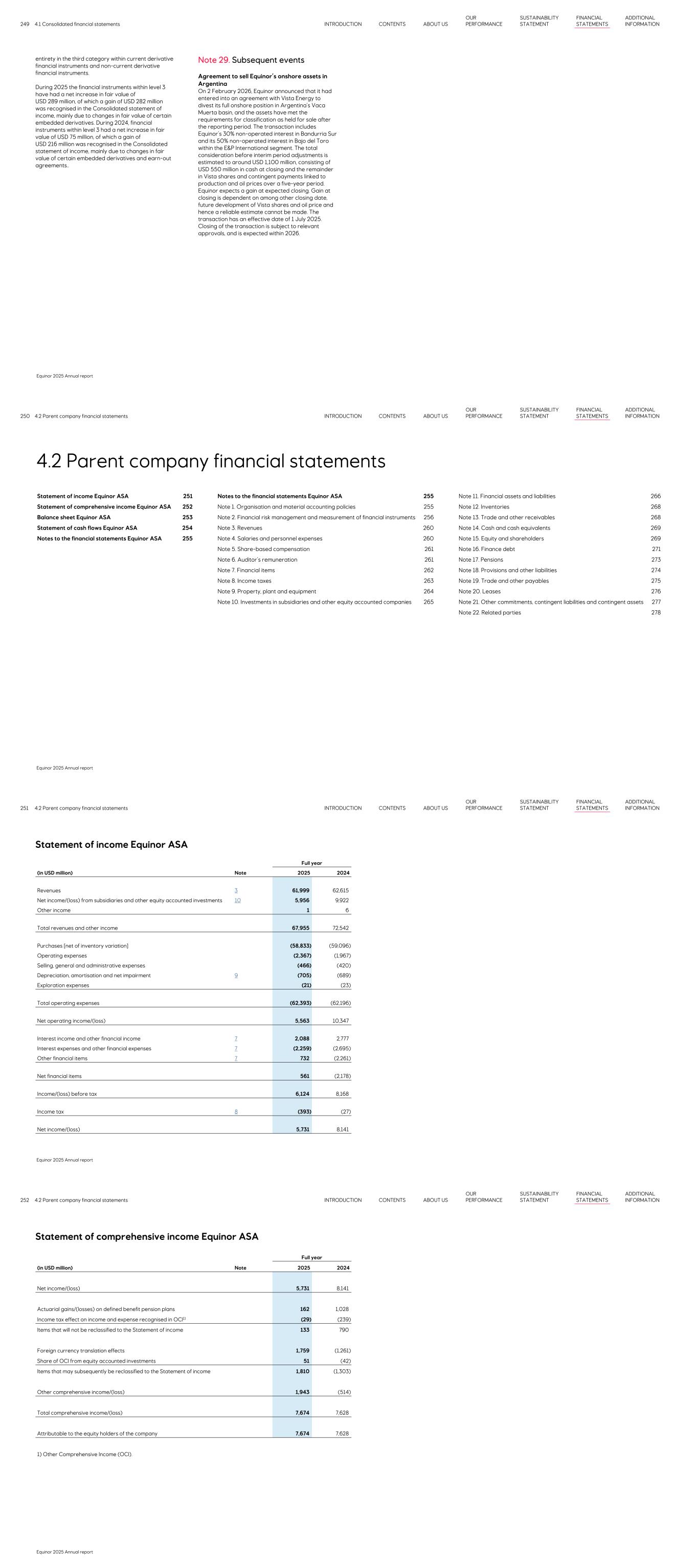
entirety in the third category within current derivative financial instruments and non-current derivative financial instruments. During 2025 the financial instruments within level 3 have had a net increase in fair value of USD 289 million, of which a gain of USD 282 million was recognised in the Consolidated statement of income, mainly due to changes in fair value of certain embedded derivatives. During 2024, financial instruments within level 3 had a net increase in fair value of USD 75 million, of which a gain of USD 216 million was recognised in the Consolidated statement of income, mainly due to changes in fair value of certain embedded derivatives and earn-out agreements.. Note 29. Subsequent events Agreement to sell Equinor’s onshore assets in Argentina On 2 February 2026, Equinor announced that it had entered into an agreement with Vista Energy to divest its full onshore position in Argentina’s Vaca Muerta basin, and the assets have met the requirements for classification as held for sale after the reporting period. The transaction includes Equinor’s 30% non-operated interest in Bandurria Sur and its 50% non-operated interest in Bajo del Toro within the E&P International segment. The total consideration before interim period adjustments is estimated to around USD 1,100 million, consisting of USD 550 million in cash at closing and the remainder in Vista shares and contingent payments linked to production and oil prices over a five-year period. Equinor expects a gain at expected closing. Gain at closing is dependent on among other closing date, future development of Vista shares and oil price and hence a reliable estimate cannot be made. The transaction has an effective date of 1 July 2025. Closing of the transaction is subject to relevant approvals, and is expected within 2026. 249 4.1 Consolidated financial statements INTRODUCTION CONTENTS ABOUT US OUR PERFORMANCE SUSTAINABILITY STATEMENT FINANCIAL STATEMENTS ADDITIONAL INFORMATION Equinor 2025 Annual report Statement of income Equinor ASA 251 Statement of comprehensive income Equinor ASA 252 Balance sheet Equinor ASA 253 Statement of cash flows Equinor ASA 254 Notes to the financial statements Equinor ASA 255 Notes to the financial statements Equinor ASA 255 Note 1. Organisation and material accounting policies 255 Note 2. Financial risk management and measurement of financial instruments 256 Note 3. Revenues 260 Note 4. Salaries and personnel expenses 260 Note 5. Share-based compensation 261 Note 6. Auditor’s remuneration 261 Note 7. Financial items 262 Note 8. Income taxes 263 Note 9. Property, plant and equipment 264 Note 10. Investments in subsidiaries and other equity accounted companies 265 Note 11. Financial assets and liabilities 266 Note 12. Inventories 268 Note 13. Trade and other receivables 268 Note 14. Cash and cash equivalents 269 Note 15. Equity and shareholders 269 Note 16. Finance debt 271 Note 17. Pensions 273 Note 18. Provisions and other liabilities 274 Note 19. Trade and other payables 275 Note 20. Leases 276 Note 21. Other commitments, contingent liabilities and contingent assets 277 Note 22. Related parties 278 250 4.2 Parent company financial statements INTRODUCTION CONTENTS ABOUT US OUR PERFORMANCE SUSTAINABILITY STATEMENT FINANCIAL STATEMENTS ADDITIONAL INFORMATION Equinor 2025 Annual report 4.2 Parent company financial statements Statement of income Equinor ASA Revenues 3 61,999 62,615 Net income/(loss) from subsidiaries and other equity accounted investments 10 5,956 9,922 Other income 1 6 Total revenues and other income 67,955 72,542 Purchases [net of inventory variation] (58,833) (59,096) Operating expenses (2,367) (1,967) Selling, general and administrative expenses (466) (420) Depreciation, amortisation and net impairment 9 (705) (689) Exploration expenses (21) (23) Total operating expenses (62,393) (62,196) Net operating income/(loss) 5,563 10,347 Interest income and other financial income 7 2,088 2,777 Interest expenses and other financial expenses 7 (2,259) (2,695) Other financial items 7 732 (2,261) Net financial items 561 (2,178) Income/(loss) before tax 6,124 8,168 Income tax 8 (393) (27) Net income/(loss) 5,731 8,141 Full year (in USD million) Note 2025 2024 251 4.2 Parent company financial statements INTRODUCTION CONTENTS ABOUT US OUR PERFORMANCE SUSTAINABILITY STATEMENT FINANCIAL STATEMENTS ADDITIONAL INFORMATION Equinor 2025 Annual report Statement of comprehensive income Equinor ASA Net income/(loss) 5,731 8,141 Actuarial gains/(losses) on defined benefit pension plans 162 1,028 Income tax effect on income and expense recognised in OCI1) (29) (239) Items that will not be reclassified to the Statement of income 133 790 Foreign currency translation effects 1,759 (1,261) Share of OCI from equity accounted investments 51 (42) Items that may subsequently be reclassified to the Statement of income 1,810 (1,303) Other comprehensive income/(loss) 1,943 (514) Total comprehensive income/(loss) 7,674 7,628 Attributable to the equity holders of the company 7,674 7,628 1) Other Comprehensive Income (OCI). Full year (in USD million) Note 2025 2024 252 4.2 Parent company financial statements INTRODUCTION CONTENTS ABOUT US OUR PERFORMANCE SUSTAINABILITY STATEMENT FINANCIAL STATEMENTS ADDITIONAL INFORMATION Equinor 2025 Annual report
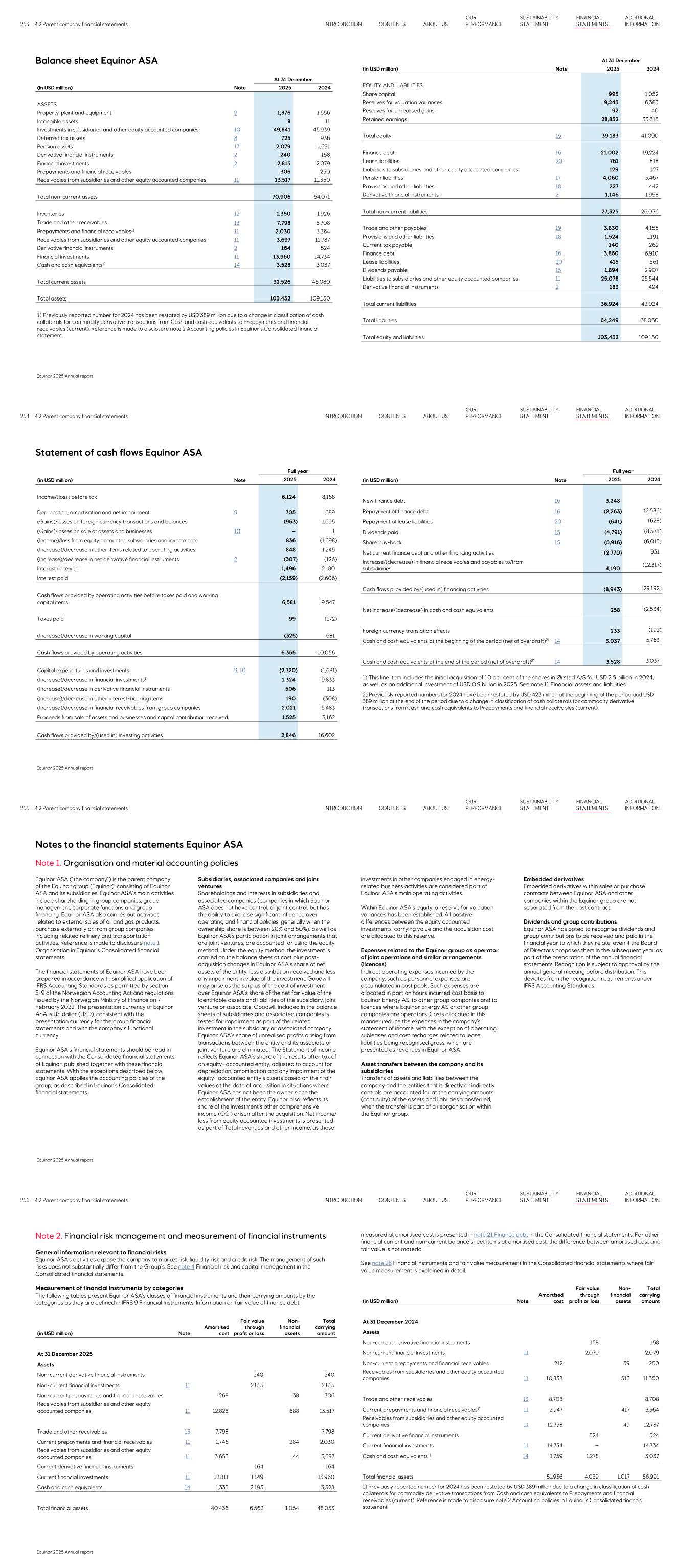
Balance sheet Equinor ASA ASSETS Property, plant and equipment 9 1,376 1,656 Intangible assets 8 11 Investments in subsidiaries and other equity accounted companies 10 49,841 45,939 Deferred tax assets 8 725 936 Pension assets 17 2,079 1,691 Derivative financial instruments 2 240 158 Financial investments 2 2,815 2,079 Prepayments and financial receivables 306 250 Receivables from subsidiaries and other equity accounted companies 11 13,517 11,350 Total non-current assets 70,906 64,071 Inventories 12 1,350 1,926 Trade and other receivables 13 7,798 8,708 Prepayments and financial receivables1) 11 2,030 3,364 Receivables from subsidiaries and other equity accounted companies 11 3,697 12,787 Derivative financial instruments 2 164 524 Financial investments 11 13,960 14,734 Cash and cash equivalents1) 14 3,528 3,037 Total current assets 32,526 45,080 Total assets 103,432 109,150 1) Previously reported number for 2024 has been restated by USD 389 million due to a change in classification of cash collaterals for commodity derivative transactions from Cash and cash equivalents to Prepayments and financial receivables (current). Reference is made to disclosure note 2 Accounting policies in Equinor’s Consolidated financial statement. At 31 December (in USD million) Note 2025 2024 EQUITY AND LIABILITIES Share capital 995 1,052 Reserves for valuation variances 9,243 6,383 Reserves for unrealised gains 92 40 Retained earnings 28,852 33,615 Total equity 15 39,183 41,090 Finance debt 16 21,002 19,224 Lease liabilities 20 761 818 Liabilities to subsidiaries and other equity accounted companies 129 127 Pension liabilities 17 4,060 3,467 Provisions and other liabilities 18 227 442 Derivative financial instruments 2 1,146 1,958 Total non-current liabilities 27,325 26,036 Trade and other payables 19 3,830 4,155 Provisions and other liabilities 18 1,524 1,191 Current tax payable 140 262 Finance debt 16 3,860 6,910 Lease liabilities 20 415 561 Dividends payable 15 1,894 2,907 Liabilities to subsidiaries and other equity accounted companies 11 25,078 25,544 Derivative financial instruments 2 183 494 Total current liabilities 36,924 42,024 Total liabilities 64,249 68,060 Total equity and liabilities 103,432 109,150 At 31 December (in USD million) Note 2025 2024 253 4.2 Parent company financial statements INTRODUCTION CONTENTS ABOUT US OUR PERFORMANCE SUSTAINABILITY STATEMENT FINANCIAL STATEMENTS ADDITIONAL INFORMATION Equinor 2025 Annual report Statement of cash flows Equinor ASA Income/(loss) before tax 6,124 8,168 Deprecation, amortisation and net impairment 9 705 689 (Gains)/losses on foreign currency transactions and balances (963) 1,695 (Gains)/losses on sale of assets and businesses 10 — 1 (Income)/loss from equity accounted subsidiaries and investments 836 (1,698) (Increase)/decrease in other items related to operating activities 848 1,245 (Increase)/decrease in net derivative financial instruments 2 (307) (126) Interest received 1,496 2,180 Interest paid (2,159) (2,606) Cash flows provided by operating activities before taxes paid and working capital items 6,581 9,547 Taxes paid 99 (172) (Increase)/decrease in working capital (325) 681 Cash flows provided by operating activities 6,355 10,056 Capital expenditures and investments 9, 10 (2,720) (1,681) (Increase)/decrease in financial investments1) 1,324 9,833 (Increase)/decrease in derivative financial instruments 506 113 (Increase)/decrease in other interest-bearing items 190 (308) (Increase)/decrease in financial receivables from group companies 2,021 5,483 Proceeds from sale of assets and businesses and capital contribution received 1,525 3,162 Cash flows provided by/(used in) investing activities 2,846 16,602 Full year (in USD million) Note 2025 2024 New finance debt 16 3,248 — Repayment of finance debt 16 (2,263) (2,586) Repayment of lease liabilities 20 (641) (628) Dividends paid 15 (4,791) (8,578) Share buy-back 15 (5,916) (6,013) Net current finance debt and other financing activities (2,770) 931 Increase/(decrease) in financial receivables and payables to/from subsidiaries 4,190 (12,317) Cash flows provided by/(used in) financing activities (8,943) (29,192) Net increase/(decrease) in cash and cash equivalents 258 (2,534) Foreign currency translation effects 233 (192) Cash and cash equivalents at the beginning of the period (net of overdraft)2) 14 3,037 5,763 Cash and cash equivalents at the end of the period (net of overdraft)2) 14 3,528 3,037 Full year (in USD million) Note 2025 2024 254 4.2 Parent company financial statements INTRODUCTION CONTENTS ABOUT US OUR PERFORMANCE SUSTAINABILITY STATEMENT FINANCIAL STATEMENTS ADDITIONAL INFORMATION Equinor 2025 Annual report 1) This line item includes the initial acquisition of 10 per cent of the shares in Ørsted A/S for USD 2.5 billion in 2024, as well as an additional investment of USD 0.9 billion in 2025. See note 11 Financial assets and liabilities. 2) Previously reported numbers for 2024 have been restated by USD 423 million at the beginning of the period and USD 389 million at the end of the period due to a change in classification of cash collaterals for commodity derivative transactions from Cash and cash equivalents to Prepayments and financial receivables (current). Notes to the financial statements Equinor ASA Note 1. Organisation and material accounting policies Equinor ASA (“the company”) is the parent company of the Equinor group (Equinor), consisting of Equinor ASA and its subsidiaries. Equinor ASA’s main activities include shareholding in group companies, group management, corporate functions and group financing. Equinor ASA also carries out activities related to external sales of oil and gas products, purchase externally or from group companies, including related refinery and transportation activities. Reference is made to disclosure note 1 Organisation in Equinor’s Consolidated financial statements. The financial statements of Equinor ASA have been prepared in accordance with simplified application of IFRS Accounting Standards as permitted by section 3-9 of the Norwegian Accounting Act and regulations issued by the Norwegian Ministry of Finance on 7 February 2022. The presentation currency of Equinor ASA is US dollar (USD), consistent with the presentation currency for the group financial statements and with the company’s functional currency. Equinor ASA’s financial statements should be read in connection with the Consolidated financial statements of Equinor, published together with these financial statements. With the exceptions described below, Equinor ASA applies the accounting policies of the group, as described in Equinor’s Consolidated financial statements. Subsidiaries, associated companies and joint ventures Shareholdings and interests in subsidiaries and associated companies (companies in which Equinor ASA does not have control, or joint control, but has the ability to exercise significant influence over operating and financial policies, generally when the ownership share is between 20% and 50%), as well as Equinor ASA’s participation in joint arrangements that are joint ventures, are accounted for using the equity method. Under the equity method, the investment is carried on the balance sheet at cost plus post- acquisition changes in Equinor ASA’s share of net assets of the entity, less distribution received and less any impairment in value of the investment. Goodwill may arise as the surplus of the cost of investment over Equinor ASA’s share of the net fair value of the identifiable assets and liabilities of the subsidiary, joint venture or associate. Goodwill included in the balance sheets of subsidiaries and associated companies is tested for impairment as part of the related investment in the subsidiary or associated company. Equinor ASA’s share of unrealised profits arising from transactions between the entity and its associate or joint venture are eliminated. The Statement of income reflects Equinor ASA’s share of the results after tax of an equity- accounted entity, adjusted to account for depreciation, amortisation and any impairment of the equity- accounted entity’s assets based on their fair values at the date of acquisition in situations where Equinor ASA has not been the owner since the establishment of the entity. Equinor also reflects its share of the investment’s other comprehensive income (OCI) arisen after the acquisition. Net income/ loss from equity accounted investments is presented as part of Total revenues and other income, as these investments in other companies engaged in energy- related business activities are considered part of Equinor ASA’s main operating activities. Within Equinor ASA’s equity, a reserve for valuation variances has been established. All positive differences between the equity accounted investments’ carrying value and the acquisition cost are allocated to this reserve. Expenses related to the Equinor group as operator of joint operations and similar arrangements (licences) Indirect operating expenses incurred by the company, such as personnel expenses, are accumulated in cost pools. Such expenses are allocated in part on hours incurred cost basis to Equinor Energy AS, to other group companies and to licences where Equinor Energy AS or other group companies are operators. Costs allocated in this manner reduce the expenses in the company's statement of income, with the exception of operating subleases and cost recharges related to lease liabilities being recognised gross, which are presented as revenues in Equinor ASA. Asset transfers between the company and its subsidiaries Transfers of assets and liabilities between the company and the entities that it directly or indirectly controls are accounted for at the carrying amounts (continuity) of the assets and liabilities transferred, when the transfer is part of a reorganisation within the Equinor group. Embedded derivatives Embedded derivatives within sales or purchase contracts between Equinor ASA and other companies within the Equinor group are not separated from the host contract. Dividends and group contributions Equinor ASA has opted to recognise dividends and group contributions to be received and paid in the financial year to which they relate, even if the Board of Directors proposes them in the subsequent year as part of the preparation of the annual financial statements. Recognition is subject to approval by the annual general meeting before distribution. This deviates from the recognition requirements under IFRS Accounting Standards. 255 4.2 Parent company financial statements INTRODUCTION CONTENTS ABOUT US OUR PERFORMANCE SUSTAINABILITY STATEMENT FINANCIAL STATEMENTS ADDITIONAL INFORMATION Equinor 2025 Annual report Note 2. Financial risk management and measurement of financial instruments General information relevant to financial risks Equinor ASA's activities expose the company to market risk, liquidity risk and credit risk. The management of such risks does not substantially differ from the Group’s. See note 4 Financial risk and capital management in the Consolidated financial statements. Measurement of financial instruments by categories The following tables present Equinor ASA's classes of financial instruments and their carrying amounts by the categories as they are defined in IFRS 9 Financial Instruments. Information on fair value of finance debt At 31 December 2025 Assets Non-current derivative financial instruments 240 240 Non-current financial investments 11 2,815 2,815 Non-current prepayments and financial receivables 268 38 306 Receivables from subsidiaries and other equity accounted companies 11 12,828 688 13,517 Trade and other receivables 13 7,798 7,798 Current prepayments and financial receivables 11 1,746 284 2,030 Receivables from subsidiaries and other equity accounted companies 11 3,653 44 3,697 Current derivative financial instruments 164 164 Current financial investments 11 12,811 1,149 13,960 Cash and cash equivalents 14 1,333 2,195 3,528 Total financial assets 40,436 6,562 1,054 48,053 (in USD million) Note Amortised cost Fair value through profit or loss Non- financial assets Total carrying amount measured at amortised cost is presented in note 21 Finance debt in the Consolidated financial statements. For other financial current and non-current balance sheet items at amortised cost, the difference between amortised cost and fair value is not material. See note 28 Financial instruments and fair value measurement in the Consolidated financial statements where fair value measurement is explained in detail. (in USD million) Note Amortised cost Fair value through profit or loss Non- financial assets Total carrying amount At 31 December 2024 Assets Non-current derivative financial instruments 158 158 Non-current financial investments 11 2,079 2,079 Non-current prepayments and financial receivables 212 39 250 Receivables from subsidiaries and other equity accounted companies 11 10,838 513 11,350 Trade and other receivables 13 8,708 8,708 Current prepayments and financial receivables1) 11 2,947 417 3,364 Receivables from subsidiaries and other equity accounted companies 11 12,738 49 12,787 Current derivative financial instruments 524 524 Current financial investments 11 14,734 — 14,734 Cash and cash equivalents1) 14 1,759 1,278 3,037 Total financial assets 51,936 4,039 1,017 56,991 1) Previously reported number for 2024 has been restated by USD 389 million due to a change in classification of cash collaterals for commodity derivative transactions from Cash and cash equivalents to Prepayments and financial receivables (current). Reference is made to disclosure note 2 Accounting policies in Equinor’s Consolidated financial statement. 256 4.2 Parent company financial statements INTRODUCTION CONTENTS ABOUT US OUR PERFORMANCE SUSTAINABILITY STATEMENT FINANCIAL STATEMENTS ADDITIONAL INFORMATION Equinor 2025 Annual report
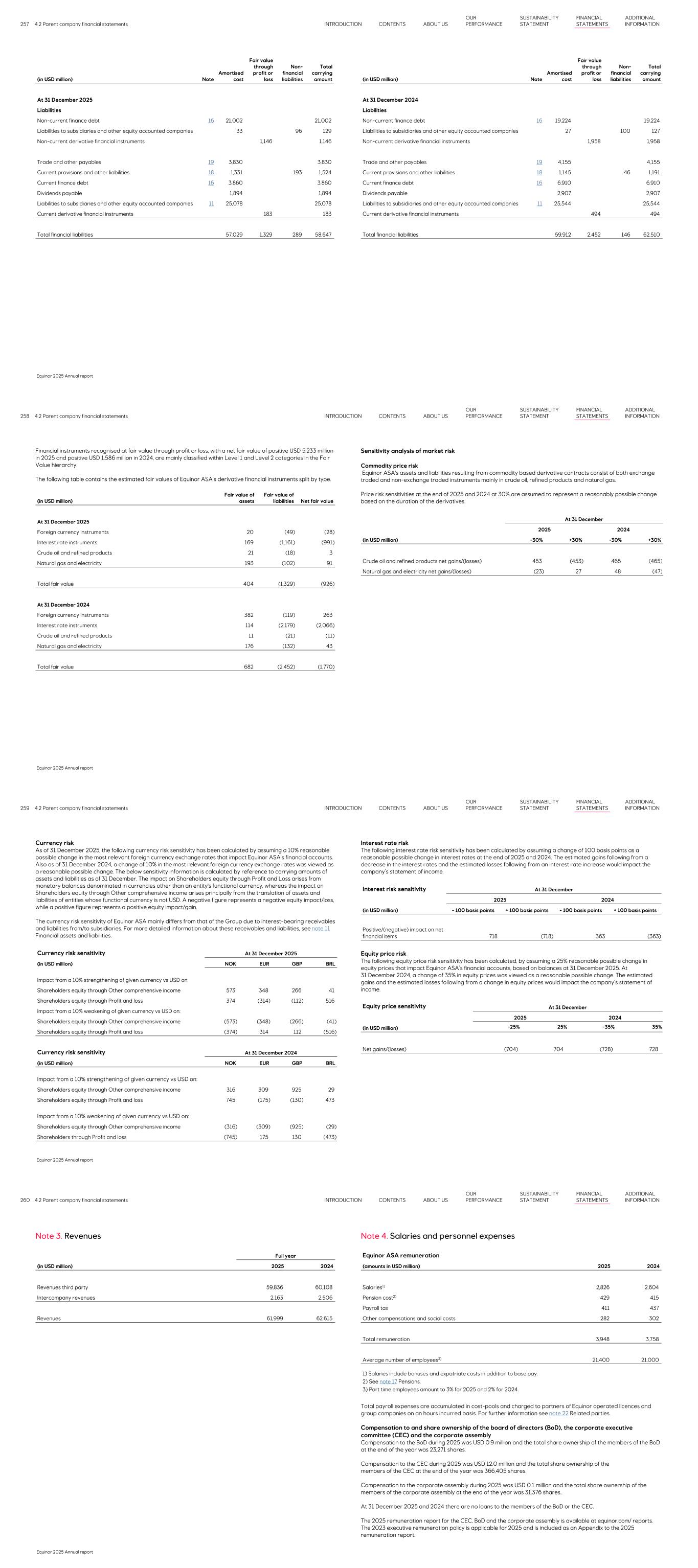
At 31 December 2025 Liabilities Non-current finance debt 16 21,002 21,002 Liabilities to subsidiaries and other equity accounted companies 33 96 129 Non-current derivative financial instruments 1,146 1,146 Trade and other payables 19 3,830 3,830 Current provisions and other liabilities 18 1,331 193 1,524 Current finance debt 16 3,860 3,860 Dividends payable 1,894 1,894 Liabilities to subsidiaries and other equity accounted companies 11 25,078 25,078 Current derivative financial instruments 183 183 Total financial liabilities 57,029 1,329 289 58,647 (in USD million) Note Amortised cost Fair value through profit or loss Non- financial liabilities Total carrying amount At 31 December 2024 Liabilities Non-current finance debt 16 19,224 19,224 Liabilities to subsidiaries and other equity accounted companies 27 100 127 Non-current derivative financial instruments 1,958 1,958 Trade and other payables 19 4,155 4,155 Current provisions and other liabilities 18 1,145 46 1,191 Current finance debt 16 6,910 6,910 Dividends payable 2,907 2,907 Liabilities to subsidiaries and other equity accounted companies 11 25,544 25,544 Current derivative financial instruments 494 494 Total financial liabilities 59,912 2,452 146 62,510 (in USD million) Note Amortised cost Fair value through profit or loss Non- financial liabilities Total carrying amount 257 4.2 Parent company financial statements INTRODUCTION CONTENTS ABOUT US OUR PERFORMANCE SUSTAINABILITY STATEMENT FINANCIAL STATEMENTS ADDITIONAL INFORMATION Equinor 2025 Annual report Financial instruments recognised at fair value through profit or loss, with a net fair value of positive USD 5,233 million in 2025 and positive USD 1,586 million in 2024, are mainly classified within Level 1 and Level 2 categories in the Fair Value hierarchy. The following table contains the estimated fair values of Equinor ASA’s derivative financial instruments split by type. At 31 December 2025 Foreign currency instruments 20 (49) (28) Interest rate instruments 169 (1,161) (991) Crude oil and refined products 21 (18) 3 Natural gas and electricity 193 (102) 91 Total fair value 404 (1,329) (926) At 31 December 2024 Foreign currency instruments 382 (119) 263 Interest rate instruments 114 (2,179) (2,066) Crude oil and refined products 11 (21) (11) Natural gas and electricity 176 (132) 43 Total fair value 682 (2,452) (1,770) (in USD million) Fair value of assets Fair value of liabilities Net fair value Sensitivity analysis of market risk Commodity price risk Equinor ASA's assets and liabilities resulting from commodity based derivative contracts consist of both exchange traded and non-exchange traded instruments mainly in crude oil, refined products and natural gas. Price risk sensitivities at the end of 2025 and 2024 at 30% are assumed to represent a reasonably possible change based on the duration of the derivatives. Crude oil and refined products net gains/(losses) 453 (453) 465 (465) Natural gas and electricity net gains/(losses) (23) 27 48 (47) At 31 December 2025 2024 (in USD million) -30% +30% -30% +30% 258 4.2 Parent company financial statements INTRODUCTION CONTENTS ABOUT US OUR PERFORMANCE SUSTAINABILITY STATEMENT FINANCIAL STATEMENTS ADDITIONAL INFORMATION Equinor 2025 Annual report Currency risk As of 31 December 2025, the following currency risk sensitivity has been calculated by assuming a 10% reasonable possible change in the most relevant foreign currency exchange rates that impact Equinor ASA’s financial accounts. Also as of 31 December 2024, a change of 10% in the most relevant foreign currency exchange rates was viewed as a reasonable possible change. The below sensitivity information is calculated by reference to carrying amounts of assets and liabilities as of 31 December. The impact on Shareholders equity through Profit and Loss arises from monetary balances denominated in currencies other than an entity's functional currency, whereas the impact on Shareholders equity through Other comprehensive income arises principally from the translation of assets and liabilities of entities whose functional currency is not USD. A negative figure represents a negative equity impact/loss, while a positive figure represents a positive equity impact/gain. The currency risk sensitivity of Equinor ASA mainly differs from that of the Group due to interest-bearing receivables and liabilities from/to subsidiaries. For more detailed information about these receivables and liabilities, see note 11 Financial assets and liabilities. Impact from a 10% strengthening of given currency vs USD on: Shareholders equity through Other comprehensive income 573 348 266 41 Shareholders equity through Profit and loss 374 (314) (112) 516 Impact from a 10% weakening of given currency vs USD on: Shareholders equity through Other comprehensive income (573) (348) (266) (41) Shareholders equity through Profit and loss (374) 314 112 (516) Currency risk sensitivity At 31 December 2025 (in USD million) NOK EUR GBP BRL Impact from a 10% strengthening of given currency vs USD on: Shareholders equity through Other comprehensive income 316 309 925 29 Shareholders equity through Profit and loss 745 (175) (130) 473 Impact from a 10% weakening of given currency vs USD on: Shareholders equity through Other comprehensive income (316) (309) (925) (29) Shareholders through Profit and loss (745) 175 130 (473) Currency risk sensitivity At 31 December 2024 (in USD million) NOK EUR GBP BRL Interest rate risk The following interest rate risk sensitivity has been calculated by assuming a change of 100 basis points as a reasonable possible change in interest rates at the end of 2025 and 2024. The estimated gains following from a decrease in the interest rates and the estimated losses following from an interest rate increase would impact the company’s statement of income. (in USD million) - 100 basis points + 100 basis points - 100 basis points + 100 basis points Positive/(negative) impact on net financial items 718 (718) 363 (363) Interest risk sensitivity At 31 December 2025 2024 Equity price risk The following equity price risk sensitivity has been calculated, by assuming a 25% reasonable possible change in equity prices that impact Equinor ASA’s financial accounts, based on balances at 31 December 2025. At 31 December 2024, a change of 35% in equity prices was viewed as a reasonable possible change. The estimated gains and the estimated losses following from a change in equity prices would impact the company’s statement of income. (in USD million) -25 % 25 % -35 % 35 % Net gains/(losses) (704) 704 (728) 728 Equity price sensitivity At 31 December 2025 2024 259 4.2 Parent company financial statements INTRODUCTION CONTENTS ABOUT US OUR PERFORMANCE SUSTAINABILITY STATEMENT FINANCIAL STATEMENTS ADDITIONAL INFORMATION Equinor 2025 Annual report Note 3. Revenues Revenues third party 59,836 60,108 Intercompany revenues 2,163 2,506 Revenues 61,999 62,615 Full year (in USD million) 2025 2024 Note 4. Salaries and personnel expenses Salaries1) 2,826 2,604 Pension cost2) 429 415 Payroll tax 411 437 Other compensations and social costs 282 302 Total remuneration 3,948 3,758 Average number of employees3) 21,400 21,000 1) Salaries include bonuses and expatriate costs in addition to base pay. 2) See note 17 Pensions. 3) Part time employees amount to 3% for 2025 and 2% for 2024. Equinor ASA remuneration (amounts in USD million) 2025 2024 Total payroll expenses are accumulated in cost-pools and charged to partners of Equinor operated licences and group companies on an hours incurred basis. For further information see note 22 Related parties. Compensation to and share ownership of the board of directors (BoD), the corporate executive committee (CEC) and the corporate assembly Compensation to the BoD during 2025 was USD 0.9 million and the total share ownership of the members of the BoD at the end of the year was 23,271 shares. Compensation to the CEC during 2025 was USD 12.0 million and the total share ownership of the members of the CEC at the end of the year was 366,405 shares. Compensation to the corporate assembly during 2025 was USD 0.1 million and the total share ownership of the members of the corporate assembly at the end of the year was 31.376 shares.. At 31 December 2025 and 2024 there are no loans to the members of the BoD or the CEC. The 2025 remuneration report for the CEC, BoD and the corporate assembly is available at equinor.com/ reports. The 2023 executive remuneration policy is applicable for 2025 and is included as an Appendix to the 2025 remuneration report. 260 4.2 Parent company financial statements INTRODUCTION CONTENTS ABOUT US OUR PERFORMANCE SUSTAINABILITY STATEMENT FINANCIAL STATEMENTS ADDITIONAL INFORMATION Equinor 2025 Annual report
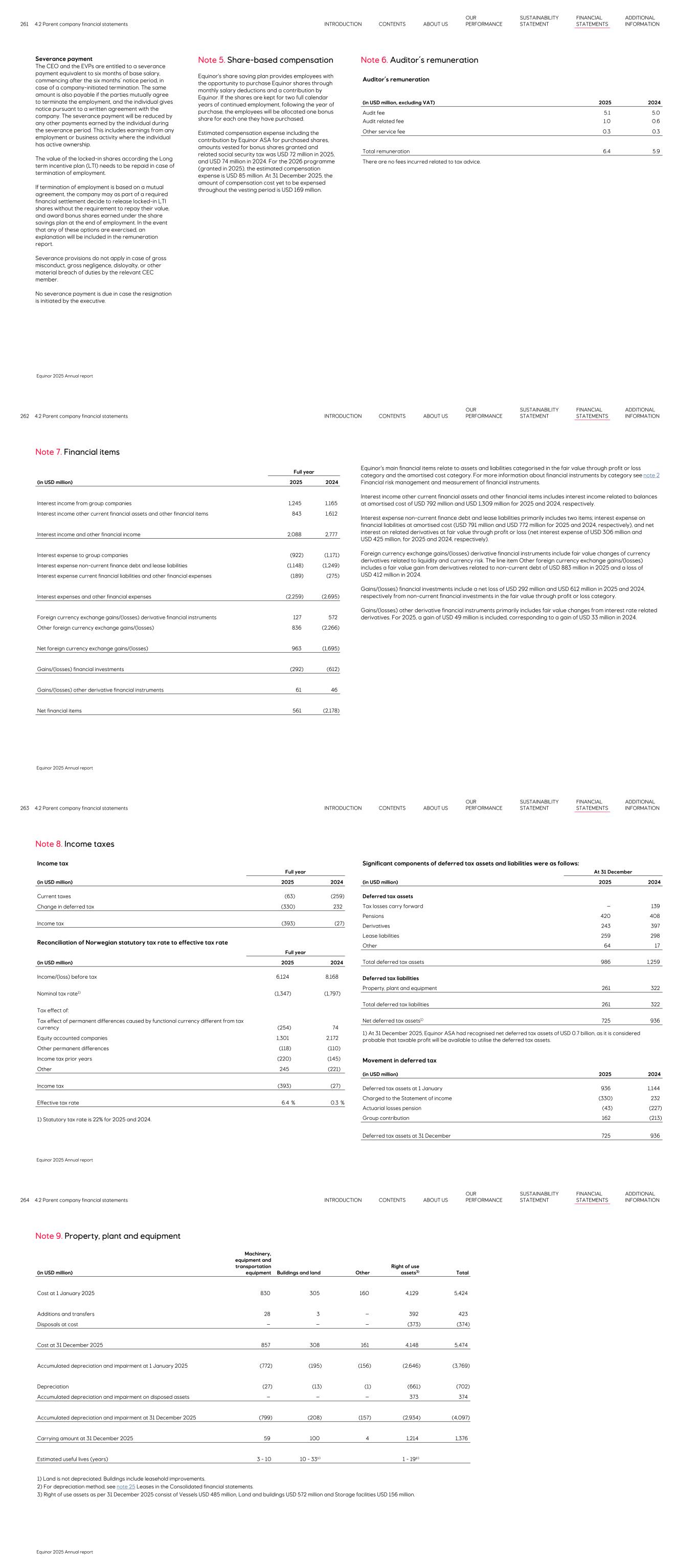
Severance payment The CEO and the EVPs are entitled to a severance payment equivalent to six months of base salary, commencing after the six months’ notice period, in case of a company-initiated termination. The same amount is also payable if the parties mutually agree to terminate the employment, and the individual gives notice pursuant to a written agreement with the company. The severance payment will be reduced by any other payments earned by the individual during the severance period. This includes earnings from any employment or business activity where the individual has active ownership. The value of the locked-in shares according the Long term incentive plan (LTI) needs to be repaid in case of termination of employment. If termination of employment is based on a mutual agreement, the company may as part of a required financial settlement decide to release locked-in LTI shares without the requirement to repay their value, and award bonus shares earned under the share savings plan at the end of employment. In the event that any of these options are exercised, an explanation will be included in the remuneration report. Severance provisions do not apply in case of gross misconduct, gross negligence, disloyalty, or other material breach of duties by the relevant CEC member. No severance payment is due in case the resignation is initiated by the executive. Note 5. Share-based compensation Equinor's share saving plan provides employees with the opportunity to purchase Equinor shares through monthly salary deductions and a contribution by Equinor. If the shares are kept for two full calendar years of continued employment, following the year of purchase, the employees will be allocated one bonus share for each one they have purchased. Estimated compensation expense including the contribution by Equinor ASA for purchased shares, amounts vested for bonus shares granted and related social security tax was USD 72 million in 2025, and USD 74 million in 2024. For the 2026 programme (granted in 2025), the estimated compensation expense is USD 85 million. At 31 December 2025, the amount of compensation cost yet to be expensed throughout the vesting period is USD 169 million. Note 6. Auditor’s remuneration (in USD million, excluding VAT) 2025 2024 Audit fee 5.1 5.0 Audit related fee 1.0 0.6 Other service fee 0.3 0.3 Total remuneration 6.4 5.9 There are no fees incurred related to tax advice. Auditor’s remuneration 261 4.2 Parent company financial statements INTRODUCTION CONTENTS ABOUT US OUR PERFORMANCE SUSTAINABILITY STATEMENT FINANCIAL STATEMENTS ADDITIONAL INFORMATION Equinor 2025 Annual report Note 7. Financial items Interest income from group companies 1,245 1,165 Interest income other current financial assets and other financial items 843 1,612 Interest income and other financial income 2,088 2,777 Interest expense to group companies (922) (1,171) Interest expense non-current finance debt and lease liabilities (1,148) (1,249) Interest expense current financial liabilities and other financial expenses (189) (275) Interest expenses and other financial expenses (2,259) (2,695) Foreign currency exchange gains/(losses) derivative financial instruments 127 572 Other foreign currency exchange gains/(losses) 836 (2,266) Net foreign currency exchange gains/(losses) 963 (1,695) Gains/(losses) financial investments (292) (612) Gains/(losses) other derivative financial instruments 61 46 Net financial items 561 (2,178) Full year (in USD million) 2025 2024 Equinor's main financial items relate to assets and liabilities categorised in the fair value through profit or loss category and the amortised cost category. For more information about financial instruments by category see note 2 Financial risk management and measurement of financial instruments. Interest income other current financial assets and other financial items includes interest income related to balances at amortised cost of USD 792 million and USD 1,309 million for 2025 and 2024, respectively. Interest expense non-current finance debt and lease liabilities primarily includes two items; interest expense on financial liabilities at amortised cost (USD 791 million and USD 772 million for 2025 and 2024, respectively), and net interest on related derivatives at fair value through profit or loss (net interest expense of USD 306 million and USD 425 million, for 2025 and 2024, respectively). Foreign currency exchange gains/(losses) derivative financial instruments include fair value changes of currency derivatives related to liquidity and currency risk. The line item Other foreign currency exchange gains/(losses) includes a fair value gain from derivatives related to non-current debt of USD 883 million in 2025 and a loss of USD 412 million in 2024. Gains/(losses) financial investments include a net loss of USD 292 million and USD 612 million in 2025 and 2024, respectively from non-current financial investments in the fair value through profit or loss category. Gains/(losses) other derivative financial instruments primarily includes fair value changes from interest rate related derivatives. For 2025, a gain of USD 49 million is included, corresponding to a gain of USD 33 million in 2024. 262 4.2 Parent company financial statements INTRODUCTION CONTENTS ABOUT US OUR PERFORMANCE SUSTAINABILITY STATEMENT FINANCIAL STATEMENTS ADDITIONAL INFORMATION Equinor 2025 Annual report Note 8. Income taxes Current taxes (63) (259) Change in deferred tax (330) 232 Income tax (393) (27) Income tax Full year (in USD million) 2025 2024 Income/(loss) before tax 6,124 8,168 Nominal tax rate1) (1,347) (1,797) Tax effect of: Tax effect of permanent differences caused by functional currency different from tax currency (254) 74 Equity accounted companies 1,301 2,172 Other permanent differences (118) (110) Income tax prior years (220) (145) Other 245 (221) Income tax (393) (27) Effective tax rate 6.4 % 0.3 % 1) Statutory tax rate is 22% for 2025 and 2024. Reconciliation of Norwegian statutory tax rate to effective tax rate Full year (in USD million) 2025 2024 Deferred tax assets Tax losses carry forward — 139 Pensions 420 408 Derivatives 243 397 Lease liabilities 259 298 Other 64 17 Total deferred tax assets 986 1,259 Deferred tax liabilities Property, plant and equipment 261 322 Total deferred tax liabilities 261 322 Net deferred tax assets1) 725 936 1) At 31 December 2025, Equinor ASA had recognised net deferred tax assets of USD 0.7 billion, as it is considered probable that taxable profit will be available to utilise the deferred tax assets. Significant components of deferred tax assets and liabilities were as follows: At 31 December (in USD million) 2025 2024 Deferred tax assets at 1 January 936 1,144 Charged to the Statement of income (330) 232 Actuarial losses pension (43) (227) Group contribution 162 (213) Deferred tax assets at 31 December 725 936 Movement in deferred tax (in USD million) 2025 2024 263 4.2 Parent company financial statements INTRODUCTION CONTENTS ABOUT US OUR PERFORMANCE SUSTAINABILITY STATEMENT FINANCIAL STATEMENTS ADDITIONAL INFORMATION Equinor 2025 Annual report Note 9. Property, plant and equipment Cost at 1 January 2025 830 305 160 4,129 5,424 Additions and transfers 28 3 — 392 423 Disposals at cost — — — (373) (374) Cost at 31 December 2025 857 308 161 4,148 5,474 Accumulated depreciation and impairment at 1 January 2025 (772) (195) (156) (2,646) (3,769) Depreciation (27) (13) (1) (661) (702) Accumulated depreciation and impairment on disposed assets — — — 373 374 Accumulated depreciation and impairment at 31 December 2025 (799) (208) (157) (2,934) (4,097) Carrying amount at 31 December 2025 59 100 4 1,214 1,376 Estimated useful lives (years) 3 - 10 10 - 33¹⁾ 1 - 19²⁾ (in USD million) Machinery, equipment and transportation equipment Buildings and land Other Right of use assets3) Total 264 4.2 Parent company financial statements INTRODUCTION CONTENTS ABOUT US OUR PERFORMANCE SUSTAINABILITY STATEMENT FINANCIAL STATEMENTS ADDITIONAL INFORMATION Equinor 2025 Annual report 1) Land is not depreciated. Buildings include leasehold improvements. 2) For depreciation method, see note 25 Leases in the Consolidated financial statements. 3) Right of use assets as per 31 December 2025 consist of Vessels USD 485 million, Land and buildings USD 572 million and Storage facilities USD 156 million.
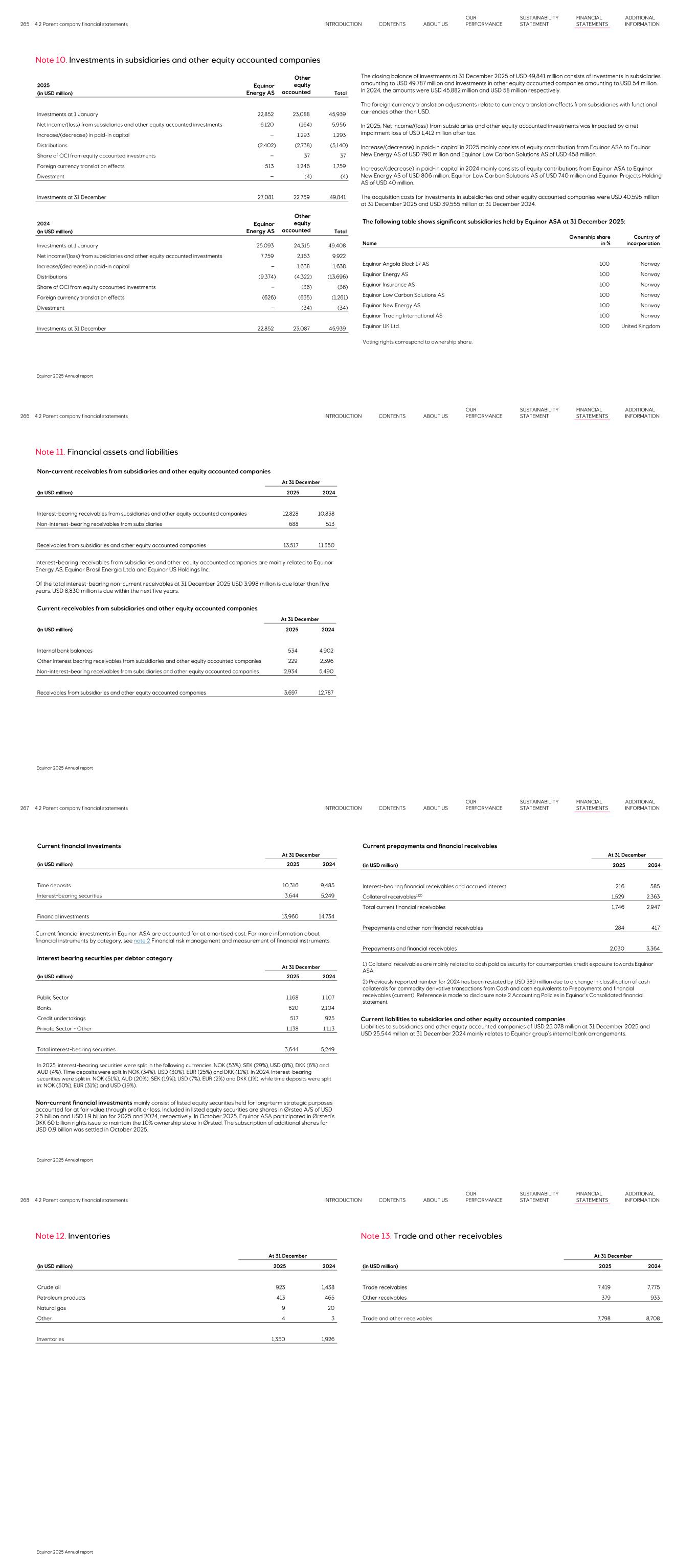
Note 10. Investments in subsidiaries and other equity accounted companies Investments at 1 January 22,852 23,088 45,939 Net income/(loss) from subsidiaries and other equity accounted investments 6,120 (164) 5,956 Increase/(decrease) in paid-in capital — 1,293 1,293 Distributions (2,402) (2,738) (5,140) Share of OCI from equity accounted investments — 37 37 Foreign currency translation effects 513 1,246 1,759 Divestment — (4) (4) Investments at 31 December 27,081 22,759 49,841 Equinor Energy AS Other equity accounted investments 2025 (in USD million) Total Investments at 1 January 25,093 24,315 49,408 Net income/(loss) from subsidiaries and other equity accounted investments 7,759 2,163 9,922 Increase/(decrease) in paid-in capital — 1,638 1,638 Distributions (9,374) (4,322) (13,696) Share of OCI from equity accounted investments — (36) (36) Foreign currency translation effects (626) (635) (1,261) Divestment — (34) (34) Investments at 31 December 22,852 23,087 45,939 Equinor Energy AS Other equity accounted investments 2024 (in USD million) Total The closing balance of investments at 31 December 2025 of USD 49,841 million consists of investments in subsidiaries amounting to USD 49,787 million and investments in other equity accounted companies amounting to USD 54 million. In 2024, the amounts were USD 45,882 million and USD 58 million respectively. The foreign currency translation adjustments relate to currency translation effects from subsidiaries with functional currencies other than USD. In 2025, Net income/(loss) from subsidiaries and other equity accounted investments was impacted by a net impairment loss of USD 1,412 million after tax. Increase/(decrease) in paid-in capital in 2025 mainly consists of equity contribution from Equinor ASA to Equinor New Energy AS of USD 790 million and Equinor Low Carbon Solutions AS of USD 458 million. Increase/(decrease) in paid-in capital in 2024 mainly consists of equity contributions from Equinor ASA to Equinor New Energy AS of USD 806 million, Equinor Low Carbon Solutions AS of USD 740 million and Equinor Projects Holding AS of USD 40 million. The acquisition costs for investments in subsidiaries and other equity accounted companies were USD 40,595 million at 31 December 2025 and USD 39,555 million at 31 December 2024. Equinor Angola Block 17 AS 100 Norway Equinor Energy AS 100 Norway Equinor Insurance AS 100 Norway Equinor Low Carbon Solutions AS 100 Norway Equinor New Energy AS 100 Norway Equinor Trading International AS 100 Norway Equinor UK Ltd. 100 United Kingdom Voting rights correspond to ownership share. The following table shows significant subsidiaries held by Equinor ASA at 31 December 2025: Name Ownership share in % Country of incorporation 265 4.2 Parent company financial statements INTRODUCTION CONTENTS ABOUT US OUR PERFORMANCE SUSTAINABILITY STATEMENT FINANCIAL STATEMENTS ADDITIONAL INFORMATION Equinor 2025 Annual report Note 11. Financial assets and liabilities Interest-bearing receivables from subsidiaries and other equity accounted companies 12,828 10,838 Non-interest-bearing receivables from subsidiaries 688 513 Receivables from subsidiaries and other equity accounted companies 13,517 11,350 Non-current receivables from subsidiaries and other equity accounted companies At 31 December (in USD million) 2025 2024 Interest-bearing receivables from subsidiaries and other equity accounted companies are mainly related to Equinor Energy AS, Equinor Brasil Energia Ltda and Equinor US Holdings Inc. Of the total interest-bearing non-current receivables at 31 December 2025 USD 3,998 million is due later than five years. USD 8,830 million is due within the next five years. Internal bank balances 534 4,902 Other interest bearing receivables from subsidiaries and other equity accounted companies 229 2,396 Non-interest-bearing receivables from subsidiaries and other equity accounted companies 2,934 5,490 Receivables from subsidiaries and other equity accounted companies 3,697 12,787 Current receivables from subsidiaries and other equity accounted companies At 31 December (in USD million) 2025 2024 266 4.2 Parent company financial statements INTRODUCTION CONTENTS ABOUT US OUR PERFORMANCE SUSTAINABILITY STATEMENT FINANCIAL STATEMENTS ADDITIONAL INFORMATION Equinor 2025 Annual report Time deposits 10,316 9,485 Interest-bearing securities 3,644 5,249 Financial investments 13,960 14,734 Current financial investments At 31 December (in USD million) 2025 2024 Current financial investments in Equinor ASA are accounted for at amortised cost. For more information about financial instruments by category, see note 2 Financial risk management and measurement of financial instruments. Public Sector 1,168 1,107 Banks 820 2,104 Credit undertakings 517 925 Private Sector - Other 1,138 1,113 Total interest-bearing securities 3,644 5,249 In 2025, interest-bearing securities were split in the following currencies: NOK (53%), SEK (29%), USD (8%), DKK (6%) and AUD (4%). Time deposits were split in NOK (34%), USD (30%), EUR (25%) and DKK (11%). In 2024, interest-bearing securities were split in: NOK (51%), AUD (20%), SEK (19%), USD (7%), EUR (2%) and DKK (1%), while time deposits were split in: NOK (50%), EUR (31%) and USD (19%). Interest bearing securities per debtor category At 31 December (in USD million) 2025 2024 Non-current financial investments mainly consist of listed equity securities held for long-term strategic purposes accounted for at fair value through profit or loss. Included in listed equity securities are shares in Ørsted A/S of USD 2.5 billion and USD 1.9 billion for 2025 and 2024, respectively. In October 2025, Equinor ASA participated in Ørsted’s DKK 60 billion rights issue to maintain the 10% ownership stake in Ørsted. The subscription of additional shares for USD 0.9 billion was settled in October 2025. Interest-bearing financial receivables and accrued interest 216 585 Collateral receivables1)2) 1,529 2,363 Total current financial receivables 1,746 2,947 Prepayments and other non-financial receivables 284 417 Prepayments and financial receivables 2,030 3,364 1) Collateral receivables are mainly related to cash paid as security for counterparties credit exposure towards Equinor ASA. 2) Previously reported number for 2024 has been restated by USD 389 million due to a change in classification of cash collaterals for commodity derivative transactions from Cash and cash equivalents to Prepayments and financial receivables (current). Reference is made to disclosure note 2 Accounting Policies in Equinor’s Consolidated financial statement. Current prepayments and financial receivables At 31 December (in USD million) 2025 2024 Current liabilities to subsidiaries and other equity accounted companies Liabilities to subsidiaries and other equity accounted companies of USD 25,078 million at 31 December 2025 and USD 25,544 million at 31 December 2024 mainly relates to Equinor group’s internal bank arrangements. 267 4.2 Parent company financial statements INTRODUCTION CONTENTS ABOUT US OUR PERFORMANCE SUSTAINABILITY STATEMENT FINANCIAL STATEMENTS ADDITIONAL INFORMATION Equinor 2025 Annual report Note 12. Inventories Crude oil 923 1,438 Petroleum products 413 465 Natural gas 9 20 Other 4 3 Inventories 1,350 1,926 At 31 December (in USD million) 2025 2024 Note 13. Trade and other receivables Trade receivables 7,419 7,775 Other receivables 379 933 Trade and other receivables 7,798 8,708 At 31 December (in USD million) 2025 2024 268 4.2 Parent company financial statements INTRODUCTION CONTENTS ABOUT US OUR PERFORMANCE SUSTAINABILITY STATEMENT FINANCIAL STATEMENTS ADDITIONAL INFORMATION Equinor 2025 Annual report
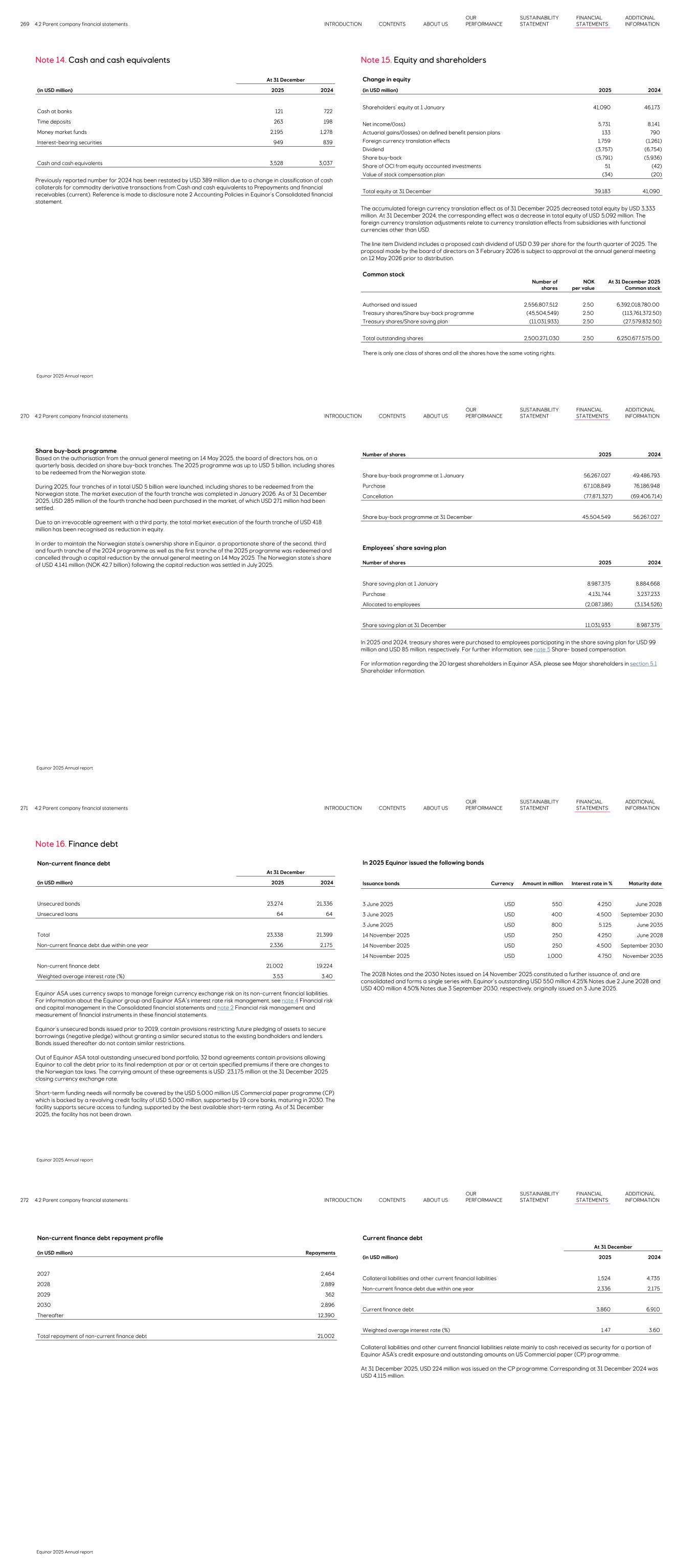
Note 14. Cash and cash equivalents Cash at banks 121 722 Time deposits 263 198 Money market funds 2,195 1,278 Interest-bearing securities 949 839 Cash and cash equivalents 3,528 3,037 At 31 December (in USD million) 2025 2024 Previously reported number for 2024 has been restated by USD 389 million due to a change in classification of cash collaterals for commodity derivative transactions from Cash and cash equivalents to Prepayments and financial receivables (current). Reference is made to disclosure note 2 Accounting Policies in Equinor’s Consolidated financial statement. Note 15. Equity and shareholders Shareholders’ equity at 1 January 41,090 46,173 Net income/(loss) 5,731 8,141 Actuarial gains/(losses) on defined benefit pension plans 133 790 Foreign currency translation effects 1,759 (1,261) Dividend (3,757) (6,754) Share buy-back (5,791) (5,936) Share of OCI from equity accounted investments 51 (42) Value of stock compensation plan (34) (20) Total equity at 31 December 39,183 41,090 Change in equity (in USD million) 2025 2024 The accumulated foreign currency translation effect as of 31 December 2025 decreased total equity by USD 3,333 million. At 31 December 2024, the corresponding effect was a decrease in total equity of USD 5,092 million. The foreign currency translation adjustments relate to currency translation effects from subsidiaries with functional currencies other than USD. The line item Dividend includes a proposed cash dividend of USD 0.39 per share for the fourth quarter of 2025. The proposal made by the board of directors on 3 February 2026 is subject to approval at the annual general meeting on 12 May 2026 prior to distribution. Authorised and issued 2,556,807,512 2.50 6,392,018,780.00 Treasury shares/Share buy-back programme (45,504,549) 2.50 (113,761,372.50) Treasury shares/Share saving plan (11,031,933) 2.50 (27,579,832.50) Total outstanding shares 2,500,271,030 2.50 6,250,677,575.00 There is only one class of shares and all the shares have the same voting rights. Common stock Number of shares NOK per value At 31 December 2025 Common stock 269 4.2 Parent company financial statements INTRODUCTION CONTENTS ABOUT US OUR PERFORMANCE SUSTAINABILITY STATEMENT FINANCIAL STATEMENTS ADDITIONAL INFORMATION Equinor 2025 Annual report Share buy-back programme Based on the authorisation from the annual general meeting on 14 May 2025, the board of directors has, on a quarterly basis, decided on share buy-back tranches. The 2025 programme was up to USD 5 billion, including shares to be redeemed from the Norwegian state. During 2025, four tranches of in total USD 5 billion were launched, including shares to be redeemed from the Norwegian state. The market execution of the fourth tranche was completed in January 2026. As of 31 December 2025, USD 285 million of the fourth tranche had been purchased in the market, of which USD 271 million had been settled. Due to an irrevocable agreement with a third party, the total market execution of the fourth tranche of USD 418 million has been recognised as reduction in equity. In order to maintain the Norwegian state’s ownership share in Equinor, a proportionate share of the second, third and fourth tranche of the 2024 programme as well as the first tranche of the 2025 programme was redeemed and cancelled through a capital reduction by the annual general meeting on 14 May 2025. The Norwegian state’s share of USD 4,141 million (NOK 42.7 billion) following the capital reduction was settled in July 2025. Share buy-back programme at 1 January 56,267,027 49,486,793 Purchase 67,108,849 76,186,948 Cancellation (77,871,327) (69,406,714) Share buy-back programme at 31 December 45,504,549 56,267,027 Employees’ share saving plan Number of shares 2025 2024 Share saving plan at 1 January 8,987,375 8,884,668 Purchase 4,131,744 3,237,233 Allocated to employees (2,087,186) (3,134,526) Share saving plan at 31 December 11,031,933 8,987,375 Number of shares 2025 2024 In 2025 and 2024, treasury shares were purchased to employees participating in the share saving plan for USD 99 million and USD 85 million, respectively. For further information, see note 5 Share- based compensation. For information regarding the 20 largest shareholders in Equinor ASA, please see Major shareholders in section 5.1 Shareholder information. 270 4.2 Parent company financial statements INTRODUCTION CONTENTS ABOUT US OUR PERFORMANCE SUSTAINABILITY STATEMENT FINANCIAL STATEMENTS ADDITIONAL INFORMATION Equinor 2025 Annual report Note 16. Finance debt Unsecured bonds 23,274 21,336 Unsecured loans 64 64 Total 23,338 21,399 Non-current finance debt due within one year 2,336 2,175 Non-current finance debt 21,002 19,224 Weighted average interest rate (%) 3.53 3.40 Non-current finance debt At 31 December (in USD million) 2025 2024 Equinor ASA uses currency swaps to manage foreign currency exchange risk on its non-current financial liabilities. For information about the Equinor group and Equinor ASA´s interest rate risk management, see note 4 Financial risk and capital management in the Consolidated financial statements and note 2 Financial risk management and measurement of financial instruments in these financial statements. Equinor’s unsecured bonds issued prior to 2019, contain provisions restricting future pledging of assets to secure borrowings (negative pledge) without granting a similar secured status to the existing bondholders and lenders. Bonds issued thereafter do not contain similar restrictions. Out of Equinor ASA total outstanding unsecured bond portfolio, 32 bond agreements contain provisions allowing Equinor to call the debt prior to its final redemption at par or at certain specified premiums if there are changes to the Norwegian tax laws. The carrying amount of these agreements is USD 23,175 million at the 31 December 2025 closing currency exchange rate. Short-term funding needs will normally be covered by the USD 5,000 million US Commercial paper programme (CP) which is backed by a revolving credit facility of USD 5,000 million, supported by 19 core banks, maturing in 2030. The facility supports secure access to funding, supported by the best available short-term rating. As of 31 December 2025, the facility has not been drawn. 3 June 2025 USD 550 4.250 June 2028 3 June 2025 USD 400 4.500 September 2030 3 June 2025 USD 800 5.125 June 2035 14 November 2025 USD 250 4.250 June 2028 14 November 2025 USD 250 4.500 September 2030 14 November 2025 USD 1,000 4.750 November 2035 In 2025 Equinor issued the following bonds Issuance bonds Currency Amount in million Interest rate in % Maturity date The 2028 Notes and the 2030 Notes issued on 14 November 2025 constituted a further issuance of, and are consolidated and forms a single series with, Equinor’s outstanding USD 550 million 4.25% Notes due 2 June 2028 and USD 400 million 4.50% Notes due 3 September 2030, respectively, originally issued on 3 June 2025. 271 4.2 Parent company financial statements INTRODUCTION CONTENTS ABOUT US OUR PERFORMANCE SUSTAINABILITY STATEMENT FINANCIAL STATEMENTS ADDITIONAL INFORMATION Equinor 2025 Annual report 2027 2,464 2028 2,889 2029 362 2030 2,896 Thereafter 12,390 Total repayment of non-current finance debt 21,002 Non-current finance debt repayment profile (in USD million) Repayments Current finance debt At 31 December (in USD million) 2025 2024 Collateral liabilities and other current financial liabilities 1,524 4,735 Non-current finance debt due within one year 2,336 2,175 Current finance debt 3,860 6,910 Weighted average interest rate (%) 1.47 3.60 Collateral liabilities and other current financial liabilities relate mainly to cash received as security for a portion of Equinor ASA's credit exposure and outstanding amounts on US Commercial paper (CP) programme. At 31 December 2025, USD 224 million was issued on the CP programme. Corresponding at 31 December 2024 was USD 4,115 million. 272 4.2 Parent company financial statements INTRODUCTION CONTENTS ABOUT US OUR PERFORMANCE SUSTAINABILITY STATEMENT FINANCIAL STATEMENTS ADDITIONAL INFORMATION Equinor 2025 Annual report
Note 17. Pensions Equinor ASA is subject to the Mandatory Company Pensions Act, and the company's pension scheme follows the requirements of the Act. For a description of the pension schemes in Equinor ASA, reference is made to note 22 Pensions in the Consolidated financial statements. Net pension cost Total pension costs include current service cost for the defined benefit plans, as well as contributions to defined contribution schemes and notional contribution plans. Total pension costs amount to USD 429 million in 2025, USD 415 million in 2024 and USD 374 million in 2023. In addition, interest cost and interest income related to defined benefit plans are included in the Statement of income within Net financial items. Actuarial assumptions and sensitivity analysis Actuarial assumptions, sensitivity analysis, portfolio weighting and information about pension assets in Equinor Pension are presented in note 22 Pensions in the Consolidated financial statements for Equinor group. The number of employees, including pensioners, related to the main benefit plan in Equinor ASA is 8.400 at end of 31 December 2025 and 8.531 at end of 31 December 2024. In addition, all employees are members of the early retirement plan (“AFP”) and different groups of employees are members of other unfunded plans. Estimated company contributions to be made to Equinor Pension in 2026 is approximately USD 85 million. Pension liabilities at 1 January 6,983 7,977 Current service cost 134 150 Interest cost 401 361 Actuarial (gains)/losses (339) (452) Foreign currency translation effects 891 (847) Other changes in notional contribution liability and other effects 200 60 Benefits paid (299) (267) Pension liabilities at 31 December 7,970 6,983 Fair value of plan assets at 1 January 5,207 5,302 Interest income 241 189 Return on plan assets (excluding interest income) 177 302 Company contributions 64 127 Benefits paid (148) (131) Foreign currency translation effects 651 (581) Asset ceiling (205) — Fair value of plan assets at 31 December 5,989 5,207 Net pension liability at 31 December 1,981 1,776 Represented by: Asset recognised as non-current pension assets (funded plan) 2,079 1,691 Liability recognised as non-current pension liabilities (unfunded plans) 4,060 3,467 Pension liabilities specified by funded and unfunded pension plans 7,970 6,983 Funded 3,911 3,516 Unfunded 4,060 3,467 Changes in pension liabilities and plan assets during the year (in USD million) 2025 2024 273 4.2 Parent company financial statements INTRODUCTION CONTENTS ABOUT US OUR PERFORMANCE SUSTAINABILITY STATEMENT FINANCIAL STATEMENTS ADDITIONAL INFORMATION Equinor 2025 Annual report Note 18. Provisions and other liabilities Non-current portion at 31 December 2024 442 Current portion at 31 December 2024¹⁾ 46 Provisions and other liabilities at 31 December 2024 488 New or increased provisions and other liabilities — Change in estimates 26 Amounts charged against provisions and other liabilities (111) Reclassification, transfer and other (128) Foreign currency translation effects (1) Provisions and other liabilities at 31 December 2025 273 Non-current portion at 31 December 2025 227 Current portion at 31 December 2025¹⁾ 46 1) Included in the line item Current provisions and other liabilities in the Balance sheet, further detailed below. (in USD million) Current provisions and other liabilities Provisions and other non-financial liabilities 46 46 Current provisions and other liabilities 1,524 1,191 At 31 December (in USD million) 2025 2024 Accrued expenses and other financial liabilities 1,478 1,145 274 4.2 Parent company financial statements INTRODUCTION CONTENTS ABOUT US OUR PERFORMANCE SUSTAINABILITY STATEMENT FINANCIAL STATEMENTS ADDITIONAL INFORMATION Equinor 2025 Annual report Note 19. Trade and other payables Trade payables 2,559 2,716 Payables to equity accounted companies and other related parties 1,126 1,206 Accrued trade expenses and other payables 145 233 Trade and other payables 3,830 4,155 At 31 December (in USD million) 2025 2024 275 4.2 Parent company financial statements INTRODUCTION CONTENTS ABOUT US OUR PERFORMANCE SUSTAINABILITY STATEMENT FINANCIAL STATEMENTS ADDITIONAL INFORMATION Equinor 2025 Annual report Note 20. Leases Equinor ASA leases certain assets, notably transportation vessels, storage facilities and office buildings which are used in operational activity. Equinor ASA is mostly a lessee in its lease contracts and the leases serve operational purposes rather than as a tool for financing. Equinor ASA recognised revenues of USD 118 million in 2025 and USD 130 million in 2024 related to lease costs recovered from other Equinor group entities related to lease contracts being recognised gross by Equinor ASA. Commitments relating to lease contracts which had not yet commenced at year-end are included within Other long- term commitments in note 21 Other Commitments, contingent liabilities and contingent assets. Lease liabilities at 1 January 1,379 1,621 New leases, including remeasurements and cancellations 392 477 Gross lease payments (714) (712) Lease interest 49 56 Lease repayments (665) (665) (656) (656) Foreign currency translation effects 70 (63) Lease liabilities at 31 December 1,175 1,379 Current lease liabilities 415 561 Non-current lease liabilities 761 818 Information related to lease payments and lease liabilities (in USD million) 2025 2024 Undiscounted contractual lease payments for Equinor's lease liabilities are USD 448 million in 2026, USD 580 million within two to five years and USD 270 million after five years. The right of use assets are included within the line item Property, plant and equipment in the balance sheet. See also note 9 Property, plant and equipment. Year 2 and 3 350 426 Year 4 and 5 168 183 After 5 years 244 209 Total repayment of non-current lease liabilities 761 818 Non-current lease liabilities’ maturity profile At 31 December (in USD million) 2025 2024 276 4.2 Parent company financial statements INTRODUCTION CONTENTS ABOUT US OUR PERFORMANCE SUSTAINABILITY STATEMENT FINANCIAL STATEMENTS ADDITIONAL INFORMATION Equinor 2025 Annual report
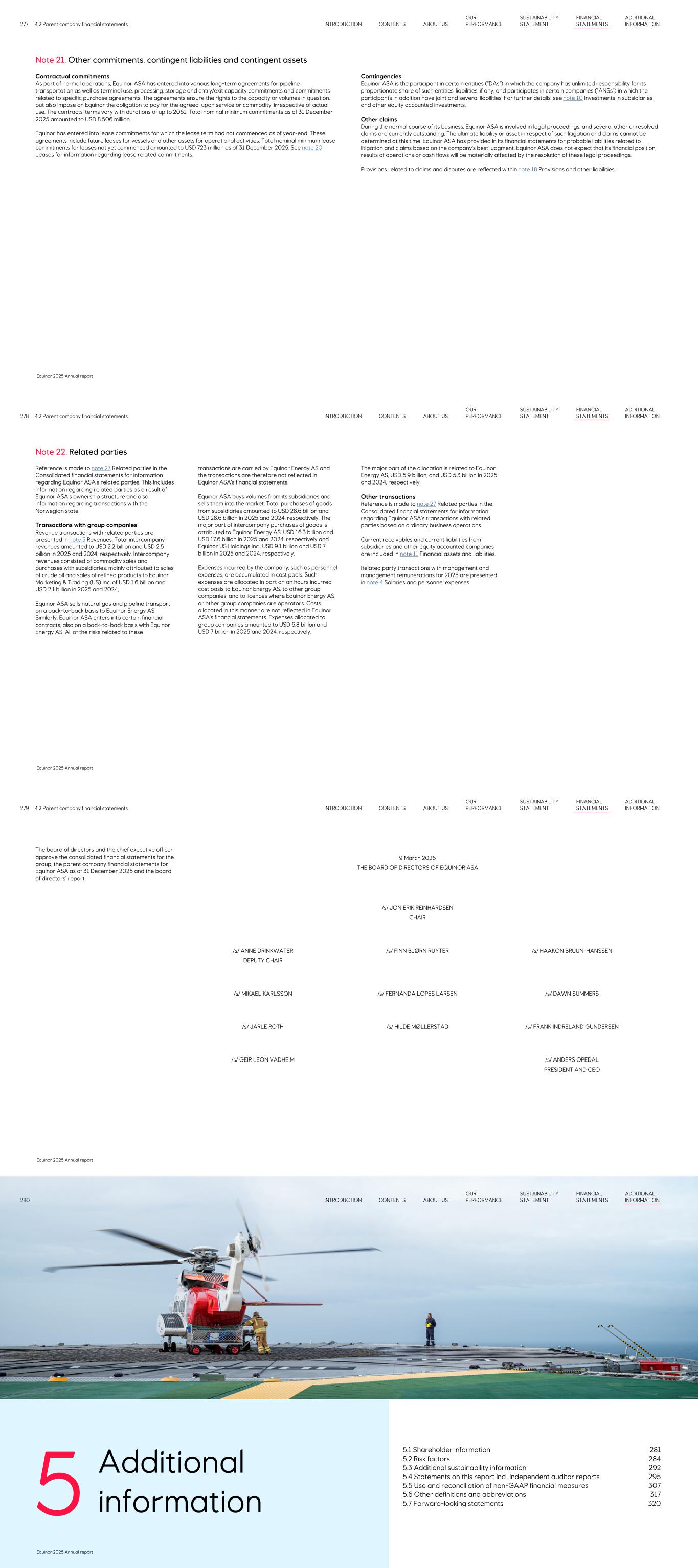
Note 21. Other commitments, contingent liabilities and contingent assets Contractual commitments As part of normal operations, Equinor ASA has entered into various long-term agreements for pipeline transportation as well as terminal use, processing, storage and entry/exit capacity commitments and commitments related to specific purchase agreements. The agreements ensure the rights to the capacity or volumes in question, but also impose on Equinor the obligation to pay for the agreed-upon service or commodity, irrespective of actual use. The contracts' terms vary with durations of up to 2061. Total nominal minimum commitments as of 31 December 2025 amounted to USD 8,506 million. Equinor has entered into lease commitments for which the lease term had not commenced as of year-end. These agreements include future leases for vessels and other assets for operational activities. Total nominal minimum lease commitments for leases not yet commenced amounted to USD 723 million as of 31 December 2025. See note 20 Leases for information regarding lease related commitments. Contingencies Equinor ASA is the participant in certain entities ("DAs") in which the company has unlimited responsibility for its proportionate share of such entities' liabilities, if any, and participates in certain companies ("ANSs") in which the participants in addition have joint and several liabilities. For further details, see note 10 Investments in subsidiaries and other equity accounted investments. Other claims During the normal course of its business, Equinor ASA is involved in legal proceedings, and several other unresolved claims are currently outstanding. The ultimate liability or asset in respect of such litigation and claims cannot be determined at this time. Equinor ASA has provided in its financial statements for probable liabilities related to litigation and claims based on the company's best judgment. Equinor ASA does not expect that its financial position, results of operations or cash flows will be materially affected by the resolution of these legal proceedings. Provisions related to claims and disputes are reflected within note 18 Provisions and other liabilities. 277 4.2 Parent company financial statements INTRODUCTION CONTENTS ABOUT US OUR PERFORMANCE SUSTAINABILITY STATEMENT FINANCIAL STATEMENTS ADDITIONAL INFORMATION Equinor 2025 Annual report Note 22. Related parties Reference is made to note 27 Related parties in the Consolidated financial statements for information regarding Equinor ASA’s related parties. This includes information regarding related parties as a result of Equinor ASA’s ownership structure and also information regarding transactions with the Norwegian state. Transactions with group companies Revenue transactions with related parties are presented in note 3 Revenues. Total intercompany revenues amounted to USD 2.2 billion and USD 2.5 billion in 2025 and 2024, respectively. Intercompany revenues consisted of commodity sales and purchases with subsidiaries, mainly attributed to sales of crude oil and sales of refined products to Equinor Marketing & Trading (US) Inc. of USD 1.6 billion and USD 2.1 billion in 2025 and 2024, Equinor ASA sells natural gas and pipeline transport on a back-to-back basis to Equinor Energy AS. Similarly, Equinor ASA enters into certain financial contracts, also on a back-to-back basis with Equinor Energy AS. All of the risks related to these transactions are carried by Equinor Energy AS and the transactions are therefore not reflected in Equinor ASA's financial statements. Equinor ASA buys volumes from its subsidiaries and sells them into the market. Total purchases of goods from subsidiaries amounted to USD 28.6 billion and USD 28.6 billion in 2025 and 2024, respectively. The major part of intercompany purchases of goods is attributed to Equinor Energy AS, USD 16.3 billion and USD 17.6 billion in 2025 and 2024, respectively and Equinor US Holdings Inc., USD 9.1 billion and USD 7 billion in 2025 and 2024, respectively. Expenses incurred by the company, such as personnel expenses, are accumulated in cost pools. Such expenses are allocated in part on an hours incurred cost basis to Equinor Energy AS, to other group companies, and to licences where Equinor Energy AS or other group companies are operators. Costs allocated in this manner are not reflected in Equinor ASA's financial statements. Expenses allocated to group companies amounted to USD 6.8 billion and USD 7 billion in 2025 and 2024, respectively. The major part of the allocation is related to Equinor Energy AS, USD 5.9 billion, and USD 5.3 billion in 2025 and 2024, respectively. Other transactions Reference is made to note 27 Related parties in the Consolidated financial statements for information regarding Equinor ASA’s transactions with related parties based on ordinary business operations. Current receivables and current liabilities from subsidiaries and other equity accounted companies are included in note 11 Financial assets and liabilities. Related party transactions with management and management remunerations for 2025 are presented in note 4 Salaries and personnel expenses. 278 4.2 Parent company financial statements INTRODUCTION CONTENTS ABOUT US OUR PERFORMANCE SUSTAINABILITY STATEMENT FINANCIAL STATEMENTS ADDITIONAL INFORMATION Equinor 2025 Annual report The board of directors and the chief executive officer approve the consolidated financial statements for the group, the parent company financial statements for Equinor ASA as of 31 December 2025 and the board of directors’ report. 279 4.2 Parent company financial statements INTRODUCTION CONTENTS ABOUT US OUR PERFORMANCE SUSTAINABILITY STATEMENT FINANCIAL STATEMENTS ADDITIONAL INFORMATION Equinor 2025 Annual report 9 March 2026 THE BOARD OF DIRECTORS OF EQUINOR ASA /s/ JON ERIK REINHARDSEN CHAIR /s/ ANNE DRINKWATER /s/ FINN BJØRN RUYTER /s/ HAAKON BRUUN-HANSSEN DEPUTY CHAIR /s/ MIKAEL KARLSSON /s/ FERNANDA LOPES LARSEN /s/ DAWN SUMMERS /s/ JARLE ROTH /s/ HILDE MØLLERSTAD /s/ FRANK INDRELAND GUNDERSEN /s/ GEIR LEON VADHEIM /s/ ANDERS OPEDAL PRESIDENT AND CEO 5.1 Shareholder information 281 5.2 Risk factors 284 5.3 Additional sustainability information 292 5.4 Statements on this report incl. independent auditor reports 295 5.5 Use and reconciliation of non-GAAP financial measures 307 5.6 Other definitions and abbreviations 317 5.7 Forward-looking statements 320 280 INTRODUCTION CONTENTS ABOUT US OUR PERFORMANCE SUSTAINABILITY STATEMENT FINANCIAL STATEMENTS ADDITIONAL INFORMATION Equinor 2025 Annual report 5 Additional information
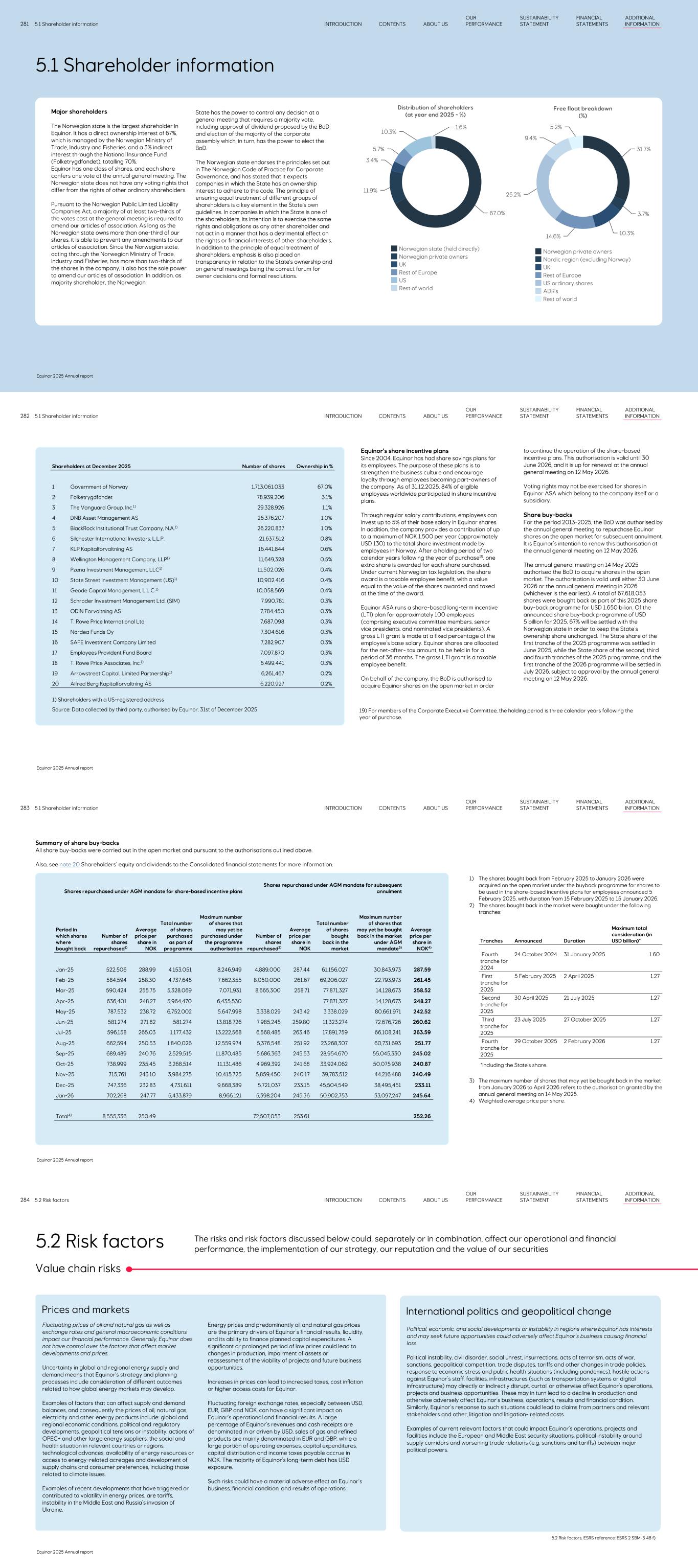
5.1 Shareholder information 281 5.1 Shareholder information INTRODUCTION CONTENTS ABOUT US OUR PERFORMANCE SUSTAINABILITY STATEMENT FINANCIAL STATEMENTS ADDITIONAL INFORMATION Equinor 2025 Annual report Major shareholders The Norwegian state is the largest shareholder in Equinor. It has a direct ownership interest of 67%, which is managed by the Norwegian Ministry of Trade, Industry and Fisheries, and a 3% indirect interest through the National Insurance Fund (Folketrygdfondet), totalling 70%. Equinor has one class of shares, and each share confers one vote at the annual general meeting. The Norwegian state does not have any voting rights that differ from the rights of other ordinary shareholders. Pursuant to the Norwegian Public Limited Liability Companies Act, a majority of at least two-thirds of the votes cast at the general meeting is required to amend our articles of association. As long as the Norwegian state owns more than one-third of our shares, it is able to prevent any amendments to our articles of association. Since the Norwegian state, acting through the Norwegian Ministry of Trade, Industry and Fisheries, has more than two-thirds of the shares in the company, it also has the sole power to amend our articles of association. In addition, as majority shareholder, the Norwegian State has the power to control any decision at a general meeting that requires a majority vote, including approval of dividend proposed by the BoD and election of the majority of the corporate assembly which, in turn, has the power to elect the BoD. The Norwegian state endorses the principles set out in The Norwegian Code of Practice for Corporate Governance, and has stated that it expects companies in which the State has an ownership interest to adhere to the code. The principle of ensuring equal treatment of different groups of shareholders is a key element in the State's own guidelines. In companies in which the State is one of the shareholders, its intention is to exercise the same rights and obligations as any other shareholder and not act in a manner that has a detrimental effect on the rights or financial interests of other shareholders. In addition to the principle of equal treatment of shareholders, emphasis is also placed on transparency in relation to the State's ownership and on general meetings being the correct forum for owner decisions and formal resolutions. Distribution of shareholders (at year end 2025 - %) 67.0% 11.9% 3.4% 5.7% 10.3% 1.6% Norwegian state (held directly) Norwegian private owners UK Rest of Europe US Rest of world Free float breakdown (%) 31.7% 3.7% 10.3%14.6% 25.2% 9.4% 5.2% Norwegian private owners Nordic region (excluding Norway) UK Rest of Europe US ordinary shares ADR's Rest of world 1 Government of Norway 1,713,061,033 67.0% 2 Folketrygdfondet 78,939,206 3.1% 3 The Vanguard Group, Inc.1) 29,328,926 1.1% 4 DNB Asset Management AS 26,376,207 1.0% 5 BlackRock Institutional Trust Company, N.A.1) 26,220,837 1.0% 6 Silchester International Investors, L.L.P. 21,637,512 0.8% 7 KLP Kapitalforvaltning AS 16,441,844 0.6% 8 Wellington Management Company, LLP1) 11,649,328 0.5% 9 Pzena Investment Management, LLC1) 11,502,026 0.4% 10 State Street Investment Management (US)1) 10,902,416 0.4% 11 Geode Capital Management, L.L.C.1) 10,058,569 0.4% 12 Schroder Investment Management Ltd. (SIM) 7,990,781 0.3% 13 ODIN Forvaltning AS 7,784,450 0.3% 14 T. Rowe Price International Ltd 7,687,098 0.3% 15 Nordea Funds Oy 7,304,616 0.3% 16 SAFE Investment Company Limited 7,282,907 0.3% 17 Employees Provident Fund Board 7,097,870 0.3% 18 T. Rowe Price Associates, Inc.1) 6,499,441 0.3% 19 Arrowstreet Capital, Limited Partnership1) 6,261,467 0.2% 20 Alfred Berg Kapitalforvaltning AS 6,220,927 0.2% 1) Shareholders with a US-registered address Source: Data collected by third party, authorised by Equinor, 31st of December 2025 Shareholders at December 2025 Number of shares Ownership in % Equinor's share incentive plans Since 2004, Equinor has had share savings plans for its employees. The purpose of these plans is to strengthen the business culture and encourage loyalty through employees becoming part-owners of the company. As of 31.12.2025, 84% of eligible employees worldwide participated in share incentive plans. Through regular salary contributions, employees can invest up to 5% of their base salary in Equinor shares. In addition, the company provides a contribution of up to a maximum of NOK 1,500 per year (approximately USD 130) to the total share investment made by employees in Norway. After a holding period of two calendar years following the year of purchase19, one extra share is awarded for each share purchased. Under current Norwegian tax legislation, the share award is a taxable employee benefit, with a value equal to the value of the shares awarded and taxed at the time of the award. Equinor ASA runs a share-based long-term incentive (LTI) plan for approximately 100 employees (comprising executive committee members, senior vice presidents, and nominated vice presidents). A gross LTI grant is made at a fixed percentage of the employee’s base salary. Equinor shares are allocated for the net-after- tax amount, to be held in for a period of 36 months. The gross LTI grant is a taxable employee benefit. On behalf of the company, the BoD is authorised to acquire Equinor shares on the open market in order to continue the operation of the share-based incentive plans. This authorisation is valid until 30 June 2026, and it is up for renewal at the annual general meeting on 12 May 2026. Voting rights may not be exercised for shares in Equinor ASA which belong to the company itself or a subsidiary. Share buy-backs For the period 2013-2025, the BoD was authorised by the annual general meeting to repurchase Equinor shares on the open market for subsequent annulment. It is Equinor’s intention to renew this authorisation at the annual general meeting on 12 May 2026. The annual general meeting on 14 May 2025 authorised the BoD to acquire shares in the open market. The authorisation is valid until either 30 June 2026 or the annual general meeting in 2026 (whichever is the earliest). A total of 67,618,053 shares were bought back as part of this 2025 share buy-back programme for USD 1.650 bilion. Of the announced share buy-back programme of USD 5 billion for 2025, 67% will be settled with the Norwegian state in order to keep the State’s ownership share unchanged. The State share of the first tranche of the 2025 programme was settled in June 2025, while the State share of the second, third and fourth tranches of the 2025 programme, and the first tranche of the 2026 programme will be settled in July 2026, subject to approval by the annual general meeting on 12 May 2026. 282 5.1 Shareholder information INTRODUCTION CONTENTS ABOUT US OUR PERFORMANCE SUSTAINABILITY STATEMENT FINANCIAL STATEMENTS ADDITIONAL INFORMATION Equinor 2025 Annual report 19) For members of the Corporate Executive Committee, the holding period is three calendar years following the year of purchase. Summary of share buy-backs All share buy-backs were carried out in the open market and pursuant to the authorisations outlined above. Also, see note 20 Shareholders’ equity and dividends to the Consolidated financial statements for more information. Jan-25 522,506 288.99 4,153,051 8,246,949 4,889,000 287.44 61,156,027 30,843,973 287.59 Feb-25 584,594 258.30 4,737,645 7,662,355 8,050,000 261.67 69,206,027 22,793,973 261.45 Mar-25 590,424 255.75 5,328,069 7,071,931 8,665,300 258.71 77,871,327 14,128,673 258.52 Apr-25 636,401 248.27 5,964,470 6,435,530 77,871,327 14,128,673 248.27 May-25 787,532 238.72 6,752,002 5,647,998 3,338,029 243.42 3,338,029 80,661,971 242.52 Jun-25 581,274 271.82 581,274 13,818,726 7,985,245 259.80 11,323,274 72,676,726 260.62 Jul-25 596,158 265.03 1,177,432 13,222,568 6,568,485 263.46 17,891,759 66,108,241 263.59 Aug-25 662,594 250.53 1,840,026 12,559,974 5,376,548 251.92 23,268,307 60,731,693 251.77 Sep-25 689,489 240.76 2,529,515 11,870,485 5,686,363 245.53 28,954,670 55,045,330 245.02 Oct-25 738,999 235.45 3,268,514 11,131,486 4,969,392 241.68 33,924,062 50,075,938 240.87 Nov-25 715,761 243.10 3,984,275 10,415,725 5,859,450 240.17 39,783,512 44,216,488 240.49 Dec-25 747,336 232.83 4,731,611 9,668,389 5,721,037 233.15 45,504,549 38,495,451 233.11 Jan-26 702,268 247.77 5,433,879 8,966,121 5,398,204 245.36 50,902,753 33,097,247 245.64 Total4) 8,555,336 250.49 72,507,053 253.61 252.26 Shares repurchased under AGM mandate for share-based incentive plans Shares repurchased under AGM mandate for subsequent annulment Period in which shares where bought back Number of shares repurchased1) Average price per share in NOK Total number of shares purchased as part of programme Maximum number of shares that may yet be purchased under the programme authorisation Number of shares repurchased2) Average price per share in NOK Total number of shares bought back in the market Maximum number of shares that may yet be bought back in the market under AGM mandate3) Average price per share in NOK4) 1) The shares bought back from February 2025 to January 2026 were acquired on the open market under the buyback programme for shares to be used in the share-based incentive plans for employees announced 5 February 2025, with duration from 15 February 2025 to 15 January 2026. 2) The shares bought back in the market were bought under the following tranches: Fourth tranche for 2024 24 October 2024 31 January 2025 1.60 First tranche for 2025 5 February 2025 2 April 2025 1.27 Second tranche for 2025 30 April 2025 21 July 2025 1.27 Third tranche for 2025 23 July 2025 27 October 2025 1.27 Fourth tranche for 2025 29 October 2025 2 February 2026 1.27 *Including the State's share. Tranches Announced Duration Maximum total consideration (in USD billion)* 3) The maximum number of shares that may yet be bought back in the market from January 2026 to April 2026 refers to the authorisation granted by the annual general meeting on 14 May 2025. 4) Weighted average price per share. 283 5.1 Shareholder information INTRODUCTION CONTENTS ABOUT US OUR PERFORMANCE SUSTAINABILITY STATEMENT FINANCIAL STATEMENTS ADDITIONAL INFORMATION Equinor 2025 Annual report 5.2 Risk factors Value chain risks 284 5.2 Risk factors INTRODUCTION CONTENTS ABOUT US OUR PERFORMANCE SUSTAINABILITY STATEMENT FINANCIAL STATEMENTS ADDITIONAL INFORMATION Equinor 2025 Annual report The risks and risk factors discussed below could, separately or in combination, affect our operational and financial performance, the implementation of our strategy, our reputation and the value of our securities Prices and markets Fluctuating prices of oil and natural gas as well as exchange rates and general macroeconomic conditions impact our financial performance. Generally, Equinor does not have control over the factors that affect market developments and prices. Uncertainty in global and regional energy supply and demand means that Equinor's strategy and planning processes include consideration of different outcomes related to how global energy markets may develop. Examples of factors that can affect supply and demand balances, and consequently the prices of oil, natural gas, electricity and other energy products include: global and regional economic conditions, political and regulatory developments, geopolitical tensions or instability, actions of OPEC+ and other large energy suppliers, the social and health situation in relevant countries or regions, technological advances, availability of energy resources or access to energy-related acreages and development of supply chains and consumer preferences, including those related to climate issues. Examples of recent developments that have triggered or contributed to volatility in energy prices, are tariffs, instability in the Middle East and Russia’s invasion of Ukraine. Energy prices and predominantly oil and natural gas prices are the primary drivers of Equinor’s financial results, liquidity, and its ability to finance planned capital expenditures. A significant or prolonged period of low prices could lead to changes in production, impairment of assets or reassessment of the viability of projects and future business opportunities. Increases in prices can lead to increased taxes, cost inflation or higher access costs for Equinor. Fluctuating foreign exchange rates, especially between USD, EUR, GBP and NOK, can have a significant impact on Equinor’s operational and financial results. A large percentage of Equinor’s revenues and cash receipts are denominated in or driven by USD, sales of gas and refined products are mainly denominated in EUR and GBP, while a large portion of operating expenses, capital expenditures, capital distribution and income taxes payable accrue in NOK. The majority of Equinor’s long-term debt has USD exposure. Such risks could have a material adverse effect on Equinor’s business, financial condition, and results of operations. International politics and geopolitical change Political, economic, and social developments or instability in regions where Equinor has interests and may seek future opportunities could adversely affect Equinor’s business causing financial loss. Political instability, civil disorder, social unrest, insurrections, acts of terrorism, acts of war, sanctions, geopolitical competition, trade disputes, tariffs and other changes in trade policies, response to economic stress and public health situations (including pandemics), hostile actions against Equinor’s staff, facilities, infrastructures (such as transportation systems or digital infrastructure) may directly or indirectly disrupt, curtail or otherwise affect Equinor’s operations, projects and business opportunities. These may in turn lead to a decline in production and otherwise adversely affect Equinor’s business, operations, results and financial condition. Similarly, Equinor’s response to such situations could lead to claims from partners and relevant stakeholders and other, litigation and litigation- related costs. Examples of current relevant factors that could impact Equinor’s operations, projects and facilities include the European and Middle East security situations, political instability around supply corridors and worsening trade relations (e.g. sanctions and tariffs) between major political powers. 5.2 Risk factors, ESRS reference: ESRS 2 SBM-3 48 f)
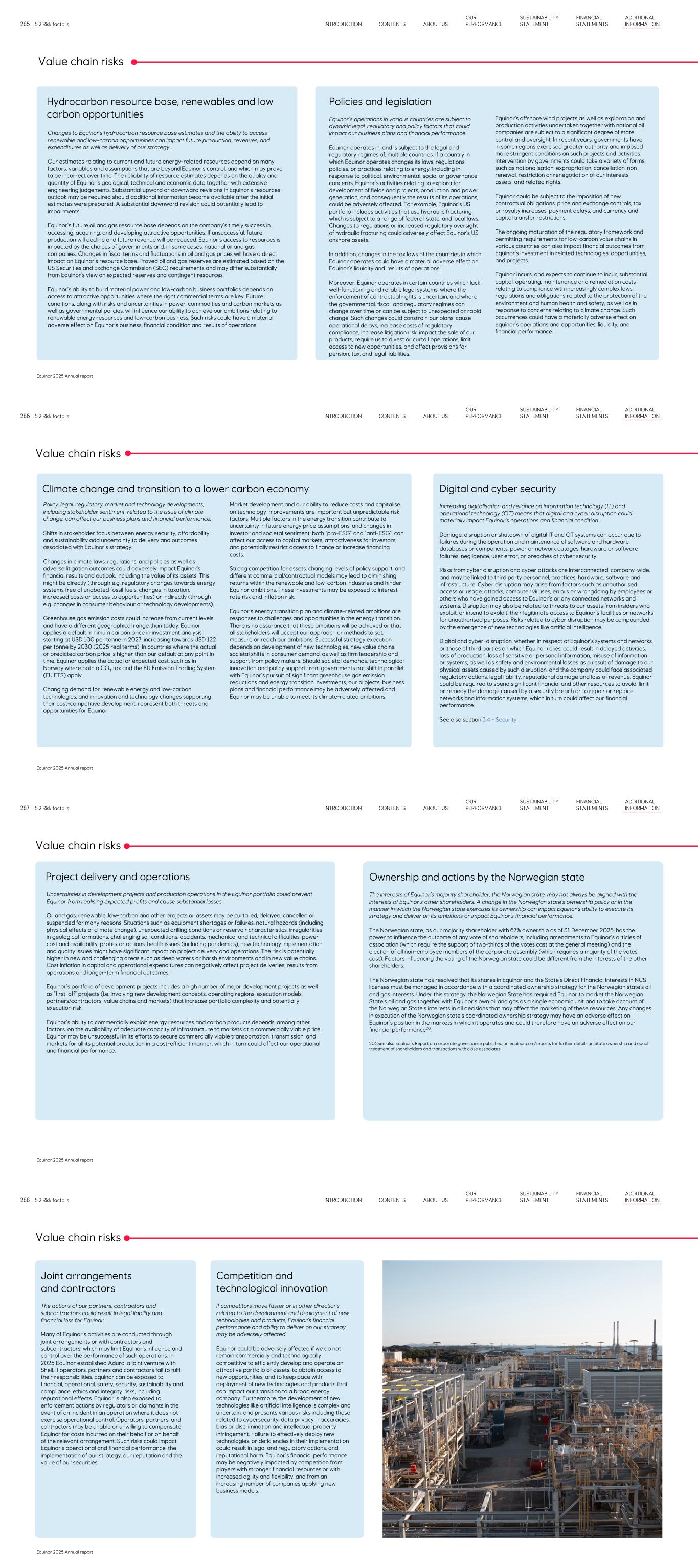
Value chain risks 285 5.2 Risk factors INTRODUCTION CONTENTS ABOUT US OUR PERFORMANCE SUSTAINABILITY STATEMENT FINANCIAL STATEMENTS ADDITIONAL INFORMATION Equinor 2025 Annual report Hydrocarbon resource base, renewables and low carbon opportunities Changes to Equinor’s hydrocarbon resource base estimates and the ability to access renewable and low-carbon opportunities can impact future production, revenues, and expenditures as well as delivery of our strategy. Our estimates relating to current and future energy-related resources depend on many factors, variables and assumptions that are beyond Equinor’s control, and which may prove to be incorrect over time. The reliability of resource estimates depends on the quality and quantity of Equinor’s geological, technical and economic data together with extensive engineering judgements. Substantial upward or downward revisions in Equinor’s resources outlook may be required should additional information become available after the initial estimates were prepared. A substantial downward revision could potentially lead to impairments. Equinor’s future oil and gas resource base depends on the company’s timely success in accessing, acquiring, and developing attractive opportunities. If unsuccessful, future production will decline and future revenue will be reduced. Equinor’s access to resources is impacted by the choices of governments and, in some cases, national oil and gas companies. Changes in fiscal terms and fluctuations in oil and gas prices will have a direct impact on Equinor’s resource base. Proved oil and gas reserves are estimated based on the US Securities and Exchange Commission (SEC) requirements and may differ substantially from Equinor’s view on expected reserves and contingent resources. Equinor’s ability to build material power and low-carbon business portfolios depends on access to attractive opportunities where the right commercial terms are key. Future conditions, along with risks and uncertainties in power, commodities and carbon markets as well as governmental policies, will influence our ability to achieve our ambitions relating to renewable energy resources and low-carbon business. Such risks could have a material adverse effect on Equinor’s business, financial condition and results of operations. Policies and legislation Equinor’s operations in various countries are subject to dynamic legal, regulatory and policy factors that could impact our business plans and financial performance. Equinor operates in, and is subject to the legal and regulatory regimes of, multiple countries. If a country in which Equinor operates changes its laws, regulations, policies, or practices relating to energy, including in response to political, environmental, social or governance concerns, Equinor’s activities relating to exploration, development of fields and projects, production and power generation, and consequently the results of its operations, could be adversely affected. For example, Equinor’s US portfolio includes activities that use hydraulic fracturing, which is subject to a range of federal, state, and local laws. Changes to regulations or increased regulatory oversight of hydraulic fracturing could adversely affect Equinor's US onshore assets. In addition, changes in the tax laws of the countries in which Equinor operates could have a material adverse effect on Equinor’s liquidity and results of operations. Moreover, Equinor operates in certain countries which lack well-functioning and reliable legal systems, where the enforcement of contractual rights is uncertain, and where the governmental, fiscal, and regulatory regimes can change over time or can be subject to unexpected or rapid change. Such changes could constrain our plans, cause operational delays, increase costs of regulatory compliance, increase litigation risk, impact the sale of our products, require us to divest or curtail operations, limit access to new opportunities, and affect provisions for pension, tax, and legal liabilities. Equinor's offshore wind projects as well as exploration and production activities undertaken together with national oil companies are subject to a significant degree of state control and oversight. In recent years, governments have in some regions exercised greater authority and imposed more stringent conditions on such projects and activities. Intervention by governments could take a variety of forms, such as nationalisation, expropriation, cancellation, non- renewal, restriction or renegotiation of our interests, assets, and related rights. Equinor could be subject to the imposition of new contractual obligations, price and exchange controls, tax or royalty increases, payment delays, and currency and capital transfer restrictions. The ongoing maturation of the regulatory framework and permitting requirements for low-carbon value chains in various countries can also impact financial outcomes from Equinor’s investment in related technologies, opportunities, and projects. Equinor incurs, and expects to continue to incur, substantial capital, operating, maintenance and remediation costs relating to compliance with increasingly complex laws, regulations and obligations related to the protection of the environment and human health and safety, as well as in response to concerns relating to climate change. Such occurrences could have a materially adverse effect on Equinor’s operations and opportunities, liquidity, and financial performance. Value chain risks 286 5.2 Risk factors INTRODUCTION CONTENTS ABOUT US OUR PERFORMANCE SUSTAINABILITY STATEMENT FINANCIAL STATEMENTS ADDITIONAL INFORMATION Equinor 2025 Annual report Digital and cyber security Increasing digitalisation and reliance on information technology (IT) and operational technology (OT) means that digital and cyber disruption could materially impact Equinor’s operations and financial condition. Damage, disruption or shutdown of digital IT and OT systems can occur due to failures during the operation and maintenance of software and hardware, databases or components, power or network outages, hardware or software failures, negligence, user error, or breaches of cyber security. Risks from cyber disruption and cyber attacks are interconnected, company-wide, and may be linked to third party personnel, practices, hardware, software and infrastructure. Cyber disruption may arise from factors such as unauthorised access or usage, attacks, computer viruses, errors or wrongdoing by employees or others who have gained access to Equinor’s or any connected networks and systems, Disruption may also be related to threats to our assets from insiders who exploit, or intend to exploit, their legitimate access to Equinor’s facilities or networks for unauthorised purposes. Risks related to cyber disruption may be compounded by the emergence of new technologies like artificial intelligence. Digital and cyber-disruption, whether in respect of Equinor’s systems and networks or those of third parties on which Equinor relies, could result in delayed activities, loss of production, loss of sensitive or personal information, misuse of information or systems, as well as safety and environmental losses as a result of damage to our physical assets caused by such disruption, and the company could face associated regulatory actions, legal liability, reputational damage and loss of revenue. Equinor could be required to spend significant financial and other resources to avoid, limit or remedy the damage caused by a security breach or to repair or replace networks and information systems, which in turn could affect our financial performance. See also section 3.4 - Security Climate change and transition to a lower carbon economy Policy, legal, regulatory, market and technology developments, including stakeholder sentiment, related to the issue of climate change, can affect our business plans and financial performance. Shifts in stakeholder focus between energy security, affordability and sustainability add uncertainty to delivery and outcomes associated with Equinor’s strategy. Changes in climate laws, regulations, and policies as well as adverse litigation outcomes could adversely impact Equinor's financial results and outlook, including the value of its assets. This might be directly (through e.g. regulatory changes towards energy systems free of unabated fossil fuels, changes in taxation, increased costs or access to opportunities) or indirectly (through e.g. changes in consumer behaviour or technology developments). Greenhouse gas emission costs could increase from current levels and have a different geographical range than today. Equinor applies a default minimum carbon price in investment analysis starting at USD 100 per tonne in 2027, increasing towards USD 122 per tonne by 2030 (2025 real terms). In countries where the actual or predicted carbon price is higher than our default at any point in time, Equinor applies the actual or expected cost, such as in Norway where both a CO₂ tax and the EU Emission Trading System (EU ETS) apply. Changing demand for renewable energy and low-carbon technologies, and innovation and technology changes supporting their cost-competitive development, represent both threats and opportunities for Equinor. Market development and our ability to reduce costs and capitalise on technology improvements are important but unpredictable risk factors. Multiple factors in the energy transition contribute to uncertainty in future energy price assumptions, and changes in investor and societal sentiment, both “pro-ESG” and “anti-ESG”, can affect our access to capital markets, attractiveness for investors, and potentially restrict access to finance or increase financing costs. Strong competition for assets, changing levels of policy support, and different commercial/contractual models may lead to diminishing returns within the renewable and low-carbon industries and hinder Equinor ambitions. These investments may be exposed to interest rate risk and inflation risk. Equinor’s energy transition plan and climate-related ambitions are responses to challenges and opportunities in the energy transition. There is no assurance that these ambitions will be achieved or that all stakeholders will accept our approach or methods to set, measure or reach our ambitions. Successful strategy execution depends on development of new technologies, new value chains, societal shifts in consumer demand, as well as firm leadership and support from policy makers. Should societal demands, technological innovation and policy support from governments not shift in parallel with Equinor’s pursuit of significant greenhouse gas emission reductions and energy transition investments, our projects, business plans and financial performance may be adversely affected and Equinor may be unable to meet its climate-related ambitions. Value chain risks 287 5.2 Risk factors INTRODUCTION CONTENTS ABOUT US OUR PERFORMANCE SUSTAINABILITY STATEMENT FINANCIAL STATEMENTS ADDITIONAL INFORMATION Equinor 2025 Annual report Ownership and actions by the Norwegian state The interests of Equinor’s majority shareholder, the Norwegian state, may not always be aligned with the interests of Equinor’s other shareholders. A change in the Norwegian state’s ownership policy or in the manner in which the Norwegian state exercises its ownership can impact Equinor’s ability to execute its strategy and deliver on its ambitions or impact Equinor’s financial performance. The Norwegian state, as our majority shareholder with 67% ownership as of 31 December 2025, has the power to influence the outcome of any vote of shareholders, including amendments to Equinor’s articles of association (which require the support of two-thirds of the votes cast at the general meeting) and the election of all non-employee members of the corporate assembly (which requires a majority of the votes cast). Factors influencing the voting of the Norwegian state could be different from the interests of the other shareholders. The Norwegian state has resolved that its shares in Equinor and the State’s Direct Financial Interests in NCS licenses must be managed in accordance with a coordinated ownership strategy for the Norwegian state’s oil and gas interests. Under this strategy, the Norwegian State has required Equinor to market the Norwegian State’s oil and gas together with Equinor’s own oil and gas as a single economic unit and to take account of the Norwegian State’s interests in all decisions that may affect the marketing of these resources. Any changes in execution of the Norwegian state’s coordinated ownership strategy may have an adverse effect on Equinor’s position in the markets in which it operates and could therefore have an adverse effect on our financial performance20. 20) See also Equinor’s Report on corporate governance published on equinor.com/reports for further details on State ownership and equal treatment of shareholders and transactions with close associates. Project delivery and operations Uncertainties in development projects and production operations in the Equinor portfolio could prevent Equinor from realising expected profits and cause substantial losses. Oil and gas, renewable, low-carbon and other projects or assets may be curtailed, delayed, cancelled or suspended for many reasons. Situations such as equipment shortages or failures, natural hazards (including physical effects of climate change), unexpected drilling conditions or reservoir characteristics, irregularities in geological formations, challenging soil conditions, accidents, mechanical and technical difficulties, power cost and availability, protestor actions, health issues (including pandemics), new technology implementation and quality issues might have significant impact on project delivery and operations. The risk is potentially higher in new and challenging areas such as deep waters or harsh environments and in new value chains. Cost inflation in capital and operational expenditures can negatively affect project deliveries, results from operations and longer-term financial outcomes. Equinor’s portfolio of development projects includes a high number of major development projects as well as “first-off” projects (i.e. involving new development concepts, operating regions, execution models, partners/contractors, value chains and markets) that increase portfolio complexity and potentially execution risk. Equinor’s ability to commercially exploit energy resources and carbon products depends, among other factors, on the availability of adequate capacity of infrastructure to markets at a commercially viable price. Equinor may be unsuccessful in its efforts to secure commercially viable transportation, transmission, and markets for all its potential production in a cost-efficient manner, which in turn could affect our operational and financial performance. Value chain risks 288 5.2 Risk factors INTRODUCTION CONTENTS ABOUT US OUR PERFORMANCE SUSTAINABILITY STATEMENT FINANCIAL STATEMENTS ADDITIONAL INFORMATION Equinor 2025 Annual report Competition and technological innovation If competitors move faster or in other directions related to the development and deployment of new technologies and products, Equinor’s financial performance and ability to deliver on our strategy may be adversely affected. Equinor could be adversely affected if we do not remain commercially and technologically competitive to efficiently develop and operate an attractive portfolio of assets, to obtain access to new opportunities, and to keep pace with deployment of new technologies and products that can impact our transition to a broad energy company. Furthermore, the development of new technologies like artificial intelligence is complex and uncertain, and presents various risks including those related to cybersecurity, data privacy, inaccuracies, bias or discrimination and intellectual property infringement. Failure to effectively deploy new technologies, or deficiencies in their implementation could result in legal and regulatory actions, and reputational harm. Equinor’s financial performance may be negatively impacted by competition from players with stronger financial resources or with increased agility and flexibility, and from an increasing number of companies applying new business models. Joint arrangements and contractors The actions of our partners, contractors and subcontractors could result in legal liability and financial loss for Equinor. Many of Equinor’s activities are conducted through joint arrangements or with contractors and subcontractors, which may limit Equinor’s influence and control over the performance of such operations. In 2025 Equinor established Adura, a joint venture with Shell. If operators, partners and contractors fail to fulfil their responsibilities, Equinor can be exposed to financial, operational, safety, security, sustainability and compliance, ethics and integrity risks, including reputational effects. Equinor is also exposed to enforcement actions by regulators or claimants in the event of an incident in an operation where it does not exercise operational control. Operators, partners, and contractors may be unable or unwilling to compensate Equinor for costs incurred on their behalf or on behalf of the relevant arrangement. Such risks could impact Equinor’s operational and financial performance, the implementation of our strategy, our reputation and the value of our securities.
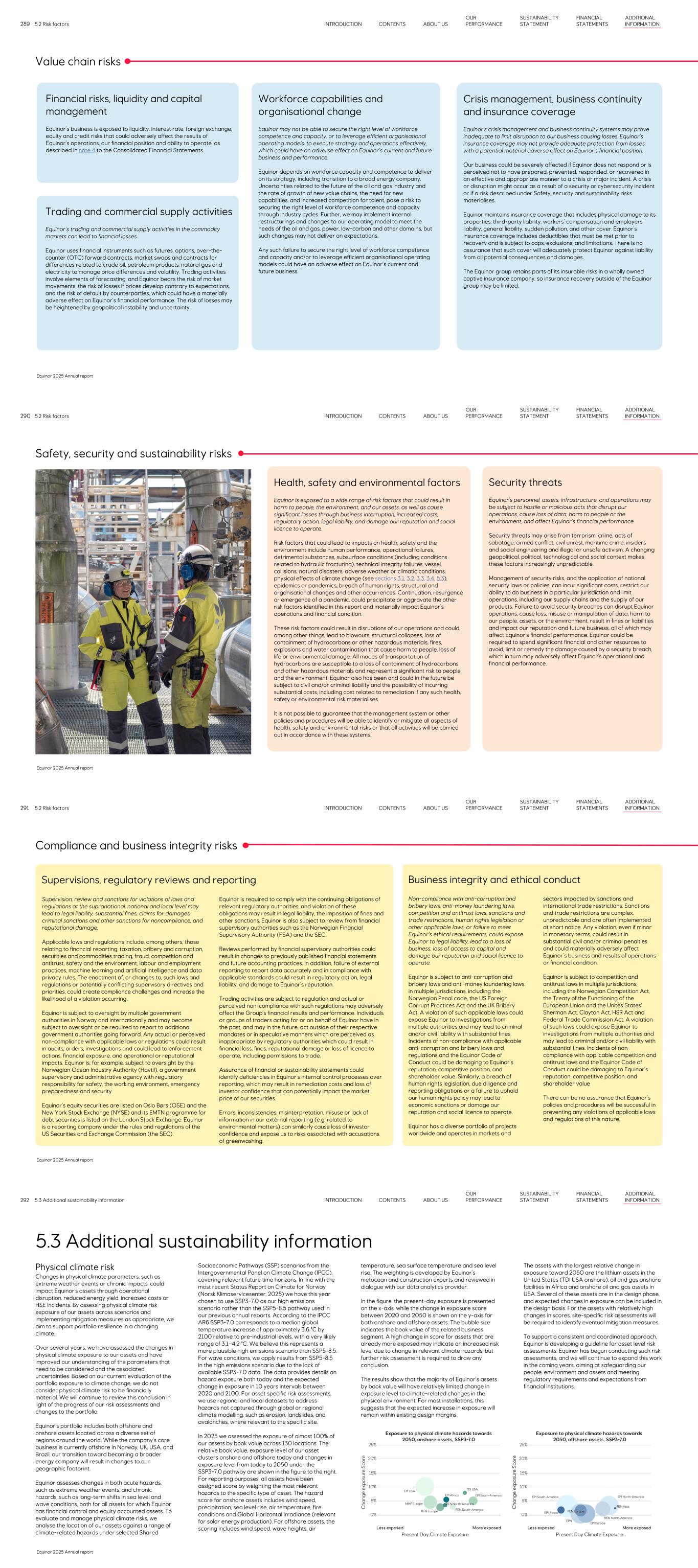
Value chain risks 289 5.2 Risk factors INTRODUCTION CONTENTS ABOUT US OUR PERFORMANCE SUSTAINABILITY STATEMENT FINANCIAL STATEMENTS ADDITIONAL INFORMATION Equinor 2025 Annual report Trading and commercial supply activities Equinor’s trading and commercial supply activities in the commodity markets can lead to financial losses. Equinor uses financial instruments such as futures, options, over-the- counter (OTC) forward contracts, market swaps and contracts for differences related to crude oil, petroleum products, natural gas and electricity to manage price differences and volatility. Trading activities involve elements of forecasting, and Equinor bears the risk of market movements, the risk of losses if prices develop contrary to expectations, and the risk of default by counterparties, which could have a materially adverse effect on Equinor’s financial performance. The risk of losses may be heightened by geopolitical instability and uncertainty. Workforce capabilities and organisational change Equinor may not be able to secure the right level of workforce competence and capacity, or to leverage efficient organisational operating models, to execute strategy and operations effectively, which could have an adverse effect on Equinor’s current and future business and performance. Equinor depends on workforce capacity and competence to deliver on its strategy, including transition to a broad energy company. Uncertainties related to the future of the oil and gas industry and the rate of growth of new value chains, the need for new capabilities, and increased competition for talent, pose a risk to securing the right level of workforce competence and capacity through industry cycles. Further, we may implement internal restructurings and changes to our operating model to meet the needs of the oil and gas, power, low-carbon and other domains, but such changes may not deliver on expectations. Any such failure to secure the right level of workforce competence and capacity and/or to leverage efficient organisational operating models could have an adverse effect on Equinor’s current and future business. Crisis management, business continuity and insurance coverage Equinor's crisis management and business continuity systems may prove inadequate to limit disruption to our business causing losses. Equinor’s insurance coverage may not provide adequate protection from losses, with a potential material adverse effect on Equinor’s financial position. Our business could be severely affected if Equinor does not respond or is perceived not to have prepared, prevented, responded, or recovered in an effective and appropriate manner to a crisis or major incident. A crisis or disruption might occur as a result of a security or cybersecurity incident or if a risk described under Safety, security and sustainability risks materialises. Equinor maintains insurance coverage that includes physical damage to its properties, third-party liability, workers’ compensation and employers’ liability, general liability, sudden pollution, and other cover. Equinor’s insurance coverage includes deductibles that must be met prior to recovery and is subject to caps, exclusions, and limitations. There is no assurance that such cover will adequately protect Equinor against liability from all potential consequences and damages. The Equinor group retains parts of its insurable risks in a wholly owned captive insurance company, so insurance recovery outside of the Equinor group may be limited. Financial risks, liquidity and capital management Equinor’s business is exposed to liquidity, interest rate, foreign exchange, equity and credit risks that could adversely affect the results of Equinor’s operations, our financial position and ability to operate, as described in note 4 to the Consolidated Financial Statements. Safety, security and sustainability risks 290 5.2 Risk factors INTRODUCTION CONTENTS ABOUT US OUR PERFORMANCE SUSTAINABILITY STATEMENT FINANCIAL STATEMENTS ADDITIONAL INFORMATION Equinor 2025 Annual report Health, safety and environmental factors Equinor is exposed to a wide range of risk factors that could result in harm to people, the environment, and our assets, as well as cause significant losses through business interruption, increased costs, regulatory action, legal liability, and damage our reputation and social licence to operate. Risk factors that could lead to impacts on health, safety and the environment include human performance, operational failures, detrimental substances, subsurface conditions (including conditions related to hydraulic fracturing), technical integrity failures, vessel collisions, natural disasters, adverse weather or climatic conditions, physical effects of climate change (see sections 3.1, 3.2, 3.3, 3.4, 5.3), epidemics or pandemics, breach of human rights, structural and organisational changes and other occurrences. Continuation, resurgence or emergence of a pandemic, could precipitate or aggravate the other risk factors identified in this report and materially impact Equinor’s operations and financial condition. These risk factors could result in disruptions of our operations and could, among other things, lead to blowouts, structural collapses, loss of containment of hydrocarbons or other hazardous materials, fires, explosions and water contamination that cause harm to people, loss of life or environmental damage. All modes of transportation of hydrocarbons are susceptible to a loss of containment of hydrocarbons and other hazardous materials and represent a significant risk to people and the environment. Equinor also has been and could in the future be subject to civil and/or criminal liability and the possibility of incurring substantial costs, including cost related to remediation if any such health, safety or environmental risk materialises. It is not possible to guarantee that the management system or other policies and procedures will be able to identify or mitigate all aspects of health, safety and environmental risks or that all activities will be carried out in accordance with these systems. Security threats Equinor’s personnel, assets, infrastructure, and operations may be subject to hostile or malicious acts that disrupt our operations, cause loss of data, harm to people or the environment, and affect Equinor’s financial performance. Security threats may arise from terrorism, crime, acts of sabotage, armed conflict, civil unrest, maritime crime, insiders and social engineering and illegal or unsafe activism. A changing geopolitical, political, technological and social context makes these factors increasingly unpredictable. Management of security risks, and the application of national security laws or policies, can incur significant costs, restrict our ability to do business in a particular jurisdiction and limit operations, including our supply chains and the supply of our products. Failure to avoid security breaches can disrupt Equinor operations, cause loss, misuse or manipulation of data, harm to our people, assets, or the environment, result in fines or liabilities and impact our reputation and future business, all of which may affect Equinor’s financial performance. Equinor could be required to spend significant financial and other resources to avoid, limit or remedy the damage caused by a security breach, which in turn may adversely affect Equinor’s operational and financial performance. Compliance and business integrity risks 291 5.2 Risk factors INTRODUCTION CONTENTS ABOUT US OUR PERFORMANCE SUSTAINABILITY STATEMENT FINANCIAL STATEMENTS ADDITIONAL INFORMATION Equinor 2025 Annual report Supervisions, regulatory reviews and reporting Supervision, review and sanctions for violations of laws and regulations at the supranational, national and local level may lead to legal liability, substantial fines, claims for damages, criminal sanctions and other sanctions for noncompliance, and reputational damage. Applicable laws and regulations include, among others, those relating to financial reporting, taxation, bribery and corruption, securities and commodities trading, fraud, competition and antitrust, safety and the environment, labour and employment practices, machine learning and artificial intelligence and data privacy rules. The enactment of, or changes to, such laws and regulations or potentially conflicting supervisory directives and priorities, could create compliance challenges and increase the likelihood of a violation occurring. Equinor is subject to oversight by multiple government authorities in Norway and internationally and may become subject to oversight or be required to report to additional government authorities going forward. Any actual or perceived non-compliance with applicable laws or regulations could result in audits, orders, investigations and could lead to enforcement actions, financial exposure, and operational or reputational impacts. Equinor is, for example, subject to oversight by the Norwegian Ocean Industry Authority (Havtil), a government supervisory and administrative agency with regulatory responsibility for safety, the working environment, emergency preparedness and security Equinor’s equity securities are listed on Oslo Børs (OSE) and the New York Stock Exchange (NYSE) and its EMTN programme for debt securities is listed on the London Stock Exchange. Equinor is a reporting company under the rules and regulations of the US Securities and Exchange Commission (the SEC). Equinor is required to comply with the continuing obligations of relevant regulatory authorities, and violation of these obligations may result in legal liability, the imposition of fines and other sanctions. Equinor is also subject to review from financial supervisory authorities such as the Norwegian Financial Supervisory Authority (FSA) and the SEC. Reviews performed by financial supervisory authorities could result in changes to previously published financial statements and future accounting practices. In addition, failure of external reporting to report data accurately and in compliance with applicable standards could result in regulatory action, legal liability, and damage to Equinor’s reputation. Trading activities are subject to regulation and actual or perceived non-compliance with such regulations may adversely affect the Group’s financial results and performance. Individuals or groups of traders acting for or on behalf of Equinor have in the past, and may in the future, act outside of their respective mandates or in speculative manners which are perceived as inappropriate by regulatory authorities which could result in financial loss, fines, reputational damage or loss of licence to operate, including permissions to trade. Assurance of financial or sustainability statements could identify deficiencies in Equinor’s internal control processes over reporting, which may result in remediation costs and loss of investor confidence that can potentially impact the market price of our securities. Errors, inconsistencies, misinterpretation, misuse or lack of information in our external reporting (e.g. related to environmental matters) can similarly cause loss of investor confidence and expose us to risks associated with accusations of greenwashing. Business integrity and ethical conduct Non-compliance with anti-corruption and bribery laws, anti-money laundering laws, competition and antitrust laws, sanctions and trade restrictions, human rights legislation or other applicable laws, or failure to meet Equinor’s ethical requirements, could expose Equinor to legal liability, lead to a loss of business, loss of access to capital and damage our reputation and social licence to operate. Equinor is subject to anti-corruption and bribery laws and anti-money laundering laws in multiple jurisdictions, including the Norwegian Penal code, the US Foreign Corrupt Practices Act and the UK Bribery Act. A violation of such applicable laws could expose Equinor to investigations from multiple authorities and may lead to criminal and/or civil liability with substantial fines. Incidents of non-compliance with applicable anti-corruption and bribery laws and regulations and the Equinor Code of Conduct could be damaging to Equinor’s reputation, competitive position, and shareholder value. Similarly, a breach of human rights legislation, due diligence and reporting obligations or a failure to uphold our human rights policy may lead to economic sanctions or damage our reputation and social licence to operate. Equinor has a diverse portfolio of projects worldwide and operates in markets and sectors impacted by sanctions and international trade restrictions. Sanctions and trade restrictions are complex, unpredictable and are often implemented at short notice. Any violation, even if minor in monetary terms, could result in substantial civil and/or criminal penalties and could materially adversely affect Equinor’s business and results of operations or financial condition. Equinor is subject to competition and antitrust laws in multiple jurisdictions, including the Norwegian Competition Act, the Treaty of the Functioning of the European Union and the Unites States’ Sherman Act, Clayton Act, HSR Act and Federal Trade Commission Act. A violation of such laws could expose Equinor to investigations from multiple authorities and may lead to criminal and/or civil liability with substantial fines. Incidents of non- compliance with applicable competition and antitrust laws and the Equinor Code of Conduct could be damaging to Equinor’s reputation, competitive position, and shareholder value There can be no assurance that Equinor’s policies and procedures will be successful in preventing any violations of applicable laws and regulations of this nature. 5.3 Additional sustainability information Physical climate risk Changes in physical climate parameters, such as extreme weather events or chronic impacts, could impact Equinor's assets through operational disruption, reduced energy yield, increased costs or HSE incidents. By assessing physical climate risk exposure of our assets across scenarios and implementing mitigation measures as appropriate, we aim to support portfolio resilience in a changing climate. Over several years, we have assessed the changes in physical climate exposure to our assets and have improved our understanding of the parameters that need to be considered and the associated uncertainties. Based on our current evaluation of the portfolio exposure to climate change, we do not consider physical climate risk to be financially material. We will continue to review this conclusion in light of the progress of our risk assessments and changes to the portfolio. Equinor’s portfolio includes both offshore and onshore assets located across a diverse set of regions around the world. While the company’s core business is currently offshore in Norway, UK, USA, and Brazil, our transition toward becoming a broader energy company will result in changes to our geographic footprint. Equinor assesses changes in both acute hazards, such as extreme weather events, and chronic hazards, such as long-term shifts in sea level and wave conditions, both for all assets for which Equinor has financial control and equity accounted assets. To evaluate and manage physical climate risks, we analyse the location of our assets against a range of climate-related hazards under selected Shared Socioeconomic Pathways (SSP) scenarios from the Intergovernmental Panel on Climate Change (IPCC), covering relevant future time horizons. In line with the most recent Status Report on Climate for Norway (Norsk Klimaservicesenter, 2025) we have this year chosen to use SSP3-7.0 as our high emissions scenario rather than the SSP5-8.5 pathway used in our previous annual reports. According to the IPCC AR6 SSP3-7.0 corresponds to a median global temperature increase of approximately 3.6 °C by 2100 relative to pre-industrial levels, with a very likely range of 3.1–4.2 °C. We believe this represents a more plausible high emissions scenario than SSP5-8.5. For wave conditions, we apply results from SSP5-8.5 in the high emissions scenario due to the lack of available SSP3-7.0 data. The data provides details on hazard exposure both today and the expected change in exposure in 10 years intervals between 2020 and 2100. For asset specific risk assessments, we use regional and local datasets to address hazards not captured through global or regional climate modelling, such as erosion, landslides, and avalanches, where relevant to the specific site. In 2025 we assessed the exposure of almost 100% of our assets by book value across 130 locations. The relative book value, exposure level of our asset clusters onshore and offshore today and changes in exposure level from today to 2050 under the SSP3-7.0 pathway are shown in the figure to the right. For reporting purposes, all assets have been assigned score by weighting the most relevant hazards to the specific type of asset. The hazard score for onshore assets includes wind speed, precipitation, sea level rise, air temperature, fire conditions and Global Horizontal Irradiance (relevant for solar energy production). For offshore assets, the scoring includes wind speed, wave heights, air temperature, sea surface temperature and sea level rise. The weighting is developed by Equinor’s metocean and construction experts and reviewed in dialogue with our data analytics provider. In the figure, the present-day exposure is presented on the x-axis, while the change in exposure score between 2020 and 2050 is shown on the y-axis for both onshore and offshore assets. The bubble size indicates the book value of the related business segment. A high change in score for assets that are already more exposed may indicate an increased risk level due to change in relevant climate hazards, but further risk assessment is required to draw any conclusion. The results show that the majority of Equinor’s assets by book value will have relatively limited change in exposure level to climate-related changes in the physical environment. For most installations, this suggests that the expected increase in exposure will remain within existing design margins. The assets with the largest relative change in exposure toward 2050 are the lithium assets in the United States (TDI USA onshore), oil and gas onshore facilities in Africa and onshore oil and gas assets in USA. Several of these assets are in the design phase, and expected changes in exposure can be included in the design basis. For the assets with relatively high changes in scores, site-specific risk assessments will be required to identify eventual mitigation measures. To support a consistent and coordinated approach, Equinor is developing a guideline for asset level risk assessments. Equinor has begun conducting such risk assessments, and we will continue to expand this work in the coming years, aiming at safeguarding our people, environment and assets and meeting regulatory requirements and expectations from financial institutions. 292 5.3 Additional sustainability information INTRODUCTION CONTENTS ABOUT US OUR PERFORMANCE SUSTAINABILITY STATEMENT FINANCIAL STATEMENTS ADDITIONAL INFORMATION Equinor 2025 Annual report
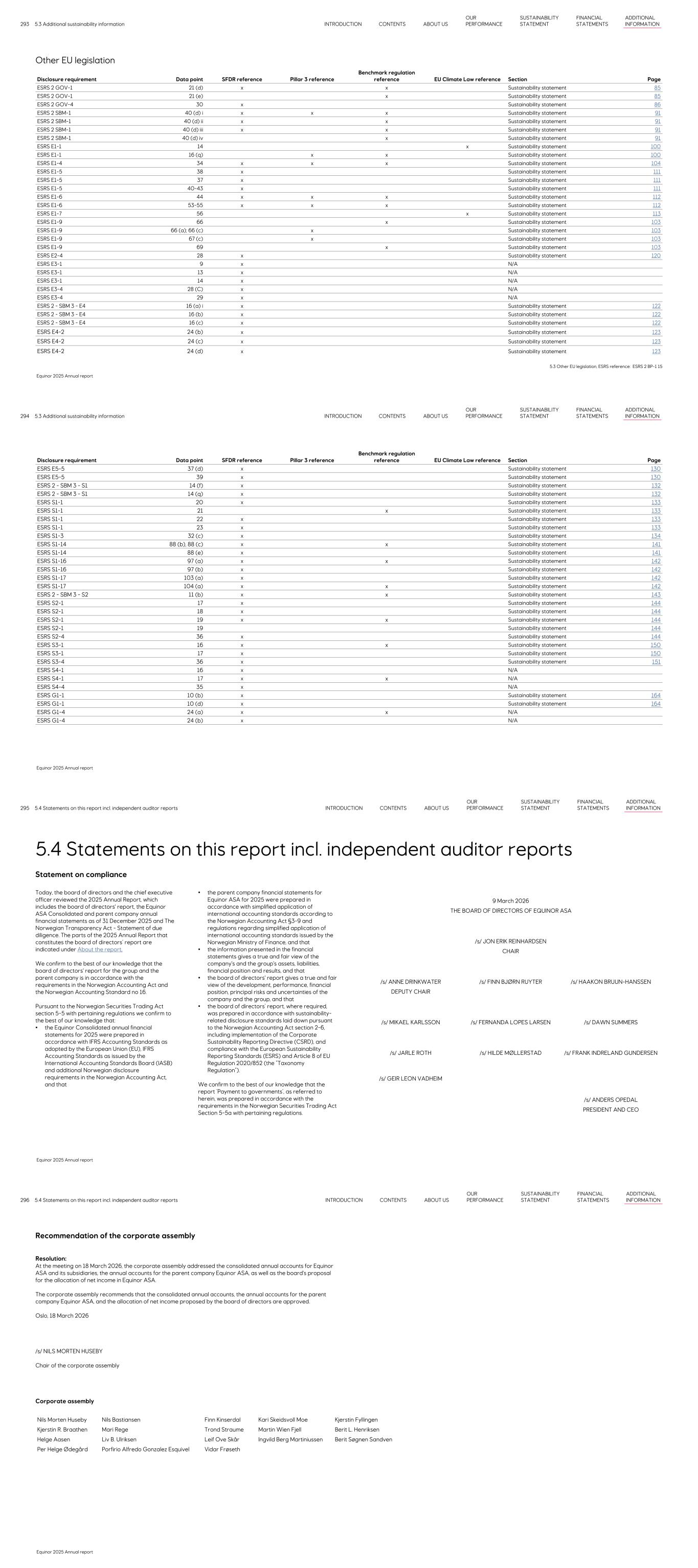
Other EU legislation ESRS 2 GOV-1 21 (d) x x Sustainability statement 85 ESRS 2 GOV-1 21 (e) x Sustainability statement 85 ESRS 2 GOV-4 30 x Sustainability statement 86 ESRS 2 SBM-1 40 (d) i x x x Sustainability statement 91 ESRS 2 SBM-1 40 (d) ii x x Sustainability statement 91 ESRS 2 SBM-1 40 (d) iii x x Sustainability statement 91 ESRS 2 SBM-1 40 (d) iv x Sustainability statement 91 ESRS E1-1 14 x Sustainability statement 100 ESRS E1-1 16 (q) x x Sustainability statement 100 ESRS E1-4 34 x x x Sustainability statement 104 ESRS E1-5 38 x Sustainability statement 111 ESRS E1-5 37 x Sustainability statement 111 ESRS E1-5 40-43 x Sustainability statement 111 ESRS E1-6 44 x x x Sustainability statement 112 ESRS E1-6 53-55 x x x Sustainability statement 112 ESRS E1-7 56 x Sustainability statement 113 ESRS E1-9 66 x Sustainability statement 103 ESRS E1-9 66 (a); 66 (c) x Sustainability statement 103 ESRS E1-9 67 (c) x Sustainability statement 103 ESRS E1-9 69 x Sustainability statement 103 ESRS E2-4 28 x Sustainability statement 120 ESRS E3-1 9 x N/A ESRS E3-1 13 x N/A ESRS E3-1 14 x N/A ESRS E3-4 28 (C) x N/A ESRS E3-4 29 x N/A ESRS 2 - SBM 3 - E4 16 (a) i x Sustainability statement 122 ESRS 2 - SBM 3 - E4 16 (b) x Sustainability statement 122 ESRS 2 - SBM 3 - E4 16 (c) x Sustainability statement 122 ESRS E4-2 24 (b) x Sustainability statement 123 ESRS E4-2 24 (c) x Sustainability statement 123 ESRS E4-2 24 (d) x Sustainability statement 123 Disclosure requirement Data point SFDR reference Pillar 3 reference Benchmark regulation reference EU Climate Law reference Section Page 293 5.3 Additional sustainability information INTRODUCTION CONTENTS ABOUT US OUR PERFORMANCE SUSTAINABILITY STATEMENT FINANCIAL STATEMENTS ADDITIONAL INFORMATION Equinor 2025 Annual report 5.3 Other EU legislation, ESRS reference: ESRS 2 BP-1 15 ESRS E5-5 37 (d) x Sustainability statement 130 ESRS E5-5 39 x Sustainability statement 130 ESRS 2 - SBM 3 - S1 14 (f) x Sustainability statement 132 ESRS 2 - SBM 3 - S1 14 (q) x Sustainability statement 132 ESRS S1-1 20 x Sustainability statement 133 ESRS S1-1 21 x Sustainability statement 133 ESRS S1-1 22 x Sustainability statement 133 ESRS S1-1 23 x Sustainability statement 133 ESRS S1-3 32 (c) x Sustainability statement 134 ESRS S1-14 88 (b), 88 (c) x x Sustainability statement 141 ESRS S1-14 88 (e) x Sustainability statement 141 ESRS S1-16 97 (a) x x Sustainability statement 142 ESRS S1-16 97 (b) x Sustainability statement 142 ESRS S1-17 103 (a) x Sustainability statement 142 ESRS S1-17 104 (a) x x Sustainability statement 142 ESRS 2 - SBM 3 - S2 11 (b) x x Sustainability statement 143 ESRS S2-1 17 x Sustainability statement 144 ESRS S2-1 18 x Sustainability statement 144 ESRS S2-1 19 x x Sustainability statement 144 ESRS S2-1 19 Sustainability statement 144 ESRS S2-4 36 x Sustainability statement 144 ESRS S3-1 16 x x Sustainability statement 150 ESRS S3-1 17 x Sustainability statement 150 ESRS S3-4 36 x Sustainability statement 151 ESRS S4-1 16 x N/A ESRS S4-1 17 x x N/A ESRS S4-4 35 x N/A ESRS G1-1 10 (b) x Sustainability statement 164 ESRS G1-1 10 (d) x Sustainability statement 164 ESRS G1-4 24 (a) x x N/A ESRS G1-4 24 (b) x N/A Disclosure requirement Data point SFDR reference Pillar 3 reference Benchmark regulation reference EU Climate Law reference Section Page 294 5.3 Additional sustainability information INTRODUCTION CONTENTS ABOUT US OUR PERFORMANCE SUSTAINABILITY STATEMENT FINANCIAL STATEMENTS ADDITIONAL INFORMATION Equinor 2025 Annual report 5.4 Statements on this report incl. independent auditor reports Statement on compliance Today, the board of directors and the chief executive officer reviewed the 2025 Annual Report, which includes the board of directors' report, the Equinor ASA Consolidated and parent company annual financial statements as of 31 December 2025 and The Norwegian Transparency Act - Statement of due diligence. The parts of the 2025 Annual Report that constitutes the board of directors’ report are indicated under About the report. We confirm to the best of our knowledge that the board of directors' report for the group and the parent company is in accordance with the requirements in the Norwegian Accounting Act and the Norwegian Accounting Standard no 16. Pursuant to the Norwegian Securities Trading Act section 5-5 with pertaining regulations we confirm to the best of our knowledge that: • the Equinor Consolidated annual financial statements for 2025 were prepared in accordance with IFRS Accounting Standards as adopted by the European Union (EU), IFRS Accounting Standards as issued by the International Accounting Standards Board (IASB) and additional Norwegian disclosure requirements in the Norwegian Accounting Act, and that • the parent company financial statements for Equinor ASA for 2025 were prepared in accordance with simplified application of international accounting standards according to the Norwegian Accounting Act §3-9 and regulations regarding simplified application of international accounting standards issued by the Norwegian Ministry of Finance, and that • the information presented in the financial statements gives a true and fair view of the company's and the group's assets, liabilities, financial position and results, and that • the board of directors' report gives a true and fair view of the development, performance, financial position, principal risks and uncertainties of the company and the group, and that • the board of directors’ report, where required, was prepared in accordance with sustainability- related disclosure standards laid down pursuant to the Norwegian Accounting Act section 2-6, including implementation of the Corporate Sustainability Reporting Directive (CSRD), and compliance with the European Sustainability Reporting Standards (ESRS) and Article 8 of EU Regulation 2020/852 (the “Taxonomy Regulation”). We confirm to the best of our knowledge that the report ‘Payment to governments’, as referred to herein, was prepared in accordance with the requirements in the Norwegian Securities Trading Act Section 5-5a with pertaining regulations. 295 5.4 Statements on this report incl. independent auditor reports INTRODUCTION CONTENTS ABOUT US OUR PERFORMANCE SUSTAINABILITY STATEMENT FINANCIAL STATEMENTS ADDITIONAL INFORMATION Equinor 2025 Annual report 9 March 2026 THE BOARD OF DIRECTORS OF EQUINOR ASA /s/ JON ERIK REINHARDSEN CHAIR /s/ ANNE DRINKWATER /s/ FINN BJØRN RUYTER /s/ HAAKON BRUUN-HANSSEN DEPUTY CHAIR /s/ MIKAEL KARLSSON /s/ FERNANDA LOPES LARSEN /s/ DAWN SUMMERS /s/ JARLE ROTH /s/ HILDE MØLLERSTAD /s/ FRANK INDRELAND GUNDERSEN /s/ GEIR LEON VADHEIM /s/ ANDERS OPEDAL PRESIDENT AND CEO Recommendation of the corporate assembly Resolution: At the meeting on 18 March 2026, the corporate assembly addressed the consolidated annual accounts for Equinor ASA and its subsidiaries, the annual accounts for the parent company Equinor ASA, as well as the board's proposal for the allocation of net income in Equinor ASA. The corporate assembly recommends that the consolidated annual accounts, the annual accounts for the parent company Equinor ASA, and the allocation of net income proposed by the board of directors are approved. Oslo, 18 March 2026 /s/ NILS MORTEN HUSEBY Chair of the corporate assembly Corporate assembly 296 5.4 Statements on this report incl. independent auditor reports INTRODUCTION CONTENTS ABOUT US OUR PERFORMANCE SUSTAINABILITY STATEMENT FINANCIAL STATEMENTS ADDITIONAL INFORMATION Equinor 2025 Annual report Nils Morten Huseby Nils Bastiansen Finn Kinserdal Kari Skeidsvoll Moe Kjerstin Fyllingen Kjerstin R. Braathen Mari Rege Trond Straume Martin Wien Fjell Berit L. Henriksen Helge Aasen Liv B. Ulriksen Leif Ove Skår Ingvild Berg Martiniussen Berit Søgnen Sandven Per Helge Ødegård Porfirio Alfredo Gonzalez Esquivel Vidar Frøseth
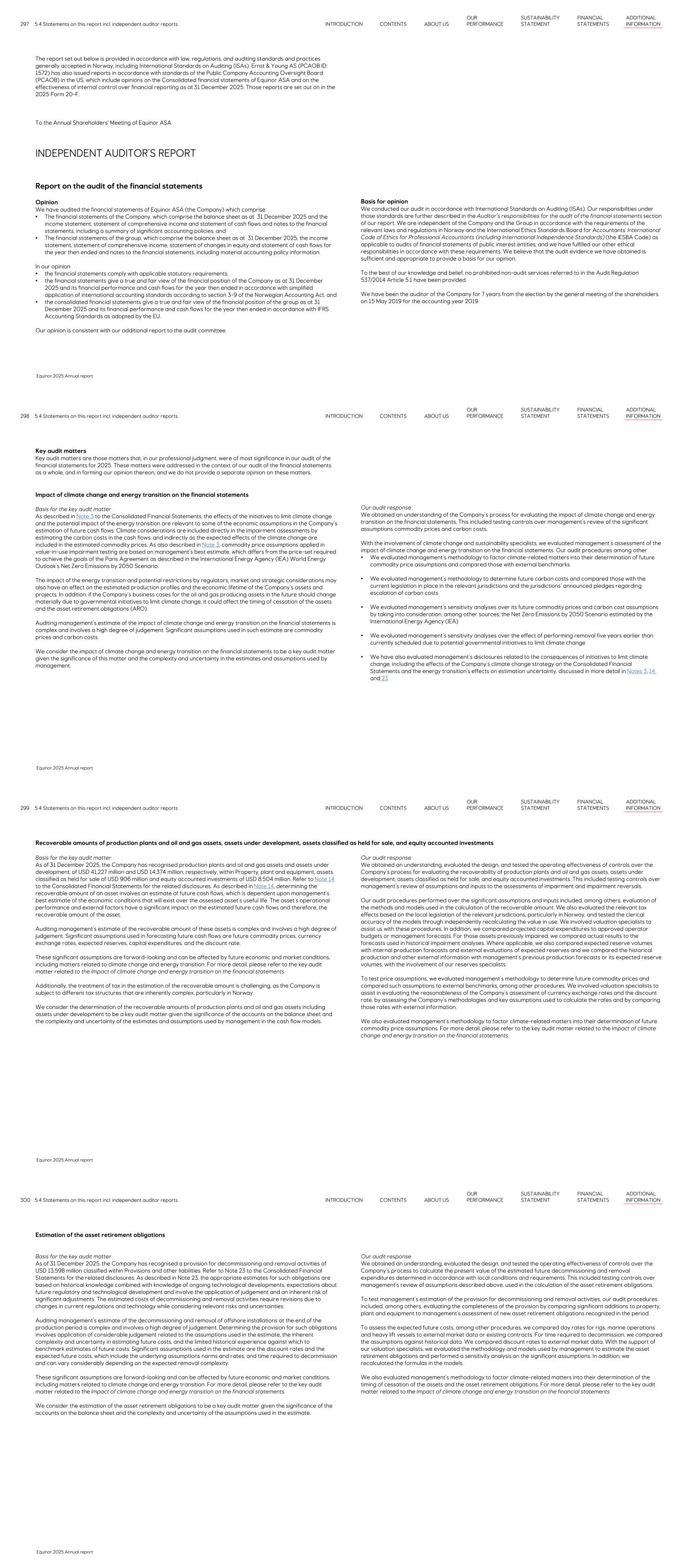
The report set out below is provided in accordance with law, regulations, and auditing standards and practices generally accepted in Norway, including International Standards on Auditing (ISAs). Ernst & Young AS (PCAOB ID: 1572) has also issued reports in accordance with standards of the Public Company Accounting Oversight Board (PCAOB) in the US, which include opinions on the Consolidated financial statements of Equinor ASA and on the effectiveness of internal control over financial reporting as at 31 December 2025. Those reports are set out on in the 2025 Form 20-F. To the Annual Shareholders' Meeting of Equinor ASA INDEPENDENT AUDITOR’S REPORT Report on the audit of the financial statements Opinion We have audited the financial statements of Equinor ASA (the Company) which comprise: • The financial statements of the Company, which comprise the balance sheet as at 31 December 2025 and the income statement, statement of comprehensive income and statement of cash flows and notes to the financial statements, including a summary of significant accounting policies, and • The financial statements of the group, which comprise the balance sheet as at 31 December 2025, the income statement, statement of comprehensive income, statement of changes in equity and statement of cash flows for the year then ended and notes to the financial statements, including material accounting policy information. In our opinion • the financial statements comply with applicable statutory requirements, • the financial statements give a true and fair view of the financial position of the Company as at 31 December 2025 and its financial performance and cash flows for the year then ended in accordance with simplified application of international accounting standards according to section 3-9 of the Norwegian Accounting Act, and • the consolidated financial statements give a true and fair view of the financial position of the group as at 31 December 2025 and its financial performance and cash flows for the year then ended in accordance with IFRS Accounting Standards as adopted by the EU. Our opinion is consistent with our additional report to the audit committee. Basis for opinion We conducted our audit in accordance with International Standards on Auditing (ISAs). Our responsibilities under those standards are further described in the Auditor’s responsibilities for the audit of the financial statements section of our report. We are independent of the Company and the Group in accordance with the requirements of the relevant laws and regulations in Norway and the International Ethics Standards Board for Accountants’ International Code of Ethics for Professional Accountants (including International Independence Standards) (the IESBA Code) as applicable to audits of financial statements of public interest entities, and we have fulfilled our other ethical responsibilities in accordance with these requirements. We believe that the audit evidence we have obtained is sufficient and appropriate to provide a basis for our opinion. To the best of our knowledge and belief, no prohibited non-audit services referred to in the Audit Regulation 537/2014 Article 5.1 have been provided. We have been the auditor of the Company for 7 years from the election by the general meeting of the shareholders on 15 May 2019 for the accounting year 2019. 297 5.4 Statements on this report incl. independent auditor reports INTRODUCTION CONTENTS ABOUT US OUR PERFORMANCE SUSTAINABILITY STATEMENT FINANCIAL STATEMENTS ADDITIONAL INFORMATION Equinor 2025 Annual report Key audit matters Key audit matters are those matters that, in our professional judgment, were of most significance in our audit of the financial statements for 2025. These matters were addressed in the context of our audit of the financial statements as a whole, and in forming our opinion thereon, and we do not provide a separate opinion on these matters. Impact of climate change and energy transition on the financial statements Basis for the key audit matter As described in Note 3 to the Consolidated Financial Statements, the effects of the initiatives to limit climate change and the potential impact of the energy transition are relevant to some of the economic assumptions in the Company’s estimation of future cash flows. Climate considerations are included directly in the impairment assessments by estimating the carbon costs in the cash flows, and indirectly as the expected effects of the climate change are included in the estimated commodity prices. As also described in Note 3, commodity price assumptions applied in value-in-use impairment testing are based on management’s best estimate, which differs from the price-set required to achieve the goals of the Paris Agreement as described in the International Energy Agency (IEA) World Energy Outlook’s Net Zero Emissions by 2050 Scenario. The impact of the energy transition and potential restrictions by regulators, market and strategic considerations may also have an effect on the estimated production profiles and the economic lifetime of the Company’s assets and projects. In addition, if the Company’s business cases for the oil and gas producing assets in the future should change materially due to governmental initiatives to limit climate change, it could affect the timing of cessation of the assets and the asset retirement obligations (ARO). Auditing management’s estimate of the impact of climate change and energy transition on the financial statements is complex and involves a high degree of judgement. Significant assumptions used in such estimate are commodity prices and carbon costs. We consider the impact of climate change and energy transition on the financial statements to be a key audit matter given the significance of this matter and the complexity and uncertainty in the estimates and assumptions used by management. Our audit response We obtained an understanding of the Company’s process for evaluating the impact of climate change and energy transition on the financial statements. This included testing controls over management’s review of the significant assumptions commodity prices and carbon costs. With the involvement of climate change and sustainability specialists, we evaluated management’s assessment of the impact of climate change and energy transition on the financial statements. Our audit procedures among other • We evaluated management’s methodology to factor climate-related matters into their determination of future commodity price assumptions and compared those with external benchmarks • We evaluated management’s methodology to determine future carbon costs and compared those with the current legislation in place in the relevant jurisdictions and the jurisdictions’ announced pledges regarding escalation of carbon costs • We evaluated management’s sensitivity analyses over its future commodity prices and carbon cost assumptions by taking into consideration, among other sources, the Net Zero Emissions by 2050 Scenario estimated by the International Energy Agency (IEA) • We evaluated management’s sensitivity analyses over the effect of performing removal five years earlier than currently scheduled due to potential governmental initiatives to limit climate change • We have also evaluated management’s disclosures related to the consequences of initiatives to limit climate change, including the effects of the Company’s climate change strategy on the Consolidated Financial Statements and the energy transition’s effects on estimation uncertainty, discussed in more detail in Notes 3, 14 and 23. 298 5.4 Statements on this report incl. independent auditor reports INTRODUCTION CONTENTS ABOUT US OUR PERFORMANCE SUSTAINABILITY STATEMENT FINANCIAL STATEMENTS ADDITIONAL INFORMATION Equinor 2025 Annual report Recoverable amounts of production plants and oil and gas assets, assets under development, assets classified as held for sale, and equity accounted investments Basis for the key audit matter As of 31 December 2025, the Company has recognised production plants and oil and gas assets and assets under development, of USD 41,227 million and USD 14,374 million, respectively, within Property, plant and equipment, assets classified as held for sale of USD 906 million and equity accounted investments of USD 8,504 million. Refer to Note 14 to the Consolidated Financial Statements for the related disclosures. As described in Note 14, determining the recoverable amount of an asset involves an estimate of future cash flows, which is dependent upon management’s best estimate of the economic conditions that will exist over the assessed asset’s useful life. The asset’s operational performance and external factors have a significant impact on the estimated future cash flows and therefore, the recoverable amount of the asset. Auditing management’s estimate of the recoverable amount of these assets is complex and involves a high degree of judgement. Significant assumptions used in forecasting future cash flows are future commodity prices, currency exchange rates, expected reserves, capital expenditures, and the discount rate. These significant assumptions are forward-looking and can be affected by future economic and market conditions, including matters related to climate change and energy transition. For more detail, please refer to the key audit matter related to the Impact of climate change and energy transition on the financial statements. Additionally, the treatment of tax in the estimation of the recoverable amount is challenging, as the Company is subject to different tax structures that are inherently complex, particularly in Norway. We consider the determination of the recoverable amounts of production plants and oil and gas assets including assets under development to be a key audit matter given the significance of the accounts on the balance sheet and the complexity and uncertainty of the estimates and assumptions used by management in the cash flow models. Our audit response We obtained an understanding, evaluated the design, and tested the operating effectiveness of controls over the Company’s process for evaluating the recoverability of production plants and oil and gas assets, assets under development, assets classified as held for sale, and equity accounted investments. This included testing controls over management’s review of assumptions and inputs to the assessments of impairment and impairment reversals. Our audit procedures performed over the significant assumptions and inputs included, among others, evaluation of the methods and models used in the calculation of the recoverable amount. We also evaluated the relevant tax effects based on the local legislation of the relevant jurisdictions, particularly in Norway, and tested the clerical accuracy of the models through independently recalculating the value in use. We involved valuation specialists to assist us with these procedures. In addition, we compared projected capital expenditures to approved operator budgets or management forecasts. For those assets previously impaired, we compared actual results to the forecasts used in historical impairment analyses. Where applicable, we also compared expected reserve volumes with internal production forecasts and external evaluations of expected reserves and we compared the historical production and other external information with management’s previous production forecasts or its expected reserve volumes, with the involvement of our reserves specialists. To test price assumptions, we evaluated management’s methodology to determine future commodity prices and compared such assumptions to external benchmarks, among other procedures. We involved valuation specialists to assist in evaluating the reasonableness of the Company’s assessment of currency exchange rates and the discount rate, by assessing the Company’s methodologies and key assumptions used to calculate the rates and by comparing those rates with external information. We also evaluated management’s methodology to factor climate-related matters into their determination of future commodity price assumptions. For more detail, please refer to the key audit matter related to the Impact of climate change and energy transition on the financial statements. 299 5.4 Statements on this report incl. independent auditor reports INTRODUCTION CONTENTS ABOUT US OUR PERFORMANCE SUSTAINABILITY STATEMENT FINANCIAL STATEMENTS ADDITIONAL INFORMATION Equinor 2025 Annual report Estimation of the asset retirement obligations Basis for the key audit matter As of 31 December 2025, the Company has recognised a provision for decommissioning and removal activities of USD 13,598 million classified within Provisions and other liabilities. Refer to Note 23 to the Consolidated Financial Statements for the related disclosures. As described in Note 23, the appropriate estimates for such obligations are based on historical knowledge combined with knowledge of ongoing technological developments, expectations about future regulatory and technological development and involve the application of judgement and an inherent risk of significant adjustments. The estimated costs of decommissioning and removal activities require revisions due to changes in current regulations and technology while considering relevant risks and uncertainties. Auditing management’s estimate of the decommissioning and removal of offshore installations at the end of the production period is complex and involves a high degree of judgement. Determining the provision for such obligations involves application of considerable judgement related to the assumptions used in the estimate, the inherent complexity and uncertainty in estimating future costs, and the limited historical experience against which to benchmark estimates of future costs. Significant assumptions used in the estimate are the discount rates and the expected future costs, which include the underlying assumptions norms and rates, and time required to decommission and can vary considerably depending on the expected removal complexity. These significant assumptions are forward-looking and can be affected by future economic and market conditions, including matters related to climate change and energy transition. For more detail, please refer to the key audit matter related to the Impact of climate change and energy transition on the financial statements. We consider the estimation of the asset retirement obligations to be a key audit matter given the significance of the accounts on the balance sheet and the complexity and uncertainty of the assumptions used in the estimate. Our audit response We obtained an understanding, evaluated the design, and tested the operating effectiveness of controls over the Company’s process to calculate the present value of the estimated future decommissioning and removal expenditures determined in accordance with local conditions and requirements. This included testing controls over management’s review of assumptions described above, used in the calculation of the asset retirement obligations. To test management’s estimation of the provision for decommissioning and removal activities, our audit procedures included, among others, evaluating the completeness of the provision by comparing significant additions to property, plant and equipment to management’s assessment of new asset retirement obligations recognized in the period. To assess the expected future costs, among other procedures, we compared day rates for rigs, marine operations and heavy lift vessels to external market data or existing contracts. For time required to decommission, we compared the assumptions against historical data. We compared discount rates to external market data. With the support of our valuation specialists, we evaluated the methodology and models used by management to estimate the asset retirement obligations and performed a sensitivity analysis on the significant assumptions. In addition, we recalculated the formulas in the models. We also evaluated management’s methodology to factor climate-related matters into their determination of the timing of cessation of the assets and the asset retirement obligations. For more detail, please refer to the key audit matter related to the Impact of climate change and energy transition on the financial statements. 300 5.4 Statements on this report incl. independent auditor reports INTRODUCTION CONTENTS ABOUT US OUR PERFORMANCE SUSTAINABILITY STATEMENT FINANCIAL STATEMENTS ADDITIONAL INFORMATION Equinor 2025 Annual report
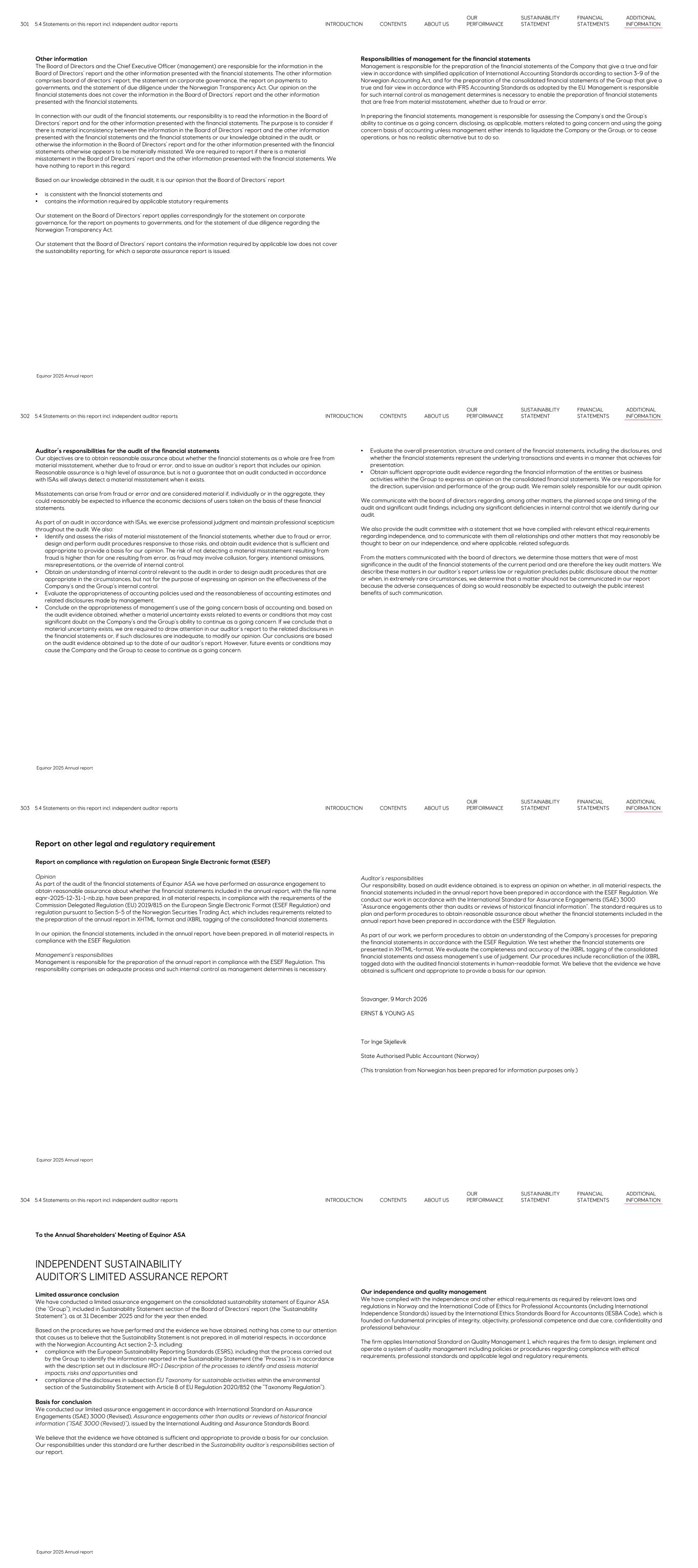
Other information The Board of Directors and the Chief Executive Officer (management) are responsible for the information in the Board of Directors’ report and the other information presented with the financial statements. The other information comprises board of directors’ report, the statement on corporate governance, the report on payments to governments, and the statement of due diligence under the Norwegian Transparency Act. Our opinion on the financial statements does not cover the information in the Board of Directors’ report and the other information presented with the financial statements. In connection with our audit of the financial statements, our responsibility is to read the information in the Board of Directors’ report and for the other information presented with the financial statements. The purpose is to consider if there is material inconsistency between the information in the Board of Directors’ report and the other information presented with the financial statements and the financial statements or our knowledge obtained in the audit, or otherwise the information in the Board of Directors’ report and for the other information presented with the financial statements otherwise appears to be materially misstated. We are required to report if there is a material misstatement in the Board of Directors’ report and the other information presented with the financial statements. We have nothing to report in this regard. Based on our knowledge obtained in the audit, it is our opinion that the Board of Directors’ report • is consistent with the financial statements and • contains the information required by applicable statutory requirements Our statement on the Board of Directors’ report applies correspondingly for the statement on corporate governance, for the report on payments to governments, and for the statement of due diligence regarding the Norwegian Transparency Act. Our statement that the Board of Directors’ report contains the information required by applicable law does not cover the sustainability reporting, for which a separate assurance report is issued. Responsibilities of management for the financial statements Management is responsible for the preparation of the financial statements of the Company that give a true and fair view in accordance with simplified application of International Accounting Standards according to section 3-9 of the Norwegian Accounting Act, and for the preparation of the consolidated financial statements of the Group that give a true and fair view in accordance with IFRS Accounting Standards as adopted by the EU. Management is responsible for such internal control as management determines is necessary to enable the preparation of financial statements that are free from material misstatement, whether due to fraud or error. In preparing the financial statements, management is responsible for assessing the Company’s and the Group’s ability to continue as a going concern, disclosing, as applicable, matters related to going concern and using the going concern basis of accounting unless management either intends to liquidate the Company or the Group, or to cease operations, or has no realistic alternative but to do so. 301 5.4 Statements on this report incl. independent auditor reports INTRODUCTION CONTENTS ABOUT US OUR PERFORMANCE SUSTAINABILITY STATEMENT FINANCIAL STATEMENTS ADDITIONAL INFORMATION Equinor 2025 Annual report Auditor’s responsibilities for the audit of the financial statements Our objectives are to obtain reasonable assurance about whether the financial statements as a whole are free from material misstatement, whether due to fraud or error, and to issue an auditor’s report that includes our opinion. Reasonable assurance is a high level of assurance, but is not a guarantee that an audit conducted in accordance with ISAs will always detect a material misstatement when it exists. Misstatements can arise from fraud or error and are considered material if, individually or in the aggregate, they could reasonably be expected to influence the economic decisions of users taken on the basis of these financial statements. As part of an audit in accordance with ISAs, we exercise professional judgment and maintain professional scepticism throughout the audit. We also: • Identify and assess the risks of material misstatement of the financial statements, whether due to fraud or error, design and perform audit procedures responsive to those risks, and obtain audit evidence that is sufficient and appropriate to provide a basis for our opinion. The risk of not detecting a material misstatement resulting from fraud is higher than for one resulting from error, as fraud may involve collusion, forgery, intentional omissions, misrepresentations, or the override of internal control. • Obtain an understanding of internal control relevant to the audit in order to design audit procedures that are appropriate in the circumstances, but not for the purpose of expressing an opinion on the effectiveness of the Company’s and the Group’s internal control. • Evaluate the appropriateness of accounting policies used and the reasonableness of accounting estimates and related disclosures made by management. • Conclude on the appropriateness of management’s use of the going concern basis of accounting and, based on the audit evidence obtained, whether a material uncertainty exists related to events or conditions that may cast significant doubt on the Company’s and the Group’s ability to continue as a going concern. If we conclude that a material uncertainty exists, we are required to draw attention in our auditor’s report to the related disclosures in the financial statements or, if such disclosures are inadequate, to modify our opinion. Our conclusions are based on the audit evidence obtained up to the date of our auditor’s report. However, future events or conditions may cause the Company and the Group to cease to continue as a going concern. • Evaluate the overall presentation, structure and content of the financial statements, including the disclosures, and whether the financial statements represent the underlying transactions and events in a manner that achieves fair presentation. • Obtain sufficient appropriate audit evidence regarding the financial information of the entities or business activities within the Group to express an opinion on the consolidated financial statements. We are responsible for the direction, supervision and performance of the group audit. We remain solely responsible for our audit opinion. We communicate with the board of directors regarding, among other matters, the planned scope and timing of the audit and significant audit findings, including any significant deficiencies in internal control that we identify during our audit. We also provide the audit committee with a statement that we have complied with relevant ethical requirements regarding independence, and to communicate with them all relationships and other matters that may reasonably be thought to bear on our independence, and where applicable, related safeguards. From the matters communicated with the board of directors, we determine those matters that were of most significance in the audit of the financial statements of the current period and are therefore the key audit matters. We describe these matters in our auditor’s report unless law or regulation precludes public disclosure about the matter or when, in extremely rare circumstances, we determine that a matter should not be communicated in our report because the adverse consequences of doing so would reasonably be expected to outweigh the public interest benefits of such communication. 302 5.4 Statements on this report incl. independent auditor reports INTRODUCTION CONTENTS ABOUT US OUR PERFORMANCE SUSTAINABILITY STATEMENT FINANCIAL STATEMENTS ADDITIONAL INFORMATION Equinor 2025 Annual report Report on other legal and regulatory requirement Report on compliance with regulation on European Single Electronic format (ESEF) Opinion As part of the audit of the financial statements of Equinor ASA we have performed an assurance engagement to obtain reasonable assurance about whether the financial statements included in the annual report, with the file name eqnr-2025-12-31-1-nb.zip, have been prepared, in all material respects, in compliance with the requirements of the Commission Delegated Regulation (EU) 2019/815 on the European Single Electronic Format (ESEF Regulation) and regulation pursuant to Section 5-5 of the Norwegian Securities Trading Act, which includes requirements related to the preparation of the annual report in XHTML format and iXBRL tagging of the consolidated financial statements. In our opinion, the financial statements, included in the annual report, have been prepared, in all material respects, in compliance with the ESEF Regulation. Management’s responsibilities Management is responsible for the preparation of the annual report in compliance with the ESEF Regulation. This responsibility comprises an adequate process and such internal control as management determines is necessary. Auditor’s responsibilities Our responsibility, based on audit evidence obtained, is to express an opinion on whether, in all material respects, the financial statements included in the annual report have been prepared in accordance with the ESEF Regulation. We conduct our work in accordance with the International Standard for Assurance Engagements (ISAE) 3000 “Assurance engagements other than audits or reviews of historical financial information”. The standard requires us to plan and perform procedures to obtain reasonable assurance about whether the financial statements included in the annual report have been prepared in accordance with the ESEF Regulation. As part of our work, we perform procedures to obtain an understanding of the Company’s processes for preparing the financial statements in accordance with the ESEF Regulation. We test whether the financial statements are presented in XHTML-format. We evaluate the completeness and accuracy of the iXBRL tagging of the consolidated financial statements and assess management’s use of judgement. Our procedures include reconciliation of the iXBRL tagged data with the audited financial statements in human-readable format. We believe that the evidence we have obtained is sufficient and appropriate to provide a basis for our opinion. Stavanger, 9 March 2026 ERNST & YOUNG AS Tor Inge Skjellevik State Authorised Public Accountant (Norway) (This translation from Norwegian has been prepared for information purposes only.) 303 5.4 Statements on this report incl. independent auditor reports INTRODUCTION CONTENTS ABOUT US OUR PERFORMANCE SUSTAINABILITY STATEMENT FINANCIAL STATEMENTS ADDITIONAL INFORMATION Equinor 2025 Annual report To the Annual Shareholders' Meeting of Equinor ASA INDEPENDENT SUSTAINABILITY AUDITOR’S LIMITED ASSURANCE REPORT Limited assurance conclusion We have conducted a limited assurance engagement on the consolidated sustainability statement of Equinor ASA (the “Group”), included in Sustainability Statement section of the Board of Directors’ report (the “Sustainability Statement”), as at 31 December 2025 and for the year then ended. Based on the procedures we have performed and the evidence we have obtained, nothing has come to our attention that causes us to believe that the Sustainability Statement is not prepared, in all material respects, in accordance with the Norwegian Accounting Act section 2-3, including: • compliance with the European Sustainability Reporting Standards (ESRS), including that the process carried out by the Group to identify the information reported in the Sustainability Statement (the “Process”) is in accordance with the description set out in disclosure IRO-1 Description of the processes to identify and assess material impacts, risks and opportunities and • compliance of the disclosures in subsection EU Taxonomy for sustainable activities within the environmental section of the Sustainability Statement with Article 8 of EU Regulation 2020/852 (the “Taxonomy Regulation”). Basis for conclusion We conducted our limited assurance engagement in accordance with International Standard on Assurance Engagements (ISAE) 3000 (Revised), Assurance engagements other than audits or reviews of historical financial information (“ISAE 3000 (Revised)”), issued by the International Auditing and Assurance Standards Board. We believe that the evidence we have obtained is sufficient and appropriate to provide a basis for our conclusion. Our responsibilities under this standard are further described in the Sustainability auditor’s responsibilities section of our report. Our independence and quality management We have complied with the independence and other ethical requirements as required by relevant laws and regulations in Norway and the International Code of Ethics for Professional Accountants (including International Independence Standards) issued by the International Ethics Standards Board for Accountants (IESBA Code), which is founded on fundamental principles of integrity, objectivity, professional competence and due care, confidentiality and professional behaviour. The firm applies International Standard on Quality Management 1, which requires the firm to design, implement and operate a system of quality management including policies or procedures regarding compliance with ethical requirements, professional standards and applicable legal and regulatory requirements. 304 5.4 Statements on this report incl. independent auditor reports INTRODUCTION CONTENTS ABOUT US OUR PERFORMANCE SUSTAINABILITY STATEMENT FINANCIAL STATEMENTS ADDITIONAL INFORMATION Equinor 2025 Annual report
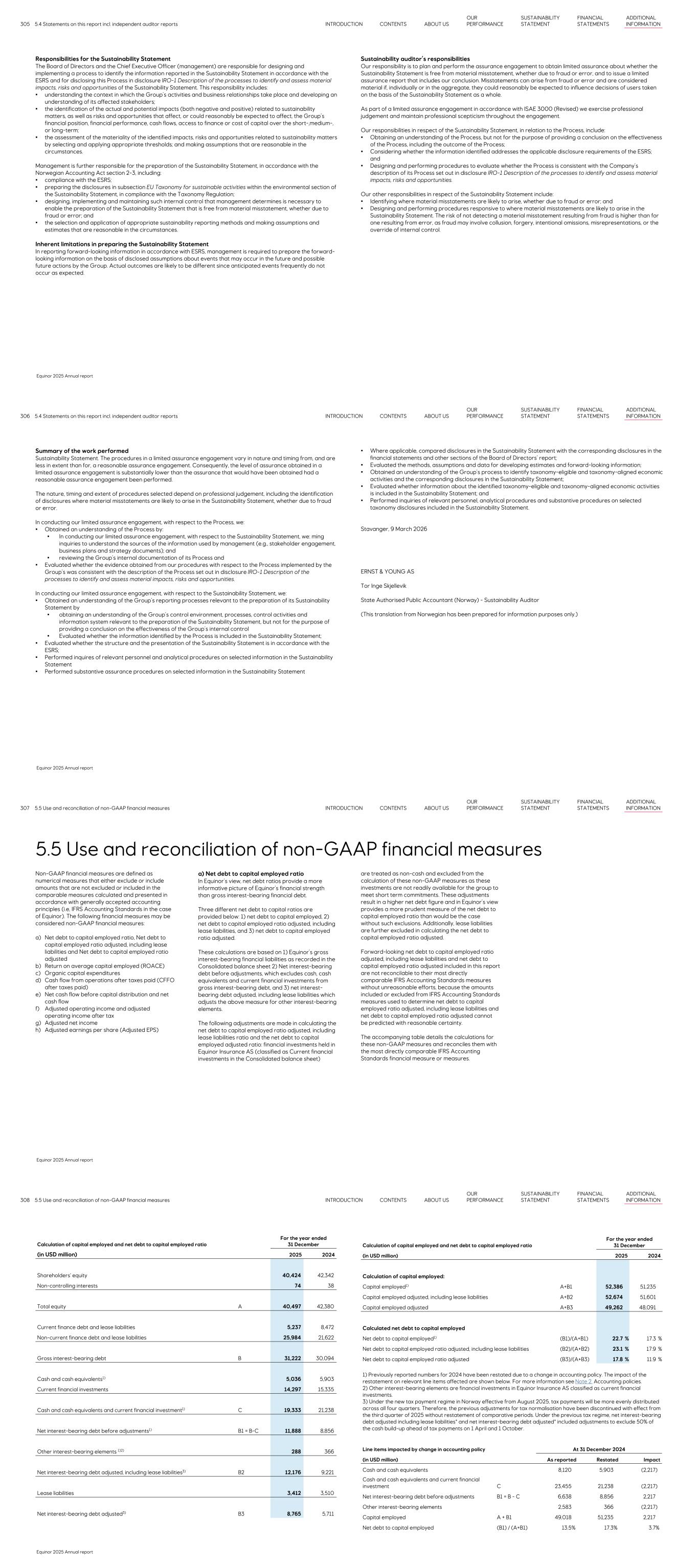
Responsibilities for the Sustainability Statement The Board of Directors and the Chief Executive Officer (management) are responsible for designing and implementing a process to identify the information reported in the Sustainability Statement in accordance with the ESRS and for disclosing this Process in disclosure IRO-1 Description of the processes to identify and assess material impacts, risks and opportunities of the Sustainability Statement. This responsibility includes: • understanding the context in which the Group’s activities and business relationships take place and developing an understanding of its affected stakeholders; • the identification of the actual and potential impacts (both negative and positive) related to sustainability matters, as well as risks and opportunities that affect, or could reasonably be expected to affect, the Group’s financial position, financial performance, cash flows, access to finance or cost of capital over the short-,medium-, or long-term; • the assessment of the materiality of the identified impacts, risks and opportunities related to sustainability matters by selecting and applying appropriate thresholds; and making assumptions that are reasonable in the circumstances. Management is further responsible for the preparation of the Sustainability Statement, in accordance with the Norwegian Accounting Act section 2-3, including: • compliance with the ESRS; • preparing the disclosures in subsection EU Taxonomy for sustainable activities within the environmental section of the Sustainability Statement, in compliance with the Taxonomy Regulation; • designing, implementing and maintaining such internal control that management determines is necessary to enable the preparation of the Sustainability Statement that is free from material misstatement, whether due to fraud or error; and • the selection and application of appropriate sustainability reporting methods and making assumptions and estimates that are reasonable in the circumstances. Inherent limitations in preparing the Sustainability Statement In reporting forward-looking information in accordance with ESRS, management is required to prepare the forward- looking information on the basis of disclosed assumptions about events that may occur in the future and possible future actions by the Group. Actual outcomes are likely to be different since anticipated events frequently do not occur as expected. Sustainability auditor’s responsibilities Our responsibility is to plan and perform the assurance engagement to obtain limited assurance about whether the Sustainability Statement is free from material misstatement, whether due to fraud or error, and to issue a limited assurance report that includes our conclusion. Misstatements can arise from fraud or error and are considered material if, individually or in the aggregate, they could reasonably be expected to influence decisions of users taken on the basis of the Sustainability Statement as a whole. As part of a limited assurance engagement in accordance with ISAE 3000 (Revised) we exercise professional judgement and maintain professional scepticism throughout the engagement. Our responsibilities in respect of the Sustainability Statement, in relation to the Process, include: • Obtaining an understanding of the Process, but not for the purpose of providing a conclusion on the effectiveness of the Process, including the outcome of the Process; • Considering whether the information identified addresses the applicable disclosure requirements of the ESRS; and • Designing and performing procedures to evaluate whether the Process is consistent with the Company’s description of its Process set out in disclosure IRO-1 Description of the processes to identify and assess material impacts, risks and opportunities. Our other responsibilities in respect of the Sustainability Statement include: • Identifying where material misstatements are likely to arise, whether due to fraud or error; and • Designing and performing procedures responsive to where material misstatements are likely to arise in the Sustainability Statement. The risk of not detecting a material misstatement resulting from fraud is higher than for one resulting from error, as fraud may involve collusion, forgery, intentional omissions, misrepresentations, or the override of internal control. 305 5.4 Statements on this report incl. independent auditor reports INTRODUCTION CONTENTS ABOUT US OUR PERFORMANCE SUSTAINABILITY STATEMENT FINANCIAL STATEMENTS ADDITIONAL INFORMATION Equinor 2025 Annual report Summary of the work performed Sustainability Statement. The procedures in a limited assurance engagement vary in nature and timing from, and are less in extent than for, a reasonable assurance engagement. Consequently, the level of assurance obtained in a limited assurance engagement is substantially lower than the assurance that would have been obtained had a reasonable assurance engagement been performed. The nature, timing and extent of procedures selected depend on professional judgement, including the identification of disclosures where material misstatements are likely to arise in the Sustainability Statement, whether due to fraud or error. In conducting our limited assurance engagement, with respect to the Process, we: • Obtained an understanding of the Process by: • In conducting our limited assurance engagement, with respect to the Sustainability Statement, we: ming inquiries to understand the sources of the information used by management (e.g., stakeholder engagement, business plans and strategy documents); and • reviewing the Group’s internal documentation of its Process and • Evaluated whether the evidence obtained from our procedures with respect to the Process implemented by the Group’s was consistent with the description of the Process set out in disclosure IRO-1 Description of the processes to identify and assess material impacts, risks and opportunities. In conducting our limited assurance engagement, with respect to the Sustainability Statement, we: • Obtained an understanding of the Group’s reporting processes relevant to the preparation of its Sustainability Statement by • obtaining an understanding of the Group’s control environment, processes, control activities and information system relevant to the preparation of the Sustainability Statement, but not for the purpose of providing a conclusion on the effectiveness of the Group’s internal control • Evaluated whether the information identified by the Process is included in the Sustainability Statement; • Evaluated whether the structure and the presentation of the Sustainability Statement is in accordance with the ESRS; • Performed inquires of relevant personnel and analytical procedures on selected information in the Sustainability Statement • Performed substantive assurance procedures on selected information in the Sustainability Statement • Where applicable, compared disclosures in the Sustainability Statement with the corresponding disclosures in the financial statements and other sections of the Board of Directors’ report; • Evaluated the methods, assumptions and data for developing estimates and forward-looking information; • Obtained an understanding of the Group’s process to identify taxonomy-eligible and taxonomy-aligned economic activities and the corresponding disclosures in the Sustainability Statement; • Evaluated whether information about the identified taxonomy-eligible and taxonomy-aligned economic activities is included in the Sustainability Statement; and • Performed inquiries of relevant personnel, analytical procedures and substantive procedures on selected taxonomy disclosures included in the Sustainability Statement. Stavanger, 9 March 2026 ERNST & YOUNG AS Tor Inge Skjellevik State Authorised Public Accountant (Norway) - Sustainability Auditor (This translation from Norwegian has been prepared for information purposes only.) 306 5.4 Statements on this report incl. independent auditor reports INTRODUCTION CONTENTS ABOUT US OUR PERFORMANCE SUSTAINABILITY STATEMENT FINANCIAL STATEMENTS ADDITIONAL INFORMATION Equinor 2025 Annual report 5.5 Use and reconciliation of non-GAAP financial measures Non-GAAP financial measures are defined as numerical measures that either exclude or include amounts that are not excluded or included in the comparable measures calculated and presented in accordance with generally accepted accounting principles (i.e, IFRS Accounting Standards in the case of Equinor). The following financial measures may be considered non-GAAP financial measures: a) Net debt to capital employed ratio, Net debt to capital employed ratio adjusted, including lease liabilities and Net debt to capital employed ratio adjusted b) Return on average capital employed (ROACE) c) Organic capital expenditures d) Cash flow from operations after taxes paid (CFFO after taxes paid) e) Net cash flow before capital distribution and net cash flow f) Adjusted operating income and adjusted operating income after tax g) Adjusted net income h) Adjusted earnings per share (Adjusted EPS) a) Net debt to capital employed ratio In Equinor’s view, net debt ratios provide a more informative picture of Equinor’s financial strength than gross interest-bearing financial debt. Three different net debt to capital ratios are provided below: 1) net debt to capital employed, 2) net debt to capital employed ratio adjusted, including lease liabilities, and 3) net debt to capital employed ratio adjusted. These calculations are based on 1) Equinor’s gross interest-bearing financial liabilities as recorded in the Consolidated balance sheet 2) Net interest-bearing debt before adjustments, which excludes cash, cash equivalents and current financial investments from gross interest-bearing debt, and 3) net interest- bearing debt adjusted, including lease liabilities which adjusts the above measure for other interest-bearing elements. The following adjustments are made in calculating the net debt to capital employed ratio adjusted, including lease liabilities ratio and the net debt to capital employed adjusted ratio: financial investments held in Equinor Insurance AS (classified as Current financial investments in the Consolidated balance sheet) are treated as non-cash and excluded from the calculation of these non-GAAP measures as these investments are not readily available for the group to meet short term commitments. These adjustments result in a higher net debt figure and in Equinor’s view provides a more prudent measure of the net debt to capital employed ratio than would be the case without such exclusions. Additionally, lease liabilities are further excluded in calculating the net debt to capital employed ratio adjusted. Forward-looking net debt to capital employed ratio adjusted, including lease liabilities and net debt to capital employed ratio adjusted included in this report are not reconcilable to their most directly comparable IFRS Accounting Standards measures without unreasonable efforts, because the amounts included or excluded from IFRS Accounting Standards measures used to determine net debt to capital employed ratio adjusted, including lease liabilities and net debt to capital employed ratio adjusted cannot be predicted with reasonable certainty. The accompanying table details the calculations for these non-GAAP measures and reconciles them with the most directly comparable IFRS Accounting Standards financial measure or measures. 307 5.5 Use and reconciliation of non-GAAP financial measures INTRODUCTION CONTENTS ABOUT US OUR PERFORMANCE SUSTAINABILITY STATEMENT FINANCIAL STATEMENTS ADDITIONAL INFORMATION Equinor 2025 Annual report Shareholders' equity 40,424 42,342 Non-controlling interests 74 38 Total equity A 40,497 42,380 Current finance debt and lease liabilities 5,237 8,472 Non-current finance debt and lease liabilities 25,984 21,622 Gross interest-bearing debt B 31,222 30,094 Cash and cash equivalents1) 5,036 5,903 Current financial investments 14,297 15,335 Cash and cash equivalents and current financial investment1) C 19,333 21,238 Net interest-bearing debt before adjustments1) B1 = B-C 11,888 8,856 Other interest-bearing elements 1)2) 288 366 Net interest-bearing debt adjusted, including lease liabilities3) B2 12,176 9,221 Lease liabilities 3,412 3,510 Net interest-bearing debt adjusted3) B3 8,765 5,711 Calculation of capital employed and net debt to capital employed ratio For the year ended 31 December (in USD million) 2025 2024 Calculation of capital employed: Capital employed1) A+B1 52,386 51,235 Capital employed adjusted, including lease liabilities A+B2 52,674 51,601 Capital employed adjusted A+B3 49,262 48,091 Calculated net debt to capital employed Net debt to capital employed1) (B1)/(A+B1) 22.7 % 17.3 % Net debt to capital employed ratio adjusted, including lease liabilities (B2)/(A+B2) 23.1 % 17.9 % Net debt to capital employed ratio adjusted (B3)/(A+B3) 17.8 % 11.9 % 1) Previously reported numbers for 2024 have been restated due to a change in accounting policy. The impact of the restatement on relevant line items affected are shown below. For more information see Note 2. Accounting policies. 2) Other interest-bearing elements are financial investments in Equinor Insurance AS classified as current financial investments. 3) Under the new tax payment regime in Norway effective from August 2025, tax payments will be more evenly distributed across all four quarters. Therefore, the previous adjustments for tax normalisation have been discontinued with effect from the third quarter of 2025 without restatement of comparative periods. Under the previous tax regime, net interest-bearing debt adjusted including lease liabilities* and net interest-bearing debt adjusted* included adjustments to exclude 50% of the cash build-up ahead of tax payments on 1 April and 1 October. Calculation of capital employed and net debt to capital employed ratio For the year ended 31 December (in USD million) 2025 2024 Line items impacted by change in accounting policy At 31 December 2024 (in USD million) As reported Restated Impact Cash and cash equivalents 8,120 5,903 (2,217) Cash and cash equivalents and current financial investment C 23,455 21,238 (2,217) Net interest-bearing debt before adjustments B1 = B - C 6,638 8,856 2,217 Other interest-bearing elements 2,583 366 (2,217) Capital employed A + B1 49,018 51,235 2,217 Net debt to capital employed (B1) / (A+B1) 13.5% 17.3% 3.7% 308 5.5 Use and reconciliation of non-GAAP financial measures INTRODUCTION CONTENTS ABOUT US OUR PERFORMANCE SUSTAINABILITY STATEMENT FINANCIAL STATEMENTS ADDITIONAL INFORMATION Equinor 2025 Annual report
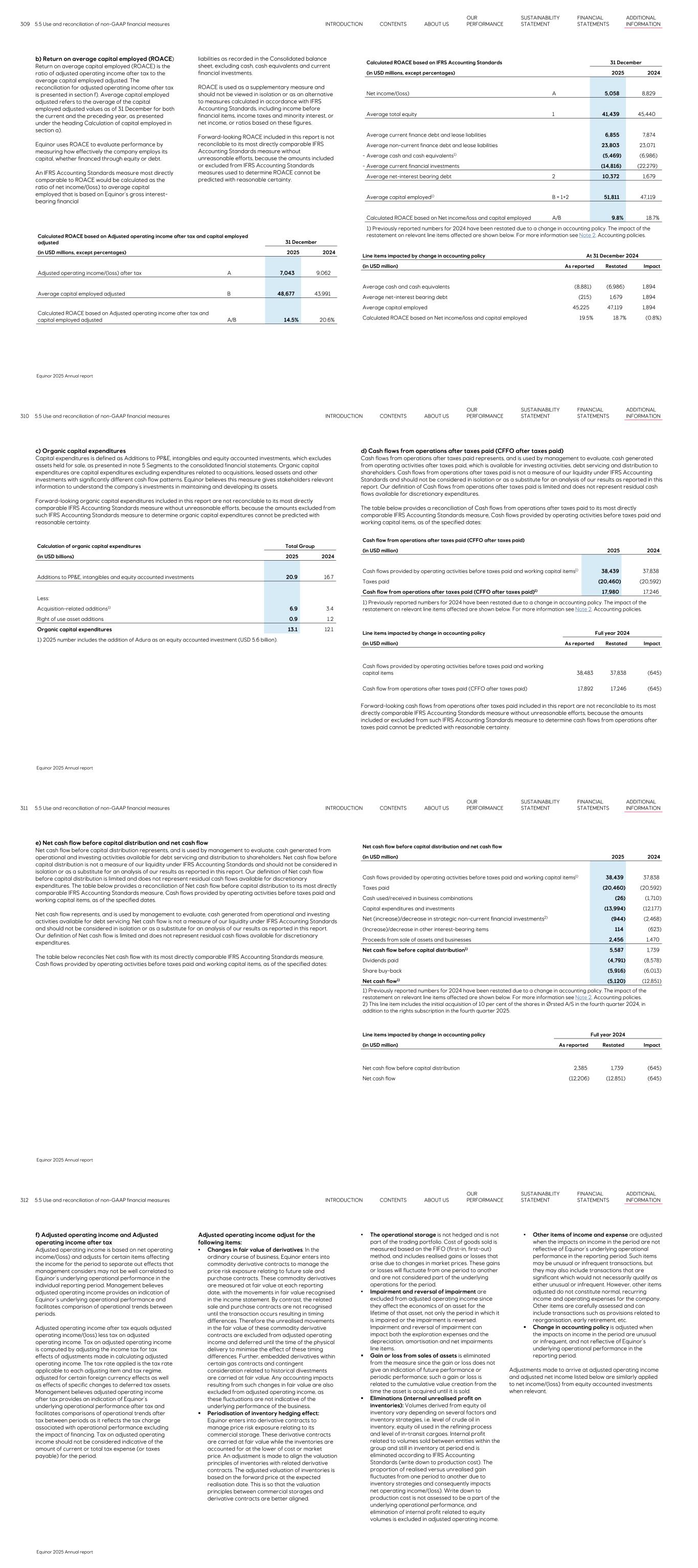
b) Return on average capital employed (ROACE) Return on average capital employed (ROACE) is the ratio of adjusted operating income after tax to the average capital employed adjusted. The reconciliation for adjusted operating income after tax is presented in section f). Average capital employed adjusted refers to the average of the capital employed adjusted values as of 31 December for both the current and the preceding year, as presented under the heading Calculation of capital employed in section a). Equinor uses ROACE to evaluate performance by measuring how effectively the company employs its capital, whether financed through equity or debt. An IFRS Accounting Standards measure most directly comparable to ROACE would be calculated as the ratio of net income/(loss) to average capital employed that is based on Equinor’s gross interest- bearing financial liabilities as recorded in the Consolidated balance sheet, excluding cash, cash equivalents and current financial investments. ROACE is used as a supplementary measure and should not be viewed in isolation or as an alternative to measures calculated in accordance with IFRS Accounting Standards, including income before financial items, income taxes and minority interest, or net income, or ratios based on these figures. Forward-looking ROACE included in this report is not reconcilable to its most directly comparable IFRS Accounting Standards measure without unreasonable efforts, because the amounts included or excluded from IFRS Accounting Standards measures used to determine ROACE cannot be predicted with reasonable certainty. Average cash and cash equivalents (8,881) (6,986) 1,894 Average net-interest bearing debt (215) 1,679 1,894 Average capital employed 45,225 47,119 1,894 Calculated ROACE based on Net income/loss and capital employed 19.5% 18.7% (0.8%) Line items impacted by change in accounting policy At 31 December 2024 (in USD million) As reported Restated Impact 309 5.5 Use and reconciliation of non-GAAP financial measures INTRODUCTION CONTENTS ABOUT US OUR PERFORMANCE SUSTAINABILITY STATEMENT FINANCIAL STATEMENTS ADDITIONAL INFORMATION Equinor 2025 Annual report Calculated ROACE based on IFRS Accounting Standards 31 December (in USD millions, except percentages) 2025 2024 Net income/(loss) A 5,058 8,829 Average total equity 1 41,439 45,440 Average current finance debt and lease liabilities 6,855 7,874 Average non-current finance debt and lease liabilities 23,803 23,071 - Average cash and cash equivalents1) (5,469) (6,986) - Average current financial investments (14,816) (22,279) Average net-interest bearing debt 2 10,372 1,679 Average capital employed1) B = 1+2 51,811 47,119 Calculated ROACE based on Net income/loss and capital employed A/B 9.8% 18.7% 1) Previously reported numbers for 2024 have been restated due to a change in accounting policy. The impact of the restatement on relevant line items affected are shown below. For more information see Note 2. Accounting policies.Calculated ROACE based on Adjusted operating income after tax and capital employed adjusted 31 December (in USD millions, except percentages) 2025 2024 Adjusted operating income/(loss) after tax A 7,043 9,062 Average capital employed adjusted B 48,677 43,991 Calculated ROACE based on Adjusted operating income after tax and capital employed adjusted A/B 14.5% 20.6% c) Organic capital expenditures Capital expenditures is defined as Additions to PP&E, intangibles and equity accounted investments, which excludes assets held for sale, as presented in note 5 Segments to the consolidated financial statements. Organic capital expenditures are capital expenditures excluding expenditures related to acquisitions, leased assets and other investments with significantly different cash flow patterns. Equinor believes this measure gives stakeholders relevant information to understand the company’s investments in maintaining and developing its assets. Forward-looking organic capital expenditures included in this report are not reconcilable to its most directly comparable IFRS Accounting Standards measure without unreasonable efforts, because the amounts excluded from such IFRS Accounting Standards measure to determine organic capital expenditures cannot be predicted with reasonable certainty. Additions to PP&E, intangibles and equity accounted investments 20.9 16.7 Less: Acquisition-related additions1) 6.9 3.4 Right of use asset additions 0.9 1.2 Organic capital expenditures 13.1 12.1 1) 2025 number includes the addition of Adura as an equity accounted investment (USD 5.6 billion). Calculation of organic capital expenditures Total Group (in USD billions) 2025 2024 d) Cash flows from operations after taxes paid (CFFO after taxes paid) Cash flows from operations after taxes paid represents, and is used by management to evaluate, cash generated from operating activities after taxes paid, which is available for investing activities, debt servicing and distribution to shareholders. Cash flows from operations after taxes paid is not a measure of our liquidity under IFRS Accounting Standards and should not be considered in isolation or as a substitute for an analysis of our results as reported in this report. Our definition of Cash flows from operations after taxes paid is limited and does not represent residual cash flows available for discretionary expenditures. The table below provides a reconciliation of Cash flows from operations after taxes paid to its most directly comparable IFRS Accounting Standards measure, Cash flows provided by operating activities before taxes paid and working capital items, as of the specified dates: Cash flows provided by operating activities before taxes paid and working capital items1) 38,439 37,838 Taxes paid (20,460) (20,592) Cash flow from operations after taxes paid (CFFO after taxes paid)1) 17,980 17,246 1) Previously reported numbers for 2024 have been restated due to a change in accounting policy. The impact of the restatement on relevant line items affected are shown below. For more information see Note 2. Accounting policies. Cash flow from operations after taxes paid (CFFO after taxes paid) (in USD million) 2025 2024 Line items impacted by change in accounting policy Full year 2024 (in USD million) As reported Restated Impact Cash flows provided by operating activities before taxes paid and working capital items 38,483 37,838 (645) Cash flow from operations after taxes paid (CFFO after taxes paid) 17,892 17,246 (645) Forward-looking cash flows from operations after taxes paid included in this report are not reconcilable to its most directly comparable IFRS Accounting Standards measure without unreasonable efforts, because the amounts included or excluded from such IFRS Accounting Standards measure to determine cash flows from operations after taxes paid cannot be predicted with reasonable certainty. 310 5.5 Use and reconciliation of non-GAAP financial measures INTRODUCTION CONTENTS ABOUT US OUR PERFORMANCE SUSTAINABILITY STATEMENT FINANCIAL STATEMENTS ADDITIONAL INFORMATION Equinor 2025 Annual report e) Net cash flow before capital distribution and net cash flow Net cash flow before capital distribution represents, and is used by management to evaluate, cash generated from operational and investing activities available for debt servicing and distribution to shareholders. Net cash flow before capital distribution is not a measure of our liquidity under IFRS Accounting Standards and should not be considered in isolation or as a substitute for an analysis of our results as reported in this report. Our definition of Net cash flow before capital distribution is limited and does not represent residual cash flows available for discretionary expenditures. The table below provides a reconciliation of Net cash flow before capital distribution to its most directly comparable IFRS Accounting Standards measure, Cash flows provided by operating activities before taxes paid and working capital items, as of the specified dates. Net cash flow represents, and is used by management to evaluate, cash generated from operational and investing activities available for debt servicing. Net cash flow is not a measure of our liquidity under IFRS Accounting Standards and should not be considered in isolation or as a substitute for an analysis of our results as reported in this report. Our definition of Net cash flow is limited and does not represent residual cash flows available for discretionary expenditures. The table below reconciles Net cash flow with its most directly comparable IFRS Accounting Standards measure, Cash flows provided by operating activities before taxes paid and working capital items, as of the specified dates: Net cash flow before capital distribution and net cash flow (in USD million) 2025 2024 Cash flows provided by operating activities before taxes paid and working capital items1) 38,439 37,838 Taxes paid (20,460) (20,592) Cash used/received in business combinations (26) (1,710) Capital expenditures and investments (13,994) (12,177) Net (increase)/decrease in strategic non-current financial investments2) (944) (2,468) (Increase)/decrease in other interest-bearing items 114 (623) Proceeds from sale of assets and businesses 2,456 1,470 Net cash flow before capital distribution1) 5,587 1,739 Dividends paid (4,791) (8,578) Share buy-back (5,916) (6,013) Net cash flow1) (5,120) (12,851) 1) Previously reported numbers for 2024 have been restated due to a change in accounting policy. The impact of the restatement on relevant line items affected are shown below. For more information see Note 2. Accounting policies. 2) This line item includes the initial acquisition of 10 per cent of the shares in Ørsted A/S in the fourth quarter 2024, in addition to the rights subscription in the fourth quarter 2025. Line items impacted by change in accounting policy Full year 2024 (in USD million) As reported Restated Impact Net cash flow before capital distribution 2,385 1,739 (645) Net cash flow (12,206) (12,851) (645) 311 5.5 Use and reconciliation of non-GAAP financial measures INTRODUCTION CONTENTS ABOUT US OUR PERFORMANCE SUSTAINABILITY STATEMENT FINANCIAL STATEMENTS ADDITIONAL INFORMATION Equinor 2025 Annual report f) Adjusted operating income and Adjusted operating income after tax Adjusted operating income is based on net operating income/(loss) and adjusts for certain items affecting the income for the period to separate out effects that management considers may not be well correlated to Equinor’s underlying operational performance in the individual reporting period. Management believes adjusted operating income provides an indication of Equinor’s underlying operational performance and facilitates comparison of operational trends between periods. Adjusted operating income after tax equals adjusted operating income/(loss) less tax on adjusted operating income. Tax on adjusted operating income is computed by adjusting the income tax for tax effects of adjustments made in calculating adjusted operating income. The tax rate applied is the tax rate applicable to each adjusting item and tax regime, adjusted for certain foreign currency effects as well as effects of specific changes to deferred tax assets. Management believes adjusted operating income after tax provides an indication of Equinor’s underlying operational performance after tax and facilitates comparisons of operational trends after tax between periods as it reflects the tax charge associated with operational performance excluding the impact of financing. Tax on adjusted operating income should not be considered indicative of the amount of current or total tax expense (or taxes payable) for the period. Adjusted operating income adjust for the following items: • Changes in fair value of derivatives: In the ordinary course of business, Equinor enters into commodity derivative contracts to manage the price risk exposure relating to future sale and purchase contracts. These commodity derivatives are measured at fair value at each reporting date, with the movements in fair value recognised in the income statement. By contrast, the related sale and purchase contracts are not recognised until the transaction occurs resulting in timing differences. Therefore the unrealised movements in the fair value of these commodity derivative contracts are excluded from adjusted operating income and deferred until the time of the physical delivery to minimise the effect of these timing differences. Further, embedded derivatives within certain gas contracts and contingent consideration related to historical divestments are carried at fair value. Any accounting impacts resulting from such changes in fair value are also excluded from adjusted operating income, as these fluctuations are not indicative of the underlying performance of the business. • Periodisation of inventory hedging effect: Equinor enters into derivative contracts to manage price risk exposure relating to its commercial storage. These derivative contracts are carried at fair value while the inventories are accounted for at the lower of cost or market price. An adjustment is made to align the valuation principles of inventories with related derivative contracts. The adjusted valuation of inventories is based on the forward price at the expected realisation date. This is so that the valuation principles between commercial storages and derivative contracts are better aligned. • The operational storage is not hedged and is not part of the trading portfolio. Cost of goods sold is measured based on the FIFO (first-in, first-out) method, and includes realised gains or losses that arise due to changes in market prices. These gains or losses will fluctuate from one period to another and are not considered part of the underlying operations for the period. • Impairment and reversal of impairment are excluded from adjusted operating income since they affect the economics of an asset for the lifetime of that asset, not only the period in which it is impaired or the impairment is reversed. Impairment and reversal of impairment can impact both the exploration expenses and the depreciation, amortisation and net impairments line items. • Gain or loss from sales of assets is eliminated from the measure since the gain or loss does not give an indication of future performance or periodic performance; such a gain or loss is related to the cumulative value creation from the time the asset is acquired until it is sold. • Eliminations (internal unrealised profit on inventories): Volumes derived from equity oil inventory vary depending on several factors and inventory strategies, i.e. level of crude oil in inventory, equity oil used in the refining process and level of in-transit cargoes. Internal profit related to volumes sold between entities within the group and still in inventory at period end is eliminated according to IFRS Accounting Standards (write down to production cost). The proportion of realised versus unrealised gain fluctuates from one period to another due to inventory strategies and consequently impacts net operating income/(loss). Write down to production cost is not assessed to be a part of the underlying operational performance, and elimination of internal profit related to equity volumes is excluded in adjusted operating income. • Other items of income and expense are adjusted when the impacts on income in the period are not reflective of Equinor’s underlying operational performance in the reporting period. Such items may be unusual or infrequent transactions, but they may also include transactions that are significant which would not necessarily qualify as either unusual or infrequent. However, other items adjusted do not constitute normal, recurring income and operating expenses for the company. Other items are carefully assessed and can include transactions such as provisions related to reorganisation, early retirement, etc. • Change in accounting policy is adjusted when the impacts on income in the period are unusual or infrequent, and not reflective of Equinor’s underlying operational performance in the reporting period. Adjustments made to arrive at adjusted operating income and adjusted net income listed below are similarly applied to net income/(loss) from equity accounted investments when relevant. 312 5.5 Use and reconciliation of non-GAAP financial measures INTRODUCTION CONTENTS ABOUT US OUR PERFORMANCE SUSTAINABILITY STATEMENT FINANCIAL STATEMENTS ADDITIONAL INFORMATION Equinor 2025 Annual report
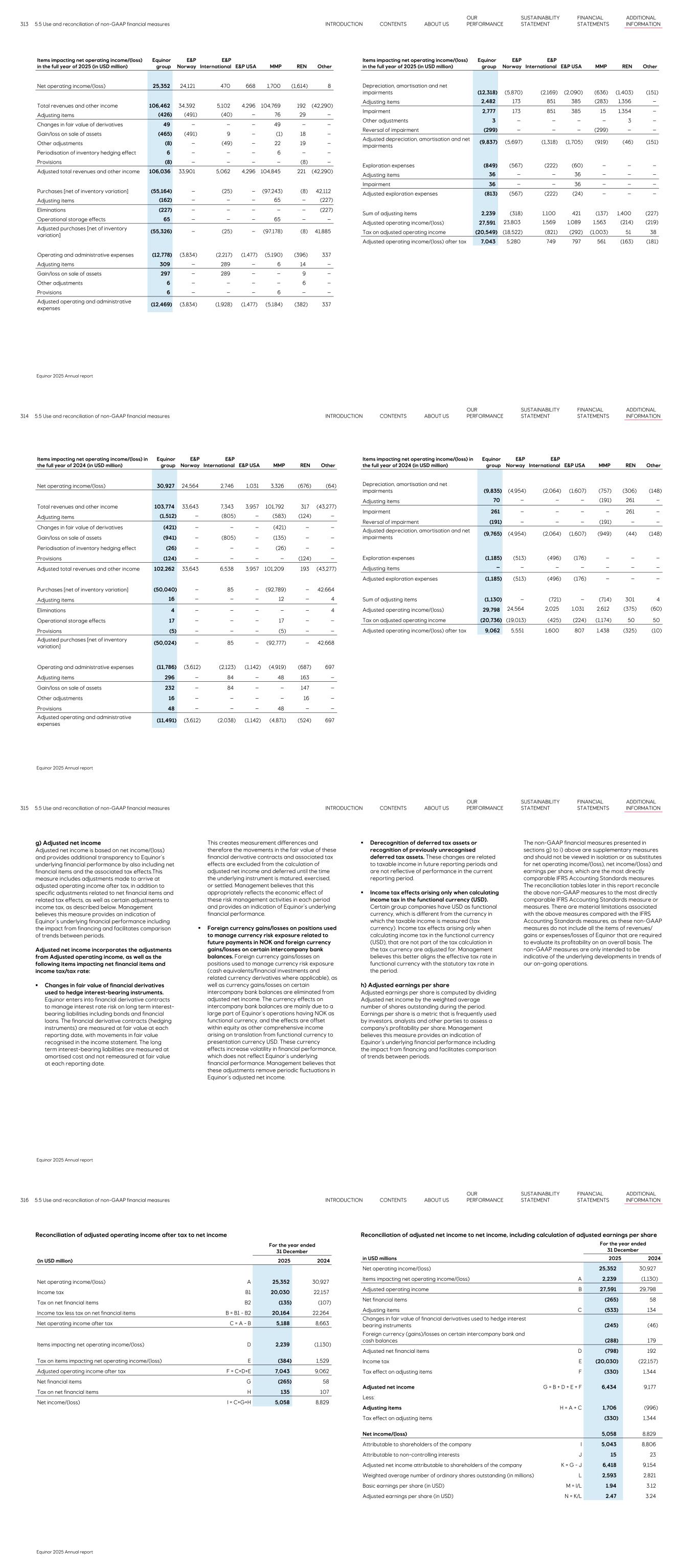
Net operating income/(loss) 25,352 24,121 470 668 1,700 (1,614) 8 Total revenues and other income 106,462 34,392 5,102 4,296 104,769 192 (42,290) Adjusting items (426) (491) (40) — 76 29 — Changes in fair value of derivatives 49 — — — 49 — — Gain/loss on sale of assets (465) (491) 9 — (1) 18 — Other adjustments (8) — (49) — 22 19 — Periodisation of inventory hedging effect 6 — — — 6 — — Provisions (8) — — — — (8) — Adjusted total revenues and other income 106,036 33,901 5,062 4,296 104,845 221 (42,290) Purchases [net of inventory variation] (55,164) — (25) — (97,243) (8) 42,112 Adjusting items (162) — — — 65 — (227) Eliminations (227) — — — — — (227) Operational storage effects 65 — — — 65 — — Adjusted purchases [net of inventory variation] (55,326) — (25) — (97,178) (8) 41,885 Operating and administrative expenses (12,778) (3,834) (2,217) (1,477) (5,190) (396) 337 Adjusting items 309 — 289 — 6 14 — Gain/loss on sale of assets 297 — 289 — — 9 — Other adjustments 6 — — — — 6 — Provisions 6 — — — 6 — — Adjusted operating and administrative expenses (12,469) (3,834) (1,928) (1,477) (5,184) (382) 337 Items impacting net operating income/(loss) in the full year of 2025 (in USD million) Equinor group E&P Norway E&P International E&P USA MMP REN Other Depreciation, amortisation and net impairments (12,318) (5,870) (2,169) (2,090) (636) (1,403) (151) Adjusting items 2,482 173 851 385 (283) 1,356 — Impairment 2,777 173 851 385 15 1,354 — Other adjustments 3 — — — — 3 — Reversal of impairment (299) — — — (299) — — Adjusted depreciation, amortisation and net impairments (9,837) (5,697) (1,318) (1,705) (919) (46) (151) Exploration expenses (849) (567) (222) (60) — — — Adjusting items 36 — — 36 — — — Impairment 36 — — 36 — — — Adjusted exploration expenses (813) (567) (222) (24) — — — Sum of adjusting items 2,239 (318) 1,100 421 (137) 1,400 (227) Adjusted operating income/(loss) 27,591 23,803 1,569 1,089 1,563 (214) (219) Tax on adjusted operating income (20,549) (18,522) (821) (292) (1,003) 51 38 Adjusted operating income/(loss) after tax 7,043 5,280 749 797 561 (163) (181) Items impacting net operating income/(loss) in the full year of 2025 (in USD million) Equinor group E&P Norway E&P International E&P USA MMP REN Other 313 5.5 Use and reconciliation of non-GAAP financial measures INTRODUCTION CONTENTS ABOUT US OUR PERFORMANCE SUSTAINABILITY STATEMENT FINANCIAL STATEMENTS ADDITIONAL INFORMATION Equinor 2025 Annual report Net operating income/(loss) 30,927 24,564 2,746 1,031 3,326 (676) (64) Total revenues and other income 103,774 33,643 7,343 3,957 101,792 317 (43,277) Adjusting items (1,512) — (805) — (583) (124) — Changes in fair value of derivatives (421) — — — (421) — — Gain/loss on sale of assets (941) — (805) — (135) — — Periodisation of inventory hedging effect (26) — — — (26) — — Provisions (124) — — — — (124) — Adjusted total revenues and other income 102,262 33,643 6,538 3,957 101,209 193 (43,277) Purchases [net of inventory variation] (50,040) — 85 — (92,789) — 42,664 Adjusting items 16 — — — 12 — 4 Eliminations 4 — — — — — 4 Operational storage effects 17 — — — 17 — — Provisions (5) — — — (5) — — Adjusted purchases [net of inventory variation] (50,024) — 85 — (92,777) — 42,668 Operating and administrative expenses (11,786) (3,612) (2,123) (1,142) (4,919) (687) 697 Adjusting items 296 — 84 — 48 163 — Gain/loss on sale of assets 232 — 84 — — 147 — Other adjustments 16 — — — — 16 — Provisions 48 — — — 48 — — Adjusted operating and administrative expenses (11,491) (3,612) (2,038) (1,142) (4,871) (524) 697 Items impacting net operating income/(loss) in the full year of 2024 (in USD million) Equinor group E&P Norway E&P International E&P USA MMP REN Other Depreciation, amortisation and net impairments (9,835) (4,954) (2,064) (1,607) (757) (306) (148) Adjusting items 70 — — — (191) 261 — Impairment 261 — — — — 261 — Reversal of impairment (191) — — — (191) — — Adjusted depreciation, amortisation and net impairments (9,765) (4,954) (2,064) (1,607) (949) (44) (148) Exploration expenses (1,185) (513) (496) (176) — — — Adjusting items — — — — — — — Adjusted exploration expenses (1,185) (513) (496) (176) — — — Sum of adjusting items (1,130) — (721) — (714) 301 4 Adjusted operating income/(loss) 29,798 24,564 2,025 1,031 2,612 (375) (60) Tax on adjusted operating income (20,736) (19,013) (425) (224) (1,174) 50 50 Adjusted operating income/(loss) after tax 9,062 5,551 1,600 807 1,438 (325) (10) Items impacting net operating income/(loss) in the full year of 2024 (in USD million) Equinor group E&P Norway E&P International E&P USA MMP REN Other 314 5.5 Use and reconciliation of non-GAAP financial measures INTRODUCTION CONTENTS ABOUT US OUR PERFORMANCE SUSTAINABILITY STATEMENT FINANCIAL STATEMENTS ADDITIONAL INFORMATION Equinor 2025 Annual report g) Adjusted net income Adjusted net income is based on net income/(loss) and provides additional transparency to Equinor’s underlying financial performance by also including net financial items and the associated tax effects.This measure includes adjustments made to arrive at adjusted operating income after tax, in addition to specific adjustments related to net financial items and related tax effects, as well as certain adjustments to income tax, as described below. Management believes this measure provides an indication of Equinor’s underlying financial performance including the impact from financing and facilitates comparison of trends between periods. Adjusted net income incorporates the adjustments from Adjusted operating income, as well as the following items impacting net financial items and income tax/tax rate: • Changes in fair value of financial derivatives used to hedge interest-bearing instruments. Equinor enters into financial derivative contracts to manage interest rate risk on long term interest- bearing liabilities including bonds and financial loans. The financial derivative contracts (hedging instruments) are measured at fair value at each reporting date, with movements in fair value recognised in the income statement. The long term interest-bearing liabilities are measured at amortised cost and not remeasured at fair value at each reporting date. This creates measurement differences and therefore the movements in the fair value of these financial derivative contracts and associated tax effects are excluded from the calculation of adjusted net income and deferred until the time the underlying instrument is matured, exercised, or settled. Management believes that this appropriately reflects the economic effect of these risk management activities in each period and provides an indication of Equinor’s underlying financial performance. • Foreign currency gains/losses on positions used to manage currency risk exposure related to future payments in NOK and foreign currency gains/losses on certain intercompany bank balances. Foreign currency gains/losses on positions used to manage currency risk exposure (cash equivalents/financial investments and related currency derivatives where applicable), as well as currency gains/losses on certain intercompany bank balances are eliminated from adjusted net income. The currency effects on intercompany bank balances are mainly due to a large part of Equinor’s operations having NOK as functional currency, and the effects are offset within equity as other comprehensive income arising on translation from functional currency to presentation currency USD. These currency effects increase volatility in financial performance, which does not reflect Equinor’s underlying financial performance. Management believes that these adjustments remove periodic fluctuations in Equinor’s adjusted net income. • Derecognition of deferred tax assets or recognition of previously unrecognised deferred tax assets. These changes are related to taxable income in future reporting periods and are not reflective of performance in the current reporting period. • Income tax effects arising only when calculating income tax in the functional currency (USD). Certain group companies have USD as functional currency, which is different from the currency in which the taxable income is measured (tax currency). Income tax effects arising only when calculating income tax in the functional currency (USD), that are not part of the tax calculation in the tax currency are adjusted for. Management believes this better aligns the effective tax rate in functional currency with the statutory tax rate in the period. h) Adjusted earnings per share Adjusted earnings per share is computed by dividing Adjusted net income by the weighted average number of shares outstanding during the period. Earnings per share is a metric that is frequently used by investors, analysts and other parties to assess a company's profitability per share. Management believes this measure provides an indication of Equinor’s underlying financial performance including the impact from financing and facilitates comparison of trends between periods. The non-GAAP financial measures presented in sections g) to i) above are supplementary measures and should not be viewed in isolation or as substitutes for net operating income/(loss), net income/(loss) and earnings per share, which are the most directly comparable IFRS Accounting Standards measures. The reconciliation tables later in this report reconcile the above non-GAAP measures to the most directly comparable IFRS Accounting Standards measure or measures. There are material limitations associated with the above measures compared with the IFRS Accounting Standards measures, as these non-GAAP measures do not include all the items of revenues/ gains or expenses/losses of Equinor that are required to evaluate its profitability on an overall basis. The non-GAAP measures are only intended to be indicative of the underlying developments in trends of our on-going operations. 315 5.5 Use and reconciliation of non-GAAP financial measures INTRODUCTION CONTENTS ABOUT US OUR PERFORMANCE SUSTAINABILITY STATEMENT FINANCIAL STATEMENTS ADDITIONAL INFORMATION Equinor 2025 Annual report Reconciliation of adjusted operating income after tax to net income Income tax B1 20,030 22,157 Tax on net financial items B2 (135) (107) Income tax less tax on net financial items B = B1 - B2 20,164 22,264 Net operating income after tax C = A - B 5,188 8,663 Items impacting net operating income/(loss) D 2,239 (1,130) Tax on items impacting net operating income/(loss) E (384) 1,529 Adjusted operating income after tax F = C+D+E 7,043 9,062 Net financial items G (265) 58 Tax on net financial items H 135 107 Net income/(loss) I = C+G+H 5,058 8,829 For the year ended 31 December (in USD million) 2025 2024 Net operating income/(loss) A 25,352 30,927 Reconciliation of adjusted net income to net income, including calculation of adjusted earnings per share For the year ended 31 December in USD millions 2025 2024 Net operating income/(loss) 25,352 30,927 Items impacting net operating income/(loss) A 2,239 (1,130) Adjusted operating income B 27,591 29,798 Net financial items (265) 58 Adjusting items C (533) 134 Changes in fair value of financial derivatives used to hedge interest bearing instruments (245) (46) Foreign currency (gains)/losses on certain intercompany bank and cash balances (288) 179 Adjusted net financial items D (798) 192 Income tax E (20,030) (22,157) Tax effect on adjusting items F (330) 1,344 Adjusted net income G = B + D + E + F 6,434 9,177 Less: Adjusting items H = A + C 1,706 (996) Tax effect on adjusting items (330) 1,344 Net income/(loss) 5,058 8,829 Attributable to shareholders of the company I 5,043 8,806 Attributable to non-controlling interests J 15 23 Adjusted net income attributable to shareholders of the company K = G - J 6,418 9,154 Weighted average number of ordinary shares outstanding (in millions) L 2,593 2,821 Basic earnings per share (in USD) M = I/L 1.94 3.12 Adjusted earnings per share (in USD) N = K/L 2.47 3.24 316 5.5 Use and reconciliation of non-GAAP financial measures INTRODUCTION CONTENTS ABOUT US OUR PERFORMANCE SUSTAINABILITY STATEMENT FINANCIAL STATEMENTS ADDITIONAL INFORMATION Equinor 2025 Annual report
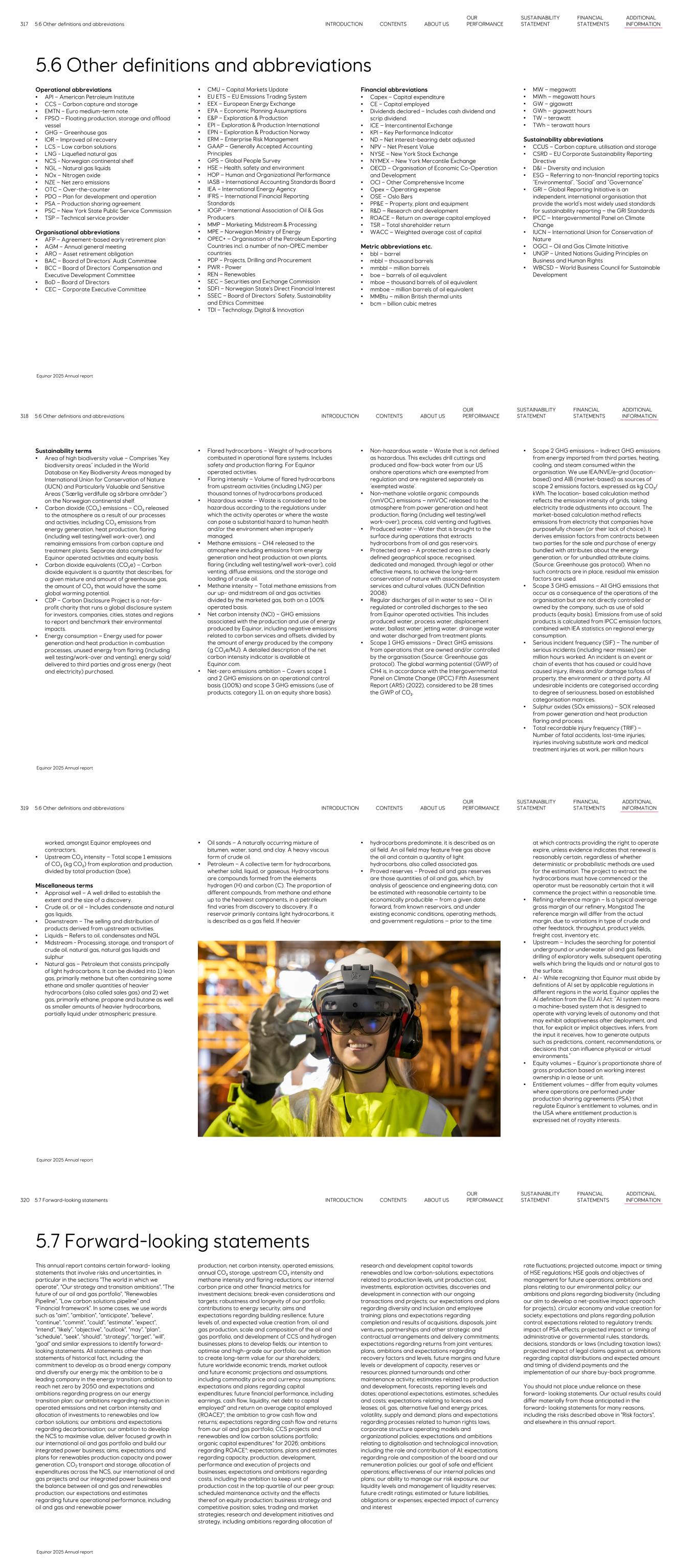
5.6 Other definitions and abbreviations Operational abbreviations • API – American Petroleum Institute • CCS – Carbon capture and storage • EMTN – Euro medium-term note • FPSO – Floating production, storage and offload vessel • GHG – Greenhouse gas • IOR – Improved oil recovery • LCS – Low carbon solutions • LNG - Liquefied natural gas • NCS - Norwegian continental shelf • NGL – Natural gas liquids • NOx – Nitrogen oxide • NZE – Net zero emissions • OTC – Over-the-counter • PDO – Plan for development and operation • PSA – Production sharing agreement • PSC – New York State Public Service Commission • TSP – Technical service provider Organisational abbreviations • AFP – Agreement-based early retirement plan • AGM – Annual general meeting • ARO – Asset retirement obligation • BAC – Board of Directors’ Audit Committee • BCC – Board of Directors’ Compensation and Executive Development Committee • BoD – Board of Directors • CEC – Corporate Executive Committee • CMU – Capital Markets Update • EU ETS – EU Emissions Trading System • EEX – European Energy Exchange • EPA – Economic Planning Assumptions • E&P – Exploration & Production • EPI – Exploration & Production International • EPN – Exploration & Production Norway • ERM – Enterprise Risk Management • GAAP – Generally Accepted Accounting Principles • GPS – Global People Survey • HSE – Health, safety and environment • HOP – Human and Organizational Performance • IASB – International Accounting Standards Board • IEA – International Energy Agency • IFRS – International Financial Reporting Standards • IOGP – International Association of Oil & Gas Producers • MMP – Marketing, Midstream & Processing • MPE – Norwegian Ministry of Energy • OPEC+ – Organisation of the Petroleum Exporting Countries incl. a number of non-OPEC member countries • PDP – Projects, Drilling and Procurement • PWR - Power • REN – Renewables • SEC – Securities and Exchange Commission • SDFI – Norwegian State's Direct Financial Interest • SSEC – Board of Directors’ Safety, Sustainability and Ethics Committee • TDI – Technology, Digital & Innovation Financial abbreviations • Capex – Capital expenditure • CE – Capital employed • Dividends declared – Includes cash dividend and scrip dividend. • ICE – Intercontinental Exchange • KPI – Key Performance Indicator • ND – Net interest-bearing debt adjusted • NPV – Net Present Value • NYSE – New York Stock Exchange • NYMEX – New York Mercantile Exchange • OECD – Organisation of Economic Co-Operation and Development • OCI – Other Comprehensive Income • Opex – Operating expense • OSE – Oslo Børs • PP&E – Property, plant and equipment • R&D – Research and development • ROACE – Return on average capital employed • TSR – Total shareholder return • WACC – Weighted average cost of capital Metric abbreviations etc. • bbl – barrel • mbbl – thousand barrels • mmbbl – million barrels • boe – barrels of oil equivalent • mboe – thousand barrels of oil equivalent • mmboe – million barrels of oil equivalent • MMBtu – million British thermal units • bcm – billion cubic metres • MW – megawatt • MWh – megawatt hours • GW – gigawatt • GWh – gigawatt hours • TW – terawatt • TWh – terawatt hours Sustainability abbreviations • CCUS – Carbon capture, utilisation and storage • CSRD – EU Corporate Sustainability Reporting Directive • D&I – Diversity and inclusion • ESG – Referring to non-financial reporting topics “Environmental”, “Social” and “Governance” • GRI – Global Reporting Initiative is an independent, international organisation that provide the world’s most widely used standards for sustainability reporting – the GRI Standards • IPCC – Intergovernmental Panel on Climate Change • IUCN – International Union for Conservation of Nature • OGCI – Oil and Gas Climate Initiative • UNGP – United Nations Guiding Principles on Business and Human Rights • WBCSD – World Business Council for Sustainable Development 317 5.6 Other definitions and abbreviations INTRODUCTION CONTENTS ABOUT US OUR PERFORMANCE SUSTAINABILITY STATEMENT FINANCIAL STATEMENTS ADDITIONAL INFORMATION Equinor 2025 Annual report Sustainability terms • Area of high biodiversity value – Comprises “Key biodiversity areas” included in the World Database on Key Biodiversity Areas managed by International Union for Conservation of Nature (IUCN) and Particularly Valuable and Sensitive Areas (“Særlig verdifulle og sårbare områder”) on the Norwegian continental shelf. • Carbon dioxide (CO₂) emissions – CO₂ released to the atmosphere as a result of our processes and activities, including CO₂ emissions from energy generation, heat production, flaring (including well testing/well work-over), and remaining emissions from carbon capture and treatment plants. Separate data compiled for Equinor operated activities and equity basis. • Carbon dioxide equivalents (CO₂e) – Carbon dioxide equivalent is a quantity that describes, for a given mixture and amount of greenhouse gas, the amount of CO₂ that would have the same global warming potential. • CDP – Carbon Disclosure Project is a not-for- profit charity that runs a global disclosure system for investors, companies, cities, states and regions to report and benchmark their environmental impacts. • Energy consumption – Energy used for power generation and heat production in combustion processes, unused energy from flaring (including well testing/work-over and venting), energy sold/ delivered to third parties and gross energy (heat and electricity) purchased. • Flared hydrocarbons – Weight of hydrocarbons combusted in operational flare systems. Includes safety and production flaring. For Equinor operated activities. • Flaring intensity – Volume of flared hydrocarbons from upstream activities (including LNG) per thousand tonnes of hydrocarbons produced. • Hazardous waste – Waste is considered to be hazardous according to the regulations under which the activity operates or where the waste can pose a substantial hazard to human health and/or the environment when improperly managed. • Methane emissions – CH4 released to the atmosphere including emissions from energy generation and heat production at own plants, flaring (including well testing/well work-over), cold venting, diffuse emissions, and the storage and loading of crude oil. • Methane intensity – Total methane emissions from our up- and midstream oil and gas activities divided by the marketed gas, both on a 100% operated basis. • Net carbon intensity (NCI) – GHG emissions associated with the production and use of energy produced by Equinor, including negative emissions related to carbon services and offsets, divided by the amount of energy produced by the company (g CO₂e/MJ). A detailed description of the net carbon intensity indicator is available at Equinor.com. • Net-zero emissions ambition – Covers scope 1 and 2 GHG emissions on an operational control basis (100%) and scope 3 GHG emissions (use of products, category 11, on an equity share basis). • Non-hazardous waste – Waste that is not defined as hazardous. This excludes drill cuttings and produced and flow-back water from our US onshore operations which are exempted from regulation and are registered separately as ‘exempted waste’. • Non-methane volatile organic compounds (nmVOC) emissions – nmVOC released to the atmosphere from power generation and heat production, flaring (including well testing/well work-over), process, cold venting and fugitives. • Produced water – Water that is brought to the surface during operations that extracts hydrocarbons from oil and gas reservoirs. • Protected area – A protected area is a clearly defined geographical space, recognised, dedicated and managed, through legal or other effective means, to achieve the long-term conservation of nature with associated ecosystem services and cultural values. (IUCN Definition 2008) • Regular discharges of oil in water to sea – Oil in regulated or controlled discharges to the sea from Equinor operated activities. This includes produced water, process water, displacement water, ballast water, jetting water, drainage water and water discharged from treatment plants. • Scope 1 GHG emissions – Direct GHG emissions from operations that are owned and/or controlled by the organisation (Source: Greenhouse gas protocol). The global warming potential (GWP) of CH4 is, in accordance with the Intergovernmental Panel on Climate Change (IPCC) Fifth Assessment Report (AR5) (2022), considered to be 28 times the GWP of CO₂. • Scope 2 GHG emissions – Indirect GHG emissions from energy imported from third parties, heating, cooling, and steam consumed within the organisation. We use IEA/NVE/e-grid (location- based) and AIB (market-based) as sources of scope 2 emissions factors, expressed as kg CO₂/ kWh. The location- based calculation method reflects the emission intensity of grids, taking electricity trade adjustments into account. The market-based calculation method reflects emissions from electricity that companies have purposefully chosen (or their lack of choice). It derives emission factors from contracts between two parties for the sale and purchase of energy bundled with attributes about the energy generation, or for unbundled attribute claims. (Source: Greenhouse gas protocol). When no such contracts are in place, residual mix emission factors are used. • Scope 3 GHG emissions – All GHG emissions that occur as a consequence of the operations of the organisation but are not directly controlled or owned by the company, such as use of sold products (equity basis). Emissions from use of sold products is calculated from IPCC emission factors, combined with IEA statistics on regional energy consumption. • Serious incident frequency (SIF) – The number of serious incidents (including near misses) per million hours worked. An incident is an event or chain of events that has caused or could have caused injury, illness and/or damage to/loss of property, the environment or a third party. All undesirable incidents are categorised according to degree of seriousness, based on established categorisation matrices. • Sulphur oxides (SOx emissions) – SOX released from power generation and heat production flaring and process. • Total recordable injury frequency (TRIF) – Number of fatal accidents, lost-time injuries, injuries involving substitute work and medical treatment injuries at work, per million hours 318 5.6 Other definitions and abbreviations INTRODUCTION CONTENTS ABOUT US OUR PERFORMANCE SUSTAINABILITY STATEMENT FINANCIAL STATEMENTS ADDITIONAL INFORMATION Equinor 2025 Annual report worked, amongst Equinor employees and contractors. • Upstream CO₂ intensity – Total scope 1 emissions of CO₂ (kg CO₂) from exploration and production, divided by total production (boe). Miscellaneous terms • Appraisal well – A well drilled to establish the extent and the size of a discovery. • Crude oil, or oil – Includes condensate and natural gas liquids. • Downstream – The selling and distribution of products derived from upstream activities. • Liquids – Refers to oil, condensates and NGL • Midstream - Processing, storage, and transport of crude oil, natural gas, natural gas liquids and sulphur • Natural gas – Petroleum that consists principally of light hydrocarbons. It can be divided into 1) lean gas, primarily methane but often containing some ethane and smaller quantities of heavier hydrocarbons (also called sales gas) and 2) wet gas, primarily ethane, propane and butane as well as smaller amounts of heavier hydrocarbons, partially liquid under atmospheric pressure. • Oil sands – A naturally occurring mixture of bitumen, water, sand, and clay. A heavy viscous form of crude oil. • Petroleum – A collective term for hydrocarbons, whether solid, liquid, or gaseous. Hydrocarbons are compounds formed from the elements hydrogen (H) and carbon (C). The proportion of different compounds, from methane and ethane up to the heaviest components, in a petroleum find varies from discovery to discovery. If a reservoir primarily contains light hydrocarbons, it is described as a gas field. If heavier • hydrocarbons predominate, it is described as an oil field. An oil field may feature free gas above the oil and contain a quantity of light hydrocarbons, also called associated gas. • Proved reserves – Proved oil and gas reserves are those quantities of oil and gas, which, by analysis of geoscience and engineering data, can be estimated with reasonable certainty to be economically producible — from a given date forward, from known reservoirs, and under existing economic conditions, operating methods, and government regulations — prior to the time at which contracts providing the right to operate expire, unless evidence indicates that renewal is reasonably certain, regardless of whether deterministic or probabilistic methods are used for the estimation. The project to extract the hydrocarbons must have commenced or the operator must be reasonably certain that it will commence the project within a reasonable time. • Refining reference margin – Is a typical average gross margin of our refinery, Mongstad The reference margin will differ from the actual margin, due to variations in type of crude and other feedstock, throughput, product yields, freight cost, inventory etc. • Upstream – Includes the searching for potential underground or underwater oil and gas fields, drilling of exploratory wells, subsequent operating wells which bring the liquids and or natural gas to the surface. • AI - While recognizing that Equinor must abide by definitions of AI set by applicable regulations in different regions in the world, Equinor applies the AI definition from the EU AI Act: “AI system means a machine-based system that is designed to operate with varying levels of autonomy and that may exhibit adaptiveness after deployment, and that, for explicit or implicit objectives, infers, from the input it receives, how to generate outputs such as predictions, content, recommendations, or decisions that can influence physical or virtual environments.” • Equity volumes – Equinor’s proportionate share of gross production based on working interest ownership in a lease or unit. • Entitlement volumes – differ from equity volumes where operations are performed under production sharing agreements (PSA) that regulate Equinor’s entitlement to volumes, and in the USA where entitlement production is expressed net of royalty interests. 319 5.6 Other definitions and abbreviations INTRODUCTION CONTENTS ABOUT US OUR PERFORMANCE SUSTAINABILITY STATEMENT FINANCIAL STATEMENTS ADDITIONAL INFORMATION Equinor 2025 Annual report 5.7 Forward-looking statements This annual report contains certain forward- looking statements that involve risks and uncertainties, in particular in the sections "The world in which we operate", "Our strategy and transition ambitions", "The future of our oil and gas portfolio", "Renewables Pipeline", "Low carbon solutions pipeline" and "Financial framework". In some cases, we use words such as "aim", "ambition", "anticipate", "believe", "continue", "commit", "could", "estimate", "expect", "intend", "likely", "objective", "outlook", "may", "plan", "schedule", "seek", "should", "strategy", "target", "will", "goal" and similar expressions to identify forward- looking statements. All statements other than statements of historical fact, including: the commitment to develop as a broad energy company and diversify our energy mix; the ambition to be a leading company in the energy transition; ambition to reach net zero by 2050 and expectations and ambitions regarding progress on our energy transition plan; our ambitions regarding reduction in operated emissions and net carbon intensity and allocation of investments to renewables and low carbon solutions; our ambitions and expectations regarding decarbonisation; our ambition to develop the NCS to maximise value, deliver focused growth in our international oil and gas portfolio and build our integrated power business; aims, expectations and plans for renewables production capacity and power generation, CO2 transport and storage, allocation of expenditures across the NCS, our international oil and gas projects and our integrated power business and the balance between oil and gas and renewables production; our expectations and estimates regarding future operational performance, including oil and gas and renewable power production, net carbon intensity, operated emissions, annual CO₂ storage, upstream CO₂ intensity and methane intensity and flaring reductions; our internal carbon price and other financial metrics for investment decisions; break-even considerations and targets; robustness and longevity of our portfolio; contributions to energy security; aims and expectations regarding building resilience; future levels of, and expected value creation from, oil and gas production, scale and composition of the oil and gas portfolio, and development of CCS and hydrogen businesses; plans to develop fields; our intention to optimise and high-grade our portfolio; our ambition to create long-term value for our shareholders; future worldwide economic trends, market outlook and future economic projections and assumptions, including commodity price and currency assumptions; expectations and plans regarding capital expenditures; future financial performance, including earnings, cash flow, liquidity, net debt to capital employed* and return on average capital employed (ROACE)*; the ambition to grow cash flow and returns; expectations regarding cash flow and returns from our oil and gas portfolio, CCS projects and renewables and low carbon solutions portfolio; organic capital expenditures* for 2026; ambitions regarding ROACE*; expectations, plans and estimates regarding capacity, production, development, performance and execution of projects and businesses; expectations and ambitions regarding costs, including the ambition to keep unit of production cost in the top quartile of our peer group; scheduled maintenance activity and the effects thereof on equity production; business strategy and competitive position; sales, trading and market strategies; research and development initiatives and strategy, including ambitions regarding allocation of research and development capital towards renewables and low carbon-solutions; expectations related to production levels, unit production cost, investments, exploration activities, discoveries and development in connection with our ongoing transactions and projects; our expectations and plans regarding diversity and inclusion and employee training; plans and expectations regarding completion and results of acquisitions, disposals, joint ventures, partnerships and other strategic and contractual arrangements and delivery commitments; expectations regarding returns from joint ventures; plans, ambitions and expectations regarding recovery factors and levels, future margins and future levels or development of capacity, reserves or resources; planned turnarounds and other maintenance activity; estimates related to production and development, forecasts, reporting levels and dates; operational expectations, estimates, schedules and costs; expectations relating to licences and leases; oil, gas, alternative fuel and energy prices, volatility, supply and demand; plans and expectations regarding processes related to human rights laws, corporate structure operating models and organizational policies; expectations and ambitions relating to digitalisation and technological innovation, including the role and contribution of AI; expectations regarding role and composition of the board and our remuneration policies; our goal of safe and efficient operations; effectiveness of our internal policies and plans; our ability to manage our risk exposure, our liquidity levels and management of liquidity reserves; future credit ratings; estimated or future liabilities, obligations or expenses; expected impact of currency and interest rate fluctuations; projected outcome, impact or timing of HSE regulations; HSE goals and objectives of management for future operations; ambitions and plans relating to our environmental policy; our ambitions and plans regarding biodiversity (including our aim to develop a net-positive impact approach for projects), circular economy and value creation for society; expectations and plans regarding pollution control; expectations related to regulatory trends; impact of PSA effects; projected impact or timing of administrative or governmental rules, standards, decisions, standards or laws (including taxation laws); projected impact of legal claims against us; ambitions regarding capital distributions and expected amount and timing of dividend payments and the implementation of our share buy-back programme. You should not place undue reliance on these forward- looking statements. Our actual results could differ materially from those anticipated in the forward- looking statements for many reasons, including the risks described above in "Risk factors", and elsewhere in this annual report. 320 5.7 Forward-looking statements INTRODUCTION CONTENTS ABOUT US OUR PERFORMANCE SUSTAINABILITY STATEMENT FINANCIAL STATEMENTS ADDITIONAL INFORMATION Equinor 2025 Annual report
Forward-looking statements are not guarantees of future performance. They reflect current views about future events, are based on management’s current expectations and assumptions and are, by their nature, subject to significant risks and uncertainties because they relate to events and depend on circumstances that will occur in the future. There are a number of factors that could cause actual results and developments to differ materially from those expressed or implied by these forward-looking statements, including levels of industry product supply, demand and pricing, in particular in light of significant oil price volatility; unfavourable macroeconomic conditions and inflationary pressures; exchange rate and interest rate fluctuations; geopolitical, social and/or political instability, including worsening trade relations and tariffs; levels and calculations of reserves and material differences from reserves estimates; regulatory stability and access to resources, including attractive low carbon opportunities; changes in market demand and supply and policy support from governments for renewables; the effects of climate change and changes in stakeholder sentiment and regulatory requirements regarding climate change; inability to meet strategic objectives; the development and use of new technology; social and/or political instability, including worsening trade relations; failure to prevent or manage digital and cyber disruptions to our information and operational technology systems and those of third parties on which we rely; operational problems, including cost inflation in capital and operational expenditures; unsuccessful drilling; availability of adequate infrastructure at commercially viable prices; the actions of field partners commercial and strategic partners and other third-parties; reputational damage; the actions of competitors; failure to effectively deploy new technologies or deficiencies in their implementation; the actions of the Norwegian state as majority shareholder and exercise of ownership by the Norwegian state; changes or uncertainty in or non- compliance with laws and governmental regulations, conditions or requirements; inability to obtain relevant approvals from governments and other parties for activities and transactions; adverse changes in tax regimes; the political and economic policies of Norway and other oil-producing countries; regulations on low-carbon value chains; liquidity, interest rate, equity and credit risks; risk of losses relating to trading and commercial supply activities; an inability to attract and retain personnel; ineffectiveness of crisis management systems; inadequate insurance coverage; health, safety and environmental risks; physical security risks to personnel, assets, infrastructure and operations from hostile or malicious acts; failure to meet our ethical and social standards; actual or perceived non- compliance with legal or regulatory requirements; and other factors discussed elsewhere in this annual report. The achievement of Equinor’s climate ambitions depends, in part, on broader societal shifts in consumer demands and technological advancements, each of which are beyond Equinor’s control. Should society’s demands and technological innovation not shift in parallel with Equinor’s pursuit of its energy transition plan, Equinor’s ability to meet its climate ambitions will be impaired. The calculation of Equinor’s net carbon intensity presented in this report includes an estimate of emissions from the use of sold products (GHG protocol category 11) as a means to more accurately evaluate the emission lifecycle of what we produce to respond to the energy transition and potential business opportunities arising from shifting consumer demands. Including these emissions in the calculations should in no way be construed as an acceptance by Equinor of responsibility for the emissions caused by such use. The reference to any scenario in this report, including any potential net-zero scenarios, does not imply Equinor views any particular scenario as likely to occur. Third- party scenarios discussed in this report reflect the modeling assumptions and outputs of their respective authors, not Equinor, and their use by Equinor is not an endorsement by Equinor of their underlying assumptions, likelihood or probability. Investment decisions are made on the basis of Equinor’s separate planning process. Any use of the modeling of a third- party organization within this report does not constitute or imply an endorsement by Equinor of any or all of the positions or activities of such organization. We use certain terms in this document, such as “resource” and “resources” that the SEC’s rules prohibit us from including in our filings with the SEC. US investors are urged to closely consider the disclosures in our annual report on Form 20-F, SEC File No. 1-15200, which is available on our website or by calling 1-800-SEC-0330 or logging on to www.sec.gov. Although we believe that the expectations reflected in the forward-looking statements are reasonable, we cannot assure you that our future results, level of activity, performance or achievements will meet these expectations. Moreover, neither we nor any other person assumes responsibility for the accuracy and completeness of the forward-looking statements. Any forward-looking statement speaks only as of the date on which such statement is made, and, except as required by applicable law, we undertake no obligation to update any of these statements after the date of this annual report, either to make them conform to actual results or changes in our expectations. 321 5.7 Forward-looking statements INTRODUCTION CONTENTS ABOUT US OUR PERFORMANCE SUSTAINABILITY STATEMENT FINANCIAL STATEMENTS ADDITIONAL INFORMATION Equinor 2025 Annual report Photos: Pages 1, 3, 4, 6, 9, 10, 12, 23, 28, 30, 33, 34, 36, 41, 44, 47, 51, 53, 54, 57, 58, 59, 65, 70, 72, 77, 78, 80, 82, 88, 92, 99, 132, 137, 163, 175, 281, 289, 291 Ole Jørgen Bratland Pages 1, 24, 127 Einar Aslaksen Pages 5, 18, 62, 63, 66, 69, 79, 104, 120 Torstein Lund Eik Page 11 Øyvind Haug Page 39 Lars Morken Page 52 Arne Reidar Mortensen Page 56 Øyvind Gravås Page 61 Stuart Conway Page 71 Jonny Engelsvoll / Lizette Bertelsen, Woldcam Page 75 Braeden King Page 111 Unknown Page 154 Erika Kelland Page 159 Marit Hommedal Page 320 Øyvind Gravås, Woldcam 322 INTRODUCTION CONTENTS ABOUT US OUR PERFORMANCE SUSTAINABILITY STATEMENT FINANCIAL STATEMENTS ADDITIONAL INFORMATION Equinor 2025 Annual report Equinor ASA Box 8500 NO-4035 Stavanger Norway Telephone:+47 51 99 00 00 www.equinor.com