Please wait
Table of Contents

Filed pursuant to General Instruction II.L. of Form F-10
File No. 333-292019


Information contained herein is subject to completion or amendment. A registration statement relating to these securities has been filed with the Securities and Exchange Commission. This preliminary prospectus supplement and the accompanying short form base shelf prospectus shall not constitute an offer to sell or the solicitation of an offer to buy nor shall there be any sale of these securities in any jurisdiction in which such offer, solicitation or sale would be unlawful prior to registration or qualification under the securities laws of any such jurisdiction.


SUBJECT TO COMPLETION, DATED DECEMBER 11, 2025

PRELIMINARY PROSPECTUS SUPPLEMENT

(To the short form base shelf prospectus dated December 9, 2025)

 

LOGO


New Issue    December  , 2025

US$400,000,000

   % Senior Notes due 20 

TRANSALTA CORPORATION


We are offering US$  aggregate principal amount of % senior notes due 20  (the “Notes”). The Notes will bear interest at the rate of   % per annum. Interest on the Notes will be payable semi-annually in arrears on    and    of each year, beginning on  , 2026. The Notes will mature on    , 20 . The Notes will be issued in United States dollars.

At any time on or after   , 20 , we may redeem some or all of the Notes at the redemption prices set forth in this prospectus supplement (this “Prospectus Supplement”), plus accrued and unpaid interest. Prior to    , 20 , we may redeem some or all of the Notes at a price equal to 100% of the principal amount thereof, plus accrued and unpaid interest, plus a “make-whole” premium.

In addition, prior to  , 20 , we may redeem up to 40% of the aggregate principal amount of the securities issued under the Indenture (as defined herein) in an amount not to exceed the amount of the proceeds of certain equity offerings at the redemption price set forth in this Prospectus Supplement, plus accrued and unpaid interest. We will also have the option to redeem the Notes in whole and not in part at 100% of the aggregate principal amount of the Notes, plus accrued and unpaid interest, in the event of certain changes to Canadian withholding tax laws or the enforcement or interpretation thereof. Upon the occurrence of a Change of Control Triggering Event (as hereinafter defined), holders of the Notes will have the right to require us to repurchase all or any part of their Notes at a repurchase price equal to 101% of the principal amount of the Notes, plus accrued and unpaid interest.

The Notes will be our senior unsecured obligations and will rank equally in right of payment with all of our existing and future senior indebtedness and senior in right of payment to all of our future subordinated indebtedness. The Notes will be effectively subordinated to any of our future secured indebtedness to the extent of the value of the assets securing such indebtedness. None of our existing and future subsidiaries will guarantee the Notes. As a result, the Notes will be structurally subordinated to all existing and future obligations of our subsidiaries, including trade payables and indebtedness.

The underwriters, as principals, conditionally offer the Notes, subject to prior sale, if, as and when issued by us and accepted by the underwriters in accordance with the conditions contained in the underwriting agreement referred to under “Underwriting” in this Prospectus Supplement.


Investing in the Notes involves risks. See “Risk Factors” in this Prospectus Supplement beginning on page S-22 and under the heading “Risk Factors” beginning on page 15 of the accompanying short form base shelf prospectus dated December 9, 2025 (the “Prospectus”).

Under applicable Canadian securities legislation, we may be considered to be a “connected issuer” of RBC Capital Markets, LLC, CIBC World Markets Corp., BofA Securities, Inc., Morgan Stanley & Co. LLC, Scotia Capital (USA) Inc., BMO Capital Markets Corp., TD Securities (USA) LLC, National Bank of Canada Financial Inc., ATB Securities Inc., Desjardins Securities Inc., MUFG Securities Americas Inc., J.P. Morgan Securities LLC and Mizuho Securities USA LLC, each of which is, directly or indirectly, a subsidiary or affiliate of one of our lenders to which we are currently indebted. In addition, certain of the underwriters, or their subsidiaries or affiliates, may be holders of our 7.750% senior notes due 2029 (the “2029 Notes”). We intend to use the net proceeds from this offering, together with cash on hand, to redeem all of our outstanding 2029 Notes. In addition, affiliates of RBC Capital Markets, LLC collectively own approximately 9.5% of our issued and outstanding common shares. Accordingly, the Corporation may be considered a “related issuer” or a “connected issuer” to RBC Capital Markets, LLC for purposes of applicable Canadian securities laws. See “Underwriting”.
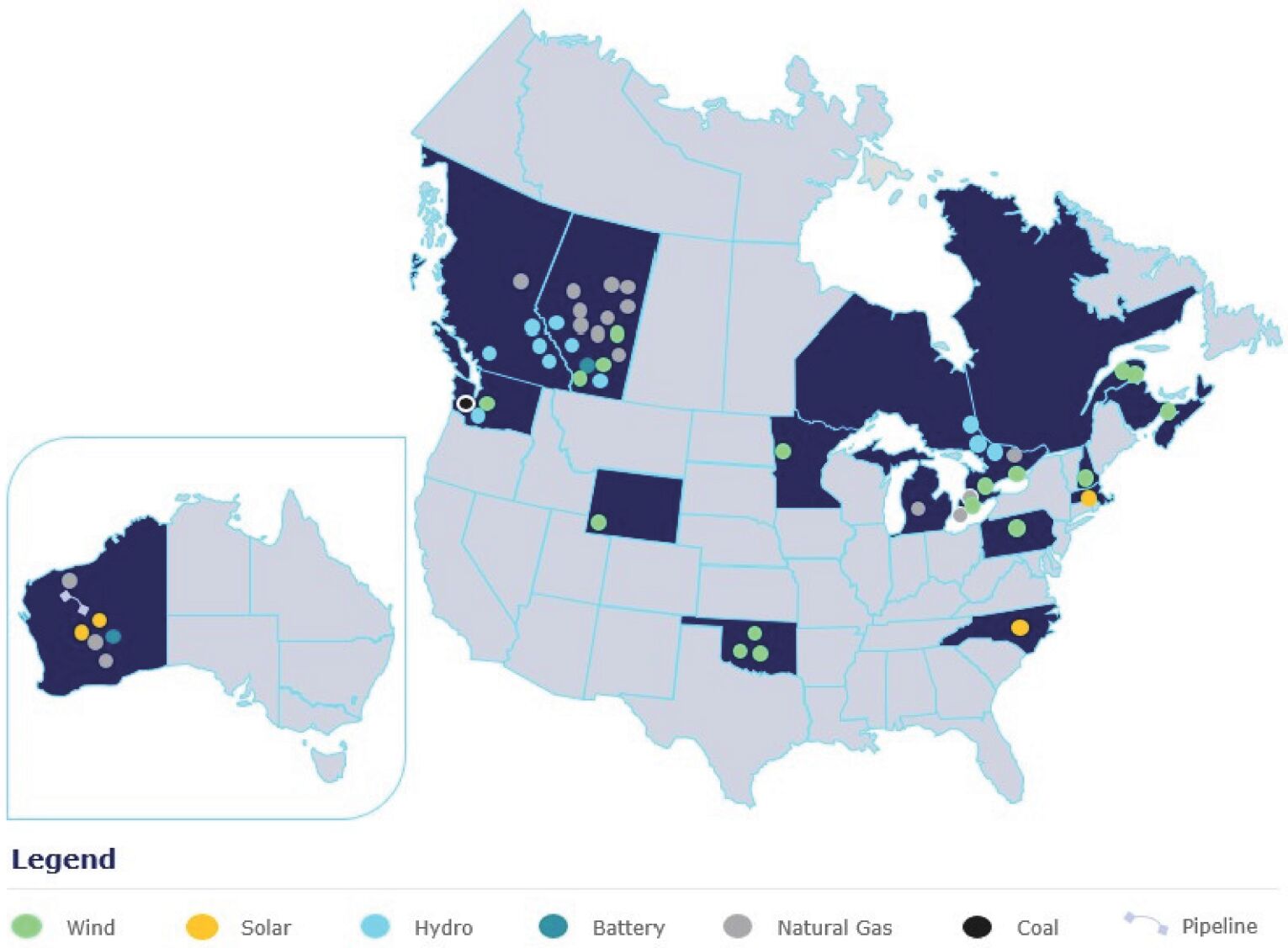
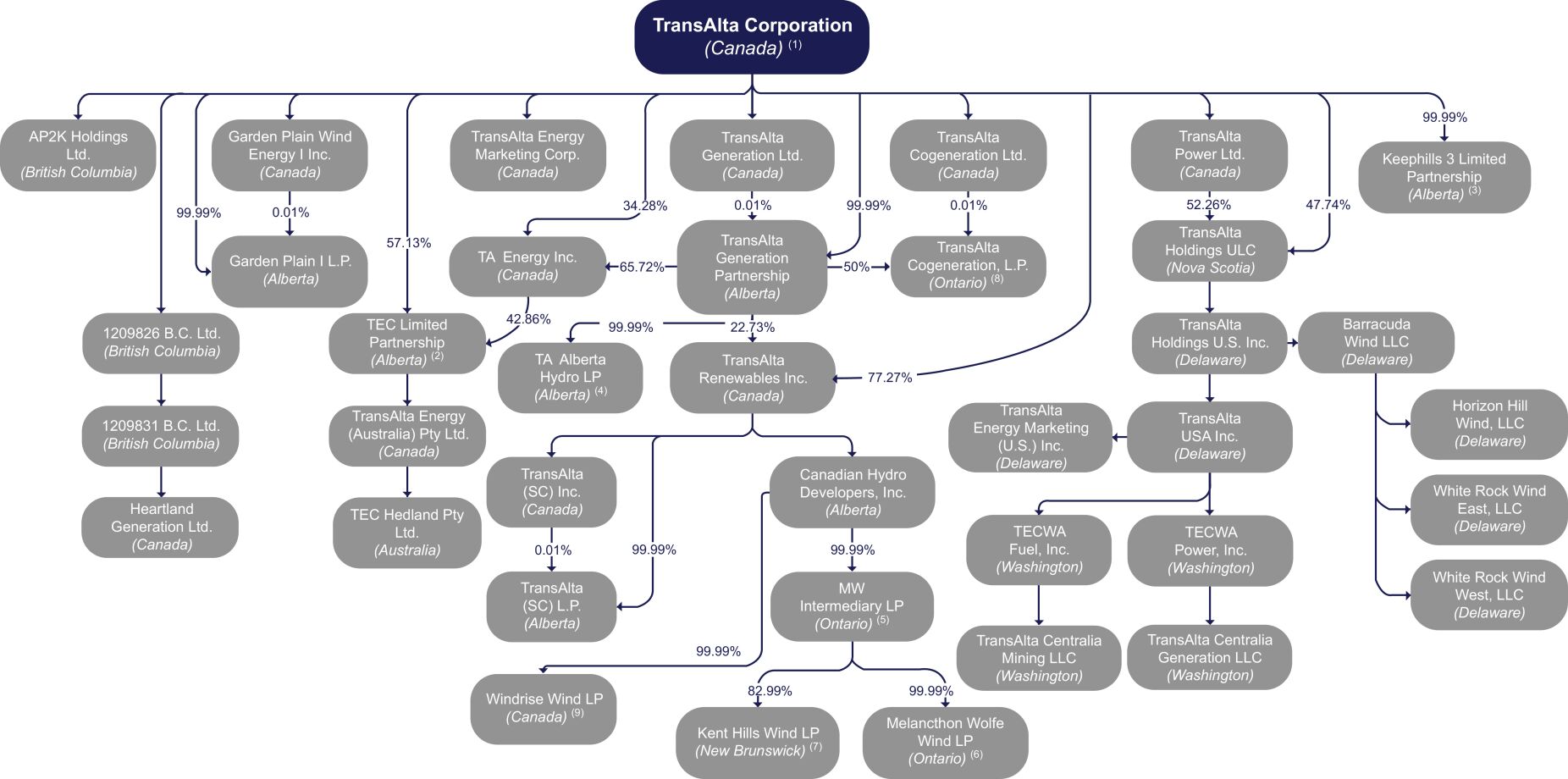


Table of Contents
        Per Note           Total     

 Public Offering Price(1)

           US$         

 Underwriting Commission(2)

           US$       

 Proceeds to TransAlta(1)(3)

           US$       


(1)

The public offering price set forth above does not include accrued interest, if any.

(2)

We refer you to “Underwriting” beginning on page S-51 of this Prospectus Supplement for additional information regarding underwriting compensation.

(3)

Before deducting the expenses of the offering, which are estimated to be approximately US$    .

The Notes will constitute a new issue of securities. There is no market through which Notes may be sold and purchasers may not be able to resell Notes purchased under this Prospectus Supplement. This may affect the pricing of the Notes in the secondary market, the transparency and availability of trading prices, the liquidity of the Notes, and the extent of issuer regulation. In addition, we do not intend to apply for listing of the Notes on any securities exchange. See “Risk Factors in this Prospectus Supplement and in the Prospectus.

THE NOTES HAVE NOT BEEN APPROVED OR DISAPPROVED BY THE UNITED STATES SECURITIES AND EXCHANGE COMMISSION (THE “SEC”) OR ANY UNITED STATES STATE SECURITIES COMMISSION NOR HAS THE SEC OR ANY UNITED STATES STATE SECURITIES COMMISSION PASSED UPON THE ACCURACY OR ADEQUACY OF THIS PROSPECTUS SUPPLEMENT OR THE PROSPECTUS. ANY REPRESENTATION TO THE CONTRARY IS A CRIMINAL OFFENSE.

This Prospectus Supplement qualifies the distribution of the Notes in each of the provinces of Canada solely for the purpose of registering the Notes in the United States pursuant to the multijurisdictional disclosure system adopted by the United States. This Prospectus Supplement does not qualify the Notes for distribution to purchasers in Canada, or to residents of Canada. See “Underwriting – Offering Restrictions”. This offering is made by a Canadian issuer that is permitted, under the multijurisdictional disclosure system adopted by the United States, to prepare this Prospectus Supplement and the Prospectus in accordance with Canadian disclosure requirements. Prospective investors should be aware that such disclosure requirements are different from those of the United States. The financial statements included herein have been prepared in accordance with International Financial Reporting Standards as issued by the International Accounting Standards Board (“IFRS”). As a result, such financial statements may not be comparable to financial statements of United States companies.

Prospective investors should be aware that the acquisition of the Notes may have tax consequences both in the United States and Canada. Such tax consequences may not be described fully in this Prospectus Supplement or the Prospectus. You should read the tax discussion under “Certain Income Tax Considerations” in this Prospectus Supplement and consult with your own tax advisor with respect to your own particular circumstances.

The enforcement by investors of civil liabilities under United States federal securities laws may be affected adversely by the fact that we are incorporated and organized under the laws of Canada, that most of our officers and directors are residents of Canada, that some of the underwriters or experts named in this Prospectus Supplement, the Prospectus and the documents incorporated by reference in the Prospectus are residents of Canada, and that a substantial portion of our assets and the assets of said persons are located outside the United States.

RBC Capital Markets, LLC, on behalf of the underwriters, has advised us that the underwriters propose to offer the Notes to the public initially at the public offering price specified above. After the underwriters have made a reasonable effort to sell all of the Notes offered by this Prospectus Supplement at the price specified above, the offering price of the Notes may be decreased and may be further changed from time to time to an amount not greater than the price specified above. Any such reduction will not affect the proceeds we receive pursuant to the offering. In connection with this offering, RBC Capital Markets, LLC may purchase and sell Notes in the open market. As a result of these activities, the market price of the Notes offered under this Prospectus Supplement may be higher than the price that otherwise might exist in the open market. If these activities are commenced, they may be discontinued by RBC Capital Markets, LLC at any time without notice. See “Underwriting” in this Prospectus Supplement.

Our earnings coverage ratio on long-term debt for the twelve-month period ended September 30, 2025 is less than one to one. See “Earnings Coverage” in this Prospectus Supplement.


Table of Contents

We expect to deliver the Notes to investors through the book-entry delivery system of The Depository Trust Company and its direct and indirect participants, including Euroclear Bank SA/NV and Clearstream Banking, S.A, against payment in New York, New York on or about , 2025.

Our head and registered office is located Suite 1400, 1100 1st Street S.E., Calgary, Alberta, T2G 1B1.


Joint Book-Running Managers


RBC Capital Markets   CIBC Capital Markets   BofA Securities   Morgan Stanley

Co-Managers


   Scotiabank   
BMO Capital Markets    TD Securities    National Bank of Canada
Financial Markets
ATB Capital Markets    Desjardins Capital Markets    MUFG
J.P. Morgan    Mizuho    Loop Capital Markets


Table of Contents

IMPORTANT NOTICE ABOUT INFORMATION IN

THIS PROSPECTUS SUPPLEMENT AND THE PROSPECTUS

This document is divided into two parts. The first part is this Prospectus Supplement, which describes the specific terms of the Notes and also adds to and updates certain information contained in the Prospectus and the documents incorporated by reference into the Prospectus. The second part, the Prospectus, gives more general information, some of which may not apply to the Notes. Capitalized terms used in this Prospectus Supplement that are not defined herein have the meanings ascribed thereto in the Prospectus.

Except as set forth under “The Offering” and “Description of Notes” in this Prospectus Supplement or under “Description of Debt Securities” in the Prospectus, and unless the context otherwise requires, all references in this Prospectus Supplement to “TransAlta”, the “Corporation”, “we”, “us” and “our” mean TransAlta Corporation and its consolidated subsidiaries including any consolidated partnerships of which the Corporation or any of its subsidiaries are partners.

If the description of the Notes or any other information varies between this Prospectus Supplement, the Prospectus and the documents incorporated by reference in the Prospectus, you should rely on the information in this Prospectus Supplement.

You should rely only on the information contained in this Prospectus Supplement or contained in, or incorporated by reference into, the Prospectus or in any free writing prospectus we authorize and use in connection with the offering of the Notes. We have not, and the underwriters have not, authorized anyone to provide you with different or additional information. We are not, and the underwriters are not, making an offer to sell the Notes in any jurisdiction where the offer or sale is not permitted. You should assume that the information in this Prospectus Supplement and the Prospectus, as well as the information in any document incorporated by reference into the Prospectus previously filed with the SEC and with any securities regulatory authority in Canada, is accurate only as of the respective dates of the applicable documents. Our business, properties, financial condition, results of operations and prospects may have changed since those dates.

PRESENTATION OF FINANCIAL INFORMATION

In this Prospectus Supplement, unless otherwise specified or the context otherwise requires, all dollar amounts are expressed in Canadian dollars. “U.S. dollars” or “US$” means the lawful currency of the United States. Unless otherwise indicated, all financial information included in this Prospectus Supplement, the Prospectus and the documents incorporated by reference in the Prospectus has been prepared in accordance with IFRS. Therefore, our consolidated financial statements included in the Prospectus Supplement may not be comparable to financial statements of U.S. companies prepared in accordance with U.S. generally accepted accounting principles.

We use a number of financial measures to evaluate our performance and the performance of our business segments, including measures and ratios that do not have any standardized meaning under IFRS (collectively, “Non-IFRS Measures and Ratios”). We believe that these Non-IFRS Measures and Ratios, read together with our IFRS amounts, provide investors with a better understanding of how management assesses results. Non-IFRS Measures and Ratios are unlikely to be comparable to similar measures presented by other companies and should not be viewed in isolation from, or as an alternative for, or more meaningful than our IFRS results.

Adjusted earnings before interest, taxes, depreciation and amortization (“EBITDA”), adjusted net debt to adjusted EBITDA are some of the Non-IFRS Measures and Ratios presented in this Prospectus Supplement.

Readers should refer to the “Highlights” and “Non-IFRS and Supplementary Financial Measures” sections of our management’s discussion and analysis of financial condition and results of operations as at and for the three and nine months ended September 30, 2025 and 2024 (the “Interim MD&A”) for the composition of each Non-IFRS Measure and Ratio, the most directly comparable IFRS measure, how these Non-IFRS Measures and Ratios provide useful information to an investor, and quantitative reconciliations to the nearest applicable IFRS measures. The Interim MD&A is incorporated by reference in the Prospectus and is available under our profile on the System for Electronic Data Analysis and Retrieval+ at www.sedarplus.ca (“SEDAR+”).


Table of Contents

TABLE OF CONTENTS

Prospectus Supplement


EXCHANGE RATE INFORMATION

     S-1  

SPECIAL NOTE REGARDING FORWARD-LOOKING STATEMENTS

     S-2  

DOCUMENTS INCORPORATED BY REFERENCE

     S-4  

WHERE YOU CAN FIND MORE INFORMATION

     S-5  

SUMMARY

     S-6  

THE OFFERING

     S-19  

RISK FACTORS

     S-22  

USE OF PROCEEDS

     S-24  

PRIOR SALES

     S-25  

CAPITALIZATION

     S-26  

DESCRIPTION OF NOTES

     S-27  

EARNINGS COVERAGE

     S-46  

CERTAIN INCOME TAX CONSIDERATIONS

     S-47  

UNDERWRITING

     S-51  

LEGAL MATTERS

     S-55  

EXPERTS

     S-56  

Exhibits


Exhibit “A”   Annual Audited Financial Statements as at and for the Years Ended December 31, 2024 and 2023      SA-1  
Exhibit “B”   Annual Management’s Discussion and Analysis of Financial Condition and Results of Operations      SB-1  
Exhibit “C”   Interim Unaudited Financial Statements as at and for the Three and Nine Months Ended September 30, 2025      SC-1  
Exhibit “D”   Interim Management’s Discussion and Analysis of Financial Condition and Results of Operations      SD-1  

Prospectus


ABOUT THIS PROSPECTUS

     1  

DOCUMENTS INCORPORATED BY REFERENCE

     2  

WHERE TO FIND MORE INFORMATION

     4  

MARKETING MATERIALS

     4  

SPECIAL NOTE REGARDING FORWARD-LOOKING STATEMENTS

     5  

TRANSALTA CORPORATION

     7  

CONSOLIDATED CAPITALIZATION

     7  

USE OF PROCEEDS

     8  

EARNINGS COVERAGE RATIOS

     9  

DESCRIPTION OF SHARE CAPITAL

     9  

DESCRIPTION OF WARRANTS

     12  

DESCRIPTION OF SUBSCRIPTION RECEIPTS

     13  

DESCRIPTION OF DEBT SECURITIES

     14  

DESCRIPTION OF UNITS

     16  

CERTAIN INCOME TAX CONSIDERATIONS

     17  

SELLING SHAREHOLDER

     18  

PLAN OF DISTRIBUTION

     20  

RISK FACTORS

     22  

ENFORCEABILITY OF CIVIL LIABILITIES

     25  

LEGAL MATTERS

     25  

INTEREST OF EXPERTS

     25  

AUDITORS, TRANSFER AGENT AND REGISTRAR

     25  

DOCUMENTS FILED AS PART OF THE REGISTRATION STATEMENT

     26  


s-i


Table of Contents

EXCHANGE RATE INFORMATION

TransAlta publishes its consolidated financial information in Canadian dollars. The following table sets forth the Canada/U.S. exchange rates on the last day of the periods indicated as well as the high, low and average rates for such periods. The high, low and average exchange rates for each period were identified or calculated from spot rates in effect on each trading day during the relevant period. The exchange rates shown are expressed as the number of U.S. dollars required to purchase one Canadian dollar. These exchange rates are based on those published on the Bank of Canada’s website on each trading day (the “Bank of Canada rate”). On December 10, 2025, the Bank of Canada rate was US$0.7228 equals $1.00.


     Nine Months Ended
September 30,
     Year Ended
December 31,
 
       2025          2024          2023          2022    

High for period

   US$ 0.7376      US$ 0.7510      US$ 0.7617      US$ 0.8031  

Low for period

   US$ 0.6848      US$ 0.6937      US$ 0.7207      US$ 0.7217  

Rate at end of period

   US$ 0.7183      US$ 0.6950      US$ 0.7561      US$ 0.7383  

Average rate for the period(1)

   US$ 0.7149      US$ 0.7300      US$ 0.7409      US$ 0.7686  


(1)

The average of the Bank of Canada rate on the last day of each month during the applicable period.


S-1


Table of Contents

SPECIAL NOTE REGARDING FORWARD-LOOKING STATEMENTS

This Prospectus Supplement, the Prospectus and the documents incorporated by reference in the Prospectus contain “forward-looking information” and “forward-looking statements” (collectively, “forward-looking statements”) within the meaning of applicable securities laws, including the “safe harbor” provisions of the Securities Act (Alberta), the United States Private Securities Litigation Reform Act of 1995, Section 21E of the United States Securities Exchange Act of 1934, as amended (the “U.S. Exchange Act”), and Section 27A of the United States Securities Act of 1933, as amended (the “Securities Act”). All forward-looking statements are based on TransAlta’s beliefs as well as assumptions based on information available at the time the assumption was made and on management’s experience and perception of historical trends, current conditions and expected further developments as well as other factors deemed appropriate in the circumstances. Forward-looking statements are not facts, but only predictions and generally can be identified by the use of statements that include phrases such as “may”, “will”, “believe”, “expect”, “anticipate”, “intend”, “plan”, “foresee”, “potential”, “enable”, “continue”, “estimate”, “would” or other words or phrases of similar import.

Forward-looking statements are subject to known and unknown risks, uncertainties and other important factors, many of which are beyond the Corporation’s control, that could cause actual events, outcomes or results to differ materially from those expressed or implied in the forward-looking statement. Although the Corporation believes that the assumptions and expectations conveyed by such forward-looking statements are reasonable based on information available on the date they are made, there can be no assurance that such assumptions and expectations will prove to be correct.

In particular, this Prospectus Supplement, the Prospectus and the documents incorporated by reference in the Prospectus contain forward-looking statements pertaining to the following: the anticipated closing of the offering of the Notes, including the timing thereof; the net proceeds from the offering and the use of such proceeds; our credit ratings outlook; the terms of the Notes; ceasing coal-fired electricity generation by the end of 2025; our greenhouse gas (“GHG”) emissions reduction targets and our carbon net-zero goal by 2045, specifically with reductions in production including lower wind resource; opportunities available to the Corporation in the Alberta market; the continued value of our ancillary services product; the benefits of the Heartland Generation acquisition; our intention to maintain a conservative credit profile; the expected completion of the Mount Keith West Network Upgrade by Q4 2025 and its anticipated average annual EBITDA; the benefits expected to arise through our pursuit of accretive opportunities with existing and prospective customers at our legacy thermal sites in Alberta and Washington State; the expected continued return to shareholders; the anticipated policy developments on Alberta’s restructured energy market by 2050, including the expected implementation timing; the transactions with Far North and PSE (each as defined herein), including expectations with respect to the timing and closing thereof, approvals required in connection therewith and the attributes of the assets acquired thereunder; our expectations regarding our revenue, expenses and operations; our expected cash needs and needs for additional financing; the anticipated trends and challenges in our business and the markets in which we operate; our expectation to continue maintaining adequate liquidity; and our expectation that the redemption of the 2029 Notes will be funded with the net proceeds of this offering, together with cash on hand.

The forward-looking statements contained in this Prospectus Supplement, the Prospectus and the documents incorporated by reference in the Prospectus are based on many assumptions including, but not limited to, the following: our ability to complete the offering on a timely basis and on the terms expected; fulfillment by the underwriters of their obligations pursuant to the underwriting agreement; that no event will occur which would allow the underwriters to terminate their obligations under the underwriting agreement; no significant changes to applicable laws and regulations beyond those that have already been announced; no significant changes to fuel and purchased power costs; no material adverse impacts to long-term investment and credit markets; no significant changes to power price and hedging assumptions, including hedged volumes and prices; no significant changes to gas commodity prices and transport costs; no significant changes to decommissioning and restoration costs; no significant changes to interest rates; no significant changes to the demand and growth of renewables generation; no significant changes to the integrity and reliability of our assets; planned and unplanned


S-2


Table of Contents

outages and use of our assets; and no significant changes to the Corporation’s debt and credit ratings. Although the Corporation believes that these assumptions are reasonable based on currently available information, there can be no assurance that such assumptions will prove to be correct.

Forward-looking statements are subject to a number of significant risks and uncertainties that could cause actual plans, performance, results or outcomes to differ materially from current expectations. Factors that may adversely impact what is expressed or implied by forward-looking statements contained in this Prospectus Supplement, the Prospectus and the documents incorporated by reference in the Prospectus include risks relating to: fluctuations in power prices; changes in supply and demand for electricity; our ability to contract our electricity generation for prices that will provide expected returns; our ability to replace contracts as they expire; risks associated with development projects and acquisitions; any difficulty raising needed capital in the future on reasonable terms or at all; our ability to achieve our targets relating to environment, social and governance (“ESG”); long-term commitments on gas transportation capacity that may not be fully utilized over time; changes to the legislative, regulatory and political environments; environmental requirements and changes in, or liabilities under, these requirements; operational risks involving our facilities, including unplanned outages and equipment failure; disruptions in the transmission and distribution of electricity; reductions in production; impairments and/or writedowns of assets; adverse impacts on our information technology systems and our internal control systems, including increased cybersecurity threats; commodity risk management and energy trading risks; reduced labour availability and ability to continue to staff our operations and facilities; disruptions to our supply chains; climate-change related risks; reductions to our generating units’ relative efficiency or capacity factors; general economic risks, including deterioration of equity and debt markets, increasing interest rates or rising inflation; general domestic and international economic and political developments, including potential trade tariffs; industry risk and competition; counterparty credit risk; inadequacy or unavailability of insurance coverage; increases in the Corporation’s income taxes and any risk of reassessments; legal, regulatory and contractual disputes and proceedings involving the Corporation; reliance on key personnel; and labour relations matters. Additional information about material factors that could cause actual results to differ materially from expectations and about material factors or assumptions applied in making forward-looking statements may be found in this Prospectus Supplement and the Prospectus under “Risk Factors” as well as in our management’s discussion and analysis of financial condition and results of operations as of and for the year ended December 31, 2024 (the “Annual MD&A”) and the Annual Information Form (as defined herein), and elsewhere in TransAlta’s filings with the Canadian and U.S. securities regulators.

Readers are urged to consider these factors carefully in evaluating the forward-looking statements and are cautioned not to place undue reliance on these forward-looking statements. The forward-looking statements included in this Prospectus Supplement, the Prospectus and the documents incorporated by reference in the Prospectus are made only as of the date such statements and the Corporation does not undertake to publicly update these forward-looking statements to reflect new information, future events or otherwise, except as required by applicable laws. The purpose of the financial outlooks contained herein is to give the reader information about management’s current expectations and plans and readers are cautioned that such information may not be appropriate for other purposes. In light of these risks, uncertainties and assumptions, the forward-looking statements might occur to a different extent or at a different time than we have described, or might not occur at all. We cannot assure that projected results or events will be achieved.


S-3


Table of Contents

DOCUMENTS INCORPORATED BY REFERENCE

As of the date of this Prospectus Supplement, the following documents filed with the securities commissions or similar authorities in each of the provinces of Canada and with the SEC are specifically incorporated by reference into the Prospectus:


  (a)

our annual information form dated February 19, 2025 for the year ended December 31, 2024 (the “Annual Information Form”); and


  (b)

our management proxy circular dated March 7, 2025, prepared in connection with the Corporation’s annual and special meeting of shareholders held on April 24, 2025.

This Prospectus Supplement is deemed to be incorporated by reference into the Prospectus solely for the purposes of the offering of Notes.

Any documents of the type required to be incorporated by reference in a short form prospectus pursuant to National Instrument 44-101 — Short Form Prospectus Distributions of the Canadian Securities Administrators, including any documents of the type referred to above or under “Documents Incorporated by Reference” in the Prospectus, material change reports (excluding confidential material change reports) and business acquisition reports we subsequently file with any securities commissions or similar authorities in Canada after the date of this Prospectus Supplement and prior to the termination of any offering of the Notes under this Prospectus Supplement shall be deemed to be incorporated by reference into the Prospectus. These documents are available through the internet on SEDAR+, which can be accessed at www.sedarplus.ca. In addition, any similar documents we file with, or furnish to, the SEC pursuant to Section 13(a), 13(c) or 15(d) of the U.S. Exchange Act on or after the date of this Prospectus Supplement and prior to the termination of this distribution of Notes, shall be deemed to be incorporated by reference into the Prospectus and the registration statement on Form F-10 of which this Prospectus Supplement and the Prospectus form a part, if and to the extent expressly provided in such report, except that any report on Form 6-K shall be incorporated only to the extent expressly provided in such report. To the extent that any document incorporated by reference into the Prospectus is included in a report that is filed with or furnished to the SEC by us on Form 40-F, 20-F, 10-K, 10-Q, 8-K or 6-K (or any respective successor form), such document shall also be deemed to be incorporated by reference as an exhibit to the registration statement on Form F-10 of which this Prospectus Supplement and the Prospectus form a part. Our reports on Form 6-K, and our annual reports on Form 40-F, are available on the SEC’s website at www.sec.gov.

Any statement contained in this Prospectus Supplement, the Prospectus, or in a document incorporated or deemed to be incorporated by reference therein, shall be deemed to be modified or superseded for the purposes of this Prospectus Supplement to the extent that a statement contained herein or therein or in any other subsequently filed document that also is or is deemed to be incorporated by reference therein modifies or supersedes such statement. The modifying or superseding statement need not state that it has modified or superseded a prior statement or include any other information set forth in the document that it modifies or supersedes. The making of a modifying or superseding statement is not to be deemed an admission for any purposes that the modified or superseded statement, when made, constituted a misrepresentation, an untrue statement of a material fact or an omission to state a material fact that is required to be stated or that is necessary to make a statement not misleading in light of the circumstances in which it was made. Any statement so modified or superseded shall not be deemed, except as so modified or superseded, to constitute a part of this Prospectus Supplement.

We will provide without charge to each person to whom this Prospectus Supplement is delivered, including any beneficial owner, upon written or oral request of such person, a copy of any or all of the documents incorporated by reference in the Prospectus (other than exhibits to such documents, unless such exhibits are specifically incorporated by reference in such documents). Requests should be directed to TransAlta Corporation, TransAlta at Suite 1400, 1100 1st Street S.E., Calgary, Alberta, T2G 1B1, Attention: Corporate Secretary, telephone number (403) 267-7110. These documents are also available on SEDAR+ at www.sedarplus.ca and on EDGAR at www.sec.gov.


S-4


Table of Contents

WHERE YOU CAN FIND MORE INFORMATION

We have filed with the SEC under the U.S. Securities Act a registration statement on Form F-10 relating to the Notes and of which this Prospectus Supplement and the Prospectus form a part. This Prospectus Supplement and the Prospectus do not contain all of the information set forth in such registration statement, certain items of which are contained in the exhibits to such registration statement as permitted or required by the rules and regulations of the SEC. See “Documents Filed as Part of the Registration Statement” in the Prospectus. Statements made in this Prospectus Supplement and the Prospectus as to the contents of any contract, agreement or other document referred to are not necessarily complete, and in each instance, reference is made to the exhibit, if applicable, for a more complete description of the relevant matter, each such statement being qualified in its entirety by such reference. Items of information omitted from this Prospectus Supplement and the Prospectus but contained in the registration statement on Form F-10 are available on the SEC’s website at www.sec.gov.

We are subject to the information requirements of the U.S. Exchange Act, and, in accordance therewith, file reports and other information with the SEC. Under the multijurisdictional disclosure system adopted in the United States, such reports and other information, subject to certain exceptions, may be prepared in accordance with the disclosure requirements of Canada, which requirements are different from those of the United States. We are exempt from the rules under the U.S. Exchange Act prescribing the furnishing and content of proxy statements, and our officers, directors and principal shareholders are exempt from the reporting and short swing profit recovery provisions contained in Section 16 of the U.S. Exchange Act. Under the U.S. Exchange Act, we are not required to publish financial statements as promptly as United States companies. Such reports and other information are available on the SEC’s EDGAR website at www.sec.gov. Prospective investors may read and download any public document that we have filed with the securities regulatory authorities in each of the provinces of Canada on SEDAR+ at www.sedarplus.ca.


S-5


Table of Contents

SUMMARY

The following is a summary of certain information contained in this Prospectus Supplement, the Prospectus and the documents incorporated by reference in the Prospectus. It does not purport to be complete and is qualified in its entirety by, is subject to, and should be read in conjunction with, the detailed information contained elsewhere in this Prospectus Supplement, the Prospectus and the documents incorporated by reference in the Prospectus. It does not contain all the information about our business or the offering that you should consider before investing in the Notes. Terms not defined in this summary are defined elsewhere in this Prospectus Supplement.

TransAlta Corporation

TransAlta Corporation is one of Canada’s largest publicly traded power generators, owning and operating a diverse fleet across Canada, the United States and Western Australia. Our portfolio includes hydro, wind, solar, battery storage, natural gas and coal, complemented by our exceptional asset optimization and energy marketing capabilities. As one of Canada’s largest producers of wind and thermal generation and Alberta’s largest producer of hydro power, TransAlta remains committed to a balanced, technology-agnostic generation mix. With strong cash flows underpinned by a high-quality portfolio, we strive to deliver sustainable long-term value in an evolving energy landscape.

Our goal is to deliver solutions to meet our customers’ needs for reliable, sustainable power. With over a century of experience, TransAlta is a trusted partner delivering tailored solutions. Our strategic priorities include optimizing our Alberta portfolio, executing our growth plan, realizing the value of our legacy thermal assets, defining the next generation of power solutions and leading in ESG and market policy development. We are primarily focused on opportunities within our core markets of Canada, the United States and Western Australia.

Our sustainability goals include our commitment to cease coal-fired generation at the end of 2025. We remain on track to achieve our 2026 target of 75% scope 1 and 2 GHG emissions reductions since 2015 and our carbon net-zero goal by 2045.

Business of TransAlta

Our business is comprised of six segments: (i) Hydro; (ii) Wind and Solar; (iii) Gas; (iv) Energy Transition; (v) Energy Marketing; and (vi) Corporate. Our Hydro, Wind and Solar, Gas and Energy Transition segments are responsible for operating and maintaining our electrical generation facilities in Canada, the United States and Western Australia. Our Energy Marketing segment is responsible for marketing and scheduling our merchant asset fleet in North America (excluding Alberta) along with the procurement of gas, transport and storage for our gas fleet, providing knowledge to support our growth team, and generating a stand-alone gross margin separate from our asset business through a leading North American energy marketing platform. These segments are all supported by the Corporate segment.

The following provides more detailed information on these business segments.

Hydro Segment

The Hydro segment has a net ownership interest of approximately 922 MW of owned hydroelectric generating capacity. The facilities are located in Alberta, British Columbia and Ontario. As well as contracting for power, we enter into long-term and short-term contracts to sell the environmental attributes from our merchant hydro facilities. Generally, for facilities under long-term contract, the benefit of the environmental


S-6


Table of Contents

attributes generated is provided to the contract holder. The following table summarizes our hydroelectric facilities as at September 30, 2025:


Facility Name   Province/ State   Nameplate
Capacity
(MW)(1)
  Consolidated
Interest
  Gross Installed
Capacity
(MW)(1)
    Ownership     Net Capacity
Ownership
Interest (MW)(1)
    Commercial
Operation
Date(2)
  Revenue
Source(3)
  Contract Expiry
Date(4)
 

 Alberta – Bow River System


Barrier(5)(6)

  AB   13   100%     13       100%       13     1947   Merchant     -  

Bearspaw(5)(6)

  AB   17   100%     17       100%       17     1954   Merchant     -  

Cascade(5)(6)

  AB   36   100%     36       100%       36     1942, 1957   Merchant     -  

Ghost(5)(6)

  AB   54   100%     54       100%       54     1929, 1954   Merchant     -  

Horseshoe(5)(6)

  AB   14   100%     14       100%       14     1911   Merchant     -  

Interlakes(5)(6)

  AB   5   100%     5       100%       5     1955   Merchant     -  

Kananaskis(5)(6)

  AB   19   100%     19       100%       19     1913, 1951   Merchant     -  

Pocaterra(6)

  AB   15   100%     15       100%       15     1955   Merchant     -  

Rundle(5)(6)

  AB   50   100%     50       100%       50     1951, 1960   Merchant     -  

Spray(5)(6)

  AB   112   100%     112       100%       112     1951, 1960   Merchant     -  

Three Sisters(5)

  AB   3   100%     3       100%       3     1951   Merchant     -  

 Alberta – Oldman River System


Belly River(6)

  AB   3   100%     3       100%       3     1991   Merchant     -  

St. Mary(6)

  AB   2   100%     2       100%       2     1992   Merchant     -  

Taylor(6)

  AB   13   100%     13       100%       13     2000   Merchant     -  

Waterton(6)

  AB   3   100%     3       100%       3     1992   Merchant     -  

 Alberta – North Saskatchewan River System(6)


Bighorn(5)(6)

  AB   120   100%     120       100%       120     1972   Merchant     -  

Brazeau(5)(6)

  AB   355   100%     355       100%       355     1965, 1967   Merchant     -  

 BC Hydro


Akolkolex(6)

  BC   10   100%     10       100%       10     1995   LTC     2046  

Bone Creek(6)

  BC   19   100%     19       100%       19     2011   LTC     2031  

Pingston(6)

  BC   45   50%     23       100%       23     2003, 2004   LTC     2043  

Upper Mamquam(6)

  BC   25   100%     25       100%       25     2005   LTC     2045  

 Ontario Hydro


Misema

  ON   3   100%     3       100%       3     2003   LTC     2027  

Moose Rapids(6)

  ON   1   100%     1       100%       1     1997   LTC     2030  

Ragged Chute

  ON   7   100%     7       100%       7     1991   LTC     2029  

 Total Hydroelectric Capacity

  944         922               922                  


(1)

MW are rounded to the nearest whole number. The gross installed capacity reflects the basis of consolidation of underlying assets owned, whereas net capacity ownership interest deducts capacity attributable to the non-controlling interest in these assets and is calculated after the consolidation of underlying assets.

(2)

A second date in this column refers to a second unit that was subsequently operational.

(3)

The large majority of the Corporation’s contracted operating facilities benefit from inflation adjustment provisions that apply to all or a portion of our revenues under such contracts.

(4)

Where no contract expiry date is indicated, the facility operates as merchant.

(5)

These facilities form part of the hydro assets that are subject to the Investment Agreement (as defined herein). See the “Capital and Loan Structure – Exchangeable Securities – Investment Agreement” section of this AIF for further details.

(6)

These facilities are EcoLogo® certified. EcoLogo certification is granted to products with an environmental performance that meets or exceeds all government, industrial safety and performance standards.


S-7


Table of Contents

Wind and Solar Segment

As at September 30, 2025, the Wind and Solar segment held interests in approximately 2,559 MW of net wind and solar generating capacity. This capacity consists of twelve wind facilities in Western Canada, four in Ontario, two in Québec, three in New Brunswick and eight in the United States, more specifically in the states of Washington, Wyoming, Minnesota, Oklahoma, Pennsylvania and New Hampshire. The Corporation also holds a 10 MW utility-scale battery energy storage system in Alberta, 143 MW of solar facilities in the states of Massachusetts and North Carolina, and a 38 MW solar facility and a 10 MW battery energy storage system in Western Australia. In addition to contracting for the sale of the power generation, we also enter into long-term and short-term contracts to sell the environmental attributes from the merchant wind and solar facilities. Generally, for facilities under a long-term power purchase agreement, the purchaser under such long-term contracts also benefits from any environmental attributes associated with the facility. The following table summarizes our Wind and Solar generation facilities as at September 30, 2025:


Facility Name   Province/
State
  Nameplate
Capacity
(MW)(1)
  Consolidated
Interest
  Gross Installed
Capacity (MW)(1)
  Ownership   Net Capacity
Ownership Interest
(MW)(1)
  Commercial
Operation Date(2)
  Revenue
Source(3)
  Contract Expiry
Date(4)
               
Alberta Wind                            

Ardenville(5)

  AB   69   100%   69   100%   69   2010   Merchant   -

Blue Trail and Macleod Flats(5)

  AB   69   100%   69   100%   69   2009 and 2004   Merchant   -

Castle River(5)(6)

  AB   44   100%   44   100%   44   1997-2001   Merchant   -

Cowley North(5)

  AB   20   100%   20   100%   20   2001   Merchant   -

Garden Plain

  AB   130   100%   130   100%   130   2023   LTC   2035-2041

McBride Lake(5)

  AB   75   50%   38   100%   38   2004   Merchant   -

Oldman(5)

  AB   4   100%   4   100%   4   2007   Merchant   -

Sinnott(5)

  AB   5   100%   5   100%   5   2001   Merchant   -

Soderglen(5)

  AB   71   50%   36   100%   36   2006   Merchant   -

Summerview 1(5)

  AB   68   100%   68   100%   68   2004   Merchant   -

Summerview 2(5)

  AB   66   100%   66   100%   66   2010   Merchant   -

Windrise

  AB   206   100%   206   100%   206   2021   LTC   2041
         
Alberta Battery Energy Storage                

WindCharger

  AB   10   100%   10   100%   10   2020   Merchant   -
Eastern Canada Wind                

Kent Breeze

  ON   20   100%   20   100%   20   2011   LTC   2031

Kent Hills 1

  NB   96   100%   96   83%   80   2008   LTC   2045

Kent Hills 2

  NB   54   100%   54   83%   45   2010   LTC   2045

Kent Hills 3

  NB   17   100%   17   83%   14   2018   LTC   2045

Le Nordais(5)(7)

  QC   98   100%   98   100%   98   1999   LTC   2033

Melancthon 1

  ON   68   100%   68   100%   68   2006   LTC   2031

Melancthon 2

  ON   132   100%   132   100%   132   2008   LTC   2034

New Richmond(5)

  QC   68   100%   68   100%   68   2013   LTC   2033

Wolfe Island

  ON   198   100%   198   100%   198   2009   LTC   2034
               
US Wind                            

Antrim

  NH   29   100%   29   100%   29   2019   LTC   2039

Big Level

  PA   90   100%   90   100%   90   2019   LTC   2034

Horizon Hill

  OK   202   100%   202   100%   202   2024   LTC   -

Lakeswind

  MN   50   100%   50   100%   50   2014   LTC   2034

Skookumchuck Wind

  WA   137   49%   67   100%   67   2020   LTC   2040

White Rock East

  OK   202   100%   202   100%   202   2024   LTC   -

White Rock West

  OK   100   100%   100   100%   100   2024   LTC   -

Wyoming Wind

  WY   140   100%   140   100%   140   2003   LTC   2028
                   
US Solar                                    

Mass Solar (7)

  MA   21   100%   21   100%   21   2012-2015   LTC   2032-2045

North Carolina Solar(7)

  NC   122   100%   122   100%   122   2019-2021   LTC   2033
                   
Australian Solar                                    

Northern Goldfields(7)

  WA   38   100%   38   100%   38   2023   LTC   2038


S-8


Table of Contents
Facility Name   Province/
State
  Nameplate
Capacity
(MW)(1)
  Consolidated
Interest
  Gross Installed
Capacity (MW)(1)
  Ownership   Net Capacity
Ownership Interest
(MW)(1)
  Commercial
Operation Date(2)
  Revenue
Source(3)
  Contract Expiry
Date(4)
         
Australia Battery Energy Storage                

Northern Goldfields Battery

  WA   10   100%   10   100%   10   2023   LTC   2038
                 
Total Wind and Solar Capacity   2,729       2,587       2,559            


(1)

MW are rounded to the nearest whole number. The gross installed capacity reflects the basis of consolidation of the underlying assets owned, whereas net capacity ownership interest deducts capacity attributable to non-controlling interest in these assets and is calculated after consolidation of the underlying assets.

(2)

A second date in this column refers to a second facility that was subsequently operational.

(3)

The large majority of the Corporation’s contracted operating facilities benefit from inflation adjustment provisions that apply to all or a portion of our revenues under such contracts.

(4)

Where no contract expiry date is indicated, the facility operates as merchant.

(5)

These facilities are EcoLogo® certified. EcoLogo certification is granted to products with an environmental performance that meets or exceeds all government, industrial safety and performance standards.

(6)

Includes seven additional turbines at other locations.

(7)

Includes multiple facilities.

Gas Segment

The Gas segment has a net ownership interest of approximately 4,525 MW of owned gas electrical-generating capacity. The facilities are located in British Columbia, Alberta, Ontario, Michigan and Western Australia. This segment includes our ownership interest in a natural gas pipeline located in Western Australia. The following table summarizes our natural-gas-fired generation facilities as September 30, 2025:


Facility Name  

Province/

State

  Nameplate
Capacity
(MW)(1)
  Consolidated
Interest
  Gross Installed
Capacity
(MW)(1)
  Ownership   Net Capacity
Ownership
Interest
(MW)(1)
  Commercial
Operation Date
  Revenue
Source(2)
  Contract Expiry
Date(3)
                 

 British Columbia


McMahon

  BC   120   50%   60   100%   60   1993   LTC   2029
                 

 Alberta


Battle River 4

  AB   155   100%   155   100%   155   1975   Merchant   -

Battle River 5

  AB   395   100%   395   100%   395   1981   Merchant   -

Fort Saskatchewan(4)

  AB   118   60%   71   50%   35   1999   LTC/Merchant   2029

Joffre

  AB   474   40%   190   100%   190   2000   LTC/Merchant   2041

Keephills Unit No. 2

  AB   395   100%   395   100%   395   1984   Merchant   -

Keephills Unit No. 3

  AB   466   100%   466   100%   466   2011   Merchant   -

Muskeg River

  AB   202   100%   202   100%   202   2003   LTC   2042

Poplar Creek(5)

  AB   230   100%   230   100%   230   2001   LTC   2030

Primrose

  AB   100   50%   50   100%   50   1998   LTC   2028

Scotford

  AB   195   100%   195   100%   195   2003   LTC/Merchant   2043

Sheerness Unit No.1(4)

  AB   400   100%   400   75%   300   1986   Merchant   -

Sheerness Unit No.2(4)

  AB   400   100%   400   75%   300   1990   Merchant   -

Sundance Unit No. 6

  AB   401   100%   401   100%   401   1980   Merchant   -

Valleyview 1

  AB   50   100%   50   100%   50   2001   Merchant   -

Valleyview 2

  AB   50   100%   50   100%   50   2008   Merchant   -
                 

 Total Alberta Gas Capacity

  4,031       3,650       3,414            

 Ontario and U.S.


Ada

  MI   29   100%   29   100%   29   1991   LTC   2026

Ottawa(4)

  ON   74   100%   74   50%   37   1992   LTC/Merchant   2033

Sarnia

  ON   499   100%   499   100%   499   2003   LTC   2031

Windsor(4)

  ON   72   100%   72   50%   36   1996   LTC/Merchant   2031
                 

Total Ontario and U.S. Gas Capacity

  674       674       601            


S-9


Table of Contents
Facility Name  

Province/

State

  Nameplate
Capacity
(MW)(1)
  Consolidated
Interest
  Gross Installed
Capacity
(MW)(1)
  Ownership   Net Capacity
Ownership
Interest
(MW)(1)
  Commercial
Operation Date
  Revenue
Source(2)
  Contract Expiry
Date(3)

 Australia


Fortescue River Gas Pipeline

  WA   N/A   100%   N/A   43%   N/A   2015   LTC   2035

Parkeston

  WA   110   50%   55   100%   55   1996   LTC/Merchant   2027

South Hedland

  WA   150   100%   150   100%   150   2017   LTC   2042

Southern Cross(6)

  WA   245   100%   245   100%   245   1996   LTC   2038
                 

 Total Australian Gas Capacity

  505       450       450            

 Total Gas Capacity

  5,330       4,834       4,525            


(1)

MW are rounded to the nearest whole number. The gross installed capacity reflects the basis of consolidation of the underlying assets owned, whereas net capacity ownership interest deducts capacity attributable to non-controlling interest in these assets and is calculated after the consolidation of the underlying assets.

(2)

The large majority of the Corporation’s contracted operating facilities benefit from inflation adjustment provisions that apply to all or a portion of our revenues under such contracts.

(3)

Where no contract expiry date is indicated, the facility operates as merchant.

(4)

Our interests in these facilities are through our ownership interest in TransAlta Cogeneration, LP.

(5)

The Poplar Creek facility is operated by Suncor Energy Inc.

(6)

Includes four facilities. Excludes the Northern Goldfields facilities, which are in the Wind and Solar segment.

Energy Transition Segment

The Energy Transition segment has a net ownership interest of approximately 671 MW of owned generating capacity. The segment includes one remaining operating unit at Centralia, the Skookumchuck hydro facility, the retired Centralia unit, the retired Alberta thermal units, the Highvale mine and the mine reclamation activities. The following table summarizes our energy transition facilities as at September 30, 2025:


Facility Name    Province/State    Nameplate
Capacity
(MW)(1)
  Consolidated
Interest
  Gross Installed
Capacity
(MW)(1)
  Ownership   Net Capacity
Ownership
Interest
(MW)(1)
  Commercial
Operation Date
   Revenue Source    Contract Expiry
Date
 U.S.                                        

Centralia

   WA    670   100%   670   100%   670   1971    LTC/Merchant    2025

Skookumchuck(2)

   WA    1   100%   1   100%   1   1970    LTC    2025
 Total Energy Transition Capacity    671       671       671              


(1)

MW are rounded to the nearest whole number. The gross installed capacity reflects the basis of consolidation of underlying assets owned, whereas net capacity ownership interest deducts capacity attributable to non-controlling interest in these assets and is calculated after consolidation of underlying assets.

(2)

This facility is used to provide a reliable water supply to the Centralia facility.

Energy Marketing Segment

Our Energy Marketing segment provides a number of strategic functions, including the following:


Gathering and analyzing market trends to enable more effective strategic planning and decision-making;


Actively engaging in the trading of power, natural gas and environmental products across a variety of North American markets, excluding Alberta;


Negotiating and managing fuel supply arrangements with third parties for our generation assets, including scheduling, billing and settlement of physical deliveries of natural gas and other fuels; and


Negotiating and entering into contractual agreements with customers for the sale of output from our generation assets outside of Alberta, including electricity, steam or other energy-related commodities.


S-10


Table of Contents

The Energy Marketing segment derives all of its revenue by trading electricity and other energy commodities (i.e., fuels and environmental products), by providing fee-based asset management services to third parties and earning margins on third-party gas and power transactions. The origination and trading activities are primarily focused on proprietary trading, with additional focus on the existing assets and customers of the Corporation.

Corporate Segment

The Corporate segment supports each of the above segments and includes the Corporation’s finance, sustainability, legal, human resources, administrative, business development and investor relations functions.

Map of Operations

The following map outlines the Corporation’s operations as of September 30, 2025.


LOGO

Our Competitive Strengths

Diversified Portfolio of High-Quality Assets

We own and operate a fleet of power generation assets diversified across geography and fuel type. For the nine months ending September 30, 2025, our total adjusted EBITDA,1 excluding the results of our Corporate segment, was generated:


25% by our unique portfolio of large-scale, dispatchable hydro facilities in Alberta, British Columbia and Ontario;


1 As of the nine months ending September 30, 2025, our total earnings before income taxes, the most directly comparable IFRS measure, excluding the results of our Corporate segment, was generated: 69% by our Hydro Segment, (39%) loss by our Wind and Solar Segment, 32% by our Gas Segment, 4% by our Energy Transition Segment and 17% by our Energy Marketing Segment.


S-11


Table of Contents
   

24% by our fleet of wind and solar facilities located across Canada and the United States, as well as in Western Australia;


35% by our fleet of efficient natural gas facilities located in British Columbia, Alberta, Ontario, Michigan and the state of Western Australia;


9% by our Energy Transition segment, comprised of one remaining operating unit at Centralia, the Skookumchuck hydro facility, the retired Centralia unit, retired Alberta thermal units, the Highvale mine and the mine reclamation activities; and


7% by our Energy Marketing segment, which generates revenue from the wholesale trading of electricity and other energy-related commodities and derivatives.

Stable Cash Flow Profile with Commitment to Contracted Cash Flow Growth

Our cash flow profile is supported by long-term power purchase agreements with credit-worthy counterparties. As of September 30, 2025 approximately 51% of our total installed capacity is contracted, and contracts are primarily with strong creditworthy counterparties with a weighted average contract life of approximately 9 years. As existing contracts approach expiration, we actively engage with our customers to extend offtake agreements in a mutually beneficial manner.

For the Alberta portfolio, which predominantly sells power on a merchant basis, we reduce cash flow volatility by selling forward production and by hedging the cost of natural gas. For the nine months ended September 30, 2025, we hedged 6,764 GWh or 76% of production and have hedged 1,898 GWh of Q4 2025 production.

The following table provides our contracted capacity by MW and as a percentage of total gross installed capacity of our facilities across the regions in which we operate as of September 30, 2025:


As at September 30, 2025    Hydro    Wind & Solar    Gas(1)    Energy Transition    Total      


Alberta

      336    887       1,223   

Canada, excluding Alberta

   88    751    705       1,544   

U.S.

      1,024    29    301    1,354   

Western Australia

      48    450       498   

Total contracted capacity (MW)

   88    2,159    2,071    301    4,619   


Contracted capacity as a % of total capacity (%)

   10%    83%    43%    45%    51%     


(1)

Includes contracted capacity of 436 MW from facilities acquired from Heartland Generation: 376 MW in Alberta and 60 MW in Canada, excluding Alberta. The figures exclude the contracted capacity of planned divestitures. Refer to the “Significant and Subsequent Events” section of the Annual MD&A.

Leading Market Share in Alberta Power Market with World-Class Portfolio Optimization

We believe portfolio diversification and operational expertise have us well-positioned to perform in an Alberta energy-only market. We believe active portfolio management involving fleet-wide optimization of hydro facilities, wind facilities, a battery storage facility and co-fired and converted natural gas-fired thermal facilities will allow us to remain a significant participant in the Alberta market. Further, we believe our integrated analytics, electricity trading, structuring and origination capability, commercial and industrial sales business, along with natural gas and environmental product trading desks, allow us to take full advantage of both the evolving market and our changing fleet.

We have the largest hydro fleet in Alberta; an asset class that we believe is well-positioned to support the grid through an oversupply of intermittent generating sources. We are currently the largest provider of ancillary services, a product that we expect will have increasing value as the continued build-out of renewables increases


S-12


Table of Contents

power price volatility. Our converted natural gas facilities run as pseudo peaking plants, making us the largest provider of peaking capacity in Alberta. We have a strong customer and commercial contracting team, which supplements our commercial and industrial retail business. Our marketing platform allows us to further optimize our portfolio with dedicated natural gas trading and scheduling desks, as well as an environmental products desk and a team of power traders, optimizers and analysts.

On December 4, 2024, we completed our acquisition of Heartland Generation, which further expands our portfolio capabilities adding 1,747 MW of complementary capacity and approximately $100 million of adjusted EBITDA. The fast-ramping nature of certain of the Heartland Generation units are well positioned to respond to price volatility and deliver peaking capacity in periods of higher demand in the Alberta market.

Prudent Financial Profile with Strong Liquidity and Access to Capital

We intend to maintain a conservative credit profile as we continue to grow our contracted renewables portfolio. We continue to maintain our adjusted net debt to adjusted EBITDA within our target range of 3.0 and 4.0 times and as of September 30, 2025 that ratio was 3.9 times. We have a strong liquidity profile and maintain access to capital with our $1.9 billion syndicated revolving credit facility (“Syndicated Credit Facility”) maturing June 30, 2029 and had $211 million of cash and cash equivalents as of September 30, 2025. We primarily use balance sheet cash, funds from operations and corporate or asset level debt to finance our portfolio growth. When we engage in asset level financings, we seek to structure the debt quantum to an investment grade profile and fully amortize the debt over the life of the contract.

Demonstrated ESG Results with Significant Reduction in Carbon Emissions

We remain focused on investing in electricity solutions that meet the evolving needs of customers and communities. We take a balanced, prudent and disciplined approach to capital allocation, which we believe positions us to achieve long-term value creation for shareholders. Our strategy prioritizes generating meaningful, risk-adjusted returns by optimizing our legacy thermal assets, operating our diverse fleet of renewable facilities, our exceptional marketing and trading capabilities, and expanding our generating portfolio through the addition of contracted clean energy and gas assets. Given our skill set, competitive advantages and market positioning, we believe we are well-positioned to capture significant opportunities in our core markets of Canada, the United States and Western Australia. The Corporation continues to make strong progress on key strategic priorities, in an effort to ensure that the business remains resilient, growth-focused and aligned with the evolving energy landscape.

We recognize the impact of climate change on society and our business both today and into the future. TransAlta’s renewable energy journey began 114 years ago when we built the first hydro assets in Alberta, which still operate today. In 1993, we began operating our first wind facility, which was the first commercial wind facility in Canada; in 2014, we acquired our first solar facility; and, in 2020, we constructed our first battery storage facility. Today, we operate 60 renewable power facilities across Canada, the United States and Western Australia.

We remain committed to creating a path to resiliency in a decarbonizing world in support of the goals adopted under the Paris Agreement, and the goals adopted during subsequent international climate meetings. Our strategy is focused on the operation of our existing assets (wind, hydro, solar, natural gas, battery storage and coal), the phase-out of coal-fired electricity generation by the end of 2025, the development of electricity solutions through our technology agnostic approach and the use of natural gas generation to ensure reliability.

We are committed to decarbonization with a target of reducing scope 1 and 2 greenhouse gas emissions by 75% from 2015 levels by 2026. Since 2018, we have retired 4,664 MW of coal-fired generation capacity while converting 1,659 MW to natural gas, significantly reducing our carbon footprint. TransAlta will retire the last coal unit by December 31, 2025. We remain on track to achieve our 2026 GHG emissions reduction target and our carbon net-zero goal by 2045.


S-13


Table of Contents

In 2021, we amended our Syndicated Credit Facility to provide for sustainability-linked loans. The Syndicated Credit Facility’s financing terms align the cost of borrowing to our GHG emissions reduction, which is part of our overall ESG strategy.

In addition, in 2022 and 2025, TransAlta issued US$400 million ($533 million) and $450 million, respectively, in senior notes and an amount equal to the net proceeds from the bonds has been allocated to finance or refinance new and/or existing eligible green projects. The bonds were issued under the Green Financing Framework, which was developed in line with the Green Bond Principles 2021 published by the International Capital Market Association.

We have a long history of adopting leading sustainability practices, including 30 years of sustainability reporting and also voluntarily integrating our sustainability report into our Annual MD&A. We partially adopt guidance from the Canadian Sustainability Standards Board, International Sustainability Standards Board, International Financial Reporting Standards (IFRS) Foundation, International Integrated Reporting Framework, Global Reporting Initiative and the Sustainability Accounting Standards Board requirements for electric utilities and power generators. We continue to monitor the development of sustainability- and climate-related disclosure requirements in the jurisdictions in which we operate to assess our future reporting obligations. Moreover, we align our sustainability targets with the UN Sustainable Development Goals.

Strategic Investment by Brookfield

On March 22, 2019, the Corporation entered into an agreement (the “Investment Agreement”) whereby Brookfield Renewable Partners (“Brookfield”) agreed to invest $750 million in the Corporation through the purchase of exchangeable debentures and redeemable first preferred shares, Series I, each of which is exchangeable by Brookfield into an equity ownership interest in certain of TransAlta’s Alberta hydro assets in the future at a value based on a multiple of the Alberta hydro assets’ future-adjusted EBITDA. Under the terms of the Investment Agreement, Brookfield committed to purchase the Corporation’s common shares on the open market to increase its share ownership in the Corporation to not less than 9%. In connection with the Investment Agreement, Brookfield is entitled to nominate two directors for election to the board of directors of the Corporation (the “Board”). As of January 6, 2025, Brookfield held approximately 9% of our issued and outstanding common shares.

Visible pipeline of development projects for sustained future growth

We develop and acquire generation and storage facilities in highly competitive markets. Our track record as an experienced operator and developer supports our competitive position. We try, where possible, to reduce our cost of capital and improve our competitive profile through efficient financing structures. In the United States, our substantial tax attributes further increase our competitiveness.

We are primarily evaluating greenfield and brownfield opportunities in Western Canada and the United States along with acquisitions in markets where we have existing operations and maintain highly qualified and experienced development teams to identify and develop these opportunities.

During the first quarter of 2025, we made a strategic investment in Nova Clean Energy, LLC (“Nova”), a developer of renewable energy projects, that includes a US$75 million term loan and US$100 million revolving facility. This investment provides TransAlta with the exclusive right to purchase Nova’s late-stage development projects in the western U.S. and the term loan is also convertible to a minority equity interest at TransAlta’s option.


S-14


Table of Contents

The following project has been approved by the Board, has an executed power purchase agreement and is currently under construction. This project will be financed through existing liquidity in the near term. We will continue to explore permanent financing solutions on an asset-by-asset basis.


Project


Type


Region


Capacity
  (MW)  


Target Completion 


Avg. Annual
EBITDA
  ($ millions)  

Mount Keith West Network Upgrade    Transmission    Western Australia    N/A    Q4 2025    AU$6 – AU$7

Our Business Strategy

We remain focused on investing in electricity solutions that meet the evolving needs of customers and communities. We take a balanced, prudent and disciplined approach to capital allocation, ensuring long-term value creation. Our strategy prioritizes generating meaningful, risk-adjusted returns by optimizing our legacy thermal assets, operating our diverse fleet of renewable facilities, our established marketing and trading capabilities, and expanding our generating portfolio through the addition of contracted clean energy assets and selective gas assets. Given our skill set, competitive advantages and market positioning, we believe we are well-positioned to capture significant opportunities in our core markets of Canada, the United States and Western Australia.

We continue to make strong progress on key strategic priorities, ensuring the business remains resilient, growth-focused and aligned with the evolving energy landscape.

Optimize Alberta Portfolio

In Alberta, we continue to proactively deploy hedging strategies to mitigate the impact of lower merchant power prices, along with optimization activities. The acquisition of Heartland Generation has significantly strengthened our Alberta portfolio, adding 1,747 MW of flexible capacity, including contracted cogeneration, peaking generation and transmission capacity. Of note, the acquisition added 290 MW of peaking gas capacity, which will be optimized within our larger portfolio to address increasing intermittency in Alberta.

We are maximizing the value of our hydro fleet by enhancing its operational capabilities and flexibility. We are also advancing initiatives to maximize the value of our existing thermal assets and meet the growing demand for affordable and reliable power.

Execute Growth Plan

In 2024, significant progress was made on growth initiatives, including our successful completion of our two Oklahoma wind facilities: the 302 MW White Rock wind facilities and the 202 MW Horizon Hill wind facility. We also achieved commercial operations for our Mount Keith Transmission Expansion project. These additions, along with the fully rehabilitated Kent Hills, facilities are expected to contribute over $125 million in adjusted EBITDA annually.

Our growth plan is guided by a technology-agnostic approach, focusing on our core operating jurisdictions and clear target customer segments within them.

Realize the Value of Legacy Generating Facilities

We are seeing considerable opportunities to support the energy transition with sophisticated, reliable and affordable power solutions in our core operating jurisdictions. Particularly, at our legacy thermal sites in Alberta and Washington State, where we are actively pursuing accretive opportunities with existing and prospective customers. We believe that these sites hold significant value and provide unique advantages to customers.


S-15


Table of Contents

Maintain Financial Strength and Capital Discipline

The Corporation maintains a strong financial position, with $1.55 billion in liquidity as of September 30, 2025, and a disciplined approach to capital allocation. The Corporation balances investments in growth, debt repayments and returns to shareholders through share repurchases and dividend payments. Reflecting confidence in the business, the annual common share dividend was increased by 8% to $0.26 per share, our sixth consecutive dividend increase, effective July 1, 2025. Define Next Generation of Power Solutions

We have been at the forefront of innovation in the power-generation sector since the early 1900s when we developed our first hydro assets. We continue to make progress on our identification of the next generation of energy solutions that will be needed to power our customers’ needs in an efficient, reliable and affordable manner. Refer to the “Enabling Innovation and Technology Adoption” section of the Annual MD&A for further discussion.

Lead in ESG and Market Policy Development

The Corporation is an active participant in policy development in all key markets in which we operate. Most notably, we are actively engaging with the Government of Alberta and the Alberta Electric System Operator on Alberta’s restructured energy market, which is intended to deliver the objectives of reliability, affordability, and decarbonization by 2050 for the province. The Corporation is committed to actively engaging in the AESO’s consultation process, to support the development of an investable market structure that can responsibly achieve a sustainable grid in a manner that ensures reliability and affordability for Albertans. The AESO published the final design of its Restructured Energy Market (“REM”) on August 27, 2025. This new framework is intended to modernize the province’s electricity market to enhance reliability and attract investment for new technologies. The REM is expected to be implemented in 2027 or 2028, and we will continue our active engagement in the AESO consultation process, which is now focused on implementation.


S-16


Table of Contents

Organization Structure

As of December 31, 2024, the Corporation’s principal subsidiaries and their respective jurisdictions of formation are set out in the organization chart below. The Corporation’s remaining subsidiaries and partnerships each account for (i) less than 10% of the Corporation’s consolidated assets as at December 31, 2024 and (ii) less than 10% of the Corporation’s consolidated revenues for the year ended December 31, 2024. In aggregate, the Corporation’s subsidiaries and partnerships not listed below did not exceed 20% of the Corporation’s total consolidated assets or total consolidated revenues as at and for the year ended December 31, 2024:


LOGO

Recent Developments

Centralia Conversion and Long-Term Tolling Agreement

On December 9, 2025 the Corporation announced that it has signed a long-term tolling agreement with Puget Sound Energy, Inc. (“PSE”) to convert its Centralia Unit 2 facility from coal to natural gas-fired generation. The agreement with PSE provides a fixed-price capacity payment that provides PSE with the exclusive right to the capacity, energy and ancillary service attributes, as well as the dispatch rights to, the 700 MW facility. Approximately US$600 million of capital expenditures will be required to extend the useful life of the facility and convert it from coal to natural gas-fired generation. The target commercial operation date is late-2028 and the facility will operate until the end of 2044 under the terms of the agreement with PSE. The Corporation anticipates declaring a final investment decision after receipt of all required approvals in early 2027. Completion of the transaction is subject to customary regulatory approvals, including PSE receiving satisfactory approval from the Washington Utilities and Transportation Commission.

Acquisition of 310 MW Contracted Ontario Gas Portfolio

On November 17, 2025 the Corporation announced that it has entered into a definitive share purchase agreement with an affiliate of Hut 8 Corp. and Macquarie Equipment Finance Ltd., the equity owners of Far North Power Corporation (“Far North”), pursuant to which the Corporation will acquire Far North and its entire business operations in Ontario. Far North owns and operates generation assets consisting of four natural gas-fired generation facilities totaling 310 MW. The purchase price for the acquisition is $95 million, subject to working


S-17


Table of Contents

capital and other adjustments. The transaction is expected to close in 2026, subject to customary closing conditions, including receipt of regulatory approvals.

Completion of Required Divestitures

On August 1, 2025, we completed the sale of our 100% interest in the 48 MW Poplar Hill facility, followed by the sale of our 50% interest in the 97 MW Rainbow Lake facility on October 2, 2025. These divestitures were required under a consent agreement with the federal Competition Bureau in connection with regulatory approval of our acquisition of Heartland Generation. Energy Capital Partners is entitled to receive the proceeds from both sales, net of certain adjustments.

Credit Facility Extension

On July 16, 2025, we executed agreements to extend our committed credit facilities totaling $2.1 billion with a syndicate of lenders. The syndicated facility size was reduced from $1.95 billion to $1.90 billion and its maturity was extended from June 30, 2028 to June 30, 2029. Our $240 million bilateral credit facilities were extended by one year to June 30, 2027.

Re-contracting of Ontario Wind Facilities

During the second quarter of 2025, we successfully re-contracted Melancthon 1, Melancthon 2 and Wolfe Island through the Ontario IESO Five-Year Medium-Term 2 Energy Contract (“MT2e”) . MT2e will replace the current energy contracts when they expire, extending contract terms to April 30, 2031 for Melancthon 1 and April 30, 2034 for Melancthon 2 and Wolfe Island.

Senior Notes Offering and Term Loan Repayment

On March 24, 2025, we issued $450 million of unsecured senior notes due in 2032 with a fixed annual coupon of 5.625%. Interest is payable semi-annually on March 24 and September 24. On March 25, 2025, we repaid our $400 million variable-rate term loan facility ahead of its maturity of September 7, 2025, using proceeds from the senior notes offering.

Concurrent Redemption of the 2029 Notes

We will issue a conditional notice of redemption to redeem all of our outstanding 2029 Notes. The redemption will be effected in accordance with the indenture governing the 2029 Notes and is expected to be funded with the net proceeds from this offering, together with cash on hand. The redemption price will be determined in accordance with the terms of the 2029 Notes and their governing indenture. The offering is not conditioned on the completion of the redemption of the 2029 Notes; however, the redemption will be conditioned upon the completion of the offering. The foregoing description is provided for informational purposes only and does not constitute a notice of redemption, which will be made solely in accordance with the applicable indenture.


S-18


Table of Contents

THE OFFERING

The following is a brief summary of some of the terms of this offering. For a more complete description of the terms of the Notes, see “Description of Notes” in this Prospectus Supplement and “Description of Debt Securities” in the Prospectus. In this section, “we”, “us” and “our” refer only to TransAlta Corporation and not to any of its subsidiaries, unless otherwise stated.


Issuer   TransAlta Corporation.
   
Notes Offered   US$400,000,000 aggregate principal amount of   % senior notes due 20  .
   
Interest Rate   The Notes will bear interest at the rate of   % per annum from       , 2025 or from the most recent date to which interest has been paid or provided for.
   
Interest Payment Dates         and      of each year, commencing        , 2026.
   
Maturity Date         , 20.
   
Ranking  

The Notes will be our senior unsecured obligations and will:


rank equally in right of payment with all of our existing and future senior indebtedness;

rank senior in right of payment to all of our future subordinated indebtedness;

be effectively subordinated to any of our future secured indebtedness to the extent of the value of the assets securing such indebtedness; and

be structurally subordinated to all existing and future obligations, including trade payables and indebtedness, of all of our existing and future subsidiaries.


As of September 30, 2025, after giving effect to this offering of the Notes and the use of proceeds therefrom as described under “Use of Proceeds” in this Prospectus Supplement, we would have had approximately $       of total long-term debt outstanding, including the Notes, of which $       is secured. As at September 30, 2025, the Corporation’s subsidiaries had approximately $1,757 million of total debt outstanding (excluding intercompany indebtedness and lease liabilities). None of our existing or future subsidiaries will guarantee the Notes.


Use of Proceeds

  We expect that the net proceeds from this offering will be approximately US$    million after deducting underwriting commissions and estimated expenses of this offering. We intend to use the net proceeds from this offering, together with cash on hand, to redeem the 2029 Notes.


S-19


Table of Contents
   
Optional Redemption  

At any time prior to            20  , we may redeem up to 40% of the aggregate principal amount of the securities issued under the Indenture with an amount of cash not greater than the net cash proceeds from one or more Equity Offerings (as defined herein) at the redemption price set forth under “Description of Notes – Optional Redemption” in this Prospectus Supplement, if at least 60% of the aggregate principal amount of the securities issued under the Indenture remains outstanding immediately after such redemption and the redemption occurs within 180 days of the closing date of such Equity Offering.


At any time prior to    , 20  , we may, on any one or more occasions, redeem all or a part of the Notes at a redemption price equal to 100% of the principal amount of the Notes redeemed, plus a “make whole” premium, plus accrued and unpaid interest, if any, to, but excluding, the redemption date.


On and after     , 20  , we may, on any one or more occasions, redeem all or a part of the Notes at the redemption prices set forth under “Description of Notes – Optional Redemption” in this Prospectus Supplement, plus accrued and unpaid interest, if any, to, but excluding, the redemption date.


See “Description of Notes – Optional Redemption” in this Prospectus Supplement.


Additional Amounts;

Tax Redemption


All payments in respect of the Notes will be made without withholding or deduction for any taxes or other governmental charges imposed or levied by or on behalf of any taxing authority, except to the extent required by law.


If such withholding or deduction is required by Canadian law, subject to certain exceptions, we will pay additional amounts so that the net amount you receive is no less than what you would have received in the absence of such withholding or deduction.


See “Description of Notes – Payment of Additional Amounts” in this Prospectus Supplement.


If certain changes in Canadian law are proposed or become effective that would require us to make additional payments with respect to taxes withheld from payments in respect of the Notes, we may redeem the Notes in whole, but not in part, at any time, at a redemption price equal to 100% of the principal amount of the Notes, plus accrued and unpaid interest, if any, to, but excluding, the redemption date.


See “Description of Notes – Tax Redemption” in this Prospectus Supplement.


Change of Control

Triggering Event

  We will be required to make an offer to repurchase the Notes at a price equal to 101% of their principal amount, plus accrued and unpaid interest, if any, to, but not including, the date of repurchase upon the occurrence of a Change of Control Triggering Event. See “Description of Notes – Repurchase Upon Change of Control Triggering Event” in this Prospectus Supplement.


S-20


Table of Contents
   
Certain Covenants  

The Indenture pursuant to which the Notes will be issued contains certain covenants that, among other things, limit:


our and our subsidiaries’ ability to create liens;


our ability to enter into sale and leaseback transactions; and


our ability to merge, amalgamate or consolidate with, or sell all or substantially all of our assets to, any other person.

   
    See “Description of Notes – Covenants” in this Prospectus Supplement. These covenants are subject to important exceptions and qualifications that are described under the caption “Description of Notes – Covenants” in this Prospectus Supplement.
   
Form   The Notes will be represented by one or more fully registered global notes deposited in book-entry form with, or on behalf of, DTC, and registered in the name of its nominee. See “Description of Notes – Book-Entry System” in this Prospectus Supplement. Except as described under “Description of Notes” in this Prospectus Supplement, Notes in certificated form will not be issued.
   
Governing Law   The Notes and the Indenture governing the Notes will be governed by the laws of the State of New York.
   
Risk Factors   Investing in the Notes involves risks. See “Risk Factors” in this Prospectus Supplement beginning on page S-22 and under the heading “Risk Factors” beginning on page 15 of the Prospectus.


S-21


Table of Contents

RISK FACTORS

An investment in the Notes is subject to a number of risks. In addition to the other information contained in this Prospectus Supplement, the Prospectus and the documents incorporated by reference in the Prospectus, you should consider carefully the risk factors set forth below, as well as those set forth under the heading “Risk Factors” in the Prospectus and under the headings “Risk Factors” and “Governance and Risk Management” in the Annual MD&A. The risks and uncertainties described below, in the Prospectus and in the documents incorporated by reference in the Prospectus are not the only ones applicable to an investment in the Notes. Additional risks and uncertainties that we are unaware of, or that we currently deem to be immaterial, may also become important factors that affect an investment in the Notes. If any of the following risks actually occurs, our business, financial condition or results of operations could be materially adversely affected, with the result that the trading price of the Notes could decline and you could lose all or part of your investment.

There is no public market for the Notes.

The Notes are a new issue of securities for which there is currently no public market. We do not intend to apply for listing of the Notes on any securities exchange or to arrange for the Notes to be quoted on any automated dealer quotation system. If the Notes are traded after their initial issue, they may trade at a discount from their initial offering prices, depending on prevailing interest rates, the market for similar securities and other factors, including general economic conditions and our financial condition. We cannot assure you as to the liquidity of the trading market for the Notes or that a trading market for the Notes will develop.

Changes in interest rates may cause the market value of the Notes to decline.

Prevailing interest rates will affect the market price or value of the Notes. The market price or value of the Notes may decline as prevailing interest rates for comparable debt instruments rise, and increase as prevailing interest rates for comparable debt securities decline.

Changes in our credit rating or outlook or in the rating assigned by a rating agency to the Notes could adversely affect the market price or liquidity of the Notes.

Credit rating agencies continually revise their ratings and outlook for the companies that they follow, including us. The credit rating agencies also evaluate our industry as a whole and may change their credit ratings or outlook for us based on their overall view of our industry. We cannot be sure that credit rating agencies will maintain their ratings on the Notes. A negative change in our ratings or outlook could have an adverse effect on the market value of the Notes.

We expect that the Notes will be rated by nationally recognized statistical rating agencies. We cannot assure you that any rating assigned will remain for any given period of time or that a rating will not be lowered or withdrawn entirely by a rating agency if, in that rating agency’s judgment, circumstances relating to the basis of the rating, such as adverse changes in our business, so warrant. Any lowering or withdrawal of a rating by a rating agency could reduce the liquidity or market value of the Notes.

The Notes are unsecured obligations of the Corporation.

The Notes will be our direct unsecured obligations, ranking equally and pari passu, except as to sinking fund or analogous provisions, with all of our other unsecured and unsubordinated indebtedness. The Notes will be structurally subordinated to all indebtedness and other liabilities of our subsidiaries and will be effectively subordinated to all of our existing and future secured indebtedness, to the extent of the value of the assets securing such secured indebtedness. If we are involved in any bankruptcy, dissolution, liquidation or reorganization, the holders of indebtedness and liabilities of our subsidiaries would be paid before the holders of Notes receive any amounts due under the Notes and the holders of our secured indebtedness would be paid


S-22


Table of Contents

before the holders of Notes receive any amounts due under the Notes, to the extent of the value of the assets securing such secured indebtedness. In that event, a holder of Notes may not be able to recover any principal or interest due under the Notes.

We may not be able to fulfill our repurchase obligations with respect to the Notes upon a change of control.

If we experience a Change of Control Triggering Event, we will be required to make an offer to repurchase all outstanding Notes at a repurchase price equal to 101% of the principal amount of the Notes repurchased, plus accrued and unpaid interest, if any, to, but not including, the applicable repurchase date. Failure to repurchase, or to make an offer to repurchase, the Notes would constitute a default under the Indenture governing the Notes, which would also constitute a default under certain instruments governing our existing indebtedness. See “Description of Notes – Repurchase Upon Change of Control Triggering Event” in this Prospectus Supplement.

If a Change of Control Triggering Event were to occur, we cannot assure you that we would have sufficient funds to repay any Notes that we would be required to offer to repurchase, or to satisfy any other obligations that would become immediately due and payable under the other instruments governing our indebtedness, as a result of such Change of Control Triggering Event. In order to satisfy our obligations, we may attempt to refinance our indebtedness or obtain consents from our other lenders or from the holders of the Notes. We cannot assure you that we would be able to refinance our indebtedness or obtain such consents on satisfactory terms or at all.

Because the Indenture governing the Notes will not contain limits on the amount of additional debt that we may incur, our ability to make timely payments on the Notes may be adversely affected by the amount and terms of our future debt.

Our ability to make timely payments on our outstanding debt may depend on the amount and terms of our other obligations, including any other senior debt securities issued by the Corporation. The Indenture governing the Notes will not contain any limitation on the amount of indebtedness or other liabilities that we or any of our subsidiaries may incur in the future, including additional senior debt securities. In the event we issue additional notes under the Indenture or incur other indebtedness, unless our earnings grow in proportion to our debt and other fixed charges, our ability to service the Notes on a timely basis may become impaired. We expect that we will from time to time incur additional debt and other liabilities. In addition, TransAlta will not be restricted from paying dividends on or repurchasing its securities under the Indenture governing the Notes.

We may redeem the Notes before they mature, which could occur when prevailing interest rates are relatively low.

We may redeem all or any portion of the Notes at our option as described under “Description of Notes – Optional Redemption.” Any such redemption may occur when prevailing interest rates are lower than the rate borne by the Notes. These redemption rights may, depending on prevailing market conditions at the time, create reinvestment risk for the noteholders in that they may be unable to find a suitable replacement investment with a comparable return to those Notes. If prevailing rates are lower at the time of redemption, noteholders may not be able to reinvest the redemption proceeds in a comparable security at an effective interest rate as high as the interest rate on the Notes being redeemed. The redemption of the Notes also may adversely affect noteholders’ ability to sell the Notes if and at any time after the Notes are called for partial or full redemption.


S-23


Table of Contents

USE OF PROCEEDS

We expect that the net proceeds from this offering will be approximately US$    million after deducting underwriting commissions and estimated expenses of this offering. We intend to use the net proceeds from this offering, together with cash on hand, to redeem the 2029 Notes.

The underwriting commission will be paid by the Corporation from the gross proceeds of the offering of Notes. The expenses of the offering will be paid from the general funds of the Corporation.

The Corporation’s overall corporate strategy and major initiatives supporting its strategy are summarized in the Annual MD&A and the Annual Information Form.


S-24


Table of Contents

PRIOR SALES

The Corporation has not sold or issued any U.S. dollar denominated senior notes, or securities convertible into U.S. dollar denominated senior notes, during the 12-month period prior to the date hereof.


S-25


Table of Contents

CAPITALIZATION

The following table sets forth TransAlta’s debt capitalization as at September 30, 2025. TransAlta’s debt capitalization is presented on an actual basis, and on an as adjusted basis, after giving effect to this offering and the application of the net proceeds therefrom as described under “Use of Proceeds”. As noted under “Use of Proceeds”, we intend to use the net proceeds from this offering, together with cash on hand, to redeem the 2029 Notes. As a result, it is expected that this offering will not result in an increase in our long-term debt except on account of discounts, commissions and other expenses of this offering. You should read this table together with our unaudited consolidated financial statements for the three and nine months ended September 30, 2025 which are included in this Prospectus Supplement. All U.S. dollar amounts in the following table have been converted to Canadian dollars using the exchange rate of US$1.00 = $1.3922.


(in millions of Canadian dollars)

   As at
   September 30, 2025   
  As adjusted at
   September 30, 2025
(1)   

Cash and Cash Equivalents(2)

       (211 )       (182 )

Indebtedness


Syndicated Credit Facility(3)

       98       98

Bilateral Credit Facilities(3)

       -       -

7.300% Debentures due 2029

       110       110

7.750% Senior Notes due 2029

       557       -

6.900% Debentures due 2030

       141       141

5.625% Senior Notes due 2032

       446       446

% Senior Notes due 20  offered hereby

       -       557

6.500% Senior Notes due 2040

       408       408

Exchangeable Debentures

       350       350

Lease Obligations & Other

       148       148

Project Bonds

       1,672       1,672

Tax Equity

       85       85

Other Cash and Liquid Assets(4)

       (2 )       (2 )

OCP LP Restricted Cash(5)

       (17 )       (17 )

Total Net Indebtedness

       3,785       3,756

Exchangeable Preferred Securities

       400       400

Total Shareholders’ Equity

       1,612       1,612

Total Capitalization

       5,797       5,768


(1)

Presented on an as adjusted basis, after giving effect to this offering, the application of the proceeds therefrom as described under “Use of Proceeds” and the payment of the underwriting commission of approximately US$     and estimated expenses of this offering of approximately US$     .

(2)

Cash and cash equivalents is net of bank overdraft.

(3)

As of December 4, 2025, under our Syndicated Credit Facility, Bilateral Credit Facilities and Heartland Generation facilities, we have cumulative commitments available to be borrowed of $1.4 billion (after giving effect to $794 million of outstanding letters of credit).

(4)

Fair value of economic and designated hedging instruments on debt, as the carrying value of the related debt is impacted by changes in foreign exchange rates.

(5)

Principal portion of the TransAlta OCP LP restricted cash related to the TransAlta OCP LP bonds as this cash is restricted specifically to repay outstanding debt.


S-26


Table of Contents

DESCRIPTION OF NOTES

The following description of the terms of the Notes supplements, and to the extent inconsistent therewith replaces, the description set forth under the heading “Description of Debt Securities” in the Prospectus and should be read in conjunction with such description. In this section, “Corporation” refers only to TransAlta Corporation and not to any of its subsidiaries, unless otherwise stated. All capitalized terms used under this heading “Description of Notes” that are not defined herein have the meanings ascribed thereto in the Prospectus.

General

The Notes will be issued under an indenture dated as of June 25, 2002 between TransAlta and The Bank of New York Mellon (formerly known as The Bank of New York) as trustee (the “Trustee”), as supplemented by a supplemental indenture to be dated as of the issue date of the Notes (as so supplemented, the “Indenture”). The Indenture is subject to, and governed by, the United States Trust Indenture Act of 1939, as amended. The following summary of certain provisions of the Indenture and the Notes does not purport to be complete and is qualified in its entirety by reference to the actual provisions of the Indenture. A copy of the Indenture will be available on SEDAR+ at www.sedarplus.ca and on EDGAR at www.sec.gov.

The Notes will be direct unsecured obligations of the Corporation and will rank equally and ratably with all other unsubordinated and unsecured indebtedness of the Corporation.

Payment of the principal, premium, if any, and interest on the Notes will be made in U.S. dollars.

Form and Denominations

The Notes will be issuable in minimum denominations of US$2,000 or integral multiples of US$1,000 in excess thereof. The Notes will be represented by one or more fully registered global notes deposited in book-entry form with DTC, New York, New York, and registered in the name of Cede & Co. (DTC’s partnership nominee) or such other name as may be requested by an authorized representative of DTC.

The Notes will initially be issued in an aggregate principal amount of US$400,000,000 and will mature on     , 20 . The Notes will bear interest at the rate of   % per annum from     , 2025 or from the most recent date to which interest has been paid or provided for, payable semi-annually on      and      of each year, commencing     , 2026, to the persons in whose names the Notes are registered at the close of business on the preceding      or     , respectively. Interest shall be computed assuming a 360-day year consisting of twelve 30-day months.

The Corporation may from time to time, without the consent of the holders of the Notes, issue additional Notes after this offering. The Notes and any additional Notes subsequently issued under the Indenture will be treated as a single class for all purposes under the Indenture (except in respect of the payment of interest accruing prior to the issue date of the additional Notes and the first payment of interest following the issue date of the additional Notes), including, without limitation, waivers, amendments, redemptions and offers to purchase.

The Notes will not be entitled to the benefits of any sinking fund.

Optional Redemption

On and after     , 20, the Corporation may, at its option on one or more occasions, redeem all or a part of the Notes, upon notice as described under “ Selection and Notice”, at the redemption prices (expressed as percentages of principal amount) set forth below, plus accrued and unpaid interest, if any, on the Notes to be redeemed to, but not including, the applicable redemption date (subject to the right of holders of record on the


S-27


Table of Contents

relevant record date to receive interest due on an interest payment date that is on or prior to the redemption date), if redeemed during the twelve-month period beginning on     of the years indicated below:


Year

      Percentage   

20 

   %

20 

   %

20  and thereafter

   100%

At any time prior to     , 20, the Corporation may, at its option on one or more occasions redeem up to 40% of the aggregate principal amount of the securities issued under the Indenture, upon notice as described under “ Selection and Notice”, at a redemption price of   % of the principal amount, plus accrued and unpaid interest, if any, to, but not including, the applicable redemption date (subject to the right of holders of record on the relevant record date to receive interest due on an interest payment date that is on or prior to the redemption date), with an amount of cash not greater than the net cash proceeds of one or more Equity Offerings by the Corporation, provided, that for purposes of calculating the principal amount of the Notes able to be redeemed with such cash proceeds of such Equity Offering or Equity Offerings, such amount shall include only the principal amount of the Notes to be redeemed plus the premium on such Notes to be redeemed, provided further that:

(1)  at least 60% of the aggregate principal amount of the securities issued under the Indenture remains outstanding immediately after the occurrence of such redemption (excluding any such securities held by the Corporation and its Subsidiaries); and

(2)  the redemption occurs within 180 days of the date of the closing of the related Equity Offering.

In addition, at any time prior to     , 20, the Corporation may, at its option on one or more occasions, redeem all or a part of the Notes, upon notice as described under “ Selection and Notice”, at a redemption price equal to the sum of:

(1)  100% of the principal amount thereof, and

(2)  the Make Whole Premium (as defined herein) as of the applicable redemption date,

plus accrued and unpaid interest, if any, to, but not including, the applicable redemption date (subject to the right of holders of record on the relevant record date to receive interest due on an interest payment date that is on or prior to the redemption date).

Business Day” means each day that is not a Saturday, Sunday or other day on which banking institutions in New York, New York, Calgary, Alberta or another place of payment are authorized or required by law to close.

Equity Offering” means any public or private sale of capital stock of the Corporation made on a primary basis by the Corporation (other than (a) capital stock that is mandatorily redeemable or otherwise required to be repurchased at the option of the holder thereof on or prior to the date that is 91 days after the date on which the Notes mature and (b) any sale to a Subsidiary of the Corporation).

Make Whole Premium” means, with respect to a Note as of any redemption date for such Note whose redemption price may be determined by reference to the Make Whole Premium, the excess, if any, of (1) the present value as of the applicable redemption date of (a) the redemption price of such Note at     , 20 (such redemption price being set forth in the first full paragraph of this “ Optional Redemption” section) plus (b) any required interest payments due on such Note through     , 20 (except for accrued and unpaid interest to, but not including, the applicable redemption date), computed using a discount rate equal to the Treasury Rate plus  basis points, discounted to the redemption date on a semi-annual basis (assuming a 360-day year consisting of twelve 30-day months), over (2) the then-outstanding principal amount of such Note.


S-28


Table of Contents

Treasury Rate” means, with respect to any redemption date for any Note whose redemption price may be determined by reference to the Make Whole Premium, the yield to maturity as of the redemption date of United States Treasury securities with a constant maturity (as compiled and published in the most recent Selected Interest Rates (Daily)–H.15 that has become publicly available at least two Business Days prior to such date (or, if such statistical release is no longer published, any publicly available source of similar market data selected by the Corporation)) most nearly equal to the period from such date to     , 20; provided, that if such period is not equal to the constant maturity of a United States Treasury security for which a weekly average yield is given, the Corporation shall obtain the Treasury Rate by linear interpolation (calculated to the nearest one-twelfth of a year) from the weekly average yields of United States Treasury securities for which such yields are given, except that if the period from the redemption date to     , 20 is less than one year, the weekly average yield on actually traded United States Treasury securities adjusted to a constant maturity of one year shall be used. Calculation of the Make Whole Premium and the Treasury Rate will be made by the Corporation or on behalf of the Corporation by such Person as the Corporation shall designate. The Corporation will (1) calculate the Treasury Rate and the Make Whole Premium no later than the first (and no earlier than the fourth) Business Day preceding the applicable redemption date (or, in the case of any redemption in connection with a defeasance of the Notes or a satisfaction and discharge of the Indenture, on the Business Day preceding such event), and (2) prior to such redemption date (or such event, as applicable), file with the Trustee a statement setting forth the Treasury Rate and the Make Whole Premium and showing the calculation of each in reasonable detail.

Repurchase Upon Change of Control Triggering Event

If a Change of Control Triggering Event occurs, unless the Corporation has exercised its right to redeem the Notes as described under “ Optional Redemption”, each holder of Notes will have the right to require the Corporation to purchase all or a portion of such holder’s Notes pursuant to the offer described below (the “Change of Control Offer”). In the Change of Control Offer, the Corporation will offer a payment (the “Change of Control Payment”) equal to 101% of the principal amount thereof, plus accrued and unpaid interest, if any, thereon to, but not including, the date of purchase, subject to the rights of holders of Notes on the relevant record date to receive interest due on the relevant interest payment date.

Within 30 days following the date upon which the Change of Control Triggering Event occurred, or at the Corporation’s option, prior to any Change of Control but after the public announcement of the pending Change of Control, the Corporation will be required to send, by first class mail or otherwise deliver (including by electronic delivery), a notice to each holder of Notes, with a copy to the Trustee, which notice will govern the terms of the Change of Control Offer. Such notice will state, among other things, the purchase date, which must be no earlier than 10 days nor later than 60 days from the date such notice is mailed or otherwise delivered (including by electronic delivery), other than as may be required by law (the “Change of Control Payment Date”). The notice, if mailed or otherwise delivered (including by electronic delivery) prior to the date of consummation of the Change of Control, will state that the Change of Control Offer is conditional on the Change of Control being consummated on or prior to the Change of Control Payment Date. Each holder of Notes electing to have Notes purchased pursuant to a Change of Control Offer will be required to surrender their Notes, with the form entitled “Option of Holder to Elect Purchase” on the reverse of the Note completed, to the paying agent at the address specified in the notice, or transfer their Notes to the paying agent by book-entry transfer pursuant to the applicable procedures of the paying agent, prior to the close of business on the third business day prior to the Change of Control Payment Date.

The Corporation will not be required to make a Change of Control Offer if (a) a third party makes such an offer in the manner, at the times and otherwise in compliance with the requirements for such an offer made by the Corporation and such third party purchases all Notes properly tendered and not withdrawn under its offer; (b) a notice of redemption has been given, unless and until there is a default in payment of the applicable redemption price or (c) in connection with or in contemplation of any Change of Control, the Corporation or a third party has made an offer to purchase (an “Alternate Offer”) any and all Notes validly tendered at a cash price equal to or higher than the Change of Control Payment and has purchased all Notes properly tendered in accordance with the terms of such Alternate Offer. Notwithstanding anything to the contrary contained herein, a Change of Control Offer, tender offer or Alternate Offer by the Corporation or a third party may be made in


S-29


Table of Contents

advance of a Change of Control Triggering Event or Change of Control, conditioned upon the occurrence of such Change of Control Triggering Event or a Change of Control, if a definitive agreement is in place for the Change of Control at the time the Change of Control Offer, tender offer or Alternate Offer is made.

In connection with any Change of Control Offer, tender offer or Alternate Offer by the Corporation or any third party to purchase all of the Notes, if holders of not less than 90.0% of the aggregate principal amount of the then outstanding Notes validly tender and do not validly withdraw such Notes in connection with such Change of Control Offer, tender offer or Alternate Offer and the Corporation or such third party purchases all of the Notes validly tendered and not validly withdrawn by such holders, all of the holders of the Notes will be deemed to have consented to such Change of Control Offer, tender offer or Alternate Offer and accordingly, the Corporation or such third party (as applicable) will have the right upon not less than 10 days’ nor more than 60 days’ prior written notice, given not more than 60 days following such purchase date pursuant to the Change of Control Offer, tender offer or Alternate Offer, to purchase all Notes that remain outstanding following such purchase at a purchase price equal to the highest price offered to each other holder in such Change of Control Offer, tender offer or Alternate Offer, plus, to the extent not included in the Change of Control Offer, tender offer or Alternate Offer, accrued and unpaid interest to, but excluding, the applicable purchase date (subject to the right of the holders of record on the relevant record date to receive interest due on an interest payment date that is on or prior to the applicable purchase date).

The definition of Change of Control includes a phrase relating to the direct or indirect sale, transfer, conveyance or other disposition of “all or substantially all” of the assets of the Corporation and its subsidiaries taken as a whole. Although there is a limited body of case law interpreting the phrase “substantially all”, there is no precise established definition of the phrase under applicable law. Accordingly, the ability of a holder of Notes to require the Corporation to repurchase its Notes as a result of a sale, transfer, conveyance or other disposition of less than all of the assets of the Corporation and its subsidiaries taken as a whole to another “person” may be uncertain. In addition, a Delaware Chancery Court decision raised questions about the enforceability of provisions, which are similar to those in the Indenture, related to the triggering of a change of control as a result of a change in the composition of a board of directors. Accordingly, the ability of a holder of Notes to require the Corporation to repurchase its Notes as a result of a change in the composition of the board of directors of the Corporation may be uncertain.

To the extent that the provisions of any applicable securities laws or regulations conflict with the Change of Control provisions of the Indenture, the Corporation will comply with the applicable securities laws and regulations and will not be deemed to have breached its obligations under the Change of Control provisions of the Indenture by virtue of such compliance.

Ratings Decline” means the occurrence of a decrease in the rating of the Notes by one or more gradations (including gradations within the rating categories, as well as between categories) by each of the Rating Agencies, within 60 days of the earliest of (a) a Change of Control, (b) the date of public notice of the occurrence of a Change of Control or (c) public notice of the intention of the Corporation to effect a Change of Control (which 60-day period shall be extended so long as the rating of the Notes is under publicly announced consideration for possible downgrade by a Rating Agency); provided, however, that notwithstanding the foregoing, a Ratings Decline shall be deemed not to have occurred if any of the Rating Agencies rates the Notes with an Investment Grade Rating that is not subject to review for possible downgrade on such 60th day.

The Trustee shall not be charged with knowledge of, or be responsible for the monitoring of, the ratings of the Notes.

Change of Control” means the occurrence of any of the following:


  (a)

the direct or indirect sale, transfer, conveyance or other disposition (other than by way of merger, amalgamation, arrangement or consolidation), in one or more series of related transactions, of all


S-30


Table of Contents
  or substantially all of the Corporation’s assets and the assets of its subsidiaries, taken as a whole, to any person, other than to the Corporation or one of its subsidiaries;


  (b)

the consummation of any transaction (including, without limitation, any merger or consolidation) the result of which is that any person (other than a subsidiary of the Corporation) becomes the “beneficial owner” (as defined in Rules 13d-3 and 13d-5 under the U.S. Exchange Act), directly or indirectly, of more than 50% of the Corporation’s outstanding Voting Shares or other Voting Shares into which the Corporation’s Voting Shares are reclassified, consolidated, exchanged or changed, measured by voting power rather than number of shares;


  (c)

the Corporation consolidates with, or merges or amalgamates with or into, or enters into an arrangement with, any person, or any person consolidates with, or merges or amalgamates with or into, the Corporation, in any such event pursuant to a transaction in which any of the Corporation’s outstanding Voting Shares or the Voting Shares of such other person are converted into or exchanged for cash, securities or other property, other than any such transaction where the Corporation’s Voting Shares outstanding immediately prior to such transaction constitute, or are converted into or exchanged for, a majority of the Voting Shares of the surviving person or any direct or indirect parent company of the surviving person immediately after giving effect to such transaction; or


  (d)

the adoption of a plan relating to the liquidation or dissolution of the Corporation.

Notwithstanding the foregoing, (1) a transaction will not be deemed to involve a Change of Control under clause (b) above if (i) we become a direct or indirect wholly-owned subsidiary of a holding company and (ii) (A) the direct or indirect holders of the Voting Shares of such holding company immediately following that transaction are substantially the same as the holders of the Corporation’s Voting Shares immediately prior to that transaction or (B) immediately following that transaction no person (other than a holding company satisfying the requirements of this sentence) is the beneficial owner, directly or indirectly, of more than 50% of the Voting Shares of such holding company; and (2) the term “Change of Control” shall not include a merger, amalgamation or consolidation of the Corporation with, or the sale, lease, transfer, conveyance or other disposition of all or substantially all of the assets of the Corporation and its subsidiaries taken as a whole to, an affiliate of the Corporation that is incorporated or organized solely for the purpose of reincorporating or reorganizing the Corporation in another jurisdiction, which is not otherwise prohibited by the terms of the Indenture. The term “person”, as used in this definition, has the meaning given thereto in Section 13(d)(3) of the U.S. Exchange Act.

Change of Control Triggering Event” means the occurrence of both a Change of Control and so long as the Notes are rated, a related Ratings Decline.

Investment Grade Rating” means a rating equal to or higher than Baa3 (or the equivalent) by Moody’s and BBB- (or the equivalent) by S&P, or, in each case, if such Rating Agency ceases to make a rating of the Notes publicly available, the equivalent investment grade credit rating by the replacement agency selected by the Corporation in accordance with the procedures described below.

Rating Agencies” means Moody’s and S&P; and if either ceases to make a rating of the Notes publicly available, a “nationally recognized statistical rating organization”, within the meaning of Section 3(a)(62) under the U.S. Exchange Act, selected by the Corporation (as certified by a resolution of the Corporation’s board of directors) as a replacement agency for Moody’s or S&P, or each of them, as the case may be.

Voting Shares” means, with respect to any specified person as of any date, the shares of such person that are at the time entitled to vote generally in the election of the board of directors of such person.


S-31


Table of Contents

Tax Redemption

The Notes will be subject to redemption at any time, in whole but not in part, at the option of the Corporation, at a redemption price equal to the principal amount thereof together with accrued and unpaid interest to the date fixed for redemption, upon the giving of a notice as described below in “ Selection and Notice”, if (1) the Corporation determines that (a) as a result of any change in or amendment to the laws (or any regulations or rulings promulgated thereunder) of Canada or of any political subdivision or taxing authority thereof or therein affecting taxation, or any change in official position regarding application or interpretation of such laws, regulations or rulings (including a holding by a court of competent jurisdiction), which change or amendment is announced or becomes effective on or after the date of this Prospectus Supplement, the Corporation has or will become obligated to pay, on the next succeeding date on which interest is due, additional amounts with respect to the Notes as described under “Description of Debt Securities – Payment of Additional Amounts” in the Prospectus; or (b) on or after the date of this Prospectus Supplement, any action has been taken by any taxing authority of, or any decision has been rendered by a court of competent jurisdiction in, Canada or any political subdivision or taxing authority thereof or therein, including any of those actions specified in (a) above, whether or not such action was taken or decision was rendered with respect to the Corporation, or any change, amendment, application or interpretation shall be officially proposed, which, in any such case, in the written opinion to the Corporation of legal counsel of recognized standing, will result in the Corporation becoming obligated to pay, on the next succeeding date on which interest is due, additional amounts with respect to the Notes and (2) in any such case, the Corporation in its business judgment determines that such obligation cannot be avoided by the use of reasonable measures available to the Corporation; provided, however, that (i) no such notice of redemption may be given earlier than 60 days prior to the earliest date on which the Corporation would be obligated to pay such additional amounts were a payment in respect of the Notes then due, and (ii) at the time such notice of redemption is given, such obligation to pay such additional amounts remains in effect; and provided, further, that any such notice of redemption shall be given no later than 30 days prior to such redemption.

In the event that the Corporation elects to redeem the Notes pursuant to the provisions set forth in the preceding paragraph, the Corporation shall deliver to the Trustee a certificate, signed by an authorized officer, stating that the Corporation is entitled to redeem the Notes pursuant to their terms.

Prior to the publication or, where relevant, mailing of any notice of redemption of the Notes pursuant to the foregoing, the Corporation will deliver the Trustee an opinion of counsel to the effect that there has been such change or amendment which would entitle the Corporation to redeem the Notes hereunder. In addition, before the Corporation publishes or mails notice of redemption of the Notes as described above, it will deliver to the Trustee a certificate, signed by an authorized officer, stating that the Corporation cannot avoid its obligation to pay additional amounts by taking reasonable measures available to it and all other conditions for such redemption have been met.

The Trustee shall be entitled to rely on such officer’s certificate and opinion of counsel as sufficient evidence of the existence and satisfaction of the conditions precedent as described above, in which event it will be conclusive and binding on the holders of the Notes. The Trustee shall not be responsible for the determination of any redemption price.

Selection and Notice

Notice of any redemption will be mailed by first class mail (or sent electronically if DTC is the recipient) at least 10 days but not more than 60 days before the redemption date to each holder of Notes to be redeemed at its registered address. No Notes of US$2,000 or less can be redeemed in part.

Notes called for redemption will become due on the date fixed for redemption, subject to the Corporation’s right to delay or rescind an optional redemption date as provided below. Unless the Corporation


S-32


Table of Contents

defaults in payment of the redemption price, on and after the redemption date, interest will cease to accrue on the Notes or portions thereof called for redemption. If fewer than all of the Notes of the applicable series are to be redeemed, the particular Notes or portions thereof to be redeemed will be selected, not more than 60 days prior to the redemption date, from the outstanding Notes of such series not previously called (a) if such Notes are held in global form, in accordance with the procedures of DTC or (b) if such Notes are held in certificated form, on a pro rata basis.

Notice of any optional redemption of the Notes may, at the Corporation’s discretion, be subject to one or more conditions precedent, including, but not limited to, (i) the completion of one or more Equity Offerings or other securities offerings or other financings or the completion of any transaction (or series of related transactions) that constitutes a Change of Control; and (ii) any other instructions, as determined by the Corporation, that a holder of Notes must follow. If an optional redemption of the Notes is subject to satisfaction of one or more conditions precedent, such notice may state that, at the Corporation’s discretion, the redemption date may be delayed on one or more occasions either to a date specified in a subsequent notice to holders of the Notes or until such time (which date or time may be more than 60 days after the date the notice of redemption was mailed or otherwise sent) as any or all such conditions shall be satisfied or waived, and that such redemption will not occur and such notice will be rescinded if any or all such conditions shall not have been satisfied as and when required (as determined by the Corporation in its sole discretion taking into account any election by the Corporation to delay such redemption date), unless the Corporation has waived any such conditions that are not satisfied, or at any time if in the good faith judgment of the Corporation any or all of such conditions will not be satisfied. In addition, such notice will state that no representation is made as to the correctness or accuracy of the CUSIP, ISIN or similar number, if any, listed in such notice or printed on the Notes.

If any Note is to be redeemed in part only, the notice of redemption that relates to that Note will state the portion of the principal amount of that Note that is to be redeemed. A new Note in principal amount equal to the unredeemed portion of the original Note will be issued in the name of the holder of Notes upon cancellation of the original Note.

Payment of Additional Amounts

TransAlta will, subject to the exceptions and limitations set forth below, pay to any holder of Notes who is a non-resident of Canada under the Income Tax Act (Canada) (the “Tax Act”) such additional amounts as may be necessary so that the amount received by such holder on any payment made under or with respect to such Notes, after deduction or withholding by TransAlta or any of its paying agents for or on account of any present or future tax, duty, levy, assessment or other governmental charge (including penalties, interest and other liabilities related thereto) imposed or levied by or on behalf of the government of Canada or any province or territory thereof or by any authority or agency therein or thereof having power to tax (collectively, “Canadian Taxes”) upon or as a result of such payment, will not be less than the amount that the holder would have received if such Canadian Taxes had not been withheld or deducted. However, TransAlta will not be required to make any payment of additional amounts:


  (a)

to any person in respect of whom such Canadian Taxes are required to be withheld or deducted as a result of such person not dealing at arm’s length with TransAlta (within the meaning of the Tax Act);


  (b)

to any person by reason of such person being connected with Canada (otherwise than merely by holding or ownership of any Notes or receiving any payments or exercising any rights thereunder), including without limitation a non-resident insurer who carries on an insurance business in Canada and in a country other than Canada;


  (c)

for or on account of any Canadian Taxes which would not have been so imposed but for: (i) the presentation by the holder of such Notes for payment on a date more than 30 days after the date


S-33


Table of Contents
  on which such payment became due and payable or the date on which payment thereof is duly provided for, whichever occurs later; or (ii) the holder’s failure to comply with any certification, identification, information, documentation or other reporting requirements if compliance is required by law, regulation, administrative practice or an applicable treaty as a precondition to exemption from or a reduction in the rate of deduction or withholding of any such taxes, assessment or charge (provided that TransAlta advises the trustee and the holders of such Notes then outstanding of any change in such requirements);


  (d)

for or on account of any estate, inheritance, gift, sales, transfer, personal property tax or any similar tax, assessment or other governmental charge;


  (e)

for or on account of any Canadian Taxes required to be withheld by any paying agent from any payment to a person on the Notes if such payment can be made to such person without such withholding by at least one other paying agent the identity of which is provided to such person;


  (f)

for or on account of any Canadian Taxes which are payable otherwise than by withholding from a payment on the Notes;


  (g)

to any person in respect of whom such Canadian Taxes are required to be withheld or deducted as a result of such person being a “specified non-resident shareholder” of the Corporation (within the meaning of subsection 18(5) of the Tax Act) at the time of the payment or such person not dealing at arm’s length for the purposes of the Tax Act with a “specified shareholder” (within the meaning of subsection 18(5) of the Tax Act) of the Corporation at the time of payment;


  (h)

to any person in respect of whom such Canadian Taxes (as defined in the Prospectus) are required to be withheld or deducted as a result of the Corporation being a “specified entity” (as defined in subsection 18.4(1) of the Tax Act) in respect of such person;


  (i)

any withholding or deduction imposed pursuant to or in connection with (i) Sections 1471 to 1474 of the U.S. Internal Revenue Code of 1986, as amended, or any successor version thereof, or any similar legislation imposed by any other governmental authority, (ii) any agreements (including intergovernmental agreements) with respect thereto, or (iii) any treaty, law, regulation, or official interpretation enacted by Canada or any other governmental authority implementing any of the foregoing; or


  (j)

for any combination of any of the items described in paragraphs (a) to (i) above.

nor will additional amounts be paid with respect to any payment on the Notes to a holder who is a fiduciary or partnership or other than the sole beneficial owner of such payment to the extent such payment would be required by the laws of Canada (or any political subdivision thereof) to be included in the income for Canadian federal income tax purposes of a beneficiary or settlor with respect to such fiduciary or a member of such partnership or a beneficial owner who would not have been entitled to payment of the additional amounts had such beneficiary, settlor, member or beneficial owner been the holder of the Notes.

The Corporation will furnish to the Trustee (for, upon request, forwarding to holders) of Notes, within 30 days after the date the payment of any Canadian Taxes is due pursuant to applicable law, certified copies of tax receipts or other documents evidencing such payment by the Corporation.

Wherever this Prospectus Supplement or in the Indenture there is mentioned, in any context, the payment of principal (and premium, if any), redemption price, interest or any other amount payable under or with respect to the Notes, such mention shall be deemed to include mention of the payment of additional amounts to the extent that, in such context, additional amounts are, were or would be payable in respect thereof (Section 10.5).


S-34


Table of Contents

For the purposes of Section 10.5 of the Indenture, a “Holder” of a Note shall include a beneficial owner thereof.

The foregoing is subject to certain further limitations, as described under the heading “Certain Income Tax Considerations – Certain U.S. Federal Income Tax Considerations – FATCA” in this Prospectus Supplement.

Events of Default

The following events are defined in the Indenture as “Events of Default” with respect to the Notes: (a) the failure of the Corporation to pay when due the principal of or premium (if any) on the Notes; (b) the failure of the Corporation, continuing for 30 days, to pay any interest due on the Notes; (c) the breach or violation of any covenant or condition (other than as referred to in (a) or (b) above), which continues for a period of 60 days after notice from the Trustee or from holders of at least 25% in principal amount of all outstanding Notes of any series affected thereby; (d) the failure of the Corporation or any Subsidiary to pay when due (after giving effect to any applicable grace periods) any amount owing in respect of any Indebtedness other than Non-Recourse Debt, or the Corporation or any Subsidiary otherwise defaults in the performance or observance of any other covenant, term, agreement or condition in connection with such Indebtedness, and if such Indebtedness has not matured it shall have been accelerated prior to the date on which the same would otherwise have become due and payable, provided that the aggregate principal amount of such Indebtedness is in excess of the greater of US$75 million and 3% of Consolidated Shareholders’ Equity (provided that if such default is waived by the persons entitled to do so, then the Event of Default in this clause (d) will be deemed to be waived without further action on the part of the Trustee or the holders of the Notes); (e) the entry of certain judgments or decrees against the Corporation or any Material Subsidiary for the payment of money in excess of the greater of US$75 million and 3% of Consolidated Shareholders’ Equity, in the aggregate, if the Corporation or any such Material Subsidiary, as the case may be, fails to pay such decree or judgment within 60 days or file an appeal thereof within 60 days or, if the Corporation or such Material Subsidiary, as the case may be does file an appeal, that judgment or decree continues undischarged or unstayed as provided in the Indenture; or (f) certain events of bankruptcy, insolvency or reorganization involving the Corporation or a Material Subsidiary.

If an Event of Default occurs and is continuing with respect to the Notes, then the Trustee or the holders of at least 25% in aggregate principal amount of the outstanding Notes may, declare the entire principal amount of all Notes and all interest thereon to be immediately due and payable. However, at any time after a declaration of acceleration with respect to the Notes has been made, but before a judgment or decree for payment of the money due has been obtained, the holders of a majority in principal amount of the outstanding Notes, by written notice to the Corporation and the Trustee, may under certain circumstances (which include payment or deposit with the Trustee of a sum sufficient to pay all unpaid principal and premium, if any, of, and all overdue interest, if any, on, those outstanding Notes and sums paid or advanced by the Trustee under the Indenture and the reasonable compensation, expenses, disbursements and advances of the Trustee, its agents and counsel), rescind and annul such declaration and its consequences (Section 5.2).

The Indenture provides that, subject to the duty of the Trustee during default to act with the required standard of care, the Trustee shall be under no obligation to exercise any of its rights and powers under the Indenture at the request or direction of any of the holders, unless such holders shall have offered to the Trustee reasonable indemnity (Section 6.2). Subject to such provisions for indemnification of the Trustee and certain other limitations set forth in the Indenture, the holders of a majority in principal amount of the outstanding debt securities of all series issued under the Indenture and affected by an Event of Default shall have the right to direct the time, method and place of conducting any proceeding for any remedy available to the Trustee, or exercising any trust or power conferred on the Trustee, with respect to the outstanding debt securities of all series issued under the Indenture and affected by such Event of Default (Section 5.12).

No holder of Notes will have any right to institute any proceeding with respect to the Indenture, or for the appointment of a receiver or a trustee, or for any other remedy thereunder, unless (a) such holder has previously


S-35


Table of Contents

given to the Trustee written notice of a continuing Event of Default with respect to the Notes, (b) the holders of at least 25% in aggregate principal amount of the outstanding Notes have made written request, and such holder or holders have offered reasonable indemnity, to the Trustee to institute such proceeding as Trustee, and (c) the Trustee has failed to institute such proceeding, and has not received from the holders of a majority in aggregate principal amount of the outstanding Notes a direction inconsistent with such request, within 60 days after such notice, request and offer (Section 5.7). However, such limitations do not apply to a suit instituted by the holder of Notes for the enforcement of payment of the principal of or any premium or interest on the Notes on or after the applicable due date therefor (Section 5.8).

The Corporation will be required to furnish to the Trustee annually a statement by certain of its officers as to whether or not the Corporation, to the best of their knowledge, is in compliance with all conditions and covenants of the Indenture and, if not, specifying all such known defaults (Section 10.4).

Mergers, Consolidations, Amalgamations and Sale of Assets

The Corporation will not enter into any transaction whereby all or substantially all of its undertaking, property and assets would become the property of any other person (the “Successor”), whether by reorganization, consolidation, amalgamation, arrangement, merger, transfer, sale, or otherwise, unless:


  (a)

the Successor expressly assumes all of the covenants and obligations of the Corporation under the Indenture and the transaction otherwise meets all of the requirements of the Indenture;


  (b)

the entity formed by or continuing from such consolidation or amalgamation or into which the Corporation is merged or with which the Corporation enters into such arrangement or the person which acquires or leases all or substantially all of the Corporation’s properties and assets is organized and existing under the laws of the United States, any state thereof or the District of Columbia or the laws of Canada or any province thereof;


  (c)

immediately before and after giving effect to such transaction, no Event of Default, and no event which, after notice or lapse of time or both, would become an Event of Default, shall have happened and be continuing; and


  (d)

no condition or event will exist as to the Corporation (at the time of such transaction) or the Successor (immediately after such transaction) and after giving full effect thereto or immediately after the Successor will become liable to pay the principal monies, premium, if any, interest and other monies due or which may become due hereunder, which constitutes or would constitute an Event of Default under the Indenture.

In addition to the above conditions, such transaction will substantially preserve and not impair any of the rights and powers of the Trustee or of the holders of Notes (Section 8.1).

If, as a result of any consolidation, amalgamation, arrangement, merger or upon any sale, conveyance, transfer or lease of all or substantially all of the properties and assets of the Corporation to any other person, any of the properties or assets of the Corporation or its Subsidiaries become subject to a Security Interest, then, unless such Security Interest could be created pursuant to the Indenture provisions described under “Negative Pledge” below without equally and rateably securing the Notes, the Corporation, simultaneously with or prior to such transaction, will cause the Notes to be secured equally and rateably with or prior to the Indebtedness secured by such Security Interest (Section 8.4).


S-36


Table of Contents

Covenants

The Indenture contains covenants substantially to the following effect:

Restriction on Sales and Leasebacks

The Corporation will not, and will not permit any Subsidiary to, enter into any sale and leaseback transaction unless the Corporation and its Subsidiaries comply with this restrictive covenant. A “sale and leaseback transaction” is an arrangement between the Corporation or any Subsidiary and a bank, insurance company or other lender or investor where the Corporation or any Subsidiary lease real or personal property which was or will be sold by the Corporation or any Subsidiary to that lender or investor. The Corporation can comply with this restrictive covenant if it meets either of the following conditions:


  (a)

the sale and leaseback transaction is entered into prior to, concurrently with or within 270 days after the acquisition, the completion of construction (including any improvements on an existing property) or the commencement of commercial operations of the property; or


  (b)

the Corporation or its Subsidiaries could otherwise grant a Security Interest on the property as permitted by the provisions of the covenant (described under the heading “– Negative Pledge” in this Prospectus Supplement) (Section 10.10).

Negative Pledge

So long as any Notes remain outstanding the Corporation and its Subsidiaries will not create, assume or otherwise have outstanding any Security Interest, except for Permitted Encumbrances, on or over its or their respective assets (present or future) in respect of any Indebtedness of any person unless, in the opinion of legal counsel to the Corporation or the Trustee, the obligations of the Corporation in respect of all Notes then outstanding shall be secured equally and rateably therewith (Section 10.12).

Provision of Financial Information

TransAlta will file with the Trustee, within 15 days after it files them with the SEC, copies of its annual report and of the information, documents and other reports (or copies of such portions of any of the foregoing as the SEC may by rules and regulations prescribe) which TransAlta is required to file with the SEC pursuant to Section 13 or 15(d) of the U.S. Exchange Act. Notwithstanding that TransAlta may not be required to remain subject to the reporting requirements of Section 13 or 15(d) of the U.S. Exchange Act or otherwise report on an annual and quarterly basis on forms provided for such annual and quarterly reporting pursuant to rules and regulations promulgated by the SEC, TransAlta will continue to provide the Trustee (a) within 140 days after the end of each fiscal year, the information required to be contained in annual reports on Form 20-F or Form 40-F as applicable (or any successor form); and (b) within 60 days after the end of each of the first three fiscal quarters of each fiscal year, the information required to be contained in reports on Form 6-K (or any successor form), which, regardless of applicable requirements shall, at a minimum, consist of such information required to be provided in quarterly reports under the laws of Canada or any province thereof to security holders of a corporation with securities listed on the Toronto Stock Exchange, whether or not TransAlta has any of its securities listed on such exchange. Such information will be prepared in accordance with Canadian disclosure requirements and Generally Accepted Accounting Principles (Section 7.5).

Modification and Waiver

Modifications and amendments of the Indenture may be made by the Corporation and the Trustee with the consent of the holders of a majority in principal amount of the outstanding debt securities of each series issued under the Indenture affected by such modification or amendment; provided, however, that no such


S-37


Table of Contents

modification or amendment may, without the consent of the holder of each outstanding debt security of such affected series: (1) change the stated maturity of the principal of, or any instalment of interest, if any, on any debt security; (2) reduce the principal amount of, or the premium, if any, or the rate of interest, if any, on any debt security; (3) change the place of payment; (4) change the currency or currency unit of payment of principal of (or premium, if any) or interest, if any, on any debt security; (5) impair the right to institute suit for the enforcement of any payment on or with respect to any debt security; (6) adversely affect any right to convert or exchange any debt security; (7) reduce the percentage of principal amount of outstanding debt securities of such series, the consent of the holders of which is required for modification or amendment of the Indenture or for waiver of compliance with certain provisions of the Indenture or for waiver of certain defaults; (8) reduce the voting or quorum requirements relating to meetings of holders of debt securities; or (9) modify any provisions of the Indenture relating to the modification and amendment of the Indenture or the waiver of past defaults or covenants except as otherwise specified in the Indenture (Section 9.2).

The holders of a majority in principal amount of the outstanding Notes may on behalf of the holders of all Notes waive, insofar as the Notes are concerned, compliance by the Corporation with certain restrictive provisions of the Indenture (Section 10.13). The holders of a majority in principal amount of outstanding Notes may waive any past default under the Indenture with respect to the Notes, except a default in the payment of the principal of (or premium, if any) and interest, if any, on the Notes or in respect of a provision which under the Indenture cannot be modified or amended without the consent of the holder of each outstanding Note (Section 5.13). The Indenture or the Notes may be amended or supplemented, without the consent of any holder of Notes, to cure any ambiguity or inconsistency or to make any change that does not have an adverse effect on the rights of any holder of Notes (Section 9.1).

Defeasance

The Indenture provides that, at its option, TransAlta will be discharged from any and all obligations in respect of the Notes upon irrevocable deposit with the Trustee, in trust, of money, government securities or a combination thereof which will provide money in an amount sufficient in the opinion of a nationally recognized firm of independent chartered accountants to pay the principal of and premium, if any, and each instalment of interest, if any, on the outstanding Notes (“Defeasance”) (except with respect to the authentication, transfer, exchange or replacement of Notes or the maintenance of a place of payment and certain other obligations set forth in the Indenture). Such trust may only be established if among other things (1) TransAlta has delivered to the Trustee an opinion of counsel in the United States stating that (a) TransAlta has received from, or there has been published by, the Internal Revenue Service a ruling, or (b) since the date of execution of the Indenture, there has been a change in the applicable United States federal income tax law, in either case to the effect that the holders of such outstanding Notes will not recognize income, gain or loss for United States federal income tax purposes as a result of such Defeasance and will be subject to United States federal income tax on the same amounts, in the same manner and at the same times as would have been the case if such Defeasance had not occurred; (2) TransAlta has delivered to the Trustee an opinion of counsel in Canada or a ruling from the Canada Revenue Agency (“CRA”) to the effect that the holders of such outstanding Notes will not recognize income, gain or loss for Canadian federal, provincial or territorial income or other tax purposes as a result of such Defeasance and will be subject to Canadian federal or provincial income and other tax on the same amounts, in the same manner and at the same times as would have been the case had such Defeasance not occurred (and for the purposes of such opinion, such Canadian counsel shall assume that holders of the outstanding Notes include holders who are not resident in Canada); (3) no Event of Default or event that, with the passing of time or the giving of notice, or both, shall constitute an Event of Default shall have occurred and be continuing on the date of such deposit; (4) TransAlta is not an “insolvent person” within the meaning of the Bankruptcy and Insolvency Act (Canada); (5) TransAlta has delivered to the Trustee an opinion of counsel to the effect that such deposit shall not cause the Trustee or the trust so created to be subject to the United States Investment Company Act of 1940, as amended; and (6) TransAlta has delivered to the Trustee an officer’s certificate and opinion of counsel stating that certain conditions precedent are satisfied. TransAlta may exercise its Defeasance option notwithstanding its prior exercise of its Covenant


S-38


Table of Contents

Defeasance option described in the following paragraph if TransAlta meets the conditions described in the preceding sentence at the time TransAlta exercises the Defeasance option (Sections 14.1, 14.2 and 14.4).

The Indenture provides that, at its option, unless and until TransAlta has exercised its Defeasance option described in the preceding paragraph, TransAlta may omit to comply with covenants, including the covenants described above under the heading “Covenants”, and such omission shall not be deemed to be an Event of Default under the Indenture and the outstanding Notes upon irrevocable deposit with the Trustee, in trust, of money and/or government securities which will provide money in an amount sufficient in the opinion of a nationally recognized firm of independent chartered accountants to pay the principal of and premium, if any, and each instalment of interest, if any, on the outstanding Notes (“Covenant Defeasance”). If TransAlta exercises its Covenant Defeasance option, the obligations under the Indenture other than with respect to such covenants and the Events of Default other than with respect to such covenants shall remain in full force and effect. Such trust may only be established if, among other things, (1) TransAlta has delivered to the Trustee an opinion of counsel in the United States to the effect that the holders of the outstanding Notes will not recognize income, gain or loss for United States federal income tax purposes as a result of such Covenant Defeasance and will be subject to United States federal income tax on the same amounts, in the same manner and at the same times as would have been the case if such Covenant Defeasance had not occurred; (2) TransAlta has delivered to the Trustee an opinion of counsel in Canada or a ruling from the CRA to the effect that the holders of such outstanding Notes will not recognize income, gain or loss for Canadian federal, provincial or territorial income or other tax purposes as a result of such Covenant Defeasance and will be subject to Canadian federal or provincial income and other tax on the same amounts, in the same manner and at the same times as would have been the case had such Covenant Defeasance not occurred (and for the purposes of such opinion, such Canadian counsel shall assume that holders of the outstanding Notes include holders who are not resident in Canada); (3) no Event of Default or event that, with the passing of time or the giving of notice, or both, shall constitute an Event of Default shall have occurred and be continuing on the date of such deposit; (4) TransAlta is not an “insolvent person” within the meaning of the Bankruptcy and Insolvency Act (Canada); (5) TransAlta has delivered to the Trustee an opinion of counsel to the effect that such deposit shall not cause the Trustee or the trust so created to be subject to the United States Investment Company Act of 1940, as amended; and (6) TransAlta has delivered to the Trustee an officer’s certificate and opinion of counsel stating that certain conditions precedent are satisfied (Sections 14.3 and 14.4).

Governing Law

The Notes and the Indenture will be governed by and construed in accordance with the laws of the State of New York (Section 1.11).

Definitions

The Indenture contains, among others, definitions substantially to the following effect:

Attributable Amount” means with respect to any sale and leaseback transaction (as defined herein under the heading “Covenants – Restrictions on Sales and Leasebacks” below), as at the time of determination, the present value (discounted at the rate of interest set forth or implicit in the terms of such lease, compounded annually) of the total obligations of the lessee for rental payments during the remaining term of the lease included in such sale and leaseback transaction.

Consolidated Net Tangible Assets” means all consolidated assets of the Corporation as shown on the most recent audited consolidated balance sheet of the Corporation, less the aggregate of the following amounts reflected upon such balance sheet: (i) all goodwill, deferred assets, trademarks, copyrights and other similar intangible assets; (ii) to the extent not already deducted in computing such assets and without duplication, depreciation, depletion, amortization, reserves and any other account which reflects a decrease in the value of an asset or a periodic allocation of the cost of an asset; provided that no such deduction shall be made to the extent


S-39


Table of Contents

such account reflects a decrease in the value or periodic allocation of the cost of any assets referred to in (i) above; (iii) minority interests; (iv) current liabilities; and (v) assets created, developed, constructed or acquired with or in respect of which Non-Recourse Debt has been incurred, and any and all receivables, inventory, equipment, chattel paper, intangibles and other rights or collateral arising from or connected with those assets (including the shares or other ownership interests of a single purpose entity which holds only such assets and other rights and collateral arising from or connected therewith) and to which recourse of the lender of such Non-Recourse Debt is limited to the extent of the outstanding Non-Recourse Debt financing such assets.

Consolidated Shareholders’ Equity” means, without duplication, the aggregate amount of shareholders’ equity (including, without limitation, common share capital, preferred share capital, contributed surplus and retained earnings) of the Corporation as shown on the most recent audited consolidated balance sheet of the Corporation, adjusted by the amount by which common share capital, preferred share capital and contributed surplus has been increased or decreased (as the case may be) from the date of such balance sheet to the relevant date of determination, in accordance with Generally Accepted Accounting Principles, together with the aggregate principal amount of obligations of the Corporation in respect of Preferred Securities.

Financial Instrument Obligations” means obligations arising under:


  (a)

any interest swap agreement, forward rate agreement, floor, cap or collar agreement, futures or options, insurance or other similar agreement or arrangement, or any combination thereof, entered into or guaranteed by the Corporation where the subject matter of the same is interest rates or the price, value, or amount payable thereunder is dependent or based upon the interest rates or fluctuations in interest rates in effect from time to time (but, for certainty, shall exclude conventional floating rate debt);


  (b)

any currency swap agreement, cross currency agreement, forward agreement, floor, cap or collar agreement, futures or options, insurance or other similar agreement or arrangement, or any combination thereof, entered into or guaranteed by the Corporation where the subject matter of the same is currency exchange rates or the price, value or amount payable thereunder is dependent or based upon currency exchange rates or fluctuations in currency exchange rates in effect from time to time; and


  (c)

any agreement for the making or taking of any commodity (including natural gas, oil or electricity), any commodity swap agreement, floor, cap or collar agreement or commodity future or option or other similar agreements or arrangements, or any combination thereof, entered into or guaranteed by the Corporation where the subject matter of the same is any commodity or the price, value or amount payable thereunder is dependent or based upon the price of any commodity or fluctuations in the price of any commodity;

to the extent of the net amount due or accruing due by the Corporation thereunder (determined by marking to market the same in accordance with their terms).

Generally Accepted Accounting Principles” means generally accepted accounting principles which are in effect from time to time in Canada.

Indebtedness” means all items of indebtedness in respect of any amounts borrowed (including obligations with respect to bankers’ acceptances and contingent reimbursement obligations relating to letters of credit and other financial instruments) and all Purchase Money Obligations which, in accordance with Generally Accepted Accounting Principles, would be recorded in the financial statements as at the date as of which Indebtedness is to be determined, and in any event including, without duplication: (i) obligations secured by any Security Interest existing on property owned subject to such Security Interest, whether or not the obligations secured thereby shall have been assumed; and (ii) guarantees, indemnities, endorsements (other than


S-40


Table of Contents

endorsements for collection in the ordinary course of business) or other contingent liabilities in respect of obligations of another person for indebtedness of that other person in respect of any amounts borrowed by them.

Material Subsidiary” means, at any time, a Subsidiary (i) the total assets of which represent more than 10% of the total assets of the Corporation determined on a consolidated basis as shown in the most recent audited consolidated balance sheet of the Corporation; or (ii) the total revenues of which represent more than 10% of the total revenues of the Corporation determined on a consolidated basis as shown in the consolidated income statement of the Corporation for the four most recent fiscal quarters of the Corporation.

Non-Recourse Debt” means any Indebtedness incurred to finance the creation, development, construction or acquisition of assets and any increases in or extensions, renewals or refundings of any such Indebtedness, provided that the recourse of the lender thereof or any agent, trustee, receiver or other person acting on behalf of the lender in respect of such Indebtedness in respect thereof is limited in all circumstances (other than in respect of false or misleading representations or warranties and customary indemnities provided with respect to such financings) to the assets created, developed, constructed or acquired in respect of which such Indebtedness has been incurred and to any receivables, inventory, equipment, chattel paper, intangibles and other rights or collateral arising from or connected with the assets so created, developed, constructed or acquired (including the shares or other ownership interests of a single purpose entity which holds only such assets and other rights and collateral arising from or connected therewith) and to which the lender has recourse.

Permitted Encumbrance” means any of the following:


  (a)

any Security Interest existing as of the date of the first issuance by the Corporation of Securities issued pursuant to the Indenture, or arising thereafter pursuant to contractual commitments entered into prior to such issuance;


  (b)

any Security Interest created, incurred or assumed to secure any Purchase Money Obligation;


  (c)

any Security Interest created, incurred or assumed to secure any Non-Recourse Debt;


  (d)

any Security Interest in favor of any Wholly-Owned Subsidiary;


  (e)

any Security Interest on property of a corporation or its Subsidiaries which Security Interest exists at the time such corporation is merged into, or amalgamated or consolidated with the Corporation or such property is otherwise, directly or indirectly acquired by the Corporation other than a Security Interest incurred in contemplation of such merger, amalgamation, consolidation or acquisition;


  (f)

any Security Interest securing any Indebtedness to any bank or banks or other lending institution or institutions incurred in the ordinary course of business and for the purpose of carrying on the same, repayable on demand or maturing within 12 months of the date when such Indebtedness is incurred or the date of any renewal or extension thereof;


  (g)

any Security Interest on or against cash or marketable debt securities pledged to secure Financial Instrument Obligations;


  (h)

any Security Interest in respect of:


  (i)

liens for taxes, duties and assessments not at the time overdue or any liens securing workmen’s compensation assessments, unemployment insurance or other social security obligations; provided however, that if any such liens, duties or assessments are then overdue the Corporation or the applicable Subsidiary thereof shall be contesting the same in good faith;


S-41


Table of Contents
  (ii)

any liens or rights of distress reserved in or exercisable under any lease for rent and for compliance with the terms of such lease;


  (iii)

any obligations or duties, affecting the property of the Corporation or any Subsidiary thereof, to any municipality or governmental, statutory or other public authority, with respect to any franchise, permit, licence or grant and any defects in title to structures or other facilities arising solely from the fact that such structures or facilities are constructed or installed on lands held by the Corporation or any Subsidiary thereof, under franchises, permits, licences or other grants, from a municipality or other such authority, which obligations, duties and defects in the aggregate do not materially impair the use of such property, structures or facilities for the purpose for which they are held by the Corporation or any Subsidiary thereof;


  (iv)

any deposits or liens in connection with contracts, bids, tenders or expropriation proceedings, surety or appeal bonds, costs of litigation when required by law, public and statutory obligations, liens or claims incidental to current construction, builders’, mechanics’, labourers’, materialmen’s, warehousemen’s, carriers’ and other similar liens;


  (v)

the right reserved to or vested in any municipality or governmental, statutory or other public authority by any statutory provision or by the terms of any lease, license, franchise, grant or permit, that affects any land, to terminate any such lease, license, franchise, grant or permit or to require annual or other periodic payments as a condition to the continuance thereof;


  (vi)

any undetermined or inchoate liens and charges incidental to the current operations of the Corporation or any Subsidiary thereof that have not at the time been filed against the Corporation; provided however, that if any such lien or charge shall have been filed, the Corporation or the applicable Subsidiary thereof shall be contesting the same in good faith;


  (vii)

any Security Interest the validity of which is being contested at the time by the Corporation or the applicable Subsidiary thereof in good faith or payment of which has been provided for by deposit with the Trustee or another trustee of debt securities issued by the Corporation or the applicable Subsidiary thereof of an amount in cash sufficient to pay the same in full;


  (viii)

any easements, rights-of-way and servitudes (including, without in any way limiting the generality of the foregoing, easements, rights-of-way and servitudes for railways, sewers, dykes, drains, gas and water mains or electric light and power or telephone and telegraph conduits, poles, wires and cables) that, in the opinion of the Corporation, will not in the aggregate materially and adversely impair the use or value of the land concerned for the purpose for which it is held by the Corporation or any Subsidiary thereof;


  (ix)

any security to a public utility or any municipality or governmental, statutory or other public authority when required by such utility, municipality or other such authority in connection with the operations of the Corporation or any Subsidiary thereof;


  (x)

any liens and privileges arising out of judgments or awards with respect to which the Corporation or the applicable Subsidiary thereof shall be prosecuting an appeal or proceedings for review and with respect to which it shall have secured a stay of execution pending such appeal or proceedings for review; and


  (xi)

any other liens of a nature similar to the foregoing which do not in the opinion of the Corporation materially impair the use of the property subject thereto or the operation of the business of the Corporation or the applicable Subsidiary thereof or the value of such property for the purpose of such business;


S-42


Table of Contents
  (i)

any extension, renewal, alteration or replacement (or successive extensions, renewals, alterations or replacements) in whole or in part, of any Security Interest referred to in the foregoing clauses (a) through (h) inclusive, provided the extension, renewal, alteration or replacement of such Security Interest is limited to all or any part of the same property that secured the Security Interest extended, renewed, altered or replaced (plus improvements on such property) and the principal amount of the Indebtedness secured thereby is not increased; and


  (j)

any other Security Interest if the aggregate amount of Indebtedness secured pursuant to this clause (j) (together with the Attributable Amount of any sale and leaseback transaction) does not exceed 20% of Consolidated Net Tangible Assets.

Preferred Securities” means securities which on the date of issue thereof by a Person: (i) have a term to maturity of more than 30 years; (ii) rank subordinate to the unsecured and unsubordinated Indebtedness of such person outstanding on such date; (iii) entitle such person to defer the payment of interest thereon for more than four years without thereby causing an event of default in respect of such securities to occur; and (iv) entitle such person to satisfy the obligation to make payments of deferred interest thereon from the proceeds of the issuance of its shares.

Purchase Money Obligation” means any monetary obligation created or assumed as part of the purchase price of real or tangible personal property, whether or not secured, any extensions, renewals, alterations or replacements of any such obligation, provided that the principal amount of such obligation outstanding on the date of such extension, renewal, alteration or replacement is not increased and further provided that any security given in respect of such obligation shall not extend to any property other than the property acquired in connection with which such obligation was created or assumed and fixed improvements, if any, erected or constructed thereon.

Security Interest” means any mortgage, charge, pledge, lien, encumbrance, assignment by way of security, title retention agreement or other security interest whatsoever, howsoever created or arising, whether absolute or contingent, fixed or floating, perfected or not, which secures payment or performance of an obligation.

Subsidiary” means, in relation to a Person (a) any corporation of which at least a majority of the outstanding shares having by the terms thereof ordinary voting power to elect a majority of the board of directors of such corporation (irrespective of whether at the time shares of any other class or classes of such corporation might have voting power by reason of the happening of any contingency, unless the contingency has occurred and then only for as long as it continues) is at the time directly, indirectly or beneficially owned or controlled by the person or one or more of its Subsidiaries, or the person and one or more of its Subsidiaries; (b) any partnership of which the person or one or more of its Subsidiaries, or the person and one or more of its Subsidiaries: (i) directly, indirectly or beneficially own or control more than 50% of the income, capital, beneficial or ownership interests (however designated) thereof; and (ii) is a general partner, in the case of a limited partnership, or is a partner that has authority to bind the partnership, in all other cases; or (iii) any other person of which at least a majority of the income, capital, beneficial or ownership interests (however designated) are at the time directly, indirectly or beneficially owned or controlled by the first mentioned person or one or more of its Subsidiaries, or the first mentioned person and one or more of its Subsidiaries.

Wholly-Owned Subsidiary” means any Subsidiary that the Corporation directly or indirectly beneficially owns 100% of the outstanding shares having by the terms thereof ordinary voting power to elect a majority of the board of directors of such Subsidiary or owns, directly or indirectly, 100% of the income, capital, beneficial or ownership interests (however designated) thereof.


S-43


Table of Contents

Book-Entry System

DTC is a limited-purpose trust company organized under the New York Banking Law, a “banking organization” within the meaning of the New York Banking Law, a member of the Federal Reserve System, a “clearing corporation” within the meaning of the New York Uniform Commercial Code, and a “clearing agency” registered pursuant to the provisions of Section 17A of the U.S. Exchange Act. DTC holds and provides asset servicing for issues of U.S. and non-U.S. equity issues, corporate and municipal debt issues, and money market instruments that DTC’s participants (“Direct Participants”) deposit with DTC. DTC also facilitates the post-trade settlement among Direct Participants of sales and other securities transactions in deposited securities, through electronic computerized book-entry transfers and pledges between Direct Participants’ accounts. This eliminates the need for physical movement of securities certificates. Direct Participants include both U.S. and non-U.S. securities brokers and dealers, banks, trust companies, clearing corporations, and certain other organizations. DTC is a wholly-owned subsidiary of The Depository Trust & Clearing Corporation (“DTCC”). DTCC is the holding company for DTC, National Securities Clearing Corporation and Fixed Income Clearing Corporation, all of which are registered clearing agencies. DTCC is owned by the users of its regulated subsidiaries. Access to the DTC system is also available to others such as both U.S. and non-U.S. securities brokers and dealers, banks, trust companies, and clearing corporations that clear through or maintain a custodial relationship with a Direct Participant, either directly or indirectly (“Indirect Participants”). The DTC Rules applicable to its Participants are on file with the SEC. More information about DTC can be found at www.dtcc.com and www.dtc.org.

So long as DTC or a nominee thereof is the registered owner of the global security representing the Notes (the “Global Security”), DTC or such nominee, as the case may be, will be considered the sole owner or holder of Notes represented thereby for all purposes under the Indenture. Except as provided below, owners of beneficial interests in Notes represented by a Global Security (“Beneficial Owners”) will not be entitled to have such Notes registered in their names, will not receive or be entitled to receive physical delivery of such Notes in definitive form and will not be considered the owners or holders thereof under the Indenture.

Unless and until it is exchanged in whole or in part for Notes in definitive form, no Global Security may be transferred except as a whole by DTC to a nominee of DTC or by a nominee of DTC to DTC or another nominee of DTC or by DTC or any such nominee to a successor of DTC or a nominee of such successor.

Purchases of Notes under the DTC system must be made by or through Direct Participants, which will receive a credit for the Notes on DTC’s records. The ownership interest of each Beneficial Owner is in turn to be recorded on the Direct and Indirect Participants’ records. Beneficial Owners will not receive written confirmation from DTC of their purchase. Beneficial Owners are, however, expected to receive written confirmations providing details of the transaction, as well as periodic statements of their holdings, from the Direct or Indirect Participant through which the Beneficial Owner entered into the transaction. Transfers of ownership interests in the Notes are to be accomplished by entries made on the books of Direct and Indirect Participants acting on behalf of Beneficial Owners. Beneficial Owners will not receive certificates representing their ownership interests in the Notes, except in the event that use of the book-entry system for the Notes is discontinued.

To facilitate subsequent transfers, all Notes deposited by Direct Participants with DTC are registered in the name of DTC’s partnership nominee, Cede & Co., or such other name as may be requested by an authorized representative of DTC. The deposit of Notes with DTC and their registration in the name of Cede & Co. or such other DTC nominee do not affect any change in beneficial ownership. DTC has no knowledge of the actual Beneficial Owners of the Notes; DTC’s records reflect only the identity of the Direct Participants to whose accounts such Notes are credited, which may or may not be the Beneficial Owners. The Direct and Indirect Participants will remain responsible for keeping account of their holdings on behalf of their customers.

Conveyance of notices and other communications by DTC to Direct Participants, by Direct Participants to Indirect Participants, and by Direct Participants and Indirect Participants to Beneficial Owners will be governed


S-44


Table of Contents

by arrangements among them, subject to any statutory or regulatory requirements as may be in effect from time to time. Beneficial Owners of Notes may wish to take certain steps to augment the transmission to them of notices of significant events with respect to the Notes, such as redemptions, tenders, defaults, and proposed amendments to the Notes. For example, Beneficial Owners of Notes may wish to ascertain that the nominee holding the Notes for their benefit has agreed to obtain and transmit notices to Beneficial Owners. In the alternative, Beneficial Owners may wish to provide their names and addresses to the registrar and request that copies of notices be provided directly to them.

Neither DTC nor Cede & Co. (nor any other DTC nominee) will consent or vote with respect to Notes unless authorized by a Direct Participant in accordance with DTC’s Money Market Instrument procedures. Under its usual procedures, DTC mails an “Omnibus Proxy” to the Corporation as soon as possible after the record date. The Omnibus Proxy assigns Cede & Co.’s consenting or voting rights to those Direct Participants to whose accounts Notes are credited on the record date (identified in a listing attached to the Omnibus Proxy).

Payments on the Notes will be made to Cede & Co., or such other nominee as may be requested by an authorized representative of DTC. DTC’s practice is to credit Direct Participants’ accounts upon DTC’s receipt of funds and corresponding detail information from the Corporation or the Trustee, on payable date in accordance with their respective holdings shown on DTC’s records. Payments by Participants to Beneficial Owners will be governed by standing instructions and customary practices, as is the case with securities held for the accounts of customers in bearer form or registered in “street name”, and will be the responsibility of such Participant and not of DTC, the Trustee, or the Corporation, subject to any statutory or regulatory requirements as may be in effect from time to time. Any payment due to Cede & Co. (or such other nominee as may be requested by an authorized representative of DTC) is the Corporation’s responsibility or the responsibility of the Trustee, disbursement of such payments to Direct Participants shall be the responsibility of DTC, and disbursement of such payments to the Beneficial Owners shall be the responsibility of Direct Participants and Indirect Participants.

None of TransAlta, the Trustee or any paying agent for the Notes will have any responsibility or liability for any aspect of the records relating to, or payments made on account of, beneficial ownership interests of the Notes or for maintaining, supervising or reviewing any records relating to such beneficial ownership interests.

DTC may discontinue providing its services as depository with respect to the Notes at any time by giving reasonable notice to the Corporation or the Trustee. Under such circumstances, in the event that a successor depository is not obtained, certificates for the Notes are required to be printed and delivered.

The Corporation may decide to discontinue use of the system of book-entry-only transfers through DTC (or a successor Notes depository). In that event, certificates will be printed and delivered to DTC.

The information in this section covering DTC and DTC’s system has been obtained from sources that the Corporation believes to be reliable, but the Corporation takes no responsibility for the accuracy thereof. The information in this section is subject to any changes to the arrangements between the Corporation and DTC and any changes to these procedures that may be instituted unilaterally by DTC.


S-45


Table of Contents

EARNINGS COVERAGE

The following earnings coverage ratios have been prepared in accordance with Canadian securities law requirements and are included in this Prospectus Supplement in accordance with Canadian disclosure requirements.

The following table sets forth our earnings coverage ratios calculated for the twelve-month period ended December 31, 2024 and the twelve-month period ended September 30, 2025 after giving pro forma effect to the issuance of the Notes, as described in this Prospectus Supplement, and the intended use of proceeds therefrom. Adjustments for normal course issuances and repayments of long-term debt subsequent to December 31, 2024 would not materially affect the ratios set forth below and have not been made.


     Twelve-month period ended
       December 31, 2024       September 30, 2025  
Earnings coverage on long-term debt(1)    x(2)   x(3)(4)


(1)

Earnings coverage on long-term debt on a net earnings basis is equal to net earnings before interest expense and income taxes, divided by interest expense including capitalized interest and interest income. For purposes of calculating the earnings coverage ratios set forth herein, long-term debt includes the current portion of long-term debt and does not include any amounts with respect to Notes that may be issued under this Prospectus Supplement.

(2)

Our interest expense including capitalized interest and interest income for the 12-month period ended December 31, 2024, after giving effect to the adjustments, amounted to approximately $ . Our net earnings before interest expense and income taxes amounted to approximately $633 million for the 12-month period ended December 31, 2024, which is times our interest requirements for that period.

(3)

Our interest expense including capitalized interest and interest income for the 12-month period ended September 30, 2025, after giving effect to the adjustments, amounted to approximately $    . Our net earnings before interest expense and income taxes amounted to approximately $228 million for the 12-month period ended September 30, 2025, which is    times our interest requirements for that period.

(4)

The Corporation would have required additional earnings of $    million for the 12 months ended September 30, 2025, in order to achieve an earnings coverage ratio of one-to-one for each such period.

The earnings coverage ratios set forth above do not purport to be indicative of earnings coverage ratios for any future periods. The earnings coverage ratios have been calculated based on information prepared in accordance with IFRS.


S-46


Table of Contents

CERTAIN INCOME TAX CONSIDERATIONS

The following summary is of a general nature only and is not intended to be, and should not be construed to be, legal or tax advice to any prospective investor and no representation with respect to the tax consequences to any particular investor is made. Accordingly, prospective investors should consult with their own tax advisors for advice with respect to the income tax consequences to them having regard to their own particular circumstances, including any consequences of an investment in the Notes arising under state, provincial or local tax laws in the United States or Canada or tax laws of jurisdictions outside the United States or Canada.

Certain Canadian Federal Income Tax Considerations

The following summary, as of the date hereof, describes the principal Canadian federal income tax considerations generally applicable to a purchaser of Notes pursuant to this Prospectus Supplement and the Prospectus who, at all relevant times, for purposes of the Tax Act and any applicable tax treaty: (i) is neither resident nor deemed to be resident in Canada; (ii) acquires the Notes as beneficial owner under this Prospectus Supplement; (iii) deals at arm’s length with, and is not affiliated with, us and with any transferee who is resident in Canada (or deemed to be resident in Canada) for purposes of the Tax Act and to whom the purchaser assigns or otherwise transfers a Note; (iv) does not use or hold and is not deemed to use or hold a Note in carrying on business in Canada; (v) is not an insurer who carries on an insurance business, or is deemed to carry on an insurance business, in Canada and elsewhere; (vi) is not an “authorized foreign bank” as defined in the Tax Act; (vii) is entitled, as beneficial owner, to receive all payments (including principal, interest and premium, if any) in respect of a Note; and (viii) is not a “specified non-resident shareholder” of us within the meaning of subsection 18(5) of the Tax Act or a person that does not deal at arm’s length with a “specified shareholder” within the meaning of subsection 18(5) (each such purchaser is referred to herein as a “Non-Resident Holder”).

This summary is based on the current provisions of the Tax Act, the regulations thereunder (the “Regulations”) and counsel’s understanding of the current administrative policies and assessing practices of the CRA published in writing, publicly available and in effect as of the date hereof. This summary also takes into account all specific proposals to amend the Tax Act and the Regulations publicly announced by or on behalf of the Minister of Finance (Canada) prior to the date of this Prospectus Supplement (the “Proposed Amendments”) and assumes that all Proposed Amendments will be enacted in the form proposed. No assurance can be given that the Proposed Amendments will be enacted in the form proposed, or at all. Other than the Proposed Amendments, this summary does not take into account or anticipate any changes in law or CRA administrative policies or assessing practices, whether by legislative, governmental or judicial action or interpretation, nor does it take into account provincial, territorial or foreign tax considerations, which may differ significantly from those discussed herein.

This summary does not address the possible application of the “hybrid mismatch arrangement” rules contained in section 18.4 of the Tax Act to a Non-Resident Holder (i) that disposes of a Note to a person or entity with which it does not deal at arm’s length or to an entity that is a “specified entity” (as defined in subsection 18.4(1) of the Tax Act) with respect to the Non-Resident Holder or in respect of which the Non-Resident Holder is a “specified entity”, (ii) that disposes of a Note under, or in connection with, a “structured arrangement” (as defined in subsection 18.4(1) of the Tax Act), or (iii) in respect of which we are a “specified entity”. Such Non-Resident Holders should consult their own tax advisors.

This summary is of a general nature only and is not intended to be, nor should it be construed to be, legal or tax advice to any particular purchaser and no representations with respect to the income tax consequences to any particular purchaser are made. This summary is not exhaustive of all Canadian federal income tax considerations. Accordingly, prospective purchasers of Notes should consult their own tax advisors with respect to their own particular circumstances.


S-47


Table of Contents

Under the Tax Act, interest, principal, discount or premium, if any, paid or credited, or deemed to be paid or credited, by the Company to a Non-Resident Holder on the Notes, and any proceeds of disposition received by a Non-Resident Holder on the disposition of a Note including on redemption, payment on maturity or repurchase, will be exempt from Canadian withholding tax. No other taxes on income (including taxable capital gains) will be payable under the Tax Act by a Non-Resident Holder on interest, principal, discount or premium, or on the proceeds received by a Non-Resident Holder on the disposition of a Note including on redemption, payment on maturity or repurchase, solely as a consequence of the acquisition, holding or disposition (including on redemption, payment on maturity or repurchase) of the Notes.

Certain U.S. Federal Income Tax Considerations

The following is a summary of the certain U.S. federal income tax considerations relevant to the acquisition, ownership and disposition of a Note by an initial purchaser thereof who is a U.S. Holder (as hereinafter defined) who purchases the Note for cash at its “issue price” (the first price at which a substantial amount of the Notes is sold for cash, excluding sales to bond houses, brokers, or similar persons acting in the capacity of underwriters, placement agents or wholesalers) and who will hold the Note as a “capital asset” within the meaning of Section 1221 of the Internal Revenue Code of 1986, as amended (the “Code”). This summary is intended for general information only and does not address all potentially relevant U.S. federal income tax matters.

This summary does not address the tax consequences to U.S. Holders subject to special provisions of the Code including, without limitation: banks and other financial institutions; thrifts; tax-exempt entities or organizations; insurance companies; regulated investment companies or real estate investment trusts; holders subject to the alternative minimum tax; certain former citizens or residents of the United States; dealers in securities or foreign currencies that elect to use a mark-to-market method of accounting; traders that mark-to-market their securities; qualified retirement plans; individual retirement accounts or other tax-deferred accounts; holders holding Notes as part of a “hedge”, “straddle”, “conversion transaction,” “wash sale” or other integrated transaction; entities or arrangements that are treated as partnerships or other pass-through entities for U.S. federal income tax purposes (and investors therein); persons required for U.S. federal income tax purposes to conform the timing of income accruals with respect to their Notes to their financial statements under Section 451 of the Code; persons holding Notes that are attributable to an office or other fixed place of business maintained outside of the United States; persons holding 2029 Notes whose 2029 Notes are redeemed; and holders with a “functional currency” other than the U.S. dollar. This summary also does not cover any state, local or non-U.S. tax consequences. This summary is based upon existing provisions of the Code, final and temporary Treasury regulations promulgated thereunder (“U.S. Treasury Regulations”), and rulings and judicial decisions in effect on the date hereof, all of which are subject to change or differing interpretation (possibly with retroactive effect), so as to result in U.S. federal income tax consequences different from those described herein. This discussion is not binding on the U.S. Internal Revenue Service (the “IRS”) and we have not sought and will not seek any ruling from the IRS regarding the matters discussed below. There can be no assurance that the IRS will not take positions that are different from those discussed below or that a U.S. court will not sustain such a challenge.

As used herein, the term “U.S. Holder” means a beneficial owner of a Note that, for U.S. federal income tax purposes, is (i) an individual who is a citizen or resident of the United States, (ii) a corporation created or organized under the laws of the United States, any state thereof or the District of Columbia, (iii) an estate the income of which is subject to U.S. federal income tax without regard to its source, or (iv) a trust if a court within the United States is able to exercise primary supervision over the administration of the trust and one or more United States persons have the authority to control all substantial decisions of the trust or if the trust has a valid election in effect to be treated as a United States person.

If an entity or arrangement treated as a partnership for U.S. federal income tax purposes holds Notes, the U.S. federal income tax treatment of a partner in the partnership will depend on the status of the partner and the


S-48


Table of Contents

activities of the partnership. Entities or arrangements treated as partnerships for U.S. federal income tax purposes that are considering an investment in Notes and investors therein should consult their tax advisors regarding the tax consequences of the acquisition, ownership or disposition of the Notes.

Effect of Certain Contingencies

In certain circumstances we may be obligated to pay amounts in excess of stated interest or principal on the Notes (see, for example, “Description of Debt Securities – Payment of Additional Amounts” in the Prospectus and “Description of Notes–Optional Redemption,” “Description of Notes – Repurchase Upon Change of Control Triggering Event” and “Description of Notes – Tax Redemption” in this Prospectus Supplement). These potential payments may implicate the U.S. Treasury Regulations relating to “contingent payment debt instruments.” However, under the applicable U.S. Treasury Regulations, such contingent payments should not cause the Notes to be contingent payment debt instruments if, based on all the facts and circumstances as of the date on which the Notes are issued, there is only a remote likelihood that any contingencies causing the payment of such excess amounts will occur, if such excess amounts, in the aggregate, are considered incidental or if another exception applies. We believe and, to the extent required to take a position, intend to take the position that the possibility of paying excess amounts should not cause the Notes to be contingent payment debt instruments. Our position will be binding on a U.S. Holder unless such holder timely and explicitly discloses its contrary position in the manner required by applicable U.S. Treasury Regulations. Our position, however, is not binding on the IRS. If the IRS successfully challenges this position, a U.S. Holder may be required to accrue interest income on its Notes at a rate in excess of the stated interest rate and to treat any gain recognized on the taxable disposition of a Note as ordinary income rather than as capital gain. Prospective U.S. Holders should consult their own tax advisors regarding this issue. The remainder of this discussion assumes that the Notes will not be treated as contingent payment debt instruments.

Interest

Interest (including, for purposes of this discussion, any taxes withheld therefrom and any additional amounts paid with respect thereto) on the Notes will generally be taxable to a U.S. Holder as ordinary income at the time it is received or accrued in accordance with such holder’s regular method of accounting for U.S. federal income tax purposes. Such interest generally will constitute income from sources outside the United States and passive category income for U.S. foreign tax credit limitation purposes. The rules governing U.S. foreign tax credits are complex. Prospective purchasers of Notes should consult their tax advisors regarding the availability of U.S. foreign tax credits in their particular circumstances.

Sale, Exchange, Retirement, Redemption or Other Taxable Disposition of a Note

Upon the sale, exchange, retirement, redemption or other taxable disposition of a Note, a U.S. Holder generally will recognize gain or loss equal to the difference, if any, between the amount realized on such disposition (other than amounts received that are attributable to accrued but unpaid interest, which amounts will be taxable as ordinary income to the extent not previously included in income) and such U.S. Holder’s adjusted tax basis in the Note, which generally is its cost. Such gain or loss generally will constitute capital gain or loss and generally will be long-term capital gain or loss if the Note was held by such U.S. Holder for more than one year. Net long-term capital gain of non-corporate U.S. Holders, including individuals, is generally eligible for reduced rates of taxation. The deductibility of capital losses is subject to limitations.

Gain or loss recognized by a U.S. Holder generally will be treated as U.S. source income or loss for foreign tax credit purposes. Prospective investors should consult their own tax advisors as to the foreign tax credit implications of such taxable disposition of a Note.


S-49


Table of Contents

Additional Tax on Investment Income

Certain U.S. Holders who are individuals, estates or trusts and whose income exceeds certain thresholds generally will be required to pay an additional 3.8 percent tax on all or a portion of their “net investment income,” which includes, among other things, interest income and capital gains from the sale or other taxable disposition (including retirement or redemption) of a Note, subject to certain limitations and exceptions. Prospective U.S. Holders should consult their own tax advisors regarding the application of this additional tax to their investment in the Notes.

Information Reporting and Backup Withholding

In general, payments of interest and principal on and the proceeds from sales of Notes held by a U.S. Holder may be required to be reported to the IRS unless the U.S. Holder is a corporation or other exempt recipient and, when required, demonstrates this fact. In addition, a U.S. Holder that is not an exempt recipient may be subject to backup withholding of U.S. federal income tax on such payments unless it provides its taxpayer identification number and otherwise complies with applicable certification requirements. Backup withholding is not an additional tax. The amount of any backup withholding from a payment to a U.S. Holder generally will be allowed as a credit against such U.S. Holder’s U.S. federal income tax liability and may entitle such U.S. Holder to a refund, provided that the required information is furnished to the IRS in a timely manner. Prospective U.S. Holders should consult their tax advisors regarding the application of backup withholding, the availability of an exemption from backup withholding and the procedure for obtaining such an exemption, if available.

Information with Respect to Foreign Financial Assets

Certain U.S. Holders (including individuals) who hold an interest in “specified foreign financial assets” (as defined in Section 6038D of the Code) with an aggregate value exceeding certain threshold amounts generally are required to report information relating to such assets with their tax returns (generally, on IRS Form 8938), subject to certain exceptions. The Notes generally will constitute specified foreign financial assets subject to these reporting requirements unless the Notes are held in accounts maintained by certain financial institutions (in which case the accounts themselves may be reportable if maintained by non-U.S. financial institutions).

Prospective U.S. Holders should consult their own tax advisors regarding application of the foregoing disclosure requirements to their ownership of the Notes and the potentially significant penalties for, and other adverse consequences of, non-compliance.

FATCA

No additional amounts will be required to be paid on account of, and payments on the Notes will be paid net of, any deduction or withholding imposed under Sections 1471 through 1474 of the Code (provisions commonly known as “FATCA”) or any current or future regulations issued thereunder, any intergovernmental agreement entered into with respect to FATCA or similar law or regulation adopted pursuant to an intergovernmental agreement between a non-U.S. jurisdiction and the United States with respect to the foregoing or any agreements entered into pursuant to Section 1471(b)(1) of the Code.

THE U.S. FEDERAL INCOME TAX DISCUSSION SET FORTH ABOVE IS INCLUDED FOR GENERAL INFORMATION ONLY AND MAY NOT BE APPLICABLE DEPENDING UPON A PROSPECTIVE PURCHASER’S PARTICULAR SITUATION. PROSPECTIVE PURCHASERS ARE URGED TO CONSULT THEIR OWN TAX ADVISORS WITH RESPECT TO THE TAX CONSEQUENCES TO THEM OF THE ACQUISITION, OWNERSHIP AND DISPOSITION OF THE NOTES INCLUDING THE TAX CONSEQUENCES UNDER U.S. FEDERAL, STATE AND LOCAL, NON-U.S. AND OTHER TAX LAWS AND THE POSSIBLE EFFECTS OF CHANGES IN U.S. OR OTHER TAX LAWS.


S-50


Table of Contents

UNDERWRITING

We intend to offer the Notes through the underwriters named below for whom RBC Capital Markets, LLC (the “Representative”) is acting as representative. Subject to the terms and conditions contained in the underwriting agreement dated the date of this Prospectus Supplement, each underwriter has severally agreed to purchase, and we have agreed to sell to such underwriter, the principal amount of Notes set forth opposite the underwriter’s name.


Underwriter


  Principal Amounts of Notes 

RBC Capital Markets, LLC

      US$     

CIBC World Markets Corp.

      US$    

BofA Securities, Inc.

      US$    

Morgan Stanley & Co. LLC

      US$    

Scotia Capital (USA) Inc.

      US$    

BMO Capital Markets Corp.

      US$    

TD Securities (USA) LLC

      US$    

National Bank of Canada Financial Inc.

      US$    

ATB Securities Inc.

      US$    

Desjardins Securities Inc.

      US$    

MUFG Securities Americas Inc.

      US$    

J.P. Morgan Securities LLC

      US$    

Mizuho Securities USA LLC

      US$    

Loop Capital Markets LLC

      US$    

Total

      US$     


In the underwriting agreement, the underwriters have severally agreed, subject to the terms and conditions set forth therein, to purchase all the Notes offered under this Prospectus Supplement if any of the Notes are purchased. In the event of default by an underwriter, the underwriting agreement provides that, in certain circumstances, purchase commitments of the non-defaulting underwriters may be increased or the underwriting agreement may be terminated. The obligations of the underwriters under the underwriting agreement may also be terminated upon the occurrence of certain stated events specified in the underwriting agreement including “regulatory out”, “litigation out”, “disaster out” and “material change out” provisions.

The underwriting agreement provides that the obligations of the underwriters to purchase the Notes are subject to approval of legal matters by counsel and to other conditions.

The underwriters propose to offer the Notes directly to the public at the public offering price set forth on the cover page of this Prospectus Supplement and to dealers at the public offering price, less a concession not to exceed   % of the principal amount of the Notes. The underwriters may allow, and dealers may re-allow a concession not to exceed    % of the principal amount of the Notes on sales to other dealers. After the underwriters have made a reasonable effort to sell all of the Notes offered by this Prospectus Supplement at the price set forth on the cover page of this Prospectus Supplement, the offering price of the Notes may be decreased and may be further changed from time to time to an amount not greater than the price set forth on the cover page of this Prospectus Supplement. Any such reduction will not affect the proceeds we receive pursuant to the offering.

The underwriting agreement provides that, in consideration of the services of the underwriters in connection with the offering of Notes, we will pay the underwriters a commission equal to   % of the


S-51


Table of Contents

principal amount of Notes sold pursuant to the offering, for an aggregate commission payable by us of U.S.$   . The underwriters’ commission is payable on the closing of the offering.

The terms of the offering were established through negotiations between us and the underwriters.

We have agreed to indemnify the underwriters against certain liabilities, including liabilities under the U.S. Securities Act, or to contribute to payments the underwriters may be required to make because of any such liabilities.

In connection with this offering, the Representative may purchase and sell Notes in the open market. These transactions may include over-allotment, syndicate covering transactions and stabilizing transactions. Over-allotment involves syndicate sales of the Notes in excess of the principal amount of the Notes to be purchased by the underwriters in this offering, which creates a syndicate short position. Syndicate covering transactions involve purchases of the Notes in the open market after the distribution has been completed in order to cover syndicate short positions. Stabilizing transactions consist of certain bids or purchases of the Notes made for the purpose of preventing or retarding a decline in the market price of the Notes while this offering is in progress. The underwriters may also impose a penalty bid. Penalty bids permit the underwriters to reclaim a selling concession from a syndicate member when the Representative, in covering syndicate short positions or making stabilizing purchases, repurchases Notes originally sold by that syndicate member.

As a result of these activities, the market price of the Notes offered under this Prospectus Supplement may be higher than the price that otherwise might exist in the open market. If these activities are commenced, they may be discontinued by the Representative at any time without notice. The Representative may carry out these transactions in the over-the-counter market or otherwise. Neither we nor any of the underwriters make any representation or prediction as to the direction or magnitude of any effect that the transactions described above may have on the price of the Notes.

We estimate that our total expenses for this offering will be approximately US$    (not including underwriting commissions).

Relationship Between TransAlta and the Underwriters

Certain of the underwriters are, directly or indirectly, subsidiaries or affiliates of lenders (collectively, the “Lenders”) that have extended credit facilities (collectively, the “Facilities”) to us or our subsidiaries and to which we or our subsidiaries are currently indebted. In addition, certain of the underwriters, or their subsidiaries or affiliates, may be holders of the 2029 Notes. As described in “Use of Proceeds”, we intend to use the net proceeds from this offering, together with cash on hand, to redeem the 2029 Notes. To the extent that the underwriters (or their respective subsidiaries or affiliates) are holders of 2029 Notes, they may receive a portion of the net proceeds from this offering of Notes. Accordingly, we may be considered to be a “connected issuer” of such underwriters under applicable Canadian securities legislation. As of December 10, 2025, we and our subsidiaries were indebted to the Lenders under the Facilities in the aggregate amount of approximately $204 million. As of the date hereof, we and our subsidiaries are in compliance with all material terms of the agreements governing the Facilities and none of the Lenders has waived any breach by us or our subsidiaries of those agreements since the Facilities were established. Our financial position has not changed substantially and adversely since the indebtedness under the Facilities was incurred.

RBC Capital Markets, LLC, together with its affiliates, RBC Global Asset Management Inc., RBC Phillips Hager & North Investment Counsel Inc., RBC Private Counsel (USA) Inc., Royal Trust Corporation of Canada, GFC Partnership and RT Partnership, collectively own approximately 9.5% of the issued and outstanding common shares of the Corporation. Accordingly, the Corporation may be considered a “related issuer” or a “connected issuer” to RBC Capital Markets, LLC for purposes of applicable Canadian securities laws.


S-52


Table of Contents

Certain of the underwriters and their respective affiliates have in the past performed, and may in the future perform, various financial advisory, investment banking and commercial lending service for us and our affiliates in the ordinary course of business, for which they have received and will receive customary fees and commissions.

In the ordinary course of their business activities, the underwriters and their affiliates may make or hold a broad array of investments and actively trade debt and equity securities (or related derivative securities) and financial instruments (including bank loans) for their own account and for the accounts of their customers. Such investments and securities activities may involve securities and/or instruments of ours or our affiliates. Certain of the underwriters or their affiliates that have a lending relationship with us routinely hedge their credit exposure to us consistent with their customary risk management policies. Typically, such underwriters and their affiliates would hedge such exposure by entering into transactions which consist of either the purchase of credit default

swaps or the creation of short positions in our securities, including potentially the Notes offered hereby. Any such credit default swaps or short positions could adversely affect future trading prices of the Notes offered hereby. The underwriters and their affiliates may also make investment recommendations and/or publish or express independent research views in respect of such securities or financial instruments and may hold, or recommend to clients that they acquire, long and/or short positions in such securities and instruments.

As a consequence of their participation in the offering of Notes, the underwriters will be entitled to share in the underwriting commissions relating to the offering.

The decision to distribute the Notes hereunder and the determination of the terms of the offering were made through negotiations between us and the underwriters. None of the Lenders has been or will be involved in the decision to offer the Notes and none has been or will be involved in the determination of the terms of any distribution of the Notes.

Certain of the underwriters may not be U.S. registered broker-dealers and accordingly will not effect any sales within the United States except in compliance with applicable U.S. laws and regulations, including the rules of the FINRA.

Settlement

We expect that delivery of the Notes will be made to investors on or about , 2025, which will be business days following the date of this Prospectus Supplement (such settlement being referred to as “T+ ”). Under Rule 15c6-1 of the U.S. Exchange Act, trades in the secondary market generally are required to settle in one business day, unless the parties to any such trade expressly agree otherwise. Accordingly, purchasers who wish to trade their Notes prior to the business day immediately preceding the closing date may be required, by virtue of the fact that the Notes will settle in T+ , to specify an alternate settlement cycle at the time of any such trade to prevent a failed settlement. Purchasers of the Notes who wish to trade their Notes prior to the closing date should consult their own advisors.

No Sales or Similar Securities

We have agreed that we will not, for a period of 90 days after the date of this Prospectus Supplement, without first obtaining the prior written consent of the Representative, offer, sell, or contract to sell, directly or indirectly, any debt securities issued or guaranteed by us, except for the Notes sold to the underwriters pursuant to the underwriting agreement.

Offering Restrictions

The Notes are offered for sale pursuant to this Prospectus Supplement in those jurisdictions in the United States where it is lawful to make such offers. No action has been taken, or will be taken, which would permit a public offering of the Notes in any jurisdiction outside the United States.


S-53


Table of Contents

Each of the underwriters has severally represented and agreed that it has not offered, sold or delivered and it will not offer, sell or deliver, directly or indirectly, any of the Notes, in or from any jurisdiction except under circumstances that are reasonably designed to result in compliance with the applicable laws and regulations thereof.

This Prospectus Supplement qualifies the distribution of the Notes in each of the provinces of Canada solely for the purpose of registering the Notes in the United States, pursuant to the multi-jurisdictional disclosure system adopted by the United States This Prospectus Supplement does not qualify the Notes for distribution to purchasers in Canada, or to residents of Canada. Pursuant to the underwriting agreement, each underwriter has agreed that it will only, directly or indirectly, offer, sell or deliver Notes in Canada or to residents of Canada pursuant to an available exemption from Canadian prospectus requirements.

The Notes may not be acquired or held by any person who is an employee benefit plan or other plan or arrangement subject to Title I of the Employee Retirement Income Security Act of 1974, as amended (“ERISA”), or Section 4975 of the Code, or who is acting on behalf of or investing the assets of any such plan or arrangement, unless the acquisition and holding of the Notes by such person will not result in a non-exempt prohibited transaction under Section 406 of ERISA or Section 4975 of the Code.


S-54


Table of Contents

LEGAL MATTERS

Certain legal matters relating to Canadian law in connection with the offering of the Notes will be passed upon on behalf of the Corporation by Blake, Cassels & Graydon LLP and on behalf of the underwriters by Osler, Hoskin & Harcourt LLP. Certain legal matters relating to United States law in connection with the offering of the Notes will be passed upon on behalf of the Corporation by Paul, Weiss, Rifkind, Wharton & Garrison LLP, New York, New York and on behalf of the underwriters by Latham & Watkins LLP, Austin, Texas.


S-55


Table of Contents

EXPERTS

The annual consolidated financial statements of the Corporation included in this Prospectus Supplement have been audited by Ernst & Young LLP, an independent registered public accounting firm, as set forth in their report thereon, included therein, and included herein. Such consolidated financial statements have been included herein in reliance upon the report of such firm given on their authority as experts in accounting and auditing.

In connection with the audit of our annual consolidated financial statements, Ernst & Young LLP is independent with respect to TransAlta Corporation in accordance with the Rules of Professional Conduct of the Chartered Professional Accountants of Alberta and in compliance with Rule 3520 of the Public Company Accounting Oversight Board (United States).


S-56


Table of Contents

EXHIBIT “A”

ANNUAL AUDITED FINANCIAL STATEMENTS AS AT AND FOR THE YEARS ENDED DECEMBER 31, 2024 AND 2023

See attached.


SA-1


Table of Contents

Consolidated Financial Statements

Management’s Report

To the Shareholders of TransAlta Corporation


The Consolidated Financial Statements and other financial information included in this annual report have been prepared by management. It is management’s responsibility to ensure that sound judgment, appropriate accounting principles and methods, and reasonable estimates have been used to prepare this information. They also ensure that all information presented is consistent.

Management is also responsible for establishing and maintaining internal controls and procedures over the financial reporting process. The internal control system includes an internal audit function and an established business conduct policy that applies to all employees. In addition, TransAlta Corporation (TransAlta or the Company) has a Corporate Code of Conduct that applies to all employees and is signed annually and can be viewed on the Company’s website (www.transalta.com). Management believes the system of internal controls, review procedures and established policies provides reasonable assurance as to

the reliability and relevance of financial reports. Management also believes that TransAlta’s operations are conducted in conformity with the law and with a high standard of business conduct.

The Board of Directors (the Board) is responsible for ensuring that management fulfils its responsibilities for financial reporting and internal controls. The Board carries out its responsibilities principally through its Audit, Finance and Risk Committee (the Committee). The Committee, which consists solely of independent directors, reviews the financial statements and annual report and recommends them to the Board for approval. The Committee meets with management and internal and external auditors to discuss internal controls, auditing matters and financial reporting issues. Internal and external auditors have full and unrestricted access to the Committee. The Committee also recommends the firm of external auditors to be appointed by shareholders.


LOGO


LOGO


John Kousinioris    Joel Hunter
President and Chief Executive Officer    Executive Vice President, Finance and
   Chief Financial Officer
February 19, 2025   


 F1       TransAlta Corporation    2024 Integrated Report


Table of Contents

Consolidated Financial Statements 


Management’s Annual Report on Internal Control Over Financial Reporting

To the Shareholders of TransAlta Corporation


The following report is provided by management in respect of TransAlta Corporation’s (TransAlta or the Company) internal control over financial reporting (as defined in Rules 13a-15f and 15d-15f under the United States Securities Exchange Act of 1934 and National Instrument 52-109 Certification of Disclosure in Issuers’ Annual and Interim Filings (NI 51-109)).

TransAlta’s management is responsible for establishing and maintaining adequate internal control over financial reporting for the Company.

Management uses the Committee of Sponsoring Organizations of the Treadway Commission (COSO) 2013 framework to evaluate the effectiveness of TransAlta’s internal control over financial reporting. Management believes that the COSO 2013 framework is appropriate for its evaluation of TransAlta’s internal control over financial reporting because it is free from bias, permits reasonably consistent qualitative and quantitative measurements of internal controls, is sufficiently complete so any relevant factors that would alter a conclusion about the effectiveness of the Company’s internal controls are not omitted, and is relevant to an evaluation of internal control over financial reporting.

Internal control over financial reporting cannot provide absolute assurance of achieving financial reporting objectives due to its inherent limitations. Internal control over financial reporting are processes that involve human diligence and compliance that are subject to lapses in judgment and breakdowns resulting from human failures.

Internal control over financial reporting can also be circumvented by collusion or improper overrides. As a result of such limitations, there is a risk that material misstatements may not be prevented or detected on a timely basis. These inherent limitations are known features of the financial reporting process and it is possible to design safeguards into the process to reduce, though not eliminate, this risk.

In accordance with the provisions of NI 52-109 and consistent with U.S. Securities and Exchange Commission guidance, the scope of the evaluation did not include internal control over financial reporting of Heartland Generation Ltd. and Alberta Power (2000) Ltd. (collectively Heartland), which the Company acquired on Dec. 4, 2024. Heartland was excluded from management’s evaluation of the effectiveness of the Company’s internal control over financial reporting as at Dec. 31, 2024, due to the proximity of the acquisition to year-end. Further details related to the acquisition are disclosed in Note 4 to the Company’s Consolidated Financial Statements for the year ended Dec. 31, 2024. Included in the 2024 Consolidated Financial Statements of TransAlta for Heartland are eight per cent and 20 per cent of the Company’s total and net assets, respectively, as at Dec. 31, 2024 and one per cent and (5) per cent of the Company’s revenues and net earnings, respectively, for the year ended Dec. 31, 2024.

TransAlta equity accounts for our investment in SP Skookumchuck Investment, LLC (Skookumchuck) in accordance with International Financial Reporting Standards. Management does not have the contractual ability to assess the internal controls of this equity investment. Once the financial information is obtained from Skookumchuck, it falls within the scope of TransAlta’s internal controls framework. Management’s conclusion regarding the effectiveness of internal controls does not extend to the internal controls at the transactional level of this associate.

Included in the 2024 Consolidated Financial Statements of TransAlta for equity-accounted investments are one per cent and six per cent of the Company’s total and net assets, respectively, as at Dec. 31, 2024, and zero per cent and three per cent of the Company’s revenues and net earnings, respectively, for the year ended Dec. 31, 2024.


TransAlta Corporation    2024 Integrated Report       F2 


Table of Contents

 Consolidated Financial Statements


Changes in Internal Control over Financial Reporting


The Company’s internal controls over financial reporting commencing Dec. 4, 2024, include controls designed to result in the complete and accurate consolidation of results attributable to Heartland. There has been no change in the Company’s internal control over financial reporting that occurred during the year covered by this Annual Report that has materially affected, or is reasonably likely to materially affect, the Company’s internal control over financial reporting.

Management has assessed the effectiveness of TransAlta’s internal control over financial reporting as at Dec. 31, 2024,

and has concluded that such internal control over financial reporting was effective.

Ernst & Young LLP, who has audited the Consolidated Financial Statements of TransAlta for the year ended Dec. 31, 2024, has also issued a report on internal control over financial reporting under the standards of the Public Company Accounting Oversight Board. This report is located on the following page of this Annual Report.


LOGO


LOGO


John Kousinioris    Joel Hunter
President and Chief Executive Officer    Executive Vice President, Finance and
   Chief Financial Officer
February 19, 2025   


 F3       TransAlta Corporation    2024 Integrated Report


Table of Contents

Consolidated Financial Statements 


Report of Independent Registered Public Accounting Firm

To the Shareholders and Board of Directors of TransAlta Corporation

Opinion on Internal Control Over Financial Reporting

We have audited TransAlta Corporation’s internal control over financial reporting as of December 31, 2024, based on criteria established in Internal Control — Integrated Framework issued by the Committee of Sponsoring Organizations of the Treadway Commission (2013 framework) (the “COSO criteria”). In our opinion, TransAlta Corporation (the “Company”) maintained, in all material respects, effective internal control over financial reporting as of December 31, 2024, based on the COSO criteria.

As indicated in the accompanying Management’s Annual Report on Internal Control over Financial Reporting, management’s assessment of and conclusion on the effectiveness of internal control over financial reporting did not include the internal controls of Heartland Generation Ltd. and Alberta Power (2000) Ltd. which are included in the 2024 consolidated financial statements of the Company and constituted 8% and 20% of total and net assets, respectively, as of December 31, 2024, and 1% and (5)% of revenues and net earnings, respectively, for the year then ended, and the equity accounted joint venture of SP Skookumchuck Investment, LLC which are included in the 2024 consolidated financial statements of the Company and constituted 1% and 6% of total and net assets, respectively, as of December 31, 2024, and 0% and 3% of revenues and net earnings, respectively, for the year then ended. Our audit of internal control over financial reporting of the Company also did not include an evaluation of the internal control over financial reporting of Heartland Generation Ltd. and Alberta Power (2000) Ltd. and the equity accounted joint venture of SP Skookumchuck Investment, LLC.

We also have audited, in accordance with the standards of the Public Company Accounting Oversight Board (United States) (“PCAOB”), the consolidated statements of financial position of TransAlta Corporation as of December 31, 2024 and 2023, the related consolidated statements of earnings, comprehensive income (loss), changes in equity and cash flows for each of the three years in the period ended December 31, 2024, and the related notes and our report dated February 19, 2025 expressed an unqualified opinion thereon.

Basis for Opinion

The Company’s management is responsible for maintaining effective internal control over financial reporting and for its assessment of the effectiveness of internal control over financial reporting included in the accompanying Management’s Annual Report on Internal Control over Financial Reporting. Our responsibility is to express an opinion on the Company’s internal control over financial reporting based on our audit. We are a public accounting firm registered with the PCAOB and are required to be independent with respect to the Company in accordance with the U.S. federal securities laws and the applicable rules and regulations of the Securities and Exchange Commission and the PCAOB.

We conducted our audit in accordance with the standards of the PCAOB. Those standards require that we plan and perform the audit to obtain reasonable assurance about whether effective internal control over financial reporting was maintained in all material respects.

Our audit included obtaining an understanding of internal control over financial reporting, assessing the risk that a material weakness exists, testing and evaluating the design and operating effectiveness of internal control based on the assessed risk, and performing such other procedures as we considered necessary in the circumstances. We believe that our audit provides a reasonable basis for our opinion.


TransAlta Corporation    2024 Integrated Report       F4 


Table of Contents

 Consolidated Financial Statements


Definition and Limitations of Internal Control Over Financial Reporting

A company’s internal control over financial reporting is a process designed to provide reasonable assurance regarding the reliability of financial reporting and the preparation of financial statements for external purposes in accordance with generally accepted accounting principles. A company’s internal control over financial reporting includes those policies and procedures that (1) pertain to the maintenance of records that, in reasonable detail, accurately and fairly reflect the transactions and dispositions of the assets of the company; (2) provide reasonable assurance that transactions are recorded as necessary to permit preparation of financial statements in accordance with generally accepted accounting principles, and that receipts and expenditures of the company are being made only in accordance with authorizations of management and directors of the company; and (3) provide reasonable assurance regarding prevention or timely detection of unauthorized acquisition, use, or disposition of the company’s assets that could have a material effect on the consolidated financial statements.

Because of its inherent limitations, internal control over financial reporting may not prevent or detect misstatements. Also, projections of any evaluation of effectiveness to future periods are subject to the risk that controls may become inadequate because of changes in conditions, or that the degree of compliance with the policies or procedures may deteriorate.

/s/Ernst & Young LLP

Chartered Professional Accountants

Calgary, Canada

February 19, 2025


 F5       TransAlta Corporation    2024 Integrated Report


Table of Contents

Consolidated Financial Statements 


Report of Independent Registered Public Accounting Firm

To the Shareholders and Board of Directors of TransAlta Corporation

Opinion on the Consolidated Financial Statements

We have audited the accompanying consolidated statements of financial position of TransAlta Corporation (the “Company”) as of December 31, 2024 and 2023, the related consolidated statements of earnings, comprehensive income (loss), changes in equity and cash flows, for each of the three years in the period ended December 31, 2024, and the related notes (collectively referred to as the “consolidated financial statements“). In our opinion, the consolidated financial statements present fairly, in all material respects, the financial position of the Company at December 31, 2024 and 2023, and the financial performance and its cash flows for each of the three years in the period ended December 31, 2024, in conformity with International Financial Reporting Standards as issued by the International Accounting Standards Board.

We also have audited, in accordance with the standards of the Public Company Accounting Oversight Board (United States) (“PCAOB”), the Company’s internal control over financial reporting as of December 31, 2024, based on criteria established in Internal Control – Integrated Framework (2013) issued by the Committee of Sponsoring Organizations of the Treadway Commission (“COSO”), and our report dated February 19, 2025 expressed an unqualified opinion thereon.

Basis for Opinion

These consolidated financial statements are the responsibility of the Company‘s management. Our responsibility is to express an opinion on the Company‘s consolidated financial statements based on our audits. We are a public accounting firm registered with the PCAOB and are required to be independent with respect to the Company in accordance with the U.S. federal securities laws and the applicable rules and regulations of the Securities and Exchange Commission and the PCAOB.

We conducted our audits in accordance with the standards of the PCAOB. Those standards require that we plan and perform the audit to obtain reasonable assurance about whether the consolidated financial statements are free of material misstatement, whether due to error or fraud. Our audits included performing procedures to assess the risks of material misstatement of the consolidated financial statements, whether due to error or fraud, and performing procedures that respond to those risks. Such procedures included examining, on a test basis, evidence regarding the amounts and disclosures in the consolidated financial statements. Our audits also included evaluating the accounting principles used and significant estimates made by management, as well as evaluating the overall presentation of the consolidated financial statements. We believe that our audits provide a reasonable basis for our opinion.


TransAlta Corporation    2024 Integrated Report       F6 


Table of Contents

 Consolidated Financial Statements


Critical Audit Matters

The critical audit matters communicated below are matters arising from the current period audit of the financial statements that were communicated or required to be communicated to the audit committee and that: (1) relate to accounts or disclosures that are material to the financial statements and (2) involved our especially challenging, subjective or complex judgments. The communication of critical audit matters does not alter in any way our opinion on the consolidated financial statements, taken as a whole, and we are not, by communicating the critical audit matters below, providing separate opinions on the critical audit matters or on the accounts or disclosures to which they relate.


  Acquisition of Heartland Generation
   

Description of the Matter


As disclosed in notes 2(Q)(XV) and 4 of the consolidated financial statements, the Company completed the acquisition of Heartland Generation Ltd. and Alberta Power (2000) Ltd. (collectively “Heartland”) for an aggregate purchase price of $542 million. The acquisition has been accounted for as a business combination under IFRS 3 using the acquisition method and the results of operations have been included in the consolidated financial statements since the date of acquisition. The preliminary purchase price allocation is based on management’s best estimates of the assets acquired and liabilities assumed. The fair values of the long-lived assets acquired as at the acquisition date of December 4, 2024 was $412 million.


Auditing the fair value of the long-lived assets as part of the preliminary purchase price allocation was identified as a critical audit matter due to the significant estimation uncertainty and judgment applied by management in determining those fair values, primarily due to the sensitivity of the significant assumptions to the future cash flows and the effect that changes in these assumptions would have on the fair values. The estimates with a high degree of subjectivity include market prices, capacity, and determining the appropriate discount rate.


How We Addressed the Matter in Our Audit


We obtained an understanding of management’s process for determining the fair value of long-lived assets acquired. We evaluated the design and tested the operating effectiveness of controls over management’s review of the long- lived assets acquired, including controls related to the review and approval of the significant estimates used in the determination of the fair value of the long-lived assets. Our audit procedures to test the fair values for a sample of facilities included, among others, comparing the significant assumptions used to estimate cash flows to current contracts with external parties and historical trends and obtaining historical electricity generation data to evaluate future electricity generation capacity forecasts. We evaluated the Company’s determination of future sales prices by comparing them to externally available third-party future electricity price estimates. We also involved our internal valuation specialist to assist in our evaluation of the discount rates, which involved benchmarking the inputs against available market data.


  Valuation of Long-Lived Assets related to certain cash generating units (“CGU“s) and Goodwill related to the Wind & Solar segment


Description of the Matter


As disclosed in notes 2(G), 2(H), 2(Q)(II), 7, and 22 of the consolidated financial statements, the Company owns significant Wind & Solar generation assets and has recognized goodwill from historical acquisitions which must be tested for impairment at least annually or when indicators of impairment are present. The carrying value of Goodwill related to the Wind & Solar segment as at December 31, 2024 was $178 million and the recoverable amount of long- lived assets in the Wind & Solar segment that had indicators of impairment or impairment reversal during the year was $540 million.


Determining the recoverable amounts for the Wind & Solar segment for the purposes of the goodwill impairment test and of certain CGUs in the Wind & Solar segment with indicators of impairment or impairment reversal (“Wind & Solar CGUs”) for the asset impairment test was identified as a critical audit matter due to the significant estimation uncertainty and judgment applied by management in determining the recoverable amount, primarily due to the sensitivity of the significant assumptions to the future cash flows and the effect that changes in these assumptions would have on the recoverable amount. The estimates with a high degree of subjectivity include electricity production, sales prices, cost inputs, and determining the appropriate discount rate.


How We Addressed the Matter in Our Audit


We obtained an understanding of management’s process for estimating the recoverable amount of the Wind & Solar segment and the Wind & Solar CGUs. We evaluated the design and tested the operating effectiveness of controls over the Company’s processes to determine the recoverable amount. Our audit procedures to test the Company’s recoverable amount of the Wind & Solar segment and the Wind & Solar CGUs with indicators of impairment or impairment reversal included, among others, comparing the significant assumptions used to estimate cash flows to current contracts with external parties and historical trends and obtaining historical electricity generation data to evaluate future electricity production forecasts. We assessed the historical accuracy of management’s forecasts by comparing them with actual results and performed a sensitivity analysis to evaluate the assumptions that were most significant to the determination of the recoverable amount. We evaluated the Company’s determination of future sales prices by comparing them to externally available third-party future electricity price estimates. We also involved our internal valuation specialist to assist in our evaluation of the discount rates, which involved benchmarking the inputs against available market data.


 F7       TransAlta Corporation    2024 Integrated Report


Table of Contents

Consolidated Financial Statements 


  Valuation of Level III Derivative Instruments


Description of

the Matter


As disclosed in notes 2(B), 2(Q)(V) and 14 of the consolidated financial statements, the Company enters into transactions that are accounted for as derivative financial instruments and are recorded at fair value. The valuation of derivative instruments classified as level III are determined using assumptions that are not readily observable. As at December 31, 2024 the fair value of the Company’s derivative financial instruments classified as level III was a $153 million net risk management liability.


Auditing the determination of fair value of level III derivative instruments that rely on significant unobservable inputs can be complex and relies on judgments and estimates concerning future prices, discount rates, credit value adjustments, liquidity and delivery volumes, and can fluctuate significantly depending on market conditions. Therefore, such determination of fair value was identified as a critical audit matter.


How We

Addressed the

Matter in Our

Audit


We obtained an understanding of the Company’s processes and we evaluated and tested the design and operating effectiveness of internal controls addressing the determination and review of inputs used in establishing level III fair values. Our audit procedures included, among others, testing a sample of level III derivative instrument internal models used by management and evaluating the significant assumptions utilized. We also compared management’s future pricing assumptions, credit value adjustments, and liquidity assumptions to third-party data as well as comparing terms such as delivery volumes and timing to executed commodity contracts. We compared the delivery volume assumptions to historical information. We performed a sensitivity analysis to evaluate assumptions including future commodity prices, delivery volumes and discount rates. For a sample of level III derivative instruments, we involved our internal valuation specialist to assist in our evaluation of the appropriateness of the fair value by evaluating the key assumptions and methodologies.


/s/Ernst & Young LLP

Chartered Professional Accountants

We have served as auditors of TransAlta Corporation and its predecessor entities since 1947.

Calgary, Canada

February 19, 2025


TransAlta Corporation    2024 Integrated Report       F8 


Table of Contents

 Consolidated Financial Statements


Consolidated Statements of Earnings

(in millions of Canadian dollars except where noted)


 Year ended Dec. 31   

2024


2023


2022


 Revenues (Note 5)

     2,845        3,355       2,976  

 Fuel and purchased power (Note 6)

     939        1,060       1,263  

 Carbon compliance (Note 16)

     112        112       78  
 Gross margin      1,794        2,183       1,635  

 Operations, maintenance and administration (Note 6)

     655        539       521  

 Depreciation and amortization (Note 19, 20, 21 and 27)

     531        621       599  

 Asset impairment charges (reversals) (Note 7)

     46        (48     9  

 Taxes, other than income taxes

        36           29          33  

 Net other operating income (Note 8)

     (59      (47     (58
 Operating income      585        1,089       531  

 Equity income (Note 9)

     5        4       9  

 Finance lease income

     14        12       19  

 Interest income

     30        59       24  

 Interest expense (Note 10)

     (324      (281     (286

 Foreign exchange gain (loss)

     5        (7     4  

 Gain on sale of assets and other

     4        4       52  
 Earnings before income taxes      319        880       353  

 Income tax expense (Note 11)

     80        84       192  
 Net earnings      239        796       161  

 Net earnings attributable to:


  TransAlta shareholders

     229        695       50  

  Non-controlling interests (Note 12)

     10        101       111  


     239        796       161  

 Net earnings attributable to TransAlta shareholders

     229        695       50  

 Preferred share dividends (Note 29)

     52        51       46  
 Net earnings attributable to common shareholders      177        644       4  

Weighted average number of common shares outstanding in the year (millions)

     302        276       271  

Net earnings per share attributable to common shareholders, basic and diluted (Note 28)

     0.59        2.33       0.01  

See accompanying notes.


 F9       TransAlta Corporation    2024 Integrated Report


Table of Contents

Consolidated Financial Statements 


Consolidated Statements of Comprehensive Income (Loss)

(in millions of Canadian dollars) 


 Year ended Dec. 31


2024


2023


2022


 Net earnings      239         796       161  

 Other comprehensive income (loss)


Net actuarial gains (losses) on defined benefit plans, net of tax(1)

     9         (5     37  

Fair value loss on third-party investments, net of tax

     —               (1
 Total items that will not be reclassified subsequently to net earnings      9         (5     36  

Gains (losses) on translating net assets of foreign operations, net of tax

     30         (6     21  

(Losses) gains on financial instruments designated as hedges of foreign operations, net of tax(2)

     (28 )        9       (25

Gains (losses) on derivatives designated as cash flow hedges, net of tax(3)

     213         41       (556

Reclassification of (gains) losses on derivatives designated as cash flow hedges to net earnings, net of tax(4)

     (19 )        58          100  
 Total items that will be reclassified subsequently to net earnings         196            102       (460
 Other comprehensive income (loss)      205         97       (424
 Total comprehensive income (loss)      444         893       (263

 Total comprehensive income (loss) attributable to:


TransAlta shareholders

     434         817       (318

Non-controlling interests (Note 12)

     10         76       55  
       444         893       (263


(1)

Net of income tax expense of $3 million for the year ended Dec. 31, 2024 (2023 — $1 million recovery, 2022 — $12 million expense).


(2)

Net of income tax recovery of $4 million for the year ended Dec. 31, 2024 (2023 — $1 million expense, 2022 — $3 million recovery).


(3)

Net of income tax expense of $57 million for the year ended Dec. 31, 2024 (2023 — $10 million expense, 2022 — $138 million recovery).


(4)

Net of reclassification of income tax recovery of $4 million for the year ended Dec. 31, 2024 (2023 — $17 million expense, 2022 — $26 million expense).

See accompanying notes.


TransAlta Corporation    2024 Integrated Report       F10 


Table of Contents

 Consolidated Financial Statements


Consolidated Statements of Financial Position 

(in millions of Canadian dollars) 


 As at Dec. 31       2024          2023   

 Current assets


 Cash and cash equivalents

     337         348   

 Restricted cash (Note 25)

     69         69   

 Trade and other receivables (Note 13)

     767         807   

 Prepaid expenses and other

     68         48   

 Risk management assets (Note 14 and 15)

     318         151   

 Inventory (Note 16)

     134         157   

 Assets held for sale (Note 4 and 18)

     80         —   
       1,773         1,580   

 Non-current assets


 Investments (Note 9)

     159         138   

 Long-term portion of finance lease receivables (Note 17)

     305         171   

 Risk management assets (Note 14 and 15)

     93         52   

 Property, plant and equipment (Note 19)

     6,020         5,714   

 Right-of-use assets (Note 20)

     120         117   

 Intangible assets (Note 21)

     281         223   

 Goodwill (Note 22)

     517         464   

 Deferred income tax assets (Note 11)

     52         21   

 Other assets (Note 23) 

     179         179   

 Total assets

     9,499         8,659   

 Current liabilities


 Bank overdraft

     1         3   

 Accounts payable, accrued liabilities and other current liabilities (Note 13)

     756         809   

 Current portion of decommissioning and other provisions (Note 24)

     83         35   

 Risk management liabilities (Note 14 and 15)

     277         314   

 Dividends payable (Note 28 and 29)

     49         49   

 Exchangeable securities (Note 3 and 26)

     750         —   

 Contingent consideration payable (Note 4)

     81         —   

 Current portion of long-term debt and lease liabilities (Note 25)

     572         532   
       2,569         1,742   

 Non-current liabilities


 Credit facilities, long-term debt and lease liabilities (Note 25)

     3,236         2,934   

 Exchangeable securities (Note 3 and 26)

     —         744   

 Decommissioning and other provisions (Note 24)

     850         654   

 Deferred income tax liabilities (Note 11)

     470         386   

 Risk management liabilities (Note 14 and 15)

     305         274   

 Contract liabilities (Note 5)

     24         10   

 Defined benefit obligation and other long-term liabilities (Note 27)

     202         251   

 Equity 


 Common shares (Note 28)

     3,179         3,285   

 Preferred shares (Note 29)

     942         942   

 Contributed surplus

     42         41   

 Deficit

     (2,458)         (2,567)   

 Accumulated other comprehensive income (loss) (Note 30)

     41         (164)   

 Equity attributable to shareholders

     1,746         1,537   

 Non-controlling interests (Note 12)

     97         127   

 Total equity

     1,843         1,664   

 Total liabilities and equity

     9,499         8,659   

Commitments and contingencies (Note 37)

See accompanying notes.


   LOGO    LOGO   
   John P. Dielwart    Thomas M. O’Flynn   
On behalf of the Board:    Director    Chair of Audit, Finance and Risk Committee


 F11       TransAlta Corporation   2024 Integrated Report


Table of Contents

Consolidated Financial Statements 


Consolidated Statements of Changes in Equity 

(in millions of Canadian dollars) 


     Common
shares
    Preferred
shares
   

Contributed

surplus

    Deficit     Accumulated other
comprehensive
income (loss)(1)
    Attributable to
shareholders
   

Attributable

to non-

controlling

interests

     Total  

Balance, Dec. 31, 2022

    2,863       942       41       (2,514     (222     1,110       879       1,989  

Net earnings

                      695             695       101       796  

Other comprehensive income (loss):


Net gains on translating net assets of foreign operations, net of hedges and of tax

                            3       3             3  

Net gains on derivatives designated as cash flow hedges, net of tax

                            99       99             99  

Net actuarial losses on defined benefits plans, net of tax

                            (5     (5           (5

Intercompany and third-party FVTOCI investments

                            25       25       (25      
                 

Total comprehensive income

                      695       122       817       76       893  

Common share dividends (Note 28)

                      (65           (65           (65

Preferred share dividends (Note 29)

                      (51           (51           (51

Shares purchased under normal course issuer bid (NCIB) (Note 28)

    (80                 (7           (87           (87

Changes in non-controlling interests in TransAlta Renewables (Note 4)

    510                   (625     (64     (179     (630     (809

Provision for repurchase of shares under the automatic share purchase plan (Note 28)

    (19                             (19           (19

Share-based payment plans and stock options exercised (Note 31)

    11                               11             11  

Distributions declared to non-controlling interests (Note 12)

                                        (198     (198
                 

Balance, Dec. 31, 2023

    3,285       942       41       (2,567     (164     1,537       127       1,664  

Net earnings

                      229             229       10       239  

Other comprehensive income:


Net gains on translating net assets of foreign operations, net of hedges and tax

                            2       2             2  

Net gains on derivatives designated as cash flow hedges, net of tax

                            194       194             194  

Net actuarial gains on defined benefits plans, net of tax

                            9       9             9  
                 

Total comprehensive income

                      229       205       434       10       444  

Common share dividends (Note 28)

                      (71           (71           (71

Preferred share dividends (Note 29)

                      (52           (52           (52

Shares purchased NCIB (Note 28)

    (146                 3             (143           (143

Reversal of provision for repurchase of shares under the automatic share purchase plan (Note 28)

    19                               19             19  

Share-based payment plans and stock options exercised (Note 31)

    21             1                   22             22  

Distributions declared to non-controlling interests (Note 12)

                                        (40     (40
                 

Balance, Dec. 31, 2024

    3,179       942       42       (2,458     41       1,746       97       1,843  


(1)  Refer to Note 30 for details on components of and changes in, accumulated other comprehensive income (loss).


See accompanying notes.


TransAlta Corporation   2024 Integrated Report       F12 


Table of Contents

 Consolidated Financial Statements


Consolidated Statements of Cash Flows

(in millions of Canadian dollars)


Year ended Dec. 31        2024           2023           2022   

Operating activities


Net earnings

     239         796         161   

Depreciation and amortization (Note 19, 20, 21 and 27)

     531         621         599   

Gain on sale of assets and other

     (1)         (3)         (32)   

Accretion of provisions (Note 10 and 24)

     50         48         49   

Decommissioning and restoration costs settled (Note 24)

     (41)         (37)         (35)   

Deferred income tax (recovery) expense (Note 11)

     (63)         34         127   

Unrealized loss (gain) from risk management activities

     2         (36)         385   

Unrealized foreign exchange gain

     (29)         (9)         (82)   

Provisions and contract liabilities

     23         (1)         19   

Asset impairment charges (reversals) (Note 7)

     46         (48)         9   

Equity loss (income), net of distributions from investments (Note 9)

     —         2         (4)   

Other non-cash items

     1         (27)         (3)   

Cash flow from operations before changes in working capital

     758         1,340         1,193   

Change in non-cash operating working capital balances (Note 34)

     38         124         (316)   

Cash flow from operating activities

     796         1,464         877   

Investing activities


Additions to property, plant and equipment (Note 4, 19 and 38)

     (311)         (875)         (918)   

Additions to intangible assets (Note 21 and 38)

     (10)         (13)         (31)   

Restricted cash (Note 25)

     (1)         1         —   

(Advances) repayment from loan receivable (Note 23)

     (1)         11         18   

Acquisitions, net of cash acquired (Note 4)

     (217)         —         (10)   

Investments (Note 9)

     (5)         (13)         (10)   

Proceeds on sale of property, plant and equipment

     4         29         66   

Realized gain on financial instruments

     1         18         27   

Decrease in finance lease receivable

     21         55         46   

Other

     19         (25)         45   

Change in non-cash investing working capital balances

     (20)         (2)         26   

Cash flow used in investing activities

     (520)         (814)         (741)   

Financing activities


Net increase (decrease) in borrowings under credit facilities (Note 25 and 34)

     143         (46)         449   

Repayment of long-term debt (Note 25 and 34)

     (131)         (164)         (621)   

Issuance of long-term debt (Note 25 and 34)

     —         39         532   

Dividends paid on common shares (Note 28)

     (71)         (58)         (54)   

Dividends paid on preferred shares (Note 29)

     (52)         (51)         (43)   

Repurchase of common shares under NCIB (Note 28)

     (143)         (87)         (52)   

Proceeds on issuance of common shares

     12         5         3   

Realized gain (loss) on financial instruments

     4         (30)         42   

Acquisition of TransAlta Renewables (Note 4)

     —         (811)         —   

Distributions paid to subsidiaries’ non-controlling interests (Note 12)

     (40)         (223)         (187)   

Decrease in lease liabilities (Note 25 and 34)

     (6)         (10)         (9)   

Financing fees and other

     (1)         1         (13)   

Change in non-cash financing working capital balances

     (6)         3         (2)   

Cash flow (used in) from financing activities

     (291)         (1,432)         45   

Cash flow (used in) from operating, investing and financing activities

     (15)         (782)         181   

Effect of translation on foreign currency cash

     4         (4)         6   

(Decrease) increase in cash and cash equivalents

     (11)         (786)         187   

Cash and cash equivalents, beginning of year

     348         1,134         947   

Cash and cash equivalents, end of year

     337         348         1,134   

Cash taxes paid

     104         94         67   

Cash interest paid

     269         277         229   

Cash interest received

     30         54         20   

See accompanying notes.


 F13       TransAlta Corporation    2024 Integrated Report


Table of Contents

Notes to the Consolidated Financial Statements

(Tabular amounts in millions of Canadian dollars, except as otherwise noted)

1. Corporate Information


A. Description of the Business

TransAlta Corporation (TransAlta or the Company) was incorporated under the Canada Business Corporations Act in March 1985 and became a public company in December 1992. The Company’s head office is located in Calgary, Alberta.

Operating Segments

Generation Segments

The Company is comprised of four generation segments: Hydro, Wind and Solar, Gas, and Energy Transition. The Company directly or indirectly owns and operates hydro, wind and solar and, natural gas-fired facilities, along with a coal-fired facility and natural gas pipeline operations in Canada, the United States (U.S.) and Western Australia. Transmission in Canada and Western Australia is included within the Hydro and Gas segments in Canada and Western Australia, respectively. The Wind and Solar segment includes the financial results, on a proportionate basis, of our investment in SP Skookumchuck Investment, LLC (Skookumchuck). Segment revenues are derived from the availability and production of electricity and steam as well as ancillary services.

Energy Marketing Segment

The Energy Marketing segment derives revenue and earnings from the trading of electricity, natural gas and environmental products across a variety of North American markets, excluding Alberta.

The Energy Marketing segment also performs services on behalf of certain assets outside of Alberta for the marketing of available generating capacity as well as the procurement of the fuel and transmission needs for the fleet. Contracts of various durations for the forward sales of electricity and for the purchase of natural gas and transmission capacity are utilized. The results of these activities are included in the gross margin of the related generation segment. The Energy Marketing segment allocates charges to recognize the performance of these activities to the applicable generation segments.

Corporate Segment

The Corporate segment includes the Company’s central finance, legal, administrative, corporate development, and investor relations functions. Activities and charges directly or reasonably attributable to other segments are allocated to it.

B. Basis of Preparation

These Consolidated Financial Statements have been prepared by management in compliance with International Financial Reporting Standards (IFRS) as issued by the International Accounting Standards Board (IASB).

The Consolidated Financial Statements have been prepared on a historical cost basis except for financial instruments, which are measured at fair value, as explained in the following accounting policies.

These Consolidated Financial Statements were authorized for issue by TransAlta’s Board of Directors (the Board) on Feb. 19, 2025.

C. Basis of Consolidation

The Consolidated Financial Statements include the accounts of the Company and the subsidiaries that it controls. Control exists when the Company is exposed, or has rights, to variable returns from its involvement with the subsidiary and has the ability to affect the returns through its power over the subsidiary. The financial statements of the subsidiaries are prepared for the same reporting period and apply consistent accounting policies as the parent company.


TransAlta Corporation    2024 Integrated Report       F14 


Table of Contents

 Notes to the Consolidated Financial Statements


2. Material Accounting Policies


The Company has reviewed its material accounting policies. The definition of material that management has used to judgmentally determine disclosure is that information is deemed material if omitting or misstating it could influence decisions users make on the basis of financial information.

A. Revenue Recognition

I. Revenue from Contracts with Customers

The majority of the Company’s revenues from contracts with customers are derived from the sale of generation capacity, electricity, thermal energy, environmental attributes and byproducts of power generation. The Company evaluates whether the contracts it enters into meet the definition of a contract with a customer at the inception of the contract and on an ongoing basis if there is an indication of significant changes in facts and circumstances. Contract modifications are accounted for as separate contracts when the consideration for the additional promised goods reflects a stand-alone selling price. Otherwise, contract modifications are accounted for as part of the existing contract. If the additional goods are not considered distinct the transaction price can be affected and adjustments to previously recognized revenue can occur. If the additional goods are distinct, the existing and modified contracts are treated together as a new contract, with impacts reflected prospectively from the modification date, which can include the blending of contract prices. Revenue is measured based on the transaction price specified in a contract with a customer. Revenue is recognized when the control of the goods or services is transferred to the customer. For certain contracts, revenue may be recognized at the invoiced amount, as permitted using the invoice practical expedient, if such amount corresponds directly with the Company’s performance to date. The Company excludes amounts collected on behalf of third parties from revenue.

Performance Obligations

Each promised good or service is accounted for separately as a performance obligation if it is distinct. The Company’s contracts may contain more than one performance obligation.

Transaction Price

The Company allocates the transaction price in the contract to each performance obligation. The transaction price allocated to performance obligations may include variable consideration. Variable consideration is included in the transaction price for each performance obligation when it is highly probable that a significant reversal of the cumulative variable revenue will not occur. Variable consideration that has previously been constrained is assessed at each reporting period to determine whether the constraint is lifted. The consideration contained in some of the Company’s contracts with customers is primarily variable and may include both variability in quantity and pricing, such as: revenues can be dependent upon future production volumes that are driven by customer or market demand or by the operational ability of a plant; revenues can be dependent upon the variable cost of producing energy; revenues can be dependent upon market prices; and revenues can be subject to various indices and escalators.

When multiple performance obligations are present in a contract, the transaction price is allocated to each performance obligation in an amount that depicts the consideration the Company expects to be entitled to in exchange for transferring the good or service. The Company estimates the amount of the transaction price to allocate to individual performance obligations based on their relative stand-alone selling prices, which is primarily estimated based on the amounts that would be charged to customers under similar market conditions.


 F15       TransAlta Corporation    2024 Integrated Report


Table of Contents

Notes to the Consolidated Financial Statements 


Recognition

The nature, timing of recognition of satisfied performance obligations and payment terms for the Company’s goods and services are described below:


 Good or service


Description

 Capacity


Capacity refers to the availability of an asset to deliver goods or services. Customers typically pay for capacity for each defined time period (e.g., monthly) in an amount representative of the availability of the asset for the defined time period. Obligations to deliver capacity are satisfied over time and revenue is recognized using a time-based measure. Contracts for capacity are typically long-term in nature and payments are typically received on a monthly basis.

 Contract power


The sale of contract power refers to the delivery of units of electricity to a customer under the terms of a contract. Customers pay a contractually specified price for the output at the end of predefined contractual periods (e.g., monthly). Obligations to deliver electricity are satisfied over time and revenue is recognized using a units-based output measure (i.e., megawatt hours). Contracts for power are typically long-term in nature and payments are typically received on a monthly basis.

 Thermal energy


Thermal energy refers to the delivery of units of steam to a customer under the terms of a contract. Customers pay a contractually specified price for the output at the end of predefined contractual periods (e.g., monthly). Obligations to deliver steam are satisfied over time and revenue is recognized using a units-based output measure (i.e., gigajoules). Contracts for thermal energy are typically long-term in nature and payments are typically received on a monthly basis.

 Environmental
 attributes


Environmental attributes refers to the delivery of renewable energy certificates, green attributes and other similar items. Customers may contract for environmental attributes in conjunction with the purchase of power, in which case the customer pays for the attributes in the month subsequent to the delivery of the power. Alternatively, customers pay upon delivery of the environmental attributes. Obligations to deliver environmental attributes are satisfied at a point in time, generally upon delivery of the item.

 Generation
 byproducts


Generation byproducts refers to the sale of byproducts from the use of coal in the Company’s current U.S. and previous Canadian coal operations. Obligations to deliver byproducts are satisfied at a point in time, generally upon delivery of the item. Payments are received upon satisfaction of delivery of the byproducts.


A contract liability is recorded when the Company receives consideration before the performance obligations have been satisfied. A contract asset is recorded when the Company has rights to consideration for the completion of a performance obligation before it has invoiced the customer. The Company recognizes unconditional rights to consideration separately as a receivable. Contract assets and receivables are evaluated at each reporting period to determine whether there is any objective evidence that they are impaired.

II. Revenue from Other Sources

Merchant Revenue

Revenues from non-contracted capacity (i.e., merchant) include energy payments, at market price, for each MWh produced and are recognized upon delivery.

Lease Revenue

In certain situations, a long-term electricity or thermal sales contract may contain, or be considered, a lease. Revenues associated with non-lease elements are recognized as goods or services revenues as outlined above. Where the terms and conditions of the contract result in the customer assuming the principal risks and rewards of ownership of the underlying asset, the contractual arrangement is considered a finance lease, which results in the recognition of finance lease income. Where the Company retains the principal risks and rewards, the contractual arrangement is an operating lease. Rental income, including contingent rents where applicable, is recognized over the term of the contract.


TransAlta Corporation    2024 Integrated Report       F16 


Table of Contents

 Notes to the Consolidated Financial Statements


Revenue from Derivatives

Commodity risk management activities involve the use of derivatives such as physical and financial swaps, forward sales contracts, futures contracts and options, which are used to earn revenues and gain market information. The Company also enters into contracts for differences and Virtual Power Purchase Agreements (VPPA). Contracts for differences are financial contracts whereby the Company receives a fixed price per MWh and pays the prevailing real-time energy market price per MWh. With a VPPA, the Company receives the difference between the fixed contract price per MWh and the settled market price. These arrangements meet the definition of a derivative and judgment is applied to determine if the contract meets the “own use” exemption or if derivative treatment is required.

These derivatives are accounted for using fair value accounting. The initial recognition and subsequent changes in fair value affect reported net earnings in the period the change occurs and are presented on a net basis in revenue. The fair values of instruments that remain open at the end of the reporting period represent unrealized gains or losses and are presented on the Consolidated Statements of Financial Position as risk management assets or liabilities. Some of the derivatives used by the Company in trading activities are not traded on an active exchange or have terms that extend beyond the time period for which exchange-based quotes are available. The fair values of these derivatives are determined using internal valuation techniques or models.

B. Financial Instruments and Hedges

I. Financial Instruments

Classification and Measurement

IFRS 9 introduced the requirement to classify and measure financial assets based on their contractual cash flow characteristics and the Company’s business model for the financial asset. All financial assets and liabilities, including derivatives, are recognized at fair value on the Consolidated Statements of Financial Position when the Company becomes party to the contractual provisions of a financial instrument or non-financial derivative contract. Financial assets must be classified and measured at either amortized cost, at fair value through profit or loss (FVTPL), or at fair value through other comprehensive income (loss) (FVTOCI).

Financial assets with contractual cash flows arising on specified dates, consisting solely of principal and interest, and that are held within a business model whose objective is to collect the contractual cash flows, are subsequently measured at amortized cost. Financial assets measured at FVTOCI are those that have contractual cash flows, arising on specific dates, consisting solely of principal and interest, and that are held within a business model whose objective is to collect the contractual cash flows and to sell the financial

asset and investments in equity instruments. All other financial assets are subsequently measured at FVTPL.

Financial liabilities are classified as FVTPL when the financial liability is held for trading. All other financial liabilities are subsequently measured at amortized cost.

Funds received under tax equity investment arrangements are classified as long-term debt. These arrangements are used in the U.S. where project investors acquire an equity investment in a project entity, and in return for their investment, are allocated substantially all of the earnings, cash flows and tax benefits (such as production tax credits, investment tax credits, accelerated tax depreciation, as applicable) until they have achieved the agreed upon target rate of return. Once achieved, the arrangements flip, with the Company then receiving the majority of earnings, cash flows and tax benefits. At that time, the tax equity investor’s investment is subsequently considered residual equity ownership, with distributions classified as non-controlling interest. In applying the effective interest method to tax equity financings, the Company has made an accounting policy choice to recognize the impacts of the tax attributes in net interest expense.

The Company enters into a variety of derivative financial instruments to manage its exposure to commodity price risk, interest rate risk and foreign currency exchange risk, including fixed price financial swaps, long-term physical power sale contracts, foreign exchange forward contracts, interest rate swap contracts, and designating foreign currency debt as a hedge of net investments in foreign operations.

Derivatives are initially recognized at fair value at the date the derivative contracts are entered into and are subsequently remeasured to their fair value at the end of each reporting period. The resulting gain or loss is recognized in net earnings immediately, unless the derivative is designated and effective as a hedging instrument, in which case the timing of the recognition in net earnings is dependent on the nature of the hedging relationship.

Derivatives embedded in non-derivative host contracts that are not financial assets within the scope of IFRS 9 (e.g., financial liabilities) are treated as separate derivatives when they meet the definition of a derivative, their risks and characteristics are not closely related to those of the host contracts and the host contracts are not measured at FVTPL. Derivatives embedded in hybrid contracts that contain financial asset hosts within the scope of IFRS 9 are not separated, and the entire contract is measured at either FVTPL or amortized cost, as appropriate.

Financial assets are derecognized when the contractual rights to receive cash flows expire. Financial liabilities are


 F17       TransAlta Corporation    2024 Integrated Report


Table of Contents

Notes to the Consolidated Financial Statements 


derecognized when the obligation is discharged, cancelled or expired.

Financial assets are also derecognized when the Company has transferred its rights to receive cash flows from the asset or has assumed an obligation to pay the received cash flows to a third party under a “pass-through” arrangement and either transferred substantially all the risks and rewards of the asset, or transferred control of the asset. TransAlta will continue to recognize the asset and any associated liability if it retains substantially all of the risks and rewards of the asset, or retains control of the asset. Continuing involvement that takes the form of a guarantee over the transferred asset is measured at the lower of the original carrying amount of the asset and the maximum amount of consideration that TransAlta could be required to repay.

Financial assets and liabilities are offset and the net amount is reported in the Consolidated Statements of Financial Position if there is a currently enforceable legal right to offset the recognized amounts and there is an intention to settle on a net basis or realize the assets and settle the liabilities simultaneously.

Transaction costs are expensed as incurred for financial instruments classified or designated as FVTPL. For other financial instruments, such as debt instruments, transaction costs are recognized as part of the carrying amount of the financial instrument. The Company uses the effective interest method of amortization for any transaction costs or fees, premiums or discounts earned or incurred for financial instruments measured at amortized cost.

Impairment of Financial Assets

TransAlta recognizes an allowance for expected credit losses for financial assets measured at amortized cost as well as certain other instruments. The loss allowance for a financial asset is measured at an amount equal to the lifetime expected credit loss if its credit risk has increased significantly since initial recognition or if the financial asset is a purchased or originated credit-impaired financial asset. If the credit risk on a financial asset has not increased significantly since initial recognition, its loss allowance is measured at an amount equal to the 12-month expected credit loss.

For trade receivables, lease receivables and contract assets recognized under IFRS 15, TransAlta applies a simplified approach for measuring the loss allowance. Therefore, the Company does not track changes in credit risk but instead recognizes a loss allowance at an amount equal to the lifetime expected credit losses at each reporting date.

The assessment of the expected credit loss is based on historical data and adjusted by forward-looking information that includes third-party default rates over time, dependent on credit ratings.

II. Hedges

Where hedge accounting can be applied and the Company chooses to seek hedge accounting treatment, a hedge relationship is designated as a fair value hedge, a cash flow hedge or a hedge of foreign currency exposures of a net investment in a foreign operation.

A relationship qualifies for hedge accounting if, at inception, it is formally designated and documented as a hedge and the hedging instrument and the hedged item have values that generally move in opposite direction because of the hedged risk. The documentation includes identification of the hedging instrument and hedged item or transaction, the nature of the risk being hedged, the Company’s risk management objectives and strategy for undertaking the hedge and how hedge effectiveness will be assessed. The process of hedge accounting includes linking derivatives to specific recognized assets and liabilities or to specific firm commitments or highly probable anticipated transactions.

The Company formally assesses, both at the hedge’s inception and on an ongoing basis, whether the derivatives used are highly effective in offsetting changes in fair values or cash flows of hedged items. If hedge criteria are not met or the Company does not apply hedge accounting, the derivative is recognized at fair value on the Consolidated Statements of Financial Position, with subsequent changes in fair value recorded in net earnings in the period of change.

Fair Value Hedges

In a fair value hedging relationship, the carrying amount of the hedged item is adjusted for changes in fair value attributable to the hedged risk, with the changes being recognized in net earnings. Changes in the fair value of the hedged item, to the extent that the hedging relationship is effective, are offset by changes in the fair value of the hedging derivative, which is also recorded in net earnings.

For fair value hedges relating to items carried at amortized cost, any adjustment to carrying value is amortized through profit or loss over the remaining term of the hedge using the effective interest rate (EIR) method. The EIR amortization may begin as soon as an adjustment exists and no later than when the hedged item ceases to be adjusted for changes in its fair value attributable to the risk being hedged.

If the hedged item is derecognized, the unamortized fair value is recognized immediately in net earnings.

Cash Flow Hedges

In a cash flow hedging relationship, the effective portion of the change in the fair value of the hedging derivative is recognized in other comprehensive income (loss) (OCI) while any ineffective portion is recognized in net earnings. The cash flow hedge reserve is adjusted to the lower of


TransAlta Corporation    2024 Integrated Report       F18 


Table of Contents

 Notes to the Consolidated Financial Statements


the cumulative gain or loss on the hedging instrument and the cumulative change in fair value of the hedged item.

If cash flow hedge accounting is discontinued, the amounts previously recognized in accumulated other comprehensive income (loss) (AOCI) must remain in AOCI if the hedged future cash flows are still expected to occur. Otherwise, the amount will be immediately reclassified to net earnings as a reclassification adjustment. After discontinuation, once the hedged cash flow occurs, any amount remaining in AOCI must be accounted for depending on the nature of the underlying transaction.

Hedges of Foreign Currency Exposures of a Net Investment in a Foreign Operation

When hedging the foreign currency exposure of a net investment in a foreign operation, the effective portion of foreign exchange gains and losses on the hedging instrument is recognized in OCI and the ineffective portion is recognized in net earnings. The related fair values are recorded in risk management assets or liabilities, as appropriate. The amounts previously recognized in AOCI are recognized in net earnings when there is a reduction in the hedged net investment as a result of a disposal, partial disposal or loss of control.

C. Cash and Cash Equivalents

Cash and cash equivalents comprises cash and highly liquid investments with original maturities of three months or less.

D. Inventory

I. Fuel

The Company’s inventory balance is composed of coal and natural gas used as fuel, which is measured at the lower of weighted average cost and net realizable value. The cost of natural gas and purchased coal inventory includes all applicable expenditures and charges incurred in bringing the inventory to its existing condition and location.

II. Energy Marketing

Commodity inventories held in the Energy Marketing segment for trading purposes are measured at fair value less costs to sell. Changes in fair value less costs to sell are recognized in net earnings in the period of change.

III. Parts, Materials and Supplies

Parts, materials and supplies are recorded at the lower of cost and measured at moving average costs and net realizable value.

IV. Emission Credits and Allowances

Emission credits and allowances are recorded as inventory at cost. Those purchased for use by the Company are recorded at cost and are carried at the lower of weighted average cost and net realizable value. For emission credits that are not ordinarily interchangeable, the Company records the credits using the specific identification method. Credits granted to or internally generated by, TransAlta are recorded at nil. Emission liabilities are recorded at the estimated compliance cost required by the Company to settle its obligation in excess of government-established caps and targets. Compliance costs that are recoverable under the terms of the contracts with third parties are recognized as revenue from contracts with customers.

Emission credits and allowances that are held for trading and that meet the definition of a derivative are accounted for using the fair value method of accounting. Emission credits and allowances that do not satisfy the criteria of a derivative are accounted for using the accrual method.

E. Property, Plant and Equipment

The Company’s investment in property, plant and equipment (PP&E) is initially measured at the original cost of each component at the time of construction, purchase or acquisition. A component is a tangible portion of an asset that can be separately identified and depreciated over its own expected useful life and is expected to provide a benefit for a period in excess of one year. Original cost includes items such as materials, labour, borrowing costs and other directly attributable costs, including the initial estimate of the cost of decommissioning and restoration. Costs are recognized as PP&E if it is probable that future economic benefits will be realized and the cost of the item can be measured reliably. The cost of major spare parts is capitalized and classified as PP&E, as these items can only be used in connection with an item of PP&E.

Planned maintenance is performed at regular intervals. Planned major maintenance includes inspection, repair and maintenance of existing components and the replacement of existing components. Costs incurred for planned major maintenance activities are capitalized in the period maintenance activities occur and are amortized on a straight-line basis over the term until the next major maintenance event. Expenditures incurred for the replacement of components during major maintenance are capitalized and amortized over the estimated useful life of such components.

The cost of routine repairs and maintenance and the replacement of minor parts is charged to net earnings as incurred. Subsequent to initial recognition and measurement at cost, all classes of PP&E continue to be measured using the cost model and are reported at cost


 F19       TransAlta Corporation    2024 Integrated Report


Table of Contents

Notes to the Consolidated Financial Statements 


less accumulated depreciation and impairment losses, if any. An item of PP&E or a component is derecognized upon disposal or when no future economic benefits are expected from its use or disposal. Any gain or loss arising on derecognition is included in net earnings when the asset is derecognized. The estimate of the useful life of each component of PP&E is based on current facts and past experience and takes into consideration existing long-term sales agreements and contracts, current and forecasted demand and the potential for technological obsolescence. The useful life is used to estimate the rate at which the component of PP&E is depreciated. PP&E assets are subject to depreciation when the asset is considered to be available for use, which is typically at the start of commercial operations. Insurance spares that are designated as critical for uninterrupted operation in a particular facility are depreciated over the life of that facility, even if the item is not in service. Capital spares begin to be depreciated when the item is put into service. Each significant component of an item of PP&E is depreciated to its residual value over its estimated useful life, generally using straight-line or unit-of-production methods. Estimated useful lives, residual values and depreciation methods are reviewed annually and are subject to revision based on new or additional information. The effect of a change in useful life, residual value or depreciation method is accounted for prospectively.

Estimated remaining useful lives of the components of depreciable assets, categorized by asset class, are as follows:


 Hydro generation

   1-48 years 

 Wind and Solar generation

   1-30 years 

 Gas generation

   1-33 years 

 Energy Transition

   1-9 years 

 Capital spares and other

   1-48 years 

TransAlta capitalizes borrowing costs on capital invested in projects under construction. Upon commencement of commercial operations, capitalized borrowing costs, as a portion of the total cost of the asset, are depreciated over the estimated useful life of the related asset.

F. Intangible Assets

Intangible assets acquired in a business combination are recognized separately from goodwill at their fair value at the date of acquisition. Intangible assets acquired separately are recognized at cost. Internally generated intangible assets arising from development projects are recognized when certain criteria related to the feasibility of internal use or sale and probable future economic benefits of the intangible asset, are demonstrated.

Intangible assets are initially recognized at cost, which is composed of all directly attributable costs necessary to create, produce and prepare the intangible asset to be

capable of operating in the manner intended by management.

Software-as-a-service, such as cloud based software, that do not meet the criteria of an intangible asset are expensed as incurred, including implementation costs.

Subsequent to initial recognition, intangible assets continue to be measured using the cost model and are reported at cost less accumulated amortization and impairment losses, if any. Amortization is included in depreciation and amortization in the Consolidated Statements of Earnings.

Amortization commences when the intangible asset is available for use and is computed on a straight-line basis over the intangible asset’s estimated useful life. Estimated useful lives of intangible assets may be determined, for example, with reference to the term of the related contract or licence agreement. The estimated useful lives and amortization methods are reviewed annually with the effect of any changes being accounted for prospectively.

Intangible assets consist of power sale contracts with fixed prices higher than market prices at the date of acquisition, software and intangibles under development. Estimated remaining useful lives of intangible assets are as follows:


 Software

   1-7 years 

 Power sale contracts

   1-17 years 

G. Impairment of Tangible and Intangible Assets Excluding Goodwill

At the end of each reporting period, the Company assesses whether there is any indication that PP&E and finite life intangible assets are impaired.

Factors that could indicate that an impairment exists include: significant underperformance relative to historical or projected operating results; significant changes in the manner in which an asset is used, or in the Company’s overall business strategy; or significant negative industry or economic trends. In some cases, these events are clear. However, in many cases, a clearly identifiable event indicating possible impairment does not occur. Instead, a series of individually insignificant events occur over a period of time leading to an indication that an asset may be impaired. This can be further complicated in situations where the Company is not the operator of the facility. Events can occur in these situations that may not be known until a date subsequent to their occurrence.

The Company’s operations, the market and business environment are routinely monitored and judgments and assessments are made to determine whether an event has occurred that indicates a possible impairment. If such an event has occurred, an estimate is made of the recoverable amount of the asset or cash-generating unit


TransAlta Corporation    2024 Integrated Report       F20 


Table of Contents

 Notes to the Consolidated Financial Statements


(CGU) to which the asset belongs. The recoverable amount is the higher of an asset’s fair value less costs of disposal and its value in use. Fair value is the price that would be received if the asset was sold in an orderly transaction between market participants at the measurement date. In determining fair value, recent market transactions are taken into account. If no such transactions can be identified, an appropriate valuation model such as discounted cash flow is used. Value in use is the present value of the estimated future cash flows expected to be derived from the asset from its continued use and ultimate disposal by the Company. If the recoverable amount is less than the carrying amount of the asset or CGU, an asset impairment charge is recognized in net earnings and the asset’s carrying amount is reduced to its recoverable amount.

At each reporting date, an assessment is made whether there is any indication that an impairment charge previously recognized may no longer exist or may have decreased. If such indication exists, the recoverable amount of the asset or CGU to which the asset belongs is estimated and, if there has been an increase in the recoverable amount, the impairment charge previously recognized is reversed. If an impairment charge is subsequently reversed, the carrying amount of the asset is increased to the lesser of the revised estimate of its recoverable amount or the carrying amount that would have been determined (net of depreciation) had no impairment charge been recognized previously. A reversal of an impairment charge is recognized in net earnings.

H. Goodwill

Goodwill arising in a business combination is recognized as an asset at the date control is acquired. Goodwill is measured as the cost of an acquisition plus the amount of any non-controlling interest in the acquiree (if applicable) less the fair value of the related identifiable assets acquired and liabilities assumed.

Goodwill is not subject to amortization, but is tested for impairment at least annually, or more frequently, if an analysis of events and circumstances indicates that a possible impairment may exist. These events could include a significant change in financial position of the CGUs or groups of CGUs to which the goodwill relates or significant negative industry or economic trends. For impairment purposes, goodwill is allocated to each of the Company’s CGUs or groups of CGUs that are expected to benefit from the synergies of the business combination in which the goodwill arose. Accordingly, the Company performs its test for impairment, where the recoverable amount of the CGUs or groups of CGUs to which the goodwill relates is compared to its carrying amount for each operating segment. If the recoverable amount is less than the carrying amount, an impairment charge is immediately recognized in net earnings, by first reducing the carrying amount of the goodwill and

then by reducing the carrying amount of the other assets in the unit. An impairment charge recognized for goodwill is not reversed in subsequent periods.

I. Income Taxes

The Company uses the liability method of accounting for income taxes. Under the liability method, deferred income tax assets and liabilities are recognized on the differences between the carrying amounts of assets and liabilities and their respective income tax basis (temporary differences). A deferred income tax asset may also be recognized for the benefit expected from unused tax credits and losses available for carryforward, to the extent that it is probable that future taxable earnings will be available against which the tax credits and losses can be applied. Deferred income tax assets and liabilities are measured based on income tax rates and tax laws that are enacted or substantively enacted by the end of the reporting period and that are expected to apply in the years in which temporary differences are expected to be realized or settled. Deferred income tax is charged or credited to net earnings, except when related to items charged or credited to either OCI or directly to equity. The carrying amount of deferred income tax assets is evaluated at the end of each reporting period and is reduced to the extent that it is no longer probable that sufficient taxable income will be available to allow all or part of the asset to be realized. Unrecognized deferred tax assets are reassessed at each reporting date and are recognized to the extent that it has become probable that future taxable income will allow the deferred income tax asset to be recovered.

Deferred income tax liabilities are recognized for taxable temporary differences arising on investments in subsidiaries, except where the Company is able to control the reversal of the temporary difference and it is probable that the temporary difference will not reverse in the foreseeable future.

Cash taxes paid disclosed on the Consolidated Statements of Cash Flows includes income taxes and taxes paid related to the Part VI.1 tax in Canada for the period.

J. Employee Future Benefits

The Company has defined benefit pension and other post-employment benefit plans. The current service cost of providing benefits under the defined benefit plans is determined using the projected unit credit method prorated based on service. The net interest cost is determined by applying the discount rate to the net defined benefit liability. The discount rate used to determine the present value of the defined benefit obligation and the net interest cost, is determined by reference to market yields at the end of the reporting


 F21       TransAlta Corporation    2024 Integrated Report


Table of Contents

Notes to the Consolidated Financial Statements 


period on high-quality corporate bonds with terms and currencies that match the estimated terms and currencies of the benefit obligations. Remeasurements, which include actuarial gains and losses and the return on plan assets (excluding net interest), are recognized through OCI in the period in which they occur. Actuarial gains and losses arise from experience adjustments and changes in actuarial assumptions. Remeasurements are not reclassified to profit or loss, from OCI, in subsequent periods.

Gains or losses arising from either a curtailment or settlement of a defined benefit plan are recognized when the curtailment or settlement occurs. When the restructuring of a benefit plan gives rise to a curtailment and a settlement of obligations, the curtailment is accounted for before the settlement.

In determining whether statutory minimum funding requirements of the Company’s defined benefit pension plans give rise to recording an additional liability, letters of credit provided by the Company as security are considered to alleviate the funding requirements. No additional liability results in these circumstances.

Contributions payable under defined contribution pension plans are recognized as a liability and an expense in the period in which the services are rendered.

K. Provisions

Provisions are recognized when the Company has a present obligation (legal or constructive) as a result of a past event, it is probable that the Company will be required to settle the obligation and a reliable estimate can be made of the amount of the obligation. A legal obligation can arise through a contract, legislation or other operation of law. A constructive obligation arises from an entity’s actions whereby through an established pattern of past practice, published policies or a sufficiently specific current statement, the entity has indicated it will accept certain responsibilities and has thus created a valid expectation that it will discharge those responsibilities. The amount recognized as a provision is the best estimate, remeasured at each period-end, of the expenditures required to settle the present obligation, considering the risks and uncertainties associated with the obligation. Where expenditures are expected to be incurred in the future, the obligation is measured at its present value using a current market-based, risk-adjusted discount rate.

The Company records a decommissioning and restoration provision for all generating facilities and mine sites for which it is legally or constructively required to remove the facilities at the end of their useful lives and restore the plant or mine sites. For some hydro facilities, the Company is required to remove the generating equipment, but is not required to remove the structures.

Initial decommissioning provisions are recognized at their present value when incurred. Each reporting date, the Company determines the present value of the provision using the current discount rates that reflect the time value of money and associated risks. The Company recognizes the initial decommissioning and restoration provisions, as well as changes resulting from revisions to cost estimates and period-end revisions to the market-based, risk-adjusted discount rate, as a cost of the related PP&E (see Note 2(E)) to the extent the related PP&E asset is still in use. Where the related PP&E asset has reached the end of its useful life, changes in the decommissioning and restoration provision are recognized in net earnings. Where the Company expects to receive reimbursement from a third party for a portion of future decommissioning costs, the reimbursement is recognized as a separate asset when it is virtually certain that the reimbursement will be received.

Changes in other provisions resulting from revisions to estimates of expenditures required to settle the obligation or period-end revisions to the market-based, risk-adjusted discount rate are recognized in net earnings.

The accretion of the net present value discount for both the decommissioning and restoration provision and other provisions are charged to net earnings each period and is included in net interest expense.

L. Leases

Under IFRS 16, a contract contains a lease when the customer obtains the right to control the use of an identified asset for a period of time in exchange for consideration.

I. Lessee

The Company enters into lease arrangements with respect to land, building and office space, vehicles and site machinery and equipment. For all contracts that meet the definition of a lease under IFRS 16 in which the Company is the lessee and which are not exempt as short-term or low-value leases, the Company:


Recognizes right-of-use assets and lease liabilities in the Consolidated Statements of Financial Position;


Recognizes depreciation of the right-of-use assets and interest expense on lease liabilities in the Consolidated Statements of Earnings; and


Recognizes the principal repayments on lease liabilities as financing activities and interest payments on lease liabilities as operating activities in the Consolidated Statements of Cash Flows.

For short-term and low-value leases, the Company recognizes the lease payments as operating expenses.

Variable lease payments that do not depend on an index or a rate are not included in the measurement of the lease


TransAlta Corporation    2024 Integrated Report       F22 


Table of Contents

 Notes to the Consolidated Financial Statements


liability and the right-of-use asset and are recognized as an expense in the period in which the event or condition that triggers the payments occurs.

Right-of-use assets are initially measured at an amount equal to the lease liability and adjusted for any payments made at or before the commencement date, plus any initial direct costs incurred and an estimate of costs to dismantle and remove the underlying asset, or to restore the underlying asset or the site on which it is located, less any lease incentives received.

Lease liabilities are initially measured at the present value of the lease payments that are not paid at commencement and discounted using the Company’s incremental borrowing rate or the rate implicit in the lease. The lease liability is remeasured when there is a change in future lease payments arising from a change in an index or rate, or if there is a change in the Company’s estimate or assessment of whether it will exercise an extension, termination or purchase option. A corresponding adjustment is made to the carrying amount of the right-of- use asset, or is recorded in profit or loss if the carrying amount of the right-of-use asset has been reduced to zero.

The lease term includes periods covered by an option to extend if the Company is reasonably certain to exercise that option and periods covered by an option to terminate if the Company is reasonably certain not to exercise that option.

Right-of-use assets are depreciated over the shorter period of either the lease term or the useful life of the underlying asset. If a lease transfers ownership of the underlying asset or the cost of the right-of-use asset reflects that the Company expects to exercise the purchase option, the related right-of-use asset is depreciated over the useful life of the underlying asset.

The Company has elected to apply the practical expedient that permits a lessee not to separate non-lease components and instead account for any lease and associated non-lease components as a single arrangement.

II. Lessor

Power Purchase Agreements (PPAs) and other long-term contracts may contain, or may be considered, leases where the fulfillment of the arrangement is dependent on the use of a specific asset (e.g., a generating unit) and the arrangement conveys to the customer the right to control the use of that asset.

If the Company determines that the contractual provisions of a contract contain, or are, a lease and result in the customer assuming the principal risks and rewards of ownership of the asset, the arrangement is a finance lease. Assets subject to finance leases are not reflected as PP&E and the net investment in the lease, represented by the present value of

the amounts due from the lessee, is recorded in the Consolidated Statements of Financial Position as a financial asset, classified as a finance lease receivable. The payments considered to be part of the leasing arrangement are apportioned between a reduction in the lease receivable and finance lease income. The finance lease income element of the payments is recognized using a method that results in a constant rate of return on the net investment in each period and is reflected in finance lease income on the Consolidated Statements of Earnings.

Where the Company determines that the contractual provisions of a contract contain, or are, a lease and result in the Company retaining the principal risks and rewards of ownership of the asset, the arrangement is an operating lease. For operating leases, the asset is, or continues to be, capitalized as PP&E and depreciated over its useful life.

M. Non-Controlling Interests

Non-controlling interests arise from business combinations in which the Company acquires less than a 100 per cent interest. Non-controlling interests are initially measured at either fair value or at the non-controlling interest’s proportionate share of the acquiree’s identifiable net assets. The Company determines which measurement is used on a transaction-by-transaction basis. Non- controlling interests also arise from other contractual arrangements between the Company and other parties, whereby the other party has acquired an equity interest in a subsidiary and the Company retains control.

Subsequent to acquisition, the carrying amount of non- controlling interests is increased or decreased by the non- controlling interest’s share of subsequent changes in equity and payments to the non-controlling interest. Total comprehensive income (loss) is attributed to the non- controlling interests even if this results in the non- controlling interests having a negative balance.

When the proportion of the equity held by non-controlling interests changes, the carrying amounts of the controlling and non-controlling interests are adjusted to reflect the changes in their relative interests in the subsidiary. Any difference between the amount by which the non- controlling interests are adjusted and the fair value of the consideration paid or received, is recognized directly in equity and attributed to shareholders.

N. Joint Arrangements

A joint arrangement is a contractual arrangement that establishes the terms by which two or more parties agree to undertake and jointly control an economic activity. The Company’s joint arrangements are generally classified as two types: joint operations and joint ventures.


 F23       TransAlta Corporation    2024 Integrated Report


Table of Contents

Notes to the Consolidated Financial Statements 


A joint operation arises when the parties that have joint control have rights to the assets and obligations for the liabilities relating to the arrangement. Generally, each party takes a share of the output from the asset and each bears an agreed upon share of the costs incurred in respect of the joint operation. The Company reports its interests in joint operations in its Consolidated Financial Statements using the proportionate consolidation method by recognizing its share of the assets, liabilities, revenues and expenses in respect of its interest in the joint operation.

In a joint venture, the venturers do not have rights to individual assets or obligations of the venture. Rather, each venturer has rights to the net assets of the arrangement. The Company reports its interests in joint ventures using the equity method. Under the equity method, the investment is initially recognized at cost and the carrying amount is increased or decreased to recognize the Company’s share of the joint venture’s net earnings or loss after the date of acquisition. The impact of transactions between the Company and joint ventures is eliminated based on the Company’s ownership interest. Distributions received from joint ventures reduce the carrying amount of the investment. Any excess of the cost of an acquisition less the fair value of the recognized identifiable assets, liabilities and contingent liabilities of an acquired joint venture is recognized as goodwill and is included in the carrying amount of the investment and is assessed for impairment as part of the investment.

Investments in joint ventures are evaluated for impairment at each reporting date by first assessing whether there is objective evidence that the investment is impaired. If such objective evidence is present, an impairment charge is recognized if the investment’s recoverable amount is less than its carrying amount. The investment’s recoverable amount is determined as the higher of value in use and fair value less costs of disposal.

O. Assets Held for Sale

Assets and disposal groups (assets and liabilities disposed of together) are classified as held for sale if their carrying amount will be recovered primarily through a sale as opposed to continued use by the Corporation. Assets and disposal groups classified as held for sale are measured at the lower of their carrying amount and fair value less costs of disposal. Any impairment is recognized in net earnings. Depreciation and equity accounting ceases when an asset or equity investment, respectively, is classified as held for sale. Assets and disposal groups classified as held for sale are reported as current assets and current liabilities in the Consolidated Statements of Financial Position.

P. Business Combinations

Transactions in which the acquisition constitutes a business are accounted for using the acquisition method. Identifiable assets acquired and liabilities assumed, including contingent consideration, are measured at their acquisition date fair values. A business consists of inputs and processes applied to those inputs that have the ability to contribute to the creation of outputs. Goodwill is measured as the excess of the fair value of consideration transferred less the fair value of the net assets acquired. Acquisition-related costs to effect the business combination, with the exception of costs to issue debt or equity securities, are recognized in net earnings as incurred.

The optional fair value concentration test is applied on a transaction-by-transaction basis to permit a simplified assessment of whether an acquired set of activities and assets is not a business. Where substantially all of the fair value of the gross assets acquired is concentrated in a single identifiable asset or group of similar identifiable assets, the Company may elect to treat the acquisition as an asset acquisition and not as a business combination.

Q. Significant Accounting Judgments and Key Sources of Estimation Uncertainty

The preparation of financial statements requires management to make judgments, estimates and assumptions that could affect the reported amounts of assets, liabilities, revenues, expenses and disclosures of contingent assets and liabilities during the period. These estimates are subject to uncertainty. Actual results could differ from those estimates due to factors such as fluctuations in interest rates, foreign exchange rates, inflation and commodity prices and changes in economic conditions, legislation and regulations.

In the process of applying the Company’s accounting policies, management has to make judgments and estimates about matters that are highly uncertain at the time the estimate is made and that could significantly affect the amounts recognized in the Consolidated Financial Statements. Different estimates with respect to key variables used in the calculations, or changes to estimates, could potentially have a material impact on the Company’s financial position or performance. The key judgments and sources of estimation uncertainty are described below:

I. Tariff

On Feb. 1, 2025, the President of the United States issued three executive orders directing the United States to impose new tariffs on imports originating from Canada, Mexico and China. These orders call for additional 25 per cent duty on imports into the United States of Canadian- origin and Mexican-origin products and 10 per cent duty


TransAlta Corporation    2024 Integrated Report       F24 


Table of Contents

 Notes to the Consolidated Financial Statements


on Chinese-origin products, except for Canadian energy resources that are subject to an additional 10 per cent duty. On Feb. 3, 2025, a 30-day pause on potential tariffs was implemented. The actual tariffs and their impacts to the Company remain uncertain. The Company is assessing the direct and indirect impacts to its business of such tariffs, retaliatory tariffs or other trade protectionist measures implemented as this situation develops.

II. Impairment of PP&E and Goodwill

Impairment exists when the carrying amount of an asset, CGU or group of CGUs to which goodwill relates exceeds its recoverable amount, which is the higher of its fair value less costs of disposal and its value in use. An assessment is made at each reporting date as to whether there is any indication that an impairment charge may exist or that a previously recognized impairment charge may no longer exist or may have decreased. In determining fair value less costs of disposal, information about third-party transactions for similar assets is used and if none is available, other valuation techniques, such as discounted cash flows, are used. Value in use is computed using the present value of management’s best estimates of future cash flows based on the current use and present condition of the asset.

In estimating either fair value less costs of disposal or value in use using discounted cash flow methods, estimates and assumptions must be made about sales prices, cost of sales, production, fuel consumed, capital expenditures, retirement costs and other related cash inflows and outflows over the life of the facilities. In developing these assumptions, management uses estimates of contracted and future market prices based on expected market supply and demand in the region in which the plant operates, anticipated production levels, planned and unplanned outages, changes to regulations and transmission capacity or constraints for the remaining life of the facilities.

Discount rates are determined by employing a weighted average cost of capital methodology that is based on capital structure, cost of equity and cost of debt assumptions based on comparable companies with similar risk characteristics and market data as the asset, CGU or group of CGUs subject to the test. These estimates and assumptions are susceptible to change from period to period and actual results can and often do, differ from the estimates and can have either a positive or negative impact on the estimate of the impairment charge and may be material.

The impairment outcome can also be impacted by the determination of CGUs or groups of CGUs for asset and goodwill impairment testing. A CGU is the smallest identifiable group of assets that generates cash inflows that are largely independent of the cash inflows from other assets or groups of assets and goodwill is allocated to each CGU or group of CGUs that is expected to benefit from the synergies

of the acquisition from which the goodwill arose. The allocation of goodwill is reassessed upon changes in the composition of segments, CGUs or groups of CGUs. To determine CGUs, significant judgment is required to determine what constitutes independent cash flows between power plants that are connected to the same system. The Company evaluates the market design, transmission constraints and the contractual profile of each facility, as well as the Company’s own commodity price risk management plans and practices, in order to inform this determination.

With regard to the allocation or reallocation of goodwill, significant judgment is required to evaluate synergies and their impacts. The Company evaluates synergies with regard to opportunities from combined talent and technology, functional organization and future growth potential and considers its own performance measurement processes to make this determination. Information regarding significant judgments and estimates in respect of impairment during 2022 to 2024 is disclosed in Notes 7, 19 and 22.

III. Leases

To determine whether the Company’s contracts contain, or are, leases, management must use judgment in assessing whether the contract provides the customer with the right to substantially all of the economic benefits from the use of the asset during the lease term and whether the customer obtains the right to direct the use of the asset during the lease term. For those agreements considered to contain, or be, leases, further judgment is required to determine the lease term by assessing whether termination or extension options are reasonably certain to be exercised. Judgment is also applied in identifying in-substance fixed payments (included) and variable payments that are based on usage or performance factors (excluded) and in identifying lease and non-lease components (services that the supplier performs) of contracts and in allocating contract payments to lease and non-lease components.

For leases where the Company is a lessor, judgment is required to determine if substantially all of the significant risks and rewards of ownership are transferred to the customer or remain with the Company to appropriately account for the agreement as either a finance or operating lease. These judgments can be significant and impact how the Company classifies amounts related to the arrangement as either PP&E or as a finance lease receivable on the Consolidated Statements of Financial Position and therefore the amount of certain items of revenue and expense is dependent upon such classifications. In 2024 and 2023, finance lease receivables were recognized, where it was determined that the significant risks and rewards of ownership of the facilities were transferred to the customer. Information regarding finance leases is disclosed in Note 17.


 F25       TransAlta Corporation    2024 Integrated Report


Table of Contents

Notes to the Consolidated Financial Statements 


IV. Income Taxes

Preparation of the Consolidated Financial Statements involves determining an estimate of, or provision for, income taxes in each of the jurisdictions in which the Company operates. The process also involves making an estimate of income taxes currently payable and income taxes expected to be payable or recoverable in future periods, referred to as deferred income taxes. Deferred income taxes result from the effects of temporary differences due to items that are treated differently for tax and accounting purposes. The tax effects of these differences are reflected in the Consolidated Statements of Financial Position as deferred income tax assets and liabilities. An assessment must also be made to determine the likelihood that the Company’s future taxable income will be sufficient to permit the recovery of deferred income tax assets. To the extent that such recovery is not probable, deferred income tax assets must be reduced. Management uses the Company’s long-range forecasts as a basis for evaluation of recovery of deferred income tax assets. Management must exercise judgment in its assessment of continually changing tax interpretations, regulations and legislation to ensure deferred income tax assets and liabilities are complete and fairly presented. Differing assessments and applications than the Company’s estimates could materially impact the amounts recognized for deferred income tax assets and liabilities. Information regarding the impacts of the Company’s tax policies is disclosed in Note 11.

V. Financial Instruments and Derivatives

The Company’s financial instruments and derivatives are accounted for at fair value, with the initial and subsequent changes in fair value affecting earnings in the period the change occurs. The fair values of financial instruments and derivatives are classified within three levels, with Level III fair values determined using inputs for the asset or liability that are not readily observable. Transfers between levels of the fair value hierarchy are deemed to have occurred at the end of the reporting period in which the event or change in circumstances that caused the transfer occurred. These fair value levels are outlined and discussed in more detail in Note 14. Some of the Company’s fair values are included in Level III because they are not traded on an active exchange or have terms that extend beyond the time period for which exchange- based quotes are available and require the use of internal valuation techniques or models to determine fair value.

The determination of the fair value of these contracts and derivative instruments can be complex and relies on judgments and estimates concerning future prices, volatility and liquidity, among other factors. These fair value estimates may not necessarily be indicative of the amounts that could be realized or settled and changes in these assumptions could affect the reported fair value of financial instruments. Fair values can fluctuate significantly and can be favourable or unfavourable depending on current market

conditions. Judgment is also used in determining whether a highly probable forecasted transaction designated in a cash flow hedge is expected to occur based on the Company’s estimates of pricing and production to allow the future transaction to be fulfilled.

When the Company enters into contracts to buy or sell non-financial items, such as certain commodities, and the contracts can be settled net in cash, the Company must use judgment to evaluate whether such contracts were entered into and continue to be held for the purposes of the receipt or delivery of the commodity in accordance with the Company’s expected purchase, sale or usage requirements (i.e., normal purchase and sale). If this assertion cannot be supported, initially at contract inception and on an ongoing basis, the contracts must be accounted for as derivatives and measured at fair value, with changes in fair value recognized in net earnings. In supporting the normal purchase and sale assertion, the Company considers the nature of the contracts, the forecasted demand and supply requirements to which the contracts relate and its past practice of net settling other similar contracts, which may taint the normal purchase and sale assertion. The Company also enters into PPAs and contracts for differences and judgment is applied to determine if the contract meets the “own use” exemption or if derivative treatment is required.

VI. Project Development Costs

Project development costs are recognized in operating expenses until construction of a facility or acquisition of an investment is likely to occur, there is reason to believe that future costs are recoverable and that efforts will result in future value to the Company, at which time the costs incurred subsequently are included in PP&E or other assets. The appropriateness of capitalization of these costs is evaluated each reporting period and amounts capitalized for projects no longer probable of occurring or when there is uncertainty of timing of when the projects will proceed are charged to net earnings. Management is required to use judgment to determine if there is reason to believe that future costs are recoverable and that efforts will result in future value to the Company when determining the amount to be capitalized. Information regarding project development costs is disclosed in Note 23 and information on the write-off of project development costs is disclosed in Note 7.

VII. Provisions for Decommissioning and Restoration Activities

TransAlta recognizes provisions for decommissioning and restoration obligations as outlined in Note 2(K). Initial decommissioning provisions and subsequent changes thereto are determined using the Company’s best estimate of the required cash expenditures, adjusted to reflect the risks and uncertainties inherent in the timing and amount of settlement. The estimated cash expenditures are present valued using a current, risk-adjusted, market-


TransAlta Corporation    2024 Integrated Report       F26 


Table of Contents

 Notes to the Consolidated Financial Statements


based, pre-tax discount rate. A change in estimated cash flows, market interest rates or timing could have a material impact on the carrying amount of the provision. Information regarding significant judgments and estimates made during 2022 to 2024 in respect of decommissioning and restoration provisions is disclosed in Notes 7, 19 and 24.

VIII. Useful Life of PP&E

Each significant component of an item of PP&E is depreciated over its estimated useful life. Estimated useful lives are determined based on current facts and past experience and take into consideration the anticipated physical life of the asset, existing long-term sales agreements and contracts, current and forecasted demand, the potential for technological obsolescence and regulations. The useful lives of PP&E are reviewed at least annually to ensure they continue to be appropriate. Information on changes in useful lives of facilities is disclosed in Note 19.

IX. Employee Future Benefits

The Company provides pension and other post-employment benefits, such as health and dental benefits, to employees. The cost of providing these benefits is dependent upon many factors, including actual plan experience and estimates and assumptions about future experience.

The liability for pension and post-employment benefits and associated costs included in annual compensation expenses are impacted by estimates related to:


Employee demographics, including age, compensation levels, employment periods, the level of contributions made to the plans and earnings on plan assets;


The effects of changes to the provisions of the plans; and


Changes in key actuarial assumptions, including rates of compensation and health-care cost increases and discount rates.

Due to the complexity of the valuation of pension and post-employment benefits, a change in the estimate of any one of these factors could have a material effect on the carrying amount of the liability for pension and other post-employment benefits or the related expense. These assumptions are reviewed annually to ensure they continue to be appropriate. Disclosures on employee future benefits are disclosed in Note 32.

X. Other Provisions

Where necessary, the Company recognizes provisions arising from ongoing business activities, such as interpretation and application of contract terms, ongoing litigation and force majeure claims. These provisions and subsequent changes thereto, are determined using the Company’s best estimate of the outcome of the underlying event and can also be impacted by determinations made by third parties, in

compliance with contractual requirements. The actual amount of the provisions that may be required could differ materially from the amount recognized. More information is disclosed in Notes 8 and 24 with respect to other provisions.

XI. Revenue from Contracts with Customers

Where contracts contain multiple promises for goods or services, management exercises judgment in determining whether goods or services constitute distinct goods or services or a series of distinct goods that are substantially the same and that have the same pattern of transfer to the customer. The determination of a performance obligation affects whether the transaction price is recognized at a point in time or over time. Management considers both the mechanics of the contract and the economic and operating environment of the contract to determine whether the goods or services in a contract are distinct.

In determining the transaction price and estimates of variable consideration, management considers the past history of customer usage in estimating the goods and services to be provided to the customer. The Company also considers the historical production levels and operating conditions for its variable generating assets. The Company’s contracts generally outline a specific amount to be invoiced to a customer associated with each performance obligation in the contract. Where contracts do not specify amounts for individual performance obligations, the Company estimates the amount of the transaction price to allocate to individual performance obligations based on their stand-alone selling price, which is primarily estimated based on the amounts that would be charged to customers under similar market conditions.

The satisfaction of performance obligations requires management to make judgments as to when control of the underlying good or service transfers to the customer. Determining when a performance obligation is satisfied affects the timing of revenue recognition. Management considers both customer acceptance of the good or service and the impact of laws and regulations such as certification requirements, to determine when this transfer occurs.

When contracts are modified, management must exercise judgment to determine, depending upon the facts and circumstances of the changes to the contract, whether the modification is accounted for as a new contract or as part of the existing contract. If it is required to be accounted for as part of the existing contract the transaction price can be affected and adjustments to previously recognized revenue can occur, or the impacts can be reflected prospectively from the modification date.

Management also applies judgment in determining whether the invoice practical expedient permits recognition of revenue at the invoiced amount if that invoiced amount corresponds directly with the entity’s performance to date.


 F27       TransAlta Corporation    2024 Integrated Report


Table of Contents

Notes to the Consolidated Financial Statements 


XII. Classification of Joint Arrangements

Upon entering into, or acquiring an interest in, a joint arrangement, the Company must classify it as either a joint operation or joint venture, and this classification affects the accounting for the joint arrangement. In making this classification, the Company exercises judgment in evaluating the terms and conditions of the arrangement to determine whether the parties have rights to the assets and obligations or rights to the net assets. Factors such as the legal structure, contractual arrangements and other facts and circumstances, such as where the purpose of the arrangement is primarily for the provision of the output to the parties and when the parties are substantially the only source of cash flows for the arrangement, must be evaluated to understand the rights of the parties to the arrangement.

XIII. Significant Influence

Upon entering into an investment, the Company must classify it as either an investment in an associate or an investment under IFRS 9. In making this classification, the Company exercises judgment in evaluating whether the Company has significant influence over the investee. Significant influence is the power to participate in the financial and operating policy decisions of the investee, but is not control or joint control over those policies. If the Company holds 20 per cent or more of the voting rights in the investee, it is presumed that the entity has significant influence, unless it can be clearly demonstrated that this is not the case. Other factors such as representation on the Board, participation in policy-making processes, material transactions between the Company and investee, interchange of managerial personnel or providing essential technical information are considered when assessing if the Company has significant influence over an investee.


XIV. Change in Estimates

During the year ended Dec. 31, 2024, there were changes in estimates relating to asset impairment charges (reversals) (Note 7), asset useful lives and depreciation (Note 19), decommissioning and other provisions (Note 24) and defined benefit obligation (Note 27). During the year ended Dec. 31, 2023, there were changes in estimates relating to asset impairment charges (reversals) (Note 7), useful lives (Note 19), decommissioning and other provisions (Note 24) and defined benefit obligation (Note 27).

XV. Fair Value of Assets Acquired and Liabilities Assumed in Business Combination

The fair value of assets acquired and liabilities assumed, including contingent consideration, is estimated based on information available at the date of acquisition. While Management uses best estimates and assumptions to accurately value assets acquired and liabilities assumed at the date of acquisition, as well as any contingent consideration, estimates are inherently uncertain and subject to refinement.

Accounting for business combinations requires significant judgement, estimates and assumptions at the acquisition date. In developing estimates of fair values at the acquisition date, Management utilize a variety of factors including market data, market prices, capacity, historical and future expected cash flows, growth rates and discount rates. Information regarding business combinations has been included in Note 4.


TransAlta Corporation    2024 Integrated Report       F28 


Table of Contents

 Notes to the Consolidated Financial Statements


3. Accounting Changes


A. Current Accounting Changes

Amendments to IAS 1 — Non-current Liabilities with Covenants and Classification of Liabilities as Current or Non-current

In October 2022, the IASB issued Non-current Liabilities with Covenants, which amends IAS 1 Presentation of Financial Statements, to clarify how conditions with which an entity must comply within 12 months after the reporting period affect the classification of a liability. In January 2020, the IASB issued Classification of Liabilities as Current or Non-current, which amends IAS 1 Presentation of Financial Statements regarding the classification of liabilities as current or non-current, clarifying that contractual rights and conditions existing at the end of the reporting period are relevant in determining whether the Company has a right to defer settlement of a liability by at least 12 months.

Additionally, the IASB clarified that the classification of a liability is unaffected by the likelihood that an entity will exercise its deferral right. The amendments are applied retrospectively, effective for annual periods beginning on or after Jan. 1, 2024, and were adopted by the Company on that date.

The Company has an Investment Agreement whereby Brookfield Renewable Partners or its affiliates (collectively, Brookfield) invested $750 million in TransAlta through the purchase of exchangeable securities (Exchangeable Securities), which are exchangeable into an equity ownership interest in TransAlta’s Alberta hydro assets in the future. On Jan. 1, 2024, the Company reclassified the Exchangeable Securities from non-current liabilities to current liabilities as the conversion option can be exercised at any time after Dec. 31, 2024, although there is no obligation to deliver cash equivalent resources and the holder cannot call for repayment. This accounting is consistent with the amendment.

B. Future Accounting Changes

The Company closely monitors both new accounting standards and amendments to existing accounting standards issued by the IASB. The following standards have been issued but are not yet in effect.

Amendments to IFRS 9 and IFRS 7 — Nature-Dependent Electricity Contracts

On Dec. 18, 2024, the IASB issued amendments to IFRS 9 Financial Instruments and IFRS 7 Financial Instruments: Disclosure to improve reporting of the financial effects of nature-dependent electricity (e.g., wind and solar) contracts,

which are often structured as power purchase agreements. Under these contracts, the amount of electricity generated can vary based on uncontrollable factors such as weather conditions. The amendments clarify the application of own-use requirements, permit hedge accounting if these contracts are used as hedging instruments and add new disclosure requirements about the effect of these contracts on a company’s financial performance and cash flows. The amendments are effective for annual reporting periods beginning on or after Jan. 1, 2026. The Company is currently evaluating the impacts to the financial statements.

Amendments to IFRS 7 and IFRS 9 — Classification and Measurement of Financial Instruments

On May 29, 2024, the IASB issued Amendments to the Classification and Measurement of Financial Instruments effective Jan. 1, 2026 impacting IFRS 7 and 9. The IASB amended the requirements related to settling financial liabilities using an electronic payment system and assessing contractual cash flow characteristics of financial assets, including those with ESG-linked features. The Company is currently evaluating the impacts to the financial statements.

IFRS 18 — Presentation and Disclosure in Financial Statements

On April 9, 2024, the IASB issued a new standard, IFRS 18 Presentation and Disclosure in Financial Statements, which introduced new requirements for improved comparability in the statement of profit or loss, enhanced transparency of management-defined performance measures and more useful grouping of information in the financial statements. The standard is effective for annual reporting periods beginning on or after Jan. 1, 2027. The Company is currently evaluating the impacts to the financial statements.

C. Comparative Figures

Certain comparative figures have been reclassified to conform to the current period’s presentation. These reclassifications did not impact previously reported net earnings.


 F29       TransAlta Corporation    2024 Integrated Report


Table of Contents

Notes to the Consolidated Financial Statements 


4. Business Acquisitions

Acquisition of Heartland Generation


On Dec. 4, 2024 (Acquisition Date), the Company acquired all issued and outstanding common shares of Heartland Generation Ltd. and Alberta Power (2000) Ltd. (collectively, Heartland) from Energy Capital Partners (ECP) (the Acquisition). The Acquisition, which includes Heartland’s entire business operations in Alberta and British Columbia, was completed for an aggregate purchase price of $542 million. This amount was adjusted for the reduction of $95 million to reflect the economic benefit of the Heartland business arising since Oct. 31, 2023 and a working capital adjustment of $2 million. The Acquisition included the assumption of long-term debt at the Acquisition Date of $232 million and Heartland’s cash and cash equivalents of $276 million, resulting in a purchase price of $493 million. The Acquisition was funded through a combination of cash on hand and draws on the Company’s credit facilities.

Heartland owns and operates generation assets consisting of 507 MW of cogeneration, 387 MW of contracted and merchant peaking generation, 950 MW of natural gas-fired thermal generation, transmission capacity and a development pipeline that includes the 400 MW Battle River Carbon Hub.

In order to meet the requirements of the federal Competition Bureau, TransAlta entered into a consent agreement with the Commissioner of Competition pursuant to which TransAlta

agreed to divest Heartland’s Poplar Hill and Rainbow Lake assets with combined gross installed capacity of 97 MW following closing (the Planned Divestiture). ECP will be entitled to receive the proceeds from the Planned Divestiture and net cash flows of these assets arising from Nov. 13, 2024 to the date of the sale. The sales process for these assets is in progress. The Company has no residual financial risk on the sale.

The acquired tangible and intangible assets and assumed liabilities are recorded at their estimated fair values at the date of the Acquisition. The total consideration was allocated to the tangible and intangible assets acquired and liabilities assumed, with any excess recorded as goodwill.

The preliminary purchase price allocation reflects management’s best estimate of the fair value of the acquired assets and liabilities based on the analysis of information obtained to date. Management is continuing to obtain specific information to support the valuation of the environmental compliance liabilities, decommissioning provision, property, plant and equipment, and deferred taxes. Any adjustments to the purchase price allocation will be made as soon as practicable but no later than one year from the date of acquisition.


TransAlta Corporation    2024 Integrated Report       F30 


Table of Contents

 Notes to the Consolidated Financial Statements


The following table summarizes the preliminary fair values that were assigned to the net assets acquired as at the Acquisition Date.


       Dec. 4, 2024  

 Current Assets and Non-Current Assets


Cash and cash equivalents

     276  

Trade and other receivables

     126  

Risk management assets current

     7  

Prepaid expenses and other

     104  

Assets held for sale (Note 18)

     80  

Long-term portion of finance lease receivables (Note 17)

     107  

Risk management assets non-current

     9  

Property, plant and equipment and Right-of-use assets (Note 19 and 20)

     413  

Intangible assets (Note 21)

     57  

Other assets

     2  

Deferred income tax assets (Note 11)

     41  

 Current Liabilities and Non-Current Liabilities


Accounts payable and accrued liabilities

     193  

Risk management liabilities current

     3  

Current portion of decommissioning (Note 24)

     4  

Current portion of other provisions (Note 24)

     15  

Current portion of contract liabilities (Note 5)

     3  

Current portion of long-term debt and lease liabilities (Note 25)

     28  

Credit facilities, long-term debt and lease liabilities (Note 25)

     204  

Decommissioning non-current portion (Note 24)

     97  

Other provisions non-current (Note 24)

     40  

Deferred income tax liabilities (Note 11)

     108  

Risk management liabilities non-current

     1  

Contract liabilities non-current (Note 5)

     3  

 Total identifiable net assets at fair value

     523  

Goodwill arising on acquisition (Note 22)

     51  

 Net assets acquired

     574  

 Cash consideration

     493  

Contingent consideration payable

     81  

 Total purchase consideration transferred

     574  


 F31       TransAlta Corporation    2024 Integrated Report


Table of Contents

Notes to the Consolidated Financial Statements 


As discussed above, the Company has agreed to pay contingent consideration to ECP for the proceeds from the Planned Divestiture and net cash flows of these assets arising from Nov. 13, 2024, to the date of the sale. The $81 million of contingent consideration recognized in the purchase price represents the fair value of contingent consideration at the date of acquisition. The fair value was determined based on expected sale proceeds and net cash flows from operations. The Planned Divestiture is classified and recorded as assets and liabilities held for sale.

Goodwill of $51 million recognized on the transaction is a result of deferred tax liabilities recognized on the transaction, which are recorded at the Company’s effective tax rate without discounting, and from value attributed to the existence of an assembled workforce. None of the goodwill is expected to be deductible for tax purposes.

Acquisition-related expenses incurred were approximately $24 million for the year ended Dec. 31, 2024 and are included in operating, maintenance and administrative expenses recognized in the Consolidated Statements of Earnings.

Revenue generated by the Acquisition for the period Dec. 4, 2024 to Dec. 31, 2024 was $34 million. Net loss before taxes for the same period was $11 million. Had Heartland been acquired at the beginning of the year, the assets would have contributed an estimated $598 million to revenues and $66 million to net earnings before taxes.

Acquisition of TransAlta Renewables

On Oct. 5, 2023, the Company completed the acquisition of the outstanding common shares of TransAlta Renewables not already owned, directly or indirectly, by the Company. The consideration paid totalled $1.3 billion, comprising $800 million of cash and 46 million common shares of the Company valued at $514 million, based on an $11.06 closing price of the Company’s shares on the Toronto Stock Exchange on Oct. 4, 2023.

Transaction costs of $11 million incurred to effect the acquisition have been charged, net of income tax, against common shares ($4 million) and deficit ($7 million) on closing of the acquisition.

Since the Company retained control of TransAlta Renewables, the acquisition was accounted for as an equity transaction. On closing of the transaction, non-controlling interests was reduced by $630 million and accumulated other comprehensive loss increased by $64 million to eliminate the balances previously attributed to non-controlling interest holders of TransAlta Renewables. The difference between consideration paid and these amounts was recognized in deficit.

The Company’s syndicated credit facilities were amended to effectively consolidate the TransAlta Renewables syndicated credit facility and non-committed demand facility into the TransAlta credit facilities. The cash drawings on the TransAlta Renewables’ syndicated credit facility were repaid and the outstanding letters of credit were transferred to the TransAlta non-committed demand facility. The TransAlta Renewables’ credit facilities were then terminated. This resulted in the TransAlta syndicated credit facility increasing by $700 million to approximately $2.0 billion. Refer to Note 25.


TransAlta Corporation    2024 Integrated Report       F32 


Table of Contents

 Notes to the Consolidated Financial Statements


5. Revenue

A. Disaggregation of Revenue


The majority of the Company’s revenues are derived from the sale of power, capacity and environmental and tax attributes, leasing of power facilities and from asset optimization activities, which the Company disaggregates into the

following groups for the purpose of determining how economic factors affect the recognition of revenue.


Year ended Dec. 31, 2024    Hydro      Wind and
Solar
     Gas     Energy
Transition
   

Energy

Marketing

    Corporate(1)      Total  

 Revenues from contracts with customers


Power and other

     36        242        494       12                    784  

Environmental and tax attributes(2)

     61        77        2                   (34      106  

 Revenue from contracts with customers

     97        319        496       12             (34      890  

 Revenue from derivatives and other

     16        (69      282       311       168              708  

 trading activities(3)


 Revenue from merchant sales

     287        71        546       291                    1,195  

 Other(4)

     9        15        26       2                    52  
               

 Total revenue

     409        336        1,350       616       168       (34      2,845  

 Revenues from contracts with customers


 Timing of revenue recognition


At a point in time

     61        28              12             (34      67  

Over time

     36        291        496                          823  
               
 Total revenue from contracts  with customers      97        319        496       12             (34      890  


(1)

The elimination of intercompany sales is reflected in the Corporate segment.


(2)

The environmental and tax attributes represent environmental attributes and production tax transfer sales not bundled with power and other sales.


(3)

Represents realized and unrealized gains or losses from hedging and derivative positions. Volatility and pricing in commodity markets can vary significantly from period to period and impact movements in derivative positions.


(4)

Other revenue includes production tax credits related to U.S. wind facilities subject to tax equity financing arrangements, total lease income from long-term contracts that meet the criteria of operating leases and other miscellaneous revenues.


 F33       TransAlta Corporation    2024 Integrated Report


Table of Contents

Notes to the Consolidated Financial Statements 


 Year ended Dec. 31, 2023    Hydro      Wind and
Solar
    Gas     Energy
Transition
     Energy
Marketing
     Corporate      Total  

 Revenues from contracts with customers


Power and other(1)

     30        204       400       12                      646  

Environmental and tax attributes(2)

     14        26                                  40  

 Revenue from contracts with customers

     44        230       400       12                      686  
 Revenue from derivatives and other  trading activities(1)(3)      44        (16     (172     251        220               327  

 Revenue from merchant sales

     434        104       1,247       488                      2,273  

 Other(4)

     11        18       39                     1        69  

 Total revenue

     533        336       1,514       751        220        1        3,355  

 Revenues from contracts with customers


 Timing of revenue recognition


At a point in time

     14        26             12                      52  

Over time

     30        204       400                            634  

 Total revenue from contracts with customers

     44        230       400       12                      686  


(1)

In the Wind and Solar segment, $14 million of mark-to-market losses were reclassified from revenue from contracts with customers to revenue from derivatives and other trading activities to conform to the current period presentation.


(2)

The environmental and tax attributes represent environmental attributes and production tax transfer sales not bundled with power and other sales.


(3)

Represents realized and unrealized gains or losses from hedging and derivative positions. Volatility and pricing in commodity markets can vary significantly from period to period and impact movements in derivative positions.


(4)

Other revenue includes production tax credits related to U.S. wind facilities subject to tax equity financing arrangements, total lease income from long-term contracts that meet the criteria of operating leases and other miscellaneous revenues.


TransAlta Corporation    2024 Integrated Report       F34 


Table of Contents

 Notes to the Consolidated Financial Statements


 Year ended Dec. 31, 2022    Hydro      Wind and
Solar
    Gas     Energy
Transition
    Energy
Marketing
     Corporate     Total  

 Revenues from contracts with customers


Power and other

     33        220       462       10                    725  

Environmental and tax attributes(1)

     1        50                                51  

 Revenue from contracts with customers

     34        270       462       10                    776  

Revenue from derivatives and other trading activities(2)

            (121     (821     243       160        (2     (541

 Revenue from merchant sales

     564        119       1,529       461                    2,673  

 Other(3)

     8        21       39                          68  

 Total revenue

     606        289       1,209       714       160        (2     2,976  

 Revenues from contracts with customers


 Timing of revenue recognition


At a point in time

     1        50             12                    63  

Over time

     33        220       462       (2                  713  

 Total revenue from contracts with customers

     34        270       462       10                    776  


(1)

The environmental and tax attributes represent environmental attributes and production tax transfer sales not bundled with power and other sales.


(2)

Represents realized and unrealized gains or losses from hedging and derivative positions. Volatility and pricing in commodity markets can vary significantly from period to period and impact movements in derivative positions.


(3)

Other revenue includes production tax credits related to U.S. wind facilities subject to tax equity financing arrangements, total lease income from long- term contracts that meet the criteria of operating leases and other miscellaneous revenues.

B. Performance Obligations


The performance obligations in the Company’s contracts with its customers include the provision of electricity and steam capacity; the delivery of electricity, thermal energy and environmental attributes; the provision of operation and maintenance services and water management services; and the supply of byproducts from coal generation.

The aggregate amount of transaction prices allocated to remaining performance obligations (contract revenues that have not yet been recognized) as at Dec. 31, 2024, is approximately $2,336 million, with approximately $455 million expected to be recognized during the period 2025-2027; $391 million for the period of 2028-2030; $668 million for the period of 2031-2035; and $822 million for 2036 and thereafter.

These amounts exclude revenues related to contracts that qualify for the invoice practical expedient and future revenues that are related to constrained variable

consideration. In many of the Company’s contracts, elements of the transaction price are considered constrained, such as for variable revenues dependent upon future production volumes that are driven by customer or market demand or market prices that are subject to factors outside the Company’s influence. As a result, the amounts of future revenues disclosed above represent only a portion of future revenues that are expected to be realized by the Company from its contractual portfolio.

Contract liabilities of $36 million as at Dec. 31, 2024 represent the consideration received from customers in advance of satisfying the related performance obligation by supplying the related goods. Revenue is recognized when the performance obligation is satisfied. $6 million of contract liabilities were acquired from Heartland (refer to Note 4).


 F35       TransAlta Corporation    2024 Integrated Report


Table of Contents

Notes to the Consolidated Financial Statements 


6. Expenses by Nature

Fuel, Purchased Power and Operations, Maintenance and Administration (OM&A)

Fuel and purchased power and OM&A expenses classified by nature are as follows:


    2024      2023(1)      2022  
  Year ended Dec. 31   Fuel and
purchased
power
     OM&A      Fuel and
purchased
power
     OM&A      Fuel and
purchased
power
     OM&A  

Gas fuel costs

        369               384               578         

Coal fuel costs

    123               177               146         

Royalty, land lease, other direct costs

    28               25               25         

Purchased power

    419               474               514         

Salaries and benefits

            296               254               263  

Other operating expenses(1)

           359               285               258  

Total

    939        655           1,060          539           1,263          521  


(1)

Included in OM&A costs for 2023 was $14 million related to the write-down of parts and material inventory related to our natural-gas-fired facilities.


Brazeau — Spinning Reserve Self-Report

In 2022 a provision of $20 million was initially recognized in revenue reflecting a potential disgorgement of revenue and $2 million for potential penalties and fines. The final assessment contained no disgorgement of revenue and penalties of $33 million. This resulted in a reversal of the original disgorgement provision in revenue in the year ended Dec. 31, 2024 and recognition of the full amount of the penalties assessed in OM&A. Refer to Note 37 for details.

Acquisition-related transaction and restructuring costs

During the year ended Dec. 31, 2024, the Company recognized $24 million in acquisition-related transaction and restructuring costs in OM&A costs as part of other operating expenses related to the acquisition of Heartland, mainly comprising severance, legal and consulting fees.


TransAlta Corporation    2024 Integrated Report       F36 


Table of Contents

 Notes to the Consolidated Financial Statements


7. Asset Impairment Charges (Reversals)


As part of the Company’s monitoring controls, long-range forecasts are prepared for each CGU. The long-range forecast estimates are used to assess the significance of potential indicators of impairment and provide criteria to evaluate adverse changes in operations. The Company also considers the relationship between its market capitalization and its book value, among other factors, when reviewing for indicators of impairment. When indicators of impairment are present, the Company estimates a recoverable amount (the higher of value in use or fair value less costs of disposal) for

the affected CGUs using discounted cash flow projections. The valuations are subject to measurement uncertainty from assumptions and inputs to the discount rates, power price forecasts, useful lives of the assets (extending to the last planned asset retirement in 2072) and long-range forecasts, which include changes to production, fuel costs, operating costs and capital expenditures. The Company recognized the following asset impairment charges (reversals):


  Year ended Dec. 31

     2024        2023       2022  

Segments:


Hydro

            (10     21  

Wind and Solar

            (4     43  

Corporate

                  (2

Changes in decommissioning and restoration provisions on retired assets(1)

     24        (34     (53

Project development costs

     22               

Asset impairment charges (reversals)

      46        (48     9  


(1)

Changes relate to changes in discount rates and revisions in estimated decommissioning costs on retired assets in 2024, 2023 and 2022. Refer to Note 24 for further details.


During 2024, the Company recognized impairment of project development costs related to projects that are no longer proceeding.

Hydro

During 2023, internal valuations indicated the fair value less costs of disposal for two hydro facilities exceeded the carrying value due to a contract extension and changes in power price assumptions, which favourably impacted estimated future cash flows and resulted in a recoverability test. As a result of the recoverability test, an impairment reversal of $10 million was recognized. The recoverable amounts of $70 million in total were estimated based on fair value less costs of disposal utilizing a discounted cash flow approach and are categorized as a Level III fair value measurement.

During 2022, the Company recorded net impairment charges of $21 million on four hydro facilities as a result of changes in key assumptions, that included significant increases in discount rates, changes in pricing and changes in estimated future cash flows. The total recoverable amounts of $89 million for these four assets was estimated based on fair value less costs of disposal using a discounted cash flow approach and is categorized as a Level III fair value measurement.

Wind and Solar

During 2023, the Company recorded net impairment reversals of $4 million. Internal valuations indicated the fair value less costs of disposal for three wind facilities exceeded the carrying value due to changes in power price assumptions, which favourably impacted estimated future cash flows and resulted in impairment reversals of $17 million. The total recoverable amounts of $540 million was estimated based on fair value less costs of disposal using a discounted cash flow approach and is categorized as a Level III fair value measurement.

Also in 2023, two wind facilities were impaired, primarily due to unfavourable power price assumptions and changes in estimated future cash flows, resulting in a $13 million impairment charge. The recoverable amounts of $130 million for these two assets were estimated based on fair value less costs of disposal using a discounted cash flow approach and are categorized as a Level III fair value measurement.

During 2022, the Company recorded net impairment charges of $43 million on five wind facilities and one solar facility as a result of changes in key assumptions, that included significant increases in discount rates, changes in pricing and changes in estimated future cash flows. The recoverable amounts of $754 million for these six assets were estimated based on fair value less costs of disposal using a discounted cash flow approach and categorized as a Level III fair value measurement.


 F37       TransAlta Corporation    2024 Integrated Report


Table of Contents

Notes to the Consolidated Financial Statements 


8. Net Other Operating Income

Net other operating income includes the following:


  Year ended Dec. 31

       2024          2023          2022  

Alberta Off-Coal Agreements

       (40        (40        (40

Liquidated damages recoverable

       (10        (6        (12

Other

       (9        (1        (6

Net other operating income

       (59        (47        (58


Alberta Off-Coal Agreements (OCA)

The Company receives payments from the Government of Alberta for the cessation of coal-fired emissions on or before Dec. 31, 2030. Under the terms of the agreements, including those acquired in the recent Heartland acquisition, the Company will receive annual cash payments on or before July 31 of approximately $44 million. These payments will continue until the termination of the agreements at the end of 2030. The Company recognizes the off-coal payments evenly throughout the year. Receipt of the payments is subject to certain terms and conditions, including the cessation of all coal-fired emissions on or before Dec. 31, 2030, which has been achieved. The affected plants are not, however, precluded from generating electricity at any time by any other method, after Dec. 31, 2030.

Liquidated Damages Recoverable

The Company receives liquidated damages related to requirements to be met by the contractor on turbine availability guarantees at our Wind sites.

Sundance A Decommissioning

On Dec. 9, 2024, the Company received the decision by the Alberta Utilities Commission related to Sundance A Reclamation awarding TransAlta a reimbursement of $9 million from the Balancing Pool for TransAlta’s decommissioning costs for Sundance A, including its proportionate share of the Highvale mine. The amount, included in other for 2024, represents a shortfall of decommissioning costs of Sundance A. Refer to Note 37 for more details.


TransAlta Corporation    2024 Integrated Report       F38 


Table of Contents

 Notes to the Consolidated Financial Statements


9. Investments

The change in investments is as follows:


      EMG     Skookumchuck    

Tent

Mountain

    EIP      Ekona      Total  

Classification

    
Equity-
accounted


Equity-
accounted


Equity-
accounted
 
 
    FVTPL        FVTOCI     

Balance, Dec. 31, 2022

     12       105             11        1        129  

Investment

                 10       4               14  

Equity (loss) income

     (4     8                           4  

Distributions received

           (6                         (6

Changes in foreign exchange rates

           (3                         (3

Balance, Dec. 31, 2023

     8       104       10       15        1        138  

Investment

                 3       5               8  

Equity (loss) income

     (4     10       (1                   5  

Distributions received

           (5                         (5

Changes in foreign exchange rates

     2       9                           11  

Net change in fair value recognized in earnings

                       2               2  

Balance, Dec. 31, 2024

         6             118             12           22            1            159  

Equity-accounted Investments


The Company’s investments in joint ventures and associates that are accounted for using the equity method consist of its investments in Skookumchuck, EMG International, LLC (EMG) and Tent Mountain Renewable Energy Complex (Tent Mountain).

EMG International, LLC

TransAlta holds a 30 per cent interest in EMG, a wastewater treatment processing company. Earnings are derived from the design and construction of wastewater treatment facilities.

Skookumchuck Wind Project

TransAlta holds a 49 per cent membership interest in SP Skookumchuck Investment, LLC. Skookumchuck is a 136.8 MW wind project located in Lewis and Thurston counties near Centralia in Washington state. The project has a 20-year PPA with Puget Sound Energy.

Tent Mountain Pumped Hydro Development Project

On April 24, 2023, the Company acquired a 50 per cent interest in Tent Mountain, an early-stage 320 MW pumped hydro energy storage development project, located in southwest Alberta, from Evolve Power Ltd., formerly known as Montem Resources Limited. The acquisition included land rights, fixed assets and intellectual property associated with the pumped hydro development project. The Company paid Evolve $8 million on closing and made additional investments of $2 million during the balance of 2023. On Oct. 8, 2024, the Company increased its interest from 50 to 60 per cent by converting an outstanding loan receivable balance into an additional interest in the partnership. Additional contingent payments of up to $17 million may become payable to Evolve based on the achievement of specific development and commercial milestones. The Company and Evolve jointly control Tent Mountain, with the result that the Company accounts for its interest in the joint venture as an investment using the equity method.


 F39       TransAlta Corporation    2024 Integrated Report


Table of Contents

Notes to the Consolidated Financial Statements 


Summarized financial information on the results of operations relating to the Company’s pro-rata interests in Skookumchuck, EMG and Tent Mountain, is as follows:


Year ended Dec. 31

        2024           2023          2022  

Results of operations


Revenues and other operating income

     28        22       24  

Expenses

     (23      (18     (15

Proportionate share of net earnings

     5        4       9  

Other Investments


Energy Impact Partners

On May 6, 2022, the Company entered into a commitment to invest US$25 million over the next four years in Energy Impact Partners (EIP) Deep Decarbonization Frontier Fund 1 (the Frontier Fund). The investment in the Frontier Fund provides the Company with a portfolio approach to investing in emerging technologies and the opportunity to identify, pilot, commercialize and bring to market emerging technologies that will facilitate the transition to net-zero emissions. The investment is accounted for at FVTPL.

Ekona Power Inc.

On Feb. 1, 2022, the Company made an equity investment of $2 million in Ekona’s Class B Preferred Shares. The investment supports the commercialization of Ekona’s novel methane pyrolysis technology platform, which is being developed to produce cleaner and lower-cost turquoise hydrogen. The Company has irrevocably elected to measure its investment in Ekona at FVTOCI.


10. Interest Expense

The components of interest expense are as follows:


         2024         2023        2022  

Interest on debt

        197            203           164  

Interest on exchangeable debentures (Note 26)

     31        29       29  

Interest on exchangeable preferred shares (Note 26)

     28        28       28  

Capitalized interest (Note 19)

     (16      (57     (16

Interest on lease liabilities

     10        9       7  

Credit facility fees, bank charges and other interest

     21        21       27  

Tax shield on tax equity financing (Note 25)

     3              (2

Accretion of provisions (Note 24)

     50        48       49  

Interest expense

     324        281       286  


TransAlta Corporation    2024 Integrated Report       F40 


Table of Contents

 Notes to the Consolidated Financial Statements


11. Income Taxes

Consolidated Statements of Earnings

I. Rate Reconciliation


 Year ended Dec. 31   2024   2023     2022  
Earnings before income taxes     319       880       353  
 Net earnings attributable to non-controlling interests not subject to tax     (10     (80     (94
Adjusted earnings before income taxes        309          800          259  
 Statutory Canadian federal and provincial income tax rate (%)     23.3     23.4     23.4
 Expected income tax expense     72       187       61  
 (Decrease) increase in income taxes resulting from:  


 Differences in effective foreign tax rates

    (6     9       (1

 Non-deductible expense(1)

    46       58       130  

 Non-taxable income

    (10            

 Taxable capital loss (gain)

    1       (2     18  

Deferred income tax recovery related to temporary difference on investment in subsidiaries

    (5     (3     (2

 Reversal of unrecognized deferred income tax assets

    (13     (178     (24

 Statutory and other rate differences

    (1     1       (3

 Adjustments in respect of deferred income tax of previous years

    (11     1       6  

 Other

    7       11       7  
Income tax expense     80       84       192  
Effective tax rate (%)     26     11     74


(1)

This amount is related to current tax adjustments in the U.S. to mitigate cash tax relating to the Base Erosion and Anti-Abuse Tax, Canadian non- deductible penalties, and a tax adjustment relating to dividends on preferred shares, treated as interest for accounting purposes.


Global Minimum Tax Act

In response to the OECD Pillar Two Model rules, Canada enacted the Global Minimum Tax Act (GMTA) on June 19, 2024. The GMTA provides for a minimum tax of 15 per cent to be applied on a jurisdictional basis. The adoption of the GMTA did not have a material impact on the Company’s tax

expense. IAS 12 contains a mandatory temporary exception to recognizing and disclosing information about deferred taxes related to Pillar Two. The Company has applied this exception.


 F41       TransAlta Corporation    2024 Integrated Report


Table of Contents

Notes to the Consolidated Financial Statements 


II. Components of Income Tax Expense

The components of income tax expense are as follows:


 Year ended Dec. 31    2024      2023     2022  

Current income tax expense

        143           50          65  

Deferred income tax (recovery) expense related to the origination and reversal of temporary differences

     (45      215       153  

Deferred income tax recovery related to temporary difference on investment in subsidiaries

     (5      (3     (2

Reversal of unrecognized deferred income tax assets(1)

     (13      (178     (24

Income tax expense

     80        84       192  

Current income tax expense

     143        50       65  

Deferred income tax (recovery) expense

     (63      34       127  

Income tax expense

     80        84       192  


(1)

During the year ended Dec. 31, 2024, the Company recognized deferred tax assets of $13 million (2023 — $178 million, 2022 — $24 million). The deferred income tax assets mainly relate to the tax benefits associated with tax losses related to the Company’s directly owned U.S. operations and other deductible differences. The Company has not recognized $152 million (2023 — $157 million) of deferred tax assets on the basis that it is not probable that sufficient future taxable income would be available to utilize these tax assets.

Consolidated Statements of Changes in Equity

The aggregate current and deferred income tax related to items charged or credited to equity are as follows:


 Year ended Dec. 31    2024      2023     2022  
 Income tax expense (recovery) related to:   


Net impact related to cash flow hedges

        53           27       (112

Net impact related to hedges of foreign operations

     (4      1       (3

Net impact related to net actuarial gains (losses)

     3        (1        12  

Transaction costs for the acquisition of TransAlta Renewables

            (2      

Income tax expense (recovery) reported in equity

     52        25       (103


TransAlta Corporation    2024 Integrated Report       F42 


Table of Contents

 Notes to the Consolidated Financial Statements


Consolidated Statements of Financial Position

Significant components of the Company’s deferred income tax assets (liabilities) are as follows:


 As at Dec. 31    2024      2023(2)  

Non-capital losses(1)

        149           88  

Future decommissioning and restoration costs

     184        140  

Property, plant and equipment

     (646      (528

Investment in subsidiaries(2)

     (60      (63

Risk management assets and liabilities, net

     40        99  

Employee future benefits and compensation plans

     52        50  

Foreign exchange differences

     16        12  

Other taxable temporary differences

     (1      (6

Net deferred income tax liabilities, before unrecognized deferred income tax assets

     (266      (208

Unrecognized deferred income tax assets

     (152      (157

Net deferred income tax liabilities

     (418      (365


(1)

Non-capital losses expire between 2031 and 2044. Net operating losses from U.S. operations have no expiration.


(2)

Classification for the 2023 comparative figures has been conformed to the current period’s presentation.

The net deferred income tax liability is presented in the Consolidated Statements of Financial Position as follows:


 As at Dec. 31    2024      2023  

Deferred income tax assets(1)

        52           21  

Deferred income tax liabilities

     (470      (386

Net deferred income tax liabilities

     (418      (365


(1)

The deferred income tax assets presented on the Consolidated Statements of Financial Position are recoverable based on estimated future earnings and tax planning strategies. The assumptions used in the estimate of future earnings are based on the Company’s long-range forecasts.

Contingencies


As of Dec. 31, 2024, the Company had recognized a net liability of nil (2023 — nil) related to uncertain tax positions.


 F43       TransAlta Corporation    2024 Integrated Report


Table of Contents

Notes to the Consolidated Financial Statements 


12. Non-Controlling Interests

The Company’s subsidiaries and operations that have non-controlling interests are as follows:


 Subsidiary /Operation      Non-controlling interest owner   

Non-controlling interest

as at Dec. 31, 2024


Non-controlling interest

as at Dec. 31, 2023


TransAlta

Cogeneration LP

     Canadian Power Holdings Inc.      49.99%       49.99%  

Kent Hills Wind LP

     Natural Forces Technologies Inc.      17%       17%  

TransAlta Renewables Inc.

     Public shareholders      nil       nil(1)  


(1)

Non-controlling interest from Jan. 1, 2023 to Oct. 4, 2023 was 39.9%.


TransAlta Cogeneration, LP (TA Cogen) operates a portfolio of cogeneration facilities in Canada and owns 50 per cent of Sheerness, a dual-fuel generating facility.

Kent Hills Wind LP, a subsidiary, owns and operates the 167 MW Kent Hills (1, 2 and 3) wind facilities located in New Brunswick.

TransAlta Renewables Inc. (TransAlta Renewables) was previously a non-wholly owned publicly traded entity that operated a portfolio of gas and renewable power generation

facilities and owned economic interests in various other gas and renewable facilities of the Company.

On Oct. 5, 2023, the Company acquired all of the outstanding common shares of TransAlta Renewables not already owned, directly or indirectly, by TransAlta and certain of its affiliates.

Summarized financial information relating to subsidiaries with significant non-controlling interests is as follows:


TA Cogen


 Year ended Dec. 31    2024      2023      2022  

Revenues

        167           290           347  

Net earnings and total comprehensive income

     9        121        143  

Amounts attributable to the non-controlling interest:


Net earnings

     9        80        91  

Total comprehensive income

     9        80        91  

Distributions paid to Canadian Power Holdings Inc.

     40        148        87  


 As at Dec. 31              2024      2023  

Current assets


     47        43  

Long-term assets


        130           193  

Current liabilities


     (48      (41

Long-term liabilities


     (32      (34

Total equity


     (97      (161

Equity attributable to Canadian Power Holdings Inc.


     (46      (79

Non-controlling interest share (per cent)


     49.99        49.99  


TransAlta Corporation    2024 Integrated Report       F44 


Table of Contents

 Notes to the Consolidated Financial Statements


Kent Hills Wind LP

Prior to Oct. 5, 2023, financial information related to the 17 per cent non-controlling interest in Kent Hills Wind LP was included in the financial information disclosed in TransAlta Renewables in this note.


 Year ended Dec. 31    2024      2023(1)  

Revenues

        34           7  

Net earnings and total comprehensive income

     7        2  

Amounts attributable to the non-controlling interest:


Net earnings and total comprehensive income

     1         


(1)

This represents financial information from Oct. 5, 2023 to Dec. 31, 2023. The net earnings attributable to non-controlling interest in Kent Hills Wind LP prior to Oct. 5, 2023, is included in the disclosures for TransAlta Renewables.


 As at Dec. 31    2024      2023  

Current assets

        33           35  

Long-term assets

     463        481  

Current liabilities

     (26      (42

Long-term liabilities

     (174      (188

Total equity

     (296      (285

Equity attributable to non-controlling interests

     (51      (48

Non-controlling interest share (per cent)

     17        17  

TransAlta Renewables

The financial information disclosed below includes the 17 per cent non-controlling interest in Kent Hills Wind LP until Oct. 5, 2023. TransAlta Renewables at Dec. 31, 2024, and Dec. 31, 2023, is a wholly owned subsidiary of the Company. Refer to Note 4 for more details.


 Year ended Dec. 31    2023(1)     2022  

Revenues

        303          560  

Net earnings

     56       74  

Total comprehensive loss

     (7     (67

Amounts attributable to the non-controlling interests:


Net earnings

     21       20  

Total comprehensive loss

     (4     (36

Distributions paid to non-controlling interests(2)

     75       100  


(1)

Non-controlling interest share before the close of the transaction on Oct. 5, 2023. This represents financial information from Jan. 1, 2023 to Oct. 4, 2023.


(2)

Distributions paid in the year ended Dec. 31, 2023 include $25 million of dividends declared in the fourth quarter of 2022.


 F45       TransAlta Corporation    2024 Integrated Report


Table of Contents

Notes to the Consolidated Financial Statements 


13. Trade and Other Receivables and Accounts Payable, accrued liabilities and other current liabilities


 As at Dec. 31


2024


2023 


 Trade accounts receivable      570         600   
 Collateral provided (Note 15)      124         145   
 Current portion of finance lease receivables (Note 17)      30         19   
 Current portion of loan receivable (Note 23)      1         1   
 Income taxes receivable      42         42   
 Trade and other receivables      767         807   

 As at Dec. 31


2024


2023


 Accounts payable and accrued liabilities      694         772   
 Income taxes payable      23         9   
 Interest payable      17         16   
 Current portion of contract liabilities (Note 5)      12         3   
 Liabilities Held for Sale      1         —   
 Collateral held (Note 15)      9         9   
 Accounts payable, accrued liabilities and other current liabilities         756           809   


TransAlta Corporation    2024 Integrated Report       F46 


Table of Contents

 Notes to the Consolidated Financial Statements


14. Financial Instruments

A. Financial Assets and Liabilities — Classification and Measurement

Financial assets and financial liabilities are measured on an ongoing basis at cost, fair value or amortized cost.


 Carrying value as at Dec. 31, 2024


Derivatives
used for
hedging


Derivatives
held for
trading
(FVTPL)


Amortized
cost


Other
financial
assets
and

liabilities
(FVTPL)


Other

financial
assets
(FVOCI)


Total 


 Financial assets                                          

Cash and cash equivalents(1)

                   337                      337   

Restricted cash

                   69                      69   

Trade and other receivables(2)

                   725                      725   

Long-term portion of finance lease receivables

                   305                      305   

Long-term portion of loan receivable(3)

                   24                      24   

Other investments(4)

                          22        1        23   

Risk management assets


Current

     45        273                             318   

Long-term

            93                             93   
 Financial liabilities                  

Bank overdraft

                   1                      1   

Accounts payable, accrued liabilities and other current liabilities(5)

                   720                      720   

Contingent consideration

                          81               81   

Dividends payable

                   49                      49   

Risk management liabilities


Current

            277                             277   

Long-term

            305                             305   

Credit facilities, long-term debt and lease liabilities(6)

                   3,808                      3,808   

Exchangeable securities

                   750                      750   


(1)

Includes cash equivalents of nil.


(2)

Excludes income taxes receivable.


(3)

Included in other assets. Refer to Note 23.


(4)

Included in investments. Refer to Note 9.


(5)

Excludes the current portion of contract liabilities, current income taxes payable and liabilities held for sale.


(6)

Includes current portion.


 F47       TransAlta Corporation    2024 Integrated Report


Table of Contents

Notes to the Consolidated Financial Statements 


 Carrying value as at Dec. 31, 2023


Derivatives
used for
hedging


Derivatives
held for
trading
(FVTPL)


Amortized
cost


Other
financial
assets
(FVTPL)


Other

financial

assets

(FVTOCI)


Total


 Financial assets   


Cash and cash equivalents(1)

                   348                      348  

Restricted cash

                   69                      69  

Trade and other receivables(2)

                   765                      765  

Long-term portion of finance lease receivables

                   171                      171  

Long-term portion of loan receivable(3)

                   25                      25  

Other investments(4)

                          15        1        16  

Risk management assets


Current

            151                             151  

Long-term

            52                             52  
 Financial liabilities   


Bank overdraft

                   3                      3  

Accounts payable, accrued liabilities and other current liabilities(5)

                   797                      797  

Dividends payable

                   49                      49  

Risk management liabilities


Current

     125        189                             314  

Long-term

     80        194                             274  

Credit facilities, long-term debt and lease liabilities(6)

                   3,466                      3,466  

Exchangeable securities

                   744                      744  


(1)

Includes cash equivalents of nil.


(2)

Excludes income taxes receivable.


(3)

Included in other assets. Refer to Note 23.


(4)

Included in investments. Refer to Note 9.


(5)

Excludes the current portion of contract liabilities, current income taxes payable and liabilities held for sale.


(6)

Includes current portion.

B. Fair Value of Financial Instruments


The fair value of a financial instrument is the price that would be received when selling the asset or paid to transfer the associated liability in an orderly transaction between market participants at the measurement date. Fair values can be determined by observing quoted prices for the instrument in active markets to which the Company has access. In the absence of an active market, the Company determines fair values based on valuation models or by reference to other

similar products in active markets. Fair values determined using valuation models require the use of assumptions. In determining those assumptions, the Company looks primarily to external readily observable market inputs. However, if these are not available, the Company uses inputs that are not based on observable market data.


TransAlta Corporation    2024 Integrated Report       F48 


Table of Contents

 Notes to the Consolidated Financial Statements


I. Level I, II and III Fair Value Measurements

The Level I, II and III classifications in the fair value hierarchy used by the Company are defined below. The fair value measurement of a financial instrument is included in only one of the three levels, the determination of which is based on the lowest level input that is significant to the derivation of the fair value. The Level III classification is the lowest level classification in the fair value hierarchy.

a. Level I

Fair values are determined using inputs that are quoted prices (unadjusted) in active markets for identical assets or liabilities that the Company has the ability to access at the measurement date. In determining Level I fair values, the Company uses quoted prices for identically traded commodities obtained from active exchanges such as the New York Mercantile Exchange.

b. Level II

Fair values are determined, directly or indirectly, using inputs that are observable for the asset or liability.

Fair values falling within the Level II category are determined through the use of quoted prices in active markets, which in some cases are adjusted for factors specific to the asset or liability, such as basis, credit valuation and location differentials.

The Company’s commodity risk management Level II financial instruments include over-the-counter derivatives with values based on observable commodity futures curves and derivatives with inputs validated by broker quotes or other publicly available market data providers. Level II fair values are also determined using valuation techniques, such as option pricing models and interpolation formulas, where the inputs are readily observable.

In determining Level II fair values of other risk management assets and liabilities, the Company uses observable inputs other than unadjusted quoted prices that are observable for the asset or liability, such as interest rate yield curves and currency rates. For certain financial instruments where insufficient trading volume or lack of recent trades exists, the Company relies on similar interest or currency rate inputs and other third-party information such as credit spreads.

c. Level III

Fair values are determined using inputs for the assets or liabilities that are not readily observable.

The Company may enter into commodity transactions for which market-observable data is not available. In these cases, Level III fair values are determined using valuation techniques such as mark-to-forecast and mark-to-model. For mark-to-model valuations, derivative pricing models, regression-based models and scenario analysis simulation models may be employed. The model inputs may be based on historical data such as unit availability, transmission congestion, demand profiles for individual non-standard deals and structured products and/or volatility and correlations between products derived from historical price relationships. For assets and liabilities that are recognized at fair value on a recurring basis, the Company determines whether transfers have occurred between levels in the hierarchy by re-assessing categorization (based on the lowest level input that is significant to the fair value measurement as a whole) at the end of each reporting period.

The Company also has various commodity contracts with terms that extend beyond a liquid trading period. As forward market prices are not available for the full period of these contracts, the value of these contracts is derived by reference to a forecast that is based on a combination of external and internal fundamental modelling, including discounting. As a result, these contracts are classified in Level III.

II. Commodity Risk Management Assets and Liabilities

Commodity risk management assets and liabilities include risk management assets and liabilities that are used in the energy marketing and generation segments in relation to trading activities and certain contracting activities. To the extent applicable, changes in net risk management assets and liabilities for non-hedge positions are reflected within earnings of these businesses.

Commodity risk management assets and liabilities classified by fair value levels as at Dec. 31, 2024, are as follows: Level I – $12 million net liability (Dec. 31, 2023 – $13 million net liability), Level II – $2 million net liability (Dec. 31, 2023 – $244 million net liability) and Level III – $153 million net liability (Dec. 31, 2023 – $147 million net liability).

Significant changes in commodity net risk management assets (liabilities) during the year ended Dec. 31, 2024, are primarily attributable to contract settlements and volatility in market prices across multiple markets on both existing contracts and new contracts.


 F49       TransAlta Corporation    2024 Integrated Report


Table of Contents

Notes to the Consolidated Financial Statements 


The following table summarizes the key factors impacting the fair value of the Level III commodity risk management assets and liabilities by classification during the years ended Dec. 31, 2024 and 2023, respectively:


Year ended Dec. 31, 2024


Year ended Dec. 31, 2023


Hedge


Non-hedge


Total


Hedge


Non-hedge


Total


Opening balance

            (147     (147      (347     (435     (782

Changes attributable to:


New contracts added(1)

            3       3                     

Market price changes on existing contracts

            (49     (49      (123     (6     (129

Market price changes on new contracts

            27       27              18       18  

Contracts settled

            23       23        256       269       525  

Change in foreign exchange rates

            (10     (10      9       7       16  

Transfers out of Level III(2)

                         205             205  

Net risk management assets (liabilities) at end of year

            (153     (153            (147     (147

Additional Level III information:


Losses recognized in other comprehensive loss

                         (114           (114

Total (losses) gains included in earnings before income taxes

            (32     (32      (256     19       (237

Unrealized (losses) gains included in earnings before income taxes relating to net assets (liabilities) held at year end

            (9     (9            288       288  


(1)

New contracts added in 2024 represent the contracts acquired from Heartland.


(2)

The Company has a long-term fixed price power sale contract in the U.S. for delivery of power. The fair value was transferred out of Level III to Level II as at Dec. 31, 2023 as the forward price curve was based on observable market prices for the remaining duration of the contract.


The Company has a Commodity Exposure Management Policy that governs both the commodity transactions undertaken in its proprietary trading business and those undertaken to manage commodity price exposures in its generation business. This Policy defines and specifies the controls and management responsibilities associated with commodity trading activities, as well as the nature and frequency of required reporting of such activities.

The Company’s risk management department determines methodologies and procedures regarding commodity risk management Level III fair value measurements. Level III fair values are primarily calculated within the Company’s energy trading risk management processes. These calculations are based on underlying contractual data as well as observable and non-observable inputs. Development of non-observable inputs requires the use of judgment. To ensure reasonability, the Level III fair value measurements are reviewed and validated by the risk management and finance departments. Review occurs formally on a quarterly basis or more frequently if daily review and monitoring procedures identify unexpected changes to fair value or changes to key parameters.

As at Dec. 31, 2024, the total Level III risk management asset balance was $110 million (Dec. 31, 2023 – $56 million) and the Level III risk management liability balance was $263 million (Dec. 31, 2023 – $203 million). The net risk management liabilities increased mainly due to market price changes offset by settled contracts. The information on risk management contracts or groups of risk management contracts that are included in Level III measurements and the related unobservable inputs and sensitivities are outlined in the following table. These include the effects on fair value of discounting, liquidity and credit value adjustments; however, the potential offsetting effects of Level II positions are not considered. Sensitivity ranges for the base fair values are determined using reasonably possible alternative assumptions for the key unobservable inputs, which may include forward commodity prices, volatility in commodity prices and correlations, delivery volumes, escalation rates and cost of supply.


TransAlta Corporation    2024 Integrated Report       F50 


Table of Contents

 Notes to the Consolidated Financial Statements


As at   Dec. 31, 2024     


 Description  

Valuation

technique

  Unobservable input   Reasonably possible change   Sensitivity(1)
 Coal transportation –   Numerical   Volatility   80% to 120%   +1 
 U.S.   derivative valuation   Rail rate escalation   0% to 10%   -1 
 Long-term wind energy   Long-term price   Illiquid future power prices   Price decrease   +42 
 sale — Eastern U.S.   forecast   (per MWh)   or increase of US$6  
    Illiquid future REC(2) prices   Price decrease of US$12  
    (per unit)   or increase of US$8  


  Wind discounts   0% decrease or 6% increase   -30 
Long-term wind energy   Long-term price   Illiquid future power prices   Price decrease of $57   +53 
 sale — Canada   forecast   (per MWh)   or increase of $10  


  Wind discounts   15% decrease or 5% increase   -17 
 Long-term wind energy   Long-term price   Illiquid future power prices   Price decrease of US$4   +84 
 sale — Central U.S.   forecast   (per MWh)   or increase of US$3  


  Wind discounts   2% decrease or 2% increase   -77 


(1)

Sensitivity represents the total increase or decrease in recognized fair value that could arise from the use of the reasonably possible changes of all unobservable inputs.


(2)

Renewable energy credits


As at     


  Dec. 31, 2023     


 Description   Valuation technique   Unobservable input   Reasonably possible
change
  Sensitivity(1)
 Coal transportation —   Numerical derivative   Volatility   80% to 120%   +6 
 U.S.   valuation   Rail rate escalation   0% to 10%   -4 
 Long-term wind energy   Long-term price   Illiquid future power prices   Price decrease   +24 
 sale — Eastern U.S.   forecast   (per MWh)   or increase of US$6  
    Illiquid future REC prices   Price decrease of US$12  
    (per unit)   or increase of US$8  


  Wind discounts   0% decrease or 9% increase   -28 
 Long-term wind energy   Long-term price   Illiquid future power prices   Price decrease of $81   +65 
 sale — Canada   forecast   (per MWh)   or increase of $5  


  Wind discounts   16% decrease or 5% increase   -23 
 Long-term wind energy   Long-term price   Illiquid future power prices   Price decrease of US$1   +81 
 sale — Central U.S.   forecast   (per MWh)   or increase of US$2  


  Wind discounts   5% decrease or 2% increase   -36 


(1)

Sensitivity represents the total increase or decrease in recognized fair value that would arise from the use of the reasonably possible changes of all unobservable inputs.


a. Coal Transportation – U.S.

The Company has a coal rail transport agreement that includes an upside sharing mechanism until Dec. 31, 2025. Option pricing techniques have been utilized to value the obligation associated with this component of the agreement.


The key unobservable inputs used in the valuation include option volatility and rail rate escalation. Option volatility and rail rate escalation ranges have been determined based on historical data and professional judgment.

b. Long-Term Wind Energy Sale – Eastern U.S.

The Company is party to a long-term contract for differences (CFD) for the offtake of 100 per cent of the


 F51       TransAlta Corporation    2024 Integrated Report


Table of Contents

Notes to the Consolidated Financial Statements 


generation from its 90 MW Big Level wind facility. The CFD, together with the sale of electricity generated into the PJM Interconnection at the prevailing real-time energy market price, achieve the fixed contract price per MWh on proxy generation. Under the CFD, if the market price is lower than the fixed contract price, the customer pays the Company the difference and if the market price is higher than the fixed contract price, the Company refunds the difference to the customer. The customer is also entitled to the physical delivery of environmental attributes. The contract matures in December 2034. The contract is accounted for as a derivative with changes in fair value presented in revenue.

The key unobservable inputs used in the valuation of the contract are expected proxy generation volumes and non-liquid forward prices for power, RECs and wind discounts.

c. Long-Term Wind Energy Sale – Canada

The Company is party to two Virtual Power Purchase Agreements (VPPAs) for the offtake of 100 per cent of the generation from its 130 MW Garden Plain wind facility. The VPPAs, together with the sale of electricity generated into the Alberta power market at the pool price, achieve the fixed contract prices per MWh. Under the VPPAs, if the pool price is lower than the fixed contract price, the customer pays the Company the difference and if the pool price is higher than the fixed contract price, the Company refunds the difference to the customer. Customers are also entitled to the physical delivery of environmental attributes. Both VPPAs commenced on commercial operation of the facility in August 2023, and extend for a weighted average period of approximately 17 years. The energy components of these contracts are accounted for as derivatives, with changes in fair value presented in revenue.

The key unobservable inputs used in the valuations of the contracts are the non-liquid forward prices for power and monthly wind discounts.

d. Long-Term Wind Energy Sale – Central U.S.

The Company is party to two long-term VPPAs for the offtake of 100 per cent of the generation from its 302 MW White Rock East and White Rock West wind power facilities. The VPPAs, together with the sale of electricity generated into the U.S. Southwest Power Pool (SPP) market at the relevant price nodes, achieve the fixed contract prices per MWh. Under the VPPAs, if the SPP pricing is lower than the fixed contract price the customer pays

the Company the difference, and if the SPP pricing is higher than the fixed contract price, the Company refunds the difference to the customer. The customer is also entitled to the physical delivery of environmental attributes. The VPPAs commenced on commercial operation of the facilities in the first quarter of 2024. The Company is also party to a VPPA for the offtake of 100 per cent of the generation from its 202 MW Horizon Hill wind power project. The VPPA, together with the sale of electricity generated into the SPP market at the relevant price node, achieve the fixed contract price per MWh. Under the VPPA, if the SPP pricing is lower than the fixed contract price, the customer pays the Company the difference and if the SPP pricing is higher than the fixed contract price, the Company refunds the difference to the customer. The customer is also entitled to the physical delivery of environmental attributes. The VPPA commenced on commercial operation of the facility in the second quarter of 2024.

The energy components of these contracts are accounted for as derivatives, with changes in fair value presented in revenue.

The key unobservable inputs used in the valuation of the contracts are the non-liquid forward prices for power and wind discounts.

III. Other Risk Management Assets and Liabilities

Other risk management assets and liabilities primarily include risk management assets and liabilities that are used to manage exposures on non-energy marketing transactions such as interest rates, the net investment in foreign operations and other foreign currency risks. Hedge accounting is not always applied.

Other risk management assets and liabilities with a total net liability fair value of $4 million as at Dec. 31, 2024 (Dec. 31, 2023 – $19 million net asset) are classified as Level II fair value measurements. The changes in other net risk management assets and liabilities during the year ended Dec. 31, 2024, are attributable to contracts acquired through the Heartland acquisition (Note 4), offset by unfavorable market price changes on existing contracts, unfavorable foreign exchange rates on new contracts entered into during 2024, and contracts settled during 2024.


TransAlta Corporation    2024 Integrated Report       F52 


Table of Contents

 Notes to the Consolidated Financial Statements


IV. Other Financial Assets and Liabilities

The fair value of financial assets and liabilities measured at other than fair value is as follows:


     Fair value(1)     

Total

carrying

value(1)


   Level I      Level II      Level III      Total  

 Exchangeable securities — Dec. 31, 2024

            739               739        750  

 Long-term debt — Dec. 31, 2024

            3,447               3,447        3,657  

 Loan receivable — Dec. 31, 2024

            25               25        25  

 Exchangeable securities — Dec. 31, 2023

            718               718        744  

 Long-term debt — Long-term debt — Dec. 31, 2023

            3,104               3,104        3,323  

 Loan receivable — Dec. 31, 2023

            26               26        26  


(1)

Includes current portion.


The fair values of the Company’s debentures, senior notes and exchangeable securities are determined using prices observed in secondary markets. Non-recourse and other long-term debt fair values are determined by calculating an implied price based on a current assessment of the yield to maturity.

The carrying amount of other short-term financial assets and liabilities (cash and cash equivalents, restricted cash, trade

accounts receivable, collateral provided, bank overdraft, accounts payable and accrued liabilities, collateral held and dividends payable) approximates fair value due to the liquid nature of the asset or liability. The fair values of the finance lease receivables approximate the carrying amounts as the amounts receivable represent cash flows from repayments of principal and interest.


 F53       TransAlta Corporation    2024 Integrated Report


Table of Contents

Notes to the Consolidated Financial Statements 


C. Inception Gains and Losses


The majority of derivatives traded by the Company are based on adjusted quoted prices on an active exchange or extend beyond the time period for which exchange-based quotes are available. The fair values of these derivatives are determined using inputs that are not readily observable. Refer to section B of this Note 14 above for fair value Level III valuation techniques used. In some instances, a difference may arise between the fair value of a financial instrument at initial recognition (the transaction price) and the amount calculated through a valuation model. This unrealized gain or loss at

inception is recognized in net earnings (loss) only if the fair value of the instrument is evidenced by a quoted market price in an active market, observable current market transactions that are substantially the same, or a valuation technique that uses observable market inputs. Where these criteria are not met, the difference is deferred on the Consolidated Statements of Financial Position in risk management assets or liabilities and is recognized in net earnings (loss) over the term of the related contract.


The difference between the transaction price and the fair value determined using a valuation model, yet to be recognized in net earnings (loss) and a reconciliation of changes is as follows:


 As at Dec. 31      2024        2023        2022   

 Unamortized net gain (loss) at beginning of year

       3          (213        (131)   

 New inception gains (losses)(1)

       31          47          (37)   

 Change resulting from amended contract(2)

                190          —   

 Change in foreign exchange rates

       (3        6          (10)   

 Amortization recorded in net earnings during the year

       (20        (27        (35)   
       

Unamortized net gain (loss) at end of year

       11          3          (213)   


(1)

During 2024 and 2023, the Company entered into long-term fixed price power sale contracts with certain of its U.S. customers that resulted in new inception losses due to the difference between the fixed PPA price and future estimated market prices. There are other key factors, such as project economics and incentives, that influence the long-term power price for renewable projects outside of the power price curve, which is not liquid for the majority of the duration of the PPA.


(2)

During 2023, the Company entered into certain contract amendments related to the Horizon Hill and White Rock wind projects. These amendments were mainly specific to obtaining price increases over the contract term. Accordingly, certain inception loss calibration adjustments were recognized within the risk management liability.


TransAlta Corporation    2024 Integrated Report       F54 


Table of Contents

 Notes to the Consolidated Financial Statements


15. Risk Management Activities

A. Risk Management Strategy


The Company is exposed to market risk from changes in commodity prices, foreign exchange rates, interest rates, credit risk and liquidity risk. These risks affect the Company’s earnings and the value of associated financial instruments that the Company holds. In certain cases, the Company seeks to minimize the effects of these risks by using derivatives to hedge its risk exposures. The Company’s risk management strategy, policies and controls are designed to ensure that the risks it assumes comply with the Company’s internal objectives and risk tolerance.

The Company has two primary streams of risk management activities: (i) financial exposure management; and (ii) commodity exposure management. Within these activities, risks identified for management include commodity risk, interest rate risk, liquidity risk, equity price risk and foreign currency risk.

The Company seeks to minimize the effects of commodity risk, interest rate risk and foreign currency risk by using derivative financial instruments to hedge risk exposures. Of these derivatives, the Company may apply hedge accounting to those hedging commodity price risk, interest rate risk and foreign currency risk.

The use of financial derivatives is governed by the Company’s policies approved by the Board, which provide written principles on commodity risk, interest rate risk, liquidity risk, equity price risk and foreign currency risk, as well as the use of financial derivatives and non-derivative financial instruments.

Liquidity risk, credit risk and equity price risk are managed through means other than derivatives or hedge accounting.

The Company enters into various derivative transactions as well as other contracting activities that do not qualify for hedge accounting or where a choice was made not to apply hedge accounting. As a result, the related assets and liabilities are classified as derivatives at fair value through profit and loss. The net realized and unrealized gains or

losses from changes in the fair value of these derivatives are reported in net earnings in the period the change occurs.

The Company designates certain derivatives as hedging instruments to hedge commodity price risk, foreign currency exchange risk in cash flow hedges and hedges of net investments in foreign operations. Hedges of foreign exchange risk on firm commitments are accounted for as cash flow hedges.

At the inception of the hedge relationship, the Company documents the relationship between the hedging instrument and the hedged item, along with its risk management objectives and its strategy for undertaking various hedge transactions. At the inception of the hedge and on an ongoing basis, the Company also documents whether the hedging instrument is effective in offsetting changes in fair values or cash flows of the hedged item attributable to the hedged risk, which is when the hedging relationships meet all of the following hedge effectiveness requirements:


There is an economic relationship between the hedged item and the hedging instrument;


The effect of credit risk does not dominate the value changes that result from that economic relationship; and


The hedge ratio of the hedging relationship is the same as that resulting from the quantity of the hedged item that the Company actually hedges and the quantity of the hedging instrument that the entity actually uses to hedge that quantity of hedged item.

If a hedging relationship ceases to meet the hedge effectiveness requirement relating to the hedge ratio, but the risk management objective for that designated hedging relationship remains the same, the Company adjusts the hedge ratio of the hedging relationship so that it continues to meet the qualifying criteria.


 F55       TransAlta Corporation    2024 Integrated Report


Table of Contents

Notes to the Consolidated Financial Statements 


B. Net Risk Management Assets and Liabilities

Aggregate net risk management assets (liabilities) are as follows:


 As at Dec. 31, 2024  
     

Cash flow

hedges


Not

designated

as a hedge

       Total   

 Commodity risk management


Current

     45       8       53    

Long-term

           (220     (220)  

 Net commodity risk management assets (liabilities)

     45       (212     (167)  

 Other


Current

           (12     (12)  

Long-term

           8       8    

 Net other risk management liabilities

           (4     (4)  

 Total net risk management assets (liabilities)

     45       (216     (171)  
 As at Dec. 31, 2023  
      Cash flow
hedges
    Not
designated
as a hedge
    Total  

 Commodity risk management


Current

     (125     (53     (178)  

Long-term

     (80     (146     (226)  
       

 Net commodity risk management liabilities

     (205     (199     (404)  

 Other


Current

           15       15    

Long-term

           4       4    
       

 Net other risk management liabilities

           19       19    

 Total net risk management liabilities

     (205     (180     (385)  


TransAlta Corporation    2024 Integrated Report       F56 


Table of Contents

 Notes to the Consolidated Financial Statements


Netting Arrangements

Information about the Company’s financial assets and liabilities that are subject to enforceable master netting arrangements or similar agreements is as follows:


 As at Dec. 31, 2024    Gross amounts
of recognized
financial assets
(liabilities)
    Amounts
set off
    Net amounts
included on
the statement
of  financial
position
    Master netting
arrangements(1)
    Net amount  

 Current risk management assets

     686       (421     265       (18     247    

 Long-term risk management assets

     153       (59     94       (1     93    

 Current risk management liabilities

     (662     421       (241     18       (223)  

 Long-term risk management liabilities

     (128     59       (69     1       (68)  

 Trade and other receivables(2)

     1,519       (1,273     246       (7     239    

 Accounts payable and accrued

     (1,470     1,273       (197     7       (190)  

 liabilities(2)


 As at Dec. 31, 2023    Gross amounts
of recognized
financial assets
(liabilities)
    Amounts
set off
    Net amounts
included on
the statement
of financial
position
    Master netting
arrangements(1)
    Net amount  

 Current risk management assets

     528       (355     173       (7     166    

 Long-term risk management assets

     161       (91     70       (2     68    

 Current risk management liabilities

     (504     355       (149     7       (142)  

 Long-term risk management liabilities

     (145     91       (54     2       (52)  

 Trade and other receivables(2)

     789       (646     143       (11     132    

 Accounts payable and accrued

     (760     646       (114     11       (103)  

 liabilities(2)


(1)

Amounts not set off in the Consolidated Statements of Financial Position.


(2)

The trade and other receivables and accounts payable and accrued liabilities include amounts related to collateral provided and held. Refer to Note 15(F) below for further details.


 F57       TransAlta Corporation    2024 Integrated Report


Table of Contents

Notes to the Consolidated Financial Statements 


C. Nature and Extent of Risks Arising from Financial Instruments

I. Market Risk

a. Commodity Price Risk Management

The Company has exposure to movements in certain commodity prices in both its electricity generation and proprietary trading businesses, including the market price of electricity and fuels used to produce electricity. Most of the Company’s electricity generation and related fuel supply contracts are considered to be contracts for delivery or receipt of a non-financial item in accordance with the Company’s expected own use requirements and are not considered to be financial instruments. As such, the discussion related to commodity price risk is limited to the Company’s proprietary trading business, VPPAs and other long-term contracts that are derivatives and commodity derivatives used in hedging relationships associated with the Company’s electricity generating activities.

To mitigate the risk of adverse commodity price changes, the Company uses three tools:


A framework of risk controls;


A predefined hedging plan, including fixed price financial power swaps and long-term physical power sale contracts to hedge commodity price for electricity generation; and


A committee dedicated to overseeing the risk and compliance program in trading and ensuring the existence of appropriate controls, processes, systems and procedures to monitor adherence to the program.

The Company has executed commodity price hedges for its Centralia thermal facility, including a long-term physical power sale contract, and may, at times, execute hedges for its electricity price exposure in Alberta using fixed price financial swaps or other similar instruments. Both hedging strategies fall under the Company’s risk management strategy used to hedge commodity price risk.

Market risk exposures are measured using Value at Risk (VaR) supplemented by sensitivity analysis. There has been no change to the Company’s exposure to market risks or the manner in which these risks are managed or measured. Position sizes and trade strategies were adjusted to remain within the Company’s risk framework.

i. Commodity Price Risk Management – Proprietary Trading

The Company’s Energy Marketing segment conducts proprietary trading activities and uses a variety of instruments to manage risk, earn trading revenue and gain market information.

In compliance with the Company’s Commodity Exposure Management Policy, proprietary trading activities are subject to limits and controls, including VaR limits. The Board approves the limit for total VaR from proprietary trading activities. VaR is the most commonly used metric employed to track and manage the market risk associated with trading positions.

A VaR measure gives, for a specific confidence level, an estimated maximum pre-tax loss that could be incurred over a specified period of time. VaR is used to determine the potential change in value of the Company’s proprietary trading portfolio, over a three-day period within a 95 per cent confidence level, resulting from normal market fluctuations. VaR is estimated using the historical variance/ covariance approach. This measure has inherent limitations. VaR relies on historical data, assuming that past price movements will reflect future market risks. Consequently, it may only be meaningful under normal market conditions and does not account for extreme market events. In addition, the use of a three-day measurement period implies that positions can be unwound or hedged within three days, although this may not be possible if the market becomes illiquid.

Changes in market prices associated with proprietary trading activities affect net earnings in the period that the price changes occur. VaR at Dec. 31, 2024, associated with the Company’s proprietary trading activities was $3 million (2023 — $4 million, 2022 — $4 million).

ii. Commodity Price Risk – Generation

The generation segments utilize various commodity contracts to manage the commodity price risk associated with electricity generation, fuel purchases, emissions and byproducts, as considered appropriate. A Commodity Exposure Management Policy is prepared and approved annually, which outlines the intended hedging strategies associated with the Company’s generation assets and related commodity price risks. Controls also include restrictions on authorized instruments, management reviews on individual portfolios and approval of asset transactions that could add potential volatility to the Company’s reported net earnings.


TransAlta Corporation    2024 Integrated Report       F58 


Table of Contents

 Notes to the Consolidated Financial Statements


VaR at Dec. 31, 2024, associated with the Company’s commodity derivative instruments used in generation hedging activities was $8 million (2023 — $23 million, 2022 — $97 million). For positions and economic hedges that do not meet hedge accounting requirements or for short-term optimization transactions such as buybacks entered into to offset existing hedge positions, these transactions are marked to the market value with changes in market prices associated with these transactions affecting net earnings in the period in which the price change occurs. VaR at Dec. 31, 2024, associated with these transactions was $13 million (2023 — $16 million, 2022 — $45 million).

For the market risk related to long-term power sale and long-term wind energy sales contracts, refer to the Level III measurements table and the related unobservable inputs and sensitivities in Note 14(B)(II).

iii. Commodity Price Risk Management – Hedges

At Dec. 31, 2024, the Company had no outstanding commodity derivative instruments designated as hedging instruments, except for the long-term power sale - U.S. contract.


iv. Commodity Price Risk Management – Non-Hedges

The Company’s outstanding commodity derivative instruments not designated as hedging instruments are as follows:


 As at Dec. 31    2024      2023  

 Type

 (thousands)

   Notional
amount
sold
     Notional
amount
purchased
     Notional
amount
sold
     Notional
amount
purchased
 

 Electricity (MWh)

       47,593        8,416        54,043        12,628  

 Natural gas (GJ)

     2,122        79,194        50,949        209,348  

 Transmission (MWh)

            292               856  

 Emissions (MWh)

     167        370        212        804  

 Emissions (tonnes)

     1,850        150        4,450        5,125  

 Coal (tonnes)

            1,728               5,172  


 F59       TransAlta Corporation    2024 Integrated Report


Table of Contents

Notes to the Consolidated Financial Statements 


b. Interest Rate Risk Management

Changes in interest rates can impact the Company’s borrowing costs and cost of capital. Changes in the cost of capital could affect the feasibility of new growth initiatives. Interest rate risk also arises as the fair value of future cash flows from a financial instrument fluctuates due to changes in market interest rates.

The Company’s syndicated credit facility, Term Facility, Heartland Term Facility and the Poplar Creek non-recourse bond are subject to floating interest rates, which represent 23 per cent of the Company’s total long-term debt as at Dec. 31, 2024 (2023 — 14 per cent). Interest rate risk is managed with the use of derivatives.

In 2024, the Company had interest rate swap agreements in place with a notional amount of $190 million, which are not designated as hedges, whereby the Company receives a variable rate of interest equal to the three-month CORRA rate plus a 0.321 per cent premium, and pays interest at a fixed rate equal to a weighted average of 1.64 per cent on the notional amount.

The term and credit facilities with $545 million outstanding (2023 — $400 million) reference Canadian Overnight Repo Rate Average (CORRA) for Canadian-dollar drawings, which replaced the Canadian Dollar Offered Rate (CDOR) on July 1, 2024 as part of Interbank Offered Rate reform. The Poplar Creek non-recourse bond with a face value as at Dec. 31, 2024 of $76 million (2023 — $86 million) pays interest based upon the three-month CORRA.

c. Currency Rate Risk

The Company has exposure to various currencies, such as the U.S. dollar and the Australian dollar, as a result of investments and operations in foreign jurisdictions, the net earnings from those operations and the acquisition of equipment and services from foreign suppliers.

The Company may enter into the following hedging strategies to mitigate currency rate risk, including:


Foreign exchange forward contracts to mitigate adverse changes in foreign exchange rates on project-related


expenditures and foreign currencies; distributions received in foreign currencies;


Foreign exchange forward contracts and cross-currency swaps to manage foreign exchange exposure on foreign-denominated debt not designated as a net investment hedge; and


Designating foreign currency debt as a hedge of the net investment in foreign operations to mitigate the risk due to fluctuating exchange rates related to certain foreign subsidiaries.

The Company’s target is to hedge a minimum of 60 per cent of our forecasted foreign operating cash flows over a four-year period. The U.S. exposure is managed with a combination of interest expense on our U.S. dollar denominated debt and forward foreign exchange contracts and the Australian exposure is managed with a combination of interest expense on Australian-dollar denominated debt and forward foreign exchange contracts.

i. Net Investment Hedges

When designating foreign currency debt as a hedge of the Company’s net investment in foreign subsidiaries, the Company has determined that the hedge is effective if the foreign currency of the net investment is the same as the currency of the hedge and therefore an economic relationship is present.

The Company’s hedges of its net investment in foreign operations were comprised of U.S.-dollar-denominated long-term debt with a face value of US$300 million (2023 — US$370 million).

ii. Non-Hedges

The Company also uses foreign currency contracts to manage its expected foreign operating cash flows and foreign exchange forward contracts to manage foreign exchange exposure on foreign-denominated debt not designated as a net investment hedge. Hedge accounting is not applied to these foreign currency contracts.


TransAlta Corporation    2024 Integrated Report       F60 


Table of Contents

 Notes to the Consolidated Financial Statements


 As at Dec. 31    2024                2023      
Notional
amount
sold
  

Notional

amount

purchased


Fair value

(liability)

asset

   Maturity   

Notional

amount

sold

   Notional
amount
purchased
  

Fair value

(liability)

asset

   Maturity 

Foreign exchange forward contracts – foreign-denominated receipts/expenditures

AUD14

   CAD10    (1)    2025-2028    AUD125    CAD113    (1)    2024-2027 

USD419

   CAD585    (13)    2025-2028    USD828    CAD1,113    19    2024-2027 

USD101

   AUD153    (9)    2025    USD100    AUD152    5    2024 

Foreign exchange forward contracts – foreign-denominated debt

CAD192

   USD140    8    2025    CAD190    USD140    (4)    2024 


iii. Impacts of Currency Rate Risk

The possible effect on net earnings and OCI, due to changes in foreign exchange rates associated with financial instruments denominated in currencies other than the Company’s functional currency, is outlined below. The sensitivity analysis has been prepared using management’s assessment that an average three cents

(2023 — three cents, 2022 — three cents) increase or decrease in these currencies relative to the Canadian dollar is a reasonable potential change over the next quarter.


 Year ended Dec. 31    2024      2023      2022  
 Currency    Net earnings
decrease(1)
    OCI gain(1)(2)      Net earnings
decrease(1)
    OCI gain(1)(2)      Net earnings
decrease(1)
    OCI gain(1)(2)  

 USD

     (17 )             (11            (12     —   

 AUD

     (3 )             (3            (2     —   
             

Total

     (20 )             (14            (14     —   


(1)

These calculations assume an increase in the value of these currencies relative to the Canadian dollar. A decrease would have the opposite effect.


(2)

The foreign exchange impact related to financial instruments designated as hedging instruments in net investment hedges has been excluded.


II. Credit Risk

Credit risk is the risk that customers or counterparties will cause a financial loss for the Company by failing to discharge their obligations and the risk to the Company associated with changes in creditworthiness of entities with which commercial exposures exist. The Company actively manages its exposure to credit risk by assessing the ability of counterparties to fulfil their obligations under the related contracts before entering into such contracts. The Company makes detailed assessments of the credit quality of all counterparties and, where appropriate, obtains corporate guarantees, cash collateral, third-party credit insurance and/or letters of credit to support the ultimate collection of these receivables. For commodity trading and origination, the Company sets strict

credit limits for each counterparty and monitors exposures on a daily basis. TransAlta uses standard agreements that allow for the netting of exposures and often include margining provisions. If credit limits are exceeded, TransAlta will request collateral from the counterparty or halt trading activities with the counterparty.

The Company uses external credit ratings, as well as internal ratings in circumstances where external ratings are not available, to establish credit limits for customers and counterparties. The following table outlines the Company’s maximum exposure to credit risk without taking into account collateral held, including the distribution of credit ratings, as at Dec. 31, 2024:


 F61       TransAlta Corporation   2024 Integrated Report


Table of Contents

Notes to the Consolidated Financial Statements 


     Investment grade
(per cent)
    Non-investment grade
(per cent)
    Total
(per cent)
    Total
amount
 

Trade and other receivables(1)

    87       13       100       767  

Long-term finance lease receivable

    100             100       305  

Risk management assets(1)

    58       42       100       411  

Loans receivable(2)

          100       100       25  
         

Total

                            1,508  


(1)

Letters of credit and cash and cash equivalents are the primary types of collateral held as security related to these amounts.


(2)

Includes $25 million loans receivable included within other assets with counterparties that have no external credit rating.


An impairment analysis is performed at each reporting date using a provision matrix to measure expected credit losses. The provision rates are based on segment historical rates of default of trade receivables as well as incorporating forward-looking credit ratings and forecasted default rates. In addition to the calculation of expected credit losses, TransAlta monitors key forward-looking information as potential indicators that historical bad debt percentages, forward-looking S&P credit ratings and forecasted default rates would no longer be representative of future expected credit losses. The calculation reflects the probability-weighted outcome, the time value of money and reasonable and supportable information that is available at the reporting date about past events, current conditions and forecasts of future economic conditions.

TransAlta evaluates the concentration of risk with respect to trade receivables as low, as its customers are located in several jurisdictions and industries. The Company did not have material expected credit losses as at Dec. 31, 2024.

The Company’s maximum exposure to credit risk at Dec. 31, 2024, without taking into account collateral held or right of set-off, is represented by the current carrying amounts of receivables and risk management assets as per the Consolidated Statements of Financial Position. Letters of credit and cash are the primary types of collateral held as security related to these amounts. The maximum credit exposure to any one customer for commodity trading operations and hedging, including the fair value of open trading, net of any collateral held, at Dec. 31, 2024, was $77 million (Dec. 31, 2023 – $23 million).


TransAlta Corporation   2024 Integrated Report       F62 


Table of Contents

 Notes to the Consolidated Financial Statements


III. Liquidity Risk

Liquidity risk relates to the Company’s ability to access capital to be used for capital projects, debt refinancing, proprietary trading activities, commodity hedging and general corporate purposes. As at Dec. 31, 2024, TransAlta maintains an investment grade rating from one credit rating agency and one notch below investment grade ratings from two credit rating agencies. Between 2025 and 2027, the Company has $400 million of debt maturing, and an additional $666 million of scheduled non-recourse debt and tax equity principal payments. 

Collateral is posted based on negotiated terms with counterparties, which can include the Company’s senior unsecured credit rating as determined by certain major credit rating agencies. Some of the Company’s derivative instruments contain financial assurance provisions that

require collateral to be posted only if a material adverse credit-related event occurs.

TransAlta manages liquidity risk by monitoring liquidity on trading positions; preparing and revising longer-term financing plans to reflect changes in business plans and the market availability of capital; reporting liquidity risk exposure for proprietary trading activities on a regular basis to the Risk Management Committee, senior management and the Audit, Finance and Risk Committee (on behalf of the Board); and maintaining sufficient undrawn committed credit lines to support potential liquidity requirements. The Company does not use derivatives or hedge accounting to manage liquidity risk. A maturity analysis of the Company’s financial liabilities is as follows:


           2025      2026      2027      2028      2029      2030 and
thereafter
     Total  

Bank overdraft

     1                                           1   

Accounts payable, accrued liabilities and other

     756                                           756   

current liabilities


Long-term debt(1)


Credit facilities(1)

     400                      145                      545   

Debentures

                                 110        141        251   

Senior notes

                                 575        431        1,006   

Non-recourse – Hydro

                                        39        39   

Non-recourse – Wind & Solar

     69        68        69        74        42        248        570   

Non-recourse and other – Gas

     58        61        65        66        74        628        952   

Non-recourse Heartland term facility

     24        24        176                             224   

Tax equity financing

     15        16        21        24        23        6        105   

Exchangeable securities(2)

                                        750        750   

Commodity risk management (assets)

     (55      14        13        12        6        177        167   

liabilities(3)


Other risk management (assets) liabilities

     11        (1             (1      (1      (4      4   

Lease liabilities

     4        5        5        5        5        127        151   

Interest on long-term debt and lease

     205        178        169        151        136        649        1,488   

liabilities(4)


Interest on exchangeable securities(2)(4)

     53        53        53        52        12               223   

Dividends payable

     49                                           49   
               

Total

     1,590        418        571        528        982        3,192        7,281   


(1)

Excludes impact of hedge accounting and derivatives.


(2)

The exchangeable debentures are due May 1, 2039 and the exchangeable preferred shares are perpetual. However, a cash payment could occur after Dec. 31, 2028, at the Company’s option, if the exchangeable securities are not exchanged by Brookfield Renewable Partners or its affiliates (collectively Brookfield). At Brookfield’s option, the exchangeable securities are currently exchangeable into an equity ownership interest in TransAlta’s Alberta Hydro Assets. (Note 26).


(3)

Negative amount represents a receivable position or cash inflow.


(4)

Not recognized as a financial liability on the Consolidated Statements of Financial Position and excludes the impact of interest rate swaps.


 F63       TransAlta Corporation   2024 Integrated Report


Table of Contents

Notes to the Consolidated Financial Statements 


IV. Equity Price Risk

Total Return Swaps

The Company has certain compensation, deferred and restricted share unit programs, the values of which depend on the common share price of the Company. The Company has fixed a portion of the settlement cost of

these programs by entering into a total return swap for which hedge accounting has not been applied. The total return swap is cash settled every quarter based upon the difference between the fixed price and the market price of the Company’s common shares at the end of each quarter.


D. Hedging Instruments – Uncertainty of Future Cash Flows

The following table outlines the terms and conditions of derivative hedging instruments and how they affect the amount, timing and uncertainty of future cash flows:


    Maturity  
      2025      2026      2027      2028      2029      2030  

Cash flow hedges


Commodity derivative instruments


 Electricity


  Notional amount (thousands of MWh)

    2,628                                

  Average price ($ per MWh)

    86.25                                

E. Effects of Hedge Accounting on Financial Position and Performance

I. Effect of Hedges

The impact of the hedging instruments on the statement of financial position is as follows:


 As at Dec. 31, 2024    Notional
amount
      Carrying
amount
    

Line item in the statement of

financial position


Change in fair value

used for measuring

ineffectiveness


Commodity price risk


Cash flow hedges


 Physical power sales(1)

     2,628        45      Risk management assets      114  

Foreign currency risk


Net investment hedges


 Foreign-denominated debt

     USD300        CAD431      Credit facilities, long-term debt and lease liabilities       


(1)  In thousands of MWh.


TransAlta Corporation   2024 Integrated Report       F64 


Table of Contents

 Notes to the Consolidated Financial Statements


 As at Dec. 31, 2023    Notional
amount
     Carrying
amount
    Line item in the statement of
financial position
  

Change in fair value

used for measuring

ineffectiveness


Commodity price risk


Cash flow hedges


 Physical power sales(1)

     5,966        (205   Risk management liabilities      (114

Foreign currency risk


Net investment hedges


 Foreign-denominated debt

     USD370        CAD489     Credit facilities, long-term debt and lease liabilities       


(1)

In thousands of MWh.

The impact of the hedged items on the statement of financial position is as follows:


       2024                 2023          
 As at Dec. 31     

Change in fair value

used for measuring

ineffectiveness


Cash flow

hedge

reserve(1)


Change in fair value

used for measuring
ineffectiveness


Cash flow

hedge

reserve(1)


Commodity price risk


Cash flow hedges


 Power forecast sales – Centralia

       114          65        (114     (129
       

Change in fair value

used for measuring

ineffectiveness


Foreign

currency

translation

reserve(1)


Change in fair value

used for measuring

ineffectiveness


Foreign

currency

translation

reserve(1)


Foreign currency risk


Net investment hedges


 Net investment in foreign subsidiaries

                (34            (36


(1)

Net of tax. Included in AOCI.

The hedging gain or loss recognized in OCI before tax is equal to the change in fair value used for measuring effectiveness for the net investment hedge. Ineffectiveness of $4 million in after-tax losses was reclassified from OCI to net earnings during the year ended Dec. 31, 2024.


The impact of designated cash flow hedges on OCI and net earnings is:


             Year ended Dec. 31, 2024              
            Effective portion          Ineffective portion       

 Derivatives in cash flow

 hedging relationships

   Pre-tax
gain
recognized
in OCI
    Location of gain
reclassified from OCI
  Pre-tax
(gain) loss
reclassified
from  OCI
    Location of (gain) loss
reclassified from OCI
  Pre-tax
(gain) loss
recognized
in  earnings
 

Commodity contracts

     270    

Revenue

    (15)    

Revenue


Forward starting interest rate swaps


Interest expense

    (8)    

Interest expense


OCI impact

     270    

OCI impact

    (23)    

Net earnings impact


 F65       TransAlta Corporation   2024 Integrated Report


Table of Contents

Notes to the Consolidated Financial Statements 


Over the next 12 months, the Company estimates that approximately $28 million of after-tax losses will be reclassified from AOCI to net earnings. These estimates assume constant natural gas and power prices, interest rates

and exchange rates over time; however, the actual amounts that will be reclassified may vary based on changes in these factors.


Year ended Dec. 31, 2023  
            Effective portion           Ineffective portion        
Derivatives in cash flow
hedging relationships
   Pre-tax
gain (loss)
recognized
in OCI
   

Location of (gain)

loss reclassified
from OCI

   Pre-tax
(gain) loss
reclassified
from OCI
    Location of (gain) loss
reclassified from OCI
   Pre-tax
(gain) loss
recognized
in earnings
 

Commodity contracts

     51     Revenue      83     Revenue      —   

Forward starting interest

rate swaps

         Interest expense      (8   Interest expense      —   

OCI impact

     51     OCI impact      75     Net earnings impact      —   
Year ended Dec. 31, 2022  
            Effective portion           Ineffective portion        
Derivatives in cash flow
hedging relationships
   Pre-tax
gain (loss)
recognized
in OCI
   

Location of

(gain) loss
reclassified
from OCI

   Pre-tax
(gain) loss
reclassified
from  OCI
    Location of (gain) loss
reclassified from OCI
   Pre-tax
(gain) loss
recognized
in  earnings
 

Commodity contracts

     (747   Revenue      124     Revenue      —   

Forward starting interest

rate swaps

     53     Interest expense      2     Interest expense      —   

OCI impact

     (694   OCI impact      126     Net earnings impact      —   


II. Effect of Non-Hedges

For the year ended Dec. 31, 2024, the Company recognized a net unrealized loss of $7 million (2023 — loss of $44 million, 2022 — loss of $384 million) related to commodity derivatives.

For the year ended Dec. 31, 2024, a loss of $63 million (2023 — gain of $11 million, 2022 — gain of $20 million) related to foreign exchange and other derivatives was recognized, which consists of net unrealized losses of $36 million (2023 — gain of $27 million, 2022 — loss of $11 million) and net realized losses of $27 million (2023 — loss of $16 million, 2022 — gains of $31 million), respectively.


TransAlta Corporation    2024 Integrated Report       F66 


Table of Contents

 Notes to the Consolidated Financial Statements


F. Collateral

I. Financial Assets Provided as Collateral

At Dec. 31, 2024, the Company provided $124 million (Dec. 31, 2023 — $145 million) in cash and cash equivalents as collateral to regulated clearing agents as security for commodity trading activities. These funds are held in segregated accounts by the clearing agents. Collateral provided is included within trade and other receivables in the Consolidated Statements of Financial Position. At Dec. 31, 2024, the Company provided $21 million (Dec. 31, 2023 — $19 million) in surety bonds as security for commodity trading activities.

II. Financial Assets Held as Collateral

At Dec. 31, 2024, the Company held $9 million (Dec. 31, 2023 — $9 million) in cash collateral associated with counterparty obligations. Under the terms of the contracts, the Company may be obligated to pay interest on the outstanding balances and to return the principal when the counterparties have met their contractual obligations or when the amount of the obligation declines as a result of changes in market value. Interest payable to the counterparties on the collateral received is calculated in accordance with each

contract. Collateral held is related to physical and financial derivative transactions in a net asset position and is included in accounts payable and accrued liabilities in the Consolidated Statements of Financial Position.

III. Contingent Features in Derivative Instruments

Collateral is posted in the normal course of business based on the Company’s senior unsecured credit rating as determined by certain major credit rating agencies. Certain of the Company’s derivative instruments contain financial assurance provisions that require collateral to be posted only if a material adverse credit-related event occurs.

At Dec. 31, 2024, the Company had posted collateral of $424 million (Dec. 31, 2023 — $392 million) in the form of letters of credit on physical and financial derivative transactions in a net liability position. Certain derivative agreements contain credit-risk-contingent features, which if triggered could result in the Company having to post an additional $128 million (Dec. 31, 2023 — $154 million) of collateral to its counterparties.


16. Inventory

The components of inventory are as follows:


 As at Dec. 31


2024


2023


Parts, materials and supplies

       85          72  

Coal

       27          38  

Emission credits

       18          45  

Natural gas

       4          2  

Total

       134          157  


No inventory was pledged as security for liabilities.

As at Dec. 31, 2024, the Company holds 460,585 emission credits in inventory that were purchased externally with a recorded book value of $18 million (Dec. 31, 2023 — 962,548 emission credits with a recorded book value of $45 million). The Company also has 2,109,491 (Dec. 31, 2023 — 3,121,837) of internally generated eligible emission credits from the Company’s Wind and Solar and Hydro segments that have no recorded book value.

Emission credits can be sold externally or can be used to offset future emission obligations from our gas facilities located in Alberta, where the compliance price of carbon is expected to increase, resulting in a reduced cash cost for carbon compliance in the year of settlement.

During the second quarter of 2024, the Company used 978,894 emission credits with a carrying value of $22 million to settle a portion of the 2023 carbon compliance obligation. This resulted in the Company recognizing a reduction of $42 million in carbon compliance costs. The compliance price of carbon for the 2023 obligation settled was $65 per tonne. It increased to $80 per tonne in 2024.

During the second quarter of 2023, the Company settled the 2022 carbon compliance obligation in cash. The compliance price of carbon for the 2022 obligation settled was $50 per tonne.


 F67       TransAlta Corporation    2024 Integrated Report


Table of Contents

Notes to the Consolidated Financial Statements 


17. Finance Lease Receivables

Amounts receivable under the Company’s finance leases include the Mount Keith 132kV expansion (2024), Northern Goldfields solar facilities (2024 and 2023), the Poplar Creek cogeneration facility (2024 and 2023), the Muskeg River and the Primrose cogeneration plants (2024) and are as follows:


   2024      2023  
 As at Dec. 31    Minimum
lease
receipts
     Present value
of minimum
lease
receipts
     Minimum
lease
receipts
     Present value
of minimum
lease
receipts
 
 Within one year      48        47        28        28  
 Second to fifth years inclusive      185        159        112        98  
 More than five years      247        129        117        64  


     480        335        257        190  
 Less: unearned finance lease income      146               67         
 Add: unguaranteed residual value      1                       
         
 Total finance lease receivables      335        335        190        190  
 Included in the Consolidated Statements of Financial Position as:     


 Current portion of finance lease receivables (Note 13)      30     


     19     


 Long-term portion of finance lease receivables      305     


     171     


 Total finance lease receivables      335       


     190       


During the first quarter of 2024, the Mount Keith 132kV expansion was completed. As a result, the Company derecognized assets under construction and recognized a finance lease receivable of $48 million. On Dec. 4, 2024, as

part of the Heartland acquisition, the Company recognized current and non-current finance lease receivables of $8 million and $107 million, respectively (refer to Note 4 for details).


18. Assets Held for Sale

The change in assets held for sale is as follows:


   2024        2023  
 As at Jan. 1                
 Additions from acquisition of Heartland on Dec. 4, 2024 (Note 4)      80           
     
 Balance, Dec. 31      80           


TransAlta Corporation    2024 Integrated Report       F68 


Table of Contents

 Notes to the Consolidated Financial Statements


19. Property, Plant and Equipment

A reconciliation of the changes in the carrying amount of PP&E is as follows:


      Assets under
construction
    Land     Hydro     Wind and
Solar
    Gas
generation
    Energy
Transition
    Capital spares
and other(1)
    Total  

 Cost


 As at Dec. 31, 2022

     963       93       840       3,233       4,530       3,974       379       14,012  

 Additions(2)

     869                                     6       875  

 Disposals

           (3                       (30           (33

 Impairment reversals (Note 7)

                 10       4                         14  

 Changes to decommissioning and restoration

                 3       14       (22     3       (1     (3

 costs


 Retirement of assets

                 (7     (18     (124     (7     (108     (264

 Change in foreign exchange rates

     (26                 (18     (7     (42     (1     (94

 Transfers of assets(3)

     (572           38       439       50       16       31       2  

 Transfers to finance lease receivable

                       (61     (4                 (65

 As at Dec. 31, 2023

     1,234       90       884       3,593       4,423       3,914       306       14,444  

 Additions(2)

     279                         10             22       311  

 Acquisitions (Note 4)

     11                         401                   412  

 Disposals

           (2                 (1     (3           (6

 Changes to decommissioning and restoration costs (Note 24)

                 16       9       13                   38  

 Retirement of assets

                 (10     (12     (16                 (38

 Change in foreign exchange rates

     28       2             124             146       2       302  

 Transfer to intangible assets (Note 21)

                             (163                 (163

 Transfers of assets(3)

     (1,432           43       1,205       163       14       7        

 Transfers to finance lease receivable (Note 17)

                             (48                 (48
                 

 As at Dec. 31, 2024

     120       90       933       4,919       4,782       4,071       337       15,252  

 Accumulated depreciation


 As at Dec. 31, 2022

                 478       1,228       2,812       3,744       194       8,456  

 Depreciation

                 25       129       342       73       16       585  

 Retirement of assets

                 (4     (15     (101     (7     (108     (235

 Disposals

                                   (30           (30

 Change in foreign exchange rates

                       (5     (3     (39           (47

 Transfers of assets(3)

                             (1     2             1  

 As at Dec. 31, 2023

                 499       1,337       3,049       3,743       102       8,730  

 Depreciation

                 37       170       221       62       28       518  

 Retirement of assets

                 (9     (9     (15                 (33

 Disposals

                                   (2           (2

 Change in foreign exchange rates

                       23       1       138             162  

 Transfer to intangible assets (Note 21)

                             (143                 (143

 As at Dec. 31, 2024

                 527       1,521       3,113       3,941       130       9,232  

 Carrying amount


 As at Dec. 31, 2022

     963       93       362       2,005       1,718       230       185       5,556  
                 

 As at Dec. 31, 2023

     1,234       90       385       2,256       1,374       171       204       5,714  

 As at Dec. 31, 2024

     120       90       406       3,398       1,669       130       207       6,020  


(1)

Includes major spare parts and standby equipment available, but not in service.


(2)

In 2024, the Company capitalized $16 million (2023 — $57 million) of interest to PP&E at a weighted average rate of 6.52 per cent (2023 — 6.3 per cent).


(3)

Includes transfers of assets upon commissioning to assets in service and other movements.


 F69       TransAlta Corporation    2024 Integrated Report


Table of Contents

Notes to the Consolidated Financial Statements 


Assets under Construction

During the year, the Company achieved commercial operations at the White Rock and Horizon Hill wind facilities. Costs were transferred from assets under construction to the Wind and Solar segment. As outlined in Note 17, $48 million related to the Mount Keith 132kV expansion was derecognized from assets under construction and recognized as a finance lease receivable in the first quarter of 2024.

Change in Estimate — Useful Lives

During 2024 and 2023, the Company adjusted the useful lives of certain assets in the Gas segment to reflect changes to the future operating expectations of the assets. The adjustment

to the useful lives resulted in a decrease of $112 million (2023 — $92 million) in depreciation expense that was recognized in the Consolidated Statement of Earnings.

Mothballing of Sundance Unit 6

During 2024, the Company announced it will temporarily mothball Sundance Unit 6 on April 1, 2025 for a period of up to two years depending on market conditions. The Company maintains the flexibility to return the mothballed unit to service when market fundamentals improve or opportunities to contract are secured. The unit remains available and fully operational for the first quarter of 2025.


20. Right-of-Use Assets


The Company leases various properties and types of equipment. Lease contracts are typically made for fixed periods. Leases are negotiated on an individual basis and contain a wide range of terms and conditions.


The lease agreements do not impose covenants, but leased assets may not be used as security for borrowing purposes.


A reconciliation of the changes in the carrying amount of the right-of-use assets is as follows:


      Land     Buildings     Vehicles     Equipment        Total  
 As at Dec. 31, 2022      102       15       2       7          126  
 Additions      2       2       1                5  
 Depreciation      (5     (5           (2        (12
 Change in foreign exchange rates      (2                          (2
 As at Dec. 31, 2023      97       12       3       5          117  
 Additions(1)      1       3       1                5  
 Depreciation      (5     (1     (1     (1        (8
 Change in foreign exchange rates      6                            6  
           
 As at Dec. 31, 2024      99       14       3       4          120  


(1)

Additions to buildings include right-of-use assets of $1 million acquired from Heartland.


For the year ended Dec. 31, 2024, TransAlta paid $16 million (2023 — $19 million) related to recognized lease liabilities, consisting of $6 million (2023 — $10 million) of principal repayments and $10 million (2023 —$9 million) of interest expense.

Short-term leases (term of less than 12 months) and leases with total lease payments below the Company’s capitalization threshold (low value leases) do not require recognition as lease liabilities and right-of-use assets. For the year ended Dec. 31, 2024, the Company expensed $1 million (2023 — $1 million and 2022 — $2 million) related to short-term and low value leases.

Some of the Company’s land leases that met the definition of a lease were not recognized as they require variable payments based on production or revenue.

Additionally, certain land leases require payments to be made on the basis of the greater of the minimum fixed payments and variable payments based on production or revenue. For these leases, lease liabilities have been recognized on the basis of the minimum fixed payments. For the year ended Dec. 31, 2024, the Company expensed $9 million (2023 — $8 million and 2022 — $8 million) in variable land lease payments for these leases.


TransAlta Corporation    2024 Integrated Report       F70 


Table of Contents

 Notes to the Consolidated Financial Statements


21. Intangible Assets

A reconciliation of the changes in the carrying amount of intangible assets is as follows:


Power sale
and other
contracts


Software
and other


Intangibles under
development


Coal rights


Total 


Cost


As at Dec. 31, 2022

     272       437       27       132        868   

Additions

                 13              13   

Asset impairment charges (Note 7)

           (1                  (1)   

Change in foreign exchange rates

     (2     (2     (1            (5)   

Transfers

           12       (12            —   

As at Dec. 31, 2023

     270       446       27       132        875   

Additions

                 10              10   

Acquisitions (Note 4)

     57                          57   

Change in foreign exchange rates

     5       7       1              13   

Transfers

     20       35       (33            22   

As at Dec. 31, 2024

     352       488       5       132        977   

Accumulated amortization


As at Dec. 31, 2022

     158       326             132        616   

Amortization

     17       21                    38   

Change in foreign exchange rates

     (1     (1                  (2)   

As at Dec. 31, 2023

     174       346             132        652   

Amortization

     19       19                    38   

Change in foreign exchange rates

     4       3                    7   

Transfers

           (1                  (1)   

As at Dec. 31, 2024

     197       367             132        696   

Carrying amount


As at Dec. 31, 2022

     114       111       27              252   

As at Dec. 31, 2023

     96       100       27              223   

As at Dec. 31, 2024

     155       121       5              281   


 F71       TransAlta Corporation    2024 Integrated Report


Table of Contents

Notes to the Consolidated Financial Statements 


22. Goodwill

Goodwill acquired through business combinations has been allocated to groups of CGUs that are expected to benefit from the synergies of the acquisitions. Goodwill by segments is as follows:


 As at Dec. 31


2024


2023


Hydro

       258          258  

Wind and Solar

       178          176  

Gas (Note 4)

       51           

Energy Marketing

       30          30  

Total goodwill

       517          464  


Addition to goodwill in the Gas segment in 2024 represents the excess of the purchase price over the estimated fair value of the net assets acquired in the business acquisition of Heartland. Refer to Note 4 for more details.

For the purposes of the 2024 goodwill impairment review, the Company determined the recoverable amounts of the Wind and Solar segment by calculating the fair value less costs of disposal using discounted cash flow projections. In 2024, the Company relied on the recoverable amounts determined in 2022 for the Hydro and Energy Marketing segments in performing the 2024 goodwill impairment review. The recoverable amounts are based on the Company’s long-range forecasts for the periods extending to the last planned asset retirement in 2072. The resulting fair value measurements are categorized within Level III of the fair value hierarchy. No impairment of goodwill arose for any segment.

The significant assumptions impacting the determination of fair value for the Wind and Solar segment, with a high degree of subjectivity, are the following:


Forecasts of sales prices for each facility are determined by taking into consideration contract prices for facilities subject to long- or short-term contracts, forward price curves for merchant plants and regional supply-demand balances. Where forward price curves are not available for the duration of the facility’s useful life, prices are determined by extrapolation techniques using historical industry and Company-specific data. Merchant electricity prices used in Wind and Solar models ranged between $40 to $225 per MWh during the forecast period (2023 — $35 to $238 per MWh).


Discount rates used ranged from 6.4 per cent to 7.3 per cent (2023 — 6.4 per cent to 7.5 per cent). A 0.5 per cent increase in the discount rate would not impact the results of the impairments tests performed.


The White Rock and the Horizon Hill wind facilities are subject to location-specific price basis, sourced from third-party analysis. This analysis is based on models of the transmission system, including assumptions around potential system upgrades as well as forecasted generation and load in the area.


TransAlta Corporation    2024 Integrated Report       F72 


Table of Contents

 Notes to the Consolidated Financial Statements


23. Other Assets

The components of other assets are as follows:


 As at Dec. 31


2024


2023


South Hedland prepaid transmission access and distribution costs

       58          60  

TransAlta Energy Transition Bill commitment

       30          32  

Long-term prepaids and other assets

       35          9  

Project development costs

       15          35  

Loans receivable

       25          26  

Transmission infrastructure

       17          18  

Total other assets

       180          180  

Included in the Consolidated Statements of Financial Position as:


Total current other assets (Note 13)

       1          1  

Total long-term other assets

       179          179  

Total other assets

       180          180  


South Hedland prepaid transmission access and distribution costs are costs that are amortized on a straight-line basis over the South Hedland PPA contract life.

As part of the TransAlta Energy Transition Bill signed into law in the State of Washington and the subsequent Memorandum of Agreement (MOA), the Company committed to fund US$55 million in total over the remaining life of the Centralia coal plant to support economic and community development, promote energy efficiency and develop energy technologies related to the improvement of the environment. The MOA contains certain provisions for termination and in the event of termination and in certain circumstances, this funding or portion thereof would no longer be required. As at Dec. 31, 2023, the Company has fully funded the commitment. The outstanding balance will be expensed to net earnings when the funds are granted and disbursed to organizations.

Long-term prepaids and other assets include contractually required prepayments and deposits, including the balances acquired from Heartland. Refer to Note 4 for more details.

Project development costs primarily include the pre-construction project costs, which met the criteria for capitalization.

At Dec. 31, 2024, $25 million of the loans receivable (2023 — $26 million) is an unsecured loan related to an advancement by the Company’s subsidiary, Kent Hills Wind LP, of the net financing proceeds of the Kent Hills Wind Bond (KH Bonds), to its 17 per cent partner. The loan bears interest at 4.55 per cent, with interest payable quarterly. No scheduled principal repayments are required until the maturity date of October 2027. During 2024, no repayments were required as part of the waiver and amendment made to the KH Bonds (2023 — repayments of $12 million).

Transmission infrastructure was constructed by the Company and then transferred to a transmission provider upon completion. The balance relates to the Garden Plain and Windrise wind facilities and will be amortized to net earnings over the useful life of the facilities.


 F73       TransAlta Corporation    2024 Integrated Report


Table of Contents

Notes to the Consolidated Financial Statements 


24. Decommissioning and Other Provisions

The change in decommissioning and other provision balances is as follows:


Decommissioning and
restoration


 Other provisions


Total 


Dec. 31, 2022

     688       41          729   

Liabilities incurred

     1       4          5   

Liabilities settled

     (37     (13        (50)   

Accretion

     47       1          48   

Revisions in estimated cash flows

     (89              (89)   

Revisions in discount rates

     52                52   

Change in foreign exchange rates

     (6              (6)   

Balance, Dec. 31, 2023

     656       33          689   

Liabilities acquired (Note 4)

     101       55          156   

Liabilities incurred

     6       12          18   

Liabilities settled

     (41     (4        (45)   

Accretion (Note 10)

     50                50   

Transfer to accounts payable

           (31        (31)   

Transfer to assets held for sale (Note 18)

     (1              (1)   

Revisions in estimated cash flows

     21       20          41   

Revisions in discount rates

     35                35   

Change in foreign exchange rates

     21                21   

Balance, Dec. 31, 2024

     848       85          933   

 Included in the Consolidated Statements of Financial Position as:


 As at


Dec. 31, 2024


Dec. 31, 2023 


Current portion


    83          35   

Non-current portion


    850          654   

Total decommissioning and other provisions


    933          689   


TransAlta Corporation    2024 Integrated Report       F74 


Table of Contents

 Notes to the Consolidated Financial Statements


A. Decommissioning and Restoration

A provision has been recognized for all generating facilities and mines for which TransAlta is legally, or constructively, required to remove the facilities at the end of their useful lives and restore the sites to their original condition. TransAlta estimates that the undiscounted amount of cash flow required to settle these obligations is approximately $1.8 billion, which will be incurred between 2025 and 2072. The majority of the costs will be incurred between 2025 and 2050.

On Dec. 4, 2024 as part of the Heartland acquisition, the Company recognized decommissioning and restoration provision of $101 million and other provisions of $55 million (refer to Note 4 for details).

During 2024, the decommissioning and restoration provision increased by $21 million due to revisions in estimated cash flows and timing of cash flows for certain Gas and Hydro assets. The timing of cash flows was adjusted to optimize and maximize efficiencies by staging required reclamation work. Operating assets included in PP&E increased by $14 million and $7 million was recognized as an impairment charge in net earnings related to retired assets.

During 2024, revisions in discount rates increased the decommissioning and restoration provision by $35 million due to a decrease in discount rates, largely driven by decreases in long-term market benchmark rates. On average, discount rates decreased compared to 2023, with rates ranging from 5.3 to 8.4 per cent as at Dec. 31, 2024. This has resulted in a corresponding increase in PP&E of $18 million on operating assets and the recognition of a $17 million impairment charge in net earnings related to retired assets.

During 2023, the decommissioning and restoration provision decreased by $89 million due to revisions in estimated cash flows and timing of cash flows for certain Gas and Energy Transition assets. The timing of cash flows was adjusted to optimize and maximize efficiencies by staging required reclamation work. Operating assets included in PP&E decreased by $34 million and $55 million was recognized as an impairment reversal in net earnings related to retired assets.

During 2023, revisions in discount rates increased the decommissioning and restoration provision by $52 million due to a decrease in discount rates, largely driven by decreases in long-term market benchmark rates. On average, discount rates decreased compared to 2022, with rates ranging from 6.0 to 9.0 per cent as at Dec. 31, 2023. This has resulted in a corresponding increase in PP&E of $31 million on operating assets and the recognition of a $21 million impairment charge in net earnings related to retired assets.

At Dec. 31, 2024, the Company has provided a surety bond in the amount of US$147 million (2023 — US$147 million) in support of future decommissioning obligations at the Centralia coal mine. At Dec. 31, 2024, the Company had provided a surety bond and letters of credit in the amount of $194 million (2023 — $188 million) in support of future decommissioning obligations at the Highvale mine.

B. Other Provisions

Other provisions include provisions arising from ongoing business activities, amounts related to commercial disputes between the Company and customers or suppliers and onerous contract provisions. Information about the expected timing of settlement and uncertainties that could impact the amount or timing of settlement has not been provided as this may impact the Company’s ability to settle the provisions in the most favourable manner.

As part of the acquisition of Heartland, the Company recognized an onerous contract provision of $47 million related to certain natural gas transportation contracts assumed. Payments required under the contracts continue through the first quarter of 2031.


 F75       TransAlta Corporation    2024 Integrated Report


Table of Contents

Notes to the Consolidated Financial Statements 


25. Credit Facilities, Long-Term Debt and Lease Liabilities

A. Amounts Outstanding

The amounts outstanding are as follows:


                               2024                    2023          
 As at Dec. 31   Segment    Maturity      Currency    Carrying
value
    Face
value
     Interest(1)     Carrying
value
    Face
value
     Interest   

 Credit facilities


Committed syndicated bank facility(2)

  Corporate      2028      CAD      143       145        5.3                 

Term Facility

  Corporate      2025      CAD      400       400        5.6     397       400        7.4

 Debentures


7.3% Medium term notes

  Corporate      2029      CAD      110       110        7.3     110       110        7.3

6.9% Medium term notes

  Corporate      2030      CAD      141       141        6.9     141       141        6.9

 Senior notes(3)


7.8% Senior notes(4)

  Corporate      2029      USD      569       575        7.8     520       528        7.8

6.5% Senior notes

  Corporate      2040      USD      426       431        6.5     391       396        6.5

 Non-recourse


Melancthon Wolfe Wind LP bond

  Wind & Solar      2028      CAD      133       134        3.8     168       169        3.8

New Richmond Wind LP bond

  Wind & Solar      2032      CAD      93       94        4.0     103       104        4.0

Kent Hills Wind LP bond

  Wind & Solar      2033      CAD      179       182        4.5     193       196        4.5

Windrise Wind LP bond

  Wind & Solar      2041      CAD      157       160        3.4     164       167        3.4

Pingston bond

  Hydro      2043      CAD      39       39        6.2     39       39        6.2

TAPC Holdings LP bond (Poplar Creek) Gas

     2030      CAD      75       76        8.3     85       86        9.4

TEC Hedland PTY Ltd bond(5)

  Gas      2042      AUD      675       683        4.1     691       699        4.1

Heartland term facility

  Corporate      2027      CAD      224       224        6.6                 

 Recourse


TransAlta OCP LP bond

  Gas      2030      CAD      192       193        4.5     217       218        4.5

 Tax equity financing


Big Level & Antrim(6)

  Wind & Solar      2029      USD      90       94        6.6     91       97        6.6

Lakeswind(7)

  Wind & Solar      2027      USD      7       7        10.5     10       10        10.5

North Carolina Solar(8)

  Wind & Solar      2028      USD      4       4        7.3     3       3        7.3

 Total long-term debt

             3,657       3,692          3,323       3,363     

 Lease liabilities

                       151                        143                   

 Total long-term debt and lease liabilities

             3,808            3,466       

 Less: current portion of long-term debt

             (567          (526     

 Less: current portion of lease liabilities

                       (5                      (6                 

 Total current long-term debt and lease liabilities

                   (572                      (532                 

 Total non-current credit facilities, long-term debt and lease liabilities

     3,236                        2,934                   


(1)

Interest rate reflects the stipulated rate or the average rate weighted by principal amounts outstanding and is before the effect of hedging.


(2)

Composed of swing line loans and other commercial borrowings under long-term committed credit facilities.


(3)

U.S. face value at Dec. 31, 2024, is US$700 million (2023 — US$700 million).


(4)

The effective interest rate for the Senior Notes is 5.98 per cent after the effects of gains realized on settled interest rate hedging instruments.


(5)

AU face value at Dec. 31, 2024, is AU$761 million (2023 — AU$773 million).


(6)

U.S. face value at Dec. 31, 2024, is US$65 million (2023 — US$73 million).


(7)

U.S. face value at Dec. 31, 2024, is US$5 million (2023 — US$8 million).


(8)

U.S. face value at Dec. 31, 2024, is US$3 million (2023 — US$2 million).


TransAlta Corporation    2024 Integrated Report       F76 


Table of Contents

 Notes to the Consolidated Financial Statements


The Company’s credit facilities are summarized in the table below:


 As at Dec. 31, 2024           Utilized                
 Credit facilities     
Facility
size


Outstanding
letters of
credit(1)


Cash
drawings


Available
capacity


Maturity
date


 Committed


 Syndicated credit facility

     1,950        456        145        1,349        Q2 2028  

 Bilateral credit facilities

     240        161               79        Q2 2026  

 Term Facility

     400               400               Q3 2025  

 Heartland Credit Facilities

     276        14        224        38        Q4 2027  

 Heartland EDC letter of credit facility

     50        14               36        Q1 2025  

 Total committed

     2,916        645        769        1,502     

 Non-committed


 Demand facilities

     400        220               180        N/A  

 Total Non-committed

     400        220               180           


(1)

TransAlta has obligations to issue letters of credit and cash collateral to secure potential liabilities to certain parties, including those related to potential environmental obligations, commodity risk management and hedging activities, pension plan obligations, construction projects and purchase obligations. Letters of credit drawn against the non-committed facilities reduce the available capacity under the committed syndicated credit facilities. At Dec. 31, 2024, TransAlta provided cash collateral of $124 million.


In the second quarter of 2024, the Term Facility of $400 million was renewed with the maturity extended by one year to September 2025. The syndicated credit facility and bilateral credit facilities were also extended by one year to June 2028 and June 2026, respectively.

The credit facilities are the primary source of short-term liquidity after the cash flow generated from the Company’s business.

Heartland Credit Facilities

As part of the Heartland acquisition on Dec. 4, 2024, the Company assumed a $232 million drawn term facility and a $25 million revolving facility with a syndicate of banks, (collectively Heartland Credit Facilities). At Dec. 31, 2024 the drawn term facility was $224 million. The $25 million revolving facility is undrawn and available for working capital and general corporate purposes. The maturity date for the Heartland Credit Facilities is Dec. 22, 2027. The Heartland Credit Facilities also include a $27 million debt service reserve letter of credit facility. As at Dec. 31, 2024 $14 million in letters of credit have been issued under this facility.

Heartland EDC Letter of Credit Facility

As part of the Heartland acquisition, the Company has access to a $50 million unsecured letter of credit facility with two Canadian banks, which is supported by a performance security guarantee from Export Development Canada (EDC). As at Dec. 31, 2024, $14 million in letters of credit have been issued under this facility. The facility is effective until March 31, 2025.

Senior Notes

A total of US$300 million (2023 — US$370 million) of the senior notes have been designated as a hedge of the Company’s net investment in U.S. operations.

Non-Recourse Debt

On May 8, 2023, the Pingston Power Inc. non-recourse bond matured with a total aggregate repayment of $46 million, consisting of accrued interest and principal.

On Sept. 14, 2023, the Company closed a non-recourse bond financing for approximately $39 million (Pingston Bond) as a replacement for the non-recourse bond that matured on May 8, 2023. The Pingston Bond is secured by a first ranking charge over all the respective assets of the Company’s subsidiaries that issued the bonds, amortizes and bears interest at a rate of 6.145 per cent per annum, payable semi-annually, and matures on May 8, 2043. The Pingston Bond is subject to customary financing conditions and covenants that may restrict the Company’s ability to access funds generated by the facility’s operations.

Tax Equity

Tax equity financings are typically represented by the initial equity investments made by the project investors at each project (net of financing costs incurred), except for the Lakeswind and North Carolina Solar acquired tax equity financings, which were initially recognized at their fair values. Tax equity financing balances are reduced by the value of tax benefits (production tax credits, tax depreciation and investment tax credits) allocated to the investor and by cash distributions paid to the investor for


 F77       TransAlta Corporation    2024 Integrated Report


Table of Contents

Notes to the Consolidated Financial Statements 


their share of net earnings and cash flow generated at each project. Tax equity financing balances are increased by interest recognized at the implicit interest rate. The maturity dates of each financing are subject to change and are primarily dependent upon when the project investor achieves the agreed upon targeted rate of return. The Company anticipates the maturity dates of the tax equity financings will be: Lakeswind in June 2027; North Carolina Solar in December 2028; and Big Level and Antrim in December 2029.

Other

TransAlta’s short and long-term debt has terms and conditions, including financial covenants, that are considered normal and customary. As at Dec. 31, 2024, the Company was in compliance with all debt covenants.

The Heartland Credit Facilities are not subject to any maintenance or financial covenants but do contain certain covenants that limit Heartland’s ability to, among other things, incur additional indebtedness, create or permit liens to exist, make certain acquisitions or dispositions, make distributions and enter into certain hedging agreements.

The Company is in compliance with its terms of the credit facilities and all undrawn amounts are fully available. Letters of credit in the amount of $220 million were issued from non-committed demand facilities as at Dec. 31, 2024. In addition to the net $1.5 billion of committed capacity available under the credit facilities, the Company had $336 million of available cash and cash equivalents as at Dec. 31, 2024.

B. Restrictions Related to Non-Recourse Debt and Other Debt

The Melancthon Wolfe Wind LP, Pingston Power Inc., TAPC Holdings LP, New Richmond Wind LP, Kent Hills Wind LP, TEC Hedland Pty Ltd. and Windrise Wind LP non- recourse bonds, the TransAlta OCP LP bond, and Heartland Credit Facilities, with a total carrying value of $1.8 billion as at Dec. 31, 2024 (2023 — $1.7 billion), are subject to customary financing conditions and covenants that may restrict the Company’s ability to access funds generated by the facilities’ operations. Upon meeting certain distribution tests, typically performed once per quarter, the funds can be distributed by the subsidiary entities to their respective parent entity. These conditions include meeting a debt service coverage ratio prior to distribution, which was met by these entities in the fourth quarter of 2024 with the exception of Kent Hills Wind LP. The funds in the entities will remain there until the next debt service coverage ratio can be performed in the first quarter of 2025. At Dec. 31, 2024, $117 million (2023 — $79 million) of cash was subject to these financial restrictions.

At Dec. 31, 2024, $5 million (AU$6 million) of funds held by TEC Hedland Pty Ltd. cannot be accessed by other corporate entities as the funds must be solely used by the project entities, for the purpose of paying major maintenance costs. Additionally, certain non-recourse bonds require that certain reserve accounts be established and funded through cash held on deposit and/ or by providing letters of credit.

C. Security

Non-recourse debt totalling $1.5 billion as at Dec. 31, 2024 (2023 — $1.4 billion) is secured by a first ranking charge over all of the respective assets of the Company’s subsidiaries that issued the debt, which include PP&E with total carrying amounts of $1.75 billion at Dec. 31, 2024 (2023 — $1.5 billion) and intangible assets with total carrying amounts of $84 million (2023 — $61 million). At Dec. 31, 2024, non-recourse debt of approximately $75 million (2023 — $85 million) was secured by a first ranking charge over the equity interests of the issuer that issued the non-recourse debt.

The TransAlta OCP bonds have a carrying value of $192 million (2023 — $217 million) and are secured by the assets of TransAlta OCP, including the right to annual capital contributions and OCA payments from the Government of Alberta related to TransAlta’s legacy coal facilities (the TransAlta OCA). Under the TransAlta OCA, the Company receives annual cash payments on or before July 31 of approximately $40 million (approximately $37 million, net to the Company), commencing on Jan. 1, 2017, and terminating at the end of 2030. These payments do not include the OCA payments Heartland is entitled to under its OCA.


TransAlta Corporation    2024 Integrated Report       F78 


Table of Contents

 Notes to the Consolidated Financial Statements


D. Principal Repayments


      2025      2026      2027      2028      2029      2030 and
thereafter
     Total  

 Principal repayments(1)

     566        169        331        309        824        1,493        3,692  

 Lease liabilities

     4        5        5        5        5        127        151  


(1)

Excludes impact of hedge accounting and derivatives.


E. Restricted Cash

As at Dec. 31, 2024, the Company had $17 million (2023 — $17 million) of restricted cash related to the TransAlta OCP bonds, which is required to be held in a debt service reserve account to fund scheduled future debt repayments. The Company also had $52 million (2023 — $52 million) of restricted cash related to the TEC Hedland Pty Ltd. bond. These cash reserves are required to be held under commercial arrangements and for debt service, which may be replaced by letters of credit in the future.

F. Letters of Credit

Letters of credit are issued to counterparties as required by various contractual arrangements with the Company and certain subsidiaries of the Company. If the Company or its subsidiary does not perform under such contracts, the counterparty may present its claim for payment to the financial institution through which the letter of credit was issued. All letters of credit expire within one year and are expected to be renewed, as needed, in the normal course of business. The total outstanding letters of credit as at Dec. 31, 2024, was $865 million (2023 — $782 million) with nil (2023 — nil) amounts exercised by third parties under these arrangements.

G. Currency Impacts

The strengthening of the U.S. dollar has increased the U.S. dollar denominated long-term debt balances, mainly the senior notes and tax equity financings, by $90 million as at Dec. 31, 2024 (2023 — decreased $27 million due to the weakening of the U.S. dollar). Almost all of the U.S. dollar denominated debt is hedged either through financial contracts or net investments in U.S. operations.

Additionally, the weakening of the Australian dollar has decreased the Australian dollar-denominated non-recourse senior secured notes balance by approximately $5 million as at Dec. 31, 2024 (2023 — $9 million). As this debt is issued by an Australian subsidiary, the foreign currency translation impacts are recognized within other comprehensive income (loss).


 F79       TransAlta Corporation    2024 Integrated Report


Table of Contents

Notes to the Consolidated Financial Statements 


26. Exchangeable Securities


On March 22, 2019, the Company entered into an Investment Agreement whereby Brookfield Renewable Partners or its affiliates (collectively Brookfield) agreed to invest $750 million in TransAlta through the purchase of exchangeable securities, which are exchangeable into an equity ownership interest in

TransAlta’s Alberta Hydro Assets in the future at a value based on a multiple of the Alberta Hydro Assets’ future-adjusted EBITDA (Option to Exchange).


A. $750 Million Exchangeable Securities


     Dec. 31, 2024     Dec. 31, 2023  
 As at    Carrying
value
     Face
value
     Interest      Carrying
value
     Face
value
     Interest   

 Exchangeable debentures – due May 1, 2039(1)

     350        350        7     344        350        7

 Exchangeable preferred shares(2)

     400        400        7     400        400        7

 Total exchangeable securities

     750        750                744        750           


(1)

Seven per cent unsecured subordinated debentures due May 1, 2039.


(2)

Redeemable, retractable first preferred shares (Series I). Exchangeable preferred share dividends are reported as interest expense.


On Dec. 9, 2024, the Company declared a dividend of $7 million, in aggregate, for the Exchangeable Preferred Shares at the fixed rate of 1.760 per cent, per share, payable on Feb. 28, 2025. The Exchangeable Preferred Shares are

considered debt for accounting purposes and, as such, dividends are reported as interest expense (Note 10).


B. Option to Exchange 


 As at    Dec. 31, 2024      Dec. 31, 2023  
 Description    Base fair value      Sensitivity       Base fair value      Sensitivity  

 Option to exchange – embedded derivative

            +nil                +nil  
              -30               -25  


The Investment Agreement allows Brookfield the option to exchange all of the outstanding exchangeable securities after Dec. 31, 2024, into an equity ownership interest of up to a maximum 49 per cent in an entity that has been formed to hold the Alberta Hydro Assets. The fair value of the option to exchange is considered a Level III fair value measurement as there is no available market-observable data. It is therefore valued using a mark-to-forecast model with inputs that are based on historical data and changes in underlying discount rates only when it represents a long-term change in the value of the option to exchange.

Sensitivity ranges for the base fair value are determined using reasonably possible alternative assumptions for key unobservable inputs, which is mainly the change in the implied discount rate of future cash flows. The sensitivity analysis has been prepared using the Company’s assessment that a change in the implied discount rate of 10.5 per cent (2023 — 11.8 per cent) of future cash flows of one per cent is a reasonably possible change.


The maximum equity interest Brookfield can own with respect to the Alberta Hydro Assets is 49 per cent. If Brookfield’s ownership interest is less than 49 per cent at conversion, Brookfield has a one-time option payable in cash to increase its ownership to up to 49 per cent, exercisable up until Dec. 31, 2028, provided Brookfield holds at least 8.5 per cent of TransAlta’s common shares. Under this top-up option, Brookfield will be able to acquire an additional 10 per cent interest in the entity holding the Alberta Hydro Assets, provided the 20-day volume-weighted average price (VWAP) of TransAlta’s common shares is not less than $14 per share prior to the exercise of the option, and up to the full 49 per cent if the 20-day VWAP of TransAlta’s common shares at that time is not less than $17 per share. To the extent the value of the investment would exceed a 49 per cent equity interest, Brookfield will be entitled to receive the balance of the redemption price in cash.

In connection with the Investment Agreement, Brookfield is entitled to nominate two directors for election to the Board.


TransAlta Corporation    2024 Integrated Report       F80 


Table of Contents

 Notes to the Consolidated Financial Statements


27. Defined Benefit Obligation and Other Long-Term Liabilities

The components of defined benefit obligation and other long-term liabilities are as follows:


 As at Dec. 31

        2024           2023  

 Defined benefit obligation (Note 32)

     146        155  

 Retail power contract liability

     45        83  

 Other

     11        13  
     

 Total

     202        251  


The liability for pension and post-employment benefits and associated costs included in compensation expenses are impacted by estimates related to changes in key actuarial assumptions, including discount rates. The defined benefit obligation has decreased by $9 million to $146 million as at Dec. 31, 2024, from $155 million as at Dec. 31, 2023.

The Company’s U.S. Defined Benefit Pension Plan was terminated effective June 30, 2024 and annuitized with the TransAlta Retirement Pension Plan Trust in October 2024. Plan assets and liabilities both totalling $23 million (US$17 million) were transferred to a new provider. The participant payments with a new provider commenced on Jan. 1, 2025.

During 2023, the Company made a voluntary contribution of $4 million (US$3 million) to further improve the funded status of U.S. Defined Benefit Pension Plan for the Centralia thermal facility.

A one per cent increase in discount rates would result in a $34 million decrease in the defined benefit obligation. Refer to Note 32 for additional sensitivities impacting the defined benefit obligation.

The retail power contract liability represents an obligation arising from the purchase and sale agreement for customer retail contracts to deliver power, gas and power and gas financial swaps. The retail power contracts represent certain off-market customer contracts, where the value of the contract is based on the differential between the contractual and market rates on the closing date. The retail contract liability is amortized to depreciation over the remaining term of the contracts based on volumes that will be delivered each month.


 F81       TransAlta Corporation    2024 Integrated Report


Table of Contents

Notes to the Consolidated Financial Statements 


28. Common Shares

A. Issued and Outstanding

TransAlta is authorized to issue an unlimited number of voting common shares without nominal or par value.


     2024     2023  
 As at Dec. 31    Common
shares
(millions)
    Amount      Common
shares
 (millions)
     Amount  

 Issued and outstanding, beginning of period

     306.9       3,285       268.1       2,863  

 Reversal of provision for repurchase of common shares under ASPP

     1.7       19              

 Purchased and cancelled under the NCIB(1)(2)

     (13.5     (146     (7.5     (80

 Share-based payment plans

     0.8       9       0.8       6  

 Stock options exercised

     1.6       12       0.7       5  

 Issued for acquisition of TransAlta Renewables(3) (Note 4)

                 46.5       510  

 Issued and outstanding, end of year, prior to ASPP

     297.5       3,179       308.6       3,304  

 Provision for repurchase of common shares under ASPP

                 (1.7     (19

 Issued and outstanding, end of year

     297.5       3,179       306.9       3,285  


(1)

2024 includes $2 million of tax on share buybacks (2023 — nil) on the fair value of the shares repurchased.


(2)

Shares purchased by the Company under the NCIB (as defined below) are recognized as a reduction to share capital equal to the average carrying value of the common shares. Any difference between the aggregate purchase price and the average carrying value of the common shares is recorded in retained earnings (deficit).


(3)

Net of $4 million of transaction costs.

B. Normal Course Issuer Bid (NCIB) Program

The effects of the Company’s purchase and cancellation of common shares during the period are as follows:


 For the year ended Dec. 31

     2024        2023   

 Total shares purchased

     13,467,400        7,537,500   

 Average purchase price per share

     10.59        11.49   

 Total cost (millions)

     143        87   

 Book value of shares cancelled

     146        80   
     

 Amount recorded in deficit

     3        (7)   


2024

On May 27, 2024, the Company announced that it received approval from the Toronto Stock Exchange (TSX) to repurchase up to a maximum of 14 million common shares during the 12-month period that commenced May 31, 2024, and terminates May 30, 2025. Any common shares purchased under the NCIB will be cancelled.

2023

On May 26, 2023, the TSX accepted the notice filed by the Company to renew its NCIB for a portion of its common shares.

On Dec. 19, 2023, the Company entered into an Automatic Share Purchase Plan (ASPP) that permits an independent broker to repurchase shares under the NCIB during the first quarter blackout period through to the end of the ASPP. As at Dec. 31, 2023, the Company recognized a


TransAlta Corporation    2024 Integrated Report       F82 


Table of Contents

 Notes to the Consolidated Financial Statements


provision of $19 million for the repurchase of common shares under the ASPP within accounts payables and accrued liabilities as an estimate of the maximum number of shares that could be repurchased during the blackout period. The provision was settled during 2024.

C. Shareholder Rights Plan

The Company initially adopted the Shareholder Rights Plan in 1992, which was amended and restated on April 28, 2022. As required, the Shareholder Rights Plan must be put before the Company’s shareholders every three years for approval. It was last approved on April 28, 2022, and will need to be approved at the annual meeting of shareholders in 2025. The primary objective of the Shareholder Rights Plan is to encourage a potential

acquirer to meet certain minimum standards designed to promote the fair and equal treatment of all common shareholders. When an acquiring shareholder acquires 20 per cent or more of the Company’s common shares, except in limited circumstances including by way of a “permitted bid” or a “competing permitted bid” (as defined in the Shareholder Rights Plan), the rights granted under the Shareholder Rights Plan become exercisable by all shareholders except those held by the acquiring shareholder. Each right will entitle a shareholder, other than the acquiring shareholder, to purchase additional common shares at a significant discount to market, thus exposing the person acquiring 20 per cent or more of the shares to substantial dilution of their holdings.


D. Earnings per Share


 Year ended Dec. 31

        2024           2023           2022   

 Net earnings attributable to common shareholders

     177        644        4   
 Basic and diluted weighted average number of common shares
 outstanding (millions)
     302        276        271   
       

 Net earnings per share attributable to common shareholders, basic and diluted

     0.59        2.33        0.01   


E. Dividends

On Dec. 9, 2024, the Company declared a quarterly dividend of $0.06 per common share, payable on April 1, 2025.

On Feb. 19, 2025, the Company declared a quarterly dividend of $0.065 per common share, payable on July 1, 2025.

There have been no transactions involving common shares between the reporting date and the date of completion of these Consolidated Financial Statements.


 F83       TransAlta Corporation    2024 Integrated Report


Table of Contents

Notes to the Consolidated Financial Statements 


29. Preferred Shares

A. Issued and Outstanding

All preferred shares issued and outstanding are non-voting cumulative redeemable fixed or floating rate first preferred shares.


As at Dec. 31

     2024        2023  
Series(1)    Number
of shares
(millions)
     Amount      Number
of shares
(millions)
     Amount  

 Series A

         9.6          235        9.6        235  

 Series B

     2.4        58        2.4        58  

 Series C

     10.0        243            10.0           243  

 Series D

     1.0        26        1.0        26  

 Series E

     9.0        219        9.0        219  

 Series G

     6.6        161        6.6        161  
         

 Issued and outstanding, end of period

     38.6        942        38.6        942  


(1)

The Series I Preferred Shares are accounted for as long-term debt. Refer to Note 26. 


Series G Cumulative Redeemable Rate Reset Preferred Shares

During the third quarter of 2024, after taking into account all election notices received for the conversion of the Cumulative Redeemable Rate Reset Preferred Shares, Series G (Series G shares), 20,607 Series G shares out of 6.6 million outstanding, were tendered for conversion, which is less than the 1 million shares required to give effect to conversion into Series H shares. As a result, none of the Series G Shares were converted into Series H Shares on Sept. 30, 2024 and the next conversion date was reset to Sept. 30, 2029.

Preferred Share Series Information

The holders are entitled to receive cumulative fixed quarterly cash dividends at specified rates, as approved by the Board. After an initial period of approximately five years from issuance and every five years thereafter (Rate Reset Date), the fixed rate resets to the sum of the five-year Government of Canada bond yield (the fixed rate Benchmark) plus a specified spread. Upon each Rate Reset Date, the shares are also:


Redeemable at the option of the Company, in whole or in part, for $25.00 per share, plus all declared and unpaid dividends at the time of redemption.


Convertible at the holder’s option into a specified series of non-voting cumulative redeemable floating rate first preferred shares that pay cumulative floating rate quarterly cash dividends, as approved by the Board, based on the sum of the Government of Canada 90-day Treasury Bill rate (the floating rate Benchmark) plus a specified spread. The cumulative floating rate first preferred shares are also redeemable at the option of the Company and convertible back into each original cumulative fixed rate first preferred share series, at each subsequent Rate Reset Date, on the same terms as noted above.


TransAlta Corporation    2024 Integrated Report       F84 


Table of Contents

 Notes to the Consolidated Financial Statements


Characteristics specific to each first preferred share series as at Dec. 31, 2024, are as follows:


 Series(1)   

Rate during

term

  Annual dividend
rate per share
($)(2)
    Next conversion
date
   Rate spread
over benchmark
(per cent)
     Convertible
to Series
 

 A


Fixed

        0.71924    

March 31, 2026

            2.03             B  

 B


Floating

    1.60106    

March 31, 2026

     2.03        A  

 C


Fixed

    1.46352    

June 30, 2027

     3.10        D  

 D


Floating

    1.86801    

June 30, 2027

     3.10        C  

 E


Fixed

    1.72352    

Sept. 30, 2027

     3.65        F  

 G


Fixed

    1.47012    

Sept. 30, 2029

     3.80        H  


(1)

The Series I Preferred Shares are accounted for as long-term debt. Refer to Note 26.


(2)

The annual dividend rate per share represents dividends declared in 2024.

B. Dividends

The following table summarizes the preferred share dividends declared in 2024 and 2023:


       Total dividends declared    

 Series

     2024        2023  

 A

     7        7  

 B(1)

     4        4  

 C

     15        15  

 D(2)

     2        2  

 E

     15        15  

 G

     9        8  
     

 Total for the year

     52        51  


(1)

Series B Preferred Shares pay quarterly dividends at a floating rate based on the 90-day Government of Canada Treasury Bill rate, plus 2.03 per cent.


(2)

Series D Preferred Shares pay quarterly dividends at a floating rate based on the 90-day Government of Canada Treasury Bill rate, plus 3.10 per cent.

On Dec. 9, 2024, the Company declared a quarterly dividend of $0.17981 per share on the Series A preferred shares, $0.33972 per share on the Series B preferred shares, $0.36588 per share on the Series C preferred shares, $0.40568 per share on the Series D preferred shares, $0.43088 per share on the Series E preferred shares and $0.42331 per share on the Series G preferred shares, payable on March 31, 2025.


 F85       TransAlta Corporation    2024 Integrated Report


Table of Contents

Notes to the Consolidated Financial Statements 


30. Accumulated Other Comprehensive Income (Loss)

The components of and changes in, accumulated other comprehensive loss are as follows:


      2024      2023  

Currency translation adjustment


Opening balance, Jan. 1

     (36      (39

Gains (losses) on translating net assets of foreign operations, net of reclassifications to net

earnings, net of tax

     30        (6

(Losses) gains on financial instruments designated as hedges of foreign operations, net of

reclassifications to net earnings, net of tax(1)

     (28      9  

Balance, Dec. 31

     (34      (36

Cash flow hedges


Opening balance, Jan. 1

        (129         (228

Gains on derivatives designated as cash flow hedges, net of reclassifications to net earnings

and to non-financial assets, net of tax(2)

     194        99  

Balance, Dec. 31

     65        (129

Employee future benefits


Opening balance, Jan. 1

     3        8  

Net actuarial gains (losses) on defined benefit plans, net of tax(3)

     9        (5

Balance, Dec. 31

     12        3  

Other


Opening balance, Jan. 1

     (2      37  

Change in ownership of TransAlta Renewables

            (64

Intercompany and third-party investments at FVTOCI

            25  

Balance, Dec. 31

     (2      (2

Accumulated other comprehensive income (loss)

     41        (164


(1)

Net of income tax recovery of $4 million for the year ended Dec. 31, 2024 (Dec. 31, 2023 – $1 million expense).


(2)

Net of income tax expense of $53 million for the year ended Dec. 31, 2024 (Dec. 31, 2023 – $27 million).


(3)

Net of income tax expense of $3 million for the year ended Dec. 31, 2024 (Dec. 31, 2023 – $1 million recovery).

31. Share-Based Payment Plans

The Company has the following share-based payment plans:

A. Performance Share Unit (PSU) and Restricted Share Unit (RSU) Plan

Under the Share Unit Plan, grants of PSUs and RSUs may be made annually, but are measured and assessed over a three-year performance period. Grants are determined as a percentage of participants’ base pay and are converted to PSUs or RSUs on the basis of the Company’s common share price at the time of grant. Vesting of PSUs is subject to achievement over a three-year period of specific performance

measures that are established at the time of each grant. RSUs are subject to a three-year cliff-vesting requirement. RSUs and PSUs track the Company’s share price over the three-year period and accrue dividends as additional units at the same rate as dividends paid on the Company’s common shares.

The pre-tax compensation expense related to PSUs and RSUs in 2024 was $23 million (2023 — $21 million, 2022 — $20 million), which is included in OM&A in the Consolidated Statements of Earnings.


TransAlta Corporation    2024 Integrated Report       F86 


Table of Contents

 Notes to the Consolidated Financial Statements


B. Deferred Share Unit (DSU) Plan

Under the Share Unit Plan, members of the Board and executives may, at their option, purchase DSUs using certain components of their fees or pay. A DSU is a notional share that has the same value as one common share of the Company and fluctuates based on the changes in the value of the Company’s common shares in the marketplace. DSUs accrue dividends as additional DSUs at the same rate as dividends are paid on the Company’s common shares. DSUs are redeemable in cash and may not be redeemed until the termination or retirement of the director or executive from the Company.

The Company accrues a liability and expense for the appreciation in the common share value in excess of the DSU’s purchase price and for dividend equivalents earned.

The pre-tax compensation expense related to the DSUs was $8 million in 2024 (2023 — $1 million, 2022 — nil).

C. Stock Option Plan

In 2024, the Company granted executive officers of the Company a total of 0.7 million stock options with a weighted average exercise price of $10.88 that vest over a three-year period and expire seven years after issuance (2023 — 0.4 million stock options at $12.02; 2022 — 0.3 million stock options at $12.66). The expense recognized relating to these grants during 2024 was approximately $1 million (2023 — approximately $1 million, 2022 — approximately $1 million).


The total options outstanding and exercisable under the Stock Option Plan at Dec. 31, 2024, are outlined below:


          Options outstanding       
Range of exercise prices
($ per share)
   Number of options
(millions)(1)
   Weighted average remaining
contractual life (years)
   Weighted average exercise price
($ per share)
9.28-12.67    1.6      4.67      10.97 


(1)

Includes 0.7 million options exercisable as at Dec. 31, 2024.

32. Employee Future Benefits

A. Description

The Company sponsors registered pension plans in Canada and the U.S. covering substantially all employees of the Company in both countries and specific named employees working internationally. These plans have defined benefit and defined contribution options and in Canada there is an additional non-registered supplemental plan for eligible employees whose annual earnings exceed the Canadian income tax limit. Except for the Highvale pension plan acquired in 2013, the Canadian and U.S. defined benefit pension plans are closed to new entrants. The U.S. defined benefit pension plan was frozen effective Dec. 31, 2010, resulting in no future benefits being earned. The supplemental pension plan was closed as of Dec. 31, 2015, and a new defined contribution supplemental pension plan commenced for executive members effective Jan. 1, 2016. Current executives as of Dec. 31, 2015, were grandfathered into the old supplemental plan.

The Company’s U.S. defined benefit pension plan was terminated effective June 30, 2024 and annuitized in October 2024.

The latest actuarial valuation for accounting purposes of the U.S. defined benefit pension plan was at Jan. 1, 2023. The latest actuarial valuation for accounting purposes of the Highvale pension plan was at Dec. 31, 2022. The latest

actuarial valuation for accounting purposes of the Registered Supplemental, and Other Canadian pension plans were at Dec. 31, 2021, Dec. 31, 2022 and Dec. 31, 2023, respectively. The measurement date used for all plans to determine the fair value of plan assets and the present value of the defined benefit obligation was Dec. 31, 2024.

Funding of the registered pension plans complies with applicable regulations that require actuarial valuations of the pension funds at least once every three years in Canada, or more, depending on funding status and every year in the U.S.. The supplemental pension plan is solely the obligation of the Company. The Company is not obligated to fund the supplemental plan but is obligated to pay benefits under the terms of the plan as they come due. The Company posted a letter of credit in March 2024 in the amount of $90 million, and provided $62 million in surety bonds, to secure the obligations under the supplemental plan and the Canadian defined benefit plan, respectively.

The Company provides other health and dental benefits to certain eligible employees to the age of 65 for both disabled members and retired members through its other post-employment benefits plans. The measurement date used to determine the present value obligation for both plans was Dec. 31, 2024.


 F87       TransAlta Corporation    2024 Integrated Report


Table of Contents

Notes to the Consolidated Financial Statements 


The Company provides several defined contribution plans, including the acquired Heartland plan, an Australian superannuation plan and a U.S. 401(k) savings plan, that provide for company contributions from five to 11.5 per cent, depending on the plan.

Optional employee contributions are allowed for all the defined contribution plans.


B. Costs Recognized

The costs recognized in net earnings during the year on the defined benefit, defined contribution and other post-employment benefits plans are as follows:


 Year ended Dec. 31, 2024    Registered     Supplemental     Other        Total  

Current service cost

     1       1       1        3  

Administration expenses

     1                    1  

Interest cost on defined benefit obligation

     14       4       1        19  

Interest on plan assets

     (12     (1            (13

Defined benefit expense

     4       4       2        10  

Defined contribution expense

     12                    12  

Net expense

     16       4       2        22  
 Year ended Dec. 31, 2023    Registered     Supplemental     Other      Total  

Current service cost

     1       1              2  

Administration expenses

     1                    1  

Interest cost on defined benefit obligation

     16       4          1        21  

Interest on plan assets

         (13            (1             (14

Defined benefit expense

     5       4       1        10  

Defined contribution expense

     11                    11  

Net expense

     16       4       1        21  
 Year ended Dec. 31, 2022    Registered     Supplemental     Other      Total  

Current service cost

     1       1              2  

Administration expenses

     1                    1  

Interest cost on defined benefit obligation

     13       3              16  

Interest on plan assets

     (9                  (9

Defined benefit expense

     6       4              10  

Defined contribution expense

     11                    11  

Net expense

     17       4              21  


TransAlta Corporation    2024 Integrated Report       F88 


Table of Contents

 Notes to the Consolidated Financial Statements


C. Status of Plans

The status of the defined benefit pension and other post-employment benefit plans is as follows:


 Year ended Dec. 31, 2024    Registered     Supplemental     Other     Total  

Fair value of plan assets

     241       16             257  

Present value of defined benefit obligation

     (303     (90     (18     (411

Funded status – plan deficit

     (62     (74     (18     (154

Amount recognized in the Consolidated Financial Statements:


Accrued current liabilities

     (1     (6     (1     (8

Other long-term liabilities

     (61     (68     (17     (146

Total amount recognized

     (62     (74     (18        (154
 Year ended Dec. 31, 2023    Registered     Supplemental       Other       Total  

Fair value of plan assets

     269       15             284  

Present value of defined benefit obligation

         (340            (89       (17     (446

Funded status – plan deficit

     (71     (74     (17     (162

Amount recognized in the Consolidated Financial Statements:


Accrued current liabilities

     (1     (5     (1     (7

Other long-term liabilities

     (70     (69     (16     (155

Total amount recognized

     (71     (74     (17     (162


 F89       TransAlta Corporation    2024 Integrated Report


Table of Contents

Notes to the Consolidated Financial Statements 


D. Plan Assets

The fair value of the plan assets of the defined benefit pension and other post-employment benefit plans is as follows:


        Registered     Supplemental       Other       Total  

As at Dec. 31, 2022

     274       15             289  

Interest on plan assets

     13       1             14  

Net return on plan assets

     15       (1           14  

Contributions(1)

     5       6       2       13  

Benefits paid

     (36     (6     (2     (44

Administration expenses

     (1                 (1

Change in foreign exchange rates

     (1                 (1

As at Dec. 31, 2023

     269       15             284  

Interest on plan assets

     12       1             13  

Net return on plan assets

     13       (1           12  

Contributions

     1       6       1       8  

Benefits paid

     (31            (5         (1       (37

Administration expenses

     (1                 (1

Effect of settlement from annuitization of the U.S. defined

benefit plan (Note 27)

           (23                 (23

Change in foreign exchange rates

     1                   1  

As at Dec. 31, 2024

     241       16             257  


(1)

The Company made a voluntary contribution of nil (2023 — $4 million) to further improve the funded status of the U.S. defined benefit pension plan for the Centralia thermal facility.


TransAlta Corporation    2024 Integrated Report       F90 


Table of Contents

 Notes to the Consolidated Financial Statements


The fair value of the Company’s defined benefit plan assets by major category is as follows:


As at Dec. 31, 2024    Level I      Level II      Level III      Total  
Equity securities   


Canadian

       —          12          —          12  

International

            53               53  

Private

                   1        1  
Bonds   


A - AAA

            18        81        99  

BBB

            1        16        17  

Below BBB

                   5        5  
Loans(1)             1               1  
Other   


Alternative funds(2)

                   46        46  

Money market and cash and cash equivalents

     2        19        2        23  

Total

     2        104        151        257  


(1)

Includes A credit rating loans of $1 million.


(2)

Alternative funds include investments in infrastructure and real estate funds.


As at Dec. 31, 2023    Level I      Level II      Level III      Total  
Equity securities   


Canadian

       —          12          —          12  

U.S.

            6               6  

International

            86               86  

Private

                   1        1  
Bonds   


A - AAA

            30        62        92  

BBB

     1        5        10        16  

Below BBB

                   4        4  
Loans(1)             2               2  
Other   


Alternative funds(2)

                   44        44  

Money market and cash and cash equivalents

     2        19               21  

Total

     3        160        121        284  


(1)

Includes A credit rating loans of $1 million.


(2)

Alternative funds include investments in infrastructure and real estate funds.

Plan assets do not include any common shares of the Company at Dec. 31, 2024 and Dec. 31, 2023.


 F91       TransAlta Corporation    2024 Integrated Report


Table of Contents

Notes to the Consolidated Financial Statements 


E. Defined Benefit Obligation

The present value of the obligation for the defined benefit pension and other post-employment benefit plans is as follows:


      Registered     Supplemental     Other     Total  
Present value of defined benefit obligation as at Dec. 31, 2022      345       85       17       447  
Current service cost      1       1             2  
Interest cost      16       4       1       21  
Benefits paid      (36     (6     (2     (44
Actuarial gain arising from demographic assumptions      1                   1  
Actuarial gain arising from financial assumptions      12       4       1       17  
Actuarial gain arising from experience adjustments      2       1             3  
Change in foreign exchange rates      (1                 (1
Present value of defined benefit obligation as at Dec. 31, 2023      340       89       17       446  
Current service cost      1             1       2  
Interest cost      14       4       1       19  
Benefits paid      (31     (5     (1     (37
Actuarial gain arising from financial assumptions      1       1             2  
Actuarial gain arising from experience adjustments            1             1  
Effect of settlement from the termination of the U.S. defined benefit plan (Note 27)      (23                 (23
Change in foreign exchange rates      1                   1  
Present value of defined benefit obligation as at Dec. 31, 2024(1)      303       90       18       411  


(1)

The weighted average duration of the defined benefit plan obligation as at Dec. 31, 2024, is 9.8 years.

F. Contributions

The expected employer contributions for 2025 for the defined benefit pension and other post-employment benefit plans are as follows:


      Registered      Supplemental      Other      Total  
Expected employer contributions      1        6        1        8  


TransAlta Corporation    2024 Integrated Report       F92 


Table of Contents

 Notes to the Consolidated Financial Statements


G. Assumptions

The significant actuarial assumptions used in measuring the Company’s defined benefit obligation for the defined benefit pension and other post-employment benefit plans are as follows:


    2024      2023  
 As at Dec. 31 (per cent)   Registered      Supplemental      Other      Registered      Supplemental      Other  

Accrued benefit obligation


Discount rate

    4.5        4.5        4.8        4.6        4.6        4.7  

Rate of compensation increase

    2.9        3.0               2.9        3.0         

Assumed health-care cost trend rate


Health-care cost escalation(1)(3)

                  6.7                      6.8  

Dental-care cost escalation

                  4.1                      4.2  

Benefit cost for the year


Discount rate

    4.6        4.6        4.7        5.0        5.0        5.0  

Rate of compensation increase

    2.9        3.0               2.7        3.0         

Assumed health-care cost trend rate


Health-care cost escalation(2)(4)

                  6.7                      7.1  

Dental-care cost escalation

                  4.6                      4.7  


(1)

2024 Post- and pre-65 rates: decreasing gradually to 4.5 per cent by 2034 and remaining at that level thereafter for the U.S. and decreasing gradually by 0.3 per cent per year to 4.5 per cent in 2030 for Canada.


(2)

2024 Post- and pre-65 rates: decreasing gradually to 4.5 per cent by 2033 and remaining at that level thereafter for the U.S. and decreasing gradually by 0.3 per cent per year to 4.5 per cent in 2030 for Canada.


(3)

2023 Post- and pre-65 rates: decreasing gradually to 4.5 per cent by 2033 and remaining at that level thereafter for the U.S. and decreasing gradually by 0.3 per cent per year to 4.5 per cent in 2030 for Canada.


(4)

2023 Post- and pre-65 rates: decreasing gradually to 4.5 per cent by 2032 and remaining at that level thereafter for the U.S. and decreasing gradually by 0.3 per cent per year to 4.5 per cent in 2030 for Canada.

H. Sensitivity Analysis

The following table outlines the estimated increase in the net defined benefit obligation assuming certain changes in key assumptions:


     Canadian plans                U.S. plans  
 As at Dec. 31, 2024    Registered      Supplemental      Other      Pension  

1% decrease in the discount rate

     28        10        1         

1% increase in the salary scale

     1                       

1% increase in the health-care cost trend rate

                   2         

10% improvement in mortality rates

     14        3                


 F93       TransAlta Corporation    2024 Integrated Report


Table of Contents

Notes to the Consolidated Financial Statements 


33. Joint Arrangements

Joint arrangements at Dec. 31, 2024, included the following:


 Joint operations    Segment   

Ownership

(per cent)

   Description
 Goldfields Power    Gas    50    Gas-fired facility in Western Australia operated by TransAlta
 Fort Saskatchewan    Gas    60    Cogeneration facility in Alberta, of which TA Cogen has a 60 per cent interest, operated by TransAlta

 Fortescue River Gas Pipeline

   Gas    43    Natural gas pipeline in Western Australia, operated by DBP Development Group
 McBride Lake    Wind and Solar    50    Wind generation facility in Alberta operated by TransAlta
 Soderglen    Wind and Solar    50    Wind generation facility in Alberta operated by TransAlta
 Pingston    Hydro    50    Hydro facility in British Columbia operated by TransAlta
 Joffre(1)    Gas    40    Cogeneration plant in Alberta operated by TransAlta
 McMahon(1)    Gas    50    Cogeneration plant in British Columbia operated by TransAlta
 Primrose(1)    Gas    50    Cogeneration plant in Alberta operated by TransAlta
 Rainbow Lake(1)(2)    Gas    50    Cogeneration plant in Alberta operated by TransAlta
(1) 

The Company holds interest through its acquisition of Heartland. Refer to Note 4.


(2) 

The Company agreed to divest its interest in the Rainbow Lake facility to meet the requirements of the federal Competition Bureau, following the closing of the acquisition. As at Dec. 31, 2024 the Rainbow Lake facility is classified as part of a disposal group held for sale. Refer to Note 18.


 Joint venture    Segment   

Ownership

(per cent)

   Description
 Skookumchuck    Wind and Solar    49    Wind generation facility in Washington operated by Southern Power
 Tent Mountain    Hydro    60    Pumped hydro energy storage development project in Alberta


On Dec. 4, 2024, the Company acquired Heartland’s 50 per cent interest in Sheerness, a natural-gas-fired facility in Alberta, previously operated by Heartland. Refer to Note 4 for details. On Oct. 8, 2024, the Company increased its interest by an additional 10 per cent interest in Tent Mountain. Refer to Note 9 for details.


TransAlta Corporation    2024 Integrated Report       F94 


Table of Contents

 Notes to the Consolidated Financial Statements


34. Cash Flow Information

A. Change in Non-Cash Operating Working Capital


 Year ended Dec. 31      2024            2023           2022  

 Source (use):


Accounts receivable

       155           715          (869

Prepaid expenses

       85                     

Income taxes receivable

       22           27          (61

Inventory

       34           (2        6  

Accounts payable, accrued liabilities and provisions

       (273         (550        548  

Income taxes payable

       15           (66        60  
           

 Change in non-cash operating working capital

       38             124            (316

B. Changes in Liabilities from Financing Activities


Balance
Dec. 31,

2023

     Debt
assumed
    

Repayments
and dividends

paid(1)

    New
leases
     Dividends
declared
     Foreign
exchange
impact
     Other     

Balance
Dec. 31,

2024


 Long-term debt and

 lease liabilities(2)

     3,469        232        6       5               86        11        3,809  

 Exchangeable securities

     744                                          6        750  

 Dividends payable

 (common and preferred)

     49               (123            123                      49  
                 

 Total liabilities from

 financing activities

     4,262        232        (117     5        123        86        17        4,608  


(1)

Includes a decrease of $131 million related to the repayment of long-term debt, a $143 million net decrease in borrowings under credit facilities and a decrease in finance lease obligations of $6 million.


(2)

Includes bank overdraft of $1 million and new debt assumed of $232 million as part of the Heartland acquisition. Refer to Note 4.


Balance
Dec. 31,

2022

     Cash
issuances
    

Repayments
and dividends

paid(1)

    New
leases
     Dividends
declared
     Foreign
exchange
impact
    Other    

Balance
Dec. 31,

2023


 Long-term debt and

 lease liabilities(2)

     3,669        39        (220     5               (36     12       3,469  

 Exchangeable securities

     739                                         5       744  

 Dividends payable

 (common and preferred)(3)

     68               (109            116              (26     49  
                 

 Total liabilities from

 financing activities

     4,476        39        (329     5        116        (36     (9     4,262  


(1)

Includes a decrease of $164 million related to the repayment of long-term debt, a $46 million net decrease in borrowings under credit facilities and a decrease in finance lease obligations of $10 million.


(2)

Includes bank overdraft of $3 million.


(3)

Other dividends payable related to payment of TransAlta Renewables’ non-controlling interest dividend reflected within distributions paid to subsidiaries of non-controlling interests in the Consolidated Statements of Cash Flows.


 F95       TransAlta Corporation    2024 Integrated Report


Table of Contents

Notes to the Consolidated Financial Statements 


35. Capital

TransAlta’s capital is comprised of the following:


 As at Dec. 31


2024


2023


Increase/
(decrease)


 Long-term debt(1)         3,808           3,466            342  
 Exchangeable securities      750        744       6  
 Bank overdraft      1        3       (2
 Equity   


Common shares

     3,179        3,285       (106

Preferred shares

     942        942        

Contributed surplus

     42        41       1  

Deficit

     (2,458      (2,567 )      109  

Accumulated other comprehensive income (loss)

     41        (164 )      205  

Non-controlling interests

     97        127       (30
 Less: Available cash and cash equivalents(2)      (337      (348 )      11  
 Less: Principal portion of restricted cash on TransAlta OCP bonds(3)      (17      (17 )       
 Less: Fair value (asset) liability of hedging instruments on long-term debt(4)      (7      5       (12
 Total capital      6,041        5,517       524  


(1)

Includes lease liabilities, amounts outstanding under credit facilities, tax equity liabilities, current portion of long-term debt and new debt assumed as part of the Heartland acquisition. Refer to Note 4.


(2)

The Company includes available cash and cash equivalents, as a reduction in the calculation of capital, as capital is managed using a net debt position. These funds may be available and used to facilitate repayment of debt.


(3)

The Company includes the principal portion of restricted cash on TransAlta OCP bonds as this cash is restricted specifically to repay outstanding debt.


(4)

The Company includes the fair value of economic and designated hedging instruments on debt in an asset, or liability, position as a reduction, or increase, in the calculation of capital, as the carrying value of the related debt has either increased, or decreased, due to changes in foreign exchange rates.


TransAlta Corporation    2024 Integrated Report       F96 


Table of Contents

 Notes to the Consolidated Financial Statements


The Company’s overall capital management strategy and its objectives in managing capital are as follows:

A. Maintain a Strong Financial Position

The Company operates in a long-cycle and capital-intensive commodity business and it is therefore a priority to maintain a strong financial position that enables the Company to access capital markets at reasonable interest rates. Maintaining a strong balance sheet also allows our commercial team to contract the Company’s portfolio with a variety of counterparties on terms and prices that are favourable to the Company’s financial results and provides the Company with better access to capital markets through commodity and credit cycles. The Company has an investment grade credit rating from Morningstar DBRS. In 2024, Moody’s reaffirmed the Company’s long-term rating of Ba1 with a stable outlook. Morningstar DBRS reaffirmed the Company’s issuer rating and unsecured debt/medium-term notes rating of BBB (low) and the Company’s preferred shares rating of Pfd-3 (low), all with stable outlooks, and S&P Global Ratings reaffirmed the

Company’s senior unsecured debt rating and issuer credit rating of BB+ with a stable outlook. The Company remains focused on maintaining a strong financial position and cash flow coverage ratios. Credit ratings provide information relating to the Company’s financing costs, liquidity and operations and affect the Company’s ability to obtain short and long-term financing and/or the cost of such financing. Management routinely monitors forecasted net earnings, cash flows, capital expenditures and scheduled repayment of debt with a goal of maintaining its credit ratings and to meet dividend and PP&E expenditure requirements.

B. Liquidity

The Company manages variations in working capital using existing liquidity under credit facilities to ensure sufficient cash and credit are available to fund operations, pay dividends, distribute payments to subsidiaries’ non- controlling interests and invest in PP&E.


For the years ended Dec. 31, 2024 and 2023, cash inflows and outflows are summarized below.


 Year ended Dec. 31


 2024


 2023


Increase
 (decrease)


 Cash flow from operating activities         796        1,464       (668
 Change in non-cash working capital      (38      (124     86  
 Cash flow from operations before changes in working capital      758        1,340       (582
 Dividends paid on common shares      (71      (58     (13
 Dividends paid on preferred shares      (52      (51     (1
 Distributions paid to subsidiaries’ non-controlling interests      (40      (223        183  
 Property, plant and equipment expenditures      (311      (875     564  
 Inflow      284           133       151  


TransAlta maintains sufficient cash balances and committed credit facilities to fund periodic net cash outflows related to its business. At Dec. 31, 2024, $1.5 billion (2023 — $1.4 billion) of the Company’s credit facilities were fully available.

From time to time, TransAlta accesses capital markets, as required, to help fund some of these periodic net cash outflows to maintain its available liquidity and maintain its capital structure and credit metrics within targeted ranges.


 F97       TransAlta Corporation    2024 Integrated Report


Table of Contents

Notes to the Consolidated Financial Statements 


36. Related-Party Transactions

Details of the Company’s principal operating subsidiaries at Dec. 31, 2024, are as follows:


 Subsidiary


Country


Ownership
(per cent)


Principal activity


 TransAlta Generation Partnership    Canada    100    Generation and sale of electricity
 TransAlta Cogeneration, L.P.    Canada    50.01    Generation and sale of electricity
 TransAlta Centralia Generation, LLC    U.S.    100    Generation and sale of electricity
 TransAlta Energy Marketing Corp.    Canada    100    Energy marketing
 TransAlta Energy Marketing (U.S.), Inc.    U.S.    100    Energy marketing
 TransAlta Energy (Australia), Pty Ltd.    Australia    100    Generation and sale of electricity
 TransAlta Renewables Inc.    Canada    100    Generation and sale of electricity
 Heartland Generation Ltd.    Canada    100(1)    Generation and sale of electricity
 Alberta Power (2000) Ltd.    Canada    100(1)    Generation and sale of electricity

 Associate or joint venture


Country


Ownership
(per cent)


Principal activity


 SP Skookumchuck Investment, LLC    U.S.    49    Generation and sale of electricity


(1)

On Dec. 4, 2024, the Company completed the acquisition of Heartland. Refer to Note 4 for more details.


Transactions between the Company and its subsidiaries have been eliminated on consolidation and are not disclosed.

Associates and joint ventures have been equity accounted for by the Company.


TransAlta Corporation    2024 Integrated Report       F98 


Table of Contents

 Notes to the Consolidated Financial Statements


A. Transactions with Key Management Personnel

TransAlta’s key management personnel include the President and Chief Executive Officer (CEO), members of the senior management team that report directly to the President and CEO and the members of the Board. Key management personnel compensation is as follows:


 Year ended Dec. 31


2024


2023


2022


 Total compensation      36        21        23  
 Comprising:   


Short-term employee benefits

        13           11           11  

Post-employment benefits

     1        1        1  

Termination benefits

     4        1         

Share-based payments

     18        8        11  

B. Transactions with Associates


In connection with the exchangeable securities issued to Brookfield, the Investment Agreement entitles Brookfield to nominate two directors to the TransAlta Board. This allows Brookfield to participate in the financial and operating policy decisions of the Company, and as such, they are considered associates of the Company.

In addition to the exchangeable securities disclosed in Note 26, the Company may, in the normal course of

operations, enter into transactions on market terms with associates that have been measured at exchange value and recognized in the Consolidated Financial Statements, including power purchase and sale agreements, derivative contracts and asset management fees. Transactions and balances between the Company and associates do not eliminate.


Transactions with Brookfield include the following:


Year ended Dec. 31


2024


2023


2022


Power sales        58           135          127  
Purchased power      4        2        12  
Asset management fees paid             1        2  


 F99       TransAlta Corporation    2024 Integrated Report


Table of Contents

Notes to the Consolidated Financial Statements 


37. Commitments and Contingencies


In addition to the commitments disclosed elsewhere in the financial statements, the Company has incurred the following

contractual commitments, either directly or through its interests in joint operations and joint ventures.


Approximate future payments under these agreements are as follows:


2025


2026


2027


2028


2029


2030 and
thereafter


Total


 Natural gas, transportation and other contracts      75        68        65        66        64        425        763  
 Transmission      23        23        21        10        8        105        190  
 Coal supply agreements      75                                           75  
 Long-term service agreements      61        47        50        31        18        151        358  
 Operating leases      4        3        3        2        2        22        36  
 Growth      46        3                                    49  
 Total      284        144        139        109        92        703        1,471  

Commitments


Natural Gas, Transportation and Other Contracts

The Company has natural gas transportation contracts, for a total of up to 400 terajoules (TJ) per day on a firm basis, related to the Sundance and Keephills facilities, ending in 2036 to 2038. In addition, the Company has natural gas transportation agreements for approximately 150 TJ per day for Sheerness. The Company currently expects to use approximately 160TJ per day on average and up to approximately 450TJ per day during peak periods, while remarketing excess capacity.

Transmission

The Company has several agreements to purchase transmission network capacity in the Pacific Northwest. Provided certain conditions for delivering the service are met, the Company is committed to the transmission at the supplier’s tariff rate whether it is awarded immediately or delivered in the future after additional facilities are constructed.

Transmission commitments also include multi-year U.S. dollar denominated contracts to secure transmission capacity. The majority of the transmission capacity supports a dedicated revenue capacity agreement, held with a counterparty in the U.S., for similar duration as the associated transmission capacity.

Coal Supply Agreements

Various coal supply and associated rail transport contracts are in place to provide coal for use in production at the Centralia thermal facility. The coal supply agreements allow TransAlta to take delivery of coal at fixed volumes with dates extending through 2025.

Long-Term Service Agreements

TransAlta has various service agreements in place, primarily for inspections, repairs and maintenance that may be required on natural gas facilities, equipment for gas and turbines at various wind facilities.

Operating Leases

Operating leases include lease commitments not recognized under IFRS 16 and lease commitments that have not yet commenced, mainly related to buildings, vehicles and land.

Growth

Commitments for growth include design and engineering work, long lead equipment purchases, water treatment construction and network upgrades.


TransAlta Corporation    2024 Integrated Report       F100 


Table of Contents

 Notes to the Consolidated Financial Statements


Contingencies


TransAlta is occasionally named as a party in various claims and legal and regulatory proceedings that arise during the normal course of its business. TransAlta reviews each of these claims, including the nature of the claim, the amount in dispute or claimed and the availability of insurance coverage. There can be no assurance that any particular claim will be resolved in the Company’s favour or that such claims may not have a material adverse effect on TransAlta. Inquiries from regulatory bodies may also arise in the normal course of business, to which the Company responds as required.

The Company conducts internal reviews of its offers and offer behaviour in both the energy and ancillary services markets in Alberta on an ongoing basis and will self-report suspected contraventions or respond to inquiries from regulatory agencies as required. There currently is no certainty that any particular matter will be resolved in the Company’s favour or that such matters may not have a material adverse effect on TransAlta.

Brazeau Facility — Well Licence Applications to Consider Hydraulic Fracturing Activities

The Alberta Energy Regulator (AER) issued a subsurface order on May 27, 2019, which does not permit any hydraulic fracturing within three kilometres of the Brazeau facility, but permits hydraulic fracturing in all formations (except the Duvernay) within three to five kilometres of the Brazeau facility. Subsequently, two oil and gas operators submitted applications to the AER for 10 well licences (which include hydraulic fracturing activities) within three to five kilometres of the Brazeau facility.

The Company’s position, based on independent expert analysis commissioned by the Government of Alberta, is that hydraulic fracturing activities within five kilometres of the Brazeau facility pose an unacceptable risk and that the applications should be denied. The regulatory hearing to consider these applications - Proceeding 379 - has been adjourned to November 2025.

Brazeau Facility — Claim against the Government of Alberta

On Sept. 9, 2022, the Company filed a Statement of Claim against the Government of Alberta in the Alberta Court of King’s Bench seeking a declaration that: (a) granting mineral leases within five kilometres of the Brazeau facility is a breach of a 1960 agreement between the Company and the Alberta Government; and (b) the Government of Alberta is required to indemnify the Company for any costs or damages that result from the risks of hydraulic fracturing near the Brazeau facility. On Sept. 29, 2022, the Government of Alberta filed its Statement of Defence, which asserts, among other things, that the Company: (a) is trying to usurp the jurisdiction of the AER; and (b) is out of time under the

Limitations Act (Alberta). The trial is scheduled to be heard in September or October 2025 in the event the parties are unable to resolve the dispute prior to such date.

Garden Plain

Garden Plain I LP, a wholly-owned subsidiary of the Company, retained a third-party contractor to construct the Garden Plain wind project near Hanna, Alberta. The contractor experienced scheduling delays, challenges with construction and significant cost overruns, resulting in overdue deadlines, and has asserted a claim for $53 million in damages. The Company disputes this claim in its entirety and asserts a counterclaim. The parties have initiated the dispute resolution procedure with an arbitration hearing scheduled for three weeks starting April 14, 2025.

Sundance A Decommissioning

TransAlta filed an application with the Alberta Utilities Commission seeking payment from the Balancing Pool for TransAlta’s decommissioning costs for Sundance A, including its proportionate share of the Highvale mine. The application was heard by Alberta Utilities Commission in the first quarter of 2024. A decision was rendered on Dec. 9, 2024, which directed the Balancing Pool to pay TransAlta $9 million, being the shortfall of decommissioning costs of Sundance A from previously collected amounts under the Power Purchase Arrangement Regulation.

Brazeau Spinning Reserve Self-Report

On Nov. 30, 2022, TransAlta self-reported to the Market Surveillance Administrator (MSA) a potential violation of the Independent System Operator rules relating to offers of active spinning reserves at Brazeau when it was not properly configured to do so between Aug. 13, 2021, and Nov. 1, 2022. In 2022 a provision of $20 million was initially recognized in revenue reflecting a potential disgorgement of revenue and $2 million for potential penalties and fines. On Nov. 29, 2024, the MSA issued penalties to TransAlta for this self-report and TransAlta made a payment of $33 million in January 2025.


 F101       TransAlta Corporation    2024 Integrated Report


Table of Contents

Notes to the Consolidated Financial Statements 


38. Segment Disclosures

A. Description of Reportable Segments


The Company has six reportable segments as described in Note 1. The Gas reportable segment includes Heartland, which was acquired on Dec. 4, 2024. The Company has aggregated Heartland within the Gas operating segment as they are similar in the nature of the product and process and are subject to similar environmental regulations. Refer to Note 4 for more details.

The following tables provides each segment’s results in the format that the TransAlta’s President and Chief Executive Officer (the chief operating decision maker) (CODM) reviews the Company’s segments to make operating decisions and assess performance. The CODM assesses the performance of the operating segments based on a measure of adjusted EBITDA. This measurement basis represents earnings before income taxes, adjusted for the effects of: depreciation of property, plant and equipment and amortization of intangibles, depreciation of right-of-use assets, finance lease income, unrealized mark-to-market gains or losses, gains and losses related to closed positions effectively settled by offsetting positions with exchanges recorded in the year the positions are settled, unrealized foreign exchange gains or losses on commodity transactions, interest income recorded on the prepaid funds, Brazeau penalties, acquisition-related transaction and restructuring costs, ERP integration costs,

revenues and fuel and purchased power related to the Planned Divestitures, items within the Energy Transition segment that may not be reflective of ongoing operations including certain costs related to decisions made to accelerate our transition off-coal in Alberta and our planned transition off-coal for Centralia, Sundance A decommissioning costs reimbursement, impairment charges, share of (profit) loss of joint venture and other costs or income adjustments.

For internal reporting purpose, the earnings information from the Company’s investment in Skookumchuck has been presented in the Wind and Solar segment on a proportionate basis. Information on a proportionate basis reflects the Company’s share of Skookumchuck’s statement of earnings on a line-by-line basis. Proportionate financial information is not and is not intended to be, presented in accordance with IFRS. Under IFRS, the investment in Skookumchuck has been accounted for as a joint venture using the equity method.

The tables below show the reconciliation of the total segmented results and adjusted EBITDA to the statement of earnings reported under IFRS.


TransAlta Corporation    2024 Integrated Report       F102 


Table of Contents

 Notes to the Consolidated Financial Statements


B. Reported Adjusted Segment Earnings and Segment Assets

I. Reconciliation of Adjusted EBITDA to Earnings before Income Tax


 Year ended Dec. 31, 2024    Hydro     Wind &
Solar(1)
    Gas     Energy
Transition
    Energy
Marketing
    Corporate     Total     Equity-
accounted
investments(1)
    Reclass
adjustments
    IFRS
financials
 
 Revenues      409       357       1,350       616       168       (34     2,866       (21           2,845  
 Reclassifications and adjustments:   


Unrealized mark-to-market (gain) loss

     1       84       (60     (36     14             3             (3      

Realized gain (loss) on closed exchange positions

                 7       2       (15           (6           6        

Decrease in finance lease receivable

           2       19                         21             (21      

Finance lease income

           6       8                         14             (14      

Revenues from Planned Divestitures

                 (1                       (1           1        

Brazeau penalties

     (20                                   (20           20        

Unrealized foreign exchange gain on commodity

                 (2                       (2           2        
 Adjusted revenues      390       449       1,321       582       167       (34     2,875       (21     (9     2,845  
 Fuel and purchased power      16       30       475       418                   939                   939  
 Reclassifications and adjustments:   


Fuel and purchased power related to Planned Divestitures

                 (1                       (1           1        

Australian interest income

                 (4                       (4           4        
 Adjusted fuel and purchased power      16       30       470       418                   934             5       939  
 Carbon compliance                  145       1             (34     112                   112  
 Gross margin      374       419       706       163       167             1,829       (21     (14     1,794  
 OM&A      86       97       198       69       36       173       659       (4           655  
 Reclassifications and adjustments:   


Brazeau penalties

     (31                                   (31           31        

ERP integration costs

                                   (14     (14           14        

Acquisition-related transaction and restructuring costs

                                   (24     (24    


    24        
 Adjusted OM&A      55       97       198       69       36       135       590       (4     69       655  
 Taxes, other than income taxes      3       16       13       3             1       36                   36  
 Net other operating income            (10     (40     (9                 (59                 (59
 Reclassifications and adjustments:   


Sundance A decommissioning cost

                       9                   9             (9      
 Adjusted net other operating income            (10     (40                       (50           (9     (59
 Adjusted EBITDA(2)      316       316       535       91       131       (136     1,253      


 Equity income   


    5  
 Finance lease income   


    14  
 Depreciation and amortization   


    (531
 Asset impairment charges   


    (46
 Interest income   


    30  
 Interest expense   


    (324
 Foreign exchange gain   


    5  
 Gain on sale of assets and other   


    4  
                     
 Earnings before income taxes     


    319  


(1)

The Skookumchuck wind facility has been included on a proportionate basis in the Wind and Solar segment.


(2)

Adjusted EBITDA are not defined and have no standardized meaning under IFRS.


 F103       TransAlta Corporation    2024 Integrated Report


Table of Contents

Notes to the Consolidated Financial Statements 


 Year ended Dec. 31, 2023    Hydro     Wind &
Solar(1)
    Gas     Energy
Transition
    Energy
Marketing
    Corporate     Total     Equity-
accounted
investments(1)
    Reclass
adjustments
    IFRS
financials
 
 Revenues      533       357       1,514       751       220       1       3,376       (21           3,355  
 Reclassifications and adjustments:   


Unrealized mark-to-market (gain) loss

     (4     16       (67     (5     23             (37           37        

Realized gain (loss) on closed exchange positions

                 10             (91           (81           81        

Decrease in finance lease receivable

                 55                         55             (55      

Finance lease income

                 12                         12             (12      

Unrealized foreign exchange gain on commodity

                 1                         1             (1      
 Adjusted revenues      529       373       1,525       746       152       1       3,326       (21     50       3,355  
 Fuel and purchased power      19       30       453       557             1       1,060                   1,060  
 Reclassifications and adjustments:   


Australian interest income

                 (4                       (4           4        
 Adjusted fuel and purchased power      19       30       449       557             1       1,056             4       1,060  
 Carbon compliance                  112                         112                   112  
 Gross margin      510       343       964       189       152             2,158       (21     46       2,183  
 OM&A      48       80       192       64       43       115       542       (3           539  
 Taxes, other than income taxes      3       12       11       3             1       30       (1           29  
 Net other operating income            (7     (40                       (47  


          (47
 Reclassifications and adjustments:   


Insurance recovery

           1                               1             (1      
 Adjusted net other operating income            (6     (40                       (46           (1     (47
 Adjusted EBITDA(2)      459       257       801       122       109       (116     1,632      


 Equity income   


    4  
 Finance lease income   


    12  
 Depreciation and amortization   


    (621
 Asset impairment charges   


    48  
 Interest income   


    59  
 Interest expense   


    (281
 Foreign exchange gain   


    (7
 Gain on sale of assets and other   


    4  
                     
 Earnings before income taxes     


    880  


(1)

The Skookumchuck wind facility has been included on a proportionate basis in the Wind and Solar segment.


(2)

Adjusted EBITDA is not defined and has no standardized meaning under IFRS.


TransAlta Corporation    2024 Integrated Report       F104 


Table of Contents

 Notes to the Consolidated Financial Statements


 Year ended Dec. 31, 2022    Hydro     Wind &
Solar(1)
    Gas     Energy
Transition
    Energy
Marketing
    Corporate     Total     Equity-
accounted
investments(1)
    Reclass
adjustments
    IFRS
financials
 

 Revenues

     606       303       1,209       714       160       (2     2,990       (14       2,976  

 Reclassifications and adjustments:


Unrealized mark-to-market (gain) loss

     1       104       251       10       12             378             (378      

Realized gain (loss) on closed exchange positions

                 (4           47             43             (43      

Decrease in finance lease receivable

                 46                         46             (46      

Finance lease income

                 19                         19             (19      

Brazeau penalties

     20                                     20             (20      

Unrealized foreign exchange gain on commodity

                             (1           (1           1        

 Adjusted revenues

     627       407       1,521       724       218       (2     3,495       (14     (505     2,976  

 Fuel and purchased power

     22       31       641       566             3       1,263                   1,263  

 Reclassifications and adjustments:


Australian interest income

                 (4                       (4           4        

 Adjusted fuel and purchased power

     22       31       637       566             3       1,259             4       1,263  

 Carbon compliance

           1       83       (1           (5     78                   78  

 Gross margin

     605       375       801       159       218             2,158       (14     (509     1,635  

OM&A

     55       68       195       69       35       101       523       (2           521  

Reclassifications and adjustments:


Brazeau penalties

     (2                                   (2           2        

 Adjusted OM&A

     53       68       195       69       35       101       521       (2     2       521  

 Taxes, other than income taxes

     3       12       15       4             1       35       (2           33  

 Net other operating loss (income)

           (23     (38                       (61     3             (58

 Reclassifications and adjustments:


Royalty onerous contract and contract termination penalties

           7                               7             (7      
                     

 Adjusted net other operating loss (income)

           (16     (38                       (54     3       (7     (58

 Adjusted EBITDA(2)

     549       311       629       86       183       (102     1,656                          

 Equity income

                       9  

 Finance lease income

                       19  

 Depreciation and amortization

                       (599

 Asset impairment charges

                       (9

 Interest income

                       24  

 Interest expense

                       (286

 Foreign exchange gain

                       4  

 Gain on sale of assets and other

                       52  
                     

 Earnings before income taxes

                                                                             353  


(1)

The Skookumchuck wind facility has been included on a proportionate basis in the Wind and Solar segment.


(2)

Adjusted EBITDA is not defined and has no standardized meaning under IFRS.


 F105       TransAlta Corporation    2024 Integrated Report


Table of Contents

Notes to the Consolidated Financial Statements 


II. Selected Consolidated Statements of Financial Position Information


As at Dec. 31, 2024    Hydro      Wind and
Solar
     Gas      Energy
Transition
     Energy
Marketing
     Corporate      Total   

PP&E

     501        3,428        1,805        206               80        6,020   

Right-of-use assets

     7        96        6                      11        120   

Intangible assets

     3        133        108        4        3        30        281   

Goodwill

     258        178        51               30               517   


As at Dec. 31, 2023    Hydro      Wind and
Solar
     Gas      Energy
Transition
     Energy
Marketing
     Corporate      Total   

PP&E

     462        3,360        1,543        251               98        5,714   

Right-of-use assets

     7        94        5                      11        117   

Intangible assets

     2        141        40        4        5        31        223   

Goodwill

     258        176                      30               464   

III. Selected Consolidated Statements of Cash Flows Information

Additions to non-current assets are as follows:


Year ended Dec. 31, 2024    Hydro      Wind and
Solar
     Gas      Energy
Transition
     Energy
Marketing
     Corporate      Total   

Additions to non-current assets:


PP&E(1)

     64        97        100        13               37        311   

Intangible assets(1)

                                        10        10   

(1) Excludes additions attributable to the Heartland acquisition on Dec. 4, 2024


Year ended Dec. 31, 2023    Hydro      Wind and
Solar
     Gas      Energy
Transition
     Energy
Marketing
     Corporate      Total   

Additions to non-current assets:


PP&E

     42        674        89        16               54        875   

Intangible assets

                                        13        13   


Year ended Dec. 31, 2022    Hydro      Wind and
Solar
     Gas      Energy
Transition
     Energy
Marketing
     Corporate      Total   

Additions to non-current assets:


PP&E

     36        745        43        19               75        918   

Intangible assets

            19                      3        9        31   


TransAlta Corporation    2024 Integrated Report       F106 


Table of Contents

 Notes to the Consolidated Financial Statements


C. Geographic Information

I. Revenues


Year ended Dec. 31       2024          2023          2022   

Canada

     2,009         2,218         1,905   

U.S.

     676         987         940   

Western Australia

     160         150         131   

Total revenue

     2,845         3,355         2,976   

II. Non-Current Assets


     Property, plant and
equipment
     Right-of-use
assets
     Intangible assets      Other assets  
As at Dec. 31    2024      2023      2024      2023      2024      2023      2024      2023   

Canada

     3,828        3,578        41        43        170        108        85        68   

U.S.

     1,852        1,749        74        71        86        88        36        42   

Western Australia

     340        387        5        3        25        27        58        69   

Total

     6,020        5,714        120        117        281        223        179        179   

D. Significant Customer


For the year ended Dec. 31, 2024, sales to the Alberta Electric System Operator represented 24 per cent of the Company’s total revenue (2023 — 46 per cent of the Company’s total revenue). There were no other companies

that accounted for more than 10 per cent of the Company’s total revenue.


 F107       TransAlta Corporation    2024 Integrated Report


Table of Contents

EXHIBIT “B”

ANNUAL MANAGEMENT’S DISCUSSION AND ANALYSIS OF FINANCIAL CONDITION AND RESULTS OF OPERATIONS AS OF AND FOR THE YEAR ENDED DECEMBER 31, 2024

See attached.


SB-1


Table of Contents


LOGO

TRANSALTA CORPORATION

Management’s Discussion

and Analysis

This Management’s Discussion and Analysis (MD&A) contains forward-looking statements. These statements are based on certain estimates and assumptions and involve risks and uncertainties. Actual results may differ materially. Refer to the Forward-Looking Statements section of this MD&A for additional information.

Table of Contents


  M2      Forward-Looking Statements      M76      Key Non-IFRS Financial Ratios
  M4      Description of the Business      M77      2025 Outlook
  M6      Highlights      M79      Material Accounting Policies and Critical Accounting Estimates
  M16      Capital Expenditures      M85      Accounting Changes
  M17      Significant and Subsequent Events      M86      Sustainability
  M19      Segmented Financial Performance and Operating Results      M87      Our 2024 Sustainability Performance
  M29      Performance by Segment with Supplemental Geographical Information      M89      2025+Sustainability Targets
  M29      Optimization of the Alberta Portfolio      M92      Transitioning Our Energy Mix
  M34      Fourth Quarter Highlights      M98      Key Climate Scenario Findings
  M38      Segmented Financial Performance and Operating Results for the Fourth Quarter      M101      Managing Climate Change Risks and Opportunities
  M42      Selected Quarterly Information      M112      Enabling Innovation and Technology Adoption
  M43      Strategic Priorities      M114      Managing Environmental Resources
  M48      Financial Position      M123      Engaging with Our Stakeholders to Create Positive Relationships
  M50      Financial Capital      M129      Building a Diverse and Inclusive Workforce
  M56      Cash Flows      M131      Delivering Reliable and Affordable Energy
  M60      Other Consolidated Analysis      M133      Sustainability Governance
  M62      Financial Instruments      M134      Governance and Risk Management
  M64      Additional IFRS Measures and Non-IFRS Measures      M155      Disclosure Controls and Procedures


This MD&A should be read in conjunction with our 2024 audited annual consolidated financial statements (the consolidated financial statements) and our 2024 Annual Information Form (AIF), each for the fiscal year ended Dec. 31, 2024. In this MD&A, unless the context otherwise requires, “we”, “our”, “us”, the “Company” and “TransAlta” refer to TransAlta Corporation and its subsidiaries. The consolidated financial statements have been prepared in accordance with International Financial Reporting Standards (IFRS) for Canadian publicly accountable enterprises as issued by the International Accounting Standards Board (IASB) and in effect at Dec. 31, 2024. All tabular amounts in the following discussion are in millions of Canadian dollars unless otherwise noted, except amounts per share, which are in whole dollars to the nearest two decimals. This MD&A is dated Feb. 19, 2025. Additional information respecting TransAlta, including our AIF for the year ended Dec. 31, 2024, is available on SEDAR+ at www.sedarplus.ca, on EDGAR at www.sec.gov and on our website at www.transalta.com. Information on or connected to our website is not incorporated by reference herein.


TransAlta Corporation    2024 Integrated Report       M1


Table of Contents

 Management’s Discussion and Analysis


Forward-Looking Statements


This MD&A includes “forward-looking information” within the meaning of applicable Canadian securities laws and “forward-looking statements” within the meaning of applicable U.S. securities laws, including the Private Securities Litigation Reform Act of 1995 (collectively referred to herein as “forward-looking statements”).

Forward-looking statements are not facts, but only predictions and generally can be identified by the use of statements that include phrases such as “may”, “will”, “can”, “could”, “would”, “shall”, “believe”, “expect”, “estimate”, “anticipate”, “intend”, “plan”, “forecast”, “foresee”, “potential”, “enable”, “continue” or other comparable terminology. These statements are not guarantees of our future performance, events or results and are subject to risks, uncertainties and other important factors that could cause our actual performance, events or results to be materially different from those set out in or implied by the forward-looking statements.

In particular, this MD&A contains forward-looking statements about the following, among other things:


The strategic objectives of the Company and that the execution of the Company’s strategy will realize value for shareholders;


Our capital allocation and financing strategy;


Our sustainability goals and targets, including those in our 2024 Sustainability Report;


Our 2025 Outlook;


Our financial and operational performance, including our hedge position;


Optimizing and diversifying our existing assets;


The increasingly contracted nature of our fleet;


Expectations about strategies for growth and expansion, including opportunities for Centralia redevelopment, and data centre opportunities;


Expected costs and schedules for planned projects;


Expected regulatory processes and outcomes, including in relation to the Alberta restructured energy market;


The power generation industry and the supply and demand of electricity;


The cyclicality of our business;


Expected outcomes with respect to legal proceedings;


The expected impact of future tax and accounting changes; and


Expected industry, market and economic conditions.

The forward-looking statements contained in this MD&A are based on many assumptions including, but not limited to, the following:


No significant changes to applicable laws and regulations;


No unexpected delays in obtaining required regulatory approvals;


No material adverse impacts to investment and credit markets;


No significant changes to power price and hedging assumptions;


No significant changes to gas commodity price assumptions and transport costs;


No significant changes to interest rates;


No significant changes to the demand and growth of renewables generation;


No significant changes to the integrity and reliability of our facilities;


No significant changes to the Company’s debt and credit ratings;


No unforeseen changes to economic and market conditions; and


No significant event occurring outside the ordinary course of business.

These assumptions are based on information currently available to TransAlta, including information obtained from third-party sources. Actual results may differ materially from those predicted by such assumptions.

Factors that may adversely impact what is expressed or implied by forward-looking statements contained in this MD&A include, but are not limited to:


Fluctuations in power prices;


Changes in supply and demand for electricity;


Our ability to contract our electricity generation for prices that will provide expected returns;


Our ability to replace contracts as they expire;


Risks associated with development projects and acquisitions;


Any difficulty raising needed capital in the future on reasonable terms or at all;


Our ability to achieve our targets relating to environmental, social and governance (ESG) performance;


Long-term commitments on gas transportation capacity that may not be fully utilized over time;


Changes to the legislative, regulatory and political environments;


Environmental requirements and changes in, or liabilities under, these requirements;


Operational risks involving our facilities, including unplanned outages and equipment failure;


Disruptions in the transmission and distribution of electricity;


Reductions in production;


Impairments and/or writedowns of assets;


Adverse impacts on our information technology systems and our internal control systems, including increased cybersecurity threats;


Commodity risk management and energy trading risks;


M2       TransAlta Corporation    2024 Integrated Report


Table of Contents

Management’s Discussion and Analysis 


Reduced labour availability and ability to continue to staff our operations and facilities;


Disruptions to our supply chains;


Climate-change related risks;


Reductions to our generating units’ relative efficiency or capacity factors;


General economic risks, including deterioration of equity markets, increasing interest rates or rising inflation;


General domestic and international economic and political developments, including potential trade tariffs;


Industry risk and competition;


Counterparty credit risks;


Inadequacy or unavailability of insurance coverage;


Increases in the Company’s income taxes and any risk of reassessments;


Legal, regulatory and contractual disputes and proceedings involving the Company;


Reliance on key personnel; and


Labour relations matters.

The foregoing risk factors, among others, are described in further detail in the Governance and Risk Management section of this MD&A.


Readers are urged to consider these factors carefully when evaluating the forward-looking statements, which reflect the Company’s expectations only as of the date hereof and are cautioned not to place undue reliance on them. The forward-looking statements included in this document are made only as of the date hereof and we do not undertake to publicly update these forward-looking statements to reflect new information, future events or otherwise, except as required by applicable laws. The purpose of the financial outlooks contained herein is to give the reader information about management’s current expectations and plans and readers are cautioned that such information may not be appropriate for other purposes. In light of these risks, uncertainties and assumptions, the forward-looking statements might occur to a different extent or at a different time than we have described, or might not occur at all. We cannot assure that projected results or events will be achieved.


TransAlta Corporation    2024 Integrated Report       M3


Table of Contents

 Management’s Discussion and Analysis


Description of the Business


TransAlta Corporation is one of Canada’s largest publicly traded power generators, owning and operating a diverse fleet across Canada, the United States and Western Australia. Our portfolio includes hydro, wind, solar, battery storage, natural gas and coal, complemented by our exceptional asset optimization and energy marketing capabilities. As one of Canada’s largest producers of wind and thermal generation and Alberta’s largest producer of hydro power, TransAlta remains committed to a balanced, technology-agnostic generation mix. With strong cash flows underpinned by a high-quality portfolio, TransAlta strives to deliver sustainable long-term shareholder value in an evolving energy landscape.

The Company’s goal is to deliver solutions to meet our customers’ needs for reliable, sustainable power. With over a century of experience, TransAlta is a trusted partner delivering tailored solutions. Our strategic priorities include optimizing our Alberta Portfolio, executing our growth plan, realizing the value of our legacy generating facilities, maintaining financial strength and capital discipline, defining the next generation of power solutions and leading in ESG and market policy development. We are primarily focused on opportunities within our core markets of Canada, the United States and Western Australia.

Our sustainability goals include our commitment to cease coal-fired generation at the end of 2025. We remain on track to achieve our 2026 target of 75 per cent scope 1 and 2 GHG emissions reductions since 2015 and our carbon net-zero goal by 2045. Since 2005, we have reduced our scope 1 and 2 GHG emissions by 32 million tonnes (MT) of CO2e or an 77 per cent reduction, representing approximately 11 per cent of Canada’s Paris Agreement 2030 decarbonization target(1).

Portfolio of Assets

Our asset portfolio is geographically diversified with operations across our core markets.

Our Hydro, Wind and Solar, Gas and Energy Transition segments are responsible for operating and maintaining our generation facilities. Our Energy Marketing segment is responsible for marketing and scheduling our merchant asset fleet in North America (excluding Alberta) along with the procurement, transport and storage of natural gas, providing knowledge to support our growth team, and generating a stand-alone gross margin separate from our asset business through a leading North American energy marketing and trading platform.

Our highly diversified portfolio consists of both merchant assets and high-quality contracted assets. Our merchant assets include our unique hydro merchant portfolio and our merchant legacy thermal portfolio and wind assets. Our merchant exposure is primarily in Alberta, where 58 per cent of our capacity is located and 77 per cent of our Alberta capacity is available to participate in the merchant market. Our high-quality contracted assets provide stable long-term cash flow and earnings, balancing our merchant fleet.

In Alberta, the Company manages merchant exposure by executing hedging strategies that include a significant base of commercial and industrial (C&I) customers, supplemented with financial hedges. A significant portion of our thermal generation capacity in Alberta is hedged to provide greater cash flow certainty while also capturing higher returns for our shareholders through the optimization of our merchant generation portfolio. Refer to the 2025 Outlook section and the Optimization of the Alberta Portfolio of this MD&A for further details.


(1)

In 2005, TransAlta’s estimated scope 1 and 2 GHG emissions were 41.9 MT of CO2e, which did not receive independent limited assurance. Canada’s Paris Agreement 2030 decarbonization target assumed 293 MT of CO2e or a 40 per cent reduction from a 2005 baseline of 732 MT of CO2e.


M4       TransAlta Corporation    2024 Integrated Report


Table of Contents

Management’s Discussion and Analysis 


The following table provides our consolidated ownership by segment of our facilities across the regions in which we operate as of Dec. 31, 2024:


     Hydro   Wind & Solar   Gas   Energy Transition   Total

 Year ended

 Dec. 31, 2024

  Gross
Installed
Capacity
(MW)
  Number of
facilities
  Gross
Installed
Capacity
(MW)(1)
  Number of
facilities
  Gross
Installed
Capacity
(MW)(1)(2)
  Number of
facilities(2)
  Gross
Installed
Capacity
(MW)
  Number of
facilities(3)
  Gross
Installed
Capacity
(MW)
  Number of 
facilities 
 Alberta   834   17   764   14   3,650   15       5,248   46 
 Canada, excluding Alberta   88   7   751   9   705   4       1,544   20 
 U.S.       1,024   10   29   1   671   2   1,724   13 
 Western Australia       48   3   450   6       498   9 
 Total   922   24   2,587   36   4,834   26   671   2   9,014   88 


(1)

Gross installed capacity for consolidated reporting is based on a proportionate interest held in a facility. Refer to the Plant Summary section for details.


(2)

Includes 1,747 MW of capacity attributable to nine facilities acquired from Heartland, which exclude the Planned Divestitures. Refer to the Significant and Subsequent events section.


(3)

Includes the Centralia coal facility and the Skookumchuck hydro facility.

Contracted Capacity

The following table provides our contracted capacity by segment in MW and as a percentage of total gross installed capacity of our facilities across the regions in which we operate as of Dec. 31, 2024:


 As at Dec. 31, 2024    Hydro    Wind &
Solar
     Gas(1)      Energy
Transition
   Total  
 Alberta         336        887      —       1,223   
 Canada, excluding Alberta    88      751        705      —       1,544   
 U.S.         1,024        29      381       1,434   
 Western Australia         48        450      —       498   
 Total contracted capacity (MW)    88      2,159        2,071      381       4,699   
 Contracted capacity as a % of total capacity (%)    10      83        43      57       52   


(1)

Includes contracted capacity of 436 MW from facilities acquired from Heartland: 376 MW in Alberta and 60 MW in Canada, excluding Alberta. The figures exclude the contracted capacity of Planned Divestitures. Refer to the Significant and Subsequent events section.

Approximately 52 per cent of our total installed capacity is contracted. Contracts are primarily with strong creditworthy counterparties.

The following table provides the weighted average contract life by segment of our contracted and merchant facilities across the regions in which we operate as of Dec. 31, 2024:


 As at Dec. 31, 2024    Hydro    Wind &
Solar
   Gas(1)    Energy
Transition
   Total 
 Alberta       7    2       3 
 Canada, excluding Alberta    15    9    7       8 
 U.S.       13    1       8 
 Western Australia       14    14       14 
 Total weighted average contract life (years)(2)    1    10    4       5 


(1)

Total weighted average contract life calculation of our gas facilities as at Dec. 31, 2024 includes the contracts added from the acquisition of Heartland and excludes the contracts pertaining to Planned Divestitures.


(2)

The contract life of merchant facilities is included as nil years.


TransAlta Corporation    2024 Integrated Report       M5


Table of Contents

 Management’s Discussion and Analysis


Highlights


For the year ended Dec. 31, 2024, the Company demonstrated strong financial and operational performance. The results were within the upper range of management’s expectations due to active management of the Company’s merchant portfolio and hedging strategies. During 2024, the Company settled a higher volume of hedges at prices that were significantly above the spot market in Alberta and achieved commercial operation at the White Rock and Horizon Hill wind facilities. On Dec. 4, 2024, the Company also completed the acquisition of Heartland Generation, which added 1,747 MW to gross

installed capacity. IFRS financial results include the Poplar Hill and Rainbow Lake facilities, (collectively, the Planned Divestitures), which the Company agreed to divest pursuant to a consent agreement entered into with the Commissioner of Competition for Canada. Our non-IFRS measures and operational KPIs exclude the results of the Planned Divestitures. Refer to the Significant and Subsequent Events section of this MD&A for details on the Heartland acquisition and the Planned Divestitures.


 Year ended Dec. 31    2024      2023      2022(4)  

 Operational information


Availability (%)

     91.2        88.8        89.8  

Production (GWh)

       22,811          22,029          21,258  

 Select financial information


Revenues

     2,845        3,355        2,976  

Adjusted EBITDA(1)

     1,253        1,632        1,656  

Earnings before income taxes

     319        880        353  

Net earnings attributable to common shareholders

     177        644        4  

Cash flows


Cash flow from operating activities

     796        1,464        877  

Funds from operations(1)(2)

     810        1,351        1,346  

Free cash flow(1)(2)

     569        890        961  

Per share


Weighted average number of common shares outstanding

     302        276        271  

Net earnings per share attributable to common shareholders, basic and diluted

     0.59        2.33        0.01  

Dividends declared per common share

     0.24        0.22        0.21  

Dividends declared per preferred share

     1.36        1.33        0.25  

Funds from operations per share(1)(2)

     2.68        4.89        4.97  

Free cash flow per share(1)(2)

     1.88        3.22        3.55  
 As at Dec. 31    2024      2023      2022  

 Liquidity and capital resources


Available liquidity(5)

     1,616        1,738        2,118  

Adjusted net debt to adjusted EBITDA (times)

     3.6        2.5        2.1  

Total consolidated net debt(1)(3)

     3,798        3,453        2,854  

 Assets and liabilities


Total assets

     9,499        8,659        10,741  

Total long-term liabilities(6)

     5,087        5,253        5,864  

Total liabilities(7)

     7,656        6,995        8,752  


(1)

These items are not defined and have no standardized meaning under IFRS and may not be comparable to similar measures presented by other issuers. Presenting these items from period to period provides management and investors with the ability to evaluate earnings (loss) trends more readily in comparison with prior periods’ results. Refer to the Segmented Financial Performance and Operating Results section of this MD&A for further discussion of these items, including, where applicable, reconciliations to measures calculated in accordance with IFRS. Also, refer to the Additional IFRS Measures and Non-IFRS Measures section of this MD&A.


(2)

Funds from operations (FFO) per share and free cash flow (FCF) per share are calculated using the weighted average number of common shares outstanding during the period. Refer to the Additional IFRS Measures and Non-IFRS Measures section of this MD&A for the purpose of these non-IFRS ratios.


(3)

Refer to the table in the Financial Capital section of this MD&A for more details on the composition of total consolidated net debt.


(4)

During 2024 our adjusted EBITDA composition was amended to exclude the impact of Brazeau penalties and related provisions. Therefore, the Company has applied this composition to all previously reported periods. Refer to the Additional IFRS Measures and Non-IFRS Measures section of this MD&A.


(5)

Available liquidity is calculated as a sum of total available capacity under the committed credit and term facilities and cash and cash equivalents net of bank overdraft, less the amounts drawn under the non-committed demand facilities.


(6)

Total long-term liabilities correspond to total non-current liabilities in the consolidated statements of financial position under IFRS .


(7)

Total liabilities correspond to a sum of current and non-current liabilities in the consolidated statements of financial position under IFRS.


M6       TransAlta Corporation    2024 Integrated Report


Table of Contents

Management’s Discussion and Analysis 


Operating Performance

Availability

The following table provides availability (%) by segment:


Year ended Dec. 31      2024        2023        2022  

Hydro

       90.7          90.8          96.7  

Wind and Solar

       93.4          86.9          83.8  

Gas

       92.2          91.6          94.6  

Energy Transition(1)

       80.0          79.8          77.2  

Availability (%)

       91.2          88.8          89.8  


(1)

Availability adjusted for dispatch optimization for the year ended 2022 was 79 per cent.


Availability is an important measure for the Company as it represents the percentage of time a facility is available to produce electricity and is an indicator of the overall performance of the fleet.

The Company schedules dedicated time (planned outages) to maintain, repair or make improvements to the facilities at a time that will minimize the impact to operations. In high price environments, actual outage schedules may change to accelerate the return to service of the unit.

2024 versus 2023

Availability for the year ended Dec. 31, 2024, was 91.2 per cent, compared to 88.8 per cent in 2023, consistent with management’s expectations. Higher availability compared to the prior year was primarily due to:


The addition of the White Rock and Horizon Hill wind facilities; and


The return to service of the Kent Hills wind facilities.

2023 versus 2022

Availability for the year ended Dec. 31, 2023, was 88.8 per cent, compared to 89.8 per cent in 2022. Lower availability compared to the prior year was primarily due to:


Planned outages in the Hydro segment, mainly at our Alberta Hydro Assets, to perform scheduled maintenance; and


Planned outages at Sundance Unit 6, Sheerness Unit 1, Keephills Units 2 and 3 and Sarnia for scheduled maintenance in the Gas segment; partially offset by


Lower planned outages at Centralia Unit 2 in the Energy Transition segment; and


The partial return to service of the Kent Hills wind facilities.


Production and Long-Term Average Generation

The following table provides the long-term average generation (LTA generation) on a consolidated basis for each of our segments:


          2024             2023             2022     
Year ended Dec. 31   Actual
production
(GWh)
  LTA
generation
(GWh)
  Production
as a % of
LTA
  Actual
production
(GWh)
  LTA
generation
(GWh)
  Production
as a % of
LTA
  Actual
production
(GWh)
  LTA
generation
(GWh)
  Production
as a % of
LTA

Hydro

  1,723   2,015   86%   1,769   2,015   88%   1,988   2,015   99%

Wind and Solar

  5,949   6,876   87%   4,243   5,127   83%   4,248   4,950   86%

Gas

  12,317       11,873       11,448    

Energy Transition

  2,822           4,144           3,574        

Total

  22,811           22,029           21,258        


TransAlta Corporation    2024 Integrated Report       M7


Table of Contents

 Management’s Discussion and Analysis


In addition to availability, the Company uses LTA generation as another indicator of performance for the renewable facilities whereby actual production levels are compared against the expected long-term average. In the short term, for each of the Hydro and Wind and Solar segments, the conditions will vary from one period to the next. Over longer durations, facilities are expected to produce in line with their long-term averages, which is broadly considered a reliable indicator of performance.

LTA generation is calculated on an annualized basis from the average annual energy yield predicted from our simulation model based on historical resource data performed over a period of typically greater than 25 years.

The LTA generation for Gas and Energy Transition is not applicable as these facilities are dispatchable and their production is largely dependent on market conditions and merchant demand.

2024 versus 2023

Total production for 2024 increased by 782 GWh, or four per cent, compared to 2023, primarily due to:


Production from new facilities, including the White Rock West and East wind facilities commissioned in January and April 2024, respectively, the Horizon Hill wind facility commissioned in May 2024, and the Northern Goldfields solar facilities commissioned in November 2023;


Production from the facilities acquired with Heartland;


Favourable market conditions in the Ontario wholesale power market that enabled higher dispatch at the Sarnia facility in the Gas segment that resulted in higher merchant production to the Ontario grid;


The return to service of the Kent Hills wind facilities in the first quarter of 2024; and


Full-year production from the Garden Plain wind facility; partially offset by


Increased economic dispatch at the Centralia facility due to lower market prices compared to the prior year in the Energy Transition segment; and


Higher dispatch optimization in Alberta.

2023 versus 2022

Total production for 2023, increased by 771 GWh, or four per cent, compared to 2022, primarily due to:


Lower planned and unplanned outages at the Centralia facility in the Energy Transition segment compared to prior year, which allowed the Company to increase dispatch during the periods of higher merchant pricing;


Higher availability in the Gas segment during periods of supply tightness, allowing for the Company to operate during periods of peak pricing;


Production from new facilities, including the Garden Plain wind facility, commissioned in August 2023 and the Northern Goldfields solar facilities in November 2023; and


The partial return to service of the Kent Hills wind facilities in the fourth quarter of 2023, partially offset by


Lower than average wind and water resources in the year;


Lower availability in the Hydro segment due to increased planned maintenance outages compared to 2022; and


Relatively mild weather in the fourth quarter of 2023, compared to the same period in 2022 when markets experienced tighter supply due to the extreme cold weather in Alberta.


M8       TransAlta Corporation    2024 Integrated Report


Table of Contents

Management’s Discussion and Analysis 


Market Pricing


 Year ended Dec. 31, 2024    2024      2023    2022
 Alberta spot power price ($/MWh)      63      134    162
 Mid-Columbia spot power price (US$/MWh)      56      76    82
 Ontario spot power price ($/MWh)      32      28    47
 Natural gas price (AECO) per GJ ($)        1.29      2.54    5.08


For the year ended Dec. 31, 2024, spot electricity prices in Alberta were 53 per cent lower compared to 2023, driven by lower natural gas prices and the anticipated increased supply from new renewable and combined-cycle gas facilities.

Spot electricity prices in the Pacific Northwest were 26 per cent lower compared to 2023 due to lower natural gas prices.

AECO natural gas prices for the year ended Dec. 31, 2024, were 49 per cent lower compared to 2023, mainly due to higher gas production and higher storage levels in Alberta and throughout North America.

For the year ended Dec. 31, 2023, spot electricity prices in Alberta and the Pacific Northwest were lower compared to


2022. Lower prices in both regions resulted from lower natural gas prices and overall weaker weather-driven demand in the second half of 2023, with notably lower prices due to above normal weather patterns in the fourth quarter of 2023.

For Alberta specifically, warm weather in the fourth quarter of 2023 resulted in a strong wind resource pattern, which, combined with new installed capacity, added supply in the market compared to the prior year.

AECO natural gas prices for the year ended Dec. 31, 2023, were lower compared to 2022, mainly due to increased production and storage levels in Alberta and North America.


Financial Performance Review of Consolidated Information


 Year ended Dec. 31    2024      2023     2022
 Revenues        2,845      3,355     2,976
 Fuel and purchased power      939      1,060     1,263
 Carbon compliance      112      112     78
 Operations, maintenance and administration      655      539     521
 Depreciation and amortization      531      621     599
 Asset impairment charges (reversals)      46      (48)    9
 Interest income      30      59     24
 Interest expense      324      281     286
 Earnings before income taxes      319      880     353
 Income tax expense      80      84     192
 Net earnings attributable to common shareholders      177      644     4
 Net earnings attributable to non-controlling interests      10      101     111

2024 versus 2023


Revenues totalling $2,845 million, decreased by $510 million, or 15 per cent, compared to 2023, primarily due to:


Lower merchant spot and hedged power prices in the Alberta market;


Lower revenue from derivatives and other trading activities in the Wind and Solar segment driven by higher unrealized mark-to-market losses on the long-term wind energy sales related to the Oklahoma facilities, primarily due to


strengthening forecasted wind capture prices reflected in the year; and


Lower revenue at Centralia due to higher economic dispatch driven by lower market prices; partially offset by


Higher revenue from derivatives and other trading activities in the Gas segment driven by higher volume of favourable hedging positions settled, which generated positive contributions over settled spot prices in Alberta;


TransAlta Corporation    2024 Integrated Report       M9


Table of Contents

 Management’s Discussion and Analysis


Higher environmental and tax attributes revenues from the Hydro segment and the sale of production tax credits from the Oklahoma wind facilities to taxable U.S. counterparties;


Commercial operation of the White Rock and Horizon Hill wind facilities, the Northern Goldfields solar facilities, the Mount Keith 132kV expansion and return to service of the Kent Hills wind facilities; and


Higher revenue in the Gas segment with the acquisition of Heartland.

Fuel and purchased power costs totalling $939 million, decreased by $121 million, or 11 per cent, compared to 2023, primarily due to:


Lower purchased power costs driven by lower Mid- Columbia prices on repurchases of power;


Lower fuel consumption due to higher dispatch optimization in the Gas segment in Alberta and higher economic dispatch in the Energy Transition segment; and


Lower natural gas prices.

Carbon compliance costs totalling $112 million, were consistent with 2023, primarily due to:


Utilization of internally generated and externally purchased emission credits to settle a portion of our 2023 GHG obligation; offset by


An increase in the carbon price from $65 per tonne in 2023 to $80 per tonne in 2024; and


Higher production in the Gas segment.

OM&A expenses totalling $655 million, increased by $116 million, or 22 per cent, compared to 2023, primarily due to:


Penalties assessed by the Alberta Market Surveillance Administrator for self-reported contraventions pertaining to hydro ancillary services provided during 2021 and 2022;


Higher spend to support strategic and growth initiatives;


The addition of the White Rock and Horizon Hill wind facilities and the return to service of the Kent Hills wind facilities;


The Heartland acquisition-related transaction and restructuring costs, mainly comprising severance, legal and consulting fees; and


Higher spending related to the planning and design of an upgrade to our enterprise resource planning (ERP) system.

Depreciation and amortization totalling $531 million, decreased by $90 million, or 14 per cent, compared to 2023, primarily due to:


Revisions to useful lives of certain facilities in prior and current periods; partially offset by


Commercial operation of the White Rock and Horizon Hill wind facilities and return to service of the Kent Hills wind facilities.

Asset impairment charges totalling $46 million, increased by $94 million, compared to asset impairment recoveries in 2023, primarily due to:


An increase in decommissioning and restoration provisions on retired assets driven by a decrease in discount rates and revisions in estimated decommissioning costs; and


Impairment charges related to development projects that are no longer proceeding.

Interest income totalling $30 million, decreased by $29 million, or 49 per cent, compared to 2023, primarily due to lower cash balances and lower interest rates.

Interest expense totalling $324 million, increased by 43 million, or 15 per cent, compared to 2023, primary due to lower capitalized interest resulting from lower construction activity in 2024 compared to 2023.

Earnings before income taxes totalling $319 million, decreased by $561 million, or 64 per cent, compared to 2023, due to the above noted items. Refer to the Segment Financial Performance and Operating Results section for additional information.

Income tax expense totalling $80 million, decreased by $4 million, or five per cent, compared to 2023, due to:


Lower earnings before income taxes due to the above noted items; partially offset by


A recovery related to the reversal of previously derecognized Canadian deferred tax assets.

Net earnings attributable to non-controlling interests totalling $10 million, decreased by $91 million, or 90 per cent, compared to 2023, primarily due to lower net earnings for TransAlta Cogeneration, LP (TA Cogen) resulting from lower merchant pricing in the Alberta market and the acquisition of TransAlta Renewables Inc. (TransAlta Renewables) on Oct. 5, 2023.


M10       TransAlta Corporation    2024 Integrated Report


Table of Contents

Management’s Discussion and Analysis 


2023 versus 2022


Revenues totalling $3,355 million, increased by $379 million, or 13 per cent, compared to 2022, primarily due to:


Higher realized and unrealized gains from hedging and derivative positions across the segments; partially offset by


Lower revenue from merchant sales due to lower spot power prices and production in Alberta.

Fuel and purchased power costs totalling $1,060 million, decreased by $203 million, or 16 per cent, compared to 2022, primarily due to:


Lower natural gas commodity pricing; partially offset by


Higher fuel usage in both the Gas and Energy Transition segments.

Carbon compliance costs totalling $112 million, increased by $34 million, or 44 per cent, compared to 2022, primarily due to:


An increase in the carbon price per tonne from $50 per tonne in 2022 to $65 per tonne in 2023;


Higher production in the Gas segment; and


No utilization of emission credits to settle GHG obligations as was done in the prior year.

OM&A expenses totalling $539 million, increased by $18 million, or three per cent, compared to 2022, primarily due to:


Higher spending on strategic and growth initiatives;


Higher costs associated with the relocation of the Company’s head office; and


Increased costs due to inflationary pressures.

Depreciation and amortization totalling $621 million, increased by $22 million, or four per cent, compared to 2022, primarily due to:


Revisions to useful lives of certain facilities; and


Commercial operation of new facilities.

Asset impairment reversals totalling $48 million, increased by $57 million, compared to an asset impairment charge in 2022, primarily due to:


decommissioning and restoration provisions for retired assets being favourably impacted by a change in timing of expected cash outflows, partially offset by lower discount rates, resulting in a net impairment reversal of $34 million; and


A Hydro segment impairment reversal of $10 million due to a contract extension and favourable changes in power price assumptions.

Interest income totalling $59 million, increased by $35 million, or 146 per cent, compared to 2022, primarily due to higher cash balances and favourable interest rates.

Earnings before income taxes totalling $880 million, increased by $527 million, or 149 per cent, compared to 2022, due to the above noted items.

Income tax expense totalling $84 million, decreased by $108 million, or 56 per cent, compared to 2022, due to a recovery relating to the reversal of previously derecognized Canadian deferred tax assets and lower U.S. non-deductible expenses relating to U.S. operations, partially offset by higher earnings from Canadian operations.

Net earnings attributable to non-controlling interests totalling $101 million, decreased by $10 million, or nine per cent, compared to 2022, primarily due to lower net earnings for TA Cogen.


TransAlta Corporation    2024 Integrated Report       M11


Table of Contents

 Management’s Discussion and Analysis


Adjusted EBITDA — 2024 versus 2023

For the year ended Dec. 31, 2024, the Company’s adjusted EBITDA was $1,253 million as compared to $1,632 million in 2023, a decrease of $379 million, or 23 per cent. The major factors impacting adjusted EBITDA are summarized in the following table:


      Year ended  
   Dec. 31  

Adjusted EBITDA for the year ended Dec. 31, 2023

     1,632  

Hydro: Lower primarily due to lower spot power prices and ancillary services prices in the Alberta market, partially offset by realized premiums above the spot power prices, higher environmental and tax attributes revenues due to higher sales of emission credits to third parties and intercompany sales to the Gas segment and higher ancillary service volumes due to increased demand by the Alberta Electric System Operator (AESO).

     (143

Wind and Solar: Higher primarily due to new sales of production tax credits, the return to service of the Kent Hills wind facilities, the commercial operation of the White Rock and Horizon Hill wind facilities, partially offset by lower realized power pricing in the Alberta market and higher OM&A due to the addition of new wind facilities.

     59  

Gas: Lower primarily due to lower power prices in the Alberta market and resulting increase in economic dispatch, an increase in the price of carbon, higher carbon costs and fuel usage related to production and lower capacity payments, partially offset by a higher volume of favourable hedging positions settled, the utilization of emission credits to settle a portion of our 2023 GHG obligation and lower natural gas prices.

     (266

Energy Transition: Lower primarily due to increased economic dispatch driven by lower market prices which negatively impacted merchant production, partially offset by lower fuel and purchased power costs.

     (31

Energy Marketing: Higher primarily due to favourable market volatility and the timing of realized settled trades during the current year in comparison to the prior year and lower OM&A.

     22  

Corporate: Lower primarily due to higher spend to support strategic and growth initiatives.

     (20

Adjusted EBITDA(1) for the year ended Dec. 31, 2024

       1,253  


(1)

Adjusted EBITDA is not defined and has no standardized meaning under IFRS and may not be comparable to similar measures presented by other issuers. Refer to the Additional IFRS Measures and Non-IFRS Measures section of this MD&A. For a comparison of 2024 and 2023 earnings before income tax, the most directly comparable IFRS measure, see pages M67-M68


M12       TransAlta Corporation    2024 Integrated Report


Table of Contents

Management’s Discussion and Analysis 


Adjusted EBITDA — 2023 versus 2022

For the year ended Dec. 31, 2023, the Company’s adjusted EBITDA was $1,632 million compared to $1,656 million in 2022, a decrease of $24 million. The major factors impacting adjusted EBITDA are summarized in the following table:


      Year ended  
   Dec. 31  

Adjusted EBITDA for the year ended Dec. 31, 2022(1)

     1,656  

Hydro: Lower primarily due to lower ancillary services volumes, lower spot power and ancillary services prices in the Alberta market, lower production due to lower availability and lower than average water resources, partially offset by realized gains from hedging strategy and sales of environmental attributes.

     (90

Wind and Solar: Lower primarily due to lower environmental attribute revenues, lower realized power prices in Alberta, lower wind resource across the operating fleet, lower liquidated damages recognized at the Windrise wind facility and higher OM&A, partially offset by the commercial operation of the Garden Plain wind facility, the Northern Goldfields solar facilities and the partial return to service of the Kent Hills wind facilities.

     (54

Gas: Higher primarily due to higher power price hedges partially offsetting the impacts of lower Alberta spot prices, lower natural gas commodity costs and higher production, partially offset by lower thermal revenues, higher carbon prices and higher carbon costs and fuel usage related to production.

     172  

Energy Transition: Higher primarily due to higher production from higher availability and merchant sales volumes, partially offset by lower market prices compared to the prior year.

     36  

Energy Marketing: Lower primarily due to lower realized settled trades during the year on market positions in comparison to prior year and higher OM&A.

     (74

Corporate: Lower primarily due to increased spending to support strategic and growth initiatives and higher costs associated with the relocation of the Company’s head office.

     (14

Adjusted EBITDA(2) for the year ended Dec. 31, 2023

       1,632  


(1)

During 2024 our adjusted EBITDA composition was amended to exclude the impact of Brazeau penalties and related provisions. Therefore, the Company has applied this composition to all previously reported periods. Refer to the Additional IFRS Measures and Non-IFRS Measures section of this MD&A.


(2)

Adjusted EBITDA is not defined and has no standardized meaning under IFRS and may not be comparable to similar measures presented by other issuers. Refer to the Additional IFRS Measures and Non-IFRS Measures section of this MD&A. For a comparison of 2023 and 2022 earnings before income tax, the most directly comparable IFRS measure, see pages M68-M69.


TransAlta Corporation    2024 Integrated Report       M13


Table of Contents

 Management’s Discussion and Analysis


Free Cash Flow — 2024 versus 2023

For the year ended Dec. 31, 2024, the Company’s FCF decreased by $321 million, or 36 per cent, compared to 2023, but was within the upper range of our expected full-year financial guidance. The major factors impacting FCF are summarized in the following table:


      Year ended  
   Dec. 31  

FCF for the year ended Dec. 31, 2023

     890  

Lower Adjusted EBITDA due to the items noted above.

     (379

Higher current income tax expense due to the full utilization of Canadian non-capital loss carryforwards in 2023, partially offset by lower earnings before income taxes in 2024 compared to the prior year.

     (93

Higher net interest expense(1) due to lower capitalized interest resulting from lower construction activity in 2024 compared to 2023 and lower interest income due to lower cash balances and interest rates in 2024 compared to prior year.

     (67

Lower distributions paid to subsidiaries’ non-controlling interests relating to lower TA Cogen net earnings resulting from lower merchant pricing in the Alberta market and the cessation of distributions to TransAlta Renewables non-controlling interest. On Oct. 5, 2023, the Company acquired all of the outstanding common shares of TransAlta Renewables not already owned, directly or indirectly.

     183  

Higher provisions accrued in the current year compared to the prior year resulting in higher FCF.

     11  

Lower sustaining capital expenditures due to the receipt of a lease incentive related to the Company’s head office, and lower planned major maintenance at our Alberta and Western Australian gas facilities, partially offset by higher major maintenance at our Alberta Hydro facilities.

     32  

Other non-cash items(2)

     14  

Other(3)

     (22

FCF(4) for the year ended Dec. 31, 2024

        569  


(1)

Net interest expense includes interest expense less interest income and excludes non-cash items like financing amortization and accretion.


(2)

Other non-cash items consists of Alberta market pool incentives, carbon obligation and contract liabilities. Refer to the Reconciliation of Cash Flow from Operations to FFO and FCF section tables in this MD&A for more details.


(3)

Other consists of higher realized foreign exchange loss, higher decommissioning and restoration costs settled, higher dividends paid on preferred shares, lower principal payments on lease liabilities and lower productivity capital. Refer to the Reconciliation of Cash Flow from Operations to FFO and FCF section tables in this MD&A for more details.


(4)

FCF is not defined and has no standardized meaning under IFRS and may not be comparable to similar measures presented by other issuers. Refer to the Additional IFRS Measures and Non-IFRS Measures section of this MD&A. For a comparison of 2024 and 2023 cash flow from operations, the most directly comparable IFRS measure, see page M56.


M14       TransAlta Corporation    2024 Integrated Report


Table of Contents

Management’s Discussion and Analysis 


Free Cash Flow — 2023 versus 2022

For the year ended Dec. 31, 2023, the Company’s FCF decreased by $71 million, or 7 per cent, compared to 2022, and was in line with our revised expected full-year financial guidance. The major factors impacting FCF are summarized in the following table:


      Year ended  
   Dec. 31  

FCF for the year ended Dec. 31, 2022

     961  

Lower Adjusted EBITDA due to the items noted above.

     (24

Higher interest income due to higher cash balances and favourable interest rates.

     35  

Lower current income tax expense due to previously restricted non-capital loss carryforwards that were utilized to offset taxable income.

     15  

Higher sustaining capital expenditures due to higher planned major maintenance costs for the Hydro and Gas segments, partially offset by lower planned major maintenance in the Wind and Solar and Energy Transition segments.

     (32

Higher distributions paid to subsidiaries’ non-controlling interests related to the timing of distributions paid to TA Cogen, partially offset by lower distributions paid to TransAlta Renewables.

     (36

Lower provisions being accrued compared to the prior year, with no notable settlements being recorded in either year.

     (26

Other non-cash items(1)

     11  

Other(2)

     (14

FCF(3) for the year ended Dec. 31, 2023

        890  


(1)

Other non-cash items consists of Alberta market pool incentives, carbon obligation, contract liabilities, the SunHills royalty onerous contract and Brazeau penalties. Refer to the Reconciliation of Cash Flow from Operations to FFO and FCF section tables in this MD&A for more details.


(2)

Other consists of higher realized foreign exchange loss, higher decommissioning and restoration costs settled, higher dividends paid on preferred shares and higher principal payments on lease liabilities. Refer to the Reconciliation of Cash Flow from Operations to FFO and FCF section tables in this MD&A for more details.


(3)

FCF is not defined and has no standardized meaning under IFRS and may not be comparable to similar measures presented by other issuers. Refer to the Additional IFRS Measures and Non-IFRS Measures section of this MD&A. For a comparison of 2023 and 2022 cash flow from operations, the most directly comparable IFRS measure, see page M57.


TransAlta Corporation    2024 Integrated Report       M15


Table of Contents

 Management’s Discussion and Analysis


Capital Expenditures

Sustaining Capital Expenditures


We are in a long-cycle business that requires significant capital expenditures. Our goal is to undertake sustaining capital expenditures that ensure our facilities operate reliably and safely.


The Company’s sustaining capital expenditures by segment are summarized in the table below:


Year ended Dec. 31      2024         2023         2022   
Hydro        56          41          35  
Wind and Solar        20          15          18  
Gas        52          76          41  
Energy Transition        12          15          19  
Corporate        2          27          29  
Sustaining capital expenditures        142          174          142  


Total sustaining capital expenditures in 2024 were $32 million lower compared to 2023, primarily due to:


The receipt of a lease incentive related to the Company’s head office, included in the Corporate segment; and


Lower planned major maintenance at our Alberta and Western Australian gas facilities; partially offset by


Higher major maintenance at our Alberta hydro assets; and


Higher major maintenance at our Wind and Solar facilities.

Total sustaining capital expenditures in 2023 were $32 million higher compared to 2022, primarily due to:


Higher planned major maintenance at our Alberta Hydro assets;


Higher planned major maintenance at our Sarnia, Sundance Unit 6 and Keephills Units 2 and 3 facilities in the Gas segments; partially offset by


Lower planned major maintenance in the Wind and Solar segment primarily due to a reduction in major component replacements; and


Lower planned outage work performed in the Energy Transition segment.


M16       TransAlta Corporation    2024 Integrated Report


Table of Contents

Management’s Discussion and Analysis 


Growth and Development Expenditures

Growth and development expenditures are impacted by the timing and construction of projects within the development pipeline. The following table provides our growth and development spending by segment:


Year ended Dec. 31      2024         2023         2022   
Hydro        9          6          2  
Wind and Solar        64          673          711  
Gas        59          60          61  
Growth and development expenditures        132          739          774  


Growth and development expenditures were lower in 2024 compared to 2023 and 2022, as many of the development projects achieved commercial operation in the first half of 2024. The White Rock East and Horizon Hill wind facilities were commissioned in the second quarter of 2024. The White Rock West wind facility and Mount Keith 132kV expansion were commissioned in the first quarter of 2024.

Refer to the Strategic Priorities section of this MD&A for more details.

In 2023 and 2022, the growth and development expenditures incurred primarily related to:


The Garden Plain wind facility, which achieved commercial operation in August 2023;


The Northern Goldfields solar facilities, which achieved commercial operation in November 2023;


The White Rock and the Horizon Hill wind projects; and


The Mount Keith 132kV expansion.


Significant and Subsequent Events


Declared Increase in Common Share Dividend

The Company’s Board of Directors has approved a $0.02 annualized increase to the common share dividend, or 8 per cent increase, and declared a dividend of $0.065 per common share to be payable on July 1, 2025 to shareholders of record at the close of business on June 1, 2025. The quarterly dividend of $0.065 per common share represents an annualized dividend of $0.26 per common share.

TransAlta Acquires Heartland Generation from Energy Capital Partners

On Dec. 4, 2024, the Company closed the acquisition of Heartland Generation Ltd. and certain affiliates (collectively, Heartland) for a purchase price of $542 million from an affiliate of Energy Capital Partners (ECP), the parent of Heartland (the Transaction). To meet the requirements of the federal Competition Bureau, the Company entered into a consent agreement with the Commissioner of Competition pursuant to which TransAlta agreed to divest Heartland’s Poplar Hill and Rainbow Lake assets (the Planned Divestitures) following closing of the Transaction. In consideration of the Planned Divestitures, TransAlta and ECP agreed to a reduction of $80 million from the original purchase price for the Transaction. ECP will be entitled to receive the proceeds from the sale of Poplar Hill and Rainbow Lake, net of certain adjustments following completion of the

Planned Divestitures. TransAlta also received a further $95 million at closing of the Transaction to reflect the economic benefit of the Heartland business arising from Oct. 31, 2023 to the closing date of the Transaction, pursuant to the terms of the share purchase agreement. The net cash payment for the Transaction, before working capital adjustments, totalled $215 million, and was funded through a combination of cash on hand and draws on TransAlta’s credit facilities.

Excluding the Planned Divestitures, the Transaction adds 1,747 MW (net interest) of complementary capacity from nine facilities, including contracted cogeneration and peaking generation, legacy gas-fired thermal generation, and transmission capacity, all of which will be critical to support reliability in the Alberta electricity market.

Mothballing of Sundance Unit 6

On Nov. 4, 2024, the Company provided notice to the AESO that Sundance Unit 6 will be mothballed on April 1, 2025, for a period of up to two years depending on market conditions. TransAlta maintains the flexibility to return the mothballed unit to service when market fundamentals improve or opportunities to contract are secured. The unit remains available and fully operational for the first quarter of 2025.


TransAlta Corporation    2024 Integrated Report       M17


Table of Contents

 Management’s Discussion and Analysis


Appointment of New Chief Financial Officer (CFO)

The Board appointed Joel Hunter as Executive Vice President, Finance and CFO, effective July 1, 2024.

Production Tax Credit (PTC) Sale Agreements

On Feb. 22, 2024, the Company entered into 10-year transfer agreements with an AA- rated customer for the sale of approximately 80 per cent of the expected PTCs to be generated from the White Rock and the Horizon Hill wind facilities.

On June 21, 2024, the Company entered into an additional 10-year transfer agreement with an A+ rated customer for the sale of the remaining 20 per cent of the expected PTCs.

The expected average annual EBITDA from the two agreements is approximately $78 million (US$57 million).

Normal Course Issuer Bid (NCIB)

TransAlta remains committed to enhancing shareholder returns through appropriate capital allocation such as share buybacks and its quarterly dividend. In the first quarter of 2024, the Company announced an enhanced common share repurchase program for 2024, allocating up to $150 million, and targeting up to 42 per cent of 2024 FCF guidance, to be returned to shareholders in the form of share repurchases and dividends.

On May 27, 2024, the Company announced that it had received approval from the Toronto Stock Exchange to purchase up to 14 million common shares during the 12- month period that commenced May 31, 2024, and terminates May 31, 2025. Any common shares purchased under the NCIB will be cancelled.

For the year ended Dec. 31, 2024, the Company purchased and cancelled a total of 13,467,400 common shares, at an average price of $10.59 per common share, for a total cost of $143 million, including taxes.

Horizon Hill Wind Facility Achieves Commercial Operation

On May 21, 2024, the 202 MW Horizon Hill wind facility achieved commercial operation. The facility is located in Logan County, Oklahoma and is fully contracted to Meta Platforms Inc. for the offtake of 100 per cent of the generation.

White Rock Wind Facilities Achieve Commercial Operation

On Jan. 1, 2024, the 100 MW White Rock West wind facility achieved commercial operation. On April 22, 2024, the 202 MW White Rock East wind facility also completed commissioning. The facilities are located in Caddo County, Oklahoma and are contracted under two long-term power purchase agreements (PPAs) with Amazon Energy LLC for the offtake of 100 per cent of the generation.

Mount Keith 132kV Expansion Complete

The Mount Keith 132kV expansion project was completed during the first quarter of 2024. The expansion was developed under the existing PPA with BHP Nickel West (BHP), which extends until Dec. 31, 2038. The expansion will facilitate the connection of additional generating capacity to the transmission network which supports BHP’s operations.


M18       TransAlta Corporation    2024 Integrated Report


Table of Contents

Management’s Discussion and Analysis 


Segmented Financial Performance and Operating Results

Segmented information is prepared on the same basis that the Company manages its business, evaluates financial results and makes key operating decisions. The following table reflects the summary financial information on a consolidated basis for the year ended Dec. 31:


       Adjusted EBITDA(1)  
Year ended Dec. 31      2024        2023      2022(2)  

Hydro

       316          459        549  

Wind and Solar

       316          257        311  

Gas

       535          801        629  

Energy Transition

       91          122        86  

Energy Marketing

       131          109        183  

Corporate

       (136        (116      (102

Total adjusted EBITDA(1)


       1,253          1,632        1,656  

Earnings before income taxes


       319          880        353  


(1)

This item is not defined and has no standardized meaning under IFRS and may not be comparable to similar measures presented by other issuers. Refer to the Additional IFRS Measures and Non-IFRS Measures section of this MD&A.


(2)

During 2024 our adjusted EBITDA composition was amended to exclude the impact of Brazeau penalties and related provisions. Therefore, the Company has applied this composition to all previously reported periods. Refer to the Additional IFRS Measures and Non-IFRS Measures section of this MD&A.

2024 versus 2023


Earnings before income taxes for the year ended Dec. 31, 2024, decreased by $561 million, or 64 per cent, compared to 2023, primarily due to:


The factors causing lower adjusted EBITDA above;


Higher asset impairment charges related to an increase in the decommissioning provision on retired assets, driven by a decrease in discount rates and revisions in estimated decommissioning costs, and higher impairment charges related to development projects that are no longer proceeding;


Lower unrealized mark-to-market gains and lower realized gains on closed exchange positions in the Energy Marketing segment mainly driven by market volatility across North American power and natural gas markets;


Higher unrealized mark-to-market losses recorded in the Wind and Solar segment primarily related to the long-term wind energy sales related to the Oklahoma facilities;


Higher interest expense due to lower capitalized interest during 2024 resulting from lower construction activity in 2024 compared to 2023;


Lower capacity payments in 2024 for Southern Cross Energy in Western Australia due to the scheduled conclusion on Dec. 31, 2023, of the demand capacity charge under the customer contract, partially offset by the commencement in March 2024 of capacity payments for the Mount Keith 132kV expansion;


Heartland acquisition-related transaction and restructuring costs;


Lower interest income due to lower cash balances and lower interest rates during 2024;


Higher spending relating to planning and design work on a planned upgrade to our ERP system; and


Penalties assessed by the Alberta Market Surveillance Administrator for self-reported contraventions pertaining to Hydro ancillary services provided during 2021 and 2022; partially offset by


Lower depreciation and amortization compared to 2023 related to revisions of useful lives of certain facilities in prior and current periods, partially offset by the commercial operation of new facilities during the year and the return to service of the Kent Hills wind facilities;


Higher unrealized mark-to-market gains recorded in the Energy Transition segment primarily related to the favourable changes in forward prices; and


Higher net other operating income mainly due to Sundance A decommissioning cost reimbursement.

2023 versus 2022

Earnings before income taxes for the year ended Dec. 31, 2023, increased by $527 million, or 149 per cent, compared to 2022, primarily due to:


TransAlta Corporation    2024 Integrated Report       M19


Table of Contents

 Management’s Discussion and Analysis


Higher unrealized mark-to-market gains in in the Gas segment primarily related to higher power price hedges;


Higher unrealized mark-to-market gains in the Wind and Solar segment primarily related to Garden Plain and Big Level, partially offset by unrealized mark-to-market losses related to the Oklahoma facilities;


Higher realized mark-to-market losses on closed exchange positions in the Energy Marketing segment mainly driven by market volatility across the North American power and natural gas markets;


Higher asset impairment reversals for the Hydro and Wind and Solar segments due to favourable changes in power price assumptions and contract extensions, partially offset by a change in decommissioning and restoration provisions


for retired assets due to a change in the timing of expected cash outflows and the revisions in discount rates;


Higher interest income due to higher cash balances and favourable interest rates; partially offset by


Lower adjusted EBITDA (as described above);


Lower gain on sale of assets in 2023. In 2022 the Company closed the sale of two hydro facilities and sold equipment related to its Energy Transition segment; and


Higher depreciation and amortization due to revisions to useful lives of certain facilities and commercial operation of new facilities.


M20       TransAlta Corporation    2024 Integrated Report


Table of Contents

Management’s Discussion and Analysis 


 Hydro


Year ended Dec. 31    2024      2023      Change      2022(7)      Change  

Gross installed capacity (MW)

     922        922               — %        922               — %  

LTA generation (GWh)

     2,015        2,015               — %        2,015               — %  

Availability (%)

     90.7        90.8        (0.1 )       — %        96.7        (5.9      (6)%  

Production


Contract production (GWh)

     281        277        4        1 %        323        (46      (14)%  

Merchant production (GWh)

     1,442        1,492        (50      (3)%        1,665        (173      (10)%  

Total energy production (GWh)

     1,723        1,769        (46      (3)%        1,988        (219      (11)%  

Ancillary service volumes (GWh)(1)

     2,951        2,582        369        14 %        3,124        (542      (17)%  

Alberta Hydro Assets revenues(2)(3)

     144        291        (147      (51)%        328        (37      (11)%  

Other Hydro Assets and other revenues(2)(4)

     49        51        (2      (4)%        42        9        21 %  

Alberta Hydro ancillary services revenues

     136        173        (37      (21)%        256        (83      (32)%  

Environmental and tax attributes revenues

     61        14        47        336 %        1        13        1300%  

Adjusted revenues(5)

     390        529        (139      (26)%        627        (98      (16)%  

Fuel and purchased power

     16        19        (3      (16)%        22        (3      (14)%  

Adjusted gross margin(6)

     374        510        (136      (27)%        605        (95      (16)%  

Adjusted OM&A(5)

     55        48        7        15 %        53        (5      (9)%  

Taxes, other than income taxes

     3        3               — %        3               — %  

Adjusted EBITDA(6)

     316        459        (143      (31)%        549        (90      (16)%  

Supplemental Information:


Gross revenues per MWh


Alberta Hydro Assets energy ($/MWh)(2)(3)

     100        195        (95      (49)%        197        (2)        (1)%  

Alberta Hydro Assets ancillary ($/MWh)(1)

     46        67        (21      (31)%        76        (9)        (12)%  


(1)

Ancillary services as described in the AESO Consolidated Authoritative Document Glossary.


(2)

Alberta Hydro Assets include 13 hydro facilities on the Bow and North Saskatchewan river systems. Other Hydro Assets include our hydro facilities in British Columbia, Ontario and Alberta (other than the Alberta Hydro Assets).


(3)

Alberta Hydro Assets revenues include revenues from swaps and forward hedges.


(4)

Other revenues includes revenues from our transmission business and other contractual arrangements, including the flood mitigation agreement with the Government of Alberta and black start services.


(5)

For details of the adjustments to revenues and OM&A included in adjusted EBITDA refer to the Additional IFRS and Non-IFRS Measures section of this MD&A.


(6)

Adjusted EBITDA and adjusted gross margin are not defined and have no standardized meaning under IFRS and may not be comparable to similar measures presented by other issuers. Refer to the Additional IFRS and Non-IFRS Measures section of this MD&A.


(7)

During 2024 our adjusted EBITDA composition was amended to exclude the impact of Brazeau penalties and related provisions. Therefore, the Company has applied this composition to all previously reported periods. Refer to the Additional IFRS Measures and Non-IFRS Measures section of this MD&A.


TransAlta Corporation    2024 Integrated Report       M21


Table of Contents

 Management’s Discussion and Analysis


2024 versus 2023

Adjusted revenues for the year ended Dec. 31, 2024, decreased compared to 2023, primarily due to:


Lower spot power prices and ancillary services prices in the Alberta market; partially offset by


Realized premiums above spot power prices and positive contributions from hedging;


Higher environmental and tax attributes revenues due to increased sales of emission credits to third parties and intercompany sales to the Gas segment; and


Higher ancillary services volumes due to increased demand by the AESO.

Adjusted EBITDA for the year ended Dec. 31, 2024, decreased compared to 2023, primarily due to lower adjusted revenues as explained by the factors above.

For further discussion on the Alberta market conditions and pricing, refer to the Alberta Electricity Portfolio section of this MD&A.

2023 versus 2022

Adjusted revenues for the year ended Dec. 31, 2023, decreased compared to 2022, primarily due to:


Lower ancillary services volumes due to the AESO procuring lower volumes given its decision to reduce the cumulative volume of imports into Alberta;


Lower spot power prices and ancillary services prices in the Alberta market; and


Lower production due to lower availability from planned outages at our Alberta Hydro Assets and lower than average water resources; partially offset by


Realized gains from our hedging strategy for the Alberta Hydro Assets; and


Sales of environmental attributes driven by an increase in emission credit sales.

Adjusted EBITDA for the year ended Dec. 31, 2023, decreased compared to 2022, primarily due to lower adjusted revenues as explained by the factors above.


M22       TransAlta Corporation    2024 Integrated Report


Table of Contents

Management’s Discussion and Analysis 


 Wind and Solar


 Year ended Dec. 31    2024      2023      Change      2022      Change  
 Gross installed capacity (MW)(1)      2,587        2,084        503        24 %        1,906        178        9 %  
 LTA generation (GWh)      6,876        5,127        1,749        34 %        4,950        177        4 %  
 Availability (%)      93.4        86.9        6.5        7 %        83.8        3.1        4 %  
 Production   


 Contract production (GWh)

     4,720        3,095        1,625        53 %        3,182        (87      (3)%  

 Merchant production (GWh)

     1,229        1,148        81        7 %        1,066        82        8 %  
 Total production (GWh)      5,949        4,243        1,706        40 %        4,248        (5      — %  
 Revenues      372        347        25        7 %        357        (10      (3)%  
 Environmental and tax attributes revenues      77        26        51        196 %        50        (24      (48)%  
 Adjusted revenues(2)      449        373        76        20 %        407        (34      (8)%  
 Fuel and purchased power      30        30               — %        31        (1      (3)%  
 Carbon compliance                           — %        1        (1      (100)%  
 Adjusted gross margin(3)      419        343        76        22 %        375        (32      (9)%  
 Adjusted OM&A(2)      97        80        17        21 %        68        12        18 %  
 Taxes, other than income taxes      16        12        4        33 %        12               — %  
 Net other operating income      (10      (6      (4      67 %        (16      10        (63)%  
 Adjusted EBITDA(3)      316        257        59        23 %        311        (54      (17)%  


(1)

Gross installed capacity and availability for 2024 include the 100 MW White Rock West and 202 MW White Rock East wind facilities that achieved commercial operation in January and April 2024, respectively, and the 202 MW Horizon Hill wind facility that achieved commercial operation in May 2024.Tower removal at Sinott in 2025, reduced gross installed capacity by 1 MW. Gross installed capacity and availability for 2024 and 2023 include the 130 MW Garden Plain wind facility that achieved commercial operation in August 2023 and the 48 MW Northern Goldfields solar facilities that achieved commercial operation in November 2023.


(2)

For details of the adjustments to revenues and OM&A included in adjusted EBITDA, refer to the Additional IFRS Measures and Non-IFRS Measures section of this MD&A. The Skookumchuck wind facility has been included on a proportionate basis in the Wind and Solar segment.


(3)

Adjusted EBITDA and adjusted gross margin are not defined and have no standardized meaning under IFRS and may not be comparable to similar measures presented by other issuers. Refer to the Additional IFRS and Non-IFRS Measures section of this MD&A.


TransAlta Corporation    2024 Integrated Report       M23


Table of Contents

 Management’s Discussion and Analysis


2024 versus 2023

Adjusted revenues for the year ended Dec. 31, 2024, increased compared to 2023, primarily due to:


Higher environmental and tax attributes revenues from the sale of production tax credits from Horizon Hill and White Rock West and East wind facilities to taxable US counterparties;


Higher production from the return to service of the Kent Hills wind facilities; and


Commercial operation of the Horizon Hill and White Rock West and East wind facilities; partially offset by


Lower realized power prices in the Alberta market.

Adjusted EBITDA for the year ended Dec. 31, 2024, increased compared to the same period in 2023, primarily due to:


Higher adjusted revenues as explained by the factors above; partially offset by


Higher OM&A mainly due to the addition of new wind facilities.

2023 versus 2022

Adjusted revenues for the year ended Dec. 31, 2023, decreased compared to 2022, primarily due to:


Lower environmental attribute revenues driven by a reduction of offsets and emission credit sales;


Lower realized power prices in Alberta; and


Weaker than long-term average wind resource across the operating fleets; partially offset by


Commercial operation of the Garden Plain wind facility and the Northern Goldfield Solar facilities in the third and fourth quarter, respectively; and


The partial return to service of the Kent Hills wind facilities.

Adjusted EBITDA for the year ended Dec. 31, 2023, decreased compared to the same period in 2022, primarily due to:


Lower adjusted revenues as explained by the factors above;


Higher OM&A related to salary escalations, higher insurance costs and long-term service agreement escalations; and


Lower liquidated damages recognized at the Windrise wind facility.


M24       TransAlta Corporation    2024 Integrated Report


Table of Contents

Management’s Discussion and Analysis 


Gas


Year ended Dec. 31

     2024       2023          Change       2022        Change    

Gross installed capacity (MW)(1)

     4,834       3,084        1,750       57      3,084             — %  

Availability (%)

     92.2       91.6        0.6       1      94.6       (3.0     (3)%  

Production


Contract sales volume (GWh)

     6,874       4,322        2,552       59      3,806       516       14 %  

Merchant sales volume (GWh)

     6,576       7,889        (1,313     (17 )%      7,927       (38     — %  

Purchased power (GWh)(2)

     (1,133     (338      (795     235      (285     (53     19 %  

Total production (GWh)

     12,317       11,873        444       4      11,448       425       4 %  

Adjusted revenues(3)

     1,321       1,525        (204     (13 )%      1,521       4       — %  

Adjusted fuel and purchased power(3)

     470       449        21       5      637       (188     (30)%  

Carbon compliance

     145       112        33       29      83       29       35 %  

Adjusted gross margin(4)

     706       964        (258     (27 )%      801       163       20 %  

OM&A

     198       192        6       3      195       (3     (2)%  

Taxes, other than income taxes

     13       11        2       18      15       (4     (27)%  

Net other operating income

     (40     (40            —      (38     (2     5 %  

Adjusted EBITDA(4)

     535       801        (266     (33 )%      629       172       27 %  


(1)

Gross installed capacity and availability for 2024 include the 1,747 MW Heartland gas facilities and exclude the Planned Divestitures. Refer to the Significant and Subsequent events section. Gross installed capacity for Keephills Unit 3 was adjusted by 3 MW during 2024 due to reduced equipment load.


(2)

Power required to fulfil contractual obligations during planned and unplanned outages is included in purchased power.


(3)

For details of the adjustments to revenues and fuel and purchased power included in adjusted EBITDA, refer to the Additional IFRS Measures and Non- IFRS Measures section of this MD&A.


(4)

Adjusted EBITDA and adjusted gross margin are not defined and have no standardized meaning under IFRS and may not be comparable to similar measures presented by other issuers. Refer to the Additional IFRS Measures and Non-IFRS Measures section of this MD&A.

2024 versus 2023


The Gas fleet performance was broadly in line with management’s expectations for the segment.

Adjusted revenues for the year ended Dec. 31, 2024, decreased compared to 2023, primarily due to:


Lower power prices in the Alberta market;


Increased dispatch optimization from Alberta Gas facilities driven by lower power prices; and


Lower capacity payments in 2024 for Southern Cross Energy in Western Australia due to the scheduled conclusion on Dec. 31, 2023, of the demand capacity charge under the customer contract, partially offset by the commencement in March 2024 of capacity payments for the Mount Keith 132kV expansion; partially offset by


Higher volume of favourable hedging positions settled, which generated positive contributions over settled spot prices in Alberta.

Adjusted EBITDA for the year ended Dec. 31, 2024, decreased compared to 2023, primarily due to:


Lower adjusted revenues explained above;


An increase in the carbon price from $65 to $80 per tonne, impacting gross margin from our Canadian gas facilities; and


Higher carbon costs and fuel usage related to production; partially offset by


The utilization of emission credits to settle a portion of our 2023 GHG obligation; and


Lower natural gas prices.


TransAlta Corporation    2024 Integrated Report       M25


Table of Contents

 Management’s Discussion and Analysis


2023 versus 2022

Adjusted revenues for the year ended Dec. 31, 2023, increased compared to 2022, primarily due to:


Higher production due to the fleet being available during periods of supply tightness and peak pricing; and


Higher power price hedges, partially offsetting the impact of lower Alberta spot prices; partially offset by


Lower thermal revenues due to lower steam revenue pricing at the Sarnia facility compared to 2022.

Adjusted EBITDA for the year ended Dec. 31, 2023, increased compared to 2022, primarily due to:


Lower natural gas commodity costs for the Alberta Gas facilities; and


Higher adjusted revenues explained above; partially offset by


Higher carbon costs and fuel usage related to production with the utilization of emission credits to settle a portion of the GHG obligation in 2022; and


Carbon price increases from $50 per tonne to $65 per tonne, impacting our Canadian gas facilities.


M26       TransAlta Corporation    2024 Integrated Report


Table of Contents

Management’s Discussion and Analysis 


Energy Transition


 Year ended Dec. 31   2024     2023      Change     2022      Change  

 Gross installed capacity (MW)

    671       671             —      671             — 

 Availability (%)

    80.0       79.8       0.2       —      77.2       2.6       3 

 Production


Contract sales volume (GWh)

    3,338       3,329       9       —      3,329             — 

Merchant sales volume (GWh)

    3,201       4,417       (1,216     (28)     3,951       466       12 

Purchased power (GWh)(1)

    (3,717     (3,602     (115     3      (3,706     104       (3)

 Total production (GWh)

    2,822       4,144       (1,322     (32)     3,574       570       16 

 Adjusted revenues(2)

    582       746       (164     (22)     724       22       3 

 Fuel and purchased power

    418       557       (139     (25)     566       (9     (2)

 Carbon compliance

    1             1       —      (1     1       (100)

 Adjusted gross margin(3)

    163       189       (26     (14)     159       30       19 

 OM&A

    69       64       5       8      69       (5     (7)

 Taxes, other than income taxes

    3       3             —      4       (1     (25)

 Adjusted EBITDA(3)

    91       122       (31     (25)     86       36       42 

 Supplemental information:


Highvale mine reclamation spend

    11       15       (4     (27)     12       3       25 

Centralia mine reclamation spend

    16       13       3       23      16       (3     (19)


(1)

All of the power produced by Centralia is sold by the Energy Marketing segment for physical market delivery, which is shown as merchant sales volumes. Power required to fulfil contractual obligations is included in purchased power. Total production from the facility includes the net result of merchant sales volumes and purchased power.


(2)

For details of the adjustments to revenues included in adjusted EBITDA, refer to the Additional IFRS Measures and Non-IFRS Measures section of this MD&A.


(3)

Adjusted EBITDA and adjusted adjusted gross margin are not defined and have no standardized meaning under IFRS and may not be comparable to similar measures presented by other issuers. Refer to the Additional IFRS Measures and Non-IFRS Measures section of this MD&A.


2024 versus 2023

Adjusted revenues for the year ended Dec. 31, 2024, decreased compared to 2023, primarily due to increased economic dispatch driven by lower market prices which negatively impacted merchant production.

Adjusted EBITDA for the year ended Dec. 31, 2024, decreased compared to 2023, primarily due to:


Lower revenues as explained by the factors above; partially offset by


Lower fuel and purchased power costs due to lower Mid- Columbia prices on purchases of power and lower production volumes.

Mine reclamation spending for the year ended Dec. 31, 2024, was consistent with 2023.

2023 versus 2022

Adjusted revenues for the year ended Dec. 31, 2023, increased compared to 2022, primarily due to:


Higher production from higher availability due to lower planned and unplanned outages at Centralia Unit 2; and


Less economic dispatch leading to higher merchant sales volumes; partially offset by


Lower market prices.

Adjusted EBITDA for the year ended Dec. 31, 2023, increased compared to 2022, primarily due to:


Higher revenues as explained by the factors above;


Lower purchased power costs due to lower pricing and increased volumes of production; and


Lower OM&A expenses due to the retirement of Sundance Unit 4 in the first quarter of 2022.

Mine reclamation spending for the year ended Dec. 31, 2023, was consistent with 2022.


TransAlta Corporation    2024 Integrated Report       M27


Table of Contents

 Management’s Discussion and Analysis


Energy Marketing


 Year ended Dec. 31    2024      2023      Change      2022      Change  

 Adjusted revenues(1)

     167        152        15        10       218        (66     (30)

 OM&A

     36        43        (7      (16)      35        8       23 

 Adjusted EBITDA(2)

     131        109        22        20       183        (74     (40)


(1)

For details of the adjustments to revenues included in adjusted EBITDA, refer to the Additional IFRS Measures and Non-IFRS Measures section of this MD&A.


(2)

Adjusted EBITDA is not defined and has no standardized meaning under IFRS and may not be comparable to similar measures presented by other issuers. Refer to the Additional IFRS Measures and Non-IFRS Measures section of this MD&A.


2024 versus 2023

Adjusted revenues and Adjusted EBITDA for the year ended Dec. 31, 2024, increased compared to 2023, primarily due to favourable market volatility across North American power and natural gas markets and higher realized settled trades in 2024 in compared to the prior year, primarily due to:


The Company was able to capitalize on volatility in the trading of both physical and financial power and gas products across North American deregulated markets while maintaining the overall risk profile of the business unit; and


A decrease in OM&A mainly due to lower incentives related to revenue before adjustments compared to the prior year.


2023 versus 2022

Adjusted revenues and Adjusted EBITDA for the year ended Dec. 31, 2023, decreased compared to 2022. This was in line with management’s expectations, but lower year-over-year, primarily due to:


Lower realized settled trades during the year on market positions in comparison to the prior year; and


An increase in OM&A mainly due to higher incentives related to revenues before adjustments.


Corporate


 Year ended Dec. 31    2024      2023      Change      2022      Change  

 Adjusted OM&A(1)

     135        115        20        17      101        14       14

 Taxes, other than income taxes

     1        1                    1             

 Adjusted EBITDA(2)

     (136      (116      (20      17      (102      (14     14


(1)

For details of the adjustments to OM&A included in adjusted EBITDA, refer to the Additional IFRS Measures and Non-IFRS Measures section of this MD&A.


(2)

Adjusted EBITDA is not defined and has no standardized meaning under IFRS and may not be comparable to similar measures presented by other issuers Refer to the Additional IFRS Measures and Non-IFRS Measures section of this MD&A.


2024 versus 2023

Adjusted EBITDA for the year ended Dec. 31, 2024, decreased compared to 2023, primarily due to increased spending to support strategic and growth initiatives related to early stage growth projects.

2023 versus 2022

Adjusted EBITDA for the year ended Dec. 31, 2023, decreased compared to 2022, primarily due to:


Increased spending to support strategic and growth initiatives;


Higher costs associated with the relocation of the Company’s head office; and


Increased costs due to inflationary pressures.


M28       TransAlta Corporation    2024 Integrated Report


Table of Contents

Management’s Discussion and Analysis 


Performance by Segment with Supplemental

Geographical Information

The following table provides adjusted EBITDA by segment across the regions we operate in:


 Year ended Dec. 31, 2024   Hydro     Wind &
Solar
    Gas     Energy
Transition
    Energy
Marketing
    Corporate     Total  
 Alberta     307       51       340       (10     131       (136     683  
 Canada, excluding Alberta     9       122       91                         222  
 U.S.           135       12       101                   248  
 Western Australia           8       92                         100  
 Adjusted EBITDA(1)     316       316       535       91       131       (136     1,253  
 Earnings before income taxes    


    319  
 Year ended Dec. 31, 2023   Hydro     Wind &
Solar
    Gas     Energy
Transition
    Energy
Marketing
    Corporate     Total  
 Alberta     451       77       571       (10     109       (116     1,082  
 Canada, excluding Alberta     8       95       89                         192  
 U.S.           84       10       132                   226  
 Western Australia           1       131                         132  
 Adjusted EBITDA(1)     459       257       801       122       109       (116     1,632  
 Earnings before income taxes    


    880  


(1)

Adjusted EBITDA is not defined and has no standardized meaning under IFRS and may not be comparable to similar measures presented by other issuers. Refer to the Additional IFRS Measures and Non-IFRS Measures section of this MD&A.

Optimization of the Alberta Portfolio


Our merchant exposure is primarily in Alberta, where 58 per cent of our capacity is located, 77 per cent of which is available to participate in the merchant market. Our portfolio of assets consists of hydro, wind, battery storage and natural gas generation facilities.

The acquisition of Heartland enhances and further diversifies TransAlta’s competitive portfolio in the highly dynamic and shifting electricity landscape in Alberta, by adding 507 MW of contracted cogeneration capacity, 387 MW of contracted and merchant peaking generation capacity, 950 MW of natural gas-fired thermal generation capacity, transmission capacity and a development pipeline. The fast-ramping nature of certain Heartland facilities is ideally positioned to respond to expected price volatility and deliver peaking capacity in periods of higher demand in the Alberta market. Refer to the Significant and Subsequent events section.

Generating capacity in Alberta is subject to market forces. Power from commercial generation is cleared through a wholesale electricity market. Power is dispatched in accordance with an economic merit order administered by the Alberta Electric System Operator (AESO), based upon offers by generators to sell power in the real-time energy-

only market. Our merchant Alberta fleet operates under this framework and we internally manage our offers to sell power.

Optimization of portfolio performance in the Alberta merchant market is driven by the diversity of fuel types, which enables portfolio management. It also provides us with capacity that can be monetized as either energy production or ancillary services. A significant portion of the generation capacity in the portfolio has been hedged to provide greater cash flow certainty. The Company’s hedging strategy includes maintaining a significant base of Commercial and Industrial (C&I) customers and is supplemented with financial hedges.

During periods of low market prices, the Company may choose not to generate power from the thermal fleet and monetize its hedged or contract positions. This results in a change in revenue not correlating with a change in production. During 2024, there were periods of low market prices, and the Company opted not to generate production from the thermal fleet, and as a result, the thermal generation sold through C&I contracts and financial hedges exceeded the actual merchant production generated.


TransAlta Corporation    2024 Integrated Report       M29


Table of Contents

 Management’s Discussion and Analysis


The Alberta hydro fleet provides ancillary services and grid reliability products such as black start services, in the event of a system-wide blackout in the province, and drought mitigation, by systematically regulating river flows.


Our Alberta wind and hydro fleets provide a steady stream of environmental credits that the Company sells to third parties and intercompany to the Gas segment.


The following table provides information for the Company’s Alberta electricity portfolio:


     2024   2023   2022
Year ended Dec.
31
  Hydro   Wind &
Solar
  Gas(4)   Energy
Transition
  Total   Hydro   Wind &
Solar
  Gas   Energy
Transition
  Total   Hydro   Wind &
Solar
  Gas   Energy
Transition
  Total

Gross installed capacity (MW)

  834   764   3,650     5,248   834   766   1,960     3,560   834   636   1,960     3,430

Total production(1) (GWh)

  1,443   1,981   8,385     11,809   1,492   1,907   8,360     11,759   1,665   1,686   8,106   19   11,476

Contract production (GWh)

    928   2,566     3,494     774   861     1,635     620   526     1,146

Merchant production (GWh)

  1,443   1,053   5,819     8,315   1,492   1,133   7,499     10,124   1,665   1,066   7,580   19   10,330

Purchased power (GWh)

      (918)     (918)       (150)     (150)       (197)     (197)

Hedged production (GWh)

  558   136   8,386  


  9,080   378   221   7,173     7,550       7,228     7,228

Production contracted or hedged (%)

  39%   54%   131%   —%   106%   25%   41%   96%   —%   78%   —%   37%   96%   —%   73%

Hedged production as a percentage of gross installed capacity (%)

  8%   2%   26%   —%   20%   5%   3%   42%   —%   24%   —%   —%   42%   —%   24%


Revenues(2)(3)(5) ($)

  370   105   887   5   1,367   509   130   1,083   5   1,727   602   155   989   6   1,752

Fuel ($)

  6   11   297   1   315   8   17   307     332   10   17   419   5   451

Purchased power ($)

  7   3   60     70   9   3   29     41   8   4   23     35

Carbon compliance(3) ($)

      125   1   126       106     106     1   70   (1)   70

Gross margin(5) ($)

  357   91   405   3   856   492   110   641   5   1,248   584   133   477   2   1,196


(1)

Total production includes contract and merchant production.


(2)

Revenues have been adjusted to exclude the impact of unrealized mark-to-market gains or losses and to include realized gains and losses on closed exchange positions.


(3)

The intercompany sales of emission credits from the Hydro segment to the Gas segment are eliminated on consolidation in the Corporate segment. Refer to the Additional IFRS Measures and Non-IFRS Measures section of this MD&A.


(4)

Gross installed capacity for Alberta facilities in 2024 includes 1,687 MW from the acquisition of Heartland and excludes production from Planned Divestitures. Refer to the Significant and Subsequent events section.


(5)

During 2024 our adjusted EBITDA composition was amended to exclude the impact of Brazeau penalties and related provisions. Therefore, the Company has applied this composition to all previously reported periods. Refer to the Additional IFRS Measures and Non-IFRS Measures section of this MD&A.


M30       TransAlta Corporation    2024 Integrated Report


Table of Contents

Management’s Discussion and Analysis 


2024 versus 2023

Total production for the Alberta portfolio for the year ended Dec. 31, 2024, was 11,809 GWh, compared to 11,759 GWh in 2023. The increase of 50 GWh, or 0.4 per cent, was primarily due to:


Higher production in the Gas segment due to the addition of gas facilities from the acquisition of Heartland; and


A full-year of production from the addition of the Garden Plain wind facility, which was commissioned in August 2023; partially offset by


Higher dispatch optimization in the Gas segment; and


Lower production from the Alberta Hydro Assets due to lower water resources compared to the prior year.

Hedged production for the year ended Dec. 31, 2024, increased compared to 2023. In anticipation of the risk of lower prices in 2024, the Company deployed a defensive strategy to increase financial hedges for the merchant portfolio at attractive margins. Realized gains and losses on financial hedges are included in revenues in the table above.

Gross margin for the Alberta portfolio for the year ended Dec. 31, 2024, was $856 million, compared to $1,248 million in 2023. The decrease of $392 million, or 31 per cent, was primarily due to:


The impact of lower Alberta spot power prices and lower hydro ancillary services prices;


Increased dispatch optimization in the Gas segment driven by lower power prices;


An increase in the carbon price per tonne from $65 in 2023 to $80 in 2024; partially offset by


Higher gains realized on financial hedges settled in the period;


Higher environmental and tax attributes revenues due to the increased sales of emission credits to third parties and intercompany sales from the Hydro segment to the Gas segment;


The utilization of emission credits in the Gas segment in 2024 to settle a portion of our 2023 GHG obligation;


Higher hydro ancillary services volumes due to increased demand by the AESO; and


Lower natural gas prices.

2023 versus 2022

Total production for the year ended Dec. 31, 2023, was 11,759 GWh, compared to 11,476 GWh in 2022. The increase of 283 GWh, or two per cent, was primarily due to:


The commercial operation of the Garden Plain wind facility in the third quarter of 2023;


Higher production from our Gas facilities due to strong market conditions in the first half of 2023; partially offset by


Lower water resources in the Alberta Hydro Assets.

Hedged production for the year ended Dec. 31, 2023, increased compared to 2022, primarily due to the opportunity to secure additional margins with strategic hedges for the hydro assets.

Gross margin for the Alberta portfolio for the year ended Dec. 31, 2023, was $1,248 million, compared to $1,196 million in 2022. The increase of $52 million, or four per cent, was primarily due to:


Higher power price hedges, partially offsetting the impacts of lower Alberta spot prices; and


Lower natural gas prices compared to 2022; partially offset by


Lower ancillary services revenues due to the AESO procuring lower volumes given its decision to reduce the cumulative volume of imports into Alberta.


TransAlta Corporation    2024 Integrated Report       M31


Table of Contents

 Management’s Discussion and Analysis


The following table provides information for the Company’s Alberta electricity portfolio:


Year ended Dec. 31      2024        2023        2022  

Alberta Market


Spot power price average per MWh

       63          134          162  

Natural gas price (AECO) per GJ

       1.29          2.54          5.08  

Carbon compliance price per tonne

       80          65          50  

Alberta Portfolio Results


Realized merchant power price per MWh(1)

       109          136          126  

Hydro energy spot power price per MWh

       91          175          197  

Hydro ancillary services price per MWh

       46          67          76  

Wind energy spot power price per MWh

       35          73          90  

Gas spot power price per MWh

       86          162          194  

Hedged power price average per MWh(2)

       84          111          86  

Hedged volume (GWh)

         9,080            7,550            7,228  

Fuel cost per MWh(3)

       38          40          56  

Carbon compliance cost per MWh(4)

       15          13          9  


(1)

Realized merchant power price for the Alberta electricity portfolio is the average price realized as a result of the Company’s merchant power sales and portfolio optimization activities (excluding assets under long-term contract and ancillary revenues) divided by total merchant GWh produced.


(2)

Hedged power price average per MWh is calculated as the average sales price for all hedges and direct customer sales during the reporting period.


(3)

Fuel cost per MWh is calculated on production from carbon-emitting generation in the Gas and Energy Transition segments.


(4)

Carbon compliance cost per MWh is calculated on production from carbon-emitting generation, as well as power purchased, in the Gas and Energy Transition segments.


2024 versus 2023

The average spot power price per MWh for the Alberta portfolio for the year ended Dec. 31, 2024 decreased from $134 per MWh in 2023 to $63 per MWh in 2024, primarily due to:


Higher generation from the addition of increased supply of new renewables and combined-cycle gas facilities into the market compared to the prior period; and


Lower natural gas prices.

The realized merchant power price per MWh of production for the Alberta portfolio for the year ended Dec. 31, 2024, decreased by $27 per MWh, compared to 2023, primarily due to:


Lower average spot power prices as explained above; and


Lower hedge prices compared to the prior year.

Fuel cost per MWh for the year ended Dec. 31, 2024, decreased by $2 per MWh, compared to 2023, primarily due to lower natural gas prices.

Carbon compliance cost per MWh of production for the year ended Dec. 31, 2024, increased by $2 per MWh, compared to 2023, primarily due to:


The increase in carbon pricing from $65 per tonne in 2023 to $80 per tonne in 2024; partially offset by


The utilization of emission credits to settle a portion of the 2023 GHG obligation during the year.

2023 versus 2022

The average spot power price per MWh for the year ended Dec. 31, 2023 decreased from $162 per MWh in 2022 to $134 per MWh in 2023, primarily due to:


Moderate temperatures in the last six months of the year compared with the prior year;


Higher total renewable generation in the Alberta market from new Wind and Solar facilities and higher wind resources during the fourth quarter of 2023; and


Lower natural gas prices.

Realized merchant power price per MWh of production for the Alberta portfolio for the year ended Dec. 31, 2023, increased by $10 per MWh, compared to 2022, primarily due to:


Optimization of our available capacity across all fuel types; and


Higher hedge prices compared to the prior year.


M32       TransAlta Corporation    2024 Integrated Report


Table of Contents

Management’s Discussion and Analysis 


Fuel cost per MWh for the Alberta portfolio for the year ended Dec. 31, 2023, decreased by $16 per MWh, compared to 2022, primarily due to lower natural gas prices.

Carbon compliance cost per MWh of production for the Alberta portfolio for the year ended Dec. 31, 2023, increased by $4 per MWh, compared to 2022 primarily due to:


The increase in carbon pricing from $50 per tonne in 2022 to $65 per tonne in 2023; and


No utilization of emission credits to settle the GHG obligation during the year. In 2022 the Company used emission credits to settle a portion of the carbon compliance obligation resulting in a lower carbon cost per MWh.


TransAlta Corporation    2024 Integrated Report       M33


Table of Contents

 Management’s Discussion and Analysis


Fourth Quarter Highlights


For the quarter ended Dec. 31, 2024, the Company’s performance was impacted by lower power prices in the Alberta and Mid-Columbia markets. The results were in line with management’s expectations due to active management of the Company’s merchant portfolio and hedging strategies. During the fourth quarter of 2024, the Company settled a higher volume of hedges that were significantly above

average spot prices. The acquisition of Heartland on Dec. 4, 2024 positively contributed to the production in the Gas segment and further diversifies TransAlta’s competitive portfolio in the highly dynamic and shifting electricity landscape in Alberta by adding 1,747 MW to gross installed capacity.


Consolidated Financial Highlights


Three months ended Dec. 31      2024        2023  

Operational information


Availability (%)

       87.8          86.9  

Production (GWh)

         6,199            5,783  

Select financial information


Revenues

       678          624  

Adjusted EBITDA(1)

       285          289  

Loss before income taxes

       (51        (35

Net loss attributable to common shareholders

       (65        (84

Cash flows


Cash flow from operating activities

       215          310  

Funds from operations(1)

       137          229  

Free cash flow(1)

       48          121  

Per share


Weighted average number of common shares outstanding

       298          308  

Free cash flow per share(1)(2)

       0.16          0.39  


(1)

These items are not defined and have no standardized meaning under IFRS and may not be comparable to similar measures presented by other issuers. Refer to the Segmented Financial Performance and Operating Results section of this MD&A for further discussion of these items, including, where applicable, reconciliations to measures calculated in accordance with IFRS. Also, refer to the Additional IFRS Measures and Non-IFRS Measures section of this MD&A.


(2)

FFO per share and FCF per share are calculated using the weighted average number of common shares outstanding during the period. Refer to the Additional IFRS Measures and Non-IFRS Measures section of this MD&A for the purpose of these non-IFRS ratios.


M34       TransAlta Corporation    2024 Integrated Report


Table of Contents

Management’s Discussion and Analysis 


Operating Performance

Availability

The following table provides availability (%) by segment:


Three months ended Dec. 31      2024        2023  
Hydro        85.8          76.6  
Wind and Solar        92.2          90.3  
Gas(1)        84.1          89.5  
Energy Transition        91.7          79.6  
Availability (%)        87.8          86.9  


(1)

Availability for 2024 includes the facilities acquired from Heartland and excludes the Planned Divestitures. Refer to the Significant and Subsequent events section.


Availability for the three months ended Dec. 31, 2024, was 87.8 per cent compared to 86.9 per cent for the same period in 2023, primarily due to:


The addition of the White Rock and Horizon Hill wind facilities which operated with high availability;


The return to service of the Kent Hills wind facilities;


Higher availability in the Hydro segment due to lower planned outages;


Higher availability in the Energy Transition segment due to lower unplanned outages; and


Positive contribution from the addition of the gas facilities acquired with Heartland; partially offset by


Lower availability for the Gas segment due to planned outages at Sarnia, Sheerness and Keephills.


Production and Long-Term Average Generation


     2024     2023  
Three months ended Dec. 31  

Actual

production

(GWh)


LTA generation

(GWh)


Production as a

% of LTA


Actual

production

(GWh)


LTA generation

(GWh)


Production as a

% of LTA

 
Hydro     452       447         101 %       326       447       73%   
Wind and Solar     1,831       2,175       84  %      1,479       1,361       109 %  
Gas(1)     2,875    


    2,892    


Energy Transition     1,041      


    1,086      


Total     6,199      


    5,783      


(1)

Gas production for 2024 includes 511 GWh from Heartland, excluding production from the Planned Divestitures. Refer to the Significant and Subsequent events section.


Production for the three months ended Dec. 31, 2024, was 6,199 GWh compared to 5,783 GWh for the same period in 2023. The increase was primarily due to:


Higher production in the Wind and Solar segment due to the addition of the Horizon Hill and the White Rock West and East wind facilities during 2024;


Higher production in the Hydro segment compared to the same period in 2023 due to water conservation in the fourth quarter of 2023 that resulted in lower production volumes compared to the current period; partially offset by


Lower production in the Energy Transition segment due to higher dispatch optimization, which negatively affected merchant production; and


Lower production in the Gas segment driven by lower availability at the Sarnia facility due to planned outages, higher economic dispatch in Alberta and lower production from Western Australia due to lower demand, partially offset by positive contribution from the Heartland gas facilities.


TransAlta Corporation    2024 Integrated Report       M35


Table of Contents

 Management’s Discussion and Analysis


 Financial Performance Review on Consolidated Information


 Three months ended Dec. 31      2024        2023  
 Revenues        678          624  
 Fuel and purchased power        249          278  
 Carbon compliance        39          27  
 Operations, maintenance and administration        234          150  
 Depreciation and amortization        143          132  
 Asset impairment charges        20          26  
 Interest expense        92          66  
 Foreign exchange gain (loss)        17          (7
 Loss before income taxes        (51        (35
 Income tax (recovery) expense        (8        19  
 Net loss attributable to common shareholders        (65        (84
 Net (loss) earnings attributable to non-controlling interests        (4        5  


Current Year Variance Analysis (Fourth quarter 2024 versus Fourth quarter 2023)

Revenues for the three months ended Dec. 31, 2024, increased by $54 million, or nine per cent, compared to the same period in 2023, primarily due to:


Higher revenue in the Gas segment due to favourable contribution from hedging and the addition of Heartland facilities;


Higher revenues in the Hydro segment due to higher production in the fourth quarter of 2024 due to water conservation in the same period of 2023; and


Revenue from the commercial operation of the White Rock and Horizon Hill wind facilities in the current period; partially offset by


Lower realized power prices and dispatch optimization in Alberta;


Lower revenues in the Energy Marketing segment due to lower market volatility across North American power and natural gas markets; and


Lower revenues in the Energy Transition segment due to increased economic dispatch due to lower market prices.

Fuel and purchased power costs for the three months ended Dec. 31, 2024, decreased by $29 million, or 10 per cent, compared to the same period in 2023, primarily due to:


Lower purchased power costs driven by lower Mid- Columbia prices on repurchases of power and lower production in the Energy Transition segment.

Carbon compliance costs for the three months ended Dec. 31, 2024, increased by $12 million compared to 2023 due to:


Carbon price increase from $65 to $80 per tonne; and


Carbon compliance costs attributable to facilities acquired from Heartland.

OM&A expenses for the three months ended Dec. 31, 2024, increased by $84 million, or 56 per cent, compared to the same period in 2023, primarily due to:


Penalties assessed by the Alberta Market Surveillance Administrator for self-reported contraventions pertaining to hydro ancillary services provided during 2021 and 2022;


Heartland acquisition-related transaction and restructuring costs;


Higher spending in connection with planning and design work on a planned upgrade to our ERP system;


Addition of OM&A costs from Heartland;


Higher maintenance costs at the South Hedland facility; and


Higher spend to support strategic and growth initiatives.

Depreciation and amortization for the three months ended Dec. 31, 2024, increased by $11 million, or eight per cent, compared to the same period in 2023, primarily due to:


Commercial operation of the White Rock and Horizon Hill wind facilities; partially offset by


Revisions to the useful lives of certain facilities.


M36       TransAlta Corporation    2024 Integrated Report


Table of Contents

Management’s Discussion and Analysis 


Asset impairment charges for the three months ended Dec. 31, 2024 decreased by $6 million, or 23 per cent, compared to the same period in 2023, primarily due to:


Lower decommissioning and restoration provisions on retired assets driven by lower discount rates in the current period compared to the same period in 2023; partially offset by


Impairment charges related to development projects that are no longer proceeding.

Interest expense for the three months ended Dec. 31, 2024 increased by $26 million, or 39 per cent, compared to 2023, primarily due to lower capitalized interest in 2024 as a result of capital projects being completed in the first half of 2024.

Foreign exchange gains for the three months ended Dec. 31, 2024 increased by $24 million due to favorable changes in foreign exchange rates.

Loss before income taxes for the three months ended Dec. 31, 2024 totalling $51 million, increased by $16 million, or 46 per cent, compared to the same period in 2023, due to the above noted items.

Income tax recovery for the three months ended Dec. 31, 2024, increased by $27 million, or 142 per cent, compared to 2023 as a result of a higher loss before income taxes due to the above noted items; in addition to lower non-deductible expenses.

Net loss attributable to common shareholders for the three months ended Dec. 31, 2024 was $65 million compared to a net loss of $84 million in the same period of 2023, an improvement of $19 million, or 23 per cent, primarily due to the above noted items.

Net earnings (loss) attributable to non-controlling interests for the three months ended Dec. 31, 2024, decreased by $9 million, or 180 per cent, compared to the same period in 2023, primarily due to lower TA Cogen net earnings resulting from lower Alberta market merchant pricing.


TransAlta Corporation    2024 Integrated Report       M37


Table of Contents

 Management’s Discussion and Analysis


Segmented Financial Performance and Operating Results for the Fourth Quarter

A summary of our adjusted EBITDA by segment and loss before income taxes for the three months ended Dec. 31, 2024, and 2023 is as follows:


     Adjusted EBITDA(1)  
Three months ended Dec. 31    2024     2023  

Hydro

     57       56  

Wind and Solar

     95       82  

Gas

     116       141  

Energy Transition

     28       26  

Energy Marketing

     27       14  

Corporate

     (38     (30

Total adjusted EBITDA(1)

     285       289  

Loss before income taxes

     (51     (35


(1)

This item is not defined and has no standardized meaning under IFRS and may not be comparable to similar measures presented by other issuers. Refer to the Additional IFRS Measures and Non-IFRS Measures section of this MD&A.


Loss before income taxes for the three months ended Dec. 31, 2024, increased by $16 million, or 46 per cent, compared to the same period in 2023, primarily due to:


Factors causing lower adjusted EBITDA (as described above);


Higher interest expense due to lower capitalized interest in the fourth quarter of 2024 resulting from lower capital activity in 2024 compared to the same period in 2023;


Heartland acquisition-related transaction and restructuring costs in the fourth quarter of 2024;


Higher ERP upgrade costs related to planning and design work;


Penalties assessed by the Alberta Market Surveillance Administrator for self-reported contraventions pertaining to Hydro ancillary services provided during 2021 and 2022;


Higher depreciation and amortization due to the commercial operation of the White Rock and Horizon Hill wind facilities during 2024;


Higher taxes other than income taxes mainly consisting of property taxes due to the addition of new wind facilities during 2024; partially offset by


Higher realized and unrealized foreign exchange gains;


Lower realized gains on closed exchange positions in 2024 compared to the same period in 2023;


Higher net other operating income mainly due to Sundance A decommissioning cost reimbursement; and


Lower asset impairment charges related to the decommissioning and restoration provisions on retired assets driven by lower discount rates in the current period compared to the same period in 2023, partially offset by impairment charges related to development projects that are no longer proceeding.


M38       TransAlta Corporation    2024 Integrated Report


Table of Contents

Management’s Discussion and Analysis 


The major factors impacting adjusted EBITDA for the three months ended Dec. 31, 2024, are summarized in the following table:


   Three months
ended Dec. 31
 

Adjusted EBITDA for the three months ended Dec. 31, 2023

     289  

Hydro: Higher due to higher merchant revenues driven by higher volumes, partially offset by lower spot power prices and lower environmental and tax attributes revenues.

     1  

Wind and Solar: Higher due to environmental and tax attributes revenues from the sale of production tax credits from Horizon Hill and White Rock West and East wind facilities to taxable US counterparties, higher revenues driven by increased production from the addition of the White Rock and Horizon Hill wind facilities and the return to service of the Kent Hills wind facilities, partially offset by unfavourable merchant power prices in Alberta.

     13  

Gas: Lower due to lower realized power prices in Alberta, an increase in the carbon price in Canada, and higher OM&A driven by higher maintenance costs at the South Hedland facility, partially offset by higher volume of favourable hedging positions settled, positive contribution from the Heartland gas facilities and lower capacity payments.

     (25

Energy Transition: Higher due to lower fuel and purchased power costs, partially offset by increased economic dispatch due to lower market prices.

     2  

Energy Marketing: Higher due to favourable market volatility and the timing of realized settled trades during 2024 compared to the same period in 2023.

     13  

Corporate: Lower due to higher spend to support strategic and growth initiatives.

     (8

Adjusted EBITDA(1) for the three months ended Dec. 31, 2024

     285  


(1)

Adjusted EBITDA is not defined and has no standardized meaning under IFRS and may not be comparable to similar measures presented by other issuers. Refer to the Additional IFRS Measures and Non-IFRS Measures section of this MD&A.

FCF for the three months ended Dec. 31, 2024, decreased by $73 million, or 60 per cent, compared to the same period in 2023.


   Three months
ended Dec. 31
 

FCF for the three months ended Dec. 31, 2023

         121  

Lower adjusted EBITDA due to the items noted above.

     (4

Higher net interest expense(1) due to lower capitalized interest as a result of capital projects being completed in the first half of 2024 and lower interest income due to lower cash balances in 2024.

     (23

Higher current income tax expense due to the full utilization of Canadian non-capital loss carryforwards in 2023, partially offset by a higher loss before income taxes in the current period compared to the same period in 2023.

     (25

Lower sustaining capital due to lower planned maintenance at the Alberta gas facilities, partially offset by higher planned maintenance at the Sarnia cogeneration facility and Alberta hydro facilities.

     7  

Higher dividends paid on preferred shares.

     (1

Lower distributions paid to subsidiaries’ non-controlling interests due to lower TA Cogen net earnings.

     13  

Higher provisions accrued in the current year compared to the prior year resulting in higher FCF.

     3  

Higher realized foreign exchange losses compared to realized foreign exchange gains in the comparative period.

     (29

Other(2)

     (14

FCF(2)(3) for the three months ended Dec. 31, 2024

     48  


(1)

Net interest expense includes interest expense less interest income and excludes non-cash items like financing amortization and accretion.

(2)

Refer to the Reconciliation of Cash Flow from Operations to FFO and FCF section tables in this MD&A for more details.

(3)

FCF is not defined and has no standardized meaning under IFRS and may not be comparable to similar measures presented by other issuers. Refer to the Additional IFRS Measures and Non-IFRS Measures section of this MD&A.


TransAlta Corporation    2024 Integrated Report       M39


Table of Contents

 Management’s Discussion and Analysis


Alberta Electricity Portfolio

The following table provides information for the Company’s Alberta electricity portfolio for the three months ended Dec. 31:


     2024     2023  

Three months ended Dec. 31

  Hydro     Wind &
Solar
    Gas     Energy
Transition
    Total     Hydro     Wind &
Solar
    Gas     Energy
Transition
    Total  

Gross installed capacity (MW)

    834       764       3,650       —         5,248       834       766       1,960             3,560  

Total production(1) (GWh)

    367       619       2,164       —         3,150       278       745       1,966             2,989  

Contract production (GWh)

          257       837       —         1,094             353       438             791  

Merchant production (GWh)

    367       362       1,327       —         2,056       278       391       1,528             2,197  

Purchased power (GWh)

                (286     —         (286                 (50           (50

Hedged production (GWh)

    205       44       2,388    


    2,637       58       82       1,684             1,824  

Production contracted or hedged (%)

    56     49     149     —%       118     21     58     108         87

Hedged production as a percentage of gross installed capacity (%)

    11     3     30     —%       23     3     5     39         23

Revenues(2) ($)

    72       24       235       1         332       71       38       221       1       331  

Fuel ($)

    1       3       86       1         91       3       5       76             84  

Purchased power ($)

    1       1       14       —         16       2             5             7  

Carbon compliance(3)($)

                34       —         34                   25             25  

Gross margin(2) ($)

    70       20       101       —         191       66       33       115       1       215  


(1)

Total production includes contract production and merchant production.


(2)

Revenues have been adjusted to exclude the impact of unrealized mark-to-market gains or losses and to include realized gains and losses on closed exchange positions. Alberta Hydro revenues for the three months ended Dec. 31, 2024 exclude the impact of Brazeau penalties.


(3)

The intercompany sales of emission credits from the Hydro segment to the Gas segment is eliminated on consolidation in the Corporate segment. Refer to the Additional IFRS Measures and Non-IFRS Measures section of this MD&A.


Total production for the Alberta portfolio for the three months ended Dec. 31, 2024, was 3,150 GWh, compared to 2,989 GWh for the same period in 2023. The increase of 161 GWh, or five per cent, was primarily due to:


Higher production from the Alberta Gas assets due to the Heartland acquisition;


Higher production from the Alberta Hydro Assets due to significant water conservation during the fourth quarter of 2023; partially offset by


Higher economic dispatch for the Alberta gas facilities; and


Lower production in the Wind and Solar segment due to lower wind resource.

Hedged production for the Alberta portfolio for the three months ended Dec. 31, 2024, increased compared to the same period in 2023. In anticipation of the risk of lower prices in 2024, the Company deployed a defensive strategy to increase financial hedges for the merchant portfolio at attractive margins. Realized gains and losses on financial hedges are included in revenues in the table above.

Gross margin for the Alberta portfolio for the three months ended Dec. 31, 2024, was $191 million, compared to $215 million in 2023. The decrease of $24 million, or eleven per cent, was primarily due to:


Lower Alberta spot power prices;


Higher carbon compliance costs due to increase in the carbon price from $65 per tonne in 2023 to $80 per tonne in 2024; and


Higher purchased power due to the contractual requirement to fulfill physical power trades; partially offset by


Higher gains realized on financial hedges settled in the period.


M40       TransAlta Corporation    2024 Integrated Report


Table of Contents

Management’s Discussion and Analysis 


The following table provides information for the Company’s Alberta electricity portfolio for the three months ended Dec. 31:


Three months ended Dec. 31   2024     2023  

Alberta Market


Spot power price average per MWh

    52       82  

Natural gas price (AECO) per GJ

    1.42       2.19  

Carbon compliance price per tonne

    80       65  

Alberta Portfolio Results


Realized merchant power price per MWh(1)

    110       117  

Hydro energy spot power price per MWh

    78       107  

Hydro ancillary services price per MWh

    39       37  

Wind energy spot power price per MWh

    26       49  

Gas spot power price per MWh

    75       101  

Hedged power price average per MWh(2)

    80       90  

Hedged volume (GWh)

    2,637       1,824  

Fuel cost per MWh(3)

    42       43  

Carbon compliance cost per MWh(4)

    16       13  


(1)

Realized merchant power price for the Alberta electricity portfolio is the average price realized as a result of the Company’s merchant power sales and portfolio optimization activities (excluding assets under long-term contract and ancillary revenues) divided by total merchant GWh produced.


(2)

Hedged power price average per MWh is calculated as the average sales price for all hedges and direct customer sales during the reporting period.


(3)

Fuel cost per MWh is calculated on production from carbon-emitting generation in the Gas and Energy Transition segments.


(4)

Carbon compliance cost per MWh is calculated on production from carbon-emitting generation, as well as power purchased, in the Gas and Energy Transition segments.


The average spot power price per MWh for the Alberta portfolio for the three months ended Dec. 31, 2024, decreased from $82 per MWh in 2023 to $52 per MWh in 2024, primarily due to:


Higher generation from the addition of increased supply of new renewables and combined-cycle gas facilities into the market compared to the prior period; and


Lower natural gas prices.

The realized merchant power price per MWh of production for the Alberta portfolio for the three months ended Dec. 31, 2024, although significantly higher than average spot power prices during the year, decreased by $7 per MWh compared to the same period in 2023, primarily due to:


Lower average spot power prices as explained above; and


Lower hedge prices compared to the prior year.

Fuel cost per MWh for the three months ended Dec. 31, 2024, decreased by $1 per MWh, compared to the same period in 2023, primarily due to lower natural gas prices.

Carbon compliance cost per MWh of production for the Alberta portfolio for the three months ended Dec. 31, 2024, increased by $3 per MWh, compared to 2023, primarily due to the carbon compliance price increase from $65 per tonne in 2023 to $80 per tonne in 2024.


TransAlta Corporation    2024 Integrated Report       M41


Table of Contents

 Management’s Discussion and Analysis


Selected Quarterly Information


Our results are seasonal due to the nature of the electricity market and related fuel costs. Higher maintenance costs are often incurred in the spring and fall when electricity prices are expected to be lower, and electricity prices generally increase in the peak winter and summer months in our main markets due to increased heating and cooling loads. Margins are also typically impacted in the second quarter due to the volume of hydro production resulting

from spring runoff and rainfall in the Pacific Northwest, which impacts production at Centralia. Typically, hydroelectric facilities generate most of their electricity and revenues during the spring months when melting snow starts feeding watersheds and rivers. Inversely, wind speeds are historically greater during the cold winter months and lower in the warm summer months.


      Q1 2024      Q2 2024     Q3 2024     Q4 2024  

Revenues

     947        582       638       678  

Carbon compliance

     40        (8     41       39  

OM&A

     134        144       143       234  

Depreciation and amortization

     124        131       133       143  

Earnings (loss) before income taxes

     267        94       9       (51

Net earnings (loss) attributable to common shareholders

     222        56       (36     (65

Net earnings (loss) per share attributable to common shareholders, basic and diluted(1)

     0.72        0.18       (0.12     (0.22

Cash flow from operating activities

     244        108       229       215  
      Q1 2023      Q2 2023     Q3 2023     Q4 2023  

Revenues

     1,089        625       1,017       624  

Carbon compliance

     32        25       28       27  

OM&A

     124        134       131       150  

Depreciation and amortization

     176        173       140       132  

Earnings (loss) before income taxes

     383        79       453       (35

Net earnings (loss) attributable to common shareholders

     294        62       372       (84

Net earnings (loss) per share attributable to common shareholders, basic and diluted(1)

     1.10        0.23       1.41       (0.27

Cash flow from operating activities

     462        11       681       310  


(1)

Basic and diluted earnings (loss) per share attributable to common shareholders is calculated in each period using the basic and diluted weighted average common shares outstanding during the period, respectively. As a result, the sum of the earnings (loss) per share for the four quarters making up the calendar year may sometimes differ from the annual earnings (loss) per share.


Operating results have been impacted by the following events:


Acquisition of Heartland on Dec. 4, 2024. Refer to the Significant and Subsequent events section of this MD&A for more details; and


Commissioning of the Garden Plain wind facility in the third quarter of 2023, the Northern Goldfields solar facilities in the fourth quarter of 2023, the White Rock West wind facility and the Mount Keith 132kV expansion in the first quarter of 2024 and the White Rock East and Horizon Hill wind facilities in the second quarter of 2024.

In addition to the items described above, revenues have been impacted by:


Higher production in each quarter of 2024, compared to the same periods in the prior year;


The effects of unrealized mark-to-market gains and losses from hedging and derivative positions; and


Lower realized pricing in each quarter of 2024, compared to the same periods in the prior years impacted by additions of new natural gas, wind and solar supply in the Alberta market in 2024.

Carbon compliance costs have been impacted by:


Higher costs of carbon per tonne. In 2024, the cost of carbon was $80 per tonne as compared to $65 per tonne in 2023; and


In the second quarter of 2024, carbon compliance costs were reduced by using internally generated and externally purchased emission credits to settle a portion of the 2023 GHG obligation.


M42       TransAlta Corporation    2024 Integrated Report


Table of Contents

Management’s Discussion and Analysis 


OM&A has been impacted by:


Higher costs stemming from planning and design work on a planned upgrade to our ERP system in all quarters of 2024;


Higher spend to support strategic and growth initiatives in all quarters of 2024 compared to same period in prior year;


Return to service of Kent Hills wind facilities and the addition of Horizon Hill and White Rock wind facilities.


In the fourth quarter of 2024 Heartland acquisition- related transaction and restructuring costs, mainly comprising severance, legal and consultant fees; and


In the fourth quarter of 2024 penalties assessed by the Alberta Market Surveillance Administrator for self- reported contraventions pertaining to Hydro ancillary services provided during 2021 and 2022.

Depreciation has been impacted by:


Revisions in the useful lives of certain facilities that occurred in the third quarters of 2023 and 2024, partially offset by


An increase in depreciation due to the addition of White Rock wind facilities in the first quarter of 2024, Horizon Hill wind facilities in the second quarter of 2024.

Higher asset impairment charges due to:


Development projects that are no longer proceeding in all four quarters of 2024;


Increase in decommissioning provisions for retired assets due to changes in estimated cash flows in the third quarter of 2023 and 2024; and


changes in expected timing of restoration expenditures occurring, recognized in the third quarter of 2023 and the third and fourth quarters of 2024.

Earnings (loss) before income taxes has been impacted by the following:


The items described above; and


Higher interest expense due to lower capitalized interest during 2024 as compared to 2023 resulting from lower capital activity in 2024 compared to 2023.

Net earnings (loss) attributable to common shareholders has been impacted by fluctuations in current and deferred tax expense with earnings before tax across the quarters.

Cash flow from operating activities has been impacted by the following:


The items described above;


Unfavourable changes in non-cash operating working capital balances in the last four quarters of 2024, compared to the same periods in the prior year due to unfavourable changes in accounts payable and accrued liabilities due to lower capital spend and lower cost accruals, partially offset by lower collateral provided due to lower market volatility;


Higher unrealized foreign exchange gains in the last four quarters of 2024 compared to the same periods in 2023; and


Higher provisions and other non-cash items.


Strategic Priorities


The Company remains focused on investing in electricity solutions that meet the evolving needs of customers and communities. We take a balanced, prudent and disciplined approach to capital allocation, ensuring long-term value creation for shareholders. Our strategy prioritizes generating meaningful, risk-adjusted returns by optimizing our legacy thermal assets, operating our diverse fleet of renewable facilities, our exceptional marketing and trading capabilities, and expanding our generating portfolio through the addition of contracted clean energy assets and selective gas assets. Given our skill set, competitive advantages and market positioning, we are well-positioned to capture significant opportunities in our core markets of Canada, the United States and Western Australia.

The Company continues to make strong progress on key strategic priorities, ensuring the business remains resilient, growth-focused and aligned with the evolving energy landscape.


TransAlta Corporation    2024 Integrated Report       M43


Table of Contents

 Management’s Discussion and Analysis


Optimize Alberta Portfolio

In Alberta, the Company continues to proactively deploy hedging strategies, to mitigate the impact of lower merchant power prices, along with optimization activities. The acquisition of Heartland Generation has significantly strengthened our Alberta portfolio, adding 1,747 MW of flexible capacity, including contracted cogeneration, peaking generation and transmission capacity. Of note, the acquisition added 290 MW of peaking gas capacity, which will be optimized within our larger portfolio to address increasing intermittency in Alberta.

The Company is maximizing the value of its hydro fleet by enhancing its operational capabilities and flexibility. We are also advancing initiatives to maximize the value of our existing thermal assets and meet the growing demand for affordable and reliable power.

Execute Growth Plan

In 2024, significant progress was made on growth initiatives. Early in the year we successfully completed our two Oklahoma wind facilities: the 302 MW White Rock wind facilities and the 202 MW Horizon Hill wind facility. We also achieved commercial operations for our Mount Keith Transmission Expansion project. These additions, along with the fully rehabilitated Kent Hills facilities are expected to contribute over $175 million in EBITDA annually.

Our growth plan is guided by a technology-agnostic approach, focusing on our core operating jurisdictions and clear target customer segments within them.

Realize the Value of Legacy Generating Facilities

The Company is seeing considerable opportunities to support the energy transition with sophisticated, reliable and affordable power solutions in our core operating jurisdictions. Particularly, at our legacy thermal sites in Alberta and Washington State, where we are actively pursuing accretive opportunities with existing and prospective customers. We believe that these sites hold significant value and provide unique advantages to customers.

Maintain Financial Strength and Capital Discipline

The Company maintains a strong financial position, with $1.6 billion in liquidity as of Dec. 31, 2024, and a disciplined approach to capital allocation. The Company balances investments in growth, debt repayments and returns to shareholders through share repurchases and dividend payments. Reflecting confidence in the business, the annual common share dividend was increased by eight per cent to $0.26 per share, our sixth consecutive dividend increase, effective July 1, 2025. The Company also announced an ongoing commitment to its share repurchase plan, allowing the Company to repurchase up to $100 million in common shares. Together, these actions represent a return of up to 35 per cent of the midpoint of 2025 free cash flow guidance to shareholders.

Define Next Generation of Power Solutions

The Company has been at the forefront of innovation in the power-generation sector since the early 1900s when we developed our first hydro assets. We continue to make progress on our identification of the next generation of energy solutions that will be needed to power our customers’ needs in an efficient, reliable and affordable manner. Refer to the Enabling Innovation and Technology Adoption section of the MD&A for further discussion.

Lead in ESG and Market Policy Development

The Company is an active participant in policy development in all key markets in which we operate. Most notably, we are actively engaging with the Government of Alberta and the Alberta Electric System Operator on Alberta’s restructured energy market, which is intended to deliver the objectives of reliability, affordability, and decarbonization by 2050 for the province. TransAlta is committed to actively engaging in the AESO’s consultation process, to support the development of an investable market structure that can responsibly achieve a sustainable grid in a manner that ensures reliability and affordability for Albertans.


M44       TransAlta Corporation    2024 Integrated Report


Table of Contents

Management’s Discussion and Analysis 


Growth


Throughout 2024 we refined our development pipeline to reflect our views on changes in regulation, interconnection timelines and with a focus on maximizing returns and meeting the evolving needs of our customers. We also incorporated additional redevelopment opportunities at our legacy thermal facilities. We will continue to take a disciplined approach to evaluating project economics. Our pipeline includes 280 MW of advanced-stage development projects along with 3,330 to 5,230 MW of projects in earlier stages of development. We are focused primarily on redevelopment opportunities at our legacy sites in addition

to evaluating greenfield and merger and acquisition prospects in Alberta, Western Australia and the western United States.

Advanced-Stage Development

These projects have detailed engineering, advanced positions in the interconnection queue and/or are progressing offtake opportunities. Projects in advanced-stage development do not have final approval from the Board of Directors at time of reporting.


The following table shows the pipeline of future growth projects in advanced-stage development:


Project

  Type   Region   Target investment date  

MW

Tempest

  Wind   Alberta   On hold  

100

WaterCharger

  Battery Storage   Alberta   On hold  

180


TransAlta Corporation    2024 Integrated Report       M45


Table of Contents

 Management’s Discussion and Analysis


Early-Stage Development

These projects are in the early stages and may or may not move ahead. Generally, these projects will have:


Collected meteorological data;


Begun securing land control;


Started environmental studies;


Confirmed appropriate access to transmission; and


Started preliminary permitting and other regulatory approval processes.


The following table shows the pipeline of future growth projects currently under early-stage development:


Project

   Type      Region    Potential
investment
date(1)
     MW  

Canada


New Brunswick Battery

     Battery      New Brunswick      2027+        10  

SunHills Solar

     Solar      Alberta      2027+        170  

Tent Mountain Pumped Storage(2)

     Hydro      Alberta      2029        192  

Provost

     Wind      Alberta      2027+        170  

Red Rock

     Wind      Alberta      2027+        100  

Antelope Coulee

     Wind      Saskatchewan      2027+        200  

Other Canadian Opportunities

     Wind      Various      2026+        374  

Brazeau Pumped Hydro

     Hydro      Alberta      TBD        300-900  

Alberta Thermal Redevelopment(3)

     Various      Alberta      2027+        400-1200  


   Total     


     1,916 - 3,316  

United States


Square Top

     Solar      Oklahoma      2026        195  

Old Town

     Wind      Illinois      2026        185  

Trapper Valley

     Wind      Wyoming      2027+        225  

Other U.S. opportunities

     Wind      Various      2026+        144  

Centralia site redevelopment(3)

     Various      Washington      2025+        500-1000  


   Total     


     1,249 - 1,749  

Australia


Boodarie Solar

     Solar      Western Australia      2025        50  

Other Australian opportunities

     Gas, Solar, Transmission      Western Australia      2025+        115  


   Total     


     165  

Canada, United States and Australia


   Total     


     3,330 -5,230  


(1)

Potential investment date is to be determined (TBD).


(2)

This represents the Company’s 60 per cent interest in Tent Mountain Renewable Energy Complex.


(3)

The Company is currently evaluating redevelopment opportunities at these brownfield sites.


M46       TransAlta Corporation    2024 Integrated Report


Table of Contents

Management’s Discussion and Analysis 


Projects under Construction


Projects under construction will be financed through existing liquidity in the near term.

We will continue to explore permanent financing solutions on an asset-by-asset basis. We are continually monitoring the timing and costs of our projects under construction.


The following projects have been approved by the Board of Directors, have executed PPAs and are currently under construction or in the process of being commissioned:


                      Total project (millions)                    

Project

  Type     Region     MW     Estimated
spend
                  Spent to
date
   

Target
completion

date


PPA

Term
(years)


Average
annual

EBITDA(1)

range

    Status  

Western Australia


Mount Keith

West

network

upgrade

    Transmission       WA       n/a       AU$37             AU$40       AU$19       Q4 2025       14       AU$6 - AU$7    


Engineering
completed


Site works
commenced


On track to be
completed
on schedule


Total(2)


    n/a       $34             $36       $17      


    $6 - $7      


(1)

This item is not defined and has no standardized meaning under IFRS and is forward-looking. It may not be comparable to similar measures presented by other issuers. Refer to the Additional IFRS Measures and Non-IFRS Measures section of this MD&A for further discussion.


(2)

Total expected spending and average annual EBITDA were converted using a Canadian dollar forward exchange rate for 2024. Spend to date was converted using the period-end closing rate.


TransAlta Corporation    2024 Integrated Report       M47


Table of Contents

 Management’s Discussion and Analysis


Financial Position

The following table highlights significant changes in the Consolidated Statements of Financial Position from Dec. 31, 2023, to Dec. 31, 2024:


      Dec. 31, 2024      Dec. 31, 2023      Increase/(decrease)  

Assets


Current assets


Cash and cash equivalents

     337        348        (11)  

Trade and other receivables

     767        807        (40)  

Risk management assets

     318        151        167  

Assets held for sale

     80               80  

Other current assets(1)

     271        274        (3)  

Total current assets

     1,773        1,580        193  

Non-current assets


Risk management assets

     93        52        41  

Investments

     159        138        21  

Property, plant and equipment, net

     6,020        5,714        306  

Intangible assets, net

     281        223        58  

Deferred income tax assets

     52        21        31  

Goodwill

     517        464        53  

Long-term portion of finance lease receivable

     305        171        134  

Other non-current assets(2)

     299        296        3  

Total non-current assets

     7,726        7,079        647  

Total assets

     9,499        8,659        840  

Liabilities


Current liabilities


Accounts payable, accrued liabilities and other current liabilities

     756        809        (53)  

Risk management liabilities

     277        314        (37)  

Decommissioning and other provisions (current)

     83        35        48  

Credit facilities, long-term debt and lease liabilities

     572        532        40  

Exchangeable securities

     750               750  

Contingent consideration payable

     81               81  

Other current liabilities(3)

     50        52        (2)  

Total current liabilities

     2,569        1,742        827  

Non-current liabilities


Credit facilities, long-term debt and lease liabilities

     3,236        2,934        302  

Exchangeable securities

            744        (744)  

Decommissioning and other provisions (long-term)

     850        654        196  

Risk management liabilities (long-term)

     305        274        31  

Defined benefit obligation and other long-term liabilities

     202        251        (49)  

Deferred income tax liabilities

     470        386        84  

Other non-current liabilities(4)

     24        10        14  

Total non-current liabilities

     5,087        5,253        (166

Total liabilities

     7,656        6,995        661  

Equity


Equity attributable to shareholders

     1,746        1,537        209  

Non-controlling interests

     97        127        (30

Total equity

     1,843        1,664        179  

Total liabilities and equity

     9,499        8,659        840  


(1)

Includes restricted cash, inventory and prepaid expenses and other.

(2)

Includes right-of-use assets and other assets.

(3)

Includes bank overdraft and dividends payable.

(4)

Includes contract liabilities.


M48       TransAlta Corporation    2024 Integrated Report


Table of Contents

Management’s Discussion and Analysis 


Significant changes in Company’s Consolidated Statements of Financial Position were as follows:

On Dec. 4, 2024, the Company acquired Heartland. The Financial Position as at Dec. 31, 2024 includes the assets and liabilities of Heartland. Refer to note 4 of our consolidated financial statements for further details.

Working Capital

The deficit of current assets over current liabilities, including the current portion of long-term debt and lease liabilities, was $796 million as at Dec. 31, 2024 (Dec. 31, 2023 – deficit of current assets over current liabilities of $162 million). The deficit increased primarily as a result of the reclassification of the exchangeable securities to a current liability. The exchangeable securities are classified as current as their conversion option can be exercised at any time after Dec. 31, 2024 at Brookfield’s option, although there is no obligation to deliver cash equivalent resources and the holder cannot call for repayment. Refer to the Accounting Changes section of this MD&A for more details.

Current assets increased by $193 million to $1,773 million as at Dec. 31, 2024, from $1,580 million as at Dec. 31, 2023, primarily due to:


Higher risk management assets mainly due to changes in market pricing across multiple markets as well as higher price forecasts;


Addition of assets held for sale for the Planned Divestitures (refer to Significant and Subsequent events section); partially offset by


Lower trade receivables, mainly due to timing of cash receipts and lower collateral provided in the Energy Marketing segment due to favourable changes in market prices, offset by an increase in trade and other receivables due to Heartland acquisition; and


Lower cash and cash equivalents mainly due to lower cash flow from operating activities.

Current liabilities increased by $827 million from $1,742 million as at Dec. 31, 2023, to $2,569 million as at Dec. 31, 2024, mainly due to:


The exchangeable securities being classified as current as described above;


Contingent consideration payable related to the Planned Divestitures (refer to the Significant and Subsequent events section); and


Higher current portion of decommissioning and other provisions due to the addition of balances from Heartland;


Higher current portion of credit facilities, long-term debt and lease liabilities mainly due to additions of balances from Heartland; partially offset by


Lower accounts payable, accrued liabilities and other current liabilities mainly due to lower cost accruals and lower capital spend, partially offset by the additions of accounts payable balances from Heartland acquisition and higher current income taxes payable; and


Lower risk management liabilities due to changes in market pricing across multiple prices and contract settlements.

Non-Current Assets

Non-current assets as at Dec. 31, 2024, were $7,726 million, an increase of $647 million from $7,079 million as at Dec. 31, 2023, primarily due to:


Higher property, plant and equipment (PP&E) resulting from $413 million of additions from Heartland recognized at acquisition and capital additions of $311 million mainly related to the construction of growth projects and planned major maintenance activities. The increase in PP&E additions was partially offset by depreciation of $516 million;


Higher finance lease receivable related to the additions from Heartland and the Mount Keith 132kV finance lease receivable;


Higher deferred income tax asset due to an increase in deductible temporary differences arising from the Heartland acquisition;


Higher risk management assets due to favourable changes in market prices across multiple markets and addition of risk management assets from Heartland;


Higher goodwill balance due to goodwill arising on Heartland acquisition;


Higher intangibles mainly due to the addition of power sale contracts from Heartland; and


Higher investments balance resulting from contributions and equity income from equity-accounted investments.

Non-Current Liabilities

Non-current liabilities as at Dec. 31, 2024 were $5,087 million, a decrease of $166 million from $5,253 million as at Dec. 31, 2023, mainly due to:


The exchangeable securities being classified as current liabilities;


Lower defined benefit obligations and other long-term liabilities mainly due to a decrease in retail power contract liabilities resulting from amortization based on volumes delivered; partially offset by


Increase in credit facilities, long-term debt and lease liabilities due to the addition of Heartland credit facilities and an increase in the cash drawings under the syndicated credit facility;


TransAlta Corporation    2024 Integrated Report       M49


Table of Contents

 Management’s Discussion and Analysis


Increase in decommissioning and other provisions due to additions of generating facilities from Heartland acquisition, revisions in discounts rates and estimated decommissioning costs and commissioning of Horizon Hill and White Rock wind facilities;


Higher deferred income tax liabilities due to an increase in temporary taxable differences arising from the Heartland acquisition; and


Higher risk management liabilities due to forward price changes and volatility in market pricing across multiple markets.

Total Equity

As at Dec. 31, 2024, the increase in total equity of $179 million was due to:


Net earnings of $239 million; and


Net gains on derivatives from cash flow hedges of $194 million; partially offset by


Share repurchases under the NCIB of $143 million;


Dividends declared on common and preferred shares of $123 million; and


Distributions to non-controlling interests of $40 million.


Financial Capital


The Company is focused on maintaining a strong balance sheet and financial position to ensure access to sufficient financial capital. Credit ratings provide information relating to the Company’s financing costs, liquidity and operations, and affect the Company’s ability to obtain short and long-term financing and/or the cost of such financing. Maintaining a strong balance sheet also allows the Company to enter into contracts with a variety of counterparties on terms and prices that are favourable to the Company’s financial results and provide TransAlta with better access to capital markets through commodity and credit cycles.

In 2024, Moody’s reaffirmed the Company’s long-term rating of Ba1 with a stable outlook. Morningstar DBRS reaffirmed the Company’s issuer rating and unsecured debt/medium-term notes rating of BBB (low) and the Company’s preferred shares rating of Pfd-3 (low), all with a stable outlook. In addition, S&P Global Ratings reaffirmed the Company’s senior unsecured debt rating and issuer credit rating of BB+ with a stable outlook. Risks associated with our credit ratings are discussed in the Governance and Risk Management section of this MD&A.


M50       TransAlta Corporation    2024 Integrated Report


Table of Contents

Management’s Discussion and Analysis 


Capital Structure

Our capital structure consists of the following components as shown below:


      2024      2023      2022  
      $      %      $      %      $      %  

Net senior unsecured debt


Recourse debt - CAD debentures

     251        4        251        5        251        5  

Recourse debt - U.S. senior notes

     995        16        911        17        934        18  

Credit facilities

     543        9        397        7        428        9  

Other

                                 1         

Less: cash and cash equivalents(1)

     (336      (6      (345      (6      (1,118      (21

Less: other cash and liquid assets(2)

     (7             5               (3       

Net senior unsecured debt

     1,446        23        1,219        23        493        11  

Other debt liabilities


Exchangeable debentures

     350        6        344        6        339        6  

Non-recourse debt


TAPC Holdings LP bond

     75        1        85        1        94        2  

Pingston bond

     39        1        39        1        45        1  

Melancthon Wolfe Wind bond

     133        2        168        3        202        4  

New Richmond Wind bond

     93        2        103        2        112        2  

Kent Hills Wind bond

     179        3        193        3        206        4  

Windrise Wind bond

     157        3        164        3        170        3  

South Hedland non-recourse debt

     675        11        691        13        711        14  

Heartland term facility

     224        4                              

OCP Bond

     192        3        217        4        241        4  

OCP LP restricted cash(3)

     (17             (17             (17       

U.S. tax equity financing

     101        1        104        1        123        2  

Lease liabilities

     151        2        143        3        135        2  

Total consolidated net debt(4)(5)(6)

     3,798        62        3,453        63        2,854        55  

Exchangeable preferred securities(6)

     400        7        400        7        400        7  

Equity attributable to shareholders


Common shares

     3,179        53        3,285        60        2,863        54  

Preferred shares

     942        16        942        17        942        18  

Contributed surplus, deficit and accumulated other comprehensive loss

     (2,375      (40      (2,690      (49      (2,695      (51

Non-controlling interests

     97        2        127        2        879        17  

Total capital

     6,041        100        5,517        100        5,243        100  


(1)

Cash and cash equivalents is net of bank overdraft.


(2)

Includes the fair value of economic and designated hedging instruments on debt, as the carrying value of the related debt is impacted by changes in foreign exchange rates.


(3)

Principal portion of the TransAlta OCP LP restricted cash related to the TransAlta OCP LP bonds as this cash is restricted specifically to repay outstanding debt.


(4)

These items are not defined and have no standardized meaning under IFRS and may not be comparable to similar measures presented by other issuers. Refer to the Additional IFRS Measures and Non-IFRS Measures section of this MD&A for further discussion, including reconciliations to measures calculated in accordance with IFRS.


(5)

The tax equity financing for the Skookumchuck wind facility, an equity-accounted joint venture, is not represented in these amounts.


(6)

The total consolidated net debt excludes the exchangeable preferred securities as they are considered equity with dividend payments for credit purposes.


TransAlta Corporation    2024 Integrated Report       M51


Table of Contents

 Management’s Discussion and Analysis


We have enhanced liquidity and shareholder value through the following:

2024


Renewed the $400 million Term Facility with the maturity extended by one year to September 2025;


Extended the $1.9 billion syndicated credit facility and $240 million bilateral credit facilities by one year to June 2028 and June 2026, respectively;


Purchased and cancelled 13,467,400 common shares at an average price of $10.59 per share through our NCIB program, for a total cost of $143 million; and


Assumed new credit facilities and letter of credit facilities as part of the Heartland acquisition.

2023


Extended the committed syndicated credit facility by one year to June 30, 2027, and the committed bilateral credit facilities by one year to June 30, 2025;


Refinanced the $45 million Pingston non-recourse bond due in 2023 with a non-recourse bond for approximately $39 million, with a fixed interest rate of 6.145 per cent per annum, payable semi-annually, and maturing on May 8, 2043; and


Purchased and cancelled 7,537,500 common shares at an average price of $11.49 per share through our NCIB program, for a total cost of $87 million.

2022


Issued US$400 million Senior Green Bonds, with a fixed coupon rate of 7.75 per cent per annum (effective interest rate of 5.98 per cent), due on Nov. 15, 2029;


Repaid the US$400 million 4.50 per cent unsecured senior notes due 2022;


Extended the committed syndicated credit facilities by one year to June 30, 2026, and the committed bilateral credit facilities by one year to June 30, 2024;


Closed a two-year floating rate Term Facility with our banking syndicate for $400 million with a maturity date of Sept. 7, 2024. The Term Facility has interest rates that vary depending on the option selected (e.g., Canadian prime and bankers’ acceptances); and


Purchased and cancelled 4,342,300 common shares at an average price of $12.48 per share through our NCIB program, for a total cost of $54 million.


Credit Facilities

The Company’s credit facilities are summarized in the table below:


As at Dec. 31, 2024

          Utilized                

Credit facilities

   Facility
size
     Outstanding
letters of
credit(1)
     Cash
drawings
     Available
capacity
     Maturity
date
 

Committed


Syndicated credit facility

     1,950        456        145        1,349        Q2 2028  

Bilateral credit facilities

     240        161               79        Q2 2026  

Term Facility

     400               400               Q3 2025  

Heartland Credit Facilities

     276        14        224        38        Q4 2027  

Heartland EDC letter of credit facility

     50        14               36        Q1 2025  

Total Committed

     2,916        645        769        1,502     


Non-Committed


Demand facilities

     400        220               180        N/A  

Total Non-Committed

     400        220               180       


(1)

TransAlta has obligations to issue letters of credit and cash collateral to secure potential liabilities to certain parties, including those related to potential environmental obligations, commodity risk management and hedging activities, pension plan obligations, construction projects and purchase obligations. Letters of credit drawn against the non-committed facilities reduce available capacity under the committed syndicated credit facilities.


M52       TransAlta Corporation    2024 Integrated Report


Table of Contents

Management’s Discussion and Analysis 


In the second quarter of 2024, the $400 million Term Facility was renewed with the maturity extended by one year to September 2025. The $1,900 syndicated credit facility and $240 million bilateral credit facilities were also extended by one year to June 2028 and June 2026, respectively.

As part of the Heartland acquisition on Dec. 4, 2024, the Company assumed a $232 million drawn term facility and $25 million revolving facility with a syndicate of banks, (collectively Heartland Credit Facilities). At Dec. 31, 2024 the drawn term facility was $224 million. The $25 million revolving facility is undrawn and available for working capital and general corporate purposes. The maturity date for the Heartland Credit Facilities is Dec. 22, 2027. The Heartland Credit Facilities also include a $27 million debt service reserve letter of credit facility.

As part of the Heartland acquisition, the Company has access to a $50 million unsecured letter of credit facility with two Canadian banks, which is supported by a performance security guarantee from Export Development Canada (EDC).

The Heartland Credit Facilities are not subject to any maintenance or financial covenants but do contain certain covenants that limit Heartland’s ability to, among other things, incur additional indebtedness, create or permit liens to exist, make certain acquisitions or dispositions, make distributions and enter into certain hedging agreements.

Non-Recourse Debt and Other

The Melancthon Wolfe Wind LP, Pingston Power Inc., TAPC Holdings LP, New Richmond Wind LP, Kent Hills Wind LP, TEC Hedland Pty Ltd. and Windrise Wind LP non-recourse bonds, the TransAlta OCP LP bond, and Heartland Credit Facilities are subject to customary financing conditions and covenants that may restrict the Company’s ability to access funds generated by the facilities’ operations. Upon meeting certain distribution tests, typically performed once per quarter, the funds are able to be distributed by the subsidiary entities to their respective parent entity. These conditions include meeting a debt-service coverage ratio prior to distribution, which was met by these entities in the fourth quarter of 2024, with the exception of Kent Hills Wind LP. The funds in the Kent Hills Wind entity that have accumulated since the fourth quarter test will remain there until the next debt-service coverage ratio is calculated in the first quarter of 2025. At Dec. 31, 2024, $117 million (Dec. 31, 2023 – $79 million) of cash was subject to these financial restrictions.

At Dec. 31, 2024, $5 million (AU$6 million) of funds held by TEC Hedland Pty Ltd. are not able to be accessed by other corporate entities as the funds must be solely used by the project entities for the purpose of paying major maintenance costs.

Additionally, certain non-recourse bonds require that reserve accounts be established and funded through cash held on deposit and/or by providing letters of credit.

Between 2025 and 2027, the Company has a total of $1,066 million of scheduled debt repayments, including the $400 million maturity of the Term Facility, with the balance of $666 million related to scheduled non-recourse debt and tax equity repayments. The $750 million of exchangeable securities are exchangeable after Dec. 31, 2024.

U.S. Tax Equity Financing and Production Tax Credits

The Company owns equity interests in wind facilities that are eligible for tax incentives available for renewable energy facilities in the U.S. Current U.S., tax law allows qualified wind energy projects to receive production tax credits (PTCs) that are earned for each MWh of generation during the first 10 years of the project’s operation. To monetize tax incentives, the Company has partnered with Tax Equity Investors (TEIs) who invest in these facilities in exchange for a share of the tax incentives and cash. TransAlta accounts for the TEIs’ interest as long-term debt, where cash distributions and allocations of tax incentives to the TEIs primarily reduce the long-term debt balance. Upon the TEIs achieving an agreed-upon after-tax investment return, the project flip point occurs (Flip Point). Prior to achieving the Flip Point, the TEIs are allocated substantially all of the taxable attributes including PTCs produced and a proportion of cash. After the Flip Point has been reached, the Company retains substantially all of the cash and the taxable income (losses) generated by the facility.

In 2023, U.S. tax laws were amended to allow entities to monetize certain clean energy tax credits, including PTCs, by transferring (selling) them to third-party taxpayers, in exchange for cash consideration.


TransAlta Corporation    2024 Integrated Report       M53


Table of Contents

 Management’s Discussion and Analysis


The following table outlines information regarding the Company’s tax equity financing arrangements with PTC eligibility:


Facility

   Commercial
operation date
     Expected
Flip
Point
     Initial TEI
investment
($US)
     Expected
annual PTC
($US)
    

TEI allocation

of cash
distributions
(pre-Flip Point)
Undiscounted(1)
($US)

     TEI allocation
of taxable
income and
PTCs
(pre-Flip Point)
 

Lakeswind

     2014        2027        45               7        99%  

Big Level and Antrim

     2019        2029        126        10        41        99%  

Skookumchuck(2)

     2020        2030        121        11        17        99%  

North Carolina Solar

     2021        2028        64        N/A        7        N/A  


(1)

Cumulative expected cash distributions from Dec. 31, 2024 to the expected Flip Point.


(2)

The Company has a 49 per cent interest in the Skookumchuck wind facility, which is treated as an equity investment under IFRS and our proportionate share of the net earnings is reflected as equity income on the statement of earnings under IFRS.

Returns to Providers of Capital

Interest Income and Interest Expense

Interest income and the components of interest expense are shown below:


Year ended Dec. 31    2024     2023     2022  

Interest income

     30       59       24  

Interest on debt

     197       203       164  

Interest on exchangeable debentures

     31       29       29  

Interest on exchangeable preferred shares

     28       28       28  

Capitalized interest

     (16     (57     (16

Interest on lease liabilities

     10       9       7  

Credit facility fees, bank charges and other interest

     21       21       27  

Tax shield on tax equity financing

     3             (2

Accretion of provisions

     50       48       49  

Interest expense

     324       281       286  


Interest income was lower due to lower average cash balances and lower interest rates. Interest expense was higher than in 2023, primarily due to lower capitalized

interest resulting from lower construction activity in 2024 compared to 2023.


M54       TransAlta Corporation    2024 Integrated Report


Table of Contents

Management’s Discussion and Analysis 


Share Capital

The following tables outline the common and preferred shares issued and outstanding:


     Number of shares (millions)  

As at

  Feb. 19, 2025     Dec. 31, 2024     Dec. 31, 2023  

Common shares issued and outstanding, end of period

    297.6       297.5       306.9  

Preferred shares


Series A

    9.6       9.6       9.6  

Series B

    2.4       2.4       2.4  

Series C

    10.0       10.0       10.0  

Series D

    1.0       1.0       1.0  

Series E

    9.0       9.0       9.0  

Series G

    6.6       6.6       6.6  

Preferred shares issued and outstanding in equity

    38.6       38.6       38.6  

Series I - exchangeable securities(1)

    0.4       0.4       0.4  

Preferred shares issued and outstanding

    39.0       39.0       39.0  


(1)

Brookfield invested $400 million in consideration for redeemable, retractable, first preferred shares. For accounting purposes, these preferred shares are considered debt and disclosed as such in the consolidated financial statements.

Non-Controlling Interests


On Oct. 5, 2023, the Company acquired all of the outstanding common shares of TransAlta Renewables not already owned, directly or indirectly, by TransAlta and certain of its affiliates.

As at Dec. 31, 2024, the Company owned 50.01 per cent of TransAlta Cogeneration, LP (TA Cogen) (Dec. 31, 2023 – 50.01 per cent), which owns, operates or has an interest in three natural-gas-fired cogeneration facilities (Ottawa, Windsor and Fort Saskatchewan) and a natural-gas-fired facility (Sheerness). On Dec. 4, 2024, the Company acquired the remaining 50 per cent interest in Sheerness as part of the Heartland acquisition.

As at Dec. 31, 2024, the Company owned 83 per cent of Kent Hills Wind LP (Dec. 31, 2023 - 83 per cent), which owns and operates three wind facilities.

Since the Company owns a controlling interest in TA Cogen and Kent Hills Wind LP, we consolidated the entire earnings, assets and liabilities in relation to the subsidiaries.

Earnings, assets and liabilities of these subsidiaries, and of TransAlta Renewables prior to Oct. 5, 2023, were allocated to the other owners in proportion to their ownership interests. On Oct. 5, 2023, the Company acquired all of the outstanding common shares of TransAlta Renewables not already owned, directly or indirectly.

The reported net earnings attributable to non-controlling interests for the year ended Dec. 31, 2024, decreased by $91 million, compared to 2023, primarily as a result of lower TA Cogen net earnings attributable to non- controlling interests resulting from lower production and lower merchant pricing in the Alberta market and the cessation of distributions to TransAlta Renewables non- controlling interest.


TransAlta Corporation    2024 Integrated Report       M55


Table of Contents

 Management’s Discussion and Analysis


Cash Flows

The following table highlights significant changes in the Consolidated Statements of Cash Flows for the year ended Dec. 31, 2024 and Dec. 31, 2023:


Year ended Dec. 31.    2024     2023     2022 

Cash and cash equivalents, beginning of year

     348       1,134       947  

Provided by (used in):


Operating activities

     796       1,464       877  

Investing activities

     (520 )       (814     (741

Financing activities

     (291     (1,432     45  

Translation of foreign currency cash

     4       (4     6  

Cash and cash equivalents, end of year

     337       348       1,134  

Cash Flow from Operating Activities

Cash from operating activities for the year ended Dec. 31, 2024, decreased compared with the same period in 2023, primarily due to the following:


Year ended

Dec. 31

Cash flow from operating activities for the year ended Dec. 31, 2023

     1,464  

Lower gross margin due to lower revenues, excluding the effect of unrealized losses from risk management activities, partially offset by lower fuel and purchased power.

     (351

Higher OM&A due to increased spending on planning and design of an ERP system upgrade, higher spending on strategic and growth initiatives, penalties assessed by the Alberta Market Surveillance Administrator for self-reported contraventions and Heartland acquisition-related transaction and restructuring costs.

     (116

Higher current income tax expense due to the full utilization of Canadian non-capital loss carryforwards in 2023, offset by lower earnings before income taxes in 2024.

     (93

Lower interest income due to lower cash balances and lower interest rates.

     (29

Higher interest expense on debt primary due to lower capitalized interest resulting from lower construction activity in 2024 compared to 2023.

     (35

Unfavourable change in non-cash operating working capital balances due to lower accounts payables and accrued liabilities, partially offset by lower collateral provided as a result of market price volatility.

     (86

Other non-cash items

     42  

Cash flow from operating activities for the year ended Dec. 31, 2024

     796  


M56       TransAlta Corporation    2024 Integrated Report


Table of Contents

Management’s Discussion and Analysis 


Cash from operating activities for the year ended Dec. 31, 2023, increased compared with the same period in 2022, primarily due to the following:


      Year ended
Dec. 31

Cash flow from operating activities for the year ended Dec. 31, 2022

     877  

Higher gross margin due to lower natural gas costs included in fuel and purchased power, partially offset by lower revenues net of unrealized gains and losses from risk management activities and higher carbon compliance costs.

     127  

Higher OM&A due to increased spending on strategic and growth initiatives, higher costs associated with the relocation of the Company’s head office, and increased costs due to inflationary pressures.

     (18

Lower current income tax expense due to previously restricted non-capital loss carryforwards were utilized to offset taxable income.

     15  

Higher interest income due to higher cash balances and favourable interest rates.

     35  

Favourable change in non-cash operating working capital balances due to lower accounts receivable and collateral provided as a result of volatility in the market and market prices, partially offset by lower accounts payable and collateral received related to derivative instruments.

     440  

Other

     (12

Cash flow from operating activities for the year ended Dec. 31, 2023

     1,464  

Cash Flow Used in Investing Activities

Cash used in investing activities for the year ended Dec. 31, 2024, decreased compared with the same period in 2023, primarily due to the following:


      Year ended
Dec. 31

Cash flow used in investing activities for the year ended Dec. 31, 2023

     (814

Cash paid for the acquisition of Heartland.

     (217

Lower additions to PP&E due to larger construction program in 2023 compared to 2024.

     564  

Lower proceeds on sale of PP&E due to the sale of equipment related to Sundance Unit 5 in 2023.

     (25

Unfavourable change in non-cash investing working capital balances due to lower capital accruals.

     (18

Lower cash receipts under the new Mount Keith 132kV expansion finance lease receivable as compared to the Southern Cross Energy finance lease receivable.

     (34

Lower cash contributions to equity accounted investments.

     8  

Other(1)

     16  

Cash flow used in investing activities for the year ended Dec. 31, 2024

     (520


(1)

Mainly comprised of the lease incentive received, offset by lower realized gains on financial instruments, increase in the restricted cash balance and other investing items.


TransAlta Corporation    2024 Integrated Report       M57


Table of Contents

 Management’s Discussion and Analysis


Cash used in investing activities for the year ended Dec. 31, 2023, increased compared with the same period in 2022, primarily due to the following:


      Year ended
Dec. 31

Cash flow used in investing activities for the year ended Dec. 31, 2022

     (741

Lower additions to PP&E due to 2022 additions mainly for the construction of the White Rock wind projects, Garden Plain wind facility, the Horizon Hill wind project and the Northern Goldfields solar facilities. In 2023, most of these facilities achieved commercial operation.

     43  

Lower intangible assets due to lower additions of intangibles under development.

     18  

Lower proceeds on sale of PP&E due to closing the sale of two hydro facilities and equipment related to Sundance Unit 5 and other equipment in 2022.

     (37

Unfavourable change in non-cash investing working capital balances due to lower capital accruals.

     (28

Other(1)

     (69

Cash flow used in investing activities for the year ended Dec. 31, 2023

     (814


(1)

Mainly comprised of higher spending on project development costs, higher contributions to investments, lower insurance proceeds and lower settlements in 2023.

Cash Flow Used in Financing Activities

Cash used in financing activities for the year ended Dec. 31, 2024, decreased compared with the same period in 2023, primarily due to the following:


      Year ended
Dec. 31

Cash flow used in financing activities for the year ended Dec. 31, 2023

     (1,432

Acquisition of TransAlta Renewables in 2023.

     811  

Increase in borrowings under credit facilities during 2024.

     189  

Lower distributions paid to non-controlling interests.

     183  

Higher repurchases of common shares under the NCIB.

     (56

Lower repayments of long-term debt in 2024 compared to prior year.

     33  

No long-term debt issued in 2024.

     (39

Lower realized losses on financial instruments.

     34  

Other

     (14

Cash flow used in financing activities for the year ended Dec. 31, 2024

     (291


M58       TransAlta Corporation    2024 Integrated Report


Table of Contents

Management’s Discussion and Analysis 


Cash used in financing activities for the year ended Dec. 31, 2023, increased compared with the same period in 2022, primarily due to the following:


      Year ended
Dec. 31

Cash flow from financing activities for the year ended Dec. 31, 2022

     45  

Lower repayment of long-term debt due to the repayment of US$400 million senior notes in 2022.

     457  

Higher share capital issuance due to cash used and shares issued to acquire TransAlta Renewables.

     (811

Lower net increase in borrowings under credit facilities.

     (495

Lower issuance of long-term debt due to the Company issuing US$400 million senior notes in 2022.

     (493

Lower realized gains on financial instruments due to recognizing a gain on the repayment of US$400 million

senior notes in 2022.

     (72

Higher distributions paid to non-controlling interests.

     (36

Higher repurchases of common shares under the NCIB.

     (35

Other

     8  

Cash flow used in financing activities for the year ended Dec. 31, 2023

     (1,432


TransAlta Corporation    2024 Integrated Report       M59


Table of Contents

 Management’s Discussion and Analysis


Other Consolidated Analysis


Unconsolidated Structured Entities or Arrangements

Disclosure is required of all unconsolidated structured entities or arrangements such as transactions, agreements or contractual arrangements with unconsolidated entities, structured finance entities, special purpose entities or variable interest entities that are reasonably likely to materially affect liquidity or the availability of, or requirements for, capital resources. We currently have no such unconsolidated structured entities or arrangements.

Related-Party Transactions

In the normal course of operations, we enter into transactions on market terms with related parties, including consolidated and equity accounted entities, which have been measured at exchange value and are recognized in the consolidated financial statements, including, but not limited to asset management fees, power purchase and derivative contracts. Refer to Note 36, Related-Party Transactions in the consolidated financial statements for further details.

Guarantee Contracts

We have obligations to issue letters of credit and cash collateral to secure potential liabilities to certain parties, including those related to potential environmental obligations, commodity risk management and hedging activities, pension plan obligations, construction projects and purchase obligations. At Dec. 31, 2024, we provided letters of credit totalling $865 million (2023 – $782 million) and cash collateral of $124 million (2023 – $145 million).

These letters of credit and cash collateral secure certain amounts included on our Consolidated Statements of Financial Position under risk management liabilities, defined benefit obligations and other long-term liabilities and decommissioning and other provisions. The increase in the amount of letters of credit issued during 2024 relates to higher physical and financial derivative transactions in a net liability position and additions of new letters of credit issued from the acquisition of Heartland.


Commitments

Contractual commitments are as follows:


      2025   2026   2027   2028   2029   2030 and
thereafter
     Total

Natural gas and transportation contracts(1)

     75        68        65        66        64        425        763   

Transmission(1)

     23       23       21       10       8       105        190  

Coal supply agreements(1)

     75                                      75  

Long-term service agreements(1)

     61       47       50       31       18       151        358  

Operating leases(1,2)

     4       3       3       2       2       22        36  

Long-term debt(3)

     566       169       331       309       824       1,493        3,692  

Exchangeable securities(4)

                                   750        750  

Principal payments on lease liabilities

     4       5       5       5       5       127        151  

Interest on long-term debt and lease liabilities(1)(5)

     205       178       169       151       136       649        1,488  

Interest on exchangeable securities(1,4)

     53       53       53       52       12              223  

Growth(1)

     46       3                                49  

Total

     1,112       549       697       626       1,069       3,722        7,775   


(1)

Not recognized as a financial liability on the Consolidated Statements of Financial Position and excludes the impact of interest rate hedges.


(2)

Includes leases that have not been recognized as a lease liability and leases that have not yet commenced.


(3)

Excludes impact of hedge accounting and derivatives.


(4)

The exchangeable debentures are due May 1, 2039 and the exchangeable preferred shares are perpetual. However, a cash payment could occur after Dec. 31, 2028, at the Company’s option, if the exchangeable securities are not exchanged by Brookfield Renewable Partners or its affiliates (collectively Brookfield). At Brookfield’s option, the exchangeable securities are currently exchangeable into an equity ownership interest in TransAlta’s Alberta Hydro Assets.


(5)

Interest on long-term debt is based on debt currently in place with no assumption as to refinancing on maturity.


M60       TransAlta Corporation    2024 Integrated Report


Table of Contents

Management’s Discussion and Analysis 


Contingencies

TransAlta is occasionally named as a party in various claims and legal and regulatory proceedings that arise during the normal course of its business. TransAlta reviews each of these claims, including the nature of the claim, the amount in dispute or claimed and the availability of insurance coverage. There can be no assurance that any particular claim will be resolved in the Company’s favour or that such claims may not have a material adverse effect on TransAlta. Inquiries from regulatory bodies may also arise in the normal course of business, to which the Company responds as required.

The Company conducts internal reviews of its offers and offer behaviour in both the energy and ancillary services markets in Alberta on an ongoing basis and will self-report suspected contraventions or respond to inquiries from regulatory agencies as required. There currently is no certainty that any particular matter will be resolved in the Company’s favour or that such matters may not have a material adverse effect on TransAlta.

Brazeau Facility — Well Licence Applications to Consider Hydraulic Fracturing Activities

The Alberta Energy Regulator (AER) issued a subsurface order on May 27, 2019, which does not permit any hydraulic fracturing within three kilometres of the Brazeau facility, but permits hydraulic fracturing in all formations (except the Duvernay) within three to five kilometres of the Brazeau facility. Subsequently, two oil and gas operators submitted applications to the AER for 10 well licences (which include hydraulic fracturing activities) within three to five kilometres of the Brazeau facility.

The Company’s position, based on independent expert analysis commissioned by the Government of Alberta, is that hydraulic fracturing activities within five kilometres of the Brazeau facility pose an unacceptable risk and that the applications should be denied. The regulatory hearing to consider these applications - Proceeding 379 - has been adjourned to November 2025.

Brazeau Facility - Claim Against the Government of Alberta

On Sept. 9, 2022, the Company filed a Statement of Claim against the Government of Alberta in the Alberta Court of King’s Bench seeking a declaration that: (a) granting mineral leases within five kilometres of the Brazeau facility is a breach of a 1960 agreement between the Company and the Alberta Government; and (b) the Government of Alberta is required to indemnify the Company for any costs or damages that result from the risks of hydraulic fracturing near the Brazeau facility. On Sept. 29, 2022, the Government of Alberta filed its Statement of Defence, which asserts, among other things, that the Company: (a) is trying to usurp the jurisdiction of the AER; and (b) is out of time under the Limitations Act (Alberta). The

trial is scheduled to be heard in September or October 2025 in the event the parties are unable to resolve the dispute prior to such date.

Garden Plain

Garden Plain I LP, a wholly-owned subsidiary of the Company, retained a third-party contractor to construct the Garden Plain wind project near Hanna, Alberta. The contractor experienced scheduling delays, challenges with construction and significant cost overruns, resulting in overdue deadlines, and has asserted a claim for $53 million in damages. The Company disputes this claim in its entirety and asserts a counterclaim. The parties have initiated the dispute resolution procedure with an arbitration hearing scheduled for three weeks starting April 14, 2025.

Sundance A Decommissioning

TransAlta filed an application with the Alberta Utilities Commission seeking payment from the Balancing Pool for TransAlta’s decommissioning costs for Sundance A, including its proportionate share of the Highvale mine. The application was heard by Alberta Utilities Commission in the first quarter of 2024. A decision was rendered on Dec. 9, 2024, which directed the Balancing Pool to pay TransAlta $9 million, being the shortfall of decommissioning costs of Sundance A from previously collected amounts under the Power Purchase Arrangement Regulation.

Brazeau — Spinning Reserve Self-Report

On Nov. 30, 2022, TransAlta self-reported to the Market Surveillance Administrator (MSA) a potential violation of the Independent System Operator rules relating to offers of active spinning reserves at Brazeau when it was not properly configured to do so between Aug. 13, 2021, and Nov. 1, 2022. In 2022 a provision of $20 million was initially recognized in revenue reflecting a potential disgorgement of revenue and $2 million for potential penalties and fines. On Nov. 29, 2024, the MSA issued penalties to TransAlta for this self-report and TransAlta made a payment of $33 million in January 2025.


TransAlta Corporation    2024 Integrated Report       M61


Table of Contents

 Management’s Discussion and Analysis


Financial Instruments


Financial instruments are used for proprietary trading purposes and to manage our exposure to interest rates, commodity prices and currency fluctuations, as well as other market risks. We may currently use physical and financial swaps, forward sale and purchase contracts, futures contracts, foreign exchange contracts, interest rate swaps and options to achieve our risk management objectives. Some of our physical commodity contracts have been entered into and are held for the purposes of meeting our expected purchase, sale or usage requirements and, as such, are not considered financial instruments, and are not recognized as a financial asset or financial liability. Other physical commodity contracts that are not held for normal purchase or sale requirements, and derivative financial instruments are recognized on the Consolidated Statements of Financial Position and are accounted for using the fair value method of accounting. The initial recognition of fair value and subsequent changes in fair value can affect reported earnings in the period when the change occurs if hedge accounting is not elected. Otherwise, changes in fair value will generally not affect earnings until the financial instrument is settled.

Some of our financial instruments and physical commodity contracts qualify for, and are recorded under, hedge accounting rules. The accounting for those contracts, for which we have elected to apply hedge accounting, depends on the type of hedge. Our financial instruments are mainly used for cash flow hedges or non-hedges. These categories and their associated accounting treatments are explained in further detail below.

For all types of hedges, we test for effectiveness at the end of each reporting period to determine if the instruments are performing as intended and hedge accounting can still be applied. The financial instruments we enter into are designed to ensure that future cash inflows and outflows are predictable. In a hedging relationship, the effective portion of the change in the fair value of the hedging derivative does not impact net earnings (loss), while any ineffective portion is recognized in net earnings (loss).

We have certain contracts in our portfolio that, at their inception, do not qualify for, or we have chosen not to elect to apply, hedge accounting. For these contracts, we recognize in net earnings (loss) mark-to-market gains and losses resulting from changes in forward prices compared to the price at which these contracts were transacted. These changes in price alter the timing of earnings recognition, but do not necessarily determine the final settlement amount received. The fair value of future contracts will continue to fluctuate as market prices change. The fair value of derivatives that are not traded on an active exchange, or extend beyond the time period for which exchange-based quotes are available, are determined using valuation techniques or models.

Cash Flow Hedges

Cash flow hedges are categorized as project, foreign exchange, interest rate or commodity hedges and are used to offset foreign exchange, interest rate and commodity price exposures resulting from market fluctuations.

Foreign currency forward contracts and cross-currency swaps may be used to hedge foreign exchange exposures resulting from anticipated contracts and firm commitments denominated in foreign currencies, primarily related to capital expenditures and currency exposures related to U.S. dollar denominated debt.

Physical and financial swaps, forward sale and purchase contracts, futures contracts and options may be used primarily to offset the variability in future cash flows caused by fluctuations in electricity and natural gas prices. Interest rate swaps may be used to convert the fixed interest cash flows related to interest expense on debt to floating rates and vice versa.

In a cash flow hedge, changes in the fair value of the hedging instrument (a forward contract or financial swap, for example) are recognized in risk management assets or liabilities and the related gains or losses are recognized in other comprehensive income or loss (OCI). These gains or losses are subsequently reclassified from OCI to net earnings (loss) in the same period as the hedged forecast cash flows impact net earnings (loss) and offset the losses or gains arising from the forecast transactions. For project hedges, the gains and losses reclassified from OCI are included in the carrying amount of the related PP&E.

Hedge accounting follows a principles-based approach for qualifying hedges that is aligned with an entity’s approach to risk management. When we do not elect hedge accounting or when the hedge is no longer effective and does not qualify for hedge accounting, the gains or losses as a result of changes in prices, interest or exchange rates related to these financial instruments are recorded in net earnings (loss) in the period in which they arise.

Net Investment Hedges

Foreign-denominated long-term debt is used to hedge exposure to changes in the carrying values of our net investments in foreign operations that have a functional currency other than the Canadian dollar. Our net investment hedges using U.S. dollar denominated debt remain effective and in place. Gains or losses on these instruments are recognized and deferred in OCI and reclassified to net earnings on the disposal of the foreign operation. We also manage foreign exchange risk by matching foreign-denominated expenses with revenues,


M62       TransAlta Corporation    2024 Integrated Report


Table of Contents

Management’s Discussion and Analysis 


such as offsetting revenues from our U.S. operations with interest payments on our U.S. dollar denominated debt.

Non-Hedges

Financial instruments not designated as hedges are used for proprietary trading and to reduce commodity price, foreign exchange and interest rate risks. Changes in the fair value of financial instruments not designated as hedges are recognized in risk management assets or liabilities and the related gains or losses are recognized in net earnings (loss) in the period in which the change occurs.

Fair Values

The majority of fair values for our foreign exchange, interest rate, commodity hedges and non-hedge derivatives are calculated using adjusted quoted prices from an active market or inputs validated by broker quotes. We may enter into commodity transactions involving non- standard features for which market-observable data is not available. These transactions are defined under IFRS as Level III instruments. Level III instruments incorporate inputs that are not observable from the market and fair value is therefore determined

using valuation techniques. Fair values are validated by using reasonably possible alternative assumptions as inputs to valuation techniques and any material differences are disclosed in the notes to the consolidated financial statements.

At Dec. 31, 2024, Level III instruments had a net liabilities carrying value of $234 million (2023 – net liabilities $147 million). The Level III liabilities increased in 2024 primarily due to market price changes and the addition of contingent consideration related to the Planned Divestitures from the acquisition of Heartland, offset by contract settlements in the year. Our risk management profile and practices have not changed materially from Dec. 31, 2023.

Refer to the Material Accounting Policies and Critical Accounting Estimates section of this MD&A for further details regarding valuation techniques.


TransAlta Corporation    2024 Integrated Report       M63


Table of Contents

 Management’s Discussion and Analysis


Additional IFRS Measures and Non-IFRS Measures


An additional IFRS measure is a line item, heading or subtotal that is relevant to an understanding of the consolidated financial statements but is not a minimum line item mandated under IFRS, or the presentation of a financial measure that is relevant to an understanding of the consolidated financial statements but is not presented elsewhere in the consolidated financial statements. We have included line items entitled gross margin and operating income (loss) in our Consolidated Statements of Earnings (Loss) for the years ended Dec. 31, 2024, 2023 and 2022. Presenting these line items provides management and investors with a measurement of ongoing operating performance that is readily comparable from period to period.

We use a number of financial measures to evaluate our performance and the performance of our business segments, including measures and ratios that are presented on a non-IFRS basis, as described below. Unless otherwise indicated, all amounts are in Canadian dollars and have been derived from our consolidated financial statements prepared in accordance with IFRS. We believe that these non-IFRS amounts, measures and ratios, read together with our IFRS amounts, provide readers with a better understanding of how management assesses results.

Non-IFRS amounts, measures and ratios do not have standardized meanings under IFRS. They are unlikely to be comparable to similar measures presented by other companies and should not be viewed in isolation from, as an alternative to, or more meaningful than, our IFRS results.

Non-IFRS Financial Measures

Adjusted EBITDA, FFO, FCF, Adjusted gross margin, total consolidated net debt and adjusted net debt are non-IFRS measures that are presented in this MD&A. This section provides additional information in respect of such non-IFRS measures, including a reconciliation of such non-IFRS measures to the most comparable IFRS measure.

Adjusted EBITDA

Each business segment assumes responsibility for its operating results measured by adjusted EBITDA. Adjusted EBITDA is an important metric for management that represents our core operational results. In the fourth quarter of 2024, our adjusted EBITDA composition was adjusted to exclude the impact of the Brazeau penalties assessed, the Sundance A decommissioning cost reimbursement, the ERP integration costs, revenues and expenses of the Planned Divestitures and Acquisition related and integration costs associated with the Heartland acquisition as these transactions are not reflective of ongoing operations or performance of our operating assets. Accordingly, the

Company has applied this composition to all previously reported periods. Interest, taxes, depreciation and amortization are not included, as differences in accounting treatments may distort our core business results. In addition, certain reclassifications and adjustments are made to better assess results, excluding those items that may not be reflective of ongoing business performance. This presentation may facilitate the readers’ analysis of trends. The most directly comparable IFRS measure is earnings before income taxes.

The following are descriptions of the adjustments made.

Adjustments to Revenue


Adjusted EBITDA is adjusted to exclude the impact of unrealized mark-to-market gains or losses and unrealized foreign exchange gains or losses on commodity transactions.


Adjustments are made for gains and losses related to closed positions effectively settled by offsetting positions with exchanges that have been recorded in the period the positions are settled.


Certain assets that we own in Canada and in Western Australia are fully contracted and recorded as finance leases under IFRS. We believe that it is more appropriate to reflect the payments we receive under the contracts as a capacity payment in our revenues instead of as finance lease income and a decrease in finance lease receivables.


The Brazeau penalties are issued by the Alberta Market Surveillance Administrator for self-reported contraventions pertaining to Hydro ancillary services provided during 2021 and 2022. The penalties have been excluded and does not represent ongoing performance. In 2022 a provision of $20 million was initially recognized in revenue reflecting a potential disgorgement of revenue and $2 million for potential penalties and fines. The final assessment contained no disgorgement of revenue and penalties of $33 million. This resulted in a reversal of the original disgorgement provision in revenue in the year ended Dec. 31, 2024 and recognition of the full amount of the penalties assessed in OM&A.


Revenues from the Planned Divestitures are not included as they do not reflect ongoing business performance.

Adjustments to Fuel and Purchased Power


On the commissioning of the South Hedland facility in July 2017, we prepaid approximately $74 million of electricity transmission and distribution costs. Interest income is recorded on the prepaid funds. We reclassify this interest income as a reduction in the transmission and distribution costs expensed each period to reflect the net cost to the business.


M64       TransAlta Corporation    2024 Integrated Report


Table of Contents

Management’s Discussion and Analysis 


Fuel and purchased power from the Planned Divestitures is not included as it does not reflect ongoing business performance.

Adjustments to OM&A


Acquisition-related transaction and restructuring costs, mainly comprising severance, legal and consultant fees, are not included as these do not reflect ongoing business performance.


The Brazeau penalties are issued by the Alberta Market Surveillance Administrator for self-reported contraventions pertaining to Hydro ancillary services provided during 2021 and 2022. The penalties have been excluded as it does not represent ongoing performance. The provision was initially recognized in 2022 based on an estimate and revised in 2024 based on the actual resolution of the matter.


ERP integration costs representing planning and design of upgrades to the existing ERP system in 2024 are not included as they represent project costs that do not occur on a regular basis and therefore, do not reflect ongoing performance.

Adjustments to Net Other Operating Income


The Sundance A decommissioning cost reimbursement in 2024 is not included as it relates to a settlement of a contingency for a facility that is no longer in operation. Refer to Note 8 from our consolidated financial statements for further details.


Insurance recoveries related to the Kent Hills tower collapse in 2023 and 2022 are not included as these relate to investing activities and are not reflective of ongoing business performance.


An onerous contract provision for future royalty payments recognized with the shutdown of the Highvale mine is excluded in 2022 as these are not part of operating income.


Contract termination penalties in 2022 as a result of the Company’s Clean Energy Transition plan are not included.

Adjustments to Earnings (Loss) in Addition to Interest, Taxes, Depreciation and Amortization


Asset impairment charges and reversals are not included as these are accounting adjustments that impact depreciation and amortization and do not reflect ongoing business performance.


Any gains or losses on asset sales or foreign exchange gains or losses are not included as these are not part of operating income.

Adjustments for Equity-Accounted Investments


During the fourth quarter of 2020, we acquired a 49 per cent interest in the Skookumchuck wind facility, which is treated as an equity investment under IFRS and our proportionate share of the net earnings is reflected as equity income on the statement of earnings under IFRS.


As this investment is part of our regular power- generating operations, we have included our proportionate share of the adjusted EBITDA of the Skookumchuck wind facility in our total adjusted EBITDA. In addition, in the Wind and Solar adjusted results, we have included our proportionate share of revenues and expenses to reflect the full operational results of this investment. We have not included EMG International, LLC’s adjusted EBITDA in our total adjusted EBITDA as it does not represent our regular power- generating operations.

Average Annual EBITDA

Average annual EBITDA is a forward-looking non-IFRS financial measure that is used to show the average annual EBITDA that the project is expected to generate.

Funds From Operations (FFO)

FFO is an important metric as it provides a proxy for cash generated from operating activities before changes in working capital and provides the ability to evaluate cash flow trends in comparison with results from prior periods. FFO is a non-IFRS measure. For a description of the adjustments made to Cash Flow from Operations (the most directly comparable IFRS measure) to calculate FFO, see the tables on pages M70 and M74.

Adjustments to Cash Flow from Operations


FFO related to the Skookumchuck wind facility, which is treated as an equity-accounted investment under IFRS and equity income, net of distributions from joint ventures, is included in cash flow from operations under IFRS. As this investment is part of our regular power- generating operations, we have included our proportionate share of FFO.


Payments received on finance lease receivables are reclassified to reflect cash from operations.


We adjust for items within the Energy Transition segment that may not be reflective of ongoing operations including certain costs related to decisions made to accelerate our transition off-coal in Alberta and our planned transition off-coal for Centralia. These are included in the “Clean energy transition provisions and adjustments” in the reconciliation.


Sundance A decommissioning cost reimbursement in 2024 is not included as it relates to a settlement of a contingency for a facility that is no longer in operation.


Cash received/paid on closed positions are reflected in the period that the position is settled.


We adjust for costs associated with acquisition-related transactions or restructuring and that are not reflective of ongoing operations.


Other adjustments include payments/receipts for production tax credits, which are reductions to tax equity


TransAlta Corporation    2024 Integrated Report       M65


Table of Contents

 Management’s Discussion and Analysis


debt and include distributions from equity-accounted joint ventures.

Free Cash Flow (FCF)

FCF is an important metric as it represents the amount of cash that is available to invest in growth initiatives, make scheduled principal repayments on debt, repay maturing debt, pay common share dividends or repurchase common shares. Changes in working capital are excluded so FFO and FCF are not distorted by changes that we consider temporary in nature, reflecting, among other things, the impact of seasonal factors and timing of receipts and payments. FCF is a non-IFRS measure. For a description of the adjustments made to Cash Flow from Operations (the most directly comparable IFRS measure) to calculate FCF, see the tables on pages M70 and M74.

Adjusted Gross Margin

Adjusted gross margin is calculated as adjusted revenues less adjusted fuel and purchased power and carbon compliance costs, where adjustments to revenue or fuel and purchased power were applied as stated above. The Skookumchuck wind facility has been included on a proportionate basis in the Wind and Solar segment. The most directly comparable measure is gross margin in the consolidated statement of earnings.

Non-IFRS Ratios

FFO per share, FCF per share and adjusted net debt to adjusted EBITDA are non-IFRS ratios that are presented in the MD&A. Refer to the Reconciliation of Cash Flow from Operations to FFO and FCF and Key Non-IFRS Financial Ratios sections of this MD&A for additional information.

FFO per Share and FCF per Share

FFO per share and FCF per share are calculated using the weighted average number of common shares outstanding during the period. FFO per share and FCF per share are non-IFRS ratios.

Supplementary Financial Measures

Sustaining capital expenditures and growth and development expenditures are supplementary financial measures used to present our spend related to facilitate safe and reliable operation of our existing facilities and the construction of projects, respectively. Refer to the Capital Expenditures section of this MD&A for additional information.

The Alberta electricity portfolio metrics disclosed are supplementary financial measures used to present the gross margin by segment for the Alberta market. Refer to the Alberta Portfolio section of this MD&A for additional information.


M66       TransAlta Corporation    2024 Integrated Report


Table of Contents

Management’s Discussion and Analysis 


Full-Year Reconciliation of Non-IFRS Measures on a Consolidated Basis by Segment

The following table reflects adjusted EBITDA by segment and provides reconciliation to earnings before income taxes for the year ended Dec. 31, 2024:


      Hydro     Wind &
Solar(1)
    Gas     Energy
Transition
    Energy
Marketing
    Corporate     Total    

Equity-
accounted

investments(1)


Reclass

adjustments


IFRS

financials


Revenues

     409       357       1,350       616       168       (34     2,866       (21           2,845  

Reclassifications and adjustments:


Unrealized mark-to-market (gain)

loss

     1       84       (60     (36     14             3             (3      

Realized gain (loss) on closed

exchange positions

                 7       2       (15           (6           6        

Decrease in finance lease

receivable

           2       19                         21             (21      

Finance lease income

           6       8                         14             (14      

Revenues from Planned Divestitures

                 (1                       (1           1        

Brazeau penalties

     (20                                   (20           20        

Unrealized foreign exchange loss

on commodity

                 (2                       (2           2        
                     

Adjusted revenues

     390       449       1,321       582       167       (34     2,875       (21     (9     2,845  

Fuel and purchased power

     16       30       475       418                   939                   939  

Reclassifications and adjustments:


Fuel and purchased power related

to Planned Divestitures

                 (1                       (1           1        

Australian interest income

                 (4                       (4           4        
                     

Adjusted fuel and purchased power

     16       30       470       418                   934             5       939  

Carbon compliance

                 145       1             (34     112                   112  
                     

Gross margin

     374       419       706       163       167             1,829       (21     (14     1,794  
                     

OM&A

     86       97       198       69       36       173       659       (4           655  

Reclassifications and adjustments:


Brazeau penalties

     (31                                   (31           31        

ERP integration costs

                                   (14     (14           14        

Acquisition-related transaction

and restructuring costs

                                   (24     (24  


    24        
                     

Adjusted OM&A

     55       97       198       69       36       135       590       (4     69       655  

Taxes, other than income taxes

     3       16       13       3             1       36                   36  

Net other operating income

           (10     (40     (9                 (59                 (59

Reclassifications and adjustments:


Sundance A decommissioning

cost reimbursement

                       9                   9             (9      
                     

Adjusted net other operating

income

           (10     (40                       (50           (9     (59
                     

Adjusted EBITDA(2)

     316       316       535       91       131       (136     1,253    


Equity income


    5  

Finance lease income


    14  

Depreciation and amortization


    (531

Asset impairment charges


    (46

Interest income


    30  

Interest expense


    (324

Foreign exchange gain


    5  

Gain on sale of assets and other


    4  
                     

Earnings before income taxes


    319  


(1)

The Skookumchuck wind facility has been included on a proportionate basis in the Wind and Solar segment.


(2)

Adjusted EBITDA is not defined and has no standardized meaning under IFRS and may not be comparable to similar measures presented by other issuers. Refer to the Additional IFRS Measures and Non-IFRS Measures section of this MD&A.


TransAlta Corporation    2024 Integrated Report       M67


Table of Contents

 Management’s Discussion and Analysis


The following table reflects adjusted EBITDA by segment and provides reconciliation to earnings before income taxes for the year ended Dec. 31, 2023:


     Hydro     Wind &
Solar(1)
    Gas     Energy
Transition
    Energy
Marketing
    Corporate     Total    

Equity-
accounted

investments(1)


Reclass

adjustments


IFRS

financials


Revenues

    533       357       1,514       751       220       1       3,376       (21           3,355  

Reclassifications and

adjustments:


Unrealized mark-to-

market loss

    (4     16       (67     (5     23             (37           37        

Realized gain (loss) on

closed exchange positions

                10             (91           (81           81        

Decrease in finance lease

receivable

                55                         55             (55      

Finance lease income

                12                         12             (12      

Unrealized foreign

exchange gain

on commodity

                1                         1             (1      
                     

Adjusted revenues

    529       373       1,525       746       152       1       3,326       (21     50       3,355  

Fuel and purchased power

    19       30       453       557             1       1,060                   1,060  

Reclassifications and

adjustments:


Australian interest income

                (4                       (4           4        
                     

Adjusted fuel and purchased

power

    19       30       449       557             1       1,056             4       1,060  

Carbon compliance

                112                         112                   112  
                     

Gross margin

    510       343       964       189       152             2,158       (21     46       2,183  
                     

OM&A

    48       80       192       64       43       115       542       (3           539  

Taxes, other than income

taxes

    3       12       11       3             1       30       (1           29  

Net other operating income

          (7     (40                       (47  


          (47

Reclassifications and

adjustments:


Insurance recovery

          1                               1             (1      
                     

Adjusted net other

operating income

          (6     (40                       (46           (1     (47
                     

Adjusted EBITDA(2)

    459       257       801       122       109       (116     1,632    


Equity income


    4  

Finance lease income


    12  

Depreciation and

amortization


    (621

Asset impairment reversals


    48  

Interest income


    59  

Interest expense


    (281

Foreign exchange gain


    (7

Gain on sale of assets

and other


    4  
                     

Earnings before income

taxes


    880  


(1)

The Skookumchuck wind facility has been included on a proportionate basis in the Wind and Solar segment.


(2)

Adjusted EBITDA is not defined and has no standardized meaning under IFRS and may not be comparable to similar measures presented by other issuers. Refer to the Additional IFRS Measures and Non-IFRS Measures section of this MD&A.


M68       TransAlta Corporation    2024 Integrated Report


Table of Contents

Management’s Discussion and Analysis 


The following table reflects adjusted EBITDA by segment and provides reconciliation to earnings before income taxes for the year ended Dec. 31, 2022:


     Hydro     Wind &
Solar(1)
    Gas     Energy
Transition
    Energy
Marketing
    Corporate     Total    

Equity-
accounted

investments(1)


Reclass

adjustments


IFRS

financials


Revenues

    606       303       1,209       714       160       (2     2,990       (14  


    2,976  

Reclassifications and

adjustments:


Unrealized mark-to-market

(gain) loss

    1       104       251       10       12             378             (378      

Realized gain (loss) on

closed exchange positions

                (4           47             43             (43      

Decrease in finance

lease receivable

                46                         46             (46      

Finance lease income

                19                         19             (19      

Brazeau penalties

    20                                     20             (20      

Unrealized foreign exchange

gain on commodity

                            (1           (1           1        
                     

Adjusted revenues

    627       407       1,521       724       218       (2     3,495       (14     (505     2,976  

Fuel and purchased power

    22       31       641       566             3       1,263                   1,263  

Reclassifications and

adjustments:


Australian interest income

                (4                       (4           4        
                     

Adjusted fuel and

purchased power

    22       31       637       566             3       1,259             4       1,263  

Carbon compliance

          1       83       (1           (5     78                   78  
                     

Gross margin

    605       375       801       159       218             2,158       (14     (509     1,635  
                     

OM&A

    55       68       195       69       35       101       523       (2           521  

Reclassifications and

adjustments:


Brazeau penalties

    (2                                   (2           2        
                     

Adjusted OM&A

    53       68       195       69       35       101       521       (2     2       521  

Taxes, other than income taxes

    3       12       15       4             1       35       (2           33  

Net other operating income

          (23     (38                       (61     3             (58

Reclassifications and

adjustments:


Royalty onerous contract and

contract termination

penalties

          7                               7             (7      
                     

Adjusted net other operating

income

          (16     (38                       (54     3       (7     (58
                     

Adjusted EBITDA(2)(3)

    549       311       629       86       183       (102     1,656    


Equity income


    9  

Finance lease income


    19  

Depreciation and amortization


    (599

Asset impairment charges


    (9

Interest income


    24  

Interest expense


    (286

Foreign exchange gain


    4  

Gain on sale of assets and

other


    52  
                     

Earnings before income taxes


    353  


(1)

The Skookumchuck wind facility has been included on a proportionate basis in the Wind and Solar segment.


(2)

Adjusted EBITDA is not defined and has no standardized meaning under IFRS and may not be comparable to similar measures presented by other issuers. Refer to the Additional IFRS Measures and Non-IFRS Measures section of this MD&A.


(3)

During 2024 our adjusted EBITDA composition was amended to exclude the impact of Brazeau penalties and related provisions. Therefore, the Company has applied this composition to all previously reported periods. Refer to the Additional IFRS Measures and Non-IFRS Measures section of this MD&A.


TransAlta Corporation    2024 Integrated Report       M69


Table of Contents

 Management’s Discussion and Analysis


Full-Year Reconciliation of Cash Flow from Operations to FFO and FCF

The table below reconciles our cash flow from operating activities to our FFO and FCF:


      2024      2023     2022  

Cash flow from operating activities(1)

     796       1,464       877  

Change in non-cash operating working capital balances

     (38 )       (124     316  

Cash flow from operations before changes in working capital

     758       1,340       1,193  

Adjustments


Share of adjusted FFO from joint venture(1)

     8       8       8  

Decrease in finance lease receivable

     21       55       46  

Clean energy transition provisions and adjustments(2)

           11       42  

Sundance A decommissioning cost reimbursement

     (9            

Realized gain (loss) on closed exchanged positions

     (6     (81     37  

Acquisition-related transaction and restructuring costs

     19              

Other(3)

     19       18       20  

FFO(4)

     810       1,351       1,346  

Deduct:


Sustaining capital(1)

     (142     (174     (142 )  

Productivity capital

     (1     (3     (4

Dividends paid on preferred shares

     (52     (51     (43

Distributions paid to subsidiaries’ non-controlling interests

     (40     (223     (187

Principal payments on lease liabilities

     (6     (10     (9

FCF(4)

     569       890       961  

Weighted average number of common shares outstanding in the period

     302       276       271  

FFO per share(4)

     2.68       4.89       4.97  

FCF per share(4)

     1.88       3.22       3.55  


(1)

Includes our share of amounts for the Skookumchuck wind facility, an equity-accounted joint venture.


(2)

2023 includes amounts related to onerous contracts recognized in 2021 and a voluntary contribution to the U.S. Defined Benefit Pension Plan for the Centralia thermal facility. During 2022, to support the employees affected by the closure of the Highvale mine and our transition off coal to cleaner sources, the Company made a voluntary special contribution of $35 million to the Highvale mine pension plan. 2022 also includes amounts related to onerous contracts recognized in 2021.


(3)

Other consists of production tax credits, which is a reduction to tax equity debt, less distributions from an equity-accounted joint venture.


(4)

These items are not defined and have no standardized meaning under IFRS and may not be comparable to similar measures presented by other issuers. Refer to the Additional IFRS Measures and Non-IFRS Measures section of this MD&A.


M70       TransAlta Corporation    2024 Integrated Report


Table of Contents

Management’s Discussion and Analysis 


The table below provides a reconciliation of our adjusted EBITDA to our FFO and FCF:


 Year ended Dec. 31    2024      2023     2022(5)

Adjusted EBITDA(1)(4)

     1,253       1,632       1,656  

Provisions

     10       (1     25  

Net interest expense(2)

     (231 )       (164     (200 )  

Current income tax expense

     (143     (50     (65

Realized foreign exchange loss

     (27     (4      

Decommissioning and restoration costs settled

     (41     (37     (35

Other non-cash items

     (11     (25     (35
       

FFO(3)(4)

     810       1,351       1,346  

Deduct:


Sustaining capital(4)

     (142     (174     (142

Productivity capital

     (1     (3     (4

Dividends paid on preferred shares

     (52     (51     (43

Distributions paid to subsidiaries’ non-controlling interests

     (40     (223     (187

Principal payments on lease liabilities

     (6     (10     (9

FCF(3)(4)

     569       890       961  


(1)

Adjusted EBITDA is defined in the Additional IFRS Measures and Non-IFRS Measures section of this MD&A and reconciled to earnings (loss) before income taxes above.


(2)

Net interest expense includes interest expense less interest income and excludes non-cash items like financing amortization and accretion.


(3)

These items are not defined and have no standardized meaning under IFRS and may not be comparable to similar measures presented by other issuers. FFO and FCF are defined in the Additional IFRS Measures and Non-IFRS Measures section of this MD&A and reconciled to cash flow from operating activities above.


(4)

Includes our share of amounts for the Skookumchuck wind facility, an equity-accounted joint venture.


(5)

During 2024 our adjusted EBITDA composition was amended to exclude the impact of Brazeau penalties and related provisions. Therefore, the Company has applied this composition to all previously reported periods. Refer to the Additional IFRS Measures and Non-IFRS Measures section of this MD&A.


TransAlta Corporation    2024 Integrated Report       M71


Table of Contents

 Management’s Discussion and Analysis


Fourth Quarter Reconciliation of Non-IFRS Measures on a Consolidated Basis by Segment

The following table reflects adjusted EBITDA by segment and provides reconciliation to earnings before income taxes for the three months ended Dec. 31, 2024:


      Hydro     Wind &
Solar(1)
    Gas     Energy
Transition
    Energy
Marketing
     Corporate     Total     Equity-
accounted
investments(1)
    Reclass
adjustments
    IFRS 
financials 

Revenues

     93       104       319       155       14              685       (7           678   

Reclassifications and adjustments:


Unrealized mark-to-market
(gain) loss

     4       23       26       (8     19              64             (64      

Realized gains (losses) on
closed exchange positions

                 (1     2       1              2             (2      

Decrease in finance lease receivable

           1       5                          6             (6      

Finance lease income

           2       3                          5             (5      

Revenues from Planned Divestitures

                 (1                        (1           1        

Brazeau penalties

     (20                                    (20           20        

Unrealized foreign exchange
gain on commodity

                 (1                        (1           1        

Adjusted revenues

     77       130       350       149       34              740       (7     (55     678  

Fuel and purchased power

     3       8       136       102                    249                   249  

Reclassifications and adjustments:


Fuel and purchased power
related to Planned Divestitures

                 (1                        (1           1        

Australian interest income

                 (1                        (1           1        

Adjusted fuel and
purchased power

     3       8       134       102                    247             2       249  

Carbon compliance

                 39                          39                   39  

Gross margin

     74       122       177       47       34              454       (7     (57     390  

OM&A

     47       27       67       19       7        68       235       (1           234  

Reclassifications and adjustments:


Brazeau penalties

     (31                                    (31           31        

ERP integration costs

                                    (14     (14           14        

Acquisition-related transaction
and restructuring costs

                                    (16     (16           16        

Adjusted OM&A

     16       27       67       19       7        38       174       (1     61       234  

Taxes, other than income taxes

     1       3       4                          8       1             9  

Net other operating income

           (3     (10     (9                  (22                 (22

Reclassifications and adjustments:


Sundance A decommissioning
cost reimbursement

                       9                    9             (9      

Adjusted net other
operating income

           (3     (10                        (13           (9     (22

Adjusted EBITDA(2)

     57       95       116       28       27        (38     285      


Equity income


    2  

Finance lease income


    5  

Depreciation and amortization


    (143

Asset impairment charges


    (20

Interest income


    11  

Interest expense


    (92

Foreign exchange gain


    17  

Loss before income taxes


    (51


(1)

The Skookumchuck wind facility has been included on a proportionate basis in the Wind and Solar segment.


(2)

Adjusted EBITDA is not defined and has no standardized meaning under IFRS and may not be comparable to similar measures presented by other issuers. Refer to the Additional IFRS Measures and Non-IFRS Measures section of this MD&A.


M72       TransAlta Corporation    2024 Integrated Report


Table of Contents

Management’s Discussion and Analysis 


The following table reflects adjusted EBITDA by segment and provides reconciliation to loss before income taxes for the three months ended Dec. 31, 2023:


      Hydro     Wind &
Solar(1)
    Gas     Energy
Transition
     Energy
Marketing
    Corporate     Total     Equity-
accounted
investments(1)
    Reclass
adjustments
   

IFRS 

financials 

Revenues

     77       94       246       175        39             631       (7           624  

Reclassifications and adjustments:


Unrealized mark-to-market
(gain) loss

     (2     20       53       7        (19           59             (59      

Realized gain on closed exchange positions

                 23              4             27             (27      

Decrease in finance lease receivable

                 15                          15             (15      

Finance lease income

                 2                          2             (2      

Unrealized foreign exchange
gain on commodity

                 1                          1             (1      

Adjusted revenues

     75       114       340       182        24             735       (7     (104     624  

Fuel and purchased power

     5       8       127       138                    278                   278  

Reclassifications and adjustments:


Australian interest income

                 (1                        (1           1        

Adjusted fuel and
purchased power

     5       8       126       138                    277             1       278  

Carbon compliance

                 27                          27                   27  

Gross margin

     70       106       187       44        24             431       (7     (105     319  

OM&A

     13       25       56       18        10       29       151       (1           150  

Taxes, other than income taxes

     1       1                          1       3                   3  

Net other operating income

           (3     (10                        (13                 (13 )  

Reclassifications and adjustments:


Insurance recovery

           1                                1             (1      

Adjusted net other operating
income

           (2     (10                        (12           (1     (13

Adjusted EBITDA(2)

     56       82       141       26        14       (30     289      


Equity income


    3  

Finance lease income


    2  

Depreciation and amortization


    (132

Asset impairment charges


    (26

Interest income


    12  

Interest expense


    (66

Foreign exchange loss


    (7

Loss before income taxes


    (35


(1)

The Skookumchuck wind facility has been included on a proportionate basis in the Wind and Solar segment.


(2)

Adjusted EBITDA is not defined and has no standardized meaning under IFRS and may not be comparable to similar measures presented by other issuers. Refer to the Additional IFRS Measures and Non-IFRS Measures section of this MD&A.


TransAlta Corporation    2024 Integrated Report       M73


Table of Contents

 Management’s Discussion and Analysis


Fourth Quarter Reconciliation of Cash Flow from Operations to FFO and FCF

The table below reconciles our cash flow from operating activities to our FFO and FCF:


 Three months ended Dec. 31    2024      2023 

Cash flow from operating activities(1)

     215       310  

Change in non-cash operating working capital balances

     (97 )       (135

Cash flow from operations before changes in working capital

     118       175  

Adjustments


Share of adjusted FFO from joint venture(1)

     4       3  

Decrease in finance lease receivable

     6       15  

Clean energy transition provisions and adjustments(2)

           4  

Sundance A decommissioning cost reimbursement

     (9      

Realized gain on closed exchanged positions

     2       27  

Acquisition-related transaction and restructuring costs

     11        

Other(3)

     5       5  

FFO(3)

     137       229  

Deduct:


Sustaining capital(1)

     (67     (74

Productivity capital

     (1     (1

Dividends paid on preferred shares

     (13     (12

Distributions paid to subsidiaries’ non-controlling interests

     (6     (19

Principal payments on lease liabilities

     (3     (2

Other

     1        

FCF(4)

     48       121  

Weighted average number of common shares outstanding in the period

     298       308  

FFO per share(4)

     0.46       0.74  

FCF per share(4)

     0.16       0.39  


(1)

Includes our share of amounts for Skookumchuck, an equity-accounted joint venture. The amount for the fourth quarter of 2023 was adjusted to conform to current period presentation.


(2)

Includes amounts related to onerous contracts recognized in 2021 and a voluntary contribution to the U.S. Defined Benefit Pension Plan for the Centralia thermal facility.


(3)

Other consists of production tax credits, which is a reduction to tax equity debt, less distributions from the equity-accounted joint venture.


(4)

These items are not defined and have no standardized meaning under IFRS and may not be comparable to similar measures presented by other issuers. Refer to the Additional IFRS Measures and Non-IFRS Measures section of this MD&A.


M74       TransAlta Corporation    2024 Integrated Report


Table of Contents

Management’s Discussion and Analysis 


The table below provides a reconciliation of our adjusted EBITDA to our FFO and FCF for the three months ended Dec 31. 2024 and 2023:


 Three months ended Dec. 31    2024      2023 

Adjusted EBITDA(1)(4)

     285       289  

Provisions

     2       (1

Net interest expense(2)

     (64 )       (41

Current income tax (expense) recovery

     (20     5  

Realized foreign exchange loss (gain)

     (20     9  

Decommissioning and restoration costs settled

     (12     (15

Other non-cash items

     (34     (17

FFO(3)(4)

     137       229  

Deduct:


Sustaining capital(4)

     (67     (74

Productivity capital

     (1     (1

Dividends paid on preferred shares

     (13     (12

Distributions paid to subsidiaries’ non-controlling interests

     (6     (19

Principal payments on lease liabilities

     (3     (2

Other

     1        

FCF(3)(4)

     48       121  


(1)

Adjusted EBITDA is defined in the Additional IFRS Measures and Non-IFRS Measures section of this MD&A and reconciled to earnings (loss) before income taxes above.


(2)

Net interest expense includes interest expense less interest income and excludes non-cash items like financing amortization and accretion.


(3)

These items are not defined and have no standardized meaning under IFRS and may not be comparable to similar measures presented by other issuers. FFO and FCF are defined in the Additional IFRS Measures and Non-IFRS Measures section of this MD&A and reconciled to cash flow from operating activities above.


(4)

Includes our share of amounts for the Skookumchuck wind facility, an equity-accounted joint venture.


TransAlta Corporation    2024 Integrated Report       M75


Table of Contents

 Management’s Discussion and Analysis


Key Non-IFRS Financial Ratios


The methodologies and ratios used by rating agencies to assess our credit rating are not publicly disclosed. We have developed our own definitions of ratios and targets to help evaluate the strength of our financial position.


These metrics and ratios are not defined and have no standardized meaning under IFRS and may not be comparable to those used by other entities or by rating agencies.


Adjusted Net Debt to Adjusted EBITDA


 Year ended Dec. 31    2024    2023    2022 

Credit facilities, long-term debt and lease liabilities(1)

     3,808       3,466       3,653  

Exchangeable debentures

     350       344       339  

Less: Cash and cash equivalents(2)

     (336 )       (345     (1,118

Add: 50 per cent of issued preferred shares and exchangeable preferred shares(3)

     671       671       671  

Other(4)

     (24     (12     (20

Adjusted net debt(5)

     4,469       4,124       3,525  

Adjusted EBITDA(6)(7)

     1,253       1,632       1,656  

Adjusted net debt to adjusted EBITDA (times)

     3.6       2.5       2.1  


(1)

Consists of current and non-current portions of long-term debt, which includes lease liabilities and tax equity financing.


(2)

Cash and cash equivalents, net of bank overdraft.


(3)

Exchangeable preferred shares are considered equity with dividend payments for credit-rating purposes. For accounting purposes, they are accounted for as debt with interest expense in the consolidated financial statements. For purposes of this ratio, we consider 50 per cent of issued preferred shares, including these, as debt.


(4)

Includes principal portion of TransAlta OCP restricted cash ($17 million for 2024, 2023 and 2022) and fair value of hedging instruments on debt (included in risk management assets and/or liabilities on the Consolidated Statements of Financial Position).


(5)

The tax equity financing for the Skookumchuck wind facility, an equity-accounted joint venture, is not represented in this amount. Adjusted net debt is not defined and has no standardized meaning under IFRS and may not be comparable to similar measures presented by other issuers. Presenting this item from period to period provides management and investors with the ability to evaluate earnings trends more readily in comparison with prior periods’ results. Refer to the Additional IFRS Measures and Non-IFRS Measures section of this MD&A.


(6)

Last 12 months.


(7)

During 2024 our adjusted EBITDA composition was amended to exclude the impact of Brazeau penalties and related provisions. Therefore, the Company has applied this composition to all previously reported periods. Refer to the Additional IFRS Measures and Non-IFRS Measures section of this MD&A.


The Company’s capital is managed using a net debt position. We use the adjusted net debt to adjusted EBITDA ratio as a measurement of financial leverage and to assess our ability to service debt. Our target for adjusted net debt to adjusted EBITDA is 3.0 to 4.0 times. Our adjusted net debt to adjusted

EBITDA ratio for Dec. 31, 2024 was higher compared to Dec. 31, 2023, due to higher adjusted net debt resulting from the assumption of Heartland debt, lower cash balances due to cash paid to acquire Heartland on Dec. 4, 2024 and lower adjusted EBITDA in 2024 compared to 2023.


M76       TransAlta Corporation    2024 Integrated Report


Table of Contents

Management’s Discussion and Analysis 


2025 Outlook


For 2025, the Company expects adjusted EBITDA to be in the range of $1.15 to $1.25 billion and FCF to be in the range of $450 to $550 million which is based on the following:


Higher contribution from the wind and solar portfolio due to a full-year impact of new asset additions of the White Rock and Horizon Hill wind facilities;


Contribution from assets acquired with Heartland;


Lower contributions from the legacy merchant hydro, wind and gas assets in Alberta which are expected to


step down due to lower expected average power prices in Alberta given baseload gas and renewables supply additions in late 2024 and 2025;


Lower current income tax expense in 2025 compared to 2024 actual; and


Increased net interest expense in 2025 as a result of the Heartland acquisition and lower interest income earned on lower cash deposits and lower capitalized interest on growth projects.


The following table outlines our expectations on key financial targets and related assumptions for 2025 and should be read in conjunction with the narrative discussion that follows and the Governance and Risk Management section of this MD&A:


 Measure    2025 Target    2024 Target    2024 Actual

Adjusted EBITDA(1)

   $1,150 to $1,250 million    $1,150 to $1,300 million    $1,253 million

FCF(1)(2)

   $450 to $550 million    $450 to $600 million    $569 million

FCF per share

   $1.51 to $1.85    $1.47 to $1.96    $1.88

Dividend per share

   $0.26 annualized    $0.24 annualized    $0.24 annualized


(1)

These items are not defined and have no standardized meaning under IFRS and may not be comparable to similar measures presented by other issuers. Refer to the Reconciliation of Non-IFRS Measures section of this MD&A for further discussion of these items, including, where applicable, reconciliations to measures calculated in accordance with IFRS. See also the Additional IFRS Measures and Non-IFRS Measures section of this MD&A.

The Company’s outlook for 2025 may be impacted by a number of factors as detailed further below.

Range of key 2025 power and gas price assumptions


 Market    2025 Assumptions    2024 Assumptions    2024 Actual

Alberta spot ($/MWh)

   $40 to $60    $75 to $95    $63

Mid-Columbia spot (US$/MWh)

   US$50 to US$70    US$85 to US$95    US$76

AECO gas price ($/GJ)

   $1.60 to $2.10    $2.50 to $3.00    $1.29

Alberta spot price sensitivity: a +/- $1 per MWh change in spot price is expected to have a +/-$3 million impact on adjusted EBITDA for 2025.

Other assumptions relevant to the 2025 outlook


 Measure    2025 Expectations    2024 Expectations    2024 Actual

Energy Marketing gross margin

   $110 to $130 million    $110 to $130 million    $167 million

Sustaining capital

   $145 to $165 million    $130 to $150 million    $142 million

Current income tax expense

   $95 to $130 million    $95 to $130 million    $143 million

Net interest expense

   $255 to $275 million    $240 to $260 million    $231 million


TransAlta Corporation    2024 Integrated Report       M77


Table of Contents

 Management’s Discussion and Analysis


Alberta Hedging


 Range of hedging assumptions      Q1 2025        Q2 2025        Q3 2025        Q4 2025        2026  

Hedged production (GWh)

       2,117          1,758          1,942          1,845          4,713  

Hedge price ($/MWh)

       $72          $70          $70          $70          $75  

Hedged gas volumes (GJ)

       14 million          6 million          6 million          6 million          18 million  

Hedge gas prices ($/GJ)

       $2.98          $3.63          $3.77          $3.65          $3.67  

Market Pricing

The following graphs include 2025 pricing based on a range of assumptions and are subject to change:


Annual Average Spot Electricity Prices    Annual Average Gas (AECO) Prices
LOGO    LOGO


For 2025, spot electricity prices in Alberta are expected to be lower compared to 2024, driven by normalized weather expectations and the addition of new natural gas and cogeneration, and wind and solar supply. Spot electricity prices in the Pacific Northwest are expected to be comparable in 2025, but will depend on natural gas prices and the actual hydrology for the region during the year.

AECO natural gas prices are expected to be higher than in 2024.

The objective of our portfolio management strategy in Alberta is to balance opportunity and risk and to deliver optimization strategies that contribute to our total

investment, which includes a return on invested capital. We can be more or less hedged in a given period, and we expect to realize our annual targets through a combination of forward hedging and selling generation into the spot market. The assets within the Alberta electricity portfolio are managed as a portfolio to maximize the overall value of generation and capacity from our hydro, wind, energy storage and thermal facilities. Hedging is a key component of cash flow certainty and the hedges are primarily tied to our portfolio of gas facilities and also allocated to our portfolio of hydro facilities rather than a single facility.


M78       TransAlta Corporation    2024 Integrated Report


Table of Contents

Management’s Discussion and Analysis 


Sustaining Capital Expenditures

Our estimate for total sustaining capital is as follows:


     Spent in 2024      Expected spend in 2025  
     

Total sustaining capital

     $142 million        $145 to $165 million  


The Company expects sustaining capital to be in the range of $145 to $165 million. The midpoint for the range represents an 11 per cent increase from the midpoint of the 2024 expected sustaining capital range of $130 to $150 million, and a nine per cent increase from 2024 sustaining capital spend. This is driven by increased Hydro dam safety spending and the additional capital requirements to support Heartland gas facilities, offset by lower sustaining capital expenditures for planned major maintenance related to our other gas facilities and lower sustaining


capital from our Energy Transition segment as 2025 is our Centralia plant’s final year of coal-fired generation.

Liquidity and Capital Resources

We maintain adequate available liquidity under our committed credit facilities. As at Dec. 31, 2024, we had access to $1.6 billion in liquidity, including $336 million in cash, which exceeds the funds required for committed growth, sustaining capital and productivity projects.


Material Accounting Policies and Critical Accounting Estimates


The selection and application of accounting policies is an important process that has developed as our business activities have evolved and as accounting rules and guidance have changed. Accounting rules generally do not involve a selection among alternatives, but involve the implementation and interpretation of existing rules and the use of judgment relative to the circumstances existing in the business. Every effort is made to comply with all applicable rules on or before the effective date and we believe the proper implementation and consistent application of accounting rules is critical.

However, not all situations are specifically addressed in the accounting literature. In these cases, our best judgment is used to adopt a policy for accounting for these situations. We draw analogies to similar situations and the accounting guidelines governing them, consider foreign accounting standards and consult with our independent auditors about the appropriate interpretation and application of these policies. Each of the critical accounting policies involves complex situations and a high degree of judgment either in the application and interpretation of existing literature or in the development of estimates that impact our consolidated financial statements.

Our material accounting policies are described in Note 2 of the consolidated financial statements. Each policy involves a number of estimates and assumptions to be made about matters that are uncertain at the time the estimate is made. Different estimates, with respect to key variables used for the calculations, or changes to estimates, could potentially have a material impact on our financial position or results of operations.

We have discussed the development and selection of these critical accounting estimates with the Audit, Finance and Risk Committee (AFRC) of the Board of Directors and our independent auditors. The AFRC has reviewed and

approved our disclosure relating to critical accounting estimates in this MD&A. These critical accounting estimates are described as follows:

Tariff

On Feb. 1, 2025, the President of the United States issued three executive orders directing the United States to impose new tariffs on imports originating from Canada, Mexico and China. These orders call for additional 25 per cent duty on imports into the United States of Canadian- origin and Mexican-origin products and 10 per cent duty on Chinese-origin products, except for Canadian energy resources that are subject to an additional 10 per cent duty. On Feb. 3, 2025, a 30-day pause on potential tariffs was implemented. The actual tariffs and their impacts to the Company remain uncertain. The Company is assessing the direct and indirect impacts to its business of such tariffs, retaliatory tariffs or other trade protectionist measures implemented as this situation develops.

Revenue Recognition

Revenue from Contracts with Customers

Identification of Performance Obligations

Where contracts contain multiple promises for goods or services, management exercises judgment in determining whether goods or services constitute distinct goods or services or a series of distinct goods or services that are substantially the same and that have the same pattern of transfer to the customer. The determination of a performance obligation affects whether the transaction price is recognized at a point in time or over time. Management considers both the mechanics of the contract and the economic and operating environment of the


TransAlta Corporation    2024 Integrated Report       M79


Table of Contents

 Management’s Discussion and Analysis


contract in determining whether the goods or services in a contract are distinct.

Transaction Price

In determining the transaction price and estimates of variable consideration, management considers the past history of customer usage and capacity requirements when estimating the goods and services to be provided to the customer. The Company also considers the historical production levels and operating conditions for its variable generating assets.

Allocation of Transaction Price to Performance Obligations

When multiple performance obligations are present in a contract, transaction price is allocated to each performance obligation in an amount that depicts the consideration the Company expects to be entitled to in exchange for transferring the good or service.

The Company’s contracts generally outline a specific amount to be invoiced to a customer associated with each performance obligation in the contract. Where contracts do not specify amounts for individual performance obligations, the Company estimates the amount of the transaction price to allocate to individual performance obligations based on their standalone selling price, which is primarily estimated based on the amounts that would be charged to customers under similar market conditions.

Satisfaction of Performance Obligations

The satisfaction of performance obligations requires management to use judgment as to when control of the underlying good or service transfers to the customer. Determining when a performance obligation is satisfied affects the timing of revenue recognition. Management considers both customer acceptance of the good or service and the impact of laws and regulations such as certification requirements in determining when this transfer occurs. Management also applies judgment to determine whether the invoice practical expedient permits recognition of revenue at the invoiced amount if that invoiced amount corresponds directly with the entity’s performance to date.

Revenue from Other Sources

Revenue from Derivatives

Commodity risk management activities involve the use of derivatives such as physical and financial swaps, forward sales contracts, futures contracts and options that are used to earn revenues and to gain market information. These derivatives are accounted for using fair value accounting. The determination of the fair value of commodity risk management contracts and derivative instruments is complex and relies on judgments concerning future prices, volatility and liquidity, among other factors. Some of our derivatives are not traded on an active exchange or extend beyond the time period for which exchange-based quotes are available, requiring us to

use internal valuation techniques or other models such as numerical derivative valuation or scenario analysis.

Merchant Revenue

Revenues from non-contracted capacity (i.e., merchant) are composed of energy payments, at market price, for each MWh produced and are recognized upon delivery.

Financial Instruments

The fair value of a financial instrument is the price that would be received to sell an asset or paid to transfer a liability in an orderly transaction between market participants at the measurement date. Fair values can be determined by reference to prices for instruments in active markets to which we have access. In the absence of an active market, we determine fair values based on valuation models or by reference to other similar products in active markets.

Fair values determined using valuation models require the use of assumptions. In determining those assumptions, we look primarily to external readily observable market inputs. However, if not available, we use inputs that are not based on observable market data.

Level Determinations and Classifications

The Level I, II and III classifications in the fair value hierarchy are utilized by the Company. The fair value measurement of a financial instrument is included in only one of the three levels, the determination of which is based on the lowest level input that is significant to the derivation of the fair value. Refer to Note 14(I) and (II) from our consolidated financial statements for further details on the inputs used for each level.

The effect of using reasonably possible alternative assumptions as inputs to valuation techniques for contracts included in the Level III fair value measurements at Dec. 31, 2024, is an estimated total upside of $200 million (2023 – $194 million) and total downside of $146 million (2023 – $116 million) impact to the carrying value of the financial instruments. Fair values are stressed for unobservable inputs, which can include variable volumes, unobservable prices and wind discounts, among other inputs. The variable volumes are stressed up and down based on historically available production data. Prices are stressed for longer-term deals where there are no liquid market quotes using various internal and external forecasting sources to establish a high and a low price range. Wind discounts represent price to volume relationships and are stressed specific to each location.

In addition to the Level III fair value measurements discussed above, the Brookfield Investment Agreement allows Brookfield the option to exchange all of the outstanding exchangeable securities into an equity ownership interest of up to a maximum of 49 per cent in an entity formed to hold TransAlta’s Alberta Hydro Assets


M80       TransAlta Corporation    2024 Integrated Report


Table of Contents

Management’s Discussion and Analysis 


after Dec. 31, 2024. The fair value of the option to exchange is considered a Level III fair value measurement, with an estimated downside of $30 million (2023 – $25 million) potential impact to the carrying value of nil as at Dec. 31, 2024 (2023 – nil). The sensitivity analysis has been prepared using the Company’s assessment that a change in the implied discount rate of the future cash flow of one per cent is a reasonably possible change.

Valuation of PP&E and

Associated Contracts

At the end of each reporting period, we assess whether there is any indication that PP&E and finite life intangible assets are impaired or whether a previously recognized impairment may no longer exist or may have decreased.

Our operations, the market and business environment are routinely monitored and judgments and assessments are made to determine whether an event has occurred that indicates a possible impairment. If such an event has occurred, an estimate is made of the recoverable amount of the asset or cash-generating unit (CGU) to which the asset belongs. A CGU is the smallest identifiable group of assets that generates cash inflows that are largely independent of the cash inflows from other assets or groups of assets and goodwill is allocated to each CGU or group of CGUs that is expected to benefit from the synergies of the acquisition from which the goodwill arose. The recoverable amount is the higher of an asset’s fair value less costs of disposal or its value in use. Fair value is the price that would be received to sell an asset in an orderly transaction between market participants at the measurement date. In determining fair value less costs of disposal, information about third-party transactions for similar assets is used and if none is available, other valuation techniques, such as discounted cash flows, are used. Value in use is computed using the present value of management’s best estimates of future cash flows based on the current use and present condition of the asset. In estimating either fair value less costs of disposal or value in use using discounted cash flow methods, estimates and assumptions must be made about sales prices, cost of sales, production, fuel consumed, capital expenditures, retirement costs and other related cash inflows and outflows over the life of the facilities, which can range from 30 to 49 years. In developing these assumptions, management uses estimates of contracted and future market prices based on expected market supply and demand in the region in which the facility operates, anticipated production levels, planned and unplanned outages, changes to regulations and transmission capacity or constraints for the remaining life of the facilities.

Discount rates are determined by employing a weighted average cost of capital methodology that is based on capital structure, cost of equity and cost of debt assumptions based on comparable companies with similar risk characteristics and

market data as the asset, CGU or group of CGUs subject to the test. These estimates and assumptions are susceptible to change from period to period and actual results can and often do differ from the estimates and can have either a positive or negative impact on the estimate of the impairment charge and may be material.

The impairment outcome can also be impacted by the determination of CGUs or groups of CGUs for asset and goodwill impairment testing. The allocation of goodwill is reassessed upon changes in the composition of segments, CGUs or groups of CGUs. In respect of determining CGUs, significant judgment is required to determine what constitutes independent cash flows between power facilities that are connected to the same system. We evaluate the market design, transmission constraints and the contractual profile of each facility, as well as our commodity price risk management plans and practices, in order to inform this determination. With regard to the allocation or reallocation of goodwill, significant judgment is required to evaluate synergies and their impacts. Minimum thresholds also exist with respect to segmentation and internal monitoring activities.

We evaluate synergies with regard to opportunities from combined talent and technology, functional organization and future growth potential and we consider our own performance measurement processes in making this determination. No changes arose in our CGUs in 2024.

PP&E impairment charges can be reversed in future periods if circumstances improve. No assurances can be given if any reversal will occur or the amount or timing of any such reversal.

Asset Impairments

During 2024, the Company recorded asset impairment charges of $24 million related to retired assets due to changes in discount rates and cash flow revisions. Refer to Note 24 and 7 in our consolidated financial statements for further details.

Valuation of Goodwill

We evaluate goodwill for impairment at least annually, or more frequently if indicators of impairment exist. If the carrying amount of a CGU or group of CGUs, including goodwill, exceeds the unit’s fair value, the excess represents a goodwill impairment loss.

For the purposes of the 2024 goodwill impairment review, the Company determined the recoverable amounts of the Wind and Solar segment by calculating the fair value less costs of disposal using discounted cash flow projections. In 2024, the Company relied on the recoverable amounts determined in 2023 for the Hydro and Energy Marketing segments in performing the 2024 goodwill impairment review. The recoverable amounts are based on the


TransAlta Corporation    2024 Integrated Report       M81


Table of Contents

 Management’s Discussion and Analysis


Company’s long-range forecasts for the periods extending to the last planned asset retirement in 2072. The resulting fair value measurement is categorized within Level III of the fair value hierarchy. We have determined there were no goodwill impairments for 2024, 2023 and 2022.

Determining the fair value of the CGUs or group of CGUs is susceptible to changes from period to period as management is required to make assumptions about future cash flows, including estimates of contracted and future market prices based on expected market supply and demand in the region in which the facility operates, anticipated production levels, planned and unplanned outages, changes to regulations and transmission capacity or constraints for the remaining life of the facilities.

The significant assumptions impacting the determination of fair value for the Wind and Solar segment, with a high degree of subjectivity, are the following:

• Forecasts of sales prices for each facility are determined by taking into consideration contract prices for facilities subject to long- or short-term contracts, forward price curves for merchant plants and regional supply-demand balances. Where forward price curves are not available for the duration of the facility’s useful life, prices are determined by extrapolation techniques using historical industry and company-specific data. Merchant electricity prices used in Wind and Solar models ranged between $40 to $225 per MWh during the forecast period (2023 – $35 to $238 per MWh).

• Discount rates used ranged from 6.4 to 7.3 per cent (2023 – 6.4 to 7.5 per cent).

• The White Rock and Horizon Hill wind facilities are subject to location specific price basis, sourced from third party analysis. This analysis is based on models of the transmission system, including assumptions around potential system upgrades as well as forecasted generation and load in the area.

Project Development Costs

Project development costs include external, direct and incremental costs that are necessary for completing an acquisition or construction project. The appropriateness of capitalization of these costs is evaluated each reporting period and amounts capitalized for projects no longer probable of occurring are charged to net earnings (loss). At the end of each reporting period, we assess whether there is any indication that capitalized project development costs are impaired by evaluating the effect of any significant adverse events on projects, including the evaluation of whether the criteria for capitalization continues to be appropriate. During 2024, the Company recognized impairment of project development costs related to projects that are no longer proceeding. Refer to note 7 of our consolidated financial statements.

Useful Life of PP&E

Each significant component of an item of PP&E is depreciated over its estimated useful life. A component is a tangible asset that can be separately identified as an asset and is expected to provide a benefit of greater than one year. Estimated useful lives are determined based on current facts and past experience and take into consideration the anticipated physical life of the asset, existing long-term sales agreements and contracts, current and forecasted demand, the potential for technological obsolescence and regulations. The useful lives of PP&E and depreciation rates used are reviewed at least annually to ensure they continue to be appropriate.

Change in Estimate — Useful Lives

During 2024 and 2023, the Company adjusted the useful lives of certain assets in the Gas segment to reflect changes to the future operating expectations of the assets. This resulted in a decrease of $112 million (2023 - $92 million) in depreciation expense that was recognized in the Consolidated Statement of Earnings in 2024 and 2023, respectively.

Leases

In determining whether the Company’s contracts contain, or are, leases, management must use judgment to assess whether the contract provides the customer with the right to substantially all of the economic benefits from the use of the asset during the lease term and whether the customer obtains the right to direct the use of the asset during the lease term. For those agreements considered to contain, or be, leases, further judgment is required to determine the lease term by assessing whether termination or extension options are reasonably certain to be exercised. Judgment is also applied in identifying in-substance fixed payments (included) and variable payments that are based on usage or performance factors (excluded) and in identifying lease and non-lease components (services that the supplier performs) of contracts and in allocating contract payments to lease and non-lease components.

For leases where the Company is a lessor, judgment is required to determine if substantially all of the significant risks and rewards of ownership are transferred to the customer or remains with the Company, to appropriately account for the agreement as either a finance or operating lease. These judgments can be significant and impact how we classify amounts related to the arrangement as either PP&E or as a finance lease receivable on the Consolidated Statements of Financial Position and therefore the amount of certain items of revenue and expense are dependent upon such classifications.


M82       TransAlta Corporation    2024 Integrated Report


Table of Contents

Management’s Discussion and Analysis 


Income Taxes

Preparation of the consolidated financial statements involves determining an estimate of, or provision for, income taxes in each of the jurisdictions in which we operate. The process also involves making an estimate of taxes currently payable and income taxes expected to be payable or recoverable in future periods, referred to as deferred income taxes. An assessment must also be made to determine the likelihood that our future taxable income will be sufficient to permit the recovery of deferred income tax assets. To the extent that such recovery is not probable, deferred income tax assets must be reduced. The reduction of the deferred income tax asset can be reversed if the estimated future taxable income improves. No assurances can be given if any reversal will occur or the amount or timing of any such reversal. Management must exercise judgment in its assessment of continually changing tax interpretations, regulations and legislation to ensure that deferred income tax assets and liabilities are complete and fairly presented. Differing assessments and applications than our estimates could materially impact the amount recognized for deferred income tax assets and liabilities. Our tax filings are subject to audit by taxation authorities. The outcome of some audits may change our tax liability, although we believe that we have adequately provided for income taxes in accordance with IFRS based on all information currently available. The outcome of pending audits is not known nor is the potential impact on the consolidated financial statements determinable.

Employee Future Benefits

We provide selected pension and other post-employment benefits to employees, such as health and dental benefits. The cost of providing these benefits depends on many factors, including actual plan experience and estimates and assumptions about future experience.

The liabilities for pension, other post-employment benefits and associated pension costs included in annual compensation expenses are impacted by employee demographics, including age, compensation levels, employment periods, the level of contributions made to the plans and earnings on plan assets.

Changes to the provisions of the plans may also affect current and future pension costs. Pension costs may also be significantly impacted by changes in key actuarial assumptions, including, for example, the discount rates used in determining the defined benefit obligation and the net interest cost on the net defined benefit liability. The discount rate used to estimate our obligation reflects high- quality corporate fixed income securities currently available and expected to be available during the period to maturity of the pension benefits.

Defined Benefit Obligation

The liability for pension and post-employment benefits and associated costs included in compensation expenses are impacted by estimates related to changes in key actuarial assumptions, including discount rates. The defined benefit obligation has decreased by $9 million to $146 million as at Dec. 31, 2024, from $155 million as at Dec. 31, 2023. A one per cent increase in discount rates would have a $34 million impact on the defined benefit obligation.

Decommissioning and

Restoration Provisions

We recognize decommissioning and restoration provisions for generating facilities and mine sites in the period in which they are incurred if there is a legal or constructive obligation to remove the facilities and restore the site. The amount recognized as a provision is the best estimate of the expenditures required to settle the provision. Expected values are probability weighted to deal with the risks and uncertainties inherent in the timing and amount of settlement of many decommissioning and restoration provisions. Expected values are discounted at the current market-based risk-free interest rate adjusted to reflect the market’s evaluation of our credit standing.

The Company recognizes provisions for decommissioning obligations. Initial decommissioning provisions and subsequent changes thereto, are determined using the Company’s best estimate of the required cash expenditures, adjusted to reflect the risks and uncertainties inherent in the timing and amount of settlement.

On Dec. 4, 2024 as part of the Heartland acquisition, the Company recognized decommissioning and restoration provision of $101 million.

During 2024, the decommissioning and restoration provision increased by $21 million due to revisions in estimated cash flows and timing of cash flows for certain Gas and Hydro assets. The timing of cash flows was adjusted to optimize and maximize efficiencies by staging required reclamation work. Operating assets included in PP&E increased by $14 million and $7 million was recognized as an impairment charge in net earnings related to retired assets.

During 2024, revisions in discount rates increased the decommissioning and restoration provision by $35 million due to a decrease in discount rates. On average, discount rates decreased compared to 2023, with rates ranging from 5.3 to 8.4 per cent as at Dec. 31, 2024. This has resulted in a corresponding increase in PP&E of $18 million on operating assets and the recognition of a $17 million impairment charge in net earnings related to retired assets.


TransAlta Corporation    2024 Integrated Report       M83


Table of Contents

 Management’s Discussion and Analysis


Other Provisions

Where necessary, we recognize provisions arising from ongoing business activities, such as interpretation and application of contract terms, ongoing litigation and force majeure claims. These provisions and subsequent changes thereto are determined using our best estimate of the outcome of the underlying event and can also be impacted by determinations made by third parties, in compliance with contractual requirements. The actual amount of the provisions that may be required could differ materially from the amount recognized. As part of the acquisition of Heartland, the Company recognized an onerous contract provision of $47 million related to certain natural gas transportation contracts assumed. Payments required under the contracts continue through the first quarter of 2031.

Classification of Joint Arrangements

Upon entering into a joint arrangement, the Company must classify it as either a joint operation or joint venture and the classification affects the accounting for the joint arrangement. In making this classification, the Company exercises judgment in evaluating the terms and conditions of the arrangement to determine whether the parties have rights to the assets and obligations or rights to the net assets. Factors such as the legal structure, contractual arrangements and other facts and circumstances, such as where the purpose of the arrangement is primarily for the provision of the output to the parties and when the parties are substantially the only source of cash flows for the arrangement, must be evaluated to understand the rights of the parties to the arrangement.

Significant Influence

Upon entering into an investment, the Company must classify it as either an investment as an associate or an investment under IFRS 9. In making this classification, the Company exercises judgment in evaluating whether the Company has significant influence over the investee. Significant influence is the power to participate in the financial and operating policy decisions of the investee, but is not control or joint control over those policies. If the Company holds 20 per cent or more of the voting rights in the investee, it is presumed that the entity has significant influence, unless it can be clearly demonstrated that this is not the case. Other factors such as representation on the board of directors, participation in policy-making processes, material transactions between the Company and investee, interchange of managerial personnel or providing essential technical information are considered when assessing if the Company has significant influence over an investee.


M84       TransAlta Corporation    2024 Integrated Report


Table of Contents

Management’s Discussion and Analysis 


Accounting Changes


Current Accounting Changes

Amendments to IAS 1 — Non-current Liabilities with Covenants and Classification of Liabilities as Current or Non-current

In October 2022, the IASB issued Non-current Liabilities with Covenants, which amends IAS 1 Presentation of Financial Statements, to clarify how conditions with which an entity must comply within 12 months after the reporting period affect the classification of a liability. In January 2020, the IASB issued Classification of Liabilities as Current or Non-current, which amends IAS 1 Presentation of Financial Statements regarding the classification of liabilities as current or non-current, clarifying that contractual rights and conditions existing at the end of the reporting period are relevant in determining whether the Company has a right to defer settlement of a liability by at least 12 months.

Additionally, the IASB clarified that the classification of a liability is unaffected by the likelihood that an entity will exercise its deferral right. The amendments are applied retrospectively, effective for annual periods beginning on or after Jan. 1, 2024, and were adopted by the Company on that date.

The Company has an Investment Agreement whereby Brookfield Renewable Partners or its affiliates (collectively, Brookfield) invested $750 million in TransAlta through the purchase of exchangeable securities (Exchangeable Securities), which are exchangeable into an equity ownership interest in TransAlta’s Alberta hydro assets in the future. On Jan. 1, 2024, the Company reclassified the Exchangeable Securities from non-current liabilities to current liabilities as the conversion option can be exercised at any time after Dec. 31, 2024, although there is no obligation to deliver cash equivalent resources and the holder cannot call for repayment. This accounting is consistent with the amendment.

Future Accounting Changes

Amendments to IFRS 9 and IFRS 7 — Nature-Dependent Electricity Contracts

On Dec. 18, 2024, the IASB issued amendments to IFRS 9 Financial Instruments and IFRS 7 Financial Instruments: Disclosure to improve reporting of the financial effects of nature-dependent electricity (e.g., wind and solar) contracts, which are often structured as power purchase agreements. Under these contracts, the amount of electricity generated can vary based on uncontrollable factors such as weather conditions. The amendments clarify the application of own-use requirements, permit hedge accounting if these contracts are used as hedging instruments and add new disclosure requirements about the effect of these contracts on a company’s financial performance and cash flows. The amendments are effective for annual reporting periods beginning on or after Jan. 1, 2026. The Company is currently evaluating the impacts to the financial statements.

Amendments to IFRS 7 and IFRS 9 — Classification and Measurement of Financial Instruments

On May 29, 2024, the IASB issued Amendments to the Classification and Measurement of Financial Instruments effective Jan. 1, 2026 impacting IFRS 7 and 9. The IASB amended the requirements related to settling financial liabilities using an electronic payment system and assessing contractual cash flow characteristics of financial assets, including those with ESG-linked features. The Company is currently evaluating the impacts to the financial statements.

IFRS 18 — Presentation and Disclosure in Financial Statements

On April 9, 2024, the IASB issued a new standard, IFRS 18 Presentation and Disclosure in Financial Statements, which introduced new requirements for improved comparability in the statement of profit or loss, enhanced transparency of management-defined performance measures and more useful grouping of information in the financial statements. The standard is effective for annual reporting periods beginning on or after Jan. 1, 2027. The Company is currently evaluating the impacts to the financial statements.


TransAlta Corporation    2024 Integrated Report       M85


Table of Contents

 Management’s Discussion and Analysis


Sustainability


Sustainability, or environmental, social and governance (ESG) management and performance, is a core value at TransAlta. Sustainability is integrated into our governance, decision-making, risk management and day-to-day business processes. Our focus on continuous improvement on material sustainability factors seeks to mitigate ESG-related risks and provides long-term value creation to our stakeholders. TransAlta’s sustainability pillars support our corporate strategy and weave through our business. Our sustainability pillars were refreshed in 2024 and include:


Reliable and Responsible Electricity Production


Safe, Healthy, Diverse and Engaged Workplace


Positive Indigenous, Stakeholder, Customer and Employee Relationships


Environmental Stewardship


Technology and Innovation

Reporting on Our Material Sustainability Factors

TransAlta has been reporting on sustainability since 1994. The Company’s sustainability reporting is integrated within this MD&A to provide information on how sustainability factors affect our business and is guided by leading sustainability reporting frameworks. We partially adopt guidance from the Canadian Sustainability Standards Board, International Sustainability Standards Board, International Financial Reporting Standards (IFRS) Foundation, Integrated Reporting Framework, Global Reporting Initiative (GRI) and the Sustainability Accounting Standards Board (SASB) requirements for electric utilities and power generators. We continue to monitor the development of sustainability-and climate-related disclosure requirements in the jurisdictions in which we operate to assess our future reporting obligations.

Since 2007, TransAlta’s material sustainability data to be disclosed has received limited assurance from independent

third-party providers. Climate-related information to be disclosed is partially informed by the IFRS S2 Climate-related Disclosures Standard and the recommendations of the Task Force on Climate-related Financial Disclosures (TCFD).

In 2024, we reviewed and updated our management response to our 2021 climate-related scenario analysis. We also reviewed and updated our Climate Transition Plan and climate-related financial metrics. GHG emissions data for scopes 1, 2 and 3 follow the accounting and reporting standards of the GHG Protocol. For further information on climate change management and the findings of our scenario analysis, refer to the Transitioning Our Energy Mix section of this MD&A.

Disclosure of our most relevant sustainability factors in 2024 remained unchanged from 2022 and is guided by our most recent materiality assessment. In 2022, we refreshed our materiality assessment by evaluating key sector-specific research, supported by internal and external engagement on key sustainability factors. Our Enterprise Risk Management (ERM) program is designed to help the Company focus its efforts on key enterprise risks, within the planning horizon that could significantly impact the success of our strategy, including our sustainability objectives.

Key topics identified within SASB, TCFD, IFRS and the Taskforce on Nature-related Financial Disclosures (TNFD) were reviewed to inform the identification of our material sustainability factors. We also considered sustainability factors from the electricity sector through Electricity Canada’s 2021 Sustainable Electricity Report and conducted a peer review of material sustainability factors. This work, validated by our executive team, resulted in the identification of 21 material sustainability factors, which are presented in the Sustainability Governance section of this MD&A.

For further guidance on our risk factors, refer to the Governance and Risk Management section of this MD&A.


M86       TransAlta Corporation    2024 Integrated Report


Table of Contents

Management’s Discussion and Analysis 


Our 2024 Sustainability Performance

Performance against our 2024 sustainability targets is outlined below and excludes the acquisition of Heartland Generation on Dec. 4, 2024 (refer to the Significant and Subsequent Events section of this MD&A). Target year means by Dec. 31 of that year. For more information on all our sustainability performance indicators, refer to the Sustainability Performance Indicators section of this report.

ESG Alignment: Environmental


Sustainability goal


Sustainability target


Results


Comments

Reduce GHG emissions


By 2026, achieve a 75 per cent reduction of scope 1 and 2 GHG emissions from 2015 base year(1)


On track


Since 2015, we have reduced scope 1 and 2 GHG emissions by 22.7 MT CO2e or 70 per cent.


By 2045, achieve net-zero for 100 per cent of TransAlta’s scope 1 and 2 GHG emissions(2)


On track


By 2024, verify and disclose 80 per cent of TransAlta’s scope 3 emissions


Achieved


We received limited assurance on 93 per cent of TransAlta’s scope 3 emissions in 2024.

Reduce air emissions


By 2026, achieve a 95 per cent reduction of SO2 emissions and an 80 per cent reduction of NOx emissions below 2005 levels


Achieved in 2022


We achieved this target in 2022 through the reduction of our SO2 emissions by 98 per cent and NOx emissions by 83 per cent from 2005 levels. In 2024, we retained the achievement of this target.

Reclaim land utilized for mining


By 2040, complete full reclamation of our Centralia coal mine in Washington State


On track


Reclamation work at Centralia is underway and 44 per cent of the coal mine land has been reclaimed.


By 2046, complete full reclamation of our Highvale coal mine in Alberta


On track


Our Highvale coal mine in Alberta closed in 2021. Reclamation work is underway and 22 per cent of the coal mine land has been reclaimed.

Responsible water management


By 2026, reduce fleet-wide water consumption (withdrawals minus discharge) by 20 million m3 or 40 per cent over a 2015 baseline


Achieved in 2022


We achieved this target in 2022 through the reduction of our fleet-wide water consumption by approximately 20 million m3 or 43 per cent from 2015 levels. In 2024, we retained the achievement of this target.

Protecting nature and biodiversity


By 2024, assess and disclose nature-related risks and opportunities including TransAlta’s dependencies and impacts on ecosystems, land, water and air


Achieved


Assessment of nature-related risks and opportunities was completed in 2024.


Achieve zero biodiversity-related incidents(3)


Achieved


We recorded zero (0) biodiversity-related incidents.


(1)

Gross GHG emissions reduction target, which does not include utilization of internally generated and externally purchased emission credits. TransAlta does not plan to use carbon credits to achieve its 2026 GHG emissions reduction target.


(2)

Target covers 100 per cent of TransAlta’s operating assets. The Company may choose to neutralize residual emissions from gas-fired generation through fuel switching, new technologies or nature-based solutions to achieve its 2045 net-zero target. For further information, refer to the Climate Transition Plan in the Transitioning Our Energy Mix section of this MD&A.


(3)

Biodiversity-related incidents are significant environmental incidents that affect habitats and species included on the Red List of the International Union for Conservation of Nature and are classified as near-threatened, vulnerable, endangered and critically endangered.


TransAlta Corporation    2024 Integrated Report       M87


Table of Contents

 Management’s Discussion and Analysis


ESG Alignment: Social


Sustainability goal


Sustainability target

   Results   

Comments

Reduce safety incidents


Achieve a Total Recordable Injury Frequency (TRIF) rate below 0.32 with a goal of 0.00

   Not
Achieved
  

We recorded a TRIF rate of 0.56 compared to 0.30 in 2023. We recorded zero serious injuries in 2024. The identification and control of high-energy hazards is foundational to our strong performance on serious injury prevention.

Integrate sustainability into supply chain


By 2024, 80 per cent of our spend will be with suppliers that have a sustainability policy or commitment

   Not
Achieved
  

On average, 79 per cent of our spend in 2022, 2023 and 2024 was with suppliers that have a sustainability policy or commitment.

Support prosperous Indigenous communities


Support equal access to all levels of education for youth and Indigenous peoples through financial support and employment opportunities

   On track   

Support represented a total value of

$320,000, or 11 per cent of TransAlta’s total community investment.


Provide Indigenous cultural awareness training during the onboarding of all new TransAlta employees(1)

   Achieved   

We provided Indigenous awareness training to 100 per cent of employees in Canada, the U.S. and Western Australia onboarded in 2024.

ESG Alignment: Governance


Sustainability goal


Sustainability target

   Results   

Comments

Strengthen gender equality


Achieve 50 per cent female representation on the Board by 2030

   On track   

As at Dec. 31, 2024, women represented 38 per cent of our Board composition, compared to 46 per cent in 2023.(2)


Achieve at least 40 per cent female employment among all employees of the Company by 2030

   On track   

As at Dec. 31, 2024, women represented 28 per cent of all employees, an increase over 2023 levels (27 per cent).


Maintain equal pay for women in equivalent roles as men

   Achieved   

We achieved a 99 per cent female/male pay equity ratio. We strive to maintain this ratio within a deviation of plus or minus three per cent.

Demonstrate leadership on ESG reporting within financial disclosures


Maintain our position as a leader on integrated ESG disclosure through increased annual alignment with leading sustainability disclosure frameworks

   On track   

In 2024, TransAlta received an award for best ESG reporting (mid-cap) by the IR Magazine Canada. We also received the Sustainability, ESG and Purpose Award from the Governance Professionals of Canada. This award underscores our commitment to embedding sustainability into our governance, strategy and risk management practices.(3)


(1)

TransAlta employees have 60 days to complete onboarding training; hence, this target refers to employees onboarded from Jan. 1 to Oct. 31, 2024.


(2)

Board composition includes all independent directors, and our President and CEO who is not independent. In 2024, we achieved 50 per cent female representation on the Board, excluding the two nominees from Brookfield.


(3)

A description of the specific set of criteria and/or methodology used by the IR Magazine Canada can be found at https://events.irmagazine.com/ canadaawards. The Governance Professionals of Canada 2024 Report of the Judges can be found at https://www.flipsnack.com/gpcanada/2024-gpc-eg-awards-judges-report/full-view.html.


M88       TransAlta Corporation    2024 Integrated Report


Table of Contents

Management’s Discussion and Analysis 


ESG Alignment: Environmental and Social


Sustainability goal

   Sustainability target    Results   

Comments

Coal transition


No further coal generation by the end of 2025 with 100 per cent of our owned net generation capacity to be from renewables and gas

   On track   

We retired 670 MW of coal-fired generation at Centralia on Dec. 31, 2020. In 2021, we retired or converted all coal plants in Canada and closed the Highvale coal mine, thus ceasing all coal generation in Canada. We plan to cease coal-fired generation at our Centralia plant by Dec. 31, 2025.

Clean energy solutions for customers


Develop new renewable projects that support customer sustainability goals to achieve both long-term power price affordability and carbon reductions

   On track   

Since 2021, we have added over 800 MW of new capacity through renewable projects such as Windrise (206 MW), Garden Plain (130 MW), Northern Goldfields Solar (48 MW), White Rock (302 MW) and Horizon Hill (202 MW). As a result, our U.S. renewables fleet represents over 1 GW.

2025+ Sustainability Targets


Our 2025 and longer-term sustainability targets support the performance of our business. Goals and targets are established to manage current and emerging material sustainability factors in support of the United Nations Sustainable Development Goals (UN SDGs) and the Future-Fit Business Benchmark, which defines sustainable goals for businesses.

In 2024, TransAlta updated four sustainability targets in the areas of air emissions, water resources, safety and Indigenous relations, while setting a new climate-related target to achieve a 30 per cent reduction of our scope 1 and 2 GHG emissions intensity by 2030 from a 2023 base year.

We have maintained our climate-related targets to achieve net-zero of scope 1 and 2 GHG emissions by 2045 and to reduce 75 per cent of our scope 1 and 2 GHG emissions by 2026 from a 2015 base year. This target covers 100 per cent of TransAlta’s operating assets and is estimated to align with the electricity sector decarbonization pathway to limit global warming to 1.5°C, as one of the Paris Agreement goals.

Targets are outlined below. Target year means by Dec. 31 of that year.


TransAlta Corporation    2024 Integrated Report       M89


Table of Contents

 Management’s Discussion and Analysis


ESG Alignment: Environmental


Sustainability goal


Sustainability target


Alignment with UN SDG Target or Future-Fit
Business Benchmark

Reduce GHG emissions


By 2026, achieve a 75 per cent reduction of scope 1 and 2 GHG emissions from 2015 base year(1)


UN SDG Target 13.2: “Integrate climate change measures into national policies, strategies and planning”


By 2030, achieve a 30 per cent reduction of scope 1 and 2 GHG emissions intensity from 2023 base year


By 2045, achieve net-zero for scope 1 and 2 GHG emissions(2)


Reduce air emissions


By 2030, achieve a 90 per cent reduction of SO2 emissions intensity from 2023 base year


UN SDG Target 9.4: “By 2030, upgrade infrastructure and retrofit industries to make them sustainable, with increased resource-use efficiency and greater adoption of clean and environmentally sound technologies and industrial processes”

Reclaim land utilized for mining


By 2040, complete full reclamation of our Centralia coal mine in Washington State


Future-Fit Business Benchmark: “Positive Pursuits 13: Ecosystems are restored”


By 2046, complete full reclamation of our Highvale coal mine in Alberta


Future-Fit Business Benchmark: “Positive Pursuits 13: Ecosystems are restored”

Manage water resources


By 2030, maintain water consumption intensity at 2023 levels


UN SDG Target 6.4: “By 2030, substantially increase water-use efficiency across all sectors and ensure sustainable withdrawals and supply of freshwater to address water scarcity and substantially reduce the number of people suffering from water scarcity”

Protect nature and biodiversity


Achieve zero biodiversity-related incidents(3)


UN SDG Target 15.5: “Take urgent and significant action to reduce the degradation of natural habitats, halt the loss of biodiversity and, by 2020, protect and prevent the extinction of threatened species”

Transition away from coal


Cease coal generation by the end of 2025 with 100 per cent of our owned net generation capacity to be from renewables and gas


UN SDG Target 7.1: “By 2030, ensure universal access to affordable, reliable and modern energy services”


(1)

Gross GHG emissions reduction target, which does not include utilization of internally generated and externally purchased emission credits. TransAlta does not plan to use carbon credits to achieve its 2026 GHG emissions reduction target. The Company may choose to update this target to include the acquisition of Heartland Generation on Dec. 4, 2024, in alignment with internationally recognized methodologies such as the GHG Protocol.


(2)

Target covers 100 per cent of TransAlta’s operating assets. The Company may choose to neutralize residual emissions from gas-fired generation through fuel switching, new technologies or nature-based solutions to achieve its 2045 net-zero target. For further information, refer to the Climate Transition Plan in the Transitioning Our Energy Mix section of this MD&A.


(3)

Biodiversity-related incidents are significant environmental incidents that affect habitats and species included on the Red List of the International Union for Conservation of Nature and are classified as near-threatened, vulnerable, endangered and critically endangered.


M90       TransAlta Corporation    2024 Integrated Report


Table of Contents

Management’s Discussion and Analysis 


ESG Alignment: Social


Sustainability goal


Sustainability target


Alignment with UN SDG Target or Future-Fit
Business Benchmark

Reduce safety incidents


Achieve a Total Recordable Injury Frequency rate below 0.37 with a goal of 0.00


UN SDG Target 8.8: “Protect labour rights and promote safe and secure working environments for all workers, including migrant workers, in particular women migrants, and those in precarious employment”

Support prosperous Indigenous communities


Support access to education and wellbeing for Indigenous communities


UN SDG Target 4.5: “By 2030, eliminate gender disparities in education and ensure equal access to all levels of education and vocational training for the vulnerable, including persons with disabilities, Indigenous peoples and children in vulnerable situations”


Provide Indigenous cultural awareness training during the onboarding of all new TransAlta employees


UN SDG Target 12.8: “By 2030, ensure that people everywhere have the relevant information and awareness for sustainable development and lifestyles in harmony with nature”

ESG Alignment: Governance


Sustainability goal


Sustainability target


Alignment with UN SDG Target or Future-Fit Business Benchmark

Strengthen gender equality


Achieve 50 per cent female representation on the Board by 2030


UN SDG Target 5.5: “Ensure women’s full and effective participation and equal opportunities for leadership at all levels of decision making in political, economic and public life”


Achieve at least 40 per cent female employment among all employees of the Company by 2030


Maintain equal pay for women in equivalent roles as men


TransAlta Corporation    2024 Integrated Report       M91


Table of Contents

 Management’s Discussion and Analysis


Transitioning Our Energy Mix


We recognize the impact of climate change on society and our business both today and into the future. TransAlta’s renewable energy journey began 113 years ago when we built the first hydro assets in Alberta, which still operate today. In 1993, we began operating our first wind facility, which was the first commercial wind facility in Canada; in 2014, we acquired our first solar facility; and, in 2020, we constructed our first battery storage facility. Today, we operate 60 renewable power facilities across Canada, the U.S. and Western Australia.

Our reporting on climate change management has been guided by the TCFD recommendations since 2018. In 2024, we partially adopted guidance from IFRS S2, which is based on the TCFD recommendations with industry-specific climate metrics based on the SASB standards.

Strategy and Risk Management

Climate Change Strategy

As described in the following sections, our risks and opportunities assessment and scenarios analysis support the development and continuous improvement of our climate change strategy. We actively monitor and manage climate-related risks and opportunities to ensure we remain resilient across scenarios.

TransAlta remains committed to creating a path to resiliency in a decarbonizing world in support of the goals adopted under the Paris Agreement, and the goals adopted during subsequent international climate meetings. Our strategy is focused on the operation of our existing assets (wind, hydro, solar, natural gas, battery storage and coal), the phase-out of coal-fired electricity generation, the development of renewable energy and storage, and the use of natural gas generation to ensure reliability.

Our customers continue to integrate climate risk into their business decisions; therefore, we see an advantage in our renewable power business to support our customers’ sustainability goals. From 2000 to 2024, we increased our nameplate renewable power capacity from approximately 900 MW to over 3,600 MW. Today, TransAlta is one of the largest producers of wind power in Canada, and the largest producer of hydro power in Alberta.

Another way we contribute to our customers’ sustainability goals is through environmental attributes. The environmental attributes we generate include carbon offsets, renewable energy credits and emission offsets. Our customers use environmental attributes to lower compliance costs attributed to carbon policies or renewable portfolio standards. Environmental attributes can also help achieve voluntary corporate sustainability or carbon reduction goals.

To combat the challenges of renewable energy intermittency, we continue to invest in battery storage and evaluate the role of natural gas to provide reliability and flexibility. In 2020, we launched WindCharger, a “first-of-its-kind in Alberta” battery storage project that stores energy produced by our Summerview II wind facility and discharges electricity into the Alberta grid during system supply shortages, as well as providing critical system support services to the system operator. This project received co-funding from Emissions Reduction Alberta. Further, in 2021, we agreed to provide solar electricity supported with a battery energy storage system to BHP Nickel West through the construction of the Northern Goldfields hybrid solar project in Western Australia. The Northern Goldfields solar and battery storage facilities were commissioned in 2023. In 2022, TransAlta entered into an agreement for the expansion of the Mount Keith 132kV transmission system. The expansion was completed in February 2024.

We have also taken important steps to reduce our carbon footprint over the last several years. In 2021, we adopted a more stringent climate-related target to reduce 75 per cent of scope 1 and 2 GHG emissions by 2026 from a 2015 base year. This target covers 100 per cent of TransAlta’s operating assets and is estimated to align with the electricity sector decarbonization pathway to limit global warming to 1.5°C, as one of the Paris Agreement goals. Furthermore, we adopted a long-term climate-related target to achieve net-zero for 100 per cent of TransAlta’s scope 1 and 2 GHG emissions by 2045. This target aligns with the Canadian Net-Zero Emissions Accountability Act to achieve net-zero emissions by 2050.

Since 2018, we have retired 4,464 MW of coal-fired generation capacity, while converting 1,659 MW to natural gas. Comparatively, our converted natural gas units’ CO2 intensity is approximately 57 per cent less than coal-fired generation. Repurposing these facilities rather than decommissioning them reduces the cost and emissions associated with new construction, and aligns with the UN SDGs, specifically “Goal 9: Industry, Innovation and Infrastructure.” Completed conversions and the closure of our Highvale coal mine also contribute to the goals of the Powering Past Coal Alliance, which TransAlta joined in 2021 at COP26. In 2025, we plan to cease coal-fired operations at our sole remaining coal unit, located in the U.S., to complete TransAlta’s transition away from coal-fired electricity generation.

We engage with policymakers and stakeholders involved in the energy transition to ensure that parties understand the need to maintain reliable, sustainable and affordable energy as countries move to net-zero electricity systems. At TransAlta, we plan to continue investing in renewables and assessing the best options to deliver energy storage.


M92       TransAlta Corporation    2024 Integrated Report


Table of Contents

Management’s Discussion and Analysis 


At the same time, we believe that natural gas plays an essential role in the electricity sector, providing critical reliable, dispatchable generation to support current systems demands.

Climate Transition Plan

A climate-related transition plan describes how a company aims to minimize climate-related risks and increase opportunities, in alignment with IFRS S2 and TCFD. In 2024, TransAlta updated its Climate Transition Plan, which outlines our approach to reducing operational and value chain emissions with the target to deliver net-zero operations by 2045. Our Climate Transition Plan includes sustainable finance and inclusive transition actions that reflect TransAlta’s commitment to a progress toward a lower-carbon economy. For further information, refer to Sustainable Finance in the Transitioning Our Energy Mix section of this MD&A and Inclusive Transition in the Engaging with Our Stakeholders to Create Positive Relationships section of this MD&A.

Our Climate Transition Plan defines TransAlta’s past, short- term (2025-2027) and medium- to long-term actions (beyond 2028). For each of these actions, we assessed our ability to control (C) intended outcomes, partner (P) with stakeholders to drive outcomes or influence (I) outcomes that will help us achieve our decarbonization targets.

The highest level of climate-change oversight, including the actions of our Climate Transition Plan, is at the Board of Directors (Board) level. For further information, refer to Oversight by the Board of Directors in the Climate Change Governance section of this MD&A. Information on executive compensation linked to climate-related targets is described in ESG-Linked Compensation in the Building a Diverse and Inclusive Workforce section of this MD&A. Metrics and targets supporting our Climate Transition Plan, including climate-related financial metrics, are described in Climate Change Metrics and Targets in the Transitioning Our Energy Mix section of this MD&A.


TransAlta Corporation    2024 Integrated Report       M93


Table of Contents

 Management’s Discussion and Analysis


Climate Transition Plan


      Past actions   

Short-term actions

(2025-2027)


Medium to long-term actions
(2028 +)

Hydro


Became the largest producer of hydro power in Alberta (C)


Evaluate and deploy investments in renewable projects, where appropriate (C)


Evaluate and deploy investments in renewable projects, where appropriate (C)

Wind and solar


From 2000 to 2024, we grew our nameplate renewables capacity by approximately 2,200 MW (C)


Battery storage


First battery storage facility delivered in 2020 (C)


In 2023, completed the construction of a 48 MW solar and battery storage system in Western Australia (C)


Evaluate and deploy battery storage, where appropriate (C)


Evaluate and deploy battery storage, where appropriate (C)

Natural gas


Converted 1,659 MW from coal to natural gas since 2018 (C)


Completed our coal-to-gas conversions in Canada in 2021 (C)


Operate simple-cycle, combined- cycle and cogeneration facilities in Canada, the U.S. and Western Australia (C)


Assess deployment of nature-based or engineered solutions to neutralize unabated gas-fired generation where appropriate (C)


Evaluate use of renewable and low-carbon natural gas (C)


Neutralize residual GHG emissions (scopes 1 and 2) from gas-fired generation through fuel switching, new technologies or nature-based solutions (C)

Emerging

abatement

technologies

and solutions


In 2023, started partnership to target early-stage revolutionary technologies through a US$25 million investment in a deep decarbonization fund (P)


In 2023, started an electric vehicle pilot project in our hydro operations (C)


In 2024, started a partnership to study the deployment of a small modular nuclear reactor at the site of an existing coal-to-gas plant in Alberta (P)


In 2024, continued to support the development of low-cost, low- emissions hydrogen production through a $2 million investment in a Canadian-based venture (P)


Identify the next generation of power solutions and technologies and potential for parallel investments in new complementary sectors by the end of 2025 (P)


Assess ways to support customers with broader decarbonization technologies beyond electrification (P)


Identify opportunities to partner, pilot and deploy novel, net-zero generation technologies (P)


Assess and deploy GHG removal technologies where appropriate (C) Evaluate the electrification of our vehicle fleet (C)


Deploy new net-zero generation technologies and solutions where appropriate (C)


Choose materials, products and processes that generate fewer GHG emissions, mainly through energy savings (C)


Evaluate the electrification of our vehicle fleet (C)

Energy

transition (coal)


Retired 4,464 MW of coal-fired generation capacity since 2018 including ending coal generation in Canada in 2021 (C)


Ceased coal mining in Canada in 2021 and in the U.S. in 2006 (C)


In 2023, started partnership to repurpose landfilled fly ash to advance low-carbon concrete projects in Alberta (P)


Continue to execute reclamation work at our coal mines (C)


Cease coal-fired generation by the end of 2025 (C)


Contribute to a circular economy through mining waste reuse or by- product sales (C)


Complete full reclamation in Washington State by 2040 and in Alberta by 2046 (C)


M94       TransAlta Corporation    2024 Integrated Report


Table of Contents

Management’s Discussion and Analysis 


Climate Transition Plan (Continued)


      Past actions   

Short-term actions

(2025-2027)


Medium to long-term actions
(2028 +)

Supply chain


Enhanced supplier management functionality within the corporate procurement system (C)


From 2022 to 2024, 79 per cent of our spend was with suppliers that had a sustainability policy or commitment (C)


Develop ESG criteria for supply chain engagement (C)


Understand direct suppliers, their GHG emissions profile and targets (C)


Incorporate ESG data reporting capability in corporate procurement system (C)


Engage with suppliers to explore enhancement of their GHG emissions reduction targets (I)


Consider setting direction for engaging suppliers with GHG emissions reduction targets (C)

Value chain


Updated scope 3 GHG emissions reporting methodology (C)


In 2024, verified and disclosed 93 per cent of our total scope 3 emissions (C)


Consider scope 3 GHG emissions targets (C)


Consider verification and disclosure of remaining scope 3 GHG emissions (C)


Consider scope 3 GHG emissions targets (C)

Sustainable

finance


In 2021, converted existing $1.3 billion loan into a Sustainability- Linked Loan aligned with our GHG emissions reduction and female employment targets (C)


In 2021, secured $173 million green bond financing for an eligible wind project in Alberta (C)


In 2022, issued US$400 million Senior Green Bonds for eligible renewable energy and energy-efficiency projects (C)


Linked ESG performance to employees’ and executive remuneration (C)


Continue to evaluate the use of sustainable or green financing instruments to fund renewable energy and battery storage projects (C)


Link ESG performance to employees’ and executive remuneration (C)


Continue to evaluate the use of sustainable or green financing instruments to grow our renewables and storage capacity (C)


Link ESG performance to employees’ and executive remuneration (C)

Inclusive

transition


Developed a five-year Equity, Diversity and Inclusion (ED&I) strategy (C)


Conducted an ED&I census to measure progress (C)


Set employee engagement and ED&I targets as part of ESG-linked compensation (C)


Since 2023, launched four employee resource groups (C)


Since 2022, provided Indigenous cultural awareness training to all employees (C)


From 2012 to 2023, invested US$55 million to support energy efficiency, economic and community development and education and retraining initiatives in Washington State (P)


Since 2016, invested in the communities impacted by the phase-out of coal generation in Alberta (P)


Empower employees through culture champions to foster a culture of allyship, inclusion and belonging (C)


Adapt workplaces to incorporate structural changes for inclusive work environments (C)


Embed ED&I into our culture strategy and daily work activities (C)


Continue to invest in the communities impacted by the phase-out of coal generation in Alberta (P)


Strengthen Indigenous relations focused on community engagement and consultation, community investment and partnership opportunities (P)


Promote supplier diversity in our operations (C)


Advance recruitment and retention of female employees to progress towards gender-based targets (C)


Maintain succession practices to increase diverse representation at the senior management level (C)


Increase female representation in Generation by encouraging women to pursue a career in electricity (C)


Enhance opportunities for diverse suppliers in our procurement processes (C)


Continue to enhance our Indigenous relations focused on partnership opportunities with local communities (P)


Provide ongoing support to local community organizations aligned with our community investment pillars where we operate and grow (P)


TransAlta Corporation    2024 Integrated Report       M95


Table of Contents

 Management’s Discussion and Analysis


Climate Change Governance

Climate-related risks and opportunities can significantly impact our business. We therefore actively manage such risks and opportunities so that we can continue to grow and achieve our goals. Climate-related issues are identified at every level of management, including the Board, executive team, business units and corporate functions.

Oversight by the Board of Directors

The highest level of climate change oversight is at the Board level. Specific oversight of certain aspects of the Company’s response to climate change is delegated to the Board, its Governance, Safety and Sustainability Committee (GSSC), Audit, Finance and Risk Committee (AFRC), and Investment Performance Committee (IPC).

Meeting quarterly, the GSSC assists the Board in monitoring and assessing compliance with climate change regulation and reporting. The GSSC receives management reports on changes in climate-related legislation and the potential impact of policy developments on TransAlta’s business. The GSSC also supports the Board in overseeing Company-wide climate change strategies, policies and practices. The GSSC also reviews environmental protection guidelines, including with respect to GHG mitigation, and considers whether our environmental procedures are being implemented effectively.

The AFRC and IPC also play an important role in managing TransAlta’s climate-related risks and opportunities. The AFRC assists the Board in overseeing the integrity of our consolidated financial statements and considers climate risks and opportunities related to our financial decision-making. The AFRC is also responsible for approving our Commodity and Financial Exposure Management policies and reviewing quarterly ERM reporting. The IPC considers and assesses risks related to capital investment projects, including overseeing climate risk assessments and mitigation plans.

The Board reviews and updates the Company’s strategy annually. In 2024, the Board’s strategic planning sessions included climate-related issues considering growth initiatives and strategies, capital allocation, policy development and other matters. Our Board is comprised of individuals with a mix of skills, knowledge and experience critical to our strategy success and business growth. In 2024, three of our 12 Board members identified environment/climate change among their top four relevant competencies. Given the breadth of experience and skills of each director, the Board skills matrix lists only the top four competencies of each director nominee, based on the Board’s assessment and each director’s self-evaluation. Criteria used to assess competence on climate-related issues include the director’s knowledge of corporate responsibility practices and sustainable development practices, including as they pertain to climate change.

For further information regarding Board members competence on climate-related issues, refer to TransAlta’s Management Proxy Circular.

Role of Senior Management

TransAlta’s President and CEO maintains the highest level of oversight on climate-related issues at the executive level. Senior management of the Company, including our President and CEO, provide the Board with updates on climate-related risks and opportunities to inform business strategy, mitigate risk, and ensure alignment with TransAlta’s GHG emissions reduction goals.

Our business units and corporate functions work closely together to support the executive team in understanding climate-related risks and opportunities, including legislative and regulatory developments. Our executive team reviews such risks and opportunities quarterly and reports to the GSSC and AFRC, as applicable.

At the business unit level, climate change risks are identified through our Total Safety Management System, asset management function and systems, energy and trading business, communication with stakeholders, active monitoring and participation in working groups.

Notably, we link our annual incentive plans (short-term incentive and long-term incentives) to our strategic goals. In 2024, our strategic goals included growing renewable energy and supporting our customers’ sustainability goals to decarbonize through on-site renewable energy generation.

For further information on incentives for ESG performance, refer to the discussion on ESG-Linked Compensation in Building a Diverse and Inclusive Workforce section of this MD&A.

Climate Scenarios

In 2021, TransAlta conducted climate scenario analysis to understand risks and opportunities and assess our strategy’s resiliency under several potential future climate scenarios. The analysis used scenarios from the International Energy Agency’s (IEA) World Energy Outlook 2020, a large-scale simulation model designed to replicate how energy markets function. We used three scenarios: Stated Policies (STEPS); Sustainable Development (SDS); and Net-Zero Emissions by 2050 (NZE).

In STEPS, the energy system has no major additional climate and environmental policies enacted by government(s). STEPS assumes that carbon pricing continues in Canada while no carbon price is set in the U.S. or Australia. STEPS also assumes that the power sector reduces emissions by 45 per cent by 2040 while natural gas generation capacity increases. Finally, STEPS is limited to the deployment of commercial-ready technologies, including wind and solar.


M96       TransAlta Corporation    2024 Integrated Report


Table of Contents

Management’s Discussion and Analysis 


In SDS, the goals of the Paris Agreement (2015) are achieved, resulting in net-zero emissions by 2070. The SDS assumes a rapid increase in clean energy policies and investments that position the energy system to also achieve key UN SDGs. In SDS, all current net-zero pledges are achieved and there are extensive efforts to reduce emissions. SDS assumes that carbon pricing continues in Canada and is set in the U.S. and Australia. It also assumes that the power sector reduces emissions by 90 per cent by 2040 while natural gas capacity remains stable into 2030 and declines toward 2040. Finally, SDS assumes that beyond wind and solar, the energy system relies on batteries, storage and some level of carbon capture, utilization and storage (CCUS) and hydrogen.

NZE represents a pathway for the global energy sector to achieve net-zero emissions by 2050. This scenario also assumes key energy-related SDGs are achieved through universal energy access by 2030 and major improvements in air quality.

NZE is built upon the idea that a global increase in electrification supports the journey to net-zero. It assumes that an aggressive carbon price is set in Canada, the U.S. and Australia. It also assumes the power sector reaches net-zero emissions by 2035 in advanced economies while natural gas capacity is stable to 2030 and declines significantly into 2040. Like the SDS, NZE assumes that beyond wind and solar, the energy system relies on batteries, storage and some level of CCUS and hydrogen.

In 2024, we reviewed the findings from the climate scenario analysis and updated the management response accordingly.


TransAlta Corporation    2024 Integrated Report       M97


Table of Contents

 Management’s Discussion and Analysis


Key Climate Scenario Findings


In 2021, TransAlta used climate scenarios from the IEA World Energy Outlook 2020 to analyze the resiliency of our business and determine specific risks and opportunities for our individual assets. All three scenarios present opportunities for TransAlta’s growth related to renewables, storage solutions and ancillary services. Our scenario analysis at that time determined that our wind and solar assets had the highest prospects for growth. Under all scenarios, hydro remains a valuable asset as it allows for expansion to include storage.

Findings outlined below may not reflect currently available climate scenarios or policy frameworks. We continue to monitor climate-related risks and opportunities that may impact our business over time. For further information, refer to the Managing Climate Change Risks and Opportunities section in this MD&A.


The following sections highlight TransAlta’s top risks, opportunities and management response across all scenarios.

Top Identified Climate-Related Risks by Scenario (2021)


      Increased clean energy
competition
   Decreased demand of
natural gas electricity
   Increased operational costs

Description


Subsidies/funds available for clean energy transition increase as governments aim to grow installed capacity of renewables to meet rising electricity demand and compensate for the closure of carbon-intensive power plants. In Canada, it is expected that major grid decarbonization investments will flow into Alberta as most other provincial markets are heavily regulated and/or are already low carbon. This will increase competition in the wholesale electricity market, making a large part of the generating fleet frequently bid at zero, driving down the average price of dispatched electricity. Simultaneously the cost of renewables, expected to decline across all scenarios, decreases the capital barrier to entry. These combined factors will increase competition for TransAlta. The IEA scenarios do not provide clear indication of electricity pricing and how it can be affected by increased competition. As such, this remains a point of uncertainty. Some structural market changes may be required to guarantee returns for power generators and successfully decarbonize the grid.


Demand for power from natural gas declines as the market shifts towards cleaner power with gas shifting to a reliability backstop role. An additional decline from Canadian oil and gas customers can occur as oil production levels drop under NZE and SDS. The transition to a lower-carbon world will likely result in volatility and market uncertainty. Natural gas power may be necessary to provide power in the transition if the pace of decarbonization is slower than expected in the scenarios or if grid-scale storage solutions do not develop/commercialize as modelled. In these cases, with coal phased out, natural gas facilities will be relied on for baseload generation. This means that natural gas facilities may still play a role for a smooth and efficient energy transition. Optimization of natural gas facilities is required, and additional investments need to be assessed with caution to consider the pace of decarbonization and consequent risk of decreased demand for natural gas power.


Carbon price increases the cost of natural gas operations. Additional mandated emissions reductions could force remaining plants to invest in technologies like CCUS, further increasing the operating costs for natural gas plants. Natural gas facilities in the U.S. and Western Australia face less risk compared to assets in Alberta as they are contracted and can pass down carbon costs to their clients. Current and anticipated regional carbon pricing monitoring is required to plan and assess increases in operational costs and impacts on new projects and investments.


M98       TransAlta Corporation    2024 Integrated Report


Table of Contents

Management’s Discussion and Analysis 


      Increased clean energy
competition
   Decreased demand of
natural gas electricity
   Increased operational costs

NZE


By 2040, renewables are expected to comprise over 85 per cent of the total electricity generation in the regions where we operate. This surge in renewables will increase competition and drive electricity pricing down depending on availability and the cost of energy storage. The change in electricity prices and increased market uncertainty are expected to impact our profits.


The share of natural gas electricity generation is expected to decline over 50 per cent in the regions in which we operate by 2040 compared to 2019 levels. This lower demand for natural gas power is expected to impact our natural gas facilities if no management responses are implemented.


Higher operational costs driven by an increase in carbon price to US$205/tonne CO2e by 2040 in all our operating regions (advanced economies under IEA scenarios) and lower operational capacity is expected to impact the profits from our natural gas facilities.

SDS


Fewer subsidies/funds are expected under this scenario compared to NZE. However, renewable costs will still decline approximately 10 per cent in wind and 55 per cent in solar by 2040 compared to 2019 levels. This decline with some level of subsidy will increase competition and potentially decrease electricity prices, which is expected to impact our profits.


Natural gas electricity generation still falls over 50 per cent in North America while remaining flat in Western Australia by 2040 compared to 2019 levels. Demand for natural gas power is expected to decrease at a slower pace than under NZE. This could potentially impact our natural gas facilities if no management responses are implemented.


Increase in operational costs would happen at a slower rate compared to NZE but carbon costs are still expected to reach US$140/tonne CO2e by 2040 in all of our operating regions. This could potentially impact the operational capacity and profits from our natural gas facilities, depending on the ability to pass carbon prices on through our contracts.

STEPS


While minimal subsidies are expected and the cost of entry will not decline at the same rate as SDS or NZE, renewable costs are still expected to decline approximately eight per cent in wind and 45 per cent in solar by 2040 compared to 2019 levels. This will still cause an increase in competition that is expected to be offset by additional electricity demand and therefore it is not expected to impact our profits.


Natural gas electricity generation is expected to increase over 15 per cent in the regions in which we operate by 2040 compared to 2019 levels. These changes are not expected to affect our natural gas facilities.


Operational costs are not expected to significantly increase under this scenario as only Canada is expected to adopt a carbon price in 2040.

Management response


Navigating uncertainty around market dynamics (structure, pricing and competition), government policies and planning is critical for TransAlta. We use hedging and PPAs to reduce pricing-related risks. See more details of our strategy and risk management under the Climate Strategy section and the Managing Climate Change Risks and Opportunities section of this MD&A.


As concerns regarding grid reliability and demand increase, we have increased our focus on optimizing our gas facilities to maximize value and cash flows and to support future renewables and storage growth. Our converted natural gas units’ CO2 intensity is approximately 57 per cent less than coal generation. Repurposing the coal facilities rather than decommissioning them reduces the cost and emissions associated with new construction and aligns with the UN SDGs, specifically “Goal 9: Industry, Innovation and Infrastructure.” In parallel, we plan to achieve a 100 per cent portfolio mix of renewables and natural gas by the end of 2025.


We have taken significant steps to reduce our carbon footprint. Since 2015, we have reduced scope 1 and 2 GHG emissions by 70 per cent. By 2026, we have a commitment to reduce scope 1 and 2 GHG emissions by 75 per cent from 2015 base year and have a target to achieve net-zero emissions by 2045.


TransAlta Corporation    2024 Integrated Report       M99


Table of Contents

 Management’s Discussion and Analysis


Top Identified Climate-Related Opportunities by Scenario (2021)


   Renewables become major energy source    New technology development

Description


Opportunities to grow the renewable fleet exist across all scenarios. Renewable assets (hydro, wind, solar) are expected to become the default form of generation with demand for power from these types of assets increasing. Hydro is likely to grow in value given increased renewables penetration and the need for reliable zero-emitting generation. This can make hydroelectric power a stronger source of baseload electricity in many regions. The decreasing cost of renewables also facilitates the growth of a renewable fleet, especially under NZE and SDS.


Opportunities for the development of battery or hydroelectric storage systems and ancillary services exist across all scenarios as renewable energy continues to penetrate the grid. Developments in these areas are required to keep electricity flowing when the renewables in a region are not producing. Storage is anticipated to play an especially important role in the energy transition. Cost-competitive battery storage enables greater adoption of renewables.

NZE


A growth of renewable electricity generation of approximately 950 per cent is expected by 2040 compared to 2019 levels. This results in renewables comprising more than 85 per cent of the electricity generation in the regions in which we operate. The transition of hydro to baseload capacity is expected to create upside for TransAlta. An increase in TransAlta’s renewable capacity and demand are expected to enable growth and higher revenues.


Increased revenues through access to new and emerging markets are expected to enable growth and higher revenues under NZE. With more than 85 per cent of electricity in areas in which we operate made up of renewables, there will be big steps forward in storage and ancillary services technologies. Storage capacity is expected to grow to approximately 250 GW in the U.S. by 2040.

SDS


A growth of renewable electricity generation of approximately 550 per cent is expected by 2040 compared to 2019 levels. This results in renewables comprising more than 75 per cent of the electricity generation in the regions in which we operate. An increase in TransAlta’s renewable capacity and demand are expected to enable growth and higher revenues.


Increased revenues through access to new and emerging markets are expected to enable growth and higher revenues under SDS. A lower share of renewables than in NZE will allow swing production to remain present; however, growth in ancillary and storage capacity will still be needed to support the market. Storage capacity is expected to grow to approximately 110 GW in the U.S. by 2040.

STEPS


STEPS growth is muted relative to the other scenarios but still sees a growth of renewables of 280 per cent by 2040 compared to 2019 levels. This growth will allow approximately 50 per cent of electricity generation to come from renewables in areas in which we operate by 2040. An increase in TransAlta’s renewable capacity and demand are expected to enable growth and higher revenues.


Access to new and emerging markets would be limited under this scenario compared to NZE and SDS. While growth in renewables is expected, the need for new technologies is not a necessity in this market and may not be profitable. Therefore, our revenues are not expected to be affected.

Management response


Our renewable energy commitment began more than 100 years ago when we built the first hydro assets in Alberta, which still operate today. We now operate 60 renewable facilities across Canada, the U.S. and Western Australia. Our strategy is focused on the operation and/or repurposing of our existing assets (wind, hydro, solar, gas, storage and coal) and the development of renewable energy, storage and natural gas generation for reliability. From 2000 to 2024, we increased our nameplate renewables capacity from approximately 900 MW to over 3,600 MW. Today, TransAlta is one of the largest producers of wind power in Canada and the largest producer of hydro power in Alberta.


To address and mitigate the challenges of renewable energy intermittency, we continue to invest in battery storage. In 2020, we launched WindCharger, a “first of its kind in Alberta” battery storage project that stores energy produced by our Summerview II wind facility and discharges electricity into the Alberta grid during system supply shortages. Further, in 2023, we completed the Northern Goldfields solar project in Western Australia, which provides solar electricity supported with a battery energy storage system and will support BHP Nickel West in meeting its emissions reduction targets. In 2024, TransAlta launched a project with Atlas Power Technologies Inc. for a hybrid hydro supercapacitor energy storage system, expected to be the first of its kind in North America. The project is complementary to an existing hydro facility that augments the power plant’s response time and the capability to address frequency response needs.


M100       TransAlta Corporation    2024 Integrated Report


Table of Contents

Management’s Discussion and Analysis 


NZE: The most significant risks include increased competition, decreased demand for natural gas and increased operational costs due to increased carbon pricing and emissions reduction mandates. The most significant opportunities include a shift toward renewables as the default energy source and new technology developments, including battery storage systems and ancillary services. It is worth noting that there are additional risks and opportunities for TransAlta under NZE. For example, changes in how energy market services are offered could positively or negatively impact our business. Further, as carbon credit policies evolve, so will our ability to use credits. Lastly, as renewables become the primary energy source, a rethinking of ancillary services will be necessary but could create significant opportunities for TransAlta.

SDS: The risks and opportunities remain the same under SDS as NZE; however, the impacts are reduced as market changes are slower and less extreme. Renewables still become the primary electricity source and there are new technology opportunities, particularly in batteries. Natural gas electricity demand still declines by 2040. Carbon

pricing exists in the U.S. and Australia, but the price is reduced compared to NZE. Lastly, a reevaluation of ancillary services still presents an opportunity for TransAlta.

STEPS: Under STEPS, renewable generation sees significant growth but does not become the predominant energy source. Implementing new technologies is much slower and the demand for batteries is reduced. The demand for natural gas electricity does not decline and there are no large-scale market changes making services, pricing and ancillary services more stable. This removes the risk associated with natural gas electricity demand but eliminates the opportunity for growth in ancillary services. Physical risks become more relevant under this scenario than transitional risks.

The findings from the climate scenarios work alongside our sustainability metrics and targets to inform the evolution and resiliency of our Company’s strategy and financial planning, risk management, opportunity assessment and planning for uncertainty.


Managing Climate Change Risks and Opportunities


We actively monitor and manage climate-related risks through our Company-wide ERM processes. In 2021, we used a climate scenario analysis to review specific risks. As previously mentioned, climate change risks and opportunities are addressed at each of the Board, executive and management, business unit levels and through our corporate functions. The business units and corporate functions work closely together and provide information on risks and opportunities to management, the executive team and the Board.

Climate change risks at the asset or business unit level are identified through our Total Safety Management System, asset management function and systems, energy and trading business, communication with stakeholders, active monitoring and participation in working groups. All identified material risks are added to our ERM register and scored based on likelihood and impact. We do not consider risks in isolation and major risks are the focus of management response and mitigation plans. Further discussion can be found in Reporting in the Governance and Risk Management section of this MD&A.

We divide our climate change risks into two major categories as per IFRS S2 and TCFD guidance: (i) risks related to the transition to a lower-carbon economy; and (ii) risks related to the physical impacts of climate change.

Transition Risks to a

Lower-Carbon Economy

We actively aim to understand and manage the impact of climate change on our business. In 2024, we updated the transition risks outlined below.

Policy and Legal Risks

Changes in current environmental legislation have a potentially significant impact upon our business and operations in Canada, the U.S. and Australia.

For a more detailed assessment of policy and regulatory risks, refer to the Governance and Risk Management section of this MD&A.

Canada

The Government of Canada has set objectives for carbon emissions reductions, including a 45 to 50 per cent national emissions reduction over 2005 levels by 2035, a net-zero electricity grid by 2035 and a net-zero national economy by 2050. The current government plans to rely on several policy tools to achieve its emissions objectives, including but not limited to carbon pricing, emissions performance regulations, funding for industrial energy transition, and incentives for consumers.


TransAlta Corporation    2024 Integrated Report       M101


Table of Contents

 Management’s Discussion and Analysis


Canada’s provinces have jurisdiction over their respective electricity sectors and play an important role in setting carbon pricing policy and emissions performance standards, subject to the federal government’s authority to set national carbon pricing standards. Jurisdictional responsibilities between the federal and provincial governments enable both levels of government to implement policies that impact our sector. Leadership changes at either level of government can influence policy direction.

Risks


Changes in carbon pricing and emissions performance regulations may impact TransAlta’s generation fleet in Canada as governments may change policy stringency in conjunction with climate targets.


Government funding for industrial energy transition may create out of market incentives for competing generation.


Regulatory incentives, including emissions reduction crediting, may create out of market incentives for competing generation.


Lack of federal/provincial coordination with respect to climate policy and regulation may lead to investment uncertainty.

Opportunities


Independent estimates suggest that achieving Canada’s current climate targets will require a minimum of twice Canada’s current non-emitting generation. Further, we continue to see strong private sector demand for contracted renewable electricity generation to meet corporate sustainability goals.


Government funding to support the development of innovative technology to reduce emissions from the electricity sector offers TransAlta the potential opportunity to gain project support to grow its energy storage fleet.


Government support for industrial electrification will grow the electricity load over time and create new opportunities for electricity generation.

Management Response


We believe that TransAlta’s corporate strategy positions our Company to meet the demand for renewable and dispatchable generation driven by customers and government policy.


We are focused on developing and acquiring contracted assets that provide long-term certainty with respect to revenue and eligibility for government incentive programs as applicable. TransAlta actively assesses available government renewable energy tax legislation and programs to maximize, wherever possible, access to project incentives.


Our diversified portfolio and contracted growth reduces the proportional Company exposure to potential policy and regulatory decisions that negatively impact natural gas generation.


Our coal-to-gas facilities fit within government plans to continue providing reliable and competitively priced electricity for consumers and industry.


Our remaining natural gas facilities (non-coal-to-gas) operate under contract, reducing TransAlta’s exposure to changes in carbon pricing.


We engage with the federal and provincial governments in Canada to inform and influence policy development to ensure that our generating fleet continues to serve our customers.


We actively work, both directly and through industry associations, to encourage governments to adopt a level playing field within funding and crediting programs so that all new emerging technology projects receive equitable government incentives and funding.


We engage with all relevant Canadian governments to seek policy alignment across carbon pricing and regulatory and funding programs to create the greatest possible degree of investment certainty.

United States

President Trump was elected on Nov. 4, 2024. It is expected that the U.S. Government will reduce carbon emission reduction objectives in 2025 following the inauguration. Currently, the Inflation Reduction Act of 2022 remains in force and aims to reduce U.S. carbon emissions by 40 per cent by 2030 from 2005 levels. The U.S. does not have a national carbon pricing regime but does offer federal incentives for renewable generation and energy storage.

State and regional renewable and climate policies have a significant impact on the pace of energy transition in the country, with several jurisdictions maintaining renewable portfolio standards and/or carbon pricing regimes. Similar to Canada, independent estimates suggest that the U.S. will require substantial growth in zero-emissions generation to meet its national, state and regional climate targets.

Risks


TransAlta operates two thermal generating facilities in the U.S. that could be subject to policy changes, but we believe that our risk exposure is low due to existing agreements and contracts associated with these facilities (refer to Management Response below).


Potential changes to federal wind permitting could pose risks for new wind development projects.


M102       TransAlta Corporation    2024 Integrated Report


Table of Contents

Management’s Discussion and Analysis 


Federal incentives for clean energy that are available today are expected to maintain competition in renewables and energy storage.

Opportunities


Achieving government and private sector sustainability commitments will require sustained growth in zero-emissions electricity generation over the coming decades. TransAlta remains focused on providing renewable electricity as a core component of a balanced energy portfolio to contracted customers in a manner that is aligned with federal, state and private sector goals.


Strong customer demand to meet low-carbon energy and reliability needs present opportunities for TransAlta.


U.S. tax incentive programs offer significant support for new renewable and energy storage projects, making the U.S. an attractive growth market.

Management Response


TransAlta’s single coal unit in Washington State is subject to a retirement agreement with the state government that exempts the facility from any carbon regulation before its end of life in 2025. TransAlta’s cogeneration unit at Ada operates under a contract that reduces the Company’s exposure to policy risk.


The Company remains focused on developing and acquiring contracted assets that provide long-term certainty with respect to revenue.


TransAlta will continue to assess government policy changes related to our business under the new U.S. administration.

Australia

The Australian Government has a 43 per cent national emissions reduction target over 2005 levels by 2030 and a goal to achieve a net-zero national economy by 2050. Decarbonization efforts have been centered on funding clean technologies, upgrading the electricity grid to support more renewables, regulating and reporting of GHG emissions, and incentivizing zero-emissions vehicle adoption. Large GHG emitters are required to reduce their scope 1 emissions under the Australian Government’s National Safeguard Mechanism (SGM). While the government has made recent changes to the SGM, these changes are not expected to have a material impact on TransAlta’s assets. Australian state governments have all adopted net-zero goals and a number of states have interim targets for 2030 and 2040. These state policies are driving demand for zero-emissions electricity and energy storage.

Risks


TransAlta’s Western Australian natural gas facilities may face policy risk related to changes in government policies


but we believe that we remain well positioned to mitigate those risks (refer to Management Response below).

Opportunities


The Company remains focused on maintaining renewable and dispatchable electricity generation in Western Australia and other markets. Government policies and funding programs are generally supportive of the types of projects contemplated within TransAlta’s strategy.


Strong corporate demand for renewable electricity solutions in Australia’s natural resource sectors present opportunities for TransAlta to leverage its existing expertise to help customers meet regulatory requirements and reach their decarbonization objectives.

Management Response


TransAlta’s assets are predominantly contracted with an ability to pass through carbon compliance costs and serve remote industrial load. As a result, the Company faces reduced policy risk.


The Company continues to deliver renewable electricity solutions to natural resource customers in Western Australia. Our growing suite of technologies, including renewables and energy storage, positions us to provide contracted solutions to customers focused on the need for reliable and sustainable energy.


TransAlta also continues to assess opportunities to grow our renewable energy generation in alignment with Australia’s national and state climate goals.

Technology Risks

Technological changes to support the low-carbon transition present both risks and opportunities for TransAlta. We evaluate existing and emerging impacts of technology through our Energy Innovation team and our ERM process. Examples of technology risks and opportunities include infrastructure changes and digitization combined with greater adoption of energy efficiency (less use of our end product). Cost-competitive battery storage will enable greater adoption of renewables and a shift to a distributed power generation model. We continue to evaluate battery storage for its financial viability while monitoring the potential impact battery technology could have on natural gas power generation. In 2020, we completed our first battery storage (10 MW) project at one of our wind facilities in Southern Alberta. In 2023, we delivered a hybrid system of solar with battery storage (48 MW) in Western Australia. We continue to investigate the possibility of battery storage at our other facility locations. Our teams continuously adopt improved technology at each of our new developments, which helps protect shareholder value and maintain reliable and affordable electricity delivery.

We believe that we are well-positioned to take advantage of technological opportunities in storage through hydro


TransAlta Corporation    2024 Integrated Report       M103


Table of Contents

 Management’s Discussion and Analysis


and/or battery power, as well as advancements in renewable technologies. We will continue monitoring new technologies such as storage, hydrogen and CCUS for future deployment.

For further information on technology and innovation, refer to the Enabling Innovation and Technology Adoption section of this MD&A.

Market Risks

Our major market risks are associated with our natural gas facilities and specifically carbon pricing which could impact our operating costs. We actively monitor market risks through our energy marketing and asset optimization teams and our ERM process. Further, our corporate functions apply regionally specific carbon pricing, both current and anticipated, as a mechanism to manage future risks of uncertainty in the carbon market. To simultaneously manage our risks and leverage market opportunities, we continue operating our hydro, wind and solar facilities and evaluating fleet growth opportunities.

Our renewable fleet makes our overall portfolio more resilient to climate risk, provides increased flexibility in generation and creates incremental environmental value through environmental attributes. Lastly, we recognize the opportunity to grow our ancillary services, such as systems support, providing flexibility and reliability to the grid.

Reputation Risks

Negative reputational impacts, including revenue loss and a reduced customer base, are evaluated through our ERM process. In the past, we experienced negative reputational impacts due to our coal operations. We believe that our transition path away from coal mitigates this reputational risk. As consumer trends move in favour of renewable electricity, we are investing in a diversified mix of renewable generation and optimizing our existing natural gas fleet. We believe that natural-gas-fired generation enables the energy transition by ensuring the reliability of the electricity grid. We continue to actively monitor and manage reputational risks by delivering reliable and responsible power solutions.

Physical Risks of Climate Change

As we learn more about the physical risks associated with climate change, we continue to consider acute and chronic risks that could significantly impact our operations. We continue to investigate the physical impacts of climate change on our operating assets.

Acute Physical Risks

We have operating assets in three countries and varied geographic locations, many of which could be impacted by extreme weather events. These events can impact our operations and give rise to risks. Due to the nature of our business, our earnings are sensitive to seasonal weather

variations. Variations in winter weather affect the demand for electrical heating requirements while variations in summer weather affect the demand for electrical cooling requirements. These variations in demand translate into spot market price volatility. Variations in precipitation also affect water supplies, which in turn affect our hydroelectric assets. Also, variations in sunlight conditions can have an effect on energy production levels from our solar facilities.

Our generation facilities and their operations are exposed to potential damage and partial or complete loss resulting from environmental disasters (e.g., floods, strong winds, wildfires, earthquakes, tornados and cyclones), equipment failures and other events beyond our control. Climate change can increase the frequency and severity of these extreme weather events. The occurrence of a significant event that disrupts the operation or ability of the generation facilities to produce or sell power for an extended period, including events that preclude existing customers from purchasing electricity, could have a material adverse effect. In certain cases, there is the potential that some events may not excuse us from performing our obligations pursuant to agreements with third parties. The fact that several of our generation facilities are located in remote areas may make access for repair of damage difficult.

We continuously evaluate the potential impact of acute climate change on our business. For example, our gas facility at the South Hedland, Australia, is built with climate adaptation in mind. We designed the facility to withstand a category 5 cyclone (the highest cyclone rating). We have mitigated the risk of floods that can occur in the area by constructing the facility above normal flood levels. In 2019, a category 4 cyclone hit this facility and did not impact operations. We were able to continue generating electricity through the storm despite widespread flooding and the shutdown of the nearby port. In Canada, since the 2013 floods in Southern Alberta, we have implemented projects that increase the resilience of our hydro facilities to severe climate events. We have also modified operations at several of our facilities as per an agreement with the Government of Alberta. This reduces flood risk in the spring while also recognizing the potential for increased droughts as a result of climate change in the future. TransAlta continues to participate in multi-stakeholder groups developing options for climate resiliency across Southern Alberta.

Chronic Physical Risks

Chronic physical risks refer to longer-term shifts in climate patterns that may cause sea level rise, chronic heat waves, changes in precipitation patterns and extreme variability in weather patterns.

These variations in weather could have an impact on our generating assets. Ice can accumulate on wind turbine blades in the winter months. The accumulation of ice on


M104       TransAlta Corporation    2024 Integrated Report


Table of Contents

Management’s Discussion and Analysis 


wind turbine blades depends on a number of factors, including temperature and ambient humidity. Accumulated ice can have a significant impact on energy yields and could result in the wind turbine experiencing more downtime. Extreme cold temperatures can also impact the ability of wind turbines to operate effectively and this could

result in more downtime and reduced production. In addition, climate change could result in increased variability to water flow or wind patterns that could impact our hydro and wind businesses and associated revenue generation.


Climate Change Metrics and Targets

Metrics and Targets

TransAlta has established climate-related goals and targets with reference to the UN SDGs. Performance against our 2024 climate-related targets is outlined below and excludes the acquisition of Heartland Generation on Dec. 4, 2024. Target year means by Dec. 31 of that year.

Renewable Energy Growth


Sustainability target


Develop new renewable projects that support our customers’ sustainability goals to achieve both long-term power price affordability and carbon reductions.(1)


No further coal generation; 100 per cent of our owned net generation capacity from renewables and gas.

Target year


2024


2025

Progress


Since 2021, we have added over 800 MW of new capacity through renewable projects such as Windrise (206 MW), Garden Plain (130 MW), Northern Goldfields Solar (48 MW), White Rock (302 MW) and Horizon Hill (202 MW).


In 2024, our owned net generation capacity from renewables and gas represented approximately 90 per cent of our total 6,425 MW owned net generation capacity. In 2021, we achieved full phase-out of coal in Canada. In the U.S., we plan to cease coal-fired generation at our Centralia plant by Dec. 31, 2025.

UN SDG alignment


Target 7.2: “By 2030, increase substantially the share of renewable energy in the global energy mix”.


Target 7.1: “By 2030, ensure universal access to affordable, reliable and modern energy services”.


(1)

This includes the construction of new renewable projects (hydro, wind and solar).

GHG Emissions Reduction


Sustainability target


By 2026, achieve a 75 per cent reduction of scope 1 and 2 GHG emissions from a 2015 base year.


By 2045, achieve net-zero for 100 per cent of TransAlta’s scope 1 and 2 GHG emissions.

Target year


2026


2045

Progress


We are on track to achieve our target of 75 per cent scope 1 and 2 GHG emissions reductions by 2026. Since 2015, we have reduced scope 1 and 2 GHG emissions by 22.7 MT CO2e or 70 per cent.


Since 2005, we have reduced our scope 1 and 2 GHG emissions by 32 million tonnes (MT) of CO2e or a 77 per cent reduction, proudly representing approximately 11 per cent of Canada’s Paris Agreement 2030 decarbonization target(1). We believe that our corporate strategy supports achieving our net-zero target.

UN SDG alignment


Target 13.2: “Integrate climate change measures into national policies, strategies and planning”.


Target 13.2: “Integrate climate change measures into national policies, strategies and planning”.


(1)

In 2005, TransAlta’s estimated scope 1 and 2 GHG emissions were 41.9 MT of CO2e, which did not receive independent limited assurance. Canada’s Paris Agreement 2030 decarbonization target assumed 293 MT of CO2e or a 40 per cent reduction from a 2005 baseline of 732 MT of CO2e.


TransAlta Corporation    2024 Integrated Report       M105


Table of Contents

 Management’s Discussion and Analysis


TransAlta’s target to reduce 75 per cent of our scope 1 and 2 GHG emissions by 2026 from a 2015 base year is estimated to align with the electricity sector decarbonization pathway to limit global warming to 1.5°C, as one of the Paris Agreement goals.

GHG Disclosures

Scope 1 and 2 Emissions

Scope 1 emissions are the direct emissions from owned or controlled sources. Scope 2 emissions are indirect emissions from the generation of purchased energy. TransAlta’s scope 1 and 2 GHG emissions are calculated using different methodologies depending on the technologies available at our facilities. Emissions data has been aligned with the “Setting Organizational Boundaries: Operational Control” methodology set out in The Greenhouse Gas Protocol: A Corporate Accounting and Reporting Standard developed by the World Resources Institute and the World Business Council for Sustainable Development. We report emissions on an operation control basis, which means we report 100 per cent of emissions at the facilities that we operate.

We compile our corporate GHG inventory using our business segment GHG calculations. As a result, emission factors and global warming potentials used in our GHG calculations can vary due to difference in regional compliance guidance. Applying harmonized global warming potentials across our fleet would result in a minor variance to our overall calculated GHG totals.

Our GHG data is reported to a number of different regulatory bodies throughout the year for regional compliance and, as a result, may incur minor revisions as we review and report data annually. Any historical revisions will be captured and reported in future disclosure. As per the Kyoto Protocol, GHGs include carbon dioxide, methane, nitrous oxide, sulphur hexafluoride, nitrogen trifluoride, hydrofluorocarbons and perfluorocarbons. Our exposure is limited to carbon dioxide, methane, nitrous oxide and a small amount of sulphur hexafluoride. The majority of our estimated GHG emissions result from carbon dioxide emissions from stationary combustion from coal and natural-gas-powered generation. Methane emissions from our operations are mainly due to incomplete combustion of natural gas from natural-gas-powered plants and there are no fugitive methane emissions associated with our operations. In 2024, methane emissions were 0.5 per cent of our total emissions.


The following tables detail our GHG emissions by scope, business segment and country in million tonnes of CO2e. Some values do not sum to the indicated total due to rounding of tabulated emissions. Zeros (0.0) indicate truncated values.


  Year ended Dec. 31   2024     2023     2022   

Scope 1

    9.5       10.9       10.2   

Scope 2

    0.1       0.1       0.1   

Total scope 1 and 2 GHG emissions

    9.6       10.9       10.3   
  Year ended Dec. 31   2024     2023     2022   

Hydro

    0.0       0.0       0.0   

Wind and Solar

    0.0       0.0       0.0   

Gas

    6.3       6.4       6.3   

Energy Transition

    3.2       4.5       4.0   

Corporate and Energy Marketing

    0.0       0.0       0.0   

Total scope 1 and 2 GHG emissions

    9.6       10.9       10.3   
  Year ended Dec. 31   2024     2023     2022   

Australia

    0.9       1.0       0.9   

Canada

    5.4       5.3       5.2   

United States

    3.3       4.6       4.1   

Total scope 1 and 2 GHG emissions

    9.6       10.9       10.3   


M106       TransAlta Corporation    2024 Integrated Report


Table of Contents

Management’s Discussion and Analysis 


In 2024, our GHG emissions (scope 1 and 2) were 9.6 million tonnes as a result of normal operating activities. This represents a 12 per cent decrease from 2023. As a result, in 2024 our scope 1 and 2 GHG emissions intensity decreased to 0.35 tCO2e/MWh from 0.41 tCO2e/MWh in 2023. TransAlta plans to cease generation from our single remaining coal unit by the end of 2025, which will further reduce the Company’s emissions.

TransAlta sells the environmental attributes generated from our renewable energy facilities and does not subtract this amount from our total GHG emissions (scope 1 and 2).


However, it should be noted that TransAlta’s customers are reporting GHG emissions reductions using our renewable energy assets, projects and operations.

GHG emissions are verified to a level of reasonable assurance in locations in which we operate within a carbon regulatory framework. Any historical revisions to GHG data will be captured and reported in future disclosure. The majority of our GHG emissions result from carbon dioxide emissions from stationary combustion from coal-and natural-gas-fired generation.


The following table highlights our scope 1 and 2 GHG emissions reductions since 2015 and our targeted emissions in 2026 in million tonnes of CO2e. The actual GHG emissions for the Company in 2026 will vary from that presented below depending on, among other things, the growth of the Company, including its on-site generation business.


Year ended Dec. 31    2026 (forecast)         2024         2015  
Total scope 1 and 2 GHG emissions      8.1       9.6       32.2  

Scope 3 Emissions


Scope 3 emissions are all indirect emissions (not included in scope 1 or 2) that occur in the value chain of the reporting company, including both upstream and downstream emissions. TransAlta’s scope 3 emissions are calculated using methodologies consistent with the GHG Protocol Corporate Value Chain (Scope 3) Accounting and Reporting Standard (Scope 3 Standard) and with reference to the additional guidance provided in the GHG Protocol Technical Guidance for Calculating Scope 3 Emissions (Scope 3 Guidance) developed by the World Resources Institute and the World Business Council for Sustainable Development.

TransAlta’s scope 3 emissions include the indirect GHG emissions resulting from activities in our value chain but outside of our operational control. Of the 15 categories described in the GHG Protocol Scope 3 Guidance, four are not relevant to our business and, therefore, are not included in the calculation: Category 8: Upstream leased assets, Category 12: End-of-life treatment of sold products, Category 13: Downstream leased assets, and Category 14: Franchises.

In 2024, we achieved our target to verify and disclose 80 per cent of TransAlta’s scope 3 emissions by 2024. Of the 15 categories described in the GHG Protocol Scope 3 Guidance, five are the most relevant to our business and together they accounted for 93 per cent of our total scope 3 emissions of approximately 3.7 million tonnes of CO2e in 2024. They include Category 1: Purchased goods and services, Category 2: Capital goods, Category 3: Fuel and energy-related activities, Category 11: Use of sold products, and Category 15: Investments. These emissions received limited assurance by a third-party provider.


TransAlta Corporation    2024 Integrated Report       M107


Table of Contents

 Management’s Discussion and Analysis


The following table details our total scope 3 GHG emissions in million tonnes of CO2e. Some values do not sum to the indicated total due to rounding of tabulated emissions. Zeros (0.0) indicate truncated values.


Year ended Dec. 31      2024        2023        2022  
Category 1: Purchased goods and services(1)      0.0        0.0        0.0  
Category 2: Capital goods(2)      0.0        0.1        0.1  
Category 3: Fuel and energy-related activities(3)      1.0        1.0        1.0  
Category 11: Use of sold products(4)      0.6        0.7        0.6  
Category 15: Investments(5)      1.8        1.7        1.8  
Other relevant categories(6)      0.2        0.3        0.3  
       
Total scope 3 GHG emissions      3.7        3.7        3.8  


(1)

Category 1: Purchased goods and services includes emissions associated with the purchase of goods and services described as operating expenses.


(2)

Category 2: Capital goods includes emissions associated with the purchase of capital goods and services described as capital expenditures.


(3)

Category 3: Fuel and energy-related activities includes emissions associated with the extraction, production of all fuels consumed and midstream transportation of natural gas (pipeline). Excludes the emissions associated with electricity purchased from the grid as they have been accounted for in our scope 2 GHG emissions, but accounting for the transmission and distribution losses.


(4)

Category 11: Use of sold products includes emissions associated with natural gas combustion during electricity production where the sales and delivery of physical natural gas occur.


(5)

Category 15: Investments includes scope 1 and 2 GHG emissions (on an equity basis) from our assets that are owned (as a joint venture or other ownership structure) but not operated by TransAlta.


(6)

Other relevant categories include Category 4: Upstream transportation and distribution, Category 5: Waste generated in operations, Category 6: Business travel, Category 7: Employee commuting, Category 9: Downstream transportation and distribution, and Category 10: Processing of sold products. These emissions were estimated based on best available information and did not receive limited assurance by a third-party provider.


Avoided Emissions

In 2024, production from renewable assets resulted in the avoidance of approximately 2.8 million tonnes of CO2e for our customers. TransAlta’s avoided emissions are defined as the sum of the displaced emissions by our renewable assets in the jurisdictions where we operate.


The value is calculated as the product of the generation of electricity obtained from a renewable source (hydro, wind and solar) and the specific CO2 emissions intensity from the grid of the jurisdiction in which we operate. Avoided emissions increased in 2024 compared to 2023 primarily due to an increase in renewable fleet generation.


The following table highlights our avoided emissions in million tonnes of CO2e.


Year ended Dec. 31      2024        2023        2022  
Total GHG emissions avoided      2.8        2.3        2.7  


M108       TransAlta Corporation    2024 Integrated Report


Table of Contents

Management’s Discussion and Analysis 


Sustainable Finance

Sustainable finance is the process of taking due account of ESG considerations (e.g., climate change, biodiversity, human rights, etc.) when making investment decisions. Sustainable finance is a key pillar of TransAlta’s Climate Transition Plan. This means that we may choose to utilize pools of capital available to sustainable economic activities and projects to finance our energy transition.

TransAlta deploys green and sustainable financing to build our renewable energy fleet. This supports our goal to deliver on our customers’ needs for renewable electricity. Since 2020, we have issued $726 million in green bonds and converted our four-year, $2.0 billion revolving credit facility, into a sustainability-linked loan.

In 2022, TransAlta issued US$400 million ($533 million) in Senior Green Bonds, and an amount equal to the net proceeds from the bonds has been allocated to finance or

refinance new and/or existing eligible green projects. The bonds were issued under TransAlta’s Green Bond Framework, which aligns with the Green Bond Principles published by the International Capital Market Association. For further information, refer to Green Bond Framework in the Shareholder Information section of the Investor Centre on our website.

In 2021, TransAlta converted an existing $1.3 billion syndicated revolving credit facility into a sustainability-linked loan. The loan aligns the cost of borrowing to the Company’s GHG emissions reductions and gender diversity targets. Sustainability-linked loans are any types of loan instruments and/or contingent facilities (such as bonding lines, guarantee lines or letters of credit) that incentivize the borrower’s achievement of ambitious, predetermined sustainability performance objectives.


The summary below shows the carrying value of the issued green bonds and the total committed facility size of our ESG financial operations portfolio.


As at Dec. 31 (in millions of Canadian dollars)      2024        2023        2022  
Green bonds (1)      726        684        703  
Sustainability-linked loans      1,950        1,950        1,250  


(1)

Green bonds are related to the Senior Green Bonds issued in 2022.


TransAlta Corporation    2024 Integrated Report       M109


Table of Contents

 Management’s Discussion and Analysis


Climate-Related Financial Metrics


The results of TransAlta’s 2021 climate-related scenario analysis, aligning with a 1.5°C warmer world, have shown that opportunities to grow the renewable fleet exist across all scenarios and locations. Our revenue from renewable energy generation (hydro, wind and solar) in 2024 was $839 million (2023 – $902 million).

In 2024, our growth capital expenditures for renewable energy generation were $61 million (2023 – $630 million). In addition, TransAlta continues to invest in emerging abatement technologies and solutions. In 2024, our investments in low-carbon research and development were $8 million (2023 – $4 million).


In 2024, adjusted EBITDA from renewable energy generation was $632 million (2023 – $716 million). Our renewable fleet makes our overall portfolio more resilient to climate-related risks, provides increased flexibility in generation and creates incremental environmental value through environmental attributes. Our revenue in 2024 from environmental attribute sales was $79 million (2023 – $36 million).

The disclosure of TransAlta’s financial metrics related to our climate-related risks and opportunities partially aligns with the IFRS S2 and TCFD recommendations.


A summary of our climate-related financial metrics is presented below.


Year ended Dec. 31 (in millions of Canadian dollars)      2024        2023        2022  
Growth capital expenditures for renewable energy generation(1)      61        630        666  
Renewable energy adjusted EBITDA(2)      632        716        860  
Environmental and tax attributes revenue(3)      79        36        53  
Renewable energy revenue(4)      839        902        1,014  
Investments in low-carbon research and development(5)      8        4        12  


(1)

Growth capital expenditures include amounts deployed for growth projects and acquisitions related to renewable energy generation. This includes the Garden Plain wind project and the Northern Goldfields solar project, both completed in 2023, and the White Rock and Horizon Hill wind projects, both completed in 2024. This excludes the Mount Keith transmission expansion and Mount Keith west network upgrade projects.


(2)

Adjusted EBITDA from renewable energy generation includes hydro, wind, solar and battery storage facilities. The renewable energy adjusted EBITDA is the total adjusted EBITDA of the Hydro and Wind and Solar segments. These items are not defined and have no standardized meaning under IFRS and may not be comparable to similar measures presented by other issuers. During 2024 our adjusted EBITDA composition was amended to exclude the impact of Brazeau penalties and related provisions. Therefore, the Company has applied this composition to all previously reported periods. Refer to the Additional IFRS Measures and Non-IFRS Measures and Segmented Financial Performance and Operating Results sections of this MD&A.


(3)

Environmental and tax attributes revenue represents a full amount of hydro, wind and solar environmental credit sales, including intercompany sales.


(4)

Adjusted revenue from renewable energy generation includes hydro, wind, solar and battery storage facilities. For details of the adjustments to revenues included in adjusted EBITDA refer to the Additional IFRS and Non-IFRS Measures section of this MD&A


(5)

Investments in low-carbon research and development include our equity investment in Ekona Power Inc.’s (Ekona) Series A funding round and our four-year investment in EIP’s Deep Decarbonization Frontier Fund 1 (the Frontier Fund).


M110       TransAlta Corporation    2024 Integrated Report


Table of Contents

Management’s Discussion and Analysis 


Alignment with Climate-Related Disclosures Frameworks

The table below shows the partial alignment of our climate change management disclosure with TCFD and IFRS S2 recommendations.


TCFD Recommended Disclosures    Other Alignments    Location
     
Governance     


Describe the board’s oversight of climate-related risks and opportunities   

IFRS S2: 6


Oversight by the Board of Directors

Describe management’s role in assessing and managing climate-related risks and opportunities   

IFRS S2: 6


Role of Senior Management

Strategy     


Describe the climate-related risks and opportunities the organization has identified over the short, medium and long term   

IFRS S2: 8-9


Key Scenario Findings

Describe the impact of climate-related risks and opportunities on the organization’s businesses, strategy and financial planning   

IFRS S2: 8-9


Climate Change Strategy, Key Climate Scenario Findings

Describe the resilience of the organization’s strategy, taking into consideration different climate-related scenarios, including a 2°C or lower scenario   

IFRS S2: 22-23


Climate Scenarios, Key Climate Scenario Findings

Risk management     


Describe the organization’s processes for identifying and assessing climate-related risks   

IFRS S2: 10


Climate Change Strategy

Describe the organization’s processes for managing climate-related risks   

IFRS S2: 24-25


Managing Climate Change Risks and Opportunities

Describe how processes for identifying, assessing and managing climate-related risks are integrated into the organization’s overall risk management   

IFRS S2: 24-25


Managing Climate Change Risks and Opportunities

Metrics and targets     


Disclose the metrics used by the organization to assess climate-related risks and opportunities in line with its strategy and risk management process   

IFRS S2: 27-28


Climate Change Metrics and Targets

Disclose scope 1, scope 2 and, if appropriate, scope 3 greenhouse gas (GHG) emissions and the related risks   

IFRS S2: 29-32


Climate Change Metrics and Targets

Describe the targets used by the organization to manage climate-related risks and opportunities and performance against targets   

IFRS S2: 33-36


Climate Change Metrics and Targets


TransAlta Corporation    2024 Integrated Report       M111


Table of Contents

 Management’s Discussion and Analysis


Enabling Innovation and Technology Adoption


TransAlta has been at the forefront of innovation in the power-generation sector since the early 1900s when we developed our first hydro facilities. We have been an early adopter and developer of wind technology, including the first commercial wind facility in Canada, and are now one of the largest wind generators in the country. In 2015, we made our first investment in solar technology in Massachusetts, in 2020, we installed the first utility-scale battery in Alberta and, in 2023, completed our first solar microgrid with battery energy storage system in Western Australia. This section covers manufactured and intellectual capital management partially in alignment with guidance from the IFRS’s Integrated Reporting Framework.

Our Energy Innovation Team

In 2021, we established an Energy Innovation team to investigate, prioritize and deploy new net-zero electricity generation technologies that address reliability, decarbonization and affordability. The Energy Innovation team is focused on identifying projects that complement our hydro, wind and solar assets to deliver reliable and low-carbon electricity to customers. The Energy Innovation team is also looking at electrification more broadly to investigate potential new, adjacent business opportunities for TransAlta.

Our Energy Innovation team participates in the Low Carbon Peer Group, a discussion forum made up of TransAlta’s peers in the electricity sector in the U.S. and Canada. We also continue to participate in the energy innovation ecosystem through engagement with various innovation accelerators that ‘incubate’ and accelerate start-ups by matching new technology solutions with practical problems identified by end-users, like TransAlta or our customers.

Renewable Energy

In 2024, TransAlta’s nameplate capacity was 2,406 MW from wind and battery storage, 944 MW from hydro energy, and 181 MW from solar power. In 2024, our U.S. renewables fleet represented over 1 GW.

In April 2024, the Company achieved commercial operation of our 302 MW White Rock wind facilities, located in Oklahoma. The facilities are fully contracted to Amazon Energy LLC and currently supply clean and affordable electricity to our customer.

In May 2024, TransAlta achieved commercial operation of our 202 MW Horizon Hill wind facility, located in Oklahoma. The facility is fully contracted to Meta Platforms Inc., which is receiving both clean electricity and environmental attributes from the facility.

In 2023, the Garden Plain wind facility in Alberta was commissioned adding 130 MW to our gross installed capacity.

The facility is fully contracted with Pembina Pipeline Corporation (100 MW) and PepsiCo Canada (30 MW). In addition, in 2023, the 48 MW Northern Goldfields solar and battery storage facilities in Western Australia achieved commercial operation.

Scaling Up Energy Solutions

Battery Storage

We continue to invest in battery energy storage systems as an important element to provide reliability through the energy transition – continuing an important role TransAlta has played for over 100 years with our hydro facilities.

In 2024, TransAlta’s development pipeline included four energy storage projects in Canada: WaterCharger (project is on hold, lithium-ion battery storage, 180 MW), Tent Mountain (pumped hydro storage, 160 MW), Brazeau (pumped hydro storage, 300-900 MW) and New Brunswick Power Battery (battery, 10 MW). These projects could play various roles on electricity grids including providing reliability services and storing surplus generation for discharge at peak periods.

In 2023, the Northern Goldfields solar and battery storage facilities in Western Australia achieved commercial operation. The energy storage consists of the 10 MW/5 MWh Leinster Battery Energy Storage System which is integrated into TransAlta’s remote network. The network and new generation supports BHP Nickel West to meet its emissions reduction targets and deliver lower-carbon nickel to its customers.

Electric Mobility

Companies can play an important role in reducing emissions by exploring the use of electric vehicles in their own operations. TransAlta is currently exploring the potential of electrifying our service fleet with zero-emission vehicles. In 2023, we launched a pilot project called Project Electrify to test four fully-electric vehicles at different facilities in Canada. The project will run from 2024 to 2025, during which time operators will gain hands-on experience with the technology and provide feedback on whether to pursue further electrification of our fleet.

Future Solutions

Hydrogen

In 2022, we announced a $2 million equity investment in Ekona’s Series A funding round. The investment will help support the commercialization of Ekona’s novel methane pyrolysis technology platform, which produces cleaner and lower-cost turquoise hydrogen. If successful, Ekona’s distributed technology allows for on-site hydrogen


M112       TransAlta Corporation    2024 Integrated Report


Table of Contents

Management’s Discussion and Analysis 


production, hence avoiding the need for costly transportation of hydrogen. Furthermore, its solid carbon byproduct allows for low-cost, low-emissions hydrogen production without the need for carbon sequestration. TransAlta is a member of Ekona’s Strategic Committee and continues to work with Ekona as it develops its pyrolysis technology.

Small Modular Reactors (SMR)

Small modular reactors have a power capacity of up to 300 MW per unit and differ from traditional nuclear in that they modular, factory-assembled units transported to a location for installation. Additionally, they implement passive or walk-away safety features designed to dramatically reduce the risk of nuclear events. While high costs remain a challenge for all forms of nuclear, SMR developers argue that smaller MW plants made from manufactured components will allow the industry to access steep cost declines as the technology matures and more units are deployed. By providing reliable, emissions-free baseload power, nuclear power may play an important role in clean energy transitions.

In 2024, TransAlta announced a partnership with X-Energy Reactor Company, LLC to study the deployment of X-Energy’s Xe-100 advanced small modular nuclear reactors in Alberta. With support from a grant from Emissions Reduction Alberta, the study will examine the feasibility of deploying X-Energy’s advanced high-temperature gas-cooled small modular nuclear reactor at an existing coal-to-gas plant in Alberta.

TransAlta continues to monitor developments in SMR and explore the benefits of carbon dioxide removal options to support the net-zero transition of our operations, such as nature-based solutions, direct air capture, carbon capture, utilization and storage, and other technologies.

Hybrid Hydro Supercapacitor Energy Storage

In 2024, TransAlta launched a project with Atlas Power Technologies Inc. for a hybrid hydro supercapacitor energy storage system, which is expected to be the first of its kind in North America. With support from a grant from Emissions Reduction Alberta, the project is complementary to an existing hydroelectric generating station that augments the power plant’s response time and capability to address frequency response needs.

Disruptive Technologies

In 2022, we entered into a commitment to invest US$25 million over the next four years in Energy Impact Partners’ (EIP) Deep Decarbonization Frontier Fund 1 (the Frontier Fund) that invests in early-stage, innovative technology companies that seek to accelerate the transition to net-zero GHG emissions. TransAlta’s investment in the Frontier Fund provides TransAlta with the opportunity to pool funds with some of the largest utilities in the U.S. and Europe to identify, pilot, commercialize and bring to market technologies that will support its decarbonization goals. In total, the Company invested US$12 million to this fund as at Dec. 31, 2024.

Fusion

Fusion technologies attempt to recreate the fusion reactions in the sun by fusing two hydrogen molecules together. If successful, fusion promises low-cost energy, with far shorter-lived nuclear waste.

Through EIP, TransAlta has invested in ZAP Energy, a leading fusion startup. ZAP Energy’s technology stabilizes the hydrogen plasma using sheared flow (driving current through the flow creating the magnetic field confining and compressing the plasma) rather than magnetic fields. In 2022, ZAP announced it will conduct a feasibility study of retrofitting our retired Big Hanaford gas plant located in Centralia to host its first-of-a-kind Z-pinch fusion pilot plant. In 2024, ZAP received a second grant in the same amount of US$1 million from the Centralia Coal Transition Grants Energy Technology Board as part of energy transition investments to move away from coal in Washington State.

For more information on our investments in low-carbon research and development, refer to the Climate-Related Financial Metrics section of this MD&A.


TransAlta Corporation    2024 Integrated Report       M113


Table of Contents

 Management’s Discussion and Analysis


Managing Environmental Resources


We continue to increase financial value from natural or environmental capital-related business activities, while striving to minimize our environmental footprint and potential risk factors related to environmental impacts. This section covers natural capital management partially in alignment with guidance from the IFRS’s Integrated Reporting Framework.

Environmental Strategy

All energy sources used to generate electricity impact the environment. While we are pursuing a business strategy that includes investing in renewable energy resources such as wind, hydro and solar, we also believe that natural gas will continue to play an important role in meeting energy needs. In 2026, we expect that our generation mix will be made up of natural gas and renewable energy only.

Our Environmental Policy defines how we are integrating the protection of nature and the environment within TransAlta’s strategy, our Total Safety Management System, as well as the principles of conduct for the management of natural resources.

Environmental Management System

At TransAlta, we operate our facilities in line with best practices related to environmental management standards. Our environmental management processes are verified annually to ensure we continuously improve our environmental performance. Our knowledge of environmental management systems (EMS) has matured since we aligned our processes in accordance with the internationally recognized ISO 14001 EMS standard. Currently, the most material natural or environmental capital impacts to our business are GHG emissions, air emissions (i.e., pollutants) and energy use. Other material impacts that we manage and track performance on via our environmental management practices include land use, water use, waste management and biodiversity.

In addition to our environmental management practices, we are subject to environmental laws and regulations that affect aspects of our operations, including air emissions, water quality, wastewater discharges and the generation, transport and disposal of waste and hazardous substances. The Company’s activities have the potential to damage natural habitat, impact vegetation and wildlife, or cause contamination to land or water that may require remediation under applicable laws and regulations. These laws and regulations require us to obtain and comply with a variety of environmental registrations, licences, permits and other approvals. The environmental regulations in the jurisdictions in which we operate are robust. Both public officials and private individuals may seek to enforce environmental

laws and regulations against the Company. We interact with a number of regulators on an ongoing basis.

Nature-Related Risks and Opportunities

Nature-related risks may exist based on a Company’s dependencies on and impacts to biodiversity, ecosystems and ecosystem services (BEES) and could result in nature-related events. These events could impact resource availability and sustainability, disrupt the supply chain necessary for successful operations, have negative regulatory compliance implications and cause reputational damage. Nature-related opportunities might exist when supporting or enhancing BEES, to the benefit of business operations. These opportunities can include accessing healthy, natural resources (i.e., soil and water), supporting a resilient ecosystem that is less prone to fluctuations (e.g., drought, flooding and erosion) and enhancing tourism and recreational opportunities.

Overseeing Nature-Related Issues

TransAlta’s GSSC assists the Board in fulfilling its oversight responsibilities with respect to the Company’s monitoring of environmental regulations, public policy changes and the development of strategies, policies and practices for the environment. For further information, refer to the Sustainability Governance section of this MD&A.

Assessing Nature-Related Dependencies and Impacts

In 2024, TransAlta conducted our first nature-related risks and opportunities assessment, achieving our 2022 sustainability target to “assess and disclose nature-related risks and opportunities including TransAlta’s dependencies and impacts on ecosystems, land, water and air” by 2024.

We chose to follow the TNFD recommendations where possible, as a commitment to using internationally recognized methodologies. The analysis utilized the TNFD guidance on assessing nature-related issues—the Locate, Evaluate, Assess, Prepare (LEAP) approach—in conjunction with the TNFD Additional Sector Guidance – Electric Utilities and Power Generators (June 2024).

Methods applied include the review of environmental evaluations, permits and monitoring reports, the collection of environmental and geospatial data, the use of the TNFD data tools and the review of findings by internal and external subject matter experts. In addition, we adopted a TNFD scenario that projects moderate nature-related risks to business operations over the next 20 years, driven by gradual ecosystem degradation, climate change and shifting customer and shareholder expectations. This analysis excluded projections of physical risks related to climate change.


M114       TransAlta Corporation    2024 Integrated Report


Table of Contents

Management’s Discussion and Analysis 


Given the large number of TransAlta’s assets, a subset of facilities was selected and included over 3,100 MW of nameplate capacity from hydro, wind, solar, natural gas and coal facilities in Canada, the U.S. and Western Australia.

The following sections highlight TransAlta’s top dependencies, impacts, risks, opportunities and mitigation measures related to nature.

Material Dependencies

We identified where and how the Company’s operations may interface with nature and determined whether those interfaces are material. This means that our goal was not to understand or evaluate every potential issue, but rather focus on ecosystem services considered material to the operation of our selected facilities.

Our most material dependencies are associated with the regulation of the climate and climatic events, the use of water in production cycles, mainly in gas- and coal-fired power generation and the regulation of the water cycle, which enables the operation of hydroelectric facilities.

For further information on climate change, refer to the section Managing Climate Change Risks and Opportunities. of this MD&A.

TransAlta’s nature-related dependencies found to be material are summarized in the table below.


Material Dependencies by Generation Type


Ecosystem service(1)      Hydro      Wind      Solar      Gas and coal
Groundwater      M      NA      VL      M
Surface water      VH      NA      VL      VH
Water supply      VH      VL      M      H
Water flow regulation      VH      NA      NA      M
Climate regulation(2)      VH      VH      VH      VL
Flood and storm protection      H      M      M      M
Soil stabilization and erosion control      H      M      M      L

Legend: (VL) Very Low, (L) Low, (M) Medium, (H) High, (VH) Very High and (NA) Not Applicable, as defined by the TNFD Additional Sector Guidance - Electric Utilities and Power Generators (June 2024).


(1)

The use of renewable resources (wind and solar radiation) and mineral resources (natural gas and coal), water flow regulation, flood and storm protection, and soil stabilization and erosion control are material to our operations but were excluded from this analysis because associated metrics were not available at an international scale. Facilities have locally mandated controls to manage risks, including engineering solutions built into the design phase.


(2)

Climate regulation services are the ecosystem contributions to the regulation of ambient atmospheric conditions and were excluded from this analysis because they are discussed in the section Managing Climate Change Risks and Opportunities.

Material Impact Drivers


Impact drivers are a measurable quantity of a natural resource that is used as an input to production (e.g., the volume of water consumed) or a measurable non-product output of a business activity (e.g., a kilogram of NOx emissions released into the atmosphere).

The analysis of TransAlta’s material impact drivers included the assessment of 26 metrics related to land use, water, air emissions, GHG emissions, waste, species at risk, invasive alien species and enforcement actions or fines.

Our material nature-related impact drivers are associated with GHG emissions and the use of water as summarized in the table below.


TransAlta Corporation    2024 Integrated Report       M115


Table of Contents

 Management’s Discussion and Analysis


Material Impact Drivers by Generation Type


Impact driver(1)      Hydro      Wind      Solar      Gas and coal
Land use change      VH      H      VH      NA
Freshwater use change      VH      M      NA      H
Water use      VH      NA      NA      VH
GHG emissions      L      NA      NA      VH
Non-GHG emissions      NA      NA      NA      VH
Water/soil pollutants      H      L      L      M
Solid waste      L      L      L      H
Area of land use      M      H      L      M
Area of freshwater use      H      NA      NA      M
Biological alterations(2)      H      NA      NA      NA

Legend: (L) Low, (M) Medium, (H) High, (VH) Very High and (NA) Not Applicable, as defined by the TNFD Additional Sector Guidance - Electric Utilities and Power Generators (June 2024).


(1)

Noise and light disturbances are material to our operations but were excluded from this analysis because mitigations are built into project design and monitored during operations, in accordance with applicable regulatory requirements in the jurisdictions in which we operate. The state of nature (e.g., species extinction risk, direct mortality, fisheries risk and incidents related to birds, bats, fish and others) is material to our operations but was not included in this table because the TNFD has not provided the associated materiality ratings. Metrics related to the state of nature were included in our analysis and are summarized under the Biodiversity heading in the Environmental Performance section of this MD&A.


(2)

Biological alterations or interferences include the impact from activities that directly introduce nonnative invasive species into areas of operation.

Potential Risks, Opportunities and Mitigation Measures


Nature-related risks are the potential threats posed to an organization linked to its dependencies on nature and its impacts on nature. These can derive from physical and transition risks.

The analysis of TransAlta’s nature-related risks and opportunities was conducted with a focus on physical risks. These risks were evaluated to help us understand how our operations result in changes in the state of nature and how this affects ecosystem service provision.

Transition risks such as regulatory and policy, reputation, market and technology risks related to the Company are discussed in the Governance and Risk Management section of this MD&A. Transition risks related to climate change are disclosed in the Managing Climate Change Risks and Opportunities section of this MD&A.

Nature-related opportunities are activities that create positive outcomes for organizations and nature by avoiding or reducing impact on nature, or contributing to its restoration.

The metrics we use to assess and manage material nature-related dependencies and impacts as well as risks and opportunities in line with its strategy and risk management process can be found in the Environmental Performance section of this MD&A. Current and future nature-related targets can be found in the Our 2024 Sustainability Performance and 2025+ Sustainability Targets sections of this MD&A.


M116       TransAlta Corporation    2024 Integrated Report


Table of Contents

Management’s Discussion and Analysis 


TransAlta’s nature-related risks and opportunities and their mitigation measures are summarized in the following table.

Identified Potential Risks and Opportunities and Mitigation Measures


  Potential risks    Mitigation measures and opportunities
Hydro  

Substantial alteration of natural water flow regimes is typical, leading to major changes in water levels, flow timing and velocity.


Two facilities are located within 35 km of a World Heritage site as defined by the United Nations Educational, Scientific and Cultural Organization (UNESCO). These facilities are not within 35 km of Key Biodiversity Areas.


Minimal impact related to land pollution, including spills, may occur.


Facilities are located in areas with very low to low water stress, as determined by the Aqueduct Water Risk Atlas.


Some facilities are located within critical habitat for species at risk. While there is potential for fish mortality, species extinction risk and mortality risk related to species listed by the International Union for Conservation of Nature (IUCN) are minimal.


Typically, there is minimal impact from the emissions of GHG, SO2, NOx, particulate matter and mercury.


Most facilities maintain minimum or riparian flows to help support fish habitats despite the fluctuations in natural water flows. These measures aim to moderate the effects of dam operations on local water systems and wildlife.


Our Cascade (36 MW) and Spray (112 MW) facilities are located within the Canadian Rocky Mountain Parks (UNESCO World Heritage Site). Cascade is located in and Spray is adjacent to Banff National Park. These facilities are Ecologo certified. This means that their energy products or services have undergone third-party testing for reduced impacts on aquatic, riparian and terrestrial ecosystems.


In 2021, we renewed our previous agreement with the Government of Alberta for another five years to manage water flow on the Bow River at our Ghost Reservoir facility to aid in potential flood mitigation efforts, as well as at our Kananaskis River System (which includes the Interlakes, Pocaterra and Barrier hydroelectric plants) for drought mitigation efforts.


In 2024, TransAlta signed onto a voluntary water-sharing memorandum of understanding with over 30 other water licence holders in the Bow River Basin in Alberta. Due to its role managing water storage and water flows in the Bow River system for power generation, drought prevention and flood control, the Company collaborates with other downstream water licence holders to manage water flows.

     
Wind  

No measurable impact on water natural flow regimes. Facilities are located in areas with very low to moderate water stress.


Some facilities are located within a Key Biodiversity Area, but not within 35 km of UNESCO World Heritage sites. Minimal impact related to land pollution, including spills, may occur. While there is potential for wildlife mortality, species extinction risk and mortality risk related to IUCN-listed species are minimal to low.


Typically, there is minimal impact from the emissions associated with wind facilities.


Wind facilities can be associated with bird and bat mortalities. Given this, our wind facilities are required to complete post-construction mortality monitoring for a set number of years after the start of operations. If mortality exceeds acceptable levels, additional monitoring and mitigation measures are usually required (e.g., curtailment).


Further information on mortality of species at risk can be found under the Biodiversity heading in the Environmental Performance section of this MD&A.

Solar  

No measurable impact on water natural flow regimes. Facilities are located in areas with moderate water stress. Minimal impact related to land pollution, including spills, may occur.


Some facilities are located within a Key Biodiversity Area, but not within 35 km of UNESCO World Heritage sites. While there is potential for wildlife mortality, species extinction risk is minimal. Mortality risk related to IUCN-listed species is moderate.


Typically, there is minimal impact from the emissions associated with solar facilities.


Facilities are located in areas with moderate water stress. However, their water use is minimal.


Typically, solar facilities can have high impacts on land use and land use change. These impacts could be reduced if facilities are small in size. This is the case with our North Carolina solar facility (122 MW), which is composed of 20 small sites throughout the state.


Further information on mortality of species at risk can be found under the Biodiversity heading in the Environmental Performance section of this MD&A.


TransAlta Corporation    2024 Integrated Report       M117


Table of Contents

 Management’s Discussion and Analysis


Identified Potential Risks and Opportunities and Mitigation Measures (Continued)


  Potential risks    Mitigation measures and opportunities
Natural gas  

Some modification of water flow, affecting specific local stretches of water bodies is typical. Seasonal or operational impacts on flow may exist but are limited in scope and duration. Most facilities are located in areas with low water stress, but our Western Australian operations are located in areas with very high water stress.


Facilities are not located within 35 km of Key Biodiversity Areas or UNESCO World Heritage sites. Minimal impact related to land pollution, including spills, may occur. Facilities are not located within critical habitat for species at risk. Species extinction risk and mortality risk related to IUCN-listed species are minimal to moderate.


High to major impacts from the emissions of GHG, NOx and particulate matter are typical, with minimal impact from SO2 and mercury.


Water for gas operations is withdrawn primarily from rivers where we hold permits and must therefore adhere to regulations on the quality of discharged water.


Our largest water withdrawal and discharge occurs at our Sarnia gas cogeneration facility (which produces both electricity and steam for our customers). The facility operates as a once-through, non-contact cooling system for our steam turbines. In 2024, we returned approximately 97 per cent of the water withdrawn from the adjacent St. Clair River to support our Sarnia operations.


Our facilities in Western Australia have been designed to minimize water consumption. Water supply at these facilities is provided at no cost under PPAs with our mining customers, hence our risk is significantly mitigated. Water used in our operations is returned to our customers, who repurpose this water for vegetation and dust suppression in their mining operations. In addition, the South Hedland facility has developed a Water Efficiency Management Plan with Water Corporation WA, the principal supplier of water, wastewater and drainage services in Western Australia. Initiatives are aimed at reducing water consumption and costs through innovative technology and efficiencies identified through facility management.


In 2022, we met our 2026 targets to achieve a 95 per cent reduction of SO2 emissions and an 80 per cent reduction of NOx emissions below 2005 levels and we retained the achievement over 2023 and 2024.


We continue to progress towards our 2026 target to reduce scope 1 and 2 GHG emissions by 75 per cent from 2015 levels. Since 2015, we have reduced scope 1 and 2 GHG emissions by 22.7 MT CO2e or 70 per cent.

Coal  

TransAlta’s sole remaining coal-fired generation facility, Centralia, is located in an area with very low water stress. Some modification of water flow, affecting specific local stretches of water bodies is typical. Seasonal or operational impacts on flow may exist but are limited in scope and duration.


Centralia is not located within 35 km of Key Biodiversity Areas or UNESCO World Heritage sites. Minimal impact related to land pollution, including spills, may occur. Centralia is not located within critical habitat for species at risk. Species extinction risk and mortality risk related to IUCN-listed species are minimal.


Typically, there is major impact from the emissions of GHG, SO2, NOx, particulate matter and mercury.


TransAlta historically operated three coal mines. The Whitewood mine in Alberta is completely reclaimed and the land was donated to the community. Further information can be found in the Case Study: TransAlta’s Donation to the Alberta Conservation Association in the Community Investments section of this MD&A.


The Highvale mine in Alberta closed in 2021 and the Centralia mine in Washington State closed in 2006. Both Highvale and Centralia are actively reducing their footprint through site reclamation, with targeted completion by 2046 and 2040 respectively.


In 2021, we retired or converted all coal plants in Canada to natural-gas-fired generation. We plan to cease coal-fired generation at our Centralia plant in the U.S. by Dec. 31, 2025.


M118       TransAlta Corporation    2024 Integrated Report


Table of Contents

Management’s Discussion and Analysis 


Environmental Performance

Our performance on managing environmental aspects is presented in the following sections and excludes the acquisition of Heartland Generation on Dec. 4, 2024.

Energy Use

TransAlta uses energy in a number of different ways. We burn natural gas, diesel and coal to generate electricity. We plan to cease coal-fired generation at Centralia by the end of 2025. We harness the kinetic energy of water and wind

to generate electricity. We also generate electricity from the sun. In addition to combustion of fuel sources, we also track combustion of gasoline and diesel in our vehicles and the electricity use and fuel use for heating (such as natural gas) in the buildings we occupy. Knowledge of how much energy we use allows us to optimize and create energy efficiencies. As an electricity generator, we continually and consistently look for ways to optimize and create efficiencies related to the use of energy.


The following table captures our energy use (petajoules). Energy use decreased by 11 per cent in 2024 over 2023. Some values do not sum to the indicated total due to rounding. Zeros (0) indicate truncated values.


 Year ended Dec. 31      2024        2023        2022  
 Hydro        0          0          0  
 Wind and Solar        0          0          0  
 Gas        122          123          130  
 Energy Transition        52          73          64  
 Corporate and Energy Marketing        0          0          0  
 Total energy use (petajoules)        175          197          195  

Air Emissions


Our one remaining coal-fired facility emits air emissions that we track, analyze and report to regulatory bodies. We also work on mitigation solutions depending on the type of air emission. We report our major air emissions from coal, which include NOx, SO2, particulate matter and mercury. We continue reducing air emissions in our existing facilities through our conversion and retirement of coal units in Alberta (completed in 2021) and Washington State (planned completion by the end of 2025).

In 2022, we achieved our 2026 target of 95 per cent SO2 and 80 per cent NOx emissions reductions over 2005 levels. In 2025, TransAlta set a new target “By 2030, achieve a 90 per cent reduction of SO2 emissions intensity from 2023 base year”.

As per guidance from SASB, detailed air emissions disclosure is required when a facility is located within 49 kilometres of an area with a population greater than 50,000 persons.

Many of our gas facilities are located in very remote and unpopulated regions, away from dense urban areas. However, our Sarnia, Windsor, Ottawa, Fort Saskatchewan and Ada gas facilities and Centralia coal facility are located within 49 kilometres of dense or urban environments. In 2024, these facilities accounted for 41 per cent of total NOx, 99 per cent of total SO2, 31 per cent of total particulate matter and 56 per cent of total mercury.

Our total air emissions in 2024 show a decrease of 18 per cent for SO2 and 18 per cent for NOx from 2023 levels. This is primarily due to the decrease in production from our coal facility.


TransAlta Corporation    2024 Integrated Report       M119


Table of Contents

 Management’s Discussion and Analysis


The following table represents our material air emissions. Figures have been rounded for SO2 (to the nearest one hundred), NOx (to the nearest one thousand), particulate matter (to the nearest ten, when possible) and mercury (to the nearest whole number).


 Year ended Dec. 31      2024        2023        2022  
 SO2 (tonnes)        870          1,100          1,200  
 NOx (tonnes)        8,700          11,000          11,000  
 Particulate matter (tonnes)        320          460          360  
 Mercury (kilograms)        16          21          21  

Water


Our principal water use is for cooling and steam generation in our coal and gas facilities, but our hydro operations also require water flow for operations. Water for coal and gas operations is withdrawn primarily from rivers where we hold permits and must therefore adhere to regulations on the quality of discharged water. The difference between withdrawal and discharge, representing consumption, is due to several factors, which include evaporation loss and steam production for customers, which we are unable to recover.

In 2022, we achieved our water consumption reduction target to reduce fleet-wide water consumption (withdrawals minus discharge) by 20 million m3 or 40 per cent in 2026

over the 2015 baseline. Water consumption in 2015 was 45 million m3. This target is in line with the UN SDGs, specifically “Goal 6: Clean Water and Sanitation.” In 2024, we retained the achievement of this target. In 2025, TransAlta set a new target “By 2030, maintain water consumption intensity at 2023 levels”.

In 2024, we withdrew approximately 237 million m3 (2023 – 273 million m3) and returned approximately 212 million m3 (2023 – 239 million m3) or 90 per cent. Overall, water consumption was approximately 25 million m3 (2023 – 34 million m3).


The following table represents our water withdrawal, water discharge and total water consumption (million m3). Some values do not sum to the indicated total due to rounding. Figures below have been rounded to the nearest million m3.


Year ended Dec. 31      2024        2023        2022  
Water withdrawal        237          273          233  
Water discharge        212          239          207  
Total water consumption (million m3)        25          34          26  


Dam Safety

Our dam safety programs include all hydroelectric developments, constructed ponds and fluid retaining structures such as ash lagoons and canals, as well as associated equipment and structures and the personnel required to operate, maintain and inspect these items. They are governed through our Dam Safety Policy and Dam Safety Management System, which includes requirements on design, modification and decommissioning, operation, maintenance and surveillance, public safety, emergency management and risk management.

TransAlta’s Board and its President and CEO oversee the effectiveness of our dam safety programs and receive regular updates. In 2022, a member of the Board was designated as the Company’s Dam Safety Advisor to assist the Board in fulfilling its oversight role in regard to the Company’s dam safety practices given the unique and technical aspects of dam safety. In addition, TransAlta engages an external Dam Safety Review Panel to provide external review of the

program and its management, including overall assessment and benchmarking against other national and international programs. Our monitoring programs include:


Regular operations and engineering inspections;


Testing critical equipment;


Numerous instruments in the dams monitoring water level, temperature, movement, earthquake detection;


Use of drones and satellite remote movement monitoring;


Emergency plans and exercises with internal and external stakeholders; and


Regular third-party reviews that are shared with the regulators.

We work closely with local stakeholders including conservation authorities and public agencies on watershed management, emergency planning and flood response. In 2022, we started decommissioning the Keephills Ash


M120       TransAlta Corporation    2024 Integrated Report


Table of Contents

Management’s Discussion and Analysis 


Lagoon, a facility that is no longer needed for ash storage following the coal-to-gas conversion of Keephills Unit 2. This project will reshape the existing lagoon so that it is stable for the long term and is the first step towards decommissioning the structure. Similar work is underway to remove the coal combustion waste storage ponds at the Centralia facility in Washington State.

TransAlta is proud of its reputation in dam safety. We participate in many industry associations including the Canadian Dam Association, Dam Safety Interest Group of the Centre for Energy Advancement through Technological Innovation, United States Society on Dams, Canadian Geotechnical Society, Dam Safety Advisory Committee of the Alberta Chamber of Resources and Association of State Dam Safety Officials.

For information on our corporate emergency management program, refer to Public Health and Safety in the Engaging with Our Stakeholders to Create Positive Relationships section of this MD&A.

Waste

The importance of environmental protection and waste management is outlined in our Environmental Policy as a corporate responsibility for TransAlta and its employees, and contractors working on TransAlta’s behalf. Our waste data is reported annually to a number of different regulatory bodies.

In 2024, our operations generated approximately 384,000 tonnes equivalent of waste (2023 – 479,000 tonnes). Of the total waste generated, 98 per cent was non-hazardous waste and zero per cent was directed to landfill (2023 – 0.2 per cent). Since its retirement, we have been selling ash from our Highvale and Centralia Mine, which accounts for 97 per cent of the total waste generated.


The following table represents our total waste generation (tonnes equivalent). Figures have been rounded to the nearest one thousand.


 Year ended Dec. 31      2024        2023        2022  
 Waste to landfill (tonne eq.)        1,000          1,000          2,000  
 Waste recycled (tonne eq.)        12,000          19,000          22,000  
 Waste reuse (tonne eq.)        372,000          457,000          453,000  
 Total waste generation (tonnes equivalent)        384,000          479,000          506,000  
 Percentage of total waste to landfill        0.3          0.2          0.4  
 Percentage of total waste: hazardous        2.4          3.5          5.0  
 Percentage of hazardous waste to landfill        0.0          0.0          0.0  


Our reuse waste or byproduct waste is generally sold to third parties. Our operating teams are diligent at not only minimizing waste, but also maximizing recoverable value from waste. We have invested in equipment to capture byproducts from the combustion of coal, such as fly ash, bottom ash, gypsum and cenospheres, for subsequent sale. These non-hazardous materials add value to products like cement and asphalt, wallboard, paints and plastics.

Coal Ash Management

Given our transition off coal, we ceased producing fly ash waste in Canada at the end of 2021 and will no longer produce it past the end of 2025 in the U.S. In 2023, Lafarge Canada and TransAlta entered into an agreement designed to advance low-carbon concrete projects in Alberta. The project repurposes landfilled fly ash, a waste product from TransAlta’s Highvale mine, which ceased operations in 2021. The ash is used to replace cement in concrete manufacturing. Turning the recovered product into something marketable, reduces the amount of cement produced and consequent emissions while offering new job and economic growth

opportunities. This innovative technology contributes to reducing waste and is expected to reduce reclamation liabilities for TransAlta.

Land Use

Our largest land use had been associated with land disturbed by surface mining of coal, which we ceased to do in 2021. Of the three mines we operated, the Whitewood mine in Alberta is completely reclaimed and the land certification process is ongoing. Our Centralia mine in Washington State is currently in the reclamation phase and we have adopted a target to fully reclaim this mine by 2040.

Our Highvale mine in Alberta ceased operations on Dec. 31, 2021, when we discontinued coal-fired power generation in Canada. The mine reclamation of Highvale has been progressively executed as part of our regulatory approvals and our target is to have it fully reclaimed by 2046. In 2022, our reclamation team submitted our final reclamation plans. The updated plans align with community priorities


TransAlta Corporation    2024 Integrated Report       M121


Table of Contents

 Management’s Discussion and Analysis


for the reclaimed land. In 2024, we continued contouring disturbed areas, re-establishing drainage, replacing topsoil and subsoil, and advancing re-vegetation and land management.

Our land use practices regarding previous mining activities incorporate progressive reclamation where the final end use of the land is considered at all stages of planning and development. To date, we have reclaimed approximately 5,000 hectares, which is equivalent to 40 per cent of land disturbed (12,500 hectares).


Biodiversity

The importance of environmental protection and biodiversity is outlined in our Environmental Policy as a corporate responsibility for TransAlta and a responsibility of each employee and contractor working on TransAlta’s behalf. In 2022, the Company adopted the target to “achieve zero biodiversity-related incidents”. This means zero biodiversity-related incidents that affected habitats and species included on the Red List of the IUCN from near threatened to critically endangered.


The following table represents our biodiversity incidents in accordance with the IUCN Red List classification.


Year ended Dec. 31      2024        2023        2022  

Critically endangered

       0          0          0  

Endangered

       0          0          0  

Vulnerable

       0          0          0  

Near threatened

       0          0          0  

Total biodiversity-related incidents

         0            0            0  

Environmental Incidents and Spills


Protecting the environment supports healthy ecosystems and mitigates our environmental compliance risk and reputational risk. We maintain corporate incident management procedures, as part of our Total Safety Management System, for response, investigation and lessons learned to minimize environmental incidents. With respect to biodiversity management (management of ecosystems, natural habitats and life in the areas we operate), we seek to establish robust environmental research and data collection to establish scientifically sound baselines of the natural environment around our facilities to ensure we can accurately evaluate the level of significance to biodiversity following an incident.

We closely monitor the air, land, water and wildlife in these areas to identify and curtail potential impacts.

In 2024, no regulatory non-compliance environmental incidents were recorded (2023 – no incidents). No fines or environmental enforcement actions occurred.


The following table represents our regulatory non-compliance environmental incidents.


Year ended Dec. 31      2024        2023        2022  

Regulatory non-compliance environmental incidents

         0            0            1  


Regarding spills and releases, efforts are placed on providing immediate response to all environmental spills to ensure assessment, containment and recovery of spilled materials result in minimal impact to the environment.


The volume of spills in 2024 was zero (0) m3 (2023 – 0 m3).


The following table represents our significant environmental incidents.


Year ended Dec. 31      2024        2023        2022  

Significant environmental incidents

         0            0            0  


M122       TransAlta Corporation    2024 Integrated Report


Table of Contents

Management’s Discussion and Analysis 


Engaging with Our Stakeholders to Create

Positive Relationships


We strive to create shared value for our stakeholders through social and relationship value creation at TransAlta. The most material impacts on our social and relationship performance are fostering positive relationships with Indigenous neighbours, communities, stakeholders, governments, industry and landowners in the areas where we operate, as well as public health and safety. This section covers sustainability factors of social and relationship capital and intellectual capital partially in alignment with guidance from the IFRS’s Integrated Reporting Framework. Performance outlined below excludes the acquisition of Heartland Generation on Dec. 4, 2024.

Inclusive Transition

In support of our energy transition, from 2012 to 2023, TransAlta invested US$55 million to support energy efficiency, economic and community development and education and retraining initiatives in Washington State. The investment is part of the TransAlta Energy Transition Bill passed in 2011. This bill was a historic agreement between policymakers, environmentalists, labour leaders and TransAlta to transition away from coal in Washington State by ceasing Centralia’s coal-fired generation by the end of 2025.

Three funding boards were formed to invest the US$55 million starting in 2015: the Weatherization Board (US$10 million), the Economic and Community Development Board (US$20 million), and the Energy Technology Board (US$25 million). These boards are independent from TransAlta and provide grants to local businesses, non-profit organizations and local governments to improve energy efficiency, educate and retrain workers for the next generation of jobs and fund energy technology projects. To date, the Weatherization Board has invested US$10 million, the Economic and Community Development Board US$18.9 million and the Energy Technology Board US$15.5 million. Further information on Centralia Coal Transition Grants can be found on the website https://cctgrants.com/.

Additionally, in 2016, TransAlta announced that we had reached an agreement with the Government of Alberta for the cessation of emissions from coal-fired electricity

generation facilities in Alberta (Off-Coal Agreement). As part of the Off-Coal Agreement, TransAlta has and continues to invest in programs and initiatives to support the communities surrounding the plants negatively impacted by the phase-out of coal generation during the transition.

Customers

TransAlta serves industrial and commercial customers with power and energy services across its fleet in Canada, the

U.S. and Western Australia. We are focused on customer-centred growth to bring high levels of service quality and reliability for our customers. As one of the largest electricity generators in Canada, our team serves businesses with:


Energy solutions starting from the design phase;


Energy consumption and cost management solutions;


Market price risk and volume exposure mitigation; and


Monitoring of energy market design changes, price signals and applicable and available incentives.

The Customer Solutions team at TransAlta has maintained a large portfolio of customers in Alberta across a broad range of industry segments, including commercial real estate, municipal, manufacturing, industrial, hospitality, finance and oil and gas. Our work has been recognized by our customers through an average retention rate of 92 per cent over the last three years.

Across our business in Canada, the U.S. and Western Australia, we provide on-site generation for large mining and industrial customers. This requires us to continually engage with these customers, ensuring that current electricity requirements are provided safely, reliably and cost-effectively. We continue to explore opportunities to develop renewable energy facilities to support customers achieving their sustainability goals and targets, such as 100 per cent renewable power targets and/or GHG emissions reduction targets. Production from renewable electricity in 2024 resulted in the avoidance of approximately 2.8 million tonnes of CO2e for our customers.


TransAlta Corporation    2024 Integrated Report       M123


Table of Contents

 Management’s Discussion and Analysis


Our experience in developing and operating power facilities is highlighted below.


Power generation type    Operating experience (years)  
Hydro      113  
Natural Gas      74  
Wind      27  
Solar      10  
Battery Energy Storage Systems      4  


For further details on how we support our customers’ sustainability objectives, please refer to the Enabling Innovation and Technology Adoption section of this MD&A.

Human Rights

TransAlta is committed to honouring domestic and internationally accepted labour standards and supports the protection of human rights of all its employees, contractors, suppliers, partners, Indigenous partners and other stakeholders. We abide by human rights and modern slavery legislation in Canada, the U.S. and Australia. We have a zero tolerance approach to discrimination based on age, disability, gender, race, religion, colour, national origin, political affiliation or veteran’s status or any other prohibited ground as defined by human rights legislation in the jurisdictions in which we operate. We afford equal opportunities for all gender identities, support the right to freedom of association and the right to organize unions and bargain collectively. We do not conduct operational human rights reviews or impact assessments, but we have governance practices in place for the protection of human rights.

Our Human Rights and Discrimination Policy outlines our commitment to human rights in our operations and supply chain to ensure that our personnel policies and practices in our global operations respect fundamental rights. Expected behaviours of all our employees are set out in our Corporate Code of Conduct. We are committed to creating a work environment where all workers feel safe and are valued for the diversity they bring to our business. Our annual mandatory Code of Conduct training is required for employees prior to signing off the Code of Conduct. In 2024, 100 per cent of employees completed the training and acknowledged and signed the Code of Conduct. We also have adopted a Supplier Code of Conduct that defines the principles and standards expected of suppliers, their employees and contractors to meet while providing goods and/or services to TransAlta.

Our Whistleblower Policy provides a mechanism for our employees, officers, directors and contractors to report, among other things, any actual or suspected ethical or legal violations. We would seek to remedy the impact promptly in order to establish a corrective action plan in collaboration with the relevant individuals and stakeholders.

TransAlta files annual reports under Canada’s Fighting Against Forced Labour and Child Labour in Supply Chains Act and Australia’s Modern Slavery Act 2018. Such reports set forth the actions that we have taken to assess and address modern slavery risks within our operations and supply chain.

Supply Chain

We continue to seek solutions to advance supply chain sustainability. As we explore major projects, we assess vendors both at the evaluation stage and as part of information requests on such elements as safe work practices, environmental practices and Indigenous spend. This means, for example and for select procurement engagements, getting information on:


Estimated value of services that will be procured though local Indigenous businesses;


Estimated number of local Indigenous persons that will be employed;


Understanding overall community spend and engagement; and


Understanding the state of community relations through interview processes and stakeholder work.

In the coming years, we plan to develop ESG criteria for supply chain engagement and work to understand our direct suppliers’ GHG emissions profile and targets. Our long-term plan is to collaborate with suppliers to explore enhancement of their GHG emissions targets and to consider setting direction for engaging suppliers with GHG emissions reduction targets.

In 2022, TransAlta approved a new goal to integrate sustainability into our supply chain. Our target is “By 2024, 80 per cent of our spend will be with suppliers that have a sustainability policy or commitment”. This supports the intent of the UN SDG Target 12.7: “Promote public procurement practices that are sustainable, in accordance with national policies and priorities.” In 2024, we confirmed that, on average, 79 per cent of our spend since 2022 was with suppliers that have a sustainability policy or commitment. Even though our target to achieve 80 per


M124       TransAlta Corporation    2024 Integrated Report


Table of Contents

Management’s Discussion and Analysis 


cent of our spend with suppliers that have a sustainability policy or commitment by 2024 was not achieved, all vendors and suppliers of TransAlta are required to adhere to our Supplier Code of Conduct. Under this code, suppliers of goods and services to TransAlta are required to adhere to our core values, including health and safety, ethical business conduct and environmental leadership. The code also allows suppliers to report ethical or legal concerns via TransAlta’s Ethics Helpline.

TransAlta will continue to consider other targets to help integrate sustainability into supply chain.

Indigenous Relationships and Partnerships

At TransAlta, we use our core values—safety, innovation, sustainability, respect and integrity—to guide our business practices and our engagement with stakeholders and Indigenous communities. We seek to build and nurture relationships and work to listen and understand the impacts our operations may have on local communities. We maintain open communication channels and are dedicated to resolving issues promptly and professionally through dialogue.

In addition to the Company’s core values, engagement practices are guided by industry best practices and standards, corporate policies and regulatory requirements. Our commitment to Indigenous relations is spearheaded by a centralized corporate team that fosters a relationship-based approach, involving employees at our facilities and within each business unit.

TransAlta’s Indigenous Relations Policy focuses on five key areas: awareness, community engagement, community investment, business development, employment and training. Efforts are focused on building and maintaining solid relationships and strong communication channels that enable TransAlta to: share information regarding operations and growth initiatives; gather feedback to inform project planning; and understand priorities and interests from communities to better address concerns and unlock opportunities.

Methods of engagement include:


Relationship building through regular communication and meetings with representatives at various levels within Indigenous communities and organizations;


Hosting company-community activities to share both business information and cultural knowledge;


Maintaining consistent communications with each community and following appropriate community protocols and procedures;


Participating in community events such as pow wows and blessing ceremonies; and


Providing both monetary and in-kind sponsorships for community initiatives.

TransAlta strives to maintain relationships through the life cycle of our facilities, from project development and construction, through operation, until decommissioning phases are complete. This is recognized in our Indigenous Relations Policy, which includes acknowledgement and understanding of the intent of the recommendations of the United Nations Declaration on the Rights of Indigenous Peoples.

Support for Indigenous Youth, Education and Employment

TransAlta recognizes the importance of investing in Indigenous students and our financial support helps students complete their education, become self-sufficient and move forward to become future leaders in their communities.

In 2024, TransAlta provided more than $320,000 to support Indigenous youth, education and employment programs, representing 11 per cent of TransAlta’s total community investment. Highlights include:


The Read On Literacy Program (Read On) – In 2024, TransAlta partnered with Read On to provide elementary students in communities near our operations with in-person and virtual sessions. Read On is an Indigenous literacy program that seeks to mentor young people in First Nation schools to achieve their maximum academic, personal and social development by promoting the core values of education, literacy, taking pride in one’s culture and making good decisions in one’s life.


In the Spirit of Planting Seeds – In 2024, TransAlta donated to the Growbox Project, an initiative by the Piikani Nation Lands Department aimed at addressing food security and promoting environmental stewardship. The project, titled “Sūṗii ṗo’omaaksin” or “in the spirit of planting seeds,” involves the development of a comprehensive greenhouse program that integrates renewable energy technologies and Blackfoot cultural teachings. The program includes a hydroponic farm for year-round food production, educational opportunities for students, and efforts to promote food sustainability and sovereignty within the Piikani Nation community.

Indigenous Cultural Awareness Training

In line with our sustainability target set in 2023, the Company made a deliberate effort to ensure that every new employee participated in Indigenous Cultural Awareness training. In 2024, TransAlta successfully reached 100 per cent completion of the Indigenous Cultural Awareness Training program during the onboarding of all new employees across our operating jurisdictions in Canada, the U.S. and Western Australia. This initiative has been instrumental in providing valuable insights into the rich history, culture and perspectives of Indigenous communities within the jurisdictions where we operate.


TransAlta Corporation    2024 Integrated Report       M125


Table of Contents

 Management’s Discussion and Analysis


Case Study: Diamond Willow Youth Lodge

To meet the unique needs of Calgary’s Indigenous youth, TransAlta has invested over $1 million since 2018 in the Diamond Willow Youth Lodge. Named after the species of willow tree used to build sacred sweat lodges, the diamond willow is known for its strength and flexibility making it ideal for creating the framework of the lodge.

This accessible and safe space provides a broad spectrum of support for the culture, identity, housing, mentorship and well-being needs of Indigenous youth aged 12 to 29. In 2023, 292 youth were supported by the lodge during 829 visits. The number of attendees has been increasing steadily year-over-year since inception. Over 165 events, workshops and activities were hosted including traditional cooking, drumming groups, hide and circle camps, tipi pole harvesting and tea ceremonies.

Stakeholder Relationships

Fostering positive relationships with our stakeholders is important to TransAlta. Driven by our core values, we see stakeholder transparency as an integral part of our business success. We work to build relationships and understand the importance of early and regular dialogue to determine what opportunities or impacts our activities may have on local stakeholders.

Our Stakeholders

To act in the best interests of the Company and optimize the balance between financial, environmental and social values of our stakeholders and TransAlta, we seek to:


Build relationships through regular engagement with stakeholders regarding our operations, growth prospects and future developments;


Consider feedback and make changes to project designs and plans to resolve and/or accommodate concerns expressed by our stakeholders; and


Respond in a timely and professional manner to stakeholder inquiries and concerns and work diligently to resolve issues or complaints.

Our stakeholders are identified through stakeholder mapping exercises and prospective project development or acquisition. Through decades of establishing stakeholder relationships in the areas of our facilities, we have developed a strong knowledge of who our stakeholders are and have gained understanding of our stakeholders’ issues and concerns. In many of our operating areas, we have decades of established relationships and work to maintain a consistent level of communication and trust. In newer areas, we spend time and effort on site listening and learning to ensure we consider all perspectives.


Our principal stakeholder groups are listed in the following table.


TransAlta Stakeholders      


Non-governmental organizations


Community associations


Transmission facility operators

Regulators


Industry associations


Communities

Charitable organizations/Non-profit


Standards organizations


Retirees

All levels of government


Media


Residents/Landowners

Suppliers


Business partners


Investor organizations

Contractors


Unions/Labour organizations


Financial institutions

Government agencies


Resource industry associations


Mineral rights owners

System operators


Think tanks


Railroad owners

Customers


Academics


Utility owners

Shareholders


Employees


Creditors


M126       TransAlta Corporation    2024 Integrated Report


Table of Contents

Management’s Discussion and Analysis 


Stakeholder Engagement

Our stakeholder engagement practices are guided by industry best practices, international standards, corporate policies and regulatory requirements. Examples of our methods of engagement are listed in the following table.


 Information and communication    Dialogue and consultation    Relationship building

Open houses, town halls and public information sessions

   In-person meetings with local groups and communities    Community advisory bodies

Newsletters, telephone conversations, emails and letters

   Meetings with individual stakeholders (e.g., landowners and residents)    Capacity agreements

Websites

   Targeted audience sessions    Sponsorships and donations

Social media postings

   Tours of our facilities and sites    Hosting and attending events


A key focus of our work is to support business growth through proactive engagement with stakeholders in our geographic operating areas in Canada, the U.S. and Western Australia to develop and maintain relationships, assess needs and fit and seek out collaborative opportunities. This helps ensure any stakeholder concerns are identified and can be addressed early in the development process, thereby minimizing project delays. We conduct consultation during project development and construction phase and maintain engaged communication throughout operations to decommissioning phase.

In 2024, TransAlta was active in many communities in the jurisdictions where we operate. We delivered open houses, hosted community barbecues, conducted ongoing engagement with environmental, recreation and civil society groups and made numerous visits and interacted with non-profit organizations.

Community Investments

In 2024, TransAlta contributed approximately $2.9 million in donations and sponsorships (2023 – $3.2 million), with a continued focus in three priority areas: youth and education, environmental leadership and community health and wellness.

One of our significant community investments each year is to United Way campaigns. This year, TransAlta employees, retirees, contractors and the Company raised over $1.3 million for the United Way of Calgary and Area.

In 2024, TransAlta made a number of other significant investments, including the following highlights:


Community Health and Wellness – In 2024, TransAlta donated to the Goldfields Women’s Refuge Finlayson House in Australia, which offers a safe haven for women and children escaping domestic violence, providing them with shelter, support, and the tools to rebuild their lives.


Environmental Leadership – In 2024, TransAlta donated to the Day on the Creek event as part of our commitment to supporting youth education and environmental stewardship in the Waterton Biosphere Region in Alberta.

Our contribution helps provide valuable educational opportunities for students and the community, fostering a deeper understanding of watershed stewardship and the importance of preserving our natural environment.


Youth and Education – In 2012, students from a kindergarten class were awarded a $2,500 college scholarship by TransAlta after winning a regional eco-challenge competition. In 2024, 19 students of the kindergarten class reached their high school graduation. As of their graduation date, the initial principal of the scholarship more than doubled. A celebration for the students and their families was held at the Centralia facility.

Case Study: TransAlta’s Donation to the Alberta Conservation Association

In 2024, TransAlta and the Alberta Conservation Association (ACA) celebrated a significant milestone at the Whitewood Mine location. Through our partnership, TransAlta completed a donation of 1,274 acres to the ACA. This donation will ensure that the land remains preserved in its natural state, contributing to biodiversity and conservation efforts.

The Whitewood Mine, formerly a coal mine in Parkland County, Alberta required reclamation and conservation efforts to transform it into a sustainable natural habitat. The challenge was to preserve the land’s diverse natural landscapes and ensure its long-term protection.

TransAlta’s donation to the ACA is part of a larger effort to create the Whitewood Mine Conservation Site, which will encompass a total of 2,167 acres, combining past and present sales and donations. This makes it the largest continuous conservation property owned by the ACA in Alberta. The site features diverse natural landscapes, including a 100-acre lake, small water bodies and various natural habitats.

The transformation of the Whitewood Mine into a conservation area showcases the Company’s commitment to environmental stewardship, reclamation and community engagement. Upon receiving its final reclamation


TransAlta Corporation    2024 Integrated Report       M127


Table of Contents

 Management’s Discussion and Analysis


certificate, the ACA plans to open the site to the public, providing a valuable recreational and educational resource for the community.

Public Health and Safety

We are committed to protecting the public and our assets, as well as the physical, psychological and social well-being of our employees.

We specifically look to minimize the following risks:


Harm to people;


Damage to property;


Operational liability; and


Loss of organizational reputation and integrity.

We work to prevent incidents and lower our risk by administering security controls such as restricting physical access around and into our operating facilities. The use of security technology such as surveillance cameras and electronic access is utilized to ensure the control of secure areas. Regular audits and security risk assessments are conducted to ensure continuous improvement of the Security Management Program. Our Security Management Program is focused on the protection of people, property, information and reputation.

The Corporate Emergency Management Program prepares employees should an emergency incident occur. The program receives executive sponsorship and includes an emergency management policy and standard, which sets an expectation for employees to continuously prepare for emergencies. It provides an overarching framework for each business unit to provide an Emergency Response Plan and Business Continuity Plan. We implement our Incident Command System, which is a standardized on-scene emergency and incident management system that provides an organizational structure capable of responding to single or multiple incidents. Designed to aid in the management of resources during incidents, it combines facilities, equipment, personnel, procedures and communications operating within a common organizational structure. It is used as part of an all-hazards approach for incident management and is officially recognized for multi-agency response in emergency situations, however complex the incident might be.

We develop strong relationships with local emergency responders. We periodically conduct multi-agency training events at our facilities. This ensures continuous improvement and familiarity with our assets and builds strong communication channels for emergency response.

Our processes designate how we communicate with stakeholders in the event of a crisis. This is managed by our Crisis Communications Team. The team has the responsibility and goal to provide a unified message on behalf of the Company throughout the response and recovery, ensure all messaging is approved by the Incident

Commander, co-ordinate messaging with any applicable external agencies and, if necessary, deploy them to an incident site.

Annual training, exercise and drill requirements are adhered to by our employees operating at our facilities. The results are tracked, audited and presented at our annual executive review. The findings and recommendations assist in maintaining an effective program across the organization.

Data and Digital Asset Protection

We work diligently to protect our digital assets, including our corporate data and our digital identities that provide access into line of business applications. Cybersecurity threats that compromise these assets include the manipulation of data integrity, system and network hacking, use of social engineering tactics through email phishing and compromise of operations and infrastructure through the use of ransomware, credential breaches and attacks introduced through unknowing third-party vendors and service providers.

Given the ever-evolving nature of cyberattacks, we are continuously adapting our cybersecurity program to focus on three key pillars: technology, processes and people. Each of these pillars can be reinforced independently to address specific cybersecurity risks and threats through a comprehensive and multi-faceted program. TransAlta continually assesses our cyber threat and risk levels through independent auditing and simulated cyber-attacks (i.e., penetration testing). Results from these assessments and exercises guide our cybersecurity strategy and practices, implementing measures and controls to proactively mitigate internal and external cybersecurity risks and threats posed to the organization.

TransAlta’s Cybersecurity Policy defines how we identify and manage cybersecurity risks and threats, as well as how we detect, respond, and recover from cybersecurity incidents. We comply with all relevant legal, regulatory, industry standards and compliance requirements such as the North American Electric Reliability Corporation Critical Infrastructure Protection (NERC CIP), the Australian Security of Critical Infrastructure Act and the U.S. Sarbanes Oxley Act, where applicable. The NERC CIP and Australian Security of Critical Infrastructure rules are a set of standards aimed at regulating, enforcing, monitoring and managing the security of the North American and Australian power system. These compliance standards apply specifically to address cybersecurity risks.

In 2024, there were no identified cybersecurity breaches to our technology environment. Refer to Cybersecurity Risk in the Governance and Risk Management section of this MD&A for further details.


M128       TransAlta Corporation    2024 Integrated Report


Table of Contents

Management’s Discussion and Analysis 


Building a Diverse and Inclusive Workforce


Engaging our workforce, developing our employees, creating an equitable, diverse and inclusive work environment and minimizing safety incidents are the keys to human capital value creation at TransAlta and our most material areas for management. In 2024, we enhanced our ESG performance through our efforts to promote an equitable, diverse and inclusive workforce. This section covers sustainability factors of human capital partially in alignment with guidance from the IFRS’s Integrated Reporting Framework. Performance outlined below excludes the acquisition of Heartland Generation on Dec. 4, 2024.

Equity, Diversity and Inclusion

TransAlta’s commitment and focus on excellence in equity, diversity and inclusion (ED&I) is found in our workplace and among our co-workers who advocate for the values of equity and inclusion at all working levels. This commitment is outlined in our Board and Workforce Diversity Policy and Diversity and Inclusion Pledge. We believe that a strong focus on ED&I will create a culture of belonging, allowing our employees to bring their authentic selves to work where they can thrive, innovate, improve service to our customers, deliver company results and positively impact the communities that we live in.

In 2024, TransAlta executed the fourth year of our five-year ED&I strategy to achieve the goals and aspirations defined in our ED&I Pledge.

Gender Diversity

A number of case studies have highlighted the link between gender diversity and additional business value. TransAlta is an active supporter of gender diversity as a driver for value, but also as an ethical business practice. Our commitment to gender diversity in our business is evidenced by our female participation rates on both our executive team and Board. In 2024, women made up 32 per cent of our executive team and 38 per cent of our Board.

To further support female advancement, we have set targets to: (i) maintain equal pay for women in equivalent roles, (ii) achieve 50 per cent representation of women on our Board by 2030 and (iii) achieve 40 per cent representation of women among all employees by 2030. Currently, women employees represent 28 per cent of all employees. Though the majority of our operational roles are currently held by male employees, we remain committed to achieving the 40 per cent goal in this time period.

In 2024, we continued with the Women in Trades Scholarship that provides eligible students enrolled in post-secondary trade programs with financial support. In 2024, we also continued with the gender diversity program in our

Generation business to strategically target the recruitment of women. The program seeks to break down barriers and create opportunities for women to thrive in fields with historically lower female representation.

Workforce Health and Safety

At TransAlta, safety is a core value and is the foundation of how we operate. While generating affordable and reliable electricity for our customers is important, nothing is more important than the health and safety of our people and the communities we serve. We are committed to fostering a culture where we work and learn together to keep each other safe. Our focus on Operational Excellence puts into action our mission to safely do the right work at the right time to power and empower our communities.

Our management systems underpin the delivery of safe, reliable and competitive electricity to our customers and partners. The Company’s Total Safety Management System is a combination of recognized best practices in process safety, risk management, asset management, occupational health, safety and environmental management.

At TransAlta, safety is a core part of everyone’s role and a shared responsibility. As our safety culture maturity progresses, we are focused on cultivating a positive safety experience for everyone. We believe that the overall safety experience depends on the interaction between three elements: the physical work environment, the social environment and the individual environment. We made significant progress on our safety culture transformation journey through training and initiatives that support the three elements of positive safety. This training provides the tools and strategies to increase employees’ ability to identify and control high energy hazards, enhance psychological safety and support mental health. At TransAlta, a positive safety culture is not only the absence of harm but the presence of protective factors that increase well-being.

In 2024, our strong safety performance was supported by our strategic areas of focus: maturing our safety culture, understanding risk and standardizing safety information and systems. To support our safety cultural growth, new employees and leaders completed training modules designed to gain tools to understand their role in setting, building, and maintaining our safety culture. Through peer board sessions designed to embed an understanding of human and organizational performance principles, serious injury and fatality prevention and psychological safety, leaders held over 100 sessions across the fleet.

One of our safety indicators is TRIF, which tracks the number of injury incidents that require treatment beyond first aid, relative to total exposure hours worked. Our TRIF


TransAlta Corporation    2024 Integrated Report       M129


Table of Contents

 Management’s Discussion and Analysis


result for 2024 was 0.56 compared to 0.30 in 2023. We recorded zero serious injuries in 2024. The identification and control of high energy hazards is foundational to our strong performance on serious injury prevention.


The following table represents our corporate safety performance and includes employees and contractors.


Year ended Dec. 31      2024        2023        2022  
Lost-time injuries        0          1          0  
Medical aids        6          4          6  
Restricted work injuries        2          0          0  
Exposure hours         2,844,000           3,362,000           3,058,000  
       
Total Recordable Injury Frequency (TRIF)        0.56          0.30          0.39  


We focus on leading indicators and participation through Total Safety Reports (hazard, near miss, positive observations, and cybersecurity reports). Total Safety Report Frequency demonstrates the proactive activities, per worker per year, we are taking to identify and prevent an injury from occurring. We also report and recognize positive behaviours in the workplace to enhance psychological safety. This allows us to not only respond to incidents if they occur but find opportunities to strengthen barriers and layers of protection to mitigate potential incidents. In 2024, we recorded 16.3 reports per worker, which is above our exceptional performance target of 15. Evidence of the positive impacts associated with strong engagement and a maturing safety culture is apparent in TransAlta’s overall safety performance. In 2024, TransAlta was recognized by the Alberta Mine Safety Association with the Trail Blazer Business Leader Award. This award recognizes executive leaders and senior managers for exemplary and inspiring leadership with a high commitment to health and safety.

Organizational Culture and Structure

Our employees are central to value creation. Our corporate culture has evolved and adapted throughout our 113-year history. Our values are safety, innovation, sustainability, respect and integrity. These five values help provide clarity for our employees and guide our behaviour and decision-making. They also provide a foundation for leadership, collaboration, community support, personal growth and work-life balance. Through corporate initiatives and support throughout all levels of leadership, we encourage our employees to maximize their potential.

Culture Transformation

In 2022, we embarked on our culture transformation journey with the goal of becoming a culture of results, purpose and learning. We developed a three-year culture strategy, Culture Charter and Culture Roadmap that defines milestones. For alignment and transparency, all of these documents are available to our employees. Part of our culture transformation

involves improving employee psychological safety to encourage employees to speak up with a view to increase innovation, creativity and ultimately, results.

We conduct annual employee engagement surveys to gauge the employee experience, and based on survey results, leaders created action plans to drive improvement and increase engagement at the business unit and team level.

Finally, we are focused on improving employee health and well-being. To increase awareness, we have launched education sessions on a variety of topics such as mental health, women’s health, men’s health, nutrition, resiliency, etc.

Organizational Structure

In 2024, we had 1,205 (2023 – 1,257) active employees. With approximately 29 per cent of our employees being unionized, we strive to maintain open and positive relationships with union representatives and regularly meet to exchange information, listen to concerns and share ideas that further our mutual objectives. Collective bargaining is conducted in good faith and we respect the rights of employees to participate in collective bargaining.

Our organizational structure changed in 2024. Our business continues to operate four generating segments, with Gas, Wind and Solar, Hydro and Energy Transition, with support from our Corporate and Energy Marketing segments. Our operations portfolio is run by a single leadership team, which provides operational and financial synergies, thus enhancing our competitiveness.

Employee Retention and Recognition

ESG-Linked Compensation

At TransAlta, we have linked our ESG performance to our employees’ compensation including that of our executive leadership team. Our annual and long-term incentive pay


M130       TransAlta Corporation    2024 Integrated Report


Table of Contents

Management’s Discussion and Analysis 


for performance plans are linked to TransAlta achieving various sustainability goals, where the targets and metrics are reviewed and approved annually by our Board of Directors and further outlined in our annual compensation plans.

In 2024, 20 per cent of our annual incentive plan was linked to achieving specific ESG targets: 10 per cent referred to our organizational culture improvements and 10 per cent was linked to safety. Our long-term incentive plans include strategic goals related to leading in ESG policy development and progress towards our ESG targets. Refer to the Management Proxy Circular for additional details on our ESG related compensation.

Employee Performance and Recognition

Coaching, feedback and management are fundamental to our performance philosophy, with leaders and employees being asked to participate in regular meetings to discuss work progress, professional and career development throughout the year.

We strive to be an employer of choice through our HR and total rewards programs, which include pay-for performance incentive plans, as reviewed and approved by the Board of Directors. TransAlta’s annual and long-term incentive plans are designed to measure and recognize employees’ contributions towards metrics and targets. To motivate and engage employees in a timely manner, we continue to utilize employee recognition programs, including a quarterly recognition program and a peer-to-peer recognition program.

Talent Development

TransAlta places significant focus on talent development and retaining its employees. Annually, employees complete a combination of optional, mandatory and customized training as part of their roles. All employees have access to learning sessions from speakers who are experts on topics as varied as psychological safety, ED&I, mental and physical health, culture, financial wellness, core skills and leadership development.


Delivering Reliable and Affordable Energy


TransAlta’s goal is to be a leading customer-centred electricity company, one that is committed to a sustainable future. Our strategy is focused on meeting our customers’ need for affordable and reliable electricity, operational excellence and continual improvement. This section covers manufactured, intellectual and social and relationship capital management partially in alignment with guidance from the IFRS’s Integrated Reporting Framework.

Energy Affordability

TransAlta helps commercial and industrial customers manage their cost of energy. TransAlta has a full suite of procurement strategies and products with various terms available to our customers to assist them in understanding and reducing their energy costs.

For customers interested in making a long-term commitment to obtain predictable costs, TransAlta has the experience to develop renewable energy facilities, battery energy storage systems and hybrid solutions, or long-term offtake agreements from its existing and future renewable and gas-fired facilities.

End-Use Efficiency and Demand

TransAlta’s commercial and industrial customers have access to an extensive set of monthly reports providing detailed tracking of customer usage, allowing for corrective action as required, as well as cost-saving recommendations.

Our Power Factor Report advises customers if their sites are operating at less than a 90 per cent power factor so they can

consider installing energy-efficient equipment. By reducing the customer’s power system demand charge through power factor correction, the customer’s site puts less strain on the electricity grid and reduces its carbon footprint. TransAlta’s Site Health Report advises customers of a site whose peak demand has been permanently reduced for a variety of reasons from its initial in-service date. The customer may be paying a higher demand charge each month to the distribution company based on the original peak demand expected at the site. TransAlta collaborates with the customer and determines the new peak demand based on the customer’s operation. The customer, working with the distribution company, may find it economic to buy down the distribution contract to reduce the monthly distribution costs going forward.

Grid Resiliency

As a large electricity generator, TransAlta works diligently to ensure the power we provide our customers is reliable and affordable. We provide decentralized and customized power solutions to industrial customers. We also supply power to centralized power systems and own and operate transmission grid infrastructure in Alberta that addresses system reliability needs.

In all jurisdictions where we operate, we work closely with the system operators to ensure overall supply adequacy and reliability of the grid. We consider a myriad of factors in our planning and operation decisions that could put grid resiliency at risk, including renewable energy intermittency, cyberattacks, extreme weather events and natural


TransAlta Corporation    2024 Integrated Report       M131


Table of Contents

 Management’s Discussion and Analysis


disasters. We are also committed to ensuring strong compliance with North American Electric Reliability Corporation standards, Alberta Reliability Standards and the Power System Security and Reliability standards in the Western Electricity Market in Australia for the power plant and transmission infrastructure that we own and operate.

As a Company, we are keenly focused on deploying renewable and gas-fired power generation and new technology solutions to meet the emerging and future needs of the electric system that we operate in.

In 2020, WindCharger was the first battery energy storage asset ever developed in Alberta and was a leading participant in the Alberta Electric System Operator’s pilot fast frequency response project. Fast frequency response is a novel and critical new fast-acting transmission reliability service that helps meet the needs of a more renewable-based grid by augmenting the electricity systems ability to recover from the sudden loss of generation or interties. WindCharger continues to provide of system reliability service.

In 2024, TransAlta launched a project with Atlas Power Technologies Inc. for a hybrid hydro supercapacitor energy storage system, which is expected to be the first of its kind in North America. With support from a grant from Emissions Reduction Alberta, the project is complementary to an existing hydroelectric generating station that augments the power plant’s response time and capability to address frequency response needs.

For more information on technologies to support grid resiliency, refer to the Enabling Innovation and Technology Adoption section of this MD&A. For more information on extreme weather events and natural disasters, refer to Weather in the Managing Environmental Resources section of this MD&A.

Asset Management

TransAlta’s asset management program is designed to deliver operational excellence by optimizing the total lifecycle value from physical assets across the Company’s generation portfolio in Canada, the U.S. and Western Australia. The program involves a centralized team of engineers and specialists who collaborate with plant engineers and operators. They remotely monitor generation facilities for emerging equipment reliability and performance issues.

If an issue arises, the asset management engineer will assess and then notify facility operations of the findings to support investigation and remedy the issue to minimize the impact to operations. For example, if a wind turbine starts to show early signs of performance deviation compared to others, the operations team is notified and they will investigate and remedy the issue.

The monitoring, analysis and diagnostics completed by the asset management engineer enable early identification of equipment issues based on longer-term trend analysis and complements day-to-day facility operations. Anticipating risks and asset faults early allows for planned and scheduled repairs to be optimized and facility availability to be maximized.

Advanced Analytics

TransAlta has a dedicated data and analytics team that collaborates with the asset management and operations teams to leverage data science models, modernized technology platforms, and advanced analytics. Through this collaboration, solutions for specific use-cases are developed, enabling valuable insights that are actioned. Examples of these use-cases include data science models for detecting performance anomalies for wind turbines and models for detecting frequency excursions for compliance with the market rules.


M132       TransAlta Corporation    2024 Integrated Report


Table of Contents

Management’s Discussion and Analysis 


Sustainability Governance


In order for an organization to truly integrate sustainability, it requires accountability at the Board and executive level. It requires an understanding of sustainability factors and associated corporate actions to address these issues, while continuing to balance operations and growth.

Sustainability is overseen by TransAlta’s GSSC of the Board. The GSSC assists the Board in fulfilling its oversight responsibilities with respect to the Company’s monitoring of climate change, environmental, health and safety regulations, public policy changes and the development of strategies, policies and practices for climate change, environment, health and safety and social well-being, including human rights, working conditions and responsible sourcing.

The following policies help govern sustainability at TransAlta and are publicly available in the Governance section of the Investor Centre on our website:


Corporate Code of Conduct


Supplier Code of Conduct


Whistleblower Policy


Total Safety Management Policy


Human Rights and Discrimination Policy


Indigenous Relations Policy


Board and Workforce Diversity Policy and Diversity and Inclusion Pledge


Environmental Policy

In 2024, our sustainability memberships included key sustainability organizations and working groups such as the IFRS Sustainability Alliance, the Trellis Network (formerly GreenBiz) and the Electricity Canada Sustainable Electricity Steering Committee and Climate Change Adaptation Committee, which all provide validation and support of our sustainability strategy and practices.

In 2024, our material sustainability factors remained unchanged from 2022. They are presented below in alphabetical order.


Air quality and emissions


Asset integrity and grid resiliency


Biodiversity and land management


Climate change and greenhouse gas emissions


Dam safety


Energy use and conservation


Equity, diversity and inclusion


Ethics and business conduct


Health, safety and well-being


Human rights and labour practices


Indigenous relationships and partnerships


Information asset protection and cybersecurity


Renewable energy and innovative technologies


Security and emergency preparedness and response


Stakeholder engagement and community investment


Supply chain and sustainable sourcing


Sustainability governance


Sustainable finance


Talent attraction, retention and development


Waste management


Water management

For additional details on governance, refer to the Governance and Risk Management section of this MD&A.


TransAlta Corporation    2024 Integrated Report       M133


Table of Contents

 Management’s Discussion and Analysis


Governance and Risk Management


Our business activities expose us to a variety of risks and opportunities including, but not limited to, regulatory changes, rapidly changing market dynamics and increased volatility in our key commodity markets. Our goal is to manage these risks and opportunities so that we are in a position to develop our business and achieve our goals while remaining reasonably protected from an unacceptable level of risk or financial exposure. We use a multi-level risk management oversight structure to manage the risks and opportunities arising from our business activities, the markets in which we operate and the political environments and structures with which we interact.

Governance

The key elements of our governance practices are:


Employees, management and the Board are committed to ethical business conduct, integrity and honesty;


We have established key policies and standards to provide a framework for how we conduct our business;


The Chair of our Board and all directors, other than our President and CEO, are independent within the meaning of National Instrument 58-101 — Disclosure of Corporate Governance Practices;


The Board includes individuals with a mix of skills, knowledge and experience that are critical for our business and our strategy;


The effectiveness of the Board is achieved through robust annual evaluations and continuing education of our directors; and


Our management and the Board facilitate and foster an open dialogue with shareholders and community stakeholders.

Commitment to ethical conduct is the foundation of our corporate governance model. We have adopted the following codes of conduct to guide our business decisions and everyday business activities:


Corporate Code of Conduct, which applies to all employees and officers of TransAlta and its subsidiaries;


Directors’ Code of Conduct;


Supplier’s Code of Conduct;


Finance Code of Ethics, which applies to all financial employees of the Company; and


Energy Trading Code of Conduct, which applies to all of our employees engaged in energy marketing.

Our Corporate Code of Conduct outlines the standards and expectations we have for our employees, officers, directors, consultants and suppliers with respect to, among other things,

the protection and proper use of our assets. The codes also provide guidelines with respect to securing our assets, avoiding conflicts of interest, respect in the workplace, social responsibility, privacy, compliance with laws, insider trading, environment, health and safety and our commitment to ethical and honest conduct. Our Corporate Code of Conduct and Directors’ Code of Conduct each goes beyond the laws, rules and regulations that govern our business in the jurisdictions in which we operate; they outline the principal business practices with which all employees and directors must comply.

Our employees, officers and directors are informed annually about the importance of ethics and professionalism in their daily work and must certify annually that they have reviewed and understand their responsibilities as set forth in the respective codes of conduct. This certification also requires our employees, officers and directors to acknowledge that they have complied with the standards set out in the respective code during the last calendar year.

The Board provides stewardship of the Company and ensures that the Company establishes key policies and procedures for the identification, assessment and management of principal risks and strategic plans. The Board monitors and assesses the performance and progress of the Company’s goals through candid and timely reports from the CEO and the senior management team. We have also established an annual evaluation process whereby our directors are provided with an opportunity to evaluate the Board, Board committees, individual directors and the Chair of the Board’s performance.

To allow the Board to establish and manage the financial, environmental and social elements of our governance practices, the Board has delegated certain responsibilities to the AFRC, GSSC, the Human Resources Committee (the HRC) and the Investment Performance Committee (IPC).

The AFRC, consisting of independent members of the Board, provides assistance to the Board in fulfilling its oversight responsibility relating to the integrity of our consolidated financial statements and the financial reporting process; the systems of internal accounting and financial controls; the internal audit function; the external auditors’ qualifications and terms and conditions of appointment, including remuneration, independence, performance and reports; and the legal and risk compliance programs as established by management and the Board. The AFRC approves our Commodity and Financial Exposure Management policies and reviews quarterly ERM reporting.

The GSSC is responsible for developing and recommending to the Board a set of corporate governance principles applicable


M134       TransAlta Corporation    2024 Integrated Report


Table of Contents

Management’s Discussion and Analysis 


to the Company and for monitoring compliance with these principles. The GSSC is also responsible for Board recruitment, succession planning and for the nomination of directors to the Board and its committees. In addition, the GSSC assists the Board in fulfilling its oversight responsibilities with respect to the Company’s monitoring of climate change, environmental, health and safety regulations, public policy changes and the development of strategies, policies and practices for climate change, environmental, health and safety and social well-being, including human rights, working conditions and responsible sourcing. The GSSC also receives an annual report on the annual codes of conduct certification process. For further information on the Board’s oversight of climate-related factors, refer to Climate Change Governance in the ESG section of this MD&A.

In regards to overseeing and seeking to ensure that the Company consistently achieves strong environment, health and safety (EH&S) performance, the GSSC undertakes a number of actions that include: (i) receiving regular reports from management regarding environmental compliance, trends and TransAlta’s responses; (ii) receiving reports and briefings on management’s initiatives with respect to changes in climate change legislation, policy developments as well as other draft initiatives and the potential impact such initiatives may have on our operations; (iii) assessing the impact of the GHG policies implementation and other legislative initiatives on the Company’s business; (iv) reviewing with management the EH&S policies of the Company; (v) reviewing with management the health and safety practices implemented within the Company, as well as the evaluation and training processes put in place to address problem areas; (vi) discussing with management ways to improve the EH&S processes and practices; (vii) considering and recommending our sustainability targets to the Board and evaluating our performance against such targets; (viii) reviewing the effectiveness of our response to EH&S issues and any new initiatives put in place to further improve the Company’s EH&S culture; and (IX) reviewing our safety performance.

The HRC is empowered by the Board to review and approve the Company’s key compensation and human resources policies that are intended to attract, recruit, retain and motivate employees. The HRC also makes recommendations to the Board regarding the compensation of the CEO, including the review and adoption of equity-based incentive compensation plans, the adoption of human resources policies that support human rights and ethical conduct and the review and approval of executive management succession and development plans.

The IPC is empowered by the Board to oversee management’s investment conclusions and the execution of major Board-approved capital expenditure projects that further the Company’s strategic plans. The IPC helps the Board in fulfilling

its oversight responsibilities with respect to broadly reviewing and monitoring project management and control processes, financial profile, capital costs, procurement practices and project schedules in a more in- depth manner than time permits during regularly scheduled Board meetings.

The responsibilities of other stakeholders within our risk management oversight structure are described below:

The CEO and executive management review and report on key risks quarterly. Specific Trading Risk Management reviews are held monthly by the Commodity Risk and Compliance Committee and weekly by the commodity risk team, the commercial managers in Trading and Marketing and the Executive Vice-President, Finance and Chief Financial Officer.

The Investment Committee is a management committee chaired by our Executive Vice-President, Finance and Chief Financial Officer and comprises the President and Chief Executive Officer; Executive Vice-President, Generation; Executive Vice-President, Commercial and Customer Relations; and Vice-President, Corporate Strategy. It reviews and approves all major capital expenditures including growth, productivity, life extensions and major coal outages. Projects that are approved by the Investment Committee will then be put forward for approval by the Board, if required.

The Commodity Risk & Compliance Committee is chaired by our Executive Vice-President, Finance and Chief Financial Officer and comprises at least three members of senior management. It oversees the risk and compliance program in trading and ensures that this program is adequately resourced to monitor trading operations from a risk and compliance perspective. It also ensures the existence of appropriate controls, processes, systems and procedures to monitor adherence to policy.

The Hydro Operating Committee consists of two members who are Brookfield employees with expertise in hydro facility management and two TransAlta members. This committee was formed in 2019 to collaborate on matters in connection with the operation and maximization of the value of TransAlta’s Alberta Hydro Assets. It is delivering on its objectives by reviewing the operating, maintenance, safety and environmental aspects of TransAlta’s Alberta Hydro Assets and, following that review, providing advice and recommendations to TransAlta’s hydro operational team. The Hydro Operating Committee has an initial term of six years, which can be extended for an additional two years.

TransAlta is listed on the Toronto Stock Exchange and the New York Stock Exchange and is subject to the governance regulations, rules and standards applicable under both exchanges. Our corporate governance practices meet the following governance rules and guidelines of the TSX and Canadian Securities Administrators: (i) Multilateral Instrument


TransAlta Corporation    2024 Integrated Report       M135


Table of Contents

 Management’s Discussion and Analysis


52-109 — Certification of Disclosure in Issuers’ Annual and Interim Filings; (ii) National Instrument 52-110 — Audit Committees; (iii) National Policy 58-201 — Corporate Governance Guidelines; and (iv) National Instrument 58-101 — Disclosure of Corporate Governance Practices. As a “foreign private issuer” under U.S. securities laws, we are generally permitted to comply with Canadian corporate governance requirements. Additional information regarding our governance practices can be found in our most recent management information circular.

Risk Controls

Our risk controls have several key components:

Enterprise Tone

We strive to foster beliefs and actions that are true to and respectful of our many stakeholders. We do this by investing in communities where we live and work, operating and growing sustainably, putting safety first and being responsible to the many groups and individuals with whom we work.

Policies

We maintain a comprehensive set of enterprise-wide policies. These policies establish delegated authorities and limits for business transactions, and they allow for an exception approval process. Periodic reviews and audits are performed to ensure compliance with these policies. All employees and directors are required to sign the Corporate Code of Conduct on an annual basis.

Reporting

On a regular basis, residual risk exposures are reported to key decision-makers including the Board, the AFRC, senior management and/or the Commodity Risk & Compliance Committee, as applicable. Reporting to this latter committee includes analysis of new risks, monitoring of status to risk limits, the review of events that can affect these risks and discussion and the review of the status of actions to minimize risks. This monthly reporting provides for effective and timely risk management and oversight.

Whistleblower System

We have a process in place where employees, contractors, shareholders or other stakeholders may confidentially or anonymously report any potential legal or ethical concerns, including concerns relating to accounting, internal control accounting, auditing or financial matters or relating to alleged violations of any laws or our Corporate Code of Conduct. These concerns can be submitted confidentially and anonymously, either directly to the AFRC or through TransAlta’s toll-free telephone or online Ethics Helpline. The AFRC Chair is immediately notified of any material complaints and, otherwise, the AFRC receives a report at every quarterly committee meeting on all findings related to any material complaints or

complaints relating to accounting or financial reporting or alleged breaches in internal controls over financial reporting.

Value at Risk and Trading Positions

Value at risk (VaR) is one of the primary measures used to manage our exposure to market risk resulting from commodity risk management activities. VaR is calculated and reported on a daily basis. This metric describes the potential change in the value of our trading portfolio over a three-day period within a 95 per cent confidence level, resulting from normal market fluctuations.

VaR is a commonly used metric that is employed by industry to track the risk in commodity risk management positions and portfolios. Two common methodologies for estimating VaR are the historical variance/covariance and scenario analysis approaches. We estimate VaR using the historical variance/covariance approach. An inherent limitation of historical variance/covariance VaR is that historical information used in the estimate may not be indicative of future market risk. Stress tests are performed periodically to measure the financial impact to the trading portfolio resulting from potential market events, including fluctuations in market prices, volatilities of those prices and the relationships between those prices. We also employ additional risk mitigation measures. VaR at Dec. 31, 2024, associated with our proprietary commodity risk management activities was $3 million (2023 – $4 million). Refer to the Risk Factors – Commodity Price Risk section of this MD&A below for further discussion.

Risk Factors

Risk is an inherent factor of doing business. The following section addresses some, but not all, risk factors that could affect our future plans, performance, results or outcomes and our activities in mitigating those risks. These risks do not occur in isolation, but must be considered in conjunction with each other.

A reference herein to a material adverse effect on the Company means such an effect on the Company or its business, operations, financial condition, results of operations and/or its cash flows, as the context requires.

For some risk factors, we show the after-tax effect on net earnings (loss) of changes in certain key variables. The analysis is based on business conditions and production volumes in 2024. Each item in the sensitivity analysis assumes all other potential variables are held constant. While these sensitivities are applicable to the period and the magnitude of changes on which they are based, they may not be applicable in other periods, under other economic circumstances or for a greater magnitude of changes. The changes in rates should also not be assumed to be proportionate to earnings in all instances.


M136       TransAlta Corporation    2024 Integrated Report


Table of Contents

Management’s Discussion and Analysis 


Equipment failure and the operation and maintenance of our facilities involve risks that may materially and adversely affect our business.

There is a risk of equipment failure or underperformance to our operations due to wear and tear, latent defect, design error or operator error, among other things, which could have a material adverse effect on our business. Although our generation facilities have generally operated in accordance with expectations, there can be no assurance that they will continue to do so. Our facilities are exposed to operational risks that can lead to outages and increased production risk which could have a material adverse effect on our business. Further, some of our generation facilities were constructed many years ago and may require significant capital expenditures to maintain peak reliability or operations. Newer facilities also require various levels of capital expenditures to maintain peak reliability or operations. There can be no assurance that our maintenance program will be able to detect potential failures in our facilities before they occur or eliminate all adverse consequences in the event of failure.

As well, we are exposed to procurement risk for specialized parts that may have long lead times. If we are unable to procure these parts when they are needed for maintenance activities, we could face an extended period where our equipment is unavailable to produce electricity. Further, if a manufacturer is unable or unwilling to provide satisfactory maintenance or warranty support on reasonable terms, we may have to enter into alternative arrangements with other providers or perform the services ourselves. These arrangements could be more expensive to us than our current arrangements and if we are unable to enter into satisfactory alternative arrangements, our inability to access technical expertise or parts could have a material adverse effect on us. TransAlta manages this risk with our capital spares policy.

While we maintain an inventory of, or otherwise make arrangements to obtain, spare parts to replace critical equipment and maintain insurance for property damage and business interruption to protect against certain operating risks, these protections may not be adequate to cover lost revenues or increased expenses and penalties that could result if we were unable to operate our generation facilities at a level necessary to comply with our contracts. In addition, circumstances could arise in the future whereby the Company may be obligated to produce power at a cost that exceeds the revenues being derived therefrom.

There can be no assurance that any applicable insurance coverage would be adequate to protect our business from material adverse effects. In addition, there can be no assurance that we will be able to restore equipment or assets that have reached the end of their useful lives.

We manage our generation equipment and technology risk by:


Operating our facilities within defined industry standards that optimize availability over their commercial operating life;


Performing preventive maintenance in accordance with applicable industry practices, major equipment supplier recommendations and our operating experience;


Adhering to comprehensive maintenance programs and regular turnaround schedules;


Adjusting maintenance plans by facility to reflect equipment type, age and commercial risk;


Having adequate business interruption insurance in place to cover extended forced outages;


Having clauses in our PPAs and other long-term contracts that allow us to declare force majeure in the event of an unforeseen failure;


Selecting and applying proven technology in our generating facilities, where practical;


Where technology is newer, ensuring service agreements with equipment suppliers include appropriate availability and performance guarantees;


Monitoring our fleet against industry performance to identify issues or advancements that may impact performance and adjusting our maintenance and investment programs accordingly;


Negotiating strategic supply agreements with selected vendors to ensure key components are readily available in the event of a significant outage;


Monitoring the condition of our assets and performing predictive analytics, and adjusting our maintenance programs to maintain availability;


Entering into long-term arrangements with our strategic supply partners to ensure availability of critical spare parts; and


Implementing long-term asset management strategies that optimize the life cycles of our existing facilities and/ or identify replacement requirements for generating assets.

Unexpected changes in the cost of maintenance or in the cost and durability of components for the Company’s facilities may adversely affect the results of our operations.

Inflation or other increases in the Company’s cost structure that are beyond the control of the Company could materially adversely impact our financial performance. Examples of such costs include, but are not limited to, unexpected increases in the cost of procuring materials and services required for


TransAlta Corporation    2024 Integrated Report       M137


Table of Contents

 Management’s Discussion and Analysis


maintenance activities, and unexpected replacement or repair costs associated with equipment underperformance or lower-than-anticipated durability.

Changes in the price of electricity may materially adversely affect our business.

A portion of our revenues are tied, either directly or indirectly, to the market price for electricity in the markets in which we operate, and in particular in the Alberta electricity market. Market electricity prices are impacted by a number of factors, including the strength of the economy, the available transmission capacity, the price of fuel that is used to generate electricity (and, accordingly, certain of the factors that affect the price of fuel described below), the management of generation, the amount of excess generating capacity relative to load in a particular market, the cost of controlling emissions and cost of carbon, the structure of the particular market, the availability of transmission (including from other jurisdictions), increased adoption of energy-efficiency and conservation initiatives, and weather conditions that impact electrical load. As a result, we cannot precisely predict future electricity prices and electricity price volatility (particularly lower Alberta electricity prices) that could have a material and adverse effect on us. Further, the Alberta market is the only fully deregulated electricity market in Canada and this market structure permits corporate offtakers to invest in new renewable generation in the province solely for ESG reasons (i.e., to align with decarbonization goals) that may not align with supply and demand fundamentals. This could potentially result in an oversupply of intermittent electricity in the Alberta electricity market and could put downward pressure on electricity prices and contribute to significant price volatility in the near term.

Our facilities and construction projects have structured agreements in their contracts around force majeure events that are beyond our control, but positions the organization to industry standards for insurance or contract claw back in costs. Such events could result in material adverse effects.

Our facilities, construction projects and operations are exposed to potential interruption and damage, or partial or full loss resulting from environmental disasters (e.g., floods, high winds, fires, ice storms, earthquakes and public health crises, such as pandemics and epidemics), other seismic activity and equipment failures. Climate change can also increase the frequency and severity of these extreme weather events. There can be no assurance that in the event of an earthquake, flood, cyclone, hurricane, tornado, tsunami, terrorist attack, act of war or other natural, man- made or technical catastrophe, all or some parts of our generation facilities and infrastructure systems will not be disrupted. The occurrence of a significant event that disrupts the ability of our power generation assets

to produce power for an extended period, including events that preclude existing customers under PPAs from purchasing electricity, could have a material negative impact on our business. Our facilities, construction projects and operations could be exposed to the effects of severe weather conditions, natural and man-made disasters and other potentially catastrophic events. The occurrence of such an event may not release us from performing our obligations pursuant to PPAs or other agreements with third parties. In addition, many of our generation facilities are located in remote areas, which can make repair of damage costly or difficult to access. Catastrophic events, including public health crises, could result in volatility and disruption to global supply chains, disruption to global financial markets, trade and market sentiment, risks to employee health and safety, a slowdown or temporary suspension of operations in impacted locations, postponements in the initiation and/or completion of the Company’s development or construction projects, and delays in the completion of services, any of which may result in the Company incurring penalties under contracts, additional costs or the cancellation of contracts.

Risks relating to TransAlta’s development and growth projects and acquisitions may materially and adversely affect us.

Development and growth projects and acquisitions that we undertake may be subject to execution and capital cost risks, including, but not limited to, risks relating to regulatory approvals, third-party opposition, cost escalations, securing land rights, construction delays, shortages of raw materials, supply chain constraints, or skilled labour and capital constraints. The occurrences of these risks could have a material and adverse impact on us, our financial condition, our ability to operate and our cash flows.

Expansion of our business through development projects and acquisitions may place increased demands on our management, operating systems, internal controls and financial and physical resources. In addition, the process of integrating acquired businesses or development projects may involve unforeseen difficulties. Failure to successfully manage or integrate any acquired businesses or development projects could have a material adverse impact on us, our financial condition, our ability to operate and our cash flows. Further, we cannot make assurances that we will be successful in integrating any acquisition or that the commercial opportunities or operational synergies of any acquisition will be realized as expected.

We may pursue acquisitions in new markets that are subject to regulation by various foreign governments and regulatory authorities and to the application of foreign laws. Such foreign laws or regulations may not provide for the same type of legal certainty and rights, in connection with our contractual relationships in such countries, as are afforded to us currently,


M138       TransAlta Corporation    2024 Integrated Report


Table of Contents

Management’s Discussion and Analysis 


which may adversely affect our ability to receive revenues or enforce our rights in connection with any such foreign operations. In addition, the laws and regulations of some countries may limit our ability to hold a majority interest in some of the projects that we may acquire, thus limiting our ability to control the operation of such projects. Any existing or new operations may also be subject to significant political, economic and financial risks, which vary by country, and may include: (a) changes in government policies or personnel; (b) changes in general economic conditions; (c) restrictions on currency transfer or convertibility; (d) changes in labour relations; (e) political instability and civil unrest; (f) regulatory or other changes in the local electricity market; and (g) breach or repudiation of important contractual undertakings by governmental entities and expropriation and confiscation of assets and facilities for less than fair market value.

With respect to acquisitions, we cannot make assurances that we will identify suitable transactions or that we will have access to sufficient resources, through our credit facilities, the capital markets or otherwise, to pursue and complete any identified acquisition opportunities on a timely basis and at a reasonable cost. Any acquisition that we propose or complete would be subject to regulatory approvals and other normal commercial risks that could result in the transaction not being completed on the terms anticipated, on time, or at all. In the event we are unable to close a transaction that we’ve entered into, we may be subject to termination fees that could become payable to the vendor. An unavoidable level of risk remains regarding potential undisclosed or unknown liabilities relating to any acquisition. The existence of such undisclosed liabilities may have a material adverse impact on our business, financial condition, results of operations and cash flows.

There can be no assurance that the Company will realize the anticipated benefits in respect of the Heartland Generation acquisition.

The acquisition of Heartland Generation may not deliver the anticipated benefits expected to arise from such transaction, including as it pertains to accretion to free cash flow, the remaining life of the Heartland Generation assets and the ability for such assets to generate sufficient average annual EBITDA to meet the Company’s expectations. Furthermore, as with all development projects, there are risks related to the development of the 400 MW Battle River Carbon Hub Project held by Heartland Generation, including risk relating to the project’s continued development, the ability to obtain regulatory approval and the economic outlook required to support a final investment decision.

We could suffer lost revenues or increased expenses and penalties if we are unable to operate our generation facilities at a level necessary to comply with our PPAs.

The ability of our facilities to generate the maximum amount of power or steam that can be sold under PPAs is an important determinant of our revenues. Under certain PPAs, if the facility is not capable of generating electricity or steam for the required availability in a given contract year, penalty payments may be payable to the relevant purchaser by us and could give rise to termination rights. The payment of any such penalties or the termination of such PPAs could adversely affect our revenues and profitability.

We are dependent on access to parts and equipment from certain key suppliers and we may be adversely affected if these relationships are not maintained.

Our ability to compete and expand depends on having access, at a reasonable cost, to equipment, parts and components that are technologically and economically competitive with those used by our competitors. Although we have individual framework agreements with various suppliers, there can be no assurance that these relationships with suppliers will be maintained or not adversely affected. If they are not maintained, or are adversely affected, our ability to compete may be impaired due to lack of access or significant delays to the supply of equipment, parts or components.

We depend on certain joint venture, strategic and other partners that may have interests or objectives that conflict with our objectives and such differences could have a negative impact on us.

We have entered into various arrangements with communities or joint venture, strategic or other partners in connection with the operation of our facilities and assets. Certain of these partners may have or develop interests or objectives that are different from, or in conflict with, our objectives. Any such differences could have a negative impact on the Company’s ability to realize the anticipated benefits of, or the anticipated increase in the value of facilities or assets subject to, these arrangements. We are sometimes required through the permitting and approval processes to notify and consult with various stakeholder groups, including landowners, Indigenous groups and municipalities. Any unforeseen delays in this process may negatively impact our ability to complete any given facility on time or at all and could result in write-offs or give rise to reputational harm.


TransAlta Corporation    2024 Integrated Report       M139


Table of Contents

 Management’s Discussion and Analysis


Dam and dyke failures may result in lost generating capacity, increased maintenance and repair costs and other liabilities.

A natural or man-made disaster, and certain other events, including natural or induced seismic activity, could potentially cause dam failures at our hydroelectric facilities and various dam sites. The occurrence of dam or dyke failures at any of our facilities could result in a loss of generating capacity, damage to the environment or damages and harm to third parties or the public, and such failures could require us to incur significant expenditures of capital and other resources or expose us to significant liabilities for damages. There can be no assurance that our dam safety program will be able to detect potential dam failures prior to their occurrence or eliminate all adverse consequences in the event of failure. Other safety regulations could change from time to time, potentially impacting our costs and operations. Reinforcing all dams or dykes to enable them to withstand more severe events could require us to incur significant expenditures of capital and other resources. The consequences of dam or dyke failures could have a material adverse effect on us. This includes any increased risk of dam failure due to induced seismic activity triggered by fracking near our hydroelectric facilities, which could increase the risk of dam failure or require the Company to incur potentially significant capital investments to mitigate such risk and that would not otherwise be required.

The power generation industry has certain inherent risks related to worker health and safety, and the environment, that could cause us to suffer unanticipated expenditures or to incur fines, penalties or other consequences material to our business and operations.

The ownership and operation of our power generation assets carry an inherent risk of liability and reputational harm related to worker health and safety, and the environment, including the risk of government-imposed orders to remedy unsafe conditions and/or to remediate or otherwise address environmental contamination, potential penalties for contravention of health, safety and environmental laws, licences, permits and other approvals, and potential civil liability. Compliance with (and any future changes to) health, safety and environmental laws and the requirements of licences, permits and other approvals are expected to remain material to our business. The occurrence of any of these events or any changes, additions to, or more rigorous enforcement of health, safety and environmental laws, licences, permits or other approvals could have a significant impact on our operations and/or result in additional material expenditures. As a consequence, no assurances can be given that additional environmental and workers’ health and safety issues relating to presently known or unknown matters will not

require unanticipated expenditures, or result in fines, penalties or other consequences (including changes to operations) material to our business and operations.

Climate change and other variations in weather can affect demand for electricity and our ability to generate electricity.

Due to the nature of our business, our earnings are sensitive to weather variations from period to period, as well as long-term changes due to climate change. Variations in winter weather affect the demand for electrical heating requirements. Variations in summer weather affect the demand for electrical cooling requirements. These variations in demand can translate into electricity market price volatility. Variations in precipitation also affect water supplies, which in turn affect our hydroelectric assets. Also, variations in sunlight and wind conditions can have an effect on energy production levels from our solar and wind facilities. Typically, when winters are warmer or summers are cooler, demand for energy is lower than expected, resulting in less electricity consumption than forecasted and often resulting in lower than expected market prices for electricity. Conversely, when winters are colder or summers are warmer, market prices for natural gas or electricity tend to be higher; however, in these circumstances, if we have entered into hedges and are unable to produce or consume the amount of natural gas or electricity that we have hedged we could be required to purchase additional volumes at higher prices to cover our hedge position.

Our generation facilities and their operations are exposed to potential damage and partial or complete loss resulting from environmental disasters (e.g., floods, strong winds, wildfires, earthquakes, tornados and cyclones), equipment failures and other events beyond our control, which could make it difficult for the Company to continue to generate electricity during such periods, and such circumstances could pose threats to the Company’s equipment and personnel.

The accumulation of ice on wind turbine blades depends on a number of factors including temperature and ambient humidity, and can have a significant impact on energy yields and could result in the wind turbine experiencing more downtime. Extreme cold temperatures can also impact the ability of wind turbines to operate effectively, and this could result in more downtime and reduced production. Sudden temperature changes can create an increased risk of ice crystals that can pose a number of constraints on our hydro operations.

Climate change is expected to change the volume and timing of precipitation which may impact the ability of hydro facilities to maximize the generation from available water. These changes in flow may result in additional operational costs to manage water through the hydro plants. Variations in weather may be impacted by climate change resulting in sustained


M140       TransAlta Corporation    2024 Integrated Report


Table of Contents

Management’s Discussion and Analysis 


higher temperatures, rising sea levels and altered precipitation patterns that could have an impact on our generating assets. Furthermore, climate change could result in increased variability or sustained long-term changes to our water and wind resources impacting hydroelectric and wind electricity generation, which could adversely affect our revenues and profitability.

Variation in wind levels may negatively impact the amount of electricity generated at our wind facilities.

Given that wind is variable, the amount of electricity produced from our wind facilities is also variable. In addition, the strength and consistency of the wind resource at our wind facilities may vary from what we anticipate due to a number of factors, including the extent to which our site-specific historic wind data and wind forecasts accurately reflect actual long-term wind speeds, strength and consistency, the potential impact of climatic factors, the accuracy of our assumptions relating to, among other things, weather, icing, degradation, site access, wake and wind shear line losses and wind shear, and the potential impact of topographical variations and the potential for electricity losses to occur before delivery.

A reduced amount of wind at the location of one or more of our wind facilities over an extended period may reduce the production from such facilities, as well as any environmental attributes that accrue to us related to that production and reduce our revenues and profitability.

There can be no assurance that we will achieve or be able to adhere to our sustainability targets and any failure to do so may present adverse consequences to our business.

The Company annually establishes sustainability targets to, among things, manage current and emerging material sustainability issues, which include targets relating to decarbonization (refer to the 2025+ Sustainability Targets section of this MD&A for details). The Board of Directors has the discretion to determine the sustainability targets being adopted by the Company and may modify or cancel any previously established sustainability target at any time. The Board of Director’s determination to establish, alter or cancel any sustainability target will depend on, among other things: the United Nations Sustainable Development Goals; results of operations; technological considerations; financial condition; market opportunities; legal, regulatory and contractual considerations; and other relevant factors. Further, there is no certainty that the Company will be successful in achieving any particular sustainability target within the stated time frame, or at all. If we are not able to achieve, or adhere to, our sustainability targets, we may not satisfy our stakeholders’

current and future expectations, which could negatively impact our reputation and could result in certain investors being unable to hold our common shares.

Many of our activities and properties are subject to environmental regulations, and any liabilities arising under these requirements may materially adversely affect our business.

Our operations are subject to federal, provincial, state and local environmental laws, regulations and guidelines relating to the generation and transmission of electrical and thermal energy and surface mine reclamation (collectively, environmental regulations). These environmental regulations pertain to pollution and the protection of the environment, health and safety, and govern, among other things, air emissions, water usage and discharges, storage, treatment and disposal of waste and other materials, and remediation of sites and responsible land use. These laws and regulations can impose liability and obligations for costs to investigate and remediate contamination without regard to fault, and under certain circumstances liability may be joint and several, resulting in one responsible party being held responsible for the entire obligation. Environmental regulations can also impose, among other things, restrictions, liabilities and obligations in connection with the generation, handling, use, storage, transport, treatment and disposal of hazardous substances and waste, and can impose cleanup, disclosure or other responsibilities with respect to spills, releases and emissions of various substances to the environment. Environmental regulations can also require that facilities and other properties associated with our operations be operated, maintained, abandoned and reclaimed to the satisfaction of applicable regulatory authorities. In addition, the relative stringency of environmental regulations can reduce or decline based on political direction, resulting in potentially unstable policy environments at national, state/province and regional levels in Canada, the U.S. and Western Australia, which may impose different compliance requirements or standards on our business. These various compliance standards may impact costs and/or our ability to operate our facilities.

Changes in standards, new or amended regulation, increased enforcement by regulatory authorities, more extensive permitting requirements, an increase in the number and types of assets operated by the Company subject to environmental regulation and the implementation or change to regional, provincial, state and national environmental regulations may impose varying obligations on us in the jurisdictions in which we operate, and could increase our expenditures. To the extent these expenditures cannot be passed through to our customers under our PPAs or otherwise, our costs could be material. In addition, compliance with environmental regulation may result in restrictions on some of our operations. It is


TransAlta Corporation    2024 Integrated Report       M141


Table of Contents

 Management’s Discussion and Analysis


anticipated that compliance costs are at risk of change due to increased political and public attention.

If we do not comply with environmental regulations, regulatory agencies could seek to impose statutory, administrative and/or criminal liabilities on us, curtail our operations, or require significant expenditures on compliance, new equipment or technology, reporting obligations and research and development.

With Bill C-59 we anticipate continued and growing scrutiny by lawyers and other stakeholders relating to sustainability performance. We could face civil liability in the event that private parties seek to impose liability on us for property damage, personal injury or other costs and losses. We cannot guarantee that lawsuits or administrative or investigative actions will not be started against us and otherwise affect our operations and assets. If an action is filed against us or may otherwise affect our operations and assets, we could be required to make substantial expenditures to defend against, or provide evidence of our activities or to bring our Company, our operations and assets into compliance, which could have a material adverse effect on our business.

The estimated reclamation costs applicable to the Company’s operations may be inaccurate and could require greater financial resources than currently anticipated. As an owner of mines that were previously in operation, we maintain permits from the applicable regulatory body providing for the authorization of certain mining operations that result in a disturbance of the surface. These requirements sought to limit the adverse impacts of coal mining with more restrictive requirements potentially being adopted from time to time. As an owner of mines that were previously in operation, we may also be required to submit a bond or otherwise secure payment of certain long-term obligations including mine closure or reclamation costs. Surety bond costs have increased in recent years and the market terms of such bonds have generally become more unfavourable. In addition, the number of companies willing to issue surety bonds has decreased. We could be required to self-fund these obligations should we be unable to renew or secure the required surety bonds for our mining operations or if it becomes more economical to do so.

We manage environmental compliance risk by:


Seeking continuous improvement in numerous performance metrics such as emissions, safety, land and water impacts and environmental incidents;


Staffing projects during construction and maintenance activities with expert environmental firms to help assure compliance during the project execution process and long term operations of the asset;


Conducting environmental, health and safety management system audits to assess conformance to our Total Safety


Management System, which is designed to continuously improve performance;


Committing significant experienced resources to work with regulators in Canada, Western Australia and the U.S. to advocate that regulatory changes are well-designed and cost-effective;


Developing compliance plans that address how to meet or surpass emission standards for GHG, mercury, SO2 and NOx, which will be adjusted as regulations are finalized;


Purchasing carbon emissions reduction offsets or credits;


Investing in renewable energy projects, such as wind, solar and hydro generation and storage technologies; and


Incorporating change-in-law provisions in contracts that allow recovery of certain compliance costs from our customers.

We are committed to remaining in compliance with all environmental regulations relating to operations and facilities. Compliance with both regulatory requirements and management system standards is regularly audited through our performance assurance policy and results are reported to the GSSC.

The laws and regulations in the various markets in which we operate are subject to change, which may materially adversely affect us.

Most of the markets in which we operate and intend to operate are subject to significant regulatory oversight and control. We are not able to predict whether there will be any further changes in the regulatory environment, including potential carbon and other environmental regulations, changes in market structure or market design, or changes in other laws and regulations. Existing market rules, regulations and reliability standards are often dynamic and may be revised or re-interpreted, and new laws and regulations may be adopted or become applicable to us or our facilities, which could have a material adverse effect on us. Many of our projects must also comply with reliability standards, including those established by the North American Electric Reliability Corporation and Alberta Reliability Standards. Failure to comply with these mandatory reliability standards could result in sanctions, including substantial monetary penalties. We manage these risks systematically through a regulatory and compliance program designed to reduce any potential negative impact on us. However, we cannot guarantee that we will be able to adapt our business in a timely manner in response to any changes in the regulatory regimes in which we operate, and such failure to adapt could have a material adverse effect on our business.


M142       TransAlta Corporation    2024 Integrated Report


Table of Contents

Management’s Discussion and Analysis 


Regulatory authorities may also from time to time audit or investigate our activities in the markets in which we operate or pursue trading. Such audits or investigations may result in sanctions or penalties that may materially affect our future activities, reputation or financial status.

Our facilities are also subject to various licensing and permitting requirements in the jurisdictions in which we operate. Many of these licences and permits need to be renewed from time to time. If we are unsuccessful in obtaining or renewing such licences or permits, or the terms of such licences or permits are changed in a manner that is adverse to our business, we could be materially adversely affected.

Any changes in the rules and regulations of provincial or state public utility commissions or other regulatory bodies in the other markets in which we compete, or may compete in the future, may materially adversely affect us.The laws and regulations in the various markets in which we operate are subject to change, which may materially adversely affect us.

The reduction, elimination or expiration of government subsidies and economic incentives could adversely affect our prospects for growth.

We seek to take full advantage of government policies that promote renewable power generation and enhance the economic feasibility of renewable power projects. Renewable power generation sources currently benefit from various incentives in the form of feed-in tariffs, rebates, tax credits, renewable portfolio standards (such as the U.S. government policy mechanism that supports the adoption of renewable power by setting a targeted percentage of a jurisdiction’s total electricity procurement from renewable power) and other incentives throughout the markets in which we participate or intend to participate. If incentives are removed, we would expect to see some reduction in development opportunities, but given that all generators would be in the same boat, the impact may be muted.

We may be adversely affected if our supply of water is materially reduced.

Our hydroelectric and natural gas facilities and our coal- fired facility require continuous water flow for their operation. Shifts in weather or climate patterns, seasonable precipitation, the timing and rate of melting, run-off and other factors beyond our control may reduce the water flow to our facilities. Any material reduction in the water flow to our facilities would limit our ability to produce and market electricity from these facilities and could have a material adverse effect on us. There is an increasing level of regulation respecting the use, treatment and discharge of water, and respecting the licensing of water rights in jurisdictions where we operate. Any such

change in regulations could have a material adverse effect on us.

Availability or disruption of fuel supply to our thermal plants could have an adverse impact on the operation of our facilities and our financial condition.

Our gas facilities rely on having adequate supplies of natural gas and our Centralia facility requires adequate supplies of coal to run the facility reliably and at full capacity. As a result, we face the risk of not having adequate fuel supplies available due to insufficient natural gas transportation service, disruptions in fuel supplies due to weather, strikes, lockouts, or breakdowns of equipment, the timing of receiving regulatory approvals or we could be materially adversely affected if the cost of fuel that we must buy to generate electricity increases to a greater degree than the price that we can obtain for the electricity that we sell. Several factors affect the price of fuel, many of which are beyond our control, including:


Prevailing market prices for fuel;


Global demand for energy products;


The cost of carbon and other environmental concerns;


Weather-related disruptions affecting the ability to deliver fuels or near-term demand for fuels;


Increases in the supply of energy products in the wholesale power markets;


Political instability, including the war in Ukraine;


The extent of fuel transportation capacity, cost of fuel transportation service into our markets or potential rail strikes; and


The cost of mining or extraction that, in turn, depends on various factors such as labour market pressures, equipment replacement costs and permitting.

Changes in any of these factors may increase our cost of producing power or decrease the amount of revenue received from the sale of power, which could have a material adverse effect on us.

In the event the Company secures more natural gas than required to operate its facilities, the Company may have difficulty reselling such natural gas and it could be exposed to the market price for natural gas in respect of any such resales. There is no certainty that the Company will be successful in reselling or recovering its costs in respect of such resales of natural gas.

As well, the coal used to fuel the Centralia facility is sourced from the Powder River Basin in Montana and Wyoming through contracts to purchase and transport such coal to our Centralia facility. The loss of our suppliers or inability to receive coal at Centralia under our existing coal contracts at sufficient


TransAlta Corporation    2024 Integrated Report       M143


Table of Contents

 Management’s Discussion and Analysis


quantities, or at all, could also significantly affect our ability to serve our customers and have an adverse impact on our financial condition and results of operations. We could face the risk of inadequate supply service due to our reliance on the Pioneer Pipeline and on the ATCO Pipeline as a significant provider of natural gas for our Sundance and Keephills units.

We manage gas supply and price risk by:


Working to ensure that we have at least two pipelines supplying the gas used in electrical generation in Alberta;


Contracting for firm gas delivery and supply;


Monitoring the financial viability of gas producers and pipelines;


Hedging gas price exposure; and


Monitoring pipeline maintenance schedules and transportation availability.

We manage coal supply and price risk by:


Sourcing the coal used at Centralia from different mine sources to ensure sufficient coal is available at a competitive cost;


Contracting sufficient trains to deliver the coal requirements at Centralia;


Ensuring coal inventories on hand at Centralia are at appropriate levels for usage requirements;


Ensuring efficient coal handling and storage facilities are in place so that the coal being delivered can be processed in a timely and efficient manner;


Monitoring and maintaining coal specifications and carefully matching the specifications mined with the requirements of our facilities;


Monitoring the financial viability of Centralia suppliers; and


Hedging diesel exposure in mining and transportation costs.

In managing gas supply risk the company will enter into long term transportation service agreements to ensure that facilities have adequate gas supply. This also could result in the additional risk of of being in a surplus position where some of the transportation capacity may not be needed, and the Company is still required to pay for the unused transportation. To manage this risk the Company will remarket excess natural gas transport capacity in the short-term while seeking long-term or permanent assignments.

Our facilities rely on national and regional transmission systems and related facilities that are owned and operated by third parties and have both regulatory and physical constraints that could impede access to electricity markets.

Our power generation facilities depend on electric transmission systems and related facilities owned and operated primarily by third parties to deliver the electricity that we generate to delivery points where ownership changes and we are paid. The risks associated with the aging transmission infrastructure in the markets where we operate are increasing because new connections to the transmission system are consuming capacity faster than it is being added by new transmission developments.

Further, transmission systems operate with both regulatory and physical constraints that in certain circumstances may impede access to electricity markets. There may be instances in system emergencies in which our power generation facilities are physically disconnected from the power grid, or our production curtailed for periods of time. Most of our electricity sales contracts do not provide for payments to be made if electricity is not delivered.

Our power generation facilities may also be subject to changes in regulations governing the cost and characteristics of use of the transmission and distribution systems to which our power generation facilities are connected. Our power generation facilities in the future may not be able to secure access to this interconnection or transmission capacity at reasonable prices, in a timely fashion or at all, which could then cause delays and additional costs in attempting to negotiate or renegotiate PPAs or to construct new projects. In addition, we may not benefit from preferential arrangements in the future. Any such increased costs and delays could delay the commercial operation dates of any new projects and negatively impact our revenues and financial condition.

Cyberattacks may cause disruptions to our operations and could have a material adverse effect on our business.

We rely on our information technology to process, transmit and store electronic information and data used for the safe operation of our assets. Over the past few years, geopolitical tensions and the pandemic have significantly impacted the cybersecurity ecosystem, increasing the frequency and diversity of cyberattacks, including threats of war-driven cyberattacks (i.e., terrorism) against critical infrastructure and threat actors taking advantage of the pandemic (e.g., charity scams) and hybrid working environments. In the continuously evolving cybersecurity threat landscape, any attacks or breaches of network or information systems may disrupt our business operations or compromise the proprietary,


M144       TransAlta Corporation    2024 Integrated Report


Table of Contents

Management’s Discussion and Analysis 


confidential or personal information of the Company, its customers, partners or others with whom the Company has dealings. Cyberattackers may use a range of techniques, from exploiting vulnerabilities within our user base (social engineering attacks), to using sophisticated malicious code on a single or distributed basis to try to breach our network security controls. We anticipate that the cyber threat landscape will continue to evolve, with increasing threats of ransomware, compromised insider threats, supply chain attacks, advanced targeted phishing and artificial intelligence. Cyber threats originate from various sources and vectors, from nation states, organized hacking groups or malware/ransomware. The cyber threat landscape continues to evolve, as we see cyber threats shift their focus from traditional attacks against perimeter information technology systems, to more effective attacks, such as phishing and ransomware. A successful cyberattack may allow for the unauthorized interception, destruction, use or dissemination of proprietary, confidential or personal information and may cause disruptions to our operations. As information technology /operation technology systems are integral to TransAlta’s business operations, the risk of a cybersecurity incident threatens the safety of the public, TransAlta personnel and/or business functions, service delivery, reputation and profitability.

We are subject to regulatory, legislative and business requirements (e.g., North American Electric Reliability Corporation Critical Infrastructure Protection, SOX, Privacy) and also adopt industry endorsed standards and frameworks (e.g., National Institute of Standards and Technology, Critical Infrastructure Projection/Reliability Standards) as they pertain to our cybersecurity program and the implementation of our cybersecurity controls and processes.

While we have cyber insurance, as well as systems, policies, procedures, practices, hardware, software applications and data backups designed to prevent or limit the effect of security breaches of our network and infrastructure, there can be no assurance that these measures will be sufficient and that such security breaches will not occur or, if they do occur, that they will be adequately addressed in a timely manner.

TransAlta has established a comprehensive cybersecurity program to manage cybersecurity risks through effective security practices and structured and tailored plans.

TransAlta maintains compliance to regulatory, legislative, and business requirements (e.g., NERC CIP, SOX, Privacy) by adopting industry-endorsed standards and frameworks (e.g., National Institute of Standards and Technology (NIST), CIP/Reliability Standards) to implement a pragmatic fit-for-purpose cybersecurity program, implementing cybersecurity controls and processes under the following domains:


Identify: TransAlta conducts comprehensive risk assessments to identify and document the organization’s assets, systems and data, as well as potential risks and vulnerabilities.


Protect: TransAlta implements security controls, policies and procedures to safeguard the organization’s assets, systems and data from unauthorized access, use, disclosure, disruption, modification or destruction. This includes implementing access controls, encryption, firewalls and intrusion detection/prevention systems to protect the organization’s networks and systems.


Detect: TransAlta implements incident detection and response capabilities to detect and respond to cyber incidents. This includes monitoring systems, networks and data for suspicious activity.


Respond: TransAlta has developed incident response plans, procedures and teams, and has provided training and conducted exercises to ensure that these plans and procedures are operating effectively.


Recover: TransAlta has developed disaster recovery and business continuity plans, and it conducts test exercises of these plans to ensure their effectiveness. This includes identifying critical systems, data and processes to ensure the continuity of business operations, as well as implementing backup and recovery solutions to ensure that the organization’s data can be restored in the event of a disaster.

Although complete cyber risk elimination is not achievable given the evolving cyber threat landscape, we believe that the security controls implemented to detect, prevent and respond to a cyber incident significantly reduce TransAlta’s cyber risk and potential incident impact to acceptable levels. In addition, cyber insurance is utilized to further manage and transfer residual cyber risk to TransAlta’s business. We continue to improve our overall security maturity and defense capabilities against cyber threats and align cybersecurity practices to industry standards, business objectives and regulatory compliance requirements.

Our technology and systems for communication and monitoring may be vulnerable to security breaches or interruptions, which could result in increased operating expenses and other liabilities.

We rely on technology, mainly on computer, telephone, satellite, cellular and related networks and infrastructure, to conduct our business and monitor the production of our generation facilities. These systems and infrastructure could be vulnerable to unforeseen problems including, but not limited to, cyberattacks, breaches, vandalism and theft. Our operations are dependent upon our ability to protect our information and operating technology against damage from


TransAlta Corporation    2024 Integrated Report       M145


Table of Contents

 Management’s Discussion and Analysis


fire, power loss, telecommunications failure or a similar catastrophic event. While we have dedicated resources for maintaining appropriate levels of cybersecurity and we use third-party technology to help protect us against security breaches and cyber incidents, our measures may not be effective and our information technology and infrastructure may be vulnerable to attacks by hackers or breached due to employee error, malfeasance or other disruptions. Any such security breaches and cyber incidents or other disruptions could jeopardize the security of information stored in and transmitted through our systems and network infrastructure, and could result in significant setbacks and potential liabilities and deter future customers. Additionally, we must be able to protect our generation facility infrastructure against physical damage and any service disruptions.

Any damage or failure that causes an interruption in operations could have an adverse effect on our customers. While we have systems, policies, hardware, practices and procedures designed to prevent or limit the effect of failure or interruptions of our generation facilities and infrastructure, there can be no assurance that these measures will be sufficient and that any such failures or interruptions will not occur or, if they do occur, that they will be adequately addressed in a timely manner.

We operate in a highly competitive environment and may not be able to compete successfully.

We operate in a number of Canadian provinces, as well as in the U.S. and Western Australia. These areas of operation are affected by competition ranging from large utilities to small independent power producers, as well as private equity, pension funds, international conglomerates, traditional energy companies and technology firms. In addition, potential customers may look to deploy their own capital to self-supply their own electricity needs. Some competitors have significantly greater financial and other resources than we do. Such competition could have a material adverse effect on our business. Emerging technology affecting the demand, generation, distribution or storage of electricity may also significantly impact our business and ability to compete. Climate change and regulatory incentives are expected to drive innovation and transformation of the power generation sector, including energy production and consumption, and there can be no certainty that the Company will benefit from such innovation or transformation. Furthermore, older facilities may over time be unable to compete with newer more efficient facilities utilizing improvements to existing power technologies and cost-efficient new technologies, including gas turbines with lower heat rates. In Alberta, certain industrial customers rely on behind-the-fence generation; these customers are not being supplied electricity from the grid, which reduces the

competitive load in the province and puts downward pressure on pool prices. Further, certain large industrial companies in Alberta operate significant cogeneration facilities, which generate steam required for their operations and often results in large amounts of excess generation being offered to the wholesale electricity market. These cogeneration facilities offer their energy into the market at low prices to ensure it is dispatched, which results in the facility realizing an achieved price close to the average pool price, which potentially puts downward pressure on the pool price and could result in certain of the Company’s facilities not being dispatched.

Changes in general economic and market conditions may have a material adverse effect on us.

Adverse changes in general economic and market conditions could negatively impact demand for electricity as well as our revenue, operating costs, the timing and extent of capital expenditures, the net recoverable value of PP&E, financing costs, credit and liquidity risk and counterparty risk which could cause us to suffer a material adverse effect.

We may be unsuccessful in legal actions.

We are occasionally named as a party in various disputes, claims and legal or regulatory proceedings that arise during the normal course of our business. We review each of these claims, including the nature and merits of the claim, the amount in dispute or the remedy claimed and the availability of insurance coverage. There can be no assurance that any particular dispute, claim or proceeding will be resolved in our favour or that our liabilities with respect to such claims will not have a material adverse effect on us. Refer to the Other Consolidated Analysis section of this MD&A for further details.

We may have difficulty raising needed capital in the future, which could significantly harm our business.

To the extent that our sources of cash and cash flow from operations are insufficient to fund our activities or we are unable to divest assets to generate capital, we may need to raise additional funds. Additional financing may not be available when needed, and if such financing is available, it may not be available on terms that are favourable to our business.

Recovery of the capital investment in power projects generally occurs over a long period of time. As a result, we must obtain funds from equity or debt financings, including tax equity transactions, or from government grants, to help finance the acquisition and development of projects and to support the general and administrative costs of operating our business. Our ability to arrange financing, either at the corporate level or at the subsidiary level (including non-recourse project debt or tax


M146       TransAlta Corporation    2024 Integrated Report


Table of Contents

Management’s Discussion and Analysis 


equity), and the costs of such capital are dependent on numerous factors, including: (a) general economic and capital market conditions; (b) credit availability from banks and other financial institutions; (c) investor confidence and the markets in which we conduct operations; (d) our financial performance and/or the expected financial performance of certain assets; (e) our level of indebtedness and compliance with covenants in our debt agreements; (f) our cash flow and/or the expected cash flow of certain assets; and (g) our credit ratings. We are subject to certain financial covenants under our credit facility that could limit the amount of additional debt that the Company could raise in certain circumstances. An inability to raise project debt or tax equity financing could reduce the number of projects that we are able to finance. If we are unable to raise additional funds when needed, we could be required to delay the acquisition and construction of growth projects, reduce the scope of projects, abandon or sell some of our projects or generation facilities, or default on our contractual commitments in the future, any of which could adversely affect our business, financial condition and results of operations.

TransAlta’s debt securities will be structurally subordinated to any debt of our subsidiaries that is currently outstanding or may be incurred in the future.

We operate our business through, and a majority of our assets are held by, our subsidiaries, including partnerships. Our results of operations and ability to service indebtedness are dependent upon the results of operations of our subsidiaries and the payment of funds by these subsidiaries to TransAlta in the form of loans, dividends or otherwise. Our subsidiaries may be restricted in their ability to pay amounts due, or make any funds available to TransAlta, whether by dividends, interest payments, loans, advances or other payments. In addition, the payment of dividends and the making of loans, advances and other payments to us by our subsidiaries may be subject to statutory or contractual restrictions or tax withholding amounts. In the event of the liquidation of any subsidiary, the assets of the subsidiary would be used first to repay the indebtedness of the subsidiary, including trade payables or obligations under any guarantees, before being used to pay TransAlta’s indebtedness, including any debt securities issued by TransAlta. Such indebtedness and any other future indebtedness of such subsidiaries would be structurally senior for such subsidiary to any debt securities issued by TransAlta.

Our subsidiaries have financed some investments using non-recourse project financing. Each non-recourse project loan is structured to be repaid out of cash flow provided by the project. In the event of a default under a financing agreement that is not secured, the lenders would generally have rights to the related assets. In the event of foreclosure after a default,

our subsidiary may lose its equity in the asset or may not be entitled to any cash that the asset may generate.

A downgrade of our credit ratings could materially and adversely affect us.

Rating agencies regularly evaluate us, basing their ratings of our long and short-term debt, along with our issuer rating, on a number of factors. There can be no assurance that one or more of our credit ratings and the corresponding outlooks will not be changed. Our borrowing costs and ability to raise funds are directly impacted by our credit ratings. Credit ratings may be important to suppliers or counterparties when they seek to engage in certain transactions with us. A credit rating downgrade could potentially impair our ability to enter into arrangements with suppliers or counterparties, to engage in certain transactions, and could limit our access to private and public credit markets and increase the costs of borrowing under our existing credit facilities. See Note 15 of our audited consolidated financial statements for the year ended Dec. 31, 2024, which financial statements are incorporated by reference herein.

Changes to our reputation may have a material adverse effect on us.

Reputation risk relates to the risk associated with our business because of changes in opinion from the general public, private stakeholders, governments, financiers and other entities. Our reputation is one of our most valued assets. The potential for harming our reputation exists in every business decision and all risks can have an impact on reputation, which in turn can negatively impact our business and securities. Reputational risk cannot be managed in isolation from other forms of risk. Negative impacts from a compromised reputation could include revenue loss, reduction in our customer base and the decreased value of our securities.

We manage reputation risk by:


Striving as a neighbour and business partner, in the regions where we operate, to build viable relationships based on mutual understanding leading to workable solutions with our neighbours and other community stakeholders;


Clearly communicating our business objectives and priorities to a variety of stakeholders on a routine and transparent basis;


Applying innovative technologies to improve our operations, work environment and environmental footprint;


Maintaining positive relationships with various levels of government;


Pursuing sustainable development as a longer-term corporate strategy;


TransAlta Corporation    2024 Integrated Report       M147


Table of Contents

 Management’s Discussion and Analysis


Ensuring that each business decision is made with integrity and in line with our corporate values;


Communicating the impact and rationale of business decisions to stakeholders in a timely manner; and


Maintaining strong corporate values that support reputation risk management initiatives, including the annual Code of Conduct sign-off.

We may fail to meet financial expectations.

Our quarterly revenue, earnings, cash flows and results of operations are difficult to predict and fluctuate from quarter to quarter. Our quarterly results of operations are influenced by a number of factors, including the risks described in this MD&A, many of which are outside of our control and that may cause such results to fall below market expectations. Although we base our planned operating expenses in part on our expectations of future revenue, a significant portion of our expenses are relatively fixed in the short-term. If revenue for a particular quarter is lower than expected, we will likely be unable to proportionately reduce our operating expenses for that quarter, which will adversely affect our results of operations for that quarter.

Our cash dividend payments are not guaranteed.

The payment of dividends is not guaranteed and could fluctuate. The Board of Directors has the discretion to determine the amount and timing of any dividends to be declared and paid to our shareholders. In addition, the payment of dividends on common shares is, in all cases, subject to prior satisfaction of preferential dividends applicable to each series of our first preferred shares. We may alter our dividend on common shares at any time. The Board of Directors’ determination to declare dividends will depend on, among other things: results of operations; financial condition; current and expected future levels of earnings; operating cash flow; liquidity requirements; market opportunities; income taxes; maintenance and growth capital expenditures; debt repayments; legal, regulatory and contractual constraints; working capital requirements; taxes payable; and other relevant factors. Our short- and long-term borrowings may prohibit us from paying dividends at any time at which a default or event of default would exist under such debt, or if a default or event of default would exist as a result of paying the dividend.

Over time, our capital and other cash needs may change significantly from our current needs, which could affect whether we pay dividends and the amount of any dividends we may pay in the future. If we continue to pay dividends at the current level, we may not retain a sufficient amount of cash to finance growth opportunities, meet any large unanticipated liquidity requirements or fund our operations in the event of a significant business downturn. The Board of Directors, subject

to the requirements of our bylaws and other governance documents, may amend, revoke or suspend our dividends at any time. A decline in the market price or liquidity, or both, of our common shares could result if the Board of Directors reduces or eliminates the payment of dividends.

We are dependent on the operations of our facilities for our cash availability. The actual amount of cash available for dividends to holders of our common shares will depend upon numerous factors relating to each of our generation facilities including: operating performance of our generation facilities; profitability; changes in gross margin; fluctuations in working capital; capital expenditure levels; applicable laws; tax position; financing; compliance with contracts; and contractual restrictions contained in the instruments governing any indebtedness. Any reduction in the amount of cash available for distribution from our generation facilities will reduce the amount of cash available to pay dividends to holders of our common shares.

The market price for our common shares may be volatile.

The market price for our common shares may be volatile and subject to wide fluctuations in response to numerous factors, many of which are beyond our control, including: (a) actual or anticipated fluctuations in our results of operations; (b) recommendations by securities research analysts; (c) changes in the economic performance or market valuations of other companies that investors deem comparable; (d) the loss or resignation of executive officers and other key personnel; (e) sales or perceived sales of additional common shares; (f) significant acquisitions or business combinations, strategic partnerships, joint ventures or capital commitments by or involving us or our competitors; and (g) trends, concerns, technological or competitive developments, regulatory changes and other related issues in the power generation industry or our target markets.

Financial markets have experienced significant price and volume fluctuations that have particularly affected the market prices of equity securities of companies and such fluctuations have, in many cases, been unrelated to the operating performance, underlying asset values or prospects of such companies. Accordingly, the market price of our common shares may decline even if our operating results, underlying asset values or prospects have not changed. Additionally, these factors, as well as other related factors, may cause decreases in asset values that may result in impairment losses. Certain institutional investors may base their investment decisions on consideration of our environmental, governance and social practices and performance against such institutions’ respective investment guidelines and criteria, and failure to meet such criteria may result in limited or no investment in our common shares by those institutions, which could adversely affect the trading price of our common shares.


M148       TransAlta Corporation    2024 Integrated Report


Table of Contents

Management’s Discussion and Analysis 


We may not be able to extend, renew or replace expiring or terminated PPAs, or other customer contracts at favourable rates or on a long-term basis.

Our ability to extend, renew or replace our existing PPAs or other customer contracts depends on a number of factors beyond our control, including, but not limited to: whether the PPA counterparty has a continued need for energy at the time of the agreement’s expiration; the presence or absence of governmental incentives or mandates which prevails market prices; the availability of other electricity sources; the satisfactory performance of our obligations under such PPAs; the regulatory environment applicable to our contractual counterparties at the time; macroeconomic factors present at the time, such as population, business trends, international trade laws, regulations, agreements, treaties, policies or other countries and related energy demand; and the effects of regulation on the contracting practices of our contractual counterparties.

If we are not able to extend, renew or replace on acceptable terms existing PPAs before contract expiration, or if such agreements are otherwise terminated prior to their expiration, we may not have any ability to sell electricity to the market or to other customers. If we are able to sell electricity on an uncontracted basis, we would sell electricity at prevailing market prices that could be materially lower than under the applicable contract. This could result in us having less stable cash flows. If there is no satisfactory market for a project’s uncontracted energy, we may decommission the project before the end of its useful life. Any failure to extend, renew or replace a significant portion of our existing PPAs, or other customer contracts, or extending, renewing or replacing them at lower prices or with other unfavourable terms, or the decommissioning of a project, could have a material adverse effect on our business, financial condition, results of operations and ability to pay dividends to our shareholders.

We may fail to fully or effectively hedge our supply and price risk exposure.

We closely monitor the risks associated with changes in electricity and input fuel prices on our future operations and, where we consider it appropriate, use various physical and financial instruments to hedge our assets and operations from such price risks. The efficacy of our risk management and hedging program may be adversely impacted by unanticipated events and costs that we are not able to effectively mitigate, including unanticipated events that impact supply and demand, such as extreme weather and unplanned outages. We may also be adversely impacted if we make incorrect assumptions that were relied upon in establishing our hedges. We are exposed to changes in electricity prices and natural gas prices on purchases of electricity or natural gas from the market to fulfil

our supply obligations under these short- and long-term hedge contracts. If we are unable to produce or consume the amount of natural gas or electricity that we have hedged, we could incur losses as we could be required to purchase additional volumes in the market at higher prices in order to cover our hedge position. Comparably, if the market price for electricity is higher than the hedged price we would be subject to the opportunity cost associated with not realizing the higher market price.

We are also exposed to basis risk as certain of our generating facilities receives the “node” price for the electricity it delivers to the grid while the financial PPA for such generating facility settles at the “hub” price. The differences between the “node” price and “hub” price can be significant from time to time.

Trading risks may have a material adverse effect on our business.

Our trading and marketing business frequently involves establishing trading positions in the wholesale energy markets on both a medium-term and short-term basis, and on both an asset and proprietary basis. To the extent that we have long positions in the energy markets, a downturn in market prices will result in losses from a decline in the value of such long positions. Conversely, to the extent that we enter into forward sales contracts to deliver energy that we do not own, or take short positions in the energy markets, an upturn in market prices will expose us to losses as we attempt to cover any short positions by acquiring energy in a rising market.

In addition, from time to time, we may have a trading strategy consisting of simultaneously holding a long position and a short position, from which we expect to earn a profit based on changes in the relative value of the two positions. If, however, the relative value of the two positions changes in a direction or manner that we did not anticipate, we would realize losses from such a paired position.

If the strategy that we use to hedge our exposures to these various risks is not effective, we could incur significant losses. Our trading positions can be impacted by volatility in the energy markets that, in turn, depend on various factors, including weather in various geographical areas and short-term supply and demand imbalances, which cannot be predicted with any certainty. A shift in the energy markets could adversely affect our positions, which could also have a material adverse effect on our business.

We use a number of risk management controls conducted by our risk management group to limit our exposure to risks arising from our trading activities. These controls include risk capital limits, Value at Risk, Gross Margin at Risk, tail risk scenarios, position limits, concentration limits, credit limits and approved product controls. We cannot guarantee that losses


TransAlta Corporation    2024 Integrated Report       M149


Table of Contents

 Management’s Discussion and Analysis


will not occur and such losses may be outside the parameters of our risk controls.

Certain of the contracts to which we are a party require that we provide collateral against our obligations.

We are exposed to risk under certain arrangements, including financial derivative contracts and electricity and natural gas purchase and sale contracts entered into for the purposes of hedging and proprietary trading. The terms and conditions of these contracts may require us to provide collateral when the fair value of these contracts is in excess of any credit limits granted by our counterparties and the contract obliges that we provide the collateral. The change in fair value of these contracts often occurs due to changes in commodity prices. These contracts include: (a) financial derivative contracts when forward commodity prices are more or less than contracted prices, depending on the transactions; (b) purchase agreements, when forward commodity prices are less than contracted prices; and (c) sales agreements, when forward commodity prices exceed contracted prices. Downgrades in our creditworthiness by certain credit rating agencies may decrease the credit limits granted by our counterparties and, accordingly, increase the amount of collateral that we may have to provide. Any increase in the amount of collateral provided by the Company could reduce our liquidity and materially adversely affect us.

If counterparties to our contracts are unable to meet their obligations, we may be materially and adversely affected.

If purchasers of our electricity and steam or other contractual counterparties default on their obligations, we may be materially and adversely affected. While we have procedures and controls in place to manage counterparty credit risk before entering into contracts, all contracts inherently contain default risk. Moreover, while we seek to monitor trading activities to ensure that the credit limits for counterparties are not exceeded, we cannot guarantee that a party will not default. If counterparties to our contracts are unable to meet their obligations, we could suffer a reduction in revenue that could have a material adverse effect on our business.

We manage our exposure to credit risk by:


Establishing and adhering to policies that define credit limits based on the creditworthiness of counterparties;


Contract term limits and restrictions on the credit concentration with any specific counterparty;


Requiring formal sign-off on contracts that include commercial, financial, legal and operational reviews;


Requiring security instruments, such as parental guarantees, letters of credit and cash collateral or third- party credit insurance if a counterparty goes over its limits. Such security instruments can be collected if a counterparty fails to fulfil its obligation; and


Reporting our exposure using a variety of methods that allow key decision-makers to assess credit exposure by counterparty. This reporting allows us to assess credit limits for counterparties and the mix of counterparties based on their credit ratings.

If established credit exposure limits are exceeded, we take steps to reduce this exposure, such as by requesting collateral, if applicable, or by halting commercial activities with the affected counterparty. However, there can be no assurances that we will be successful in avoiding losses as a result of a contract counterparty not meeting its obligations.

As needed, additional risk mitigation tactics will be taken to reduce the risk to TransAlta. These risk mitigation tactics may include, but are not limited to, immediate follow-up on overdue amounts, adjusting payment terms to ensure a portion of funds are received sooner, requiring additional collateral, reducing transaction terms and working closely with impacted counterparties on negotiated solutions.

Our credit risk management profile and practices have not changed materially from Dec. 31, 2023. We had no material counterparty losses in 2024. We continue to keep a close watch on changes and trends in the market and the impact these changes could have on our energy trading business and hedging activities and will take appropriate actions as required, although no assurance can be given that we will always be successful.


M150       TransAlta Corporation    2024 Integrated Report


Table of Contents

Management’s Discussion and Analysis 


The following table outlines our maximum exposure to credit risk without taking into account collateral held or right of set- off, including the distribution of credit ratings, as at Dec. 31, 2024:


      Investment
grade
(per cent)
     Non-investment
grade
(per cent)
     Total
(per cent)
     Total 
amount 
($) 
 
 Trade and other receivables(1,2)      87        13        100        767   
 Long-term finance lease receivables      100               100        305   
 Risk management assets(1)      58        42        100        411   
 Loan receivable(2)             100        100        25   
 Total


     1,508   


(1)

Letters of credit and cash and cash equivalents are the primary types of collateral held as security related to these amounts.


(2)

Includes $25 million loan receivable included within other assets with a counterparty that has no external credit rating.


The maximum credit exposure to any one customer for commodity trading operations, including the fair value of open trading positions net of any collateral held, is $77 million (2023 – $23 million).

Because of our multinational operations, we are subject to currency rate risk, tax, regulatory and political risk.

We have exposure to various currencies as a result of our investments and operations in foreign jurisdictions, the earnings from those operations, the acquisition of equipment and services and foreign-denominated commodities from foreign suppliers, and our U.S. and Australian dollar-denominated debt. Our exposures are primarily to the U.S. and Australian currencies, and changes in the values of these currencies relative to the Canadian dollar could negatively impact our operating cash flows or the value of our foreign investments. While we attempt to manage this risk by using hedging instruments, including cross-currency interest rate swaps, forward exchange contracts and matching revenues and expenses by currency at the corporate level, there can be no assurance that these risk management efforts will be effective, and fluctuations in these exchange rates may have a material adverse effect on our business.

In addition to currency rate risk, our foreign operations may be subject to tax, regulatory and political risk. Any change to the regulations governing power generation or the political climate in the countries where we have operations could impose additional costs and have a material adverse effect on us.

We manage our currency rate risk by establishing and adhering to policies that include:


Hedging our net investments in U.S. operations using U.S. dollar denominated debt;


Entering into forward foreign exchange contracts to hedge future foreign-denominated expenditures including our U.S. dollar denominated senior debt that is outside the net investment portfolio; and


Hedging our expected foreign operating cash flows. Our target is to hedge a minimum of 60 per cent of our forecasted foreign operating cash flows over a four-year period, with a minimum of 90 per cent in the current year, 70 per cent in the next year, 50 per cent in the third year and 30 per cent in the fourth year. The U.S. and Australian exposure, net of debt service and sustaining capital expenditures, is managed with forward foreign exchange contracts.


TransAlta Corporation    2024 Integrated Report       M151


Table of Contents

 Management’s Discussion and Analysis


The sensitivity of our net earnings to changes in foreign exchange rates has been prepared using management’s assessment that an average $0.03 increase or decrease in the U.S. or Australian currencies relative to the Canadian dollar is a reasonable potential change over the next quarter and is shown below:


 Factor    Increase or
decrease
     Approximate impact 
on net earnings 
(millions) 
 
 Exchange rate    $ 0.03      $ 20   


We are not able to insure against all potential risks and may become subject to higher insurance premiums.

Our business is exposed to the risks inherent in the construction and operation of electricity generation facilities, such as breakdowns, manufacturing defects, natural disasters, injury, damage to third parties, theft, terrorist attacks, cyberattacks and sabotage. We are also exposed to environmental risks. We maintain insurance policies, covering usual and customary risks associated with our business, with creditworthy insurance carriers. Our insurance policies, however, may not cover losses, or may be subject to limitations in coverage as a result of force majeure, natural disasters, terrorist or cyberattacks or sabotage, armed hostilities, or other perils. Our insurance policies may be subject to increase resulting from climate change, for example due to increased storm severity and frequency. In addition, we generally do not maintain insurance for certain environmental risks, such as environmental contamination. Our insurance policies are subject to annual review by the respective insurers and may not be renewed at all or on similar or favourable terms. A significant uninsured loss or a loss significantly exceeding the limits of our insurance policies or the failure to renew such insurance policies on similar or favourable terms could have a material adverse effect on our business, financial condition and results of operations.

Our insurance coverage may not be available in the future on commercially reasonable terms or adequate insurance limits

may not be available in the market. In addition, the insurance proceeds received for loss or damage to any of our generation facilities may not be sufficient to permit us to continue to make payments on our debt.

Provision for income taxes may not be sufficient.

Our operations are complex and located in several countries, and the computation of the provision for income taxes involves tax interpretations, regulations and legislation that are continually changing. In addition, our tax filings are subject to audit by taxation authorities. While we believe that our tax filings have been made in material compliance with all applicable tax interpretations, regulations and legislation, we cannot guarantee that we will not have disagreements with taxation authorities with respect to our tax filings that could have a material adverse effect on our business.

The Company and its subsidiaries are subject to changing laws, treaties and regulations in and between countries. Various tax proposals in the countries we operate in could result in changes to the basis on which deferred taxes are calculated or could result in changes to income or non- income tax expense. There has recently been an increased focus on issues related to the taxation of multinational corporations. A change in tax laws, treaties or regulations, or in the interpretation thereof, could result in a materially higher income or non-income tax expense that could have a material adverse impact on us.


The sensitivity of changes in income tax rates upon our net earnings is shown below:


 Factor    Increase or
decrease
(per cent)
     Approximate impact 
on net earnings 
(millions) 
 
 Tax rate      1      $ 3   


If we fail to attract and retain key personnel, we could be materially adversely affected.

The loss of any of our key personnel or our inability to attract, train, retain and motivate additional qualified management and other personnel could have a material adverse effect on our business. Competition for these personnel is intense and there can be no assurance that we will be successful in this regard. If

we are unable to successfully negotiate new collective bargaining agreements with our unionized workforce, as required, we will be adversely affected.

While we believe we have a satisfactory relationship with our unionized employees, we cannot guarantee that we will be able to successfully negotiate or renegotiate our collective bargaining agreements on terms agreeable to TransAlta. In


M152       TransAlta Corporation    2024 Integrated Report


Table of Contents

Management’s Discussion and Analysis 


2024 we successfully renegotiated one collective bargaining agreement.

We expect to renegotiate four collective bargaining agreements in 2025. Any hurdles in negotiating these collective bargaining agreements could lead to higher employee costs and a work stoppage or strike, which could have a material adverse effect on us.

We manage this risk by:


Possessing a labour relations strategy;


Applying a human-centric approach that emphasizes the employee experience, including actively improving our workplace culture, focusing on ED&I strategies and offering health and wellness programming and initiatives;


Focusing on employee learning and development;


Monitoring industry compensation and aligning salaries with those benchmarks;


Using incentive pay for non-union roles to align employee goals with corporate goals;


Monitoring and managing target levels of employee turnover; and


Ensuring employees have the appropriate training and qualifications to perform their jobs.

We are subject to risks associated with our ownership interests in projects that are under construction, which could result in our inability to complete construction projects on time or at all, and make projects too expensive to complete or cause the return on an investment to be less than expected.

TransAlta has interests in certain projects that have not yet started operations or are under construction. There may be delays or unexpected developments in completing any future construction projects, which could cause the construction costs of these projects to exceed our expectations, result in substantial delays or prevent the project from commencing commercial operations. Various factors could contribute to construction-cost overruns, construction halts or delays or the failure to commence commercial operations, including: delays in obtaining, or the inability to obtain, necessary land rights, permits and licences; delays and increased costs related to the interconnection of new projects to the transmission system; the inability to acquire or maintain land use and access rights; the failure to receive contracted third-party services; interruptions to dispatch at the projects; supply chain disruptions, including as a result of changes in international trade laws, regulations, agreements, treaties, taxes, tariffs, duties or policies of Canada, the U.S. or other countries in which the Company’s suppliers are located; work stoppages;

labour disputes; weather interferences; unforeseen engineering, environmental and geological problems, including, but not limited to, discoveries of contamination, protected plant or animal species or habitat, archaeological or cultural resources or other environment-related factors; unanticipated cost overruns in excess of budgeted contingencies; and failure of contracting parties to perform under contracts.

In addition, if we or one of our subsidiaries has an agreement for a third party to complete construction of any project, TransAlta is subject to the viability and performance of the third party. Our inability to find a replacement contracting party, if the original contracting party has failed to perform, could result in the abandonment of the construction of such project, while we could remain obligated under other agreements associated with the project, including, but not limited to, offtake PPA’s.

We manage project risks by:


Ensuring all projects follow established corporate processes and policies;


Identifying key risks during every stage of project development and ensuring mitigation plans are factored into capital estimates and contingencies;


Reviewing project plans, key assumptions and returns with senior management prior to Board of Director approvals;


Consistently applying project management methodologies and processes;


Determining contracting strategies that are consistent with the project scope and scale to ensure key risks, such as labour and technology, are managed by contractors and equipment suppliers;


Ensuring contracts for construction and major equipment include key terms for performance, delays and quality backed by appropriate levels of liquidated damages;


Reviewing projects after achieving commercial operation to ensure learnings are incorporated into the next project;


Negotiating contracts for construction and major equipment to lock in key terms such as price, availability of long lead equipment, foreign currency rates and warranties as much as is economically feasible before proceeding with the project; and


Entering into labour agreements to provide security around labour cost, supply and productivity.


TransAlta Corporation    2024 Integrated Report       M153


Table of Contents

 Management’s Discussion and Analysis


New technology and artificial intelligence may present emerging risks that could have a material adverse effect on the Company.

We are introducing artificial intelligence and robotics at some of our facilities. The use of artificial intelligence and robotics at our facilities may not yield materially better results, higher outputs or increased productivity and there is no certainty that we will realize benefits from investments in these technologies. Additionally, the use of artificial intelligence is subject to the risk that privacy concerns relating to such technology could deter current and potential customers.

The global energy transition may have an adverse effect on the Company.

The decarbonization of the global energy system in order to achieve net-zero emissions and minimize a global temperature rise poses several risks to TransAlta’s business, including but not limited to, changing regulations and policies, market risks from the volatility of and uncertainty of the energy supply and demand, and operational risks from new technologies.


The sensitivity of volumes to our net earnings is shown below:


 Factor    Increase or
decrease
(per cent)
     Approximate 
impact on net 
earnings 
(millions) 
 
 Availability/production      1      $ 17   

Changes in interest rates can impact our borrowing costs and affect our interest rate risk.


Changes in interest rates can impact our borrowing costs. Changes in our cost of capital may also affect the feasibility of new growth initiatives.

At Dec. 31, 2024, approximately 18 per cent (2023 – 14 per cent) of our total long-term debt was subject to changes in floating interest rates through a combination of floating rate debt and interest rate swaps.

We manage interest rate risk by establishing and adhering to policies that include:


Employing a combination of fixed and floating rate debt instruments;


Monitoring the mixture of floating and fixed rate debt and adjusting to ensure efficiency; and


Opportunistically hedging probable debt issuances and outstanding variable rate borrowings using interest rate swaps.


The sensitivity of changes in interest rates upon our net earnings is shown below:


 Factor    Increase or
decrease
(per cent)
     Approximate impact 
on net earnings 
(millions) 
 
 Interest rate      50 bps      $ 3   


M154       TransAlta Corporation    2024 Integrated Report


Table of Contents

Management’s Discussion and Analysis 


Disclosure Controls and Procedures


Management is responsible for establishing and maintaining adequate internal control over financial reporting (ICFR) and disclosure controls and procedures (DC&P). For the year ended Dec. 31, 2024, the majority of our workforce supporting and executing our ICFR and DC&P continue to work on a hybrid basis. The Company has implemented appropriate controls and oversight for both in-office and remote work. There has been minimal impact to the design and performance of our internal controls.

ICFR is a framework designed to provide reasonable assurance regarding the reliability of financial reporting and the preparation of the consolidated financial statements for external purposes in accordance with IFRS. Management has used the Internal Control – Integrated Framework issued by the Committee of Sponsoring Organizations of the Treadway Commission (2013 framework) to assess the effectiveness of the Company’s ICFR.

DC&P refer to controls and other procedures designed to ensure that information required to be disclosed in the reports we file or submit under securities legislation is recorded, processed, summarized and reported within the time frame specified in applicable securities legislation. DC&P include, without limitation, controls and procedures designed to ensure that information required to be disclosed by us in our reports that we file or submit under applicable securities legislation is accumulated and communicated to management, including our Chief Executive Officer and Chief Financial Officer, as appropriate to allow timely decisions regarding our required disclosure.

Together, the ICFR and DC&P frameworks provide internal control over financial reporting and disclosure. In designing and evaluating our ICFR and DC&P, management recognizes that any controls and procedures, no matter how well designed

and operated, can provide only reasonable assurance of achieving the desired control objectives and as such may not prevent or detect all misstatements and management is required to apply its judgment in evaluating and implementing possible controls and procedures. Further, the effectiveness of ICFR is subject to the risk that controls may become inadequate because of changes in conditions or that the degree of compliance with policies or procedures may change.

In accordance with the provisions of NI 52-109 and consistent with U.S. Securities and Exchange Commission guidance, the scope of the evaluation did not include internal controls over financial reporting of Heartland, which the Company acquired on Dec. 4, 2024. Heartland was excluded from management’s evaluation of the effectiveness of the Company’s internal control over financial reporting as at Dec. 31, 2024, due to the proximity of the acquisition to year-end. Further details related to the acquisition are disclosed in Note 4 to the Company’s Consolidated Financial Statements for the year ended Dec. 31, 2024. Included in the 2024 Consolidated Financial Statements of TransAlta for Heartland are eight per cent per cent and 20 per cent of the Company’s total and net assets, respectively, as at Dec. 31, 2024 and one per cent and (5) per cent of the Company’s revenues and net earnings, respectively, for the year ended Dec. 31, 2024.

Management has evaluated, with the participation of our Chief Executive Officer and Chief Financial Officer, the effectiveness of our ICFR and DC&P as of the end of the period covered by this MD&A. Based on the foregoing evaluation, our Chief Executive Officer and Chief Financial Officer have concluded that, as at Dec. 31, 2024, the end of the period covered by this MD&A, our ICFR and DC&P were effective.


TransAlta Corporation    2024 Integrated Report       M155


Table of Contents

EXHIBIT “C”

INTERIM UNAUDITED FINANCIAL STATEMENTS AS AT AND FOR THE THREE AND NINE MONTHS ENDED SEPTEMBER 30, 2025 AND 2024

See attached.


SC-1


Table of Contents

Condensed Consolidated Statements of (Loss) Earnings

(in millions of Canadian dollars except where noted)


     3 months ended
Sept. 30
     9 months ended
Sept. 30
 
Unaudited    2025      2024      2025      2024 

Revenues (Note 3)

     615        638        1,806        2,167  

Fuel and purchased power (Note 4)

     227        213        677        690  

Carbon compliance costs (Note 4)

     35        41        10        73  
         

Gross margin

     353        384        1,119        1,404  

Operations, maintenance and administration (Note 4)

     179        143        525        421  

Depreciation and amortization

     135        133        431        388  

Asset impairment charges (Note 5)

     27        20        55        26  

Taxes, other than income taxes

     12        10        36        27  

Net other operating income

     (11      (13      (37      (37
         

Operating income

     11        91        109        579  

Equity (loss) income

     (1      (1      2        3  

Fair value change in contingent consideration payable (Note 5)

     3               37         

Finance lease income

     6        3        17        9  

Interest income

     7        4        18        19  

Interest expense (Note 6)

     (85      (83      (266      (232

Foreign exchange gain (loss)

     3        (6      (18      (12

Gain on sale of assets and other

     3        1        2        4  
         

(Loss) earnings before income taxes

     (53      9        (99      370  

Income tax expense (Note 7)

     1        31        19        88  
         

Net (loss) earnings

     (54      (22      (118      282  

Net (loss) earnings attributable to:


Common shareholders

     (49      (23      (102      268  

Non-controlling interests (Note 8)

     (5      1        (16      14  


     (54      (22      (118      282  

Net (loss) earnings attributable to TransAlta shareholders

     (49      (23      (102      268  

Preferred share dividends (Note 18)

     13        13        26        26  
         

Net (loss) earnings attributable to common shareholders

     (62      (36      (128      242  

Weighted average number of common shares outstanding in the period (millions)

     297        296        297        303  
         

Net (loss) earnings per share attributable to common shareholders, basic and diluted (Note 17)

     (0.20      (0.12      (0.43      0.80  

See accompanying notes.


TransAlta Corporation       F1 


Table of Contents

Condensed Consolidated Statements of Comprehensive (Loss) Income

(in millions of Canadian dollars)


     3 months ended
Sept. 30
     9 months ended
Sept. 30
 
Unaudited    2025      2024      2025      2024

Net (loss) earnings

     (54      (22      (118      282  

Other comprehensive income (loss)


Net actuarial (losses) gains on defined benefit plans, net of tax(1)

            (3      2        8  
         

Total items that will not be reclassified subsequently to net (loss) earnings

            (3      2        8  

Gains (losses) on translating net assets of foreign operations, net of tax

     8        (5      (10      9  

(Losses) gains on financial instruments designated as hedges of foreign operations, net of tax(2)

     (3      6        11        (7

Gains on derivatives designated as cash flow hedges, net of tax(3)

     37        81        9        147  

Reclassification of gains on derivatives designated as cash flow hedges to net (loss) earnings, net of tax(4)

     (13      (10      (41       
         

Total items that will be reclassified subsequently to net (loss) earnings

     29        72        (31      149  
         

Other comprehensive income (loss)

     29        69        (29      157  
         

Total comprehensive (loss) income

     (25      47        (147      439  
         

Total comprehensive (loss) income attributable to:


TransAlta shareholders

     (20      46        (131      425  

Non-controlling interests (Note 8)

     (5      1        (16      14  


     (25      47        (147      439  


(1)

Net of income tax expense of nil million and $1 million for the three and nine months ended Sept. 30, 2025 (Sept. 30, 2024 — $1 million recovery and $2 million expense).


(2)

Net of income tax recovery of $1 million and expense of $1 million for the three and nine months ended Sept. 30, 2025 (Sept. 30, 2024 — $1 million expense and $1 million recovery).


(3)

Net of income tax expense of $8 million and $2 million for the three and nine months ended Sept. 30, 2025 (Sept. 30, 2024 — $22 million expense and $38 million expense).


(4)

Net of reclassification of income tax recovery of nil and $10 million for the three and nine months ended Sept. 30, 2025 (Sept. 30, 2024 — $2 million recovery and $1 million expense).

See accompanying notes.


 F2       TransAlta Corporation   


Table of Contents

Condensed Consolidated Statements of Financial Position

(in millions of Canadian dollars)


Unaudited    Sept. 30, 2025    Dec. 31, 2024 

Current assets


Cash and cash equivalents

     211        337   

Restricted cash (Note 16)

     70       69  

Trade and other receivables (Note 9)

     768       767  

Prepaid expenses and other

     66       68  

Risk management assets (Note 11 and 12)

     159       318  

Inventory

     139       134  

Assets held for sale (Note 5 and 14)

     45       80  


     1,458       1,773  

Non-current assets


Investments

     144       159  

Long-term portion of finance lease receivables

     283       305  

Risk management assets (Note 11 and 12)

     38       93  

Property, plant and equipment (Note 13)

     5,748       6,020  

Right-of-use assets

     114       120  

Intangible assets

     254       281  

Goodwill

     517       517  

Deferred income tax assets

     47       52  

Long-term financial assets (Note 10)

     125        

Other assets

     164       179  
     

Total assets

     8,892       9,499  

Current liabilities


Bank overdraft

           1  

Accounts payable, accrued liabilities and other current liabilities (Note 9)

     637       756  

Current portion of decommissioning and other provisions (Note 15)

     110       83  

Risk management liabilities (Note 11 and 12)

     150       277  

Dividends payable (Note 17 and 18)

     19       49  

Exchangeable securities

     750       750  

Contingent consideration payable (Note 5 and 14)

     15       81  

Current portion of credit facilities, long-term debt and lease liabilities (Note 16)

     169       572  


     1,850       2,569  

Non-current liabilities


Credit facilities, long-term debt and lease liabilities (Note 16)

     3,496       3,236  

Decommissioning and other provisions (Note 15)

     871       850  

Deferred income tax liabilities

     423       470  

Risk management liabilities (Note 11 and 12)

     441       305  

Contract liabilities

     26       24  

Defined benefit obligation and other long-term liabilities

     173       202  
     

Total liabilities

     7,280       7,656  

Equity


Common shares (Note 17)

     3,169       3,179  

Preferred shares (Note 18)

     942       942  

Contributed surplus

     40       42  

Deficit

     (2,629     (2,458

Accumulated other comprehensive income

     12       41  
     

Equity attributable to shareholders

     1,534       1,746  

Non-controlling interests (Note 8)

     78       97  
     

Total equity

     1,612       1,843  
     

Total liabilities and equity

     8,892       9,499  

Commitments and contingencies (Note 19)

See accompanying notes.


TransAlta Corporation       F3 


Table of Contents

Condensed Consolidated Statements of Changes in Equity

(in millions of Canadian dollars)


Unaudited


9 months ended Sept. 30, 2025

  Common
shares
    Preferred
shares
   

Contributed

surplus

    Deficit     Accumulated other
comprehensive
income (loss)
    Attributable to
shareholders
   

Attributable

to non-
controlling
interests

    Total  

Balance, Dec. 31, 2024

    3,179       942       42       (2,458     41       1,746       97       1,843  

Net loss

                      (102           (102     (16     (118

Other comprehensive loss:


Net gains on translating net assets of foreign operations, net of hedges and tax

                            1       1             1  

Net losses on derivatives designated as cash flow hedges, net of tax

                            (32     (32           (32

Net actuarial gains on defined benefits plans, net of tax

                            2       2             2  
                 

Total comprehensive loss

                      (102     (29     (131     (16     (147

Common share dividends (Note 17)

                      (39           (39           (39

Preferred share dividends (Note 18)

                      (26           (26           (26

Shares purchased under normal course issuer bid (NCIB) (Note 17)

    (20                 (4           (24           (24

Share-based payment plans and stock options exercised

    10             (2                 8             8  

Distributions declared to non-controlling interests (Note 8)

                                        (3     (3
                 

Balance, Sept. 30, 2025

    3,169       942       40       (2,629     12       1,534       78       1,612  
9 months ended Sept. 30, 2024   Common
shares
    Preferred
shares
   

Contributed

surplus

    Deficit     Accumulated other
comprehensive
income (loss)
    Attributable to
shareholders
   

Attributable

to non-
controlling
interests

    Total  

Balance, Dec. 31, 2023

    3,285       942       41       (2,567     (164     1,537       127       1,664  

Net earnings

                      268             268       14       282  

Other comprehensive income:


Net gains on translating net assets of foreign operations, net of hedges and tax

                            2       2             2  

Net gains on derivatives designated as cash flow hedges, net of tax

                            147       147             147  

Net actuarial gains on defined benefits plans, net of tax

                            8       8             8  
                 

Total comprehensive income

                      268       157       425       14       439  

Common share dividends (Note 17)

                      (35           (35           (35

Preferred share dividends (Note 18)

                      (26           (26           (26

Shares purchased under NCIB (Note 17)

    (128                 14             (114           (114

Provision for repurchase of shares under Automatic Securities Purchase Plan (ASPP) (Note 17)

    19                               19             19  

Share-based payment plans and stock options exercised

    15             (7                 8             8  

Distributions declared to non-controlling interests (Note 8)

                                        (34     (34
                 

Balance, Sept. 30, 2024

    3,191       942       34       (2,346     (7     1,814       107       1,921  

See accompanying notes.


 F4       TransAlta Corporation   


Table of Contents

Condensed Consolidated Statements of Cash Flows

(in millions of Canadian dollars)


3 months ended

Sept. 30


9 months ended

Sept. 30

 
Unaudited    2025      2024      2025      2024

Operating activities


Net (loss) earnings

     (54      (22      (118      282  

Depreciation and amortization

     135        133        431        388  

Gain on sale of assets and other

     (3             (3      (1

Accretion of provisions (Note 6)

     13        12        42        36  

Decommissioning and restoration costs settled (Note 15)

     (11      (10      (31      (29

Deferred income tax expense (recovery) (Note 7)

     3        (32      (38      (35

Unrealized loss (gain) from risk management activities

     42        59        199        (60

Unrealized foreign exchange (gain) loss

     (5      7        15        3  

Provisions and contract liabilities

     1               (33      2  

Asset impairment charges (Note 5)

     27        20        55        26  

Equity loss, net of distributions from investments

     2        2        2        1  

Other non-cash items

     (3      12        (12      27  
         

Cash flow from operations before changes in working capital

     147        181        509        640  

Change in non-cash operating working capital balances

     104        48        (94      (59
         

Cash flow from operating activities

     251        229        415        581  

Investing activities


Additions to property, plant and equipment (Note 13)

     (53      (74      (158      (200

Additions to intangible assets

     (2      (3      (7      (7

Restricted cash (Note 16)

     (20      (23      (1      4  

Loan advances

     (1             (5       

Acquisitions, net of cash acquired

                   (2       

Increase in Long-term financial assets (Note 10)

     (21             (128       

Investments

            (1             (1

Proceeds on sale of property, plant and equipment

     4        1        4        3  

Realized loss on financial instruments

            (1      (2       

Decrease in finance lease receivable

     8        5        23        15  

Development expenditures

     1               (3      (4

Other

     2        4        2        22  

Change in non-cash investing working capital balances

     (19      (1      (25      (30
         

Cash flow used in investing activities

     (101      (93      (302      (198

Financing activities


Net decrease in borrowings under credit facilities (Note 16)

     (101      (1      (444      (3

Repayment of long-term debt (Note 16)

     (28      (22      (118      (87

Issuance of long-term debt (Note 16)

                   450         

Dividends paid on common shares (Note 17)

     (19      (19      (55      (54

Dividends paid on preferred shares (Note 18)

     (14      (13      (40      (39

Repurchase of common shares under NCIB (Note 17)

            (24      (24      (114

Proceeds on issuance of common shares (Note 17)

     2        1        2        5  

Distributions paid to subsidiaries’ non-controlling interests (Note 8)

     (1      (10      (3      (34

Decrease in lease liabilities

            (1      (1      (3

Financing fees and other

     (3             (7      (1

Change in non-cash financing working capital balances

            1        (1      (5
         

Cash flow used in financing activities

     (164      (88      (241      (335

Cash flow (used in) from operating, investing and financing activities

     (14      48        (128      48  

Effect of translation on foreign currency cash

     3        2        2        5  

(Decrease) increase in cash and cash equivalents

     (11      50        (126      53  

Cash and cash equivalents, beginning of period

     222        351        337        348  
         

Cash and cash equivalents, end of period

     211        401        211        401  

Cash taxes (received) paid

     (14      19        80        56  

Cash interest paid

     67        54        205        187  

Cash interest received

     6        3        16        16  

See accompanying notes.


TransAlta Corporation       F5 


Table of Contents

Notes to the Condensed Consolidated Financial Statements

(Unaudited)

(Tabular amounts in millions of Canadian dollars, except as otherwise noted)

1. Corporate Information

A. Description of the Business


TransAlta Corporation (TransAlta or the Company) was incorporated under the Canada Business Corporations Act in March 1985 and became a public company in December 1992. The Company’s head office is located in Calgary, Alberta.

B. Basis of Preparation

These unaudited interim condensed consolidated financial statements have been prepared in compliance with International Financial Reporting Standard (IFRS) and International Accounting Standard (IAS) 34 Interim Financial Reporting using the same accounting policies as those used in the Company’s most recent audited annual consolidated financial statements. These unaudited interim condensed consolidated financial statements do not include all of the disclosures included in the Company’s audited annual consolidated financial statements. Accordingly, they should be read in conjunction with the Company’s most recent audited annual consolidated financial statements which are available on SEDAR+ at www.sedarplus.ca and on EDGAR at www.sec.gov.

The unaudited interim condensed consolidated financial statements include the accounts of the Company and the subsidiaries that it controls.

The unaudited interim condensed consolidated financial statements have been prepared on a historical cost basis except for certain financial instruments, which are stated at fair value.

These unaudited interim condensed consolidated financial statements reflect all adjustments which consist of normal recurring adjustments and accruals that are, in the opinion of management, necessary for a fair presentation of results. Interim results will fluctuate due to plant maintenance schedules, the seasonal demands for electricity and changes in energy prices. Consequently, interim condensed results are not necessarily indicative of annual results. TransAlta’s results are partly seasonal due to the nature of the electricity market and related fuel costs.

These unaudited interim condensed consolidated financial statements were authorized for issue by the Audit, Finance and Risk Committee on behalf of TransAlta’s Board of Directors (the Board) on Nov. 5, 2025.

C. Significant Accounting Judgments and Key Sources of Estimation Uncertainty

The preparation of these unaudited interim condensed consolidated financial statements in accordance with IAS 34 requires management to use judgment and make estimates and assumptions that affect the reported amounts of assets, liabilities, revenues and expenses, and disclosures of contingent assets and liabilities. These estimates are subject to uncertainty. Actual results could differ from these estimates due to factors such as fluctuations in interest rates, foreign exchange rates, inflation and commodity prices, and changes in economic conditions, legislation and regulations.

In the process of applying the Company’s accounting policies, management has to make judgments and estimates about matters that are highly uncertain at the time the estimates are made and that could significantly affect the amounts recognized in the unaudited interim condensed consolidated financial statements. Different estimates with respect to key variables used in the calculations, or changes to estimates, could potentially have a material impact on the Company’s financial position or performance.

During the nine months ended Sept. 30, 2025, revisions to the fair values of Assets held for sale and Contingent consideration payable were made based on new information obtained during the period. Refer to Note 5.

During the three months ended Sept. 30, 2025, for the purposes of the 2025 goodwill impairment review, the Company determined the recoverable amounts of Hydro, Wind and Solar, Gas and Energy Marketing segments by calculating the fair value less costs of disposal using discounted cash flow


 F6       TransAlta Corporation   


Table of Contents

projections. The recoverable amounts are based on the Company’s long-range forecasts for the periods extending to the last planned asset retirement in 2086. The resulting fair value measurements are categorized within Level III of the fair value hierarchy. No impairment of goodwill arose for any segment.

During three and nine months ended Sept. 30, 2025, there were no significant changes in estimates, however, significant estimation uncertainty and judgment is applied in determining

the recoverable amount of the Hydro, Wind and Solar, Gas and Energy Marketing segments, due to the sensitivity of the significant assumptions to the future cash flows and the effect that changes in these assumptions would have on the recoverable amount.

Refer to Note 2(Q)(II) of the Company’s 2024 audited annual consolidated financial statements for further details on the significant accounting judgments and key sources of estimation uncertainty.


2. Accounting Changes


The accounting policies adopted in the preparation of the unaudited interim condensed consolidated financial statements are consistent with those followed in the preparation of the Company’s annual consolidated financial statements for the year ended Dec. 31, 2024.

A. Future Accounting Changes

The Company closely monitors both new accounting standards and amendments to existing accounting standards issued by the International Accounting Standards Board (IASB). The following standards have been issued but are not yet in effect.

Amendments to IFRS 7 and IFRS 9 — Nature- Dependent Electricity Contracts

On Dec. 18, 2024, the IASB issued amendments to IFRS 9 Financial Instruments and IFRS 7 Financial Instruments: Disclosure to improve reporting of the financial effects of nature-dependent electricity (e.g., wind and solar) contracts, which are often structured as power purchase agreements. Under these contracts, the amount of electricity generated can vary based on uncontrollable factors such as weather conditions. The amendments clarify the application of own-use requirements, permit hedge accounting if these contracts are used as hedging instruments and add new disclosure requirements about the effect of these contracts on a company’s financial performance and cash flows. The amendments are effective for annual reporting periods beginning on or after Jan. 1, 2026. The Company is currently evaluating the impacts to the financial statements and such impacts cannot be reasonably estimated at this time.

Amendments to IFRS 7 and IFRS 9 — Classification and Measurement of Financial Instruments

On May 29, 2024, the IASB issued Amendments to the Classification and Measurement of Financial Instruments effective Jan. 1, 2026 impacting IFRS 7 and 9. The IASB amended the requirements related to settling financial liabilities using an electronic payment system and assessing contractual cash flow characteristics of financial assets, including those with ESG-linked features. The Company is currently evaluating the impacts to the financial statements and such impacts cannot be reasonably estimated at this time.

IFRS 18 — Presentation and Disclosure in Financial Statements

On Apr. 9, 2024, the IASB issued a new standard, IFRS 18 Presentation and Disclosure in Financial Statements, which introduced new requirements for improved comparability in the statement of profit or loss, enhanced transparency of management-defined performance measures and more useful grouping of information in the financial statements. The standard is effective for annual reporting periods beginning on or after Jan. 1, 2027. The Company is currently evaluating the impacts to the financial statements and such impacts cannot be reasonably estimated at this time.

B. Comparative Figures

Certain comparative figures have been reclassified to conform to the current period’s presentation. These reclassifications did not impact previously reported net (loss) earnings.


TransAlta Corporation       F7 


Table of Contents

3. Revenue

Disaggregation of Revenue


The majority of the Company’s revenues are derived from the sale of power, capacity and environmental and tax attributes, and from asset optimization activities, which the Company

disaggregates into the following groups for the purpose of determining how economic factors affect the recognition of revenue.


3 months ended Sept. 30, 2025


Hydro

     Wind &
Solar
    Gas     Energy
Transition
     Energy
Marketing
    

Corporate(1)

    Total

Revenues from contracts with customers


Power and other

     15        40       134       4               (2     191  

Environmental and tax attributes(2)

            18       (4                         14  

Revenue from contracts with customers

     15        58       130       4               (2     205  

Revenue from derivatives and other trading activities(3)

     23        (76     88       78        37        2       152  

Revenue from merchant sales

     47        15       102       76                     240  

Other(4)

     10        2       6                           18  

Total revenue

     95        (1     326       158        37              615  

Revenues from contracts with customers


Timing of revenue recognition


At a point in time

            6       (4     4                     6  

Over time

     15        52       134                     (2     199  

Total revenue from contracts with customers

     15        58       130       4               (2     205  


(1)

The elimination of intercompany sales is reflected in the Corporate segment.


(2)

The environmental and tax attributes represent environmental attributes and production tax transfer sales not bundled with power and other sales.


(3)

Represents realized and unrealized gains or losses from hedging and derivative positions. Volatility and pricing in commodity markets can vary significantly from period to period and impact movements in derivative positions.


(4)

Other revenue includes production tax credits related to U.S. wind facilities subject to tax equity financing arrangements, total lease income from long- term contracts that meet the criteria of operating leases and other miscellaneous revenues.


 F8       TransAlta Corporation   


Table of Contents

3 months ended Sept. 30, 2024

   Hydro      Wind &
Solar
    Gas      Energy
Transition
     Energy
Marketing
     Total  

Revenues from contracts with customers


Power and other

     7        38       116        4               165  

Environmental and tax attributes(1)

     8        13                            21  

Revenue from contracts with customers

     15        51       116        4               186  

Revenue from derivatives and other trading activities(2)

     5        (73     61        81        55        129  

Revenue from merchant sales

     83        17       132        80               312  

Other(3)

     2        4       5                      11  

Total revenue

     105        (1     314        165        55        638  

Revenues from contracts with customers


Timing of revenue recognition


At a point in time

     8        13              3               24  

Over time

     7        38       116        1               162  

Total revenue from contracts with customers

     15        51       116        4               186  


(1)

The environmental and tax attributes represent environmental attributes and production tax transfer sales not bundled with power and other sales.


(2)

Represents realized and unrealized gains or losses from hedging and derivative positions. Volatility and pricing in commodity markets can vary significantly from period to period and impact movements in derivative positions.


(3)

Other revenue includes production tax credits related to U.S. wind facilities subject to tax equity financing arrangements, total lease income from long- term contracts that meet the criteria of operating leases and other miscellaneous revenues.


TransAlta Corporation       F9 


Table of Contents
9 months ended Sept. 30, 2025    Hydro      Wind &
Solar
    Gas      Energy
Transition
     Energy
Marketing
     Corporate(1)     Total  

Revenues from contracts with customers


Power and other

     33        184       494        9        9              729  

Environmental and tax attributes(2)

     70        83       7                      (68     92  

Revenue from contracts with customers

     103        267       501        9        9        (68     821  

Revenue from derivatives and other trading activities(3)

     29        (171     124        197        93        2       274  

Revenue from merchant sales

     163        48       282        178                     671  

Other(4)

     15        11       13        1                     40  

Total revenue

     310        155       920        385        102        (66     1,806  

Revenues from contracts with customers


Timing of revenue recognition


At a point in time

     70        38       7        9               (68     56  

Over time

     33        229       494               9              765  

Total revenue from contracts with customers

     103        267       501        9        9        (68     821  


(1)

The elimination of intercompany sales is reflected in the Corporate segment.


(2)

The environmental and tax attributes represent environmental attributes and production tax transfer sales not bundled with power and other sales.


(3)

Represents realized and unrealized gains or losses from hedging and derivative positions. Volatility and pricing in commodity markets can vary significantly from period to period and impact movements in derivative positions.


(4)

Other revenue includes production tax credits related to U.S. wind facilities subject to tax equity financing arrangements, total lease income from long- term contracts that meet the criteria of operating leases and other miscellaneous revenues.


 F10       TransAlta Corporation   


Table of Contents
9 months ended Sept. 30, 2024    Hydro      Wind &
Solar
    Gas      Energy
Transition
     Energy
Marketing
     Corporate(1)     Total  

Revenues from contracts with customers


Power and other

     23        168       353        10                     554  

Environmental and tax attributes(2)

     61        61                            (34     88  

Revenue from contracts with customers

     84        229       353        10               (34     642  

Revenue from derivatives and other trading activities(3)

     15        (53     218        226        154              560  

Revenue from merchant sales

     210        52       441        225                     928  

Other(4)

     7        11       19                            37  

Total revenue

     316        239       1,031        461        154        (34     2,167  

Revenues from contracts with customers


Timing of revenue recognition


At a point in time

     61        61              9               (34     97  

Over time

     23        168       353        1                     545  

Total revenue from contracts with customers

     84        229       353        10               (34     642  


(1)

The elimination of intercompany sales is reflected in the Corporate segment.


(2)

The environmental and tax attributes represent environmental attributes and production tax transfer sales not bundled with power and other sales.


(3)

Represents realized and unrealized gains or losses from hedging and derivative positions. Volatility and pricing in commodity markets can vary significantly from period to period and impact movements in derivative positions.


(4)

Other revenue includes production tax credits related to U.S. wind facilities subject to tax equity financing arrangements, total lease income from long- term contracts that meet the criteria of operating leases and other miscellaneous revenues.


TransAlta Corporation       F11 


Table of Contents

4. Expenses by Nature

Fuel, Purchased Power and Operations, Maintenance and Administration (OM&A)

Fuel and purchased power and OM&A expenses classified by nature are as follows:


     3 months ended Sept. 30             9 months ended Sept. 30         
     2025              2024              2025              2024          
     Fuel and
purchased
            Fuel and
purchased
            Fuel and
purchased
            Fuel and
purchased
        
      power      OM&A      power      OM&A      power      OM&A      power      OM&A  

Gas fuel costs

     91               81               321               264         

Coal fuel costs

     42               41               96               78         

Royalty, land lease, other direct costs

     6               5               22               23         

Purchased power

     88               86               238               325         

Salaries and benefits

            81               67               234               201  

Other operating expenses

            98               76               291               220  

Total

     227        179        213        143        677        525        690        421  

OM&A


OM&A expenses for the three and nine months ended Sept. 30, 2025 were $179 million and $525 million, respectively (Sept. 30, 2024 — $143 million and $421 million) and included costs to support strategic and growth initiatives, expenses related to operations of the Heartland Generation (Heartland) facilities and associated corporate costs and spending related to the planning, design and implementation of an upgrade to the Company’s enterprise resource planning (ERP) system.

Carbon Compliance

As at Sept. 30, 2025, the Company holds 443,067 emission credits in inventory that were purchased externally with a recorded book value of $21 million (Dec. 31, 2024 — 460,585 emission credits with a recorded book value of $18 million). The Company also has 1,555,309 (Dec. 31, 2024 — 2,109,491) of internally generated eligible emission credits from the Company’s Wind and Solar and Hydro segments which have no recorded book value.

During the nine months ended Sept. 30, 2025, the Company utilized 1,498,447 emission credits (Sept. 30, 2024 — 978,894 emissions credits) with a carrying value of $17 million (Sept. 30, 2024 — $22 million), to settle a portion of the 2024 carbon compliance obligation (Sept. 30, 2024 — 2023 carbon compliance obligation). During the nine months ended Sept. 30, 2025, $103 million was recognized as a reduction in the Company’s carbon compliance costs (Sept. 30, 2024 — $42 million).

Emission credits can be sold externally or can be used to offset future emission obligations from our gas facilities located in Alberta, where the compliance price of carbon is expected to increase, resulting in a reduced cash cost for carbon compliance in the year of settlement. The compliance price of carbon for the 2024 obligation was $80 per tonne rising to $95 per tonne in 2025.


 F12       TransAlta Corporation   


Table of Contents

5. Asset Impairment Charges

The Company recognized the following asset impairment charges (reversals):


     3 months ended Sept. 30      9 months ended Sept. 30  
      2025      2024      2025      2024  

Impairment charge, net of impairment reversals related to the Wind and Solar facilities

     20               20         

Changes in decommissioning and restoration provisions on retired assets(1)

     4        17        22        14  

Project development costs(2)

            3        7        12  

Impairment reversal related to the Energy Transition Equipment

                   (31       

Impairment charge related to the Required Divestitures

     3               37         

Asset impairment charges

     27        20        55        26  


(1)

During the three and nine months ended Sept. 30, 2025 and 2024, the Company recorded asset impairment charges driven by changes in discount rates.


(2)

During the nine months ended Sept. 30, 2025 and Sept. 30, 2024, the Company recognized an impairment charge in the Corporate segment related to projects that are no longer proceeding.

Wind and Solar Facilities


During the three and nine months ended Sept. 30, 2025, internal valuations indicated the carrying values of four wind facilities exceeded their fair value less costs of disposal primarily due to updated production profiles and lower power price assumptions, which unfavourably impacted estimated future cash flows and resulted in an impairment charge of $37 million. The recoverable amount of $363 million for these four facilities was estimated based on fair value less costs of disposal using a discounted cash flow model and was categorized as a Level III fair value measurement. The discount rates used in the fair value measurements were in the range of 5.53 to 7.24 per cent.

During the three and nine months ended Sept. 30, 2025, the Company recognized impairment reversals for one wind facility and one solar facility, which had been previously impaired. The impairment reversals of $17 million were primarily due to changes in power price assumptions which favourably impacted estimated future cash flows. The recoverable amount of $233 million for these two facilities was estimated based on fair value less costs of disposal using a discounted cash flow model and was categorized as a Level III fair value measurement. The discount rates used in the fair value measurements were in the range of 6.10 to 7.24 per cent.

Energy Transition Equipment Sale

On March 20, 2025, the Company entered into an agreement

to sell generation equipment that had previously been impaired in the Energy Transition segment with closing of the sale expected during the fourth quarter of 2025. During the nine months ended Sept. 30, 2025, the Company recorded an asset impairment reversal of

$31 million, for a previously recognized impairment loss and transferred the respective generation equipment and associated decommissioning liabilities to Assets held for sale and Liabilities held for sale.

Required Divestitures

To meet the requirements of the federal Competition Bureau related to the acquisition of Heartland, the Company entered into a consent agreement with the Commissioner of Competition, pursuant to which the Company agreed to divest Heartland’s Poplar Hill and Rainbow Lake facilities (the Required Divestitures) following closing of the acquisition on Dec. 4, 2024.

During the nine months ended Sept. 30, 2025, the Company recognized an impairment loss in the amount of $37 million related to the Required Divestitures held for sale in the Gas segment based on updated expectations of the fair value less costs to sell. A corresponding reduction in the contingent consideration payable was also recognized. The contingent consideration payable as at Sept. 30, 2025 of $15 million (Dec. 31, 2024 — $81 million) was determined based on expected sale proceeds and net cash flows from operations pertaining to the Required Divestitures up until the date of sale.


TransAlta Corporation       F13 


Table of Contents

6. Interest Expense

The components of interest expense are as follows:


     3 months ended Sept. 30      9 months ended Sept. 30  
      2025      2024      2025      2024  

Interest on debt

     53        49        156        148  

Interest on exchangeable debentures(1)

     6        7        18        22  

Interest on exchangeable preferred shares(2)

     7        7        21        21  

Capitalized interest (Note 13)

                          (16

Interest on lease liabilities

     1        2        8        7  

Credit facility fees, bank charges and other interest

     5        6        21        14  

Accretion of provisions (Note 15)

     13        12        42        36  

Interest expense

     85        83        266        232  


(1)

On May 1, 2019, Brookfield invested $350 million in exchange for seven per cent unsecured subordinated debentures due May 1, 2039.


(2)

On Oct. 30, 2020, Brookfield invested $400 million in the Company in exchange for redeemable, retractable first preferred shares (Series I). The Series I Preferred Shares are accounted for as current debt and the exchangeable preferred share dividends are reported as interest expense. On Oct. 22, 2025, the Company declared a dividend of $7 million in aggregate on the Series I Preferred Shares at the fixed rate of 1.764 per cent, per share, payable on Dec. 1, 2025.

7. Income Taxes

The components of income tax expense are as follows:


     3 months ended Sept. 30      9 months ended Sept. 30  
      2025      2024      2025      2024  

Current income tax (recovery) expense

     (2      63        57        123  

Deferred income tax (recovery) expense related to the origination and reversal of temporary differences

     (15      (28      (77      (9

Write-down (reversal) of unrecognized deferred income tax assets(1)

     18        (4      39        (26

Income tax expense

     1        31        19        88  

Current income tax (recovery) expense

     (2      63        57        123  

Deferred income tax expense (recovery)

     3        (32      (38      (35

Income tax expense

     1        31        19        88  


(1)

During the three and nine months ended Sept. 30, 2025, the Company recorded a $18 million and $39 million write-down of deferred tax assets, respectively (Sept. 30, 2024 — $4 million and $26 million reversal of write-down, respectively). The deferred income tax assets primarily pertain to the tax benefits arising from tax losses incurred by the Company’s directly owned U.S. operations, as well as other deductible differences.


 F14       TransAlta Corporation   


Table of Contents

8. Non-Controlling Interests

The Company’s subsidiaries and operations that have non-controlling interests are as follows:


Subsidiary/Operation    Non-controlling interest owner     NCI as at
Sept. 30, 2025
     NCI as at
Dec. 31, 2024
     NCI as at
Sept. 30, 2024
 

TransAlta Cogeneration LP

   Canadian Power Holdings Inc.       49.99%        49.99%        49.99%  

Kent Hills Wind LP

   Natural Forces Technologies Inc.       17.00%        17.00%        17.00%  


TransAlta Cogeneration, LP (TA Cogen) operates a portfolio of cogeneration facilities in Canada and owns 50 per cent of Sheerness, a natural-gas-fired generating facility.

Kent Hills Wind LP, a subsidiary, owns and operates the 167 MW Kent Hills (1, 2 and 3) wind facilities located in New Brunswick.


Summarized financial information relating to subsidiaries with significant non-controlling interests is as follows:


    3 months ended Sept. 30      9 months ended Sept. 30  
     2025      2024      2025      2024  

Net (loss) earnings attributable to non- controlling interests


TransAlta Cogeneration L.P.

    (3)        2         (16)        14   

Kent Hills Wind LP

    (2)        (1)               —   


    (5)        1         (16)        14   

Total comprehensive (loss) income attributable to non-controlling interests


TransAlta Cogeneration L.P.

    (3)        2         (16)        14   

Kent Hills Wind LP

    (2)        (1)               —   


    (5)        1         (16)        14   

Distributions paid to non-controlling interests


TransAlta Cogeneration L.P.

    1        10         3        34   

Kent Hills Wind LP

           —                 


    1        10         3        34   


As at    Sept. 30, 2025      Dec. 31, 2024  

Equity attributable to non-controlling interests


TransAlta Cogeneration L.P.

     (27)        (46)  

Kent Hills Wind LP

     (51)        (51)  


     (78)        (97)  


TransAlta Corporation       F15 


Table of Contents

9. Trade and Other Receivables and Accounts Payable, Accrued Liabilities and Other Current Liabilities


      Sept. 30, 2025      Dec. 31, 2024  

Trade accounts receivable

     601        570  

Collateral provided (Note 12)

     88        124  

Current portion of finance lease receivables

     30        30  

Current portion of loan receivable

            1  

Income taxes receivable

     49        42  

Trade and other receivables

     768        767  


      Sept. 30, 2025      Dec. 31, 2024  

Accounts payable and accrued liabilities

     568        694  

Income taxes payable

     10        23  

Interest payable

     21        17  

Current portion of contract liabilities

     31        12  

Liabilities held for sale (Note 14)

     7        1  

Collateral held (Note 12)

            9  

Accounts payable, accrued liabilities and other current liabilities

     637        756  

10. Long-Term Financial Assets

Nova Clean Energy, LLC


During the nine months ended Sept. 30, 2025, the Company made available a US$75 million term loan and a US$100 million revolving facility to Nova Clean Energy, LLC (Nova), a developer of renewable energy projects. As at Sept. 30, 2025, US$26 million and US$64 million have been drawn from the term loan and revolving facility, respectively. These facilities are classified as financial assets measured at Fair Value Through Profit and Loss (FVTPL). The outstanding principal under the term loan and the revolving facility bear interest of seven per cent per annum with interest paid quarterly. The terms of the term loan and the revolving facility are six and

five years, respectively, unless accelerated. The term loan is convertible to equity at any time at the option of the Company and any remaining unused term loan commitments at the time of conversion would be terminated. The term loan and revolving facility are subject to customary financing conditions and covenants that may restrict Nova’s ability to access funds. This investment in Nova provides the Company with the exclusive right to purchase Nova’s late-stage development projects in the western U.S.


 F16       TransAlta Corporation   


Table of Contents

11. Financial Instruments

A. Financial Assets and Liabilities — Classification and Measurement

Financial assets and financial liabilities are measured on an ongoing basis at cost, fair value or amortized cost.

B. Fair Value of Financial Instruments

I. Level I, II and III Fair Value Measurements

The Level I, II and III classifications in the fair value hierarchy used by the Company are defined below. The fair value measurement of a financial instrument is included in only one of the three levels, the determination of which is based on the lowest level input that is significant to the derivation of the fair value. The Level III classification is the lowest level classification in the fair value hierarchy.

a. Level I

Fair values are determined using inputs that are quoted prices (unadjusted) in active markets for identical assets or liabilities that the Company has the ability to access at the measurement date.

b. Level II

Fair values are determined, directly or indirectly, using inputs that are observable for the asset or liability.

Fair values falling within the Level II category are determined through the use of quoted prices in active markets, which in some cases are adjusted for factors specific to the asset or liability, such as basis, credit valuation and location differentials.

The Company’s commodity risk management Level II financial instruments include over-the-counter derivatives with values based on observable commodity futures curves and derivatives with inputs validated by broker quotes or other publicly available market data providers. Level II fair values are also determined using valuation techniques, such as option pricing models and interpolation formulas, where the inputs are readily observable.

In determining Level II fair values of other risk management assets and liabilities, the Company uses observable inputs

other than unadjusted quoted prices that are observable for the asset or liability, such as interest rate yield curves and currency rates. For certain financial instruments where insufficient trading volume or lack of recent trades exists, the Company relies on similar interest or currency rate inputs and other third-party information such as credit spreads.

c. Level III

Fair values are determined using inputs for the assets or liabilities that are not readily observable.

For assets and liabilities that are recognized at fair value on a recurring basis, the Company determines whether transfers have occurred between levels in the hierarchy by re-assessing categorization (based on the lowest level input that is significant to the fair value measurement as a whole) at the end of each reporting period.

Other than the long-term financial assets discussed in Section IV below, there were no changes in the Company’s valuation processes, valuation techniques and types of inputs used in the fair value measurements during the period. Refer to Note 14 of the 2024 audited annual consolidated financial statements for further details.

II. Commodity Risk Management Assets and Liabilities

Commodity risk management assets and liabilities include risk management assets and liabilities that are used in the energy marketing and generation segments in relation to trading activities and certain contracting activities. To the extent applicable, changes in net risk management assets and liabilities for non-hedge positions are reflected within earnings of these businesses.

Commodity risk management assets and liabilities classified by fair value levels as at Sept. 30, 2025, are as follows: Level I — $5 million net asset (Dec. 31, 2024 — $12 million net liability), Level II — $32 million net liability (Dec. 31, 2024 — $2 million net liability) and Level III — $375 million net liability (Dec. 31, 2024 — $153 million net liability).

Significant changes in commodity net risk management assets (liabilities) during the nine months ended Sept. 30, 2025, are primarily attributable to volatility in market prices across multiple markets on both existing contracts and new contracts and contract settlements.


TransAlta Corporation       F17 


Table of Contents

The following table summarizes the key factors impacting the fair value of the Level III commodity risk management assets and liabilities by classification during the nine months ended Sept. 30, 2025 and 2024, respectively:


     9 months ended Sept. 30,
2025
     9 months ended Sept. 30,
2024
 
      Hedge      Non-hedge      Total      Hedge      Non-hedge      Total  

Opening balance

            (153)        (153)               (147)        (147)  

Changes attributable to:


Market price changes on existing contracts

            (184)        (184)               (21)        (21)  

Market price changes on new contracts

            4         4                8         8   

Contracts settled

            (46)        (46)               24         24   

Change in foreign exchange rates

            4         4                (6)        (6)  
             

Net risk management liabilities at end of period

            (375)        (375)               (142)        (142)  

Additional Level III information:


Total losses included in earnings before income taxes

            (176)        (176)               (19)        (19)  

Unrealized (losses) gains included in earnings before income taxes relating to net liabilities held at period end

            (222)        (222)               5         5   


As at Sept. 30, 2025, the total Level III risk management asset balance was $56 million (Dec. 31, 2024 – $110 million) and the Level III risk management liability balance was $431 million (Dec. 31, 2024 – $263 million). The net risk management liabilities increased mainly due to unfavourable market price changes and settled contracts.

The information on risk management contracts or groups of risk management contracts that are included in Level III measurements and the related unobservable inputs and sensitivities are outlined in the following table.

These include the effects on fair value of discounting, liquidity and credit value adjustments; however, the potential offsetting effects of Level II positions are not considered. Sensitivity ranges for the base fair values are determined using

reasonably possible alternative assumptions for the key unobservable inputs, which may include forward commodity prices, volatility in commodity prices and correlations, delivery volumes, escalation rates and cost of supply.

Included in the Level III classification are several long-term wind energy sales agreements, including contracts for differences and virtual power purchase agreements, that are recognized as derivatives for accounting purposes. The sensitivity reflects the potential impacts on the fair value of these long-term wind agreements. These long- term wind energy sales are backed by physical assets to effectively reduce our market risk.


 F18       TransAlta Corporation   


Table of Contents
As at          Sept. 30, 2025      


Description


Valuation

technique

   Unobservable input    Reasonably possible
change
   Potential change
in fair value(1)
Long-term wind energy sale — Eastern U.S.    Long-term price forecast   

Illiquid future power prices (per MWh)


Illiquid future REC(2) prices (per unit)


Wind discounts


Price decrease or increase of US$6


Price decrease of US$4 or increase of US$17


0% decrease or 5% increase

   +26 / -44
Long-term wind energy sale — Canada    Long-term price forecast   

Illiquid future power prices (per MWh)


Wind discounts


Price decrease of $32 or increase of $10


5% decrease or 5% increase

   +68 / -20
Long-term wind energy sale — Central U.S.    Long-term price forecast   

Illiquid future power prices (per MWh)


Wind discounts


Price decrease of US$11 or increase of US$3


2% decrease or 5% increase

   +78 / -48


(1)

Potential change in fair value represents the total increase or decrease in recognized fair value that could arise from the use of the reasonably possible changes of all unobservable inputs.


(2)

Renewable energy credits.


As at          Dec. 31, 2024      


Description

   Valuation
technique
   Unobservable input    Reasonably possible
change
   Potential change
in fair value(1)
Long-term wind energy sale — Eastern U.S.   


Long-term price forecast


Illiquid future power

prices (per MWh)


Illiquid future REC(2)

prices (per unit)


Wind discounts


Price decrease or increase of US$6


Price decrease of US$12 or increase of US$8


0% decrease or 6% increase

   +42 / -30
Long-term wind energy sale — Canada    Long-term price forecast   

Illiquid future power

prices (per MWh)


Wind discounts


Price decrease of $57 or increase of $10


15% decrease or 5% increase

   +53 / -17
Long-term wind energy sale — Central U.S.    Long-term price forecast   

Illiquid future power

prices (per MWh)


Wind discounts


Price decrease of US$4 or increase of US$3


2% decrease or 2% increase

   +84 / -77


(1)

Potential change in fair value represents the total increase or decrease in recognized fair value that would arise from the use of the reasonably possible changes of all unobservable inputs.


(2)

Renewable energy credits.


TransAlta Corporation       F19 


Table of Contents

a. Long-Term Wind Energy Sale – Eastern U.S.

The Company is party to a long-term contract for differences (CFD) for the offtake of 100 per cent of the generation from its 90 MW Big Level wind facility. The CFD, together with the sale of electricity generated into the PJM Interconnection at the prevailing real-time energy market price, achieve the fixed contract price per MWh on proxy generation. Under the CFD, if the market price is lower than the fixed contract price, the customer pays the Company the difference and if the market price is higher than the fixed contract price, the Company refunds the difference to the customer. The customer is also entitled to the physical delivery of environmental attributes. The contract expires in December 2034. The contract is accounted for as a derivative with changes in fair value presented in revenue.

b. Long-Term Wind Energy Sale – Canada

In Alberta, the Company is party to two Virtual Power Purchase Agreements (VPPAs) for the offtake of 100 per cent of the generation from its 130 MW Garden Plain wind facility. The VPPAs, together with the sale of electricity generated into the Alberta power market at the pool price, achieve the fixed contract prices per MWh. Under the VPPAs, if the pool price is lower than the fixed contract price, the customers pay the Company the difference and if the pool price is higher than the fixed contract price, the Company refunds the difference to the customers. Customers are also entitled to the physical delivery of environmental attributes. Both VPPAs commenced on commercial operation of the facility in August 2023 and extend until the third quarter of 2041 and the third quarter of 2035, respectively.

The energy components of these contracts are accounted for as derivatives, with changes in fair value presented in revenue.

c. Long-Term Wind Energy Sale – Central U.S.

The Company is party to two long-term VPPAs for the offtake of 100 per cent of the generation from its 302 MW White Rock East and White Rock West wind power facilities. The VPPAs, together with the sale of electricity generated into the U.S. Southwest Power Pool (SPP) market at the relevant price

nodes, achieve the fixed contract prices per MWh. Under the VPPAs, if the SPP pricing is lower than the fixed contract price the customer pays the Company the difference, and if the SPP pricing is higher than the fixed contract price, the Company refunds the difference to the customer. The customer is also entitled to the physical delivery of environmental attributes. The VPPAs commenced on commercial operation of the facilities in the second quarter of 2024 and extend until the second quarter of 2039 and the fourth quarter of 2038, respectively.

The Company is also party to a VPPA for the offtake of 100 per cent of the generation from its 202 MW Horizon Hill wind power facility. The VPPA, together with the sale of electricity generated into the SPP market at the relevant price node, achieve the fixed contract price per MWh. Under the VPPA, if the SPP pricing is lower than the fixed contract price, the customer pays the Company the difference and if the SPP pricing is higher than the fixed contract price, the Company refunds the difference to the customer. The customer is also entitled to the physical delivery of environmental attributes. The VPPA commenced on commercial operation of the facility in the second quarter of 2024 and extends until the second quarter of 2044.

The energy components of these contracts are accounted for as derivatives, with changes in fair value presented in revenue.

III. Other Risk Management Assets and Liabilities

Other risk management assets and liabilities primarily include risk management assets and liabilities that are used to manage exposures on non-energy marketing transactions such as interest rates, the net investment in foreign operations and other foreign currency risks. Hedge accounting is not always applied.

Other risk management assets and liabilities with a total net asset fair value of $8 million as at Sept. 30, 2025 (Dec. 31, 2024 — $4 million net liability) are classified as Level II fair value measurements.


 F20       TransAlta Corporation   


Table of Contents

IV. Other Financial Assets and Liabilities


     Fair value(1)     

Total
carrying

value(1)

 
      Level II      Level III      Total  

Exchangeable securities — Sept. 30, 2025

     752               752        750  

Long-term debt — Sept. 30, 2025

     3,358               3,358        3,517  

Long-term financial assets — Sept. 30, 2025(2)

            125        125        125  

Loan receivable — Sept. 30, 2025(3)

     29               29        29  

Exchangeable securities — Dec. 31, 2024

     739               739        750  

Long-term debt — Dec. 31, 2024

     3,447               3,447        3,657  

Loan receivable — Dec. 31, 2024(3)

     25               25        25  


(1)

Includes current portion.


(2)

Refer to Note 10 for further details.


(3)

Included within Other assets.


During the nine months ended Sept. 30, 2025, the Company made available a US$75 million term loan, which is convertible to equity at any time, and a US$100 million revolving facility (collectively, the Nova facilities) to Nova. Refer to Note 10 for more details. The Nova facilities are classified as financial assets measured at FVTPL. The fair value of the Nova facilities are categorized as Level III in the fair value hierarchy as their fair value is determined using a binomial model with multiple inputs such as volatility and share price for which observable market data is not available. The Nova facilities are valued at the exchange amount, which represents the amounts drawn. There have been no material movements in the fair value to the end of the reporting period.

The fair values of the Company’s debentures, senior notes and exchangeable securities are determined using prices observed

in secondary markets. Non-recourse and other long-term debt fair values are determined by calculating an implied price based on a current assessment of the yield to maturity.

The carrying amount of other short-term financial assets and liabilities (cash and cash equivalents, restricted cash, trade accounts receivable, collateral provided, bank overdraft, accounts payable and accrued liabilities, collateral held and dividends payable) approximates fair value due to the liquid nature of the asset or liability. The fair values of the long-term financial assets and finance lease receivables approximate the carrying amounts as the amounts receivable represent cash flows from repayments of principal and interest.


TransAlta Corporation       F21 


Table of Contents

C. Inception Gains and Losses


The majority of derivatives traded by the Company are based on adjusted quoted prices on an active exchange or extend beyond the time period for which exchange-based quotes are available. The fair values of these derivatives are determined using inputs that are not readily observable. Refer to section B of this Note 11 above for fair value Level III valuation techniques used. In some instances, a difference may arise between the fair value of a financial instrument at initial recognition (the transaction price) and the amount calculated through a valuation model. This unrealized gain or loss at inception is recognized in net (loss) earnings only if the fair value of the instrument is evidenced by a quoted market price

in an active market, observable current market transactions that are substantially the same, or a valuation technique that uses observable market inputs. Where these criteria are not met, the difference is deferred on the condensed consolidated statements of financial position in risk management assets or liabilities and is recognized in net (loss) earnings over the term of the related contract. Effective Jan. 1, 2025, the difference is calibrated at initial recognition and no inception gains or losses are recognized.


The difference between the transaction price and the fair value determined using a valuation model, yet to be recognized in net (loss) earnings and a reconciliation of changes is as follows:


9 months ended Sept. 30       2025          2024   

Unamortized net gain at beginning of period

     11         3   

New inception gains

     —         18   

Change resulting from amended contract

     —         2   

Change in foreign exchange rates

     1         (1)  

Amortization recorded in net (loss) earnings during the period

     (25)        (13)  

Unamortized net (loss) gain at end of period

     (13)        9   


 F22       TransAlta Corporation   


Table of Contents

12. Risk Management Activities

A. Risk Management Strategy


The Company is exposed to market risk from changes in commodity prices, foreign exchange rates, interest rates, credit risk and liquidity risk. These risks affect the Company’s earnings and the value of associated financial instruments that the Company holds. In certain cases, the Company seeks to minimize the effects of these risks by using derivatives to hedge its risk exposures. The Company’s risk management

strategy, policies and controls are designed to ensure that the risks it assumes comply with the Company’s internal objectives and risk tolerance. Refer to Note 15 of the 2024 audited annual consolidated financial statements for further details of the Company’s risk management activities.


B. Net Risk Management Assets and Liabilities

Aggregate net risk management assets (liabilities) are as follows:


As at Sept. 30, 2025                        
      Cash flow
hedges
    

Not 

designated 

as a hedge 

     Total   

Commodity risk management


Current

     10        (3)        7   

Long-term

            (409)        (409)  
       

Net commodity risk management liabilities

     10        (412)        (402)  

Other


Current

            2         2   

Long-term

            6         6   
       

Net other risk management assets

            8         8   

Total net risk management assets (liabilities)

     10        (404)        (394)  
As at Dec. 31, 2024                        
      Cash flow
hedges
    

Not 

designated 

as a hedge 

     Total   

Commodity risk management


Current

     45        8         53   

Long-term

            (220)        (220)  
       

Net commodity risk management assets (liabilities)

     45        (212)        (167)  

Other


Current

            (12)        (12)  

Long-term

            8         8   
       

Net other risk management liabilities

            (4)        (4)  

Total net risk management assets (liabilities)

     45        (216)        (171)  


TransAlta Corporation       F23 


Table of Contents

C. Nature and Extent of Risks Arising

from Financial Instruments


I. Market Risk

i. Commodity Price Risk – Proprietary Trading

The Company’s Energy Marketing segment conducts proprietary trading activities and uses a variety of instruments to manage risk, earn trading revenue and gain market information.

A value at risk (VaR) measure gives, for a specific confidence level, an estimated maximum pre-tax loss that could be incurred over a specified period of time. VaR is used to determine the potential change in value of the Company’s proprietary trading portfolio, over a three-day period within a 95 per cent confidence level, resulting from normal market fluctuations. Changes in market prices associated with proprietary trading activities affect net (loss) earnings in the period that the price changes occur. VaR at Sept. 30, 2025, associated with the Company’s proprietary trading activities was $1 million (Dec. 31, 2024 — $3 million).

ii. Commodity Price Risk – Generation

The generation segments utilize various commodity contracts to manage the commodity price risk associated with electricity generation, fuel purchases, emissions and byproducts, as considered appropriate. A Commodity Exposure Management Policy is prepared and approved annually, which outlines the intended hedging strategies associated with the Company’s generation assets and related commodity price risks. Controls also include restrictions on authorized instruments,

management reviews on individual portfolios and approval of asset transactions that could add potential volatility to the Company’s reported net (loss) earnings.

VaR at Sept. 30, 2025, associated with the Company’s commodity derivative instruments used in generation hedging activities was $2 million (Dec. 31, 2024 — $8 million). For positions and economic hedges that do not meet hedge accounting requirements or for short-term optimization transactions such as buybacks entered into to offset existing hedge positions, these transactions are marked to the market value with changes in market prices associated with these transactions affecting net (loss) earnings in the period in which the price change occurs. VaR at Sept. 30, 2025, associated with these transactions was $8 million (Dec. 31, 2024 — $13 million). For the market risk related to long-term power sale and long-term wind energy sales contracts, refer to the Level III measurements table and the related unobservable inputs and sensitivities in Note 11(B)(II).

II. Credit Risk

The Company uses external credit ratings, as well as internal ratings in circumstances where external ratings are not available, to establish credit limits for customers and counterparties.


The following table outlines the Company’s maximum exposure to credit risk without taking into account collateral held, including the distribution of credit ratings, as at Sept. 30, 2025:


Investment grade

(per cent)


Non-investment grade

(per cent)


Total

(per cent)

     Total
amount
 

Trade and other receivables(1)

     85        15        100        768  

Long-term finance lease receivable

     100               100        283  

Risk management assets(1)

     61        39        100        197  

Long-term financial assets(2)

            100        100        125  

Loans receivable(3)

            100        100        29  
         

Total


     1,402  


(1)

Letters of credit and cash and cash equivalents are the primary types of collateral held as security related to these amounts.


(2)

Included within long-term financial assets with counterparties that have no external credit rating. Refer to Note 10 for further details.


(3)

Includes $29 million loans receivable included within other assets with counterparties that have no external credit rating.


 F24       TransAlta Corporation   


Table of Contents

The Company did not have material expected credit losses as at Sept. 30, 2025. The Company’s maximum exposure to credit risk at Sept. 30, 2025, without taking into account collateral held or right of set-off, is represented by the current carrying amounts of receivables, risk management assets, loans receivable and long-term financial assets as per the condensed consolidated statements of financial position. Letters of credit, cash,

III. Liquidity Risk

The Company has sufficient existing liquidity available to meet its upcoming debt maturities. The next major debt repayment is scheduled for the fourth quarter of 2029. Our highly diversified asset portfolio, by both fuel type and operating region, and our long-term contracted asset base provide stability in our cash flows.

and first priority liens on assets are the primary types of collateral held as security related to these amounts. The maximum credit exposure to any one customer for commodity trading operations and hedging, including the fair value of open trading, net of any collateral held, at Sept. 30, 2025, was $50 million (Dec. 31, 2024 — $77 million).


Liquidity risk relates to the Company’s ability to access capital to be used for capital projects, debt refinancing, proprietary trading activities, commodity hedging and general corporate purposes.


A maturity analysis of the Company’s financial liabilities is as follows:


      2025     2026     2027      2028      2029      2030 and
thereafter 
     Total  

Accounts payable, accrued liabilities and other current liabilities

     637                                  —         637  

Credit facilities and long-term debt(1)

     46       169       329        164        909        1,936         3,553  

Exchangeable securities(2)

                                      750         750  

Commodity risk management (assets) liabilities(3)

     (17     6       13        18        19        363         402  

Other risk management assets(3)

     (1     (1            1               (7)        (8

Lease liabilities

     2       5       5        5        5        126         148  

Interest on credit facilities, long-term debt and lease liabilities(4)

     56       205       197        178        161        704         1,501  

Interest on exchangeable securities(2)(4)

     14       53       53        52        12        —         184  

Dividends payable

     19                                  —         19  

Total

     756       437       597        418        1,106        3,872         7,186  


(1)

Excludes impact of hedge accounting and derivatives.


(2)

The exchangeable debentures are due May 1, 2039 and the exchangeable preferred shares are perpetual. However, a cash payment could occur after Dec. 31, 2028, at the Company’s option, if the exchangeable securities are not exchanged by Brookfield Renewable Partners or its affiliates (collectively, Brookfield). At Brookfield’s option, the exchangeable securities are currently exchangeable into an equity ownership interest in TransAlta’s Alberta hydro assets.


(3)

Negative amount represents a receivable position or cash inflow.


(4)

Not recognized as a financial liability on the condensed consolidated statements of financial position and excludes the impact of interest rate swaps.


TransAlta Corporation       F25 


Table of Contents

D. Collateral


I. Financial Assets Provided as Collateral

At Sept. 30, 2025, the Company provided $88 million (Dec. 31, 2024 — $124 million) in cash and cash equivalents as collateral to regulated clearing agents as security for commodity trading activities. These funds are held in segregated accounts by the clearing agents. Collateral provided is included within trade and other receivables in the condensed consolidated statements of financial position. At Sept. 30, 2025, the Company provided $20 million (Dec. 31, 2024 — $21 million) in surety bonds as security for commodity trading activities.

II. Financial Assets Held as Collateral

At Sept. 30, 2025, the Company held $305 thousand (Dec. 31, 2024 — $9 million) in cash collateral associated with counterparty obligations. Under the terms of the contracts, the Company may be obligated to pay interest on the outstanding balances and to return the principal when the counterparties have met their contractual obligations or when the amount of the obligation declines as a result of changes in market value. Interest payable to the counterparties on the collateral received is calculated in accordance with each contract.

Collateral held is related to physical and financial derivative transactions in a net asset position and is included in accounts payable and accrued liabilities in the condensed consolidated statements of financial position.

III. Contingent Features in Derivative Instruments

Collateral is posted in the normal course of business based on the Company’s senior unsecured credit rating as determined by certain major credit rating agencies. Certain of the Company’s derivative instruments contain financial assurance provisions that require collateral to be posted only if a material adverse credit-related event occurs.

At Sept. 30, 2025, the Company had posted collateral of $338 million (Dec. 31, 2024 — $424 million) in the form of letters of credit on physical and financial derivative transactions in a net liability position. Certain derivative agreements contain credit-risk-contingent features, which if triggered could result in the Company having to post an additional $108 million (Dec. 31, 2024 — $128 million) of collateral to its counterparties.


13. Property, Plant and Equipment


During the three and nine months ended Sept. 30, 2025, the Company had additions to property, plant, and equipment (PP&E) of $53 million and $158 million, respectively, mainly related to major maintenance for our Canadian facilities in the Gas segment due to timing of spend, the addition of maintenance for the gas facilities acquired from Heartland and spend to support dam safety at Hydro facilities in Alberta. Additions also included a network upgrade project in Australia and major maintenance in the Wind and Solar segment.

During the three and nine months ended Sept. 30, 2024, the Company had additions to PP&E of $74 million and

$200 million, respectively, mainly related to assets under construction for the White Rock and the Horizon Hill wind projects, which were commissioned in the first and second quarters of 2024, and planned major maintenance.

During the three and nine months ended Sept. 30, 2025, the Company did not capitalize any interest to PP&E. During the three and nine months ended Sept. 30, 2024, the Company capitalized interest of nil and $16 million, respectively, to PP&E at a weighted average rate of 6.5 per cent.


 F26       TransAlta Corporation   


Table of Contents

14. Assets and Liabilities Held for Sale


On Aug. 1, 2025, the Company completed the sale of its 100 per cent interest in the 48 MW Poplar Hill facility and the assets and liabilities were removed from Assets and Liabilities Held for Sale.

Subsequent to quarter end, on Oct. 2, 2025, the Company completed the sale of its 50 per cent interest in the 97 MW Rainbow Lake facility.

Both divestitures were required by the consent agreement entered into with the federal Competition Bureau as part of its regulatory approval for the Company’s acquisition of Heartland. Energy Capital Partners is entitled to receive the proceeds from the sale of both facilities, net of certain adjustments, following completion of the divestitures.


15. Decommissioning and Other Provisions

The change in decommissioning and other provision balances is as follows:


Decommissioning and

restoration

    Other provisions     Total  

Balance, Dec. 31, 2024

     848       85       933  

Liabilities incurred

           18       18  

Liabilities settled

     (31     (16     (47

Accretion (Note 6)

     40       2       42  

Transfer to liabilities held for sale

     (6           (6

Revisions in estimated cash flows

     (10     7       (3

Revisions in discount rates

     53       1       54  

Change in foreign exchange rates

     (10           (10

Balance, Sept. 30, 2025

     884       97       981  

Included in the condensed consolidated statements of financial position as:


As at    Sept. 30, 2025      Dec. 31, 2024  

Current portion

     110        83  

Non-current portion

     871        850  

Total decommissioning and other provisions

     981        933  


A. Decommissioning and Restoration

During the nine months ended Sept. 30, 2025, revisions in discount rates increased the decommissioning and restoration provision by $53 million due to lower discount rates, largely driven by decreases in long-term market benchmark rates. On average, discount rates decreased compared to 2024, with rates ranging from 4.6 to 7.6 per cent as at Sept. 30, 2025. This has resulted in a corresponding increase in PP&E of $31 million on operating assets and the recognition of $22 million of impairment charges in net (loss) earnings related to retired assets.

During the nine months ended Sept. 30, 2025, the decommissioning and restoration provision decreased by $10 million primarily due to revisions in estimated cash flows

for certain Hydro assets. Operating assets included in PP&E decreased by $10 million with no impact on retired assets.

B. Other Provisions

Other provisions include provisions arising from ongoing business activities, amounts related to commercial disputes between the Company and customers or suppliers and onerous contract provisions. Information about the expected timing of settlement and uncertainties that could impact the amount or timing of settlement has not been provided as this may impact the Company’s ability to settle the provisions in the most favourable manner.


TransAlta Corporation       F27 


Table of Contents

16. Credit Facilities, Long-Term Debt and Lease Liabilities

A. Amounts Outstanding

The Company’s credit facilities are summarized in the table below:


As at Sept. 30, 2025           Utilized                
Credit facilities    Facility
size
     Outstanding
letters of
credit(1)
     Cash
drawings
     Available
capacity
     Maturity
date
 

Committed


Syndicated credit facility

     1,900        392        102        1,406        Q2 2029  

Bilateral credit facilities

     240        152               88        Q2 2027  

Heartland credit facilities

     256        8        204        44        Q4 2027  

Heartland EDC letter of credit facility

     30        14               16        Q4 2025  

Total committed

     2,426        566        306        1,554     


Non-committed


Demand facilities

     400        212               188        N/A  

Total Non-committed

     400        212               188       


(1)

TransAlta has obligations to issue letters of credit and cash collateral to secure potential liabilities to certain parties, including those related to potential environmental obligations, commodity risk management and hedging activities, pension plan obligations, construction projects and purchase obligations. Letters of credit drawn against the non-committed facilities reduce the available capacity under the committed syndicated credit facilities. At Sept. 30, 2025, TransAlta had provided cash collateral of $93 million.


During the third quarter of 2025, the size of the Syndicated credit facility was reduced from $1.95 billion to $1.9 billion and the maturity was extended by one year to June 30, 2029.

During the third quarter of 2025, the maturity of the Bilateral credit facilities in the aggregate amount of $240 million was extended by one year to June 30, 2027.

Credit facilities are the primary source of short-term liquidity after internally generated cash flow. The Company is in compliance with the terms of its credit facilities and all undrawn amounts are fully available.

Letters of credit in the amount of $212 million were issued from non-committed demand facilities which are fully backstopped, thereby reducing the available capacity on the committed credit facilities. In addition to the net $1.3 billion of committed capacity available under the credit facilities, the Company had $211 million of available cash and cash equivalents as at Sept. 30, 2025.

TransAlta’s debt has terms and conditions, including financial covenants, that are considered ordinary and customary. As at Sept. 30, 2025, the Company was in compliance with all of its debt covenants.


 F28       TransAlta Corporation   


Table of Contents

B. Senior Notes Offering


On March 24, 2025, the Company issued $450 million of senior notes with a fixed annual coupon of 5.625 per cent, maturing on March 24, 2032. The notes are unsecured and rank equally in right of payment with all existing and future senior indebtedness and senior in right of payment to all future subordinated indebtedness. Interest payments on the notes are made semi-annually, on March 24 and Sept. 24, with the first payment having been made on Sept. 24, 2025.

C. Term Loan Facility Early Repayment

On March 25, 2025, the Company repaid its $400 million variable rate term loan facility in advance of the scheduled maturity date of Sept. 7, 2025, with the proceeds received from the $450 million senior notes offering.

D. Heartland Credit Facilities

As part of the Heartland acquisition on Dec. 4, 2024, the Company assumed a term facility and revolving facility with a syndicate of banks. As at Sept. 30, 2025 the drawn term facility was $204 million. Scheduled repayments totalling $20 million made under the term facility during the nine months ended Sept. 30, 2025 have resulted in a corresponding reduction in the borrowing capacity of the facility.

E. Restrictions Related to Non-Recourse Debt and Other Debt

The Melancthon Wolfe Wind LP, Pingston Power Inc., TAPC Holdings LP, New Richmond Wind LP, Kent Hills Wind LP, TEC Hedland Pty Ltd. and Windrise Wind LP non- recourse bonds, the TransAlta OCP LP bond, and Heartland credit facilities, with a total carrying value of $1.7 billion as at Sept. 30, 2025 (Dec. 31, 2024 — $1.8 billion), are subject to customary financing conditions and covenants that may restrict the Company’s ability to access funds generated by the facilities’ operations. Upon meeting certain distribution tests, typically performed once per quarter, the funds can be distributed by the subsidiary entities to their respective parent entity. These conditions include meeting a debt service coverage ratio prior to distribution, which was met by these entities in the third quarter of 2025, with the exception of Windrise Wind LP. The funds in the entities will remain there until the next debt service coverage ratio can be performed in the fourth quarter of 2025. At Sept. 30, 2025, $70 million (Dec. 31, 2024 — $117 million) of cash was subject to these financial restrictions.

At Sept. 30, 2025, $6 million (AU$6 million) of funds held by TEC Hedland Pty Ltd. cannot be accessed by other corporate entities, as the funds must be solely used by the project entities, for the purpose of paying major maintenance costs.

Additionally, certain non-recourse bonds require that certain reserve accounts be established and funded through cash held on deposit and/or by providing letters of credit.

F. Restricted Cash

As at Sept. 30, 2025, the Company had $17 millon (Dec. 31, 2024 — $17 million) of restricted cash related to the TransAlta OCP bonds, which is required to be held in a debt service reserve account in the third and fourth quarters of the year to fund scheduled future debt repayments. As at Sept. 30, 2025, the Company also had $52 million (Dec. 31, 2024 — $52 million) of restricted cash related to the TEC Hedland Pty Ltd bond. These cash reserves are required to be held under commercial arrangements and for debt service, which may be replaced by letters of credit in the future. Finally, the Company also had $1 million (Dec. 31, 2024 — nil) of restricted cash related to deposits received for assets held for sale.

G. Currency Impacts

The weakening of the U.S. dollar has decreased the U.S. dollar denominated long-term debt balances, mainly the senior notes and tax equity financings, by $33 million as at Sept. 30, 2025 (Sept. 30, 2024 — increased $20 million due to the strengthening of the U.S. dollar). Almost all of the U.S. dollar denominated debt is hedged either through financial contracts or net investments in U.S. operations.

Additionally, the strengthening of the Australian dollar has increased the Australian dollar-denominated non-recourse senior secured notes balance by approximately $11 million as at Sept. 30, 2025 (Sept. 30, 2024 — increased $16 million due to strengthening of the Australian dollar). As this debt is issued by an Australian subsidiary, the foreign currency translation impacts are recognized within other comprehensive (loss) income.


TransAlta Corporation       F29 


Table of Contents

17. Common Shares

A. Issued and Outstanding

TransAlta is authorized to issue an unlimited number of voting common shares without nominal or par value.


     2025     2024  
9 months ended Sept. 30    Common
shares
(millions)
    Amount     Common
shares
(millions)
     Amount  

Issued and outstanding, beginning of period

     297.5       3,179       306.9        3,285  

Reversal of provision for repurchase of common shares under


Automatic Securities Purchase Plan

                 1.7        19  

Purchased and cancelled under the NCIB(1)(2)

     (1.9 )      (20 )      (11.8      (128

Share-based payment plans

     0.8       7       0.8        9  

Stock options exercised

     0.3       3       0.9        6  

Issued and outstanding, end of period

     296.7       3,169       298.5        3,191  


(1)

The nine months ended Sept. 30, 2025 includes nil tax on share buybacks (Sept. 30, 2024 — $2 million) on the fair value of the shares repurchased.


(2)

Shares purchased by the Company under the NCIB (as defined below) are recognized as a reduction to share capital equal to the average carrying value of the common shares. Any difference between the aggregate purchase price and the average carrying value of the common shares is recorded in deficit.

B. Normal Course Issuer Bid (NCIB) Program

The effects of the Company’s purchase and cancellation of common shares during the period are as follows:


9 months ended Sept. 30    2025     2024  

Total shares purchased(1)

     1,932,800       11,814,700  

Average purchase price per share

     12.42       9.65  

Total cost ($ millions)

     24       114  

Book value of shares cancelled

     20       128  

Amount recorded in deficit

     (4     14  


(1)

The nine months ended Sept. 30, 2025 includes nil tax on share buybacks (Sept. 30, 2024 — $2 million) on the fair value of the shares repurchased.


On May 27, 2025, the Company announced that it had received approval from the Toronto Stock Exchange to repurchase up to a maximum of 14 million common shares during the 12-month period that commenced May 31, 2025 and terminates on the earlier of May 30, 2026 or such earlier date on which the maximum number of Common Shares are purchased under the NCIB or the NCIB is terminated at the Company’s election. Any common shares purchased under the NCIB will be cancelled.


C. Dividends

On Oct. 22, 2025, the Company declared a quarterly dividend of $0.065 per common share, payable on Jan. 1, 2026. There have been no other transactions involving common shares between the reporting date and the date of completion of these condensed consolidated financial statements.


 F30       TransAlta Corporation   


Table of Contents

18. Preferred Shares

Issued and Outstanding

All preferred shares issued and outstanding are non-voting cumulative redeemable fixed or floating rate first preferred shares.


     Sept. 30, 2025      Dec. 31, 2024  
Series(1)    Number
of shares
(millions)
     Amount     

Number
of shares

(millions)

     Amount  

Series A

     9.6        235        9.6        235  

Series B

     2.4        58        2.4        58  

Series C

     10.0        243        10.0        243  

Series D

     1.0        26        1.0        26  

Series E

     9.0        219        9.0        219  

Series G

     6.6        161        6.6        161  

Issued and outstanding, end of period

     38.6        942        38.6        942  


(1)

The Series I Preferred Shares are accounted for as long-term debt.


On Oct. 22, 2025, the Company declared a quarterly dividend of $0.17981 per share on the Series A preferred shares, $0.29560 per share on the Series B preferred shares, $0.36588 per share on the Series C preferred shares, $0.36302 per share

on the Series D preferred shares, $0.43088 per share on the Series E preferred shares and $0.42331 per share on the Series G preferred shares, payable on Dec. 31, 2025.


19. Commitments and Contingencies


While the Company has not incurred any additional material contractual commitments in the nine months ended Sept. 30, 2025, either directly or through its interests in joint operations

and joint ventures, there were reductions to the expected future payments under the Company’s long-term service agreements in the nine months ended Sept. 30, 2025.


Total revised approximate future payments under the long-term service agreements are as follows:


      2025      2026      2027      2028      2029      2030 and
thereafter
     Total  

Long-term service agreements

     12        51        44        29        17        118        271  

Refer to the commitments disclosed in Note 37 of the 2024 audited annual consolidated financial statements.

Commitments


Natural Gas, Transportation and

Other Contracts

The Company has natural gas transportation contracts, for a total of up to 400 terajoules (TJ) per day on a firm basis, related to the Sundance and Keephills facilities, ending in 2036 to 2038. In addition, the Company has natural gas transportation agreements for approximately 150 TJ per day for Sheerness. The Company currently expects to use approximately 160 TJ per day on average and up to

approximately 450 TJ per day during peak periods, while remarketing the excess capacity.

Long-Term Service Agreements

TransAlta has various service agreements in place, primarily for inspections, repairs and maintenance that may be required on natural gas facilities and turbines at various wind facilities.


TransAlta Corporation       F31 


Table of Contents

Contingencies


TransAlta is occasionally named as a party in various claims and legal and regulatory proceedings that arise during the normal course of its business. The Company reviews each of these claims, including the nature of the claim, the amount in dispute or claimed and the availability of insurance coverage. There can be no assurance that any particular claim will be resolved in the Company’s favour or that such claims may not have a material adverse effect on TransAlta. Inquiries from

regulatory bodies may also arise in the normal course of business, to which the Company responds as required. Refer to Note 37 of the 2024 audited annual consolidated financial statements for the current material outstanding contingencies. There were no material changes to the contingencies in the nine months ended Sept. 30, 2025.


20. Segment Disclosures

A. Description of Reportable Segments


The Company has six reportable segments as described in Note 1 of the Company’s 2024 audited annual consolidated financial statements. The Gas reportable segment includes Heartland, which was acquired on Dec. 4, 2024. Refer to Note 4 of the 2024 audited annual consolidated financial statements for further details of the Heartland business acquisition and preliminary purchase price allocation. There were no adjustments made to the preliminary purchase price allocation as at Sept. 30, 2025.

The following tables provides each segment’s results in the format that the TransAlta’s President and Chief Executive Officer (the chief operating decision maker) (CODM) reviews the Company’s segments to make operating decisions and assess performance. The tables below show the reconciliation

of the total segmented results and adjusted EBITDA to the statement of (loss) earnings reported under IFRS.

For internal reporting purpose, the earnings information from the Company’s investment in Skookumchuck has been presented in the Wind and Solar segment on a proportionate basis. Information on a proportionate basis reflects the Company’s share of Skookumchuck’s statement of earnings on a line-by-line basis. Proportionate financial information is not and is not intended to be, presented in accordance with IFRS. Under IFRS, the investment in Skookumchuck has been accounted for as a joint venture using the equity method.


 F32       TransAlta Corporation   


Table of Contents

B. Reported Adjusted Segment Earnings and Segment Assets

I. Reconciliation of Adjusted EBITDA to (Loss) Earnings before Income Tax


3 Months Ended Sept. 30, 2025   Hydro     Wind &
Solar(1)
    Gas     Energy
Transition
    Energy
Marketing
    Corporate     Total     Equity-
accounted
investments(1)
    Reclass
adjustments
   

IFRS

financials


Revenues

    95       3       326       158       37             619       (4           615  

Reclassifications and adjustments:


Unrealized mark-to-market (gain) loss

    (3     78       (12     (10     (8           45             (45      

Decrease in finance lease receivable

          1       7                         8             (8      

Finance lease income

          1       5                         6             (6      

Revenues from Required Divestitures

                (4                       (4           4        

Unrealized foreign exchange (gain) loss on commodity

                (1           1                                
                     

Adjusted revenue

    92       83       321       148       30             674       (4     (55     615  

Fuel and purchased power

    5       5       119       98                   227                   227  

Reclassifications and adjustments:


Fuel and purchased power related to Required Divestitures

                1                         1             (1      
                     

Adjusted fuel and purchased power

    5       5       120       98                   228             (1     227  

Carbon compliance costs

                35                         35                   35  
                     

Adjusted gross margin

    87       78       166       50       30             411       (4     (54     353  

OM&A

    14       28       64       20       13       41       180       (1           179  

Reclassifications and adjustments:


OM&A related to Required Divestitures

                (2                       (2           2        

ERP integration costs

                                  (6     (6           6        

Acquisition-related transaction and restructuring costs

                                  (1     (1           1        
                     

Adjusted OMGA

    14       28       62       20       13       34       171       (1     9       179  

Taxes, other than income taxes

          5       5       2             1       13       (1           12  

Net other operating income

                (11                       (11                 (11
                     

Adjusted EBITDA(2)

    73       45       110       28       17       (35     238      


Depreciation and amortization


    (135

Equity loss


    (1

Interest income


    7  

Interest expense


    (85

Foreign exchange gain


    3  

Finance lease income


    6  

Fair value change in contingent consideration


    3  

Asset impairment charges


    (27

Gain on sale of assets and other


    3  
                     

Loss before income taxes


    (53


(1)

The Skookumchuck wind facility has been included on a proportionate basis in the Wind and Solar segment.


(2)

Adjusted EBITDA is not defined, has no standardized meaning under IFRS and may not be comparable to similar measures presented by other issuers.


TransAlta Corporation       F33 


Table of Contents
3 months ended Sept. 30, 2024   Hydro     Wind &
Solar(1)
    Gas     Energy
Transition
    Energy
Marketing
    Corporate     Total     Equity-
accounted
investments(1)
    Reclass
adjustments
   

IFRS

financials


Revenues

    105       2       314       165       55             641       (3           638  

Reclassifications and adjustments:


Unrealized mark-to-market (gain) loss

    1       74       (5     (8     (3           59             (59      

Decrease in finance lease receivable

                5                         5             (5      

Finance lease income

          1       2                         3             (3      

Unrealized foreign exchange loss on commodity

                1                         1             (1      
                     

Adjusted revenues

    106       77       317       157       52             709       (3     (68     638  

Fuel and purchased power

    4       5       100       104                   213                   213  

Carbon compliance costs

                40       1                   41                   41  
                     

Adjusted gross margin

    102       72       177       52       52             455       (3     (68     384  

OM&A

    13       26       43       17       10       35       144       (1           143  

Reclassifications and adjustments:


Acquisition-related transaction and restructuring costs

                                  (1     (1           1        
                     

Adjusted OM&A

    13       26       43       17       10       34       143       (1     1       143  

Taxes, other than income taxes

          5       3       1             1       10                   10  

Net other operating income

          (3     (10                       (13                 (13
                     

Adjusted EBITDA(2)(3)

    89       44       141       34       42       (35     315      


Depreciation and amortization


    (133

Equity loss


    (1

Interest income


    4  

Interest expense


    (83

Foreign exchange loss


    (6

Finance lease income


    3  

Asset impairment charges


    (20

Gain on sale of assets and other


    1  
                     

Earnings before income taxes


    9  


(1)

The Skookumchuck wind facility has been included on a proportionate basis in the Wind and Solar segment.


(2)

Adjusted EBITDA is not defined, has no standardized meaning under IFRS and may not be comparable to similar measures presented by other issuers.


(3)

During the first quarter of 2025, our Adjusted EBITDA composition was amended to exclude the impact of realized gain (loss) on closed exchange positions and Australian interest income. Therefore, the Company has applied this composition to all previously reported periods.


 F34       TransAlta Corporation   


Table of Contents
9 months ended Sept. 30, 2025   Hydro     Wind &
Solar(1)
    Gas     Energy
Transition
    Energy
Marketing
    Corporate     Total     Equity-
accounted
investments(1)
    Reclass
adjustments
   

IFRS

financials


Revenues

    310       169       920       385       102       (66     1,820       (14           1,806  

Reclassifications and adjustments:


Unrealized mark-to-market (gain) loss

    (6     182       27       4       (9           198             (198      

Decrease in finance lease receivable

          2       21                         23             (23      

Finance lease income

          4       13                         17             (17      

Revenues from Required Divestitures

                (11                       (11           11        

Unrealized foreign exchange gain on commodity

                (1           (1           (2           2        
                     

Adjusted revenue

    304       357       969       389       92       (66     2,045       (14     (225     1,806  

Fuel and purchased power

    16       24       388       247             2       677                   677  

Reclassifications and adjustments:


Fuel and purchased power related to Required Divestitures

                (2                       (2           2        
                     

Adjusted fuel and purchased power

    16       24       386       247             2       675             2       677  

Carbon compliance costs (recovery)

          2       76                   (68     10                   10  
                     

Adjusted gross margin

    288       331       507       142       92             1,360       (14     (227     1,119  

OM&A

    40       82       188       55       28       135       528       (3           525  

Reclassifications and adjustments:


OM&A related to Required Divestitures

                (5                       (5           5        

ERP integration costs

                                  (16     (16           16        

Acquisition-related transaction and restructuring costs

                                  (6     (6           6        
                     

Adjusted OMGA

    40       82       183       55       28       113       501       (3     27       525  

Taxes, other than income taxes

    2       15       15       3             2       37       (1           36  

Net other operating income

          (4     (33                       (37                 (37

Reclassifications and adjustments:


Insurance recovery

          2                               2             (2      
                     

Adjusted net other operating income

          (2     (33                       (35           (2     (37

Adjusted EBITDA(2)

    246       236       342       84       64       (115     857      


Depreciation and amortization


    (431

Equity income


    2  

Interest income


    18  

Interest expense


    (266

Foreign exchange loss


    (18

Finance lease income


    17  

Fair value change in contingent consideration


    37  

Asset impairment charges


    (55

Gain on sale of assets and other


    2  
                     

Loss before income taxes


    (99


(1)

The Skookumchuck wind facility has been included on a proportionate basis in the Wind and Solar segment.


(2)

Adjusted EBITDA is not defined, has no standardized meaning under IFRS and may not be comparable to similar measures presented by other issuers.


TransAlta Corporation       F35 


Table of Contents
9 months ended Sept. 30, 2024   Hydro     Wind &
Solar(1)
    Gas     Energy
Transition
    Energy
Marketing
    Corporate     Total     Equity-
accounted
investments(1)
    Reclass
adjustments
   

IFRS

financials


Revenues

    316       253       1,031       461       154       (34     2,181       (14           2,167  

Reclassifications and adjustments:


Unrealized mark-to-market (gain) loss

    (3     61       (86     (28     (5           (61           61        

Decrease in finance lease receivable

          1       14                         15             (15      

Finance lease income

          4       5                         9             (9      

Unrealized foreign exchange gain on commodity

                (1                       (1           1        
                     

Adjusted revenues

    313       319       963       433       149       (34     2,143       (14     38       2,167  

Fuel and purchased power

    13       22       339       316                   690                   690  

Carbon compliance costs (recovery)

                106       1             (34     73                   73  
                     

Adjusted gross margin

    300       297       518       116       149             1,380       (14     38       1,404  

OM&A

    39       70       131       50       29       105       424       (3           421  

Reclassifications and adjustments:


Acquisition-related transaction and restructuring costs

                                  (8     (8           8        
                     

Adjusted OM&A

    39       70       131       50       29       97       416       (3     8       421  

Taxes, other than income taxes

    2       13       9       3             1       28       (1           27  

Net other operating income

          (7     (30                       (37                 (37
                     

Adjusted EBITDA(2)(3)

    259       221       408       63       120       (98     973      


Depreciation and amortization


    (388

Equity income


    3  

Interest income


    19  

Interest expense


    (232

Foreign exchange loss


    (12

Finance lease income


    9  

Asset impairment charges


    (26

Gain on sale of assets and other


    4  
                     

Earnings before income taxes


    370  


(1)

The Skookumchuck wind facility has been included on a proportionate basis in the Wind and Solar segment.


(2)

Adjusted EBITDA is not defined, has no standardized meaning under IFRS and may not be comparable to similar measures presented by other issuers.


(3)

During the first quarter of 2025, our Adjusted EBITDA composition was amended to exclude the impact of realized gain (loss) on closed exchange positions and Australian interest income. Therefore, the Company has applied this composition to all previously reported periods.


 F36       TransAlta Corporation   


Table of Contents

21. Related-Party Transactions

Transactions with Associates


In connection with the exchangeable securities issued to Brookfield, the Investment Agreement entitles Brookfield to nominate two directors to the TransAlta Board. This allows Brookfield to participate in the financial and operating policy decisions of the Company, and as such, they are considered associates of the Company.

The Company may, in the normal course of operations, enter into transactions on market terms with associates

Transactions with Brookfield include the following:

that have been measured at exchange value and recognized in the condensed consolidated financial statements, including power purchase and sale agreements, derivative contracts and asset management fees. Transactions and balances between the Company and associates do not eliminate. Refer to Note 26 and 36 of the 2024 audited annual consolidated financial statements.


     3 months ended Sept. 30      9 months ended Sept. 30  
      2025      2024      2025      2024  

Power sales

     27        18        76        49  


TransAlta Corporation       F37 


Table of Contents

EXHIBIT “D”

INTERIM MANAGEMENT’S DISCUSSION AND ANALYSIS OF FINANCIAL CONDITION AND RESULTS OF OPERATIONS FOR THE THREE AND NINE MONTHS ENDED SEPTEMBER 30, 2025 AND 2024

See attached.


SD-1


Table of Contents


LOGO

TRANSALTA CORPORATION

Management’s Discussion

and Analysis

This Management’s Discussion and Analysis (MD&A) contains forward-looking statements. These statements are based on certain estimates and assumptions and involve risks and uncertainties. Actual results may differ materially. Refer to the Forward-Looking Statements section of this MD&A for additional information.

Table of Contents


  M2      Forward-Looking Statements
  M4      Description of the Business
  M6      Highlights
  M8      Significant and Subsequent Events
  M10      Operating and Financial Performance
  M20      2025 Outlook
  M22      Segmented Financial Performance and Operating Results
  M34      Performance by Segment with Supplemental Geographical Information
  M35      Optimization of the Alberta Portfolio
  M41      Selected Quarterly Information
  M43      Financial Position
  M45      Financial Capital
  M49      Cash Flows
  M51      Capital Expenditures
  M52      Growth
  M54      Other Consolidated Analysis
  M54      Financial Instruments
  M55      Non-IFRS and Supplementary Financial Measures
  M67      Material Accounting Policies and Critical Accounting Estimates
  M68      Accounting Changes
  M68      Governance and Risk Management
  M69      Regulatory Updates
  M71      Disclosure Controls and Procedures
  M72      Glossary of Key Terms


This MD&A should be read in conjunction with our unaudited interim condensed consolidated financial statements as at and for the three and nine months ended Sept. 30, 2025 and 2024, and should be read in conjunction with the audited annual consolidated financial statements and MD&A (2024 Annual MD&A) contained within our 2024 Integrated Report. In this MD&A, unless the context otherwise requires, “we”, “our”, “us”, the “Company” and “TransAlta” refer to TransAlta Corporation and its subsidiaries. The unaudited interim condensed consolidated financial statements have been prepared in accordance with International Financial Reporting Standards (IFRS) for Canadian publicly accountable enterprises as issued by the International Accounting Standards Board (IASB) and in effect at Sept. 30, 2025. All tabular amounts in the following discussion are in millions of Canadian dollars unless otherwise noted, except amounts per share, which are in whole dollars to the nearest two decimals. This MD&A is dated Nov. 5, 2025. Additional information respecting TransAlta, including our Annual Information form (AIF) for the year ended Dec. 31, 2024, is available on SEDAR+ at www.sedarplus.ca, on EDGAR at www.sec.gov and on our website at www.transalta.com. Information on or connected to our website is not incorporated by reference herein.


TransAlta Corporation       M1


Table of Contents

 Management’s Discussion and Analysis


Forward-Looking Statements


This MD&A includes “forward-looking information” within the meaning of applicable Canadian securities laws and “forward-looking statements” within the meaning of applicable U.S. securities laws, including the Private Securities Litigation Reform Act of 1995 (collectively referred to herein as “forward-looking statements”).

Forward-looking statements are not facts, but only predictions and generally can be identified by the use of statements that include phrases such as “may”, “will”, “can”, “could”, “would”, “shall”, “believe”, “expect”, “estimate”, “anticipate”, “intend”, “plan”, “forecast”, “foresee”, “potential”, “enable”, “continue” or other comparable terminology. These statements are not guarantees of our future performance, events or results and are subject to risks, uncertainties and other important factors that could cause our actual performance, events or results to be materially different from those set out in or implied by the forward-looking statements.

In particular, this MD&A contains forward-looking statements about the following, among other things:


The strategic objectives of the Company and that the execution of the Company’s strategy will realize value for shareholders;


Our capital allocation and financing strategy;


Our 2025 Outlook;


Our financial and operational performance, including our hedge position;


The optimization and diversification of our generating assets;


The increasingly contracted nature of our fleet;


Expectations about strategies for growth and expansion;


Expectations regarding ongoing and future transactions, including the divestitures of our Poplar Hill and Rainbow Lake facilities;


Expected costs and schedules for planned projects;


Expected regulatory processes and outcomes, including in relation to the Alberta restructured energy market;


The power generation industry and the supply and demand of electricity;


The cyclicality of our business;


Expected outcomes with respect to legal proceedings;


The expected impact of future tax and accounting changes; and


Expected industry, market and economic conditions.

The forward-looking statements contained in this MD&A are based on many assumptions including, but not limited to, the following:


No significant changes to applicable laws and regulations;


No unexpected delays in obtaining required regulatory approvals;


No material adverse impacts to investment and credit markets;


No significant changes to power price and hedging assumptions;


No significant changes to gas commodity price assumptions and transport costs;


No significant changes to interest rates or foreign exchange rates;


No significant changes to the demand for, and growth of, renewables and thermal generation;


No significant changes to the integrity and reliability of our facilities;


No significant changes to the Company’s debt and credit ratings;


No unforeseen changes to economic and market conditions;


No significant event occurring outside the ordinary course of business; and


Realization of expected impacts from ongoing and future transactions.

These assumptions are based on information currently available to TransAlta, including information obtained from third-party sources. Actual results may differ materially from those predicted by such assumptions.

Factors that may adversely impact what is expressed or implied by forward-looking statements contained in this MD&A include, but are not limited to:


Fluctuations in power prices;


Changes in supply and demand for electricity;


Our ability to contract our electricity generation for prices that will provide expected returns;


Our ability to replace contracts as they expire;


Risks associated with development projects and acquisitions;


Failure to complete acquisitions or divestitures on the terms and conditions specified or at all;


Any difficulty raising needed capital in the future on reasonable terms or at all;


Our ability to achieve our targets relating to environmental, social and governance (ESG) performance;


Long-term commitments on gas transportation capacity that may not be fully utilized over time;


Changes to the legislative, regulatory and political environments;


Environmental requirements and changes in, or liabilities under, these requirements;


Operational risks involving our facilities, including unplanned outages and equipment failure;


Disruptions in the transmission and distribution of electricity;


Reductions in production including lower wind resource;


Impairments and/or writedowns of assets;


M2       TransAlta Corporation   


Table of Contents

Management’s Discussion and Analysis 


Adverse impacts on our information technology systems and our internal control systems, including increased cybersecurity threats;


Commodity risk management and energy trading risks;


Reduced labour availability and ability to continue to staff our operations and facilities;


Disruptions to our supply chains;


Climate-change related risks;


Reductions to our generating units’ relative efficiency or capacity factors;


General economic risks, including deterioration of equity markets, increasing interest rates or rising inflation;


General domestic and international economic and political developments, including potential trade tariffs;


Industry risk and competition;


Counterparty credit risks;


Inadequacy or unavailability of insurance coverage;


Increases in the Company’s income taxes and any risk of reassessments;


Legal, regulatory and contractual disputes and proceedings involving the Company;


Reliance on key personnel; and


Labour relations matters.

The foregoing risk factors, among others, are described in further detail in the Governance and Risk Management section of this MD&A and the Risk Factors section in our AIF for the year ended Dec. 31, 2024.

Readers are urged to consider these factors carefully when evaluating the forward-looking statements, which reflect the Company’s expectations only as of the date hereof and are cautioned not to place undue reliance on them. The forward-looking statements included in this document are made only as of the date hereof and we do not undertake to publicly update these forward-looking statements to reflect new information, future events or otherwise, except as required by applicable laws. The purpose of the financial outlooks contained herein is to give the reader information about management’s current expectations and plans and readers are cautioned that such information may not be appropriate for other purposes. In light of these risks, uncertainties and assumptions, the forward-looking statements might occur to a different extent or at a different time than we have described, or might not occur at all. We cannot assure that projected results or events will be achieved.


TransAlta Corporation       M3


Table of Contents

 Management’s Discussion and Analysis


Description of the Business


TransAlta Corporation is one of Canada’s largest publicly traded power generators, owning and operating a diverse fleet across Canada, the United States and Western Australia. Our portfolio includes hydro, wind, solar, battery storage, natural gas and coal, complemented by our exceptional asset optimization and energy marketing capabilities. As one of Canada’s largest producers of wind and thermal generation and Alberta’s largest producer of hydro power, TransAlta remains committed to a balanced, technology-agnostic generation mix. With strong cash flows underpinned by a high-quality portfolio, TransAlta strives to deliver sustainable long-term shareholder value in an evolving energy landscape.

The Company’s goal is to deliver solutions to meet our customers’ needs for reliable, sustainable power. With over a century of experience, TransAlta is a trusted partner delivering tailored solutions. Our strategic priorities include optimizing our Alberta portfolio, executing our growth plan, realizing the value of our legacy generating facilities, maintaining financial strength and capital discipline, defining the next generation of power solutions and leading in ESG and market policy development. We are primarily focused on opportunities within our core markets of Canada, the United States and Western Australia.

Portfolio of Assets

Our asset portfolio is geographically diversified with operations across our core markets.

Our Hydro, Wind and Solar, Gas and Energy Transition segments are responsible for operating and maintaining our

generation facilities. Our Energy Marketing segment is responsible for marketing and scheduling our merchant asset fleet in North America (excluding Alberta) along with the procurement, transport and storage of natural gas, providing knowledge to support our growth team, and generating a stand-alone gross margin separate from our asset business through a leading North American energy marketing and trading platform.

Our highly diversified portfolio consists of both merchant and high-quality contracted assets. Our merchant assets include our unique hydro portfolio, legacy thermal portfolio and a portion of our wind assets. Our merchant exposure is primarily in Alberta, where 58 per cent of our capacity is located with 77 per cent of the capacity available to participate in the merchant market. Our high-quality contracted assets balance the merchant fleet by providing stable long-term earnings and cash flow.

In Alberta, the Company manages its merchant exposure by executing hedging strategies that include a significant base of commercial and industrial (C&I) customers, supplemented with financial hedges. A major portion of our thermal and hydro generation capacity in Alberta may be hedged to provide greater cash flow certainty while also capturing higher shareholder returns through the optimization of our merchant generation portfolio. Refer to the 2025 Outlook section and the Optimization of the Alberta Portfolio section of this MD&A for further details.


M4       TransAlta Corporation   


Table of Contents

Management’s Discussion and Analysis 


The following table provides our consolidated ownership by segment of our facilities across the regions in which we operate as of Sept. 30, 2025:


   Hydro      Wind & Solar      Gas      Energy Transition      Total  
 As at Sept. 30, 2025    Gross
Installed
Capacity
(MW)
     Number of
facilities
     Gross
Installed
Capacity
(MW)(1)
     Number of
facilities
     Gross
Installed
Capacity
(MW)(1)(2)
     Number of
facilities(2)
     Gross
Installed
Capacity
(MW)
     Number of
facilities(3)
     Gross
Installed
Capacity
(MW)
     Number of
facilities
 
 Alberta      834        17        764        14        3,650        15                      5,248        46  

 Canada, excluding

 Alberta

     88        7        751        9        705        4                      1,544        20  
 U.S.                    1,024        10        29        1        671        2        1,724        13  
 Western Australia                    48        3        450        6                      498        9  
                     
 Total      922        24        2,587        36        4,834        26        671        2        9,014        88  


(1)

Gross installed capacity for consolidated reporting is based on a proportionate interest held in a facility.


(2)

Excludes the gross installed capacity attributable to the Required Divestitures.


(3)

Includes the Centralia coal facility and the Skookumchuck hydro facility.

Contracted Capacity

The following table provides our contracted capacity by segment in MW and as a percentage of total gross installed capacity of our facilities across the regions in which we operate as of Sept. 30, 2025:


 As at Sept. 30, 2025    Hydro      Wind &
Solar
     Gas(1)    Energy
Transition
     Total
 Alberta             336      887         1,223
 Canada, excluding Alberta      88        751      705         1,544
 U.S.             1,024      29    301      1,354
 Western Australia             48      450         498
           
 Total contracted capacity (MW)      88        2,159      2,071    301      4,619
 Contracted capacity as a % of total capacity (%)      10        83      43    45      51


(1)

The figures exclude the contracted capacity related to the Required Divestitures.

Approximately 51 per cent of our total installed capacity is contracted with creditworthy counterparties.

The following table provides the weighted average contract life by segment of our contracted capacity across the regions in which we operate as of Sept. 30, 2025:


 As at Sept. 30, 2025    Hydro       

Wind &

Solar

       Gas(1)    Energy
Transition
     Total
 Alberta               16        9         11
 Canada, excluding Alberta      14          8        6         8
 U.S.               12           0.3      9
 Western Australia               13        13         13
           
 Total weighted average contract life (years)      14          11        9    0.3      9


(1)

Excludes the contracts pertaining to the Required Divestitures.


TransAlta Corporation       M5


Table of Contents

 Management’s Discussion and Analysis


Highlights


     3 months ended Sept. 30    9 months ended Sept. 30
 (in millions of Canadian dollars except where noted)    2025    2024    2025      2024

 Operational information(1)


Availability (%)

     92.7        94.5        93.1          92.5  

Production (GWh)

     6,151        5,712         17,796           16,612  

 Select financial information(1)


Revenues

     615        638        1,806          2,167  

Adjusted EBITDA(2)

     238        315        857          973  

Adjusted earnings before income taxes(2)

     17        102        167          358  

(Loss) earnings before income taxes

     (53      9        (99        370  

Adjusted net (loss) earnings attributable to common shareholders(2)

     (8      35        76          233  

Net (loss) earnings attributable to common shareholders

     (62      (36      (128        242  

Cash flows(1)


Cash flow from operating activities

     251        229        415          581  

Funds from operations(2)

     156        191        587          681  

Free cash flow(2)

     105        131        421          529  

Per share(1)


Weighted average number of common shares outstanding

     297        296        297          303  

Adjusted net (loss) earnings attributable to common shareholders per share(2)(3)

     (0.02      0.12        0.26          0.77  

Net (loss) earnings per share attributable to common shareholders, basic and diluted

     (0.20      (0.12      (0.43        0.80  

Dividends declared per common share

     0.065        0.060        0.130          0.120  

Cash flow from operating activities per share(4)

     0.85        0.77        1.40          1.92  

Funds from operations per share(2)(3)

     0.53        0.65        1.98          2.25  

Free cash flow per share(2)(3)

     0.35        0.44        1.42          1.75  


(1)

On Dec. 4, 2024, the Company completed the acquisition of Heartland Generation, which added 1,747 MW to gross installed capacity, excluding the Poplar Hill and Rainbow Lake facilities (collectively, the Required Divestitures). Refer to Significant and Subsequent Events section of this MD&A. IFRS financial statements include the results attributable to the Required Divestitures up until the date of disposal, pursuant to a consent agreement entered into with the Commissioner of Competition for Canada. Our non-IFRS measures and operational Key Performance Indicators exclude the results of the Required Divestitures.


(2)

These are non-IFRS measures and ratios, which are not defined and have no standardized meaning under IFRS and may not be comparable to similar measures presented by other issuers. We believe that presenting these items from period to period provides management and investors with the ability to evaluate (loss) earnings and cash flow trends more readily in comparison with prior periods’ results. Refer to the Segmented Financial Performance and Operating Results section of this MD&A for further discussion of these items. Also, refer to the Non-IFRS and Supplementary Financial Measures section of this MD&A for more information regarding these non-IFRS measures and ratios, including, where applicable, reconciliations to measures calculated in accordance with IFRS.


(3)

Adjusted net (loss) earnings attributable to common shareholders per share, funds from operations (FFO) per share and free cash flow (FCF) per share are calculated using the weighted average number of common shares outstanding during the period. Refer to the Non-IFRS and Supplementary Financial Measures section of this MD&A for more information regarding these non-IFRS measures and ratios.


(4)

Represents a supplementary financial measure and is calculated as Cash flow from operating activities for the period divided by the weighted average number of common shares outstanding during the period.


M6       TransAlta Corporation   


Table of Contents

Management’s Discussion and Analysis 


(in millions of Canadian dollars except where noted)

     
 As at    Sept. 30, 2025      Dec. 31, 2024  

 Liquidity and capital resources


Available liquidity(1)

     1,553        1,616  

Adjusted net debt to adjusted EBITDA (times)(2)(3)

     3.9        3.6  

Total consolidated net debt(2)(4)

     3,785        3,798  

 Assets and liabilities


Total assets

     8,892        9,499  

Total long-term liabilities(5)

     5,430        5,087  

Total liabilities

     7,280        7,656  


(1)

Available liquidity is a supplementary financial measure and is calculated as the sum of total available capacity under the committed credit and term facilities and cash and cash equivalents less bank overdraft and the amounts drawn under the non-committed demand facilities.


(2)

These are non-IFRS measures and ratios, which are not defined and have no standardized meaning under IFRS and may not be comparable to similar measures presented by other issuers. We believe that presenting these items from period to period provides management and investors with the ability to evaluate earnings trends more readily in comparison with prior periods’ results. Refer to the Segmented Financial Performance and Operating Results section of this MD&A for further discussion of these items. Also, refer to the Non-IFRS and Supplementary Financial Measures section of this MD&A for more information regarding these non-IFRS measures and ratios, including, where applicable, reconciliations to measures calculated in accordance with IFRS.


(3)

The most directly comparable IFRS ratio to Adjusted net debt to adjusted EBITDA (times) is calculated as total credit facilities, long-term debt and lease liabilities of $3,665 million (Dec. 31, 2024 — $3,808 million) divided by loss before income taxes for the last four quarters of $150 million (Dec. 31, 2024 — $319 million) and is equal to (24) times (Dec. 31, 2024 — 12 times). Refer to Key non-IFRS financial ratios section of this MD&A for details of the calculation.


(4)

The most directly comparable IFRS measure to total consolidated net debt is total credit facilities, long-term debt and lease liabilities, which is equal to $3,665 million (Dec. 31, 2024 — $3,808 million). Refer to the table in the Financial Capital section of this MD&A for more details on the composition of total consolidated net debt.


(5)

Total long-term liabilities are equal to total non-current liabilities in the condensed consolidated statements of financial position under IFRS.


TransAlta Corporation       M7


Table of Contents

 Management’s Discussion and Analysis


Significant and Subsequent Events


Chief Executive Officer Succession

On Nov. 6, 2025, the Company announced that John Kousinioris, President and Chief Executive Officer and a Director of TransAlta, plans to retire effective April 30, 2026. Concurrent with this announcement, the Board of Directors (Board) has appointed Joel Hunter, TransAlta’s Executive Vice President, Finance and Chief Financial Officer, to succeed Mr. Kousinioris as President and Chief Executive Officer and be nominated to join the Board effective April 30, 2026. Mr. Kousinioris has agreed to serve as a strategic advisor to Mr. Hunter and the Board for a period of six months following his retirement. The Company’s Chief Financial Officer successor will be announced in the coming months.

Demand Transmission Service Contract

Subsequent to the quarter, the Company entered into a 230 MW Demand Transmission Service Contract with the Alberta Electric System Operator (AESO), representing the full allocation awarded to the Company through Phase I of the AESO’s Data Centre Large Load Integration Program.

Completion of Required Divestitures

On Aug. 1, 2025, the Company completed the sale of its 100 per cent interest in the 48 MW Poplar Hill facility, followed by the completion of the sale of its 50 per cent interest in the 97 MW Rainbow Lake facility on Oct. 2, 2025. Both divestitures were required by the consent agreement entered into with the federal Competition Bureau as part of its regulatory approval for the Company’s acquisition of Heartland Generation. Energy Capital Partners is entitled to receive the proceeds from the sale of both facilities, net of certain adjustments, following completion of the divestitures.

Credit Facility Extension

On July 16, 2025, the Company executed agreements to extend its committed credit facilities totalling $2.1 billion with a syndicate of lenders. The revised agreements reduced the Syndicated facility size from $1.95 to $1.90 billion, and extended its maturity from June 30, 2028 to June 30, 2029. The bilateral credit facilities of $240 million were extended by one year to June 30, 2027.

Recontracting of Ontario Wind Facilities

During the second quarter of 2025, the Company successfully recontracted its Melancthon 1, Melancthon 2 and Wolfe Island wind facilities through the Ontario Independent Electricity System Operator Five-Year Medium-Term 2 Energy Contract (MT2e). MT2e will replace current energy contracts for the three wind facilities when they expire, extending the contract dates until April 30, 2031, for Melancthon 1 and April 30, 2034, for Melancthon 2 and Wolfe Island.

Senior Notes Offering

On March 24, 2025, the Company issued $450 million of senior notes with a fixed annual coupon of 5.625 per cent, maturing on March 24, 2032. The notes are unsecured and rank equally in right of payment with all existing and future senior indebtedness and senior in right of payment to all future subordinated indebtedness. Interest payments on the notes are made semi-annually, on March 24 and Sept. 24, with the first payment having been made on Sept. 24, 2025.

On March 25, 2025, the Company repaid its $400 million variable rate term loan facility in advance of the scheduled maturity date of Sept. 7, 2025, with the proceeds received from the $450 million senior notes offering.


M8       TransAlta Corporation   


Table of Contents

Management’s Discussion and Analysis 


Nova Clean Energy, LLC

During the first quarter of 2025, the Company made a strategic investment in Nova Clean Energy, LLC (Nova), a developer of renewable energy projects. The investment includes a US$75 million term loan and US$100 million revolving facility. As of Sept. 30, 2025, US$90 million was drawn by Nova under the credit facilities. The outstanding principal under the term loan and the revolving facility bear interest at seven per cent per annum with interest due quarterly. The terms of the term loan and the revolving facility are six and five years, respectively, unless accelerated. The term loan is convertible to a minority equity interest at any time, prior to maturity, at the option of the Company and any remaining unused term loan commitments at the time of conversion would be terminated. This investment provides the Company with the exclusive right to purchase Nova’s late-stage development projects in the western U.S.

Mothballing of Sundance 6

On April 1, 2025, the Company mothballed the Sundance Unit 6 facility for a period of up to two years depending on market conditions. TransAlta maintains the flexibility to return the mothballed unit to service when market fundamentals improve or opportunities to contract are secured.

Declared Increase in Common Share Dividend

On Feb. 19, 2025, the Company’s Board of Directors approved a $0.02 annualized increase to the common share dividend, an increase of eight per cent, and declared a dividend of $0.065 per common share payable on July 1, 2025 to shareholders of record at the close of business on June 1, 2025. The quarterly dividend of $0.065 per common share represents an annualized dividend of $0.26 per common share.

On Oct. 22, 2025, the Company declared a quarterly dividend of $0.065 per common share, payable on Jan. 1, 2026.

Normal Course Issuer Bid (NCIB)

On May 27, 2025, the Company announced that it had received approval from the Toronto Stock Exchange to repurchase up to a maximum of 14 million common shares during the 12-month period that commenced May 31, 2025 and will terminate on May 30, 2026.

During the nine months ended Sept. 30, 2025, the Company purchased and cancelled a total of 1,932,800 common shares at an average price of $12.42 per common share, for a total cost of $24 million, including taxes.


TransAlta Corporation       M9


Table of Contents

 Management’s Discussion and Analysis


Operating and Financial Performance

Operating Performance

Availability

The following table provides availability (%) by segment:


     3 months ended Sept. 30      9 months ended Sept. 30  
      2025      2024      2025      2024  

 Hydro

     82.9        94.3        91.1        92.3  

 Wind and Solar

     94.3        93.7        94.3        93.8  

 Gas

     95.4        96.3        93.7        95.4  

 Energy Transition

     83.3        90.0        87.2        76.1  
         

 Availability (%)

     92.7        94.5        93.1        92.5  


Availability is an important measure for the Company as it represents the percentage of time a facility is available to produce electricity, and is an indicator of the overall performance of the fleet.

Availability is impacted by planned and unplanned outages, and derates. The Company schedules dedicated time (planned outages) to maintain, repair or make improvements to the facilities at a time that will minimize the impact to operations. In high price environments, actual outage schedules may shift or change to accelerate the return to service of the unit.

Availability for the three months ended Sept. 30, 2025, was 92.7 per cent compared to 94.5 per cent in the same period in 2024. Lower availability compared to the prior period was primarily due to:


Higher planned maintenance outages in the Hydro segment;


Higher unplanned outages at the Centralia facility in the Energy Transition segment; and


Higher derates in the Gas segment.

Availability for the nine months ended Sept. 30, 2025 was 93.1 per cent compared to 92.5 per cent in the same period in 2024. Higher availability compared to the same period in 2024 was primarily due to:


Lower planned and unplanned outages at the Centralia facility in the Energy Transition segment; and


The impact from the White Rock and Horizon Hill wind facilities which achieved commercial operation in the first half of 2024 and operated at higher availability during the current period; partially offset by


Higher planned and unplanned outages in the Gas segment; and


Higher planned maintenance outages in the Hydro segment.


M10       TransAlta Corporation   


Table of Contents

Management’s Discussion and Analysis 


Production and Long-Term Average Generation

The following table provides the production and long-term average generation (LTA generation) on a consolidated basis for each of our segments:


      2025      2024  
 3 months ended Sept. 30    Actual
production
(GWh)
     LTA
generation
(GWh)
     Production
as a % of
LTA
     Actual
production
(GWh)
     LTA
generation
(GWh)
     Production
as a % of
LTA
 

Hydro

     623        573        109%        494        573        86%  

Wind and Solar

     1,028        1,472        70%        1,121        1,472        76%  

Gas

     3,514     


     3,119     


Energy Transition

     986       


     978       


Total

     6,151       


     5,712       


      2025      2024  
9 months ended Sept. 30    Actual
production
(GWh)
     LTA
generation
(GWh)
     Production
as a % of
LTA
     Actual
production
(GWh)
     LTA
generation
(GWh)
     Production
as a % of
LTA
 

Hydro

     1,578        1,568        101%        1,271        1,568        81%  

Wind and Solar(1)

     4,446        5,282        84%        4,118        4,701        88%  

Gas

     9,504     


     9,442     


Energy Transition

     2,268       


     1,781       


Total

     17,796       


     16,612       


(1)

LTA generation for Wind and Solar increased as a result of new wind facilities, including the White Rock and the Horizon Hill wind facilities commissioned in the first half of 2024.


In addition to availability, the Company uses LTA generation as another indicator of performance for the renewable facilities, whereby actual production levels are compared against the expected long-term average. In the short term, for each of the Hydro and Wind and Solar segments, conditions will vary from one period to the next. Over longer durations, facilities are expected to produce in-line with their long-term averages, which is broadly considered a reliable indicator of performance.

LTA generation is calculated on an annualized basis from the average annual energy yield predicted from our simulation models based on historical resource data performed over a period of typically greater than 25 years.

The LTA generation for Gas and Energy Transition is not applicable as these facilities are dispatchable and their production is largely dependent on market conditions and merchant demand.

Total production for the three months ended Sept. 30, 2025, increased by 439 GWh, or eight per cent, compared to the same period in 2024, primarily due to:


Production from the Heartland gas facilities acquired in December 2024; and


Higher production from higher Alberta water reserves in the Hydro segment due to higher precipitation during the quarter; partially offset by


Higher dispatch optimization in Alberta in the Gas segment due to lower market prices;


Lower production in Australia due to lower customer demand; and


Lower wind resource across Canada and United States.


TransAlta Corporation       M11


Table of Contents

 Management’s Discussion and Analysis


Total production for the nine months ended Sept. 30, 2025, increased by 1,184 GWh, or seven per cent, compared to the same period in 2024, primarily due to:


Production from the Heartland gas facilities acquired in December 2024;


Improved availability at Centralia;


Production impact from the White Rock and Horizon Hill wind facilities which achieved commercial operation in the first half of 2024; and


Higher production in the Hydro segment due to higher water reserves and optimization of water supply; partially offset by


Higher dispatch optimization in Alberta in the Gas segment due to lower market prices; and


Lower production in Australia due to lower customer demand.


Market Pricing


     3 months ended Sept. 30      9 months ended Sept. 30  
      2025      2024      2025      2024  

Alberta spot power price ($/MWh)

     51        55        44        67  

Mid-Columbia spot power price (US$/MWh)

     47        50        44        61  

Ontario spot power price(1) ($/MWh)

     64        34        54        32  

Natural gas price (AECO) per GJ ($)

     0.63        0.67        1.43        1.24  


(1)

Ontario spot power prices through April 2025 were based on the hourly Ontario energy price (HOEP). Starting May 2025 prices are based on the settled day ahead hourly Ontario zonal energy prices.


For the three and nine months ended Sept. 30, 2025, spot power prices in Alberta were seven and 34 per cent lower, respectively, compared to the same periods in 2024, driven by generally milder weather and increased supply from new renewable and gas-fired facilities.

For the three and nine months ended Sept. 30, 2025, Mid- Columbia spot power prices in the Pacific Northwest were six and 28 per cent lower, respectively, compared to the same periods in 2024, due to lower natural gas prices and the impact of a milder weather on the nine months ended Sept. 30, 2025.

Ontario spot power prices were higher on average compared to the same periods in 2024, due to nuclear

refurbishments occurring in 2025 and higher natural gas prices.

For the three months ended Sept. 30, 2025, AECO natural gas prices were six per cent lower, compared to the same period in 2024, mainly due to higher gas production in Alberta and throughout North America.

For the nine months ended Sept. 30, 2025, AECO natural gas prices were 15 per cent higher, compared to the same period in 2024, mainly due to lower storage levels in Alberta and throughout North America, as well as stronger demand.


M12       TransAlta Corporation   


Table of Contents

Management’s Discussion and Analysis 


Financial Performance Review of Consolidated Information


       3 months ended Sept. 30        9 months ended Sept. 30  


     2025        2024        2025        2024  
Revenues        615          638          1,806          2,167  
Fuel and purchased power        (227        (213        (677        (690
Carbon compliance costs        (35        (41        (10        (73
Operations, maintenance and administration        (179        (143        (525        (421
Depreciation and amortization        (135        (133        (431        (388
Asset impairment charges        (27        (20        (55        (26
Fair value change in contingent consideration payable        3                   37           
Interest expense        (85        (83        (266        (232
Foreign exchange gain (loss)        3          (6        (18        (12
(Loss) earnings before income taxes        (53        9          (99        370  
Income tax expense        (1        (31        (19        (88
Net (loss) earnings attributable to common shareholders        (62        (36        (128        242  
Net (loss) earnings attributable to non-controlling interests        (5        1          (16        14  


TransAlta Corporation       M13


Table of Contents

 Management’s Discussion and Analysis


Three months ended Sept. 30, 2025 Variance Analysis (2025 versus 2024)

Revenues for the three months ended Sept. 30, 2025 decreased by $23 million, or four per cent, compared to the same period in 2024, primarily due to:


Lower spot power prices in the Alberta market;


Higher dispatch optimization in the Gas segment driven by lower power prices in Alberta;


Lower realized mark-to-market gains on settled trades in the Energy Marketing and Gas segments; partially offset by


The full quarter impact from the addition of the Heartland facilities in the fourth quarter of 2024.

Fuel and purchased power costs for the three months ended Sept. 30, 2025 increased by $14 million, or seven per cent, compared to the same period in 2024, primarily due to:


Full quarter impact from the addition of the Heartland facilities in the fourth quarter of 2024; partially offset by


Lower purchased power in the Energy Transition segment due to fewer repurchases to fulfill contractual obligations during outages.

Carbon compliance costs for the three months ended Sept. 30, 2025 decreased by $6 million compared to the same period in 2024, primarily due to:


Favourable impact on carbon compliance cost due to an increase of production from lower carbon-emitting cogeneration facilities; partially offset by


The addition of carbon compliance costs from the addition of the Heartland facilities acquired in the fourth quarter of 2024; and


An increase in the carbon price from $80 per tonne in 2024 to $95 per tonne in 2025.

OM&A expenses for the three months ended Sept. 30, 2025 increased by $36 million, or 25 per cent, compared to the same period in 2024, primarily due to:


Full quarter impact from the addition of the Heartland facilities in the fourth quarter of 2024 and associated corporate costs; and


Higher spending related to the implementation of an upgrade to our enterprise resource planning (ERP) system.

Asset impairment charges for the the three months ended Sept. 30, 2025 increased by $7 million, or 35 per cent, compared to the same period in 2024, primarily due to:


An impairment charge, net of impairment reversals related to the Wind and Solar facilities driven by changes in expected production volumes and price assumptions; partially offset by


Lower decommissioning and restoration provisions on retired assets driven by lower discount rates compared to the same period in 2024.

Foreign exchange gains for the three months ended Sept. 30, 2025 increased by $9 million compared to foreign exchange losses in the same period in 2024, primarily due to:


Higher unrealized foreign exchange gains due to favourable changes in foreign currency rates; partially offset by


Higher realized foreign exchange losses due to hedges settled during the period at unfavourable foreign currency rates.

Loss before income taxes for the three months ended Sept. 30, 2025 increased by $62 million from earnings before income taxes in the same period in 2024, due to the above noted items. Refer to the Segment Financial Performance and Operating Results section for additional information.

Income tax expense for the three months ended Sept. 30, 2025 decreased by $30 million, or 97 per cent, compared to the same period in 2024, due to the increase in loss before income taxes.

Net loss attributable to non-controlling interests for the three months ended Sept. 30, 2025 increased by $6 million compared to net earnings of $1 million for the same period in 2024, primarily due to lower net earnings for TransAlta Cogeneration, LP (TA Cogen) resulting from lower merchant pricing in the Alberta market.


M14       TransAlta Corporation   


Table of Contents

Management’s Discussion and Analysis 


Nine months ended Sept. 30, 2025 Variance Analysis (2025 versus 2024)

Revenues for the nine months ended Sept. 30, 2025 decreased by $361 million, or 17 per cent, compared to the same period in 2024, primarily due to:


Higher unrealized mark-to-market losses in the Wind and Solar segment driven by long-term wind energy sales related to the Garden Plain and Oklahoma facilities, primarily due to lower forecasted power prices, partially offset by mark-to-market gains related to Big Level facility;


Higher unrealized mark-to-market losses in the Gas and Energy Transition segments primarily related to unfavourable changes in forward prices in the current period;


Lower Alberta and Mid-Columbia power prices;


Higher dispatch optimization in the Gas segment driven by lower power prices in Alberta;


Lower realized mark-to-market gains on settled trades in the Energy Marketing segment; partially offset by


The full three quarter impact from the addition of the Heartland facilities in the fourth quarter of 2024;


The impact from the White Rock and Horizon Hill wind facilities which achieved commercial operation in the first half of 2024; and


Higher realized mark-to-market gains on settled trades in the Gas segment.

Fuel and purchased power costs for the nine months ended Sept. 30, 2025 decreased by $13 million, or two per cent, compared to the same period in 2024 primarily due to:


Lower purchased power costs driven by higher availability, which resulted in fewer repurchases to fulfill contractual obligations during outages in the Energy Transition segment; partially offset by


The full three quarter impact from the addition of the Heartland facilities in the fourth quarter of 2024; and


Higher production in the Energy Transition segment due to higher availability.

Carbon compliance costs for the nine months ended Sept. 30, 2025 decreased by $63 million, or 86 per cent, compared to the same period in 2024, primarily due:


Utilization of internally generated and externally purchased emission credits in the current period compared to the same period in 2024 to settle a portion of our 2024 GHG obligation and a portion of the GHG obligation assumed with the Heartland acquisition; and


Favourable impact on carbon compliance cost due to an increase of production from lower carbon-emitting cogeneration facilities; partially offset by


The addition of carbon compliance costs from the Heartland facilities acquired in the fourth quarter of 2024; and


An increase in the carbon price from $80 per tonne in 2024 to $95 per tonne in 2025.

OM&A expenses for the nine months ended Sept. 30, 2025 increased by $104 million, or 25 per cent, compared to the same period in 2024, primarily due to:


The full three quarter impact from the addition of the Heartland facilities in the fourth quarter of 2024 and associated corporate costs;


Higher spending to support strategic and growth initiatives;


Higher spending related to the planning, design and implementation of an upgrade to our ERP system; and


The impact from the White Rock and Horizon Hill wind facilities which achieved commercial operation in the first half of 2024.

Depreciation and amortization for the nine months ended Sept. 30, 2025 increased by $43 million, or 11 per cent, compared to the same period in 2024, primarily due to:


The full three quarter impact from the addition of the Heartland facilities in the fourth quarter of 2024; and


The impact from the White Rock and Horizon Hill wind facilities which achieved commercial operation in the first half of 2024.

Asset impairment charges for the nine months ended Sept. 30, 2025 increased by $29 million, or 112 per cent, compared to the same period in 2024, primarily due to:


An impairment charge on Required Divestiture assets classified as Assets Held for Sale;


An Impairment charge, net of impairment reversals, related to certain Wind and Solar facilities due to changes in expected production volumes and price assumptions; and


An increase in decommissioning and restoration provisions on retired assets driven by lower discount rates; partially offset by


An impairment reversal related to certain Energy Transition assets reclassified to Assets held for sale.

Fair value change in contingent consideration payable totalling $37 million was driven by updated expected sale proceeds related to the Required Divestitures.


TransAlta Corporation       M15


Table of Contents

 Management’s Discussion and Analysis


Interest expense for the nine months ended Sept. 30, 2025 increased by $34 million, or 15 per cent, compared to the same period in 2024, primarily due to:


Lower capitalized interest resulting from lower construction activity during 2025 compared to the same period in 2024;


Higher accretion of provisions; and


Higher interest on debt driven by the addition of Heartland term facility.

Loss before income taxes for the nine months ended Sept. 30, 2025 increased by $469 million from earnings before income taxes compared to the same period in 2024, due to the above noted items. Refer to the Segment Financial

Performance and Operating Results section for additional information.

Income tax expense for the nine months ended Sept. 30, 2025 decreased by $69 million, or 78 per cent, compared to the same period in 2024, due to the increase in loss before income taxes, partially offset by a higher valuation allowance on U.S. operations.

Net loss attributable to non-controlling interests for the nine months ended Sept. 30, 2025 decreased by $30 million from net earnings attributable to non-controlling interests in the same period in 2024, primarily due to lower net earnings for TA Cogen resulting from lower merchant pricing in the Alberta market.


Adjusted EBITDA


For the three and nine months ended Sept. 30, 2025, the Company’s Adjusted EBITDA was $238 million and $857 million, respectively, compared to $315 million and $973

million, respectively, in 2024, a decrease of $77 million and $116 million, respectively, or 24 and 12 per cent, respectively.


The major factors impacting Adjusted EBITDA are summarized in the following tables:


3 months ended

Sept. 30


Adjusted EBITDA for the three months ended Sept. 30, 2024(1)

     315  
   

Hydro: Lower primarily due to lower ancillary services revenue due to lower availability and production optimization between the Gas and Hydro segments, lower environmental and tax attributes revenue due to lower sales of emission credits to third parties, lower spot power prices in the Alberta market, partially offset by higher merchant volumes and higher regulated transmission revenues related to the reimbursement of costs incurred in prior periods.

     (16

Wind and Solar: Higher due to higher environmental and tax attributes revenue driven by an increase in sales of emission credits to third parties and favourable pricing for Oklahoma facilities, partially offset by lower wind resource across Canada and United States and lower net other operating income due to no liquidated damages recognized in the current period.

     1  
   

Gas: Lower primarily due to higher dispatch optimization driven by lower market prices, lower spot power prices in the Alberta market and an increase in the carbon price, partially offset by the positive contribution from the addition of Heartland facilities, favourable hedge positions settled, which generated positive contributions over settled spot prices in Alberta and higher ancillary revenue due to production optimization between the Gas and Hydro segments.

     (31
   

Energy Transition: Lower primarily due to lower revenue driven by lower Mid-Columbia prices, partially offset by lower purchased power costs due to fewer repurchases to fulfill contractual obligations during outages and higher volume of favourable hedge positions settled.

     (6
   

Energy Marketing: Lower primarily due to comparatively subdued market volatility across North American natural gas and power markets and lower realized trades.

     (25
   

Corporate: Comparable to the same period in 2024.


Adjusted EBITDA(2) for the three months ended Sept. 30, 2025

     238  


(1)

During the first quarter of 2025, our Adjusted EBITDA composition was amended to exclude the impact of realized gain (loss) on closed exchange positions and Australian interest income. Therefore, the Company has applied this composition to all previously reported periods. Refer to the Non-IFRS and Supplementary Financial Measures section of this MD&A for more details.


(2)

Adjusted EBITDA is a non-IFRS measure. Refer to the Non-IFRS and Supplementary Financial Measures section of this MD&A. The most directly comparable IFRS measure is loss before income taxes of $53 million for the three months ended Sept. 30, 2025 (earnings before income taxes — $9 million for the three months ended Sept. 30, 2024). Refer to Reconciliation of Non-IFRS Measures on a Consolidated Basis by Segments section of this MD&A.


M16       TransAlta Corporation   


Table of Contents

Management’s Discussion and Analysis 


9 months ended

Sept. 30


Adjusted EBITDA for the nine months ended Sept. 30, 2024(1)

     973  
   

Hydro: Lower primarily due to lower ancillary revenue due to lower availability and production optimization between the Gas and Hydro segments, lower spot power prices in the Alberta market, partially offset by higher merchant and contract volumes, higher regulated transmission revenues related to the reimbursement of costs incurred in prior periods and higher environmental and tax attributes revenue due to increased intercompany sales of emission credits to the Gas segment to fulfill our 2024 GHG obligation and higher volume of favourable hedge positions settled, which generated positive contributions over settled spot prices in Alberta.

     (13
   

Wind and Solar: Higher primarily due to positive contribution from the impact from the White Rock and Horizon Hill wind facilities which achieved commercial operation in the first half of 2024, higher environmental and tax attribute revenue due to increased sales of emission credits to third parties and intercompany sales to the Gas segment, higher production volumes in Eastern Canada due to higher wind resource, partially offset by lower spot power prices and lower wind resource in Alberta.

     15  
   

Gas: Lower primarily due to higher dispatch optimization due to lower market prices, lower spot power prices in the Alberta market and an increase in the carbon price, partially offset by the positive contributions from the addition of the Heartland facilities, favourable hedge positions settled, which generated positive contributions over settled spot prices in Alberta and the reduction of carbon compliance costs by using internally generated and externally purchased emission credits to settle a portion of our 2024 GHG obligation and a portion of the GHG obligation assumed in the Heartland acquisition.

     (66
   

Energy Transition: Higher primarily due to lower purchased power costs driven by higher availability, which resulted in fewer repurchases to fulfill contractual obligations during outages and favourable hedge positions settled, which generated positive contributions over settled spot prices, partially offset by lower revenue due to lower Mid-Columbia prices and higher OM&A related to community fund spending.

     21  
   

Energy Marketing: Lower primarily due to comparatively subdued market volatility across North American natural gas and power markets and lower realized trades in the nine months ended Sept. 30, 2025 compared to the same period in 2024.

     (56
   

Corporate: Lower primarily due to increased spending to support strategic and growth initiatives and the addition of corporate costs related to Heartland.

     (17
   

Adjusted EBITDA(2) for the nine months ended Sept. 30, 2025

     857  


(1)

During the first quarter of 2025, our Adjusted EBITDA composition was amended to exclude the impact of realized gain (loss) on closed exchange positions and Australian interest income. Therefore, the Company has applied this composition to all previously reported periods. Refer to the Non-IFRS and Supplementary Financial Measures section of this MD&A for more details.


(2)

Adjusted EBITDA is a non-IFRS measure. Refer to the Non-IFRS and Supplementary Financial Measures section of this MD&A. The most directly comparable IFRS measure is loss before income taxes of $99 million for the nine months ended Sept. 30, 2025 (earnings before income taxes — $370 million for the nine months ended Sept. 30, 2024). Refer to Reconciliation of Non-IFRS Measures on a Consolidated Basis by Segments section of this MD&A.


TransAlta Corporation       M17


Table of Contents

 Management’s Discussion and Analysis


Free Cash Flow


For the three and nine months ended Sept. 30, 2025, the Company’s FCF decreased compared to the same period in 2024. Refer to the Non-IFRS and Supplementary Financial


Measures section in this MD&A for more details on this non-IFRS measure.


The major factors impacting FCF are summarized in the following tables:


3 months ended

Sept. 30


FCF for the three months ended Sept. 30, 2024

     131  
   

Lower Adjusted EBITDA(1) due to the items noted above.

     (77
   

Lower current income tax expense due to the increase in loss before income taxes in 2025 compared to earnings before income taxes in the same period in 2024.

     65  
   

Higher net interest expense(2) primarily due to higher interest on debt driven by the addition of Heartland term facility.

     (4
   

Lower distributions paid to subsidiaries’ non-controlling interests relating to lower TA Cogen net earnings resulting from lower merchant pricing in the Alberta market.

     9  
   

Other non-cash items(3)

     (8
   

Other(4)

     (11
   

FCF(5) for the three months ended Sept. 30, 2025

     105  


(1)

During the first quarter of 2025, our Adjusted EBITDA composition was amended to exclude the impact of realized gain (loss) on closed exchange positions and Australian interest income. Therefore, the Company has applied this composition to all previously reported periods. Refer to the Non-IFRS and Supplementary Financial Measures section of this MD&A.


(2)

Net interest expense is a non-IFRS measure, is not defined and has no standardized meaning under IFRS and may not be comparable to similar measures presented by other issuers. Refer to Non-IFRS and Supplementary Financial Measures section of this MD&A for more information regarding this measure. The most directly comparable IFRS measure is total interest expense of $85 million for the three months ended Sept. 30, 2025 (Sept. 30, 2024 — $83 million).


(3)

Other non-cash items consist of contract liabilities, onerous contracts and long-term incentive accruals.


(4)

Other consists primarily of higher realized foreign exchange losses, higher decommissioning and restoration costs settled, higher sustaining capital expenditures and higher provisions accrued.


(5)

FCF is a non-IFRS measure, is not defined and has no standardized meaning under IFRS and may not be comparable to similar measures presented by other issuers. Refer to the Non-IFRS and Supplementary Financial Measures section of this MD&A for more information regarding this measure. The most directly comparable IFRS measure is cash flow from operations, which was $251 million and $229 million for the three months ended Sept. 30, 2025 and 2024, respectively. Refer to the Cash Flows section of this MD&A.


M18       TransAlta Corporation   


Table of Contents

Management’s Discussion and Analysis 


9 months ended

Sept. 30


FCF for the nine months ended Sept. 30, 2024

     529  
   

Lower Adjusted EBITDA(1) due to the items noted above.

     (116
   

Higher sustaining capital expenditures due to higher major maintenance at our Canadian gas facilities due to timing of spend and the addition of maintenance for the gas facilities acquired from Heartland, partially offset by no major maintenance occurring in the Energy Transition segment in the current period. In addition, the first quarter of 2024 was impacted by the receipt of a lease incentive related to the Company’s head office.

     (42
   

Higher net interest expense(2) due to higher interest on debt primarily driven by the addition of the Heartland term facility and lower capitalized interest resulting from lower construction activity compared to the same period in 2024.

     (37
   

Lower distributions paid to subsidiaries’ non-controlling interests relating to lower TA Cogen net earnings resulting from lower merchant pricing in the Alberta market.

     31  
   

Lower current income tax expense due to the increase in loss before income taxes in 2025 compared to earnings before income taxes in the same period in 2024.

     66  
   

Other non-cash items(3)

     (6
   

Other(4)

     (4
   

FCF(5) for the nine months ended Sept. 30, 2025

     421  


(1)

During the first quarter of 2025, our Adjusted EBITDA composition was amended to exclude the impact of realized gain (loss) on closed exchange positions and Australian interest income. Therefore, the Company has applied this composition to all previously reported periods. Refer to the Non-IFRS and Supplementary Financial Measures section of this MD&A.


(2)

Net interest expense is a non-IFRS measure, is not defined and has no standardized meaning under IFRS and may not be comparable to similar measures presented by other issuers. Refer to Non-IFRS and Supplementary Financial Measures section of this MD&A for more information regarding this measure. The most directly comparable IFRS measure is interest expense of $266 million for the nine months ended Sept. 30, 2025 (Sept. 30, 2024 — $232 million).


(3)

Other non-cash items consist of contract liabilities, onerous contracts and long-term incentive accruals.


(4)

Other consists primarily of lower realized foreign exchange losses, higher decommissioning and restoration costs settled, and higher provisions accrued.


(5)

FCF is a non-IFRS measure, is not defined and has no standardized meaning under IFRS and may not be comparable to similar measures presented by other issuers. Refer to the Non-IFRS and Supplementary Financial Measures section of this MD&A for more information regarding this measure. The most directly comparable IFRS measure is cash flow from operations, which was $415 million and $581 million for the nine months ended Sept. 30, 2025 and 2024, respectively. Refer to the Cash Flows section of this MD&A.


TransAlta Corporation       M19


Table of Contents

 Management’s Discussion and Analysis


2025 Outlook

The Company is tracking towards the low-end of its Adjusted EBITDA guidance and the mid-point of FCF and FCF per share guidance. The following table outlines our expectations on key financial targets and related assumptions for 2025 and should be read in conjunction with the narrative discussion that follows and the Governance and Risk Management section of this MD&A:


 Measure    2025 Target(2)    2024 Actual(3)

 Adjusted EBITDA(1)(4)

   $1,150 to $1,250 million    $1,255 million

 FCF(1)

   $450 to $550 million    $569 mllion

 FCF per share(1)

   $1.51 to $1.85    $1.88

 Dividend per share

   $0.26 annualized    $0.24 annualized


(1)

These are non-IFRS measures, which are not defined and have no standardized meaning under IFRS and may not be comparable to similar measures presented by other issuers. Refer to the Reconciliation of Non-IFRS Measures section of this MD&A for further discussion of these items, including, where applicable, reconciliations to measures calculated in accordance with IFRS. See also the Non-IFRS and Supplementary Financial Measures section of this MD&A.


(2)

Represents forward-looking information.


(3)

The actual 2024 amounts for the most directly comparable IFRS measures for Adjusted EBITDA and FCF were as follows: Earnings before income taxes $319 million and Cash flow from operating activities $796 million. The most directly comparable IFRS ratio to FCF per share is cash flow from operating activities per share of $2.64, which is calculated as cash flow from operating activities for the period divided by weighted average number of common shares outstanding during the period. Refer to the Additional IFRS Measures and Non-IFRS Measures section of the 2024 Annual MD&A for additional information.


(4)

During the first quarter of 2025, our Adjusted EBITDA composition was amended to exclude the impact of realized gain (loss) on closed exchange positions and Australian interest income. Therefore, the Company has applied this composition to all previously reported periods.

The Company’s outlook for 2025 may be impacted by a number of factors as detailed further below.

Range of key 2025 power and gas price assumptions


 Market    2025 Assumptions

 Alberta spot ($/MWh)

   $40 to $60

 Mid-Columbia spot (US$/MWh)

   $50 to $70

 AECO gas price ($/GJ)

   $1.60 to $2.10

Alberta spot price sensitivity: a +/- $1 per MWh change in spot price is expected to have a +/-$2 million impact on adjusted EBITDA for the balance of the year.

Other assumptions relevant to the 2025 outlook


 Measure    2025 Expectations

 Energy Marketing gross margin

   $110 to $130 million

 Sustaining capital

   $145 to $165 million

 Current income tax expense

   $95 to $130 million

 Net interest expense(1)

   $255 to $275 million


(1)

Net interest expense is a non-IFRS measure, is not defined and has no standardized meaning under IFRS and may not be comparable to similar measures presented by other issuers. The most directly comparable IFRS measure is total interest expense, which was $324 million for the year ended Dec. 31, 2024.


M20       TransAlta Corporation   


Table of Contents

Management’s Discussion and Analysis 


Alberta Hedging


 Range of hedging assumptions    Q4 2025      Full Year 2025      Full Year 2026  

 Hedged production (GWh)

     1,898        8,661        7,813  

 Hedge price ($/MWh)

     $72        $69        $66  

 Hedged gas volumes (GJ)

     10.7 Million        46.2 Million        30.9 Million  

 Hedge gas prices ($/GJ)

     $3.28        $2.91        $3.37  


Refer to the 2025 Outlook section in our 2024 Annual MD&A for further details relating to our Outlook and related assumptions.

Liquidity and Capital Resources

We maintain adequate available liquidity under our committed credit facilities. As at Sept. 30, 2025, we had access to $1.6 billion in liquidity, including $211 million in cash, which exceeds the funds required for committed growth, sustaining capital and productivity projects.


TransAlta Corporation       M21


Table of Contents

 Management’s Discussion and Analysis


Segmented Financial Performance and Operating Results

Segmented information is prepared on the same basis that the Company manages its business, evaluates financial results and makes key operating decisions. The following table reflects the summary financial information on a consolidated basis for the three and nine months ended Sept. 30:


     3 months ended Sept. 30   9 months ended Sept. 30


   2025   2024   2025   2024
Hydro      73       89       246       259  
Wind and Solar      45       44       236       221  
Gas      110       141       342       408  
Energy Transition      28       34       84       63  
Energy Marketing      17       42       64       120  
Corporate      (35     (35     (115     (98
         
Adjusted EBITDA(1)(2)      238       315       857       973  
Adjusted earnings before income taxes(1)      17       102       167       358  
         
(Loss) earnings before income taxes      (53     9       (99     370  
Adjusted net (loss) earnings attributable to common shareholders(1)      (8     35       76       233  
         
Net (loss) earnings attributable to common shareholders      (62     (36     (128     242  


(1)

These are non-IFRS measures, which are not defined, have no standardized meaning under IFRS and may not be comparable to similar measures presented by other issuers. Refer to the Non-IFRS and Supplementary Financial Measures section of this MD&A for more information regarding these measures. The most directly comparable IFRS measure to Adjusted EBITDA and Adjusted earnings before income taxes is (loss) earnings before income taxes. The most directly comparable IFRS measure to Adjusted net (loss) earnings attributable to common shareholders is Net (loss) earnings attributable to common shareholders. Refer to Reconciliation of Non-IFRS Measures on a Consolidated Basis by Segments section of this MD&A.


(2)

During the first quarter of 2025, our Adjusted EBITDA composition was amended to exclude the impact of realized gain (loss) on closed exchange positions and Australian interest income. Therefore, the Company has applied this composition to all previously reported periods. Refer to the Non-IFRS and Supplementary Financial Measures section of this MD&A.


Three months ended Sept. 30, 2025 Variance Analysis (2025 versus 2024)

Adjusted earnings before income taxes for the three months ended Sept. 30, 2025 decreased by $85 million, or 83 per cent, compared to the same period in 2024, primarily due to:


The factors causing lower adjusted EBITDA described in the Adjusted EBITDA section of this MD&A; and


Higher realized foreign exchange losses due to unfavourable foreign currency rates.

Adjusted net (loss) earnings attributable to common shareholders for the three months ended Sept. 30, 2025 decreased by $43 million, or 123 per cent, compared to the same period in 2024, primarily due to:


The factors causing lower adjusted earnings before income taxes described above; partially offset by


Lower income tax expense due to lower earnings compared to the same period in 2024; and


Lower calculated tax expense on adjustments and reclassifications compared to the same period in 2024.

Loss before income taxes for the three months ended Sept. 30, 2025, increased by $62 million, compared to earnings before income taxes in the same period in 2024, primarily due to:


Lower adjusted earnings before income taxes noted above; and


Higher asset impairment charges, net of impairment reversals, related to the Wind and Solar facilities driven by changes in expected production volumes and price assumptions; partially offset by


Lower asset impairment charges related to changes in decommissioning and restoration provisions on retired assets;


Higher unrealized foreign exchange gains due to favourable changes in foreign currency rates; and


Higher unrealized mark-to-market gains recorded in the Gas, Energy Marketing and Hydro segments primarily related to the favourable changes in forward prices.


M22       TransAlta Corporation   


Table of Contents

Management’s Discussion and Analysis 


Net loss attributable to common shareholders for the three months ended Sept. 30, 2025, increased by $26 million from net loss attributable to common shareholders for the same period in 2024, primarily due to:


The factors causing higher loss before income taxes above; partially offset by


Lower income tax expense due to lower earnings compared to the same period in 2024; and


Higher net loss attributable to non-controlling interests compared to the same period in 2024, primarily due to lower net earnings for TA Cogen resulting from lower merchant pricing in the Alberta market.

Nine months ended Sept. 30, 2025 Variance Analysis (2025 versus 2024)

Adjusted earnings before income taxes for the nine months ended Sept. 30, 2025 decreased by $191 million, or 53 per cent, compared to the same period in 2024, primarily due to:


The factors causing lower adjusted EBITDA described in the Adjusted EBITDA section of this MD&A;


Higher depreciation and amortization due to the addition of the Heartland gas facilities in December 2024 and the impact from the White Rock and Horizon Hill wind facilities which achieved commercial operation in the first half of 2024; and


Higher interest expense due to higher interest on debt driven by the addition of Heartland term credit facility, lower capitalized interest resulting from lower construction activity in the current period compared to the same period in 2024 and higher accretion of provisions in the current period.

Adjusted net earnings attributable to common shareholders for the nine months ended Sept. 30, 2025 decreased by $157 million, or 67 per cent, compared to the same period in 2024, primarily due to:


The factors causing lower adjusted earnings before income taxes described above; and


Higher calculated tax expense on adjustments and reclassifications compared to the same period in 2024; partially offset by


Lower income tax expense due to lower earnings compared to the same period in 2024, partially offset by higher valuation allowance on U.S. operations; and


Net loss attributable to non-controlling interests in the current period compared to net earnings in the same period of 2024.

Loss before income taxes for the nine months ended Sept. 30, 2025 increased by $469 million, or 127 per cent, from earnings before income taxes for the same period in 2024, primarily due to:


Higher unrealized mark-to-market losses recorded in the Wind and Solar segment primarily related to long-term wind energy sales related to the Garden Plain and Oklahoma facilities, partially offset by unrealized mark-to-market gains related to the Big Level facility;


Higher unrealized mark-to-market losses recorded in the Gas and Energy Transition segments driven by unfavourable hedging positions in the current period;


The factors causing lower adjusted earnings before income taxes noted above;


An impairment charge on Required Divestiture assets classified as Assets Held for Sale;


Higher spending related to the planning, design and implementation of an ERP system upgrade;


Higher asset impairment charges due to an increase in decommissioning and restoration provisions on retired assets driven by lower discount rates; and


An impairment charge, net of impairment reversals related to certain Wind and Solar facilities due to changes in expected production volumes and price assumptions; partially offset by


An impairment reversal related to certain energy transition assets reclassified to assets held for sale.

Net loss attributable to common shareholders for the nine months ended Sept. 30, 2025 increased by $370 million, or 153 per cent, compared to net earnings attributable to common shareholders for the same period in 2024, primarily due to:


The factors causing higher loss before income taxes above; partially offset by


Lower income tax expense due to lower earnings compared to the same period in 2024, partially offset by higher valuation allowance on U.S. operations in the current period; and


Higher net loss attributable to non-controlling interests compared the same period in 2024, primarily due to lower net earnings for TA Cogen resulting from lower merchant pricing in the Alberta market.


TransAlta Corporation       M23


Table of Contents

 Management’s Discussion and Analysis


Hydro


     3 months ended Sept. 30    9 months ended Sept. 30


   2025    2024    Change      2025    2024    Change  
Gross installed capacity (MW)      922        922               — %        922        922               — %  
LTA generation (GWh)      573        573               — %        1,568        1,568               — %  
Availability (%)      82.9        94.3        (11.4      (12)%        91.1        92.3        (1.2      (1)%  
Production   


Contract production (GWh)

     99        72        27        38 %        276        196        80        41 %  

Merchant production (GWh)

     524        422        102        24 %        1,302        1,075        227        21 %  
                 
Total energy production (GWh)      623        494        129        26 %        1,578        1,271        307        24 %  
Ancillary service volumes (GWh)(1)      674        878        (204      (23)%        2,173        2,238        (65      (3)%  
Alberta Hydro Assets revenues(2)      38        39        (1      (3)%        103        111        (8      (7)%  
Other Hydro Assets revenues and other Hydro revenues(3)      22        11        11        100 %        46        33        13        39 %  
Alberta Hydro Assets ancillary services revenues(1)      32        48        (16      (33)%        85        108        (23      (21)%  
Environmental and tax attributes revenues             8        (8      (100)%        70        61        9        15 %  
Adjusted revenues(4)      92        106        (14      (13)%        304        313        (9      (3)%  
Fuel and purchased power      (5      (4      (1      25 %        (16      (13      (3      23 %  
Adjusted gross margin(4)      87        102        (15      (15)%        288        300        (12      (4)%  
OM&A      (14      (13      (1      8 %        (40      (39      (1      3 %  
Taxes, other than income taxes                           — %        (2      (2             — %  
Adjusted EBITDA(4)      73        89        (16      (18)%        246        259        (13      (5)%  
Depreciation and amortization      (9      (8      (1      13 %        (26      (23      (3      13 %  
Adjusted earnings before income taxes(4)      64        81        (17      (21)%        220        236        (16      (7)%  
Earnings before income taxes      67        80        (13      (16)%        226        239        (13      (5)%  
Supplemental Information:   


Gross revenues per MWh


Alberta Hydro Assets revenues ($/ MWh)(2)

     73        92        (19      (21)%        79        103        (24      (23)%  

Alberta Hydro Assets ancillary services revenues ($/MWh)(1)

     47        55        (8      (15)%        39        48        (9      (19)%  


(1)

Alberta Hydro Assets ancillary services revenues is a supplementary financial measure. Alberta Hydro Assets ancillary services revenues are revenues earned from providing services required to ensure that the interconnected electric system is operated in a manner that provides a satisfactory level of service with acceptable levels of voltage and frequency as described in the AESO Consolidated Authoritative Document Glossary. Revenues per MWh are calculated by dividing Alberta Hydro Assets ancillary services revenues by ancillary service volumes in MWh.


(2)

Alberta Hydro Assets revenues is a supplementary financial measure and is comprised of revenues from 13 hydro facilities on the Bow and North Saskatchewan river systems, as well as revenues from swaps and forward hedges. Revenues per MWh are calculated by dividing Alberta Hydro revenues by merchant production in MWh.


(3)

Other Hydro Assets revenues is a supplementary financial measure and consists of revenues from our hydro facilities in British Columbia, Ontario and Alberta (other than the Alberta Hydro Assets). Other Hydro revenues is a supplementary financial measure and includes revenues from our transmission business and other contractual arrangements, including the flood mitigation agreement with the Government of Alberta and black start services.


M24       TransAlta Corporation   


Table of Contents

Management’s Discussion and Analysis 


(4)

Adjusted revenues, adjusted gross margin, adjusted EBITDA and adjusted earnings before income taxes are non-IFRS measures, are not defined and have no standardized meaning under IFRS and may not be comparable to similar measures presented by other issuers. Refer to the Non-IFRS and Supplementary Financial Measures section of this MD&A for more information regarding these measures. The most directly comparable IFRS measure to adjusted revenues is revenues of $95 million and $310 million for the three and nine months ended Sept. 30, 2025, respectively (Sept. 30, 2024 — $105 million and $316 million), to adjusted gross margin — gross margin of $90 million and $294 million for the three and nine months ended Sept. 30, 2025, respectively (Sept. 30, 2024 — $101 million and $303 million), to Adjusted EBITDA and Adjusted earnings before income taxes — earnings before income taxes of $67 million and $226 million for the three and nine months ended Sept. 30, 2025, respectively (Sept. 30, 2024 — $80 million and $239 million).


Adjusted revenues for the three months ended Sept. 30, 2025 decreased compared to the same period in 2024, primarily due to:


Lower ancillary services revenue due to lower availability and production optimization between the Gas and Hydro segments;


Lower environmental and tax attributes revenue due to lower sales of emission credits to third parties; and


Lower spot power prices in the Alberta market; partially offset by


Higher merchant and contract volumes; and


Higher regulated transmission revenues related to the reimbursement of costs incurred in prior periods.

Adjusted EBITDA and Adjusted earnings before income taxes for the three months ended Sept. 30, 2025 decreased compared to the same period in 2024, primarily due to lower adjusted revenues as explained by the factors above.

Earnings before income taxes for the three months ended Sept. 30, 2025 decreased compared to the same period in 2024 due to:


Lower adjusted earnings before income taxes; partially offset by


Higher unrealized mark-to-market gains due to favourable forward pricing changes.

Adjusted revenues for the nine months ended Sept. 30, 2025 decreased compared to the same period in 2024, primarily due to:


Lower ancillary services revenue due to lower availability and production optimization between the Gas and Hydro segments; and


Lower spot power prices in Alberta; partially offset by


Higher merchant and contract volumes;


Higher regulated transmission revenues related to the reimbursement of costs incurred in prior periods;


Higher environmental and tax attributes revenues due to increased intercompany sales of emission credits to the Gas segment to fulfill our 2024 GHG obligation; and


Higher volume of favourable hedge positions settled, which generated positive contributions over settled spot prices in Alberta.

Adjusted EBITDA and Adjusted earnings before income taxes for the nine months ended Sept. 30, 2025 decreased compared to the same period in 2024, primarily due to lower adjusted revenues as explained by the factors above.

Earnings before income taxes for the nine months ended Sept. 30, 2025 decreased compared to the same period in 2024 due to lower adjusted earnings before income taxes.

For further discussion on the Alberta market conditions and pricing, refer to the Optimization of the Alberta Portfolio section of this MD&A.


TransAlta Corporation       M25


Table of Contents

 Management’s Discussion and Analysis


Wind and Solar


    3 months ended Sept. 30     9 months ended Sept. 30  
     2025      2024      Change     2025      2024      Change  
 Gross installed capacity (MW)(1)     2,587        2,584        3        — %       2,587        2,584        3        — %  
 LTA generation (GWh)     1,472        1,472               — %       5,282        4,701        581        12 %  
 Availability (%)     94.3        93.7        0.6        1 %       94.3        93.8        0.5        1 %  
 Production  


Contract production (GWh)

    897        949        (52      (5)%       3,799        3,251        548        17 %  

Merchant production (GWh)

    131        172        (41      (24)%       647        867        (220      (25)%  
 Total production (GWh)     1,028        1,121        (93      (8)%       4,446        4,118        328        8 %  
 Revenues(2)     65        64        1        2 %       274        258        16        6 %  
 Environmental and tax attributes revenues(2)     18        13        5        38 %       83        61        22        36 %  
 Adjusted revenues(3)(4)     83        77        6        8 %       357        319        38        12 %  
 Fuel and purchased power     (5      (5             — %       (24      (22      (2      9 %  
 Carbon compliance                          — %       (2             (2      — %  
 Adjusted gross margin(3)(4)     78        72        6        8 %       331        297        34        11 %  
 OM&A     (28      (26      (2      8 %       (82      (70      (12      17 %  
 Taxes, other than income taxes     (5      (5             — %       (15      (13      (2      15 %  
 Adjusted net other operating income(4)            3        (3      (100)%       2        7        (5      (71)%  
                 
 Adjusted EBITDA(3)(4)     45        44        1        2 %       236        221        15        7 %  
 Depreciation and amortization     (52      (53      1        (2)%       (157      (143      (14      10 %  

Adjusted (loss) earnings before income taxes(3)(4)

    (7      (9      2        (22)%       79        78        1        1 %  
 (Loss) earnings before income taxes(5)     (106      (82      (24      29 %       (127      7        (134      (1914)%  


(1)

Gross installed capacity for 2025 increased due to the transmission adjustments for the White Rock East and Horizon Hill wind facilities of 2 MW each and Tower removal at Sinott in December 2024, which reduced gross installed capacity by 1 MW.


(2)

Production Tax Credits related to the U.S. wind facilities that are subject to tax equity financing arrangements are excluded from Environmental and tax attributes revenues line and included under Revenues line.


(3)

The Skookumchuck wind facility has been included on a proportionate basis in the Wind and Solar segment.


(4)

Adjusted revenues, adjusted gross margin, adjusted net other operating income, adjusted EBITDA and adjusted (loss) earnings before income taxes are non-IFRS measures, are not defined and have no standardized meaning under IFRS and may not be comparable to similar measures presented by other issuers. Refer to the Non-IFRS and Supplementary Financial Measures section of this MD&A for more information regarding these measures. The most directly comparable IFRS measure to adjusted revenues is revenues of $(1) million and $155 million for the three and nine months ended Sept. 30, 2025, respectively (Sept. 30, 2024 — $(1) million and $239 million), to adjusted gross margin — gross margin of $6 million and $129 million for the three and nine months ended Sept. 30, 2025, respectively (Sept. 30, 2024— $(6) million and $217 million), to adjusted net other operating income — net other operating income of nil and $4 million for the three and nine months ended Sept. 30, 2025, respectively (Sept. 30, 2024 — $3 million and $7 million), to adjusted EBITDA and adjusted earnings before income taxes — loss before income taxes of $106 million and $127 million for the three and nine months ended Sept. 30, 2025, respectively (Sept. 30, 2024 — loss before income taxes of $82 million and earnings before income taxes of $7 million).


(5)

(Loss) earnings before income taxes exclude the contribution from Skookumchuck wind facility.


M26       TransAlta Corporation   


Table of Contents

Management’s Discussion and Analysis 


Adjusted revenues for the three months ended Sept. 30, 2025 increased compared to the same period in 2024, primarily due to:


Higher environmental and tax attributes revenue driven by an increase in sales of emission credits to third parties; and


Favourable pricing for Oklahoma facilities; partially offset by


Lower wind resource across Canada and United States.

Adjusted EBITDA for the three months ended Sept. 30, 2025 was comparable to the same period in 2024 primarily due to:


Higher adjusted revenue; partially offset by


Lower net other operating income due to no liquidated damages recognized in the current period.

Adjusted loss before income taxes for the three months ended Sept. 30, 2025 was comparable to the same period in 2024.

Loss before income taxes for the three months ended Sept. 30, 2025 increased compared to in the same period in 2024 due to an impairment charge, net of impairment reversals on certain facilities driven by changes in expected production volumes and price assumptions.

Adjusted revenues for the nine months ended Sept. 30, 2025 increased compared to the same period in 2024, primarily due to:


The impact from the White Rock and Horizon Hill wind facilities which achieved commercial operation in the first half of 2024;


Higher environmental and tax attributes revenues due to the increased sales of emission credits to third parties and intercompany sales to the Gas segment; and


Higher production volumes in Eastern Canada due to higher wind resource; partially offset by


Lower Alberta spot power prices; and


Lower production volumes in Alberta due to lower wind resource.

Adjusted EBITDA for the nine months ended Sept. 30, 2025 increased compared to the same period in 2024, primarily due to:


Higher adjusted revenues as explained by the factors above; partially offset by


Higher OM&A mainly due to the addition of new wind facilities in the first half of 2024.

Adjusted earnings before income taxes for the the nine months ended Sept. 30, 2025 were comparable to the same period in 2024, primarily due to:


Higher adjusted EBITDA as explained above; partially offset by


Higher depreciation and amortization due to the addition of new wind facilities in the first half of 2024.

Loss before income taxes for the nine months ended Sept. 30, 2025 increased from earnings before income taxes in the same period in 2024 due to:


Higher unrealized mark-to-market losses on the long-term wind energy sales related to the Garden Plain and Oklahoma facilities, partially offset by unrealized mark-to-market gains related to the Big Level facility; and


Higher impairment charges, net of reversals, recognized for certain facilities due to changes in expected production volumes and lower power price assumptions; partially offset by


Higher adjusted earnings before income taxes as explained above.


TransAlta Corporation       M27


Table of Contents

 Management’s Discussion and Analysis


Gas


    3 months ended Sept. 30     9 months ended Sept. 30  
     2025      2024      Change     2025      2024      Change  
 Gross installed capacity (MW)(1)     4,834        3,087        1,747        57 %       4,834        3,087        1,747        57 %  
 Availability (%)     95.4        96.3        (0.9      (1)%       93.7        95.4        (1.7      (2)%  
 Production  


Contract sales volume (GWh)

    2,337        1,603        734        46 %       7,084        4,942        2,142        43 %  

Merchant sales volume (GWh)

    1,402        1,736        (334      (19)%       3,274        5,189        (1,915      (37)%  

Purchased power (GWh)(2)

    (225      (220      (5      2 %       (854      (689      (165      24 %  
                 
 Total production (GWh)      3,514        3,119        395        13 %        9,504        9,442        62        1 %  
 Adjusted revenues(3)     321        317        4        1 %       969        963        6        1 %  
 Adjusted fuel and purchased power(3)     (120      (100      (20      20 %       (386      (339      (47      14 %  
 Carbon compliance     (35      (40      5        (13)%       (76      (106      30        (28)%  
                 
 Adjusted gross margin(3)     166        177        (11      (6)%       507        518        (11      (2)%  
 Adjusted OM&A(3)     (62      (43      (19      44 %       (183      (131      (52      40 %  
 Taxes, other than income taxes     (5      (3      (2      67 %       (15      (9      (6      67 %  
 Net other operating income     11        10        1        10 %       33        30        3        10 %  
                 
 Adjusted EBITDA(3)(4)     110        141        (31      (22)%       342        408        (66      (16)%  
 Depreciation and amortization     (59      (52      (7      13 %       (197      (163      (34      21 %  
                 
 Adjusted earnings before income taxes(3)     51        89        (38      (43)%       145        245        (100      (41)%  
                 
 Earnings before income taxes     63        88        (25      (28)%       105        318        (213      (67)%  


(1)

Gross installed capacity and availability for 2025 include the 1,747 MW Heartland gas facilities and exclude the Required Divestitures.


(2)

Power required to fulfil contractual obligations is included in purchased power.


(3)

Adjusted revenues, adjusted fuel and purchased power, adjusted gross margin, adjusted OM&A, adjusted EBITDA and adjusted earnings before income taxes are non-IFRS measures, are not defined and have no standardized meaning under IFRS and may not be comparable to similar measures presented by other issuers. The most directly comparable IFRS measure to adjusted revenues is revenues of $326 million and $920 million for the three and nine months ended Sept. 30, 2025, respectively (Sept. 30, 2024 — $314 million and $1,031 million), to adjusted fuel and purchased power — fuel and purchased power of $119 million and $388 million for the three and nine months ended Sept. 30, 2025, respectively (Sept. 30, 2024 — $100 million and $339 million), to adjusted gross margin — gross margin of $172 million and $456 million for the three and nine months ended Sept. 30, 2025, respectively (Sept. 30, 2024 — $174 million and $586 million), to adjusted OM&A — OM&A of $64 million and $188 million for the three and nine months ended Sept. 30, 2025, respectively (Sept. 30, 2024 — $43 million and $131 million), to adjusted EBITDA and adjusted earnings before income taxes — earnings before income taxes of $63 million and $105 million for the three and nine months ended Sept. 30, 2025, respectively (Sept. 30, 2024 — $88 million and $318 million).


(4)

During the first quarter of 2025, our Adjusted EBITDA composition was amended to exclude the impact of realized gain (loss) on closed exchange positions and Australian interest income. Therefore, the Company has applied this composition to all previously reported periods. Refer to the Non-IFRS and Supplementary Financial Measures section of this MD&A.


M28       TransAlta Corporation   


Table of Contents

Management’s Discussion and Analysis 


Adjusted revenues for the three months ended Sept. 30, 2025 increased compared to the same period in 2024, primarily due to:


Addition of gas facilities from Heartland;


Higher ancillary revenue due to production optimization between the Gas and Hydro segments; and


Favourable hedge positions settled, which generated positive contributions over settled spot prices in Alberta; partially offset by


Higher dispatch optimization due to lower market prices driven by milder weather and new gas generation in Alberta; and


Lower spot power prices in the Alberta market.

Adjusted EBITDA for the three months ended Sept. 30, 2025 decreased compared to the same period in 2024, primarily due to:


Higher fuel costs, carbon compliance cost and OM&A related to the addition of the Heartland facilities; and


An increase in the carbon price from $80 to $95 per tonne, impacting gross margin from our Canadian gas facilities; partially offset by


Higher adjusted revenues as explained by the factors above; and


Favourable impact on carbon compliance cost due to an increase of production from lower carbon-emitting cogeneration facilities.

Adjusted earnings before income taxes for the three months ended Sept. 30, 2025 decreased compared to the same period in 2024 due to:


Lower adjusted EBITDA as explained above; and


Higher depreciation due to the addition of the Heartland facilities.

Earnings before income taxes for the three months ended Sept. 30, 2025 decreased due to:


Lower adjusted earnings before income taxes compared to the same period in 2024; partially offset by


Higher unrealized mark-to-market gains due to favourable hedges in the current period compared to the same period in 2024.

Adjusted revenues for the nine months ended Sept. 30, 2025 increased compared to the same period in 2024, primarily due to:


Addition of gas facilities from Heartland; and


Favourable hedge positions settled, which generated positive contributions over settled spot prices in Alberta; and


Higher ancillary revenue due to production optimization between the Gas and Hydro segments; partially offset by


Higher dispatch optimization due to lower market prices driven by milder weather and new gas generation in Alberta; and


Lower spot power prices in the Alberta market.

Adjusted EBITDA for the nine months ended Sept. 30, 2025 decreased compared to the same period in 2024, primarily due to:


Higher fuel costs, carbon compliance cost and OM&A related to the addition of the Heartland facilities; and


An increase in the carbon price from $80 to $95 per tonne, impacting gross margin from our Canadian gas facilities; partially offset by


A reduction to carbon compliance costs by using internally generated and externally purchased emission credits in the current period compared to the same period of prior year to settle a portion of our 2024 GHG obligation and a portion of the GHG obligation assumed in the Heartland acquisition; and


Higher adjusted revenues as explained by the factors above; and


Favourable impact on carbon compliance cost due to an increase of production from lower carbon-emitting cogeneration facilities.

Adjusted earnings before income taxes for the nine months ended Sept. 30, 2025 decreased compared to the same period in 2024 due to:


Lower adjusted EBITDA as explained above; and


Higher depreciation due to the addition of the Heartland facilities.

Earnings before income taxes for the nine months ended Sept. 30, 2025 decreased due to:


Higher unrealized mark-to-market losses due to less favourable hedges in the current period compared to the same periods in 2024;


Lower adjusted earnings before income taxes compared to the same period in 2024; and


An impairment charge on the Required Divestitures recognized in the first quarter of 2025; partially offset by


Fair value gain on the contingent consideration payable driven by updated expected sale proceeds related to the Required Divestitures; and


Higher lease income due to the addition of finance leases from the Heartland acquisition.


TransAlta Corporation       M29


Table of Contents

 Management’s Discussion and Analysis


Energy Transition


     3 months ended Sept. 30      9 months ended Sept. 30  
      2025      2024      Change      2025      2024      Change  

 Gross installed capacity (MW)

     671        671               — %        671        671               — %  

 Availability (%)

     83.3        90.0        (6.7      (7)%        87.2        76.1        11.1        15 %  

 Production


Contract sales volume (GWh)

     662        840        (178      (21)%        1,965        2,499        (534      (21)%  

Merchant sales volume (GWh)

     1,130        1,087        43        4 %        2,516        2,064        452        22 %  

Purchased power (GWh)(1)

     (806      (949      143        (15)%        (2,213      (2,782      569        (20)%  
                 

 Total production (GWh)

     986        978        8        1 %        2,268        1,781        487        27%  

 Adjusted revenues(2)

     148        157        (9      (6)%        389        433        (44      (10)%  

 Fuel and purchased power

     (98      (104      6        (6)%        (247      (316      69        (22)%  

 Carbon compliance

            (1      1        (100)%               (1      1        — %  
                 

 Adjusted gross margin(2)

     50        52        (2      (4)%        142        116        26        22 %  

 OM&A

     (20      (17      (3      18%        (55      (50      (5      10 %  

 Taxes, other than income taxes

     (2      (1      (1      100%        (3      (3             100 %  
                 

 Adjusted EBITDA(2)

     28        34        (6      (18)%        84        63        21        33 %  

 Depreciation and amortization

     (11      (17      6        (35)%        (39      (48      9        (19)%  
                 
 Adjusted earnings before income  taxes(2)      17        17               — %        45        15        30        200 %  

 Earnings before income taxes

     23        8        15        188 %        50        31        19        61 %  

 Supplemental information:


Highvale mine reclamation spend(3)

     2        2               — %        8        8               — %  

Centralia mine reclamation spend(3)

     4        5        (1      (20)%        12        12               — %  


(1)

All of the power produced by Centralia is sold by the Energy Marketing segment for physical market delivery, which is shown as merchant sales volumes. Power required to fulfil contractual obligations is included in purchased power. Total production from the facility includes the net result of merchant sales volumes and purchased power.


(2)

Adjusted revenues, adjusted gross margin, adjusted EBITDA and adjusted earnings before income taxes are non-IFRS measures, are not defined and have no standardized meaning under IFRS and may not be comparable to similar measures presented by other issuers. The most directly comparable IFRS measure to adjusted revenues is revenues of $158 million and $385 million for the three and nine months ended Sept. 30, 2025, respectively (Sept. 30, 2024 — $165 million and $461 million), to adjusted gross margin — gross margin $60 million and $138 million for the three and nine months ended Sept. 30, 2025, respectively (Sept. 30, 2024 — $60 million and $144 million), to adjusted EBITDA and adjusted earnings before income taxes — earnings before income taxes of $23 million and $50 million for the three and nine months ended Sept. 30, 2025, respectively (Sept. 30, 2024 — $8 million and $31 million).


(3)

Highvale and Centralia mine reclamation spend, which represent the costs necessary to bring the sites to their original condition, are supplementary financial measures and are included in the Decommissioning and restoration liabilities settled during the period in the consolidated statements of financial position under IFRS.


M30       TransAlta Corporation   


Table of Contents

Management’s Discussion and Analysis 


Adjusted revenues for the three months ended Sept. 30, 2025 decreased compared to the same period in 2024, primarily due to:


Lower Mid-Columbia prices; partially offset by


Higher volume of favourable hedge positions settled.

Adjusted EBITDA for the three months ended Sept. 30, 2025 decreased compared to the same period in 2024, primarily due to:


Lower adjusted revenues as explained above; partially offset by


Lower purchased power costs due to fewer repurchases to fulfill contractual obligations during outages.

Adjusted earnings before income taxes for the three months ended Sept. 30, 2025 were comparable to the same period in 2024.

Earnings before income taxes for the three months ended Sept. 30, 2025 increased compared to the same period in 2024 due to lower asset impairment charges related to changes in decommissioning and restoration provision on retired assets.

Mine reclamation spend for the three months ended Sept. 30, 2025 was consistent with the same period in 2024.

Adjusted revenues for the nine months ended Sept. 30, 2025 decreased compared to the same period in 2024, primarily due to:


Lower Mid-Columbia prices; partially offset by


Favourable hedge positions settled, which generated positive contributions over settled spot prices.

Adjusted EBITDA for the nine months ended Sept. 30, 2025 increased compared to the same period in 2024 due to:


Lower purchased power costs driven by higher availability, which resulted in fewer repurchases to fulfill contractual obligations during outages; partially offset by


Lower adjusted revenues as explained above; and


Higher OM&A related to community fund spending.

Adjusted earnings before income taxes for the nine months ended Sept. 30, 2025 increased compared to the same period in 2024 due to higher adjusted EBITDA as explained above.

Earnings before income taxes for the nine months ended Sept. 30, 2025 increased compared to the same period in 2024 due to:


Higher adjusted earnings before income taxes as explained above; and


Impairment reversal related to generation equipment in the current period; partially offset by


Higher unrealized mark-to-market losses due to less favourable hedges in the current period; and


Higher asset impairment charges related to an increase in decommissioning and restoration provision on retired assets driven by lower discount rates.

Mine reclamation spend for the nine months ended Sept. 30, 2025 was consistent with the same period in 2024.


TransAlta Corporation       M31


Table of Contents

 Management’s Discussion and Analysis


Energy Marketing


     3 months ended Sept. 30      9 months ended Sept. 30  
      2025      2024      Change      2025      2024      Change  
 Adjusted revenues(1)      30        52        (22      (42)%        92        149        (57      (38)%  
 OM&A      (13      (10      (3      30 %        (28      (29      1        (3)%  
 Adjusted EBITDA(1)(2)      17        42        (25      (60)%        64        120        (56      (47)%  
 Depreciation and amortization                           — %        (2      (2             — %  
 Adjusted earnings before income taxes(1)(2)      17        42        (25      (60)%        62        118        (56      (47)%  
 Earnings before income taxes      24        45        (21      (47)%        72        123        (51      (41)%  


(1)

Adjusted revenues, adjusted EBITDA and adjusted earnings before income taxes are non-IFRS measures, are not defined and have no standardized meaning under IFRS and may not be comparable to similar measures presented by other issuers. The most directly comparable IFRS measure to adjusted revenues for the three and nine months ended Sept. 30, 2025 is revenues of $37 million and $102 million, respectively (Sept. 30, 2024 — $55 million and $154 million), to adjusted EBITDA and adjusted earnings before income taxes — earnings before income taxes of $24 million and $72 million, respectively (Sept. 30, 2024 — $45 million and $123 million).


(2)

During the first quarter of 2025, our Adjusted EBITDA composition was amended to exclude the impact of realized gain (loss) on closed exchange positions. Therefore, the Company has applied this composition to all previously reported periods. Refer to the Non-IFRS and Supplementary Financial Measures section of this MD&A.


Adjusted revenues and Adjusted EBITDA for the three and nine months ended Sept. 30, 2025 decreased compared to the same periods in 2024, primarily due to:


Comparatively subdued market volatility across North American natural gas and power markets; and


Lower realized trades in 2025 in comparison to the same periods in the prior year.

Adjusted earnings before income taxes for the three and nine months ended Sept. 30, 2025 decreased compared to the same periods in 2024 mainly due to lower adjusted revenues as explained above.

Earnings before income taxes for the three and nine months ended Sept. 30, 2025 decreased compared to the same periods in 2024 due to lower adjusted earnings before income taxes.


M32       TransAlta Corporation   


Table of Contents

Management’s Discussion and Analysis 


Corporate


     3 months ended Sept. 30      9 months ended Sept. 30  
      2025      2024      Change      2025      2024      Change  
Adjusted OM&A(1)      (34      (34             —%        (113      (97      (16      16%  
Taxes, other than income taxes      (1      (1             100%        (2      (1      (1      100%  
                 
Adjusted EBITDA(1)      (35      (35             —%        (115      (98      (17      17%  
Depreciation and amortization      (6      (5      (1      20%        (15      (14      (1      7%  
Equity income from associate      (1             (1      —%        (2      (1      (1      100%  
Interest income      9        6        3        50%        21        21               —%  
Interest expense      (87      (86      (1      1%        (270      (235      (35      15%  
Realized foreign exchange (loss) gain(2)      (5      2        (7      (350%)        (3      (7      4        (57%)  
                 
Adjusted loss before income taxes(1)      (125      (118      (7      6%        (384      (334      (50      15%  
                 
Loss before income taxes      (124      (130      6        (5%)        (425      (348      (77      22%  


(1)

Adjusted OM&A, adjusted EBITDA and adjusted loss before income taxes are non-IFRS measures, are not defined and have no standardized meaning under IFRS and may not be comparable to similar measures presented by other issuers. The most directly comparable IFRS measure to adjusted OM&A for the three and nine months ended Sept. 30, 2025 is OM&A of $41 million and $135 million, respectively (Sept. 30, 2024 — $35 million and $105 million). The most directly comparable IFRS measure to adjusted EBITDA and adjusted loss before income taxes is loss before income taxes of $124 million and $425 million for the three and nine months ended Sept. 30, 2025, respectively (Sept. 30, 2024 — $130 million and $348 million).


(2)

Realized foreign exchange (loss) gain is a supplementary financial measure consisting of foreign exchange gains and losses related to the actual payment transactions. Refer to the Non-IFRS and Supplementary Financial Measures section of this MD&A for more details.


Adjusted EBITDA for the three months ended Sept. 30, 2025 was comparable to the same period in 2024.

Adjusted loss before income taxes for the three months ended Sept. 30, 2025 increased compared to the same period in 2024 due to higher realized foreign exchange losses driven by unfavourable changes in foreign currency rates.

Loss before income taxes for the three months ended Sept. 30, 2025 decreased compared to the same period in 2024 due to:


Higher unrealized foreign exchange gains driven by favourable changes in foreign currency rates; partially offset by


Higher adjusted loss before income taxes as explained above; and


Higher spending related to the implementation of an upgrade to our ERP system.

Adjusted EBITDA for the nine months ended Sept. 30, 2025 decreased compared to the same period in 2024 primarily due to:


Increased spending to support strategic and growth initiatives; and


The addition of corporate costs related to Heartland.

Adjusted loss before income taxes for the nine months ended Sept. 30, 2025 increased compared to the same period in 2024 due to:


Lower Adjusted EBITDA as explained above; and


Higher interest expense due to higher interest on debt driven by the addition of Heartland term facility, lower capitalized interest resulting from lower construction activity during 2025 compared to the same period in 2024, and higher accretion of provisions in the current period.

Loss before income taxes for the nine months ended Sept. 30, 2025 increased compared to the same period in 2024 due to:


Higher adjusted loss before income taxes as explained above;


Higher spending related to the planning, design and implementation of an upgrade to our ERP system; and


Higher unrealized foreign exchange losses due to unfavourable changes in foreign currency rates.


TransAlta Corporation       M33


Table of Contents

 Management’s Discussion and Analysis


Performance by Segment with Supplemental Geographical Information

The following tables provide adjusted EBITDA by segment across the regions we operate in:


3 months ended Sept. 30, 2025

   Hydro      Wind &
Solar(3)
    Gas      Energy
Transition
    Energy
Marketing
     Corporate     Total  

Alberta

     68              55        (2     17        (35     103  

Canada, excluding Alberta

     5        15       27                           47  

US

            28       4        30                    62  

Western Australia

            2       24                           26  

Adjusted EBITDA(1)

     73        45       110        28       17        (35     238  

Adjusted earnings (loss) before income taxes(1)

     64        (7     51        17       17        (125     17  

Earnings (loss) before income taxes

     67        (106     63        23       24        (124     (53


3 months ended Sept. 30, 2024

   Hydro      Wind &
Solar(3)
    Gas      Energy
Transition
    Energy
Marketing
     Corporate     Total  

Alberta

     86        3       92        (2     42        (35     186  

Canada, excluding Alberta

     3        12       22                           37  

US

            27       3        36                    66  

Western Australia

            2       24                           26  

Adjusted EBITDA(1)(2)

     89           44        141        34       42        (35     315  

Adjusted earnings (loss) before income taxes(1)

     81        (9     89        17       42        (118     102  

Earnings (loss) before income taxes

     80        (82     88        8       45        (130     9  


(1)

Adjusted EBITDA and adjusted earnings (loss) before income taxes are non-IFRS measures, are not defined, have no standardized meaning under IFRS and may not be comparable to similar measures presented by other issuers.


(2)

During the first quarter of 2025, our Adjusted EBITDA composition was amended to exclude the impact of realized gain (loss) on closed exchange positions and Australian interest income. Therefore, the Company has applied this composition to all previously reported periods. Refer to the Non-IFRS and Supplementary Financial Measures section of this MD&A.


(3)

Loss before income taxes for the Wind and Solar segment exclude the contribution from Skookumchuck wind facility.


M34       TransAlta Corporation   


Table of Contents

Management’s Discussion and Analysis 


9 months ended Sept. 30, 2025

   Hydro      Wind &
Solar(3)
    Gas      Energy
Transition
    Energy
Marketing
     Corporate     Total  

Alberta

     235        31       181        (7     64        (115     389  

Canada, excluding Alberta

     11        95       81                           187  

U.S.

            104       9        91                    204  

Western Australia

            6       71                           77  

Adjusted EBITDA(1)

     246        236       342        84       64        (115     857  

Adjusted earnings (loss) before income taxes(1)

     220        79       145        45       62        (384     167  

Earnings (loss) before income taxes

     226        (127     105        50       72        (425     (99


9 months ended Sept. 30, 2024

   Hydro      Wind &
Solar(3)
     Gas      Energy
Transition
    Energy
Marketing
     Corporate     Total  

Alberta

     253        43        259        (7     120        (98     570  

Canada, excluding Alberta

     6        80        72                           158  

U.S.

            92        9        70                    171  

Western Australia

            6        68                           74  

Adjusted EBITDA(1)(2)

     259        221        408        63       120        (98     973  

Adjusted earnings (loss) before income taxes(1)

     236        78        245        15       118        (334     358  

Earnings (loss) before income taxes

     239        7        318        31       123        (348     370  


(1)

Adjusted EBITDA and adjusted earnings (loss) before income taxes are non-IFRS measures, are not defined, have no standardized meaning under IFRS and may not be comparable to similar measures presented by other issuers.


(2)

During the first quarter of 2025, our Adjusted EBITDA composition was amended to exclude the impact of realized gain (loss) on closed exchange positions and Australian interest income. Therefore, the Company has applied this composition to all previously reported periods. Refer to the Non-IFRS and Supplementary Financial Measures section of this MD&A.


(3)

Earnings (loss) before income taxes for the Wind and Solar segment exclude the contribution from Skookumchuck wind facility.

Optimization of the Alberta Portfolio


The Alberta electricity portfolio metrics disclosed below are supplementary financial measures used to present the detailed performance by segment for the Alberta market.

Our merchant exposure is primarily in Alberta, where 58 per cent of our capacity is located, 77 per cent of which is available to participate in the merchant market. Our portfolio of assets consists of hydro, wind, battery storage and natural gas generation facilities.

The acquisition of Heartland enhanced and further diversified TransAlta’s competitive portfolio in the highly dynamic and shifting electricity landscape in Alberta, by adding 507 MW of contracted cogeneration capacity, 387 MW of contracted and merchant peaking generation capacity, 950 MW of merchant natural gas-fired thermal generation capacity and transmission capacity. We believe that the fast-ramping nature of certain Heartland facilities is well positioned to respond to price volatility and deliver

peaking capacity during periods of higher demand in the Alberta market.

Generating capacity in Alberta is subject to market forces. Power from commercial generation is cleared through a wholesale electricity market. Power is dispatched in accordance with an economic merit order administered by the AESO, based upon offers by generators to sell power in the real-time energy-only market. Our merchant Alberta fleet operates under this framework and we internally manage our offers to sell power.

Optimization of portfolio performance in the Alberta merchant market is driven by the diversity of fuel types, which enables portfolio management. It also provides us with capacity that can be monetized as either energy production or ancillary services. A significant portion of the installed generation capacity in the portfolio has been hedged to provide greater cash flow certainty. The Company’s hedging strategy includes maintaining a


TransAlta Corporation       M35


Table of Contents

 Management’s Discussion and Analysis


significant base of Commercial and Industrial (C&I) customers and is supplemented with financial hedges.

During periods of low market prices, the Company may choose not to generate power from the thermal fleet and monetize its hedged or contract positions. This results in a change in revenue that is not correlated with a change in production. During the year, there were periods of low market prices, and the Company opted not to generate production from its thermal fleet, which resulted in thermal generation sold through C&I contracts and financial hedges exceeding the actual merchant production generated.

The Alberta hydro and gas fleets provide ancillary services. The hydro fleet also provides grid reliability products such as black start services. These services are provided in the event of a system-wide blackout in the province, as well as drought mitigation by systematically regulating river flows.

Our Alberta wind and hydro fleets provide a steady stream of environmental credits that the Company sells to third parties and intercompany to the Gas segment.


The following table provides information for the Company’s Alberta electricity portfolio:


     2025     2024  

3 months ended Sept. 30

  Hydro     Wind &
Solar(4)
    Gas(5)     Energy
Transition
    Total     Hydro     Wind &
Solar
    Gas     Energy
Transition
    Total  

Gross installed capacity (MW)

    834       764       3,650       —         5,248       834       766       1,963             3,563  

Total production(1) (GWh)

    524       245       2,437       —         3,206       422       332       2,014             2,768  

Contract production (GWh)

          114       1,345       —         1,459             160       529             689  

Merchant production (GWh)

    524       131       1,092       —         1,747       422       172       1,485             2,079  

Hedged volumes (GWh)

    393       18       2,105       —         2,516       159       22       2,184             2,365  

Production contracted or hedged (%)

    75     54     142     —%       124     38     55     135         110

Hedged volumes as a percentage of gross installed capacity (%)

    22     1     26     —%       22     9     1     51         30

Adjusted revenues(2)(3) ($)

    86       15       198       1         300       101       14       215       1       331  

Fuel ($)

    2       2       70       —         74       2       2       65             69  

Purchased power ($)

    1       1       14       —         16       1             12             13  

Carbon compliance cost(3) ($)

                28       —         28                   34             34  

Adjusted gross margin(2) ($)

    83       12       86       1         182       98       12       104       1       215  


(1)

Total production includes contract and merchant production.


(2)

Revenues have been adjusted to exclude the impact of unrealized mark-to-market gains or losses. During the first quarter of 2025, our Adjusted revenues and adjusted gross margin composition was amended to exclude the impact of realized gain (loss) on closed exchange positions. Therefore, the Company has applied this composition to all previously reported periods.


(3)

The intercompany sales of emission credits from the Hydro and Wind and Solar segments to the Gas segment are eliminated on consolidation in the Corporate segment. Refer to the Non-IFRS and Supplementary Financial Measures section of this MD&A.


(4)

Gross installed capacity for Wind and Solar was reduced due to tower removal at Sinott.


(5)

Gross installed capacity for Alberta facilities in 2025 includes 1,687 MW from the acquisition of Heartland and excludes capacity from the Required Divestitures.


Three months ended Sept. 30, 2025 Variance Analysis (2025 versus 2024)

Total production for the Alberta portfolio for the three months ended Sept. 30, 2025 was 3,206 GWh compared to 2,768 GWh in the same period of 2024. The increase of 438 GWh, or 16 per cent was primarily due to:


Higher contract production in the Gas segment due to the addition of Heartland gas facilities in the fourth quarter of 2024; and


Higher production from the Hydro segment due to the optimization of water supply to facilitate generation during higher demand periods; partially offset by


Lower merchant production in the Gas segment due to dispatch optimization driven by lower market prices; and


Lower production volumes in the Wind and Solar segment due to lower wind resource in Alberta.

Hedged volumes for the three months ended Sept. 30, 2025 increased compared to the same period in 2024 in anticipation of the weakening spot market prices. Realized gains and losses on financial hedges are included in adjusted revenues in the table above.

Adjusted gross margin for the Alberta portfolio for the three months ended Sept. 30, 2025 was $182 million compared


M36       TransAlta Corporation   


Table of Contents

Management’s Discussion and Analysis 


to $215 million in the same period of 2024. The decrease of $33 million, or 15 per cent, was primarily due to:


The impact of lower Alberta spot prices;


Lower merchant production in the Gas segment due to higher dispatch optimization driven by lower market prices;


An increase in the carbon price per tonne from $80 in 2024 to $95 in 2025; and


Lower gains realized on financial hedges; partially offset by


Positive contribution from the addition of the Heartland facilities in the Gas segment;


Higher production in the Hydro segment due to higher water reserves in Alberta due to higher precipitation during the quarter; and


Favourable impact on carbon compliance cost due to an increase of production from lower carbon-emitting cogeneration facilities.


     2025     2024  

9 months ended Sept. 30

  Hydro     Wind &
Solar(4)
    Gas(5)     Energy
Transition
    Total     Hydro     Wind &
Solar
    Gas     Energy
Transition
    Total  

Gross installed capacity (MW)

    834       764       3,650       —         5,248       834       766       1,963       —         3,563  

Total production(1) (GWh)

    1,302       1,242       6,324       —         8,868       1,076       1,362       6,221       —         8,659  

Contract production (GWh)

          595       3,863       —         4,458             671       1,729       —         2,400  

Merchant production (GWh)

    1,302       647       2,461       —         4,410       1,076       691       4,492       —         6,259  

Hedged volumes (GWh)

    996       84       5,684       —         6,764       353       91       5,997       —         6,441  

Production contracted or hedged (%)

    76     55     151     —%       127     33     56     124     —%       102

Hedged volumes as a percentage of gross installed capacity (%)

    18     2     24     —%       20     7     2     47     —%       28

Adjusted revenues(2)(3) ($)

    285       79       594       4         962       298       81       644       4         1,027  

Fuel ($)

    5       9       231       —         245       5       8       211       —         224  

Purchased power ($)

    8       2       39       —         49       6       2       46       —         54  

Carbon compliance costs(3) ($)

          2       51       —         53                   91       1         92  

Adjusted gross margin(2) ($)

    272       66       273       4         615       287       71       296       3         657  


(1)

Total production includes contract and merchant production.


(2)

Revenues have been adjusted to exclude the impact of unrealized mark-to-market gains or losses. During the first quarter of 2025, our Adjusted revenues and gross margin composition was amended to exclude the impact of realized gain (loss) on closed exchange positions. Therefore, the Company has applied this composition to all previously reported periods.


(3)

The intercompany sales of emission credits from the Hydro and Wind and Solar segments to the Gas segment are eliminated on consolidation in the Corporate segment. Refer to the Non-IFRS and Supplementary Financial Measures section of this MD&A.


(4)

Gross installed capacity for Wind and Solar was reduced due to tower removal at Sinott.


(5)

Gross installed capacity for Alberta facilities in 2025 includes 1,687 MW from the acquisition of Heartland and excludes capacity from the Required Divestitures.


TransAlta Corporation       M37


Table of Contents

 Management’s Discussion and Analysis


Nine months ended Sept. 30, 2025 Variance Analysis (2025 versus 2024)

Total production for the Alberta portfolio for the nine months ended Sept. 30, 2025 was 8,868 GWh compared to 8,659 GWh in the same period of 2024. The increase of 209 GWh, or two per cent was primarily due to:


Higher contract production in the Gas segment due to the addition of Heartland gas facilities in the fourth quarter of 2024; and


Higher production from the Hydro segment due to higher water resource and the optimization of water supply to facilitate generation during higher demand periods; partially offset by


Lower merchant production in the Gas segment due to higher dispatch optimization driven by lower market prices; and


Lower production volumes in the Wind and Solar segment due to lower wind resource compared to the same period in 2024.

Hedged volumes for the nine months ended Sept. 30, 2025 increased compared to the same period in 2024. The Company deployed a defensive strategy to increase financial hedges for the merchant portfolio at attractive margins in anticipation of the risk of lower prices in 2025. Realized gains and losses on financial hedges are included in adjusted revenues in the table above.

Adjusted gross margin for the Alberta portfolio for the nine months ended Sept. 30, 2025 was $615 million compared to $657 million in the same period of 2024. The decrease of $42 million, or six per cent, was primarily due to:


The impact of lower Alberta spot and ancillary services prices;


Lower merchant production in the Gas segment due to higher dispatch optimization driven by lower market prices;


Higher fuel costs in the Gas segment due to higher natural gas prices;


Lower favourable realized hedge positions; and


An increase in the carbon price from $80 per tonne in 2024 to $95 per tonne in 2025; partially offset by


Positive contribution from the addition of the Heartland facilities in the Gas segment;


Lower carbon compliance costs in the current period due to utilization of internally generated and externally purchased emission credits in the current period compared to the same period of prior year to settle a portion of our 2024 GHG obligation and a portion of the GHG obligation assumed in the Heartland acquisition and favourable impact from an increase in production from lower carbon-emitting cogeneration facilities; and


Higher environmental and tax attributes revenue due to increased sales of emission credits to third parties and intercompany sales from the Hydro and Wind and Solar segments to the Gas segment.


M38       TransAlta Corporation   


Table of Contents

Management’s Discussion and Analysis 


The following table provides information for the Company’s Alberta electricity portfolio:


    3 months ended Sept. 30     9 months ended Sept. 30  
     2025     2024     2025     2024  

Alberta Market


Spot power price average per MWh

    51       55       44       67  

Natural gas price (AECO) per GJ

    0.63       0.67       1.43       1.24  

Carbon compliance price per tonne

    95       80       95       80  

Alberta Portfolio Results


Realized merchant power price per MWh(1)

    103       90       107       91  

Hydro energy spot power price per MWh

    76       83       76       95  

Hydro ancillary services price per MWh

    47       55       39       48  

Wind energy spot power price per MWh

    28       35       23       40  

Gas spot power price per MWh

    79       73       66       84  

Hedged power price average per MWh(2)

    66       85       69       86  

Hedged volume (GWh)

    2,516       2,365       6,764       6,441  

Fuel cost per MWh(3)

    30       34       39       36  

Carbon compliance cost per MWh(4)

    11       17       8       15  


(1)

Realized merchant power price per MWh for the Alberta electricity portfolio is a supplementary financial measure and represents the average price realized as a result of the Company’s merchant power sales and portfolio optimization activities. It is calculated as merchant revenues (excluding assets under long-term contract and ancillary revenues) for the reporting period divided by total merchant GWh produced during the reporting period.


(2)

Hedged power price average per MWh is a supplementary financial measure and is calculated as the average sales price for all hedges and direct customer sales during the reporting period.


(3)

Fuel cost per MWh is a supplementary financial measure and is calculated as total fuel costs for the facilities in Alberta divided by production from carbon-emitting generation in the Gas and Energy Transition segments.


(4)

Carbon compliance per MWh is a supplementary financial measure and is calculated as total carbon compliance costs for the Gas and Energy Transition segments in Alberta divided by production from carbon-emitting generation in the Gas and Energy Transition segments.


TransAlta Corporation       M39


Table of Contents

 Management’s Discussion and Analysis


The average spot power price per MWh for the Alberta portfolio for the three and nine months ended Sept. 30, 2025 decreased from $55 and $67 per MWh, respectively, in 2024, to $51 and $44 per MWh, primarily due to the addition of increased supply from renewables and combined-cycle gas facilities into the market compared to the same periods in 2024 and the impact of a milder weather on the nine months ended Sept. 30, 2025.

The realized merchant power price per MWh of production for the Alberta portfolio for the three and nine months ended Sept. 30, 2025 increased by $13 and $16 per MWh, respectively, compared to the same periods in 2024, primarily due to:


Favourable hedge positions settling in the current period and production optimization, which generated positive contributions over settled spot prices in Alberta compared to the same periods in 2024; partially offset by


Lower average spot power prices as explained above.

Fuel cost per MWh for the three months ended Sept. 30, 2025 decreased by $4 per MWh, compared to the same period in 2024, due to lower natural gas prices.

Fuel cost per MWh for the nine months ended Sept. 30, 2025 increased by $3 per MWh, compared to the same period in 2024, due to higher natural gas prices.

Carbon compliance cost per MWh of production for the three months ended Sept. 30, 2025 decreased by $6 per MWh, compared to the same period in 2024, primarily due to:


Favourable impact on carbon compliance cost per MWh due to an increase of production from lower carbon-emitting cogeneration facilities; partially offset by


An increase in the carbon price per tonne from $80 in 2024 to $95 in 2025.

Carbon compliance cost per MWh of production for the nine months ended Sept. 30, 2025 decreased by $7 per MWh, compared to the same period in 2024, primarily due to:


Utilization of higher quantity of internally generated and externally purchased emission credits in the current period compared to the same period of prior year to settle a portion of our 2024 GHG obligation and a portion of the GHG obligation assumed in the Heartland acquisition; and


Favourable impact on carbon compliance cost due to an increase of production from lower carbon-emitting cogeneration facilities; partially offset by


An increase in the carbon price per tonne from $80 in 2024 to $95 in 2025.


M40       TransAlta Corporation   


Table of Contents

Management’s Discussion and Analysis 


Selected Quarterly Information


Our results are seasonal due to the nature of the electricity market and related fuel costs. Higher maintenance costs are often incurred in the spring and fall when electricity prices are expected to be lower, and electricity prices generally increase in the peak winter and summer months in our main markets due to increased heating and cooling loads. Margins are also typically impacted in the second quarter due to the volume of

hydro production resulting from spring runoff and rainfall in the Pacific Northwest, which impacts production at Centralia. Typically, hydroelectric facilities generate most of their electricity and revenues during the spring months when melting snow starts feeding watersheds and rivers. Inversely, wind speeds are historically greater during the cold winter months and lower in the warm summer months.


      Q4 2024      Q1 2025      Q2 2025      Q3 2025  
Revenues      678        758        433        615  
Carbon compliance costs (recovery)      39        49        (74      35  
OM&A      234        173        173        179  
Depreciation and amortization      143        146        150        135  
(Loss) earnings before income taxes      (51      49        (95      (53
Net (loss) earnings attributable to common shareholders      (65      46        (112      (62
Net (loss) earnings per share attributable to common shareholders, basic and diluted(1)      (0.22      0.15        (0.38      (0.20
Cash flow from operating activities      215        7        157        251  


      Q4 2023      Q1 2024      Q2 2024      Q3 2024  
Revenues      624        947        582        638  
Carbon compliance costs (recovery)      27        40        (8      41  
OM&A      150        134        144        143  
Depreciation and amortization      132        124        131        133  
(Loss ) earnings before income taxes      (35      267        94        9  
Net (loss) earnings attributable to common shareholders      (84      222        56        (36
Net (loss) earnings per share attributable to common shareholders, basic and diluted(1)      (0.27      0.72        0.18        (0.12
Cash flow from operating activities      310        244        108        229  


(1) 

Basic and diluted (loss) earnings per share attributable to common shareholders is calculated in each period using the basic and diluted weighted average common shares outstanding during the period, respectively. As a result, the sum of the (loss) earnings per share for the four quarters making up the calendar year may sometimes differ from the annual (loss) earnings per share.


Operating results have been impacted by the following events:


Acquisition of Heartland on Dec. 4, 2024; and


Commissioning of the Northern Goldfields solar facilities in the fourth quarter of 2023, the Mount Keith 132kV expansion in the first quarter of 2024 and the impact from the White Rock and Horizon Hill wind facilities which achieved commercial operation in the first half of 2024.

In addition to the items described above, revenues have been impacted by:


Higher production in all three quarters of 2025 and the fourth quarter of 2024 compared to the same periods in the prior year;


The effects of unrealized mark-to-market gains and losses from hedging and derivative positions;


Lower realized pricing in the fourth quarter of 2024 primarily due to the impact of additions of new natural gas, wind and solar supply in the Alberta market; and


Higher realized pricing in all three quarters of 2025 compared to the same periods in the prior year due to favourable realized hedge positions and optimization in the current period, which generated positive contributions over settled spot prices.


TransAlta Corporation       M41


Table of Contents

 Management’s Discussion and Analysis


Carbon compliance costs (recovery) have been impacted by:


Higher costs of carbon per tonne, which increased from $80 in 2024 to $95 in 2025;


In the second quarter of 2025, carbon compliance costs were reduced by using internally generated and externally purchased emission credits to settle a portion of our 2024 GHG obligation and a portion of the GHG obligation assumed in the Heartland acquisition; and


In the second quarter of 2024, carbon compliance costs were reduced by using internally generated and externally purchased emission credits to settle a portion of our 2023 GHG obligation.

OM&A has been impacted by:


Higher spending to support strategic and growth initiatives in the first and second quarters of 2025 and in the third and fourth quarters of 2024, compared to same periods in the prior year;


Return to service of the Kent Hills wind facilities and the impact from the Horizon Hill and White Rock wind facilities which achieved commercial operation in the first half of 2024;


The addition of the Heartland facilities and associated corporate costs in all three quarters of 2025 and part of the fourth quarter of 2024;


Higher costs stemming from the planning, design and implementation of an upgrade to our ERP system in all three quarters of 2025 and the fourth quarter of 2024; and


In the fourth quarter of 2024, penalties assessed by the Alberta Market Surveillance Administrator for self-reported contraventions pertaining to Hydro ancillary services provided during 2021 and 2022.

Depreciation has been impacted by:


Revisions in the useful lives of certain facilities that occurred in the third quarter 2024;


An increase in depreciation due to the impact from the White Rock and Horizon wind facilities which achieved commercial operation in the first half of 2024; and


The acquisition of Heartland in the fourth quarter of 2024.

Higher asset impairment charges due to:


An impairment charge on the Required Divestitures classified as held for sale in the first quarter of 2025;


Development projects that are no longer proceeding in the first and second quarters of 2025 and the third and fourth quarters of 2024;


Increase in decommissioning provisions for retired assets due to changes in estimated cash flows in the third quarter of 2023 and 2024;


Increase in decommissioning provisions for retired assets due to lower discount rates in the second and third quarter of 2025;


Changes in the expected timing of when decommissioning occurs, impacting the calculation of decommissioning provision in the third and fourth quarters of 2024;


Impairment reversal related to certain Energy Transition assets reclassified to Assets held for sale in the first quarter of 2025; and


Impairment, net of reversals, related to certain Wind and Solar facilities due to changes in expected production volumes and lower power price assumptions in the third quarter of 2025.

(Loss) earnings before income taxes has been impacted by the following:


The items described above;


Fair value change in contingent consideration payable during 2025 driven by updated expected sale proceeds related to the Required Divestitures; and


Higher interest expense due to higher interest on debt driven by the addition of Heartland term facility, lower capitalized interest during 2025 as a result of lower capital activity during the nine months ended Sept. 30, 2025, and higher accretion of provisions in the current period compared to the same periods in 2024.

Net (loss) earnings attributable to common shareholders has been impacted by fluctuations in current and deferred tax expense with (loss) earnings before tax across the quarters.

Cash flow from operating activities has been impacted by the following:


The items described above;


Favourable changes in non-cash operating working capital balances in the third and second quarters of 2025, compared to same periods in prior year, due to timing of cash receipts, partially offset by higher payables and accrued liabilities, and lower prepaid expense due to insurance driven timing of payments; and


Lower provisions and other non-cash items in the second and first quarter of 2025 compared to the same periods in 2024.


M42       TransAlta Corporation   


Table of Contents

Management’s Discussion and Analysis 


Financial Position

The following table highlights significant changes in the Condensed Consolidated Statements of Financial Position from Dec. 31, 2024 to Sept. 30, 2025:


      Sept. 30, 2025      Dec. 31, 2024      Increase/(decrease)  
Assets   


Current assets   


Cash and cash equivalents

     211        337        (126

Risk management assets

     159        318        (159

Assets held for sale

     45        80        (35

Other current assets(1)

     1,043        1,038        5  
       
Total current assets      1,458        1,773        (315
       
Non-current assets   


Risk management assets

     38        93        (55

Property, plant and equipment, net

     5,748        6,020        (272

Long-term financial assets

     125               125  

Other non-current assets(2)

     1,523        1,613        (90
       
Total non-current assets      7,434        7,726        (292
       
Total assets      8,892        9,499        (607
       
Liabilities   


Current liabilities   


Accounts payable, accrued liabilities and other current liabilities

     637        756        (119

Risk management liabilities

     150        277        (127

Decommissioning and other provisions (current)

     110        83        27  

Dividends payable

     19        49        (30

Credit facilities, long-term debt and lease liabilities

     169        572        (403

Contingent consideration payable

     15        81        (66

Other current liabilities(3)

     750        751        (1
       
Total current liabilities      1,850        2,569        (719
       
Non-current liabilities   


Credit facilities, long-term debt and lease liabilities

     3,496        3,236        260  

Decommissioning and other provisions (long-term)

     871        850        21  

Risk management liabilities (long-term)

     441        305        136  

Other non-current liabilities(4)

     622        696        (74
       
Total non-current liabilities      5,430        5,087        343  
       
Total liabilities      7,280        7,656        (376
       
Equity   


Equity attributable to shareholders

     1,534        1,746        (212

Non-controlling interests

     78        97        (19
       
Total equity      1,612        1,843        (231
       
Total liabilities and equity      8,892        9,499        (607


(1)

Other current assets is a supplementary financial measure and consists of restricted cash of $70 million (Dec. 31, 2024 — $69 million), trade and other receivables of $768 million (Dec. 31, 2024 — $767 million), prepaid expenses and other of $66 million (Dec. 31, 2024 — $68 million) and inventory of $139 million (Dec. 31, 2024 — $134 million).


(2)

Other non-current assets is a supplementary financial measure and consists of the long-term portion of finance lease receivables of $283 million (Dec. 31, 2024 — $305 million), right-of-use assets of $114 million (Dec. 31, 2024 — $120 million), intangible assets of $254 million (Dec. 31, 2024 — $281 million), goodwill of $517 million (Dec. 31, 2024 — $517 million), deferred income tax assets of $47 million (Dec. 31, 2024 — $52 million), investments of $144 million (Dec. 31, 2024 — $159 million) and other assets of $164 million (Dec. 31, 2024 — $179 million).


(3)

Other current liabilities is a supplementary financial measure and consists of bank overdraft of nil (Dec. 31, 2024 — $1 million) and exchangeable securities of $750 million (Dec. 31, 2024 — $750 million).


(4)

Other non-current liabilities is a supplementary financial measure and consists of contract liabilities of $26 million (Dec. 31, 2024 — $24 million), defined benefit obligation and other long-term liabilities of $173 million (Dec. 31, 2024 — $202 million) and deferred income taxes of $423 million (Dec. 31, 2024 — $470 million).


TransAlta Corporation       M43


Table of Contents

 Management’s Discussion and Analysis


Significant changes in TransAlta’s condensed consolidated statements of financial position were as follows:

Working Capital

The deficit of current assets over current liabilities, including the current portion of long-term debt and lease liabilities was $392 million as at Sept. 30, 2025 (Dec. 31, 2024 — $796 million). The deficit decreased primarily as a result of a decrease in the current portion of credit facilities, long-term debt and lease liabilities. On March 25, 2025, the Company repaid its $400 million variable rate term loan facility in advance of the scheduled maturity date of Sept. 7, 2025, with the proceeds received from the $450 million senior notes offering.

Current assets decreased by $315 million to $1,458 million as at Sept. 30, 2025, from $1,773 million as at Dec. 31, 2024, primarily due to:


Lower risk management assets mainly due to decrease in market price volatility, lower trading activity and contract settlements;


Lower cash and cash equivalents mainly due to lower cash flow from operating activities and higher cash used in investing activities; and


A decrease in assets held for sale related to the Required Divestitures driven by the updated expectations of the fair value less costs to sell and the derecognition of one of the Required Divestitures.

Current liabilities decreased by $719 million to $1,850 million as at Sept. 30, 2025, from $2,569 million as at Dec. 31, 2024, mainly due to:


Lower current portion of credit facilities, long-term debt and lease liabilities mainly due to advance repayment of the variable rate term loan facility in the first quarter of 2025;


Lower risk management liabilities due to lower market prices and contract settlements;


Lower accounts payable, accrued liabilities and other current liabilities mainly due to a settlement of GHG obligation related to the year ended Dec. 31, 2024 during the second quarter of 2025 and lower GHG accruals for the current period due to lower volumes;


Lower contingent consideration payable related to changes in fair value and the derecognition of one of the Required Divestitures; and


Lower dividends payable due to the timing of payments; partially offset by


An increase in the current portion of decommissioning and other provisions due to revisions in discount rates and estimated decommissioning costs.

Non-Current Assets

Non-current assets as at Sept. 30, 2025 were $7,434 million, a decrease of $292 million from $7,726 million as at Dec. 31, 2024, primarily due to:


Lower property, plant and equipment (PP&E) resulting from depreciation of $407 million for the nine months ended Sept. 30, 2025, transfers to Assets held for sale related to Energy transition equipment of $30 million, and an impairment charge, net of impairment reversals related to Wind and Solar facilities of $20 million, partially offset by capital additions of $158 million (refer to the Capital Expenditures section of this MD&A for more information); and


Lower risk management assets due to changes in market pricing across multiple markets and changes in price forecasts; partially offset by


Higher long-term financial assets due a term loan and a revolving facility made to Nova, a developer of renewable energy projects.

Non-Current Liabilities

Non-current liabilities as at Sept. 30, 2025 were $5,430 million, an increase of $343 million from $5,087 million as at Dec. 31, 2024, mainly due to:


An increase in credit facilities, long-term debt and lease liabilities due to the $450 million senior notes offering on March 24, 2025;


Higher risk management liabilities due to forward price changes and volatility in market pricing across multiple markets; and


An increase in decommissioning and other provisions due to revisions in discount rates and estimated decommissioning costs; partially offset by


A decrease in long-term debt due to scheduled principal repayments related to our bonds, senior notes and tax equity financing, as well as repayments, net of cash drawings under the syndicated credit facility.

Total Equity

Total equity at Sept. 30, 2025 decreased by $231 million compared to Dec. 31, 2024, due to:


Net losses of $118 million;


Net losses on derivatives designated as cash flow hedges of $32 million;


Dividends declared on common and preferred shares of $65 million; and


Share repurchases under the NCIB of $24 million.


M44       TransAlta Corporation   


Table of Contents

Management’s Discussion and Analysis 


Financial Capital

The Company is focused on maintaining a strong balance sheet and financial position to ensure access to sufficient financial capital.

Capital Structure

Our capital structure consists of the following components as shown below:


      Sept. 30, 2025      Dec. 31, 2024  
      $      % of total      $      % of total  

Net senior unsecured debt


Recourse debt — CAD debentures

     697        12        251        4  

Recourse debt — U.S. senior notes

     965        17        995        16  

Credit facilities

     98        2        543        9  

Non-recourse debt


TAPC Holdings LP bond (Poplar Creek)

     67        1        75        1  

Pingston bond

     39        1        39        1  

Melancthon Wolfe Wind LP bond

     116        2        133        2  

New Richmond Wind LP bond

     89        1        93        2  

Kent Hills Wind LP bond

     168        3        179        3  

Windrise Wind LP bond

     152        3        157        3  

TEC Hedland PTY Ltd bond

     671        12        675        11  

Heartland term facility

     204        4        224        4  

Recourse debt


TransAlta OCP LP bond

     166        3        192        3  

Tax equity financing

     85        1        101        1  

Lease liabilities

     148        3        151        2  

Credit facilities, long-term debt and lease liabilities(1)

     3,665       


     3,808       


Add: Exchangeable debentures

     350        6        350        6  

Add: Bank overdraft

                   1         

Less: Cash and cash equivalents

     (211      (5      (337      (6

Less: TransAlta OCP LP restricted cash(2)

     (17             (17       

Less: Fair value of foreign exchange forward contracts on foreign-currency denominated debt(3)

     (2             (7       

Total consolidated net debt(4)(5)(6)

     3,785        66        3,798        62  

Exchangeable preferred shares(6)

     400        7        400        7  

Equity attributable to shareholders


Common shares

     3,169        55        3,179        53  

Preferred shares

     942        16        942        16  

Contributed surplus, deficit and accumulated other comprehensive loss

     (2,577      (45      (2,375      (40

Non-controlling interests

     78        1        97        2  

Total capital

     5,797        100        6,041        100  


(1)

Credit facilities, long-term debt and lease liabilities consist of current and non-current portions in the the Condensed Consolidated Statements of Financial Position.


(2)

Principal portion of the TransAlta OCP LP restricted cash related to the TransAlta OCP LP bonds as this cash is restricted specifically to repay outstanding debt.


(3)

Represents the fair value of asset (liability) of the foreign exchange forward contracts used to manage the foreign exchange exposure on foreign-currency denominated debt.


(4)

Total consolidated net debt is a non-IFRS measure, which is not defined and has no standardized meaning under IFRS and may not be comparable to similar measures presented by other issuers. The most directly comparable IFRS measure is total credit facilities, long-term debt and lease liabilities. Refer to the Non-IFRS and Supplementary Financial Measures section of this MD&A for further discussion.


(5)

Tax equity financing for the Skookumchuck wind facility, an equity-accounted joint venture, is not represented in these amounts.


(6)

Total consolidated net debt excludes the exchangeable preferred shares as they are considered equity with dividend payments for credit purposes.


TransAlta Corporation       M45


Table of Contents

 Management’s Discussion and Analysis


On March 25, 2025, the Company repaid its $400 million variable rate term loan facility in advance of the scheduled maturity date of Sept. 7, 2025, with the proceeds received from the $450 million senior notes offering.

Between 2025 and 2027, the Company has a total of $544

million of scheduled debt and tax equity repayments remaining.

The $750 million of exchangeable securities are exchangeable into an equity ownership interest in TransAlta’s Alberta Hydro Assets as of Dec. 31, 2024.


Credit Facilities

The Company’s credit facilities are summarized in the table below:


As at Sept. 30, 2025

          Utilized                

Credit facilities

   Facility
size
     Outstanding
letters of
credit(1)
     Cash
drawings
     Available
capacity
     Maturity
date
 

Committed


Syndicated credit facility

     1,900        392        102        1,406        Q2 2029  

Bilateral credit facilities

     240        152               88        Q2 2027  

Heartland credit facilities

     256        8        204        44        Q4 2027  

Heartland Export Development Canada letter of credit facility

     30        14               16        Q4 2025  

Total Committed

     2,426        566        306        1,554     


Non-Committed


Demand facilities

     400        212               188        N/A  

Total Non-Committed

     400        212               188       


(1)

TransAlta has obligations to issue letters of credit and cash collateral to secure potential liabilities to certain parties, including those related to potential environmental obligations, commodity risk management and hedging activities, pension plan obligations, construction projects and purchase obligations. Letters of credit drawn against the non-committed facilities reduce available capacity under the committed syndicated credit facilities.


The Company maintains a strong financial position, with $1.6 billion in liquidity as of Sept. 30, 2025. Credit facilities are the primary source of short-term liquidity after internally generated cash flow. The Company is in compliance with the terms of its credit facilities and all undrawn amounts are fully available.

Letters of credit in the amount of $212 million were issued from non-committed demand facilities which are fully backstopped, thereby reducing the available capacity on the committed credit facilities. In addition to the net $1.3 billion of committed capacity available under the credit facilities, the Company had $211 million of available cash and cash equivalents as at Sept. 30, 2025.

TransAlta’s debt has terms and conditions, including financial covenants, that are considered ordinary and customary. As at Sept. 30, 2025, the Company was in compliance with all of its debt covenants.

Credit Facility Extension

During the third quarter of 2025, the size of the Syndicated credit facility was reduced from $1.95 to $1.90 billion, and the maturity was extended by one year to June 30, 2029.

During the third quarter of 2025, the maturity of the Bilateral credit facilities in the aggregate amount of $240 million were also extended by one year to June 30, 2027.

Senior Notes Offering

On March 24, 2025, the Company issued $450 million of senior notes with a fixed annual coupon of 5.625 per cent, maturing on March 24, 2032. The notes are unsecured and rank equally in right of payment with all existing and future senior indebtedness and senior in right of payment to all future subordinated indebtedness. Interest payments on the notes are made semi-annually, on March 24 and Sept. 24, with the first payment having been made on Sept. 24, 2025.


M46       TransAlta Corporation   


Table of Contents

Management’s Discussion and Analysis 


Non-Recourse Debt and Other


All non-recourse debt, TransAlta OCP LP bond, and Heartland credit facilities are subject to customary financing conditions and covenants that may restrict the Company’s ability to access funds generated by the facilities’ operations. Upon meeting certain distribution tests, typically performed once per quarter, the funds are able to be distributed by the subsidiary entities to their respective parent entity. These conditions include meeting a debt-service coverage ratio prior to distribution, which was met by these entities in the third quarter of 2025, with the exception of Windrise Wind LP.

As at Sept. 30, 2025, $6 million (AU$6 million) of funds held by TEC Hedland Pty Ltd. are not able to be accessed by other corporate entities, as the funds must be solely used by the project entities for the purpose of paying major maintenance costs.

Additionally, certain non-recourse bonds require that reserve accounts be established and funded through cash held on deposit and/or by providing letters of credit.


Returns to Providers of Capital

Interest Income and Interest Expense

Interest income and the components of interest expense are shown below:


    3 months ended Sept. 30     9 months ended Sept. 30  
     2025     2024     2025     2024  

Interest income

    7       4       18       19  

Interest on debt

    53       49       156       148  

Interest on exchangeable debentures

    6       7       18       22  

Interest on exchangeable preferred shares

    7       7       21       21  

Capitalized interest

                      (16

Interest on lease liabilities

    1       2       8       7  

Credit facility fees, bank charges and other interest

    5       6       21       14  

Accretion of provisions

    13       12       42       36  
         

Interest expense

    85       83       266       232  


For the nine months ended Sept. 30, 2025 interest expense was higher compared to the same period of 2024, primarily due to lower capitalized interest resulting from lower construction activity in the current period compared to the

same period in 2024, higher interest on debt driven by the addition of Heartland term facility, higher accretion of provisions and higher bank charges and other interest in the current period.


TransAlta Corporation       M47


Table of Contents

 Management’s Discussion and Analysis


Share Capital

The following tables outline the common and preferred shares issued and outstanding:


     Number of shares (millions)  

As at

  Nov. 5, 2025     Sept. 30, 2025     Dec. 31, 2024  

Common shares issued and outstanding, end of period

    296.7       296.7       297.5  

Preferred shares


Series A

    9.6       9.6       9.6  

Series B

    2.4       2.4       2.4  

Series C

    10.0       10.0       10.0  

Series D

    1.0       1.0       1.0  

Series E

    9.0       9.0       9.0  

Series G

    6.6       6.6       6.6  

Preferred shares issued and outstanding in equity

    38.6       38.6       38.6  

Series I — exchangeable securities(1)

    0.4       0.4       0.4  

Preferred shares issued and outstanding

    39.0       39.0       39.0  


(1)

Brookfield invested $400 million in consideration for redeemable, retractable, first preferred shares. For accounting purposes, these preferred shares are considered debt and disclosed as such in the consolidated financial statements.

Non-Controlling Interests


As at Sept. 30, 2025, the Company owned 50.01 per cent of TA Cogen (Sept. 30, 2024 — 50.01 per cent), which owns, operates or has an interest in three natural-gas-fired cogeneration facilities (Ottawa, Windsor and Fort Saskatchewan) and a 50 per cent interest in a natural-gas-fired facility (Sheerness). On Dec. 4, 2024, the Company acquired the remaining 50 per cent interest in Sheerness as part of the Heartland acquisition, increasing its effective interest from 25 to 75 per cent of the facility.

As at Sept. 30, 2025, the Company owned 83 per cent of Kent Hills Wind LP (Sept. 30, 2024 — 83 per cent), which owns and operates three wind facilities.

Since the Company owns a controlling interest in TA Cogen and Kent Hills Wind LP, we consolidated the entire earnings, assets and liabilities in relation to the subsidiaries.

The reported net earnings attributable to non-controlling interests for the three and nine months ended Sept. 30, 2025 decreased by $6 and $30 million, respectively, compared to the same periods in 2024, primarily as a result of lower TA Cogen net earnings attributable to non-controlling interests resulting from lower production and lower merchant pricing in the Alberta market.


M48       TransAlta Corporation   


Table of Contents

Management’s Discussion and Analysis 


Cash Flows

The following table highlights significant changes in the Condensed Consolidated Statements of Cash Flows for the nine months ended Sept. 30, 2025 and Sept. 30, 2024:


9 months ended Sept. 30

  2025     2024     Increase/
(decrease)
 

Cash and cash equivalents, beginning of period

    337       348       (11

Provided by (used in):


Operating activities

    415       581       (166

Investing activities

    (302     (198     (104

Financing activities

    (241     (335     94  

Translation of foreign currency cash

    2       5       (3

Cash and cash equivalents, end of period

    211       401       (190

Cash and cash equivalents for the nine months ended Sept. 30, 2025 decreased by $190 million compared to the same period in 2024.

Cash Flow from Operating Activities

Cash from operating activities for the nine months ended Sept. 30, 2025 decreased compared with the same period in 2024, primarily due to the following:


     9 months ended
Sept. 30
 

Cash flow from operating activities for the nine months ended Sept. 30, 2024

    581  

Lower gross margin due to lower revenues, partially offset by lower carbon compliance and lower fuel and purchased power costs in the current period.

    (26

Higher OM&A due to the addition of the Heartland facilities and associated corporate costs, spending on strategic and growth initiatives, higher spending related to the planning, design and implementation of an ERP system upgrade and the impact from the White Rock and Horizon Hill wind facilities which achieved commercial operation in the first half of 2024.

    (104

Higher interest expense primarily due to higher interest on debt driven by the addition of Heartland term facility, lower capitalized interest resulting from lower construction activity in the nine months ended Sept. 30, 2025, and higher accretion of provisions compared to the same period in 2024.

    (34

Unfavourable change in non-cash operating working capital balances due to lower accounts payable and accrued liabilities, higher accounts receivable, higher income taxes receivable, partially offset by lower collateral provided.

    (35

Other non-cash items

    33  

Cash flow from operating activities for the nine months ended Sept. 30, 2025

    415  


TransAlta Corporation       M49


Table of Contents

 Management’s Discussion and Analysis


Cash Flow used in Investing Activities

Cash used in investing activities for the nine months ended Sept. 30, 2025 increased compared with the same period in 2024, primarily due to the following:


      9 months ended
Sept. 30
 
Cash flow used in investing activities for the nine months ended Sept. 30, 2024      (198)  
Lower additions to PP&E due to larger construction program in the nine months ended Sept. 30, 2024 compared to the current period.      42   
Increase in long-term financial assets during the nine months ended Sept. 30, 2025 related to the Company’s investment in Nova.      (128)  
Other(1)      (18)  
Cash flow used in investing activities for the nine months ended Sept. 30, 2025      (302)  


(1)

Mainly comprised of the change in non-cash investing working capital balance, restricted cash, payments under the loan receivable and other items in the investing activities section.

Cash Flow used in Financing Activities

Cash used in financing activities for the nine months ended Sept. 30, 2025 decreased compared with the same period in 2024, primarily due to the following:


      9 months ended
Sept. 30
 
Cash flow used in financing activities for the nine months ended Sept. 30, 2024      (335)  
Repayment of the $400 million variable rate term facility.      (400)  
Issuance of $450 million senior notes during the first quarter of 2025.      450   
Lower repurchases of common shares under the NCIB in the current period compared to the same period in prior year.      90   
Repayments, net of cash drawings under the syndicated credit facility.      (44)  
Lower distributions paid to non-controlling interests due to lower net earnings in the current period.      31   
Higher amount of long-term debt repayments during the nine months ended Sept. 30, 2025.      (31)  
Other      (2)  
Cash flow used in financing activities for the nine months ended Sept. 30, 2025      (241)  


M50       TransAlta Corporation   


Table of Contents

Management’s Discussion and Analysis 


Capital Expenditures


Sustaining capital and growth and development capital expenditures represent supplementary financial measures used to present our spending related to the safe and reliable operation of our existing facilities and the construction of projects, respectively. The sum of sustaining capital and growth and development capital

expenditures, adjusted for non-cash items and transfers, is equal to the additions to property, plant and equipment and intangible assets, and development capital expenditures during the period in the condensed consolidated statement of cash flows.


Sustaining Capital Expenditures


We are in a long-cycle business that requires significant capital expenditures. Our goal is to undertake sustaining capital expenditures that ensure our facilities operate reliably and safely. Sustaining capital are capital

expenditures incurred for major maintenance to sustain the existing capacity or production of the existing asset to the end of its useful life.


The Company’s sustaining capital expenditures by segment are summarized in the table below:


    3 months ended Sept. 30     9 months ended Sept. 30  
     2025     2024     2025     2024  
Hydro     22       21       32       34  
Wind and Solar     7       5       18       12  
Gas     5       6       56       20  
Energy Transition                       12  
Corporate     3       3       11       (3
Sustaining capital expenditures     37       35       117       75  


Total sustaining capital expenditures during the three months ended Sept. 30, 2025 were comparable to the same period in 2024.

Total sustaining capital expenditures during the nine months ended Sept. 30, 2025 were $42 million higher compared to the same period in 2024, primarily due to:


Higher major maintenance for our Canadian gas facilities due to timing of spend and the addition of maintenance for the gas facilities acquired from Heartland;


Higher major maintenance in the Wind and Solar segment; partially offset by


No major maintenance occurring in the Energy Transition segment in the current period.

Total sustaining capital expenditures for the nine months ended Sept. 30, 2024 were also impacted by the receipt of a lease incentive related to the Company’s head office during the first quarter of 2024, included in the Corporate segment.


TransAlta Corporation       M51


Table of Contents

 Management’s Discussion and Analysis


Growth and Development Capital Expenditures


Growth and development capital expenditures are impacted by the timing and construction of projects within the development pipeline. Growth capital represents capital expenditures incurred that will add megawatts to

the Company or will generate new incremental revenues and consists of engineering, design, contracting, permitting, payroll and overhead expenditures that meet capitalization criteria.


The following table provides our growth and development spending by segment:


    3 months ended Sept. 30     9 months ended Sept. 30  
     2025     2024     2025     2024  
Hydro     1             2       6  
Wind and Solar           6             54  
Gas     17       22       43       38  
Energy Transition     2             4        
Growth and development expenditures     20       28       49       98  


In the three and nine months ended Sept. 30, 2025, growth and development capital expenditures were lower compared to the same period in 2024, as many of the

growth projects achieved commercial operation in the first half of 2024.


Growth


Over the course of 2024 and first half of 2025, we refined our development pipeline to align with evolving regulatory and interconnection dynamics, while progressing opportunities at our legacy assets. The pipeline now

includes 840 MW of mid-stage projects and 3,109 MW of early-stage projects. We remain focused on the redevelopment of existing thermal sites and pursuing greenfield and M&A opportunities in our core markets.


Early-Stage Development


Project feasibility is evaluated through initial assessments including market, technical, land and permitting evaluations. Milestones include securing key landowner control, establishment of interconnection access,

transmission capacity, on-site resource measurement and initial stakeholder consultations. Projects are advanced to mid-stage development if a viable economic development path is identified.


The following table shows the pipeline of future growth projects currently under early-stage development:


Early-Stage Projects (MW)   

Thermal

Generation

     Wind      Solar      Storage      Total  
Various      1,970        609        190        340        3,109  


M52       TransAlta Corporation   


Table of Contents

Management’s Discussion and Analysis 


Mid-Stage Development


Project scope and commercial structure are matured at mid-stage development. Key milestones include finalizing core technologies and location, securing full land control, progressing through the interconnection process, initiating offtake negotiations, advancing environmental and

regulatory applications, and preparing a Class 4 capital cost estimate. Successful mid-stage completion positions projects for detailed definition to support a final investment decision.


The following table shows the pipeline of future growth projects currently under mid-stage development:


Mid-Stage Projects (MW)   

Thermal

Generation

     Wind      Solar      Storage      Total  
Canada             100                      100  
United States      700                             700  
Western Australia                    40               40  
Total      700        100        40               840  

Projects under Construction


Projects under construction will be financed through existing liquidity in the near term.

We will continue to explore permanent financing solutions on an asset-by-asset basis. We are continually monitoring the timing and costs of our projects under construction.


The following projects have been approved by the Board of Directors, have executed PPAs and are currently under construction or in the process of being commissioned:


                       Total project (millions)                     
Project   Type    Region      MW     

Estimated

spend

     Spent to
date
     Target
completion
date
     PPA
Term
(years)
     Status
Western Australia     


Mount Keith West Network Upgrade   Transmission      WA        n/a        AU$40             AU$42        AU$37        Q4 2025        13     

All major equipment delivered and installed


On-track to be completed on schedule

Total(1)    


     n/a        $36             $38        $32       


(1)

Total estimated spend was converted using a Canadian dollar forward exchange rate for 2025. Spent to date was converted using the period-end closing rate.


TransAlta Corporation       M53


Table of Contents

 Management’s Discussion and Analysis


Other Consolidated Analysis


Commitments

The Company has not incurred any additional material contractual commitments in the nine months ended Sept. 30, 2025, either directly or through its interests in joint operations and joint ventures. There were reductions to the expected future payments under the Company’s long-term service agreements during the nine months ended Sept. 30, 2025.

For the approximate future payments under the long-term service agreements as at Sept. 30, 2025, refer to Note 19 in the unaudited interim condensed consolidated financial statements as at and for the nine months ended Sept. 30, 2025.

Natural Gas Transportation Contracts

The Company has natural gas transportation contracts, for a total of up to 400 terajoules (TJ) per day on a firm basis, related to the Sundance and Keephills facilities, ending in 2036

to 2038. In addition, the Company has natural gas transportation agreements for approximately 150 TJ per day for Sheerness. The Company currently expects to use approximately 160 TJ per day on average and up to approximately 450 TJ per day during peak periods, while remarketing the excess capacity.

The Company may be required to recognize the natural gas transportation agreements as onerous contracts if any of the related facilities are retired in advance of the maturity of the transportation contracts.

Contingencies

For the current material outstanding contingencies, please refer to Note 37 of the 2024 audited annual consolidated financial statements. There were no material changes to the contingencies in the nine months ended Sept. 30, 2025.


Financial Instruments


For details on Financial instruments refer to Note 14 of the notes to the audited annual 2024 consolidated financial statements and Note 11 of our unaudited interim condensed consolidated financial statements as at and for the nine months ended Sept. 30, 2025.

We may enter into commodity transactions involving non-standard features for which market-observable data is not available. These transactions are defined under IFRS as Level III instruments. Level III instruments incorporate inputs that are not observable from the market and fair value is therefore determined using valuation techniques. Fair values are validated by using reasonably possible alternative assumptions as inputs to valuation techniques and any material differences are disclosed in the notes to the unaudited interim condensed consolidated financial statements.

At Sept. 30, 2025, Level III instruments had a net liabilities carrying value of $265 million (Dec. 31, 2024 – net liabilities $234 million). The Level III liabilities increased during the nine months ended Sept. 30, 2025 from Dec. 31, 2024 due to unfavourable changes in market pricing across multiple markets driven by higher volatility, partially offset by an increase in long-term financial assets as a result of the Company making available a term loan and revolving facility to a developer of renewable energy projects and a decrease in the fair value of contingent consideration payable driven by updated expectations on the fair value less costs to sell on the Required Divestitures and derecognition of contingent consideration upon completion of one of the Required Divestitures. Our risk management profile and practices have not changed materially from Dec. 31, 2024.


M54       TransAlta Corporation   


Table of Contents

Management’s Discussion and Analysis 


Non-IFRS and Supplementary Financial Measures


We use a number of financial measures to evaluate our performance and the performance of our business segments, including measures and ratios that are presented on a non-IFRS basis, as described below. Unless otherwise indicated, all amounts are in Canadian dollars and have been derived from our consolidated financial statements prepared in accordance with IFRS. We believe that these non-IFRS amounts, measures and ratios, read together with our IFRS amounts, provide readers with a better understanding of how management assesses results.

Non-IFRS amounts, measures and ratios do not have standardized meanings under IFRS. They are unlikely to be comparable to similar measures presented by other companies and should not be viewed in isolation from, as an alternative to, or more meaningful than, our IFRS results.

We calculate adjusted measures by adjusting certain IFRS measures for certain items we believe are not reflective of our ongoing operations in the period. Except as otherwise described, these adjusted measures are calculated on a consistent basis from period to period and are adjusted for specific items in each period, unless stated otherwise.

Non-IFRS Financial Measures

Adjusted EBITDA, adjusted revenues, adjusted fuel and purchased power, adjusted gross margin, adjusted OM&A, adjusted net other operating income, adjusted (loss) earnings before income taxes, adjusted net (loss) earnings after income taxes attributable to common shareholders, FFO, FCF, total consolidated net debt, adjusted net debt and net interest expense are non-IFRS measures that are presented in this MD&A. This section provides additional information in respect of such non-IFRS measures, including a reconciliation of such non-IFRS measures to the most comparable IFRS measure.

Adjusted EBITDA

Each business segment assumes responsibility for its operating results measured by adjusted EBITDA. Adjusted EBITDA is an important metric for management that represents our core operational results.

During the first quarter of 2025, our adjusted EBITDA composition was amended to remove the impact of realized gain (loss) on closed exchange positions, which was included in adjusted EBITDA composition until the fourth quarter of 2024. The adjustment was intended to explain a timing difference between our internally and externally reported results and was useful at a time when markets were more volatile. The impact of realized gain (loss) on closed exchange positions was removed to simplify our reporting. Accordingly, the Company has applied this composition to all previously reported periods.

During the first quarter of 2025, our adjusted EBITDA composition was amended to remove the impact of Australian interest income, which was included in adjusted EBITDA composition until the fourth quarter of 2024. Initially, on the commissioning of the South Hedland facility in July 2017, we prepaid approximately $74 million of electricity transmission and distribution costs. Interest income, which was recorded on the prepaid funds, was reclassified as a reduction in the transmission and distribution costs expensed each period to reflect the net cost to the business. The impact of Australian interest income was removed to simplify our reporting since the amounts were not material. Accordingly, the Company has applied this composition to all previously reported periods.

Interest, taxes, depreciation and amortization are not included, as differences in accounting treatment may distort our core business results. In addition, certain reclassifications and adjustments are made to better assess results, excluding those items that may not be reflective of ongoing business performance. This presentation may facilitate the readers’ analysis of trends. The most directly comparable IFRS measure is earnings before income taxes.

The following are descriptions of the adjustments made to arrive at the non-IFRS measures:

Adjusted Revenue

Adjusted Revenues is Revenues (the most directly comparable IFRS measure) adjusted to exclude:


The impact of unrealized mark-to-market gains or losses and unrealized foreign exchange gains or losses on commodity transactions.


Certain assets that we own in Canada and Western Australia are fully contracted and recorded as finance leases under IFRS. We believe that it is more appropriate to reflect the payments we receive under the contracts as a capacity payment in our revenues instead of as finance lease income and a decrease in finance lease receivables.


Revenues from the Required Divestitures as they do not reflect ongoing business performance.

Adjusted Fuel and Purchased Power

Adjusted Fuel and Purchased Power is Fuel and Purchased Power (the most directly comparable IFRS measure) adjusted to exclude fuel and purchased power from the Required Divestitures as it does not reflect ongoing business performance.


TransAlta Corporation       M55


Table of Contents

 Management’s Discussion and Analysis


Adjusted OM&A

Adjusted OM&A is OM&A (the most directly comparable IFRS measure) adjusted to exclude:


Acquisition-related transaction and restructuring costs, mainly comprised of severance, legal and consultant fees as these do not reflect ongoing business performance.


ERP integration costs representing planning, design and implementation costs of upgrades to the existing ERP system as they represent project costs that do not occur on a regular basis, and therefore do not reflect ongoing performance.


OM&A from the Required Divestitures as it does not reflect ongoing business performance.

Adjusted Net Other Operating Income

Adjusted Net Other Operating Income is Net Other Operating Income (the most directly comparable IFRS measure) adjusted to exclude insurance recoveries related to the Kent Hills replacement costs of the tower collapse as these relate to investing activities and are not reflective of ongoing business performance.

Adjustments to Earnings (Loss) in Addition to Interest, Taxes, Depreciation and Amortization


Fair value change in contingent consideration payable is not included as it is not reflective of ongoing business performance.


Asset impairment charges and reversals are not included as these are accounting adjustments that impact depreciation and amortization and do not reflect ongoing business performance.


Any gains or losses on asset sales or foreign exchange gains or losses are not included as these are not part of operating income.

Adjustments for Equity-Accounted Investments


During the fourth quarter of 2020, we acquired a 49 per cent interest in the Skookumchuck wind facility, which is treated as an equity investment under IFRS and our proportionate share of the net earnings is reflected as equity income on the statement of earnings under IFRS. As this investment is part of our regular power-generating operations, we have included our proportionate share of adjusted EBITDA for the Skookumchuck wind facility in our total adjusted EBITDA. In addition, in the Wind and Solar adjusted results, we have included our proportionate share of revenues and expenses to reflect the full operational results of this investment. We have not included adjusted EBITDA of other equity-accounted investments in our total adjusted EBITDA as it does not represent our regular power-generating operations.

Adjusted (Loss) Earnings before income taxes

Adjusted (loss) earnings before income taxes represents segmented (loss) earnings adjusted for certain items that we believe do not reflect ongoing business performance and is an important metric for evaluating performance trends in each segment.

For details of the adjustments made to (loss) earnings before income taxes (the most directly comparable IFRS measure) to calculate adjusted (loss) earnings before income taxes, refer to the Reconciliation of Non-IFRS Measures on a Consolidated Basis by Segment section of this MD&A.

Adjusted Net (Loss) Earnings attributable to common shareholders

Adjusted net (loss) earnings attributable to common shareholders represents net (loss) earnings attributable to common shareholders adjusted for specific reclassifications and adjustments and their tax impact, and is an important metric for evaluating performance. For details of the reclassifications and adjustments made to net (loss) earnings attributable to common shareholders (the most directly comparable IFRS measure), please refer to the reconciliation of net (loss) earnings to adjusted net (loss) earnings attributable to common shareholders in the Reconciliation of Non-IFRS Measures on a Consolidated Basis by Segment section of this MD&A.

Adjusted Net (Loss) Earnings per common share attributable to common shareholders

Adjusted net (loss) earnings per common share attributable to common shareholders is calculated as adjusted net (loss) earnings attributable to common shareholders divided by a weighted average number of common shares outstanding during the period. The measure is useful in showing the earnings per common share for our core operational results as it excludes the impact of items that do not reflect an ongoing business performance. Adjusted net (loss) earnings attributable per common share is a non-IFRS ratio and the most directly comparable IFRS measure is net (loss) income per common share attributable to common shareholders. Refer to the reconciliation of (loss) earnings before income taxes to adjusted net (loss) earnings attributable to common shareholders in the Reconciliation of Non-IFRS Measures on a Consolidated Basis by Segment section of this MD&A.

Funds From Operations (FFO)

FFO is an important metric as it provides a proxy for cash generated from operating activities before changes in working capital and provides the ability to evaluate cash flow trends in comparison with results from prior periods. FFO is a non-IFRS measure. For a description of the adjustments made to Cash Flow from Operating Activities (the most directly comparable IFRS measure) to calculate FFO, refer to the Reconciliation of


M56       TransAlta Corporation   


Table of Contents

Management’s Discussion and Analysis 


Cash Flow from Operations to FFO and FCF section of this MD&A.

Adjustments to Cash Flow from Operations


FFO related to the Skookumchuck wind facility, which is treated as an equity-accounted investment under IFRS and equity income, net of distributions from joint ventures, is included in cash flow from operations under IFRS. As this investment is part of our regular power-generating operations, we have included our proportionate share of FFO.


Payments received on finance lease receivables are reclassified to reflect cash from operations.


We adjust for costs associated with acquisition-related transaction and restructuring costs that are not reflective of ongoing operations.


We adjust for the items included in the cash flow from operating activities related to the decision in 2020 to accelerate being off-coal and the shutdown of the Highvale mine in 2021 (Clean energy transition provisions and adjustments).


Penalties totalling $33 million were issued by the Alberta Market Surveillance Administrator for self-reported contraventions pertaining to ancillary services provided during 2021 and 2022 at our Brazeau hydro facility. The penalties were recognized in OM&A during the fourth quarter of 2024 and paid during the first quarter of 2025, and have been excluded from FFO composition as they are not reflective of ongoing business performance.


Other adjustments include payments/receipts for production tax credits, which are reductions to tax equity debt and include distributions from equity-accounted joint ventures.

Free Cash Flow (FCF)

FCF is an important metric as it represents the amount of cash that is available to invest in growth initiatives, make scheduled principal debt repayments, repay maturing debt, pay common share dividends or repurchase common shares and provides the ability to evaluate cash flow trends in comparison with the results from prior periods. Changes in working capital are excluded so that FFO and FCF are not distorted by changes that we consider temporary in nature, reflecting, among other things, the impact of seasonal factors and timing of receipts and payments. FCF is a non-IFRS measure. For a description of the adjustments made to Cash Flow from Operating Activities (the most directly comparable IFRS measure) to calculate FCF, refer to the Reconciliation of Cash Flow from Operations to FFO and FCF section of this MD&A.

Adjusted Net Debt

Adjusted net debt is calculated as a sum of current and non-current portions of credit facilities, long-term debt and lease liabilities, exchangeable debentures, 50 per cent of issued preferred shares and exchangeable preferred shares, less cash and cash equivalents, less principal portion of TransAlta OCP restricted cash and fair value of hedging instruments on debt. Presenting this item from period to period provides management and investors with the ability to evaluate leverage trends more readily in comparison with prior periods’ results. The most directly comparable IFRS measure is total credit facilities, long- term debt and lease liabilities.

Total Consolidated Net Debt

Total consolidated debt is calculated as a sum of current and non-current portions of credit facilities, long-term debt and lease liabilities, exchangeable debentures, less principal portion of TransAlta OCP restricted cash. Total consolidated net debt excludes the exchangeable preferred shares as they are considered equity with dividend payments for credit purposes. Presenting this item from period to period provides management and investors with the ability to evaluate leverage trends more readily in comparison with prior periods’ results. The most directly comparable IFRS measure is total credit facilities, long-term debt and lease liabilities, for reconciliation refer to Financial Capital section of this MD&A.

Net Interest Expense

Net interest expense is calculated as total interest expense less total interest income and non-cash items. For detailed calculation refer to the table in the Reconciliation of Adjusted EBITDA to FFO and FCF section of this MD&A. Net Interest expense is a proxy for the actual cash interest paid that approximates the cash outflow in the FFO and FCF calculation. The most directly comparable IFRS measure is total interest expense.

Adjusted Gross Margin

Adjusted gross margin is calculated as adjusted revenues less adjusted fuel and purchased power and carbon compliance costs, where adjustments to revenue or fuel and purchased power were applied as stated above. The Skookumchuck wind facility has been included on a proportionate basis in the Wind and Solar segment. The most directly comparable IFRS measure is gross margin in the consolidated statement of earnings.


TransAlta Corporation       M57


Table of Contents

 Management’s Discussion and Analysis


Non-IFRS Ratios

FFO per share, FCF per share and adjusted net debt to adjusted EBITDA are non-IFRS ratios that are presented in this MD&A. Refer to the Reconciliation of Cash Flow from Operations to FFO and FCF and Key Non-IFRS Financial Ratios sections of this MD&A for additional information.

FFO per Share and FCF per Share

FFO per share and FCF per share are calculated using the weighted average number of common shares outstanding during the period. FFO per share and FCF per share are non-IFRS ratios.

Supplementary Financial Measures


Available liquidity


Cash flow from operating activities per share


Sustaining capital expenditures


Growth and development expenditures


Alberta Hydro Assets ancillary services revenues (total and revenues per MWh)


Alberta Hydro Assets revenues (total and revenues per MWh)


Other Hydro Assets revenues


Other Hydro revenues


Highvale mine reclamation spend


Centralia mine reclamation spend


Realized foreign exchange gain (loss)


Unrealized foreign exchange gain (loss)


The Alberta electricity portfolio metrics


Realized merchant power price per MWh


Hedged power price average per MWh


Fuel cost per MWh


Carbon compliance per MWh


Other current assets


Other non-current assets


Other current liabilities


Other non-current liabilities


M58       TransAlta Corporation   


Table of Contents

Management’s Discussion and Analysis 


Reconciliation of Non-IFRS Measures on a Consolidated Basis by Segment

The following table reflects adjusted EBITDA and adjusted earnings before income taxes by segment and provides reconciliation to (loss) earnings before income taxes for the three months ended Sept. 30, 2025:


      Hydro     Wind &
Solar(1)
    Gas     Energy
Transition
    Energy
Marketing
    Corporate     Total     Equity-
accounted
investments(1)
    Reclass
adjustments
    IFRS
financials
 

Revenues

     95       3       326       158       37             619       (4           615  

Reclassifications and adjustments:


Unrealized mark-to-market (gain) loss

     (3     78       (12     (10     (8           45             (45      

Decrease in finance lease receivable

           1       7                         8             (8      

Finance lease income

           1       5                         6             (6      

Revenues from Required Divestitures

                 (4                       (4           4        

Unrealized foreign exchange (gain) loss on commodity

                 (1           1                                

Adjusted revenue

     92       83       321       148       30             674       (4     (55     615  

Fuel and purchased power

     5       5       119       98                   227                   227  

Reclassifications and adjustments:


Fuel and purchased power related to Required Divestitures

                 1                         1             (1      

Adjusted fuel and purchased power

     5       5       120       98                   228             (1     227  

Carbon compliance costs

                 35                         35                   35  

Adjusted gross margin

     87       78       166       50       30             411       (4     (54     353  

OM&A

     14       28       64       20       13       41       180       (1           179  

Reclassifications and adjustments:


OM&A related to Required Divestitures

                 (2                       (2           2        

ERP integration costs

                                   (6     (6           6        

Acquisition-related transaction and restructuring costs

                                   (1     (1           1        

Adjusted OM&A

     14       28       62       20       13       34       171       (1     9       179  

Taxes, other than income taxes

           5       5       2             1       13       (1           12  

Net other operating income

                 (11                       (11                 (11

Adjusted EBITDA(2)

     73       45       110       28       17       (35     238      


Depreciation and amortization

     (9     (52     (59     (11           (6     (137     2             (135

Equity loss

                                   (1     (1                 (1

Interest income

                                   9       9       (2           7  

Interest expense

                                   (87     (87     2             (85

Realized foreign exchange loss(3)

                                   (5     (5                 (5

Adjusted earnings (loss) before income taxes(2)

     64       (7     51       17       17       (125     17      


Reclassifications and adjustments above

     3       (80     4       10       7       (7     (63  


Finance lease income

           1       5                         6                   6  

Fair value change in contingent consideration payable

                 3                         3                   3  

Asset impairment charges

           (20     (3     (4                 (27                 (27

Gain on sale of assets and other

                 3                         3                   3  

Unrealized foreign exchange gain(3)

                                   8       8                   8  

Earnings (loss) before income taxes

     67       (106     63       23       24       (124     (53                 (53


(1)

The Skookumchuck wind facility has been included on a proportionate basis in the Wind and Solar segment.


(2)

Adjusted EBITDA, adjusted earnings (loss) before income taxes are non-IFRS measures, are not defined, have no standardized meaning under IFRS and may not be comparable to similar measures presented by other issuers. Refer to the Non-IFRS and Supplementary Financial Measures section of this MD&A.


(3)

Realized and unrealized foreign exchange (loss) gain are supplementary financial measures. Refer to the Non-IFRS and Supplementary Financial Measures section of this MD&A for more details.


TransAlta Corporation       M59


Table of Contents

 Management’s Discussion and Analysis


The following table reflects adjusted EBITDA and adjusted earnings before income taxes by segment and provides reconciliation to (loss) earnings before income taxes for the three months ended Sept. 30, 2024:


      Hydro     Wind &
Solar(1)
    Gas     Energy
Transition
    Energy
Marfieting
    Corporate     Total     Equity-
accounted
investments(1)
    Reclass
adjustments
   

IFRS

financials


Revenues

     105       2       314       165       55             641       (3           638  

Reclassifications and adjustments:


Unrealized mark-to-market (gain) loss

     1       74       (5     (8     (3           59             (59      

Decrease in finance lease receivable

                 5                         5             (5      

Finance lease income

           1       2                         3             (3      

Unrealized foreign exchange gain on commodity

                 1                         1             (1      

Adjusted revenue

     106       77       317       157       52             709       (3     (68     638  

Fuel and purchased power

     4       5       100       104                   213                   213  

Carbon compliance costs

                 40       1                   41                   41  

Adjusted gross margin

     102       72       177       52       52             455       (3     (68     384  

OM&A

     13       26       43       17       10       35       144       (1           143  

Reclassifications and adjustments:


Acquisition-related transaction and restructuring costs

                                   (1     (1           1        

Adjusted OM&A

     13       26       43       17       10       34       143       (1     1       143  

Taxes, other than income taxes

           5       3       1             1       10                   10  

Net other operating income

           (3     (10                       (13                 (13

Adjusted EBITDA(2)(3)

     89       44       141       34       42       (35     315      


Depreciation and amortization

     (8     (53     (52     (17           (5     (135     2             (133

Equity income

                                                     (1     (1

Interest income

                                   6       6       (2           4  

Interest expense

                                   (86     (86     3             (83

Realized foreign exchange gain(4)

                                   2       2                   2  

Adjusted earnings (loss) before income taxes(2)

     81       (9     89       17       42       (118     102      


Reclassifications and adjustments above

     (1     (75     (3     8       3       (1     (69                  

Finance lease income

           1       2                         3                   3  

Skookumchuk earnings reclass to Equity income(1)

           1                         (1                        

Asset impairment charges

                       (18           (2     (20                 (20

Gain on sale of assets and other

                       1                   1                   1  

Unrealized foreign exchange loss(4)

                                   (8     (8                 (8

Earnings (loss) before income taxes

     80       (82     88       8       45       (130     9                   9  


(1)

The Skookumchuck wind facility has been included on a proportionate basis in the Wind and Solar segment.


(2)

Adjusted EBITDA, adjusted earnings (loss) before income taxes are non-IFRS measures, are not defined, have no standardized meaning under IFRS and may not be comparable to similar measures presented by other issuers. Refer to the Non-IFRS and Supplementary Financial Measures section of this MD&A.


(3)

During the first quarter of 2025, our Adjusted EBITDA composition was amended to exclude the impact of realized gain (loss) on closed exchange positions and Australian interest income. Therefore, the Company has applied this composition to all previously reported periods.


(4)

Realized and unrealized foreign exchange (loss) gain are supplementary financial measures. Refer to the Non-IFRS and Supplementary Financial Measures section of this MD&A for more details.


M60       TransAlta Corporation   


Table of Contents

Management’s Discussion and Analysis 


The following table reflects adjusted EBITDA and adjusted earnings before income taxes by segment and provides reconciliation to (loss) earnings before income taxes for the nine months ended Sept. 30, 2025:


     Hydro     Wind &
Solar(1)
    Gas     Energy
Transition
    Energy
Marketing
    Corporate     Total     Equity-
accounted
investments(1)
    Reclass
adjustments
    IFRS
financials
 

Revenues

    310       169       920       385       102       (66     1,820       (14           1,806  

Reclassifications and adjustments:


Unrealized mark-to-market (gain) loss

    (6     182       27       4       (9           198             (198      

Decrease in finance lease receivable

          2       21                         23             (23      

Finance lease income

          4       13                         17             (17      

Revenues from Required Divestitures

                (11                       (11           11        

Unrealized foreign exchange gain on commodity

                (1           (1           (2           2        

Adjusted revenue

    304       357       969       389       92       (66     2,045       (14     (225     1,806  

Fuel and purchased power

    16       24       388       247             2       677                   677  

Reclassifications and adjustments:


Fuel and purchased power related to Required Divestitures

                (2                       (2           2        

Adjusted fuel and purchased power

    16       24       386       247             2       675             2       677  

Carbon compliance costs (recovery)

          2       76                   (68     10                   10  

Adjusted gross margin

    288       331       507       142       92             1,360       (14     (227     1,119  

OM&A

    40       82       188       55       28       135       528       (3           525  

Reclassifications and adjustments:


OM&A related to Required Divestitures

                (5                       (5           5        

ERP integration costs

                                  (16     (16           16        

Acquisition-related transaction and restructuring costs

                                  (6     (6           6        

Adjusted OM&A

    40       82       183       55       28       113       501       (3     27       525  

Taxes, other than income taxes

    2       15       15       3             2       37       (1           36  

Net other operating income

          (4     (33                       (37                 (37

Reclassifications and adjustments:


Insurance recovery

          2                               2             (2      

Adjusted net other operating income

          (2     (33                       (35           (2     (37

Adjusted EBITDA(2)

    246       236       342       84       64       (115     857      


Depreciation and amortization

    (26     (157     (197     (39     (2     (15     (436     5             (431

Equity income

                                  (2     (2           4       2  

Interest income

                                  21       21       (3           18  

Interest expense

                                  (270     (270     4             (266

Realized foreign exchange loss(3)

                                  (3     (3                 (3

Adjusted earnings (loss) before income taxes(2)

    220       79       145       45       62       (384     167      


Reclassifications and adjustments above

    6       (186     (56     (4     10       (22     (252  


Finance lease income

          4       13                         17                   17  

Skookumchuk earnings reclass to Equity income(1)

          (4                       4                          

Fair value change in contingent consideration payable

                37                         37                   37  

Asset impairment (charges) reversals

          (20     (37     9             (7     (55                 (55

Gain on sale of assets and other

                3                   (1     2                   2  

Unrealized foreign exchange loss(3)

                                  (15     (15                 (15

Earnings (loss) before income taxes

    226       (127     105       50       72       (425     (99                 (99


(1)

The Skookumchuck wind facility has been included on a proportionate basis in the Wind and Solar segment.


(2)

Adjusted EBITDA, adjusted earnings (loss) before income taxes are non-IFRS measures, are not defined, have no standardized meaning under IFRS and may not be comparable to similar measures presented by other issuers. Refer to the Non-IFRS and Supplementary Financial Measures section of this MD&A.


(3)

Realized and unrealized foreign exchange (loss) gain are supplementary financial measures. Refer to the Non-IFRS and Supplementary Financial Measures section of this MD&A for more details.


TransAlta Corporation       M61


Table of Contents

 Management’s Discussion and Analysis


The following table reflects adjusted EBITDA and adjusted (loss) earnings before income taxes by segment and provides reconciliation to (loss) earnings before income taxes for the nine months ended Sept. 30, 2024:


      Hydro     Wind &
Solar(1)
    Gas     Energy
Transition
    Energy
Marketing
    Corporate     Total     Equity-
accounted
investments(1)
    Reclass
adjustments
    IFRS
financials
 

Revenues

     316       253       1,031       461       154       (34     2,181       (14           2,167  

Reclassifications and adjustments:


Unrealized mark-to-market (gain) loss

     (3     61       (86     (28     (5           (61           61        

Decrease in finance lease receivable

           1       14                         15             (15      

Finance lease income

           4       5                         9             (9      

Unrealized foreign exchange gain on commodity

                 (1                       (1           1        

Adjusted revenue

     313       319       963       433       149       (34     2,143       (14     38       2,167  

Fuel and purchased power

     13       22       339       316                   690                   690  

Carbon compliance costs (recovery)

                 106       1             (34     73                   73  

Adjusted gross margin

     300       297       518       116       149             1,380       (14     38       1,404  

OM&A

     39       70       131       50       29       105       424       (3           421  

Reclassifications and adjustments:


Acquisition-related transaction and restructuring costs

                                   (8     (8           8        

Adjusted OM&A

     39       70       131       50       29       97       416       (3     8       421  

Taxes, other than income taxes

     2       13       9       3             1       28       (1           27  

Net other operating income

           (7     (30                       (37                 (37

Adjusted EBITDA(2)(3)

     259       221       408       63       120       (98     973      


Depreciation and amortization

     (23     (143     (163     (48     (2     (14     (393     5             (388

Equity income

                                   (1     (1           4       3  

Interest income

                                   21       21       (2           19  

Interest expense

                                   (235     (235     3             (232

Realized foreign exchange loss(4)

                                   (7     (7                 (7

Adjusted earnings (loss) before income taxes(2)

     236       78       245       15       118       (334     358      


Reclassifications and adjustments above

     3       (66     68       28       5       (8     30    


Finance lease income

           4       5                


    9                   9  

Skookumchuk earnings reclass to Equity income(1)

           (4                       4                          

Asset impairment charges

           (5           (14           (7     (26                 (26

Gain on sale of assets and other

                       2             2       4                   4  

Unrealized foreign exchange loss(4)


    (5     (5                 (5

Earnings (loss) before income taxes

     239       7       318       31       123       (348     370                   370  


(1)

The Skookumchuck wind facility has been included on a proportionate basis in the Wind and Solar segment.


(2)

Adjusted EBITDA, adjusted earnings (loss) before income taxes are non-IFRS measures, are not defined, have no standardized meaning under IFRS and may not be comparable to similar measures presented by other issuers. Refer to the Non-IFRS and Supplementary Financial Measures section of this MD&A.


(3)

During the first quarter of 2025, our Adjusted EBITDA composition was amended to exclude the impact of realized gain (loss) on closed exchange positions and Australian interest income. Therefore, the Company has applied this composition to all previously reported periods.


(4)

Realized and unrealized foreign exchange (loss) gain are supplementary financial measures. Refer to the Non-IFRS and Supplementary Financial Measures section of this MD&A for more details.


M62       TransAlta Corporation   


Table of Contents

Management’s Discussion and Analysis 


Reconciliation of (Loss) Earnings Before Income Taxes to Adjusted Net (Loss) Earnings attributable to common shareholders

The following table reflects reconciliation of (loss) earnings before income taxes to adjusted net (loss) earnings attributable to common shareholders for the three and nine months ended Sept. 30, 2025 and Sept. 30, 2024:


    3 months ended Sept. 30      9 months ended Sept. 30  
  (in millions of Canadian dollars except where noted)   2025      2024      2025      2024  

(Loss) earnings before income taxes

    (53      9        (99      370  

Income tax expense

    1        31        19        88  

Net (loss) earnings

    (54      (22      (118      282  

Net (loss) earnings attributable to non-controlling interests

    (5      1        (16      14  

Preferred share dividends

    13        13        26        26  

Net (loss) earnings attributable to common shareholders

    (62      (36      (128      242  

Adjustments and reclassifications (pre-tax):


Adjustments and reclassifications to Revenues

    55        68        225        (38

Adjustments and reclassifications to Fuel and purchased power

    (1             2         

Adjustments and reclassifications to OM&A

    9        1        27        8  

Adjustments and reclassifications to Net other operating income

                  (2       

Fair value change in contingent consideration payable (gain)

    (3             (37       

Finance lease income

    (6      (3      (17      (9

Asset impairment charges

    27        20        55        26  

Gain on sale of assets and other

    (3      (1      (2      (4

Unrealized foreign exchange (gain) loss(1)

    (8      8        15        5  

Calculated tax (expense) recovery on adjustments and reclassifications(2)

    (16      (22      (62      3  

Adjusted net (loss) earnings attributable to common shareholders(3)

    (8      35        76        233  

Weighted average number of common shares outstanding in the period

    297        296        297        303  

Net (loss) income per common share attributable to common shareholders

    (0.20      (0.12      (0.43      0.80  

Adjustments and reclassifications (net of tax)

    0.18        0.24        0.69        (0.03

Adjusted net (loss) earnings per common share attributable to common shareholders(3)

    (0.02      0.12        0.26        0.77  


(1)

Unrealized foreign exchange (gain) loss is a supplementary financial measure. Refer to the Non-IFRS and Supplementary Financial Measures section of this MD&A for more details.


(2)

Represents a theoretical tax calculated by applying the Company’s consolidated effective tax rate of 23.3 per cent for the three and nine months ended Sept. 30, 2025 (three and nine ended Sept. 30, 2024 — 23.3 per cent). The amount does not take into account the impact of different tax jurisdictions the Company’s operations are domiciled and does not include the impact of deferred taxes.


(3)

Adjusted net (loss) earnings attributable to common shareholders and Adjusted net (loss) earnings per common share attributable to common shareholders are non-IFRS measures, are not defined, have no standardized meaning under IFRS and may not be comparable to similar measures presented by other issuers. The most directly comparable IFRS measures are net (loss) earnings attributable to common shareholders and net (loss) earnings per share attributable to common shareholders, basic and diluted. Refer to the Non-IFRS and Supplementary Financial Measures section of this MD&A for more details.


TransAlta Corporation       M63


Table of Contents

 Management’s Discussion and Analysis


Reconciliation of Cash Flow from Operations to FFO and FCF

The table below reconciles our cash flow from operating activities to our FFO and FCF:


     3 months ended Sept. 30      9 months ended Sept. 30  
  (in millions of Canadian dollars except where noted)    2025      2024      2025      2024  

Cash flow from operating activities(1)

     251        229        415        581  

Change in non-cash operating working capital balances

     (104      (48      94        59  

Cash flow from operations before changes in working capital

     147        181        509        640  

Adjustments


Share of adjusted FFO from joint venture(1)

     1               4        4  

Decrease in finance lease receivable

     8        5        23        15  

Brazeau penalties payment

                   33         

Acquisition-related transaction and restructuring costs

            1        8        8  

Other(2)

            4        10        14  

FFO(3)

     156        191        587        681  

Deduct:


Sustaining capital expenditures(1)

     (37      (35      (117      (75

Dividends paid on preferred shares

     (14      (13      (40      (39

Distributions paid to subsidiaries’ non-controlling interests

     (1      (10      (3      (34

Principal payments on lease liabilities

            (1      (1      (3

Other

     1        (1      (5      (1

FCF(3)

     105        131        421        529  

Weighted average number of common shares outstanding in the period

     297        296        297        303  

Cash flow from operating activities per share

     0.85        0.77        1.40        1.92  

FFO per share(3)

     0.53        0.65        1.98        2.25  

FCF per share(3)

     0.35        0.44        1.42        1.75  


(1)

Includes our share of amounts for the Skookumchuck wind facility, an equity-accounted joint venture. Supplementary financial measure. Refer to the Non-IFRS and Supplementary Financial Measures section of this MD&A for more details.


(2)

Other consists of production tax credits, which is a reduction to tax equity debt, less distributions from an equity-accounted joint venture.


(3)

These items are non-IFRS measures, which are not defined and have no standardized meaning under IFRS and may not be comparable to similar measures presented by other issuers. During the first quarter of 2025, our Adjusted EBITDA composition was amended to exclude the impact of realized gain (loss) on closed exchange positions and Australian interest income. Consequently the change had an impact on FFO and FCF. Therefore, the Company has applied this composition to all previously reported periods. Refer to the Non-IFRS and Supplementary Financial Measures section of this MD&A.


M64       TransAlta Corporation   


Table of Contents

Management’s Discussion and Analysis 


Reconciliation of Adjusted EBITDA to FFO and FCF

The table below provides a reconciliation of our adjusted EBITDA to our FFO and FCF:


     3 months ended Sept. 30      9 months ended Sept. 30  
      2025      2024      2025      2024  

Adjusted EBITDA(1)(5)

     238        315        857        973  

Provisions

     (4      2        2        8  

Net interest expense(2)

     (66      (62      (204      (167

Current income tax recovery (expense)

     2        (63      (57      (123

Realized foreign exchange (loss) gain(3)

     (2      2               (7

Decommissioning and restoration costs settled

     (11      (10      (31      (29

Other non-cash items

     (1      7        20        26  

FFO(4)(5)

     156        191        587        681  

Deduct:


Sustaining capital expenditures(3)(5)

     (37      (35      (117      (75

Dividends paid on preferred shares

     (14      (13      (40      (39

Distributions paid to subsidiaries’ non-controlling interests

     (1      (10      (3      (34

Principal payments on lease liabilities

            (1      (1      (3

Other

     1        (1      (5      (1

FCF(4)(5)

     105        131        421        529  


(1)

Adjusted EBITDA is defined in the Non-IFRS and Supplementary Financial Measures section of this MD&A and reconciled to (loss) earnings before income taxes above. During the first quarter of 2025, our Adjusted EBITDA composition was amended to exclude the impact of realized gain (loss) on closed exchange positions and Australian interest income. Therefore, the Company has applied this composition to all previously reported periods.


(2)

Net interest expense is a non-IFRS measure, is not defined and has no standardized meaning under IFRS and may not be comparable to similar measures presented by other issuers. Refer to the table below for detailed calculation.


(3)

Supplementary financial measure. Refer to the Non-IFRS and Supplementary Financial Measures section of this MD&A for more details.


(4)

These items are non-IFRS measures, are not defined and have no standardized meaning under IFRS and may not be comparable to similar measures presented by other issuers. FFO and FCF are defined in the Non-IFRS and Supplementary Financial Measures section of this MD&A and reconciled to cash flow from operating activities above.


(5)

Includes our share of amounts for the Skookumchuck wind facility, an equity-accounted joint venture.

Net interest expense in the reconciliation of our adjusted EBITDA to our FFO and FCF is calculated as follows:


     3 months ended Sept. 30      9 months ended Sept. 30  
      2025      2024      2025      2024  

Interest expense

     85        83        266        232  

Less: Interest Income

     (7      (4      (18      (19

Less: non-cash items(1)

     (12      (17      (44      (46

Net Interest Expense

     66        62        204        167  


(1)

Non-cash items include accretion of provisions, financing cost amortization, interest paid in kind and other non-cash items.


TransAlta Corporation       M65


Table of Contents

 Management’s Discussion and Analysis


Key Non-IFRS Financial Ratios


The methodologies and ratios used by rating agencies to assess our credit rating are not publicly disclosed. We have developed our own definitions of ratios and targets to help evaluate the strength of our financial position.


These metrics and ratios are not defined and have no standardized meaning under IFRS and may not be comparable to those used by other entities or by rating agencies.


Adjusted Net Debt to Adjusted EBITDA

(in millions of Canadian dollars except where noted)


  As at    Sept. 30, 2025      Dec. 31, 2024  

Credit facilities, long-term debt and lease liabilities(1)

     3,665        3,808  

Exchangeable debentures

     350        350  

Less: Cash and cash equivalents

     (211      (337

Add: Bank overdraft

            1  

Add: 50 per cent of issued preferred shares and exchangeable preferred shares(2)

     671        671  

Other(3)

     (19      (24

Adjusted net debt(4)

     4,456        4,469  

Adjusted EBITDA(5)

     1,139        1,255  

Adjusted net debt to adjusted EBITDA (times)

     3.9        3.6  


(1)

Consists of current and non-current portions of long-term debt, which includes lease liabilities and tax equity financing.


(2)

Exchangeable preferred shares are considered equity with dividend payments for credit-rating purposes. For accounting purposes, they are accounted for as debt with interest expense in the consolidated financial statements. For purposes of this ratio, we consider 50 per cent of issued preferred shares, including exchangeable preferred shares, as debt.


(3)

Includes principal portion of TransAlta OCP restricted cash ($17 million as at Sept. 30, 2025 and $17 million as at Dec. 31, 2024) and fair value of hedging instruments on debt (included in risk management assets and/or liabilities on the Condensed Consolidated Statements of Financial Position).


(4)

The tax equity financing for the Skookumchuck wind facility, an equity-accounted joint venture, is not represented in this amount. Adjusted net debt is a non-IFRS measure, is not defined and has no standardized meaning under IFRS and may not be comparable to similar measures presented by other issuers. Presenting this item from period to period provides management and investors with the ability to evaluate earnings trends more readily in comparison with prior periods’ results. Refer to the Non-IFRS and Supplementary Financial Measures section of this MD&A.


(5)

Last four quarters.


The Company’s capital is managed using a net debt position. We use the adjusted net debt to adjusted EBITDA ratio as a measurement of financial leverage and to assess our ability to service debt. Our target for adjusted net debt to adjusted

EBITDA is 3.0 to 4.0 times. Our adjusted net debt to adjusted EBITDA ratio for Sept. 30, 2025 was higher compared to Dec. 31, 2024, due to lower trailing twelve months adjusted EBITDA as at Sept. 30, 2025 as compared to Dec. 31, 2024.


M66       TransAlta Corporation   


Table of Contents

Management’s Discussion and Analysis 


Material Accounting Policies and Critical Accounting Estimates


The preparation of unaudited interim condensed consolidated financial statements requires management to make judgments, estimates and assumptions that could affect the reported amounts of assets, liabilities, revenues, expenses and disclosures of contingent assets and liabilities during the period. These estimates are subject to uncertainty. Actual results could differ from these estimates due to factors such as fluctuations in interest rates, foreign exchange rates, inflation and commodity prices, and changes in economic conditions, legislation and regulations.

During the nine months ended Sept. 30, 2025, revisions to the fair values of Assets held for sale and Contingent consideration payable were made based on new information obtained during the period. For details refer to Note 5 of the Company’s unaudited interim condensed consolidated financial statements as at and for the nine months ended Sept. 30, 2025.

Valuation of PP&E and Goodwill

An assessment is made at each reporting date as to whether there is any indication that an impairment loss may exist or that a previously recognized impairment loss may no longer exist or may have decreased. An impairment exists when the carrying amount of an asset exceeds its recoverable amount, which is the higher of its fair value less costs of disposal and its value in use. An impairment loss recognized in a prior period is reversed if there has been a change in the estimates used to determine the asset’s recoverable amount.

During the three and nine months ended Sept. 30, 2025, internal valuations indicated the carrying values of four wind facilities exceeded their fair value less costs of disposal primarily due to updated production profiles and lower power price assumptions, which unfavourably impacted estimated future cash flows and resulted in an impairment charge of $37 million. The recoverable amount of $363 million for these four facilities was estimated based on fair value less costs of disposal using a discounted cash flow model and was categorized as a Level III fair value measurement. The

discount rates used in the fair value measurements were in the range of 5.53 to 7.24 per cent.

During the three and nine months ended Sept. 30, 2025, the Company recognized impairment reversals for one wind facility and one solar facility, which had been previously impaired. The impairment reversals of $17 million were primarily due to changes in power price assumptions which favourably impacted estimated future cash flows. The recoverable amount of $233 million for these two facilities was estimated based on fair value less costs of disposal using a discounted cash flow model and was categorized as a Level III fair value measurement. The discount rates used in the fair value measurements were in the range of 6.10 to 7.24 per cent.

During the three months ended Sept. 30, 2025, for the purposes of the 2025 goodwill impairment review, the Company determined the recoverable amounts of Hydro, Wind and Solar, Gas and Energy Marketing segments by calculating the fair value less costs of disposal using discounted cash flow projections. The recoverable amounts are based on the Company’s long-range forecasts for the periods extending to the last planned asset retirement in 2086. The resulting fair value measurements are categorized within Level III of the fair value hierarchy. No impairment of goodwill arose for any segment.

During three and nine months ended Sept. 30, 2025, there were no significant changes in estimates, however, significant estimation uncertainty and judgment is applied in determining the recoverable amount of the Hydro, Wind and Solar, Gas and Energy Marketing segments, due to the sensitivity of the significant assumptions to the future cash flows and the effect that changes in these assumptions would have on the recoverable amount.

Refer to Note 2(Q)(II) of the Company’s 2024 audited annual consolidated financial statements for further details on the significant accounting judgments and key sources of estimation uncertainty.


TransAlta Corporation       M67


Table of Contents

 Management’s Discussion and Analysis


Accounting Changes


The accounting policies adopted in the preparation of the unaudited interim condensed consolidated financial statements are consistent with those followed in the preparation of the Company’s annual consolidated financial statements for the year ended Dec. 31, 2024.

Future Accounting Changes

Amendments to IFRS 7 and IFRS 9 — Nature-Dependent Electricity Contracts

On Dec. 18, 2024, the IASB issued amendments to IFRS 9 Financial Instruments and IFRS 7 Financial Instruments: Disclosure to improve reporting of the financial effects of nature-dependent electricity (e.g., wind and solar) contracts, which are often structured as power purchase agreements. Under these contracts, the amount of electricity generated can vary based on uncontrollable factors such as weather conditions. The amendments clarify the application of own-use requirements, permit hedge accounting if these contracts are used as hedging instruments and add new disclosure requirements about the effect of these contracts on a company’s financial performance and cash flows. The amendments are effective for annual reporting periods beginning on or after Jan. 1, 2026. The Company is currently evaluating the impacts to the financial statements and such impacts cannot be reasonably estimated at this time.

Amendments to IFRS 7 and IFRS 9 — Classification and Measurement of Financial Instruments

On May 29, 2024, the IASB issued Amendments to the Classification and Measurement of Financial Instruments effective Jan. 1, 2026 impacting IFRS 7 and 9. The IASB amended the requirements related to settling financial liabilities using an electronic payment system and assessing contractual cash flow characteristics of financial assets, including those with ESG-linked features. The Company is currently evaluating the impacts to the financial statements and such impacts cannot be reasonably estimated at this time.

IFRS 18 — Presentation and Disclosure in Financial Statements

On Apr. 9, 2024, the IASB issued a new standard, IFRS 18 Presentation and Disclosure in Financial Statements, which introduced new requirements for improved comparability in the statement of profit or loss, enhanced transparency of management-defined performance measures and more useful grouping of information in the financial statements. The standard is effective for annual reporting periods beginning on or after Jan. 1, 2027. The Company is currently evaluating the impacts to the financial statements and such impacts cannot be reasonably estimated at this time.


Governance and Risk Management


Our business activities expose us to a variety of risks and opportunities including, but not limited to, regulatory changes, rapidly changing market dynamics and increased volatility in our key commodity markets. Our goal is to manage these risks and opportunities so that we are in a position to develop our business and achieve our goals while remaining reasonably protected from an unacceptable level of risk or financial exposure. We use a multi-level risk management oversight structure to manage the risks and opportunities arising from our business activities, the markets in which we operate and

the political environments and structures with which we interact.

Please refer to the Governance and Risk Management section of our 2024 Annual MD&A and Note 12 of our unaudited interim condensed consolidated financial statements for details on our risks and how we manage them. Our risk management profile and practices have not changed materially from Dec. 31, 2024.


M68       TransAlta Corporation   


Table of Contents

Management’s Discussion and Analysis 


Regulatory Updates


Refer to the Policy and Legal Risks discussion in our 2024 Annual MD&A for further details that supplement the recent developments as discussed below:

Canada

Federal

The Government of Canada has set objectives for carbon emissions reductions, including a 45 to 50 per cent national emissions reduction over 2005 levels by 2035, a net-zero electricity grid by 2035 and a net-zero national economy by 2050. The government has utilized several policy tools to achieve its emissions objectives, including but not limited to, carbon pricing, emissions performance regulations, funding for industrial energy transition, and incentives for consumers. The federal requirement for a consumer carbon price was removed on April 1, 2025; however, the requirement for industrial carbon pricing remains in place.

Canada’s provinces have jurisdiction over their respective electricity sectors and play an important role in setting industrial carbon pricing policy and emissions performance standards, subject to equivalency requirements with the federal government’s carbon pricing regime, pursuant to its authority to set national carbon pricing standards. Jurisdictional responsibilities between the federal and provincial governments enable both levels of government to implement policies that impact our sector. Leadership changes at either level of government can influence policy direction.

A federal election occurred on April 28, 2025, resulting in a minority government for the Liberal Party of Canada. TransAlta continues to monitor policy developments related to our business, including but not limited to the Clean Electricity Regulations, Investment Tax Credits, industrial carbon pricing, as well as funding for net-zero technologies.

Alberta

During the first quarter of 2025, the Government of Alberta commenced consultation on the Technology Innovation and Emissions Reduction Regulation (TIER) in advance of the scheduled program review in 2026. The TIER program has been in place since 2007 and is expected to be maintained going forward.

In the second quarter of 2025, the provincial government announced its intention to indefinitely freeze the industrial carbon price at $95 per tonne, rather than proceed with annual increases as set out in a previous Ministerial Order. This change is scheduled to be implemented in 2026, in alignment with the federal carbon pricing regime. TransAlta continues to monitor this development.

In the third quarter of 2025, the Government of Alberta introduced proposed amendments to the Technology Innovation and Emissions Reduction (TIER) regulation. Key elements of the proposal include the recognition of on-site emissions reduction investments as an additional compliance pathway under the TIER system, and the option for smaller facilities currently participating in the program to opt out for the 2025 compliance year, with the stated intent of reducing administrative burden and costs. The Government of Alberta has indicated that formal amendments to the regulation will be drafted and incorporated in 2025. Further details are expected to be released upon finalization of the regulatory changes.

During 2025, the Government has carried out legislative changes to implement the Restructured Energy Market (REM), which has included amendments to the Electric Utilities Act and Transmission Regulation. During the third quarter of 2025, the AESO finalized the REM design and issued a draft of the detailed market rules to implement the REM.

On July 10, 2025, the Minister of Affordability and Utilities (Minister) issued a letter to the AESO that directed the AESO to implement locational marginal pricing in Alberta and allocate financial transmission rights to in-service generating units and those that have made a financial investment decision on or before July 9, 2025 (Incumbent Generators). Financial transmission rights will provide mitigation to Incumbent Generators that could be exposed to lower pricing due to the adoption of locational marginal pricing, allowing those generators to be paid at the system-wide price. The financial transmission rights will be allocated to Incumbent Generators for fixed volume and for a period of eight years unless the asset retires before the eight year period expires. The Minister has directed the AESO to collect stakeholder feedback and provide advice to the Minister regarding these items.

On Aug. 27, 2025, the AESO published the Restructured Energy Market (REM) Final Design, outlining key market reforms including an increase in the price cap, phased changes to the energy offer cap and floor, introduction of a new 30-minute real-time ramping product, adoption of locational marginal pricing, a revised secondary offer cap, a new local market power mechanism, a reliability unit commitment process for long lead time assets, and changes to the procurement of day-ahead operating reserves market.

The AESO is engaging with industry stakeholders on the REM market rules over the remainder of 2025 and it is expected that Ministerial approval of those rules will be required by the first quarter of 2026. TransAlta continues to be actively involved in all AESO consultation processes regarding the REM and associated initiatives. At this time, the AESO plans to carry


TransAlta Corporation       M69


Table of Contents

 Management’s Discussion and Analysis


out information technology system development work over 2026 and 2027 with the intent to implement REM in 2027 or 2028.

On June 4, 2025, the AESO advised that 1,200 MW of large load hosting capacity will be made available for Phase I data centre development with in-service dates in 2027 and 2028. The AESO will complete the finalization of the allocation process during the fourth quarter of 2025. In tandem, the Government of Alberta and AESO are proceeding with the design requirements for Phase II of data centre developments; this will apply to data centre projects that have in-service dates in 2028 and beyond. Finalization of the Phase II design is expected to occur in 2025. TransAlta is actively engaged with the AESO and stakeholders on large load connection and data centre development in the province.

Ontario

On Aug. 14, 2025, the Ontario Ministry of the Environment, Conservation and Parks finalized amendments to the Emissions Performance Standard regulation under the Environmental Protection Act, R.S.O. 1990. The amendments, introduced in response to federal changes, provide increased flexibility for voluntary participants to exit the Emissions Performance Standard program.

United States

During the nine months ended Sept. 30, 2025, President Trump signed a number of executive orders seeking to enable or continue the development and operation of thermal generation in the country, as well as limiting the development of renewable electricity generation. Related to existing thermal generation, the U.S. Department of Energy has issued emergency orders requiring a number of thermal generating facilities to stay online, citing reliability concerns. In terms of renewable energy development, federal agency actions have continued. In the first quarter of 2025, the Department of the Interior took action related to delaying wind permits for both offshore and land-based developments. Starting in the third quarter of 2025, actions have expanded to include both solar and wind energy permits and approvals, involving orders or directives from multiple federal agencies, including the U.S. Departments of Interior, Transportation and Treasury and U.S. Army Corps of Engineers.

On July 4, 2025, President Trump signed into law a budget reconciliation bill, the “One Big Beautiful Bill” Act (Bill), which significantly reduced the availability of federal tax credits for renewable technologies established under the Inflation Reduction Act (IRA) of 2022. IRA tax credits for wind and solar were substantially rolled back as part of the Bill. The Bill retained the 100 per cent value tax credits for wind and solar through 2027, provided that the projects are placed in service by Dec. 31, 2027. An exception applies for wind and solar projects that start construction by July 3, 2026 and complete construction by 2030. On Aug. 15, 2025, the Internal Revenue Service (IRS) revised its guidance for “begin of construction” rules for wind and solar tax credits. The guidance removed the five per cent safe harbor method and left intact the physical work test to begin construction. The four-year construction continuity safe harbor remains in place; it allows projects to qualify for tax credits if placed in service up to four full calendar years after construction begins.

The Bill also introduces supply chain limitations on project components from foreign entities of concern which may receive additional guidance from the IRS. The Bill retains the IRA’s favourable transferability provisions, preserving the ability to sell or transfer credits for the full duration of the credit. Additionally, the Bill provides favourable treatment for energy storage with full tax credits available for projects starting construction before 2033.

In addition to federal actions, state and regional renewable and climate policies continue to have a significant impact on the pace of energy transition in the country. The Company continues to assess actions at all levels of government as they emerge.

Australia

On March 8, 2025, a state election occurred in Western Australia. The Labor government, led by Premier Roger Cook won a third consecutive four-year term. The re-election of the Labor government is expected to provide continued stability in the state.

The Australian federal election was held on May 3, 2025. The Labor Party secured a majority government and a second term. The results are not expected to have a significant impact on TransAlta.


M70       TransAlta Corporation   


Table of Contents

Management’s Discussion and Analysis 


Disclosure Controls and Procedures


Management is responsible for establishing and maintaining adequate internal control over financial reporting (ICFR) and disclosure controls and procedures (DC&P). During the three and nine months ended Sept. 30, 2025, the majority of our workforce supporting and executing our ICFR and DC&P continue to work on a hybrid basis. The Company has implemented appropriate controls and oversight for both in-office and remote work. There has been minimal impact to the design and performance of our internal controls.

ICFR is a framework designed to provide reasonable assurance regarding the reliability of financial reporting and the preparation of the consolidated financial statements for external purposes in accordance with IFRS. Management has used the Internal Control – Integrated Framework issued by the Committee of Sponsoring Organizations of the Treadway Commission (2013 framework) to assess the effectiveness of the Company’s ICFR.

DC&P refer to controls and other procedures designed to ensure that information required to be disclosed in the reports we file or submit under securities legislation is recorded, processed, summarized and reported within the time frame specified in applicable securities legislation. DC&P include, without limitation, controls and procedures designed to ensure that information required to be disclosed by us in our reports that we file or submit under applicable securities legislation is accumulated and communicated to management, including our Chief Executive Officer and Chief Financial Officer, as appropriate to allow timely decisions regarding our required disclosure.

Together, the ICFR and DC&P frameworks provide internal control over financial reporting and disclosure. In designing and evaluating our ICFR and DC&P, management recognizes that any controls and procedures, no matter how well designed and operated, can provide only reasonable assurance

of achieving the desired control objectives and as such may not prevent or detect all misstatements and management is required to apply its judgment in evaluating and implementing possible controls and procedures. Further, the effectiveness of ICFR is subject to the risk that controls may become inadequate because of changes in conditions or that the degree of compliance with policies or procedures may change.

In accordance with the provisions of National Instrument (NI) 52-109 and consistent with U.S. Securities and Exchange Commission guidance, the scope of the evaluation did not include internal controls over financial reporting of Heartland, which the Company acquired on Dec. 4, 2024. Heartland was excluded from management’s evaluation of the effectiveness of the Company’s internal control over financial reporting as at Dec. 31, 2024, due to the proximity of the acquisition to year-end. Further details related to the acquisition are disclosed in Note 4 to the Company’s Consolidated Financial Statements for the year ended Dec. 31, 2024.

Consistent with the evaluation at Dec. 31, 2024, the scope of the evaluation as at Sept. 30, 2025 does not include controls over financial reporting of the assets acquired through the Heartland acquisition on Dec. 4, 2024. Heartland’s total and net assets represented approximately seven and 20 per cent of the Company’s total and net assets, respectively, as at Sept. 30, 2025 and 14 and 35 per cent of the Company’s revenues and net loss, respectively, for the nine months ended Sept. 30, 2025.

Management has evaluated, with the participation of our Chief Executive Officer and Chief Financial Officer, the effectiveness of our ICFR and DC&P as of the end of the period covered by this MD&A. Based on the foregoing evaluation, our Chief Executive Officer and Chief Financial Officer have concluded that, as at Sept. 30, 2025, the end of the period covered by this MD&A, our ICFR and DC&P were effective.


TransAlta Corporation       M71


Table of Contents

 Management’s Discussion and Analysis


Glossary of Key Terms


Alberta Electric System Operator (AESO)

The independent system operator and regulatory authority for the Alberta Interconnected Electric System. authority for the Alberta Interconnected Electric System.

Alberta Hydro Assets

The Company’s hydroelectric assets, owned through a wholly owned subsidiary, TransAlta Renewables Inc. These assets are located in Alberta and consist of the Barrier, Bearspaw, Cascade, Ghost, Horseshoe, Interlakes, Kananaskis, Pocaterra, Rundle, Spray, Three Sisters, Bighorn and Brazeau hydro facilities.

Ancillary Services

As defined by the Electric Utilities Act (Alberta), Ancillary Services are those services required to ensure that the interconnected electric system is operated in a manner that provides a satisfactory level of service with acceptable levels of voltage and frequency.

Availability

A measure of time, expressed as a percentage of continuous operation 24 hours a day, 365 days a year, that a generating unit is capable of generating electricity, regardless of whether or not it is actually generating electricity.

Capacity

The rated continuous load-carrying ability, expressed in megawatts, of generation equipment.

Cogeneration

A generating facility that produces electricity and another form of useful thermal energy (such as heat or steam) used for industrial, commercial, heating or cooling purposes.

Derate

To lower the rated electrical capability of a power generating facility or unit.

Disclosure Controls and Procedures (DC&P)

Refers to controls and other procedures designed to ensure that information required to be disclosed in the reports filed by the Company or submitted under securities legislation is recorded, processed, summarized and reported within the time frame specified in applicable securities legislation. DC&P include, without limitation, controls and procedures designed to ensure that information required to be disclosed by the Company in its reports that it files or submits under applicable securities legislation is accumulated and communicated to management, including the Chief Executive Officer and Chief Financial Officer, as appropriate to allow timely decisions regarding required disclosure.

Dispatch optimization

Power is not produced during periods of low market price, but if required, is purchased in the market to fulfil contract obligations.

Exchangeable Debentures

On May 1, 2019, Brookfield Renewable Partners or its affiliates (collectively, Brookfield) invested $350 million in exchange for seven per cent unsecured subordinated debentures due May 1, 2039.

Exchangeable Preferred Shares

On Oct. 30, 2020, Brookfield invested $400 million in the Company in exchange for redeemable, retractable first preferred shares (Series I). The Series I Preferred Shares are accounted for as current debt and the exchangeable preferred share dividends are reported as interest expense.

Exchangeable Securities

The Exchangeable Debentures and the Exchangeable Preferred Shares which are exchangeable into an equity ownership interest in TransAlta’s Alberta hydro assets in the future at a value based on a multiple of the Alberta Hydro Assets’ future-adjusted EBITDA (Option to Exchange).


M72       TransAlta Corporation   


Table of Contents

Management’s Discussion and Analysis 


Free Cash Flow (FCF)

Represents the amount of cash that is available to invest in growth initiatives, make scheduled debt principal repayments on debt, repay maturing debt, pay common share dividends or repurchase common shares and provides the ability to evaluate cash flow trends in comparison with the results from prior periods. Refer to the Non-IFRS and Supplementary Financial Measures section for additional information.

Funds from Operations (FFO)

Represents a proxy for cash generated from operating activities before changes in working capital and provides the ability to evaluate cash flow trends in comparison with results from prior periods. Refer to the Non-IFRS and Supplementary Financial Measures section for additional information.

Gigajoule (GJ)

A metric unit of energy commonly used in the energy industry. One GJ equals 947,817 British Thermal Units (Btu). One GJ is also equal to 277.8 kilowatt hours (kWh).

Gigawatt (GW)

A measure of electric power equal to 1,000 megawatts.

Gigawatt hour (GWh)

A measure of electricity consumption equivalent to the use of 1,000 megawatts of power over a period of one hour.

Greenhouse Gas (GHG)

A gas that has the potential to retain heat in the atmosphere, including water vapour, carbon dioxide, methane, nitrous oxide, hydrofluorocarbons and perfluorocarbons.

Heartland Credit Facilities

As part of the Heartland acquisition on Dec. 4, 2024, the Company assumed a $232 million drawn term facility and a $25 million revolving facility with a syndicate of banks, (collectively, the Heartland Credit Facilities).

ICFR

Internal control over financial reporting.

IFRS

International Financial Reporting Standards.

Megawatt (MW)

A measure of electric power equal to 1,000,000 watts.

Megawatt Hour (MWh)

A measure of electricity consumption equivalent to the use of 1,000,000 watts of power over a period of one hour.

Merchant

A term used to describe assets that are not contracted and are exposed to market pricing.

NCIB

Normal Course Issuer Bid.

OM&A

Operations, maintenance and administration costs.

Other Hydro Assets

The Company’s hydroelectric assets located in British Columbia, Ontario which include the Taylor, Belly River, Waterton, St. Mary, Upper Mamquam, Pingston, Bone Creek, Akolkolex, Ragged Chute, Misema, Galetta, and Moose Rapids facilities.

Planned outage

Periodic planned shutdown of a generating unit for major maintenance and repairs. Duration is normally in weeks. The time is measured from unit shutdown to putting the unit back on line.

Power Purchase Agreement (PPA)

A long-term commercial agreement for the sale of electric energy to PPA buyers.

PP&E

Property, plant and equipment.

Renewable Energy Credits (REC)

All right, title, interest and benefit in and to any credit, reduction right, offset, allocated pollution right, emission reduction allowance, renewable attribute or other proprietary or contractual right, whether or not tradable, resulting from the actual or assumed displacement or reduction of emissions, or other environmental characteristic, from the production of one MWh of electrical energy from a facility utilizing certified renewable energy technology.


TransAlta Corporation       M73


Table of Contents

 Management’s Discussion and Analysis


Required Divestitures

To meet the requirements of the federal Competition Bureau related to the Heartland Generation acquisition, the Company entered into a consent agreement with the Commissioner of Competition, pursuant to which TransAlta agreed to divest Heartland’s Poplar Hill and Rainbow Lake facilities (the Required Divestitures) following closing of the acquisition of Heartland Generation.

TA Cogen

The Company owns 50.01 per cent in TransAlta Cogeneration, L.P. (TA Cogen), which owns, operates or has an interest in a portfolio of cogeneration facilities, including three natural-gas-fired cogeneration facilities (Ottawa, Windsor and Fort Saskatchewan) and a natural-gas-fired facility (Sheerness).

Term Facility

The former $400 million term facility with our banking syndicate and original maturity on Sept. 7, 2025, bearing floating interest rates that varied depending on the option selected (e.g., Canadian prime and bankers’ acceptances). On March 25, 2025, the Company repaid the term facility in advance of the scheduled maturity date with the proceeds received from the $450 million senior notes offering.

Turbine

A machine for generating rotary mechanical power from the energy of a stream of fluid (such as water, steam or hot gas). Turbines convert the kinetic energy of fluids to mechanical energy through the principles of impulse and reaction or a mixture of the two.

Unplanned outage

The shutdown of a generating unit due to an unanticipated breakdown.

Value at Risk (VaR)

A measure used to manage exposure to market risk from commodity risk management activities.


M74       TransAlta Corporation   


Table of Contents

SHORT FORM BASE SHELF PROSPECTUS


New Issue and/or Secondary Offering       December 9, 2025


LOGO

TRANSALTA CORPORATION

Common Shares

First Preferred Shares

Warrants

Subscription Receipts

Debt Securities

Units


We may from time to time, during the 37-month period that this short form base shelf prospectus, including any amendments hereto (the “Prospectus”) remains valid, offer and issue: (i) common shares (“Common Shares”); (ii) first preferred shares (“First Preferred Shares”); (iii) warrants to purchase Common Shares, First Preferred Shares or other securities (“Warrants”); (iv) subscription receipts that entitle the holder thereof to receive, upon satisfaction of certain release conditions, and for no additional consideration, securities (“Subscription Receipts”); (v) debt securities, which may consist of debentures, notes or other types of debt and may be issuable in one or more series (“debt securities”); (vi) units (“units”) comprised of one or more of such securities (the Common Shares, First Preferred Shares, Warrants, Subscription Receipts, debt securities and units are collectively referred to herein as the “Securities”); or (vii) any combination of Securities. Eagle Hydro II LP (“Eagle Hydro II”) or certain other affiliates of Brookfield Asset Management Inc. (“Brookfield” and collectively, the “Selling Shareholder”) may also offer and sell Common Shares from time to time pursuant to this Prospectus. See “Selling Shareholder”.

The Securities may be offered separately or together, in amounts, at prices and on terms to be determined based on market conditions and other factors. The specific terms of any offering of Securities will be set forth in one or more prospectus supplements (each, a “Prospectus Supplement”). We reserve the right to include in a Prospectus Supplement specific terms pertaining to the Securities being offered that are not within the options and parameters set forth in this Prospectus, provided that such Securities will not be specified derivatives or asset-backed securities. You should read this Prospectus and any applicable Prospectus Supplement carefully before you invest in any Securities.

All information permitted under applicable laws to be omitted from this Prospectus will be contained in one or more Prospectus Supplements that, together with this Prospectus, will be delivered to purchasers of the applicable Securities, except where an exemption from such delivery requirements is available. Each Prospectus Supplement will be incorporated by reference into this Prospectus for the purposes of securities legislation as of the date of the applicable Prospectus Supplement and only for the purposes of the distribution of the Securities to which the applicable Prospectus Supplement pertains.

Our outstanding Common Shares are listed on the Toronto Stock Exchange (“TSX”) under the symbol “TA” and on the New York Stock Exchange (“NYSE”) under the symbol “TAC”. On December 8, 2025, the last completed trading day prior to the date of this Prospectus, the closing price of the Common Shares on the TSX and the NYSE was $19.56 and US$14.12, respectively. Our outstanding First Preferred Shares, other than our redeemable first preferred shares, Series I, are listed on the TSX. Our cumulative redeemable rate reset first preferred shares, Series A (“Series A Shares”), our cumulative redeemable floating rate first preferred shares, Series B (“Series B Shares”), our cumulative redeemable rate reset first preferred shares, Series C (“Series C


Table of Contents

Shares”), our cumulative redeemable floating rate first preferred shares, Series D (“Series D Shares”), our cumulative redeemable rate reset first preferred shares, Series E (“Series E Shares”) and our cumulative redeemable rate reset first preferred shares, Series G (“Series G Shares”) are listed and traded on the TSX under the symbols “TA.PR.D”, “TA.PR.E”, “TA.PR.F”, “TA.PR.G”, “TA.PR.H” and “TA.PR.J”, respectively. On December 8, 2025, the last completed trading day prior to the date of this Prospectus, the closing prices of the Series A Shares, the Series B Shares, the Series C Shares, the Series D Shares, the Series E Shares and the Series G Shares on the TSX were $19.81, $19.93, $24.74, $24.24, $25.56 and $25.84, respectively. Unless otherwise specified in the applicable Prospectus Supplement, the First Preferred Shares, Warrants, Subscription Receipts, debt securities and units will not be listed on any securities or stock exchange. There is currently no market through which additional series of First Preferred Shares, Warrants, Subscription Receipts, debt securities or units may be sold and purchasers may not be able to resell such Securities purchased under this Prospectus. This may affect the pricing of such Securities in the secondary market, the transparency and availability of trading prices, the liquidity of the Securities, and the extent of issuer regulation. See “Plan of Distribution” and “Risk Factors”.

We may offer and sell the Securities and the Selling Shareholder may offer and sell Common Shares to or through underwriters or dealers purchasing as principals, directly to one or more purchasers or through agents. See “Plan of Distribution”. This Prospectus may qualify an “at-the-market distribution” as defined in National Instrument 44-102Shelf Distributions (“NI 44-102”). The Prospectus Supplement relating to a particular offering of Securities will identify each underwriter, dealer or agent engaged by TransAlta in connection with the offering and sale of the Securities, or by the Selling Shareholder in connection with the offering and sale of Common Shares, as applicable, and will set forth the terms of the offering of such Securities, including the method of distribution, the proceeds to us and/or the Selling Shareholder and any fees, discounts or any other compensation payable to the underwriters, dealers or agents and any other material terms of the plan of distribution.

No underwriter, dealer or agent has been involved in the preparation of this Prospectus or performed any review of the contents of this Prospectus.

The Securities may be sold from time to time in one or more transactions at a fixed price or fixed prices, or at non-fixed prices. If offered on a non-fixed price basis, Securities may be offered at market prices prevailing at the time of sale or at prices to be negotiated with purchasers at the time of sale, including sales in transactions that are “at-the-market distributions”, including sales made directly on the TSX, the NYSE or other existing trading markets for the Securities, and as set out in the applicable Prospectus Supplement. The prices at which Securities may be offered may vary between purchasers and during the period of distribution. If Securities are offered on a non-fixed price basis, the underwriters’, dealers’ or agents’ compensation will be increased or decreased by the amount by which the aggregate price paid for Securities by purchasers exceeds or is less than the gross proceeds paid by the underwriters, dealers or agents to us and/or the Selling Shareholder, as applicable. See Plan of Distribution.

In connection with any offering of Securities, other than an “at-the-market distribution”, the underwriters, dealers or agents may over-allot or effect transactions which stabilize or maintain the market price of the Securities at a level above that which might otherwise prevail in the open market. Such transactions may be commenced, interrupted or discontinued at any time. See “Plan of Distribution”.

Investing in the Securities involves risks. Prospective investors should carefully consider these risks before purchasing Securities. See “Risk Factors”.

We are permitted, under a multijurisdictional disclosure system adopted by the United States (“U.S.”), to prepare this prospectus in accordance with Canadian disclosure requirements. Prospective investors should be aware that such requirements are different from those of the U.S. In addition, we prepare our financial statements in accordance with International Financial Reporting Standards as issued by the International Accounting Standards Board. As a result, our financial statements may not be comparable to financial statements of U.S. companies.


Table of Contents

Prospective investors should be aware that the purchase of Securities may have tax consequences both in Canada and in the U.S. This Prospectus and any applicable Prospectus Supplement may not describe these tax consequences fully. Prospective investors should carefully review the tax disclosure, if any, in the applicable Prospectus Supplement and in any event consult with a tax adviser.

Your ability to enforce civil liabilities under U.S. federal securities laws may be affected adversely by the fact that we are incorporated under the laws of Canada, that some or all of our officers and directors may be residents of Canada, that some or all of the experts named in this Prospectus may be residents of Canada and that all or a substantial portion of our assets and the assets of such persons are located outside the U.S. See “Enforceability of Civil Liabilities”.

THESE SECURITIES HAVE NOT BEEN APPROVED OR DISAPPROVED BY THE U.S. SECURITIES AND EXCHANGE COMMISSION (THE “SEC”) OR ANY STATE SECURITIES COMMISSION NOR HAS THE SEC OR ANY STATE SECURITIES COMMISSION PASSED UPON THE ACCURACY OR ADEQUACY OF THIS PROSPECTUS. ANY REPRESENTATION TO THE CONTRARY IS A CRIMINAL OFFENSE.

As of December 8, 2025, TransAlta has qualifying public equity (as defined in NI 44-102) of $5,923,709,715 and therefore qualifies as a “well-known seasoned issuer” under NI 44-102.

Alan J. Fohrer, Laura W. Folse and Thomas M. O’Flynn are directors of the Corporation who reside outside of Canada and each of these directors has appointed TransAlta as agent for service of process at Suite 1400, 1100 – 1st Street SE, Calgary, Alberta T2G 1B1. Purchasers are advised that it may not be possible for investors to enforce judgments obtained in Canada against any person who resides outside of Canada, even if the party has appointed an agent for service of process.

The head and registered office of TransAlta is located at Suite 1400, 1100 – 1st Street SE, Calgary, Alberta T2G 1B1.


Table of Contents

TABLE OF CONTENTS


     Page  

ABOUT THIS PROSPECTUS

     1  

DOCUMENTS INCORPORATED BY REFERENCE

     2  

WHERE TO FIND MORE INFORMATION

     4  

MARKETING MATERIALS

     4  

SPECIAL NOTE REGARDING FORWARD-LOOKING STATEMENTS

     5  

TRANSALTA CORPORATION

     7  

RECENT DEVELOPMENTS

     7  

CONSOLIDATED CAPITALIZATION

     7  

USE OF PROCEEDS

     8  

EARNINGS COVERAGE RATIOS

     9  

DESCRIPTION OF SHARE CAPITAL

     9  

DESCRIPTION OF WARRANTS

     12  

DESCRIPTION OF SUBSCRIPTION RECEIPTS

     13  

DESCRIPTION OF DEBT SECURITIES

     14  

DESCRIPTION OF UNITS

     16  

CERTAIN INCOME TAX CONSIDERATIONS

     17  

SELLING SHAREHOLDER

     18  

PLAN OF DISTRIBUTION

     20  

RISK FACTORS

     22  

ENFORCEABILITY OF CIVIL LIABILITIES

     25  

LEGAL MATTERS

     25  

INTEREST OF EXPERTS

     25  

AUDITORS, TRANSFER AGENT AND REGISTRAR

     25  

DOCUMENTS FILED AS PART OF THE REGISTRATION STATEMENT

     26  


- i -


Table of Contents

ABOUT THIS PROSPECTUS

In this Prospectus, in any Prospectus Supplement and in documents incorporated by reference in this Prospectus, unless otherwise specified or the context otherwise requires, all dollar amounts are expressed in Canadian dollars. “U.S. dollars” or “US$” means lawful currency of the U.S. Except as set forth under “Description of Debt Securities” or unless the context otherwise requires, all references in this Prospectus and any Prospectus Supplement to “TransAlta”, the “Corporation”, “we”, “us” and “our” mean TransAlta Corporation and its consolidated subsidiaries, including any consolidated partnerships of which the Corporation or any of its subsidiaries are partners. References herein to this “Prospectus” include documents incorporated by reference herein.

This Prospectus is part of a registration statement on Form F-10 relating to the Securities that has been filed with the SEC. Under the registration statement, we may, from time to time, sell any combination of the Securities described in this Prospectus, and the Selling Shareholder may, from time to time, sell Common Shares, in each case, in one or more offerings. This Prospectus provides a general description of the Securities that we and, in the case of the Common Shares, that we and the Selling Shareholder may offer. Each time we offer and sell Securities or the Selling Shareholder sells Common Shares under this Prospectus, we will provide you with a Prospectus Supplement that will contain specific information about the terms of that offering. The Prospectus Supplement may also add, update or change information contained in this Prospectus. To the extent that any terms or provisions or other information pertaining to the Securities described in a Prospectus Supplement differ from any of the terms or provisions or other information described in this Prospectus, the description set forth in this Prospectus shall be deemed to have been superseded by the description set forth in the Prospectus Supplement with respect to those Securities. Before investing in any Securities, you should read both this Prospectus and any applicable Prospectus Supplement. This Prospectus does not contain all of the information contained in the registration statement. Prospective purchasers should refer to the registration statement and the exhibits to the registration statement for further information with respect to TransAlta and the Securities.

Unless otherwise specified, all financial information included and incorporated by reference in this Prospectus has been prepared in accordance with International Financial Reporting Standards as issued by the International Accounting Standards Board.

You should rely only on the information contained in or incorporated by reference in this Prospectus or any applicable Prospectus Supplement and on the other information included in the registration statement of which this Prospectus forms a part. We have not authorized anyone to provide you with different or additional information. You should not assume that the information in this Prospectus, any applicable Prospectus Supplement or any documents incorporated by reference in this Prospectus is accurate as of any date other than the date of those documents. Our business, operating results, financial condition and prospects may have changed since those dates. The Corporation is not making an offer to sell these Securities and the Selling Shareholder is not making an offer to sell Common Shares in any jurisdiction where the offer or sale is not permitted by law.


- 1 -


Table of Contents

DOCUMENTS INCORPORATED BY REFERENCE

The following documents of TransAlta, filed with the securities commission or similar authority in each of the provinces of Canada and with the SEC, are specifically incorporated by reference in, and form an integral part of, this Prospectus:


  (a)

our audited consolidated financial statements as at December 31, 2024 and 2023 and for each of the years in the three-year period ended December 31, 2024, together with the notes thereto and the auditors’ report thereon;


  (b)

our management’s discussion and analysis of financial condition and results of operations as of and for the year ended December 31, 2024 (the “Annual MD&A”);


  (c)

our annual information form dated February 19, 2025 for the year ended December 31, 2024 (the “Annual Information Form”);


  (d)

our management proxy circular dated March 7, 2025, prepared in connection with the Corporation’s annual and special meeting of shareholders held on April 24, 2025;


  (e)

our unaudited interim condensed consolidated financial statements as at and for the three and nine months ended September 30, 2025 and 2024 and the notes thereto; and


  (f)

our management’s discussion and analysis of financial condition and results of operations as at and for the three and nine months ended September 30, 2025 and 2024.

Any documents of the type required to be incorporated by reference in a short form prospectus pursuant to National Instrument 44-101Short Form Prospectus Distributions, including any documents of the type referred to above, material change reports (excluding confidential material change reports) and business acquisition reports that we file with the applicable regulatory authorities after the date of this Prospectus and prior to the termination of the distribution period of this Prospectus shall be deemed to be incorporated by reference into this Prospectus. These documents will be available electronically on the System for Electronic Data Analysis and Retrieval + (“SEDAR+”), which can be accessed at www.sedarplus.ca. In addition, any similar documents we file with or furnish to the SEC, as applicable, in our current reports on Form 6-K or annual reports on Form 40-F and any other documents filed with or furnished to the SEC pursuant to Section 13(a), 13(c) or 15(d) of the United States Securities Exchange Act of 1934, as amended (the “U.S. Exchange Act”), in each case after the date of this Prospectus and prior to the date on which this Prospectus ceases to be effective, shall be deemed to be incorporated by reference into the registration statement of which this Prospectus forms a part, if and to the extent expressly provided in such reports. To the extent that any document incorporated by reference into this Prospectus is included in a report that is filed with or furnished to the SEC by us on Form 40-F, 20-F, 10-K, 10-Q, 8-K or 6-K (or any respective successor form), such document shall also be deemed to be incorporated by reference as an exhibit to the registration statement of which this Prospectus forms a part. Our periodic reports on Form 6-K and our annual reports on Form 40-F are available on the SEC’s Electronic Data Gathering, Analysis, and Retrieval (“EDGAR”) system web site at www.sec.gov.


- 2 -


Table of Contents

Any statement contained in this Prospectus or in a document incorporated or deemed to be incorporated by reference herein shall be deemed to be modified or superseded for the purposes of this Prospectus to the extent that a statement contained herein or in any other subsequently filed document that also is or is deemed to be incorporated by reference herein modifies or supersedes such prior statement. The modifying or superseding statement need not state that it has modified or superseded a prior statement or include any other information set forth in the document that it modifies or supersedes. The making of a modifying or superseding statement is not to be deemed an admission for any purposes that the modified or superseded statement, when made, constituted a misrepresentation, an untrue statement of a material fact or an omission to state a material fact that is required to be stated or that is necessary to make a statement not misleading in light of the circumstances in which it was made. Any statement so modified or superseded shall not be deemed, except as so modified or superseded, to constitute a part of this Prospectus.

Upon a new annual information form being filed by the Corporation with the applicable securities regulatory authorities during the term of this Prospectus, the following documents shall be deemed no longer to be incorporated by reference into this Prospectus for purposes of future offers and sales of Securities hereunder: (i) the previous annual information form; (ii) any material change reports filed by the Corporation prior to the end of the financial year in respect of which the new annual information form is filed; (iii) any business acquisition reports filed by the Corporation for acquisitions completed prior to the beginning of the financial year in respect of which the new annual information form is filed (unless (a) such report is incorporated by reference into the new annual information form or (b) less than nine months of the acquired business’ or related businesses’ operations are incorporated into the current annual financial statements of the Corporation); and (iv) any management information circular of the Corporation filed prior to the beginning of the financial year in respect of which the new annual information form is filed (unless otherwise required by applicable securities law to be incorporated by reference into this Prospectus). Upon new annual financial statements and related management’s discussion and analysis being filed by the Corporation with the applicable securities regulatory authorities during the term of this Prospectus, the previously filed annual financial statements and related management’s discussion and analysis and all previously filed interim financial statements and related management’s discussion and analysis shall be deemed no longer to be incorporated by reference into this Prospectus for purposes of future offers and sales of Securities hereunder. Upon new interim financial statements and related management’s discussion and analysis being filed by the Corporation with the applicable securities regulatory authorities during the term of this Prospectus, all previously filed interim financial statements and related management’s discussion and analysis shall be deemed no longer to be incorporated by reference into this Prospectus for purposes of future offers and sales of Securities hereunder. Upon a new management information circular prepared in connection with an annual general meeting of shareholders of the Corporation being filed by the Corporation with the applicable securities regulatory authorities during the term of this Prospectus, the previous management information circular prepared in connection with an annual general meeting of shareholders of the Corporation shall be deemed no longer to be incorporated by reference into this Prospectus for purposes of future offers and sales of Securities hereunder.

A Prospectus Supplement containing the specific terms of an offering of Securities thereunder will be delivered to purchasers of such Securities together with this Prospectus (except where an exemption from such delivery requirements is available) and will be deemed to be incorporated by reference into this Prospectus as of the date of such Prospectus Supplement solely for the purposes of the distribution of the Securities covered by such Prospectus Supplement.

Copies of the documents incorporated herein by reference may be obtained on request without charge from the Corporate Secretary of TransAlta, Suite 1400, 1100 – 1st Street SE, Calgary, Alberta T2G 1B1 (telephone: (403) 267-7110). These documents are also available electronically on SEDAR+ under our profile, which can be accessed at www.sedarplus.ca.


- 3 -


Table of Contents

WHERE TO FIND MORE INFORMATION

We have filed with the SEC, under the United States Securities Act of 1933, as amended (the “U.S. Securities Act”), a registration statement on Form F-10 relating to the Securities. This Prospectus, which constitutes a part of the registration statement, does not contain all of the information contained in the registration statement, certain items of which are contained in the exhibits to the registration statement as permitted by the rules and regulations of the SEC. Statements included or incorporated by reference in this Prospectus about the contents of any contract, agreement or other documents referred to are not necessarily complete, and in each instance, you should refer to the exhibits for a complete description of the matter involved. Items of information omitted from this Prospectus but contained in the registration statement will be available on the SEC’s website at www.sec.gov.

We file certain reports with and furnish other information to the SEC and securities regulatory authorities in each of the provinces of Canada. Under the multijurisdictional disclosure system adopted by the U.S., documents and other information that we file with the SEC may be prepared in accordance with the disclosure requirements of Canada, which are different from those of the U.S. You may read and download the documents that we have filed with the SEC on EDGAR at www.sec.gov. You may read and download any public document that the Corporation has filed with the securities commission or other similar authority in each of the provinces of Canada on SEDAR+ at www.sedarplus.ca.

MARKETING MATERIALS

Any “template version” of any “marketing materials” (as such terms are defined under applicable Canadian securities laws) pertaining to a distribution of Securities will be filed on SEDAR+. In the event that such “marketing materials” are filed subsequent to the date of the filing of the applicable Prospectus Supplement pertaining to the distribution of the Securities that such “marketing materials” relate to and prior to the termination of such distribution, such filed versions of the “marketing materials” will be deemed to be incorporated by reference into this Prospectus for the purposes of the distribution of the Securities to which the applicable Prospectus Supplement pertains.


- 4 -


Table of Contents

SPECIAL NOTE REGARDING FORWARD-LOOKING STATEMENTS

This Prospectus and the documents incorporated by reference herein contain forward-looking statements and forward-looking information within the meaning of applicable securities legislation (collectively, “forward-looking statements”). All forward-looking statements are based on the Corporation’s beliefs as well as assumptions based on information available at the time the assumption was made and on management’s experience and perception of historical trends, current conditions, results and expected future developments, as well as other factors deemed reasonable and appropriate in the circumstances. Forward-looking statements are not facts, but only predictions and generally can be identified by the use of statements that include phrases such as “may”, “will”, “can”, “believe”, “expect”, “anticipate”, “contemplate”, “estimate”, “propose”, “might”, “shall”, “project”, “should”, “could”, “would”, “predict”, “forecast”, “pursue”, “capable”, “intend”, “plan”, “foresee”, “potential”, “enable”, “continue” or other words or phrases of similar import. These statements are not guarantees of our future performance, events or results and are subject to known and unknown risks, uncertainties and other important factors, many of which are beyond the Corporation’s control, that could cause our actual performance, events or results to differ materially from those expressed or implied in the forward-looking statements. In addition to the forward-looking statements contained in certain documents incorporated by reference herein, this Prospectus contains, without limitation, forward-looking statements pertaining to certain terms of the Securities and any offering made under this Prospectus; and the transactions with Far North and PSE (each as defined herein), including expectations with respect to the timing thereof, approvals required in connection therewith and the attributes of the assets acquired thereunder.

The forward-looking statements contained in this Prospectus are based on many assumptions including, but not limited to, the following material assumptions: no significant changes to applicable laws and regulations; no unexpected delays in obtaining required regulatory approvals; no material adverse impacts to investment and credit markets; no significant changes to power price and hedging assumptions; no significant changes to gas commodity price assumptions and transport costs; no significant changes to interest rates or foreign exchange rates; no significant changes to the demand and growth of renewables and thermal generation; no significant changes to the integrity and reliability of our assets; no significant changes to the Corporation’s debt and credit ratings; no unforeseen changes to economic and market conditions; no significant event occurring outside the ordinary course of business; and realization of and expected impact from ongoing and future transactions. Additional assumptions on which we have based our 2025 guidance are disclosed with such guidance in the Annual MD&A. Although the Corporation believes that these assumptions are reasonable based on currently available information, there can be no assurance that such assumptions will prove to be correct.

Forward-looking statements are subject to a number of significant risks and uncertainties that could cause actual plans, performance, results or outcomes to differ materially from current expectations. Factors that may cause the Corporation’s actual performance, events or results to differ materially from those expressed or implied by forward-looking statements contained or incorporated by reference in this Prospectus include risks relating to: fluctuations in power prices; changes in supply and demand for electricity; our ability to contract our electricity generation for prices that will provide expected returns; our ability to replace contracts as they expire; risks associated with development projects and acquisitions; failure to complete acquisitions or divestitures on the terms and conditions specified or at all; any difficulty raising needed capital in the future on reasonable terms or at all; our ability to achieve our targets relating to environmental, social and governance performance; long-term commitments on gas transportation capacity that may not be fully utilized over time; changes to the legislative, regulatory and political environments; environmental requirements and changes in, or liabilities under, these requirements; operational risks involving our facilities, including unplanned outages and equipment failure; disruptions in the transmission and distribution of electricity; reductions in production including lower wind resource; impairments and/or writedowns of assets; adverse impacts on our information technology systems and our internal control systems, including increased cybersecurity threats; commodity risk management and energy trading risks; reduced labour availability and ability to continue to staff our operations and facilities; disruptions to our supply chains; climate-change related risks; reductions to our generating units’ relative efficiency or capacity factors; general economic risks, including deterioration of equity markets, increasing interest rates or


- 5 -


Table of Contents

rising inflation; general domestic and international economic and political developments, including potential trade tariffs; industry risk and competition; counterparty credit risks; inadequacy or unavailability of insurance coverage; increases in the Corporation’s income taxes and any risk of reassessments; legal, regulatory and contractual disputes and proceedings involving the Corporation; reliance on key personnel; and labour relations matters. The foregoing risk factors, among others, are described in further detail under the heading “Risk Factors” in this Prospectus and in the documents incorporated by reference in this Prospectus, including the Annual MD&A. The Corporation cautions that the foregoing list of factors that may affect future plans, actions or results is not exhaustive.

Potential investors are urged to consider these factors carefully in evaluating forward-looking statements and are cautioned not to place undue reliance on these forward-looking statements and to not use future-oriented financial information or financial outlooks for anything other than their intended purpose. The forward-looking statements included in this Prospectus and the documents incorporated by reference herein are made only as of the date of the document in which they are contained and the Corporation does not undertake to publicly update these forward-looking statements to reflect new information, future events or otherwise, except as required by applicable laws. In light of these risks, uncertainties and assumptions, the forward-looking statements might occur to a different extent or at a different time than we have described, or might not occur at all. The Corporation cannot assure you that projected results or events will be achieved. All forward-looking statements contained and incorporated by reference in this Prospectus are expressly qualified by this cautionary statement.


- 6 -


Table of Contents

TRANSALTA CORPORATION

TransAlta is a corporation amalgamated under the Canada Business Corporations Act. The registered office and principal place of business of TransAlta is located at Suite 1400, 1100 – 1st Street SE, Calgary, Alberta T2G 1B1. For further information on the intercorporate relationships among TransAlta and its principal subsidiaries, please refer to the Annual Information Form.

TransAlta and its predecessors have been engaged in the development, production and sale of electric energy since 1911. We are one of Canada’s largest independent power generators and are among Canada’s largest non-regulated electricity generation and energy marketing companies with 9,014 megawatts of gross installed capacity.

We own, operate, and manage a highly contracted and geographically diversified portfolio of assets using a broad range of technologies and fuels, including water, wind, solar, natural gas, energy storage, and coal. We are focused on generating and marketing electricity in Canada, the U.S., and Western Australia through our diversified portfolio of facilities. Our mission is to provide safe, low-cost, and reliable clean electricity.

RECENT DEVELOPMENTS

On November 17, 2025 the Corporation announced that it has entered into a definitive share purchase agreement with an affiliate of Hut 8 Corp. and Macquarie Equipment Finance Ltd., the equity owners of Far North Power Corporation (“Far North”), pursuant to which the Corporation will acquire Far North and its entire business operations in Ontario. Far North owns and operates generation assets consisting of four natural gas-fired generation facilities totaling 310 MW. The purchase price for the acquisition is $95 million, subject to working capital and other adjustments. Completion of the transaction is subject to customary closing conditions, including receipt of regulatory approvals. The transaction is expected to close by early first quarter of 2026.

On December 9, 2025 the Corporation announced that it has signed a long-term tolling agreement with Puget Sound Energy, Inc. (“PSE”) to convert its Centralia Unit 2 facility from coal to natural gas-fired generation. The agreement with PSE provides a fixed-price capacity payment that provides PSE the exclusive right to the capacity, energy and ancillary service attributes, as well as the dispatch rights to, the 700 MW facility. Approximately US$600 million of capital expenditures will be required to extend the useful life of the facility and convert it from coal to natural gas-fired generation. The target commercial operation date is late-2028 and the facility will operate until the end of 2044 under the terms of the agreement with PSE. TransAlta anticipates declaring a final investment decision after receipt of all required approvals in early 2027. Completion of the transaction is subject to customary regulatory approvals, including PSE receiving satisfactory approval from the Washington Utilities and Transportation Commission.

CONSOLIDATED CAPITALIZATION

There have been no material changes in our share and loan capital, on a consolidated basis, since September 30, 2025.


- 7 -


Table of Contents

USE OF PROCEEDS

Unless otherwise specified in a Prospectus Supplement, the net proceeds from the sale of the Securities will be used for general corporate purposes, which may include the repayment of indebtedness, the financing of our long-term investment plan and growth projects. The amount of net proceeds expected to be received from the sale of Securities, and each of the principal purposes for which we will use those net proceeds, will be set forth in the applicable Prospectus Supplement. We may, from time to time, issue securities other than pursuant to this Prospectus. The Corporation will not receive any proceeds from the sale of Common Shares sold by the Selling Shareholder under this Prospectus.


- 8 -


Table of Contents

EARNINGS COVERAGE RATIOS

Information regarding earnings coverage ratios will be provided in the applicable Prospectus Supplement relating to an offering of Securities, if and to the extent required by applicable securities laws.

DESCRIPTION OF SHARE CAPITAL

General

As of the date of this Prospectus, the Corporation’s authorized share capital consists of an unlimited number of Common Shares and an unlimited number of First Preferred Shares, issuable in series.

Common Shares

The following is a summary of the material attributes and characteristics of the Common Shares.

Each Common Share entitles the holder thereof to one vote for each Common Share held at all meetings of shareholders of the Corporation, except meetings at which only holders of another specified class or series of shares are entitled to vote, to receive dividends if, as and when declared by the board of directors of the Corporation (the “Board”), subject to prior satisfaction of preferential dividends applicable to any First Preferred Shares, and to participate rateably in any distribution of the assets of the Corporation upon a liquidation, dissolution or winding up, subject to prior rights and privileges attaching to the First Preferred Shares. The Common Shares are not convertible and are not entitled to any pre-emptive rights. The Common Shares are not entitled to cumulative voting.

First Preferred Shares

The following is a summary of the material attributes and characteristics of the First Preferred Shares.

TransAlta is authorized to issue an unlimited number of First Preferred Shares, issuable in series and, with respect to each series, the Board is authorized to fix the number of shares comprising the series and determine the designation, rights, privileges, restrictions and conditions attaching to such shares, subject to certain limitations.

The First Preferred Shares of all series rank senior to all other shares of TransAlta with respect to priority in payment of dividends and with respect to distribution of assets in the event of liquidation, dissolution or winding up of the Corporation, or a reduction of stated capital. Holders of First Preferred Shares are entitled to receive cumulative quarterly dividends on the subscription price thereof as and when declared by the Board at the rate established by the Board at the time of issue of shares of a series. No dividends may be declared or paid on any other shares of TransAlta unless all cumulative dividends accrued upon all outstanding First Preferred Shares have been paid or declared and set apart. In the event of the liquidation, dissolution or winding up of the Corporation, or a reduction of stated capital, no sum shall be paid or assets distributed to holders of other shares of the Corporation until the holders of First Preferred Shares shall have been paid the subscription price of their shares, plus a sum equal to the premium payable on a redemption, plus a sum equal to the arrears of dividends accumulated on the First Preferred Shares to the date of such liquidation, dissolution, winding up, or reduction of stated capital, as applicable. After payment of such amount, the holders of First Preferred Shares shall not be entitled to share further in the distribution of the assets of the Corporation.

The Board may include in the share conditions attaching to a particular series of First Preferred Shares certain voting rights effective upon the Corporation failing to make payment of six quarterly dividend payments, whether or not consecutive. These voting rights continue for so long as any dividends remain in arrears. These voting rights are the right to one vote for each $25 of subscription price on all matters in respect of which


- 9 -


Table of Contents

shareholders vote, and additionally, the right of all series of First Preferred Shares, voting as a combined class, to elect two directors of the Corporation if the Board then consists of less than 16 directors, or three directors if the Board consists of 16 or more directors. Otherwise, except as required by law, the holders of First Preferred Shares shall not be entitled to vote or to receive notice of or to attend at any meeting of the shareholders of TransAlta.

Subject to the share conditions attaching to any particular series providing to the contrary, TransAlta may redeem First Preferred Shares of a series, in whole or from time to time in part, at the redemption price applicable to each series and has the right to acquire any of the First Preferred Shares of one or more series by purchase for cancellation in the open market or by invitation for tenders at a price not to exceed the redemption price applicable to the series.

The Prospectus Supplement will set forth the following terms relating to the First Preferred Shares being offered:


the maximum number of First Preferred Shares;


the designation of the series;


the offering price;


the annual dividend rate and whether the dividend rate is fixed or variable, the date from which dividends will accrue, and the dividend payment dates;


the price and the terms and conditions for redemption, if any, including redemption at TransAlta’s option or at the option of the holder, including the time period for redemption, and payment of any accumulated dividends;


the terms and conditions, if any, for conversion or exchange for shares of any other class of TransAlta or any other series of First Preferred Shares, or any other securities or assets, including the price or the rate of conversion or exchange and the method, if any, of adjustment;


whether such First Preferred Shares will be listed on any securities exchange;


the voting rights, if any; and


any other rights, privileges, restrictions, or conditions.

Related Party Articles Provisions

The following is a summary of the material attributes and characteristics of the related party provisions of the articles of the Corporation. Prospective investors are encouraged to review the full text of the articles of the Corporation, a copy of which can be found on SEDAR+ under our profile at www.sedarplus.ca.

The articles of the Corporation contain provisions restricting the ability of the Corporation to enter into a “Specified Transaction” with a “Major Shareholder”. A Specified Transaction requires the approval of a majority of the votes cast by holders of voting shares of the Corporation, as well as the approval of a majority of the votes cast by holders of such voting shares, excluding any Major Shareholder. A Major Shareholder generally means the beneficial owner of more than 20% of the outstanding voting shares of the Corporation. The articles contain a broad definition of beneficial ownership, and in particular, a person is considered to beneficially own shares owned by its associates and affiliates, as those terms are defined in the articles. Transactions which are considered to be Specified Transactions include the following: a merger or amalgamation of the Corporation with a Major Shareholder; the furnishing of financial assistance by the Corporation to a Major Shareholder; certain sales of assets or provision of services by the Corporation to a Major Shareholder or vice versa; certain issuances of securities by the Corporation which increase the proportionate voting interest of a Major Shareholder; a reorganization or recapitalization of the Corporation which increases the proportionate voting interest of a Major Shareholder; and the creation of a class or series of non-voting shares of the Corporation which has a residual right to participate in earnings of the Corporation and assets of the Corporation upon dissolution or winding up.


- 10 -


Table of Contents

Shareholder Rights Plan

The Corporation is party to an Amended and Restated Shareholder Rights Plan Agreement (the “Rights Plan”) dated as of April 28, 2022, between the Corporation and Odyssey Trust Company, as rights agent, which amended and restated the shareholder rights plan agreement dated as of October 13, 1992. The Rights Plan was last confirmed at our annual and special meeting of shareholders on April 24, 2025 and will expire at the close of business on the date of our 2028 annual meeting of shareholders, unless ratified and extended by a further vote of the shareholders. For further particulars, reference should be made to the Rights Plan. A copy of the Rights Plan may be obtained by contacting the Corporate Secretary of TransAlta, Suite 1400, 1100 – 1st Street SE, Calgary, Alberta T2G 1B1 (telephone: (403) 267-7110). A copy of the Rights Plan is also available electronically on SEDAR+ under our profile, which can be accessed at www.sedarplus.ca.


- 11 -


Table of Contents

DESCRIPTION OF WARRANTS

The Corporation may issue Warrants independently or together with other Securities, and Warrants sold with other Securities may be attached to or separate from the other Securities. Warrants will be issued under and governed by the terms of one or more warrant agreements or indentures that the Corporation will enter into with one or more banks or trust companies acting as warrant agent or trustee that will be named in the applicable Prospectus Supplement.

A description of the material terms of any Warrants that we offer, and the extent to which the general terms and provisions described in this section apply to those Warrants, will be set out in the applicable Prospectus Supplement. The Prospectus Supplement will describe some or all of the following terms relating to the Warrants being offered:


the designation of the Warrants;


the aggregate number of Warrants offered and the offering price, if any;


the designation, number and terms of the Common Shares, First Preferred Shares or other Securities purchasable upon exercise of the Warrants, and procedures that will result in the adjustment of those numbers;


the exercise price of the Warrants;


the dates or periods on, after or during which the Warrants are exercisable;


the designation and terms of any Securities with which the Warrants are issued and the number of Warrants that will be issued with each such Security;


if the Warrants are issued as a unit with another Security, the date on and after which the Warrants and the other Security will be separately transferable;


the currency or currency unit in which the offering price, if any, and exercise price are denominated;


any minimum or maximum amount of Warrants that may be exercised at any one time;


whether such Warrants will be listed on any securities exchange;


provisions as to modification, amendment or variation of the warrant agreement or indenture or any rights or terms attaching to the Warrants;


any terms, procedures and limitations relating to the transferability, exchange or exercise of the Warrants;


whether the Warrants will be subject to redemption or call and, if so, the terms of such redemption or call provisions; and


any other terms of the Warrants.


- 12 -


Table of Contents

DESCRIPTION OF SUBSCRIPTION RECEIPTS

The Corporation may issue Subscription Receipts, independently or together with other Securities, and Subscription Receipts sold with other Securities may be attached to or separate from the other Securities. Subscription Receipts will be issued under one or more subscription receipt agreements that we will enter into with one or more escrow agents. If underwriters or agents are involved in the sale of Subscription Receipts, one or more of such underwriters or agents may also be parties to the subscription receipt agreement governing those Subscription Receipts. The relevant subscription receipt agreement will establish the terms of the Subscription Receipts.

A Subscription Receipt is a security of the Corporation that will entitle the holder to receive, upon satisfaction of one or more release conditions, and for no additional consideration, a specified number of Securities. A description of the material terms of any Subscription Receipts that we offer, and the extent to which the general terms and provisions described in this section apply to those Subscription Receipts, will be set out in the applicable Prospectus Supplement. The Prospectus Supplement will describe some or all of the following terms relating to the Subscription Receipts being offered:


the designation of the Subscription Receipts;


the aggregate number of Subscription Receipts offered and the offering price;


the currency or currency unit in which the Subscription Receipts will be offered;


the terms, conditions and procedures for which the holders of Subscription Receipts will become entitled to receive the underlying Securities;


the number of Securities that may be obtained upon the conversion of each Subscription Receipt, any anti-dilution provisions that will result in the adjustment of that number and the period or periods during which any conversion must occur;


the designation and terms of any other Securities with which the Subscription Receipts will be offered and the number of Subscription Receipts that will be offered with each Security;


the treatment of the gross proceeds from the sale of such Subscription Receipts, including (if applicable) the terms applicable to the escrow agent holding in escrow all or a portion of the gross proceeds from the sale of such Subscription Receipts, plus any interest earned thereon, pending satisfaction of the release conditions;


whether such Subscription Receipts will be listed on any securities exchange;


procedures for the refund by the escrow agent to holders of Subscription Receipts of all or a portion of the subscription price for their Subscription Receipts, plus any pro rata entitlement to interest earned or income generated on such amount, if the release conditions are not satisfied;


any entitlement of ours to purchase the Subscription Receipts in the open market, by private agreement or otherwise;


whether we will issue the Subscription Receipts as global securities and, if so, the identity of the depository;


provisions as to modification, amendment or variation of the subscription receipt agreement or any rights or terms attaching to the Subscription Receipts;


any terms, procedures and limitations relating to the transferability, exchange or conversion of the Subscription Receipts; and


any other material terms and conditions of the Subscription Receipts.


- 13 -


Table of Contents

DESCRIPTION OF DEBT SECURITIES

In this section, the terms “Corporation” and “TransAlta” refer only to TransAlta Corporation without the subsidiaries through which it operates.

The Corporation may issue debt securities, independently or together with other Securities, and debt securities sold with other Securities may be attached to or separate from the other Securities. Debt securities will be issued under one or more indentures (each, a “Debt Indenture”), in each case between the Corporation and an appropriately qualified financial institution authorized to carry on business as a trustee (each, a “Trustee”). The relevant Debt Indenture will establish the terms of the debt securities.

Debt securities may be issued from time to time in one or more series. The Corporation may specify a maximum aggregate principal amount for the debt securities of any series and, unless otherwise provided in the applicable Prospectus Supplement, a series of debt securities may be reopened for issuance of additional debt securities of that series. The Corporation may also, from time to time, issue debt securities and incur additional indebtedness other than pursuant to debt securities issued under this Prospectus.

A description of the material terms of any debt securities that we offer, and the extent to which the general terms and provisions described in this section apply to those debt securities, will be set out in the applicable Prospectus Supplement. The Prospectus Supplement will describe some or all of the following terms relating to the debt securities being offered:


the specific designation and any limit on the aggregate principal amount of the debt securities;


the currency or currency units for which the debt securities may be purchased and in which the principal and any premium or interest is payable (in either case, if other than Canadian dollars);


the offering price (at par, at a discount or at a premium) of the debt securities;


the date(s) on which the debt securities will be issued and delivered;


the date(s) on which the debt securities will mature, including any provision for the extension of a maturity date, or the method of determining such date(s);


the rate(s) per annum (either fixed or floating) at which the debt securities will bear interest (if any) and, if floating, the method of determining such rate(s);


the date(s) from which any interest obligation will accrue and on which interest will be payable, and the record date(s) for the payment of interest or the method of determining such date(s);


if applicable, the provisions for subordination of the debt securities to other indebtedness of the Corporation;


the identity of the Trustee under the applicable Debt Indenture pursuant to which the debt securities are to be issued;


any redemption terms, or terms under which the debt securities may be defeased prior to maturity;


any repayment or sinking fund provisions;


any events of default applicable to the debt securities;


whether the debt securities are to be issued in registered form or in the form of temporary or permanent global securities, and the basis of exchange, transfer and ownership thereof;


whether the debt securities may be converted or exchanged for other Securities of the Corporation or any other entity;


- 14 -


Table of Contents
   

if applicable, the ability of the Corporation to satisfy all or a portion of any redemption of the debt securities, payment of any premium or interest thereon, or repayment of the principal owing upon the maturity through the issuance of Securities of the Corporation or of any other entity, and any restrictions on the persons to whom such Securities may be issued;


provisions applicable to amendment of the Debt Indenture; and


any other material terms, conditions or other provisions (including covenants) applicable to the debt securities.


- 15 -


Table of Contents

DESCRIPTION OF UNITS

We may issue units comprised of one or more of the other Securities described in this Prospectus in any combination. Each unit will be issued so that the holder of the unit is also the holder of each Security included in the unit. Thus, the holder of a unit will have the rights and obligations of a holder of each Security included therein. The unit agreement under which a unit is issued may provide that the Securities included in the unit may not be held or transferred separately, at any time or at any time before a specified date.

A description of the material terms of any units that we offer, and the extent to which the general terms and provisions described in this section apply to those units, will be set out in the applicable Prospectus Supplement. The Prospectus Supplement will describe some or all of the following terms relating to the units being offered:


the designation and terms of the units and of the Securities comprising the units, including whether and under what circumstances those Securities may be held or transferred separately;


any provisions for the issuance, payment, settlement, transfer or exchange of the units or of the Securities comprising the units; and


whether the units will be issued as global securities and, if so, the identity of the depositary.


- 16 -


Table of Contents

CERTAIN INCOME TAX CONSIDERATIONS

The applicable Prospectus Supplement may describe certain Canadian federal income tax consequences to an investor who is a resident of Canada with respect to the acquisition, ownership and disposition of any Securities offered thereunder. In addition, the applicable Prospectus Supplement may describe certain Canadian federal income tax consequences to an investor who is a non-resident of Canada and who acquires any Securities offered thereunder, including whether the payments of principal, interest or distributions, if any, on the Securities will be subject to Canadian non-resident withholding tax.

The applicable Prospectus Supplement may also describe certain U.S. federal income tax considerations of the acquisition, ownership and disposition of any Securities offered thereunder by an initial investor who is a U.S. person (within the meaning of the U.S. Internal Revenue Code of 1986).


- 17 -


Table of Contents

SELLING SHAREHOLDER

The terms under which Common Shares will be offered by the Selling Shareholder will be described in the applicable Prospectus Supplement. The Prospectus Supplement relating to any offering of Common Shares by the Selling Shareholder will include, without limitation, where applicable: (i) the name of the Selling Shareholder; (ii) the number of Common Shares owned, controlled or directed by the Selling Shareholder; (iii) the number of Common Shares being distributed for the account of the Selling Shareholder; (iv) the number of Common Shares to be owned, controlled or directed by the Selling Shareholder after the distribution and the percentage that number represents out of the total number of outstanding Common Shares; (v) whether the Common Shares are owned by the Selling Shareholder, both of record and beneficially, of record only or beneficially only; (vi) if the Selling Shareholder purchased any of the Common Shares held by it in the 24 months preceding the date of the Prospectus Supplement, the date or dates on which the Selling Shareholder acquired the Common Shares; and (vii) if the Selling Shareholder acquired the Common Shares held by it in the 12 months preceding the date of the Prospectus Supplement, the cost thereof to the Selling Shareholder in the aggregate and on an average per security basis.

Registration Rights Agreement

The following is a summary of certain material provisions of the registration rights agreement entered into between Eagle Hydro II (an affiliate of Brookfield) and the Corporation on May 1, 2019 (the “Registration Rights Agreement”) and is to be read together with, and is qualified in its entirety by reference to, the full text of the Registration Rights Agreement, a copy of which can be found on SEDAR+ under our profile at www.sedarplus.ca.

The Registration Rights Agreement provides that Eagle Hydro II and any affiliate of Brookfield that becomes party to the Registration Rights Agreement (each a “Holder”) may, at any time and from time to time, make a written request (a “Demand Registration”) to the Corporation to file a Prospectus Supplement with the securities commissions or similar authorities in each of the provinces of Canada in respect of the distribution of all or part of the Common Shares then held by the Holder (“Registrable Securities”), subject to certain restrictions set forth in the Registration Rights Agreement. Upon receipt by the Corporation of a Demand Registration, the Corporation will promptly file a Prospectus Supplement in order to permit the offer and sale or other disposition or distribution in Canada of all or any portion of the Registrable Securities held, directly or indirectly, by the Holder (a “Demand Offering”). The Corporation will not be obligated to effect: (i) more than three Demand Offerings in total during the term of the Registration Rights Agreement; or (ii) a Demand Offering if the Registrable Securities have an aggregate market price of less than $50 million.

If at any time the Corporation proposes to file a Prospectus Supplement with respect to the distribution of any Common Shares to the public, then the Corporation will give notice of the proposed distribution to each Holder not less than five business days in advance of the anticipated filing date of the Prospectus Supplement (or, in the case of a “bought deal” or another public offering which is not expected to include a road show, such notice as is practicable under the circumstances), which notice will offer each Holder the opportunity to qualify for distribution such number of Registrable Securities as such Holder may request. The Corporation will use commercially reasonable efforts to include in such Prospectus Supplement such Registrable Securities (a “Piggy Back Offering”), unless the Corporation’s managing underwriter or underwriters determine, in good faith, that including such Registrable Securities in the distribution would, in their opinion, adversely affect the Corporation’s distribution or sales price of the Securities being offered by the Corporation.

The Demand Offerings and Piggy Back Offerings are subject to various conditions and limitations. The Corporation is entitled to defer any Demand Offering in certain circumstances, including during a regular annual and quarterly blackout period in respect of the release of its financial results.


- 18 -


Table of Contents

The Registration Rights Agreement includes provisions providing for each of the Corporation and the Holders to indemnify each other for losses or claims caused by the applicable party’s inclusion of a misrepresentation in disclosure included in any prospectus and for breaches of applicable securities laws.

In the case of a Prospectus Supplement filed in connection with a Demand Offering or Piggy Back Offering, the Corporation will pay all applicable fees and expenses incidental to the Corporation’s performance of, or compliance with, the terms of such offering, provided that in the event any Registrable Securities are freely tradeable at the time that the Corporation receives the offering request, the Corporation and the Holders will be jointly and severally responsible for the proportionate share of registration fees and expenses of any Holders based on the total offering price of the freely tradeable securities sold by the Holders to the total offering price of all the Securities sold by the Corporation in such offering. The Corporation and the Holders will be jointly and severally responsible for paying all selling expenses (including fees or commissions payable to an underwriter, investment banker, manager or agent and any transfer taxes attributable to the sale of Registrable Securities) with respect to Registrable Securities sold by the Holders and the Corporation will pay all selling expenses with respect to any Securities sold for the account of the Corporation. The Corporation and the Holders will be solely responsible on a joint and several basis for all out-of- pocket expenses incurred by any Holders in connection with a Demand Offering or Piggy Back Offering.

If a Holder ceases to be an affiliate of Brookfield, the Holder will cease to have any rights or obligations under the Registration Rights Agreement. The Registration Rights Agreement will terminate when Brookfield, together with its affiliates, beneficially owns in the aggregate less than 3% of the issued and outstanding Common Shares.


- 19 -


Table of Contents

PLAN OF DISTRIBUTION

We may offer and sell the Securities and the Selling Shareholder may, in accordance with the terms of the Registration Rights Agreement, offer and sell Common Shares: (i) to or through underwriters or dealers purchasing as principals; (ii) directly to purchasers; (iii) through agents; or (iv) through a combination of any of these methods of sale. These Securities may be offered and sold in Canada and/or the U.S. and elsewhere where permitted by law.

The distribution of the Securities of any series may be effected from time to time in one or more transactions at a fixed price or prices or at non-fixed prices. If offered on a non-fixed price basis, Securities may be offered at market prices prevailing at the time of sale or at prices to be negotiated with purchasers at the time of sale, including sales in transactions that are “at-the-market distributions”, including sales made directly on the TSX, the NYSE or other existing trading markets for the Securities, and as set out in the applicable Prospectus Supplement. The prices at which Securities may be offered may vary between purchasers and during the period of distribution. If Securities are offered on a non-fixed price basis, the underwriters’, dealers’ or agents’ compensation will be increased or decreased by the amount by which the aggregate price paid for Securities by purchasers exceeds or is less than the gross proceeds paid by the underwriters, dealers or agents to us and/or the Selling Shareholder, as applicable.

In connection with the sale of Securities, underwriters, dealers or agents may receive compensation from the Corporation, the Selling Shareholder or from other parties, including in the form of underwriters’, dealers or agents’ fees, commissions or concessions. Underwriters, dealers and agents that participate in the distribution of Securities may be deemed to be underwriters for the purposes of applicable Canadian securities legislation and any such compensation received by them from the Corporation and/or the Selling Shareholder and any profit on the resale of the Securities by them may be deemed to be underwriting commissions under the U.S. Securities Act.

The Prospectus Supplement relating to each distribution of Securities will also set forth the terms of the offering of the Securities, including to the extent applicable, the initial offering price, the net proceeds to the Corporation and/or the Selling Shareholder from the offering, the underwriters’, dealers’ or agents’ compensation, any other discount or selling concession to be allowed or re-allowed to underwriters or dealers and any other material terms of the plan of distribution. Any underwriters, dealers or agents with respect to a particular offering of Securities will be named in the Prospectus Supplement relating to such offering.

In connection with any offering of Securities, other than an “at-the-market distribution”, the underwriters, dealers or agents may over-allot or effect transactions which stabilize or maintain the market price of the Securities at a level above that which might otherwise prevail in the open market. Such transactions may be commenced, interrupted or discontinued at any time. No underwriter of, or dealer or agent involved in, an “at-the- market distribution” under this Prospectus, and no person or company acting jointly or in concert with any such underwriter, dealer or agent, may, in connection with the distribution, enter into any transaction that is intended to stabilize or maintain the market price of the Securities or securities of the same class as the Securities distributed under the Prospectus Supplement applicable to the “at-the-market distribution”, including selling an aggregate number or principal amount of Securities that would result in the underwriter, dealer or agent, as applicable, creating an over-allocation position in the Securities.

Under agreements which may be entered into by the Corporation and/or the Selling Shareholder, underwriters, dealers and agents who participate in the distribution of Securities may be entitled to indemnification by the Corporation and/or the Selling Shareholder against certain liabilities, including liabilities under the securities legislation of each of the provinces of Canada and under the U.S. Securities Act, or to contribution with respect to payments which such underwriters, dealers or agents may be required to make in respect thereof.

If so indicated in the applicable Prospectus Supplement, we may authorize dealers or other persons acting as our agents to solicit offers by certain institutions to purchase the Securities directly from us pursuant to contracts


- 20 -


Table of Contents

providing for payment and delivery on a future date. These contracts will be subject only to the conditions set forth in the applicable Prospectus Supplement, which will also set forth the commission payable for solicitation of these contracts.

Each distribution of First Preferred Shares (other than Series A Shares, Series B Shares, Series C Shares, Series D Shares, Series E Shares or Series G Shares), Warrants, Subscription Receipts, debt securities or units will, unless otherwise provided in the applicable prospectus supplement, be a new issue of securities with no established trading market. Unless otherwise specified in the applicable Prospectus Supplement, such First Preferred Shares, Warrants, Subscription Receipts, debt securities or units will not be listed on any securities or stock exchange or on any automated dealer quotation system. This may affect the pricing of such First Preferred Shares, Warrants, Subscription Receipts, debt securities or units in the secondary market, the transparency and availability of trading prices, the liquidity of such Securities and the extent of issuer regulation. Certain broker-dealers may make a market in such Securities, but will not be obligated to do so and may discontinue any market making at any time without notice. No assurance can be given that any broker dealer will make a market in any such Securities or as to the liquidity of the trading market, if any, for any such Securities.


- 21 -


Table of Contents

RISK FACTORS

Before deciding to invest in any Securities, prospective purchasers of the Securities should consider carefully the risk factors and other information contained and incorporated by reference in this Prospectus and the applicable Prospectus Supplement. An investment in the Securities is subject to various risks including those risks inherent to the industries in which TransAlta operates. If any of the events contemplated by these risk factors occurs, TransAlta’s business, prospects, financial condition, results of operations or cash flows could be materially harmed, which could adversely affect the value of the Securities. In addition to the risk factors set forth below, information regarding the risks affecting the Corporation and its business is provided in the documents incorporated by reference in this Prospectus, including in the Annual MD&A under the heading “Governance and Risk Management”.

Changes in interest rates may cause the value of the debt securities or the First Preferred Shares to decline

Prevailing interest rates will affect the market price or value of the debt securities and the First Preferred Shares. The market price or value of the debt securities or the First Preferred Shares may decline as prevailing interest rates for comparable debt instruments rise, and increase as prevailing interest rates for comparable debt instruments decline.

Credit ratings may not reflect all risks of an investment in the debt securities or the First Preferred Shares and may change

Credit ratings may not reflect all risks associated with an investment in the debt securities or the First Preferred Shares. Any credit ratings assigned to the debt securities or the First Preferred Shares are an assessment of the Corporation’s ability to pay its obligations thereunder. Consequently, real or anticipated changes in the credit ratings in respect of the debt securities, First Preferred Shares or other debt of TransAlta could have an adverse impact on our liquidity, our cost of funds and any of our agreements that refer to our credit ratings and will generally affect the market value of the debt securities and the First Preferred Shares. The credit ratings, however, may not reflect the potential impact of risks related to structure, market or other factors discussed herein on the value of the debt securities or the First Preferred Shares. There is no assurance that any credit rating assigned to the debt securities or the First Preferred Shares will remain in effect for any given period of time or that any rating will not be lowered or withdrawn entirely by the relevant rating agency.

The Common Shares or other listed Securities may be subject to price and volume fluctuations, and the market price for the Common Shares or other listed Securities, as applicable, following an offering may drop below the offering price

In recent years, securities markets have experienced considerable price and volume volatility, and the volatility in the trading price of the Common Shares and the First Preferred Shares was at times unrelated to the financial or operating performance of TransAlta and not necessarily determined solely by reference to the underlying value of TransAlta’s assets. The market price of publicly traded securities is affected by many variables, including the strength of the economy generally, interest rates, credit ratings, commodity prices, the availability and attractiveness of alternative investments and the breadth of the public market for the securities. The effect of these and other factors on the market prices of the Common Shares and First Preferred Shares on the stock exchanges on which such Securities trade suggests that the future trading prices of the Common Shares and other listed Securities may be volatile. The market price for such Securities may be affected by numerous factors beyond the control of TransAlta. These fluctuations may affect the price of the Common Shares or other listed Securities following an offering, and the market price of the Common Shares or other listed Securities, as applicable, may drop below the offering price. As a result of this volatility, holders may not be able to sell their Common Shares or other listed Securities at or above the offering price. TransAlta cannot predict at what price the Common Shares or other listed Securities issued by TransAlta will trade in the future.


- 22 -


Table of Contents

The decision to pay dividends and the amount of such dividends is subject to the discretion of the Board based on numerous factors and may vary from time to time

The declaration and payment of cash dividends to holders of Common Shares or First Preferred Shares are not guaranteed. Although TransAlta currently intends to pay quarterly cash dividends to its shareholders, these cash dividends may be reduced or suspended. The amount of cash available to TransAlta to pay dividends, if any, can vary significantly from period to period for a number of reasons, including, among other things: TransAlta’s financial and operational performance; fluctuations in operating costs; the amount of cash required or retained for debt service or repayment; amounts required to fund capital expenditures and working capital requirements; access to equity markets; foreign exchange rates and interest rates; and the risk factors set forth herein and in the documents incorporated by reference herein.

The decision whether or not to pay dividends and the amount of any such dividends are subject to the discretion of the Board, which regularly evaluates TransAlta’s proposed dividend payments and the solvency test requirements of the Canada Business Corporations Act. In addition, the level of dividends per Common Share will be affected by the number of outstanding Common Shares and other securities that may be entitled to receive cash dividends or other payments, such as First Preferred Shares. Dividends may be increased, reduced or suspended depending on TransAlta’s operational and financial performance, as well as the other factors discussed above. The market value of certain Securities may deteriorate if TransAlta is unable to meet dividend expectations in the future, and such deterioration may be material.

TransAlta may issue additional Securities in the future which may dilute the holdings of existing securityholders, including holders of Securities purchased hereunder, or which may have priority over existing securityholders

TransAlta may issue additional Securities, including upon the exercise of the Corporation’s outstanding options and other convertible securities, which may dilute existing securityholders, including purchasers of Securities offered hereunder. TransAlta may also issue debt securities that have priority over holders of other Securities with respect to payment in the event of an insolvency or winding-up of TransAlta. Securityholders will have no pre-emptive rights in connection with any such further issuances. The Board has the discretion to determine the designation, rights, privileges, restrictions and conditions attached to any series of First Preferred Shares, the price and terms of any debt securities and the price and terms for any issuances of Common Shares, First Preferred Shares, Warrants, Subscription Receipts, debt securities and units.

In addition, any resale by the Selling Shareholder of its Common Shares, or the perception that such resales may occur, whether pursuant to this Prospectus or otherwise, could adversely affect the prevailing market price of the Common Shares.

There can be no assurance as to the liquidity of the trading market for the First Preferred Shares, Warrants, Subscription Receipts, debt securities or units or that a trading market for such Securities will develop

There is currently no market through which First Preferred Shares (other than Series A Shares, Series B Shares, Series C Shares, Series D Shares, Series E Shares or Series G Shares), Warrants, Subscription Receipts, debt securities or units may be sold and the purchasers of such Securities may not be able to resell such Securities purchased under this Prospectus and any Prospectus Supplement. There can be no assurance that a secondary market will develop for any of such First Preferred Shares, Warrants, Subscription Receipts, debt securities or units that may be issued under this Prospectus and the relevant Prospectus Supplement(s) or that any secondary market which does develop will continue. This may affect the pricing of such Securities in the secondary market, if any, the transparency and availability of trading prices, the liquidity of the Securities and the extent of regulation of such Securities.

The public offering prices of the Securities may be determined by negotiation between TransAlta and the underwriters, dealers, agents or purchasers, as applicable, based on several factors and may bear no relationship


- 23 -


Table of Contents

to the prices at which such Securities will trade in the public market subsequent to such offering. See “Plan of Distribution”.

The debt securities will be effectively subordinated to certain indebtedness and other liabilities of our subsidiaries which do not guarantee the debt securities

We carry on a substantial portion of our business through subsidiaries and a substantial portion of our assets is held in our subsidiaries. Our results of operations and ability to service indebtedness, including the debt securities, are substantially dependent upon the results of operations of these subsidiaries and the payment of funds by these subsidiaries to us in the form of loans, dividends or otherwise. However, unless otherwise provided in the applicable Prospectus Supplement with respect to a specific issue of debt securities, the debt securities will not be guaranteed by any of our subsidiaries. The creditors of our subsidiaries will have the right to be paid before any cash is distributed by those subsidiaries to TransAlta, which may impair TransAlta’s ability to make payment on the debt securities. In the event of the liquidation of any subsidiary, the assets of the subsidiary would be used first to repay the subsidiary’s indebtedness, including trade payables or obligations under any guarantees, prior to being used by us to pay our indebtedness, including any debt securities. Consequently, the debt securities will be effectively subordinated to the liabilities, including trade payables, of our subsidiaries.

The debt securities will be unsecured and effectively subordinated to any of our secured indebtedness

Unless otherwise provided in the applicable Prospectus Supplement with respect to a specific issue of debt securities, the debt securities will be direct unsecured debt of TransAlta, and will be effectively subordinated to all existing and future secured debt of TransAlta, to the extent of the assets securing such debt. If TransAlta is involved in any bankruptcy, dissolution, liquidation or reorganization, the holders of secured debt would be paid before the holders of debt securities receive any amounts due under the debt securities to the extent of the value of the assets securing the secured debt. In that event, a holder of debt securities may not be able to recover any principal or interest due to it under the debt securities.


- 24 -


Table of Contents

ENFORCEABILITY OF CIVIL LIABILITIES

TransAlta is a corporation organized under and governed by the Canada Business Corporations Act. Some of the directors and officers of the Corporation, and some of the experts named in this Prospectus, are residents of Canada or otherwise reside outside the U.S., and all or a substantial portion of their assets, and a substantial portion of the Corporation’s assets, are located outside the U.S. The Corporation has appointed an agent for service of process in the U.S., but it may be difficult for holders of Securities who reside in the U.S. to effect service within the U.S. upon those directors, officers and experts who are not residents of the U.S. It may also be difficult for holders of Securities who reside in the U.S. to realize in the U.S. upon judgments of courts of the U.S. predicated upon the Corporation’s civil liability and the civil liability of the directors and officers of the Corporation and experts under U.S. federal securities laws.

The Corporation has been advised by its Canadian counsel, Blake, Cassels & Graydon LLP, that a judgment of a U.S. court predicated solely upon civil liability under U.S. federal securities laws would probably be enforceable in Canada if the U.S. court in which the judgment was obtained has a basis for jurisdiction in the matter that would be recognized by a Canadian court for the same purposes. The Corporation has also been advised by Blake, Cassels & Graydon LLP, however, that there is real doubt whether an action could be brought in Canada in the first instance on the basis of liability predicated solely upon U.S. federal securities laws.

The Corporation filed with the SEC, concurrently with its registration statement on Form F-10, an appointment of agent for service of process on Form F-X. Under the Form F-X, the Corporation appointed TransAlta Centralia Generation LLC as its agent for service of process in the U.S. in connection with any investigation or administrative proceeding conducted by the SEC, and any civil suit or action brought against or involving the Corporation in a U.S. court arising out of or related to or concerning an offering of Securities under this Prospectus.

LEGAL MATTERS

Unless otherwise specified in the applicable Prospectus Supplement, certain legal matters in connection with the offering of Securities will be passed upon on behalf of TransAlta by Blake, Cassels and Graydon LLP, as to matters of Canadian law, and Paul, Weiss, Rifkind, Wharton & Garrison LLP, as to matters of U.S. law.

INTEREST OF EXPERTS

As at the date of this Prospectus, the partners and associates of Blake, Cassels & Graydon LLP, as a group, beneficially own, directly or indirectly, less than 1% of any class of securities of TransAlta.

Ernst & Young LLP is the Corporation’s independent registered public accounting firm and is independent in the context of the Rules of Professional Conduct of the Chartered Professional Accountants of Alberta and the rules and regulations adopted by the United States Securities and Exchange Commission and the Public Company Accounting Oversight Board (United States).

AUDITORS, TRANSFER AGENT AND REGISTRAR

TransAlta’s auditors are Ernst & Young LLP, Chartered Professional Accountants, Calgary, Alberta.

The transfer agent and registrar for the Common Shares and Series A, B, C, D, E and G First Preferred Shares is Odyssey Trust Company. Common Shares are transferable in Vancouver, Calgary and Toronto. Series A, B, C, D, E and G First Preferred Shares are transferable in Calgary and Toronto. The transfer agent and registrar for the Common Shares in the U.S. is Odyssey Transfer and Trust Company at its principal office in Woodbury, Minnesota.


- 25 -


Table of Contents

DOCUMENTS FILED AS PART OF THE REGISTRATION STATEMENT

The following documents have been filed with the SEC as part of the registration statement of which this Prospectus forms a part: the documents referred to under “Documents Incorporated by Reference”; consent of Ernst & Young LLP; powers of attorney from directors and officers of TransAlta, as applicable; the indenture between TransAlta and The Bank of New York Mellon, as trustee, dated as of June 25, 2002; and the Statement of Eligibility of The Bank of New York Mellon on Form T-1. A copy of the form of warrant indenture or subscription receipt agreement, as applicable, will be filed by post-effective amendment or by incorporation by reference to documents filed with or furnished to the SEC under the U.S. Exchange Act.


- 26 -


Table of Contents


LOGO

US$400,000,000

    % Senior Notes due 20 

TransAlta Corporation


PROSPECTUS SUPPLEMENT


Joint Book-Running Managers


RBC Capital Markets   CIBC Capital Markets   BofA Securities   Morgan Stanley

Co-Managers


   Scotiabank   
BMO Capital Markets    TD Securities    National Bank of Canada
Financial Markets
ATB Capital Markets    Desjardins Capital Markets    MUFG
J.P. Morgan    Mizuho    Loop Capital Markets

   , 2025