UNITED STATES SECURITIES AND EXCHANGE COMMISSION Washington, D.C. 20549 SCHEDULE 14A Proxy Statement Pursuant to Section 14(a) of the Securities Exchange Act of 1934 (Amendment No. ) Filed by the Registrant Filed by a Party other than the Registrant Check the appropriate box: Preliminary Proxy Statement Confidential, for Use of the Commission Only (as permitted by Rule 14a-6(e)(2)) Definitive Proxy Statement Definitive Additional Materials Soliciting Material Under §240.14a-12 CME GROUP INC. (Name of Registrant as Specified In Its Charter) (Name of Person(s) Filing Proxy Statement, if other than the Registrant) Payment of Filing Fee (Check the appropriate box): No fee required. Fee paid previously with preliminary materials. Fee computed on table in exhibit required by Item 25(b) per Exchange Act Rules 14a-6(i)(1) and 0-11 4
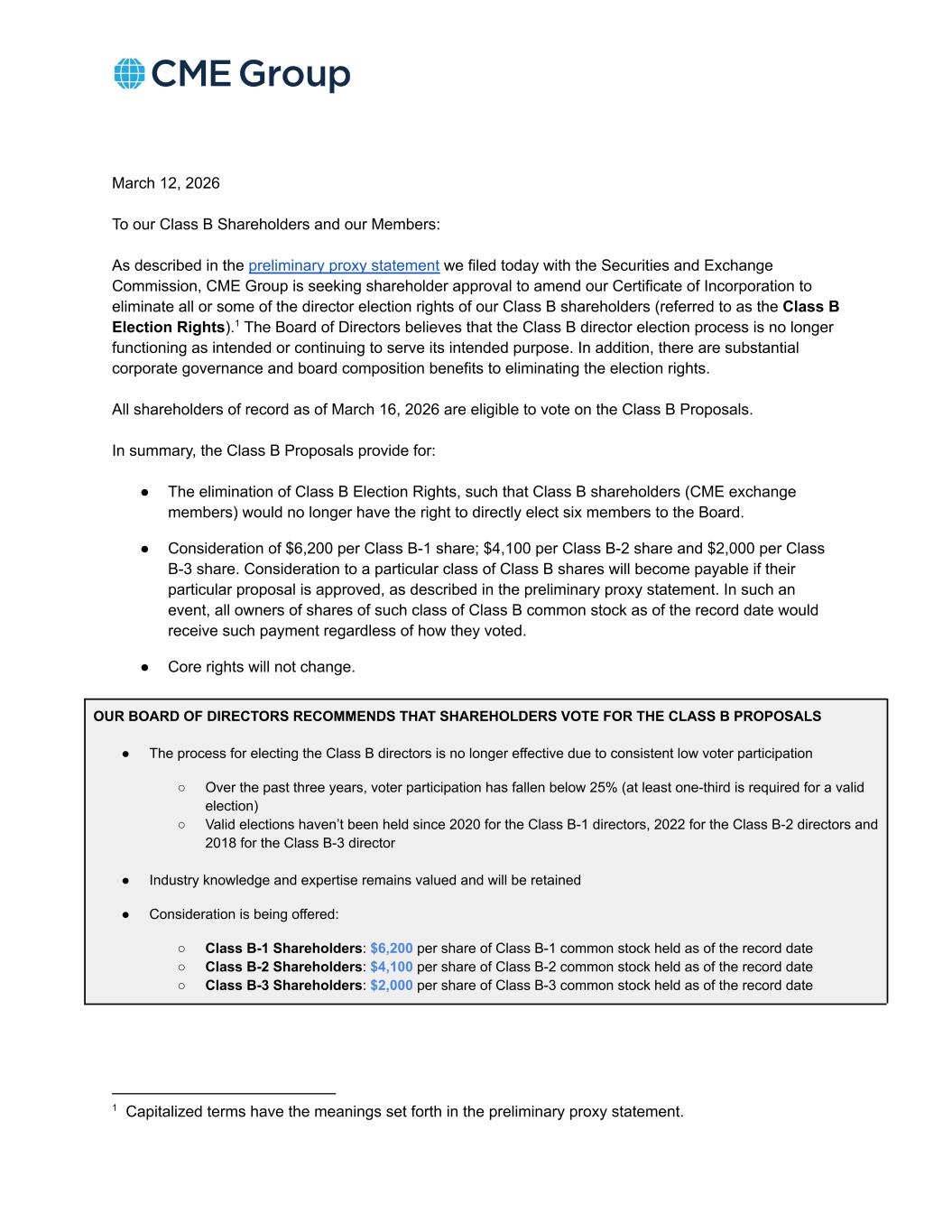
March 12, 2026 To our Class B Shareholders and our Members: As described in the preliminary proxy statement we filed today with the Securities and Exchange Commission, CME Group is seeking shareholder approval to amend our Certificate of Incorporation to eliminate all or some of the director election rights of our Class B shareholders (referred to as the Class B Election Rights).1 The Board of Directors believes that the Class B director election process is no longer functioning as intended or continuing to serve its intended purpose. In addition, there are substantial corporate governance and board composition benefits to eliminating the election rights. All shareholders of record as of March 16, 2026 are eligible to vote on the Class B Proposals. In summary, the Class B Proposals provide for: ● The elimination of Class B Election Rights, such that Class B shareholders (CME exchange members) would no longer have the right to directly elect six members to the Board. ● Consideration of $6,200 per Class B-1 share; $4,100 per Class B-2 share and $2,000 per Class B-3 share. Consideration to a particular class of Class B shares will become payable if their particular proposal is approved, as described in the preliminary proxy statement. In such an event, all owners of shares of such class of Class B common stock as of the record date would receive such payment regardless of how they voted. ● Core rights will not change. OUR BOARD OF DIRECTORS RECOMMENDS THAT SHAREHOLDERS VOTE FOR THE CLASS B PROPOSALS ● The process for electing the Class B directors is no longer effective due to consistent low voter participation ○ Over the past three years, voter participation has fallen below 25% (at least one-third is required for a valid election) ○ Valid elections haven’t been held since 2020 for the Class B-1 directors, 2022 for the Class B-2 directors and 2018 for the Class B-3 director ● Industry knowledge and expertise remains valued and will be retained ● Consideration is being offered: ○ Class B-1 Shareholders: $6,200 per share of Class B-1 common stock held as of the record date ○ Class B-2 Shareholders: $4,100 per share of Class B-2 common stock held as of the record date ○ Class B-3 Shareholders: $2,000 per share of Class B-3 common stock held as of the record date 1 Capitalized terms have the meanings set forth in the preliminary proxy statement.
The rationales for the Class B Proposals are: ● Voter participation in the Class B director elections has significantly decreased, resulting in our inability to achieve a quorum and, consequently, preventing us from holding valid elections for the nominated candidates. ● The Board believes the approval of the Class B Proposals will enable CME Group to adjust its board structure to better reflect the company’s growth as the world’s leading derivatives marketplace. ● Class B share election rights were established in 2000 when CME was a single futures exchange transitioning from a member-owned institution to a for-profit corporation. In light of the growth and expansion of our business, the Board believes that having six mandated directors from three separate classes of shareholders associated specifically with one of our exchanges is no longer necessary or desirable, and that a single class of directors would better align our corporate governance structure with market practice. ● The Board remains committed to strong representation from our broader member community, as that community provides critical insight and expertise in the operation of all of our markets. We can continue to obtain and retain member community representation through an election voted on by the Class A and Class B shareholders, voting together as a single class. The Class B Proposals are described in more detail in the preliminary proxy statement beginning on page 53. Additional information on the Class B Proposals is also included with this letter. Questions about the Class B Proposals may be directed to annualmeeting@cmegroup.com. We expect to distribute the definitive proxy statement later in March to all shareholders as of the record date. You are advised to read the proxy statement in its entirety because it will contain important information about the Class B Proposals. Sincerely, Terrence A. Duffy Chairman and Chief Executive Officer
* * * CME Group Inc. has filed a preliminary proxy statement with the Securities and Exchange Commission (the “SEC”) regarding its Annual Meeting of Shareholders on May 14, 2026. In addition, CME Group Inc. will be filing a definitive proxy statement and other relevant documents concerning the Annual Meeting with the SEC. Shareholders are urged to read the preliminary proxy statement, the definitive proxy statement and any other relevant documents filed with the SEC because they contain, or will contain, important information about CME Group Inc. and the Annual Meeting. The preliminary proxy statement and the definitive proxy statement and other relevant materials (when they become available), and any other documents filed by CME Group Inc. with the SEC, may be obtained free of charge at the SEC’s website at www.sec.gov. In addition, shareholders may obtain free copies of these documents by contacting CME Group, Shareholder Relations, 20 South Wacker Drive, Chicago, Illinois 60606. Shareholders are urged to read the preliminary proxy statement and the definitive proxy statement and the other relevant materials (when they become available) before making any voting decision with respect to matters to be acted on at the Annual Meeting. CME Group Inc., its directors, executive officers and certain other members of management and employees and third parties may be soliciting proxies from shareholders in favor of the Class B Proposals contained in the definitive proxy statement. Information concerning the participants in the solicitation is set forth in the preliminary proxy statement filed by CME Group Inc. with the SEC on March 12, 2026.
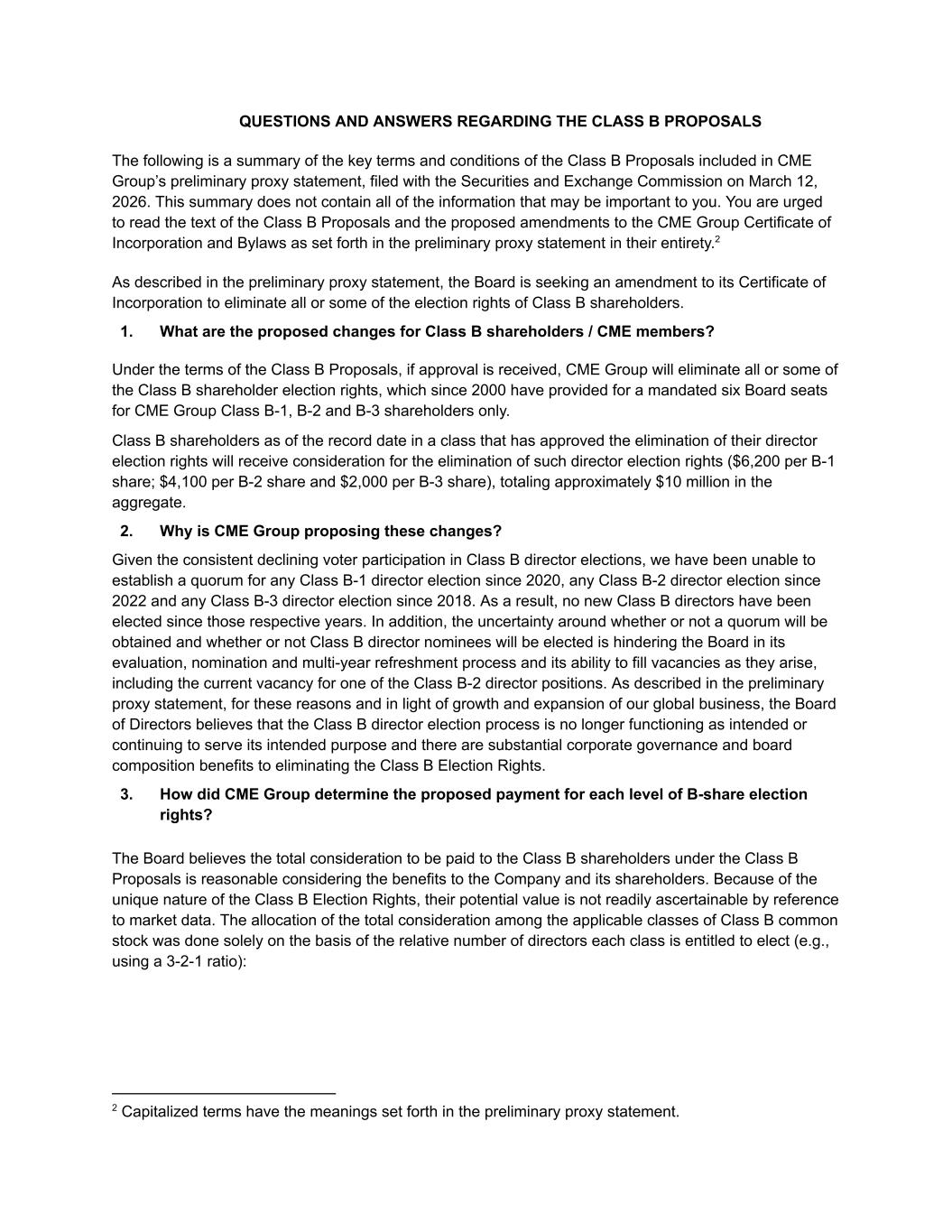
QUESTIONS AND ANSWERS REGARDING THE CLASS B PROPOSALS The following is a summary of the key terms and conditions of the Class B Proposals included in CME Group’s preliminary proxy statement, filed with the Securities and Exchange Commission on March 12, 2026. This summary does not contain all of the information that may be important to you. You are urged to read the text of the Class B Proposals and the proposed amendments to the CME Group Certificate of Incorporation and Bylaws as set forth in the preliminary proxy statement in their entirety.2 As described in the preliminary proxy statement, the Board is seeking an amendment to its Certificate of Incorporation to eliminate all or some of the election rights of Class B shareholders. 1. What are the proposed changes for Class B shareholders / CME members? Under the terms of the Class B Proposals, if approval is received, CME Group will eliminate all or some of the Class B shareholder election rights, which since 2000 have provided for a mandated six Board seats for CME Group Class B-1, B-2 and B-3 shareholders only. Class B shareholders as of the record date in a class that has approved the elimination of their director election rights will receive consideration for the elimination of such director election rights ($6,200 per B-1 share; $4,100 per B-2 share and $2,000 per B-3 share), totaling approximately $10 million in the aggregate. 2. Why is CME Group proposing these changes? Given the consistent declining voter participation in Class B director elections, we have been unable to establish a quorum for any Class B-1 director election since 2020, any Class B-2 director election since 2022 and any Class B-3 director election since 2018. As a result, no new Class B directors have been elected since those respective years. In addition, the uncertainty around whether or not a quorum will be obtained and whether or not Class B director nominees will be elected is hindering the Board in its evaluation, nomination and multi-year refreshment process and its ability to fill vacancies as they arise, including the current vacancy for one of the Class B-2 director positions. As described in the preliminary proxy statement, for these reasons and in light of growth and expansion of our global business, the Board of Directors believes that the Class B director election process is no longer functioning as intended or continuing to serve its intended purpose and there are substantial corporate governance and board composition benefits to eliminating the Class B Election Rights. 3. How did CME Group determine the proposed payment for each level of B-share election rights? The Board believes the total consideration to be paid to the Class B shareholders under the Class B Proposals is reasonable considering the benefits to the Company and its shareholders. Because of the unique nature of the Class B Election Rights, their potential value is not readily ascertainable by reference to market data. The allocation of the total consideration among the applicable classes of Class B common stock was done solely on the basis of the relative number of directors each class is entitled to elect (e.g., using a 3-2-1 ratio): 2 Capitalized terms have the meanings set forth in the preliminary proxy statement.
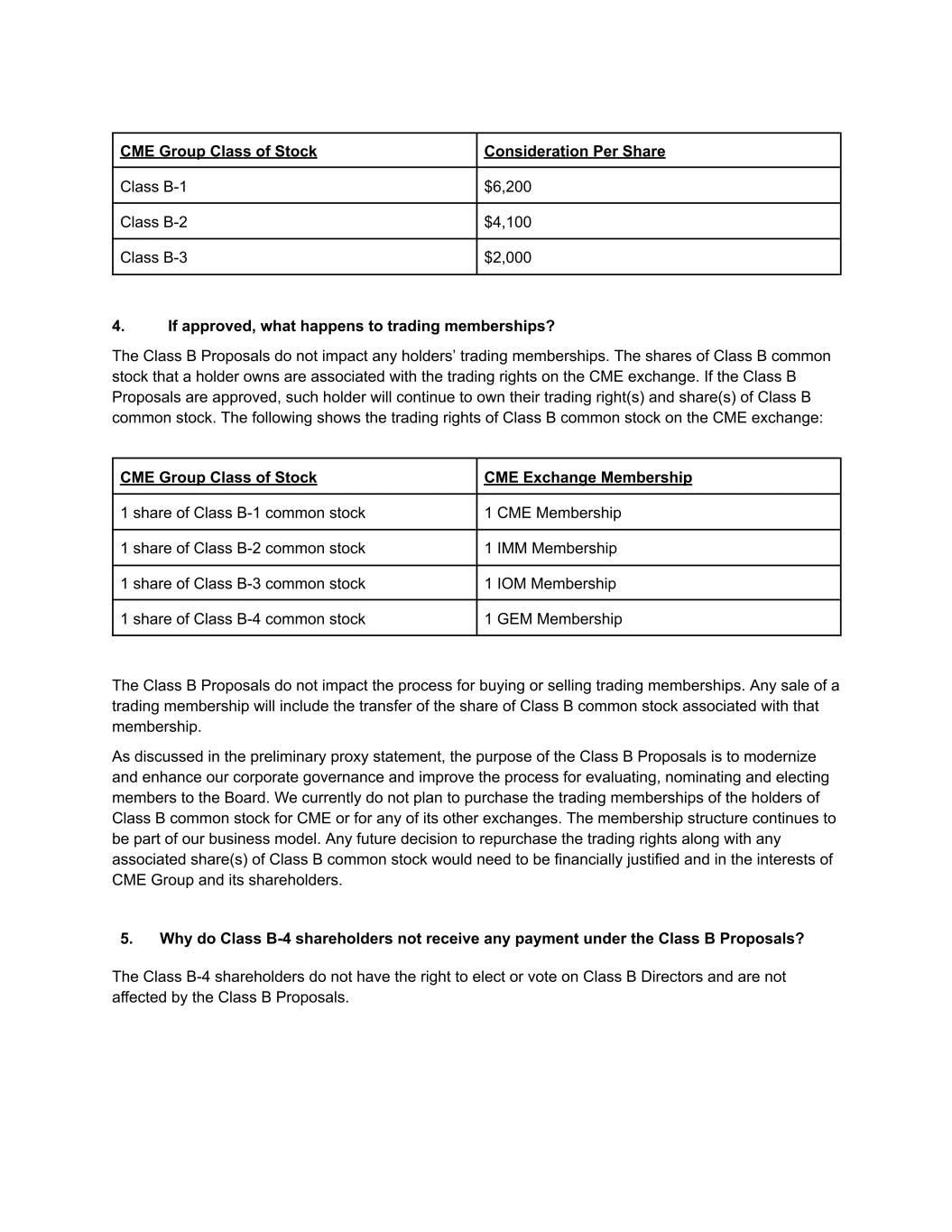
CME Group Class of Stock Consideration Per Share Class B-1 $6,200 Class B-2 $4,100 Class B-3 $2,000 4. If approved, what happens to trading memberships? The Class B Proposals do not impact any holders’ trading memberships. The shares of Class B common stock that a holder owns are associated with the trading rights on the CME exchange. If the Class B Proposals are approved, such holder will continue to own their trading right(s) and share(s) of Class B common stock. The following shows the trading rights of Class B common stock on the CME exchange: CME Group Class of Stock CME Exchange Membership 1 share of Class B-1 common stock 1 CME Membership 1 share of Class B-2 common stock 1 IMM Membership 1 share of Class B-3 common stock 1 IOM Membership 1 share of Class B-4 common stock 1 GEM Membership The Class B Proposals do not impact the process for buying or selling trading memberships. Any sale of a trading membership will include the transfer of the share of Class B common stock associated with that membership. As discussed in the preliminary proxy statement, the purpose of the Class B Proposals is to modernize and enhance our corporate governance and improve the process for evaluating, nominating and electing members to the Board. We currently do not plan to purchase the trading memberships of the holders of Class B common stock for CME or for any of its other exchanges. The membership structure continues to be part of our business model. Any future decision to repurchase the trading rights along with any associated share(s) of Class B common stock would need to be financially justified and in the interests of CME Group and its shareholders. 5. Why do Class B-4 shareholders not receive any payment under the Class B Proposals? The Class B-4 shareholders do not have the right to elect or vote on Class B Directors and are not affected by the Class B Proposals.

6. Is the proposal taxable to the holders of Class B-1, Class B-2 and Class B-3 common stock? Yes. If approved, the Class B-1 Proposal is taxable to the holders of Class B-1 common stock, the Class B-2 Proposal is taxable to the holders of Class B-2 common stock and the Class B-3 Proposal is taxable to the holders of Class B-3 common stock. Though the character and particular tax treatment of the cash consideration is uncertain, the receipt of cash consideration pursuant to each of the Class B Proposals generally will be a taxable transaction to the applicable Class B shareholders for U.S. federal income tax purposes.