1Q26 Earnings Presentation April 28, 2026

The JetBlue Way Forward | Our Strategic Evolution | Returning to Historical Earnings Power Safe Harbor This Presentation contains forward-looking statements within the meaning of the Private Securities Litigation Reform Act of 1995, as amended. We intend such forward-looking statements to be covered by the safe harbor provisions for forward-looking statements contained in Section 27A of the Securities Act of 1933, as amended, and Section 21E of the Securities Exchange Act of 1934, as amended. All statements other than statements of historical facts contained in this Presentation are forward-looking statements. In some cases, you can identify forward-looking statements by terms such as “expects,” “plans,” “intends,” “anticipates,” “indicates,” “remains,” “believes,” “estimates,” “forecast,” “guidance,” “outlook,” “may,” “will,” “should,” “seeks,” “goals,” “targets” or the negative of these terms or other similar expressions. Additionally, forward-looking statements include statements that do not relate solely to historical facts, such as statements which identify uncertainties or trends, discuss the possible future effects of current known trends or uncertainties, or which indicate that the future effects of known trends or uncertainties cannot be predicted, guaranteed, or assured. Forward-looking statements contained in this Presentation include, without limitation, statements regarding our outlook, goals, and future results of operations and financial position, including our expected return to profitability, positive free cash flow, any expected headwinds or tailwinds, macroeconomic and geopolitical factors, fuel prices and volatility, demand, our use of artificial intelligence, our aircraft fleet, our product offerings and loyalty initiatives, and our business strategy and plans and objectives for future operations, such as our JetForward initiatives, including our Blue Sky collaboration. Forward-looking statements involve risks, uncertainties and assumptions, and are based on information currently available to us. Actual results may differ materially from those expressed in the forward-looking statements due to many important factors, including, without limitation, our extremely competitive industry; the risk associated with the execution of our strategic operating plans in the near- term and long-term; risks related to the long-term nature of our fleet order book; volatility in fuel prices and availability of fuel; increased maintenance costs associated with fleet age; costs associated with salaries, wages and benefits; risks associated with a potential material reduction in the rate of interchange reimbursement fees; risks associated with doing business internationally; our reliance on high daily aircraft utilization; our dependence on the New York metropolitan market; risks associated with extended interruptions or disruptions in service at our focus cities; risks associated with airport expenses; risks associated with seasonality and weather; our reliance on a limited number of suppliers for our aircraft, engines, and our Fly-Fi® product; risks related to new or increased tariffs, including those that impact commercial aircraft and related parts imported from outside the United States; the outcome of current or future legal proceedings or regulatory actions; risks associated with stockholder activism; risks associated with cybersecurity and privacy, including potential disruptions to our information technology systems or information security breaches; heightened regulatory requirements concerning data security compliance; risks associated with reliance on, and potential failure of, automated systems to operate our business; our inability to attract and retain qualified crewmembers; our being subject to potential unionization, work stoppages, slowdowns or increased labor costs; reputational and business risk from an accident or incident involving our aircraft; risks associated with damage to our reputation and the JetBlue brand name; our significant amount of fixed obligations and the ability to service such obligations; possible failure to comply with financial and other debt covenants included in the agreements governing our debt; financial risks associated with credit card processors; risks associated with seeking short-term additional financing liquidity; failure to realize the full value of intangible or long- lived assets, causing us to record impairments; limits on our ability to use certain tax attributes; risks associated with our development and use of AI-powered solutions; risks associated with disease outbreaks or environmental disasters affecting travel behavior; compliance with environmental laws and regulations, which may cause us to incur substantial costs; the impacts of federal government shutdowns, federal budget constraints or federally imposed furloughs; increasing scrutiny of, and evolving expectations regarding, environmental matters; changes in government regulations in our industry; acts of war or terrorism; and changes in global economic or geopolitical conditions or an economic downturn leading to a continuing or accelerated decrease in demand for air travel. It is routine for our internal projections and expectations to change as the year or each quarter in the year progresses, and therefore it should be clearly understood that the internal projections, beliefs, and assumptions upon which we base our expectations may change prior to the end of each quarter or year. Given the risks and uncertainties surrounding forward-looking statements, you should not place undue reliance on these statements. You should understand that many important factors, in addition to those discussed or incorporated by reference in this Presentation, could cause our results to differ materially from those expressed in the forward- looking statements. Further information concerning these and other factors is contained in JetBlue's filings with the U.S. Securities and Exchange Commission (the "SEC"), including but not limited to in our Annual Report on Form 10-K for the year ended December 31, 2025, as may be updated by our other SEC filings. In light of these risks and uncertainties, the forward-looking events discussed in this Presentation might not occur. Our forward-looking statements speak only as of the date of this Presentation. Other than as required by law, we undertake no obligation to update or revise forward-looking statements, whether as a result of new information, future events, or otherwise. 2

The JetBlue Way Forward | Our Strategic Evolution | Returning to Historical Earnings Power 1Q26 Recap Joanna Geraghty Chief Executive Officer 3
Executed throughout 1Q despite challenging operating environment • RASM and CASM-ex (1) both finished at or near better end of revised guidance ranges (2) • RASM grew 6.5% year-over-year (YoY), 4.5pts better than initial guidance midpoint (3) • ~2.5pts due to demand strength and ~2pts due to storm-related capacity reductions • CASM ex-fuel (3) was up 6.6% YoY, only ~2pts above initial guidance midpoint of 4.5% • Disruptions reduced 1Q capacity by ~4pts, impacting YoY CASM ex-fuel by ~4pts • Fuel price of $2.96, up 62 cents and 26% vs. initial guidance midpoint Mitigating external factors and preserving liquidity position • Expect 30 to 40% fuel recapture in 2Q through yield optimization, and 100% by early 2027 • Reduced 2Q capacity by nearly 1pt versus close-in expectations and reducing 2H capacity by at least 2-3pts versus prior expectations for 2026 • FLL comprises all of 2Q scheduled capacity growth • Actioning incremental cost levers: implemented additional cost savings, slowing hiring to align with capacity in 2H and continuing our focus on fuel efficiency, targeting 5% improvement in 2026 over last three years (1) Operating expense per available seat mile, excluding fuel, other non-airline operating expenses and special items (“CASM ex-Fuel”); See Appendix A for further details on Non-GAAP measures. (2) Revised guidance as of March 17, 2026. (3) Initial guidance as of January 27, 2026. Adjusting to Elevated Fuel Environment while Continuing to Execute on JetForward 1Q26 4

The JetBlue Way Forward | Our Strategic Evolution | Returning to Historical Earnings Power Commercial Update and Outlook Marty St. George President 5
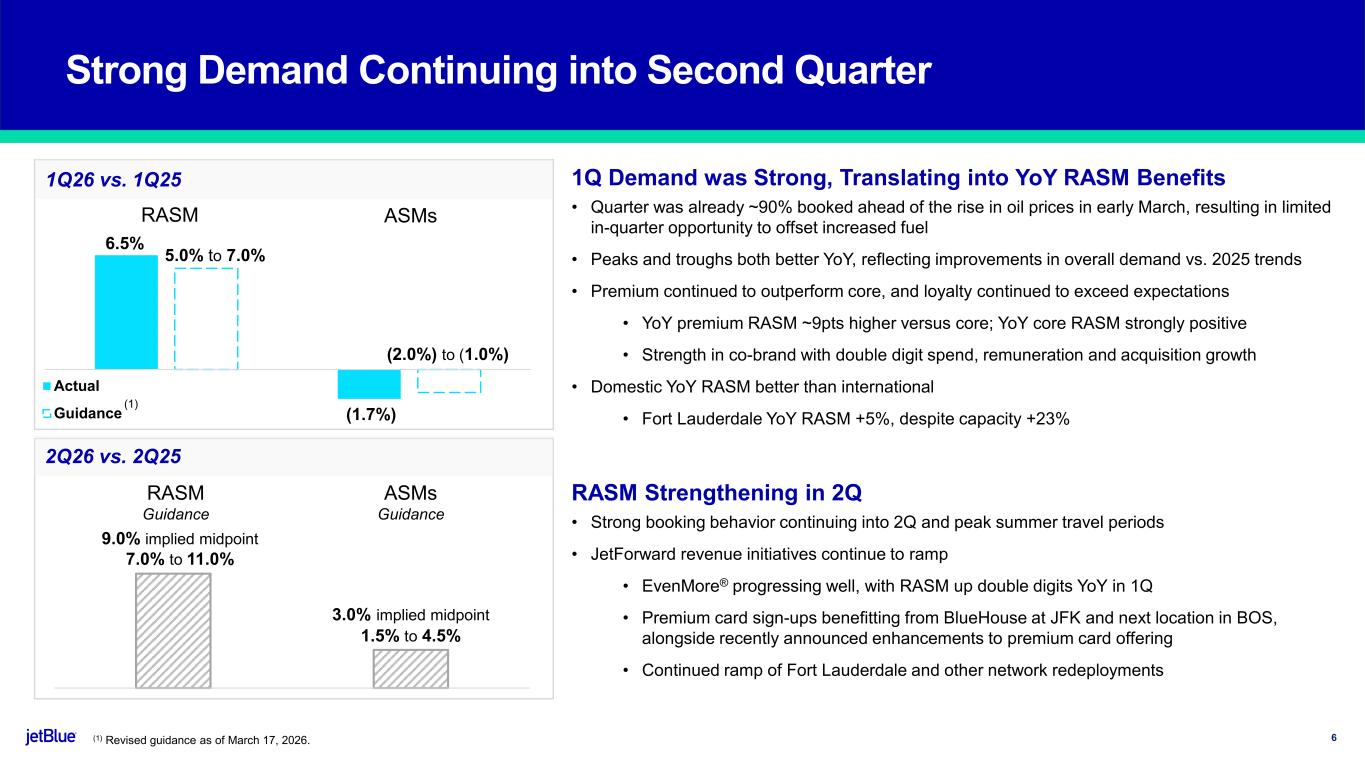
6 1Q Demand was Strong, Translating into YoY RASM Benefits • Quarter was already ~90% booked ahead of the rise in oil prices in early March, resulting in limited in-quarter opportunity to offset increased fuel • Peaks and troughs both better YoY, reflecting improvements in overall demand vs. 2025 trends • Premium continued to outperform core, and loyalty continued to exceed expectations • YoY premium RASM ~9pts higher versus core; YoY core RASM strongly positive • Strength in co-brand with double digit spend, remuneration and acquisition growth • Domestic YoY RASM better than international • Fort Lauderdale YoY RASM +5%, despite capacity +23% RASM Strengthening in 2Q • Strong booking behavior continuing into 2Q and peak summer travel periods • JetForward revenue initiatives continue to ramp • EvenMore® progressing well, with RASM up double digits YoY in 1Q • Premium card sign-ups benefitting from BlueHouse at JFK and next location in BOS, alongside recently announced enhancements to premium card offering • Continued ramp of Fort Lauderdale and other network redeployments Strong Demand Continuing into Second Quarter (1) Revised guidance as of March 17, 2026. 1Q26 vs. 1Q25 2Q26 vs. 2Q25 ASMs Guidance RASM Guidance 9.0% implied midpoint 7.0% to 11.0% 3.0% implied midpoint 1.5% to 4.5% Actual Guidance RASM ASMs 5.0% to 7.0% 6.5% (1.7%) (2.0%) to (1.0%) (1)
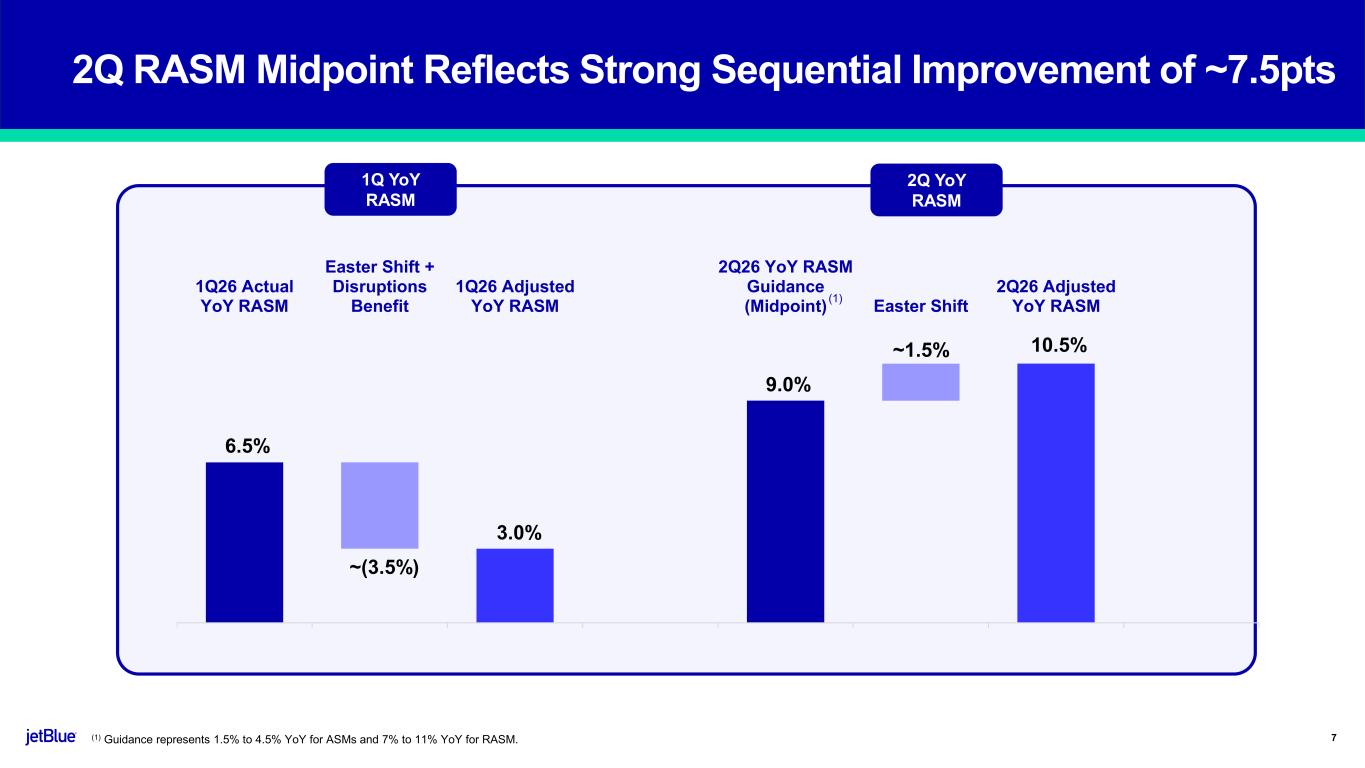
7 1Q26 Actual YoY RASM Easter Shift + Disruptions Benefit 1Q26 Adjusted YoY RASM 2Q26 YoY RASM Guidance (Midpoint) Easter Shift 2Q26 Adjusted YoY RASM (1) Guidance represents 1.5% to 4.5% YoY for ASMs and 7% to 11% YoY for RASM. ~1.5% 10.5% 9.0% 2Q RASM Midpoint Reflects Strong Sequential Improvement of ~7.5pts 3.0% 6.5% ~(3.5%) 1Q YoY RASM 2Q YoY RASM (1)

The JetBlue Way Forward | Our Strategic Evolution | Returning to Historical Earnings Power Financial Update and Outlook Ursula Hurley Chief Financial Officer 8
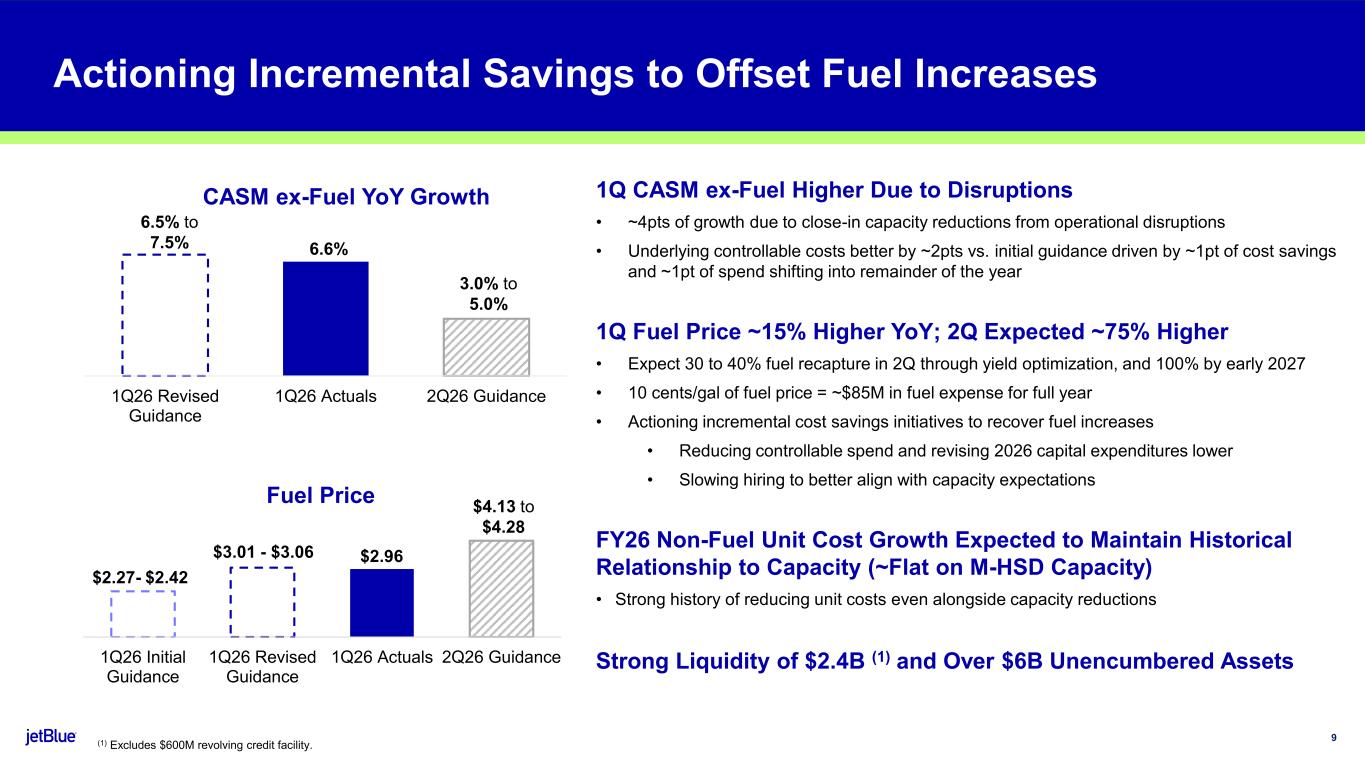
9 1Q26 Revised Guidance 1Q26 Actuals 2Q26 Guidance CASM ex-Fuel YoY Growth 1Q CASM ex-Fuel Higher Due to Disruptions • ~4pts of growth due to close-in capacity reductions from operational disruptions • Underlying controllable costs better by ~2pts vs. initial guidance driven by ~1pt of cost savings and ~1pt of spend shifting into remainder of the year 1Q Fuel Price ~15% Higher YoY; 2Q Expected ~75% Higher • Expect 30 to 40% fuel recapture in 2Q through yield optimization, and 100% by early 2027 • 10 cents/gal of fuel price = ~$85M in fuel expense for full year • Actioning incremental cost savings initiatives to recover fuel increases • Reducing controllable spend and revising 2026 capital expenditures lower • Slowing hiring to better align with capacity expectations FY26 Non-Fuel Unit Cost Growth Expected to Maintain Historical Relationship to Capacity (~Flat on M-HSD Capacity) • Strong history of reducing unit costs even alongside capacity reductions Strong Liquidity of $2.4B (1) and Over $6B Unencumbered Assets (1) Excludes $600M revolving credit facility. Actioning Incremental Savings to Offset Fuel Increases 3.0% to 5.0% 6.5% to 7.5% 6.6% 1Q26 Initial Guidance 1Q26 Revised Guidance 1Q26 Actuals 2Q26 Guidance Fuel Price $4.13 to $4.28 $3.01 - $3.06 $2.96 $2.27- $2.42
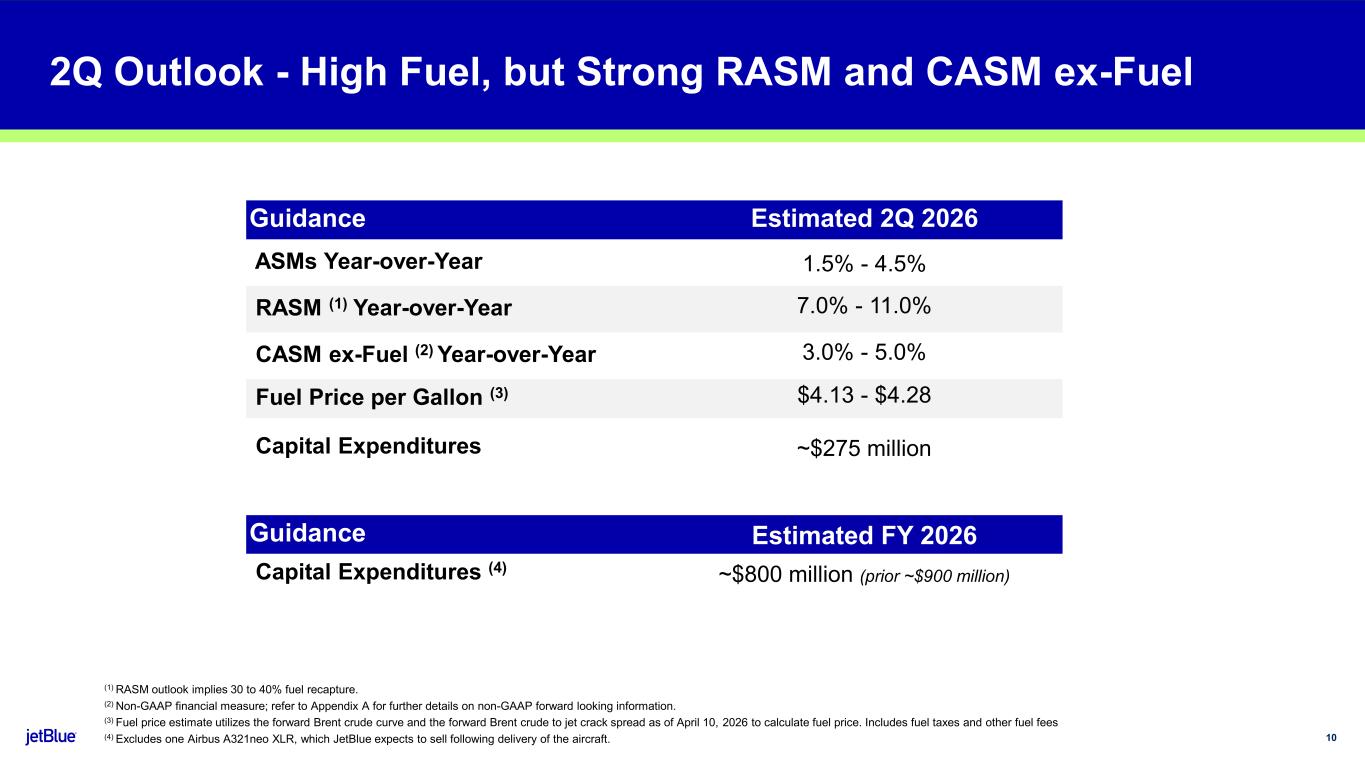
10 (1) RASM outlook implies 30 to 40% fuel recapture. (2) Non-GAAP financial measure; refer to Appendix A for further details on non-GAAP forward looking information. (3) Fuel price estimate utilizes the forward Brent crude curve and the forward Brent crude to jet crack spread as of April 10, 2026 to calculate fuel price. Includes fuel taxes and other fuel fees (4) Excludes one Airbus A321neo XLR, which JetBlue expects to sell following delivery of the aircraft. Guidance Estimated 2Q 2026 ASMs Year-over-Year 1.5% - 4.5% RASM (1) Year-over-Year 7.0% - 11.0% CASM ex-Fuel (2) Year-over-Year 3.0% - 5.0% Fuel Price per Gallon (3) $4.13 - $4.28 Capital Expenditures ~$275 million Guidance Estimated FY 2026 Capital Expenditures (4) ~$800 million (prior ~$900 million) 2Q Outlook - High Fuel, but Strong RASM and CASM ex-Fuel
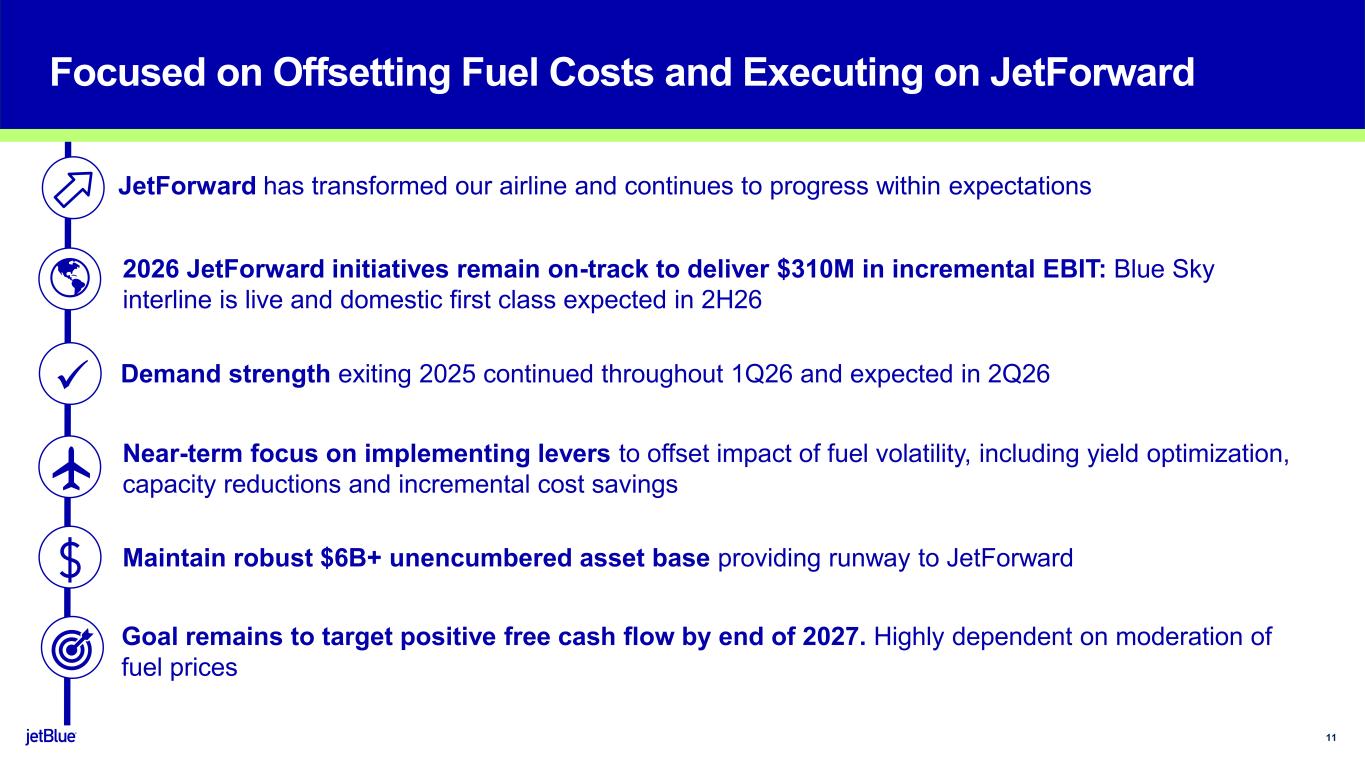
2026 JetForward initiatives remain on-track to deliver $310M in incremental EBIT: Blue Sky interline is live and domestic first class expected in 2H26 JetForward has transformed our airline and continues to progress within expectations Demand strength exiting 2025 continued throughout 1Q26 and expected in 2Q26 Goal remains to target positive free cash flow by end of 2027. Highly dependent on moderation of fuel prices Focused on Offsetting Fuel Costs and Executing on JetForward Near-term focus on implementing levers to offset impact of fuel volatility, including yield optimization, capacity reductions and incremental cost savings ✓ Maintain robust $6B+ unencumbered asset base providing runway to JetForward 11

The JetBlue Way Forward | Our Strategic Evolution | Returning to Historical Earnings Power Appendix 12

The JetBlue Way Forward | Our Strategic Evolution | Returning to Historical Earnings Power JetForward and Long-Term Vision 13
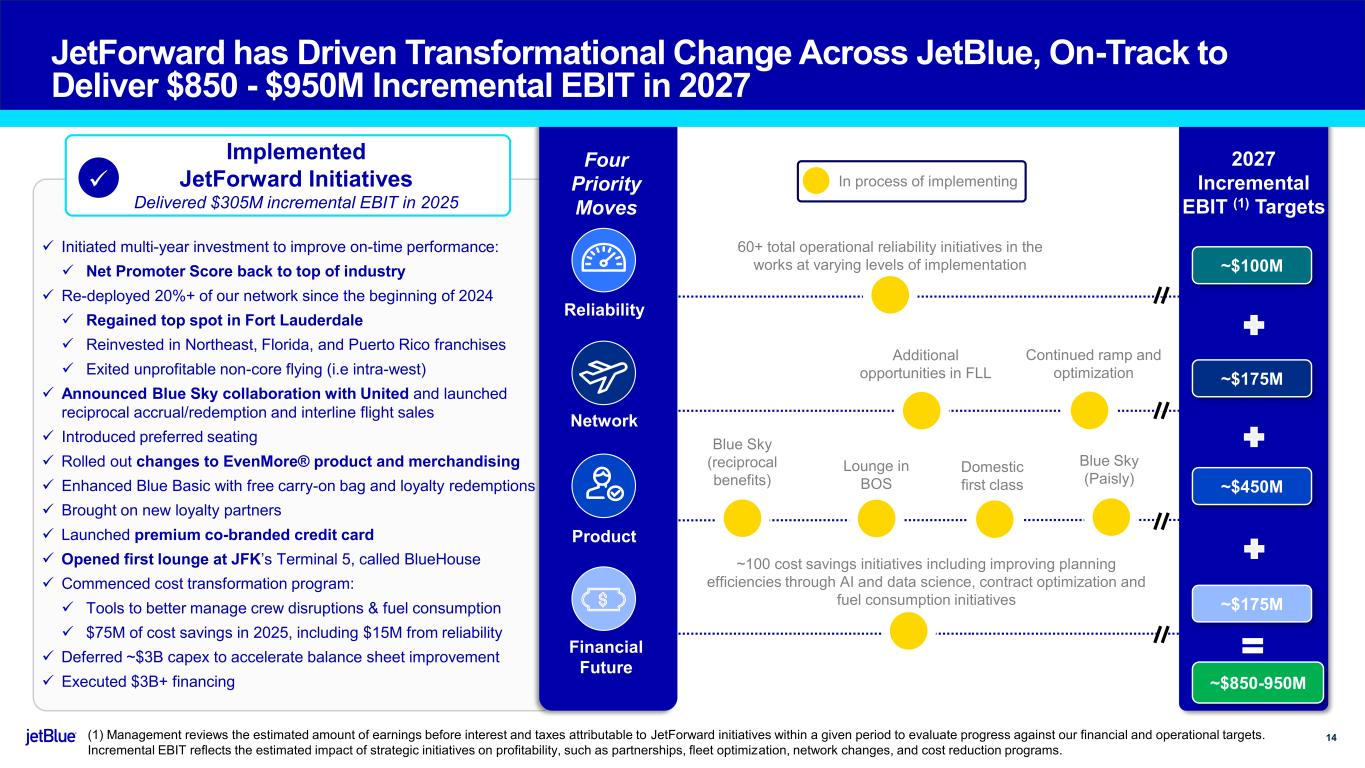
14 JetForward has Driven Transformational Change Across JetBlue, On-Track to Deliver $850 - $950M Incremental EBIT in 2027 Product Reliability Financial Future Four Priority Moves ~$175M ~$450M ~$100M 2027 Incremental EBIT (1) Targets Network ~$175M ~$850-950M ✓ Initiated multi-year investment to improve on-time performance: ✓ Net Promoter Score back to top of industry ✓ Re-deployed 20%+ of our network since the beginning of 2024 ✓ Regained top spot in Fort Lauderdale ✓ Reinvested in Northeast, Florida, and Puerto Rico franchises ✓ Exited unprofitable non-core flying (i.e intra-west) ✓ Announced Blue Sky collaboration with United and launched reciprocal accrual/redemption and interline flight sales ✓ Introduced preferred seating ✓ Rolled out changes to EvenMore® product and merchandising ✓ Enhanced Blue Basic with free carry-on bag and loyalty redemptions ✓ Brought on new loyalty partners ✓ Launched premium co-branded credit card ✓ Opened first lounge at JFK’s Terminal 5, called BlueHouse ✓ Commenced cost transformation program: ✓ Tools to better manage crew disruptions & fuel consumption ✓ $75M of cost savings in 2025, including $15M from reliability ✓ Deferred ~$3B capex to accelerate balance sheet improvement ✓ Executed $3B+ financing In process of implementing 60+ total operational reliability initiatives in the works at varying levels of implementation Lounge in BOS Domestic first class ~100 cost savings initiatives including improving planning efficiencies through AI and data science, contract optimization and fuel consumption initiatives Additional opportunities in FLL Implemented JetForward Initiatives Delivered $305M incremental EBIT in 2025 ✓ (1) Management reviews the estimated amount of earnings before interest and taxes attributable to JetForward initiatives within a given period to evaluate progress against our financial and operational targets. Incremental EBIT reflects the estimated impact of strategic initiatives on profitability, such as partnerships, fleet optimization, network changes, and cost reduction programs. Blue Sky (reciprocal benefits) Continued ramp and optimization Blue Sky (Paisly)
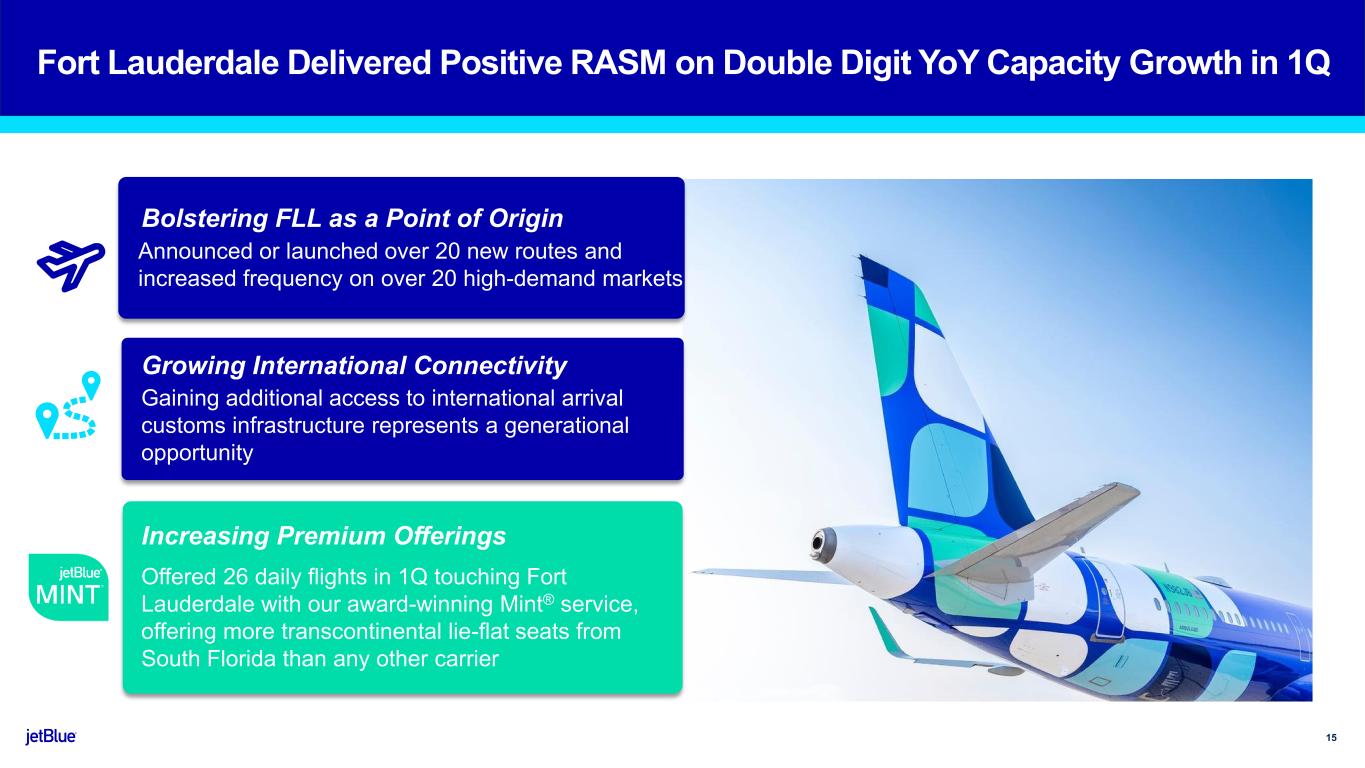
15 Fort Lauderdale Delivered Positive RASM on Double Digit YoY Capacity Growth in 1Q Announced or launched over 20 new routes and increased frequency on over 20 high-demand markets Bolstering FLL as a Point of Origin Gaining additional access to international arrival customs infrastructure represents a generational opportunity Growing International Connectivity Offered 26 daily flights in 1Q touching Fort Lauderdale with our award-winning Mint® service, offering more transcontinental lie-flat seats from South Florida than any other carrier Increasing Premium Offerings
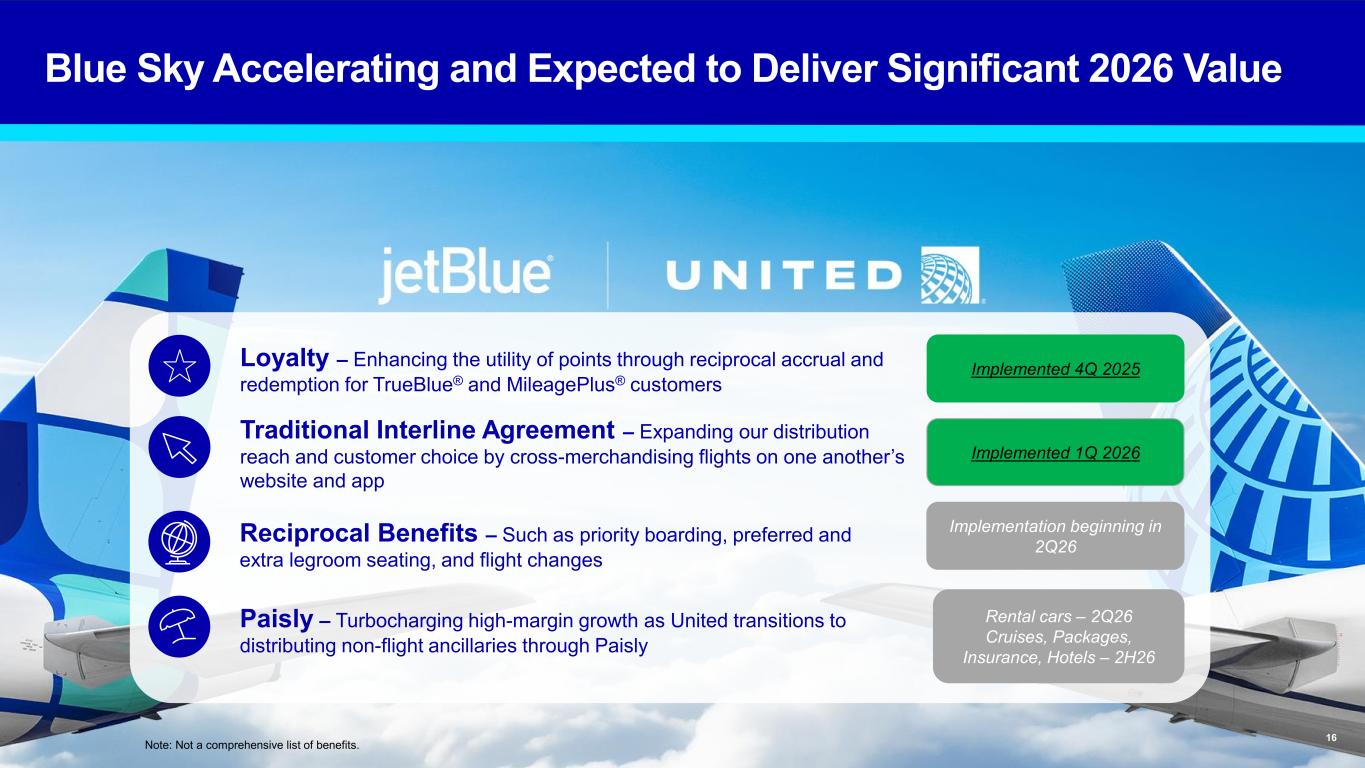
16 The JetBlue Way Forward | Our Strategic Evolution – Loyalty & Travel Brand | Returning to Historical Earnings Power 1 6 Note: Not a comprehensive list of benefits. Traditional Interline Agreement – Expanding our distribution reach and customer choice by cross-merchandising flights on one another’s website and app Loyalty – Enhancing the utility of points through reciprocal accrual and redemption for TrueBlue® and MileagePlus® customers Paisly – Turbocharging high-margin growth as United transitions to distributing non-flight ancillaries through Paisly Blue Sky Accelerating and Expected to Deliver Significant 2026 Value Implemented 1Q 2026 Implemented 4Q 2025 Rental cars – 2Q26 Cruises, Packages, Insurance, Hotels – 2H26 Reciprocal Benefits – Such as priority boarding, preferred and extra legroom seating, and flight changes Implementation beginning in 2Q26
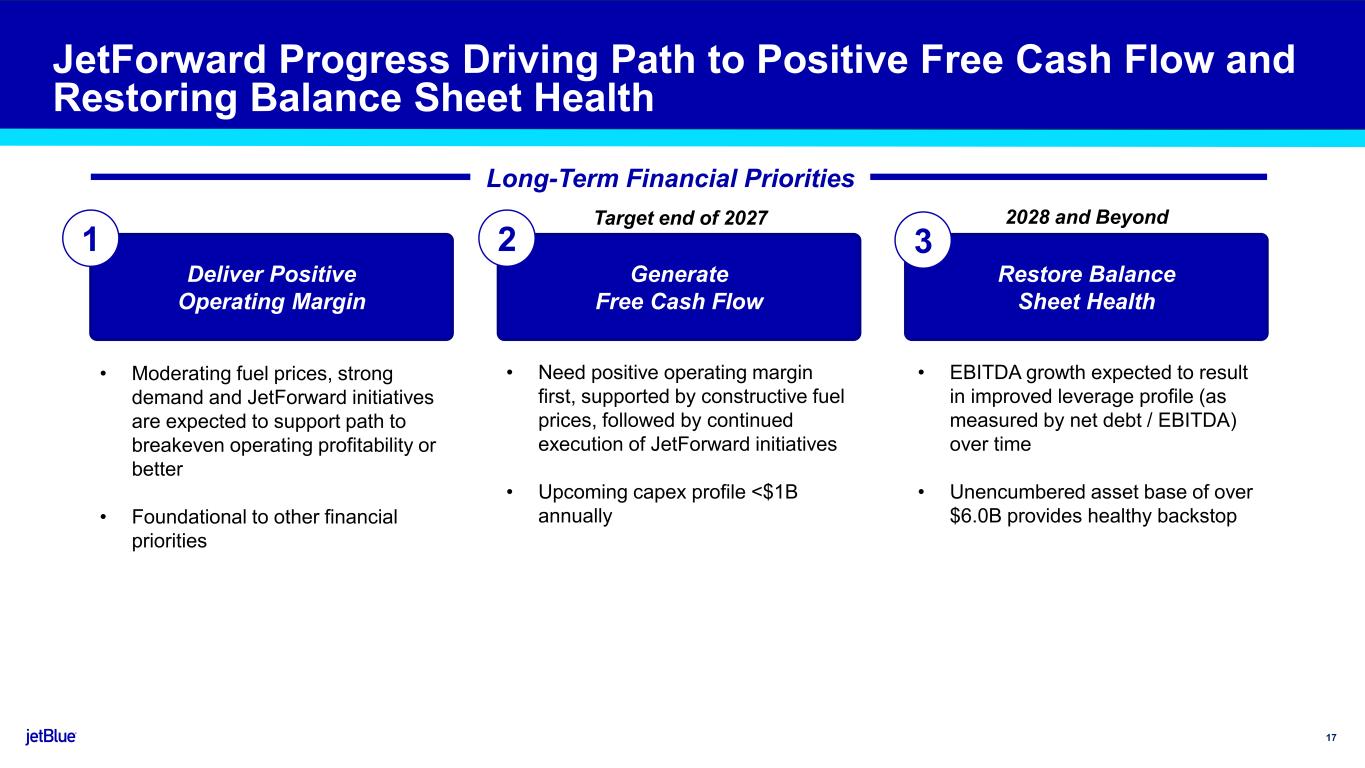
17 JetForward Progress Driving Path to Positive Free Cash Flow and Restoring Balance Sheet Health Deliver Positive Operating Margin Generate Free Cash Flow Restore Balance Sheet Health 1 3 Long-Term Financial Priorities 2 • EBITDA growth expected to result in improved leverage profile (as measured by net debt / EBITDA) over time • Unencumbered asset base of over $6.0B provides healthy backstop • Moderating fuel prices, strong demand and JetForward initiatives are expected to support path to breakeven operating profitability or better • Foundational to other financial priorities • Need positive operating margin first, supported by constructive fuel prices, followed by continued execution of JetForward initiatives • Upcoming capex profile <$1B annually Target end of 2027 2028 and Beyond
Non-GAAP Financial Measures We report our financial results in accordance with GAAP; however, we present certain non-GAAP financial measures in this Presentation. Non-GAAP financial measures are financial measures that are derived from the consolidated financial statements, but that are not presented in accordance with GAAP. We present these non-GAAP financial measures because we believe they provide useful supplemental information that enables a meaningful comparison of our results to others in the airline industry and our prior year results. Investors should consider these non-GAAP financial measures in addition to, and not as a substitute for, our financial performance measures prepared in accordance with GAAP. Further, our non-GAAP information may be different from the non-GAAP information provided by other companies. This Presentation includes an explanation of each non-GAAP financial measure presented in this Presentation and a reconciliation of certain non-GAAP financial measures used in this Presentation to the most directly comparable GAAP financial measures. With respect to JetBlue’s CASM Ex-Fuel (1) guidance, we are not able to provide a reconciliation of forward- looking measures where the quantification of certain excluded items reflected in the measures cannot be calculated or predicted at this time without unreasonable efforts. In these cases, the reconciling information that is unavailable includes a forward-looking range of financial performance measures beyond our control, such as fuel costs, which are subject to many economic and political factors beyond our control. For the same reasons, we are unable to address the probable significance of the unavailable information, which could have a potentially unpredictable and potentially significant impact on our future GAAP financial results. (1) CASM Ex-Fuel is a non-GAAP measure that excludes fuel, other non-airline operating expenses, and special items. Appendix A 18
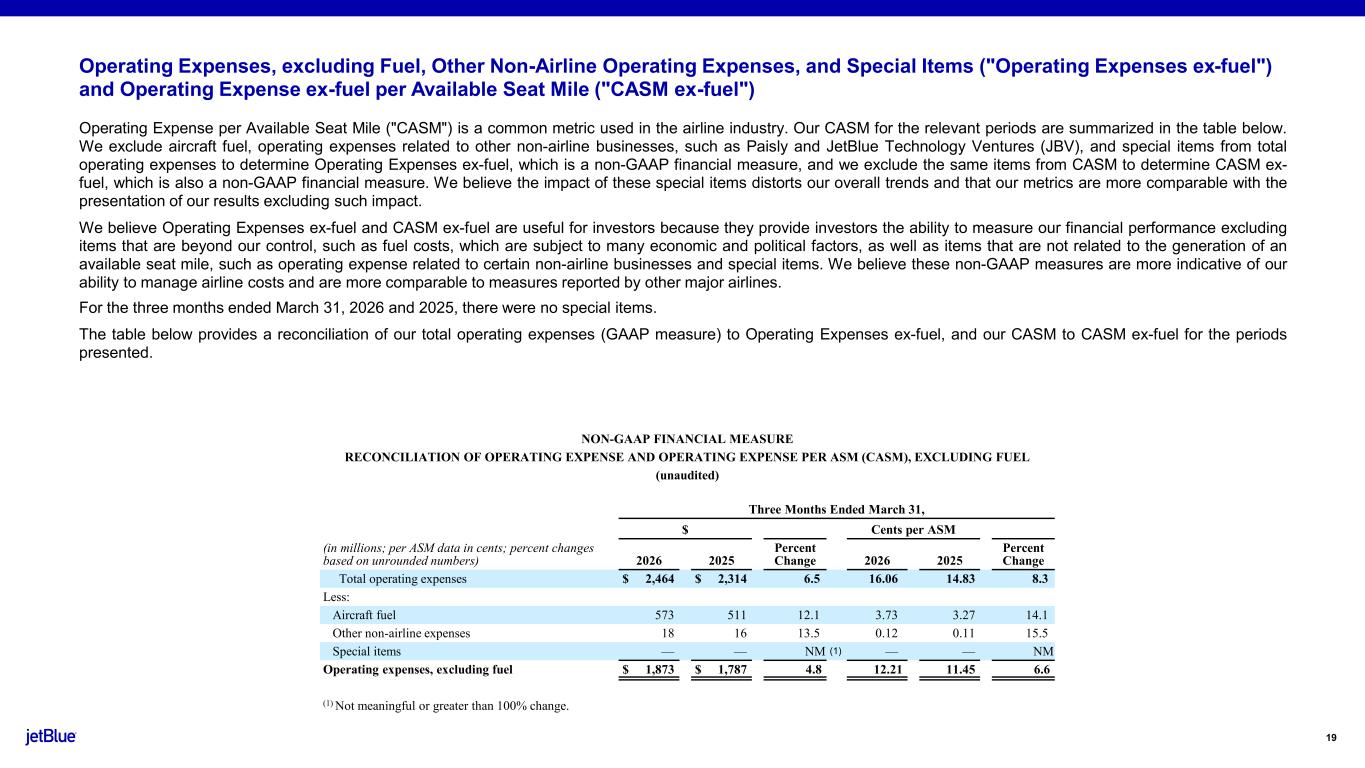
Operating Expenses, excluding Fuel, Other Non-Airline Operating Expenses, and Special Items ("Operating Expenses ex-fuel") and Operating Expense ex-fuel per Available Seat Mile ("CASM ex-fuel") Operating Expense per Available Seat Mile ("CASM") is a common metric used in the airline industry. Our CASM for the relevant periods are summarized in the table below. We exclude aircraft fuel, operating expenses related to other non-airline businesses, such as Paisly and JetBlue Technology Ventures (JBV), and special items from total operating expenses to determine Operating Expenses ex-fuel, which is a non-GAAP financial measure, and we exclude the same items from CASM to determine CASM ex- fuel, which is also a non-GAAP financial measure. We believe the impact of these special items distorts our overall trends and that our metrics are more comparable with the presentation of our results excluding such impact. We believe Operating Expenses ex-fuel and CASM ex-fuel are useful for investors because they provide investors the ability to measure our financial performance excluding items that are beyond our control, such as fuel costs, which are subject to many economic and political factors, as well as items that are not related to the generation of an available seat mile, such as operating expense related to certain non-airline businesses and special items. We believe these non-GAAP measures are more indicative of our ability to manage airline costs and are more comparable to measures reported by other major airlines. For the three months ended March 31, 2026 and 2025, there were no special items. The table below provides a reconciliation of our total operating expenses (GAAP measure) to Operating Expenses ex-fuel, and our CASM to CASM ex-fuel for the periods presented. NON-GAAP FINANCIAL MEASURE RECONCILIATION OF OPERATING EXPENSE AND OPERATING EXPENSE PER ASM (CASM), EXCLUDING FUEL (unaudited) Three Months Ended March 31, $ Cents per ASM (in millions; per ASM data in cents; percent changes based on unrounded numbers) 2026 2025 Percent Change 2026 2025 Percent Change Total operating expenses $ 2,464 $ 2,314 6.5 16.06 14.83 8.3 Less: Aircraft fuel 573 511 12.1 3.73 3.27 14.1 Other non-airline expenses 18 16 13.5 0.12 0.11 15.5 Special items — — NM (1) — — NM Operating expenses, excluding fuel $ 1,873 $ 1,787 4.8 12.21 11.45 6.6 (1) Not meaningful or greater than 100% change. 19
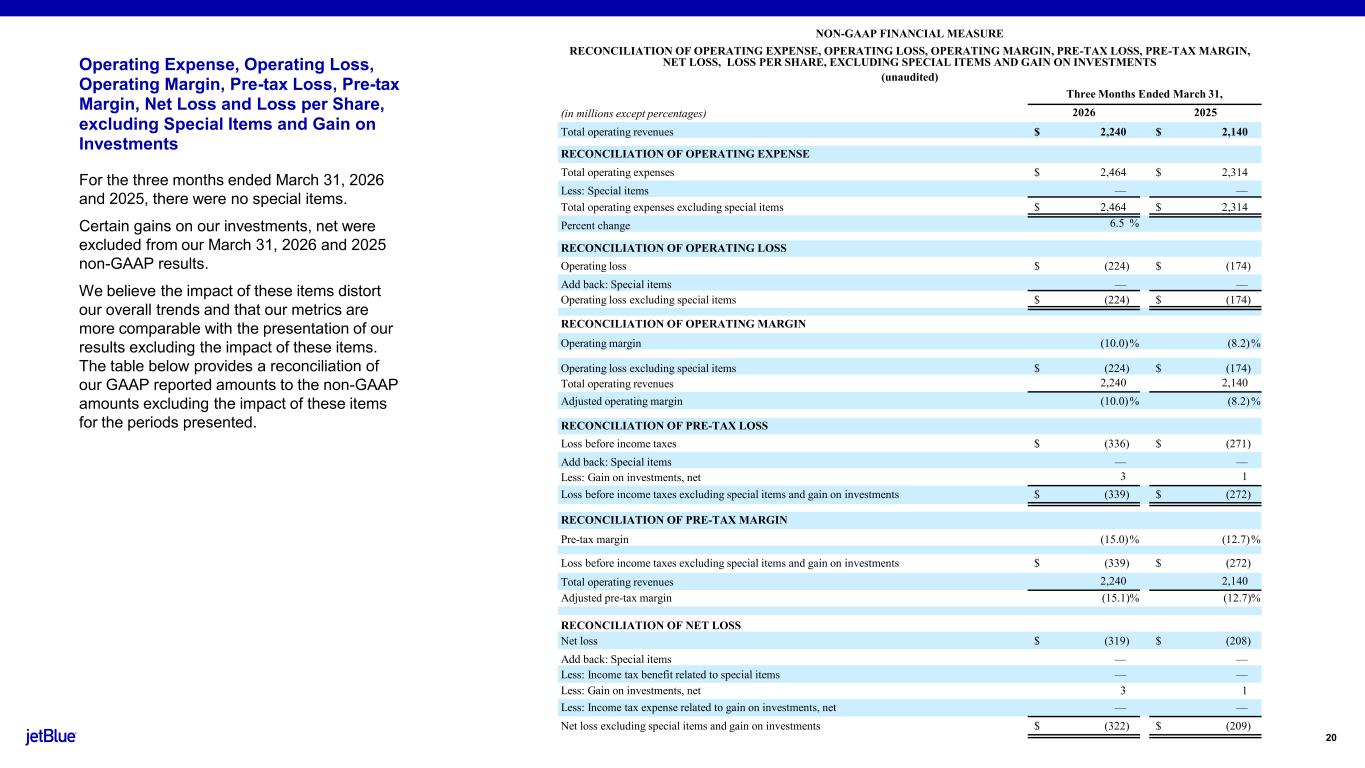
Operating Expense, Operating Loss, Operating Margin, Pre-tax Loss, Pre-tax Margin, Net Loss and Loss per Share, excluding Special Items and Gain on Investments For the three months ended March 31, 2026 and 2025, there were no special items. Certain gains on our investments, net were excluded from our March 31, 2026 and 2025 non-GAAP results. We believe the impact of these items distort our overall trends and that our metrics are more comparable with the presentation of our results excluding the impact of these items. The table below provides a reconciliation of our GAAP reported amounts to the non-GAAP amounts excluding the impact of these items for the periods presented. NON-GAAP FINANCIAL MEASURE RECONCILIATION OF OPERATING EXPENSE, OPERATING LOSS, OPERATING MARGIN, PRE-TAX LOSS, PRE-TAX MARGIN, NET LOSS, LOSS PER SHARE, EXCLUDING SPECIAL ITEMS AND GAIN ON INVESTMENTS (unaudited) Three Months Ended March 31, (in millions except percentages) 2026 2025 Total operating revenues $ 2,240 $ 2,140 RECONCILIATION OF OPERATING EXPENSE Total operating expenses $ 2,464 $ 2,314 Less: Special items — — Total operating expenses excluding special items $ 2,464 $ 2,314 Percent change 6.5 % RECONCILIATION OF OPERATING LOSS Operating loss $ (224) $ (174) Add back: Special items — — Operating loss excluding special items $ (224) $ (174) RECONCILIATION OF OPERATING MARGIN Operating margin (10.0)% (8.2)% Operating loss excluding special items $ (224) $ (174) Total operating revenues 2,240 2,140 Adjusted operating margin (10.0)% (8.2)% RECONCILIATION OF PRE-TAX LOSS Loss before income taxes $ (336) $ (271) Add back: Special items — — Less: Gain on investments, net 3 1 Loss before income taxes excluding special items and gain on investments $ (339) $ (272) RECONCILIATION OF PRE-TAX MARGIN Pre-tax margin (15.0)% (12.7)% Loss before income taxes excluding special items and gain on investments $ (339) $ (272) Total operating revenues 2,240 2,140 Adjusted pre-tax margin (15.1)% (12.7)% RECONCILIATION OF NET LOSS Net loss $ (319) $ (208) Add back: Special items — — Less: Income tax benefit related to special items — — Less: Gain on investments, net 3 1 Less: Income tax expense related to gain on investments, net — — Net loss excluding special items and gain on investments $ (322) $ (209) 20
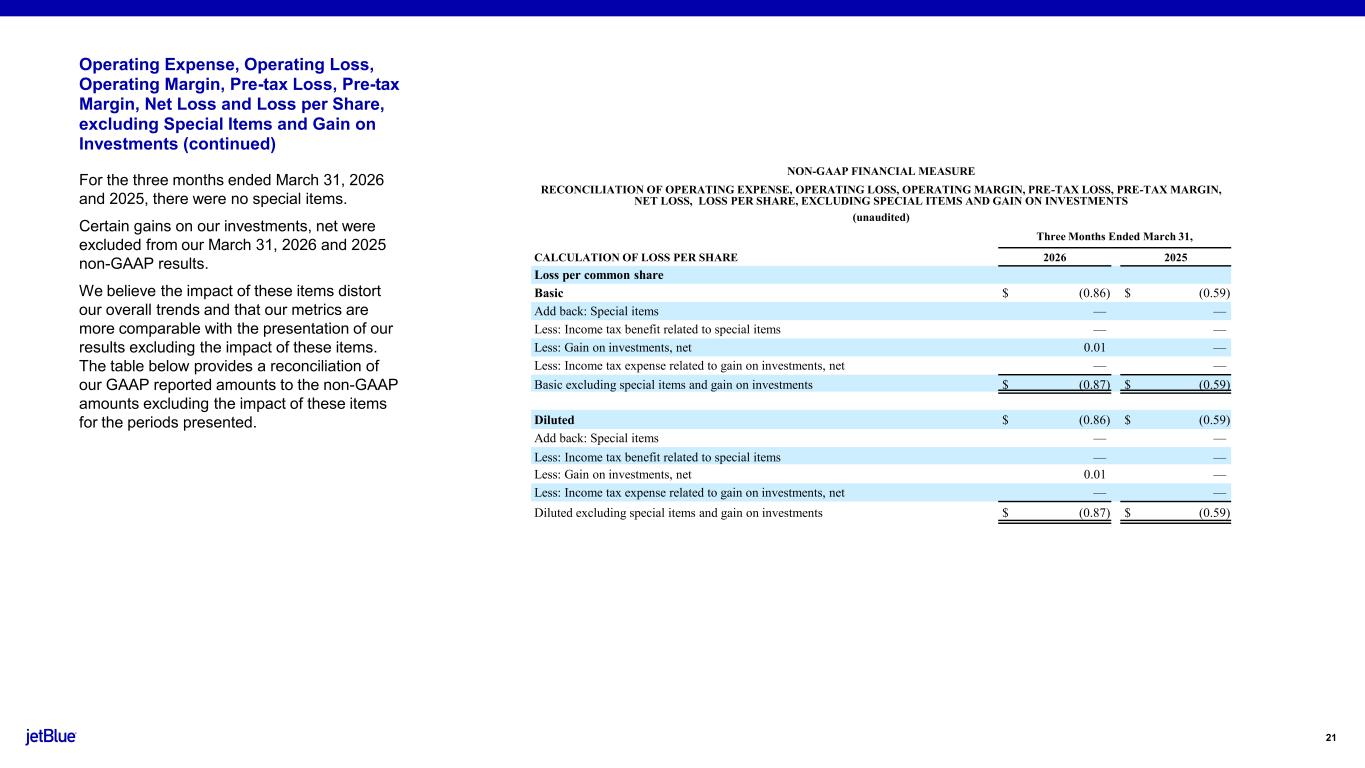
Operating Expense, Operating Loss, Operating Margin, Pre-tax Loss, Pre-tax Margin, Net Loss and Loss per Share, excluding Special Items and Gain on Investments (continued) For the three months ended March 31, 2026 and 2025, there were no special items. Certain gains on our investments, net were excluded from our March 31, 2026 and 2025 non-GAAP results. We believe the impact of these items distort our overall trends and that our metrics are more comparable with the presentation of our results excluding the impact of these items. The table below provides a reconciliation of our GAAP reported amounts to the non-GAAP amounts excluding the impact of these items for the periods presented. NON-GAAP FINANCIAL MEASURE RECONCILIATION OF OPERATING EXPENSE, OPERATING LOSS, OPERATING MARGIN, PRE-TAX LOSS, PRE-TAX MARGIN, NET LOSS, LOSS PER SHARE, EXCLUDING SPECIAL ITEMS AND GAIN ON INVESTMENTS (unaudited) Three Months Ended March 31, CALCULATION OF LOSS PER SHARE 2026 2025 Loss per common share Basic $ (0.86) $ (0.59) Add back: Special items — — Less: Income tax benefit related to special items — — Less: Gain on investments, net 0.01 — Less: Income tax expense related to gain on investments, net — — Basic excluding special items and gain on investments $ (0.87) $ (0.59) Diluted $ (0.86) $ (0.59) Add back: Special items — — Less: Income tax benefit related to special items — — Less: Gain on investments, net 0.01 — Less: Income tax expense related to gain on investments, net — — Diluted excluding special items and gain on investments $ (0.87) $ (0.59) 21
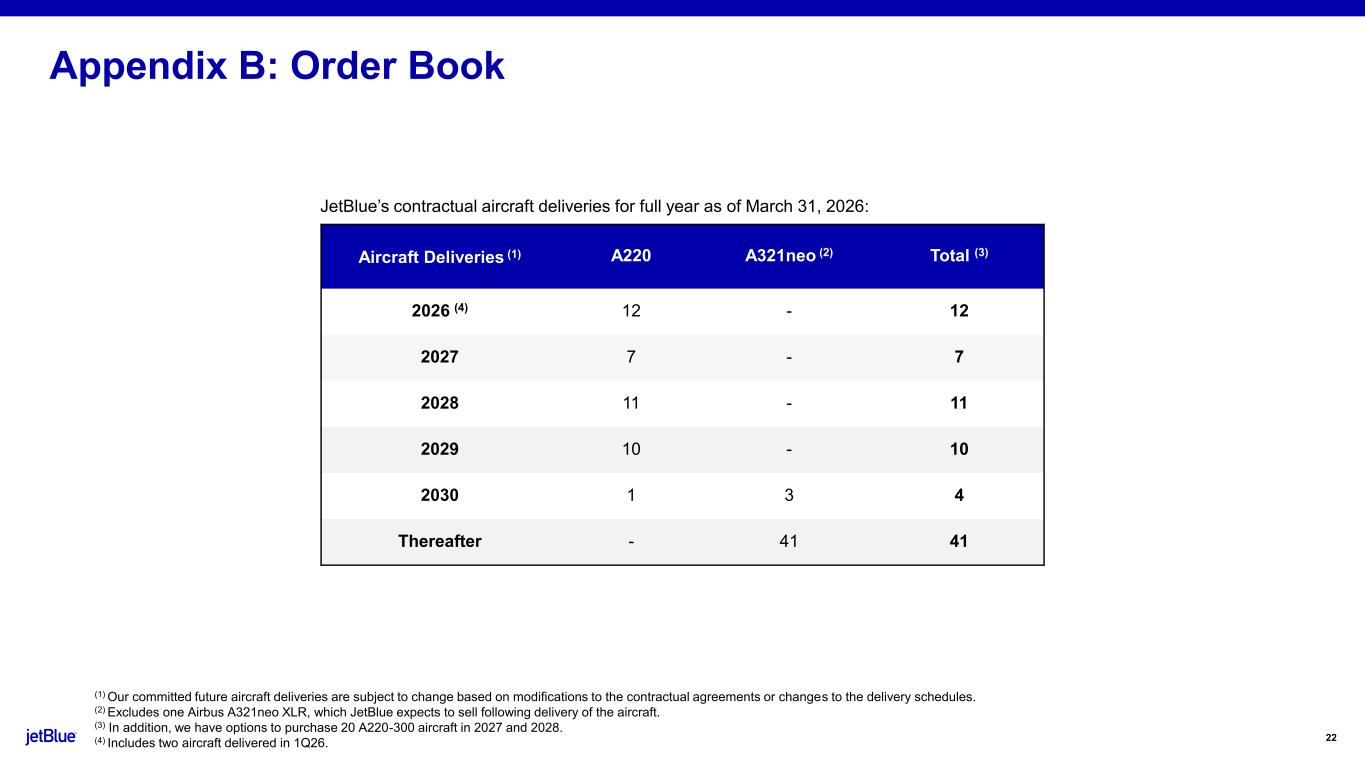
22 Aircraft Deliveries (1) A220 A321neo (2) Total (3) 2026 (4) 12 - 12 2027 7 - 7 2028 11 - 11 2029 10 - 10 2030 1 3 4 Thereafter - 41 41 (1) Our committed future aircraft deliveries are subject to change based on modifications to the contractual agreements or changes to the delivery schedules. (2) Excludes one Airbus A321neo XLR, which JetBlue expects to sell following delivery of the aircraft. (3) In addition, we have options to purchase 20 A220-300 aircraft in 2027 and 2028. (4) Includes two aircraft delivered in 1Q26. JetBlue’s contractual aircraft deliveries for full year as of March 31, 2026: Appendix B: Order Book

The JetBlue Way Forward | Our Strategic Evolution | Returning to Historical Earnings Power 23