Exhibit 99.2
Contents | |||||||||
Regulatory framework | Credit risk and credit risk mitigation | ||||||||
Basis of Presentation | General qualitative information on credit risk | ||||||||
Disclosure governance | Credit risk management strategies and processes | ||||||||
Basel 3 and CRR/CRD | Credit risk management structure and organization | ||||||||
MREL and TLAC | Scope and nature of credit risk measurement and reporting systems | ||||||||
ICAAP, ILAAP and SREP | Policies for hedging and mitigating credit risk | ||||||||
Definitions of past due and impairment | |||||||||
Key metrics | Credit risk adjustments | ||||||||
General quantitative information on credit risk | |||||||||
Capital | Residual maturity breakdown of credit exposure | ||||||||
Quality of non-performing exposures by geography | |||||||||
Development and composition of Own Funds | Credit quality of loans and advances to non-financial corporations by industry | ||||||||
Scope of application of the regulatory framework | Performing and non-performing exposures and related provisions | ||||||||
Derogations from prudential requirements for the parent company and subsidiaries | Credit quality of performing and non-performing exposures by days past due | ||||||||
Reconciliation of regulatory own funds to the IFRS balance sheet | Development of non-performing loans and advances | ||||||||
IFRS 9 / Article 468 CRR transitional arrangements on own funds | Credit quality of forborne exposures | ||||||||
Main features of capital instruments | Minimum loss coverage for non-performing exposure | ||||||||
Capital buffers | Collateral obtained by taking possession | ||||||||
Prudential requirements and additional buffers | General qualitative information on credit risk mitigation | ||||||||
Geographical distribution of credit exposures | Use of on- and off-balance sheet netting | ||||||||
Institution specific countercyclical capital buffer | Collateral evaluation and management | ||||||||
Indicators of global systemic importance | Main types of collateral | ||||||||
Composition of own funds and eligible liabilities | Main types of guarantor and credit derivative counterparties | ||||||||
Risk concentrations within credit risk mitigation | |||||||||
Capital requirements | General quantitative information on credit risk mitigation | ||||||||
Overview of credit risk mitigation techniques | |||||||||
Summary of Deutsche Bank’s ICAAP approach | |||||||||
Credit risk economic capital model | Credit risk and credit risk mitigation in the standardized approach | ||||||||
Market risk economic capital model | |||||||||
Operational risk economic capital model | Qualitative information on the use of the standardized approach | ||||||||
Strategic risk economic capital model | External ratings in the standardized approach and usage of issue rating | ||||||||
Risk type diversification | Quantitative information on the use of the standardized approach | ||||||||
Result of ICAAP | Standardized approach exposure by risk weight before and after credit mitigation | ||||||||
Overview of RWA and capital requirements | |||||||||
Effect on own funds and RWA that results from applying capital floors and not deducting items from own funds | |||||||||
Crypto-asset exposures and related activities | |||||||||
Leverage ratio | |||||||||
Leverage ratio according to CRR/CRD framework | |||||||||
Process used to manage the risk of excessive leverage | |||||||||
Factors impacting the leverage ratio in the second half of 2025 | |||||||||
Risk management objectives and policies | |||||||||
Enterprise and Treasury Risk | |||||||||
Risk management structure and organization | |||||||||
Risk management strategies and processes | |||||||||
Scope and nature of risk measurement and reporting systems | |||||||||
Policies for hedging and mitigating risk | |||||||||
Concise risk statement approved by the board | |||||||||
Credit risk exposure and credit risk mitigation in the internal-rating-based approach | Exposure to securitization positions | ||||||||
Qualitative information on the use of the IRB approach | Objectives in relation to securitization activity | ||||||||
Approval status for IRB approaches | Nature of other risks in securitized assets | ||||||||
Scope of the use of IRB and SA approaches | RWA calculation approaches for securitization positions | ||||||||
Relationship between the risk management function and the internal audit function | SSPE-related activities | ||||||||
Rating system review | Accounting policies for securitizations | ||||||||
Procedure of independence between reviewing function and development function | External rating agencies used for securitizations and internal Assessment Approach | ||||||||
Procedure to ensure accountability of development and reviewing function | Banking and trading book securitization exposures | ||||||||
Role of the function in the credit risk model process, scope and main content of credit risk models | Securitization exposures in the non-trading book and associated regulatory capital requirements - institution acting as originator or as sponsor | ||||||||
Internal rating-based approaches | Securitization exposures in the non-trading book and associated regulatory capital requirements - institution acting as investor | ||||||||
Quantitative information on the use of the IRB approach | Exposures securitized by the institution - Exposures in default and specific credit risk adjustments | ||||||||
Foundation IRB exposure | |||||||||
Advanced IRB exposure | Market risk | ||||||||
Total IRB exposure covered by credit derivatives | |||||||||
Total IRB exposure covered by the use of CRM techniques | Risk management objectives and policies | ||||||||
Development of credit risk RWA | Market risk management strategies and processes | ||||||||
Model validation results | Market risk management structure and organization | ||||||||
Scope and nature of market risk measurement and reporting systems | |||||||||
Specialized lending and equity exposures in the banking book | Policies for hedging and mitigating market risk | ||||||||
Own funds requirements under the Market Risk Standardized Approach | |||||||||
Counterparty credit risk (CCR) | Qualitative information on the internal model approach | ||||||||
Characteristics of the market risk models | |||||||||
Internal capital and credit limits for counterparty credit risk exposures | Incremental risk charge | ||||||||
Collateral and credit reserves for counterparty credit risk | Market risk stress testing | ||||||||
Management of wrong-way risk exposures | Methodology for backtesting and model validation | ||||||||
Collateral in the event of a rating downgrade | Regulatory approval for market risk models | ||||||||
Estimate of alpha factor | Trading book allocation and prudent valuation | ||||||||
CCR exposures by model approach and development | Own funds requirements for market risk under the IMA | ||||||||
CCR exposures development | Regulatory capital requirements for market risk | ||||||||
CCR exposures to central counterparties | Development of market risk RWA | ||||||||
CCR exposures in the standardized approach | Other quantitative information for market risk under the internal models approach | ||||||||
CCR exposures within the foundation IRBA | Overview of Value-at-Risk Metrics | ||||||||
CCR exposures within the advanced IRBA | Comparison of end-of-day VaR measures with one-day changes in portfolio's value | ||||||||
CCR exposures after credit risk mitigation | Prudent valuation adjustments | ||||||||
Credit derivatives exposures | |||||||||
Credit valuation adjustment risk | Exposure to interest rate risk in the banking book | ||||||||
Qualitative information on interest rate risk in the banking book | |||||||||
Changes in the economic value of equity and net interest income | |||||||||
Operational risk | Reputational Risk | ||||||||
Risk management objectives and policies | Risk management objectives and policies | ||||||||
Operational risk management strategies and processes | Reputational Risk Management strategies and processes | ||||||||
Operational risk management structure and organization | Reputational Risk Management structure and organization | ||||||||
Scope and nature of Operational Risk measurement and reporting systems | Scope and nature of reputational risk measurement and reporting systems | ||||||||
Operational risk measurement | Policies for hedging and mitigating reputational risk | ||||||||
Drivers for operational risk capital development | |||||||||
AMA model validation and quality control concept | Model risk | ||||||||
Operational risk management stress testing concept | |||||||||
Operational risk exposure | Risk management objectives and policies | ||||||||
Use of the Advanced Measurement Approaches to operational risk | Model Risk Management strategies and processes | ||||||||
Description of the use of insurance and other risk transfer mechanisms for the purpose of mitigation of this risk | Model Risk Management structure and organization | ||||||||
Scope and nature of model risk measurement and reporting systems | |||||||||
Environmental, social and governance (ESG) risks | Policies for mitigating model risk | ||||||||
Environmental risk | Remuneration policy | ||||||||
Social risk | |||||||||
Governance risk | Number of directorships held by board members | ||||||||
Climate change transition risk | Recruitment policy for board members | ||||||||
Energy efficiency of real estate collateral | Policy on diversity for board members | ||||||||
Alignment metrics on relative scope 3 emissions | |||||||||
Exposures to Top 20 carbon-intensive firms | Compensation of the employees (unaudited) | ||||||||
Climate change - physical risk | |||||||||
Regulatory environment | |||||||||
Liquidity risk | Compensation governance | ||||||||
Compensation and Benefits Strategy | |||||||||
Risk management objectives and policies | Group Compensation Framework | ||||||||
Liquidity risk management strategies and processes | Employee groups with specific compensation structures | ||||||||
Liquidity risk management structure and organization | Determination of performance-based Variable Compensation | ||||||||
Scope and nature of liquidity risk measurement and reporting system | Variable Compensation structure | ||||||||
Policies for hedging and mitigating liquidity risk | Ex-post risk adjustment of Variable Compensation | ||||||||
Qualitative information on LCR | Material Risk Taker compensation disclosure | ||||||||
Quantitative information on LCR | |||||||||
Net Stable Funding Ratio | List of tables | ||||||||
Unencumbered assets | |||||||||
Qualitative information on unencumbered assets | |||||||||
Quantitative information on unencumbered assets | |||||||||
5
Deutsche Bank | Regulatory framework |
Pillar 3 Report as of December 31, 2025 | Disclosure governance |
Regulatory framework
Basis of Presentation
Article 431 (1), (2) CRR, 433 CRR and 433a CRR
This Pillar 3 Report provides disclosures for the consolidated Deutsche Bank Group (the Group or the bank) as required
by the global regulatory framework for capital and liquidity, which was established by the Basel Committee on Banking
Supervision, also known as Basel 3.
In the European Union (EU), the Basel 3 framework is implemented by the amended versions of Regulation (EU) 575/2013
on prudential requirements for credit institutions (Capital Requirements Regulation or CRR) and the Directive (EU)
2013/36 on access to the activity of credit institutions and the prudential supervision of credit institutions and
investment firms (Capital Requirements Directive or CRD). As a single rulebook, the CRR is directly applicable to credit
institutions in the European Union and provides the grounds for the determination of regulatory capital requirements,
regulatory own funds, leverage and liquidity as well as other relevant requirements. In addition, the CRD was
implemented into German law by means of further amendments to the German Banking Act (Kreditwesengesetz or KWG)
and the German Solvency Regulation (SolvV) and accompanying regulations. Jointly, these laws and regulations
represent the regulatory framework applicable in Germany.
The disclosure requirements are provided in Part Eight of the CRR and in Section 26a of the KWG. Further disclosure
guidance has been provided by the European Banking Authority (EBA) in its “Final draft implementing technical
standards on public disclosures by institutions of the information referred to in Titles II and III of Part Eight of Regulation
(EU) No 575/2013” (EBA ITS). The Group adheres to the frequency of disclosure requirements as per Article 433 and
433a of the CRR and as provided within these EBA Guidelines and includes comparative periods in accordance with the
requirements of EBA ITS. Disclosure requirements stemming from the "Draft Implementing Technical Standards amending
Commission Implementing Regulation (EU) 2024/3172, as regards the disclosures on ESG risks, equity exposures and the
aggregate exposure to shadow banking entities", such as shadow banking, will be considered as per the required first publication
date given in the Draft ITS.
For those disclosures required on an annual basis, the comparative period is the prior year. For those disclosures only
required on a semi-annual basis, the comparative period is the prior half-year. Disclosures required on a quarterly basis
generally include comparative information for the prior quarter. No comparative information is shown in the event that
CRR3 and related EBA ITS introduce new disclosures or require significant changes to existing disclosures making
comparatives not aligned to current disclosures.
The information provided in this Pillar 3 Report is unaudited.
Numbers presented throughout this document may not add up precisely to the totals and percentages may not precisely
reflect the absolute figures due to rounding. Where applicable prior year's comparatives have been aligned to
presentation in the current year.
Disclosure governance
Article 431 (3), 432 and 434CRR
The Group’s Pillar 3 Report is in compliance with the legal and regulatory requirements described above and is prepared
in accordance with the Group’s internal policies, processes, systems and internal controls as defined by the Group’s risk
disclosure governing document. In line with the Group’s governing document, a dedicated process is followed if the
Group omits certain disclosures due to the disclosures being immaterial, proprietary or confidential. If the Group
classifies information as immaterial in the Pillar 3 Report, this is stated accordingly in the related disclosures. The Group’s
Management Board approved this Pillar 3 Report for publication and affirmed that Deutsche Bank has complied with the
requirements under Article 431 (3) CRR.
Based upon the Group’s assessment and verification it also believes the risk and regulatory disclosures presented
throughout this Pillar 3 Report appropriately and comprehensively convey the Group’s overall risk profile as of December
31, 2025.
This Pillar 3 Report is published on the bank’s website at db.com/ir/en/regulatory-reporting.htm as well as on EBA's
"Pillar 3 Data HUB" website at edap-public.eba.europa.eu.
6
Deutsche Bank | Regulatory framework |
Pillar 3 Report as of December 31, 2025 | ICAAP, ILAAP and SREP |
In addition, the bank‘s website includes a description of the main features of the Group’s capital instruments as well as its
senior non-preferred subordinated eligible liabilities instruments eligible for subordinated minimum requirement for own
funds and eligible liabilities (MREL) and total loss absorbing capacity (TLAC), to the extent that these do not constitute
private placements and are treated confidentially (db.com/ir/en/capital-instruments.htm).
Article 435 (1)(e) CRR (EU OVA)
Deutsche Bank’s Management Board confirms, for the purpose of Article 435 CRR, that the bank’s risk management
arrangements are adequate for its risk profile and strategy, and that the bank maintains appropriate resources to
implement selected enhancements.
Basel 3 and CRR/CRD
The CRR/CRD lays the foundation for the calculation of the minimum regulatory requirements with respect to own funds
and eligible liabilities, the liquidity coverage ratio and the net stable funding ratio.
Regulation (EU) 2024/1623 introduces fundamental changes to the CRR that are generally applicable from January 1,
2025 (“CRR3”). With respect to own funds requirements for credit risk, for example new floors for internal probability of
default (PD) and loss given default (LGD) estimates are introduced and the advanced Internal Ratings Based Approach
must no longer be applied for large corporates. Hence, for exposures facing large corporates, it is no longer possible to
estimate the LGD based on an internal model, but instead a supervisory LGD must be used. Also the Credit Risk
Standardized Approach is fundamentally revised, e.g. the treatment of exposures secured by residential or commercial
immovable property is changed. For operational risk, the capital requirements can no longer be determined based on an
internal model, instead a standardized approach must be applied.
In 2025, the total risk exposure amount is floored at 50% of the risk exposure amounts determined based on the
standardized approaches (“output floor”). The output floor gradually increases to 72.5% of the risk exposure amounts
determined based on standardized approaches on January 1, 2030.
The amendments for market risk (Fundamental review of the trading book - FRTB) have been delayed by Commission
Delegated Regulations (EU) 2024/2795 and 2025/1496 until January 1, 2027. Accordingly, during 2025 and 2026 market
risk own funds requirements are determined based on the internal model and standardized approach in the version of
Regulation (EU) 575/2013 in force on July 8, 2024. In parallel the FRTB standardized approach is used for the output
floor calculation as well as the reporting obligation. Following the EBA opinions dated February 27, 2023, August 12,
2024 and August 8, 2025 equally the amended FRTB rules on trading book assignment, reclassifications and internal
hedges are delayed until January 1, 2027.
There is still uncertainty as to how some of the CRR/CRD rules should be interpreted and there are still related binding
Technical Standards for which a final version is not yet available. Thus, the Group will continue to refine assumptions and
models in line with evolution of these regulations as well as the industry’s understanding and interpretation of the rules.
Against this background, current CRR/CRD measures may not be comparable to previous expectations. Also, CRR/CRD
measures may not be comparable with similarly labeled measures used by competitors, as their assumptions and
estimates may differ from Deutsche Bank’s.
MREL and TLAC
Banks in the European Union are required to meet at all times a minimum requirement for own funds and eligible
liabilities (MREL) which ensures that banks have sufficient loss absorbing capacity in resolution to avoid recourse to
taxpayers’ money. Relevant laws are the Single Resolution Mechanism Regulation (SRMR) and the Bank Recovery and
Resolution Directive (BRRD) as implemented through the German Recovery and Resolution Act (Sanierungs- und
Abwicklungsgesetz, SAG).
In addition, the CRR requires G-SIIs in Europe to have at least the maximum of 18% plus the combined buffer
requirement of risk weighted assets (RWA) and 6.75% of leverage exposure as total loss absorbing capacity (TLAC).
Instruments which qualify for MREL and TLAC as own funds are Common Equity Tier 1, Additional Tier 1, and Tier 2 along
with certain eligible liabilities (mainly plain-vanilla unsecured bonds). Instruments qualifying for TLAC need to be fully
subordinated to general creditor claims (e.g., senior non-preferred bonds). While this is not required for MREL, MREL
regulations allow the Single Resolution Board (SRB) to also set an additional subordination requirement within the MREL
requirements (but separate from TLAC), which allows only subordinated liabilities and own funds to be counted.
7
Deutsche Bank | Regulatory framework |
Pillar 3 Report as of December 31, 2025 | ICAAP, ILAAP and SREP |
MREL is determined by the competent resolution authorities for each supervised bank and its preferred resolution
strategy. In the case of Deutsche Bank AG, MREL is determined by the SRB. While there is no statutory minimum level of
MREL, the CRR, SRMR, BRRD and delegated regulations set out criteria which the resolution authority must consider
when determining the relevant required level of MREL. Guidance is provided through a MREL policy published annually
by the SRB. Any binding MREL ratio determined by the SRB is communicated to Deutsche Bank via the German Federal
Financial Supervisory Authority (BaFin). Deutsche Bank AG received its current total MREL and current subordinated
MREL requirement with immediate applicability in the second quarter of 2025.
ICAAP, ILAAP and SREP
The internal capital adequacy assessment process (ICAAP) as stipulated in Pillar 2 of Basel requires banks to identify and
assess risks, to apply effective risk management techniques and to maintain adequate capitalization. The Group’s internal
liquidity adequacy assessment process (ILAAP) aims to ensure that sufficient levels of liquidity are maintained on an
ongoing basis by identifying the key liquidity and funding risks to which the Group is exposed, by monitoring and
measuring these risks, and by maintaining tools and resources to manage and mitigate these risks.
In accordance with Article 97 CRD supervisors regularly review, as part of the supervisory review and evaluation process
(SREP), the arrangements, strategies, processes, and mechanisms implemented by banks and evaluate: (a) risks to which
the institution is or might be exposed; (b) risks the institution poses to the financial system; and (c) risks revealed by stress
testing.
Key metrics
Article 447 (a-g) and Article 438 (b) CRR
The following table highlights Deutsche Bank’s key regulatory metrics and ratios, and related input components as
defined by CRR and CRD. This considers reforms introduced by Regulation (EU) 2024/1623 (CRR3), being applicable
since January 1, 2025. In line with disclosure requirements the Liquidity Coverage Ratio is based on 12 months rolling
averages and the other metrics are based on spot information.
8
Deutsche Bank | Key metrics |
Pillar 3 Report as of December 31, 2025 | ICAAP, ILAAP and SREP |
EU KM1 – Key metrics
a | b | c | d | e | ||||||||
in € m. (unless stated otherwise) | Dec 31, 2025 | Sep 30, 2025 | Jun 30, 2025 | Mar 31, 2025 | Dec 31, 2024 | |||||||
Available own funds (amounts) | ||||||||||||
1 | Common Equity Tier 1 (CET 1) capital | 49,266 | 49,346 | 48,522 | 48,645 | 49,457 | ||||||
2 | Tier 1 capital | 60,784 | 59,864 | 60,193 | 60,316 | 60,835 | ||||||
3 | Total capital | 67,834 | 66,866 | 67,200 | 67,741 | 68,511 | ||||||
Risk-weighted exposure amounts | ||||||||||||
4 | Total risk-weighted exposure amount | 347,133 | 340,387 | 340,805 | 351,973 | 357,427 | ||||||
4a | Total risk exposure pre-floor | 347,133 | 340,387 | 340,805 | 351,973 | N/M | ||||||
Capital ratios (as percentage of risk-weighted exposure amount) | ||||||||||||
5 | Common Equity Tier 1 ratio (%) | 14.19 | 14.50 | 14.24 | 13.82 | 13.84 | ||||||
5b | Common Equity Tier 1 ratio considering unfloored TREA (%) | 14.19 | 14.50 | 14.24 | 13.82 | N/M | ||||||
6 | Tier 1 ratio (%) | 17.51 | 17.59 | 17.66 | 17.14 | 17.02 | ||||||
6b | Tier 1 ratio considering unfloored TREA (%) | 17.51 | 17.59 | 17.66 | 17.14 | N/M | ||||||
7 | Total capital ratio (%) | 19.54 | 19.64 | 19.72 | 19.25 | 19.17 | ||||||
7b | Total capital ratio considering unfloored TREA (%) | 19.54 | 19.64 | 19.72 | 19.25 | N/M | ||||||
Additional own funds requirements to address risks other than the risk of excessive leverage (as a percentage of risk-weighted exposure amount) | ||||||||||||
EU 7d | Additional own funds requirements to address risks other than the risk of excessive leverage (%) | 2.90 | 2.90 | 2.90 | 2.90 | 2.65 | ||||||
of which: | ||||||||||||
EU 7e | to be made up of CET 1 capital (percentage points) | 1.63 | 1.63 | 1.63 | 1.63 | 1.49 | ||||||
EU 7f | to be made up of Tier 1 capital (percentage points) | 2.18 | 2.18 | 2.18 | 2.18 | 1.99 | ||||||
EU 7g | Total SREP own funds requirements (%) | 10.90 | 10.90 | 10.90 | 10.90 | 10.65 | ||||||
Combined buffer and overall capital requirement (as a percentage of risk- weighted exposure amount) | ||||||||||||
8 | Capital conservation buffer (%) | 2.50 | 2.50 | 2.50 | 2.50 | 2.50 | ||||||
EU 8a | Conservation buffer due to macro-prudential or systemic risk identified at the level of a Member State (%) | 0.00 | 0.00 | 0.00 | 0.00 | 0.00 | ||||||
9 | Institution specific countercyclical capital buffer (%) | 0.50 | 0.48 | 0.48 | 0.48 | 0.49 | ||||||
EU 9a | Systemic risk buffer (%) | 0.14 | 0.14 | 0.13 | 0.19 | 0.22 | ||||||
10 | Global Systemically Important Institution buffer (%) | 1.50 | 1.50 | 1.50 | 1.50 | 1.50 | ||||||
EU 10a | Other Systemically Important Institution buffer (%) | 2.00 | 2.00 | 2.00 | 2.00 | 2.00 | ||||||
11 | Combined buffer requirement (%) | 5.13 | 5.12 | 5.11 | 5.17 | 5.21 | ||||||
EU 11a | Overall capital requirements (%) | 16.03 | 16.02 | 16.01 | 16.07 | 15.86 | ||||||
12 | CET 1 available after meeting the total SREP own funds requirements (%) | 8.06 | 8.37 | 8.11 | 7.69 | 7.85 | ||||||
Leverage ratio | ||||||||||||
13 | Leverage ratio total exposure measure | 1,327,441 | 1,299,655 | 1,276,035 | 1,301,804 | 1,315,906 | ||||||
14 | Leverage ratio (%) | 4.58 | 4.61 | 4.72 | 4.63 | 4.62 | ||||||
Additional own funds requirements to address risks of excessive leverage (as a percentage of leverage ratio total exposure amount) | ||||||||||||
EU 14a | Additional own funds requirements to address the risk of excessive leverage (%) | 0.10 | 0.10 | 0.10 | 0.10 | 0.10 | ||||||
EU 14b | of which: to be made up of CET 1 capital (percentage points) | 0.00 | 0.00 | 0.00 | 0.00 | 0.00 | ||||||
EU 14c | Total SREP leverage ratio requirements (%) | 3.10 | 3.10 | 3.10 | 3.10 | 3.10 | ||||||
Leverage ratio buffer and overall leverage ratio requirement (as a percentage of total exposure measure) | ||||||||||||
EU 14d | Leverage ratio buffer requirement (%) | 0.75 | 0.75 | 0.75 | 0.75 | 0.75 | ||||||
EU 14e | Overall leverage ratio requirements (%) | 3.85 | 3.85 | 3.85 | 3.85 | 3.85 | ||||||
Liquidity Coverage Ratio | ||||||||||||
15 | Total high-quality liquid assets (HQLA) (Weighted value - average) | 238,150 | 233,383 | 230,050 | 226,221 | 224,205 | ||||||
EU 16a | Cash outflows - Total weighted value | 238,512 | 237,725 | 234,064 | 229,743 | 223,914 | ||||||
EU 16b | Cash inflows - Total weighted value | 64,879 | 64,124 | 60,641 | 58,408 | 57,118 | ||||||
16 | Total net cash outflows (adjusted value) | 173,633 | 173,601 | 173,423 | 171,335 | 166,796 | ||||||
17 | Liquidity coverage ratio (%) | 137.22 | 134.67 | 132.65 | 132.03 | 134.42 | ||||||
Net Stable Funding Ratio | ||||||||||||
18 | Total available stable funding | 648,658 | 631,781 | 633,110 | 631,929 | 625,189 | ||||||
19 | Total required stable funding | 544,664 | 536,762 | 525,836 | 532,765 | 514,802 | ||||||
20 | NSFR ratio (%) | 119.09 | 117.70 | 120.40 | 118.61 | 121.44 |
9
Deutsche Bank | Key metrics |
Pillar 3 Report as of December 31, 2025 | Key metrics of own funds and eligible liabilities |
Key metrics of own funds and eligible liabilities
Article 447 (h) CRR and Article 45i(3)(a,c) BRRD
EU KM2 – Key metrics - MREL and G-SII Requirement for own funds and eligible liabilities (TLAC)
Minimum requirement for own funds and eligible liabilities (MREL) | G-SII Requirement for own funds and eligible liabilities (TLAC) | |||||||||||||||
a | b | c | d | e | f | |||||||||||
in € m. (unless stated otherwise) | Dec 31, 2025 | Sep 30, 2025 | Dec 31, 2025 | Sep 30, 2025 | Jun 30, 2025 | Mar 31, 2025 | Dec 31, 2024 | |||||||||
Own funds and eligible liabilities, ratios and components | ||||||||||||||||
1 | Own funds and eligible liabilities | 131,023 | 131,512 | 114,936 | 117,881 | 115,925 | 117,594 | 118,491 | ||||||||
EU 1a | Own funds and subordinated liabilities | 114,936 | 117,881 | — | — | — | — | — | ||||||||
2 | Total risk exposure amount of the resolution group (TREA) | 347,133 | 340,387 | 347,133 | 340,387 | 340,805 | 351,973 | 357,427 | ||||||||
3 | Own funds and eligible liabilities as percentage of TREA | 37.74 | 38.64 | 33.11 | 34.63 | 34.02 | 33.41 | 33.15 | ||||||||
of which: | ||||||||||||||||
EU 3a | Own funds and subordinated liabilities | 33.11 | 34.63 | — | — | — | — | — | ||||||||
4 | Total exposure measure of the resolution group (TEM) | 1,327,441 | 1,299,655 | 1,327,441 | 1,299,655 | 1,276,035 | 1,301,804 | 1,315,906 | ||||||||
5 | Own funds and eligible liabilities as percentage of TEM | 9.87 | 10.12 | 8.66 | 9.07 | 9.08 | 9.03 | 9.00 | ||||||||
of which: | ||||||||||||||||
EU 5a | Own funds and subordinated liabilities | 8.66 | 9.07 | — | — | — | — | — | ||||||||
6a | Does the subordination exemption in Article 72b(4) of the CRR apply? (5% exemption) | — | — | no | no | no | no | no | ||||||||
6b | Pro-memo item - Aggregate amount of permitted non-subordinated eligible liabilities instruments if the subordination discretion as per Article 72b(3) CRR is applied (max 3.5% exemption) | — | — | 0 | 0 | 0 | 0 | 0 | ||||||||
6c | Pro-memo item: If a capped subordination exemption applies under Article 72b (3) CRR, the amount of funding issued that ranks pari passu with excluded liabilities and that is recognized under row 1, divided by funding issued that ranks pari passu with excluded Liabilities and that would be recognized under row 1 if no cap was applied (%) | — | — | 0 | 0 | 0 | 0 | 0 | ||||||||
Minimum requirement for own funds and eligible liabilities (MREL) | ||||||||||||||||
EU 7 | MREL requirement expressed as percentage of the TREA | 31.11 | 31.10 | — | — | — | — | — | ||||||||
of which: | ||||||||||||||||
EU 8 | to be met with own funds or subordinated liabilities | 24.94 | 24.93 | — | — | — | — | — | ||||||||
EU 9 | MREL requirement expressed as percentage of TEM | 7.03 | 7.03 | — | — | — | — | — | ||||||||
of which: | ||||||||||||||||
EU 10 | to be met with own funds or subordinated liabilities | 7.03 | 7.03 | — | — | — | — | — | ||||||||
As of December 31, 2025 the MREL ratio was 37.74% of Total Risk Exposure Amount (TREA) compared to a requirement
of 31.11% of TREA including a 5.13% combined buffer requirement, equaling a surplus of € 23.0 billion above the bank’s
MREL requirement. The subordinated MREL ratio was 8.66% of Total Exposure Measure (TEM) compared to a requirement
of 7.03% of TEM. The subordinated MREL surplus is € 21.6 billion
As of December 31, 2025 the TLAC ratio was 33.11% of TREA compared to a requirement of 23.13% including a 5.13%
combined buffer requirement, resulting in a surplus of € 34.6 billion. TLAC was 8.66% of TEM compared to a requirement
of 6.75%, which corresponds to a surplus of € 25.3 billion.
10
Deutsche Bank | Capital |
Pillar 3 Report as of December 31, 2025 | Development and composition of Own Funds |
Capital
Development and composition of Own Funds
Article 437 (a, d-f) CRR
The own funds capital ratios provided for Deutsche Bank Group are defined by CRR regulations. Deutsche Bank’s CET 1
capital as of December 31, 2025, amounted to € 49.3 billion, € 0.7 billion higher compared to June 30, 2025. AT1 capital
was € 0.2 billion lower as of December 31, 2025, amounted to € 11.5 billion, compared to € 11.7 billion as of June 30,
2025. Tier 1 capital as of December 31, 2025, amounted to € 60.8 billion compared to € 60.2 billion as of June 30, 2025.
Tier 2 capital was € 7.1 billion as of December 31, 2025, broadly stable compared to June 30, 2025. Total capital as of
December 31, 2025, amounted to € 67.8 billion, which was € 0.6 billion higher compared to € 67.2 billion as of June 30,
2025.
In the second half of 2025, CET 1 capital increased by € 0.7 billion. This was mainly due to net profit of € 3.3 billion
reduced by regulatory deductions for future shareholder distribution and AT1 coupon payments of € 1.8 billion following
requirements of the ECB Decision (EU) (2015/656) on the recognition of interim or year-end profits in CET 1 capital in
accordance with the Article 26(2) of Regulation (EU) No 575/2013 (ECB/2015/4). In addition, CET 1 capital increased due
to lower deferred tax assets of € 0.5 billion, cumulative fair value movements on available for sale securities and
additional value adjustments of € 0.3 billion and € 0.1 billion from other movements.
These positive effects were partially offset by discontinuation of the temporary treatment of unrealized gains and losses
measured at fair value through OCI in accordance with Article 468 CRR by € 0.8 billion, currency translation adjustments
of € 0.4 billion, higher deduction for non-performing exposures by € 0.3 billion and effects from the completion of the
second share buyback program of € 0.3 billion.
The Additional Tier 1 capital decrease of € 0.2 billion was due to a new AT 1 issuance of € 1.0 billion in the second half of
the year, reduced by the exercised call option with a total principal amount of € 1.2 billion (U.S. $ 1.25 billion equivalent).
EU CC1 – Composition of regulatory own funds
Dec 31, 2025 | Jun 30, 2025 | |||||||
in € m. | CRR/CRD | CRR/CRD | Refe- rences1 | |||||
Common Equity Tier 1 (CET 1) capital: instruments and reserves | ||||||||
1 | Capital instruments, related share premium accounts and other reserves | 42,983 | 43,354 | A | ||||
of which: Instrument type 1 (ordinary shares)2 | 42,983 | 43,354 | A | |||||
of which: Instrument type 2 | 0 | 0 | ||||||
of which: Instrument type 3 | 0 | 0 | ||||||
2 | Retained earnings | 21,149 | 21,227 | B | ||||
3 | Accumulated other comprehensive income (loss), net of tax | (4,159) | (3,710) | C | ||||
3a | Funds for general banking risk | 0 | 0 | |||||
4 | Amount of qualifying items referred to in Art. 484 (3) and the related share premium accounts subject to phase-out from CET 1 | 0 | 0 | |||||
5 | Minority interests (amount allowed in consolidated CET 1) | 917 | 940 | |||||
5a | Independently reviewed interim profits net of any foreseeable charge or dividend3 | 3,347 | 1,536 | B | ||||
6 | Common Equity Tier 1 (CET 1) capital before regulatory adjustments | 64,237 | 63,347 | |||||
Common Equity Tier 1 (CET 1) capital: regulatory adjustments | ||||||||
7 | Additional value adjustments (negative amount)4 | (1,667) | (1,742) | |||||
8 | Goodwill and other intangible assets (net of related tax liabilities) (negative amount) | (5,045) | (4,997) | D | ||||
10 | Deferred tax assets that rely on future profitability excluding those arising from temporary differences (net of related tax liabilities where the conditions in Art. 38 (3) are met) (negative amount) | (2,533) | (3,058) | E | ||||
11 | Fair value reserves related to gains or losses on cash flow hedges of financial instruments that are not valued at fair value | 49 | (210) | |||||
12 | Negative amounts resulting from the calculation of expected loss amounts | (2,579) | (2,617) | |||||
13 | Any increase in equity that results from securitized assets (negative amount) | (0) | (0) | |||||
14 | Gains or losses on liabilities designated at fair value resulting from changes in own credit standing5 | 247 | 143 | |||||
15 | Defined benefit pension fund assets (net of related tax liabilities) (negative amount) | (1,135) | (1,110) | F | ||||
16 | Direct, indirect and synthetic holdings by an institution of own CET 1 instruments (negative amount)6 | 0 | 0 | |||||
17 | Direct, indirect and synthetic holdings of the CET 1 instruments of financial sector entities where those entities have reciprocal cross holdings with the institution designed to inflate artificially the own funds of the institution (negative amount) | 0 | 0 | |||||
11
Deutsche Bank | Capital |
Pillar 3 Report as of December 31, 2025 | Development and composition of Own Funds |
Dec 31, 2025 | Jun 30, 2025 | |||||||
in € m. | CRR/CRD | CRR/CRD | Refe- rences1 | |||||
18 | Direct, indirect and synthetic holdings by the institution of the CET 1 instruments of financial sector entities where the institution does not have a significant investment in those entities (amount above 10% threshold and net of eligible short positions) (negative amount)7 | 0 | 0 | |||||
19 | Direct, indirect and synthetic holdings by the institution of the CET 1 instruments of financial sector entities where the institution has a significant investment in those entities (amount above 10% threshold and net of eligible short positions) (negative amount) | 0 | 0 | |||||
20a | Exposure amount of the following items which qualify for a risk weight of 1,250%, where the institution opts for the deduction alternative | 0 | 0 | |||||
of which: | ||||||||
20b | Qualifying holdings outside the financial sector (negative amount) | 0 | 0 | |||||
20c | Securitization positions (negative amount) | 0 | 0 | |||||
20d | Free deliveries (negative amount) | 0 | 0 | |||||
21 | Deferred tax assets arising from temporary differences (amount above 10% threshold, net of related tax liabilities where the conditions in Article 38 (3) are met) (negative amount) | 0 | 0 | E | ||||
22 | Amount exceeding the 17.65% threshold (negative amount) | 0 | 0 | |||||
of which: | ||||||||
23 | Direct, indirect and synthetic holdings by the institution of the CET 1 instruments of financial sector entities where the institution has a significant investment in those entities | 0 | 0 | |||||
25 | Deferred tax assets arising from temporary differences | 0 | 0 | E | ||||
EU 25a | Losses for the current financial year (negative amount) | 0 | 0 | |||||
EU 25b | Foreseeable tax charges relating to CET 1 items except where the institution suitably adjusts the amount of CET 1 items insofar as such tax charges reduce the amount up to which those items may be used to cover risks or losses (negative amount) | 0 | 0 | |||||
27 | Qualifying AT1 deductions that exceed the AT1 items of the institution (negative amount) | 0 | 0 | |||||
Regulatory adjustments relating to unrealized gains and losses pursuant to Art. 468 CRR | 0 | 811 | ||||||
27a | Other regulatory adjustments (including IFRS 9 transitional adjustments when relevant)8 | (2,309) | (2,045) | |||||
28 | Total regulatory adjustments to Common Equity Tier 1 (CET 1) capital | (14,971) | (14,826) | |||||
29 | Common Equity Tier 1 (CET 1) capital | 49,266 | 48,522 | |||||
Additional Tier 1 (AT1) capital: instruments | ||||||||
30 | Capital instruments and the related share premium accounts | 11,648 | 11,801 | G | ||||
of which: | ||||||||
31 | Classified as equity under applicable accounting standards12 | 11,718 | 11,871 | G | ||||
32 | Classified as liabilities under applicable accounting standards | 0 | 0 | |||||
33 | Amount of qualifying items referred to in Article 484 (4) and the related share premium accounts subject to phase out from AT1 as described in Article 486(3) of CRR | 0 | 0 | H | ||||
of which: | ||||||||
EU 33a | Amount of qualifying items referred to in Article 494a(1) subject to phase out from AT1 | 0 | 0 | |||||
EU 33b | Amount of qualifying items referred to in Article 494b(1) subject to phase out from AT1 | 0 | 0 | |||||
34 | Qualifying Tier 1 capital included in consolidated AT1 capital issued by subsidiaries and held by third parties | 0 | 0 | |||||
35 | of which: instruments issued by subsidiaries subject to phase out | 0 | 0 | |||||
36 | Additional Tier 1 (AT1) capital before regulatory adjustments | 11,648 | 11,801 | |||||
Additional Tier 1 (AT1) capital: regulatory adjustments | ||||||||
37 | Direct, indirect and synthetic holdings by an institution of own AT1 instruments (negative amount) | (130) | (130) | G | ||||
38 | Direct, indirect and synthetic holdings of the AT1 instruments of financial sector entities where those entities have reciprocal cross holdings with the institution designed to inflate artificially the own funds of the institution (negative amount) | 0 | 0 | |||||
39 | Direct, indirect and synthetic holdings of the AT1 instruments of financial sector entities where the institution does not have a significant investment in those entities (amount above the 10% threshold and net of eligible short positions) (negative amount)7 | 0 | 0 | |||||
40 | Direct, indirect and synthetic holdings by the institution of the AT1 instruments of financial sector entities where the institution has a significant investment in those entities (amount above the 10% threshold net of eligible short positions) (negative amount) | 0 | 0 | |||||
42 | Qualifying T2 deductions that exceed the T2 items of the institution (negative amount) | 0 | 0 | |||||
42a | of which: Other regulatory adjustments to AT1 capital | 0 | 0 | |||||
43 | Total regulatory adjustments to Additional Tier 1 (AT1) capital | (130) | (130) | |||||
44 | Additional Tier 1 (AT1) capital | 11,518 | 11,671 | |||||
45 | Tier 1 capital (T1 = CET 1 + AT1) | 60,784 | 60,193 | |||||
12
Deutsche Bank | Capital |
Pillar 3 Report as of December 31, 2025 | Development and composition of Own Funds |
Dec 31, 2025 | Jun 30, 2025 | |||||||
in € m. | CRR/CRD | CRR/CRD | Refe- rences1 | |||||
Tier 2 (T2) capital: instruments and provisions | ||||||||
46 | Capital instruments and the related share premium accounts9 | 7,225 | 7,178 | I | ||||
47 | Amount of qualifying items referred to in Article 484 (5) and the related share premium accounts subject to phase out from T2 as described in Article 486(4) of CRR | 0 | 0 | I | ||||
of which: | ||||||||
EU 47a | Amount of qualifying items referred to in Article 494a (2) subject to phase out from T2 | 0 | 0 | |||||
EU 47b | Amount of qualifying items referred to in Article 494b (2) subject to phase out from T2 | 0 | 0 | |||||
48 | Qualifying own funds instruments included in consolidated T2 capital issued by subsidiaries and held by third parties | 0 | 0 | I | ||||
49 | of which: instruments issued by subsidiaries subject to phase out | 0 | 0 | |||||
50 | Credit risk adjustments | 0 | 0 | |||||
51 | Tier 2 (T2) capital before regulatory adjustments | 7,225 | 7,178 | |||||
Tier 2 (T2) capital: regulatory adjustments | ||||||||
52 | Direct, indirect and synthetic holdings by an institution of own T2 instruments and subordinated loans (negative amount) | (170) | (170) | I | ||||
53 | Direct, indirect and synthetic holdings of the T2 instruments and subordinated loans of financial sector entities where those entities have reciprocal cross holdings with the institution designed to inflate artificially the own funds of the institution (negative amount) | 0 | 0 | |||||
54 | Direct, indirect and synthetic holdings of the T2 instruments and subordinated loans of financial sector entities where the institution does not have a significant investment in those entities (amount above 10% threshold and net of eligible short positions) (negative amount)7 | 0 | 0 | |||||
55 | Direct, indirect and synthetic holdings by the institution of the T2 instruments and subordinated loans of financial sector entities where the institution has a significant investment in those entities (net of eligible short positions) (negative amount) | (5) | 0 | |||||
EU 56a | Qualifying eligible liabilities deductions that exceed the eligible liabilities items of the institution (negative amount) | 0 | 0 | |||||
EU 56b | Other regulatory adjustments to T2 capital | 0 | 0 | |||||
57 | Total regulatory adjustments to Tier 2 (T2) capital | (175) | (170) | |||||
58 | Tier 2 (T2) capital | 7,050 | 7,008 | |||||
59 | Total capital (TC = T1 + T2) | 67,834 | 67,200 | |||||
60 | Total risk-weighted assets | 347,133 | 340,805 | |||||
Capital ratios and buffers | ||||||||
61 | Common Equity Tier 1 capital ratio (as a percentage of risk-weighted assets) | 14.19 | 14.24 | |||||
62 | Tier 1 capital ratio (as a percentage of risk-weighted assets) | 17.51 | 17.66 | |||||
63 | Total capital ratio (as a percentage of risk-weighted assets) | 19.54 | 19.72 | |||||
64 | Institution CET 1 overall capital requirement (CET 1 requirement in accordance with article 92 (1) of Regulation (EU) No 575/2013, plus additional CET 1 requirement which the institution is required to hold in accordance with Article 104(1)(a) of Directive 2013/36/EU, plus combined buffer requirement in accordance with Article 128(6) of Directive 2013/36/ EU) expressed as a percentage of risk exposure amount)10 | 11.26 | 11.24 | |||||
of which: | ||||||||
65 | Capital conservation buffer requirement | 2.50 | 2.50 | |||||
66 | Countercyclical buffer requirement | 0.50 | 0.48 | |||||
67 | Systemic risk buffer requirement | 0.14 | 0.13 | |||||
EU 67a | Global Systemically Important Institution (G-SII) or Other Systemically Important Institution (O-SII) buffer | 2.00 | 2.00 | |||||
EU 67b | additional own funds requirements to address the risks other than the risk of excessive leverage | 1.63 | 1.63 | |||||
68 | Common Equity Tier 1 capital available to meet buffers (as a percentage of risk-weighted assets)11 | 8.06 | 8.11 | |||||
Amounts below the thresholds for deduction (before risk weighting) | ||||||||
72 | Direct, indirect and synthetic holdings of the capital of financial sector entities where the institution does not have a significant investment in those entities (amount below 10% threshold and net of eligible short positions)7 | 3,136 | 2,967 | |||||
73 | Direct, indirect and synthetic holdings by the institution of the CET 1 instruments of financial sector entities where the institution has a significant investment in those entities (amount below 10% threshold and net of eligible short positions) | 1,087 | 722 | |||||
75 | Deferred tax assets arising from temporary differences (amount below 10% threshold, net of related tax liability where the conditions in Article 38 (3) CRR are met) | 4,372 | 3,844 | |||||
Applicable caps on the inclusion of provisions in Tier 2 capital | ||||||||
76 | Credit risk adjustments included in T2 in respect of exposures subject to standardized approach (prior to the application of the cap) | 0 | 0 | |||||
13
Deutsche Bank | Capital |
Pillar 3 Report as of December 31, 2025 | Development and composition of Own Funds |
Dec 31, 2025 | Jun 30, 2025 | |||||||
in € m. | CRR/CRD | CRR/CRD | Refe- rences1 | |||||
77 | Cap on inclusion of credit risk adjustments in T2 under standardized approach | 720 | 481 | |||||
78 | Credit risk adjustments included in T2 in respect of exposures subject to internal ratings- based approach (prior to the application of the cap) | 0 | 0 | |||||
79 | Cap for inclusion of credit risk adjustments in T2 under internal ratings-based approach | 1,090 | 1,186 | |||||
Capital instruments subject to phase-out arrangements | ||||||||
80 | Current cap on CET 1 instruments subject to phase out arrangements | 0 | 0 | |||||
81 | Amount excluded from CET 1 due to cap (excess over cap after redemptions and maturities) | 0 | 0 | |||||
82 | Current cap on AT1 instruments subject to phase out arrangements | 0 | 0 | |||||
83 | Amount excluded from AT1 due to cap (excess over cap after redemptions and maturities) | 0 | 0 | |||||
84 | Current cap on T2 instruments subject to phase out arrangements | 0 | 0 | |||||
85 | Amount excluded from T2 due to cap (excess over cap after redemptions and maturities) | 0 | 0 | |||||
N/M – Not meaningful
1 References provide the mapping of regulatory balance sheet items used to calculate regulatory capital as reflected in the column “References" and as presented in tables
“EU CC2 – Reconciliation of regulatory own funds to balance sheet in the audited financial statements”. Where applicable, more detailed information is provided in the
respective reference footnote section
2Based on EBA list of Article 26(3) of CRR, competent authorities shall evaluate whether issuances of Common Equity Tier 1 instruments meet the criteria set out in Article
28 or, where applicable, Article 29
3Full year profit is recognized as per ECB Decision (EU) 2015/656 in accordance with the Article 26(2) of Regulation (EU) No 575/2013 (ECB/2015/4); current year profits
of € 6.9 billion reduced by deductions for future shareholder distribution in relation to FY25 of € 3.1 billion and AT1 coupons of € 0.5 billion
4The € 1.7 billion (June 2025: € 1.7 billion) additional value adjustments were derived from the EBA Regulatory Technical Standard on prudent valuation and are before
consideration of a benefit from the related reduction of the shortfall of provisions to expected losses of € 38.1 million (June 2025: € 0.4 billion)
5Represents gains and losses on liabilities and derivative liabilities carried at fair value that are a result of changes in own credit of the Group according to Article 33 (1) (b)
CRR
6Excludes holdings that are already considered in the accounting base of Common Equity
7Based on the Group’s current interpretation no deduction amount expected
8 Includes capital deductions of € 1.4 billion (June 2025: € 1.4 billion) based on ECB guidance on irrevocable payment commitments related to the Single Resolution Fund
and the Deposit Guarantee Scheme, € 0.7 billion (June 2025: € 0.4 billion) based on ECB’s supervisory recommendation for a prudential provisioning of non-performing
exposures
9Amortization is taken into account
10 Includes CET1 Pillar 2 Requirement
11 Calculated as the CET1 Capital less the Group’s CET1 capital requirements in accordance with article 92(1)(a) of Regulation (EU) No 575/2013 and following Article
104(1)(a) of Directive 2013/36/EU, and less any Common Equity Tier 1 items used by the Group to meet its additional Tier 1 and Tier 2 capital requirements
12 The reported position exceeds the total due to the delta amount of € 70 million representing a permanent buyback limit, which is not recognized in the accounting
standards
ACommon shares, additional paid-in capital and common shares in treasury reflect regulatory eligible CET 1 capital instruments
BRetained earnings in the regulatory balance sheet include Profit (loss) attributable to DB shareholders and additional equity components of € 6.9 billion (June 2025:
€ 3.7 billion). In the Own funds template (incl. RWA and capital ratios), this item is excluded from retained earnings and shown separately after subtracting the 'AT1
coupon and shareholder distribution deduction' of € 3.6 billion (June 2025: € 1.8 billion) as ‘independently reviewed interim profits net of any foreseeable charge or
dividend’ in row id 5a
CDifference to regulatory balance sheet position driven by prudential filters for unrealized gains and losses
DRegulatory applicable amount in goodwill and other intangible assets of € 7,561 million (June 2025: € 7,413 million) plus goodwill from equity method investments of
€ 59 million (June 2025: € 59 million) as per regulatory balance sheet reduced by deferred tax liabilities on other intangibles of € 466 million (June 2025: € 477 million)
and prudent software assets as per Art. 36 (1) (b) CRR of €2,109 million (June 2025: € 1,998 million)
EDifferences to balance sheet position mainly driven by adjustments as set out in Article 38 (2) to (5) CRR (e.g. regulatory offsetting requirements)
FRegulatory applicable amount is defined benefit pension fund assets of € 1,261 million (June 2025: € 1,233 million) reduced by deferred tax liabilities on defined benefit
pension fund assets of € 126 million (June 2025: € 122 million)
G Additional equity components reflects regulatory eligible AT1 capital instruments
HDifference to regulatory balance sheet driven by regulatory adjustments as set out in Articles 51 to 61 CRR (e.g. current cap on AT1 instruments subject to phase-out
arrangements)
IDifference to regulatory balance sheet driven by regulatory adjustments as set out in Articles 62 to 71 CRR (e.g. amortization, minority interest)
14
Deutsche Bank | Capital |
Pillar 3 Report as of December 31, 2025 | Derogations from prudential requirements for the parent company and subsidiaries |
Scope of application of the regulatory framework
Name of institution
Article 436 (a) CRR
Deutsche Bank Aktiengesellschaft (“Deutsche Bank AG”), headquartered in Frankfurt am Main, Germany, is the parent
institution of the Deutsche Bank Group (the “regulatory group”). Under Section 10a KWG in conjunction with Articles 11
and 18 CRR, a regulatory group of institutions consists of an institution as the parent company, and all other institutions,
financial institutions (comprising inter alia financial holding companies, payment institutions, asset management
companies) and ancillary services undertakings that are its subsidiaries within the meaning of Article 4 (1) (16) CRR, or are
jointly managed together with other parties within the meaning of Article 18 (4) CRR. Subsidiaries are fully consolidated,
while companies which are not subsidiaries but consolidated for regulatory purposes are subject to proportional
consolidation.
Insurance companies and companies outside the banking and financial sector are not consolidated in the regulatory
group. The bank does not qualify as a financial conglomerate and is not subject to the respective supplementary
supervisions.
Differences in the scopes of consolidation
Article 436 (b) CRR
The principles of consolidation for Deutsche Bank’s regulatory group are not identical to those applied for the Group’s
financial statements. Nonetheless, the majority of the bank’s subsidiaries in the regulatory group are also fully
consolidated in accordance with IFRS in the Group’s consolidated financial statements.
The main differences between regulatory and accounting consolidation are:
–Subsidiaries outside the banking and financial sector are not consolidated within the regulatory group of institutions
but are included in the consolidated financial statements according to IFRS
–Most of the Group’s special purpose entities (SPEs) consolidated under IFRS do not meet the regulatory subsidiary
definition pursuant to Article 4 (1) (16) CRR and are not consolidated in the regulatory group. However, the risks
resulting from the bank’s exposures to such entities are reflected in the regulatory capital requirements
–Only two entities included in the regulatory group are not consolidated as subsidiaries for accounting purposes and
are treated differently
For detailed information and the table LI3, please refer to the Pillar 3 Report section “Outline of differences in scopes of
consolidation”.
Derogations from prudential requirements for the parent
company and subsidiaries
Article 436 (h) CRR (EU LIB)
As of December 31, 2025, Deutsche Bank AG fully applied the exemptions pursuant to Section 2a (1) KWG in conjunction
with Article 7 (3) CRR, Art. 6 (5) CRR and Section 2a (2) KWG in conjunction with Section 25a (1) sentence 3 KWG (so-
called “parent waiver”) pursuant to which the bank may waive the application of provisions on own funds and eligible
liabilities, capital requirements, large exposures, exposures to transferred credit risks, leverage, reporting requirements
and disclosure by institutions as well as certain risk management requirements on a stand-alone basis.
Deutsche Bank AG’s subsidiary norisbank GmbH and Deutsche Bank Europe GmbH which both were consolidated within
the Deutsche Bank regulatory group, fully applied the same exemptions outlined above (so-called “subsidiary waiver”)
pursuant to which the above mentioned subsidiaries may waive certain regulatory requirements to the same extent as
Deutsche Bank AG (see preceding paragraph) on a stand-alone basis. In addition, Deutsche Bank AG’s subsidiary
Deutsche Immobilien Leasing GmbH also consolidated within the Deutsche Bank regulatory group, applied the
“subsidiary waiver” rules to the extent applicable to the subsidiary.
These exemptions are available only for group companies in Germany and can only be applied if, amongst others, the risk
strategies and risk management processes of Deutsche Bank AG or the Group also include the companies that apply the
“waiver” rules and there is no material practical or legal impediment to the prompt transfer of own funds or repayment of
liabilities from Deutsche Bank AG to the respective subsidiaries or from subsidiaries to Deutsche Bank AG Group.
15
Deutsche Bank | Capital |
Pillar 3 Report as of December 31, 2025 | Derogations from prudential requirements for the parent company and subsidiaries |
The application of the aforementioned exemptions and the fulfillment of the respective requirements were notified to
the BaFin and Deutsche Bundesbank. Pursuant to Section 2a (5) KWG the exemptions based on these notifications are
grandfathered, i.e. the “waivers” are deemed to be granted under the current CRR and KWG rules.
Additional disclosure requirements for large subsidiaries
Article 13 (1) CRR
The bank’s large subsidiaries are required to disclose information to the extent applicable in respect of own funds, capital
requirements, capital buffers, credit risk adjustments, remuneration policy, leverage and use of credit risk mitigation
techniques on an individual or sub-consolidated basis.
For some of the bank’s subsidiaries located in Germany it is not mandatory to calculate or report regulatory capital or
leverage ratios on a stand-alone basis if they qualify for the exemptions codified in the waiver rule pursuant to Section 2a
KWG in conjunction with Article 7 CRR. In these cases, the above-mentioned disclosure requirements are also not
applicable for those subsidiaries.
Large subsidiaries are identified in accordance with Article 4 No. 146 and 147 CRR, and applied to all subsidiaries
classified as “credit institution” or “investment firm” under the CRR and not qualifying for a waiver status pursuant to
Section 2a KWG in conjunction with Article 7 CRR. A subsidiary is required to comply with the requirements in
Article 13 (1) CRR (as described above) if at least one criterion mentioned in the list below has been met. The total value
of assets referenced below is calculated on an IFRS basis as of December 31, 2025:
–The subsidiary is a global systemically important institution
–It has been identified as an other systemically important institution (O-SII) in accordance with Article 131(1) and (3) of
Directive 2013/36/EU
–The subsidiary is, in the Member State in which it is established, one of the three largest institutions in terms of total
value of assets
–Total value of assets on an individual basis or sub-consolidated basis is equal to or greater than € 30 billion
As a result of the selection process described above, the bank identified three subsidiaries as “large” for the Group and
hence required to provide additional disclosure requirements:
–DB USA Corporation, United States of America
–BHW Bausparkasse AG, Germany
–Deutsche Bank Luxembourg S.A., Luxembourg
The additional disclosures for the large subsidiaries can be found either within the Pillar 3 Reports of the respective
subsidiary as published on its website or on the Group’s website.
Impediments to fund transfers
Article 436 (f) CRR (EU LIB)
The Group entities within the scope of prudential consolidation are subject to local regulatory and tax requirements as
well as potentially exchange controls. Deutsche Bank is not aware of any material impediments existing for capital
distribution within the Group.
Potential capital shortfalls in unconsolidated subsidiaries
Article 436 (g) CRR (EU LIB)
Deutsche Bank’s subsidiaries which were not included in its regulatory consolidation due to their immateriality did not
have to comply with own regulatory minimum capital standards in 2025.
Reconciliation of regulatory own funds to the IFRS balance
sheet
Article 436 (c, d) CRR
The table EU LI1 below provides a comparison between the consolidated balance sheet for accounting and prudential
purposes and also highlights how the amounts reported in the Group’s financial statements, once the regulatory scope of
consolidation is applied, are impacted by the different risk frameworks. The regulatory balance sheet is split further into
sections subject to credit risk, counterparty credit risk, securitization positions in the regulatory banking book, market
risk, and items not subject to capital requirements or relevant for deduction from capital. The market risk framework in
column (f) includes the bank’s trading book exposure, its banking book exposure which is booked in a currency different
16
Deutsche Bank | Capital |
Pillar 3 Report as of December 31, 2025 | Reconciliation of regulatory own funds to the IFRS balance sheet |
from Euro, as well as securitization positions in the regulatory trading book. Specific assets and liabilities may be subject
to more than one regulatory risk framework. Therefore, the sum of values in column (c) to (g) may not be equal to the
amounts in column (b). Moreover, the allocation of positions to the regulatory trading or banking book, as well as the
product definition, impacts the allocation to and treatment within a regulatory framework and might be different to the
product definition or trading classification under IFRS.
Differences between carrying values on the regulatory balance sheet in column (b) and amounts deducted from CRR/
CRD capital are explained further in the footnotes of the table “EU CC1 Composition of regulatory own funds” as
referenced in the last column of this table.
EU LI1 – Differences between accounting and regulatory scopes of consolidation and the mapping of financial statement
categories with regulatory risk categories
Dec 31, 2025 | ||||||||||||||||
a | b | c | d | e | f | g | ||||||||||
Carrying values of items: | ||||||||||||||||
in € m. | Carrying values as reported in published financial statements | Carrying values under scope of prudential consolida- tion | Subject to the credit risk framework | Subject to the counterparty credit risk framework | Subject to the securiti- zation framework | Subject to the market risk framework | Not subject to capital requirements or subject to deduction from capital | References1 | ||||||||
Assets: | ||||||||||||||||
Cash and central bank balances | 164,659 | 164,659 | 164,564 | 0 | 0 | 85,917 | 0 | |||||||||
Interbank balances (w/o central banks) | 6,962 | 6,921 | 6,560 | 0 | 0 | 4,903 | 7 | |||||||||
Central bank funds sold and securities purchased under resale agreements | 37,509 | 37,509 | 0 | 37,509 | 0 | 22,188 | 0 | |||||||||
Securities borrowed | 6 | 6 | 0 | 6 | 0 | 0 | 0 | |||||||||
Financial assets at fair value through profit or loss | ||||||||||||||||
Trading assets | 153,811 | 151,914 | 4,953 | 112 | 382 | 140,502 | 0 | |||||||||
Positive market values from derivative financial instruments | 241,328 | 241,458 | 10 | 241,418 | 18 | 241,200 | 0 | |||||||||
Non-trading financial assets mandatory at fair value through profit and loss | 124,495 | 124,251 | 6,298 | 112,156 | 668 | 120,356 | 0 | |||||||||
Financial assets designated at fair value through profit or loss | 0 | 0 | 0 | 0 | 0 | 0 | 0 | |||||||||
Total financial assets at fair value through profit or loss | 519,635 | 517,623 | 11,260 | 353,686 | 1,067 | 502,058 | 0 | |||||||||
Financial assets at Fair Value through OCI | ||||||||||||||||
Financial assets mandatory at fair value through OCI | 43,644 | 43,377 | 42,249 | 1,128 | 0 | 25,652 | 0 | |||||||||
Equity Instruments designated at fair value through OCI | 0 | 0 | 0 | 0 | 0 | 0 | 0 | |||||||||
Total financial assets at fair value through OCI | 43,644 | 43,377 | 42,249 | 1,128 | 0 | 25,652 | 0 | |||||||||
Equity method investments | 924 | 938 | 938 | 0 | 0 | 938 | 0 | |||||||||
of which: Goodwill | 0 | 0 | 0 | 0 | 0 | 0 | 0 | D | ||||||||
Loans at amortized cost | 472,620 | 472,409 | 437,626 | 2,636 | 31,976 | 173,755 | 171 | |||||||||
Property and equipment | 5,924 | 5,923 | 5,923 | 0 | 0 | 2,021 | 0 | |||||||||
Goodwill and other intangible assets | 7,561 | 7,561 | 2,109 | 0 | 0 | 0 | 5,452 | D | ||||||||
Other assets | 167,472 | 167,779 | 53,149 | 47,759 | 4,295 | 46,214 | 56,088 | |||||||||
of which: Defined benefit pension fund assets | 1,263 | 1,261 | 0 | 0 | 0 | 0 | 1,261 | F | ||||||||
Assets for current tax | 1,609 | 1,605 | 1,605 | 0 | 0 | 0 | 0 | |||||||||
Deferred tax assets | 6,544 | 6,535 | 4,448 | 0 | 0 | 2,814 | 2,088 | E | ||||||||
Total assets | 1,435,067 | 1,432,846 | 730,431 | 442,724 | 37,339 | 866,459 | 63,806 | |||||||||
17
Deutsche Bank | Capital |
Pillar 3 Report as of December 31, 2025 | Reconciliation of regulatory own funds to the IFRS balance sheet |
Dec 31, 2025 | ||||||||||||||||
a | b | c | d | e | f | g | ||||||||||
Carrying values of items: | ||||||||||||||||
in € m. | Carrying values as reported in published financial statements | Carrying values under scope of prudential consolida- tion | Subject to the credit risk framework | Subject to the counterparty credit risk framework | Subject to the securiti- zation framework | Subject to the market risk framework | Not subject to capital requirements or subject to deduction from capital | References1 | ||||||||
Liabilities and equity: | ||||||||||||||||
Deposits | 691,828 | 692,329 | 0 | 1,050 | 0 | 139,334 | 551,945 | |||||||||
Central bank funds purchased and securities sold under repurchase agreements | 4,177 | 4,177 | 0 | 4,177 | 0 | 678 | 0 | |||||||||
Securities loaned | 2 | 2 | 0 | 2 | 0 | 2 | 0 | |||||||||
Financial liabilities at fair value through profit or loss | ||||||||||||||||
Trading liabilities | 42,879 | 42,921 | 0 | 122 | 0 | 42,344 | (446) | |||||||||
Negative market values from derivative financial | 225,775 | 225,828 | 0 | 225,558 | 121 | 225,828 | 0 | |||||||||
Financial liabilities designated at fair value | 115,055 | 114,814 | 0 | 88,519 | 0 | 88,726 | (2) | |||||||||
Investment contract | 469 | 0 | 0 | 0 | 0 | 0 | 0 | |||||||||
Total financial liabilities at fair value through profit or loss | 384,179 | 383,563 | 0 | 314,200 | 122 | 356,898 | (449) | |||||||||
Other short-term borrowings | 18,204 | 18,213 | 0 | 0 | 0 | 2,787 | 15,427 | |||||||||
Other liabilities | 137,713 | 135,650 | 0 | 52,394 | 0 | 72,075 | 18,711 | |||||||||
Provisions | 2,408 | 2,399 | 0 | 0 | 0 | 1,156 | 1,243 | |||||||||
Liabilities for current tax | 694 | 691 | 0 | 0 | 0 | 165 | 526 | |||||||||
Deferred tax liabilities | 623 | 507 | 0 | 0 | 0 | 0 | 507 | |||||||||
Long-term debt | 114,754 | 114,852 | 0 | 0 | 0 | 25,852 | 89,000 | H.I | ||||||||
of which: Subordinated long-term debt2 | 8,297 | 8,297 | 0 | 0 | 0 | 4,655 | 3,641 | H.I | ||||||||
Trust preferred securities2 | 283 | 283 | 0 | 0 | 0 | 0 | 283 | |||||||||
Obligation to purchase common shares | 0 | 0 | 0 | 0 | 0 | 0 | 0 | |||||||||
Total liabilities | 1,354,863 | 1,352,667 | 0 | 371,822 | 122 | 598,947 | 677,193 | |||||||||
Common shares, no par value, nominal value of € 2.56 | 4,891 | 4,891 | 0 | 0 | 0 | 0 | 4,891 | A | ||||||||
Additional paid-in capital | 38,281 | 38,281 | 0 | 0 | 0 | 0 | 38,281 | A | ||||||||
Retained earnings | 28,096 | 28,080 | 0 | 0 | 0 | 0 | 28,080 | B | ||||||||
Common shares in treasury, at cost | (185) | (185) | 0 | 0 | 0 | 0 | (185) | A | ||||||||
Equity classified as obligation to purchase common shares | 0 | 0 | 0 | 0 | 0 | 0 | 0 | A | ||||||||
Accumulated other comprehensive income, net of tax | (4,150) | (4,159) | 0 | 0 | 0 | 0 | (4,159) | C | ||||||||
Total shareholders’ equity | 66,933 | 66,909 | 0 | 0 | 0 | 0 | 66,909 | |||||||||
Additional equity components | 11,708 | 11,708 | 0 | 0 | 0 | 0 | 11,708 | G | ||||||||
Noncontrolling interests | 1,562 | 1,562 | 0 | 0 | 0 | 0 | 1,562 | |||||||||
Total equity | 80,203 | 80,179 | 0 | 0 | 0 | 0 | 80,179 | |||||||||
Total liabilities and equity | 1,435,067 | 1,432,846 | 0 | 371,822 | 122 | 598,947 | 757,372 | |||||||||
1 References provide the mapping of regulatory balance sheet items used to calculate regulatory capital as reflected in the column “References” in “EU CC1–Composition
of regulatory own funds”. Where applicable, more detailed information are provided in the respective reference footnote section.
2 Eligible Additional Tier 1 and Tier 2 instruments are reflected in these balance sheet positions based on their IFRS carrying values.
18
Deutsche Bank | Capital |
Pillar 3 Report as of December 31, 2025 | Reconciliation of regulatory own funds to the IFRS balance sheet |
Dec 31, 2024 | ||||||||||||||||
a | b | c | d | e | f | g | ||||||||||
Carrying values of items: | ||||||||||||||||
in € m. | Carrying values as reported in published financial statements | Carrying values under scope of prudential consolida- tion | Subject to the credit risk framework | Subject to the counterparty credit risk framework | Subject to the securiti- zation framework | Subject to the market risk framework | Not subject to capital requirements or subject to deduction from capital | References1 | ||||||||
Assets: | ||||||||||||||||
Cash and central bank balances | 147,494 | 147,462 | 147,331 | 0 | 0 | 86,770 | 0 | |||||||||
Interbank balances (w/o central banks) | 6,160 | 6,099 | 5,543 | 0 | 0 | 4,703 | 0 | |||||||||
Central bank funds sold and securities purchased under resale agreements | 40,803 | 40,803 | 201 | 40,602 | 0 | 25,446 | 0 | |||||||||
Securities borrowed | 44 | 44 | 0 | 44 | 0 | 11 | 0 | |||||||||
Financial assets at fair value through profit or loss | ||||||||||||||||
Trading assets | 139,772 | 137,779 | 4,252 | 118 | 306 | 133,247 | 0 | |||||||||
Positive market values from derivative financial instruments | 291,754 | 291,889 | 21 | 291,643 | 24 | 291,739 | 0 | |||||||||
Non-trading financial assets mandatory at fair value through profit and loss | 114,324 | 114,293 | 5,427 | 103,870 | 701 | 110,822 | 0 | |||||||||
Financial assets designated at fair value through profit or loss | 0 | 0 | 0 | 0 | 0 | 0 | 0 | |||||||||
Total financial assets at fair value through profit or loss | 545,849 | 543,960 | 9,700 | 395,631 | 1,031 | 535,808 | 0 | |||||||||
Financial assets at Fair Value through OCI | ||||||||||||||||
Financial assets mandatory at fair value through OCI | 42,090 | 41,901 | 39,113 | 2,786 | 2 | 27,872 | 0 | |||||||||
Equity Instruments designated at fair value through OCI | 0 | 0 | 0 | 0 | 0 | 0 | 0 | |||||||||
Total financial assets at fair value through OCI | 42,090 | 41,901 | 39,113 | 2,786 | 2 | 27,872 | 0 | |||||||||
Equity method investments | 1,028 | 1,028 | 965 | 0 | 1 | 1,028 | 63 | |||||||||
of which: Goodwill | 63 | 63 | 0 | 0 | 0 | 0 | 63 | D | ||||||||
Loans at amortized cost | 478,921 | 483,033 | 451,620 | 0 | 31,274 | 179,790 | 139 | |||||||||
Property and equipment | 6,193 | 6,192 | 6,192 | 0 | 0 | 2,216 | 1 | |||||||||
Goodwill and other intangible assets | 7,749 | 7,749 | 2,013 | 0 | 0 | 0 | 5,736 | D | ||||||||
Other assets | 101,207 | 101,139 | 31,519 | 43,426 | 4,497 | 38,557 | 17,187 | |||||||||
of which: Defined benefit pension fund assets | 1,301 | 1,299 | 0 | 0 | 0 | 0 | 1,299 | F | ||||||||
Assets for current tax | 1,801 | 1,799 | 1,799 | 0 | 0 | 0 | 0 | |||||||||
Deferred tax assets | 7,839 | 7,824 | 4,370 | 0 | 0 | 2,512 | 3,454 | E | ||||||||
Total assets | 1,387,177 | 1,389,033 | 700,366 | 482,488 | 36,805 | 904,712 | 26,580 | |||||||||
19
Deutsche Bank | Capital |
Pillar 3 Report as of December 31, 2025 | Reconciliation of regulatory own funds to the IFRS balance sheet |
Dec 31, 2024 | ||||||||||||||||
a | b | c | d | e | f | g | ||||||||||
Carrying values of items: | ||||||||||||||||
in € m. | Carrying values as reported in published financial statements | Carrying values under scope of prudential consolida- tion | Subject to the credit risk framework | Subject to the counterparty credit risk framework | Subject to the securiti- zation framework | Subject to the market risk framework | Not subject to capital requirements or subject to deduction from capital | References1 | ||||||||
Liabilities and equity: | ||||||||||||||||
Deposits | 666,261 | 666,961 | 0 | 1,108 | 0 | 129,988 | 535,864 | |||||||||
Central bank funds purchased and securities sold under repurchase agreements | 3,740 | 3,740 | 0 | 3,740 | 0 | 1,209 | 0 | |||||||||
Securities loaned | 2 | 2 | 0 | 2 | 0 | 2 | 0 | |||||||||
Financial liabilities at fair value through profit or loss | ||||||||||||||||
Trading liabilities | 43,498 | 43,498 | 0 | 14 | 0 | 42,541 | (280) | |||||||||
Negative market values from derivative financial | 276,395 | 276,500 | 0 | 276,094 | 175 | 276,500 | 0 | |||||||||
Financial liabilities designated at fair value | 92,047 | 91,803 | 0 | 73,179 | 0 | 72,664 | (7) | |||||||||
Investment contract | 454 | 0 | 0 | 0 | 0 | 0 | 0 | |||||||||
Total financial liabilities at fair value through profit or loss | 412,395 | 411,801 | 0 | 349,287 | 175 | 391,705 | (287) | |||||||||
Other short-term borrowings | 9,895 | 9,899 | 0 | 0 | 0 | 2,811 | 7,088 | |||||||||
Other liabilities | 95,631 | 93,550 | 0 | 49,146 | 0 | 34,680 | 17,674 | |||||||||
Provisions | 3,326 | 3,320 | 0 | 0 | 0 | 1,336 | 1,983 | |||||||||
Liabilities for current tax | 720 | 715 | 0 | 0 | 0 | 159 | 556 | |||||||||
Deferred tax liabilities | 590 | 477 | 0 | 0 | 0 | 0 | 477 | |||||||||
Long-term debt | 114,899 | 118,890 | 0 | 0 | 0 | 26,430 | 92,460 | H.I | ||||||||
of which: Subordinated long-term debt2 | 11,711 | 11,711 | 0 | 0 | 0 | 5,249 | 6,461 | H.I | ||||||||
Trust preferred securities2 | 287 | 287 | 0 | 0 | 0 | 0 | 287 | |||||||||
Obligation to purchase common shares | 0 | 0 | 0 | 0 | 0 | 0 | 0 | |||||||||
Total liabilities | 1,307,745 | 1,309,642 | 0 | 403,284 | 175 | 588,322 | 656,102 | |||||||||
Common shares, no par value, nominal value of € 2.56 | 5,106 | 5,106 | 0 | 0 | 0 | 0 | 5,106 | A | ||||||||
Additional paid-in capital | 39,744 | 39,744 | 0 | 0 | 0 | 0 | 39,744 | A | ||||||||
Retained earnings | 23,368 | 23,344 | 0 | 0 | 0 | 0 | 23,344 | B | ||||||||
Common shares in treasury, at cost | (713) | (713) | 0 | 0 | 0 | 0 | (713) | A | ||||||||
Equity classified as obligation to purchase common shares | 0 | 0 | 0 | 0 | 0 | 0 | 0 | A | ||||||||
Accumulated other comprehensive income, net of tax | (1,229) | (1,229) | 0 | 0 | 0 | 0 | (1,229) | C | ||||||||
Total shareholders’ equity | 66,276 | 66,252 | 0 | 0 | 0 | 0 | 66,252 | |||||||||
Additional equity components | 11,550 | 11,550 | 0 | 0 | 0 | 0 | 11,550 | G | ||||||||
Noncontrolling interests | 1,606 | 1,589 | 0 | 0 | 0 | 0 | 1,589 | |||||||||
Total equity | 79,432 | 79,391 | 0 | 0 | 0 | 0 | 79,391 | |||||||||
Total liabilities and equity | 1,387,177 | 1,389,033 | 0 | 403,284 | 175 | 588,322 | 735,493 | |||||||||
1References provide the mapping of regulatory balance sheet items used to calculate regulatory capital as reflected in the column “References” in “Own funds template
(incl. RWA and Capital Ratios)”. Where applicable, more detailed information are provided in the respective reference footnote section.
2Eligible Additional Tier 1 and Tier 2 instruments are reflected in these balance sheet positions with their values according to IFRS.
Movements in carrying values as reported in published financial statements, i.e. under IFRS scope of consolidation for
December 31, 2024 and December 31, 2025 are primarily driven by the following factors:
Cash, central bank and interbank balances increased by € 18.0 billion, primarily reflecting a € 25.6 billion rise in deposits,
driven by growth in Corporate Cash Management business in the Corporate Bank and higher inflows in the Private Bank
as a result of client acquisition campaigns. Trading assets increased by € 14.0 billion, primarily driven by an increase in
bond positions in the bank’s debt securities portfolio due to client flows and desk positioning, as well as an increase in
precious metal inventory during the year. Positive and negative market values of derivative financial instruments declined
by € 50.4 billion and € 50.6 billion respectively, mainly driven by foreign exchange products due to market volatility,
weakening of the U.S. dollar against the euro and new trades booked at materially lower mark-to-market values. Non
trading financial assets mandatory at fair value through profit and loss increased by € 10.2 billion, driven by an increase in
securities purchased under resale agreements measured under non-trading financial assets mandatory at fair value
through profit and loss, primarily due to increased trading activities. Loans at amortized cost decreased by € 6.3 billion,
mainly driven by a significant impact from foreign exchange movements and strategic reductions in the Private Bank
mortgage portfolio, partly offset by growth in Fixed Income & Currencies business in the Investment Bank. Other assets
20
Deutsche Bank | Capital |
Pillar 3 Report as of December 31, 2025 | Reconciliation of regulatory own funds to the IFRS balance sheet |
increased by € 66.3 billion, primarily driven by increases in brokerage and securities related receivables of € 44.7 billion.
This was mainly attributable to higher receivables from pending settlements of regular way trades owing to increased
customer demand based on market conditions. This trend is also reflected in an increase in brokerage and securities
related payables by € 43.5 billion, driving the € 42.1 billion increase in other liabilities. The increase in other assets also
included growth in debt securities classified as hold to collect of € 18.6 billion, in line with the bank’s asset purchase
program initiative to expand the portfolio of European government bonds.. Financial liabilities designated at fair value
through profit or loss increased by € 23.0 billion,mainly attributable to an increase in securities sold under repurchase
agreements as a result of increased secured funding of trading inventory and client activities; as well as an increase in
long term debt driven by new issuances in FIC business in the Investment Bank. Other short-term borrowings increased
by € 8.3 billion, primarily due to newly issued commercial paper during the year.
The overall movement of the balance sheet included an decrease of € 69.3 billion due to foreign exchange rate
movements, mainly driven by weakening of the U.S. dollar versus the euro.
Table EU LI2 presents a description of the differences between the financial statements’ carrying value amounts under
the regulatory scope of consolidation and the exposure amounts used for regulatory purposes.
EU LI2 – Main sources of differences between regulatory exposure amounts and carrying values in financial statements
Dec 31, 2025 | ||||||||||||
a | b | c | d | e | ||||||||
Items subject to: | ||||||||||||
in € m. | Total | Credit risk framework | Securitization framework | Counterparty credit risk framework | Market risk framework | |||||||
1 | Assets carrying value amount under the scope of prudential consolidation (as per template LI1) | 1,432,846 | 730,431 | 37,339 | 442,724 | 866,459 | ||||||
2 | Liabilities carrying value amount under the scope of prudential consolidation (as per template LI1) | 1,352,667 | 0 | 122 | 371,822 | 598,947 | ||||||
3 | Total net amount under the scope of prudential consolidation | 80,179 | 730,431 | 37,217 | 70,902 | 267,512 5 | ||||||
4 | Off-balance-sheet amounts | 349,539 | 325,452 | 19,526 | 354 | — | ||||||
5 | Differences in valuations1 | 0 | 0 | 157 | 33,457 | — | ||||||
6 | Differences due to different netting rules, other than those already included in row 2 | 0 | 0 | 0 | 0 | — | ||||||
7 | Differences due to consideration of provisions3 | 0 | 8,042 | (32) | 5 | — | ||||||
8 | Differences due to the use of credit risk mitigation techniques (CRMs) | 0 | (2,055) | 0 | (1) | — | ||||||
9 | Differences due to credit conversion factors | 0 | (187,642) | 0 | 0 | — | ||||||
10 | Differences due to securitization with risk transfer2 | 0 | (42,888) | 39,158 | 0 | — | ||||||
11 | Other differences4 | 0 | 15,253 | 1,029 | 934 | — | ||||||
12 | Exposure amounts considered for regulatory purposes | 1,052,400 | 846,594 | 97,056 | 105,650 | 3,100 6 | ||||||
1Includes effects due to differences in exposure modelling applying the effective expected positive exposure as well as the SA-CCR for derivatives and financial collateral
comprehensive method for Securities Financing Transactions (SFT) respectively; that also reflects differences as a result of the application of credit risk mitigation and
regulatory netting rules
2Included in the sum of € 39.2 billion are FX mismatches amounting to € 1.6 billion; the amount represents the retained synthetic tranches after consideration of bought
credit protection
3Includes credit-risk related purchase price adjustments arising in the context of asset purchases as well as business combinations
4Primarily reflects valuation differences as a result of regulatory product definition being different from the accounting product definition; moreover, under the
counterparty credit risk framework funded default fund contribution in form of securities are considered in the exposure amounts for regulatory purposes
5Included in the sum of € 267.5 billion are € 2.9 billion net carrying amount attributable to securitization positions in the regulatory trading book covered under the market
risk standardized approach
6Exposure at default is only considered for securitization positions in the regulatory trading book as the remaining exposure is considered within the internally developed
market risk models
21
Deutsche Bank | Capital |
Pillar 3 Report as of December 31, 2025 | Reconciliation of regulatory own funds to the IFRS balance sheet |
Dec 31, 2024 | ||||||||||||
a | b | c | d | e | ||||||||
Items subject to: | ||||||||||||
in € m. | Total | Credit risk framework | Securitization framework | Counterparty credit risk framework | Market risk framework | |||||||
1 | Assets carrying value amount under the scope of prudential consolidation (as per template LI1) | 1,389,033 | 700,366 | 36,805 | 482,488 | 904,712 | ||||||
2 | Liabilities carrying value amount under the scope of prudential consolidation (as per template LI1) | 1,309,642 | 0 | 175 | 403,284 | 588,322 | ||||||
3 | Total net amount under the scope of prudential consolidation | 79,391 | 700,366 | 36,630 | 79,205 | 316,390 5 | ||||||
4 | Off-balance-sheet amounts | 339,804 | 318,362 | 18,123 | 37 | — | ||||||
5,6 | Differences in valuations (incl. impact from different netting rules)1 | 0 | 0 | 206 | 28,118 | — | ||||||
7 | Differences due to consideration of provisions3 | 0 | 7,485 | (30) | 1 | — | ||||||
8 | Differences due to the use of credit risk mitigation techniques (CRMs) | 0 | (2,898) | 0 | 0 | — | ||||||
9 | Differences due to credit conversion factors | 0 | (181,789) | 0 | 0 | — | ||||||
10 | Differences due to securitization with risk transfer2 | 0 | (36,883) | 33,709 | 0 | (118) | ||||||
11 | Other differences4 | 0 | 19,461 | 396 | 1,214 | — | ||||||
12 | Exposure amounts considered for regulatory purposes | 1,024,355 | 824,105 | 89,035 | 108,574 | 2,641 6 | ||||||
1Includes effects due to differences in exposure modelling applying the effective expected positive exposure as well as the SA-CCR for derivatives and financial collateral
comprehensive method for Securities Financing Transactions (SFT) respectively; that also reflects differences as a result of the application of credit risk mitigation and
regulatory netting rules
2Included in the sum of € 33.7 billion are FX mismatches amounting to € 1.3 billion; the amount represents the retained synthetic tranches after consideration of bought
credit protection
3Includes credit-risk related purchase price adjustments arising in the context of asset purchases as well as business combinations
4Primarily reflects valuation differences as a result of regulatory product definition being different from the accounting product definition; moreover, under the
counterparty credit risk framework funded default fund contribution in form of securities are considered in the exposure amounts for regulatory purposes
5Included in the sum of € 316.4 billion are € 2.8 billion net carrying amount attributable to securitization positions in the regulatory trading book covered under the market
risk standardized approach
6Exposure at default is only considered for securitization positions in the regulatory trading book as the remaining exposure is considered within the internally developed
market risk models
Article 437 (a) CRR
The table below highlights the difference in the basis of consolidation for accounting and prudential reporting purposes
as it compares the carrying values as reported under IFRS with the carrying values under the scope of the regulatory
consolidation. References in the last column of the table provide the mapping of regulatory balance sheet items used to
calculate regulatory capital. The reference columns presented below reconcile to the reference columns as presented in
the template “EU CC1– Composition of regulatory own funds”.
EU CC2 – Reconciliation of regulatory own funds to balance sheet in the audited financial statements
Dec 31, 2025 | Jun 30, 2025 | |||||||||||
a | b | a | b | |||||||||
in € m. | Carrying values as reported in published financial statements | Carrying values under scope of prudential consolida- tion | References | Carrying values as reported in published financial statements | Carrying values under scope of prudential consolida- tion | References | ||||||
Assets: | ||||||||||||
Cash and central bank balances | 164,659 | 164,659 | 137,124 | 137,124 | ||||||||
Interbank balances (w/o central banks) | 6,962 | 6,921 | 6,766 | 6,737 | ||||||||
Central bank funds sold and securities purchased under resale agreements | 37,509 | 37,509 | 32,938 | 32,938 | ||||||||
Securities borrowed | 6 | 6 | 35 | 35 | ||||||||
Financial assets at fair value through profit or loss | ||||||||||||
of which: | ||||||||||||
Trading assets | 153,811 | 151,914 | 158,116 | 156,341 | ||||||||
Positive market values from derivative financial instruments | 241,328 | 241,458 | 256,029 | 256,158 | ||||||||
Non-trading financial assets mandatory at fair value through profit and loss | 124,495 | 124,251 | 118,053 | 117,888 | ||||||||
Financial assets designated at fair value through profit or loss | 0 | 0 | 0 | 0 | ||||||||
Total financial assets at fair value through profit or loss | 519,634 | 517,623 | 532,198 | 530,386 | ||||||||
22
Deutsche Bank | Capital |
Pillar 3 Report as of December 31, 2025 | Reconciliation of regulatory own funds to the IFRS balance sheet |
Dec 31, 2025 | Jun 30, 2025 | |||||||||||
a | b | a | b | |||||||||
in € m. | Carrying values as reported in published financial statements | Carrying values under scope of prudential consolida- tion | References | Carrying values as reported in published financial statements | Carrying values under scope of prudential consolida- tion | References | ||||||
Financial assets at Fair Value through OCI | ||||||||||||
Financial assets mandatory at fair value through OCI | 43,644 | 43,377 | 41,586 | 41,392 | ||||||||
Equity Instruments designated at fair value through OCI | 0 | 0 | 0 | 0 | ||||||||
Total financial assets at fair value through OCI | 43,644 | 43,377 | 41,586 | 41,392 | ||||||||
Financial assets available for sale | 0 | 0 | 0 | 0 | ||||||||
Equity method investments | 924 | 938 | 890 | 907 | ||||||||
of which: Goodwill | 59 | 59 | D | 59 | 59 | D | ||||||
Loans at amortized cost | 472,620 | 472,409 | 466,581 | 466,360 | ||||||||
Securities held at maturity | 0 | 0 | 0 | 0 | ||||||||
Property and equipment | 5,924 | 5,923 | 6,039 | 6,038 | ||||||||
Goodwill and other intangible assets | 7,561 | 7,561 | D | 7,413 | 7,413 | D | ||||||
Other assets | 167,472 | 167,779 | 157,679 | 157,974 | ||||||||
of which: Defined benefit pension fund assets | 1,263 | 1,261 | F | 1,235 | 1,233 | F | ||||||
Assets for current tax | 1,609 | 1,605 | 1,735 | 1,734 | ||||||||
Deferred tax assets | 6,544 | 6,535 | E | 6,847 | 6,842 | E | ||||||
Total assets | 1,435,067 | 1,432,846 | 1,397,830 | 1,395,880 | ||||||||
Liabilities and equity: | ||||||||||||
Deposits | 691,828 | 692,329 | 653,367 | 653,976 | ||||||||
Central bank funds purchased and securities sold under repurchase agreements | 4,177 | 4,177 | 4,371 | 4,371 | ||||||||
Securities loaned | 2 | 2 | 2 | 2 | ||||||||
Financial liabilities at fair value through profit or loss | ||||||||||||
of which: | ||||||||||||
Trading liabilities | 42,879 | 42,921 | 43,990 | 43,979 | ||||||||
Negative market values from derivative financial instruments | 225,775 | 225,828 | 235,609 | 235,696 | ||||||||
Financial liabilities designated at fair value through profit or loss | 115,055 | 114,814 | 104,783 | 104,553 | ||||||||
Investment contract liabilities | 469 | 0 | 451 | 0 | ||||||||
Total financial liabilities at fair value through profit or loss | 384,179 | 383,563 | 384,833 | 384,228 | ||||||||
Other short-term borrowings | 18,204 | 18,213 | 18,090 | 18,082 | ||||||||
Other liabilities | 137,713 | 135,650 | 141,167 | 139,256 | ||||||||
Provisions | 2,408 | 2,399 | 2,791 | 2,788 | ||||||||
Liabilities for current tax | 694 | 691 | 950 | 947 | ||||||||
Deferred tax liabilities | 623 | 507 | 590 | 487 | ||||||||
Long-term debt | 114,754 | 114,852 | 113,531 | 113,628 | ||||||||
of which: Subordinated long-term debt1 | 8,297 | 8,297 | H.I | 8,269 | 8,269 | H.I | ||||||
Trust preferred securities1 | 283 | 283 | H.I | 286 | 286 | H.I | ||||||
Obligation to purchase common shares | 0 | 0 | 0 | 0 | ||||||||
Total liabilities | 1,354,863 | 1,352,667 | 1,319,978 | 1,318,049 | ||||||||
Common shares, no par value, nominal value of € 2.56 | 4,891 | 4,891 | A | 4,988 | 4,988 | A | ||||||
Additional paid-in capital | 38,281 | 38,281 | A | 38,849 | 38,849 | A | ||||||
Retained earnings | 28,096 | 28,080 | B | 24,897 | 24,882 | B | ||||||
Common shares in treasury, at cost | (185) | (185) | A | (477) | (477) | A | ||||||
Equity classified as obligation to purchase common shares | 0 | 0 | A | 0 | 0 | A | ||||||
Accumulated other comprehensive income, net of tax | (4,150) | (4,159) | C | (3,702) | (3,710) | C | ||||||
Total shareholders’ equity | 66,933 | 66,909 | 64,555 | 64,531 | ||||||||
Additional equity components | 11,708 | 11,708 | G | 11,840 | 11,840 | G | ||||||
Noncontrolling interests | 1,562 | 1,562 | 1,457 | 1,460 | ||||||||
Total equity | 80,203 | 80,179 | 77,852 | 77,831 | ||||||||
Total liabilities and equity | 1,435,067 | 1,432,846 | 1,397,830 | 1,395,880 | ||||||||
1Eligible Additional Tier 1 and Tier 2 instruments are reflected in these balance sheet positions based on their IFRS carrying values.
Outline of differences in scopes of consolidation
Article 436 (b) CRR
As of year-end 2025, Deutsche Banks’ regulatory group comprised 327 entities (excluding the parent Deutsche Bank
Aktiengesellschaft). The classification applied for these entities is in accordance with CRR. The regulatory group
comprised 20 credit institutions, one payment service provider, three investment firms, 218 financial institutions, three
financial holding companies, nine asset management companies and 73 ancillary services undertakings.
23
Deutsche Bank | Capital |
Pillar 3 Report as of December 31, 2025 | Reconciliation of regulatory own funds to the IFRS balance sheet |
As of year-end 2024, the regulatory group comprised 293 entities (excluding the parent Deutsche Bank
Aktiengesellschaft). The regulatory group comprised 22 credit institutions, one payment institution, two investment
firms, 185 financial institutions, three financial holding companies, ten asset management companies and 70 ancillary
services undertakings.
The increase of entities part of Deutsche Banks’ regulatory group compared to 2024 was mainly driven by the
introduction of CRR3 requirements.
13 entities were exempted from regulatory consolidation pursuant to Section 31 (3) KWG in conjunction with Article 19
CRR as per year end 2025 (year end 2024: 15 entities). These regulations allow the exclusion of small entities in the
regulatory scope of application from consolidated regulatory reporting if either their total assets (including off-balance
sheet items) are below € 10 million or below 1% of Deutsche Bank's Group’s total assets. Also, these entities were not
required to be consolidated in Deutsche Bank's financial statements in accordance with IFRS.
These regulatory unconsolidated entities have to be included in the deduction treatment for significant investments in
financial sector entities pursuant to Article 36 (1) (i) CRR in conjunction with Article 43 (c) CRR. The book values of
participations in their equity included in the deduction treatment amounted to in total € 1.8 million as per year end 2025
(year end 2024: € 2.2 million).
Table EU LI3 below illustrates the differences in the scopes of consolidation for financial accounting and regulatory
purposes for the Group. It considers all entities for which the method of the accounting consolidation is different from
the method of the regulatory consolidation. On an entity-by-entity level the table presents the method of accounting
consolidation and then in the following columns whether and how – under the regulatory scope of consolidation – the
entity is recognized. This is then finally supplemented by a short description of the entity.
EU LI3 – Outline of the differences in the scopes of consolidation (entity by entity)
a | b | c | d | e | f | g | h | |||||||
Method of prudential consolidation | ||||||||||||||
Name of the entity | Method of accounting consolidation | Full con- soli- dation | Pro- por- tional con- soli- dation | Equity me- thod | Nei- ther con- soli- dated nor de- duc- ted | De- duc- ted | Description of the entity | |||||||
Al Mi'yar Capital 2 Cayman Ltd | Full consolidation | x | Other Enterprise | |||||||||||
Al Mi'yar Capital SA | Full consolidation | x | Other Enterprise | |||||||||||
Altersvorsorge Fonds Hamburg Alter Wall Dr. Juncker KG | Full consolidation | x | Other Enterprise | |||||||||||
Ansbacher I S.à r.l. | Full consolidation | x | Other Enterprise | |||||||||||
Ansbacher II S.à r.l. | Full consolidation | x | Other Enterprise | |||||||||||
Atlas SICAV - FIS, en liquidation volontaire | Full consolidation | x | Other Enterprise | |||||||||||
Australian Secured Personal Loans Trust | Full consolidation | x | Other Enterprise | |||||||||||
Axia Insurance, Ltd. | Full consolidation | x | Other Enterprise | |||||||||||
Benefit Trust GmbH | No consolidation | x | Financial Institution | |||||||||||
Borfield Sociedad Anonima | Full consolidation | x | Other Enterprise | |||||||||||
BT Globenet Nominees Limited | Full consolidation | x | Other Enterprise | |||||||||||
Capital Trust Japan Company Limited (Trust Account Project Spark Agreement No. 7536) | Full consolidation | x | Financial Institution | |||||||||||
Cathay Advisory (Beijing) Co., Ltd. | Full consolidation | x | Other Enterprise | |||||||||||
Cathay Capital Company (No 2) Limited | No consolidation | x | Financial Institution | |||||||||||
CLASS Limited | Full consolidation | x | Other Enterprise | |||||||||||
Crofton Invest, S.L. | Full consolidation | x | Other Enterprise | |||||||||||
Danube Properties S.à r.l., en faillite | Full consolidation | x | Other Enterprise | |||||||||||
DB Holding Fundo de Investimento Multimercado Investimento no Exterior Crédito Privado | Full consolidation | x | Financial Institution | |||||||||||
DB International Trust (Singapore) Limited | Full consolidation | x | Other Enterprise | |||||||||||
DB Management Support GmbH | Full consolidation | x | Ancillary Services Undertaking | |||||||||||
DB Nominees (Hong Kong) Limited | Full consolidation | x | Ancillary Services Undertaking | |||||||||||
DB Nominees (Jersey) Limited | Full consolidation | x | Other Enterprise | |||||||||||
DB Nominees (Singapore) Pte Ltd | Full consolidation | x | Other Enterprise | |||||||||||
DB Re S.A. | Full consolidation | x | Reinsurance Undertaking | |||||||||||
24
Deutsche Bank | Capital |
Pillar 3 Report as of December 31, 2025 | Reconciliation of regulatory own funds to the IFRS balance sheet |
a | b | c | d | e | f | g | h | |||||||
Method of prudential consolidation | ||||||||||||||
Name of the entity | Method of accounting consolidation | Full con- soli- dation | Pro- por- tional con- soli- dation | Equity me- thod | Nei- ther con- soli- dated nor de- duc- ted | De- duc- ted | Description of the entity | |||||||
DB SPEARs/LIFERs, Series DB-8092 Trust | Full consolidation | x | Ancillary Services Undertaking | |||||||||||
DB SPEARs/LIFERs, Series DB-8093 Trust | Full consolidation | x | Ancillary Services Undertaking | |||||||||||
DB SPEARs/LIFERs, Series DB-8095 Trust | Full consolidation | x | Ancillary Services Undertaking | |||||||||||
DB SPEARs/LIFERs, Series DB-8096 Trust | Full consolidation | x | Ancillary Services Undertaking | |||||||||||
DB SPEARs/LIFERs, Series DB-8097 Trust | Full consolidation | x | Ancillary Services Undertaking | |||||||||||
DB SPEARs/LIFERs, Series DB-8103 Trust | Full consolidation | x | Ancillary Services Undertaking | |||||||||||
DB SPEARs/LIFERs, Series DB-8108 Trust | Full consolidation | x | Ancillary Services Undertaking | |||||||||||
DB SPEARs/LIFERs, Series DB-8139 Trust | Full consolidation | x | Ancillary Services Undertaking | |||||||||||
DB SPEARs/LIFERs, Series DB-8147 Trust | Full consolidation | x | Ancillary Services Undertaking | |||||||||||
DB SPEARs/LIFERs, Series DB-8148 Trust | Full consolidation | x | Ancillary Services Undertaking | |||||||||||
DB SPEARs/LIFERs, Series DB-8149 Trust | Full consolidation | x | Ancillary Services Undertaking | |||||||||||
DB SPEARs/LIFERs, Series DB-8151 Trust | Full consolidation | x | Ancillary Services Undertaking | |||||||||||
DB SPEARs/LIFERs, Series DB-8154 Trust | Full consolidation | x | Ancillary Services Undertaking | |||||||||||
DB SPEARs/LIFERs, Series DB-8156 Trust | Full consolidation | x | Ancillary Services Undertaking | |||||||||||
DB SPEARs/LIFERs, Series DB-8157 Trust | Full consolidation | x | Ancillary Services Undertaking | |||||||||||
DB SPEARs/LIFERs, Series DB-8160 Trust | Full consolidation | x | Ancillary Services Undertaking | |||||||||||
DB SPEARs/LIFERs, Series DB-8162 Trust | Full consolidation | x | Ancillary Services Undertaking | |||||||||||
DB SPEARs/LIFERs, Series DB-8163 Trust | Full consolidation | x | Ancillary Services Undertaking | |||||||||||
DB SPEARs/LIFERs, Series DB-8164 Trust | Full consolidation | x | Ancillary Services Undertaking | |||||||||||
DB SPEARs/LIFERs, Series DB-8165 Trust | Full consolidation | x | Ancillary Services Undertaking | |||||||||||
DB SPEARs/LIFERs, Series DB-8166 Trust | Full consolidation | x | Ancillary Services Undertaking | |||||||||||
DB SPEARs/LIFERs, Series DB-8167 Trust | Full consolidation | x | Ancillary Services Undertaking | |||||||||||
DB SPEARs/LIFERs, Series DB-8168 Trust | Full consolidation | x | Ancillary Services Undertaking | |||||||||||
DB SPEARs/LIFERs, Series DB-8174 Trust | Full consolidation | x | Ancillary Services Undertaking | |||||||||||
DB SPEARs/LIFERs, Series DB-8175 Trust | Full consolidation | x | Ancillary Services Undertaking | |||||||||||
DB SPEARs/LIFERs, Series DB-8179 Trust | Full consolidation | x | Ancillary Services Undertaking | |||||||||||
DB SPEARs/LIFERs, Series DB-8182 Trust | Full consolidation | x | Ancillary Services Undertaking | |||||||||||
DB SPEARs/LIFERs, Series DB-8183 Trust | Full consolidation | x | Ancillary Services Undertaking | |||||||||||
DB SPEARs/LIFERs, Series DB-8184 Trust | Full consolidation | x | Ancillary Services Undertaking | |||||||||||
DB SPEARs/LIFERs, Series DB-8185 Trust | Full consolidation | x | Ancillary Services Undertaking | |||||||||||
DB SPEARs/LIFERs, Series DB-8186 Trust | Full consolidation | x | Ancillary Services Undertaking | |||||||||||
DB SPEARs/LIFERs, Series DB-8187 Trust | Full consolidation | x | Ancillary Services Undertaking | |||||||||||
DB SPEARs/LIFERs, Series DB-8188 Trust | Full consolidation | x | Ancillary Services Undertaking | |||||||||||
DB SPEARs/LIFERs, Series DB-8189 Trust | Full consolidation | x | Ancillary Services Undertaking | |||||||||||
DB SPEARs/LIFERs, Series DB-8190 Trust | Full consolidation | x | Ancillary Services Undertaking | |||||||||||
DB SPEARs/LIFERs, Series DB-8191 Trust | Full consolidation | x | Ancillary Services Undertaking | |||||||||||
DB SPEARs/LIFERs, Series DB-8192 Trust | Full consolidation | x | Ancillary Services Undertaking | |||||||||||
DB SPEARs/LIFERs, Series DB-8193 Trust | Full consolidation | x | Ancillary Services Undertaking | |||||||||||
DB SPEARs/LIFERs, Series DB-8194 Trust | Full consolidation | x | Ancillary Services Undertaking | |||||||||||
DB SPEARs/LIFERs, Series DB-8195 Trust | Full consolidation | x | Ancillary Services Undertaking | |||||||||||
DB SPEARs/LIFERs, Series DB-8196 Trust | Full consolidation | x | Ancillary Services Undertaking | |||||||||||
DB SPEARs/LIFERs, Series DB-8197 Trust | Full consolidation | x | Ancillary Services Undertaking | |||||||||||
DB SPEARs/LIFERs, Series DB-8198 Trust | Full consolidation | x | Ancillary Services Undertaking | |||||||||||
DB SPEARs/LIFERs, Series DB-8199 Trust | Full consolidation | x | Ancillary Services Undertaking | |||||||||||
DB SPEARs/LIFERs, Series DB-8201 Trust | Full consolidation | x | Ancillary Services Undertaking | |||||||||||
DB SPEARs/LIFERs, Series DB-8203 Trust | Full consolidation | x | Ancillary Services Undertaking | |||||||||||
DB SPEARs/LIFERs, Series DB-8210 Trust | Full consolidation | x | Ancillary Services Undertaking | |||||||||||
DB SPEARs/LIFERs, Series DB-8211 Trust | Full consolidation | x | Ancillary Services Undertaking | |||||||||||
DB SPEARs/LIFERs, Series DB-8212 Trust | Full consolidation | x | Ancillary Services Undertaking | |||||||||||
DB SPEARs/LIFERs, Series DB-8213 Trust | Full consolidation | x | Ancillary Services Undertaking | |||||||||||
DB SPEARs/LIFERs, Series DB-8214 Trust | Full consolidation | x | Ancillary Services Undertaking | |||||||||||
DB SPEARs/LIFERs, Series DB-8215 Trust | Full consolidation | x | Ancillary Services Undertaking | |||||||||||
DB SPEARs/LIFERs, Series DB-8216 Trust | Full consolidation | x | Ancillary Services Undertaking | |||||||||||
25
Deutsche Bank | Capital |
Pillar 3 Report as of December 31, 2025 | Reconciliation of regulatory own funds to the IFRS balance sheet |
a | b | c | d | e | f | g | h | |||||||
Method of prudential consolidation | ||||||||||||||
Name of the entity | Method of accounting consolidation | Full con- soli- dation | Pro- por- tional con- soli- dation | Equity me- thod | Nei- ther con- soli- dated nor de- duc- ted | De- duc- ted | Description of the entity | |||||||
DB SPEARs/LIFERs, Series DB-8217 Trust | Full consolidation | x | Ancillary Services Undertaking | |||||||||||
DB SPEARs/LIFERs, Series DB-8218 Trust | Full consolidation | x | Ancillary Services Undertaking | |||||||||||
DB SPEARs/LIFERs, Series DB-8219 Trust | Full consolidation | x | Ancillary Services Undertaking | |||||||||||
DB SPEARs/LIFERs, Series DB-8220 Trust | Full consolidation | x | Ancillary Services Undertaking | |||||||||||
DB SPEARs/LIFERs, Series DB-8221 Trust | Full consolidation | x | Ancillary Services Undertaking | |||||||||||
DB SPEARs/LIFERs, Series DB-8222 Trust | Full consolidation | x | Ancillary Services Undertaking | |||||||||||
DB SPEARs/LIFERs, Series DB-8223 Trust | Full consolidation | x | Ancillary Services Undertaking | |||||||||||
DB SPEARs/LIFERs, Series DB-8224 Trust | Full consolidation | x | Ancillary Services Undertaking | |||||||||||
DB SPEARs/LIFERs, Series DB-8225 Trust | Full consolidation | x | Ancillary Services Undertaking | |||||||||||
DB SPEARs/LIFERs, Series DB-8226 Trust | Full consolidation | x | Ancillary Services Undertaking | |||||||||||
DB SPEARs/LIFERs, Series DB-8227 Trust | Full consolidation | x | Ancillary Services Undertaking | |||||||||||
DB SPEARs/LIFERs, Series DBE-8057 Trust | Full consolidation | x | Ancillary Services Undertaking | |||||||||||
DB SPEARs/LIFERs, Series DBE-8060 Trust | Full consolidation | x | Ancillary Services Undertaking | |||||||||||
DB SPEARs/LIFERs, Series DBE-8070 Trust | Full consolidation | x | Ancillary Services Undertaking | |||||||||||
DB SPEARs/LIFERs, Series DBE-8071 Trust | Full consolidation | x | Ancillary Services Undertaking | |||||||||||
DB SPEARs/LIFERs, Series DBE-8090 Trust | Full consolidation | x | Ancillary Services Undertaking | |||||||||||
DB SPEARs/LIFERs, Series DBE-8099 Trust | Full consolidation | x | Ancillary Services Undertaking | |||||||||||
DB SPEARs/LIFERs, Series DBE-8100 Trust | Full consolidation | x | Ancillary Services Undertaking | |||||||||||
DB SPEARs/LIFERs, Series DBE-8101 Trust | Full consolidation | x | Ancillary Services Undertaking | |||||||||||
DB SPEARs/LIFERs, Series DBE-8105 Trust | Full consolidation | x | Ancillary Services Undertaking | |||||||||||
DB SPEARs/LIFERs, Series DBE-8106 Trust | Full consolidation | x | Ancillary Services Undertaking | |||||||||||
DB SPEARs/LIFERs, Series DBE-8109 Trust | Full consolidation | x | Ancillary Services Undertaking | |||||||||||
DB SPEARs/LIFERs, Series DBE-8118 Trust | Full consolidation | x | Ancillary Services Undertaking | |||||||||||
DB SPEARs/LIFERs, Series DBE-8121 Trust | Full consolidation | x | Ancillary Services Undertaking | |||||||||||
DB SPEARs/LIFERs, Series DBE-8122 Trust | Full consolidation | x | Ancillary Services Undertaking | |||||||||||
DB SPEARs/LIFERs, Series DBE-8123 Trust | Full consolidation | x | Ancillary Services Undertaking | |||||||||||
DB SPEARs/LIFERs, Series DBE-8124 Trust | Full consolidation | x | Ancillary Services Undertaking | |||||||||||
DB SPEARs/LIFERs, Series DBE-8125 Trust | Full consolidation | x | Ancillary Services Undertaking | |||||||||||
DB SPEARs/LIFERs, Series DBE-8126 Trust | Full consolidation | x | Ancillary Services Undertaking | |||||||||||
DB SPEARs/LIFERs, Series DBE-8128 Trust | Full consolidation | x | Ancillary Services Undertaking | |||||||||||
DB SPEARs/LIFERs, Series DBE-8130 Trust | Full consolidation | x | Ancillary Services Undertaking | |||||||||||
DB SPEARs/LIFERs, Series DBE-8133 Trust | Full consolidation | x | Ancillary Services Undertaking | |||||||||||
DB SPEARs/LIFERs, Series DBE-8134 Trust | Full consolidation | x | Ancillary Services Undertaking | |||||||||||
DB SPEARs/LIFERs, Series DBE-8135 Trust | Full consolidation | x | Ancillary Services Undertaking | |||||||||||
DB SPEARs/LIFERs, Series DBE-8140 Trust | Full consolidation | x | Ancillary Services Undertaking | |||||||||||
DB SPEARs/LIFERs, Series DBE-8152 Trust | Full consolidation | x | Ancillary Services Undertaking | |||||||||||
DB SPEARs/LIFERs, Series DBE-8153 Trust | Full consolidation | x | Ancillary Services Undertaking | |||||||||||
DB SPEARs/LIFERs, Series DBE-8158 Trust | Full consolidation | x | Ancillary Services Undertaking | |||||||||||
DB SPEARs/LIFERs, Series DBE-8159 Trust | Full consolidation | x | Ancillary Services Undertaking | |||||||||||
DB SPEARs/LIFERs, Series DBE-8161 Trust | Full consolidation | x | Ancillary Services Undertaking | |||||||||||
DB SPEARs/LIFERs, Series DBE-8178 Trust | Full consolidation | x | Ancillary Services Undertaking | |||||||||||
DB SPEARs/LIFERs, Series DBE-8909 Trust | Full consolidation | x | Ancillary Services Undertaking | |||||||||||
DB SPEARs/LIFERs, Series DBE-8910 Trust | Full consolidation | x | Ancillary Services Undertaking | |||||||||||
DB Trustee Services Limited | Full consolidation | x | Other Enterprise | |||||||||||
DB Trustees (Hong Kong) Limited | Full consolidation | x | Other Enterprise | |||||||||||
DB VersicherungsManager GmbH | Full consolidation | x | Other Enterprise | |||||||||||
DB Vita S.A. | Full consolidation | x | Insurance Undertaking | |||||||||||
DBX ETF Trust | Full consolidation | x | Other Enterprise | |||||||||||
Deutsche Bank (Cayman) Limited | Full consolidation | x | Other Enterprise | |||||||||||
Deutsche Bank Immobilien GmbH | Full consolidation | x | Other Enterprise | |||||||||||
Deutsche Bank Insurance Agency Incorporated | Full consolidation | x | Other Enterprise | |||||||||||
Deutsche Bank Luxembourg S.A. - Fiduciary Deposits | Full consolidation | x | Other Enterprise | |||||||||||
26
Deutsche Bank | Capital |
Pillar 3 Report as of December 31, 2025 | Reconciliation of regulatory own funds to the IFRS balance sheet |
a | b | c | d | e | f | g | h | |||||||
Method of prudential consolidation | ||||||||||||||
Name of the entity | Method of accounting consolidation | Full con- soli- dation | Pro- por- tional con- soli- dation | Equity me- thod | Nei- ther con- soli- dated nor de- duc- ted | De- duc- ted | Description of the entity | |||||||
Deutsche Bank Luxembourg S.A. - Fiduciary Note Programme | Full consolidation | x | Other Enterprise | |||||||||||
Deutsche Bank Representative Office Nigeria Limited | Full consolidation | x | Ancillary Services Undertaking | |||||||||||
Deutsche Custody N.V. | Full consolidation | x | Financial Institution | |||||||||||
Deutsche Gesellschaft für Immobilien-Leasing mit beschränkter Haftung i.L. | Full consolidation | x | Financial Institution | |||||||||||
Deutsche Grundbesitz-Anlagegesellschaft mit beschränkter Haftung | Full consolidation | x | Other Enterprise | |||||||||||
Deutsche Securities (Proprietary) Limited | Full consolidation | x | Other Enterprise | |||||||||||
Deutsche Securities (SA) (Proprietary) Limited | Full consolidation | x | Other Enterprise | |||||||||||
Deutsche StiftungsTrust GmbH | Full consolidation | x | Other Enterprise | |||||||||||
Deutsche Trustee Company Limited | Full consolidation | x | Other Enterprise | |||||||||||
Deutsche Trustees Malaysia Berhad | Full consolidation | x | Other Enterprise | |||||||||||
Deutsches Institut für Altersvorsorge GmbH | Full consolidation | x | Other Enterprise | |||||||||||
DI Deutsche Immobilien Treuhandgesellschaft mbH | Full consolidation | x | Other Enterprise | |||||||||||
DWS Alternatives (IE) ICAV | Full consolidation | x | Other Enterprise | |||||||||||
DWS Alternatives France | Full consolidation | x | Other Enterprise | |||||||||||
DWS Consulting Shanghai Limited | Full consolidation | x | Other Enterprise | |||||||||||
DWS Corporate Management Beijing Limited | Full consolidation | x | Other Enterprise | |||||||||||
DWS EREP Lux 1 S.à r.l. | Full consolidation | x | Other Enterprise | |||||||||||
DWS European Real Estate Partners S.C.A. SICAV-RAIF | Full consolidation | x | Other Enterprise | |||||||||||
DWS Funds | Full consolidation | x | Other Enterprise | |||||||||||
DWS Garant | Full consolidation | x | Other Enterprise | |||||||||||
DWS Invest | Full consolidation | x | Other Enterprise | |||||||||||
DWS Invest (IE) ICAV | Full consolidation | x | Other Enterprise | |||||||||||
DWS Zeitwert Protect | Full consolidation | x | Other Enterprise | |||||||||||
DWS-Fonds Treasury Liquidity (EUR) | Full consolidation | x | Other Enterprise | |||||||||||
Earls Eight Limited | Full consolidation | x | Other Enterprise | |||||||||||
Earls Four Limited | Full consolidation | x | Other Enterprise | |||||||||||
EC EUROPA IMMOBILIEN FONDS NR. 3 GmbH & CO. KG i.I. | Full consolidation | x | Other Enterprise | |||||||||||
Einkaufszentrum "HVD Dresden" S.à.r.l & Co. KG i.I. | Full consolidation | x | Other Enterprise | |||||||||||
Emerging Markets Capital Protected Investments Limited | Full consolidation | x | Other Enterprise | |||||||||||
FCT Orchid | Full consolidation | x | Other Enterprise | |||||||||||
Fiduciaria Sant' Andrea S.r.l. | Full consolidation | x | Other Enterprise | |||||||||||
Finanzberatungsgesellschaft mbH der Deutschen Bank | Full consolidation | x | Ancillary Services Undertaking | |||||||||||
Fir (Luxembourg) S.à r.l. | Full consolidation | x | Other Enterprise | |||||||||||
Fondo Privado de Titulización PYMES I Designated Activity Company | Full consolidation | x | Other Enterprise | |||||||||||
Franz Urbig- und Oscar Schlitter-Stiftung Gesellschaft mit beschränkter Haftung | Full consolidation | x | Ancillary Services Undertaking | |||||||||||
Freddie Mac Class A Taxable Multifamily M Certificates Series M-037 | Full consolidation | x | Ancillary Services Undertaking | |||||||||||
Freddie Mac Class A Taxable Multifamily M Certificates Series M-041 | Full consolidation | x | Ancillary Services Undertaking | |||||||||||
Freddie Mac Class A Taxable Multifamily M Certificates Series M-043 | Full consolidation | x | Ancillary Services Undertaking | |||||||||||
Freddie Mac Class A Taxable Multifamily M Certificates Series M-044 | Full consolidation | x | Ancillary Services Undertaking | |||||||||||
27
Deutsche Bank | Capital |
Pillar 3 Report as of December 31, 2025 | Reconciliation of regulatory own funds to the IFRS balance sheet |
a | b | c | d | e | f | g | h | |||||||
Method of prudential consolidation | ||||||||||||||
Name of the entity | Method of accounting consolidation | Full con- soli- dation | Pro- por- tional con- soli- dation | Equity me- thod | Nei- ther con- soli- dated nor de- duc- ted | De- duc- ted | Description of the entity | |||||||
Fünfte SAB Treuhand und Verwaltung GmbH & Co. Suhl "Rimbachzentrum" KG | Full consolidation | x | Other Enterprise | |||||||||||
Greenheart (Luxembourg) S.à r.l. | Full consolidation | x | Other Enterprise | |||||||||||
Grundstücksgesellschaft Wiesbaden Luisenstraße/Kirchgasse GbR | Full consolidation | x | Other Enterprise | |||||||||||
Immobilienfonds Büro-Center Erfurt am Flughafen Bindersleben I GbR | Full consolidation | x | Other Enterprise | |||||||||||
Infrastructure Debt Fund S.C.Sp. SICAV-RAIF | Full consolidation | x | Other Enterprise | |||||||||||
Inn Properties S.à r.l., en faillite | Full consolidation | x | Other Enterprise | |||||||||||
Investor Solutions Limited | Full consolidation | x | Other Enterprise | |||||||||||
Isar Properties S.à r.l., en faillite | Full consolidation | x | Other Enterprise | |||||||||||
Kuiper Credit Opportunities | Full consolidation | x | Other Enterprise | |||||||||||
Life Mortgage S.r.l. | Full consolidation | x | Other Enterprise | |||||||||||
Numis Nominees (Client) Limited | Full consolidation | x | Other Enterprise | |||||||||||
Numis Nominees Limited | Full consolidation | x | Other Enterprise | |||||||||||
Oasis Securitisation S.r.l. | Full consolidation | x | Other Enterprise | |||||||||||
Oder Properties S.à r.l., en faillite | Full consolidation | x | Other Enterprise | |||||||||||
OPB-Oktava GmbH | Full consolidation | x | Financial Institution | |||||||||||
OPPENHEIM PRIVATE EQUITY Verwaltungsgesellschaft mbH | Full consolidation | x | Financial Institution | |||||||||||
Palladium Global Investments S.A. | Full consolidation | x | Other Enterprise | |||||||||||
Palladium Securities 1 S.A. | Full consolidation | x | Other Enterprise | |||||||||||
PEFCO Finance Issuer One S.A.R.L. | Full consolidation | x | Other Enterprise | |||||||||||
PEIF IV SLP DWS Feeder 2, SCSp | No consolidation | x | Financial Institution | |||||||||||
Plantation Bay, Inc. | Full consolidation | x | Other Enterprise | |||||||||||
Property Debt Fund S.C.Sp. SICAV-RAIF | Full consolidation | x | Other Enterprise | |||||||||||
PUTTERs Series 3009DB Trust | Full consolidation | x | Ancillary Services Undertaking | |||||||||||
PUTTERs Series 3010DB Trust | Full consolidation | x | Ancillary Services Undertaking | |||||||||||
PUTTERs Series 3011DB Trust | Full consolidation | x | Ancillary Services Undertaking | |||||||||||
PUTTERs Series 3012DB Trust | Full consolidation | x | Ancillary Services Undertaking | |||||||||||
PUTTERs Series 3013DB Trust | Full consolidation | x | Ancillary Services Undertaking | |||||||||||
PUTTERs Series 3014DB Trust | Full consolidation | x | Ancillary Services Undertaking | |||||||||||
PUTTERs/DRIVERs, Series 3005DB Trust | Full consolidation | x | Ancillary Services Undertaking | |||||||||||
PUTTERs/DRIVERs, Series 3007DB Trust | Full consolidation | x | Ancillary Services Undertaking | |||||||||||
Rhine Euro CLO I Designated Activity Company | Full consolidation | x | Other Enterprise | |||||||||||
Rhine Properties S.à r.l., en faillite | Full consolidation | x | Other Enterprise | |||||||||||
ROCKY 2021-1 SPV S.r.l. | Full consolidation | x | Other Enterprise | |||||||||||
Somkid Immobiliare S.r.l. | Full consolidation | x | Other Enterprise | |||||||||||
SP Mortgage Trust | Full consolidation | x | Other Enterprise | |||||||||||
Stelvio Immobiliare S.r.l. | Full consolidation | x | Other Enterprise | |||||||||||
Swabia 1 Designated Activity Company (in liquidation) | Full consolidation | x | Other Enterprise | |||||||||||
Tagus - Sociedade de Titularização de Creditos, S.A. | Full consolidation | x | Other Enterprise | |||||||||||
Tasman NZ Residential Mortgage Trust | Full consolidation | x | Other Enterprise | |||||||||||
Trave Properties S.à r.l., en faillite | Full consolidation | x | Other Enterprise | |||||||||||
Treuinvest Service GmbH | Full consolidation | x | Other Enterprise | |||||||||||
Wendelstein 2017-1 UG (haftungsbeschränkt) | Full consolidation | x | Other Enterprise | |||||||||||
Wendelstein 2024-1 UG (haftungsbeschränkt) | Full consolidation | x | Other Enterprise | |||||||||||
Wendelstein 2025-1 UG (haftungsbeschränkt) | Full consolidation | x | Other Enterprise | |||||||||||
5353 WHMR LLC | Full consolidation | x | Other Enterprise | |||||||||||
Xtrackers (IE) Public Limited Company | Full consolidation | x | Other Enterprise | |||||||||||
Xtrackers II | Full consolidation | x | Other Enterprise | |||||||||||
Xtrackers UCITS Common Contractual Fund | Full consolidation | x | Other Enterprise | |||||||||||
28
Deutsche Bank | Capital |
Pillar 3 Report as of December 31, 2025 | Main features of capital instruments |
Main features of capital instruments
Article 437 (b-c) CRR
A description of the main features of the Common Equity Tier 1, Additional Tier 1 and Tier 2 capital instruments issued by
Deutsche Bank is published on Deutsche Bank’s website (db.com/ir/en/capital-instruments.htm). In addition, this website
provides full terms and conditions of all Common Equity Tier 1, Additional Tier 1 and Tier 2 capital instruments to the
extent that these do not constitute private placements and are treated confidentially.
Capital buffers
Prudential requirements and additional buffers
Article 438 (b) CRR
The Pillar 1 CET 1 minimum capital requirement applicable to the Group is 4.50% of RWA. The Pillar 1 total capital
requirement of 8.00% demands further resources that may be met with up to 1.50% Additional Tier 1 capital and up to
2.00% Tier 2 capital.
Failure to meet minimum capital requirements can result in supervisory measures such as restrictions of profit
distributions or limitations on certain businesses such as lending. Deutsche Bank complied with the minimum regulatory
capital adequacy requirements in 2025.
In addition to these minimum capital requirements, the following combined capital buffer requirements were fully
effective beginning 2025 onwards. These buffer requirements must be met in addition to the Pillar 1 minimum capital
requirements but can be drawn down in times of economic stress.
The capital conservation buffer is implemented in Section 10c German Banking Act, based on Article 129 CRD and
equals a requirement of 2.50% CET 1 capital of RWA.
The countercyclical capital buffer is deployed in a jurisdiction when excess credit growth is associated with an increase in
system-wide risk. It may vary between 0% and 2.50% CET 1 capital of RWA. In exceptional cases, it could also be higher
than 2.50%. The institution-specific countercyclical buffer that applies to Deutsche Bank is the weighted average of the
countercyclical capital buffers that apply in the jurisdictions where relevant credit exposures are located. As per
December 31, 2025, the institution-specific countercyclical capital buffer was at 0.50%.
In addition to the aforementioned buffers, national authorities, such as the BaFin, may require a systemic risk buffer to
prevent and mitigate long-term non-cyclical systemic or macro-prudential risks that are not covered by the CRR. They
can require an additional buffer of up to 5.00% CET 1 capital of RWA. As of the year end 2025, the systemic risk buffer
applied to Deutsche Bank is 0.14%.
Deutsche Bank continues to be designated as a global systemically important institution (G-SII) by the BaFin resulting in
a G-SII buffer requirement of 1.50% CET 1 capital of RWA in 2025. 2025 BaFin has announced that the G-SII buffer
requirement for Deutsche Bank will be reduced to 1.00% for the year 2026.
Additionally, Deutsche Bank has been classified by BaFin as an “other systemically important institution” (O-SII) with an
additional capital buffer requirement of 2.00% in 2025 which has to be met on a consolidated level and remains
unchanged for 2026. The higher of the buffers for systemically important institutions (G-SII buffer or O-SII buffer) must
be applied.
Pursuant to the Pillar 2 SREP, the ECB may impose capital requirements on individual banks which are more stringent
than statutory requirements (so-called Pillar 2 requirement).
In December 2024, the ECB informed Deutsche Bank of its decision effective January 1, 2025, that the bank’s Pillar 2
requirement changed compared to 2024. This resulted in ECB’s Pillar 2 requirement amounting to 2.90% of RWA. As of
December 31, 2025, Deutsche Bank needs to maintain on a consolidated basis a CET 1 ratio of at least 11.26%, a Tier 1
ratio of at least 13.31% and a Total Capital ratio of at least 16.03%. The CET 1 requirement comprises the Pillar 1
minimum capital requirement of 4.50%, the Pillar 2 requirement (SREP add-on) of 1.63%, the capital conservation buffer
of 2.50%, the countercyclical buffer of 0.50% and the systemic risk buffer of 0.14% (both subject to changes throughout
the year) as well as the higher of the bank´s G-SII/O-SII buffer of 2.00%. Correspondingly, the Tier 1 capital requirement
includes additionally a Tier 1 minimum capital requirement of 1.50% plus a Pillar 2 requirement of 0.54%, and the Total
Capital requirement includes further a Tier 2 minimum capital requirement of 2.00% and a Pillar 2 requirement of 0.72%.
In addition, ECB communicated to Deutsche Bank an individual expectation to maintain a further Pillar 2 CET 1 capital
29
Deutsche Bank | Capital |
Pillar 3 Report as of December 31, 2025 | Capital buffers |
add-on commonly referred to as the Pillar 2 guidance. This capital add-on is separate from and in addition to the Pillar 2
requirement. The ECB expects banks to meet the Pillar 2 guidance although it is not legally binding, and failure to meet
the Pillar 2 guidance does not lead to automatic restrictions of capital distributions.
On October 28, 2025, Deutsche Bank was informed by the ECB of its decision regarding prudential minimum capital
requirements for 2026 that applies from January 1, 2026, onwards, following the results of the 2025 SREP. The decision
set ECB’s Pillar 2 requirement to 2.85% of RWA, effective as of January 1, 2026, of which at least 1.60% must be covered
by CET 1 capital and 2.14% by Tier 1 capital.
The following table gives an overview of the different Pillar 1 and Pillar 2 minimum capital buffer requirements (but
excluding the Pillar 2 guidance) as applicable to Deutsche Bank for the years 2025 and 2026.
Overview prudential requirements and additional buffers
2025 | 2026 | |||
Pillar 1 | ||||
Minimum CET 1 requirement | 4.50% | 4.50% | ||
Combined buffer requirement | 5.13% | 5.15% | ||
Capital Conservation Buffer | 2.50% | 2.50% | ||
Countercyclical Buffer¹ | 0.50% | 0.52% | ||
Systemic Risk Buffer² | 0.14% | 0.14% | ||
Maximum of: | 2.00% | 2.00% | ||
G-SII Buffer | 1.50% | 1.00% | ||
O-SII Buffer | 2.00% | 2.00% | ||
Pillar 2 | ||||
Pillar 2 SREP Add-on of Total capital | 2.90% | 2.85% | ||
of which covered by CET 1 capital | 1.63% | 1.60% | ||
of which covered by Tier 1 capital | 2.18% | 2.14% | ||
of which covered by Tier 2 capital | 0.72% | 0.71% | ||
Total CET 1 requirement from Pillar 1 and 2³ | 11.26% | 11.25% | ||
Total Tier 1 requirement from Pillar 1 and 2 | 13.31% | 13.29% | ||
Total capital requirement from Pillar 1 and 2 | 16.03% | 16.00% | ||
Pillar 1 Leverage Ratio minimum requirement | 3.00% | 3.00% | ||
Pillar 2 Leverage Ratio requirement | 0.10% | 0.10% | ||
G-SII Leverage Ratio Buffer | 0.75% | 0.50% | ||
Total Leverage Ratio requirement | 3.85% | 3.60% |
1Deutsche Bank’s countercyclical buffer requirement is subject to country-specific buffer rates decreed by EBA and the Basel Committee of Banking Supervision (BCBS)
as well as Deutsche Bank’s relevant credit exposures as per respective reporting date; the countercyclical buffer rate for 2026 has been calculated to be 0.52% based on
known countercyclical buffer changes in 2026; the countercyclical buffer is subject to Deutsche Bank portfolio changes and further changes of countercyclical buffer
rates throughout the year
2The Systemic risk buffer rate for 2026 has been calculated to be 0.14% based on known systemic risk buffer changes in 2026; the systemic risk buffer is subject to
Deutsche Bank portfolio changes and further changes in systemic risk buffer rates throughout the year
3The total Pillar 1 and Pillar 2 CET 1 requirement (excluding the “Pillar 2” guidance) is calculated as the sum of the SREP requirement, the systemic risk buffer requirement,
the capital conservation buffer requirement and countercyclical buffer requirement as well as the higher of the G-SII/O-SII requirement
Article 451 (1)(f) CRR
The Group’s Pillar 1 Tier 1 applicable capital requirement is 3.00% of leverage exposure. An additional leverage ratio
buffer requirement, equivalent to 50% of the applicable G-SII buffer rate, also applies. For Deutsche Bank, this additional
requirement equals 0.75% for 2025 and 0.50% for 2026. Furthermore, the ECB has set a Pillar 2 requirement for the
leverage ratio of 0.10%. This adds up to a total leverage ratio requirement of 3.85% for 2025. In addition, ECB
communicated to Deutsche Bank an individual expectation to maintain a further Pillar 2 Tier 1 capital add-on in relation
to leverage ratio, commonly referred to as the Pillar 2 guidance. This capital add-on is separate from and in addition to
the Pillar 2 requirement. The ECB expects banks to meet the Pillar 2 guidance although it is not legally binding, and
failure to meet the Pillar 2 guidance does not lead to automatic restrictions of capital distributions.
Geographical distribution of credit exposures
Article 440 (a) CRR
The following tables disclose the amount of Deutsche Bank´s countercyclical buffer as well as the geographical
distribution of credit exposures relevant for its calculation in the standard format as set out in Commission Delegated
Regulation (EU) 2015/1555. The geographical split table shows countries on an individual basis if each country imposes a
countercyclical capital buffer rate or the total own funds requirements exceed € 20 million. The values for the remaining
countries are shown as “Other”.
30
Deutsche Bank | Capital |
Pillar 3 Report as of December 31, 2025 | Capital buffers |
Countercyclical capital buffer rates are determined by Basel Committee member jurisdictions. Countercyclical capital
buffer varies according to a percentage of risk weighted assets. The “General credit exposures” include only credit
exposures to the private sector. Exposures to the public sector and to institutions are not in scope. The “Trading book
exposures” contain market risk standardized approach non-securitization and trading book securitization positions as
well as the IRC (“Incremental Risk Charge”).
31
Deutsche Bank | Capital |
Pillar 3 Report as of December 31, 2025 | Capital buffers |
EU CCyB1 – Geographical distribution of credit exposures relevant for the calculation of the countercyclical capital buffer
Dec 31, 2025 | |||||||||||||||||||||||||||
a | b | c | d | e | f | g | h | i | j | k | l | m | |||||||||||||||
General credit exposures | Relevant credit exposures – Market risk | Securitization exposures Exposure value for non- trading book | Total exposure value | Own funds requirements | |||||||||||||||||||||||
in € m. | Exposure value for SA | Exposure value for IRB | Sum of long and short positions of trading book exposures for SA | Value of trading book exposures for Internal models | Relevant credit risk exposures - Credit risk | Relevant credit exposures – Market risk | Relevant credit exposures – Securitization positions in the non- trading book | Total | Risk- weighted exposure amounts | Own fund requirements weights (%) | Countercycli cal buffer rate (%) | ||||||||||||||||
Armenia | 0 | 0 | 0 | 0 | 0 | 0 | 0 | 0 | 0 | 0 | 0 | 0.00 | 1.75 | ||||||||||||||
Australia | 427 | 6,204 | 555 | 291 | 3,980 | 11,456 | 231 | 12 | 45 | 288 | 3,605 | 1.41 | 1.00 | ||||||||||||||
Austria | 33 | 1,006 | 0 | 0 | 0 | 1,039 | 33 | 0 | 0 | 33 | 407 | 0.16 | 0.00 | ||||||||||||||
Belgium | 334 | 3,746 | 0 | 0 | 30 | 4,110 | 87 | 0 | 0 | 87 | 1,091 | 0.43 | 1.00 | ||||||||||||||
Bermuda | 90 | 1,870 | 3 | 31 | 51 | 2,045 | 65 | 1 | 1 | 67 | 831 | 0.33 | 0.00 | ||||||||||||||
Brazil | 109 | 1,470 | 0 | 519 | 0 | 2,098 | 55 | 31 | 0 | 86 | 1,080 | 0.42 | 0.00 | ||||||||||||||
British Virgin Islands | 109 | 5,370 | 0 | 47 | 0 | 5,526 | 96 | 3 | 0 | 99 | 1,234 | 0.48 | 0.00 | ||||||||||||||
Bulgaria | 0 | 16 | 0 | 0 | 0 | 16 | 0 | 0 | 0 | 0 | 6 | 0.00 | 2.00 | ||||||||||||||
Canada | 115 | 3,212 | 0 | 816 | 533 | 4,675 | 90 | 1 | 7 | 97 | 1,217 | 0.48 | 0.00 | ||||||||||||||
Cayman Islands | 989 | 15,429 | 221 | 24 | 401 | 17,065 | 425 | 49 | 13 | 487 | 6,086 | 2.39 | 0.00 | ||||||||||||||
Chile | 34 | 259 | 0 | 0 | 0 | 294 | 12 | 0 | 0 | 12 | 146 | 0.06 | 0.50 | ||||||||||||||
China | 439 | 3,888 | 0 | 804 | 0 | 5,132 | 176 | 6 | 0 | 183 | 2,284 | 0.90 | 0.00 | ||||||||||||||
Croatia | 0 | 54 | 0 | 0 | 0 | 54 | 3 | 0 | 0 | 3 | 34 | 0.01 | 1.50 | ||||||||||||||
Cyprus | 1 | 248 | 0 | 6 | 0 | 255 | 6 | 0 | 0 | 6 | 74 | 0.03 | 1.00 | ||||||||||||||
Czech Republic | 2 | 793 | 0 | 0 | 0 | 794 | 30 | 0 | 0 | 30 | 369 | 0.14 | 1.25 | ||||||||||||||
Denmark | 19 | 814 | 0 | 0 | 0 | 833 | 28 | 0 | 0 | 28 | 346 | 0.14 | 2.50 | ||||||||||||||
Egypt | 132 | 384 | 0 | 27 | 0 | 542 | 21 | 0 | 0 | 21 | 258 | 0.10 | 0.00 | ||||||||||||||
Estonia | 3 | 214 | 0 | 0 | 0 | 217 | 6 | 0 | 0 | 6 | 74 | 0.03 | 1.50 | ||||||||||||||
Faroe Islands | 0 | 0 | 0 | 0 | 0 | 0 | 0 | 0 | 0 | 0 | 0 | 0.00 | 1.00 | ||||||||||||||
France | 302 | 8,453 | 12 | 0 | 554 | 9,321 | 265 | 1 | 14 | 279 | 3,488 | 1.37 | 1.00 | ||||||||||||||
Germany | 21,320 | 227,921 | 0 | 0 | 10,808 | 260,049 | 7,147 | 0 | 157 | 7,303 | 91,290 | 35.79 | 0.75 | ||||||||||||||
Greece | 5 | 74 | 0 | 0 | 0 | 79 | 2 | 0 | 0 | 2 | 28 | 0.01 | 0.25 | ||||||||||||||
Hong Kong | 208 | 4,051 | 0 | 162 | 0 | 4,421 | 95 | 4 | 0 | 99 | 1,238 | 0.49 | 0.50 | ||||||||||||||
Hungary | 3 | 403 | 0 | 0 | 0 | 406 | 12 | 0 | 0 | 12 | 147 | 0.06 | 1.00 | ||||||||||||||
Iceland | 2 | 7 | 0 | 0 | 0 | 9 | 0 | 0 | 0 | 0 | 4 | 0.00 | 2.50 | ||||||||||||||
India | 2,691 | 8,155 | 0 | 600 | 85 | 11,531 | 604 | 18 | 1 | 623 | 7,793 | 3.06 | 0.00 | ||||||||||||||
Indonesia | 134 | 1,425 | 0 | 54 | 3 | 1,617 | 59 | 0 | 3 | 62 | 779 | 0.31 | 0.00 | ||||||||||||||
Ireland | 499 | 10,251 | 439 | 0 | 2,551 | 13,740 | 207 | 66 | 98 | 371 | 4,640 | 1.82 | 1.50 | ||||||||||||||
Israel | 26 | 525 | 0 | 541 | 0 | 1,093 | 23 | 5 | 0 | 28 | 352 | 0.14 | 0.00 | ||||||||||||||
Italy (incl. San Marino) | 2,458 | 24,095 | 28 | 0 | 1,292 | 27,872 | 1,032 | 3 | 40 | 1,075 | 13,439 | 5.27 | 0.00 | ||||||||||||||
Japan | 275 | 2,268 | 0 | 628 | 32 | 3,204 | 114 | 12 | 1 | 127 | 1,586 | 0.62 | 0.00 | ||||||||||||||
Jersey | 308 | 2,269 | 39 | 0 | 559 | 3,175 | 107 | 4 | 7 | 117 | 1,467 | 0.58 | 0.00 | ||||||||||||||
Latvia | 60 | 5 | 0 | 0 | 0 | 65 | 4 | 0 | 0 | 4 | 52 | 0.02 | 1.00 | ||||||||||||||
Lithuania | 0 | 5 | 0 | 0 | 0 | 5 | 0 | 0 | 0 | 0 | 2 | 0.00 | 1.00 | ||||||||||||||
Luxembourg | 4,099 | 18,341 | 31 | 0 | 6,087 | 28,558 | 580 | 3 | 79 | 662 | 8,278 | 3.25 | 0.50 | ||||||||||||||
32
Deutsche Bank | Capital |
Pillar 3 Report as of December 31, 2025 | Capital buffers |
Dec 31, 2025 | |||||||||||||||||||||||||||
a | b | c | d | e | f | g | h | i | j | k | l | m | |||||||||||||||
General credit exposures | Relevant credit exposures – Market risk | Securitization exposures Exposure value for non- trading book | Total exposure value | Own funds requirements | |||||||||||||||||||||||
in € m. | Exposure value for SA | Exposure value for IRB | Sum of long and short positions of trading book exposures for SA | Value of trading book exposures for Internal models | Relevant credit risk exposures - Credit risk | Relevant credit exposures – Market risk | Relevant credit exposures – Securitization positions in the non- trading book | Total | Risk- weighted exposure amounts | Own fund requirements weights (%) | Countercycli cal buffer rate (%) | ||||||||||||||||
Malaysia | 9 | 791 | 0 | 0 | 0 | 801 | 21 | 0 | 0 | 21 | 263 | 0.10 | 0.00 | ||||||||||||||
Mauritius | 29 | 475 | 0 | 8 | 0 | 513 | 31 | 1 | 0 | 31 | 392 | 0.15 | 0.00 | ||||||||||||||
Mexico | 15 | 2,325 | 0 | 27 | 0 | 2,366 | 82 | 0 | 0 | 82 | 1,024 | 0.40 | 0.00 | ||||||||||||||
Netherlands | 1,040 | 10,949 | 38 | 0 | 204 | 12,231 | 328 | 2 | 4 | 333 | 4,165 | 1.63 | 2.00 | ||||||||||||||
Nigeria | 222 | 257 | 0 | 0 | 0 | 479 | 23 | 0 | 0 | 23 | 282 | 0.11 | 0.00 | ||||||||||||||
Norway | 41 | 810 | 0 | 0 | 0 | 850 | 31 | 0 | 0 | 31 | 387 | 0.15 | 2.50 | ||||||||||||||
Poland | 31 | 1,778 | 0 | 0 | 0 | 1,809 | 50 | 0 | 0 | 50 | 623 | 0.24 | 1.00 | ||||||||||||||
Qatar | 24 | 1,611 | 0 | 0 | 0 | 1,634 | 26 | 0 | 0 | 26 | 330 | 0.13 | 0.00 | ||||||||||||||
Romania | 3 | 159 | 0 | 0 | 0 | 162 | 6 | 0 | 0 | 6 | 80 | 0.03 | 1.00 | ||||||||||||||
Russian Federation | 15 | 16 | 0 | 0 | 0 | 31 | 2 | 0 | 0 | 2 | 22 | 0.01 | 0.50 | ||||||||||||||
Saudi Arabia | 95 | 1,273 | 0 | 0 | 77 | 1,446 | 32 | 0 | 3 | 35 | 439 | 0.17 | 0.00 | ||||||||||||||
Singapore | 1,594 | 5,653 | 253 | 668 | 0 | 8,168 | 250 | 7 | 0 | 257 | 3,208 | 1.26 | 0.00 | ||||||||||||||
Slovakia | 0 | 76 | 0 | 0 | 0 | 77 | 2 | 0 | 0 | 2 | 28 | 0.01 | 1.50 | ||||||||||||||
Slovenia | 3 | 78 | 0 | 0 | 0 | 81 | 2 | 0 | 0 | 2 | 28 | 0.01 | 1.00 | ||||||||||||||
South Korea | 35 | 2,171 | 0 | 773 | 0 | 2,980 | 50 | 10 | 0 | 59 | 742 | 0.29 | 1.00 | ||||||||||||||
South Africa | 12 | 461 | 0 | 208 | 0 | 681 | 22 | 5 | 0 | 27 | 341 | 0.13 | 0.00 | ||||||||||||||
Spain | 332 | 18,006 | 36 | 0 | 20 | 18,394 | 569 | 3 | 2 | 575 | 7,185 | 2.82 | 0.50 | ||||||||||||||
Sri Lanka | 10 | 150 | 0 | 56 | 0 | 216 | 9 | 14 | 0 | 23 | 282 | 0.11 | 0.00 | ||||||||||||||
Sweden | 53 | 2,448 | 0 | 0 | 0 | 2,501 | 80 | 0 | 0 | 80 | 1,001 | 0.39 | 2.00 | ||||||||||||||
Switzerland | 294 | 9,520 | 0 | 0 | 0 | 9,814 | 220 | 0 | 0 | 220 | 2,754 | 1.08 | 0.00 | ||||||||||||||
Taiwan | 72 | 1,270 | 0 | 47 | 0 | 1,389 | 24 | 2 | 0 | 26 | 324 | 0.13 | 0.00 | ||||||||||||||
Thailand | 22 | 915 | 0 | 0 | 0 | 937 | 27 | 1 | 0 | 28 | 346 | 0.14 | 0.00 | ||||||||||||||
Turkey | 85 | 961 | 0 | 0 | 0 | 1,046 | 33 | 0 | 0 | 33 | 416 | 0.16 | 0.00 | ||||||||||||||
United Arab Emirates | 86 | 3,467 | 0 | 0 | 0 | 3,552 | 63 | 1 | 0 | 63 | 793 | 0.31 | 0.00 | ||||||||||||||
United Kingdom | 1,162 | 20,930 | 500 | 2,189 | 2,425 | 27,207 | 708 | 40 | 44 | 792 | 9,905 | 3.88 | 2.00 | ||||||||||||||
United States of America (incl. Puerto Rico) | 4,770 | 117,770 | 945 | 0 | 64,663 | 188,148 | 3,519 | 173 | 882 | 4,574 | 57,172 | 22.42 | 0.00 | ||||||||||||||
Vietnam | 13 | 586 | 0 | 0 | 0 | 599 | 35 | 0 | 0 | 35 | 433 | 0.17 | 0.00 | ||||||||||||||
Other | 2,469 | 10,139 | 0 | 17,936 | 2,700 | 33,243 | 378 | 266 | 23 | 668 | 8,349 | 3.27 | 0.00 | ||||||||||||||
Total | 47,764 | 568,270 | 3,100 | 26,462 | 97,056 | 742,653 | 18,236 | 745 | 1,423 | 20,403 | 255,040 | 100.00 | 0.50 | ||||||||||||||
33
Deutsche Bank | Capital |
Pillar 3 Report as of December 31, 2025 | Capital buffers |
Jun 30, 2025 | |||||||||||||||||||||||||||
a | b | c | d | e | f | g | h | i | j | k | l | m | |||||||||||||||
General credit exposures | Relevant credit exposures – Market risk | Securitizatio n exposures Exposure value for non-trading book | Total exposure value | Own funds requirements | |||||||||||||||||||||||
in € m. | Exposure value for SA | Exposure value for IRB | Sum of long and short positions of trading book exposures for SA | Value of trading book exposures for Internal models | Relevant credit risk exposures - Credit risk | Relevant credit exposures – Market risk | Relevant credit exposures – Securitizatio n positions in the non- trading book | Total | Risk- weighted exposure amounts | Own fund requirements weights (%) | Countercycli cal buffer rate (%) | ||||||||||||||||
Armenia | 0 | 0 | 0 | 0 | 0 | 0 | 0 | 0 | 0 | 0 | 0 | 0.00 | 1.50 | ||||||||||||||
Australia | 270 | 5,081 | 394 | 0 | 3,567 | 9,311 | 170 | 9 | 42 | 221 | 2,763 | 1.11 | 1.00 | ||||||||||||||
Austria | 12 | 1,183 | 0 | 0 | 0 | 1,195 | 29 | 0 | 0 | 29 | 361 | 0.14 | 0.00 | ||||||||||||||
Belgium | 277 | 3,716 | 0 | 0 | 25 | 4,019 | 85 | 0 | 0 | 86 | 1,075 | 0.43 | 1.00 | ||||||||||||||
Benin | 0 | 766 | 0 | 0 | 0 | 767 | 30 | 0 | 0 | 30 | 378 | 0.15 | 0.00 | ||||||||||||||
Bermuda | 162 | 2,289 | 0 | 0 | 51 | 2,502 | 102 | 0 | 1 | 103 | 1,290 | 0.52 | 0.00 | ||||||||||||||
Brazil | 100 | 1,614 | 0 | 0 | 0 | 1,714 | 75 | 0 | 0 | 75 | 935 | 0.37 | 0.00 | ||||||||||||||
British Virgin Islands | 15 | 5,613 | 0 | 0 | 0 | 5,628 | 75 | 0 | 0 | 75 | 940 | 0.38 | 0.00 | ||||||||||||||
Bulgaria | 0 | 20 | 0 | 0 | 0 | 20 | 1 | 0 | 0 | 1 | 7 | 0.00 | 2.00 | ||||||||||||||
Canada | 100 | 2,856 | 0 | 0 | 558 | 3,513 | 104 | 0 | 9 | 113 | 1,411 | 0.56 | 0.00 | ||||||||||||||
Cayman Islands | 730 | 13,710 | 59 | 0 | 426 | 14,926 | 446 | 3 | 7 | 457 | 5,707 | 2.29 | 0.00 | ||||||||||||||
Chile | 52 | 151 | 0 | 0 | 0 | 203 | 8 | 0 | 0 | 8 | 99 | 0.04 | 0.50 | ||||||||||||||
China | 422 | 4,022 | 1 | 0 | 0 | 4,445 | 164 | 1 | 0 | 164 | 2,056 | 0.82 | 0.00 | ||||||||||||||
Croatia | 0 | 33 | 0 | 0 | 0 | 34 | 1 | 0 | 0 | 1 | 9 | 0.00 | 1.50 | ||||||||||||||
Cyprus | 3 | 285 | 0 | 0 | 0 | 288 | 7 | 0 | 0 | 7 | 93 | 0.04 | 1.00 | ||||||||||||||
Czech Republic | 1 | 519 | 0 | 0 | 0 | 520 | 18 | 0 | 0 | 18 | 227 | 0.09 | 1.25 | ||||||||||||||
Denmark | 30 | 795 | 0 | 0 | 0 | 825 | 30 | 0 | 0 | 30 | 371 | 0.15 | 2.50 | ||||||||||||||
Egypt | 2 | 750 | 0 | 0 | 0 | 751 | 35 | 0 | 0 | 35 | 440 | 0.18 | 0.00 | ||||||||||||||
Estonia | 3 | 230 | 0 | 0 | 0 | 233 | 7 | 0 | 0 | 7 | 90 | 0.04 | 1.50 | ||||||||||||||
France | 224 | 8,467 | 242 | 0 | 737 | 9,670 | 245 | 34 | 12 | 291 | 3,638 | 1.46 | 1.00 | ||||||||||||||
Germany | 15,709 | 233,860 | 72 | 0 | 10,233 | 259,873 | 7,157 | 4 | 167 | 7,328 | 91,600 | 36.68 | 0.75 | ||||||||||||||
Ghana | 0 | 283 | 0 | 0 | 0 | 283 | 25 | 0 | 0 | 25 | 306 | 0.12 | 0.00 | ||||||||||||||
Guernsey | 15 | 1,364 | 0 | 0 | 0 | 1,379 | 44 | 0 | 0 | 44 | 555 | 0.22 | 0.00 | ||||||||||||||
Hong Kong | 71 | 3,847 | 0 | 0 | 0 | 3,917 | 81 | 0 | 0 | 81 | 1,008 | 0.40 | 0.50 | ||||||||||||||
Hungary | 34 | 384 | 0 | 0 | 0 | 419 | 13 | 0 | 0 | 13 | 165 | 0.07 | 0.50 | ||||||||||||||
Iceland | 2 | 7 | 0 | 0 | 0 | 9 | 0 | 0 | 0 | 0 | 5 | 0.00 | 2.50 | ||||||||||||||
India | 2,907 | 8,524 | 0 | 0 | 138 | 11,569 | 701 | 0 | 2 | 703 | 8,785 | 3.52 | 0.00 | ||||||||||||||
Indonesia | 8 | 1,392 | 0 | 0 | 0 | 1,400 | 66 | 0 | 0 | 66 | 826 | 0.33 | 0.00 | ||||||||||||||
Ireland | 417 | 8,140 | 45 | 0 | 2,766 | 11,367 | 197 | 6 | 66 | 269 | 3,368 | 1.35 | 1.50 | ||||||||||||||
Israel | 21 | 623 | 0 | 0 | 0 | 644 | 29 | 0 | 0 | 29 | 358 | 0.14 | 0.00 | ||||||||||||||
Italy (incl. San Marino) | 2,369 | 24,943 | 50 | 0 | 149 | 27,511 | 1,056 | 4 | 6 | 1,066 | 13,323 | 5.34 | 0.00 | ||||||||||||||
Japan | 270 | 2,299 | 0 | 0 | 35 | 2,603 | 112 | 0 | 0 | 113 | 1,408 | 0.56 | 0.00 | ||||||||||||||
Jersey | 226 | 2,628 | 1 | 0 | 563 | 3,418 | 103 | 1 | 7 | 110 | 1,381 | 0.55 | 0.00 | ||||||||||||||
Latvia | 59 | 5 | 0 | 0 | 0 | 64 | 4 | 0 | 0 | 4 | 51 | 0.02 | 1.00 | ||||||||||||||
Lithuania | 0 | 5 | 0 | 0 | 0 | 5 | 0 | 0 | 0 | 0 | 2 | 0.00 | 1.00 | ||||||||||||||
Luxembourg | 4,442 | 18,115 | 0 | 0 | 5,867 | 28,425 | 669 | 0 | 93 | 762 | 9,531 | 3.82 | 0.50 | ||||||||||||||
34
Deutsche Bank | Capital |
Pillar 3 Report as of December 31, 2025 | Capital buffers |
Jun 30, 2025 | |||||||||||||||||||||||||||
a | b | c | d | e | f | g | h | i | j | k | l | m | |||||||||||||||
General credit exposures | Relevant credit exposures – Market risk | Securitizatio n exposures Exposure value for non-trading book | Total exposure value | Own funds requirements | |||||||||||||||||||||||
in € m. | Exposure value for SA | Exposure value for IRB | Sum of long and short positions of trading book exposures for SA | Value of trading book exposures for Internal models | Relevant credit risk exposures - Credit risk | Relevant credit exposures – Market risk | Relevant credit exposures – Securitizatio n positions in the non- trading book | Total | Risk- weighted exposure amounts | Own fund requirements weights (%) | Countercycli cal buffer rate (%) | ||||||||||||||||
Malaysia | 12 | 848 | 4 | 0 | 0 | 864 | 25 | 3 | 0 | 28 | 347 | 0.14 | 0.00 | ||||||||||||||
Mauritius | 28 | 462 | 0 | 0 | 0 | 490 | 26 | 0 | 0 | 26 | 321 | 0.13 | 0.00 | ||||||||||||||
Mexico | 5 | 1,172 | 0 | 0 | 0 | 1,177 | 29 | 0 | 0 | 29 | 359 | 0.14 | 0.00 | ||||||||||||||
Netherlands | 457 | 11,941 | 72 | 0 | 158 | 12,628 | 376 | 5 | 4 | 385 | 4,807 | 1.92 | 2.00 | ||||||||||||||
New Zealand | 5 | 340 | 0 | 0 | 1 | 346 | 29 | 0 | 1 | 30 | 381 | 0.15 | 0.00 | ||||||||||||||
Norway | 13 | 841 | 0 | 0 | 0 | 855 | 21 | 0 | 0 | 21 | 265 | 0.11 | 2.50 | ||||||||||||||
Pakistan | 0 | 182 | 0 | 0 | 0 | 182 | 23 | 0 | 0 | 23 | 281 | 0.11 | 0.00 | ||||||||||||||
Poland | 14 | 1,947 | 0 | 0 | 0 | 1,961 | 50 | 0 | 0 | 50 | 619 | 0.25 | 0.00 | ||||||||||||||
Qatar | 29 | 1,824 | 0 | 0 | 0 | 1,852 | 32 | 0 | 0 | 32 | 405 | 0.16 | 0.00 | ||||||||||||||
Romania | 0 | 139 | 0 | 0 | 0 | 139 | 5 | 0 | 0 | 5 | 63 | 0.03 | 1.00 | ||||||||||||||
Russian Federation | 16 | 44 | 0 | 0 | 0 | 60 | 2 | 0 | 0 | 2 | 28 | 0.01 | 0.25 | ||||||||||||||
Saudi Arabia | 78 | 967 | 0 | 0 | 204 | 1,249 | 20 | 0 | 5 | 24 | 306 | 0.12 | 0.00 | ||||||||||||||
Singapore | 1,491 | 5,270 | 172 | 0 | 0 | 6,933 | 263 | 3 | 0 | 266 | 3,324 | 1.33 | 0.00 | ||||||||||||||
Slovakia | 0 | 80 | 0 | 0 | 0 | 80 | 2 | 0 | 0 | 2 | 27 | 0.01 | 1.50 | ||||||||||||||
Slovenia | 1 | 76 | 0 | 0 | 0 | 77 | 2 | 0 | 0 | 2 | 21 | 0.01 | 1.00 | ||||||||||||||
South Korea | 35 | 1,991 | 0 | 0 | 0 | 2,026 | 34 | 0 | 0 | 34 | 425 | 0.17 | 1.00 | ||||||||||||||
Spain | 527 | 18,002 | 52 | 0 | 25 | 18,605 | 598 | 3 | 3 | 603 | 7,542 | 3.02 | 0.00 | ||||||||||||||
Sweden | 36 | 2,240 | 0 | 0 | 0 | 2,276 | 60 | 0 | 0 | 60 | 746 | 0.30 | 2.00 | ||||||||||||||
Switzerland | 226 | 9,927 | 0 | 0 | 0 | 10,152 | 227 | 0 | 0 | 227 | 2,839 | 1.14 | 0.00 | ||||||||||||||
Taiwan | 51 | 748 | 0 | 0 | 0 | 799 | 23 | 0 | 0 | 23 | 284 | 0.11 | 0.00 | ||||||||||||||
Thailand | 9 | 865 | 0 | 0 | 0 | 874 | 25 | 0 | 0 | 25 | 313 | 0.13 | 0.00 | ||||||||||||||
Turkey | 15 | 807 | 0 | 0 | 0 | 822 | 28 | 0 | 0 | 28 | 354 | 0.14 | 0.00 | ||||||||||||||
United Arab Emirates | 28 | 3,021 | 0 | 0 | 0 | 3,049 | 58 | 0 | 0 | 58 | 723 | 0.29 | 0.00 | ||||||||||||||
United Kingdom | 1,075 | 21,947 | 531 | 0 | 2,691 | 26,244 | 649 | 50 | 48 | 747 | 9,333 | 3.74 | 2.00 | ||||||||||||||
United States of America (incl. Puerto Rico) | 4,958 | 111,334 | 989 | 0 | 62,158 | 179,439 | 2,983 | 129 | 838 | 3,949 | 49,364 | 19.77 | 0.00 | ||||||||||||||
Uzbekistan | 0 | 528 | 0 | 0 | 0 | 528 | 24 | 0 | 0 | 24 | 298 | 0.12 | 0.00 | ||||||||||||||
Vietnam | 4 | 634 | 0 | 0 | 0 | 638 | 28 | 0 | 0 | 28 | 356 | 0.14 | 0.00 | ||||||||||||||
Other | 945 | 9,915 | 3 | 17,070 | 3,038 | 30,971 | 362 | 487 | 32 | 881 | 11,016 | 4.41 | 0.00 | ||||||||||||||
Total | 39,014 | 566,608 | 2,686 | 17,070 | 93,390 | 718,768 | 17,892 | 742 | 1,343 | 19,977 | 249,711 | 100.00 | 0.48 | ||||||||||||||
35
Deutsche Bank | Capital |
Pillar 3 Report as of December 31, 2025 | Indicators of global systemic importance |
Institution specific countercyclical capital buffer
Article 440 (b) CRR
The following table shows an overview of Deutsche Bank´s countercyclical buffer rate and requirements.
EU CCyB2 – Institution-specific countercyclical capital buffer
Dec 31, 2025 | Jun 30, 2025 | |||||
a | a | |||||
1 | Total risk exposure amount (in € m.) | 347,133 | 340,805 | |||
2 | Institution specific countercyclical buffer rate | 0.50% | 0.48% | |||
3 | Institution specific countercyclical buffer requirement (in € m.) | 1,721 | 1,626 |
Indicators of global systemic importance
Article 441 CRR
Global systemic importance is measured in terms of the impact an institution's failure might have on the global financial
system and the wider economy, rather than the risk that a failure could actually occur. The measurement approach of the
global systemic importance is indicator-based, with the indicators reflecting size, interconnectedness, substitutability, or
financial institution infrastructure for the services provided, as well as complexity and global (cross-jurisdictional)
activity.
EBA issued revised guidelines on the specification of the indicators of global systemic importance and how they
determine the score of G-SII’s under Article 441 CRR as published in the Commission Implementing Regulation (EU)
2016/818 amending Implementing Regulation (EU) No 1030/2014. This regulation sets forth implementing technical
standards regarding the uniform formats and date for the disclosure of the values used to identify global systemically
important institutions according to Regulation (EU) No 575/2013 of the European Parliament and of the Council.
Moreover, the Commission Delegated Regulation (EU) 2016/1608 as well as the EBA Guideline “EBA/RTS/2020/08”
amended Delegated Regulation (EU) No 1222/2014 regarding regulatory technical standards for the specification of the
methodology for the identification of global systemically important institutions and for the definition of subcategories of
global systemically important institutions. Further specifications are laid down in the Instructions for year end 2025 G-
SIB assessment, as published by the BCBS on January 20, 2026.
It falls under the aegis of the Financial Stability Board (FSB) and is intended to develop a methodology comprising both
quantitative and qualitative indicators that can contribute to the assessment of the systemic importance of financial
institutions at a global level.
The systemic importance of banks is assessed by the FSB in a global context. In the European Union, national competent
authorities are responsible for identifying G-SIIs. In Germany, the BaFin is responsible for this assessment as prescribed
by the German Banking Act.
Deutsche Bank continues to be designated as a G-SII by the BaFin in agreement with the Deutsche Bundesbank,
resulting in a G-SII buffer requirement of 1.50% CET 1 capital of RWA in the year 2025 as a result of the 2024 assessment
cycle based on the indicators as published for year end 2023. In the year 2026, Deutsche Bank's G-SII buffer requirement
will drop to 1.00% CET 1 capital of RWA as a result of the 2025 assessment cycle based on the indicators published for
year end 2024.
The disclosure as of December 31, 2024 provided below shows indicators used for determining the score of the
institutions which are calculated based on the aforementioned specific instructions and thus are not directly comparable
to other disclosed information. The EBA respectively the BCBS instructions are based on the regulatory, not the IFRS
accounting consolidated Group. Further, calculation methods as per EBA’s/BCBS’ instructions may lead to further
deviations from other disclosures.
The template below shows the final submission of G-SIB 2024 indicator data to the regulator along with their industry
wide review process that was carried out during the second quarter of 2025 and based on initial publication of the G-SIB
2024 template. Indicator data for the G-SIB assessment reporting template as of December 31, 2025, will be shown in an
update to this Pillar 3 report to be provided with the regulatory submission in April 2026.
36
Deutsche Bank | Capital |
Pillar 3 Report as of December 31, 2025 | Indicators of global systemic importance |
G-SIB Assessment Exercise reporting template
in € m. (unless stated otherwise) | G-SIB | Dec 31, 2024 | |||||
General Bank Data | |||||||
Section 1 - General information | |||||||
a. General information provided by the relevant supervisory authority: | |||||||
(1) Country code | 1001 | DE | |||||
(2) Bank name | 1002 | Deutsche Bank AG | |||||
(3) Reporting date (yyyy-mm-dd) | 1003 | 2024-12-31 | |||||
(4) Reporting currency | 1004 | EUR | |||||
(5) Euro conversion rate | 1005 | 1 | |||||
(6) Submission date (yyyy-mm-dd) | 1006 | 2024-07-16 | |||||
b. General Information provided by the reporting institution: | |||||||
(1) Reporting unit | 1007 | 1,000,000 | |||||
(2) Accounting standard | 1008 | IFRS | |||||
(3) Date of public disclosure (yyyy-mm-dd) | 1009 | 2025-04-10 | |||||
(4) Language of public disclosure | 1010 | English | |||||
(5) Web address of public disclosure | 1011 | https:// www.db.com/ir/en/ regulatory- reporting.htm | |||||
(6) LEI code | 2015 | 7LTWFZYICNSX8D621 K86 | |||||
Size Indicator | |||||||
Section 2 - Total exposures | |||||||
a. Derivatives | |||||||
(1) Counterparty exposure of derivatives contracts | 1012 | 41,699 | |||||
(2) Capped notional amount of credit derivatives | 1201 | 20,226 | |||||
(3) Potential future exposure of derivative contracts | 1018 | 74,620 | |||||
b. Securities financing transactions (SFTs) | |||||||
(1) Adjusted gross value of SFTs | 1013 | 147,221 | |||||
(2) Counterparty exposure of SFTs | 1014 | 4,660 | |||||
c. Other assets | 1015 | 880,439 | |||||
d. Gross notional amount of off-balance sheet items | |||||||
(1) Items subject to a 10% credit conversion factor (CCF) | 1019 | 273,232 | |||||
(2) Items subject to a 20% CCF | 1022 | 102,152 | |||||
(3) Items subject to a 40% CCF | 2300 | 0 | |||||
(3) Items subject to a 50% CCF | 1023 | 204,914 | |||||
(4) Items subject to a 100% CCF | 1024 | 9,862 | |||||
e. Regulatory adjustments | 1031 | 14,437 | |||||
f. Total exposures prior to regulatory adjustments (sum of items 2.a.(1) thorough 2.c, 0.1 times 2.d.(1), 0.2 times 2.d.(2), 0.5 times 2.d.(3), and 2.d.(4)) | 1103 | 1,328,937 | |||||
g. Exposures of insurance subsidiaries not included in 2.f net of intragroup: | |||||||
(1) On-balance sheet and off-balance sheet insurance assets | 1701 | 888 | |||||
(2) Potential future exposure of derivatives contracts for insurance subsidiaries | 1205 | 0 | |||||
(3) Investment value in consolidated entities | 1208 | 319 | |||||
h. Intragroup exposures with insurance subsidiaries reported in 2.g that are included in 2.f | 2101 | 3 | |||||
i. Total exposures indicator, including insurance subsidiaries (sum of items 2.f, 2.g.(1) thorough 2.g.(2) minus 2.g.(3) thorough 2.h) | 1117 | 1,329,504 | |||||
Interconnectedness Indicators | |||||||
Section 3 - Intra-Financial System Assets | |||||||
a. Funds deposited with or lent to other financial institutions | 1216 | 46,523 | |||||
(1) Certificates of deposit | 2102 | 19 | |||||
b. Unused portion of committed lines extended to other financial institutions | 1217 | 25,855 | |||||
c. Holdings of securities issued by other financial institutions | |||||||
(1) Secured debt securities | 2103 | 1,580 | |||||
(2) Senior unsecured debt securities | 2104 | 13,889 | |||||
(3) Subordinated debt securities | 2105 | 883 | |||||
(4) Commercial paper | 2106 | 0 | |||||
(5) Equity securities | 2107 | 3,923 | |||||
(6) Offsetting short positions in relation to the specific equity securities included in item 3.c.(5) | 2108 | 0 | |||||
37
Deutsche Bank | Capital |
Pillar 3 Report as of December 31, 2025 | Indicators of global systemic importance |
in € m. (unless stated otherwise) | G-SIB | Dec 31, 2024 | |||||
d. Net positive current exposure of SFTs with other financial institutions | 1219 | 10,274 | |||||
e. OTC derivatives with other financial institutions that have a net positive fair value | |||||||
(1) Net positive fair value | 2109 | 7,529 | |||||
(2) Potential future exposure | 2110 | 26,723 | |||||
f. Intra-financial system assets indicator, including insurance subsidiaries (sum of items 3.a, 3.b through 3.c.(5), 3.d, 3.e.(1), and 3.e.(2), minus 3.c.(6)) | 1215 | 137,179 | |||||
Section 4 - Intra-Financial System Liabilities | |||||||
a. Funds deposited by or borrowed from other financial institutions | |||||||
(1) Deposits due to depository institutions | 2111 | 25,673 | |||||
(2) Deposits due to non-depository financial institutions | 2112 | 66,394 | |||||
(3) Loans obtained from other financial institutions | 2113 | 0 | |||||
b. Unused portion of committed lines obtained from other financial institutions | 1223 | 0 | |||||
c. Net negative current exposure of SFTs with other financial institutions | 1224 | 21,224 | |||||
d. OTC derivatives with other financial institutions that have a net negative fair value | |||||||
(1) Net negative fair value | 2114 | 8,854 | |||||
(2) Potential future exposure | 2115 | 26,723 | |||||
e. Intra-financial system liabilities indicator, including insurance subsidiaries (sum of items 4.a.(1) through 4.d.(2)) | 1221 | 148,078 | |||||
Section 5 - Securities Outstanding | |||||||
a. Secured debt securities | 2116 | 15,554 | |||||
b. Senior unsecured debt securities | 2117 | 89,325 | |||||
c. Subordinated debt securities | 2118 | 11,913 | |||||
d. Commercial paper | 2119 | 5,954 | |||||
e. Certificates of deposit | 2120 | 7,945 | |||||
f. Common equity | 2121 | 34,017 | |||||
g. Preferred shares and any other forms of subordinated funding not captured in item 5.c. | 2122 | 11,550 | |||||
h. Securities outstanding indicator, including the securities issued by insurance subsidiaries (sum of items 5.a through 5.g) | 1226 | 174,607 | |||||
Substitutability/Financial Institution Infrastructure Indicators | |||||||
Section 6 - Payments made in the reporting year (excluding intragroup payments) | |||||||
a. Australian dollars (AUD) | 1061 | 79,394 | |||||
b. Canadian dollars (CAD) | 1063 | 259,196 | |||||
c. Swiss francs (CHF) | 1064 | 233,265 | |||||
d. Chinese yuan (CNY) | 1065 | 2,538,984 | |||||
e. Euros (EUR) | 1066 | 33,818,266 | |||||
f. British pounds (GBP) | 1067 | 2,783,044 | |||||
g. Hong Kong dollars (HKD) | 1068 | 204,726 | |||||
h. Indian rupee (INR) | 1069 | 583,573 | |||||
i. Japanese yen (JPY) | 1070 | 783,966 | |||||
j. Swedish krona (SEK) | 1071 | 42,348 | |||||
k. Singapore dollar (SGD) | 2133 | 162,697 | |||||
l. United States dollars (USD) | 1072 | 103,119,366 | |||||
m. Payments activity indicator (sum of items 6.a through 6.l) | 1073 | 144,608,824 | |||||
Section 7 - Assets Under Custody | |||||||
a. Assets under custody indicator | 1074 | 3,756,991 | |||||
Section 8 - Underwritten Transactions in Debt and Equity Markets | |||||||
a. Equity underwriting activity | 1075 | 10,033 | |||||
b. Debt underwriting activity | 1076 | 265,974 | |||||
c. Underwriting activity indicator (sum of items 8.a and 8.b) | 1077 | 276,007 | |||||
Section 9 - Trading Volume | |||||||
a. Trading volume of securities issued by other public sector entities, excluding intragroup transactions | 2123 | 2,847,441 | |||||
b. Trading volume of other fixed income securities, excluding intragroup transactions | 2124 | 603,351 | |||||
38
Deutsche Bank | Capital |
Pillar 3 Report as of December 31, 2025 | Indicators of global systemic importance |
in € m. (unless stated otherwise) | G-SIB | Dec 31, 2024 | |||||
c. Trading volume fixed income sub-indicator (sum of items 9.a and 9.b) | 2125 | 3,450,793 | |||||
d. Trading volume of listed equities, excluding intragroup transactions | 2126 | 677,773 | |||||
e. Trading volume of all other securities, excluding intragroup transactions | 2127 | 447 | |||||
f. Trading volume equities and other securities sub-indicator (sum of items 9.d and 9.e) | 2128 | 678,220 | |||||
Complexity indicators | |||||||
Section 10 - Notional Amount of Over-the-Counter (OTC) Derivatives | |||||||
a. OTC derivatives cleared through a central counterparty | 2129 | 27,726,320 | |||||
b. OTC derivatives settled bilaterally | 1905 | 16,186,326 | |||||
c. Notional amount of over-the-counter (OTC) derivatives indicator, including insurance subsidiaries (sum of items 10.a and 10.b) | 1227 | 43,912,646 | |||||
Section 11 - Trading and Available-for-Sale Securities | |||||||
a. Held-for-trading securities (HFT) | 1081 | 148,709 | |||||
b. Available-for-sale securities (AFS) | 1082 | 34,047 | |||||
c. Trading and AFS securities that meet the definition of Level 1 assets | 1083 | 119,840 | |||||
d. Trading and AFS securities that meet the definition of Level 2 assets, with haircuts | 1084 | 16,673 | |||||
e. Trading and AFS securities indicator (sum of items 11.a and 11.b, minus the sum of 11.c and 11.d) | 1085 | 46,243 | |||||
Section 12 - Level 3 Assets | |||||||
a. Level 3 assets indicator, including insurance subsidiaries | 1229 | 24,274 | |||||
Cross-Jurisdictional Activity Indicators | |||||||
Section 13 - Cross-Jurisdictional Claims | |||||||
a. Total foreign claims on an ultimate risk basis | 1087 | 694,100 | |||||
b. Foreign derivative claims on an ultimate risk basis | 1146 | 62,684 | |||||
c. Cross-jurisdictional claims indicator (sum of items 13.a and 13.b) | 2130 | 756,784 | |||||
Section 14 - Cross-Jurisdictional Liabilities | |||||||
a. Foreign liabilities on an immediate risk basis, excluding derivatives and including local liabilities in local currency | 2131 | 428,140 | |||||
b. Foreign derivative liabilities on an immediate risk basis | 1149 | 48,186 | |||||
c. Cross-jurisdictional liabilities indicator (sum of items 14.a and 14.b) | 1148 | 476,326 | |||||
Memorandum Items | |||||||
Section 21 - Cross-Jurisdictional Activity Items | |||||||
d. Total foreign claims on an ultimate risk basis (considering SRM as a single jurisdiction) | 1280 | 493,094 | |||||
e. Foreign derivatives claims on an ultimate risk basis (considering SRM as a single jurisdiction) | 1281 | 42,992 | |||||
f. Foreign liabilities on an immediate risk basis, including derivatives (considering SRM as a single jurisdiction) | 1282 | 370,553 | |||||
39
Deutsche Bank | Capital |
Pillar 3 Report as of December 31, 2025 | Composition of own funds and eligible liabilities |
Composition of own funds and eligible liabilities
Article 437a CRR and Article 45i(3)(b) BRRD
This section provides detailed information on the composition of Deutsche Bank’s own funds and eligible liabilities, its
main features, its ranking in the creditor hierarchy and its maturities.
As of December 31, 2025 the Group’s available own funds and eligible liabilities amounted to € 131.0 billion, consisting
of € 67.8 billion own funds, € 47.1 billion subordinated liabilities and € 16.1 billion non-subordinated liabilities. The
Group’s regulatory CET1 capital included in the own funds currently contains no impact from the IFRS 9 transitional
impact.
Deutsche Bank predominantly relies on own funds and subordinated eligible liabilities counting towards TLAC and
subordinated MREL for meeting its MREL requirement, while 12.27% of the Group’s MREL capacity is contributed from
eligible liabilities which are not subordinated. Deutsche Bank has no permission as per CRR Article 72b (3) or (4) to use
non-subordinated eligible liabilities for meeting subordinated MREL or TLAC.
As of December 31, 2025, Deutsche Bank has excess of CET 1 capital of 8.06% of TREA after meeting the resolution
group’s requirements. This is well above the institution specific combined buffer requirement of 5.13% and establishes a
comfortable distance to triggering distribution restrictions under the MREL Maximum Distributable Amount (M-MDA)
rules.
40
Deutsche Bank | Capital |
Pillar 3 Report as of December 31, 2025 | Composition of own funds and eligible liabilities |
EU TLAC1 – Composition of MREL and G-SII requirement for own funds end eligible liabilities
Dec 31, 2025 | ||||||||
a | b | c | ||||||
in € m. | Minimum requirement for own funds and eligible liabilities (MREL) | G-SII Requirement for own funds and eligible liabilities (TLAC) | Memo item: Amounts eligible for the purposes of MREL, but not TLAC | |||||
Own funds and eligible liabilities and adjustments | ||||||||
1 | Common Equity Tier 1 capital (CET1) | 49,266 | 49,266 | — | ||||
2 | Additional Tier 1 capital (AT1) | 11,518 | 11,518 | — | ||||
6 | Tier 2 capital (T2) | 7,050 | 7,050 | — | ||||
11 | Own funds for the purpose of Articles 92a CRR and 45 BRRD | 67,834 | 67,834 | — | ||||
Own funds and eligible liabilities: Non-regulatory capital elements | ||||||||
12 | Eligible liabilities instruments issued directly by the resolution entity that are subordinated to excluded liabilities (not grandfathered) | 41,719 | 41,719 | — | ||||
EU 12a | Eligible liabilities instruments issued by other entities within the resolution group that are subordinated to excluded liabilities (not grandfathered) | 0 | 0 | — | ||||
EU 12b | Eligible liabilities instruments that are subordinated to excluded liabilities, issued prior to 27 June 2019 (subordinated grandfathered) | 7,417 | 7,417 | — | ||||
EU 12c | Tier 2 instruments with a residual maturity of at least one year to the extent they do not qualify as Tier 2 items | 30 | 30 | — | ||||
13 | Eligible liabilities that are not subordinated to excluded liabilities (not grandfathered pre cap) | 14,647 | — | 14,647 | ||||
EU 13a | Eligible liabilities that are not subordinated to excluded liabilities issued prior to 27 June 2019 (pre-cap) | 1,440 | — | 1,440 | ||||
14 | Amount of non subordinated instruments eligible, where applicable after application of Article 72b (3) CRR | — | — | — | ||||
17 | Eligible liabilities items before adjustments | 65,253 | 49,166 | 16,087 | ||||
of which: | ||||||||
EU 17a | subordinated | 49,166 | 49,166 | — | ||||
Own funds and eligible liabilities: Adjustments to non-regulatory capital elements | ||||||||
18 | Own funds and eligible liabilities items before adjustments | 133,087 | 117,000 | 16,087 | ||||
19 | (Deduction of exposures between MPE resolution groups) | — | — | — | ||||
20 | (Deduction of investments in other eligible liabilities instruments) | (2,065) | (2,065) | — | ||||
22 | Own funds and eligible liabilities after adjustments | 131,023 | 114,936 | 16,087 | ||||
of which: | ||||||||
EU 22a | Own funds and subordinated | 114,936 | — | — | ||||
Risk-weighted exposure amount and leverage exposure measure of the resolution group | ||||||||
23 | Total risk exposure amount | 347,133 | 347,133 | — | ||||
24 | Total exposure measure | 1,327,441 | 1,327,441 | — | ||||
Ratio of own funds and eligible liabilities | ||||||||
25 | Own funds and eligible liabilities (as a percentage of total risk exposure amount) | 37.74 | 33.11 | — | ||||
of which: | ||||||||
EU 25a | Own funds and subordinated | 33.11 | — | — | ||||
26 | Own funds and eligible liabilities (as a percentage of total exposure measure) | 9.87 | 8.66 | — | ||||
of which: | ||||||||
EU 26a | Own funds and subordinated | 8.66 | — | — | ||||
27 | CET1 (as a percentage of TREA) available after meeting the resolution group’s requirements | 8.06 | 8.06 | — | ||||
28 | Institution-specific combined buffer requirement | — | 5.13 | — | ||||
of which: | ||||||||
29 | Capital conservation buffer requirement | — | 2.50 | — | ||||
30 | Countercyclical buffer requirement | — | 0.50 | — | ||||
31 | Systemic risk buffer requirement | — | 0.14 | — | ||||
EU 31a | Global Systemically Important Institution (G-SII) or Other Systemically Important Institution (O-SII) buffer | — | 2.00 | — | ||||
Memorandum items | ||||||||
EU 32a | Total amount of excluded liabilities referred to in Article 72a(2) CRR | — | 421,482 | — | ||||
41
Deutsche Bank | Capital |
Pillar 3 Report as of December 31, 2025 | Composition of own funds and eligible liabilities |
Jun 30, 2025 | ||||||||
a | b | c | ||||||
in € m. | Minimum requirement for own funds and eligible liabilities (MREL) | G-SII Requirement for own funds and eligible liabilities (TLAC) | Memo item: Amounts eligible for the purposes of MREL, but not TLAC | |||||
Own funds and eligible liabilities and adjustments | ||||||||
1 | Common Equity Tier 1 capital (CET1) | 48,522 | 48,522 | — | ||||
2 | Additional Tier 1 capital (AT1) | 11,671 | 11,671 | — | ||||
6 | Tier 2 capital (T2) | 7,008 | 7,008 | — | ||||
11 | Own funds for the purpose of Articles 92a CRR and 45 BRRD | 67,200 | 67,200 | — | ||||
Own funds and eligible liabilities: Non-regulatory capital elements | ||||||||
12 | Eligible liabilities instruments issued directly by the resolution entity that are subordinated to excluded liabilities (not grandfathered) | 41,233 | 41,233 | — | ||||
EU 12a | Eligible liabilities instruments issued by other entities within the resolution group that are subordinated to excluded liabilities (not grandfathered) | 0 | 0 | — | ||||
EU 12b | Eligible liabilities instruments that are subordinated to excluded liabilities, issued prior to 27 June 2019 (subordinated grandfathered) | 9,886 | 9,886 | — | ||||
EU 12c | Tier 2 instruments with a residual maturity of at least one year to the extent they do not qualify as Tier 2 items | 44 | 44 | — | ||||
13 | Eligible liabilities that are not subordinated to excluded liabilities (not grandfathered pre cap) | 11,734 | — | 11,734 | ||||
EU 13a | Eligible liabilities that are not subordinated to excluded liabilities issued prior to 27 June 2019 (pre-cap) | 1,535 | — | 1,535 | ||||
14 | Amount of non subordinated instruments eligible, where applicable after application of Article 72b (3) CRR | — | — | — | ||||
17 | Eligible liabilities items before adjustments | 64,432 | 51,163 | 13,269 | ||||
of which: | ||||||||
EU 17a | subordinated | 51,163 | 51,163 | — | ||||
Own funds and eligible liabilities: Adjustments to non-regulatory capital elements | ||||||||
18 | Own funds and eligible liabilities items before adjustments | 131,632 | 118,363 | 13,269 | ||||
19 | (Deduction of exposures between MPE resolution groups) | — | — | — | ||||
20 | (Deduction of investments in other eligible liabilities instruments) | (2,438) | (2,438) | – | ||||
22 | Own funds and eligible liabilities after adjustments | 129,194 | 115,925 | 13,269 | ||||
of which: | ||||||||
EU 22a | Own funds and subordinated | 115,925 | — | — | ||||
Risk-weighted exposure amount and leverage exposure measure of the resolution group | ||||||||
23 | Total risk exposure amount | 340,805 | 340,805 | — | ||||
24 | Total exposure measure | 1,276,035 | 1,276,035 | — | ||||
Ratio of own funds and eligible liabilities | ||||||||
25 | Own funds and eligible liabilities (as a percentage of total risk exposure amount) | 37.91 | 34.02 | — | ||||
of which: | ||||||||
EU 25a | Own funds and subordinated | 34.02 | — | — | ||||
26 | Own funds and eligible liabilities (as a percentage of total exposure measure) | 10.12 | 9.08 | — | ||||
of which: | ||||||||
EU 26a | Own funds and subordinated | 9.08 | — | — | ||||
27 | CET1 (as a percentage of TREA) available after meeting the resolution group’s requirements | 8.11 | 8.11 | — | ||||
28 | Institution-specific combined buffer requirement | — | 5.11 | — | ||||
of which: | ||||||||
29 | Capital conservation buffer requirement | — | 2.50 | — | ||||
30 | Countercyclical buffer requirement | — | 0.48 | — | ||||
31 | Systemic risk buffer requirement | — | 0.13 | — | ||||
EU 31a | Global Systemically Important Institution (G-SII) or Other Systemically Important Institution (O-SII) buffer | — | 2.00 | — | ||||
Memorandum items | ||||||||
EU 32a | Total amount of excluded liabilities referred to in Article 72a(2) CRR | — | 411,572 | — | ||||
Main features of eligible liabilities instruments
A description of the main features of the Group’s senior non-preferred subordinated eligible liabilities instruments
eligible for subordinated MREL and TLAC and issued by Deutsche Bank is published on Deutsche Bank’s website
(db.com/ir/en/capital-instruments.htm) to the extent that these do not constitute private placements and are treated
confidentially.
42
Deutsche Bank | Capital |
Pillar 3 Report as of December 31, 2025 | Composition of own funds and eligible liabilities |
Ranking in the creditor hierarchy and maturity
The following table provides a simplified overview of the ranking of liabilities in an insolvency proceeding under German
law. The ranking is presented from the more junior liabilities to the more senior liabilities. Deutsche Bank AG’s
subordinated eligible liability instruments qualifying for MREL and TLAC through meeting all the conditions in CRR
Article 72b (2) or being grandfathered pursuant to CRR Article 494b (3) exclusively rank at position 11 in the below order.
Non-subordinated eligible liabilities instruments which are eligible for MREL rank in position 12. Deutsche Bank’s eligible
liabilities instruments do not include any eligible liability according to CRR Article 72b (3) or (4).
Ranking of liabilities in an insolvency proceeding under German law
Rank | Label of claims | Code |
1 | Common equity Tier 1 instruments | Section 199 of the Insolvency Code |
2 | Additional Tier 1 instruments | Section 39 (2) of the Insolvency Code |
3 | Tier 2 instruments | |
4 | Claims subordinated by virtue of a contractual subordination clause not specifying the pertinent rank (other than Additional Tier 1 or Tier 2 instruments) | |
5 | Claims for repayment of shareholder loans and accrued interest thereon | Section 39 (1) no. 5 of the Insolvency Code |
6 | Claims for the delivery of goods or provision of services free of charge | Section 39 (1) no. 4 of the Insolvency Code |
7 | Criminal and administrative fines | Section 39 (1) no. 3 of the Insolvency Code |
8 | Creditors’ costs related to the insolvency proceeding | Section 39 (1) no. 2 of the Insolvency Code |
9 | Interest and late payment surcharges accrued after the opening of insolvency proceedings | Section 39 (1) no. 1 of the Insolvency Code |
10 | Claims subordinated by virtue of a contractual subordination clause which specifies the relevant ranking | Section 39 (2) of the Insolvency Code |
11 | Non-preferred creditor claims arising from non-subordinated, unsecured non-structured debt instruments which | |
(i) are issued before 21 July 2018 and are neither deposits within the positions of no. 13 and 14 nor money market instruments | ||
(ii) are issued from 21 July 2018 onwards, have an original contractual maturity of at least one year, do not qualify as deposits within the position of no. 13 and 14 and the contractual documentation and, where applicable, the prospectus explicitly refer to the lower ranking | ||
12 | General creditors’ claims | Section 38 of the Insolvency Code in conjunction with Section 46f (5) of the Banking Act, including instruments covered by Section 46f (6) sentence 3 and 46f (7) of the Banking Act |
13 | Deposits not covered, but preferential | Section 46f (4) no. 2 of the Banking Act |
14 | Deposits covered and preferential | Section 46f (4) no. 1 of the Banking Act |
15 | Costs of proceeding and obligations binding on the estate | Sections 53 to 55 of the Insolvency Code |
16 | Claims subject to a right of separation in insolvency proceedings | Sections 49 to 51 of the Insolvency Code |
17 | Claims subject to a right of segregation in insolvency proceedings | Sections 47 and 48 of the Insolvency Code |
Deutsche Bank’s own funds and eligible liabilities fall into these insolvency ranks as per below table EU TLAC3a based on
German insolvency law. Liabilities fulfilling the MREL eligibility criteria as per CRR Art 72 are shown in the section “subset
of liabilities and own funds less excluded liabilities that are own funds and liabilities potentially eligible for meeting
MREL” and are issued out of the resolution entity Deutsche Bank AG.
43
Deutsche Bank | Capital |
Pillar 3 Report as of December 31, 2025 | Composition of own funds and eligible liabilities |
EU TLAC3a – Creditor ranking
Dec 31, 2025 | ||||||||||||||||||||||
1 | 2 | 3 | 4 | 5 | 6 | 7 | 8 | 9 | 10 | |||||||||||||
in € m. | Total | |||||||||||||||||||||
Description of insolvency rank | R1 | R2 | R3 | R4 | R11 | R12 | R13 | R14 | R16 | R17 | ||||||||||||
Liabilities and own funds | 49,266 | 11,518 | 7,080 | 600 | 54,273 | 549,008 | 146,032 | 195,334 | 176,100 | 6,142 | 1,195,355 | |||||||||||
of which: | ||||||||||||||||||||||
Excluded liabilities | 0 | 0 | 0 | 0 | 0 | 56,543 | 0 | 195,334 | 163,463 | 6,142 | 421,482 | |||||||||||
Liabilities and own funds less excluded liabilities | 49,266 | 11,518 | 7,080 | 600 | 54,273 | 492,465 | 146,032 | 0 | 12,637 | 0 | 773,872 | |||||||||||
Subset of Liabilities and own funds less excluded liabilities that are own funds and liabilities potentially eligible for meeting TLAC/MREL | 49,266 | 11,518 | 7,080 | 0 | 47,071 | 16,087 | 0 | 0 | 0 | 0 | 131,023 | |||||||||||
of which: | ||||||||||||||||||||||
Residual maturity ≥ 1 year < 2 years | 0 | 0 | 104 | 0 | 6,638 | 1,795 | 0 | 0 | 0 | 0 | 8,536 | |||||||||||
Residual maturity ≥ 2 year < 5 years | 0 | 0 | 22 | 0 | 21,438 | 5,360 | 0 | 0 | 0 | 0 | 26,820 | |||||||||||
Residual maturity ≥ 5 years < 10 years | 0 | 0 | 6,955 | 0 | 13,123 | 6,289 | 0 | 0 | 0 | 0 | 26,367 | |||||||||||
Residual maturity ≥ 10 years, but excluding perpetual securities | 0 | 0 | 0 | 0 | 5,873 | 2,643 | 0 | 0 | 0 | 0 | 8,516 | |||||||||||
Perpetual securities | 49,266 | 11,518 | 0 | 0 | 0 | 0 | 0 | 0 | 0 | 0 | 60,784 | |||||||||||
Jun 30, 2025 | ||||||||||||||||||||||
1 | 2 | 3 | 4 | 5 | 6 | 7 | 8 | 9 | 10 | |||||||||||||
in € m. | Total | |||||||||||||||||||||
Description of insolvency rank | R1 | R2 | R3 | R4 | R11 | R12 | R13 | R14 | R16 | R17 | ||||||||||||
Liabilities and own funds | 48,522 | 11,671 | 7,052 | 0 | 54,175 | 532,990 | 127,834 | 191,207 | 169,744 | 6,838 | 1,150,033 | |||||||||||
of which: | ||||||||||||||||||||||
Excluded liabilities | 0 | 0 | 0 | 0 | 0 | 56,951 | 0 | 191,207 | 156,576 | 6,838 | 411,572 | |||||||||||
Liabilities and own funds less excluded liabilities | 48,522 | 11,671 | 7,052 | 0 | 54,175 | 476,040 | 127,834 | 0 | 13,168 | 0 | 738,462 | |||||||||||
Subset of Liabilities and own funds less excluded liabilities that are own funds and liabilities potentially eligible for meeting TLAC/MREL | 48,522 | 11,671 | 7,052 | 0 | 48,681 | 13,269 | 0 | 0 | 0 | 0 | 129,195 | |||||||||||
of which: | ||||||||||||||||||||||
Residual maturity ≥ 1 year < 2 years | 0 | 0 | 186 | 0 | 8,393 | 859 | 0 | 0 | 0 | 0 | 9,438 | |||||||||||
Residual maturity ≥ 2 year < 5 years | 0 | 0 | 41 | 0 | 19,780 | 6,234 | 0 | 0 | 0 | 0 | 26,055 | |||||||||||
Residual maturity ≥ 5 years < 10 years | 0 | 0 | 6,825 | 0 | 12,127 | 3,817 | 0 | 0 | 0 | 0 | 22,769 | |||||||||||
Residual maturity ≥ 10 years, but excluding perpetual securities | 0 | 0 | 0 | 0 | 8,381 | 2,359 | 0 | 0 | 0 | 0 | 10,740 | |||||||||||
Perpetual securities | 48,522 | 11,671 | 0 | 0 | 0 | 0 | 0 | 0 | 0 | 0 | 60,193 | |||||||||||
44
Deutsche Bank | Capital requirements |
Pillar 3 Report as of December 31, 2025 | Summary of Deutsche Bank’s ICAAP approach |
Capital requirements
Summary of Deutsche Bank’s ICAAP approach
Article 438 (a) CRR (EU OVC)
The internal capital adequacy assessment process (ICAAP) consists of several elements that aim to ensure that Deutsche
Bank maintains, on an ongoing basis, an adequate capitalization to cover the risks to which it is exposed.
Risk identification and assessment:
–The risk identification process forms the basis of the ICAAP and results in an inventory of risks for the Group, and
where appropriate, material legal entities, key branches and business units; the process identifies risks across risk
types (e.g., credit, market, operational) and incorporates input from both the first line and second line of defense
–Materiality of all identified risks is assessed, based on their severity and likelihood to materialize in stressed conditions
–The risk identification process adopts a descriptive, as opposed to taxonomy-driven, risk approach, eliciting how
identified risks could manifest themselves based on potential real-world scenarios and events; this descriptive risk
approach ensures the inventory covers both normative and economic perspectives and allows contributors to focus
on future developments, risk behavior under stress, and impact of mitigating actions
–The risks in the risk inventory are mapped to Deutsche Bank's Group risk type taxonomy
–The resulting inventory of risks, after review and challenge by senior management, informs key risk management
processes, including the development of stress scenarios tailored to Deutsche Bank’s risk profile, informing business
unit risk appetite statements, and risk profile monitoring and reporting
–
Capital demand/risk measurement:
–Risk measurement methodologies and models are applied to quantify the capital demand required to cover all
material risks, excluding those that cannot be adequately limited by capital, e.g. liquidity risk
–ICAAP differentiates between the normative and economic perspective and this is reflected in the risk measurement
process, which distinguishes between regulatory capital models which form an input into the normative perspective
and economic capital models which form an input into the economic perspective
–Under the normative perspective, Deutsche Bank applies regulatory models to measure risk-weighted assets in order
to determine the regulatory capital demand:
–Credit risks are predominantly measured via the Advanced Internal Ratings Based Approach (A-IRBA); for the
majority of the derivative counterparty exposures as well as securities financing transactions (SFT), internal model
method (IMM) is used in accordance with the CRR
–Market risks are measured by internally developed risk metrics (as approved by the regulator) and regulatory-
defined market risk approaches, namely the Value-at-Risk (VaR), Stressed Value-at-Risk (sVaR) and Incremental
Risk Charge (IRC); the Market Risk Standardized Approach (MRSA) is used to determine the regulatory capital
charge for the specific market risk arising on securitizations in the trading book
–Operational risks are measured using the Standardized Measurement Approach (SMA) since beginning of 2025
–For the measurement of capital demand under the economic perspective, Deutsche Bank applies various internally
developed capital models in line with the economic capital framework and set at a level to absorb, with a confidence
level of 99.9%, aggregate unexpected losses within a one-year time period
–The economic capital model landscape covers all material risks, i.e. quantifies credit, market, operational and strategic
risk; diversification and concentrations are calculated on a group-wide basis; further details on the economic capital
models are provided in the following sections
–
Capital supply:
–Capital supply quantification refers to the definition of available capital resources to absorb losses; capital supply is
defined for the normative and for the economic perspectives
–The capital supply definition under the normative perspective follows the regulatory requirements in the CRR/CRD
while the economic perspective follows an internal capital supply definition
–
Risk appetite:
–Risk appetite is an expression of the level of risk that Deutsche Bank is willing to assume to achieve its strategic
objectives
–Risk appetite plays an integral part in the business planning processes via risk strategy and plan, and promotes the
appropriate alignment of risk, capital and performance targets
–Compliance of the plan with risk appetite and capacity is also tested under stressed market conditions
45
Deutsche Bank | Capital requirements |
Pillar 3 Report as of December 31, 2025 | Summary of Deutsche Bank’s ICAAP approach |
–From an ICAAP perspective, risk appetite is set for key capital adequacy metrics and thereby covers the normative (via
the CET 1 ratio, leverage ratio and MREL) and the economic (via the economic capital adequacy (ECA) ratio)
perspective
–These metrics are fully integrated across strategic planning, risk appetite framework, stress testing, and recovery and
resolution planning practices
–Limit breaches are subject to a dedicated governance framework triggering management actions up to the execution
of Deutsche Bank’s recovery plan
–The Management Board reviews and approves the risk appetite on an annual basis, or more frequently in the event of
unexpected changes to the risk environment, with the aim of ensuring that they are consistent with the Group’s
strategy, business and regulatory environment and stakeholders’ requirements
–
Capital planning:
–Deutsche Bank’s capital management steers the bank's capital stack and capital demand in the short, middle and long
term, specifically via the strategic and capital plan, the rolling forecast, and the downside and countermeasures
analysis process; the holistic management of Deutsche Bank’s capital position looks at each of these elements, with
differing focuses driven by the decision-making context
–The integrated strategic and capital plan translates Deutsche Bank’s overall risk and business objectives as well as
external targets into risk, capital, liquidity, and performance targets for the Group, divisions/business units, and
infrastructure functions
–The strategic plan is based on assumptions regarding the future development of regulatory requirements and
supervisory practices, the banking market and revenue pools, expected client behavior and relative strengths and
capabilities to serve the clients in a competitive environment
–The strategic and capital plan is built over a 5-year horizon and thoroughly reviewed on an annual basis, including
changes to the macro-economic and competitive landscape as well as any other updates to key planning
assumptions, e.g. to the regulatory environment; the strategic plan is finalized with the Management Board approval
and thereafter sent to the Supervisory Board
–As actual developments might deviate from the strategic plan, Deutsche Bank conducts a monthly rolling forecast;
the granularity of each forecast is designed to cover the development of Deutsche Bank’s earnings as well as balance
sheet, resources and capital components; the development of capital and resources is part of the discussions in the
Group Risk Committee (GRC) and Asset and Liability Committee (ALCO); the forecast develops a best estimate of the
base case development at the time, including all material impacts of likely events at an expected level; these
assumptions contain a judgmental element and might include a range of outcomes; to address this, Deutsche Bank
complements the base case with a well-established downside and countermeasure analysis framework
–
Stress testing:
–Capital plan figures are also considered under various stress test scenarios to prove resilience and overall viability of
Deutsche Bank
–Regulatory and economic capital adequacy metrics are also subject to regular stress tests throughout the year to
constantly evaluate Deutsche Bank’s capital position in hypothetical stress scenarios and to detect vulnerabilities
–The stress testing framework comprises regular, sensitivity-based and scenario-based approaches addressing
different severities and regional hotspots; these activities are complemented by portfolio- and country-specific
downside analyses as well as regulatory-driven exercises such as reverse stress tests
–
Capital adequacy assessment:
–In addition to the constant monitoring process that capital adequacy undergoes throughout the year, the ICAAP
concludes with a dedicated annual capital adequacy assessment
–The assessment consists of a Management Board statement about Deutsche Bank’s capital adequacy that is linked to
specific conclusions and management actions to be taken to safeguard capital adequacy on a forward-looking basis
Credit risk economic capital model
Deutsche Bank calculates economic capital for counterparty risk, transfer risk and settlement risk as elements of credit
risk. In line with the bank’s economic capital framework, economic capital for credit risk is set at a level to absorb with a
probability of 99.9% very severe aggregate unexpected losses within one year.
The Group’s economic capital for credit risk is derived from the loss distribution of a portfolio via Monte Carlo Simulation
of correlated rating migrations. The portfolio loss distribution is calculated as follows: in a first step, potential credit
losses are quantified on transactional level based on available exposure and loss-given-default information, where loss-
given-default is stochastic. In a second step, the probability of joint defaults is modeled stochastically in terms of risk
46
Deutsche Bank | Capital requirements |
Pillar 3 Report as of December 31, 2025 | Summary of Deutsche Bank’s ICAAP approach |
factors representing the relevant countries and industries that the counterparties are linked to. The simulation of
portfolio losses is then performed by an internally developed model, which takes rating migration and maturity effects
into account. Effects due to wrong-way derivatives risk (i.e., the credit exposure of a derivative in the default case is
higher than in non-default scenarios) are modeled by applying an own alpha factor when deriving the exposure value for
derivatives and securities financing transactions under the Internal Models Method (IMM). The bank allocates expected
losses and economic capital derived from loss distributions down to transaction level to enable management on
transaction, customer and business level.
Deutsche Bank’s asset value credit portfolio model is based on the assumption that an obligor firm defaults when its
value is no longer high enough to cover its liabilities. The obligor’s asset value or "ability to pay" is modeled as a random
process, the ability to pay process. An obligor is taken to default when its asset value or ability to pay falls below a given
default point. Changes in the value of systematic and specific factors are simulated in terms of multivariate distributions.
The weight assigned to systematic and specific components and the covariance of systematic factors are estimated
using equity, credit spread and rating time series or are based on standard settings for particular portfolio segments.
Modeling correlations via a factor model: A factor model describes the dynamics of a large number of random variables
by making use of a reduced and fixed number of other random variables, called factors. The approach has the advantage
of reducing computing time: fewer correlations need to be evaluated, and the factor correlation matrix does not change
when new obligors are introduced. The parameters that specify the factor model are:
–The factor model characteristics for the different borrowers, i.e., the weights for the systematic country and industry
factors (the model uses 41 systematic factors) and the R2, which determines the weight for the specific factor
–The covariance matrix between the country and industry factors
Modeling rating migration: The rating migration methodology requires additional information, namely yield curves and
transition matrices describing the probabilities of migrating between different credit ratings.
–Migration matrix: For K non-default credit rating grades and 1 default credit rating, a migration matrix is a (K + 1) × (K +
1) matrix with entries πij. It expresses in percentage terms the probability πij that any borrower with the credit rating i
moves to the credit rating j in the next time-step.
–Risk-free curve: The risk-free curve required as an input for different points in time is used to derive the corresponding
risk-free discount factors.
Economic capital is derived from Value-at-Risk (VaR) with confidence level α = 99.9%. The economic capital is allocated
to individual transactions using expected shortfall allocation. Portfolio information includes exposure, loss given default,
one-year default probability and maturity. The parameters are largely consistent with the best-estimate components of
the parameters used for regulatory reporting, with the exception of those for derivatives and securities financing
exposure.
Market risk economic capital model
Economic capital for market risk measures the amount of capital needed to absorb very severe, unexpected losses arising
from exposures over the period of one year. “Very severe” in this context means that the underlying economic capital is
set at a level which covers, with a probability of 99.9%, all unexpected losses over a one-year time horizon. Market Risk
Economic Capital consists of the following three components:
–Traded Market Risk, capturing the risk due to valuation changes from market price movements
–Traded Default Risk, capturing the risk due to valuation changes caused by issuer default and migration risk
–Non-traded Market Risk, market risk arising outside of the core trading activities
Traded market risk economic capital (TMR EC)
Deutsche Bank’s market risk economic capital model migrated to historical simulation approach from Monte Carlo in the
second quarter of 2025. This change aligns the scenario generation concept in Economic Capital calculation with the
one used for regulatory capital (i.e. VaR/SVaR). The model comprises two core components, the “common risk”
component covering risk drivers across all businesses and the “business-specific risk” component, which enriches the
Common Risk via a suite of Business Specific Stress Tests (BSSTs). Both components are calibrated to historically-
observed severe market shocks.
Common risk is calculated using a scaled version of the SVaR framework. The SVaR measure itself replicates the Value-
at-Risk calculation that would be generated on the bank’s current portfolio if the relevant market factors were
experiencing a period of stress. In particular, the model inputs are calibrated to historical data from a continuous 12-
month period of significant financial stress relevant to the bank’s portfolio. The SVaR model is then scaled-up to cover a
47
Deutsche Bank | Capital requirements |
Pillar 3 Report as of December 31, 2025 | Summary of Deutsche Bank’s ICAAP approach |
different liquidity horizon (up to 1 year) and confidence level (99.9%). The liquidity horizon framework that is utilized in
the SVaR-based EC model accounts for different levels of market liquidity as well as risk concentrations in the bank’s
portfolios. In terms of coverage, the “common risk” captures systematic and idiosyncratic risks using full revaluation,
although some portfolios remain on sensitivity-based approach. The model incorporates the following risk factors:
interest rates, credit spreads, equity prices, foreign exchange rates, commodity prices, volatilities and correlations.
The “business-specific risk” captures more product/business-related bespoke risks (e.g. complex basis risks) as well as
higher order risks not captured in the common risk component. The concept of business-specific risk is in particular
important in areas where the lack of meaningful market data prevents direct use of the common risk model. BSSTs are in
general calibrated to available historical data to obtain a stress scenario. Where appropriate, risk managers use their
expert judgment to define severe market shocks, based upon the knowledge of past extreme market conditions. In
addition to the BSSTs the business specific risk component of the SVaR based EC model also contains placeholders
which carry an estimated EC component on a temporary basis, while efforts are being made to cover those risks with a
proper business-specific stress test or integrate it in the common risk framework.
The Group continuously assesses and refines its market risk EC model to ensure the capture of new material risks as well
as the appropriateness of the shocks applied. The calculation of the Traded Market Risk EC is performed weekly.
Traded default risk economic capital (TDR EC)
TDR refers to changes in the value of instruments caused by default or rating changes of the issuer. For credit derivatives
like credit default swaps (CDS), the rating of the issuer of the reference asset is modeled. TDR covers the following
positions:
–Fair value assets in the banking book;
–Unsecuritized credit products in the trading book;
–Securitized products in the trading book.
The TDR methodology is similar to the credit risk methodology. An important difference between the EC calculation for
traded default risk and credit risk is the capital horizon of 6 months which is used for most TDR positions compared to
12 months used for credit risk. Recognizing traded default risk EC for unsecuritized credit products corresponds to the
calculation of the incremental risk charge for the trading book for regulatory purposes. EC for TDR represents an
estimate of the default and migration risks of credit products at a 99.9% confidence level, taking into account the
liquidity horizons of the respective sub-portfolios.
TDR EC captures the relevant credit exposures across its trading and fair value banking books. Trading book exposures
are monitored by market risk management via single name concentration and portfolio thresholds which are set based
upon rating, size and liquidity. Single name concentration risk thresholds are set for two key metrics: Default Exposure,
i.e., the impact on profit and loss of an instantaneous default at the current recovery rate, and bond equivalent market
value, i.e. default exposure at 0% recovery. In order to capture diversification and concentration effects the bank
performs a joint calculation for traded default risk economic capital and credit risk economic capital. Important
parameters for the calculation of traded default risk are exposures, recovery rates and default probabilities as well as
maturities. For trading book positions exposures, recovery rates and default probabilities are derived from market
information and external ratings and for banking book positions from internal assessments analogous to the credit risk
economic capital model. Rating migrations are governed by issuer type specific migration matrices, which are obtained
from historical rating time series from rating agencies and internal observations. The probability of joint rating
downgrades and defaults is determined by the default and rating correlations of the portfolio model. These correlations
are specified through systematic factors that represent countries, geographical regions and industries.
Non-traded market risk economic capital (NTMR EC)
Non-traded market risk arises from market movements, primarily outside the activities of the Group’s trading units, in the
banking book and from off-balance sheet items. Significant market risk factors which the bank is exposed to and are
overseen by risk management groups in that area are:
–Interest rate risk (including risk from embedded optionality and changes in behavioral patterns for relevant product
types), credit spread risk, foreign exchange risk, equity risk (including investments in public and private equity as well
as real estate, infrastructure and fund assets); and
–Market risks from off-balance sheet items such as pension schemes and guarantees as well as structural foreign
exchange risk and equity compensation risk.
Non-traded market risk economic capital is being calculated either by applying the standard traded market risk EC
methodology (SVaR-based EC model leveraging historical simulation approach) or through the use of non-traded market
risk models that are specific to each risk class and which consider, among other factors, large historically observed
48
Deutsche Bank | Capital requirements |
Pillar 3 Report as of December 31, 2025 | Summary of Deutsche Bank’s ICAAP approach |
market moves, the liquidity of each asset class, and changes in client’s behavior in relation to products with behavioral
optionalities. The calculation of EC for non-traded market risk is performed monthly.
An independent model validation team reviews all quantitative aspects of the MR EC model on a regular basis. The
review covers, but is not limited to, model assumptions and calibration approaches for risk parameters.
Operational risk economic capital model
For the quantification of its economic capital demands the Deutsche Bank Group uses the Advanced Measurement
Approach (AMA). To absorb very severe unexpected losses within one year, economic capital is calculated at a 99.9%
confidence level.
Strategic risk economic capital model
The strategic risk category captures the economic capital arising from earnings volatility risk (which also includes
potential losses from software assets), tax redetermination risk, and a capital charge for the risk related to deferred tax
assets on temporary differences.
The earnings volatility risk economic capital model projects the earnings distribution for the next twelve months on
group level. Important input parameters of the model are the expected revenues and costs from the strategic plan and
monthly forecasts on business unit level. This ensures that the model includes strategic decisions or changes to the
business environment in a timely manner. These projections determine the mean values of the revenue and cost
distributions. The volatilities of the revenue distributions are derived from historical revenue time series of the business
units. Risk concentrations within and across businesses are calibrated using historical revenue time series. Revenues are
then simulated together with costs to allow for a partial offset of revenue decreases by cost reductions, e.g. reduced
bonus payments. Potential cost increases related to software assets are also modelled. The resulting earnings
distribution for the Group is used to derive the economic capital amount, which is held to protect against potential
operating losses covering twelve months with a confidence level of 99.9%, in line with the general economic capital
definition.
Tax risk is determined by reference to corporate income tax, indirect and operational tax re-determination risk with
respect to transactions undertaken by the bank. Tax re-determination risk is the risk that the eventual tax treatment of a
transaction differs from that initially determined by the bank because of a judicial determination or a compromise by the
bank with a tax authority. Examples of tax re-determination risk include a tax ceasing to be creditable, taxable income
being treated as arising, a tax deduction not being granted, a tax consolidated group not being respected, or an anti-
avoidance rule being determined to apply. Tax related inputs of the process are under the direction and control of tax
professionals of the bank who are independent of business units. The calculation of tax risk economic capital is
performed in a portfolio model which incorporates issues with a one-year time horizon. The notional exposure for each
“tax issue” is determined and is then modified for reserves and a settlement adjustment. A probability is assigned to each
“tax issue”. Tax risk economic capital is computed at the 99.9% confidence level of the portfolio loss distribution, which is
obtained through a Monte Carlo simulation.
The capital charge to account for the risk of deferred tax assets on temporary differences mirrors regulatory treatment
and is incorporated through an economic capital placeholder.
Risk type diversification
The economic capital model for risk type diversification is a key component of Deutsche Bank’s economic capital
framework. The purpose of the risk type diversification model is to reflect the diversification effects across all risk types,
resulting in the diversified economic capital at group level. The risk type diversification methodology is based on the
specification of analytical loss distributions for individual risk types (i.e. credit, market, operational and strategic risk),
which are linked via a copula function to reflect their dependence structure. Using advanced simulation techniques, an
aggregate loss distribution across all risk types is calculated for the whole portfolio. Total diversified economic capital is
then derived from the aggregate loss distribution at the 99.9% quantile, i.e. to capture aggregate unexpected losses at
group level over a one-year horizon with a confidence level of 99.9%.
49
Deutsche Bank | Capital requirements |
Pillar 3 Report as of December 31, 2025 | Result of ICAAP |
Result of ICAAP
Article 438 (c) CRR (EU OVC)
The internal capital adequacy assessment process concludes that Deutsche Bank is adequately capitalized to cover its
material risks and relevant regulatory requirements under the economic and normative perspective.
The bank assesses capital adequacy from an economic perspective as the ratio of economic capital supply divided by
economic capital demand as shown in the table below. A ratio of more than 100% indicates that the available capital is
sufficient to cover the risk positions. The economic capital adequacy ratio was 194% as of December 31, 2025, compared
with 199% as of December 31, 2024. The overall decline was due to an increase in economic capital demand for market
risk, credit risk and operational risk. This was partly offset by an increase in economic capital supply.
Total economic capital supply and demand
in € m. (unless stated otherwise) | Dec 31, 2025 | Dec 31, 2024 | ||
Components of economic capital supply | ||||
Shareholders' equity1 | 66,933 | 66,276 | ||
Noncontrolling interests2 | 922 | 957 | ||
AT1 coupon and shareholder distribution deduction1 | (3,585) | (2,565) | ||
Gain on sale of securitizations, cash flow hedges | 49 | (36) | ||
Fair value gains on own debt and debt valuation adjustments, subject to own credit risk | 247 | 131 | ||
Additional valuation adjustments | (1,667) | (1,680) | ||
Intangible assets | (3,513) | (3,847) | ||
IFRS deferred tax assets excl. temporary differences | (3,006) | (4,073) | ||
Expected loss shortfall | (2,579) | (3,037) | ||
Defined benefit pension fund assets | (1,137) | (1,174) | ||
Other adjustments1 | (2,192) | (2,833) | ||
Economic capital supply | 50,474 | 48,119 | ||
Components of economic capital demand | ||||
Credit risk | 13,395 | 12,507 | ||
Market risk | 9,970 | 8,667 | ||
Operational risk | 4,960 | 4,645 | ||
Strategic risk | 1,980 | 1,936 | ||
Diversification benefit | (4,234) | (3,530) | ||
Total economic capital demand | 26,071 | 24,225 | ||
Economic capital adequacy ratio | 194% | 199% |
1Prior year’s comparatives aligned to presentation in the current year
2Includes noncontrolling interest up to the economic capital requirement for each subsidiary
The increase in economic capital supply by € 2.4 billion compared to year-end 2024 was mainly driven by a positive net
income of € 6.9 billion, lower capital deductions from deferred tax assets of € 1.1 billion, from valuation differences
between carrying and fair values for debt securities held to collect of € 0.7 billion, from expected loss shortfall of
€ 0.5 billion and from intangible assets of € 0.3 billion as well as unrealized gains and losses of € 0.3 billion. These
increases were partly offset by € 3.6 billion from deductions for future shareholder distributions relating to the Group’s
50% payout ratio policy in respect of financial year 2025 and accrued AT1 coupon payments, € 3.2 billion from foreign
currency translation adjustments, € 0.3 billion of executed share buyback program, € 0.1 billion from equity
compensation and € 0.1 billion from actuarial gains and losses.
As of December 31, 2025, Deutsche Bank’s economic capital demand amounted to € 26.1 billion, which was € 1.8 billion
or 8% higher than € 24.2 billion economic capital demand as of December 31, 2024. Market risk increased by € 1.3 billion
mainly due to migration of economic capital model used for structural foreign exchange risk, including the application of
extended liquidity horizons, as well as transition of market risk economic capital from Monte Carlo simulation to historical
simulation. Credit risk increased by € 0.9 billion due to higher transfer risk driven by increase in exposures from
Investment Bank, Corporate Bank and Corporate & Other as well as higher counterparty risk driven by increase in
Treasury and sovereign exposures. Operational risk increased by € 0.3 billion primarily driven by model changes in the
forward-looking qualitative adjustment component as well as the simplification of the advanced measurement approach
model. These increases were partly offset by an increase in diversification benefit of € 0.7 billion due to the change in risk
type profile and market risk model changes.
50
Deutsche Bank | Capital requirements |
Pillar 3 Report as of December 31, 2025 | Result of ICAAP |
The development of capital adequacy ratios under the normative perspective and respective SREP requirements are
described in this report in sections “Development and composition of Own funds”, “Overview of RWA and capital
requirements” and “Leverage ratio”.
Overview of RWA and capital requirements
Article 438 (d) CRR
The table below shows the composition of RWA by risk types and model approaches compared to the previous quarter
end. It also shows the corresponding minimum capital requirements, which is derived by multiplying the respective RWA
by an 8% capital ratio.
EU OV1 – Overview of RWA
Dec 31, 2025 | Sep 30, 2025 | |||||||||
a | c1 | b | c2 | |||||||
in € m. | RWA | Minimum capital requirements | RWA | Minimum capital requirements | ||||||
1 | Credit risk (excluding CCR) | 207,019 | 16,562 | 208,804 | 16,704 | |||||
of which: | ||||||||||
2 | The standardized approach (SA) | 42,116 | 3,369 | 42,505 | 3,400 | |||||
3 | The foundation IRB (FIRB) approach | 56,105 | 4,488 | 56,931 | 4,554 | |||||
4 | Slotting approach | 200 | 16 | 202 | 16 | |||||
EU 4a | Equities under the simple riskweighted approach | 0 | 0 | 0 | 0 | |||||
5 | The advanced IRB (AIRB) approach | 108,598 | 8,688 | 109,167 | 8,733 | |||||
6 | Counterparty credit risk (CCR) | 21,720 | 1,738 | 21,136 | 1,691 | |||||
of which: | ||||||||||
7 | The standardized approach | 1,567 | 125 | 1,517 | 121 | |||||
8 | Internal model method (IMM) | 14,635 | 1,171 | 15,373 | 1,230 | |||||
EU 8a | Exposure to a CCP | 3,442 | 275 | 3,449 | 276 | |||||
9 | Other CCR | 2,076 | 166 | 798 | 64 | |||||
10 | Credit Valuation Adjustment (CVA)1 | 2,591 | 207 | 2,695 | 216 | |||||
of which: | ||||||||||
EU 10a | The standardized approach (SA)2 | 0 | 0 | 0 | 0 | |||||
EU 10b | The basic approach (F-BA and R-BA) | 2,584 | 207 | 2,692 | 215 | |||||
EU 10c | The simplified approach | 0 | 0 | 0 | 0 | |||||
15 | Settlement risk | 135 | 11 | 105 | 8 | |||||
16 | Securitization exposures in the banking book (after the cap) | 17,787 | 1,423 | 16,859 | 1,349 | |||||
of which: | ||||||||||
17 | SEC-IRBA approach | 9,580 | 766 | 9,608 | 769 | |||||
18 | SEC-ERBA (including IAA) | 583 | 47 | 439 | 35 | |||||
19 | SEC-SA approach | 6,613 | 529 | 6,047 | 484 | |||||
EU 19a | 1250% / deduction | 1,011 | 81 | 765 | 61 | |||||
20 | Position, foreign exchange and commodities risks (Market risk) | 21,050 | 1,684 | 18,921 | 1,514 | |||||
of which: | ||||||||||
Standardized approach | 3,583 | 287 | 3,382 | 271 | ||||||
IMA | 17,467 | 1,397 | 15,539 | 1,243 | ||||||
21 | Alternative standardized approach (A-SA)³ | N/M | N/M | N/M | N/M | |||||
EU 21a | Simplified standardized approach (S-SA)³ | N/M | N/M | N/M | N/M | |||||
22 | Alternative Internal Models Approach (A-IMA)³ | N/M | N/M | N/M | N/M | |||||
EU 22a | Large exposures | 0 | 0 | 0 | 0 | |||||
23 | Reclassifications between trading and non-trading books | 0 | 0 | 0 | 0 | |||||
24 | Operational risk | 63,183 | 5,055 | 58,941 | 4,715 | |||||
EU 24a | Exposures to crypto-assets | 0 | 0 | 0 | 0 | |||||
25 | Amounts below the thresholds for deduction (subject to 250% risk weight) | 13,648 | 1,092 | 12,928 | 1,034 | |||||
26 | Output floor applied (%) | 50.00 | — | 50.00 | — | |||||
27 | Floor adjustment (before application of transitional cap) | 0 | — | 0 | — | |||||
28 | Floor adjustment (after application of transitional cap) | 0 | — | 0 | — | |||||
29 | Total | 347,133 | 27,771 | 340,387 | 27,231 | |||||
1As of December 31, 2025, total Credit Valuation Adjustment (CVA) RWA includes € 7 million (September 30, 2025: € 3 million) from simplified treatment for derivative
positions in collective investment undertakings which are not listed separately in this table
2As Deutsche Bank does not have any credit valuation adjustment RWA under the standardized approach, template EU CVA4 – RWEA flow statements of credit valuation
adjustment risk under the Standardized Approach will not be shown in this report
3 On the basis of Article 461a CRR the European Commission decided to postpone the application of the Fundamental Review of the Trading Book (FRTB) for market risk
to January 1, 2027; therefore, the new models market risk RWA and respective reporting templates are not yet applicable
51
Deutsche Bank | Capital requirements |
Pillar 3 Report as of December 31, 2025 | Overview of RWA and capital requirements |
As of December 31, 2025, RWA were € 347.1 billion compared to € 340.4 billion as of September 30, 2025. The increase
of € 6.7 billion was primarily driven by operational risk RWA, market risk RWA, RWA for securitization exposures in the
banking book (after the cap), RWA for amounts below thresholds for deduction (subject to 250% risk weight) and RWA for
counterparty credit risk (CCR), which was partly offset by RWA for credit risk (excluding counterparty credit risk).
Deutsche Bank´s operational risk RWA increased by € 4.2 billion, driven by the annual update of the bank’s revenue data
as its primary driver.
Market risk RWA increased by € 2.1 billion, primarily driven by higher Stressed-Value-at-Risk (SVaR) due to SVaR window
change, which was partly offset by lower incremental risk charge due to reduction in sovereign bond inventory.
RWA for securitization exposures in the banking book (after the cap) increased by € 0.9 billion mainly driven by increased
exposures calculated with the securitization standardized approach (SEC-SA), a risk weight of 1,250% and the
securitization external rating-based approach (SEC-ERBA).
Furthermore, RWA for amounts below the thresholds for deduction (subject to 250% risk weight) increased by
€ 0.7 billion, primarily driven by higher RWA for deferred tax assets, including the effects from the discontinuation of the
temporary treatment of unrealized gains and losses measured at fair value through OCI in accordance with Article 468
CRR, and investments in financial sector entities.
Counterparty credit risk RWA increased by € 0.6 billion, mainly driven by an increase of € 1.3 billion in other CCR,
reflecting increased securities financing transaction (SFT) exposures under the financial collateral comprehensive
method. This increase was partly offset by counterparty credit risk under the internal model method, which decreased by
€ 0.7 billion, predominantly reflecting reduced exposures for derivatives and SFTs.
The aforementioned increases were partly offset by credit risk RWA (excluding counterparty credit risk) which decreased
by € 1.8 billion, mainly driven by a decrease of € 1.4 billion for RWA under the internal rating-based approach. This
reduction mainly reflects impacts from new synthetic securitizations, impacts from the remediation of regulatory
obligations and foreign exchange movements, partly offset by improved data quality, counterparty rating deteriorations
and refinements of Deutsche Bank´s IRBA model. Additionally, RWA under the standardized approach (excluding RWA
for amounts below the thresholds for deduction) decreased by € 0.4 billion mainly due to reduced exposures along with
lower risk weights in exposure class "Equity" as well as decreased exposures in exposure classes "Exposures in default",
"Central governments and central banks" as well as "Other items". These decreases were partly offset by increased
exposures along with higher risk weights in exposure class "Collective investment undertakings" as well as increased
exposures in exposure class "Retail".
The movements of RWA for credit, credit valuation adjustment, market and operational risk are discussed below in
sections “Development of credit risk RWA”, “CCR exposures development”, “Credit valuation adjustment risk”,
“Development of market risk RWA” and “Operational risk measurement”.
Effect on own funds and RWA that results from applying
capital floors and not deducting items from own funds
Article 438 (da) CRR
The table below shows the composition of RWA by risk type and separated by modelled approaches for which Deutsche
Bank has supervisory approval and where the standardized approaches are used.
In addition, the table provides an overview of RWA calculated using the full standardized approach and RWA that is the
base of the output floor. RWA using the full standardized approach do not reflect rules and regulations applicable at the
reporting date, but instead they are based on CRR3 rules applicable in 2033 assuming no change in regulation between
the reporting date and January 2033. Moreover, the disclosure is based on a static balance sheet assumption which is a
hypothetical scenario. Deutsche Bank will adapt its balance sheet over time and undertake mitigating actions with
respect to RWA under the standardized approach to minimize future output floor impacts.
As of December 31, 2025, the output floor for RWA according to CRR3 has no impact on Deutsche Bank´s RWA. As of
January 1, 2025, Deutsche Bank decided to adopt the rule to deduct exposures for collective investment undertakings
that are assigned to a risk weight of 1,250% from CET1 capital. As of December 31, 2025, this decision reduces the CET1
capital by € 214 million and RWA by € 2.7 billion.
52
Deutsche Bank | Capital requirements |
Pillar 3 Report as of December 31, 2025 | Effect on own funds and RWA that results from applying capital floors and not deducting items from own funds |
EU CMS1 – Comparison of modelled and standardized risk weighted exposure amounts at risk level
Dec 31, 2025 | ||||||||||||
a | b | c | d | EU d | ||||||||
in € m. | RWEAs for modelled approaches that banks have supervisory approval to use | RWEAs for portfolios where standardized approaches are used | Total actual RWEAs (a + b) | RWEAs calculated using full standardized approach | RWEAs that is the base of the output floor | |||||||
1 | Credit risk (excluding counterparty credit risk) | 164,903 | 55,764 | 220,667 | 400,239 | 336,932 | ||||||
2 | Counterparty credit risk | 16,728 | 4,992 | 21,720 | 83,199 | 68,283 | ||||||
3 | Credit valuation adjustment | — | 2,591 | 2,591 | 2,591 | 2,591 | ||||||
4 | Securitization exposures in the banking book | 9,580 | 8,207 | 17,787 | 35,704 | 17,904 | ||||||
5 | Market risk | 17,375 | 3,674 | 21,050 | 55,967 | 55,967 | ||||||
6 | Operational risk | — | 63,183 | 63,183 | 63,183 | 63,183 | ||||||
7 | Other risk weighted exposure amounts | — | 135 | 135 | 135 | 135 | ||||||
8 | Total | 208,587 | 138,546 | 347,133 | 641,017 | 544,994 | ||||||
Sep 30, 2025 | ||||||||||||
a | b | c | d | EU d | ||||||||
in € m. | RWEAs for modelled approaches that banks have supervisory approval to use | RWEAs for portfolios where standardized approaches are used | Total actual RWEAs (a + b) | RWEAs calculated using full standardized approach | RWEAs that is the base of the output floor | |||||||
1 | Credit risk (excluding counterparty credit risk) | 166,299 | 55,433 | 221,732 | 403,615 | 341,060 | ||||||
2 | Counterparty credit risk | 16,376 | 4,759 | 21,136 | 80,086 | 65,896 | ||||||
3 | Credit valuation adjustment | — | 2,695 | 2,695 | 2,695 | 2,695 | ||||||
4 | Securitization exposures in the banking book | 9,608 | 7,251 | 16,859 | 34,498 | 17,182 | ||||||
5 | Market risk | 14,541 | 4,380 | 18,921 | 56,108 | 56,108 | ||||||
6 | Operational risk | — | 58,941 | 58,941 | 58,941 | 58,941 | ||||||
7 | Other risk weighted exposure amounts | — | 105 | 105 | 105 | 105 | ||||||
8 | Total | 206,824 | 133,563 | 340,387 | 636,048 | 541,988 | ||||||
As of December 31, 2025, RWA calculated using full standardized approach amounted to € 641.0 billion compared to
€ 636.0 billion as of September 30, 2025. The increase of € 5.0 billion was primarily driven by operational risk,
counterparty credit risk and securitization exposures in the banking book, partly offset by credit risk. Deutsche Bank´s
operational risk increased by € 4.2 billion, driven by the annual update of the bank’s revenue data as its primary driver.
The increase in counterparty credit risk of € 3.1 billion is mainly driven by increased exposures for derivatives and SFTs
which for the purpose of the output floor are calculated completely under standardized approach for counterparty
credit risk (SA-CCR) and supervisory volatility adjustment approach respectively. Additionally, securitization exposures in
the banking book increased by € 1.2 billion. These increases were partly offset by a reduction of € 3.4 billion, mainly
reflecting impacts from new synthetic securitizations and reduced exposures.
The table below shows credit risk (excluding counterparty credit risk) RWA broken down by regulatory exposure classes
as per Article 112 CRR. For this purpose, RWA which are calculated with the internal rating-based (IRB) approach and
assigned to exposure classes as per Article 147 CRR need to be reported in accordance with exposure classes as per
Article 112 CRR for the standardized approach. The IRB exposure classes which are most affected by this reclassification
are "Retail" and “Corporates”. In exposure class “Retail” the movements are predominantly to “Secured by immovable
properties and ADC” (Acquisition, Development and Construction). Main movements in exposure class “Corporates” can
be observed to “Secured by immovable properties and ADC” and “Defaulted exposures”.
The table shows in the first two columns the credit risk (excluding counterparty credit risk) RWA for which Deutsche Bank
is using a supervisory approved model and the respective RWA as if computed by standardized approach. Additionally,
the total actual RWA is reported, which include the RWA calculated in the IRB approach and the standardized approach.
Furthermore, the table shows the RWA calculated using the full standardized approach and RWA that is the base for the
output floor. RWA using the full standardized approach do not reflect rules and regulations applicable at the reporting
date, but instead they are based on CRR3 rules applicable in 2033 assuming no change in regulation between the
reporting date and January 2033. Moreover, the disclosure is based on a static balance sheet assumption which is a
hypothetical scenario. Deutsche Bank will adapt its balance sheet over time and undertake mitigating actions with
respect to RWA under the standardized approach to minimize future output floor impacts.
53
Deutsche Bank | Capital requirements |
Pillar 3 Report as of December 31, 2025 | Effect on own funds and RWA that results from applying capital floors and not deducting items from own funds |
EU CMS2 – Comparison of modelled and standardized risk weighted exposure amounts for credit risk at asset class level
Dec 31, 2025 | ||||||||||||
a | b | c | d | EU d | ||||||||
in € m. | RWEAs for modelled approaches that banks have supervisory approval to use | RWEAs for column (a) if re-computed using the standardized approach | Total actual RWEAs | RWEAs calculated using full standardized approach | RWEAs that is the base of the output floor | |||||||
1 | Central governments and central banks | 4 | 0 | 15,011 | 15,007 | 15,007 | ||||||
EU 1a | Regional governments or local authorities | 0 | 0 | 111 | 111 | 111 | ||||||
EU 1b | Public sector entities | 93 | 113 | 96 | 116 | 116 | ||||||
EU 1c | Categorized as Multilateral Development Banks in SA | 4 | 3 | 4 | 3 | 3 | ||||||
EU 1d | Categorized as International organizations in SA | 0 | 0 | 0 | 0 | 0 | ||||||
2 | Institutions | 5,122 | 7,771 | 5,638 | 8,288 | 8,288 | ||||||
3 | Equity | 233 | 233 | 6,823 | 6,823 | 6,823 | ||||||
5 | Corporates | 86,504 | 161,021 | 99,770 | 222,037 | 174,288 | ||||||
of which | ||||||||||||
5.1 | F-IRB is applied | 50,982 | 87,295 | 50,982 | 105,526 | 87,295 | ||||||
5.2 | A-IRB is applied | 57,250 | 122,100 | 57,250 | 151,766 | 122,100 | ||||||
EU 5a | Corporates - General | 79,118 | 139,992 | 92,302 | 198,436 | 153,176 | ||||||
EU 5b | Corporates - Specialized lending | 7,385 | 21,029 | 7,469 | 23,601 | 21,112 | ||||||
EU 5c | Corporates - Purchased receivables | 4,493 | 10,918 | 4,493 | 14,548 | 10,918 | ||||||
6 | Retail | 17,400 | 20,383 | 18,749 | 21,731 | 21,731 | ||||||
of which: | ||||||||||||
6.1 | Qualifying revolving | 1,320 | 845 | 1,320 | 845 | 845 | ||||||
EU 6.1a | Purchased receivables | 12 | 31 | 12 | 31 | 31 | ||||||
EU 6.1b | Other | 16,068 | 19,507 | 17,417 | 20,856 | 20,856 | ||||||
6.2 | Secured by residential real estate | 30,249 | 31,971 | 30,631 | 47,731 | 32,353 | ||||||
EU 7a | Categorized as secured by immovable properties and ADC exposures in SA | 47,250 | 77,467 | 49,166 | 94,941 | 79,383 | ||||||
EU 7b | Collective investment undertakings (CIU) | 323 | 560 | 7,610 | 7,846 | 7,846 | ||||||
EU 7c | Categorized as exposures in default in SA | 7,970 | 13,616 | 8,981 | 14,627 | 14,627 | ||||||
EU 7d | Categorized as subordinated debt exposures in SA | 0 | 0 | 0 | 0 | 0 | ||||||
EU 7e | Categorized as covered bonds in SA | 0 | 0 | 0 | 0 | 0 | ||||||
EU 7f | Categorized as claims on institutions and corporates with a short-term credit assessment in SA | 0 | 0 | 0 | 0 | 0 | ||||||
8 | Other non-credit obligation assets | 0 | 0 | 8,708 | 8,708 | 8,708 | ||||||
9 | Total | 164,903 | 281,168 | 220,667 | 400,239 | 336,932 | ||||||
54
Deutsche Bank | Capital requirements |
Pillar 3 Report as of December 31, 2025 | Effect on own funds and RWA that results from applying capital floors and not deducting items from own funds |
Sep 30, 2025 | ||||||||||||
a | b | c | d | EU d | ||||||||
in € m. | RWEAs for modelled approaches that banks have supervisory approval to use | RWEAs for column (a) if re-computed using the standardized approach | Total actual RWEAs | RWEAs calculated using full standardized approach | RWEAs that is the base of the output floor | |||||||
1 | Central governments and central banks | 5 | 0 | 14,667 | 14,662 | 14,662 | ||||||
EU 1a | Regional governments or local authorities | 0 | 0 | 125 | 125 | 125 | ||||||
EU 1b | Public sector entities | 96 | 120 | 154 | 178 | 178 | ||||||
EU 1c | Categorized as Multilateral Development Banks in SA | 7 | 4 | 7 | 4 | 4 | ||||||
EU 1d | Categorized as International organizations in SA | 0 | 0 | 0 | 0 | 0 | ||||||
2 | Institutions | 3,831 | 5,799 | 4,232 | 6,200 | 6,200 | ||||||
3 | Equity | 0 | 0 | 7,006 | 7,006 | 7,006 | ||||||
5 | Corporates | 83,721 | 160,794 | 96,885 | 220,792 | 173,958 | ||||||
of which | ||||||||||||
5.1 | F-IRB is applied | 52,960 | 89,241 | 52,960 | 107,915 | 89,241 | ||||||
5.2 | A-IRB is applied | 55,071 | 123,405 | 55,071 | 151,760 | 123,405 | ||||||
EU 5a | Corporates - General | 77,608 | 142,197 | 90,760 | 199,919 | 155,348 | ||||||
EU 5b | Corporates - Specialized lending | 6,113 | 18,597 | 6,125 | 20,873 | 18,610 | ||||||
EU 5c | Corporates - Purchased receivables | 3,786 | 9,831 | 3,786 | 13,246 | 9,831 | ||||||
6 | Retail | 19,076 | 21,499 | 20,160 | 22,583 | 22,583 | ||||||
of which: | ||||||||||||
6.1 | Qualifying revolving | 1,215 | 541 | 1,215 | 541 | 541 | ||||||
EU 6.1a | Purchased receivables | 17 | 28 | 17 | 28 | 28 | ||||||
EU 6.1b | Other | 17,844 | 20,930 | 18,928 | 22,014 | 22,014 | ||||||
6.2 | Secured by residential real estate | 31,254 | 31,599 | 31,638 | 47,453 | 31,983 | ||||||
EU 7a | Categorized as secured by immovable properties and ADC exposures in SA | 49,207 | 79,876 | 51,165 | 97,555 | 81,835 | ||||||
EU 7b | Collective investment undertakings (CIU) | 289 | 510 | 6,906 | 7,128 | 7,128 | ||||||
EU 7c | Categorized as exposures in default in SA | 7,380 | 13,028 | 8,856 | 14,505 | 14,505 | ||||||
EU 7d | Categorized as subordinated debt exposures in SA | 0 | 0 | 0 | 0 | 0 | ||||||
EU 7e | Categorized as covered bonds in SA | 0 | 0 | 0 | 0 | 0 | ||||||
EU 7f | Categorized as claims on institutions and corporates with a short-term credit assessment in SA | 0 | 0 | 0 | 0 | 0 | ||||||
8 | Other non-credit obligation assets | 2,689 | 3,996 | 11,570 | 12,877 | 12,877 | ||||||
9 | Total | 166,299 | 285,628 | 221,732 | 403,615 | 341,060 | ||||||
55
Deutsche Bank | Capital requirements |
Pillar 3 Report as of December 31, 2025 | Crypto-asset exposures and related activities |
Crypto-asset exposures and related activities
Article 451b CRR
The following table shows the exposure values, RWA and own funds requirements for the types of exposures to crypto-
assets referred to in Article 501d(2) of Regulation (EU) No 575/2013. Additionally, the exposure to other crypto assets is
expressed as a percentage of the Tier1 capital.
EU CAE1 – Exposures to crypto-assets
Dec 31, 2025 | ||||||||
a | b | c | ||||||
Type of exposures, in € m. (unless stated otherwise) | Exposure value | Risk weighted exposures amounts (RWEA) | Own funds requirements | |||||
1 | Tokenised traditional assets | 6 | 0 | 0 | ||||
2 | Asset referencered tokens | 0 | 0 | 0 | ||||
3 | Exposures to other crypto assets | 0 | 0 | 0 | ||||
4 | Total | 6 | 0 | 0 | ||||
Memorandum item | ||||||||
5 | Exposures to other crypto assets expressed as a percentage of the institutions's T1 capital | 0.00 | – | – | ||||
Dec 31, 2024 | ||||||||
a | b | c | ||||||
Type of exposures, in € m. (unless stated otherwise) | Exposure value | Risk weighted exposures amounts (RWEA) | Own funds requirements | |||||
1 | Tokenised traditional assets | 10 | 0 | 0 | ||||
2 | Asset referencered tokens | 0 | 0 | 0 | ||||
3 | Exposures to other crypto assets | 0 | 0 | 0 | ||||
4 | Total | 10 | 0 | 0 | ||||
Memorandum item | ||||||||
5 | Exposures to other crypto assets expressed as a percentage of the institutions's T1 capital | 0.00 | – | – | ||||
Deutsche Bank holds tokenised and other crypto assets to enable its strategic product build for custody & tokenization.
In addition, the bank is currently building a custody solution capable of institutional-grade safekeeping for selected
digital assets to enable clients to benefit from the decentralized ledger technology. The scope is currently limited to
administration and transfer of digital assets on behalf of the bank’s clients. Go-live (subject to regulatory approval) is
planned for the second half of 2026. Management of risks resulting from crypto-assets and crypto-asset services are
embedded within the Group’s risk management framework and covered by the existent risk appetite statement and
applicable Group-wide policies. In addition, bespoke documentation has been established to cover the crypto-assets and
Markets in Crypto Assets (MiCA) requirement ((EU) 2023/1114).
56
Deutsche Bank | Leverage ratio |
Pillar 3 Report as of December 31, 2025 | Leverage ratio according to CRR/CRD framework |
Leverage ratio
Leverage ratio according to CRR/CRD framework
The non-risk-based leverage ratio is intended to act as a supplementary measure to the risk-based capital requirements.
Its objectives are to constrain the build-up of leverage in the banking sector, helping avoid destabilizing deleveraging
processes which can damage the broader financial system and the economy, and to reinforce the risk-based
requirements with a simple, non-risk based “backstop” measure.
Deutsche Bank calculates its leverage ratio exposure in accordance with Articles 429 to 429g of the CRR.
The Group’s total leverage ratio exposure includes derivatives, securities financing transactions (SFTs), off-balance sheet
exposure and other on-balance sheet exposure (excluding derivatives and SFTs).
The leverage exposure for derivatives is calculated by using a modified version of the standardized approach for
counterparty credit risk (SA-CCR), comprising the current replacement cost plus a regulatory defined add-on for the
potential future exposure. The effective notional amount of written credit derivatives, i.e., the notional reduced by any
negative fair value changes that have been incorporated in Tier 1 capital is included in the leverage ratio exposure
measure; the resulting exposure measure is further reduced by the effective notional amount of purchased credit
derivative protection on the same reference name provided certain conditions are met.
The SFT component includes the gross receivables for SFTs, which are netted with SFT payables if specific conditions are
met. In addition to the gross exposure a regulatory add-on for the counterparty credit risk is included.
The off-balance sheet exposure component follows the standardized approach for credit risk with credit risk conversion
factors (CCF) based on five different buckets (100% for bucket 1, 50% for bucket 2, 40% for bucket 3, 20% for bucket 4
and 10% for bucket 5).
The on-balance sheet exposures (excluding derivatives and SFTs) component reflects the accounting values of the assets
(excluding derivatives, SFTs and regular-way purchases and sales awaiting settlement). The exposure value of regular-
way purchases and sales awaiting settlement is determined as offset between those cash receivables and cash payables
where the related regular-way sales and purchases are both settled on a delivery-versus payment basis.
Assets can be excluded from the leverage ratio exposure measure if they have been deducted in the determination of
Tier 1 capital. The corresponding regulatory adjustments are reflected in the asset amounts deducted in determining
Tier 1 capital component.
Article 451 (1)(a-c),(2) and (3) CRR
The following tables show the leverage ratio exposure and the leverage ratio. The first table EU LR1 delivers a
reconciliation of accounting assets reported in the IFRS financial statements to the leverage ratio exposure. The leverage
ratio common disclosure table EU LR2 presents the components of the leverage exposure, the Tier 1 capital and the
leverage ratio as well as the mean value for gross securities financing transaction (SFT) assets. Table EU LR3 provides a
further breakdown of the balance sheet exposures (excluding derivatives, SFTs and exempted exposures).
57
Deutsche Bank | Leverage ratio |
Pillar 3 Report as of December 31, 2025 | Leverage ratio according to CRR/CRD framework |
EU LR1 – LRSum: Summary reconciliation of accounting assets and leverage ratio exposures
a | a | |||||
in € m. (unless stated otherwise) | Dec 31, 2025 | Jun 30, 2025 | ||||
1 | Total assets as per published financial statements | 1,435,067 | 1,397,830 | |||
2 | Adjustment for entities which are consolidated for accounting purposes but are outside the scope of prudential consolidation | (2,220) | (1,950) | |||
3 | (Adjustment for securitised exposures that meet the operational requirements for the recognition of risk transference) | 0 | 0 | |||
4 | (Adjustment for temporary exemption of exposures to central banks (if applicable)) | 0 | 0 | |||
5 | (Adjustment for fiduciary assets recognised on the balance sheet pursuant to the applicable accounting framework but excluded from the total exposure measure in accordance with point (i) of Article 429a(1) CRR) | N/M | N/M | |||
6 | Adjustment for regular-way purchases and sales of financial assets subject to trade date accounting | (48,542) | (46,753) | |||
7 | Adjustment for eligible cash pooling transactions | 552 | 650 | |||
8 | Adjustment for derivative financial instruments | (113,227) | (133,956) | |||
9 | Adjustment for securities financing transactions (SFTs) | 4,159 | 6,019 | |||
10 | Adjustment for off-balance sheet items (ie conversion to credit equivalent amounts of off-balance sheet exposures) | 130,156 | 125,420 | |||
11 | (Adjustment for prudent valuation adjustments and specific and general provisions which have reduced Tier 1 capital) | (6,538) | (6,139) | |||
EU-11a | (Adjustment for exposures excluded from the total exposure measure in accordance with point (c) and point (ca) of Article 429a(1) CRR) | N/M | N/M | |||
EU-11b | (Adjustment for exposures excluded from the total exposure measure in accordance with point (j) of Article 429a(1) CRR) | N/M | N/M | |||
12 | Other adjustments | (71,966) | (65,085) | |||
13 | Total exposure measure | 1,327,441 | 1,276,035 |
N/M – Not meaningful
58
Deutsche Bank | Leverage ratio |
Pillar 3 Report as of December 31, 2025 | Leverage ratio according to CRR/CRD framework |
EU LR2 – LRCom: Leverage ratio common disclosure
a | b | |||||
in € m. (unless stated otherwise) | Dec 31, 2025 | Jun 30, 2025 | ||||
On-balance sheet exposures (excluding derivatives and SFTs) | ||||||
1 | On-balance sheet items (excluding derivatives, SFTs, but including collateral) | 975,681 | 937,679 | |||
2 | Gross-up for derivatives collateral provided, where deducted from the balance sheet assets pursuant to the applicable accounting framework | 1 | 0 | |||
3 | (Deductions of receivables assets for cash variation margin provided in derivatives transactions) | (32,067) | (29,144) | |||
4 | (Adjustment for securities received under securities financing transactions that are recognised as an asset) | 0 | 0 | |||
5 | (General credit risk adjustments to on-balance sheet items) | (6,225) | (5,861) | |||
6 | (Asset amounts deducted in determining Tier 1 capital) | (12,798) | (12,144) | |||
7 | Total on-balance sheet exposures (excluding derivatives and SFTs) | 924,592 | 890,530 | |||
Derivative exposures | ||||||
8 | Replacement cost associated with SA-CCR derivatives transactions (ie net of eligible cash variation margin) | 45,507 | 45,156 | |||
EU-8a | Derogation for derivatives: replacement costs contribution under the simplified standardised approach | N/M | N/M | |||
9 | Add-on amounts for potential future exposure associated with SA-CCR derivatives transactions | 85,970 | 78,186 | |||
EU-9a | Derogation for derivatives: Potential future exposure contribution under the simplified standardised approach | N/M | N/M | |||
EU-9b | Exposure determined under Original Exposure Method | N/M | N/M | |||
10 | (Exempted CCP leg of client-cleared trade exposures) (SA-CCR) | (18,323) | (14,572) | |||
EU-10a | (Exempted CCP leg of client-cleared trade exposures) (simplified standardised approach) | N/M | N/M | |||
EU-10b | (Exempted CCP leg of client-cleared trade exposures) (Original exposure method) | N/M | N/M | |||
11 | Adjusted effective notional amount of written credit derivatives | 597,235 | 550,855 | |||
12 | (Adjusted effective notional offsets and add-on deductions for written credit derivatives) | (580,784) | (535,251) | |||
13 | Total derivatives exposures | 129,604 | 124,374 | |||
Securities financing transaction (SFT) exposures | ||||||
14 | Gross SFT assets (with no recognition of netting), after adjustment for sales accounting transactions | 426,472 | 383,660 | |||
15 | (Netted amounts of cash payables and cash receivables of gross SFT assets) | (273,298) | (240,307) | |||
16 | Counterparty credit risk exposure for SFT assets | 5,658 | 6,423 | |||
EU-16a | Derogation for SFTs: Counterparty credit risk exposure in accordance with Articles 429e(5) and 222 CRR | N/M | N/M | |||
17 | Agent transaction exposures | 132 | 127 | |||
EU-17a | (Exempted CCP leg of client-cleared SFT exposure) | 0 | 0 | |||
18 | Total securities financing transaction exposures | 158,965 | 149,903 | |||
Other off-balance sheet exposures | ||||||
19 | Off-balance sheet exposures at gross notional amount | 410,781 | 377,108 | |||
20 | (Adjustments for conversion to credit equivalent amounts) | (280,624) | (251,688) | |||
21 | (General provisions deducted in determining Tier 1 capital and specific provisions associated with off-balance sheet exposures) | (313) | (278) | |||
22 | Off-balance sheet exposures | 129,843 | 125,142 | |||
Excluded exposures | ||||||
EU-22a | (Exposures excluded from the total exposure measure in accordance with point (c) and point (ca) of Article 429a(1) CRR) | N/M | N/M | |||
EU-22b | (Exposures exempted in accordance with point (j) of Article 429a(1) CRR (on and off balance sheet)) | N/M | N/M | |||
EU-22c | (Excluded exposures of public development banks (or units) - Public sector investments) | N/M | N/M | |||
EU-22d | (Excluded exposures of public development banks (or units) - Promotional loans) | N/M | N/M | |||
EU-22e | (Excluded passing-through promotional loan exposures by non-public development banks (or units)) | N/M | N/M | |||
EU-22f | (Excluded guaranteed parts of exposures arising from export credits) | (10,326) | (8,726) | |||
EU-22g | (Excluded excess collateral deposited at triparty agents) | N/M | N/M | |||
EU-22h | (Excluded CSD related services of CSD/institutions in accordance with point (o) of Article 429a(1) CRR) | N/M | N/M | |||
EU-22i | (Excluded CSD related services of designated institutions in accordance with point (p) of Article 429a(1) CRR) | N/M | N/M |
59
Deutsche Bank | Leverage ratio |
Pillar 3 Report as of December 31, 2025 | Leverage ratio according to CRR/CRD framework |
a | b | |||||
in € m. (unless stated otherwise) | Dec 31, 2025 | Jun 30, 2025 | ||||
EU-22j | (Reduction of the exposure value of pre-financing or intermediate loans) | (5,238) | (5,188) | |||
EU-22k | (Excluded exposures to shareholders according to Article 429a (1), point (da) CRR) | 0 | 0 | |||
EU-22l | (Exposures deducted in accordance with point (q) of Article 429a(1) CRR) | 0 | 0 | |||
EU-22m | (Total exempted exposures) | (15,564) | (13,914) | |||
Capital and total exposure measure | ||||||
23 | Tier 1 capital | 60,784.3 | 60,192.5 | |||
24 | Total exposure measure | 1,327,441 | 1,276,035 | |||
Leverage ratio | ||||||
25 | Leverage ratio (in %) | 4.58% | 4.72% | |||
EU-25 | Leverage ratio (excluding the impact of the exemption of public sector investments and promotional loans) (%) | 4.58% | 4.72% | |||
25a | Leverage ratio (excluding the impact of any applicable temporary exemption of central bank reserves) (%) | 4.58% | 4.72% | |||
26 | Regulatory minimum leverage ratio requirement (%) | 3.00% | 3.00% | |||
EU-26a | Additional own funds requirements to address the risk of excessive leverage (%) | 0.10% | 0.10% | |||
EU-26b | of which: to be made up of CET1 capital | 0.00% | 0.00% | |||
27 | Leverage ratio buffer requirement (%) | 0.75% | 0.75% | |||
EU-27a | Overall leverage ratio requirement (%) | 3.85% | 3.85% | |||
Choice on transitional arrangements and relevant exposures | ||||||
EU-27b | Choice on transitional arrangements for the definition of the capital measure | Transitional | Transitional | |||
Disclosure of mean values | ||||||
28 | Mean of daily values of gross SFT assets, after adjustment for sale accounting transactions and netted of amounts of associated cash payables and cash receivable | 188,949 | 182,878 | |||
29 | Quarter-end value of gross SFT assets, after adjustment for sale accounting transactions and netted of amounts of associated cash payables and cash receivables | 153,174 | 143,353 | |||
30 | Total exposure measure (including the impact of any applicable temporary exemption of central bank reserves) incorporating mean values from row 28 of gross SFT assets (after adjustment for sale accounting transactions and netted of amounts of associated cash payables and cash receivables) | 1,363,216 | 1,315,560 | |||
30a | Total exposure measure (excluding the impact of any applicable temporary exemption of central bank reserves) incorporating mean values from row 28 of gross SFT assets (after adjustment for sale accounting transactions and netted of amounts of associated cash payables and cash receivables) | 1,363,216 | 1,315,560 | |||
31 | Leverage ratio (including the impact of any applicable temporary exemption of central bank reserves) incorporating mean values from row 28 of gross SFT assets (after adjustment for sale accounting transactions and netted of amounts of associated cash payables and cash receivables) | 4.46% | 4.58% | |||
31a | Leverage ratio (excluding the impact of any applicable temporary exemption of central bank reserves) incorporating mean values from row 28 of gross SFT assets (after adjustment for sale accounting transactions and netted of amounts of associated cash payables and cash receivables) | 4.46% | 4.58% |
N/M – Not meaningful
60
Deutsche Bank | Leverage ratio |
Pillar 3 Report as of December 31, 2025 | Leverage ratio according to CRR/CRD framework |
EU LR3 – LRSpl: Split-up of on balance sheet exposures (excluding derivatives, SFTs and exempted exposures)
a | a | |||||
in € m. (unless stated otherwise) | Dec 31, 2025 | Jun 30, 2025 | ||||
EU-1 | Total on-balance sheet exposures (excluding derivatives, SFTs, and exempted exposures) | 921,513 | 888,482 | |||
of which: | ||||||
EU-2 | Trading book exposures | 153,055 | 157,631 | |||
EU-3 | Banking book exposures | 768,458 | 730,851 | |||
of which: | ||||||
EU-4 | Covered bonds | 0 | 253 | |||
EU-5 | Exposures treated as sovereigns | 245,697 | 210,745 | |||
EU-6 | Exposures to regional governments, MDB, international organizations and PSE, not treated as sovereigns | 552 | 109 | |||
EU-7 | Institutions | 12,669 | 9,486 | |||
EU-8 | Secured by mortgages of immovable properties | 201,897 | 206,428 | |||
EU-9 | Retail exposures | 38,068 | 39,082 | |||
EU-10 | Corporates | 189,141 | 185,264 | |||
EU-11 | Exposures in default | 12,064 | 11,619 | |||
EU-12 | Other exposures (e.g. equity, securitizations, and other non-credit obligation assets) | 68,370 | 67,865 |
Process used to manage the risk of excessive leverage
Article 451 (1)(d) CRR and EU LRA
The Group Risk Committee is mandated to oversee, control and monitor integrated planning of the Group’s risk profile
and capital capacity. The Group Asset and Liability Committee (ALCO) actively manages leverage exposure capacity
within the Risk Appetite Framework via a limit setting process to
–Allocate group leverage exposure capacity to businesses
–Support business achievement of strategic performance plans
–Provide a firm basis for achieving the target leverage ratio
–Incentivize businesses to make appropriate decisions on its portfolios, with consideration to asset maturity and
encumbrance amongst others
–Maintain risk and leverage exposure discipline
The governance framework ensures that the leverage exposure capacity is carefully decided to reach the Group’s
external leverage ratio target and avoids an excessive leverage of the bank and its divisions. The resulting leverage
exposure limits include all assets including those inflating the Group’s balance sheet through asset encumbrance. In the
case of divisions exceeding its agreed limits, charges are imposed on the division for the excess amount. The limit excess
charges are calculated in accordance with the Group-wide limit-setting framework for leverage.
Factors impacting the leverage ratio in the second half of 2025
Article 451 (1)(e) CRR and EU LRA
In the second half of 2025 the leverage exposure increased by € 51.4 billion.
The leverage exposure for the asset items not related to derivatives and SFTs increased by € 34.1 billion. This largely
reflects the development of the balance sheet: increases in cash and central bank/interbank balances of € 27.8 billion
and in loans by € 5.3 billion were partly offset by decreases in non-derivative trading assets by € 7.4 billion; remaining
asset items not outlined separately increased by € 9.0 billion. Furthermore, asset amounts deducted in determining Tier 1
capital are included which decreased by € 0.7 billion mainly driven by the discontinuation of the temporary treatment of
unrealized gains and losses measured at fair value through OCI in accordance with Article 468 CRR.
The leverage exposure for securities financing transactions (SFTs) increased by € 9.1 billion, largely in line with the
development on the balance sheet.
The leverage exposure related to derivatives increased by € 5.2 billion.
Off-balance sheet leverage exposure increased by € 4.7 billion corresponding to higher notional amounts for lending
commitments and guarantees.
61
Deutsche Bank | Leverage ratio |
Pillar 3 Report as of December 31, 2025 | Factors that had an impact on the leverage ratio in the second half of 2025 |
The increase in leverage exposure in the second half of 2025 included a negative foreign exchange impact of
€ 1.9 billion. The effects from foreign exchange rate movements are embedded in the movement of the leverage
exposure items discussed in this section.
As of December 31, 2025, Deutsche Bank’s leverage ratio was 4.58%, compared to 4.72% as of June 30, 2025. This takes
into account a Tier 1 capital of € 60.8 billion over an applicable exposure measure of € 1,327.4 billion as of December 31,
2025 (€ 60.2 billion and € 1,276.0 billion as of June 30, 2025, respectively).
For the main drivers of the Tier 1 capital development please refer to section “Development and composition of Own
Funds”.
62
Deutsche Bank | Risk management objectives and policies |
Pillar 3 Report as of December 31, 2025 | Enterprise and Treasury Risk |
Risk management objectives and policies
Enterprise and Treasury Risk
Risk management structure and organization
Article 435 (1)(b) CRR (EU OVA)
Governance principles
The Management Board is responsible for managing Deutsche Bank AG in accordance with the law, the Articles of
Association, and its Terms of Reference.
The Management Board is responsible for ensuring the proper business organization of the Group, which includes
appropriate and effective risk management as well as compliance with legal requirements and internal guidelines, along
with taking the necessary measures to ensure that adequate internal guidelines are developed and implemented.
The bank’s Code of Conduct is designed to ensure ethical conduct, in accordance with Deutsche Bank’s policies and
procedures as well as the laws and regulations that apply to the Group worldwide.
Accountability of senior management is ensured through transparency of its specific position and associated decision-
making authority. Each position requires a separate position description with responsibilities against which individual
performance is assessed.
Management committees (i.e. decision-making bodies) are only permitted where true joint decision making is required.
When committees are established, all members are equally accountable for all topics and decisions within the
committees’ scope of responsibility.
Risk management principles
Deutsche Bank’s business model inherently involves taking risks. Risks can be of financial or operational nature and
include on and off-balance sheet risks. Deutsche Bank’s objective is to create sustainable value in the interests of the
company, taking into consideration shareholders, employees and other company-related stakeholders. The risk
management framework contributes to this by aligning planned and actual risk taking with risk appetite as expressed by
the Management Board, while being in line with available capital and liquidity.
Deutsche Bank’s risk management framework consists of various components, which include the established internal
control mechanisms. Principles and standards are set for each component:
–Risk governance structures provide oversight of the Bank’s risk profile against Risk Appetite
–Organizational structures follow the Three Lines of Defense (3LoD) model with a clear definition of roles and
responsibilities for all risk types
–The 1st Line of Defense (1st LoD) refers to roles in the Bank whose activities generate risks, whether financial or
operational, and who own and are accountable for these risks. The 1st LoD manages these risks within the defined
risk appetite, establishes an appropriate risk governance, and adheres to the risk type frameworks defined by the
2nd Line of Defense (2nd LoD)
–The 2nd LoD refers to the roles in the Bank who define the risk management framework for a specific risk type. The
2nd LoD independently assesses and challenges the implementation of the risk type framework and adherence to
the risk appetite, and acts as an advisor to the 1st LoD on how to identify, assess and manage risks
–The 3rd Line of Defense (3rd LoD) is Group Audit. This function provides independent and objective assurance on
the adequacy of the design, operating effectiveness and efficiency of the risk management system and systems of
internal control
–The Management Board-approved risk appetite must be cascaded and adhered to across all dimensions of the Group,
with appropriate consequences in the event of a breach
–Risks must be identified and assessed
–Risks must be actively managed including via appropriate risk mitigation and effective internal control systems
–Risks must be measured and reported using accurate, complete and timely data using approved models
–Regular stress tests must be performed against adverse scenarios and appropriate crisis response planning must be
established
The Group promotes a strong risk culture where every employee must fully understand and take a holistic view of the
risks which could result from their actions, understand the consequences and manage them appropriately against the
63
Deutsche Bank | Risk management objectives and policies |
Pillar 3 Report as of December 31, 2025 | Enterprise and Treasury Risk |
risk appetite of the bank. The bank expects employees to exhibit behaviors that support a strong risk culture in line with
the bank’s Code of Conduct. To promote this, Deutsche Bank’s policies require that risks taken (including against risk
appetite) must be taken into account during the bank’s performance assessment and compensation processes. This
expectation continues to be reinforced through communications campaigns and mandatory training courses for all DB
employees. In addition, Management Board members and senior management frequently communicate the importance
of a strong risk culture to support a consistent tone from the top.
Risk governance
Deutsche Bank’s operations throughout the world are regulated and supervised by relevant authorities in each of the
jurisdictions in which the bank conducts business. Such regulation focuses on licensing, capital adequacy, liquidity, risk
concentration, conduct of business as well as organizational and reporting requirements. The European Central Bank
(ECB) in connection with the competent authorities of EU countries which joined the Single Supervisory Mechanism via
the Joint Supervisory Team act in cooperation as Deutsche Bank’s primary supervisors to monitor the bank’s compliance
with the German Banking Act and other applicable laws and regulations.
Several layers of management provide cohesive risk governance:
Deutsche Bank’s Supervisory Board is informed regularly on the risk situation, risk management and risk controlling,
including reputational risk related items as well as material litigation cases. It has formed various committees to handle
specific topics as outlined below.
–At the meetings of the Risk Committee, the Management Board reports on current and forward-looking risk
exposures, portfolios, on risk appetite and strategy and on matters deemed relevant for the assessment and oversight
of the risk situation of Deutsche Bank, including material legal and reputational risks; it also reports on loans requiring
a Supervisory Board resolution pursuant to law or the Articles of Association; the Risk Committee oversees that the
Management Board has in place processes to promote the adherence of Deutsche Bank AG to the applicable risk
policies and regulations, also covering legal and reputational risks; the Risk Committee advises on issues related to the
overall risk appetite, aggregate risk position and the risk strategy and keeps the Supervisory Board informed of its
activities
–The Audit Committee, among other matters, supports the Supervisory Board in monitoring the effectiveness of the
risk management system, particularly of the internal control system including the compliance management system as
well as sustainability-related issues and the internal audit system; it also monitors the Management Board’s
remediation of deficiencies identified
The Management Board established the Group Risk Committee as the central forum for review and decision on material
risk and capital-related topics. The Group Risk Committee has various duties and dedicated authority, including approval
of new or changed material risk and capital models and review of the inventory of risks, high-level risk portfolios, risk
exposure developments, and internal and regulatory Group-wide stress testing results and approval of resource limits,
endorsed by the Group Asset & Liability Committee, for Total Capital Demand, Leverage Exposure and Economic Capital
Demand. In addition, the Group Risk Committee reviews and recommends items for Management Board approval, such
as key risk management principles, the Group risk appetite statement, the Group recovery plan and the contingency
funding plan, over-arching risk appetite parameters, and recovery and escalation indicators. The Group Risk Committee
also supports the Management Board during Group-wide risk and capital planning processes.
The Group Reputational Risk Committee has been established by the Management Board with the responsibility to
review, decide and manage all transactions, client relationships or other primary reputational risk matters escalated in
line with the underlying reputational risk policies and framework, including from the Regional Reputational Risk
Committees.
The Financial Resource Management Council is an ad-hoc governance body, chaired by the Chief Financial Officer and
the Chief Risk Officer, with delegated authority from the Management Board, to oversee financial crisis management at
the bank. The Financial Resource Management Council provides a single forum to oversee execution of both the
contingency funding plan and the Group recovery plan. The council recommends mitigating actions to be taken in a time
of anticipated or actual capital or liquidity stress. Specifically, the Financial Resource Management Council is tasked with
analyzing the bank’s capital and liquidity position, in anticipation of a stress scenario recommending proposals for capital
and liquidity related matters and overseeing the execution of decisions.
The Group Asset & Liability Committee has been established by the Management Board. Its mandate is to optimize the
sourcing and deployment of the bank’s balance sheet and financial resources within the overarching risk appetite set by
the Management Board.
Deutsche Bank’s Chief Risk Officer, who is a member of the Management Board, has Group-wide, supra-divisional
responsibility for establishing a risk management framework with appropriate identification, measurement, monitoring,
64
Deutsche Bank | Risk management objectives and policies |
Pillar 3 Report as of December 31, 2025 | Enterprise and Treasury Risk |
mitigation and reporting of liquidity, credit, market, enterprise, model and operational risks. However, frameworks for
certain risks are established by other functions as per the business allocation plan.
The Chief Risk Officer has direct management responsibility for the Chief Risk Office function. Risk management and
control duties in the Chief Risk Office function are generally assigned to specialized risk management units focusing on
the management of specific risk types, risks within a specific business or risks in a specific region.
These specialized risk management units generally handle the following core tasks:
–Foster consistency with the risk appetite set by the Management Board and applied to business divisions and their
business units
–Determine and implement risk and capital management policies, procedures and methodologies that are appropriate
to the businesses within each division
–Establish and approve risk limits
–Conduct periodic portfolio reviews to keep the portfolio of risks within acceptable parameters
–Develop and implement risk and capital management infrastructures and systems that are appropriate for each
division.
Risk committee and number of meetings
Article 435 (2)(d) CRR (EU OVB)
Dedicated risk committees are in place both to support the Supervisory Board (the Risk Committee of the Supervisory
Board) as well as the Management Board (the Group Risk Committee).
In 2025, the Risk Committee of the Supervisory Board held eight meetings - four in person, three in hybrid format, and
one via video conference. Two of the meetings were joint sessions with the Compensation Control Committee..
The Group Risk Committee held 27 meetings in 2025.
Risk management strategies and processes
Article 435 (1)(a) CRR (EU OVA)
Enterprise risk relates to the potential losses or adverse consequences from strategic risk and unduly portfolio
concentrations on an enterprise level:
–Strategic risk is the risk of a shortfall in earnings (excluding other material risks) due to incorrect business plans (owing
to flawed assumptions), ineffective plan execution or a lack of responsiveness to material plan deviations
–Portfolio concentration risk is the risk of exposures to common drivers, including on a country, industry or asset class
basis
–
Treasury risk relates to the structural balance sheet risks inherent to the banking activities, including interrelated risks
such as liquidity & funding risk, and capital risk:
–Capital risk is the risk that Deutsche Bank has an insufficient level or composition of capital supply to support its
current and planned business activities and associated risks during normal and stressed conditions
–Liquidity & funding risk relates to the risk that Deutsche Bank is unable to meet its payment obligations as they fall
due or can only meet its obligations at an excessive cost; for more detailed information please refer to the Liquidity
Risk section of this report
–
The Enterprise & Treasury Risk Management (ETRM) function establishes strategies and processes to manage enterprise
and treasury risks. This includes inter alia the establishment of an appropriate risk governance, setting of a risk appetite
and risk measurement and reporting. ETRM also acts as the risk controlling function for credit risk including frameworks,
risk appetite, reporting and portfolio analytics, as well as model monitoring.
Enterprise & Treasury Risk Management is also responsible for defining a bank-wide framework for risk management,
integrating and aggregating risks to provide greater enterprise risk transparency and support decision making,
commissioning forward-looking stress tests and managing group recovery plans.
The stress test framework defined by Enterprise & Treasury Risk Management satisfies internal as well as external stress
test requirements. The internal stress tests are based on in-house developed methods and inform a variety of risk
management use cases (risk type specific as well as cross risk). Internal stress tests form an integral part of Deutsche
Bank’s risk management framework, complementing traditional risk measures. The cross-risk stress test framework, the
Group Wide Stress Test (GWST), serves a variety of bank management processes, in particular the strategic planning
65
Deutsche Bank | Risk management objectives and policies |
Pillar 3 Report as of December 31, 2025 | Enterprise and Treasury Risk |
process, the ICAAP, the risk appetite framework and capital allocation. Capital plan stress testing is performed to assess
the resilience of the bank’s capital plan in adverse circumstances and to demonstrate a clear link between risk appetite,
business strategy, capital plan and stress testing. The time-horizon of internal stress tests is between one and five years,
depending on the use-case and scenario assumptions. In addition to the internal stress test approach, regulatory stress
tests, e.g. the EBA stress test and the US-based CCAR (Comprehensive Capital Analysis and Review) stress tests are
performed which strictly follow the processes and methodologies prescribed by the regulatory authorities.
Deutsche Bank’s internal stress tests are performed on a regular basis to assess the impact of a severe economic
downturn as well as adverse bank-specific events on the bank’s risk profile and financial position. The stress test
framework comprises regular, sensitivity-based and scenario-based approaches addressing different severities and is
aligned to increased geopolitical uncertainties. The Group includes all material risk types in its stress testing activities.
These activities are complemented by portfolio- and country-specific downside analysis as well as further regulatory
requirements, such as reverse stress tests and additional stress tests requested by the regulators at group or legal entity
level. The results of the stress tests also inform the bank’s recovery planning. The bank’s methodologies undergo regular
scrutiny from Deutsche Bank’s internal validation team (Model Risk Management) to ensure they correctly capture the
impact of a given stress scenario.
Scope and nature of risk measurement and reporting systems
Article 435 (1)(c), Article 435 (2)(e) CRR (EU OVA)
Overview
Deutsche Bank’s risk measurement systems support regulatory reporting and external disclosures, as well as internal
management reporting across all risk types. The risk infrastructure incorporates the relevant legal entities and business
divisions and provides the basis for reporting on risk positions, capital adequacy and limits, thresholds, or targets
utilization to the relevant functions on a regular and ad-hoc basis. Established units within the CFO and CRO function
assume responsibility for measurement, analysis and reporting of risk while promoting sufficient quality and integrity of
risk-related data and consider, where relevant, the principles for effective risk data aggregation and risk reporting as per
the Basel Committee on Banking Supervision's regulation number 239 (“BCBS 239”). The Group’s risk management
systems are reviewed by Group Audit following a risk-based audit approach.
Deutsche Bank’s reporting is an integral part of Deutsche Bank’s risk management framework and as such aligns with the
organizational setup by delivering consistent information on Group level and for material legal entities as well as
breakdowns by risk types, business division and material business units.
The following principles guide Deutsche Bank’s risk measurement and reporting practices:
–Deutsche Bank monitors risks taken against risk appetite and risk-reward considerations on various levels across the
Group, e.g. Group, business divisions, material business units, material legal entities, risk types, material asset classes,
portfolio and counterparty levels
–Risk reporting is required to be accurate, clear, useful and complete and must convey reconciled and validated risk
data to communicate information in a concise manner to ensure, across material Financial and Non-Financial Risks,
the bank’s risk profile is clearly understood
–Senior risk committees, such as the Group Risk Committee, as well as the Management Board who are responsible for
risk and capital management receive regular reporting (as well as ad-hoc reporting as required)
–Dedicated teams within Deutsche Bank proactively manage material financial and non-financial risks and must ensure
that required management information is in place to enable proactive identification and management of risks and
avoid undue concentrations within a specific risk type and across risks (cross-risk view)
In applying the previously mentioned principles, Deutsche Bank maintains a common basis for all risk reports and aims to
minimize segregated reporting efforts to allow Deutsche Bank to provide consistent information, which only differs by
granularity and audience focus.
Key risk metrics
The Bank identifies a large number of metrics within its risk measurement systems which support regulatory reporting
and external disclosures, as well as internal management reporting across risks and for material risk types. Deutsche Bank
designates a subset of those as “Key Risk Metrics” that represent the most critical ones for which the Bank places an
appetite, limit, threshold or target at Group level and / or are reported routinely to senior management for discussion or
decision making. The identified Key Risk Metrics include Capital Adequacy and Liquidity metrics; further details can be
found in the section “Key risk metrics”.
66
Deutsche Bank | Risk management objectives and policies |
Pillar 3 Report as of December 31, 2025 | Enterprise and Treasury Risk |
Key Risk Reports
While a large number of reports are used across the Bank, Deutsche Bank designates a subset of these as “Key Risk
Reports” that are critical to support Deutsche Bank’s Risk Management Framework through the provision of risk
information to senior management and therefore enable the relevant governing bodies to monitor, steer and control the
Bank’s risk taking activities effectively. To ensure that Key Risk Reports meet recipients’ requirements, report producing
functions regularly check whether the Key Risk Reports are clear and useful.
The main reports on risk and capital management that are used to provide Deutsche Bank’s central governance bodies
with information relating to the Group risk profile are the following:
–The monthly Risk and Capital Profile report is a Cross-Risk report, provides a comprehensive view of Deutsche Bank’s
risk profile and is used to inform the the Group Risk Committee as well as the Management Board and subsequently
the Risk Committee of the Supervisory Board; the Risk and Capital Profile includes risk type-specific and Business-
aligned overviews and Enterprise-wide risk topics; it also includes updates on Key Group Risk Appetite Metrics and
other Key Portfolio Risk Type Control Metrics as well as updates on Key Risk Developments, highlighting areas of
particular interest with updates on corresponding risk management strategies
–The Weekly Risk Report is a weekly briefing covering high-level topical issues across key risk areas and is submitted
every Friday to the Members of the Group Risk Committee and the Management Board and subsequently to the
Members of the Risk Committee of the Supervisory Board; the Weekly Risk Report is characterized by the ad-hoc
nature of its commentary as well as coverage of themes and focuses on more volatile risk metrics
–Deutsche Bank runs several Group-wide macroeconomic stress tests. A monthly Risk Appetite scenario serves the
purpose to set and regularly monitor the bank’s stress loss appetite; in addition, there are topical scenarios which are
presented to senior management up to the Management Board if deemed necessary; the stressed key performance
indicators are benchmarked against the Group Risk Appetite thresholds.
While the above reports are used at a Group level to monitor and review the risk profile of Deutsche Bank holistically,
there are other, supplementing standard and ad-hoc management reports, including for risk types or focus portfolios,
which are used to monitor and control the risk profile.
Policies for hedging and mitigating risk
Article 435 (1)(d) CRR (EU OVA)
The bank utilizes a variety of risk mitigation techniques to manage financial and non-financial risk exposures. More
detailed risk type specific considerations can be found in the following chapters.
Concise risk statement approved by the board
Article 435 (1)(f) CRR (EU OVA & EU LIQA)
Deutsche Bank’s Management Board approves, for the purpose of Article 435 CRR, this concise risk statement succinctly
describing the institution's overall risk profile associated with the business strategy.
The Group’s business model inherently involves taking risks. Risk types as reflected in the risk type taxonomy include
credit risk, market risk, treasury risk, enterprise risk, model risk, reputational risk and operational risk.
The risk management framework aims to align the bank’s planned and actual risk taking with the risk appetite as
expressed by the Management Board, while being in line with the bank’s available capital and liquidity. Deutsche Bank’s
risk management framework consists of various components including risk governance, risk organization, risk culture, risk
appetite, strategy & planning, risk identification & assessment, mitigation & controls, risk measurement & reporting, stress
planning & execution.
Risk appetite is an integral element in the business planning processes via the bank’s risk strategy and plan, to promote
the appropriate alignment of risk, capital and performance targets, while at the same time considering risk capacity and
appetite constraints from both financial and non-financial risks. Compliance of the plan with risk appetite and capacity is
also tested under stressed market conditions. Top-down risk appetite serves as the limit for risk-taking for the bottom-up
planning from the business functions.
The table below shows Deutsche Bank’s overall risk position as measured by the economic capital demand calculated for
the dates specified. Deutsche Bank’s overall economic risk position also considers diversification benefits across risk
types.
67
Deutsche Bank | Risk management objectives and policies |
Pillar 3 Report as of December 31, 2025 | Concise risk statement approved by the board |
Risk profile of Deutsche Bank’s business divisions as measured by economic capital
Dec 31, 2025 | ||||||||||||||
in € m. (unless stated otherwise) | Corporate Bank | Investment Bank | Private Bank | Asset Management | Corporate & Other | Total | Total (in %) | |||||||
Credit risk | 3,720 | 4,650 | 2,255 | 45 | 2,725 | 13,395 | 51 | |||||||
Market risk | 507 | 2,004 | 789 | 316 | 6,354 | 9,970 | 38 | |||||||
Operational risk | 821 | 1,390 | 1,187 | 393 | 1,168 | 4,960 | 19 | |||||||
Strategic risk | 0 | 0 | 0 | 0 | 1,980 | 1,980 | 8 | |||||||
Diversification benefit¹ | (780) | (1,339) | (863) | (238) | (1,013) | (4,234) | (16) | |||||||
Total EC | 4,269 | 6,706 | 3,368 | 516 | 11,213 | 26,071 | 100 | |||||||
Total EC in % | 16 | 26 | 13 | 2 | 43 | 100 | N/M | |||||||
1 Diversification benefit across credit, market, operational and strategic risk
Deutsche Bank’s mix of business activities results in diverse risk-taking. The Group measures key risks inherent to the
respective business models (credit, market, operational and strategic risk) through the economic capital metric, which
captures the business segment’s risk profile and considers cross-risk effects at Group level.
Corporate Bank’s risk profile mainly arises from the products and services offered in Corporate Treasury Services
(including Trade Finance, Lending and Corporate Cash Management), Strategic Corporate Lending and Business Banking.
Economic capital demand in these segments arises largely from credit risk.
Investment Bank’s risk profile is dominated by its financing and trading activities, which give rise to all major risk types.
Credit risk in the Investment Bank is broadly distributed across business units but most prominent in Fixed Income &
Currencies and Leveraged Debt Capital Markets. Market risk arises mainly from trading and market making activities.
Private Bank’s risk profile comprises credit risks from business with German and international retail clients, business
clients and wealth management clients as well as non-trading market risks mainly from modeling of client deposits.
Asset Management, as a fiduciary asset manager, invests money on behalf of clients. As such, the main risk drivers are of
operational nature. The economic capital demand for market risk is mainly driven by non-trading market risks, which arise
from guaranteed products and co-investments in the funds.
Corporate & Other’s risk profile embeds a range of different risk drivers including those pertaining to Treasury, certain
corporate items, and legacy portfolios. The economic capital demand mainly comprises non-trading market risk from
interest rate risk in Treasury, structural foreign exchange risk and equity compensation risk, credit risk from Treasury’s
investments, strategic risk from tax-related risks and software asset risks and operational risk from legacy portfolios.
The table below shows the results of the bank’s stressed Net Liquidity Position (sNLP) under various scenarios. The sNLP
is an internal liquidity risk management tool.
Global All Currency Daily Stress Testing Results
Dec 31, 2025 | Dec 31, 2024 | |||||||||||
in € bn. | Funding Gap1 | Gap Closure2 | Net Liquidity Position | Funding Gap1 | Gap Closure2 | Net Liquidity Position | ||||||
Systemic market risk | 187 | 306 | 119 | 208 | 265 | 56 | ||||||
1 notch downgrade (DB specific) | 39 | 215 | 176 | 34 | 174 | 140 | ||||||
Severe downgrade (DB specific) | 107 | 235 | 128 | 142 | 241 | 99 | ||||||
Combined³ | 231 | 325 | 94 | 216 | 275 | 59 | ||||||
1Funding gap caused by impaired rollover of liabilities and other projected outflows
2Based on liquidity generation through Liquidity Reserves and other business mitigants
3Combined impact of systemic market risk and severe downgrade
As part of the stress testing and scenario analysis the business portfolios are categorized under various liquidity risk
drivers and appropriate models are defined for each of the liquidity risk drivers to arrive at the above results. The
Corporate Bank and Private Bank are primarily loan and deposit businesses, which on a net basis generate liquidity for
Deutsche Bank due to their surplus deposits, i.e. in excess of their loan portfolios. This surplus liquidity is passed to Group
Treasury. The Investment Bank by contrast is a net consumer of liquidity, predominantly due to its large loan and
securities portfolios, and borrows from Group Treasury. The Investment Bank holds a portion of its liquid securities
unencumbered as part of Deutsche Bank’s liquidity reserves. Group Treasury raises funding primarily from long-term
debt issuance, participation in central bank money market operations as well as short-term wholesale deposits. Group
Treasury holds Deutsche Bank’s liquidity reserves in the form of Central Bank cash and a highly liquid unencumbered
securities portfolio.
Additional key risk ratios and figures are included in EU KM1, EU KM2, EU OVC and the various risk type specific sections.
68
Deutsche Bank | Risk management objectives and policies |
Pillar 3 Report as of December 31, 2025 | Concise risk statement approved by the board |
Information on capital and risk measurement is based on the principles of consolidation. Intragroup transactions and
transactions with related parties do not have any material impact on the Group’s capital risk profile. For the Bank’s
consolidated LCR, NSFR (Pillar 1) and sNLP (Pillar 2), available surplus that resides in entities with restriction to transfer
liquidity to other group entities, for example due to regulatory lending requirements, is considered to be trapped and as
such not counted in the calculation of the consolidated group liquidity surplus.
69
Deutsche Bank | Risk management objectives and policies |
Pillar 3 Report as of December 31, 2025 | Concise risk statement approved by the board |
Credit risk and credit risk mitigation
General qualitative information on credit risk
Credit risk management strategies and processes
Article 435 (1)(a) CRR (EU OVA & EU CRA)
Credit risk arises from all transactions where actual, contingent or potential claims against any counterparty, borrower,
obligor or issuer (which Deutsche Bank refers to collectively as “counterparties”) exist, including those claims that
Deutsche Bank plans to distribute. It captures the risk of loss because of a deterioration of a counterparty’s
creditworthiness or the failure of a counterparty to meet the terms of any contract with DB Group or otherwise
performed as agreed.
Based on the Risk Type Taxonomy, credit risk is grouped into four material categories, namely default/migration risk,
transaction/settlement risk (exposure risk), mitigation risk and concentration risk. This is complemented by a regular risk
identification and materiality assessment.
–Default/migration risk as the main element of credit risk, is the risk that a counterparty defaults on its payment
obligations or experiences material credit quality deterioration increasing the likelihood of a default
–Transaction/settlement risk (exposure risk) is the risk that arises from any existing, contingent or potential future
positive exposure
–Mitigation risk is the risk of higher losses due to risk mitigation measures not performing as anticipated
–Credit concentration risk is the risk of an adverse development in a specific single counterparty, country, industry or
product leading to a disproportionate deterioration in the risk profile of Deutsche Bank’s credit exposures to that
counterparty, country, industry or product
An appropriate set of credit metrics is used to properly monitor Deutsche Bank Group’s Credit Risk:
To manage counterparties and portfolios the Bank uses gross/ net credit limits and other credit exposure metrics. Where
deemed appropriate, additional risk metrics (Probability of Default (PD), Excepted Loss (EL), Loss Given Default (LGD),
loan loss provisions) are applied and related capital consumption (EC, RWA) as well as risk/ reward are referenced.
Enhanced focus is put on balance sheet consumption and stress losses.
The management of Credit Risk follows clearly defined and documented credit processes.
Key elements are:
–deriving a credit rating for the counterparties
–approving individual counterparty credit limits with the required credit authority
–setting credit limits for certain counterparties or portfolios, the latter in line with the allocated risk appetite also
ensuring adequate limit/ exposure reflection in risk systems
–deciding on the requirement for credit risk mitigation (including collateral and risk transfer)
–monitoring of the credit exposures on a counterparty level; monitoring on a portfolio level including specific stress
testing to ensure adherence to the allocated risk appetite (in addition to the tasks of the independent Risk Control
function)
–managing higher risk counterparties via watchlist process and transfer to Workout Units
–proactively managing concentration risks and identifying quality trends to adhere to the allocated risk appetite.
The credit rating is an essential part of Deutsche Bank’s credit process and builds – amongst others – the basis for
maximum credit limit determination on a borrower level and adequate pricing of the transaction and credit decision. The
bank performs an appropriate risk assessment of all borrowers and the associated exposure on at least an annual basis.
Ongoing active monitoring and management of individual credit risk positions is an integral part of credit risk
management and is regarded as the responsibility of all functions being part of the credit process. A credit rating is a
prerequisite for any credit limit established approved. For each credit rating the appropriate rating approach has to be
applied and the derived credit rating has to be established in the relevant systems. Different rating approaches have
been established to best reflect the specific characteristics of exposure classes, including specific product types, central
governments and central banks, institutions, corporates and retail.
70
Deutsche Bank | Credit risk and credit risk mitigation |
Pillar 3 Report as of December 31, 2025 | General qualitative information on credit risk |
Counterparties in the bank’s non-homogenous portfolios are rated by Deutsche Bank’s independent Credit Risk
Management function. Country risk ratings are provided by Enterprise and Treasury Risk Management Risk Research.
Deutsche Bank’s rating analysis is based on a combination of qualitative and quantitative factors. When rating a
counterparty Deutsche Bank applies in-house assessment methodologies as well as the bank’s 21-grade rating scale.
Deutsche Bank measures risk-weighted assets to determine the regulatory capital demand for credit risk using
“advanced”, “foundation” and “standard” approaches of which “advanced” and “foundation” are approved by the bank’s
regulator.
The advanced Internal Ratings Based Approach (IRBA) is the most sophisticated approach available under the regulatory
framework for credit risk and allows Deutsche Bank to make use of the bank’s internal credit rating models as well as
internal estimates of specific further risk parameters. These methods and parameters represent long-used key
components of the internal risk measurement and management process supporting the credit approval process, the
economic capital and expected loss calculation and the internal monitoring and reporting of credit risk. The relevant
parameters include the PD, LGD and the maturity (M) driving the regulatory risk-weight and the credit conversion factor
(CCF) as part of the regulatory exposure at default (EAD) estimation. For the majority of derivative counterparty
exposures as well as securities financing transactions (SFT), Deutsche Bank makes use of the internal model method
(IMM) in accordance with the CRR in order to calculate EAD. For most of the bank’s internal rating systems more than
seven years of historical information is available to assess these parameters. Deutsche Bank’s internal rating
methodologies aim at point-in-time rather than a through-the-cycle rating, but in line with regulatory solvency
requirements, they are calibrated based on long-term averages of observed default rates.
The foundation IRBA is an approach available under the regulatory framework for credit risk allowing institutions to make
use of their internal rating methodologies while using pre-defined regulatory values for all other risk parameters.
Parameters subject to internal estimates include the PD while the LGD and the CCF are defined in the regulatory
framework. Foundation IRBA is applied mandatorily for some exposure classes since introduction of CRR3 and some
exposures stemming from ex-Postbank.
Deutsche Bank applies the standardized approach to a subset of the bank’s credit risk exposures. The standardized
approach measures credit risk either pursuant to fixed risk weights, which are predefined by the regulator, or through the
application of external ratings. Deutsche Bank assigns certain credit exposures permanently to the standardized
approach. Exposures to central governments or central banks make up the majority of the exposures carried in the
standardized approach and receive predominantly a risk weight of zero percent. Sovereign exposures that were treated
under IRBA previously have been moved to standardized approach under art. 494d CRR in 2025. For internal purposes,
however, these exposures are subject to an internal credit assessment and fully integrated in the risk management and
economic capital processes.
In addition to the above-described regulatory capital demand, Deutsche Bank determines the internal capital demand
for credit risk via an economic capital model.
Deutsche Bank calculates economic capital for the default risk, country risk and settlement risk as elements of credit risk.
In line with the bank’s economic capital framework, economic capital for credit risk is set at a level to absorb with a
probability of 99.9% very severe aggregate unexpected losses within one year. Deutsche Bank’s economic capital for
credit risk is derived from the loss distribution of a portfolio via Monte Carlo Simulation of correlated rating migrations.
The loss distribution is modeled in two steps. First, individual credit exposures are specified based on parameters for the
probability of default, exposure at default and loss given default. In a second step, the probability of joint defaults is
modeled through the introduction of economic factors, which correspond to geographic regions and industries. The
simulation of portfolio losses is then performed by an internally developed model, which takes rating migration and
maturity effects into account. Effects due to wrong-way derivatives risk (i.e., the credit exposure of a derivative in the
default case is higher than in non-default scenarios) are modeled by applying the bank’s own alpha factor when deriving
the exposure at default for derivatives and securities financing transactions under the CRR. Deutsche Bank allocates
expected losses and economic capital derived from loss distributions down to transaction level to enable management
on transaction, customer and business level.
In determining the credit limit for a counterparty, Deutsche Bank considers the counterparty’s credit quality by reference
to its internal credit rating. Credit limits and credit exposures are both measured on a gross and net basis where net is
derived by deducting hedges and certain collateral from respective gross figures. For derivatives, Deutsche Bank looks at
current market values and the potential future exposure over the relevant time horizon which is based upon the bank’s
legal agreements with the counterparty. Deutsche Bank also takes into consideration the risk-return characteristics of
individual transactions and portfolios. Risk-return metrics explain the development of client revenues as well as capital
consumption.
71
Deutsche Bank | Credit risk and credit risk mitigation |
Pillar 3 Report as of December 31, 2025 | General qualitative information on credit risk |
Credit risk management structure and organization
Article 435 (1)(b) CRR EU OVA & EU CRA
Deutsche Bank manages its credit risk using the following principles:
–Credit Risk is only accepted:
–for adopted clients
–after completed proper due diligence involving the Business as 1st LoD
–for explicitly approved businesses, products and locations; new, products and changes to existing products having
been assessed within the Group’s Product Lifecycle Policy
–if a Rating has been assigned in line with agreed and approved processes
–if all credit relevant exposures are correctly reflected in the relevant risk systems
–if plans for an orderly termination of the risk positions have been considered
–Credit Risk is assumed within the applicable risk appetite
–Profit & Loss responsibility for credit exposures is kept and remains with the sponsoring Corporate Division
–Risk taken needs to be adequately compensated
–Risk must be continuously monitored and managed across 1LoD and CRM / "Marktfolge" as well as 2LoD
–Credit standards are applied consistently across all Units in order to maintain a favorable risk profile in line with the
risk appetite
–Collateral or other risk mitigating, hedging or rating transfer instruments which can be an alternative source of
repayment do not substitute for underwriting standards and a thorough assessment of the debt service ability of the
counterparty has to be performed during the credit process
–Deutsche Bank strives to adequately secure, guarantee or hedge outright cash risk and longer tenor exposures with
acceptable remuneration. This approach does usually not include lower risk short-term transactions and facilities
supporting specific trade finance or other lower risk products where the margin allows for adequate loss coverage
–Deutsche Bank measures and consolidates globally all exposure and facilities to the same obligor. A Key Contact
Person (KCP) within a Credit Team is assigned to each group of connected clients (Obligor) to globally co-ordinate the
Credit Risk process for the respective Obligor
–Deutsche Bank has established within Credit Risk Management – where appropriate – specialized teams for deriving
internal client ratings, analyzing and approving transactions or covering workout clients; for transaction approval
purposes, structured credit risk management teams are aligned to the respective lending business areas to ascertain
adequate product expertise
–Where required, Deutsche Bank has established processes to manage credit exposures at a legal entity level
–To meet the requirements of Article 190 CRR, DB Group has allocated the various control requirements for the credit
processes to units / role holders that are best suited to perform such controls
The model change process and the relevant governance bodies are described in the chapter “Role of the function in the
credit risk model process, scope and main content of credit risk models”.
Climate and environmental risks are integrated across the different stages of the credit lifecycle including transaction
approval / client onboarding, risk classification and credit ratings, portfolio analysis and monitoring and, collateral
valuation.
Climate and environmental risks are incorporated into the credit approval process for corporate clients via enhanced due
diligence requirements. New loan requests (defined as increments, renewals/tenor extensions) above selected tenor and
rating-based thresholds to corporate clients in high-carbon intensive sectors as well as those in sectors vulnerable to
climate-physical and nature (or “other environmental”) risks require dedicated climate risk assessment from the front
office and review by Credit Risk Management. More information on additional controls and processes around the
appetite and management of environmental risks in the bank’s lending portfolio are reported in the following sections of
this chapter.
Scope and nature of credit risk measurement and reporting systems
Article 435 (1)(c) CRR (EU OVA & EU CRA)
Both credit and non-credit risk measurement systems support credit risk related management reporting and provide the
basis for reporting on credit risk positions and utilization under established limits to relevant stakeholders on a regular
and ad-hoc basis. Established units within the Chief Risk Officer function assume responsibility for measurement,
analysis and reporting of risk while promoting sufficient quality and integrity of credit risk-related data.
The main reports on credit risk that are used to provide stakeholders with information relating to the group credit risk
profile are the following:
72
Deutsche Bank | Credit risk and credit risk mitigation |
Pillar 3 Report as of December 31, 2025 | General qualitative information on credit risk |
–The Key Risk Report focused on credit risk is the credit risk appetite & Portfolio Management Report, issued monthly;
this Key Risk Report holistically covers credit risk across Deutsche Bank Group; it has been established to monitor and
promote discussion on qualitative and quantitative credit portfolio developments and the current macroeconomic
environment including market trends and events; the material typically covers key credit risk themes, the credit
portfolio risk profile, credit portfolio appetite, informs on potential counterparty and portfolio concentrations,
provides information on the development of financial resources such as credit risk RWA and credit risk economic
capital including stress testing, updates on credit portfolio risk mitigation across the banking and trading book
positions and wrong way risk as well as the development and outlook of Credit Loss Provisions (CLP)
–The Weekly Credit Risk Wrap, a summary that provides an update of latest credit risk developments over the week,
including recent news, CLP, and underwriting pipeline trends
While the above reports are used at a Group level to monitor and review the credit risk profile of Deutsche Bank
holistically, there are other, supplementing standard and ad-hoc management reports, including for sub- and focus
portfolios, asset classes as well as legal entities, which are used to monitor and control the risk profile. Fully automated
credit portfolio overview reports can be also utilized and show, for the selected portfolio scope, key credit risk metrics
and various portfolio splits, such as top movers by product classification, tenor and country. In addition, credit risk feeds
information into the bank’s cross risk reports as outlined earlier.
Policies for hedging and mitigating credit risk
Article 435 (1)(d) CRR (EU OVA & EU CRA)
Deutsche Bank has regulated the acceptance, valuation and management of risk mitigating and hedging instruments in a
framework of approved global, local and product or business specific documents which determine the bank´s standards
and consider legal and regulatory requirements. Tasks, responsibilities and respective authorities are dedicated here
while the processes are executed mainly decentralized or locally or in specific teams with delegated tasks.
Under the framework of the “Principles for Managing Credit Risk” as well as the “Policy for Managing Credit Risk” the
bank´s main respective documents for hedging and mitigating credit risk are:
–The Global Collateral Management Guide (for Banking Book Collateral)
–The Global Collateral Guideline (for Derivatives and Securities Financing Transactions)
–Mandated Hedge Guidance for CPM Framework
–Leveraged and Hedge Funds Process Guide - CRO CRM
supplemented by divisional credit policies and process guides and a comprehensive regime of local, divisional and
business specific collateral management and valuation procedures, directives and manuals. All these regulations are
reviewed, updated and approved at least annually and distributed to the relevant staff as well as accessible on the bank´s
Policy Portal.
Article 431 (5) CRR
Deutsche Bank Group, if requested, provides explanations of rating decisions to small and medium entities and other
corporates.
Definitions of past due and impairment
Article 442 (a) CRR (EU CRB)
Exposures are considered to be past due if contractually agreed payments of principal and/or interest remain unpaid by
the borrower, except if those are acquired through consolidation. The latter are considered to be past due if payments of
principal and/or interest, which were expected at a certain payment date at the time of the initial consolidation of the
loans, are unpaid by the borrower.
The Group has aligned its definition of “credit impaired” under IFRS 9 to the default definition as per Art. 178 of the
Capital Requirements Regulation for regulatory purposes. As a consequence, credit impaired financial assets (or Stage 3
financial assets) consist of two types of defaulted financial assets: financial assets where the Group expects an
impairment loss and the amount is reflected in the allowance for credit losses and financial assets, where the Group does
not expect an impairment loss (e.g., due to high quality collateral or sufficient expected future cash flows following
thorough due diligence).
73
Deutsche Bank | Credit risk and credit risk mitigation |
Pillar 3 Report as of December 31, 2025 | General qualitative information on credit risk |
Credit risk adjustments
Article 442 (b) CRR (EU CRB)
The determination of impairment losses and allowances is based on the expected credit loss model under IFRS 9, where
allowances for loan losses are recorded upon initial recognition of the financial asset, based on expectations of potential
credit losses at the time of initial recognition.
The impairment requirements of IFRS 9 apply to all credit exposures that are measured at amortized cost or fair value
through other comprehensive income and to off balance sheet lending commitments, such as loan commitments and
financial guarantees. For purposes of the Group’s impairment approach, the bank refers to these instruments as financial
assets.
The Group determines its allowance for credit losses in accordance with IFRS 9 as follows:
–Stage 1 reflects financial instruments where it is assumed that credit risk has not increased significantly after initial
recognition
–Stage 2 contains all financial assets, that are not defaulted, but have experienced a significant increase in credit risk
since initial recognition
–Stage 3 consists of financial assets of clients which are defaulted in accordance with Deutsche Bank’s policies on
regulatory default, which are based on the Capital Requirements Regulation (CRR) under Art. 178; the Group defines
these financial assets as impaired, non-performing and defaulted
–Significant increase in credit risk is determined using quantitative and qualitative information based on the Group’s
historical experience, credit risk assessment and forward-looking information
–Purchased or Originated Credit Impaired (POCI) financial assets are assets where at the time of initial recognition
there is objective evidence of impairment
The IFRS 9 impairment approach is an integral part of the Group’s Credit Risk Management procedures. The estimation of
expected credit losses (ECL’s) is either performed via the automated, parameter based ECL calculation using the Group’s
ECL model or determined by Credit Officers. In both cases, the calculation takes place for each financial asset
individually. Similarly, the determination of the need to transfer between stages is made on an individual asset basis. The
Group’s ECL model is used to calculate the allowance for credit losses for all financial assets in Stage 1 and Stage 2, as
well as for Stage 3 in the homogeneous portfolio (i.e. retail and small business loans with similar credit risk
characteristics). For financial assets in the bank’s non-homogeneous portfolio in Stage 3 and for POCI assets, the
allowance for credit losses is determined by Credit Officers.
The Group uses three main components to measure ECL. These are PD, LGD and EAD. The Group leverages existing
parameters used for determination of capital demand under the Basel Internal Ratings Based Approach and internal risk
management practices as much as possible to calculate ECL. These parameters are adjusted where necessary to comply
with IFRS 9 requirements (e.g. use of point in time ratings and removal of downturn add-ons in the regulatory
parameters). Incorporating forecasts of future economic conditions into the measurement of expected credit losses
influences the allowance for credit losses. In order to calculate lifetime expected credit losses, the Group’s calculation
derives the corresponding lifetime PDs from migration matrices that reflect economic forecasts.
General quantitative information on credit risk
Residual maturity breakdown of credit exposure
Article 442 (g) CRR
Table EU CR1-A provides the net credit exposures by maturities and exposure classes. The exposure amount includes on-
balance sheet items, whereby the net exposure value is calculated by deducting credit risk adjustments from its gross
carrying amount. The net exposure is split into the below 5 categories based on the residual contractual maturity of the
instrument.
–On demand: where the counterparty has a choice of when the amount is repaid
–Bucketing remaining maturity: 0 to 1 year, 1 to 5 years, and more than 5 years
–No stated maturity: where an exposure has no stated maturity for reasons other than the counterparty having the
choice of the repayment date
The breakdown into the exposure classes follows those as defined for the IRBA (i.e., combining the advanced and
foundation IRB) as well as for the standardized approach. In the IRB approach, the line item “Central governments and
central banks” includes exposures to regional governments or local authorities, public sector entities, multilateral
74
Deutsche Bank | Credit risk and credit risk mitigation |
Pillar 3 Report as of December 31, 2025 | General qualitative information on credit risk |
developments banks and international organizations. The exposure class “Other items” within the standardized approach
includes all exposures not covered in the other categories.
EU CR1-A – Maturity of exposures
Dec 31, 2025 | ||||||||||||
a | b | c | d | e | f | |||||||
Net exposure value | ||||||||||||
in € m. | On demand | <= 1 year | > 1 year <= 5 years | > 5 years | No stated maturity | Total | ||||||
Loans and advances | 17,723 | 112,309 | 131,819 | 196,451 | 0 | 458,301 | ||||||
Debt securities | 0 | 10,165 | 15,942 | 49,772 | 0 | 75,878 | ||||||
Total | 17,723 | 122,473 | 147,761 | 246,222 | 0 | 534,179 | ||||||
Jun 30, 2025 | ||||||||||||
a | b | c | d | e | f | |||||||
Net exposure value | ||||||||||||
in € m. | On demand | <= 1 year | > 1 year <= 5 years | > 5 years | No stated maturity | Total | ||||||
Loans and advances | 19,591 | 113,143 | 129,514 | 191,571 | 0 | 453,819 | ||||||
Debt securities | 0 | 8,907 | 14,850 | 46,901 | 0 | 70,658 | ||||||
Total | 19,591 | 122,050 | 144,364 | 238,472 | 0 | 524,477 | ||||||
Quality of non-performing exposures by geography
The following tables (EU CQ4, EU CQ5, EU CR1, EU CQ3, EU CR2 and EU CQ1) provide information on performing and
non-performing exposures.
Relevant exposures are debt instruments (debt securities, loans, advances, cash at central bank balances, demand
deposits) as well as off-balance sheet exposures (loan commitments given, financial guarantees given and any other
commitments) excluding those exposures held for trading.
The amounts shown are based on the IFRS gross carrying and nominal values according to the regulatory scope of
consolidation. The gross carrying amount reflects the exposure value before deduction of accumulated impairment,
provisions and accumulated negative changes due to credit risk for non-performing exposures.
An exposure is being classified as non-performing if it meets the non-performing criteria in Article 47a of the CRR and an
exposure is classified as defaulted if it meets the definition of default as per Article 178 of the CRR. Exposures subject to
impairment under IFRS 9 include debt instruments at amortized cost and fair value through OCI as well as off-balance
sheet exposures.
Article 442 (c+e) CRR
Table EU CQ4 provides information about performing and non-performing exposures broken down by individual
significant countries for both, December 31, 2025 and June 30, 2025. For each reporting period Deutsche Bank
considers the top 25 countries exceeding an individual exposure greater than € 5.2 billion to be significant, as it
represents more than 90% of the Group’s total exposure. Immaterial exposures, with individual exposures being below
€ 5.2 billion, are included in “Other countries”. The geographical distribution is based on the legal domicile of the
counterparty or issuer.
75
Deutsche Bank | Credit risk and credit risk mitigation |
Pillar 3 Report as of December 31, 2025 | General qualitative information on credit risk |
EU CQ4 – Quality of non-performing exposures by geography
Dec 31, 2025 | ||||||||||||||||
a | b | c | d | e | f | g | ||||||||||
Gross carrying/nominal amount | Accumulated impairment | Provisions on off-balance- sheet commitments and financial guarantees | Accumulated negative changes in fair value due to credit risk on non-performing exposures | |||||||||||||
of which non-performing | of which subject to impairment | |||||||||||||||
in € m. | of which defaulted | |||||||||||||||
1 | On-balance-sheet exposures¹ | 1,008,515 | 16,054 | 16,030 | 888,083 | (6,233) | — | (17) | ||||||||
2 | Australia | 9,239 | 107 | 107 | 7,904 | (26) | — | 0 | ||||||||
3 | Austria | 5,619 | 2 | 2 | 5,513 | (2) | — | 0 | ||||||||
4 | Belgium | 11,652 | 54 | 54 | 11,590 | (5) | — | 0 | ||||||||
5 | Canada | 7,705 | 64 | 64 | 3,506 | (24) | — | 0 | ||||||||
6 | Cayman Islands | 26,622 | 111 | 111 | 11,273 | (6) | — | 0 | ||||||||
7 | China | 6,545 | 17 | 17 | 6,303 | (2) | — | 0 | ||||||||
8 | Czech Republic | 5,408 | 0 | 0 | 5,386 | (1) | — | 0 | ||||||||
9 | France | 26,421 | 427 | 427 | 21,912 | (132) | — | 0 | ||||||||
10 | Germany | 306,809 | 4,945 | 4,929 | 305,596 | (2,909) | — | 0 | ||||||||
11 | Hong Kong | 4,515 | 146 | 146 | 3,777 | (99) | — | 0 | ||||||||
12 | India | 12,260 | 144 | 144 | 11,991 | (50) | — | 0 | ||||||||
13 | Ireland | 9,206 | 207 | 207 | 7,644 | (109) | — | 0 | ||||||||
14 | Italy | 41,646 | 1,082 | 1,080 | 40,807 | (721) | — | 0 | ||||||||
15 | Japan | 19,362 | 43 | 43 | 12,155 | (15) | — | 0 | ||||||||
16 | Jersey | 5,115 | 20 | 20 | 2,490 | (20) | — | 0 | ||||||||
17 | Luxembourg | 30,273 | 175 | 173 | 25,916 | (83) | — | 0 | ||||||||
18 | Netherlands | 10,708 | 223 | 223 | 10,638 | (65) | — | (13) | ||||||||
19 | Poland | 6,800 | 67 | 66 | 6,609 | (27) | — | 0 | ||||||||
20 | Singapore | 11,847 | 128 | 128 | 10,865 | (45) | — | 0 | ||||||||
21 | Spain | 20,457 | 863 | 862 | 20,384 | (399) | — | 0 | ||||||||
22 | Sweden | 2,026 | 307 | 307 | 1,783 | (7) | — | 0 | ||||||||
23 | Switzerland | 8,858 | 41 | 41 | 8,597 | (19) | — | 0 | ||||||||
24 | Turkey | 5,913 | 98 | 98 | 5,439 | (3) | — | 0 | ||||||||
25 | U.S. | 283,166 | 5,421 | 5,419 | 231,689 | (1,048) | — | 0 | ||||||||
26 | United Kingdom | 63,753 | 102 | 102 | 47,056 | (54) | — | 0 | ||||||||
27 | Other countries | 66,590 | 1,260 | 1,260 | 61,260 | (362) | — | (4) | ||||||||
28 | Off-balance-sheet exposures | 348,051 | 2,853 | 2,851 | — | — | (404) | — | ||||||||
29 | Australia | 4,922 | 1 | 1 | — | — | (4) | — | ||||||||
30 | Austria | 1,795 | 0 | 0 | — | — | 0 | — | ||||||||
31 | Belgium | 2,248 | 1 | 1 | — | — | (1) | — | ||||||||
32 | Canada | 3,475 | 1 | 1 | — | — | (3) | — | ||||||||
33 | Cayman Islands | 3,777 | 2 | 2 | — | — | (1) | — | ||||||||
34 | China | 2,663 | 0 | 0 | — | — | 0 | — | ||||||||
35 | Czech Republic | 206 | 0 | 0 | — | — | 0 | — | ||||||||
36 | France | 10,812 | 100 | 100 | — | — | (5) | — | ||||||||
37 | Germany | 87,277 | 433 | 430 | — | — | (140) | — | ||||||||
38 | Hong Kong | 3,942 | 7 | 7 | — | — | (4) | — | ||||||||
39 | India | 4,959 | 2 | 2 | — | — | (3) | — | ||||||||
40 | Ireland | 6,209 | 7 | 7 | — | — | (5) | — | ||||||||
41 | Italy | 9,541 | 26 | 26 | — | — | (16) | — | ||||||||
42 | Japan | 1,188 | 9 | 9 | — | — | 0 | — | ||||||||
43 | Jersey | 691 | 0 | 0 | — | — | 0 | — | ||||||||
44 | Luxembourg | 10,138 | 99 | 99 | — | — | (12) | — | ||||||||
45 | Netherlands | 10,464 | 59 | 59 | — | — | (10) | — | ||||||||
46 | Poland | 2,204 | 1 | 1 | — | — | (2) | — | ||||||||
47 | Singapore | 3,206 | 9 | 9 | — | — | (1) | — | ||||||||
48 | Spain | 8,056 | 64 | 64 | — | — | (14) | — | ||||||||
49 | Sweden | 3,165 | 11 | 11 | — | — | (2) | — | ||||||||
50 | Switzerland | 12,680 | 14 | 14 | — | — | (4) | — | ||||||||
51 | Turkey | 1,689 | 0 | 0 | — | — | 0 | — | ||||||||
52 | U.S. | 111,509 | 1,743 | 1,743 | — | — | (113) | — | ||||||||
53 | United Kingdom | 13,868 | 33 | 33 | — | — | (16) | — | ||||||||
54 | Other countries | 27,367 | 231 | 232 | — | — | (48) | — | ||||||||
55 | Total | 1,356,566 | 18,907 | 18,881 | 888,083 | (6,233) | (404) | (17) | ||||||||
1The on-balance sheet exposure includes debt securities and loans and advances.
76
Deutsche Bank | Credit risk and credit risk mitigation |
Pillar 3 Report as of December 31, 2025 | General qualitative information on credit risk |
Jun 30, 2025 | ||||||||||||||||
a | b | c | d | e | f | g | ||||||||||
Gross carrying/nominal amount | Accumulated impairment | Provisions on off-balance- sheet commitments and financial guarantees | Accumulated negative changes in fair value due to credit risk on non-performing exposures | |||||||||||||
of which non-performing | of which subject to impairment | |||||||||||||||
in € m. | of which defaulted | |||||||||||||||
1 | On-balance-sheet exposures¹ | 951,892 | 15,354 | 15,340 | 837,385 | (6,040) | — | (17) | ||||||||
2 | Australia | 8,187 | 60 | 60 | 7,993 | (14) | — | 0 | ||||||||
3 | Austria | 4,572 | 30 | 30 | 4,493 | (2) | — | 0 | ||||||||
4 | Belgium | 9,655 | 58 | 58 | 9,576 | (4) | — | 0 | ||||||||
5 | Canada | 8,269 | 188 | 188 | 3,336 | (10) | — | 0 | ||||||||
6 | Cayman Islands | 24,797 | 108 | 108 | 11,234 | (5) | — | 0 | ||||||||
7 | China | 6,114 | 16 | 16 | 6,083 | (6) | — | 0 | ||||||||
8 | France | 22,067 | 437 | 437 | 20,547 | (113) | — | 0 | ||||||||
9 | Germany | 293,982 | 4,826 | 4,819 | 292,946 | (2,965) | — | 0 | ||||||||
10 | Hong Kong | 4,941 | 212 | 212 | 4,490 | (172) | — | 0 | ||||||||
11 | India | 12,836 | 136 | 136 | 12,576 | (56) | — | 0 | ||||||||
12 | Ireland | 9,397 | 230 | 230 | 7,493 | (103) | — | 0 | ||||||||
13 | Italy | 40,086 | 1,067 | 1,067 | 38,241 | (665) | — | 0 | ||||||||
14 | Japan | 21,197 | 50 | 50 | 13,129 | (5) | — | 0 | ||||||||
15 | Jersey | 5,767 | 21 | 21 | 2,501 | (17) | — | 0 | ||||||||
16 | Luxembourg | 29,330 | 135 | 135 | 25,269 | (64) | — | 0 | ||||||||
17 | Netherlands | 11,369 | 284 | 284 | 11,290 | (61) | — | (13) | ||||||||
18 | Poland | 6,351 | 73 | 72 | 6,323 | (31) | — | 0 | ||||||||
19 | Singapore | 11,352 | 128 | 128 | 10,891 | (39) | — | 0 | ||||||||
20 | Spain | 20,188 | 934 | 933 | 20,079 | (394) | — | 0 | ||||||||
21 | Sweden | 1,883 | 286 | 286 | 1,678 | (3) | — | 0 | ||||||||
22 | Switzerland | 10,444 | 41 | 41 | 10,029 | (16) | — | 0 | ||||||||
23 | Turkey | 6,377 | 99 | 99 | 5,458 | (2) | — | 0 | ||||||||
24 | U.S. | 251,277 | 4,431 | 4,427 | 202,436 | (863) | — | 0 | ||||||||
25 | United Kingdom | 67,856 | 84 | 84 | 49,417 | (66) | — | 0 | ||||||||
26 | Virgin Islands, British | 4,239 | 241 | 241 | 4,239 | (33) | — | 0 | ||||||||
27 | Other countries | 59,356 | 1,180 | 1,180 | 55,639 | (331) | — | (4) | ||||||||
28 | Off-balance-sheet exposures | 328,535 | 2,662 | 2,661 | — | — | (345) | — | ||||||||
29 | Australia | 4,280 | 0 | 0 | — | — | (3) | — | ||||||||
30 | Austria | 1,326 | 0 | 0 | — | — | 0 | — | ||||||||
31 | Belgium | 2,311 | 1 | 1 | — | — | 0 | — | ||||||||
32 | Canada | 2,949 | 1 | 1 | — | — | (3) | — | ||||||||
33 | Cayman Islands | 3,586 | 0 | 0 | — | — | (1) | — | ||||||||
34 | China | 2,396 | 0 | 0 | — | — | 0 | — | ||||||||
35 | France | 9,610 | 217 | 217 | — | — | (8) | — | ||||||||
36 | Germany | 85,784 | 426 | 424 | — | — | (107) | — | ||||||||
37 | Hong Kong | 1,476 | 8 | 8 | — | — | (6) | — | ||||||||
38 | India | 4,768 | 2 | 2 | — | — | (4) | — | ||||||||
39 | Ireland | 6,580 | 2 | 2 | — | — | (4) | — | ||||||||
40 | Italy | 9,817 | 24 | 24 | — | — | (13) | — | ||||||||
41 | Japan | 1,346 | 6 | 6 | — | — | 0 | — | ||||||||
42 | Jersey | 724 | 0 | 0 | — | — | 0 | — | ||||||||
43 | Luxembourg | 10,468 | 90 | 90 | — | — | (14) | — | ||||||||
44 | Netherlands | 10,632 | 74 | 74 | — | — | (12) | — | ||||||||
45 | Poland | 2,962 | 1 | 1 | — | — | 0 | — | ||||||||
46 | Singapore | 2,134 | 11 | 11 | — | — | (1) | — | ||||||||
47 | Spain | 8,257 | 46 | 46 | — | — | (13) | — | ||||||||
48 | Sweden | 2,988 | 14 | 14 | — | — | (1) | — | ||||||||
49 | Switzerland | 10,632 | 14 | 14 | — | — | (2) | — | ||||||||
50 | Turkey | 1,439 | 0 | 0 | — | — | 0 | — | ||||||||
51 | U.S. | 104,822 | 1,280 | 1,280 | — | — | (100) | — | ||||||||
52 | United Kingdom | 14,368 | 27 | 27 | — | — | (15) | — | ||||||||
53 | Virgin Islands, British | 263 | 51 | 51 | — | — | (2) | — | ||||||||
54 | Other countries | 22,617 | 366 | 366 | — | — | (32) | — | ||||||||
55 | Total | 1,280,427 | 18,016 | 18,000 | 837,385 | (6,040) | (345) | (17) | ||||||||
1The on-balance sheet exposure includes debt securities and loans and advances.
77
Deutsche Bank | Credit risk and credit risk mitigation |
Pillar 3 Report as of December 31, 2025 | General qualitative information on credit risk |
Credit quality of loans and advances to non-financial corporations by industry
Article 442 (c+e) CRR
Table EU CQ5 provides information about performing and non-performing exposures to non-financial corporations
broken down by industry. The industry classification is based on NACE codes. NACE (Nomenclature des Activités
Économiques dans la Communauté Européenne) is a European industry standard classification system for classifying
business activities.
EU CQ5 – Credit quality of loans and advances to non-financial corporations by industry
Dec 31, 2025 | |||||||||||||||
a | b | c | d | e | f | ||||||||||
Gross carrying amount | Accumulated impairment | Accumulated negative changes in fair value due to credit risk on non-performing exposures | |||||||||||||
of which non-performing | of which loans and advances subject to impairment | ||||||||||||||
in € m. | of which defaulted | ||||||||||||||
1 | Agriculture, forestry and fishing | 288 | 11 | 11 | 288 | (6) | 0 | ||||||||
2 | Mining and quarrying | 1,953 | 29 | 29 | 1,912 | (19) | 0 | ||||||||
3 | Manufacturing | 27,228 | 1,249 | 1,248 | 26,916 | (600) | 0 | ||||||||
4 | Electricity, gas, steam and air conditioning supply | 4,926 | 161 | 161 | 4,890 | (81) | 0 | ||||||||
5 | Water supply | 625 | 8 | 8 | 625 | (6) | 0 | ||||||||
6 | Construction | 4,041 | 232 | 232 | 3,877 | (99) | 0 | ||||||||
7 | Wholesale and retail trade | 20,881 | 928 | 928 | 20,703 | (461) | 0 | ||||||||
8 | Transport and storage | 4,937 | 267 | 267 | 4,934 | (77) | 0 | ||||||||
9 | Accommodation and food service activities | 3,128 | 78 | 78 | 3,094 | (32) | 0 | ||||||||
10 | Information and communication | 9,351 | 501 | 501 | 9,325 | (116) | 0 | ||||||||
11 | Financial and insurance activities | 47,377 | 3,987 | 3,987 | 43,997 | (839) | (4) | ||||||||
12 | Real estate activities | 44,151 | 978 | 976 | 46,515 | (463) | 0 | ||||||||
13 | Professional, scientific and technical activities | 6,663 | 199 | 199 | 6,655 | (111) | 0 | ||||||||
14 | Administrative and support service activities | 6,726 | 140 | 140 | 6,542 | (47) | 0 | ||||||||
15 | Public administration and defense, compulsory social security | 406 | 0 | 0 | 406 | 0 | 0 | ||||||||
16 | Education | 256 | 7 | 7 | 256 | (2) | 0 | ||||||||
17 | Human health services and social work activities | 1,831 | 109 | 109 | 1,831 | (21) | 0 | ||||||||
18 | Arts, entertainment and recreation | 666 | 28 | 28 | 666 | (8) | 0 | ||||||||
19 | Other service activities | 19,987 | 388 | 388 | 18,720 | (174) | 0 | ||||||||
20 | Total | 205,420 | 9,298 | 9,295 | 202,153 | (3,162) | (4) | ||||||||
78
Deutsche Bank | Credit risk and credit risk mitigation |
Pillar 3 Report as of December 31, 2025 | General qualitative information on credit risk |
Jun 30, 2025 | |||||||||||||||
a | b | c | d | e | f | ||||||||||
Gross carrying amount | Accumulated impairment | Accumulated negative changes in fair value due to credit risk on non-performing exposures | |||||||||||||
of which non-performing | of which loans and advances subject to impairment | ||||||||||||||
in € m. | of which defaulted | ||||||||||||||
1 | Agriculture, forestry and fishing | 464 | 11 | 11 | 464 | (6) | 0 | ||||||||
2 | Mining and quarrying | 2,398 | 6 | 6 | 2,353 | (9) | 0 | ||||||||
3 | Manufacturing | 27,432 | 1,260 | 1,256 | 27,377 | (609) | 0 | ||||||||
4 | Electricity, gas, steam and air conditioning supply | 4,510 | 138 | 138 | 4,429 | (73) | 0 | ||||||||
5 | Water supply | 674 | 5 | 5 | 674 | (4) | 0 | ||||||||
6 | Construction | 4,625 | 290 | 290 | 4,477 | (100) | 0 | ||||||||
7 | Wholesale and retail trade | 22,469 | 1,045 | 1,045 | 22,361 | (527) | 0 | ||||||||
8 | Transport and storage | 4,794 | 147 | 147 | 4,723 | (76) | 0 | ||||||||
9 | Accommodation and food service activities | 3,574 | 80 | 80 | 3,574 | (39) | 0 | ||||||||
10 | Information and communication | 9,278 | 289 | 289 | 9,268 | (90) | 0 | ||||||||
11 | Financial and insurance activities | 54,479 | 1,079 | 1,079 | 53,890 | (642) | 0 | ||||||||
12 | Real estate activities | 49,866 | 3,475 | 3,475 | 49,711 | (749) | (4) | ||||||||
13 | Professional, scientific and technical activities | 9,771 | 246 | 246 | 9,771 | (129) | 0 | ||||||||
14 | Administrative and support service activities | 8,473 | 163 | 163 | 8,290 | (65) | 0 | ||||||||
15 | Public administration and defense, compulsory social security | 695 | 0 | 0 | 305 | 0 | 0 | ||||||||
16 | Education | 281 | 6 | 6 | 281 | (3) | 0 | ||||||||
17 | Human health services and social work activities | 3,950 | 182 | 182 | 3,950 | (33) | 0 | ||||||||
18 | Arts, entertainment and recreation | 740 | 42 | 42 | 740 | (7) | 0 | ||||||||
19 | Other service activities | 19,974 | 566 | 566 | 18,764 | (189) | 0 | ||||||||
20 | Total | 228,448 | 9,030 | 9,025 | 225,403 | (3,351) | (4) | ||||||||
Performing and non-performing exposures and related provisions
Article 442 (c) CRR
Table EU CR1 provides information about performing and non-performing exposures broken down by Supervisory
Reporting counterparty classes.
79
Deutsche Bank | Credit risk and credit risk mitigation |
Pillar 3 Report as of December 31, 2025 | General quantitative information on credit risk |
EU CR1 - Performing and non-performing exposures and related provisions
Dec 31, 2025 | ||||||||||||||||||||||||||||||
a | b | c | d | e | f | g | h | i | j | k | l | m | n | o | ||||||||||||||||
Gross carrying amount/nominal amount | Accumulated impairment, accumulated negative changes in fair value due to credit risk and provisions | |||||||||||||||||||||||||||||
Performing exposures | Non-performing exposures | Performing exposures - accumulated impairment and provisions | Non-performing exposures - accumulated impairment, accumulated negative changes in fair value due to credit risk and provisions | Collaterals and financial guarantees received on | ||||||||||||||||||||||||||
in € m. | Total | of which: stage 1 | of which: stage 2 | Total | of which: stage 2 | of which: stage 3 | Total | of which: stage 1 | of which: stage 2 | Total | of which: stage 2 | of which: stage 3 | Accumula- ted partial write-off | performing exposures | non- performing exposures | |||||||||||||||
Cash balances at central banks and other demand deposits | 170,039 | 169,180 | 859 | 47 | 0 | 47 | (8) | (3) | (5) | 0 | 0 | 0 | 0 | 17 | 0 | |||||||||||||||
Loans and advances | ||||||||||||||||||||||||||||||
Central banks | 2,383 | 1,551 | 2 | 9 | 0 | 9 | 0 | 0 | 0 | (8) | 0 | (8) | 0 | 1,892 | 0 | |||||||||||||||
General governments | 27,553 | 24,997 | 1,215 | 571 | 0 | 548 | (8) | (3) | (5) | (41) | 0 | (41) | 0 | 7,016 | 483 | |||||||||||||||
Credit institutions | 46,178 | 37,965 | 102 | 9 | 0 | 0 | (3) | (3) | 0 | 0 | 0 | 0 | 0 | 24,208 | 0 | |||||||||||||||
Other financial corporations | 267,506 | 161,040 | 3,503 | 966 | 0 | 905 | (73) | (46) | (27) | (240) | 0 | (237) | (3) | 163,569 | 474 | |||||||||||||||
Non-financial corporations | 196,121 | 168,369 | 24,630 | 9,298 | 3 | 8,646 | (590) | (193) | (397) | (2,576) | 0 | (2,333) | (318) | 101,446 | 4,735 | |||||||||||||||
of which: SMEs | 40,621 | 32,392 | 7,778 | 3,973 | 1 | 3,790 | (174) | (45) | (129) | (794) | 0 | (778) | (213) | 30,551 | 2,960 | |||||||||||||||
Households | 201,044 | 178,093 | 22,950 | 4,784 | 20 | 4,716 | (614) | (150) | (464) | (2,029) | 0 | (2,005) | (17) | 152,221 | 2,000 | |||||||||||||||
Total Loans and advances | 740,785 | 572,015 | 52,401 | 15,638 | 23 | 14,824 | (1,289) | (396) | (893) | (4,895) | (1) | (4,624) | (339) | 450,352 | 7,691 | |||||||||||||||
Debt securities | ||||||||||||||||||||||||||||||
Central banks | 1,776 | 1,776 | 0 | 0 | 0 | 0 | 0 | 0 | 0 | 0 | 0 | 0 | 0 | 0 | 0 | |||||||||||||||
General governments | 62,728 | 62,032 | 38 | 13 | 0 | 0 | (6) | (4) | (2) | 0 | 0 | 0 | 0 | 98 | 13 | |||||||||||||||
Credit institutions | 4,819 | 4,707 | 10 | 5 | 0 | 5 | 0 | 0 | 0 | 0 | 0 | 0 | 0 | 0 | 0 | |||||||||||||||
Other financial corporations | 8,705 | 6,846 | 332 | 132 | 0 | 119 | (16) | (3) | (13) | (20) | 0 | (7) | (6) | 508 | 0 | |||||||||||||||
Non-financial corporations | 3,609 | 2,014 | 207 | 219 | 0 | 35 | (14) | (4) | (10) | (2) | 0 | (2) | (32) | 1,622 | 173 | |||||||||||||||
Total Debt securities | 81,637 | 77,374 | 587 | 369 | 0 | 159 | (36) | (12) | (25) | (22) | 0 | (9) | (38) | 2,228 | 186 | |||||||||||||||
Off-balance sheet exposures | ||||||||||||||||||||||||||||||
Central banks | 224 | 224 | 0 | 0 | 0 | 0 | 0 | 0 | 0 | 0 | 0 | 0 | 0 | 118 | 0 | |||||||||||||||
General governments | 11,021 | 10,720 | 302 | 133 | 0 | 133 | (2) | (1) | (1) | (2) | 0 | (2) | 0 | 722 | 0 | |||||||||||||||
Credit institutions | 7,501 | 7,423 | 78 | 0 | 0 | 0 | (1) | (1) | 0 | 0 | 0 | 0 | 0 | 1,382 | 0 | |||||||||||||||
Other financial corporations | 62,802 | 61,425 | 1,377 | 83 | 0 | 83 | (19) | (14) | (5) | (7) | 0 | (7) | 0 | 11,862 | 7 | |||||||||||||||
Non-financial corporations | 235,786 | 219,552 | 16,234 | 2,584 | 2 | 2,560 | (155) | (72) | (83) | (169) | 0 | (167) | 0 | 26,037 | 344 | |||||||||||||||
Households | 27,864 | 26,832 | 1,033 | 53 | 0 | 53 | (28) | (20) | (8) | (20) | 0 | (20) | 0 | 6,959 | 11 | |||||||||||||||
Total Off-balance sheet exposures | 345,198 | 326,175 | 19,024 | 2,853 | 2 | 2,829 | (206) | (109) | (97) | (198) | 0 | (196) | 0 | 47,081 | 362 | |||||||||||||||
Total¹ | 992,461 | 1,144,744 | 72,871 | 18,907 | 26 | 17,859 | (1,539) | (519) | (1,020) | (5,115) | (1) | (4,830) | (377) | 499,677 | 8,239 | |||||||||||||||
1 Total including Cash balances at central banks and other demand deposits.
80
Deutsche Bank | Credit risk and credit risk mitigation |
Pillar 3 Report as of December 31, 2025 | General quantitative information on credit risk |
Jun 30, 2025 | ||||||||||||||||||||||||||||||
a | b | c | d | e | f | g | h | i | j | k | l | m | n | o | ||||||||||||||||
Gross carrying amount/nominal amount | Accumulated impairment, accumulated negative changes in fair value due to credit risk and provisions | |||||||||||||||||||||||||||||
Performing exposures | Non-performing exposures | Performing exposures - accumulated impairment and provisions | Non-performing exposures - accumulated impairment, accumulated negative changes in fair value due to credit risk and provisions | Collaterals and financial guarantees received on | ||||||||||||||||||||||||||
in € m. | Total | of which: stage 1 | of which: stage 2 | Total | of which: stage 2 | of which: stage 3 | Total | of which: stage 1 | of which: stage 2 | Total | of which: stage 2 | of which: stage 3 | Accumula- ted partial write-off | performing exposures | non- performing exposures | |||||||||||||||
Cash balances at central banks and other demand deposits | 142,443 | 135,403 | 7,040 | 46 | 0 | 46 | (6) | (2) | (4) | 0 | 0 | 0 | 0 | 7 | 0 | |||||||||||||||
Loans and advances | ||||||||||||||||||||||||||||||
Central banks | 1,669 | 941 | 168 | 11 | 0 | 11 | 0 | 0 | 0 | (7) | 0 | (7) | 0 | 1,378 | 3 | |||||||||||||||
General governments | 24,042 | 22,865 | 461 | 557 | 0 | 557 | (3) | (2) | (1) | (25) | 0 | (25) | 0 | 4,753 | 489 | |||||||||||||||
Credit institutions | 49,036 | 38,708 | 21 | 5 | 0 | 2 | (2) | (2) | 0 | 0 | 0 | 0 | 0 | 26,011 | 2 | |||||||||||||||
Other financial corporations | 237,555 | 137,914 | 2,691 | 950 | 0 | 876 | (55) | (46) | (9) | (84) | 0 | (82) | 0 | 142,765 | 612 | |||||||||||||||
Non-financial corporations | 219,418 | 182,114 | 34,402 | 9,030 | 5 | 8,400 | (712) | (267) | (444) | (2,643) | 0 | (2,432) | (269) | 124,774 | 4,249 | |||||||||||||||
of which: SMEs | 44,250 | 34,214 | 9,705 | 2,999 | 1 | 2,842 | (180) | (48) | (132) | (673) | 0 | (651) | (122) | 32,895 | 1,939 | |||||||||||||||
Households | 186,140 | 165,120 | 21,020 | 4,361 | 9 | 4,308 | (570) | (147) | (423) | (1,883) | 0 | (1,861) | (11) | 139,756 | 1,821 | |||||||||||||||
Total Loans and advances | 717,861 | 547,660 | 58,763 | 14,915 | 14 | 14,155 | (1,342) | (465) | (877) | (4,643) | (1) | (4,407) | (280) | 439,438 | 7,175 | |||||||||||||||
Debt securities | ||||||||||||||||||||||||||||||
Central banks | 2,138 | 2,138 | 0 | 0 | 0 | 0 | 0 | 0 | 0 | 0 | 0 | 0 | 0 | 0 | 0 | |||||||||||||||
General governments | 58,109 | 53,823 | 3,874 | 0 | 0 | 0 | (5) | (4) | (1) | 0 | 0 | 0 | 0 | 88 | 0 | |||||||||||||||
Credit institutions | 3,279 | 3,251 | 0 | 0 | 0 | 0 | 0 | 0 | 0 | 0 | 0 | 0 | 0 | 0 | 0 | |||||||||||||||
Other financial corporations | 7,718 | 6,991 | 0 | 19 | 0 | 0 | (1) | (1) | 0 | (13) | 0 | 0 | 0 | 423 | 0 | |||||||||||||||
Non-financial corporations | 4,990 | 2,848 | 601 | 375 | 0 | 186 | (28) | (4) | (24) | (19) | 0 | (19) | (4) | 2,086 | 174 | |||||||||||||||
Total Debt securities | 76,234 | 69,051 | 4,475 | 393 | 0 | 186 | (34) | (9) | (25) | (32) | 0 | (19) | (4) | 2,597 | 174 | |||||||||||||||
Off-balance sheet exposures | ||||||||||||||||||||||||||||||
Central banks | 196 | 196 | 0 | 0 | 0 | 0 | 0 | 0 | 0 | 0 | 0 | 0 | 0 | 111 | 0 | |||||||||||||||
General governments | 9,069 | 8,750 | 320 | 190 | 0 | 190 | (1) | 0 | 0 | (2) | 0 | (2) | 0 | 97 | 0 | |||||||||||||||
Credit institutions | 7,939 | 7,821 | 118 | 0 | 0 | 0 | (1) | (1) | 0 | 0 | 0 | 0 | 0 | 1,600 | 0 | |||||||||||||||
Other financial corporations | 56,497 | 54,158 | 2,339 | 112 | 0 | 112 | (18) | (15) | (3) | (8) | 0 | (8) | 0 | 12,676 | 14 | |||||||||||||||
Non-financial corporations | 233,179 | 214,424 | 18,756 | 2,269 | 1 | 2,245 | (151) | (82) | (69) | (139) | 0 | (136) | 0 | 28,421 | 204 | |||||||||||||||
Households | 18,992 | 17,997 | 996 | 91 | 0 | 91 | (9) | (3) | (6) | (16) | 0 | (16) | 0 | 2,616 | 62 | |||||||||||||||
Total Off-balance sheet exposures | 325,873 | 303,345 | 22,527 | 2,662 | 1 | 2,637 | (180) | (101) | (78) | (165) | 0 | (162) | 0 | 45,521 | 280 | |||||||||||||||
Total¹ | 1,262,411 | 1,055,460 | 92,806 | 18,016 | 15 | 17,024 | (1,562) | (578) | (984) | (4,840) | (1) | (4,589) | (284) | 487,563 | 7,629 | |||||||||||||||
1 Total including Cash balances at central banks and other demand deposits.
81
Deutsche Bank | Credit risk and credit risk mitigation |
Pillar 3 Report as of December 31, 2025 | General quantitative information on credit risk |
Credit quality of performing and non-performing exposures by days past due
Article 442 (c-d) CRR
Table EU CQ3 provides information about performing and non-performing exposures by days past due broken down by
Supervisory Reporting counterparty classes.
82
Deutsche Bank | Credit risk and credit risk mitigation |
Pillar 3 Report as of December 31, 2025 | General quantitative information on credit risk |
EU CQ3 – Credit quality of performing and non-performing exposures by past due days
Dec 31, 2025 | ||||||||||||||||||||||||
a | b | c | d | e | f | g | h | i | j | k | l | |||||||||||||
Performing exposures | Non-performing exposure | |||||||||||||||||||||||
in € m. | Total | Not past due or past due <= 30 days | Past due >30d and <=90d | Total | Unlikely to pay that are not past due or past due <= 90d | Past due >90d and <=180d | Past due >180d and <=1yr | Past due >1yr and <=2yrs | Past due >2 and <=5 yrs | Past due >5 and <=7yrs | Past due >7 years | of which defaulted | ||||||||||||
Cash balances at central banks and other demand deposits | 170,039 | 169,506 | 533 | 47 | 47 | 0 | 0 | 0 | 0 | 0 | 0 | 47 | ||||||||||||
Loans and advances | ||||||||||||||||||||||||
Central banks | 2,383 | 2,383 | 0 | 9 | 9 | 0 | 0 | 0 | 0 | 0 | 0 | 9 | ||||||||||||
General governments | 27,553 | 27,551 | 2 | 571 | 328 | 0 | 1 | 0 | 241 | 0 | 0 | 571 | ||||||||||||
Credit institutions | 46,178 | 46,153 | 25 | 9 | 9 | 0 | 0 | 0 | 0 | 0 | 0 | 9 | ||||||||||||
Other financial corporations | 267,506 | 267,175 | 331 | 966 | 845 | 4 | 33 | 14 | 63 | 0 | 7 | 966 | ||||||||||||
Non-financial corporations | 196,121 | 195,462 | 659 | 9,298 | 6,377 | 409 | 556 | 903 | 616 | 99 | 338 | 9,295 | ||||||||||||
of which: SME's | 40,621 | 40,483 | 138 | 3,973 | 2,432 | 280 | 261 | 618 | 292 | 21 | 69 | 3,972 | ||||||||||||
Households | 201,044 | 200,415 | 629 | 4,784 | 1,635 | 454 | 691 | 862 | 915 | 79 | 147 | 4,764 | ||||||||||||
Total Loans and advances | 740,785 | 739,140 | 1,645 | 15,638 | 9,204 | 867 | 1,282 | 1,779 | 1,836 | 178 | 493 | 15,614 | ||||||||||||
Debt securities | ||||||||||||||||||||||||
Central banks | 1,776 | 1,776 | 0 | 0 | 0 | 0 | 0 | 0 | 0 | 0 | 0 | 0 | ||||||||||||
General governments | 62,728 | 62,728 | 0 | 13 | 13 | 0 | 0 | 0 | 0 | 0 | 0 | 13 | ||||||||||||
Credit institutions | 4,819 | 4,819 | 0 | 5 | 5 | 0 | 0 | 0 | 0 | 0 | 0 | 5 | ||||||||||||
Other financial corporations | 8,705 | 8,705 | 0 | 132 | 132 | 0 | 0 | 0 | 0 | 0 | 0 | 132 | ||||||||||||
Non-financial corporations | 3,609 | 3,609 | 0 | 219 | 211 | 0 | 0 | 0 | 8 | 0 | 0 | 219 | ||||||||||||
Total Debt securities | 81,637 | 81,637 | 0 | 369 | 360 | 0 | 0 | 0 | 8 | 0 | 0 | 369 | ||||||||||||
Off-balance sheet exposures | ||||||||||||||||||||||||
Central banks | 224 | 0 | 0 | 0 | 0 | 0 | 0 | 0 | 0 | 0 | 0 | 0 | ||||||||||||
General governments | 11,021 | 0 | 0 | 133 | 0 | 0 | 0 | 0 | 0 | 0 | 0 | 133 | ||||||||||||
Credit institutions | 7,501 | 0 | 0 | 0 | 0 | 0 | 0 | 0 | 0 | 0 | 0 | 0 | ||||||||||||
Other financial corporations | 62,802 | 0 | 0 | 83 | 0 | 0 | 0 | 0 | 0 | 0 | 0 | 83 | ||||||||||||
Non-financial corporations | 235,786 | 0 | 0 | 2,584 | 0 | 0 | 0 | 0 | 0 | 0 | 0 | 2,582 | ||||||||||||
Households | 27,864 | 0 | 0 | 53 | 0 | 0 | 0 | 0 | 0 | 0 | 0 | 53 | ||||||||||||
Total Off-balance sheet exposures | 345,198 | 0 | 0 | 2,853 | 0 | 0 | 0 | 0 | 0 | 0 | 0 | 2,851 | ||||||||||||
Total¹ | 1,337,659 | 990,283 | 2,178 | 18,907 | 9,611 | 867 | 1,282 | 1,779 | 1,844 | 178 | 493 | 18,881 | ||||||||||||
1Total including Cash balances at central banks and other demand deposits.
83
Deutsche Bank | Credit risk and credit risk mitigation |
Pillar 3 Report as of December 31, 2025 | General quantitative information on credit risk |
Jun 30, 2025 | ||||||||||||||||||||||||
a | b | c | d | e | f | g | h | i | j | k | l | |||||||||||||
Performing exposures | Non-performing exposure | |||||||||||||||||||||||
in € m. | Total | Not past due or past due <= 30 days | Past due >30d and <=90d | Total | Unlikely to pay that are not past due or past due <= 90d | Past due >90d and <=180d | Past due >180d and <=1yr | Past due >1yr and <=2yrs | Past due >2 and <=5 yrs | Past due >5 and <=7yrs | Past due >7 years | of which defaulted | ||||||||||||
Cash balances at central banks and other demand deposits | 142,443 | 141,959 | 484 | 46 | 46 | 0 | 0 | 0 | 0 | 0 | 0 | 46 | ||||||||||||
Loans and advances | ||||||||||||||||||||||||
Central banks | 1,669 | 1,669 | 0 | 11 | 9 | 0 | 0 | 0 | 0 | 0 | 2 | 11 | ||||||||||||
General governments | 24,042 | 24,036 | 6 | 557 | 317 | 0 | 0 | 0 | 239 | 0 | 0 | 557 | ||||||||||||
Credit institutions | 49,036 | 49,024 | 12 | 5 | 5 | 0 | 0 | 0 | 0 | 0 | 0 | 5 | ||||||||||||
Other financial corporations | 237,555 | 237,433 | 121 | 950 | 885 | 24 | 16 | 14 | 3 | 0 | 7 | 950 | ||||||||||||
Non-financial corporations | 219,418 | 218,765 | 654 | 9,030 | 5,992 | 275 | 697 | 870 | 689 | 151 | 356 | 9,025 | ||||||||||||
of which: SME's | 44,250 | 44,144 | 106 | 2,999 | 1,846 | 58 | 277 | 505 | 217 | 17 | 79 | 2,998 | ||||||||||||
Households | 186,140 | 185,448 | 691 | 4,361 | 1,660 | 420 | 606 | 793 | 674 | 79 | 130 | 4,352 | ||||||||||||
Total Loans and advances | 717,861 | 716,376 | 1,485 | 14,915 | 8,868 | 719 | 1,320 | 1,678 | 1,605 | 231 | 495 | 14,901 | ||||||||||||
Debt securities | ||||||||||||||||||||||||
Central banks | 2,138 | 2,138 | 0 | 0 | 0 | 0 | 0 | 0 | 0 | 0 | 0 | 0 | ||||||||||||
General governments | 58,109 | 58,109 | 0 | 0 | 0 | 0 | 0 | 0 | 0 | 0 | 0 | 0 | ||||||||||||
Credit institutions | 3,279 | 3,279 | 0 | 0 | 0 | 0 | 0 | 0 | 0 | 0 | 0 | 0 | ||||||||||||
Other financial corporations | 7,718 | 7,718 | 0 | 19 | 19 | 0 | 0 | 0 | 0 | 0 | 0 | 19 | ||||||||||||
Non-financial corporations | 4,990 | 4,990 | 0 | 375 | 366 | 0 | 0 | 0 | 8 | 0 | 0 | 375 | ||||||||||||
Total Debt securities | 76,234 | 76,234 | 0 | 393 | 385 | 0 | 0 | 0 | 8 | 0 | 0 | 393 | ||||||||||||
Off-balance sheet exposures | ||||||||||||||||||||||||
Central banks | 196 | 0 | 0 | 0 | 0 | 0 | 0 | 0 | 0 | 0 | 0 | 0 | ||||||||||||
General governments | 9,069 | 0 | 0 | 190 | 0 | 0 | 0 | 0 | 0 | 0 | 0 | 190 | ||||||||||||
Credit institutions | 7,939 | 0 | 0 | 0 | 0 | 0 | 0 | 0 | 0 | 0 | 0 | 0 | ||||||||||||
Other financial corporations | 56,497 | 0 | 0 | 112 | 0 | 0 | 0 | 0 | 0 | 0 | 0 | 112 | ||||||||||||
Non-financial corporations | 233,179 | 0 | 0 | 2,269 | 0 | 0 | 0 | 0 | 0 | 0 | 0 | 2,268 | ||||||||||||
Households | 18,992 | 0 | 0 | 91 | 0 | 0 | 0 | 0 | 0 | 0 | 0 | 91 | ||||||||||||
Total Off-balance sheet exposures | 325,873 | 0 | 0 | 2,662 | 0 | 0 | 0 | 0 | 0 | 0 | 0 | 2,661 | ||||||||||||
Total¹ | 1,262,411 | 934,569 | 1,969 | 18,016 | 9,299 | 719 | 1,320 | 1,678 | 1,613 | 231 | 495 | 18,000 | ||||||||||||
1Total including Cash balances at central banks and other demand deposits.A
84
Deutsche Bank | Credit risk and credit risk mitigation |
Pillar 3 Report as of December 31, 2025 | General quantitative information on credit risk |
Development of non-performing loans and advances
Article 442 (f) CRR
EU CR2 – Changes in the stock of non-performing loans and advances
Dec 31, 2025 | Jun 30, 2025 | |||||
a | a | |||||
in € m. | Gross carrying amount | Gross carrying amount | ||||
1 | Initial stock of non-performing loans and advances | 14,915 | 15,938 | |||
2 | Inflows to non-performing portfolios | 3,062 | 3,540 | |||
3 | Outflows from non-performing portfolios | (2,338) | (4,564) | |||
4 | Outflows due to write-offs | (535) | (442) | |||
5 | Outflow due to other situations¹ | (1,804) | (4,121) | |||
6 | Final stock of non-performing loans and advances | 15,638 | 14,915 |
1Inflows and outflows include restructurings and modifications
Credit quality of forborne exposures
Article 442 (c) CRR
Exposures are being classified as forborne according to the criteria in Article 47b of the CRR.
EU CQ1 – Credit quality of forborne exposures
Dec 31, 2025 | ||||||||||||||||
a | b | c | d | e | f | g | h | |||||||||
Gross carrying amount of forborne exposures | Accumulated impairment, accumulated negative changes in fair value due to credit risk and provisions | Collateral received and financial guarantees received on forborne exposures | ||||||||||||||
in € m. | Performing forborne | Non- performing forborne | Non- performing forborne, of which defaulted | Non- performing forborne, of which impaired | on performing forborne exposures | on non- perfor- ming forborne exposures | Total | of which, non- performing ex- posures with forbearance measures | ||||||||
Cash balances at central banks and other demand deposits | 0 | 0 | 0 | 0 | 0 | 0 | 0 | 0 | ||||||||
Loans and advances | 7,345 | 6,791 | 6,770 | 6,652 | (154) | (1,682) | 8,723 | 3,731 | ||||||||
Central banks | 0 | 9 | 9 | 9 | 0 | (8) | 0 | 0 | ||||||||
General governments | 7 | 42 | 42 | 42 | 0 | (17) | 23 | 17 | ||||||||
Credit institutions | 0 | 0 | 0 | 0 | 0 | 0 | 0 | 0 | ||||||||
Other financial corporations | 271 | 481 | 481 | 481 | (2) | (27) | 580 | 356 | ||||||||
Non-financial corporations | 5,979 | 5,535 | 5,531 | 5,413 | (114) | (1,350) | 7,468 | 3,068 | ||||||||
Households | 1,088 | 725 | 707 | 707 | (38) | (279) | 652 | 290 | ||||||||
Debt securities | 119 | 21 | 21 | 21 | (0) | (2) | 119 | 0 | ||||||||
Loan commitments given | 1,354 | 746 | 743 | 743 | (9) | (69) | 271 | 123 | ||||||||
Total¹ | 8,818 | 7,557 | 7,535 | 7,417 | (163) | (1,753) | 9,113 | 3,854 | ||||||||
1Total including Cash balances at central banks and other demand deposits.
85
Deutsche Bank | Credit risk and credit risk mitigation |
Pillar 3 Report as of December 31, 2025 | General quantitative information on credit risk |
Jun 30, 2025 | ||||||||||||||||
a | b | c | d | e | f | g | h | |||||||||
Gross carrying amount of forborne exposures | Accumulated impairment, accumulated negative changes in fair value due to credit risk and provisions | Collateral received and financial guarantees received on forborne exposures | ||||||||||||||
in € m. | Performing forborne | Non- performing forborne | Non- performing forborne, of which defaulted | Non- performing forborne, of which impaired | on performing forborne exposures | on non- perfor- ming forborne exposures | Total | of which, non- performing ex- posures with forbearance measures | ||||||||
Cash balances at central banks and other demand deposits | 0 | 0 | 0 | 0 | 0 | 0 | 0 | 0 | ||||||||
Loans and advances | 8,406 | 5,845 | 5,835 | 5,748 | (141) | (1,483) | 9,240 | 2,991 | ||||||||
Central banks | 0 | 9 | 9 | 9 | 0 | (7) | 0 | 0 | ||||||||
General governments | 6 | 3 | 3 | 3 | 0 | 0 | 6 | 1 | ||||||||
Credit institutions | 0 | 0 | 0 | 0 | 0 | 0 | 0 | 0 | ||||||||
Other financial corporations | 132 | 422 | 422 | 422 | (1) | (14) | 421 | 331 | ||||||||
Non-financial corporations | 7,157 | 4,830 | 4,825 | 4,738 | (104) | (1,225) | 8,151 | 2,421 | ||||||||
Households | 1,112 | 581 | 576 | 576 | (37) | (237) | 662 | 238 | ||||||||
Debt securities | 119 | 40 | 40 | 40 | (0) | (1) | 134 | 14 | ||||||||
Loan commitments given | 1,337 | 562 | 561 | 561 | (9) | (56) | 221 | 27 | ||||||||
Total¹ | 9,863 | 6,446 | 6,435 | 6,348 | (151) | (1,541) | 9,595 | 3,033 | ||||||||
1Total including Cash balances at central banks and other demand deposits.
Minimum loss coverage for non-performing exposure
Minimum loss coverage for non-performing exposure under Pillar 1
On April 25, 2019 the European Commission published the amendment on Regulation (EU) 2019/630 on minimum loss
coverage on non-performing exposure. This regulation established a prudential treatment for NPEs arising from loans
originated from April 26, 2019 onwards (“CRR – new NPE’s originated after April 26, 2019”) and represents a Pillar 1
measure which is legally binding and applies to all banks established in the EU.
The CRR regulation on minimum loss coverage for non-performing exposure does not focus on NPEs arising from loans
originated before April 26, 2019 (“CRR - NPE Stock”).
The following table provides an overview on Deutsche Bank’s CRR – new NPE’s originated after April 26, 2019 as of
December 31, 2025 and June 30, 2025.
CRR – new NPE’s originated after April 26, 2019
Dec 31, 2025 | ||||||||
Time passed since exposures classified as non- performing | ||||||||
in € m. | up to 2yrs | >2 and <=9yrs | >9yrs | Total | ||||
Non-Performing Exposure | 9,613 | 3,306 | 0 | 12,919 | ||||
Exposure value¹ | 10,999 | 3,623 | 0 | 14,623 | ||||
Total minimum coverage requirement | 0 | 1,820 | 0 | 1,820 | ||||
Total provisions and adjustments or deductions (uncapped) | 3,914 | 1,991 | 0 | 5,904 | ||||
Total provisions and adjustments or deductions (capped) | 0 | 1,287 | 0 | 1,287 | ||||
Applicable amount of insufficient coverage | 0 | 533 | 0 | 533 | ||||
1Exposure value in accordance with Article 47c CRR
Jun 30, 2025 | ||||||||
Time passed since exposures classified as non- performing | ||||||||
in € m. | up to 2yrs | >2 and <=9yrs | >9yrs | Total | ||||
Non-Performing Exposure | 8,308 | 2,654 | 0 | 10,962 | ||||
Exposure value¹ | 9,298 | 2,954 | 0 | 12,251 | ||||
Total minimum coverage requirement | 0 | 1,263 | 0 | 1,263 | ||||
Total provisions and adjustments or deductions (uncapped) | 2,896 | 1,588 | 0 | 4,484 | ||||
Total provisions and adjustments or deductions (capped) | 0 | 918 | 0 | 918 | ||||
Applicable amount of insufficient coverage | 0 | 345 | 0 | 345 | ||||
1Exposure value in accordance with Article 47c CRR
86
Deutsche Bank | Credit risk and credit risk mitigation |
Pillar 3 Report as of December 31, 2025 | General quantitative information on credit risk |
Minimum loss coverage for non-performing exposure under Pillar 2
Non-performing exposures arising from clients defaulting after April 1, 2018
In March 2018 ECB published its “Addendum to the ECB Guidance to banks on non-performing loans: supervisory
expectations for prudential provisioning of non-performing exposures”. The guidance focuses on NPEs arising from
clients defaulting after April 1, 2018 (“ECB – new NPE’s after April 1, 2018”). Like for the CRR – new NPE’s originated
after April 26, 2019 a time dependent minimum loss coverage is required. The ECB guidance represents a Pillar 2
measure and its application is subject to a supervisory dialog between the bank and the ECB in context of the annual
SREP process.
The ECB – new NPE’s after April 1, 2018 and the CRR – new NPE’s originated after April 26, 2019 differ in the following
three key aspects:
–Timing of application: Exposures defaulting after April 1, 2018 are in scope of the ECB – new NPE’s after April 1, 2018,
but are only in scope of the CRR – new NPE’s originated after April 26, 2019, if loans are originated after April 26,
2019
–Treatment of loans in the trading book / traded assets: the CRR – new NPE’s originated after April 26, 2019 excludes
all loans in the regulatory trading book whereas the ECB – new NPE’s after April 1, 2018 excludes traded assets in
accordance with the accounting classifications
–Treatment of Forbearance Measuring: the CRR – new NPE’s originated after April 26, 2019 considers a one year freeze
period of minimum loss coverage for exposures where a forbearance measure has been granted. This freeze period for
loans with forbearance measure does not exist under the ECB – new NPE’s after April 1, 2018
As long as the aforementioned differences exist, Deutsche Bank will report in the following table all NPE exposures
under the ECB – new NPE’s after April 1, 2018, which are not covered in the CRR – new NPE’s originated after April 26,
2019.
The following table provides an overview on Deutsche Bank’s ECB – new NPE’s after April 1, 2018 as of December 31,
2025 and June 30, 2025, not reflected within the CRR – new NPE’s originated after April 26, 2019:
ECB – new NPE’s after April 1, 2018
Dec 31, 2025 | ||||||||
Time passed since exposures classified as non- performing | ||||||||
in € m. | up to 2yrs | >2 and <=9yrs | >9yrs | Total | ||||
Non-Performing Exposure | 2,344 | 2,605 | 0 | 4,949 | ||||
Exposure value¹ | 2,471 | 2,554 | 0 | 5,025 | ||||
Total minimum coverage requirement | 0 | 1,264 | 0 | 1,264 | ||||
Total provisions and adjustments or deductions (uncapped) | 748 | 1,470 | 0 | 2,218 | ||||
Total provisions and adjustments or deductions (capped) | 0 | 1,160 | 0 | 1,160 | ||||
Applicable amount of insufficient coverage | 0 | 105 | 0 | 105 | ||||
1Exposure value in accordance with Article 47c CRR
Jun 30, 2025 | ||||||||
Time passed since exposures classified as non- performing | ||||||||
in € m. | up to 2yrs | >2 and <=9yrs | >9yrs | Total | ||||
Non-Performing Exposure | 3,373 | 2,648 | 0 | 6,021 | ||||
Exposure value¹ | 3,447 | 2,682 | 0 | 6,129 | ||||
Total minimum coverage requirement | 0 | 1,342 | 0 | 1,342 | ||||
Total provisions and adjustments or deductions (uncapped) | 751 | 1,756 | 0 | 2,507 | ||||
Total provisions and adjustments or deductions (capped) | 0 | 1,309 | 0 | 1,309 | ||||
Applicable amount of insufficient coverage | 0 | 33 | 0 | 33 | ||||
1 Exposure value in accordance with Article 47c CRR
Non-performing exposures arising from clients defaulting before April 1, 2018
ECB announced on July 11, 2018 that legacy stock of NPEs would be addressed by discussing bank-specific supervisory
expectations for the provisioning of NPEs.
In August 2019, the ECB published its “Communication on supervisory coverage expectations for NPEs” introducing a
minimum loss coverage expectation for NPEs arising from clients defaulting before April 1, 2018 (ECB – NPE Stock).
87
Deutsche Bank | Credit risk and credit risk mitigation |
Pillar 3 Report as of December 31, 2025 | General quantitative information on credit risk |
In a first step, banks were allocated to three comparable groups on the basis of the bank’s net NPL ratios at the end of
2017 and in a second step an assessment of capacity regarding the potential impact was carried out for each individual
bank with a horizon of end 2026.
Deutsche Bank has been assigned to Group 1, which requires 100% minimum loss coverage by year end 2024 for secured
loans and by year end 2023 for unsecured loans.
The following table provides an overview on Deutsche Bank’s ECB - NPE Stock as of December 31, 2025 and June 30,
2025.
ECB – NPE Stock
Dec 31, 2025 | ||||||||
Time passed since exposures classified as non- performing | ||||||||
in € m. | up to 2yrs | >2 and <=9yrs | >9yrs | Total | ||||
Non-Performing Exposure | 0 | 576 | 462 | 1,038 | ||||
Exposure value¹ | 0 | 1,275 | 1,028 | 2,304 | ||||
Total minimum coverage requirement | 0 | 1,275 | 1,028 | 2,304 | ||||
Total provisions and adjustments or deductions (uncapped) | 0 | 1,386 | 1,055 | 2,441 | ||||
Total provisions and adjustments or deductions (capped) | 0 | 1,270 | 1,014 | 2,285 | ||||
Applicable amount of insufficient coverage | 0 | 5 | 14 | 19 | ||||
1Exposure value in accordance with Article 47c CRR
Jun 30, 2025 | |||||||||
Time passed since exposures classified as non- performing | |||||||||
in € m. | up to 2yrs | >2 and <=9yrs | >9yrs | Total | |||||
Non-Performing Exposure | 0 | 621 | 411 | 1,033 | |||||
Exposure value¹ | 0 | 1,456 | 937 | 2,393 | |||||
Total minimum coverage requirement | 0 | 1,439 | 937 | 2,376 | |||||
Total provisions and adjustments or deductions (uncapped) | 0 | 1,621 | 961 | 2,582 | |||||
Total provisions and adjustments or deductions (capped) | 0 | 1,437 | 922 | 2,359 | |||||
Applicable amount of insufficient coverage | 0 | 2 | 15 | 17 | |||||
1Exposure value in accordance with Article 47c CRR
The shortfall between the minimum loss coverage requirements for non-performing exposure for the CRR – new NPE’s
originated after April 26, 2019, the ECB – new NPE’s after April 1, 2018 and the ECB - NPE Stock and the risk reserves
recorded in line with IFRS 9 for defaulted (Stage 3) assets amounted to € 0.7 billion as of December 31, 2025 versus € 0.4
billion as of June 30, 2025 and was deducted from CET 1. This additional CET 1 charge can be considered as additional
regulatory loss reserve and led to a € 2.6 billion RWA relief as of December 31, 2025 and € 2.3 billion as of June 30, 2025.
Reconciliation of non-performing exposure
The following table reconciles the non-performing exposure reported in template EU CR1 into the minimum loss
coverage framework.
Reconciliation of non-performing exposure
Dec 31, 2025 | |||||
in € m. | Exposure | Provisions | |||
Total Non-Performing Exposure and related provisions | 18,907 | 5,115 | |||
of which: | |||||
CRR – new NPE’s originated after April 26, 2019¹ | 12,919 | 1,407 | |||
ECB – new NPE’s after April 1, 2018¹ | 4,949 | 3,259 | |||
ECB – NPE Stock | 1,038 | 450 | |||
1Treatment of loans in the Trading Book / Traded Assets: the CRR – new NPE’s originated after April 26, 2019 exclude all loans in the regulatory Trading Book whereas the
ECB – new NPE’s after April 1, 2018 exclude Traded Assets in accordance with the accounting classifications
Jun 30, 2025 | |||||
in € m. | Exposure | Provisions | |||
Total Non-Performing Exposure and related provisions | 18,016 | 4,840 | |||
of which: | |||||
CRR – new NPE’s originated after April 26, 2019¹ | 10,962 | 1,585 | |||
ECB – new NPE’s after April 1, 2018¹ | 6,021 | 2,784 | |||
ECB – NPE Stock | 1,033 | 470 | |||
1Treatment of loans in the Trading Book / Traded Assets: the CRR – new NPE’s originated after April 26, 2019 exclude all loans in the regulatory Trading Book whereas the
ECB – new NPE’s after April 1, 2018 exclude Traded Assets in accordance with the accounting classifications
88
Deutsche Bank | Credit risk and credit risk mitigation |
Pillar 3 Report as of December 31, 2025 | General quantitative information on credit risk |
Collateral obtained by taking possession
Article 442 (c) CRR
Table EU CQ7 provides information about the collateral that has been obtained at the reporting date. Collateral obtained
by taking possession includes assets that were not pledged by the debtor as collateral but obtained in exchange for the
cancellation of debt.
The value at initial recognition reflects the gross carrying amount at the point in time of the initial recognition in the
Group’s balance sheet, while accumulated negative changes reflect the difference between the value at initial
recognition and the carrying amount at the reporting date.
EU CQ7 – Collateral obtained by taking possession and execution processes
Dec 31, 2025 | Jun 30, 2025 | |||||||||
a | b | a | b | |||||||
Collateral obtained by taking possession | Collateral obtained by taking possession | |||||||||
in € m. | Value at initial recognition | Accumulated negative changes | Value at initial recognition | Accumulated negative changes¹ | ||||||
1 | Property, plant and equipment (PP&E) | 0 | 0 | 0 | 0 | |||||
2 | Other than PP&E | 403 | (104) | 406 | (101) | |||||
3 | Residential immovable property | 50 | (31) | 52 | (32) | |||||
4 | Commercial immovable property | 348 | (71) | 349 | (69) | |||||
5 | Movable property (auto, shipping, etc.) | 0 | 0 | 0 | 0 | |||||
6 | Equity and debt instruments | 0 | 0 | 0 | 0 | |||||
7 | Other | 5 | (1) | 5 | 0 | |||||
8 | Total | 403 | (104) | 406 | (101) | |||||
General qualitative information on credit risk mitigation
Article 453 (a-e) CRR (EU CRC)
Use of on- and off-balance sheet netting
Article 453 (a) CRR
Netting (i.e. credit line netting for purpose of the internal capital adequacy assessment process under the Capital
Requirements Directive (Directive 2013/36/EU) and regulatory netting under CRR) is applicable to both exchange traded
derivatives and OTC derivatives. Netting is also applied to securities financing transactions (e.g. repurchase, securities
lending and margin lending transactions) as far as documentation, structure and nature of the risk mitigation allow
netting with the underlying credit risk in accordance with applicable law and the bank’s Financial Contracts Netting and
Collateral KOD– Legal (“Netting Policy”). While cross-product netting between derivatives and securities financing
transactions may be used in certain cases, the bank does not make use of cross-product netting for regulatory purposes.
All exchange traded derivatives are cleared through central counterparties (CCPs), which interpose themselves between
the trading entities by becoming the counterparty to each of the entities. Where legally required or where available and
to the extent agreed with the bank’s counterparties, Deutsche Bank also uses CCP clearing for its OTC derivative
transactions.
The Dodd-Frank Act and related Commodity Futures Trading Commission (CFTC) rules require CCP clearing in the
United States for certain standardized OTC derivative transactions, including certain interest rate swaps and index credit
default swaps, subject to limited exceptions when facing certain counterparties. The European Regulation (EU) No
648/2012 on OTC Derivatives, Central Counterparties and Trade Repositories (EMIR) and the Commission Delegated
Regulations (EU) 2015/2205, (EU) 2015/592 and (EU) 2016/1178 based thereupon introduced mandatory CCP clearing
in the EU for certain standardized OTC derivatives transactions. Mandatory CCP clearing in the EU began for certain
interest rate derivatives on June 21, 2016 and for certain iTraxx-based credit derivatives and additional interest rate
derivatives on February 9, 2017. Article 4 (2) of EMIR authorizes competent authorities to exempt intragroup transactions
from mandatory CCP clearing, provided certain requirements, such as full consolidation of the intragroup transactions
and the application of an appropriate centralized risk evaluation, measurement and control procedure are met. The bank
successfully applied for the clearing exemption for a number of its regulatory consolidated subsidiaries with intragroup
derivatives, including e.g., Deutsche Bank Securities Inc. and Deutsche Bank Luxembourg S.A. The extent of the
exemptions granted differs as not all entities enter into relevant transaction types subject to the clearing obligation. Of
the exempted intragroup relationships, approximately two thirds are relationships where one entity is established in a
89
Deutsche Bank | Credit risk and credit risk mitigation |
Pillar 3 Report as of December 31, 2025 | General quantitative information on credit risk |
third country (Third Country Relationship). Third Country Relationships required repeat applications for each new asset
class being subject to the clearing obligation; the process took place in the course of 2017. Due to “Brexit”, the status of
some group entities has changed from an EU entity to a third country entity, but there has not been an impact for the
bank in respect of clearing exemptions. Since 2017, no new clearing exemption application has been filed. EMIR
amendments in force since December 24, 2024 change the requirements for intragroup exemptions, but, as a matter of
principle, Deutsche Bank is able to continue the use of pre-existing clearing exemptions.
The rules and regulations of CCPs typically allow for the bilateral set off of all amounts payable on the same day and in
the same currency (“payment netting”) thereby reducing the bank’s settlement risk. Depending on the business model
applied by the CCP, this payment netting applies either to all of the bank’s derivatives cleared by the CCP or at least to
those that form part of the same class of derivatives. Many CCPs’ rules and regulations also provide for the termination,
close-out and netting of all cleared transactions upon the CCP’s default (close-out netting), which reduces the bank’s
credit risk further. In its risk measurement and risk assessment processes Deutsche Bank applies close-out netting only to
the extent Deutsche Bank believes that the relevant CCP’s close-out netting provisions are legally valid and enforceable
and enforceable and have been approved in accordance with the bank’s Netting Policy.
In order to reduce the credit risk resulting from OTC derivative transactions, where CCP clearing is not available,
Deutsche Bank regularly seeks the execution of standard master agreements with the bank’s counterparties (such as
master agreements for derivatives published by the International Swaps and Derivatives Association, Inc. (ISDA) or the
“German Master Agreement for Financial Derivative Transactions” sponsored by the German Banking Association). A
master agreement, upon the counterparty’s default, allows for the close-out netting of rights and obligations arising
under derivative transactions that have been entered into under such an agreement, resulting in a single net claim owed
by or to the counterparty. Payment netting may be agreed from time to time with the bank’s counterparties for multiple
transactions having the same payment dates (e.g., foreign exchange transactions) pursuant to the terms of master
agreement which can reduce the bank’s settlement risk. In its risk measurement and risk assessment processes, Deutsche
Bank applies close-out netting only to the extent Deutsche Bank has concluded that the master agreement is legally
valid and enforceable in all relevant jurisdictions and the recognition of close-out netting has been approved in
accordance with the bank’s Netting Policy.
Deutsche Bank also enters into credit support annexes (CSAs) to master agreements in order to further reduce the bank’s
derivatives-related credit risk. These annexes generally provide risk mitigation through periodic, usually daily, margining
of the covered exposure. The CSAs also provide for the right to terminate the related derivative transactions upon the
counterparty’s failure to honor a margin call. As with netting, when Deutsche Bank believes the annex is enforceable,
Deutsche Bank reflects this in its exposure measurement.
Certain CSAs to master agreements provide for rating-dependent triggers, where additional collateral must be pledged if
a party’s rating is downgraded. Deutsche Bank also enters into master agreements that provide for an additional
termination event upon a party’s rating downgrade. These downgrade provisions in CSAs and master agreements usually
apply to both parties but in some agreements may apply to Deutsche Bank only. Deutsche Bank analyzes and monitors
its potential contingent payment obligations resulting from a rating downgrade in its stress testing and liquidity coverage
ratio approach for liquidity risk on an ongoing basis. For an assessment of the quantitative impact of a downgrading of
the bank’s credit rating please refer to table “Stress Testing Results” in the section “Liquidity Risk”.
The Dodd-Frank Act and CFTC rules thereunder, including CFTC rule § 23.504, as well as EMIR and Commission
Delegated Regulation based thereon, namely Commission Delegated Regulation (EU) 2016/2251, introduced the
mandatory use of master agreements and related CSAs, which must be executed prior to or contemporaneously with
entering into an uncleared OTC derivative transaction. Certain documentation is also required by the U.S. margin rules
adopted by U.S. prudential regulators. Under the U.S. prudential regulators’ margin rules, Deutsche Bank is required to
post and collect initial margin for its uncleared derivatives exposures with other derivatives dealers, as well as with the
bank’s counterparties that (a) are “financial end users,” as that term is defined in the U.S. margin rules, and (b) have an
average daily aggregate notional amount of uncleared swaps, uncleared security-based swaps, foreign exchange
forwards and foreign exchange swaps exceeding U.S.$ 8 billion in June, July and August of the previous calendar year.
The U.S. margin rules additionally require Deutsche Bank to post and collect variation margin for its derivatives with
other derivatives dealers and certain financial end user counterparties. These margin requirements are subject to a U.S.$
50 million threshold for initial margin, but no threshold for variation margin, with a combined U.S.$ 500,000 minimum
transfer amount. The U.S. margin requirements have been in effect for large banks since September 2016, with additional
variation margin requirements having come into effect March 1, 2017, and additional initial margin requirements being
phased in from September 2017 through September 2022.
Under Commission Delegated Regulation (EU) 2016/2251, which implements the EMIR margin requirements, the CSA
must provide for daily valuation and daily variation margining based on a zero threshold and a minimum transfer amount
of not more than € 500,000. For large derivative exposures exceeding € 8 billion, initial margin has to be posted as well.
The variation margin requirements under EMIR apply as of March 1, 2017; the initial margin requirements originally were
subject to a staged phase-in until September 1, 2021. However, legislative changes published on February 17, 2021
90
Deutsche Bank | Credit risk and credit risk mitigation |
Pillar 3 Report as of December 31, 2025 | General quantitative information on credit risk |
extended deadlines into 2023. Under Article 31 of Commission Delegated Regulation (EU) 2016/2251, an EU party may
decide to not exchange margin with counterparties in certain non-netting jurisdictions provided certain requirements are
met. Pursuant to Article 11 (5) to (10) of EMIR, competent authorities are authorized to exempt intragroup transactions
from the margining obligation, provided certain requirements are met. While some of those requirements are the same as
for the EMIR clearing exemptions (see above), there are additional requirements such as the absence of any current or
foreseen practical or legal impediment to the prompt transfer of funds or repayment of liabilities between intragroup
counterparties. The bank is making use of this exemption. The bank has successfully applied for the collateral exemption
for some of its regulatory-consolidated subsidiaries with intragroup derivatives, including, e.g., Deutsche Securities Inc.
and Deutsche Bank Luxembourg S.A. The bank is allowed to use intragroup exemptions from the EMIR collateral
obligation for a number of bilateral intragroup relationships which are published under https://www.db.com/legal-
resources/european-market-infrastructure-regulation/intra-group-exemptions-margining. For some bilateral intragroup
relationships, the EMIR margining exemption may be used based on Article 11 (5) of EMIR, i.e. without the need for any
application, because both entities are established in the same EU Member State. For third country subsidiaries, the
intragroup exemption was originally limited until the earlier of June 30, 2025 and four months after the publication of an
equivalence decision by the EU Commission under Article 13(2) EMIR, unless, in the case of an equivalence decision
being applicable, a follow-up exemption application is made and granted. With the EMIR amendments having entered
into force on December 24, 2024 (Regulation (EU) 2024/2987), a so-called “equivalence decision” is no longer a
requirement for a margin exemption. As a matter of principle, Deutsche Bank is able to continue to use pre-existing
margin exemptions.
Collateral evaluation and management
Article 453 (b) CRR
Deutsche Bank’s processes seek to ensure that the collateral accepted for risk mitigation purposes is of high quality. This
includes processes to generally ensure legally effective and enforceable documentation for realizable and measurable
collateral or assets which are evaluated within the on-boarding process by dedicated internal appraisers or teams with
the respective qualification, skills and experience or adequate external valuers mandated in regulated processes. The
applied valuations follow generally accepted valuation methods or models and include the identification of material
climate physical and transition risks. Ongoing correctness of values is monitored by collateral type specific appropriate
frequent and event-driven reviews considering relevant risk parameters. Revaluations are applied in cases of identified
probable material deteriorations and future monitoring may be adjusted respectively. The assessment of the suitability of
collateral for a specific transaction is part of the credit decision and must be undertaken in a conservative way. Deutsche
Bank strives to avoid “wrong-way” risk characteristics where the counterparty’s risk is positively correlated with the risk of
deterioration in the collateral value. If collateral with material correlation risk is accepted anyhow, a potential impact on
its value is considered conservatively in the valuation. For unfunded credit protection like guarantees, the process for the
analysis of the guarantor’s creditworthiness is aligned to the credit assessment process for credit-relevant
counterparties.
For funded collateral, the value depends on the type and quality of the respective collateral as well as its suitability for
third-party use, its lifespan and other value-influencing factors. Haircuts reflecting risks of liquidation in a default
scenario are implicitly considered in the LGD estimation. Collateral can either move in value over time (dynamic value) or
not (static value). Deutsche Bank uses value deductions to reflect i.a.:
–price fluctuations
–insufficient third-party usability
–limitations on liquidation / realization
–currency mismatch between the secured exposure and the collateral
–maturity mismatch
–environmental risks
–asset specific aspects (age-related discounts, encumbrances and restrictions)
–correlation between the performance of the borrower and the value of the collateral, e.g., in the case of the pledge of
a borrower’s own shares or securities (in this case generally full correlation leads to a 100% value deduction)
–
These value deductions are either applied within the scope of the assessment and hence directly considered in the
market value or deducted afterwards.
Main types of collateral
Article 453 (c) CRR
Deutsche Bank regularly agrees on collateral to be received from customers that are subject to credit risk or to be
provided by third parties agreed by legally effective and enforceable contracts, documented by a written and reasoned
legal opinion. Collateral is credit protection in the form of (funded) assigned or pledged assets or (unfunded) third-party
obligations that serves to mitigate the inherent risk of credit loss in an exposure, by either improving recoveries in the
91
Deutsche Bank | Credit risk and credit risk mitigation |
Pillar 3 Report as of December 31, 2025 | General quantitative information on credit risk |
event of a default or substituting the counterparty default risk. Deutsche Bank generally takes all types of valuable and
eligible collateral for its respective businesses but may limit accepted collateral types for specific businesses or regions
as customary in the respective market or driven by purpose of efficiency. While collateral can be an alternative source of
repayment, it does not replace the necessity of high-quality underwriting standards and a thorough assessment of the
debt service ability of the counterparty in line with Article 194 (9) CRR.
Deutsche Bank distinguishes the following two types of credit protection approaches:
–Funded credit protection in forms of financial and other collateral, which enables Deutsche Bank to recover all or part
of the outstanding exposure by liquidating the collateral asset provided, in cases where the counterparty is unable or
unwilling to fulfill its primary obligations. Cash collateral, securities (equity, bonds), collateral pledges or assignments
of other claims or inventory, movable assets (i.e., plant, machinery, ships and aircraft) and real estate typically fall into
this category; all financial collateral is regularly, mostly daily, revalued and measured against the respective credit
exposure; the value of other collateral, including real estate, is monitored based upon established processes that
include regular reviews or revaluations by internal and/or external experts with appropriate qualification, skills and
experience
–Unfunded credit protection in forms of guarantees, which complements the counterparty’s ability to fulfill its
obligation under the legal contract and as such is provided by uncorrelated third parties. Letters of credit, credit
insurance, export credit insurance, guarantees, credit derivatives and (unfunded) risk participations typically fall into
this category. Guarantees and strong letters of comfort provided by correlated group members of customers
(generally the parent company) are also accepted and considered in approved rating approaches; guarantee collateral
with a non-investment grade rating of the guarantor is limited
Main types of guarantor and credit derivative counterparties
Article 453 (d) CRR
Deutsche Bank accepts different types of unfunded credit protection, which complements the counterparty’s ability to
fulfill its obligation under the legal contract and as such is provided by uncorrelated third parties with checked
creditworthiness. The process for the analysis of the guarantor’s creditworthiness is aligned to the credit assessment
process for counterparties. Letters of credit, credit insurance, export credit insurance, guarantees, credit derivatives and
risk participations typically fall into this category. Main guarantor types are banks, export credit agencies and other
public-sector undertakings and insurance companies whose obligations are recognized via several methodologies, e.g.
substitution of risk parameters approach or modelling approach. Also, corporate clients play an important role in
providing declarations of liability. Guarantees and strong letters of comfort provided by correlated group members of
customers (generally the parent company) are accepted and considered in approved rating approaches. Guarantee
collateral with a non-investment grade rating of the guarantor is limited.
Risk concentrations within credit risk mitigation
Article 453 (e) CRR
Concentrations within credit risk mitigations taken may occur if a number of guarantors and credit derivative providers
with similar economic characteristics are engaged in comparable activities with changes in economic or industry
conditions affecting their ability to meet contractual obligations. Concentration risk may also occur in collateral
portfolios (e.g. multiple claims and receivables against third parties) which are considered conservatively within the
valuation process and/or on-site inspections where applicable. Deutsche Bank uses a range of tools and metrics to
monitor concentrations in its credit risk mitigating activities and initiate respective actions if deemed necessary.
92
Deutsche Bank | Credit risk and credit risk mitigation |
Pillar 3 Report as of December 31, 2025 | General quantitative information on credit risk |
General quantitative information on credit risk mitigation
Overview of credit risk mitigation techniques
Article 453 (f) CRR
The table EU CR3 below shows a breakdown of unsecured and secured credit risk exposures and credit risk exposures
secured by various credit risk mitigants for all loans and debt securities including the carrying amounts of the total
population which are in default. Exposures unsecured (column a) represent the carrying amount of credit risk exposures
(net of credit risk adjustments) that do not benefit from a credit risk mitigation technique, regardless of whether this
technique is recognized in the CRR. Exposures secured (column b) represent the carrying amount of exposures that have
at least one credit risk mitigation mechanism (collateral, financial guarantees, credit derivatives) associated with them.
Exposure secured by various credit risk mitigants (column c-e) are the carrying amount of exposures (net of credit risk
adjustments) partly or totally secured by collateral, financial guarantees and credit derivatives, whereby only the secured
portion of the overall exposure is presented. The allocation of the carrying amount of multi-secured exposures to their
different credit risk mitigation mechanisms is made by order of priority, starting with the credit risk mitigation mechanism
expected to be called first in the event of a loss, and within the limits of the carrying amount primarily observed of the
secured exposures. Moreover, no overcollateralization is considered.
EU CR3 – Credit Risk Mitigation techniques – Overview
Dec 31, 2025 | ||||||||||||
a | b | c | d | e | ||||||||
Secured carrying amount | ||||||||||||
Of which secured by financial guarantees | ||||||||||||
in € m. | Unsecured carrying amount | Secured carrying amount, Total | Of which secured by collateral | Of which secured by financial guarantees, Total | Of which secured by credit derivatives | |||||||
1 | Loans and advances | 462,274 | 458,043 | 406,901 | 51,141 | 0 | ||||||
2 | Debt securities | 79,533 | 2,414 | 2,357 | 57 | — | ||||||
3 | Total | 541,807 | 460,457 | 409,259 | 51,198 | 0 | ||||||
4 | of which: non-performing exposures | 3,213 | 7,877 | 6,762 | 1,115 | 0 | ||||||
EU-5 | of which: defaulted | 3,189 | 7,859 | — | — | — | ||||||
Jun 30, 2025 | ||||||||||||
a | b | c | d | e | ||||||||
Secured carrying amount | ||||||||||||
Of which secured by financial guarantees | ||||||||||||
in € m. | Unsecured carrying amount | Secured carrying amount, Total | Of which secured by collateral | Of which secured by financial guarantees, Total | Of which secured by credit derivatives | |||||||
1 | Loans and advances | 422,936 | 446,337 | 398,708 | 47,629 | 0 | ||||||
2 | Debt securities | 73,791 | 2,771 | 2,579 | 193 | — | ||||||
3 | Total | 496,727 | 449,108 | 401,287 | 47,821 | 0 | ||||||
4 | of which: non-performing exposures | 3,284 | 7,349 | 6,188 | 1,161 | 0 | ||||||
EU-5 | of which: defaulted | 3,270 | 7,274 | — | — | — | ||||||
Secured and unsecured total exposures increased to € 1,002 billion in December 2025 compared to € 946 billion in June
2025, driven by increase in unsecured exposure by € 45.1 billion and secured exposure by € 11.3 billion.
93
Deutsche Bank | Credit risk and credit risk mitigation in the standardized approach |
Pillar 3 Report as of December 31, 2025 | Quantitative information on the use of the IRB approach |
Credit risk and credit risk mitigation in the
standardized approach
Qualitative information on the use of the standardized
approach
Deutsche Bank applies the standardized approach to a subset of the credit risk exposures. The standardized approach
measures credit risk either pursuant to fixed risk weights, which are regulatory predefined or determined through the
application of external ratings.
Certain credit exposures are permanently assigned to the standardized approach. Exposures to central governments or
central banks make up the majority of the exposures carried in the standardized approach and receive predominantly a
risk weight of zero percent. Exposures to central governments or central banks that were treated under IRBA previously
have been moved to standardized approach under article 494d CRR in 2025.
For internal purposes, however, these exposures are subject to an internal credit assessment and fully integrated in the
risk management and economic capital processes.
External ratings in the standardized approach and usage of issue rating
Article 444 (a-d) CRR and EU CRD
In order to calculate the regulatory capital requirements under the standardized approach, Deutsche Bank uses eligible
external ratings from Standard & Poor’s, Moody’s, Fitch Ratings and in some cases from DBRS. Ratings are applied to all
relevant exposure classes in the standardized approach. If more than one rating is available for a specific counterparty,
the selection criteria as set out in Article 138 CRR are applied in order to determine the relevant risk weight for the
capital calculation.
Given the low volume of exposures covered under the standardized approach and the high percentage of (externally
rated) central government exposures therein, Deutsche Bank principally does not consider impacts from inferring issue
ratings from issuer ratings.
This information does not need to be disclosed separately as Deutsche Bank complies with the standard association
published by EBA.
Quantitative information on the use of the standardized
approach
Standardized approach exposure by risk weight before and after credit mitigation
Article 444 (e) CRR and Article 453 (g-i) CRR
The table below shows the credit risk exposure before and post credit conversion factors and credit risk mitigation
obtained in the form of eligible financial collateral, guarantees and credit derivatives based on the exposure-at-default
(EAD) in the standardized approach as well as related RWA and average risk weights broken down by regulatory exposure
classes and a split into on- and off-balance sheet exposures.
94
Deutsche Bank | Credit risk and credit risk mitigation in the standardized approach |
Pillar 3 Report as of December 31, 2025 | Quantitative information on the use of the IRB approach |
EU CR4 – Standardized approach – credit risk exposure and credit risk mitigation (CRM) effects
Dec 31, 2025 | ||||||||||||||
a | b | c | d | e | f | |||||||||
in € m. (unless stated otherwise) | Exposures before CCF and CRM | Exposures post-CCF and CRM | RWEAs and RWEA density | |||||||||||
Exposure classes | On-balance sheet amount | Off-balance sheet amount | On-balance sheet amount | Off-balance sheet amount | RWEAs | RWEAs density [in %] | ||||||||
1 | Central governments or central banks | 236,429 | 4,592 | 242,442 | 3,031 | 15,007 | 6.11% | |||||||
2 | Non-central government public sector entities | 5,667 | 5,378 | 6,964 | 4,094 | 114 | 1.03% | |||||||
EU 2a | Regional government or local authorities | 1,778 | 5,325 | 2,583 | 4,078 | 111 | 1.67% | |||||||
EU 2b | Public sector entities | 3,889 | 52 | 4,381 | 16 | 3 | 0.06% | |||||||
3 | Multilateral development banks | 4,330 | 0 | 5,598 | 306 | 0 | 0.00% | |||||||
EU 3a | International organizations | 6,711 | 0 | 6,711 | 0 | 0 | 0.00% | |||||||
4 | Institutions | 324 | 82 | 485 | 100 | 517 | 88.31% | |||||||
5 | Covered bonds | 0 | 0 | 0 | 0 | 0 | 0.00% | |||||||
6 | Corporates | 13,238 | 5,386 | 14,178 | 1,894 | 13,267 | 82.55% | |||||||
6.1 | Of which: Specialized Lending | 38 | 112 | 37 | 45 | 83 | 101.90% | |||||||
7 | Subordinated debt exposures and equity | 2,539 | 476 | 2,539 | 476 | 6,590 | 218.57% | |||||||
EU 7a | Subordinated debt exposures | 0 | 0 | 0 | 0 | 0 | 0.00% | |||||||
EU 7b | Equity | 2,539 | 476 | 2,539 | 476 | 6,590 | 218.57% | |||||||
8 | Retail | 1,799 | 1,430 | 1,692 | 166 | 1,348 | 72.54% | |||||||
9 | Secured by mortgages on immovable property and ADC exposures | 5,056 | 214 | 4,765 | 45 | 1,916 | 39.82% | |||||||
9.1 | Secured by mortgages on residential immovable property - non IPRE | 4,205 | 176 | 3,918 | 41 | 1,375 | 34.73% | |||||||
9.2 | Secured by mortgages on residential immovable property - IPRE | 35 | 0 | 33 | 0 | 9 | 25.97% | |||||||
9.3 | Secured by mortgages on commercial immovable property - non IPRE | 795 | 38 | 794 | 3 | 516 | 64.71% | |||||||
9.4 | Secured by mortgages on commercial immovable property - IPRE | 21 | 0 | 20 | 0 | 16 | 77.93% | |||||||
9.5 | Acquisition, Development and Construction (ADC) | 0 | 0 | 0 | 0 | 0 | 150.00% | |||||||
10 | Exposures in default | 1,206 | 233 | 838 | 4 | 1,011 | 120.11% | |||||||
EU 10a | Claims on institutions and corporates with a short- term credit assessment | 0 | 0 | 0 | 0 | 0 | 0.00% | |||||||
EU 10b | Collective investments undertakings (CIU) | 628 | 18,822 | 628 | 4,407 | 7,286 | 144.71% | |||||||
EU 10c | Other items | 10,294 | 69 | 10,294 | 69 | 8,708 | 84.03% | |||||||
12 | Total | 288,222 | 36,681 | 297,136 | 14,593 | 55,764 | 17.89% | |||||||
95
Deutsche Bank | Credit risk and credit risk mitigation in the standardized approach |
Pillar 3 Report as of December 31, 2025 | Quantitative information on the use of the IRB approach |
Jun 30, 2025 | ||||||||||||||
a | b | c | d | e | f | |||||||||
in € m. (unless stated otherwise) | Exposures before CCF and CRM | Exposures post-CCF and CRM | RWEAs and RWEA density | |||||||||||
Exposure classes | On-balance sheet amount | Off-balance sheet amount | On-balance sheet amount | Off-balance sheet amount | RWEAs | RWA density [in %] | ||||||||
1 | Central governments or central banks | 85,843 | 303 | 91,892 | 1,064 | 85 | 0.09% | |||||||
2 | Non-central government public sector entities | 5,053 | 5,333 | 5,892 | 4,043 | 24 | 0.24% | |||||||
EU 2a | Regional government or local authorities | 1,115 | 5,283 | 1,313 | 4,036 | 6 | 0.11% | |||||||
EU 2b | Public sector entities | 3,938 | 50 | 4,579 | 7 | 18 | 0.40% | |||||||
3 | Multilateral development banks | 2,023 | 0 | 2,031 | 2 | 0 | 0.00% | |||||||
EU 3a | International organizations | 5,526 | 0 | 5,526 | 0 | 0 | 0.00% | |||||||
4 | Institutions | 235 | 64 | 1,049 | 21 | 305 | 28.50% | |||||||
5 | Covered bonds | 0 | 0 | 0 | 0 | 0 | 0.00% | |||||||
6 | Corporates | 13,309 | 4,457 | 10,465 | 1,518 | 11,113 | 92.74% | |||||||
6.1 | Of which: Specialized Lending | 17 | 51 | 11 | 15 | 29 | 111.74% | |||||||
7 | Subordinated debt exposures and equity | 2,675 | 473 | 2,675 | 473 | 6,646 | 211.06% | |||||||
EU 7a | Subordinated debt exposures | 0 | 0 | 0 | 0 | 0 | 0.00% | |||||||
EU 7b | Equity | 2,675 | 473 | 2,675 | 473 | 6,646 | 211.06% | |||||||
8 | Retail | 1,368 | 1,397 | 1,246 | 155 | 1,026 | 73.24% | |||||||
9 | Secured by mortgages on immovable property and ADC exposures | 5,068 | 192 | 4,867 | 31 | 2,037 | 41.58% | |||||||
9.1 | Secured by mortgages on residential immovable property - non IPRE | 3,994 | 149 | 3,795 | 27 | 1,320 | 34.55% | |||||||
9.2 | Secured by mortgages on residential immovable property - IPRE | 31 | 0 | 31 | 0 | 9 | 30.22% | |||||||
9.3 | Secured by mortgages on commercial immovable property - non IPRE | 1,012 | 41 | 1,011 | 3 | 680 | 67.00% | |||||||
9.4 | Secured by mortgages on commercial immovable property - IPRE | 31 | 2 | 31 | 1 | 27 | 87.31% | |||||||
9.5 | Acquisition, Development and Construction (ADC) | 0 | 0 | 0 | 0 | 0 | 150.00% | |||||||
10 | Exposures in default | 1,200 | 17 | 1,157 | 6 | 1,470 | 126.38% | |||||||
EU 10a | Claims on institutions and corporates with a short- term credit assessment | 0 | 0 | 0 | 0 | 0 | 0.00% | |||||||
EU 10b | Collective investments undertakings (CIU) | 927 | 16,639 | 927 | 3,716 | 5,715 | 123.08% | |||||||
EU 10c | Other items | 10,350 | 69 | 10,350 | 69 | 8,765 | 84.13% | |||||||
12 | Total | 133,577 | 28,944 | 138,078 | 11,097 | 37,186 | 24.93% | |||||||
RWA for credit risk (excluding CCR) in the standardized approach were € 55.8 billion as of December 31, 2025, compared
to € 37.2 billion as of June 30, 2025. The increase of € 18.6 billion was mainly driven by a simplification of the internal
rating-based approach resulting in the calculation of exposures to "Central governments and central banks" using the
standardized approach. Additionally, the increase in exposure class "corporates" is mainly driven by higher exposures and
the increase in exposure class "Collective investments undertakings (CIU)” is due to increased exposures along with
higher risk weights. These increases were partly offset by reduced exposures in exposure class “Exposures in default”.
In the following tables the EAD per regulatory exposure class are assigned to their standardized risk weights. Deducted
or unrated items are split out separately. The exposures are shown after the shift to the exposure class of the protection
seller, if applicable.
96
Deutsche Bank | Credit risk and credit risk mitigation in the standardized approach |
Pillar 3 Report as of December 31, 2025 | Quantitative information on the use of the IRB approach |
EU CR5 – Standardized approach
Dec 31, 2025 | ||||||||||||||||
in € m. | Risk Weight | |||||||||||||||
a | b | c | d | e | f | g | ||||||||||
Exposure classes | 0% | 2% | 4% | 10% | 20% | 30% | 35% | |||||||||
1 | Central governments or central banks | 233,303 | 0 | 0 | 0 | 2,235 | 0 | 0 | ||||||||
2 | Non-central government public sector entities | 10,488 | 0 | 0 | 0 | 570 | 0 | 0 | ||||||||
EU 2a | Regional governments or local authorities | 6,106 | 0 | 0 | 0 | 556 | 0 | 0 | ||||||||
EU 2b | Public sector entities | 4,382 | 0 | 0 | 0 | 14 | 0 | 0 | ||||||||
3 | Multilateral development banks | 5,904 | 0 | 0 | 0 | 0 | 0 | 0 | ||||||||
EU 3a | International organizations | 6,711 | 0 | 0 | 0 | 0 | 0 | 0 | ||||||||
4 | Institutions | 0 | 0 | 0 | 0 | 82 | 210 | 0 | ||||||||
5 | Covered bonds | 0 | 0 | 0 | 0 | 0 | 0 | 0 | ||||||||
6 | Corporates | 0 | 0 | 170 | 0 | 2,956 | 0 | 0 | ||||||||
6.1 | Of which: Specialized Lending | 0 | 0 | 0 | 0 | 0 | 0 | 0 | ||||||||
7 | Subordinated debt exposures and equity | 107 | 0 | 0 | 0 | 0 | 0 | 0 | ||||||||
EU 7a | Subordinated debt exposures | 0 | 0 | 0 | 0 | 0 | 0 | 0 | ||||||||
EU 7b | Equity | 107 | 0 | 0 | 0 | 0 | 0 | 0 | ||||||||
8 | Retail | 0 | 0 | 0 | 0 | 0 | 0 | 184 | ||||||||
9 | Secured by mortgages on immovable property and ADC exposures | 3 | 0 | 0 | 0 | 3,074 | 3 | 3 | ||||||||
9.1 | Secured by mortgages on residential immovable property - non IPRE | 3 | 0 | 0 | 0 | 3,048 | 3 | 0 | ||||||||
9.1.1 | no loan splitting applied | 2 | 0 | 0 | 0 | 0 | 0 | 0 | ||||||||
9.1.2 | loan splitting applied (secured) | 0 | 0 | 0 | 0 | 3,048 | 3 | 0 | ||||||||
9.1.3 | loan splitting applied (unsecured) | 1 | 0 | 0 | 0 | 0 | 0 | 0 | ||||||||
9.2 | Secured by mortgages on residential immovable property - IPRE | 0 | 0 | 0 | 0 | 26 | 0 | 3 | ||||||||
9.3 | Secured by mortgages on commercial immovable property - non IPRE | 0 | 0 | 0 | 0 | 0 | 0 | 0 | ||||||||
9.3.1 | no loan splitting applied | 0 | 0 | 0 | 0 | 0 | 0 | 0 | ||||||||
9.3.2 | loan splitting applied (secured) | 0 | 0 | 0 | 0 | 0 | 0 | 0 | ||||||||
9.3.3 | loan splitting applied (unsecured) | 0 | 0 | 0 | 0 | 0 | 0 | 0 | ||||||||
9.4 | Secured by mortgages on commercial immovable property - IPRE | 0 | 0 | 0 | 0 | 0 | 0 | 0 | ||||||||
9.5 | Acquisition, Development and Construction (ADC) | 0 | 0 | 0 | 0 | 0 | 0 | 0 | ||||||||
10 | Exposures in default | 0 | 0 | 0 | 0 | 0 | 0 | 0 | ||||||||
EU 10a | Claims on institutions and corporates with a short-term credit assessment | 0 | 0 | 0 | 0 | 0 | 0 | 0 | ||||||||
EU 10b | Collective investment undertakings (CIU) | 1,286 | 0 | 0 | 0 | 324 | 0 | 0 | ||||||||
EU 10c | Other items | 1,635 | 0 | 0 | 0 | 25 | 0 | 0 | ||||||||
EU 11c | Total | 259,438 | 0 | 170 | 0 | 9,267 | 213 | 187 | ||||||||
97
Deutsche Bank | Credit risk and credit risk mitigation in the standardized approach |
Pillar 3 Report as of December 31, 2025 | Quantitative information on the use of the IRB approach |
Dec 31, 2025 | ||||||||||||||||
in € m. | Risk Weight | |||||||||||||||
h | i | j | k | l | m | n | ||||||||||
Exposure classes | 40% | 45% | 50% | 60% | 70% | 75% | 80% | |||||||||
1 | Central governments or central banks | 0 | 0 | 2,557 | 0 | 0 | 0 | 0 | ||||||||
2 | Non-central government public sector entities | 0 | 0 | 0 | 0 | 0 | 0 | 0 | ||||||||
EU 2a | Regional governments or local authorities | 0 | 0 | 0 | 0 | 0 | 0 | 0 | ||||||||
EU 2b | Public sector entities | 0 | 0 | 0 | 0 | 0 | 0 | 0 | ||||||||
3 | Multilateral development banks | 0 | 0 | 0 | 0 | 0 | 0 | 0 | ||||||||
EU 3a | International organizations | 0 | 0 | 0 | 0 | 0 | 0 | 0 | ||||||||
4 | Institutions | 0 | 0 | 2 | 0 | 0 | 0 | 0 | ||||||||
5 | Covered bonds | 0 | 0 | 0 | 0 | 0 | 0 | 0 | ||||||||
6 | Corporates | 0 | 0 | 567 | 0 | 0 | 3 | 0 | ||||||||
6.1 | Of which: Specialized Lending | 0 | 0 | 0 | 0 | 0 | 0 | 0 | ||||||||
7 | Subordinated debt exposures and equity | 0 | 0 | 0 | 0 | 0 | 0 | 0 | ||||||||
EU 7a | Subordinated debt exposures | 0 | 0 | 0 | 0 | 0 | 0 | 0 | ||||||||
EU 7b | Equity | 0 | 0 | 0 | 0 | 0 | 0 | 0 | ||||||||
8 | Retail | 0 | 0 | 0 | 0 | 0 | 1,421 | 0 | ||||||||
9 | Secured by mortgages on immovable property and ADC exposures | 0 | 2 | 0 | 690 | 2 | 560 | 0 | ||||||||
9.1 | Secured by mortgages on residential immovable property - non IPRE | 0 | 0 | 0 | 0 | 0 | 558 | 0 | ||||||||
9.1.1 | no loan splitting applied | 0 | 0 | 0 | 0 | 0 | 27 | 0 | ||||||||
9.1.2 | loan splitting applied (secured) | 0 | 0 | 0 | 0 | 0 | 0 | 0 | ||||||||
9.1.3 | loan splitting applied (unsecured) | 0 | 0 | 0 | 0 | 0 | 532 | 0 | ||||||||
9.2 | Secured by mortgages on residential immovable property - IPRE | 0 | 2 | 0 | 0 | 0 | 1 | 0 | ||||||||
9.3 | Secured by mortgages on commercial immovable property - non IPRE | 0 | 0 | 0 | 687 | 0 | 1 | 0 | ||||||||
9.3.1 | no loan splitting applied | 0 | 0 | 0 | 0 | 0 | 0 | 0 | ||||||||
9.3.2 | loan splitting applied (secured) | 0 | 0 | 0 | 687 | 0 | 0 | 0 | ||||||||
9.3.3 | loan splitting applied (unsecured) | 0 | 0 | 0 | 0 | 0 | 1 | 0 | ||||||||
9.4 | Secured by mortgages on commercial immovable property - IPRE | 0 | 0 | 0 | 3 | 2 | 0 | 0 | ||||||||
9.5 | Acquisition, Development and Construction (ADC) | 0 | 0 | 0 | 0 | 0 | 0 | 0 | ||||||||
10 | Exposures in default | 0 | 0 | 0 | 0 | 0 | 0 | 0 | ||||||||
EU 10a | Claims on institutions and corporates with a short-term credit assessment | 0 | 0 | 0 | 0 | 0 | 0 | 0 | ||||||||
EU 10b | Collective investment undertakings (CIU) | 0 | 0 | 49 | 0 | 0 | 0 | 0 | ||||||||
EU 10c | Other items | 0 | 0 | 0 | 0 | 0 | 0 | 0 | ||||||||
EU 11c | Total | 0 | 2 | 3,175 | 690 | 2 | 1,985 | 0 | ||||||||
98
Deutsche Bank | Credit risk and credit risk mitigation in the standardized approach |
Pillar 3 Report as of December 31, 2025 | Quantitative information on the use of the IRB approach |
Dec 31, 2025 | ||||||||||||||||
in € m. | Risk Weight | |||||||||||||||
o | p | q | r | s | t | u | ||||||||||
Exposure classes | 90% | 100% | 105% | 110% | 130% | 150% | 250% | |||||||||
1 | Central governments or central banks | 0 | 1,776 | 0 | 0 | 0 | 217 | 0 | ||||||||
2 | Non-central government public sector entities | 0 | 0 | 0 | 0 | 0 | 0 | 0 | ||||||||
EU 2a | Regional governments or local authorities | 0 | 0 | 0 | 0 | 0 | 0 | 0 | ||||||||
EU 2b | Public sector entities | 0 | 0 | 0 | 0 | 0 | 0 | 0 | ||||||||
3 | Multilateral development banks | 0 | 0 | 0 | 0 | 0 | 0 | 0 | ||||||||
EU 3a | International organizations | 0 | 0 | 0 | 0 | 0 | 0 | 0 | ||||||||
4 | Institutions | 0 | 0 | 0 | 0 | 0 | 291 | 0 | ||||||||
5 | Covered bonds | 0 | 0 | 0 | 0 | 0 | 0 | 0 | ||||||||
6 | Corporates | 0 | 12,257 | 0 | 0 | 15 | 97 | 0 | ||||||||
6.1 | Of which: Specialized Lending | 0 | 67 | 0 | 0 | 15 | 0 | 0 | ||||||||
7 | Subordinated debt exposures and equity | 0 | 136 | 0 | 0 | 0 | 0 | 1,917 | ||||||||
EU 7a | Subordinated debt exposures | 0 | 0 | 0 | 0 | 0 | 0 | 0 | ||||||||
EU 7b | Equity | 0 | 136 | 0 | 0 | 0 | 0 | 1,917 | ||||||||
8 | Retail | 0 | 226 | 0 | 0 | 0 | 27 | 0 | ||||||||
9 | Secured by mortgages on immovable property and ADC exposures | 13 | 457 | 0 | 0 | 0 | 3 | 0 | ||||||||
9.1 | Secured by mortgages on residential immovable property - non IPRE | 0 | 348 | 0 | 0 | 0 | 0 | 0 | ||||||||
9.1.1 | no loan splitting applied | 0 | 182 | 0 | 0 | 0 | 0 | 0 | ||||||||
9.1.2 | loan splitting applied (secured) | 0 | 0 | 0 | 0 | 0 | 0 | 0 | ||||||||
9.1.3 | loan splitting applied (unsecured) | 0 | 166 | 0 | 0 | 0 | 0 | 0 | ||||||||
9.2 | Secured by mortgages on residential immovable property - IPRE | 0 | 0 | 0 | 0 | 0 | 1 | 0 | ||||||||
9.3 | Secured by mortgages on commercial immovable property - non IPRE | 0 | 109 | 0 | 0 | 0 | 0 | 0 | ||||||||
9.3.1 | no loan splitting applied | 0 | 51 | 0 | 0 | 0 | 0 | 0 | ||||||||
9.3.2 | loan splitting applied (secured) | 0 | 0 | 0 | 0 | 0 | 0 | 0 | ||||||||
9.3.3 | loan splitting applied (unsecured) | 0 | 58 | 0 | 0 | 0 | 0 | 0 | ||||||||
9.4 | Secured by mortgages on commercial immovable property - IPRE | 13 | 0 | 0 | 0 | 0 | 1 | 0 | ||||||||
9.5 | Acquisition, Development and Construction (ADC) | 0 | 0 | 0 | 0 | 0 | 0 | 0 | ||||||||
10 | Exposures in default | 0 | 503 | 0 | 0 | 0 | 339 | 0 | ||||||||
EU 10a | Claims on institutions and corporates with a short-term credit assessment | 0 | 0 | 0 | 0 | 0 | 0 | 0 | ||||||||
EU 10b | Collective investment undertakings (CIU) | 0 | 711 | 0 | 0 | 0 | 84 | 2,480 | ||||||||
EU 10c | Other items | 0 | 8,703 | 0 | 0 | 0 | 0 | 0 | ||||||||
EU 11c | Total | 13 | 24,768 | 0 | 0 | 15 | 1,057 | 4,398 | ||||||||
99
Deutsche Bank | Credit risk and credit risk mitigation in the standardized approach |
Pillar 3 Report as of December 31, 2025 | Quantitative information on the use of the IRB approach |
Dec 31, 2025 | ||||||||||||||
in € m. | Risk Weight | |||||||||||||
v | w | x | y | z | aa | |||||||||
Exposure classes | 370% | 400% | 1250% | Others | Total | Of which: unrated | ||||||||
1 | Central governments or central banks | 0 | 0 | 0 | 5,385 | 245,474 | 119,202 | |||||||
2 | Non-central government public sector entities | 0 | 0 | 0 | 0 | 11,058 | 4,614 | |||||||
EU 2a | Regional governments or local authorities | 0 | 0 | 0 | 0 | 6,661 | 3,992 | |||||||
EU 2b | Public sector entities | 0 | 0 | 0 | 0 | 4,397 | 622 | |||||||
3 | Multilateral development banks | 0 | 0 | 0 | 0 | 5,904 | 1,574 | |||||||
EU 3a | International organizations | 0 | 0 | 0 | 0 | 6,711 | 0 | |||||||
4 | Institutions | 0 | 0 | 0 | 0 | 585 | 585 | |||||||
5 | Covered bonds | 0 | 0 | 0 | 0 | 0 | 0 | |||||||
6 | Corporates | 0 | 0 | 8 | 0 | 16,072 | 15,845 | |||||||
6.1 | Of which: Specialized Lending | 0 | 0 | 0 | 0 | 82 | 82 | |||||||
7 | Subordinated debt exposures and equity | 0 | 17 | 0 | 838 | 3,015 | 2,584 | |||||||
EU 7a | Subordinated debt exposures | 0 | 0 | 0 | 0 | 0 | 0 | |||||||
EU 7b | Equity | 0 | 17 | 0 | 838 | 3,015 | 2,584 | |||||||
8 | Retail | 0 | 0 | 0 | 1 | 1,859 | 1,859 | |||||||
9 | Secured by mortgages on immovable property and ADC exposures | 0 | 0 | 0 | 0 | 4,810 | 4,810 | |||||||
9.1 | Secured by mortgages on residential immovable property - non IPRE | 0 | 0 | 0 | 0 | 3,959 | 3,959 | |||||||
9.1.1 | no loan splitting applied | 0 | 0 | 0 | 0 | 210 | 210 | |||||||
9.1.2 | loan splitting applied (secured) | 0 | 0 | 0 | 0 | 3,051 | 3,051 | |||||||
9.1.3 | loan splitting applied (unsecured) | 0 | 0 | 0 | 0 | 699 | 699 | |||||||
9.2 | Secured by mortgages on residential immovable property - IPRE | 0 | 0 | 0 | 0 | 33 | 33 | |||||||
9.3 | Secured by mortgages on commercial immovable property - non IPRE | 0 | 0 | 0 | 0 | 797 | 797 | |||||||
9.3.1 | no loan splitting applied | 0 | 0 | 0 | 0 | 51 | 51 | |||||||
9.3.2 | loan splitting applied (secured) | 0 | 0 | 0 | 0 | 687 | 687 | |||||||
9.3.3 | loan splitting applied (unsecured) | 0 | 0 | 0 | 0 | 59 | 59 | |||||||
9.4 | Secured by mortgages on commercial immovable property - IPRE | 0 | 0 | 0 | 0 | 20 | 20 | |||||||
9.5 | Acquisition, Development and Construction (ADC) | 0 | 0 | 0 | 0 | 0 | 0 | |||||||
10 | Exposures in default | 0 | 0 | 0 | 0 | 842 | 420 | |||||||
EU 10a | Claims on institutions and corporates with a short-term credit assessment | 0 | 0 | 0 | 0 | 0 | 0 | |||||||
EU 10b | Collective investment undertakings (CIU) | 0 | 4 | 6 | 91 | 5,035 | 1,668 | |||||||
EU 10c | Other items | 0 | 0 | 0 | 0 | 10,363 | 10,338 | |||||||
EU 11c | Total | 0 | 21 | 14 | 6,315 | 311,728 | 163,500 | |||||||
100
Deutsche Bank | Credit risk and credit risk mitigation in the standardized approach |
Pillar 3 Report as of December 31, 2025 | Quantitative information on the use of the IRB approach |
Jun 30, 2025 | ||||||||||||||||
in € m. | Risk Weight | |||||||||||||||
a | b | c | d | e | f | g | ||||||||||
Exposure classes | 0% | 2% | 4% | 10% | 20% | 30% | 35% | |||||||||
1 | Central governments or central banks | 92,859 | 0 | 0 | 0 | 15 | 0 | 0 | ||||||||
2 | Non-central government public sector entities | 9,826 | 0 | 0 | 0 | 107 | 0 | 0 | ||||||||
EU 2a | Regional governments or local authorities | 5,322 | 0 | 0 | 0 | 26 | 0 | 0 | ||||||||
EU 2b | Public sector entities | 4,504 | 0 | 0 | 0 | 81 | 0 | 0 | ||||||||
4 | Multilateral development banks | 2,032 | 0 | 0 | 0 | 0 | 0 | 0 | ||||||||
EU 3a | International organizations | 5,526 | 0 | 0 | 0 | 0 | 0 | 0 | ||||||||
4 | Institutions | 0 | 0 | 0 | 0 | 882 | 126 | 0 | ||||||||
5 | Covered bonds | 0 | 0 | 0 | 0 | 0 | 0 | 0 | ||||||||
6 | Corporates | 0 | 0 | 376 | 0 | 368 | 0 | 0 | ||||||||
6.1 | Of which: Specialized Lending | 0 | 0 | 0 | 0 | 0 | 0 | 0 | ||||||||
7 | Subordinated debt exposures and equity | 83 | 0 | 0 | 0 | 0 | 0 | 0 | ||||||||
EU 7a | Subordinated debt exposures | 0 | 0 | 0 | 0 | 0 | 0 | 0 | ||||||||
EU 7b | Equity | 83 | 0 | 0 | 0 | 0 | 0 | 0 | ||||||||
8 | Retail | 0 | 0 | 0 | 0 | 0 | 0 | 185 | ||||||||
9 | Secured by mortgages on immovable property and ADC exposures | 0 | 0 | 0 | 0 | 2,953 | 10 | 13 | ||||||||
9.1 | Secured by mortgages on residential immovable property - non IPRE | 0 | 0 | 0 | 0 | 2,951 | 0 | 0 | ||||||||
9.1.1 | no loan splitting applied | 0 | 0 | 0 | 0 | 0 | 0 | 0 | ||||||||
9.1.2 | loan splitting applied (secured) | 0 | 0 | 0 | 0 | 2,951 | 0 | 0 | ||||||||
9.1.3 | loan splitting applied (unsecured) | 0 | 0 | 0 | 0 | 0 | 0 | 0 | ||||||||
9.2 | Secured by mortgages on residential immovable property - IPRE | 0 | 0 | 0 | 0 | 2 | 10 | 13 | ||||||||
9.3 | Secured by mortgages on commercial immovable property - non IPRE | 0 | 0 | 0 | 0 | 0 | 0 | 0 | ||||||||
9.3.1 | no loan splitting applied | 0 | 0 | 0 | 0 | 0 | 0 | 0 | ||||||||
9.3.2 | loan splitting applied (secured) | 0 | 0 | 0 | 0 | 0 | 0 | 0 | ||||||||
9.3.3 | loan splitting applied (unsecured) | 0 | 0 | 0 | 0 | 0 | 0 | 0 | ||||||||
9.4 | Secured by mortgages on commercial immovable property - IPRE | 0 | 0 | 0 | 0 | 0 | 0 | 0 | ||||||||
9.5 | Acquisition, Development and Construction (ADC) | 0 | 0 | 0 | 0 | 0 | 0 | 0 | ||||||||
10 | Exposures in default | 0 | 0 | 0 | 0 | 0 | 0 | 0 | ||||||||
EU 10a | Claims on institutions and corporates with a short- term credit assessment | 0 | 0 | 0 | 0 | 0 | 0 | 0 | ||||||||
EU 10b | Collective investment undertakings (CIU) | 1,412 | 0 | 0 | 0 | 412 | 0 | 0 | ||||||||
EU 10c | Other items | 1,630 | 0 | 0 | 0 | 29 | 0 | 0 | ||||||||
EU 11c | Total | 113,369 | 0 | 376 | 0 | 4,765 | 135 | 197 | ||||||||
101
Deutsche Bank | Credit risk and credit risk mitigation in the standardized approach |
Pillar 3 Report as of December 31, 2025 | Quantitative information on the use of the IRB approach |
Jun 30, 2025 | ||||||||||||||||
in € m. | Risk Weight | |||||||||||||||
h | i | j | k | l | m | n | ||||||||||
Exposure classes | 40% | 45% | 50% | 60% | 70% | 75% | 80% | |||||||||
1 | Central governments or central banks | 0 | 0 | 0 | 0 | 0 | 0 | 0 | ||||||||
2 | Non-central government public sector entities | 0 | 0 | 0 | 0 | 0 | 0 | 0 | ||||||||
EU 2a | Regional governments or local authorities | 0 | 0 | 0 | 0 | 0 | 0 | 0 | ||||||||
EU 2b | Public sector entities | 0 | 0 | 0 | 0 | 0 | 0 | 0 | ||||||||
4 | Multilateral development banks | 0 | 0 | 0 | 0 | 0 | 0 | 0 | ||||||||
EU 3a | International organizations | 0 | 0 | 0 | 0 | 0 | 0 | 0 | ||||||||
4 | Institutions | 0 | 0 | 0 | 0 | 0 | 0 | 0 | ||||||||
5 | Covered bonds | 0 | 0 | 0 | 0 | 0 | 0 | 0 | ||||||||
6 | Corporates | 0 | 0 | 74 | 0 | 0 | 28 | 0 | ||||||||
6.1 | Of which: Specialized Lending | 0 | 0 | 0 | 0 | 0 | 0 | 0 | ||||||||
7 | Subordinated debt exposures and equity | 0 | 0 | 0 | 0 | 0 | 0 | 0 | ||||||||
EU 7a | Subordinated debt exposures | 0 | 0 | 0 | 0 | 0 | 0 | 0 | ||||||||
EU 7b | Equity | 0 | 0 | 0 | 0 | 0 | 0 | 0 | ||||||||
8 | Retail | 0 | 0 | 0 | 0 | 0 | 964 | 0 | ||||||||
9 | Secured by mortgages on immovable property and ADC exposures | 0 | 6 | 0 | 810 | 4 | 546 | 0 | ||||||||
9.1 | Secured by mortgages on residential immovable property - non IPRE | 0 | 0 | 0 | 0 | 0 | 544 | 0 | ||||||||
9.1.1 | no loan splitting applied | 0 | 0 | 0 | 0 | 0 | 19 | 0 | ||||||||
9.1.2 | loan splitting applied (secured) | 0 | 0 | 0 | 0 | 0 | 0 | 0 | ||||||||
9.1.3 | loan splitting applied (unsecured) | 0 | 0 | 0 | 0 | 0 | 526 | 0 | ||||||||
9.2 | Secured by mortgages on residential immovable property - IPRE | 0 | 6 | 0 | 0 | 0 | 1 | 0 | ||||||||
9.3 | Secured by mortgages on commercial immovable property - non IPRE | 0 | 0 | 0 | 810 | 0 | 1 | 0 | ||||||||
9.3.1 | no loan splitting applied | 0 | 0 | 0 | 0 | 0 | 0 | 0 | ||||||||
9.3.2 | loan splitting applied (secured) | 0 | 0 | 0 | 810 | 0 | 0 | 0 | ||||||||
9.3.3 | loan splitting applied (unsecured) | 0 | 0 | 0 | 0 | 0 | 1 | 0 | ||||||||
9.4 | Secured by mortgages on commercial immovable property - IPRE | 0 | 0 | 0 | 0 | 4 | 0 | 0 | ||||||||
9.5 | Acquisition, Development and Construction (ADC) | 0 | 0 | 0 | 0 | 0 | 0 | 0 | ||||||||
10 | Exposures in default | 0 | 0 | 0 | 0 | 0 | 0 | 0 | ||||||||
EU 10a | Claims on institutions and corporates with a short- term credit assessment | 0 | 0 | 0 | 0 | 0 | 0 | 0 | ||||||||
EU 10b | Collective investment undertakings (CIU) | 0 | 0 | 28 | 0 | 0 | 0 | 0 | ||||||||
EU 10c | Other items | 0 | 0 | 0 | 0 | 0 | 0 | 0 | ||||||||
EU 11c | Total | 0 | 6 | 103 | 810 | 4 | 1,539 | 0 | ||||||||
102
Deutsche Bank | Credit risk and credit risk mitigation in the standardized approach |
Pillar 3 Report as of December 31, 2025 | Quantitative information on the use of the IRB approach |
Jun 30, 2025 | ||||||||||||||||
in € m. | Risk Weight | |||||||||||||||
o | p | q | r | s | t | u | ||||||||||
Exposure classes | 90% | 100% | 105% | 110% | 130% | 150% | 250% | |||||||||
1 | Central governments or central banks | 0 | 82 | 0 | 0 | 0 | 0 | 0 | ||||||||
2 | Non-central government public sector entities | 0 | 2 | 0 | 0 | 0 | 0 | 0 | ||||||||
EU 2a | Regional governments or local authorities | 0 | 1 | 0 | 0 | 0 | 0 | 0 | ||||||||
EU 2b | Public sector entities | 0 | 1 | 0 | 0 | 0 | 0 | 0 | ||||||||
4 | Multilateral development banks | 0 | 0 | 0 | 0 | 0 | 0 | 0 | ||||||||
EU 3a | International organizations | 0 | 0 | 0 | 0 | 0 | 0 | 0 | ||||||||
4 | Institutions | 0 | 4 | 0 | 0 | 0 | 58 | 0 | ||||||||
5 | Covered bonds | 0 | 0 | 0 | 0 | 0 | 0 | 0 | ||||||||
6 | Corporates | 0 | 10,964 | 0 | 0 | 26 | 18 | 0 | ||||||||
6.1 | Of which: Specialized Lending | 0 | 0 | 0 | 0 | 26 | 0 | 0 | ||||||||
7 | Subordinated debt exposures and equity | 0 | 201 | 0 | 0 | 0 | 0 | 1,658 | ||||||||
EU 7a | Subordinated debt exposures | 0 | 0 | 0 | 0 | 0 | 0 | 0 | ||||||||
EU 7b | Equity | 0 | 201 | 0 | 0 | 0 | 0 | 1,658 | ||||||||
8 | Retail | 0 | 225 | 0 | 0 | 0 | 27 | 0 | ||||||||
9 | Secured by mortgages on immovable property and ADC exposures | 1 | 526 | 0 | 22 | 0 | 4 | 0 | ||||||||
9.1 | Secured by mortgages on residential immovable property - non IPRE | 0 | 323 | 0 | 0 | 0 | 0 | 0 | ||||||||
9.1.1 | no loan splitting applied | 0 | 168 | 0 | 0 | 0 | 0 | 0 | ||||||||
9.1.2 | loan splitting applied (secured) | 0 | 0 | 0 | 0 | 0 | 0 | 0 | ||||||||
9.1.3 | loan splitting applied (unsecured) | 0 | 155 | 0 | 0 | 0 | 0 | 0 | ||||||||
9.2 | Secured by mortgages on residential immovable property - IPRE | 0 | 0 | 0 | 0 | 0 | 0 | 0 | ||||||||
9.3 | Secured by mortgages on commercial immovable property - non IPRE | 0 | 203 | 0 | 0 | 0 | 0 | 0 | ||||||||
9.3.1 | no loan splitting applied | 0 | 84 | 0 | 0 | 0 | 0 | 0 | ||||||||
9.3.2 | loan splitting applied (secured) | 0 | 0 | 0 | 0 | 0 | 0 | 0 | ||||||||
9.3.3 | loan splitting applied (unsecured) | 0 | 119 | 0 | 0 | 0 | 0 | 0 | ||||||||
9.4 | Secured by mortgages on commercial immovable property - IPRE | 1 | 0 | 0 | 22 | 0 | 4 | 0 | ||||||||
9.5 | Acquisition, Development and Construction (ADC) | 0 | 0 | 0 | 0 | 0 | 0 | 0 | ||||||||
10 | Exposures in default | 0 | 549 | 0 | 0 | 0 | 614 | 0 | ||||||||
EU 10a | Claims on institutions and corporates with a short- term credit assessment | 0 | 0 | 0 | 0 | 0 | 0 | 0 | ||||||||
EU 10b | Collective investment undertakings (CIU) | 0 | 532 | 0 | 0 | 0 | 24 | 0 | ||||||||
EU 10c | Other items | 0 | 8,759 | 0 | 0 | 0 | 0 | 0 | ||||||||
EU 11c | Total | 1 | 21,844 | 0 | 22 | 26 | 746 | 1,658 | ||||||||
103
Deutsche Bank | Credit risk and credit risk mitigation in the standardized approach |
Pillar 3 Report as of December 31, 2025 | Quantitative information on the use of the IRB approach |
Jun 30, 2025 | ||||||||||||||
in € m. | Risk Weight | |||||||||||||
v | w | x | y | z | aa | |||||||||
Exposure classes | 370% | 400% | 1250% | Others | Total | Of which: unrated | ||||||||
1 | Central governments or central banks | 0 | 0 | 0 | 0 | 92,956 | 60,836 | |||||||
2 | Non-central government public sector entities | 0 | 0 | 0 | 0 | 9,935 | 3,892 | |||||||
EU 2a | Regional governments or local authorities | 0 | 0 | 0 | 0 | 5,349 | 3,154 | |||||||
EU 2b | Public sector entities | 0 | 0 | 0 | 0 | 4,586 | 737 | |||||||
4 | Multilateral development banks | 0 | 0 | 0 | 0 | 2,032 | 13 | |||||||
EU 3a | International organizations | 0 | 0 | 0 | 0 | 5,526 | 5 | |||||||
4 | Institutions | 0 | 0 | 0 | 0 | 1,070 | 1,065 | |||||||
5 | Covered bonds | 0 | 0 | 0 | 0 | 0 | 0 | |||||||
6 | Corporates | 0 | 0 | 0 | 128 | 11,983 | 11,517 | |||||||
6.1 | Of which: Specialized Lending | 0 | 0 | 0 | 0 | 26 | 26 | |||||||
7 | Subordinated debt exposures and equity | 0 | 3 | 0 | 1,199 | 3,145 | 2,705 | |||||||
EU 7a | Subordinated debt exposures | 0 | 0 | 0 | 0 | 0 | 0 | |||||||
EU 7b | Equity | 0 | 3 | 0 | 1,199 | 3,145 | 2,705 | |||||||
8 | Retail | 0 | 0 | 0 | 1 | 1,401 | 1,401 | |||||||
9 | Secured by mortgages on immovable property and ADC exposures | 0 | 0 | 0 | 3 | 4,898 | 4,898 | |||||||
9.1 | Secured by mortgages on residential immovable property - non IPRE | 0 | 0 | 0 | 3 | 3,821 | 3,821 | |||||||
9.1.1 | no loan splitting applied | 0 | 0 | 0 | 0 | 187 | 187 | |||||||
9.1.2 | loan splitting applied (secured) | 0 | 0 | 0 | 0 | 2,951 | 2,951 | |||||||
9.1.3 | loan splitting applied (unsecured) | 0 | 0 | 0 | 3 | 683 | 683 | |||||||
9.2 | Secured by mortgages on residential immovable property - IPRE | 0 | 0 | 0 | 0 | 31 | 31 | |||||||
9.3 | Secured by mortgages on commercial immovable property - non IPRE | 0 | 0 | 0 | 0 | 1,014 | 1,014 | |||||||
9.3.1 | no loan splitting applied | 0 | 0 | 0 | 0 | 84 | 84 | |||||||
9.3.2 | loan splitting applied (secured) | 0 | 0 | 0 | 0 | 810 | 810 | |||||||
9.3.3 | loan splitting applied (unsecured) | 0 | 0 | 0 | 0 | 120 | 120 | |||||||
9.4 | Secured by mortgages on commercial immovable property - IPRE | 0 | 0 | 0 | 0 | 31 | 31 | |||||||
9.5 | Acquisition, Development and Construction (ADC) | 0 | 0 | 0 | 0 | 0 | 0 | |||||||
10 | Exposures in default | 0 | 0 | 0 | 0 | 1,163 | 1,090 | |||||||
EU 10a | Claims on institutions and corporates with a short-term credit assessment | 0 | 0 | 0 | 0 | 0 | 0 | |||||||
EU 10b | Collective investment undertakings (CIU) | 0 | 0 | 0 | 2,234 | 4,643 | 1,690 | |||||||
EU 10c | Other items | 0 | 0 | 0 | 0 | 10,419 | 10,390 | |||||||
EU 11c | Total | 0 | 3 | 0 | 3,566 | 149,171 | 99,502 | |||||||
104
Deutsche Bank | Credit risk exposure and credit risk mitigation in the internal-rating-based approach |
Pillar 3 Report as of December 31, 2025 | Qualitative information on the use of the IRB approach |
Credit risk exposure and credit risk mitigation in the
internal-rating-based approach
Qualitative information on the use of the IRB approach
Approval status for IRB approaches
Article 452 (a) CRR
For the majority of the Group’s credit portfolios, the bank applies the advanced IRBA to calculate the regulatory capital
requirements according to the CRR/CRD 4 framework, based on respective approvals received from BaFin and ECB.
Overall, IRB approved models cover all of the bank’s material exposures in the IRB eligible exposure classes “Institutions”,
“Corporates”, and “Retail”. For the exposure class “Central governments and central banks”, the Group reverted to
standardized approach in 2025.
The Group’s exposures reported under foundation IRB include exposure classes where foundation IRB is mandatory since
introduction of CRR3 and parts of former Postbank’s corporate portfolios, which partially receive regulatory risk weights
using the so-called ‘supervisory slotting criteria’ approach. Further details of the Foundation Approach are provided in
the section “Foundation Internal Ratings Based Approach”.
At Group level, the bank assigns some portfolios to the standardized approach. Details of the standardized approach and
the standardized approach exposures are discussed in the section “Credit risk and credit risk mitigation in the
standardized approach” within this report.
The bank is in regular exchange with ECB on model enhancements, changes in the IRB model landscape and other model
related changes that are monitored jointly with ECB based on a model map.
Details on the number of IRB approved models and their performance are shown in the section “Model Validation
Results”.
Scope of the use of IRB and SA approaches
Article 452 (b) CRR (EU CRE)
The table EU CR6-A below shows exposures and percentages covered by the IRB and standardized approaches, also
showing exposures subject to the permanent partial use. It splits the exposures further down into the major regulatory
exposure classes.
105
Deutsche Bank | Credit risk exposure and credit risk mitigation in the internal-rating-based approach |
Pillar 3 Report as of December 31, 2025 | Qualitative information on the use of the IRB approach |
EU CR6-A - Scope of the use of IRB and SA approaches
Dec 31, 2025 | ||||||||||||
a | b | c | d | e | ||||||||
in € m. (unless stated otherwise) | Exposure value as defined in Article 166 CRR for exposures subject to IRB approach | Total exposure value for exposures subject to the Standardized approach and to the IRB approach | Percentage of total exposure value subject to the permanent partial use of the SA | Percentage of total exposure value subject to IRB Approach | Percentage of total exposure value subject to a roll-out plan | |||||||
1 | Central governments or central banks | 0 | 246,883 | 100.00 | 0.00 | 0.00 | ||||||
2 | Regional governments or local authorities | 0 | 1,962 | 100.00 | 0.00 | 0.00 | ||||||
3 | Public sector entities | 496 | 4,403 | 88.23 | 11.77 | 0.00 | ||||||
4 | Institutions | — | 17,188 | 4.24 | 95.76 | 0.00 | ||||||
5 | Corporates | 305,075 | 346,185 | 7.80 | 92.20 | 0.00 | ||||||
of which: | ||||||||||||
5.1 | General | 0 | 275,112 | 9.81 | 90.19 | 0.00 | ||||||
5.2 | Specialized lending | — | 51,319 | 0.00 | 100.00 | 0.00 | ||||||
of which: | ||||||||||||
5.2.1 | excluding slotting approach | — | 50,999 | 0.00 | 100.00 | 0.00 | ||||||
5.2.2 | including slotting approach | — | 320 | 0.00 | 100.00 | 0.00 | ||||||
5.3 | Purchased Receivables | 0 | 19,754 | 0.00 | 100.00 | 0.00 | ||||||
6 | Retail | 202,000 | 191,856 | 1.02 | 98.98 | 0.00 | ||||||
of which: | ||||||||||||
6.1 | Qualifying revolving | — | 3,121 | 0.00 | 100.00 | 0.00 | ||||||
6.2 | Secured by residential immovable property | — | 140,942 | 0.00 | 100.00 | 0.00 | ||||||
6.3 | Purchased receivables | 68 | 67 | 0.00 | 100.00 | 0.00 | ||||||
6.4 | Other retail exposures | 44,022 | 43,045 | 0.00 | 100.00 | 0.00 | ||||||
7 | Equity | 0 | 1,483 | 100.00 | 0.00 | 0.00 | ||||||
EU 7a | Collective investment undertakings (CIU) | 1,948 | 5,139 | 85.39 | 14.61 | 0.00 | ||||||
8 | Other non-credit obligation assets | 0 | 730 | 100.00 | 0.00 | 0.00 | ||||||
9 | Total | 526,927 | 815,828 | 35.43 | 64.57 | 0.00 | ||||||
Dec 31, 2024 | ||||||||||||
a | b | c | d | e | ||||||||
in € m. (unless stated otherwise) | Exposure value as defined in Article 166 CRR for exposures subject to IRB approach | Total exposure value for exposures subject to the Standardized approach and to the IRB approach | Percentage of total exposure value subject to the permanent partial use of the SA | Percentage of total exposure value subject to IRB Approach | Percentage of total exposure value subject to a roll-out plan | |||||||
1 | Central governments or central banks | 128,696 | 205,981 | 43.35 | 56.65 | 0.00 | ||||||
of which: | ||||||||||||
1.1 | Regional governments or local authorities | — | 1,353 | 100.00 | 0.00 | 0.00 | ||||||
1.2 | Public sector entities | — | 691 | 100.00 | 0.00 | 0.00 | ||||||
2 | Institutions | 15,331 | 13,860 | 0.72 | 99.28 | 0.00 | ||||||
3 | Corporates | 329,598 | 389,488 | 4.37 | 95.63 | 0.00 | ||||||
of which: | ||||||||||||
3.1 | Corporates - Specialised lending, excluding slotting approach | — | 52,882 | 0.00 | 100.00 | 0.00 | ||||||
3.2 | Corporates - Specialised lending under slotting approach | — | 486 | 0.00 | 100.00 | 0.00 | ||||||
4 | Retail | 212,024 | 203,497 | 2.82 | 97.18 | 0.00 | ||||||
of which: | ||||||||||||
4.1 | Retail – Secured by real estate SMEs | — | 983 | 0.00 | 100.00 | 0.00 | ||||||
4.2 | Retail – Secured by real estate non-SMEs | — | 160,471 | 0.00 | 100.00 | 0.00 | ||||||
4.3 | Retail – Qualifying revolving | — | 1,989 | 0.00 | 100.00 | 0.00 | ||||||
4.4 | Retail – Other SMEs | — | 4,395 | 0.00 | 100.00 | 0.00 | ||||||
4.5 | Retail – Other non-SMEs | — | 29,912 | 0.00 | 100.00 | 0.00 | ||||||
5 | Equity | 5,069 | 4,041 | 2.55 | 97.45 | 0.00 | ||||||
6 | Other non-credit obligation assets | 11,056 | 10,340 | 0.11 | 99.89 | 0.00 | ||||||
7 | Total | 701,774 | 827,207 | 13.57 | 86.43 | 0.00 | ||||||
106
Deutsche Bank | Credit risk exposure and credit risk mitigation in the internal-rating-based approach |
Pillar 3 Report as of December 31, 2025 | Qualitative information on the use of the IRB approach |
Relationship between the risk management function and the internal audit
function
Article 452 (c)(i) CRR (EU CRE)
As discussed in the Enterprise and Treasury Risk section “Risk Management structure and organization”, Deutsche Bank’s
risk management framework consists of various components and the organizational structures follow the 3LoD model
with a clear definition of roles and responsibilities for all risk types.
Group Audit is a part of the 3LoD and an instrument of the Management Board and the Global Head of Group Audit
reports administratively to the CEO. Group Audit supports the Management Board in identifying significant known and
emerging weaknesses in the control framework, assessing whether risks, including the potential occurrences of fraud, are
appropriately identified and managed. Group Audit is also responsible for assessing the effectiveness and efficiency of
risk management, internal controls, governance processes and systems in a holistic and forward-looking manner. Group
Audit is not responsible for the design, installation, procedures, or operations of the institution's internal control.
Rating system review
Article 452 (c)(ii) CRR (EU CRE)
The 2nd LoD for model risk is Model Risk Management. The Model Risk Management function comprises the Credit
Validation unit which performs different types of independent validations across the rating system’s lifecycle in
accordance with the standards set in the applicable Model Risk Management Policy.
Procedure of independence between reviewing function and development
function
Article 452 (c)(iii) CRR (EU CRE)
A high level of independence of the Model Risk Management function (including the Credit Validation unit) is ensured
through organizational set-up independent from the Credit Risk Control Unit (comprising credit model owners and
developers). The Head of Model Risk Management reports into the Chief Risk Officer. The independent Credit Validation
unit reports into the Head of Model Risk Management.
Procedure to ensure accountability of development and reviewing function
Article 452 (c)(iv) CRR (EU CRE)
The model development function is accountable for reflecting IRB requirements in the design, development and
documentation of IRB models. Furthermore, it is accountable to provide model users, model owners and control
functions with accurate information on IRB models including relevant assumptions and limitations.
Credit Validation unit as part of Model Risk Management function is accountable for ongoing review of IRB models and
assumptions taken in the development of these models.
Group Audit as 3rd LoD is accountable for providing independent and objective assurance on the adequacy of the
design, operating effectiveness and efficiency of the risk management system and systems of internal control.
Role of the function in the credit risk model process, scope and main content of
credit risk models
Model change process
New model development or changes to existing models are agreed between model developers within Group Strategic
Analytics and users of the models within CRM. Other departments of the bank are involved as required e.g., to support on
the provision of data required for model development or on the implementation of models in production systems.
Changes to existing credit models and introduction of new models are approved by the Regulatory Credit Risk Model
Committee chaired by the Head of CRM before the models are used for credit decisions and capital calculation for the
first time or before they are significantly changed. Separately, an approval by the Head of Model Risk Management is
required. Where appropriate, less significant changes can be approved by a delegate or function under a delegated
authority – mainly to the Regulatory Credit Risk Model Forum. Proposals with high impact are recommended for approval
to the Group Risk Committee. Regulatory notification or approval may also be required.
The model validation is performed independently of model development by Model Risk Management. The results of the
regular validation processes as stipulated by internal policies are brought to the attention of the Regulatory Credit Risk
Model Forum and the Regulatory Credit Risk Model Committee, even if the validation results do not lead to a change.
107
Deutsche Bank | Credit risk exposure and credit risk mitigation in the internal-rating-based approach |
Pillar 3 Report as of December 31, 2025 | Qualitative information on the use of the IRB approach |
Credit Risk Model reporting
Aggregate model risk for credit risk is reported on a quarterly basis by Model Risk Management in a dedicated credit risk
section of the CRO Model Risk Profile report. The main scope of the credit risk section of this report is to inform on model
usages in credit risk contributing to or towards a breach of the Group Risk Appetite metrics for model risk related to
Model Risk Framework requirements like unapproved model use, material validation findings remediation, and gaps in
ongoing performance monitoring.
Significant model risk matters and model risk contribution to Risk Appetite metrics for model risk are outlined by
individual model usage. Reported details cover amongst others, key issue for contribution, status of remedial actions, the
responsible issue owner and duration of issue since identification. The latter builds the basis for the assessment of
application of internal consequences in case remediation exceeds the remediation timeline.
Furthermore, there is also a standing agenda item on Credit Risk Models in the Regulatory Credit Risk Model Committee
that covers model risk focus topics as well as the status and development of Credit Risk Models and remediation of
related validation findings.
Internal rating-based approaches
Article 452 (f) CRR (EU CRE)
Advanced Internal Ratings Based Approach
The advanced IRBA is the most sophisticated approach available under the regulatory framework for credit risk and
allows Deutsche Bank to make use of internal rating methodologies as well as internal estimates of specific other risk
parameters. These methods and parameters represent long-used key components of the internal risk measurement and
management process supporting the credit approval process, the economic capital and expected loss calculation and
the internal monitoring and reporting of credit risk. The relevant parameters include the probability of default, the loss-
given-default and the maturity driving the regulatory risk-weight and the credit conversion factor as part of the
regulatory exposure at default estimation. For most of Deutsche Bank’s internal rating systems more than seven years of
historical information is available to assess these parameters. Deutsche Bank’s internal rating methodologies aim at
point-in-time rather than a through-the-cycle rating.
The probability of default for customers is derived from Deutsche Bank’s internal rating systems. A probability of default
is assigned to each relevant counterparty credit exposure as a function of a transparent and consistent 21-grade master
rating scale for all of Deutsche Bank’s exposure. The probability of default used for RWA calculation is subject to the
regulatory probability of default floors.
A prerequisite for the development of rating methodologies and the determination of risk parameters is a proper
definition, identification and recording of the default event of a customer. A default definition is applied in accordance
with the requirements of Article 178 CRR as confirmed by the BaFin and ECB as part of the IRBA approval process. In
2022, modifications to Deutsche Bank’s definition of default reflecting EBA/RTS/2016/06 and EBA/GL/2016/07 were
implemented after ECB approval.
The borrower ratings are derived on the grounds of internally developed rating models which specify consistent and
distinct customer-relevant criteria and assign a rating grade based on a specific set of criteria as given for a certain
customer. The set of criteria is generated from information sets relevant for the respective customer segments like
general customer behavior, financial and external data. The methods in use range from statistical scoring models to
expert-based models taking into account the relevant available quantitative and qualitative information. For the majority
of exposures the statistical scoring or hybrid models combining both approaches are commonly used. Expert-based
rating models, calibrated to internal default rates are partially applied for counterparts in the exposure classes
“Institutions” and “Corporates”. Quantitative rating methodologies are developed based on applicable statistical
modeling techniques, such as logistic regression. In line with Article 174 CRR, these models are complemented by
human judgment and oversight to review model-based assignments and are intended to ensure that the models are used
appropriately. When Deutsche Bank assigns internal risk ratings, it allows the comparison with external risk ratings
assigned to Deutsche Bank’s counterparties by the major international rating agencies, where possible, as Deutsche
Bank’s internal rating scale has been designed to principally correspond to the external rating scales from rating
agencies.
The majority of ratings for “Corporates” and “Institutions” combine quantitative analysis of financial information with
qualitative assessments of, inter alia, industry trends, market position and management experience. Financial analysis has
a specific focus on cash flow generation and the counterparty’s capability to service its debts, also in comparison to
peers. Deutsche Bank supplements the analysis of financials by an internal forecast of the counterparty’s financial profile
where deemed to be necessary. For purchased corporate receivables the corporate rating approach is applied. The
108
Deutsche Bank | Credit risk exposure and credit risk mitigation in the internal-rating-based approach |
Pillar 3 Report as of December 31, 2025 | Qualitative information on the use of the IRB approach |
exposure classes “Institutions” and “Corporates” hold customer segments which often only have few observed
occurrences of defaults, so-called “low default portfolios”. For low-default portfolios, a larger amount of expert
judgment enters the rating and related probability of default assignment than for other segments. Such ratings are
subject to rigorous reviews by Deutsche Bank’s Asset Quality Review team.
Ratings for SME clients are based on automated sub-ratings for e.g. financial aspects and behavior on their bank account.
Specialized lending is managed by specific credit risk management teams, e.g. for real estate, ship finance or leveraged
transactions. Following the individual characteristic of the underlying credit transactions Deutsche Bank have developed
bespoke scorecards where appropriate to derive credit ratings.
In Deutsche Bank’s retail business, creditworthiness checks and counterparty ratings are generally derived by utilizing an
automated decision engine. The decision engine incorporates quantitative aspects (i.e., financial figures), behavioral
aspects, credit bureau information (such as SCHUFA in Germany) and general customer data. These input factors are
used by the decision engine to determine the creditworthiness of the borrower and, after consideration of collateral, the
expected loss. The established rating procedures in Deutsche Bank’s retail business are based on multivariate statistical
methods.
They are used to support Deutsche Bank’s individual credit decisions for the retail portfolio as well as to continuously
monitor it in an automated fashion. In case elevated risks are identified as part to this monitoring process or new
regulatory requirements apply, credit ratings are reviewed.
Although different rating methodologies are applied to the various customer segments in order to properly reflect
customer-specific characteristics, they all adhere to the same risk management principles. Credit process policies
provide guidance on the classification of customers into the various rating systems.
Drivers for differences between probability of default and actual default rates are described in the section on
Article 452 (h).
Deutsche Bank applies internally estimated loss-given-default factors as part of the advanced IRBA capital requirement
calculation as approved by the ECB. Loss-given-default is defined as the likely loss intensity in case of a counterparty
default. It provides an estimation of the exposure that cannot be recovered in a default event and therefore captures the
severity of a loss. Conceptually, loss-given-default estimates are independent of a customer’s probability of default. The
loss-given-default models ensure that the main drivers for losses (i.e. different levels and quality of collateralization,
customer or product types or seniority of facility) are reflected in specific loss-given-default factors. Deutsche Bank’s
loss-given-default parameters are derived from statistical models based on empirical realized loss-given-defaults. In
some portfolios, loss-given-default parameters incorporate further available information in addition to empirical loss-
given-defaults, in particular for low-default portfolios.
Loss-given-default estimates used for regulatory purposes are estimated to be appropriate for an economic downturn.
As part of the application of the advanced IRBA specific credit conversion factors are applied in order to calculate an
exposure at default value. Conceptually the exposure at default is defined as the expected amount of the credit
exposure to a counterparty at the time of its default. For advanced IRBA calculation purposes general principles as
defined in Article 166 CRR are applied to determine the exposure at default of a transaction. In instances, however,
where a transaction involves an unused limit, a percentage share of this unused limit is added to the outstanding amount
in order to appropriately reflect the expected outstanding amount in case of a counterparty default. This reflects the
assumption that for commitments the utilization at the time of default might be higher than the current utilization. When
a transaction involves an additional contingent component (i.e., guarantees) a further percentage share (usage factor) is
applied as part of the credit conversion factor model in order to estimate the amount of guarantees drawn in case of
default. Where allowed under the advanced IRBA, the credit conversion factors are internally estimated. The calibrations
of such parameters are based on statistical analysis of internal historical data and consider customer and product type
specifics. As part of the approval process, the ECB assessed Deutsche Bank’s credit conversion factor models and stated
their appropriateness for use in the process of regulatory capital requirement calculations.
The exposure at default for Deutsche Bank’s derivatives and securities financing transactions (“SFT”) portfolios are
primarily calculated based on the IMM approach as described in the section “Counterparty credit risk” of this report.
Foundation Internal Ratings Based Approach
The foundation IRBA is an approach available under the regulatory framework for credit risk allowing institutions to make
use of their internal rating methodologies while using pre-defined regulatory values for all other risk parameters.
Parameters subject to internal estimates include the probability of default while the loss-given-default and the credit
conversion factor are defined in the regulatory framework.
109
Deutsche Bank | Credit risk exposure and credit risk mitigation in the internal-rating-based approach |
Pillar 3 Report as of December 31, 2025 | Qualitative information on the use of the IRB approach |
A probability of default is assigned to each relevant counterparty credit exposure as a function of a transparent and
consistent rating master scale. The borrower ratings assigned are derived on the grounds of internally developed rating
models which specify consistent and distinct customer-relevant criteria and assign a rating grade based on a specific set
of criteria as given for a certain customer following the approaches as outlined for Deutsche Bank’s Advanced IRBA
rating systems. Currently, exposure classes not qualifying for application of internal estimates of LGD or CCF under
CRR3 art. 151 as well as the former Postbank rating systems Factoring and Special Rating are reported under the
foundation IRBA. For the latter, regulatory risk weights are applied using the so-called ‘supervisory slotting criteria’
approach as defined by Article 153 (5) CRR.
For the foundation IRBA the same default definition is applied as for Advanced IRBA in accordance with the
requirements of Article 178 CRR as confirmed by the BaFin and ECB as part of its IRBA approval process.
Assignment to regulatory exposure classes
The advanced and foundation IRBA requires differentiating a bank’s credit portfolio into various regulatory defined
exposure classes. The relevant regulatory exposure class for each exposure is identified by considering factors like
customer-specific characteristics, the rating system used as well as certain materiality thresholds which are regulatory
defined.
All investments in equity positions in the banking book are treated under the credit risk standardized approach since
2025. This includes exposures attracting a risk weight of 250% according to Article 48 (4) for significant investments in
the CET 1 instruments of financial sector entities which are subject to the threshold exemptions as outlined in Article 48
CRR. Exposures which are assigned to the exposure class “Other non-credit obligation assets” are now assigned to the
CRSA exposure class "Other items" and receive a risk weight of 0% in case of cash positions and a risk weight of 100% for
all other cases.
For collective investment undertakings a “look through”-approach is applied, where applicable, and the risk weighs are
derived based on the underlying positions. In case a look-through approach cannot be applied the fall-back position is to
use a risk weight of 1,250%.
Quantitative information on the use of the IRB approach
Foundation IRB exposure
Article 452 (g) (i-v) CRR
The following series of tables details Deutsche Bank´s foundation internal rating based (FIRB) exposures distributed on its
internal rating scale for all relevant regulatory exposure classes. The tables exclude the counterparty credit risk position
from derivatives and securities financing transactions which are presented separately in the section “Counterparty credit
risk” in this report.
The tables show the on-balance sheet as well as the off-balance sheet exposure with their corresponding exposure-
weighted credit conversion factors. In addition, the exposure post credit conversion factor (CCF) and credit risk
mitigation (CRM) is presented in conjunction with exposures-weighted average PD, LGD, maturity as well as well as the
RWA and the average risk weight. The tables provide the defaulted exposure separately. Further details in the tables are
number of obligors, regulatory expected loss and provisions comprising specific risk adjustments.
110
Deutsche Bank | Credit risk exposure and credit risk mitigation in the internal-rating-based approach |
Pillar 3 Report as of December 31, 2025 | Quantitative information on the use of the IRB approach |
EU CR6 – FIRB approach – Credit risk exposures by exposure class and PD range
Dec 31, 2025 | ||||||||||||||||||||||||
in € m. | a | b | c | d | e | f | g | h | i | j | k | l | ||||||||||||
(unless stated otherwise) Exposure class/ PD scale | On-balance sheet exposures | Off-balance- sheet exposures pre-CCF | Exposure weighted average CCF (in %) | Exposure post CCF and post CRM | Exposure weighted average PD (%) | Number of obligors (in 1,000s) | Exposure weighted average LGD (%) | Exposure weighted average maturity (in years)¹ | Risk weighted exposure amount after supporting factors | Density of risk weighted exposure amount (in %) | Expected Loss amount | Value adjustments and Provisions | ||||||||||||
Central governments and central banks | ||||||||||||||||||||||||
0.00 to <0.15 | 0 | 0 | 0.00 | 0 | 0.00 | 0.0 | 0.00 | 0.0 | 0 | 0.00 | 0 | 0 | ||||||||||||
0.00 to <0.10 | 0 | 0 | 0.00 | 0 | 0.00 | 0.0 | 0.00 | 0.0 | 0 | 0.00 | 0 | 0 | ||||||||||||
0.10 to <0.15 | 0 | 0 | 0.00 | 0 | 0.00 | 0.0 | 0.00 | 0.0 | 0 | 0.00 | 0 | 0 | ||||||||||||
0.15 to <0.25 | 0 | 0 | 0.00 | 0 | 0.00 | 0.0 | 0.00 | 0.0 | 0 | 0.00 | 0 | 0 | ||||||||||||
0.25 to <0.50 | 0 | 0 | 0.00 | 0 | 0.00 | 0.0 | 0.00 | 0.0 | 0 | 0.00 | 0 | 0 | ||||||||||||
0.50 to <0.75 | 0 | 0 | 0.00 | 0 | 0.00 | 0.0 | 0.00 | 0.0 | 0 | 0.00 | 0 | 0 | ||||||||||||
0.75 to <2.50 | 0 | 0 | 0.00 | 0 | 0.00 | 0.0 | 0.00 | 0.0 | 0 | 0.00 | 0 | 0 | ||||||||||||
0.75 to <1.75 | 0 | 0 | 0.00 | 0 | 0.00 | 0.0 | 0.00 | 0.0 | 0 | 0.00 | 0 | 0 | ||||||||||||
1.75 to <2.5 | 0 | 0 | 0.00 | 0 | 0.00 | 0.0 | 0.00 | 0.0 | 0 | 0.00 | 0 | 0 | ||||||||||||
2.50 to <10.00 | 0 | 0 | 0.00 | 0 | 0.00 | 0.0 | 0.00 | 0.0 | 0 | 0.00 | 0 | 0 | ||||||||||||
2.50 to <5 | 0 | 0 | 0.00 | 0 | 0.00 | 0.0 | 0.00 | 0.0 | 0 | 0.00 | 0 | 0 | ||||||||||||
5 to <10 | 0 | 0 | 0.00 | 0 | 0.00 | 0.0 | 0.00 | 0.0 | 0 | 0.00 | 0 | 0 | ||||||||||||
10.00 to <100.00 | 0 | 0 | 0.00 | 0 | 0.00 | 0.0 | 0.00 | 0.0 | 0 | 0.00 | 0 | 0 | ||||||||||||
10 to <20 | 0 | 0 | 0.00 | 0 | 0.00 | 0.0 | 0.00 | 0.0 | 0 | 0.00 | 0 | 0 | ||||||||||||
20 to <30 | 0 | 0 | 0.00 | 0 | 0.00 | 0.0 | 0.00 | 0.0 | 0 | 0.00 | 0 | 0 | ||||||||||||
30.00 to <100.00 | 0 | 0 | 0.00 | 0 | 0.00 | 0.0 | 0.00 | 0.0 | 0 | 0.00 | 0 | 0 | ||||||||||||
100.00 (Default) | 0 | 0 | 0.00 | 0 | 0.00 | 0.0 | 0.00 | 0.0 | 0 | 0.00 | 0 | 0 | ||||||||||||
Sub-total | 0 | 0 | 0.00 | 0 | 0.00 | 0.0 | 0.00 | 0.0 | 0 | 0.00 | 0 | 0 | ||||||||||||
Regional governments and local authorities | ||||||||||||||||||||||||
0.00 to <0.15 | 0 | 0 | 0.00 | 0 | 0.00 | 0.0 | 0.00 | 0.0 | 0 | 0.00 | 0 | 0 | ||||||||||||
0.00 to <0.10 | 0 | 0 | 0.00 | 0 | 0.00 | 0.0 | 0.00 | 0.0 | 0 | 0.00 | 0 | 0 | ||||||||||||
0.10 to <0.15 | 0 | 0 | 0.00 | 0 | 0.00 | 0.0 | 0.00 | 0.0 | 0 | 0.00 | 0 | 0 | ||||||||||||
0.15 to <0.25 | 0 | 0 | 0.00 | 0 | 0.00 | 0.0 | 0.00 | 0.0 | 0 | 0.00 | 0 | 0 | ||||||||||||
0.25 to <0.50 | 0 | 0 | 0.00 | 0 | 0.00 | 0.0 | 0.00 | 0.0 | 0 | 0.00 | 0 | 0 | ||||||||||||
0.50 to <0.75 | 0 | 0 | 0.00 | 0 | 0.00 | 0.0 | 0.00 | 0.0 | 0 | 0.00 | 0 | 0 | ||||||||||||
0.75 to <2.50 | 0 | 0 | 0.00 | 0 | 0.00 | 0.0 | 0.00 | 0.0 | 0 | 0.00 | 0 | 0 | ||||||||||||
0.75 to <1.75 | 0 | 0 | 0.00 | 0 | 0.00 | 0.0 | 0.00 | 0.0 | 0 | 0.00 | 0 | 0 | ||||||||||||
1.75 to <2.5 | 0 | 0 | 0.00 | 0 | 0.00 | 0.0 | 0.00 | 0.0 | 0 | 0.00 | 0 | 0 | ||||||||||||
2.50 to <10.00 | 0 | 0 | 0.00 | 0 | 0.00 | 0.0 | 0.00 | 0.0 | 0 | 0.00 | 0 | 0 | ||||||||||||
2.50 to <5 | 0 | 0 | 0.00 | 0 | 0.00 | 0.0 | 0.00 | 0.0 | 0 | 0.00 | 0 | 0 | ||||||||||||
5 to <10 | 0 | 0 | 0.00 | 0 | 0.00 | 0.0 | 0.00 | 0.0 | 0 | 0.00 | 0 | 0 | ||||||||||||
10.00 to <100.00 | 0 | 0 | 0.00 | 0 | 0.00 | 0.0 | 0.00 | 0.0 | 0 | 0.00 | 0 | 0 | ||||||||||||
10 to <20 | 0 | 0 | 0.00 | 0 | 0.00 | 0.0 | 0.00 | 0.0 | 0 | 0.00 | 0 | 0 | ||||||||||||
20 to <30 | 0 | 0 | 0.00 | 0 | 0.00 | 0.0 | 0.00 | 0.0 | 0 | 0.00 | 0 | 0 | ||||||||||||
30.00 to <100.00 | 0 | 0 | 0.00 | 0 | 0.00 | 0.0 | 0.00 | 0.0 | 0 | 0.00 | 0 | 0 | ||||||||||||
100.00 (Default) | 0 | 0 | 0.00 | 0 | 0.00 | 0.0 | 0.00 | 0.0 | 0 | 0.00 | 0 | 0 | ||||||||||||
Sub-total | 0 | 0 | 0.00 | 0 | 0.00 | 0.0 | 0.00 | 0.0 | 0 | 0.00 | 0 | 0 | ||||||||||||
111
Deutsche Bank | Credit risk exposure and credit risk mitigation in the internal-rating-based approach |
Pillar 3 Report as of December 31, 2025 | Quantitative information on the use of the IRB approach |
Dec 31, 2025 | ||||||||||||||||||||||||
in € m. | a | b | c | d | e | f | g | h | i | j | k | l | ||||||||||||
(unless stated otherwise) Exposure class/ PD scale | On-balance sheet exposures | Off-balance- sheet exposures pre-CCF | Exposure weighted average CCF (in %) | Exposure post CCF and post CRM | Exposure weighted average PD (%) | Number of obligors (in 1,000s) | Exposure weighted average LGD (%) | Exposure weighted average maturity (in years)¹ | Risk weighted exposure amount after supporting factors | Density of risk weighted exposure amount (in %) | Expected Loss amount | Value adjustments and Provisions | ||||||||||||
Public sector entities | ||||||||||||||||||||||||
0.00 to <0.15 | 1 | 1 | 0.00 | 1 | 0.03 | 0.0 | 54.14 | 2.5 | 0 | 9.79 | 0 | 0 | ||||||||||||
0.00 to <0.10 | 1 | 1 | 0.00 | 1 | 0.03 | 0.0 | 54.14 | 2.5 | 0 | 9.79 | 0 | 0 | ||||||||||||
0.10 to <0.15 | 0 | 0 | 0.00 | 0 | 0.00 | 0.0 | 0.00 | 0.0 | 0 | 0.00 | 0 | 0 | ||||||||||||
0.15 to <0.25 | 0 | 0 | 0.00 | 0 | 0.20 | 0.0 | 45.00 | 2.5 | 0 | 20.61 | 0 | 0 | ||||||||||||
0.25 to <0.50 | 0 | 0 | 0.00 | 0 | 0.27 | 0.0 | 11.48 | 2.5 | 0 | 9.26 | 0 | 0 | ||||||||||||
0.50 to <0.75 | 1 | 1 | 0.00 | 1 | 0.54 | 0.0 | 54.13 | 2.5 | 1 | 66.97 | 0 | 0 | ||||||||||||
0.75 to <2.50 | 1 | 1 | 0.02 | 1 | 1.03 | 0.0 | 66.54 | 2.5 | 1 | 126.56 | 0 | 0 | ||||||||||||
0.75 to <1.75 | 1 | 1 | 0.02 | 1 | 1.03 | 0.0 | 66.54 | 2.5 | 1 | 126.56 | 0 | 0 | ||||||||||||
1.75 to <2.5 | 0 | 0 | 0.00 | 0 | 0.00 | 0.0 | 0.00 | 0.0 | 0 | 0.00 | 0 | 0 | ||||||||||||
2.50 to <10.00 | 0 | 0 | 0.00 | 0 | 5.34 | 0.0 | 17.31 | 2.5 | 0 | 70.43 | 0 | 0 | ||||||||||||
2.50 to <5 | 0 | 0 | 0.00 | 0 | 0.00 | 0.0 | 0.00 | 0.0 | 0 | 0.00 | 0 | 0 | ||||||||||||
5 to <10 | 0 | 0 | 0.00 | 0 | 5.34 | 0.0 | 17.31 | 2.5 | 0 | 70.43 | 0 | 0 | ||||||||||||
10.00 to <100.00 | 0 | 0 | 0.00 | 0 | 0.00 | 0.0 | 0.00 | 0.0 | 0 | 0.00 | 0 | 0 | ||||||||||||
10 to <20 | 0 | 0 | 0.00 | 0 | 0.00 | 0.0 | 0.00 | 0.0 | 0 | 0.00 | 0 | 0 | ||||||||||||
20 to <30 | 0 | 0 | 0.00 | 0 | 0.00 | 0.0 | 0.00 | 0.0 | 0 | 0.00 | 0 | 0 | ||||||||||||
30.00 to <100.00 | 0 | 0 | 0.00 | 0 | 0.00 | 0.0 | 0.00 | 0.0 | 0 | 0.00 | 0 | 0 | ||||||||||||
100.00 (Default) | 0 | 0 | 0.00 | 0 | 0.00 | 0.0 | 0.00 | 0.0 | 0 | 0.00 | 0 | 0 | ||||||||||||
Sub-total | 3 | 3 | 0.01 | 3 | 0.76 | 0.0 | 57.32 | 2.5 | 2 | 76.92 | 0 | 0 | ||||||||||||
Institutions | ||||||||||||||||||||||||
0.00 to <0.15 | 7,061 | 12,150 | 37.54 | 11,623 | 0.07 | 0.4 | 54.11 | 2.5 | 1,660 | 14.28 | 3 | 2 | ||||||||||||
0.00 to <0.10 | 5,183 | 10,383 | 37.24 | 9,049 | 0.06 | 0.3 | 56.54 | 2.5 | 1,111 | 12.28 | 2 | 1 | ||||||||||||
0.10 to <0.15 | 1,879 | 1,767 | 39.34 | 2,574 | 0.11 | 0.1 | 45.56 | 2.5 | 549 | 21.31 | 1 | 0 | ||||||||||||
0.15 to <0.25 | 442 | 933 | 15.83 | 590 | 0.18 | 0.1 | 41.30 | 2.5 | 179 | 30.37 | 0 | 0 | ||||||||||||
0.25 to <0.50 | 1,746 | 1,395 | 34.45 | 2,227 | 0.37 | 0.2 | 30.69 | 2.5 | 780 | 35.01 | 3 | 1 | ||||||||||||
0.50 to <0.75 | 163 | 140 | 26.45 | 200 | 0.66 | 0.1 | 43.40 | 2.5 | 161 | 80.40 | 1 | 0 | ||||||||||||
0.75 to <2.50 | 1,900 | 779 | 35.23 | 2,174 | 1.16 | 0.1 | 45.53 | 2.5 | 1,944 | 89.41 | 14 | 5 | ||||||||||||
0.75 to <1.75 | 1,892 | 766 | 35.05 | 2,161 | 1.16 | 0.1 | 45.66 | 2.5 | 1,938 | 89.66 | 14 | 5 | ||||||||||||
1.75 to <2.5 | 7 | 12 | 46.18 | 13 | 2.00 | 0.0 | 23.67 | 2.5 | 6 | 48.44 | 0 | 0 | ||||||||||||
2.50 to <10.00 | 104 | 128 | 34.86 | 149 | 6.24 | 0.0 | 43.07 | 2.5 | 249 | 167.70 | 6 | 2 | ||||||||||||
2.50 to <5 | 22 | 110 | 33.87 | 60 | 3.42 | 0.0 | 38.66 | 2.5 | 67 | 112.27 | 1 | 1 | ||||||||||||
5 to <10 | 81 | 18 | 40.86 | 89 | 8.13 | 0.0 | 46.02 | 2.5 | 182 | 204.89 | 5 | 1 | ||||||||||||
10.00 to <100.00 | 18 | 5 | 0.27 | 18 | 22.01 | 0.0 | 26.57 | 2.5 | 26 | 140.28 | 1 | 0 | ||||||||||||
10 to <20 | 15 | 5 | 0.27 | 15 | 15.68 | 0.0 | 27.66 | 2.5 | 21 | 145.80 | 1 | 0 | ||||||||||||
20 to <30 | 0 | 0 | 0.00 | 0 | 0.00 | 0.0 | 0.00 | 0.0 | 0 | 0.00 | 0 | 0 | ||||||||||||
30.00 to <100.00 | 4 | 0 | 40.00 | 4 | 46.77 | 0.0 | 22.33 | 2.5 | 4 | 118.70 | 0 | 0 | ||||||||||||
100.00 (Default) | 70 | 13 | 14.60 | 72 | 100.00 | 0.0 | 44.86 | 2.5 | 0 | 0.06 | 30 | 36 | ||||||||||||
Sub-total | 11,505 | 15,543 | 35.69 | 17,053 | 0.76 | 1.0 | 49.23 | 2.5 | 4,998 | 29.31 | 58 | 46 | ||||||||||||
112
Deutsche Bank | Credit risk exposure and credit risk mitigation in the internal-rating-based approach |
Pillar 3 Report as of December 31, 2025 | Quantitative information on the use of the IRB approach |
Dec 31, 2025 | ||||||||||||||||||||||||
in € m. | a | b | c | d | e | f | g | h | i | j | k | l | ||||||||||||
(unless stated otherwise) Exposure class/ PD scale | On-balance sheet exposures | Off-balance- sheet exposures pre-CCF | Exposure weighted average CCF (in %) | Exposure post CCF and post CRM | Exposure weighted average PD (%) | Number of obligors (in 1,000s) | Exposure weighted average LGD (%) | Exposure weighted average maturity (in years)¹ | Risk weighted exposure amount after supporting factors | Density of risk weighted exposure amount (in %) | Expected Loss amount | Value adjustments and Provisions | ||||||||||||
Corporates | ||||||||||||||||||||||||
0.00 to <0.15 | 26,184 | 87,171 | 31.17 | 53,353 | 0.08 | 22.6 | 40.41 | 2.5 | 10,445 | 19.58 | 18 | 2 | ||||||||||||
0.00 to <0.10 | 16,527 | 50,011 | 32.22 | 32,640 | 0.06 | 6.8 | 40.45 | 2.5 | 5,361 | 16.42 | 9 | 0 | ||||||||||||
0.10 to <0.15 | 9,658 | 37,160 | 29.75 | 20,713 | 0.11 | 15.8 | 40.35 | 2.5 | 5,084 | 24.54 | 9 | 2 | ||||||||||||
0.15 to <0.25 | 10,275 | 33,785 | 30.44 | 20,559 | 0.17 | 5.8 | 40.65 | 2.5 | 6,545 | 31.84 | 14 | 6 | ||||||||||||
0.25 to <0.50 | 17,238 | 33,678 | 26.14 | 26,042 | 0.33 | 5.0 | 37.66 | 2.5 | 11,100 | 42.62 | 34 | 19 | ||||||||||||
0.50 to <0.75 | 6,115 | 9,985 | 26.65 | 8,766 | 0.68 | 6.7 | 38.29 | 2.5 | 5,542 | 63.22 | 33 | 11 | ||||||||||||
0.75 to <2.50 | 7,060 | 14,938 | 30.95 | 11,684 | 1.34 | 7.2 | 37.71 | 2.5 | 9,479 | 81.13 | 65 | 33 | ||||||||||||
0.75 to <1.75 | 5,710 | 11,344 | 30.10 | 9,125 | 1.18 | 6.6 | 37.31 | 2.5 | 7,124 | 78.07 | 44 | 23 | ||||||||||||
1.75 to <2.5 | 1,350 | 3,594 | 33.62 | 2,558 | 1.93 | 0.6 | 39.13 | 2.5 | 2,355 | 92.04 | 21 | 10 | ||||||||||||
2.50 to <10.00 | 2,978 | 6,447 | 36.67 | 5,342 | 4.50 | 2.6 | 36.20 | 2.5 | 6,234 | 116.70 | 100 | 61 | ||||||||||||
2.50 to <5 | 1,723 | 5,078 | 37.31 | 3,618 | 3.33 | 1.4 | 36.08 | 2.5 | 3,815 | 105.46 | 48 | 27 | ||||||||||||
5 to <10 | 1,255 | 1,369 | 34.28 | 1,724 | 6.95 | 1.2 | 36.44 | 2.5 | 2,418 | 140.27 | 51 | 34 | ||||||||||||
10.00 to <100.00 | 522 | 1,019 | 29.71 | 825 | 20.19 | 0.3 | 33.84 | 2.5 | 1,397 | 169.26 | 59 | 37 | ||||||||||||
10 to <20 | 395 | 516 | 41.59 | 610 | 14.55 | 0.1 | 36.86 | 2.5 | 1,093 | 179.24 | 34 | 27 | ||||||||||||
20 to <30 | 37 | 126 | 1.14 | 38 | 22.54 | 0.1 | 38.78 | 2.5 | 80 | 207.67 | 4 | 0 | ||||||||||||
30.00 to <100.00 | 90 | 377 | 23.19 | 177 | 39.00 | 0.1 | 22.47 | 2.5 | 224 | 126.58 | 21 | 10 | ||||||||||||
100.00 (Default) | 2,045 | 1,054 | 45.87 | 2,515 | 100.00 | 0.3 | 39.50 | 2.5 | 46 | 1.84 | 947 | 924 | ||||||||||||
Sub-total | 72,417 | 188,076 | 30.14 | 129,086 | 2.56 | 50.4 | 39.27 | 2.5 | 50,788 | 39.34 | 1,270 | 1,092 | ||||||||||||
of which: | ||||||||||||||||||||||||
General | ||||||||||||||||||||||||
0.00 to <0.15 | 20,798 | 81,937 | 33.05 | 47,879 | 0.08 | 2.7 | 40.56 | 2.5 | 9,971 | 20.83 | 16 | 2 | ||||||||||||
0.00 to <0.10 | 13,790 | 48,278 | 33.24 | 29,838 | 0.06 | 1.4 | 40.53 | 2.5 | 5,313 | 17.81 | 8 | 0 | ||||||||||||
0.10 to <0.15 | 7,008 | 33,659 | 32.78 | 18,041 | 0.11 | 1.3 | 40.61 | 2.5 | 4,658 | 25.82 | 8 | 1 | ||||||||||||
0.15 to <0.25 | 7,078 | 31,661 | 32.48 | 17,362 | 0.17 | 1.6 | 40.86 | 2.5 | 5,792 | 33.36 | 12 | 5 | ||||||||||||
0.25 to <0.50 | 12,543 | 30,672 | 28.66 | 21,334 | 0.34 | 3.6 | 37.27 | 2.5 | 9,437 | 44.24 | 28 | 17 | ||||||||||||
0.50 to <0.75 | 5,075 | 8,751 | 30.40 | 7,726 | 0.68 | 0.9 | 38.37 | 2.5 | 4,983 | 64.50 | 30 | 10 | ||||||||||||
0.75 to <2.50 | 5,305 | 13,410 | 34.44 | 9,924 | 1.35 | 1.7 | 37.67 | 2.5 | 8,167 | 82.30 | 56 | 30 | ||||||||||||
0.75 to <1.75 | 4,315 | 10,118 | 33.71 | 7,726 | 1.18 | 1.3 | 37.33 | 2.5 | 6,120 | 79.22 | 38 | 21 | ||||||||||||
1.75 to <2.5 | 990 | 3,293 | 36.70 | 2,198 | 1.92 | 0.3 | 38.88 | 2.5 | 2,047 | 93.10 | 18 | 9 | ||||||||||||
2.50 to <10.00 | 2,456 | 6,058 | 38.93 | 4,814 | 4.54 | 0.7 | 35.79 | 2.5 | 5,662 | 117.62 | 91 | 57 | ||||||||||||
2.50 to <5 | 1,396 | 4,801 | 39.34 | 3,285 | 3.34 | 0.5 | 35.58 | 2.5 | 3,482 | 106.00 | 44 | 26 | ||||||||||||
5 to <10 | 1,060 | 1,257 | 37.35 | 1,529 | 7.12 | 0.3 | 36.24 | 2.5 | 2,181 | 142.57 | 47 | 31 | ||||||||||||
10.00 to <100.00 | 473 | 889 | 33.93 | 774 | 20.08 | 0.2 | 33.42 | 2.5 | 1,284 | 165.86 | 55 | 36 | ||||||||||||
10 to <20 | 375 | 511 | 41.62 | 588 | 14.62 | 0.1 | 36.56 | 2.5 | 1,032 | 175.64 | 33 | 26 | ||||||||||||
20 to <30 | 14 | 7 | 20.18 | 15 | 25.28 | 0.0 | 40.45 | 2.5 | 36 | 231.66 | 2 | 0 | ||||||||||||
30.00 to <100.00 | 84 | 370 | 23.59 | 171 | 38.39 | 0.1 | 21.98 | 2.5 | 216 | 126.27 | 20 | 10 | ||||||||||||
100.00 (Default) | 2,041 | 1,052 | 45.94 | 2,510 | 100.00 | 0.2 | 39.49 | 2.5 | 46 | 1.85 | 945 | 918 | ||||||||||||
Sub-total | 55,769 | 174,430 | 32.44 | 112,323 | 2.86 | 11.7 | 39.30 | 2.5 | 45,344 | 40.37 | 1,232 | 1,076 | ||||||||||||
113
Deutsche Bank | Credit risk exposure and credit risk mitigation in the internal-rating-based approach |
Pillar 3 Report as of December 31, 2025 | Quantitative information on the use of the IRB approach |
Dec 31, 2025 | ||||||||||||||||||||||||
in € m. | a | b | c | d | e | f | g | h | i | j | k | l | ||||||||||||
(unless stated otherwise) Exposure class/ PD scale | On-balance sheet exposures | Off-balance- sheet exposures pre-CCF | Exposure weighted average CCF (in %) | Exposure post CCF and post CRM | Exposure weighted average PD (%) | Number of obligors (in 1,000s) | Exposure weighted average LGD (%) | Exposure weighted average maturity (in years)¹ | Risk weighted exposure amount after supporting factors | Density of risk weighted exposure amount (in %) | Expected Loss amount | Value adjustments and Provisions | ||||||||||||
Specialized lending | ||||||||||||||||||||||||
0.00 to <0.15 | 0 | 0 | 0.00 | 0 | 0.00 | 0.0 | 0.00 | 2.5 | 0 | 0.00 | 0 | 0 | ||||||||||||
0.00 to <0.10 | 0 | 0 | 0.00 | 0 | 0.00 | 0.0 | 0.00 | 2.5 | 0 | 0.00 | 0 | 0 | ||||||||||||
0.10 to <0.15 | 0 | 0 | 0.00 | 0 | 0.00 | 0.0 | 0.00 | 0.0 | 0 | 0.00 | 0 | 0 | ||||||||||||
0.15 to <0.25 | 132 | 0 | 40.00 | 132 | 0.18 | 0.0 | 45.00 | 2.5 | 63 | 47.68 | 0 | 0 | ||||||||||||
0.25 to <0.50 | 165 | 18 | 39.50 | 172 | 0.37 | 0.0 | 36.95 | 2.5 | 73 | 42.21 | 0 | 0 | ||||||||||||
0.50 to <0.75 | 44 | 1 | 40.00 | 45 | 0.64 | 0.0 | 41.63 | 2.5 | 28 | 61.76 | 0 | 0 | ||||||||||||
0.75 to <2.50 | 632 | 11 | 40.00 | 636 | 1.27 | 0.0 | 39.55 | 2.5 | 545 | 85.69 | 3 | 1 | ||||||||||||
0.75 to <1.75 | 581 | 11 | 40.00 | 586 | 1.20 | 0.0 | 39.08 | 2.5 | 500 | 85.32 | 3 | 1 | ||||||||||||
1.75 to <2.5 | 51 | 0 | 0.00 | 51 | 2.08 | 0.0 | 45.00 | 2.5 | 46 | 89.90 | 0 | 0 | ||||||||||||
2.50 to <10.00 | 251 | 15 | 40.00 | 257 | 4.34 | 0.0 | 45.75 | 2.5 | 314 | 122.08 | 5 | 3 | ||||||||||||
2.50 to <5 | 140 | 15 | 40.00 | 146 | 3.37 | 0.0 | 46.32 | 2.5 | 160 | 109.49 | 2 | 1 | ||||||||||||
5 to <10 | 111 | 0 | 0.00 | 111 | 5.62 | 0.0 | 45.00 | 2.5 | 154 | 138.62 | 3 | 2 | ||||||||||||
10.00 to <100.00 | 20 | 5 | 25.30 | 22 | 13.47 | 0.0 | 44.88 | 2.5 | 60 | 275.73 | 1 | 0 | ||||||||||||
10 to <20 | 20 | 5 | 40.00 | 22 | 12.67 | 0.0 | 45.00 | 2.5 | 60 | 275.73 | 1 | 0 | ||||||||||||
20 to <30 | 0 | 0 | 0.00 | 0 | 0.00 | 0.0 | 0.00 | 0.0 | 0 | 0.00 | 0 | 0 | ||||||||||||
30.00 to <100.00 | 0 | 0 | 2.29 | 0 | 100.00 | 0.0 | 32.00 | 2.5 | 0 | 0.00 | 0 | 0 | ||||||||||||
100.00 (Default) | 0 | 0 | 40.00 | 0 | 100.00 | 0.0 | 45.00 | 2.5 | 0 | 0.00 | 0 | 0 | ||||||||||||
Sub-total | 1,244 | 50 | 38.37 | 1,264 | 1.85 | 0.0 | 41.19 | 2.5 | 1,083 | 85.66 | 10 | 4 | ||||||||||||
Purchased receivables | ||||||||||||||||||||||||
0.00 to <0.15 | 5,386 | 5,234 | 1.68 | 5,474 | 0.08 | 20.2 | 39.11 | 2.5 | 474 | 8.65 | 2 | 0 | ||||||||||||
0.00 to <0.10 | 2,736 | 1,733 | 3.76 | 2,802 | 0.06 | 5.5 | 39.62 | 2.5 | 48 | 1.71 | 1 | 0 | ||||||||||||
0.10 to <0.15 | 2,650 | 3,501 | 0.65 | 2,672 | 0.11 | 14.7 | 38.57 | 2.5 | 426 | 15.94 | 1 | 0 | ||||||||||||
0.15 to <0.25 | 3,065 | 2,124 | 0.03 | 3,065 | 0.16 | 4.4 | 39.26 | 2.5 | 690 | 22.51 | 2 | 1 | ||||||||||||
0.25 to <0.50 | 4,530 | 2,988 | 0.22 | 4,536 | 0.32 | 1.8 | 39.49 | 2.5 | 1,590 | 35.05 | 6 | 2 | ||||||||||||
0.50 to <0.75 | 996 | 1,233 | 0.00 | 996 | 0.68 | 5.8 | 37.57 | 2.5 | 532 | 53.39 | 3 | 1 | ||||||||||||
0.75 to <2.50 | 1,123 | 1,516 | 0.00 | 1,123 | 1.36 | 5.7 | 37.00 | 2.5 | 767 | 68.24 | 6 | 1 | ||||||||||||
0.75 to <1.75 | 814 | 1,215 | 0.00 | 814 | 1.12 | 5.4 | 35.89 | 2.5 | 504 | 61.93 | 3 | 1 | ||||||||||||
1.75 to <2.5 | 309 | 301 | 0.00 | 309 | 2.00 | 0.3 | 39.93 | 2.5 | 262 | 84.87 | 2 | 0 | ||||||||||||
2.50 to <10.00 | 270 | 374 | 0.00 | 270 | 3.90 | 1.9 | 34.37 | 2.5 | 257 | 95.22 | 4 | 1 | ||||||||||||
2.50 to <5 | 187 | 262 | 0.00 | 187 | 3.16 | 1.0 | 36.94 | 2.5 | 174 | 92.99 | 2 | 0 | ||||||||||||
5 to <10 | 83 | 112 | 0.00 | 83 | 5.56 | 0.9 | 28.59 | 2.5 | 84 | 100.22 | 2 | 1 | ||||||||||||
10.00 to <100.00 | 29 | 126 | 0.00 | 29 | 28.11 | 0.1 | 36.70 | 2.5 | 53 | 179.67 | 3 | 1 | ||||||||||||
10 to <20 | 0 | 0 | 0.00 | 0 | 17.68 | 0.0 | 39.98 | 2.5 | 0 | 180.99 | 0 | 0 | ||||||||||||
20 to <30 | 23 | 119 | 0.00 | 23 | 20.71 | 0.1 | 37.66 | 2.5 | 44 | 191.65 | 2 | 0 | ||||||||||||
30.00 to <100.00 | 6 | 6 | 0.00 | 6 | 55.86 | 0.0 | 36.16 | 2.5 | 8 | 134.89 | 1 | 0 | ||||||||||||
100.00 (Default) | 5 | 2 | 0.00 | 5 | 100.00 | 0.1 | 45.43 | 2.5 | 0 | 0.00 | 2 | 5 | ||||||||||||
Sub-total | 15,404 | 13,597 | 0.70 | 15,499 | 0.45 | 39.9 | 38.91 | 2.5 | 4,362 | 28.14 | 28 | 12 | ||||||||||||
All exposure classes | ||||||||||||||||||||||||
Total | 83,925 | 203,622 | 30.57 | 146,142 | 2.35 | 51.4 | 40.43 | 2.5 | 55,789 | 38.17 | 1,328 | 1,139 | ||||||||||||
114
Deutsche Bank | Credit risk exposure and credit risk mitigation in the internal-rating-based approach |
Pillar 3 Report as of December 31, 2025 | Quantitative information on the use of the IRB approach |
June 30, 2025 | ||||||||||||||||||||||||
in € m. | a | b | c | d | e | f | g | h | i | j | k | l | ||||||||||||
(unless stated otherwise) Exposure class/ PD scale | On-balance sheet exposures | Off-balance- sheet exposures pre- CCF | Exposure weighted average CCF (in %) | Exposure post CCF and post CRM | Exposure weighted average PD (%) | Number of obligors (in 1,000s) | Exposure weighted average LGD (%) | Exposure weighted average maturity (in years)¹ | Risk weighted exposure amount after supporting factors | Density of risk weighted exposure amount (in %) | Expected Loss amount | Value adjustments and Provisions | ||||||||||||
Central governments and central banks | ||||||||||||||||||||||||
0.00 to <0.15 | 3,358 | 1,959 | 36.68 | 4,076 | 0.01 | 0.0 | 45.00 | 2.5 | 101 | 2.48 | 0 | 0 | ||||||||||||
0.00 to <0.10 | 3,358 | 1,959 | 36.68 | 4,076 | 0.01 | 0.0 | 45.00 | 2.5 | 101 | 2.48 | 0 | 0 | ||||||||||||
0.10 to <0.15 | 0 | 0 | 0.00 | 0 | 0.00 | 0.0 | 0.00 | 0.0 | 0 | 0.00 | 0 | 0 | ||||||||||||
0.15 to <0.25 | 0 | 0 | 0.00 | 0 | 0.15 | 0.0 | 16.88 | 2.5 | 0 | 9.49 | 0 | 0 | ||||||||||||
0.25 to <0.50 | 0 | 0 | 0.00 | 0 | 0.00 | 0.0 | 0.00 | 0.0 | 0 | 0.00 | 0 | 0 | ||||||||||||
0.50 to <0.75 | 0 | 0 | 0.00 | 0 | 0.00 | 0.0 | 0.00 | 0.0 | 0 | 0.00 | 0 | 0 | ||||||||||||
0.75 to <2.50 | 0 | 0 | 0.00 | 0 | 0.00 | 0.0 | 0.00 | 0.0 | 0 | 0.00 | 0 | 0 | ||||||||||||
0.75 to <1.75 | 0 | 0 | 0.00 | 0 | 0.00 | 0.0 | 0.00 | 0.0 | 0 | 0.00 | 0 | 0 | ||||||||||||
1.75 to <2.5 | 0 | 0 | 0.00 | 0 | 0.00 | 0.0 | 0.00 | 0.0 | 0 | 0.00 | 0 | 0 | ||||||||||||
2.50 to <10.00 | 0 | 0 | 0.00 | 0 | 0.00 | 0.0 | 0.00 | 0.0 | 0 | 0.00 | 0 | 0 | ||||||||||||
2.50 to <5 | 0 | 0 | 0.00 | 0 | 0.00 | 0.0 | 0.00 | 0.0 | 0 | 0.00 | 0 | 0 | ||||||||||||
5 to <10 | 0 | 0 | 0.00 | 0 | 0.00 | 0.0 | 0.00 | 0.0 | 0 | 0.00 | 0 | 0 | ||||||||||||
10.00 to <100.00 | 0 | 0 | 0.00 | 0 | 0.00 | 0.0 | 0.00 | 0.0 | 0 | 0.00 | 0 | 0 | ||||||||||||
10 to <20 | 0 | 0 | 0.00 | 0 | 0.00 | 0.0 | 0.00 | 0.0 | 0 | 0.00 | 0 | 0 | ||||||||||||
20 to <30 | 0 | 0 | 0.00 | 0 | 0.00 | 0.0 | 0.00 | 0.0 | 0 | 0.00 | 0 | 0 | ||||||||||||
30.00 to <100.00 | 0 | 0 | 0.00 | 0 | 0.00 | 0.0 | 0.00 | 0.0 | 0 | 0.00 | 0 | 0 | ||||||||||||
100.00 (Default) | 0 | 0 | 0.00 | 0 | 0.00 | 0.0 | 0.00 | 0.0 | 0 | 0.00 | 0 | 0 | ||||||||||||
Sub-total | 3,358 | 1,959 | 36.68 | 4,076 | 0.01 | 0.0 | 45.00 | 2.5 | 101 | 2.48 | 0 | 0 | ||||||||||||
Regional governments and local authorities | ||||||||||||||||||||||||
0.00 to <0.15 | 0 | 0 | 0.00 | 0 | 0.00 | 0.0 | 0.00 | 0.0 | 0 | 0.00 | 0 | 0 | ||||||||||||
0.00 to <0.10 | 0 | 0 | 0.00 | 0 | 0.00 | 0.0 | 0.00 | 0.0 | 0 | 0.00 | 0 | 0 | ||||||||||||
0.10 to <0.15 | 0 | 0 | 0.00 | 0 | 0.00 | 0.0 | 0.00 | 0.0 | 0 | 0.00 | 0 | 0 | ||||||||||||
0.15 to <0.25 | 0 | 0 | 0.00 | 0 | 0.00 | 0.0 | 0.00 | 0.0 | 0 | 0.00 | 0 | 0 | ||||||||||||
0.25 to <0.50 | 0 | 0 | 0.00 | 0 | 0.00 | 0.0 | 0.00 | 0.0 | 0 | 0.00 | 0 | 0 | ||||||||||||
0.50 to <0.75 | 0 | 0 | 0.00 | 0 | 0.00 | 0.0 | 0.00 | 0.0 | 0 | 0.00 | 0 | 0 | ||||||||||||
0.75 to <2.50 | 0 | 0 | 0.00 | 0 | 0.00 | 0.0 | 0.00 | 0.0 | 0 | 0.00 | 0 | 0 | ||||||||||||
0.75 to <1.75 | 0 | 0 | 0.00 | 0 | 0.00 | 0.0 | 0.00 | 0.0 | 0 | 0.00 | 0 | 0 | ||||||||||||
1.75 to <2.5 | 0 | 0 | 0.00 | 0 | 0.00 | 0.0 | 0.00 | 0.0 | 0 | 0.00 | 0 | 0 | ||||||||||||
2.50 to <10.00 | 0 | 0 | 0.00 | 0 | 0.00 | 0.0 | 0.00 | 0.0 | 0 | 0.00 | 0 | 0 | ||||||||||||
2.50 to <5 | 0 | 0 | 0.00 | 0 | 0.00 | 0.0 | 0.00 | 0.0 | 0 | 0.00 | 0 | 0 | ||||||||||||
5 to <10 | 0 | 0 | 0.00 | 0 | 0.00 | 0.0 | 0.00 | 0.0 | 0 | 0.00 | 0 | 0 | ||||||||||||
10.00 to <100.00 | 0 | 0 | 0.00 | 0 | 0.00 | 0.0 | 0.00 | 0.0 | 0 | 0.00 | 0 | 0 | ||||||||||||
10 to <20 | 0 | 0 | 0.00 | 0 | 0.00 | 0.0 | 0.00 | 0.0 | 0 | 0.00 | 0 | 0 | ||||||||||||
20 to <30 | 0 | 0 | 0.00 | 0 | 0.00 | 0.0 | 0.00 | 0.0 | 0 | 0.00 | 0 | 0 | ||||||||||||
30.00 to <100.00 | 0 | 0 | 0.00 | 0 | 0.00 | 0.0 | 0.00 | 0.0 | 0 | 0.00 | 0 | 0 | ||||||||||||
100.00 (Default) | 0 | 0 | 0.00 | 0 | 0.00 | 0.0 | 0.00 | 0.0 | 0 | 0.00 | 0 | 0 | ||||||||||||
Sub-total | 0 | 0 | 0.00 | 0 | 0.00 | 0.0 | 0.00 | 0.0 | 0 | 0.00 | 0 | 0 | ||||||||||||
115
Deutsche Bank | Credit risk exposure and credit risk mitigation in the internal-rating-based approach |
Pillar 3 Report as of December 31, 2025 | Quantitative information on the use of the IRB approach |
June 30, 2025 | ||||||||||||||||||||||||
in € m. | a | b | c | d | e | f | g | h | i | j | k | l | ||||||||||||
(unless stated otherwise) Exposure class/ PD scale | On-balance sheet exposures | Off-balance- sheet exposures pre- CCF | Exposure weighted average CCF (in %) | Exposure post CCF and post CRM | Exposure weighted average PD (%) | Number of obligors (in 1,000s) | Exposure weighted average LGD (%) | Exposure weighted average maturity (in years)¹ | Risk weighted exposure amount after supporting factors | Density of risk weighted exposure amount (in %) | Expected Loss amount | Value adjustments and Provisions | ||||||||||||
Public sector entities | ||||||||||||||||||||||||
0.00 to <0.15 | 1 | 1 | 0.00 | 1 | 0.08 | 0.0 | 50.47 | 2.5 | 1 | 36.51 | 0 | 0 | ||||||||||||
0.00 to <0.10 | 1 | 1 | 0.00 | 1 | 0.03 | 0.0 | 53.59 | 2.5 | 0 | 13.55 | 0 | 0 | ||||||||||||
0.10 to <0.15 | 1 | 0 | 0.00 | 1 | 0.11 | 0.0 | 48.23 | 2.5 | 0 | 52.94 | 0 | 0 | ||||||||||||
0.15 to <0.25 | 0 | 0 | 0.00 | 0 | 0.00 | 0.0 | 0.00 | 0.0 | 0 | 0.00 | 0 | 0 | ||||||||||||
0.25 to <0.50 | 0 | 0 | 0.00 | 0 | 0.27 | 0.0 | 11.48 | 2.5 | 0 | 9.26 | 0 | 0 | ||||||||||||
0.50 to <0.75 | 1 | 1 | 0.00 | 1 | 0.54 | 0.0 | 50.98 | 2.5 | 1 | 64.49 | 0 | 0 | ||||||||||||
0.75 to <2.50 | 0 | 0 | 0.00 | 0 | 0.97 | 0.0 | 53.62 | 2.5 | 0 | 146.78 | 0 | 0 | ||||||||||||
0.75 to <1.75 | 0 | 0 | 0.00 | 0 | 0.97 | 0.0 | 53.62 | 2.5 | 0 | 146.78 | 0 | 0 | ||||||||||||
1.75 to <2.5 | 0 | 0 | 0.00 | 0 | 0.00 | 0.0 | 0.00 | 0.0 | 0 | 0.00 | 0 | 0 | ||||||||||||
2.50 to <10.00 | 0 | 0 | 0.00 | 0 | 5.34 | 0.0 | 53.62 | 2.5 | 0 | 218.18 | 0 | 0 | ||||||||||||
2.50 to <5 | 0 | 0 | 0.00 | 0 | 0.00 | 0.0 | 0.00 | 0.0 | 0 | 0.00 | 0 | 0 | ||||||||||||
5 to <10 | 0 | 0 | 0.00 | 0 | 5.34 | 0.0 | 53.62 | 2.5 | 0 | 218.18 | 0 | 0 | ||||||||||||
10.00 to <100.00 | 0 | 0 | 0.00 | 0 | 0.00 | 0.0 | 0.00 | 0.0 | 0 | 0.00 | 0 | 0 | ||||||||||||
10 to <20 | 0 | 0 | 0.00 | 0 | 0.00 | 0.0 | 0.00 | 0.0 | 0 | 0.00 | 0 | 0 | ||||||||||||
20 to <30 | 0 | 0 | 0.00 | 0 | 0.00 | 0.0 | 0.00 | 0.0 | 0 | 0.00 | 0 | 0 | ||||||||||||
30.00 to <100.00 | 0 | 0 | 0.00 | 0 | 0.00 | 0.0 | 0.00 | 0.0 | 0 | 0.00 | 0 | 0 | ||||||||||||
100.00 (Default) | 0 | 0 | 0.00 | 0 | 0.00 | 0.0 | 0.00 | 0.0 | 0 | 0.00 | 0 | 0 | ||||||||||||
Sub-total | 3 | 2 | 0.00 | 3 | 0.46 | 0.0 | 50.53 | 2.5 | 2 | 55.92 | 0 | 0 | ||||||||||||
Institutions | ||||||||||||||||||||||||
0.00 to <0.15 | 7,582 | 47,581 | 39.86 | 10,316 | 0.07 | 0.4 | 52.44 | 2.5 | 1,427 | 13.83 | 3 | 0 | ||||||||||||
0.00 to <0.10 | 6,782 | 47,112 | 39.94 | 9,365 | 0.06 | 0.3 | 53.19 | 2.5 | 1,228 | 13.11 | 2 | 0 | ||||||||||||
0.10 to <0.15 | 800 | 469 | 32.23 | 951 | 0.11 | 0.1 | 45.14 | 2.5 | 199 | 20.94 | 0 | 0 | ||||||||||||
0.15 to <0.25 | 157 | 343 | 25.41 | 244 | 0.16 | 0.1 | 44.97 | 2.5 | 103 | 42.06 | 0 | 0 | ||||||||||||
0.25 to <0.50 | 591 | 665 | 28.14 | 778 | 0.34 | 0.1 | 41.21 | 2.5 | 450 | 57.79 | 1 | 0 | ||||||||||||
0.50 to <0.75 | 75 | 12 | 40.74 | 80 | 0.58 | 0.0 | 37.11 | 2.5 | 40 | 49.96 | 0 | 0 | ||||||||||||
0.75 to <2.50 | 1,417 | 376 | 22.88 | 1,503 | 0.92 | 0.1 | 44.90 | 2.5 | 1,442 | 95.92 | 9 | 3 | ||||||||||||
0.75 to <1.75 | 1,374 | 351 | 23.04 | 1,455 | 0.88 | 0.1 | 44.79 | 2.5 | 1,382 | 94.97 | 8 | 2 | ||||||||||||
1.75 to <2.5 | 43 | 25 | 20.63 | 48 | 2.08 | 0.0 | 48.34 | 2.5 | 60 | 124.84 | 1 | 0 | ||||||||||||
2.50 to <10.00 | 30 | 7 | 31.49 | 33 | 4.96 | 0.0 | 41.87 | 2.5 | 47 | 143.29 | 1 | 0 | ||||||||||||
2.50 to <5 | 21 | 2 | 40.00 | 21 | 2.69 | 0.0 | 38.50 | 2.5 | 21 | 96.32 | 0 | 0 | ||||||||||||
5 to <10 | 10 | 5 | 28.23 | 11 | 9.30 | 0.0 | 48.30 | 2.5 | 26 | 232.78 | 1 | 0 | ||||||||||||
10.00 to <100.00 | 1 | 0 | 39.49 | 1 | 11.89 | 0.0 | 20.67 | 2.5 | 1 | 106.24 | 0 | 0 | ||||||||||||
10 to <20 | 1 | 0 | 39.49 | 1 | 11.88 | 0.0 | 20.66 | 2.5 | 1 | 106.19 | 0 | 0 | ||||||||||||
20 to <30 | 0 | 0 | 0.00 | 0 | 0.00 | 0.0 | 0.00 | 0.0 | 0 | 0.00 | 0 | 0 | ||||||||||||
30.00 to <100.00 | 0 | 0 | 0.00 | 0 | 33.85 | 0.0 | 45.00 | 2.5 | 0 | 227.68 | 0 | 0 | ||||||||||||
100.00 (Default) | 58 | 91 | 64.79 | 2 | 100.00 | 0.0 | 24.96 | 2.5 | 0 | 0.00 | 0 | 0 | ||||||||||||
Sub-total | 9,910 | 49,075 | 39.52 | 12,956 | 0.22 | 0.6 | 50.63 | 2.5 | 3,508 | 27.07 | 14 | 4 | ||||||||||||
116
Deutsche Bank | Credit risk exposure and credit risk mitigation in the internal-rating-based approach |
Pillar 3 Report as of December 31, 2025 | Quantitative information on the use of the IRB approach |
June 30, 2025 | ||||||||||||||||||||||||
in € m. | a | b | c | d | e | f | g | h | i | j | k | l | ||||||||||||
(unless stated otherwise) Exposure class/ PD scale | On-balance sheet exposures | Off-balance- sheet exposures pre- CCF | Exposure weighted average CCF (in %) | Exposure post CCF and post CRM | Exposure weighted average PD (%) | Number of obligors (in 1,000s) | Exposure weighted average LGD (%) | Exposure weighted average maturity (in years)¹ | Risk weighted exposure amount after supporting factors | Density of risk weighted exposure amount (in %) | Expected Loss amount | Value adjustments and Provisions | ||||||||||||
Corporates | ||||||||||||||||||||||||
0.00 to <0.15 | 28,819 | 138,541 | 35.07 | 53,399 | 0.08 | 24.5 | 41.20 | 2.5 | 11,167 | 20.91 | 18 | 3 | ||||||||||||
0.00 to <0.10 | 24,070 | 131,663 | 35.78 | 47,179 | 0.07 | 8.6 | 41.16 | 2.5 | 9,225 | 19.55 | 15 | 2 | ||||||||||||
0.10 to <0.15 | 4,749 | 6,878 | 21.38 | 6,219 | 0.12 | 15.9 | 41.45 | 2.5 | 1,942 | 31.23 | 3 | 1 | ||||||||||||
0.15 to <0.25 | 9,486 | 47,611 | 33.61 | 17,076 | 0.16 | 6.0 | 40.49 | 2.5 | 5,239 | 30.68 | 13 | 6 | ||||||||||||
0.25 to <0.50 | 17,223 | 39,254 | 28.03 | 24,728 | 0.35 | 5.1 | 39.02 | 2.5 | 11,514 | 46.56 | 35 | 16 | ||||||||||||
0.50 to <0.75 | 7,892 | 12,887 | 29.22 | 10,727 | 0.64 | 6.9 | 38.85 | 2.5 | 6,653 | 62.02 | 34 | 13 | ||||||||||||
0.75 to <2.50 | 8,429 | 14,545 | 31.73 | 13,021 | 1.44 | 7.3 | 36.97 | 2.5 | 10,827 | 83.15 | 77 | 39 | ||||||||||||
0.75 to <1.75 | 5,903 | 9,758 | 30.32 | 8,865 | 1.13 | 6.6 | 36.61 | 2.5 | 6,980 | 78.74 | 38 | 20 | ||||||||||||
1.75 to <2.5 | 2,527 | 4,787 | 34.61 | 4,156 | 2.11 | 0.7 | 37.75 | 2.5 | 3,847 | 92.57 | 39 | 18 | ||||||||||||
2.50 to <10.00 | 2,614 | 4,648 | 35.23 | 4,298 | 4.64 | 2.3 | 37.40 | 2.5 | 5,207 | 121.16 | 86 | 43 | ||||||||||||
2.50 to <5 | 1,488 | 3,275 | 34.48 | 2,664 | 3.51 | 1.3 | 37.97 | 2.5 | 2,991 | 112.28 | 39 | 21 | ||||||||||||
5 to <10 | 1,126 | 1,374 | 37.00 | 1,634 | 6.47 | 1.1 | 36.47 | 2.5 | 2,216 | 135.62 | 47 | 22 | ||||||||||||
10.00 to <100.00 | 607 | 1,382 | 30.54 | 1,029 | 16.87 | 0.3 | 35.99 | 2.5 | 1,625 | 157.90 | 58 | 31 | ||||||||||||
10 to <20 | 465 | 765 | 42.25 | 788 | 12.42 | 0.1 | 35.53 | 2.5 | 1,292 | 163.98 | 36 | 22 | ||||||||||||
20 to <30 | 91 | 212 | 6.98 | 106 | 24.66 | 0.1 | 38.54 | 2.5 | 247 | 233.34 | 11 | 3 | ||||||||||||
30.00 to <100.00 | 51 | 405 | 20.75 | 135 | 36.75 | 0.1 | 36.70 | 2.5 | 86 | 63.43 | 11 | 6 | ||||||||||||
100.00 (Default) | 1,702 | 1,312 | 49.28 | 2,132 | 100.00 | 0.2 | 38.77 | 2.5 | 4 | 0.20 | 782 | 757 | ||||||||||||
Sub-total | 76,773 | 260,180 | 33.31 | 126,410 | 2.31 | 52.6 | 39.83 | 2.5 | 52,236 | 41.32 | 1,105 | 908 | ||||||||||||
of which: | ||||||||||||||||||||||||
General | ||||||||||||||||||||||||
0.00 to <0.15 | 23,788 | 133,506 | 36.36 | 48,332 | 0.08 | 2.5 | 41.51 | 2.5 | 10,774 | 22.29 | 16 | 2 | ||||||||||||
0.00 to <0.10 | 19,947 | 129,377 | 36.38 | 43,020 | 0.07 | 2.2 | 41.30 | 2.5 | 8,960 | 20.83 | 14 | 2 | ||||||||||||
0.10 to <0.15 | 3,841 | 4,129 | 35.61 | 5,312 | 0.12 | 0.3 | 43.22 | 2.5 | 1,814 | 34.15 | 3 | 0 | ||||||||||||
0.15 to <0.25 | 7,137 | 45,528 | 35.15 | 14,729 | 0.16 | 1.7 | 40.85 | 2.5 | 4,718 | 32.03 | 12 | 6 | ||||||||||||
0.25 to <0.50 | 12,753 | 35,867 | 30.68 | 20,356 | 0.35 | 3.7 | 39.03 | 2.5 | 9,959 | 48.92 | 29 | 16 | ||||||||||||
0.50 to <0.75 | 6,775 | 11,621 | 32.40 | 9,610 | 0.64 | 1.0 | 39.19 | 2.5 | 6,079 | 63.26 | 31 | 13 | ||||||||||||
0.75 to <2.50 | 6,998 | 13,014 | 35.46 | 11,585 | 1.45 | 1.7 | 37.21 | 2.5 | 9,893 | 85.39 | 71 | 37 | ||||||||||||
0.75 to <1.75 | 4,842 | 8,646 | 34.21 | 7,799 | 1.13 | 1.2 | 36.81 | 2.5 | 6,327 | 81.12 | 34 | 19 | ||||||||||||
1.75 to <2.5 | 2,156 | 4,368 | 37.93 | 3,786 | 2.12 | 0.5 | 38.04 | 2.5 | 3,566 | 94.19 | 37 | 18 | ||||||||||||
2.50 to <10.00 | 2,366 | 4,358 | 37.57 | 4,050 | 4.68 | 0.5 | 37.96 | 2.5 | 5,020 | 123.96 | 84 | 42 | ||||||||||||
2.50 to <5 | 1,311 | 3,090 | 36.55 | 2,487 | 3.53 | 0.3 | 38.64 | 2.5 | 2,865 | 115.18 | 38 | 21 | ||||||||||||
5 to <10 | 1,055 | 1,268 | 40.07 | 1,563 | 6.50 | 0.2 | 36.87 | 2.5 | 2,156 | 137.95 | 46 | 21 | ||||||||||||
10.00 to <100.00 | 553 | 1,201 | 35.15 | 975 | 16.43 | 0.2 | 36.57 | 2.5 | 1,563 | 160.32 | 54 | 30 | ||||||||||||
10 to <20 | 453 | 760 | 42.54 | 777 | 12.39 | 0.1 | 35.73 | 2.5 | 1,283 | 165.28 | 36 | 22 | ||||||||||||
20 to <30 | 67 | 48 | 30.60 | 81 | 25.93 | 0.0 | 42.23 | 2.5 | 213 | 261.99 | 9 | 3 | ||||||||||||
30.00 to <100.00 | 33 | 393 | 21.40 | 117 | 36.59 | 0.0 | 38.26 | 2.5 | 67 | 57.10 | 9 | 5 | ||||||||||||
100.00 (Default) | 1,698 | 1,310 | 49.33 | 2,127 | 100.00 | 0.2 | 38.76 | 2.5 | 4 | 0.20 | 781 | 755 | ||||||||||||
Sub-total | 62,068 | 246,406 | 35.16 | 111,765 | 2.54 | 11.6 | 40.10 | 2.5 | 48,011 | 42.96 | 1,078 | 901 | ||||||||||||
117
Deutsche Bank | Credit risk exposure and credit risk mitigation in the internal-rating-based approach |
Pillar 3 Report as of December 31, 2025 | Quantitative information on the use of the IRB approach |
June 30, 2025 | ||||||||||||||||||||||||
in € m. | a | b | c | d | e | f | g | h | i | j | k | l | ||||||||||||
(unless stated otherwise) Exposure class/ PD scale | On-balance sheet exposures | Off-balance- sheet exposures pre- CCF | Exposure weighted average CCF (in %) | Exposure post CCF and post CRM | Exposure weighted average PD (%) | Number of obligors (in 1,000s) | Exposure weighted average LGD (%) | Exposure weighted average maturity (in years)¹ | Risk weighted exposure amount after supporting factors | Density of risk weighted exposure amount (in %) | Expected Loss amount | Value adjustments and Provisions | ||||||||||||
Specialized lending | ||||||||||||||||||||||||
0.00 to <0.15 | 51 | 0 | 0.00 | 51 | 0.07 | 0.0 | 41.00 | 2.5 | 9 | 18.27 | 0 | 0 | ||||||||||||
0.00 to <0.10 | 51 | 0 | 0.00 | 51 | 0.07 | 0.0 | 41.00 | 2.5 | 9 | 18.27 | 0 | 0 | ||||||||||||
0.10 to <0.15 | 0 | 0 | 0.00 | 0 | 0.00 | 0.0 | 0.00 | 0.0 | 0 | 0.00 | 0 | 0 | ||||||||||||
0.15 to <0.25 | 54 | 0 | 40.00 | 54 | 0.18 | 0.0 | 31.02 | 2.5 | 20 | 36.47 | 0 | 0 | ||||||||||||
0.25 to <0.50 | 68 | 0 | 196.64 | 68 | 0.26 | 0.0 | 33.30 | 2.5 | 31 | 45.11 | 0 | 0 | ||||||||||||
0.50 to <0.75 | 94 | 1 | 76.19 | 95 | 0.68 | 0.0 | 36.89 | 2.5 | 59 | 61.64 | 0 | 0 | ||||||||||||
0.75 to <2.50 | 210 | 12 | 10.73 | 215 | 1.51 | 0.0 | 35.09 | 2.5 | 170 | 78.83 | 1 | 0 | ||||||||||||
0.75 to <1.75 | 127 | 12 | 10.73 | 131 | 1.15 | 0.0 | 37.87 | 2.5 | 103 | 78.04 | 0 | 0 | ||||||||||||
1.75 to <2.5 | 84 | 0 | 0.00 | 84 | 2.08 | 0.0 | 30.73 | 2.5 | 67 | 80.07 | 0 | 0 | ||||||||||||
2.50 to <10.00 | 46 | 0 | 0.00 | 46 | 3.48 | 0.0 | 30.75 | 2.5 | 35 | 75.12 | 0 | 0 | ||||||||||||
2.50 to <5 | 46 | 0 | 0.00 | 46 | 3.48 | 0.0 | 30.75 | 2.5 | 35 | 75.12 | 0 | 0 | ||||||||||||
5 to <10 | 0 | 0 | 0.00 | 0 | 0.00 | 0.0 | 0.00 | 0.0 | 0 | 0.00 | 0 | 0 | ||||||||||||
10.00 to <100.00 | 0 | 0 | 0.00 | 0 | 0.00 | 0.0 | 0.00 | 0.0 | 0 | 0.00 | 0 | 0 | ||||||||||||
10 to <20 | 0 | 0 | 0.00 | 0 | 0.00 | 0.0 | 0.00 | 0.0 | 0 | 0.00 | 0 | 0 | ||||||||||||
20 to <30 | 0 | 0 | 0.00 | 0 | 0.00 | 0.0 | 0.00 | 0.0 | 0 | 0.00 | 0 | 0 | ||||||||||||
30.00 to <100.00 | 0 | 0 | 0.00 | 0 | 0.00 | 0.0 | 0.00 | 0.0 | 0 | 0.00 | 0 | 0 | ||||||||||||
100.00 (Default) | 0 | 0 | 0.00 | 0 | 0.00 | 0.0 | 0.00 | 0.0 | 0 | 0.00 | 0 | 0 | ||||||||||||
Sub-total | 524 | 14 | 21.29 | 529 | 1.10 | 0.0 | 34.96 | 2.5 | 322 | 60.94 | 1 | 0 | ||||||||||||
Purchased receivables | ||||||||||||||||||||||||
0.00 to <0.15 | 4,980 | 5,035 | 0.88 | 5,015 | 0.09 | 22.2 | 38.16 | 2.5 | 383 | 7.64 | 2 | 0 | ||||||||||||
0.00 to <0.10 | 4,073 | 2,286 | 1.94 | 4,108 | 0.08 | 6.6 | 39.73 | 2.5 | 255 | 6.21 | 1 | 0 | ||||||||||||
0.10 to <0.15 | 908 | 2,748 | 0.00 | 908 | 0.11 | 15.6 | 31.07 | 2.5 | 128 | 14.12 | 0 | 0 | ||||||||||||
0.15 to <0.25 | 2,296 | 2,083 | 0.05 | 2,293 | 0.16 | 4.4 | 38.39 | 2.5 | 501 | 21.86 | 1 | 0 | ||||||||||||
0.25 to <0.50 | 4,402 | 3,387 | 0.02 | 4,304 | 0.34 | 1.8 | 39.07 | 2.5 | 1,524 | 35.41 | 6 | 1 | ||||||||||||
0.50 to <0.75 | 1,022 | 1,264 | 0.00 | 1,022 | 0.66 | 6.0 | 35.91 | 2.5 | 515 | 50.39 | 3 | 1 | ||||||||||||
0.75 to <2.50 | 1,221 | 1,519 | 0.00 | 1,221 | 1.34 | 5.7 | 35.05 | 2.5 | 765 | 62.67 | 6 | 1 | ||||||||||||
0.75 to <1.75 | 934 | 1,100 | 0.00 | 934 | 1.14 | 5.5 | 34.79 | 2.5 | 551 | 58.94 | 4 | 1 | ||||||||||||
1.75 to <2.5 | 287 | 419 | 0.00 | 287 | 1.99 | 0.3 | 35.91 | 2.5 | 214 | 74.83 | 2 | 0 | ||||||||||||
2.50 to <10.00 | 202 | 290 | 0.00 | 202 | 4.03 | 1.8 | 27.70 | 2.5 | 152 | 75.39 | 2 | 1 | ||||||||||||
2.50 to <5 | 131 | 185 | 0.00 | 131 | 3.12 | 1.0 | 27.80 | 2.5 | 92 | 70.30 | 1 | 0 | ||||||||||||
5 to <10 | 71 | 105 | 0.00 | 71 | 5.71 | 0.9 | 27.54 | 2.5 | 60 | 84.73 | 1 | 0 | ||||||||||||
10.00 to <100.00 | 54 | 181 | 0.00 | 54 | 24.84 | 0.1 | 25.49 | 2.5 | 62 | 114.09 | 4 | 1 | ||||||||||||
10 to <20 | 12 | 5 | 0.00 | 12 | 14.33 | 0.0 | 22.39 | 2.5 | 9 | 77.64 | 0 | 0 | ||||||||||||
20 to <30 | 24 | 163 | 0.00 | 24 | 20.40 | 0.1 | 26.29 | 2.5 | 34 | 138.07 | 2 | 0 | ||||||||||||
30.00 to <100.00 | 18 | 12 | 0.00 | 18 | 37.78 | 0.0 | 26.41 | 2.5 | 19 | 105.06 | 2 | 0 | ||||||||||||
100.00 (Default) | 4 | 1 | 0.00 | 4 | 100.00 | 0.1 | 44.90 | 2.5 | 0 | 0.00 | 2 | 2 | ||||||||||||
Sub-total | 14,181 | 13,760 | 0.34 | 14,116 | 0.51 | 42.3 | 37.85 | 2.5 | 3,903 | 27.65 | 26 | 7 | ||||||||||||
118
Deutsche Bank | Credit risk exposure and credit risk mitigation in the internal-rating-based approach |
Pillar 3 Report as of December 31, 2025 | Quantitative information on the use of the IRB approach |
June 30, 2025 | ||||||||||||||||||||||||
in € m. | a | b | c | d | e | f | g | h | i | j | k | l | ||||||||||||
(unless stated otherwise) Exposure class/ PD scale | On-balance sheet exposures | Off-balance- sheet exposures pre- CCF | Exposure weighted average CCF (in %) | Exposure post CCF and post CRM | Exposure weighted average PD (%) | Number of obligors (in 1,000s) | Exposure weighted average LGD (%) | Exposure weighted average maturity (in years)¹ | Risk weighted exposure amount after supporting factors | Density of risk weighted exposure amount (in %) | Expected Loss amount | Value adjustments and Provisions | ||||||||||||
All exposure classes | ||||||||||||||||||||||||
Total | 90,043 | 311,216 | 34.31 | 143,445 | 2.05 | 12.2 | 40.92 | 2.5 | 55,847 | 38.93 | 1,120 | 911 | ||||||||||||
119
Deutsche Bank | Credit risk exposure and credit risk mitigation in the internal-rating-based approach |
Pillar 3 Report as of December 31, 2025 | Quantitative information on the use of the IRB approach |
Advanced IRB exposure
Article 452 (g) (i-v) CRR
The following series of tables details Deutsche Bank´s advanced internal rating based (AIRB) exposures distributed on its
internal rating scale for all relevant regulatory exposure classes. The tables exclude the counterparty credit risk position
from derivatives and securities financing transactions which are presented separately in the section “Counterparty credit
risk” in this report.
The tables show the on-balance sheet as well as the off-balance sheet exposure with their corresponding exposure-
weighted credit conversion factors. In addition, the exposure post CCF and CRM is presented in conjunction with
exposures-weighted average PD, LGD, maturity as well as RWA and average risk weight. The tables provide the defaulted
exposure separately, where Deutsche Bank applies an LGD estimate already incorporating potential unexpected losses in
the loss rate estimate as required by Article 181 (1) (h) CRR. Further details in the tables are number of obligors,
regulatory expected loss and provisions comprising specific risk adjustments.
120
Deutsche Bank | Credit risk exposure and credit risk mitigation in the internal-rating-based approach |
Pillar 3 Report as of December 31, 2025 | Quantitative information on the use of the IRB approach |
EU CR6 – AIRB approach – Credit risk exposures by exposure class and PD range
Dec 31, 2025 | ||||||||||||||||||||||||
in € m. | a | b | c | d | e | f | g | h | i | j | k | l | ||||||||||||
(unless stated otherwise) Exposure class/ PD scale | On-balance sheet exposures | Off-balance- sheet exposures pre-CCF | Exposure weighted average CCF (in %) | Exposure post CCF and post CRM | Exposure weighted average PD (%) | Number of obligors (in 1,000s) | Exposure weighted average LGD (%) | Exposure weighted average maturity (in years)¹ | Risk weighted exposure amount after supporting factors | Density of risk weighted exposure amount (in %) | Expected Loss amount | Value adjustments and Provisions | ||||||||||||
Central governments and central banks | ||||||||||||||||||||||||
0.00 to <0.15 | 0 | 0 | 0.00 | 0 | 0.00 | 0.0 | 0.00 | 0.0 | 0 | 0.00 | 0 | 0 | ||||||||||||
0.00 to <0.10 | 0 | 0 | 0.00 | 0 | 0.00 | 0.0 | 0.00 | 0.0 | 0 | 0.00 | 0 | 0 | ||||||||||||
0.10 to <0.15 | 0 | 0 | 0.00 | 0 | 0.00 | 0.0 | 0.00 | 0.0 | 0 | 0.00 | 0 | 0 | ||||||||||||
0.15 to <0.25 | 0 | 0 | 0.00 | 0 | 0.00 | 0.0 | 0.00 | 0.0 | 0 | 0.00 | 0 | 0 | ||||||||||||
0.25 to <0.50 | 0 | 0 | 0.00 | 0 | 0.00 | 0.0 | 0.00 | 0.0 | 0 | 0.00 | 0 | 0 | ||||||||||||
0.50 to <0.75 | 0 | 0 | 0.00 | 0 | 0.00 | 0.0 | 0.00 | 0.0 | 0 | 0.00 | 0 | 0 | ||||||||||||
0.75 to <2.50 | 0 | 0 | 0.00 | 0 | 0.00 | 0.0 | 0.00 | 0.0 | 0 | 0.00 | 0 | 0 | ||||||||||||
0.75 to <1.75 | 0 | 0 | 0.00 | 0 | 0.00 | 0.0 | 0.00 | 0.0 | 0 | 0.00 | 0 | 0 | ||||||||||||
1.75 to <2.5 | 0 | 0 | 0.00 | 0 | 0.00 | 0.0 | 0.00 | 0.0 | 0 | 0.00 | 0 | 0 | ||||||||||||
2.50 to <10.00 | 0 | 0 | 0.00 | 0 | 0.00 | 0.0 | 0.00 | 0.0 | 0 | 0.00 | 0 | 0 | ||||||||||||
2.50 to <5 | 0 | 0 | 0.00 | 0 | 0.00 | 0.0 | 0.00 | 0.0 | 0 | 0.00 | 0 | 0 | ||||||||||||
5 to <10 | 0 | 0 | 0.00 | 0 | 0.00 | 0.0 | 0.00 | 0.0 | 0 | 0.00 | 0 | 0 | ||||||||||||
10.00 to <100.00 | 0 | 0 | 0.00 | 0 | 0.00 | 0.0 | 0.00 | 0.0 | 0 | 0.00 | 0 | 0 | ||||||||||||
10 to <20 | 0 | 0 | 0.00 | 0 | 0.00 | 0.0 | 0.00 | 0.0 | 0 | 0.00 | 0 | 0 | ||||||||||||
20 to <30 | 0 | 0 | 0.00 | 0 | 0.00 | 0.0 | 0.00 | 0.0 | 0 | 0.00 | 0 | 0 | ||||||||||||
30.00 to <100.00 | 0 | 0 | 0.00 | 0 | 0.00 | 0.0 | 0.00 | 0.0 | 0 | 0.00 | 0 | 0 | ||||||||||||
100.00 (Default) | 0 | 0 | 0.00 | 0 | 0.00 | 0.0 | 0.00 | 0.0 | 0 | 0.00 | 0 | 0 | ||||||||||||
Sub-total | 0 | 0 | 0.00 | 0 | 0.00 | 0.0 | 0.00 | 0.0 | 0 | 0.00 | 0 | 0 | ||||||||||||
Regional governments and local authorities | ||||||||||||||||||||||||
0.00 to <0.15 | 0 | 0 | 0.00 | 0 | 0.00 | 0.0 | 0.00 | 0.0 | 0 | 0.00 | 0 | 0 | ||||||||||||
0.00 to <0.10 | 0 | 0 | 0.00 | 0 | 0.00 | 0.0 | 0.00 | 0.0 | 0 | 0.00 | 0 | 0 | ||||||||||||
0.10 to <0.15 | 0 | 0 | 0.00 | 0 | 0.00 | 0.0 | 0.00 | 0.0 | 0 | 0.00 | 0 | 0 | ||||||||||||
0.15 to <0.25 | 0 | 0 | 0.00 | 0 | 0.00 | 0.0 | 0.00 | 0.0 | 0 | 0.00 | 0 | 0 | ||||||||||||
0.25 to <0.50 | 0 | 0 | 0.00 | 0 | 0.00 | 0.0 | 0.00 | 0.0 | 0 | 0.00 | 0 | 0 | ||||||||||||
0.50 to <0.75 | 0 | 0 | 0.00 | 0 | 0.00 | 0.0 | 0.00 | 0.0 | 0 | 0.00 | 0 | 0 | ||||||||||||
0.75 to <2.50 | 0 | 0 | 0.00 | 0 | 0.00 | 0.0 | 0.00 | 0.0 | 0 | 0.00 | 0 | 0 | ||||||||||||
0.75 to <1.75 | 0 | 0 | 0.00 | 0 | 0.00 | 0.0 | 0.00 | 0.0 | 0 | 0.00 | 0 | 0 | ||||||||||||
1.75 to <2.5 | 0 | 0 | 0.00 | 0 | 0.00 | 0.0 | 0.00 | 0.0 | 0 | 0.00 | 0 | 0 | ||||||||||||
2.50 to <10.00 | 0 | 0 | 0.00 | 0 | 0.00 | 0.0 | 0.00 | 0.0 | 0 | 0.00 | 0 | 0 | ||||||||||||
2.50 to <5 | 0 | 0 | 0.00 | 0 | 0.00 | 0.0 | 0.00 | 0.0 | 0 | 0.00 | 0 | 0 | ||||||||||||
5 to <10 | 0 | 0 | 0.00 | 0 | 0.00 | 0.0 | 0.00 | 0.0 | 0 | 0.00 | 0 | 0 | ||||||||||||
10.00 to <100.00 | 0 | 0 | 0.00 | 0 | 0.00 | 0.0 | 0.00 | 0.0 | 0 | 0.00 | 0 | 0 | ||||||||||||
10 to <20 | 0 | 0 | 0.00 | 0 | 0.00 | 0.0 | 0.00 | 0.0 | 0 | 0.00 | 0 | 0 | ||||||||||||
20 to <30 | 0 | 0 | 0.00 | 0 | 0.00 | 0.0 | 0.00 | 0.0 | 0 | 0.00 | 0 | 0 | ||||||||||||
30.00 to <100.00 | 0 | 0 | 0.00 | 0 | 0.00 | 0.0 | 0.00 | 0.0 | 0 | 0.00 | 0 | 0 | ||||||||||||
100.00 (Default) | 0 | 0 | 0.00 | 0 | 0.00 | 0.0 | 0.00 | 0.0 | 0 | 0.00 | 0 | 0 | ||||||||||||
Sub-total | 0 | 0 | 0.00 | 0 | 0.00 | 0.0 | 0.00 | 0.0 | 0 | 0.00 | 0 | 0 | ||||||||||||
121
Deutsche Bank | Credit risk exposure and credit risk mitigation in the internal-rating-based approach |
Pillar 3 Report as of December 31, 2025 | Quantitative information on the use of the IRB approach |
Dec 31, 2025 | ||||||||||||||||||||||||
in € m. | a | b | c | d | e | f | g | h | i | j | k | l | ||||||||||||
(unless stated otherwise) Exposure class/ PD scale | On-balance sheet exposures | Off-balance- sheet exposures pre-CCF | Exposure weighted average CCF (in %) | Exposure post CCF and post CRM | Exposure weighted average PD (%) | Number of obligors (in 1,000s) | Exposure weighted average LGD (%) | Exposure weighted average maturity (in years)¹ | Risk weighted exposure amount after supporting factors | Density of risk weighted exposure amount (in %) | Expected Loss amount | Value adjustments and Provisions | ||||||||||||
Public sector entities | ||||||||||||||||||||||||
0.00 to <0.15 | 400 | 5 | 91.66 | 404 | 0.06 | 0.1 | 27.36 | 2.7 | 59 | 14.64 | 0 | 14,737 | ||||||||||||
0.00 to <0.10 | 371 | 5 | 95.14 | 375 | 0.06 | 0.1 | 26.96 | 2.6 | 50 | 13.47 | 0 | 9,763 | ||||||||||||
0.10 to <0.15 | 29 | 0 | 55.24 | 29 | 0.11 | 0.0 | 32.41 | 4.0 | 9 | 29.61 | 0 | 4,974 | ||||||||||||
0.15 to <0.25 | 20 | 1 | 44.48 | 20 | 0.16 | 0.0 | 31.34 | 4.9 | 8 | 41.30 | 0 | 5,019 | ||||||||||||
0.25 to <0.50 | 1 | 19 | 49.04 | 10 | 0.28 | 0.0 | 45.06 | 2.4 | 5 | 50.84 | 0 | 7,953 | ||||||||||||
0.50 to <0.75 | 3 | 1 | 28.11 | 4 | 0.65 | 0.0 | 28.09 | 4.6 | 2 | 64.52 | 0 | 2,902 | ||||||||||||
0.75 to <2.50 | 0 | 15 | 40.00 | 6 | 1.38 | 0.0 | 41.88 | 3.3 | 7 | 111.98 | 0 | 14,995 | ||||||||||||
0.75 to <1.75 | 0 | 13 | 40.00 | 5 | 1.27 | 0.0 | 40.11 | 4.0 | 6 | 116.12 | 0 | 11,520 | ||||||||||||
1.75 to <2.5 | 0 | 2 | 40.03 | 1 | 1.90 | 0.0 | 50.61 | 0.0 | 1 | 91.59 | 0 | 3,476 | ||||||||||||
2.50 to <10.00 | 0 | 0 | 41.03 | 0 | 3.64 | 0.0 | 65.51 | 1.6 | 0 | 179.13 | 0 | 386 | ||||||||||||
2.50 to <5 | 0 | 0 | 41.03 | 0 | 3.64 | 0.0 | 65.51 | 1.6 | 0 | 179.13 | 0 | 386 | ||||||||||||
5 to <10 | 0 | 0 | 0.00 | 0 | 0.00 | 0.0 | 0.00 | 0.0 | 0 | 0.00 | 0 | 0 | ||||||||||||
10.00 to <100.00 | 0 | 0 | 100.00 | 0 | 24.74 | 0.0 | 68.12 | 0.4 | 0 | 322.53 | 0 | 963 | ||||||||||||
10 to <20 | 0 | 0 | 0.00 | 0 | 17.06 | 0.0 | 69.25 | 0.0 | 0 | 312.40 | 0 | 2 | ||||||||||||
20 to <30 | 0 | 0 | 0.00 | 0 | 0.00 | 0.0 | 0.00 | 0.0 | 0 | 0.00 | 0 | 0 | ||||||||||||
30.00 to <100.00 | 0 | 0 | 100.00 | 0 | 39.84 | 0.0 | 65.92 | 1.0 | 0 | 342.45 | 0 | 961 | ||||||||||||
100.00 (Default) | 0 | 0 | 0.00 | 0 | 100.00 | 0.0 | 100.00 | 0.0 | 0 | 0.00 | 0 | 5,223 | ||||||||||||
Sub-total | 424 | 40 | 50.67 | 444 | 0.10 | 0.1 | 28.14 | 2.8 | 82 | 18.41 | 0 | 52,179 | ||||||||||||
Corporates | ||||||||||||||||||||||||
0.00 to <0.15 | 31,128 | 26,683 | 38.47 | 41,394 | 0.07 | 11.3 | 18.70 | 1.8 | 2,811 | 6.79 | 6 | 71 | ||||||||||||
0.00 to <0.10 | 23,683 | 22,216 | 38.41 | 32,217 | 0.06 | 7.9 | 19.08 | 1.7 | 1,881 | 5.84 | 4 | 69 | ||||||||||||
0.10 to <0.15 | 7,445 | 4,466 | 38.78 | 9,177 | 0.12 | 3.3 | 17.36 | 2.0 | 930 | 10.13 | 2 | 1 | ||||||||||||
0.15 to <0.25 | 13,368 | 8,638 | 41.64 | 16,965 | 0.20 | 5.1 | 19.72 | 2.1 | 2,683 | 15.81 | 7 | 3 | ||||||||||||
0.25 to <0.50 | 23,632 | 12,087 | 42.07 | 28,717 | 0.38 | 7.3 | 21.28 | 2.3 | 7,166 | 24.95 | 23 | 15 | ||||||||||||
0.50 to <0.75 | 14,629 | 7,502 | 44.42 | 17,962 | 0.69 | 5.8 | 19.76 | 2.7 | 5,895 | 32.82 | 25 | 19 | ||||||||||||
0.75 to <2.50 | 34,415 | 12,533 | 45.44 | 40,110 | 1.48 | 12.0 | 22.79 | 2.6 | 18,135 | 45.21 | 121 | 117 | ||||||||||||
0.75 to <1.75 | 20,438 | 8,274 | 44.32 | 24,104 | 1.16 | 8.4 | 23.53 | 2.6 | 11,114 | 46.11 | 66 | 52 | ||||||||||||
1.75 to <2.5 | 13,977 | 4,259 | 47.64 | 16,006 | 1.97 | 3.6 | 21.67 | 2.6 | 7,020 | 43.86 | 55 | 65 | ||||||||||||
2.50 to <10.00 | 20,874 | 4,829 | 46.02 | 23,097 | 4.71 | 4.8 | 18.52 | 2.2 | 11,938 | 51.69 | 205 | 179 | ||||||||||||
2.50 to <5 | 12,100 | 3,187 | 47.01 | 13,598 | 3.38 | 2.7 | 19.84 | 2.3 | 7,213 | 53.04 | 95 | 79 | ||||||||||||
5 to <10 | 8,774 | 1,642 | 44.10 | 9,498 | 6.61 | 2.1 | 16.63 | 1.9 | 4,725 | 49.75 | 110 | 100 | ||||||||||||
10.00 to <100.00 | 2,410 | 317 | 51.88 | 2,574 | 21.67 | 2.7 | 20.32 | 2.6 | 2,407 | 93.49 | 117 | 116 | ||||||||||||
10 to <20 | 1,377 | 211 | 57.90 | 1,499 | 14.02 | 1.4 | 19.99 | 2.7 | 1,442 | 96.20 | 48 | 54 | ||||||||||||
20 to <30 | 715 | 63 | 37.81 | 739 | 24.78 | 0.4 | 16.64 | 2.4 | 573 | 77.51 | 30 | 43 | ||||||||||||
30.00 to <100.00 | 317 | 43 | 42.96 | 336 | 48.99 | 0.9 | 29.87 | 2.7 | 391 | 116.56 | 39 | 19 | ||||||||||||
100.00 (Default) | 10,172 | 835 | 46.55 | 10,560 | 100.00 | 5.2 | 51.63 | 2.3 | 6,217 | 58.87 | 5,008 | 3,685 | ||||||||||||
Sub-total | 150,628 | 73,424 | 41.88 | 181,379 | 7.22 | 54.2 | 22.13 | 2.3 | 57,250 | 31.56 | 5,512 | 4,206 | ||||||||||||
of which: | ||||||||||||||||||||||||
122
Deutsche Bank | Credit risk exposure and credit risk mitigation in the internal-rating-based approach |
Pillar 3 Report as of December 31, 2025 | Quantitative information on the use of the IRB approach |
Dec 31, 2025 | ||||||||||||||||||||||||
in € m. | a | b | c | d | e | f | g | h | i | j | k | l | ||||||||||||
(unless stated otherwise) Exposure class/ PD scale | On-balance sheet exposures | Off-balance- sheet exposures pre-CCF | Exposure weighted average CCF (in %) | Exposure post CCF and post CRM | Exposure weighted average PD (%) | Number of obligors (in 1,000s) | Exposure weighted average LGD (%) | Exposure weighted average maturity (in years)¹ | Risk weighted exposure amount after supporting factors | Density of risk weighted exposure amount (in %) | Expected Loss amount | Value adjustments and Provisions | ||||||||||||
General | ||||||||||||||||||||||||
0.00 to <0.15 | 30,408 | 26,579 | 38.57 | 40,661 | 0.07 | 11.2 | 18.71 | 1.8 | 2,760 | 6.79 | 6 | 70 | ||||||||||||
0.00 to <0.10 | 23,261 | 22,114 | 38.53 | 31,783 | 0.06 | 7.9 | 19.05 | 1.7 | 1,857 | 5.84 | 4 | 69 | ||||||||||||
0.10 to <0.15 | 7,147 | 4,465 | 38.77 | 8,878 | 0.12 | 3.3 | 17.48 | 1.9 | 904 | 10.18 | 2 | 1 | ||||||||||||
0.15 to <0.25 | 12,755 | 8,590 | 41.55 | 16,324 | 0.20 | 5.1 | 19.30 | 2.0 | 2,499 | 15.31 | 6 | 3 | ||||||||||||
0.25 to <0.50 | 15,972 | 10,238 | 40.94 | 20,163 | 0.37 | 7.1 | 24.27 | 2.2 | 5,667 | 28.10 | 18 | 11 | ||||||||||||
0.50 to <0.75 | 9,690 | 4,516 | 43.54 | 11,656 | 0.68 | 5.6 | 22.55 | 2.5 | 4,129 | 35.43 | 18 | 13 | ||||||||||||
0.75 to <2.50 | 20,063 | 8,452 | 43.86 | 23,770 | 1.46 | 11.5 | 28.71 | 2.5 | 13,324 | 56.05 | 84 | 67 | ||||||||||||
0.75 to <1.75 | 12,626 | 6,036 | 42.29 | 15,179 | 1.20 | 8.1 | 28.12 | 2.7 | 8,578 | 56.51 | 50 | 36 | ||||||||||||
1.75 to <2.5 | 7,436 | 2,416 | 47.79 | 8,591 | 1.92 | 3.4 | 29.74 | 2.2 | 4,746 | 55.24 | 33 | 31 | ||||||||||||
2.50 to <10.00 | 10,532 | 3,063 | 43.98 | 11,880 | 4.35 | 4.5 | 23.48 | 2.3 | 7,780 | 65.49 | 122 | 98 | ||||||||||||
2.50 to <5 | 7,334 | 2,069 | 45.35 | 8,272 | 3.38 | 2.6 | 24.11 | 2.4 | 5,374 | 64.96 | 69 | 51 | ||||||||||||
5 to <10 | 3,199 | 994 | 41.13 | 3,608 | 6.56 | 1.9 | 22.05 | 2.1 | 2,406 | 66.70 | 53 | 47 | ||||||||||||
10.00 to <100.00 | 1,023 | 203 | 54.73 | 1,134 | 22.93 | 2.6 | 30.21 | 2.8 | 1,440 | 126.92 | 67 | 50 | ||||||||||||
10 to <20 | 720 | 152 | 59.49 | 811 | 13.92 | 1.4 | 30.20 | 2.7 | 1,046 | 129.09 | 34 | 29 | ||||||||||||
20 to <30 | 46 | 9 | 29.48 | 48 | 23.55 | 0.3 | 35.86 | 3.4 | 89 | 183.53 | 4 | 4 | ||||||||||||
30.00 to <100.00 | 257 | 43 | 42.96 | 276 | 49.29 | 0.9 | 29.26 | 3.0 | 305 | 110.63 | 29 | 17 | ||||||||||||
100.00 (Default) | 5,585 | 461 | 51.72 | 5,823 | 100.00 | 5.1 | 61.03 | 1.7 | 2,628 | 45.13 | 3,406 | 2,492 | ||||||||||||
Sub-total | 106,028 | 62,102 | 40.87 | 131,411 | 5.45 | 52.8 | 24.19 | 2.1 | 40,227 | 30.61 | 3,728 | 2,803 | ||||||||||||
Specialized Lending | ||||||||||||||||||||||||
0.00 to <0.15 | 534 | 60 | 22.30 | 547 | 0.11 | 0.0 | 14.46 | 2.6 | 33 | 5.96 | 0 | 0 | ||||||||||||
0.00 to <0.10 | 267 | 58 | 21.75 | 280 | 0.09 | 0.0 | 18.11 | 2.1 | 11 | 3.89 | 0 | 0 | ||||||||||||
0.10 to <0.15 | 267 | 2 | 43.43 | 268 | 0.13 | 0.0 | 10.64 | 3.0 | 22 | 8.13 | 0 | 0 | ||||||||||||
0.15 to <0.25 | 607 | 48 | 57.08 | 635 | 0.18 | 0.0 | 30.17 | 2.7 | 182 | 28.60 | 0 | 0 | ||||||||||||
0.25 to <0.50 | 7,647 | 1,849 | 48.32 | 8,541 | 0.38 | 0.3 | 14.14 | 2.5 | 1,490 | 17.44 | 5 | 5 | ||||||||||||
0.50 to <0.75 | 4,937 | 2,986 | 45.74 | 6,303 | 0.72 | 0.2 | 14.56 | 3.3 | 1,762 | 27.96 | 7 | 5 | ||||||||||||
0.75 to <2.50 | 14,293 | 4,081 | 48.72 | 16,281 | 1.51 | 0.4 | 14.03 | 2.7 | 4,750 | 29.17 | 37 | 50 | ||||||||||||
0.75 to <1.75 | 7,799 | 2,238 | 49.77 | 8,913 | 1.09 | 0.3 | 15.64 | 2.5 | 2,518 | 28.26 | 16 | 16 | ||||||||||||
1.75 to <2.5 | 6,494 | 1,843 | 47.44 | 7,369 | 2.02 | 0.2 | 12.09 | 3.0 | 2,231 | 30.28 | 22 | 34 | ||||||||||||
2.50 to <10.00 | 10,328 | 1,766 | 49.56 | 11,203 | 5.09 | 0.3 | 13.24 | 2.1 | 4,148 | 37.03 | 82 | 82 | ||||||||||||
2.50 to <5 | 4,763 | 1,118 | 50.08 | 5,323 | 3.37 | 0.1 | 13.17 | 2.3 | 1,835 | 34.48 | 26 | 28 | ||||||||||||
5 to <10 | 5,565 | 648 | 48.67 | 5,880 | 6.65 | 0.1 | 13.30 | 1.9 | 2,313 | 39.33 | 56 | 53 | ||||||||||||
10.00 to <100.00 | 1,370 | 114 | 46.81 | 1,423 | 20.75 | 0.1 | 12.22 | 2.5 | 939 | 66.00 | 49 | 66 | ||||||||||||
10 to <20 | 640 | 60 | 53.84 | 672 | 14.11 | 0.0 | 7.24 | 2.7 | 368 | 54.84 | 13 | 25 | ||||||||||||
20 to <30 | 670 | 55 | 39.14 | 691 | 24.87 | 0.0 | 15.30 | 2.4 | 485 | 70.11 | 26 | 40 | ||||||||||||
30.00 to <100.00 | 60 | 0 | 0.00 | 60 | 47.64 | 0.0 | 32.65 | 1.5 | 86 | 143.86 | 9 | 2 | ||||||||||||
100.00 (Default) | 4,582 | 374 | 40.18 | 4,732 | 100.00 | 0.1 | 40.06 | 3.0 | 3,586 | 75.79 | 1,599 | 1,192 | ||||||||||||
Sub-total | 44,298 | 11,278 | 47.59 | 49,665 | 11.93 | 1.4 | 16.58 | 2.6 | 16,890 | 34.01 | 1,780 | 1,401 | ||||||||||||
123
Deutsche Bank | Credit risk exposure and credit risk mitigation in the internal-rating-based approach |
Pillar 3 Report as of December 31, 2025 | Quantitative information on the use of the IRB approach |
Dec 31, 2025 | ||||||||||||||||||||||||
in € m. | a | b | c | d | e | f | g | h | i | j | k | l | ||||||||||||
(unless stated otherwise) Exposure class/ PD scale | On-balance sheet exposures | Off-balance- sheet exposures pre-CCF | Exposure weighted average CCF (in %) | Exposure post CCF and post CRM | Exposure weighted average PD (%) | Number of obligors (in 1,000s) | Exposure weighted average LGD (%) | Exposure weighted average maturity (in years)¹ | Risk weighted exposure amount after supporting factors | Density of risk weighted exposure amount (in %) | Expected Loss amount | Value adjustments and Provisions | ||||||||||||
Purchased receivables | ||||||||||||||||||||||||
0.00 to <0.15 | 185 | 44 | 0.00 | 185 | 0.08 | 0.0 | 29.30 | 0.9 | 18 | 9.46 | 0 | 0 | ||||||||||||
0.00 to <0.10 | 155 | 44 | 0.00 | 155 | 0.08 | 0.0 | 26.78 | 1.0 | 13 | 8.70 | 0 | 0 | ||||||||||||
0.10 to <0.15 | 31 | 0 | 0.00 | 31 | 0.12 | 0.0 | 42.06 | 0.5 | 4 | 13.30 | 0 | 0 | ||||||||||||
0.15 to <0.25 | 6 | 0 | 40.00 | 6 | 0.18 | 0.0 | 50.41 | 1.0 | 2 | 30.26 | 0 | 0 | ||||||||||||
0.25 to <0.50 | 13 | 0 | 40.00 | 13 | 0.44 | 0.0 | 66.59 | 2.1 | 10 | 75.78 | 0 | 0 | ||||||||||||
0.50 to <0.75 | 3 | 0 | 0.00 | 3 | 0.72 | 0.0 | 86.98 | 2.3 | 3 | 105.49 | 0 | 0 | ||||||||||||
0.75 to <2.50 | 59 | 0 | 0.00 | 59 | 1.83 | 0.0 | 56.74 | 0.8 | 61 | 103.09 | 1 | 0 | ||||||||||||
0.75 to <1.75 | 12 | 0 | 0.00 | 12 | 1.20 | 0.0 | 80.72 | 2.7 | 18 | 143.42 | 0 | 0 | ||||||||||||
1.75 to <2.5 | 47 | 0 | 0.00 | 47 | 2.00 | 0.0 | 50.33 | 0.3 | 43 | 92.31 | 0 | 0 | ||||||||||||
2.50 to <10.00 | 14 | 0 | 0.00 | 14 | 5.12 | 0.0 | 30.81 | 0.2 | 10 | 72.85 | 0 | 0 | ||||||||||||
2.50 to <5 | 3 | 0 | 0.00 | 3 | 3.31 | 0.0 | 53.41 | 0.8 | 4 | 117.03 | 0 | 0 | ||||||||||||
5 to <10 | 11 | 0 | 0.00 | 11 | 5.69 | 0.0 | 23.72 | 0.1 | 6 | 58.99 | 0 | 0 | ||||||||||||
10.00 to <100.00 | 17 | 0 | 0.00 | 17 | 14.66 | 0.0 | 37.78 | 3.5 | 28 | 163.38 | 1 | 0 | ||||||||||||
10 to <20 | 17 | 0 | 0.00 | 17 | 14.66 | 0.0 | 37.78 | 3.5 | 28 | 163.38 | 1 | 0 | ||||||||||||
20 to <30 | 0 | 0 | 0.00 | 0 | 0.00 | 0.0 | 0.00 | 0.0 | 0 | 0.00 | 0 | 0 | ||||||||||||
30.00 to <100.00 | 0 | 0 | 0.00 | 0 | 0.00 | 0.0 | 0.00 | 0.0 | 0 | 0.00 | 0 | 0 | ||||||||||||
100.00 (Default) | 5 | 0 | 0.00 | 5 | 100.00 | 0.0 | 59.66 | 2.0 | 2 | 49.85 | 3 | 1 | ||||||||||||
Sub-total | 302 | 44 | 0.00 | 302 | 3.16 | 0.2 | 38.24 | 1.1 | 133 | 44.16 | 4 | 2 | ||||||||||||
Retail | ||||||||||||||||||||||||
0.00 to <0.15 | 37,876 | 17,113 | 45.75 | 45,685 | 0.09 | 2,822.5 | 24.42 | — | 1,849 | 4.05 | 11 | 3 | ||||||||||||
0.00 to <0.10 | 21,408 | 2,606 | 51.70 | 22,746 | 0.07 | 255.4 | 18.72 | — | 747 | 3.28 | 3 | 1 | ||||||||||||
0.10 to <0.15 | 16,467 | 14,508 | 44.69 | 22,939 | 0.11 | 2,567.2 | 30.07 | — | 1,102 | 4.80 | 8 | 2 | ||||||||||||
0.15 to <0.25 | 24,086 | 4,029 | 47.20 | 25,964 | 0.18 | 811.0 | 22.34 | — | 1,928 | 7.43 | 11 | 3 | ||||||||||||
0.25 to <0.50 | 37,830 | 3,660 | 52.29 | 39,670 | 0.36 | 909.2 | 23.10 | — | 5,133 | 12.94 | 33 | 10 | ||||||||||||
0.50 to <0.75 | 12,049 | 1,306 | 53.66 | 12,749 | 0.55 | 380.6 | 25.11 | — | 2,405 | 18.86 | 18 | 8 | ||||||||||||
0.75 to <2.50 | 50,418 | 2,683 | 58.03 | 51,888 | 1.46 | 1,671.1 | 27.94 | — | 19,377 | 37.34 | 218 | 110 | ||||||||||||
0.75 to <1.75 | 35,571 | 2,147 | 56.98 | 36,736 | 1.11 | 1,171.5 | 27.07 | — | 11,681 | 31.80 | 114 | 54 | ||||||||||||
1.75 to <2.5 | 14,846 | 536 | 62.21 | 15,151 | 2.29 | 499.5 | 30.07 | — | 7,697 | 50.80 | 104 | 56 | ||||||||||||
2.50 to <10.00 | 14,403 | 602 | 64.44 | 14,753 | 5.52 | 584.6 | 34.92 | — | 12,113 | 82.11 | 297 | 205 | ||||||||||||
2.50 to <5 | 7,452 | 381 | 61.78 | 7,665 | 4.18 | 345.6 | 36.76 | — | 6,311 | 82.34 | 134 | 85 | ||||||||||||
5 to <10 | 6,951 | 220 | 69.03 | 7,087 | 6.98 | 239.1 | 32.93 | — | 5,802 | 81.86 | 163 | 120 | ||||||||||||
10.00 to <100.00 | 5,921 | 180 | 57.11 | 6,017 | 24.09 | 225.9 | 32.13 | — | 6,689 | 111.16 | 462 | 279 | ||||||||||||
10 to <20 | 3,162 | 113 | 59.93 | 3,227 | 14.14 | 135.6 | 32.17 | — | 3,249 | 100.70 | 145 | 103 | ||||||||||||
20 to <30 | 794 | 24 | 61.22 | 807 | 27.74 | 34.7 | 35.66 | — | 1,002 | 124.15 | 80 | 48 | ||||||||||||
30.00 to <100.00 | 1,966 | 43 | 47.41 | 1,984 | 38.79 | 55.6 | 30.61 | — | 2,438 | 122.89 | 236 | 128 | ||||||||||||
100.00 (Default) | 4,332 | 101 | 46.42 | 4,376 | 100.00 | 228.8 | 64.72 | — | 1,773 | 40.51 | 2,674 | 2,071 | ||||||||||||
Sub-total | 186,914 | 29,674 | 48.66 | 201,100 | 3.83 | 7,633.7 | 26.72 | — | 51,266 | 25.49 | 3,723 | 2,689 | ||||||||||||
of which: | ||||||||||||||||||||||||
124
Deutsche Bank | Credit risk exposure and credit risk mitigation in the internal-rating-based approach |
Pillar 3 Report as of December 31, 2025 | Quantitative information on the use of the IRB approach |
Dec 31, 2025 | ||||||||||||||||||||||||
in € m. | a | b | c | d | e | f | g | h | i | j | k | l | ||||||||||||
(unless stated otherwise) Exposure class/ PD scale | On-balance sheet exposures | Off-balance- sheet exposures pre-CCF | Exposure weighted average CCF (in %) | Exposure post CCF and post CRM | Exposure weighted average PD (%) | Number of obligors (in 1,000s) | Exposure weighted average LGD (%) | Exposure weighted average maturity (in years)¹ | Risk weighted exposure amount after supporting factors | Density of risk weighted exposure amount (in %) | Expected Loss amount | Value adjustments and Provisions | ||||||||||||
Qualifying Revolving | ||||||||||||||||||||||||
0.00 to <0.15 | 244 | 13,431 | 44.26 | 6,188 | 0.10 | 2,437.9 | 57.95 | — | 225 | 3.63 | 4 | 1 | ||||||||||||
0.00 to <0.10 | 0 | 0 | 0.00 | 0 | 0.00 | 0.0 | 0.00 | — | 0 | 0.00 | 0 | 0 | ||||||||||||
0.10 to <0.15 | 244 | 13,431 | 44.26 | 6,188 | 0.10 | 2,437.9 | 57.95 | — | 225 | 3.63 | 4 | 1 | ||||||||||||
0.15 to <0.25 | 120 | 2,707 | 47.48 | 1,405 | 0.18 | 598.6 | 59.84 | — | 83 | 5.92 | 2 | 0 | ||||||||||||
0.25 to <0.50 | 188 | 2,020 | 56.29 | 1,325 | 0.34 | 524.0 | 62.47 | — | 137 | 10.30 | 3 | 1 | ||||||||||||
0.50 to <0.75 | 72 | 625 | 58.02 | 435 | 0.53 | 182.0 | 59.19 | — | 60 | 13.91 | 1 | 1 | ||||||||||||
0.75 to <2.50 | 293 | 1,203 | 69.72 | 1,131 | 1.34 | 410.7 | 63.07 | — | 333 | 29.42 | 10 | 4 | ||||||||||||
0.75 to <1.75 | 209 | 979 | 67.22 | 867 | 1.06 | 319.1 | 63.17 | — | 217 | 25.01 | 6 | 2 | ||||||||||||
1.75 to <2.5 | 84 | 224 | 80.59 | 265 | 2.25 | 91.5 | 62.74 | — | 116 | 43.86 | 4 | 2 | ||||||||||||
2.50 to <10.00 | 131 | 203 | 97.64 | 330 | 5.29 | 105.0 | 62.93 | — | 257 | 78.02 | 11 | 5 | ||||||||||||
2.50 to <5 | 65 | 122 | 90.57 | 175 | 3.73 | 59.0 | 62.34 | — | 109 | 62.18 | 4 | 2 | ||||||||||||
5 to <10 | 67 | 81 | 108.28 | 154 | 7.07 | 46.0 | 63.61 | — | 148 | 96.00 | 7 | 3 | ||||||||||||
10.00 to <100.00 | 94 | 68 | 79.39 | 149 | 22.24 | 52.7 | 59.91 | — | 225 | 151.65 | 20 | 11 | ||||||||||||
10 to <20 | 50 | 44 | 84.92 | 88 | 13.88 | 30.7 | 59.24 | — | 114 | 130.36 | 7 | 4 | ||||||||||||
20 to <30 | 19 | 11 | 81.59 | 28 | 28.22 | 9.5 | 61.41 | — | 51 | 179.88 | 5 | 2 | ||||||||||||
30.00 to <100.00 | 25 | 12 | 57.13 | 32 | 39.64 | 12.5 | 60.41 | — | 60 | 184.50 | 8 | 4 | ||||||||||||
100.00 (Default) | 23 | 14 | 59.76 | 31 | 100.00 | 14.9 | 76.09 | — | 17 | 54.09 | 22 | 18 | ||||||||||||
Sub-total | 1,165 | 20,271 | 48.48 | 10,993 | 1.02 | 4,325.7 | 59.54 | — | 1,337 | 12.16 | 72 | 40 | ||||||||||||
Secured by residential immovable property | ||||||||||||||||||||||||
0.00 to <0.15 | 31,188 | 345 | 45.48 | 31,325 | 0.09 | 231.2 | 16.61 | — | 1,118 | 3.57 | 5 | 1 | ||||||||||||
0.00 to <0.10 | 17,412 | 195 | 45.62 | 17,493 | 0.07 | 127.8 | 16.38 | — | 500 | 2.86 | 2 | 1 | ||||||||||||
0.10 to <0.15 | 13,776 | 150 | 45.29 | 13,833 | 0.12 | 103.3 | 16.90 | — | 618 | 4.47 | 3 | 1 | ||||||||||||
0.15 to <0.25 | 20,589 | 192 | 43.32 | 20,649 | 0.18 | 145.1 | 17.24 | — | 1,328 | 6.43 | 6 | 2 | ||||||||||||
0.25 to <0.50 | 32,352 | 300 | 41.52 | 32,406 | 0.36 | 197.6 | 17.92 | — | 3,529 | 10.89 | 21 | 5 | ||||||||||||
0.50 to <0.75 | 9,541 | 52 | 45.73 | 9,564 | 0.55 | 55.7 | 18.97 | — | 1,507 | 15.76 | 10 | 3 | ||||||||||||
0.75 to <2.50 | 38,246 | 284 | 41.74 | 38,281 | 1.45 | 206.7 | 19.27 | — | 11,770 | 30.75 | 111 | 44 | ||||||||||||
0.75 to <1.75 | 27,235 | 213 | 42.03 | 27,268 | 1.11 | 152.8 | 18.90 | — | 7,034 | 25.79 | 60 | 21 | ||||||||||||
1.75 to <2.5 | 11,011 | 71 | 40.86 | 11,012 | 2.30 | 54.0 | 20.21 | — | 4,736 | 43.01 | 51 | 22 | ||||||||||||
2.50 to <10.00 | 8,980 | 85 | 41.68 | 8,979 | 5.85 | 60.2 | 20.71 | — | 7,366 | 82.04 | 130 | 88 | ||||||||||||
2.50 to <5 | 4,215 | 49 | 42.21 | 4,214 | 4.54 | 37.7 | 21.29 | — | 3,654 | 86.70 | 62 | 38 | ||||||||||||
5 to <10 | 4,765 | 36 | 40.97 | 4,765 | 7.01 | 22.5 | 20.20 | — | 3,713 | 77.92 | 67 | 50 | ||||||||||||
10.00 to <100.00 | 3,855 | 26 | 41.25 | 3,859 | 24.57 | 18.2 | 20.07 | — | 4,130 | 107.03 | 190 | 98 | ||||||||||||
10 to <20 | 2,016 | 16 | 40.97 | 2,020 | 14.37 | 9.4 | 19.93 | — | 2,040 | 101.00 | 57 | 37 | ||||||||||||
20 to <30 | 442 | 2 | 44.40 | 442 | 27.37 | 2.2 | 19.09 | — | 489 | 110.73 | 23 | 11 | ||||||||||||
30.00 to <100.00 | 1,396 | 7 | 40.80 | 1,397 | 38.44 | 6.5 | 20.59 | — | 1,601 | 114.59 | 110 | 50 | ||||||||||||
100.00 (Default) | 1,852 | 10 | 40.59 | 1,854 | 100.00 | 12.5 | 36.01 | — | 740 | 39.94 | 625 | 354 | ||||||||||||
Sub-total | 146,602 | 1,293 | 43.06 | 146,916 | 2.80 | 927.2 | 18.42 | — | 31,490 | 21.43 | 1,099 | 596 | ||||||||||||
125
Deutsche Bank | Credit risk exposure and credit risk mitigation in the internal-rating-based approach |
Pillar 3 Report as of December 31, 2025 | Quantitative information on the use of the IRB approach |
Dec 31, 2025 | ||||||||||||||||||||||||
in € m. | a | b | c | d | e | f | g | h | i | j | k | l | ||||||||||||
(unless stated otherwise) Exposure class/ PD scale | On-balance sheet exposures | Off-balance- sheet exposures pre-CCF | Exposure weighted average CCF (in %) | Exposure post CCF and post CRM | Exposure weighted average PD (%) | Number of obligors (in 1,000s) | Exposure weighted average LGD (%) | Exposure weighted average maturity (in years)¹ | Risk weighted exposure amount after supporting factors | Density of risk weighted exposure amount (in %) | Expected Loss amount | Value adjustments and Provisions | ||||||||||||
Purchased receivables | ||||||||||||||||||||||||
0.00 to <0.15 | 25 | 103 | 9.67 | 35 | 0.10 | 0.5 | 40.16 | — | 3 | 8.99 | 0 | 0 | ||||||||||||
0.00 to <0.10 | 7 | 38 | 8.77 | 11 | 0.06 | 0.2 | 39.89 | — | 1 | 5.35 | 0 | 0 | ||||||||||||
0.10 to <0.15 | 18 | 65 | 10.19 | 24 | 0.11 | 0.3 | 40.28 | — | 3 | 10.59 | 0 | 0 | ||||||||||||
0.15 to <0.25 | 3 | 12 | 10.12 | 5 | 0.21 | 0.1 | 40.83 | — | 1 | 12.92 | 0 | 0 | ||||||||||||
0.25 to <0.50 | 0 | 0 | 0.00 | 0 | 0.00 | 0.0 | 0.00 | — | 0 | 0.00 | 0 | 0 | ||||||||||||
0.50 to <0.75 | 6 | 29 | 9.98 | 9 | 0.54 | 0.2 | 39.96 | — | 2 | 22.79 | 0 | 0 | ||||||||||||
0.75 to <2.50 | 11 | 27 | 10.02 | 14 | 1.30 | 0.2 | 36.50 | — | 4 | 30.45 | 0 | 0 | ||||||||||||
0.75 to <1.75 | 11 | 27 | 10.02 | 14 | 1.30 | 0.2 | 35.81 | — | 4 | 30.15 | 0 | 0 | ||||||||||||
1.75 to <2.5 | 0 | 0 | 40.00 | 0 | 1.91 | 0.0 | 83.71 | — | 0 | 81.25 | 0 | 0 | ||||||||||||
2.50 to <10.00 | 4 | 6 | 14.30 | 5 | 4.54 | 0.1 | 36.41 | — | 2 | 40.70 | 0 | 0 | ||||||||||||
2.50 to <5 | 2 | 2 | 10.01 | 2 | 3.09 | 0.0 | 36.89 | — | 1 | 39.67 | 0 | 0 | ||||||||||||
5 to <10 | 2 | 4 | 15.91 | 3 | 5.34 | 0.1 | 36.15 | — | 1 | 41.27 | 0 | 0 | ||||||||||||
10.00 to <100.00 | 0 | 1 | 17.81 | 1 | 100.00 | 0.0 | 52.45 | — | 0 | 0.00 | 0 | 0 | ||||||||||||
10 to <20 | 0 | 0 | 0.00 | 0 | 0.00 | 0.0 | 0.00 | — | 0 | 0.00 | 0 | 0 | ||||||||||||
20 to <30 | 0 | 0 | 0.00 | 0 | 0.00 | 0.0 | 0.00 | — | 0 | 0.00 | 0 | 0 | ||||||||||||
30.00 to <100.00 | 0 | 1 | 17.81 | 1 | 100.00 | 0.0 | 52.45 | — | 0 | 0.00 | 0 | 0 | ||||||||||||
100.00 (Default) | 0 | 0 | 13.10 | 0 | 100.00 | 0.0 | 53.75 | — | 0 | 113.65 | 0 | 0 | ||||||||||||
Sub-total | 49 | 178 | 10.01 | 67 | 1.63 | 1.0 | 39.27 | — | 12 | 17.81 | 0 | 0 | ||||||||||||
Other retail exposures | ||||||||||||||||||||||||
0.00 to <0.15 | 6,419 | 3,235 | 53.14 | 8,137 | 0.08 | 230.6 | 28.90 | — | 503 | 6.18 | 2 | 1 | ||||||||||||
0.00 to <0.10 | 3,989 | 2,373 | 52.88 | 5,243 | 0.06 | 138.8 | 26.48 | — | 246 | 4.70 | 1 | 0 | ||||||||||||
0.10 to <0.15 | 2,430 | 862 | 53.89 | 2,894 | 0.11 | 91.8 | 33.28 | — | 257 | 8.87 | 1 | 0 | ||||||||||||
0.15 to <0.25 | 3,374 | 1,118 | 47.60 | 3,905 | 0.18 | 150.7 | 35.84 | — | 516 | 13.21 | 3 | 1 | ||||||||||||
0.25 to <0.50 | 5,289 | 1,340 | 48.67 | 5,938 | 0.36 | 325.5 | 42.54 | — | 1,468 | 24.71 | 9 | 4 | ||||||||||||
0.50 to <0.75 | 2,431 | 600 | 51.92 | 2,742 | 0.57 | 182.5 | 41.08 | — | 835 | 30.44 | 6 | 4 | ||||||||||||
0.75 to <2.50 | 11,868 | 1,169 | 51.06 | 12,462 | 1.49 | 1,225.8 | 51.38 | — | 7,271 | 58.34 | 97 | 63 | ||||||||||||
0.75 to <1.75 | 8,117 | 928 | 50.99 | 8,587 | 1.14 | 826.0 | 49.35 | — | 4,426 | 51.54 | 48 | 30 | ||||||||||||
1.75 to <2.5 | 3,751 | 241 | 51.35 | 3,874 | 2.28 | 399.8 | 55.88 | — | 2,845 | 73.42 | 49 | 33 | ||||||||||||
2.50 to <10.00 | 5,288 | 307 | 49.73 | 5,439 | 5.00 | 476.4 | 56.68 | — | 4,487 | 82.50 | 156 | 112 | ||||||||||||
2.50 to <5 | 3,171 | 208 | 49.90 | 3,274 | 3.73 | 280.6 | 55.30 | — | 2,548 | 77.82 | 68 | 45 | ||||||||||||
5 to <10 | 2,117 | 99 | 49.38 | 2,165 | 6.92 | 195.8 | 58.77 | — | 1,939 | 89.58 | 88 | 66 | ||||||||||||
10.00 to <100.00 | 1,971 | 86 | 44.62 | 2,009 | 23.28 | 182.4 | 53.21 | — | 2,333 | 116.12 | 251 | 170 | ||||||||||||
10 to <20 | 1,095 | 53 | 44.66 | 1,119 | 13.74 | 109.8 | 52.15 | — | 1,095 | 97.83 | 81 | 62 | ||||||||||||
20 to <30 | 332 | 10 | 41.92 | 336 | 28.17 | 28.0 | 55.23 | — | 461 | 137.07 | 52 | 35 | ||||||||||||
30.00 to <100.00 | 544 | 22 | 45.73 | 554 | 39.59 | 44.6 | 54.15 | — | 777 | 140.35 | 119 | 73 | ||||||||||||
100.00 (Default) | 2,457 | 77 | 44.87 | 2,491 | 100.00 | 211.8 | 85.95 | — | 1,016 | 40.77 | 2,027 | 1,699 | ||||||||||||
Sub-total | 39,097 | 7,932 | 50.90 | 43,123 | 8.04 | 2,985.7 | 46.61 | — | 18,428 | 42.73 | 2,552 | 2,053 | ||||||||||||
All exposure classes | ||||||||||||||||||||||||
Total | 337,965 | 103,138 | 43.84 | 382,922 | 5.43 | 7,688.5 | 24.55 | 2.3 | 108,598 | 28.36 | 9,235 | 6,894 | ||||||||||||
126
Deutsche Bank | Credit risk exposure and credit risk mitigation in the internal-rating-based approach |
Pillar 3 Report as of December 31, 2025 | Quantitative information on the use of the IRB approach |
Jun 30, 2025 | ||||||||||||||||||||||||
in € m. | a | b | c | d | e | f | g | h | i | j | k | l | ||||||||||||
(unless stated otherwise) Exposure class/ PD scale | On-balance sheet exposures | Off-balance- sheet exposures pre- CCF | Exposure weighted average CCF (in %) | Exposure post CCF and post CRM | Exposure weighted average PD (%) | Number of obligors (in 1,000s) | Exposure weighted average LGD (%) | Exposure weighted average maturity (in years)¹ | Risk weighted exposure amount after supporting factors | Density of risk weighted exposure amount (in %) | Expected Loss amount | Value adjustments and Provisions | ||||||||||||
Central governments and central banks | ||||||||||||||||||||||||
0.00 to <0.15 | 119,266 | 2,078 | 41.70 | 120,133 | 0.00 | 0.1 | 65.93 | 1.3 | 1,200 | 1.00 | 2 | 0 | ||||||||||||
0.00 to <0.10 | 119,068 | 1,992 | 41.78 | 119,900 | 0.00 | 0.1 | 65.94 | 1.3 | 1,170 | 0.98 | 2 | 0 | ||||||||||||
0.10 to <0.15 | 198 | 86 | 39.97 | 233 | 0.14 | 0.0 | 59.58 | 1.7 | 29 | 12.50 | 0 | 0 | ||||||||||||
0.15 to <0.25 | 646 | 325 | 37.77 | 769 | 0.23 | 0.0 | 58.44 | 1.7 | 449 | 58.36 | 1 | 0 | ||||||||||||
0.25 to <0.50 | 1,113 | 13 | 39.56 | 1,118 | 0.39 | 0.0 | 66.08 | 0.4 | 704 | 62.94 | 3 | 0 | ||||||||||||
0.50 to <0.75 | 166 | 8 | 20.12 | 168 | 0.65 | 0.0 | 11.54 | 0.0 | 155 | 92.32 | 1 | 0 | ||||||||||||
0.75 to <2.50 | 4,378 | 505 | 39.22 | 4,576 | 1.66 | 0.0 | 93.91 | 4.4 | 10,187 | 222.61 | 5 | 0 | ||||||||||||
0.75 to <1.75 | 494 | 497 | 39.21 | 689 | 1.09 | 0.0 | 64.36 | 1.0 | 541 | 78.53 | 5 | 0 | ||||||||||||
1.75 to <2.5 | 3,884 | 7 | 39.71 | 3,887 | 1.76 | 0.0 | 99.14 | 5.0 | 9,646 | 248.15 | 0 | 0 | ||||||||||||
2.50 to <10.00 | 115 | 71 | 27.86 | 135 | 6.01 | 0.0 | 45.39 | 3.9 | 317 | 235.53 | 5 | 2 | ||||||||||||
2.50 to <5 | 72 | 45 | 25.70 | 84 | 4.82 | 0.0 | 51.61 | 4.2 | 174 | 207.60 | 2 | 1 | ||||||||||||
5 to <10 | 43 | 26 | 31.71 | 51 | 7.95 | 0.0 | 45.25 | 3.6 | 144 | 281.31 | 3 | 1 | ||||||||||||
10.00 to <100.00 | 721 | 1 | 40.00 | 721 | 17.27 | 0.0 | 66.41 | 0.7 | 2,109 | 292.38 | 81 | 4 | ||||||||||||
10 to <20 | 550 | 1 | 40.00 | 551 | 13.01 | 0.0 | 66.31 | 0.9 | 1,530 | 277.90 | 46 | 0 | ||||||||||||
20 to <30 | 0 | 0 | 0.00 | 0 | 0.00 | 0.0 | 0.00 | 0.0 | 0 | 0.00 | 0 | 0 | ||||||||||||
30.00 to <100.00 | 171 | 0 | 50.00 | 171 | 31.01 | 0.0 | 66.72 | 0.1 | 579 | 339.10 | 35 | 4 | ||||||||||||
100.00 (Default) | 194 | 1 | 40.01 | 195 | 100.00 | 0.0 | 68.78 | 3.7 | 236 | 121.49 | 127 | 28 | ||||||||||||
Sub-total | 126,600 | 3,002 | 40.47 | 127,814 | 0.32 | 0.2 | 66.80 | 1.4 | 15,357 | 12.02 | 225 | 34 | ||||||||||||
Regional governments and local authorities | ||||||||||||||||||||||||
0.00 to <0.15 | 543 | 55 | 40.22 | 566 | 0.06 | 0.0 | 33.70 | 4.4 | 144 | 25.39 | 0 | 0 | ||||||||||||
0.00 to <0.10 | 543 | 55 | 40.22 | 566 | 0.06 | 0.0 | 33.70 | 4.4 | 144 | 25.39 | 0 | 0 | ||||||||||||
0.10 to <0.15 | 0 | 0 | 0.00 | 0 | 0.00 | 0.0 | 0.00 | 0.0 | 0 | 0.00 | 0 | 0 | ||||||||||||
0.15 to <0.25 | 0 | 0 | 0.00 | 0 | 0.00 | 0.0 | 0.00 | 0.0 | 0 | 0.00 | 0 | 0 | ||||||||||||
0.25 to <0.50 | 0 | 0 | 40.00 | 0 | 0.25 | 0.0 | 42.02 | 1.0 | 0 | 32.46 | 0 | 0 | ||||||||||||
0.50 to <0.75 | 0 | 0 | 40.00 | 0 | 0.70 | 0.0 | 41.32 | 1.4 | 0 | 61.09 | 0 | 0 | ||||||||||||
0.75 to <2.50 | 0 | 0 | 0.00 | 0 | 1.93 | 0.0 | 42.02 | 1.0 | 0 | 88.23 | 0 | 0 | ||||||||||||
0.75 to <1.75 | 0 | 0 | 0.00 | 0 | 0.00 | 0.0 | 0.00 | 0.0 | 0 | 0.00 | 0 | 0 | ||||||||||||
1.75 to <2.5 | 0 | 0 | 0.00 | 0 | 1.93 | 0.0 | 42.02 | 1.0 | 0 | 88.23 | 0 | 0 | ||||||||||||
2.50 to <10.00 | 0 | 0 | 0.00 | 0 | 0.00 | 0.0 | 0.00 | 0.0 | 0 | 0.00 | 0 | 0 | ||||||||||||
2.50 to <5 | 0 | 0 | 0.00 | 0 | 0.00 | 0.0 | 0.00 | 0.0 | 0 | 0.00 | 0 | 0 | ||||||||||||
5 to <10 | 0 | 0 | 0.00 | 0 | 0.00 | 0.0 | 0.00 | 0.0 | 0 | 0.00 | 0 | 0 | ||||||||||||
10.00 to <100.00 | 0 | 0 | 0.00 | 0 | 0.00 | 0.0 | 0.00 | 0.0 | 0 | 0.00 | 0 | 0 | ||||||||||||
10 to <20 | 0 | 0 | 0.00 | 0 | 0.00 | 0.0 | 0.00 | 0.0 | 0 | 0.00 | 0 | 0 | ||||||||||||
20 to <30 | 0 | 0 | 0.00 | 0 | 0.00 | 0.0 | 0.00 | 0.0 | 0 | 0.00 | 0 | 0 | ||||||||||||
30.00 to <100.00 | 0 | 0 | 0.00 | 0 | 0.00 | 0.0 | 0.00 | 0.0 | 0 | 0.00 | 0 | 0 | ||||||||||||
100.00 (Default) | 0 | 0 | 0.00 | 0 | 0.00 | 0.0 | 0.00 | 0.0 | 0 | 0.00 | 0 | 0 | ||||||||||||
Sub-total | 543 | 55 | 40.22 | 566 | 0.06 | 0.0 | 33.70 | 4.4 | 144 | 25.39 | 0 | 0 | ||||||||||||
127
Deutsche Bank | Credit risk exposure and credit risk mitigation in the internal-rating-based approach |
Pillar 3 Report as of December 31, 2025 | Quantitative information on the use of the IRB approach |
Jun 30, 2025 | ||||||||||||||||||||||||
in € m. | a | b | c | d | e | f | g | h | i | j | k | l | ||||||||||||
(unless stated otherwise) Exposure class/ PD scale | On-balance sheet exposures | Off-balance- sheet exposures pre- CCF | Exposure weighted average CCF (in %) | Exposure post CCF and post CRM | Exposure weighted average PD (%) | Number of obligors (in 1,000s) | Exposure weighted average LGD (%) | Exposure weighted average maturity (in years)¹ | Risk weighted exposure amount after supporting factors | Density of risk weighted exposure amount (in %) | Expected Loss amount | Value adjustments and Provisions | ||||||||||||
Public sector entities | ||||||||||||||||||||||||
0.00 to <0.15 | 301 | 5 | 86.73 | 305 | 0.05 | 0.1 | 27.02 | 2.2 | 33 | 10.91 | 0 | 0 | ||||||||||||
0.00 to <0.10 | 301 | 5 | 95.17 | 305 | 0.05 | 0.1 | 27.02 | 2.2 | 33 | 10.90 | 0 | 0 | ||||||||||||
0.10 to <0.15 | 0 | 1 | 25.24 | 0 | 0.12 | 0.0 | 31.20 | 1.4 | 0 | 15.88 | 0 | 0 | ||||||||||||
0.15 to <0.25 | 9 | 1 | 24.74 | 9 | 0.15 | 0.0 | 31.42 | 4.5 | 3 | 38.44 | 0 | 0 | ||||||||||||
0.25 to <0.50 | 2 | 2 | 51.42 | 2 | 0.39 | 0.0 | 32.08 | 2.5 | 1 | 39.87 | 0 | 0 | ||||||||||||
0.50 to <0.75 | 3 | 0 | 20.71 | 3 | 0.68 | 0.0 | 28.51 | 3.8 | 2 | 60.44 | 0 | 0 | ||||||||||||
0.75 to <2.50 | 1 | 10 | 39.69 | 5 | 1.03 | 0.0 | 51.31 | 1.1 | 4 | 83.66 | 0 | 0 | ||||||||||||
0.75 to <1.75 | 1 | 10 | 39.68 | 5 | 1.03 | 0.0 | 51.31 | 1.1 | 4 | 83.63 | 0 | 0 | ||||||||||||
1.75 to <2.5 | 0 | 0 | 46.95 | 0 | 2.31 | 0.0 | 70.78 | 0.0 | 0 | 138.53 | 0 | 0 | ||||||||||||
2.50 to <10.00 | 0 | 0 | 100.00 | 0 | 6.17 | 0.0 | 59.40 | 1.0 | 0 | 200.09 | 0 | 0 | ||||||||||||
2.50 to <5 | 0 | 0 | 0.00 | 0 | 3.83 | 0.0 | 0.00 | 0.0 | 0 | 286.40 | 0 | 0 | ||||||||||||
5 to <10 | 0 | 0 | 100.00 | 0 | 6.19 | 0.0 | 59.40 | 1.0 | 0 | 199.04 | 0 | 0 | ||||||||||||
10.00 to <100.00 | 0 | 0 | 0.00 | 0 | 0.00 | 0.0 | 0.00 | 0.0 | 0 | 0.00 | 0 | 0 | ||||||||||||
10 to <20 | 0 | 0 | 0.00 | 0 | 0.00 | 0.0 | 0.00 | 0.0 | 0 | 0.00 | 0 | 0 | ||||||||||||
20 to <30 | 0 | 0 | 0.00 | 0 | 0.00 | 0.0 | 0.00 | 0.0 | 0 | 0.00 | 0 | 0 | ||||||||||||
30.00 to <100.00 | 0 | 0 | 0.00 | 0 | 0.00 | 0.0 | 0.00 | 0.0 | 0 | 0.00 | 0 | 0 | ||||||||||||
100.00 (Default) | 0 | 0 | 0.00 | 0 | 100.00 | 0.0 | 99.81 | 0.0 | 0 | 131.11 | 0 | 0 | ||||||||||||
Sub-total | 315 | 17 | 54.00 | 325 | 0.09 | 0.1 | 27.60 | 2.3 | 44 | 13.52 | 0 | 0 | ||||||||||||
Corporates | ||||||||||||||||||||||||
0.00 to <0.15 | 29,432 | 33,552 | 28.21 | 40,970 | 0.08 | 12.1 | 17.18 | 2.0 | 3,006 | 7.34 | 11 | 143 | ||||||||||||
0.00 to <0.10 | 18,147 | 24,904 | 27.08 | 26,965 | 0.06 | 8.6 | 18.50 | 1.8 | 1,704 | 6.32 | 8 | 141 | ||||||||||||
0.10 to <0.15 | 11,284 | 8,648 | 31.46 | 14,005 | 0.12 | 3.5 | 14.62 | 2.2 | 1,302 | 9.29 | 2 | 2 | ||||||||||||
0.15 to <0.25 | 10,054 | 8,004 | 29.93 | 14,011 | 0.20 | 5.5 | 19.76 | 2.0 | 2,300 | 16.42 | 6 | 4 | ||||||||||||
0.25 to <0.50 | 22,183 | 10,340 | 33.29 | 25,800 | 0.37 | 8.3 | 20.44 | 2.3 | 6,072 | 23.54 | 20 | 17 | ||||||||||||
0.50 to <0.75 | 13,925 | 8,158 | 33.65 | 17,182 | 0.63 | 6.5 | 21.15 | 2.6 | 5,410 | 31.48 | 24 | 13 | ||||||||||||
0.75 to <2.50 | 36,600 | 13,451 | 40.88 | 42,126 | 1.46 | 13.4 | 22.03 | 2.4 | 17,855 | 42.38 | 140 | 179 | ||||||||||||
0.75 to <1.75 | 25,007 | 8,773 | 39.72 | 28,492 | 1.17 | 9.5 | 20.20 | 2.4 | 11,237 | 39.44 | 84 | 116 | ||||||||||||
1.75 to <2.5 | 11,593 | 4,678 | 43.05 | 13,634 | 2.05 | 3.9 | 25.86 | 2.3 | 6,618 | 48.54 | 56 | 62 | ||||||||||||
2.50 to <10.00 | 19,480 | 4,825 | 40.98 | 21,457 | 4.40 | 5.1 | 17.58 | 2.3 | 10,563 | 49.23 | 172 | 192 | ||||||||||||
2.50 to <5 | 13,979 | 3,629 | 41.42 | 15,482 | 3.44 | 2.9 | 16.93 | 2.3 | 6,739 | 43.53 | 90 | 110 | ||||||||||||
5 to <10 | 5,501 | 1,196 | 39.63 | 5,975 | 6.91 | 2.2 | 19.26 | 2.3 | 3,824 | 64.00 | 82 | 83 | ||||||||||||
10.00 to <100.00 | 2,112 | 264 | 44.29 | 2,229 | 18.27 | 3.2 | 23.88 | 1.8 | 2,135 | 95.78 | 93 | 68 | ||||||||||||
10 to <20 | 1,777 | 210 | 46.80 | 1,876 | 13.77 | 1.6 | 24.38 | 1.7 | 1,825 | 97.29 | 62 | 50 | ||||||||||||
20 to <30 | 96 | 8 | 21.82 | 98 | 23.65 | 0.4 | 14.25 | 2.9 | 69 | 70.82 | 3 | 3 | ||||||||||||
30.00 to <100.00 | 239 | 46 | 36.61 | 256 | 49.23 | 1.2 | 23.93 | 2.2 | 241 | 94.24 | 28 | 15 | ||||||||||||
100.00 (Default) | 9,237 | 840 | 42.12 | 9,765 | 100.00 | 5.4 | 53.53 | 1.8 | 5,331 | 54.60 | 4,687 | 3,486 | ||||||||||||
Sub-total | 143,024 | 79,433 | 32.72 | 173,541 | 6.91 | 59.3 | 21.62 | 2.2 | 52,672 | 30.35 | 5,154 | 4,103 | ||||||||||||
of which: | ||||||||||||||||||||||||
128
Deutsche Bank | Credit risk exposure and credit risk mitigation in the internal-rating-based approach |
Pillar 3 Report as of December 31, 2025 | Quantitative information on the use of the IRB approach |
Jun 30, 2025 | ||||||||||||||||||||||||
in € m. | a | b | c | d | e | f | g | h | i | j | k | l | ||||||||||||
(unless stated otherwise) Exposure class/ PD scale | On-balance sheet exposures | Off-balance- sheet exposures pre- CCF | Exposure weighted average CCF (in %) | Exposure post CCF and post CRM | Exposure weighted average PD (%) | Number of obligors (in 1,000s) | Exposure weighted average LGD (%) | Exposure weighted average maturity (in years)¹ | Risk weighted exposure amount after supporting factors | Density of risk weighted exposure amount (in %) | Expected Loss amount | Value adjustments and Provisions | ||||||||||||
General | ||||||||||||||||||||||||
0.00 to <0.15 | 28,279 | 33,546 | 28.21 | 39,815 | 0.08 | 12.0 | 17.33 | 1.9 | 2,934 | 7.37 | 11 | 143 | ||||||||||||
0.00 to <0.10 | 17,870 | 24,899 | 27.08 | 26,686 | 0.06 | 8.5 | 18.53 | 1.8 | 1,687 | 6.32 | 8 | 141 | ||||||||||||
0.10 to <0.15 | 10,410 | 8,646 | 31.45 | 13,129 | 0.12 | 3.5 | 14.89 | 2.2 | 1,246 | 9.49 | 2 | 2 | ||||||||||||
0.15 to <0.25 | 8,552 | 7,837 | 29.59 | 12,431 | 0.21 | 5.4 | 20.72 | 2.0 | 2,170 | 17.46 | 5 | 3 | ||||||||||||
0.25 to <0.50 | 12,773 | 9,311 | 31.81 | 15,910 | 0.36 | 8.0 | 23.92 | 2.2 | 4,413 | 27.74 | 14 | 10 | ||||||||||||
0.50 to <0.75 | 10,645 | 6,059 | 31.95 | 13,094 | 0.61 | 6.4 | 23.65 | 2.5 | 4,504 | 34.39 | 21 | 11 | ||||||||||||
0.75 to <2.50 | 19,286 | 8,904 | 39.85 | 22,861 | 1.40 | 12.9 | 28.62 | 2.3 | 12,423 | 54.34 | 82 | 59 | ||||||||||||
0.75 to <1.75 | 14,813 | 5,946 | 37.89 | 17,066 | 1.19 | 9.2 | 23.36 | 2.4 | 8,129 | 47.63 | 49 | 33 | ||||||||||||
1.75 to <2.5 | 4,473 | 2,958 | 43.77 | 5,795 | 2.01 | 3.7 | 44.08 | 2.2 | 4,294 | 74.10 | 33 | 26 | ||||||||||||
2.50 to <10.00 | 9,594 | 2,420 | 38.98 | 10,537 | 4.18 | 4.9 | 21.96 | 2.4 | 6,469 | 61.39 | 101 | 80 | ||||||||||||
2.50 to <5 | 7,544 | 1,780 | 38.06 | 8,221 | 3.42 | 2.8 | 19.82 | 2.4 | 4,257 | 51.78 | 55 | 48 | ||||||||||||
5 to <10 | 2,050 | 639 | 41.55 | 2,316 | 6.85 | 2.1 | 29.57 | 2.4 | 2,212 | 95.50 | 46 | 32 | ||||||||||||
10.00 to <100.00 | 879 | 210 | 45.58 | 975 | 16.52 | 3.1 | 32.80 | 1.9 | 1,323 | 135.70 | 50 | 30 | ||||||||||||
10 to <20 | 734 | 161 | 48.88 | 813 | 12.44 | 1.6 | 33.61 | 1.8 | 1,114 | 137.16 | 34 | 20 | ||||||||||||
20 to <30 | 19 | 8 | 21.61 | 21 | 25.32 | 0.4 | 38.32 | 1.0 | 33 | 160.61 | 2 | 2 | ||||||||||||
30.00 to <100.00 | 126 | 42 | 37.27 | 142 | 38.65 | 1.1 | 27.39 | 2.2 | 175 | 123.67 | 14 | 8 | ||||||||||||
100.00 (Default) | 5,477 | 594 | 43.08 | 5,907 | 100.00 | 5.3 | 61.99 | 1.5 | 2,486 | 42.08 | 3,379 | 2,534 | ||||||||||||
Sub-total | 95,486 | 68,880 | 31.25 | 121,531 | 5.78 | 57.9 | 24.04 | 2.1 | 36,721 | 30.22 | 3,663 | 2,870 | ||||||||||||
Specialized Lending | ||||||||||||||||||||||||
0.00 to <0.15 | 1,110 | 6 | 41.67 | 1,112 | 0.11 | 0.0 | 11.05 | 2.2 | 68 | 6.14 | 0 | 0 | ||||||||||||
0.00 to <0.10 | 237 | 4 | 42.27 | 239 | 0.07 | 0.0 | 13.66 | 2.6 | 13 | 5.62 | 0 | 0 | ||||||||||||
0.10 to <0.15 | 873 | 2 | 40.04 | 874 | 0.12 | 0.0 | 10.34 | 2.1 | 55 | 6.29 | 0 | 0 | ||||||||||||
0.15 to <0.25 | 1,493 | 167 | 46.00 | 1,570 | 0.17 | 0.1 | 11.89 | 2.2 | 126 | 8.04 | 0 | 0 | ||||||||||||
0.25 to <0.50 | 9,392 | 1,029 | 46.62 | 9,872 | 0.39 | 0.3 | 14.74 | 2.3 | 1,646 | 16.68 | 6 | 7 | ||||||||||||
0.50 to <0.75 | 3,267 | 2,099 | 38.53 | 4,076 | 0.70 | 0.1 | 12.91 | 3.0 | 890 | 21.84 | 4 | 2 | ||||||||||||
0.75 to <2.50 | 17,290 | 4,547 | 42.91 | 19,240 | 1.53 | 0.5 | 14.15 | 2.4 | 5,401 | 28.07 | 58 | 119 | ||||||||||||
0.75 to <1.75 | 10,185 | 2,826 | 43.58 | 11,417 | 1.15 | 0.3 | 15.42 | 2.4 | 3,096 | 27.12 | 35 | 83 | ||||||||||||
1.75 to <2.5 | 7,105 | 1,720 | 41.80 | 7,824 | 2.08 | 0.2 | 12.29 | 2.4 | 2,305 | 29.46 | 23 | 36 | ||||||||||||
2.50 to <10.00 | 9,872 | 2,405 | 42.99 | 10,906 | 4.62 | 0.2 | 13.30 | 2.3 | 4,075 | 37.36 | 71 | 112 | ||||||||||||
2.50 to <5 | 6,430 | 1,848 | 44.66 | 7,255 | 3.45 | 0.1 | 13.65 | 2.3 | 2,479 | 34.17 | 35 | 62 | ||||||||||||
5 to <10 | 3,443 | 557 | 37.42 | 3,651 | 6.95 | 0.1 | 12.62 | 2.3 | 1,596 | 43.72 | 36 | 51 | ||||||||||||
10.00 to <100.00 | 1,215 | 53 | 39.23 | 1,235 | 19.72 | 0.0 | 16.63 | 1.8 | 782 | 63.27 | 42 | 38 | ||||||||||||
10 to <20 | 1,024 | 49 | 40.00 | 1,044 | 14.79 | 0.0 | 16.95 | 1.6 | 680 | 65.09 | 27 | 30 | ||||||||||||
20 to <30 | 77 | 0 | 40.00 | 77 | 23.20 | 0.0 | 7.81 | 3.4 | 36 | 46.79 | 1 | 2 | ||||||||||||
30.00 to <100.00 | 113 | 4 | 29.85 | 114 | 62.35 | 0.0 | 19.64 | 2.2 | 66 | 57.76 | 14 | 7 | ||||||||||||
100.00 (Default) | 3,756 | 246 | 39.78 | 3,854 | 100.00 | 0.1 | 40.56 | 2.3 | 2,844 | 73.79 | 1,306 | 951 | ||||||||||||
Sub-total | 47,395 | 10,553 | 42.37 | 51,866 | 9.58 | 1.4 | 15.87 | 2.4 | 15,832 | 30.53 | 1,487 | 1,230 | ||||||||||||
129
Deutsche Bank | Credit risk exposure and credit risk mitigation in the internal-rating-based approach |
Pillar 3 Report as of December 31, 2025 | Quantitative information on the use of the IRB approach |
Jun 30, 2025 | ||||||||||||||||||||||||
in € m. | a | b | c | d | e | f | g | h | i | j | k | l | ||||||||||||
(unless stated otherwise) Exposure class/ PD scale | On-balance sheet exposures | Off-balance- sheet exposures pre- CCF | Exposure weighted average CCF (in %) | Exposure post CCF and post CRM | Exposure weighted average PD (%) | Number of obligors (in 1,000s) | Exposure weighted average LGD (%) | Exposure weighted average maturity (in years)¹ | Risk weighted exposure amount after supporting factors | Density of risk weighted exposure amount (in %) | Expected Loss amount | Value adjustments and Provisions | ||||||||||||
Purchased receivables | ||||||||||||||||||||||||
0.00 to <0.15 | 42 | 0 | 0.00 | 42 | 0.08 | 0.0 | 30.81 | 0.9 | 4 | 8.85 | 0 | 0 | ||||||||||||
0.00 to <0.10 | 41 | 0 | 0.00 | 41 | 0.08 | 0.0 | 28.53 | 0.8 | 3 | 7.83 | 0 | 0 | ||||||||||||
0.10 to <0.15 | 2 | 0 | 0.00 | 2 | 0.13 | 0.0 | 80.69 | 1.7 | 1 | 31.12 | 0 | 0 | ||||||||||||
0.15 to <0.25 | 10 | 0 | 40.00 | 10 | 0.17 | 0.0 | 55.69 | 1.4 | 4 | 37.05 | 0 | 0 | ||||||||||||
0.25 to <0.50 | 17 | 0 | 40.00 | 17 | 0.44 | 0.0 | 63.02 | 2.1 | 12 | 70.82 | 0 | 0 | ||||||||||||
0.50 to <0.75 | 13 | 0 | 0.00 | 13 | 0.74 | 0.0 | 77.67 | 3.0 | 16 | 125.84 | 0 | 0 | ||||||||||||
0.75 to <2.50 | 25 | 0 | 40.00 | 25 | 1.73 | 0.1 | 72.05 | 1.7 | 31 | 126.27 | 0 | 0 | ||||||||||||
0.75 to <1.75 | 9 | 0 | 0.00 | 9 | 1.22 | 0.0 | 84.17 | 2.0 | 13 | 136.14 | 0 | 0 | ||||||||||||
1.75 to <2.5 | 15 | 0 | 40.00 | 15 | 2.04 | 0.0 | 64.65 | 1.5 | 19 | 120.24 | 0 | 0 | ||||||||||||
2.50 to <10.00 | 14 | 0 | 40.00 | 14 | 5.24 | 0.0 | 51.59 | 1.3 | 19 | 140.69 | 0 | 0 | ||||||||||||
2.50 to <5 | 6 | 0 | 40.00 | 6 | 3.72 | 0.0 | 31.99 | 0.3 | 3 | 59.10 | 0 | 0 | ||||||||||||
5 to <10 | 8 | 0 | 0.00 | 8 | 6.28 | 0.0 | 64.90 | 2.0 | 16 | 196.08 | 0 | 0 | ||||||||||||
10.00 to <100.00 | 19 | 0 | 0.00 | 19 | 14.32 | 0.0 | 38.39 | 4.4 | 31 | 162.54 | 1 | 0 | ||||||||||||
10 to <20 | 19 | 0 | 0.00 | 19 | 14.32 | 0.0 | 38.38 | 4.4 | 31 | 162.54 | 1 | 0 | ||||||||||||
20 to <30 | 0 | 0 | 0.00 | 0 | 0.00 | 0.0 | 0.00 | 0.0 | 0 | 0.00 | 0 | 0 | ||||||||||||
30.00 to <100.00 | 0 | 0 | 0.00 | 0 | 0.00 | 0.0 | 0.00 | 0.0 | 0 | 0.00 | 0 | 0 | ||||||||||||
100.00 (Default) | 4 | 0 | 0.00 | 4 | 100.00 | 0.0 | 59.62 | 2.3 | 2 | 44.44 | 2 | 2 | ||||||||||||
Sub-total | 144 | 0 | 40.00 | 144 | 5.84 | 0.2 | 51.45 | 1.9 | 119 | 82.57 | 4 | 3 | ||||||||||||
Retail | ||||||||||||||||||||||||
0.00 to <0.15 | 38,930 | 16,961 | 38.06 | 45,385 | 0.09 | 3,268.5 | 25.81 | — | 3,344 | 7.37 | 70 | 57 | ||||||||||||
0.00 to <0.10 | 22,560 | 6,263 | 15.86 | 23,553 | 0.07 | 1,048.5 | 21.43 | — | 2,158 | 9.16 | 63 | 55 | ||||||||||||
0.10 to <0.15 | 16,371 | 10,698 | 51.05 | 21,832 | 0.11 | 2,220.1 | 30.55 | — | 1,185 | 5.43 | 8 | 2 | ||||||||||||
0.15 to <0.25 | 24,767 | 4,007 | 41.44 | 26,427 | 0.18 | 834.4 | 23.79 | — | 2,207 | 8.35 | 12 | 4 | ||||||||||||
0.25 to <0.50 | 41,173 | 3,690 | 44.55 | 42,817 | 0.36 | 1,318.1 | 26.21 | — | 6,588 | 15.39 | 42 | 11 | ||||||||||||
0.50 to <0.75 | 11,913 | 1,360 | 45.52 | 12,533 | 0.55 | 273.7 | 24.04 | — | 2,301 | 18.36 | 17 | 8 | ||||||||||||
0.75 to <2.50 | 51,042 | 2,640 | 51.28 | 52,396 | 1.42 | 1,459.0 | 28.06 | — | 19,512 | 37.24 | 211 | 108 | ||||||||||||
0.75 to <1.75 | 36,829 | 2,118 | 49.81 | 37,884 | 1.10 | 1,090.5 | 27.75 | — | 12,235 | 32.30 | 116 | 56 | ||||||||||||
1.75 to <2.5 | 14,213 | 522 | 57.26 | 14,512 | 2.28 | 368.4 | 28.90 | — | 7,277 | 50.15 | 95 | 52 | ||||||||||||
2.50 to <10.00 | 13,836 | 610 | 61.11 | 14,209 | 5.61 | 510.2 | 35.39 | — | 12,110 | 85.23 | 297 | 204 | ||||||||||||
2.50 to <5 | 6,826 | 384 | 56.71 | 7,044 | 4.22 | 275.8 | 36.37 | — | 6,030 | 85.60 | 125 | 81 | ||||||||||||
5 to <10 | 7,010 | 226 | 68.58 | 7,165 | 6.97 | 234.4 | 34.42 | — | 6,080 | 84.86 | 172 | 124 | ||||||||||||
10.00 to <100.00 | 5,356 | 150 | 69.52 | 5,460 | 23.63 | 211.3 | 34.58 | — | 6,480 | 118.69 | 442 | 259 | ||||||||||||
10 to <20 | 2,949 | 98 | 69.24 | 3,017 | 14.04 | 131.5 | 34.25 | — | 3,232 | 107.12 | 145 | 93 | ||||||||||||
20 to <30 | 655 | 19 | 85.38 | 670 | 27.45 | 34.3 | 41.85 | — | 936 | 139.66 | 77 | 44 | ||||||||||||
30.00 to <100.00 | 1,752 | 34 | 61.64 | 1,773 | 38.53 | 45.6 | 32.40 | — | 2,312 | 130.44 | 221 | 122 | ||||||||||||
100.00 (Default) | 4,345 | 99 | 51.24 | 4,395 | 100.00 | 241.6 | 61.89 | — | 1,695 | 38.57 | 2,669 | 2,036 | ||||||||||||
Sub-total | 191,362 | 29,517 | 41.53 | 203,622 | 3.70 | 8,116.7 | 27.79 | — | 54,237 | 26.64 | 3,760 | 2,688 | ||||||||||||
of which: | ||||||||||||||||||||||||
130
Deutsche Bank | Credit risk exposure and credit risk mitigation in the internal-rating-based approach |
Pillar 3 Report as of December 31, 2025 | Quantitative information on the use of the IRB approach |
Jun 30, 2025 | ||||||||||||||||||||||||
in € m. | a | b | c | d | e | f | g | h | i | j | k | l | ||||||||||||
(unless stated otherwise) Exposure class/ PD scale | On-balance sheet exposures | Off-balance- sheet exposures pre- CCF | Exposure weighted average CCF (in %) | Exposure post CCF and post CRM | Exposure weighted average PD (%) | Number of obligors (in 1,000s) | Exposure weighted average LGD (%) | Exposure weighted average maturity (in years)¹ | Risk weighted exposure amount after supporting factors | Density of risk weighted exposure amount (in %) | Expected Loss amount | Value adjustments and Provisions | ||||||||||||
Qualifying Revolving | ||||||||||||||||||||||||
0.00 to <0.15 | 46 | 8,317 | 59.58 | 5,001 | 0.10 | 1,938.5 | 59.52 | — | 187 | 3.73 | 3 | 0 | ||||||||||||
0.00 to <0.10 | 0 | 0 | 0.00 | 0 | 0.00 | 0.0 | 0.00 | — | 0 | 0.00 | 0 | 0 | ||||||||||||
0.10 to <0.15 | 46 | 8,317 | 59.58 | 5,001 | 0.10 | 1,938.5 | 59.52 | — | 187 | 3.73 | 3 | 0 | ||||||||||||
0.15 to <0.25 | 38 | 1,467 | 67.93 | 1,035 | 0.18 | 401.9 | 59.71 | — | 62 | 5.96 | 1 | 0 | ||||||||||||
0.25 to <0.50 | 106 | 1,059 | 77.43 | 926 | 0.34 | 384.7 | 64.27 | — | 99 | 10.67 | 2 | 0 | ||||||||||||
0.50 to <0.75 | 37 | 337 | 80.71 | 309 | 0.52 | 113.4 | 58.27 | — | 42 | 13.41 | 1 | 0 | ||||||||||||
0.75 to <2.50 | 241 | 602 | 106.62 | 882 | 1.35 | 454.6 | 66.59 | — | 276 | 31.32 | 8 | 3 | ||||||||||||
0.75 to <1.75 | 169 | 489 | 103.20 | 673 | 1.06 | 316.8 | 66.33 | — | 177 | 26.36 | 5 | 1 | ||||||||||||
1.75 to <2.5 | 72 | 113 | 121.40 | 209 | 2.27 | 137.8 | 67.41 | — | 99 | 47.29 | 3 | 1 | ||||||||||||
2.50 to <10.00 | 131 | 121 | 150.61 | 314 | 5.43 | 224.0 | 69.05 | — | 274 | 87.33 | 12 | 5 | ||||||||||||
2.50 to <5 | 62 | 70 | 135.59 | 157 | 3.76 | 111.2 | 67.66 | — | 106 | 67.70 | 4 | 2 | ||||||||||||
5 to <10 | 70 | 51 | 171.43 | 157 | 7.12 | 112.8 | 70.43 | — | 168 | 107.03 | 8 | 3 | ||||||||||||
10.00 to <100.00 | 115 | 40 | 156.43 | 177 | 22.76 | 104.0 | 64.04 | — | 290 | 164.02 | 26 | 12 | ||||||||||||
10 to <20 | 60 | 30 | 139.85 | 102 | 14.06 | 67.8 | 62.71 | — | 142 | 139.35 | 9 | 4 | ||||||||||||
20 to <30 | 24 | 6 | 197.80 | 35 | 28.46 | 17.1 | 65.96 | — | 67 | 193.63 | 6 | 3 | ||||||||||||
30.00 to <100.00 | 31 | 4 | 226.85 | 40 | 40.02 | 19.0 | 65.76 | — | 81 | 201.31 | 10 | 5 | ||||||||||||
100.00 (Default) | 169 | 5 | 170.98 | 177 | 100.00 | 111.9 | 80.69 | — | 149 | 83.93 | 139 | 130 | ||||||||||||
Sub-total | 883 | 11,948 | 66.44 | 8,821 | 2.93 | 3,732.9 | 61.56 | — | 1,378 | 15.62 | 192 | 151 | ||||||||||||
Secured by residential immovable property | ||||||||||||||||||||||||
0.00 to <0.15 | 31,885 | 298 | 42.30 | 32,011 | 0.09 | 231.3 | 18.35 | — | 1,269 | 3.96 | 5 | 2 | ||||||||||||
0.00 to <0.10 | 18,192 | 171 | 42.16 | 18,264 | 0.07 | 133.8 | 18.35 | — | 590 | 3.23 | 2 | 1 | ||||||||||||
0.10 to <0.15 | 13,693 | 127 | 42.50 | 13,747 | 0.12 | 97.5 | 18.35 | — | 679 | 4.94 | 3 | 1 | ||||||||||||
0.15 to <0.25 | 20,850 | 178 | 41.36 | 20,924 | 0.18 | 146.0 | 18.49 | — | 1,463 | 6.99 | 7 | 2 | ||||||||||||
0.25 to <0.50 | 32,679 | 259 | 41.42 | 32,787 | 0.36 | 208.1 | 18.92 | — | 3,791 | 11.56 | 22 | 7 | ||||||||||||
0.50 to <0.75 | 9,627 | 85 | 41.31 | 9,662 | 0.54 | 52.5 | 19.28 | — | 1,540 | 15.94 | 10 | 4 | ||||||||||||
0.75 to <2.50 | 39,390 | 278 | 40.71 | 39,504 | 1.45 | 212.8 | 19.87 | — | 12,391 | 31.37 | 117 | 52 | ||||||||||||
0.75 to <1.75 | 28,206 | 194 | 40.83 | 28,285 | 1.11 | 157.6 | 19.56 | — | 7,469 | 26.41 | 63 | 25 | ||||||||||||
1.75 to <2.5 | 11,184 | 85 | 40.42 | 11,219 | 2.30 | 55.2 | 20.65 | — | 4,922 | 43.88 | 53 | 27 | ||||||||||||
2.50 to <10.00 | 8,995 | 102 | 41.39 | 9,037 | 5.86 | 61.8 | 21.30 | — | 7,632 | 84.45 | 135 | 105 | ||||||||||||
2.50 to <5 | 4,168 | 66 | 41.81 | 4,196 | 4.60 | 38.7 | 21.89 | — | 3,774 | 89.94 | 65 | 45 | ||||||||||||
5 to <10 | 4,827 | 35 | 40.61 | 4,841 | 6.95 | 23.1 | 20.78 | — | 3,858 | 79.68 | 70 | 60 | ||||||||||||
10.00 to <100.00 | 3,558 | 22 | 40.50 | 3,567 | 24.01 | 17.8 | 20.78 | — | 3,946 | 110.61 | 178 | 99 | ||||||||||||
10 to <20 | 1,934 | 14 | 40.46 | 1,940 | 14.13 | 9.4 | 20.50 | — | 2,012 | 103.72 | 56 | 40 | ||||||||||||
20 to <30 | 347 | 1 | 40.13 | 347 | 27.00 | 2.0 | 20.45 | — | 412 | 118.58 | 19 | 9 | ||||||||||||
30.00 to <100.00 | 1,277 | 7 | 40.63 | 1,280 | 38.17 | 6.4 | 21.28 | — | 1,522 | 118.88 | 103 | 50 | ||||||||||||
100.00 (Default) | 1,918 | 12 | 40.68 | 1,923 | 100.00 | 13.2 | 34.25 | — | 737 | 38.34 | 629 | 356 | ||||||||||||
Sub-total | 148,903 | 1,234 | 41.43 | 149,415 | 2.76 | 943.5 | 19.40 | — | 32,768 | 21.93 | 1,104 | 627 | ||||||||||||
131
Deutsche Bank | Credit risk exposure and credit risk mitigation in the internal-rating-based approach |
Pillar 3 Report as of December 31, 2025 | Quantitative information on the use of the IRB approach |
Jun 30, 2025 | ||||||||||||||||||||||||
in € m. | a | b | c | d | e | f | g | h | i | j | k | l | ||||||||||||
(unless stated otherwise) Exposure class/ PD scale | On-balance sheet exposures | Off-balance- sheet exposures pre- CCF | Exposure weighted average CCF (in %) | Exposure post CCF and post CRM | Exposure weighted average PD (%) | Number of obligors (in 1,000s) | Exposure weighted average LGD (%) | Exposure weighted average maturity (in years)¹ | Risk weighted exposure amount after supporting factors | Density of risk weighted exposure amount (in %) | Expected Loss amount | Value adjustments and Provisions | ||||||||||||
Purchased receivables | ||||||||||||||||||||||||
0.00 to <0.15 | 29 | 90 | 9.57 | 37 | 0.10 | 0.5 | 36.80 | — | 3 | 8.64 | 0 | 0 | ||||||||||||
0.00 to <0.10 | 6 | 26 | 8.26 | 8 | 0.06 | 0.2 | 38.35 | — | 0 | 4.97 | 0 | 0 | ||||||||||||
0.10 to <0.15 | 23 | 65 | 10.08 | 30 | 0.11 | 0.3 | 36.39 | — | 3 | 9.60 | 0 | 0 | ||||||||||||
0.15 to <0.25 | 2 | 11 | 8.71 | 3 | 0.21 | 0.1 | 40.00 | — | 0 | 12.92 | 0 | 0 | ||||||||||||
0.25 to <0.50 | 0 | 0 | 0.00 | 0 | 0.00 | 0.0 | 0.00 | — | 0 | 0.00 | 0 | 0 | ||||||||||||
0.50 to <0.75 | 3 | 30 | 15.23 | 7 | 0.54 | 0.1 | 51.88 | — | 2 | 29.65 | 0 | 0 | ||||||||||||
0.75 to <2.50 | 11 | 33 | 12.40 | 15 | 1.40 | 0.2 | 38.45 | — | 5 | 33.40 | 0 | 0 | ||||||||||||
0.75 to <1.75 | 11 | 33 | 12.40 | 15 | 1.40 | 0.2 | 38.45 | — | 5 | 33.40 | 0 | 0 | ||||||||||||
1.75 to <2.5 | 0 | 0 | 0.00 | 0 | 0.00 | 0.0 | 0.00 | — | 0 | 0.00 | 0 | 0 | ||||||||||||
2.50 to <10.00 | 4 | 10 | 15.15 | 5 | 4.16 | 0.1 | 39.65 | — | 2 | 43.69 | 0 | 0 | ||||||||||||
2.50 to <5 | 2 | 4 | 11.26 | 3 | 3.03 | 0.0 | 36.14 | — | 1 | 38.57 | 0 | 0 | ||||||||||||
5 to <10 | 1 | 7 | 17.34 | 3 | 5.34 | 0.0 | 43.33 | — | 1 | 49.06 | 0 | 0 | ||||||||||||
10.00 to <100.00 | 0 | 1 | 18.04 | 1 | 99.00 | 0.0 | 51.36 | — | 0 | 0.00 | 0 | 0 | ||||||||||||
10 to <20 | 0 | 0 | 0.00 | 0 | 0.00 | 0.0 | 0.00 | — | 0 | 0.00 | 0 | 0 | ||||||||||||
20 to <30 | 0 | 0 | 0.00 | 0 | 0.00 | 0.0 | 0.00 | — | 0 | 0.00 | 0 | 0 | ||||||||||||
30.00 to <100.00 | 0 | 1 | 18.04 | 1 | 99.00 | 0.0 | 51.36 | — | 0 | 0.00 | 0 | 0 | ||||||||||||
100.00 (Default) | 0 | 0 | 16.86 | 0 | 100.00 | 0.0 | 82.27 | — | 0 | 41.79 | 0 | 0 | ||||||||||||
Sub-total | 49 | 176 | 11.40 | 69 | 1.55 | 0.9 | 39.25 | — | 13 | 19.18 | 0 | 0 | ||||||||||||
Other retail exposures | ||||||||||||||||||||||||
0.00 to <0.15 | 6,971 | 8,255 | 16.53 | 8,336 | 0.08 | 1,327.5 | 34.22 | — | 1,885 | 22.61 | 62 | 55 | ||||||||||||
0.00 to <0.10 | 4,362 | 6,066 | 15.15 | 5,281 | 0.07 | 947.5 | 32.05 | — | 1,568 | 29.69 | 60 | 55 | ||||||||||||
0.10 to <0.15 | 2,609 | 2,189 | 20.35 | 3,055 | 0.12 | 380.0 | 37.95 | — | 317 | 10.39 | 1 | 1 | ||||||||||||
0.15 to <0.25 | 3,877 | 2,350 | 25.05 | 4,465 | 0.19 | 459.7 | 40.26 | — | 682 | 15.27 | 3 | 2 | ||||||||||||
0.25 to <0.50 | 8,388 | 2,372 | 30.22 | 9,105 | 0.38 | 910.8 | 48.57 | — | 2,698 | 29.64 | 17 | 3 | ||||||||||||
0.50 to <0.75 | 2,246 | 908 | 33.87 | 2,554 | 0.58 | 155.5 | 37.84 | — | 717 | 28.10 | 6 | 3 | ||||||||||||
0.75 to <2.50 | 11,400 | 1,727 | 34.45 | 11,995 | 1.36 | 971.6 | 52.21 | — | 6,839 | 57.02 | 86 | 53 | ||||||||||||
0.75 to <1.75 | 8,443 | 1,403 | 33.33 | 8,911 | 1.06 | 750.7 | 50.80 | — | 4,583 | 51.43 | 48 | 29 | ||||||||||||
1.75 to <2.5 | 2,957 | 324 | 39.29 | 3,084 | 2.21 | 220.9 | 56.29 | — | 2,256 | 73.15 | 38 | 25 | ||||||||||||
2.50 to <10.00 | 4,706 | 377 | 38.95 | 4,853 | 5.15 | 289.1 | 59.46 | — | 4,202 | 86.59 | 151 | 94 | ||||||||||||
2.50 to <5 | 2,594 | 243 | 38.69 | 2,689 | 3.66 | 159.7 | 57.14 | — | 2,148 | 79.91 | 56 | 34 | ||||||||||||
5 to <10 | 2,112 | 133 | 39.42 | 2,164 | 7.00 | 129.4 | 62.33 | — | 2,054 | 94.88 | 95 | 60 | ||||||||||||
10.00 to <100.00 | 1,682 | 87 | 37.93 | 1,715 | 22.92 | 125.2 | 60.26 | — | 2,245 | 130.85 | 238 | 148 | ||||||||||||
10 to <20 | 956 | 53 | 36.74 | 975 | 13.86 | 73.8 | 58.62 | — | 1,078 | 110.51 | 80 | 49 | ||||||||||||
20 to <30 | 284 | 12 | 37.11 | 288 | 27.88 | 22.0 | 64.75 | — | 457 | 158.59 | 51 | 32 | ||||||||||||
30.00 to <100.00 | 443 | 22 | 41.30 | 452 | 39.32 | 29.4 | 60.92 | — | 710 | 157.05 | 107 | 67 | ||||||||||||
100.00 (Default) | 2,257 | 82 | 45.28 | 2,294 | 100.00 | 142.4 | 83.60 | — | 809 | 35.26 | 1,901 | 1,550 | ||||||||||||
Sub-total | 41,528 | 16,159 | 23.45 | 45,317 | 6.99 | 4,381.6 | 48.85 | — | 20,078 | 44.31 | 2,464 | 1,909 | ||||||||||||
132
Deutsche Bank | Credit risk exposure and credit risk mitigation in the internal-rating-based approach |
Pillar 3 Report as of December 31, 2025 | Quantitative information on the use of the IRB approach |
Jun 30, 2025 | ||||||||||||||||||||||||
in € m. | a | b | c | d | e | f | g | h | i | j | k | l | ||||||||||||
(unless stated otherwise) Exposure class/ PD scale | On-balance sheet exposures | Off-balance- sheet exposures pre- CCF | Exposure weighted average CCF (in %) | Exposure post CCF and post CRM | Exposure weighted average PD (%) | Number of obligors (in 1,000s) | Exposure weighted average LGD (%) | Exposure weighted average maturity (in years)¹ | Risk weighted exposure amount after supporting factors | Density of risk weighted exposure amount (in %) | Expected Loss amount | Value adjustments and Provisions | ||||||||||||
All exposure classes | ||||||||||||||||||||||||
Total | 461,845 | 112,025 | 35.26 | 505,868 | 3.94 | 8,176.4 | 35.54 | 1.9 | 122,454 | 24.21 | 9,139 | 6,825 | ||||||||||||
133
Deutsche Bank | Credit risk exposure and credit risk mitigation in the internal-rating-based approach |
Pillar 3 Report as of December 31, 2025 | Quantitative information on the use of the IRB approach |
Total IRB exposure covered by credit derivatives
Article 453 (j) CRR
The table below presents the Group’s IRB exposures, split into FIRB and AIRB. The table shows the RWA by the relevant
exposure classes prior and after the usage of CRM techniques in the form of credit derivatives, where the exposure is
then assigned to the exposure class of the protection seller.
EU CR7 – IRB approach – Effect on the RWAs of credit derivatives used as CRM techniques
Dec 31, 2025 | Jun 30, 2025 | |||||||||
a | b | a | b | |||||||
in € m. | pre-credit derivatives RWA | Actual RWA | pre-credit derivatives RWA | Actual RWA | ||||||
1 | Central governments and central banks - F-IRB | 0 | 0 | 101 | 101 | |||||
EU 1a | Regional governments and local authorities -F-IRB | 0 | 0 | 0 | 0 | |||||
EU 1b | Public sector entities - F-IRB | 2 | 2 | 2 | 2 | |||||
2 | Central governments and central banks - A-IRB | 0 | 0 | 15,357 | 15,357 | |||||
EU 2a | Regional governments and local authorities -A-IRB | 0 | 0 | 144 | 144 | |||||
EU2b | Public sector entities - A-IRB | 82 | 82 | 44 | 44 | |||||
3 | Institutions - F-IRB | 4,961 | 4,998 | 3,477 | 3,508 | |||||
5 | Corporates - F-IRB | 51,494 | 50,982 | 52,868 | 52,441 | |||||
of which: | ||||||||||
EU 5a | General | 45,856 | 45,344 | 48,467 | 48,012 | |||||
EU 5b | Specialized lending | 1,276 | 1,276 | 496 | 526 | |||||
EU 5c | Purchased receivables | 4,363 | 4,362 | 3,905 | 3,903 | |||||
6 | Corporates - A-IRB | 57,250 | 57,250 | 52,672 | 52,672 | |||||
of which: | ||||||||||
EU 6a | General | 40,227 | 40,227 | 36,721 | 36,721 | |||||
EU 6b | Specialized lending | 16,890 | 16,890 | 15,832 | 15,832 | |||||
EU 6c | Purchased receivables | 133 | 133 | 119 | 119 | |||||
EU 8a | Retail - A-IRB | 51,266 | 51,266 | 54,237 | 54,237 | |||||
of which: | ||||||||||
9 | Qualifying revolving (QRRE) | 1,337 | 1,337 | 1,378 | 1,378 | |||||
10 | Secured by residential immovable property | 31,490 | 31,490 | 32,768 | 32,768 | |||||
EU 10a | Purchased receivables | 12 | 12 | 13 | 13 | |||||
EU 10b | Other retail exposures | 18,428 | 18,428 | 20,078 | 20,078 | |||||
17 | Exposures under F-IRB | 56,457 | 55,982 | 56,447 | 56,051 | |||||
18 | Exposures under A-IRB | 108,598 | 108,598 | 122,454 | 122,454 | |||||
19 | Total Exposures | 165,055 | 164,580 | 178,901 | 178,505 | |||||
Deutsche Bank´s RWA for exposures under the IRB approach were € 164.6 billion as of December 31, 2025, in
comparison to € 178.5 billion as of June 30, 2025. The decrease of € 13.9 billion was predominantly driven by a decrease
in RWA within the Group’s AIRB mainly due to a simplification of the internal rating-based approach resulting in the
calculation of exposures to "Central governments and central banks" using the standardized approach. Additionally,
RWA within the Group´s AIRB decreased for exposure classes "Retail – Other retail exposures” and “Retail – Secured by
residential immovable property" as well as within the Group´s FIRB mainly driven by the exposure class "Corporates -
General". This decrease was partly offset by an increase within the Group’s AIRB for the exposure classes “Corporates -
General" and "Corporates - Specialized lending" as well as within the Group´s FIRB for the exposure classes "Institutions",
"Corporates - Specialized lending" and "Corporates - Purchased receivables". RWA for corporate exposures mainly
benefitted from the application of credit derivatives.
Total IRB exposure covered by the use of CRM techniques
Article 453 (g) CRR
The two tables below present the Group´s FIRB and AIRB exposures and the extent of the use of CRM techniques broken
down by exposure classes. The CRM techniques are separately shown for funded credit protection and unfunded credit
protection. For funded credit protection the table also presents a split between the part of exposures covered by other
eligible collateral and the part of exposures covered by other funded credit protection. Additionally, the RWA without
substitution effects (reduction effects only) and the RWA with substitution effects (both reduction and substitution
effects) are shown.
134
Deutsche Bank | Credit risk exposure and credit risk mitigation in the internal-rating-based approach |
Pillar 3 Report as of December 31, 2025 | Quantitative information on the use of the IRB approach |
EU CR7-A – Foundation IRB approach – Extent of the use of CRM techniques
Dec 31, 2025 | ||||||||||||||||||||||||||||||
a | b | c | d | e | f | g | h | i | j | k | l | m | n | |||||||||||||||||
Credit risk mitigation techniques | Credit risk Mitigation methods in the calculation of RWEAs | |||||||||||||||||||||||||||||
Total exposures | Funded credit protection (FCP) | Unfunded credit protection (UFCP) | RWA without substitution effects (reduction effects only) | RWA with substitution effects (both reduction and substitution effects) | ||||||||||||||||||||||||||
Part of exposures covered by Financial Collaterals (%) | Part of exposures covered by Other eligible collaterals (%) | Part of exposures covered by Other funded credit protection (%) | Part of exposures covered by Guarantees (%) | Part of exposures covered by Credit Derivatives (%) | ||||||||||||||||||||||||||
in € m. (unless stated otherwise) | Total | of which: Part of exposures covered by Immovable property Collaterals (%) | of which: Part of exposures covered by Receivables (%) | of which: Part of exposures covered by Other physical collateral (%) | Total | of which: Part of exposures covered by Cash on deposit (%) | of which: Part of exposures covered by Life insurance policies (%) | of which: Part of exposures covered by Instruments held by a third party (%) | ||||||||||||||||||||||
1 | Central governments and central banks | 0 | 0.00 | 0.00 | 0.00 | 0.00 | 0.00 | 0.00 | 0.00 | 0.00 | 0.00 | 0.00 | 0.00 | 0 | 0 | |||||||||||||||
2 | Regional governments and local authorities | 0 | 0.00 | 0.00 | 0.00 | 0.00 | 0.00 | 0.00 | 0.00 | 0.00 | 0.00 | 0.00 | 0.00 | 0 | 0 | |||||||||||||||
3 | Public sector entities | 3 | 0.00 | 0.00 | 0.00 | 0.00 | 0.00 | 0.00 | 0.00 | 0.00 | 0.00 | 0.00 | 0.00 | 4 | 2 | |||||||||||||||
4 | Institutions | 17,053 | 2.85 | 4.01 | 1.34 | 2.67 | 0.00 | 0.00 | 0.00 | 0.00 | 0.00 | 0.00 | 0.00 | 6,410 | 4,998 | |||||||||||||||
5 | Corporates | 129,414 | 1.69 | 3.39 | 1.49 | 1.90 | 0.00 | 0.00 | 0.00 | 0.00 | 0.00 | 0.00 | 0.00 | 51,497 | 50,982 | |||||||||||||||
of which: | 0.00 | 0.00 | ||||||||||||||||||||||||||||
5.1 | General | 112,323 | 1.95 | 3.60 | 1.45 | 2.15 | 0.00 | 0.00 | 0.00 | 0.00 | 0.00 | 0.00 | 0.00 | 45,561 | 45,344 | |||||||||||||||
5.2 | Specialized lending | 1,591 | 0.00 | 21.82 | 19.27 | 2.54 | 0.00 | 0.00 | 0.00 | 0.00 | 0.00 | 0.00 | 0.00 | 1,336 | 1,276 | |||||||||||||||
5.3 | Purchased receivables | 15,499 | 0.01 | 0.00 | 0.00 | 0.00 | 0.00 | 0.00 | 0.00 | 0.00 | 0.00 | 0.00 | 0.00 | 4,601 | 4,362 | |||||||||||||||
6 | Total | 146,469 | 1.83 | 3.46 | 1.47 | 1.99 | 0.00 | 0.00 | 0.00 | 0.00 | 0.00 | 0.00 | 0.00 | 57,911 | 55,982 | |||||||||||||||
135
Deutsche Bank | Credit risk exposure and credit risk mitigation in the internal-rating-based approach |
Pillar 3 Report as of December 31, 2025 | Quantitative information on the use of the IRB approach |
Jun 30, 2025 | ||||||||||||||||||||||||||||||
a | b | c | d | e | f | g | h | i | j | k | l | m | n | |||||||||||||||||
Credit risk mitigation techniques | Credit risk Mitigation methods in the calculation of RWEAs | |||||||||||||||||||||||||||||
Total exposures | Funded credit protection (FCP) | Unfunded credit protection (UFCP) | RWA without substitution effects (reduction effects only) | RWA with substitution effects (both reduction and substitution effects) | ||||||||||||||||||||||||||
Part of exposures covered by Financial Collaterals (%) | Part of exposures covered by Other eligible collaterals (%) | Part of exposures covered by Other funded credit protection (%) | Part of exposures covered by Guarantees (%) | Part of exposures covered by Credit Derivatives (%) | ||||||||||||||||||||||||||
in € m. (unless stated otherwise) | Total | of which: Part of exposures covered by Immovable property Collaterals (%) | of which: Part of exposures covered by Receivables (%) | of which: Part of exposures covered by Other physical collateral (%) | Total | of which: Part of exposures covered by Cash on deposit (%) | of which: Part of exposures covered by Life insurance policies (%) | of which: Part of exposures covered by Instruments held by a third party (%) | ||||||||||||||||||||||
1 | Central governments and central banks | 4,076 | 0.00 | 0.00 | 0.00 | 0.00 | 0.00 | 0.00 | 0.00 | 0.00 | 0.00 | 0.00 | 0.00 | 0 | 101 | |||||||||||||||
2 | Regional governments and local authorities | 0 | 0.00 | 0.00 | 0.00 | 0.00 | 0.00 | 0.00 | 0.00 | 0.00 | 0.00 | 0.00 | 0.00 | 0 | 0 | |||||||||||||||
3 | Public sector entities | 3 | 0.00 | 0.00 | 0.00 | 0.00 | 0.00 | 0.00 | 0.00 | 0.00 | 0.00 | 0.00 | 0.00 | 2 | 2 | |||||||||||||||
4 | Institutions | 12,956 | 4.12 | 0.98 | 0.76 | 0.22 | 0.00 | -0.00 | -0.00 | 0.00 | 0.00 | -0.00 | 0.00 | 4,025 | 3,508 | |||||||||||||||
5 | Corporates | 126,733 | 4.35 | 3.25 | 1.77 | 1.48 | 0.00 | -0.00 | -0.00 | 0.00 | 0.00 | 0.00 | 0.00 | 51,509 | 52,441 | |||||||||||||||
of which: | ||||||||||||||||||||||||||||||
5.1 | General | 111,765 | 4.93 | 3.21 | 1.53 | 1.68 | -0.00 | 0.00 | 0.00 | 0.00 | 0.00 | -0.00 | 0.00 | 46,829 | 48,012 | |||||||||||||||
5.2 | Specialized lending | 853 | 0.00 | 62.30 | 62.30 | 0.00 | -0.00 | 0.00 | 0.00 | 0.00 | 0.00 | 0.00 | 0.00 | 557 | 526 | |||||||||||||||
5.3 | Purchased receivables | 14,116 | 0.01 | 0.00 | 0.00 | 0.00 | 0.00 | 0.00 | 0.00 | 0.00 | 0.00 | 0.00 | 0.00 | 4,123 | 3,903 | |||||||||||||||
6 | Total | 143,768 | 4.20 | 2.95 | 1.63 | 1.32 | -0.00 | 0.00 | 0.00 | 0.00 | 0.00 | 0.00 | 0.00 | 55,536 | 56,051 | |||||||||||||||
136
Deutsche Bank | Credit risk exposure and credit risk mitigation in the internal-rating-based approach |
Pillar 3 Report as of December 31, 2025 | Quantitative information on the use of the IRB approach |
EU CR7-A – Advanced IRB approach – Extent of the use of CRM techniques
Dec 31, 2025 | ||||||||||||||||||||||||||||||
a | b | c | d | e | f | g | h | i | j | k | l | m | n | |||||||||||||||||
Credit risk mitigation techniques | Credit risk Mitigation methods in the calculation of RWEAs | |||||||||||||||||||||||||||||
Total exposures | Funded credit protection (FCP) | Unfunded credit protection (UFCP) | RWA without substitution effects (reduction effects only) | RWA with substitution effects (both reduction and substitution effects) | ||||||||||||||||||||||||||
Part of exposures covered by Financial Collaterals (%) | Part of exposures covered by Other eligible collaterals (%) | Part of exposures covered by Other funded credit protection (%) | Part of exposures covered by Guarantees (%) | Part of exposures covered by Credit Derivatives (%) | ||||||||||||||||||||||||||
in € m. (unless stated otherwise) | Total | of which: Part of exposures covered by Immovable property Collaterals (%) | of which: Part of exposures covered by Receivables (%) | of which: Part of exposures covered by Other physical collateral (%) | Total | of which: Part of exposures covered by Cash on deposit (%) | of which: Part of exposures covered by Life insurance policies (%) | of which: Part of exposures covered by Instruments held by a third party (%) | ||||||||||||||||||||||
1 | Central governments and central banks | 0 | 0.00 | 0.00 | 0.00 | 0.00 | 0.00 | 0.00 | 0.00 | 0.00 | 0.00 | 0.00 | 0.00 | 0 | 0 | |||||||||||||||
2 | Regional governments and local authorities | 0 | 0.00 | 0.00 | 0.00 | 0.00 | 0.00 | 0.00 | 0.00 | 0.00 | 0.00 | 0.00 | 0.00 | 0 | 0 | |||||||||||||||
3 | Public sector entities | 444 | 0.06 | 0.68 | 0.68 | 0.00 | 0.00 | 0.00 | 0.00 | 0.00 | 0.00 | 0.00 | 0.00 | 102 | 82 | |||||||||||||||
5 | Corporates | 181,379 | 26.55 | 34.79 | 29.68 | 1.16 | 3.95 | 0.64 | 0.15 | 0.48 | 0.00 | 0.60 | 0.00 | 58,360 | 57,250 | |||||||||||||||
of which: | ||||||||||||||||||||||||||||||
5.1 | General | 131,411 | 36.49 | 26.70 | 24.15 | 1.44 | 1.11 | 0.87 | 0.20 | 0.67 | 0.00 | 0.83 | 0.00 | 40,815 | 40,227 | |||||||||||||||
5.2 | Specialized lending | 49,665 | 0.42 | 56.39 | 44.49 | 0.41 | 11.48 | 0.01 | 0.01 | 0.00 | 0.00 | 0.00 | 0.00 | 17,406 | 16,890 | |||||||||||||||
5.3 | Purchased receivables | 302 | 0.16 | 0.00 | 0.00 | 0.00 | 0.00 | 2.94 | 2.94 | 0.00 | 0.00 | 0.00 | 0.00 | 139 | 133 | |||||||||||||||
6 | Retail | 201,100 | 3.23 | 71.02 | 70.82 | 0.19 | 0.01 | 0.21 | 0.00 | 0.21 | 0.00 | 0.19 | 0.00 | 51,279 | 51,266 | |||||||||||||||
of which: | ||||||||||||||||||||||||||||||
6.1 | Qualifying revolving | 10,993 | 0.08 | 0.05 | 0.03 | 0.02 | 0.00 | 0.00 | 0.00 | 0.00 | 0.00 | 0.00 | 0.00 | 1,337 | 1,337 | |||||||||||||||
6.2 | Secured by residential immovable property | 146,916 | 2.32 | 92.20 | 92.05 | 0.15 | 0.00 | 0.20 | 0.00 | 0.19 | 0.00 | 0.04 | 0.00 | 31,490 | 31,490 | |||||||||||||||
6.3 | Purchased receivables | 67 | 0.00 | 0.00 | 0.00 | 0.00 | 0.00 | 0.00 | 0.00 | 0.00 | 0.00 | 0.00 | 0.00 | 12 | 12 | |||||||||||||||
6.4 | Other retail exposures | 43,123 | 7.10 | 17.06 | 16.65 | 0.36 | 0.04 | 0.33 | 0.01 | 0.32 | 0.00 | 0.75 | 0.00 | 18,441 | 18,428 | |||||||||||||||
7 | Total | 382,922 | 14.27 | 53.77 | 51.25 | 0.65 | 1.88 | 0.41 | 0.07 | 0.34 | 0.00 | 0.38 | 0.00 | 109,742 | 108,598 | |||||||||||||||
137
Deutsche Bank | Credit risk exposure and credit risk mitigation in the internal-rating-based approach |
Pillar 3 Report as of December 31, 2025 | Quantitative information on the use of the IRB approach |
Jun 30, 2025 | ||||||||||||||||||||||||||||||
a | b | c | d | e | f | g | h | i | j | k | l | m | n | |||||||||||||||||
Credit risk mitigation techniques | Credit risk Mitigation methods in the calculation of RWEAs | |||||||||||||||||||||||||||||
Total exposures | Funded credit protection (FCP) | Unfunded credit protection (UFCP) | RWA without substitution effects (reduction effects only) | RWA with substitution effects (both reduction and substitution effects) | ||||||||||||||||||||||||||
Part of exposures covered by Financial Collaterals (%) | Part of exposures covered by Other eligible collaterals (%) | Part of exposures covered by Other funded credit protection (%) | Part of exposures covered by Guarantees (%) | Part of exposures covered by Credit Derivatives (%) | ||||||||||||||||||||||||||
in € m. (unless stated otherwise) | Total | of which: Part of exposures covered by Immovable property Collaterals (%) | of which: Part of exposures covered by Receivables (%) | of which: Part of exposures covered by Other physical collateral (%) | Total | of which: Part of exposures covered by Cash on deposit (%) | of which: Part of exposures covered by Life insurance policies (%) | of which: Part of exposures covered by Instruments held by a third party (%) | ||||||||||||||||||||||
1 | Central governments and central banks | 127,814 | 0.03 | 0.02 | 0.02 | 0.00 | 0.00 | 0.02 | 0.01 | 0.01 | 0.00 | 0.00 | 0.00 | 16,719 | 15,357 | |||||||||||||||
2 | Regional governments and local authorities | 566 | 0.00 | 0.00 | 0.00 | 0.00 | 0.00 | 0.00 | 0.00 | 0.00 | 0.00 | 0.00 | 0.00 | 144 | 144 | |||||||||||||||
3 | Public sector entities | 325 | 0.15 | 0.99 | 0.99 | 0.00 | 0.00 | 0.00 | 0.00 | 0.00 | 0.00 | 0.00 | 0.00 | 44 | 44 | |||||||||||||||
5 | Corporates | 173,541 | 26.67 | 37.13 | 32.43 | 1.26 | 3.44 | 1.11 | 0.44 | 0.67 | 0.00 | 0.59 | 0.00 | 53,551 | 52,672 | |||||||||||||||
of which: | ||||||||||||||||||||||||||||||
5.1 | General | 121,531 | 36.97 | 27.30 | 24.65 | 1.80 | 0.85 | 1.56 | 0.60 | 0.96 | 0.00 | 0.84 | 0.00 | 37,240 | 36,721 | |||||||||||||||
5.2 | Specialized lending | 51,866 | 2.61 | 60.28 | 50.76 | 0.00 | 9.52 | 0.05 | 0.05 | 0.00 | 0.00 | 0.00 | 0.00 | 16,185 | 15,832 | |||||||||||||||
5.3 | Purchased receivables | 144 | 1.67 | 0.00 | 0.00 | 0.00 | 0.00 | 4.43 | 4.43 | 0.00 | 0.00 | 0.00 | 0.00 | 125 | 119 | |||||||||||||||
6 | Retail | 203,622 | 2.82 | 71.22 | 71.02 | 0.18 | 0.01 | 0.24 | 0.00 | 0.24 | 0.00 | 0.16 | 0.00 | 54,237 | 54,237 | |||||||||||||||
of which: | ||||||||||||||||||||||||||||||
6.1 | Qualifying revolving | 8,821 | 0.41 | 0.10 | 0.05 | 0.05 | 0.00 | 0.00 | 0.00 | 0.00 | 0.00 | -0.00 | 0.00 | 1,378 | 1,378 | |||||||||||||||
6.2 | Secured by residential immovable property | 149,415 | 2.20 | 91.93 | 91.80 | 0.14 | 0.00 | 0.17 | 0.00 | 0.17 | 0.00 | 0.04 | 0.00 | 32,769 | 32,768 | |||||||||||||||
6.3 | Purchased receivables | 69 | 0.00 | 0.00 | 0.00 | 0.00 | 0.00 | 0.00 | 0.00 | 0.00 | 0.00 | 0.00 | 0.00 | 13 | 13 | |||||||||||||||
6.4 | Other retail exposures | 45,317 | 5.35 | 16.86 | 16.46 | 0.36 | 0.04 | 0.52 | 0.01 | 0.51 | 0.00 | 0.59 | 0.00 | 20,078 | 20,078 | |||||||||||||||
5 | Total | 505,868 | 10.29 | 41.41 | 39.72 | 0.51 | 1.18 | 0.48 | 0.15 | 0.33 | 0.00 | 0.27 | 0.00 | 124,694 | 122,454 | |||||||||||||||
138
Deutsche Bank | Credit risk exposure and credit risk mitigation in the internal-rating-based approach |
Pillar 3 Report as of December 31, 2025 | Quantitative information on the use of the IRB approach |
Development of credit risk RWA
Article 438 (h) CRR
The following table provides an analysis of key drivers for RWA movements observed for credit risk, excluding
counterparty credit risk, covered in the IRB approaches in the current and previous reporting period.
EU CR8 – RWA flow statement of credit risk exposures under the IRB approach
Three months ended Dec 31, 2025 | Three Months Ended Sep 30, 2025 | ||||||
a | a | ||||||
in € m. | RWA | RWA | |||||
1 | Risk weighted exposure amount as at the end of the previous reporting period | 166,299 | 169,241 | ||||
2 | Asset size | (2,003) | 860 | ||||
3 | Asset quality | 1,143 | 26 | ||||
4 | Model updates | 583 | 1,065 | ||||
5 | Methodology and policy | (1,028) | (4,734) | ||||
6 | Acquisitions and disposals | 0 | 0 | ||||
7 | Foreign exchange movements | (91) | (158) | ||||
8 | Other | 0 | 0 | ||||
9 | Risk weighted exposure amount as at the end of the reporting period | 164,903 | 166,299 |
Organic changes in the Group’s portfolio size and composition are considered in the category “Asset size”. The category
“Asset quality” represents the effects from portfolio rating migrations, loss given default, model parameter recalibrations
as well as collateral coverage and netting activities. “Model updates” include model refinements and further roll out of
advanced internal models. RWA movements resulting from externally, regulatory-driven changes, e.g., applying new
regulations, are considered in the “Methodology and policy” section. “Acquisition and disposals” is related to significant
exposure movements which can be clearly assigned to acquisition or disposal related activities. Changes that cannot be
attributed to the above categories are reflected in the category “other”.
RWA for credit risk exposures under the IRB approach decreased by € 3.1 billion or 1.6% since September 30, 2025,
mainly resulting from the categories “Asset size”, “Methodology and policy” and “Foreign exchange movements”, partly
offset by categories “Asset quality” and “Model updates”. The decrease in category “Asset size” is mainly reflecting the
impacts of new synthetic securitizations and reduced exposures in "Corporate & Other". The decrease in category
“Methodology and policy” is mainly driven by impacts from the remediation of regulatory obligations. The mentioned
decreases were partly offset by an increase in category “Asset quality”, primarily driven by improved data quality and
counterparty rating deteriorations. Furthermore, the increase in category “Model updates” is primarily due to refinements
of Deutsche Bank´s IRBA model along with updated margin of conservatism applied on a key model input.
Model validation results
Article 452 (h) CRR
Foundation IRBA – Model validation results
The below table EU CR9 aims at providing backtesting information for probabilities of default in comparing the PD used
in the foundation IRB capital calculations with the effective obligors’ default rates presented on a five year average by
regulatory exposure classes. CRR3 introduced new exposure classes and therefore the observed five year average
default rate will be phased-in over the upcoming years across all classes. The conceptual design as well as the structural
limitations to be considered are described in the introduction of the advanced IRB backtesting table further down below
in this report.
139
Deutsche Bank | Credit risk exposure and credit risk mitigation in the internal-rating-based approach |
Pillar 3 Report as of December 31, 2025 | Quantitative information on the use of the IRB approach |
EU CR9 IRB backtesting of PD per exposure class for Foundation IRBA
Dec 31, 2025 | ||||||||||||
a/b | c | d | e | f | g | h | ||||||
Number of obligors at the end of the previous year | Observed average default rate (%) | Exposures weighted average PD (%) | Average PD (%) | Average historical annual default rate (%) | ||||||||
Exposure class/ PD scale | Total | of which number of obligors which defaulted in the year | ||||||||||
Central governments and central banks | ||||||||||||
0.00 to <0.15 | 0 | 0 | 0.00% | 0.00% | 0.00% | 0.00% | ||||||
0.00 to <0.10 | 0 | 0 | 0.00% | 0.00% | 0.00% | 0.00% | ||||||
0.10 to <0.15 | 0 | 0 | 0.00% | 0.00% | 0.00% | 0.00% | ||||||
0.15 to <0.25 | 0 | 0 | 0.00% | 0.00% | 0.00% | 0.00% | ||||||
0.25 to <0.50 | 0 | 0 | 0.00% | 0.00% | 0.00% | 0.00% | ||||||
0.50 to <0.75 | 0 | 0 | 0.00% | 0.00% | 0.00% | 0.00% | ||||||
0.75 to <2.50 | 0 | 0 | 0.00% | 0.00% | 0.00% | 0.00% | ||||||
0.75 to <1.75 | 0 | 0 | 0.00% | 0.00% | 0.00% | 0.00% | ||||||
1.75 to <2.5 | 0 | 0 | 0.00% | 0.00% | 0.00% | 0.00% | ||||||
2.50 to <10.00 | 0 | 0 | 0.00% | 0.00% | 0.00% | 0.00% | ||||||
2.50 to <5 | 0 | 0 | 0.00% | 0.00% | 0.00% | 0.00% | ||||||
5 to <10 | 0 | 0 | 0.00% | 0.00% | 0.00% | 0.00% | ||||||
10.00 to <100.00 | 0 | 0 | 0.00% | 0.00% | 0.00% | 0.00% | ||||||
10 to <20 | 0 | 0 | 0.00% | 0.00% | 0.00% | 0.00% | ||||||
20 to <30 | 0 | 0 | 0.00% | 0.00% | 0.00% | 0.00% | ||||||
30.00 to <100.00 | 0 | 0 | 0.00% | 0.00% | 0.00% | 0.00% | ||||||
100.00 (Default) | 0 | 0 | N/M | 0.00% | 100.00% | N/M | ||||||
Regional governments and local authorities | ||||||||||||
0.00 to <0.15 | 0 | 0 | 0.00% | 0.00% | 0.00% | 0.00% | ||||||
0.00 to <0.10 | 0 | 0 | 0.00% | 0.00% | 0.00% | 0.00% | ||||||
0.10 to <0.15 | 0 | 0 | 0.00% | 0.00% | 0.00% | 0.00% | ||||||
0.15 to <0.25 | 0 | 0 | 0.00% | 0.00% | 0.00% | 0.00% | ||||||
0.25 to <0.50 | 0 | 0 | 0.00% | 0.00% | 0.00% | 0.00% | ||||||
0.50 to <0.75 | 0 | 0 | 0.00% | 0.00% | 0.00% | 0.00% | ||||||
0.75 to <2.50 | 0 | 0 | 0.00% | 0.00% | 0.00% | 0.00% | ||||||
0.75 to <1.75 | 0 | 0 | 0.00% | 0.00% | 0.00% | 0.00% | ||||||
1.75 to <2.5 | 0 | 0 | 0.00% | 0.00% | 0.00% | 0.00% | ||||||
2.50 to <10.00 | 0 | 0 | 0.00% | 0.00% | 0.00% | 0.00% | ||||||
2.50 to <5 | 0 | 0 | 0.00% | 0.00% | 0.00% | 0.00% | ||||||
5 to <10 | 0 | 0 | 0.00% | 0.00% | 0.00% | 0.00% | ||||||
10.00 to <100.00 | 0 | 0 | 0.00% | 0.00% | 0.00% | 0.00% | ||||||
10 to <20 | 0 | 0 | 0.00% | 0.00% | 0.00% | 0.00% | ||||||
20 to <30 | 0 | 0 | 0.00% | 0.00% | 0.00% | 0.00% | ||||||
30.00 to <100.00 | 0 | 0 | 0.00% | 0.00% | 0.00% | 0.00% | ||||||
100.00 (Default) | 0 | 0 | N/M | 0.00% | 100.00% | N/M | ||||||
Public sector entities | ||||||||||||
0.00 to <0.15 | 5 | 0 | 0.00% | 0.03% | 0.07% | 0.00% | ||||||
0.00 to <0.10 | 4 | 0 | 0.00% | 0.03% | 0.05% | 0.00% | ||||||
0.10 to <0.15 | 1 | 0 | 0.00% | 0.00% | 0.11% | 0.00% | ||||||
0.15 to <0.25 | 2 | 0 | 0.00% | 0.20% | 0.21% | 0.00% | ||||||
0.25 to <0.50 | 0 | 0 | 0.00% | 0.27% | 0.00% | 0.00% | ||||||
0.50 to <0.75 | 3 | 0 | 0.00% | 0.54% | 0.54% | 0.00% | ||||||
0.75 to <2.50 | 4 | 0 | 0.00% | 1.03% | 0.97% | 0.00% | ||||||
0.75 to <1.75 | 4 | 0 | 0.00% | 1.03% | 0.97% | 0.00% | ||||||
1.75 to <2.5 | 0 | 0 | 0.00% | 0.00% | 0.00% | 0.00% | ||||||
2.50 to <10.00 | 1 | 0 | 0.00% | 5.34% | 5.34% | 0.00% | ||||||
2.50 to <5 | 0 | 0 | 0.00% | 0.00% | 0.00% | 0.00% | ||||||
5 to <10 | 1 | 0 | 0.00% | 5.34% | 5.34% | 0.00% | ||||||
10.00 to <100.00 | 0 | 0 | 0.00% | 0.00% | 0.00% | 0.00% | ||||||
10 to <20 | 0 | 0 | 0.00% | 0.00% | 0.00% | 0.00% | ||||||
20 to <30 | 0 | 0 | 0.00% | 0.00% | 0.00% | 0.00% | ||||||
30.00 to <100.00 | 0 | 0 | 0.00% | 0.00% | 0.00% | 0.00% | ||||||
100.00 (Default) | 0 | 0 | N/M | 0.00% | 100.00% | N/M | ||||||
140
Deutsche Bank | Credit risk exposure and credit risk mitigation in the internal-rating-based approach |
Pillar 3 Report as of December 31, 2025 | Quantitative information on the use of the IRB approach |
Dec 31, 2025 | ||||||||||||
a/b | c | d | e | f | g | h | ||||||
Number of obligors at the end of the previous year | Observed average default rate (%) | Exposures weighted average PD (%) | Average PD (%) | Average historical annual default rate (%) | ||||||||
Exposure class/ PD scale | Total | of which number of obligors which defaulted in the year | ||||||||||
Institutions | ||||||||||||
0.00 to <0.15 | 243 | 2 | 0.82% | 0.07% | 0.07% | 0.82% | ||||||
0.00 to <0.10 | 193 | 2 | 1.04% | 0.06% | 0.06% | 1.04% | ||||||
0.10 to <0.15 | 50 | 0 | 0.00% | 0.11% | 0.11% | 0.00% | ||||||
0.15 to <0.25 | 49 | 0 | 0.00% | 0.18% | 0.18% | 0.00% | ||||||
0.25 to <0.50 | 49 | 0 | 0.00% | 0.37% | 0.44% | 0.00% | ||||||
0.50 to <0.75 | 7 | 0 | 0.00% | 0.66% | 0.61% | 0.00% | ||||||
0.75 to <2.50 | 42 | 0 | 0.00% | 1.16% | 1.17% | 0.00% | ||||||
0.75 to <1.75 | 36 | 0 | 0.00% | 1.16% | 1.00% | 0.00% | ||||||
1.75 to <2.5 | 6 | 0 | 0.00% | 2.00% | 2.18% | 0.00% | ||||||
2.50 to <10.00 | 12 | 0 | 0.00% | 6.24% | 6.19% | 0.00% | ||||||
2.50 to <5 | 5 | 0 | 0.00% | 3.42% | 3.42% | 0.00% | ||||||
5 to <10 | 7 | 0 | 0.00% | 8.13% | 8.16% | 0.00% | ||||||
10.00 to <100.00 | 8 | 0 | 0.00% | 22.01% | 15.54% | 0.00% | ||||||
10 to <20 | 8 | 0 | 0.00% | 15.68% | 15.54% | 0.00% | ||||||
20 to <30 | 0 | 0 | 0.00% | 0.00% | 0.00% | 0.00% | ||||||
30.00 to <100.00 | 0 | 0 | 0.00% | 46.77% | 0.00% | 0.00% | ||||||
100.00 (Default) | 1 | 0 | N/M | 100.00% | 100.00% | 0.00% | ||||||
Corporates | ||||||||||||
0.00 to <0.15 | 3,428 | 0 | 0.00% | 0.08% | 0.09% | 0.00% | ||||||
0.00 to <0.10 | 1,719 | 0 | 0.00% | 0.06% | 0.06% | 0.00% | ||||||
0.10 to <0.15 | 1,709 | 0 | 0.00% | 0.11% | 0.12% | 0.00% | ||||||
0.15 to <0.25 | 2,439 | 13 | 0.53% | 0.17% | 0.19% | 0.53% | ||||||
0.25 to <0.50 | 3,573 | 2 | 0.06% | 0.33% | 0.34% | 0.06% | ||||||
0.50 to <0.75 | 1,605 | 4 | 0.25% | 0.68% | 0.59% | 0.25% | ||||||
0.75 to <2.50 | 2,465 | 40 | 1.62% | 1.34% | 1.32% | 1.62% | ||||||
0.75 to <1.75 | 1,944 | 17 | 0.87% | 1.18% | 1.08% | 0.87% | ||||||
1.75 to <2.5 | 521 | 23 | 4.41% | 1.93% | 2.20% | 4.41% | ||||||
2.50 to <10.00 | 615 | 39 | 6.34% | 4.50% | 4.80% | 6.34% | ||||||
2.50 to <5 | 388 | 19 | 4.90% | 3.33% | 3.63% | 4.90% | ||||||
5 to <10 | 227 | 20 | 8.81% | 6.95% | 6.80% | 8.81% | ||||||
10.00 to <100.00 | 231 | 22 | 9.52% | 20.19% | 23.24% | 9.52% | ||||||
10 to <20 | 110 | 18 | 16.36% | 14.55% | 13.59% | 16.36% | ||||||
20 to <30 | 71 | 4 | 5.63% | 22.54% | 27.13% | 5.63% | ||||||
30.00 to <100.00 | 50 | 0 | 0.00% | 39.00% | 38.94% | 0.00% | ||||||
100.00 (Default) | 191 | 0 | N/M | 100.00% | 100.00% | N/M | ||||||
of which: | ||||||||||||
General | ||||||||||||
0.00 to <0.15 | 2,714 | 0 | 0.00% | 0.08% | 0.09% | 0.00% | ||||||
0.00 to <0.10 | 1,364 | 0 | 0.00% | 0.06% | 0.07% | 0.00% | ||||||
0.10 to <0.15 | 1,350 | 0 | 0.00% | 0.11% | 0.12% | 0.00% | ||||||
0.15 to <0.25 | 1,840 | 12 | 0.65% | 0.17% | 0.18% | 0.65% | ||||||
0.25 to <0.50 | 2,743 | 0 | 0.00% | 0.34% | 0.34% | 0.00% | ||||||
0.50 to <0.75 | 1,090 | 0 | 0.00% | 0.68% | 0.58% | 0.00% | ||||||
0.75 to <2.50 | 1,743 | 28 | 1.61% | 1.35% | 1.28% | 1.61% | ||||||
0.75 to <1.75 | 1,420 | 8 | 0.56% | 1.18% | 1.06% | 0.56% | ||||||
1.75 to <2.5 | 323 | 20 | 6.19% | 1.92% | 2.22% | 6.19% | ||||||
2.50 to <10.00 | 430 | 34 | 7.91% | 4.54% | 5.02% | 7.91% | ||||||
2.50 to <5 | 270 | 15 | 5.56% | 3.34% | 3.75% | 5.56% | ||||||
5 to <10 | 160 | 19 | 11.88% | 7.12% | 7.16% | 11.88% | ||||||
10.00 to <100.00 | 181 | 22 | 12.15% | 20.08% | 21.75% | 12.15% | ||||||
10 to <20 | 108 | 18 | 16.67% | 14.62% | 13.59% | 16.67% | ||||||
20 to <30 | 34 | 4 | 11.76% | 25.28% | 26.63% | 11.76% | ||||||
30.00 to <100.00 | 39 | 0 | 0.00% | 38.39% | 40.08% | 0.00% | ||||||
100.00 (Default) | 177 | 0 | N/M | 100.00% | 100.00% | N/M | ||||||
141
Deutsche Bank | Credit risk exposure and credit risk mitigation in the internal-rating-based approach |
Pillar 3 Report as of December 31, 2025 | Quantitative information on the use of the IRB approach |
Dec 31, 2025 | ||||||||||||
a/b | c | d | e | f | g | h | ||||||
Number of obligors at the end of the previous year | Observed average default rate (%) | Exposures weighted average PD (%) | Average PD (%) | Average historical annual default rate (%) | ||||||||
Exposure class/ PD scale | Total | of which number of obligors which defaulted in the year | ||||||||||
Specialized Lending | ||||||||||||
0.00 to <0.15 | 4 | 0 | 0.00% | 0.00% | 0.11% | 0.00% | ||||||
0.00 to <0.10 | 2 | 0 | 0.00% | 0.00% | 0.08% | 0.00% | ||||||
0.10 to <0.15 | 2 | 0 | 0.00% | 0.00% | 0.14% | 0.00% | ||||||
0.15 to <0.25 | 2 | 0 | 0.00% | 0.18% | 0.18% | 0.00% | ||||||
0.25 to <0.50 | 13 | 0 | 0.00% | 0.37% | 0.34% | 0.00% | ||||||
0.50 to <0.75 | 14 | 0 | 0.00% | 0.64% | 0.70% | 0.00% | ||||||
0.75 to <2.50 | 19 | 0 | 0.00% | 1.27% | 1.50% | 0.00% | ||||||
0.75 to <1.75 | 13 | 0 | 0.00% | 1.20% | 1.21% | 0.00% | ||||||
1.75 to <2.5 | 6 | 0 | 0.00% | 2.08% | 2.13% | 0.00% | ||||||
2.50 to <10.00 | 4 | 0 | 0.00% | 4.34% | 4.14% | 0.00% | ||||||
2.50 to <5 | 3 | 0 | 0.00% | 3.37% | 3.39% | 0.00% | ||||||
5 to <10 | 1 | 0 | 0.00% | 5.62% | 6.39% | 0.00% | ||||||
10.00 to <100.00 | 1 | 0 | 0.00% | 13.47% | 10.60% | 0.00% | ||||||
10 to <20 | 1 | 0 | 0.00% | 12.67% | 10.60% | 0.00% | ||||||
20 to <30 | 0 | 0 | 0.00% | 0.00% | 0.00% | 0.00% | ||||||
30.00 to <100.00 | 0 | 0 | 0.00% | 100.00% | 0.00% | 0.00% | ||||||
100.00 (Default) | 2 | 0 | N/M | 100.00% | 100.00% | N/M | ||||||
Purchased receivables | ||||||||||||
0.00 to <0.15 | 908 | 0 | 0.00% | 0.08% | 0.09% | 0.00% | ||||||
0.00 to <0.10 | 443 | 0 | 0.00% | 0.06% | 0.06% | 0.00% | ||||||
0.10 to <0.15 | 465 | 0 | 0.00% | 0.11% | 0.12% | 0.00% | ||||||
0.15 to <0.25 | 738 | 1 | 0.14% | 0.16% | 0.19% | 0.14% | ||||||
0.25 to <0.50 | 1,062 | 2 | 0.19% | 0.32% | 0.35% | 0.19% | ||||||
0.50 to <0.75 | 582 | 4 | 0.69% | 0.68% | 0.60% | 0.69% | ||||||
0.75 to <2.50 | 820 | 12 | 1.46% | 1.36% | 1.38% | 1.46% | ||||||
0.75 to <1.75 | 613 | 9 | 1.47% | 1.12% | 1.12% | 1.47% | ||||||
1.75 to <2.5 | 207 | 3 | 1.45% | 2.00% | 2.17% | 1.45% | ||||||
2.50 to <10.00 | 190 | 5 | 2.63% | 3.90% | 4.29% | 2.63% | ||||||
2.50 to <5 | 123 | 4 | 3.25% | 3.16% | 3.37% | 3.25% | ||||||
5 to <10 | 67 | 1 | 1.49% | 5.56% | 5.99% | 1.49% | ||||||
10.00 to <100.00 | 50 | 0 | 0.00% | 28.11% | 28.64% | 0.00% | ||||||
10 to <20 | 2 | 0 | 0.00% | 17.68% | 13.79% | 0.00% | ||||||
20 to <30 | 37 | 0 | 0.00% | 20.71% | 27.59% | 0.00% | ||||||
30.00 to <100.00 | 11 | 0 | 0.00% | 55.86% | 34.90% | 0.00% | ||||||
100.00 (Default) | 13 | 0 | N/M | 100.00% | 100.00% | N/M | ||||||
142
Deutsche Bank | Credit risk exposure and credit risk mitigation in the internal-rating-based approach |
Pillar 3 Report as of December 31, 2025 | Quantitative information on the use of the IRB approach |
Dec 31, 2024 | ||||||||||||
a/b | c | d | e | f | g | h | ||||||
Number of obligors at the end of the previous year | Observed average default rate (%) | Exposures weighted average PD (%) | Average PD (%) | Average historical annual default rate (%) | ||||||||
Exposure class/ PD scale | Total | of which number of obligors which defaulted in the year | ||||||||||
Central governments and central banks | ||||||||||||
0.00 to <0.15 | 2 | 0 | 0.00% | 0.00% | 0.04% | 0.00% | ||||||
0.00 to <0.10 | 2 | 0 | 0.00% | 0.00% | 0.04% | 0.00% | ||||||
0.10 to <0.15 | 0 | 0 | 0.00% | 0.00% | 0.00% | 0.00% | ||||||
0.15 to <0.25 | 1 | 0 | 0.00% | 0.00% | 0.18% | 0.00% | ||||||
0.25 to <0.50 | 0 | 0 | 0.00% | 0.00% | 0.00% | 0.00% | ||||||
0.50 to <0.75 | 0 | 0 | 0.00% | 0.00% | 0.00% | 0.00% | ||||||
0.75 to <2.50 | 0 | 0 | 0.00% | 0.00% | 0.00% | 0.00% | ||||||
0.75 to <1.75 | 0 | 0 | 0.00% | 0.00% | 0.00% | 0.00% | ||||||
1.75 to <2.5 | 0 | 0 | 0.00% | 0.00% | 0.00% | 0.00% | ||||||
2.50 to <10.00 | 0 | 0 | 0.00% | 0.00% | 0.00% | 0.00% | ||||||
2.50 to <5 | 0 | 0 | 0.00% | 0.00% | 0.00% | 0.00% | ||||||
5 to <10 | 0 | 0 | 0.00% | 0.00% | 0.00% | 0.00% | ||||||
10.00 to <100.00 | 0 | 0 | 0.00% | 0.00% | 0.00% | 0.00% | ||||||
10 to <20 | 0 | 0 | 0.00% | 0.00% | 0.00% | 0.00% | ||||||
20 to <30 | 0 | 0 | 0.00% | 0.00% | 0.00% | 0.00% | ||||||
30.00 to <100.00 | 0 | 0 | 0.00% | 0.00% | 0.00% | 0.00% | ||||||
100.00 (Default) | 0 | 0 | N/M | 0.00% | 100.00% | N/M | ||||||
Sub-total | 3 | 0 | 0.00% | 0.00% | 0.09% | 0.00% | ||||||
Institutions | ||||||||||||
0.00 to <0.15 | 23 | 0 | 0.00% | 0.05% | 0.07% | 0.00% | ||||||
0.00 to <0.10 | 19 | 0 | 0.00% | 0.05% | 0.05% | 0.00% | ||||||
0.10 to <0.15 | 4 | 0 | 0.00% | 0.11% | 0.13% | 0.00% | ||||||
0.15 to <0.25 | 6 | 0 | 0.00% | 0.19% | 0.16% | 0.00% | ||||||
0.25 to <0.50 | 2 | 0 | 0.00% | 0.00% | 0.32% | 0.00% | ||||||
0.50 to <0.75 | 4 | 0 | 0.00% | 0.54% | 0.68% | 0.00% | ||||||
0.75 to <2.50 | 0 | 0 | 0.00% | 0.97% | 0.00% | 0.00% | ||||||
0.75 to <1.75 | 0 | 0 | 0.00% | 0.97% | 0.00% | 0.00% | ||||||
1.75 to <2.5 | 0 | 0 | 0.00% | 0.00% | 0.00% | 0.00% | ||||||
2.50 to <10.00 | 0 | 0 | 0.00% | 0.00% | 0.00% | 0.00% | ||||||
2.50 to <5 | 0 | 0 | 0.00% | 0.00% | 0.00% | 0.00% | ||||||
5 to <10 | 0 | 0 | 0.00% | 0.00% | 0.00% | 0.00% | ||||||
10.00 to <100.00 | 0 | 0 | 0.00% | 0.00% | 0.00% | 0.00% | ||||||
10 to <20 | 0 | 0 | 0.00% | 0.00% | 0.00% | 0.00% | ||||||
20 to <30 | 0 | 0 | 0.00% | 0.00% | 0.00% | 0.00% | ||||||
30.00 to <100.00 | 0 | 0 | 0.00% | 0.00% | 0.00% | 0.00% | ||||||
100.00 (Default) | 0 | 0 | N/M | 0.00% | 100.00% | N/M | ||||||
Sub-total | 35 | 0 | 0.00% | 0.19% | 0.17% | 0.00% | ||||||
Corporates | ||||||||||||
0.00 to <0.15 | 1,666 | 2 | 0.12% | 0.11% | 0.06% | 0.09% | ||||||
0.00 to <0.10 | 1,380 | 2 | 0.14% | 0.07% | 0.05% | 0.07% | ||||||
0.10 to <0.15 | 286 | 0 | 0.00% | 0.12% | 0.12% | 0.12% | ||||||
0.15 to <0.25 | 1,644 | 0 | 0.00% | 0.19% | 0.17% | 0.10% | ||||||
0.25 to <0.50 | 1,741 | 4 | 0.23% | 0.33% | 0.36% | 0.23% | ||||||
0.50 to <0.75 | 1,065 | 2 | 0.19% | 0.57% | 0.63% | 0.31% | ||||||
0.75 to <2.50 | 1,418 | 20 | 1.41% | 1.38% | 1.54% | 1.18% | ||||||
0.75 to <1.75 | 839 | 12 | 1.43% | 1.05% | 1.16% | 1.22% | ||||||
1.75 to <2.5 | 579 | 8 | 1.38% | 2.33% | 2.09% | 1.04% | ||||||
2.50 to <10.00 | 418 | 9 | 2.15% | 4.38% | 3.96% | 2.57% | ||||||
2.50 to <5 | 390 | 8 | 2.05% | 3.79% | 3.77% | 2.71% | ||||||
5 to <10 | 28 | 1 | 3.57% | 6.37% | 6.54% | 2.01% | ||||||
10.00 to <100.00 | 48 | 3 | 6.25% | 28.76% | 23.10% | 10.81% | ||||||
10 to <20 | 13 | 0 | 0.00% | 13.79% | 14.13% | 5.01% | ||||||
20 to <30 | 24 | 2 | 8.33% | 28.11% | 20.01% | 10.77% | ||||||
30.00 to <100.00 | 11 | 1 | 9.09% | 38.53% | 40.47% | 5.40% | ||||||
100.00 (Default) | 49 | 0 | N/M | 100.00% | 100.00% | N/M | ||||||
Sub-total | 8,049 | 40 | 0.50% | 1.75% | 1.43% | 1.58% | ||||||
of which: | ||||||||||||
143
Deutsche Bank | Credit risk exposure and credit risk mitigation in the internal-rating-based approach |
Pillar 3 Report as of December 31, 2025 | Quantitative information on the use of the IRB approach |
Dec 31, 2024 | ||||||||||||
a/b | c | d | e | f | g | h | ||||||
Number of obligors at the end of the previous year | Observed average default rate (%) | Exposures weighted average PD (%) | Average PD (%) | Average historical annual default rate (%) | ||||||||
Exposure class/ PD scale | Total | of which number of obligors which defaulted in the year | ||||||||||
SMEs | ||||||||||||
0.00 to <0.15 | 83 | 0 | 0.00% | 0.09% | 0.06% | 0.00% | ||||||
0.00 to <0.10 | 69 | 0 | 0.00% | 0.05% | 0.05% | 0.00% | ||||||
0.10 to <0.15 | 14 | 0 | 0.00% | 0.13% | 0.11% | 0.00% | ||||||
0.15 to <0.25 | 67 | 0 | 0.00% | 0.22% | 0.16% | 0.00% | ||||||
0.25 to <0.50 | 133 | 1 | 0.75% | 0.40% | 0.36% | 0.54% | ||||||
0.50 to <0.75 | 55 | 0 | 0.00% | 0.59% | 0.69% | 1.20% | ||||||
0.75 to <2.50 | 120 | 2 | 1.67% | 1.94% | 1.70% | 1.72% | ||||||
0.75 to <1.75 | 55 | 1 | 1.82% | 1.22% | 1.21% | 2.55% | ||||||
1.75 to <2.5 | 65 | 1 | 1.54% | 2.36% | 2.11% | 0.31% | ||||||
2.50 to <10.00 | 53 | 3 | 5.66% | 4.17% | 4.05% | 5.92% | ||||||
2.50 to <5 | 47 | 2 | 4.26% | 3.71% | 3.70% | 5.76% | ||||||
5 to <10 | 6 | 1 | 16.67% | 5.84% | 6.79% | 6.67% | ||||||
10.00 to <100.00 | 8 | 0 | 0.00% | 28.23% | 24.12% | 3.20% | ||||||
10 to <20 | 5 | 0 | 0.00% | 13.79% | 16.90% | 15.67% | ||||||
20 to <30 | 0 | 0 | 0.00% | 28.24% | 0.00% | 1.43% | ||||||
30.00 to <100.00 | 3 | 0 | 0.00% | 32.87% | 36.16% | 6.25% | ||||||
100.00 (Default) | 7 | 0 | N/M | 100.00% | 100.00% | N/M | ||||||
Sub-total | 526 | 6 | 1.14% | 13.30% | 2.69% | 1.83% | ||||||
Specialized Lending | ||||||||||||
0.00 to <0.15 | 0 | 0 | 0.00% | 0.00% | 0.00% | 0.00% | ||||||
0.00 to <0.10 | 0 | 0 | 0.00% | 0.00% | 0.00% | 0.00% | ||||||
0.10 to <0.15 | 0 | 0 | 0.00% | 0.00% | 0.00% | 0.00% | ||||||
0.15 to <0.25 | 0 | 0 | 0.00% | 0.00% | 0.00% | 0.00% | ||||||
0.25 to <0.50 | 0 | 0 | 0.00% | 0.00% | 0.00% | 0.00% | ||||||
0.50 to <0.75 | 0 | 0 | 0.00% | 0.00% | 0.00% | 0.00% | ||||||
0.75 to <2.50 | 0 | 0 | 0.00% | 0.00% | 0.00% | 0.00% | ||||||
0.75 to <1.75 | 0 | 0 | 0.00% | 0.00% | 0.00% | 0.00% | ||||||
1.75 to <2.5 | 0 | 0 | 0.00% | 0.00% | 0.00% | 0.00% | ||||||
2.50 to <10.00 | 0 | 0 | 0.00% | 0.00% | 0.00% | 0.00% | ||||||
2.50 to <5 | 0 | 0 | 0.00% | 0.00% | 0.00% | 0.00% | ||||||
5 to <10 | 0 | 0 | 0.00% | 0.00% | 0.00% | 0.00% | ||||||
10.00 to <100.00 | 0 | 0 | 0.00% | 0.00% | 0.00% | 0.00% | ||||||
10 to <20 | 0 | 0 | 0.00% | 0.00% | 0.00% | 0.00% | ||||||
20 to <30 | 0 | 0 | 0.00% | 0.00% | 0.00% | 0.00% | ||||||
30.00 to <100.00 | 0 | 0 | 0.00% | 0.00% | 0.00% | 0.00% | ||||||
100.00 (Default) | 0 | 0 | N/M | 0.00% | 0.00% | N/M | ||||||
Sub-total | 0 | 0 | 0.00% | 0.00% | 0.00% | 0.00% | ||||||
Other | ||||||||||||
0.00 to <0.15 | 1,583 | 2 | 0.13% | 0.11% | 0.06% | 0.09% | ||||||
0.00 to <0.10 | 1,311 | 2 | 0.15% | 0.07% | 0.05% | 0.08% | ||||||
0.10 to <0.15 | 272 | 0 | 0.00% | 0.12% | 0.12% | 0.12% | ||||||
0.15 to <0.25 | 1,577 | 0 | 0.00% | 0.19% | 0.17% | 0.11% | ||||||
0.25 to <0.50 | 1,608 | 3 | 0.19% | 0.33% | 0.36% | 0.21% | ||||||
0.50 to <0.75 | 1,010 | 2 | 0.20% | 0.56% | 0.62% | 0.29% | ||||||
0.75 to <2.50 | 1,298 | 18 | 1.39% | 1.30% | 1.52% | 1.18% | ||||||
0.75 to <1.75 | 784 | 11 | 1.40% | 1.04% | 1.16% | 1.17% | ||||||
1.75 to <2.5 | 514 | 7 | 1.36% | 2.32% | 2.08% | 1.33% | ||||||
2.50 to <10.00 | 365 | 6 | 1.64% | 4.45% | 3.95% | 2.15% | ||||||
2.50 to <5 | 343 | 6 | 1.75% | 3.81% | 3.79% | 2.46% | ||||||
5 to <10 | 22 | 0 | 0.00% | 6.52% | 6.48% | 0.76% | ||||||
10.00 to <100.00 | 40 | 3 | 7.50% | 30.10% | 22.90% | 10.95% | ||||||
10 to <20 | 8 | 0 | 0.00% | 0.00% | 12.40% | 2.58% | ||||||
20 to <30 | 24 | 2 | 8.33% | 27.68% | 20.01% | 10.88% | ||||||
30.00 to <100.00 | 8 | 1 | 12.50% | 38.61% | 42.08% | 3.13% | ||||||
100.00 (Default) | 42 | 0 | N/M | 100.00% | 100.00% | N/M | ||||||
Sub-total | 7,523 | 34 | 0.45% | 0.93% | 1.34% | 1.57% | ||||||
Total | 8,087 | 40 | 0.49% | 1.74% | 1.42% | 1.83% | ||||||
144
Deutsche Bank | Credit risk exposure and credit risk mitigation in the internal-rating-based approach |
Pillar 3 Report as of December 31, 2025 | Quantitative information on the use of the IRB approach |
Advanced IRBA – Model validation results
The validation reviews conducted in 2025 for advanced IRBA credit models led to the assessments shown below. The
model definition is aligned with the bank’s IRBA model map as reported to ECB on a quarterly basis. The assessment
categories follow the ECB validation reporting requirements where following definitions apply:
–Adequate with no deficiencies: | No deficiencies detected by the validation function, i.e. no follow- up needed | |
–Adequate with minor deficiencies: | Minor deficiencies detected that do not lead to any significant bias of risk estimates | |
–Major deficiencies identified: | Identified deficiencies indicate a significant bias of risk parameter estimates, such as a potential quantitative impact of +/-5% or more on RWEA, but below +/-10% in the application of the model. | |
–Severe deficiencies identified: | Identified deficiencies indicate a severe bias of risk parameter estimates, such as a potential quantitative impact of +/-10% or more on RWEA in the application of the model. |
Validation results for risk parameters used in advanced IRBA credit models
2025 | ||||||||||||
PD | LGD | EAD | ||||||||||
Count | EAD in % | Count | EAD in % | Count | EAD in % | |||||||
Adequate with no deficiencies | 1 | 0.2 | 0 | 0.0 | 0 | 0.0 | ||||||
Adequate with minor deficiencies | 21 | 80.5 | 16 | 100.0 | 7 | 80.8 | ||||||
Major deficiencies identified | 2 | 7.2 | 0 | 0.0 | 3 | 19.2 | ||||||
Severe deficiencies | 2 | 12.0 | 0 | 0.0 | 0 | 0.0 | ||||||
Total | 26 | 100.0 | 16 | 100.0 | 10 | 100.0 | ||||||
2024 | ||||||||||||
PD | LGD | EAD | ||||||||||
Count | EAD in % | Count | EAD in % | Count | EAD in % | |||||||
Adequate with no deficiencies | 2 | 2.2 | 2 | 4.7 | 1 | 96.5 | ||||||
Adequate with minor deficiencies | 22 | 86.5 | 13 | 95.3 | 4 | 3.5 | ||||||
Major deficiencies identified | 5 | 11.1 | 0 | 0.0 | 0 | 0.0 | ||||||
Severe deficiencies | 1 | 0.1 | 0 | 0.0 | 0 | 0.0 | ||||||
Total | 30 | 100.0 | 15 | 100.0 | 5 | 100.0 | ||||||
For models not validated as ‘adequate with no deficiencies’ the identified weaknesses were raised as validation findings.
The breakdown for PD, LGD and EAD is showing the number of respective models as well as their relative EAD as of
December 31, 2025 and December 31, 2024, respectively.
The validations during 2025 detected some major or severe deficiencies. Major deficiencies were already materially
mitigated by end of 2025. One of the severe deficiencies for PD models was already fully mitigated by end of 2025 while
the remaining severe deficiency for another PD model will be mitigated by end of June 2026.
The below table EU CR9 aims at providing backtesting information for probabilities of default (PD). It compares the PD
used in the advanced IRB capital calculations with the effective obligors’ default rates presented on a five-year average
by regulatory exposure classes. CRR3 introduced new exposure classes and therefore the observed five year average
default rate will be phased-in over the upcoming years across all classes. Moreover, some limitations have to be
considered when comparing the below backtesting results with the above presented PD model validation results: Whilst
in line with the bank’s internal procedures, model validation is conducted on the level of the rating model and the model
validation results provided above reflect this practice, for the below presentation by regulatory exposure classes the
underlying ratings models have been assigned subsequently to the relevant regulatory exposure class. This different way
of aggregation applied for the below backtesting information may result in some bias for the below backtesting results in
contrast to the above model validation results.
145
Deutsche Bank | Credit risk exposure and credit risk mitigation in the internal-rating-based approach |
Pillar 3 Report as of December 31, 2025 | Quantitative information on the use of the IRB approach |
EU CR9 IRB backtesting of PD per exposure class for Advanced IRBA
Dec 31, 2025 | ||||||||||||
a/b | c | d | e | f | g | h | ||||||
Number of obligors at the end of the previous year | Observed average default rate (%) | Exposures weighted average PD (%) | Average PD (%) | Average historical annual default rate (%) | ||||||||
Exposure class/ PD scale | Total | of which number of obligors which defaulted in the year | ||||||||||
Central governments and central banks | ||||||||||||
0.00 to <0.15 | 65 | 0 | 0.00% | 0.00% | 0.02% | 0.00% | ||||||
0.00 to <0.10 | 64 | 0 | 0.00% | 0.00% | 0.02% | 0.00% | ||||||
0.10 to <0.15 | 1 | 0 | 0.00% | 0.00% | 0.14% | 0.00% | ||||||
0.15 to <0.25 | 7 | 0 | 0.00% | 0.00% | 0.22% | 0.00% | ||||||
0.25 to <0.50 | 9 | 0 | 0.00% | 0.00% | 0.39% | 0.00% | ||||||
0.50 to <0.75 | 11 | 0 | 0.00% | 0.00% | 0.63% | 0.00% | ||||||
0.75 to <2.50 | 14 | 0 | 0.00% | 0.00% | 1.42% | 0.00% | ||||||
0.75 to <1.75 | 7 | 0 | 0.00% | 0.00% | 1.07% | 0.00% | ||||||
1.75 to <2.5 | 7 | 0 | 0.00% | 0.00% | 1.76% | 0.00% | ||||||
2.50 to <10.00 | 34 | 0 | 0.00% | 0.00% | 5.76% | 0.00% | ||||||
2.5 to <5 | 22 | 0 | 0.00% | 0.00% | 4.56% | 0.00% | ||||||
5 to <10 | 12 | 0 | 0.00% | 0.00% | 7.95% | 0.00% | ||||||
10.00 to <100.00 | 6 | 0 | 0.00% | 0.00% | 19.01% | 0.00% | ||||||
10 to <20 | 4 | 0 | 0.00% | 0.00% | 13.01% | 0.00% | ||||||
20 to <30 | 0 | 0 | 0.00% | 0.00% | 0.00% | 0.00% | ||||||
30.00 to <100.00 | 2 | 0 | 0.00% | 0.00% | 31.01% | 0.00% | ||||||
100.00 (Default) | 6 | 0 | N/M | 0.00% | 100.00% | N/M | ||||||
Regional governments and local authorities | ||||||||||||
0.00 to <0.15 | 13 | 0 | 0.00% | 0.00% | 0.06% | 0.00% | ||||||
0.00 to <0.10 | 13 | 0 | 0.00% | 0.00% | 0.06% | 0.00% | ||||||
0.10 to <0.15 | 0 | 0 | 0.00% | 0.00% | 0.00% | 0.00% | ||||||
0.15 to <0.25 | 0 | 0 | 0.00% | 0.00% | 0.00% | 0.00% | ||||||
0.25 to <0.50 | 1 | 0 | 0.00% | 0.00% | 0.25% | 0.00% | ||||||
0.50 to <0.75 | 2 | 0 | 0.00% | 0.00% | 0.70% | 0.00% | ||||||
0.75 to <2.50 | 1 | 0 | 0.00% | 0.00% | 1.17% | 0.00% | ||||||
0.75 to <1.75 | 1 | 0 | 0.00% | 0.00% | 1.17% | 0.00% | ||||||
1.75 to <2.5 | 0 | 0 | 0.00% | 0.00% | 0.00% | 0.00% | ||||||
2.50 to <10.00 | 1 | 0 | 0.00% | 0.00% | 4.82% | 0.00% | ||||||
2.5 to <5 | 1 | 0 | 0.00% | 0.00% | 4.82% | 0.00% | ||||||
5 to <10 | 0 | 0 | 0.00% | 0.00% | 0.00% | 0.00% | ||||||
10.00 to <100.00 | 0 | 0 | 0.00% | 0.00% | 0.00% | 0.00% | ||||||
10 to <20 | 0 | 0 | 0.00% | 0.00% | 0.00% | 0.00% | ||||||
20 to <30 | 0 | 0 | 0.00% | 0.00% | 0.00% | 0.00% | ||||||
30.00 to <100.00 | 0 | 0 | 0.00% | 0.00% | 0.00% | 0.00% | ||||||
100.00 (Default) | 1 | 0 | N/M | 0.00% | 100.00% | N/M | ||||||
Public sector entities | ||||||||||||
0.00 to <0.15 | 46 | 0 | 0.00% | 0.06% | 0.07% | 0.00% | ||||||
0.00 to <0.10 | 33 | 0 | 0.00% | 0.06% | 0.05% | 0.00% | ||||||
0.10 to <0.15 | 13 | 0 | 0.00% | 0.11% | 0.12% | 0.00% | ||||||
0.15 to <0.25 | 19 | 0 | 0.00% | 0.16% | 0.19% | 0.00% | ||||||
0.25 to <0.50 | 17 | 0 | 0.00% | 0.28% | 0.34% | 0.00% | ||||||
0.50 to <0.75 | 5 | 0 | 0.00% | 0.65% | 0.64% | 0.00% | ||||||
0.75 to <2.50 | 16 | 0 | 0.00% | 1.38% | 1.30% | 0.00% | ||||||
0.75 to <1.75 | 13 | 0 | 0.00% | 1.27% | 1.12% | 0.00% | ||||||
1.75 to <2.5 | 3 | 0 | 0.00% | 1.90% | 2.07% | 0.00% | ||||||
2.50 to <10.00 | 2 | 0 | 0.00% | 3.64% | 7.55% | 0.00% | ||||||
2.5 to <5 | 0 | 0 | 0.00% | 3.64% | 0.00% | 0.00% | ||||||
5 to <10 | 2 | 0 | 0.00% | 0.00% | 7.55% | 0.00% | ||||||
10.00 to <100.00 | 1 | 0 | 0.00% | 24.74% | 29.88% | 0.00% | ||||||
10 to <20 | 0 | 0 | 0.00% | 17.06% | 0.00% | 0.00% | ||||||
20 to <30 | 1 | 0 | 0.00% | 0.00% | 29.88% | 0.00% | ||||||
30.00 to <100.00 | 0 | 0 | 0.00% | 39.84% | 0.00% | 0.00% | ||||||
100.00 (Default) | 3 | 0 | N/M | 100.00% | 100.00% | N/M | ||||||
146
Deutsche Bank | Credit risk exposure and credit risk mitigation in the internal-rating-based approach |
Pillar 3 Report as of December 31, 2025 | Quantitative information on the use of the IRB approach |
Dec 31, 2025 | ||||||||||||
a/b | c | d | e | f | g | h | ||||||
Number of obligors at the end of the previous year | Observed average default rate (%) | Exposures weighted average PD (%) | Average PD (%) | Average historical annual default rate (%) | ||||||||
Exposure class/ PD scale | Total | of which number of obligors which defaulted in the year | ||||||||||
Corporates | ||||||||||||
0.00 to <0.15 | 13,732 | 2 | 0.01% | 0.07% | 0.09% | 0.01% | ||||||
0.00 to <0.10 | 7,783 | 1 | 0.01% | 0.06% | 0.07% | 0.01% | ||||||
0.10 to <0.15 | 5,949 | 1 | 0.02% | 0.12% | 0.13% | 0.02% | ||||||
0.15 to <0.25 | 18,426 | 1 | 0.01% | 0.20% | 0.19% | 0.01% | ||||||
0.25 to <0.50 | 39,431 | 32 | 0.08% | 0.38% | 0.37% | 0.08% | ||||||
0.50 to <0.75 | 6,577 | 24 | 0.36% | 0.69% | 0.63% | 0.36% | ||||||
0.75 to <2.50 | 34,764 | 129 | 0.37% | 1.48% | 1.30% | 0.37% | ||||||
0.75 to <1.75 | 27,288 | 76 | 0.28% | 1.16% | 1.08% | 0.28% | ||||||
1.75 to <2.5 | 7,476 | 53 | 0.71% | 1.97% | 2.11% | 0.71% | ||||||
2.50 to <10.00 | 7,780 | 125 | 1.61% | 4.71% | 4.69% | 1.61% | ||||||
2.5 to <5 | 4,958 | 72 | 1.45% | 3.38% | 3.42% | 1.45% | ||||||
5 to <10 | 2,822 | 53 | 1.88% | 6.61% | 6.93% | 1.88% | ||||||
10.00 to <100.00 | 2,579 | 148 | 5.74% | 21.67% | 22.76% | 5.74% | ||||||
10 to <20 | 1,583 | 51 | 3.22% | 14.02% | 14.55% | 3.22% | ||||||
20 to <30 | 201 | 15 | 7.46% | 24.78% | 26.13% | 7.46% | ||||||
30.00 to <100.00 | 795 | 82 | 10.31% | 48.99% | 38.28% | 10.31% | ||||||
100.00 (Default) | 6,109 | 0 | N/M | 100.00% | 100.00% | N/M | ||||||
of which: | ||||||||||||
General | ||||||||||||
0.00 to <0.15 | 13,699 | 2 | 0.01% | 0.07% | 0.09% | 0.01% | ||||||
0.00 to <0.10 | 7,767 | 1 | 0.01% | 0.06% | 0.07% | 0.01% | ||||||
0.10 to <0.15 | 5,932 | 1 | 0.02% | 0.12% | 0.13% | 0.02% | ||||||
0.15 to <0.25 | 18,377 | 1 | 0.01% | 0.20% | 0.19% | 0.01% | ||||||
0.25 to <0.50 | 39,200 | 26 | 0.07% | 0.37% | 0.37% | 0.07% | ||||||
0.50 to <0.75 | 6,494 | 22 | 0.34% | 0.68% | 0.63% | 0.34% | ||||||
0.75 to <2.50 | 34,336 | 120 | 0.35% | 1.46% | 1.30% | 0.35% | ||||||
0.75 to <1.75 | 26,998 | 72 | 0.27% | 1.20% | 1.08% | 0.27% | ||||||
1.75 to <2.5 | 7,338 | 48 | 0.65% | 1.92% | 2.11% | 0.65% | ||||||
2.50 to <10.00 | 7,555 | 102 | 1.35% | 4.35% | 4.69% | 1.35% | ||||||
2.5 to <5 | 4,820 | 69 | 1.43% | 3.38% | 3.41% | 1.43% | ||||||
5 to <10 | 2,735 | 33 | 1.21% | 6.56% | 6.93% | 1.21% | ||||||
10.00 to <100.00 | 2,543 | 147 | 5.78% | 22.93% | 22.78% | 5.78% | ||||||
10 to <20 | 1,559 | 51 | 3.27% | 13.92% | 14.57% | 3.27% | ||||||
20 to <30 | 196 | 14 | 7.14% | 23.55% | 26.16% | 7.14% | ||||||
30.00 to <100.00 | 788 | 82 | 10.41% | 49.29% | 38.18% | 10.41% | ||||||
100.00 (Default) | 5,999 | 0 | N/M | 100.00% | 100.00% | N/M | ||||||
Specialized Lending | ||||||||||||
0.00 to <0.15 | 25 | 0 | 0.00% | 0.11% | 0.11% | 0.00% | ||||||
0.00 to <0.10 | 9 | 0 | 0.00% | 0.09% | 0.09% | 0.00% | ||||||
0.10 to <0.15 | 16 | 0 | 0.00% | 0.13% | 0.13% | 0.00% | ||||||
0.15 to <0.25 | 48 | 0 | 0.00% | 0.18% | 0.18% | 0.00% | ||||||
0.25 to <0.50 | 220 | 6 | 2.73% | 0.38% | 0.38% | 2.73% | ||||||
0.50 to <0.75 | 75 | 2 | 2.67% | 0.72% | 0.68% | 2.67% | ||||||
0.75 to <2.50 | 446 | 6 | 1.35% | 1.51% | 1.44% | 1.35% | ||||||
0.75 to <1.75 | 305 | 2 | 0.66% | 1.09% | 1.12% | 0.66% | ||||||
1.75 to <2.5 | 141 | 4 | 2.84% | 2.02% | 2.13% | 2.84% | ||||||
2.50 to <10.00 | 221 | 22 | 9.95% | 5.09% | 4.86% | 9.95% | ||||||
2.5 to <5 | 137 | 3 | 2.19% | 3.37% | 3.50% | 2.19% | ||||||
5 to <10 | 84 | 19 | 22.62% | 6.65% | 7.08% | 22.62% | ||||||
10.00 to <100.00 | 35 | 1 | 2.86% | 20.75% | 21.85% | 2.86% | ||||||
10 to <20 | 24 | 0 | 0.00% | 14.11% | 13.51% | 0.00% | ||||||
20 to <30 | 4 | 1 | 25.00% | 24.87% | 21.36% | 25.00% | ||||||
30.00 to <100.00 | 7 | 0 | 0.00% | 47.64% | 50.74% | 0.00% | ||||||
100.00 (Default) | 103 | 0 | N/M | 100.00% | 100.00% | N/M | ||||||
147
Deutsche Bank | Credit risk exposure and credit risk mitigation in the internal-rating-based approach |
Pillar 3 Report as of December 31, 2025 | Quantitative information on the use of the IRB approach |
Dec 31, 2025 | ||||||||||||
a/b | c | d | e | f | g | h | ||||||
Number of obligors at the end of the previous year | Observed average default rate (%) | Exposures weighted average PD (%) | Average PD (%) | Average historical annual default rate (%) | ||||||||
Exposure class/ PD scale | Total | of which number of obligors which defaulted in the year | ||||||||||
Purchased receivables | ||||||||||||
0.00 to <0.15 | 16 | 0 | 0.00% | 0.08% | 0.09% | 0.00% | ||||||
0.00 to <0.10 | 12 | 0 | 0.00% | 0.08% | 0.08% | 0.00% | ||||||
0.10 to <0.15 | 4 | 0 | 0.00% | 0.12% | 0.15% | 0.00% | ||||||
0.15 to <0.25 | 9 | 0 | 0.00% | 0.18% | 0.22% | 0.00% | ||||||
0.25 to <0.50 | 39 | 0 | 0.00% | 0.44% | 0.41% | 0.00% | ||||||
0.50 to <0.75 | 29 | 0 | 0.00% | 0.72% | 0.73% | 0.00% | ||||||
0.75 to <2.50 | 57 | 3 | 5.26% | 1.83% | 1.46% | 5.26% | ||||||
0.75 to <1.75 | 38 | 2 | 5.26% | 1.20% | 1.16% | 5.26% | ||||||
1.75 to <2.5 | 19 | 1 | 5.26% | 2.00% | 2.05% | 5.26% | ||||||
2.50 to <10.00 | 25 | 1 | 4.00% | 5.12% | 4.70% | 4.00% | ||||||
2.5 to <5 | 15 | 0 | 0.00% | 3.31% | 3.36% | 0.00% | ||||||
5 to <10 | 10 | 1 | 10.00% | 5.69% | 6.70% | 10.00% | ||||||
10.00 to <100.00 | 5 | 0 | 0.00% | 14.66% | 23.90% | 0.00% | ||||||
10 to <20 | 2 | 0 | 0.00% | 14.66% | 13.97% | 0.00% | ||||||
20 to <30 | 2 | 0 | 0.00% | 0.00% | 29.34% | 0.00% | ||||||
30.00 to <100.00 | 1 | 0 | 0.00% | 0.00% | 32.87% | 0.00% | ||||||
100.00 (Default) | 20 | 0 | N/M | 100.00% | 100.00% | N/M | ||||||
Retail | ||||||||||||
0.00 to <0.15 | 2,757,313 | 623 | 0.02% | 0.09% | 0.10% | 0.02% | ||||||
0.00 to <0.10 | 2,031,501 | 341 | 0.02% | 0.07% | 0.09% | 0.02% | ||||||
0.10 to <0.15 | 725,812 | 282 | 0.04% | 0.11% | 0.12% | 0.04% | ||||||
0.15 to <0.25 | 717,320 | 506 | 0.07% | 0.18% | 0.19% | 0.07% | ||||||
0.25 to <0.50 | 908,795 | 1,988 | 0.22% | 0.36% | 0.37% | 0.22% | ||||||
0.50 to <0.75 | 231,745 | 610 | 0.26% | 0.55% | 0.56% | 0.26% | ||||||
0.75 to <2.50 | 1,545,173 | 12,435 | 0.80% | 1.46% | 1.45% | 0.80% | ||||||
0.75 to <1.75 | 1,084,234 | 6,491 | 0.60% | 1.11% | 1.11% | 0.60% | ||||||
1.75 to <2.5 | 460,939 | 5,944 | 1.29% | 2.29% | 2.25% | 1.29% | ||||||
2.50 to <10.00 | 650,767 | 17,053 | 2.62% | 5.52% | 5.12% | 2.62% | ||||||
2.5 to <5 | 372,656 | 6,899 | 1.85% | 4.18% | 3.72% | 1.85% | ||||||
5 to <10 | 278,111 | 10,154 | 3.65% | 6.98% | 6.99% | 3.65% | ||||||
10.00 to <100.00 | 218,465 | 29,363 | 13.44% | 24.09% | 22.02% | 13.44% | ||||||
10 to <20 | 133,419 | 7,645 | 5.73% | 14.14% | 13.94% | 5.73% | ||||||
20 to <30 | 24,546 | 4,850 | 19.76% | 27.74% | 27.02% | 19.76% | ||||||
30.00 to <100.00 | 60,500 | 16,868 | 27.88% | 38.79% | 37.80% | 27.88% | ||||||
100.00 (Default) | 223,612 | 0 | N/M | 100.00% | 100.00% | N/M | ||||||
of which: | ||||||||||||
Qualifying Revolving | ||||||||||||
0.00 to <0.15 | 1,987,556 | 108 | 0.01% | 0.10% | 0.11% | 0.01% | ||||||
0.00 to <0.10 | 1,487,718 | 63 | 0.00% | 0.00% | 0.10% | 0.00% | ||||||
0.10 to <0.15 | 499,838 | 45 | 0.01% | 0.10% | 0.12% | 0.01% | ||||||
0.15 to <0.25 | 413,782 | 49 | 0.01% | 0.18% | 0.19% | 0.01% | ||||||
0.25 to <0.50 | 393,906 | 239 | 0.06% | 0.34% | 0.35% | 0.06% | ||||||
0.50 to <0.75 | 113,292 | 42 | 0.04% | 0.53% | 0.54% | 0.04% | ||||||
0.75 to <2.50 | 465,962 | 665 | 0.14% | 1.34% | 1.46% | 0.14% | ||||||
0.75 to <1.75 | 327,027 | 433 | 0.13% | 1.06% | 1.10% | 0.13% | ||||||
1.75 to <2.5 | 138,935 | 232 | 0.17% | 2.25% | 2.30% | 0.17% | ||||||
2.50 to <10.00 | 219,245 | 731 | 0.33% | 5.29% | 5.42% | 0.33% | ||||||
2.5 to <5 | 109,573 | 281 | 0.26% | 3.73% | 3.84% | 0.26% | ||||||
5 to <10 | 109,672 | 450 | 0.41% | 7.07% | 6.99% | 0.41% | ||||||
10.00 to <100.00 | 109,218 | 1,782 | 1.63% | 22.24% | 21.21% | 1.63% | ||||||
10 to <20 | 71,813 | 524 | 0.73% | 13.88% | 13.83% | 0.73% | ||||||
20 to <30 | 7,309 | 150 | 2.05% | 28.22% | 27.77% | 2.05% | ||||||
30.00 to <100.00 | 30,096 | 1,108 | 3.68% | 39.64% | 37.22% | 3.68% | ||||||
100.00 (Default) | 100,005 | 0 | N/M | 100.00% | 100.00% | N/M | ||||||
148
Deutsche Bank | Credit risk exposure and credit risk mitigation in the internal-rating-based approach |
Pillar 3 Report as of December 31, 2025 | Quantitative information on the use of the IRB approach |
Dec 31, 2025 | ||||||||||||
a/b | c | d | e | f | g | h | ||||||
Number of obligors at the end of the previous year | Observed average default rate (%) | Exposures weighted average PD (%) | Average PD (%) | Average historical annual default rate (%) | ||||||||
Exposure class/ PD scale | Total | of which number of obligors which defaulted in the year | ||||||||||
Secured by residential immovable property | ||||||||||||
0.00 to <0.15 | 260,461 | 177 | 0.07% | 0.09% | 0.09% | 0.07% | ||||||
0.00 to <0.10 | 136,357 | 104 | 0.08% | 0.07% | 0.07% | 0.08% | ||||||
0.10 to <0.15 | 124,104 | 73 | 0.06% | 0.12% | 0.12% | 0.06% | ||||||
0.15 to <0.25 | 168,094 | 163 | 0.10% | 0.18% | 0.19% | 0.10% | ||||||
0.25 to <0.50 | 227,560 | 348 | 0.15% | 0.36% | 0.37% | 0.15% | ||||||
0.50 to <0.75 | 44,694 | 110 | 0.25% | 0.55% | 0.61% | 0.25% | ||||||
0.75 to <2.50 | 203,846 | 758 | 0.37% | 1.45% | 1.32% | 0.37% | ||||||
0.75 to <1.75 | 168,400 | 561 | 0.33% | 1.11% | 1.15% | 0.33% | ||||||
1.75 to <2.5 | 35,446 | 197 | 0.56% | 2.30% | 2.15% | 0.56% | ||||||
2.50 to <10.00 | 82,630 | 1,067 | 1.29% | 5.85% | 4.53% | 1.29% | ||||||
2.5 to <5 | 60,040 | 524 | 0.87% | 4.54% | 3.48% | 0.87% | ||||||
5 to <10 | 22,590 | 543 | 2.40% | 7.01% | 7.32% | 2.40% | ||||||
10.00 to <100.00 | 16,435 | 2,022 | 12.30% | 24.57% | 25.81% | 12.30% | ||||||
10 to <20 | 6,709 | 333 | 4.96% | 14.37% | 14.13% | 4.96% | ||||||
20 to <30 | 3,845 | 377 | 9.80% | 27.37% | 23.93% | 9.80% | ||||||
30.00 to <100.00 | 5,881 | 1,312 | 22.31% | 38.44% | 40.38% | 22.31% | ||||||
100.00 (Default) | 13,962 | 0 | N/M | 100.00% | 100.00% | N/M | ||||||
Purchased receivables | ||||||||||||
0.00 to <0.15 | 20,647 | 3 | 0.01% | 0.10% | 0.10% | 0.01% | ||||||
0.00 to <0.10 | 5,139 | 1 | 0.02% | 0.06% | 0.06% | 0.02% | ||||||
0.10 to <0.15 | 15,508 | 2 | 0.01% | 0.11% | 0.11% | 0.01% | ||||||
0.15 to <0.25 | 3,558 | 0 | 0.00% | 0.21% | 0.21% | 0.00% | ||||||
0.25 to <0.50 | 0 | 0 | 0.00% | 0.00% | 0.00% | 0.00% | ||||||
0.50 to <0.75 | 5,797 | 0 | 0.00% | 0.54% | 0.54% | 0.00% | ||||||
0.75 to <2.50 | 5,022 | 0 | 0.00% | 1.30% | 1.28% | 0.00% | ||||||
0.75 to <1.75 | 4,974 | 0 | 0.00% | 1.30% | 1.26% | 0.00% | ||||||
1.75 to <2.5 | 48 | 0 | 0.00% | 1.91% | 2.48% | 0.00% | ||||||
2.50 to <10.00 | 1,916 | 1 | 0.05% | 4.54% | 4.27% | 0.05% | ||||||
2.5 to <5 | 838 | 0 | 0.00% | 3.09% | 2.90% | 0.00% | ||||||
5 to <10 | 1,078 | 1 | 0.09% | 5.34% | 5.34% | 0.09% | ||||||
10.00 to <100.00 | 20 | 0 | 0.00% | 100.00% | 28.24% | 0.00% | ||||||
10 to <20 | 0 | 0 | 0.00% | 0.00% | 0.00% | 0.00% | ||||||
20 to <30 | 20 | 0 | 0.00% | 0.00% | 28.24% | 0.00% | ||||||
30.00 to <100.00 | 0 | 0 | 0.00% | 100.00% | 0.00% | 0.00% | ||||||
100.00 (Default) | 79 | 0 | N/M | 100.00% | 100.00% | N/M | ||||||
Other retail exposures | ||||||||||||
0.00 to <0.15 | 634,029 | 335 | 0.05% | 0.08% | 0.08% | 0.05% | ||||||
0.00 to <0.10 | 428,516 | 173 | 0.04% | 0.06% | 0.07% | 0.04% | ||||||
0.10 to <0.15 | 205,513 | 162 | 0.08% | 0.11% | 0.12% | 0.08% | ||||||
0.15 to <0.25 | 248,621 | 294 | 0.12% | 0.18% | 0.19% | 0.12% | ||||||
0.25 to <0.50 | 439,127 | 1,401 | 0.32% | 0.36% | 0.38% | 0.32% | ||||||
0.50 to <0.75 | 100,762 | 458 | 0.45% | 0.57% | 0.57% | 0.45% | ||||||
0.75 to <2.50 | 1,021,804 | 11,012 | 1.08% | 1.49% | 1.46% | 1.08% | ||||||
0.75 to <1.75 | 700,446 | 5,497 | 0.78% | 1.14% | 1.11% | 0.78% | ||||||
1.75 to <2.5 | 321,358 | 5,515 | 1.72% | 2.28% | 2.24% | 1.72% | ||||||
2.50 to <10.00 | 407,106 | 15,254 | 3.75% | 5.00% | 5.11% | 3.75% | ||||||
2.5 to <5 | 235,081 | 6,094 | 2.59% | 3.73% | 3.72% | 2.59% | ||||||
5 to <10 | 172,025 | 9,160 | 5.32% | 6.92% | 7.01% | 5.32% | ||||||
10.00 to <100.00 | 122,832 | 25,559 | 20.81% | 23.28% | 22.79% | 20.81% | ||||||
10 to <20 | 70,578 | 6,788 | 9.62% | 13.74% | 14.15% | 9.62% | ||||||
20 to <30 | 17,283 | 4,323 | 25.01% | 28.17% | 27.33% | 25.01% | ||||||
30.00 to <100.00 | 34,971 | 14,448 | 41.31% | 39.59% | 37.97% | 41.31% | ||||||
100.00 (Default) | 130,810 | 0 | N/M | 100.00% | 100.00% | N/M | ||||||
149
Deutsche Bank | Credit risk exposure and credit risk mitigation in the internal-rating-based approach |
Pillar 3 Report as of December 31, 2025 | Quantitative information on the use of the IRB approach |
Dec 31, 2024 | ||||||||||||
a/b | c | d | e | f | g | h | ||||||
Number of obligors at the end of the previous year | Observed average default rate (%) | Exposures weighted average PD (%) | Average PD (%) | Average historical annual default rate (%) | ||||||||
Exposure class/ PD scale | Total | of which number of obligors which defaulted in the year | ||||||||||
Central governments and central banks | ||||||||||||
0.00 to <0.15 | 79 | 0 | 0.00% | 0.00% | 0.05% | 0.00% | ||||||
0.00 to <0.10 | 66 | 0 | 0.00% | 0.00% | 0.03% | 0.00% | ||||||
0.10 to <0.15 | 13 | 0 | 0.00% | 0.14% | 0.13% | 0.00% | ||||||
0.15 to <0.25 | 8 | 0 | 0.00% | 0.23% | 0.21% | 0.00% | ||||||
0.25 to <0.50 | 17 | 0 | 0.00% | 0.39% | 0.34% | 0.00% | ||||||
0.50 to <0.75 | 16 | 0 | 0.00% | 0.64% | 0.59% | 0.00% | ||||||
0.75 to <2.50 | 25 | 0 | 0.00% | 1.68% | 1.28% | 0.00% | ||||||
0.75 to <1.75 | 16 | 0 | 0.00% | 1.07% | 1.01% | 0.00% | ||||||
1.75 to <2.5 | 9 | 0 | 0.00% | 1.76% | 1.76% | 0.00% | ||||||
2.50 to <10.00 | 31 | 0 | 0.00% | 6.06% | 5.60% | 7.75% | ||||||
2.5 to <5 | 19 | 0 | 0.00% | 4.82% | 4.20% | 6.56% | ||||||
5 to <10 | 12 | 0 | 0.00% | 7.95% | 7.82% | 9.76% | ||||||
10.00 to <100.00 | 10 | 0 | 0.00% | 18.06% | 28.24% | 3.33% | ||||||
10 to <20 | 5 | 0 | 0.00% | 13.01% | 12.11% | 4.00% | ||||||
20 to <30 | 1 | 0 | 0.00% | 0.00% | 22.01% | 0.00% | ||||||
30.00 to <100.00 | 4 | 0 | 0.00% | 31.01% | 49.97% | 0.00% | ||||||
100.00 (Default) | 7 | 0 | N/M | 100.00% | 100.00% | N/M | ||||||
Sub-total | 193 | 0 | 0.00% | 0.31% | 6.26% | 1.04% | ||||||
Institutions | ||||||||||||
0.00 to <0.15 | 373 | 0 | 0.00% | 0.07% | 0.07% | 0.08% | ||||||
0.00 to <0.10 | 292 | 0 | 0.00% | 0.06% | 0.06% | 0.05% | ||||||
0.10 to <0.15 | 81 | 0 | 0.00% | 0.12% | 0.13% | 0.22% | ||||||
0.15 to <0.25 | 75 | 0 | 0.00% | 0.17% | 0.21% | 0.34% | ||||||
0.25 to <0.50 | 84 | 0 | 0.00% | 0.36% | 0.38% | 0.13% | ||||||
0.50 to <0.75 | 44 | 0 | 0.00% | 0.68% | 0.61% | 0.00% | ||||||
0.75 to <2.50 | 54 | 0 | 0.00% | 1.24% | 1.39% | 0.54% | ||||||
0.75 to <1.75 | 30 | 0 | 0.00% | 1.10% | 1.03% | 0.00% | ||||||
1.75 to <2.5 | 24 | 0 | 0.00% | 2.09% | 1.84% | 1.34% | ||||||
2.50 to <10.00 | 35 | 0 | 0.00% | 3.57% | 3.85% | 0.50% | ||||||
2.5 to <5 | 31 | 0 | 0.00% | 3.37% | 3.42% | 0.74% | ||||||
5 to <10 | 4 | 0 | 0.00% | 6.68% | 7.20% | 0.00% | ||||||
10.00 to <100.00 | 9 | 0 | 0.00% | 15.41% | 25.68% | 1.05% | ||||||
10 to <20 | 7 | 0 | 0.00% | 15.41% | 12.97% | 1.25% | ||||||
20 to <30 | 0 | 0 | 0.00% | 29.88% | 0.00% | 0.00% | ||||||
30.00 to <100.00 | 2 | 0 | 0.00% | 100.00% | 70.16% | 0.00% | ||||||
100.00 (Default) | 4 | 0 | N/M | 100.00% | 100.00% | N/M | ||||||
Sub-total | 678 | 0 | 0.00% | 0.19% | 1.39% | 0.19% | ||||||
Corporates | ||||||||||||
0.00 to <0.15 | 10,913 | 28 | 0.26% | 0.08% | 0.07% | 0.13% | ||||||
0.00 to <0.10 | 7,301 | 24 | 0.33% | 0.06% | 0.05% | 0.13% | ||||||
0.10 to <0.15 | 3,612 | 4 | 0.11% | 0.12% | 0.12% | 0.14% | ||||||
0.15 to <0.25 | 6,290 | 22 | 0.35% | 0.19% | 0.18% | 0.20% | ||||||
0.25 to <0.50 | 9,750 | 42 | 0.43% | 0.35% | 0.35% | 0.30% | ||||||
0.50 to <0.75 | 5,268 | 46 | 0.87% | 0.59% | 0.62% | 0.60% | ||||||
0.75 to <2.50 | 8,619 | 181 | 2.10% | 1.43% | 1.40% | 1.39% | ||||||
0.75 to <1.75 | 6,021 | 88 | 1.46% | 1.16% | 1.12% | 0.93% | ||||||
1.75 to <2.5 | 2,598 | 93 | 3.58% | 2.13% | 2.04% | 2.08% | ||||||
2.50 to <10.00 | 3,013 | 176 | 5.84% | 4.44% | 4.74% | 3.61% | ||||||
2.5 to <5 | 2,050 | 91 | 4.44% | 3.41% | 3.65% | 2.99% | ||||||
5 to <10 | 963 | 85 | 8.83% | 6.76% | 7.08% | 5.11% | ||||||
10.00 to <100.00 | 656 | 62 | 9.45% | 40.19% | 23.78% | 9.20% | ||||||
10 to <20 | 315 | 31 | 9.84% | 12.50% | 13.43% | 8.93% | ||||||
20 to <30 | 107 | 8 | 7.48% | 24.14% | 24.00% | 8.56% | ||||||
30.00 to <100.00 | 234 | 23 | 9.83% | 85.50% | 37.62% | 10.52% | ||||||
100.00 (Default) | 2,609 | 0 | N/M | 99.74% | 100.00% | N/M | ||||||
Sub-total | 47,118 | 557 | 1.18% | 5.49% | 6.61% | 0.76% | ||||||
of which: | ||||||||||||
150
Deutsche Bank | Credit risk exposure and credit risk mitigation in the internal-rating-based approach |
Pillar 3 Report as of December 31, 2025 | Quantitative information on the use of the IRB approach |
Dec 31, 2024 | ||||||||||||
a/b | c | d | e | f | g | h | ||||||
Number of obligors at the end of the previous year | Observed average default rate (%) | Exposures weighted average PD (%) | Average PD (%) | Average historical annual default rate (%) | ||||||||
Exposure class/ PD scale | Total | of which number of obligors which defaulted in the year | ||||||||||
SMEs | ||||||||||||
0.00 to <0.15 | 2,904 | 3 | 0.10% | 0.08% | 0.08% | 0.07% | ||||||
0.00 to <0.10 | 1,660 | 1 | 0.06% | 0.05% | 0.06% | 0.03% | ||||||
0.10 to <0.15 | 1,244 | 2 | 0.16% | 0.12% | 0.11% | 0.15% | ||||||
0.15 to <0.25 | 2,290 | 7 | 0.31% | 0.21% | 0.17% | 0.14% | ||||||
0.25 to <0.50 | 4,909 | 15 | 0.31% | 0.36% | 0.36% | 0.31% | ||||||
0.50 to <0.75 | 2,019 | 7 | 0.35% | 0.63% | 0.70% | 0.40% | ||||||
0.75 to <2.50 | 3,276 | 56 | 1.71% | 1.34% | 1.47% | 1.34% | ||||||
0.75 to <1.75 | 2,070 | 29 | 1.40% | 1.12% | 1.17% | 1.02% | ||||||
1.75 to <2.5 | 1,206 | 27 | 2.24% | 2.02% | 1.99% | 1.98% | ||||||
2.50 to <10.00 | 1,511 | 98 | 6.49% | 4.75% | 4.75% | 3.70% | ||||||
2.5 to <5 | 1,024 | 54 | 5.27% | 3.43% | 3.63% | 3.04% | ||||||
5 to <10 | 487 | 44 | 9.03% | 6.72% | 7.11% | 5.43% | ||||||
10.00 to <100.00 | 300 | 42 | 14.00% | 19.76% | 24.22% | 11.10% | ||||||
10 to <20 | 130 | 21 | 16.15% | 13.80% | 13.70% | 9.85% | ||||||
20 to <30 | 53 | 5 | 9.43% | 23.64% | 23.38% | 9.65% | ||||||
30.00 to <100.00 | 117 | 16 | 13.68% | 35.74% | 36.30% | 16.29% | ||||||
100.00 (Default) | 427 | 0 | N/M | 100.00% | 100.00% | N/M | ||||||
Sub-total | 17,636 | 228 | 1.29% | 6.77% | 3.73% | 0.84% | ||||||
Specialized Lending | ||||||||||||
0.00 to <0.15 | 43 | 0 | 0.00% | 0.11% | 0.12% | 0.16% | ||||||
0.00 to <0.10 | 4 | 0 | 0.00% | 0.09% | 0.06% | 0.27% | ||||||
0.10 to <0.15 | 39 | 0 | 0.00% | 0.12% | 0.12% | 0.00% | ||||||
0.15 to <0.25 | 65 | 0 | 0.00% | 0.18% | 0.18% | 0.20% | ||||||
0.25 to <0.50 | 232 | 2 | 0.86% | 0.38% | 0.37% | 0.51% | ||||||
0.50 to <0.75 | 153 | 1 | 0.65% | 0.71% | 0.69% | 1.14% | ||||||
0.75 to <2.50 | 369 | 4 | 1.08% | 1.54% | 1.54% | 1.78% | ||||||
0.75 to <1.75 | 231 | 2 | 0.87% | 1.18% | 1.28% | 1.23% | ||||||
1.75 to <2.5 | 138 | 2 | 1.45% | 2.12% | 1.97% | 2.26% | ||||||
2.50 to <10.00 | 326 | 20 | 6.13% | 4.64% | 4.37% | 3.80% | ||||||
2.5 to <5 | 232 | 10 | 4.31% | 3.49% | 3.45% | 3.22% | ||||||
5 to <10 | 94 | 10 | 10.64% | 6.81% | 6.64% | 5.11% | ||||||
10.00 to <100.00 | 31 | 4 | 12.90% | 26.77% | 24.42% | 9.36% | ||||||
10 to <20 | 18 | 0 | 0.00% | 12.96% | 13.42% | 7.60% | ||||||
20 to <30 | 4 | 0 | 0.00% | 21.40% | 25.82% | 4.35% | ||||||
30.00 to <100.00 | 9 | 4 | 44.44% | 60.10% | 45.80% | 14.60% | ||||||
100.00 (Default) | 119 | 0 | N/M | 99.26% | 100.00% | N/M | ||||||
Sub-total | 1,338 | 31 | 2.32% | 11.07% | 11.11% | 2.36% | ||||||
Other | ||||||||||||
0.00 to <0.15 | 7,994 | 25 | 0.31% | 0.08% | 0.07% | 0.15% | ||||||
0.00 to <0.10 | 5,661 | 23 | 0.41% | 0.06% | 0.05% | 0.16% | ||||||
0.10 to <0.15 | 2,333 | 2 | 0.09% | 0.12% | 0.12% | 0.17% | ||||||
0.15 to <0.25 | 3,942 | 15 | 0.38% | 0.19% | 0.19% | 0.23% | ||||||
0.25 to <0.50 | 4,616 | 25 | 0.54% | 0.35% | 0.34% | 0.35% | ||||||
0.50 to <0.75 | 3,100 | 38 | 1.23% | 0.57% | 0.56% | 0.66% | ||||||
0.75 to <2.50 | 4,995 | 121 | 2.42% | 1.38% | 1.34% | 1.29% | ||||||
0.75 to <1.75 | 3,735 | 57 | 1.53% | 1.15% | 1.08% | 0.85% | ||||||
1.75 to <2.5 | 1,260 | 64 | 5.08% | 2.16% | 2.10% | 2.25% | ||||||
2.50 to <10.00 | 1,187 | 58 | 4.89% | 4.13% | 4.82% | 3.36% | ||||||
2.5 to <5 | 805 | 27 | 3.35% | 3.31% | 3.72% | 2.74% | ||||||
5 to <10 | 382 | 31 | 8.12% | 6.67% | 7.14% | 4.88% | ||||||
10.00 to <100.00 | 325 | 16 | 4.92% | 44.73% | 23.31% | 7.39% | ||||||
10 to <20 | 167 | 10 | 5.99% | 12.29% | 13.22% | 7.61% | ||||||
20 to <30 | 50 | 3 | 6.00% | 27.97% | 24.50% | 8.48% | ||||||
30.00 to <100.00 | 108 | 3 | 2.78% | 91.43% | 38.36% | 6.23% | ||||||
100.00 (Default) | 2,063 | 0 | N/M | 100.00% | 100.00% | N/M | ||||||
Sub-total | 28,222 | 298 | 1.06% | 4.12% | 8.18% | 0.66% | ||||||
151
Deutsche Bank | Credit risk exposure and credit risk mitigation in the internal-rating-based approach |
Pillar 3 Report as of December 31, 2025 | Quantitative information on the use of the IRB approach |
Dec 31, 2024 | ||||||||||||
a/b | c | d | e | f | g | h | ||||||
Number of obligors at the end of the previous year | Observed average default rate (%) | Exposures weighted average PD (%) | Average PD (%) | Average historical annual default rate (%) | ||||||||
Exposure class/ PD scale | Total | of which number of obligors which defaulted in the year | ||||||||||
Retail | ||||||||||||
0.00 to <0.15 | 2,727,822 | 1,510 | 0.06% | 0.09% | 0.07% | 0.05% | ||||||
0.00 to <0.10 | 1,970,231 | 724 | 0.04% | 0.06% | 0.06% | 0.04% | ||||||
0.10 to <0.15 | 757,591 | 786 | 0.10% | 0.12% | 0.12% | 0.09% | ||||||
0.15 to <0.25 | 769,901 | 1,343 | 0.17% | 0.19% | 0.19% | 0.15% | ||||||
0.25 to <0.50 | 826,200 | 3,033 | 0.37% | 0.37% | 0.35% | 0.32% | ||||||
0.50 to <0.75 | 377,664 | 1,693 | 0.45% | 0.61% | 0.59% | 0.48% | ||||||
0.75 to <2.50 | 1,577,492 | 23,343 | 1.48% | 1.39% | 1.46% | 1.19% | ||||||
0.75 to <1.75 | 943,574 | 10,158 | 1.08% | 1.16% | 1.09% | 0.91% | ||||||
1.75 to <2.5 | 633,918 | 13,185 | 2.08% | 2.18% | 2.02% | 1.57% | ||||||
2.50 to <10.00 | 799,886 | 44,643 | 5.58% | 5.10% | 4.72% | 4.15% | ||||||
2.5 to <5 | 537,015 | 19,642 | 3.66% | 3.79% | 3.63% | 3.14% | ||||||
5 to <10 | 262,871 | 25,001 | 9.51% | 7.22% | 6.94% | 6.35% | ||||||
10.00 to <100.00 | 260,871 | 57,587 | 22.07% | 24.88% | 20.84% | 21.35% | ||||||
10 to <20 | 168,141 | 21,074 | 12.53% | 14.13% | 13.53% | 12.64% | ||||||
20 to <30 | 21,739 | 5,778 | 26.58% | 24.65% | 25.06% | 21.29% | ||||||
30.00 to <100.00 | 70,991 | 30,735 | 43.29% | 40.11% | 36.85% | 43.32% | ||||||
100.00 (Default) | 229,116 | 0 | N/M | 100.00% | 100.00% | N/M | ||||||
Sub-total | 7,568,952 | 133,152 | 1.76% | 3.66% | 4.66% | 1.33% | ||||||
of which: | ||||||||||||
Secured by real estate property - SME | ||||||||||||
0.00 to <0.15 | 14,625 | 8 | 0.05% | 0.07% | 0.07% | 0.06% | ||||||
0.00 to <0.10 | 10,230 | 3 | 0.03% | 0.05% | 0.06% | 0.05% | ||||||
0.10 to <0.15 | 4,395 | 5 | 0.11% | 0.11% | 0.11% | 0.08% | ||||||
0.15 to <0.25 | 5,202 | 16 | 0.31% | 0.20% | 0.17% | 0.17% | ||||||
0.25 to <0.50 | 9,459 | 29 | 0.31% | 0.35% | 0.36% | 0.22% | ||||||
0.50 to <0.75 | 720 | 3 | 0.42% | 0.60% | 0.55% | 0.43% | ||||||
0.75 to <2.50 | 7,411 | 77 | 1.04% | 1.31% | 1.26% | 0.75% | ||||||
0.75 to <1.75 | 5,761 | 56 | 0.97% | 1.11% | 1.00% | 0.61% | ||||||
1.75 to <2.5 | 1,650 | 21 | 1.27% | 2.13% | 2.14% | 1.12% | ||||||
2.50 to <10.00 | 2,097 | 116 | 5.53% | 4.31% | 5.20% | 3.40% | ||||||
2.5 to <5 | 1,143 | 39 | 3.41% | 3.58% | 3.61% | 2.40% | ||||||
5 to <10 | 954 | 77 | 8.07% | 6.47% | 7.12% | 5.59% | ||||||
10.00 to <100.00 | 555 | 133 | 23.96% | 21.33% | 24.83% | 20.06% | ||||||
10 to <20 | 243 | 37 | 15.23% | 14.46% | 14.90% | 12.43% | ||||||
20 to <30 | 130 | 26 | 20.00% | 24.06% | 26.25% | 17.70% | ||||||
30.00 to <100.00 | 182 | 70 | 38.46% | 33.06% | 37.06% | 37.73% | ||||||
100.00 (Default) | 454 | 0 | N/M | 100.00% | 100.00% | N/M | ||||||
Sub-total | 40,523 | 382 | 0.94% | 2.98% | 2.10% | 0.69% | ||||||
Secured by real estate property - Non- SME | ||||||||||||
0.00 to <0.15 | 306,931 | 628 | 0.20% | 0.09% | 0.08% | 0.13% | ||||||
0.00 to <0.10 | 181,894 | 276 | 0.15% | 0.06% | 0.06% | 0.10% | ||||||
0.10 to <0.15 | 125,037 | 352 | 0.28% | 0.12% | 0.12% | 0.20% | ||||||
0.15 to <0.25 | 201,984 | 619 | 0.31% | 0.19% | 0.19% | 0.23% | ||||||
0.25 to <0.50 | 222,342 | 722 | 0.32% | 0.37% | 0.36% | 0.28% | ||||||
0.50 to <0.75 | 95,284 | 465 | 0.49% | 0.61% | 0.62% | 0.39% | ||||||
0.75 to <2.50 | 193,152 | 1,462 | 0.76% | 1.36% | 1.40% | 0.66% | ||||||
0.75 to <1.75 | 145,108 | 940 | 0.65% | 1.17% | 1.11% | 0.55% | ||||||
1.75 to <2.5 | 48,044 | 522 | 1.09% | 2.16% | 2.28% | 0.90% | ||||||
2.50 to <10.00 | 61,930 | 1,817 | 2.93% | 5.08% | 5.05% | 2.45% | ||||||
2.5 to <5 | 39,603 | 787 | 1.99% | 3.84% | 3.85% | 1.77% | ||||||
5 to <10 | 22,327 | 1,030 | 4.61% | 7.35% | 7.17% | 3.84% | ||||||
10.00 to <100.00 | 19,446 | 4,382 | 22.53% | 25.86% | 25.30% | 16.60% | ||||||
10 to <20 | 9,408 | 1,025 | 10.89% | 14.11% | 14.08% | 8.92% | ||||||
20 to <30 | 2,032 | 330 | 16.24% | 23.79% | 24.37% | 16.89% | ||||||
30.00 to <100.00 | 8,006 | 3,027 | 37.81% | 41.03% | 38.73% | 35.77% | ||||||
100.00 (Default) | 11,849 | 0 | N/M | 100.00% | 100.00% | N/M | ||||||
Sub-total | 1,112,918 | 10,095 | 0.91% | 2.63% | 2.21% | 0.76% | ||||||
152
Deutsche Bank | Credit risk exposure and credit risk mitigation in the internal-rating-based approach |
Pillar 3 Report as of December 31, 2025 | Quantitative information on the use of the IRB approach |
Dec 31, 2024 | ||||||||||||
a/b | c | d | e | f | g | h | ||||||
Number of obligors at the end of the previous year | Observed average default rate (%) | Exposures weighted average PD (%) | Average PD (%) | Average historical annual default rate (%) | ||||||||
Exposure class/ PD scale | Total | of which number of obligors which defaulted in the year | ||||||||||
Qualifying revolving | ||||||||||||
0.00 to <0.15 | 2,104,925 | 704 | 0.03% | 0.07% | 0.07% | 0.04% | ||||||
0.00 to <0.10 | 1,597,880 | 395 | 0.02% | 0.06% | 0.06% | 0.03% | ||||||
0.10 to <0.15 | 507,045 | 309 | 0.06% | 0.12% | 0.12% | 0.07% | ||||||
0.15 to <0.25 | 405,516 | 490 | 0.12% | 0.19% | 0.19% | 0.11% | ||||||
0.25 to <0.50 | 378,313 | 1,463 | 0.39% | 0.35% | 0.34% | 0.33% | ||||||
0.50 to <0.75 | 126,087 | 720 | 0.57% | 0.54% | 0.54% | 0.62% | ||||||
0.75 to <2.50 | 470,170 | 10,853 | 2.31% | 1.37% | 1.43% | 1.73% | ||||||
0.75 to <1.75 | 326,972 | 5,061 | 1.55% | 1.08% | 1.08% | 1.30% | ||||||
1.75 to <2.5 | 143,198 | 5,792 | 4.04% | 2.30% | 2.23% | 2.62% | ||||||
2.50 to <10.00 | 247,789 | 25,321 | 10.22% | 5.50% | 5.33% | 5.99% | ||||||
2.5 to <5 | 120,970 | 7,568 | 6.26% | 3.80% | 3.78% | 4.46% | ||||||
5 to <10 | 126,819 | 17,753 | 14.00% | 7.24% | 6.81% | 7.88% | ||||||
10.00 to <100.00 | 123,969 | 28,560 | 23.04% | 23.40% | 20.56% | 19.74% | ||||||
10 to <20 | 84,561 | 13,420 | 15.87% | 14.38% | 13.58% | 12.84% | ||||||
20 to <30 | 5,200 | 1,614 | 31.04% | 27.70% | 26.32% | 20.11% | ||||||
30.00 to <100.00 | 34,208 | 13,526 | 39.54% | 37.63% | 36.95% | 38.06% | ||||||
100.00 (Default) | 96,632 | 0 | N/M | 100.00% | 100.00% | N/M | ||||||
Sub-total | 3,953,401 | 68,111 | 1.72% | 2.66% | 3.70% | 0.90% | ||||||
Other - SME | ||||||||||||
0.00 to <0.15 | 49,721 | 69 | 0.14% | 0.10% | 0.08% | 0.08% | ||||||
0.00 to <0.10 | 31,587 | 23 | 0.07% | 0.06% | 0.06% | 0.05% | ||||||
0.10 to <0.15 | 18,134 | 46 | 0.25% | 0.11% | 0.12% | 0.11% | ||||||
0.15 to <0.25 | 13,121 | 46 | 0.35% | 0.19% | 0.18% | 0.17% | ||||||
0.25 to <0.50 | 18,915 | 86 | 0.45% | 0.36% | 0.38% | 0.26% | ||||||
0.50 to <0.75 | 5,995 | 46 | 0.77% | 0.58% | 0.60% | 0.49% | ||||||
0.75 to <2.50 | 24,589 | 363 | 1.48% | 1.43% | 1.33% | 1.15% | ||||||
0.75 to <1.75 | 16,906 | 218 | 1.29% | 1.22% | 1.03% | 0.92% | ||||||
1.75 to <2.5 | 7,683 | 145 | 1.89% | 2.02% | 2.00% | 1.57% | ||||||
2.50 to <10.00 | 12,567 | 510 | 4.06% | 4.53% | 4.87% | 3.33% | ||||||
2.5 to <5 | 9,000 | 274 | 3.04% | 3.15% | 3.81% | 2.65% | ||||||
5 to <10 | 3,567 | 236 | 6.62% | 6.10% | 7.56% | 4.90% | ||||||
10.00 to <100.00 | 3,836 | 817 | 21.30% | 22.80% | 21.60% | 18.93% | ||||||
10 to <20 | 1,868 | 205 | 10.97% | 14.04% | 13.49% | 9.70% | ||||||
20 to <30 | 962 | 173 | 17.98% | 25.14% | 24.17% | 16.05% | ||||||
30.00 to <100.00 | 1,006 | 439 | 43.64% | 35.89% | 34.18% | 38.21% | ||||||
100.00 (Default) | 4,220 | 0 | N/M | 100.00% | 100.00% | N/M | ||||||
Sub-total | 132,964 | 1,937 | 1.46% | 5.74% | 4.63% | 1.04% | ||||||
Other - Non-SME | ||||||||||||
0.00 to <0.15 | 654,917 | 383 | 0.06% | 0.08% | 0.08% | 0.05% | ||||||
0.00 to <0.10 | 441,592 | 193 | 0.04% | 0.06% | 0.06% | 0.04% | ||||||
0.10 to <0.15 | 213,325 | 190 | 0.09% | 0.12% | 0.12% | 0.09% | ||||||
0.15 to <0.25 | 250,805 | 367 | 0.15% | 0.19% | 0.19% | 0.17% | ||||||
0.25 to <0.50 | 328,331 | 1,231 | 0.37% | 0.39% | 0.36% | 0.34% | ||||||
0.50 to <0.75 | 193,619 | 730 | 0.38% | 0.60% | 0.59% | 0.48% | ||||||
0.75 to <2.50 | 1,033,582 | 12,763 | 1.23% | 1.51% | 1.48% | 1.12% | ||||||
0.75 to <1.75 | 561,112 | 5,192 | 0.93% | 1.13% | 1.09% | 0.85% | ||||||
1.75 to <2.5 | 472,470 | 7,571 | 1.60% | 2.24% | 1.95% | 1.40% | ||||||
2.50 to <10.00 | 527,509 | 19,430 | 3.68% | 5.15% | 4.43% | 3.71% | ||||||
2.5 to <5 | 395,301 | 12,023 | 3.04% | 3.71% | 3.56% | 2.98% | ||||||
5 to <10 | 132,208 | 7,407 | 5.60% | 7.03% | 7.03% | 5.65% | ||||||
10.00 to <100.00 | 141,919 | 30,278 | 21.33% | 23.14% | 21.04% | 22.97% | ||||||
10 to <20 | 87,768 | 7,972 | 9.08% | 14.13% | 13.54% | 13.34% | ||||||
20 to <30 | 15,749 | 4,272 | 27.13% | 27.49% | 24.95% | 22.60% | ||||||
30.00 to <100.00 | 38,402 | 18,034 | 46.96% | 38.42% | 36.59% | 47.35% | ||||||
100.00 (Default) | 134,317 | 0 | N/M | 100.00% | 100.00% | N/M | ||||||
Sub-total | 3,264,999 | 65,182 | 2.00% | 9.50% | 6.32% | 2.11% | ||||||
Total | 7,616,696 | 133,705 | 1.76% | 3.76% | 4.67% | 1.31% | ||||||
153
Deutsche Bank | Credit risk exposure and credit risk mitigation in the internal-rating-based approach |
Pillar 3 Report as of December 31, 2025 | Quantitative information on the use of the IRB approach |
The vast majority of the bank’s exposures facing non-sovereign counterparties (institutions, corporates and retail) is
calculated based on the IRB (above 90% coverage within internal models). The total number of obligors with short-term
contracts at the disclosure date for foundation and advanced approach is 6.1 million with the majority of customers in
the exposure class “Retail - qualifying revolving and other retail non-SMEs”.
Specialized lending and equity exposures in the banking book
Article 438 (e) CRR
The table below summarizes the foundation approach exposure for specialized lending where a former Postbank
portfolio is part of the “Income-producing real estate and high volatility commercial real estate” slotting category.
Deutsche Bank does not treat any further exposures under the slotting approach as they are covered under the AIRB.
Consequently, Deutsche Bank does not disclose tables for “Project finance”, “Object finance” and “Commodities
finance”. For the calculation of minimum capital requirements regulatory risk weights are applied where potential risk
mitigating factors are already considered in the assignment of the risk weight. The table presents the on- and off-
balance-sheet exposures, the EAD and RWA as well as the associated regulatory expected losses.
EU CR10.02 – Specialized lending: Income-producing real estate and high volatility commercial real estate (Slotting approach)
in € m. (unless stated otherwise) | Dec 31, 2025 | |||||||||||||
Specialized lending | a | b | c | d | e | f | ||||||||
Regulatory categories | Remaining maturity | On-balance sheet amount | Off-balance sheet amount | Risk weight | Exposure amount | Risk weighted exposure amount | Expected loss amount | |||||||
Category 1 | Less than 2.5 years | 40 | 2 | 50% | 42 | 14 | 0 | |||||||
Equal to or more than 2.5 years | 202 | 0 | 70% | 202 | 141 | 1 | ||||||||
Category 2 | Less than 2.5 years | 70 | 0 | 70% | 70 | 42 | 0 | |||||||
Equal to or more than 2.5 years | 1 | 0 | 90% | 1 | 2 | 0 | ||||||||
Category 3 | Less than 2.5 years | 0 | 0 | 115% | 0 | 0 | 0 | |||||||
Equal to or more than 2.5 years | 0 | 0 | 115% | 0 | 0 | 0 | ||||||||
Category 4 | Less than 2.5 years | 0 | 0 | 250% | 0 | 0 | 0 | |||||||
Equal to or more than 2.5 years | 0 | 0 | 250% | 0 | 0 | 0 | ||||||||
Category 5 | Less than 2.5 years | 22 | 3 | — | 22 | 0 | 10 | |||||||
Equal to or more than 2.5 years | 0 | 0 | — | 0 | 0 | 0 | ||||||||
Total | Less than 2.5 years | 132 | 5 | — | 134 | 57 | 10 | |||||||
Equal to or more than 2.5 years | 203 | 0 | — | 203 | 143 | 1 | ||||||||
in € m. (unless stated otherwise) | Jun 30, 2025 | |||||||||||||
Specialized lending | a | b | c | d | e | f | ||||||||
Regulatory categories | Remaining maturity | On-balance sheet amount | Off-balance sheet amount | Risk weight | Exposure amount | Risk weighted exposure amount | Expected loss amount | |||||||
Category 1 | Less than 2.5 years | 0 | 0 | 50% | 0 | 0 | 0 | |||||||
Equal to or more than 2.5 years | 146 | 0 | 70% | 146 | 110 | 1 | ||||||||
Category 2 | Less than 2.5 years | 181 | 17 | 70% | 189 | 101 | 0 | |||||||
Equal to or more than 2.5 years | 1 | 0 | 90% | 1 | 2 | 0 | ||||||||
Category 3 | Less than 2.5 years | 0 | 0 | 115% | 0 | 0 | 0 | |||||||
Equal to or more than 2.5 years | 0 | 0 | 115% | 0 | 0 | 0 | ||||||||
Category 4 | Less than 2.5 years | 0 | 0 | 250% | 0 | 0 | 0 | |||||||
Equal to or more than 2.5 years | 0 | 0 | 250% | 0 | 0 | 0 | ||||||||
Category 5 | Less than 2.5 years | 0 | 0 | — | 0 | 0 | 0 | |||||||
Equal to or more than 2.5 years | 0 | 0 | — | 0 | 0 | 0 | ||||||||
Total | Less than 2.5 years | 181 | 17 | — | 189 | 101 | 0 | |||||||
Equal to or more than 2.5 years | 146 | 0 | — | 146 | 111 | 1 | ||||||||
As part of the advanced IRBA Deutsche Bank uses supervisory defined risk weights according to the simple risk weight
approach for the Group’s equity positions. The table below presents the on- and off-balance-sheet exposures, the EAD,
RWA and capital requirements for the categories of equity exposures as set out in Article 155 (2) CRR. For all these
positions no credit risk mitigation techniques have been applied.
154
Deutsche Bank | Credit risk exposure and credit risk mitigation in the internal-rating-based approach |
Pillar 3 Report as of December 31, 2025 | Specialized lending and equity exposures in the banking book |
The following table shows equity exposures under the standardized approach by risk weights defined in Article 133 CRR
in conjunction with Article 495a CRR. The table presents the on- and off-balance-sheet exposures, the EAD, RWA and
expected loss amount.
EU CR10.05 – Equity exposures
in € m. (unless stated otherwise) | Dec 31, 2025 | |||||||||||||
Equities under the standardized approach | a | b | c | d | e | f | ||||||||
Categories | On-balance sheet exposure | Off-balance sheet exposure | Risk weight | Exposure value | Risk weighted exposure amount | Expected loss amount | ||||||||
Risk weight 0% | 107 | 0 | 0% | 107 | 0 | 0 | ||||||||
Risk weight 100% | 136 | 0 | 100% | 136 | 136 | 0 | ||||||||
Risk weight 190% | 834 | 4 | 190% | 838 | 1,593 | 0 | ||||||||
Risk weight 250% | 1,446 | 471 | 250% | 1,917 | 4,793 | 0 | ||||||||
Risk weight 370% | 0 | 0 | 370% | 0 | 1 | 0 | ||||||||
Risk weight 400% | 17 | 0 | 400% | 17 | 67 | 0 | ||||||||
Total | 2,539 | 476 | — | 3,015 | 6,590 | 0 | ||||||||
in € m. (unless stated otherwise) | Jun 30, 2025 | |||||||||||||
Equities under the standardized approach | a | b | c | d | e | f | ||||||||
Categories | On-balance sheet exposure | Off-balance sheet exposure | Risk weight | Exposure value | Risk weighted exposure amount | Expected loss amount | ||||||||
Risk weight 0% | 83 | 0 | 0% | 83 | 0 | 0 | ||||||||
Risk weight 100% | 201 | 0 | 100% | 201 | 201 | 0 | ||||||||
Risk weight 190% | 1,199 | 4 | 190% | 1,203 | 2,286 | 0 | ||||||||
Risk weight 250% | 1,189 | 469 | 250% | 1,658 | 4,146 | 0 | ||||||||
Risk weight 370% | 0 | 0 | 370% | 0 | 1 | 0 | ||||||||
Risk weight 400% | 3 | 0 | 400% | 3 | 13 | 0 | ||||||||
Total | 2,675 | 473 | — | 3,149 | 6,646 | 0 | ||||||||
155
Deutsche Bank | Counterparty credit risk (CCR) |
Pillar 3 Report as of December 31, 2025 | Internal capital and credit limits for counterparty credit risk exposures |
Counterparty credit risk (CCR)
Internal capital and credit limits for counterparty credit risk
exposures
Article 439 (a) CRR (EU CCRA)
Counterparty credit exposure (CCR) arises from business activities in derivatives and securities financing transactions
(SFT) and is the risk that the counterparty to a transaction may default before completing the satisfactory settlement of
the transaction. The exposure to CCR is calculated by using the internal model method (IMM) and the standardized
approach for counterparty credit risk (SA-CCR) for derivatives and the financial collateral comprehensive method for SFT
respectively.
As the replacement values of derivatives portfolios fluctuate with movements in market rates and with changes in the
transactions in the portfolios, the potential future replacement costs of the portfolios are estimated over their lifetimes
or, in case of collateralized portfolios, over appropriate unwind periods. The potential future exposure is measured
against a limit set for the counterparty for this type of transactions.
Limits for CCR exposures are established based on the principles for assigning credit limits as described in the sections
"General qualitative information on credit risk" and “General qualitative information on credit risk mitigation”. For the
purpose of limit setting, CCR exposures are also considered in the context of the overall credit exposure to the obligor
and the group of borrowers under the one obligor principle.
The potential future exposure analysis is supplemented with stress tests to estimate the immediate impact of extreme
market events on the exposures (such as event risk in the Emerging Markets portfolio).
For the majority of derivative counterparty exposures as well as for SFT, the internal model method is used in accordance
with Article 283 et seq. CRR. In this respect SFT encompass repurchase transactions, securities or commodities lending
and borrowing as well as margin lending transactions. By applying this approach, the EAD calculations are based on a
Monte Carlo simulation of the transactions’ future market values. Within this simulation process, interest and foreign
exchange rates, credit spreads, equity and commodity prices are modeled by stochastic processes and each derivative
and securities financing transaction is revalued at each point of a pre-defined time grid. As a result of this process, a
distribution of future market values for each transaction at each time grid point is generated. From these distributions, by
considering the appropriate netting and collateral agreements, the exposure measures potential future exposure,
average expected exposure, expected positive exposure and effective expected positive exposure are derived.
The potential future exposure measure which Deutsche Bank uses is generally given by a time profile of simulated
positive market values of each counterparty’s derivatives portfolio, for which netting and collateralization are considered.
For limit monitoring the 95th quantile of the resulting distribution of market values is employed, internally referred to as
potential future exposure. The average exposure profiles generated by the same calculation process are used to derive
the so-called average expected exposure measure, which Deutsche Bank uses to reflect expected future replacement
costs within the credit risk economic capital, and the expected positive exposure measure driving Deutsche Bank´s
regulatory capital requirements. While average expected exposure and expected positive exposure are generally
calculated with respect to a time horizon of one year, the potential future exposure is measured over the entire lifetime
of a transaction or netting set for uncollateralized portfolios and over an appropriate unwind period for collateralized
portfolios, respectively. The aforementioned calculation process is employed to derive stressed exposure results for
input into the credit portfolio stress testing.
The potential future exposure profile of each counterparty is compared daily to the potential future exposure limit profile
set by the respective credit officer. Potential future exposure limits are an integral part of the overall counterparty credit
exposure management in line with other limit types. Breaches of potential future exposure limits at any one profile time
point are highlighted for action within the credit risk management process. The expected positive exposure is an input to
the Pillar 1 capital requirement, whereas average expected exposure feeds as a loan equivalent into the Group’s credit
portfolio model (economic capital, applied under Pillar 2) where it is combined with all other credit exposure to a
counterparty.
156
Deutsche Bank | Counterparty credit risk (CCR) |
Pillar 3 Report as of December 31, 2025 | Collateral in the event of a rating downgrade |
Collateral and credit reserves for counterparty credit risk
Article 439 (b) CRR (EU CCRA)
To reduce the credit risk resulting from OTC derivative transactions, where clearing via a central counterparty is not
available, Deutsche Bank regularly seeks the execution of standard master agreements (such as master agreements for
derivatives published by the International Swaps and Derivatives Association, Inc. (ISDA) or the German Master
Agreement for Financial Derivative Transactions) with the counterparties. A master agreement allows for the close-out
netting of rights and obligations arising under derivative transactions that have been entered into under such a master
agreement upon the counterparty’s default, resulting in a single net claim owed by or to the counterparty. For certain
parts of the derivatives business (e.g., foreign exchange transactions), Deutsche Bank also enters into master agreements
under which payment netting applies with respect to transactions covered by such master agreements, reducing
settlement risk. The risk measurement and risk assessment processes apply close-out netting only to the extent it is
believed that the master agreement is legally valid and enforceable in all relevant jurisdictions.
ISDA Master Agreements are generally accompanied by credit support annexes (CSAs) to master agreements in order to
further reduce the derivatives-related credit risk. These annexes generally provide risk mitigation through periodic,
usually daily, margining of the covered exposure. The CSAs also provide for the right to terminate the related derivative
transactions upon the counterparty’s failure to honor a margin call. As with netting, when Deutsche Bank believes the
annex is enforceable, it is reflected in the exposure measurement.
Deutsche Bank also establishes counterparty credit valuation adjustments (CVA) for OTC derivative transactions to cover
expected credit losses. The adjustment amount is determined by assessing the potential credit exposure to a given
counterparty and taking into account any collateral held, the effect of any relevant netting arrangements, expected loss
given default and the credit risk, based on available market information, including CDS spreads.
Management of wrong-way risk exposures
Article 439 (c) CRR (EU CCRA)
Wrong-way risk occurs when exposure to a counterparty is adversely correlated with the credit quality of that
counterparty. In compliance with Article 291(2) and (4) CRR Deutsche Bank has a monthly process to monitor several
layers of wrong-way risk (specific wrong-way risk, general explicit wrong-way risk at country/industry/region levels and
general implicit wrong-way risk), whereby relevant exposures arising from transactions subject to wrong-way risk are
automatically selected and presented for comment to the responsible credit officer. A wrong-way risk report is then sent
to credit risk senior management on a monthly basis. In addition, the bank utilizes its established process for calibrating
its own alpha factor (as defined in Article 284 (9) CRR) to estimate the overall wrong-way risk in the bank’s derivatives
and securities financing transactions portfolio.
Collateral in the event of a rating downgrade
Article 439 (d) CRR (EU CCRA)
Certain CSAs to master agreements provide for rating-dependent triggers, where additional collateral must be pledged if
a party’s rating is downgraded. The Group also enters into master agreements that provide for an additional termination
event upon a party’s rating downgrade. These downgrade provisions in CSAs and master agreements usually apply to
both parties but in some agreements may apply only to Deutsche Bank. The Group analyzes and monitors its potential
contingent payment obligations resulting from a rating downgrade in the bank’s stress testing and liquidity coverage
ratio approach for liquidity risk on an ongoing basis.
The following table presents the amount needed to meet collateral requirements from contractual obligations in the
event of a one- or two-notch downgrade by rating agencies for all currencies.
Contractual Obligations
Dec 31, 2025 | Dec 31, 2024 | |||||||
in € m. | One-notch downgrade | Two-notch downgrade | One-notch downgrade | Two-notch downgrade | ||||
Contractual derivatives funding or margin requirements | 161 | 212 | 182 | 309 | ||||
Other contractual funding or margin requirements | 0 | 0 | 0 | 0 | ||||
157
Deutsche Bank | Counterparty credit risk (CCR) |
Pillar 3 Report as of December 31, 2025 | CCR exposures by model approach and development |
Estimate of alpha factor
Article 439 (k) CRR
Under the internal model method (IMM) approach the exposure value is calculated as the product of the effective
expected positive exposure and a multiplier ‘alpha’ (α). The scaling factor alpha is applied inter alia to correct for wrong-
way risk, correlations between counterparties, concentration risk, and to account for the level of volatility/correlation
that might coincide with a downturn. Deutsche Bank received regulatory approval to use its own calibrated alpha factor.
For its regulatory capital calculation, however, a regulatory minimum level of 1.20 needs to be applied.
CCR exposures by model approach and development
Article 439 (f, g, k) CRR
The following table shows the methods used for calculating the regulatory requirements for CCR exposure including the
main parameters for each method. Exposures relevant for CVA charges and exposures cleared through a central
counterparty are presented separately in table EU CCR3 and EU CCR8, respectively. Deutsche Bank does not make use
of the original exposure method for derivatives nor the financial collateral simple method for SFTs. Deutsche Bank also
uses the new SA-CCR to calculate the exposure at default for derivatives. This approach still consists of a replacement
cost and a potential future exposure but also considers a multiplier. The multiplier differentiates between margined and
non-margined trades and recognizes netting and hedging benefits as well as collateralization. Under the IMM only the
effective expected positive exposure and the exposure at default are presented. For the calculation of CCR RWA the
higher of the stressed effective expected positive exposure and the unstressed effective expected positive exposure is
taken into consideration. The simulation process of future market values in the internal model also includes the impact
from regulatory netting and collateralization across all asset classes.
EU CCR1 – Analysis of CCR exposure by approach
Dec 31, 2025 | ||||||||||||||||||
a | b | c | d | e | f | g | h | |||||||||||
in € m. (unless stated otherwise) | Replacement cost (RC) | Potential future exposure (PFE) | EEPE | Alpha used for computing regulatory exposure value | Exposure value pre- CRM | Exposure value post- CRM | Exposure value | RWA | ||||||||||
EU1 | EU - Original Exposure Method (for derivatives) | 0 | 0 | — | 1.4 | 0 | 0 | 0 | 0 | |||||||||
EU2 | EU - Simplified SA-CCR (for derivatives) | 0 | 0 | — | 1.4 | 0 | 0 | 0 | 0 | |||||||||
1 | SA-CCR (for derivatives) | 2,331 | 1,639 | — | 1.4 | 6,969 | 5,558 | 5,558 | 1,567 | |||||||||
2 | IMM (for derivatives and SFTs) | — | — | 59,727 | 1.25 | 1,064,744 | 74,658 | 72,792 | 14,635 | |||||||||
of which: | ||||||||||||||||||
2a | Securities financing transactions netting sets | — | — | 30,517 | 0 | 961,188 | 38,147 | 37,002 | 2,501 | |||||||||
2b | Derivatives and long settlement transactions netting sets | — | — | 29,209 | 0 | 103,556 | 36,512 | 35,790 | 12,134 | |||||||||
2c | from Contractual cross- product netting sets | — | — | 0 | 0 | 0 | 0 | 0 | 0 | |||||||||
3 | Financial collateral simple method (for SFTs) | — | — | — | 0 | 0 | 0 | 0 | 0 | |||||||||
4 | Financial collateral comprehensive method (for SFTs) | — | — | — | 0 | 149,200 | 14,160 | 14,160 | 2,076 | |||||||||
5 | VaR for SFTs | — | — | — | 0 | 0 | 0 | 0 | 0 | |||||||||
6 | Total | — | — | — | 0 | 1,220,913 | 94,377 | 92,511 | 18,278 | |||||||||
158
Deutsche Bank | Counterparty credit risk (CCR) |
Pillar 3 Report as of December 31, 2025 | CCR exposures development |
Jun 30, 2025 | ||||||||||||||||||
a | b | c | d | e | f | g | h | |||||||||||
in € m. (unless stated otherwise) | Replacement cost (RC) | Potential future exposure (PFE) | EEPE | Alpha used for computing regulatory exposure value | Exposure value pre- CRM | Exposure value post- CRM | Exposure value | RWA | ||||||||||
EU1 | EU - Original Exposure Method (for derivatives) | 0 | 0 | — | 1.4 | 0 | 0 | 0 | 0 | |||||||||
EU2 | EU - Simplified SA-CCR (for derivatives) | 0 | 0 | — | 1.4 | 0 | 0 | 0 | 0 | |||||||||
1 | SA-CCR (for derivatives) | 2,054 | 1,631 | — | 1.4 | 6,057 | 5,158 | 5,158 | 1,805 | |||||||||
2 | IMM (for derivatives and SFTs) | — | — | 63,704 | 1.25 | 956,398 | 79,630 | 79,378 | 16,436 | |||||||||
of which: | ||||||||||||||||||
2a | Securities financing transactions netting sets | — | — | 29,841 | 0 | 845,611 | 37,301 | 37,301 | 2,810 | |||||||||
2b | Derivatives and long settlement transactions netting sets | — | — | 33,863 | 0 | 110,787 | 42,329 | 42,077 | 13,625 | |||||||||
2c | from Contractual cross- product netting sets | — | — | 0 | 0 | 0 | 0 | 0 | 0 | |||||||||
3 | Financial collateral simple method (for SFTs) | — | — | — | 0 | 0 | 0 | 0 | 0 | |||||||||
4 | Financial collateral comprehensive method (for SFTs) | — | — | — | 0 | 22,206 | 7,794 | 7,794 | 1,278 | |||||||||
5 | VaR for SFTs | — | — | — | 0 | 0 | 0 | 0 | 0 | |||||||||
6 | Total | — | — | — | 0 | 984,661 | 92,582 | 92,330 | 19,518 | |||||||||
The size of Deutsche Bank´s on- and off-balance-sheet derivative business was € 519.6 billion as of December 31, 2025
(€ 534.3 billion as of June 30, 2025), which represents around 36% of its total assets.
Deutsche Bank´s CCR RWA stands at € 18.3 billion as of December 31, 2025, reflecting a decrease of € 1.2 billion from
June 30, 2025. The decrease reflects predominantly reduced exposures for derivatives and SFTs under IMM as well as
reduced risk weights for derivatives under SA-CCR, partly offset by increased exposures for SFTs under financial
collateral comprehensive method.
CCR exposures development
Article 438 (h) CRR
The following table provides an analysis of key drivers for RWA movements observed for counterparty credit risk
exposures calculated under the internal model method (IMM) in the current and previous reporting period.
EU CCR7 – RWA flow statement of counterparty credit risk exposures under the internal model method
Three months ended Dec 31, 2025 | Three Months Ended Sep 30, 2025 | |||||
a | a | |||||
in € m. | RWA | RWA | ||||
1 | Counterparty credit risk RWA under the IMM opening balance | 15,787 | 17,014 | |||
2 | Asset size | (762) | (534) | |||
3 | Credit quality of counterparties | (43) | 81 | |||
4 | Model updates (IMM only) | (90) | (805) | |||
5 | Methodology and policy (IMM only) | 0 | 0 | |||
6 | Acquisitions and disposals | 0 | 0 | |||
7 | Foreign exchange movements | 45 | 31 | |||
8 | Other | 0 | 0 | |||
9 | Counterparty credit risk RWA under the IMM closing balance | 14,936 | 15,787 |
Organic changes in portfolio size and composition are considered in the category “Asset size”. The category “Credit
quality of counterparties” represents the effects from portfolio rating migrations, loss given default, model parameter
recalibrations as well as collateral coverage and netting activities. “Model updates (IMM only)” include model refinements
159
Deutsche Bank | Counterparty credit risk (CCR) |
Pillar 3 Report as of December 31, 2025 | CCR exposures to central counterparties |
and further roll out of advanced internal models. RWA movements resulting from externally, regulatory-driven changes,
e.g., applying new regulations, are considered in the “Methodology and policy (IMM only)” category. “Acquisition and
disposals” is relating to significant exposure movements which can be clearly assigned to acquisition or disposal related
activities. Changes that cannot be attributed to the above categories are reflected in the category “Other”.
RWA for counterparty credit risk exposures under the IMM decreased by € 0.9 billion or 5.4% since September 30, 2025,
primarily driven by the category “Asset size”, reflecting reduced exposures for derivatives and SFTs. Additionally, the
reduction in category “Model updates (IMM only)” is driven by refinements of internal models.
CCR exposures to central counterparties
Article 439 (i) CRR
The table below presents an overview of Deutsche Bank´s exposures and RWA to central counterparties arising from
transactions, margins and contributions to default funds. As of December 31, 2025, Deutsche Bank mainly reported
exposures to qualifying central counterparties (QCCP) as defined in Article 4 (88) CRR.
EU CCR8 – Exposures to CCPs
Dec 31, 2025 | Jun 30, 2025 | |||||||||
a | b | a | b | |||||||
in € m. | Exposure value | RWA | Exposure value | RWA | ||||||
1 | Exposures to QCCPs (total) | — | 884 | — | 863 | |||||
2 | Exposures for trades at QCCPs (excluding initial margin and default fund contributions) | 10,028 | 201 | 11,759 | 235 | |||||
of which: | ||||||||||
3 | (i) OTC derivatives | 3,496 | 70 | 6,389 | 128 | |||||
4 | (ii) Exchange-traded derivatives | 3,052 | 61 | 2,260 | 45 | |||||
5 | (iii) Securities financing transactions | 3,480 | 70 | 3,109 | 62 | |||||
6 | (iv) Netting sets where cross-product netting has been approved | 0 | 0 | 0 | 0 | |||||
7 | Segregated initial margin | 8,338 | — | 8,299 | — | |||||
8 | Non-segregated initial margin | 3,061 | 61 | 3,749 | 75 | |||||
9 | Pre-funded default fund contributions | 2,700 | 622 | 1,739 | 553 | |||||
10 | Unfunded default fund contributions | 2,226 | 0 | 2,620 | 0 | |||||
11 | Exposures to non-QCCPs (total) | — | 2,559 | — | 2,817 | |||||
12 | Exposures for trades at non-QCCPs (excluding initial margin and default fund contributions) | 50 | 50 | 297 | 297 | |||||
of which: | ||||||||||
13 | (i) OTC derivatives | 27 | 27 | 230 | 230 | |||||
14 | (ii) Exchange-traded derivatives | 1 | 1 | 4 | 4 | |||||
15 | (iii) Securities financing transactions | 22 | 22 | 62 | 62 | |||||
16 | (iv) Netting sets where cross-product netting has been approved | 0 | 0 | 0 | 0 | |||||
17 | Segregated initial margin | 0 | — | 0 | — | |||||
18 | Non-segregated initial margin | 0 | 0 | 0 | 0 | |||||
19 | Prefunded default fund contributions | 35 | 437 | 34 | 429 | |||||
20 | Unfunded default fund contributions | 166 | 2,071 | 167 | 2,091 | |||||
Deutsche Bank´s RWA for central counterparties were € 3.4 billion as of December 31, 2025, reflecting a decrease of
€ 0.2 billion from June 30, 2025. The development was predominantly driven by reduced exposures to non-QCCPs.
160
Deutsche Bank | Counterparty credit risk (CCR) |
Pillar 3 Report as of December 31, 2025 | CCR exposures in the standardized approach |
CCR exposures in the standardized approach
Article 444 (e) CRR
The following table provides the counterparty credit risk exposures in the standardized approach broken down by risk
weights and regulatory exposure classes. This table excludes risk weighted exposure amounts derived from own funds
requirements for CVA risk but includes exposures cleared through a CCP.
EU CCR3 – Standardized approach – CCR exposures by regulatory portfolio and risk
Dec 31, 2025 | ||||||||||||||||
in € m. | Risk Weight | |||||||||||||||
a | b | c | d | e | f | g | ||||||||||
Exposure classes | 0% | 2% | 4% | 10% | 20% | 50% | 70% | |||||||||
1 | Central governments or central banks | 18,201 | 0 | 0 | 0 | 247 | 531 | 0 | ||||||||
2 | Regional governments or local authorities | 110 | 0 | 0 | 0 | 1,937 | 3 | 0 | ||||||||
3 | Public sector entities | 229 | 0 | 0 | 0 | 6 | 0 | 0 | ||||||||
4 | Multilateral development banks | 190 | 0 | 0 | 0 | 0 | 0 | 0 | ||||||||
5 | International organizations | 964 | 0 | 0 | 0 | 0 | 0 | 0 | ||||||||
6 | Institutions | 0 | 13,088 | 2 | 0 | 10 | 0 | 0 | ||||||||
7 | Corporates | 16 | 0 | 0 | 0 | 13 | 1 | 0 | ||||||||
8 | Retail | 0 | 0 | 0 | 0 | 0 | 0 | 0 | ||||||||
9 | Institutions and corporates with a short-term credit assessment | 0 | 0 | 0 | 0 | 0 | 0 | 0 | ||||||||
10 | Other items | 0 | 0 | 0 | 0 | 0 | 0 | 0 | ||||||||
11 | Total | 19,710 | 13,088 | 2 | 0 | 2,213 | 534 | 0 | ||||||||
Dec 31, 2025 | ||||||||||||
in € m. | Risk Weight | |||||||||||
h | i | j | k | l | ||||||||
Exposure classes | 75% | 100% | 150% | Others | Total | |||||||
1 | Central governments or central banks | 0 | 167 | 7 | 0 | 19,154 | ||||||
2 | Regional governments or local authorities | 0 | 0 | 0 | 0 | 2,050 | ||||||
3 | Public sector entities | 0 | 9 | 0 | 0 | 244 | ||||||
4 | Multilateral development banks | 0 | 0 | 0 | 0 | 190 | ||||||
5 | International organizations | 0 | 0 | 0 | 0 | 964 | ||||||
6 | Institutions | 0 | 0 | 11 | 0 | 13,111 | ||||||
7 | Corporates | 0 | 699 | 0 | 0 | 729 | ||||||
8 | Retail | 0 | 0 | 0 | 0 | 0 | ||||||
9 | Institutions and corporates with a short-term credit assessment | 0 | 0 | 0 | 0 | 0 | ||||||
10 | Other items | 0 | 0 | 1 | 0 | 1 | ||||||
11 | Total | 0 | 875 | 19 | 0 | 36,442 | ||||||
Jun 30, 2025 | ||||||||||||||||
in € m. | Risk Weight | |||||||||||||||
a | b | c | d | e | f | g | ||||||||||
Exposure classes | 0% | 2% | 4% | 10% | 20% | 50% | 70% | |||||||||
1 | Central governments or central banks | 1,862 | 0 | 0 | 0 | 0 | 0 | 0 | ||||||||
2 | Regional governments or local authorities | 102 | 0 | 0 | 0 | 0 | 0 | 0 | ||||||||
3 | Public sector entities | 255 | 0 | 0 | 0 | 10 | 0 | 0 | ||||||||
4 | Multilateral development banks | 398 | 0 | 0 | 0 | 0 | 0 | 0 | ||||||||
5 | International organizations | 0 | 0 | 0 | 0 | 0 | 0 | 0 | ||||||||
6 | Institutions | 0 | 15,507 | 6 | 0 | 8 | 0 | 0 | ||||||||
7 | Corporates | 0 | 0 | 0 | 0 | 0 | 0 | 0 | ||||||||
8 | Retail | 0 | 0 | 0 | 0 | 0 | 0 | 0 | ||||||||
9 | Institutions and corporates with a short-term credit assessment | 0 | 0 | 0 | 0 | 0 | 0 | 0 | ||||||||
10 | Other items | 0 | 0 | 0 | 0 | 0 | 0 | 0 | ||||||||
11 | Total | 2,617 | 15,507 | 6 | 0 | 18 | 0 | 0 | ||||||||
161
Deutsche Bank | Counterparty credit risk (CCR) |
Pillar 3 Report as of December 31, 2025 | CCR exposures in the standardized approach |
Jun 30, 2025 | ||||||||||||
in € m. | Risk Weight | |||||||||||
h | i | j | k | l | ||||||||
Exposure classes | 75% | 100% | 150% | Others | Total | |||||||
1 | Central governments or central banks | 0 | 0 | 0 | 0 | 1,862 | ||||||
2 | Regional governments or local authorities | 0 | 0 | 0 | 0 | 102 | ||||||
3 | Public sector entities | 0 | 0 | 0 | 0 | 265 | ||||||
4 | Multilateral development banks | 0 | 0 | 0 | 0 | 398 | ||||||
5 | International organizations | 0 | 0 | 0 | 0 | 0 | ||||||
6 | Institutions | 0 | 0 | 4 | 0 | 15,526 | ||||||
7 | Corporates | 0 | 999 | 0 | 0 | 999 | ||||||
8 | Retail | 1 | 0 | 0 | 0 | 1 | ||||||
9 | Institutions and corporates with a short-term credit assessment | 0 | 0 | 0 | 0 | 0 | ||||||
10 | Other items | 0 | 0 | 2 | 0 | 2 | ||||||
11 | Total | 1 | 999 | 5 | 0 | 19,154 | ||||||
CCR exposures within the foundation IRBA
Article 452 (g) CRR
The following tables disclose Deutsche Bank´s foundation IRBA counterparty credit risk exposures, i.e., derivatives and
securities financing transactions, distributed on its internal rating scale for exposure classes central governments and
central banks, regional governments and local authorities, public sector entities, institutions as well as corporates with its
relevant subcategories. CVA charges or exposures cleared through a CCP are excluded.
Deutsche Bank discloses the exposure after CCF and CRM, where exposures covered by guarantees or credit derivatives
are assigned to the protection seller.
The exposure after CCF and CRM is presented in conjunction with exposures-weighted average PD, RWAs, the average
risk weight and the number of obligors. In addition, it provides the average LGD and average maturity, which is regulatory
pre-defined in the foundation IRB. The tables provide the defaulted exposure separately.
162
Deutsche Bank | Counterparty credit risk (CCR) |
Pillar 3 Report as of December 31, 2025 | CCR exposures within the foundation IRBA |
EU CCR4 – FIRB approach – CCR exposures by portfolio and PD scale
in € m. | Dec 31, 2025 | |||||||||||||
(unless stated otherwise) | a | b | c | d | e | f | g | |||||||
Exposure class/ PD scale | Exposure value | Average PD (in %) | Number of obligors (in 1,000) | Average LGD (in %) | Average maturity (in years) | RWA | Density of risk weighted exposure amounts (in %) | |||||||
Central governments and central banks | ||||||||||||||
0.00 to <0.15 | 0 | 0.00 | 0.0 | 0.00 | 0.0 | 0 | 0.00 | |||||||
0.15 to <0.25 | 0 | 0.00 | 0.0 | 0.00 | 0.0 | 0 | 0.00 | |||||||
0.25 to <0.50 | 0 | 0.00 | 0.0 | 0.00 | 0.0 | 0 | 0.00 | |||||||
0.50 to <0.75 | 0 | 0.00 | 0.0 | 0.00 | 0.0 | 0 | 0.00 | |||||||
0.75 to <2.50 | 0 | 0.00 | 0.0 | 0.00 | 0.0 | 0 | 0.00 | |||||||
2.50 to <10.00 | 0 | 0.00 | 0.0 | 0.00 | 0.0 | 0 | 0.00 | |||||||
10.00 to <100.00 | 0 | 0.00 | 0.0 | 0.00 | 0.0 | 0 | 0.00 | |||||||
100.00 (Default) | 0 | 0.00 | 0.0 | 0.00 | 0.0 | 0 | 0.00 | |||||||
Sub-total | 0 | 0.00 | 0.0 | 0.00 | 0.0 | 0 | 0.00 | |||||||
Regional governments and local authorities | ||||||||||||||
0.00 to <0.15 | 0 | 0.00 | 0.0 | 0.00 | 0.0 | 0 | 0.00 | |||||||
0.15 to <0.25 | 0 | 0.00 | 0.0 | 0.00 | 0.0 | 0 | 0.00 | |||||||
0.25 to <0.50 | 0 | 0.00 | 0.0 | 0.00 | 0.0 | 0 | 0.00 | |||||||
0.50 to <0.75 | 0 | 0.00 | 0.0 | 0.00 | 0.0 | 0 | 0.00 | |||||||
0.75 to <2.50 | 0 | 0.00 | 0.0 | 0.00 | 0.0 | 0 | 0.00 | |||||||
2.50 to <10.00 | 0 | 0.00 | 0.0 | 0.00 | 0.0 | 0 | 0.00 | |||||||
10.00 to <100.00 | 0 | 0.00 | 0.0 | 0.00 | 0.0 | 0 | 0.00 | |||||||
100.00 (Default) | 0 | 0.00 | 0.0 | 0.00 | 0.0 | 0 | 0.00 | |||||||
Sub-total | 0 | 0.00 | 0.0 | 0.00 | 0.0 | 0 | 0.00 | |||||||
Public sector entities | ||||||||||||||
0.00 to <0.15 | 0 | 0.00 | 0.0 | 0.00 | 0.0 | 0 | 0.00 | |||||||
0.15 to <0.25 | 0 | 0.00 | 0.0 | 0.00 | 0.0 | 0 | 0.00 | |||||||
0.25 to <0.50 | 0 | 0.00 | 0.0 | 0.00 | 0.0 | 0 | 0.00 | |||||||
0.50 to <0.75 | 0 | 0.00 | 0.0 | 0.00 | 0.0 | 0 | 0.00 | |||||||
0.75 to <2.50 | 0 | 0.00 | 0.0 | 0.00 | 0.0 | 0 | 0.00 | |||||||
2.50 to <10.00 | 0 | 0.00 | 0.0 | 0.00 | 0.0 | 0 | 0.00 | |||||||
10.00 to <100.00 | 0 | 0.00 | 0.0 | 0.00 | 0.0 | 0 | 0.00 | |||||||
100.00 (Default) | 0 | 0.00 | 0.0 | 0.00 | 0.0 | 0 | 0.00 | |||||||
Sub-total | 0 | 0.00 | 0.0 | 0.00 | 0.0 | 0 | 0.00 | |||||||
Institutions | ||||||||||||||
0.00 to <0.15 | 12,011 | 0.06 | 0.4 | 45.00 | 1.5 | 1,606 | 13.37 | |||||||
0.15 to <0.25 | 332 | 0.17 | 0.1 | 45.00 | 1.9 | 105 | 31.72 | |||||||
0.25 to <0.50 | 355 | 0.37 | 0.1 | 45.00 | 1.9 | 172 | 48.36 | |||||||
0.50 to <0.75 | 0 | 0.62 | 0.0 | 45.00 | 2.5 | 0 | 83.97 | |||||||
0.75 to <2.50 | 1,708 | 0.85 | 0.1 | 45.00 | 0.9 | 1,318 | 77.15 | |||||||
2.50 to <10.00 | 3 | 3.53 | 0.0 | 45.00 | 2.5 | 3 | 119.92 | |||||||
10.00 to <100.00 | 0 | 24.50 | 0.0 | 45.00 | 2.5 | 0 | 237.81 | |||||||
100.00 (Default) | 0 | 0.00 | 0.0 | 0.00 | 0.0 | 0 | 0.00 | |||||||
Sub-total | 14,409 | 0.17 | 0.6 | 45.00 | 1.5 | 3,205 | 22.24 | |||||||
Corporates | ||||||||||||||
0.00 to <0.15 | 8,759 | 0.07 | 1.0 | 43.38 | 2.0 | 1,620 | 18.49 | |||||||
0.15 to <0.25 | 3,132 | 0.17 | 0.5 | 41.60 | 2.2 | 1,003 | 32.04 | |||||||
0.25 to <0.50 | 3,964 | 0.32 | 0.9 | 41.24 | 2.3 | 2,044 | 51.57 | |||||||
0.50 to <0.75 | 408 | 0.68 | 0.2 | 41.01 | 2.5 | 292 | 71.45 | |||||||
0.75 to <2.50 | 1,349 | 1.19 | 0.5 | 41.22 | 2.5 | 1,203 | 89.17 | |||||||
2.50 to <10.00 | 624 | 4.90 | 0.1 | 40.88 | 2.3 | 844 | 135.13 | |||||||
10.00 to <100.00 | 207 | 27.76 | 0.0 | 41.47 | 2.0 | 445 | 214.88 | |||||||
100.00 (Default) | 138 | 100.00 | 0.0 | 40.00 | 2.5 | 0 | 0.00 | |||||||
Sub-total | 18,582 | 1.45 | 3.3 | 42.28 | 2.2 | 7,451 | 40.10 | |||||||
of which: | ||||||||||||||
163
Deutsche Bank | Counterparty credit risk (CCR) |
Pillar 3 Report as of December 31, 2025 | CCR exposures within the foundation IRBA |
in € m. | Dec 31, 2025 | |||||||||||||
(unless stated otherwise) | a | b | c | d | e | f | g | |||||||
Exposure class/ PD scale | Exposure value | Average PD (in %) | Number of obligors (in 1,000) | Average LGD (in %) | Average maturity (in years) | RWA | Density of risk weighted exposure amounts (in %) | |||||||
General | ||||||||||||||
0.00 to <0.15 | 8,759 | 0.07 | 1.0 | 43.38 | 2.0 | 1,620 | 18.49 | |||||||
0.15 to <0.25 | 3,132 | 0.17 | 0.5 | 41.60 | 2.2 | 1,003 | 32.04 | |||||||
0.25 to <0.50 | 3,964 | 0.32 | 0.9 | 41.24 | 2.3 | 2,044 | 51.57 | |||||||
0.50 to <0.75 | 408 | 0.68 | 0.2 | 41.01 | 2.5 | 292 | 71.45 | |||||||
0.75 to <2.50 | 1,348 | 1.19 | 0.5 | 41.22 | 2.5 | 1,202 | 89.15 | |||||||
2.50 to <10.00 | 621 | 4.90 | 0.1 | 40.86 | 2.3 | 840 | 135.18 | |||||||
10.00 to <100.00 | 207 | 27.76 | 0.0 | 41.47 | 1.9 | 445 | 214.88 | |||||||
100.00 (Default) | 138 | 100.00 | 0.0 | 40.00 | 2.5 | 0 | 0.00 | |||||||
Sub-total | 18,578 | 1.45 | 3.3 | 42.28 | 2.2 | 7,446 | 40.08 | |||||||
Specialized Lending | ||||||||||||||
0.00 to <0.15 | 0 | 0.00 | 0.0 | 0.00 | 0.0 | 0 | 0.00 | |||||||
0.15 to <0.25 | 0 | 0.00 | 0.0 | 0.00 | 0.0 | 0 | 0.00 | |||||||
0.25 to <0.50 | 0 | 0.38 | 0.0 | 40.00 | 2.5 | 0 | 0.00 | |||||||
0.50 to <0.75 | 0 | 0.69 | 0.0 | 40.00 | 2.5 | 0 | 0.00 | |||||||
0.75 to <2.50 | 1 | 1.20 | 0.0 | 43.31 | 2.5 | 1 | 110.24 | |||||||
2.50 to <10.00 | 3 | 4.24 | 0.0 | 45.00 | 2.5 | 4 | 123.68 | |||||||
10.00 to <100.00 | 0 | 100.00 | 0.0 | 40.00 | 2.5 | 0 | 0.00 | |||||||
100.00 (Default) | 0 | 0.00 | 0.0 | 0.00 | 0.0 | 0 | 0.00 | |||||||
Sub-total | 4 | 1.51 | 0.0 | 41.50 | 2.5 | 5 | 119.71 | |||||||
Purchased receivables | ||||||||||||||
0.00 to <0.15 | 0 | 0.00 | 0.0 | 0.00 | 0.0 | 0 | 0.00 | |||||||
0.15 to <0.25 | 0 | 0.00 | 0.0 | 0.00 | 0.0 | 0 | 0.00 | |||||||
0.25 to <0.50 | 0 | 0.00 | 0.0 | 0.00 | 0.0 | 0 | 0.00 | |||||||
0.50 to <0.75 | 0 | 0.00 | 0.0 | 0.00 | 0.0 | 0 | 0.00 | |||||||
0.75 to <2.50 | 0 | 0.00 | 0.0 | 0.00 | 0.0 | 0 | 0.00 | |||||||
2.50 to <10.00 | 0 | 0.00 | 0.0 | 0.00 | 0.0 | 0 | 0.00 | |||||||
10.00 to <100.00 | 0 | 0.00 | 0.0 | 0.00 | 0.0 | 0 | 0.00 | |||||||
100.00 (Default) | 0 | 0.00 | 0.0 | 0.00 | 0.0 | 0 | 0.00 | |||||||
Sub-total | 0 | 0.00 | 0.0 | 0.00 | 0.0 | 0 | 0.00 | |||||||
Total | 32,991 | 0.89 | 3.9 | 43.47 | 1.8 | 10,656 | 32.30 | |||||||
164
Deutsche Bank | Counterparty credit risk (CCR) |
Pillar 3 Report as of December 31, 2025 | CCR exposures within the foundation IRBA |
in € m. | Jun 30, 2025 | |||||||||||||
(unless stated otherwise) | a | b | c | d | e | f | g | |||||||
Exposure class/ PD scale | Exposure value | Average PD (in %) | Number of obligors (in 1,000) | Average LGD (in %) | Average maturity (in years) | RWA | Density of risk weighted exposure amounts (in %) | |||||||
Central governments and central banks | ||||||||||||||
0.00 to <0.15 | 0 | 0.00 | 0.0 | 0.00 | 0.0 | 0 | 0.00 | |||||||
0.15 to <0.25 | 0 | 0.00 | 0.0 | 0.00 | 0.0 | 0 | 0.00 | |||||||
0.25 to <0.50 | 0 | 0.00 | 0.0 | 0.00 | 0.0 | 0 | 0.00 | |||||||
0.50 to <0.75 | 0 | 0.00 | 0.0 | 0.00 | 0.0 | 0 | 0.00 | |||||||
0.75 to <2.50 | 0 | 0.00 | 0.0 | 0.00 | 0.0 | 0 | 0.00 | |||||||
2.50 to <10.00 | 0 | 0.00 | 0.0 | 0.00 | 0.0 | 0 | 0.00 | |||||||
10.00 to <100.00 | 0 | 0.00 | 0.0 | 0.00 | 0.0 | 0 | 0.00 | |||||||
100.00 (Default) | 0 | 0.00 | 0.0 | 0.00 | 0.0 | 0 | 0.00 | |||||||
Sub-total | 0 | 0.00 | 0.0 | 0.00 | 0.0 | 0 | 0.00 | |||||||
Regional governments and local authorities | ||||||||||||||
0.00 to <0.15 | 0 | 0.00 | 0.0 | 0.00 | 0.0 | 0 | 0.00 | |||||||
0.15 to <0.25 | 0 | 0.00 | 0.0 | 0.00 | 0.0 | 0 | 0.00 | |||||||
0.25 to <0.50 | 0 | 0.00 | 0.0 | 0.00 | 0.0 | 0 | 0.00 | |||||||
0.50 to <0.75 | 0 | 0.00 | 0.0 | 0.00 | 0.0 | 0 | 0.00 | |||||||
0.75 to <2.50 | 0 | 0.00 | 0.0 | 0.00 | 0.0 | 0 | 0.00 | |||||||
2.50 to <10.00 | 0 | 0.00 | 0.0 | 0.00 | 0.0 | 0 | 0.00 | |||||||
10.00 to <100.00 | 0 | 0.00 | 0.0 | 0.00 | 0.0 | 0 | 0.00 | |||||||
100.00 (Default) | 0 | 0.00 | 0.0 | 0.00 | 0.0 | 0 | 0.00 | |||||||
Sub-total | 0 | 0.00 | 0.0 | 0.00 | 0.0 | 0 | 0.00 | |||||||
Public sector entities | ||||||||||||||
0.00 to <0.15 | 0 | 0.00 | 0.0 | 0.00 | 0.0 | 0 | 0.00 | |||||||
0.15 to <0.25 | 0 | 0.00 | 0.0 | 0.00 | 0.0 | 0 | 0.00 | |||||||
0.25 to <0.50 | 0 | 0.00 | 0.0 | 0.00 | 0.0 | 0 | 0.00 | |||||||
0.50 to <0.75 | 0 | 0.00 | 0.0 | 0.00 | 0.0 | 0 | 0.00 | |||||||
0.75 to <2.50 | 0 | 0.00 | 0.0 | 0.00 | 0.0 | 0 | 0.00 | |||||||
2.50 to <10.00 | 0 | 0.00 | 0.0 | 0.00 | 0.0 | 0 | 0.00 | |||||||
10.00 to <100.00 | 0 | 0.00 | 0.0 | 0.00 | 0.0 | 0 | 0.00 | |||||||
100.00 (Default) | 0 | 0.00 | 0.0 | 0.00 | 0.0 | 0 | 0.00 | |||||||
Sub-total | 0 | 0.00 | 0.0 | 0.00 | 0.0 | 0 | 0.00 | |||||||
Institutions | ||||||||||||||
0.00 to <0.15 | 10,455 | 0.06 | 0.3 | 45.00 | 1.5 | 1,572 | 15.04 | |||||||
0.15 to <0.25 | 249 | 0.16 | 0.1 | 45.00 | 2.1 | 84 | 33.62 | |||||||
0.25 to <0.50 | 501 | 0.34 | 0.1 | 45.00 | 2.0 | 258 | 51.43 | |||||||
0.50 to <0.75 | 1 | 0.67 | 0.0 | 45.00 | 2.5 | 1 | 63.14 | |||||||
0.75 to <2.50 | 668 | 0.89 | 0.1 | 45.00 | 1.4 | 564 | 84.48 | |||||||
2.50 to <10.00 | 5 | 4.82 | 0.0 | 45.00 | 2.5 | 6 | 122.67 | |||||||
10.00 to <100.00 | 1,041 | 99.66 | 0.0 | 47.19 | 2.5 | 277 | 26.57 | |||||||
100.00 (Default) | 0 | 0.00 | 0.0 | 0.00 | 0.0 | 0 | 0.00 | |||||||
Sub-total | 12,919 | 8.14 | 0.5 | 45.18 | 1.6 | 2,761 | 21.37 | |||||||
Corporates | ||||||||||||||
0.00 to <0.15 | 8,679 | 0.08 | 0.9 | 42.63 | 2.1 | 1,895 | 21.84 | |||||||
0.15 to <0.25 | 3,260 | 0.16 | 0.5 | 41.77 | 2.4 | 1,041 | 31.94 | |||||||
0.25 to <0.50 | 3,439 | 0.33 | 0.9 | 41.70 | 2.2 | 1,706 | 49.62 | |||||||
0.50 to <0.75 | 895 | 0.65 | 0.3 | 40.83 | 2.4 | 599 | 66.96 | |||||||
0.75 to <2.50 | 1,581 | 1.33 | 0.4 | 41.23 | 2.4 | 1,613 | 102.06 | |||||||
2.50 to <10.00 | 293 | 5.09 | 0.1 | 40.89 | 2.1 | 396 | 134.84 | |||||||
10.00 to <100.00 | 398 | 33.94 | 0.0 | 41.47 | 2.2 | 768 | 193.02 | |||||||
100.00 (Default) | 191 | 100.00 | 0.0 | 40.18 | 2.5 | 0 | 0.00 | |||||||
Sub-total | 18,736 | 2.07 | 3.2 | 42.03 | 2.2 | 8,019 | 42.80 | |||||||
of which: | ||||||||||||||
165
Deutsche Bank | Counterparty credit risk (CCR) |
Pillar 3 Report as of December 31, 2025 | CCR exposures within the foundation IRBA |
General | ||||||||||||||
0.00 to <0.15 | 8,679 | 0.08 | 0.9 | 42.63 | 2.1 | 1,895 | 21.84 | |||||||
0.15 to <0.25 | 3,259 | 0.16 | 0.5 | 41.77 | 2.4 | 1,041 | 31.93 | |||||||
0.25 to <0.50 | 3,439 | 0.33 | 0.9 | 41.70 | 2.2 | 1,706 | 49.62 | |||||||
0.50 to <0.75 | 895 | 0.65 | 0.3 | 40.83 | 2.4 | 599 | 66.96 | |||||||
0.75 to <2.50 | 1,581 | 1.33 | 0.4 | 41.23 | 2.4 | 1,613 | 102.06 | |||||||
2.50 to <10.00 | 293 | 5.09 | 0.1 | 40.89 | 2.1 | 396 | 134.84 | |||||||
10.00 to <100.00 | 398 | 33.94 | 0.0 | 41.47 | 2.2 | 768 | 193.02 | |||||||
100.00 (Default) | 191 | 100.00 | 0.0 | 40.18 | 2.5 | 0 | 0.00 | |||||||
Sub-total | 18,735 | 2.08 | 3.2 | 42.03 | 2.2 | 8,019 | 42.80 | |||||||
Specialized Lending | ||||||||||||||
0.00 to <0.15 | 0 | 0.00 | 0.0 | 0.00 | 0.0 | 0 | 0.00 | |||||||
0.15 to <0.25 | 1 | 0.19 | 0.0 | 45.00 | 2.5 | 1 | 61.03 | |||||||
0.25 to <0.50 | 0 | 0.25 | 0.0 | 45.00 | 2.5 | 0 | 74.65 | |||||||
0.50 to <0.75 | 0 | 0.00 | 0.0 | 0.00 | 2.5 | 0 | 0.00 | |||||||
0.75 to <2.50 | 0 | 0.00 | 0.0 | 0.00 | 2.5 | 0 | 0.00 | |||||||
2.50 to <10.00 | 0 | 0.00 | 0.0 | 0.00 | 0.0 | 0 | 0.00 | |||||||
10.00 to <100.00 | 0 | 0.00 | 0.0 | 0.00 | 2.5 | 0 | 0.00 | |||||||
100.00 (Default) | 0 | 0.00 | 0.0 | 0.00 | 0.0 | 0 | 0.00 | |||||||
Sub-total | 1 | 0.19 | 0.0 | 45.00 | 2.5 | 1 | 61.04 | |||||||
Purchased receivables | ||||||||||||||
0.00 to <0.15 | 0 | 0.00 | 0.0 | 0.00 | 0.0 | 0 | 0.00 | |||||||
0.15 to <0.25 | 0 | 0.00 | 0.0 | 0.00 | 0.0 | 0 | 0.00 | |||||||
0.25 to <0.50 | 0 | 0.00 | 0.0 | 0.00 | 0.0 | 0 | 0.00 | |||||||
0.50 to <0.75 | 0 | 0.00 | 0.0 | 0.00 | 0.0 | 0 | 0.00 | |||||||
0.75 to <2.50 | 0 | 0.00 | 0.0 | 0.00 | 0.0 | 0 | 0.00 | |||||||
2.50 to <10.00 | 0 | 0.00 | 0.0 | 0.00 | 0.0 | 0 | 0.00 | |||||||
10.00 to <100.00 | 0 | 0.00 | 0.0 | 0.00 | 0.0 | 0 | 0.00 | |||||||
100.00 (Default) | 0 | 0.00 | 0.0 | 0.00 | 0.0 | 0 | 0.00 | |||||||
Sub-total | 0 | 0.00 | 0.0 | 0.00 | 0.0 | 0 | 0.00 | |||||||
Total | 31,655 | 4.55 | 3.7 | 43.32 | 2.0 | 10,780 | 34.05 |
CCR exposures within the advanced IRBA
Article 452 (g) CRR
The following tables disclose Deutsche Bank´s advanced IRBA counterparty credit risk exposures, i.e. derivatives and
securities financing transactions, distributed on its internal rating scale for exposure classes central governments and
central banks, regional governments and local authorities, public sector entities as well as corporates and retail with its
relevant subcategories. CVA charges or exposures cleared through a CCP are excluded.
Deutsche Bank discloses the exposure after CCF and CRM, where exposures covered by guarantees or credit derivatives
are assigned to the protection seller.
The exposure after CCF and CRM is presented in conjunction with exposure-weighted average PD, LGD, and maturity as
well as the RWA, the average risk weight (RW) and the number of obligors. The tables provide the defaulted exposure
separately, where Deutsche Bank applies an LGD estimate already incorporating potential unexpected losses in the loss
rate estimate as required by Article 181 (1)(h) CRR.
166
Deutsche Bank | Counterparty credit risk (CCR) |
Pillar 3 Report as of December 31, 2025 | CCR exposures within the advanced IRBA |
EU CCR4 – AIRB approach – CCR exposures by portfolio and PD scale
in € m. | Dec 31, 2025 | |||||||||||||
(unless stated otherwise) | a | b | c | d | e | f | g | |||||||
Exposure class/ PD scale | Exposure value | Average PD (in %) | Number of obligors (in 1,000) | Average LGD (in %) | Average maturity (in years) | RWA | Density of risk weighted exposure amounts (in %) | |||||||
Central governments and central banks | ||||||||||||||
0.00 to <0.15 | 0 | 0.00 | 0.0 | 0.00 | 0.0 | 0 | 0.00 | |||||||
0.15 to <0.25 | 0 | 0.00 | 0.0 | 0.00 | 0.0 | 0 | 0.00 | |||||||
0.25 to <0.50 | 0 | 0.00 | 0.0 | 0.00 | 0.0 | 0 | 0.00 | |||||||
0.50 to <0.75 | 0 | 0.00 | 0.0 | 0.00 | 0.0 | 0 | 0.00 | |||||||
0.75 to <2.50 | 0 | 0.00 | 0.0 | 0.00 | 0.0 | 0 | 0.00 | |||||||
2.50 to <10.00 | 0 | 0.00 | 0.0 | 0.00 | 0.0 | 0 | 0.00 | |||||||
10.00 to <100.00 | 0 | 0.00 | 0.0 | 0.00 | 0.0 | 0 | 0.00 | |||||||
100.00 (Default) | 0 | 0.00 | 0.0 | 0.00 | 0.0 | 0 | 0.00 | |||||||
Sub-total | 0 | 0.00 | 0.0 | 0.00 | 0.0 | 0 | 0.00 | |||||||
Regional governments and local authorities | ||||||||||||||
0.00 to <0.15 | 0 | 0.00 | 0.0 | 0.00 | 0.0 | 0 | 0.00 | |||||||
0.15 to <0.25 | 0 | 0.00 | 0.0 | 0.00 | 0.0 | 0 | 0.00 | |||||||
0.25 to <0.50 | 0 | 0.00 | 0.0 | 0.00 | 0.0 | 0 | 0.00 | |||||||
0.50 to <0.75 | 0 | 0.00 | 0.0 | 0.00 | 0.0 | 0 | 0.00 | |||||||
0.75 to <2.50 | 0 | 0.00 | 0.0 | 0.00 | 0.0 | 0 | 0.00 | |||||||
2.50 to <10.00 | 0 | 0.00 | 0.0 | 0.00 | 0.0 | 0 | 0.00 | |||||||
10.00 to <100.00 | 0 | 0.00 | 0.0 | 0.00 | 0.0 | 0 | 0.00 | |||||||
100.00 (Default) | 0 | 0.00 | 0.0 | 0.00 | 0.0 | 0 | 0.00 | |||||||
Sub-total | 0 | 0.00 | 0.0 | 0.00 | 0.0 | 0 | 0.00 | |||||||
Public sector entities | ||||||||||||||
0.00 to <0.15 | 179 | 0.08 | 0.0 | 27.64 | 1.4 | 21 | 11.74 | |||||||
0.15 to <0.25 | 0 | 0.00 | 0.0 | 0.00 | 0.0 | 0 | 0.00 | |||||||
0.25 to <0.50 | 11 | 0.46 | 0.0 | 50.61 | 5.0 | 13 | 114.29 | |||||||
0.50 to <0.75 | 0 | 0.00 | 0.0 | 0.00 | 0.0 | 0 | 0.00 | |||||||
0.75 to <2.50 | 0 | 0.00 | 0.0 | 0.00 | 0.0 | 0 | 0.00 | |||||||
2.50 to <10.00 | 0 | 0.00 | 0.0 | 0.00 | 0.0 | 0 | 0.00 | |||||||
10.00 to <100.00 | 0 | 0.00 | 0.0 | 0.00 | 0.0 | 0 | 0.00 | |||||||
100.00 (Default) | 0 | 0.00 | 0.0 | 0.00 | 0.0 | 0 | 0.00 | |||||||
Sub-total | 191 | 0.10 | 0.0 | 29.00 | 1.6 | 34 | 17.83 | |||||||
Corporates | ||||||||||||||
0.00 to <0.15 | 27,904 | 0.05 | 5.7 | 23.27 | 0.8 | 2,244 | 8.04 | |||||||
0.15 to <0.25 | 1,074 | 0.20 | 0.5 | 30.77 | 2.4 | 314 | 29.27 | |||||||
0.25 to <0.50 | 5,076 | 0.34 | 1.2 | 45.71 | 1.0 | 2,082 | 41.00 | |||||||
0.50 to <0.75 | 1,077 | 0.71 | 0.5 | 39.96 | 0.7 | 556 | 51.65 | |||||||
0.75 to <2.50 | 759 | 1.37 | 0.7 | 40.32 | 1.7 | 561 | 74.00 | |||||||
2.50 to <10.00 | 276 | 5.05 | 0.2 | 26.09 | 3.0 | 219 | 79.09 | |||||||
10.00 to <100.00 | 20 | 82.86 | 0.1 | 25.61 | 2.7 | 12 | 60.16 | |||||||
100.00 (Default) | 52 | 100.00 | 0.0 | 87.98 | 2.5 | 39 | 74.54 | |||||||
Sub-total | 36,240 | 0.07 | 8.9 | 27.37 | 0.9 | 6,028 | 16.63 | |||||||
of which: | ||||||||||||||
General | ||||||||||||||
0.00 to <0.15 | 27,901 | 0.05 | 5.7 | 23.27 | 0.8 | 2,244 | 8.04 | |||||||
0.15 to <0.25 | 1,073 | 0.20 | 0.5 | 30.78 | 2.4 | 314 | 29.29 | |||||||
0.25 to <0.50 | 5,007 | 0.34 | 1.2 | 46.11 | 0.9 | 2,060 | 41.14 | |||||||
0.50 to <0.75 | 1,005 | 0.71 | 0.5 | 41.71 | 0.6 | 535 | 53.30 | |||||||
0.75 to <2.50 | 596 | 1.35 | 0.6 | 46.17 | 1.3 | 497 | 83.47 | |||||||
2.50 to <10.00 | 112 | 3.72 | 0.2 | 41.21 | 2.4 | 130 | 116.19 | |||||||
10.00 to <100.00 | 6 | 104.20 | 0.0 | 53.07 | 0.5 | 10 | 155.04 | |||||||
100.00 (Default) | 52 | 100.00 | 0.0 | 87.98 | 2.5 | 39 | 74.54 | |||||||
Sub-total | 35,752 | 0.00 | 8.7 | 27.51 | 0.9 | 5,830 | 16.31 | |||||||
167
Deutsche Bank | Counterparty credit risk (CCR) |
Pillar 3 Report as of December 31, 2025 | CCR exposures within the advanced IRBA |
in € m. | Dec 31, 2025 | |||||||||||||
(unless stated otherwise) | a | b | c | d | e | f | g | |||||||
Exposure class/ PD scale | Exposure value | Average PD (in %) | Number of obligors (in 1,000) | Average LGD (in %) | Average maturity (in years) | RWA | Density of risk weighted exposure amounts (in %) | |||||||
Specialized Lending | ||||||||||||||
0.00 to <0.15 | 3 | 0.10 | 0.0 | 12.50 | 1.5 | 0 | 4.38 | |||||||
0.15 to <0.25 | 1 | 0.17 | 0.0 | 16.82 | 1.4 | 0 | 11.26 | |||||||
0.25 to <0.50 | 69 | 0.42 | 0.0 | 16.73 | 4.4 | 22 | 31.16 | |||||||
0.50 to <0.75 | 73 | 0.72 | 0.0 | 15.91 | 2.9 | 21 | 28.88 | |||||||
0.75 to <2.50 | 163 | 1.47 | 0.1 | 18.93 | 3.2 | 64 | 39.43 | |||||||
2.50 to <10.00 | 164 | 5.96 | 0.1 | 15.74 | 3.4 | 88 | 53.70 | |||||||
10.00 to <100.00 | 14 | 73.44 | 0.0 | 13.49 | 3.7 | 3 | 18.28 | |||||||
100.00 (Default) | 0 | 0.00 | 0.0 | 0.00 | 0.0 | 0 | 0.00 | |||||||
Sub-total | 487 | 4.78 | 0.2 | 16.89 | 3.4 | 198 | 40.60 | |||||||
Purchased receivables | ||||||||||||||
0.00 to <0.15 | 0 | 0.00 | 0.0 | 0.00 | 0.0 | 0 | 0.00 | |||||||
0.15 to <0.25 | 0 | 0.00 | 0.0 | 0.00 | 0.0 | 0 | 0.00 | |||||||
0.25 to <0.50 | 0 | 0.00 | 0.0 | 0.00 | 0.0 | 0 | 0.00 | |||||||
0.50 to <0.75 | 0 | 0.00 | 0.0 | 0.00 | 0.0 | 0 | 0.00 | |||||||
0.75 to <2.50 | 0 | 0.00 | 0.0 | 0.00 | 0.0 | 0 | 0.00 | |||||||
2.50 to <10.00 | 0 | 0.00 | 0.0 | 0.00 | 0.0 | 0 | 0.00 | |||||||
10.00 to <100.00 | 0 | 0.00 | 0.0 | 0.00 | 0.0 | 0 | 0.00 | |||||||
100.00 (Default) | 0 | 0.00 | 0.0 | 0.00 | 0.0 | 0 | 0.00 | |||||||
Sub-total | 0 | 0.00 | 0.0 | 0.00 | 0.0 | 0 | 0.00 | |||||||
Retail | ||||||||||||||
0.00 to <0.15 | 5 | 0.08 | 0.2 | 30.94 | — | 0 | 6.08 | |||||||
0.15 to <0.25 | 1 | 0.17 | 0.0 | 58.51 | — | 0 | 17.49 | |||||||
0.25 to <0.50 | 1 | 0.33 | 0.0 | 32.22 | — | 0 | 16.06 | |||||||
0.50 to <0.75 | 1 | 0.57 | 0.0 | 37.96 | — | 0 | 27.02 | |||||||
0.75 to <2.50 | 2 | 1.70 | 0.1 | 53.79 | — | 1 | 51.86 | |||||||
2.50 to <10.00 | 1 | 4.22 | 0.0 | 38.67 | — | 0 | 45.94 | |||||||
10.00 to <100.00 | 0 | 41.08 | 0.0 | 31.38 | — | 0 | 79.86 | |||||||
100.00 (Default) | 0 | 0.00 | 0.0 | 0.00 | — | 0 | 0.00 | |||||||
Sub-total | 12 | 1.12 | 0.3 | 40.44 | — | 3 | 23.54 | |||||||
of which: | ||||||||||||||
Qualifying Revolving | ||||||||||||||
0.00 to <0.15 | 0 | 0.00 | 0.0 | 0.00 | — | 0 | 0.00 | |||||||
0.15 to <0.25 | 0 | 0.00 | 0.0 | 0.00 | — | 0 | 0.00 | |||||||
0.25 to <0.50 | 0 | 0.00 | 0.0 | 0.00 | — | 0 | 0.00 | |||||||
0.50 to <0.75 | 0 | 0.00 | 0.0 | 0.00 | — | 0 | 0.00 | |||||||
0.75 to <2.50 | 0 | 0.00 | 0.0 | 0.00 | — | 0 | 0.00 | |||||||
2.50 to <10.00 | 0 | 0.00 | 0.0 | 0.00 | — | 0 | 0.00 | |||||||
10.00 to <100.00 | 0 | 0.00 | 0.0 | 0.00 | — | 0 | 0.00 | |||||||
100.00 (Default) | 0 | 0.00 | 0.0 | 0.00 | — | 0 | 0.00 | |||||||
Sub-total | 0 | 0.00 | 0.0 | 0.00 | — | 0 | 0.00 | |||||||
Secured by residential immovable property | ||||||||||||||
0.00 to <0.15 | 0 | 0.00 | 0.0 | 0.00 | — | 0 | 0.00 | |||||||
0.15 to <0.25 | 0 | 0.00 | 0.0 | 0.00 | — | 0 | 0.00 | |||||||
0.25 to <0.50 | 0 | 0.00 | 0.0 | 0.00 | — | 0 | 0.00 | |||||||
0.50 to <0.75 | 0 | 0.00 | 0.0 | 0.00 | — | 0 | 0.00 | |||||||
0.75 to <2.50 | 0 | 0.00 | 0.0 | 0.00 | — | 0 | 0.00 | |||||||
2.50 to <10.00 | 0 | 0.00 | 0.0 | 0.00 | — | 0 | 0.00 | |||||||
10.00 to <100.00 | 0 | 0.00 | 0.0 | 0.00 | — | 0 | 0.00 | |||||||
100.00 (Default) | 0 | 0.00 | 0.0 | 0.00 | — | 0 | 0.00 | |||||||
Sub-total | 0 | 0.00 | 0.0 | 0.00 | — | 0 | 0.00 | |||||||
168
Deutsche Bank | Counterparty credit risk (CCR) |
Pillar 3 Report as of December 31, 2025 | CCR exposures within the advanced IRBA |
in € m. | Dec 31, 2025 | |||||||||||||
(unless stated otherwise) | a | b | c | d | e | f | g | |||||||
Exposure class/ PD scale | Exposure value | Average PD (in %) | Number of obligors (in 1,000) | Average LGD (in %) | Average maturity (in years) | RWA | Density of risk weighted exposure amounts (in %) | |||||||
Purchased receivables | ||||||||||||||
0.00 to <0.15 | 0 | 0.00 | 0.0 | 0.00 | — | 0 | 0.00 | |||||||
0.15 to <0.25 | 0 | 0.00 | 0.0 | 0.00 | — | 0 | 0.00 | |||||||
0.25 to <0.50 | 0 | 0.00 | 0.0 | 0.00 | — | 0 | 0.00 | |||||||
0.50 to <0.75 | 0 | 0.00 | 0.0 | 0.00 | — | 0 | 0.00 | |||||||
0.75 to <2.50 | 0 | 0.00 | 0.0 | 0.00 | — | 0 | 0.00 | |||||||
2.50 to <10.00 | 0 | 0.00 | 0.0 | 0.00 | — | 0 | 0.00 | |||||||
10.00 to <100.00 | 0 | 0.00 | 0.0 | 0.00 | — | 0 | 0.00 | |||||||
100.00 (Default) | 0 | 0.00 | 0.0 | 0.00 | — | 0 | 0.00 | |||||||
Sub-total | 0 | 0.00 | 0.0 | 0.00 | — | 0 | 0.00 | |||||||
Other retail exposures | ||||||||||||||
0.00 to <0.15 | 5 | 0.08 | 0.2 | 30.94 | — | 0 | 6.08 | |||||||
0.15 to <0.25 | 1 | 0.17 | 0.0 | 58.51 | — | 0 | 17.49 | |||||||
0.25 to <0.50 | 1 | 0.33 | 0.0 | 32.22 | — | 0 | 16.06 | |||||||
0.50 to <0.75 | 1 | 0.57 | 0.0 | 37.96 | — | 0 | 27.02 | |||||||
0.75 to <2.50 | 2 | 1.70 | 0.1 | 53.79 | — | 1 | 51.86 | |||||||
2.50 to <10.00 | 1 | 4.22 | 0.0 | 38.67 | — | 0 | 45.94 | |||||||
10.00 to <100.00 | 0 | 41.08 | 0.0 | 31.38 | — | 0 | 79.86 | |||||||
100.00 (Default) | 0 | 0.00 | 0.0 | 0.00 | — | 0 | 0.00 | |||||||
Sub-total | 12 | 1.12 | 0.3 | 40.44 | — | 3 | 23.54 | |||||||
Total (all exposure classes) | 36,442 | 0.07 | 9.3 | 27.38 | 0.9 | 6,065 | 16.64 | |||||||
169
Deutsche Bank | Counterparty credit risk (CCR) |
Pillar 3 Report as of December 31, 2025 | CCR exposures within the advanced IRBA |
in € m. | Jun 30, 2025 | |||||||||||||
(unless stated otherwise) | a | b | c | d | e | f | g | |||||||
Exposure class/ PD scale | Exposure value | Average PD (in %) | Number of obligors (in 1,000) | Average LGD (in %) | Average maturity (in years) | RWA | Density of risk weighted exposure amounts (in %) | |||||||
Central governments and central banks | ||||||||||||||
0.00 to <0.15 | 16,884 | 0.01 | 0.1 | 63.20 | 0.9 | 372 | 2.20 | |||||||
0.15 to <0.25 | 220 | 0.22 | 0.0 | 49.07 | 1.6 | 129 | 58.64 | |||||||
0.25 to <0.50 | 292 | 0.39 | 0.0 | 60.99 | 3.0 | 221 | 75.64 | |||||||
0.50 to <0.75 | 1 | 0.64 | 0.0 | 66.72 | 1.0 | 1 | 88.06 | |||||||
0.75 to <2.50 | 120 | 1.07 | 0.0 | 66.65 | 1.9 | 154 | 128.61 | |||||||
2.50 to <10.00 | 25 | 7.51 | 0.0 | 65.99 | 1.7 | 60 | 240.90 | |||||||
10.00 to <100.00 | 35 | 16.31 | 0.0 | 68.56 | 1.0 | 74 | 208.43 | |||||||
100.00 (Default) | 0 | 100.00 | 0.0 | 92.18 | 1.0 | 1 | 200.98 | |||||||
Sub-total | 17,577 | 0.07 | 0.1 | 62.15 | 1.0 | 1,011 | 5.75 | |||||||
Regional governments and local authorities | ||||||||||||||
0.00 to <0.15 | 1,664 | 0.03 | 0.0 | 12.65 | 0.3 | 27 | 1.63 | |||||||
0.15 to <0.25 | 28 | 0.18 | 0.0 | 40.07 | 3.2 | 12 | 42.74 | |||||||
0.25 to <0.50 | 5 | 0.34 | 0.0 | 43.93 | 3.4 | 3 | 68.52 | |||||||
0.50 to <0.75 | 0 | 0.00 | 0.0 | 0.00 | 0.0 | 0 | 0.00 | |||||||
0.75 to <2.50 | 0 | 0.00 | 0.0 | 0.00 | 0.0 | 0 | 0.00 | |||||||
2.50 to <10.00 | 71 | 3.51 | 0.0 | 40.07 | 5.0 | 104 | 146.81 | |||||||
10.00 to <100.00 | 0 | 0.00 | 0.0 | 0.00 | 0.0 | 0 | 0.00 | |||||||
100.00 (Default) | 0 | 0.00 | 0.0 | 0.00 | 0.0 | 0 | 0.00 | |||||||
Sub-total | 1,768 | 0.18 | 0.0 | 14.27 | 0.6 | 147 | 8.30 | |||||||
Public sector entities | ||||||||||||||
0.00 to <0.15 | 369 | 0.05 | 0.0 | 19.42 | 1.0 | 23 | 6.17 | |||||||
0.15 to <0.25 | 0 | 0.00 | 0.0 | 0.00 | 0.0 | 0 | 0.00 | |||||||
0.25 to <0.50 | 1 | 0.46 | 0.0 | 50.60 | 5.0 | 1 | 118.25 | |||||||
0.50 to <0.75 | 0 | 0.00 | 0.0 | 0.00 | 0.0 | 0 | 0.00 | |||||||
0.75 to <2.50 | 0 | 0.00 | 0.0 | 0.00 | 0.0 | 0 | 0.00 | |||||||
2.50 to <10.00 | 0 | 0.00 | 0.0 | 0.00 | 0.0 | 0 | 0.00 | |||||||
10.00 to <100.00 | 0 | 0.00 | 0.0 | 0.00 | 0.0 | 0 | 0.00 | |||||||
100.00 (Default) | 0 | 0.00 | 0.0 | 0.00 | 0.0 | 0 | 0.00 | |||||||
Sub-total | 370 | 0.06 | 0.0 | 19.51 | 1.0 | 24 | 6.49 | |||||||
Corporates | ||||||||||||||
0.00 to <0.15 | 28,029 | 0.05 | 6.1 | 24.80 | 0.6 | 1,593 | 5.68 | |||||||
0.15 to <0.25 | 1,197 | 0.21 | 0.6 | 32.25 | 2.8 | 388 | 32.44 | |||||||
0.25 to <0.50 | 3,154 | 0.38 | 0.9 | 45.30 | 1.2 | 1,480 | 46.93 | |||||||
0.50 to <0.75 | 1,936 | 0.64 | 0.7 | 41.43 | 0.8 | 1,031 | 53.22 | |||||||
0.75 to <2.50 | 2,749 | 1.35 | 1.0 | 38.72 | 1.5 | 1,960 | 71.31 | |||||||
2.50 to <10.00 | 249 | 4.02 | 0.3 | 41.33 | 2.6 | 246 | 98.75 | |||||||
10.00 to <100.00 | 216 | 72.21 | 0.0 | 40.18 | 2.2 | 117 | 54.06 | |||||||
100.00 (Default) | 54 | 100.00 | 0.0 | 89.29 | 2.8 | 40 | 74.17 | |||||||
Sub-total | 37,585 | 0.76 | 9.5 | 28.87 | 0.8 | 6,855 | 18.24 | |||||||
of which: | ||||||||||||||
General | ||||||||||||||
0.00 to <0.15 | 28,024 | 0.05 | 6.1 | 24.80 | 0.6 | 1,593 | 5.68 | |||||||
0.15 to <0.25 | 1,191 | 0.21 | 0.5 | 32.31 | 2.8 | 388 | 32.54 | |||||||
0.25 to <0.50 | 3,094 | 0.37 | 0.9 | 45.85 | 1.2 | 1,467 | 47.40 | |||||||
0.50 to <0.75 | 1,896 | 0.64 | 0.7 | 41.97 | 0.8 | 1,017 | 53.66 | |||||||
0.75 to <2.50 | 2,445 | 1.32 | 0.9 | 41.45 | 1.3 | 1,848 | 75.61 | |||||||
2.50 to <10.00 | 149 | 3.60 | 0.2 | 56.54 | 2.0 | 191 | 127.89 | |||||||
10.00 to <100.00 | 152 | 95.85 | 0.0 | 49.91 | 1.0 | 57 | 37.68 | |||||||
100.00 (Default) | 54 | 100.00 | 0.0 | 89.29 | 2.8 | 40 | 74.17 | |||||||
Sub-total | 37,006 | 0.72 | 9.3 | 29.06 | 0.8 | 6,602 | 17.84 | |||||||
170
Deutsche Bank | Counterparty credit risk (CCR) |
Pillar 3 Report as of December 31, 2025 | CCR exposures within the advanced IRBA |
in € m. | Jun 30, 2025 | |||||||||||||
(unless stated otherwise) | a | b | c | d | e | f | g | |||||||
Exposure class/ PD scale | Exposure value | Average PD (in %) | Number of obligors (in 1,000) | Average LGD (in %) | Average maturity (in years) | RWA | Density of risk weighted exposure amounts (in %) | |||||||
Specialized Lending | ||||||||||||||
0.00 to <0.15 | 5 | 0.07 | 0.0 | 22.30 | 1.8 | 0 | 6.87 | |||||||
0.15 to <0.25 | 6 | 0.17 | 0.0 | 19.70 | 1.3 | 1 | 11.23 | |||||||
0.25 to <0.50 | 60 | 0.42 | 0.0 | 17.20 | 2.9 | 14 | 22.47 | |||||||
0.50 to <0.75 | 40 | 0.72 | 0.0 | 16.34 | 3.5 | 13 | 32.41 | |||||||
0.75 to <2.50 | 304 | 1.60 | 0.1 | 16.80 | 3.0 | 112 | 36.74 | |||||||
2.50 to <10.00 | 99 | 4.64 | 0.1 | 18.45 | 3.5 | 55 | 54.92 | |||||||
10.00 to <100.00 | 64 | 16.05 | 0.0 | 17.08 | 5.0 | 60 | 92.97 | |||||||
100.00 (Default) | 0 | 0.00 | 0.0 | 0.00 | 0.0 | 0 | 0.00 | |||||||
Sub-total | 579 | 3.51 | 0.2 | 17.20 | 3.3 | 254 | 43.81 | |||||||
Purchased receivables | ||||||||||||||
0.00 to <0.15 | 0 | 0.00 | 0.0 | 0.00 | 0.0 | 0 | 0.00 | |||||||
0.15 to <0.25 | 0 | 0.00 | 0.0 | 0.00 | 0.0 | 0 | 0.00 | |||||||
0.25 to <0.50 | 0 | 0.00 | 0.0 | 0.00 | 0.0 | 0 | 0.00 | |||||||
0.50 to <0.75 | 0 | 0.00 | 0.0 | 0.00 | 0.0 | 0 | 0.00 | |||||||
0.75 to <2.50 | 0 | 0.00 | 0.0 | 0.00 | 0.0 | 0 | 0.00 | |||||||
2.50 to <10.00 | 0 | 0.00 | 0.0 | 0.00 | 0.0 | 0 | 0.00 | |||||||
10.00 to <100.00 | 0 | 0.00 | 0.0 | 0.00 | 0.0 | 0 | 0.00 | |||||||
100.00 (Default) | 0 | 0.00 | 0.0 | 0.00 | 0.0 | 0 | 0.00 | |||||||
Sub-total | 0 | 0.00 | 0.0 | 0.00 | 0.0 | 0 | 0.00 | |||||||
Retail | ||||||||||||||
0.00 to <0.15 | 6 | 0.09 | 0.2 | 35.48 | — | 0 | 7.05 | |||||||
0.15 to <0.25 | 1 | 0.22 | 0.0 | 47.27 | — | 0 | 17.37 | |||||||
0.25 to <0.50 | 1 | 0.35 | 0.1 | 41.48 | — | 0 | 21.04 | |||||||
0.50 to <0.75 | 1 | 0.58 | 0.0 | 47.12 | — | 0 | 31.90 | |||||||
0.75 to <2.50 | 2 | 1.33 | 0.1 | 42.95 | — | 1 | 38.21 | |||||||
2.50 to <10.00 | 1 | 3.67 | 0.0 | 40.57 | — | 1 | 47.81 | |||||||
10.00 to <100.00 | 0 | 14.18 | 0.0 | 60.77 | — | 0 | 88.86 | |||||||
100.00 (Default) | 0 | 100.00 | 0.0 | 100.56 | — | 0 | 81.08 | |||||||
Sub-total | 13 | 1.78 | 0.4 | 41.19 | — | 3 | 22.78 | |||||||
of which: | ||||||||||||||
Qualifying Revolving | ||||||||||||||
0.00 to <0.15 | 0 | 0.00 | 0.0 | 0.00 | — | 0 | 0.00 | |||||||
0.15 to <0.25 | 0 | 0.00 | 0.0 | 0.00 | — | 0 | 0.00 | |||||||
0.25 to <0.50 | 0 | 0.00 | 0.0 | 0.00 | — | 0 | 0.00 | |||||||
0.50 to <0.75 | 0 | 0.00 | 0.0 | 0.00 | — | 0 | 0.00 | |||||||
0.75 to <2.50 | 0 | 0.00 | 0.0 | 0.00 | — | 0 | 0.00 | |||||||
2.50 to <10.00 | 0 | 0.00 | 0.0 | 0.00 | — | 0 | 0.00 | |||||||
10.00 to <100.00 | 0 | 0.00 | 0.0 | 0.00 | — | 0 | 0.00 | |||||||
100.00 (Default) | 0 | 0.00 | 0.0 | 0.00 | — | 0 | 0.00 | |||||||
Sub-total | 0 | 0.00 | 0.0 | 0.00 | — | 0 | 0.00 | |||||||
Secured by residential immovable property | ||||||||||||||
0.00 to <0.15 | 0 | 0.00 | 0.0 | 0.00 | — | 0 | 0.00 | |||||||
0.15 to <0.25 | 0 | 0.00 | 0.0 | 0.00 | — | 0 | 0.00 | |||||||
0.25 to <0.50 | 0 | 0.00 | 0.0 | 0.00 | — | 0 | 0.00 | |||||||
0.50 to <0.75 | 0 | 0.00 | 0.0 | 0.00 | — | 0 | 0.00 | |||||||
0.75 to <2.50 | 0 | 0.00 | 0.0 | 0.00 | — | 0 | 0.00 | |||||||
2.50 to <10.00 | 0 | 0.00 | 0.0 | 0.00 | — | 0 | 0.00 | |||||||
10.00 to <100.00 | 0 | 0.00 | 0.0 | 0.00 | — | 0 | 0.00 | |||||||
100.00 (Default) | 0 | 0.00 | 0.0 | 0.00 | — | 0 | 0.00 | |||||||
Sub-total | 0 | 0.00 | 0.0 | 0.00 | — | 0 | 0.00 | |||||||
171
Deutsche Bank | Counterparty credit risk (CCR) |
Pillar 3 Report as of December 31, 2025 | CCR exposures within the advanced IRBA |
in € m. | Jun 30, 2025 | |||||||||||||
(unless stated otherwise) | a | b | c | d | e | f | g | |||||||
Exposure class/ PD scale | Exposure value | Average PD (in %) | Number of obligors (in 1,000) | Average LGD (in %) | Average maturity (in years) | RWA | Density of risk weighted exposure amounts (in %) | |||||||
Purchased receivables | ||||||||||||||
0.00 to <0.15 | 0 | 0.00 | 0.0 | 0.00 | — | 0 | 0.00 | |||||||
0.15 to <0.25 | 0 | 0.00 | 0.0 | 0.00 | — | 0 | 0.00 | |||||||
0.25 to <0.50 | 0 | 0.00 | 0.0 | 0.00 | — | 0 | 0.00 | |||||||
0.50 to <0.75 | 0 | 0.00 | 0.0 | 0.00 | — | 0 | 0.00 | |||||||
0.75 to <2.50 | 0 | 0.00 | 0.0 | 0.00 | — | 0 | 0.00 | |||||||
2.50 to <10.00 | 0 | 0.00 | 0.0 | 0.00 | — | 0 | 0.00 | |||||||
10.00 to <100.00 | 0 | 0.00 | 0.0 | 0.00 | — | 0 | 0.00 | |||||||
100.00 (Default) | 0 | 0.00 | 0.0 | 0.00 | — | 0 | 0.00 | |||||||
Sub-total | 0 | 0.00 | 0.0 | 0.00 | — | 0 | 0.00 | |||||||
Other retail exposures | ||||||||||||||
0.00 to <0.15 | 6 | 0.09 | 0.2 | 35.48 | — | 0 | 7.05 | |||||||
0.15 to <0.25 | 1 | 0.22 | 0.0 | 47.27 | — | 0 | 17.37 | |||||||
0.25 to <0.50 | 1 | 0.35 | 0.1 | 41.48 | — | 0 | 21.04 | |||||||
0.50 to <0.75 | 1 | 0.58 | 0.0 | 47.12 | — | 0 | 31.90 | |||||||
0.75 to <2.50 | 2 | 1.33 | 0.1 | 42.95 | — | 1 | 38.21 | |||||||
2.50 to <10.00 | 1 | 3.67 | 0.0 | 40.57 | — | 1 | 47.81 | |||||||
10.00 to <100.00 | 0 | 14.18 | 0.0 | 60.77 | — | 0 | 88.86 | |||||||
100.00 (Default) | 0 | 100.00 | 0.0 | 100.56 | — | 0 | 81.08 | |||||||
Sub-total | 13 | 1.78 | 0.4 | 41.19 | — | 3 | 22.78 | |||||||
Total (all exposure classes) | 57,313 | 0.53 | 10.1 | 38.57 | 0.8 | 8,040 | 14.03 | |||||||
EU CCR4 - Total FIRB & ARIB approach
in € m. | Dec 31, 2025 | |||||||||||||
(unless stated otherwise) | a | b | c | d | e | f | g | |||||||
Exposure value | Average PD (in %) | Number of obligors (in 1,000) | Average LGD (in %) | Average maturity (in years) | RWA | Density of risk weighted exposure amounts (in %) | ||||||||
Total FIRB approach | 32,991 | 0.89 | 3.9 | 43.47 | 1.8 | 10,656 | 32.30 | |||||||
Total ARIB approach | 36,442 | 0.07 | 9.3 | 27.38 | 0.9 | 6,065 | 16.64 | |||||||
Total | 69,433 | 0.46 | 13.2 | 35.02 | 1.4 | 16,721 | 24.08 | |||||||
in € m. | Jun 30, 2025 | |||||||||||||
(unless stated otherwise) | a | b | c | d | e | f | g | |||||||
Exposure value | Average PD (in %) | Number of obligors (in 1,000) | Average LGD (in %) | Average maturity (in years) | RWA | Density of risk weighted exposure amounts (in %) | ||||||||
Total FIRB approach | 31,655 | 4.55 | 3.7 | 43.32 | 2.0 | 10,780 | 34.05 | |||||||
Total ARIB approach | 57,313 | 0.53 | 10.1 | 38.57 | 0.8 | 8,040 | 14.03 | |||||||
Total | 88,968 | 1.96 | 13.8 | 40.26 | 1.2 | 18,820 | 21.15 | |||||||
172
Deutsche Bank | Counterparty credit risk (CCR) |
Pillar 3 Report as of December 31, 2025 | CCR exposures within the advanced IRBA |
CCR exposures after credit risk mitigation
Article 439 (e) CRR
The following table presents information on Deutsche Bank´s counterparty credit risk (CCR) exposure and the
composition of collateral used in both derivatives transactions and securities financing transactions (SFTs).
Table EU CCR5 discloses a breakdown of all types of collateral posted or received to support or reduce CCR exposures
related to derivatives and SFTs. For SFTs, collateral (received or posted) refers to the security leg of the transaction as
well as initial and variation margin.
EU CCR5 – Composition of collateral for exposures to CCR
Dec 31, 2025 | ||||||||||||||||||
a | b | c | d | e | f | g | h | |||||||||||
Collateral used in derivative transactions | Collateral used in SFTs | |||||||||||||||||
Fair value of collateral received | Fair value of posted collateral | Fair value of collateral received | Fair value of posted collateral | |||||||||||||||
in € m. | Segregated | Unsegregated | Segregated | Unsegregated | Segregated | Unsegregated | Segregated | Unsegregated | ||||||||||
1 | Cash – domestic currency | 2,098 | 30,358 | 0 | 26,719 | 0 | 0 | 0 | 0 | |||||||||
2 | Cash – other currencies | 5,607 | 37,057 | 2 | 22,263 | 0 | 1 | 0 | 0 | |||||||||
3 | Domestic sovereign debt | 0 | 203 | 0 | 1,203 | 40 | 25,181 | 38 | 29,362 | |||||||||
4 | Other Sovereign debt | 0 | 0 | 0 | 0 | 1,373 | 290,525 | 1,721 | 257,790 | |||||||||
5 | Government agency debt | 0 | 0 | 0 | 0 | 0 | 414 | 0 | 3,131 | |||||||||
6 | Corporate bonds | 2,688 | 24,303 | 184 | 7,300 | 476 | 59,604 | 90 | 38,823 | |||||||||
7 | Equity securities | 0 | 1,618 | 0 | 0 | 0 | 440 | 0 | 3,731 | |||||||||
8 | Other collateral | 494 | 6,843 | 8,812 | 4,983 | 715 | 48,300 | 774 | 29,271 | |||||||||
9 | Total | 10,887 | 100,382 | 8,998 | 62,468 | 2,603 | 424,465 | 2,623 | 362,107 | |||||||||
Jun 30, 2025 | ||||||||||||||||||
a | b | c | d | e | f | g | h | |||||||||||
Collateral used in derivative transactions | Collateral used in SFTs | |||||||||||||||||
Fair value of collateral received | Fair value of posted collateral | Fair value of collateral received | Fair value of posted collateral | |||||||||||||||
in € m. | Segregated | Unsegregated | Segregated | Unsegregated | Segregated | Unsegregated | Segregated | Unsegregated | ||||||||||
1 | Cash – domestic currency | 2,153 | 35,813 | 0 | 32,529 | 0 | 0 | 0 | 0 | |||||||||
2 | Cash – other currencies | 5,098 | 43,063 | 10 | 26,620 | 0 | 1 | 0 | 0 | |||||||||
3 | Domestic sovereign debt | 1 | 245 | 0 | 1,110 | 44 | 26,245 | 43 | 30,469 | |||||||||
4 | Other Sovereign debt | 0 | 0 | 0 | 0 | 904 | 369,591 | 1,584 | 305,161 | |||||||||
5 | Government agency debt | 0 | 0 | 0 | 0 | 0 | 283 | 0 | 4,100 | |||||||||
6 | Corporate bonds | 2,148 | 21,618 | 229 | 4,139 | 518 | 58,426 | 93 | 37,719 | |||||||||
7 | Equity securities | 0 | 1,511 | 0 | 0 | 0 | 826 | 0 | 8,239 | |||||||||
8 | Other collateral | 516 | 4,364 | 9,079 | 7,877 | 413 | 75,967 | 324 | 32,827 | |||||||||
9 | Total | 9,915 | 106,613 | 9,318 | 72,275 | 1,878 | 531,339 | 2,044 | 418,514 | |||||||||
173
Deutsche Bank | Counterparty credit risk (CCR) |
Pillar 3 Report as of December 31, 2025 | Credit derivatives exposures |
Credit derivatives exposures
Article 439 (j) CRR
The table below discloses the exposure of the credit derivative transactions split into protection bought and sold, as well
as a split into product types.
EU CCR6 – Credit derivatives exposures
Dec 31, 2025 | Jun 30, 2025 | |||||||||
a | b | a | b | |||||||
in € m. | Protection bought | Protection sold | Protection bought | Protection sold | ||||||
Notionals | ||||||||||
1 | Single-name credit default swaps | 162,042 | 151,626 | 149,733 | 138,703 | |||||
2 | Index credit default swaps | 456,640 | 444,238 | 426,263 | 414,825 | |||||
3 | Total return swaps | 29,334 | 4,626 | 24,002 | 6,541 | |||||
4 | Credit options | 18,378 | 19,790 | 22,297 | 19,296 | |||||
5 | Other credit derivatives | 0 | 0 | 0 | 0 | |||||
6 | Total notionals | 666,395 | 620,279 | 622,294 | 579,366 | |||||
Fair values | ||||||||||
7 | Positive fair value (asset) | 2,241 | 14,466 | 2,596 | 12,467 | |||||
8 | Negative fair value (liability) | (14,937) | (1,949) | (12,736) | (1,938) | |||||
Deutsche Bank´s total notionals for credit derivative exposures were € 1,286.7 billion as of December 31, 2025, an
increase of € 85.0 billion from June 30, 2025, which was predominately driven by index credit default swaps and single-
name credit default swaps.
Credit valuation adjustment risk
Article 445a CRR
Deutsche Bank determines CVA capital in accordance with CRR Article 384 using the Full Basic Approach with the
recognition of hedges. The Simplified Approach under CRR Article 385 is not applicable for Deutsche Bank, as the
respective regulatory conditions regarding the derivative volumes are not met.
Under BA‑CVA, exposures are identified per CRR Article 382 and measured using either the Internal Model Method or
SA‑CCR, as applicable for Counterparty Credit Risk (CCR) purposes. The regulatory BA‑CVA is applied with the
recognition of hedges. A set of controls is in place to ensure completeness and accuracy via pre‑run controls, run
reviews, and key performance indicators. The ongoing monitoring incorporates movements in risk levels, market data,
model updates, and regulatory methodology changes. CVA capital is mitigated through eligible single‑name and index
CDS hedges as prescribed in CRR Article 386. Controls are in place to ensure hedge eligibility, while hedge effectiveness
is measured and any change to the effectiveness is monitored as part of the ongoing monitoring process.
As of December 31, 2025, the capital for CVA amounted to € 207 million, representing a decrease of € 67 million (24%)
compared to December 31, 2024. This included a € 137 million decrease due to movement in risk levels (primarily driven
by reduced exposure as well as hedging activities) and a € 69 million increase attributable to methodology and policy
updates associated with the introduction of the new Basic Approach under CRR3.
EU CVA2 - Credit valuation adjustment risk under the Full Basic Approach (F-BA)
Dec 31, 2025 | ||||||
a | EU b | |||||
in € m. | Own funds requirements | Notional of CVA hedges | ||||
1 | BACVAcsr-unhedged | 706 | N/M | |||
2 | BACVAcsr-hedged | 189 | N/M | |||
3 | Total | 207 | N/M | |||
EU 4 | Single-name CDS | N/M | 622 | |||
EU 5 | Index CDS | N/M | 3,698 | |||
EU 6 | Total | N/M | 4,320 | |||
N/M - Not meaningful
174
Deutsche Bank | Exposure to securitization positions |
Pillar 3 Report as of December 31, 2025 | Objectives in relation to securitization activity |
Exposure to securitization positions
Objectives in relation to securitization activity
Article 449 (a) CRR (EU SECA)
Deutsche Bank engages in various business activities that use securitization structures. The main purposes are to provide
investor clients with access to risk and returns related to specific portfolios of assets, to provide borrowing clients with
access to funding and to manage its own credit risk exposure. In order to achieve its business objectives, Deutsche Bank
acts as originator, sponsor and investor in the securitization markets.
Article 4(1)(61) CRR defines which types of transactions and positions must be classified as securitization transactions
and securitization positions for regulatory reporting.
Securitization transactions are defined as transactions in which the credit risk of a securitized portfolio is divided into at
least two securitization tranches and where the payments to the holders of the tranches depend on the performance of
the securitized portfolio. The different tranches are in a subordinate relationship that determines the order and the
amount of payments or losses assigned to the holders of the tranches (waterfall-concept). Loss allocations to a junior
tranche will not already lead to a termination of the entire securitization transaction, i.e., senior tranches survive loss
allocations to subordinate tranches.
Securitization positions can be acquired in various forms including investments in securitization tranches, and derivative
transactions for hedging interest rate and currency risks in the securitization trust.
In the banking book, Deutsche Bank acts as originator, sponsor and investor. As an originator the Group uses
securitizations primarily as a strategy to reduce credit risk, mainly through the Strategic Corporate Lending. Strategic
Corporate Lending uses, among other means, synthetic securitizations to manage the credit risk of loans and lending-
related commitments of the Institutional Corporate Credit portfolio (primarily unsecured, investment grade corporates),
Leveraged Debt Capital Markets portfolio (primarily secured, non-investment grade corporates) and the Corporate Bank
Cash Lending MidCap portfolio, primarily domiciled in Germany and the Netherlands. In addition, the Corporate Bank,
through the Global Transaction Banking division, also manages some of its risk on trade finance exposures separately
through synthetic securitizations. For all of the above portfolios, the credit risk is predominantly transferred to
counterparties through synthetic securitizations, which may be in form of a simple transparent and standardized
securitization (Article 18 of Regulation (EU) 2017/2402)), principally through the issuance of credit linked notes providing
first loss protection.
By using these techniques, Deutsche Bank was able to reduce its credit risk RWA as of December 31, 2025 by
€ 18.6 billion and in addition, the CET1 capital deduction for the expected loss shortfall by € 0.1 billion. Both items
combined had a beneficiary effect of 76 basis point on the CET1 ratio.
Additionally, on a limited basis Deutsche Bank has entered into securitization transactions as part of an active liquidity
risk management strategy. These transactions do not transfer credit risk and are therefore not included in the
quantitative part of this section.
Within its existing role as sponsor, the Group continues to establish and manage securitization schemes in which special
purpose entities purchase exposures from third-party entities on behalf of investors. In these transactions, the Group has
substantial influence on the selection of the purchased exposures and ultimate composition of the securitized portfolios.
Furthermore, Deutsche Bank acts as an investor in third party securitizations through the purchase of tranches from third
party-issued securitizations including simple transparent and standardized securitizations, or by providing liquidity,
credit support or other form of financing. Additionally, the Group assists third party securitizations by providing
derivatives related to securitization structures. These include currency, interest rate and credit derivatives.
Primary recourse for securitization exposures lies with the underlying assets. The related risk is mitigated by credit
enhancement typically in the form of over-collateralization, subordination, reserve accounts, excess interest, or other
support arrangements. Additional protection features include performance triggers, financial covenants and events of
default stipulated in the legal documentation which, when breached, provide for the acceleration of repayment, rights of
foreclosure and/or other remediation.
The initial due diligence for new banking book exposures usually includes any or all of the following: (a) the review and
negotiation of financing terms, the relevant documents, which may include term sheets, servicer reports or other
historical performance data, third-party assessment reports such as rating agency analysis (if externally rated), etc., (b)
175
Deutsche Bank | Exposure to securitization positions |
Pillar 3 Report as of December 31, 2025 | Objectives in relation to securitization activity |
modeling of base and downside scenarios through asset-class specific cash-flow models, (c) originator and servicer
reviews to assess the robustness of the originators and servicer’s underwriting’s standards, processes and financial
strength. The result of this due diligence is summarized in a credit and rating review which requires approval by
appropriate level of credit authority, depending on the size of exposure and internal rating assigned.
In compliance with the regulatory requirements for risk retention, due diligence and monitoring according to the
applicable regulatory requirements is part of the Group’s initial and ongoing credit review process and the relevant data
is gathered for reporting purposes with the support of the IT systems used for the credit review and financial reporting
process.
Ongoing regular performance reviews include checks of the periodic servicer reports against any performance triggers/
covenants in the loan documentation, as well as the overall performance trend in the context of economic, geographic,
sector and servicer developments.
For lending-related commitments an internal rating review is required at least annually. Significant negative or positive
changes in asset performance can trigger an earlier review date. Full credit reviews are also required annually, or, for
highly rated exposures, every other year. Furthermore, there is a separate, usually quarterly, watch list process for
exposures identified to be at a higher risk of loss, which requires a separate assessment of asset and servicer
performance. It includes a review of the exposure strategy and identifies next steps to be taken to mitigate loss potential.
Evaluation of operational risk is another important component of risk management for securitization, focusing on the
various types of protections of a securitization as defined in the legal documentation (i.e., perfection of security interest,
segregation of payment flows, and rights to audit). The evaluation for each securitization is performed by a dedicated
team who engages third-party auditors, determines audit scopes, and reviews the results of such external audits. The
results of these risk reviews and assessments complement the credit and rating review process performed by Credit Risk
Management.
In the trading book, Deutsche Bank acts as originator, sponsor and investor. In the role of investor, its main objective is to
serve as a market maker in the secondary market. The market making function consists of providing liquidity for its
customers and providing two way markets (buy and sell) to generate flow trading revenues. In the role of originator, the
Group finances loans to be securitized, predominantly in the commercial real estate business. Trading book activities
where the Group has the role of a sponsor (excluding activities derived from multi-seller originator transactions) as
described above are minimal.
The bank's Market Risk Management Governance Framework applies to all securitization positions held within the trading
book. The Risk Governance Framework applied to securitization includes policies and procedures with respect to new
product approvals, new transaction approvals, risk models and measurements, as well as inventory management systems
and trade entry. All securitization positions held within the trading book are captured, reported and limited within the
Risk Governance Framework at the global, regional and product levels. Any changes in credit and market risks are also
reported.
The limit structure includes value-at-risk and product specific thresholds. Asset class market value limits are based on
seniority/rating and liquidity, where lower rated positions or positions in less liquid asset class are given a lower trading
threshold. The limit monitoring system captures exposures and flags any threshold breaches. Market Risk Management
approval is required for any trades over the limit or threshold.
The Market Risk Management governance framework also captures issuer (credit) risk for securitization positions in the
trading book. MRM’s process manages concentration risks and sets thresholds at the position level. The limit structure is
based on asset class and rating where less liquid positions and those with lower ratings are assigned lower trading
thresholds. When the limit monitoring system captures positions that exceed their respective market value thresholds on
a global basis, MRM approval is required. Further due diligence is performed on positions that require trade approval. This
includes analyzing the credit performance of the security and evaluating risks of the trade. In addition, collateral level
stress testing and performance monitoring is incorporated into the risk management process.
In compliance with Article 5 of Regulation (EU) 2017/2402, pre-trade due diligence is performed on all relevant
positions. It is the responsibility of the respective trading desk to perform the pre-trade due diligence and then record
the appropriate data records at trade execution to indicate whether relevant due diligence items have been performed.
The pre-trade due diligence items include confirmations of deal structural features, performance monitoring of the
underlying portfolio, and any related retention disclosures.
The Product Control Group within Finance then reviews trade inputs for errors or flag changes, distributes regulatory
control reports and serves as the subject matter escalation contact. Upon validation of flag changes or trading desk
errors, the Product Control Group within Finance will then communicate and action the changes accordingly. Further
176
Deutsche Bank | Exposure to securitization positions |
Pillar 3 Report as of December 31, 2025 | Objectives in relation to securitization activity |
pre-trade due diligence is performed by Market Risk Management for CRR, as applicable for relevant positions exceeding
predefined limits (process as described above).
Assets originated or acquired with the intent to securitize follow the general approach for the assignment to the
regulatory banking or trading book. Further details are described in chapter “Trading book allocation and prudent
valuation”, section “Allocation of positions to the regulatory trading book” in this report.
Nature of other risks in securitized assets
Article 449 (b) CRR (EU SECA)
Overall, the securitization positions are exposed to the performance of diverse asset classes, including primarily
corporate senior secured loans or unsecured debt, consumer debt such as auto loans or student loans, as well as
residential or commercial first and second lien mortgages. Deutsche Bank is active across the entire capital structure
with an emphasis on the more senior tranches. The subset of re-securitization is predominantly backed by securitizations
with corporate obligations in the underlying pools. However, the subset of re-securitization is not part of an active
investment strategy anymore and is only representing a very marginal part of the overall securitization portfolio.
The Group’s securitization desks trade assets across all capital structures, from senior bonds with large subordination to
first loss subordinate tranches. Securitization positions consist mostly of residential mortgage backed securities and
commercial mortgage backed securities backed by first and second lien loans, collateralized loan obligations backed by
corporate senior secured loans and unsecured debt and consumer asset backed securities, backed by secured and
unsecured credit.
Similar to other fixed income and credit assets, securitized trading volume is linked to global growth and geopolitical
events which affect liquidity and can lead to lower trading volumes, as observed during the crisis. Current and proposed
changes to regulation and uncertainty over final implementation may lead to increased volatility and decreased liquidity/
trading volumes across securitized products. Other potential risks that exist in securitized assets are prepayment, default,
loss severity and servicer performance. Note that trading book assets are marked-to-market and the previous mentioned
risks are reflected in the position’s price. Securitization activities have an impact on Deutsche Bank’s liquidity activity. For
example, the Group enters into securitization transactions as part of an active liquidity risk management strategy.
However, the Group also faces risk of potential drawdown under the revolving commitments provided under certain
securitization facilities. This liquidity risk is monitored by its Treasury department and is included in its liquidity planning
and regular stress testing.
RWA calculation approaches for securitization positions
Article 449 (c) CRR (EU SECA)
The approach for the calculation of the regulatory capital requirements for banking book and trading book securitization
positions is prescribed by the CRR.
The securitization framework determines the regulatory capital requirements for the credit risk of banking book
securitizations pursuant to Articles 242 to 270e CRR and distinguishes between the Securitization Internal Ratings-
Based Approach (SEC-IRBA), the Securitization Standardized Approach (SEC-SA) and the Securitization External
Ratings-Based Approach (SEC-ERBA). These rules also provide a specific framework for Simple, Transparent and
Standardized (STS) securitizations, which are defined in Regulation (EU) 2017/2402 and are subject to a beneficial
capital treatment in the CRR.
The SEC-IRBA is applied for securitization positions, where at least 95% of the securitized portfolio is in scope of an IRBA
rating model and where sufficient information in relation to the securitized portfolio is available to calculate the risk-
weighted exposure amounts under the IRB approach. Note that the ECB may preclude the application of the SEC-IRBA
on a case-by-case basis as per Article 258 CRR. Currently, there are no securitization positions for which the ECB has
precluded the application of the SEC-IRBA.
In general, the SEC-SA must be applied to all re-securitizations and for all securitizations for which the SEC-IRBA must
not or cannot be applied, but the information required to apply the SEC-SA is available. Note, however, that instead of
the SEC-SA, the SEC-ERBA must be applied for securitization positions with at least one eligible external rating or where
a rating might be inferred:
–Where the application of the SEC-SA would result in a risk weight higher than 25%, or
–Where, for positions not qualifying as positions in an STS securitization, the application of the SEC-ERBA would result
in a risk weight higher than 75%, or
177
Deutsche Bank | Exposure to securitization positions |
Pillar 3 Report as of December 31, 2025 | RWA calculation approaches for securitization positions |
–For securitization transactions backed by pools of auto loans, auto leases and equipment leases.
Where the SEC-SA may not be used, the SEC-ERBA must be applied for securitization positions with at least one eligible
external rating or where an external rating can be inferred. External ratings must satisfy certain eligibility criteria for
being used in the risk weight calculation. If more than one eligible rating is available for a specific securitization position,
the relevant external rating is determined as the second best eligible rating in accordance with the provisions set forth in
Article 270d CRR.
Deutsche Bank does not make use of the option provided in Article 254 (3) CRR to consistently apply the SEC-ERBA
instead of the SEC-SA for all securitization positions for which an eligible external rating is available or for positions for
which such a rating can be inferred.
In addition to the above approaches to determine capital requirements, Article 267 CRR specifies a risk weight cap for
senior securitization positions based on the average risk weight of the securitized portfolio. Article 268 CRR provides a
maximum capital requirement for all securitization positions of a specific securitization transaction based on the capital
requirement applicable to the securitized portfolio.
Based on Article 254 (5) CRR, an Internal Assessment Approach may be applied for unrated positions in ABCP programs.
As the Group ceased the use of ABCP programs in 2015, there are no securitizations positions subject to the Internal
Assessment Approach as of December 31, 2025.
Approved rating agencies include Standard & Poor’s, Moody’s, Fitch Ratings, DBRS Morningstar and Kroll.
More than half of the total banking book securitization exposure was subject to SEC-IRBA. This approach was
predominantly used to assess positions backed by corporate loans, auto-related receivables and commercial and
residential real estate loans. The risk weight of securitization positions subject to the SEC-IRBA is determined based on a
formula, which takes as input the capital requirement of the securitized portfolio and the seniority of the securitization
position in the waterfall, amongst others. When applying the SEC-IRBA, Deutsche Bank estimates the risk parameters PD
and LGD for the assets included in the securitized portfolio, by using internally developed rating systems approved for
such assets. The rating systems are based on historical default and loss information from comparable assets. The risk
parameters PD and LGD are derived on risk pool level.
The approach SEC-SA was used in most cases where SEC-IRBA was not applicable, and it was used for positions backed
by a variety of asset classes including corporate loans, real estate loans and diverse ABS positions such as backed by
aircraft leasing, credit card loans and consumer loans. The approach SEC-ERBA was only applied to a minority of
securitization exposures. The great majority of securitization positions with an eligible external or inferred external credit
assessment were securitization positions held as investor backed by residential mortgages. The rest of the securitization
exposures were treated by getting assigned a risk weight of 1,250% as none of the other approaches qualified.
Calculation of regulatory capital requirements for trading book securitizations
Overall, the regulatory capital requirements for the market risk of trading book securitizations consist of a general and
specific market risk component. The capital requirement for the general market risk of trading book securitization
positions is determined as the sum of (i) the value-at-risk based capital requirement for market risk and (ii) the stressed
value-at-risk based capital requirement for market risk. The capital requirement for specific market risk is principally
calculated based on the market risk standardized approach pursuant to Article 337 CRR. For this, the market risk
standardized approach risk weight for trading book securitization positions is calculated by using the same
methodologies, which apply to banking book securitization positions. The market risk standardized approach based
capital requirement for specific risk is determined as the sum of the capital requirements for all net long and all net short
securitization positions. The securitization positions included in the market risk standardized approach calculations for
specific risk are additionally included in the value-at-risk and stressed value-at-risk calculations for general risk.
Trading book securitizations subject to MRSA treatment include various asset classes differentiated by the respective
underlying collateral types:
–Residential mortgage backed securities (RMBS)
–Commercial mortgage backed securities (CMBS)
–Collateralized loan obligations (CLO)
–Collateralized debt obligations (CDO)
–Asset backed securities (incl. credit cards, auto loans and leases, student loans, equipment loans and leases, dealer
floorplan loans, etc.)
They also include synthetic credit derivatives and commonly-traded indices based on the above listed instruments.
178
Deutsche Bank | Exposure to securitization positions |
Pillar 3 Report as of December 31, 2025 | RWA calculation approaches for securitization positions |
Please refer to section “Characteristics of the market risk models” of this Pillar 3 report for general information on the
Group’s market risk quantification approaches.
Principally all the same methods for assessing the own funds requirements for securitizations, which are used in the non-
trading book, are also available in the trading book. The predominantly used method for assessing risk-weighted assets in
the trading book was the SEC-ERBA. To a lesser extent the SEC-SA was used. The method SEC-IRBA was only used for a
minority of exposure. Another minor part of the exposure values were assigned directly a risk-weight of 1,250% as no
other approach qualified.
SSPE-related activities
Article 449 (d+f) CRR (EU SECA)
Where Deutsche Bank acts as originator and uses a securitization special purpose entity (SSPE) for transferring
securitized assets it occasionally retains exposure to the securitization special purpose entities. The types of exposure to
the securitization special purpose entities were either liquidity facilities or derivatives, and in that case foremost interest
rate swaps.
Deutsche Bank occasionally uses securitization special purpose entities to securitize third-party exposures where the
Group acts as sponsor. In certain cases Deutsche Bank also retains some of the securitized exposures. Most of these
positions are secured by mortgages on residential properties. The Group also retains occasionally exposures to
securitization special purpose entities where it acts as sponsor. The exposure types of such positions were liquidity
facilities or derivative positions.
As of December 31, 2025, the portion of retained exposures to securitization special purpose entities is an immaterial
part of all retained positions where Deutsche Bank was originator or sponsor.
When Deutsche Bank acts as originator or sponsor of a securitization transaction, it sells securitization tranches (or
arranges for such sale through mandated market making institutions) solely on an “execution only” basis and only to
sophisticated operative corporate clients that rely on their own risk assessment. In the ordinary course of business, the
Group does not offer such tranches to operative corporate clients to which, at the same time, the Group offers
investment advisory services.
Deutsche Bank’s business division Asset Management provides asset management services to undertakings for collective
investments, including mutual funds and alternative investment funds, and private individuals offering access to
traditional and alternative investments across all major asset classes, including securitization positions. As of December
31, 2025 only a small minority of those positions consisted of tranches in securitization transactions where Deutsche
Bank acted as originator or sponsor.
Deutsche Bank generally does not provide securitization related services to securitization special purpose entities which
are out of its regulatory scope of consolidation and for which the Group claims risk transfer or where the Group acts as
sponsor.
For the purpose of regulatory reporting and as of December 31, 2025, there were no securitization special purpose
entities, which were in Deutsche Bank’s regulatory scope of consolidation.
Article 449 (e) CRR
Deutsche Bank has not provided any implicit support to its securitization vehicles. In consequence, as of December 31,
2025 there was no need to report any positions as representing implicit support according to the requirements of article
250 CRR.
Accounting policies for securitizations
Article 449 (g) CRR (EU SECA)
The most relevant accounting policies for the securitization programs originated by the Group, and where it holds assets
purchased with the intent to securitize, are “Principles of consolidation”, “Financial assets”, “Financial liabilities” and
“Derecognition of financial assets and liabilities” below.
For measurement and quantification of both banking and trading book securitizations of Deutsche Bank, please refer to
section Banking and trading book securitization exposures” further below in this report.
179
Deutsche Bank | Exposure to securitization positions |
Pillar 3 Report as of December 31, 2025 | Accounting policies for securitizations |
Principles of consolidation
The Group’s subsidiaries are those entities which it directly or indirectly controls. Control over an entity is evidenced by
the Group’s ability to exercise its power in order to affect any variable returns that the Group is exposed to through its
involvement with the entity.
The Group sponsors the formation of structured entities and interacts with structured entities sponsored by third parties
for a variety of reasons, including allowing clients to hold investments in separate legal entities, allowing clients to invest
jointly in alternative assets, for asset securitization transactions, and for buying or selling credit protection.
Financial assets
The Group classifies financial assets in line with the classification and measurement requirements of IFRS 9, where
financial assets are classified based on both the business model used for managing the financial assets and the
contractual cash flow characteristics of the financial asset (known as Solely Payments of Principal and Interest or “SPPI”).
There are three business models available:
–Hold to Collect - Financial assets held with the objective to collect contractual cash flows; they are subsequently
measured at amortized cost and are recorded in multiple lines on the Group’s consolidated balance sheet.
–Hold to Collect and Sell - Financial assets held with the objective of both collecting contractual cash flows and selling
financial assets; they are recorded as financial assets at Fair Value through Other Comprehensive Income on the
Group’s consolidated balance sheet.
–Other - Financial assets that do not meet the criteria of either “Hold to Collect” or “Hold to Collect and Sell”; they are
recorded as Financial Assets at Fair Value through Profit or Loss on the Group’s consolidated balance sheet.
The assessment of business model requires judgment based on facts and circumstances upon initial recognition. If the
Group holds a financial asset either in a Hold to Collect or a Hold to Collect and Sell business model, then an assessment
at initial recognition to determine whether the contractual cash flows of the financial asset are Solely Payments of
Principal and Interest on the principal amount outstanding at initial recognition is required to determine the business
model classification. Contractual cash flows, that are SPPI on the principal amount outstanding, are consistent with a
basic lending arrangement.
–Financial assets are classified at fair value through profit or loss if they are held in the other business model because
they are either held for trading or because they do not meet the criteria for Hold to Collect or Hold to Collect and Sell;
financial assets classified as financial assets at fair value through profit or loss are measured at fair value with realized
and unrealized gains and losses included in Net gains (losses) on financial assets/liabilities at fair value through profit
or loss.
–A financial asset shall be classified and measured at Fair Value through Other Comprehensive Income (“FVOCI”), if the
financial asset is held in a Hold to Collect and Sell business model and the contractual cash flows are SPPI, unless
designated under the fair value option; under FVOCI, a financial asset is measured at its fair value with any changes
being recognized in Other Comprehensive Income (”OCI”) and is assessed for impairment under the IFRS 9 expected
credit loss model where provisions are recorded through profit or loss (recognized based on expectations of potential
credit losses).
–A financial asset is classified and subsequently measured at amortized cost if the financial asset is held in a Hold to
Collect business model and the contractual cash flows are SPPI; under this measurement category, the financial asset
is measured at fair value at initial recognition; subsequently the carrying amount is reduced for principal payments,
plus or minus the cumulative amortization using the effective interest method; the financial asset is assessed for
impairment under the IFRS 9 expected credit loss model where provisions are recognized based on expectations of
potential credit losses.
Financial liabilities
Under IFRS 9 financial liabilities are measured at amortized cost using the effective interest method, except for financial
liabilities at fair value through profit or loss.
Financial liabilities at fair value through profit or loss include Trading Liabilities, Financial Liabilities Designated at Fair
Value through Profit or Loss and Non-Participating Investment Contracts. Financial liabilities classified at fair value
through profit or loss are recognized or derecognized on trade date. Trading liabilities consist primarily of derivative
liabilities (including certain loan commitments) and short positions. This also includes loan commitments where the
resulting loan upon funding is allocated to the other business model such that the undrawn loan commitment is
classified as derivatives held for trading.
180
Deutsche Bank | Exposure to securitization positions |
Pillar 3 Report as of December 31, 2025 | Accounting policies for securitizations |
Derecognition of financial assets and liabilities
Financial asset derecognition
A financial asset is considered for derecognition when the contractual rights to the cash flows from the financial asset
expire, or the Group has either transferred the contractual right to receive the cash flows from that asset, or has assumed
an obligation to pay those cash flows to one or more recipients, subject to certain criteria. The Group derecognizes a
transferred financial asset if it transfers substantially all the risks and rewards of ownership. The Group enters into
transactions in which it transfers previously recognized financial assets but retains substantially all the associated risks
and rewards of those assets.
In transactions in which substantially all the risks and rewards of ownership of a financial asset are neither retained nor
transferred, the Group derecognizes the transferred asset if control over that asset is not retained, i.e., if the transferee
has the practical ability to sell the transferred asset. The rights and obligations retained in the transfer are recognized
separately as assets and liabilities, as appropriate. If control over the asset is retained, the Group continues to recognize
the asset to the extent of its continuing involvement, which is determined by the extent to which it remains exposed to
changes in the value of the transferred asset.
Securitization
The Group securitizes various consumer and commercial financial assets, which is achieved via the transfer of these
assets to a structured entity, which issues securities to investors to finance the acquisition of the assets. Financial assets
awaiting securitization are classified and measured as appropriate under the policies in the “Financial Assets” and
“Financial Liabilities” sections. If the structured entity is not consolidated then the transferred assets may qualify for
derecognition in full or in part, under the policy on derecognition of financial assets. Synthetic securitization structures
typically involve derivative financial instruments. Those transfers that do not qualify for derecognition may be reported
as secured financing or result in the recognition of continuing involvement liabilities. The investors and the securitization
vehicles generally have no recourse to the Group’s other assets in cases where the issuers of the financial assets fail to
perform under the original terms of those assets.
Interests in the securitized financial assets may be retained in the form of senior or subordinated tranches, interest only
strips or other residual interests (collectively referred to as “retained interests”). Provided the Group’s retained interests
do not result in consolidation of a structured entity, nor in continued recognition of the transferred assets, these interests
are typically recorded in financial assets at fair value through profit or loss and carried at fair value. Consistent with the
valuation of similar financial instruments, the fair value of retained tranches or the financial assets is initially and
subsequently determined using market price quotations where available or internal pricing models that utilize variables
such as yield curves, prepayment speeds, default rates, loss severity, interest rate volatilities and spreads. The
assumptions used for pricing are based on observable transactions in similar securities and are verified by external pricing
sources, where available. Where observable transactions in similar securities and other external pricing sources are not
available, management judgment must be used to determine fair value. The Group may also periodically hold interests in
securitized financial assets and record them at amortized cost.
In situations where the Group has a present obligation (either legal or constructive) to provide financial support to an
unconsolidated securitization entity a provision will be created if the obligation can be reliably measured and it is
probable that there will be an outflow of economic resources required to settle it.
External rating agencies used for securitizations and internal
Assessment Approach
Article 449 (h-i) CRR (EU SECA)
According to Article 270 (d) CRR the Group has nominated the following list of external credit assessment institutes
(ECAIs), whose ratings are used in determining risk weights in line with Articles 263 and 264 CRR:
–DBRS Morningstar
–Fitch Ratings
–Kroll Bond Rating Agency
–Moody's Investors Service
–Standard & Poor's Ratings Services
181
Deutsche Bank | Exposure to securitization positions |
Pillar 3 Report as of December 31, 2025 | External rating agencies used for securitizations and internal Assessment Approach |
All the rating information received from above listed external credit assessment institutes is used indiscriminately for all
securitization positions to which they apply, and there is no preference of external credit assessment institutes per
exposure type imposed by the Group.
As the Group ceased to use asset backed commercial paper (“ABCP”) programs in 2015, there were no securitizations
positions subject to the Internal Assessment Approach as of December 31, 2025. For a description of the RWA
calculation approaches used for securitization positions please refer to the section “Approaches to calculation of RWA
for securitizations mapped to types of exposures” in this Pillar 3 report.
Banking and trading book securitization exposures
Article 449 (j) CRR
The amounts reported in the following two tables provide details of the Group’s securitization exposures separately for
the regulatory non-trading and trading book. The details of the Group’s trading book securitization positions subject to
the market risk standardized approach (MRSA) are included in this chapter.
The table EU SEC1 details the total non-trading book securitization exposure split by exposure type that the Group has
securitized in its capacity as either originator or sponsor and finally positions which have been purchased through
investment activities as investor. Each table provides a break-down by traditional and synthetic as well as simple,
transparent and standardized (‘simple, transparent and standardised securitisation’ or ‘STS securitisation’ means a
securitisation that meets the requirements set out in Article 18 of Regulation (EU) 2017/2402) securitization
transactions. The originator and sponsor columns (a-k) also contain retained positions, even where the Group does not
achieve significant risk transfer (SRT) and shows the current retention of its contribution to the originated or sponsored
amount. The amounts reported are the securitized principal notional amounts where no significant risk transfer is
achieved. If significant risk transfer is achieved, then the EAD is shown. As the Group ceased to use any asset backed
commercial paper programs in 2015, there are no securitization positions subject to the internal assessment approach as
of December 31, 2025.
The table EU SEC2 provides the total purchased or retained securitization exposure held in the Group’s regulatory
trading book separately for originator, sponsor and investor activities split by exposure type of the securitized assets and
also further broken down into traditional and synthetic transactions as well as simple transparent and standardized
securitizations. The amounts reported are the EAD.
182
Deutsche Bank | Exposure to securitization positions |
Pillar 3 Report as of December 31, 2025 | Banking and trading book securitization exposures |
EU SEC1 – Securitization exposures in the non-trading book
Dec 31, 2025 | ||||||||||||||||||||||||||||||
a | b | c | d | e | f | g | h | i | j | k | l | m | n | o | ||||||||||||||||
Institution acts as originator | Institution acts as sponsor | Institution acts as investor | ||||||||||||||||||||||||||||
Traditional | Synthetic | Traditional | Synthetic | Traditional | Synthetic | |||||||||||||||||||||||||
in € m. | STS | of which: SRT | Non-STS | of which: SRT | Total | of which: SRT | Subtotal | STS | Non-STS | Subtotal | STS | Non-STS | Subtotal | |||||||||||||||||
Total exposures | 714 | 0 | 1,521 | 41 | 39,158 | 39,158 | 41,393 | 0 | 3,925 | 0 | 3,925 | 75 | 53,858 | 0 | 53,932 | |||||||||||||||
Retail | 714 | 0 | 1,520 | 40 | 3,361 | 3,361 | 5,595 | 0 | 3,290 | 0 | 3,290 | 0 | 12,964 | 0 | 12,964 | |||||||||||||||
of which: | ||||||||||||||||||||||||||||||
Residential Mortgage | 500 | 0 | 1,520 | 40 | 0 | 0 | 2,020 | 0 | 3,254 | 0 | 3,254 | 0 | 4,667 | 0 | 4,667 | |||||||||||||||
Credit Card | 0 | 0 | 0 | 0 | 0 | 0 | 0 | 0 | 0 | 0 | 0 | 0 | 179 | 0 | 179 | |||||||||||||||
Other retail exposures | 214 | 0 | 0 | 0 | 3,361 | 3,361 | 3,575 | 0 | 36 | 0 | 36 | 0 | 8,118 | 0 | 8,118 | |||||||||||||||
Re-securitization | 0 | 0 | 0 | 0 | 0 | 0 | 0 | 0 | 0 | 0 | 0 | 0 | 0 | 0 | 0 | |||||||||||||||
Wholesale | 0 | 0 | 1 | 1 | 35,797 | 35,797 | 35,798 | 0 | 635 | 0 | 635 | 75 | 40,894 | 0 | 40,969 | |||||||||||||||
of which: | ||||||||||||||||||||||||||||||
Loans to corporates | 0 | 0 | 0 | 0 | 35,797 | 35,797 | 35,797 | 0 | 308 | 0 | 308 | 0 | 30,717 | 0 | 30,717 | |||||||||||||||
Commercial Mortgage | 0 | 0 | 1 | 1 | 0 | 0 | 1 | 0 | 229 | 0 | 229 | 0 | 667 | 0 | 667 | |||||||||||||||
Lease and receivables | 0 | 0 | 0 | 0 | 0 | 0 | 0 | 0 | 98 | 0 | 98 | 75 | 4,543 | 0 | 4,618 | |||||||||||||||
Other wholesale | 0 | 0 | 0 | 0 | 0 | 0 | 0 | 0 | 0 | 0 | 0 | 0 | 4,967 | 0 | 4,967 | |||||||||||||||
Re-securitization | 0 | 0 | 0 | 0 | 0 | 0 | 0 | 0 | 0 | 0 | 0 | 0 | 0 | 0 | 0 | |||||||||||||||
Jun 30, 2025 | ||||||||||||||||||||||||||||||
a | b | c | d | e | f | g | h | i | j | k | l | m | n | o | ||||||||||||||||
Institution acts as originator | Institution acts as sponsor | Institution acts as investor | ||||||||||||||||||||||||||||
Traditional | Synthetic | Traditional | Synthetic | Traditional | Synthetic | |||||||||||||||||||||||||
in € m. | STS | of which: SRT | Non-STS | of which: SRT | Total | of which: SRT | Subtotal | STS | Non-STS | Subtotal | STS | Non-STS | Subtotal | |||||||||||||||||
Total exposures | 714 | 0 | 1,609 | 75 | 38,790 | 38,790 | 41,113 | 0 | 3,703 | 0 | 3,703 | 175 | 50,648 | 0 | 50,823 | |||||||||||||||
Retail | 714 | 0 | 1,567 | 32 | 2,635 | 2,635 | 4,916 | 0 | 2,682 | 0 | 2,682 | 82 | 13,246 | 0 | 13,328 | |||||||||||||||
of which: | ||||||||||||||||||||||||||||||
Residential Mortgage | 500 | 0 | 1,567 | 32 | 0 | 0 | 2,067 | 0 | 2,670 | 0 | 2,670 | 82 | 3,824 | 0 | 3,906 | |||||||||||||||
Credit Card | 0 | 0 | 0 | 0 | 0 | 0 | 0 | 0 | 0 | 0 | 0 | 0 | 217 | 0 | 217 | |||||||||||||||
Other retail exposures | 214 | 0 | 0 | 0 | 2,635 | 2,635 | 2,849 | 0 | 12 | 0 | 12 | 0 | 9,206 | 0 | 9,206 | |||||||||||||||
Re-securitization | 0 | 0 | 0 | 0 | 0 | 0 | 0 | 0 | 0 | 0 | 0 | 0 | 0 | 0 | 0 | |||||||||||||||
Wholesale | 0 | 0 | 42 | 42 | 36,155 | 36,155 | 36,198 | 0 | 1,021 | 0 | 1,021 | 93 | 37,401 | 0 | 37,494 | |||||||||||||||
of which: | ||||||||||||||||||||||||||||||
Loans to corporates | 0 | 0 | 0 | 0 | 36,155 | 36,155 | 36,155 | 0 | 760 | 0 | 760 | 0 | 27,122 | 0 | 27,122 | |||||||||||||||
Commercial Mortgage | 0 | 0 | 42 | 42 | 0 | 0 | 42 | 0 | 179 | 0 | 179 | 0 | 587 | 0 | 587 | |||||||||||||||
Lease and receivables | 0 | 0 | 0 | 0 | 0 | 0 | 0 | 0 | 82 | 0 | 82 | 93 | 4,105 | 0 | 4,198 | |||||||||||||||
Other wholesale | 0 | 0 | 0 | 0 | 0 | 0 | 0 | 0 | 0 | 0 | 0 | 0 | 5,587 | 0 | 5,587 | |||||||||||||||
Re-securitization | 0 | 0 | 0 | 0 | 0 | 0 | 0 | 0 | 0 | 0 | 0 | 0 | 0 | 0 | 0 | |||||||||||||||
183
Deutsche Bank | Exposure to securitization positions |
Pillar 3 Report as of December 31, 2025 | Banking and trading book securitization exposures |
EU SEC2 – Securitization exposures in the trading book
Dec 31, 2025 | ||||||||||||||||||||||||
a | b | c | d | e | f | g | h | i | j | k | l | |||||||||||||
Institution acts as originator | Institution acts as sponsor | Institution acts as investor | ||||||||||||||||||||||
Traditional | Synthetic | Traditional | Synthetic | Traditional | Synthetic | |||||||||||||||||||
in € m. | STS | Non-STS | Subtotal | STS | Non-STS | Subtotal | STS | Non-STS | Subtotal | |||||||||||||||
Total exposures | 0 | 85 | 0 | 85 | 0 | 0 | 0 | 0 | 0 | 3,015 | 0 | 3,015 | ||||||||||||
Retail | 0 | 0 | 0 | 0 | 0 | 0 | 0 | 0 | 0 | 1,302 | 0 | 1,302 | ||||||||||||
of which: | ||||||||||||||||||||||||
Residential Mortgage | 0 | 0 | 0 | 0 | 0 | 0 | 0 | 0 | 0 | 1,152 | 0 | 1,152 | ||||||||||||
Credit Card | 0 | 0 | 0 | 0 | 0 | 0 | 0 | 0 | 0 | 34 | 0 | 34 | ||||||||||||
Other retail exposures | 0 | 0 | 0 | 0 | 0 | 0 | 0 | 0 | 0 | 115 | 0 | 115 | ||||||||||||
Re-securitization | 0 | 0 | 0 | 0 | 0 | 0 | 0 | 0 | 0 | 0 | 0 | 0 | ||||||||||||
Wholesale | 0 | 85 | 0 | 85 | 0 | 0 | 0 | 0 | 0 | 1,713 | 0 | 1,713 | ||||||||||||
of which: | ||||||||||||||||||||||||
Loans to corporates | 0 | 0 | 0 | 0 | 0 | 0 | 0 | 0 | 0 | 755 | 0 | 755 | ||||||||||||
Commercial Mortgage | 0 | 85 | 0 | 85 | 0 | 0 | 0 | 0 | 0 | 450 | 0 | 450 | ||||||||||||
Lease and receivables | 0 | 0 | 0 | 0 | 0 | 0 | 0 | 0 | 0 | 155 | 0 | 155 | ||||||||||||
Other wholesale | 0 | 0 | 0 | 0 | 0 | 0 | 0 | 0 | 0 | 354 | 0 | 354 | ||||||||||||
Re-securitization | 0 | 1 | 0 | 1 | 0 | 0 | 0 | 0 | 0 | 0 | 0 | 0 | ||||||||||||
Jun 30, 2025 | ||||||||||||||||||||||||
a | b | c | d | e | f | g | h | i | j | k | l | |||||||||||||
Institution acts as originator | Institution acts as sponsor | Institution acts as investor | ||||||||||||||||||||||
Traditional | Synthetic | Traditional | Synthetic | Traditional | Synthetic | |||||||||||||||||||
in € m. | STS | Non-STS | Subtotal | STS | Non-STS | Subtotal | STS | Non-STS | Subtotal | |||||||||||||||
Total exposures | 0 | 67 | 0 | 67 | 0 | 0 | 0 | 0 | 0 | 2,619 | 0 | 2,619 | ||||||||||||
Retail | 0 | 0 | 0 | 0 | 0 | 0 | 0 | 0 | 0 | 1,061 | 0 | 1,061 | ||||||||||||
of which: | ||||||||||||||||||||||||
Residential Mortgage | 0 | 0 | 0 | 0 | 0 | 0 | 0 | 0 | 0 | 947 | 0 | 947 | ||||||||||||
Credit Card | 0 | 0 | 0 | 0 | 0 | 0 | 0 | 0 | 0 | 33 | 0 | 33 | ||||||||||||
Other retail exposures | 0 | 0 | 0 | 0 | 0 | 0 | 0 | 0 | 0 | 81 | 0 | 81 | ||||||||||||
Re-securitization | 0 | 0 | 0 | 0 | 0 | 0 | 0 | 0 | 0 | 0 | 0 | 0 | ||||||||||||
Wholesale | 0 | 67 | 0 | 67 | 0 | 0 | 0 | 0 | 0 | 1,558 | 0 | 1,558 | ||||||||||||
of which: | ||||||||||||||||||||||||
Loans to corporates | 0 | 0 | 0 | 0 | 0 | 0 | 0 | 0 | 0 | 691 | 0 | 691 | ||||||||||||
Commercial Mortgage | 0 | 67 | 0 | 67 | 0 | 0 | 0 | 0 | 0 | 502 | 0 | 502 | ||||||||||||
Lease and receivables | 0 | 0 | 0 | 0 | 0 | 0 | 0 | 0 | 0 | 146 | 0 | 146 | ||||||||||||
Other wholesale | 0 | 0 | 0 | 0 | 0 | 0 | 0 | 0 | 0 | 219 | 0 | 219 | ||||||||||||
Re-securitization | 0 | 1 | 0 | 1 | 0 | 0 | 0 | 0 | 0 | 0 | 0 | 0 | ||||||||||||
184
Deutsche Bank | Exposure to securitization positions |
Pillar 3 Report as of December 31, 2025 | Securitization exposures in the non-trading book and associated regulatory capital requirements - institution acting as originator or as sponsor |
Overall, the aggregate exposure volume generated by the securitization business was € 102.4 billion as of December 31,
2025, an increase of € 4.0 billion compared to June 30, 2025. The majority of the exposure resided in the non-trading
book with € 99.3 billion, whereas the trading book portion represented only a minor contribution of € 3.1 billion
aggregate exposure value. Volume in the non-trading book increased by € 3.6 billion mainly driven by new originator
synthetic positions and new investor traditional positions while in the trading book, the exposure volume increased
marginally by € 0.4 billion compared to June 30, 2025.
As of December 31, 2025, the € 99.3 billion non-trading book exposure included two material contributions, which
together covered € 93.1 billion. One dominant part consisted of the traditional securitizations with a volume of
€ 53.9 billion, where the Group acted as investor by purchasing securitization investments. The other dominant part was
composed of the synthetic securitization transactions with a volume of € 39.2 billion, where the Group acted as
originator. Compared to June 30, 2025, the net increase of traditional securitization, where the Group acted as investor
was € 3.1 billion, and synthetic securitizations increased by € 0.4 billion, which reflects the Group’s increased activity in
issuing new synthetic originator securitizations.
From a securitized asset perspective, the material asset types were loans to corporates and other retail exposures in the
non-trading book, as well as mortgages (commercial mortgages and residential mortgages) and loans to corporates in
the trading book. In the non-trading book the loans to corporates represented € 66.8 billion, or 67% of the exposure
volume, other retail exposures covered € 11.7 billion, representing 12% of the exposure volume, and mortgages covered
€ 10.8 billion, representing 11% of the exposure volume. In the trading book the mortgages represented the dominant
part with € 1.7 billion of total € 3.1 billion, representing 54% of the exposure volume and the loans to corporates covered
€ 0.8 billion, representing 24% of the total exposure volume of that book. Together, the securitized asset types “Loans to
corporates”, “Other retail exposures”, “Commercial Mortgages” and “Residential Mortgages”, represented around
€ 91.9 billion of € 102.4 billion overall securitization position exposure, which was equivalent to 90% of that volume.
Of the overall volume of securitization business of € 102.4 billion only a minority of € 6.6 billion was classified as simple,
transparent and standardized (STS). This represented 6.4% of the overall exposure volume in securitizations.
Securitization exposures in the non-trading book and
associated regulatory capital requirements - institution acting
as originator or as sponsor
Article 449 (k)(i) CRR
The table EU SEC3 presents the retained or purchased non-trading book securitizations, where the Group acted as
originator or sponsor. Compared to EU SEC1, this table does not include any amounts, where no SRT is achieved, as
these amounts do not lead to exposure value in the securitization exposure class.
Firstly, the exposure values are broken down by risk-weight bands (columns a-e). Additionally, the Group presents the
exposure values, risk weighted exposure amounts and capital requirements separately for each regulatory RWA
calculation approach (columns f-q). All these are vertically broken down by traditional and synthetic transactions,
securitization and re-securitization, as well as by retail or wholesale and a specific row for STS traditional transactions.
For the meaning of the terms used in the following sections for the regulatory calculation approaches of the
securitization framework (SEC-IRBA, SEC-SA and SEC-ERBA), please see the short description below.
–SEC-IRBA (Articles 259 and 260 CRR): Approach to be used in case the securitized assets would be treated under the
IRB approach if not securitized and reside on the Group’s books; at least 95% of the exposure value of the securitized
assets need to be treated under the IRB approaches in order to apply this approach; there are a number of additional
requirements in order to apply this approach (see Article 258 CRR).
–SEC-SA (Articles 261 and 262 CRR): In case SEC-IRBA is not applicable, the SEC-SA is generally to be applied; for this
the capital requirement ratio under the standardized approach (KSA) of the pool of securitized assets needs to be
calculated as if it was not securitized and as if it was on the Group’s book; in addition, the delinquent asset ratio on the
pool level needs to be determined.
–SEC-ERBA (Articles 263 and 264 CRR): This can be applied, if an eligible external or inferred rating is available; the risk
weight is determined by a lookup table from the rating letter and the maturity of the position; in case the SEC-ERBA is
available there are certain rules to determine when the SEC-ERBA is to be used instead of the SEC-SA (for details see
Article 254 CRR).
–1,250%: In all other cases, a risk weight of 1,250% is applied.
185
Deutsche Bank | Exposure to securitization positions |
Pillar 3 Report as of December 31, 2025 | Securitization exposures in the non-trading book and associated regulatory capital requirements - institution acting as originator or as sponsor |
EU SEC3 – Securitization exposures in the non-trading book and associated regulatory capital requirements - institution acting as originator or as sponsor
Dec 31, 2025 | ||||||||||||||||||||||||||||||||||
a | b | c | d | e | f | g | h | i | j | k | l | m | n | o | p | q | ||||||||||||||||||
Exposure values (by RW bands/deductions) | Exposure values (by regulatory approach) | RWA (by regulatory approach) | Capital charge after cap | |||||||||||||||||||||||||||||||
in € m. | ≤20% RW | >20% to 50% RW | >50% to 100% RW | >100% to <1250% RW | 1250% RW/ deductio ns | SEC-IRBA | SEC- ERBA(incl uding IAA) | SEC-SA | 1250% / deductio ns | SEC-IRBA | SEC- ERBA(incl uding IAA) | SEC-SA | 1250% / deductio ns | SEC-IRBA | SEC- ERBA(incl uding IAA) | SEC-SA | 1250% / deductio ns | |||||||||||||||||
Total exposures | 40,639 | 2,331 | 91 | 26 | 37 | 42,481 | 35 | 571 | 37 | 6,448 | 79 | 152 | 465 | 510 | 4 | 12 | 37 | |||||||||||||||||
Traditional transactions | 3,793 | 132 | 14 | 26 | 0 | 3,360 | 35 | 571 | 0 | 508 | 79 | 152 | 0 | 35 | 4 | 12 | 0 | |||||||||||||||||
Securitization | 3,793 | 132 | 14 | 26 | 0 | 3,360 | 35 | 571 | 0 | 508 | 79 | 152 | 0 | 35 | 4 | 12 | 0 | |||||||||||||||||
Retail underlying | 3,166 | 132 | 12 | 19 | 0 | 2,742 | 32 | 556 | 0 | 411 | 71 | 96 | 0 | 27 | 3 | 8 | 0 | |||||||||||||||||
of which: | ||||||||||||||||||||||||||||||||||
STS | 0 | 0 | 0 | 0 | 0 | 0 | 0 | 0 | 0 | 0 | 0 | 0 | 0 | 0 | 0 | 0 | 0 | |||||||||||||||||
Wholesale | 628 | 0 | 2 | 6 | 0 | 617 | 4 | 15 | 0 | 96 | 8 | 56 | 0 | 8 | 1 | 4 | 0 | |||||||||||||||||
of which: | ||||||||||||||||||||||||||||||||||
STS | 0 | 0 | 0 | 0 | 0 | 0 | 0 | 0 | 0 | 0 | 0 | 0 | 0 | 0 | 0 | 0 | 0 | |||||||||||||||||
Re-securitization | 0 | 0 | 0 | 0 | 0 | 0 | 0 | 0 | 0 | 0 | 0 | 0 | 0 | 0 | 0 | 0 | 0 | |||||||||||||||||
Synthetic transactions | 36,845 | 2,198 | 77 | 0 | 37 | 39,121 | 0 | 0 | 37 | 5,940 | 0 | 0 | 465 | 475 | 0 | 0 | 37 | |||||||||||||||||
Securitization | 36,845 | 2,198 | 77 | 0 | 37 | 39,121 | 0 | 0 | 37 | 5,940 | 0 | 0 | 465 | 475 | 0 | 0 | 37 | |||||||||||||||||
Retail underlying | 1,134 | 2,198 | 0 | 0 | 28 | 3,333 | 0 | 0 | 28 | 696 | 0 | 0 | 355 | 56 | 0 | 0 | 28 | |||||||||||||||||
Wholesale | 35,711 | 0 | 77 | 0 | 9 | 35,788 | 0 | 0 | 9 | 5,244 | 0 | 0 | 110 | 419 | 0 | 0 | 9 | |||||||||||||||||
Re-securitization | 0 | 0 | 0 | 0 | 0 | 0 | 0 | 0 | 0 | 0 | 0 | 0 | 0 | 0 | 0 | 0 | 0 | |||||||||||||||||
Jun 30, 2025 | ||||||||||||||||||||||||||||||||||
a | b | c | d | e | f | g | h | i | j | k | l | m | n | o | p | q | ||||||||||||||||||
Exposure values (by RW bands/deductions) | Exposure values (by regulatory approach) | RWA (by regulatory approach) | Capital charge after cap | |||||||||||||||||||||||||||||||
in € m. | ≤20% RW | >20% to 50% RW | >50% to 100% RW | >100% to <1250% RW | 1250% RW/ deductio ns | SEC-IRBA | SEC- ERBA(incl uding IAA) | SEC-SA | 1250% / deductio ns | SEC-IRBA | SEC- ERBA(incl uding IAA) | SEC-SA | 1250% / deductio ns | SEC-IRBA | SEC- ERBA(incl uding IAA) | SEC-SA | 1250% / deductio ns | |||||||||||||||||
Total exposures | 39,572 | 2,924 | 15 | 26 | 30 | 41,891 | 17 | 629 | 30 | 6,519 | 50 | 95 | 377 | 514 | 2 | 8 | 30 | |||||||||||||||||
Traditional transactions | 3,632 | 103 | 15 | 26 | 0 | 3,131 | 17 | 629 | 0 | 635 | 50 | 95 | 5 | 44 | 2 | 8 | 0 | |||||||||||||||||
Securitization | 3,632 | 103 | 15 | 26 | 0 | 3,131 | 17 | 629 | 0 | 635 | 50 | 95 | 4 | 44 | 2 | 8 | 0 | |||||||||||||||||
Retail underlying | 2,701 | 0 | 13 | 0 | 0 | 2,209 | 13 | 492 | 0 | 331 | 42 | 74 | 2 | 22 | 1 | 6 | 0 | |||||||||||||||||
of which: | ||||||||||||||||||||||||||||||||||
STS | 0 | 0 | 0 | 0 | 0 | 0 | 0 | 0 | 0 | 0 | 0 | 0 | 0 | 0 | 0 | 0 | 0 | |||||||||||||||||
Wholesale | 932 | 103 | 2 | 26 | 0 | 922 | 4 | 137 | 0 | 304 | 8 | 21 | 2 | 21 | 1 | 2 | 0 | |||||||||||||||||
of which: | ||||||||||||||||||||||||||||||||||
STS | 0 | 0 | 0 | 0 | 0 | 0 | 0 | 0 | 0 | 0 | 0 | 0 | 0 | 0 | 0 | 0 | 0 | |||||||||||||||||
Re-securitization | 0 | 0 | 0 | 0 | 0 | 0 | 0 | 0 | 0 | 0 | 0 | 0 | 1 | 0 | 0 | 0 | 0 | |||||||||||||||||
Synthetic transactions | 35,940 | 2,820 | 0 | 0 | 30 | 38,760 | 0 | 0 | 30 | 5,884 | 0 | 0 | 372 | 471 | 0 | 0 | 30 | |||||||||||||||||
Securitization | 35,940 | 2,820 | 0 | 0 | 30 | 38,760 | 0 | 0 | 30 | 5,884 | 0 | 0 | 372 | 471 | 0 | 0 | 30 | |||||||||||||||||
Retail underlying | 0 | 2,616 | 0 | 0 | 19 | 2,616 | 0 | 0 | 19 | 606 | 0 | 0 | 232 | 48 | 0 | 0 | 19 | |||||||||||||||||
Wholesale | 35,940 | 204 | 0 | 0 | 11 | 36,144 | 0 | 0 | 11 | 5,278 | 0 | 0 | 140 | 422 | 0 | 0 | 11 | |||||||||||||||||
Re-securitization | 0 | 0 | 0 | 0 | 0 | 0 | 0 | 0 | 0 | 0 | 0 | 0 | 0 | 0 | 0 | 0 | 0 | |||||||||||||||||
186
Deutsche Bank | Exposure to securitization positions |
Pillar 3 Report as of December 31, 2025 | Securitization exposures in the non-trading book and associated regulatory capital requirements - institution acting as originator or as sponsor |
The overall exposure volume of the securitization exposures in the non-trading book was € 97.1 billion by December 31,
2025, of which € 43.1 billion related to positions for which the Group acted as originator or sponsor, which was an
increase of € 0.6 billion compared to June 30, 2025. Compared to EU SEC1, EU SEC3 doesn't include the amount of
€ 2.2 billion, which is the securitized principal notional amount where no significant risk transfer is achieved. The
securitization exposures for these two roles were concentrated in the lowest risk-weight band, with risk-weights equal to
or lower than 20%. These positions were almost exclusively treated by the SEC-IRBA method of the securitization
framework of CRR. This reflected first and foremost the way the own synthetic on-balance sheet securitizations, which
covered € 39.2 billion or 91% of the € 43.1 billion of exposure volume, were structured, namely such that the senior
tranche, which attracts a minimal risk-weight, was kept, while subordinated tranches were transferred to third parties.
Consequently, the RWA before capping and the capital requirements were also concentrated under the method of SEC-
IRBA. Accordingly, the overall capital requirements for originators and sponsors increased by € 9.0 million from
€ 554.0 million as of June 30, 2025 to € 563.0 million as of December 31, 2025, of which € 510.1 million or around 91%
were treated under SEC-IRBA. As of December 31, 2025, exposure levels increased by 1% and capital requirements
increased by 2% compared to June 30, 2025, due to the increased activity in issuing new synthetic transactions by
Deutsche Bank.
Securitization exposures in the non-trading book and
associated regulatory capital requirements - institution acting
as investor
Article 449 (k)(ii) CRR
The table EU SEC4 presents the purchased non-trading book securitizations, where the Group acts as investor, i.e.
wherever the Group is not acting as originator or sponsor.
Firstly, the exposure values are broken down by risk-weight bands (columns a-e). Additionally, the Group presents the
exposure values, risk weighted exposure amounts and capital requirements for securitization positions provided
separately for each regulatory RWA calculation approach (columns f-q). All these values are vertically broken down by
traditional and synthetic transactions, securitization and re-securitization, as well as by retail or wholesale and a specific
row for STS for traditional transactions.
187
Deutsche Bank | Exposure to securitization positions |
Pillar 3 Report as of December 31, 2025 | Securitization exposures in the non-trading book and associated regulatory capital requirements - institution acting as investor |
EU SEC4 – Securitization exposures in the non-trading book and associated regulatory capital requirements - institution acting as investor
Dec 31, 2025 | ||||||||||||||||||||||||||||||||||
a | b | c | d | e | f | g | h | i | j | k | l | m | n | o | p | q | ||||||||||||||||||
Exposure values (by RW bands/deductions) | Exposure values (by regulatory approach) | RWA (by regulatory approach) | Capital charge after cap | |||||||||||||||||||||||||||||||
in € m. | ≤20% RW | >20% to 50% RW | >50% to 100% RW | >100% to <1250% RW | 1250% RW/ deductio ns | SEC-IRBA | SEC- ERBA(incl uding IAA) | SEC-SA | 1250% / deductio ns | SEC-IRBA | SEC- ERBA(incl uding IAA) | SEC-SA | 1250% / deductio ns | SEC-IRBA | SEC- ERBA(incl uding IAA) | SEC-SA | 1250% / deductio ns | |||||||||||||||||
Total exposures | 49,454 | 2,322 | 1,905 | 207 | 44 | 18,114 | 331 | 35,444 | 44 | 3,311 | 695 | 7,105 | 546 | 256 | 43 | 517 | 44 | |||||||||||||||||
Traditional transactions | 49,454 | 2,322 | 1,905 | 207 | 44 | 18,114 | 331 | 35,444 | 44 | 3,311 | 695 | 7,105 | 546 | 256 | 43 | 517 | 44 | |||||||||||||||||
Securitization | 49,454 | 2,322 | 1,905 | 207 | 44 | 18,114 | 331 | 35,444 | 44 | 3,311 | 695 | 7,104 | 546 | 256 | 43 | 517 | 44 | |||||||||||||||||
Retail underlying | 10,623 | 1,287 | 949 | 101 | 3 | 7,147 | 182 | 5,632 | 3 | 1,450 | 280 | 1,297 | 34 | 107 | 14 | 96 | 3 | |||||||||||||||||
of which: | ||||||||||||||||||||||||||||||||||
STS | 0 | 0 | 0 | 0 | 0 | 0 | 0 | 0 | 0 | 0 | 0 | 0 | 0 | 0 | 0 | 0 | 0 | |||||||||||||||||
Wholesale | 38,831 | 1,035 | 956 | 106 | 41 | 10,967 | 149 | 29,811 | 41 | 1,862 | 414 | 5,807 | 512 | 149 | 29 | 421 | 41 | |||||||||||||||||
of which: | ||||||||||||||||||||||||||||||||||
STS | 75 | 0 | 0 | 0 | 0 | 0 | 0 | 75 | 0 | 0 | 0 | 7 | 0 | 0 | 0 | 1 | 0 | |||||||||||||||||
Re-securitization | 0 | 0 | 0 | 0 | 0 | 0 | 0 | 0 | 0 | 0 | 0 | 0 | 0 | 0 | 0 | 0 | 0 | |||||||||||||||||
Synthetic transactions | 0 | 0 | 0 | 0 | 0 | 0 | 0 | 0 | 0 | 0 | 0 | 0 | 0 | 0 | 0 | 0 | 0 | |||||||||||||||||
Securitization | 0 | 0 | 0 | 0 | 0 | 0 | 0 | 0 | 0 | 0 | 0 | 0 | 0 | 0 | 0 | 0 | 0 | |||||||||||||||||
Retail underlying | 0 | 0 | 0 | 0 | 0 | 0 | 0 | 0 | 0 | 0 | 0 | 0 | 0 | 0 | 0 | 0 | 0 | |||||||||||||||||
Wholesale | 0 | 0 | 0 | 0 | 0 | 0 | 0 | 0 | 0 | 0 | 0 | 0 | 0 | 0 | 0 | 0 | 0 | |||||||||||||||||
Re-securitization | 0 | 0 | 0 | 0 | 0 | 0 | 0 | 0 | 0 | 0 | 0 | 0 | 0 | 0 | 0 | 0 | 0 | |||||||||||||||||
Jun 30, 2025 | ||||||||||||||||||||||||||||||||||
a | b | c | d | e | f | g | h | i | j | k | l | m | n | o | p | q | ||||||||||||||||||
Exposure values (by RW bands/deductions) | Exposure values (by regulatory approach) | RWA (by regulatory approach) | Capital charge after cap | |||||||||||||||||||||||||||||||
in € m. | ≤20% RW | >20% to 50% RW | >50% to 100% RW | >100% to <1250% RW | 1250% RW/ deductio ns | SEC-IRBA | SEC- ERBA(incl uding IAA) | SEC-SA | 1250% / deductio ns | SEC-IRBA | SEC- ERBA(incl uding IAA) | SEC-SA | 1250% / deductio ns | SEC-IRBA | SEC- ERBA(incl uding IAA) | SEC-SA | 1250% / deductio ns | |||||||||||||||||
Total exposures | 46,611 | 2,268 | 1,742 | 180 | 22 | 18,822 | 475 | 31,504 | 22 | 3,256 | 628 | 6,413 | 270 | 238 | 44 | 486 | 22 | |||||||||||||||||
Traditional transactions | 46,611 | 2,268 | 1,742 | 180 | 22 | 18,822 | 475 | 31,504 | 22 | 3,256 | 628 | 6,413 | 270 | 238 | 44 | 486 | 22 | |||||||||||||||||
Securitization | 46,611 | 2,268 | 1,742 | 180 | 21 | 18,822 | 475 | 31,504 | 21 | 3,256 | 628 | 6,413 | 268 | 238 | 44 | 486 | 21 | |||||||||||||||||
Retail underlying | 11,662 | 869 | 392 | 125 | 5 | 8,119 | 146 | 4,783 | 5 | 1,557 | 226 | 1,122 | 61 | 102 | 15 | 79 | 5 | |||||||||||||||||
of which: | ||||||||||||||||||||||||||||||||||
STS | 82 | 0 | 0 | 0 | 0 | 0 | 12 | 70 | 0 | 0 | 1 | 9 | 0 | 0 | 0 | 1 | 0 | |||||||||||||||||
Wholesale | 34,949 | 1,399 | 1,350 | 55 | 17 | 10,702 | 328 | 26,722 | 17 | 1,699 | 403 | 5,291 | 206 | 136 | 29 | 406 | 17 | |||||||||||||||||
of which: | ||||||||||||||||||||||||||||||||||
STS | 93 | 0 | 0 | 0 | 0 | 0 | 0 | 93 | 0 | 0 | 0 | 9 | 0 | 0 | 0 | 1 | 0 | |||||||||||||||||
Re-securitization | 0 | 0 | 0 | 0 | 0 | 0 | 0 | 0 | 0 | 0 | 0 | 0 | 3 | 0 | 0 | 0 | 0 | |||||||||||||||||
Synthetic transactions | 0 | 0 | 0 | 0 | 0 | 0 | 0 | 0 | 0 | 0 | 0 | 0 | 0 | 0 | 0 | 0 | 0 | |||||||||||||||||
Securitization | 0 | 0 | 0 | 0 | 0 | 0 | 0 | 0 | 0 | 0 | 0 | 0 | 0 | 0 | 0 | 0 | 0 | |||||||||||||||||
Retail underlying | 0 | 0 | 0 | 0 | 0 | 0 | 0 | 0 | 0 | 0 | 0 | 0 | 0 | 0 | 0 | 0 | 0 | |||||||||||||||||
Wholesale | 0 | 0 | 0 | 0 | 0 | 0 | 0 | 0 | 0 | 0 | 0 | 0 | 0 | 0 | 0 | 0 | 0 | |||||||||||||||||
Re-securitization | 0 | 0 | 0 | 0 | 0 | 0 | 0 | 0 | 0 | 0 | 0 | 0 | 0 | 0 | 0 | 0 | 0 | |||||||||||||||||
188
Deutsche Bank | Exposure to securitization positions |
Pillar 3 Report as of December 31, 2025 | Securitization exposures in the non-trading book and associated regulatory capital requirements - institution acting as originator or as sponsor |
The overall exposure volume of the securitization exposures in the non-trading book was € 97.1 billion by December 31,
2025, for € 53.9 billion or 56% of which the Group acted as investor, which was an increase of € 3.1 billion compared with
June 30, 2025. With € 49.5 billion, or 92% of the exposure volume, the majority of the exposure volume of the investor
portfolio was concentrated in the lowest risk-weight bucket, with risk-weights below or equal to 20%. A minor portion of
€ 2.3 billion or 4% was allocated to the second lowest risk-weight bucket of risk-weights greater than 20% and lower than
or equal to 50%. The two most important methods applied to the investor portfolio were the SEC-IRBA and the SEC-SA.
The SEC-SA was applied to an exposure volume of € 35.4 billion or 66% and the SEC-IRBA was applied to € 18.1 billion or
34% of the full investor exposure amount. A minority portion of € 0.3 billion was covered by the SEC-ERBA. The least
beneficial approach resulting in 1250% risk-weight had to be applied to € 44 million exposure volume of this portfolio.
Consequently, also with respect to capital requirements after the cap, the two approaches SEC-IRBA and SEC-SA
covered the major part, therein € 773 million or 90% of the investor portfolio capital requirements. The SEC-SA covered
€ 517 million or 60% and the SEC-IRBA covered € 256 million or 30% of the investor portfolio capital requirements after
cap of € 860 million, an increase of € 70.0 million compared to June 30, 2025 with an amount of € 790 million.
Compared to June 30, 2025, the overall securitization exposure volume in the non-trading book increased by
€ 3.7 billion. That movement was mainly resulting from an increase of € 3.1 billion in the investor activities and an
increase of € 0.6 billion in the originator and sponsor business, which was mainly due to new synthetic originator
transactions. The two main components of that € 3.7 billion movement were an increase of € 3.9 billion within the lowest
risk-weight bucket, with risk-weights below or equal to 20% and an increase of € 0.2 billion within the risk-weight bucket
with risk-weights greater than 50% and lower than or equal to 100%. As a result, the overall capital requirements of the
non-trading book increased by 6% from € 1,344 million as of June 30, 2025, to € 1,423 million by December 31, 2025.
Exposures securitized by the institution - Exposures in default
and specific credit risk adjustments
Article 449 (l) CRR
The table EU SEC5 presents the outstanding nominal amounts where the Group acts as originator or sponsor along with
exposures which have been classified as defaulted according to Article 178 CRR and its relating specific credit risk
adjustments in accordance with Article 110 CRR. The amounts are broken down by the exposure type of the securitized
exposures. The outstanding nominal amounts shown correspond to the share of the Group’s contribution to the
securitized assets.
EU SEC5 – Exposures securitized by the institution - Exposures in default and specific credit risk adjustments
Dec 31, 2025 | ||||||
a | b | c | ||||
Exposures securitized by the institution - Institution acts as originator or as sponsor | ||||||
Total outstanding nominal amount | Total amount of specific credit risk adjustments made during the period | |||||
in € m. | Total | of which exposures in default | ||||
Total exposures | 178,195 | 6,721 | 417 | |||
Retail (total) | 81,716 | 1,316 | 157 | |||
Residential mortgage | 73,465 | 1,183 | 99 | |||
Credit card | 0 | 0 | 0 | |||
Other retail exposures | 8,160 | 133 | 58 | |||
Re-securitization | 91 | 0 | 0 | |||
Wholesale (total) | 96,479 | 5,405 | 260 | |||
Loans to corporates | 43,163 | 430 | 260 | |||
Commercial mortgage | 53,165 | 4,958 | 0 | |||
Lease and receivables | 133 | 0 | 0 | |||
Other wholesale | 0 | 0 | 0 | |||
Re-securitization | 17 | 17 | 0 | |||
189
Deutsche Bank | Exposure to securitization positions |
Pillar 3 Report as of December 31, 2025 | Exposures securitized by the institution - Exposures in default and specific credit risk adjustments |
Jun 30, 2025 | ||||||
a | b | c | ||||
Exposures securitized by the institution - Institution acts as originator or as sponsor | ||||||
Total outstanding nominal amount | Total amount of specific credit risk adjustments made during the period | |||||
in € m | Total | of which exposures in default | ||||
Total exposures | 179,611 | 6,566 | 296 | |||
Retail (total) | 81,756 | 1,369 | 76 | |||
Residential mortgage | 74,352 | 1,249 | 45 | |||
Credit card | 0 | 0 | 0 | |||
Other retail exposures | 7,310 | 120 | 31 | |||
Re-securitization | 95 | 0 | 0 | |||
Wholesale (total) | 97,855 | 5,197 | 221 | |||
Loans to corporates | 43,684 | 404 | 221 | |||
Commercial mortgage | 54,013 | 4,791 | 0 | |||
Lease and receivables | 141 | 0 | 0 | |||
Other wholesale | 0 | 0 | 0 | |||
Re-securitization | 17 | 1 | 0 | |||
The total outstanding nominal amount of securitized assets where the Group acted as originator or sponsor was
€ 178.2 billion as of December 31, 2025, a decrease of € 1.4 billion compared with June 30, 2025. The key drivers were a
decrease in residential mortgages by € 0.9 billion and a decrease of € 0.8 billion in commercial mortgages. The
outstanding nominal amount where the Group acted as originator contributed € 171.5 billion or 96% of the total
outstanding nominal amount. The outstanding nominal amount where the Group acted as sponsor was represented by
€ 6.7 billion or 4% of the total outstanding amount. The total outstanding nominal amount of securitized assets consisted
of € 53.2 billion commercial mortgages, € 73.5 billion residential mortgages and € 43.2 billion loans to corporates. In
relative terms mortgages contributed 71% and loans to corporates 24% of the total outstanding nominal amount.
Securitized assets flagged as defaulted by December 31, 2025 added up to a total of € 6.7 billion, which were split into
€ 5.0 billion commercial mortgages, € 1.2 billion residential mortgages and € 0.4 billion loans to corporates. In relative
terms the defaulted asset ratios were 9.3% for commercial mortgages, 1.6% for residential mortgages and 1.0% for loans
to corporates. Overall, the ratio of defaulted assets in the pools of these securitizations was at 3.8%, an increase of 0.1
percentage points compared to June 30, 2025.
190
Deutsche Bank | Market risk |
Pillar 3 Report as of December 31, 2025 | Risk management objectives and policies |
Market risk
Risk management objectives and policies
Market risk management strategies and processes
Article 435 (1)(a) CRR (EU OVA & EU MRA)
The vast majority of the Group’s businesses are subject to market risk, defined as the potential for change in the market
value of the trading and invested positions. Risk can arise from changes in interest rates, credit spreads, foreign exchange
rates, equity prices, commodity prices and other relevant parameters, such as market volatility and market implied
default probabilities. The market risk can affect accounting, economic and regulatory views of the exposure.
Market Risk Management governance is designed and established to promote oversight of all market risks, effective
decision making and timely escalation to senior management. Market Risk Management defines and implements a
framework to systematically identify, assess, monitor and report the market risk. Market risk managers identify market
risks through active portfolio analysis and engagement with the business units.
Market risk management structure and organization
Article 435 (1)(b) CRR (EU OVA & EU MRA)
Market Risk framework
Market Risk Management is part of the Group’s independent Risk function and sits within the Market and Valuations Risk
Management group. One of the primary objectives of Market Risk Management is to ensure that the business units’ risk
exposure is within the approved risk appetite commensurate with its defined strategy. To achieve this objective, Market
Risk Management works closely together with risk takers (“the business units”) and other control and support groups.
The market risk can be distinguished between three substantially different types:
–Trading market risk arises primarily through the market-making and client facilitation activities of the Investment Bank
division; this involves taking positions in debt, equity, foreign exchange, other securities and commodities as well as in
equivalent derivatives
–Traded default risk arising from defaults and rating migrations relating to trading instruments
–Nontrading market risk arises from market movements, primarily outside the activities of the trading units, in the
banking book and from off-balance sheet items; this includes interest rate risk, credit spread risk, investment risk and
foreign exchange risk as well as market risk arising from the Group’s pension schemes, guaranteed funds and equity
compensation; nontrading market risk also includes risk from the modeling of client deposits as well as savings and
loan products
The aim is to accurately measure all types of market risks by a comprehensive set of risk metrics embedding accounting,
economic and regulatory considerations.
Scope and nature of market risk measurement and reporting systems
Article 435 (1)(c) CRR (EU OVA & EU MRA)
The scope and nature of the market risk measurement and reporting systems are described in the section “Risk
management objectives and policies - Enterprise and Treasury Risk - Scope and nature of risk measurement and
reporting systems ” of this document.
Policies for hedging and mitigating market risk
Article 435 (1)(d) CRR (EU OVA & EU MRA)
The approach to hedging and managing market risk is governed by policies explicitly designed to ensure that all hedging
activities are risk reducing, not proprietary in nature and are documented prior to trade execution. Hedging activities are
reviewed by the relevant business control forum.
The primary mechanism to manage trading market risk is the application of the Group’s risk appetite framework of which
the limit framework is a key component. The Management Board, supported by Market Risk Management, sets group-
wide value-at-risk, economic capital and portfolio stress testing limits for market risk in the trading book. Market Risk
Management allocates this overall appetite to the Corporate Divisions and their individual business units based on
191
Deutsche Bank | Market risk |
Pillar 3 Report as of December 31, 2025 | Risk management objectives and policies |
established and agreed business plans. The business aligned heads within Market Risk Management also establish
business unit limits, by allocating the limit down to individual portfolios, geographical regions and types of market risks.
Value-at-risk, economic capital and portfolio stress testing limits are used for managing all types of market risk at an
overall portfolio level. As an additional and important complementary tool for managing certain portfolios or risk types,
Market Risk Management performs risk analysis and business specific stress testing. Limits are also set on sensitivity and
concentration/liquidity, exposure, business-level stress testing and event risk scenarios, taking into consideration
business plans and the risk versus return assessment.
The business units are responsible for adhering to the limits against which exposures are monitored and reported. The
market risk limits set by Market Risk Management are monitored on a daily, weekly and monthly basis, dependent on the
risk management tool being used.
Management of the Group’s non-trading market risk exposure is governed by the same established risk appetite and limit
framework used for trading market risks. At Group level those are captured by the management board set limits for
market risk economic capital capturing exposures to all market risks across asset classes as well as earnings and
economic value based limits for interest rate risk in the banking book. Those limits are cascaded down by market risk
management to the divisional or portfolio level. The limit framework for nontrading market risk exposure is further
complemented by a set of business specific stress tests, value-at-risk and sensitivity limits monitored on a daily or
monthly basis dependent on the risk measure being used.
Own funds requirements under the Market Risk Standardized Approach
Article 445 CRR
As of December 31, 2025, the securitization positions, for which the specific interest rate risk is calculated using the
market risk standardized approach, generated capital requirements of € 278 million corresponding to risk weighted-
assets of € 3.5 billion. As of June 30, 2025 these positions generated capital requirements of € 255 million corresponding
to risk weighted-assets of € 3.2 billion.
The capital requirement for Collective Investment Undertakings under the market risk standardized approach was € 9
million corresponding to risk weighted-assets of € 109 million as of December 31, 2025, compared with € 10 million and
€ 122 million, respectively, as of June 30, 2025.
EU MR1 – Market risk under the standardized approach
Dec 31, 2025 | Jun 30, 2025 | |||||
a | a | |||||
in € m. | RWA | RWA | ||||
Outright products | ||||||
1 | Interest rate risk (general and specific) | 53 | 100 | |||
2 | Equity risk (general and specific) | 36 | 36 | |||
3 | Foreign exchange risk | 21 | 27 | |||
4 | Commodity risk | 0 | 0 | |||
Options | ||||||
5 | Simplified approach | 0 | 0 | |||
6 | Delta-plus method | 0 | 0 | |||
7 | Scenario approach | 0 | 0 | |||
8 | Securitization (specific risk) | 3,474 | 3,188 | |||
9 | Total | 3,584 | 3,351 | |||
192
Deutsche Bank | Market risk |
Pillar 3 Report as of December 31, 2025 | Risk management objectives and policies |
Qualitative information on the internal model approach
Characteristics of the market risk models
Article 455 (a)(i) CRR (EU MRB)
Market Risk Management aims to accurately measure all types of market risks by a comprehensive set of risk metrics
reflecting economic and regulatory requirements. In accordance with economic and regulatory requirements, the Group
measures market and related risks using several key risk metrics listed below:
Internally developed market risk models
–Value-at-risk (“VaR”) and stressed value-at-risk (“SVaR”)
–Incremental risk charge
Market risk standardized approaches
–Market Risk Standardized Approach (MRSA), applied to investment funds with no look through, MRSA-eligible
securitizations and positions subject to longevity risk
Stress testing measures
–Portfolio stress testing
–Business-level stress testing
–Event risk scenarios
Economic capital measures
–Market risk economic capital, including traded default risk
Other model derived and market observable metrics
–Sensitivities
–Market value/notional (concentration risk)
–Loss given default
These measures are viewed as complementary to each other and in aggregate define the market risk framework, by
which all businesses can be measured and monitored.
Value-at-Risk (VaR) at Deutsche Bank Group
VaR is a quantitative measure of the potential loss (in value) of Fair Value positions due to market movements that should
not be exceeded in a defined period of time and with a defined confidence level.
The Group’s value-at-risk for the trading businesses is based on historical simulation model (internal model approach).
Further details about the regulatory model approval are outlined in the disclosures to Article 455 (b).
The historical simulation approach provides more accurate modelling of the risks, enhances the Group’s analysis
capabilities and provides a more effective tool for risk management. Aside from enabling a more accurate view of market
risk, the implementation of historical simulation VaR has brought about an even closer alignment of the market risk
systems and models to the end of day pricing.
Risk management VaR is calibrated to a 99% confidence level and a one day holding period. This indicates a 1 in 100
chance that a mark-to-market loss from the trading positions will be at least as large as the reported VaR. For regulatory
capital purposes, the VaR model is calibrated to a 99% confidence interval and a ten day holding period.
The calculation employs a historical simulation technique that uses one year of historical market data as input and
observed correlations between the risk factors during this one year period.
The VaR model is designed to take into account a comprehensive set of risk factors across all asset classes. Key risk
factors are swap/government curves, index and issuer-specific credit curves, single equity and index prices, foreign
exchange rates, commodity prices as well as their implied volatilities. To help ensure completeness in the risk coverage,
second order risk factors, e.g. money market basis, implied dividends, option-adjusted spreads and precious metals lease
rates are also considered in the VaR calculation. The list of risk factors included in the VaR model is reviewed regularly
and enhanced as part of ongoing model performance reviews.
The model incorporates both linear and, especially for derivatives, nonlinear impacts predominantly through a full
revaluation approach but it also utilizes a sensitivity-based approach for certain portfolios. The full revaluation approach
193
Deutsche Bank | Market risk |
Pillar 3 Report as of December 31, 2025 | Qualitative information on the internal model approach |
uses the historical changes to risk factors as input to pricing functions. The sensitivity based approach uses sensitivities
to underlying risk factors in combination with historical changes to those risk factors.
For each business unit a separate VaR is calculated for each risk type, e.g. interest rate risk, credit spread risk, equity risk,
foreign exchange risk and commodity risk. “Diversification effect” reflects the fact that the total VaR on a given day will
be lower than the sum of the VaR relating to the individual risk types. Simply adding the VaR figures of the individual risk
types to arrive at an aggregate VaR would imply the assumption that the losses in all risk types occur simultaneously.
The VaR enables the Group to apply a consistent measure across the fair value exposures. It allows a comparison of risk in
different businesses, and also provides a means of aggregating and netting positions within a portfolio to reflect
correlations and offsets between different asset classes. Furthermore, it facilitates comparisons of the market risk both
over time and against the daily trading results.
When using VaR results a number of considerations should be taken into account. These include:
–The use of historical market data may not be a good indicator of potential future events, particularly those that are
extreme in nature; this “backward-looking” limitation can cause VaR to understate future potential losses (as in 2008),
but can also cause it to be overstated immediately following a period of significant stress (as in post COVID-19)
–The one day holding period does not fully capture the market risk arising during periods of illiquidity, when positions
cannot be closed out or hedged within one day
–VaR does not indicate the potential loss beyond the 99th quantile
–Intra-day risk is not reflected in the end of day VaR calculation
–There may be risks in the trading or banking book that are partially or not captured by the VaR model
The process of systematically capturing and evaluating risks currently not captured in the VaR model has been further
developed and improved. An assessment is made to determine the level of materiality of these risks and material items
are prioritized for inclusion in the internal model. Risks not in VaR are monitored and assessed on a regular basis through
the Risk Not In VaR (RNIV) framework. This framework is consistent with the Historical Simulation approach which in turn
yields a more accurate estimate of the contribution of these missing items and their potential capitalization.
The bank is committed to the ongoing development of the internal risk models, and allocates substantial resources to
reviewing, validating and improving them.
Stressed Value-at-Risk (SVaR)
Stressed Value-at-Risk (SVaR) calculates a stressed value-at-risk measure based on a one year period of significant
market stress. The Group calculates a stressed value-at-risk measure using a 99% confidence level. Stressed VaR is
calculated with a holding period of ten days. The SVaR calculation utilizes the same systems, trade information and
processes as those used for the calculation of value-at-risk. The only difference is that historical market data and
observed correlations from a period of significant financial stress (i.e., characterized by high volatilities) is used as an
input for the historical simulation.
The stress period selection process for the stressed value-at-risk calculation is based on the comparison of VaR
calculated using historical time windows compared to the current SVaR. If a historical window produces a VaR which is
higher than the current SVaR, it is further investigated and the SVaR window can then subsequently be updated
accordingly. This process runs on a quarterly basis.
During 2025, the stress period selection process for Deutsche Bank Group was conducted as outlined above. As a result,
the SVaR window used at various periods in 2025 included the European sovereign crisis of 2011/12 and the more recent
COVID-19 stress period of 2019/20.
Incremental risk charge
Article 455 (a)(ii),(f) CRR and EU MRB
The incremental risk charge (IRC) is based on the bank’s internal model and is intended to complement the value-at-risk
modeling framework. The bank uses a Monte Carlo Simulation for calculating incremental risk charge as the 99.9%
quantile of the portfolio loss distribution for allocating contributory incremental risk charge to individual positions. The
assessment is performed over a one year capital horizon under a constant position approach which corresponds to
applying a 12 months liquidity horizon to all instruments. The model captures the default and migration risk in an
accurate and consistent quantitative approach for all portfolios. Important parameters for the incremental risk charge
calculation are exposures, recovery rates, maturity, ratings with corresponding default and migration probabilities and
parameters specifying issuer correlations.
194
Deutsche Bank | Market risk |
Pillar 3 Report as of December 31, 2025 | Qualitative information on the internal model approach |
The incremental risk charge is calculated on a weekly basis. For regulatory reporting purposes, the charge is determined
as the higher of the most recent 12 week average of incremental risk charge and the most recent incremental risk charge.
The contributory incremental risk charge of individual positions, which is calculated by expected shortfall allocation,
provides the basis for identifying risk concentrations in the portfolio.
Default and rating migration probabilities are defined by rating migration matrices which are calibrated on historical
external rating data. Taking into account the trade-off between granularity of matrices and their stability, the model
applies a global corporate matrix and a sovereign matrix comprising the seven main rating non-default states and one
default state. Accordingly, issue or issuer ratings from the rating agencies Moody’s, S&P and Fitch are assigned to each
position.
To quantify a loss due to rating migration, a revaluation of a position is performed under the new rating. The probability
of joint rating downgrades and defaults is determined by the migration and rating correlations of the incremental risk
charge model. These correlations are specified through systematic factors that represent geographical regions and
industries and are calibrated on historical rating migration and equity time series. The simulation is based on the
assumption of a constant position approach where differences in maturities of long and short positions are taken into
account. As the default state is absorbing, defaulted positions do not generate any further losses from rating migrations.
The price risk of defaulted debt is modeled by stochastic recoveries.
Direct validation of the incremental risk charge through back-testing methods is not possible. The charge is subject to
validation principles such as the evaluation of conceptual soundness, ongoing monitoring and process and outcome
analysis. Model validation relies more on indirect methods including stress tests and sensitivity analyses. Relevant
parameters are included in the annual validation cycle established in the current regulatory framework.
Market risk stress testing
Article 455 (a)(iii) CRR (EU MRB)
Stress testing is a key risk management technique, which evaluates the potential effects of extreme market events and
extreme movements in individual risk factors. It is one of the core quantitative tools used to assess the market risk of
Deutsche Bank’s positions and complements VaR and Economic Capital. Market Risk Management performs several
types of stress testing to capture a variety of risks: portfolio stress testing, individual specific stress tests, event risk
scenarios, climate stress and also contributes to group wide stress testing. These are set at varying severities ranging
from mild for earning stability purposes to extreme for capital adequacy assessment. The bank also participates in a
number of Regulatory Stress Tests such as EBA, CCAR and MAS.
Portfolio stress testing measures the profit and loss impact of potential market events based on a broad range of
historical or hypothetical macro-economic scenarios considered to be severe and plausible. It is used to manage
systemic tail risk and informs on earnings stability and capital resilience.
For individual specific stress tests, market risk managers identify relevant idiosyncratic risk factors and develop stress
scenarios relating either to macro-economic or business-specific developments. Event risk scenario measures the impact
of historically observable events or hypothetical situations on trading positions for specific emerging market countries
and regions.
In addition, Market Risk Management participates in the group wide stress test process, where macro-economic
scenarios are defined by Enterprise Risk Management Risk Research and each risk department translates that same
scenario to the relevant shocks required to apply to their portfolio. This includes credit, market, operational and liquidity
risks.
Methodology for backtesting and model validation
Article 455 (a)(iv) CRR (EU MRB)
The Group continually analyzes potential weaknesses of the value-at-risk model using statistical techniques, such as
backtesting, and also rely on risk management experience.
Backtesting is a procedure used to assess the predictive accuracy of the value-at-risk calculations involving the
comparison of hypothetical daily profits and losses under the buy-and-hold assumption (‘daily buy-and hold income’) to
the daily value-at-risk. Under this assumption, the P&L impact on a portfolio for a trading day valued with current market
prices and parameters assuming it had been left untouched for that day is estimated and compared with the estimates
from the value-at-risk model from the preceding day. The calculation of hypothetical daily profits and losses (buy & hold
income) excludes gains and losses from intraday trading, fees and commissions, carry (including net interest margins),
reserves and other miscellaneous revenues. An outlier is a hypothetical buy-and-hold trading loss that exceeds the
195
Deutsche Bank | Market risk |
Pillar 3 Report as of December 31, 2025 | Qualitative information on the internal model approach |
value-at-risk from the preceding day. Backtesting is also carried out by comparing daily value-at-risk to actual income
where actual income represents total P&L excluding fees, commissions, NII and credit and debt valuation adjustments
but includes intraday trading. On average, 99% confidence level should give rise to two to three outliers (calculated as
maximum of outliers on buy & hold or actual income) representing 1% of approximately 260 trading days in any one year.
Market risk analyzes and documents underlying reasons for outliers and classifies them either as due to market
movements, risks not included in the value-at-risk model, model or process shortcomings. The results are used for further
enhancement of the value-at-risk methodology. Formal communications explaining the reasons behind any outlier on
Group level are provided to the BaFin and the ECB.
In addition to the standard backtesting analysis at the value-at-risk quantile, the value-at-risk model performance is
further verified by analyzing the distributional fit across the whole of the distribution (full distribution backtesting).
Regular backtesting is also undertaken on hypothetical portfolios to test value-at-risk performance of particular
products and their hedges.
There are various backtesting forums, with participation from Market Risk Management, Market Risk Analysis and Control,
Model Validation, and Finance, that regularly review backtesting results as a whole and of individual businesses. They
analyze performance fluctuations and assess the predictive power of the value-at-risk model, which allows the bank to
improve and adjust the risk estimation process accordingly.
A model validation team reviews all quantitative aspects of the Value-at-Risk model on a regular basis. The review
covers, but is not limited to, model assumptions, calibration approaches for risk parameters, and model performance.
Regulatory approval for market risk models
Article 455 (b) CRR (EU MRB)
The Group’s value-at-risk for the trading businesses is based on historical simulation model (internal model approach)
predominantly utilizing full revaluation, although some portfolios remain on a sensitivity-based approach. The approach
is used for both Risk Management and capital requirements.
The Group also has approval to use the internally-developed models described above in the calculation of regulatory
capital for the Incremental Risk Charge.
Trading book allocation and prudent valuation
Article 455 (c) CRR (EU MRB)
For regulatory purposes all of Deutsche Bank’s positions must be assigned to either the trading book or the banking
book. This classification of a position impacts its regulatory treatment, in particular the calculation of the regulatory
capital charges for the position. Deutsche Bank defines the criteria for the allocation of positions to either the trading
book or banking book in internal policy documents, which are based on the respective requirements applicable to the
Group contained in Articles 102 to 106 of the CRR. In line with the EBA opinions dated February 27, 2023, August 12,
2024 and August 8, 2025 Deutsche Bank continues to apply the rules on inclusion of position to either the trading book
or banking book, reclassifications and internal hedges as defined by Regulation (EU) No 575/2013 in force as of 27 June
2023. A central function in Finance is responsible for the policy guidance and is the center of competence with regard to
questions concerning its application. The Finance functions for the individual business areas are responsible for the
classification of positions in line with the policy requirements.
Deutsche Bank includes positions in the trading book that are financial instruments or commodities which are held with
trading intent or which are held for the purpose of hedging other trading book positions. Positions included in the trading
book must be free of any restrictive covenants regarding their transferability or able to be hedged. Moreover, positions
assigned to the trading book must be revalued daily and changes in the value of those positions must be reported in the
profit and loss account. Further information on the valuation methodology that Deutsche Bank uses is provided below.
As part of the ongoing procedures to confirm that the inclusion of positions in the trading book continues to be in line
with the above referenced internal policy guidance, the Finance functions for the bank’s trading businesses carry out a
global review of the classification of positions on a quarterly basis. The results of the review are documented and
presented to the respective Divisional Control Forums with representatives from Finance.
Re-allocations of positions between the trading book and the banking book may only be carried out in line with the
internal policy guidance. They must be documented and are subject to approval by the heads of the Finance functions
for the respective business areas.
196
Deutsche Bank | Market risk |
Pillar 3 Report as of December 31, 2025 | Qualitative information on the internal model approach |
Prudent valuation
The Group has an established valuation control framework which governs internal control standards, methodologies, and
procedures over the valuation process.
Prices Quoted in Active Markets
The fair value of instruments that are quoted in active markets are determined using the quoted prices where they
represent prices at which regularly and recently occurring transactions take place.
Valuation Techniques
The Group uses valuation techniques to establish the fair value of instruments where prices, quoted in active markets, are
not available. Valuation techniques used for financial instruments include modelling techniques, the use of indicative
quotes for proxy instruments, quotes from recent and less regular transactions and broker quotes.
For some financial instruments a rate or other parameter, rather than a price, is quoted. Where this is the case then the
market rate or parameter is used as an input to a valuation model to determine fair value. For some instruments,
modelling techniques follow industry standard models, for example, discounted cash flow analysis and standard option
pricing models. These models are dependent upon estimated future cash flows, discount factors and volatility levels. For
more complex or unique instruments, more sophisticated modelling techniques are required, and may rely upon
assumptions or more complex parameters such as correlations, prepayment speeds, default rates and loss severity.
Frequently, valuation models require multiple parameter inputs. Where possible, parameter inputs are based on
observable data or are derived from the prices of relevant instruments traded in active markets. Where observable data is
not available for parameter inputs, then other market information is considered. For example, indicative broker quotes
and consensus pricing information are used to support parameter inputs where they are available. Where no observable
information is available to support parameter inputs then they are based on other relevant sources of information such as
prices for similar transactions, historic data, economic fundamentals, and research information, with appropriate
adjustment to reflect the terms of the actual instrument being valued and current market conditions.
Valuation Adjustments
Valuation adjustments are an integral part of the valuation process. In making appropriate valuation adjustments, the
Group follows methodologies that consider factors such as bid-offer spreads, counterparty/own credit and funding risk.
Bid-offer spread valuation adjustments are required to adjust mid-market valuations to the appropriate bid or offer
valuation. The bid or offer valuation is the best representation of the fair value for an instrument, and therefore its fair
value. The carrying value of a long position is adjusted from mid to bid, and the carrying value of a short position is
adjusted from mid to offer. Bid-offer valuation adjustments are determined from bid-offer prices observed in relevant
trading activity and in quotes from other broker-dealers or other knowledgeable counterparties. Where the quoted price
for the instrument is already a bid-offer price then no additional bid-offer valuation adjustment is necessary. Where the
fair value of financial instruments is derived from a modelling technique, then the parameter inputs into that model are
normally at a mid-market level. Such instruments are generally managed on a portfolio basis and, when specified criteria
are met, valuation adjustments are taken to reflect the cost of closing out the net exposure the Bank has to individual
market or counterparty risks. These adjustments are determined from bid-offer prices observed in relevant trading
activity and quotes from other broker-dealers.
Where complex valuation models are used, or where less-liquid positions are being valued, then bid-offer levels for those
positions may not be available directly from the market, and therefore for the close-out cost of these positions, models
and parameters must be estimated. When these adjustments are designed, the Group closely examines the valuation
risks associated with the model as well as the positions themselves, and the resulting adjustments are closely monitored
on an ongoing basis.
CVAs are required to cover expected credit losses to the extent that the valuation technique does not already include an
expected credit loss factor relating to the non-performance risk of the counterparty. The CVA amount is applied to all
relevant over-the-counter (OTC) derivatives, and is determined by assessing the potential credit exposure to a given
counterparty and taking into account any collateral held, the effect of any relevant netting arrangements, expected loss
given default and the probability of default, based on available market information, including CDS spreads. Where
counterparty CDS spreads are not available, relevant proxies are used.
The fair value of the Group’s financial liabilities at fair value through profit or loss (i.e., OTC derivative liabilities and issued
note liabilities designated at fair value through profit or loss) incorporates valuation adjustments to measure the change
in the Group’s own credit risk (i.e. debt valuation adjustments (DVA) for derivatives and own credit adjustment (OCA) for
structured notes). For derivative liabilities the Group considers its own creditworthiness by assessing all counterparties’
expected future exposure to the Group, taking into account any collateral posted by the Group, the effect of relevant
netting arrangements, the probability of default of the Group, based on the Group’s market CDS level and the expected
loss given default, taking into account the seniority of derivative claims under resolution (statutory subordination). Issued
197
Deutsche Bank | Market risk |
Pillar 3 Report as of December 31, 2025 | Qualitative information on the internal model approach |
note liabilities are discounted utilizing the spread at which similar instruments would be issued or bought back at the
measurement date as this reflects the value from the perspective of a market participant who holds the identical item as
an asset. This spread is further parameterized into a market level of funding component and an idiosyncratic own credit
component. Under IFRS 9 the change in the own credit component is reported under Other Comprehensive Income
(OCI).
When determining CVA and DVA, additional adjustments are made where appropriate to achieve fair value, due to the
expected loss estimate of a particular arrangement, or where the credit risk being assessed differs in nature to that
described by the available CDS instrument.
Funding valuation adjustments (FVA) are required to incorporate the market implied funding costs into the fair value of
derivative positions. The FVA reflects a discounting spread applied to uncollateralized and partially collateralized
derivatives and is determined by assessing the market-implied funding costs on both assets and liabilities.
Where there is uncertainty in the assumptions used within a modelling technique, an additional adjustment is taken to
calibrate the model price to the expected market price of the financial instrument. Typically, such transactions have bid-
offer levels which are less observable, and these adjustments aim to estimate the bid-offer by computing the liquidity-
premium associated with the transaction. Where a financial instrument is of sufficient complexity that the cost of closing
it out would be higher than the cost of closing out its component risks, then an additional adjustment is taken to reflect
this.
Valuation Control
The Group has an independent specialized valuation control group within the Risk function which governs and develops
the valuation control framework and manages the valuation control processes. The mandate of this specialist function
includes the performance of the independent valuation control process for all businesses, the continued development of
valuation control methodologies and techniques, as well as devising and governing the formal valuation control policy
framework. Special attention of this independent valuation control group is directed to areas where management
judgment forms part of the valuation process.
Results of the valuation control process are collected and analyzed as part of a standard monthly reporting cycle.
Variances of differences outside of preset and approved tolerance levels are escalated both within the Finance function
and with Senior Business Management for review, resolution and, if required, adjustment.
For instruments where fair value is determined from valuation models, the assumptions and techniques used within the
models are independently validated by an independent specialist model validation group that is part of the Group’s Risk
Management function.
Quotes for transactions and parameter inputs are obtained from a number of third party sources including exchanges,
pricing service providers, firm broker quotes and consensus pricing services. Price sources are examined and assessed to
determine the quality of fair value information they represent, with greater emphasis given to those possessing greater
valuation certainty and relevance. The results are compared against actual transactions in the market to ensure the
model valuations are calibrated to market prices.
Price and parameter inputs to models, assumptions and valuation adjustments are verified against independent sources.
Where they cannot be verified to independent sources due to lack of observable information, the estimate of fair value is
subject to procedures to assess its reasonableness. Such procedures include performing revaluation using independently
generated models (including where existing models are independently recalibrated), assessing the valuations against
appropriate proxy instruments and other benchmarks, and performing extrapolation techniques. Assessment is made as
to whether the valuation techniques produce fair value estimates that are reflective of market levels by calibrating the
results of the valuation models against market transactions where possible.
Regulatory prudent valuation of assets carried at fair value
Pursuant to Article 34 CRR institutions shall apply the prudent valuation requirements of Article 105 CRR to all assets
measured at fair value and shall deduct from CET 1 capital the amount of any additional value adjustments necessary.
Deutsche Bank determined the amount of the additional value adjustments based on the methodology defined in the
Commission Delegated Regulation (EU) 2016/101.
As of December 31, 2025, the amount of the additional value adjustments was € 1.7 billion. The December 31, 2024,
amount was € 1.7 billion. No material changes noted year-on-year.
198
Deutsche Bank | Market risk |
Pillar 3 Report as of December 31, 2025 | Qualitative information on the internal model approach |
As of December 31, 2025, the reduction of the expected loss from subtracting the additional value adjustments was € 80
million compared to € 96 million as of December 31, 2024. This partly mitigated the negative impact of the additional
value adjustments on Deutsche Bank's CET 1 capital.
Own funds requirements for market risk under the IMA
Regulatory capital requirements for market risk
Article 455 (e) CRR
The table below presents all internal model-related components relevant for the capital requirement calculation for
market risk.
EU MR2-A – Market Risk under the internal models approach (IMA)
Dec 31, 2025 | Jun 30, 2025 | |||||||||
a | b | a | b | |||||||
in € m. | RWA | Capital requirements | RWA | Capital requirements | ||||||
1 | VaR (higher of values a and b) | 2,716 | 217 | 3,489 | 279 | |||||
a) | Previous day's VaR (Article 365(1) (VaRt-1)) | — | 67 | — | 67 | |||||
b) | Multiplication factor (mc) x average of previous 60 working days (VaRavg) | — | 217 | — | 279 | |||||
2 | SVaR (higher of values a and b) | 8,907 | 713 | 8,474 | 678 | |||||
a) | Latest SVaR (sVaRt-1) | — | 226 | — | 348 | |||||
b) | Multiplication factor (ms) x average of previous 60 working days (sVaRavg) | — | 713 | — | 678 | |||||
3 | Incremental risk charge -IRC (higher of values a and b) | 5,651 | 452 | 6,089 | 487 | |||||
a) | Most recent IRC value | — | 361 | — | 369 | |||||
b) | 12 weeks average IRC measure | — | 452 | — | 487 | |||||
4 | Comprehensive Risk Measure – CRM (higher of values a, b and c) | — | — | — | — | |||||
a) | Most recent risk measure of comprehensive risk measure | — | — | — | — | |||||
b) | 12 weeks average of comprehensive risk measure | — | — | — | — | |||||
c) | Comprehensive risk measure Floor | — | — | — | — | |||||
5 | Other¹ | 192 | 15 | 447 | 36 | |||||
6 | Total | 17,466 | 1,397 | 18,498 | 1,480 | |||||
1Includes Risk not in VaR
As of December 31, 2025, the Internal Models Approach (IMA) components for market risk totaled € 17.5 billion, which is
a decrease of € 1.0 billion since June 30, 2025. The decrease was driven by lower value-at-risk RWA and incremental risk
charge RWA due to overall reduced risk levels in the fourth quarter 2025 under Fixed Income and Currencies Trading
business.
Development of market risk RWA
Article 438 (h) CRR
The following table provides an analysis of key drivers for movements observed for market risk RWA covered by internal
models (i.e. value-at-risk, stressed value-at-risk, incremental risk charge and comprehensive risk measure) in the current
and previous reporting period. It also shows the corresponding movements in capital requirements, derived from RWA
with an 8% capital ratio.
199
Deutsche Bank | Market risk |
Pillar 3 Report as of December 31, 2025 | Own funds requirements for market risk under the IMA |
EU MR2-B – RWA flow statements of market risk exposures under the IMA
Three months ended Dec 31, 2025 | ||||||||||||||||
a | b | c | d | e | f | g | ||||||||||
in € m. | VaR | SVaR | IRC | Compre- hensive risk measure | Other² | Total RWA | Total capital requireme nts | |||||||||
1 | Market Risk RWA opening balance | 2,328 | 5,451 | 6,611 | — | 1,149 | 15,539 | 1,243 | ||||||||
1a | Regulatory adjustment¹ | (1,328) | (2,691) | (1,172) | — | 0 | (5,192) | (415) | ||||||||
1b | RWA at the previous quarter-end (end of the day) | 1,000 | 2,759 | 5,439 | — | 1,149 | 10,347 | 828 | ||||||||
2 | Movement in risk levels | (164) | (1,645) | (762) | — | (957) | (3,529) | (282) | ||||||||
3 | Model updates/changes | 5 | (6) | (168) | — | 0 | (170) | (14) | ||||||||
4 | Methodology and policy | 0 | 0 | 0 | — | 0 | 0 | 0 | ||||||||
5 | Acquisitions and disposals | 0 | 0 | 0 | — | 0 | 0 | 0 | ||||||||
6 | Foreign exchange movements | 0 | 0 | 0 | — | 0 | 0 | 0 | ||||||||
7 | Other3 | 1 | 1,713 | 0 | — | 0 | 1,713 | 137 | ||||||||
8a | RWA at the end of the reporting period (end of the day) | 842 | 2,820 | 4,508 | — | 192 | 8,362 | 669 | ||||||||
8b | Regulatory adjustment¹ | 1,874 | 6,087 | 1,143 | — | 0 | 9,104 | 728 | ||||||||
8 | Market Risk RWA closing balance | 2,716 | 8,907 | 5,651 | — | 192 | 17,466 | 1,397 | ||||||||
1Indicates the difference between reported RWA (based on 60day average) and RWA (based on VaR / SVaR as of quarter-end) at the beginning (1b) and end (8a) of the
reporting period
2Includes Risk not in VaR
3Other reflects Market data changes and recalibrations, which was reported as a separate line item, that was removed in the context of template standardization and the
Pillar 3 data hub
Three Months Ended Sep 30, 2025 | ||||||||||||||||
a | b | c | d | e | f | g | ||||||||||
in € m. | VaR | SVaR | IRC | Compre- hensive risk measure | Other² | Total RWA | Total capital requireme nts | |||||||||
1 | Market Risk RWA opening balance | 3,489 | 8,474 | 6,089 | — | 447 | 18,498 | 1,480 | ||||||||
1a | Regulatory adjustment¹ | (2,655) | (4,118) | (1,472) | — | 0 | (8,245) | (660) | ||||||||
1b | RWA at the previous quarter-end (end of the day) | 834 | 4,355 | 4,616 | — | 447 | 10,252 | 820 | ||||||||
2 | Movement in risk levels | 133 | (1,625) | 822 | — | 492 | (178) | (14) | ||||||||
3 | Model updates/changes | 8 | 60 | 0 | — | 7 | 75 | 6 | ||||||||
4 | Methodology and policy | 0 | 0 | 0 | — | 203 | 203 | 16 | ||||||||
5 | Acquisitions and disposals | 0 | 0 | 0 | — | 0 | 0 | 0 | ||||||||
6 | Foreign exchange movements | 0 | 0 | 0 | — | 0 | 0 | 0 | ||||||||
6a | Market data changes and recalibrations | 25 | (32) | 0 | — | 0 | (6) | 0 | ||||||||
7 | Other | 0 | 0 | 0 | — | 0 | 0 | 0 | ||||||||
8a | RWA at the end of the reporting period (end of the day) | 1,000 | 2,759 | 5,439 | — | 1,149 | 10,347 | 828 | ||||||||
8b | Regulatory adjustment¹ | 1,328 | 2,691 | 1,172 | — | 0 | 5,192 | 415 | ||||||||
8 | Market Risk RWA closing balance | 2,328 | 5,451 | 6,611 | — | 1,149 | 15,539 | 1,243 | ||||||||
1Indicates the difference between reported RWA (based on 60day average) and RWA (based on VaR / SVaR as of quarter-end) at the beginning (1b) and end (8b) of the
reporting period.
The market risk RWA movements due to position changes are represented in line “Movement in risk levels”. Changes to
the Group’s market risk RWA internal models, such as methodology enhancements or risk scope extensions, are included
in the category of “Model updates/changes”. In the “Methodology and policy” category the Group reflects regulatory
driven changes to its market risk RWA models and calculations. Significant acquisitions and disposals would be assigned
to the line item “Acquisition and disposals”. The impacts of “Foreign exchange movements” are not calculated for IMA
(Internal Models Approach) components. Changes in market data levels, return assumptions for negative market levels,
volatilities, correlations, liquidity and ratings are included under the “Other” category.
As of December 31, 2025, the IMA components for market risk totaled € 17.5 billion, an increase of € 1.9 billion since
September 30, 2025. The increase in RWA is driven by higher stressed value-at-risk (60 day average) due to SVaR window
change from COVID-19 period in the third quarter 2025 to Euro Crisis period in the fourth quarter 2025. This increase is
partially offset by lower incremental risk charge RWA due to reduction in sovereign bond inventory under Fixed Income
and Currencies Trading business.
200
Deutsche Bank | Market risk |
Pillar 3 Report as of December 31, 2025 | Own funds requirements for market risk under the IMA |
Other quantitative information for market risk under the
internal models approach
Overview of Value-at-Risk Metrics
Article 455 (d) CRR
The following table, EU MR3, displays the maximum, minimum, average and the ending for the reporting period values
resulting from the different types of models. This table is based on the spot values of the metrics as opposed to the
regulatory defined calculation (e.g. not considering any comparisons between spot and average values used in the actual
RWA calculations). The VaR and SVaR are both based on ten day holding periods.
EU MR3 – IMA values for trading portfolios1
Dec 31, 2025 | Jun 30, 2025 | |||||
in € m. | a | a | ||||
VaR (10 day 99%) | ||||||
1 | Maximum value | 86.4 | 166.1 | |||
2 | Average value | 57.4 | 84.2 | |||
3 | Minimum value | 37.7 | 44.1 | |||
4 | Period end | 61.2 | 61.6 | |||
SVaR (10 day 99%) | ||||||
5 | Maximum value | 427.2 | 489.9 | |||
6 | Average value | 176.5 | 199.3 | |||
7 | Minimum value | 65.3 | 61.6 | |||
8 | Period end | 281.9 | 452.4 | |||
IRC (99.9%) | ||||||
9 | Maximum value | 842.5 | 672.0 | |||
10 | Average value | 490.5 | 523.6 | |||
11 | Minimum value | 349.0 | 349.3 | |||
12 | Period end | 360.6 | 369.3 | |||
Comprehensive risk capital charge (99.9%) | ||||||
13 | Maximum value | — | — | |||
14 | Average value | — | — | |||
15 | Minimum value | — | — | |||
16 | Period end | — | — | |||
1Amounts show the maximum, average and minimum for the preceding six-month period.
Comparison of end-of-day VaR measures with one-day changes in portfolio's
value
Article 455 (g) CRR
The following graph shows the trading units daily buy-and-hold and actual income in comparison to the value-at-risk
(one-day holding period) as of the close of the previous business day for the trading days of the reporting period. The
value-at-risk is presented in negative amounts to visually compare the estimated potential loss of the trading positions
with the buy and hold income given buy-and-hold is the relevant portion of daily profit and loss for comparison against
the previous day's value at risk which excludes new trades, reserves, and any carry profit and loss ordinarily part of Actual
income.
201
Deutsche Bank | Market risk |
Pillar 3 Report as of December 31, 2025 | Other quantitative information for market risk under the internal models approach |
EU MR4 – Comparison of VaR estimates with gains and losses
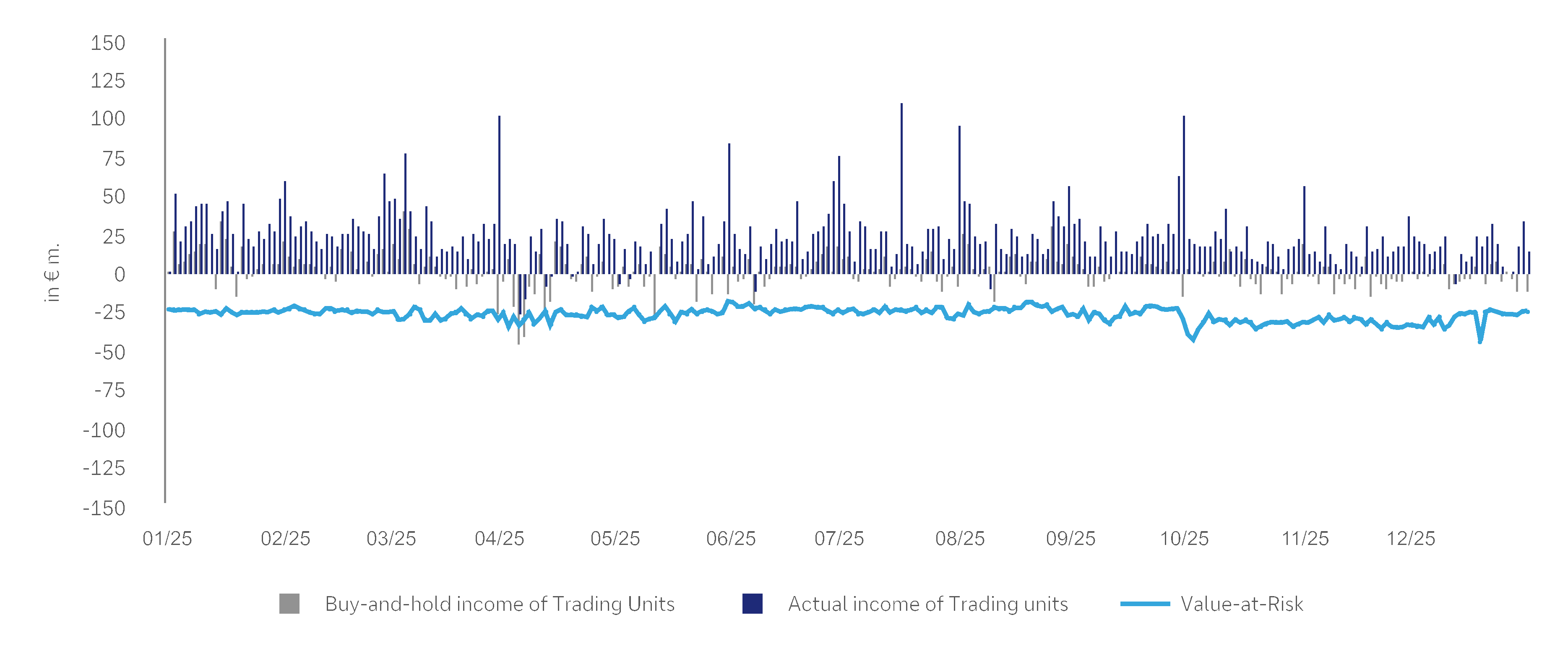
During the reporting period (January 2025 – December 2025), the Group observed two outliers where the Group’s loss on
a buy-and-hold basis exceeded the value-at-risk of the Trading books. The outliers in early April 2025 were driven by
increased market volatility stemming from trade tariffs announcements from the U.S. administration. There were no
actual profit and loss negative outliers in the current one-year period.
Prudent valuation adjustments
Article 436 (e) CRR
Deutsche Bank determines the amount of the Prudent Valuation Adjustment based on the methodology defined in the
CRR for exposures from the trading book and the non-trading book that are adjusted in accordance with Article 34 and
Article 105, a breakdown of the amounts of the constituent elements of an institution's prudent valuation adjustment, by
type of risks, and the total of constituent elements separately for the trading book and non-trading book positions.
EU PV1 – Prudent valuation adjustments (PVA)
Dec 31, 2025 | ||||||||||||
a | b | c | d | e | ||||||||
in € m. | Risk Category | |||||||||||
Category level AVA | Equity | Interest Rates | Foreign Exchange | Credit | Commodities | |||||||
1 | Market price uncertainty | 72 | 917 | 73 | 596 | 9 | ||||||
3 | Close-out cost | 39 | 349 | 89 | 146 | 0 | ||||||
4 | Concentrated positions | 4 | 94 | 9 | 68 | 0 | ||||||
5 | Early termination | 0 | 0 | 0 | 0 | 0 | ||||||
6 | Model risk | 1 | 55 | 10 | 4 | 0 | ||||||
7 | Operational risk | 6 | 67 | 9 | 38 | 0 | ||||||
10 | Future administrative costs | 0 | 38 | 0 | 22 | 0 | ||||||
12 | Total Additional Valuation Adjustments (AVAs) | 123 | 1,520 | 190 | 874 | 9 | ||||||
202
Deutsche Bank | Market risk |
Pillar 3 Report as of December 31, 2025 | Prudent valuation adjustments |
Dec 31, 2025 | ||||||||||||
EU e1 | EU e2 | f | g | h | ||||||||
in € m. | Category level AVA - Valuation uncertainty | Total category level post-diversification | ||||||||||
Category level AVA | Unearned credit spreads AVA | Investment and funding costs AVA | Total | Of which: Total core approach in the trading book | Of which: Total core approach in the banking book | |||||||
1 | Market price uncertainty | 66 | 9 | 886 | 804 | 82 | ||||||
3 | Close-out cost | 17 | 3 | 322 | 292 | 30 | ||||||
4 | Concentrated positions | 0 | 0 | 174 | 158 | 16 | ||||||
5 | Early termination | 0 | 0 | 0 | 0 | 0 | ||||||
6 | Model risk | 133 | 3 | 103 | 93 | 10 | ||||||
7 | Operational risk | 0 | 0 | 121 | 110 | 11 | ||||||
10 | Future administrative costs | 0 | 0 | 60 | 54 | 6 | ||||||
12 | Total Additional Valuation Adjustments (AVAs) | 217 | 15 | 1,666 | 1,512 | 154 | ||||||
Dec 31, 2024 | ||||||||||||
a | b | c | d | e | ||||||||
in € m. | Risk Category | |||||||||||
Category level AVA | Equity | Interest Rates | Foreign Exchange | Credit | Commodities | |||||||
1 | Market price uncertainty | 70 | 997 | 78 | 595 | 0 | ||||||
3 | Close-out cost | 30 | 421 | 89 | 154 | 0 | ||||||
4 | Concentrated positions | 3 | 142 | 9 | 80 | 0 | ||||||
5 | Early termination | 0 | 0 | 0 | 0 | 0 | ||||||
6 | Model risk | 0 | 21 | 4 | 1 | 0 | ||||||
7 | Operational risk | 0 | 0 | 0 | 0 | 0 | ||||||
10 | Future administrative costs | 0 | 33 | 1 | 21 | 0 | ||||||
12 | Total Additional Valuation Adjustments (AVAs) | 104 | 1,615 | 182 | 851 | 0 | ||||||
Dec 31, 2024 | ||||||||||||
EU e1 | EU e2 | f | g | h | ||||||||
in € m. | Category level AVA - Valuation uncertainty | Total category level post-diversification | ||||||||||
Category level AVA | Unearned credit spreads AVA | Investment and funding costs AVA | Total | Of which: Total core approach in the trading book | Of which: Total core approach in the banking book | |||||||
1 | Market price uncertainty | 93 | 5 | 930 | 857 | 73 | ||||||
3 | Close-out cost | 10 | 2 | 353 | 326 | 28 | ||||||
4 | Concentrated positions | 0 | 0 | 235 | 216 | 18 | ||||||
5 | Early termination | 0 | 0 | 0 | 0 | 0 | ||||||
6 | Model risk | 154 | 7 | 106 | 98 | 8 | ||||||
7 | Operational risk | 0 | 0 | 0 | 0 | 0 | ||||||
10 | Future administrative costs | 0 | 0 | 55 | 51 | 4 | ||||||
12 | Total Additional Valuation Adjustments (AVAs) | 257 | 14 | 1,680 | 1,548 | 132 | ||||||
203
Deutsche Bank | Exposure to interest rate risk in the banking book |
Pillar 3 Report as of December 31, 2025 | Qualitative information on interest rate risk in the banking book |
Exposure to interest rate risk in the banking book
Qualitative information on interest rate risk in the banking book
Article 448 (1)(c-g) CRR (EU IRRBBA)
Interest rate risk in the banking book (IRRBB) is the current or prospective risk, to both the Group's capital and earnings,
arising from movements in interest rates, which affect the Group's banking book exposures. This includes gap risk, which
arises from the term structure of banking book instruments, basis risk, which describes the impact of relative changes in
interest rates for financial instruments that are priced using different interest rate curves, as well as option risk, which
arises from option derivative positions or from optional elements embedded in financial instruments.
The Group manages its IRRBB exposures using economic value as well as earnings based measures. The Group Treasury
function is mandated to manage the interest rate risk centrally, with Enterprise and Treasury Risk Management acting as
“2nd Line of Defense”. The Group Asset & Liability Committee (“ALCo”) oversees and steers the Group’s structural
interest risk position and the management of the net interest income. The ALCo monitors the sensitivity of financial
resources and associated metrics to key market parameters such as interest rate curves and oversees adherence to
divisional/business financial resource limits.
Economic value based measures look at the change in economic value of banking book assets, liabilities and off-balance
sheet exposures resulting from interest rate movements, independent of the accounting treatment. Thereby the Group
measures the change in economic value of equity (∆EVE) as the maximum decrease of the banking book economic value
under the six standard scenarios defined by the EBA in addition to internal stress scenarios for risk steering purposes. For
the reporting of internal stress scenarios and risk appetite the Group applies several modelling assumptions as used in
this disclosure. When aggregating the change in the economic value of equity ∆EVE across different currencies, the
Group adds up negative and positive changes without applying weight factors for positive changes. Furthermore, the
Group is using behavioral model assumptions for the interest rate duration of own equity capital as well as non-maturity
deposits from financial institutions.
Earnings-based measures look at the expected change in net interest income (NII) resulting from interest rate
movements over a defined time horizon, compared to a defined benchmark scenario. Thereby the Group measures the
change in net interest income (∆NII) as the maximum reduction under the six standard scenarios defined by the EBA in
addition to internal stress scenarios for risk steering purposes, compared to a market implied curve scenario, over a
period of 12 months.
The Group employs mitigation techniques to hedge the interest rate risk arising from nontrading positions within given
limits. The interest rate risk arising from nontrading asset and liability positions is managed by the Treasury Markets &
Investments team, part of Group Treasury. Thereby the Group uses derivatives and applies different hedge accounting
techniques such as fair value hedge accounting or cash flow hedge accounting. For fair value hedges, the Group uses
interest rate swaps and options contracts to manage the fair value movements of fixed rate financial instruments due to
changes in benchmark interest rates. For hedges in the context of the cash flow hedge accounting, the Group uses
interest rate swaps to manage the exposure to cash flow variability of the variable rate instruments as a result of changes
in benchmark interest rates.
The Group assesses and measures hedge effectiveness of a hedging relationship based on the change in the fair value or
cash flows of the derivative hedging instrument relative to the change in the fair value or cash flows of the hedged item
attributable to the hedged risk.
The Model Risk Management function performs independent validation of models used for IRRBB measurement, as per
all market risk models, in line with Deutsche Bank's Group-wide risk governance framework.
The calculation of VaR and sensitivities of interest rate risk is performed daily, whereas the measurement and reporting of
economic value interest rate and earnings risk is performed on a monthly basis. The Group generally uses the same
metrics in its internal management systems as it applies for the disclosure in this report.
Deutsche Bank’s key modelling assumptions are applied to the positions in the Private Bank and Corporate Bank
divisions. Those positions are subject to risk of changes in clients’ behavior with regard to their deposits as well as loan
products. The Group regularly tests (at least annually) the assumptions and updates them where appropriate following a
defined governance process.
The Group manages the interest rate risk exposure of its non-maturity deposits through a replicating portfolio approach
to determine the average repricing maturity of the portfolio. For the purpose of constructing the replicating portfolio,
204
Deutsche Bank | Exposure to interest rate risk in the banking book |
Pillar 3 Report as of December 31, 2025 | Qualitative information on interest rate risk in the banking book |
the portfolio of non-maturity deposits is clustered by dimensions such as business unit, currency, product and
geographical location. The main dimensions influencing the repricing maturity are elasticity of deposit rates to market
interest rates, volatility of deposit balances and observable client behavior. For the reporting period the average
repricing maturity assigned across all such replicating portfolios is 2.44 years and Deutsche Bank uses 15 years as the
longest repricing maturity.
In the loan and some of the term deposit products Deutsche Bank considers early prepayment/withdrawal behavior of its
customers. The parameters are based on historical observations, statistical analyses and expert assessments.
Furthermore, the Group generally calculates IRRBB related metrics in contractual currencies and aggregates the
resulting metrics for reporting purposes. When calculating economic value based metrics the commercial margin is
excluded for material parts of the balance sheet.
Changes in the economic value of equity and net interest
income
Article 448 (a-b,d) CRR
The following table shows the impact on the Group’s economic value of equity and net interest income in the banking
book from interest rate changes under the six standard scenarios defined by the EBA.
EU IRRBB1 - Changes in the economic value of equity and net interest income under six supervisory shock scenarios
Changes of the economic value of equity | Changes of the net interest income¹ | |||||||
in € m. | Dec 31, 2025 | Jun 30, 2025 | Dec 31, 2025 | Jun 30, 2025 | ||||
Parallel up | (6,702) | (6,755) | 36 | 93 | ||||
Parallel down | 1,430 | 2,094 | (592) | (687) | ||||
Steepener | (744) | (1,243) | (48) | (13) | ||||
Flattener | (832) | (356) | (110) | (308) | ||||
Short rates up | (2,510) | (2,181) | (78) | (240) | ||||
Short rates down | 791 | 766 | (426) | (347) | ||||
Maximum | (6,702) | (6,755) | (592) | (687) | ||||
1Changes of the net interest income (NII) reflects the difference between projected NII in the respective scenario with shifted rates vs. market implied rates. Sensitivities
are based on a static balance sheet at constant exchange rates, excluding trading positions and DWS. Figures do not include Mark to Market (MtM) / Other
Comprehensive Income (OCI) effects on centrally managed positions not eligible for hedge accounting
The maximum economic value of equity (EVE) loss was € (6.7) billion as of December 2025, compared to € (6.8) billion as
of June 2025. As per December 2025 the maximum EVE loss represents 11.0% of Tier 1 Capital.
The maximum economic value of equity loss for the “Parallel up” interest rate scenario remained stable, attributable to
Group Treasury's prudent risk management positioning and hedging strategies across Deutsche Bank's key portfolios in
alignment with the Group's net interest income (NII) stabilization objective.
The maximum one-year loss in net interest income (NII) was € (0.6) billion as of December 2025, compared to € (0.7)
billion as of June 2025.
The decrease in the maximum net interest income loss in the “Parallel down” scenario was mainly driven by Deutsche
Bank's proactive net interest income (NII) stabilization strategy.
205
Deutsche Bank | Operational risk |
Pillar 3 Report as of December 31, 2025 | Risk management objectives and policies |
Operational risk
Risk management objectives and policies
Operational risk management strategies and processes
Article 435 (1)(a) CRR (EU OVA & EU ORA)
Deutsche Bank applies the European Banking Authority’s Single Rulebook definition of operational risk: “Operational risk
means the risk of losses stemming from inadequate or failed internal processes, people and systems or from external
events. Operational risk includes legal risks but excludes business and reputational risk and is embedded in all banking
products and activities.”
Deutsche Bank’s operational risk appetite defines the amount of operational risk it is willing to accept as a consequence
of conducting its business. The bank takes on operational risks consciously, both strategically and in day-to-day business.
While the bank has no appetite for certain types of operational risk events (such as violations of laws or regulations or
misconduct), other types of operational risk must be accepted for the bank is to achieve its business objectives. Where
residual risk is assessed to be outside risk appetite, risk-reducing actions must be undertaken, including risk remediation,
risk transfer through insurance, or ceasing business activity.
The Operational Risk Management Framework comprises a set of interrelated tools and processes used to identify,
assess, mitigate and monitor the bank’s operational risks. Its components are designed to work together to provide a
comprehensive, risk-based approach to managing the bank’s most material operational risks. The Framework includes the
Group’s approach to setting and adhering to operational risk appetite, the operational risk type and control taxonomies,
the policies and procedures governing operational risk management processes and tools, and the bank’s operational risk
capital calculation.
The Framework applies to operational sub‑risk types at a more granular level and enables the bank to aggregate, oversee,
and monitor its overall operational risk profile. These operational sub‑risk types are managed by various infrastructure
functions and include the following:
–ORM includes the Risk Type Head role for several operational risk types. Its mandate includes second line oversight of
controls related to transaction processing activities and infrastructure risks, to prevent technology or process
disruptions, maintain the confidentiality, integrity, and availability of data and records, ensure robust information
security, and confirm that business divisions and infrastructure functions have effective plans in place to recover
critical processes and functions in the event of disruption, including technical or building outages, cyber‑attacks,
natural disasters, or physical security and safety risk. ORM Risk Type Heads also manages risks arising from the bank’s
internal and external vendor engagements through the implementation of a comprehensive third‑party risk management
framework.
–The Compliance department performs an independent 2nd line control function that protects the bank’s license to
operate by promoting and enforcing compliance with the law and driving a culture of compliance and ethical conduct
in the bank. The Compliance department assists, reviews and challenges the business divisions and works with other
infrastructure functions and regulators to establish and maintain a risk-based approach to the management of the
bank’s compliance risks in accordance with the bank’s risk appetite and to help the bank detect, mitigate and prevent
breaches of laws, rules and regulations as well as internal policies. The Compliance department performs the
following principal activities: engaging with and managing regulatory matters in collaboration with the Regulatory and
Exam Management Group; identifying and assessing new and amended laws, rules, and regulations; acting as advisor
to the management board and performing independent review and challenge; performing second line controls; as
well as identifying, assessing, mitigating, monitoring, and reporting on compliance risk. The results of these
assessments and controls are regularly reported to both the Management Board and the Supervisory Board.
–Financial crime risks are managed by the Anti-Financial Crime (AFC), an independent Infrastructure second line
function. AFC maintains a dedicated program which is based on regulatory and supervisory requirements with defined
roles and responsibilities for the identification and management of financial crime risks resulting from money
laundering, terrorism financing, compliance with sanctions and embargoes, the facilitation of tax evasion as well as
other criminal activities including fraud, bribery and corruption and other crimes. AFC updates its strategy for financial
crime prevention via regular development of internal policies processes and controls, institution-specific risk
assessment and staff training.
–Group Governance defines, implements, and monitors the governance framework for Deutsche Bank globally in
support of the bank’s overall strategy, ensuring that governance structures are lean, transparent, and sustainable. The
unit develops and safeguards efficient corporate governance structures suitable to support effective individual and
joint decision-making that avoids and manages (structural and organizational) conflicts. It also establishes, maintains
and controls an appropriate and transparent policy taxonomy, landscape and tooling. The independency of Group
206
Deutsche Bank | Operational risk |
Pillar 3 Report as of December 31, 2025 | Risk management objectives and policies |
Governance is ensured through direct reporting line into the Management Board and not into any business division,
and through a ring-fenced incentive system and compensation system where performance evaluation is tied
principally to risk management and not to business revenues.
–Legal is a fully independent infrastructure function, mandated to provide legal advice both to the Management Board
as well as to the business divisions and infrastructure functions and to manage the Bank’s litigation and contentious
regulatory matters. Legal has a monopoly for giving legal advice, retaining and controlling outside counsel. Legal’s
independence is supported by its reporting line to the Management Board and a compensation framework that
focuses on risk management.
–Deutsche Bank’s New Product Approval and Systematic Product Review processes form a control framework
designed to manage the risks associated with new products and services and their lifecycle management. These
processes are overseen by the New Business Office and Product & Structured Transaction Lifecycle teams within the
Operational Risk Management function. Existing products and services are reviewed on one‑ to three‑year cycles to
assess whether they remain fit for purpose and aligned with the characteristics and objectives of their respective
target markets. Each product or service must be sponsored by a business Managing Director, who retains ultimate
accountability for it. Breaches of the New Product Approval requirements fall within the scope of the bank’s Red Flag
consequence management process .
–
Operational risk management structure and organization
Article 435 (1)(b) CRR (EU OVA & EU ORA)
Operational risk is managed according to the principle that day‑to‑day responsibility lies with the divisions and
infrastructure functions where these risks originate. Operational Risk Management (“ORM”) provides independent
oversight of the Group’s operational risk profile, identifies and reports risk concentrations, and ensures consistent
application of the Operational Risk Management Framework across the bank. ORM forms part of the Group’s risk function
within the Chief Risk Office, led by the Chief Risk Officer. The Chief Risk Officer appoints the Head of ORM, who is
responsible for designing, overseeing, and maintaining an effective, efficient, and regulatory‑compliant Operational Risk
Management Framework, including the methodology for operational risk capital calculation. The Head of ORM monitors
and challenges the Framework’s Group‑wide implementation and tracks the overall operational risk levels against the
bank’s defined operational risk appetite.
Operational risk governance is aligned with the bank’s Three Lines of Defence (“3LoD”) model. The Operational Risk
Management Framework defines governance standards and outlines the core responsibilities of the 1st and 2nd LoD to
ensure effective risk management and appropriate independent challenge. The Operational Risk Committee governs and
coordinates the management of operational risk across the Group. Its mandate includes decision‑making and policy
responsibilities, as well as reviewing, advising on, and addressing operational risk matters that may influence the risk
profile of business divisions or infrastructure functions. A number of sub‑fora, with participants from both the First Line of
Defence (1st LoD) and Second Line of Defence (2nd LoD), support the Committee in fulfilling its responsibilities. In
addition to the Group‑level Committee, business divisions maintain 1st LoD operational risk fora to oversee and manage
operational risks at various organisational levels.
Risk owners within the 1st LoD have full accountability for the operational risks arising from their activities and are
responsible for managing these risks within the established risk appetite. As leaders of business divisions or infrastructure
functions, risk owners must determine the appropriate organisational structure to identify their operational risk profile,
actively manage operational risks, make decisions on mitigating or accepting risks to remain within appetite, and
establish and maintain effective 1st LoD controls.
Risk Type Heads serve as 2nd LoD control functions for all sub‑risk types within the overarching operational risk category.
They define the framework and Group‑level risk appetite for the risk type they oversee, establish minimum risk
management requirements and control objectives, and independently monitor and challenge the 1st LoD’s
implementation of these requirements. They provide independent oversight of the risk type and monitor adherence to
the defined risk appetite. As subject matter experts, they define the risk taxonomy, support implementation of the
Framework in the 1st LoD, and maintain independence by being located solely within infrastructure functions.
As the 2nd LoD risk control function for operational risk, ORM establishes and maintains the overarching Operational Risk
Management Framework.
–ORM defines the bank’s approach to operational risk appetite, monitors adherence, evaluates consequences of
breaches, and oversees remediation plans to return the operational risk profile to within appetite where needed. ORM
also regularly reports the Group’s operational risk profile, including any risks that fall outside the defined appetite.
–ORM provides independent assessments to support proactive operational risk management, engages with risk owners
in the 1st LoD, and facilitates consistent implementation of risk management requirements across the bank.
207
Deutsche Bank | Operational risk |
Pillar 3 Report as of December 31, 2025 | Risk management objectives and policies |
–ORM is responsible for designing, implementing, and maintaining the methodology to determine the appropriate
capital for operational risk, for recommendation to the Management Board. This includes calculating and allocating
operational risk capital demand and expected loss.
Scope and nature of Operational Risk measurement and reporting systems
Article 435 (1)(c) CRR (EU OVA & EU ORA)
The Operational Risk Management Framework (ORMF) enables the bank to determine its operational risk profile relative
to its defined risk appetite, identify systemic themes and concentrations, and establish mitigation measures and
priorities.
In 2025, the bank further enhanced the Framework by introducing cross‑risk types within the Operational Risk Type
Taxonomy to better reflect the bank’s operational risk profile. Additional improvements included operationalizing control
assessment, testing and certification within the new strategic tool for the operational risk controls inventory and
transitioning the Risk & Control Self‑Assessment to a more data‑driven approach.
Key sub-components include:
–Loss Data Collection: Internal operational risk events with a P&L impact of € 10,000 or more are recorded and
validated, and external events are assessed for their relevance to the group and business divisions. Material events
trigger a formal lessons‑learned and read‑across process conducted by the 1st Line of Defense in close collaboration
with business partners, risk control functions, and other infrastructure areas. Lessons‑learned reviews assess root
causes of significant events and document remediation actions to reduce recurrence. Read‑across analyses evaluate
whether similar weaknesses may exist elsewhere in the bank, even if they have not yet resulted in losses, thereby
facilitating preventative action. In 2025, the internal event database was enhanced particularly the mapping of
controls to events and automated read‑across triggers, and the external events review process was refined to assess
susceptibility of similar risks within the bank.
–Risk Appetite: Operational risk appetite defines the level of operational risk the bank is willing to accept to pursue its
strategy. The operational risk appetite framework provides a consistent approach to setting appetite levels across the
bank and monitoring exposures against these levels. The bank regularly monitors its operational risk profile against
defined appetite to alert the organization on impending problems in a timely fashion. In 2025, the bank implemented
previously introduced concepts of residual risk zones and operating conditions, including monitoring processes, and
further refined the granularity of risk appetite setting.
–Risk & Control Self‑Assessment: The Risk & Control Self‑Assessment (RCSA) comprises bottom‑up evaluations of risks
generated within business divisions and infrastructure functions, the effectiveness of associated controls, and
required remediation actions to ensure risks remain within appetite. Conducted at the global business level, the RCSA
covers all jurisdictions and is designed to assist Senior Management to determine whether operational risks are
managed and controlled adequately via a dynamic assessment approach covering all applicable Risk Types from the
Group’s Operational Risk Type Taxonomy (ORTT). The Risk & Control Self-Assessment puts a greater emphasis on
assessing and mitigating risks that are outside of appetite and risks that drive unethical and inappropriate market
conduct within the bank. In 2025, RCSA granularity was increased to provide more precise risk insights and ensure a
more accurate risk profile for comparison against defined appetite.
–Emerging risk: Emerging risk themes are derived from internal and external indicators. Operational risk outputs are
combined with external event data to identify emerging trends and concentrations. This analysis complements
insights from divisional emerging risk themes, dynamic RCSA results, findings, scenario analysis, internal and external
events, and industry developments, enabling Risk Owners to draw informed conclusions.
–Scenario Analysis: The operational risk profile is further substantiated through exploratory scenario analysis, which
supplements day‑to‑day risk management. Scenario analysis supports the identification of potential exposures,
highlights gaps in the current risk profile, and informs forward‑looking risk mitigation. Scenario development
incorporates themes from internal losses, emerging risk assessments, top risks, concentrations, findings, and external
peer loss events. Insights from actual and potential events are used to identify thematic vulnerabilities and drive
actions such as deep‑dive reviews or enhancements to risk profiles. In 2025, the capture and governance of scenario
analysis was migrated to the Event Management Application to improve data quality and oversight.
–Transformation Risk Assessment: A Transformation Risk Assessment (TRA) process is in place to appropriately identify
and manage risks arising from material change initiatives to assess the impact of transformation on the bank’s risk
profile. The TRA applies to all key deliverables including regulatory initiatives, technology migrations, risk mitigation
projects, strategy changes, organizational restructuring, real estate moves within the bank, as well as joint ventures
and strategic investments.
–Findings and Issue Management: The findings and issue management process supports the mitigation of risks arising
from known control weaknesses and deficiencies. It enables management to make risk-based decisions over the need
for further remediation or risk acceptance. Outputs from the findings management process must be able to
demonstrate to internal and external stakeholders that the bank is actively identifying its control weaknesses and
taking steps to manage associated risks within acceptable levels of risk appetite. In 2025, the process was
208
Deutsche Bank | Operational risk |
Pillar 3 Report as of December 31, 2025 | Risk management objectives and policies |
strengthened through more robust requirements for identifying correct findings owners, enhancing management
reporting, and the timely remediation of Action Plans.
Framework Adherence: As owner of the Operational Risk Management Framework, ORM performs regular independent
monitoring and testing to assess adherence by both the 1st and 2nd LoD:
–Annually, assess 1LoD and 2LoD Risk Type Head (RTH) implementation and adherence to the requirements of the
ORMF
–Adverse outcomes of adherence result in consequences being applied
–Adherence results also aim to proactively identify both design and implementation improvements (Framework,
Tooling, etc.)
In 2025, annual Framework Adherence results were incorporated in the ORM Composite KPI and made mandatory for all
divisions, creating a direct variable compensation impact via the Balanced Scorecard (BSC). Quarterly U.S. RCSA
Adherence reviews were also introduced.
Operational risk measurement
Article 446 CRR
Deutsche Bank measures risk-weighted assets to determine the regulatory capital demand for operational risk using the
“Standardized Measurement Approach” laid out in the European Capital Requirements Regulation (CRR3) introduced in
2025.
In addition to regulatory capital demand, Deutsche Bank continues to determine its internal economic capital demand
for operational risk using the Advanced Measurement Approach (AMA) methodology. The AMA capital calculation is
based on a loss distribution approach. Gross losses from historical internal and external loss data (Operational Risk data
eXchange Association consortium data) are used to estimate the risk profile (i.e., a loss frequency and a loss severity
distribution). The loss distribution approach model includes conservatism by recognizing losses on events that arise over
multiple years as single events in the historical loss profile.
Within the AMA model, the frequency and severity distributions are combined in a Monte Carlo simulation to generate
potential losses over a one-year time horizon. Correlation and diversification benefits are applied to the net losses to
arrive at a net loss distribution at Group level, covering expected and unexpected losses. The resulting economic capital
demand is then allocated to each of the business divisions considering qualitative adjustments after deducting expected
loss.
The economic capital requirements for operational risk is derived from the 99.9% percentile and calculated for a time
horizon of one year.
The economic capital demand calculation is performed on a quarterly basis.
ORM establishes and maintains the approach for capital demand quantification and ensures that appropriate
development, validation and change governance processes are in place, whereby the validation is performed by an
independent validation function and in line with the Group’s model risk management process..
Drivers for operational risk capital development
By design of the AMA capital calculation, Deutsche Bank’s operational risk economic capital demand is predominantly
driven by historical internal loss events.
In view of the relevance of legal risks within the bank’s operational risk profile, specific attention is dedicated to the
management and measurement of open civil litigation and regulatory enforcement matters where the bank relies both
on information from internal as well as external data sources to consider developments in legal matters that affect the
bank specifically but also the banking industry as a whole. Reflecting the multi-year nature of legal proceedings the
measurement of these risks furthermore takes into account changing levels of certainty by capturing the risks at various
stages throughout the lifecycle of a legal matter.
Conceptually, the bank measures operational risk including legal risk by determining the annual operational risk loss that
will not be exceeded with a given probability. This loss amount is driven by a component that due to the IFRS criteria is
reflected in the bank’s financial statements and a component beyond the amount reflected as provisions within the
bank’s financial statements.
209
Deutsche Bank | Operational risk |
Pillar 3 Report as of December 31, 2025 | Operational risk measurement |
The legal losses which the bank expects with a likelihood of more than 50% are already reflected in the IFRS group
financial statements. These losses include net changes in provisions for existing and new cases in a specific period where
the loss is deemed probable and is reliably measurable in accordance with IAS 37.
Uncertain legal losses which are not reflected in the bank’s financial statements as provisions because they do not meet
the recognition criteria under IAS 37 are considered within the “economic capital demand”.
To quantify the litigation losses in the AMA model, the bank takes into account historical losses, provisions, contingent
liabilities and legal forecasts. Legal forecasts generally comprise ranges of potential losses covering risks of outflows
greater than the provision and adjustments which are deemed remote or relate to yet unknown matters. Such forecasts
may result from ongoing and new legal matters which are reviewed at least quarterly by the attorneys handling the legal
matters.
The legal forecasts are included in the loss data input into the AMA model. The projection range of the legal forecasts is
not restricted to the one year capital time horizon but goes beyond and conservatively assumes early settlement of the
underlying losses in the reporting period - thus considering the multi-year nature of legal matters.
AMA model validation and quality control concept
All AMA model components are independently validated. The results of the validations are summarized in validation
reports and identified issues are followed up for resolution. For example, the validation activities in the past years
detected areas of improvement for the forward-looking component of the AMA model, which have since been included.
The model’s input sources such as loss data, risk & control self-assessments, and expected loss are subject to
comprehensive quality controls in the business divisions and the control functions.
Operational risk management stress testing concept
Stress testing is conducted on a regular basis to complement the AMA methodology, by analyzing the impact of extreme
stress scenarios on capital and the profit-and-loss account. It also covers reputational impacts.
In 2025, ORM took part in all firm-wide stress test scenarios and assessed and contributed the impact of operational risk
to the various stress levels of the scenarios. The impact of operational risk on Group-wide stress test scenarios has been
moderate and remained in the expected range for the capital metrics. This is due to the fact that the AMA model already
applies a conservative multi-year view on loss sizes (including legal forecasts) even in non-stress mode.
Operational risk exposure
Article 446 CRR
The regulatory capital requirements for operational risk are calculated and measured using the “Standardized
Measurement Approach” (SMA) laid out in the European Capital Requirements Regulation (CRR3) introduced in 2025.
The following tables show an overview of Deutsche Bank´s operational risk losses as well as the SMA business indicator,
components and subcomponents and operational risk own funds requirements.
210
Deutsche Bank | Operational risk |
Pillar 3 Report as of December 31, 2025 | Operational risk exposure |
EU OR1 – Operational risk
a | b | c | d | e | f | g | h | i | j | k | ||||||||||||||
Amounts in € m., Number of losses in events | 2025 | 2024 | 2023 | 2022 | 2021 | 2020 | 2019 | 2018 | 2017 | 2016 | Ten-year average | |||||||||||||
Using €20,000 threshold | ||||||||||||||||||||||||
1 | Total amount of operational risk losses net of recoveries (no exclusions) | 240 | 2,166 | 830 | 556 | 653 | 325 | 608 | 364 | 1,188 | 3,251 | 1,018 | ||||||||||||
2 | Total number of operational risk losses | 843 | 1,207 | 1,124 | 951 | 849 | 987 | 1,029 | 1,629 | 1,713 | 1,601 | 1,193 | ||||||||||||
3 | Total amount of excluded operational risk losses | 0 | 0 | 0 | 0 | 0 | 0 | 0 | 0 | 0 | 0 | 0 | ||||||||||||
4 | Total number of excluded operational risk events | 0 | 0 | 0 | 0 | 0 | 0 | 0 | 0 | 0 | 0 | 0 | ||||||||||||
5 | Total amount of operational risk losses net of recoveries and net of excluded losses | 240 | 2,166 | 830 | 556 | 653 | 325 | 608 | 364 | 1,188 | 3,251 | 1,018 | ||||||||||||
Using €100,000 threshold | ||||||||||||||||||||||||
6 | Total amount of operational risk losses net of recoveries (no exclusions) | 224 | 2,141 | 808 | 537 | 651 | 300 | 598 | 353 | 1,160 | 3,189 | 996 | ||||||||||||
7 | Total number of operational risk losses | 277 | 405 | 426 | 397 | 374 | 387 | 397 | 531 | 485 | 463 | 414 | ||||||||||||
8 | Total amount of excluded operational risk losses | 0 | 0 | 0 | 0 | 0 | 0 | 0 | 0 | 0 | 0 | 0 | ||||||||||||
9 | Total number of excluded operational risk events | 0 | 0 | 0 | 0 | 0 | 0 | 0 | 0 | 0 | 0 | 0 | ||||||||||||
10 | Total amount of operational risk losses net of recoveries and net of excluded losses | 224 | 2,141 | 808 | 537 | 651 | 300 | 598 | 353 | 1,160 | 3,189 | 996 |
211
Deutsche Bank | Operational risk |
Pillar 3 Report as of December 31, 2025 | Operational risk exposure |
EU OR2 - Business Indicator, components and subcomponents
a | b | c | d | |||||||
2025 | 2024 | 2023 | Average value | |||||||
1 | Interest, lease and dividend component (ILDC) | — | — | — | 13,293 | |||||
EU 1 | ILDC related to the individual institution/consolidated Group (excluding entities considered by Article 314(3) | — | — | — | 0 | |||||
1a | Interest and lease income | 46,285 | 49,763 | 44,601 | 46,883 | |||||
1b | Interest and lease expense | 31,670 | 37,606 | 31,809 | 33,695 | |||||
1c | Total assets/Asset component | 1,104,487 | 1,062,695 | 1,031,982 | 1,066,388 | |||||
1d | Dividend income/ dividend component | 103 | 93 | 120 | 105 | |||||
2 | Services component (SC) | — | — | — | 13,977 | |||||
2a | Fee and commission income | 13,952 | 13,102 | 11,559 | 12,871 | |||||
2b | Fee and commission expense | 3,068 | 2,860 | 2,526 | 2,818 | |||||
2c | Other operating income | 544 | 398 | 292 | 412 | |||||
2d | Other operating expense | 344 | 2,266 | 708 | 1,106 | |||||
3 | Financial component (FC) | — | — | — | 5,977 | |||||
3a | Net profit or loss applicable to trading book (TB) | 4,725 | 5,577 | 4,919 | 5,074 | |||||
3b | Net profit or loss applicable to banking book (BB) | 852 | 904 | 954 | 903 | |||||
EU 3c | Approach followed to determine the TB/BB boundary (PBA or accounting approach) | — | — | — | 0 | |||||
4 | Business Indicator (BI) | — | — | — | 33,248 | |||||
5 | Business indicator component (BIC) | — | — | — | 5,055 | |||||
Disclosure on the BI: | ||||||||||
6a | BI gross of excluded divested activities | 33,248 | — | — | — | |||||
6b | Reduction in BI due to excluded divested activities | 0 | — | — | — | |||||
EU 6c | Impact in BI of mergers/acquisitions | 0 | — | — | — |
EU OR3 - Operational risk own funds requirements and risk exposure amounts
Dec 31, 2025 | ||||
in € m. | a | |||
1 | Business Indicator Component (BIC) | 5,055 | ||
EU 1 | Alternative Standardised Approach (ASA) Own Funds Requirements (OROF) under Article 314(4) | 0 | ||
3 | Minimum Required Operational Risk Own Funds Requirements (OROF) | 5,055 | ||
4 | Operational Risk Exposure Amounts (REA) | 63,183 |
Use of the Advanced Measurement Approaches to operational
risk
Article 454 CRR
Description of the use of insurance and other risk transfer mechanisms for the
purpose of mitigation of this risk
The definition of insurance strategy and supporting insurance policy and guidelines is the responsibility of the specialized
unit Corporate Insurance/Deukona. Corporate Insurance/Deukona is responsible for the global corporate insurance
policy which is approved by the Management Board.
Corporate Insurance/Deukona is responsible for acquiring insurance coverage and for negotiating contract terms and
premiums. Corporate Insurance/Deukona also has a role in the allocation of insurance premiums to the businesses.
Insurance is not used for calculating the economic capital requirements for operational risk.
212
Deutsche Bank | Environmental, social and governance (ESG) risks |
Pillar 3 Report as of December 31, 2025 | ESG risks |
Environmental, social and governance (ESG) risks
Article 449a CRR
ESG disclosures are included in accordance with Article 449a CRR and the EBA ITS 2022/01. ESG risks are the risks of
current and future losses arising from any negative financial, operational and/or reputational impacts on Deutsche Bank‘s
clients, invested assets and/or operations as it relates to ESG factors.
Environmental risk includes both physical and transition risks related to climate change. Physical risks are the risks of
losses arising from any negative impact on the bank from acute near-term risks such as extreme weather events or
chronic longer-term impacts of rising temperatures. Transition risks are driven by policy, behavioral and technology
changes required to foster the transition to a low carbon economy and can also impact the bank’s clients and invested
assets. In addition, there are other environmental risks resulting from factors such as water stress, biodiversity loss, land
erosion and depletion. All of these environmental risks can impact the bank’s assets, operations and its clients.
Social risks include losses arising from any negative financial impact on Deutsche Bank because of current or prospective
impacts from social factors, such as matters related to human rights or workforce management: while governance risks
are the risk of losses arising from governance factors such as anti-financial crime or non-compliance with policies or
regulations. Both of these risks can impact the bank’s assets, operations and its clients.
As ESG disclosure requirements and metrics are evolving and are being newly implemented in the banking industry, there
remains uncertainty about how disclosure requirements could be interpreted and there are limitations on the amount
and granularity of available data. As a result, Deutsche Bank’s interpretations, methodologies, and availability of data will
be further enhanced in the future as additional guidance and information become available.
Governance
ESGT1-3
Deutsche Bank believes it is part of the Group’s responsibility to support and, where possible, accelerate the
transformation toward a more sustainable society and economy. Thus, the bank supports the European Commission’s
Action Plan on sustainable finance as a crucial contribution toward the European Union’s achievement of its climate
commitment under the Paris Agreement and its wider sustainability agenda.
The Management Board of Deutsche Bank AG as the parent company of the Deutsche Bank Group assumes ultimate
responsibility for matters relating to sustainability, including the supervision and management of the effects of
environmental risks (such as climate-physical, climate-transition and nature risks) in the short-, medium- and long-term.
To integrate these responsibilities into the organizational structure, the Management Board delegated the Group
Sustainability Committee, chaired by the bank’s Chief Executive Officer to act as the senior decision-making body for
sustainability-related matters at group level, including those related to ESG risks and the bank’s net zero interim (2030)
and long-term (2050) targets. Further key functions and elements of the bank’s sustainability governance include the
Chief Sustainability Office and the Sustainability Strategy Steering Committee, responsible for monitoring the timely and
complete implementation of the bank’s sustainability transformation agenda and escalating material risks or issues to the
Group Sustainability Committee. The bank also established the Net Zero Forum, responsible for the assessment of new
transactions with a significant impact on the bank’s financed emissions and/or net zero targets with representatives from
business divisions, the Chief Risk Office, and the Chief Sustainability Office. Both groups are chaired by the Chief
Sustainability Officer.
Within the Chief Risk Office, the Group Risk Committee, chaired by the Chief Risk Officer, is established by the
Management Board to serve as the central forum for review and decision making on matters related to risk, capital, and
liquidity. This includes the oversight of the Bank’s framework for the management of climate and environmental risks.
Other senior committees are responsible for the development and management of specific elements of climate and
environmental risk:
–The Operational Risk Management Committee which oversees, governs, and coordinates the management of
operational risks group-wide and establishes a cross-risk and holistic perspective of the bank’s key non-financial risks,
including risks to own infrastructure, employees, and key processes arising from climate and environmental risks
–The Group Reputational Risk Committee, a direct subcommittee of the Management Board since 2024, has the
responsibility to review, decide and manage all transactions, client relationships or other primary reputational risk
matters escalated in line with the underlying reputational risk policies and framework, including sustainability-related
matters
213
Deutsche Bank | Environmental, social and governance (ESG) risks |
Pillar 3 Report as of December 31, 2025 | ESG risks |
Responsibilities over the management of environmental risks in the short-, medium- and long-term are further cascaded
to business divisions and key infrastructure and control functions.
On the business side, each of Deutsche Bank’s core divisions integrates climate and broader ESG risks into its planning
and risk appetite statements as part of the bank’s annual strategic planning process, which is approved by the
Management Board. The first line of defense is also responsible for the identification and assessment of ESG risk factors
(including climate change and nature related) stemming from their activities.
In the second line of defense, risk functions are responsible for the overall control framework around climate and
environmental risks, which are considered by the bank as drivers of existing risk types. In this respect:
–The Head of Enterprise and Treasury Risk Management (ETRM), who reports to the Chief Risk Officer, owns the
Group’s overall management and appetite frameworks. This includes qualitative risk appetite principles, quantitative
risk appetite metrics, and holistic monitoring of climate and nature risks across different risk types and portfolios; a
dedicated team of Climate and Environmental risk specialists supports them in the exercise of these functions
–The Heads of the Credit, Market, Liquidity, Operational Risk functions (“Risk Type Controllers”) who report to the Chief
Risk Officer, are responsible for the establishment and operation of appropriate controls, and the monitoring and
appetite setting of climate and environmental risk drivers in their respective areas
To closely and visibly link the bank’s sustainability strategy and performance with the compensation of the Management
Board, the bank’s strategic sustainability goals are reflected in the compensation system, which forms the basis of the
Management Board's total compensation.
Management Board members receive fixed and variable compensation components. The latter consists of two elements
(Short-Term Award and Long-Term Award) and reflects the degree to which Group, divisional and individual objectives
are achieved. Both awards are linked to several ESG objectives. The aim is to closely align compensation to the bank´s
sustainability strategy. The ESG objectives for the Short-Term Award are contained in individual and divisional balanced
scorecards. They can also be part of a Management Board member’s individual objectives agreed at the beginning of a
financial year.
ESG objectives form a central performance assessment element in the Long-Term Award and have the highest
percentage weighting as a result. They are related to impactful Group ESG focus topics that are the responsibility of the
Management Board. The objectives, which are transparently disclosed in the Compensation Report section of the Annual
Report, include targets such as the amount of sustainable financing and investments, the reduction of electricity
consumption in the bank’s buildings, along with quantitative targets related to climate risk management as well as the
improvement in gender diversity. In addition, the objectives include employee feedback culture, as well as achievements
and positive developments regarding the bank’s control environment and remediation activities. The targets are linked to
measurable Key Performance Indicators (KPIs) to ensure an objective assessment of performance. Corresponding targets
and KPIs including target values, thresholds and caps are published in the Compensation Report 2025. The
compensation policy and the compensation system based on it – following approval by the Supervisory Board – are
implemented in individual but uniform and rule-compliant service contracts for all Management Board members in
compliance with banking law pursuant to Section 10 (4) of the German Remuneration Ordinance for Institutions
(InstitutsVergV). Using contract templates and standardized annexes, the variable compensation components are
directly linked to plan, rules, claw back and forfeiture conditions as well as shareholding obligations.
Strategy and processes
Sustainability is a key element of the bank’s “Global Hausbank” strategy. The bank is embedding sustainability into its
policies, processes, and products, focusing on four pillars:
–Sustainable Finance
–Policies & Commitments
–People & Operations
–Thought Leadership & Stakeholder Engagement
The bank’s business activities, own operations, relations with employees or suppliers, and respective processes are
covered by these four pillars and address the ESG-related risk factors. Managing these risks and providing solutions to
ESG-related challenges are part of the bank's sustainability strategy and risk management processes. Seizing business
opportunities arising from ESG challenges, Deutsche Bank aimed to achieve a total of € 500 billion in cumulative
sustainable finance volumes, as defined in the bank’s Sustainable Finance Framework, from the beginning of 2020 until
the end of 2025 (excluding DWS). While Deutsche Bank remains committed to its targets, the bank encountered
challenges in achieving its target of € 500 billion by the end of 2025. Progress towards the original target was impacted
by several factors over the period, including higher interest rates, regulatory developments as well as changes in the
214
Deutsche Bank | Environmental, social and governance (ESG) risks |
Pillar 3 Report as of December 31, 2025 | ESG risks |
political environment. . Despite these constraints, the bank increased its incremental volume from € 93 billion in 2024 to
€ 98 billion in 2025. Based on this continued momentum, Deutsche Bank expects to meet its volume target of € 500
billion in 2026. The Sustainable Finance Framework outline the methodology and associated procedures for classifying
financial products and services offered by Deutsche Bank as sustainable. The framework specifies the classification logic,
the eligibility parameter criteria, the applicable environmental and social due diligence requirements, as well as the
verification and monitoring process. It is aligned to the extent possible with the requirements of the EU Taxonomy
Regulation.
Risk Management
Managing emerging ESG risks to the bank’s balance sheet and operations is a key component of the Group’s
sustainability strategy. Deutsche Bank has set interim (2030) and long term (2050) net zero aligned targets for eight
carbon intensive sectors and has established frameworks and processes for enhanced due diligence in relation to sectors
and clients identified as having elevated inherent environmental and social risks and/or elevated impacts on the bank’s
financed emissions and net zero pathways. In 2024, the bank updated its thermal coal policy and tightened criteria used
to determine the scope of the policy. Moreover, the bank’s Environmental and Social Due Diligence Framework prohibits
business activity in certain high impact areas. The bank’s Reputational Risk Framework is utilized to discuss any
counterparty concerns that are perceived to be in contradiction with Deutsche Bank’s code of conduct including those
driven by ESG factors. Deutsche Bank regularly performs a double materiality assessment to determine the relevance of
individual non-financial topics across ESG. Starting from the financial year 2024, Deutsche Bank conducts the
assessment in compliance with the requirements of the European Sustainability Reporting Standards (ESRS). The
assessment applies the concept of double materiality, i.e., it considers the potential positive and negative impacts
Deutsche Bank may have on the environment and society and the potential financial impacts for Deutsche Bank arising
from ESG topics. The results of the materiality assessment are considered in the bank's sustainability agenda and the
selection of topics reported in its Sustainability Statement 2025. In the year, unmitigated financial risks stemming from
impacts of Social and Governance factors on the bank’s counterparties were not deemed material.
In addition, the Chief Risk Office conducts a comprehensive and granular financial materiality assessment of ESG risks to
identify potential financial impacts across key impacted risk types. Results are integrated into the Group’s risk
identification processes and risk inventory and reviewed against internal controls.
Environmental risk
Business strategy and processes: integration of environmental factors and risks
ESGT1
Climate change and environmental degradation drivers, together with the bank’s negative impacts on climate and
nature, may lead to the emergence of new sources of financial and non-financial risks. Transition risks to the bank’s
portfolios may materialize in the short- to medium-term as governments introduce climate-related targets and policies,
as society adapts its behaviors, and as consumer and investor appetite for carbon intensive clients/sectors becomes
more climate-conscious. Acute and chronic physical climate and environmental risk factors arising from higher global
temperatures may increase in severity even if decarbonization efforts prove successful, impacting Deutsche Bank’s
operational risks and risks to the assets and activities of the bank’s clients.
Sustainability has been a central part of Deutsche Bank’s strategy since 2019. The management of risks stemming from
environmental factors has been an integral part of this strategy, first and foremost through Deutsche Bank’s
decarbonization targets and their incorporation into the bank’s risk management framework. Environmental risks are:
–Assessed through annual climate and environmental materiality assessment and internal stress test, across
businesses, portfolios and risk types (Credit, Market, Liquidity, Reputational and Operational)
–Monitored through monthly and quarterly dedicated reports (Climate and Environmental risk MI) discussed in senior
risk committees
–Managed through risk appetite thresholds, policies requirements and exclusions (Environmental and Social policy
framework), and portfolio Early Warning Indicators (EWIs)
–Considered within the bank’s business model and financial planning through the carbon budgets attributed to the
bank’s businesses (and derived from its decarbonization targets) and through the inclusion of environmental risks
within the Internal Capital Adequacy Assessment Process (ICAAP). Each of Deutsche Bank’s core businesses
integrates climate and environmental risks into planning and risk appetite statements as part of the bank’s annual
strategic planning process, approved by the Management Board.
Deutsche Bank has published net zero emissions reduction targets for eight key carbon-intensive sectors in the bank’s
corporate lending portfolio:
215
Deutsche Bank | Environmental, social and governance (ESG) risks |
Pillar 3 Report as of December 31, 2025 | Environmental risk |
–Oil and Gas (Upstream)
–Power Generation
–Automotives (Light Duty Vehicles)
–Steel production
–Coal mining
–Cement
–Shipping
–Commercial Aviation
Deutsche Bank publishes annually its financed emissions and progress towards net zero-aligned targets following the
standard from the Partnership for Carbon Accounting Financials, relevant international greenhouse gases emissions
reporting protocols and emerging best-practice climate portfolio alignment methodologies.
Business strategy and processes: objectives, targets and risk appetite
Net-Zero targets are established through a process led by the Chief Risk Office function. The selection focus is on
carbon-intensive sectors of sufficient materiality, and for which net zero alignment methodologies from reputable
international organizations are available, together with data of sufficient quality. The decarbonization pathways utilized
are science-based and leverage with the target setting guidelines of the Net-Zero Banking Alliance (NZBA), namely:
–the Net-Zero Emissions (NZE) by 2050 scenario of the International Energy Agency (IEA)
–the Poseidon Principles pathways, calibrated against the Revised International Maritime Organization (IMO) strategy;
–the Mission Possible Partnership Prudent Scenario for Commercial Aviation
Targets and pathways are discussed and agreed with the business divisions, approved by the Group Sustainability
Committee and then published externally.
Furthermore, a quantitative threshold for each target is integrated into the Group’s Risk Appetite Statement, together
with a broader threshold on the overall carbon footprint of the bank’s corporate loan commitments. Some deviation from
the net-zero pathway is allowed in earlier years under a simplified assumption of linear reduction and the potential for
portfolio and economic volatility to impact alignment. These thresholds express the bank’s appetite for deviation from
the set pathway and are a fundamental tool used by the bank to mitigate its exposure to risks associated with climate
transition risk factors. New transactions or limit extensions with a significant impact on the bank’s financed emissions
and/or net zero targets are reviewed by a dedicated Net Zero Forum. The forum’s review includes an assessment of client
sustainability disclosures, transition strategies, decarbonization targets, governance and, as a result, the overall
counterparty’s capacity to manage environmental risks. Moreover, following the establishment of Divisional carbon
budgets and risk appetite, the Investment Bank and the Commercial Bank each maintain their own Net Zero Forum, while
the Private Bank relies on the Group forum.
The bank monitors and manages portfolio concentrations of climate transition, physical, and other environmental risks
through Early Warning Indicators (EWIs). These indicators are established for its Corporates, Sovereigns and Financial
Institutions lending portfolios and include:
–Measures of exposure and appetite to counterparties and sectors vulnerable to climate change and nature
degradation (for instance in terms of Gross and Net Limits, Gross and Net Utilization, Expected Losses, Credit Risk
RWA, and YoY changes to these metrics)
–Proportion of these exposures/ appetite metrics related to facilities with tenor greater than 5 years (limiting the ability
of the bank to manage its exposures down if required)
–Proportion of these exposures/ appetite metrics related to counterparties below investment grade or with weak DB
transition risk scores (to identify counterparties with a lower capacity to manage environmental risks)
These EWIs are approved by the head of Enterprise and Treasury Risk Management as part of the Climate and
Environmental Risk management framework, established under the umbrella of the Group Risk Management Policy.
Lastly, the bank has sectoral requirements and restrictions stemming from its Environmental and Social Policy
Framework which are monitored and enforced through the Environmental and Social due diligence process and the
escalation requirements of the Reputational Risk Framework of the bank.
Business strategy and processes: investment activities towards environmental
objectives and EU Taxonomy-aligned activities
In accordance with Article 8 of the EU Taxonomy Regulation and the related Disclosures Delegated Acts, starting from
year end 2024, financial undertakings have to determine and disclose the proportion of exposures aligned to the EU
216
Deutsche Bank | Environmental, social and governance (ESG) risks |
Pillar 3 Report as of December 31, 2025 | Environmental risk |
Taxonomy in their covered assets (i.e., total assets less exposures toward central governments, central banks,
supranational issuers and the trading portfolio) for the climate change mitigation and adaptation objectives. Following
the adoption of the Delegated Act on the four remaining environmental objectives (water and marine resources, circular
economy, pollution prevention and control, biodiversity and ecosystems) in 2024, Taxonomy alignment with the non-
climate objectives will be reported starting from year-end 2026.
The identification of the Taxonomy-eligible and Taxonomy-aligned economic activities for the climate change mitigation
and adaptation objectives (set out in Article 9 of the EU Taxonomy Regulation) was performed for in-scope
counterparties, primarily undertakings subject to the Non-Financial Reporting Directive (NFRD) disclosure obligations
and households, as well as products defined in Article 8 of the EU Taxonomy Regulation and the related Disclosures
Delegated Acts. More information on this is included in section “Summary of key performance indicators on the
Taxonomy-aligned exposures” of this report and in the Sustainability Statement of the bank’s Annual Report.
Business strategy and processes: policies and procedures relating to direct and
indirect engagement with clients
As disclosed in the Group’s Initial Transition Plan, Deutsche Bank pursues three financing strategies for its corporate
clients: green/sustainable, transition and phase out:
–Green/Sustainable strategies include providing financing to companies that enable emissions reduction through their
range of green products and services
–Transition strategies reflect the bank’s commitment to support clients in their journey to decarbonize their business
models
–Phase out strategies for industries with no viable decarbonization pathways (such as thermal coal) or clients in carbon
intensive industries not willing to align to the bank’s transition pathway
The Chief Sustainability Office owns the policies regulating the bank’s engagement with clients on environmental and
social issues:
–The Sustainable Finance Framework and the Transition Finance Framework outline the methodology and associated
procedures for classifying transactions and financial products and services offered by Deutsche Bank as sustainable
and transition-related. The frameworks assess the use of proceeds, company profiles and (transaction-specific)
sustainability-linked KPIs
–The Environmental and Social (ES) Risk Framework, through which Deutsche Bank identifies transactions and/or
clients that might expose it to potential environmental issues and mitigate / manages the related risks
Through the Environmental and Social Risk framework, the bank has defined sectors having an inherently elevated
potential for negative environmental impacts and requires enhanced due diligence based on the provisions summarized
in the bank’s Environmental and Social Policy. The bank reviews the scope of sectors as well as related due diligence
requirements of the Environmental and Social Policy Framework annually or as events occur. For some sectors, the bank
has made specific commitments. For example, since 2016, Deutsche Bank no longer finance any new coal projects, be it
in power or thermal coal mining.
As part of its oversight responsibility, the Chief Sustainability Office conducts transactional and client reviews pursuant
to the bank’s Environmental and Social and Sustainable Finance standards, engaging, where required, with clients to
understand risks and mitigants associated with a transaction or a counterparty.
Deutsche Bank’s thermal coal guideline was last updated in 2023 and together with the bank’s net zero commitments
across various sectors, it reiterated and expanded on the continued tightening of the bank’s thermal coal expectations.
The commitments made in the 2023 guideline update remain in effect. For companies within scope, the bank requires
credible transition plans as a condition of financing: existing clients were asked to provide such plans by 2025, while new
clients must do so before entering any lending relationship.
Throughout 2024 and 2025, the bank carried out detailed reviews of the clients covered by this guideline. The interim
milestone set for 2025 was a central checkpoint: by this date, existing clients were expected to present transition plans
that showed credible plans toward phasing out coal by 2030 (OECD) or 2040 (non-OECD) respectively.
At the same time, national climate policies and energy transition commitments continued to evolve at different speeds
across regions than the bank initially expected in 2023. Taking these dynamics and developments into consideration, the
bank may consider for a very limited number of clients a time-bound, conditional engagement, provided there is
demonstrable, ongoing progress toward transitioning away from coal.
217
Deutsche Bank | Environmental, social and governance (ESG) risks |
Pillar 3 Report as of December 31, 2025 | Environmental risk |
Going forward, Deutsche Bank’s engagement with clients who remain within the scope of the guideline will be measured
and focused. Any ongoing support will be concentrated on financing that directly supports specifically Sustainable and
Transition Finance activities. This ensures that Deutsche Bank encourages credible decarbonization efforts while
maintaining safeguards against supporting coal‑related expansion. The bank will continue to monitor clients’ progress
closely, adapting its approach where necessary as global and country‑level climate commitments continue to evolve.
The bank also continued to perform the systematic review of its business activities in the oil and gas sector and
continued the dialogue with its clients on their decarbonization strategies. These strategies along with clients’ carbon
footprint are important criteria for how the bank continues to engage in this sector. Details on this process as well as on
Deutsche Bank’s strategy, processes and progress as of year-end 2025 regarding its commitment to align the bank’s
portfolio with net zero by 2050 are outlined in the “Strategy”, “Risk management strategy and processes” and “Risk
management, metrics and targets” sections of the “Climate and other environmental risks” chapter.
Governance
The overall governance and oversight of environmental risks are fully aligned and embedded in the ESG committees and
frameworks described in the “ESG Risks” section above.
The Chief Risk Office function of the bank produces climate and environmental risks reports to allow for the monitoring
of climate risk metrics in the bank’s portfolios at different levels of the organization:
–The Group Risk Committee and the Group Sustainability Committee receive a detailed quarterly climate and
environmental risk report that includes financed and facilitated emissions, exposure to carbon-intensive sectors,
alignment with portfolio decarbonization targets and other climate transition, climate physical, and nature risks KPIs,
Early Warning Indicators and other topics, including key industry and regulatory developments
–The Management Board receives monthly updates on financed emissions and net-zero alignment via the “Risk and
Capital Profile” report.
Risk management: financial effects of environmental factors
Climate change and environmental degradation may lead to the emergence of new sources of financial and non-financial
risks. Transition risks to the bank’s portfolios are increasingly likely to materialize in the medium- to long-term as
governments introduce climate-related targets and policies, as society adapts its behavior and as investor appetite for
carbon-intensive clients/ sectors becomes more selective. These risks include but are not limited to:
–Increased default risk and/or valuation losses on exposures to clients and assets that may be impacted by climate
physical and/or transition risks, such as climate-related developments in policy and regulations, the emergence of
disruptive technology or business models, shifting market sentiment, and societal preferences
–Reputational risks resulting from a failure to adapt to climate risks, which may also lead to litigation by parties seeking
compensation after suffering loss or damage, and
–Business disruption risks to the bank’s offices, employees, and processes in locations facing physical climate risks,
such as extreme weather events and/or disruptive longer-term increases in global temperatures
The Chief Risk Office conducts a comprehensive and granular financial materiality assessment of climate and other
environmental risks to identify potential financial impacts across key impacted risk types. The 2025 iteration of the
exercise used a range of scenarios and approaches to assess potential outcomes over the short (1-2 years), medium (3-5
years) and long-term (>5 years).
The results of the exercise indicate that short-term financial impacts are very limited. Even in the higher transition risk
scenarios, there is limited rebalancing away from fossil fuels and other demand/ technology shifts over such a short time
frame, while physical risks are not expected to materially change within this time frame.
In the medium-term, higher impacts linked to climate transition risk drivers in the net-zero emission scenario materialize
through credit, operational, strategic and reputational risks, driven by factors such as:
–Deterioration in Oil and Gas and Coal credit risk profiles with larger impacts starting to emerge for corporate clients in
other high carbon intensity sectors as well as for the most vulnerable sovereigns and financial institutions
–Valuation pressure on less energy efficient real estate exposures due to a tightening of energy efficiency minimum
standards and increased costs associated with energy consumption
–Foregone revenues due to exit of carbon intensive clients with no credible transition strategy and higher competition
for sustainable clients/ financing
–Potential reputational and litigation risks should the bank be seen as a negative outlier relative to peers in terms of the
execution of its sustainability commitments
218
Deutsche Bank | Environmental, social and governance (ESG) risks |
Pillar 3 Report as of December 31, 2025 | Environmental risk |
–Potential for operational risk impacts from physical risk events
In the long-term, cumulative impacts are higher across all risk types and scenarios. Across the higher transition scenarios,
a broader range of clients are impacted and potential deterioration in portfolio credit quality becomes more pronounced.
Revenue attrition (strategic risk) and potential reputational impacts are also higher. Physical risks drive losses in the low
transition risk scenarios, materially impacting operational, credit, strategic and reputational risks. The ‘Disorderly
transition’ scenario yields the highest losses across all scenarios as clients face punitive carbon taxes and related policies
with limited time to adapt.
Risk management: integration of environmental factors and risks into the bank’s
risk framework
Climate and other environmental risks are considered as risk drivers of the main risk types of the bank (namely Credit,
Market, Liquidity, Operational, Reputational and Strategic risks) and are incorporated into their respective management
frameworks
Deutsche Bank’s framework for the management of environmental risks has four key elements and each one considers
the short-, medium- and long-term effects of environmental risks:
–Risk identification and materiality assessment
–Risk measurement, monitoring and mitigation, integration into risk type frameworks and processes
–Scenario analysis and stress testing, and
–Risk metrics, targets, and integration in appetite
Risk management: methodologies and international standards used
Deutsche Bank relies on several different industry frameworks and standards for the management of climate and other
environmental risks. The overall risk assessment and reporting framework reflects the recommendations of the Task
Force on Climate-related Financial Disclosures (TCFD). The estimation of financed emissions is based on the standard
from the Partnership for Carbon Accounting Financials (PCAF). Methodologies for the bank's sector decarbonization
targets are proprietary, leverage the Paris Agreement Capital Transition Assessment (PACTA) approaches and are in line
with those set by peers.
Risk management: process to identify, measure and monitor environmental risks
The Chief Risk Office function conducts comprehensive financial materiality assessments of climate and other
environmental risks to identify key impacts across potentially affected risk types. The drivers considered in the
materiality analysis are climate transition risks arising from policy, technology and behavioral changes, acute and chronic
physical risks and nature (other environmental) risks. Material climate and environmental risk drivers are then managed
through the relevant risk type frameworks of the bank (Credit, Market, Liquidity, Operational, Reputational and strategic
risks).
The impact assessment uses a combination of stress test results, other scenario and sensitivity analysis and qualitative
expert judgement.
Deutsche Bank is committed to align its loan portfolios with emissions reduction pathways needed to achieve net zero by
2050. The bank’s decarbonization targets, together with the quantitative risk appetite thresholds integrated into the
Group Risk Appetite Statement, are the main levers used to mitigate climate transition risks by progressively reducing the
carbon intensity of the bank's portfolio. In addition, Early Warning Indicators described above (section “Environmental
risk / Business Strategy and processes”) are used to monitor concentrations of climate-transition, climate-physical and
nature-related risks in the bank’s Corporates, Sovereigns and Financial Institutions portfolios. Lastly, Deutsche Bank's
Environmental and Social Policy Framework, including the bank’s provisions for the fossil fuel sectors outlines specific
restrictions and escalation requirements for sectors with inherently elevated potential for negative environmental
impacts. To support the bank’s materiality assessment, monitor portfolio alignment to decarbonization targets, and for
risk management purposes, Deutsche Bank uses several complementary KPI and metrics such as:
–Upstream Oil & Gas: Scope 3 Absolute financed emissions (million tons of CO2)
–Coal mining (million tons of CO2)
–Power Generation: Physical emission intensity (kgCO2e per MWh)
–Automotive (Light Duty Vehicles) sector: Physical emission intensity (gCO2e per vehicle km)
–Steel production sector: Physical emission intensity (kgCO2e per ton of steel)
–Shipping (Poseidon Principles portfolio alignment score, %)
–Cement (kgCO2e per ton of cement)
219
Deutsche Bank | Environmental, social and governance (ESG) risks |
Pillar 3 Report as of December 31, 2025 | Environmental risk |
–Aviation (Pegasus Guidelines portfolio alignment score, %)
–Corporate loan commitments: absolute financed emissions (scope 1 and 2, million tons of CO2e) and annual increase
in financed emissions
–Corporate loan outstanding: absolute financed emissions (scope 1 and 2, million tons of CO2e)
–Sectors in scope of net-zero targets: Share of net-zero clients
–Relevant sectors in scope of net-zero targets: Technology mix
–Financed emissions for selected mortgage and commercial real estate portfolios (using proxies based on Energy
Performance Certificate ratings and internal methodologies)
–Exposure to physical climate risk for uncollateralized loans and loans collateralized by Real Estate assets
–Facilitated emissions for the bank’s capital market activities in key carbon-intensive sectors
–Corporate, Sovereign and FI portfolio: KPIs established to monitor portfolio exposure, quality and tenor to clients and
sectors assessed as having higher vulnerability to climate transition, physical and nature-related risks
Furthermore, climate and broader environmental risk drivers are integrated into the frameworks and processes of
Deutsche Bank’s main risk types: Credit, Market, Liquidity and Non-Financial (Operational / Reputational) risks.
–Credit risk - climate risk drivers are integrated across the different stages of the transaction lifecycle, including
transaction approval / client onboarding, risk classification and credit ratings, portfolio analysis and monitoring,
collateral valuation
–Market risk - As part of the Market Risk Identification process individual business lines are asked to consider forward-
looking and/or idiosyncratic material risks including climate and other environmental risks; climate related risks are
currently managed within the existing risk framework and treated as a price trigger, in the same way as market events
such as central bank announcements or earnings announcements; furthermore, a new climate stress scenario used to
assess transition and physical risks in the trading book portfolio is now embedded into the bank’s market risk appetite
framework
–Liquidity risk - Deutsche Bank uses stress testing and pathway analysis to assess the impact of climate risk; in
particular, the bank’s stressed Net Liquidity Position Scenarios, run on a daily basis, include climate disasters as
possible triggers of stress
–Operational risk - climate risk identification takes place through analysis of past internal and external operational risk
events; exploratory scenario analysis is also used to analyze potential event situations and the effectiveness of related
controls to identify areas for further risk mitigation and strengthening of the control environment. Business Continuity
and Third-Party Risk Management frameworks are in place to manage risks of disruption to processes and services
taking an all-hazards approach
–Reputational risk - impacts arising from the bank’s business activities in higher risk sectors are managed through its
Environmental and Social Policy Framework, an integral part of the bank’s Reputational Risk Framework which
outlines specific restrictions, escalation and due diligence requirements for sectors with elevated environmental risks
Data and methodologies for measuring and assessing climate-related risks for selected products and portfolios are still
under development. The lack of availability of comprehensive and consistent climate and environmental risk disclosures
by clients means that risk analysis is heavily reliant on proxy emissions estimates and top-down, sectoral-/ product-based
taxonomies.
Risk management: commitments and other forms of risk mitigation
The orderly and progressive execution of the bank’s sustainability strategy, including net- zero targets, growth in
sustainable and transition financing, greater integration of Nature into the bank’s risk frameworks, as well as client,
product and regional strategies, is key to mitigate credit and reputational risk impacts over the long term.
In addition, the management of exposures to transition, physical and nature risks through a) risk appetite around the
decarbonization targets and overall financed emission and b) Early Warning Indicators and c) sectoral requirements and
restrictions is discussed in sub-section “Business strategy and processes: objectives, targets and risk appetite” of these
qualitative disclosures.
On the capital side, results of the materiality assessment are considered in the risk management frameworks, including
the risk inventory and ICAAP assessment. To ensure that the bank remains resilient to these shocks and adequately
capitalized, Deutsche Bank has in place an expert-driven add-on to its economic capital. This add-on is designed to
capture uncertainty related to tail losses that could arise in certain sectors from unexpected and abrupt changes in
carbon prices.
More broadly environmental risks are managed by the bank through incorporation into the frameworks of each of its main
risk types: Credit, Market, Liquidity and Non-Financial, discussed in more detail below.
220
Deutsche Bank | Environmental, social and governance (ESG) risks |
Pillar 3 Report as of December 31, 2025 | Environmental risk |
Credit risk framework
Climate and environmental risk drivers are integrated across the different stages of the transaction lifecycle, including
transaction approval/client onboarding, risk classification and credit ratings, portfolio analysis, and monitoring and
collateral valuation.
Climate and environmental risks are incorporated into the credit approval process for corporate clients via enhanced due
diligence requirements. New loan requests above selected tenor and rating-based thresholds to corporate clients in
carbon-intensive sectors as well as those in sectors vulnerable to climate-physical and nature (or other environmental)
risks require a dedicated risk assessment from the front office and review by Credit Risk Management.
As part of the internal credit rating process, climate and other environmental risks must be assessed and, where deemed
material, documented. For corporate clients, this assessment is supported by:
–A Transition risk scorecard, which use externally sourced data to assess the clients’ historical performance in terms of
their GHG emissions, the scope and governance of climate commitments of clients versus their peers
–A Physical risk scorecard, providing an indication of the financial impact a given client is likely to sustain, under a given
scenario, per natural hazard type, based on asset data held for the company by S&P; the scorecard is also used as a
basis for selected physical risk KPIs
The output of this assessment may lead to the adjustment of relevant inputs to the bank’s internal credit rating model.
Climate risks are considered as potential triggers for inclusion in the watchlist of groups or counterparties in carbon-
intensive industries and without adequate transition risk mitigation strategy in place and/or with limited financial
resources to finance their transition. The criteria take into consideration internal credit ratings and the scores from the
transition risk scorecards.
Lastly, Deutsche Bank's Environmental and Social Due Diligence Framework outlines specific restrictions, due diligence
and escalation requirements for sectors with inherently elevated potential for negative environmental impacts.
With regards to the valuation of collateral, the bank’s Global Collateral Management Guide (for Banking Book Collateral)
sets its environmental standards based on the requirements of the Capital Requirements Regulation for the initial
valuation, monitoring and review over the life of the loan. Deutsche Bank’s underwriting standards require real estate
collateral to be appropriately insured against relevant risks including applicable natural hazards. In some countries,
supplemental insurance against natural hazards is provided by the government. At year-end 2025, the European
residential real estate portfolio reached € 160.6 billion. Residential mortgages for private clients in Germany constitute
approximately 92% of this portfolio, encompassing around 1.1 million private residences in Germany. These properties,
financed by loans secured by immovable assets, are adequately insured against relevant risks, including applicable
natural hazards. The insurance cover by real estate owners is monitored and complemented or substituted by Deutsche
Bank´s own insurance.
In addition, new valuations and re-valuations require the identification of material environmental physical and transition
risks that could materialize. Any identified material risks must be reflected in the credit decision and/or valuation if not
mitigated by construction measures and/or insurance cover. Comparable requirements are in place for other physical
collateral, including large movable assets (such as airplanes and ships) and smaller assets (such as cars and machines).
Insurance coverage on loan collateral is monitored on a regular basis, including by means of onsite inspections.
Market risk framework
As part of the market risk identification process, individual business lines are asked to consider forward-looking and/or
idiosyncratic material risks, including climate and other environmental risks. These are integrated into the market risk
identification documentation. Additionally, as part of the new product and transaction approval control standards of the
Market and Valuation Risk Management function, climate and environmental drivers are required to be assessed and
recorded as part of the approval process.
Climate-related risks are managed within the existing market risk framework and treated as a price trigger, in the same
way as market events such as central bank announcements or earnings announcements. Market and Valuation Risk
Management function monitors and reports internally emissions in its traded credit portfolio, providing insights into the
top exposures, which are reported quarterly as a part of the Climate and Environmental Risk report.
Furthermore, a weekly climate stress scenario to assess transition and physical risks in the trading book portfolio is
embedded into the bank’s market risk appetite framework.
221
Deutsche Bank | Environmental, social and governance (ESG) risks |
Pillar 3 Report as of December 31, 2025 | Environmental risk |
Liquidity risk framework
Deutsche Bank uses stress testing and pathway analysis to assess the impact of climate risk on liquidity. In particular, the
bank’s stressed net liquidity position scenarios, which are run daily, include climate disasters as possible triggers of stress
(physical risks).
The analysis shows that physical risks are generally smaller than other risks for which the bank daily reserves liquidity.
Transition risk, which is expected to develop incrementally over many years, will be managed through the Group’s annual
funding planning processes. The bank also runs an internal climate stress test on liquidity.
Operational risk framework
Operational Risk Management has dedicated Risk Framework Guidelines detailing sustainability-related requirements for
business divisions and Risk Type Controllers. The team uses an ESG flag to identify operational risk types where key ESG
risk drivers are identified in the taxonomy.
The impacts of ESG risk drivers are assessed as part of the risk and control self assessment process of relevant
operational risk types.
A monthly forum is in place to support collaboration between business divisions, risk and control functions on the
introduction and monitoring of ESG as an integral element of Operational Risk Management. This forum serves as a
platform for sharing activities, new regulations, remediation activities and monitoring ESG risk drivers across Deutsche
Bank’s operational risk profile.
In 2025, several banking supervisors and regulators continued to focus on the topic of greenwashing. Several initiatives
have been conducted by Deutsche Bank to improve its control environment and raise internal awareness on
greenwashing, including:
–Conducting a deep dive risk review in relation to the existing control environment around greenwashing
–Applying scenario analysis as a standard risk management tool to investigate potential sources of ESG-related
litigation risks, understand the main drivers and causes of such scenarios (e.g., the misrepresentation of sustainability
information in corporate communication or public disclosures) as well as which controls or remediation activities can
mitigate such scenarios and what steps are to be taken to improve the control environment
–Continuous monitoring of external cases of greenwashing
–Conducting mandatory greenwashing training for all Deutsche Bank employees
Furthermore, there have been additional enhancements on the identification and management of social and governance
topics and their integration into the risk framework.
The management of reputational risk arising from climate and environmental risks is covered in the “ESG due diligence”
chapter within this Sustainability Statement.
Social risk
ESGT2
Deutsche Bank’s responsibility to support and, where possible, accelerate the transformation towards a more sustainable
society and economy is also reflected in its approach towards social rights, including human rights. Their infringement
can result in reputational risks to the bank in case the bank supports clients appearing not to adhere to social minimum
standards as well as financial risks, e.g. credit and market risks, if client creditworthiness is directly or indirectly impacted
by the emergence of inadequate management of social risks.
Compared to environmental risks, the potential evolution of social risks is considered more heterogenous in nature. In
developed economies and many larger Emerging Market economies, strict laws and policies exist which seek the respect
of human rights and prohibit their related impacts, which may drive social risks. Selected economies suffer from weaker
legislation and may continue to present sources of elevated risks going forward. Social and Governance risks are not
considered material across DB’s portfolios in the short- to medium-term. While not currently material, their long-term
impacts are subject to significant uncertainty, driven by the anticipated evolution of key emerging trends and increasing
regulatory burdens.
These trends will be subject to continuous monitoring and re-assessment as part of the bank's forward-looking risk
management framework. Over the long-term, however, demographic pressures, including those driven by climate-
222
Deutsche Bank | Environmental, social and governance (ESG) risks |
Pillar 3 Report as of December 31, 2025 | Governance risk |
related factors, may lead to increased pressure on public services and fiscal budgets in countries which are key sources
of inward migration. This may raise social risks to Deutsche Bank's clients.
The bank works with its stakeholders to tackle social challenges with a current focus on human rights. Deutsche Bank has
a long-standing commitment to respecting human rights and has voluntarily endorsed international standards such as
the UN Guiding Principles on business and human rights. Internationally recognized human rights, as they relate to
business and human rights, at a minimum are those expressed in the International Bill of Human Rights and the principles
concerning fundamental rights set out in the International Labour Organization’s Declaration on Fundamental Principles
and Rights at Work. More details of Deutsche Bank’s commitment can be found in Deutsche Bank Group’s Statement on
Human Rights.
Deutsche Bank acknowledges the relevance of other social risks besides those relating to human rights. Specifically, the
bank recognizes that socio-economic developments, for example, as a result of climate change and the transition to a
low carbon economy, may have social impacts such as ending of certain jobs and skills. This risk is particularly relevant
for countries heavily dependent on fossil-fuel industries as well as for those with limited means of funding the
transformation to a more sustainable, climate-resilient economy. For this reason, the bank has committed to supporting a
socially just transition as outlined in its updated Transition Plan, published in August 2023 (updated in 2025), and its
Transition Finance Framework, published in November 2025. As the concept of a just transition continues to evolve, the
bank recognizes the need to further context-specific guidance to enable broader integration across the bank’s processes.
Governance
Deutsche Bank has integrated the oversight of sustainability-related matters into governance structures on several
levels. Ultimately, the Management Board of Deutsche Bank AG as the parent company of the Deutsche Bank Group
assumes responsibility for matters relating to sustainability, including the supervision and management of social risks,
such as those stemming from human rights, in the short-, medium- and long term.
To integrate these responsibilities into the organizational structure, the Management Board has delegated these tasks to
the Group Sustainability Committee. It is chaired by the bank’s Chief Executive Officer, the Chief Sustainability Officer is
acting as deputy. The Group Sustainability Committee is the senior decision-making body for sustainability-related
matters at group level, including those related to social risks.
Apart from the Group Sustainability Committee, there are further senior committees who are responsible for the
development and management of specific elements of social risks:
–The Group Reputational Risk Committee, a direct subcommittee of the Management Board since 2024, has the
responsibility to review, decide and manage all transactions, client relationships or other primary reputational risk
matters escalated in line with the underlying reputational risk policies and framework, including sustainability-related
matters
–The Operational Risk Committee which oversees, governs, and coordinates the group-wide management of
operational risks and establishes a cross-risk and holistic perspective of the bank’s key operational risks, including risks
to the bank's own infrastructure and employees arising from climate, environmental, and social risks
As part of Deutsche Bank’s overall sustainability strategy and building on its former Human Rights Working Group, the
bank established a group-wide Human Rights Forum with a mandate to oversee Deutsche Bank’s management of human
rights-related matters, monitor human rights-related trends, liaise with external experts, and initiate human rights-
related projects.
The Human Rights Forum, which met five times in 2025, is co-chaired by the Head of Transparency and Stakeholder
Engagement and the Head of Human Rights, both part of the Chief Sustainability Office. The forum reports to the bank's
Group Sustainability Committee. It consists of senior representatives from the bank's business divisions and
infrastructure functions, each responsible within their respective areas for addressing relevant human rights issues as
they arise and for monitoring the effectiveness of remedial actions.
The Forum complements the bank's established risk management and due diligence processes within its business
activities and operations. In line with the Group’s reputational risk management processes, individual cases involving
potential human rights challenges linked to a client profile or transaction may be escalated under the bank’s
Reputational Risk Framework. Following review and support by the business divisions, matters may be escalated to one
of the bank's Regional Reputational Risk Committees or referred to the Group Reputational Risk Committee chaired by
the Chief Risk Officer.
Deutsche Bank also engages with stakeholders from broader society to understand their perspectives on local and global
environmental and social trends and challenges. In 2025, key topics raised through this engagement included the
223
Deutsche Bank | Environmental, social and governance (ESG) risks |
Pillar 3 Report as of December 31, 2025 | Governance risk |
financing of fossil fuels and the protection of nature. The bank responded to written requests, surveys, and
questionnaires, and repeatedly engaged with non-governmental organizations to discuss the issues they highlighted. The
Chief Sustainability Office is responsible for conducting this engagement and reports on related activities and topics to
the Reputational Risk Team within Operational Risk Management on a monthly basis.
The Reputational Risk Team provides monthly updates on reputational risk topics to the Secretaries of the Unit
Reputational Risk Assessment Process. The Risk and Capital Profile Report, which includes updates on reputational risks,
is distributed to the Management Board and Supervisory Board on a monthly basis. It includes details such as the number
of reputational risk issues assessed by the various committees and their decisions. Externally, Deutsche Bank provides
information on its human rights approach by publishing the Deutsche Bank Statement on Human Rights and the annual
Deutsche Bank Statement on Modern Slavery and Human Trafficking.
To further strengthen its human rights management, a dedicated Head of Human Rights within the bank’s Chief
Sustainability Office supports the management of human-rights-related initiatives and is responsible for advancing these
initiatives throughout the bank. The Head of Human Rights assumes responsibilities for overseeing Deutsche Bank’s
management of human rights and coordinating processes and communication channels to evaluate the effectiveness of
the bank’s human rights management approach. Further responsibilities of the Head of Human Rights include the
development of overarching standards for human rights management, defining risk management standards in
collaboration with risk management and other functions, coordinating strategic human rights projects, representing
Deutsche Bank in relevant networks, and acting as a point of escalation for human-rights-related concerns.
Strategy and processes
Deutsche Bank places strategic importance on social topics. This includes the social dimension of
–adherence to minimum human rights and related requirements
–its sustainable and transition finance and ESG investments volumes,
–specific restrictions on business activities with high-risk clients, as outlined in the bank’s Environmental and Social
Due Diligence Framework
While it remains the governments’ legal obligation to protect against human rights abuses by third parties, including
business enterprises, through appropriate policies, legislation, regulations, and adjudication, Deutsche Bank models its
corporate responsibility pursuant to the “Protect, Respect and Remedy” framework of the UN Guiding Principles on
Business and Human Rights.
This responsibility includes the need to respect human rights by avoiding causing or contributing to adverse human
rights impacts from the bank’s own activities and by seeking to identify, prevent, address, mitigate and manage actual
and potential adverse human rights impacts, which are directly linked to Deutsche Bank’s operations, products, or
services. As such, the bank has established a risk management framework, which also covers the management of human
rights risks. More details of Deutsche Bank’s commitment can be found in the Deutsche Bank Statement on Human
Rights and the Deutsche Bank Statement on Modern Slavery and Human Trafficking, which have been approved by the
Management Board and are publicly available.
Deutsche Bank's objectives in terms of the bank's contribution to identifying, preventing, addressing, mitigating,
measuring and managing actual and potential human rights-related risks and social challenges cover:
–Understanding where the bank might trigger human rights impacts by identifying the bank’s exposure to human rights
risks across its upstream and downstream value chain as well as own operations
–Identifying sectors and countries having inherently higher risks of negatively impacting human rights
–Ensuring that the bank's frameworks and processes adequately address human rights risks based on the bank’s
exposure
–Offering financial solutions helping to address human rights-related and other social challenges
–Providing transparency on the bank's human rights management approach
To reinforce employee’s awareness of activities linked to potential human rights violations, Deutsche Bank has
implemented several initiatives. The bank conducted dedicated awareness sessions in cooperation with external partners
and delivered periodic training to strengthen employees’ awareness of activities linked to potential human rights
incidents. One example is a mandatory 45-minute annual online course on anti-money laundering and the prevention of
terrorist and proliferation financing, which addresses topics that may be connected to human rights incidents. The
course explains the concept of modern slavery and human trafficking and includes a scenario illustrating how typical
risks can be identified. All Deutsche Bank employees worldwide, including contingent workers, are required to complete
the module every year. The completion rate in 2025 was 99.82%. Since 2023, a mandatory Risk Awareness online training
224
Deutsche Bank | Environmental, social and governance (ESG) risks |
Pillar 3 Report as of December 31, 2025 | Governance risk |
has been delivered to International Private Bank employees every other year. The training includes a dedicated case
study on modern slavery, covering questions on typical risk indicators.
The Anti-Financial Crime Team at Deutsche Bank supports a strong risk culture through collaboration across all lines of
defense and with law enforcement, regulators, and the private sector, closely addressing topics related to financial
crime, including human trafficking. In 2025, Deutsche Bank continued its industry engagements through associations
such as the Wolfsberg Group, and public-private partnerships, and supported initiatives aimed at information sharing.
Deutsche Bank has a seat on the German Anti-Financial Crime Alliance Board. Additional partnerships include the
Europol’s Financial Intelligence public-private partnership and the United Kingdom’s Joint Money Laundering
Intelligence Taskforce. Deutsche Bank’ human rights governance also benefits from the exchange of ideas and
experiences from its membership in the Thun Group of Banks, econsense, UNEP FI, and UN Global Compact. The bank’s
Head of Human Rights is a member of the Thun Group’s steering committee.
By year-end 2025, at least € 10 billion of the bank’s total € 471 billion volumes in sustainable finance and ESG
investments were categorized as social, while € 18 billion were related to both, environmental and social activities
(excluding DWS). While the volume of social investments remains smaller than that of environmental investments, the
bank continuous to strengthen its social financing activities, particularly in support of social housing and just transition as
reflected in the inclusion of just transition activities in the bank’s Transition Finance Framework. These social financing
activities may involve components such as nature-based solutions, which aim to protect both indigenous communities
and the environment. To demonstrate its commitment, Deutsche Bank issued extended its Green Instruments Framework
to incorporate social criteria within the Sustainable Instruments Framework; an inaugural social bond of € 500 million was
issued in July 2024.
Downstream due diligence processes are holistically managed through Deutsche Bank’s Environmental and Social Due
Diligence Framework. The Framework defines rules and responsibilities for risk identification, assessment, decision-
making, and post-transaction monitoring, and specifies the requirements for environmental and social due diligence.
Social criteria are directly linked to human rights which include child and forced labor; modern slavery; occupational
health and safety; health, safety, and security of communities; protection of vulnerable groups such as Indigenous
People; land and resource rights; and cultural heritage. The environmental and social due diligence requirements are
embedded in the Sustainability Strategy Implementation Policy, complementary supporting documents and sectoral
guidelines, and where reputational risk considerations are identified, these are referred to the Reputational Risk
Framework, as appropriate. They build on international standards such as the UN Guiding Principles on Business and
Human Rights and the International Labour Organization’s Core Labor Standards.
Furthermore, Deutsche Bank has established enhanced due diligence requirements for clients active in sectors or
countries identified as being sensitive to negative human rights impacts. Environmental and social issues that deem to
pose at least a moderate reputational risk are subject to the established reputational risk review process. The respective
social due diligence provisions are developed by the Chief Sustainability Office and are embedded into Deutsche Bank’s
reputational risk procedures. While assessing a client's human rights related practices, the bank expects compliance with
respective national laws and regulations and, where appropriate, the bank embeds industry specific internationally
recognized best practices and standards. As a signatory to the Equator Principles, the bank's due diligence for project
related financing in scope of the Equator Principles application follows the respective requirements, including the
International Finance Corporation’s Performance Standards 5 and 7, which specifically addresses social topics such as
resettlement and indigenous people’s rights. Additionally, the bank is guided by the Human Rights due diligence
guidance provided under Equator principles 4, where, if applicable, Deutsche Bank expects clients to undertake Human
Rights due diligence in line with UN Guiding Principles on Business and Human Rights to assess their actual or potential
negative impacts on the human rights of affected communities and other stakeholders.
If Deutsche Bank has concerns about a client with regards to human rights, it consults with relevant stakeholders. This
might include direct engagement with the client as well as - in an anonymized form - with civil society representatives
that are familiar with the situation or affected communities. Where appropriate, the bank obtains the advice of
independent experts. Based on the available information and its assessment of the risks that have been identified, the
bank decides on the further course of action, which may include working closely with the client, introducing remediation
measures and seeking to encourage the client to prevent or mitigate the impact, or the termination of a business
relationship.
Risk Management
Deutsche Bank takes steps to identify, prevent, address, mitigate, measure, and manage actual or potential adverse
human rights risks by understanding where its business activities and operations might trigger a negative impact on
human rights. The bank’s minimum standards relating to human rights and other social risks, as long as they are not in
contradiction with regulatory or legal expectations, are:
225
Deutsche Bank | Environmental, social and governance (ESG) risks |
Pillar 3 Report as of December 31, 2025 | Governance risk |
–No engagement in business activities where the bank has substantiated evidence of material adverse human rights
impacts and it is determined through its internal processes that such adverse human rights impacts cannot be avoided
or appropriately mitigated
–Enhanced due diligence requirements for a determined set of sectors, across project finance and in instances where
material controversies related to human rights have been identified
–Enhanced due diligence requirements in the defense sector with exclusions including controversial weapons, conflict
countries, private military security companies, as well as civilian-use automatic and semi-automatic firearms and
human-out-of-the-loop weapon systems
–Enhanced due diligence requirements with regard to adult entertainment, with exclusion of any business directly
associated with prostitution and/or pornography (commercial enterprises related to the sale or purchase of sex-
related services, ranging from individual workers in prostitution to the pornographic entertainment industry
–Enhanced due diligence required regarding gambling with exclusion of online gambling Business-to-Consumer
operators with exposure to markets where gambling is prohibited.
As a global bank, Deutsche Bank operates in numerous jurisdictions across the world and supports many market sectors
with its financial products and services. This provides an opportunity to help address relevant social challenges but may
also expose the bank to the risk of being linked to adverse social impacts, including financial crime risks, such as modern
slavery and human trafficking. The Anti-Money Laundering Policy and Know Your Client Policy set out the group-wide
minimum Anti-Money Laundering requirements including internal safeguarding measures and are complemented by
country supplements to ensure compliance with local regulatory requirements. Relevant employees are required, among
other things, to conduct due diligence on clients, including establishing the identity, ownership structure, and residency,
as well as the purpose and nature of the client relationship, If adverse social issues are identified, for example through
negative media coverage, the client must be referred to the Chief Sustainability Office for further assessment in line with
the bank’s requirements for enhanced due diligence requirements. Deutsche Bank's Group-wide framework for the
prevention of financial crime aims, among other things, to prevent, deter, and detect client activities that may be linked
to potential human rights violations. The Financial Crime Risk Management Framework sets out the responsibilities of the
Anti-Financial Crime function and all Deutsche Bank employees in managing financial crime risks. It also defines the
organizational requirements and processes for effective risk management across the first and second lines of defense.
In line with the policies and processes that define due‑diligence requirements for clients regarding social and human
rights management practices, Deutsche Bank’s policies and procedures also address potential sector‑specific adverse
social risks associated with product offering by certain market segments. The bank has established dedicated policies for
the defense, gaming, and adult entertainment sectors, which fall under the scope of the Reputational Risk Framework. In
accordance with this framework, matters related to these industries must be reviewed by subject matter experts.
Governance risk
Governance
ESGT3
Governance is a priority for Deutsche Bank which is embedded in the organization’s code of conduct. This forms the basis
for Deutsche Bank’s management of governance risks. Types of governance risk include counterparties with issues such
as transparency and inclusiveness, or clients involved in bribery and corruption scandals, or accused of tax avoidance or
optimization. Deutsche Bank addresses these concerns via different frameworks and processes including those relating
to reputational risk and AFC.
ESG risks and governance risks specifically are integrated into the Reputational Risk Framework and AFC frameworks as
deemed appropriate by the organization e.g. the Reputational Risk Framework would review any concerns regarding
counterparties the institution is engaging with that could cause potential moderate or material reputational risk. The
Reputational Risk Framework provides consistent standards for the identification, assessment, and management of
reputational risk issues. The Regional Reputational Risk Committees, which are 2nd LoD Committees serve as escalation
bodies for their respective regions of Deutsche Bank and the Group Reputational Risk Committee serves as the
escalation body at the group level on behalf of the Management Board. The oversight, governance and coordination of
the management of reputational risk at Deutsche Bank falls under the responsibility of the Head of ORM.
The escalation procedure for reputational risk requires that relevant stakeholders are consulted for input, such as
country management, key control functions, and other second-line subject matter experts. The Unit Reputational Risk
Assessment Process (Unit RRAP) is chaired by a business division’s relevant senior manager and applies to all matters
deemed to pose moderate or greater reputational risk. If a matter is considered to pose a material reputational risk and/
or meets one of the bank’s mandatory referral criteria, it is referred for further review to the relevant Regional
Reputational Risk Committee. In exceptional circumstances, matters are referred to the Group Reputational Risk
Committee.
226
Deutsche Bank | Environmental, social and governance (ESG) risks |
Pillar 3 Report as of December 31, 2025 | Governance risk |
AFC acts as an independent function setting policies and minimum control standards for the management and
mitigation of financial crime risks at Deutsche Bank, including those relating to clients or counterparties that may be the
subject of allegations of bribery and corruption. Deutsche Bank’s business divisions are responsible and accountable for
the implementation and operationalization of these policies and standards. The Management Board ensures that AFC
can execute its tasks independently and effectively.
Strategy and processes
Deutsche Bank's Group Risk Appetite Statement (GRAS) covers the bank’s position on reputational risk and AFC risk
appetite which integrates governance risk concerns. The GRAS is owned by Enterprise and Treasury Risk Management,
reviewed by the Group Risk Committee and acknowledged by the Management Board on an annual basis.
Deutsche Bank has limited appetite for transactions or relationships with material reputational risk or in areas which
inherently pose a higher reputational risk, such as the defense, gaming, or adult entertainment sectors, where there are
ethical concerns and potential concerns of corruption and bribery. Specifically, matters are deemed to pose material
reputational risk if they are considered likely to: attract significant negative media attention (incl. repeated criticism
across various channels), NGO letters or formal campaigns; opposed by significant cross-sections of the public; result in
regulatory criticism, negative impact on Deutsche Bank’s relationship with supervisory authorities; criticism at the bank’s
annual general meeting; trigger client attrition; or, result in employees questioning how the matter fits in with DB’s code
of conduct. These cases are reviewed via the Reputational Risk Framework on a case-by-case basis considering views
from a broad range of stakeholders. Reputational risk, including governance risk, cannot be precluded as it can be driven
by unforeseeable changes in perception of the Group’s practices by various stakeholders (e.g. public, clients,
shareholders and regulators).
Deutsche Bank has no tolerance for its employees or third parties acting on its behalf engaging in bribery or corruption.
On an annual basis, Deutsche Bank undertakes an assessment of inherent bribery and corruption risks and corresponding
controls across all its businesses. Deutsche Bank has continued to reduce its exposure to areas that present a higher
inherent risk of bribery and corruption, such as the use of business development consultants. Deutsche Bank continues
to implement new, and further enhance its existing, controls in these key risk areas. These controls are both preventative
and detective and include enhanced due diligence on clients, vendors and other third parties, contractual
representations, and warranties, monitoring of relevant payment flows, as well as the monitoring of client, vendor, and
other third-party relationships. Potential instances of bribery or corruption are independently investigated, and any
employee determined to be engaged in such behavior would be subject to disciplinary action, including red flags, up to
and including termination of employment. All Deutsche Bank’s bribery and corruption policies and procedures also apply
to all temporary/contract employees. Identified instances of bribery and corruption would be reported to senior
management and relevant legal or regulatory authorities. See chapter on “Whistleblowing” for further information.
Deutsche Bank has policies, procedures and controls that cover those areas that present an increased risk of bribery and
corruption, the cornerstone of which is the Anti-Bribery and Corruption Policy. These policies cover all key areas of
Deutsche Bank’s bribery and corruption risk exposure, including gifts and entertainment, charitable donations, hiring
practices, joint ventures and strategic investments, vendor risk management, books and records, and political
contributions.
Deutsche Bank has also implemented a holistic fraud risk management framework across all lines of defense, defining
governance and minimum standards, and establishing key controls to mitigate the risk of fraud, such as mandatory time
away and fraud transaction monitoring. The Anti-Fraud Policy also sets out the applicable minimum requirements and
defines the prohibition of fraud including internal fraud by employees against Deutsche Bank, its clients and other third
parties, fraud by external parties against Deutsche Bank, the understanding and assessment of fraud risk, as well as the
escalation of internal and external fraud.
Risk management
Deutsche Bank uses a risk-based approach to identify counterparties of concern and determine appropriate escalation
steps. This means for governance risk that the bank will assess areas such as ethical considerations, strategy and risk
management, inclusiveness, transparency, conflict of interest management and internal communication on critical
concerns, if they have been deemed to carry an additional risk factor. For example, via the presence of adverse media,
allegations, or NGO activities regarding concerns with the governance of the counterparty. Once concerns are identified
they are escalated within the existing Reputational Risk and AFC frameworks as deemed appropriate. Deutsche Bank’s
Sustainability Statement (https://investor-relations.db.com/reports-and-events/annual-reports) provides further details
on the Rep Risk Framework and AFC/KYC processes.
The Reputational Risk Framework is in place to manage the process through which active decisions are taken on matters
which may pose a reputational risk, before the event, and in doing so to prevent damage to Deutsche Bank’s reputation
227
Deutsche Bank | Environmental, social and governance (ESG) risks |
Pillar 3 Report as of December 31, 2025 | Governance risk |
wherever possible. Along with other reputational risk matters, this Framework assess any issues identified in relation to
the governance performance of counterparties, including the role of the counterparty’s top governing body. Such
concerns can be driven by allegations of corruption and bribery, aggressive business practices and/or issues around
transparent business dealings. The Framework also discusses reputational risks arising from, but not limited to,
counterparty concerns perceived to be in contradiction with Deutsche Bank’s code of conduct, and potential issues with
the business purpose/economic substance of the transaction or product, high risk industries, environmental and social
considerations, and the nature of the transaction or product or its structure and terms.
Under the Reputational Risk Framework, all employees are responsible for identifying potential reputational risks and
reporting them by means of the Unit RRAP. Each Business Division has an established process through which matters,
which are deemed to be a moderate or greater reputational risk are assessed (Unit RRAP). The Framework is applicable
across all Business and Infrastructure Divisions and Regions. Whilst every employee has a responsibility to protect
Deutsche Bank’s reputation, the primary responsibility for the identification, assessment, management, monitoring and, if
necessary, referring or reporting of reputational risk matters lies with Deutsche Bank’s Business Divisions as the primary
risk owners.
To the extent the bank engages with third parties either to act on its behalf or as part of a joint venture or strategic
investment, AFC will conduct appropriate levels of due diligence before entering into such a relationship to gain comfort
with regard to the counterparty’s controls and whether engaging with the counterparty is within risk appetite. Equally, all
new client adoptions are assessed for bribery and corruption concerns, and, where appropriate, will be reviewed as part
of the reputational risk process described above.
Climate change transition risk
Financed emissions are emissions that banks and investors finance through on-balance sheet lending and investing
activities. Greenhouse gases (GHG) can be distinguished into three categories: Scope 1, 2 and 3.
–Scope 1: Direct GHG emissions occur from sources owned or controlled by the counterparty
–Scope 2: Indirect GHG emissions from generation of purchased electricity, steam, heating, or cooling consumed by
the counterparty
–Scope 3: Other indirect GHG emissions not included in Scope 2 occurring in the value chain of the counterparty; it can
be further broken down into upstream emissions i.e., life cycle of materials, products or services up to the point of sale
and downstream emissions i.e., distribution, storage, use and end-of-life treatment of products and services
Table ESG1 highlights potential transition risks the Group is exposed to on loans and advances, debt securities and
equity instruments in the banking book as clients transition to a low-carbon and climate-resilient economy. Transition risk
is deemed to be higher for those exposures not aligned with the EU Paris-Benchmark and exposures with a longer
maturity, especially from clients operating in carbon-related sectors and highly contributing to climate change.
Starting June 30, 2025, Deutsche Bank reports the estimates of financed emissions (Scope 1,2 & 3) for exposures in the
banking book. The Bank calculates its financed emissions using the methodology described in the Sustainability
Statement 2025. Financed emissions reported in the table rely on MSCI data and the emission factors of the Partnership
for Carbon Accounting Financials (PCAF) where client-specific emissions data is not available. PCAF Data quality scores
are calculated according to the rules outlined in PCAF’s Global GHG Accounting and Reporting Standard for the
Financial Industry. They reflect the extent to which sectoral proxy estimates were utilized in the calculation of financed
emissions and are an indication of the challenges that the bank and the industry still face with getting access to
consistent and audited client-specific climate risk data.
Determination of clients not aligned with the EU Paris-Benchmark is done on a best-efforts basis, either based on
available third-party data or relevant NACE codes considered for the EU PAB benchmark exclusion which has further
been enhanced in December 2024 to include NACE codes as suggested by the Bundesverband Öffentlicher Banken
Deutschlands (association of public banks in Germany). The coverage of available information on counterparty exposures
is expected to improve over time and could result in further counterparties being identified as not aligned.
For exposures excluded from the EU-Paris aligned Benchmarks, the bank manages these exposures within its risk
management framework and in accordance with the bank’s net zero targets, its Environmental and Social Framework,
and related sectoral policies, where applicable.
The exposure towards sectors that highly contribute to climate change was € 140.6 billion as of December 31, 2025,
whereas the exposure towards sectors other than those that highly contribute to climate changes was € 222.0 billion.
The decline in total exposure of € 8.9 billion compared to € 371.3 billion as of June 30, 2025 was primarily driven by a
reclassification of approximately € 17 billion from Non‑Financial Corporations to Households, resulting from data quality
228
Deutsche Bank | Environmental, social and governance (ESG) risks |
Pillar 3 Report as of December 31, 2025 | Climate change transition risk |
improvements that led to closer alignment with regulatory requirements. This effect was partially offset by an increase of
approximately € 6.7 billion in “K – Financial and insurance activities” within exposures to sectors other than those that
highly contribute to climate change. The average weighted maturity of “K - Financial and insurance activities” declined to
2.5 years, primarily due to updates to the complementary method, which enhanced data quality.
Exposures to financial corporates are included in “K - Financial and insurance activities” according to EBA Q&A
2022_6600. The industry classification is based on the counterparty’s NACE code. Determined exposures against holding
companies have been re-allocated to a different NACE code based on their economic operating model.
229
Deutsche Bank | Environmental, social and governance (ESG) risks |
Pillar 3 Report as of December 31, 2025 | Climate change transition risk |
ESG1 – Banking book- Climate Change transition risk: Credit quality of exposures by sector, emissions and maturity
Dec 31, 2025 | ||||||||||||||||||||||||||||||||
a | b | d | e | f | g | h | i | j | k | l | m | n | o | p | ||||||||||||||||||
Gross carrying amount | Accumulated impairment, accumulated negative changes in fair value due to credit risk and provisions | GHG financed emissions (scope 1, scope 2 and scope 3 emissions of the counterparty) (in Mtons of CO2 equivalent) | GHG emissions (column i): gross carrying amount percentage of the portfolio derived from company- specific reporting³ | <= 5 years | > 5 year <= 10 years | > 10 year <= 20 years | > 20 years | Average weighted maturity | ||||||||||||||||||||||||
in € m. | of which: exposures towards companies excl. from EU Paris- aligned Benchmarks in accordance with pts (d) to (g) of Art. 12.1 and Art. 12.2 of Climate Benchmark Standards Regulation | of which: stage 2 exposures | of which: non- performing exposures | of which: stage 2 exposures | of which: non- performing exposures | of which: Scope 3 financed emissions | ||||||||||||||||||||||||||
1 | Exposures towards sectors that highly contribute to climate change* | 140,436 | 10,463 | 21,599 | 8,105 | (2,687) | (334) | (2,219) | 162 | 136 | — | 118,945 | 9,696 | 7,077 | 4,718 | 3.3 | ||||||||||||||||
2 | A - Agriculture, forestry and fishing | 992 | 104 | 63 | 36 | (7) | (1) | (6) | 1 | 1 | — | 904 | 62 | 20 | 6 | 2.9 | ||||||||||||||||
3 | B - Mining and quarrying | 2,496 | 2,496 | 437 | 31 | (33) | (4) | (26) | 13 | 8 | — | 2,005 | 210 | 278 | 3 | 2.9 | ||||||||||||||||
4 | B.05 - Mining of coal and lignite | 73 | 73 | 70 | 2 | (3) | (1) | (2) | 1 | 0 | — | 73 | 0 | 0 | 0 | 3.6 | ||||||||||||||||
5 | B.06 - Extraction of crude petroleum and natural gas | 1,598 | 1,598 | 250 | 25 | (27) | (3) | (22) | 9 | 5 | — | 1,169 | 158 | 272 | 0 | 3.4 | ||||||||||||||||
6 | B.07 - Mining of metal ores | 53 | 53 | 25 | 0 | (0) | (0) | 0 | 0 | 0 | — | 47 | 0 | 3 | 3 | 5.1 | ||||||||||||||||
7 | B.08 - Other mining and quarrying | 145 | 145 | 49 | 4 | (2) | (0) | (1) | 0 | 0 | — | 130 | 11 | 3 | 0 | 2.8 | ||||||||||||||||
8 | B.09 - Mining support service activities | 626 | 626 | 43 | 0 | (1) | (0) | 0 | 2 | 1 | — | 586 | 41 | 0 | 0 | 1.4 | ||||||||||||||||
9 | C - Manufacturing | 34,228 | 1,293 | 4,140 | 1,529 | (707) | (48) | (628) | 68 | 62 | — | 31,540 | 1,768 | 888 | 33 | 1.9 | ||||||||||||||||
10 | C.10 - Manufacture of food products | 3,459 | 64 | 289 | 86 | (29) | (5) | (21) | 4 | 3 | — | 3,264 | 162 | 14 | 18 | 1.8 | ||||||||||||||||
11 | C.11 - Manufacture of beverages | 752 | 3 | 56 | 38 | (10) | (1) | (8) | 0 | 0 | — | 721 | 31 | 0 | 0 | 1.1 | ||||||||||||||||
12 | C.12 - Manufacture of tobacco products | 114 | 0 | 9 | 0 | (0) | (0) | (0) | 0 | 0 | — | 114 | 0 | 0 | 0 | 2.2 | ||||||||||||||||
13 | C.13 - Manufacture of textiles | 337 | 0 | 47 | 25 | (11) | (1) | (10) | 1 | 1 | — | 287 | 27 | 22 | 0 | 2.5 | ||||||||||||||||
14 | C.14 - Manufacture of wearing apparel | 167 | 0 | 27 | 28 | (16) | (0) | (15) | 0 | 0 | — | 140 | 16 | 11 | 0 | 2.5 | ||||||||||||||||
15 | C.15 - Manufacture of leather and related products | 80 | 0 | 22 | 11 | (5) | (0) | (5) | 0 | 0 | — | 68 | 9 | 3 | 0 | 2.4 | ||||||||||||||||
230
Deutsche Bank | Environmental, social and governance (ESG) risks |
Pillar 3 Report as of December 31, 2025 | Climate change transition risk |
Dec 31, 2025 | ||||||||||||||||||||||||||||||||
a | b | d | e | f | g | h | i | j | k | l | m | n | o | p | ||||||||||||||||||
Gross carrying amount | Accumulated impairment, accumulated negative changes in fair value due to credit risk and provisions | GHG financed emissions (scope 1, scope 2 and scope 3 emissions of the counterparty) (in Mtons of CO2 equivalent) | GHG emissions (column i): gross carrying amount percentage of the portfolio derived from company- specific reporting³ | <= 5 years | > 5 year <= 10 years | > 10 year <= 20 years | > 20 years | Average weighted maturity | ||||||||||||||||||||||||
in € m. | of which: exposures towards companies excl. from EU Paris- aligned Benchmarks in accordance with pts (d) to (g) of Art. 12.1 and Art. 12.2 of Climate Benchmark Standards Regulation | of which: stage 2 exposures | of which: non- performing exposures | of which: stage 2 exposures | of which: non- performing exposures | of which: Scope 3 financed emissions | ||||||||||||||||||||||||||
16 | C.16 - Manufacture of wood and of products of wood and cork, except furniture; manufacture of articles of straw and plaiting materials | 153 | 0 | 37 | 36 | (23) | (1) | (22) | 0 | 0 | — | 133 | 17 | 4 | 0 | 2.0 | ||||||||||||||||
17 | C.17 - Manufacture of pulp, paper and paperboard | 702 | 0 | 173 | 20 | (11) | (1) | (9) | 1 | 1 | — | 608 | 76 | 18 | 0 | 2.1 | ||||||||||||||||
18 | C.18 - Printing and service activities related to printing | 400 | 0 | 58 | 5 | (6) | (3) | (3) | 0 | 0 | — | 376 | 14 | 9 | 0 | 2.1 | ||||||||||||||||
19 | C.19 - Manufacture of coke oven products | 565 | 565 | 67 | 15 | (1) | (0) | (0) | 4 | 4 | — | 498 | 66 | 0 | 0 | 1.2 | ||||||||||||||||
20 | C.20 - Production of chemicals | 2,236 | 121 | 213 | 140 | (64) | (3) | (59) | 3 | 2 | — | 1,979 | 78 | 174 | 5 | 2.4 | ||||||||||||||||
21 | C.21 - Manufacture of pharmaceutical preparations | 1,437 | 16 | 158 | 23 | (9) | (1) | (7) | 1 | 0 | — | 1,287 | 117 | 33 | 0 | 2.3 | ||||||||||||||||
22 | C.22 - Manufacture of rubber products | 1,734 | 101 | 271 | 148 | (65) | (5) | (59) | 4 | 4 | — | 1,663 | 54 | 18 | 0 | 1.5 | ||||||||||||||||
23 | C.23 - Manufacture of other non- metallic mineral products | 608 | 0 | 153 | 55 | (38) | (4) | (34) | 1 | 0 | — | 574 | 21 | 8 | 5 | 2.8 | ||||||||||||||||
24 | C.24 - Manufacture of basic metals | 1,880 | 2 | 484 | 164 | (37) | (3) | (32) | 5 | 4 | — | 1,568 | 131 | 181 | 0 | 2.2 | ||||||||||||||||
25 | C.25 - Manufacture of fabricated metal products, except machinery and equipment | 1,301 | 0 | 331 | 110 | (61) | (4) | (56) | 2 | 2 | — | 1,115 | 142 | 44 | 0 | 2.3 | ||||||||||||||||
26 | C.26 - Manufacture of computer, electronic and optical products | 3,046 | 0 | 152 | 21 | (17) | (3) | (12) | 1 | 1 | — | 2,932 | 89 | 26 | 0 | 2.1 | ||||||||||||||||
27 | C.27 - Manufacture of electrical equipment | 3,923 | 52 | 145 | 74 | (44) | (1) | (40) | 6 | 6 | — | 3,560 | 339 | 24 | 0 | 1.5 | ||||||||||||||||
28 | C.28 - Manufacture of machinery and equipment n.e.c. | 3,325 | 68 | 305 | 200 | (87) | (3) | (80) | 7 | 6 | — | 3,120 | 156 | 48 | 1 | 1.8 | ||||||||||||||||
231
Deutsche Bank | Environmental, social and governance (ESG) risks |
Pillar 3 Report as of December 31, 2025 | Climate change transition risk |
Dec 31, 2025 | ||||||||||||||||||||||||||||||||
a | b | d | e | f | g | h | i | j | k | l | m | n | o | p | ||||||||||||||||||
Gross carrying amount | Accumulated impairment, accumulated negative changes in fair value due to credit risk and provisions | GHG financed emissions (scope 1, scope 2 and scope 3 emissions of the counterparty) (in Mtons of CO2 equivalent) | GHG emissions (column i): gross carrying amount percentage of the portfolio derived from company- specific reporting³ | <= 5 years | > 5 year <= 10 years | > 10 year <= 20 years | > 20 years | Average weighted maturity | ||||||||||||||||||||||||
in € m. | of which: exposures towards companies excl. from EU Paris- aligned Benchmarks in accordance with pts (d) to (g) of Art. 12.1 and Art. 12.2 of Climate Benchmark Standards Regulation | of which: stage 2 exposures | of which: non- performing exposures | of which: stage 2 exposures | of which: non- performing exposures | of which: Scope 3 financed emissions | ||||||||||||||||||||||||||
29 | C.29 - Manufacture of motor vehicles, trailers and semi-trailers | 3,642 | 192 | 469 | 133 | (66) | (4) | (61) | 22 | 22 | — | 3,536 | 101 | 6 | 0 | 1.1 | ||||||||||||||||
30 | C.30 - Manufacture of other transport equipment | 1,486 | 25 | 75 | 88 | (50) | (1) | (48) | 3 | 3 | — | 1,430 | 30 | 25 | 0 | 2.6 | ||||||||||||||||
31 | C.31 - Manufacture of furniture | 244 | 0 | 56 | 13 | (10) | (1) | (9) | 0 | 0 | — | 236 | 3 | 5 | 0 | 1.3 | ||||||||||||||||
32 | C.32 - Other manufacturing | 2,589 | 85 | 534 | 98 | (45) | (5) | (38) | 2 | 2 | — | 2,292 | 83 | 211 | 3 | 2.6 | ||||||||||||||||
33 | C.33 - Repair and installation of machinery and equipment | 48 | 0 | 9 | 1 | (0) | (0) | (0) | 0 | 0 | — | 39 | 4 | 5 | 0 | 2.4 | ||||||||||||||||
34 | D - Electricity, gas, steam and air conditioning supply | 6,215 | 3,667 | 521 | 182 | (87) | (4) | (77) | 14 | 6 | — | 4,938 | 652 | 451 | 175 | 3.8 | ||||||||||||||||
35 | D35.1 - Electric power generation, transmission and distribution | 5,185 | 3,198 | 436 | 112 | (39) | (3) | (31) | 11 | 5 | — | 3,975 | 628 | 407 | 174 | 4.2 | ||||||||||||||||
36 | D35.11 - Production of electricity | 2,946 | 2,479 | 349 | 88 | (31) | (3) | (26) | 7 | 4 | — | 2,172 | 379 | 221 | 174 | 5.1 | ||||||||||||||||
37 | D35.2 - Manufacture of gas; distribution of gaseous fuels through mains | 580 | 445 | 83 | 69 | (47) | (1) | (46) | 1 | 1 | — | 523 | 17 | 40 | 0 | 3.0 | ||||||||||||||||
38 | D35.3 - Steam and air conditioning supply | 450 | 24 | 2 | 1 | (0) | (0) | (0) | 2 | 0 | — | 439 | 7 | 4 | 0 | 0.4 | ||||||||||||||||
39 | E - Water supply; sewerage, waste management and remediation activities | 938 | 0 | 277 | 8 | (10) | (5) | (4) | 1 | 0 | — | 726 | 147 | 55 | 10 | 3.6 | ||||||||||||||||
40 | F - Construction | 5,281 | 98 | 437 | 241 | (109) | (11) | (92) | 4 | 3 | — | 4,008 | 551 | 347 | 375 | 5.4 | ||||||||||||||||
41 | F.41 - Construction of buildings | 2,720 | 13 | 156 | 108 | (38) | (2) | (33) | 2 | 1 | — | 2,048 | 246 | 114 | 311 | 6.3 | ||||||||||||||||
42 | F.42 - Civil engineering | 852 | 17 | 42 | 15 | (11) | (2) | (9) | 1 | 0 | — | 597 | 101 | 141 | 13 | 5.3 | ||||||||||||||||
43 | F.43 - Specialized construction activities | 1,709 | 69 | 239 | 118 | (59) | (7) | (50) | 1 | 1 | — | 1,363 | 203 | 92 | 51 | 3.9 | ||||||||||||||||
232
Deutsche Bank | Environmental, social and governance (ESG) risks |
Pillar 3 Report as of December 31, 2025 | Climate change transition risk |
Dec 31, 2025 | ||||||||||||||||||||||||||||||||
a | b | d | e | f | g | h | i | j | k | l | m | n | o | p | ||||||||||||||||||
Gross carrying amount | Accumulated impairment, accumulated negative changes in fair value due to credit risk and provisions | GHG financed emissions (scope 1, scope 2 and scope 3 emissions of the counterparty) (in Mtons of CO2 equivalent) | GHG emissions (column i): gross carrying amount percentage of the portfolio derived from company- specific reporting³ | <= 5 years | > 5 year <= 10 years | > 10 year <= 20 years | > 20 years | Average weighted maturity | ||||||||||||||||||||||||
in € m. | of which: exposures towards companies excl. from EU Paris- aligned Benchmarks in accordance with pts (d) to (g) of Art. 12.1 and Art. 12.2 of Climate Benchmark Standards Regulation | of which: stage 2 exposures | of which: non- performing exposures | of which: stage 2 exposures | of which: non- performing exposures | of which: Scope 3 financed emissions | ||||||||||||||||||||||||||
44 | G - Wholesale and retail trade; repair of motor vehicles and motorcycles | 23,495 | 2,694 | 2,628 | 1,034 | (517) | (25) | (475) | 44 | 43 | — | 22,508 | 763 | 196 | 28 | 1.0 | ||||||||||||||||
45 | H - Transportation and storage | 9,088 | 109 | 690 | 332 | (91) | (8) | (76) | 6 | 3 | — | 6,914 | 1,664 | 452 | 58 | 4.0 | ||||||||||||||||
46 | H.49 - Land transport and transport via pipelines | 1,673 | 109 | 43 | 58 | (27) | (1) | (25) | 1 | 1 | — | 1,427 | 148 | 89 | 9 | 3.0 | ||||||||||||||||
47 | H.50 - Water transport | 1,353 | 0 | 98 | 69 | (2) | (0) | (0) | 2 | 0 | — | 831 | 363 | 121 | 38 | 7.5 | ||||||||||||||||
48 | H.51 - Air transport | 3,343 | 0 | 281 | 117 | (13) | (3) | (7) | 2 | 1 | — | 2,459 | 792 | 92 | 0 | 3.9 | ||||||||||||||||
49 | H.52 - Warehousing and support activities for transportation | 2,341 | 0 | 267 | 87 | (49) | (4) | (43) | 1 | 1 | — | 1,821 | 361 | 148 | 11 | 3.7 | ||||||||||||||||
50 | H.53 - Postal and courier activities | 378 | 0 | 1 | 1 | (0) | (0) | (0) | 0 | 0 | — | 376 | 1 | 1 | 0 | 0.2 | ||||||||||||||||
51 | I - Accommodation and food service activities | 3,148 | 0 | 919 | 98 | (32) | (9) | (20) | 1 | 1 | — | 2,155 | 750 | 235 | 9 | 4.1 | ||||||||||||||||
52 | L - Real estate activities | 54,556 | 2 | 11,486 | 4,614 | (1,094) | (220) | (816) | 10 | 10 | — | 43,248 | 3,129 | 4,156 | 4,023 | 4.8 | ||||||||||||||||
53 | Exposures towards sectors other than those that highly contribute to climate change* | 221,955 | 477 | 7,786 | 2,492 | (878) | (90) | (677) | 0 | 0 | — | 201,047 | 13,106 | 4,464 | 3,337 | 2.6 | ||||||||||||||||
54 | K - Financial and insurance activities¹ | 165,918 | 204 | 3,070 | 780 | (268) | (19) | (198) | 0 | 0 | — | 152,169 | 8,361 | 3,100 | 2,287 | 2.5 | ||||||||||||||||
55 | Exposures to other sectors (NACE codes J, M - U) | 56,037 | 274 | 4,716 | 1,712 | (610) | (71) | (478) | 0 | 0 | — | 48,878 | 4,745 | 1,364 | 1,050 | 2.8 | ||||||||||||||||
56 | Total | 362,390 | 10,940 | 29,385 | 10,597 | (3,565) | (424) | (2,895) | 162 | 136 | — | 319,992 | 22,802 | 11,541 | 8,055 | 2.9 | ||||||||||||||||
1 Includes exposures to financial corporates as per EBA Q&A 2022_6600
2 Based on % of turnover contributing to environmentally sustainable activities aligned with the EU Taxonomy CCM objectives.
3 The Bank can derive the % of gross carrying amount for Scope 1 & 2 based on company specific reporting, however Scope 3 is based on estimates hence not reported
233
Deutsche Bank | Environmental, social and governance (ESG) risks |
Pillar 3 Report as of December 31, 2025 | Climate change transition risk |
Jun 30, 2025 | ||||||||||||||||||||||||||||||||
a | b | d | e | f | g | h | i | j | k | l | m | n | o | p | ||||||||||||||||||
Gross carrying amount | Accumulated impairment, accumulated negative changes in fair value due to credit risk and provisions | GHG financed emissions (scope 1, scope 2 and scope 3 emissions of the counterparty) (in Mtons of CO2 equivalent) | GHG emissions (column i): gross carrying amount percentage of the portfolio derived from company- specific reporting | <= 5 years | > 5 year <= 10 years | > 10 year <= 20 years | > 20 years | Average weighted maturity | ||||||||||||||||||||||||
in € m. | of which: exposures towards companies excl. from EU Paris- aligned Benchmarks in accordance with pts (d) to (g) of Art. 12.1 and Art. 12.2 of Climate Benchmark Standards Regulation | of which: stage 2 exposures | of which: non- performing exposures | of which: stage 2 exposures | of which: non- performing exposures | of which: Scope 3 financed emissions | ||||||||||||||||||||||||||
1 | Exposures towards sectors that highly contribute to climate change* | 148,553 | 14,785 | 27,245 | 7,713 | (2,547) | (314) | (2,102) | 163 | 136 | — | 123,833 | 10,072 | 8,253 | 6,395 | 3.6 | ||||||||||||||||
2 | A - Agriculture, forestry and fishing | 1,355 | 200 | 72 | 30 | (7) | (1) | (5) | 2 | 2 | — | 1,203 | 64 | 64 | 25 | 3.2 | ||||||||||||||||
3 | B - Mining and quarrying | 3,480 | 3,480 | 373 | 16 | (23) | (5) | (15) | 16 | 10 | — | 3,182 | 99 | 193 | 6 | 1.9 | ||||||||||||||||
4 | B.05 - Mining of coal and lignite | 82 | 82 | 34 | 2 | (3) | (1) | (2) | 1 | 0 | — | 80 | 2 | 0 | 0 | 4.1 | ||||||||||||||||
5 | B.06 - Extraction of crude petroleum and natural gas | 2,504 | 2,504 | 309 | 11 | (18) | (3) | (12) | 12 | 9 | — | 2,231 | 86 | 186 | 1 | 1.9 | ||||||||||||||||
6 | B.07 - Mining of metal ores | 106 | 106 | 21 | 0 | (0) | (0) | (0) | 1 | 0 | — | 103 | 0 | 0 | 3 | 1.4 | ||||||||||||||||
7 | B.08 - Other mining and quarrying | 149 | 149 | 9 | 2 | (1) | (0) | (1) | 0 | 0 | — | 131 | 11 | 6 | 2 | 4.0 | ||||||||||||||||
8 | B.09 - Mining support service activities | 640 | 640 | 0 | 0 | (1) | (0) | (0) | 3 | 0 | — | 638 | 0 | 1 | 0 | 1.1 | ||||||||||||||||
9 | C - Manufacturing | 34,622 | 1,669 | 5,128 | 1,434 | (660) | (50) | (582) | 70 | 64 | — | 31,459 | 1,880 | 1,042 | 242 | 2.1 | ||||||||||||||||
10 | C.10 - Manufacture of food products | 3,509 | 52 | 398 | 57 | (35) | (4) | (28) | 3 | 3 | — | 3,153 | 275 | 37 | 44 | 2.1 | ||||||||||||||||
11 | C.11 - Manufacture of beverages | 741 | 0 | 83 | 13 | (6) | (2) | (3) | 0 | 0 | — | 700 | 37 | 4 | 1 | 1.5 | ||||||||||||||||
12 | C.12 - Manufacture of tobacco products | 145 | 0 | 8 | 0 | (0) | (0) | (0) | 0 | 0 | — | 130 | 15 | 0 | 0 | 1.6 | ||||||||||||||||
13 | C.13 - Manufacture of textiles | 416 | 0 | 39 | 33 | (14) | (1) | (13) | 1 | 1 | — | 340 | 32 | 34 | 9 | 3.3 | ||||||||||||||||
14 | C.14 - Manufacture of wearing apparel | 253 | 0 | 38 | 31 | (17) | (0) | (16) | 0 | 0 | — | 171 | 22 | 21 | 39 | 7.1 | ||||||||||||||||
15 | C.15 - Manufacture of leather and related products | 100 | 0 | 44 | 9 | (5) | (1) | (4) | 0 | 0 | — | 81 | 10 | 8 | 1 | 3.3 | ||||||||||||||||
16 | C.16 - Manufacture of wood and of products of wood and cork, except furniture; manufacture of articles of straw and plaiting materials | 216 | 0 | 58 | 23 | (22) | (2) | (20) | 0 | 0 | — | 181 | 22 | 9 | 4 | 3.1 | ||||||||||||||||
17 | C.17 - Manufacture of pulp, paper and paperboard | 605 | 0 | 102 | 20 | (12) | (0) | (11) | 1 | 0 | — | 531 | 48 | 24 | 1 | 2.2 | ||||||||||||||||
234
Deutsche Bank | Environmental, social and governance (ESG) risks |
Pillar 3 Report as of December 31, 2025 | Climate change transition risk |
Jun 30, 2025 | ||||||||||||||||||||||||||||||||
a | b | d | e | f | g | h | i | j | k | l | m | n | o | p | ||||||||||||||||||
Gross carrying amount | Accumulated impairment, accumulated negative changes in fair value due to credit risk and provisions | GHG financed emissions (scope 1, scope 2 and scope 3 emissions of the counterparty) (in Mtons of CO2 equivalent) | GHG emissions (column i): gross carrying amount percentage of the portfolio derived from company- specific reporting | <= 5 years | > 5 year <= 10 years | > 10 year <= 20 years | > 20 years | Average weighted maturity | ||||||||||||||||||||||||
in € m. | of which: exposures towards companies excl. from EU Paris- aligned Benchmarks in accordance with pts (d) to (g) of Art. 12.1 and Art. 12.2 of Climate Benchmark Standards Regulation | of which: stage 2 exposures | of which: non- performing exposures | of which: stage 2 exposures | of which: non- performing exposures | of which: Scope 3 financed emissions | ||||||||||||||||||||||||||
18 | C.18 - Printing and service activities related to printing | 585 | 0 | 58 | 7 | (5) | (1) | (3) | 0 | 0 | — | 533 | 27 | 15 | 9 | 2.2 | ||||||||||||||||
19 | C.19 - Manufacture of coke oven products | 539 | 539 | 123 | 0 | (1) | (0) | (0) | 3 | 3 | — | 501 | 36 | 1 | 1 | 0.8 | ||||||||||||||||
20 | C.20 - Production of chemicals | 2,332 | 213 | 328 | 73 | (34) | (4) | (29) | 3 | 2 | — | 2,081 | 68 | 178 | 4 | 2.3 | ||||||||||||||||
21 | C.21 - Manufacture of pharmaceutical preparations | 1,440 | 18 | 127 | 24 | (10) | (1) | (7) | 1 | 0 | — | 1,311 | 105 | 23 | 1 | 2.0 | ||||||||||||||||
22 | C.22 - Manufacture of rubber products | 1,941 | 228 | 372 | 135 | (44) | (4) | (39) | 7 | 7 | — | 1,841 | 70 | 28 | 2 | 1.7 | ||||||||||||||||
23 | C.23 - Manufacture of other non- metallic mineral products | 984 | 0 | 131 | 46 | (34) | (4) | (30) | 2 | 1 | — | 948 | 15 | 13 | 8 | 2.0 | ||||||||||||||||
24 | C.24 - Manufacture of basic metals | 1,698 | 0 | 313 | 188 | (42) | (1) | (38) | 4 | 3 | — | 1,479 | 117 | 98 | 4 | 2.2 | ||||||||||||||||
25 | C.25 - Manufacture of fabricated metal products, except machinery and equipment | 1,826 | 0 | 402 | 109 | (61) | (4) | (55) | 3 | 3 | — | 1,577 | 160 | 74 | 15 | 2.5 | ||||||||||||||||
26 | C.26 - Manufacture of computer, electronic and optical products | 2,405 | 0 | 237 | 23 | (15) | (2) | (12) | 1 | 1 | — | 2,326 | 42 | 34 | 4 | 2.2 | ||||||||||||||||
27 | C.27 - Manufacture of electrical equipment | 2,389 | 50 | 626 | 70 | (46) | (2) | (43) | 7 | 7 | — | 2,147 | 203 | 35 | 4 | 1.9 | ||||||||||||||||
28 | C.28 - Manufacture of machinery and equipment n.e.c. | 3,579 | 41 | 344 | 145 | (76) | (5) | (68) | 9 | 8 | — | 3,354 | 131 | 85 | 9 | 1.8 | ||||||||||||||||
29 | C.29 - Manufacture of motor vehicles, trailers and semi-trailers | 4,060 | 409 | 782 | 120 | (67) | (6) | (59) | 20 | 19 | — | 3,994 | 50 | 12 | 5 | 1.1 | ||||||||||||||||
30 | C.30 - Manufacture of other transport equipment | 1,377 | 91 | 69 | 111 | (34) | (1) | (33) | 4 | 3 | — | 1,318 | 32 | 27 | 0 | 2.4 | ||||||||||||||||
31 | C.31 - Manufacture of furniture | 227 | 0 | 36 | 15 | (11) | (0) | (10) | 0 | 0 | — | 195 | 9 | 17 | 7 | 3.4 | ||||||||||||||||
32 | C.32 - Other manufacturing | 3,170 | 28 | 395 | 180 | (67) | (4) | (60) | 2 | 2 | — | 2,501 | 347 | 255 | 67 | 3.6 | ||||||||||||||||
33 | C.33 - Repair and installation of machinery and equipment | 86 | 0 | 17 | 1 | (1) | (1) | (0) | 0 | 0 | — | 68 | 6 | 8 | 4 | 3.5 | ||||||||||||||||
235
Deutsche Bank | Environmental, social and governance (ESG) risks |
Pillar 3 Report as of December 31, 2025 | Climate change transition risk |
Jun 30, 2025 | ||||||||||||||||||||||||||||||||
a | b | d | e | f | g | h | i | j | k | l | m | n | o | p | ||||||||||||||||||
Gross carrying amount | Accumulated impairment, accumulated negative changes in fair value due to credit risk and provisions | GHG financed emissions (scope 1, scope 2 and scope 3 emissions of the counterparty) (in Mtons of CO2 equivalent) | GHG emissions (column i): gross carrying amount percentage of the portfolio derived from company- specific reporting | <= 5 years | > 5 year <= 10 years | > 10 year <= 20 years | > 20 years | Average weighted maturity | ||||||||||||||||||||||||
in € m. | of which: exposures towards companies excl. from EU Paris- aligned Benchmarks in accordance with pts (d) to (g) of Art. 12.1 and Art. 12.2 of Climate Benchmark Standards Regulation | of which: stage 2 exposures | of which: non- performing exposures | of which: stage 2 exposures | of which: non- performing exposures | of which: Scope 3 financed emissions | ||||||||||||||||||||||||||
34 | D - Electricity, gas, steam and air conditioning supply | 5,752 | 5,752 | 665 | 138 | (70) | (4) | (62) | 17 | 9 | — | 4,454 | 713 | 515 | 71 | 3.9 | ||||||||||||||||
35 | D35.1 - Electric power generation, transmission and distribution | 5,101 | 5,101 | 560 | 96 | (32) | (3) | (25) | 16 | 8 | — | 3,972 | 594 | 467 | 69 | 3.9 | ||||||||||||||||
36 | D35.11 - Production of electricity | 2,682 | 2,682 | 432 | 96 | (30) | (2) | (25) | 7 | 3 | — | 2,012 | 366 | 238 | 67 | 4.4 | ||||||||||||||||
37 | D35.2 - Manufacture of gas; distribution of gaseous fuels through mains | 622 | 622 | 102 | 41 | (37) | (1) | (36) | 2 | 1 | — | 476 | 103 | 44 | 0 | 3.7 | ||||||||||||||||
38 | D35.3 - Steam and air conditioning supply | 29 | 29 | 2 | 1 | (0) | (0) | (0) | 0 | 0 | — | 7 | 16 | 4 | 2 | 7.8 | ||||||||||||||||
39 | E - Water supply; sewerage, waste management and remediation activities | 1,041 | 0 | 215 | 5 | (5) | (1) | (3) | 1 | 0 | — | 805 | 164 | 62 | 10 | 3.2 | ||||||||||||||||
40 | F - Construction | 5,917 | 59 | 769 | 300 | (109) | (17) | (86) | 3 | 3 | — | 3,984 | 816 | 449 | 667 | 6.7 | ||||||||||||||||
41 | F.41 - Construction of buildings | 2,775 | 42 | 261 | 120 | (39) | (4) | (32) | 2 | 1 | — | 1,905 | 321 | 143 | 406 | 7.5 | ||||||||||||||||
42 | F.42 - Civil engineering | 720 | 0 | 70 | 7 | (6) | (2) | (3) | 0 | 0 | — | 501 | 133 | 58 | 28 | 4.7 | ||||||||||||||||
43 | F.43 - Specialized construction activities | 2,421 | 16 | 439 | 173 | (64) | (11) | (51) | 1 | 1 | — | 1,578 | 362 | 247 | 234 | 6.4 | ||||||||||||||||
44 | G - Wholesale and retail trade; repair of motor vehicles and motorcycles | 24,816 | 3,406 | 3,759 | 1,116 | (567) | (31) | (516) | 37 | 36 | — | 22,539 | 818 | 972 | 487 | 2.0 | ||||||||||||||||
45 | H - Transportation and storage | 7,438 | 199 | 1,078 | 226 | (82) | (8) | (67) | 6 | 2 | — | 5,519 | 1,366 | 422 | 131 | 4.2 | ||||||||||||||||
46 | H.49 - Land transport and transport via pipelines | 846 | 199 | 96 | 41 | (16) | (2) | (13) | 0 | 0 | — | 662 | 134 | 26 | 24 | 4.3 | ||||||||||||||||
47 | H.50 - Water transport | 1,246 | 0 | 417 | 1 | (3) | (1) | (0) | 2 | 0 | — | 796 | 305 | 136 | 9 | 5.8 | ||||||||||||||||
48 | H.51 - Air transport | 2,408 | 0 | 264 | 84 | (16) | (2) | (12) | 2 | 1 | — | 1,671 | 630 | 106 | 1 | 4.0 | ||||||||||||||||
49 | H.52 - Warehousing and support activities for transportation | 2,636 | 0 | 287 | 98 | (46) | (3) | (40) | 1 | 1 | — | 2,099 | 295 | 152 | 90 | 3.9 | ||||||||||||||||
50 | H.53 - Postal and courier activities | 303 | 0 | 13 | 2 | (2) | (0) | (2) | 0 | 0 | — | 292 | 3 | 2 | 7 | 1.1 | ||||||||||||||||
236
Deutsche Bank | Environmental, social and governance (ESG) risks |
Pillar 3 Report as of December 31, 2025 | Climate change transition risk |
Jun 30, 2025 | ||||||||||||||||||||||||||||||||
a | b | d | e | f | g | h | i | j | k | l | m | n | o | p | ||||||||||||||||||
Gross carrying amount | Accumulated impairment, accumulated negative changes in fair value due to credit risk and provisions | GHG financed emissions (scope 1, scope 2 and scope 3 emissions of the counterparty) (in Mtons of CO2 equivalent) | GHG emissions (column i): gross carrying amount percentage of the portfolio derived from company- specific reporting | <= 5 years | > 5 year <= 10 years | > 10 year <= 20 years | > 20 years | Average weighted maturity | ||||||||||||||||||||||||
in € m. | of which: exposures towards companies excl. from EU Paris- aligned Benchmarks in accordance with pts (d) to (g) of Art. 12.1 and Art. 12.2 of Climate Benchmark Standards Regulation | of which: stage 2 exposures | of which: non- performing exposures | of which: stage 2 exposures | of which: non- performing exposures | of which: Scope 3 financed emissions | ||||||||||||||||||||||||||
51 | I - Accommodation and food service activities | 3,595 | 0 | 1,017 | 101 | (38) | (11) | (25) | 0 | 0 | — | 2,314 | 864 | 298 | 119 | 5.1 | ||||||||||||||||
52 | L - Real estate activities | 60,537 | 20 | 14,170 | 4,349 | (985) | (187) | (742) | 11 | 10 | — | 48,375 | 3,288 | 4,237 | 4,636 | 4.8 | ||||||||||||||||
53 | Exposures towards sectors other than those that highly contribute to climate change* | 222,726 | 477 | 10,676 | 3,487 | (860) | (100) | (633) | 0 | 0 | — | 194,624 | 15,901 | 6,718 | 5,483 | 9.3 | ||||||||||||||||
54 | K - Financial and insurance activities¹ | 159,224 | 212 | 3,878 | 949 | (287) | (18) | (204) | 0 | 0 | — | 145,028 | 9,520 | 2,829 | 1,847 | 11.3 | ||||||||||||||||
55 | Exposures to other sectors (NACE codes J, M - U) | 63,503 | 265 | 6,798 | 2,538 | (573) | (82) | (430) | 0 | 0 | — | 49,596 | 6,381 | 3,889 | 3,637 | 4.3 | ||||||||||||||||
56 | Total | 371,280 | 15,262 | 37,920 | 11,200 | (3,406) | (414) | (2,736) | 163 | 136 | — | 318,457 | 25,973 | 14,971 | 11,878 | 7.0 | ||||||||||||||||
1 Includes exposures to financial corporates as per EBA Q&A 2022_6600
2 Based on % of turnover contributing to environmentally sustainable activities eligible per the EU Taxonomy CCM objectives.
237
Deutsche Bank | Environmental, social and governance (ESG) risks |
Pillar 3 Report as of December 31, 2025 | Energy efficiency of real estate collateral |
Energy efficiency of real estate collateral
Table ESG2 provides insights into the energy efficiency of residential and commercial real estate collateralizing
Deutsche Bank’s loans, utilizing kWh/m² and Energy Performance Certificate (EPC) labels.
Energy efficiency information is unavailable for the majority of the collateral. Although certain local EPC databases exist
for Spain and Italy, a 92% of the Group’s portfolios is located in Germany without a fully public EPC database. However,
Deutsche Bank is able to derive EPC estimates using internal collateral attributes and external reference datasets,
including PCAF.
For contracts secured by multiple properties, the calculated kWh/m² figures are allocated to each property on a pro-rata
basis, using the weighted average lending value as the allocation key. In total, Deutsche Bank reaches a PCAF Data
Quality score of 3.9 for its EU residential real estate portfolio. The scores reflect the extent to which proxy estimates
were utilized.
Loans secured by immovable property predominantly stem from the bank’s German residential real estate portfolio
(€ 147.8 billion), where Deutsche Bank maintains strong market coverage and can reliably estimate energy efficiency
metric. Owing to the significant share of recently constructed properties in the German mortgage portfolio, a 26% of the
gross carrying amount is associated with low energy consumption levels.
Deutsche Bank began collecting EPC information for new residential real estate loans within its EU based portfolio in
2022. Due to data protection requirements, EPCs cannot be systematically obtained from private households, resulting
in limited availability of actual EPC labels for residential immovable property.
For private household clients, EPC documentation is collected only where clients are legally required to hold a valid EPC
for their property. The 92% of reported EPC labels currently originate from the German and Spanish mortgage portfolios.
The collection process of energy efficiency data including certificates for commercial immovable property remains under
development.
Loans secured by garages and plots (classified under residential immovable property) do not have an associated kWh/m²
estimate and are therefore recorded as 0 kWh/m² in column b. Exposures for which no EPC label is available are reported
without EPCs in column o. Where an EPC label exists but does not include kWh/m² data, the gross carrying amount is
reported under “Level of energy efficiency estimated“ in column a5.
For portfolios outside the EU, comprehensive and harmonized energy-efficiency standards comparable to EU
frameworks are generally not in place. However, the coverage of both EU and non‑EU portfolios with kWh/m² or EPC
information has increased substantially compared with the second quarter of 2025 driven by two key factors: model
enhancements and more comprehensive data collection.
238
Deutsche Bank | Environmental, social and governance (ESG) risks |
Pillar 3 Report as of December 31, 2025 | Energy efficiency of real estate collateral |
ESG2 – Banking book - Climate change transition risk: Loans collateralised by immovable property - Energy efficiency of the collateral
Dec 31, 2025 | ||||||||||||||||||||||||||||||||||
a | b | c | d | e | f | g | h | i | j | k | l | m | n | o | p | |||||||||||||||||||
Total gross carrying amount amount | ||||||||||||||||||||||||||||||||||
Level of energy efficiency (EP score in kWh/m² of collateral) | Level of energy efficiency (EPC label of collateral) | Without EPC label of collateral | ||||||||||||||||||||||||||||||||
in € m. (unless stated otherwise) | 0; <= 100 | > 100; <= 200 | > 200; <= 300 | > 300; <= 400 | > 400; <= 500 | > 500 | A | B | C | D | E | F | G | of which: level of energy efficiency (EP score in kWh/m² of collateral) estimated (in %) | ||||||||||||||||||||
1 | Total EU area | 187,386 | 59,039 | 72,979 | 44,227 | 2,039 | 378 | 346 | 1,618 | 1,159 | 1,731 | 2,657 | 4,152 | 2,273 | 4,252 | 169,545 | 95 | |||||||||||||||||
2 | Of which Loans collateralized by commercial immovable property | 26,813 | 5,115 | 11,143 | 3,969 | 594 | 25 | 184 | 184 | 62 | 188 | 215 | 100 | 119 | 344 | 25,601 | 78 | |||||||||||||||||
3 | Of which Loans collateralized by residential immovable property | 160,564 | 53,923 | 61,836 | 40,259 | 1,445 | 354 | 153 | 1,434 | 1,096 | 1,543 | 2,442 | 4,052 | 2,154 | 3,908 | 143,934 | 98 | |||||||||||||||||
4 | Of which Collateral obtained by taking possession: residential and commercial immovable properties | 9 | 0 | 0 | 0 | 0 | 0 | 9 | 0 | 0 | 0 | 0 | 0 | 0 | 0 | 9 | 0 | |||||||||||||||||
5 | Of which Level of energy efficiency (EP score in kWh/ m² of collateral) estimated | 161,530 | 54,732 | 65,708 | 40,509 | 520 | 35 | 25 | — | — | — | — | — | — | — | 161,238 | 100 | |||||||||||||||||
6 | Total non-EU area | 39,668 | 1,960 | 7,688 | 7,134 | 2,676 | 6,441 | 145 | 3 | 149 | 102 | 42 | 41 | 4 | 4 | 39,322 | 65 | |||||||||||||||||
7 | Of which Loans collateralized by commercial immovable property | 35,096 | 1,838 | 6,288 | 7,080 | 2,561 | 6,436 | 145 | 0 | 147 | 97 | 34 | 27 | 0 | 0 | 34,790 | 69 | |||||||||||||||||
8 | Of which Loans collateralized by residential immovable property | 4,572 | 123 | 1,400 | 54 | 114 | 5 | 0 | 3 | 2 | 6 | 8 | 14 | 4 | 4 | 4,532 | 37 | |||||||||||||||||
9 | Of which Collateral obtained by taking possession: residential and commercial immovable properties | 0 | 0 | 0 | 0 | 0 | 0 | 0 | 0 | 0 | 0 | 0 | 0 | 0 | 0 | 0 | 0 | |||||||||||||||||
10 | Of which Level of energy efficiency (EP score in kWh/ m² of collateral) estimated | 25,979 | 1,948 | 7,643 | 7,129 | 2,675 | 6,440 | 145 | — | — | — | — | — | — | — | 25,699 | 100 | |||||||||||||||||
239
Deutsche Bank | Environmental, social and governance (ESG) risks |
Pillar 3 Report as of December 31, 2025 | Energy efficiency of real estate collateral |
Jun 30, 2025 | ||||||||||||||||||||||||||||||||||
a | b | c | d | e | f | g | h | i | j | k | l | m | n | o | p | |||||||||||||||||||
Total gross carrying amount amount | ||||||||||||||||||||||||||||||||||
Level of energy efficiency (EP score in kWh/m² of collateral) | Level of energy efficiency (EPC label of collateral) | Without EPC label of collateral | ||||||||||||||||||||||||||||||||
in € m. (unless stated otherwise) | 0; <= 100 | > 100; <= 200 | > 200; <= 300 | > 300; <= 400 | > 400; <= 500 | > 500 | A | B | C | D | E | F | G | of which: level of energy efficiency (EP score in kWh/m² of collateral) estimated (in %) | ||||||||||||||||||||
1 | Total EU area | 191,047 | 56,670 | 65,606 | 42,630 | 1,342 | 736 | 2,281 | 1,285 | 869 | 1,249 | 2,083 | 3,641 | 1,887 | 3,592 | 176,441 | 88 | |||||||||||||||||
2 | Of which Loans collateralized by commercial immovable property | 27,142 | 1,873 | 3,382 | 1,494 | 54 | 391 | 1,889 | 35 | 31 | 39 | 107 | 70 | 36 | 287 | 26,537 | 32 | |||||||||||||||||
3 | Of which Loans collateralized by residential immovable property | 163,895 | 54,797 | 62,224 | 41,136 | 1,288 | 345 | 382 | 1,250 | 838 | 1,211 | 1,976 | 3,571 | 1,851 | 3,305 | 149,894 | 98 | |||||||||||||||||
4 | Of which Collateral obtained by taking possession: residential and commercial immovable properties | 10 | 0 | 0 | 0 | 0 | 0 | 10 | 0 | 0 | 0 | 0 | 0 | 0 | 0 | 10 | 0 | |||||||||||||||||
5 | Of which Level of energy efficiency (EP score in kWh/ m² of collateral) estimated | 155,123 | 53,250 | 59,799 | 39,496 | 223 | 436 | 1,919 | — | — | — | — | — | — | — | 155,123 | 100 | |||||||||||||||||
6 | Total non-EU area | 41,942 | 127 | 1,311 | 51 | 3 | 8 | 8 | 1 | 4 | 4 | 7 | 40 | 3 | 4 | 41,879 | 3 | |||||||||||||||||
7 | Of which Loans collateralized by commercial immovable property | 37,242 | 1 | 212 | 1 | 0 | 6 | 7 | 0 | 0 | 0 | 0 | 27 | 0 | 0 | 37,214 | 1 | |||||||||||||||||
8 | Of which Loans collateralized by residential immovable property | 4,701 | 126 | 1,099 | 50 | 3 | 2 | 1 | 1 | 4 | 4 | 7 | 13 | 3 | 4 | 4,665 | 27 | |||||||||||||||||
9 | Of which Collateral obtained by taking possession: residential and commercial immovable properties | 0 | 0 | 0 | 0 | 0 | 0 | 0 | 0 | 0 | 0 | 0 | 0 | 0 | 0 | 0 | 0 | |||||||||||||||||
10 | Of which Level of energy efficiency (EP score in kWh/ m² of collateral) estimated | 1,453 | 120 | 1,270 | 47 | 1 | 6 | 8 | — | — | — | — | — | — | — | 1,453 | 99 | |||||||||||||||||
240
Deutsche Bank | Environmental, social and governance (ESG) risks |
Pillar 3 Report as of December 31, 2025 | Exposures to Top 20 carbon-intensive firms |
Alignment metrics on relative scope 3 emissions
The following template discloses eight carbon intensive sectors currently tracked under Deutsche Bank’s Net Zero target
regime. This information is also available in the 2025 Sustainability Statement, where more details and context can be
found such as 2050 final decarbonization targets, year-on-year analysis, and high-level methodological details.
Deutsche Bank’s sectoral targets are calibrated using the International Energy Agency (IEA) Net Zero Emissions (NZE)
pathway, the decarbonization pathways from the Poseidon Principles methodology which follows the Revised
International Maritime Organisation (IMO) Strategy for shipping, and the Mission Possible Partnership Prudent Scenario
for Commercial Aviation.
Deutsche Bank’s Net Zero target regime reports the exposure in terms of total loan commitment (i.e., loan drawn and
undrawn) in line with the Sustainability Statement, instead of the gross carrying amount; the undrawn loan exposure is
included as it is a better reflection of the balance sheet commitment.
ESG3: Banking book - Indicators of potential climate change transition risk: Alignment metrics
Dec 31, 2025 | ||||||||||||
c | d | e | f | g | ||||||||
Sector | Portfolio gross carrying amount¹ (in € m) | Alignment metric | Year of reference | Distance to IEA NZE2050 (in %)² | Target (year of reference + 3 years)³ | |||||||
1 | Power | 12,843 | 195 kgCO2e/MWh | 2024 | 70.6 | 114 | ||||||
3 | Automotive | 7,461 | 153 gCO2/v-km | 2024 | 98.6 | 77 | ||||||
4 | Aviation | 1,835 | 1% Pegasus Guidelines | 2024 | 1.0 | 0 | ||||||
5 | Maritime transport | 885 | 7.5% Poseidon Principles (Revised-Striving) | 2024 | 7.5 | 0 | ||||||
6 | Cement, clinker and lime production | 439 | 749 kgCO2e/t cement | 2024 | 55.3 | 483 | ||||||
7 | Iron and steel, coke, and metal ore production | 1,788 | 1,231 kgCO2e/t steel | 2024 | 22.6 | 1,004 | ||||||
9 | Oil and Gas | 7,765 | 17.6 MtCO2/y | 2024 | -2.1 | 18 | ||||||
10 | Coal Mining | 1,220 | 5.3 MtCO2/y | 2024 | 32.2 | 4 | ||||||
1Includes drawn and undrawn loan commitments as of year end 2025
2% represented in terms of Distance to IEA NZE 2030, as the bank has not set a target with a 3-year horizon beyond the interim target set for 2030
3The bank has chosen to disclose the Target (2030) instead of the Target (year of reference + 3 years)
Exposures to Top 20 carbon-intensive firms
Table ESG4 highlights the aggregate exposure Deutsche Bank has towards the top 20 most carbon-intensive firms and
its subsidiaries in the world by gross carrying amount (including loans and advances, debt securities and equity
instruments) in the banking book and weighted average maturity. The underlying data source for identifying the top 20
most carbon-intensive firms is the publicly latest available list from the Carbon Majors Report 2020 with database as of
2018.
ESG4 – Exposures in the banking book to the top 20 carbon-intensive firms in the world
Dec 31, 2025 | ||||||||||
a | b | d | e | |||||||
in € m. | Gross carrying amount (aggregate) | Gross carrying amount towards the counterparties compared to total gross carrying amount (aggregate in %) | Weighted average maturity | Number of top 20 polluting firms included | ||||||
1 | Top 20 polluting firms | 1,707 | 0.24 | 1.1 | 12 | |||||
241
Deutsche Bank | Environmental, social and governance (ESG) risks |
Pillar 3 Report as of December 31, 2025 | Exposures to Top 20 carbon-intensive firms |
Jun 30, 2025 | ||||||||||
a | b | d | e | |||||||
in € m. | Gross carrying amount (aggregate) | Gross carrying amount towards the counterparties compared to total gross carrying amount (aggregate in %) | Weighted average maturity | Number of top 20 polluting firms included | ||||||
1 | Top 20 polluting firms | 2,088 | 0.30 | 1.0 | 13 | |||||
Deutsche Bank’s exposure towards the Top 20 firms amounted to € 1.7 billion as per December 31, 2025, being
€ 0,4billion lower compared to June 30, 2025 where it stood at € 2.1 billion, resulting in a lower overall exposure ratio of
0.24%. The weighted average maturity remained broadly stable, with a slight increase to 1.1 years.
Climate change - physical risk
Physical risks arise from the increasing frequency, severity, and volatility of acute events, such as hurricanes, floods, and
wildfires, as well as chronic shifts in weather patterns, such as droughts disrupting agriculture production. These changes
can have a potential impact on economic output and productivity, can cause sudden damage to properties, disruption of
supply chains, and depreciation of assets, as well as additional cost related to operational downtime.
The bank utilizes data provided by Standard & Poor’s (S&P) to map locations as having acute or chronic hazard scores.
S&P’s exposure scores forecast climate event probabilities for eight hazards and four climate scenarios. The exposure
scores represent the likelihood of each climate hazard and scenario over the next eight decades. For the purpose of
determining physical risk, Deutsche Bank has selected the exposure scores from the Representative Concentration
Pathways 7 (RCP7) 2.1° by 2050) scenario projection for the 2040 decade.
Acute risks are defined by S&P as Coastal Flooding, Fluvial Flooding, Pluvial Flooding & Tropical Cyclones. Chronic risks
are defined by S&P as Extreme Heat, Extreme Cold, Wildfire, Water Stress, Drought and Landslide. A loan is considered
sensitive to impacts from climate change physical events if at least one or more of a loan’s physical exposure score
exceeds a threshold calibrated for a given natural hazard type.
If the loan has real estate as collateral, the bank uses the property zip code to determine the S&P exposure score. For
larger companies, with multiple, regionally diversified locations and for loans not secured by real estate, S&P provides an
exposure score from their internal assets and clients database, which aggregates the risk based on the company’s
multiple locations and operations. If the borrower is not in S&P’s database and does not have real estate as collateral, the
bank will use the clients domiciliation to determine the appropriate exposure score based on similar locations with
information available from S&P. As of December 31, 2025, the Group obtained exposure scores on 95% of the German
Private Bank real estate loans and 86% across Private Bank (excl. German Private Bank), Corporate Bank and Investment
Bank. Continuous enhancement to processes, refinement of methodology and forward-looking information can result in
changes to exposures subject to physical risk.
Table ESG5 provides information on exposures in the banking book (including loans and advances and debt securities)
towards non-financial corporates with a geographical grouping in four regions: Europe, the Middle East and Africa
(EMEA), Asia Pacific, North America and Latin America. The gross carrying amount of the loans do not consider any risk
mitigation, adaption or resilience measures the bank may have taken to reduce the risk of physical loss or any costs
related to climate change. The increase in exposures sensitive to impact from chronic climate change versus the prior
period is primarily driven by the inclusion of landslide hazards and the expanded asset level data coverage. In addition,
selected exposures were reclassified between the residential and commercial exposures in the EMEA region during the
second half of the year 2025 .
242
Deutsche Bank | Environmental, social and governance (ESG) risks |
Pillar 3 Report as of December 31, 2025 | Climate change - physical risk |
ESG5 – Banking book - Climate change physical risk: Exposures subject to physical risk – EMEA
Dec 31, 2025 | ||||||||||||||||||||||||||||||
b | c | d | e | f | g | h | i | j | k | l | m | n | o | |||||||||||||||||
Total gross carrying amount amount | ||||||||||||||||||||||||||||||
of which: exposures sensitive to impact from climate change physical events | ||||||||||||||||||||||||||||||
Breakdown by maturity bucket | of which: exposures sensitive to impact from chronic climate change events | oh which: exposures sensitive to impact from acute climate change events | of which: exposures sensitive to impact both from chronic and acute climate change events | of which: Stage 2 exposures | of which: non-per- forming exposures | Accumulated impairment, accumulated negative changes in fair value due to credit risk and provisions | ||||||||||||||||||||||||
in € m. | <= 5 years | > 5 year <= 10 years | > 10 year <= 20 years | > 20 years | Average weighted maturity | of which: Stage 2 exposures | of which: non-per- forming exposures | |||||||||||||||||||||||
1 | A - Agriculture, forestry and fishing | 385 | 33 | 33 | 25 | 0 | 3.8 | 88 | 2 | 0 | 23 | 7 | (3) | (0) | (2) | |||||||||||||||
2 | B - Mining and quarrying | 1,061 | 53 | 194 | 5 | 0 | 2.3 | 165 | 86 | 1 | 52 | 3 | (2) | (0) | (1) | |||||||||||||||
3 | C - Manufacturing | 21,604 | 1,438 | 616 | 180 | 0 | 2.4 | 2,041 | 172 | 22 | 417 | 218 | (68) | (5) | (59) | |||||||||||||||
4 | D - Electricity, gas, steam and air conditioning supply | 2,769 | 146 | 160 | 23 | 0 | 2.4 | 328 | 2 | 0 | 30 | 10 | (3) | (0) | (3) | |||||||||||||||
5 | E - Water supply; sewerage, waste management and remediation activities | 548 | 36 | 20 | 1 | 0 | 2.0 | 56 | 0 | 0 | 26 | 5 | (3) | (0) | (3) | |||||||||||||||
6 | F - Construction | 2,975 | 284 | 98 | 101 | 11 | 3.5 | 489 | 5 | 0 | 110 | 49 | (28) | (2) | (26) | |||||||||||||||
7 | G - Wholesale and retail trade; repair of motor vehicles and motorcycles | 16,018 | 2,092 | 538 | 30 | 0 | 1.1 | 2,566 | 86 | 7 | 224 | 149 | (85) | (5) | (77) | |||||||||||||||
8 | H - Transportation and storage | 5,798 | 135 | 377 | 173 | 0 | 2.8 | 605 | 35 | 45 | 74 | 31 | (15) | (1) | (14) | |||||||||||||||
9 | L - Real estate activities | 25,129 | 1,458 | 948 | 615 | 195 | 5.3 | 2,895 | 206 | 116 | 345 | 111 | (52) | (2) | (44) | |||||||||||||||
10 | Loans collateralized by residential immovable property | 161,387 | 777 | 1,966 | 5,160 | 8,602 | 17.9 | 15,254 | 1,207 | 44 | 1,923 | 389 | (127) | (29) | (93) | |||||||||||||||
11 | Loans collateralized by commercial immovable property | 32,750 | 1,669 | 1,152 | 902 | 191 | 5.3 | 3,588 | 321 | 5 | 380 | 164 | (75) | (5) | (64) | |||||||||||||||
12 | Repossessed collaterals | 9 | 3 | 0 | 2 | 1 | 2.3 | 7 | 0 | 0 | 0 | 7 | 0 | 0 | (7) | |||||||||||||||
13 | Other relevant sectors (breakdown below where relevant) | 0 | 0 | 0 | 0 | 0 | 0.0 | 0 | 0 | 0 | 0 | 0 | 0 | 0 | 0 | |||||||||||||||
243
Deutsche Bank | Environmental, social and governance (ESG) risks |
Pillar 3 Report as of December 31, 2025 | Climate change - physical risk |
Jun 30, 2025 | ||||||||||||||||||||||||||||||
b | c | d | e | f | g | h | i | j | k | l | m | n | o | |||||||||||||||||
Total gross carrying amount amount | ||||||||||||||||||||||||||||||
of which: exposures sensitive to impact from climate change physical events | ||||||||||||||||||||||||||||||
Breakdown by maturity bucket | of which: exposures sensitive to impact from chronic climate change events | oh which: exposures sensitive to impact from acute climate change events | of which: exposures sensitive to impact both from chronic and acute climate change events | of which: Stage 2 exposures | of which: non-per- forming exposures | Accumulated impairment, accumulated negative changes in fair value due to credit risk and provisions | ||||||||||||||||||||||||
in € m. | <= 5 years | > 5 year <= 10 years | > 10 year <= 20 years | > 20 years | Average weighted maturity | of which: Stage 2 exposures | of which: non-per- forming exposures | |||||||||||||||||||||||
1 | A - Agriculture, forestry and fishing | 622 | 32 | 26 | 15 | 3 | 5.1 | 73 | 3 | 0 | 13 | 2 | (2) | (0) | (1) | |||||||||||||||
2 | B - Mining and quarrying | 1,815 | 66 | 107 | 22 | 1 | 3.6 | 102 | 93 | 2 | 1 | 1 | (0) | (0) | (0) | |||||||||||||||
3 | C - Manufacturing | 22,938 | 1,444 | 879 | 197 | 28 | 2.8 | 2,405 | 123 | 19 | 444 | 190 | (65) | (6) | (56) | |||||||||||||||
4 | D - Electricity, gas, steam and air conditioning supply | 1,994 | 183 | 160 | 25 | 1 | 2.8 | 367 | 2 | 0 | 68 | 3 | (2) | (0) | (2) | |||||||||||||||
5 | E - Water supply; sewerage, waste management and remediation activities | 603 | 21 | 22 | 2 | 2 | 4.0 | 48 | 0 | 0 | 14 | 1 | (1) | (0) | (1) | |||||||||||||||
6 | F - Construction | 3,464 | 302 | 121 | 177 | 72 | 6.2 | 660 | 11 | 1 | 159 | 99 | (27) | (2) | (25) | |||||||||||||||
7 | G - Wholesale and retail trade; repair of motor vehicles and motorcycles | 17,448 | 1,829 | 509 | 234 | 241 | 4.1 | 2,705 | 103 | 5 | 487 | 180 | (93) | (7) | (83) | |||||||||||||||
8 | H - Transportation and storage | 4,611 | 337 | 616 | 78 | 26 | 3.1 | 788 | 268 | 1 | 120 | 34 | (12) | (1) | (11) | |||||||||||||||
9 | L - Real estate activities | 25,331 | 1,659 | 788 | 523 | 235 | 5.1 | 2,871 | 332 | 2 | 381 | 118 | (52) | (2) | (46) | |||||||||||||||
10 | Loans collateralized by residential immovable property | 164,789 | 795 | 2,147 | 5,416 | 7,541 | 16.9 | 14,704 | 1,153 | 42 | 1,751 | 391 | (126) | (30) | (90) | |||||||||||||||
11 | Loans collateralized by commercial immovable property | 32,991 | 1,796 | 1,052 | 700 | 189 | 4.8 | 3,313 | 423 | 2 | 524 | 175 | (72) | (4) | (63) | |||||||||||||||
12 | Repossessed collaterals | 10 | 4 | 1 | 2 | 1 | 2.9 | 7 | 0 | 0 | 0 | 7 | 0 | 0 | (7) | |||||||||||||||
13 | Other relevant sectors (breakdown below where relevant) | 0 | 0 | 0 | 0 | 0 | 0.0 | 0 | 0 | 0 | 0 | 0 | 0 | 0 | 0 | |||||||||||||||
244
Deutsche Bank | Environmental, social and governance (ESG) risks |
Pillar 3 Report as of December 31, 2025 | Climate change - physical risk |
ESG5 – Banking book - Climate change physical risk: Exposures subject to physical risk – Asia Pacific
Dec 31, 2025 | ||||||||||||||||||||||||||||||
b | c | d | e | f | g | h | i | j | k | l | m | n | o | |||||||||||||||||
Total gross carrying amount amount | ||||||||||||||||||||||||||||||
of which: exposures sensitive to impact from climate change physical events | ||||||||||||||||||||||||||||||
Breakdown by maturity bucket | of which: exposures sensitive to impact from chronic climate change events | oh which: exposures sensitive to impact from acute climate change events | of which: exposures sensitive to impact both from chronic and acute climate change events | of which: Stage 2 exposures | of which: non-per- forming exposures | Accumulated impairment, accumulated negative changes in fair value due to credit risk and provisions | ||||||||||||||||||||||||
in € m. | <= 5 years | > 5 year <= 10 years | > 10 year <= 20 years | > 20 years | Average weighted maturity | of which: Stage 2 exposures | of which: non-per- forming exposures | |||||||||||||||||||||||
1 | A - Agriculture, forestry and fishing | 41 | 10 | 0 | 0 | 0 | 6.5 | 10 | 0 | 0 | 0 | 0 | (0) | 0 | 0 | |||||||||||||||
2 | B - Mining and quarrying | 689 | 151 | 82 | 270 | 0 | 6.8 | 404 | 26 | 73 | 98 | 0 | (1) | (1) | 0 | |||||||||||||||
3 | C - Manufacturing | 6,410 | 1,791 | 296 | 137 | 1 | 1.3 | 977 | 950 | 297 | 89 | 23 | (7) | (1) | (4) | |||||||||||||||
4 | D - Electricity, gas, steam and air conditioning supply | 1,910 | 299 | 123 | 138 | 11 | 3.9 | 513 | 57 | 1 | 121 | 21 | (5) | (1) | (4) | |||||||||||||||
5 | E - Water supply; sewerage, waste management and remediation activities | 126 | 50 | 0 | 1 | 0 | 1.1 | 49 | 1 | 1 | 48 | 0 | (0) | (0) | 0 | |||||||||||||||
6 | F - Construction | 880 | 347 | 23 | 107 | 0 | 1.5 | 166 | 265 | 46 | 74 | 3 | (1) | (1) | (0) | |||||||||||||||
7 | G - Wholesale and retail trade; repair of motor vehicles and motorcycles | 4,214 | 1,009 | 36 | 72 | 1 | 1.1 | 807 | 230 | 81 | 62 | 24 | (8) | (0) | (7) | |||||||||||||||
8 | H - Transportation and storage | 1,038 | 201 | 348 | 45 | 5 | 3.6 | 337 | 39 | 222 | 55 | 5 | (2) | (1) | (0) | |||||||||||||||
9 | L - Real estate activities | 1,353 | 507 | 21 | 56 | 4 | 3.6 | 459 | 33 | 96 | 36 | 2 | (1) | (0) | (0) | |||||||||||||||
10 | Loans collateralized by residential immovable property | 1,866 | 127 | 156 | 546 | 12 | 9.2 | 492 | 137 | 213 | 38 | 54 | (10) | (0) | (8) | |||||||||||||||
11 | Loans collateralized by commercial immovable property | 1,302 | 335 | 204 | 92 | 0 | 3.3 | 484 | 60 | 86 | 68 | 70 | (28) | (0) | (27) | |||||||||||||||
12 | Repossessed collaterals | 0 | 0 | 0 | 0 | 0 | 0.0 | 0 | 0 | 0 | 0 | 0 | 0 | 0 | 0 | |||||||||||||||
13 | Other relevant sectors (breakdown below where relevant) | 0 | 0 | 0 | 0 | 0 | 0.0 | 0 | 0 | 0 | 0 | 0 | 0 | 0 | 0 | |||||||||||||||
245
Deutsche Bank | Environmental, social and governance (ESG) risks |
Pillar 3 Report as of December 31, 2025 | Climate change - physical risk |
Jun 30, 2025 | ||||||||||||||||||||||||||||||
b | c | d | e | f | g | h | i | j | k | l | m | n | o | |||||||||||||||||
Total gross carrying amount amount | ||||||||||||||||||||||||||||||
of which: exposures sensitive to impact from climate change physical events | ||||||||||||||||||||||||||||||
Breakdown by maturity bucket | of which: exposures sensitive to impact from chronic climate change events | oh which: exposures sensitive to impact from acute climate change events | of which: exposures sensitive to impact both from chronic and acute climate change events | of which: Stage 2 exposures | of which: non-per- forming exposures | Accumulated impairment, accumulated negative changes in fair value due to credit risk and provisions | ||||||||||||||||||||||||
in € m. | <= 5 years | > 5 year <= 10 years | > 10 year <= 20 years | > 20 years | Average weighted maturity | of which: Stage 2 exposures | of which: non-per- forming exposures | |||||||||||||||||||||||
1 | A - Agriculture, forestry and fishing | 177 | 10 | 0 | 1 | 0 | 1.4 | 1 | 0 | 10 | 0 | 0 | (0) | 0 | 0 | |||||||||||||||
2 | B - Mining and quarrying | 755 | 287 | 99 | 185 | 0 | 4.8 | 436 | 66 | 70 | 108 | 0 | (1) | (1) | 0 | |||||||||||||||
3 | C - Manufacturing | 6,035 | 1,046 | 201 | 213 | 15 | 2.6 | 816 | 430 | 228 | 171 | 31 | (12) | (1) | (8) | |||||||||||||||
4 | D - Electricity, gas, steam and air conditioning supply | 1,829 | 263 | 135 | 58 | 0 | 3.0 | 309 | 135 | 12 | 124 | 0 | (1) | (1) | 0 | |||||||||||||||
5 | E - Water supply; sewerage, waste management and remediation activities | 130 | 68 | 0 | 2 | 0 | 0.0 | 67 | 1 | 1 | 0 | 1 | (0) | 0 | 0 | |||||||||||||||
6 | F - Construction | 1,085 | 369 | 39 | 116 | 0 | 2.0 | 187 | 275 | 61 | 4 | 4 | (1) | (0) | (1) | |||||||||||||||
7 | G - Wholesale and retail trade; repair of motor vehicles and motorcycles | 3,720 | 647 | 115 | 133 | 6 | 2.5 | 475 | 324 | 103 | 65 | 28 | (10) | (0) | (8) | |||||||||||||||
8 | H - Transportation and storage | 1,019 | 137 | 462 | 20 | 0 | 3.5 | 372 | 48 | 199 | 56 | 7 | (3) | (1) | (1) | |||||||||||||||
9 | L - Real estate activities | 1,957 | 194 | 113 | 86 | 0 | 4.2 | 206 | 60 | 128 | 1 | 0 | (0) | (0) | 0 | |||||||||||||||
10 | Loans collateralized by residential immovable property | 1,836 | 123 | 155 | 579 | 10 | 9.3 | 477 | 173 | 216 | 83 | 46 | (9) | (0) | (7) | |||||||||||||||
11 | Loans collateralized by commercial immovable property | 1,815 | 267 | 268 | 114 | 0 | 4.1 | 458 | 99 | 92 | 5 | 74 | (17) | (0) | (17) | |||||||||||||||
12 | Repossessed collaterals | 0 | 0 | 0 | 0 | 0 | 0.0 | 0 | 0 | 0 | 0 | 0 | 0 | 0 | 0 | |||||||||||||||
13 | Other relevant sectors (breakdown below where relevant) | 0 | 0 | 0 | 0 | 0 | 0.0 | 0 | 0 | 0 | 0 | 0 | 0 | 0 | 0 | |||||||||||||||
246
Deutsche Bank | Environmental, social and governance (ESG) risks |
Pillar 3 Report as of December 31, 2025 | Climate change - physical risk |
ESG5 – Banking book - Climate change physical risk: Exposures subject to physical risk – North America
Dec 31, 2025 | ||||||||||||||||||||||||||||||
b | c | d | e | f | g | h | i | j | k | l | m | n | o | |||||||||||||||||
Total gross carrying amount amount | ||||||||||||||||||||||||||||||
of which: exposures sensitive to impact from climate change physical events | ||||||||||||||||||||||||||||||
Breakdown by maturity bucket | of which: exposures sensitive to impact from chronic climate change events | oh which: exposures sensitive to impact from acute climate change events | of which: exposures sensitive to impact both from chronic and acute climate change events | of which: Stage 2 exposures | of which: non-per- forming exposures | Accumulated impairment, accumulated negative changes in fair value due to credit risk and provisions | ||||||||||||||||||||||||
in € m. | <= 5 years | > 5 year <= 10 years | > 10 year <= 20 years | > 20 years | Average weighted maturity | of which: Stage 2 exposures | of which: non-per- forming exposures | |||||||||||||||||||||||
1 | A - Agriculture, forestry and fishing | 550 | 0 | 0 | 0 | 0 | 0.0 | 0 | 0 | 0 | 0 | 0 | 0 | 0 | 0 | |||||||||||||||
2 | B - Mining and quarrying | 444 | 2 | 0 | 0 | 4 | 16.4 | 0 | 6 | 0 | 3 | 2 | (0) | (0) | 0 | |||||||||||||||
3 | C - Manufacturing | 4,502 | 378 | 596 | 60 | 0 | 3.0 | 652 | 374 | 8 | 81 | 59 | (2) | (1) | (0) | |||||||||||||||
4 | D - Electricity, gas, steam and air conditioning supply | 1,192 | 98 | 141 | 0 | 69 | 7.8 | 215 | 92 | 0 | 13 | 42 | (12) | (0) | (12) | |||||||||||||||
5 | E - Water supply; sewerage, waste management and remediation activities | 198 | 4 | 57 | 0 | 9 | 8.2 | 9 | 61 | 0 | 4 | 0 | (0) | (0) | 0 | |||||||||||||||
6 | F - Construction | 1,363 | 549 | 49 | 0 | 27 | 2.8 | 273 | 261 | 92 | 15 | 0 | (1) | (0) | 0 | |||||||||||||||
7 | G - Wholesale and retail trade; repair of motor vehicles and motorcycles | 2,970 | 236 | 288 | 0 | 0 | 0.5 | 119 | 405 | 0 | 55 | 246 | (120) | (0) | (120) | |||||||||||||||
8 | H - Transportation and storage | 1,934 | 142 | 0 | 0 | 0 | 1.2 | 12 | 131 | 0 | 0 | 26 | (16) | (0) | (15) | |||||||||||||||
9 | L - Real estate activities | 27,561 | 6,010 | 1,866 | 111 | 395 | 2.8 | 4,806 | 2,746 | 829 | 2,650 | 1,827 | (239) | (54) | (174) | |||||||||||||||
10 | Loans collateralized by residential immovable property | 1,677 | 0 | 1 | 148 | 1,028 | 23.3 | 215 | 934 | 27 | 195 | 66 | (3) | (2) | (0) | |||||||||||||||
11 | Loans collateralized by commercial immovable property | 26,949 | 5,691 | 2,136 | 112 | 270 | 2.5 | 4,468 | 2,819 | 923 | 3,033 | 1,918 | (243) | (48) | (185) | |||||||||||||||
12 | Repossessed collaterals | 0 | 0 | 0 | 0 | 0 | 0.0 | 0 | 0 | 0 | 0 | 0 | 0 | 0 | 0 | |||||||||||||||
13 | Other relevant sectors (breakdown below where relevant) | 0 | 0 | 0 | 0 | 0 | 0.0 | 0 | 0 | 0 | 0 | 0 | 0 | 0 | 0 | |||||||||||||||
247
Deutsche Bank | Environmental, social and governance (ESG) risks |
Pillar 3 Report as of December 31, 2025 | Climate change - physical risk |
Jun 30, 2025 | ||||||||||||||||||||||||||||||
b | c | d | e | f | g | h | i | j | k | l | m | n | o | |||||||||||||||||
Total gross carrying amount amount | ||||||||||||||||||||||||||||||
of which: exposures sensitive to impact from climate change physical events | ||||||||||||||||||||||||||||||
Breakdown by maturity bucket | of which: exposures sensitive to impact from chronic climate change events | oh which: exposures sensitive to impact from acute climate change events | of which: exposures sensitive to impact both from chronic and acute climate change events | of which: Stage 2 exposures | of which: non-per- forming exposures | Accumulated impairment, accumulated negative changes in fair value due to credit risk and provisions | ||||||||||||||||||||||||
in € m. | <= 5 years | > 5 year <= 10 years | > 10 year <= 20 years | > 20 years | Average weighted maturity | of which: Stage 2 exposures | of which: non-per- forming exposures | |||||||||||||||||||||||
1 | A - Agriculture, forestry and fishing | 542 | 1 | 0 | 0 | 0 | 4.3 | 0 | 1 | 0 | 0 | 0 | (0) | 0 | 0 | |||||||||||||||
2 | B - Mining and quarrying | 537 | 1 | 23 | 0 | 5 | 6.5 | 23 | 6 | 0 | 3 | 2 | (0) | (0) | 0 | |||||||||||||||
3 | C - Manufacturing | 4,301 | 353 | 166 | 4 | 60 | 4.1 | 166 | 418 | 0 | 118 | 6 | (3) | (3) | (0) | |||||||||||||||
4 | D - Electricity, gas, steam and air conditioning supply | 1,066 | 108 | 130 | 0 | 33 | 5.6 | 142 | 128 | 0 | 0 | 0 | (0) | (0) | 0 | |||||||||||||||
5 | E - Water supply; sewerage, waste management and remediation activities | 205 | 0 | 68 | 0 | 7 | 7.0 | 6 | 69 | 0 | 0 | 0 | (0) | 0 | 0 | |||||||||||||||
6 | F - Construction | 1,304 | 136 | 133 | 0 | 34 | 6.2 | 79 | 203 | 22 | 10 | 0 | (0) | (0) | 0 | |||||||||||||||
7 | G - Wholesale and retail trade; repair of motor vehicles and motorcycles | 3,335 | 557 | 108 | 0 | 14 | 1.2 | 122 | 495 | 61 | 40 | 261 | (120) | (0) | (119) | |||||||||||||||
8 | H - Transportation and storage | 1,376 | 107 | 47 | 0 | 9 | 3.4 | 39 | 124 | 0 | 9 | 0 | (0) | (0) | 0 | |||||||||||||||
9 | L - Real estate activities | 32,586 | 6,652 | 1,693 | 159 | 570 | 3.2 | 3,798 | 4,900 | 375 | 2,820 | 1,347 | (178) | (38) | (126) | |||||||||||||||
10 | Loans collateralized by residential immovable property | 1,859 | 3 | 1 | 137 | 1,025 | 23.5 | 182 | 981 | 2 | 253 | 77 | (3) | (3) | (0) | |||||||||||||||
11 | Loans collateralized by commercial immovable property | 28,711 | 6,767 | 1,952 | 124 | 285 | 2.7 | 3,822 | 4,906 | 399 | 3,368 | 1,242 | (183) | (42) | (127) | |||||||||||||||
12 | Repossessed collaterals | 0 | 0 | 0 | 0 | 0 | 0.0 | 0 | 0 | 0 | 0 | 0 | 0 | 0 | 0 | |||||||||||||||
13 | Other relevant sectors (breakdown below where relevant) | 0 | 0 | 0 | 0 | 0 | 0.0 | 0 | 0 | 0 | 0 | 0 | 0 | 0 | 0 | |||||||||||||||
248
Deutsche Bank | Environmental, social and governance (ESG) risks |
Pillar 3 Report as of December 31, 2025 | Climate change - physical risk |
ESG5 – Banking book - Climate change physical risk: Exposures subject to physical risk – Latin America
Dec 31, 2025 | ||||||||||||||||||||||||||||||
b | c | d | e | f | g | h | i | j | k | l | m | n | o | |||||||||||||||||
Total gross carrying amount amount | ||||||||||||||||||||||||||||||
of which: exposures sensitive to impact from climate change physical events | ||||||||||||||||||||||||||||||
Breakdown by maturity bucket | of which: exposures sensitive to impact from chronic climate change events | oh which: exposures sensitive to impact from acute climate change events | of which: exposures sensitive to impact both from chronic and acute climate change events | of which: Stage 2 exposures | of which: non-per- forming exposures | Accumulated impairment, accumulated negative changes in fair value due to credit risk and provisions | ||||||||||||||||||||||||
in € m. | <= 5 years | > 5 year <= 10 years | > 10 year <= 20 years | > 20 years | Average weighted maturity | of which: Stage 2 exposures | of which: non-per- forming exposures | |||||||||||||||||||||||
1 | A - Agriculture, forestry and fishing | 16 | 0 | 0 | 0 | 0 | 0.0 | 0 | 0 | 0 | 0 | 0 | 0 | 0 | 0 | |||||||||||||||
2 | B - Mining and quarrying | 302 | 1 | 0 | 0 | 0 | 0.2 | 1 | 0 | 0 | 0 | 0 | (0) | 0 | 0 | |||||||||||||||
3 | C - Manufacturing | 1,712 | 198 | 35 | 169 | 0 | 5.9 | 396 | 5 | 0 | 39 | 0 | (0) | (0) | 0 | |||||||||||||||
4 | D - Electricity, gas, steam and air conditioning supply | 344 | 142 | 63 | 0 | 0 | 1.7 | 154 | 0 | 51 | 0 | 0 | (0) | 0 | 0 | |||||||||||||||
5 | E - Water supply; sewerage, waste management and remediation activities | 67 | 0 | 0 | 0 | 0 | 0.0 | 0 | 0 | 0 | 0 | 0 | 0 | 0 | 0 | |||||||||||||||
6 | F - Construction | 62 | 17 | 0 | 0 | 0 | 0.7 | 17 | 0 | 0 | 0 | 0 | (0) | 0 | 0 | |||||||||||||||
7 | G - Wholesale and retail trade; repair of motor vehicles and motorcycles | 292 | 100 | 22 | 0 | 0 | 1.0 | 122 | 0 | 0 | 97 | 0 | (0) | (0) | 0 | |||||||||||||||
8 | H - Transportation and storage | 319 | 14 | 99 | 0 | 0 | 3.0 | 31 | 1 | 79 | 19 | 12 | (1) | (1) | (0) | |||||||||||||||
9 | L - Real estate activities | 498 | 0 | 0 | 0 | 0 | 0.0 | 0 | 0 | 0 | 0 | 0 | (0) | (0) | 0 | |||||||||||||||
10 | Loans collateralized by residential immovable property | 205 | 0 | 0 | 4 | 0 | 14.8 | 5 | 0 | 0 | 0 | 0 | (0) | 0 | 0 | |||||||||||||||
11 | Loans collateralized by commercial immovable property | 908 | 112 | 0 | 0 | 0 | 1.9 | 112 | 0 | 0 | 0 | 0 | (1) | 0 | 0 | |||||||||||||||
12 | Repossessed collaterals | 0 | 0 | 0 | 0 | 0 | 0.0 | 0 | 0 | 0 | 0 | 0 | 0 | 0 | 0 | |||||||||||||||
13 | Other relevant sectors (breakdown below where relevant) | 0 | 0 | 0 | 0 | 0 | 0.0 | 0 | 0 | 0 | 0 | 0 | 0 | 0 | 0 | |||||||||||||||
249
Deutsche Bank | Environmental, social and governance (ESG) risks |
Pillar 3 Report as of December 31, 2025 | Climate change - physical risk |
Jun 30, 2025 | ||||||||||||||||||||||||||||||
b | c | d | e | f | g | h | i | j | k | l | m | n | o | |||||||||||||||||
Total gross carrying amount amount | ||||||||||||||||||||||||||||||
of which: exposures sensitive to impact from climate change physical events | ||||||||||||||||||||||||||||||
Breakdown by maturity bucket | of which: exposures sensitive to impact from chronic climate change events | oh which: exposures sensitive to impact from acute climate change events | of which: exposures sensitive to impact both from chronic and acute climate change events | of which: Stage 2 exposures | of which: non-per- forming exposures | Accumulated impairment, accumulated negative changes in fair value due to credit risk and provisions | ||||||||||||||||||||||||
in € m. | <= 5 years | > 5 year <= 10 years | > 10 year <= 20 years | > 20 years | Average weighted maturity | of which: Stage 2 exposures | of which: non-per- forming exposures | |||||||||||||||||||||||
1 | A - Agriculture, forestry and fishing | 15 | 0 | 0 | 0 | 0 | 0.0 | 0 | 0 | 0 | 0 | 0 | 0 | 0 | 0 | |||||||||||||||
2 | B - Mining and quarrying | 364 | 2 | 0 | 0 | 0 | 0.2 | 2 | 0 | 0 | 0 | 0 | (0) | 0 | 0 | |||||||||||||||
3 | C - Manufacturing | 1,341 | 163 | 17 | 150 | 0 | 6.8 | 268 | 3 | 60 | 26 | 0 | (0) | (0) | 0 | |||||||||||||||
4 | D - Electricity, gas, steam and air conditioning supply | 408 | 85 | 68 | 0 | 0 | 2.4 | 104 | 50 | 0 | 0 | 0 | (0) | 0 | 0 | |||||||||||||||
5 | E - Water supply; sewerage, waste management and remediation activities | 104 | 0 | 0 | 0 | 0 | 0.0 | 0 | 0 | 0 | 0 | 0 | 0 | 0 | 0 | |||||||||||||||
6 | F - Construction | 64 | 13 | 0 | 0 | 0 | 0.5 | 13 | 0 | 0 | 0 | 0 | (0) | 0 | 0 | |||||||||||||||
7 | G - Wholesale and retail trade; repair of motor vehicles and motorcycles | 313 | 95 | 0 | 0 | 0 | 0.2 | 81 | 14 | 0 | 90 | 0 | (0) | (0) | 0 | |||||||||||||||
8 | H - Transportation and storage | 432 | 77 | 81 | 23 | 8 | 7.1 | 17 | 173 | 0 | 80 | 17 | (3) | (0) | (3) | |||||||||||||||
9 | L - Real estate activities | 662 | 0 | 0 | 0 | 0 | 0.0 | 0 | 0 | 0 | 0 | 0 | 0 | 0 | 0 | |||||||||||||||
10 | Loans collateralized by residential immovable property | 149 | 0 | 0 | 4 | 1 | 0.0 | 5 | 0 | 0 | 0 | 0 | (0) | 0 | 0 | |||||||||||||||
11 | Loans collateralized by commercial immovable property | 828 | 0 | 0 | 0 | 0 | 0.0 | 0 | 0 | 0 | 0 | 0 | 0 | 0 | 0 | |||||||||||||||
12 | Repossessed collaterals | 0 | 0 | 0 | 0 | 0 | 0.0 | 0 | 0 | 0 | 0 | 0 | 0 | 0 | 0 | |||||||||||||||
13 | Other relevant sectors (breakdown below where relevant) | 0 | 0 | 0 | 0 | 0 | 0.0 | 0 | 0 | 0 | 0 | 0 | 0 | 0 | 0 | |||||||||||||||
250
Deutsche Bank | Liquidity risk |
Pillar 3 Report as of December 31, 2025 | Risk management objectives and policies |
Liquidity risk
Risk management objectives and policies
Liquidity risk management strategies and processes
Article 435 (1)(a) CRR (EU OVA & EU LIQA)
The Group’s liquidity risk management principles are documented in a policy document and the framework is described
in the framework document. Both the policy and framework documents adhere to and articulate how the eight key risk
management practices are applied to liquidity risk, with such key practices including 1) risk governance, 2) risk
organization (3 lines of defense), 3) risk culture, 4) risk appetite and -strategy, 5) risk identification and -assessment,
6) risk mitigation and controls, 7) risk measurement and reporting as well as 8) stress planning and execution. The
individual roles and responsibilities relevant to each of these practices are laid out and documented in the Global
Responsibility Matrix for liquidity risk, which provides further clarity and transparency on the roles and responsibilities
across all involved stakeholders.
Liquidity risk management structure and organization
Article 435 (1)(b) CRR (EU OVA & EU LIQA)
Liquidity and funding key risk metrics are embedded in the bank’s risk appetite framework and reviewed as well as
approved by the Management Board at least on an annual basis. The risk appetite is applied at the Group level and to
internally defined Key Liquidity Entities, e.g., Deutsche Bank AG, to monitor and control liquidity risk as well as the
Group’s long-term funding and issuance plan.
The Liquidity and Funding Risk Management Framework defines the organization of the liquidity managing functions in
alignment with the three lines of defense structure, which is described in the “Risk Management principles” under "Risk
Management structure and organization" section of this report, including the respective responsibilities of those
functions comprising of the three lines of defense. In the context of Liquidity and Funding risk framework, these
functions include the following:
–First Line of Defense: The Corporate divisions and Treasury
–Second Line of Defense: CRO - Enterprise and Treasury Risk Management (ETRM)
–Third Line of Defense: Group Audit
Scope and nature of liquidity risk measurement and reporting system
Article 435 (1)(c) CRR (EU OVA & EU LIQA)
The Finance teams Liquidity and Treasury Reporting & Analysis (LTRA) and Liquidity Data Measurement and Reporting
(LDMR) together own the overall accountability for the accurate and timely production of both external regulatory
liquidity reporting (Pillar 1) as well as internal management reporting (Pillar 2) for the liquidity risk of the Group. In
addition, LTRA is responsible for the development of management information systems and the related analysis to
support the liquidity risk framework and its governance for Enterprise and Treasury Risk Management.
Policies for hedging and mitigating liquidity risk
Article 435 (1)(d) CRR (EU OVA & EU LIQA)The Group’s liquidity risk management principles are documented in a policy
document and the framework is described in the Framework document. The Liquidity and Funding Risk Management
Framework defines the organization of the liquidity managing functions in alignment with the three lines of defense
structure, which is described in the “Risk Management principles” section of this report, including the respective
responsibilities of those functions comprising of the three lines of defense.
Approach to centralized group liquidity management and individual legal entity liquidity
management
Furthermore, the Group ensures at the level of each Liquidity Relevant Entity that all local liquidity metrics are managed
in compliance with the defined risk appetite. Local liquidity surpluses are pooled in Deutsche Bank AG hubs and local
liquidity shortfalls can be met through support from these hubs. Transfers of liquidity capacity between entities are
subject to the Intercompany Funding approval framework involving the Group’s liquidity steering function as well as the
local liquidity managers.
251
Deutsche Bank | Liquidity risk |
Pillar 3 Report as of December 31, 2025 | Risk management objectives and policies |
The bank's contingency funding plans
Deutsche Bank's Group Contingency Funding Plan (CFP) outlines how the bank would respond to an actual or
anticipated liquidity stress event. It includes a decisive set of actions that can be taken to raise cash and recover the
bank’s key liquidity metrics in times of liquidity stress. The CFP includes a clear governance structure and well-defined
liquidity risk indicators to ensure timely and effective decision-making, communication, and coordination during a
liquidity stress event. Deutsche Bank has established the Financial Resource Management Council (FRMC) which is
responsible for oversight of capital and liquidity across contingency, recovery, and resolution scenarios in a crisis
situation.
Liquidity stress testing and scenario analysis
Global internal liquidity stress testing and scenario analysis is used for measuring liquidity risk and evaluating the Group’s
short-term liquidity position within the liquidity framework. This complements the daily operational cash management
process. The long-term liquidity strategy based on baseline contractual or modelled maturities is represented by a long-
term metric known as the Funding Matrix (refer to Funding risk management and funding diversification section above for
additional information).
The global liquidity stress testing exposure is managed by Treasury in compliance with the respective risk appetite.
Treasury is responsible for the design of the overall stress test methodology, the choice of liquidity risk drivers and the
determination of appropriate assumptions (parameters) to translate input data into stress testing output. Enterprise and
Treasury Risk Management is responsible for the definition of the stress scenarios. Laid out by the Model Risk
Management Policy and Procedure, Liquidity Risk Management and Model Risk Management perform the independent
validation of liquidity risk models. Finance teams -Liquidity & Treasury Reporting & Analysis and Liquidity Data
Measurement and Reporting, are responsible for implementing these methodologies and performing the stress test
calculation in conjunction with Treasury, Liquidity Risk Management, Group Strategic Analytics and IT.
Stress testing and scenario analysis are used to describe and evaluate the impact of sudden and severe stress events on
the Group’s liquidity position. Deutsche Bank has selected four scenarios to calculate the Group’s stressed Net Liquidity
Position. These scenarios are designed to capture potential outcomes which may be experienced by the Group. The most
severe scenario assesses the potential consequences of a combined market-wide and severe idiosyncratic stress event,
including multi-notch downgrades of Deutsche Bank’s credit ratings. Under each of the scenarios, the impact of a
liquidity stress event over different time horizons and across multiple liquidity risk drivers, covering all business lines and
product areas and with that all portfolios and balance sheet, is considered. The output from this scenario analysis also
feeds the Group Wide Stress Test run by Enterprise Risk Management, which analyzes liquidity risk in conjunction with
the other defined risk types and evaluates their impact and interplay to both - Capital and Liquidity positions.
In addition, potential funding requirements from contingent liquidity risks which can arise under stress, including
drawdowns on lending facilities, increased collateral requirements under derivative agreements, and outflows from
deposits with a contractual rating linked trigger are included in the analysis. Subsequently, countermeasures, which are
the actions the Group would take to counterbalance the outflows incurred during a stress event, are also taken into
consideration. These countermeasures include the usage of the Group’s liquidity reserves and generating liquidity from
other unencumbered, marketable assets without causing any material impact on the Group’s business model.
Stress testing is conducted at a global level and for defined entities relevant for liquidity risk management. The stress
analysis covers a 3 month stress horizon which is considered to be the most critical time span during a liquidity crisis
requiring that liquidity is actively assessed and steered on a Group level. In addition to the consolidated currency stress
test, further stress tests are performed for material currencies, namely EUR and USD. At the global level as well as for the
U.S. entities liquidity stress tests also cover a twelve-months period for which a risk appetite limit has been set. Ad-hoc
analysis may be conducted to reflect the impact of potential downside events that could affect the Group such as
climate/ESG-related events. Relevant stress assumptions are applied to reflect liquidity flows from risk drivers and on-
balance sheet and off-balance sheet products. The suite of stress testing scenarios and assumptions are reviewed on a
regular basis and are updated when enhancements are made to stress testing methodologies.
Complementing daily liquidity stress testing, the Bank also conducts regular Group Wide Stress Testing (GWST) run by
Enterprise Risk Management (ERM) analyzing liquidity risks in conjunction with the other defined risk types and
evaluating their impact and interplay to both capital and liquidity positions.
252
Deutsche Bank | Liquidity risk |
Pillar 3 Report as of December 31, 2025 | Qualitative information on LCR |
Qualitative information on LCR
Article 451a CRR (EU LIQB)
The Liquidity Coverage Ratio (LCR)
The LCR is intended to promote the short-term resilience of a bank’s liquidity risk profile over a 30 day stress scenario.
The ratio is defined as the amount of High Quality Liquid Assets (HQLA) that could be used to raise liquidity, measured
against the total volume of net cash outflows, arising from both contractual and modelled exposures, in a stressed
scenario.
The Group’s average Liquidity Coverage Ratio of 137% (twelve months average) as of December 31, 2025 has been
calculated in accordance with the Commission Delegated Regulation (EU) 2015/61 and the EBA Guidelines on LCR
disclosure to complement the disclosure of liquidity risk management under Article 435 CRR.
The Group’s Liquidity Coverage Ratio was 144% as of December 31, 2025, or € 80 billion of excess over the regulatory
minimum of 100%. This compares with September 30, 2025 LCR of 140% or € 67 billion of excess over the regulatory
minimum. The increase in surplus was predominantly driven by increased Private Bank and Corporate Bank deposits
through the second half of 2025.
Concentration of funding and liquidity sources
Diversification of the Group’s funding profile in terms of investor types, regions and products is an important element of
the Group’s liquidity risk management framework. The Group’s most stable funding sources stem from capital markets
issuances and equity, as well as from Private Bank and Corporate Bank deposits. Other customer deposits and secured
funding and short positions are additional sources of funding. Unsecured wholesale funding represents unsecured
wholesale liabilities sourced primarily by the Treasury Pool Management team. Given the relatively short-term nature of
these liabilities, it is predominantly used to fund liquid trading assets.
To promote the additional diversification of the Group’s refinancing activities, the bank holds a license to issue mortgage
Pfandbriefe. The Group continues to run a program for the purpose of issuing Covered Bonds under Spanish law
(Cedulas). Additionally, the Group also issues green bonds under the Group’s Sustainable Finance Framework. The Group
also issued a Panda bond, following recent regulatory changes by PBoC (People’s Bank of China) and SAFE (State
Administration of Foreign Exchange (of China)) to facilitate foreign remittance of Panda bond proceeds.
Unsecured wholesale funding comprises a range of institutional products, such as certificate of deposits, commercial
paper as well as Money Market deposits.
To avoid any unwanted reliance on these short-term funding sources, and to promote a sound funding profile which
complies with the defined risk appetite, the Group has implemented limits (across tenors) on these funding sources
which are derived from daily stress testing analysis. In addition, the bank limits the total volume of unsecured wholesale
funding to manage the reliance on this funding source as part of the overall funding diversification.
Composition of HQLA
The average HQLA of € 238 billion has been calculated in accordance with the Commission Delegated Regulation (EU)
2015/61 and the EBA Guidelines on LCR disclosure to complement the disclosure of liquidity risk management under
Article 435 CRR.
The HQLA as of December, 2025 of € 260 billion is primarily held in Level 1 cash and central bank reserves (55%) and
Level 1 high quality securities (40%). This compares to September 30, 2025 of which € 234 billion was primarily held in
Level 1 cash and central bank reserves (51%) and Level 1 high quality securities (44%)
Derivative exposures and potential collateral calls
The majority of outflows related to derivative exposures and other collateral requirements shown in item 11 below are in
relation to derivative contractual cash outflows that are offset by derivative cash inflows shown below in item 19 Other
cash inflows.
Other significant outflows included in item 11 relate to the impact of an adverse market scenario on derivatives based on
the 24 month historical look back approach and the potential posting of additional collateral as a result of a 3 notch
downgrade of Deutsche Bank’s credit rating (as per regulatory requirements).
253
Deutsche Bank | Liquidity risk |
Pillar 3 Report as of December 31, 2025 | Qualitative information on LCR |
Currency mismatch in the LCR
The LCR is calculated for EUR and USD which have been identified as significant currencies (having liabilities > 5% of
total group liabilities excluding regulatory capital and off-balance sheet liabilities) in accordance with the Commission
Delegated Regulation (EU) 2015/61. In addition to the above the Group also calculates an LCR for the GBP currency. No
explicit LCR risk appetite is set for the significant currencies. However, limits have been defined over the respective
significant currency stressed Net Liquidity Position (sNLP). This allows the internal monitoring and management of risks
stemming from currency mismatches that may arise from liquidity inflows and outflows over the short-term horizon.
Other items in the LCR calculation that are not captured in the LCR disclosure
template but that the institution considers relevant for its liquidity profile
The Pillar 3 disclosure obligations require Banks to disclose twelve months rolling averages each quarter. The Group does
not consider anything else relevant for disclosure.
254
Deutsche Bank | Liquidity risk |
Pillar 3 Report as of December 31, 2025 | Quantitative information on LCR |
Quantitative information on LCR
Article 451a CRR
EU LIQ1 – LCR disclosure template
in € mn. (unless stated otherwise) | Total unweighted value (average) | Total weighted value (average) | ||||||||||||||||
EU 1a | Quarter ending on | Dec 31, 2025 | Sep 30, 2025 | Jun 30, 2025 | Mar 31, 2025 | Dec 31, 2025 | Sep 30, 2025 | Jun 30, 2025 | Mar 31, 2025 | |||||||||
EU 1b | Number of data points used in the calculation of averages | 12 | 12 | 12 | 12 | 12 | 12 | 12 | 12 | |||||||||
High-quality liquid assets | ||||||||||||||||||
1 | Total high-quality liquid assets (HQLA) | — | — | — | — | 238,150 | 233,383 | 230,050 | 226,221 | |||||||||
Cash-outflows | ||||||||||||||||||
2 | Retail deposits and deposits from small business costumers | 288,259 | 286,505 | 283,309 | 280,544 | 16,050 | 15,802 | 15,338 | 14,876 | |||||||||
of which: | ||||||||||||||||||
3 | Stable deposits | 120,483 | 120,501 | 121,400 | 123,007 | 6,030 | 6,031 | 6,076 | 6,156 | |||||||||
4 | Less stable deposits | 77,058 | 74,580 | 69,964 | 65,555 | 9,951 | 9,695 | 9,153 | 8,608 | |||||||||
5 | Unsecured wholesale funding | 254,933 | 252,934 | 253,735 | 251,724 | 112,319 | 111,325 | 111,051 | 109,971 | |||||||||
of which: | ||||||||||||||||||
6 | Operational deposits (all counterparties) and deposits in network of cooperative banks | 81,576 | 77,907 | 75,748 | 73,226 | 20,242 | 19,326 | 18,786 | 18,155 | |||||||||
7 | Non-operational deposits (all counterparties) | 170,571 | 172,154 | 175,356 | 176,233 | 89,291 | 89,126 | 89,633 | 89,550 | |||||||||
8 | Unsecured debt | 2,786 | 2,873 | 2,631 | 2,266 | 2,786 | 2,873 | 2,631 | 2,266 | |||||||||
9 | Secured wholesale funding | — | — | — | — | 14,145 | 15,396 | 15,170 | 15,083 | |||||||||
10 | Additional requirements | 241,457 | 240,336 | 239,205 | 238,889 | 86,088 | 85,651 | 82,901 | 80,164 | |||||||||
of which: | ||||||||||||||||||
11 | Outflows related to derivative exposures and other collateral requirements | 27,532 | 27,110 | 26,583 | 25,909 | 25,114 | 24,677 | 23,553 | 22,382 | |||||||||
12 | Outflows related to loss of funding on debt products | 0 | 0 | 0 | 0 | 0 | 0 | 0 | 0 | |||||||||
13 | Credit and liquidity facilities | 213,925 | 213,226 | 212,622 | 212,980 | 60,973 | 60,974 | 59,348 | 57,782 | |||||||||
14 | Other contractual funding obligations | 51,154 | 52,973 | 54,909 | 54,305 | 6,518 | 6,283 | 6,407 | 6,542 | |||||||||
15 | Other contingent funding obligations | 328,673 | 323,181 | 316,364 | 308,983 | 3,392 | 3,268 | 3,198 | 3,108 | |||||||||
16 | Total cash outflows | — | — | — | — | 238,512 | 237,725 | 234,064 | 229,743 | |||||||||
Cash - inflows | ||||||||||||||||||
17 | Secured lending (e.g. reverse repos) | 318,468 | 312,223 | 303,503 | 289,440 | 13,989 | 14,730 | 14,109 | 13,713 | |||||||||
18 | Inflows from fully performing exposures | 48,000 | 47,568 | 46,867 | 46,346 | 36,746 | 36,601 | 36,192 | 35,911 | |||||||||
19 | Other cash inflows | 16,825 | 15,465 | 12,762 | 10,920 | 16,825 | 15,465 | 12,762 | 10,920 | |||||||||
EU 19a | Difference between total weighted inflows and total weighted outflows arising from transactions in third countries where there are transfer restrictions or which are denominated in non-convertible currencies | — | — | — | — | 2681 | 2,672 | 2,422 | 2,136 | |||||||||
EU 19b | Excess inflows from a related specialized credit institution | — | — | — | — | 0 | — | — | — | |||||||||
20 | Total cash inflows | 383,292 | 375,256 | 363,133 | 346,707 | 64879 | 64,124 | 60,641 | 58,408 | |||||||||
of which: | ||||||||||||||||||
EU 20a | Fully exempt inflows | 0 | 0 | 0 | 0 | 0 | 0 | 0 | 0 | |||||||||
EU 20b | Inflows subject to 90% cap | 0 | 0 | 0 | 0 | 0 | 0 | 0 | 0 | |||||||||
EU 20c | Inflows subject to 75% cap | 367,915 | 353,894 | 342,176 | 326,228 | 64,879 | 64,124 | 60,641 | 58,408 | |||||||||
Total adjusted value | ||||||||||||||||||
21 | Liquidity buffer | — | — | — | — | 238,150 | 233,383 | 230,050 | 226,221 | |||||||||
22 | Total net cash outflows | — | — | — | — | 173,633 | 173,601 | 173,423 | 171,335 | |||||||||
23 | Liquidity coverage ratio (%) | — | — | — | — | 137.22 | 134.67 | 132.65 | 132.03 | |||||||||
255
Deutsche Bank | Unencumbered assets |
Pillar 3 Report as of December 31, 2025 | Qualitative information on unencumbered assets |
Net Stable Funding Ratio
The NSFR requires banks to maintain a stable funding profile in relation to its on- and off-balance sheet activities. The
ratio is defined as the amount of available stable funding (the portion of capital and liabilities expected to be a stable
source of funding), relative to the amount of required stable funding (a function of the liquidity characteristics of various
assets held).
Deutsche Bank’s Net Stable Funding Ratio (NSFR) stood at 119% with a surplus of € 104 billion in the fourth quarter of
2025 compared to 120% with a surplus of € 107 billion in the second quarter of 2025. The reduction in surplus was
primarily due to a larger increase in Required Stable Funding (RSF) than Available Stable Funding (ASF), driven by
increased business inventory picked up during the forth quarter of 2025..
256
Deutsche Bank | Unencumbered assets |
Pillar 3 Report as of December 31, 2025 | Qualitative information on unencumbered assets |
EU LIQ2 – Net stable funding ratio template
Dec 31, 2025 | ||||||||||||
a | b | c | d | e | ||||||||
Unweighted value by residual maturity | Weighted value | |||||||||||
in € m. (unless stated otherwise) | No maturity | < 6 months | 6 months to < 1 year | ≥ 1 year | ||||||||
Available stable funding (ASF) Items | ||||||||||||
1 | Capital items and instruments | 75,755 | 60 | 4 | 7,460 | 83,215 | ||||||
2 | Own funds | 75,755 | 60 | 4 | 6,991 | 82,746 | ||||||
3 | Other capital instruments | — | 0 | 0 | 469 | 469 | ||||||
4 | Retail deposits | — | 252,741 | 36,117 | 3,586 | 272,607 | ||||||
5 | Stable deposits | — | 154,761 | 26,222 | 2,380 | 174,314 | ||||||
6 | Less stable deposits | — | 97,980 | 9,894 | 1,206 | 98,293 | ||||||
7 | Wholesale funding: | — | 461,963 | 44,682 | 130,357 | 288,860 | ||||||
8 | Operational deposits | — | 84,654 | 0 | 0 | 42,327 | ||||||
9 | Other wholesale funding | — | 377,309 | 44,682 | 130,357 | 246,533 | ||||||
10 | Interdependent liabilities | — | 0 | 0 | 0 | 0 | ||||||
11 | Other liabilities: | 3,976 | 161,170 | 1,571 | 3,190 | 3,976 | ||||||
12 | NSFR derivative liabilities | 3,976 | — | — | — | — | ||||||
13 | All other liabilities and capital instruments not included in the above categories | — | 161,170 | 1,571 | 3,190 | 3,976 | ||||||
14 | Total available stable funding (ASF) | — | — | — | — | 648,658 | ||||||
Required stable funding (RSF) Items | ||||||||||||
15 | Total high-quality liquid assets (HQLA) | — | — | — | — | 12,028 | ||||||
EU 15a | Assets encumbered for more than 12m in cover pool | — | 12 | 33 | 18,951 | 16,146 | ||||||
16 | Deposits held at other financial institutions for operational purposes | — | 0 | 0 | 0 | 0 | ||||||
17 | Performing loans and securities: | — | 222,875 | 43,620 | 412,902 | 410,998 | ||||||
18 | Performing securities financing transactions with financial customers collateralized by Level 1 HQLA subject to 0% haircut | — | 86,511 | 697 | 703 | 1,323 | ||||||
19 | Performing securities financing transaction with financial customers collateralized by other assets and loans and advances to financial institutions | — | 52,652 | 14,186 | 72,863 | 83,651 | ||||||
20 | Performing loans to non-financial corporate clients, loans to retail and small business customers, and loans to sovereigns, and PSEs, | — | 43,542 | 20,466 | 143,043 | 154,993 | ||||||
of which: | ||||||||||||
21 | With a risk weight of less than or equal to 35% under the Basel II Standardized Approach for credit risk | — | 1,846 | 155 | 5,036 | 4,291 | ||||||
22 | Performing residential mortgages, | — | 1,455 | 1,000 | 75,542 | 57,950 | ||||||
of which: | ||||||||||||
23 | With a risk weight of less than or equal to 35% under the Basel II Standardized Approach for credit risk | — | 802 | 695 | 48,849 | 33,316 | ||||||
24 | Other loans and securities that are not default and do not qualify as HQLA, including exchange-traded equities and trade finance on-balance sheet products | — | 38,716 | 7,271 | 120,751 | 113,080 | ||||||
25 | Interdependent assets | — | 0 | 0 | 0 | 0 | ||||||
26 | Other assets: | 0 | 168,581 | 1,760 | 41,821 | 85,861 | ||||||
27 | Physical traded commodities | — | — | — | 9,685 | 8,232 | ||||||
28 | Assets posted as initial margin for derivative contracts and contributions to default funds of CCPs | — | 6,655 | 0 | 0 | 5,657 | ||||||
29 | NSFR derivative assets | — | 15,617 | — | — | 15,617 | ||||||
30 | NSFR derivative liabilities before deduction of variation margin posted | — | 39,375 | — | — | 1,969 | ||||||
31 | All other assets not included in the above categories | — | 106,935 | 1,760 | 32,136 | 54,386 | ||||||
32 | Off-balance sheet items | — | 120,175 | 24,769 | 155,683 | 19,632 | ||||||
33 | Total required stable funding (RSF) | — | — | — | — | 544,664 | ||||||
34 | Net Stable Funding Ratio (in percent) | — | — | — | — | 119.09 | ||||||
257
Deutsche Bank | Unencumbered assets |
Pillar 3 Report as of December 31, 2025 | Qualitative information on unencumbered assets |
Sep 30, 2025 | ||||||||||||
a | b | c | d | e | ||||||||
Unweighted value by residual maturity | Weighted value | |||||||||||
in € m. (unless stated otherwise) | No maturity | < 6 months | 6 months to < 1 year | ≥ 1 year | ||||||||
Available stable funding (ASF) Items | ||||||||||||
1 | Capital items and instruments | 74,186 | 0 | 100 | 7,352 | 81,538 | ||||||
2 | Own funds | 74,186 | 0 | 100 | 6,908 | 81,095 | ||||||
3 | Other capital instruments | — | 0 | 0 | 443 | 443 | ||||||
4 | Retail deposits | — | 248,742 | 36,586 | 3,589 | 269,390 | ||||||
5 | Stable deposits | — | 153,578 | 26,550 | 2,359 | 173,481 | ||||||
6 | Less stable deposits | — | 95,164 | 10,036 | 1,229 | 95,910 | ||||||
7 | Wholesale funding: | — | 441,441 | 33,247 | 133,427 | 275,124 | ||||||
8 | Operational deposits | — | 73,396 | 0 | 0 | 36,698 | ||||||
9 | Other wholesale funding | — | 368,045 | 33,247 | 133,427 | 238,426 | ||||||
10 | Interdependent liabilities | — | 0 | 0 | 0 | 0 | ||||||
11 | Other liabilities: | 0 | 161,002 | 3,318 | 4,069 | 5,729 | ||||||
12 | NSFR derivative liabilities | 0 | — | — | — | — | ||||||
13 | All other liabilities and capital instruments not included in the above categories | — | 161,002 | 3,318 | 4,069 | 5,729 | ||||||
14 | Total available stable funding (ASF) | — | — | — | — | 631,781 | ||||||
Required stable funding (RSF) Items | ||||||||||||
15 | Total high-quality liquid assets (HQLA) | — | — | — | — | 11,897 | ||||||
EU 15a | Assets encumbered for more than 12m in cover pool | — | 11 | 26 | 19,821 | 16,879 | ||||||
16 | Deposits held at other financial institutions for operational purposes | — | 0 | 0 | 0 | 0 | ||||||
17 | Performing loans and securities: | — | 215,169 | 43,482 | 410,613 | 408,005 | ||||||
18 | Performing securities financing transactions with financial customers collateralized by Level 1 HQLA subject to 0% haircut | — | 85,243 | 766 | 663 | 1,488 | ||||||
19 | Performing securities financing transaction with financial customers collateralized by other assets and loans and advances to financial institutions | — | 46,146 | 12,920 | 71,126 | 80,601 | ||||||
20 | Performing loans to non-financial corporate clients, loans to retail and small business customers, and loans to sovereigns, and PSEs, | — | 46,584 | 21,963 | 106,716 | 126,176 | ||||||
of which: | ||||||||||||
21 | With a risk weight of less than or equal to 35% under the Basel II Standardized Approach for credit risk | — | 1,824 | 154 | 2,774 | 2,810 | ||||||
22 | Performing residential mortgages, | — | 2,231 | 1,126 | 109,468 | 85,925 | ||||||
of which: | ||||||||||||
23 | With a risk weight of less than or equal to 35% under the Basel II Standardized Approach for credit risk | — | 702 | 694 | 49,348 | 33,597 | ||||||
24 | Other loans and securities that are not default and do not qualify as HQLA, including exchange-traded equities and trade finance on-balance sheet products | — | 34,965 | 6,708 | 122,640 | 113,816 | ||||||
25 | Interdependent assets | — | 0 | 0 | 0 | 0 | ||||||
26 | Other assets: | 0 | 165,899 | 947 | 37,447 | 80,997 | ||||||
27 | Physical traded commodities | — | — | — | 8,006 | 6,805 | ||||||
28 | Assets posted as initial margin for derivative contracts and contributions to default funds of CCPs | — | 7,281 | 0 | 0 | 6,189 | ||||||
29 | NSFR derivative assets | — | 15,270 | — | — | 15,270 | ||||||
30 | NSFR derivative liabilities before deduction of variation margin posted | — | 35,720 | — | — | 1,786 | ||||||
31 | All other assets not included in the above categories | — | 107,628 | 947 | 29,441 | 50,946 | ||||||
32 | Off-balance sheet items | — | 102,800 | 32,891 | 157,648 | 18,984 | ||||||
33 | Total required stable funding (RSF) | — | — | — | — | 536,762 | ||||||
34 | Net Stable Funding Ratio (in percent) | — | — | — | — | 117.70 | ||||||
258
Deutsche Bank | Unencumbered assets |
Pillar 3 Report as of December 31, 2025 | Qualitative information on unencumbered assets |
Jun 30, 2025 | ||||||||||||
a | b | c | d | e | ||||||||
Unweighted value by residual maturity | Weighted value | |||||||||||
in € m. (unless stated otherwise) | No maturity | < 6 months | 6 months to < 1 year | ≥ 1 year | ||||||||
Available stable funding (ASF) Items | ||||||||||||
1 | Capital items and instruments | 75,365 | 0 | 139 | 7,322 | 82,688 | ||||||
2 | Own funds | 75,365 | 0 | 139 | 6,869 | 82,234 | ||||||
3 | Other capital instruments | — | 0 | 0 | 453 | 453 | ||||||
4 | Retail deposits | — | 244,893 | 33,595 | 5,275 | 264,667 | ||||||
5 | Stable deposits | — | 150,436 | 24,617 | 3,555 | 169,855 | ||||||
6 | Less stable deposits | — | 94,457 | 8,978 | 1,720 | 94,812 | ||||||
7 | Wholesale funding: | — | 428,842 | 34,764 | 138,067 | 280,257 | ||||||
8 | Operational deposits | — | 78,549 | 0 | 0 | 39,275 | ||||||
9 | Other wholesale funding | — | 350,293 | 34,764 | 138,067 | 240,982 | ||||||
10 | Interdependent liabilities | — | 0 | 0 | 0 | 0 | ||||||
11 | Other liabilities: | 0 | 153,942 | 2,854 | 4,072 | 5,499 | ||||||
12 | NSFR derivative liabilities | 0 | — | — | — | — | ||||||
13 | All other liabilities and capital instruments not included in the above categories | — | 153,942 | 2,854 | 4,072 | 5,499 | ||||||
14 | Total available stable funding (ASF) | — | — | — | — | 633,110 | ||||||
Required stable funding (RSF) Items | ||||||||||||
15 | Total high-quality liquid assets (HQLA) | — | — | — | — | 13,745 | ||||||
EU 15a | Assets encumbered for more than 12m in cover pool | — | 19 | 16 | 19,900 | 16,945 | ||||||
16 | Deposits held at other financial institutions for operational purposes | — | 0 | 0 | 0 | 0 | ||||||
17 | Performing loans and securities: | — | 214,351 | 40,208 | 412,687 | 403,566 | ||||||
18 | Performing securities financing transactions with financial customers collateralized by Level 1 HQLA subject to 0% haircut | — | 90,990 | 3,239 | 1,725 | 3,950 | ||||||
19 | Performing securities financing transaction with financial customers collateralized by other assets and loans and advances to financial institutions | — | 37,199 | 11,357 | 67,820 | 75,705 | ||||||
20 | Performing loans to non-financial corporate clients, loans to retail and small business customers, and loans to sovereigns, and PSEs, | — | 49,628 | 18,375 | 137,595 | 152,198 | ||||||
of which: | ||||||||||||
21 | With a risk weight of less than or equal to 35% under the Basel II Standardized Approach for credit risk | — | 2,864 | 144 | 2,338 | 3,042 | ||||||
22 | Performing residential mortgages, | — | 2,215 | 1,106 | 110,900 | 82,483 | ||||||
of which: | ||||||||||||
23 | With a risk weight of less than or equal to 35% under the Basel II Standardized Approach for credit risk | — | 760 | 799 | 72,547 | 48,754 | ||||||
24 | Other loans and securities that are not default and do not qualify as HQLA, including exchange-traded equities and trade finance on-balance sheet products | — | 34,319 | 6,130 | 94,647 | 89,229 | ||||||
25 | Interdependent assets | — | 0 | 0 | 0 | 0 | ||||||
26 | Other assets: | 0 | 154,777 | 1,041 | 36,555 | 73,929 | ||||||
27 | Physical traded commodities | — | — | — | 6,491 | 5,518 | ||||||
28 | Assets posted as initial margin for derivative contracts and contributions to default funds of CCPs | — | 7,223 | 0 | 0 | 6,139 | ||||||
29 | NSFR derivative assets | — | 10,816 | — | — | 10,816 | ||||||
30 | NSFR derivative liabilities before deduction of variation margin posted | — | 38,060 | — | — | 1,903 | ||||||
31 | All other assets not included in the above categories | — | 98,678 | 1,041 | 30,063 | 49,553 | ||||||
32 | Off-balance sheet items | — | 100,581 | 25,529 | 151,582 | 17,651 | ||||||
33 | Total required stable funding (RSF) | — | — | — | — | 525,836 | ||||||
34 | Net Stable Funding Ratio (in percent) | — | — | — | — | 120.40 | ||||||
259
Deutsche Bank | Unencumbered assets |
Pillar 3 Report as of December 31, 2025 | Qualitative information on unencumbered assets |
Mar 31, 2025 | ||||||||||||
a | b | c | d | e | ||||||||
Unweighted value by residual maturity | Weighted value | |||||||||||
in € m. (unless stated otherwise) | No maturity | < 6 months | 6 months to < 1 year | ≥ 1 year | ||||||||
Available stable funding (ASF) Items | ||||||||||||
1 | Capital items and instruments | 76,503 | 1,745 | 0 | 9,716 | 86,219 | ||||||
2 | Own funds | 76,503 | 1,745 | 0 | 7,406 | 83,909 | ||||||
3 | Other capital instruments | — | 0 | 0 | 2,310 | 2,310 | ||||||
4 | Retail deposits | — | 243,699 | 33,952 | 3,639 | 262,315 | ||||||
5 | Stable deposits | — | 150,061 | 25,735 | 2,460 | 169,467 | ||||||
6 | Less stable deposits | — | 93,638 | 8,217 | 1,178 | 92,848 | ||||||
7 | Wholesale funding: | — | 440,816 | 36,720 | 134,000 | 277,691 | ||||||
8 | Operational deposits | — | 73,944 | 0 | 0 | 36,972 | ||||||
9 | Other wholesale funding | — | 366,872 | 36,720 | 134,000 | 240,719 | ||||||
10 | Interdependent liabilities | — | 0 | 0 | 0 | 0 | ||||||
11 | Other liabilities: | 0 | 182,436 | 2,198 | 4,605 | 5,704 | ||||||
12 | NSFR derivative liabilities | 0 | — | — | — | — | ||||||
13 | All other liabilities and capital instruments not included in the above categories | — | 182,436 | 2,198 | 4,605 | 5,704 | ||||||
14 | Total available stable funding (ASF) | — | — | — | — | 631,929 | ||||||
Required stable funding (RSF) Items | ||||||||||||
15 | Total high-quality liquid assets (HQLA) | — | — | — | — | 15,132 | ||||||
EU 15a | Assets encumbered for more than 12m in cover pool | — | 22 | 29 | 21,284 | 18,135 | ||||||
16 | Deposits held at other financial institutions for operational purposes | — | 0 | 0 | 0 | 0 | ||||||
17 | Performing loans and securities: | — | 220,579 | 41,266 | 415,063 | 407,793 | ||||||
18 | Performing securities financing transactions with financial customers collateralized by Level 1 HQLA subject to 0% haircut | — | 85,297 | 3,311 | 1,379 | 3,175 | ||||||
19 | Performing securities financing transaction with financial customers collateralized by other assets and loans and advances to financial institutions | — | 46,105 | 13,195 | 69,882 | 79,808 | ||||||
20 | Performing loans to non-financial corporate clients, loans to retail and small business customers, and loans to sovereigns, and PSEs, | — | 50,262 | 15,901 | 139,382 | 152,961 | ||||||
of which: | ||||||||||||
21 | With a risk weight of less than or equal to 35% under the Basel II Standardized Approach for credit risk | — | 902 | 938 | 1,939 | 2,210 | ||||||
22 | Performing residential mortgages, | — | 2,082 | 1,095 | 111,087 | 81,418 | ||||||
of which: | ||||||||||||
23 | With a risk weight of less than or equal to 35% under the Basel II Standardized Approach for credit risk | — | 796 | 942 | 78,304 | 52,583 | ||||||
24 | Other loans and securities that are not default and do not qualify as HQLA, including exchange-traded equities and trade finance on-balance sheet products | — | 36,834 | 7,765 | 93,333 | 90,430 | ||||||
25 | Interdependent assets | — | 0 | 0 | 0 | 0 | ||||||
26 | Other assets: | 0 | 185,228 | 1,710 | 35,804 | 73,633 | ||||||
27 | Physical traded commodities | — | — | — | 4,719 | 4,011 | ||||||
28 | Assets posted as initial margin for derivative contracts and contributions to default funds of CCPs | — | 7,178 | 0 | 0 | 6,101 | ||||||
29 | NSFR derivative assets | — | 9,300 | — | — | 9,300 | ||||||
30 | NSFR derivative liabilities before deduction of variation margin posted | — | 37,859 | — | — | 1,893 | ||||||
31 | All other assets not included in the above categories | — | 130,891 | 1,710 | 31,085 | 52,327 | ||||||
32 | Off-balance sheet items | — | 104,924 | 20,615 | 158,487 | 18,073 | ||||||
33 | Total required stable funding (RSF) | — | — | — | — | 532,765 | ||||||
34 | Net Stable Funding Ratio (in percent) | — | — | — | — | 118.61 | ||||||
260
Deutsche Bank | Unencumbered assets |
Pillar 3 Report as of December 31, 2025 | Qualitative information on unencumbered assets |
Unencumbered assets
Qualitative information on unencumbered assets
Article 443 CRR and EU AE4
In accordance to the EBA ITS 2020/04 guideline the data on encumbered and unencumbered assets uses the median of
the last four quarterly data points. Therefore, the sum of sub-components does not necessarily add up in the quantitative
information disclosed below.
Encumbered assets primarily comprise those on- and off-balance sheet assets that are pledged as collateral against
secured funding, collateral swaps, and other collateralized obligations. Additionally, in line with the EBA technical
standards on regulatory asset encumbrance reporting, Deutsche Bank considers default funds and initial margins as
encumbered, as well as other assets pledged which cannot be freely withdrawn such as mandatory minimum reserves at
central banks. Deutsche Bank also includes derivative margin receivable assets as encumbered under these EBA
guidelines.
Quantitative information on unencumbered assets
Article 443 CRR
The below tables set out a breakdown of on- and off-balance sheet items, broken down between encumbered and
unencumbered. Any securities borrowed or purchased under resale agreements are shown based on the fair value of
collateral received. Following the European Commission’s disclosure guidance for asset encumbrance Deutsche Bank
has introduced the asset quality indicator concept “high-quality liquid assets” (HQLA) as defined under the Delegated
Act on Liquidity Coverage Ratio.
For December 2025, € 205 billion of the Group's on-balance sheet assets were encumbered. These assets primarily relate
to firm financing of trading inventory and other securities, funding (i.e. Pfandbriefe and covered bonds) secured against
loan collateral and cash collateral for derivative margin requirements.
For December 2025, the Group had received securities as collateral with a fair value of € 497 billion, of which
€ 384 billion were sold or on pledged. These pledges typically relate to trades to facilitate client activity, including prime
brokerage, collateral posted in respect of Exchange Traded Funds and derivative margin requirements.
‘Own debt securities issued other than covered bonds and asset backed securities’ refers to those own bond holdings
that are not derecognized from the balance sheet by a non-IFRS institution. This is not applicable for Deutsche Bank
Group.
EU AE1 – Encumbered and unencumbered assets
Dec 31, 2025 | ||||||||||||||||||
010 | 030 | 040 | 050 | 060 | 080 | 090 | 100 | |||||||||||
Encumbered assets | Unencumbered assets | |||||||||||||||||
Carrying amount | Fair value | Carrying amount | Fair value | |||||||||||||||
in € m. | of which notionally eligible EHQLA and HQLA | of which notionally eligible EHQLA and HQLA | of which EHQLA and HQLA | of which EHQLA and HQLA | ||||||||||||||
030 | Equity instruments | 20 | 12 | — | — | 3,479 | 322 | — | — | |||||||||
040 | Debt securities | 107,464 | 70,754 | 107,464 | 70,754 | 103,494 | 69,711 | 103,494 | 69,711 | |||||||||
of which: | ||||||||||||||||||
050 | Covered bonds | 363 | 335 | 363 | 335 | 1,747 | 1,738 | 1,747 | 1,738 | |||||||||
060 | Securitisations | 6,633 | 3,305 | 6,633 | 3,305 | 4,192 | 123 | 4,192 | 123 | |||||||||
070 | Issued by general governments | 87,906 | 63,101 | 87,906 | 63,101 | 64,389 | 63,857 | 64,389 | 63,857 | |||||||||
080 | Issued by financial corporations | 13,929 | 5,023 | 13,929 | 5,023 | 20,889 | 4,254 | 20,889 | 4,254 | |||||||||
090 | Issued by non-financial corporations | 5,743 | 1,902 | 5,743 | 1,902 | 12,506 | 525 | 12,506 | 525 | |||||||||
120 | Other assets | 94,840 | 13,200 | — | — | 1,090,837 | 125,311 | — | — | |||||||||
010 | Total | 204,918 | 83,688 | — | — | 1,208,258 | 196,219 | — | — | |||||||||
261
Deutsche Bank | Unencumbered assets |
Pillar 3 Report as of December 31, 2025 | Quantitative information on unencumbered assets |
Dec 31, 2024 | ||||||||||||||||||
010 | 030 | 040 | 050 | 060 | 080 | 090 | 100 | |||||||||||
Encumbered assets | Unencumbered assets | |||||||||||||||||
Carrying amount | Fair value | Carrying amount | Fair value | |||||||||||||||
in € m. | of which notionally eligible EHQLA and HQLA | of which notionally eligible EHQLA and HQLA | of which EHQLA and HQLA | of which EHQLA and HQLA | ||||||||||||||
030 | Equity instruments | 220 | 10 | — | — | 3,580 | 850 | — | — | |||||||||
040 | Debt securities | 83,300 | 61,050 | 83,300 | 61,050 | 97,150 | 62,670 | 97,150 | 62,670 | |||||||||
of which: | ||||||||||||||||||
050 | Covered bonds | 580 | 490 | 580 | 490 | 1,500 | 1,440 | 1,500 | 1,440 | |||||||||
060 | Asset-backed securities | 4,010 | 620 | 4,010 | 620 | 3,780 | 310 | 3,780 | 310 | |||||||||
070 | Issued by general governments | 69,620 | 57,700 | 69,620 | 57,700 | 63,450 | 59,980 | 63,450 | 59,980 | |||||||||
080 | Issued by financial corporations | 9,500 | 1,920 | 9,500 | 1,920 | 19,030 | 2,640 | 19,030 | 2,640 | |||||||||
090 | Issued by non-financial corporations | 4,820 | 1,720 | 4,820 | 1,720 | 11,090 | 800 | 11,090 | 800 | |||||||||
120 | Other assets | 100,220 | 12,930 | — | — | 1,118,510 | 128,330 | — | — | |||||||||
010 | Total | 185,240 | 73,260 | — | — | 1,178,050 | 191,090 | — | — | |||||||||
EU AE2 – Collateral received
Dec 31, 2025 | ||||||||||
010 | 030 | 040 | 060 | |||||||
Unencumbered | ||||||||||
Fair value of encumbered collateral received or own debt securities issued | Fair value of collateral received or own debt securities issued available for encumbrance | |||||||||
in € m. | of which notionally eligible EHQLA and HQLA | of which EHQLA and HQLA | ||||||||
140 | Loans on demand | 0 | 0 | 0 | 0 | |||||
150 | Equity instruments | 931 | 211 | 6 | 6 | |||||
160 | Debt securities | 381,877 | 341,564 | 112,860 | 73,273 | |||||
of which: | ||||||||||
170 | Covered bonds | 6,573 | 6,331 | 11,661 | 11,623 | |||||
180 | Asset-backed securities | 7,260 | 2,095 | 8,679 | 157 | |||||
190 | Issued by general governments | 341,114 | 329,277 | 73,454 | 60,914 | |||||
200 | Issued by financial corporations | 28,697 | 8,901 | 33,536 | 11,164 | |||||
210 | Issued by non-financial corporations | 13,769 | 3,535 | 7,290 | 1,099 | |||||
220 | Loans and advances other than loans on demand | 0 | 0 | 0 | 0 | |||||
230 | Other collateral received | 915 | 0 | 581 | 0 | |||||
130 | Total collateral received | 383,899 | 341,758 | 113,448 | 73,279 | |||||
240 | Own debt securities issued other than own covered bonds or securitizations | 0 | 0 | 0 | 0 | |||||
241 | Own covered bonds and asset-backed securities issued and not yet pledged | — | — | 73,457 | 8,737 | |||||
250 | Total Assets, collateral received and own debt securities issued | 589,972 | 428,312 | — | — | |||||
262
Deutsche Bank | Unencumbered assets |
Pillar 3 Report as of December 31, 2025 | Quantitative information on unencumbered assets |
Dec 31, 2024 | ||||||||||
010 | 030 | 040 | 060 | |||||||
Unencumbered | ||||||||||
Fair value of encumbered collateral received or own debt securities issued | Fair value of collateral received or own debt securities issued available for encumbrance | |||||||||
in € m. | of which notionally eligible EHQLA and HQLA | of which EHQLA and HQLA | ||||||||
140 | Loans on demand | 0 | 0 | 0 | 0 | |||||
150 | Equity instruments | 590 | 190 | 60 | 40 | |||||
160 | Debt securities | 330,450 | 295,100 | 98,860 | 62,460 | |||||
of which: | ||||||||||
170 | Covered bonds | 5,240 | 5,160 | 13,270 | 13,090 | |||||
180 | Asset-backed securities | 10,190 | 3,010 | 8,690 | 620 | |||||
190 | Issued by general governments | 292,870 | 281,230 | 61,990 | 48,930 | |||||
200 | Issued by financial corporations | 25,140 | 8,760 | 31,250 | 11,620 | |||||
210 | Issued by non-financial corporations | 11,810 | 3,210 | 5,620 | 660 | |||||
220 | Loans and advances other than loans on demand | 0 | 0 | 370 | 0 | |||||
230 | Other collateral received | 2,590 | 0 | 2,850 | 0 | |||||
130 | Total collateral received | 333,970 | 295,710 | 101,930 | 62,490 | |||||
240 | Own debt securities issued other than own covered bonds or asset-backed securities | 0 | 0 | 0 | 0 | |||||
241 | Own covered bonds and asset-backed securities issued and not yet pledged | — | — | 32,430 | 6,510 | |||||
250 | Total Assets, collateral received and own debt securities issued | 518,800 | 370,630 | — | — | |||||
The below table shows selected amounts for encumbered on- and off-balance sheet assets against the corresponding
liabilities that have given rise to the encumbrance. These include assets pledged for derivatives margin, collateral
required for repurchase agreements, and assets needed, for example, for the Group’s covered bond issuance portfolio.
EU AE3 – Sources of encumbrance
Dec 31, 2025 | Dec 31, 2024 | |||||||||
010 | 030 | 010 | 030 | |||||||
in € m. | Matching liabilities, contingent liabilities or securities lent | Assets, collateral received and own debt securities issued other than covered bonds and ABSs encumbered | Matching liabilities, contingent liabilities or securities lent | Assets, collateral received and own debt securities issued other than covered bonds and ABSs encumbered | ||||||
010 | Carrying amount of selected financial liabilities | 448,987 | 467,919 | 406,200 | 424,300 | |||||
263
Deutsche Bank | Reputational Risk |
Pillar 3 Report as of December 31, 2025 | Risk management objectives and policies |
Reputational Risk
Within the bank’s risk management process, reputational risk is defined as the risk of possible damage to Deutsche Bank’s
brand and reputation, and the associated risk to earnings, capital or liquidity arising from any association, action or
inaction which could be perceived by stakeholders to be inappropriate, unethical or inconsistent with Deutsche Bank’s
Code of Conduct.
Risk management objectives and policies
Reputational Risk Management strategies and processes
Article 435 (1)(a) CRR (EU OVA)
Deutsche Bank has limited appetite for transactions or relationships with material reputational risk or in areas which
inherently pose a higher reputational risk such as the defense, gaming, or adult entertainment sectors, or where there are
certain environmental concerns. Decisions about specific transactions or relationships are made based on a risk based,
individualized and objective assessment. Reputational risk cannot be precluded as it can be driven by unforeseeable
changes in perception of its practices by its various stakeholders (e.g. public, clients, shareholders and regulators).
The Reputational Risk Framework (the Framework) is in place to manage the process through which active decisions are
taken on matters which may pose a reputational risk, before the event, and in doing so to prevent damage to Deutsche
Bank’s reputation wherever possible. The Framework provides consistent standards for the identification, assessment
and management of reputational risk issues.
Reputational Risk could arise from multiple sources including, but not limited to, Deutsche Bank’s employees, business
strategies and activities, clients, and counterparties. Such events could contribute to among other consequences,
financial losses, litigation, regulatory enforcement actions, or monetary fines, as well as other reputational harm.
The modelling and quantitative measurement of reputational risk internal capital is implicitly covered in the bank’s
economic capital framework primarily within strategic risk.
Reputational Risk Management structure and organization
Article 435 (1)(b) CRR (EU OVA)
Deutsche Bank manages reputational risk through a framework. Under this framework, Deutsche Bank has established a
risk appetite statement and policies and controls embedded throughout our business and risk management processes,
with variances available when necessary to comply with applicable country laws, regulations and expectations. . Matters
specific to DWS are reviewed by the DWS Reputational Risk Committee and, if necessary, escalated to the DWS
Executive Board. Decisions are subject to the DWS and Deutsche Bank internal Corporate Governance policies.
Whilst every employee has a responsibility to protect Deutsche Bank's reputation, the primary responsibility for the
identification, assessment, management, monitoring and, if necessary, referring or reporting of reputational risk matters
lies with Deutsche Bank’s Business Divisions as the primary risk owners. Each Business Division has an established
process through which matters, which are deemed to be a moderate or greater reputational risk are assessed, the Unit
Reputational Risk Assessment Process.
The Unit Reputational Risk Assessment Process is required to refer any material reputational risk matters to the
respective Regional Reputational Risk Committee. The Framework also sets out a number of matters which are
considered inherently higher risk from a reputational risk perspective and are therefore mandatory referrals to the
Regional Reputational Risk Committees. The Regional Reputational Risk Committees are 2nd LoD Committees and meet
on an ad hoc basis as required. The Group Reputational Risk Committee (GRRC) reviews cases with a group-wide impact
and in exceptional circumstances, those that could not be resolved at a regional level. The Head of ORM is responsible
for ensuring the oversight, governance and coordination of the management of reputational risk of Deutsche Bank.
Scope and nature of reputational risk measurement and reporting systems
Article 435 (1)(c) CRR (EU OVA)
The Reputational Risk Team provides monthly updates on reputational risk topics to the secretaries of the Unit
Reputational Risk Assessment Process and the Regional Reputational Risk Committees. A monthly report is provided to
the Group Risk Committee covering material reputational risk discussions and breaches of the Reputational Risk
Framework. The Risk and Capital Profile report includes updates on reputational risk, which is distributed on a monthly
264
Deutsche Bank | Reputational Risk |
Pillar 3 Report as of December 31, 2025 | Risk management objectives and policies |
basis to the Management Board and Supervisory Board. This includes details such as the number of reputational risk
issues assessed by the various committees and their decisions.
Policies for hedging and mitigating reputational risk
Article 435 (1)(d) CRR (EU OVA)
The Reputational Risk Framework is governed by the Reputational Risk Policy and Framework. The Framework has a
group wide scope and is globally applicable. Regional and divisional reputational risk procedures have been implemented
where deemed appropriate. Specific guidance on reputational risk issues is provided in the Reputational Risk Guidance
Statements. Subject Matter Expert input is required for specific reputational risk drivers such as defense, gaming, and
environmental issues.
Model risk
Risk management objectives and policies
Model Risk Management strategies and processes
Article 435 (1)(a) CRR (EU OVA)
Model risk is overseen by the Chief Risk Officer through the setting of a quantitative and qualitative risk appetite
statement, and managed through:
–A Model Risk Management Policy and procedure, and supporting documents aligned to risk appetite, regulatory
requirements, and industry best practice, with clear roles and responsibilities for stakeholders
–Inventorization of all sources of model risk, supporting ongoing model risk framework components including risk
assessments and attestations
–Key controls for all sources of model risk from development through to decommissioning, including validation,
approval, deployment and monitoring:
–Independent Validations, and subsequent independent approvals, verify that models have been appropriately
designed and implemented for their intended scope and purpose, and that respective controls are in place to assure
that they continue to perform as expected during their use
–The controls identify limitations and weaknesses, resulting in findings and compensating controls, these may be
conditions for use, such as adjustments or overlays
–Model risk governance, including senior forums for monitoring and escalation of model risk related topics, as well as
monthly updates to the Management Board on the model risk appetite metrics, and periodic model risk updates to the
Supervisory Board.
Model Risk Management structure and organization
Article 435 (1)(b) CRR (EU OVA)
Model risk is managed in accordance with the segregation of duties set out in the Risk Management Policy. Model risk is
attached to those functions that generate and steer model risk directly such as Model Owners, Model Developers, Senior
Model Users, including infrastructure functions.
The control function for model risk is Model Risk Management (MoRM) with its independent validation unit for model risk.
The Head of MoRM is part of the Bank's Risk Division, reporting directly to the Chief Risk Officer. Group Audit is
responsible for overseeing the activities of both the functions owning and using models and MoRM as the risk type
control function.
MoRM fulfils all the responsibilities of a risk type control function, including:
–Defining and regularly updating the model risk framework by setting minimum risk management and/or control
standards to support the bank’s compliance with all applicable material rules and regulations
–Independently assessing the implementation of, and adherence to, the framework of functions that generate and
steer model risk directly, and reporting an overall assessment of the bank’s risk profile
–Acting as an advisor to these functions on how to identify, assess and manage risks and implement the framework
–Monitoring model risk adherence to the defined risk appetite, including escalating confirmed breaches, and
recommending matters for potential consequence management, which can be enforced at a divisional and individual
level
265
Deutsche Bank | Model risk |
Pillar 3 Report as of December 31, 2025 | Risk management objectives and policies |
MoRM is also responsible for the approval of the use of models within the bank and the initial and ongoing validation of
models in line with policy. Independent model validation functions outside of Model Risk Management are required to
have a sufficient level of independence and expertise, and to apply MoRM standards.
Scope and nature of model risk measurement and reporting systems
Article 435 (1)(c) CRR (EU OVA)
The governance and monitoring of model risk is facilitated by a combination of individuals in the functions that directly
generate and manage model risk and MoRM model risk managers, supported by Model Risk Councils and forums, which
escalate to the Risk Committee of the Board of Directors. They support the management of model risk for individual
models, as well as in the aggregate.
The Model Inventory owned by MoRM is the repository for sources of model risk across the firm and provides the basis for
the reporting of model risk.
MoRM provides (at least) quarterly updates on model risk topics to divisional/regional Model Risk fora, escalating into the
Group Model Risk Council, as well as providing updates to certain Deutsche Bank AG Branches (London and New York),
the Group Risk Committee and stand-alone model risk sections in the risk and capital profile. The risk and capital profile
is distributed monthly to the Management Board and quarterly to the Supervisory Board.
Model risk profiles are produced by MoRM, to enable the monitoring, reporting and governance of model risk. Model risk
profiles include:
–Current and emerging model risks and
–Information to effectively monitor model risk and identify potential areas of concern
–Individual metrics showing Risk Appetite results for that reporting period, including remediation plans, ‘paths to
green/amber’ and any compensatory measures implemented
–Status of remediation of material problems; appropriate and timely responses to identified problems, with current and
forward-looking perspectives
–Reporting on overdue validation findings
Policies for mitigating model risk
Article 435 (1)(d) CRR (EU OVA)
The model risk framework is governed by the Model Risk Policy and Procedure. Model Risk is mitigated at a model level,
through appropriate actions independently verified as proportionate. These may be built into the model, as part of
development, or subsequently identified as part of the initial validation process or subsequent monitoring processes.
As part of independent validation, MoRM may identify the need for temporary or permanent mitigants prior to permitting
the use of a model. These mitigants may take the form of adjustments to the output, the allocation of a reserve/buffer,
limitations or restrictions on the use of a model, additional monitoring and/or restrictions or amendments to inputs and/
or parameters.
These mitigants, are tracked and monitored as part of periodic reviews. Reassessments may also be triggered by
significant changes to the model or its materiality, or potentially through the resolution of related weaknesses in the
model.
266
Deutsche Bank | Remuneration policy |
Pillar 3 Report as of December 31, 2025 | Policy on diversity for board members |
Remuneration policy
Article 450 CRR, Article 435 (2)(a)-(c) CRR and EU OVB
Article 450 CRR, Article 435 (2)(a)-(c) CRR and related requirements such as table EU REMA and EU OVB and templates
EU REM1-5 are addressed by the following section from the Employee Compensation Report from within the Annual
Report 2025.
Number of directorships held by board members
Article 435 (2)(a) CRR (EU OVB)
The number of directorships held by members of the management board are listed below in the table:
Number of directorships
Dec 31, 2025 | ||||
Number of executive and non-executive directorships | Number of supervisory board directorships | |||
Christian Sewing | 0 | 0 | ||
James von Moltke | 0 | 0 | ||
Raja Akram1 | 0 | 0 | ||
Fabrizio Campelli | 0 | 0 | ||
Marcus Chromik | 0 | 0 | ||
Bernd Leukert | 0 | 1 | ||
Alexander von zur Mühlen | 0 | 0 | ||
Laura Padovani | 0 | 0 | ||
Claudio de Sanctis | 0 | 0 | ||
Rebecca Short | 0 | 0 | ||
1Raja Akram became a member of the Management Board on January 1, 2026, and will assume the role of Chief Financial Officer in March 2026
Recruitment policy for board members
Article 435 (2)(b) CRR (EU OVB)
Pursuant to the German Banking Act (KWG) the members of the Management Board must be professionally suitable and
reliable and devote sufficient time to their tasks. The Supervisory Board assesses the qualifications of the individual
members as well as the qualification of the Management Board as a whole (collective suitability). In this connection
diversity of backgrounds and mindsets plays an important role as well as gender, nationality and age. The Nomination
Committee supports the Supervisory Board in identifying suitable internal and external candidates to fill a position on
the bank’s Management Board while taking into account the applicable statutory and regulatory requirements. For this,
the Committee has developed a position description with a candidate profile and a statement of the related time
commitment for a Management Board member as well as questionnaires for the assessment of the knowledge, reliability
and time availability. The Nomination Committee and Supervisory Board regularly receive reports from the Management
Board on internal candidates for succession planning (“talent pipeline”) and the process from the perspective of the
Management Board. The members of the Supervisory Board have opportunities to meet selected senior managers at the
meetings of the Supervisory Board and its committees as well as bank-internal events. With a view to a sustainable,
ideally diverse succession planning while also taking gender diversity into consideration, the Supervisory Board also
works together with external service providers.
For the selection of suitable candidates, external and internal, the Nomination Committee takes into account the
strategic objectives of the bank, the area of functional responsibility on the Management Board, the qualifications,
reliability and time availability of the candidates as well as the balance and diversity of the knowledge, skills and
experience of all members of the Management Board, while also considering diversity principles. The appointment to a
Management Board position is always made in the interests of the company.
Building on the recommendation of the Nomination Committee, the Chairman’s Committee submits a recommendation
for the Supervisory Board’s resolution. Based on this, the Supervisory Board decides on the appointment of the
Management Board members. The first appointment period is for a maximum of three years. Management Board
members can be reappointed for one or several terms of office, which may be for a maximum of five years pursuant to
the law, whereby at Deutsche Bank such reappointments should generally also be for a maximum of three years.
267
Deutsche Bank | Remuneration policy |
Pillar 3 Report as of December 31, 2025 | Policy on diversity for board members |
Policy on diversity for board members
Article 435 (2)(c) CRR (EU OVB)
The Stock Corporation Act (AktG) requires that a company that is listed on a stock exchange and has three or more
members of the Management Board, such as Deutsche Bank, must have at least one woman and one man as member of
its Management Board, failing which renders the appointment is rendered void. In addition, promoting cognitive diversity
on the Management Board is very important to the Supervisory Board, and it is actively working to ensure the on
Management Board has sufficient diversity, of thought, e.g., in terms of gender, nationality and age, as well as different
backgrounds and mindsets.
Moreover, the AktG requires that the Management Board of a listed company sets targets for the share of women in the
two management layers below the Management Board. The Supervisory Board and Management Board strive to and
should serve as role models for the bank to drive an inclusive culture. In accordance with the bank’s aim to embrace
dialogue and diverse views, diversity in the composition of the Supervisory Board and the Management Board also
facilitates the proper performance of the tasks and duties assigned to them by law, the Articles of Association and Terms
of Reference.
As an integral part of Deutsche Bank’s strategy as a leading European bank with a global reach and a strong home market
in Germany, diversity is a decisive factor for the bank’s success. With 160 nationalities represented across 55 countries in
2025, the bank is proud of its multicultural workforce. It sees the unique perspectives and experiences within its global
network as a competitive advantage as it fuels innovation, strengthens culture and drives more sustainable outcomes.
Age and gender as well as educational and professional backgrounds have long been accepted as key aspects of the far
more comprehensive understanding of diversity at Deutsche Bank.
As stated in its Code of Conduct, Deutsche Bank is committed to ensuring fair and equal opportunities for employees
from all backgrounds and experiences, an objective it advances through its multi-dimensional diversity and inclusion
strategy. Centered on five pillars - leadership accountability, adapting processes, driving behavioral change, thought
leadership, and ensuring legal compliance - the strategy is endorsed by the Management Board who monitors progress
against the agreed goals and objectives.
The targets for the proportion of women in management positions, the gender quota and the disclosure pursuant to
Section 96 (2) of the German Stock Corporation Act (AktG) are described in the "Sustainability Statement" in the section
"Own Workforce"
Diversity concept and succession planning for the Management Board
Through the composition of the Management Board, it has to be ensured that its members have, at all times, the required
knowledge, skills and experience necessary to properly perform their tasks. Accordingly, when selecting members for the
Management Board, care is to be taken that they collectively have sufficient expertise and diversity within the meaning
of the bank’s objectives specified above. Furthermore, the Supervisory Board and the Management Board should ensure
long-term succession planning.
The Act supplementing and amending the regulations for the equal participation of women and men in management
positions in the private sector and in the public service (“Zweites Führungspositionen Gesetz” - FüPoG II) stipulates that
at least one woman and one man are to be appointed to a board with more than three members, with no additional
targets to be set. As of December 31, 2025, the bank has fulfilled this requirement with two women on the Board. As a
rule, a member of the board of directors should not have exceeded the age limit for standard early retirement pension for
long-term insured persons in the German statutory pension insurance scheme by the expiry date of his or her
appointment.
Implementation
In accordance with the law, the Articles of Association and Terms of Reference, the Supervisory Board adopted a
candidate profile for the members of the Management Board, based on a proposal from the Nomination Committee. This
profile takes into account an “Expertise and Capabilities Matrix”, specifying, among other things, the required knowledge,
skills and experience to perform the tasks as Management Board member, in order to successfully develop and
implement the bank’s strategy in the respective market or the respective division and as a management body
collectively. The Management Board reviews succession plans for Management Board positions, both individually and as
a group. Individual succession plans are reviewed and internal succession candidates are discussed in detail based on
potential, leadership skills and experience as well as fit and proper suitability. As gender diversity is a key focus of
Deutsche Bank the respective succession metrics and data analytics support this process. After approval by the
268
Deutsche Bank | Remuneration policy |
Pillar 3 Report as of December 31, 2025 | Policy on diversity for board members |
Management Board these plans are submitted to the Nomination Committee and the Supervisory Board, in principle at a
meeting for extensive deliberations.
In identifying candidates to fill a position on the bank’s Management Board, the Supervisory Board’s Nomination
Committee takes into account the appropriate diversity balance of all Management Board members collectively.
Furthermore, it also considers the targets set by the Supervisory Board in accordance with statutory requirements for the
percentage of women on the Management Board.
The Nomination Committee supports the Supervisory Board with the periodic assessment, to be performed at least once
a year, of the knowledge, skills and experience of the individual members of the Management Board and of the
Management Board in its entirety.
Results achieved in the 2025 financial year
As of December 31, 2025 the Management Board comprised two women (22%) and seven men. The age structure is
diverse, ranging from 50 to 59 years of age as of December 31, 2025.
In light of the bank’s strategy as a leading European bank with a global reach and a strong home market in Germany, five
of the nine Management Board members as of December 31, 2025 have a German background. Furthermore, the current
Management Board members are citizens of Italy, the United Kingdom, the U.S., Pakistan, Australia, New Zealand and
Switzerland. However, the ethnic diversity of the Management Board does not currently reflect the full diversity of the
markets where the bank do business or the diversity of the bank’s employees.
The diverse range of the members’ educational and professional backgrounds includes accounting, banking, business
administration, economics, engineering, finance, law, linguistics and philosophy.
The bank transparently reports on Management Board diversity in addition to the information presented above in this
Corporate Governance Statement in the section “Management Board and Supervisory Board” as well as on the bank’s
website: www.db.com (Heading Investor Relations, “Corporate Governance”, “Management Board”).
Compensation of the employees (unaudited)
The content of the 2025 Employee Compensation Report is based on the qualitative and quantitative remuneration
disclosure requirements outlined in Article 450 No. 1 (a) to (j) Capital Requirements Regulation (CRR) in conjunction with
Section 16 of the Remuneration Ordinance for Institutions (Institutsvergütungsverordnung – InstVV).
This Compensation Report takes a group-wide view and covers all consolidated entities of the Deutsche Bank Group. In
accordance with regulatory requirements, equivalent reports for 2025 are prepared for BHW Bausparkasse AG classified
as Significant Institution in the meaning of the German Banking Act as well as for other subsidiaries within Deutsche Bank
Group in accordance with local regulatory requirements.
Regulatory environment
Ensuring compliance with regulatory requirements is an overarching consideration in the bank’s Group Compensation
Strategy. The bank strives to be at the forefront of implementing regulatory requirements with respect to compensation
and will continue to maintain a close exchange with its prudential supervisor, the European Central Bank (ECB), to be in
compliance with all existing and new requirements.
As an EU-headquartered institution, Deutsche Bank is subject to the Capital Requirements Regulation/Directive (CRR/
CRD) globally, as transposed into German national law in the German Banking Act and InstVV. These rules are applied to
all of Deutsche Bank subsidiaries and branches world-wide to the extent required in accordance with Section 27 InstVV.
As a Significant Institution within the meaning of the German Banking Act, Deutsche Bank identifies all employees whose
work is deemed to have a material impact on the overall risk profile (Material Risk Takers or MRTs) in accordance with the
criteria stipulated in the German Banking Act and in the Commission Delegated Regulation 2021/923. MRT identification
is performed for Deutsche Bank Group as well as for institutions in the EU at institutional level.
Taking into account more specific sectorial legislation and in accordance with InstVV, some of Deutsche Bank’s
subsidiaries (in particular within the DWS Group) fall under sector specific remuneration rules, such as the Alternative
Investments Fund Managers Directive (AIFMD), the Undertakings for Collective Investments in Transferable Securities
Directive (UCITS) and the Investment Firm Directive (IFD) including the applicable local transpositions. MRTs are also
269
Deutsche Bank | Compensation of the employees |
Pillar 3 Report as of December 31, 2025 | Regulatory environment |
identified in these subsidiaries. Identified employees are subject to the remuneration provisions outlined in the applicable
Guidelines on sound remuneration policies published by the European Securities and Markets Authority (ESMA) and the
European Banking Authority (EBA).
Deutsche Bank takes into account the regulations targeted at employees who engage directly or indirectly with the
bank’s clients, for instance as per the local transpositions of the Markets in Financial Instruments Directive II – MiFID II.
Accordingly, specific provisions for employees deemed to be Relevant Persons are implemented with a view to ensuring
that they act in the best interest of the bank’s clients.
Where applicable, Deutsche Bank is also subject to specific rules and regulations implemented by local regulators. Many
of these requirements are aligned with the InstVV. However, where variations are apparent, proactive and open
discussions with regulators have enabled the bank to follow the local regulations whilst ensuring that any impacted
employees or locations remain within the bank’s overall Group Compensation Framework. This includes, amongst others,
the compensation structures applied to Covered Employees in the United States under the requirements of the Federal
Reserve Board as well as the requirements related to compensation recovery for executive officers in the event of an
accounting restatement as required by the U.S. Securities and Exchange Commission. In any case, the InstVV
requirements are applied as minimum standards globally.
Compensation governance
Deutsche Bank has a robust governance structure enabling it to operate within the clear parameters of its Compensation
Strategy and Policy. In accordance with the German two-tier board structure, the Supervisory Board governs the
compensation of the Management Board members while the Management Board oversees compensation matters for all
other employees in the Group. Both the Supervisory Board and the Management Board are supported by specific
committees and functions, in particular the Compensation Control Committee (CCC), the Compensation Officer, and the
Senior Executive Compensation Committee (SECC).
In line with their responsibilities, the bank’s control functions as per InstVV are involved in the design and application of
the bank’s remuneration systems, in the identification of MRTs and in determining the total amount of Variable
Compensation. This includes assessing the impact of employees’ behavior and the business-related risks, performance
criteria, granting of remuneration and severances as well as ex-post risk adjustments.
Reward governance structure
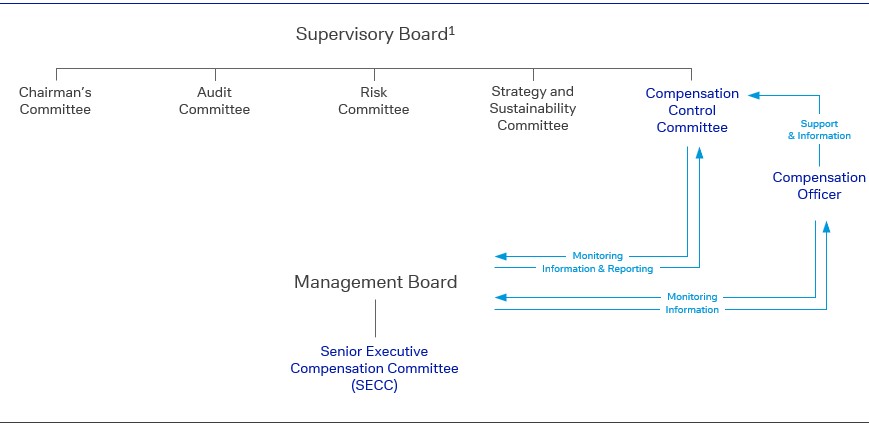
1Does not comprise a complete list of Supervisory Board Committees
270
Deutsche Bank | Compensation of the employees |
Pillar 3 Report as of December 31, 2025 | Compensation governance |
Compensation Control Committee (CCC)
The Supervisory Board has set up the CCC to support in establishing and monitoring the structure of the compensation
system for the Management Board Members of Deutsche Bank AG. Furthermore, the CCC monitors the appropriateness
of the compensation systems for the employees of Deutsche Bank Group, as established by the Management Board and
the SECC. The CCC reviews whether the total amount of Variable Compensation is affordable and set in accordance with
the risk, capital and liquidity situation as well as in alignment with the business and risk strategies. Furthermore, the CCC
supports the Supervisory Board in monitoring the bank’s MRT identification process.
Further details, including the composition and the number of meetings held, can be found in the Report of the
Supervisory Board within this Annual Report.
Compensation Officer
The Management Board, in cooperation with the CCC, has appointed a Group Compensation Officer to support the
Supervisory Boards of Deutsche Bank AG and of the bank’s Significant Institutions in Germany in performing their
compensation related duties. The Compensation Officer is involved in the conceptual review, development, monitoring
and application of the employees’ compensation systems, the MRT identification and remuneration disclosures on an
ongoing basis. The Compensation Officer performs all relevant monitoring obligations independently, provides an
assessment on the appropriateness of the design and strategy of the compensation systems for employees at least
annually and regularly supports and advises the CCC.
Senior Executive Compensation Committee (SECC)
The SECC is a delegated committee established by the Management Board which has the mandate to develop
sustainable compensation principles, to prepare recommendations on Total Compensation levels and to ensure
appropriate compensation governance and oversight. As part of this mandate, the SECC establishes the Compensation
and Benefits Strategy, Policy and corresponding guiding principles, which provide the overarching framework for both
Fixed Pay and Variable Compensation. This includes ensuring that the overall compensation structures are aligned with
regulatory requirements and the bank’s compensation principles. Moreover, using quantitative and qualitative factors,
the SECC assesses Group and divisional performance as a basis for compensation decisions and makes recommendations
to the Management Board regarding the total amount of annual Variable Compensation and its allocation across
business divisions and infrastructure functions.
In order to maintain its independence, only representatives from infrastructure and control functions who are not aligned
to any of the business divisions are members of the SECC. In 2025, the SECC’s membership comprised of the DB AG
Management Board member responsible for Human Resources and the Chief Financial Officer as Co-Chairpersons, the
Head of Compliance, the Head of Human Resources and the Head of Performance & Reward as well as an additional
representative from both Finance and Risk as voting members. The Compensation Officer and an additional
representative from Finance participated as non-voting members. The SECC generally meets on a monthly basis but with
more frequent meetings during the compensation determination process. It held 15 meetings in total with regard to the
compensation process for the performance year 2025.
Compensation and Benefits Strategy
Deutsche Bank recognizes that its compensation framework plays a vital role in supporting its strategic objectives. It
enables the bank to attract and retain the individuals required to achieve the bank’s objectives. The Compensation and
Benefits Strategy is built on three core pillars (Principles, Performance and Processes as outlined below) that support the
bank’s global, client-centric business and risk strategy, reinforced by safe and sound compensation practices that
operate within the bank’s profitability, solvency and liquidity position.
271
Deutsche Bank | Compensation of the employees |
Pillar 3 Report as of December 31, 2025 | Compensation governance |
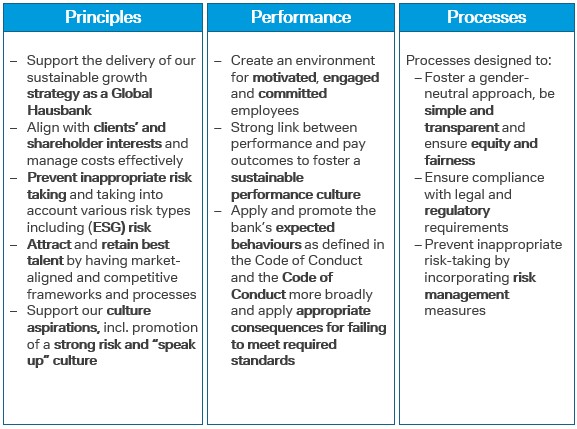
Group Compensation Framework
The compensation framework, generally applicable globally across all regions and business lines, emphasizes an
appropriate balance between Fixed Pay and Variable Compensation – together forming Total Compensation. It aligns
incentives for sustainable performance at all levels of Deutsche Bank whilst ensuring the transparency of compensation
decisions and their impact on shareholders and employees. The underlying principles of Deutsche Bank’s Compensation
Framework are applied to all employees equally and are supported by the key principle ‘equal pay for equal work or work
of equal value’ and the necessity for equal opportunities, irrespective of differences in, e.g., tenure, gender or ethnicity.
Pursuant to CRD and the requirements subsequently adopted in the German Banking Act, Deutsche Bank is subject to a
maximum ratio of 1:1 with regard to fixed-to-variable remuneration components, which was increased to 1:2 for a limited
population with shareholder approval on May 22, 2014 with an approval rate of 95.27%, based on valid votes by 27.68%
of the share capital represented at the Annual General Meeting. The remuneration of employees in control functions as
defined by InstVV (comprising Risk, Compliance and Anti-Financial Crime, Group Audit and the Group Compensation
Officer and his Deputy) is predominately based on Fixed Pay.
According to the bank’s compensation framework, all employees are entitled to individual Variable Compensation. The
standardized Variable Compensation orientation model, which incorporates orientation values determined by division,
profession, and seniority, indicates the average expected Variable Compensation as a percentage of Fixed Pay, thus
ensuring an appropriate balance between Fixed Pay and Variable Compensation.
Fixed Pay is the key and primary compensation element for most employees globally. It is a fixed regular payment based
on transparent and predetermined conditions. It is delivered in the form of base salary and where applicable local
specific fixed pay allowances. Fixed Pay reflects the value of the individual role and function within the organization,
regional and divisional specifics and rewards the factors an employee brings to the organization such as qualification,
skills and experience required for the role in line with remuneration levels in the specific geographic location and level of
responsibility.
Variable Compensation is a discretionary compensation component that reflects Group, Divisional risk-adjusted financial
and non-financial performance as well as individual contributions. It acknowledges that employees contribute to the
success of their Division and the Group as a whole. At the same time, Variable Compensation allows the bank to
differentiate individual contributions and to drive behavior and conduct through an incentive system that can positively
influence culture and the achievement of the bank’s strategic objectives and to apply consequences for falling below the
standards of delivery, behavior and conduct by reducing the Variable Compensation.
In the context of InstVV, severance payments are considered Variable Compensation. The bank’s severance framework
ensures full alignment with the respective InstVV requirements.
272
Deutsche Bank | Compensation of the employees |
Pillar 3 Report as of December 31, 2025 | Compensation governance |
Employee benefits are considered Fixed Pay from a regulatory perspective, as they have no direct link to performance or
discretion. They are granted in accordance with applicable local market practices and requirements. Pension expenses
represent the main element of the bank’s benefits portfolio globally.
Total Compensation is made up of defined Fixed Pay, Variable Compensation and is supplemented by benefits.
Employee groups with specific compensation structures
For some areas of the bank, compensation structures deviate in some respects from the Group Compensation Framework
outlined above, but within regulatory boundaries.
Postbank units
While executive staff of former Postbank generally follow the remuneration structure of Deutsche Bank, the
compensation for any other staff in Postbank units is based on specific frameworks agreed with trade unions or with the
respective workers’ councils. Where no collective agreements exist, compensation is subject to individual contracts. In
general, non-executive and tariff staff in Postbank units receive Variable Compensation, but the structure and portion of
Variable Compensation can differ between legal entities. Notwithstanding these specific frameworks, Variable
Compensation of Postbank units is subject to the bank’s overarching compensation governance overseen by the SECC.
DWS
DWS asset management entities and employees fall under AIFMD, UCITS or IFD regulation, and only DWS employees
who are deemed to have a material impact on the risk profile of Deutsche Bank Group remain in scope of the bank’s
Group InstVV requirements. DWS has established its own compensation governance, policy, and structures, as well as
Risk Taker identification process in line with its regulatory requirements. These structures and processes are aligned with
InstVV where required but tailored towards the Asset Management business. Pursuant to the ESMA/EBA Guidelines,
DWS’s compensation strategy is designed to ensure an appropriate ratio between Fixed and Variable Compensation.
Generally, DWS applies remuneration rules that are equivalent to the Deutsche Bank Group approach, but use DWS
Group-related parameters, where possible. Notable deviations from the Group Compensation Framework include the use
of share-based instruments linked to DWS shares and fund-linked instruments. These serve to improve the alignment of
employee compensation with DWS’ shareholders’ and investors’ interests.
Tariff staff
Tariff staff are either subject to a collective agreement (Tarifvertrag für das private Bankgewerbe und die öffentlichen
Banken), as negotiated between trade unions and employer associations, or subject to agreements as negotiated with
the respective trade unions directly. The remuneration of tariff staff is included in the quantitative disclosures in this
Report.
Determination of performance-based Variable Compensation
The bank puts a strong focus on its governance related to compensation decision-making processes. A robust set of rule-
based principles for compensation decisions with close links to the performance of both businesses and individuals were
applied.
The total amount of Variable Compensation for any given performance year is derived from an assessment of the bank’s
profitability, solvency, and liquidity position (affordability assessment), Group performance and the performance of
divisions and infrastructure functions in support of achieving the bank’s strategic objectives.
In a first step, Deutsche Bank assesses the bank’s affordability as well as other limitations (such as external financial
goals) to determine what the bank “can” award in line with regulatory and internal requirements. This assessment also
takes into account forward‑looking considerations of the bank’s multi‑year strategic plan including its multi-year capital
plan. In the next step, the bank assesses divisional risk-adjusted performance, i.e., what the bank “should” award in order
to provide an appropriate compensation for contributions to the bank’s success.
The proportion of the Variable Compensation pools related to Group performance, which has a weighting of 25%, is
determined based on the performance of a selected number of Group’s Key Performance Indicators (KPIs), including
Cost/Income Ratio (CIR), Post-Tax Return on Tangible Equity (RoTE), ESG: Environmental - Sustainable Financing and
ESG Investments, Social - Gender Diversity and Governance - Audit Control Risk Management Grade.
273
Deutsche Bank | Compensation of the employees |
Pillar 3 Report as of December 31, 2025 | Employee groups with specific compensation structures |
When assessing divisional performance, a range of considerations are referenced. Performance is assessed in the context
of financial and – based on Balanced Scorecards – non-financial targets. To ensure that performance is reviewed in its
entirety and that consideration is also given to criteria that are difficult to evaluate with a solely formulaic approach, the
SECC additionally conducts a qualitative review. Following the quantitative calculation of the combined performance
assessed Variable Compensation pools, the SECC will review a set of pre-defined qualitative criteria related to both
financial and non-financial performance and may decide to apply a maximum 10 percentage points up or down overlay
on the divisional performance assessment. The financial targets for front-office divisions are subject to appropriate risk-
adjustment, in particular by referencing the degree of future potential risks to which Deutsche Bank may be exposed, and
the amount of capital required to absorb severe unexpected losses arising from these risks. For the infrastructure
functions, the financial performance assessment is mainly based on the achievement of cost targets. While the allocation
of Variable Compensation to infrastructure functions, and in particular to control functions, depends on both Deutsche
Bank’s overall and their own performance, it is not dependent on the performance of the division(s) that these functions
oversee.
At the level of the individual employee, the Variable Compensation Guiding Principles are established, which detail the
factors and metrics that managers need to take into account when making Variable Compensation decisions. In doing so,
they must fully appreciate the risk-taking activities of individuals to ensure that Variable Compensation allocations are
balanced and risk-taking is not inappropriately incentivized. The factors and metrics to be considered include, but are not
limited to, (i) business delivery (“What”), i.e., quantitative and qualitative financial, risk-adjusted and non-financial
performance metrics, and (ii) behavior (“How”), i.e., culture, conduct and control considerations such as qualitative inputs
from control functions or disciplinary sanctions. Variable Compensation setting recommendations help managers to
translate individual performance (“What” and “How”) into appropriate pay outcomes. Generally, performance is assessed
based on a one-year period. However, for Management Board members of all Significant Institutions, a performance
period of three years is taken into account.
Variable Compensation structure
The compensation structures are designed to provide a mechanism that promotes and supports long-term performance
of employees and the bank. Whilst a portion of Variable Compensation is paid upfront, these structures require that an
appropriate portion is deferred to ensure alignment to the sustainable performance of the Group. For both parts of
Variable Compensation, Deutsche Bank shares are used as instruments and as an effective way to align compensation
with Deutsche Bank’s sustainable performance and the interests of shareholders.
The bank continues to go beyond regulatory requirements with the scope as well as the amount of Variable
Compensation that is deferred and the minimum deferral periods for certain employee groups. The deferral rate and
period are determined based on the risk categorization of the employee as well as the business unit. Where applicable,
the bank starts to defer parts of Variable Compensation for MRTs where Variable Compensation is set at or above
€ 50,000 or where Variable Compensation exceeds 1/3 of Total Compensation. For non-MRTs, deferrals start at higher
levels of Variable Compensation. MRTs are on average subject to deferral rates in excess of the minimum 40% (60% for
Senior Management) as required by InstVV. For MRTs in Material Business Units (MBU) the bank applies a deferral rate of
at least 50%. The Variable Compensation threshold for MRTs requiring at least 60% deferral is set at € 500,000. Moreover,
for all employees whose Fixed Pay exceeds the amount of € 600,000, the full amount of the Variable Compensation is
deferred.
As detailed in the table below, deferral periods range from three to five years, dependent on employee groups.
274
Deutsche Bank | Compensation of the employees |
Pillar 3 Report as of December 31, 2025 | Variable compensation structure |
Overview of 2025 award types (excluding DWS Group)
Award Type | Description | Beneficiaries | Deferral Period | Retention Period | Portion | |||||
Upfront: Cash Variable Compensation (VC) | Upfront cash | All eligible employees | N/A | N/A | 100% of VC, except employees with deferred awards | |||||
Upfront: Equity Upfront Award (EUA) | Upfront equity (linked to Deutsche Bank’s share price over the retention period) | MRTs with VC ≥ € 50,000 or where VC exceeds 1/3 of Total Compensation (TC) Non-MRTs with deferred awards where 2025 TC > € 500,000 | N/A | 12 months | 50% of upfront VC | |||||
Deferred: Restricted Incentive Award (RIA) | Deferred cash | All employees with deferred VC | Equal tranche vesting: MRTs: 4 years Senior Mgmt.1: 5 years Non-MRTs: 3 years | N/A | 50% of deferred VC | |||||
Deferred: Restricted Equity Award (REA) | Deferred equity (linked to Deutsche Bank’s share price over the vesting and retention period) | All employees with deferred VC | Equal tranche vesting: MRTs: 4 years Senior Mgmt.1: 5 years Non-MRTs: 3 years | 12 months for MRTs | 50% of deferred VC |
N/A – Not applicable
1For the purpose of Performance Year 2025 annual awards, Senior Management is defined DB AG MB-1 positions; incumbents of MB-2 positions in IB and CB reporting to
Co-Heads of CB and Co-Heads of IB; further individuals with significant business responsibilities; MB members of Significant Institutions in the meaning of the German
Banking Act; respective MB-1 positions with managerial responsibility; for the specific deferral rules for the Management Board of Deutsche Bank AG refer to the
Compensation Report for the Management Board
Employees are not allowed to sell, pledge, transfer or assign a deferred award or any rights in respect to the award. They
may not enter into any transaction having the economic effect of hedging any Variable Compensation, for example
offsetting the risk of price movement with respect to the equity-based award. Compliance, overseen by the
Compensation Officer, monitors that employee trading activity complies with this requirement.
275
Deutsche Bank | Compensation of the employees |
Pillar 3 Report as of December 31, 2025 | Ex-post risk adjustment of variable compensation |
Ex-post risk adjustment of Variable Compensation
In line with regulatory requirements relating to ex-post risk adjustment of Variable Compensation, the bank believes that
a long-term view on conduct and performance of its employees is a key element of deferred Variable Compensation. As a
result, under the Management Board’s oversight, all deferred awards are subject to performance conditions and
forfeiture provisions as detailed below.
Overview of Deutsche Bank Group performance conditions and forfeiture provisions of Variable Compensation granted for
Performance Year 2025
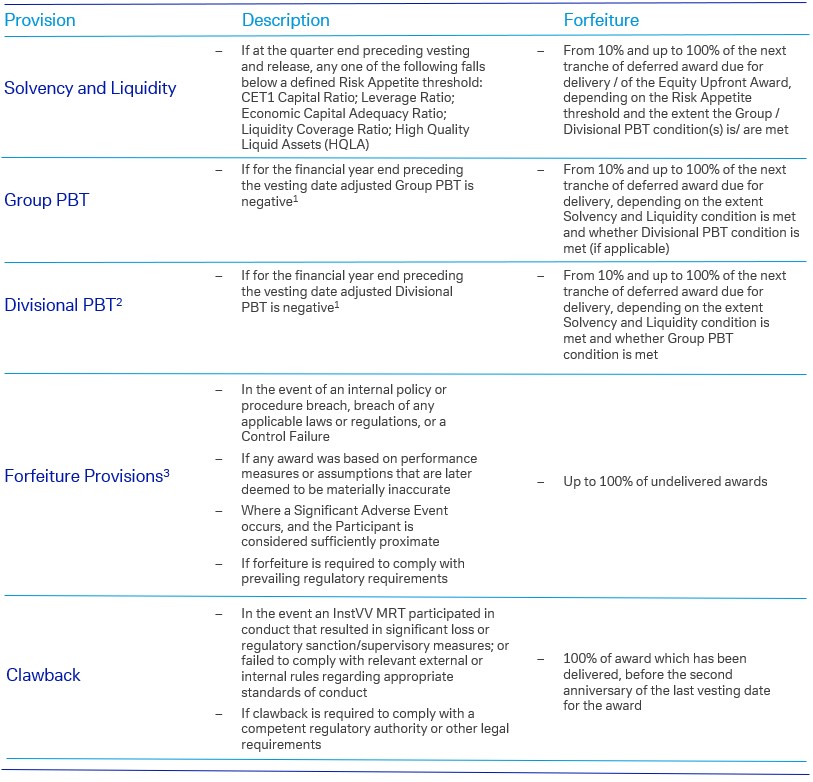
1Considering clearly defined and governed adjustments for relevant Profit and Loss items (e.g., business restructurings; impairments of goodwill or intangibles)
2Only applicable to InstVV MRTs in front office divisions
3Other provisions may apply as outlined in the respective plan rules
276
Deutsche Bank | Compensation of the employees |
Pillar 3 Report as of December 31, 2025 | Material Risk Taker compensation disclosure |
Material Risk Taker compensation disclosure
On a global basis, 1,522 employees were identified as MRTs according to CRD/InstVV for financial year 2025, compared
to 1,451 employees for 2024. The number of 2025 Group MRTs amounts to 1,287 individuals. Moreover, 298 individuals
were identified at an institutional level (thereof 63 Group MRTs). The remuneration elements for all those MRTs on a
consolidated basis are detailed in the tables below in accordance with Article 450 CRR. Where applicable, the EU REM
tables display the prescribed business lines as per Annex XXXIII of Regulation No 575/2013.
With regard to deferral arrangements and pay-out instruments, 42 MRTs, whose total remuneration amounts to
€ 9.7 million (thereof € 3.3 million variable remuneration including severance payments) benefit from a derogation laid
down in Article 94(3) CRD point (a) and 96 MRTs, whose total remuneration amounts to € 14.3 million (thereof
€ 2.7 million variable remuneration including severance payments) benefit from a derogation laid down in Article 94(3)
CRD point (b).
Remuneration for 2025 - Material Risk Takers (REM 1)
2025 | ||||||||||||
in € m. (unless stated otherwise)¹ | Super- visory Board² | Manage- ment Board3 | Senior Management4 | Other Material Risk Takers | Group Total | |||||||
Fixed Pay | Number of MRTs5 | 20 | 9 | 243 | 1,102 | 1,374 | ||||||
Total Fixed Pay | 8 | 32 | 175 | 632 | 847 | |||||||
of which: cash-based | 8 | 28 | 169 | 599 | 804 | |||||||
of which: shares or equivalent ownership interests | 0 | 0 | 0 | 0 | 0 | |||||||
of which: share-linked instruments or equivalent non-cash instruments | 0 | 0 | 0 | 0 | 0 | |||||||
of which: other instruments | 0 | 0 | 0 | 0 | 0 | |||||||
of which: other forms | 0 | 3 | 6 | 33 | 43 | |||||||
Variable Pay | Number of MRTs5 | 0 | 9 | 240 | 1,061 | 1,310 | ||||||
Total Variable Pay6 | 0 | 51 | 190 | 706 | 946 | |||||||
of which: cash-based | 0 | 13 | 96 | 362 | 472 | |||||||
of which: deferred | 0 | 2 | 83 | 264 | 349 | |||||||
of which: shares or equivalent ownership interests | 0 | 37 | 86 | 343 | 466 | |||||||
of which: deferred | 0 | 28 | 81 | 264 | 373 | |||||||
of which: share-linked instruments or equivalent non-cash instruments | 0 | 0 | 6 | 0 | 6 | |||||||
of which: deferred | 0 | 0 | 4 | 0 | 4 | |||||||
of which: other instruments | 0 | 0 | 2 | 0 | 2 | |||||||
of which: deferred | 0 | 0 | 2 | 0 | 2 | |||||||
of which: other forms | 0 | 0 | 0 | 0 | 0 | |||||||
of which: deferred | 0 | 0 | 0 | 0 | 0 | |||||||
Total Pay | 8 | 82 | 365 | 1,338 | 1,793 | |||||||
1The table may contain marginal rounding differences
2Supervisory Board represents the Supervisory Board Members of Deutsche Bank AG
3Management Board represents the Management Board Members of Deutsche Bank AG
4Senior Management is defined as Deutsche Bank AG MB-1 positions; incumbents of MB-2 positions in IB and CB reporting to Co-Heads of CB and Co-Heads of IB; further
individuals with significant business responsibilities; MB members of institutions required to identify MRTs at a solo institutional level and respective MB-1 positions with
managerial responsibility
5Beneficiaries only as of December 31, 2025 (HC reported for Supervisory Board and Management Board, FTE reported for the remaining part); therefore, the totals do not
add up to the 1,522 individuals identified as MRTs; shows remuneration awarded to all MRTs (including 2025 leavers)
6Variable Pay includes Deutsche Bank´s year-end performance-based Variable Compensation for 2025, other Variable Compensation and severance payments; it also
includes fringe benefits and contractually agreed post-contractual non-compete compensation awarded to Management Board Members of Deutsche Bank AG which are
to be classified as variable remuneration, and reflects the newly implemented LTI Plan for Management Board members of Deutsche Bank AG set up for the performance
period 2025-2027, which during the 'transition phase' is shown with the target amount; the table does not include new hire replacement awards for lost entitlements
from previous employers (buyouts)
277
Deutsche Bank | Compensation of the employees |
Pillar 3 Report as of December 31, 2025 | Material Risk Taker compensation disclosure |
Guaranteed variable remuneration and severance payments - Material Risk Takers (REM 2)
2025 | ||||||||||
in € m. (unless stated otherwise)¹ | Super- visory Board² | Manage- ment Board3 | Senior Management4 | Other Material Risk Takers | Group Total | |||||
Guaranteed variable remuneration awards | ||||||||||
Number of MRTs5 | 0 | 0 | 3 | 8 | 11 | |||||
Total amount | 0 | 0 | 2 | 17 | 19 | |||||
of which: paid during financial year, not taken into account in bonus cap | 0 | 0 | 0 | 8 | 8 | |||||
Severance payments awarded in previous periods, paid out during financial year | ||||||||||
Number of MRTs5 | 0 | 0 | 0 | 0 | 0 | |||||
Total amount | 0 | 0 | 0 | 0 | 0 | |||||
Severance payments awarded during financial year | ||||||||||
Number of MRTs5 | 0 | 1 | 8 | 39 | 48 | |||||
Total amount6 | 0 | 6 | 4 | 10 | 21 | |||||
of which: paid during financial year | 0 | 3 | 4 | 10 | 16 | |||||
of which: deferred | 0 | 4 | 0 | 0 | 4 | |||||
of which: paid during financial year, not taken into account in bonus cap | 0 | 3 | 4 | 10 | 16 | |||||
of which: highest payment that has been awarded to a single person | 0 | 6 | 2 | 1 | 6 | |||||
1The table may contain marginal rounding differences
2Supervisory Board represents the Supervisory Board Members of Deutsche Bank AG
3Management Board represents the Management Board Members of Deutsche Bank AG
4Senior Management is defined as Deutsche Bank AG MB-1 positions; incumbents of MB-2 positions in IB and CB reporting to Co-Heads of CB and Co-Heads of IB; further
individuals with significant business responsibilities; MB members of institutions required to identify MRTs at a solo institutional level and respective MB-1 positions with
managerial responsibility
5Beneficiaries only (HC reported for all categories)
278
Deutsche Bank | Compensation of the employees |
Pillar 3 Report as of December 31, 2025 | Material Risk Taker compensation disclosure |
Deferred remuneration - Material Risk Takers (REM 3)
2025 | ||||||||||||||||
in € m. (unless stated otherwise)¹ | Total amount of deferred remuneration awarded for previous performance periods | Of which due to vest in the financial year | Of which vesting in subsequent financial years | Amount of performance adjustment made in the financial year to deferred remuneration that was due to vest in the financial year | Amount of performance adjustment made in the financial year to deferred remuneration that was due to vest in future performance years | Total amount of adjustment during the financial year due to ex post implicit adjustments5 | Total amount of deferred remuneration awarded before the financial year actually paid out in the financial year6 | Total of amount of deferred remuneration awarded for previous performance period that has vested but is subject to retention periods | ||||||||
Supervisory Board2 | 0 | 0 | 0 | 0 | 0 | 0 | 0 | |||||||||
Cash-based | 0 | 0 | 0 | 0 | 0 | 0 | 0 | |||||||||
Shares or equivalent ownership interests | 0 | 0 | 0 | 0 | 0 | 0 | 0 | |||||||||
Share-linked instruments or equivalent non- cash instruments | 0 | 0 | 0 | 0 | 0 | 0 | 0 | |||||||||
Other instruments | 0 | 0 | 0 | 0 | 0 | 0 | 0 | |||||||||
Other forms | 0 | 0 | 0 | 0 | 0 | 0 | 0 | |||||||||
Management Board3 | 106 | 24 | 82 | 0 | 0 | 24 | 14 | |||||||||
Cash-based | 48 | 11 | 38 | 0 | 0 | 11 | 0 | |||||||||
Shares or equivalent ownership interests | 58 | 14 | 44 | 0 | 0 | 14 | 14 | |||||||||
Share-linked instruments or equivalent non- cash instruments | 0 | 0 | 0 | 0 | 0 | 0 | 0 | |||||||||
Other instruments | 0 | 0 | 0 | 0 | 0 | 0 | 0 | |||||||||
Other forms | 0 | 0 | 0 | 0 | 0 | 0 | 0 | |||||||||
Senior management4 | 460 | 98 | 362 | 0 | 0 | 98 | 45 | |||||||||
Cash-based | 218 | 47 | 171 | 0 | 0 | 47 | 0 | |||||||||
Shares or equivalent ownership interests | 229 | 49 | 180 | 0 | 0 | 49 | 44 | |||||||||
Share-linked instruments or equivalent non- cash instruments | 10 | 2 | 8 | 0 | 0 | 2 | 1 | |||||||||
Other instruments | 3 | 0 | 3 | 0 | 0 | 0 | 0 | |||||||||
Other forms | 0 | 0 | 0 | 0 | 0 | 0 | 0 | |||||||||
Other Material Risk Takers | 1,594 | 393 | 1,201 | 0 | 0 | 392 | 146 | |||||||||
Cash-based | 770 | 191 | 579 | 0 | 0 | 191 | 0 | |||||||||
Shares or equivalent ownership interests | 824 | 202 | 622 | 0 | 0 | 202 | 146 | |||||||||
Share-linked instruments or equivalent non- cash instruments | 0 | 0 | 0 | 0 | 0 | 0 | 0 | |||||||||
Other instruments | 0 | 0 | 0 | 0 | 0 | 0 | 0 | |||||||||
Other forms | 0 | 0 | 0 | 0 | 0 | 0 | 0 | |||||||||
Total amount | 2,160 | 516 | 1,644 | 0 | 0 | 515 | 205 | |||||||||
1The table may contain marginal rounding differences
2Supervisory Board represents the Supervisory Board Members of Deutsche Bank AG
3Management Board represents the Management Board Members of Deutsche Bank AG
4Senior Management is defined as Deutsche Bank AG MB-1 positions; incumbents of MB-2 positions in IB and CB reporting to Co-Heads of CB and Co-Heads of IB; further
individuals with significant business responsibilities; MB members of institutions required to identify MRTs at a solo institutional level and respective MB-1 positions with
managerial responsibility
5Changes of value of deferred remuneration due to the changes of prices of instruments
6Defined as remuneration awarded before the financial year which vested in the financial year (including where subject to a retention period)
279
Deutsche Bank | Compensation of the employees |
Pillar 3 Report as of December 31, 2025 | Material Risk Taker compensation disclosure |
Remuneration of high earners – Material Risk Takers (REM 4)
2025 | 2024 | |||
in € | Number of individuals | Number of individuals | ||
Total Pay1 | ||||
1,000,000 to 1,499,999 | 339 | 331 | ||
1,500,000 to 1,999,999 | 123 | 125 | ||
2,000,000 to 2,499,999 | 71 | 59 | ||
2,500,000 to 2,999,999 | 32 | 48 | ||
3,000,000 to 3,499,999 | 31 | 25 | ||
3,500,000 to 3,999,999 | 16 | 14 | ||
4.000,000 to 4,499,999 | 8 | 6 | ||
4,500,000 to 4,999,999 | 9 | 5 | ||
5,000,000 to 5,999,999 | 7 | 9 | ||
6,000,000 to 6,999,999 | 4 | 3 | ||
7,000,000 to 7,999,999 | 4 | 12 | ||
8,000,000 to 8,999,999 | 4 | 3 | ||
9,000,000 to 9,999,999 | 6 | 3 | ||
10,000,000 to 10,999,999 | 1 | 3 | ||
11,000,000 to 11,999,999 | 2 | 0 | ||
17,000,000 to 17,999,999 | 0 | 1 | ||
Total | 658 | 647 |
1Includes all components of Fixed Pay and Variable Compensation (including severances); buyouts are not included
In total, 658 MRTs received a Total Pay of € 1 million or more for 2025. The number of MRT high earners remains
essentially flat compared to 2024.
Compensation awards 2025 – Material Risk Takers (REM 5)
Management Body Remuneration | Business Areas | |||||||||||||||||
in € m. (unless stated otherwise)¹ | Super- visory Board2 | Manage- ment Board2 | Total Manage- ment Body | Invest- ment Banking2 | Retail Banking2 | Asset Manage- ment2 | Corporate Functions2 | Control Functions2 | Total | |||||||||
Total number of Material Risk Takers3 | 1,374 | |||||||||||||||||
of which: Management Body | 20 | 9 | 29 | N/A | N/A | N/A | N/A | N/A | N/A | |||||||||
of which: Senior Management4 | N/A | N/A | N/A | 34 | 87 | 6 | 78 | 38 | 243 | |||||||||
of which: Other Material Risk Takers | N/A | N/A | N/A | 634 | 251 | 1 | 114 | 102 | 1,102 | |||||||||
Total Pay of Material Risk Takers | 8 | 82 | 90 | 1,147 | 292 | 21 | 167 | 76 | 1,793 | |||||||||
of which: variable pay5 | 0 | 51 | 51 | 644 | 143 | 12 | 78 | 20 | 946 | |||||||||
of which: fixed pay | 8 | 32 | 40 | 504 | 149 | 10 | 89 | 56 | 847 | |||||||||
1The table may contain marginal rounding differences
2Supervisory Board represents the Supervisory Board Members of Deutsche Bank AG, Management Board represents the Management Board Members of Deutsche Bank
AG; Investment Banking = Investment Bank; Retail Banking = Private Bank and Corporate Bank; Asset Management = Asset Management (DWS); Control Functions
include Chief Risk Office, Group Audit, Compliance and Anti-Financial Crime; Corporate Functions include any Infrastructure Function which is neither captured as a
Control Function nor part of any division
3HC as of December 31, 2025 reported for Supervisory Board and Management Board, FTE as of December 31, 2025 reported for the remaining part; therefore, the totals
do not add up to the 1,522 individuals identified as MRTs; shows remuneration awarded to all MRTs (including 2025 leavers)
4Senior Management is defined as Deutsche Bank AG MB-1 positions; incumbents of MB-2 positions in IB and CB reporting to Co-Heads of CB and Co-Heads of IB; further
individuals with significant business responsibilities; MB members of institutions required to identify MRTs at a solo institutional level and respective MB-1 positions with
managerial responsibility
5Variable Pay includes Deutsche Bank´s year-end performance-based Variable Compensation for 2025, other Variable Compensation and severance payments; it also
includes fringe benefits and contractually agreed post-contractual non-compete compensation awarded to Management Board Members of Deutsche Bank AG which are
to be classified as variable remuneration, and reflects the newly implemented LTI Plan for Management Board members of Deutsche Bank AG set up for the performance
period 2025-2027, which during the 'transition phase' is shown with the target amount; the table does not include new hire replacement awards for lost entitlements
from previous employers (buyouts)
280
Deutsche Bank | Compensation of the employees |
Pillar 3 Report as of December 31, 2025 | Material Risk Taker compensation disclosure |
List of tables
EU KM1 – Key metrics ................................................................................................................................................ | |
EU CC1 – Composition of regulatory own funds .................................................................................................. | |
financial statement categories with regulatory risk categories ......................................................................... | |
financial statements ................................................................................................................................................... | |
EU LI3 – Outline of the differences in the scopes of consolidation (entity by entity) ................................... | |
Overview prudential requirements and additional buffers ................................................................................ | |
countercyclical capital buffer .................................................................................................................................. | |
EU CCyB2 – Institution-specific countercyclical capital buffer ........................................................................ | |
G-SIB Assessment Exercise reporting template ................................................................................................... | |
Ranking of liabilities in an insolvency proceeding under German law ............................................................. | |
EU TLAC3a – Creditor ranking .................................................................................................................................. | |
Total economic capital supply and demand .......................................................................................................... | |
EU OV1 – Overview of RWA ...................................................................................................................................... | |
at asset class level ...................................................................................................................................................... | |
EU CAE1 – Exposures to crypto-assets .................................................................................................................. | |
EU LR2 – LRCom: Leverage ratio common disclosure ......................................................................................... | |
exposures) .................................................................................................................................................................... | |
Risk profile of Deutsche Bank’s business divisions as measured by economic capital .................................. | |
Global All Currency Daily Stress Testing Results ................................................................................................. | |
EU CR1-A – Maturity of exposures .......................................................................................................................... | |
EU CQ4 – Quality of non-performing exposures by geography ........................................................................ | |
EU CQ5 – Credit quality of loans and advances to non-financial corporations by industry ........................ | |
EU CR1 - Performing and non-performing exposures and related provisions ................................................ | |
EU CQ3 – Credit quality of performing and non-performing exposures by past due days .......................... | |
EU CR2 – Changes in the stock of non-performing loans and advances ......................................................... | |
EU CQ1 – Credit quality of forborne exposures ................................................................................................... | |
CRR – new NPE’s originated after April 26, 2019 ................................................................................................. | |
ECB – new NPE’s after April 1, 2018 ....................................................................................................................... | |
ECB – NPE Stock ......................................................................................................................................................... | |
Reconciliation of non-performing exposure .......................................................................................................... | |
EU CQ7 – Collateral obtained by taking possession and execution processes .............................................. | |
EU CR3 – Credit Risk Mitigation techniques – Overview .................................................................................... | |
EU CR5 – Standardized approach ........................................................................................................................... | |
EU CR6-A - Scope of the use of IRB and SA approaches .................................................................................... | |
EU CR6 – FIRB approach – Credit risk exposures by exposure class and PD range ...................................... | |
EU CR6 – AIRB approach – Credit risk exposures by exposure class and PD range ...................................... | |
EU CR7-A – Foundation IRB approach – Extent of the use of CRM techniques ............................................ | |
EU CR7-A – Advanced IRB approach – Extent of the use of CRM techniques ............................................... | |
EU CR8 – RWA flow statement of credit risk exposures under the IRB approach ......................................... |
281
Deutsche Bank | Compensation of the employees |
Pillar 3 Report as of December 31, 2025 | Material Risk Taker compensation disclosure |
EU CR9 IRB backtesting of PD per exposure class for Foundation IRBA ......................................................... | |
Validation results for risk parameters used in advanced IRBA credit models ................................................. | |
EU CR9 IRB backtesting of PD per exposure class for Advanced IRBA............................................................ | |
estate (Slotting approach) ........................................................................................................................................ | |
EU CR10.05 – Equity exposures ............................................................................................................................... | |
Contractual Obligations ............................................................................................................................................ | |
EU CCR1 – Analysis of CCR exposure by approach ............................................................................................. | |
method .......................................................................................................................................................................... | |
EU CCR8 – Exposures to CCPs ................................................................................................................................ | |
EU CCR3 – Standardized approach – CCR exposures by regulatory portfolio and risk ............................... | |
EU CCR4 – FIRB approach – CCR exposures by portfolio and PD scale ......................................................... | |
EU CCR4 – AIRB approach – CCR exposures by portfolio and PD scale ......................................................... | |
EU CCR4 - Total FIRB & ARIB approach ................................................................................................................. | |
EU CCR5 – Composition of collateral for exposures to CCR ............................................................................. | |
EU CCR6 – Credit derivatives exposures ............................................................................................................... | |
EU CVA2 - Credit valuation adjustment risk under the Full Basic Approach (F-BA) ...................................... | |
EU SEC1 – Securitization exposures in the non-trading book ........................................................................... | |
EU SEC2 – Securitization exposures in the trading book .................................................................................... | |
requirements - institution acting as originator or as sponsor ............................................................................. | |
requirements - institution acting as investor ......................................................................................................... | |
adjustments .................................................................................................................................................................. | |
EU MR1 – Market risk under the standardized approach .................................................................................... | |
EU MR2-A – Market Risk under the internal models approach (IMA) ................................................................ | |
EU MR2-B – RWA flow statements of market risk exposures under the IMA .................................................. | |
EU MR3 – IMA values for trading portfolios1 ........................................................................................................ | |
EU MR4 – Comparison of VaR estimates with gains and losses ......................................................................... | |
EU PV1 – Prudent valuation adjustments (PVA) ................................................................................................... | |
shock scenarios ........................................................................................................................................................... | |
EU OR1 – Operational risk ......................................................................................................................................... | |
EU OR2 - Business Indicator, components and subcomponents ...................................................................... | |
EU OR3 - Operational risk own funds requirements and risk exposure amounts ........................................... | |
and maturity ................................................................................................................................................................. | |
Energy efficiency of the collateral ........................................................................................................................... | |
ESG4 – Exposures in the banking book to the top 20 carbon-intensive firms in the world .......................... | |
America ......................................................................................................................................................................... | |
America ......................................................................................................................................................................... | |
EU LIQ1 – LCR disclosure template ........................................................................................................................ | |
EU LIQ2 – Net stable funding ratio template ........................................................................................................ | |
EU AE1 – Encumbered and unencumbered assets .............................................................................................. | |
EU AE2 – Collateral received .................................................................................................................................... | |
EU AE3 – Sources of encumbrance ......................................................................................................................... | |
Number of directorships ............................................................................................................................................ | |
Reward governance structure .................................................................................................................................. |
282
Deutsche Bank | Compensation of the employees |
Pillar 3 Report as of December 31, 2025 | Material Risk Taker compensation disclosure |
Overview of 2025 award types (excluding DWS Group) ..................................................................................... | |
Compensation granted for Performance Year 2025 ............................................................................................ | |
Remuneration for 2025 - Material Risk Takers (REM 1) ........................................................................................ | |
Guaranteed variable remuneration and severance payments - Material Risk Takers (REM 2) ..................... | |
Deferred remuneration - Material Risk Takers (REM 3) ........................................................................................ | |
Remuneration of high earners – Material Risk Takers (REM 4) ........................................................................... | |
Compensation awards 2025 – Material Risk Takers (REM 5) .............................................................................. |
Contact for inquiries
Deutsche Bank AG
Frankfurt, Germany
Phone: +49 69 910-00
Contact for inquiries
Deutsche Bank AG
Frankfurt, Germany
Phone: +49 69 910-00
deutsche.bank@db.com