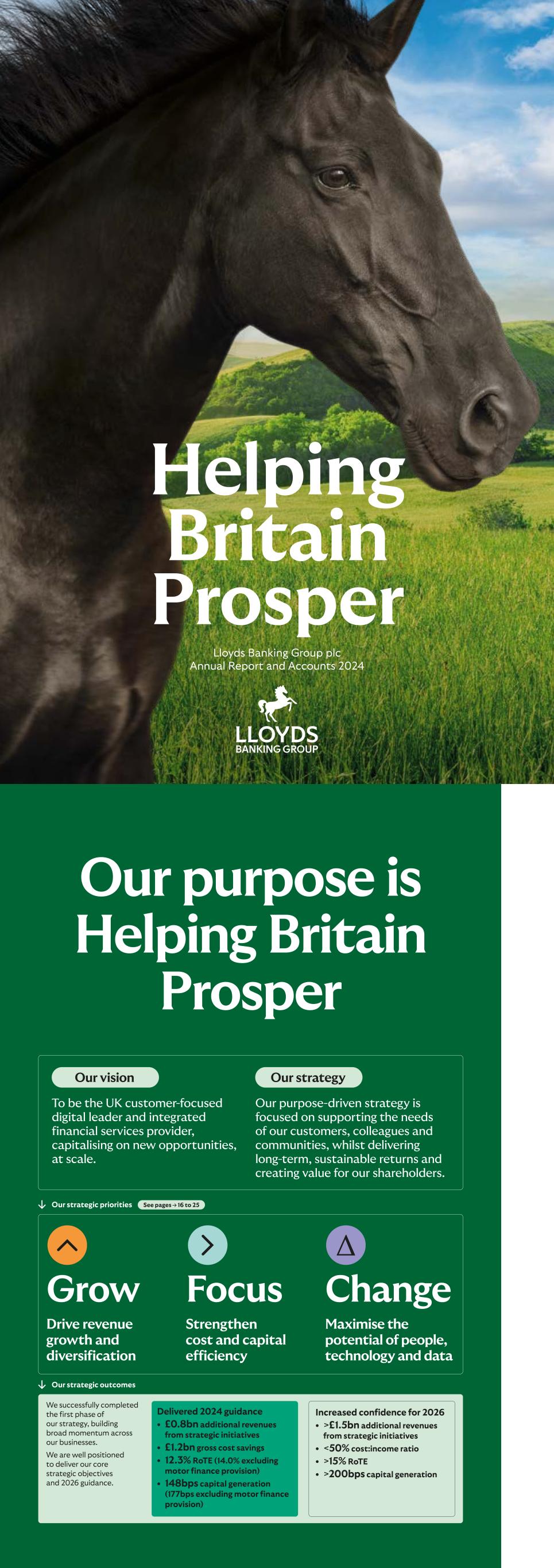
Helping Britain Prosper Lloyds Banking Group plc Annual Report and Accounts 2024 Our vision Our strategy Our purpose is Helping Britain Prosper Our purpose-driven strategy is focused on supporting the needs of our customers, colleagues and communities, whilst delivering long-term, sustainable returns and creating value for our shareholders. To be the UK customer-focused digital leader and integrated financial services provider, capitalising on new opportunities, at scale. Our strategic outcomes Grow Drive revenue growth and diversification Focus Strengthen cost and capital efficiency Change Maximise the potential of people, technology and data Our strategic priorities See pages 16 to 25 We successfully completed the first phase of our strategy, building broad momentum across our businesses. We are well positioned to deliver our core strategic objectives and 2026 guidance. Delivered 2024 guidance • £0.8bn additional revenues from strategic initiatives • £1.2bn gross cost savings • 12.3% RoTE (14.0% excluding motor finance provision) • 148bps capital generation (177bps excluding motor finance provision) Increased confidence for 2026 • >£1.5bn additional revenues from strategic initiatives • <50% cost:income ratio • >15% RoTE • >200bps capital generation
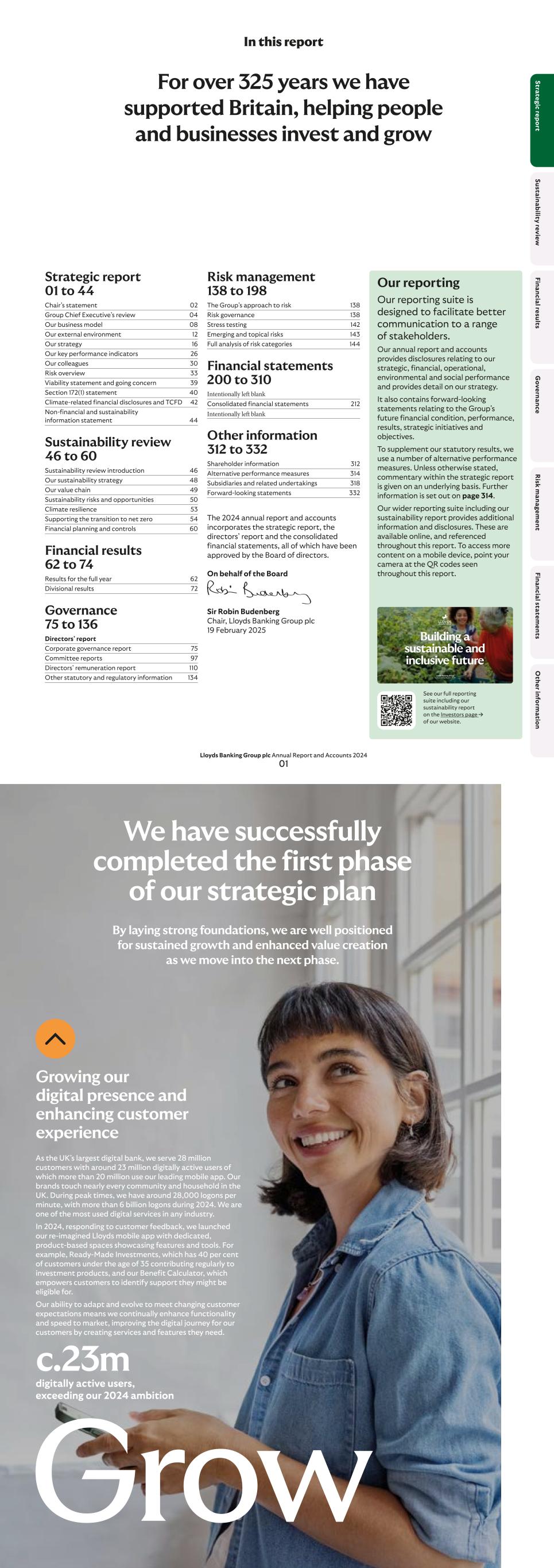
Building a sustainable and inclusive future Lloyds Banking Group Sustainability Report 2024 In this report For over 325 years we have supported Britain, helping people and businesses invest and grow Strategic report 01 to 44 Chair’s statement 02 Group Chief Executive’s review 04 Our business model 08 Our external environment 12 Our strategy 16 Our key performance indicators 26 Our colleagues 30 Risk overview 33 Viability statement and going concern 39 Section 172(1) statement 40 Climate-related financial disclosures and TCFD 42 Non-financial and sustainability information statement 44 Sustainability review 46 to 60 Sustainability review introduction 46 Our sustainability strategy 48 Our value chain 49 Sustainability risks and opportunities 50 Climate resilience 53 Supporting the transition to net zero 54 Financial planning and controls 60 Financial results 62 to 74 Results for the full year 62 Divisional results 72 Governance 75 to 136 Directors’ report Corporate governance report 75 Committee reports 97 Directors’ remuneration report 110 Other statutory and regulatory information 134 Risk management 138 to 198 The Group’s approach to risk 138 Risk governance 138 Stress testing 142 Emerging and topical risks 143 Full analysis of risk categories 144 Financial statements 200 to 310 Intentionally left blank Consolidated financial statements 212 Intentionally left blank Other information 312 to 332 Shareholder information 312 Alternative performance measures 314 Subsidiaries and related undertakings 318 Forward-looking statements 332 Our reporting Our reporting suite is designed to facilitate better communication to a range of stakeholders. Our annual report and accounts provides disclosures relating to our strategic, financial, operational, environmental and social performance and provides detail on our strategy. It also contains forward-looking statements relating to the Group’s future financial condition, performance, results, strategic initiatives and objectives. To supplement our statutory results, we use a number of alternative performance measures. Unless otherwise stated, commentary within the strategic report is given on an underlying basis. Further information is set out on page 314. Our wider reporting suite including our sustainability report provides additional information and disclosures. These are available online, and referenced throughout this report. To access more content on a mobile device, point your camera at the QR codes seen throughout this report. The 2024 annual report and accounts incorporates the strategic report, the directors’ report and the consolidated financial statements, all of which have been approved by the Board of directors. On behalf of the Board Sir Robin Budenberg Chair, Lloyds Banking Group plc 19 February 2025 See our full reporting suite including our sustainability report on the Investors page of our website. 01 Lloyds Banking Group plc Annual Report and Accounts 2024 O th e r in fo rm a tio n F in a n cia l sta te m e n ts R isk m a n a ge m e n t G o ve rn a n ce F in a n cia l re su lts S u sta in a b ility re vie w S tra te gic re p o rt We have successfully completed the first phase of our strategic plan By laying strong foundations, we are well positioned for sustained growth and enhanced value creation as we move into the next phase. Growing our digital presence and enhancing customer experience As the UK’s largest digital bank, we serve 28 million customers with around 23 million digitally active users of which more than 20 million use our leading mobile app. Our brands touch nearly every community and household in the UK. During peak times, we have around 28,000 logons per minute, with more than 6 billion logons during 2024. We are one of the most used digital services in any industry. In 2024, responding to customer feedback, we launched our re-imagined Lloyds mobile app with dedicated, product-based spaces showcasing features and tools. For example, Ready-Made Investments, which has 40 per cent of customers under the age of 35 contributing regularly to investment products, and our Benefit Calculator, which empowers customers to identify support they might be eligible for. Our ability to adapt and evolve to meet changing customer expectations means we continually enhance functionality and speed to market, improving the digital journey for our customers by creating services and features they need. c.23m digitally active users, exceeding our 2024 ambition Grow
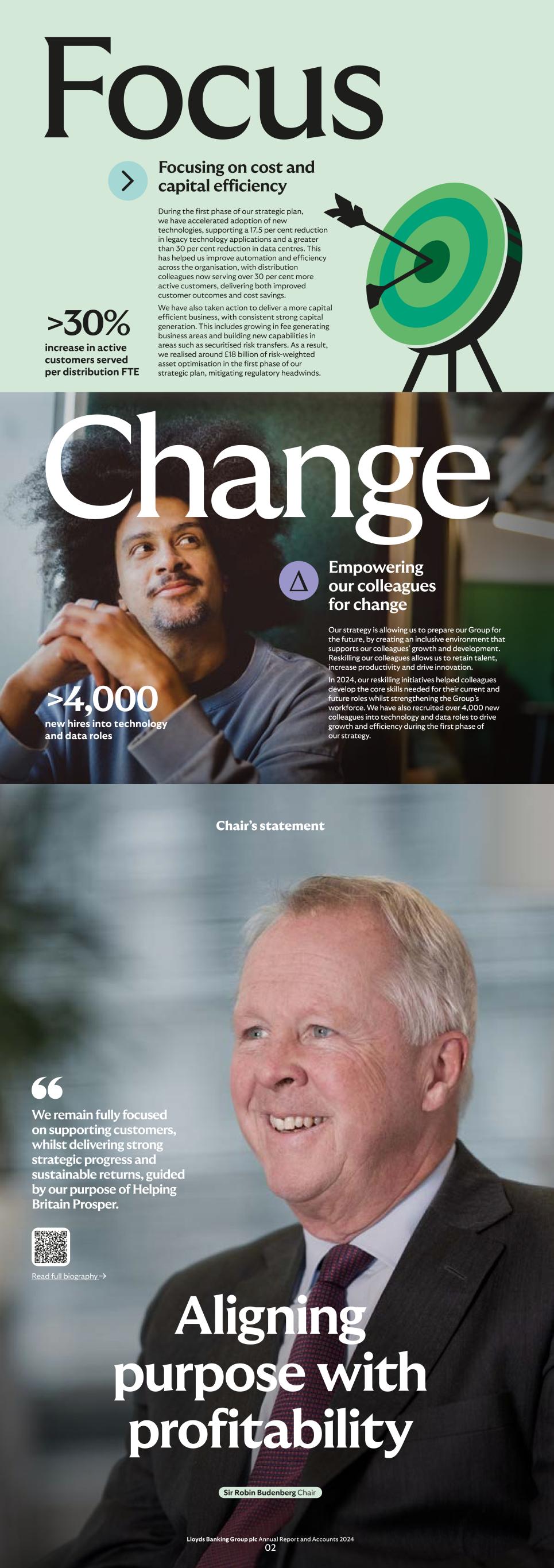
Focus >30% increase in active customers served per distribution FTE Focusing on cost and capital efficiency During the first phase of our strategic plan, we have accelerated adoption of new technologies, supporting a 17.5 per cent reduction in legacy technology applications and a greater than 30 per cent reduction in data centres. This has helped us improve automation and efficiency across the organisation, with distribution colleagues now serving over 30 per cent more active customers, delivering both improved customer outcomes and cost savings. We have also taken action to deliver a more capital efficient business, with consistent strong capital generation. This includes growing in fee generating business areas and building new capabilities in areas such as securitised risk transfers. As a result, we realised around £18 billion of risk-weighted asset optimisation in the first phase of our strategic plan, mitigating regulatory headwinds. Change >4,000 new hires into technology and data roles Empowering our colleagues for change Our strategy is allowing us to prepare our Group for the future, by creating an inclusive environment that supports our colleagues’ growth and development. Reskilling our colleagues allows us to retain talent, increase productivity and drive innovation. In 2024, our reskilling initiatives helped colleagues develop the core skills needed for their current and future roles whilst strengthening the Group’s workforce. We have also recruited over 4,000 new colleagues into technology and data roles to drive growth and efficiency during the first phase of our strategy. Chair’s statement We remain fully focused on supporting customers, whilst delivering strong strategic progress and sustainable returns, guided by our purpose of Helping Britain Prosper. Read full biography Aligning purpose with profitability Sir Robin Budenberg Chair 02 Lloyds Banking Group plc Annual Report and Accounts 2024
2024 has been another year of significant progress for Lloyds Banking Group. We have continued to invest and transform the business, delivering innovative new products and services for our customers. At the same time we navigated a complex external environment while maintaining our commitment to customers, communities and shareholders. We recognise that the recent Court of Appeal ruling regarding motor finance has created uncertainty for customers and shareholders alike. The Group continues to assess the potential impacts of this ruling and would hope to have greater clarity soon. The Group has successfully completed the first phase of our five-year purpose-driven strategy and delivered robust financial results in 2024. There have been a number of notable achievements, as identified below. Shareholder returns Attractive capital returns are critical to our shareholders. We were pleased to be able to increase the total ordinary dividend again, by 15 per cent to 3.17 pence, whilst also announcing a further share buyback of £1.7 billion. In total we have made a distribution of £3.6 billion for 2024. Purpose-driven strategy The Group has purpose at its core. Our commitment to Helping Britain Prosper enables us to meet customers’ holistic financial services needs, whilst delivering sustainable profit and growth for shareholders. These aims support each other, and our strategy balances them effectively. Having successfully completed the first phase of our strategy, I am pleased with the strategic progress being made. I am delighted to report that we have delivered £0.8 billion of additional revenues in 2024 from our strategic initiatives, surpassing our initial target of c.£0.7 billion. I am really proud of the increased pace of delivery and provision of digitally enabled services and solutions for our customers, which helps increase financial empowerment. This exciting progress spans the entire Group. Our consumer lending teams are simplifying credit score management and mortgage journeys. Our consumer relationships teams are redesigning the app experience for Lloyds customers and are preparing to launch a new brand experience for Halifax and Bank of Scotland next year. Our insurance, pension and investment colleagues are rethinking how customers engage with their future, while our business and commercial banking teams are enhancing digital servicing and origination, enabling customers to meet their needs more easily. Our corporate and institutional banking teams are providing valuable insights into customer retail network usage and leveraging our understanding of the UK economy to benefit our clients. Once again, I am hugely proud of how our colleagues helped to make a real difference in 2024. Consistent with our purpose, our actions across the Group are supporting our aim to provide strong, sustainable communities, high-quality infrastructure and regional regeneration. Providing a full range of housing options for our communities is a core priority for the Group and during 2024 we have taken a number of actions, including: • Getting more people on the housing ladder by lending more than £15 billion to first-time buyers • Expanding the availability of affordable homes by supporting more than £2 billion of new funding to the social housing sector Climate risk and the green economy are changing the way we live, work and do business. We are committed to enabling the transition to net zero by working closely with our clients. Since 2022, we provided more than £20 billion for sustainable financing in EPC A and B mortgage lending and financing for electric vehicles and plug-in hybrid vehicles for retail customers, surpassing our aggregate target for these activities of £18 billion. We enter the second phase of the strategy with momentum across the business and remain confident in achieving our 2026 strategic outcomes and financial guidance. Culture The Board and senior management have a vital role to play in shaping, role modelling and embedding a healthy corporate culture. This continued to be a focus in 2024. Our business insights help shape our focus on inclusion and commerciality. We continue to measure our progress on gender, ethnic minorities and our colleagues with disabilities. Setting out clear ambitions that enable us to measure our progress is important, both as a signal of commitment and intent, and because it provides focus and means that inclusion is approached like any other business issue. This year we are the highest-ranked bank (5th) in the FTSE 100 in the FTSE Women Leaders Review (February 2024 report) for women on Boards and in leadership. We have achieved all of the FTSE Women Leaders recommendations ahead of the 2025 deadline. Whilst we are pleased with the progress we have made, we recognise that we are not yet where we want to be and have more to do to achieve gender balance in our organisation. As we reflect on all the great work we have done to support Black heritage customers, communities and colleagues, this support hasn’t yet achieved its full potential for our colleagues. Currently 1.8 per cent of senior colleagues are of Black heritage against a goal of 3 per cent by 2025. We continue to build our understanding of how we can unlock further potential in this space. Meanwhile, we are pleased to have surpassed our ambition of having 12 per cent of senior roles filled by colleagues with disabilities ahead of time, with current representation at 16.1 per cent. Inclusion remains a focus area for our business as it’s important for us to reflect our customers and the society in which we operate especially given our scale and reach. Directors We review the Board’s composition and diversity regularly and are committed to ensuring we have the right balance of skills and experience within the Board. As announced previously, Alan Dickinson and Lord Lupton stepped down following the AGM in May 2024. In August 2024, Nathan Bostock joined the Board as a non-executive director and also became Chair of Lloyds Bank Corporate Markets plc. Nathan’s financial services experience and UK banking market knowledge are invaluable to the Group. Remuneration We know that as we deliver the next phase of our strategy it is vital that we are able to attract and retain talent and reward our colleagues appropriately. All awards are determined by the Board’s Remuneration Committee following careful consideration and aligned with market conditions, the changing regulatory framework, Group performance and the sentiment of our shareholders. You can read more about our remuneration approach on page 110. Summary We’re proud that we’ve delivered on the commitments we set out in 2022 for the first phase of our strategic plan, further strengthening our track record of consistent performance. We have continued to deliver in line with our purpose of Helping Britain Prosper and see further opportunities to contribute to sustainable economic growth. Our financial results continue to demonstrate resilience, with strong capital generation and good shareholder distributions. Looking ahead, we need to continue to change and transform the Group. Building on the strong progress to date, we are confident in our ability to achieve higher, more sustainable returns and capital generation by 2026. Sir Robin Budenberg Chair 03 Lloyds Banking Group plc Annual Report and Accounts 2024 O th e r in fo rm a tio n F in a n cia l sta te m e n ts R isk m a n a ge m e n t G o ve rn a n ce F in a n cia l re su lts S u sta in a b ility re vie w S tra te gic re p o rt Group Chief Executive’s review We have successfully delivered the first phase of our strategy, creating value for our stakeholders and enhancing the Group’s financial performance. Read full biography Delivering sustainable growth and returns Charlie Nunn Group Chief Executive 04 Lloyds Banking Group plc Annual Report and Accounts 2024
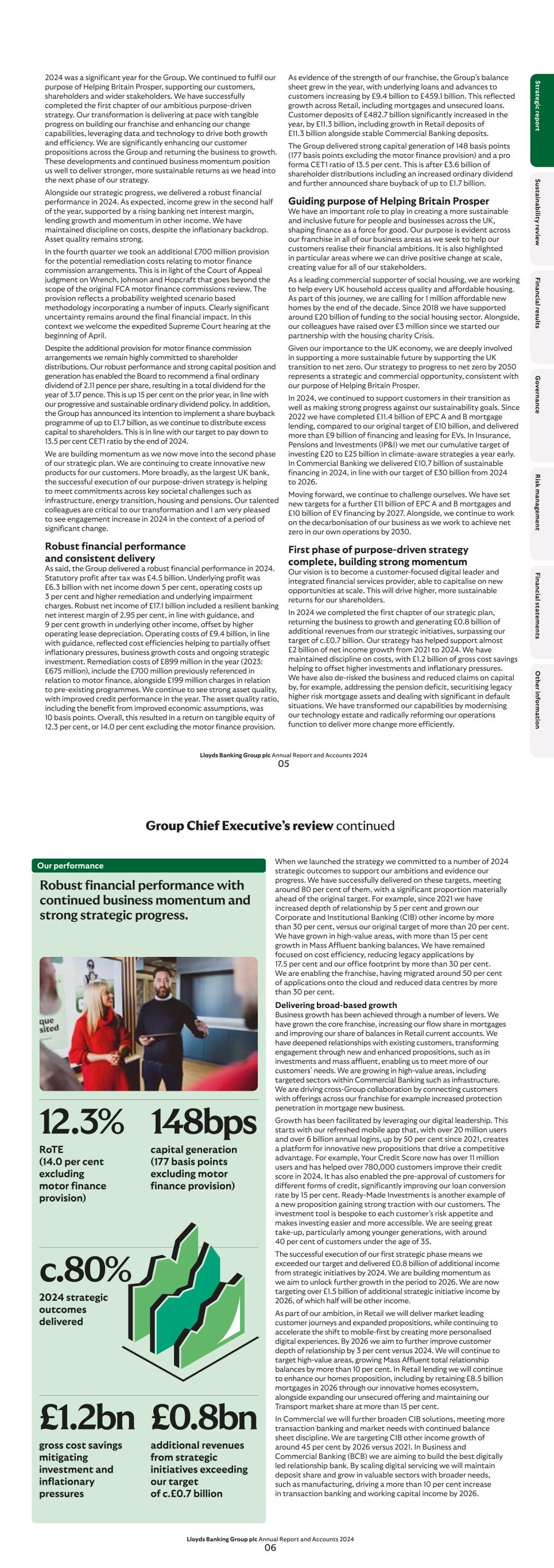
2024 was a significant year for the Group. We continued to fulfil our purpose of Helping Britain Prosper, supporting our customers, shareholders and wider stakeholders. We have successfully completed the first chapter of our ambitious purpose-driven strategy. Our transformation is delivering at pace with tangible progress on building our franchise and enhancing our change capabilities, leveraging data and technology to drive both growth and efficiency. We are significantly enhancing our customer propositions across the Group and returning the business to growth. These developments and continued business momentum position us well to deliver stronger, more sustainable returns as we head into the next phase of our strategy. Alongside our strategic progress, we delivered a robust financial performance in 2024. As expected, income grew in the second half of the year, supported by a rising banking net interest margin, lending growth and momentum in other income. We have maintained discipline on costs, despite the inflationary backdrop. Asset quality remains strong. In the fourth quarter we took an additional £700 million provision for the potential remediation costs relating to motor finance commission arrangements. This is in light of the Court of Appeal judgment on Wrench, Johnson and Hopcraft that goes beyond the scope of the original FCA motor finance commissions review. The provision reflects a probability weighted scenario based methodology incorporating a number of inputs. Clearly significant uncertainty remains around the final financial impact. In this context we welcome the expedited Supreme Court hearing at the beginning of April. Despite the additional provision for motor finance commission arrangements we remain highly committed to shareholder distributions. Our robust performance and strong capital position and generation has enabled the Board to recommend a final ordinary dividend of 2.11 pence per share, resulting in a total dividend for the year of 3.17 pence. This is up 15 per cent on the prior year, in line with our progressive and sustainable ordinary dividend policy. In addition, the Group has announced its intention to implement a share buyback programme of up to £1.7 billion, as we continue to distribute excess capital to shareholders. This is in line with our target to pay down to 13.5 per cent CET1 ratio by the end of 2024. We are building momentum as we now move into the second phase of our strategic plan. We are continuing to create innovative new products for our customers. More broadly, as the largest UK bank, the successful execution of our purpose-driven strategy is helping to meet commitments across key societal challenges such as infrastructure, energy transition, housing and pensions. Our talented colleagues are critical to our transformation and I am very pleased to see engagement increase in 2024 in the context of a period of significant change. Robust financial performance and consistent delivery As said, the Group delivered a robust financial performance in 2024. Statutory profit after tax was £4.5 billion. Underlying profit was £6.3 billion with net income down 5 per cent, operating costs up 3 per cent and higher remediation and underlying impairment charges. Robust net income of £17.1 billion included a resilient banking net interest margin of 2.95 per cent, in line with guidance, and 9 per cent growth in underlying other income, offset by higher operating lease depreciation. Operating costs of £9.4 billion, in line with guidance, reflected cost efficiencies helping to partially offset inflationary pressures, business growth costs and ongoing strategic investment. Remediation costs of £899 million in the year (2023: £675 million), include the £700 million previously referenced in relation to motor finance, alongside £199 million charges in relation to pre-existing programmes. We continue to see strong asset quality, with improved credit performance in the year. The asset quality ratio, including the benefit from improved economic assumptions, was 10 basis points. Overall, this resulted in a return on tangible equity of 12.3 per cent, or 14.0 per cent excluding the motor finance provision. As evidence of the strength of our franchise, the Group’s balance sheet grew in the year, with underlying loans and advances to customers increasing by £9.4 billion to £459.1 billion. This reflected growth across Retail, including mortgages and unsecured loans. Customer deposits of £482.7 billion significantly increased in the year, by £11.3 billion, including growth in Retail deposits of £11.3 billion alongside stable Commercial Banking deposits. The Group delivered strong capital generation of 148 basis points (177 basis points excluding the motor finance provision) and a pro forma CET1 ratio of 13.5 per cent. This is after £3.6 billion of shareholder distributions including an increased ordinary dividend and further announced share buyback of up to £1.7 billion. Guiding purpose of Helping Britain Prosper We have an important role to play in creating a more sustainable and inclusive future for people and businesses across the UK, shaping finance as a force for good. Our purpose is evident across our franchise in all of our business areas as we seek to help our customers realise their financial ambitions. It is also highlighted in particular areas where we can drive positive change at scale, creating value for all of our stakeholders. As a leading commercial supporter of social housing, we are working to help every UK household access quality and affordable housing. As part of this journey, we are calling for 1 million affordable new homes by the end of the decade. Since 2018 we have supported around £20 billion of funding to the social housing sector. Alongside, our colleagues have raised over £3 million since we started our partnership with the housing charity Crisis. Given our importance to the UK economy, we are deeply involved in supporting a more sustainable future by supporting the UK transition to net zero. Our strategy to progress to net zero by 2050 represents a strategic and commercial opportunity, consistent with our purpose of Helping Britain Prosper. In 2024, we continued to support customers in their transition as well as making strong progress against our sustainability goals. Since 2022 we have completed £11.4 billion of EPC A and B mortgage lending, compared to our original target of £10 billion, and delivered more than £9 billion of financing and leasing for EVs. In Insurance, Pensions and Investments (IP&I) we met our cumulative target of investing £20 to £25 billion in climate-aware strategies a year early. In Commercial Banking we delivered £10.7 billion of sustainable financing in 2024, in line with our target of £30 billion from 2024 to 2026. Moving forward, we continue to challenge ourselves. We have set new targets for a further £11 billion of EPC A and B mortgages and £10 billion of EV financing by 2027. Alongside, we continue to work on the decarbonisation of our business as we work to achieve net zero in our own operations by 2030. First phase of purpose-driven strategy complete, building strong momentum Our vision is to become a customer-focused digital leader and integrated financial services provider, able to capitalise on new opportunities at scale. This will drive higher, more sustainable returns for our shareholders. In 2024 we completed the first chapter of our strategic plan, returning the business to growth and generating £0.8 billion of additional revenues from our strategic initiatives, surpassing our target of c.£0.7 billion. Our strategy has helped support almost £2 billion of net income growth from 2021 to 2024. We have maintained discipline on costs, with £1.2 billion of gross cost savings helping to offset higher investments and inflationary pressures. We have also de-risked the business and reduced claims on capital by, for example, addressing the pension deficit, securitising legacy higher risk mortgage assets and dealing with significant in default situations. We have transformed our capabilities by modernising our technology estate and radically reforming our operations function to deliver more change more efficiently. 05 Lloyds Banking Group plc Annual Report and Accounts 2024 O th e r in fo rm a tio n F in a n cia l sta te m e n ts R isk m a n a ge m e n t G o ve rn a n ce F in a n cia l re su lts S u sta in a b ility re vie w S tra te gic re p o rt Group Chief Executive’s review continued Robust financial performance with continued business momentum and strong strategic progress. 12.3% RoTE (14.0 per cent excluding motor finance provision) 148bps capital generation (177 basis points excluding motor finance provision) c.80% 2024 strategic outcomes delivered £1.2bn gross cost savings mitigating investment and inflationary pressures £0.8bn additional revenues from strategic initiatives exceeding our target of c.£0.7 billion When we launched the strategy we committed to a number of 2024 strategic outcomes to support our ambitions and evidence our progress. We have successfully delivered on these targets, meeting around 80 per cent of them, with a significant proportion materially ahead of the original target. For example, since 2021 we have increased depth of relationship by 5 per cent and grown our Corporate and Institutional Banking (CIB) other income by more than 30 per cent, versus our original target of more than 20 per cent. We have grown in high-value areas, with more than 15 per cent growth in Mass Affluent banking balances. We have remained focused on cost efficiency, reducing legacy applications by 17.5 per cent and our office footprint by more than 30 per cent. We are enabling the franchise, having migrated around 50 per cent of applications onto the cloud and reduced data centres by more than 30 per cent. Delivering broad-based growth Business growth has been achieved through a number of levers. We have grown the core franchise, increasing our flow share in mortgages and improving our share of balances in Retail current accounts. We have deepened relationships with existing customers, transforming engagement through new and enhanced propositions, such as in investments and mass affluent, enabling us to meet more of our customers’ needs. We are growing in high-value areas, including targeted sectors within Commercial Banking such as infrastructure. We are driving cross-Group collaboration by connecting customers with offerings across our franchise for example increased protection penetration in mortgage new business. Growth has been facilitated by leveraging our digital leadership. This starts with our refreshed mobile app that, with over 20 million users and over 6 billion annual logins, up by 50 per cent since 2021, creates a platform for innovative new propositions that drive a competitive advantage. For example, Your Credit Score now has over 11 million users and has helped over 780,000 customers improve their credit score in 2024. It has also enabled the pre-approval of customers for different forms of credit, significantly improving our loan conversion rate by 15 per cent. Ready-Made Investments is another example of a new proposition gaining strong traction with our customers. The investment tool is bespoke to each customer’s risk appetite and makes investing easier and more accessible. We are seeing great take-up, particularly among younger generations, with around 40 per cent of customers under the age of 35. The successful execution of our first strategic phase means we exceeded our target and delivered £0.8 billion of additional income from strategic initiatives by 2024. We are building momentum as we aim to unlock further growth in the period to 2026. We are now targeting over £1.5 billion of additional strategic initiative income by 2026, of which half will be other income. As part of our ambition, in Retail we will deliver market leading customer journeys and expanded propositions, while continuing to accelerate the shift to mobile-first by creating more personalised digital experiences. By 2026 we aim to further improve customer depth of relationship by 3 per cent versus 2024. We will continue to target high-value areas, growing Mass Affluent total relationship balances by more than 10 per cent. In Retail lending we will continue to enhance our homes proposition, including by retaining £8.5 billion mortgages in 2026 through our innovative homes ecosystem, alongside expanding our unsecured offering and maintaining our Transport market share at more than 15 per cent. In Commercial we will further broaden CIB solutions, meeting more transaction banking and market needs with continued balance sheet discipline. We are targeting CIB other income growth of around 45 per cent by 2026 versus 2021. In Business and Commercial Banking (BCB) we are aiming to build the best digitally led relationship bank. By scaling digital servicing we will maintain deposit share and grow in valuable sectors with broader needs, such as manufacturing, driving a more than 10 per cent increase in transaction banking and working capital income by 2026. Our performance 06 Lloyds Banking Group plc Annual Report and Accounts 2024
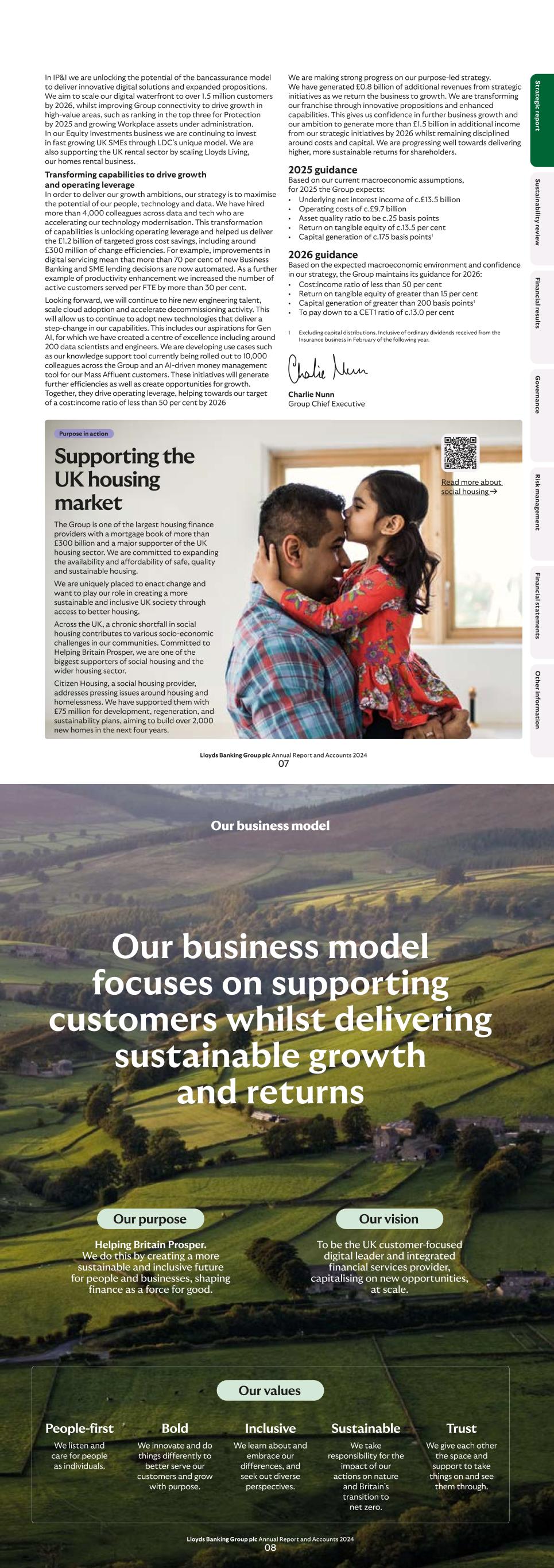
In IP&I we are unlocking the potential of the bancassurance model to deliver innovative digital solutions and expanded propositions. We aim to scale our digital waterfront to over 1.5 million customers by 2026, whilst improving Group connectivity to drive growth in high-value areas, such as ranking in the top three for Protection by 2025 and growing Workplace assets under administration. In our Equity Investments business we are continuing to invest in fast growing UK SMEs through LDC’s unique model. We are also supporting the UK rental sector by scaling Lloyds Living, our homes rental business. Transforming capabilities to drive growth and operating leverage In order to deliver our growth ambitions, our strategy is to maximise the potential of our people, technology and data. We have hired more than 4,000 colleagues across data and tech who are accelerating our technology modernisation. This transformation of capabilities is unlocking operating leverage and helped us deliver the £1.2 billion of targeted gross cost savings, including around £300 million of change efficiencies. For example, improvements in digital servicing mean that more than 70 per cent of new Business Banking and SME lending decisions are now automated. As a further example of productivity enhancement we increased the number of active customers served per FTE by more than 30 per cent. Looking forward, we will continue to hire new engineering talent, scale cloud adoption and accelerate decommissioning activity. This will allow us to continue to adopt new technologies that deliver a step-change in our capabilities. This includes our aspirations for Gen AI, for which we have created a centre of excellence including around 200 data scientists and engineers. We are developing use cases such as our knowledge support tool currently being rolled out to 10,000 colleagues across the Group and an AI-driven money management tool for our Mass Affluent customers. These initiatives will generate further efficiencies as well as create opportunities for growth. Together, they drive operating leverage, helping towards our target of a cost:income ratio of less than 50 per cent by 2026 We are making strong progress on our purpose-led strategy. We have generated £0.8 billion of additional revenues from strategic initiatives as we return the business to growth. We are transforming our franchise through innovative propositions and enhanced capabilities. This gives us confidence in further business growth and our ambition to generate more than £1.5 billion in additional income from our strategic initiatives by 2026 whilst remaining disciplined around costs and capital. We are progressing well towards delivering higher, more sustainable returns for shareholders. 2025 guidance Based on our current macroeconomic assumptions, for 2025 the Group expects: • Underlying net interest income of c.£13.5 billion • Operating costs of c.£9.7 billion • Asset quality ratio to be c.25 basis points • Return on tangible equity of c.13.5 per cent • Capital generation of c.175 basis points1 2026 guidance Based on the expected macroeconomic environment and confidence in our strategy, the Group maintains its guidance for 2026: • Cost:income ratio of less than 50 per cent • Return on tangible equity of greater than 15 per cent • Capital generation of greater than 200 basis points1 • To pay down to a CET1 ratio of c.13.0 per cent 1 Excluding capital distributions. Inclusive of ordinary dividends received from the Insurance business in February of the following year. Charlie Nunn Group Chief Executive Supporting the UK housing market The Group is one of the largest housing finance providers with a mortgage book of more than £300 billion and a major supporter of the UK housing sector. We are committed to expanding the availability and affordability of safe, quality and sustainable housing. We are uniquely placed to enact change and want to play our role in creating a more sustainable and inclusive UK society through access to better housing. Across the UK, a chronic shortfall in social housing contributes to various socio-economic challenges in our communities. Committed to Helping Britain Prosper, we are one of the biggest supporters of social housing and the wider housing sector. Citizen Housing, a social housing provider, addresses pressing issues around housing and homelessness. We have supported them with £75 million for development, regeneration, and sustainability plans, aiming to build over 2,000 new homes in the next four years. Purpose in action Read more about social housing 07 Lloyds Banking Group plc Annual Report and Accounts 2024 O th e r in fo rm a tio n F in a n cia l sta te m e n ts R isk m a n a ge m e n t G o ve rn a n ce F in a n cia l re su lts S u sta in a b ility re vie w S tra te gic re p o rt People-first We listen and care for people as individuals. Bold We innovate and do things differently to better serve our customers and grow with purpose. Inclusive We learn about and embrace our differences, and seek out diverse perspectives. Sustainable We take responsibility for the impact of our actions on nature and Britain’s transition to net zero. Trust We give each other the space and support to take things on and see them through. Our purpose Our vision Helping Britain Prosper. We do this by creating a more sustainable and inclusive future for people and businesses, shaping finance as a force for good. To be the UK customer-focused digital leader and integrated financial services provider, capitalising on new opportunities, at scale. Our business model Our business model focuses on supporting customers whilst delivering sustainable growth and returns Our values 08 Lloyds Banking Group plc Annual Report and Accounts 2024
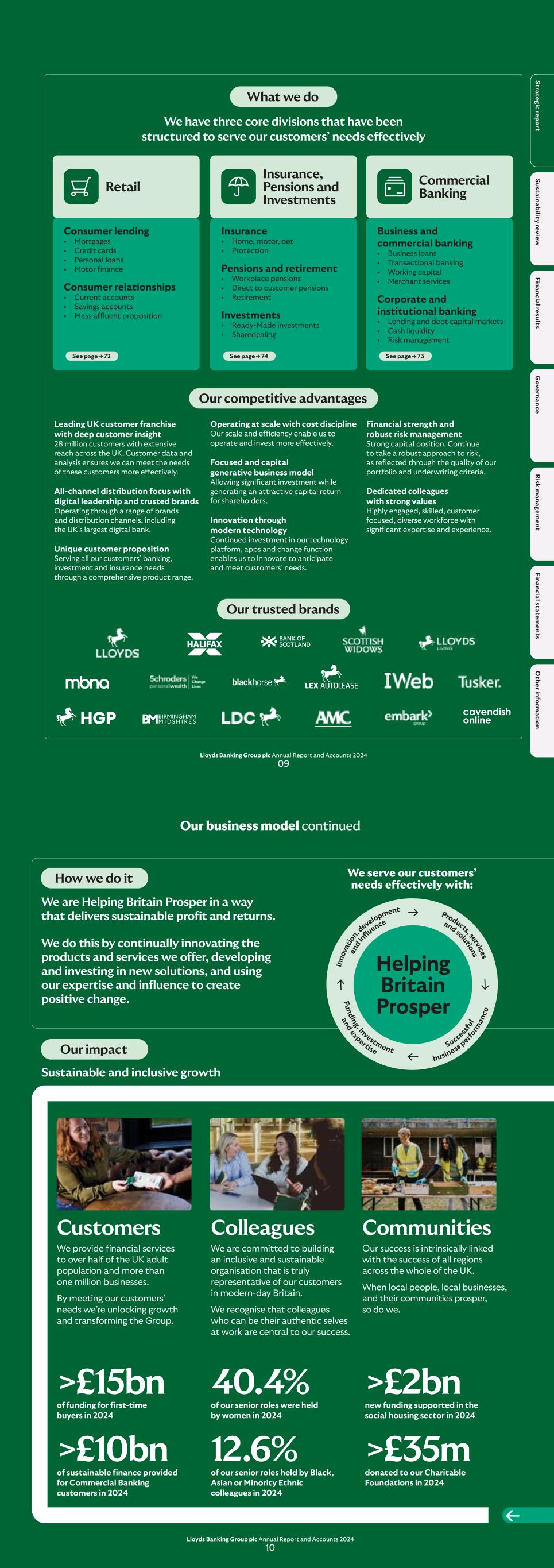
Our competitive advantages Our trusted brands What we do We have three core divisions that have been structured to serve our customers’ needs effectively Leading UK customer franchise with deep customer insight 28 million customers with extensive reach across the UK. Customer data and analysis ensures we can meet the needs of these customers more effectively. All-channel distribution focus with digital leadership and trusted brands Operating through a range of brands and distribution channels, including the UK’s largest digital bank. Unique customer proposition Serving all our customers’ banking, investment and insurance needs through a comprehensive product range. Operating at scale with cost discipline Our scale and efficiency enable us to operate and invest more effectively. Focused and capital generative business model Allowing significant investment while generating an attractive capital return for shareholders. Innovation through modern technology Continued investment in our technology platform, apps and change function enables us to innovate to anticipate and meet customers’ needs. Financial strength and robust risk management Strong capital position. Continue to take a robust approach to risk, as reflected through the quality of our portfolio and underwriting criteria. Dedicated colleagues with strong values Highly engaged, skilled, customer focused, diverse workforce with significant expertise and experience. Consumer lending • Mortgages • Credit cards • Personal loans • Motor finance Consumer relationships • Current accounts • Savings accounts • Mass affluent proposition See page 72 Retail Insurance • Home, motor, pet • Protection Pensions and retirement • Workplace pensions • Direct to customer pensions • Retirement Investments • Ready-Made investments • Sharedealing See page 74 Insurance, Pensions and Investments Business and commercial banking • Business loans • Transactional banking • Working capital • Merchant services Corporate and institutional banking • Lending and debt capital markets • Cash liquidity • Risk management See page 73 Commercial Banking O th e r in fo rm a tio n F in a n cia l sta te m e n ts R isk m a n a ge m e n t G o ve rn a n ce F in a n cia l re su lts S u sta in a b ility re vie w S tra te gic re p o rt 09 Lloyds Banking Group plc Annual Report and Accounts 2024 Customers Colleagues Communities We provide financial services to over half of the UK adult population and more than one million businesses. By meeting our customers’ needs we’re unlocking growth and transforming the Group. We are committed to building an inclusive and sustainable organisation that is truly representative of our customers in modern-day Britain. We recognise that colleagues who can be their authentic selves at work are central to our success. Our success is intrinsically linked with the success of all regions across the whole of the UK. When local people, local businesses, and their communities prosper, so do we. >£15bn of funding for first-time buyers in 2024 >£10bn of sustainable finance provided for Commercial Banking customers in 2024 40.4% of our senior roles were held by women in 2024 12.6% of our senior roles held by Black, Asian or Minority Ethnic colleagues in 2024 >£2bn new funding supported in the social housing sector in 2024 >£35m donated to our Charitable Foundations in 2024 How we do it Our impact Our business model continued We are Helping Britain Prosper in a way that delivers sustainable profit and returns. We do this by continually innovating the products and services we offer, developing and investing in new solutions, and using our expertise and influence to create positive change. Sustainable and inclusive growth We serve our customers’ needs effectively with: Helping Britain Prosper In no va ti on, d evelopment a nd in flu ence Products, services and solutions and expertise Fu n ding, investment business perf orm an ce Success fu l 10 Lloyds Banking Group plc Annual Report and Accounts 2024
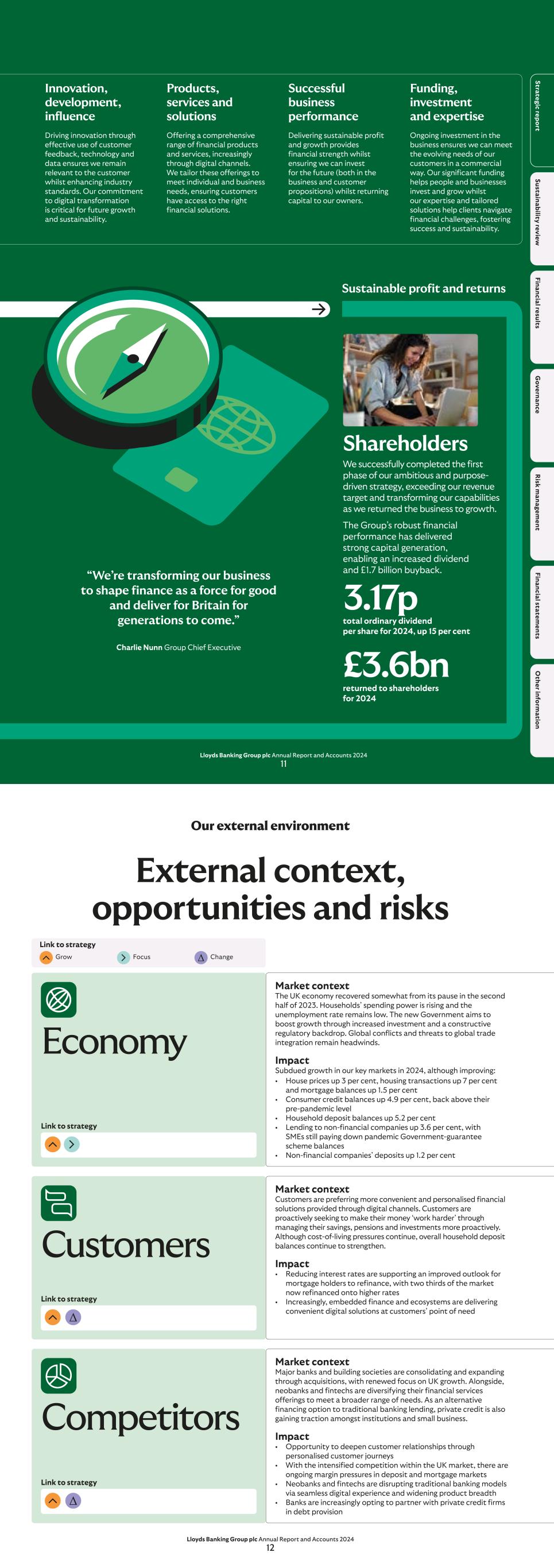
Shareholders We successfully completed the first phase of our ambitious and purpose- driven strategy, exceeding our revenue target and transforming our capabilities as we returned the business to growth. The Group’s robust financial performance has delivered strong capital generation, enabling an increased dividend and £1.7 billion buyback. 3.17p total ordinary dividend per share for 2024, up 15 per cent £3.6bn returned to shareholders for 2024 “We’re transforming our business to shape finance as a force for good and deliver for Britain for generations to come.” Charlie Nunn Group Chief Executive Sustainable profit and returns Funding, investment and expertise Driving innovation through effective use of customer feedback, technology and data ensures we remain relevant to the customer whilst enhancing industry standards. Our commitment to digital transformation is critical for future growth and sustainability. Delivering sustainable profit and growth provides financial strength whilst ensuring we can invest for the future (both in the business and customer propositions) whilst returning capital to our owners. Ongoing investment in the business ensures we can meet the evolving needs of our customers in a commercial way. Our significant funding helps people and businesses invest and grow whilst our expertise and tailored solutions help clients navigate financial challenges, fostering success and sustainability. Innovation, development, influence Successful business performance Products, services and solutions Offering a comprehensive range of financial products and services, increasingly through digital channels. We tailor these offerings to meet individual and business needs, ensuring customers have access to the right financial solutions. O th e r in fo rm a tio n F in a n cia l sta te m e n ts R isk m a n a ge m e n t G o ve rn a n ce F in a n cia l re su lts S u sta in a b ility re vie w S tra te gic re p o rt 11 Lloyds Banking Group plc Annual Report and Accounts 2024 Economy Customers Our external environment External context, opportunities and risks Market context The UK economy recovered somewhat from its pause in the second half of 2023. Households’ spending power is rising and the unemployment rate remains low. The new Government aims to boost growth through increased investment and a constructive regulatory backdrop. Global conflicts and threats to global trade integration remain headwinds. Impact Subdued growth in our key markets in 2024, although improving: • House prices up 3 per cent, housing transactions up 7 per cent and mortgage balances up 1.5 per cent • Consumer credit balances up 4.9 per cent, back above their pre-pandemic level • Household deposit balances up 5.2 per cent • Lending to non-financial companies up 3.6 per cent, with SMEs still paying down pandemic Government-guarantee scheme balances • Non-financial companies’ deposits up 1.2 per cent Market context Customers are preferring more convenient and personalised financial solutions provided through digital channels. Customers are proactively seeking to make their money ‘work harder’ through managing their savings, pensions and investments more proactively. Although cost-of-living pressures continue, overall household deposit balances continue to strengthen. Impact • Reducing interest rates are supporting an improved outlook for mortgage holders to refinance, with two thirds of the market now refinanced onto higher rates • Increasingly, embedded finance and ecosystems are delivering convenient digital solutions at customers’ point of need Market context Major banks and building societies are consolidating and expanding through acquisitions, with renewed focus on UK growth. Alongside, neobanks and fintechs are diversifying their financial services offerings to meet a broader range of needs. As an alternative financing option to traditional banking lending, private credit is also gaining traction amongst institutions and small business. Impact • Opportunity to deepen customer relationships through personalised customer journeys • With the intensified competition within the UK market, there are ongoing margin pressures in deposit and mortgage markets • Neobanks and fintechs are disrupting traditional banking models via seamless digital experience and widening product breadth • Banks are increasingly opting to partner with private credit firms in debt provision Competitors Link to strategy Grow Focus Change Link to strategy Link to strategy Link to strategy 12 Lloyds Banking Group plc Annual Report and Accounts 2024
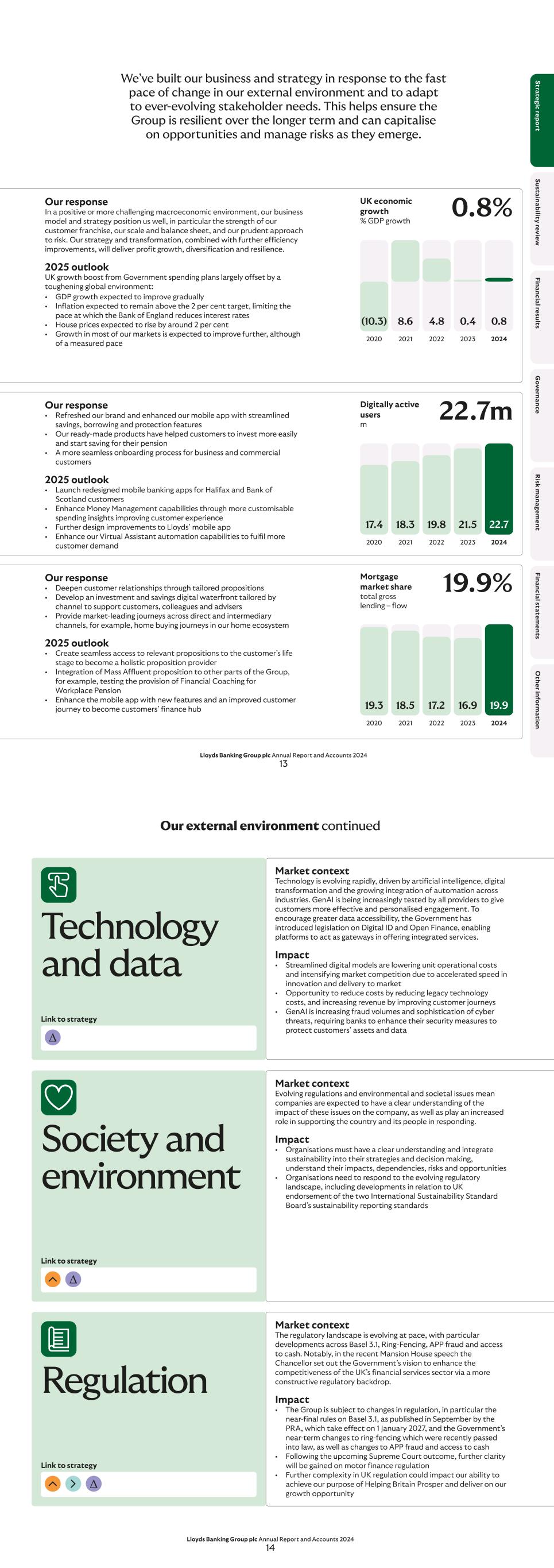
20242023202220212020 17.4 19.8 22.718.3 21.5 20242023202220212020 (10.3) 4.8 0.88.6 0.4 20242023202220212020 19.3 17.2 19.918.5 16.9 We’ve built our business and strategy in response to the fast pace of change in our external environment and to adapt to ever-evolving stakeholder needs. This helps ensure the Group is resilient over the longer term and can capitalise on opportunities and manage risks as they emerge. Our response In a positive or more challenging macroeconomic environment, our business model and strategy position us well, in particular the strength of our customer franchise, our scale and balance sheet, and our prudent approach to risk. Our strategy and transformation, combined with further efficiency improvements, will deliver profit growth, diversification and resilience. 2025 outlook UK growth boost from Government spending plans largely offset by a toughening global environment: • GDP growth expected to improve gradually • Inflation expected to remain above the 2 per cent target, limiting the pace at which the Bank of England reduces interest rates • House prices expected to rise by around 2 per cent • Growth in most of our markets is expected to improve further, although of a measured pace UK economic growth % GDP growth Digitally active users m 0.8% 22.7mOur response • Refreshed our brand and enhanced our mobile app with streamlined savings, borrowing and protection features • Our ready-made products have helped customers to invest more easily and start saving for their pension • A more seamless onboarding process for business and commercial customers 2025 outlook • Launch redesigned mobile banking apps for Halifax and Bank of Scotland customers • Enhance Money Management capabilities through more customisable spending insights improving customer experience • Further design improvements to Lloyds’ mobile app • Enhance our Virtual Assistant automation capabilities to fulfil more customer demand Our response • Deepen customer relationships through tailored propositions • Develop an investment and savings digital waterfront tailored by channel to support customers, colleagues and advisers • Provide market-leading journeys across direct and intermediary channels, for example, home buying journeys in our home ecosystem 2025 outlook • Create seamless access to relevant propositions to the customer’s life stage to become a holistic proposition provider • Integration of Mass Affluent proposition to other parts of the Group, for example, testing the provision of Financial Coaching for Workplace Pension • Enhance the mobile app with new features and an improved customer journey to become customers’ finance hub Mortgage market share total gross lending – flow 19.9% 13 Lloyds Banking Group plc Annual Report and Accounts 2024 O th e r in fo rm a tio n F in a n cia l sta te m e n ts R isk m a n a ge m e n t G o ve rn a n ce F in a n cia l re su lts S u sta in a b ility re vie w S tra te gic re p o rt Regulation Technology and data Society and environment Our external environment continued Market context Technology is evolving rapidly, driven by artificial intelligence, digital transformation and the growing integration of automation across industries. GenAI is being increasingly tested by all providers to give customers more effective and personalised engagement. To encourage greater data accessibility, the Government has introduced legislation on Digital ID and Open Finance, enabling platforms to act as gateways in offering integrated services. Impact • Streamlined digital models are lowering unit operational costs and intensifying market competition due to accelerated speed in innovation and delivery to market • Opportunity to reduce costs by reducing legacy technology costs, and increasing revenue by improving customer journeys • GenAI is increasing fraud volumes and sophistication of cyber threats, requiring banks to enhance their security measures to protect customers’ assets and data Market context The regulatory landscape is evolving at pace, with particular developments across Basel 3.1, Ring-Fencing, APP fraud and access to cash. Notably, in the recent Mansion House speech the Chancellor set out the Government’s vision to enhance the competitiveness of the UK’s financial services sector via a more constructive regulatory backdrop. Impact • The Group is subject to changes in regulation, in particular the near-final rules on Basel 3.1, as published in September by the PRA, which take effect on 1 January 2027, and the Government’s near-term changes to ring-fencing which were recently passed into law, as well as changes to APP fraud and access to cash • Following the upcoming Supreme Court outcome, further clarity will be gained on motor finance regulation • Further complexity in UK regulation could impact our ability to achieve our purpose of Helping Britain Prosper and deliver on our growth opportunity Market context Evolving regulations and environmental and societal issues mean companies are expected to have a clear understanding of the impact of these issues on the company, as well as play an increased role in supporting the country and its people in responding. Impact • Organisations must have a clear understanding and integrate sustainability into their strategies and decision making, understand their impacts, dependencies, risks and opportunities • Organisations need to respond to the evolving regulatory landscape, including developments in relation to UK endorsement of the two International Sustainability Standard Board’s sustainability reporting standards Link to strategy Link to strategy Link to strategy 14 Lloyds Banking Group plc Annual Report and Accounts 2024
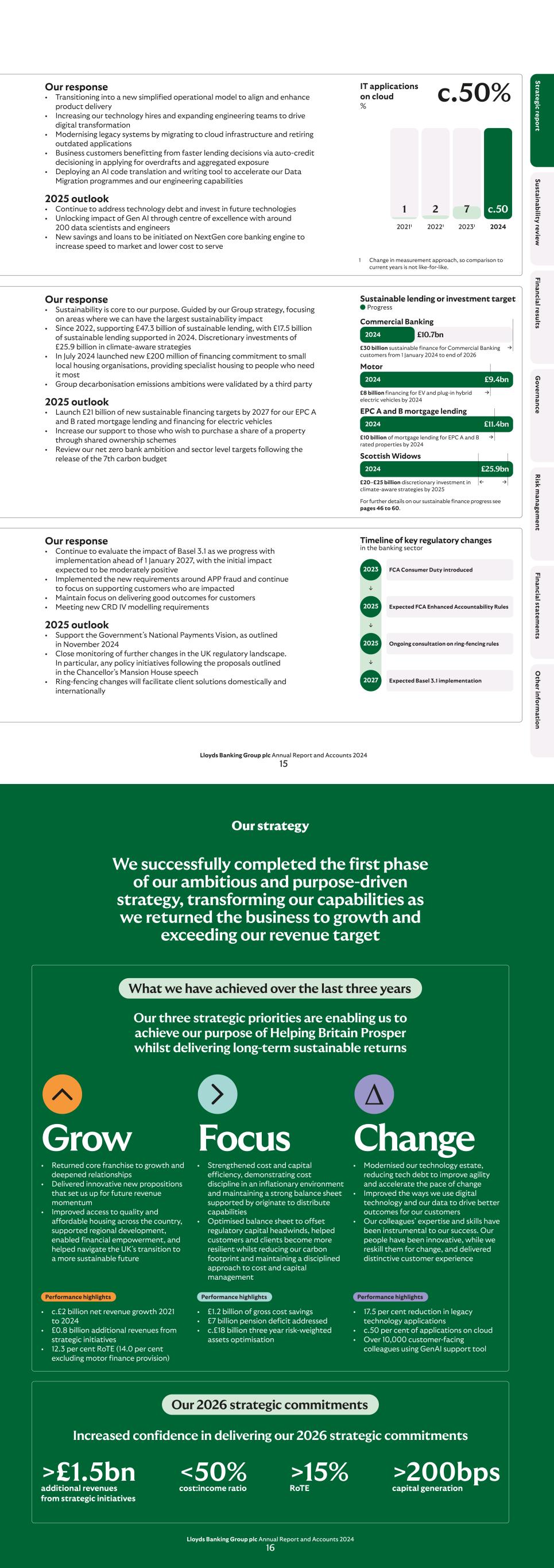
20242023120221202112020 2 c.501 7 Our response • Transitioning into a new simplified operational model to align and enhance product delivery • Increasing our technology hires and expanding engineering teams to drive digital transformation • Modernising legacy systems by migrating to cloud infrastructure and retiring outdated applications • Business customers benefitting from faster lending decisions via auto-credit decisioning in applying for overdrafts and aggregated exposure • Deploying an AI code translation and writing tool to accelerate our Data Migration programmes and our engineering capabilities 2025 outlook • Continue to address technology debt and invest in future technologies • Unlocking impact of Gen AI through centre of excellence with around 200 data scientists and engineers • New savings and loans to be initiated on NextGen core banking engine to increase speed to market and lower cost to serve Our response • Continue to evaluate the impact of Basel 3.1 as we progress with implementation ahead of 1 January 2027, with the initial impact expected to be moderately positive • Implemented the new requirements around APP fraud and continue to focus on supporting customers who are impacted • Maintain focus on delivering good outcomes for customers • Meeting new CRD IV modelling requirements 2025 outlook • Support the Government’s National Payments Vision, as outlined in November 2024 • Close monitoring of further changes in the UK regulatory landscape. In particular, any policy initiatives following the proposals outlined in the Chancellor’s Mansion House speech • Ring-fencing changes will facilitate client solutions domestically and internationally Sustainable lending or investment target For further details on our sustainable finance progress see pages 46 to 60. 1 Change in measurement approach, so comparison to current years is not like-for-like. £10.7bn 2024 Commercial Banking £30 billion sustainable finance for Commercial Banking customers from 1 January 2024 to end of 2026 2024 £9.4bn Motor £8 billion financing for EV and plug-in hybrid electric vehicles by 2024 2024 £11.4bn EPC A and B mortgage lending £10 billion of mortgage lending for EPC A and B rated properties by 2024 2024 £25.9bn Scottish Widows £20–£25 billion discretionary investment in climate-aware strategies by 2025 IT applications on cloud % c.50% Our response • Sustainability is core to our purpose. Guided by our Group strategy, focusing on areas where we can have the largest sustainability impact • Since 2022, supporting £47.3 billion of sustainable lending, with £17.5 billion of sustainable lending supported in 2024. Discretionary investments of £25.9 billion in climate-aware strategies • In July 2024 launched new £200 million of financing commitment to small local housing organisations, providing specialist housing to people who need it most • Group decarbonisation emissions ambitions were validated by a third party 2025 outlook • Launch £21 billion of new sustainable financing targets by 2027 for our EPC A and B rated mortgage lending and financing for electric vehicles • Increase our support to those who wish to purchase a share of a property through shared ownership schemes • Review our net zero bank ambition and sector level targets following the release of the 7th carbon budget Progress Timeline of key regulatory changes in the banking sector 2023 2025 2025 2027 FCA Consumer Duty introduced Expected FCA Enhanced Accountability Rules Ongoing consultation on ring-fencing rules Expected Basel 3.1 implementation 15 Lloyds Banking Group plc Annual Report and Accounts 2024 O th e r in fo rm a tio n F in a n cia l sta te m e n ts R isk m a n a ge m e n t G o ve rn a n ce F in a n cia l re su lts S u sta in a b ility re vie w S tra te gic re p o rt >£1.5bn additional revenues from strategic initiatives <50% cost:income ratio >15% RoTE >200bps capital generation Our strategy We successfully completed the first phase of our ambitious and purpose-driven strategy, transforming our capabilities as we returned the business to growth and exceeding our revenue target Grow • Returned core franchise to growth and deepened relationships • Delivered innovative new propositions that set us up for future revenue momentum • Improved access to quality and affordable housing across the country, supported regional development, enabled financial empowerment, and helped navigate the UK’s transition to a more sustainable future Performance highlights • c.£2 billion net revenue growth 2021 to 2024 • £0.8 billion additional revenues from strategic initiatives • 12.3 per cent RoTE (14.0 per cent excluding motor finance provision) Focus • Strengthened cost and capital efficiency, demonstrating cost discipline in an inflationary environment and maintaining a strong balance sheet supported by originate to distribute capabilities • Optimised balance sheet to offset regulatory capital headwinds, helped customers and clients become more resilient whilst reducing our carbon footprint and maintaining a disciplined approach to cost and capital management Performance highlights • £1.2 billion of gross cost savings • £7 billion pension deficit addressed • c.£18 billion three year risk-weighted assets optimisation Change • Modernised our technology estate, reducing tech debt to improve agility and accelerate the pace of change • Improved the ways we use digital technology and our data to drive better outcomes for our customers • Our colleagues’ expertise and skills have been instrumental to our success. Our people have been innovative, while we reskill them for change, and delivered distinctive customer experience Performance highlights • 17.5 per cent reduction in legacy technology applications • c.50 per cent of applications on cloud • Over 10,000 customer-facing colleagues using GenAI support tool Our three strategic priorities are enabling us to achieve our purpose of Helping Britain Prosper whilst delivering long-term sustainable returns Increased confidence in delivering our 2026 strategic commitments What we have achieved over the last three years Our 2026 strategic commitments 16 Lloyds Banking Group plc Annual Report and Accounts 2024
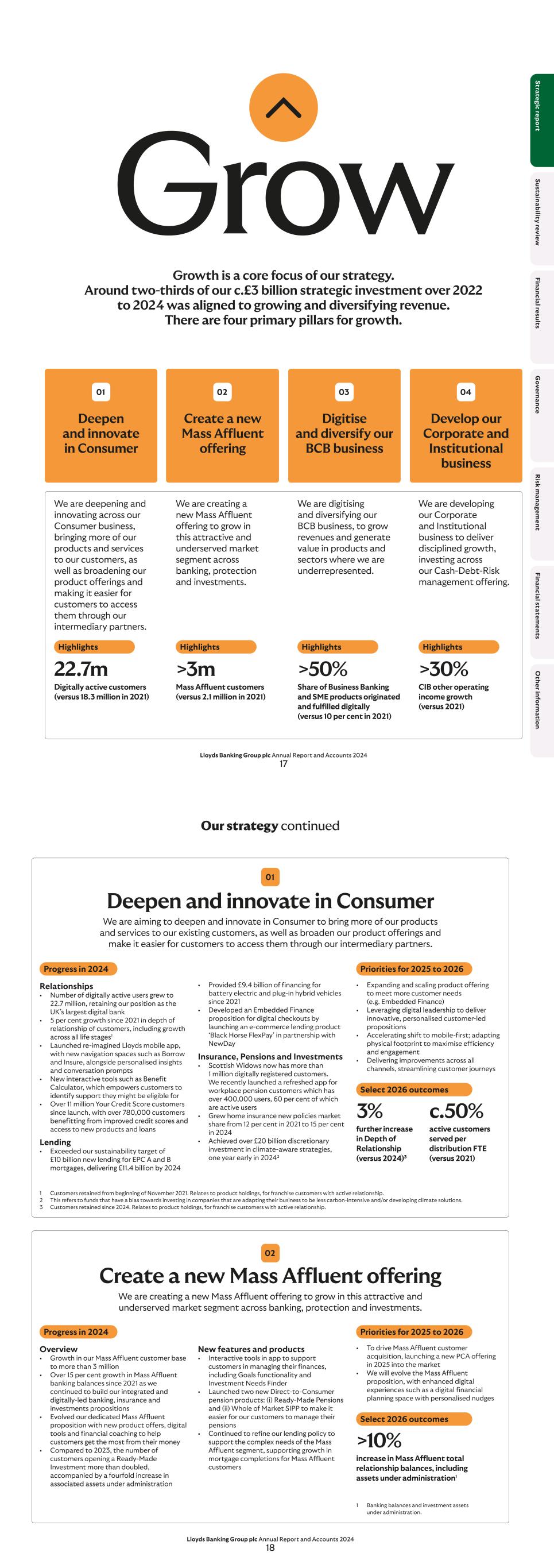
We are deepening and innovating across our Consumer business, bringing more of our products and services to our customers, as well as broadening our product offerings and making it easier for customers to access them through our intermediary partners. Highlights 22.7m Digitally active customers (versus 18.3 million in 2021) We are developing our Corporate and Institutional business to deliver disciplined growth, investing across our Cash-Debt-Risk management offering. Highlights >30% CIB other operating income growth (versus 2021) We are digitising and diversifying our BCB business, to grow revenues and generate value in products and sectors where we are underrepresented. Highlights >50% Share of Business Banking and SME products originated and fulfilled digitally (versus 10 per cent in 2021) We are creating a new Mass Affluent offering to grow in this attractive and underserved market segment across banking, protection and investments. Highlights >3m Mass Affluent customers (versus 2.1 million in 2021) Grow Deepen and innovate in Consumer Create a new Mass Affluent offering Digitise and diversify our BCB business Develop our Corporate and Institutional business Growth is a core focus of our strategy. Around two-thirds of our c.£3 billion strategic investment over 2022 to 2024 was aligned to growing and diversifying revenue. There are four primary pillars for growth. 01 02 03 04 17 Lloyds Banking Group plc Annual Report and Accounts 2024 O th e r in fo rm a tio n F in a n cia l sta te m e n ts R isk m a n a ge m e n t G o ve rn a n ce F in a n cia l re su lts S u sta in a b ility re vie w S tra te gic re p o rt Our strategy continued Create a new Mass Affluent offering We are creating a new Mass Affluent offering to grow in this attractive and underserved market segment across banking, protection and investments. Progress in 2024 Overview • Growth in our Mass Affluent customer base to more than 3 million • Over 15 per cent growth in Mass Affluent banking balances since 2021 as we continued to build our integrated and digitally-led banking, insurance and investments propositions • Evolved our dedicated Mass Affluent proposition with new product offers, digital tools and financial coaching to help customers get the most from their money • Compared to 2023, the number of customers opening a Ready-Made Investment more than doubled, accompanied by a fourfold increase in associated assets under administration New features and products • Interactive tools in app to support customers in managing their finances, including Goals functionality and Investment Needs Finder • Launched two new Direct-to-Consumer pension products: (i) Ready-Made Pensions and (ii) Whole of Market SIPP to make it easier for our customers to manage their pensions • Continued to refine our lending policy to support the complex needs of the Mass Affluent segment, supporting growth in mortgage completions for Mass Affluent customers Deepen and innovate in Consumer We are aiming to deepen and innovate in Consumer to bring more of our products and services to our existing customers, as well as broaden our product offerings and make it easier for customers to access them through our intermediary partners. Progress in 2024 Relationships • Number of digitally active users grew to 22.7 million, retaining our position as the UK’s largest digital bank • 5 per cent growth since 2021 in depth of relationship of customers, including growth across all life stages1 • Launched re-imagined Lloyds mobile app, with new navigation spaces such as Borrow and Insure, alongside personalised insights and conversation prompts • New interactive tools such as Benefit Calculator, which empowers customers to identify support they might be eligible for • Over 11 million Your Credit Score customers since launch, with over 780,000 customers benefitting from improved credit scores and access to new products and loans Lending • Exceeded our sustainability target of £10 billion new lending for EPC A and B mortgages, delivering £11.4 billion by 2024 • Provided £9.4 billion of financing for battery electric and plug-in hybrid vehicles since 2021 • Developed an Embedded Finance proposition for digital checkouts by launching an e-commerce lending product ‘Black Horse FlexPay’ in partnership with NewDay Insurance, Pensions and Investments • Scottish Widows now has more than 1 million digitally registered customers. We recently launched a refreshed app for workplace pension customers which has over 400,000 users, 60 per cent of which are active users • Grew home insurance new policies market share from 12 per cent in 2021 to 15 per cent in 2024 • Achieved over £20 billion discretionary investment in climate-aware strategies, one year early in 20242 Priorities for 2025 to 2026 • Expanding and scaling product offering to meet more customer needs (e.g. Embedded Finance) • Leveraging digital leadership to deliver innovative, personalised customer-led propositions • Accelerating shift to mobile-first; adapting physical footprint to maximise efficiency and engagement • Delivering improvements across all channels, streamlining customer journeys Select 2026 outcomes 3% further increase in Depth of Relationship (versus 2024)3 c.50% active customers served per distribution FTE (versus 2021) Priorities for 2025 to 2026 • To drive Mass Affluent customer acquisition, launching a new PCA offering in 2025 into the market • We will evolve the Mass Affluent proposition, with enhanced digital experiences such as a digital financial planning space with personalised nudges Select 2026 outcomes >10% increase in Mass Affluent total relationship balances, including assets under administration1 1 Banking balances and investment assets under administration. 01 02 1 Customers retained from beginning of November 2021. Relates to product holdings, for franchise customers with active relationship. 2 This refers to funds that have a bias towards investing in companies that are adapting their business to be less carbon-intensive and/or developing climate solutions. 3 Customers retained since 2024. Relates to product holdings, for franchise customers with active relationship. 18 Lloyds Banking Group plc Annual Report and Accounts 2024
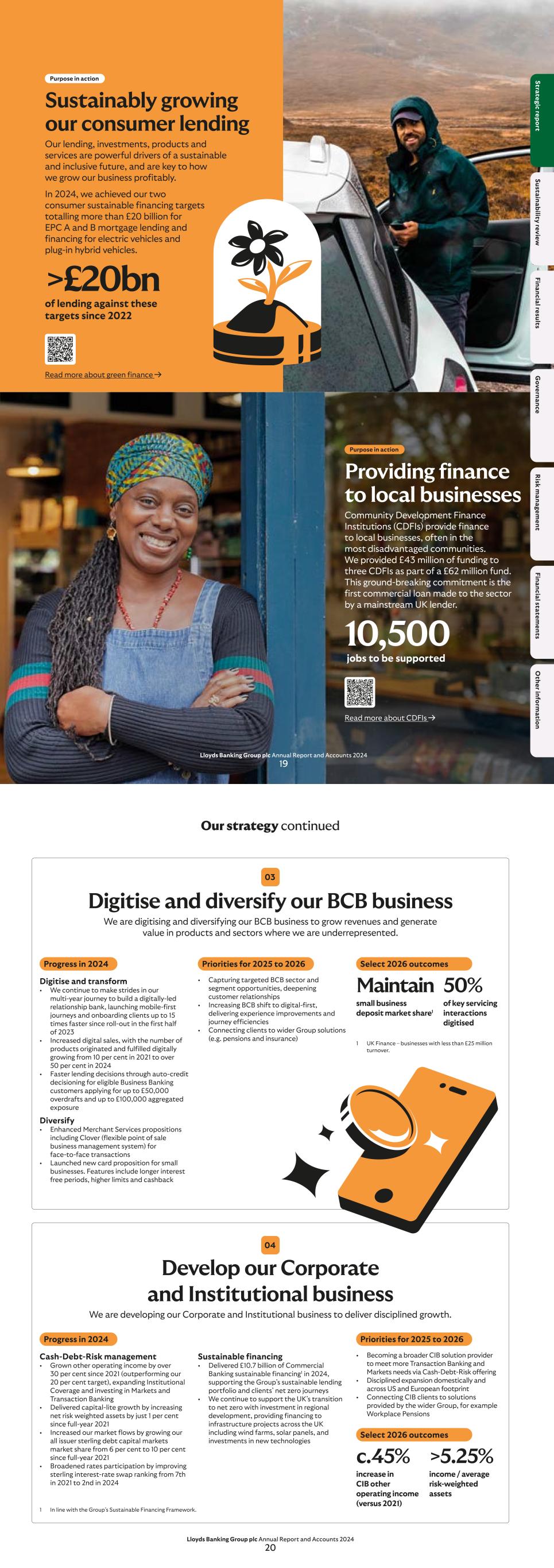
Purpose in action Purpose in action Providing finance to local businesses Community Development Finance Institutions (CDFIs) provide finance to local businesses, often in the most disadvantaged communities. We provided £43 million of funding to three CDFIs as part of a £62 million fund. This ground-breaking commitment is the first commercial loan made to the sector by a mainstream UK lender. 10,500 jobs to be supported Sustainably growing our consumer lending Our lending, investments, products and services are powerful drivers of a sustainable and inclusive future, and are key to how we grow our business profitably. In 2024, we achieved our two consumer sustainable financing targets totalling more than £20 billion for EPC A and B mortgage lending and financing for electric vehicles and plug-in hybrid vehicles. >£20bn of lending against these targets since 2022 Read more about green finance Read more about CDFIs O th e r in fo rm a tio n F in a n cia l sta te m e n ts R isk m a n a ge m e n t G o ve rn a n ce F in a n cia l re su lts S u sta in a b ility re vie w S tra te gic re p o rt 19 Lloyds Banking Group plc Annual Report and Accounts 2024 Our strategy continued Develop our Corporate and Institutional business We are developing our Corporate and Institutional business to deliver disciplined growth. Progress in 2024 Cash-Debt-Risk management • Grown other operating income by over 30 per cent since 2021 (outperforming our 20 per cent target), expanding Institutional Coverage and investing in Markets and Transaction Banking • Delivered capital-lite growth by increasing net risk weighted assets by just 1 per cent since full-year 2021 • Increased our market flows by growing our all issuer sterling debt capital markets market share from 6 per cent to 10 per cent since full-year 2021 • Broadened rates participation by improving sterling interest-rate swap ranking from 7th in 2021 to 2nd in 2024 Sustainable financing • Delivered £10.7 billion of Commercial Banking sustainable financing1 in 2024, supporting the Group’s sustainable lending portfolio and clients’ net zero journeys • We continue to support the UK’s transition to net zero with investment in regional development, providing financing to infrastructure projects across the UK including wind farms, solar panels, and investments in new technologies Digitise and diversify our BCB business We are digitising and diversifying our BCB business to grow revenues and generate value in products and sectors where we are underrepresented. 1 In line with the Group’s Sustainable Financing Framework. Progress in 2024 Digitise and transform • We continue to make strides in our multi-year journey to build a digitally-led relationship bank, launching mobile-first journeys and onboarding clients up to 15 times faster since roll-out in the first half of 2023 • Increased digital sales, with the number of products originated and fulfilled digitally growing from 10 per cent in 2021 to over 50 per cent in 2024 • Faster lending decisions through auto-credit decisioning for eligible Business Banking customers applying for up to £50,000 overdrafts and up to £100,000 aggregated exposure Diversify • Enhanced Merchant Services propositions including Clover (flexible point of sale business management system) for face-to-face transactions • Launched new card proposition for small businesses. Features include longer interest free periods, higher limits and cashback Priorities for 2025 to 2026 • Capturing targeted BCB sector and segment opportunities, deepening customer relationships • Increasing BCB shift to digital-first, delivering experience improvements and journey efficiencies • Connecting clients to wider Group solutions (e.g. pensions and insurance) Select 2026 outcomes Maintain small business deposit market share1 50% of key servicing interactions digitised 1 UK Finance – businesses with less than £25 million turnover. Priorities for 2025 to 2026 • Becoming a broader CIB solution provider to meet more Transaction Banking and Markets needs via Cash-Debt-Risk offering • Disciplined expansion domestically and across US and European footprint • Connecting CIB clients to solutions provided by the wider Group, for example Workplace Pensions Select 2026 outcomes c.45% increase in CIB other operating income (versus 2021) >5.25% income / average risk-weighted assets 03 04 20 Lloyds Banking Group plc Annual Report and Accounts 2024
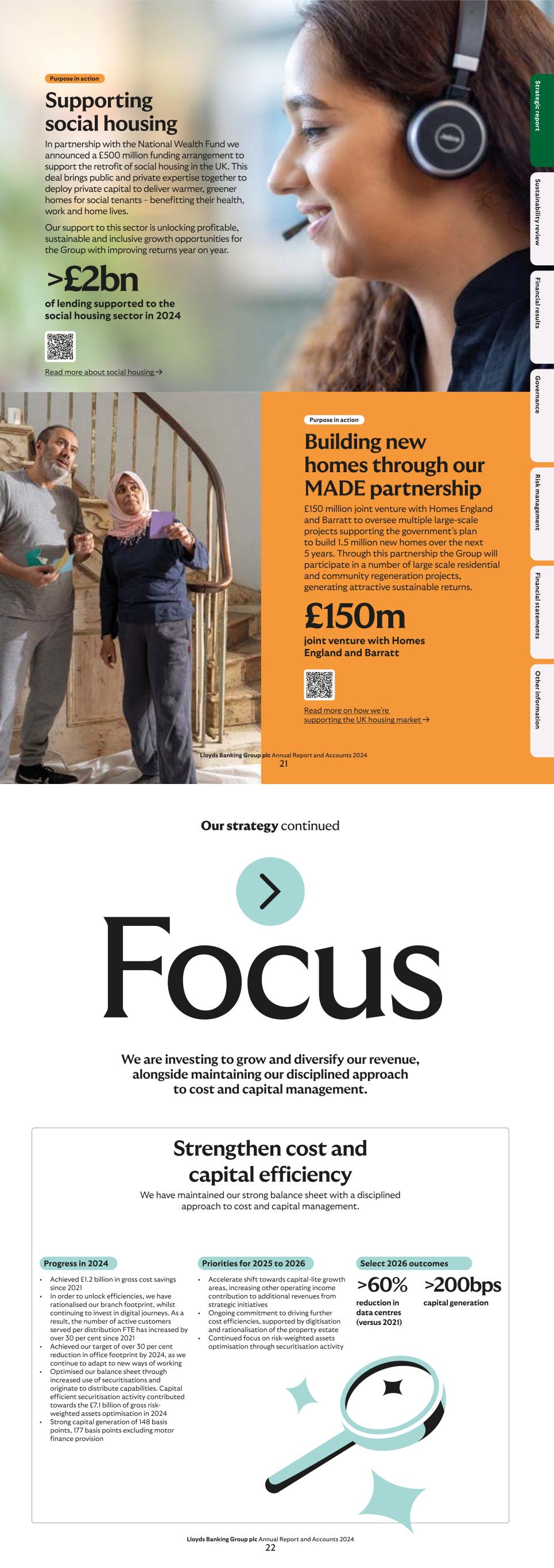
Purpose in action Supporting social housing In partnership with the National Wealth Fund we announced a £500 million funding arrangement to support the retrofit of social housing in the UK. This deal brings public and private expertise together to deploy private capital to deliver warmer, greener homes for social tenants – benefitting their health, work and home lives. Our support to this sector is unlocking profitable, sustainable and inclusive growth opportunities for the Group with improving returns year on year. >£2bn of lending supported to the social housing sector in 2024 Purpose in action Building new homes through our MADE partnership £150 million joint venture with Homes England and Barratt to oversee multiple large-scale projects supporting the government’s plan to build 1.5 million new homes over the next 5 years. Through this partnership the Group will participate in a number of large scale residential and community regeneration projects, generating attractive sustainable returns. £150m joint venture with Homes England and Barratt Read more about social housing Read more on how we’re supporting the UK housing market 21 Lloyds Banking Group plc Annual Report and Accounts 2024 O th e r in fo rm a tio n F in a n cia l sta te m e n ts R isk m a n a ge m e n t G o ve rn a n ce F in a n cia l re su lts S u sta in a b ility re vie w S tra te gic re p o rt Our strategy continued Strengthen cost and capital efficiency We have maintained our strong balance sheet with a disciplined approach to cost and capital management. We are investing to grow and diversify our revenue, alongside maintaining our disciplined approach to cost and capital management. Progress in 2024 • Achieved £1.2 billion in gross cost savings since 2021 • In order to unlock efficiencies, we have rationalised our branch footprint, whilst continuing to invest in digital journeys. As a result, the number of active customers served per distribution FTE has increased by over 30 per cent since 2021 • Achieved our target of over 30 per cent reduction in office footprint by 2024, as we continue to adapt to new ways of working • Optimised our balance sheet through increased use of securitisations and originate to distribute capabilities. Capital efficient securitisation activity contributed towards the £7.1 billion of gross risk- weighted assets optimisation in 2024 • Strong capital generation of 148 basis points, 177 basis points excluding motor finance provision Priorities for 2025 to 2026 • Accelerate shift towards capital-lite growth areas, increasing other operating income contribution to additional revenues from strategic initiatives • Ongoing commitment to driving further cost efficiencies, supported by digitisation and rationalisation of the property estate • Continued focus on risk-weighted assets optimisation through securitisation activity Select 2026 outcomes >60% reduction in data centres (versus 2021) >200bps capital generation Focus 22 Lloyds Banking Group plc Annual Report and Accounts 2024
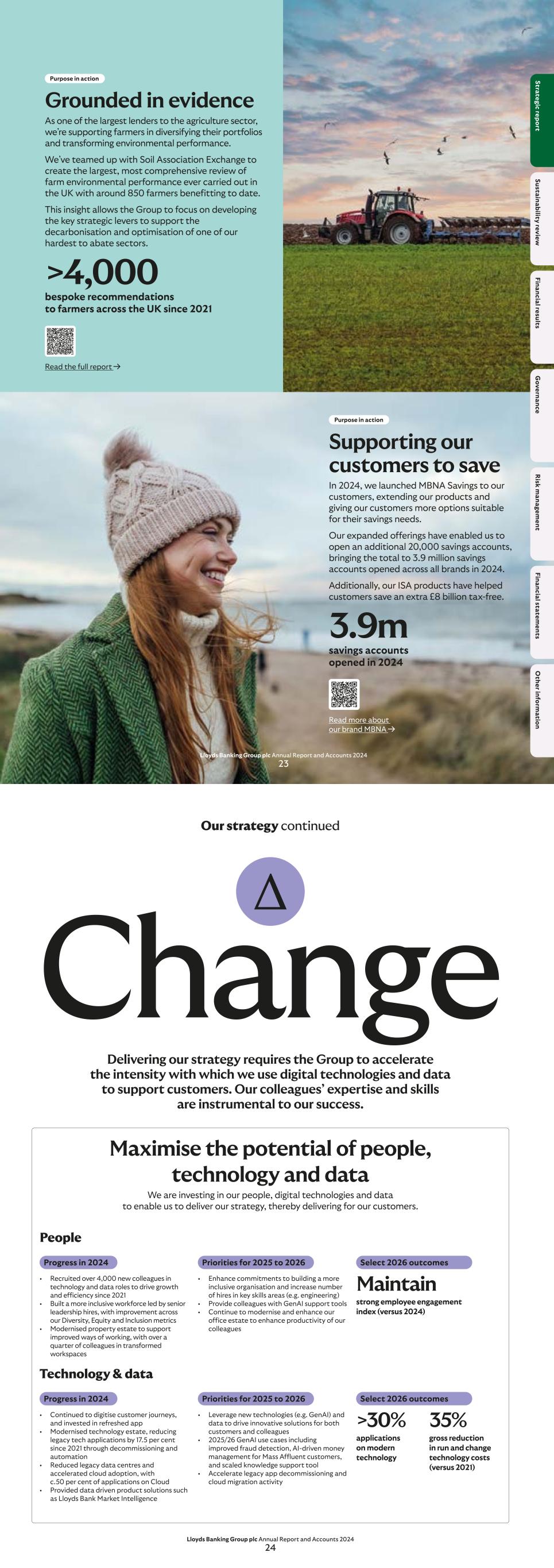
Purpose in action Grounded in evidence As one of the largest lenders to the agriculture sector, we’re supporting farmers in diversifying their portfolios and transforming environmental performance. We’ve teamed up with Soil Association Exchange to create the largest, most comprehensive review of farm environmental performance ever carried out in the UK with around 850 farmers benefitting to date. This insight allows the Group to focus on developing the key strategic levers to support the decarbonisation and optimisation of one of our hardest to abate sectors. >4,000 bespoke recommendations to farmers across the UK since 2021 Purpose in action Supporting our customers to save In 2024, we launched MBNA Savings to our customers, extending our products and giving our customers more options suitable for their savings needs. Our expanded offerings have enabled us to open an additional 20,000 savings accounts, bringing the total to 3.9 million savings accounts opened across all brands in 2024. Additionally, our ISA products have helped customers save an extra £8 billion tax-free. 3.9m savings accounts opened in 2024 Read the full report Read more about our brand MBNA O th e r in fo rm a tio n F in a n cia l sta te m e n ts R isk m a n a ge m e n t G o ve rn a n ce F in a n cia l re su lts S u sta in a b ility re vie w S tra te gic re p o rt 23 Lloyds Banking Group plc Annual Report and Accounts 2024 Maximise the potential of people, technology and data We are investing in our people, digital technologies and data to enable us to deliver our strategy, thereby delivering for our customers. Technology & data Progress in 2024 • Continued to digitise customer journeys, and invested in refreshed app • Modernised technology estate, reducing legacy tech applications by 17.5 per cent since 2021 through decommissioning and automation • Reduced legacy data centres and accelerated cloud adoption, with c.50 per cent of applications on Cloud • Provided data driven product solutions such as Lloyds Bank Market Intelligence Priorities for 2025 to 2026 • Leverage new technologies (e.g. GenAI) and data to drive innovative solutions for both customers and colleagues • 2025/26 GenAI use cases including improved fraud detection, AI-driven money management for Mass Affluent customers, and scaled knowledge support tool • Accelerate legacy app decommissioning and cloud migration activity Select 2026 outcomes >30% applications on modern technology 35% gross reduction in run and change technology costs (versus 2021) People Progress in 2024 • Recruited over 4,000 new colleagues in technology and data roles to drive growth and efficiency since 2021 • Built a more inclusive workforce led by senior leadership hires, with improvement across our Diversity, Equity and Inclusion metrics • Modernised property estate to support improved ways of working, with over a quarter of colleagues in transformed workspaces Priorities for 2025 to 2026 • Enhance commitments to building a more inclusive organisation and increase number of hires in key skills areas (e.g. engineering) • Provide colleagues with GenAI support tools • Continue to modernise and enhance our office estate to enhance productivity of our colleagues Select 2026 outcomes Maintain strong employee engagement index (versus 2024) Our strategy continued Change Delivering our strategy requires the Group to accelerate the intensity with which we use digital technologies and data to support customers. Our colleagues’ expertise and skills are instrumental to our success. 24 Lloyds Banking Group plc Annual Report and Accounts 2024
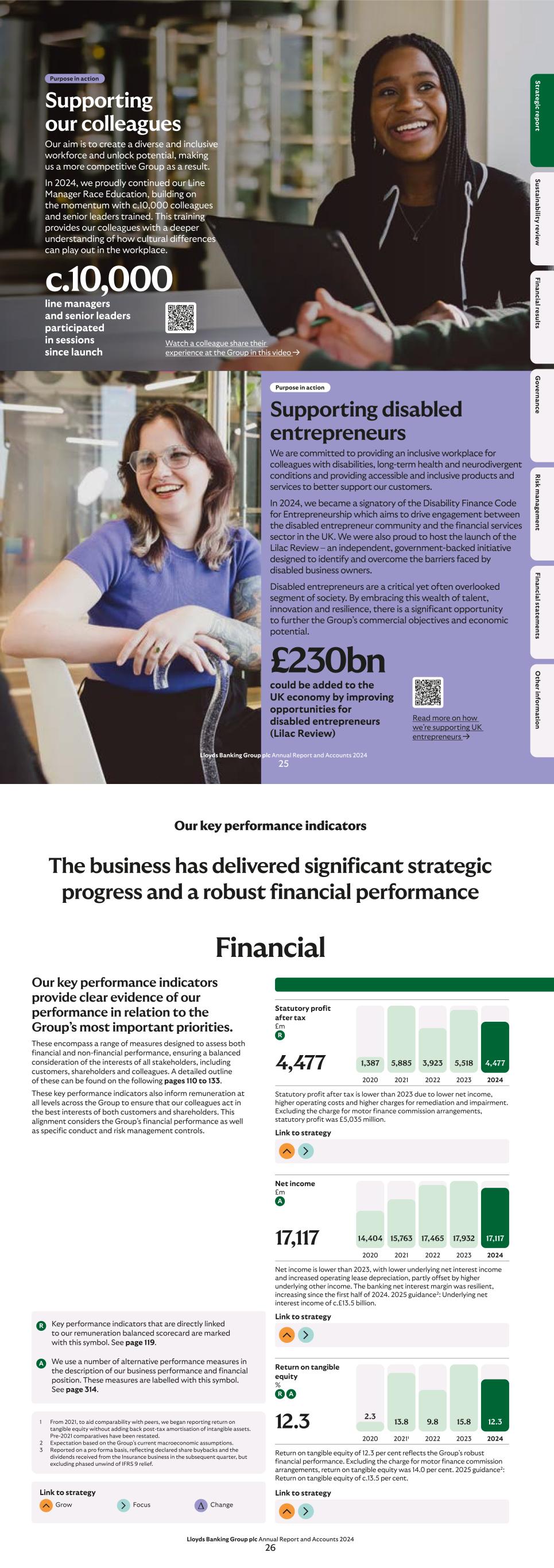
Purpose in action Supporting our colleagues Our aim is to create a diverse and inclusive workforce and unlock potential, making us a more competitive Group as a result. In 2024, we proudly continued our Line Manager Race Education, building on the momentum with c.10,000 colleagues and senior leaders trained. This training provides our colleagues with a deeper understanding of how cultural differences can play out in the workplace. c.10,000 line managers and senior leaders participated in sessions since launch Purpose in action Supporting disabled entrepreneurs We are committed to providing an inclusive workplace for colleagues with disabilities, long-term health and neurodivergent conditions and providing accessible and inclusive products and services to better support our customers. In 2024, we became a signatory of the Disability Finance Code for Entrepreneurship which aims to drive engagement between the disabled entrepreneur community and the financial services sector in the UK. We were also proud to host the launch of the Lilac Review – an independent, government-backed initiative designed to identify and overcome the barriers faced by disabled business owners. Disabled entrepreneurs are a critical yet often overlooked segment of society. By embracing this wealth of talent, innovation and resilience, there is a significant opportunity to further the Group’s commercial objectives and economic potential. £230bn could be added to the UK economy by improving opportunities for disabled entrepreneurs (Lilac Review) Read more on how we’re supporting UK entrepreneurs Watch a colleague share their experience at the Group in this video O th e r in fo rm a tio n F in a n cia l sta te m e n ts R isk m a n a ge m e n t G o ve rn a n ce F in a n cia l re su lts S u sta in a b ility re vie w S tra te gic re p o rt 25 Lloyds Banking Group plc Annual Report and Accounts 2024 20242023202220212020 1,387 3,923 4,4775,885 5,518 20242023202220212020 14,404 17,465 17,11715,763 17,932 202420232022202112020 2.3 9.8 12.313.8 15.8 Our key performance indicators The business has delivered significant strategic progress and a robust financial performance Financial Our key performance indicators provide clear evidence of our performance in relation to the Group’s most important priorities. These encompass a range of measures designed to assess both financial and non-financial performance, ensuring a balanced consideration of the interests of all stakeholders, including customers, shareholders and colleagues. A detailed outline of these can be found on the following pages 110 to 133. These key performance indicators also inform remuneration at all levels across the Group to ensure that our colleagues act in the best interests of both customers and shareholders. This alignment considers the Group’s financial performance as well as specific conduct and risk management controls. 1 From 2021, to aid comparability with peers, we began reporting return on tangible equity without adding back post-tax amortisation of intangible assets. Pre-2021 comparatives have been restated. 2 Expectation based on the Group’s current macroeconomic assumptions. 3 Reported on a pro forma basis, reflecting declared share buybacks and the dividends received from the Insurance business in the subsequent quarter, but excluding phased unwind of IFRS 9 relief. Key performance indicators that are directly linked to our remuneration balanced scorecard are marked with this symbol. See page 119. We use a number of alternative performance measures in the description of our business performance and financial position. These measures are labelled with this symbol. See page 314. Statutory profit after tax £m 4,477 Statutory profit after tax is lower than 2023 due to lower net income, higher operating costs and higher charges for remediation and impairment. Excluding the charge for motor finance commission arrangements, statutory profit was £5,035 million. Net income £m 17,117 Net income is lower than 2023, with lower underlying net interest income and increased operating lease depreciation, partly offset by higher underlying other income. The banking net interest margin was resilient, increasing since the first half of 2024. 2025 guidance2: Underlying net interest income of c.£13.5 billion. Return on tangible equity % 12.3 Return on tangible equity of 12.3 per cent reflects the Group’s robust financial performance. Excluding the charge for motor finance commission arrangements, return on tangible equity was 14.0 per cent. 2025 guidance2: Return on tangible equity of c.13.5 per cent. Link to strategy Grow Focus Change Link to strategy Link to strategy Link to strategy 26 Lloyds Banking Group plc Annual Report and Accounts 2024
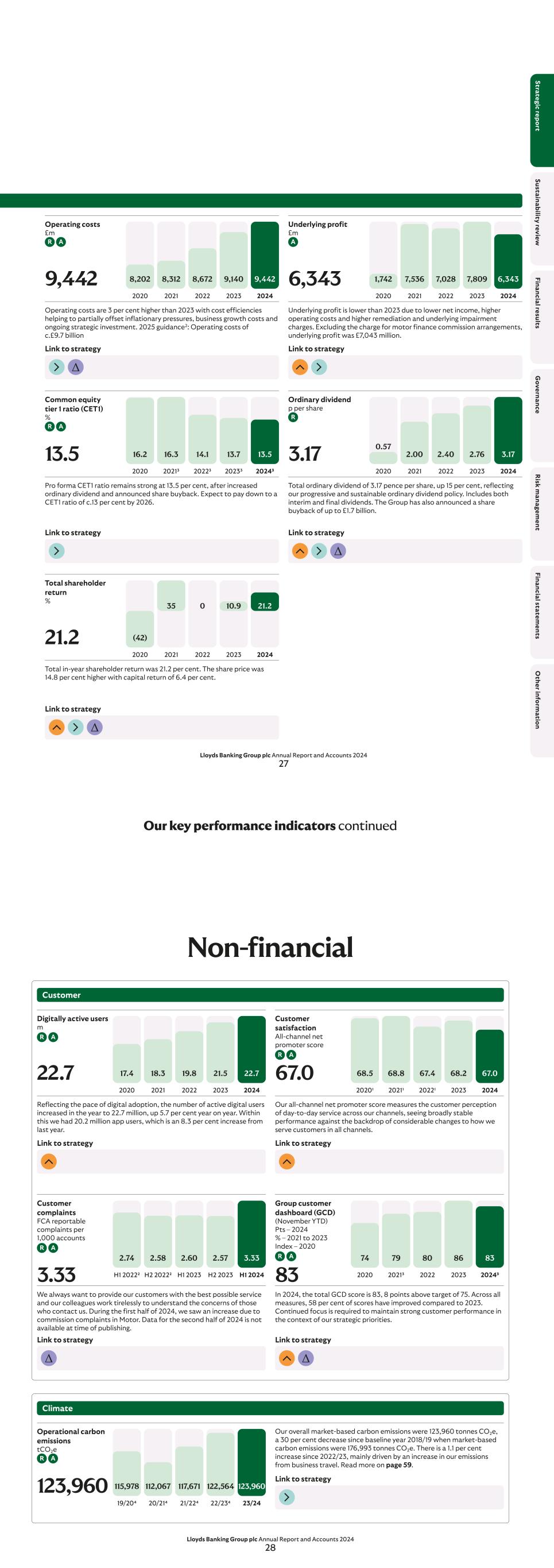
20242023202220212020 1,742 7,028 6,3437,536 7,809 20242023202220212020 8,202 8,672 9,4428,312 9,140 202432023320223202132020 16.2 14.1 13.516.3 13.7 20242023202220212020 0.57 2.40 3.172.00 2.76 20242023202220212020 (42) 0 21.235 10.9 Operating costs £m 9,442 Operating costs are 3 per cent higher than 2023 with cost efficiencies helping to partially offset inflationary pressures, business growth costs and ongoing strategic investment. 2025 guidance2: Operating costs of c.£9.7 billion Common equity tier 1 ratio (CET1) % 13.5 Pro forma CET1 ratio remains strong at 13.5 per cent, after increased ordinary dividend and announced share buyback. Expect to pay down to a CET1 ratio of c.13 per cent by 2026. Ordinary dividend p per share 3.17 Total ordinary dividend of 3.17 pence per share, up 15 per cent, reflecting our progressive and sustainable ordinary dividend policy. Includes both interim and final dividends. The Group has also announced a share buyback of up to £1.7 billion. Total shareholder return % 21.2 Total in-year shareholder return was 21.2 per cent. The share price was 14.8 per cent higher with capital return of 6.4 per cent. Underlying profit £m 6,343 Underlying profit is lower than 2023 due to lower net income, higher operating costs and higher remediation and underlying impairment charges. Excluding the charge for motor finance commission arrangements, underlying profit was £7,043 million. Link to strategy Link to strategy Link to strategy Link to strategy Link to strategy 27 Lloyds Banking Group plc Annual Report and Accounts 2024 O th e r in fo rm a tio n F in a n cia l sta te m e n ts R isk m a n a ge m e n t G o ve rn a n ce F in a n cia l re su lts S u sta in a b ility re vie w S tra te gic re p o rt 20242023202220212020 17.4 19.8 22.718.3 21.5 H1 2024H2 2023H1 2023H2 20222H1 20222 2.74 2.60 3.332.58 2.57 20242023202212021120201 68.5 67.4 67.068.8 68.2 2024320232022202132020 74 80 8379 86 23/2422/23421/22420/21419/204 115,978 117,671 123,960112,067 122,564 Our key performance indicators continued Non-financial Digitally active users m 22.7 Reflecting the pace of digital adoption, the number of active digital users increased in the year to 22.7 million, up 5.7 per cent year on year. Within this we had 20.2 million app users, which is an 8.3 per cent increase from last year. Operational carbon emissions tCO2e 123,960 Our overall market-based carbon emissions were 123,960 tonnes CO2e, a 30 per cent decrease since baseline year 2018/19 when market-based carbon emissions were 176,993 tonnes CO2e. There is a 1.1 per cent increase since 2022/23, mainly driven by an increase in our emissions from business travel. Read more on page 59. Customer complaints FCA reportable complaints per 1,000 accounts 3.33 We always want to provide our customers with the best possible service and our colleagues work tirelessly to understand the concerns of those who contact us. During the first half of 2024, we saw an increase due to commission complaints in Motor. Data for the second half of 2024 is not available at time of publishing. Customer satisfaction All-channel net promoter score 67.0 Our all-channel net promoter score measures the customer perception of day-to-day service across our channels, seeing broadly stable performance against the backdrop of considerable changes to how we serve customers in all channels. Group customer dashboard (GCD) (November YTD) Pts – 2024 % – 2021 to 2023 Index – 2020 83 In 2024, the total GCD score is 83, 8 points above target of 75. Across all measures, 58 per cent of scores have improved compared to 2023. Continued focus is required to maintain strong customer performance in the context of our strategic priorities. Customer Climate Link to strategy Link to strategy Link to strategy Link to strategy Link to strategy 28 Lloyds Banking Group plc Annual Report and Accounts 2024
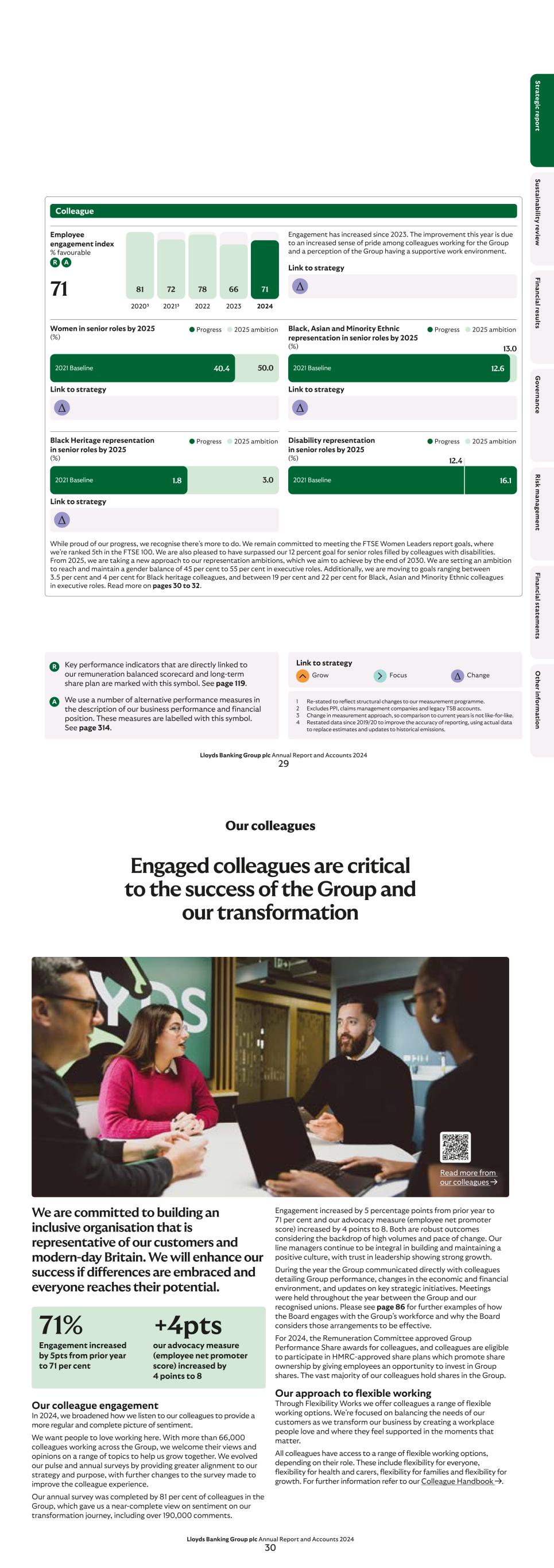
2024202320222021320203 81 78 7172 66 40.4 50.02021 Baseline 12.6 13.0 2021 Baseline 16.1 12.4 2021 Baseline1.8 3.02021 Baseline Employee engagement index % favourable 71 Engagement has increased since 2023. The improvement this year is due to an increased sense of pride among colleagues working for the Group and a perception of the Group having a supportive work environment. While proud of our progress, we recognise there’s more to do. We remain committed to meeting the FTSE Women Leaders report goals, where we’re ranked 5th in the FTSE 100. We are also pleased to have surpassed our 12 percent goal for senior roles filled by colleagues with disabilities. From 2025, we are taking a new approach to our representation ambitions, which we aim to achieve by the end of 2030. We are setting an ambition to reach and maintain a gender balance of 45 per cent to 55 per cent in executive roles. Additionally, we are moving to goals ranging between 3.5 per cent and 4 per cent for Black heritage colleagues, and between 19 per cent and 22 per cent for Black, Asian and Minority Ethnic colleagues in executive roles. Read more on pages 30 to 32. Women in senior roles by 2025 (%) Black Heritage representation in senior roles by 2025 (%) Black, Asian and Minority Ethnic representation in senior roles by 2025 (%) Disability representation in senior roles by 2025 (%) Progress 2025 ambition Progress 2025 ambition Progress 2025 ambition Progress 2025 ambition 1 Re-stated to reflect structural changes to our measurement programme. 2 Excludes PPI, claims management companies and legacy TSB accounts. 3 Change in measurement approach, so comparison to current years is not like-for-like. 4 Restated data since 2019/20 to improve the accuracy of reporting, using actual data to replace estimates and updates to historical emissions. Key performance indicators that are directly linked to our remuneration balanced scorecard and long-term share plan are marked with this symbol. See page 119. We use a number of alternative performance measures in the description of our business performance and financial position. These measures are labelled with this symbol. See page 314. Colleague Link to strategy Link to strategy Link to strategy Link to strategy Link to strategy Grow Focus Change 29 Lloyds Banking Group plc Annual Report and Accounts 2024 O th e r in fo rm a tio n F in a n cia l sta te m e n ts R isk m a n a ge m e n t G o ve rn a n ce F in a n cia l re su lts S u sta in a b ility re vie w S tra te gic re p o rt Our colleagues We are committed to building an inclusive organisation that is representative of our customers and modern-day Britain. We will enhance our success if differences are embraced and everyone reaches their potential. Engagement increased by 5 percentage points from prior year to 71 per cent and our advocacy measure (employee net promoter score) increased by 4 points to 8. Both are robust outcomes considering the backdrop of high volumes and pace of change. Our line managers continue to be integral in building and maintaining a positive culture, with trust in leadership showing strong growth. During the year the Group communicated directly with colleagues detailing Group performance, changes in the economic and financial environment, and updates on key strategic initiatives. Meetings were held throughout the year between the Group and our recognised unions. Please see page 86 for further examples of how the Board engages with the Group’s workforce and why the Board considers those arrangements to be effective. For 2024, the Remuneration Committee approved Group Performance Share awards for colleagues, and colleagues are eligible to participate in HMRC-approved share plans which promote share ownership by giving employees an opportunity to invest in Group shares. The vast majority of our colleagues hold shares in the Group. Our approach to flexible working Through Flexibility Works we offer colleagues a range of flexible working options. We’re focused on balancing the needs of our customers as we transform our business by creating a workplace people love and where they feel supported in the moments that matter. All colleagues have access to a range of flexible working options, depending on their role. These include flexibility for everyone, flexibility for health and carers, flexibility for families and flexibility for growth. For further information refer to our Colleague Handbook . 71% Engagement increased by 5pts from prior year to 71 per cent +4pts our advocacy measure (employee net promoter score) increased by 4 points to 8 Engaged colleagues are critical to the success of the Group and our transformation Our colleague engagement In 2024, we broadened how we listen to our colleagues to provide a more regular and complete picture of sentiment. We want people to love working here. With more than 66,000 colleagues working across the Group, we welcome their views and opinions on a range of topics to help us grow together. We evolved our pulse and annual surveys by providing greater alignment to our strategy and purpose, with further changes to the survey made to improve the colleague experience. Our annual survey was completed by 81 per cent of colleagues in the Group, which gave us a near-complete view on sentiment on our transformation journey, including over 190,000 comments. Read more from our colleagues 30 Lloyds Banking Group plc Annual Report and Accounts 2024
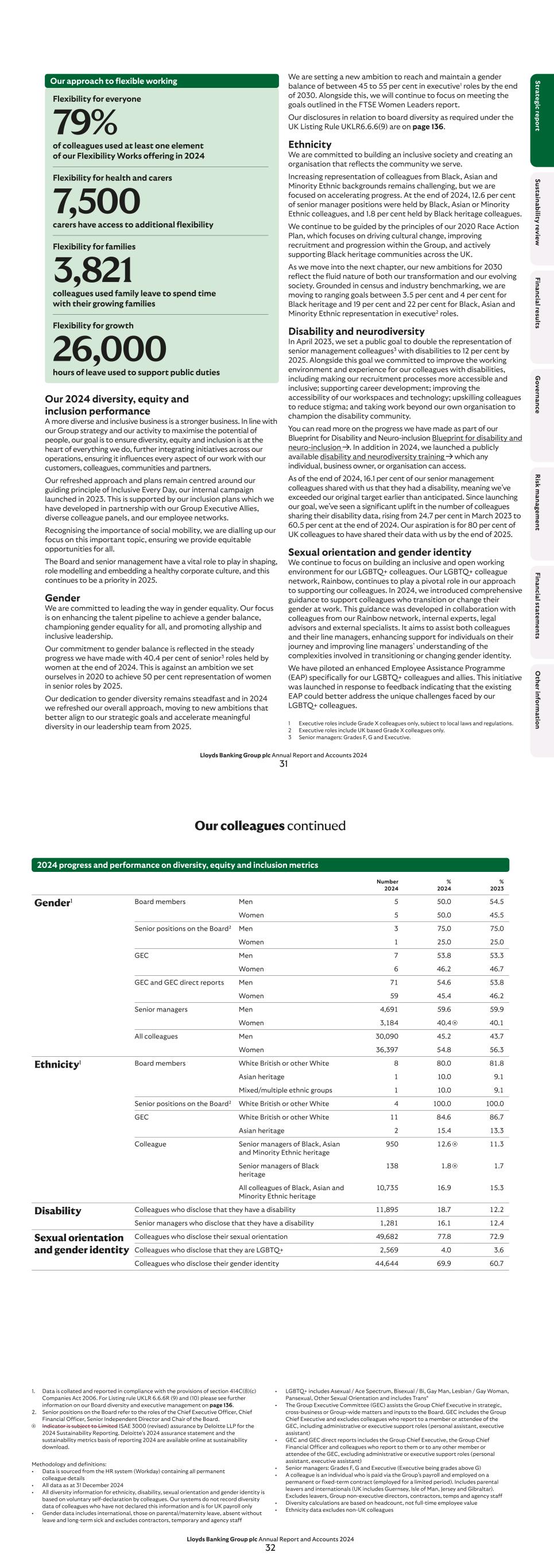
We are setting a new ambition to reach and maintain a gender balance of between 45 to 55 per cent in executive1 roles by the end of 2030. Alongside this, we will continue to focus on meeting the goals outlined in the FTSE Women Leaders report. Our disclosures in relation to board diversity as required under the UK Listing Rule UKLR6.6.6(9) are on page 136. Ethnicity We are committed to building an inclusive society and creating an organisation that reflects the community we serve. Increasing representation of colleagues from Black, Asian and Minority Ethnic backgrounds remains challenging, but we are focused on accelerating progress. At the end of 2024, 12.6 per cent of senior manager positions were held by Black, Asian or Minority Ethnic colleagues, and 1.8 per cent held by Black heritage colleagues. We continue to be guided by the principles of our 2020 Race Action Plan, which focuses on driving cultural change, improving recruitment and progression within the Group, and actively supporting Black heritage communities across the UK. As we move into the next chapter, our new ambitions for 2030 reflect the fluid nature of both our transformation and our evolving society. Grounded in census and industry benchmarking, we are moving to ranging goals between 3.5 per cent and 4 per cent for Black heritage and 19 per cent and 22 per cent for Black, Asian and Minority Ethnic representation in executive2 roles. Disability and neurodiversity In April 2023, we set a public goal to double the representation of senior management colleagues3 with disabilities to 12 per cent by 2025. Alongside this goal we committed to improve the working environment and experience for our colleagues with disabilities, including making our recruitment processes more accessible and inclusive; supporting career development; improving the accessibility of our workspaces and technology; upskilling colleagues to reduce stigma; and taking work beyond our own organisation to champion the disability community. You can read more on the progress we have made as part of our Blueprint for Disability and Neuro-inclusion Blueprint for disability and neuro-inclusion . In addition in 2024, we launched a publicly available disability and neurodiversity training which any individual, business owner, or organisation can access. As of the end of 2024, 16.1 per cent of our senior management colleagues shared with us that they had a disability, meaning we’ve exceeded our original target earlier than anticipated. Since launching our goal, we’ve seen a significant uplift in the number of colleagues sharing their disability data, rising from 24.7 per cent in March 2023 to 60.5 per cent at the end of 2024. Our aspiration is for 80 per cent of UK colleagues to have shared their data with us by the end of 2025. Sexual orientation and gender identity We continue to focus on building an inclusive and open working environment for our LGBTQ+ colleagues. Our LGBTQ+ colleague network, Rainbow, continues to play a pivotal role in our approach to supporting our colleagues. In 2024, we introduced comprehensive guidance to support colleagues who transition or change their gender at work. This guidance was developed in collaboration with colleagues from our Rainbow network, internal experts, legal advisors and external specialists. It aims to assist both colleagues and their line managers, enhancing support for individuals on their journey and improving line managers’ understanding of the complexities involved in transitioning or changing gender identity. We have piloted an enhanced Employee Assistance Programme (EAP) specifically for our LGBTQ+ colleagues and allies. This initiative was launched in response to feedback indicating that the existing EAP could better address the unique challenges faced by our LGBTQ+ colleagues. Our 2024 diversity, equity and inclusion performance A more diverse and inclusive business is a stronger business. In line with our Group strategy and our activity to maximise the potential of people, our goal is to ensure diversity, equity and inclusion is at the heart of everything we do, further integrating initiatives across our operations, ensuring it influences every aspect of our work with our customers, colleagues, communities and partners. Our refreshed approach and plans remain centred around our guiding principle of Inclusive Every Day, our internal campaign launched in 2023. This is supported by our inclusion plans which we have developed in partnership with our Group Executive Allies, diverse colleague panels, and our employee networks. Recognising the importance of social mobility, we are dialling up our focus on this important topic, ensuring we provide equitable opportunities for all. The Board and senior management have a vital role to play in shaping, role modelling and embedding a healthy corporate culture, and this continues to be a priority in 2025. Gender We are committed to leading the way in gender equality. Our focus is on enhancing the talent pipeline to achieve a gender balance, championing gender equality for all, and promoting allyship and inclusive leadership. Our commitment to gender balance is reflected in the steady progress we have made with 40.4 per cent of senior3 roles held by women at the end of 2024. This is against an ambition we set ourselves in 2020 to achieve 50 per cent representation of women in senior roles by 2025. Our dedication to gender diversity remains steadfast and in 2024 we refreshed our overall approach, moving to new ambitions that better align to our strategic goals and accelerate meaningful diversity in our leadership team from 2025. Flexibility for everyone 79% of colleagues used at least one element of our Flexibility Works offering in 2024 Flexibility for health and carers 7,500 carers have access to additional flexibility Flexibility for families 3,821 colleagues used family leave to spend time with their growing families Flexibility for growth 26,000 hours of leave used to support public duties Our approach to flexible working 1 Executive roles include Grade X colleagues only, subject to local laws and regulations. 2 Executive roles include UK based Grade X colleagues only. 3 Senior managers: Grades F, G and Executive. 31 Lloyds Banking Group plc Annual Report and Accounts 2024 O th e r in fo rm a tio n F in a n cia l sta te m e n ts R isk m a n a ge m e n t G o ve rn a n ce F in a n cia l re su lts S u sta in a b ility re vie w S tra te gic re p o rt Number 2024 % 2024 % 2023 Gender1 Board members Men 5 50.0 54.5 Women 5 50.0 45.5 Senior positions on the Board2 Men 3 75.0 75.0 Women 1 25.0 25.0 GEC Men 7 53.8 53.3 Women 6 46.2 46.7 GEC and GEC direct reports Men 71 54.6 53.8 Women 59 45.4 46.2 Senior managers Men 4,691 59.6 59.9 Women 3,184 40.4 40.1 All colleagues Men 30,090 45.2 43.7 Women 36,397 54.8 56.3 Ethnicity1 Board members White British or other White 8 80.0 81.8 Asian heritage 1 10.0 9.1 Mixed/multiple ethnic groups 1 10.0 9.1 Senior positions on the Board2 White British or other White 4 100.0 100.0 GEC White British or other White 11 84.6 86.7 Asian heritage 2 15.4 13.3 Colleague Senior managers of Black, Asian and Minority Ethnic heritage 950 12.6 11.3 Senior managers of Black heritage 138 1.8 1.7 All colleagues of Black, Asian and Minority Ethnic heritage 10,735 16.9 15.3 Disability Colleagues who disclose that they have a disability 11,895 18.7 12.2 Senior managers who disclose that they have a disability 1,281 16.1 12.4 Sexual orientation and gender identity Colleagues who disclose their sexual orientation 49,682 77.8 72.9 Colleagues who disclose that they are LGBTQ+ 2,569 4.0 3.6 Colleagues who disclose their gender identity 44,644 69.9 60.7 1. Data is collated and reported in compliance with the provisions of section 414C(8)(c) Companies Act 2006. For Listing rule UKLR 6.6.6R (9) and (10) please see further information on our Board diversity and executive management on page 136. 2. Senior positions on the Board refer to the roles of the Chief Executive Officer, Chief Financial Officer, Senior Independent Director and Chair of the Board. Indicator is subject to Limited ISAE 3000 (revised) assurance by Deloitte LLP for the 2024 Sustainability Reporting. Deloitte’s 2024 assurance statement and the sustainability metrics basis of reporting 2024 are available online at sustainability download. Methodology and definitions: • Data is sourced from the HR system (Workday) containing all permanent colleague details • All data as at 31 December 2024 • All diversity information for ethnicity, disability, sexual orientation and gender identity is based on voluntary self-declaration by colleagues. Our systems do not record diversity data of colleagues who have not declared this information and is for UK payroll only • Gender data includes international, those on parental/maternity leave, absent without leave and long-term sick and excludes contractors, temporary and agency staff • LGBTQ+ includes Asexual / Ace Spectrum, Bisexual / Bi, Gay Man, Lesbian / Gay Woman, Pansexual, Other Sexual Orientation and includes Trans* • The Group Executive Committee (GEC) assists the Group Chief Executive in strategic, cross-business or Group-wide matters and inputs to the Board. GEC includes the Group Chief Executive and excludes colleagues who report to a member or attendee of the GEC, including administrative or executive support roles (personal assistant, executive assistant) • GEC and GEC direct reports includes the Group Chief Executive, the Group Chief Financial Officer and colleagues who report to them or to any other member or attendee of the GEC, excluding administrative or executive support roles (personal assistant, executive assistant) • Senior managers: Grades F, G and Executive (Executive being grades above G) • A colleague is an individual who is paid via the Group’s payroll and employed on a permanent or fixed-term contract (employed for a limited period). Includes parental leavers and internationals (UK includes Guernsey, Isle of Man, Jersey and Gibraltar). Excludes leavers, Group non-executive directors, contractors, temps and agency staff • Diversity calculations are based on headcount, not full-time employee value • Ethnicity data excludes non-UK colleagues Our colleagues continued 2024 progress and performance on diversity, equity and inclusion metrics 32 Lloyds Banking Group plc Annual Report and Accounts 2024
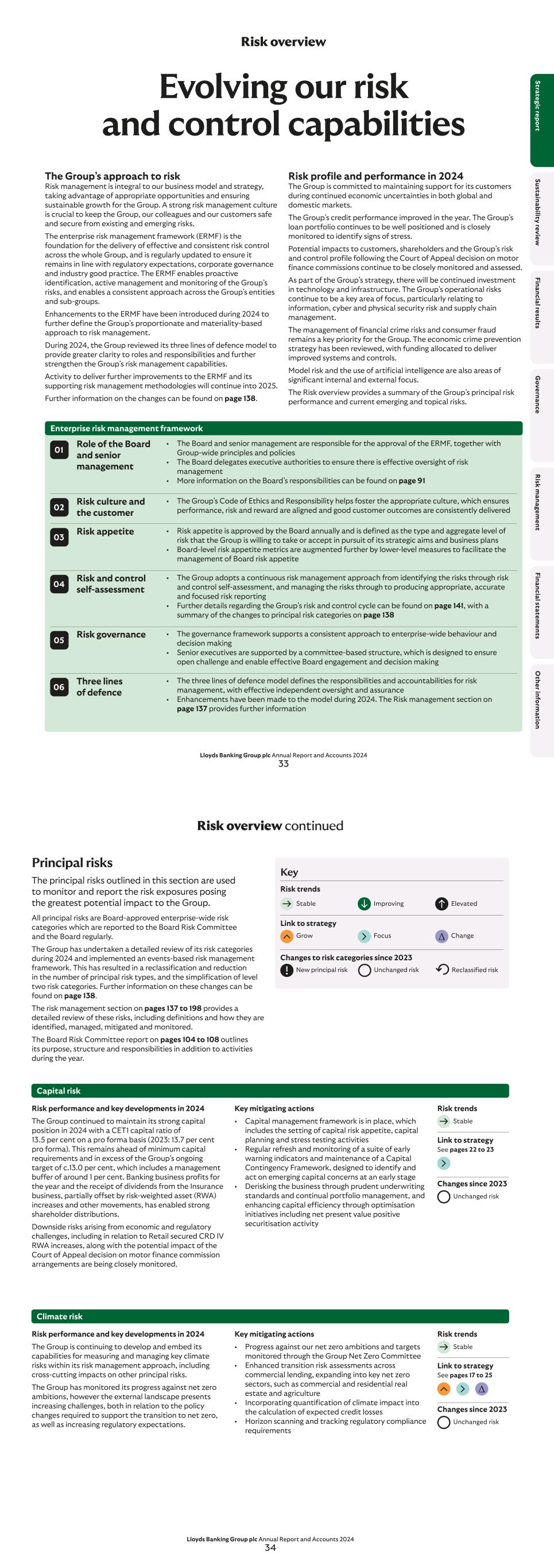
Risk overview Evolving our risk and control capabilities 01 Role of the Board and senior management • The Board and senior management are responsible for the approval of the ERMF, together with Group-wide principles and policies • The Board delegates executive authorities to ensure there is effective oversight of risk management • More information on the Board’s responsibilities can be found on page 91 02 Risk culture and the customer • The Group’s Code of Ethics and Responsibility helps foster the appropriate culture, which ensures performance, risk and reward are aligned and good customer outcomes are consistently delivered 03 Risk appetite • Risk appetite is approved by the Board annually and is defined as the type and aggregate level of risk that the Group is willing to take or accept in pursuit of its strategic aims and business plans • Board-level risk appetite metrics are augmented further by lower-level measures to facilitate the management of Board risk appetite 04 Risk and control self-assessment • The Group adopts a continuous risk management approach from identifying the risks through risk and control self-assessment, and managing the risks through to producing appropriate, accurate and focused risk reporting • Further details regarding the Group’s risk and control cycle can be found on page 141, with a summary of the changes to principal risk categories on page 138 05 Risk governance • The governance framework supports a consistent approach to enterprise-wide behaviour and decision making • Senior executives are supported by a committee-based structure, which is designed to ensure open challenge and enable effective Board engagement and decision making 06 Three lines of defence • The three lines of defence model defines the responsibilities and accountabilities for risk management, with effective independent oversight and assurance • Enhancements have been made to the model during 2024. The Risk management section on page 137 provides further information The Group’s approach to risk Risk management is integral to our business model and strategy, taking advantage of appropriate opportunities and ensuring sustainable growth for the Group. A strong risk management culture is crucial to keep the Group, our colleagues and our customers safe and secure from existing and emerging risks. The enterprise risk management framework (ERMF) is the foundation for the delivery of effective and consistent risk control across the whole Group, and is regularly updated to ensure it remains in line with regulatory expectations, corporate governance and industry good practice. The ERMF enables proactive identification, active management and monitoring of the Group’s risks, and enables a consistent approach across the Group’s entities and sub-groups. Enhancements to the ERMF have been introduced during 2024 to further define the Group’s proportionate and materiality-based approach to risk management. During 2024, the Group reviewed its three lines of defence model to provide greater clarity to roles and responsibilities and further strengthen the Group’s risk management capabilities. Activity to deliver further improvements to the ERMF and its supporting risk management methodologies will continue into 2025. Further information on the changes can be found on page 138. Risk profile and performance in 2024 The Group is committed to maintaining support for its customers during continued economic uncertainties in both global and domestic markets. The Group’s credit performance improved in the year. The Group’s loan portfolio continues to be well positioned and is closely monitored to identify signs of stress. Potential impacts to customers, shareholders and the Group’s risk and control profile following the Court of Appeal decision on motor finance commissions continue to be closely monitored and assessed. As part of the Group’s strategy, there will be continued investment in technology and infrastructure. The Group’s operational risks continue to be a key area of focus, particularly relating to information, cyber and physical security risk and supply chain management. The management of financial crime risks and consumer fraud remains a key priority for the Group. The economic crime prevention strategy has been reviewed, with funding allocated to deliver improved systems and controls. Model risk and the use of artificial intelligence are also areas of significant internal and external focus. The Risk overview provides a summary of the Group’s principal risk performance and current emerging and topical risks. Enterprise risk management framework 33 Lloyds Banking Group plc Annual Report and Accounts 2024 O th e r in fo rm a tio n F in a n cia l sta te m e n ts R isk m a n a ge m e n t G o ve rn a n ce F in a n cia l re su lts S u sta in a b ility re vie w S tra te gic re p o rt Climate risk Capital risk Risk overview continued Principal risks The principal risks outlined in this section are used to monitor and report the risk exposures posing the greatest potential impact to the Group. All principal risks are Board-approved enterprise-wide risk categories which are reported to the Board Risk Committee and the Board regularly. The Group has undertaken a detailed review of its risk categories during 2024 and implemented an events-based risk management framework. This has resulted in a reclassification and reduction in the number of principal risk types, and the simplification of level two risk categories. Further information on these changes can be found on page 138. The risk management section on pages 137 to 198 provides a detailed review of these risks, including definitions and how they are identified, managed, mitigated and monitored. The Board Risk Committee report on pages 104 to 108 outlines its purpose, structure and responsibilities in addition to activities during the year. Risk performance and key developments in 2024 The Group continued to maintain its strong capital position in 2024 with a CET1 capital ratio of 13.5 per cent on a pro forma basis (2023: 13.7 per cent pro forma). This remains ahead of minimum capital requirements and in excess of the Group’s ongoing target of c.13.0 per cent, which includes a management buffer of around 1 per cent. Banking business profits for the year and the receipt of dividends from the Insurance business, partially offset by risk-weighted asset (RWA) increases and other movements, has enabled strong shareholder distributions. Downside risks arising from economic and regulatory challenges, including in relation to Retail secured CRD IV RWA increases, along with the potential impact of the Court of Appeal decision on motor finance commission arrangements are being closely monitored. Key mitigating actions • Capital management framework is in place, which includes the setting of capital risk appetite, capital planning and stress testing activities • Regular refresh and monitoring of a suite of early warning indicators and maintenance of a Capital Contingency Framework, designed to identify and act on emerging capital concerns at an early stage • Derisking the business through prudent underwriting standards and continual portfolio management, and enhancing capital efficiency through optimisation initiatives including net present value positive securitisation activity Risk performance and key developments in 2024 The Group is continuing to develop and embed its capabilities for measuring and managing key climate risks within its risk management approach, including cross-cutting impacts on other principal risks. The Group has monitored its progress against net zero ambitions, however the external landscape presents increasing challenges, both in relation to the policy changes required to support the transition to net zero, as well as increasing regulatory expectations. Key mitigating actions • Progress against our net zero ambitions and targets monitored through the Group Net Zero Committee • Enhanced transition risk assessments across commercial lending, expanding into key net zero sectors, such as commercial and residential real estate and agriculture • Incorporating quantification of climate impact into the calculation of expected credit losses • Horizon scanning and tracking regulatory compliance requirements Risk trends Stable Link to strategy See pages 22 to 23 Changes since 2023 Unchanged risk Risk trends Stable Link to strategy See pages 17 to 25 Changes since 2023 Unchanged risk Key Risk trends Stable Improving Elevated Link to strategy Grow Focus Change Changes to risk categories since 2023 New principal risk Unchanged risk Reclassified risk 34 Lloyds Banking Group plc Annual Report and Accounts 2024
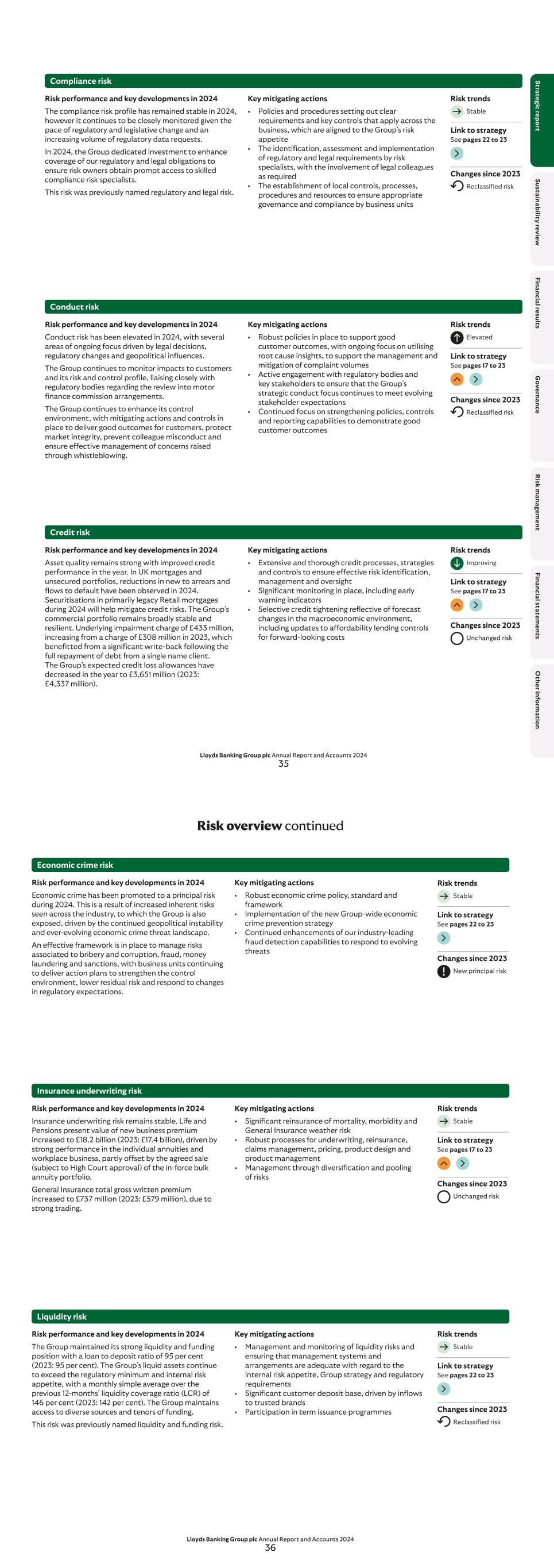
Credit risk Conduct risk Risk performance and key developments in 2024 Conduct risk has been elevated in 2024, with several areas of ongoing focus driven by legal decisions, regulatory changes and geopolitical influences. The Group continues to monitor impacts to customers and its risk and control profile, liaising closely with regulatory bodies regarding the review into motor finance commission arrangements. The Group continues to enhance its control environment, with mitigating actions and controls in place to deliver good outcomes for customers, protect market integrity, prevent colleague misconduct and ensure effective management of concerns raised through whistleblowing. Key mitigating actions • Robust policies in place to support good customer outcomes, with ongoing focus on utilising root cause insights, to support the management and mitigation of complaint volumes • Active engagement with regulatory bodies and key stakeholders to ensure that the Group’s strategic conduct focus continues to meet evolving stakeholder expectations • Continued focus on strengthening policies, controls and reporting capabilities to demonstrate good customer outcomes Risk performance and key developments in 2024 The compliance risk profile has remained stable in 2024, however it continues to be closely monitored given the pace of regulatory and legislative change and an increasing volume of regulatory data requests. In 2024, the Group dedicated investment to enhance coverage of our regulatory and legal obligations to ensure risk owners obtain prompt access to skilled compliance risk specialists. This risk was previously named regulatory and legal risk. Key mitigating actions • Policies and procedures setting out clear requirements and key controls that apply across the business, which are aligned to the Group’s risk appetite • The identification, assessment and implementation of regulatory and legal requirements by risk specialists, with the involvement of legal colleagues as required • The establishment of local controls, processes, procedures and resources to ensure appropriate governance and compliance by business units Risk performance and key developments in 2024 Asset quality remains strong with improved credit performance in the year. In UK mortgages and unsecured portfolios, reductions in new to arrears and flows to default have been observed in 2024. Securitisations in primarily legacy Retail mortgages during 2024 will help mitigate credit risks. The Group’s commercial portfolio remains broadly stable and resilient. Underlying impairment charge of £433 million, increasing from a charge of £308 million in 2023, which benefitted from a significant write-back following the full repayment of debt from a single name client. The Group’s expected credit loss allowances have decreased in the year to £3,651 million (2023: £4,337 million). Key mitigating actions • Extensive and thorough credit processes, strategies and controls to ensure effective risk identification, management and oversight • Significant monitoring in place, including early warning indicators • Selective credit tightening reflective of forecast changes in the macroeconomic environment, including updates to affordability lending controls for forward-looking costs Compliance risk Risk trends Stable Link to strategy See pages 22 to 23 Changes since 2023 Reclassified risk Risk trends Elevated Link to strategy See pages 17 to 23 Changes since 2023 Reclassified risk Risk trends Improving Link to strategy See pages 17 to 23 Changes since 2023 Unchanged risk 35 Lloyds Banking Group plc Annual Report and Accounts 2024 O th e r in fo rm a tio n F in a n cia l sta te m e n ts R isk m a n a ge m e n t G o ve rn a n ce F in a n cia l re su lts S u sta in a b ility re vie w S tra te gic re p o rt Insurance underwriting risk Liquidity risk Economic crime risk Risk performance and key developments in 2024 Insurance underwriting risk remains stable. Life and Pensions present value of new business premium increased to £18.2 billion (2023: £17.4 billion), driven by strong performance in the individual annuities and workplace business, partly offset by the agreed sale (subject to High Court approval) of the in-force bulk annuity portfolio. General Insurance total gross written premium increased to £737 million (2023: £579 million), due to strong trading. Key mitigating actions • Significant reinsurance of mortality, morbidity and General Insurance weather risk • Robust processes for underwriting, reinsurance, claims management, pricing, product design and product management • Management through diversification and pooling of risks Risk performance and key developments in 2024 Economic crime has been promoted to a principal risk during 2024. This is a result of increased inherent risks seen across the industry, to which the Group is also exposed, driven by the continued geopolitical instability and ever-evolving economic crime threat landscape. An effective framework is in place to manage risks associated to bribery and corruption, fraud, money laundering and sanctions, with business units continuing to deliver action plans to strengthen the control environment, lower residual risk and respond to changes in regulatory expectations. Key mitigating actions • Robust economic crime policy, standard and framework • Implementation of the new Group-wide economic crime prevention strategy • Continued enhancements of our industry-leading fraud detection capabilities to respond to evolving threats Risk performance and key developments in 2024 The Group maintained its strong liquidity and funding position with a loan to deposit ratio of 95 per cent (2023: 95 per cent). The Group’s liquid assets continue to exceed the regulatory minimum and internal risk appetite, with a monthly simple average over the previous 12-months’ liquidity coverage ratio (LCR) of 146 per cent (2023: 142 per cent). The Group maintains access to diverse sources and tenors of funding. This risk was previously named liquidity and funding risk. Key mitigating actions • Management and monitoring of liquidity risks and ensuring that management systems and arrangements are adequate with regard to the internal risk appetite, Group strategy and regulatory requirements • Significant customer deposit base, driven by inflows to trusted brands • Participation in term issuance programmes Risk overview continued Risk trends Stable Link to strategy See pages 22 to 23 Changes since 2023 New principal risk Risk trends Stable Link to strategy See pages 17 to 23 Changes since 2023 Unchanged risk Risk trends Stable Link to strategy See pages 22 to 23 Changes since 2023 Reclassified risk 36 Lloyds Banking Group plc Annual Report and Accounts 2024
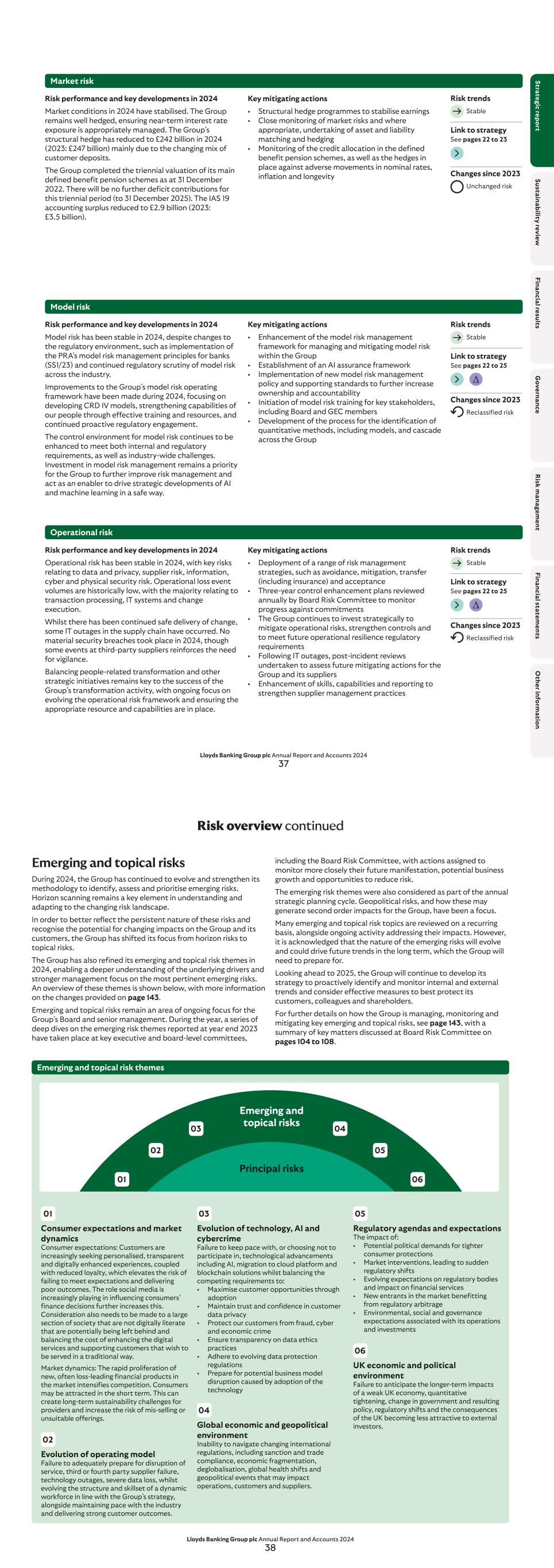
Market risk Model risk Operational risk Risk performance and key developments in 2024 Model risk has been stable in 2024, despite changes to the regulatory environment, such as implementation of the PRA’s model risk management principles for banks (SS1/23) and continued regulatory scrutiny of model risk across the industry. Improvements to the Group’s model risk operating framework have been made during 2024, focusing on developing CRD IV models, strengthening capabilities of our people through effective training and resources, and continued proactive regulatory engagement. The control environment for model risk continues to be enhanced to meet both internal and regulatory requirements, as well as industry-wide challenges. Investment in model risk management remains a priority for the Group to further improve risk management and act as an enabler to drive strategic developments of AI and machine learning in a safe way. Key mitigating actions • Enhancement of the model risk management framework for managing and mitigating model risk within the Group • Establishment of an AI assurance framework • Implementation of new model risk management policy and supporting standards to further increase ownership and accountability • Initiation of model risk training for key stakeholders, including Board and GEC members • Development of the process for the identification of quantitative methods, including models, and cascade across the Group Risk performance and key developments in 2024 Market conditions in 2024 have stabilised. The Group remains well hedged, ensuring near-term interest rate exposure is appropriately managed. The Group’s structural hedge has reduced to £242 billion in 2024 (2023: £247 billion) mainly due to the changing mix of customer deposits. The Group completed the triennial valuation of its main defined benefit pension schemes as at 31 December 2022. There will be no further deficit contributions for this triennial period (to 31 December 2025). The IAS 19 accounting surplus reduced to £2.9 billion (2023: £3.5 billion). Key mitigating actions • Structural hedge programmes to stabilise earnings • Close monitoring of market risks and where appropriate, undertaking of asset and liability matching and hedging • Monitoring of the credit allocation in the defined benefit pension schemes, as well as the hedges in place against adverse movements in nominal rates, inflation and longevity Risk performance and key developments in 2024 Operational risk has been stable in 2024, with key risks relating to data and privacy, supplier risk, information, cyber and physical security risk. Operational loss event volumes are historically low, with the majority relating to transaction processing, IT systems and change execution. Whilst there has been continued safe delivery of change, some IT outages in the supply chain have occurred. No material security breaches took place in 2024, though some events at third-party suppliers reinforces the need for vigilance. Balancing people-related transformation and other strategic initiatives remains key to the success of the Group’s transformation activity, with ongoing focus on evolving the operational risk framework and ensuring the appropriate resource and capabilities are in place. Key mitigating actions • Deployment of a range of risk management strategies, such as avoidance, mitigation, transfer (including insurance) and acceptance • Three-year control enhancement plans reviewed annually by Board Risk Committee to monitor progress against commitments • The Group continues to invest strategically to mitigate operational risks, strengthen controls and to meet future operational resilience regulatory requirements • Following IT outages, post-incident reviews undertaken to assess future mitigating actions for the Group and its suppliers • Enhancement of skills, capabilities and reporting to strengthen supplier management practices Risk trends Stable Link to strategy See pages 22 to 25 Changes since 2023 Reclassified risk Risk trends Stable Link to strategy See pages 22 to 25 Changes since 2023 Reclassified risk Risk trends Stable Link to strategy See pages 22 to 23 Changes since 2023 Unchanged risk 37 Lloyds Banking Group plc Annual Report and Accounts 2024 O th e r in fo rm a tio n F in a n cia l sta te m e n ts R isk m a n a ge m e n t G o ve rn a n ce F in a n cia l re su lts S u sta in a b ility re vie w S tra te gic re p o rt Emerging and topical risk themes including the Board Risk Committee, with actions assigned to monitor more closely their future manifestation, potential business growth and opportunities to reduce risk. The emerging risk themes were also considered as part of the annual strategic planning cycle. Geopolitical risks, and how these may generate second order impacts for the Group, have been a focus. Many emerging and topical risk topics are reviewed on a recurring basis, alongside ongoing activity addressing their impacts. However, it is acknowledged that the nature of the emerging risks will evolve and could drive future trends in the long term, which the Group will need to prepare for. Looking ahead to 2025, the Group will continue to develop its strategy to proactively identify and monitor internal and external trends and consider effective measures to best protect its customers, colleagues and shareholders. For further details on how the Group is managing, monitoring and mitigating key emerging and topical risks, see page 143, with a summary of key matters discussed at Board Risk Committee on pages 104 to 108. Risk overview continued Emerging and topical risks During 2024, the Group has continued to evolve and strengthen its methodology to identify, assess and prioritise emerging risks. Horizon scanning remains a key element in understanding and adapting to the changing risk landscape. In order to better reflect the persistent nature of these risks and recognise the potential for changing impacts on the Group and its customers, the Group has shifted its focus from horizon risks to topical risks. The Group has also refined its emerging and topical risk themes in 2024, enabling a deeper understanding of the underlying drivers and stronger management focus on the most pertinent emerging risks. An overview of these themes is shown below, with more information on the changes provided on page 143. Emerging and topical risks remain an area of ongoing focus for the Group’s Board and senior management. During the year, a series of deep dives on the emerging risk themes reported at year end 2023 have taken place at key executive and board-level committees, 01 Consumer expectations and market dynamics Consumer expectations: Customers are increasingly seeking personalised, transparent and digitally enhanced experiences, coupled with reduced loyalty, which elevates the risk of failing to meet expectations and delivering poor outcomes. The role social media is increasingly playing in influencing consumers’ finance decisions further increases this. Consideration also needs to be made to a large section of society that are not digitally literate that are potentially being left behind and balancing the cost of enhancing the digital services and supporting customers that wish to be served in a traditional way. Market dynamics: The rapid proliferation of new, often loss-leading financial products in the market intensifies competition. Consumers may be attracted in the short term. This can create long-term sustainability challenges for providers and increase the risk of mis-selling or unsuitable offerings. 02 Evolution of operating model Failure to adequately prepare for disruption of service, third or fourth party supplier failure, technology outages, severe data loss, whilst evolving the structure and skillset of a dynamic workforce in line with the Group’s strategy, alongside maintaining pace with the industry and delivering strong customer outcomes. 03 Evolution of technology, AI and cybercrime Failure to keep pace with, or choosing not to participate in, technological advancements including AI, migration to cloud platform and blockchain solutions whilst balancing the competing requirements to: • Maximise customer opportunities through adoption • Maintain trust and confidence in customer data privacy • Protect our customers from fraud, cyber and economic crime • Ensure transparency on data ethics practices • Adhere to evolving data protection regulations • Prepare for potential business model disruption caused by adoption of the technology 04 Global economic and geopolitical environment Inability to navigate changing international regulations, including sanction and trade compliance, economic fragmentation, deglobalisation, global health shifts and geopolitical events that may impact operations, customers and suppliers. 05 Regulatory agendas and expectations The impact of: • Potential political demands for tighter consumer protections • Market interventions, leading to sudden regulatory shifts • Evolving expectations on regulatory bodies and impact on financial services • New entrants in the market benefitting from regulatory arbitrage • Environmental, social and governance expectations associated with its operations and investments 06 UK economic and political environment Failure to anticipate the longer-term impacts of a weak UK economy, quantitative tightening, change in government and resulting policy, regulatory shifts and the consequences of the UK becoming less attractive to external investors. 01 02 05 03 04 06 Emerging and topical risks Principal risks 38 Lloyds Banking Group plc Annual Report and Accounts 2024
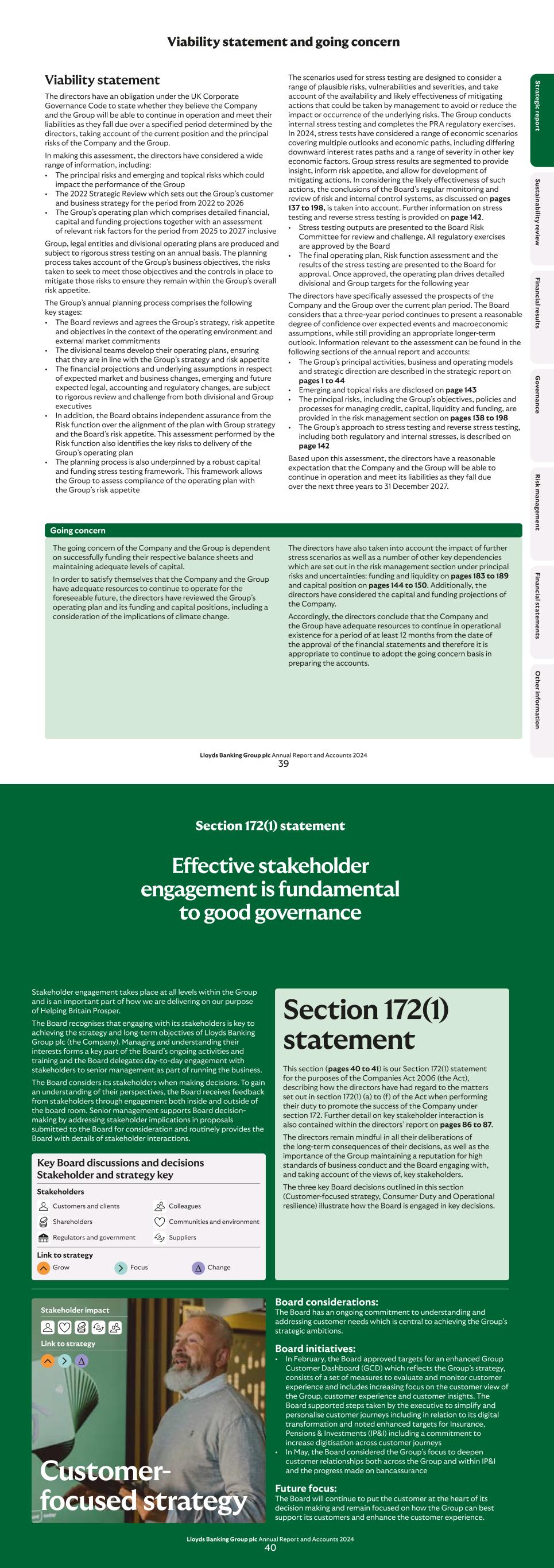
Viability statement and going concern Viability statement The directors have an obligation under the UK Corporate Governance Code to state whether they believe the Company and the Group will be able to continue in operation and meet their liabilities as they fall due over a specified period determined by the directors, taking account of the current position and the principal risks of the Company and the Group. In making this assessment, the directors have considered a wide range of information, including: • The principal risks and emerging and topical risks which could impact the performance of the Group • The 2022 Strategic Review which sets out the Group’s customer and business strategy for the period from 2022 to 2026 • The Group’s operating plan which comprises detailed financial, capital and funding projections together with an assessment of relevant risk factors for the period from 2025 to 2027 inclusive Group, legal entities and divisional operating plans are produced and subject to rigorous stress testing on an annual basis. The planning process takes account of the Group’s business objectives, the risks taken to seek to meet those objectives and the controls in place to mitigate those risks to ensure they remain within the Group’s overall risk appetite. The Group’s annual planning process comprises the following key stages: • The Board reviews and agrees the Group’s strategy, risk appetite and objectives in the context of the operating environment and external market commitments • The divisional teams develop their operating plans, ensuring that they are in line with the Group’s strategy and risk appetite • The financial projections and underlying assumptions in respect of expected market and business changes, emerging and future expected legal, accounting and regulatory changes, are subject to rigorous review and challenge from both divisional and Group executives • In addition, the Board obtains independent assurance from the Risk function over the alignment of the plan with Group strategy and the Board’s risk appetite. This assessment performed by the Risk function also identifies the key risks to delivery of the Group’s operating plan • The planning process is also underpinned by a robust capital and funding stress testing framework. This framework allows the Group to assess compliance of the operating plan with the Group’s risk appetite The scenarios used for stress testing are designed to consider a range of plausible risks, vulnerabilities and severities, and take account of the availability and likely effectiveness of mitigating actions that could be taken by management to avoid or reduce the impact or occurrence of the underlying risks. The Group conducts internal stress testing and completes the PRA regulatory exercises. In 2024, stress tests have considered a range of economic scenarios covering multiple outlooks and economic paths, including differing downward interest rates paths and a range of severity in other key economic factors. Group stress results are segmented to provide insight, inform risk appetite, and allow for development of mitigating actions. In considering the likely effectiveness of such actions, the conclusions of the Board’s regular monitoring and review of risk and internal control systems, as discussed on pages 137 to 198, is taken into account. Further information on stress testing and reverse stress testing is provided on page 142. • Stress testing outputs are presented to the Board Risk Committee for review and challenge. All regulatory exercises are approved by the Board • The final operating plan, Risk function assessment and the results of the stress testing are presented to the Board for approval. Once approved, the operating plan drives detailed divisional and Group targets for the following year The directors have specifically assessed the prospects of the Company and the Group over the current plan period. The Board considers that a three-year period continues to present a reasonable degree of confidence over expected events and macroeconomic assumptions, while still providing an appropriate longer-term outlook. Information relevant to the assessment can be found in the following sections of the annual report and accounts: • The Group’s principal activities, business and operating models and strategic direction are described in the strategic report on pages 1 to 44 • Emerging and topical risks are disclosed on page 143 • The principal risks, including the Group’s objectives, policies and processes for managing credit, capital, liquidity and funding, are provided in the risk management section on pages 138 to 198 • The Group’s approach to stress testing and reverse stress testing, including both regulatory and internal stresses, is described on page 142 Based upon this assessment, the directors have a reasonable expectation that the Company and the Group will be able to continue in operation and meet its liabilities as they fall due over the next three years to 31 December 2027. The going concern of the Company and the Group is dependent on successfully funding their respective balance sheets and maintaining adequate levels of capital. In order to satisfy themselves that the Company and the Group have adequate resources to continue to operate for the foreseeable future, the directors have reviewed the Group’s operating plan and its funding and capital positions, including a consideration of the implications of climate change. The directors have also taken into account the impact of further stress scenarios as well as a number of other key dependencies which are set out in the risk management section under principal risks and uncertainties: funding and liquidity on pages 183 to 189 and capital position on pages 144 to 150. Additionally, the directors have considered the capital and funding projections of the Company. Accordingly, the directors conclude that the Company and the Group have adequate resources to continue in operational existence for a period of at least 12 months from the date of the approval of the financial statements and therefore it is appropriate to continue to adopt the going concern basis in preparing the accounts. Going concern 39 Lloyds Banking Group plc Annual Report and Accounts 2024 O th e r in fo rm a tio n F in a n cia l sta te m e n ts R isk m a n a ge m e n t G o ve rn a n ce F in a n cia l re su lts S u sta in a b ility re vie w S tra te gic re p o rt Section 172(1) statement Effective stakeholder engagement is fundamental to good governance Section 172(1) statement This section (pages 40 to 41) is our Section 172(1) statement for the purposes of the Companies Act 2006 (the Act), describing how the directors have had regard to the matters set out in section 172(1) (a) to (f) of the Act when performing their duty to promote the success of the Company under section 172. Further detail on key stakeholder interaction is also contained within the directors’ report on pages 86 to 87. The directors remain mindful in all their deliberations of the long-term consequences of their decisions, as well as the importance of the Group maintaining a reputation for high standards of business conduct and the Board engaging with, and taking account of the views of, key stakeholders. The three key Board decisions outlined in this section (Customer-focused strategy, Consumer Duty and Operational resilience) illustrate how the Board is engaged in key decisions. Stakeholder engagement takes place at all levels within the Group and is an important part of how we are delivering on our purpose of Helping Britain Prosper. The Board recognises that engaging with its stakeholders is key to achieving the strategy and long-term objectives of Lloyds Banking Group plc (the Company). Managing and understanding their interests forms a key part of the Board’s ongoing activities and training and the Board delegates day-to-day engagement with stakeholders to senior management as part of running the business. The Board considers its stakeholders when making decisions. To gain an understanding of their perspectives, the Board receives feedback from stakeholders through engagement both inside and outside of the board room. Senior management supports Board decision- making by addressing stakeholder implications in proposals submitted to the Board for consideration and routinely provides the Board with details of stakeholder interactions. Board considerations: The Board has an ongoing commitment to understanding and addressing customer needs which is central to achieving the Group’s strategic ambitions. Board initiatives: • In February, the Board approved targets for an enhanced Group Customer Dashboard (GCD) which reflects the Group’s strategy, consists of a set of measures to evaluate and monitor customer experience and includes increasing focus on the customer view of the Group, customer experience and customer insights. The Board supported steps taken by the executive to simplify and personalise customer journeys including in relation to its digital transformation and noted enhanced targets for Insurance, Pensions & Investments (IP&I) including a commitment to increase digitisation across customer journeys • In May, the Board considered the Group’s focus to deepen customer relationships both across the Group and within IP&I and the progress made on bancassurance Future focus: The Board will continue to put the customer at the heart of its decision making and remain focused on how the Group can best support its customers and enhance the customer experience. Customer- focused strategy Stakeholder impact Link to strategy Key Board discussions and decisions Stakeholder and strategy key Stakeholders Customers and clients Colleagues Shareholders Communities and environment Regulators and government Suppliers Link to strategy Grow Focus Change 40 Lloyds Banking Group plc Annual Report and Accounts 2024
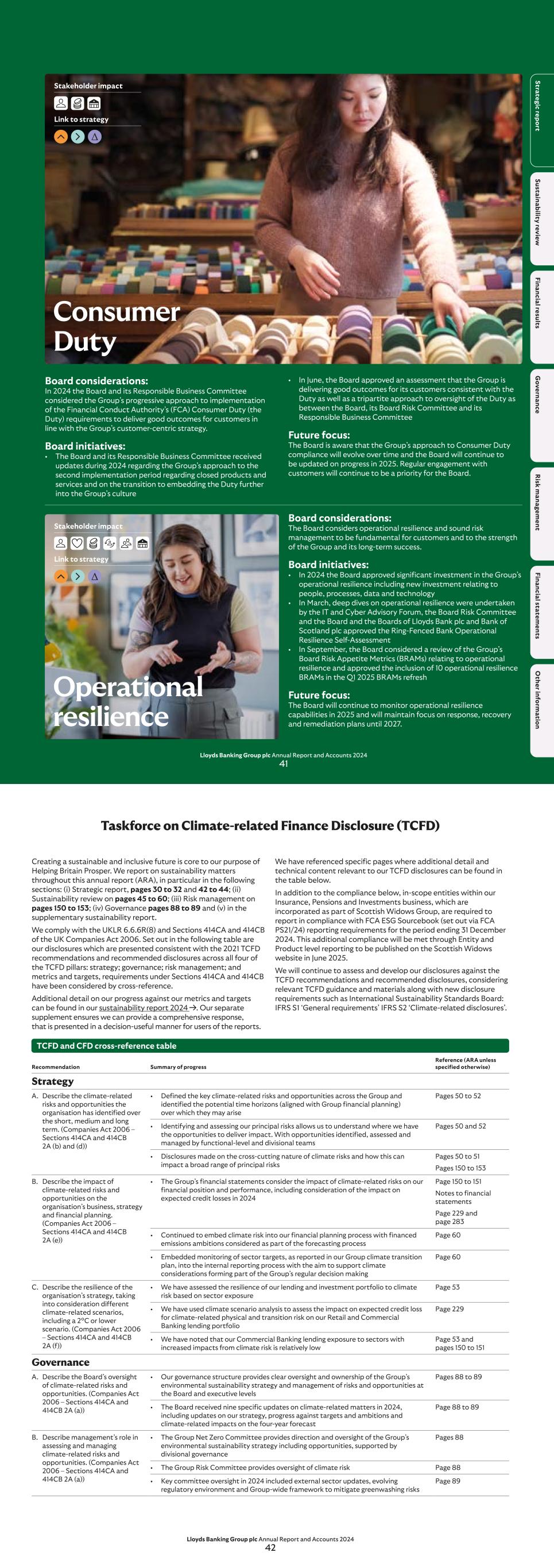
Board considerations: In 2024 the Board and its Responsible Business Committee considered the Group’s progressive approach to implementation of the Financial Conduct Authority’s (FCA) Consumer Duty (the Duty) requirements to deliver good outcomes for customers in line with the Group’s customer-centric strategy. Board initiatives: • The Board and its Responsible Business Committee received updates during 2024 regarding the Group’s approach to the second implementation period regarding closed products and services and on the transition to embedding the Duty further into the Group’s culture • In June, the Board approved an assessment that the Group is delivering good outcomes for its customers consistent with the Duty as well as a tripartite approach to oversight of the Duty as between the Board, its Board Risk Committee and its Responsible Business Committee Future focus: The Board is aware that the Group’s approach to Consumer Duty compliance will evolve over time and the Board will continue to be updated on progress in 2025. Regular engagement with customers will continue to be a priority for the Board. Consumer Duty Stakeholder impact Link to strategy Board considerations: The Board considers operational resilience and sound risk management to be fundamental for customers and to the strength of the Group and its long-term success. Board initiatives: • In 2024 the Board approved significant investment in the Group’s operational resilience including new investment relating to people, processes, data and technology • In March, deep dives on operational resilience were undertaken by the IT and Cyber Advisory Forum, the Board Risk Committee and the Board and the Boards of Lloyds Bank plc and Bank of Scotland plc approved the Ring-Fenced Bank Operational Resilience Self-Assessment • In September, the Board considered a review of the Group’s Board Risk Appetite Metrics (BRAMs) relating to operational resilience and approved the inclusion of 10 operational resilience BRAMs in the Q1 2025 BRAMs refresh Future focus: The Board will continue to monitor operational resilience capabilities in 2025 and will maintain focus on response, recovery and remediation plans until 2027. Operational resilience Stakeholder impact Link to strategy O th e r in fo rm a tio n F in a n cia l sta te m e n ts R isk m a n a ge m e n t G o ve rn a n ce F in a n cia l re su lts S u sta in a b ility re vie w S tra te gic re p o rt 41 Lloyds Banking Group plc Annual Report and Accounts 2024 Taskforce on Climate-related Finance Disclosure (TCFD) Creating a sustainable and inclusive future is core to our purpose of Helping Britain Prosper. We report on sustainability matters throughout this annual report (ARA), in particular in the following sections: (i) Strategic report, pages 30 to 32 and 42 to 44; (ii) Sustainability review on pages 45 to 60; (iii) Risk management on pages 150 to 153; (iv) Governance pages 88 to 89 and (v) in the supplementary sustainability report. We comply with the UKLR 6.6.6R(8) and Sections 414CA and 414CB of the UK Companies Act 2006. Set out in the following table are our disclosures which are presented consistent with the 2021 TCFD recommendations and recommended disclosures across all four of the TCFD pillars: strategy; governance; risk management; and metrics and targets, requirements under Sections 414CA and 414CB have been considered by cross-reference. Additional detail on our progress against our metrics and targets can be found in our sustainability report 2024 . Our separate supplement ensures we can provide a comprehensive response, that is presented in a decision-useful manner for users of the reports. We have referenced specific pages where additional detail and technical content relevant to our TCFD disclosures can be found in the table below. In addition to the compliance below, in-scope entities within our Insurance, Pensions and Investments business, which are incorporated as part of Scottish Widows Group, are required to report in compliance with FCA ESG Sourcebook (set out via FCA PS21/24) reporting requirements for the period ending 31 December 2024. This additional compliance will be met through Entity and Product level reporting to be published on the Scottish Widows website in June 2025. We will continue to assess and develop our disclosures against the TCFD recommendations and recommended disclosures, considering relevant TCFD guidance and materials along with new disclosure requirements such as International Sustainability Standards Board: IFRS S1 ‘General requirements’ IFRS S2 ‘Climate-related disclosures’. Recommendation Summary of progress Reference (ARA unless specified otherwise) Strategy A. Describe the climate-related risks and opportunities the organisation has identified over the short, medium and long term. (Companies Act 2006 – Sections 414CA and 414CB 2A (b) and (d)) • Defined the key climate-related risks and opportunities across the Group and identified the potential time horizons (aligned with Group financial planning) over which they may arise Pages 50 to 52 • Identifying and assessing our principal risks allows us to understand where we have the opportunities to deliver impact. With opportunities identified, assessed and managed by functional-level and divisional teams Pages 50 and 52 • Disclosures made on the cross-cutting nature of climate risks and how this can impact a broad range of principal risks Pages 50 to 51 Pages 150 to 153 B. Describe the impact of climate-related risks and opportunities on the organisation’s business, strategy and financial planning. (Companies Act 2006 – Sections 414CA and 414CB 2A (e)) • The Group’s financial statements consider the impact of climate-related risks on our financial position and performance, including consideration of the impact on expected credit losses in 2024 Page 150 to 151 Notes to financial statements Page 229 and page 283 • Continued to embed climate risk into our financial planning process with financed emissions ambitions considered as part of the forecasting process Page 60 • Embedded monitoring of sector targets, as reported in our Group climate transition plan, into the internal reporting process with the aim to support climate considerations forming part of the Group’s regular decision making Page 60 C. Describe the resilience of the organisation’s strategy, taking into consideration different climate-related scenarios, including a 2°C or lower scenario. (Companies Act 2006 – Sections 414CA and 414CB 2A (f)) • We have assessed the resilience of our lending and investment portfolio to climate risk based on sector exposure Page 53 • We have used climate scenario analysis to assess the impact on expected credit loss for climate-related physical and transition risk on our Retail and Commercial Banking lending portfolio Page 229 • We have noted that our Commercial Banking lending exposure to sectors with increased impacts from climate risk is relatively low Page 53 and pages 150 to 151 Governance A. Describe the Board’s oversight of climate-related risks and opportunities. (Companies Act 2006 – Sections 414CA and 414CB 2A (a)) • Our governance structure provides clear oversight and ownership of the Group’s environmental sustainability strategy and management of risks and opportunities at the Board and executive levels Pages 88 to 89 • The Board received nine specific updates on climate-related matters in 2024, including updates on our strategy, progress against targets and ambitions and climate-related impacts on the four-year forecast Page 88 to 89 B. Describe management’s role in assessing and managing climate-related risks and opportunities. (Companies Act 2006 – Sections 414CA and 414CB 2A (a)) • The Group Net Zero Committee provides direction and oversight of the Group’s environmental sustainability strategy including opportunities, supported by divisional governance Pages 88 • The Group Risk Committee provides oversight of climate risk Page 88 • Key committee oversight in 2024 included external sector updates, evolving regulatory environment and Group-wide framework to mitigate greenwashing risks Page 89 TCFD and CFD cross-reference table 42 Lloyds Banking Group plc Annual Report and Accounts 2024
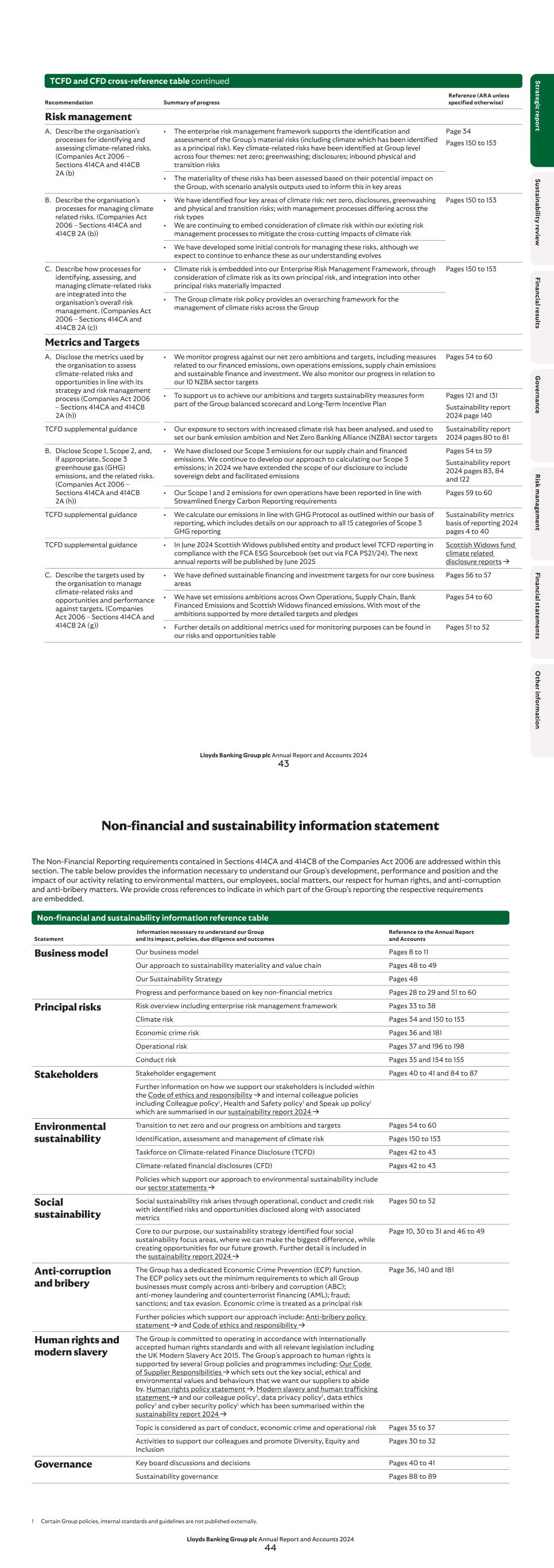
Recommendation Summary of progress Reference (ARA unless specified otherwise) Risk management A. Describe the organisation’s processes for identifying and assessing climate-related risks. (Companies Act 2006 – Sections 414CA and 414CB 2A (b) • The enterprise risk management framework supports the identification and assessment of the Group’s material risks (including climate which has been identified as a principal risk). Key climate-related risks have been identified at Group level across four themes: net zero; greenwashing; disclosures; inbound physical and transition risks Page 34 Pages 150 to 153 • The materiality of these risks has been assessed based on their potential impact on the Group, with scenario analysis outputs used to inform this in key areas B. Describe the organisation’s processes for managing climate related risks. (Companies Act 2006 – Sections 414CA and 414CB 2A (b)) • We have identified four key areas of climate risk: net zero, disclosures, greenwashing and physical and transition risks; with management processes differing across the risk types • We are continuing to embed consideration of climate risk within our existing risk management processes to mitigate the cross-cutting impacts of climate risk Pages 150 to 153 • We have developed some initial controls for managing these risks, although we expect to continue to enhance these as our understanding evolves C. Describe how processes for identifying, assessing, and managing climate-related risks are integrated into the organisation’s overall risk management. (Companies Act 2006 – Sections 414CA and 414CB 2A (c)) • Climate risk is embedded into our Enterprise Risk Management Framework, through consideration of climate risk as its own principal risk, and integration into other principal risks materially impacted Pages 150 to 153 • The Group climate risk policy provides an overarching framework for the management of climate risks across the Group Metrics and Targets A. Disclose the metrics used by the organisation to assess climate-related risks and opportunities in line with its strategy and risk management process (Companies Act 2006 – Sections 414CA and 414CB 2A (h)) • We monitor progress against our net zero ambitions and targets, including measures related to our financed emissions, own operations emissions, supply chain emissions and sustainable finance and investment. We also monitor our progress in relation to our 10 NZBA sector targets Pages 54 to 60 • To support us to achieve our ambitions and targets sustainability measures form part of the Group balanced scorecard and Long-Term Incentive Plan Pages 121 and 131 Sustainability report 2024 page 140 TCFD supplemental guidance • Our exposure to sectors with increased climate risk has been analysed, and used to set our bank emission ambition and Net Zero Banking Alliance (NZBA) sector targets Sustainability report 2024 pages 80 to 81 B. Disclose Scope 1, Scope 2, and, if appropriate, Scope 3 greenhouse gas (GHG) emissions, and the related risks. (Companies Act 2006 – Sections 414CA and 414CB 2A (h)) • We have disclosed our Scope 3 emissions for our supply chain and financed emissions. We continue to develop our approach to calculating our Scope 3 emissions; in 2024 we have extended the scope of our disclosure to include sovereign debt and facilitated emissions Pages 54 to 59 Sustainability report 2024 pages 83, 84 and 122 • Our Scope 1 and 2 emissions for own operations have been reported in line with Streamlined Energy Carbon Reporting requirements Pages 59 to 60 TCFD supplemental guidance • We calculate our emissions in line with GHG Protocol as outlined within our basis of reporting, which includes details on our approach to all 15 categories of Scope 3 GHG reporting Sustainability metrics basis of reporting 2024 pages 4 to 40 TCFD supplemental guidance • In June 2024 Scottish Widows published entity and product level TCFD reporting in compliance with the FCA ESG Sourcebook (set out via FCA PS21/24). The next annual reports will be published by June 2025 Scottish Widows fund climate related disclosure reports C. Describe the targets used by the organisation to manage climate-related risks and opportunities and performance against targets. (Companies Act 2006 – Sections 414CA and 414CB 2A (g)) • We have defined sustainable financing and investment targets for our core business areas Pages 56 to 57 • We have set emissions ambitions across Own Operations, Supply Chain, Bank Financed Emissions and Scottish Widows financed emissions. With most of the ambitions supported by more detailed targets and pledges Pages 54 to 60 • Further details on additional metrics used for monitoring purposes can be found in our risks and opportunities table Pages 51 to 52 TCFD and CFD cross-reference table continued 43 Lloyds Banking Group plc Annual Report and Accounts 2024 O th e r in fo rm a tio n F in a n cia l sta te m e n ts R isk m a n a ge m e n t G o ve rn a n ce F in a n cia l re su lts S u sta in a b ility re vie w S tra te gic re p o rt Non-financial and sustainability information statement The Non-Financial Reporting requirements contained in Sections 414CA and 414CB of the Companies Act 2006 are addressed within this section. The table below provides the information necessary to understand our Group’s development, performance and position and the impact of our activity relating to environmental matters, our employees, social matters, our respect for human rights, and anti-corruption and anti-bribery matters. We provide cross references to indicate in which part of the Group’s reporting the respective requirements are embedded. Statement Information necessary to understand our Group and its impact, policies, due diligence and outcomes Reference to the Annual Report and Accounts Business model Our business model Pages 8 to 11 Our approach to sustainability materiality and value chain Pages 48 to 49 Our Sustainability Strategy Pages 48 Progress and performance based on key non-financial metrics Pages 28 to 29 and 51 to 60 Principal risks Risk overview including enterprise risk management framework Pages 33 to 38 Climate risk Pages 34 and 150 to 153 Economic crime risk Pages 36 and 181 Operational risk Pages 37 and 196 to 198 Conduct risk Pages 35 and 154 to 155 Stakeholders Stakeholder engagement Pages 40 to 41 and 84 to 87 Further information on how we support our stakeholders is included within the Code of ethics and responsibility and internal colleague policies including Colleague policy1, Health and Safety policy1 and Speak up policy1 which are summarised in our sustainability report 2024 Environmental sustainability Transition to net zero and our progress on ambitions and targets Pages 54 to 60 Identification, assessment and management of climate risk Pages 150 to 153 Taskforce on Climate-related Finance Disclosure (TCFD) Pages 42 to 43 Climate-related financial disclosures (CFD) Pages 42 to 43 Policies which support our approach to environmental sustainability include our sector statements Social sustainability Social sustainability risk arises through operational, conduct and credit risk with identified risks and opportunities disclosed along with associated metrics Pages 50 to 52 Core to our purpose, our sustainability strategy identified four social sustainability focus areas, where we can make the biggest difference, while creating opportunities for our future growth. Further detail is included in the sustainability report 2024 Page 10, 30 to 31 and 46 to 49 Anti-corruption and bribery The Group has a dedicated Economic Crime Prevention (ECP) function. The ECP policy sets out the minimum requirements to which all Group businesses must comply across anti-bribery and corruption (ABC); anti-money laundering and counterterrorist financing (AML); fraud; sanctions; and tax evasion. Economic crime is treated as a principal risk Page 36, 140 and 181 Further policies which support our approach include: Anti-bribery policy statement and Code of ethics and responsibility Human rights and modern slavery The Group is committed to operating in accordance with internationally accepted human rights standards and with all relevant legislation including the UK Modern Slavery Act 2015. The Group’s approach to human rights is supported by several Group policies and programmes including: Our Code of Supplier Responsibilities which sets out the key social, ethical and environmental values and behaviours that we want our suppliers to abide by. Human rights policy statement , Modern slavery and human trafficking statement and our colleague policy1, data privacy policy1, data ethics policy1 and cyber security policy1 which has been summarised within the sustainability report 2024 Topic is considered as part of conduct, economic crime and operational risk Pages 35 to 37 Activities to support our colleagues and promote Diversity, Equity and Inclusion Pages 30 to 32 Governance Key board discussions and decisions Pages 40 to 41 Sustainability governance Pages 88 to 89 1 Certain Group policies, internal standards and guidelines are not published externally. Non-financial and sustainability information reference table 44 Lloyds Banking Group plc Annual Report and Accounts 2024
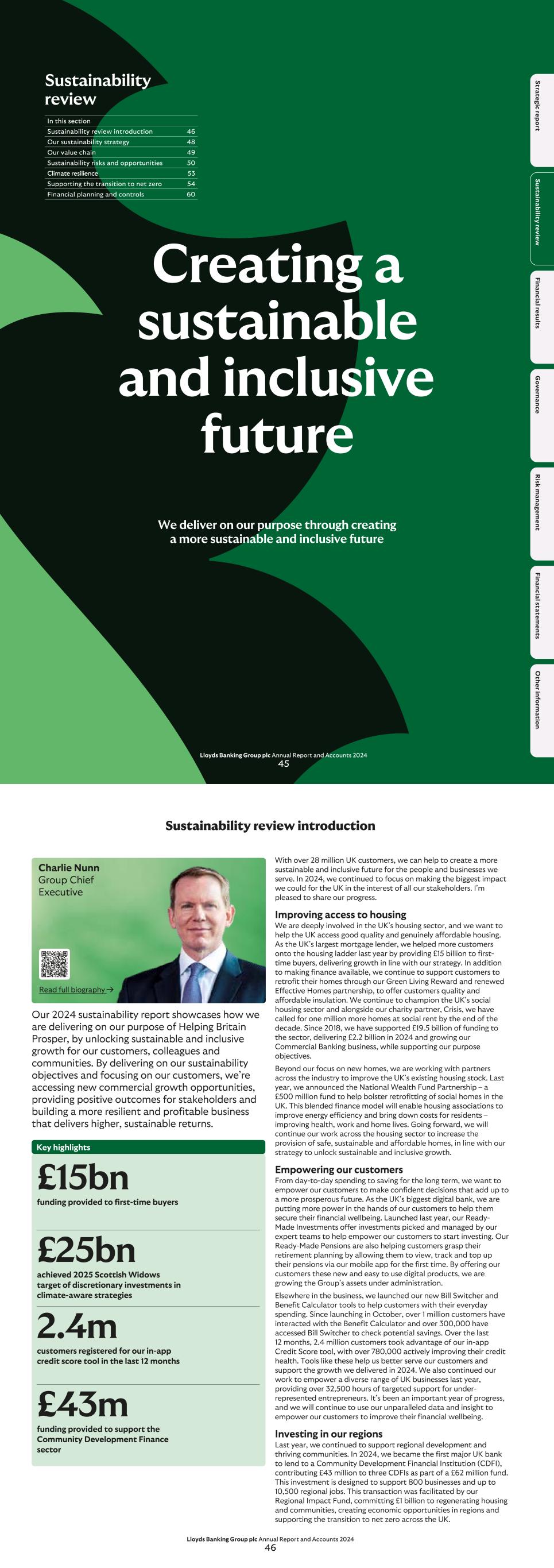
Sustainability review In this section Sustainability review introduction 46 Our sustainability strategy 48 Our value chain 49 Sustainability risks and opportunities 50 Climate resilience 53 Supporting the transition to net zero 54 Financial planning and controls 60 Creating a sustainable and inclusive future We deliver on our purpose through creating a more sustainable and inclusive future O th e r in fo rm a tio n F in a n cia l re su lts S tra te gic re p o rt G o ve rn a n ce F in a n cia l sta te m e n ts R isk m a n a ge m e n t S u sta in a b ility re vie w 45 Lloyds Banking Group plc Annual Report and Accounts 2024 Our 2024 sustainability report showcases how we are delivering on our purpose of Helping Britain Prosper, by unlocking sustainable and inclusive growth for our customers, colleagues and communities. By delivering on our sustainability objectives and focusing on our customers, we’re accessing new commercial growth opportunities, providing positive outcomes for stakeholders and building a more resilient and profitable business that delivers higher, sustainable returns. Key highlights £15bn funding provided to first-time buyers £25bn achieved 2025 Scottish Widows target of discretionary investments in climate-aware strategies 2.4m customers registered for our in-app credit score tool in the last 12 months £43m funding provided to support the Community Development Finance sector With over 28 million UK customers, we can help to create a more sustainable and inclusive future for the people and businesses we serve. In 2024, we continued to focus on making the biggest impact we could for the UK in the interest of all our stakeholders. I’m pleased to share our progress. Improving access to housing We are deeply involved in the UK’s housing sector, and we want to help the UK access good quality and genuinely affordable housing. As the UK’s largest mortgage lender, we helped more customers onto the housing ladder last year by providing £15 billion to first- time buyers, delivering growth in line with our strategy. In addition to making finance available, we continue to support customers to retrofit their homes through our Green Living Reward and renewed Effective Homes partnership, to offer customers quality and affordable insulation. We continue to champion the UK’s social housing sector and alongside our charity partner, Crisis, we have called for one million more homes at social rent by the end of the decade. Since 2018, we have supported £19.5 billion of funding to the sector, delivering £2.2 billion in 2024 and growing our Commercial Banking business, while supporting our purpose objectives. Beyond our focus on new homes, we are working with partners across the industry to improve the UK’s existing housing stock. Last year, we announced the National Wealth Fund Partnership – a £500 million fund to help bolster retrofitting of social homes in the UK. This blended finance model will enable housing associations to improve energy efficiency and bring down costs for residents – improving health, work and home lives. Going forward, we will continue our work across the housing sector to increase the provision of safe, sustainable and affordable homes, in line with our strategy to unlock sustainable and inclusive growth. Empowering our customers From day-to-day spending to saving for the long term, we want to empower our customers to make confident decisions that add up to a more prosperous future. As the UK’s biggest digital bank, we are putting more power in the hands of our customers to help them secure their financial wellbeing. Launched last year, our Ready- Made Investments offer investments picked and managed by our expert teams to help empower our customers to start investing. Our Ready-Made Pensions are also helping customers grasp their retirement planning by allowing them to view, track and top up their pensions via our mobile app for the first time. By offering our customers these new and easy to use digital products, we are growing the Group’s assets under administration. Elsewhere in the business, we launched our new Bill Switcher and Benefit Calculator tools to help customers with their everyday spending. Since launching in October, over 1 million customers have interacted with the Benefit Calculator and over 300,000 have accessed Bill Switcher to check potential savings. Over the last 12 months, 2.4 million customers took advantage of our in-app Credit Score tool, with over 780,000 actively improving their credit health. Tools like these help us better serve our customers and support the growth we delivered in 2024. We also continued our work to empower a diverse range of UK businesses last year, providing over 32,500 hours of targeted support for under- represented entrepreneurs. It’s been an important year of progress, and we will continue to use our unparalleled data and insight to empower our customers to improve their financial wellbeing. Investing in our regions Last year, we continued to support regional development and thriving communities. In 2024, we became the first major UK bank to lend to a Community Development Financial Institution (CDFI), contributing £43 million to three CDFIs as part of a £62 million fund. This investment is designed to support 800 businesses and up to 10,500 regional jobs. This transaction was facilitated by our Regional Impact Fund, committing £1 billion to regenerating housing and communities, creating economic opportunities in regions and supporting the transition to net zero across the UK. Sustainability review introduction Lloyds Banking Group plc Annual Report and Accounts 2024 46 Charlie Nunn Group Chief Executive l i ts Read full biography
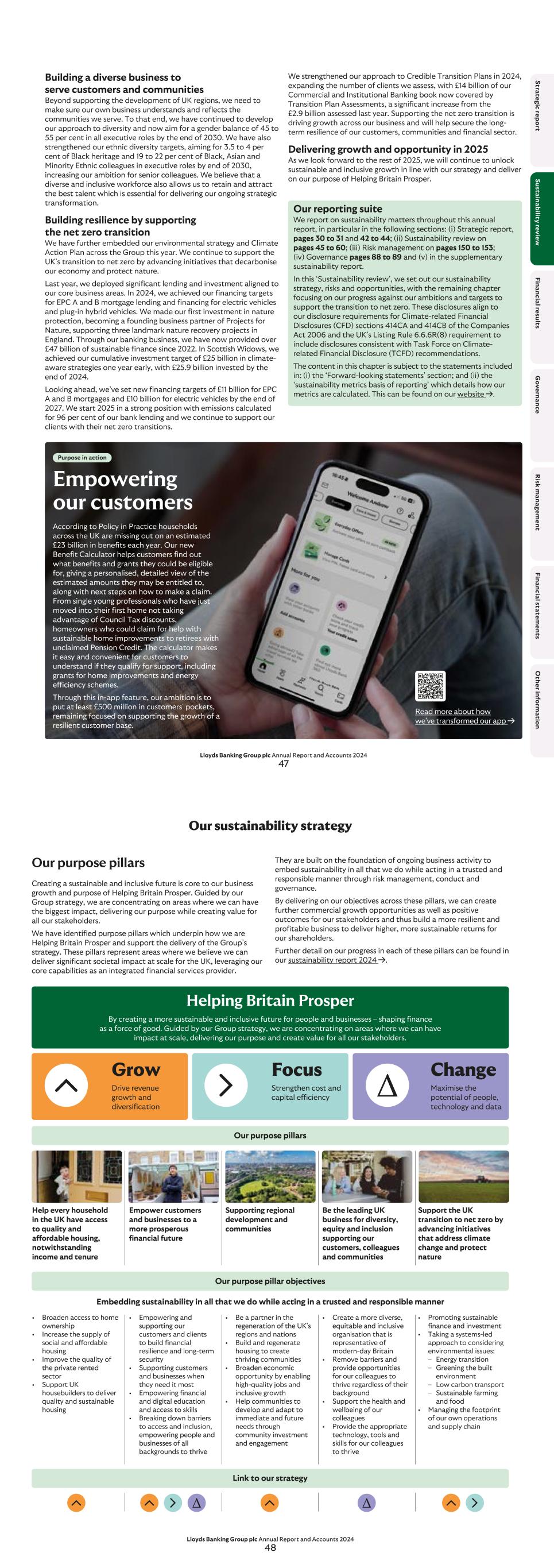
Building a diverse business to serve customers and communities Beyond supporting the development of UK regions, we need to make sure our own business understands and reflects the communities we serve. To that end, we have continued to develop our approach to diversity and now aim for a gender balance of 45 to 55 per cent in all executive roles by the end of 2030. We have also strengthened our ethnic diversity targets, aiming for 3.5 to 4 per cent of Black heritage and 19 to 22 per cent of Black, Asian and Minority Ethnic colleagues in executive roles by end of 2030, increasing our ambition for senior colleagues. We believe that a diverse and inclusive workforce also allows us to retain and attract the best talent which is essential for delivering our ongoing strategic transformation. Building resilience by supporting the net zero transition We have further embedded our environmental strategy and Climate Action Plan across the Group this year. We continue to support the UK’s transition to net zero by advancing initiatives that decarbonise our economy and protect nature. Last year, we deployed significant lending and investment aligned to our core business areas. In 2024, we achieved our financing targets for EPC A and B mortgage lending and financing for electric vehicles and plug-in hybrid vehicles. We made our first investment in nature protection, becoming a founding business partner of Projects for Nature, supporting three landmark nature recovery projects in England. Through our banking business, we have now provided over £47 billion of sustainable finance since 2022. In Scottish Widows, we achieved our cumulative investment target of £25 billion in climate- aware strategies one year early, with £25.9 billion invested by the end of 2024. Looking ahead, we’ve set new financing targets of £11 billion for EPC A and B mortgages and £10 billion for electric vehicles by the end of 2027. We start 2025 in a strong position with emissions calculated for 96 per cent of our bank lending and we continue to support our clients with their net zero transitions. We strengthened our approach to Credible Transition Plans in 2024, expanding the number of clients we assess, with £14 billion of our Commercial and Institutional Banking book now covered by Transition Plan Assessments, a significant increase from the £2.9 billion assessed last year. Supporting the net zero transition is driving growth across our business and will help secure the long- term resilience of our customers, communities and financial sector. Delivering growth and opportunity in 2025 As we look forward to the rest of 2025, we will continue to unlock sustainable and inclusive growth in line with our strategy and deliver on our purpose of Helping Britain Prosper. Our reporting suite We report on sustainability matters throughout this annual report, in particular in the following sections: (i) Strategic report, pages 30 to 31 and 42 to 44; (ii) Sustainability review on pages 45 to 60; (iii) Risk management on pages 150 to 153; (iv) Governance pages 88 to 89 and (v) in the supplementary sustainability report. In this ‘Sustainability review’, we set out our sustainability strategy, risks and opportunities, with the remaining chapter focusing on our progress against our ambitions and targets to support the transition to net zero. These disclosures align to our disclosure requirements for Climate-related Financial Disclosures (CFD) sections 414CA and 414CB of the Companies Act 2006 and the UK’s Listing Rule 6.6.6R(8) requirement to include disclosures consistent with Task Force on Climate- related Financial Disclosure (TCFD) recommendations. The content in this chapter is subject to the statements included in: (i) the ‘Forward-looking statements’ section; and (ii) the ‘sustainability metrics basis of reporting’ which details how our metrics are calculated. This can be found on our website . Empowering our customers According to Policy in Practice households across the UK are missing out on an estimated £23 billion in benefits each year. Our new Benefit Calculator helps customers find out what benefits and grants they could be eligible for, giving a personalised, detailed view of the estimated amounts they may be entitled to, along with next steps on how to make a claim. From single young professionals who have just moved into their first home not taking advantage of Council Tax discounts, homeowners who could claim for help with sustainable home improvements to retirees with unclaimed Pension Credit. The calculator makes it easy and convenient for customers to understand if they qualify for support, including grants for home improvements and energy efficiency schemes. Through this in-app feature, our ambition is to put at least £500 million in customers' pockets, remaining focused on supporting the growth of a resilient customer base. Lloyds Banking Group plc Annual Report and Accounts 2024 47 l i ts 2 O th e r in fo rm a tio n F in a n cia l re su lts S u sta in a b ility re vie w S tra te gic re p o rt G o ve rn a n ce F in a n cia l sta te m e n ts R isk m a n a ge m e n t Our purpose pillars Creating a sustainable and inclusive future is core to our business growth and purpose of Helping Britain Prosper. Guided by our Group strategy, we are concentrating on areas where we can have the biggest impact, delivering our purpose while creating value for all our stakeholders. We have identified purpose pillars which underpin how we are Helping Britain Prosper and support the delivery of the Group’s strategy. These pillars represent areas where we believe we can deliver significant societal impact at scale for the UK, leveraging our core capabilities as an integrated financial services provider. They are built on the foundation of ongoing business activity to embed sustainability in all that we do while acting in a trusted and responsible manner through risk management, conduct and governance. By delivering on our objectives across these pillars, we can create further commercial growth opportunities as well as positive outcomes for our stakeholders and thus build a more resilient and profitable business to deliver higher, more sustainable returns for our shareholders. Further detail on our progress in each of these pillars can be found in our sustainability report 2024 . Helping Britain Prosper By creating a more sustainable and inclusive future for people and businesses – shaping finance as a force of good. Guided by our Group strategy, we are concentrating on areas where we can have impact at scale, delivering our purpose and create value for all our stakeholders. Grow Focus Change Drive revenue growth and diversification Strengthen cost and capital efficiency Maximise the potential of people, technology and data Our purpose pillars Help every household in the UK have access to quality and affordable housing, notwithstanding income and tenure Empower customers and businesses to a more prosperous financial future Supporting regional development and communities Be the leading UK business for diversity, equity and inclusion supporting our customers, colleagues and communities Support the UK transition to net zero by advancing initiatives that address climate change and protect nature Our purpose pillar objectives Embedding sustainability in all that we do while acting in a trusted and responsible manner • Broaden access to home ownership • Increase the supply of social and affordable housing • Improve the quality of the private rented sector • Support UK housebuilders to deliver quality and sustainable housing • Empowering and supporting our customers and clients to build financial resilience and long-term security • Supporting customers and businesses when they need it most • Empowering financial and digital education and access to skills • Breaking down barriers to access and inclusion, empowering people and businesses of all backgrounds to thrive • Be a partner in the regeneration of the UK's regions and nations • Build and regenerate housing to create thriving communities • Broaden economic opportunity by enabling high-quality jobs and inclusive growth • Help communities to develop and adapt to immediate and future needs through community investment and engagement • Create a more diverse, equitable and inclusive organisation that is representative of modern-day Britain • Remove barriers and provide opportunities for our colleagues to thrive regardless of their background • Support the health and wellbeing of our colleagues • Provide the appropriate technology, tools and skills for our colleagues to thrive • Promoting sustainable finance and investment • Taking a systems-led approach to considering environmental issues: – Energy transition – Greening the built environment – Low carbon transport – Sustainable farming and food • Managing the footprint of our own operations and supply chain Link to our strategy Our sustainability strategy Lloyds Banking Group plc Annual Report and Accounts 2024 48 l i ts
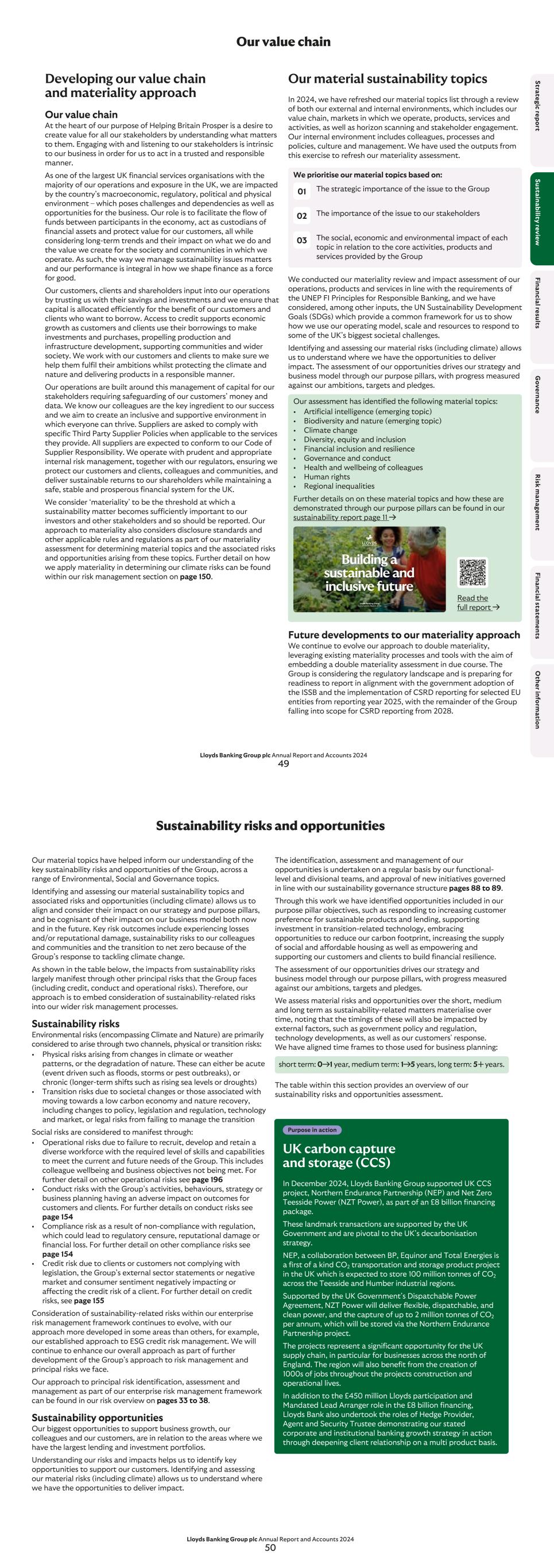
Developing our value chain and materiality approach Our value chain At the heart of our purpose of Helping Britain Prosper is a desire to create value for all our stakeholders by understanding what matters to them. Engaging with and listening to our stakeholders is intrinsic to our business in order for us to act in a trusted and responsible manner. As one of the largest UK financial services organisations with the majority of our operations and exposure in the UK, we are impacted by the country’s macroeconomic, regulatory, political and physical environment – which poses challenges and dependencies as well as opportunities for the business. Our role is to facilitate the flow of funds between participants in the economy, act as custodians of financial assets and protect value for our customers, all while considering long-term trends and their impact on what we do and the value we create for the society and communities in which we operate. As such, the way we manage sustainability issues matters and our performance is integral in how we shape finance as a force for good. Our customers, clients and shareholders input into our operations by trusting us with their savings and investments and we ensure that capital is allocated efficiently for the benefit of our customers and clients who want to borrow. Access to credit supports economic growth as customers and clients use their borrowings to make investments and purchases, propelling production and infrastructure development, supporting communities and wider society. We work with our customers and clients to make sure we help them fulfil their ambitions whilst protecting the climate and nature and delivering products in a responsible manner. Our operations are built around this management of capital for our stakeholders requiring safeguarding of our customers’ money and data. We know our colleagues are the key ingredient to our success and we aim to create an inclusive and supportive environment in which everyone can thrive. Suppliers are asked to comply with specific Third Party Supplier Policies when applicable to the services they provide. All suppliers are expected to conform to our Code of Supplier Responsibility. We operate with prudent and appropriate internal risk management, together with our regulators, ensuring we protect our customers and clients, colleagues and communities, and deliver sustainable returns to our shareholders while maintaining a safe, stable and prosperous financial system for the UK. We consider ‘materiality’ to be the threshold at which a sustainability matter becomes sufficiently important to our investors and other stakeholders and so should be reported. Our approach to materiality also considers disclosure standards and other applicable rules and regulations as part of our materiality assessment for determining material topics and the associated risks and opportunities arising from these topics. Further detail on how we apply materiality in determining our climate risks can be found within our risk management section on page 150. Our material sustainability topics In 2024, we have refreshed our material topics list through a review of both our external and internal environments, which includes our value chain, markets in which we operate, products, services and activities, as well as horizon scanning and stakeholder engagement. Our internal environment includes colleagues, processes and policies, culture and management. We have used the outputs from this exercise to refresh our materiality assessment. We prioritise our material topics based on: The strategic importance of the issue to the Group The importance of the issue to our stakeholders The social, economic and environmental impact of each topic in relation to the core activities, products and services provided by the Group We conducted our materiality review and impact assessment of our operations, products and services in line with the requirements of the UNEP FI Principles for Responsible Banking, and we have considered, among other inputs, the UN Sustainability Development Goals (SDGs) which provide a common framework for us to show how we use our operating model, scale and resources to respond to some of the UK’s biggest societal challenges. Identifying and assessing our material risks (including climate) allows us to understand where we have the opportunities to deliver impact. The assessment of our opportunities drives our strategy and business model through our purpose pillars, with progress measured against our ambitions, targets and pledges. Our assessment has identified the following material topics: • Artificial intelligence (emerging topic) • Biodiversity and nature (emerging topic) • Climate change • Diversity, equity and inclusion • Financial inclusion and resilience • Governance and conduct • Health and wellbeing of colleagues • Human rights • Regional inequalities Further details on on these material topics and how these are demonstrated through our purpose pillars can be found in our sustainability report page 11 Future developments to our materiality approach We continue to evolve our approach to double materiality, leveraging existing materiality processes and tools with the aim of embedding a double materiality assessment in due course. The Group is considering the regulatory landscape and is preparing for readiness to report in alignment with the government adoption of the ISSB and the implementation of CSRD reporting for selected EU entities from reporting year 2025, with the remainder of the Group falling into scope for CSRD reporting from 2028. Our value chain Lloyds Banking Group plc Annual Report and Accounts 2024 49 l i ts 2 O th e r in fo rm a tio n F in a n cia l re su lts S u sta in a b ility re vie w S tra te gic re p o rt G o ve rn a n ce F in a n cia l sta te m e n ts R isk m a n a ge m e n t Building a sustainable and inclusive future Lloyds Banking Group Sustainability Report 2024 Our material topics have helped inform our understanding of the key sustainability risks and opportunities of the Group, across a range of Environmental, Social and Governance topics. Identifying and assessing our material sustainability topics and associated risks and opportunities (including climate) allows us to align and consider their impact on our strategy and purpose pillars, and be cognisant of their impact on our business model both now and in the future. Key risk outcomes include experiencing losses and/or reputational damage, sustainability risks to our colleagues and communities and the transition to net zero because of the Group’s response to tackling climate change. As shown in the table below, the impacts from sustainability risks largely manifest through other principal risks that the Group faces (including credit, conduct and operational risks). Therefore, our approach is to embed consideration of sustainability-related risks into our wider risk management processes. Sustainability risks Environmental risks (encompassing Climate and Nature) are primarily considered to arise through two channels, physical or transition risks: • Physical risks arising from changes in climate or weather patterns, or the degradation of nature. These can either be acute (event driven such as floods, storms or pest outbreaks), or chronic (longer-term shifts such as rising sea levels or droughts) • Transition risks due to societal changes or those associated with moving towards a low carbon economy and nature recovery, including changes to policy, legislation and regulation, technology and market, or legal risks from failing to manage the transition Social risks are considered to manifest through: • Operational risks due to failure to recruit, develop and retain a diverse workforce with the required level of skills and capabilities to meet the current and future needs of the Group. This includes colleague wellbeing and business objectives not being met. For further detail on other operational risks see page 196 • Conduct risks with the Group’s activities, behaviours, strategy or business planning having an adverse impact on outcomes for customers and clients. For further details on conduct risks see page 154 • Compliance risk as a result of non-compliance with regulation, which could lead to regulatory censure, reputational damage or financial loss. For further detail on other compliance risks see page 154 • Credit risk due to clients or customers not complying with legislation, the Group’s external sector statements or negative market and consumer sentiment negatively impacting or affecting the credit risk of a client. For further detail on credit risks, see page 155 Consideration of sustainability-related risks within our enterprise risk management framework continues to evolve, with our approach more developed in some areas than others, for example, our established approach to ESG credit risk management. We will continue to enhance our overall approach as part of further development of the Group’s approach to risk management and principal risks we face. Our approach to principal risk identification, assessment and management as part of our enterprise risk management framework can be found in our risk overview on pages 33 to 38. Sustainability opportunities Our biggest opportunities to support business growth, our colleagues and our customers, are in relation to the areas where we have the largest lending and investment portfolios. Understanding our risks and impacts helps us to identify key opportunities to support our customers. Identifying and assessing our material risks (including climate) allows us to understand where we have the opportunities to deliver impact. The identification, assessment and management of our opportunities is undertaken on a regular basis by our functional- level and divisional teams, and approval of new initiatives governed in line with our sustainability governance structure pages 88 to 89. Through this work we have identified opportunities included in our purpose pillar objectives, such as responding to increasing customer preference for sustainable products and lending, supporting investment in transition-related technology, embracing opportunities to reduce our carbon footprint, increasing the supply of social and affordable housing as well as empowering and supporting our customers and clients to build financial resilience. The assessment of our opportunities drives our strategy and business model through our purpose pillars, with progress measured against our ambitions, targets and pledges. We assess material risks and opportunities over the short, medium and long term as sustainability-related matters materialise over time, noting that the timings of these will also be impacted by external factors, such as government policy and regulation, technology developments, as well as our customers' response. We have aligned time frames to those used for business planning: The table within this section provides an overview of our sustainability risks and opportunities assessment. UK carbon capture and storage (CCS) In December 2024, Lloyds Banking Group supported UK CCS project, Northern Endurance Partnership (NEP) and Net Zero Teesside Power (NZT Power), as part of an £8 billion financing package. These landmark transactions are supported by the UK Government and are pivotal to the UK’s decarbonisation strategy. NEP, a collaboration between BP, Equinor and Total Energies is a first of a kind CO2 transportation and storage product project in the UK which is expected to store 100 million tonnes of CO2 across the Teesside and Humber industrial regions. Supported by the UK Government’s Dispatchable Power Agreement, NZT Power will deliver flexible, dispatchable, and clean power, and the capture of up to 2 million tonnes of CO2 per annum, which will be stored via the Northern Endurance Partnership project. The projects represent a significant opportunity for the UK supply chain, in particular for businesses across the north of England. The region will also benefit from the creation of 1000s of jobs throughout the projects construction and operational lives. In addition to the £450 million Lloyds participation and Mandated Lead Arranger role in the £8 billion financing, Lloyds Bank also undertook the roles of Hedge Provider, Agent and Security Trustee demonstrating our stated corporate and institutional banking growth strategy in action through deepening client relationship on a multi product basis. Sustainability risks and opportunities Lloyds Banking Group plc Annual Report and Accounts 2024 50 l i ts
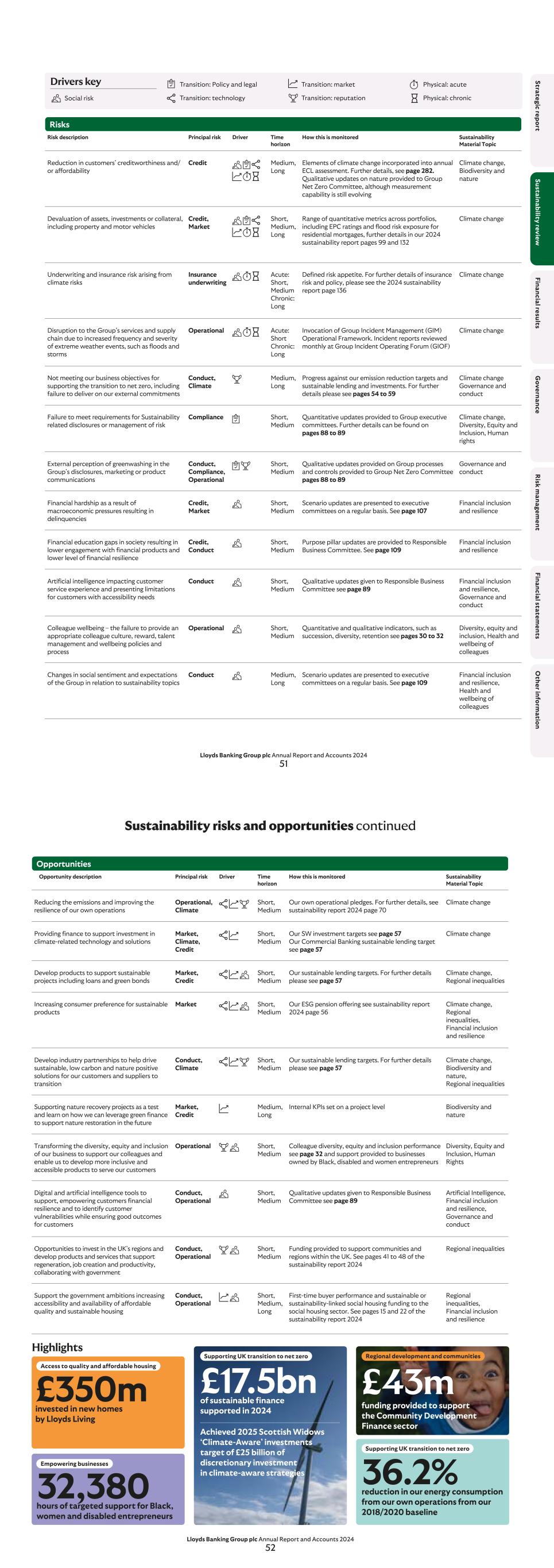
Risks Risk description Principal risk Driver Time horizon How this is monitored Sustainability Material Topic Reduction in customers’ creditworthiness and/ or affordability Credit Medium, Long Elements of climate change incorporated into annual ECL assessment. Further details, see page 282. Qualitative updates on nature provided to Group Net Zero Committee, although measurement capability is still evolving Climate change, Biodiversity and nature Devaluation of assets, investments or collateral, including property and motor vehicles Credit, Market Short, Medium, Long Range of quantitative metrics across portfolios, including EPC ratings and flood risk exposure for residential mortgages, further details in our 2024 sustainability report pages 99 and 132 Climate change Underwriting and insurance risk arising from climate risks Insurance underwriting Acute: Short, Medium Chronic: Long Defined risk appetite. For further details of insurance risk and policy, please see the 2024 sustainability report page 136 Climate change Disruption to the Group’s services and supply chain due to increased frequency and severity of extreme weather events, such as floods and storms Operational Acute: Short Chronic: Long Invocation of Group Incident Management (GIM) Operational Framework. Incident reports reviewed monthly at Group Incident Operating Forum (GIOF) Climate change Not meeting our business objectives for supporting the transition to net zero, including failure to deliver on our external commitments Conduct, Climate Medium, Long Progress against our emission reduction targets and sustainable lending and investments. For further details please see pages 54 to 59 Climate change Governance and conduct Failure to meet requirements for Sustainability related disclosures or management of risk Compliance Short, Medium Quantitative updates provided to Group executive committees. Further details can be found on pages 88 to 89 Climate change, Diversity, Equity and Inclusion, Human rights External perception of greenwashing in the Group’s disclosures, marketing or product communications Conduct, Compliance, Operational Short, Medium Qualitative updates provided on Group processes and controls provided to Group Net Zero Committee pages 88 to 89 Governance and conduct Financial hardship as a result of macroeconomic pressures resulting in delinquencies Credit, Market Short, Medium Scenario updates are presented to executive committees on a regular basis. See page 107 Financial inclusion and resilience Financial education gaps in society resulting in lower engagement with financial products and lower level of financial resilience Credit, Conduct Short, Medium Purpose pillar updates are provided to Responsible Business Committee. See page 109 Financial inclusion and resilience Artificial intelligence impacting customer service experience and presenting limitations for customers with accessibility needs Conduct Short, Medium Qualitative updates given to Responsible Business Committee see page 89 Financial inclusion and resilience, Governance and conduct Colleague wellbeing – the failure to provide an appropriate colleague culture, reward, talent management and wellbeing policies and process Operational Short, Medium Quantitative and qualitative indicators, such as succession, diversity, retention see pages 30 to 32 Diversity, equity and inclusion, Health and wellbeing of colleagues Changes in social sentiment and expectations of the Group in relation to sustainability topics Conduct Medium, Long Scenario updates are presented to executive committees on a regular basis. See page 109 Financial inclusion and resilience, Health and wellbeing of colleagues Lloyds Banking Group plc Annual Report and Accounts 2024 51 l i ts 2 O th e r in fo rm a tio n F in a n cia l re su lts S u sta in a b ility re vie w S tra te gic re p o rt G o ve rn a n ce F in a n cia l sta te m e n ts R isk m a n a ge m e n t Opportunities Opportunity description Principal risk Driver Time horizon How this is monitored Sustainability Material Topic Reducing the emissions and improving the resilience of our own operations Operational, Climate Short, Medium Our own operational pledges. For further details, see sustainability report 2024 page 70 Climate change Providing finance to support investment in climate-related technology and solutions Market, Climate, Credit Short, Medium Our SW investment targets see page 57 Our Commercial Banking sustainable lending target see page 57 Climate change Develop products to support sustainable projects including loans and green bonds Market, Credit Short, Medium Our sustainable lending targets. For further details please see page 57 Climate change, Regional inequalities Increasing consumer preference for sustainable products Market Short, Medium Our ESG pension offering see sustainability report 2024 page 56 Climate change, Regional inequalities, Financial inclusion and resilience Develop industry partnerships to help drive sustainable, low carbon and nature positive solutions for our customers and suppliers to transition Conduct, Climate Short, Medium Our sustainable lending targets. For further details please see page 57 Climate change, Biodiversity and nature, Regional inequalities Supporting nature recovery projects as a test and learn on how we can leverage green finance to support nature restoration in the future Market, Credit Medium, Long Internal KPIs set on a project level Biodiversity and nature Transforming the diversity, equity and inclusion of our business to support our colleagues and enable us to develop more inclusive and accessible products to serve our customers Operational Short, Medium Colleague diversity, equity and inclusion performance see page 32 and support provided to businesses owned by Black, disabled and women entrepreneurs Diversity, Equity and Inclusion, Human Rights Digital and artificial intelligence tools to support, empowering customers financial resilience and to identify customer vulnerabilities while ensuring good outcomes for customers Conduct, Operational Short, Medium Qualitative updates given to Responsible Business Committee see page 89 Artificial Intelligence, Financial inclusion and resilience, Governance and conduct Opportunities to invest in the UK’s regions and develop products and services that support regeneration, job creation and productivity, collaborating with government Conduct, Operational Short, Medium Funding provided to support communities and regions within the UK. See pages 41 to 48 of the sustainability report 2024 Regional inequalities Support the government ambitions increasing accessibility and availability of affordable quality and sustainable housing Conduct, Operational Short, Medium, Long First-time buyer performance and sustainable or sustainability-linked social housing funding to the social housing sector. See pages 15 and 22 of the sustainability report 2024 Regional inequalities, Financial inclusion and resilience Sustainability risks and opportunities continued Lloyds Banking Group plc Annual Report and Accounts 2024 52 l i ts
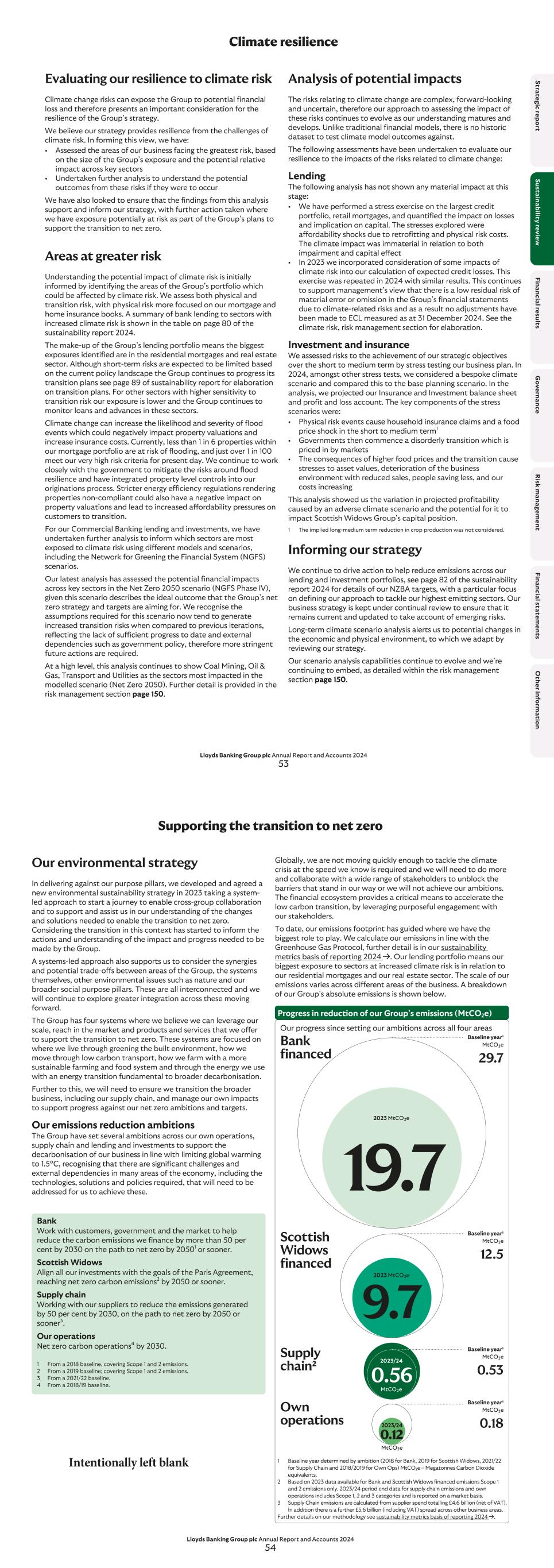
Evaluating our resilience to climate risk Climate change risks can expose the Group to potential financial loss and therefore presents an important consideration for the resilience of the Group’s strategy. We believe our strategy provides resilience from the challenges of climate risk. In forming this view, we have: • Assessed the areas of our business facing the greatest risk, based on the size of the Group’s exposure and the potential relative impact across key sectors • Undertaken further analysis to understand the potential outcomes from these risks if they were to occur We have also looked to ensure that the findings from this analysis support and inform our strategy, with further action taken where we have exposure potentially at risk as part of the Group’s plans to support the transition to net zero. Areas at greater risk Understanding the potential impact of climate risk is initially informed by identifying the areas of the Group’s portfolio which could be affected by climate risk. We assess both physical and transition risk, with physical risk more focused on our mortgage and home insurance books. A summary of bank lending to sectors with increased climate risk is shown in the table on page 80 of the sustainability report 2024. The make-up of the Group’s lending portfolio means the biggest exposures identified are in the residential mortgages and real estate sector. Although short-term risks are expected to be limited based on the current policy landscape the Group continues to progress its transition plans see page 89 of sustainability report for elaboration on transition plans. For other sectors with higher sensitivity to transition risk our exposure is lower and the Group continues to monitor loans and advances in these sectors. Climate change can increase the likelihood and severity of flood events which could negatively impact property valuations and increase insurance costs. Currently, less than 1 in 6 properties within our mortgage portfolio are at risk of flooding, and just over 1 in 100 meet our very high risk criteria for present day. We continue to work closely with the government to mitigate the risks around flood resilience and have integrated property level controls into our originations process. Stricter energy efficiency regulations rendering properties non-compliant could also have a negative impact on property valuations and lead to increased affordability pressures on customers to transition. For our Commercial Banking lending and investments, we have undertaken further analysis to inform which sectors are most exposed to climate risk using different models and scenarios, including the Network for Greening the Financial System (NGFS) scenarios. Our latest analysis has assessed the potential financial impacts across key sectors in the Net Zero 2050 scenario (NGFS Phase IV), given this scenario describes the ideal outcome that the Group’s net zero strategy and targets are aiming for. We recognise the assumptions required for this scenario now tend to generate increased transition risks when compared to previous iterations, reflecting the lack of sufficient progress to date and external dependencies such as government policy, therefore more stringent future actions are required. At a high level, this analysis continues to show Coal Mining, Oil & Gas, Transport and Utilities as the sectors most impacted in the modelled scenario (Net Zero 2050). Further detail is provided in the risk management section page 150. Analysis of potential impacts The risks relating to climate change are complex, forward-looking and uncertain, therefore our approach to assessing the impact of these risks continues to evolve as our understanding matures and develops. Unlike traditional financial models, there is no historic dataset to test climate model outcomes against. The following assessments have been undertaken to evaluate our resilience to the impacts of the risks related to climate change: Lending The following analysis has not shown any material impact at this stage: • We have performed a stress exercise on the largest credit portfolio, retail mortgages, and quantified the impact on losses and implication on capital. The stresses explored were affordability shocks due to retrofitting and physical risk costs. The climate impact was immaterial in relation to both impairment and capital effect • In 2023 we incorporated consideration of some impacts of climate risk into our calculation of expected credit losses. This exercise was repeated in 2024 with similar results. This continues to support management’s view that there is a low residual risk of material error or omission in the Group’s financial statements due to climate-related risks and as a result no adjustments have been made to ECL measured as at 31 December 2024. See the climate risk, risk management section for elaboration. Investment and insurance We assessed risks to the achievement of our strategic objectives over the short to medium term by stress testing our business plan. In 2024, amongst other stress tests, we considered a bespoke climate scenario and compared this to the base planning scenario. In the analysis, we projected our Insurance and Investment balance sheet and profit and loss account. The key components of the stress scenarios were: • Physical risk events cause household insurance claims and a food price shock in the short to medium term1 • Governments then commence a disorderly transition which is priced in by markets • The consequences of higher food prices and the transition cause stresses to asset values, deterioration of the business environment with reduced sales, people saving less, and our costs increasing This analysis showed us the variation in projected profitability caused by an adverse climate scenario and the potential for it to impact Scottish Widows Group’s capital position. 1 The implied long-medium term reduction in crop production was not considered. Informing our strategy We continue to drive action to help reduce emissions across our lending and investment portfolios, see page 82 of the sustainability report 2024 for details of our NZBA targets, with a particular focus on defining our approach to tackle our highest emitting sectors. Our business strategy is kept under continual review to ensure that it remains current and updated to take account of emerging risks. Long-term climate scenario analysis alerts us to potential changes in the economic and physical environment, to which we adapt by reviewing our strategy. Our scenario analysis capabilities continue to evolve and we’re continuing to embed, as detailed within the risk management section page 150. Climate resilience Lloyds Banking Group plc Annual Report and Accounts 2024 53 l i ts 2 O th e r in fo rm a tio n F in a n cia l re su lts S u sta in a b ility re vie w S tra te gic re p o rt G o ve rn a n ce F in a n cia l sta te m e n ts R isk m a n a ge m e n t Our environmental strategy In delivering against our purpose pillars, we developed and agreed a new environmental sustainability strategy in 2023 taking a system- led approach to start a journey to enable cross-group collaboration and to support and assist us in our understanding of the changes and solutions needed to enable the transition to net zero. Considering the transition in this context has started to inform the actions and understanding of the impact and progress needed to be made by the Group. A systems-led approach also supports us to consider the synergies and potential trade-offs between areas of the Group, the systems themselves, other environmental issues such as nature and our broader social purpose pillars. These are all interconnected and we will continue to explore greater integration across these moving forward. The Group has four systems where we believe we can leverage our scale, reach in the market and products and services that we offer to support the transition to net zero. These systems are focused on where we live through greening the built environment, how we move through low carbon transport, how we farm with a more sustainable farming and food system and through the energy we use with an energy transition fundamental to broader decarbonisation. Further to this, we will need to ensure we transition the broader business, including our supply chain, and manage our own impacts to support progress against our net zero ambitions and targets. Our emissions reduction ambitions The Group have set several ambitions across our own operations, supply chain and lending and investments to support the decarbonisation of our business in line with limiting global warming to 1.5°C, recognising that there are significant challenges and external dependencies in many areas of the economy, including the technologies, solutions and policies required, that will need to be addressed for us to achieve these. Bank Work with customers, government and the market to help reduce the carbon emissions we finance by more than 50 per cent by 2030 on the path to net zero by 20501 or sooner. Scottish Widows Align all our investments with the goals of the Paris Agreement, reaching net zero carbon emissions2 by 2050 or sooner. Supply chain Working with our suppliers to reduce the emissions generated by 50 per cent by 2030, on the path to net zero by 2050 or sooner3. Our operations Net zero carbon operations4 by 2030. 1 From a 2018 baseline, covering Scope 1 and 2 emissions. 2 From a 2019 baseline; covering Scope 1 and 2 emissions. 3 From a 2021/22 baseline. 4 From a 2018/19 baseline. Globally, we are not moving quickly enough to tackle the climate crisis at the speed we know is required and we will need to do more and collaborate with a wide range of stakeholders to unblock the barriers that stand in our way or we will not achieve our ambitions. The financial ecosystem provides a critical means to accelerate the low carbon transition, by leveraging purposeful engagement with our stakeholders. To date, our emissions footprint has guided where we have the biggest role to play. We calculate our emissions in line with the Greenhouse Gas Protocol, further detail is in our sustainability metrics basis of reporting 2024 . Our lending portfolio means our biggest exposure to sectors at increased climate risk is in relation to our residential mortgages and our real estate sector. The scale of our emissions varies across different areas of the business. A breakdown of our Group’s absolute emissions is shown below. Supporting the transition to net zero Lloyds Banking Group plc Annual Report and Accounts 2024 54 Progress in reduction of our Group’s emissions (MtCO2e) 1 Baseline year determined by ambition (2018 for Bank, 2019 for Scottish Widows, 2021/22 for Supply Chain and 2018/2019 for Own Ops) MtCO2e – Megatonnes Carbon Dioxide equivalents. 2 Based on 2023 data available for Bank and Scottish Widows financed emissions Scope 1 and 2 emissions only. 2023/24 period end data for supply chain emissions and own operations includes Scope 1, 2 and 3 categories and is reported on a market basis. 3 Supply Chain emissions are calculated from supplier spend totalling £4.6 billion (net of VAT). In addition there is a further £5.6 billion (including VAT) spread across other business areas. Further details on our methodology see sustainability metrics basis of reporting 2024 . l i ts Intentionally left blank
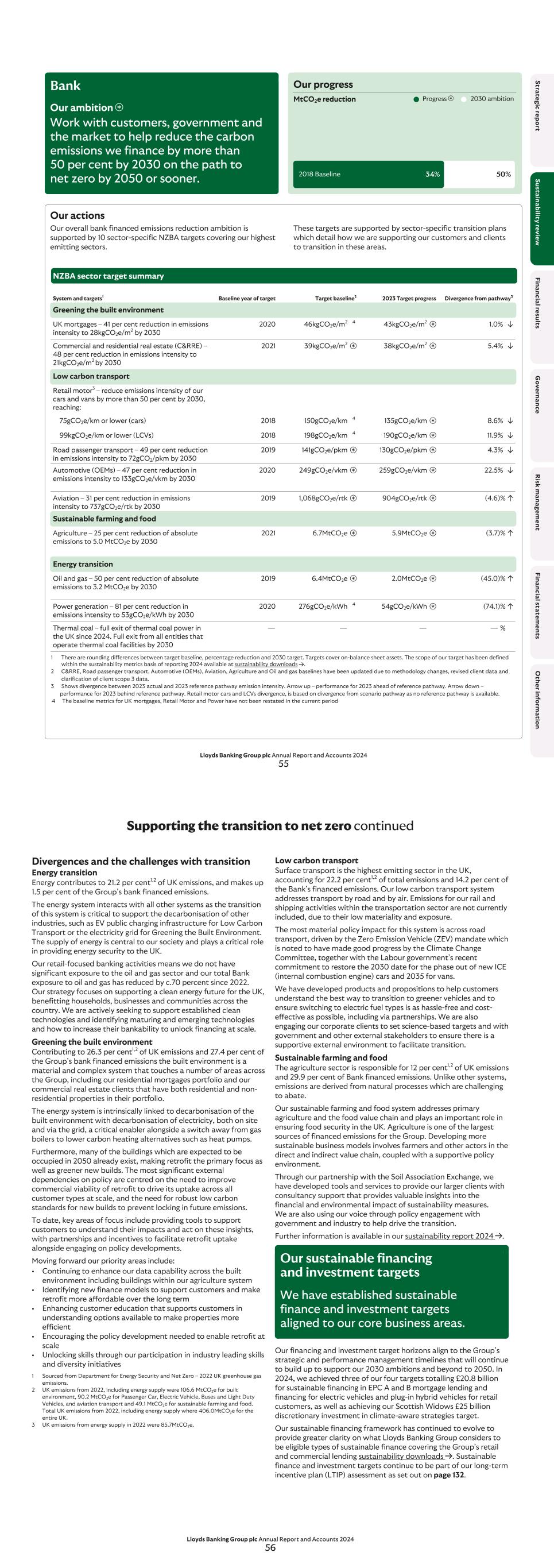
Bank Our ambition Work with customers, government and the market to help reduce the carbon emissions we finance by more than 50 per cent by 2030 on the path to net zero by 2050 or sooner. Our progress MtCO2e reduction l Progress l 2030 ambition Our actions Our overall bank financed emissions reduction ambition is supported by 10 sector-specific NZBA targets covering our highest emitting sectors. These targets are supported by sector-specific transition plans which detail how we are supporting our customers and clients to transition in these areas. NZBA sector target summary System and targets1 Baseline year of target Target baseline2 2023 Target progress Divergence from pathway3 Greening the built environment UK mortgages – 41 per cent reduction in emissions intensity to 28kgCO2e/m2 by 2030 2020 46kgCO2e/m2 4 43kgCO2e/m2 1.0% Commercial and residential real estate (C&RRE) – 48 per cent reduction in emissions intensity to 21kgCO2e/m2 by 2030 2021 39kgCO2e/m2 38kgCO2e/m2 5.4% Low carbon transport Retail motor3 – reduce emissions intensity of our cars and vans by more than 50 per cent by 2030, reaching: 75gCO2e/km or lower (cars) 2018 150gCO2e/km 4 135gCO2e/km 8.6% 99kgCO2e/km or lower (LCVs) 2018 198gCO2e/km 4 190gCO2e/km 11.9% Road passenger transport – 49 per cent reduction in emissions intensity to 72gCO2/pkm by 2030 2019 141gCO2e/pkm 130gCO2e/pkm 4.3% Automotive (OEMs) – 47 per cent reduction in emissions intensity to 133gCO2e/vkm by 2030 2020 249gCO2e/vkm 259gCO2e/vkm 22.5% Aviation – 31 per cent reduction in emissions intensity to 737gCO2e/rtk by 2030 2019 1,068gCO2e/rtk 904gCO2e/rtk (4.6) % Sustainable farming and food Agriculture – 25 per cent reduction of absolute emissions to 5.0 MtCO2e by 2030 2021 6.7MtCO2e 5.9MtCO2e (3.7) % Energy transition Oil and gas – 50 per cent reduction of absolute emissions to 3.2 MtCO2e by 2030 2019 6.4MtCO2e 2.0MtCO2e (45.0) % Power generation – 81 per cent reduction in emissions intensity to 53gCO2e/kWh by 2030 2020 276gCO2e/kWh 4 54gCO2e/kWh (74.1) % Thermal coal – full exit of thermal coal power in the UK since 2024. Full exit from all entities that operate thermal coal facilities by 2030 — — — — % 1 There are rounding differences between target baseline, percentage reduction and 2030 target. Targets cover on-balance sheet assets. The scope of our target has been defined within the sustainability metrics basis of reporting 2024 available at sustainability downloads . 2 C&RRE, Road passenger transport, Automotive (OEMs), Aviation, Agriculture and Oil and gas baselines have been updated due to methodology changes, revised client data and clarification of client scope 3 data. 3 Shows divergence between 2023 actual and 2023 reference pathway emission intensity. Arrow up – performance for 2023 ahead of reference pathway. Arrow down – performance for 2023 behind reference pathway. Retail motor cars and LCVs divergence, is based on divergence from scenario pathway as no reference pathway is available. 4 The baseline metrics for UK mortgages, Retail Motor and Power have not been restated in the current period______________________________________________________________ Lloyds Banking Group plc Annual Report and Accounts 2024 55 l i ts 2 O th e r in fo rm a tio n F in a n cia l re su lts S u sta in a b ility re vie w S tra te gic re p o rt G o ve rn a n ce F in a n cia l sta te m e n ts R isk m a n a ge m e n t Divergences and the challenges with transition Energy transition Energy contributes to 21.2 per cent1,2 of UK emissions, and makes up 1.5 per cent of the Group’s bank financed emissions. The energy system interacts with all other systems as the transition of this system is critical to support the decarbonisation of other industries, such as EV public charging infrastructure for Low Carbon Transport or the electricity grid for Greening the Built Environment. The supply of energy is central to our society and plays a critical role in providing energy security to the UK. Our retail-focused banking activities means we do not have significant exposure to the oil and gas sector and our total Bank exposure to oil and gas has reduced by c.70 percent since 2022. Our strategy focuses on supporting a clean energy future for the UK, benefitting households, businesses and communities across the country. We are actively seeking to support established clean technologies and identifying maturing and emerging technologies and how to increase their bankability to unlock financing at scale. Greening the built environment Contributing to 26.3 per cent1,2 of UK emissions and 27.4 per cent of the Group’s bank financed emissions the built environment is a material and complex system that touches a number of areas across the Group, including our residential mortgages portfolio and our commercial real estate clients that have both residential and non- residential properties in their portfolio. The energy system is intrinsically linked to decarbonisation of the built environment with decarbonisation of electricity, both on site and via the grid, a critical enabler alongside a switch away from gas boilers to lower carbon heating alternatives such as heat pumps. Furthermore, many of the buildings which are expected to be occupied in 2050 already exist, making retrofit the primary focus as well as greener new builds. The most significant external dependencies on policy are centred on the need to improve commercial viability of retrofit to drive its uptake across all customer types at scale, and the need for robust low carbon standards for new builds to prevent locking in future emissions. To date, key areas of focus include providing tools to support customers to understand their impacts and act on these insights, with partnerships and incentives to facilitate retrofit uptake alongside engaging on policy developments. Moving forward our priority areas include: • Continuing to enhance our data capability across the built environment including buildings within our agriculture system • Identifying new finance models to support customers and make retrofit more affordable over the long term • Enhancing customer education that supports customers in understanding options available to make properties more efficient • Encouraging the policy development needed to enable retrofit at scale • Unlocking skills through our participation in industry leading skills and diversity initiatives 1 Sourced from Department for Energy Security and Net Zero – 2022 UK greenhouse gas emissions. 2 UK emissions from 2022, including energy supply were 106.6 MtCO2e for built environment, 90.2 MtCO2e for Passenger Car, Electric Vehicle, Buses and Light Duty Vehicles, and aviation transport and 49.1 MtCO2e for sustainable farming and food. Total UK emissions from 2022, including energy supply where 406.0MtCO2e for the entire UK. 3 UK emissions from energy supply in 2022 were 85.7MtCO2e. Low carbon transport Surface transport is the highest emitting sector in the UK, accounting for 22.2 per cent1,2 of total emissions and 14.2 per cent of the Bank’s financed emissions. Our low carbon transport system addresses transport by road and by air. Emissions for our rail and shipping activities within the transportation sector are not currently included, due to their low materiality and exposure. The most material policy impact for this system is across road transport, driven by the Zero Emission Vehicle (ZEV) mandate which is noted to have made good progress by the Climate Change Committee, together with the Labour government’s recent commitment to restore the 2030 date for the phase out of new ICE (internal combustion engine) cars and 2035 for vans. We have developed products and propositions to help customers understand the best way to transition to greener vehicles and to ensure switching to electric fuel types is as hassle-free and cost- effective as possible, including via partnerships. We are also engaging our corporate clients to set science-based targets and with government and other external stakeholders to ensure there is a supportive external environment to facilitate transition. Sustainable farming and food The agriculture sector is responsible for 12 per cent1,2 of UK emissions and 29.9 per cent of Bank financed emissions. Unlike other systems, emissions are derived from natural processes which are challenging to abate. Our sustainable farming and food system addresses primary agriculture and the food value chain and plays an important role in ensuring food security in the UK. Agriculture is one of the largest sources of financed emissions for the Group. Developing more sustainable business models involves farmers and other actors in the direct and indirect value chain, coupled with a supportive policy environment. Through our partnership with the Soil Association Exchange, we have developed tools and services to provide our larger clients with consultancy support that provides valuable insights into the financial and environmental impact of sustainability measures. We are also using our voice through policy engagement with government and industry to help drive the transition. Further information is available in our sustainability report 2024 . Our sustainable financing and investment targets We have established sustainable finance and investment targets aligned to our core business areas. Our financing and investment target horizons align to the Group’s strategic and performance management timelines that will continue to build up to support our 2030 ambitions and beyond to 2050. In 2024, we achieved three of our four targets totalling £20.8 billion for sustainable financing in EPC A and B mortgage lending and financing for electric vehicles and plug-in hybrid vehicles for retail customers, as well as achieving our Scottish Widows £25 billion discretionary investment in climate-aware strategies target. Our sustainable financing framework has continued to evolve to provide greater clarity on what Lloyds Banking Group considers to be eligible types of sustainable finance covering the Group’s retail and commercial lending sustainability downloads . Sustainable finance and investment targets continue to be part of our long-term incentive plan (LTIP) assessment as set out on page 132. Supporting the transition to net zero continued Lloyds Banking Group plc Annual Report and Accounts 2024 56 l i ts
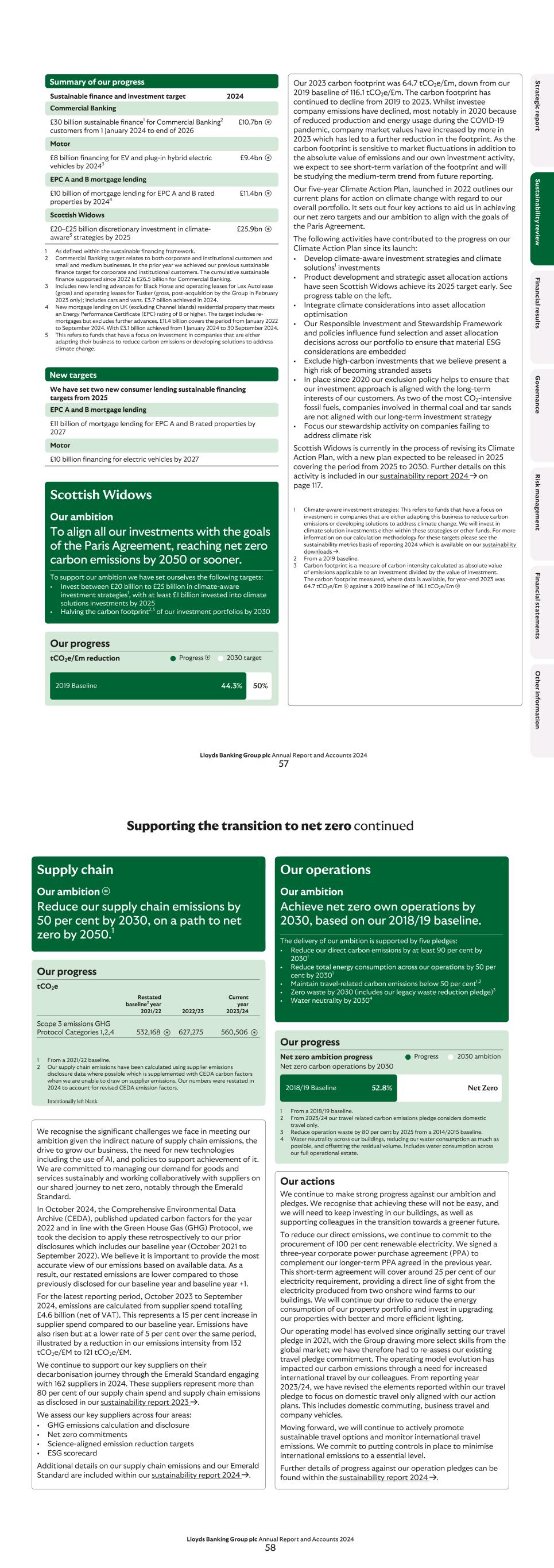
Summary of our progress Sustainable finance and investment target 2024 Commercial Banking £30 billion sustainable finance1 for Commercial Banking2 customers from 1 January 2024 to end of 2026 £10.7bn Motor £8 billion financing for EV and plug-in hybrid electric vehicles by 20243 £9.4bn EPC A and B mortgage lending £10 billion of mortgage lending for EPC A and B rated properties by 20244 £11.4bn Scottish Widows £20–£25 billion discretionary investment in climate- aware5 strategies by 2025 £25.9bn 1 As defined within the sustainable financing framework. 2 Commercial Banking target relates to both corporate and institutional customers and small and medium businesses. In the prior year we achieved our previous sustainable finance target for corporate and institutional customers. The cumulative sustainable finance supported since 2022 is £26.5 billion for Commercial Banking. 3 Includes new lending advances for Black Horse and operating leases for Lex Autolease (gross) and operating leases for Tusker (gross, post-acquisition by the Group in February 2023 only); includes cars and vans. £3.7 billion achieved in 2024. 4 New mortgage lending on UK (excluding Channel Islands) residential property that meets an Energy Performance Certificate (EPC) rating of B or higher. The target includes re- mortgages but excludes further advances. £11.4 billion covers the period from January 2022 to September 2024. With £3.1 billion achieved from 1 January 2024 to 30 September 2024. 5 This refers to funds that have a focus on investment in companies that are either adapting their business to reduce carbon emissions or developing solutions to address climate change. New targets We have set two new consumer lending sustainable financing targets from 2025 EPC A and B mortgage lending £11 billion of mortgage lending for EPC A and B rated properties by 2027 Motor £10 billion financing for electric vehicles by 2027 Scottish Widows Our ambition To align all our investments with the goals of the Paris Agreement, reaching net zero carbon emissions by 2050 or sooner. To support our ambition we have set ourselves the following targets: • Invest between £20 billion to £25 billion in climate-aware investment strategies1, with at least £1 billion invested into climate solutions investments by 2025 • Halving the carbon footprint2,3 of our investment portfolios by 2030 Our progress tCO2e/£m reduction l Progress l 2030 target Our 2023 carbon footprint was 64.7 tCO2e/£m, down from our 2019 baseline of 116.1 tCO2e/£m. The carbon footprint has continued to decline from 2019 to 2023. Whilst investee company emissions have declined, most notably in 2020 because of reduced production and energy usage during the COVID-19 pandemic, company market values have increased by more in 2023 which has led to a further reduction in the footprint. As the carbon footprint is sensitive to market fluctuations in addition to the absolute value of emissions and our own investment activity, we expect to see short-term variation of the footprint and will be studying the medium-term trend from future reporting. Our five-year Climate Action Plan, launched in 2022 outlines our current plans for action on climate change with regard to our overall portfolio. It sets out four key actions to aid us in achieving our net zero targets and our ambition to align with the goals of the Paris Agreement. The following activities have contributed to the progress on our Climate Action Plan since its launch: • Develop climate-aware investment strategies and climate solutions1 investments • Product development and strategic asset allocation actions have seen Scottish Widows achieve its 2025 target early. See progress table on the left. • Integrate climate considerations into asset allocation optimisation • Our Responsible Investment and Stewardship Framework and policies influence fund selection and asset allocation decisions across our portfolio to ensure that material ESG considerations are embedded • Exclude high-carbon investments that we believe present a high risk of becoming stranded assets • In place since 2020 our exclusion policy helps to ensure that our investment approach is aligned with the long-term interests of our customers. As two of the most CO2-intensive fossil fuels, companies involved in thermal coal and tar sands are not aligned with our long-term investment strategy • Focus our stewardship activity on companies failing to address climate risk Scottish Widows is currently in the process of revising its Climate Action Plan, with a new plan expected to be released in 2025 covering the period from 2025 to 2030. Further details on this activity is included in our sustainability report 2024 on page 117. 1 Climate-aware investment strategies: This refers to funds that have a focus on investment in companies that are either adapting this business to reduce carbon emissions or developing solutions to address climate change. We will invest in climate solution investments either within these strategies or other funds. For more information on our calculation methodology for these targets please see the sustainability metrics basis of reporting 2024 which is available on our sustainability downloads . 2 From a 2019 baseline. 3 Carbon footprint is a measure of carbon intensity calculated as absolute value of emissions applicable to an investment divided by the value of investment. The carbon footprint measured, where data is available, for year-end 2023 was 64.7 tCO2e/£m against a 2019 baseline of 116.1 tCO2e/£m Lloyds Banking Group plc Annual Report and Accounts 2024 57 l i ts 2 O th e r in fo rm a tio n F in a n cia l re su lts S u sta in a b ility re vie w S tra te gic re p o rt G o ve rn a n ce F in a n cia l sta te m e n ts R isk m a n a ge m e n t Supply chain Our ambition Reduce our supply chain emissions by 50 per cent by 2030, on a path to net zero by 2050.1 Our progress tCO2e Restated baseline2 year 2021/22 2022/23 Current year 2023/24 Scope 3 emissions GHG Protocol Categories 1,2,4 532,168 627,275 560,506 1 From a 2021/22 baseline. 2 Our supply chain emissions have been calculated using supplier emissions disclosure data where possible which is supplemented with CEDA carbon factors when we are unable to draw on supplier emissions. Our numbers were restated in 2024 to account for revised CEDA emission factors. Intentionally left blank We recognise the significant challenges we face in meeting our ambition given the indirect nature of supply chain emissions, the drive to grow our business, the need for new technologies including the use of AI, and policies to support achievement of it. We are committed to managing our demand for goods and services sustainably and working collaboratively with suppliers on our shared journey to net zero, notably through the Emerald Standard. In October 2024, the Comprehensive Environmental Data Archive (CEDA), published updated carbon factors for the year 2022 and in line with the Green House Gas (GHG) Protocol, we took the decision to apply these retrospectively to our prior disclosures which includes our baseline year (October 2021 to September 2022). We believe it is important to provide the most accurate view of our emissions based on available data. As a result, our restated emissions are lower compared to those previously disclosed for our baseline year and baseline year +1. For the latest reporting period, October 2023 to September 2024, emissions are calculated from supplier spend totalling £4.6 billion (net of VAT). This represents a 15 per cent increase in supplier spend compared to our baseline year. Emissions have also risen but at a lower rate of 5 per cent over the same period, illustrated by a reduction in our emissions intensity from 132 tCO2e/£M to 121 tCO2e/£M. We continue to support our key suppliers on their decarbonisation journey through the Emerald Standard engaging with 162 suppliers in 2024. These suppliers represent more than 80 per cent of our supply chain spend and supply chain emissions as disclosed in our sustainability report 2023 . We assess our key suppliers across four areas: • GHG emissions calculation and disclosure • Net zero commitments • Science-aligned emission reduction targets • ESG scorecard Additional details on our supply chain emissions and our Emerald Standard are included within our sustainability report 2024 . Our operations Our ambition Achieve net zero own operations by 2030, based on our 2018/19 baseline. The delivery of our ambition is supported by five pledges: • Reduce our direct carbon emissions by at least 90 per cent by 20301 • Reduce total energy consumption across our operations by 50 per cent by 20301 • Maintain travel-related carbon emissions below 50 per cent1,2 • Zero waste by 2030 (includes our legacy waste reduction pledge)3 • Water neutrality by 20304 Our progress Net zero ambition progress l Progress l 2030 ambition Net zero carbon operations by 2030 1 From a 2018/19 baseline. 2 From 2023/24 our travel related carbon emissions pledge considers domestic travel only. 3 Reduce operation waste by 80 per cent by 2025 from a 2014/2015 baseline. 4 Water neutrality across our buildings, reducing our water consumption as much as possible, and offsetting the residual volume. Includes water consumption across our full operational estate. Our actions We continue to make strong progress against our ambition and pledges. We recognise that achieving these will not be easy, and we will need to keep investing in our buildings, as well as supporting colleagues in the transition towards a greener future. To reduce our direct emissions, we continue to commit to the procurement of 100 per cent renewable electricity. We signed a three-year corporate power purchase agreement (PPA) to complement our longer-term PPA agreed in the previous year. This short-term agreement will cover around 25 per cent of our electricity requirement, providing a direct line of sight from the electricity produced from two onshore wind farms to our buildings. We will continue our drive to reduce the energy consumption of our property portfolio and invest in upgrading our properties with better and more efficient lighting. Our operating model has evolved since originally setting our travel pledge in 2021, with the Group drawing more select skills from the global market; we have therefore had to re-assess our existing travel pledge commitment. The operating model evolution has impacted our carbon emissions through a need for increased international travel by our colleagues. From reporting year 2023/24, we have revised the elements reported within our travel pledge to focus on domestic travel only aligned with our action plans. This includes domestic commuting, business travel and company vehicles. Moving forward, we will continue to actively promote sustainable travel options and monitor international travel emissions. We commit to putting controls in place to minimise international emissions to a essential level. Further details of progress against our operation pledges can be found within the sustainability report 2024 . Supporting the transition to net zero continued Lloyds Banking Group plc Annual Report and Accounts 2024 58 l i ts
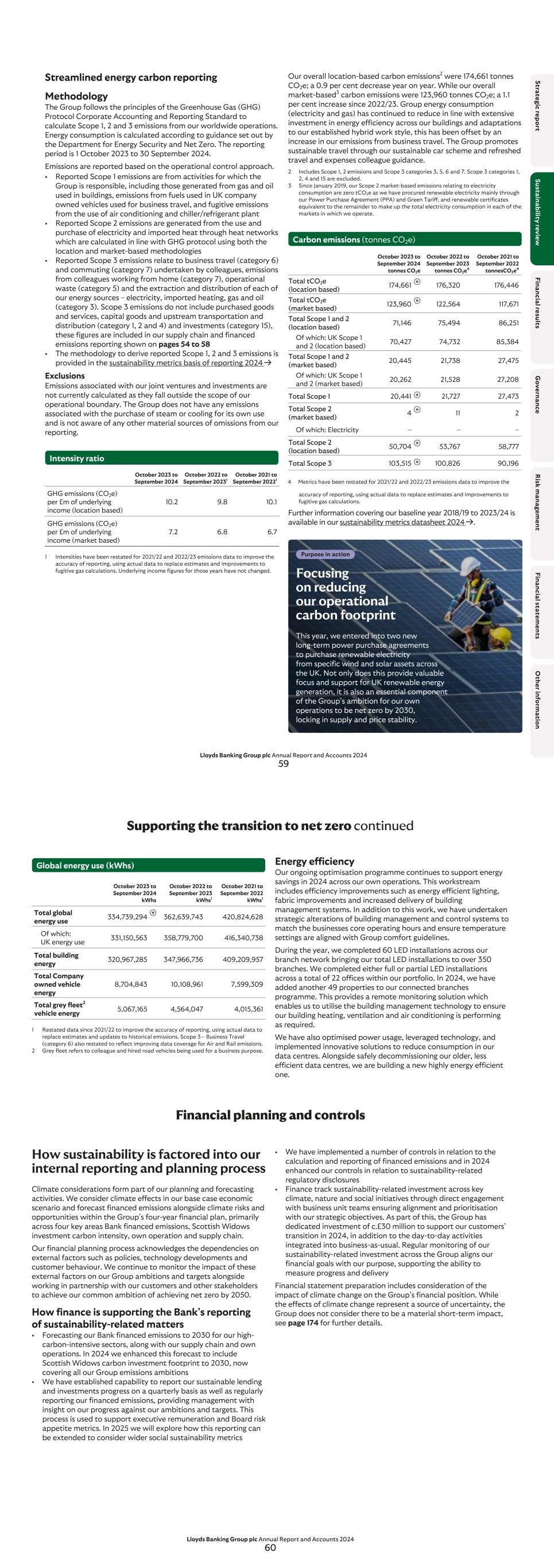
Streamlined energy carbon reporting Methodology The Group follows the principles of the Greenhouse Gas (GHG) Protocol Corporate Accounting and Reporting Standard to calculate Scope 1, 2 and 3 emissions from our worldwide operations. Energy consumption is calculated according to guidance set out by the Department for Energy Security and Net Zero. The reporting period is 1 October 2023 to 30 September 2024. Emissions are reported based on the operational control approach. • Reported Scope 1 emissions are from activities for which the Group is responsible, including those generated from gas and oil used in buildings, emissions from fuels used in UK company owned vehicles used for business travel, and fugitive emissions from the use of air conditioning and chiller/refrigerant plant • Reported Scope 2 emissions are generated from the use and purchase of electricity and imported heat through heat networks which are calculated in line with GHG protocol using both the location and market-based methodologies • Reported Scope 3 emissions relate to business travel (category 6) and commuting (category 7) undertaken by colleagues, emissions from colleagues working from home (category 7), operational waste (category 5) and the extraction and distribution of each of our energy sources – electricity, imported heating, gas and oil (category 3). Scope 3 emissions do not include purchased goods and services, capital goods and upstream transportation and distribution (category 1, 2 and 4) and investments (category 15), these figures are included in our supply chain and financed emissions reporting shown on pages 54 to 58 • The methodology to derive reported Scope 1, 2 and 3 emissions is provided in the sustainability metrics basis of reporting 2024 Exclusions Emissions associated with our joint ventures and investments are not currently calculated as they fall outside the scope of our operational boundary. The Group does not have any emissions associated with the purchase of steam or cooling for its own use and is not aware of any other material sources of omissions from our reporting. Intensity ratio October 2023 to September 2024 October 2022 to September 20231 October 2021 to September 20221 GHG emissions (CO2e) per £m of underlying income (location based) 10.2 9.8 10.1 GHG emissions (CO2e) per £m of underlying income (market based) 7.2 6.8 6.7 1 Intensities have been restated for 2021/22 and 2022/23 emissions data to improve the accuracy of reporting, using actual data to replace estimates and improvements to fugitive gas calculations. Underlying income figures for those years have not changed. Our overall location-based carbon emissions2 were 174,661 tonnes CO2e; a 0.9 per cent decrease year on year. While our overall market-based3 carbon emissions were 123,960 tonnes CO2e; a 1.1 per cent increase since 2022/23. Group energy consumption (electricity and gas) has continued to reduce in line with extensive investment in energy efficiency across our buildings and adaptations to our established hybrid work style, this has been offset by an increase in our emissions from business travel. The Group promotes sustainable travel through our sustainable car scheme and refreshed travel and expenses colleague guidance. 2 Includes Scope 1, 2 emissions and Scope 3 categories 3, 5, 6 and 7. Scope 3 categories 1, 2, 4 and 15 are excluded. 3 Since January 2019, our Scope 2 market-based emissions relating to electricity consumption are zero tCO2e as we have procured renewable electricity mainly through our Power Purchase Agreement (PPA) and Green Tariff, and renewable certificates equivalent to the remainder to make up the total electricity consumption in each of the markets in which we operate. Carbon emissions (tonnes CO2e) October 2023 to September 2024 tonnes CO2e October 2022 to September 2023 tonnes CO2e4 October 2021 to September 2022 tonnesCO2e4 Total tCO2e (location based) 174,661 176,320 176,446 Total tCO2e (market based) 123,960 122,564 117,671 Total Scope 1 and 2 (location based) 71,146 75,494 86,251 Of which: UK Scope 1 and 2 (location based) 70,427 74,732 85,384 Total Scope 1 and 2 (market based) 20,445 21,738 27,475 Of which: UK Scope 1 and 2 (market based) 20,262 21,528 27,208 Total Scope 1 20,441 21,727 27,473 Total Scope 2 (market based) 4 11 2 Of which: Electricity – – – Total Scope 2 (location based) 50,704 53,767 58,777 Total Scope 3 103,515 100,826 90,196 4 Metrics have been restated for 2021/22 and 2022/23 emissions data to improve the accuracy of reporting, using actual data to replace estimates and improvements to fugitive gas calculations. Further information covering our baseline year 2018/19 to 2023/24 is available in our sustainability metrics datasheet 2024 . Focusing on reducing our operational carbon footprint This year, we entered into two new long-term power purchase agreements to purchase renewable electricity from specific wind and solar assets across the UK. Not only does this provide valuable focus and support for UK renewable energy generation, it is also an essential component of the Group’s ambition for our own operations to be net zero by 2030, locking in supply and price stability. Lloyds Banking Group plc Annual Report and Accounts 2024 59 l i ts 2 O th e r in fo rm a tio n F in a n cia l re su lts S u sta in a b ility re vie w S tra te gic re p o rt G o ve rn a n ce F in a n cia l sta te m e n ts R isk m a n a ge m e n t Global energy use (kWhs) October 2023 to September 2024 kWhs October 2022 to September 2023 kWhs1 October 2021 to September 2022 kWhs1 Total global energy use 334,739,294 362,639,743 420,824,628 Of which: UK energy use 331,150,563 358,779,700 416,340,738 Total building energy 320,967,285 347,966,736 409,209,957 Total Company owned vehicle energy 8,704,843 10,108,961 7,599,309 Total grey fleet2 vehicle energy 5,067,165 4,564,047 4,015,361 1 Restated data since 2021/22 to improve the accuracy of reporting, using actual data to replace estimates and updates to historical emissions. Scope 3 – Business Travel (category 6) also restated to reflect improving data coverage for Air and Rail emissions. 2 Grey fleet refers to colleague and hired road vehicles being used for a business purpose. Energy efficiency Our ongoing optimisation programme continues to support energy savings in 2024 across our own operations. This workstream includes efficiency improvements such as energy efficient lighting, fabric improvements and increased delivery of building management systems. In addition to this work, we have undertaken strategic alterations of building management and control systems to match the businesses core operating hours and ensure temperature settings are aligned with Group comfort guidelines. During the year, we completed 60 LED installations across our branch network bringing our total LED installations to over 350 branches. We completed either full or partial LED installations across a total of 22 offices within our portfolio. In 2024, we have added another 49 properties to our connected branches programme. This provides a remote monitoring solution which enables us to utilise the building management technology to ensure our building heating, ventilation and air conditioning is performing as required. We have also optimised power usage, leveraged technology, and implemented innovative solutions to reduce consumption in our data centres. Alongside safely decommissioning our older, less efficient data centres, we are building a new highly energy efficient one. Financial planning and controls How sustainability is factored into our internal reporting and planning process Climate considerations form part of our planning and forecasting activities. We consider climate effects in our base case economic scenario and forecast financed emissions alongside climate risks and opportunities within the Group’s four-year financial plan, primarily across four key areas Bank financed emissions, Scottish Widows investment carbon intensity, own operation and supply chain. Our financial planning process acknowledges the dependencies on external factors such as policies, technology developments and customer behaviour. We continue to monitor the impact of these external factors on our Group ambitions and targets alongside working in partnership with our customers and other stakeholders to achieve our common ambition of achieving net zero by 2050. How finance is supporting the Bank’s reporting of sustainability-related matters • Forecasting our Bank financed emissions to 2030 for our high- carbon-intensive sectors, along with our supply chain and own operations. In 2024 we enhanced this forecast to include Scottish Widows carbon investment footprint to 2030, now covering all our Group emissions ambitions • We have established capability to report our sustainable lending and investments progress on a quarterly basis as well as regularly reporting our financed emissions, providing management with insight on our progress against our ambitions and targets. This process is used to support executive remuneration and Board risk appetite metrics. In 2025 we will explore how this reporting can be extended to consider wider social sustainability metrics • We have implemented a number of controls in relation to the calculation and reporting of financed emissions and in 2024 enhanced our controls in relation to sustainability-related regulatory disclosures • Finance track sustainability-related investment across key climate, nature and social initiatives through direct engagement with business unit teams ensuring alignment and prioritisation with our strategic objectives. As part of this, the Group has dedicated investment of c.£30 million to support our customers’ transition in 2024, in addition to the day-to-day activities integrated into business-as-usual. Regular monitoring of our sustainability-related investment across the Group aligns our financial goals with our purpose, supporting the ability to measure progress and delivery Financial statement preparation includes consideration of the impact of climate change on the Group’s financial position. While the effects of climate change represent a source of uncertainty, the Group does not consider there to be a material short-term impact, see page 174 for further details. Supporting the transition to net zero continued Lloyds Banking Group plc Annual Report and Accounts 2024 60 l i ts
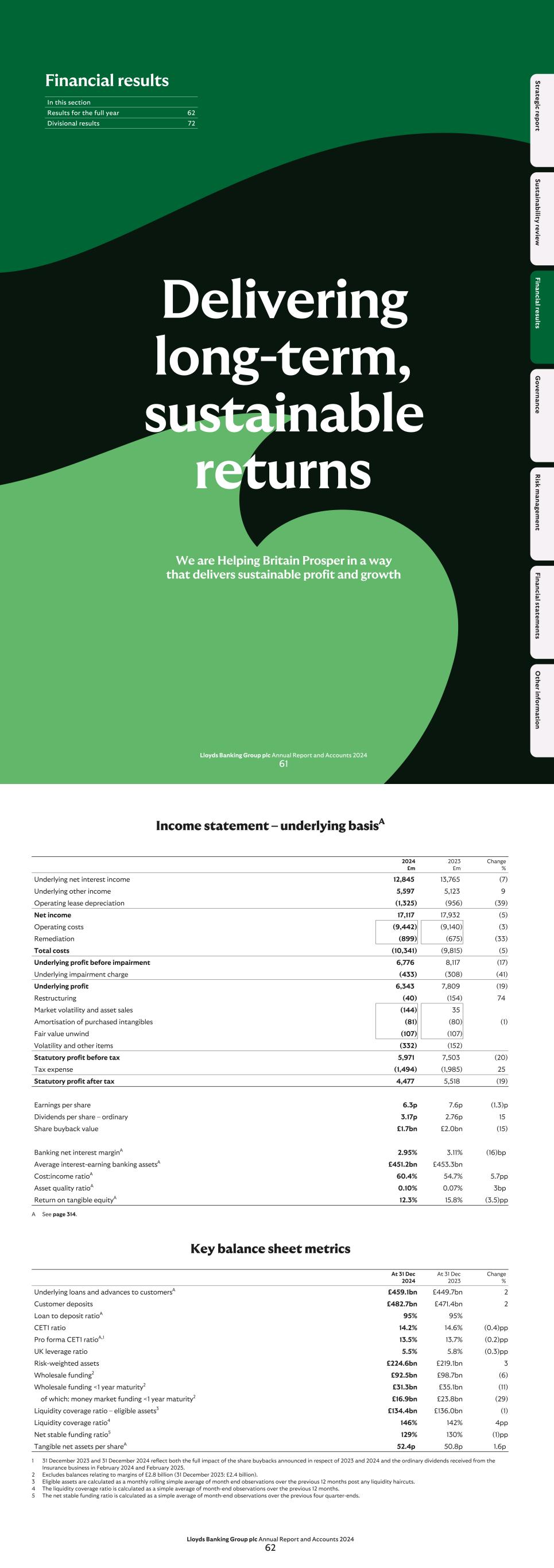
Financial results In this section Results for the full year 62 Divisional results 72 Delivering long-term, sustainable returns We are Helping Britain Prosper in a way that delivers sustainable profit and growth O th e r in fo rm a tio n F in a n cia l sta te m e n ts R isk m a n a ge m e n t F in a n cia l re su lts S u sta in a b ility re vie w S tra te gic re p o rt G o ve rn a n ce 61 Lloyds Banking Group plc Annual Report and Accounts 2024 2024 £m 2023 £m Change % Underlying net interest income 12,845 13,765 (7) Underlying other income 5,597 5,123 9 Operating lease depreciation (1,325) (956) (39) Net income 17,117 17,932 (5) Operating costs (9,442) (9,140) (3) Remediation (899) (675) (33) Total costs (10,341) (9,815) (5) Underlying profit before impairment 6,776 8,117 (17) Underlying impairment charge (433) (308) (41) Underlying profit 6,343 7,809 (19) Restructuring (40) (154) 74 Market volatility and asset sales (144) 35 Amortisation of purchased intangibles (81) (80) (1) Fair value unwind (107) (107) Volatility and other items (332) (152) Statutory profit before tax 5,971 7,503 (20) Tax expense (1,494) (1,985) 25 Statutory profit after tax 4,477 5,518 (19) Earnings per share 6.3p 7.6p (1.3) p Dividends per share – ordinary 3.17p 2.76p 15 Share buyback value £1.7bn £2.0bn (15) Banking net interest marginA 2.95% 3.11% (16)bp Average interest-earning banking assetsA £451.2bn £453.3bn Cost:income ratioA 60.4% 54.7% 5.7 pp Asset quality ratioA 0.10% 0.07 % 3bp Return on tangible equityA 12.3% 15.8% (3.5) pp A See page 314. Key balance sheet metrics At 31 Dec 2024 At 31 Dec 2023 Change % Underlying loans and advances to customersA £459.1bn £449.7bn 2 Customer deposits £482.7bn £471.4bn 2 Loan to deposit ratioA 95% 95% CET1 ratio 14.2% 14.6% (0.4) pp Pro forma CET1 ratioA,1 13.5% 13.7% (0.2) pp UK leverage ratio 5.5% 5.8% (0.3) pp Risk-weighted assets £224.6bn £219.1bn 3 Wholesale funding2 £92.5bn £98.7bn (6) Wholesale funding <1 year maturity2 £31.3bn £35.1bn (11) of which: money market funding <1 year maturity2 £16.9bn £23.8bn (29) Liquidity coverage ratio – eligible assets3 £134.4bn £136.0bn (1) Liquidity coverage ratio4 146% 142% 4 pp Net stable funding ratio5 129% 130% (1) pp Tangible net assets per shareA 52.4p 50.8p 1.6p 1 31 December 2023 and 31 December 2024 reflect both the full impact of the share buybacks announced in respect of 2023 and 2024 and the ordinary dividends received from the Insurance business in February 2024 and February 2025. 2 Excludes balances relating to margins of £2.8 billion (31 December 2023: £2.4 billion). 3 Eligible assets are calculated as a monthly rolling simple average of month end observations over the previous 12 months post any liquidity haircuts. 4 The liquidity coverage ratio is calculated as a simple average of month-end observations over the previous 12 months. 5 The net stable funding ratio is calculated as a simple average of month-end observations over the previous four quarter-ends. Income statement – underlying basisA Lloyds Banking Group plc Annual Report and Accounts 2024 62 l i ts
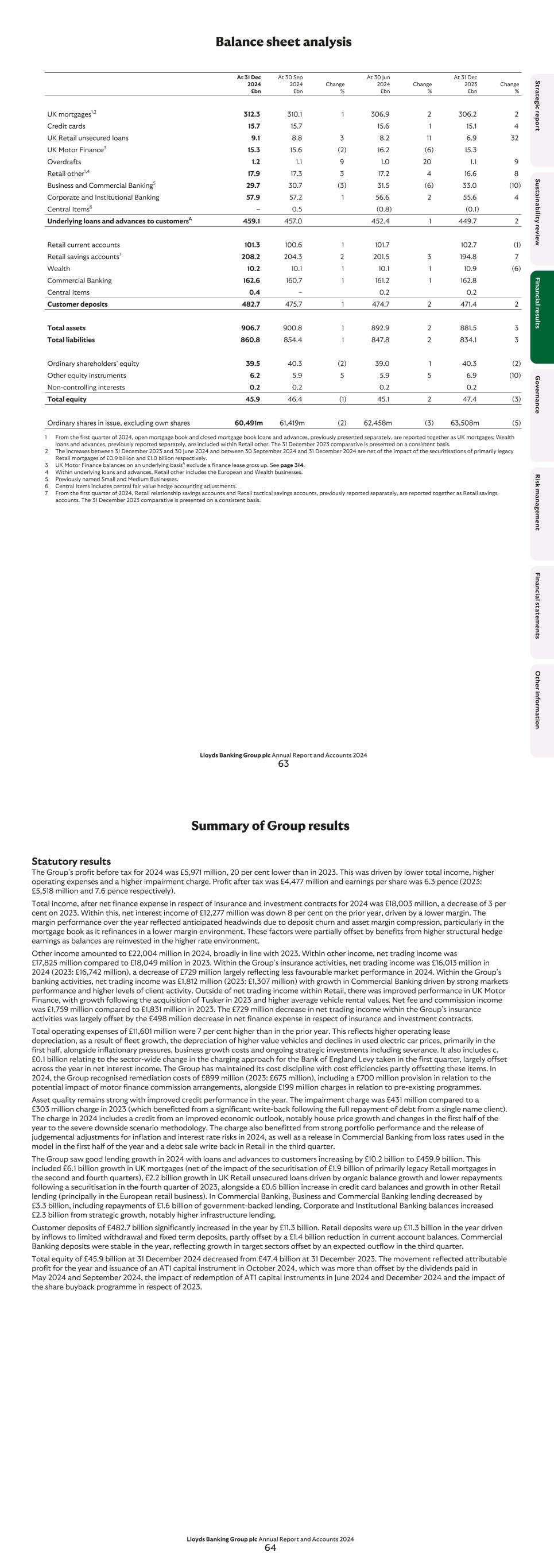
At 31 Dec 2024 £bn At 30 Sep 2024 £bn Change % At 30 Jun 2024 £bn Change % At 31 Dec 2023 £bn Change % UK mortgages1,2 312.3 310.1 1 306.9 2 306.2 2 Credit cards 15.7 15.7 15.6 1 15.1 4 UK Retail unsecured loans 9.1 8.8 3 8.2 11 6.9 32 UK Motor Finance3 15.3 15.6 (2) 16.2 (6) 15.3 Overdrafts 1.2 1.1 9 1.0 20 1.1 9 Retail other1,4 17.9 17.3 3 17.2 4 16.6 8 Business and Commercial Banking5 29.7 30.7 (3) 31.5 (6) 33.0 (10) Corporate and Institutional Banking 57.9 57.2 1 56.6 2 55.6 4 Central Items6 – 0.5 (0.8) (0.1) Underlying loans and advances to customersA 459.1 457.0 452.4 1 449.7 2 Retail current accounts 101.3 100.6 1 101.7 102.7 (1) Retail savings accounts7 208.2 204.3 2 201.5 3 194.8 7 Wealth 10.2 10.1 1 10.1 1 10.9 (6) Commercial Banking 162.6 160.7 1 161.2 1 162.8 Central Items 0.4 – 0.2 0.2 Customer deposits 482.7 475.7 1 474.7 2 471.4 2 Total assets 906.7 900.8 1 892.9 2 881.5 3 Total liabilities 860.8 854.4 1 847.8 2 834.1 3 Ordinary shareholders’ equity 39.5 40.3 (2) 39.0 1 40.3 (2) Other equity instruments 6.2 5.9 5 5.9 5 6.9 (10) Non-controlling interests 0.2 0.2 0.2 0.2 Total equity 45.9 46.4 (1) 45.1 2 47.4 (3) Ordinary shares in issue, excluding own shares 60,491m 61,419m (2) 62,458m (3) 63,508m (5) 1 From the first quarter of 2024, open mortgage book and closed mortgage book loans and advances, previously presented separately, are reported together as UK mortgages; Wealth loans and advances, previously reported separately, are included within Retail other. The 31 December 2023 comparative is presented on a consistent basis. 2 The increases between 31 December 2023 and 30 June 2024 and between 30 September 2024 and 31 December 2024 are net of the impact of the securitisations of primarily legacy Retail mortgages of £0.9 billion and £1.0 billion respectively. 3 UK Motor Finance balances on an underlying basisA exclude a finance lease gross up. See page 314. 4 Within underlying loans and advances, Retail other includes the European and Wealth businesses. 5 Previously named Small and Medium Businesses. 6 Central Items includes central fair value hedge accounting adjustments. 7 From the first quarter of 2024, Retail relationship savings accounts and Retail tactical savings accounts, previously reported separately, are reported together as Retail savings accounts. The 31 December 2023 comparative is presented on a consistent basis. Balance sheet analysis Lloyds Banking Group plc Annual Report and Accounts 2024 63 l i ts 2 O th e r in fo rm a tio n F in a n cia l sta te m e n ts R isk m a n a ge m e n t F in a n cia l re su lts S u sta in a b ility re vie w S tra te gic re p o rt G o ve rn a n ce Statutory results The Group’s profit before tax for 2024 was £5,971 million, 20 per cent lower than in 2023. This was driven by lower total income, higher operating expenses and a higher impairment charge. Profit after tax was £4,477 million and earnings per share was 6.3 pence (2023: £5,518 million and 7.6 pence respectively). Total income, after net finance expense in respect of insurance and investment contracts for 2024 was £18,003 million, a decrease of 3 per cent on 2023. Within this, net interest income of £12,277 million was down 8 per cent on the prior year, driven by a lower margin. The margin performance over the year reflected anticipated headwinds due to deposit churn and asset margin compression, particularly in the mortgage book as it refinances in a lower margin environment. These factors were partially offset by benefits from higher structural hedge earnings as balances are reinvested in the higher rate environment. Other income amounted to £22,004 million in 2024, broadly in line with 2023. Within other income, net trading income was £17,825 million compared to £18,049 million in 2023. Within the Group’s insurance activities, net trading income was £16,013 million in 2024 (2023: £16,742 million), a decrease of £729 million largely reflecting less favourable market performance in 2024. Within the Group’s banking activities, net trading income was £1,812 million (2023: £1,307 million) with growth in Commercial Banking driven by strong markets performance and higher levels of client activity. Outside of net trading income within Retail, there was improved performance in UK Motor Finance, with growth following the acquisition of Tusker in 2023 and higher average vehicle rental values. Net fee and commission income was £1,759 million compared to £1,831 million in 2023. The £729 million decrease in net trading income within the Group’s insurance activities was largely offset by the £498 million decrease in net finance expense in respect of insurance and investment contracts. Total operating expenses of £11,601 million were 7 per cent higher than in the prior year. This reflects higher operating lease depreciation, as a result of fleet growth, the depreciation of higher value vehicles and declines in used electric car prices, primarily in the first half, alongside inflationary pressures, business growth costs and ongoing strategic investments including severance. It also includes c. £0.1 billion relating to the sector-wide change in the charging approach for the Bank of England Levy taken in the first quarter, largely offset across the year in net interest income. The Group has maintained its cost discipline with cost efficiencies partly offsetting these items. In 2024, the Group recognised remediation costs of £899 million (2023: £675 million), including a £700 million provision in relation to the potential impact of motor finance commission arrangements, alongside £199 million charges in relation to pre-existing programmes. Asset quality remains strong with improved credit performance in the year. The impairment charge was £431 million compared to a £303 million charge in 2023 (which benefitted from a significant write-back following the full repayment of debt from a single name client). The charge in 2024 includes a credit from an improved economic outlook, notably house price growth and changes in the first half of the year to the severe downside scenario methodology. The charge also benefitted from strong portfolio performance and the release of judgemental adjustments for inflation and interest rate risks in 2024, as well as a release in Commercial Banking from loss rates used in the model in the first half of the year and a debt sale write back in Retail in the third quarter. The Group saw good lending growth in 2024 with loans and advances to customers increasing by £10.2 billion to £459.9 billion. This included £6.1 billion growth in UK mortgages (net of the impact of the securitisation of £1.9 billion of primarily legacy Retail mortgages in the second and fourth quarters), £2.2 billion growth in UK Retail unsecured loans driven by organic balance growth and lower repayments following a securitisation in the fourth quarter of 2023, alongside a £0.6 billion increase in credit card balances and growth in other Retail lending (principally in the European retail business). In Commercial Banking, Business and Commercial Banking lending decreased by £3.3 billion, including repayments of £1.6 billion of government-backed lending. Corporate and Institutional Banking balances increased £2.3 billion from strategic growth, notably higher infrastructure lending. Customer deposits of £482.7 billion significantly increased in the year by £11.3 billion. Retail deposits were up £11.3 billion in the year driven by inflows to limited withdrawal and fixed term deposits, partly offset by a £1.4 billion reduction in current account balances. Commercial Banking deposits were stable in the year, reflecting growth in target sectors offset by an expected outflow in the third quarter. Total equity of £45.9 billion at 31 December 2024 decreased from £47.4 billion at 31 December 2023. The movement reflected attributable profit for the year and issuance of an AT1 capital instrument in October 2024, which was more than offset by the dividends paid in May 2024 and September 2024, the impact of redemption of AT1 capital instruments in June 2024 and December 2024 and the impact of the share buyback programme in respect of 2023. Summary of Group results Lloyds Banking Group plc Annual Report and Accounts 2024 64 l i ts
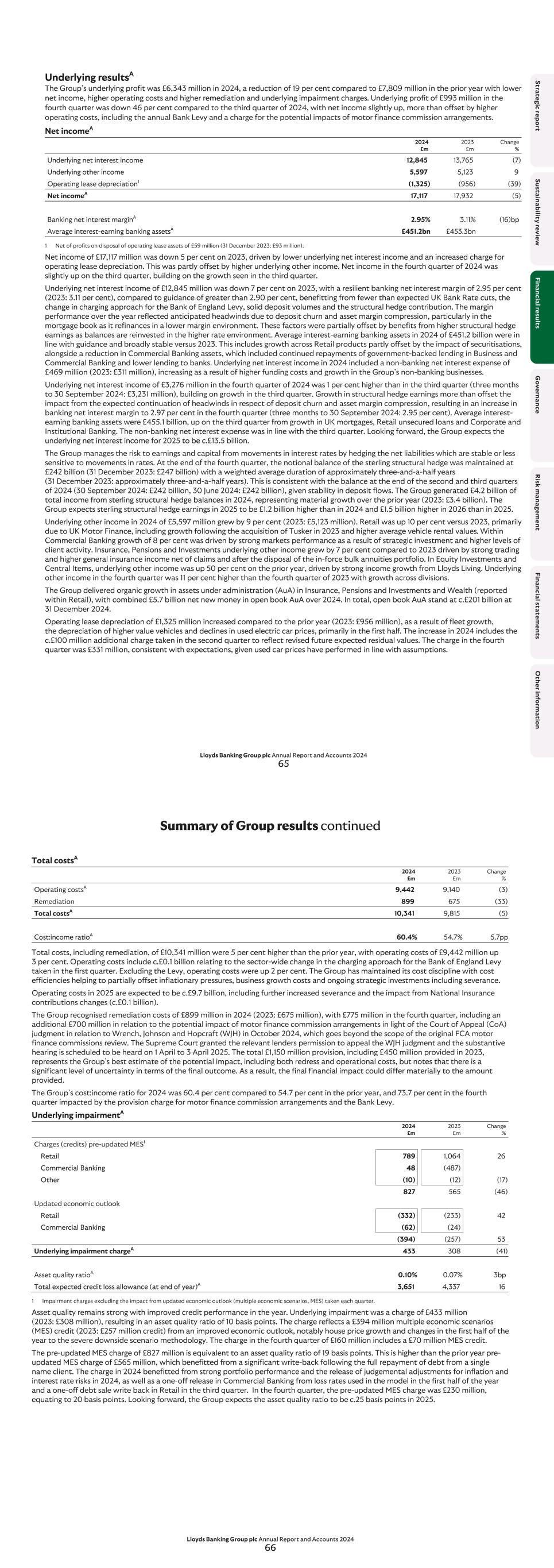
Underlying resultsA The Group’s underlying profit was £6,343 million in 2024, a reduction of 19 per cent compared to £7,809 million in the prior year with lower net income, higher operating costs and higher remediation and underlying impairment charges. Underlying profit of £993 million in the fourth quarter was down 46 per cent compared to the third quarter of 2024, with net income slightly up, more than offset by higher operating costs, including the annual Bank Levy and a charge for the potential impacts of motor finance commission arrangements. Net incomeA 2024 £m 2023 £m Change % Underlying net interest income 12,845 13,765 (7) Underlying other income 5,597 5,123 9 Operating lease depreciation1 (1,325) (956) (39) Net incomeA 17,117 17,932 (5) Banking net interest marginA 2.95% 3.11% (16)bp Average interest-earning banking assetsA £451.2bn £453.3bn 1 Net of profits on disposal of operating lease assets of £59 million (31 December 2023: £93 million). Net income of £17,117 million was down 5 per cent on 2023, driven by lower underlying net interest income and an increased charge for operating lease depreciation. This was partly offset by higher underlying other income. Net income in the fourth quarter of 2024 was slightly up on the third quarter, building on the growth seen in the third quarter. Underlying net interest income of £12,845 million was down 7 per cent on 2023, with a resilient banking net interest margin of 2.95 per cent (2023: 3.11 per cent), compared to guidance of greater than 2.90 per cent, benefitting from fewer than expected UK Bank Rate cuts, the change in charging approach for the Bank of England Levy, solid deposit volumes and the structural hedge contribution. The margin performance over the year reflected anticipated headwinds due to deposit churn and asset margin compression, particularly in the mortgage book as it refinances in a lower margin environment. These factors were partially offset by benefits from higher structural hedge earnings as balances are reinvested in the higher rate environment. Average interest-earning banking assets in 2024 of £451.2 billion were in line with guidance and broadly stable versus 2023. This includes growth across Retail products partly offset by the impact of securitisations, alongside a reduction in Commercial Banking assets, which included continued repayments of government-backed lending in Business and Commercial Banking and lower lending to banks. Underlying net interest income in 2024 included a non-banking net interest expense of £469 million (2023: £311 million), increasing as a result of higher funding costs and growth in the Group’s non-banking businesses. Underlying net interest income of £3,276 million in the fourth quarter of 2024 was 1 per cent higher than in the third quarter (three months to 30 September 2024: £3,231 million), building on growth in the third quarter. Growth in structural hedge earnings more than offset the impact from the expected continuation of headwinds in respect of deposit churn and asset margin compression, resulting in an increase in banking net interest margin to 2.97 per cent in the fourth quarter (three months to 30 September 2024: 2.95 per cent). Average interest- earning banking assets were £455.1 billion, up on the third quarter from growth in UK mortgages, Retail unsecured loans and Corporate and Institutional Banking. The non-banking net interest expense was in line with the third quarter. Looking forward, the Group expects the underlying net interest income for 2025 to be c.£13.5 billion. The Group manages the risk to earnings and capital from movements in interest rates by hedging the net liabilities which are stable or less sensitive to movements in rates. At the end of the fourth quarter, the notional balance of the sterling structural hedge was maintained at £242 billion (31 December 2023: £247 billion) with a weighted average duration of approximately three-and-a-half years (31 December 2023: approximately three-and-a-half years). This is consistent with the balance at the end of the second and third quarters of 2024 (30 September 2024: £242 billion, 30 June 2024: £242 billion), given stability in deposit flows. The Group generated £4.2 billion of total income from sterling structural hedge balances in 2024, representing material growth over the prior year (2023: £3.4 billion). The Group expects sterling structural hedge earnings in 2025 to be £1.2 billion higher than in 2024 and £1.5 billion higher in 2026 than in 2025. Underlying other income in 2024 of £5,597 million grew by 9 per cent (2023: £5,123 million). Retail was up 10 per cent versus 2023, primarily due to UK Motor Finance, including growth following the acquisition of Tusker in 2023 and higher average vehicle rental values. Within Commercial Banking growth of 8 per cent was driven by strong markets performance as a result of strategic investment and higher levels of client activity. Insurance, Pensions and Investments underlying other income grew by 7 per cent compared to 2023 driven by strong trading and higher general insurance income net of claims and after the disposal of the in-force bulk annuities portfolio. In Equity Investments and Central Items, underlying other income was up 50 per cent on the prior year, driven by strong income growth from Lloyds Living. Underlying other income in the fourth quarter was 11 per cent higher than the fourth quarter of 2023 with growth across divisions. The Group delivered organic growth in assets under administration (AuA) in Insurance, Pensions and Investments and Wealth (reported within Retail), with combined £5.7 billion net new money in open book AuA over 2024. In total, open book AuA stand at c.£201 billion at 31 December 2024. Operating lease depreciation of £1,325 million increased compared to the prior year (2023: £956 million), as a result of fleet growth, the depreciation of higher value vehicles and declines in used electric car prices, primarily in the first half. The increase in 2024 includes the c.£100 million additional charge taken in the second quarter to reflect revised future expected residual values. The charge in the fourth quarter was £331 million, consistent with expectations, given used car prices have performed in line with assumptions. Lloyds Banking Group plc Annual Report and Accounts 2024 65 l i ts 2 O th e r in fo rm a tio n F in a n cia l sta te m e n ts R isk m a n a ge m e n t F in a n cia l re su lts S u sta in a b ility re vie w S tra te gic re p o rt G o ve rn a n ce Total costsA 2024 £m 2023 £m Change % Operating costsA 9,442 9,140 (3) Remediation 899 675 (33) Total costsA 10,341 9,815 (5) Cost:income ratioA 60.4% 54.7% 5.7 pp Total costs, including remediation, of £10,341 million were 5 per cent higher than the prior year, with operating costs of £9,442 million up 3 per cent. Operating costs include c.£0.1 billion relating to the sector-wide change in the charging approach for the Bank of England Levy taken in the first quarter. Excluding the Levy, operating costs were up 2 per cent. The Group has maintained its cost discipline with cost efficiencies helping to partially offset inflationary pressures, business growth costs and ongoing strategic investments including severance. Operating costs in 2025 are expected to be c.£9.7 billion, including further increased severance and the impact from National Insurance contributions changes (c.£0.1 billion). The Group recognised remediation costs of £899 million in 2024 (2023: £675 million), with £775 million in the fourth quarter, including an additional £700 million in relation to the potential impact of motor finance commission arrangements in light of the Court of Appeal (CoA) judgment in relation to Wrench, Johnson and Hopcraft (WJH) in October 2024, which goes beyond the scope of the original FCA motor finance commissions review. The Supreme Court granted the relevant lenders permission to appeal the WJH judgment and the substantive hearing is scheduled to be heard on 1 April to 3 April 2025. The total £1,150 million provision, including £450 million provided in 2023, represents the Group’s best estimate of the potential impact, including both redress and operational costs, but notes that there is a significant level of uncertainty in terms of the final outcome. As a result, the final financial impact could differ materially to the amount provided. The Group’s cost:income ratio for 2024 was 60.4 per cent compared to 54.7 per cent in the prior year, and 73.7 per cent in the fourth quarter impacted by the provision charge for motor finance commission arrangements and the Bank Levy. Underlying impairmentA 2024 £m 2023 £m Change % Charges (credits) pre-updated MES1 Retail 789 1,064 26 Commercial Banking 48 (487) Other (10) (12) (17) 827 565 (46) Updated economic outlook Retail (332) (233) 42 Commercial Banking (62) (24) (394) (257) 53 Underlying impairment chargeA 433 308 (41) Asset quality ratioA 0.10% 0.07 % 3bp Total expected credit loss allowance (at end of year)A 3,651 4,337 16 1 Impairment charges excluding the impact from updated economic outlook (multiple economic scenarios, MES) taken each quarter. Asset quality remains strong with improved credit performance in the year. Underlying impairment was a charge of £433 million (2023: £308 million), resulting in an asset quality ratio of 10 basis points. The charge reflects a £394 million multiple economic scenarios (MES) credit (2023: £257 million credit) from an improved economic outlook, notably house price growth and changes in the first half of the year to the severe downside scenario methodology. The charge in the fourth quarter of £160 million includes a £70 million MES credit. The pre-updated MES charge of £827 million is equivalent to an asset quality ratio of 19 basis points. This is higher than the prior year pre- updated MES charge of £565 million, which benefitted from a significant write-back following the full repayment of debt from a single name client. The charge in 2024 benefitted from strong portfolio performance and the release of judgemental adjustments for inflation and interest rate risks in 2024, as well as a one-off release in Commercial Banking from loss rates used in the model in the first half of the year and a one-off debt sale write back in Retail in the third quarter. In the fourth quarter, the pre-updated MES charge was £230 million, equating to 20 basis points. Looking forward, the Group expects the asset quality ratio to be c.25 basis points in 2025. Summary of Group results continued Lloyds Banking Group plc Annual Report and Accounts 2024 66 l i ts
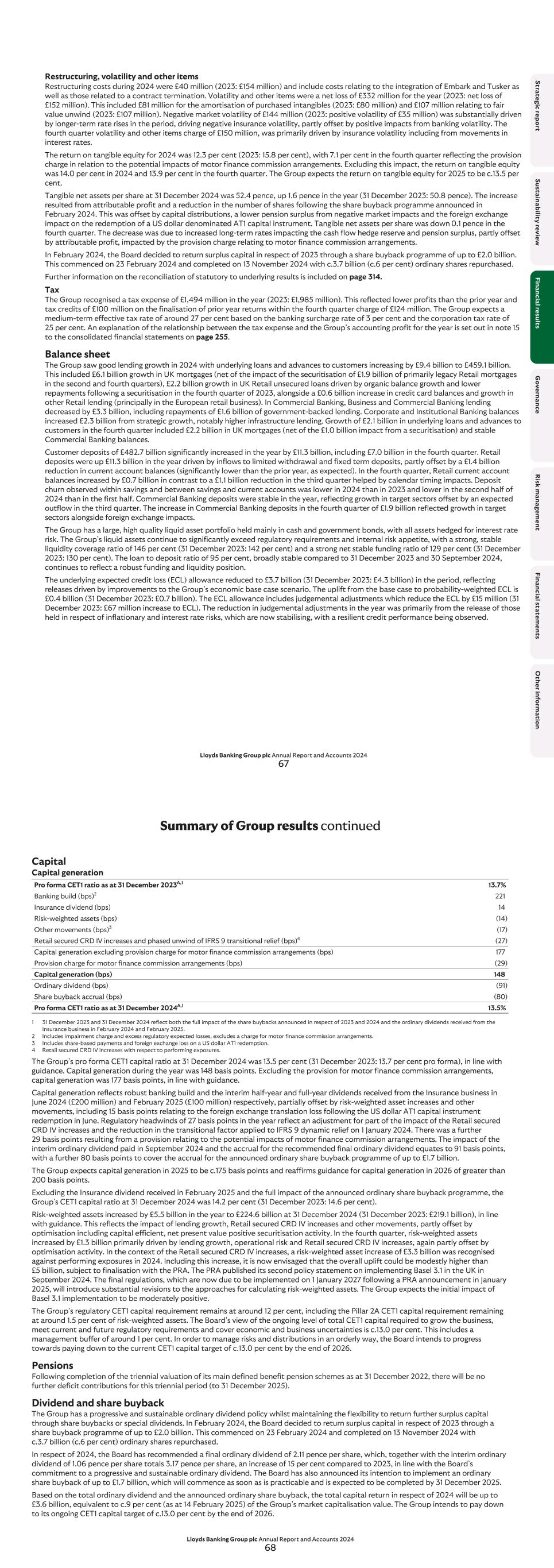
Restructuring, volatility and other items Restructuring costs during 2024 were £40 million (2023: £154 million) and include costs relating to the integration of Embark and Tusker as well as those related to a contract termination. Volatility and other items were a net loss of £332 million for the year (2023: net loss of £152 million). This included £81 million for the amortisation of purchased intangibles (2023: £80 million) and £107 million relating to fair value unwind (2023: £107 million). Negative market volatility of £144 million (2023: positive volatility of £35 million) was substantially driven by longer-term rate rises in the period, driving negative insurance volatility, partly offset by positive impacts from banking volatility. The fourth quarter volatility and other items charge of £150 million, was primarily driven by insurance volatility including from movements in interest rates. The return on tangible equity for 2024 was 12.3 per cent (2023: 15.8 per cent), with 7.1 per cent in the fourth quarter reflecting the provision charge in relation to the potential impacts of motor finance commission arrangements. Excluding this impact, the return on tangible equity was 14.0 per cent in 2024 and 13.9 per cent in the fourth quarter. The Group expects the return on tangible equity for 2025 to be c.13.5 per cent. Tangible net assets per share at 31 December 2024 was 52.4 pence, up 1.6 pence in the year (31 December 2023: 50.8 pence). The increase resulted from attributable profit and a reduction in the number of shares following the share buyback programme announced in February 2024. This was offset by capital distributions, a lower pension surplus from negative market impacts and the foreign exchange impact on the redemption of a US dollar denominated AT1 capital instrument. Tangible net assets per share was down 0.1 pence in the fourth quarter. The decrease was due to increased long-term rates impacting the cash flow hedge reserve and pension surplus, partly offset by attributable profit, impacted by the provision charge relating to motor finance commission arrangements. In February 2024, the Board decided to return surplus capital in respect of 2023 through a share buyback programme of up to £2.0 billion. This commenced on 23 February 2024 and completed on 13 November 2024 with c.3.7 billion (c.6 per cent) ordinary shares repurchased. Further information on the reconciliation of statutory to underlying results is included on page 314. Tax The Group recognised a tax expense of £1,494 million in the year (2023: £1,985 million). This reflected lower profits than the prior year and tax credits of £100 million on the finalisation of prior year returns within the fourth quarter charge of £124 million. The Group expects a medium-term effective tax rate of around 27 per cent based on the banking surcharge rate of 3 per cent and the corporation tax rate of 25 per cent. An explanation of the relationship between the tax expense and the Group’s accounting profit for the year is set out in note 15 to the consolidated financial statements on page 255. Balance sheet The Group saw good lending growth in 2024 with underlying loans and advances to customers increasing by £9.4 billion to £459.1 billion. This included £6.1 billion growth in UK mortgages (net of the impact of the securitisation of £1.9 billion of primarily legacy Retail mortgages in the second and fourth quarters), £2.2 billion growth in UK Retail unsecured loans driven by organic balance growth and lower repayments following a securitisation in the fourth quarter of 2023, alongside a £0.6 billion increase in credit card balances and growth in other Retail lending (principally in the European retail business). In Commercial Banking, Business and Commercial Banking lending decreased by £3.3 billion, including repayments of £1.6 billion of government-backed lending. Corporate and Institutional Banking balances increased £2.3 billion from strategic growth, notably higher infrastructure lending. Growth of £2.1 billion in underlying loans and advances to customers in the fourth quarter included £2.2 billion in UK mortgages (net of the £1.0 billion impact from a securitisation) and stable Commercial Banking balances. Customer deposits of £482.7 billion significantly increased in the year by £11.3 billion, including £7.0 billion in the fourth quarter. Retail deposits were up £11.3 billion in the year driven by inflows to limited withdrawal and fixed term deposits, partly offset by a £1.4 billion reduction in current account balances (significantly lower than the prior year, as expected). In the fourth quarter, Retail current account balances increased by £0.7 billion in contrast to a £1.1 billion reduction in the third quarter helped by calendar timing impacts. Deposit churn observed within savings and between savings and current accounts was lower in 2024 than in 2023 and lower in the second half of 2024 than in the first half. Commercial Banking deposits were stable in the year, reflecting growth in target sectors offset by an expected outflow in the third quarter. The increase in Commercial Banking deposits in the fourth quarter of £1.9 billion reflected growth in target sectors alongside foreign exchange impacts. The Group has a large, high quality liquid asset portfolio held mainly in cash and government bonds, with all assets hedged for interest rate risk. The Group’s liquid assets continue to significantly exceed regulatory requirements and internal risk appetite, with a strong, stable liquidity coverage ratio of 146 per cent (31 December 2023: 142 per cent) and a strong net stable funding ratio of 129 per cent (31 December 2023: 130 per cent). The loan to deposit ratio of 95 per cent, broadly stable compared to 31 December 2023 and 30 September 2024, continues to reflect a robust funding and liquidity position. The underlying expected credit loss (ECL) allowance reduced to £3.7 billion (31 December 2023: £4.3 billion) in the period, reflecting releases driven by improvements to the Group’s economic base case scenario. The uplift from the base case to probability-weighted ECL is £0.4 billion (31 December 2023: £0.7 billion). The ECL allowance includes judgemental adjustments which reduce the ECL by £15 million (31 December 2023: £67 million increase to ECL). The reduction in judgemental adjustments in the year was primarily from the release of those held in respect of inflationary and interest rate risks, which are now stabilising, with a resilient credit performance being observed. Lloyds Banking Group plc Annual Report and Accounts 2024 67 l i ts 2 O th e r in fo rm a tio n F in a n cia l sta te m e n ts R isk m a n a ge m e n t F in a n cia l re su lts S u sta in a b ility re vie w S tra te gic re p o rt G o ve rn a n ce Capital Capital generation Pro forma CET1 ratio as at 31 December 2023A,1 13.7% Banking build (bps)2 221 Insurance dividend (bps) 14 Risk-weighted assets (bps) (14) Other movements (bps)3 (17) Retail secured CRD IV increases and phased unwind of IFRS 9 transitional relief (bps)4 (27) Capital generation excluding provision charge for motor finance commission arrangements (bps) 177 Provision charge for motor finance commission arrangements (bps) (29) Capital generation (bps) 148 Ordinary dividend (bps) (91) Share buyback accrual (bps) (80) Pro forma CET1 ratio as at 31 December 2024A,1 13.5% 1 31 December 2023 and 31 December 2024 reflect both the full impact of the share buybacks announced in respect of 2023 and 2024 and the ordinary dividends received from the Insurance business in February 2024 and February 2025. 2 Includes impairment charge and excess regulatory expected losses, excludes a charge for motor finance commission arrangements. 3 Includes share-based payments and foreign exchange loss on a US dollar AT1 redemption. 4 Retail secured CRD IV increases with respect to performing exposures. The Group’s pro forma CET1 capital ratio at 31 December 2024 was 13.5 per cent (31 December 2023: 13.7 per cent pro forma), in line with guidance. Capital generation during the year was 148 basis points. Excluding the provision for motor finance commission arrangements, capital generation was 177 basis points, in line with guidance. Capital generation reflects robust banking build and the interim half-year and full-year dividends received from the Insurance business in June 2024 (£200 million) and February 2025 (£100 million) respectively, partially offset by risk-weighted asset increases and other movements, including 15 basis points relating to the foreign exchange translation loss following the US dollar AT1 capital instrument redemption in June. Regulatory headwinds of 27 basis points in the year reflect an adjustment for part of the impact of the Retail secured CRD IV increases and the reduction in the transitional factor applied to IFRS 9 dynamic relief on 1 January 2024. There was a further 29 basis points resulting from a provision relating to the potential impacts of motor finance commission arrangements. The impact of the interim ordinary dividend paid in September 2024 and the accrual for the recommended final ordinary dividend equates to 91 basis points, with a further 80 basis points to cover the accrual for the announced ordinary share buyback programme of up to £1.7 billion. The Group expects capital generation in 2025 to be c.175 basis points and reaffirms guidance for capital generation in 2026 of greater than 200 basis points. Excluding the Insurance dividend received in February 2025 and the full impact of the announced ordinary share buyback programme, the Group's CET1 capital ratio at 31 December 2024 was 14.2 per cent (31 December 2023: 14.6 per cent). Risk-weighted assets increased by £5.5 billion in the year to £224.6 billion at 31 December 2024 (31 December 2023: £219.1 billion), in line with guidance. This reflects the impact of lending growth, Retail secured CRD IV increases and other movements, partly offset by optimisation including capital efficient, net present value positive securitisation activity. In the fourth quarter, risk-weighted assets increased by £1.3 billion primarily driven by lending growth, operational risk and Retail secured CRD IV increases, again partly offset by optimisation activity. In the context of the Retail secured CRD IV increases, a risk-weighted asset increase of £3.3 billion was recognised against performing exposures in 2024. Including this increase, it is now envisaged that the overall uplift could be modestly higher than £5 billion, subject to finalisation with the PRA. The PRA published its second policy statement on implementing Basel 3.1 in the UK in September 2024. The final regulations, which are now due to be implemented on 1 January 2027 following a PRA announcement in January 2025, will introduce substantial revisions to the approaches for calculating risk-weighted assets. The Group expects the initial impact of Basel 3.1 implementation to be moderately positive. The Group’s regulatory CET1 capital requirement remains at around 12 per cent, including the Pillar 2A CET1 capital requirement remaining at around 1.5 per cent of risk-weighted assets. The Board’s view of the ongoing level of total CET1 capital required to grow the business, meet current and future regulatory requirements and cover economic and business uncertainties is c.13.0 per cent. This includes a management buffer of around 1 per cent. In order to manage risks and distributions in an orderly way, the Board intends to progress towards paying down to the current CET1 capital target of c.13.0 per cent by the end of 2026. Pensions Following completion of the triennial valuation of its main defined benefit pension schemes as at 31 December 2022, there will be no further deficit contributions for this triennial period (to 31 December 2025). Dividend and share buyback The Group has a progressive and sustainable ordinary dividend policy whilst maintaining the flexibility to return further surplus capital through share buybacks or special dividends. In February 2024, the Board decided to return surplus capital in respect of 2023 through a share buyback programme of up to £2.0 billion. This commenced on 23 February 2024 and completed on 13 November 2024 with c.3.7 billion (c.6 per cent) ordinary shares repurchased. In respect of 2024, the Board has recommended a final ordinary dividend of 2.11 pence per share, which, together with the interim ordinary dividend of 1.06 pence per share totals 3.17 pence per share, an increase of 15 per cent compared to 2023, in line with the Board’s commitment to a progressive and sustainable ordinary dividend. The Board has also announced its intention to implement an ordinary share buyback of up to £1.7 billion, which will commence as soon as is practicable and is expected to be completed by 31 December 2025. Based on the total ordinary dividend and the announced ordinary share buyback, the total capital return in respect of 2024 will be up to £3.6 billion, equivalent to c.9 per cent (as at 14 February 2025) of the Group’s market capitalisation value. The Group intends to pay down to its ongoing CET1 capital target of c.13.0 per cent by the end of 2026. Summary of Group results continued Lloyds Banking Group plc Annual Report and Accounts 2024 68 l i ts
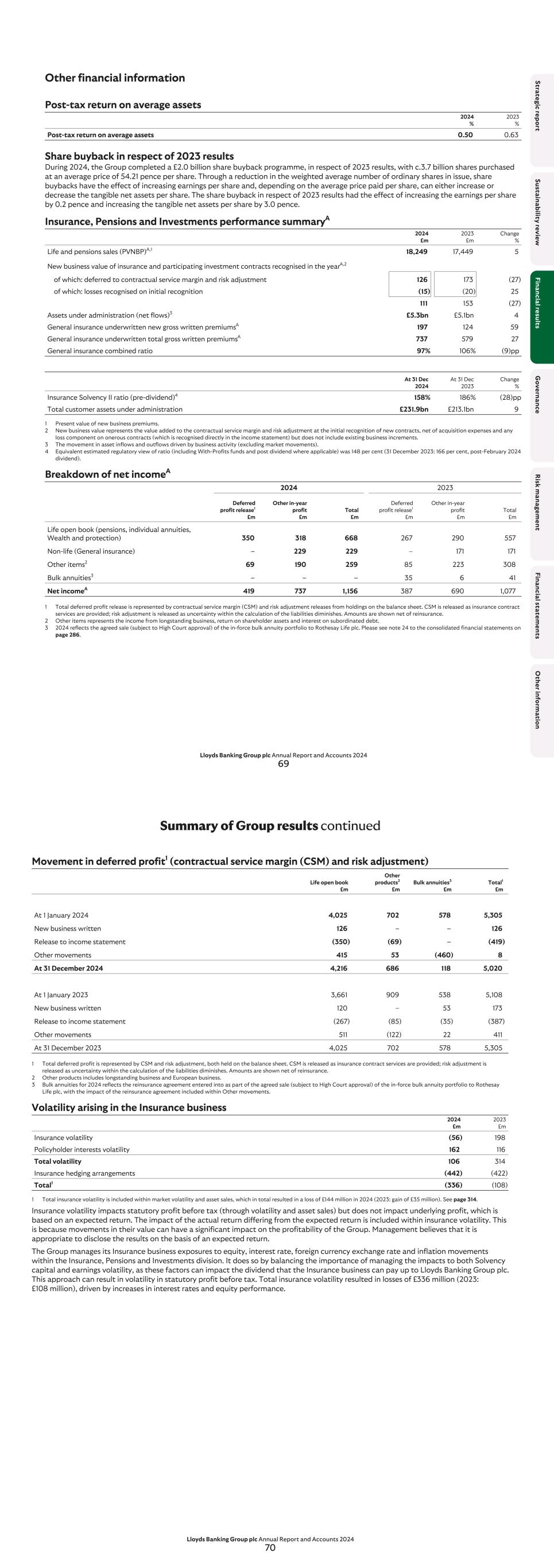
Other financial information Post-tax return on average assets 2024 % 2023 % Post-tax return on average assets 0.50 0.63 Share buyback in respect of 2023 results During 2024, the Group completed a £2.0 billion share buyback programme, in respect of 2023 results, with c.3.7 billion shares purchased at an average price of 54.21 pence per share. Through a reduction in the weighted average number of ordinary shares in issue, share buybacks have the effect of increasing earnings per share and, depending on the average price paid per share, can either increase or decrease the tangible net assets per share. The share buyback in respect of 2023 results had the effect of increasing the earnings per share by 0.2 pence and increasing the tangible net assets per share by 3.0 pence. Insurance, Pensions and Investments performance summaryA 2024 £m 2023 £m Change % Life and pensions sales (PVNBP)A,1 18,249 17,449 5 New business value of insurance and participating investment contracts recognised in the yearA,2 of which: deferred to contractual service margin and risk adjustment 126 173 (27) of which: losses recognised on initial recognition (15) (20) 25 111 153 (27) Assets under administration (net flows)3 £5.3bn £5.1bn 4 General insurance underwritten new gross written premiumsA 197 124 59 General insurance underwritten total gross written premiumsA 737 579 27 General insurance combined ratio 97% 106% (9)pp At 31 Dec 2024 At 31 Dec 2023 Change % Insurance Solvency II ratio (pre-dividend)4 158% 186% (28) pp Total customer assets under administration £231.9bn £213.1bn 9 1 Present value of new business premiums. 2 New business value represents the value added to the contractual service margin and risk adjustment at the initial recognition of new contracts, net of acquisition expenses and any loss component on onerous contracts (which is recognised directly in the income statement) but does not include existing business increments. 3 The movement in asset inflows and outflows driven by business activity (excluding market movements). 4 Equivalent estimated regulatory view of ratio (including With-Profits funds and post dividend where applicable) was 148 per cent (31 December 2023: 166 per cent, post-February 2024 dividend). Breakdown of net incomeA 2024 2023 Deferred profit release1 £m Other in-year profit £m Total £m Deferred profit release1 £m Other in-year profit £m Total £m Life open book (pensions, individual annuities, Wealth and protection) 350 318 668 267 290 557 Non-life (General insurance) – 229 229 – 171 171 Other items2 69 190 259 85 223 308 Bulk annuities3 – – – 35 6 41 Net incomeA 419 737 1,156 387 690 1,077 1 Total deferred profit release is represented by contractual service margin (CSM) and risk adjustment releases from holdings on the balance sheet. CSM is released as insurance contract services are provided; risk adjustment is released as uncertainty within the calculation of the liabilities diminishes. Amounts are shown net of reinsurance. 2 Other items represents the income from longstanding business, return on shareholder assets and interest on subordinated debt. 3 2024 reflects the agreed sale (subject to High Court approval) of the in-force bulk annuity portfolio to Rothesay Life plc. Please see note 24 to the consolidated financial statements on page 286. Lloyds Banking Group plc Annual Report and Accounts 2024 69 l i ts 2 O th e r in fo rm a tio n F in a n cia l sta te m e n ts R isk m a n a ge m e n t F in a n cia l re su lts S u sta in a b ility re vie w S tra te gic re p o rt G o ve rn a n ce Movement in deferred profit1 (contractual service margin (CSM) and risk adjustment) Life open book £m Other products2 £m Bulk annuities3 £m Total1 £m At 1 January 2024 4,025 702 578 5,305 New business written 126 – – 126 Release to income statement (350) (69) – (419) Other movements 415 53 (460) 8 At 31 December 2024 4,216 686 118 5,020 At 1 January 2023 3,661 909 538 5,108 New business written 120 – 53 173 Release to income statement (267) (85) (35) (387) Other movements 511 (122) 22 411 At 31 December 2023 4,025 702 578 5,305 1 Total deferred profit is represented by CSM and risk adjustment, both held on the balance sheet. CSM is released as insurance contract services are provided; risk adjustment is released as uncertainty within the calculation of the liabilities diminishes. Amounts are shown net of reinsurance. 2 Other products includes longstanding business and European business. 3 Bulk annuities for 2024 reflects the reinsurance agreement entered into as part of the agreed sale (subject to High Court approval) of the in-force bulk annuity portfolio to Rothesay Life plc, with the impact of the reinsurance agreement included within Other movements. Volatility arising in the Insurance business 2024 £m 2023 £m Insurance volatility (56) 198 Policyholder interests volatility 162 116 Total volatility 106 314 Insurance hedging arrangements (442) (422) Total1 (336) (108) 1 Total insurance volatility is included within market volatility and asset sales, which in total resulted in a loss of £144 million in 2024 (2023: gain of £35 million). See page 314. Insurance volatility impacts statutory profit before tax (through volatility and asset sales) but does not impact underlying profit, which is based on an expected return. The impact of the actual return differing from the expected return is included within insurance volatility. This is because movements in their value can have a significant impact on the profitability of the Group. Management believes that it is appropriate to disclose the results on the basis of an expected return. The Group manages its Insurance business exposures to equity, interest rate, foreign currency exchange rate and inflation movements within the Insurance, Pensions and Investments division. It does so by balancing the importance of managing the impacts to both Solvency capital and earnings volatility, as these factors can impact the dividend that the Insurance business can pay up to Lloyds Banking Group plc. This approach can result in volatility in statutory profit before tax. Total insurance volatility resulted in losses of £336 million (2023: £108 million), driven by increases in interest rates and equity performance. Summary of Group results continued Lloyds Banking Group plc Annual Report and Accounts 2024 70 l i ts
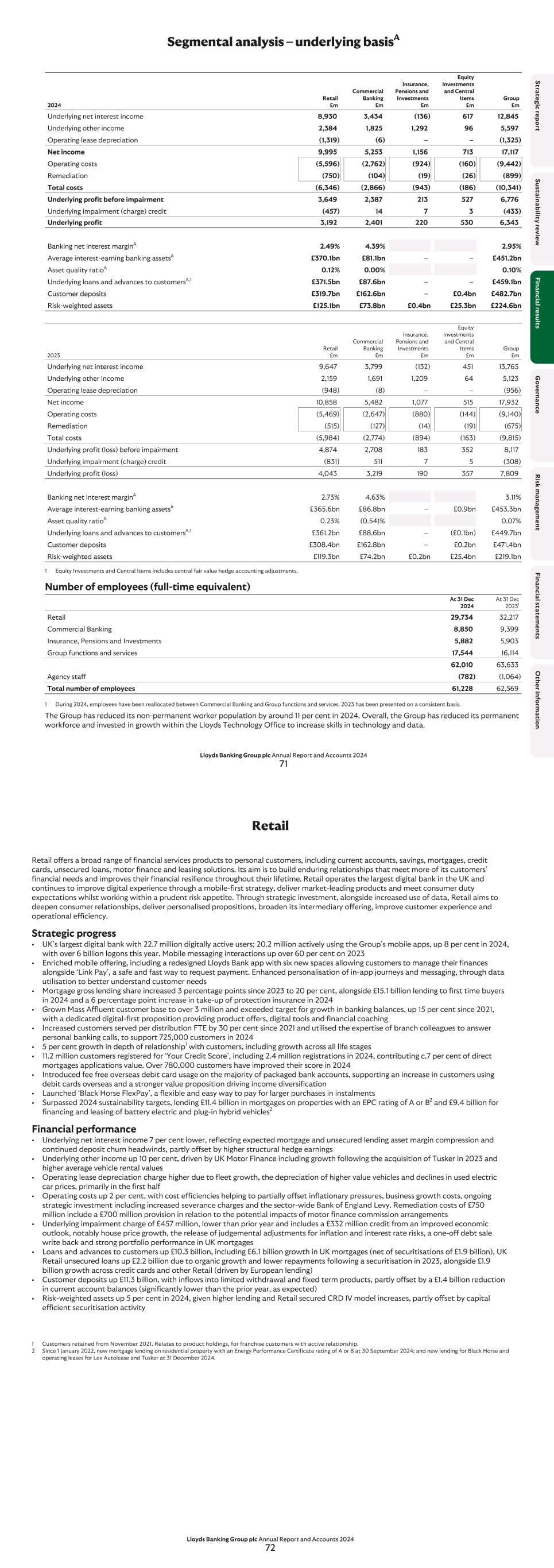
2024 Retail £m Commercial Banking £m Insurance, Pensions and Investments £m Equity Investments and Central Items £m Group £m Underlying net interest income 8,930 3,434 (136) 617 12,845 Underlying other income 2,384 1,825 1,292 96 5,597 Operating lease depreciation (1,319) (6) – – (1,325) Net income 9,995 5,253 1,156 713 17,117 Operating costs (5,596) (2,762) (924) (160) (9,442) Remediation (750) (104) (19) (26) (899) Total costs (6,346) (2,866) (943) (186) (10,341) Underlying profit before impairment 3,649 2,387 213 527 6,776 Underlying impairment (charge) credit (457) 14 7 3 (433) Underlying profit 3,192 2,401 220 530 6,343 Banking net interest marginA 2.49% 4.39% 2.95% Average interest-earning banking assetsA £370.1bn £81.1bn – – £451.2bn Asset quality ratioA 0.12% 0.00% 0.10% Underlying loans and advances to customersA,1 £371.5bn £87.6bn – – £459.1bn Customer deposits £319.7bn £162.6bn – £0.4bn £482.7bn Risk-weighted assets £125.1bn £73.8bn £0.4bn £25.3bn £224.6bn 2023 Retail £m Commercial Banking £m Insurance, Pensions and Investments £m Equity Investments and Central Items £m Group £m Underlying net interest income 9,647 3,799 (132) 451 13,765 Underlying other income 2,159 1,691 1,209 64 5,123 Operating lease depreciation (948) (8) – – (956) Net income 10,858 5,482 1,077 515 17,932 Operating costs (5,469) (2,647) (880) (144) (9,140) Remediation (515) (127) (14) (19) (675) Total costs (5,984) (2,774) (894) (163) (9,815) Underlying profit (loss) before impairment 4,874 2,708 183 352 8,117 Underlying impairment (charge) credit (831) 511 7 5 (308) Underlying profit (loss) 4,043 3,219 190 357 7,809 Banking net interest marginA 2.73% 4.63% 3.11% Average interest-earning banking assetsA £365.6bn £86.8bn – £0.9bn £453.3bn Asset quality ratioA 0.23 % (0.54) % 0.07 % Underlying loans and advances to customersA,1 £361.2bn £88.6bn – (£0.1bn) £449.7bn Customer deposits £308.4bn £162.8bn – £0.2bn £471.4bn Risk-weighted assets £119.3bn £74.2bn £0.2bn £25.4bn £219.1bn 1 Equity Investments and Central Items includes central fair value hedge accounting adjustments. Number of employees (full-time equivalent) At 31 Dec 2024 At 31 Dec 20231 Retail 29,734 32,217 Commercial Banking 8,850 9,399 Insurance, Pensions and Investments 5,882 5,903 Group functions and services 17,544 16,114 62,010 63,633 Agency staff (782) (1,064) Total number of employees 61,228 62,569 1 During 2024, employees have been reallocated between Commercial Banking and Group functions and services. 2023 has been presented on a consistent basis. The Group has reduced its non-permanent worker population by around 11 per cent in 2024. Overall, the Group has reduced its permanent workforce and invested in growth within the Lloyds Technology Office to increase skills in technology and data. Segmental analysis – underlying basisA Lloyds Banking Group plc Annual Report and Accounts 2024 71 l i ts 2 O th e r in fo rm a tio n F in a n cia l sta te m e n ts R isk m a n a ge m e n t F in a n cia l re su lts S u sta in a b ility re vie w S tra te gic re p o rt G o ve rn a n ce Retail offers a broad range of financial services products to personal customers, including current accounts, savings, mortgages, credit cards, unsecured loans, motor finance and leasing solutions. Its aim is to build enduring relationships that meet more of its customers’ financial needs and improves their financial resilience throughout their lifetime. Retail operates the largest digital bank in the UK and continues to improve digital experience through a mobile-first strategy, deliver market-leading products and meet consumer duty expectations whilst working within a prudent risk appetite. Through strategic investment, alongside increased use of data, Retail aims to deepen consumer relationships, deliver personalised propositions, broaden its intermediary offering, improve customer experience and operational efficiency. Strategic progress • UK’s largest digital bank with 22.7 million digitally active users; 20.2 million actively using the Group’s mobile apps, up 8 per cent in 2024, with over 6 billion logons this year. Mobile messaging interactions up over 60 per cent on 2023 • Enriched mobile offering, including a redesigned Lloyds Bank app with six new spaces allowing customers to manage their finances alongside ‘Link Pay’, a safe and fast way to request payment. Enhanced personalisation of in-app journeys and messaging, through data utilisation to better understand customer needs • Mortgage gross lending share increased 3 percentage points since 2023 to 20 per cent, alongside £15.1 billion lending to first time buyers in 2024 and a 6 percentage point increase in take-up of protection insurance in 2024 • Grown Mass Affluent customer base to over 3 million and exceeded target for growth in banking balances, up 15 per cent since 2021, with a dedicated digital-first proposition providing product offers, digital tools and financial coaching • Increased customers served per distribution FTE by 30 per cent since 2021 and utilised the expertise of branch colleagues to answer personal banking calls, to support 725,000 customers in 2024 • 5 per cent growth in depth of relationship1 with customers, including growth across all life stages • 11.2 million customers registered for ‘Your Credit Score’, including 2.4 million registrations in 2024, contributing c.7 per cent of direct mortgages applications value. Over 780,000 customers have improved their score in 2024 • Introduced fee free overseas debit card usage on the majority of packaged bank accounts, supporting an increase in customers using debit cards overseas and a stronger value proposition driving income diversification • Launched ‘Black Horse FlexPay’, a flexible and easy way to pay for larger purchases in instalments • Surpassed 2024 sustainability targets, lending £11.4 billion in mortgages on properties with an EPC rating of A or B2 and £9.4 billion for financing and leasing of battery electric and plug-in hybrid vehicles2 Financial performance • Underlying net interest income 7 per cent lower, reflecting expected mortgage and unsecured lending asset margin compression and continued deposit churn headwinds, partly offset by higher structural hedge earnings • Underlying other income up 10 per cent, driven by UK Motor Finance including growth following the acquisition of Tusker in 2023 and higher average vehicle rental values • Operating lease depreciation charge higher due to fleet growth, the depreciation of higher value vehicles and declines in used electric car prices, primarily in the first half • Operating costs up 2 per cent, with cost efficiencies helping to partially offset inflationary pressures, business growth costs, ongoing strategic investment including increased severance charges and the sector-wide Bank of England Levy. Remediation costs of £750 million include a £700 million provision in relation to the potential impacts of motor finance commission arrangements • Underlying impairment charge of £457 million, lower than prior year and includes a £332 million credit from an improved economic outlook, notably house price growth, the release of judgemental adjustments for inflation and interest rate risks, a one-off debt sale write back and strong portfolio performance in UK mortgages • Loans and advances to customers up £10.3 billion, including £6.1 billion growth in UK mortgages (net of securitisations of £1.9 billion), UK Retail unsecured loans up £2.2 billion due to organic growth and lower repayments following a securitisation in 2023, alongside £1.9 billion growth across credit cards and other Retail (driven by European lending) • Customer deposits up £11.3 billion, with inflows into limited withdrawal and fixed term products, partly offset by a £1.4 billion reduction in current account balances (significantly lower than the prior year, as expected) • Risk-weighted assets up 5 per cent in 2024, given higher lending and Retail secured CRD IV model increases, partly offset by capital efficient securitisation activity 1 Customers retained from November 2021. Relates to product holdings, for franchise customers with active relationship. 2 Since 1 January 2022, new mortgage lending on residential property with an Energy Performance Certificate rating of A or B at 30 September 2024; and new lending for Black Horse and operating leases for Lex Autolease and Tusker at 31 December 2024. Retail Lloyds Banking Group plc Annual Report and Accounts 2024 72 l i ts
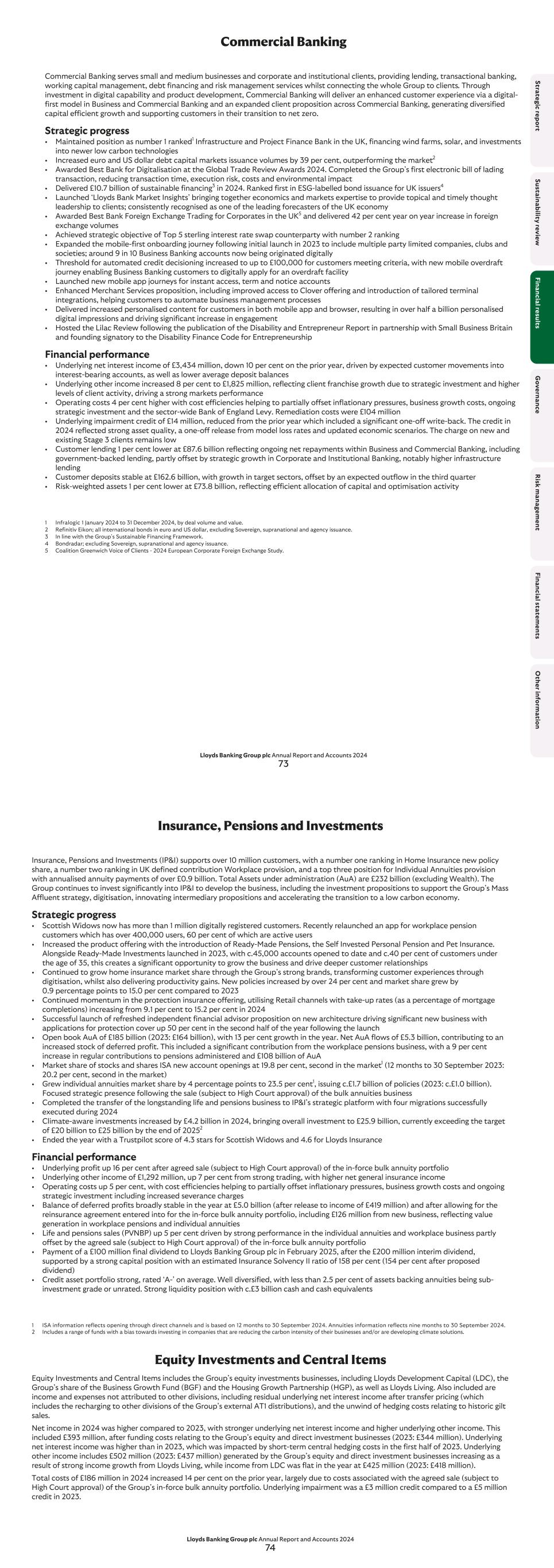
Commercial Banking serves small and medium businesses and corporate and institutional clients, providing lending, transactional banking, working capital management, debt financing and risk management services whilst connecting the whole Group to clients. Through investment in digital capability and product development, Commercial Banking will deliver an enhanced customer experience via a digital- first model in Business and Commercial Banking and an expanded client proposition across Commercial Banking, generating diversified capital efficient growth and supporting customers in their transition to net zero. Strategic progress • Maintained position as number 1 ranked1 Infrastructure and Project Finance Bank in the UK, financing wind farms, solar, and investments into newer low carbon technologies • Increased euro and US dollar debt capital markets issuance volumes by 39 per cent, outperforming the market2 • Awarded Best Bank for Digitalisation at the Global Trade Review Awards 2024. Completed the Group’s first electronic bill of lading transaction, reducing transaction time, execution risk, costs and environmental impact • Delivered £10.7 billion of sustainable financing3 in 2024. Ranked first in ESG-labelled bond issuance for UK issuers4 • Launched ‘Lloyds Bank Market Insights’ bringing together economics and markets expertise to provide topical and timely thought leadership to clients; consistently recognised as one of the leading forecasters of the UK economy • Awarded Best Bank Foreign Exchange Trading for Corporates in the UK5 and delivered 42 per cent year on year increase in foreign exchange volumes • Achieved strategic objective of Top 5 sterling interest rate swap counterparty with number 2 ranking • Expanded the mobile-first onboarding journey following initial launch in 2023 to include multiple party limited companies, clubs and societies; around 9 in 10 Business Banking accounts now being originated digitally • Threshold for automated credit decisioning increased to up to £100,000 for customers meeting criteria, with new mobile overdraft journey enabling Business Banking customers to digitally apply for an overdraft facility • Launched new mobile app journeys for instant access, term and notice accounts • Enhanced Merchant Services proposition, including improved access to Clover offering and introduction of tailored terminal integrations, helping customers to automate business management processes • Delivered increased personalised content for customers in both mobile app and browser, resulting in over half a billion personalised digital impressions and driving significant increase in engagement • Hosted the Lilac Review following the publication of the Disability and Entrepreneur Report in partnership with Small Business Britain and founding signatory to the Disability Finance Code for Entrepreneurship Financial performance • Underlying net interest income of £3,434 million, down 10 per cent on the prior year, driven by expected customer movements into interest-bearing accounts, as well as lower average deposit balances • Underlying other income increased 8 per cent to £1,825 million, reflecting client franchise growth due to strategic investment and higher levels of client activity, driving a strong markets performance • Operating costs 4 per cent higher with cost efficiencies helping to partially offset inflationary pressures, business growth costs, ongoing strategic investment and the sector-wide Bank of England Levy. Remediation costs were £104 million • Underlying impairment credit of £14 million, reduced from the prior year which included a significant one-off write-back. The credit in 2024 reflected strong asset quality, a one-off release from model loss rates and updated economic scenarios. The charge on new and existing Stage 3 clients remains low • Customer lending 1 per cent lower at £87.6 billion reflecting ongoing net repayments within Business and Commercial Banking, including government-backed lending, partly offset by strategic growth in Corporate and Institutional Banking, notably higher infrastructure lending • Customer deposits stable at £162.6 billion, with growth in target sectors, offset by an expected outflow in the third quarter • Risk-weighted assets 1 per cent lower at £73.8 billion, reflecting efficient allocation of capital and optimisation activity 1 Infralogic 1 January 2024 to 31 December 2024, by deal volume and value. 2 Refinitiv Eikon; all international bonds in euro and US dollar, excluding Sovereign, supranational and agency issuance. 3 In line with the Group’s Sustainable Financing Framework. 4 Bondradar; excluding Sovereign, supranational and agency issuance. 5 Coalition Greenwich Voice of Clients - 2024 European Corporate Foreign Exchange Study. Commercial Banking Lloyds Banking Group plc Annual Report and Accounts 2024 73 l i ts 2 O th e r in fo rm a tio n F in a n cia l sta te m e n ts R isk m a n a ge m e n t F in a n cia l re su lts S u sta in a b ility re vie w S tra te gic re p o rt G o ve rn a n ce Insurance, Pensions and Investments (IP&I) supports over 10 million customers, with a number one ranking in Home Insurance new policy share, a number two ranking in UK defined contribution Workplace provision, and a top three position for Individual Annuities provision with annualised annuity payments of over £0.9 billion. Total Assets under administration (AuA) are £232 billion (excluding Wealth). The Group continues to invest significantly into IP&I to develop the business, including the investment propositions to support the Group’s Mass Affluent strategy, digitisation, innovating intermediary propositions and accelerating the transition to a low carbon economy. Strategic progress • Scottish Widows now has more than 1 million digitally registered customers. Recently relaunched an app for workplace pension customers which has over 400,000 users, 60 per cent of which are active users • Increased the product offering with the introduction of Ready-Made Pensions, the Self Invested Personal Pension and Pet Insurance. Alongside Ready-Made Investments launched in 2023, with c.45,000 accounts opened to date and c.40 per cent of customers under the age of 35, this creates a significant opportunity to grow the business and drive deeper customer relationships • Continued to grow home insurance market share through the Group’s strong brands, transforming customer experiences through digitisation, whilst also delivering productivity gains. New policies increased by over 24 per cent and market share grew by 0.9 percentage points to 15.0 per cent compared to 2023 • Continued momentum in the protection insurance offering, utilising Retail channels with take-up rates (as a percentage of mortgage completions) increasing from 9.1 per cent to 15.2 per cent in 2024 • Successful launch of refreshed independent financial advisor proposition on new architecture driving significant new business with applications for protection cover up 50 per cent in the second half of the year following the launch • Open book AuA of £185 billion (2023: £164 billion), with 13 per cent growth in the year. Net AuA flows of £5.3 billion, contributing to an increased stock of deferred profit. This included a significant contribution from the workplace pensions business, with a 9 per cent increase in regular contributions to pensions administered and £108 billion of AuA • Market share of stocks and shares ISA new account openings at 19.8 per cent, second in the market1 (12 months to 30 September 2023: 20.2 per cent, second in the market) • Grew individual annuities market share by 4 percentage points to 23.5 per cent1, issuing c.£1.7 billion of policies (2023: c.£1.0 billion). Focused strategic presence following the sale (subject to High Court approval) of the bulk annuities business • Completed the transfer of the longstanding life and pensions business to IP&I’s strategic platform with four migrations successfully executed during 2024 • Climate-aware investments increased by £4.2 billion in 2024, bringing overall investment to £25.9 billion, currently exceeding the target of £20 billion to £25 billion by the end of 20252 • Ended the year with a Trustpilot score of 4.3 stars for Scottish Widows and 4.6 for Lloyds Insurance Financial performance • Underlying profit up 16 per cent after agreed sale (subject to High Court approval) of the in-force bulk annuity portfolio • Underlying other income of £1,292 million, up 7 per cent from strong trading, with higher net general insurance income • Operating costs up 5 per cent, with cost efficiencies helping to partially offset inflationary pressures, business growth costs and ongoing strategic investment including increased severance charges • Balance of deferred profits broadly stable in the year at £5.0 billion (after release to income of £419 million) and after allowing for the reinsurance agreement entered into for the in-force bulk annuity portfolio, including £126 million from new business, reflecting value generation in workplace pensions and individual annuities • Life and pensions sales (PVNBP) up 5 per cent driven by strong performance in the individual annuities and workplace business partly offset by the agreed sale (subject to High Court approval) of the in-force bulk annuity portfolio • Payment of a £100 million final dividend to Lloyds Banking Group plc in February 2025, after the £200 million interim dividend, supported by a strong capital position with an estimated Insurance Solvency II ratio of 158 per cent (154 per cent after proposed dividend) • Credit asset portfolio strong, rated ‘A-’ on average. Well diversified, with less than 2.5 per cent of assets backing annuities being sub- investment grade or unrated. Strong liquidity position with c.£3 billion cash and cash equivalents 1 ISA information reflects opening through direct channels and is based on 12 months to 30 September 2024. Annuities information reflects nine months to 30 September 2024. 2 Includes a range of funds with a bias towards investing in companies that are reducing the carbon intensity of their businesses and/or are developing climate solutions. Equity Investments and Central Items Equity Investments and Central Items includes the Group’s equity investments businesses, including Lloyds Development Capital (LDC), the Group’s share of the Business Growth Fund (BGF) and the Housing Growth Partnership (HGP), as well as Lloyds Living. Also included are income and expenses not attributed to other divisions, including residual underlying net interest income after transfer pricing (which includes the recharging to other divisions of the Group’s external AT1 distributions), and the unwind of hedging costs relating to historic gilt sales. Net income in 2024 was higher compared to 2023, with stronger underlying net interest income and higher underlying other income. This included £393 million, after funding costs relating to the Group’s equity and direct investment businesses (2023: £344 million). Underlying net interest income was higher than in 2023, which was impacted by short-term central hedging costs in the first half of 2023. Underlying other income includes £502 million (2023: £437 million) generated by the Group’s equity and direct investment businesses increasing as a result of strong income growth from Lloyds Living, while income from LDC was flat in the year at £425 million (2023: £418 million). Total costs of £186 million in 2024 increased 14 per cent on the prior year, largely due to costs associated with the agreed sale (subject to High Court approval) of the Group’s in-force bulk annuity portfolio. Underlying impairment was a £3 million credit compared to a £5 million credit in 2023. Insurance, Pensions and Investments Lloyds Banking Group plc Annual Report and Accounts 2024 74 l i ts
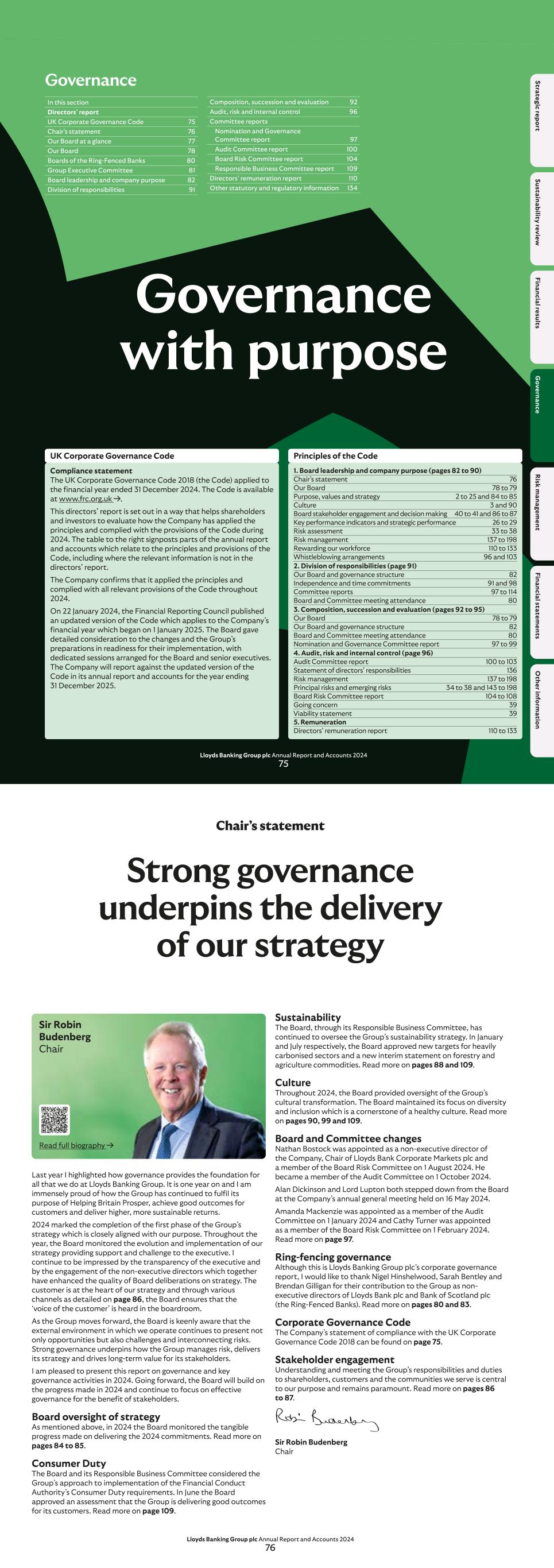
O th e r in fo rm a tio n F in a n cia l sta te m e n ts R isk m a n a ge m e n t G o ve rn a n ce F in a n cia l re su lts S u sta in a b ility re vie w S tra te gic re p o rt 75 Lloyds Banking Group plc Annual Report and Accounts 2024 Governance with purpose Governance In this section Directors’ report UK Corporate Governance Code 75 Chair’s statement 76 Our Board at a glance 77 Our Board 78 Boards of the Ring-Fenced Banks 80 Group Executive Committee 81 Board leadership and company purpose 82 Division of responsibilities 91 Composition, succession and evaluation 92 Audit, risk and internal control 96 Committee reports Nomination and Governance Committee report 97 Audit Committee report 100 Board Risk Committee report 104 Responsible Business Committee report 109 Directors’ remuneration report 110 Other statutory and regulatory information 134 Compliance statement The UK Corporate Governance Code 2018 (the Code) applied to the financial year ended 31 December 2024. The Code is available at www.frc.org.uk . This directors’ report is set out in a way that helps shareholders and investors to evaluate how the Company has applied the principles and complied with the provisions of the Code during 2024. The table to the right signposts parts of the annual report and accounts which relate to the principles and provisions of the Code, including where the relevant information is not in the directors’ report. The Company confirms that it applied the principles and complied with all relevant provisions of the Code throughout 2024. On 22 January 2024, the Financial Reporting Council published an updated version of the Code which applies to the Company’s financial year which began on 1 January 2025. The Board gave detailed consideration to the changes and the Group’s preparations in readiness for their implementation, with dedicated sessions arranged for the Board and senior executives. The Company will report against the updated version of the Code in its annual report and accounts for the year ending 31 December 2025. 1. Board leadership and company purpose (pages 82 to 90) Chair’s statement 76 Our Board 78 to 79 Purpose, values and strategy 2 to 25 and 84 to 85 Culture 3 and 90 Board stakeholder engagement and decision making 40 to 41 and 86 to 87 Key performance indicators and strategic performance 26 to 29 Risk assessment 33 to 38 Risk management 137 to 198 Rewarding our workforce 110 to 133 Whistleblowing arrangements 96 and 103 2. Division of responsibilities (page 91) Our Board and governance structure 82 Independence and time commitments 91 and 98 Committee reports 97 to 114 Board and Committee meeting attendance 80 3. Composition, succession and evaluation (pages 92 to 95) Our Board 78 to 79 Our Board and governance structure 82 Board and Committee meeting attendance 80 Nomination and Governance Committee report 97 to 99 4. Audit, risk and internal control (page 96) Audit Committee report 100 to 103 Statement of directors’ responsibilities 136 Risk management 137 to 198 Principal risks and emerging risks 34 to 38 and 143 to 198 Board Risk Committee report 104 to 108 Going concern 39 Viability statement 39 5. Remuneration Directors’ remuneration report 110 to 133 UK Corporate Governance Code Principles of the Code 76 Lloyds Banking Group plc Annual Report and Accounts 2024 Chair’s statement Strong governance underpins the delivery of our strategy Last year I highlighted how governance provides the foundation for all that we do at Lloyds Banking Group. It is one year on and I am immensely proud of how the Group has continued to fulfil its purpose of Helping Britain Prosper, achieve good outcomes for customers and deliver higher, more sustainable returns. 2024 marked the completion of the first phase of the Group’s strategy which is closely aligned with our purpose. Throughout the year, the Board monitored the evolution and implementation of our strategy providing support and challenge to the executive. I continue to be impressed by the transparency of the executive and by the engagement of the non-executive directors which together have enhanced the quality of Board deliberations on strategy. The customer is at the heart of our strategy and through various channels as detailed on page 86, the Board ensures that the ‘voice of the customer’ is heard in the boardroom. As the Group moves forward, the Board is keenly aware that the external environment in which we operate continues to present not only opportunities but also challenges and interconnecting risks. Strong governance underpins how the Group manages risk, delivers its strategy and drives long-term value for its stakeholders. I am pleased to present this report on governance and key governance activities in 2024. Going forward, the Board will build on the progress made in 2024 and continue to focus on effective governance for the benefit of stakeholders. Board oversight of strategy As mentioned above, in 2024 the Board monitored the tangible progress made on delivering the 2024 commitments. Read more on pages 84 to 85. Consumer Duty The Board and its Responsible Business Committee considered the Group’s approach to implementation of the Financial Conduct Authority’s Consumer Duty requirements. In June the Board approved an assessment that the Group is delivering good outcomes for its customers. Read more on page 109. Sustainability The Board, through its Responsible Business Committee, has continued to oversee the Group’s sustainability strategy. In January and July respectively, the Board approved new targets for heavily carbonised sectors and a new interim statement on forestry and agriculture commodities. Read more on pages 88 and 109. Culture Throughout 2024, the Board provided oversight of the Group’s cultural transformation. The Board maintained its focus on diversity and inclusion which is a cornerstone of a healthy culture. Read more on pages 90, 99 and 109. Board and Committee changes Nathan Bostock was appointed as a non-executive director of the Company, Chair of Lloyds Bank Corporate Markets plc and a member of the Board Risk Committee on 1 August 2024. He became a member of the Audit Committee on 1 October 2024. Alan Dickinson and Lord Lupton both stepped down from the Board at the Company’s annual general meeting held on 16 May 2024. Amanda Mackenzie was appointed as a member of the Audit Committee on 1 January 2024 and Cathy Turner was appointed as a member of the Board Risk Committee on 1 February 2024. Read more on page 97. Ring-fencing governance Although this is Lloyds Banking Group plc’s corporate governance report, I would like to thank Nigel Hinshelwood, Sarah Bentley and Brendan Gilligan for their contribution to the Group as non- executive directors of Lloyds Bank plc and Bank of Scotland plc (the Ring-Fenced Banks). Read more on pages 80 and 83. Corporate Governance Code The Company’s statement of compliance with the UK Corporate Governance Code 2018 can be found on page 75. Stakeholder engagement Understanding and meeting the Group’s responsibilities and duties to shareholders, customers and the communities we serve is central to our purpose and remains paramount. Read more on pages 86 to 87. Sir Robin Budenberg Chair Sir Robin Budenberg Chair Read full biography
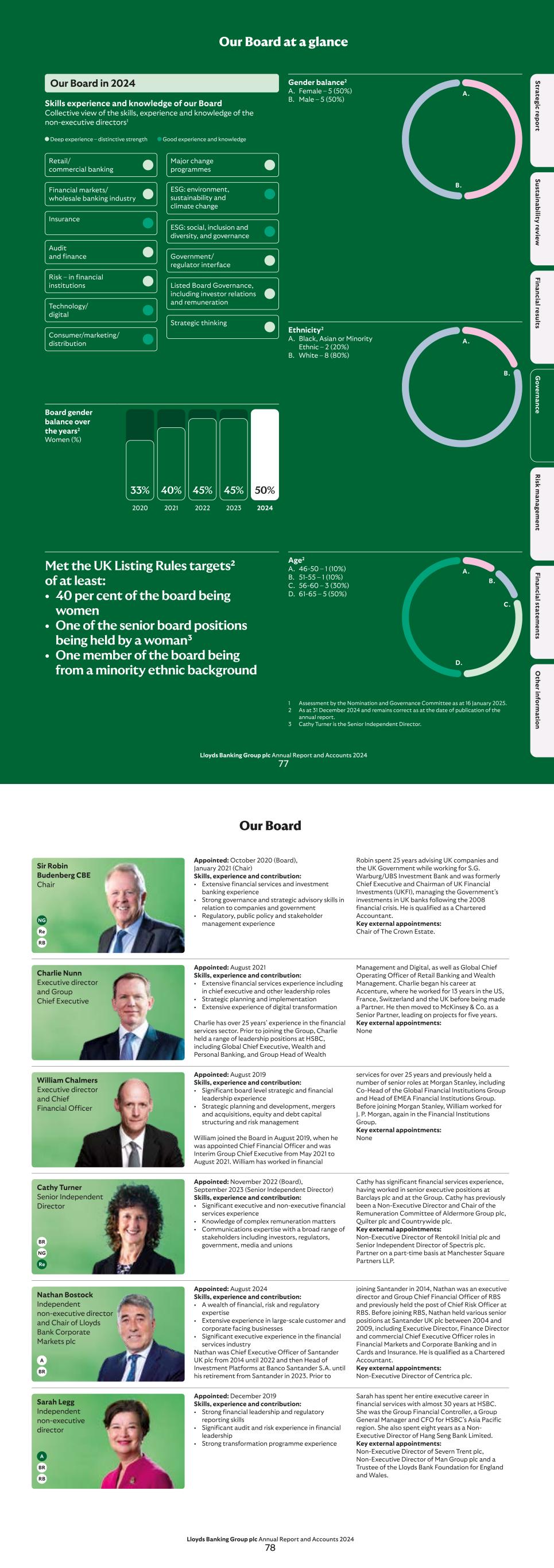
O th e r in fo rm a tio n F in a n cia l sta te m e n ts R isk m a n a ge m e n t F in a n cia l re su lts S u sta in a b ility re vie w S tra te gic re p o rt G o ve rn a n ce 77 Lloyds Banking Group plc Annual Report and Accounts 2024 20242023202220212020 33% 45% 50%40% 45% Our Board at a glance Skills experience and knowledge of our Board Collective view of the skills, experience and knowledge of the non-executive directors1 Deep experience – distinctive strength Good experience and knowledge 1 Assessment by the Nomination and Governance Committee as at 16 January 2025. 2 As at 31 December 2024 and remains correct as at the date of publication of the annual report. 3 Cathy Turner is the Senior Independent Director. Gender balance2 A. Female – 5 (50%) B. Male – 5 (50%) Ethnicity2 A. Black, Asian or Minority Ethnic – 2 (20%) B. White – 8 (80%) Age2 A. 46-50 – 1 (10%) B. 51-55 – 1 (10%) C. 56-60 – 3 (30%) D. 61-65 – 5 (50%) Board gender balance over the years2 Women (%) Met the UK Listing Rules targets2 of at least: • 40 per cent of the board being women • One of the senior board positions being held by a woman3 • One member of the board being from a minority ethnic background Our Board in 2024 Retail/ commercial banking Major change programmes Financial markets/ wholesale banking industry ESG: environment, sustainability and climate change Insurance ESG: social, inclusion and diversity, and governance Audit and finance Government/ regulator interface Risk – in financial institutions Listed Board Governance, including investor relations and remuneration Technology/ digital Strategic thinking Consumer/marketing/ distribution B. A. B. A. C. D. B. A. 78 Lloyds Banking Group plc Annual Report and Accounts 2024 Appointed: October 2020 (Board), January 2021 (Chair) Skills, experience and contribution: • Extensive financial services and investment banking experience • Strong governance and strategic advisory skills in relation to companies and government • Regulatory, public policy and stakeholder management experience Robin spent 25 years advising UK companies and the UK Government while working for S.G. Warburg/UBS Investment Bank and was formerly Chief Executive and Chairman of UK Financial Investments (UKFI), managing the Government’s investments in UK banks following the 2008 financial crisis. He is qualified as a Chartered Accountant. Key external appointments: Chair of The Crown Estate. Appointed: August 2021 Skills, experience and contribution: • Extensive financial services experience including in chief executive and other leadership roles • Strategic planning and implementation • Extensive experience of digital transformation Charlie has over 25 years’ experience in the financial services sector. Prior to joining the Group, Charlie held a range of leadership positions at HSBC, including Global Chief Executive, Wealth and Personal Banking, and Group Head of Wealth Management and Digital, as well as Global Chief Operating Officer of Retail Banking and Wealth Management. Charlie began his career at Accenture, where he worked for 13 years in the US, France, Switzerland and the UK before being made a Partner. He then moved to McKinsey & Co. as a Senior Partner, leading on projects for five years. Key external appointments: None Appointed: August 2019 Skills, experience and contribution: • Significant board level strategic and financial leadership experience • Strategic planning and development, mergers and acquisitions, equity and debt capital structuring and risk management William joined the Board in August 2019, when he was appointed Chief Financial Officer and was Interim Group Chief Executive from May 2021 to August 2021. William has worked in financial services for over 25 years and previously held a number of senior roles at Morgan Stanley, including Co-Head of the Global Financial Institutions Group and Head of EMEA Financial Institutions Group. Before joining Morgan Stanley, William worked for J. P. Morgan, again in the Financial Institutions Group. Key external appointments: None Appointed: November 2022 (Board), September 2023 (Senior Independent Director) Skills, experience and contribution: • Significant executive and non-executive financial services experience • Knowledge of complex remuneration matters • Communications expertise with a broad range of stakeholders including investors, regulators, government, media and unions Cathy has significant financial services experience, having worked in senior executive positions at Barclays plc and at the Group. Cathy has previously been a Non-Executive Director and Chair of the Remuneration Committee of Aldermore Group plc, Quilter plc and Countrywide plc. Key external appointments: Non-Executive Director of Rentokil Initial plc and Senior Independent Director of Spectris plc. Partner on a part-time basis at Manchester Square Partners LLP. Appointed: August 2024 Skills, experience and contribution: • A wealth of financial, risk and regulatory expertise • Extensive experience in large-scale customer and corporate facing businesses • Significant executive experience in the financial services industry Nathan was Chief Executive Officer of Santander UK plc from 2014 until 2022 and then Head of Investment Platforms at Banco Santander S.A. until his retirement from Santander in 2023. Prior to joining Santander in 2014, Nathan was an executive director and Group Chief Financial Officer of RBS and previously held the post of Chief Risk Officer at RBS. Before joining RBS, Nathan held various senior positions at Santander UK plc between 2004 and 2009, including Executive Director, Finance Director and commercial Chief Executive Officer roles in Financial Markets and Corporate Banking and in Cards and Insurance. He is qualified as a Chartered Accountant. Key external appointments: Non-Executive Director of Centrica plc. Appointed: December 2019 Skills, experience and contribution: • Strong financial leadership and regulatory reporting skills • Significant audit and risk experience in financial leadership • Strong transformation programme experience Sarah has spent her entire executive career in financial services with almost 30 years at HSBC. She was the Group Financial Controller, a Group General Manager and CFO for HSBC’s Asia Pacific region. She also spent eight years as a Non- Executive Director of Hang Seng Bank Limited. Key external appointments: Non-Executive Director of Severn Trent plc, Non-Executive Director of Man Group plc and a Trustee of the Lloyds Bank Foundation for England and Wales. Our Board Sir Robin Budenberg CBE Chair Charlie Nunn Executive director and Group Chief Executive William Chalmers Executive director and Chief Financial Officer Cathy Turner Senior Independent Director Nathan Bostock Independent non-executive director and Chair of Lloyds Bank Corporate Markets plc Sarah Legg Independent non-executive director RB Re BR RB Re NG A BR NG BR A
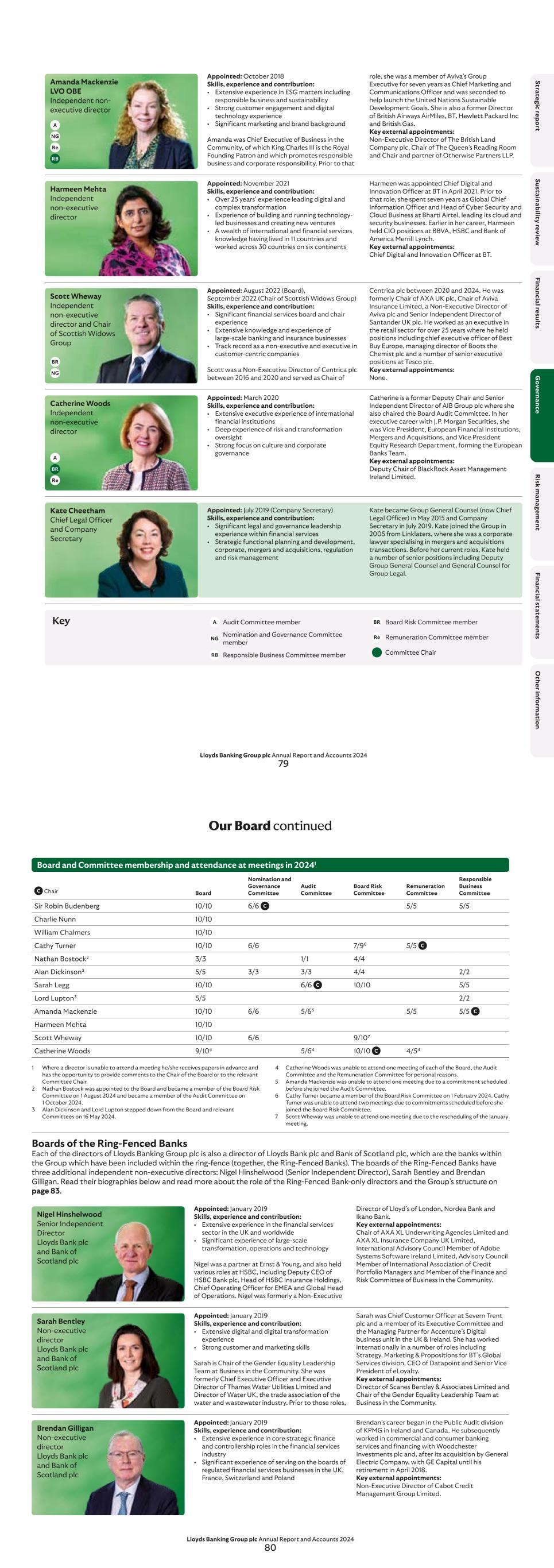
79 Lloyds Banking Group plc Annual Report and Accounts 2024 O th e r in fo rm a tio n F in a n cia l sta te m e n ts R isk m a n a ge m e n t G o ve rn a n ce F in a n cia l re su lts S u sta in a b ility re vie w S tra te gic re p o rt Appointed: October 2018 Skills, experience and contribution: • Extensive experience in ESG matters including responsible business and sustainability • Strong customer engagement and digital technology experience • Significant marketing and brand background Amanda was Chief Executive of Business in the Community, of which King Charles III is the Royal Founding Patron and which promotes responsible business and corporate responsibility. Prior to that role, she was a member of Aviva’s Group Executive for seven years as Chief Marketing and Communications Officer and was seconded to help launch the United Nations Sustainable Development Goals. She is also a former Director of British Airways AirMiles, BT, Hewlett Packard Inc and British Gas. Key external appointments: Non-Executive Director of The British Land Company plc, Chair of The Queen’s Reading Room and Chair and partner of Otherwise Partners LLP. Appointed: November 2021 Skills, experience and contribution: • Over 25 years’ experience leading digital and complex transformation • Experience of building and running technology- led businesses and creating new ventures • A wealth of international and financial services knowledge having lived in 11 countries and worked across 30 countries on six continents Harmeen was appointed Chief Digital and Innovation Officer at BT in April 2021. Prior to that role, she spent seven years as Global Chief Information Officer and Head of Cyber Security and Cloud Business at Bharti Airtel, leading its cloud and security businesses. Earlier in her career, Harmeen held CIO positions at BBVA, HSBC and Bank of America Merrill Lynch. Key external appointments: Chief Digital and Innovation Officer at BT. Appointed: August 2022 (Board), September 2022 (Chair of Scottish Widows Group) Skills, experience and contribution: • Significant financial services board and chair experience • Extensive knowledge and experience of large-scale banking and insurance businesses • Track record as a non-executive and executive in customer-centric companies Scott was a Non-Executive Director of Centrica plc between 2016 and 2020 and served as Chair of Centrica plc between 2020 and 2024. He was formerly Chair of AXA UK plc, Chair of Aviva Insurance Limited, a Non-Executive Director of Aviva plc and Senior Independent Director of Santander UK plc. He worked as an executive in the retail sector for over 25 years where he held positions including chief executive officer of Best Buy Europe, managing director of Boots the Chemist plc and a number of senior executive positions at Tesco plc. Key external appointments: None. Appointed: March 2020 Skills, experience and contribution: • Extensive executive experience of international financial institutions • Deep experience of risk and transformation oversight • Strong focus on culture and corporate governance Catherine is a former Deputy Chair and Senior Independent Director of AIB Group plc where she also chaired the Board Audit Committee. In her executive career with J.P. Morgan Securities, she was Vice President, European Financial Institutions, Mergers and Acquisitions, and Vice President Equity Research Department, forming the European Banks Team. Key external appointments: Deputy Chair of BlackRock Asset Management Ireland Limited. Appointed: July 2019 (Company Secretary) Skills, experience and contribution: • Significant legal and governance leadership experience within financial services • Strategic functional planning and development, corporate, mergers and acquisitions, regulation and risk management Kate became Group General Counsel (now Chief Legal Officer) in May 2015 and Company Secretary in July 2019. Kate joined the Group in 2005 from Linklaters, where she was a corporate lawyer specialising in mergers and acquisitions transactions. Before her current roles, Kate held a number of senior positions including Deputy Group General Counsel and General Counsel for Group Legal. Amanda Mackenzie LVO OBE Independent non- executive director Harmeen Mehta Independent non-executive director Scott Wheway Independent non-executive director and Chair of Scottish Widows Group Catherine Woods Independent non-executive director Kate Cheetham Chief Legal Officer and Company Secretary Key A Audit Committee member NG Nomination and Governance Committee member RB Responsible Business Committee member Re RB NG Re NG BR BR A A BR Board Risk Committee member Re Remuneration Committee member Committee Chair 80 Lloyds Banking Group plc Annual Report and Accounts 2024 Our Board continued C Chair Board Nomination and Governance Committee Audit Committee Board Risk Committee Remuneration Committee Responsible Business Committee Sir Robin Budenberg 10/10 6/6 C 5/5 5/5 Charlie Nunn 10/10 William Chalmers 10/10 Cathy Turner 10/10 6/6 7/96 5/5 C Nathan Bostock2 3/3 1/1 4/4 Alan Dickinson3 5/5 3/3 3/3 4/4 2/2 Sarah Legg 10/10 6/6 C 10/10 5/5 Lord Lupton3 5/5 2/2 Amanda Mackenzie 10/10 6/6 5/65 5/5 5/5 C Harmeen Mehta 10/10 Scott Wheway 10/10 6/6 9/107 Catherine Woods 9/104 5/64 10/10 C 4/54 Board and Committee membership and attendance at meetings in 20241 1 Where a director is unable to attend a meeting he/she receives papers in advance and has the opportunity to provide comments to the Chair of the Board or to the relevant Committee Chair. 2 Nathan Bostock was appointed to the Board and became a member of the Board Risk Committee on 1 August 2024 and became a member of the Audit Committee on 1 October 2024. 3 Alan Dickinson and Lord Lupton stepped down from the Board and relevant Committees on 16 May 2024. 4 Catherine Woods was unable to attend one meeting of each of the Board, the Audit Committee and the Remuneration Committee for personal reasons. 5 Amanda Mackenzie was unable to attend one meeting due to a commitment scheduled before she joined the Audit Committee. 6 Cathy Turner became a member of the Board Risk Committee on 1 February 2024. Cathy Turner was unable to attend two meetings due to commitments scheduled before she joined the Board Risk Committee. 7 Scott Wheway was unable to attend one meeting due to the rescheduling of the January meeting. Boards of the Ring-Fenced Banks Each of the directors of Lloyds Banking Group plc is also a director of Lloyds Bank plc and Bank of Scotland plc, which are the banks within the Group which have been included within the ring-fence (together, the Ring-Fenced Banks). The boards of the Ring-Fenced Banks have three additional independent non-executive directors: Nigel Hinshelwood (Senior Independent Director), Sarah Bentley and Brendan Gilligan. Read their biographies below and read more about the role of the Ring-Fenced Bank-only directors and the Group’s structure on page 83. Appointed: January 2019 Skills, experience and contribution: • Extensive experience in the financial services sector in the UK and worldwide • Significant experience of large-scale transformation, operations and technology Nigel was a partner at Ernst & Young, and also held various roles at HSBC, including Deputy CEO of HSBC Bank plc, Head of HSBC Insurance Holdings, Chief Operating Officer for EMEA and Global Head of Operations. Nigel was formerly a Non-Executive Director of Lloyd’s of London, Nordea Bank and Ikano Bank. Key external appointments: Chair of AXA XL Underwriting Agencies Limited and AXA XL Insurance Company UK Limited, International Advisory Council Member of Adobe Systems Software Ireland Limited, Advisory Council Member of International Association of Credit Portfolio Managers and Member of the Finance and Risk Committee of Business in the Community. Appointed: January 2019 Skills, experience and contribution: • Extensive digital and digital transformation experience • Strong customer and marketing skills Sarah is Chair of the Gender Equality Leadership Team at Business in the Community. She was formerly Chief Executive Officer and Executive Director of Thames Water Utilities Limited and Director of Water UK, the trade association of the water and wastewater industry. Prior to those roles, Sarah was Chief Customer Officer at Severn Trent plc and a member of its Executive Committee and the Managing Partner for Accenture’s Digital business unit in the UK & Ireland. She has worked internationally in a number of roles including Strategy, Marketing & Propositions for BT’s Global Services division, CEO of Datapoint and Senior Vice President of eLoyalty. Key external appointments: Director of Scanes Bentley & Associates Limited and Chair of the Gender Equality Leadership Team at Business in the Community. Appointed: January 2019 Skills, experience and contribution: • Extensive experience in core strategic finance and controllership roles in the financial services industry • Significant experience of serving on the boards of regulated financial services businesses in the UK, France, Switzerland and Poland Brendan’s career began in the Public Audit division of KPMG in Ireland and Canada. He subsequently worked in commercial and consumer banking services and financing with Woodchester Investments plc and, after its acquisition by General Electric Company, with GE Capital until his retirement in April 2018. Key external appointments: Non-Executive Director of Cabot Credit Management Group Limited. Nigel Hinshelwood Senior Independent Director Lloyds Bank plc and Bank of Scotland plc Sarah Bentley Non-executive director Lloyds Bank plc and Bank of Scotland plc Brendan Gilligan Non-executive director Lloyds Bank plc and Bank of Scotland plc

81 Lloyds Banking Group plc Annual Report and Accounts 2024 O th e r in fo rm a tio n F in a n cia l sta te m e n ts R isk m a n a ge m e n t G o ve rn a n ce F in a n cia l re su lts S u sta in a b ility re vie w S tra te gic re p o rt Group Executive Committee Charlie Nunn Executive director and Group Chief Executive William Chalmers Executive director and Chief Financial Officer Chirantan Barua Chief Executive Officer, Scottish Widows and Insurance, Pensions and Investments Kate Cheetham Chief Legal Officer and Company Secretary Appointed: August 2021 Appointed: June 2019 Appointed: May 2023 Appointed: July 2017 Elyn Corfield Chief Executive Officer, Business and Commercial Banking Sharon Doherty Chief People and Places Officer Jo Harris Chief Executive Officer, Mass Affluent Ron van Kemenade Chief Operating Officer Appointed: July 2022 Appointed: June 2022 Appointed: July 2022 Appointed: June 2023 Laura Needham Chief Internal Auditor Jayne Opperman Chief Executive Officer, Consumer Relationships Stephen Shelley Chief Risk Officer Jasjyot Singh OBE Chief Executive Officer, Consumer Lending Appointed: October 2022 Appointed: January 2023 Appointed: September 2017 Appointed: July 2022 Andrew Walton Chief Sustainability Officer and Chief Corporate Affairs Officer John Winter Chief Executive Officer, Corporate and Institutional Banking Appointed: September 2018 Appointed: September 2022 Key Committee Chair Group Executive Committee member Group Executive Committee attendee Read the full biographies of the Group Executive Committee C M A M M M M M M M M M M M M A C 82 Lloyds Banking Group plc Annual Report and Accounts 2024 Board leadership and company purpose Lloyds Banking Group plc Board The terms of reference for the Board Committees and the matters reserved for the Board can be found on our corporate governance page Board Committees Role of the Board The Board is responsible for ensuring the Group’s long-term sustainable success, generating value for shareholders and contributing to wider society. It sets the Group’s purpose, values and strategy, with the aim of Helping Britain Prosper – read more on pages 84 to 85. The Board is also responsible for establishing and promoting a culture of customer focus (including treating customers fairly), risk awareness and ethical behaviours through the Group values, and monitoring how that culture has been embedded within the Company – read more about the Board’s customer focus on pages 40, 84 and 86 and about its monitoring of culture on page 90. Sustainability and inclusivity are central to the Group’s purpose. The Responsible Business Committee oversees sustainability ambitions, with the Audit and Board Risk Committees sharing reporting and risk management duties for sustainability-related matters (including climate). Details on our sustainability governance are on pages 88 to 89. The Board is also responsible for ensuring that the Group’s culture is aligned with its purpose, values and strategy – read more on pages 85 and 90. The Board retains ultimate responsibility for ensuring the necessary resources are in place to meet agreed objectives. Effective risk management is central to the Group’s strategy, supported by the Group’s enterprise risk management framework – read more on pages 137 to 198. The Board believes that engaging with stakeholders is crucial for achieving the Group’s strategy and long-term goals. Details on stakeholder engagement are on pages 86 to 87 and the directors’ section 172 statement is on pages 40 to 41. Nomination and Governance Committee Responsible for keeping the Board’s governance arrangements under review, ensuring there is a formal, rigorous and transparent procedure for the appointment of new directors, ensuring succession plans are in place for leading the process for Board appointments and assisting the Board in ensuring its composition is regularly reviewed and refreshed. See page 97 Audit Committee Responsibilities include monitoring and reviewing the formal arrangements established by the Board in respect of the integrity of the financial reporting and narrative reporting of the Group and the Company, the independence and effectiveness of the internal and external audit functions, and the effectiveness of the internal controls and the risk management framework. See page 100 Board Risk Committee Responsible for assisting the Board in fulfilling its risk governance and oversight responsibilities. See page 104 Remuneration Committee Responsibilities include reviewing, overseeing the design and making recommendations to the Board on the remuneration policy and framework for the Company’s directors and the overall remuneration policy and philosophy of the Group and overseeing the implementation of those policies. See page 126 Responsible Business Committee Responsibilities include providing oversight of and support for the Group’s strategy and plans for delivering the Company’s aspirations to become a truly purpose-driven organisation and considering and recommending to the Board for approval the Group’s reporting relating to purpose and ESG matters. See page 109 Our Board and governance structure Corporate Governance Framework Key decisions and matters reserved for the Board, including the Group’s long-term strategy and priorities, are outlined in the Corporate Governance Framework, which is reviewed periodically. Committees support the Board by making decisions or recommendations on delegated matters like Board appointments, internal controls, risk management, financial reporting, governance, and remuneration policies. This allows the Board to focus more on strategic, forward-looking issues. More details on the Corporate Governance Framework are on page 98. Each Board Committee is composed solely of non-executive directors and led by an experienced chair. Committees are structured to encourage open discussion and thorough consideration of proposals. The executive directors make decisions within the parameters and principles set out in the Corporate Governance Framework, which aims to ensure that decisions are made by management under the correct authority. Any activity can be escalated to the full Board if needed. Executive committees, particularly the Group Executive Committee, support the Group Chief Executive. Read about the Group Chief Executive Committees on page 140 and see the Group Executive Committee members and attendee on page 81.
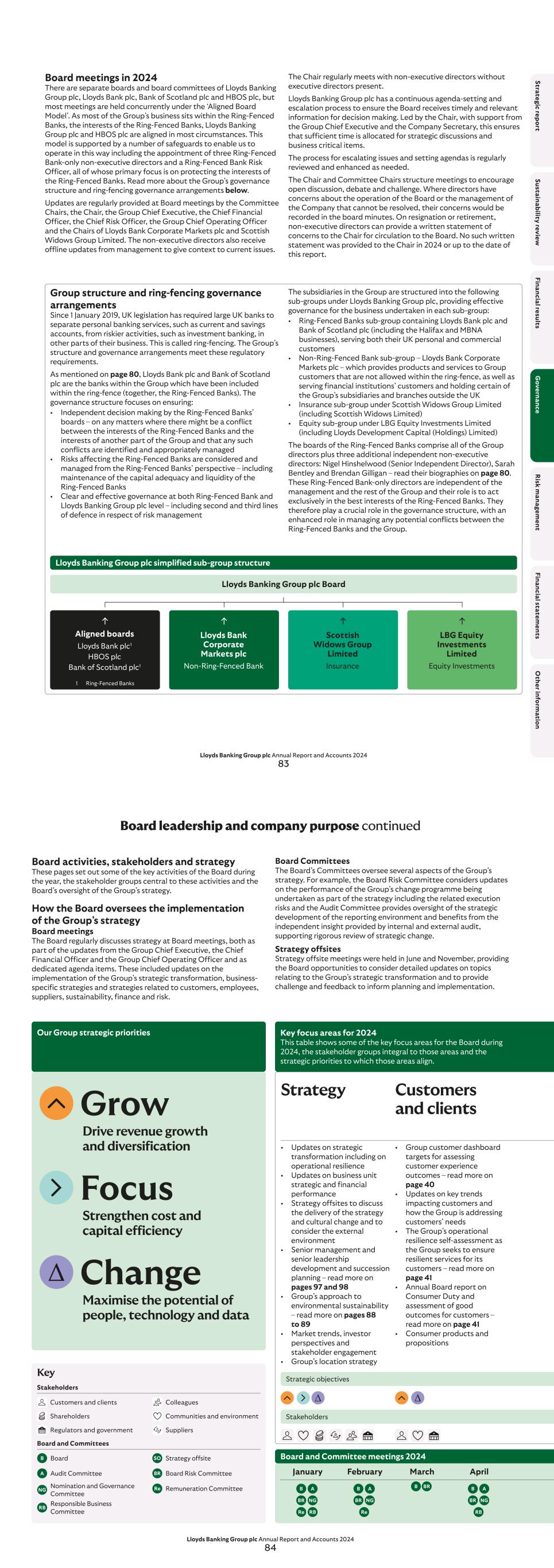
83 Lloyds Banking Group plc Annual Report and Accounts 2024 O th e r in fo rm a tio n F in a n cia l sta te m e n ts R isk m a n a ge m e n t G o ve rn a n ce F in a n cia l re su lts S u sta in a b ility re vie w S tra te gic re p o rt Board meetings in 2024 There are separate boards and board committees of Lloyds Banking Group plc, Lloyds Bank plc, Bank of Scotland plc and HBOS plc, but most meetings are held concurrently under the ‘Aligned Board Model’. As most of the Group’s business sits within the Ring-Fenced Banks, the interests of the Ring-Fenced Banks, Lloyds Banking Group plc and HBOS plc are aligned in most circumstances. This model is supported by a number of safeguards to enable us to operate in this way including the appointment of three Ring-Fenced Bank-only non-executive directors and a Ring-Fenced Bank Risk Officer, all of whose primary focus is on protecting the interests of the Ring-Fenced Banks. Read more about the Group’s governance structure and ring-fencing governance arrangements below. Updates are regularly provided at Board meetings by the Committee Chairs, the Chair, the Group Chief Executive, the Chief Financial Officer, the Chief Risk Officer, the Group Chief Operating Officer and the Chairs of Lloyds Bank Corporate Markets plc and Scottish Widows Group Limited. The non-executive directors also receive offline updates from management to give context to current issues. The Chair regularly meets with non-executive directors without executive directors present. Lloyds Banking Group plc has a continuous agenda-setting and escalation process to ensure the Board receives timely and relevant information for decision making. Led by the Chair, with support from the Group Chief Executive and the Company Secretary, this ensures that sufficient time is allocated for strategic discussions and business critical items. The process for escalating issues and setting agendas is regularly reviewed and enhanced as needed. The Chair and Committee Chairs structure meetings to encourage open discussion, debate and challenge. Where directors have concerns about the operation of the Board or the management of the Company that cannot be resolved, their concerns would be recorded in the board minutes. On resignation or retirement, non-executive directors can provide a written statement of concerns to the Chair for circulation to the Board. No such written statement was provided to the Chair in 2024 or up to the date of this report. Group structure and ring-fencing governance arrangements Since 1 January 2019, UK legislation has required large UK banks to separate personal banking services, such as current and savings accounts, from riskier activities, such as investment banking, in other parts of their business. This is called ring-fencing. The Group’s structure and governance arrangements meet these regulatory requirements. As mentioned on page 80, Lloyds Bank plc and Bank of Scotland plc are the banks within the Group which have been included within the ring-fence (together, the Ring-Fenced Banks). The governance structure focuses on ensuring: • Independent decision making by the Ring-Fenced Banks’ boards – on any matters where there might be a conflict between the interests of the Ring-Fenced Banks and the interests of another part of the Group and that any such conflicts are identified and appropriately managed • Risks affecting the Ring-Fenced Banks are considered and managed from the Ring-Fenced Banks’ perspective – including maintenance of the capital adequacy and liquidity of the Ring-Fenced Banks • Clear and effective governance at both Ring-Fenced Bank and Lloyds Banking Group plc level – including second and third lines of defence in respect of risk management The subsidiaries in the Group are structured into the following sub-groups under Lloyds Banking Group plc, providing effective governance for the business undertaken in each sub-group: • Ring-Fenced Banks sub-group containing Lloyds Bank plc and Bank of Scotland plc (including the Halifax and MBNA businesses), serving both their UK personal and commercial customers • Non-Ring-Fenced Bank sub-group – Lloyds Bank Corporate Markets plc – which provides products and services to Group customers that are not allowed within the ring-fence, as well as serving financial institutions’ customers and holding certain of the Group’s subsidiaries and branches outside the UK • Insurance sub-group under Scottish Widows Group Limited (including Scottish Widows Limited) • Equity sub-group under LBG Equity Investments Limited (including Lloyds Development Capital (Holdings) Limited) The boards of the Ring-Fenced Banks comprise all of the Group directors plus three additional independent non-executive directors: Nigel Hinshelwood (Senior Independent Director), Sarah Bentley and Brendan Gilligan – read their biographies on page 80. These Ring-Fenced Bank-only directors are independent of the management and the rest of the Group and their role is to act exclusively in the best interests of the Ring-Fenced Banks. They therefore play a crucial role in the governance structure, with an enhanced role in managing any potential conflicts between the Ring-Fenced Banks and the Group. Lloyds Banking Group plc simplified sub-group structure Lloyds Banking Group plc Board Lloyds Bank Corporate Markets plc Non-Ring-Fenced Bank LBG Equity Investments Limited Equity Investments Aligned boards Lloyds Bank plc1 HBOS plc Bank of Scotland plc1 Scottish Widows Group Limited Insurance 1 Ring-Fenced Banks 84 Lloyds Banking Group plc Annual Report and Accounts 2024 Board leadership and company purpose continued Board activities, stakeholders and strategy These pages set out some of the key activities of the Board during the year, the stakeholder groups central to these activities and the Board’s oversight of the Group’s strategy. How the Board oversees the implementation of the Group’s strategy Board meetings The Board regularly discusses strategy at Board meetings, both as part of the updates from the Group Chief Executive, the Chief Financial Officer and the Group Chief Operating Officer and as dedicated agenda items. These included updates on the implementation of the Group’s strategic transformation, business- specific strategies and strategies related to customers, employees, suppliers, sustainability, finance and risk. Board Committees The Board’s Committees oversee several aspects of the Group’s strategy. For example, the Board Risk Committee considers updates on the performance of the Group’s change programme being undertaken as part of the strategy including the related execution risks and the Audit Committee provides oversight of the strategic development of the reporting environment and benefits from the independent insight provided by internal and external audit, supporting rigorous review of strategic change. Strategy offsites Strategy offsite meetings were held in June and November, providing the Board opportunities to consider detailed updates on topics relating to the Group’s strategic transformation and to provide challenge and feedback to inform planning and implementation. Key Stakeholders Board and Committees Grow Focus Change Drive revenue growth and diversification Strengthen cost and capital efficiency Maximise the potential of people, technology and data Customers and clients Shareholders Colleagues Communities and environment SuppliersRegulators and government Board and Committee meetings 2024 Key focus areas for 2024 This table shows some of the key focus areas for the Board during 2024, the stakeholder groups integral to those areas and the strategic priorities to which those areas align. January February March April May June July August September October November December B A BR NG Re RB B A BR NG Re B BR B A BR NG RB B BR Re B SO A NG B A BR RB B BR NG Re A BR RB B SO BR NG Re B BR B Board A Audit Committee NG Nomination and Governance Committee RB Responsible Business Committee SO Strategy offsite BR Board Risk Committee Re Remuneration Committee Strategy Customers and clients Purpose, culture and values Financial Risk management and regulatory Governance • Updates on strategic transformation including on operational resilience • Updates on business unit strategic and financial performance • Strategy offsites to discuss the delivery of the strategy and cultural change and to consider the external environment • Senior management and senior leadership development and succession planning – read more on pages 97 and 98 • Group’s approach to environmental sustainability – read more on pages 88 to 89 • Market trends, investor perspectives and stakeholder engagement • Group’s location strategy • Group customer dashboard targets for assessing customer experience outcomes – read more on page 40 • Updates on key trends impacting customers and how the Group is addressing customers’ needs • The Group’s operational resilience self-assessment as the Group seeks to ensure resilient services for its customers – read more on page 41 • Annual Board report on Consumer Duty and assessment of good outcomes for customers – read more on page 41 • Consumer products and propositions • Updates on the Group’s culture transformation programme • The Group’s progress and performance on diversity, equity and inclusion – read more on pages 31 and 32 • Updates on the Group’s environmental strategy, including on its net zero ambitions – read more on pages 54 to 60 – and the Group’s external environmental statements • Reputation and geopolitical updates, including impacts from the external environment • Approval of the overall internal Group Remuneration Policy and philosophy • Modern slavery and human trafficking statement • Discussion and approval of the Group’s four-year operating plan • Annual Report, Form 20-F and half-year and quarterly interim management statements • Payment of final dividend for 2023 and interim dividend for 2024 • Share buyback programme • Economic assumptions • Financial updates from the Chief Financial Officer including key financial highlights and performance against budget and sub- group business performance • Board risk appetite metrics • Ring-Fenced Bank governance modifications renewal and modification attestation • Group Ring-Fencing Policy • Enterprise Risk Management Framework • Risk reports and reports from the Board Risk Committee • PRA Periodic Summary Letter and actions • FCA Firm Evaluation Letter and actions • Group Speak Up Champions report • Economic crime prevention • Incident Management Framework • Director and committee appointments – read more on pages 76 and 97 to 99 • Contracts with major suppliers • Corporate Governance Framework • Recommendations from the 2023 Board and Committee effectiveness review • Proposed format of the 2024 annual general meeting • Group’s outsourcing strategy • Updates on workforce engagement • Updates on new regulations impacting corporate governance Strategic objectives Stakeholders Our Group strategic priorities
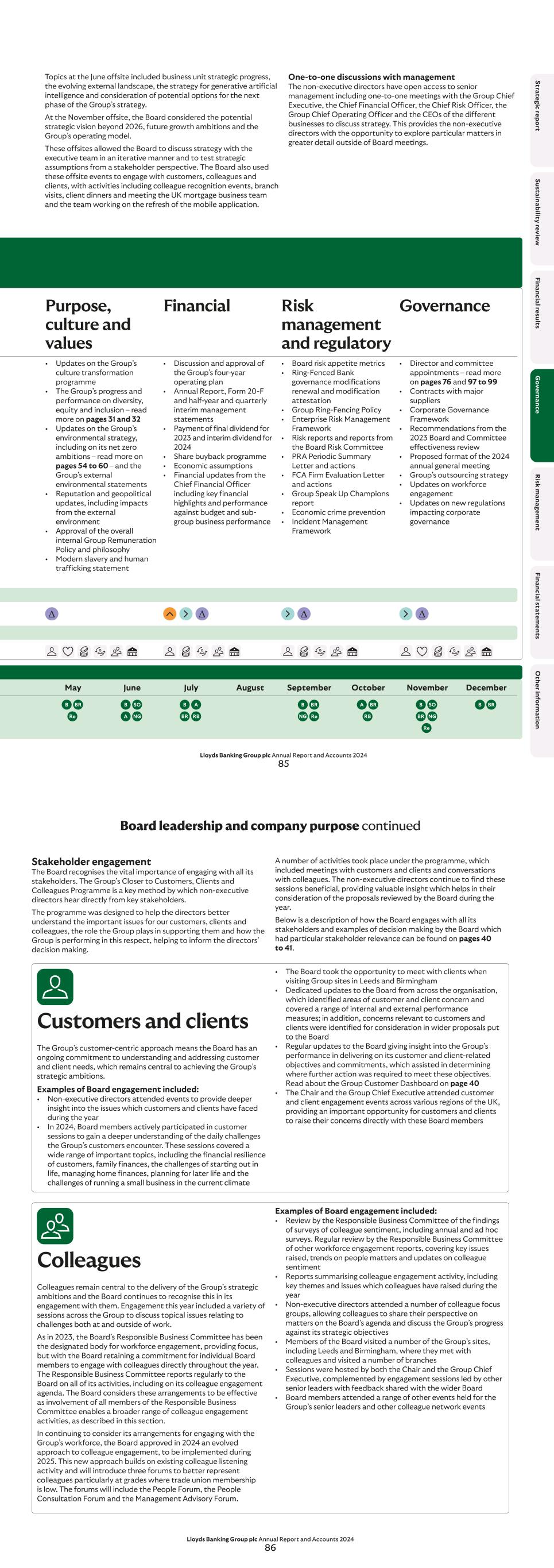
85 Lloyds Banking Group plc Annual Report and Accounts 2024 O th e r in fo rm a tio n F in a n cia l sta te m e n ts R isk m a n a ge m e n t G o ve rn a n ce F in a n cia l re su lts S u sta in a b ility re vie w S tra te gic re p o rt Topics at the June offsite included business unit strategic progress, the evolving external landscape, the strategy for generative artificial intelligence and consideration of potential options for the next phase of the Group’s strategy. At the November offsite, the Board considered the potential strategic vision beyond 2026, future growth ambitions and the Group’s operating model. These offsites allowed the Board to discuss strategy with the executive team in an iterative manner and to test strategic assumptions from a stakeholder perspective. The Board also used these offsite events to engage with customers, colleagues and clients, with activities including colleague recognition events, branch visits, client dinners and meeting the UK mortgage business team and the team working on the refresh of the mobile application. One-to-one discussions with management The non-executive directors have open access to senior management including one-to-one meetings with the Group Chief Executive, the Chief Financial Officer, the Chief Risk Officer, the Group Chief Operating Officer and the CEOs of the different businesses to discuss strategy. This provides the non-executive directors with the opportunity to explore particular matters in greater detail outside of Board meetings. Board and Committee meetings 2024 January February March April May June July August September October November December B A BR NG Re RB B A BR NG Re B BR B A BR NG RB B BR Re B SO A NG B A BR RB B BR NG Re A BR RB B SO BR NG Re B BR Strategy Customers and clients Purpose, culture and values Financial Risk management and regulatory Governance • Updates on strategic transformation including on operational resilience • Updates on business unit strategic and financial performance • Strategy offsites to discuss the delivery of the strategy and cultural change and to consider the external environment • Senior management and senior leadership development and succession planning – read more on pages 97 and 98 • Group’s approach to environmental sustainability – read more on pages 88 to 89 • Market trends, investor perspectives and stakeholder engagement • Group’s location strategy • Group customer dashboard targets for assessing customer experience outcomes – read more on page 40 • Updates on key trends impacting customers and how the Group is addressing customers’ needs • The Group’s operational resilience self-assessment as the Group seeks to ensure resilient services for its customers – read more on page 41 • Annual Board report on Consumer Duty and assessment of good outcomes for customers – read more on page 41 • Consumer products and propositions • Updates on the Group’s culture transformation programme • The Group’s progress and performance on diversity, equity and inclusion – read more on pages 31 and 32 • Updates on the Group’s environmental strategy, including on its net zero ambitions – read more on pages 54 to 60 – and the Group’s external environmental statements • Reputation and geopolitical updates, including impacts from the external environment • Approval of the overall internal Group Remuneration Policy and philosophy • Modern slavery and human trafficking statement • Discussion and approval of the Group’s four-year operating plan • Annual Report, Form 20-F and half-year and quarterly interim management statements • Payment of final dividend for 2023 and interim dividend for 2024 • Share buyback programme • Economic assumptions • Financial updates from the Chief Financial Officer including key financial highlights and performance against budget and sub- group business performance • Board risk appetite metrics • Ring-Fenced Bank governance modifications renewal and modification attestation • Group Ring-Fencing Policy • Enterprise Risk Management Framework • Risk reports and reports from the Board Risk Committee • PRA Periodic Summary Letter and actions • FCA Firm Evaluation Letter and actions • Group Speak Up Champions report • Economic crime prevention • Incident Management Framework • Director and committee appointments – read more on pages 76 and 97 to 99 • Contracts with major suppliers • Corporate Governance Framework • Recommendations from the 2023 Board and Committee effectiveness review • Proposed format of the 2024 annual general meeting • Group’s outsourcing strategy • Updates on workforce engagement • Updates on new regulations impacting corporate governance Strategic objectives Stakeholders 86 Lloyds Banking Group plc Annual Report and Accounts 2024 Board leadership and company purpose continued Stakeholder engagement The Board recognises the vital importance of engaging with all its stakeholders. The Group’s Closer to Customers, Clients and Colleagues Programme is a key method by which non-executive directors hear directly from key stakeholders. The programme was designed to help the directors better understand the important issues for our customers, clients and colleagues, the role the Group plays in supporting them and how the Group is performing in this respect, helping to inform the directors’ decision making. A number of activities took place under the programme, which included meetings with customers and clients and conversations with colleagues. The non-executive directors continue to find these sessions beneficial, providing valuable insight which helps in their consideration of the proposals reviewed by the Board during the year. Below is a description of how the Board engages with all its stakeholders and examples of decision making by the Board which had particular stakeholder relevance can be found on pages 40 to 41. Customers and clients The Group’s customer-centric approach means the Board has an ongoing commitment to understanding and addressing customer and client needs, which remains central to achieving the Group’s strategic ambitions. Examples of Board engagement included: • Non-executive directors attended events to provide deeper insight into the issues which customers and clients have faced during the year • In 2024, Board members actively participated in customer sessions to gain a deeper understanding of the daily challenges the Group’s customers encounter. These sessions covered a wide range of important topics, including the financial resilience of customers, family finances, the challenges of starting out in life, managing home finances, planning for later life and the challenges of running a small business in the current climate Colleagues Colleagues remain central to the delivery of the Group’s strategic ambitions and the Board continues to recognise this in its engagement with them. Engagement this year included a variety of sessions across the Group to discuss topical issues relating to challenges both at and outside of work. As in 2023, the Board’s Responsible Business Committee has been the designated body for workforce engagement, providing focus, but with the Board retaining a commitment for individual Board members to engage with colleagues directly throughout the year. The Responsible Business Committee reports regularly to the Board on all of its activities, including on its colleague engagement agenda. The Board considers these arrangements to be effective as involvement of all members of the Responsible Business Committee enables a broader range of colleague engagement activities, as described in this section. In continuing to consider its arrangements for engaging with the Group’s workforce, the Board approved in 2024 an evolved approach to colleague engagement, to be implemented during 2025. This new approach builds on existing colleague listening activity and will introduce three forums to better represent colleagues particularly at grades where trade union membership is low. The forums will include the People Forum, the People Consultation Forum and the Management Advisory Forum. • The Board took the opportunity to meet with clients when visiting Group sites in Leeds and Birmingham • Dedicated updates to the Board from across the organisation, which identified areas of customer and client concern and covered a range of internal and external performance measures; in addition, concerns relevant to customers and clients were identified for consideration in wider proposals put to the Board • Regular updates to the Board giving insight into the Group’s performance in delivering on its customer and client-related objectives and commitments, which assisted in determining where further action was required to meet these objectives. Read about the Group Customer Dashboard on page 40 • The Chair and the Group Chief Executive attended customer and client engagement events across various regions of the UK, providing an important opportunity for customers and clients to raise their concerns directly with these Board members Examples of Board engagement included: • Review by the Responsible Business Committee of the findings of surveys of colleague sentiment, including annual and ad hoc surveys. Regular review by the Responsible Business Committee of other workforce engagement reports, covering key issues raised, trends on people matters and updates on colleague sentiment • Reports summarising colleague engagement activity, including key themes and issues which colleagues have raised during the year • Non-executive directors attended a number of colleague focus groups, allowing colleagues to share their perspective on matters on the Board’s agenda and discuss the Group’s progress against its strategic objectives • Members of the Board visited a number of the Group’s sites, including Leeds and Birmingham, where they met with colleagues and visited a number of branches • Sessions were hosted by both the Chair and the Group Chief Executive, complemented by engagement sessions led by other senior leaders with feedback shared with the wider Board • Board members attended a range of other events held for the Group’s senior leaders and other colleague network events
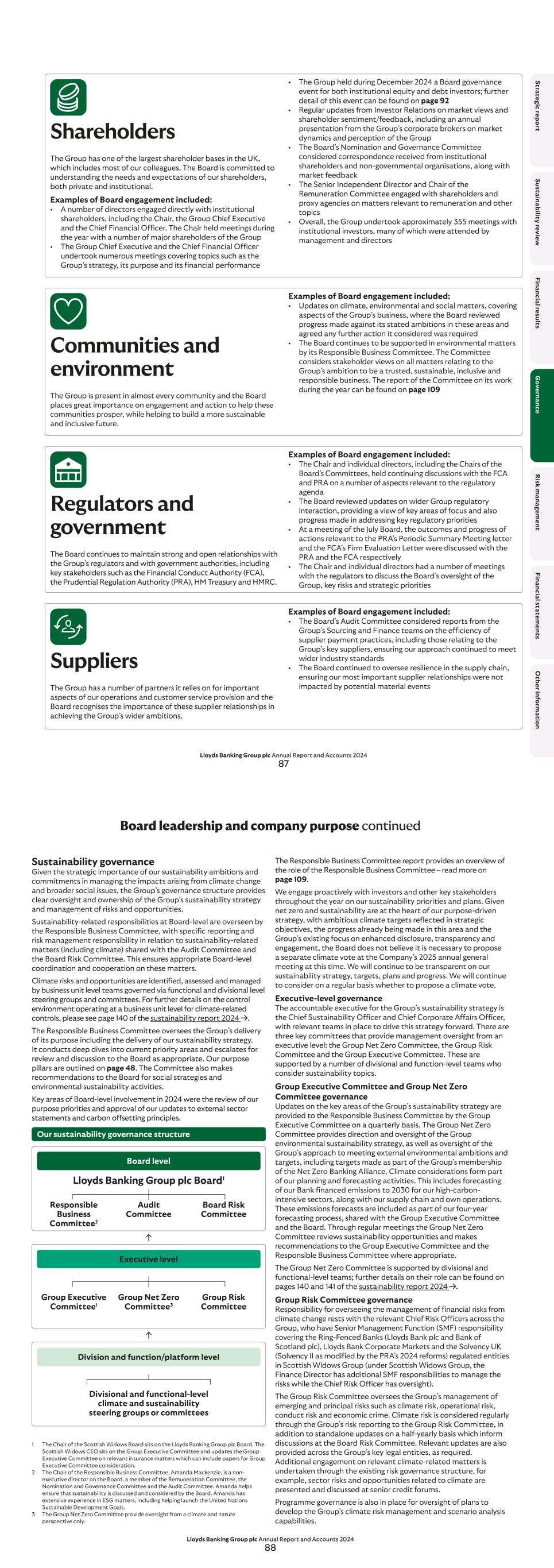
87 Lloyds Banking Group plc Annual Report and Accounts 2024 O th e r in fo rm a tio n F in a n cia l sta te m e n ts R isk m a n a ge m e n t G o ve rn a n ce F in a n cia l re su lts S u sta in a b ility re vie w S tra te gic re p o rtShareholders The Group has one of the largest shareholder bases in the UK, which includes most of our colleagues. The Board is committed to understanding the needs and expectations of our shareholders, both private and institutional. Examples of Board engagement included: • A number of directors engaged directly with institutional shareholders, including the Chair, the Group Chief Executive and the Chief Financial Officer. The Chair held meetings during the year with a number of major shareholders of the Group • The Group Chief Executive and the Chief Financial Officer undertook numerous meetings covering topics such as the Group’s strategy, its purpose and its financial performance Communities and environment The Group is present in almost every community and the Board places great importance on engagement and action to help these communities prosper, while helping to build a more sustainable and inclusive future. Regulators and government The Board continues to maintain strong and open relationships with the Group’s regulators and with government authorities, including key stakeholders such as the Financial Conduct Authority (FCA), the Prudential Regulation Authority (PRA), HM Treasury and HMRC. Suppliers The Group has a number of partners it relies on for important aspects of our operations and customer service provision and the Board recognises the importance of these supplier relationships in achieving the Group’s wider ambitions. • The Group held during December 2024 a Board governance event for both institutional equity and debt investors; further detail of this event can be found on page 92 • Regular updates from Investor Relations on market views and shareholder sentiment/feedback, including an annual presentation from the Group’s corporate brokers on market dynamics and perception of the Group • The Board’s Nomination and Governance Committee considered correspondence received from institutional shareholders and non-governmental organisations, along with market feedback • The Senior Independent Director and Chair of the Remuneration Committee engaged with shareholders and proxy agencies on matters relevant to remuneration and other topics • Overall, the Group undertook approximately 355 meetings with institutional investors, many of which were attended by management and directors Examples of Board engagement included: • Updates on climate, environmental and social matters, covering aspects of the Group’s business, where the Board reviewed progress made against its stated ambitions in these areas and agreed any further action it considered was required • The Board continues to be supported in environmental matters by its Responsible Business Committee. The Committee considers stakeholder views on all matters relating to the Group’s ambition to be a trusted, sustainable, inclusive and responsible business. The report of the Committee on its work during the year can be found on page 109 Examples of Board engagement included: • The Chair and individual directors, including the Chairs of the Board’s Committees, held continuing discussions with the FCA and PRA on a number of aspects relevant to the regulatory agenda • The Board reviewed updates on wider Group regulatory interaction, providing a view of key areas of focus and also progress made in addressing key regulatory priorities • At a meeting of the July Board, the outcomes and progress of actions relevant to the PRA’s Periodic Summary Meeting letter and the FCA’s Firm Evaluation Letter were discussed with the PRA and the FCA respectively • The Chair and individual directors had a number of meetings with the regulators to discuss the Board’s oversight of the Group, key risks and strategic priorities Examples of Board engagement included: • The Board’s Audit Committee considered reports from the Group’s Sourcing and Finance teams on the efficiency of supplier payment practices, including those relating to the Group’s key suppliers, ensuring our approach continued to meet wider industry standards • The Board continued to oversee resilience in the supply chain, ensuring our most important supplier relationships were not impacted by potential material events 88 Lloyds Banking Group plc Annual Report and Accounts 2024 Board level Lloyds Banking Group plc Board1 Responsible Business Committee2 Audit Committee Board Risk Committee Division and function/platform level Divisional and functional-level climate and sustainability steering groups or committees Executive level Group Executive Committee1 Group Net Zero Committee3 Group Risk Committee Board leadership and company purpose continued Sustainability governance Given the strategic importance of our sustainability ambitions and commitments in managing the impacts arising from climate change and broader social issues, the Group’s governance structure provides clear oversight and ownership of the Group’s sustainability strategy and management of risks and opportunities. Sustainability-related responsibilities at Board-level are overseen by the Responsible Business Committee, with specific reporting and risk management responsibility in relation to sustainability-related matters (including climate) shared with the Audit Committee and the Board Risk Committee. This ensures appropriate Board-level coordination and cooperation on these matters. Climate risks and opportunities are identified, assessed and managed by business unit level teams governed via functional and divisional level steering groups and committees. For further details on the control environment operating at a business unit level for climate-related controls, please see page 140 of the sustainability report 2024 . The Responsible Business Committee oversees the Group’s delivery of its purpose including the delivery of our sustainability strategy. It conducts deep dives into current priority areas and escalates for review and discussion to the Board as appropriate. Our purpose pillars are outlined on page 48. The Committee also makes recommendations to the Board for social strategies and environmental sustainability activities. Key areas of Board-level involvement in 2024 were the review of our purpose priorities and approval of our updates to external sector statements and carbon offsetting principles. The Responsible Business Committee report provides an overview of the role of the Responsible Business Committee – read more on page 109. We engage proactively with investors and other key stakeholders throughout the year on our sustainability priorities and plans. Given net zero and sustainability are at the heart of our purpose-driven strategy, with ambitious climate targets reflected in strategic objectives, the progress already being made in this area and the Group’s existing focus on enhanced disclosure, transparency and engagement, the Board does not believe it is necessary to propose a separate climate vote at the Company’s 2025 annual general meeting at this time. We will continue to be transparent on our sustainability strategy, targets, plans and progress. We will continue to consider on a regular basis whether to propose a climate vote. Executive-level governance The accountable executive for the Group’s sustainability strategy is the Chief Sustainability Officer and Chief Corporate Affairs Officer, with relevant teams in place to drive this strategy forward. There are three key committees that provide management oversight from an executive level: the Group Net Zero Committee, the Group Risk Committee and the Group Executive Committee. These are supported by a number of divisional and function-level teams who consider sustainability topics. Group Executive Committee and Group Net Zero Committee governance Updates on the key areas of the Group’s sustainability strategy are provided to the Responsible Business Committee by the Group Executive Committee on a quarterly basis. The Group Net Zero Committee provides direction and oversight of the Group environmental sustainability strategy, as well as oversight of the Group’s approach to meeting external environmental ambitions and targets, including targets made as part of the Group’s membership of the Net Zero Banking Alliance. Climate considerations form part of our planning and forecasting activities. This includes forecasting of our Bank financed emissions to 2030 for our high-carbon- intensive sectors, along with our supply chain and own operations. These emissions forecasts are included as part of our four-year forecasting process, shared with the Group Executive Committee and the Board. Through regular meetings the Group Net Zero Committee reviews sustainability opportunities and makes recommendations to the Group Executive Committee and the Responsible Business Committee where appropriate. The Group Net Zero Committee is supported by divisional and functional-level teams; further details on their role can be found on pages 140 and 141 of the sustainability report 2024 . Group Risk Committee governance Responsibility for overseeing the management of financial risks from climate change rests with the relevant Chief Risk Officers across the Group, who have Senior Management Function (SMF) responsibility covering the Ring-Fenced Banks (Lloyds Bank plc and Bank of Scotland plc), Lloyds Bank Corporate Markets and the Solvency UK (Solvency II as modified by the PRA’s 2024 reforms) regulated entities in Scottish Widows Group (under Scottish Widows Group, the Finance Director has additional SMF responsibilities to manage the risks while the Chief Risk Officer has oversight). The Group Risk Committee oversees the Group’s management of emerging and principal risks such as climate risk, operational risk, conduct risk and economic crime. Climate risk is considered regularly through the Group’s risk reporting to the Group Risk Committee, in addition to standalone updates on a half-yearly basis which inform discussions at the Board Risk Committee. Relevant updates are also provided across the Group’s key legal entities, as required. Additional engagement on relevant climate-related matters is undertaken through the existing risk governance structure, for example, sector risks and opportunities related to climate are presented and discussed at senior credit forums. Programme governance is also in place for oversight of plans to develop the Group’s climate risk management and scenario analysis capabilities. Our sustainability governance structure 1 The Chair of the Scottish Widows Board sits on the Lloyds Banking Group plc Board. The Scottish Widows CEO sits on the Group Executive Committee and updates the Group Executive Committee on relevant insurance matters which can include papers for Group Executive Committee consideration. 2 The Chair of the Responsible Business Committee, Amanda Mackenzie, is a non- executive director on the Board, a member of the Remuneration Committee, the Nomination and Governance Committee and the Audit Committee. Amanda helps ensure that sustainability is discussed and considered by the Board. Amanda has extensive experience in ESG matters, including helping launch the United Nations Sustainable Development Goals. 3 The Group Net Zero Committee provide oversight from a climate and nature perspective only.
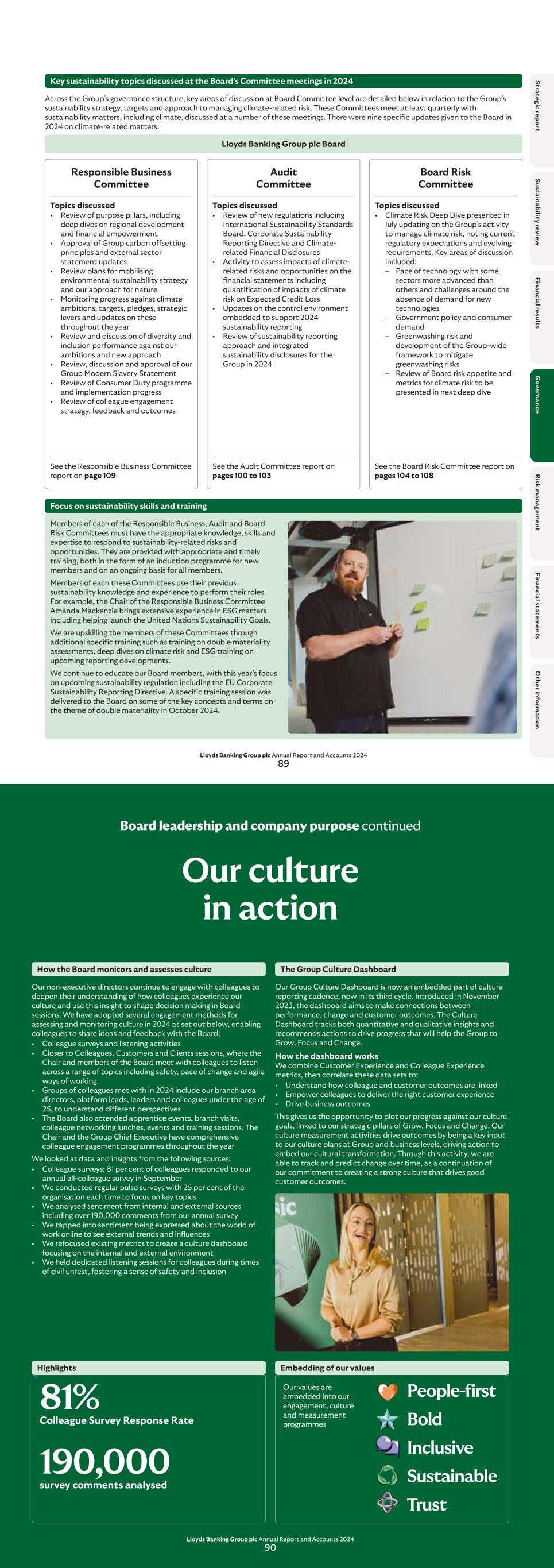
89 Lloyds Banking Group plc Annual Report and Accounts 2024 O th e r in fo rm a tio n F in a n cia l sta te m e n ts R isk m a n a ge m e n t G o ve rn a n ce F in a n cia l re su lts S u sta in a b ility re vie w S tra te gic re p o rt Across the Group’s governance structure, key areas of discussion at Board Committee level are detailed below in relation to the Group’s sustainability strategy, targets and approach to managing climate-related risk. These Committees meet at least quarterly with sustainability matters, including climate, discussed at a number of these meetings. There were nine specific updates given to the Board in 2024 on climate-related matters. Members of each of the Responsible Business, Audit and Board Risk Committees must have the appropriate knowledge, skills and expertise to respond to sustainability-related risks and opportunities. They are provided with appropriate and timely training, both in the form of an induction programme for new members and on an ongoing basis for all members. Members of each these Committees use their previous sustainability knowledge and experience to perform their roles. For example, the Chair of the Responsible Business Committee Amanda Mackenzie brings extensive experience in ESG matters including helping launch the United Nations Sustainability Goals. We are upskilling the members of these Committees through additional specific training such as training on double materiality assessments, deep dives on climate risk and ESG training on upcoming reporting developments. We continue to educate our Board members, with this year’s focus on upcoming sustainability regulation including the EU Corporate Sustainability Reporting Directive. A specific training session was delivered to the Board on some of the key concepts and terms on the theme of double materiality in October 2024. Responsible Business Committee Topics discussed • Review of purpose pillars, including deep dives on regional development and financial empowerment • Approval of Group carbon offsetting principles and external sector statement updates • Review plans for mobilising environmental sustainability strategy and our approach for nature • Monitoring progress against climate ambitions, targets, pledges, strategic levers and updates on these throughout the year • Review and discussion of diversity and inclusion performance against our ambitions and new approach • Review, discussion and approval of our Group Modern Slavery Statement • Review of Consumer Duty programme and implementation progress • Review of colleague engagement strategy, feedback and outcomes See the Responsible Business Committee report on page 109 See the Audit Committee report on pages 100 to 103 See the Board Risk Committee report on pages 104 to 108 Audit Committee Topics discussed • Review of new regulations including International Sustainability Standards Board, Corporate Sustainability Reporting Directive and Climate- related Financial Disclosures • Activity to assess impacts of climate- related risks and opportunities on the financial statements including quantification of impacts of climate risk on Expected Credit Loss • Updates on the control environment embedded to support 2024 sustainability reporting • Review of sustainability reporting approach and integrated sustainability disclosures for the Group in 2024 Board Risk Committee Topics discussed • Climate Risk Deep Dive presented in July updating on the Group’s activity to manage climate risk, noting current regulatory expectations and evolving requirements. Key areas of discussion included: – Pace of technology with some sectors more advanced than others and challenges around the absence of demand for new technologies – Government policy and consumer demand – Greenwashing risk and development of the Group-wide framework to mitigate greenwashing risks – Review of Board risk appetite and metrics for climate risk to be presented in next deep dive Key sustainability topics discussed at the Board’s Committee meetings in 2024 Focus on sustainability skills and training Lloyds Banking Group plc Board 90 Lloyds Banking Group plc Annual Report and Accounts 2024 Board leadership and company purpose continued How the Board monitors and assesses culture The Group Culture Dashboard Highlights Embedding of our values Our culture in action Our non-executive directors continue to engage with colleagues to deepen their understanding of how colleagues experience our culture and use this insight to shape decision making in Board sessions. We have adopted several engagement methods for assessing and monitoring culture in 2024 as set out below, enabling colleagues to share ideas and feedback with the Board: • Colleague surveys and listening activities • Closer to Colleagues, Customers and Clients sessions, where the Chair and members of the Board meet with colleagues to listen across a range of topics including safety, pace of change and agile ways of working • Groups of colleagues met with in 2024 include our branch area directors, platform leads, leaders and colleagues under the age of 25, to understand different perspectives • The Board also attended apprentice events, branch visits, colleague networking lunches, events and training sessions. The Chair and the Group Chief Executive have comprehensive colleague engagement programmes throughout the year We looked at data and insights from the following sources: • Colleague surveys: 81 per cent of colleagues responded to our annual all-colleague survey in September • We conducted regular pulse surveys with 25 per cent of the organisation each time to focus on key topics • We analysed sentiment from internal and external sources including over 190,000 comments from our annual survey • We tapped into sentiment being expressed about the world of work online to see external trends and influences • We refocused existing metrics to create a culture dashboard focusing on the internal and external environment • We held dedicated listening sessions for colleagues during times of civil unrest, fostering a sense of safety and inclusion Our Group Culture Dashboard is now an embedded part of culture reporting cadence, now in its third cycle. Introduced in November 2023, the dashboard aims to make connections between performance, change and customer outcomes. The Culture Dashboard tracks both quantitative and qualitative insights and recommends actions to drive progress that will help the Group to Grow, Focus and Change. How the dashboard works We combine Customer Experience and Colleague Experience metrics, then correlate these data sets to: • Understand how colleague and customer outcomes are linked • Empower colleagues to deliver the right customer experience • Drive business outcomes This gives us the opportunity to plot our progress against our culture goals, linked to our strategic pillars of Grow, Focus and Change. Our culture measurement activities drive outcomes by being a key input to our culture plans at Group and business levels, driving action to embed our cultural transformation. Through this activity, we are able to track and predict change over time, as a continuation of our commitment to creating a strong culture that drives good customer outcomes. 81% Colleague Survey Response Rate 190,000 survey comments analysed Our values are embedded into our engagement, culture and measurement programmes People-first Bold Inclusive Sustainable Trust
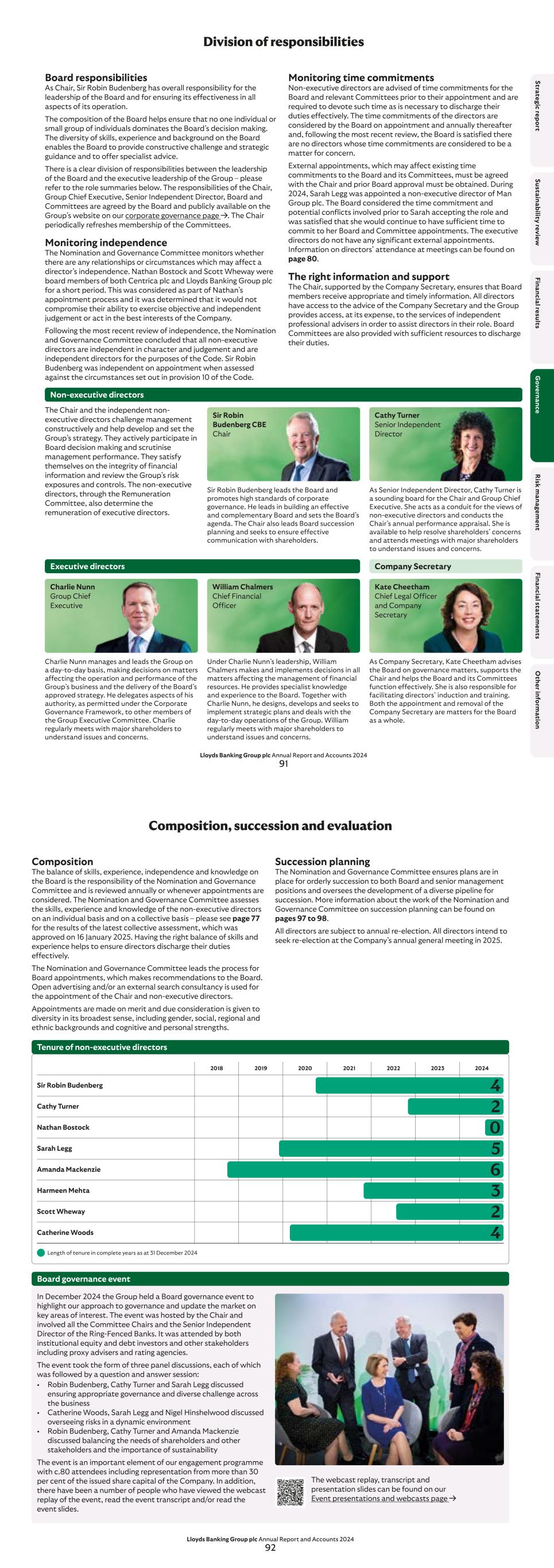
91 Lloyds Banking Group plc Annual Report and Accounts 2024 O th e r in fo rm a tio n F in a n cia l sta te m e n ts R isk m a n a ge m e n t G o ve rn a n ce F in a n cia l re su lts S u sta in a b ility re vie w S tra te gic re p o rt Division of responsibilities Board responsibilities As Chair, Sir Robin Budenberg has overall responsibility for the leadership of the Board and for ensuring its effectiveness in all aspects of its operation. The composition of the Board helps ensure that no one individual or small group of individuals dominates the Board’s decision making. The diversity of skills, experience and background on the Board enables the Board to provide constructive challenge and strategic guidance and to offer specialist advice. There is a clear division of responsibilities between the leadership of the Board and the executive leadership of the Group – please refer to the role summaries below. The responsibilities of the Chair, Group Chief Executive, Senior Independent Director, Board and Committees are agreed by the Board and publicly available on the Group’s website on our corporate governance page . The Chair periodically refreshes membership of the Committees. Monitoring independence The Nomination and Governance Committee monitors whether there are any relationships or circumstances which may affect a director’s independence. Nathan Bostock and Scott Wheway were board members of both Centrica plc and Lloyds Banking Group plc for a short period. This was considered as part of Nathan’s appointment process and it was determined that it would not compromise their ability to exercise objective and independent judgement or act in the best interests of the Company. Following the most recent review of independence, the Nomination and Governance Committee concluded that all non-executive directors are independent in character and judgement and are independent directors for the purposes of the Code. Sir Robin Budenberg was independent on appointment when assessed against the circumstances set out in provision 10 of the Code. The Chair and the independent non- executive directors challenge management constructively and help develop and set the Group’s strategy. They actively participate in Board decision making and scrutinise management performance. They satisfy themselves on the integrity of financial information and review the Group’s risk exposures and controls. The non-executive directors, through the Remuneration Committee, also determine the remuneration of executive directors. Sir Robin Budenberg leads the Board and promotes high standards of corporate governance. He leads in building an effective and complementary Board and sets the Board’s agenda. The Chair also leads Board succession planning and seeks to ensure effective communication with shareholders. Under Charlie Nunn’s leadership, William Chalmers makes and implements decisions in all matters affecting the management of financial resources. He provides specialist knowledge and experience to the Board. Together with Charlie Nunn, he designs, develops and seeks to implement strategic plans and deals with the day-to-day operations of the Group. William regularly meets with major shareholders to understand issues and concerns. Charlie Nunn manages and leads the Group on a day-to-day basis, making decisions on matters affecting the operation and performance of the Group’s business and the delivery of the Board’s approved strategy. He delegates aspects of his authority, as permitted under the Corporate Governance Framework, to other members of the Group Executive Committee. Charlie regularly meets with major shareholders to understand issues and concerns. As Senior Independent Director, Cathy Turner is a sounding board for the Chair and Group Chief Executive. She acts as a conduit for the views of non-executive directors and conducts the Chair’s annual performance appraisal. She is available to help resolve shareholders’ concerns and attends meetings with major shareholders to understand issues and concerns. As Company Secretary, Kate Cheetham advises the Board on governance matters, supports the Chair and helps the Board and its Committees function effectively. She is also responsible for facilitating directors’ induction and training. Both the appointment and removal of the Company Secretary are matters for the Board as a whole. Monitoring time commitments Non-executive directors are advised of time commitments for the Board and relevant Committees prior to their appointment and are required to devote such time as is necessary to discharge their duties effectively. The time commitments of the directors are considered by the Board on appointment and annually thereafter and, following the most recent review, the Board is satisfied there are no directors whose time commitments are considered to be a matter for concern. External appointments, which may affect existing time commitments to the Board and its Committees, must be agreed with the Chair and prior Board approval must be obtained. During 2024, Sarah Legg was appointed a non-executive director of Man Group plc. The Board considered the time commitment and potential conflicts involved prior to Sarah accepting the role and was satisfied that she would continue to have sufficient time to commit to her Board and Committee appointments. The executive directors do not have any significant external appointments. Information on directors’ attendance at meetings can be found on page 80. The right information and support The Chair, supported by the Company Secretary, ensures that Board members receive appropriate and timely information. All directors have access to the advice of the Company Secretary and the Group provides access, at its expense, to the services of independent professional advisers in order to assist directors in their role. Board Committees are also provided with sufficient resources to discharge their duties. Non-executive directors Executive directors Company Secretary Sir Robin Budenberg CBE Chair Cathy Turner Senior Independent Director Charlie Nunn Group Chief Executive William Chalmers Chief Financial Officer Kate Cheetham Chief Legal Officer and Company Secretary 92 Lloyds Banking Group plc Annual Report and Accounts 2024 2018 2019 2020 2021 2022 2023 2024 Sir Robin Budenberg Cathy Turner Nathan Bostock Sarah Legg Amanda Mackenzie Harmeen Mehta Scott Wheway Catherine Woods Length of tenure in complete years as at 31 December 2024 4 2 0 5 6 3 2 4 Composition, succession and evaluation Composition The balance of skills, experience, independence and knowledge on the Board is the responsibility of the Nomination and Governance Committee and is reviewed annually or whenever appointments are considered. The Nomination and Governance Committee assesses the skills, experience and knowledge of the non-executive directors on an individual basis and on a collective basis – please see page 77 for the results of the latest collective assessment, which was approved on 16 January 2025. Having the right balance of skills and experience helps to ensure directors discharge their duties effectively. The Nomination and Governance Committee leads the process for Board appointments, which makes recommendations to the Board. Open advertising and/or an external search consultancy is used for the appointment of the Chair and non-executive directors. Appointments are made on merit and due consideration is given to diversity in its broadest sense, including gender, social, regional and ethnic backgrounds and cognitive and personal strengths. Succession planning The Nomination and Governance Committee ensures plans are in place for orderly succession to both Board and senior management positions and oversees the development of a diverse pipeline for succession. More information about the work of the Nomination and Governance Committee on succession planning can be found on pages 97 to 98. All directors are subject to annual re-election. All directors intend to seek re-election at the Company’s annual general meeting in 2025. Tenure of non-executive directors In December 2024 the Group held a Board governance event to highlight our approach to governance and update the market on key areas of interest. The event was hosted by the Chair and involved all the Committee Chairs and the Senior Independent Director of the Ring-Fenced Banks. It was attended by both institutional equity and debt investors and other stakeholders including proxy advisers and rating agencies. The event took the form of three panel discussions, each of which was followed by a question and answer session: • Robin Budenberg, Cathy Turner and Sarah Legg discussed ensuring appropriate governance and diverse challenge across the business • Catherine Woods, Sarah Legg and Nigel Hinshelwood discussed overseeing risks in a dynamic environment • Robin Budenberg, Cathy Turner and Amanda Mackenzie discussed balancing the needs of shareholders and other stakeholders and the importance of sustainability The event is an important element of our engagement programme with c.80 attendees including representation from more than 30 per cent of the issued share capital of the Company. In addition, there have been a number of people who have viewed the webcast replay of the event, read the event transcript and/or read the event slides. Board governance event The webcast replay, transcript and presentation slides can be found on our Event presentations and webcasts page
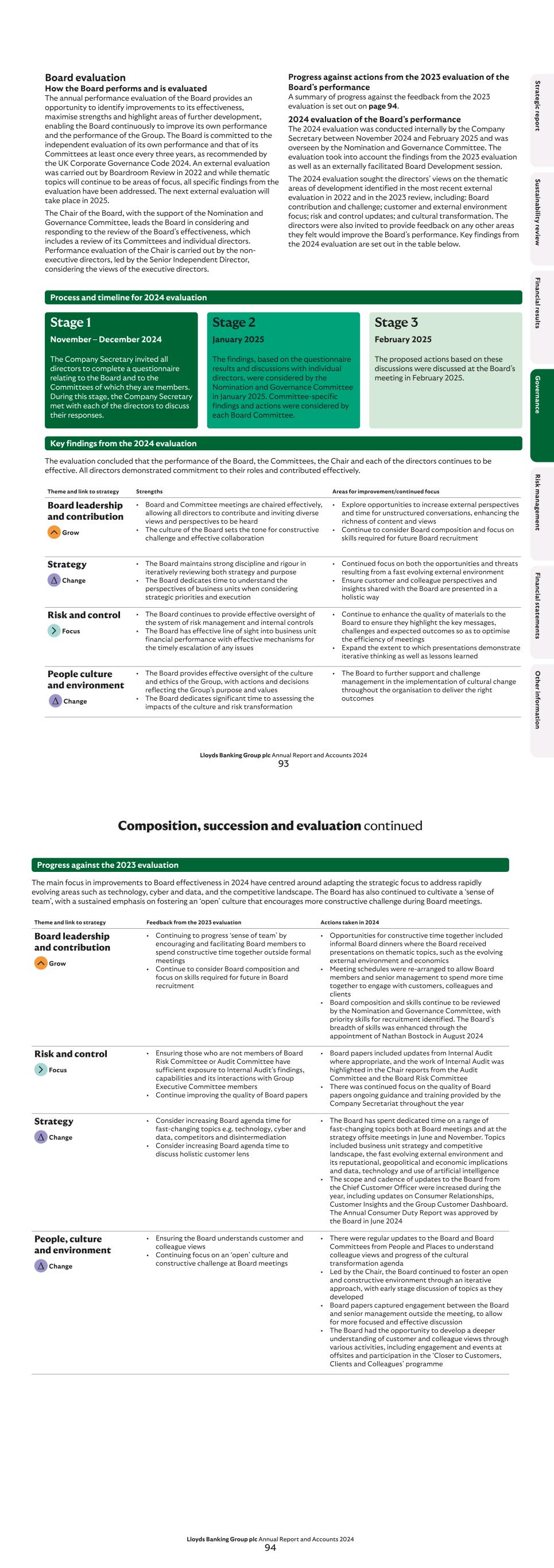
93 Lloyds Banking Group plc Annual Report and Accounts 2024 O th e r in fo rm a tio n F in a n cia l sta te m e n ts R isk m a n a ge m e n t G o ve rn a n ce F in a n cia l re su lts S u sta in a b ility re vie w S tra te gic re p o rt Board evaluation How the Board performs and is evaluated The annual performance evaluation of the Board provides an opportunity to identify improvements to its effectiveness, maximise strengths and highlight areas of further development, enabling the Board continuously to improve its own performance and the performance of the Group. The Board is committed to the independent evaluation of its own performance and that of its Committees at least once every three years, as recommended by the UK Corporate Governance Code 2024. An external evaluation was carried out by Boardroom Review in 2022 and while thematic topics will continue to be areas of focus, all specific findings from the evaluation have been addressed. The next external evaluation will take place in 2025. The Chair of the Board, with the support of the Nomination and Governance Committee, leads the Board in considering and responding to the review of the Board’s effectiveness, which includes a review of its Committees and individual directors. Performance evaluation of the Chair is carried out by the non- executive directors, led by the Senior Independent Director, considering the views of the executive directors. Progress against actions from the 2023 evaluation of the Board’s performance A summary of progress against the feedback from the 2023 evaluation is set out on page 94. 2024 evaluation of the Board’s performance The 2024 evaluation was conducted internally by the Company Secretary between November 2024 and February 2025 and was overseen by the Nomination and Governance Committee. The evaluation took into account the findings from the 2023 evaluation as well as an externally facilitated Board Development session. The 2024 evaluation sought the directors’ views on the thematic areas of development identified in the most recent external evaluation in 2022 and in the 2023 review, including: Board contribution and challenge; customer and external environment focus; risk and control updates; and cultural transformation. The directors were also invited to provide feedback on any other areas they felt would improve the Board’s performance. Key findings from the 2024 evaluation are set out in the table below. Process and timeline for 2024 evaluation Key findings from the 2024 evaluation Stage 1 November – December 2024 The Company Secretary invited all directors to complete a questionnaire relating to the Board and to the Committees of which they are members. During this stage, the Company Secretary met with each of the directors to discuss their responses. Stage 2 January 2025 The findings, based on the questionnaire results and discussions with individual directors, were considered by the Nomination and Governance Committee in January 2025. Committee-specific findings and actions were considered by each Board Committee. Stage 3 February 2025 The proposed actions based on these discussions were discussed at the Board’s meeting in February 2025. The evaluation concluded that the performance of the Board, the Committees, the Chair and each of the directors continues to be effective. All directors demonstrated commitment to their roles and contributed effectively. Theme and link to strategy Strengths Areas for improvement/continued focus Board leadership and contribution Grow • Board and Committee meetings are chaired effectively, allowing all directors to contribute and inviting diverse views and perspectives to be heard • The culture of the Board sets the tone for constructive challenge and effective collaboration • Explore opportunities to increase external perspectives and time for unstructured conversations, enhancing the richness of content and views • Continue to consider Board composition and focus on skills required for future Board recruitment Strategy Change • The Board maintains strong discipline and rigour in iteratively reviewing both strategy and purpose • The Board dedicates time to understand the perspectives of business units when considering strategic priorities and execution • Continued focus on both the opportunities and threats resulting from a fast evolving external environment • Ensure customer and colleague perspectives and insights shared with the Board are presented in a holistic way Risk and control Focus • The Board continues to provide effective oversight of the system of risk management and internal controls • The Board has effective line of sight into business unit financial performance with effective mechanisms for the timely escalation of any issues • Continue to enhance the quality of materials to the Board to ensure they highlight the key messages, challenges and expected outcomes so as to optimise the efficiency of meetings • Expand the extent to which presentations demonstrate iterative thinking as well as lessons learned People culture and environment Change • The Board provides effective oversight of the culture and ethics of the Group, with actions and decisions reflecting the Group’s purpose and values • The Board dedicates significant time to assessing the impacts of the culture and risk transformation • The Board to further support and challenge management in the implementation of cultural change throughout the organisation to deliver the right outcomes 94 Lloyds Banking Group plc Annual Report and Accounts 2024 Progress against the 2023 evaluation The main focus in improvements to Board effectiveness in 2024 have centred around adapting the strategic focus to address rapidly evolving areas such as technology, cyber and data, and the competitive landscape. The Board has also continued to cultivate a ‘sense of team’, with a sustained emphasis on fostering an ‘open’ culture that encourages more constructive challenge during Board meetings. Theme and link to strategy Feedback from the 2023 evaluation Actions taken in 2024 Board leadership and contribution Grow • Continuing to progress ‘sense of team’ by encouraging and facilitating Board members to spend constructive time together outside formal meetings • Continue to consider Board composition and focus on skills required for future in Board recruitment • Opportunities for constructive time together included informal Board dinners where the Board received presentations on thematic topics, such as the evolving external environment and economics • Meeting schedules were re-arranged to allow Board members and senior management to spend more time together to engage with customers, colleagues and clients • Board composition and skills continue to be reviewed by the Nomination and Governance Committee, with priority skills for recruitment identified. The Board’s breadth of skills was enhanced through the appointment of Nathan Bostock in August 2024 Risk and control Focus • Ensuring those who are not members of Board Risk Committee or Audit Committee have sufficient exposure to Internal Audit’s findings, capabilities and its interactions with Group Executive Committee members • Continue improving the quality of Board papers • Board papers included updates from Internal Audit where appropriate, and the work of Internal Audit was highlighted in the Chair reports from the Audit Committee and the Board Risk Committee • There was continued focus on the quality of Board papers ongoing guidance and training provided by the Company Secretariat throughout the year Strategy Change • Consider increasing Board agenda time for fast-changing topics e.g. technology, cyber and data, competitors and disintermediation • Consider increasing Board agenda time to discuss holistic customer lens • The Board has spent dedicated time on a range of fast-changing topics both at Board meetings and at the strategy offsite meetings in June and November. Topics included business unit strategy and competitive landscape, the fast evolving external environment and its reputational, geopolitical and economic implications and data, technology and use of artificial intelligence • The scope and cadence of updates to the Board from the Chief Customer Officer were increased during the year, including updates on Consumer Relationships, Customer Insights and the Group Customer Dashboard. The Annual Consumer Duty Report was approved by the Board in June 2024 People, culture and environment Change • Ensuring the Board understands customer and colleague views • Continuing focus on an ‘open’ culture and constructive challenge at Board meetings • There were regular updates to the Board and Board Committees from People and Places to understand colleague views and progress of the cultural transformation agenda • Led by the Chair, the Board continued to foster an open and constructive environment through an iterative approach, with early stage discussion of topics as they developed • Board papers captured engagement between the Board and senior management outside the meeting, to allow for more focused and effective discussion • The Board had the opportunity to develop a deeper understanding of customer and colleague views through various activities, including engagement and events at offsites and participation in the ‘Closer to Customers, Clients and Colleagues’ programme Composition, succession and evaluation continued
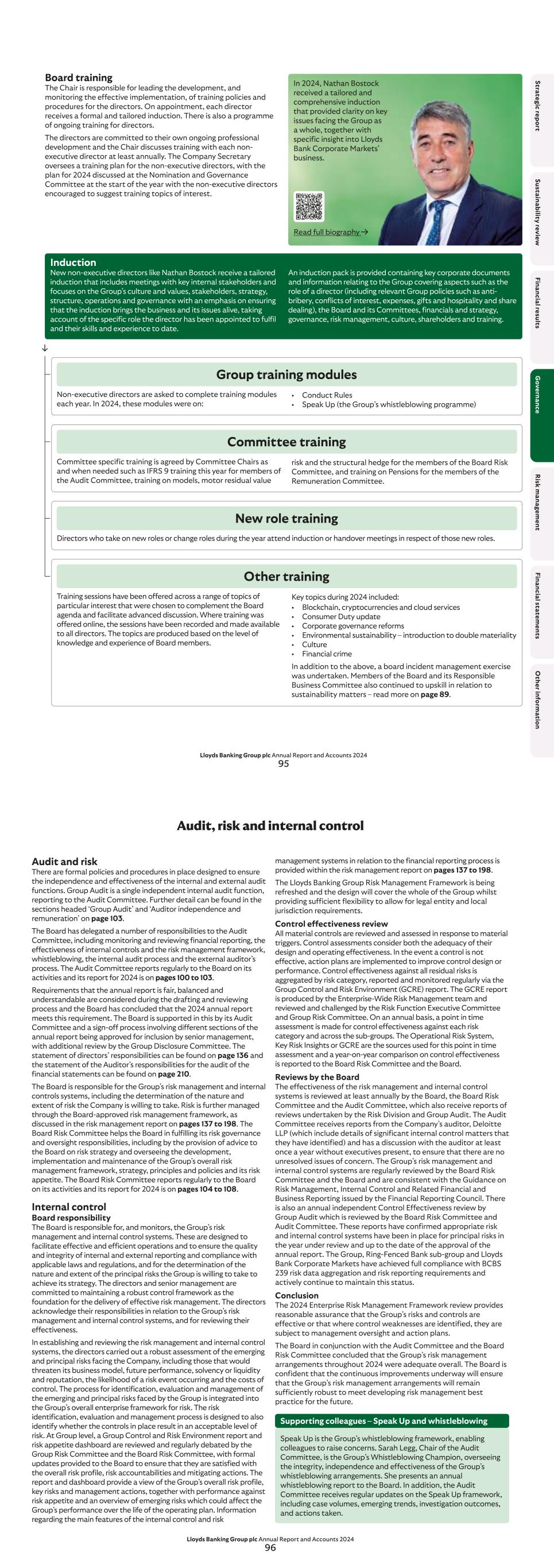
95 Lloyds Banking Group plc Annual Report and Accounts 2024 O th e r in fo rm a tio n F in a n cia l sta te m e n ts R isk m a n a ge m e n t G o ve rn a n ce F in a n cia l re su lts S u sta in a b ility re vie w S tra te gic re p o rt In 2024, Nathan Bostock received a tailored and comprehensive induction that provided clarity on key issues facing the Group as a whole, together with specific insight into Lloyds Bank Corporate Markets’ business. Board training The Chair is responsible for leading the development, and monitoring the effective implementation, of training policies and procedures for the directors. On appointment, each director receives a formal and tailored induction. There is also a programme of ongoing training for directors. The directors are committed to their own ongoing professional development and the Chair discusses training with each non- executive director at least annually. The Company Secretary oversees a training plan for the non-executive directors, with the plan for 2024 discussed at the Nomination and Governance Committee at the start of the year with the non-executive directors encouraged to suggest training topics of interest. Induction New non-executive directors like Nathan Bostock receive a tailored induction that includes meetings with key internal stakeholders and focuses on the Group’s culture and values, stakeholders, strategy, structure, operations and governance with an emphasis on ensuring that the induction brings the business and its issues alive, taking account of the specific role the director has been appointed to fulfil and their skills and experience to date. An induction pack is provided containing key corporate documents and information relating to the Group covering aspects such as the role of a director (including relevant Group policies such as anti- bribery, conflicts of interest, expenses, gifts and hospitality and share dealing), the Board and its Committees, financials and strategy, governance, risk management, culture, shareholders and training. Non-executive directors are asked to complete training modules each year. In 2024, these modules were on: Committee specific training is agreed by Committee Chairs as and when needed such as IFRS 9 training this year for members of the Audit Committee, training on models, motor residual value Directors who take on new roles or change roles during the year attend induction or handover meetings in respect of those new roles. Training sessions have been offered across a range of topics of particular interest that were chosen to complement the Board agenda and facilitate advanced discussion. Where training was offered online, the sessions have been recorded and made available to all directors. The topics are produced based on the level of knowledge and experience of Board members. • Conduct Rules • Speak Up (the Group’s whistleblowing programme) Group training modules Committee training New role training Other training risk and the structural hedge for the members of the Board Risk Committee, and training on Pensions for the members of the Remuneration Committee. Key topics during 2024 included: • Blockchain, cryptocurrencies and cloud services • Consumer Duty update • Corporate governance reforms • Environmental sustainability – introduction to double materiality • Culture • Financial crime In addition to the above, a board incident management exercise was undertaken. Members of the Board and its Responsible Business Committee also continued to upskill in relation to sustainability matters – read more on page 89. Read full biography 96 Lloyds Banking Group plc Annual Report and Accounts 2024 Audit, risk and internal control Audit and risk There are formal policies and procedures in place designed to ensure the independence and effectiveness of the internal and external audit functions. Group Audit is a single independent internal audit function, reporting to the Audit Committee. Further detail can be found in the sections headed ‘Group Audit’ and ‘Auditor independence and remuneration’ on page 103. The Board has delegated a number of responsibilities to the Audit Committee, including monitoring and reviewing financial reporting, the effectiveness of internal controls and the risk management framework, whistleblowing, the internal audit process and the external auditor’s process. The Audit Committee reports regularly to the Board on its activities and its report for 2024 is on pages 100 to 103. Requirements that the annual report is fair, balanced and understandable are considered during the drafting and reviewing process and the Board has concluded that the 2024 annual report meets this requirement. The Board is supported in this by its Audit Committee and a sign-off process involving different sections of the annual report being approved for inclusion by senior management, with additional review by the Group Disclosure Committee. The statement of directors’ responsibilities can be found on page 136 and the statement of the Auditor’s responsibilities for the audit of the financial statements can be found on page 210. The Board is responsible for the Group’s risk management and internal controls systems, including the determination of the nature and extent of risk the Company is willing to take. Risk is further managed through the Board-approved risk management framework, as discussed in the risk management report on pages 137 to 198. The Board Risk Committee helps the Board in fulfilling its risk governance and oversight responsibilities, including by the provision of advice to the Board on risk strategy and overseeing the development, implementation and maintenance of the Group’s overall risk management framework, strategy, principles and policies and its risk appetite. The Board Risk Committee reports regularly to the Board on its activities and its report for 2024 is on pages 104 to 108. Internal control Board responsibility The Board is responsible for, and monitors, the Group’s risk management and internal control systems. These are designed to facilitate effective and efficient operations and to ensure the quality and integrity of internal and external reporting and compliance with applicable laws and regulations, and for the determination of the nature and extent of the principal risks the Group is willing to take to achieve its strategy. The directors and senior management are committed to maintaining a robust control framework as the foundation for the delivery of effective risk management. The directors acknowledge their responsibilities in relation to the Group’s risk management and internal control systems, and for reviewing their effectiveness. In establishing and reviewing the risk management and internal control systems, the directors carried out a robust assessment of the emerging and principal risks facing the Company, including those that would threaten its business model, future performance, solvency or liquidity and reputation, the likelihood of a risk event occurring and the costs of control. The process for identification, evaluation and management of the emerging and principal risks faced by the Group is integrated into the Group’s overall enterprise framework for risk. The risk identification, evaluation and management process is designed to also identify whether the controls in place result in an acceptable level of risk. At Group level, a Group Control and Risk Environment report and risk appetite dashboard are reviewed and regularly debated by the Group Risk Committee and the Board Risk Committee, with formal updates provided to the Board to ensure that they are satisfied with the overall risk profile, risk accountabilities and mitigating actions. The report and dashboard provide a view of the Group’s overall risk profile, key risks and management actions, together with performance against risk appetite and an overview of emerging risks which could affect the Group’s performance over the life of the operating plan. Information regarding the main features of the internal control and risk management systems in relation to the financial reporting process is provided within the risk management report on pages 137 to 198. The Lloyds Banking Group Risk Management Framework is being refreshed and the design will cover the whole of the Group whilst providing sufficient flexibility to allow for legal entity and local jurisdiction requirements. Control effectiveness review All material controls are reviewed and assessed in response to material triggers. Control assessments consider both the adequacy of their design and operating effectiveness. In the event a control is not effective, action plans are implemented to improve control design or performance. Control effectiveness against all residual risks is aggregated by risk category, reported and monitored regularly via the Group Control and Risk Environment (GCRE) report. The GCRE report is produced by the Enterprise-Wide Risk Management team and reviewed and challenged by the Risk Function Executive Committee and Group Risk Committee. On an annual basis, a point in time assessment is made for control effectiveness against each risk category and across the sub-groups. The Operational Risk System, Key Risk Insights or GCRE are the sources used for this point in time assessment and a year-on-year comparison on control effectiveness is reported to the Board Risk Committee and the Board. Reviews by the Board The effectiveness of the risk management and internal control systems is reviewed at least annually by the Board, the Board Risk Committee and the Audit Committee, which also receive reports of reviews undertaken by the Risk Division and Group Audit. The Audit Committee receives reports from the Company’s auditor, Deloitte LLP (which include details of significant internal control matters that they have identified) and has a discussion with the auditor at least once a year without executives present, to ensure that there are no unresolved issues of concern. The Group’s risk management and internal control systems are regularly reviewed by the Board Risk Committee and the Board and are consistent with the Guidance on Risk Management, Internal Control and Related Financial and Business Reporting issued by the Financial Reporting Council. There is also an annual independent Control Effectiveness review by Group Audit which is reviewed by the Board Risk Committee and Audit Committee. These reports have confirmed appropriate risk and internal control systems have been in place for principal risks in the year under review and up to the date of the approval of the annual report. The Group, Ring-Fenced Bank sub-group and Lloyds Bank Corporate Markets have achieved full compliance with BCBS 239 risk data aggregation and risk reporting requirements and actively continue to maintain this status. Conclusion The 2024 Enterprise Risk Management Framework review provides reasonable assurance that the Group’s risks and controls are effective or that where control weaknesses are identified, they are subject to management oversight and action plans. The Board in conjunction with the Audit Committee and the Board Risk Committee concluded that the Group’s risk management arrangements throughout 2024 were adequate overall. The Board is confident that the continuous improvements underway will ensure that the Group’s risk management arrangements will remain sufficiently robust to meet developing risk management best practice for the future. Speak Up is the Group’s whistleblowing framework, enabling colleagues to raise concerns. Sarah Legg, Chair of the Audit Committee, is the Group’s Whistleblowing Champion, overseeing the integrity, independence and effectiveness of the Group’s whistleblowing arrangements. She presents an annual whistleblowing report to the Board. In addition, the Audit Committee receives regular updates on the Speak Up framework, including case volumes, emerging trends, investigation outcomes, and actions taken. Supporting colleagues – Speak Up and whistleblowing
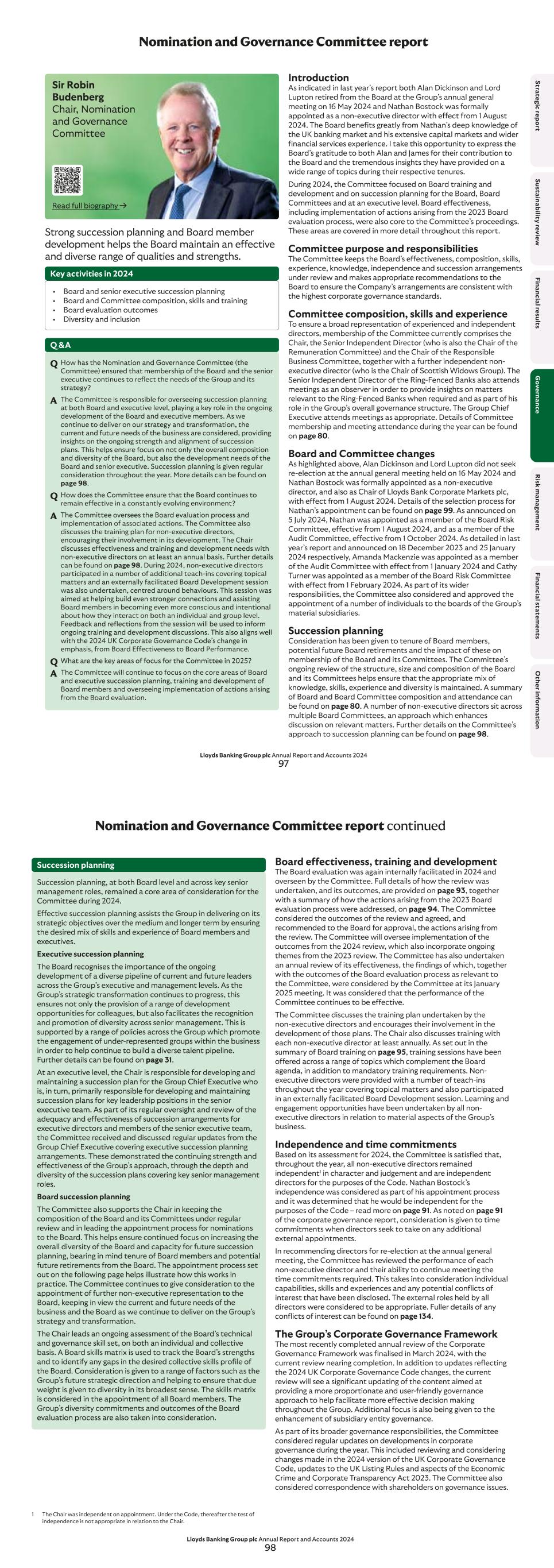
97 Lloyds Banking Group plc Annual Report and Accounts 2024 O th e r in fo rm a tio n F in a n cia l sta te m e n ts R isk m a n a ge m e n t G o ve rn a n ce F in a n cia l re su lts S u sta in a b ility re vie w S tra te gic re p o rt Nomination and Governance Committee report Strong succession planning and Board member development helps the Board maintain an effective and diverse range of qualities and strengths. Sir Robin Budenberg Chair, Nomination and Governance Committee Introduction As indicated in last year’s report both Alan Dickinson and Lord Lupton retired from the Board at the Group’s annual general meeting on 16 May 2024 and Nathan Bostock was formally appointed as a non-executive director with effect from 1 August 2024. The Board benefits greatly from Nathan’s deep knowledge of the UK banking market and his extensive capital markets and wider financial services experience. I take this opportunity to express the Board’s gratitude to both Alan and James for their contribution to the Board and the tremendous insights they have provided on a wide range of topics during their respective tenures. During 2024, the Committee focused on Board training and development and on succession planning for the Board, Board Committees and at an executive level. Board effectiveness, including implementation of actions arising from the 2023 Board evaluation process, were also core to the Committee’s proceedings. These areas are covered in more detail throughout this report. Committee purpose and responsibilities The Committee keeps the Board’s effectiveness, composition, skills, experience, knowledge, independence and succession arrangements under review and makes appropriate recommendations to the Board to ensure the Company’s arrangements are consistent with the highest corporate governance standards. Committee composition, skills and experience To ensure a broad representation of experienced and independent directors, membership of the Committee currently comprises the Chair, the Senior Independent Director (who is also the Chair of the Remuneration Committee) and the Chair of the Responsible Business Committee, together with a further independent non- executive director (who is the Chair of Scottish Widows Group). The Senior Independent Director of the Ring-Fenced Banks also attends meetings as an observer in order to provide insights on matters relevant to the Ring-Fenced Banks when required and as part of his role in the Group’s overall governance structure. The Group Chief Executive attends meetings as appropriate. Details of Committee membership and meeting attendance during the year can be found on page 80. Board and Committee changes As highlighted above, Alan Dickinson and Lord Lupton did not seek re-election at the annual general meeting held on 16 May 2024 and Nathan Bostock was formally appointed as a non-executive director, and also as Chair of Lloyds Bank Corporate Markets plc, with effect from 1 August 2024. Details of the selection process for Nathan’s appointment can be found on page 99. As announced on 5 July 2024, Nathan was appointed as a member of the Board Risk Committee, effective from 1 August 2024, and as a member of the Audit Committee, effective from 1 October 2024. As detailed in last year’s report and announced on 18 December 2023 and 25 January 2024 respectively, Amanda Mackenzie was appointed as a member of the Audit Committee with effect from 1 January 2024 and Cathy Turner was appointed as a member of the Board Risk Committee with effect from 1 February 2024. As part of its wider responsibilities, the Committee also considered and approved the appointment of a number of individuals to the boards of the Group’s material subsidiaries. Succession planning Consideration has been given to tenure of Board members, potential future Board retirements and the impact of these on membership of the Board and its Committees. The Committee’s ongoing review of the structure, size and composition of the Board and its Committees helps ensure that the appropriate mix of knowledge, skills, experience and diversity is maintained. A summary of Board and Board Committee composition and attendance can be found on page 80. A number of non-executive directors sit across multiple Board Committees, an approach which enhances discussion on relevant matters. Further details on the Committee’s approach to succession planning can be found on page 98. Q How has the Nomination and Governance Committee (the Committee) ensured that membership of the Board and the senior executive continues to reflect the needs of the Group and its strategy? A The Committee is responsible for overseeing succession planning at both Board and executive level, playing a key role in the ongoing development of the Board and executive members. As we continue to deliver on our strategy and transformation, the current and future needs of the business are considered, providing insights on the ongoing strength and alignment of succession plans. This helps ensure focus on not only the overall composition and diversity of the Board, but also the development needs of the Board and senior executive. Succession planning is given regular consideration throughout the year. More details can be found on page 98. Q How does the Committee ensure that the Board continues to remain effective in a constantly evolving environment? A The Committee oversees the Board evaluation process and implementation of associated actions. The Committee also discusses the training plan for non-executive directors, encouraging their involvement in its development. The Chair discusses effectiveness and training and development needs with non-executive directors on at least an annual basis. Further details can be found on page 98. During 2024, non-executive directors participated in a number of additional teach-ins covering topical matters and an externally facilitated Board Development session was also undertaken, centred around behaviours. This session was aimed at helping build even stronger connections and assisting Board members in becoming even more conscious and intentional about how they interact on both an individual and group level. Feedback and reflections from the session will be used to inform ongoing training and development discussions. This also aligns well with the 2024 UK Corporate Governance Code’s change in emphasis, from Board Effectiveness to Board Performance. Q What are the key areas of focus for the Committee in 2025? A The Committee will continue to focus on the core areas of Board and executive succession planning, training and development of Board members and overseeing implementation of actions arising from the Board evaluation. Q &A Read full biography Key activities in 2024 • Board and senior executive succession planning • Board and Committee composition, skills and training • Board evaluation outcomes • Diversity and inclusion 98 Lloyds Banking Group plc Annual Report and Accounts 2024 Board effectiveness, training and development The Board evaluation was again internally facilitated in 2024 and overseen by the Committee. Full details of how the review was undertaken, and its outcomes, are provided on page 93, together with a summary of how the actions arising from the 2023 Board evaluation process were addressed, on page 94. The Committee considered the outcomes of the review and agreed, and recommended to the Board for approval, the actions arising from the review. The Committee will oversee implementation of the outcomes from the 2024 review, which also incorporate ongoing themes from the 2023 review. The Committee has also undertaken an annual review of its effectiveness, the findings of which, together with the outcomes of the Board evaluation process as relevant to the Committee, were considered by the Committee at its January 2025 meeting. It was considered that the performance of the Committee continues to be effective. The Committee discusses the training plan undertaken by the non-executive directors and encourages their involvement in the development of those plans. The Chair also discusses training with each non-executive director at least annually. As set out in the summary of Board training on page 95, training sessions have been offered across a range of topics which complement the Board agenda, in addition to mandatory training requirements. Non- executive directors were provided with a number of teach-ins throughout the year covering topical matters and also participated in an externally facilitated Board Development session. Learning and engagement opportunities have been undertaken by all non- executive directors in relation to material aspects of the Group’s business. Independence and time commitments Based on its assessment for 2024, the Committee is satisfied that, throughout the year, all non-executive directors remained independent1 in character and judgement and are independent directors for the purposes of the Code. Nathan Bostock’s independence was considered as part of his appointment process and it was determined that he would be independent for the purposes of the Code – read more on page 91. As noted on page 91 of the corporate governance report, consideration is given to time commitments when directors seek to take on any additional external appointments. In recommending directors for re-election at the annual general meeting, the Committee has reviewed the performance of each non-executive director and their ability to continue meeting the time commitments required. This takes into consideration individual capabilities, skills and experiences and any potential conflicts of interest that have been disclosed. The external roles held by all directors were considered to be appropriate. Fuller details of any conflicts of interest can be found on page 134. The Group’s Corporate Governance Framework The most recently completed annual review of the Corporate Governance Framework was finalised in March 2024, with the current review nearing completion. In addition to updates reflecting the 2024 UK Corporate Governance Code changes, the current review will see a significant updating of the content aimed at providing a more proportionate and user-friendly governance approach to help facilitate more effective decision making throughout the Group. Additional focus is also being given to the enhancement of subsidiary entity governance. As part of its broader governance responsibilities, the Committee considered regular updates on developments in corporate governance during the year. This included reviewing and considering changes made in the 2024 version of the UK Corporate Governance Code, updates to the UK Listing Rules and aspects of the Economic Crime and Corporate Transparency Act 2023. The Committee also considered correspondence with shareholders on governance issues. Nomination and Governance Committee report continued Succession planning, at both Board level and across key senior management roles, remained a core area of consideration for the Committee during 2024. Effective succession planning assists the Group in delivering on its strategic objectives over the medium and longer term by ensuring the desired mix of skills and experience of Board members and executives. Executive succession planning The Board recognises the importance of the ongoing development of a diverse pipeline of current and future leaders across the Group’s executive and management levels. As the Group’s strategic transformation continues to progress, this ensures not only the provision of a range of development opportunities for colleagues, but also facilitates the recognition and promotion of diversity across senior management. This is supported by a range of policies across the Group which promote the engagement of under-represented groups within the business in order to help continue to build a diverse talent pipeline. Further details can be found on page 31. At an executive level, the Chair is responsible for developing and maintaining a succession plan for the Group Chief Executive who is, in turn, primarily responsible for developing and maintaining succession plans for key leadership positions in the senior executive team. As part of its regular oversight and review of the adequacy and effectiveness of succession arrangements for executive directors and members of the senior executive team, the Committee received and discussed regular updates from the Group Chief Executive covering executive succession planning arrangements. These demonstrated the continuing strength and effectiveness of the Group’s approach, through the depth and diversity of the succession plans covering key senior management roles. Board succession planning The Committee also supports the Chair in keeping the composition of the Board and its Committees under regular review and in leading the appointment process for nominations to the Board. This helps ensure continued focus on increasing the overall diversity of the Board and capacity for future succession planning, bearing in mind tenure of Board members and potential future retirements from the Board. The appointment process set out on the following page helps illustrate how this works in practice. The Committee continues to give consideration to the appointment of further non-executive representation to the Board, keeping in view the current and future needs of the business and the Board as we continue to deliver on the Group’s strategy and transformation. The Chair leads an ongoing assessment of the Board’s technical and governance skill set, on both an individual and collective basis. A Board skills matrix is used to track the Board’s strengths and to identify any gaps in the desired collective skills profile of the Board. Consideration is given to a range of factors such as the Group’s future strategic direction and helping to ensure that due weight is given to diversity in its broadest sense. The skills matrix is considered in the appointment of all Board members. The Group’s diversity commitments and outcomes of the Board evaluation process are also taken into consideration. Succession planning 1 The Chair was independent on appointment. Under the Code, thereafter the test of independence is not appropriate in relation to the Chair.
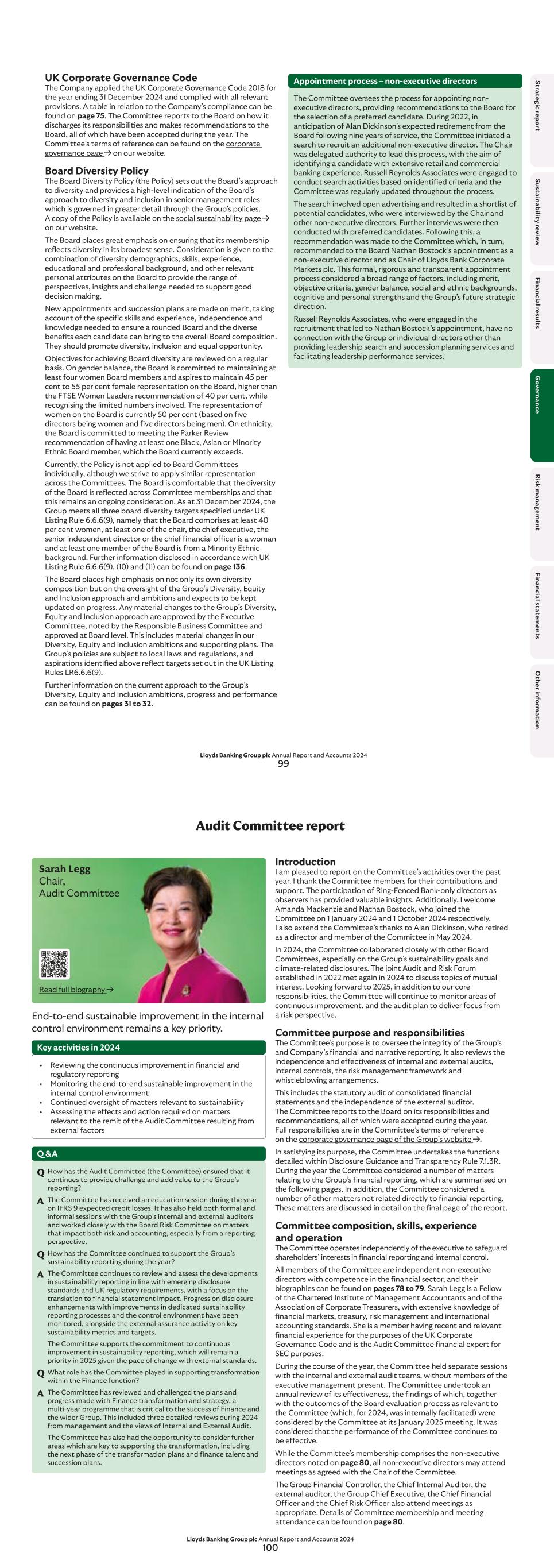
99 Lloyds Banking Group plc Annual Report and Accounts 2024 O th e r in fo rm a tio n F in a n cia l sta te m e n ts R isk m a n a ge m e n t G o ve rn a n ce F in a n cia l re su lts S u sta in a b ility re vie w S tra te gic re p o rt UK Corporate Governance Code The Company applied the UK Corporate Governance Code 2018 for the year ending 31 December 2024 and complied with all relevant provisions. A table in relation to the Company’s compliance can be found on page 75. The Committee reports to the Board on how it discharges its responsibilities and makes recommendations to the Board, all of which have been accepted during the year. The Committee’s terms of reference can be found on the corporate governance page on our website. Board Diversity Policy The Board Diversity Policy (the Policy) sets out the Board’s approach to diversity and provides a high-level indication of the Board’s approach to diversity and inclusion in senior management roles which is governed in greater detail through the Group’s policies. A copy of the Policy is available on the social sustainability page on our website. The Board places great emphasis on ensuring that its membership reflects diversity in its broadest sense. Consideration is given to the combination of diversity demographics, skills, experience, educational and professional background, and other relevant personal attributes on the Board to provide the range of perspectives, insights and challenge needed to support good decision making. New appointments and succession plans are made on merit, taking account of the specific skills and experience, independence and knowledge needed to ensure a rounded Board and the diverse benefits each candidate can bring to the overall Board composition. They should promote diversity, inclusion and equal opportunity. Objectives for achieving Board diversity are reviewed on a regular basis. On gender balance, the Board is committed to maintaining at least four women Board members and aspires to maintain 45 per cent to 55 per cent female representation on the Board, higher than the FTSE Women Leaders recommendation of 40 per cent, while recognising the limited numbers involved. The representation of women on the Board is currently 50 per cent (based on five directors being women and five directors being men). On ethnicity, the Board is committed to meeting the Parker Review recommendation of having at least one Black, Asian or Minority Ethnic Board member, which the Board currently exceeds. Currently, the Policy is not applied to Board Committees individually, although we strive to apply similar representation across the Committees. The Board is comfortable that the diversity of the Board is reflected across Committee memberships and that this remains an ongoing consideration. As at 31 December 2024, the Group meets all three board diversity targets specified under UK Listing Rule 6.6.6(9), namely that the Board comprises at least 40 per cent women, at least one of the chair, the chief executive, the senior independent director or the chief financial officer is a woman and at least one member of the Board is from a Minority Ethnic background. Further information disclosed in accordance with UK Listing Rule 6.6.6(9), (10) and (11) can be found on page 136. The Board places high emphasis on not only its own diversity composition but on the oversight of the Group’s Diversity, Equity and Inclusion approach and ambitions and expects to be kept updated on progress. Any material changes to the Group’s Diversity, Equity and Inclusion approach are approved by the Executive Committee, noted by the Responsible Business Committee and approved at Board level. This includes material changes in our Diversity, Equity and Inclusion ambitions and supporting plans. The Group’s policies are subject to local laws and regulations, and aspirations identified above reflect targets set out in the UK Listing Rules LR6.6.6(9). Further information on the current approach to the Group’s Diversity, Equity and Inclusion ambitions, progress and performance can be found on pages 31 to 32. The Committee oversees the process for appointing non- executive directors, providing recommendations to the Board for the selection of a preferred candidate. During 2022, in anticipation of Alan Dickinson’s expected retirement from the Board following nine years of service, the Committee initiated a search to recruit an additional non-executive director. The Chair was delegated authority to lead this process, with the aim of identifying a candidate with extensive retail and commercial banking experience. Russell Reynolds Associates were engaged to conduct search activities based on identified criteria and the Committee was regularly updated throughout the process. The search involved open advertising and resulted in a shortlist of potential candidates, who were interviewed by the Chair and other non-executive directors. Further interviews were then conducted with preferred candidates. Following this, a recommendation was made to the Committee which, in turn, recommended to the Board Nathan Bostock’s appointment as a non-executive director and as Chair of Lloyds Bank Corporate Markets plc. This formal, rigorous and transparent appointment process considered a broad range of factors, including merit, objective criteria, gender balance, social and ethnic backgrounds, cognitive and personal strengths and the Group’s future strategic direction. Russell Reynolds Associates, who were engaged in the recruitment that led to Nathan Bostock’s appointment, have no connection with the Group or individual directors other than providing leadership search and succession planning services and facilitating leadership performance services. Appointment process – non-executive directors 100 Lloyds Banking Group plc Annual Report and Accounts 2024 Audit Committee report End-to-end sustainable improvement in the internal control environment remains a key priority. Sarah Legg Chair, Audit Committee Read full biography Q How has the Audit Committee (the Committee) ensured that it continues to provide challenge and add value to the Group’s reporting? A The Committee has received an education session during the year on IFRS 9 expected credit losses. It has also held both formal and informal sessions with the Group’s internal and external auditors and worked closely with the Board Risk Committee on matters that impact both risk and accounting, especially from a reporting perspective. Q How has the Committee continued to support the Group’s sustainability reporting during the year? A The Committee continues to review and assess the developments in sustainability reporting in line with emerging disclosure standards and UK regulatory requirements, with a focus on the translation to financial statement impact. Progress on disclosure enhancements with improvements in dedicated sustainability reporting processes and the control environment have been monitored, alongside the external assurance activity on key sustainability metrics and targets. The Committee supports the commitment to continuous improvement in sustainability reporting, which will remain a priority in 2025 given the pace of change with external standards. Q What role has the Committee played in supporting transformation within the Finance function? A The Committee has reviewed and challenged the plans and progress made with Finance transformation and strategy, a multi-year programme that is critical to the success of Finance and the wider Group. This included three detailed reviews during 2024 from management and the views of Internal and External Audit. The Committee has also had the opportunity to consider further areas which are key to supporting the transformation, including the next phase of the transformation plans and finance talent and succession plans. Q &A Key activities in 2024 • Reviewing the continuous improvement in financial and regulatory reporting • Monitoring the end-to-end sustainable improvement in the internal control environment • Continued oversight of matters relevant to sustainability • Assessing the effects and action required on matters relevant to the remit of the Audit Committee resulting from external factors Introduction I am pleased to report on the Committee’s activities over the past year. I thank the Committee members for their contributions and support. The participation of Ring-Fenced Bank-only directors as observers has provided valuable insights. Additionally, I welcome Amanda Mackenzie and Nathan Bostock, who joined the Committee on 1 January 2024 and 1 October 2024 respectively. I also extend the Committee’s thanks to Alan Dickinson, who retired as a director and member of the Committee in May 2024. In 2024, the Committee collaborated closely with other Board Committees, especially on the Group’s sustainability goals and climate-related disclosures. The joint Audit and Risk Forum established in 2022 met again in 2024 to discuss topics of mutual interest. Looking forward to 2025, in addition to our core responsibilities, the Committee will continue to monitor areas of continuous improvement, and the audit plan to deliver focus from a risk perspective. Committee purpose and responsibilities The Committee’s purpose is to oversee the integrity of the Group’s and Company’s financial and narrative reporting. It also reviews the independence and effectiveness of internal and external audits, internal controls, the risk management framework and whistleblowing arrangements. This includes the statutory audit of consolidated financial statements and the independence of the external auditor. The Committee reports to the Board on its responsibilities and recommendations, all of which were accepted during the year. Full responsibilities are in the Committee’s terms of reference on the corporate governance page of the Group’s website . In satisfying its purpose, the Committee undertakes the functions detailed within Disclosure Guidance and Transparency Rule 7.1.3R. During the year the Committee considered a number of matters relating to the Group’s financial reporting, which are summarised on the following pages. In addition, the Committee considered a number of other matters not related directly to financial reporting. These matters are discussed in detail on the final page of the report. Committee composition, skills, experience and operation The Committee operates independently of the executive to safeguard shareholders’ interests in financial reporting and internal control. All members of the Committee are independent non-executive directors with competence in the financial sector, and their biographies can be found on pages 78 to 79. Sarah Legg is a Fellow of the Chartered Institute of Management Accountants and of the Association of Corporate Treasurers, with extensive knowledge of financial markets, treasury, risk management and international accounting standards. She is a member having recent and relevant financial experience for the purposes of the UK Corporate Governance Code and is the Audit Committee financial expert for SEC purposes. During the course of the year, the Committee held separate sessions with the internal and external audit teams, without members of the executive management present. The Committee undertook an annual review of its effectiveness, the findings of which, together with the outcomes of the Board evaluation process as relevant to the Committee (which, for 2024, was internally facilitated) were considered by the Committee at its January 2025 meeting. It was considered that the performance of the Committee continues to be effective. While the Committee’s membership comprises the non-executive directors noted on page 80, all non-executive directors may attend meetings as agreed with the Chair of the Committee. The Group Financial Controller, the Chief Internal Auditor, the external auditor, the Group Chief Executive, the Chief Financial Officer and the Chief Risk Officer also attend meetings as appropriate. Details of Committee membership and meeting attendance can be found on page 80.
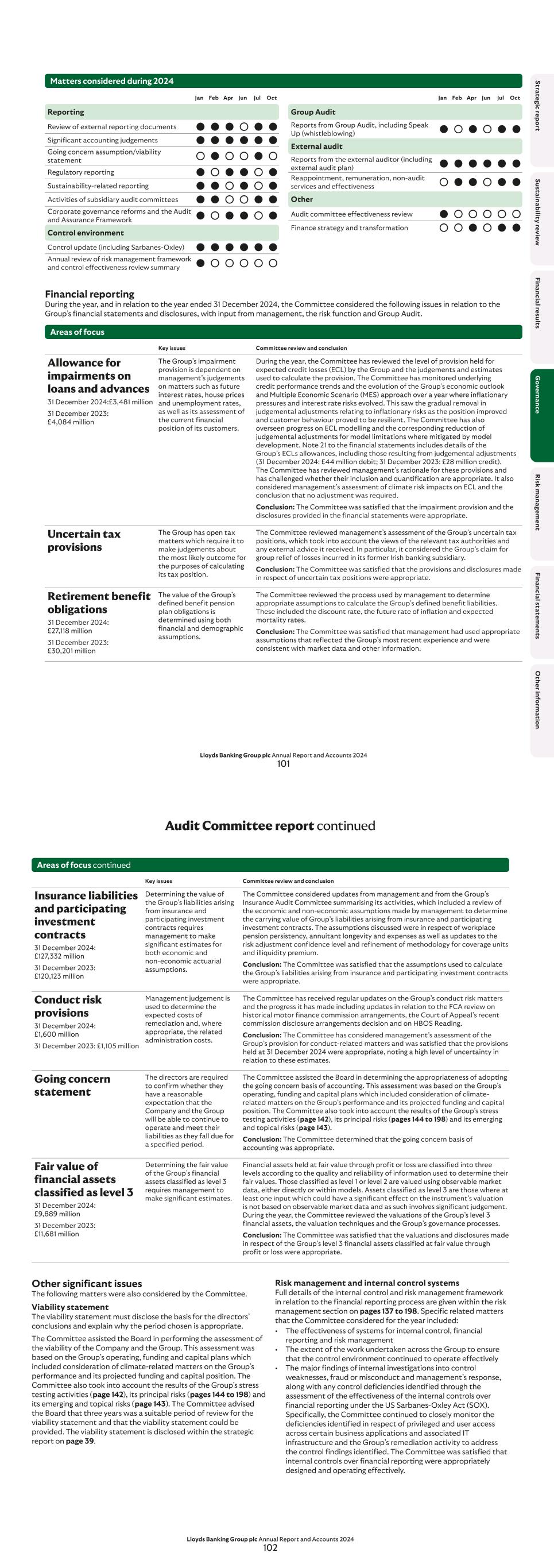
101 Lloyds Banking Group plc Annual Report and Accounts 2024 O th e r in fo rm a tio n F in a n cia l sta te m e n ts R isk m a n a ge m e n t G o ve rn a n ce F in a n cia l re su lts S u sta in a b ility re vie w S tra te gic re p o rt Financial reporting During the year, and in relation to the year ended 31 December 2024, the Committee considered the following issues in relation to the Group’s financial statements and disclosures, with input from management, the risk function and Group Audit. Areas of focus Key issues Committee review and conclusion Allowance for impairments on loans and advances 31 December 2024:£3,481 million 31 December 2023: £4,084 million The Group’s impairment provision is dependent on management’s judgements on matters such as future interest rates, house prices and unemployment rates, as well as its assessment of the current financial position of its customers. During the year, the Committee has reviewed the level of provision held for expected credit losses (ECL) by the Group and the judgements and estimates used to calculate the provision. The Committee has monitored underlying credit performance trends and the evolution of the Group’s economic outlook and Multiple Economic Scenario (MES) approach over a year where inflationary pressures and interest rate risks evolved. This saw the gradual removal in judgemental adjustments relating to inflationary risks as the position improved and customer behaviour proved to be resilient. The Committee has also overseen progress on ECL modelling and the corresponding reduction of judgemental adjustments for model limitations where mitigated by model development. Note 21 to the financial statements includes details of the Group’s ECLs allowances, including those resulting from judgemental adjustments (31 December 2024: £44 million debit; 31 December 2023: £28 million credit). The Committee has reviewed management’s rationale for these provisions and has challenged whether their inclusion and quantification are appropriate. It also considered management’s assessment of climate risk impacts on ECL and the conclusion that no adjustment was required. Conclusion: The Committee was satisfied that the impairment provision and the disclosures provided in the financial statements were appropriate. Uncertain tax provisions The Group has open tax matters which require it to make judgements about the most likely outcome for the purposes of calculating its tax position. The Committee reviewed management’s assessment of the Group’s uncertain tax positions, which took into account the views of the relevant tax authorities and any external advice it received. In particular, it considered the Group’s claim for group relief of losses incurred in its former Irish banking subsidiary. Conclusion: The Committee was satisfied that the provisions and disclosures made in respect of uncertain tax positions were appropriate. Retirement benefit obligations 31 December 2024: £27,118 million 31 December 2023: £30,201 million The value of the Group’s defined benefit pension plan obligations is determined using both financial and demographic assumptions. The Committee reviewed the process used by management to determine appropriate assumptions to calculate the Group’s defined benefit liabilities. These included the discount rate, the future rate of inflation and expected mortality rates. Conclusion: The Committee was satisfied that management had used appropriate assumptions that reflected the Group’s most recent experience and were consistent with market data and other information. Jan Feb Apr Jun Jul Oct Reporting Review of external reporting documents Significant accounting judgements Going concern assumption/viability statement Regulatory reporting Sustainability-related reporting Activities of subsidiary audit committees Corporate governance reforms and the Audit and Assurance Framework Control environment Control update (including Sarbanes-Oxley) Annual review of risk management framework and control effectiveness review summary Jan Feb Apr Jun Jul Oct Group Audit Reports from Group Audit, including Speak Up (whistleblowing) External audit Reports from the external auditor (including external audit plan) Reappointment, remuneration, non-audit services and effectiveness Other Audit committee effectiveness review Finance strategy and transformation Matters considered during 2024 102 Lloyds Banking Group plc Annual Report and Accounts 2024 Key issues Committee review and conclusion Insurance liabilities and participating investment contracts 31 December 2024: £127,332 million 31 December 2023: £120,123 million Determining the value of the Group’s liabilities arising from insurance and participating investment contracts requires management to make significant estimates for both economic and non-economic actuarial assumptions. The Committee considered updates from management and from the Group’s Insurance Audit Committee summarising its activities, which included a review of the economic and non-economic assumptions made by management to determine the carrying value of Group’s liabilities arising from insurance and participating investment contracts. The assumptions discussed were in respect of workplace pension persistency, annuitant longevity and expenses as well as updates to the risk adjustment confidence level and refinement of methodology for coverage units and illiquidity premium. Conclusion: The Committee was satisfied that the assumptions used to calculate the Group’s liabilities arising from insurance and participating investment contracts were appropriate. Conduct risk provisions 31 December 2024: £1,600 million 31 December 2023: £1,105 million Management judgement is used to determine the expected costs of remediation and, where appropriate, the related administration costs. The Committee has received regular updates on the Group’s conduct risk matters and the progress it has made including updates in relation to the FCA review on historical motor finance commission arrangements, the Court of Appeal’s recent commission disclosure arrangements decision and on HBOS Reading. Conclusion: The Committee has considered management’s assessment of the Group’s provision for conduct-related matters and was satisfied that the provisions held at 31 December 2024 were appropriate, noting a high level of uncertainty in relation to these estimates. Going concern statement The directors are required to confirm whether they have a reasonable expectation that the Company and the Group will be able to continue to operate and meet their liabilities as they fall due for a specified period. The Committee assisted the Board in determining the appropriateness of adopting the going concern basis of accounting. This assessment was based on the Group’s operating, funding and capital plans which included consideration of climate- related matters on the Group’s performance and its projected funding and capital position. The Committee also took into account the results of the Group’s stress testing activities (page 142), its principal risks (pages 144 to 198) and its emerging and topical risks (page 143). Conclusion: The Committee determined that the going concern basis of accounting was appropriate. Fair value of financial assets classified as level 3 31 December 2024: £9,889 million 31 December 2023: £11,681 million Determining the fair value of the Group’s financial assets classified as level 3 requires management to make significant estimates. Financial assets held at fair value through profit or loss are classified into three levels according to the quality and reliability of information used to determine their fair values. Those classified as level 1 or level 2 are valued using observable market data, either directly or within models. Assets classified as level 3 are those where at least one input which could have a significant effect on the instrument’s valuation is not based on observable market data and as such involves significant judgement. During the year, the Committee reviewed the valuations of the Group’s level 3 financial assets, the valuation techniques and the Group’s governance processes. Conclusion: The Committee was satisfied that the valuations and disclosures made in respect of the Group’s level 3 financial assets classified at fair value through profit or loss were appropriate. Risk management and internal control systems Full details of the internal control and risk management framework in relation to the financial reporting process are given within the risk management section on pages 137 to 198. Specific related matters that the Committee considered for the year included: • The effectiveness of systems for internal control, financial reporting and risk management • The extent of the work undertaken across the Group to ensure that the control environment continued to operate effectively • The major findings of internal investigations into control weaknesses, fraud or misconduct and management’s response, along with any control deficiencies identified through the assessment of the effectiveness of the internal controls over financial reporting under the US Sarbanes-Oxley Act (SOX). Specifically, the Committee continued to closely monitor the deficiencies identified in respect of privileged and user access across certain business applications and associated IT infrastructure and the Group’s remediation activity to address the control findings identified. The Committee was satisfied that internal controls over financial reporting were appropriately designed and operating effectively. Other significant issues The following matters were also considered by the Committee. Viability statement The viability statement must disclose the basis for the directors’ conclusions and explain why the period chosen is appropriate. The Committee assisted the Board in performing the assessment of the viability of the Company and the Group. This assessment was based on the Group’s operating, funding and capital plans which included consideration of climate-related matters on the Group’s performance and its projected funding and capital position. The Committee also took into account the results of the Group’s stress testing activities (page 142), its principal risks (pages 144 to 198) and its emerging and topical risks (page 143). The Committee advised the Board that three years was a suitable period of review for the viability statement and that the viability statement could be provided. The viability statement is disclosed within the strategic report on page 39. Audit Committee report continued Areas of focus continued
103 Lloyds Banking Group plc Annual Report and Accounts 2024 O th e r in fo rm a tio n F in a n cia l sta te m e n ts R isk m a n a ge m e n t G o ve rn a n ce F in a n cia l re su lts S u sta in a b ility re vie w S tra te gic re p o rt Finance strategy and transformation Significant investment has been committed to transform the Finance function, including 2025 delivery of a new Group General Ledger in addition to the transformation of cost and investment management processes. Further investment in the coming years will continue to transform financial data to support improved forecasting and commercial insights, in addition to further enhancing the controls and reporting landscape. The Committee received timely updates throughout the year with regard to the proposed plans, progress with them and the associated financial and non-financial benefits. Auditor independence and remuneration The Committee is responsible for establishing the Group’s policies and procedures designed to protect the independence and objectivity of the external auditor. In April 2024, the Committee reviewed its non-audit services policy; no substantive changes were made to the policy. The policy details those services that the auditor is permitted to carry out and pre-approves certain of these services provided the fee is below a threshold; all other permitted services must be specifically approved in advance by the Committee. Prior to the engagement of the auditor for a permitted service, the policy requires that senior management confirms whether the Committee has pre-approved the service or specific approval is required. The total amount of fees paid to the auditor for both audit and non-audit related services in 2024 and further information on the policy is disclosed in note 13 to the financial statements. External auditor Following an external audit tender in 2018, Deloitte LLP (Deloitte) was appointed as auditor of the Company and the Group with effect from the 2021 financial year. Mike Lloyd is the statutory audit partner for the Group and attends all meetings of the Committee. The Committee oversees the relationship with the external auditor including its terms of engagement and remuneration and monitors its independence and objectivity. During 2024, the Chair of the Committee spent time meeting with the broader Deloitte team to better understand their audit. Some of their team members across all levels presented a more detailed overview of their work in areas such as audit risk assessment, expected credit losses, regulatory and litigation matters, technology audit and approach to auditing the key assumptions in the Insurance business. The Chair fed back their perspectives of those presentations to other members of the Committee. The Committee also reviewed Deloitte’s audit plan, including the underlying methodology and Deloitte’s risk identification processes. In its assessment of Deloitte’s performance and effectiveness, the Committee has considered: Deloitte’s interactions with the Committee; the responses to a questionnaire issued to the Group’s businesses, Finance, Risk, Internal Audit and non-executive directors; and the FRC’s Audit Quality Inspection Report published in July 2024. The Committee concluded that it was satisfied with the auditor’s performance and recommended to the Board a proposal for the reappointment of the auditor at the Company’s annual general meeting. Statutory Audit Services compliance The Company and the Group confirm compliance with the provisions of The Statutory Audit Services for Large Companies Market Investigation (Mandatory Use of Competitive Tender Processes and Audit Committee Responsibilities) Order 2014, which relates to the frequency and governance of tenders for the appointment of the external auditor and Audit Committee responsibilities including negotiating and agreeing the statutory audit fee and the setting of a policy on the provision of non-audit services, for the year to 31 December 2024. There are no plans as at the date of this report to conduct a tender exercise for external audit services. Audit Committees and the External Audit: Minimum Standard The Group is compliant with Audit Committees and the External Audit: Minimum Standard published by the FRC in May 2023. Risk-weighted assets and regulatory reporting The focus on the quality of regulatory reporting continues to be high on the PRA’s agenda. Across the first, second and third lines of defence, management continues to focus on strengthening the control environment in regulatory reporting with a link to longer- term and strategic initiatives also being considered. The ongoing programme of external assurance on regulatory reporting commissioned by the Committee has to date focused on risk-weighted assets. Management have provided regular updates to the Committee over the year to highlight progress made in improving the reporting control environment across a number of regulatory reports. IFRS 17 The Committee has continued to monitor the embedding of IFRS 17 processes and the improvements that have been made to the Group’s IFRS 17 reporting. Restoring trust in audit and corporate governance As part of its proposed corporate governance reforms, the government planned to introduce a statutory instrument (SI) that would have required companies to disclose an Audit and Assurance Policy setting out their plans for both the internal and external assurance that they planned to obtain over their annual report and accounts on a rolling three-year basis. Whilst the government withdrew the SI in October 2023, the Group recognises the value of documenting its assurance plans and continued its work in this area by developing an internal Audit and Assurance Framework. The Committee has received updates throughout the year on the proposed Framework and reviewed and supported the final 2024 Audit and Assurance Framework. Speak Up (the Group’s whistleblowing service) The Committee reviewed management reports on the Group’s whistleblowing arrangements, ensuring colleagues can report issues confidentially and without fear of retaliation. These well-publicised arrangements allow reporting of inappropriate practices, with independent investigations or follow-ups. The Committee reported on its consideration of whistleblowing arrangements to the Board. Sustainability reporting The Committee challenged the Group’s progress with sustainability related reporting. Emerging sustainability reporting frameworks alongside existing compliance with UK companies regulation requirements for climate-related financial disclosure have been considered, assessing the near term and future impacts on external disclosures. The Committee has continued to monitor Group capabilities and progress with the production of sustainability reporting and linkage to financial statements, the enhanced control environment and the developments with governance and assurance. Further discussion can be found on pages 45 to 60. Group Audit In monitoring the activity, role and effectiveness of the internal audit function and their audit programme the Committee: • Approved the updated Audit Charter which sets out the purpose, role and mandate of internal audit • Approved the annual audit plan and budget, including resources • Reviewed progress against the plan through quarterly updates • Considered the major findings of significant internal audits, management’s response and themes by major risk type • Assessed and concluded upon the quality of Group Audit’s work through review of quality assurance reporting on a six-monthly basis Based on the above and through regular interactions by all Audit Committee members with the Chief Internal Auditor, the Committee is satisfied with the effectiveness and impact of the internal audit function and the appropriateness of its resources. 104 Lloyds Banking Group plc Annual Report and Accounts 2024 Board Risk Committee report An enhanced risk taxonomy and continued strengthening of the Group’s already robust three lines of defence approach will help drive clarity and pace of decision making. Introduction I am pleased to report on how the Committee has discharged its responsibilities during 2024, a year which has seen significant development in the Group’s approach to risk management, including the implementation of changes to the Group’s three lines of defence approach and enhancements to the risk taxonomy. These were key focus areas for the Committee, together with overseeing and providing challenge on associated risk reduction and control improvement plans across key business areas. This work further strengthens the Group’s robust risk culture, simplifies the overall risk management framework and provides greater clarity and ownership for colleagues in the management of risk. Actions taken to mitigate the potential impacts of constantly evolving risks such as economic crime, technology, supplier and cyber risks remained high on the Committee’s agenda, with focus on enhancement of controls. The Committee continued to assess several other key risks, including operational resilience, change execution, data and privacy, and people risks, and how these risks could potentially impact delivery of the Group’s strategic transformation objectives. Catherine Woods Chair, Board Risk Committee Read full biography Q What has been the Board Risk Committee’s (the Committee) role in the transformation of the Group’s risk and control environment? A A key focus for the Committee during 2024 has been to oversee the development and implementation of significant changes to the Group’s three lines of defence approach, initially focused on non-financial risks. This included recommending to Board the adoption of a new risk taxonomy which provides an enhanced view on the Group’s principal risks, greater clarity and focus for risk and control owners, together with the adoption of a consistent approach across all areas of the business. The Committee also provided oversight and challenge on key business areas’ risk reduction and control improvement plans and a number of deep dives, to ensure the Committee has good visibility of the Group’s key risks. Q How does the Committee evaluate the potential impact of emerging risks in a rapidly changing external environment, which will continue to present evolving challenges for the Group and the wider economy? A The Committee regularly evaluates topical risk issues and emerging risks and regularly reviews and assesses its schedule of planned deep dives. This structured, yet agile, approach ensures that the Committee can adapt its focus to new topics throughout the year and, if appropriate, give further consideration to specific areas of interest. Other events such as the Audit and Risk Forum and networking events with senior executives, also provide opportunity for more informal discussion on topical matters. Q What are the key areas of focus for the Committee in 2025? A The Committee will remain focused on several key areas that have been central to its discussions during 2024, while also considering emerging risks, such as the impacts and opportunities of Generative AI. The FCA’s review of motor finance commission arrangements and sales, the Court of Appeal decisions which determined that lenders will be liable for dealers’ non-disclosures of motor commissions and the relevant lenders’ appeal against these decisions, will also remain a key focus. Maintaining an appropriate balance between forward agenda planning and flexibility ensures that the Committee continues to focus on the most material risks and issues for the Group. Areas of strategic and regulatory importance will remain key areas of focus, such as operational resilience, supplier risk, model risk management, economic crime and climate risk, together with credit reviews across a range of sectors to reflect the challenging external environment. Q &A Key activities in 2024 • Provided oversight on the implementation of changes to the Group’s three lines of defence approach, and the adoption of a new risk taxonomy • Oversight of the management of change and execution risks arising from the Group’s strategic transformation, with an emphasis on evolution of the platform based-operating model • Reviewed enhancements to the Group’s economic crime prevention strategy and vision and oversight of the management of economic crime risks • Continued assessment of the management of operational resilience risks, including cyber, supply chain management and technology risks, data risks and artificial intelligence • Considered the complexities of climate risk, particularly transition of technology, customer adoption, regulatory expectations and greenwashing risks • Reviewed management of the Group’s funding and liquidity risks, market risk including consideration of trading book risk, structural hedge activity and ongoing oversight and challenge of the design and execution of stress testing • Ongoing assessment of key emerging risks
105 Lloyds Banking Group plc Annual Report and Accounts 2024 O th e r in fo rm a tio n F in a n cia l sta te m e n ts R isk m a n a ge m e n t G o ve rn a n ce F in a n cia l re su lts S u sta in a b ility re vie w S tra te gic re p o rt Credit risk was also a core topic, with the Committee receiving various deep dives during the year covering the automotive sector, where the continued evolution of the sector drives a range of potential risks to be managed. The Committee and the Board will continue to assess the outcomes and impacts of the FCA’s review of motor finance commission arrangements and sales, the Court of Appeal’s determination that lenders will be liable for dealers’ non-disclosure of motor commissions and the relevant lenders’ appeals against these decisions. The Chief Risk Officer also provides insights on the overall credit environment during Committee meetings when presenting his regular report. Oversight and challenge of model risk management and capital, liquidity and funding requirements, also continued to be provided on a frequent basis. Each of these areas is covered in more detail throughout this report. As highlighted in my report last year, Cathy Turner joined the Committee with effect from 1 February 2024. I would like to take this opportunity to formally welcome Nathan Bostock, who was appointed as a member of the Committee with effect from 1 August 2024 and to thank Alan Dickinson who retired from the Committee and the Board on 16 May 2024. Alan’s contribution to the Committee’s proceedings over the years has been highly valued. Nathan’s deep knowledge of the UK banking market and his breadth of experience will be of great benefit to the Committee going forward. Committee purpose and responsibilities The Committee assists the Board in fulfilling its risk governance and oversight roles and responsibilities. The Committee is also responsible for ensuring the risk culture is fully embedded and supports at all times the Group’s agreed risk appetite, including the extent and categories of risk which the Board considers as acceptable for the Group to bear. A review and update of the Committee’s terms of reference was completed during the year, with no material changes being made. Changes arising from the update of the UK Corporate Governance Code will be incorporated into the Committee’s terms of reference. The Committee is responsible for reviewing and reporting its conclusions to the Board on the Group’s risk management framework, which captures risk principles, policies, methodologies, systems, processes, procedures and people. This also includes the review of new, or material, amendments to risk principles and policies and overseeing any action resulting from material breaches of such policy. As highlighted in my introduction, the Committee has been heavily involved in overseeing the development and implementation of changes to the Group’s overall risk management framework and risk taxonomy. This clarifies the roles of risk and control owners, second line risk specialists and chief control offices across all parts of the business, to ensure consistency and enhance focus on controls and expertise. More details on the Group’s wider approach to risk management can be found in the risk management section on pages 137 to 198. Full details of the Committee’s responsibilities are set out in its terms of reference, which can be found on the corporate governance page on our website. Committee composition, skills, experience and operation As highlighted in my introduction, Nathan Bostock, independent non-executive director, was appointed as a member of the Committee in August 2024, following Alan Dickinson ceasing to be a member of the Committee in May 2024, upon his retirement from the Board. As a result of this appointment, membership of the Committee now includes the chairs of both Lloyds Bank Corporate Markets plc and Scottish Widows Group Limited. Two of the three designated independent non-executive directors of the Ring-Fenced Banks also attend meetings as observers in order to provide insights on matters relevant to the Ring-Fenced Banks when required and as part of their role in the Group’s overall governance structure. The Chief Risk Officer has full access to the Committee and attends all meetings. The Chief Internal Auditor and members of the executive also attend meetings as appropriate. Details of Committee membership and meeting attendance can be found on page 80. The Committee undertook an annual review of its effectiveness, the findings of which, together with the outcomes of the Board evaluation process as relevant to the Committee (which, for 2024, was again led by the Company Secretary), were considered by the Committee at its January 2025 meeting; it was considered that the performance of the Committee continues to be effective. Details of the Board evaluation process can be found on page 93. During the year, Committee members attended a number of training sessions and briefings, helping deepen Committee members’ knowledge on a range of specific topics and risks, further enhancing the discussion and challenge which took place at subsequent Committee meetings. As the most senior risk committee in the Group, the Committee interacts with other related risk committees, including the executive Group Risk Committee. These interactions help ensure the appropriate escalation of relevant matters to the Committee for review and consideration. A networking event was also held with senior Risk executives, providing opportunity for Committee members and the Risk executive to discuss risk matters in a more informal environment. Matters considered by the Committee During 2024, the Committee considered a wide range of risks facing the Group and its Ring-Fenced Banks, both current and forward- looking, across all key areas of risk management, in addition to risk culture and risk appetite. The Committee continues to focus on key risk topics through, for example, the use of deep dives to provide greater analysis of particular topics and associated risks. The following pages provide a summary of the risks considered by the Committee, its role and an outline of the conclusions which were ultimately reached. The Committee continues to be supported by the IT and Cyber Advisory Forum, which dedicates additional time and resource to reviewing and challenging risks associated with IT infrastructure, IT strategy, IT resilience and cyber risks. The Chair and other members of the Committee attend this Forum. The Board Risk Committee Chair is a member of the Audit Committee, in addition to the Audit Committee Chair being a member of the Board Risk Committee; this close interaction continues to help ensure that common issues of interest are addressed appropriately. Now a regular annual event, a Group-wide Audit and Risk Forum was once again held during the year, providing an opportunity for members of both Committees to discuss key areas of common interest. This continues to strengthen the debate and challenge of matters provided by these Committees. There continues to be regular interaction with other Board Committees, with the Chair of the Responsible Business Committee attending Committee meetings for matters of specific interest. The Chair of the Remuneration Committee is also now a member of the Committee, further enhancing discussion on alignment of remuneration to risk performance. Each of these connections helps ensure strong relationships between the respective Board Committees. The Committee also reviewed regular updates from the Non-Ring- Fenced Bank and Insurance sub-groups, headed up by Lloyds Bank Corporate Markets plc and Scottish Widows Group Limited respectively, summarising key discussions and decisions taken at the relevant entities’ risk committees. During the year, the Committee also undertook reviews into aspects of the control environments within each of these sub-group’s businesses. 106 Lloyds Banking Group plc Annual Report and Accounts 2024 Area of focus Key role of Committee Key outcomes Enterprise risk management framework • The Committee received regular updates on the effectiveness of the enterprise risk management framework to enable oversight of its development and ensure it is in line with emerging regulatory, corporate governance and industry best practice • In January, the Committee agreed to recommend to the Board a proposal to adopt an events-based taxonomy, which provides better alignment with Basel event categories. Simplification of the enterprise risk management framework by reducing the number of the Group’s principal risks was also supported • The Committee has overseen a significant change to the Group’s three lines of defence approach. The new approach clarifies the roles of risk owners and control owners and introduces a consistent controls office structure across all parts of the business • The effectiveness of the enterprise risk management framework was supported in November. It was highlighted that the Committee has good visibility of the Group’s most important risk matters and has appropriate coverage of the Group’s risk and control profile, with deep dives having been undertaken throughout the year Risk and control profile • Time was spent at every Committee meeting reviewing the Group’s risk and control profile • Control improvement has been a significant focus area for the Committee in 2024 and will continue to receive attention in 2025 • The Group’s One Risk and Control Self-Assessment (One RCSA) has been fully embedded and is providing an effective control environment for all business activity. The Committee oversaw the completion of One RCSA embedding in January • At the Committee’s request, risk and control reporting has evolved during 2024, to improve the visibility of material risk and control issues • Continued monitoring of business area risk reduction and control improvement plans was undertaken throughout 2024, with the Committee welcoming the progress on risk and control improvements • The Committee continuously challenged management on progress towards an improved control environment, with particular focus on economic crime and supplier risk management • In November, the Committee reviewed and supported the Risk Function and Group Internal Audit’s report on the effectiveness of internal controls required to manage risk Non-financial risks Conduct and compliance • The Committee is responsible for overseeing that effective controls are in place to ensure that good outcomes are realised for customers and that the Group complies with its existing regulatory obligations • Complaints performance has been tracked by the Committee on a half-yearly basis. The volume of customers awaiting an outcome from their complaint has reduced compared to 2023 (excluding those relating to motor finance commission arrangements) • A Group-wide emphasis on the effective application of Consumer Duty and greater self-identification of historic issues requiring rectification, as well as an increase in pace of strategic system migrations, has resulted in an increased volume of remediation cases. The Committee continues to closely monitor rectification activity and operational capacity • Conduct risk will continue to be an area of focus for the Committee in 2025, with more frequent updates requested • Detailed reports on legal developments and litigation risks were considered on a half-yearly basis • The Committee reviewed the Group’s ring-fencing arrangements and supported the Board in giving their confirmation of overall compliance with ring-fencing governance requirements Economic crime • Recognising the significant external threat from economic crime to the Group and its customers, the Committee received frequent updates on its exposure, and prevention, throughout the year • This included progress updates on the Group’s economic crime prevention strategy, consumer fraud and the Money Laundering Reporting Officer’s annual report • As part of changes to the risk taxonomy, the Committee agreed to create a new economic crime principal risk, supported by secondary risks for anti-bribery, anti-money laundering, fraud and sanctions • In April, the Committee reviewed and supported enhancements to the economic crime prevention strategy and vision, with more funding allocated to deliver enhanced systems and controls. The strategy was launched in the second half of the year, with a progress update shared with the Committee in November • The Committee oversaw the Group’s implementation of the Payment Systems Regulator’s (PSR) Authorised Push Payment (APP) fraud reimbursement rules Key activities for the year Board Risk Committee report continued
107 Lloyds Banking Group plc Annual Report and Accounts 2024 O th e r in fo rm a tio n F in a n cia l sta te m e n ts R isk m a n a ge m e n t G o ve rn a n ce F in a n cia l re su lts S u sta in a b ility re vie w S tra te gic re p o rt Area of focus Key role of Committee Key outcomes Non-financial risks continued Strategic transformation oversight • The Committee received quarterly updates on the performance of the Group’s extensive current and future strategic change agenda. This enabled the Committee to assess the impact of any material change programmes on the Group • The Committee was pleased to note that there were no material risk impacts from changes implemented as part of the strategic transformation work • The Committee continued with its focus on the management of change execution risk, with a strong emphasis on delivery from the evolving platform-based operating model Operational resilience • Emphasising its importance to the Group and the scale of regulatory attention, oversight of operational resilience was one of the most frequently discussed items at the Committee and will continue to be a key focus area in 2025 • The Committee considered the operational resilience self-assessment prior to approval by the Board • Progress against compliance requirements from regulatory policy statements on operational resilience, due in March 2025, have been carefully tracked via a new dashboard and completion of an annual self-assessment • Oversight of the Group’s important business services framework was conducted • The Committee reviewed and supported revised operational resilience Board-level risk appetite measures • Deep dives were undertaken in December on IT systems risk and information, cyber and physical security risk • Readiness for the Digital Operational Resilience Act (DORA) was noted by the Committee Supplier risk management • Close attention has been paid to the Group’s suppliers to ensure resilience of service to the Group’s customers • The Committee oversaw improvements to the Group’s supplier risk management frameworks • The Group’s supplier risk framework has evolved during 2024, in response to supplier incidents, regulatory developments and internal assurance activity. Updates were shared with the Committee • The Committee noted the reliance on suppliers for delivery of certain key services. A watchlist of critical suppliers at risk of financial distress was reviewed by the Committee People and health, safety and premises risks • The performance and safety of colleagues is of utmost importance to the Committee, which has provided advice, oversight and challenge during the year • The Committee has considered an enhanced framework of activity to mitigate people risk. Discussions focused on culture, capability and capacity, the management and delivery of the Group’s strategic workforce plan and ensuring communications with colleagues are transparent and clear • Significant progress in increasing accountability and visibility of safety issues in the Group’s branches and offices was presented to the Committee in March, with a further update in October Data and privacy risk • Data and privacy risk is a continuing area of focus for the Committee • The Committee received updates on the data management risk profile and data privacy breaches • A deep dive on the current data and privacy risk profile was undertaken at the Committee in December. Discussion focused on enhancements to its framework and strategy • The Committee noted that data integrity plays a critical role in ensuring the Group’s resilience and is pleased that skills gaps across the Group are being addressed Financial risks Credit risk • The Committee has frequently reviewed and challenged the performance of the Group’s commercial and consumer credit portfolios, through regular credit management information and deep dives on portfolios requiring additional focus • The Committee was pleased to note that the Group’s credit performance remains resilient despite broader macro-economic risks persisting • A deep dive of the credit card portfolio was provided to the Committee in February, which considered early warning indicators and the impacts of increases in the cost-of-living. The Committee acknowledged the resilient credit performance of the portfolio, which has benefitted from low unemployment • The Committee undertook a deep dive on the Group’s exposure to non-bank financial institutions, or shadow banking, in May. Recognising its importance, further discussion took place in October, in response to the Committee’s request to review the securitisation portfolio and outputs from stress testing scenarios • In September, a deep dive of the commercial real estate portfolio took place. The Committee commended the proactive management of the portfolio despite falls seen in valuations across the sector. While challenges remained, the Committee gained comfort that lending origination remained disciplined Key activities for the year continued 108 Lloyds Banking Group plc Annual Report and Accounts 2024 Area of focus Key role of Committee Key outcomes Financial risks continued Motor finance • With significant external factors impacting the motor finance sector, the Committee has carefully monitored the transport portfolio’s performance and the evolving situation in relation to motor finance commission arrangements • The Committee received deep dives on the credit performance of the automotive sector and motor residual value risk in September. The Committee noted continuing volatility in residual value risk, particularly in relation to battery electric vehicles (BEVs) and recommended new risk appetite metrics to manage residual value risk to the Board • The Group will continue to assess the potential impacts of October’s Court of Appeal decisions pending the outcome of the relevant lenders’ appeals against these decisions and also awaits findings from the FCA motor finance commission arrangements and sales review. Systems have been built at pace to support customer requests for information about their products and complaints handled in line with FCA guidance Capital, liquidity and funding • The Committee has closely monitored the associated risks from capital, liquidity and funding • After challenge and discussion from the Committee, the ICAAP was approved in March. The Committee was satisfied that the Group’s current and planned capital adequately covers the risk of financial loss it was, or might be, exposed to. The Committee continues to track actions following regulatory feedback on ICAAP • In April, the Committee scrutinised and approved the Group’s ILAAP. This included compliance with the PRA’s Overall Liquidity Adequacy Rules (OLAR) and updated Pillar 2 assessments • Updates on customer deposit trends and mix and the subsequent impacts this has for structural hedge activity were provided to the Committee in April and October Other Model risk • Model risk continued to be an area of significant internal and external focus, with the Committee overseeing the Group’s current model risk landscape and proposed improvements • During 2024, the Committee continued its oversight of model risk management, with quarterly updates being provided • The Committee gave particular focus to the implementation of Capital Requirements Directive (CRD) IV models, the conclusion of market risk models within Interbank Offered Rate (IBOR) transition activities and responding to the PRA’s Supervisory Statement 1/23 on Model Risk Management. The Committee challenged management on progress and regulatory expectations while noting the evolving regulatory landscape • The Committee was also interested in the validation process for artificial intelligence-related models, which will remain a continuing area of focus during 2025 Climate risk • The Committee oversaw the impact of climate risk on the Group’s activities and considered the Group’s climate risk capabilities, frameworks and risk appetite • A deep dive on Climate Risk was completed in July. The Committee considered the complexity of climate risk, including those related to regulatory expectations, greenwashing, transition of technology and its adoption by customers Recovery plans and resolution • Recovery planning and resolution has been an important area of focus for the Committee throughout 2024 • The Committee has periodically reviewed the Group’s recovery and resolution plans and helped to embed the topics across the Group • The biennial Recovery Plan was approved by the Committee, prior to submission to the PRA in June 2024. The 2024 Recovery Plan reflected four different stress scenarios, one of which was a fire drill scenario overseen by the Committee in April, which concluded that the Group was better prepared to take action • Enhancements to resolution have been addressed, following feedback from the Bank of England. In October, the Committee recognised the strong approach taken to resolution ahead of a future Resolvability Assessment Framework cycle • The Committee considered plans to meet new Trading Activity Wind Down (TWD) rules, which become effective from March 2025 Emerging risks • Emerging risk trends have been regularly monitored by the Committee during 2024 • The Group’s approach to emerging risks has been refined further during 2024. In December, the Committee reviewed a streamlined register of emerging risk themes • The Committee also approved a change in terminology from emerging and horizon risks to emerging and topical risks. The Committee was satisfied that topical more accurately reflects the time horizon these risks may materialise within, while recognising some future risks are ever-present • Deep dives on generative AI took place in May with a further update in November, which involved a review of the Group’s evolving AI risk and control environment Board Risk Committee report continued Key activities for the year continued
109 Lloyds Banking Group plc Annual Report and Accounts 2024 O th e r in fo rm a tio n F in a n cia l sta te m e n ts R isk m a n a ge m e n t G o ve rn a n ce F in a n cia l re su lts S u sta in a b ility re vie w S tra te gic re p o rt Responsible Business Committee report By supporting the needs of our customers, colleagues and communities, shaping finance as a force for good, we bring our purpose to life every day. Amanda Mackenzie Chair, Responsible Business Committee Read full biography Q What are the key priorities of the Responsible Business Committee (Committee) in 2025? A The Group continues to make significant progress in embedding its purpose across all its activities and this year we have seen more examples of delivering significant societal benefits at the same time as creating new business opportunities for the Group. 2025 will be crucial as we continue to support colleagues, customers and communities transition to net zero, access quality housing and unlock regional development. We want to empower our customers to achieve a more prosperous future and be a leader in diversity and inclusion. Q &A Key activities in 2024 • Helping Britain Prosper in action • Diversity and inclusion • Engaging our employees to deliver cultural change • Delivering on our duty to customers and stakeholders Introduction I am pleased to report on the Committee’s work in 2024 and I would like to thank members for their contributions. Over the course of the year, we covered different aspects of how the Group helps build a more sustainable and inclusive future for people and businesses and we will continue to focus on the key topics of purpose and environmental sustainability. This is how we will grow our business profitably and provide long-term, sustainable value for shareholders and all our stakeholders. Committee purpose and responsibilities The purpose of the Committee is to support the Board in overseeing the Group’s policies, performance and priorities as a responsible business. We will continue our oversight of the Group’s work in 2025 and engage on emerging topics like AI and their potential impact for our industry. The Committee’s terms of reference can be found on the corporate governance page on our website. Committee composition, skills, experience and operation The Committee met on five occasions in 2024 and is composed of independent non-executive directors and is attended by the Group Chief Executive. It benefits from a range of perspectives, insight and experience, with representatives from Group Internal Audit attending meetings as appropriate. Details of Committee membership and meeting attendance can be found on page 80. The findings of the internal annual review of effectiveness were considered by the Committee at its January 2025 meeting. Based on the evaluation, the feedback was that the performance of the Committee continues to be effective. Purpose in action Helping Britain Prosper every day means making the biggest difference through our core business. The Committee considered how the Group delivers good customer outcomes and positive impact for wider society, alongside achieving our commercial objectives. Specific topics covered environmental systems, our social housing initiative, which builds on our position as a leading supporter of the sector, with around £19.5 billion of new funding supported since 2018, our regional development programme (where we became the first UK high street bank to support the Community Development Finance Institutions (CDFI) sector acting as the lead investor in a new £62 million fund) and our collaboration with UK universities to help stimulate economic growth. As you should expect, we also looked at how we can further empower our customers through our products and services. Environmental sustainability A key focus for 2024 has been on embedding our environmental strategy with detailed discussions and challenge on the plans across our four key systems and in-depth updates on the Group’s progress towards its sustainability ambitions. We looked at our augmented commitment to provide £30 billion of sustainable financing to commercial banking clients before the end of 2026. Special focus was also given to the Group’s approach to nature and further integrating nature into our targets, decision making and broader environmental strategy. Diversity and inclusion The Committee is pleased with the continued progress in increased representation of women and Black, Asian and Minority Ethnic colleagues in senior roles and to be the highest-ranked bank in the FTSE 100 for ‘Women in Leadership’. Since launching our goal in 2023 to double the representation of senior colleagues with disabilities, we have also seen a significant increase in colleagues sharing their disability data. With a bold new approach to our representation ambitions, which we are committed to achieving by the end of 2030, we look forward to continued progress updates on how we are ensuring diversity and inclusion is at the heart of everything we do. Our business will be stronger for it. Colleagues and culture Our colleagues are central to the delivery of the Group’s strategic ambitions. The Committee, as the designated body for workforce engagement, supports the Group’s wider engagement strategy, reporting at least annually to the Board on the key themes and issues we are hearing from our colleagues. This year we discussed change readiness, the pace of transformation and the future of the organisation, as well as focusing on the safety of our colleagues. Please refer to page 86 for more details on our colleague engagement activities. Consumer Duty The Committee is the designated body that fulfils the Board’s responsibility for Consumer Duty, and I am the Board Consumer Duty Champion. During 2024, the Committee received progress reports on the Consumer Duty Programme, reviewed both the implementation plan to meet the FCA’s second deadline for closed products in July 2024 and the first annual assessment report ahead of submission to the Board. As a Committee, we recognise how Consumer Duty underpins everything we do and embedding the Duty into the Group’s culture of delivering good outcomes for customers in line with our customer- centric strategy is essential. Remuneration Committee Chair’s statement Our two-year pay deal for 2024 and 2025 remains industry leading; between April 2024 and April 2025, we will have provided a minimum £3,0001 pay award, worth a total of between 8.2 to 13.6 per cent of salary, for our colleagues at lower grades. Remuneration content Chair’s statement pages 110 to 112 Remuneration at a glance page 113 2023 Directors’ Remuneration Policy summary pages 115 to 116 2024 annual report on remuneration pages 118 to 133 Dear shareholder On behalf of the Board, I am pleased to present the directors' remuneration report for the year ended 31 December 2024. We are grateful for the strong support received at the 2024 annual general meeting (AGM), with 96.4 per cent approval of our 2023 report. Supporting our customers, colleagues and communities in 2024 We are proud of how we have continued to deliver on our purpose of Helping Britain Prosper by supporting our customers, colleagues and our communities throughout 2024. In 2023 we announced our two-year pay deal for 2024 and 2025 which remains industry leading. In the context of improving economic conditions and an easing of price increases, we will have provided a real-term pay increase for almost 55,000 colleagues at grades A to E in 2025. Our minimum award of £1,5001, means our colleagues at lower grades received an average increase of between 4.4 and 6.3 per cent. That means that between April 2024 and April 2025, we will have provided a minimum £3,0001 pay award, worth a total of between 8.2 to 13.6 per cent of salary, for our colleagues at lower grades. From 1 April 2025 we will also be increasing our minimum salary from £23,5001 to £25,0001 which will be 9 per cent above the national Real Living Wage; our London rates will be 13.9 per cent above the London Real Living Wage. For 2024, we extended eligibility for significantly increased Group Performance Share (GPS) annual bonus plan awards to those of our more junior colleagues who have made an exceptional contribution to our purpose of Helping Britain Prosper. In addition to our core reward offering, we also have a range of flexible options to provide colleagues with additional choice and to allow them to tailor their reward package to their own or their family’s individual circumstances. Colleagues can also access a range of financial products at discounted rates from the Group portfolio; these include current accounts, mortgages and rental deposit or season ticket loans. For more information see page 117. Incentivising our colleagues helps us to deliver on our strategy and deliver for our customers by, for example, providing a range of housing options for our communities; amongst a range of actions, we have increased the number of people on the housing ladder by lending more than £15 billion in 2024 to first time buyers and expanding the availability of affordable homes by supporting over £2 billion of new funding to the social housing sector in 2024. We also aim to bring more of our products and services to existing customers and broaden our product offerings. Our digitally active users grew to 22.7 million in 2024, retaining our position as the UK’s largest digital bank and we launched new interactive tools such as Benefit Calculator, which empowers customers to identify support they might be eligible for. Group balanced scorecard The Group balanced scorecard (BSC) is intended to provide insight into performance for the full range of our stakeholders and informs a range of key reward decisions, including for our executive directors. 60 per cent of the scorecard is linked to financial metrics, aligned to the interests of our shareholders, 20 per cent of the scorecard assesses how effectively we are serving customers across all our brands, products and services, 7.5 per cent relates to our culture and colleague engagement and 12.5 per cent is weighted to carbon reduction and inclusivity. As discussed in more detail on page 5, our financial results for 2024 include an additional provision for the potential remediation costs relating to motor finance commission arrangements; this has negatively impacted the profit after tax and return on tangible equity (RoTE) measures in the BSC resulting in a reduced outturn of 68.12 per cent of maximum, fully inclusive of the impact of the provision. More information on our Group BSC outcome can be found on page 119. As a consequence of including the outcome above, the Committee does not consider that the BSC outcome properly reflects the strength of the underlying Group performance or the performance of the executive directors whose variable reward is directly linked to it. After careful consideration of the importance of transparency and to demonstrate the Group’s commitment to respecting the targets it sets for itself, the Committee has decided not to exercise its discretion this year to adjust the BSC outcome to a higher level which it considers would better reflect the underlying performance. The Committee considers it critical that it can set robust financial targets which provide clear line of sight to delivery against its ambitious strategy and align with the financial planning and budgeting process. As such, for the financial measures within our 2025 BSC (and beyond if required) we will exclude the impact of provisions related to the motor finance matter (as it is not a budgeted item) and the Committee will instead consider any impact on a discretionary case-by-case basis taking account of the impact on the full range of the Group’s stakeholders including its customers, colleagues, shareholders and communities. With the exception of relative Total Shareholder Return (rTSR), the financial measures used to determine the future vesting of our Long Term Incentive Plan (LTIP) awards, including the remaining two years of our 2024 award, will be treated in the same way. Directors’ remuneration report Lloyds Banking Group plc Annual Report and Accounts 2024 110 Cathy Turner Chair, Remuneration Committee 1 Pro-rated for reduced hours. 2 In line with our cost guidance, the BSC outcome includes a £0.1 billion adjustment to the Operating Cost measure target relating to the sector-wide change in the charging approach for the Bank of England Levy which was not included in the financial objective this measure was set against. l i ts Read full biography
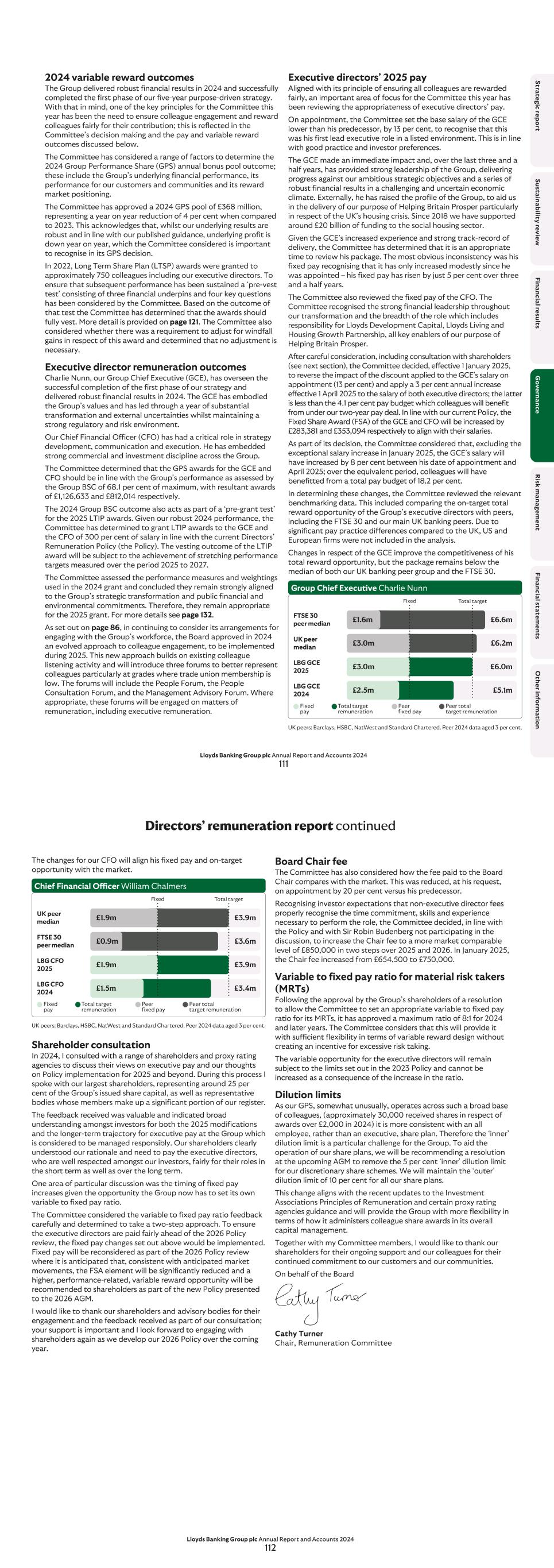
2024 variable reward outcomes The Group delivered robust financial results in 2024 and successfully completed the first phase of our five-year purpose-driven strategy. With that in mind, one of the key principles for the Committee this year has been the need to ensure colleague engagement and reward colleagues fairly for their contribution; this is reflected in the Committee’s decision making and the pay and variable reward outcomes discussed below. The Committee has considered a range of factors to determine the 2024 Group Performance Share (GPS) annual bonus pool outcome; these include the Group’s underlying financial performance, its performance for our customers and communities and its reward market positioning. The Committee has approved a 2024 GPS pool of £368 million, representing a year on year reduction of 4 per cent when compared to 2023. This acknowledges that, whilst our underlying results are robust and in line with our published guidance, underlying profit is down year on year, which the Committee considered is important to recognise in its GPS decision. In 2022, Long Term Share Plan (LTSP) awards were granted to approximately 750 colleagues including our executive directors. To ensure that subsequent performance has been sustained a ‘pre-vest test’ consisting of three financial underpins and four key questions has been considered by the Committee. Based on the outcome of that test the Committee has determined that the awards should fully vest. More detail is provided on page 121. The Committee also considered whether there was a requirement to adjust for windfall gains in respect of this award and determined that no adjustment is necessary. Executive director remuneration outcomes Charlie Nunn, our Group Chief Executive (GCE), has overseen the successful completion of the first phase of our strategy and delivered robust financial results in 2024. The GCE has embodied the Group’s values and has led through a year of substantial transformation and external uncertainties whilst maintaining a strong regulatory and risk environment. Our Chief Financial Officer (CFO) has had a critical role in strategy development, communication and execution. He has embedded strong commercial and investment discipline across the Group. The Committee determined that the GPS awards for the GCE and CFO should be in line with the Group’s performance as assessed by the Group BSC of 68.1 per cent of maximum, with resultant awards of £1,126,633 and £812,014 respectively. The 2024 Group BSC outcome also acts as part of a ‘pre-grant test’ for the 2025 LTIP awards. Given our robust 2024 performance, the Committee has determined to grant LTIP awards to the GCE and the CFO of 300 per cent of salary in line with the current Directors’ Remuneration Policy (the Policy). The vesting outcome of the LTIP award will be subject to the achievement of stretching performance targets measured over the period 2025 to 2027. The Committee assessed the performance measures and weightings used in the 2024 grant and concluded they remain strongly aligned to the Group’s strategic transformation and public financial and environmental commitments. Therefore, they remain appropriate for the 2025 grant. For more details see page 132. As set out on page 86, in continuing to consider its arrangements for engaging with the Group’s workforce, the Board approved in 2024 an evolved approach to colleague engagement, to be implemented during 2025. This new approach builds on existing colleague listening activity and will introduce three forums to better represent colleagues particularly at grades where trade union membership is low. The forums will include the People Forum, the People Consultation Forum, and the Management Advisory Forum. Where appropriate, these forums will be engaged on matters of remuneration, including executive remuneration. Executive directors’ 2025 pay Aligned with its principle of ensuring all colleagues are rewarded fairly, an important area of focus for the Committee this year has been reviewing the appropriateness of executive directors’ pay. On appointment, the Committee set the base salary of the GCE lower than his predecessor, by 13 per cent, to recognise that this was his first lead executive role in a listed environment. This is in line with good practice and investor preferences. The GCE made an immediate impact and, over the last three and a half years, has provided strong leadership of the Group, delivering progress against our ambitious strategic objectives and a series of robust financial results in a challenging and uncertain economic climate. Externally, he has raised the profile of the Group, to aid us in the delivery of our purpose of Helping Britain Prosper particularly in respect of the UK’s housing crisis. Since 2018 we have supported around £20 billion of funding to the social housing sector. Given the GCE’s increased experience and strong track-record of delivery, the Committee has determined that it is an appropriate time to review his package. The most obvious inconsistency was his fixed pay recognising that it has only increased modestly since he was appointed – his fixed pay has risen by just 5 per cent over three and a half years. The Committee also reviewed the fixed pay of the CFO. The Committee recognised the strong financial leadership throughout our transformation and the breadth of the role which includes responsibility for Lloyds Development Capital, Lloyds Living and Housing Growth Partnership, all key enablers of our purpose of Helping Britain Prosper. After careful consideration, including consultation with shareholders (see next section), the Committee decided, effective 1 January 2025, to reverse the impact of the discount applied to the GCE’s salary on appointment (13 per cent) and apply a 3 per cent annual increase effective 1 April 2025 to the salary of both executive directors; the latter is less than the 4.1 per cent pay budget which colleagues will benefit from under our two-year pay deal. In line with our current Policy, the Fixed Share Award (FSA) of the GCE and CFO will be increased by £283,381 and £353,094 respectively to align with their salaries. As part of its decision, the Committee considered that, excluding the exceptional salary increase in January 2025, the GCE’s salary will have increased by 8 per cent between his date of appointment and April 2025; over the equivalent period, colleagues will have benefitted from a total pay budget of 18.2 per cent. In determining these changes, the Committee reviewed the relevant benchmarking data. This included comparing the on-target total reward opportunity of the Group’s executive directors with peers, including the FTSE 30 and our main UK banking peers. Due to significant pay practice differences compared to the UK, US and European firms were not included in the analysis. Changes in respect of the GCE improve the competitiveness of his total reward opportunity, but the package remains below the median of both our UK banking peer group and the FTSE 30. Lloyds Banking Group plc Annual Report and Accounts 2024 111 Group Chief Executive Charlie Nunn l i ts 2 O th e r in fo rm a tio n F in a n cia l sta te m e n ts R isk m a n a ge m e n t G o ve rn a n ce F in a n cia l re su lts S u sta in a b ility re vie w S tra te gic re p o rt The changes for our CFO will align his fixed pay and on-target opportunity with the market. Shareholder consultation In 2024, I consulted with a range of shareholders and proxy rating agencies to discuss their views on executive pay and our thoughts on Policy implementation for 2025 and beyond. During this process I spoke with our largest shareholders, representing around 25 per cent of the Group’s issued share capital, as well as representative bodies whose members make up a significant portion of our register. The feedback received was valuable and indicated broad understanding amongst investors for both the 2025 modifications and the longer-term trajectory for executive pay at the Group which is considered to be managed responsibly. Our shareholders clearly understood our rationale and need to pay the executive directors, who are well respected amongst our investors, fairly for their roles in the short term as well as over the long term. One area of particular discussion was the timing of fixed pay increases given the opportunity the Group now has to set its own variable to fixed pay ratio. The Committee considered the variable to fixed pay ratio feedback carefully and determined to take a two-step approach. To ensure the executive directors are paid fairly ahead of the 2026 Policy review, the fixed pay changes set out above would be implemented. Fixed pay will be reconsidered as part of the 2026 Policy review where it is anticipated that, consistent with anticipated market movements, the FSA element will be significantly reduced and a higher, performance-related, variable reward opportunity will be recommended to shareholders as part of the new Policy presented to the 2026 AGM. I would like to thank our shareholders and advisory bodies for their engagement and the feedback received as part of our consultation; your support is important and I look forward to engaging with shareholders again as we develop our 2026 Policy over the coming year. Board Chair fee The Committee has also considered how the fee paid to the Board Chair compares with the market. This was reduced, at his request, on appointment by 20 per cent versus his predecessor. Recognising investor expectations that non-executive director fees properly recognise the time commitment, skills and experience necessary to perform the role, the Committee decided, in line with the Policy and with Sir Robin Budenberg not participating in the discussion, to increase the Chair fee to a more market comparable level of £850,000 in two steps over 2025 and 2026. In January 2025, the Chair fee increased from £654,500 to £750,000. Variable to fixed pay ratio for material risk takers (MRTs) Following the approval by the Group’s shareholders of a resolution to allow the Committee to set an appropriate variable to fixed pay ratio for its MRTs, it has approved a maximum ratio of 8:1 for 2024 and later years. The Committee considers that this will provide it with sufficient flexibility in terms of variable reward design without creating an incentive for excessive risk taking. The variable opportunity for the executive directors will remain subject to the limits set out in the 2023 Policy and cannot be increased as a consequence of the increase in the ratio. Dilution limits As our GPS, somewhat unusually, operates across such a broad base of colleagues, (approximately 30,000 received shares in respect of awards over £2,000 in 2024) it is more consistent with an all employee, rather than an executive, share plan. Therefore the ‘inner’ dilution limit is a particular challenge for the Group. To aid the operation of our share plans, we will be recommending a resolution at the upcoming AGM to remove the 5 per cent ‘inner’ dilution limit for our discretionary share schemes. We will maintain the ‘outer’ dilution limit of 10 per cent for all our share plans. This change aligns with the recent updates to the Investment Associations Principles of Remuneration and certain proxy rating agencies guidance and will provide the Group with more flexibility in terms of how it administers colleague share awards in its overall capital management. Together with my Committee members, I would like to thank our shareholders for their ongoing support and our colleagues for their continued commitment to our customers and our communities. On behalf of the Board Cathy Turner Chair, Remuneration Committee Directors’ remuneration report continued Lloyds Banking Group plc Annual Report and Accounts 2024 112 Chief Financial Officer William Chalmers l i ts
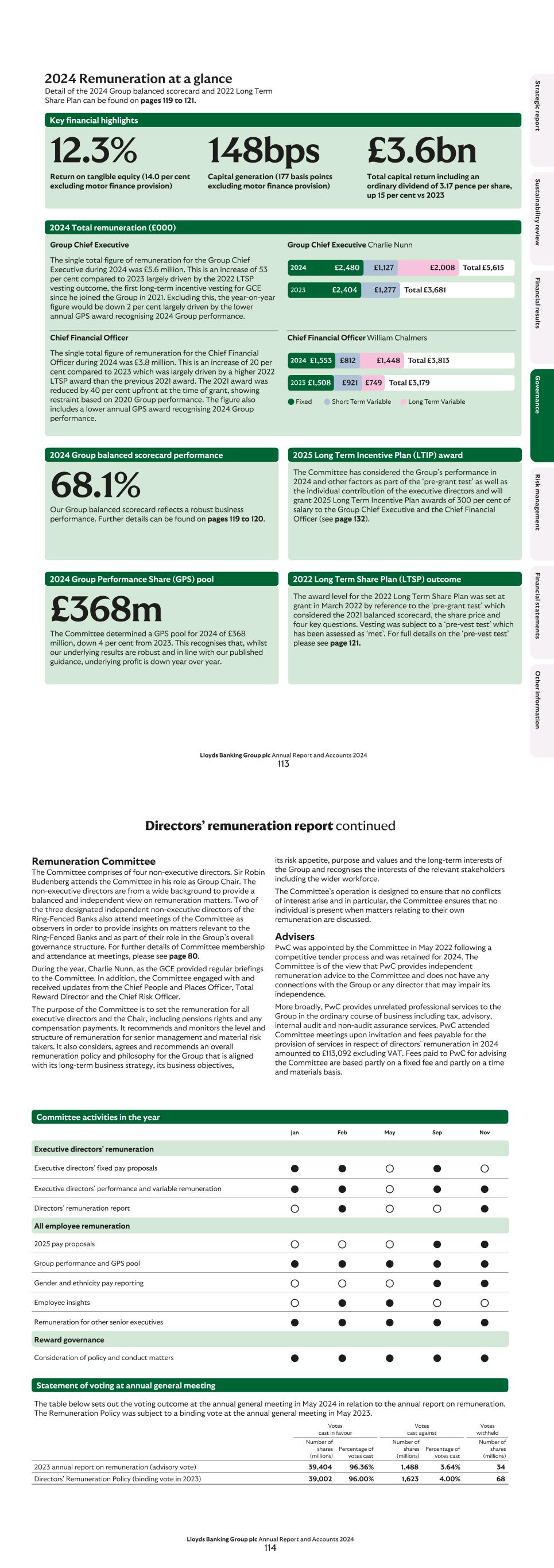
2024 Remuneration at a glance Detail of the 2024 Group balanced scorecard and 2022 Long Term Share Plan can be found on pages 119 to 121. Key financial highlights 12.3% 148bps £3.6bn Return on tangible equity (14.0 per cent excluding motor finance provision) Capital generation (177 basis points excluding motor finance provision) Total capital return including an ordinary dividend of 3.17 pence per share, up 15 per cent vs 2023 2024 Total remuneration (£000) Group Chief Executive Group Chief Executive Charlie Nunn The single total figure of remuneration for the Group Chief Executive during 2024 was £5.6 million. This is an increase of 53 per cent compared to 2023 largely driven by the 2022 LTSP vesting outcome, the first long-term incentive vesting for GCE since he joined the Group in 2021. Excluding this, the year-on-year figure would be down 2 per cent largely driven by the lower annual GPS award recognising 2024 Group performance. Chief Financial Officer Chief Financial Officer William Chalmers The single total figure of remuneration for the Chief Financial Officer during 2024 was £3.8 million. This is an increase of 20 per cent compared to 2023 which was largely driven by a higher 2022 LTSP award than the previous 2021 award. The 2021 award was reduced by 40 per cent upfront at the time of grant, showing restraint based on 2020 Group performance. The figure also includes a lower annual GPS award recognising 2024 Group performance. 2024 Group balanced scorecard performance 68.1% Our Group balanced scorecard reflects a robust business performance. Further details can be found on pages 119 to 120. 2024 Group Performance Share (GPS) pool £368m The Committee determined a GPS pool for 2024 of £368 million, down 4 per cent from 2023. This recognises that, whilst our underlying results are robust and in line with our published guidance, underlying profit is down year over year. 2025 Long Term Incentive Plan (LTIP) award The Committee has considered the Group’s performance in 2024 and other factors as part of the ‘pre-grant test’ as well as the individual contribution of the executive directors and will grant 2025 Long Term Incentive Plan awards of 300 per cent of salary to the Group Chief Executive and the Chief Financial Officer (see page 132). 2022 Long Term Share Plan (LTSP) outcome The award level for the 2022 Long Term Share Plan was set at grant in March 2022 by reference to the ‘pre-grant test’ which considered the 2021 balanced scorecard, the share price and four key questions. Vesting was subject to a ‘pre-vest test’ which has been assessed as ‘met’. For full details on the ‘pre-vest test’ please see page 121. Lloyds Banking Group plc Annual Report and Accounts 2024 113 l i ts 2 O th e r in fo rm a tio n F in a n cia l sta te m e n ts R isk m a n a ge m e n t G o ve rn a n ce F in a n cia l re su lts S u sta in a b ility re vie w S tra te gic re p o rt Remuneration Committee The Committee comprises of four non-executive directors. Sir Robin Budenberg attends the Committee in his role as Group Chair. The non-executive directors are from a wide background to provide a balanced and independent view on remuneration matters. Two of the three designated independent non-executive directors of the Ring-Fenced Banks also attend meetings of the Committee as observers in order to provide insights on matters relevant to the Ring-Fenced Banks and as part of their role in the Group’s overall governance structure. For further details of Committee membership and attendance at meetings, please see page 80. During the year, Charlie Nunn, as the GCE provided regular briefings to the Committee. In addition, the Committee engaged with and received updates from the Chief People and Places Officer, Total Reward Director and the Chief Risk Officer. The purpose of the Committee is to set the remuneration for all executive directors and the Chair, including pensions rights and any compensation payments. It recommends and monitors the level and structure of remuneration for senior management and material risk takers. It also considers, agrees and recommends an overall remuneration policy and philosophy for the Group that is aligned with its long-term business strategy, its business objectives, its risk appetite, purpose and values and the long-term interests of the Group and recognises the interests of the relevant stakeholders including the wider workforce. The Committee’s operation is designed to ensure that no conflicts of interest arise and in particular, the Committee ensures that no individual is present when matters relating to their own remuneration are discussed. Advisers PwC was appointed by the Committee in May 2022 following a competitive tender process and was retained for 2024. The Committee is of the view that PwC provides independent remuneration advice to the Committee and does not have any connections with the Group or any director that may impair its independence. More broadly, PwC provides unrelated professional services to the Group in the ordinary course of business including tax, advisory, internal audit and non-audit assurance services. PwC attended Committee meetings upon invitation and fees payable for the provision of services in respect of directors’ remuneration in 2024 amounted to £113,092 excluding VAT. Fees paid to PwC for advising the Committee are based partly on a fixed fee and partly on a time and materials basis. Committee activities in the year Jan Feb May Sep Nov Executive directors’ remuneration Executive directors’ fixed pay proposals l l ¡ l ¡ Executive directors’ performance and variable remuneration l l ¡ l l Directors’ remuneration report ¡ l ¡ ¡ l All employee remuneration 2025 pay proposals ¡ ¡ ¡ l l Group performance and GPS pool l l l l l Gender and ethnicity pay reporting ¡ ¡ ¡ l l Employee insights ¡ l l ¡ ¡ Remuneration for other senior executives l l l l l Reward governance Consideration of policy and conduct matters l l l l l Statement of voting at annual general meeting The table below sets out the voting outcome at the annual general meeting in May 2024 in relation to the annual report on remuneration. The Remuneration Policy was subject to a binding vote at the annual general meeting in May 2023. Votes cast in favour Votes cast against Votes withheld Number of shares (millions) Percentage of votes cast Number of shares (millions) Percentage of votes cast Number of shares (millions) 2023 annual report on remuneration (advisory vote) 39,404 96.36% 1,488 3.64% 34 Directors’ Remuneration Policy (binding vote in 2023) 39,002 96.00% 1,623 4.00% 68 Directors’ remuneration report continued Lloyds Banking Group plc Annual Report and Accounts 2024 114 l i ts
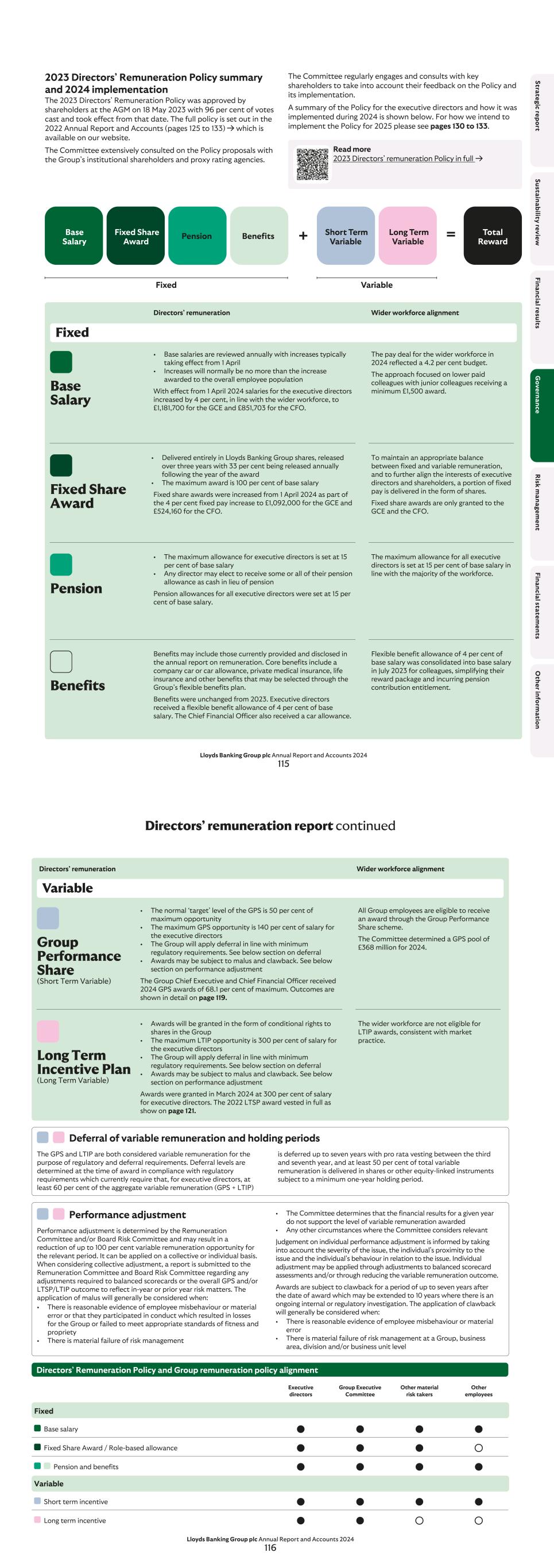
2023 Directors’ Remuneration Policy summary and 2024 implementation The 2023 Directors’ Remuneration Policy was approved by shareholders at the AGM on 18 May 2023 with 96 per cent of votes cast and took effect from that date. The full policy is set out in the 2022 Annual Report and Accounts (pages 125 to 133) which is available on our website. The Committee extensively consulted on the Policy proposals with the Group’s institutional shareholders and proxy rating agencies. The Committee regularly engages and consults with key shareholders to take into account their feedback on the Policy and its implementation. A summary of the Policy for the executive directors and how it was implemented during 2024 is shown below. For how we intend to implement the Policy for 2025 please see pages 130 to 133. Directors’ remuneration Wider workforce alignment Base Salary • Base salaries are reviewed annually with increases typically taking effect from 1 April • Increases will normally be no more than the increase awarded to the overall employee population With effect from 1 April 2024 salaries for the executive directors increased by 4 per cent, in line with the wider workforce, to £1,181,700 for the GCE and £851,703 for the CFO. The pay deal for the wider workforce in 2024 reflected a 4.2 per cent budget. The approach focused on lower paid colleagues with junior colleagues receiving a minimum £1,500 award. Fixed Share Award • Delivered entirely in Lloyds Banking Group shares, released over three years with 33 per cent being released annually following the year of the award • The maximum award is 100 per cent of base salary Fixed share awards were increased from 1 April 2024 as part of the 4 per cent fixed pay increase to £1,092,000 for the GCE and £524,160 for the CFO. To maintain an appropriate balance between fixed and variable remuneration, and to further align the interests of executive directors and shareholders, a portion of fixed pay is delivered in the form of shares. Fixed share awards are only granted to the GCE and the CFO. Pension • The maximum allowance for executive directors is set at 15 per cent of base salary • Any director may elect to receive some or all of their pension allowance as cash in lieu of pension Pension allowances for all executive directors were set at 15 per cent of base salary. The maximum allowance for all executive directors is set at 15 per cent of base salary in line with the majority of the workforce. Benefits Benefits may include those currently provided and disclosed in the annual report on remuneration. Core benefits include a company car or car allowance, private medical insurance, life insurance and other benefits that may be selected through the Group’s flexible benefits plan. Benefits were unchanged from 2023. Executive directors received a flexible benefit allowance of 4 per cent of base salary. The Chief Financial Officer also received a car allowance. Flexible benefit allowance of 4 per cent of base salary was consolidated into base salary in July 2023 for colleagues, simplifying their reward package and incurring pension contribution entitlement. Lloyds Banking Group plc Annual Report and Accounts 2024 115 l i ts 2 O th e r in fo rm a tio n F in a n cia l sta te m e n ts R isk m a n a ge m e n t G o ve rn a n ce F in a n cia l re su lts S u sta in a b ility re vie w S tra te gic re p o rt Directors’ remuneration Wider workforce alignment Group Performance Share (Short Term Variable) • The normal ‘target’ level of the GPS is 50 per cent of maximum opportunity • The maximum GPS opportunity is 140 per cent of salary for the executive directors • The Group will apply deferral in line with minimum regulatory requirements. See below section on deferral • Awards may be subject to malus and clawback. See below section on performance adjustment The Group Chief Executive and Chief Financial Officer received 2024 GPS awards of 68.1 per cent of maximum. Outcomes are shown in detail on page 119. All Group employees are eligible to receive an award through the Group Performance Share scheme. The Committee determined a GPS pool of £368 million for 2024. Long Term Incentive Plan (Long Term Variable) • Awards will be granted in the form of conditional rights to shares in the Group • The maximum LTIP opportunity is 300 per cent of salary for the executive directors • The Group will apply deferral in line with minimum regulatory requirements. See below section on deferral • Awards may be subject to malus and clawback. See below section on performance adjustment Awards were granted in March 2024 at 300 per cent of salary for executive directors. The 2022 LTSP award vested in full as show on page 121. The wider workforce are not eligible for LTIP awards, consistent with market practice. Deferral of variable remuneration and holding periods The GPS and LTIP are both considered variable remuneration for the purpose of regulatory and deferral requirements. Deferral levels are determined at the time of award in compliance with regulatory requirements which currently require that, for executive directors, at least 60 per cent of the aggregate variable remuneration (GPS + LTIP) is deferred up to seven years with pro rata vesting between the third and seventh year, and at least 50 per cent of total variable remuneration is delivered in shares or other equity-linked instruments subject to a minimum one-year holding period. Performance adjustment • The Committee determines that the financial results for a given year do not support the level of variable remuneration awarded • Any other circumstances where the Committee considers relevant Judgement on individual performance adjustment is informed by taking into account the severity of the issue, the individual’s proximity to the issue and the individual’s behaviour in relation to the issue. Individual adjustment may be applied through adjustments to balanced scorecard assessments and/or through reducing the variable remuneration outcome. Awards are subject to clawback for a period of up to seven years after the date of award which may be extended to 10 years where there is an ongoing internal or regulatory investigation. The application of clawback will generally be considered when: • There is reasonable evidence of employee misbehaviour or material error • There is material failure of risk management at a Group, business area, division and/or business unit level Performance adjustment is determined by the Remuneration Committee and/or Board Risk Committee and may result in a reduction of up to 100 per cent variable remuneration opportunity for the relevant period. It can be applied on a collective or individual basis. When considering collective adjustment, a report is submitted to the Remuneration Committee and Board Risk Committee regarding any adjustments required to balanced scorecards or the overall GPS and/or LTSP/LTIP outcome to reflect in-year or prior year risk matters. The application of malus will generally be considered when: • There is reasonable evidence of employee misbehaviour or material error or that they participated in conduct which resulted in losses for the Group or failed to meet appropriate standards of fitness and propriety • There is material failure of risk management Directors’ Remuneration Policy and Group remuneration policy alignment Executive directors Group Executive Committee Other material risk takers Other employees Fixed Base salary l l l l Fixed Share Award / Role-based allowance l l l ¡ Pension and benefits l l l l Variable Short term incentive l l l l Long term incentive l l ¡ ¡ Directors’ remuneration report continued Lloyds Banking Group plc Annual Report and Accounts 2024 116 l i ts
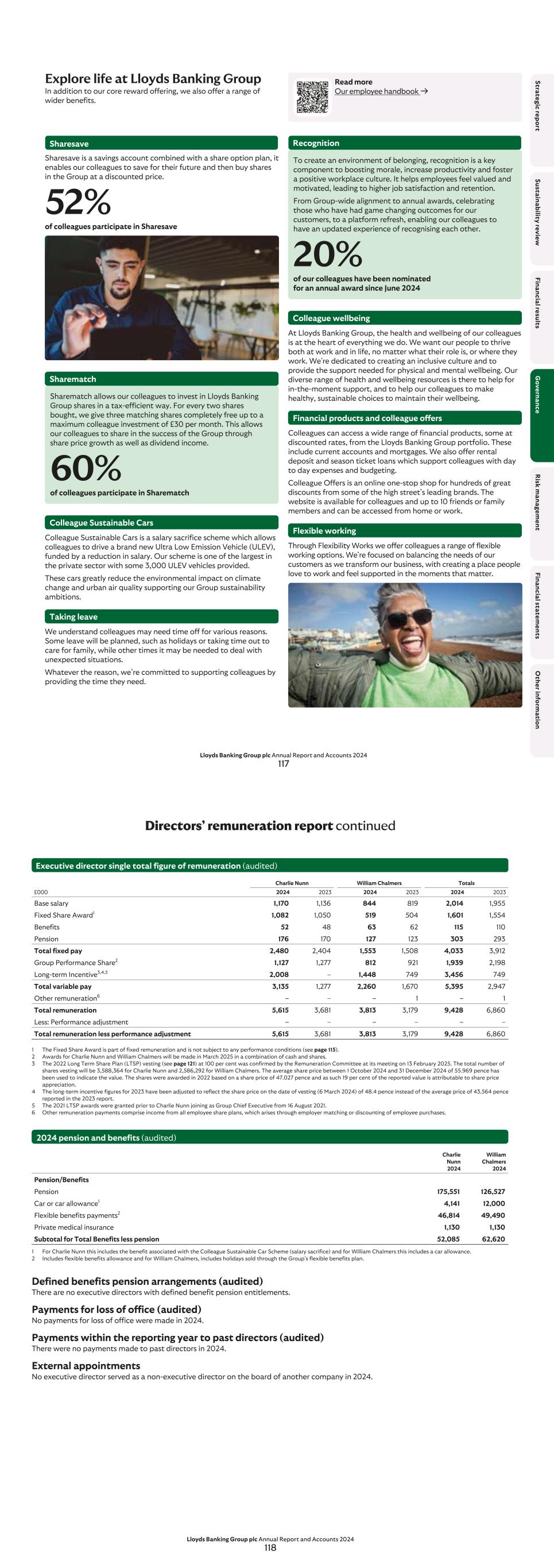
Explore life at Lloyds Banking Group In addition to our core reward offering, we also offer a range of wider benefits. Sharesave Sharesave is a savings account combined with a share option plan, it enables our colleagues to save for their future and then buy shares in the Group at a discounted price. 52% of colleagues participate in Sharesave Sharematch Sharematch allows our colleagues to invest in Lloyds Banking Group shares in a tax-efficient way. For every two shares bought, we give three matching shares completely free up to a maximum colleague investment of £30 per month. This allows our colleagues to share in the success of the Group through share price growth as well as dividend income. 60% of colleagues participate in Sharematch Colleague Sustainable Cars Colleague Sustainable Cars is a salary sacrifice scheme which allows colleagues to drive a brand new Ultra Low Emission Vehicle (ULEV), funded by a reduction in salary. Our scheme is one of the largest in the private sector with some 3,000 ULEV vehicles provided. These cars greatly reduce the environmental impact on climate change and urban air quality supporting our Group sustainability ambitions. Taking leave We understand colleagues may need time off for various reasons. Some leave will be planned, such as holidays or taking time out to care for family, while other times it may be needed to deal with unexpected situations. Whatever the reason, we’re committed to supporting colleagues by providing the time they need. Recognition To create an environment of belonging, recognition is a key component to boosting morale, increase productivity and foster a positive workplace culture. It helps employees feel valued and motivated, leading to higher job satisfaction and retention. From Group-wide alignment to annual awards, celebrating those who have had game changing outcomes for our customers, to a platform refresh, enabling our colleagues to have an updated experience of recognising each other. 20% of our colleagues have been nominated for an annual award since June 2024 Colleague wellbeing At Lloyds Banking Group, the health and wellbeing of our colleagues is at the heart of everything we do. We want our people to thrive both at work and in life, no matter what their role is, or where they work. We're dedicated to creating an inclusive culture and to provide the support needed for physical and mental wellbeing. Our diverse range of health and wellbeing resources is there to help for in-the-moment support, and to help our colleagues to make healthy, sustainable choices to maintain their wellbeing. Financial products and colleague offers Colleagues can access a wide range of financial products, some at discounted rates, from the Lloyds Banking Group portfolio. These include current accounts and mortgages. We also offer rental deposit and season ticket loans which support colleagues with day to day expenses and budgeting. Colleague Offers is an online one-stop shop for hundreds of great discounts from some of the high street’s leading brands. The website is available for colleagues and up to 10 friends or family members and can be accessed from home or work. Flexible working Through Flexibility Works we offer colleagues a range of flexible working options. We’re focused on balancing the needs of our customers as we transform our business, with creating a place people love to work and feel supported in the moments that matter. Lloyds Banking Group plc Annual Report and Accounts 2024 117 l i ts 2 O th e r in fo rm a tio n F in a n cia l sta te m e n ts R isk m a n a ge m e n t G o ve rn a n ce F in a n cia l re su lts S u sta in a b ility re vie w S tra te gic re p o rt Executive director single total figure of remuneration (audited) Charlie Nunn William Chalmers Totals £000 2024 2023 2024 2023 2024 2023 Base salary 1,170 1,136 844 819 2,014 1,955 Fixed Share Award1 1,082 1,050 519 504 1,601 1,554 Benefits 52 48 63 62 115 110 Pension 176 170 127 123 303 293 Total fixed pay 2,480 2,404 1,553 1,508 4,033 3,912 Group Performance Share2 1,127 1,277 812 921 1,939 2,198 Long-term Incentive3,4,5 2,008 – 1,448 749 3,456 749 Total variable pay 3,135 1,277 2,260 1,670 5,395 2,947 Other remuneration6 – – – 1 – 1 Total remuneration 5,615 3,681 3,813 3,179 9,428 6,860 Less: Performance adjustment – – – – – – Total remuneration less performance adjustment 5,615 3,681 3,813 3,179 9,428 6,860 1 The Fixed Share Award is part of fixed remuneration and is not subject to any performance conditions (see page 115). 2 Awards for Charlie Nunn and William Chalmers will be made in March 2025 in a combination of cash and shares. 3 The 2022 Long Term Share Plan (LTSP) vesting (see page 121) at 100 per cent was confirmed by the Remuneration Committee at its meeting on 13 February 2025. The total number of shares vesting will be 3,588,364 for Charlie Nunn and 2,586,292 for William Chalmers. The average share price between 1 October 2024 and 31 December 2024 of 55.969 pence has been used to indicate the value. The shares were awarded in 2022 based on a share price of 47.027 pence and as such 19 per cent of the reported value is attributable to share price appreciation. 4 The long-term incentive figures for 2023 have been adjusted to reflect the share price on the date of vesting (6 March 2024) of 48.4 pence instead of the average price of 43.564 pence reported in the 2023 report. 5 The 2021 LTSP awards were granted prior to Charlie Nunn joining as Group Chief Executive from 16 August 2021. 6 Other remuneration payments comprise income from all employee share plans, which arises through employer matching or discounting of employee purchases. 2024 pension and benefits (audited) Charlie Nunn 2024 William Chalmers 2024 Pension/Benefits Pension 175,551 126,527 Car or car allowance1 4,141 12,000 Flexible benefits payments2 46,814 49,490 Private medical insurance 1,130 1,130 Subtotal for Total Benefits less pension 52,085 62,620 1 For Charlie Nunn this includes the benefit associated with the Colleague Sustainable Car Scheme (salary sacrifice) and for William Chalmers this includes a car allowance. 2 Includes flexible benefits allowance and for William Chalmers, includes holidays sold through the Group's flexible benefits plan. Defined benefits pension arrangements (audited) There are no executive directors with defined benefit pension entitlements. Payments for loss of office (audited) No payments for loss of office were made in 2024. Payments within the reporting year to past directors (audited) There were no payments made to past directors in 2024. External appointments No executive director served as a non-executive director on the board of another company in 2024. Directors’ remuneration report continued Lloyds Banking Group plc Annual Report and Accounts 2024 118 l i ts
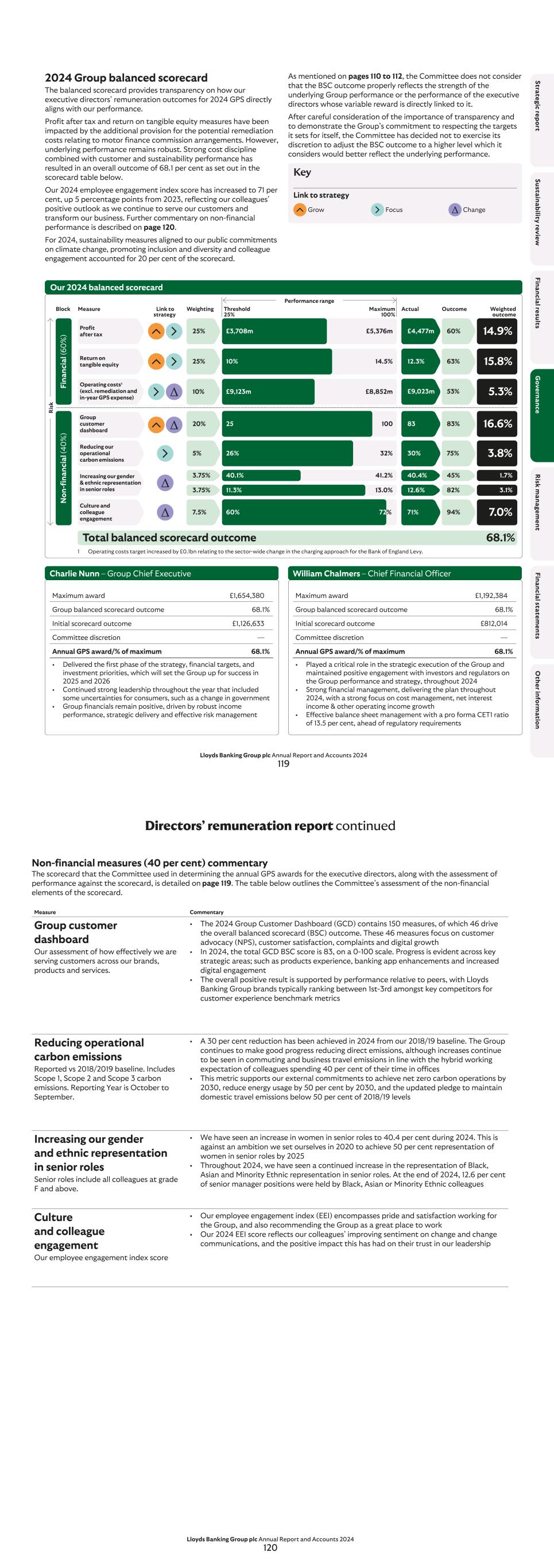
2024 Group balanced scorecard The balanced scorecard provides transparency on how our executive directors’ remuneration outcomes for 2024 GPS directly aligns with our performance. Profit after tax and return on tangible equity measures have been impacted by the additional provision for the potential remediation costs relating to motor finance commission arrangements. However, underlying performance remains robust. Strong cost discipline combined with customer and sustainability performance has resulted in an overall outcome of 68.1 per cent as set out in the scorecard table below. Our 2024 employee engagement index score has increased to 71 per cent, up 5 percentage points from 2023, reflecting our colleagues’ positive outlook as we continue to serve our customers and transform our business. Further commentary on non-financial performance is described on page 120. For 2024, sustainability measures aligned to our public commitments on climate change, promoting inclusion and diversity and colleague engagement accounted for 20 per cent of the scorecard. As mentioned on pages 110 to 112, the Committee does not consider that the BSC outcome properly reflects the strength of the underlying Group performance or the performance of the executive directors whose variable reward is directly linked to it. After careful consideration of the importance of transparency and to demonstrate the Group’s commitment to respecting the targets it sets for itself, the Committee has decided not to exercise its discretion to adjust the BSC outcome to a higher level which it considers would better reflect the underlying performance. Charlie Nunn – Group Chief Executive Maximum award £1,654,380 Group balanced scorecard outcome 68.1% Initial scorecard outcome £1,126,633 Committee discretion — Annual GPS award/% of maximum 68.1% • Delivered the first phase of the strategy, financial targets, and investment priorities, which will set the Group up for success in 2025 and 2026 • Continued strong leadership throughout the year that included some uncertainties for consumers, such as a change in government • Group financials remain positive, driven by robust income performance, strategic delivery and effective risk management William Chalmers – Chief Financial Officer Maximum award £1,192,384 Group balanced scorecard outcome 68.1% Initial scorecard outcome £812,014 Committee discretion — Annual GPS award/% of maximum 68.1% • Played a critical role in the strategic execution of the Group and maintained positive engagement with investors and regulators on the Group performance and strategy, throughout 2024 • Strong financial management, delivering the plan throughout 2024, with a strong focus on cost management, net interest income & other operating income growth • Effective balance sheet management with a pro forma CET1 ratio of 13.5 per cent, ahead of regulatory requirements Lloyds Banking Group plc Annual Report and Accounts 2024 119 Our 2024 balanced scorecard l i ts 2 O th e r in fo rm a tio n F in a n cia l sta te m e n ts R isk m a n a ge m e n t G o ve rn a n ce F in a n cia l re su lts S u sta in a b ility re vie w S tra te gic re p o rt Non-financial measures (40 per cent) commentary The scorecard that the Committee used in determining the annual GPS awards for the executive directors, along with the assessment of performance against the scorecard, is detailed on page 119. The table below outlines the Committee’s assessment of the non-financial elements of the scorecard. Measure Commentary Group customer dashboard Our assessment of how effectively we are serving customers across our brands, products and services. • The 2024 Group Customer Dashboard (GCD) contains 150 measures, of which 46 drive the overall balanced scorecard (BSC) outcome. These 46 measures focus on customer advocacy (NPS), customer satisfaction, complaints and digital growth • In 2024, the total GCD BSC score is 83, on a 0-100 scale. Progress is evident across key strategic areas; such as products experience, banking app enhancements and increased digital engagement • The overall positive result is supported by performance relative to peers, with Lloyds Banking Group brands typically ranking between 1st-3rd amongst key competitors for customer experience benchmark metrics Reducing operational carbon emissions Reported vs 2018/2019 baseline. Includes Scope 1, Scope 2 and Scope 3 carbon emissions. Reporting Year is October to September. • A 30 per cent reduction has been achieved in 2024 from our 2018/19 baseline. The Group continues to make good progress reducing direct emissions, although increases continue to be seen in commuting and business travel emissions in line with the hybrid working expectation of colleagues spending 40 per cent of their time in offices • This metric supports our external commitments to achieve net zero carbon operations by 2030, reduce energy usage by 50 per cent by 2030, and the updated pledge to maintain domestic travel emissions below 50 per cent of 2018/19 levels Increasing our gender and ethnic representation in senior roles Senior roles include all colleagues at grade F and above. • We have seen an increase in women in senior roles to 40.4 per cent during 2024. This is against an ambition we set ourselves in 2020 to achieve 50 per cent representation of women in senior roles by 2025 • Throughout 2024, we have seen a continued increase in the representation of Black, Asian and Minority Ethnic representation in senior roles. At the end of 2024, 12.6 per cent of senior manager positions were held by Black, Asian or Minority Ethnic colleagues Culture and colleague engagement Our employee engagement index score • Our employee engagement index (EEI) encompasses pride and satisfaction working for the Group, and also recommending the Group as a great place to work • Our 2024 EEI score reflects our colleagues’ improving sentiment on change and change communications, and the positive impact this has had on their trust in our leadership Directors’ remuneration report continued Lloyds Banking Group plc Annual Report and Accounts 2024 120 l i ts
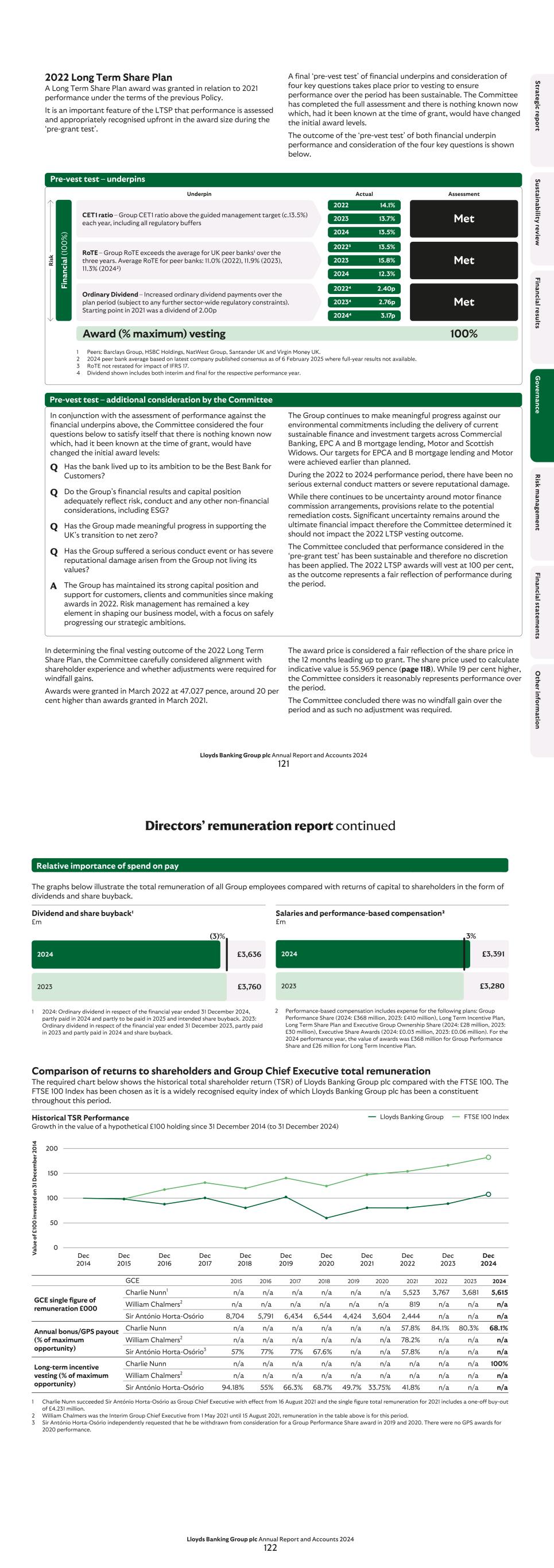
2022 Long Term Share Plan A Long Term Share Plan award was granted in relation to 2021 performance under the terms of the previous Policy. It is an important feature of the LTSP that performance is assessed and appropriately recognised upfront in the award size during the ‘pre-grant test’. A final ‘pre-vest test’ of financial underpins and consideration of four key questions takes place prior to vesting to ensure performance over the period has been sustainable. The Committee has completed the full assessment and there is nothing known now which, had it been known at the time of grant, would have changed the initial award levels. The outcome of the ‘pre-vest test’ of both financial underpin performance and consideration of the four key questions is shown below. Pre-vest test – additional consideration by the Committee In conjunction with the assessment of performance against the financial underpins above, the Committee considered the four questions below to satisfy itself that there is nothing known now which, had it been known at the time of grant, would have changed the initial award levels: The Group continues to make meaningful progress against our environmental commitments including the delivery of current sustainable finance and investment targets across Commercial Banking, EPC A and B mortgage lending, Motor and Scottish Widows. Our targets for EPCA and B mortgage lending and Motor were achieved earlier than planned. During the 2022 to 2024 performance period, there have been no serious external conduct matters or severe reputational damage. While there continues to be uncertainty around motor finance commission arrangements, provisions relate to the potential remediation costs. Significant uncertainty remains around the ultimate financial impact therefore the Committee determined it should not impact the 2022 LTSP vesting outcome. The Committee concluded that performance considered in the ‘pre-grant test’ has been sustainable and therefore no discretion has been applied. The 2022 LTSP awards will vest at 100 per cent, as the outcome represents a fair reflection of performance during the period. Q Has the bank lived up to its ambition to be the Best Bank for Customers? Q Do the Group’s financial results and capital position adequately reflect risk, conduct and any other non-financial considerations, including ESG? Q Has the Group made meaningful progress in supporting the UK’s transition to net zero? Q Has the Group suffered a serious conduct event or has severe reputational damage arisen from the Group not living its values? A The Group has maintained its strong capital position and support for customers, clients and communities since making awards in 2022. Risk management has remained a key element in shaping our business model, with a focus on safely progressing our strategic ambitions. In determining the final vesting outcome of the 2022 Long Term Share Plan, the Committee carefully considered alignment with shareholder experience and whether adjustments were required for windfall gains. Awards were granted in March 2022 at 47.027 pence, around 20 per cent higher than awards granted in March 2021. The award price is considered a fair reflection of the share price in the 12 months leading up to grant. The share price used to calculate indicative value is 55.969 pence (page 118). While 19 per cent higher, the Committee considers it reasonably represents performance over the period. The Committee concluded there was no windfall gain over the period and as such no adjustment was required. Lloyds Banking Group plc Annual Report and Accounts 2024 121 Pre-vest test – underpins 1 Peers: Barclays Group, HSBC Holdings, NatWest Group, Santander UK and Virgin Money UK. 2 2024 peer bank average based on latest company published consensus as of 6 February 2025 where full-year results not available. 3 RoTE not restated for impact of IFRS 17. 4 Dividend shown includes both interim and final for the respective performance year. l i ts 2 O th e r in fo rm a tio n F in a n cia l sta te m e n ts R isk m a n a ge m e n t G o ve rn a n ce F in a n cia l re su lts S u sta in a b ility re vie w S tra te gic re p o rt Relative importance of spend on pay The graphs below illustrate the total remuneration of all Group employees compared with returns of capital to shareholders in the form of dividends and share buyback. 1 2024: Ordinary dividend in respect of the financial year ended 31 December 2024, partly paid in 2024 and partly to be paid in 2025 and intended share buyback. 2023: Ordinary dividend in respect of the financial year ended 31 December 2023, partly paid in 2023 and partly paid in 2024 and share buyback. 2 Performance-based compensation includes expense for the following plans: Group Performance Share (2024: £368 million, 2023: £410 million), Long Term Incentive Plan, Long Term Share Plan and Executive Group Ownership Share (2024: £28 million, 2023: £30 million), Executive Share Awards (2024: £0.03 million, 2023: £0.06 million). For the 2024 performance year, the value of awards was £368 million for Group Performance Share and £26 million for Long Term Incentive Plan. Comparison of returns to shareholders and Group Chief Executive total remuneration The required chart below shows the historical total shareholder return (TSR) of Lloyds Banking Group plc compared with the FTSE 100. The FTSE 100 Index has been chosen as it is a widely recognised equity index of which Lloyds Banking Group plc has been a constituent throughout this period. GCE 2015 2016 2017 2018 2019 2020 2021 2022 2023 2024 GCE single figure of remuneration £000 Charlie Nunn1 n/a n/a n/a n/a n/a n/a 5,523 3,767 3,681 5,615 William Chalmers2 n/a n/a n/a n/a n/a n/a 819 n/a n/a n/a Sir António Horta-Osório 8,704 5,791 6,434 6,544 4,424 3,604 2,444 n/a n/a n/a Annual bonus/GPS payout (% of maximum opportunity) Charlie Nunn n/a n/a n/a n/a n/a n/a 57.8 % 84.1 % 80.3 % 68.1 % William Chalmers2 n/a n/a n/a n/a n/a n/a 78.2 % n/a n/a n/a Sir António Horta-Osório3 57 % 77 % 77 % 67.6 % n/a n/a 57.8 % n/a n/a n/a Long-term incentive vesting (% of maximum opportunity) Charlie Nunn n/a n/a n/a n/a n/a n/a n/a n/a n/a 100 % William Chalmers2 n/a n/a n/a n/a n/a n/a n/a n/a n/a n/a Sir António Horta-Osório 94.18 % 55 % 66.3 % 68.7 % 49.7 % 33.75 % 41.8 % n/a n/a n/a 1 Charlie Nunn succeeded Sir António Horta-Osório as Group Chief Executive with effect from 16 August 2021 and the single figure total remuneration for 2021 includes a one-off buy-out of £4.231 million. 2 William Chalmers was the Interim Group Chief Executive from 1 May 2021 until 15 August 2021, remuneration in the table above is for this period. 3 Sir António Horta-Osório independently requested that he be withdrawn from consideration for a Group Performance Share award in 2019 and 2020. There were no GPS awards for 2020 performance. Directors’ remuneration report continued Lloyds Banking Group plc Annual Report and Accounts 2024 122 l i ts
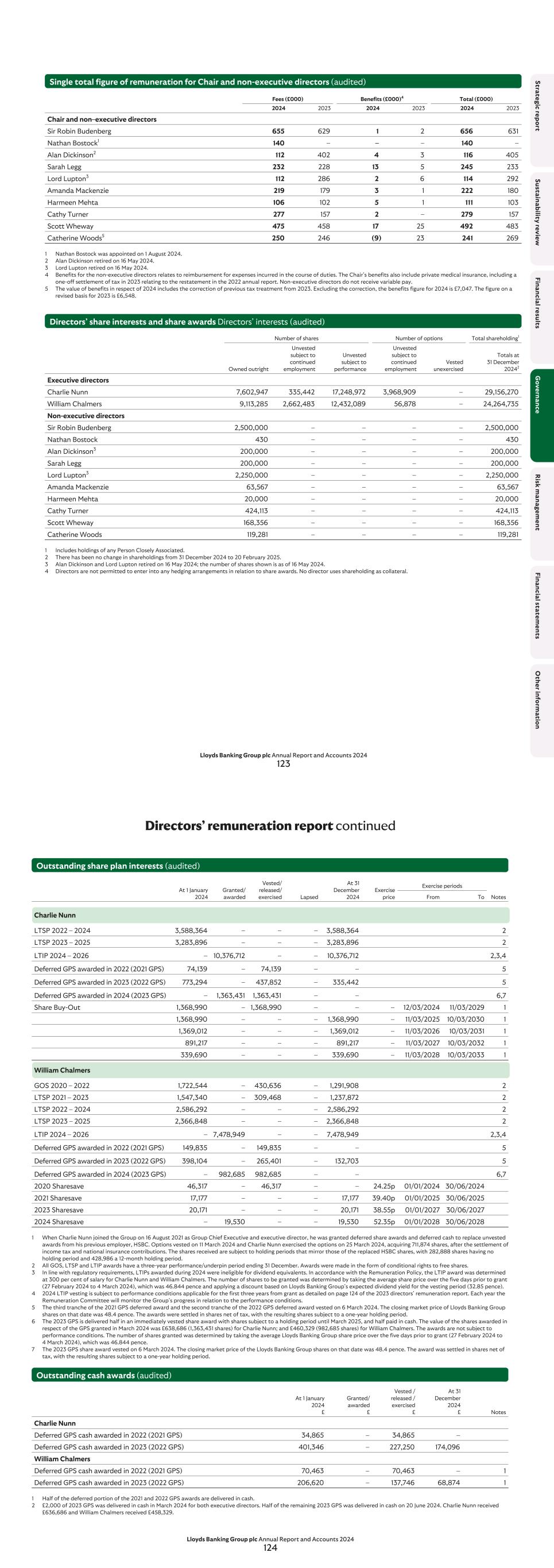
Single total figure of remuneration for Chair and non-executive directors (audited) Fees (£000) Benefits (£000)4 Total (£000) 2024 2023 2024 2023 2024 2023 Chair and non–executive directors Sir Robin Budenberg 655 629 1 2 656 631 Nathan Bostock1 140 – – – 140 – Alan Dickinson2 112 402 4 3 116 405 Sarah Legg 232 228 13 5 245 233 Lord Lupton3 112 286 2 6 114 292 Amanda Mackenzie 219 179 3 1 222 180 Harmeen Mehta 106 102 5 1 111 103 Cathy Turner 277 157 2 – 279 157 Scott Wheway 475 458 17 25 492 483 Catherine Woods5 250 246 (9) 23 241 269 1 Nathan Bostock was appointed on 1 August 2024. 2 Alan Dickinson retired on 16 May 2024. 3 Lord Lupton retired on 16 May 2024. 4 Benefits for the non-executive directors relates to reimbursement for expenses incurred in the course of duties. The Chair’s benefits also include private medical insurance, including a one-off settlement of tax in 2023 relating to the restatement in the 2022 annual report. Non-executive directors do not receive variable pay. 5 The value of benefits in respect of 2024 includes the correction of previous tax treatment from 2023. Excluding the correction, the benefits figure for 2024 is £7,047. The figure on a revised basis for 2023 is £6,548. Directors’ share interests and share awards Directors’ interests (audited) Number of shares Number of options Total shareholding1 Owned outright Unvested subject to continued employment Unvested subject to performance Unvested subject to continued employment Vested unexercised Totals at 31 December 20242 Executive directors Charlie Nunn 7,602,947 335,442 17,248,972 3,968,909 – 29,156,270 William Chalmers 9,113,285 2,662,483 12,432,089 56,878 – 24,264,735 Non-executive directors Sir Robin Budenberg 2,500,000 – – – – 2,500,000 Nathan Bostock 430 – – – – 430 Alan Dickinson3 200,000 – – – – 200,000 Sarah Legg 200,000 – – – – 200,000 Lord Lupton3 2,250,000 – – – – 2,250,000 Amanda Mackenzie 63,567 – – – – 63,567 Harmeen Mehta 20,000 – – – – 20,000 Cathy Turner 424,113 – – – – 424,113 Scott Wheway 168,356 – – – – 168,356 Catherine Woods 119,281 – – – – 119,281 1 Includes holdings of any Person Closely Associated. 2 There has been no change in shareholdings from 31 December 2024 to 20 February 2025. 3 Alan Dickinson and Lord Lupton retired on 16 May 2024; the number of shares shown is as of 16 May 2024. 4 Directors are not permitted to enter into any hedging arrangements in relation to share awards. No director uses shareholding as collateral. Lloyds Banking Group plc Annual Report and Accounts 2024 123 l i ts 2 O th e r in fo rm a tio n F in a n cia l sta te m e n ts R isk m a n a ge m e n t G o ve rn a n ce F in a n cia l re su lts S u sta in a b ility re vie w S tra te gic re p o rt Outstanding share plan interests (audited) At 1 January 2024 Granted/ awarded Vested/ released/ exercised Lapsed At 31 December 2024 Exercise price Exercise periods From To Notes Charlie Nunn LTSP 2022 – 2024 3,588,364 – – – 3,588,364 2 LTSP 2023 – 2025 3,283,896 – – – 3,283,896 2 LTIP 2024 – 2026 – 10,376,712 – – 10,376,712 2,3,4 Deferred GPS awarded in 2022 (2021 GPS) 74,139 – 74,139 – – 5 Deferred GPS awarded in 2023 (2022 GPS) 773,294 – 437,852 – 335,442 5 Deferred GPS awarded in 2024 (2023 GPS) – 1,363,431 1,363,431 – – 6,7 Share Buy-Out 1,368,990 – 1,368,990 – – – 12/03/2024 11/03/2029 1 1,368,990 – – – 1,368,990 – 11/03/2025 10/03/2030 1 1,369,012 – – – 1,369,012 – 11/03/2026 10/03/2031 1 891,217 – – – 891,217 – 11/03/2027 10/03/2032 1 339,690 – – – 339,690 – 11/03/2028 10/03/2033 1 William Chalmers GOS 2020 – 2022 1,722,544 – 430,636 – 1,291,908 2 LTSP 2021 – 2023 1,547,340 – 309,468 – 1,237,872 2 LTSP 2022 – 2024 2,586,292 – – – 2,586,292 2 LTSP 2023 – 2025 2,366,848 – – – 2,366,848 2 LTIP 2024 – 2026 – 7,478,949 – – 7,478,949 2,3,4 Deferred GPS awarded in 2022 (2021 GPS) 149,835 – 149,835 – – 5 Deferred GPS awarded in 2023 (2022 GPS) 398,104 – 265,401 – 132,703 5 Deferred GPS awarded in 2024 (2023 GPS) – 982,685 982,685 – – 6,7 2020 Sharesave 46,317 – 46,317 – – 24.25p 01/01/2024 30/06/2024 2021 Sharesave 17,177 – – – 17,177 39.40p 01/01/2025 30/06/2025 2023 Sharesave 20,171 – – – 20,171 38.55p 01/01/2027 30/06/2027 2024 Sharesave – 19,530 – – 19,530 52.35p 01/01/2028 30/06/2028 1 When Charlie Nunn joined the Group on 16 August 2021 as Group Chief Executive and executive director, he was granted deferred share awards and deferred cash to replace unvested awards from his previous employer, HSBC. Options vested on 11 March 2024 and Charlie Nunn exercised the options on 25 March 2024, acquiring 711,874 shares, after the settlement of income tax and national insurance contributions. The shares received are subject to holding periods that mirror those of the replaced HSBC shares, with 282,888 shares having no holding period and 428,986 a 12-month holding period. 2 All GOS, LTSP and LTIP awards have a three-year performance/underpin period ending 31 December. Awards were made in the form of conditional rights to free shares. 3 In line with regulatory requirements, LTIPs awarded during 2024 were ineligible for dividend equivalents. In accordance with the Remuneration Policy, the LTIP award was determined at 300 per cent of salary for Charlie Nunn and William Chalmers. The number of shares to be granted was determined by taking the average share price over the five days prior to grant (27 February 2024 to 4 March 2024), which was 46.844 pence and applying a discount based on Lloyds Banking Group’s expected dividend yield for the vesting period (32.85 pence). 4 2024 LTIP vesting is subject to performance conditions applicable for the first three years from grant as detailed on page 124 of the 2023 directors’ remuneration report. Each year the Remuneration Committee will monitor the Group’s progress in relation to the performance conditions. 5 The third tranche of the 2021 GPS deferred award and the second tranche of the 2022 GPS deferred award vested on 6 March 2024. The closing market price of Lloyds Banking Group shares on that date was 48.4 pence. The awards were settled in shares net of tax, with the resulting shares subject to a one-year holding period. 6 The 2023 GPS is delivered half in an immediately vested share award with shares subject to a holding period until March 2025, and half paid in cash. The value of the shares awarded in respect of the GPS granted in March 2024 was £638,686 (1,363,431 shares) for Charlie Nunn; and £460,329 (982,685 shares) for William Chalmers. The awards are not subject to performance conditions. The number of shares granted was determined by taking the average Lloyds Banking Group share price over the five days prior to grant (27 February 2024 to 4 March 2024), which was 46.844 pence. 7 The 2023 GPS share award vested on 6 March 2024. The closing market price of the Lloyds Banking Group shares on that date was 48.4 pence. The award was settled in shares net of tax, with the resulting shares subject to a one-year holding period. Outstanding cash awards (audited) At 1 January 2024 £ Granted/ awarded £ Vested / released / exercised £ At 31 December 2024 £ Notes Charlie Nunn Deferred GPS cash awarded in 2022 (2021 GPS) 34,865 – 34,865 – Deferred GPS cash awarded in 2023 (2022 GPS) 401,346 – 227,250 174,096 William Chalmers Deferred GPS cash awarded in 2022 (2021 GPS) 70,463 – 70,463 – 1 Deferred GPS cash awarded in 2023 (2022 GPS) 206,620 – 137,746 68,874 1 1 Half of the deferred portion of the 2021 and 2022 GPS awards are delivered in cash. 2 £2,000 of 2023 GPS was delivered in cash in March 2024 for both executive directors. Half of the remaining 2023 GPS was delivered in cash on 20 June 2024. Charlie Nunn received £636,686 and William Chalmers received £458,329. Directors’ remuneration report continued Lloyds Banking Group plc Annual Report and Accounts 2024 124 l i ts
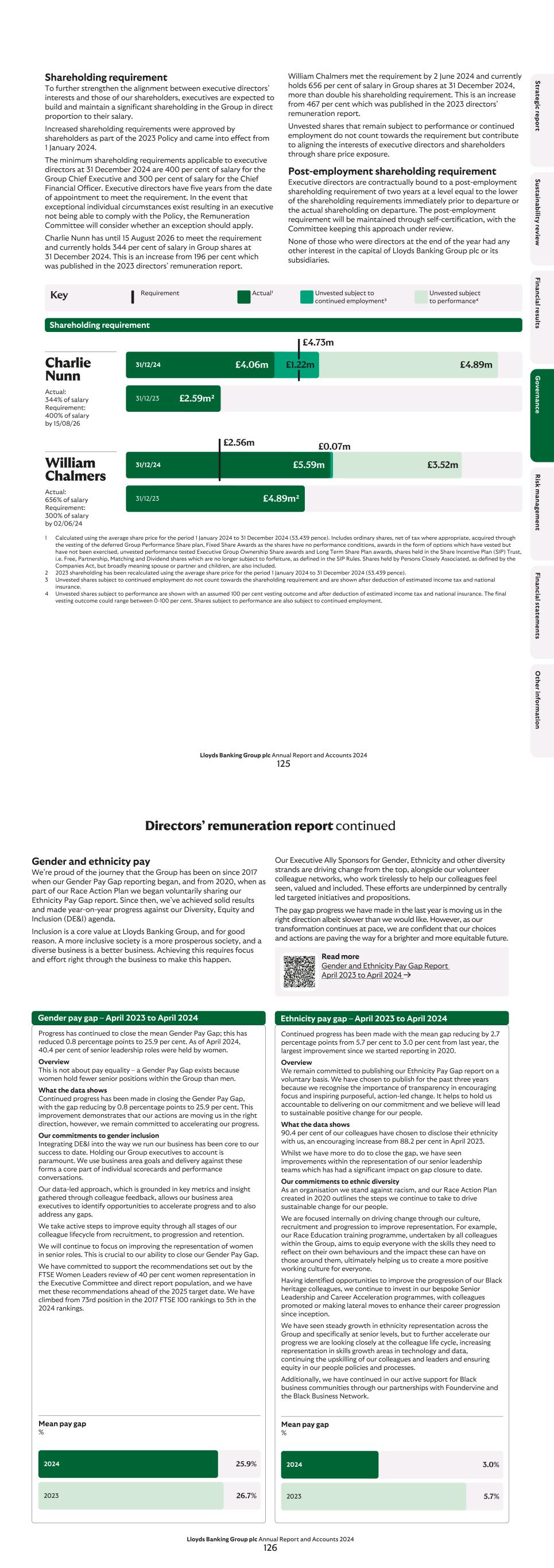
Shareholding requirement To further strengthen the alignment between executive directors’ interests and those of our shareholders, executives are expected to build and maintain a significant shareholding in the Group in direct proportion to their salary. Increased shareholding requirements were approved by shareholders as part of the 2023 Policy and came into effect from 1 January 2024. The minimum shareholding requirements applicable to executive directors at 31 December 2024 are 400 per cent of salary for the Group Chief Executive and 300 per cent of salary for the Chief Financial Officer. Executive directors have five years from the date of appointment to meet the requirement. In the event that exceptional individual circumstances exist resulting in an executive not being able to comply with the Policy, the Remuneration Committee will consider whether an exception should apply. Charlie Nunn has until 15 August 2026 to meet the requirement and currently holds 344 per cent of salary in Group shares at 31 December 2024. This is an increase from 196 per cent which was published in the 2023 directors’ remuneration report. William Chalmers met the requirement by 2 June 2024 and currently holds 656 per cent of salary in Group shares at 31 December 2024, more than double his shareholding requirement. This is an increase from 467 per cent which was published in the 2023 directors’ remuneration report. Unvested shares that remain subject to performance or continued employment do not count towards the requirement but contribute to aligning the interests of executive directors and shareholders through share price exposure. Post-employment shareholding requirement Executive directors are contractually bound to a post-employment shareholding requirement of two years at a level equal to the lower of the shareholding requirements immediately prior to departure or the actual shareholding on departure. The post-employment requirement will be maintained through self-certification, with the Committee keeping this approach under review. None of those who were directors at the end of the year had any other interest in the capital of Lloyds Banking Group plc or its subsidiaries. 1 Calculated using the average share price for the period 1 January 2024 to 31 December 2024 (53.439 pence). Includes ordinary shares, net of tax where appropriate, acquired through the vesting of the deferred Group Performance Share plan, Fixed Share Awards as the shares have no performance conditions, awards in the form of options which have vested but have not been exercised, unvested performance tested Executive Group Ownership Share awards and Long Term Share Plan awards, shares held in the Share Incentive Plan (SIP) Trust, i.e. Free, Partnership, Matching and Dividend shares which are no longer subject to forfeiture, as defined in the SIP Rules. Shares held by Persons Closely Associated, as defined by the Companies Act, but broadly meaning spouse or partner and children, are also included. 2 2023 shareholding has been recalculated using the average share price for the period 1 January 2024 to 31 December 2024 (53.439 pence). 3 Unvested shares subject to continued employment do not count towards the shareholding requirement and are shown after deduction of estimated income tax and national insurance. 4 Unvested shares subject to performance are shown with an assumed 100 per cent vesting outcome and after deduction of estimated income tax and national insurance. The final vesting outcome could range between 0-100 per cent. Shares subject to performance are also subject to continued employment. Lloyds Banking Group plc Annual Report and Accounts 2024 125 Shareholding requirement l i ts 2 O th e r in fo rm a tio n F in a n cia l sta te m e n ts R isk m a n a ge m e n t G o ve rn a n ce F in a n cia l re su lts S u sta in a b ility re vie w S tra te gic re p o rt Gender and ethnicity pay We’re proud of the journey that the Group has been on since 2017 when our Gender Pay Gap reporting began, and from 2020, when as part of our Race Action Plan we began voluntarily sharing our Ethnicity Pay Gap report. Since then, we’ve achieved solid results and made year-on-year progress against our Diversity, Equity and Inclusion (DE&I) agenda. Inclusion is a core value at Lloyds Banking Group, and for good reason. A more inclusive society is a more prosperous society, and a diverse business is a better business. Achieving this requires focus and effort right through the business to make this happen. Our Executive Ally Sponsors for Gender, Ethnicity and other diversity strands are driving change from the top, alongside our volunteer colleague networks, who work tirelessly to help our colleagues feel seen, valued and included. These efforts are underpinned by centrally led targeted initiatives and propositions. The pay gap progress we have made in the last year is moving us in the right direction albeit slower than we would like. However, as our transformation continues at pace, we are confident that our choices and actions are paving the way for a brighter and more equitable future. Directors’ remuneration report continued Lloyds Banking Group plc Annual Report and Accounts 2024 126 Gender pay gap – April 2023 to April 2024 Progress has continued to close the mean Gender Pay Gap; this has reduced 0.8 percentage points to 25.9 per cent. As of April 2024, 40.4 per cent of senior leadership roles were held by women. Overview This is not about pay equality – a Gender Pay Gap exists because women hold fewer senior positions within the Group than men. What the data shows Continued progress has been made in closing the Gender Pay Gap, with the gap reducing by 0.8 percentage points to 25.9 per cent. This improvement demonstrates that our actions are moving us in the right direction, however, we remain committed to accelerating our progress. Our commitments to gender inclusion Integrating DE&I into the way we run our business has been core to our success to date. Holding our Group executives to account is paramount. We use business area goals and delivery against these forms a core part of individual scorecards and performance conversations. Our data-led approach, which is grounded in key metrics and insight gathered through colleague feedback, allows our business area executives to identify opportunities to accelerate progress and to also address any gaps. We take active steps to improve equity through all stages of our colleague lifecycle from recruitment, to progression and retention. We will continue to focus on improving the representation of women in senior roles. This is crucial to our ability to close our Gender Pay Gap. We have committed to support the recommendations set out by the FTSE Women Leaders review of 40 per cent women representation in the Executive Committee and direct report population, and we have met these recommendations ahead of the 2025 target date. We have climbed from 73rd position in the 2017 FTSE 100 rankings to 5th in the 2024 rankings. Ethnicity pay gap – April 2023 to April 2024 Continued progress has been made with the mean gap reducing by 2.7 percentage points from 5.7 per cent to 3.0 per cent from last year, the largest improvement since we started reporting in 2020. Overview We remain committed to publishing our Ethnicity Pay Gap report on a voluntary basis. We have chosen to publish for the past three years because we recognise the importance of transparency in encouraging focus and inspiring purposeful, action-led change. It helps to hold us accountable to delivering on our commitment and we believe will lead to sustainable positive change for our people. What the data shows 90.4 per cent of our colleagues have chosen to disclose their ethnicity with us, an encouraging increase from 88.2 per cent in April 2023. Whilst we have more to do to close the gap, we have seen improvements within the representation of our senior leadership teams which has had a significant impact on gap closure to date. Our commitments to ethnic diversity As an organisation we stand against racism, and our Race Action Plan created in 2020 outlines the steps we continue to take to drive sustainable change for our people. We are focused internally on driving change through our culture, recruitment and progression to improve representation. For example, our Race Education training programme, undertaken by all colleagues within the Group, aims to equip everyone with the skills they need to reflect on their own behaviours and the impact these can have on those around them, ultimately helping us to create a more positive working culture for everyone. Having identified opportunities to improve the progression of our Black heritage colleagues, we continue to invest in our bespoke Senior Leadership and Career Acceleration programmes, with colleagues promoted or making lateral moves to enhance their career progression since inception. We have seen steady growth in ethnicity representation across the Group and specifically at senior levels, but to further accelerate our progress we are looking closely at the colleague life cycle, increasing representation in skills growth areas in technology and data, continuing the upskilling of our colleagues and leaders and ensuring equity in our people policies and processes. Additionally, we have continued in our active support for Black business communities through our partnerships with Foundervine and the Black Business Network. l i ts
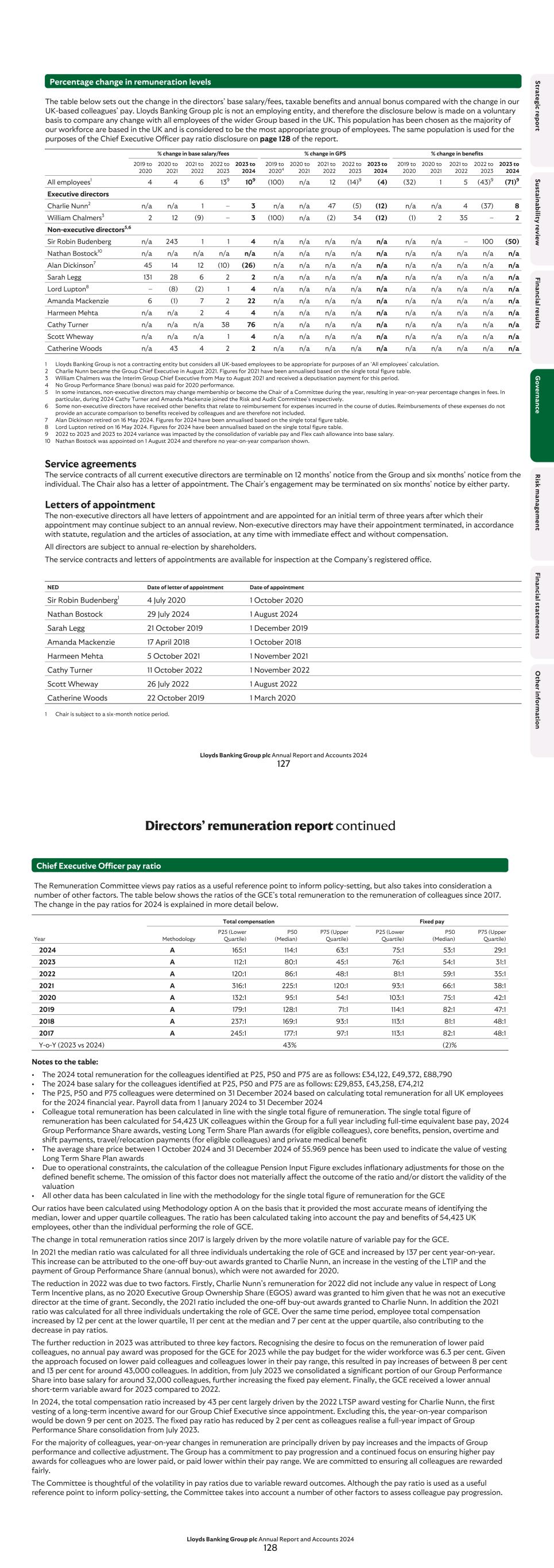
Percentage change in remuneration levels The table below sets out the change in the directors’ base salary/fees, taxable benefits and annual bonus compared with the change in our UK-based colleagues’ pay. Lloyds Banking Group plc is not an employing entity, and therefore the disclosure below is made on a voluntary basis to compare any change with all employees of the wider Group based in the UK. This population has been chosen as the majority of our workforce are based in the UK and is considered to be the most appropriate group of employees. The same population is used for the purposes of the Chief Executive Officer pay ratio disclosure on page 128 of the report. % change in base salary/fees % change in GPS % change in benefits 2019 to 2020 2020 to 2021 2021 to 2022 2022 to 2023 2023 to 2024 2019 to 20204 2020 to 2021 2021 to 2022 2022 to 2023 2023 to 2024 2019 to 2020 2020 to 2021 2021 to 2022 2022 to 2023 2023 to 2024 All employees1 4 4 6 139 109 (100) n/a 12 (14)9 (4) (32) 1 5 (43)9 (71)9 Executive directors Charlie Nunn2 n/a n/a 1 – 3 n/a n/a 47 (5) (12) n/a n/a 4 (37) 8 William Chalmers3 2 12 (9) – 3 (100) n/a (2) 34 (12) (1) 2 35 – 2 Non-executive directors5,6 Sir Robin Budenberg n/a 243 1 1 4 n/a n/a n/a n/a n/a n/a n/a – 100 (50) Nathan Bostock10 n/a n/a n/a n/a n/a n/a n/a n/a n/a n/a n/a n/a n/a n/a n/a Alan Dickinson7 45 14 12 (10) (26) n/a n/a n/a n/a n/a n/a n/a n/a n/a n/a Sarah Legg 131 28 6 2 2 n/a n/a n/a n/a n/a n/a n/a n/a n/a n/a Lord Lupton8 – (8) (2) 1 4 n/a n/a n/a n/a n/a n/a n/a n/a n/a n/a Amanda Mackenzie 6 (1) 7 2 22 n/a n/a n/a n/a n/a n/a n/a n/a n/a n/a Harmeen Mehta n/a n/a 2 4 4 n/a n/a n/a n/a n/a n/a n/a n/a n/a n/a Cathy Turner n/a n/a n/a 38 76 n/a n/a n/a n/a n/a n/a n/a n/a n/a n/a Scott Wheway n/a n/a n/a 1 4 n/a n/a n/a n/a n/a n/a n/a n/a n/a n/a Catherine Woods n/a 43 4 2 2 n/a n/a n/a n/a n/a n/a n/a n/a n/a n/a 1 Lloyds Banking Group is not a contracting entity but considers all UK-based employees to be appropriate for purposes of an ‘All employees’ calculation. 2 Charlie Nunn became the Group Chief Executive in August 2021. Figures for 2021 have been annualised based on the single total figure table. 3 William Chalmers was the Interim Group Chief Executive from May to August 2021 and received a deputisation payment for this period. 4 No Group Performance Share (bonus) was paid for 2020 performance. 5 In some instances, non-executive directors may change membership or become the Chair of a Committee during the year, resulting in year-on-year percentage changes in fees. In particular, during 2024 Cathy Turner and Amanda Mackenzie joined the Risk and Audit Committee’s respectively. 6 Some non-executive directors have received other benefits that relate to reimbursement for expenses incurred in the course of duties. Reimbursements of these expenses do not provide an accurate comparison to benefits received by colleagues and are therefore not included. 7 Alan Dickinson retired on 16 May 2024. Figures for 2024 have been annualised based on the single total figure table. 8 Lord Lupton retired on 16 May 2024. Figures for 2024 have been annualised based on the single total figure table. 9 2022 to 2023 and 2023 to 2024 variance was impacted by the consolidation of variable pay and Flex cash allowance into base salary. 10 Nathan Bostock was appointed on 1 August 2024 and therefore no year-on-year comparison shown. Service agreements The service contracts of all current executive directors are terminable on 12 months’ notice from the Group and six months’ notice from the individual. The Chair also has a letter of appointment. The Chair’s engagement may be terminated on six months’ notice by either party. Letters of appointment The non-executive directors all have letters of appointment and are appointed for an initial term of three years after which their appointment may continue subject to an annual review. Non-executive directors may have their appointment terminated, in accordance with statute, regulation and the articles of association, at any time with immediate effect and without compensation. All directors are subject to annual re-election by shareholders. The service contracts and letters of appointments are available for inspection at the Company’s registered office. NED Date of letter of appointment Date of appointment Sir Robin Budenberg1 4 July 2020 1 October 2020 Nathan Bostock 29 July 2024 1 August 2024 Sarah Legg 21 October 2019 1 December 2019 Amanda Mackenzie 17 April 2018 1 October 2018 Harmeen Mehta 5 October 2021 1 November 2021 Cathy Turner 11 October 2022 1 November 2022 Scott Wheway 26 July 2022 1 August 2022 Catherine Woods 22 October 2019 1 March 2020 1 Chair is subject to a six-month notice period. Lloyds Banking Group plc Annual Report and Accounts 2024 127 l i ts 2 O th e r in fo rm a tio n F in a n cia l sta te m e n ts R isk m a n a ge m e n t G o ve rn a n ce F in a n cia l re su lts S u sta in a b ility re vie w S tra te gic re p o rt Chief Executive Officer pay ratio The Remuneration Committee views pay ratios as a useful reference point to inform policy-setting, but also takes into consideration a number of other factors. The table below shows the ratios of the GCE’s total remuneration to the remuneration of colleagues since 2017. The change in the pay ratios for 2024 is explained in more detail below. Total compensation Fixed pay Year Methodology P25 (Lower Quartile) P50 (Median) P75 (Upper Quartile) P25 (Lower Quartile) P50 (Median) P75 (Upper Quartile) 2024 A 165:1 114:1 63:1 75:1 53:1 29:1 2023 A 112:1 80:1 45:1 76:1 54:1 31:1 2022 A 120:1 86:1 48:1 81:1 59:1 35:1 2021 A 316:1 225:1 120:1 93:1 66:1 38:1 2020 A 132:1 95:1 54:1 103:1 75:1 42:1 2019 A 179:1 128:1 71:1 114:1 82:1 47:1 2018 A 237:1 169:1 93:1 113:1 81:1 48:1 2017 A 245:1 177:1 97:1 113:1 82:1 48:1 Y-o-Y (2023 vs 2024) 43% (2) % Notes to the table: • The 2024 total remuneration for the colleagues identified at P25, P50 and P75 are as follows: £34,122, £49,372, £88,790 • The 2024 base salary for the colleagues identified at P25, P50 and P75 are as follows: £29,853, £43,258, £74,212 • The P25, P50 and P75 colleagues were determined on 31 December 2024 based on calculating total remuneration for all UK employees for the 2024 financial year. Payroll data from 1 January 2024 to 31 December 2024 • Colleague total remuneration has been calculated in line with the single total figure of remuneration. The single total figure of remuneration has been calculated for 54,423 UK colleagues within the Group for a full year including full-time equivalent base pay, 2024 Group Performance Share awards, vesting Long Term Share Plan awards (for eligible colleagues), core benefits, pension, overtime and shift payments, travel/relocation payments (for eligible colleagues) and private medical benefit • The average share price between 1 October 2024 and 31 December 2024 of 55.969 pence has been used to indicate the value of vesting Long Term Share Plan awards • Due to operational constraints, the calculation of the colleague Pension Input Figure excludes inflationary adjustments for those on the defined benefit scheme. The omission of this factor does not materially affect the outcome of the ratio and/or distort the validity of the valuation • All other data has been calculated in line with the methodology for the single total figure of remuneration for the GCE Our ratios have been calculated using Methodology option A on the basis that it provided the most accurate means of identifying the median, lower and upper quartile colleagues. The ratio has been calculated taking into account the pay and benefits of 54,423 UK employees, other than the individual performing the role of GCE. The change in total remuneration ratios since 2017 is largely driven by the more volatile nature of variable pay for the GCE. In 2021 the median ratio was calculated for all three individuals undertaking the role of GCE and increased by 137 per cent year-on-year. This increase can be attributed to the one-off buy-out awards granted to Charlie Nunn, an increase in the vesting of the LTIP and the payment of Group Performance Share (annual bonus), which were not awarded for 2020. The reduction in 2022 was due to two factors. Firstly, Charlie Nunn’s remuneration for 2022 did not include any value in respect of Long Term Incentive plans, as no 2020 Executive Group Ownership Share (EGOS) award was granted to him given that he was not an executive director at the time of grant. Secondly, the 2021 ratio included the one-off buy-out awards granted to Charlie Nunn. In addition the 2021 ratio was calculated for all three individuals undertaking the role of GCE. Over the same time period, employee total compensation increased by 12 per cent at the lower quartile, 11 per cent at the median and 7 per cent at the upper quartile, also contributing to the decrease in pay ratios. The further reduction in 2023 was attributed to three key factors. Recognising the desire to focus on the remuneration of lower paid colleagues, no annual pay award was proposed for the GCE for 2023 while the pay budget for the wider workforce was 6.3 per cent. Given the approach focused on lower paid colleagues and colleagues lower in their pay range, this resulted in pay increases of between 8 per cent and 13 per cent for around 43,000 colleagues. In addition, from July 2023 we consolidated a significant portion of our Group Performance Share into base salary for around 32,000 colleagues, further increasing the fixed pay element. Finally, the GCE received a lower annual short-term variable award for 2023 compared to 2022. In 2024, the total compensation ratio increased by 43 per cent largely driven by the 2022 LTSP award vesting for Charlie Nunn, the first vesting of a long-term incentive award for our Group Chief Executive since appointment. Excluding this, the year-on-year comparison would be down 9 per cent on 2023. The fixed pay ratio has reduced by 2 per cent as colleagues realise a full-year impact of Group Performance Share consolidation from July 2023. For the majority of colleagues, year-on-year changes in remuneration are principally driven by pay increases and the impacts of Group performance and collective adjustment. The Group has a commitment to pay progression and a continued focus on ensuring higher pay awards for colleagues who are lower paid, or paid lower within their pay range. We are committed to ensuring all colleagues are rewarded fairly. The Committee is thoughtful of the volatility in pay ratios due to variable reward outcomes. Although the pay ratio is used as a useful reference point to inform policy-setting, the Committee takes into account a number of other factors to assess colleague pay progression. Directors’ remuneration report continued Lloyds Banking Group plc Annual Report and Accounts 2024 128 l i ts
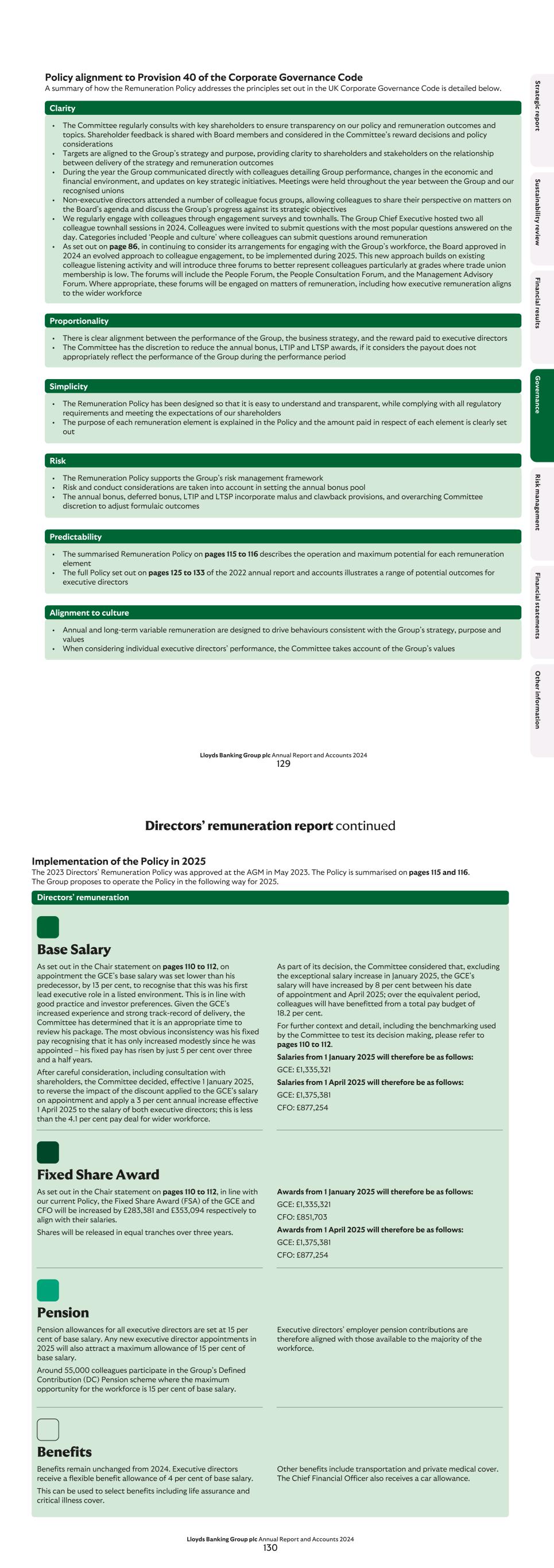
Policy alignment to Provision 40 of the Corporate Governance Code A summary of how the Remuneration Policy addresses the principles set out in the UK Corporate Governance Code is detailed below. Clarity • The Committee regularly consults with key shareholders to ensure transparency on our policy and remuneration outcomes and topics. Shareholder feedback is shared with Board members and considered in the Committee’s reward decisions and policy considerations • Targets are aligned to the Group’s strategy and purpose, providing clarity to shareholders and stakeholders on the relationship between delivery of the strategy and remuneration outcomes • During the year the Group communicated directly with colleagues detailing Group performance, changes in the economic and financial environment, and updates on key strategic initiatives. Meetings were held throughout the year between the Group and our recognised unions • Non-executive directors attended a number of colleague focus groups, allowing colleagues to share their perspective on matters on the Board’s agenda and discuss the Group’s progress against its strategic objectives • We regularly engage with colleagues through engagement surveys and townhalls. The Group Chief Executive hosted two all colleague townhall sessions in 2024. Colleagues were invited to submit questions with the most popular questions answered on the day. Categories included ‘People and culture’ where colleagues can submit questions around remuneration • As set out on page 86, in continuing to consider its arrangements for engaging with the Group’s workforce, the Board approved in 2024 an evolved approach to colleague engagement, to be implemented during 2025. This new approach builds on existing colleague listening activity and will introduce three forums to better represent colleagues particularly at grades where trade union membership is low. The forums will include the People Forum, the People Consultation Forum, and the Management Advisory Forum. Where appropriate, these forums will be engaged on matters of remuneration, including how executive remuneration aligns to the wider workforce Proportionality • There is clear alignment between the performance of the Group, the business strategy, and the reward paid to executive directors • The Committee has the discretion to reduce the annual bonus, LTIP and LTSP awards, if it considers the payout does not appropriately reflect the performance of the Group during the performance period Simplicity • The Remuneration Policy has been designed so that it is easy to understand and transparent, while complying with all regulatory requirements and meeting the expectations of our shareholders • The purpose of each remuneration element is explained in the Policy and the amount paid in respect of each element is clearly set out Risk • The Remuneration Policy supports the Group’s risk management framework • Risk and conduct considerations are taken into account in setting the annual bonus pool • The annual bonus, deferred bonus, LTIP and LTSP incorporate malus and clawback provisions, and overarching Committee discretion to adjust formulaic outcomes Predictability • The summarised Remuneration Policy on pages 115 to 116 describes the operation and maximum potential for each remuneration element • The full Policy set out on pages 125 to 133 of the 2022 annual report and accounts illustrates a range of potential outcomes for executive directors Alignment to culture • Annual and long-term variable remuneration are designed to drive behaviours consistent with the Group’s strategy, purpose and values • When considering individual executive directors’ performance, the Committee takes account of the Group’s values Lloyds Banking Group plc Annual Report and Accounts 2024 129 l i ts 2 O th e r in fo rm a tio n F in a n cia l sta te m e n ts R isk m a n a ge m e n t G o ve rn a n ce F in a n cia l re su lts S u sta in a b ility re vie w S tra te gic re p o rt Implementation of the Policy in 2025 The 2023 Directors’ Remuneration Policy was approved at the AGM in May 2023. The Policy is summarised on pages 115 and 116. The Group proposes to operate the Policy in the following way for 2025. Base Salary As set out in the Chair statement on pages 110 to 112, on appointment the GCE’s base salary was set lower than his predecessor, by 13 per cent, to recognise that this was his first lead executive role in a listed environment. This is in line with good practice and investor preferences. Given the GCE’s increased experience and strong track-record of delivery, the Committee has determined that it is an appropriate time to review his package. The most obvious inconsistency was his fixed pay recognising that it has only increased modestly since he was appointed – his fixed pay has risen by just 5 per cent over three and a half years. After careful consideration, including consultation with shareholders, the Committee decided, effective 1 January 2025, to reverse the impact of the discount applied to the GCE’s salary on appointment and apply a 3 per cent annual increase effective 1 April 2025 to the salary of both executive directors; this is less than the 4.1 per cent pay deal for wider workforce. As part of its decision, the Committee considered that, excluding the exceptional salary increase in January 2025, the GCE’s salary will have increased by 8 per cent between his date of appointment and April 2025; over the equivalent period, colleagues will have benefitted from a total pay budget of 18.2 per cent. For further context and detail, including the benchmarking used by the Committee to test its decision making, please refer to pages 110 to 112. Salaries from 1 January 2025 will therefore be as follows: GCE: £1,335,321 Salaries from 1 April 2025 will therefore be as follows: GCE: £1,375,381 CFO: £877,254 Fixed Share Award As set out in the Chair statement on pages 110 to 112, in line with our current Policy, the Fixed Share Award (FSA) of the GCE and CFO will be increased by £283,381 and £353,094 respectively to align with their salaries. Shares will be released in equal tranches over three years. Awards from 1 January 2025 will therefore be as follows: GCE: £1,335,321 CFO: £851,703 Awards from 1 April 2025 will therefore be as follows: GCE: £1,375,381 CFO: £877,254 Pension Pension allowances for all executive directors are set at 15 per cent of base salary. Any new executive director appointments in 2025 will also attract a maximum allowance of 15 per cent of base salary. Around 55,000 colleagues participate in the Group’s Defined Contribution (DC) Pension scheme where the maximum opportunity for the workforce is 15 per cent of base salary. Executive directors’ employer pension contributions are therefore aligned with those available to the majority of the workforce. Benefits Benefits remain unchanged from 2024. Executive directors receive a flexible benefit allowance of 4 per cent of base salary. This can be used to select benefits including life assurance and critical illness cover. Other benefits include transportation and private medical cover. The Chief Financial Officer also receives a car allowance. Directors’ remuneration report continued Lloyds Banking Group plc Annual Report and Accounts 2024 130 Directors’ remuneration l i ts
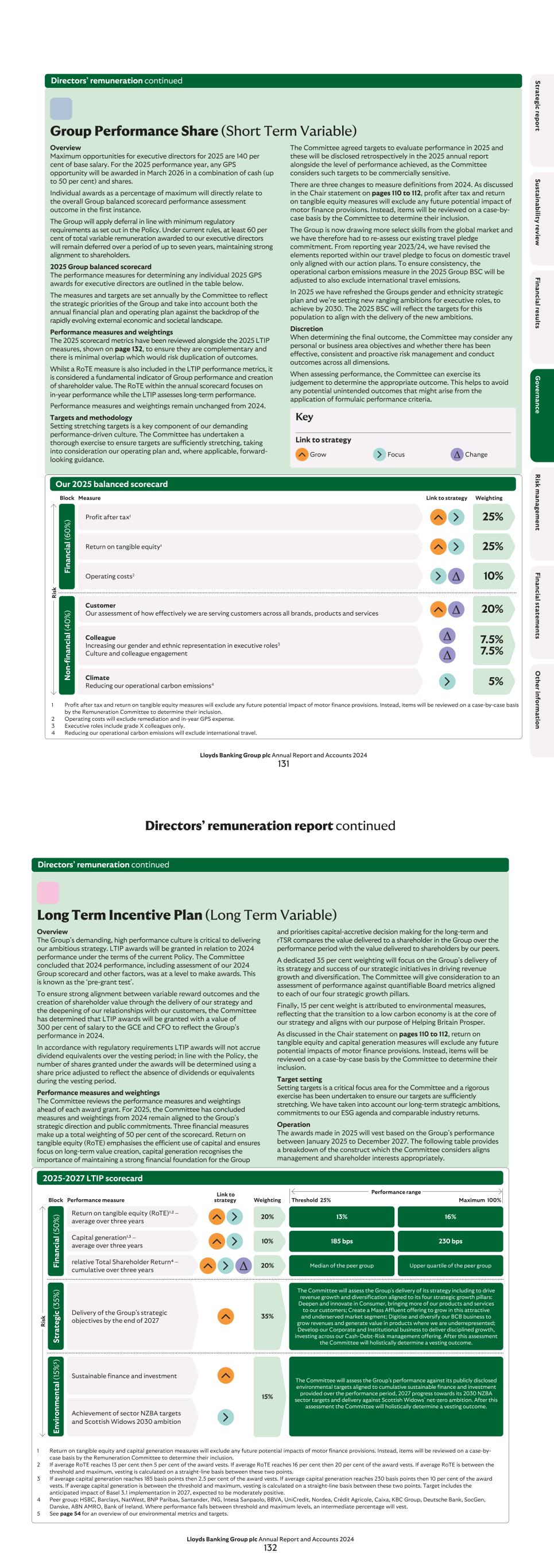
Group Performance Share (Short Term Variable) Overview Maximum opportunities for executive directors for 2025 are 140 per cent of base salary. For the 2025 performance year, any GPS opportunity will be awarded in March 2026 in a combination of cash (up to 50 per cent) and shares. Individual awards as a percentage of maximum will directly relate to the overall Group balanced scorecard performance assessment outcome in the first instance. The Group will apply deferral in line with minimum regulatory requirements as set out in the Policy. Under current rules, at least 60 per cent of total variable remuneration awarded to our executive directors will remain deferred over a period of up to seven years, maintaining strong alignment to shareholders. 2025 Group balanced scorecard The performance measures for determining any individual 2025 GPS awards for executive directors are outlined in the table below. The measures and targets are set annually by the Committee to reflect the strategic priorities of the Group and take into account both the annual financial plan and operating plan against the backdrop of the rapidly evolving external economic and societal landscape. Performance measures and weightings The 2025 scorecard metrics have been reviewed alongside the 2025 LTIP measures, shown on page 132, to ensure they are complementary and there is minimal overlap which would risk duplication of outcomes. Whilst a RoTE measure is also included in the LTIP performance metrics, it is considered a fundamental indicator of Group performance and creation of shareholder value. The RoTE within the annual scorecard focuses on in-year performance while the LTIP assesses long-term performance. Performance measures and weightings remain unchanged from 2024. Targets and methodology Setting stretching targets is a key component of our demanding performance-driven culture. The Committee has undertaken a thorough exercise to ensure targets are sufficiently stretching, taking into consideration our operating plan and, where applicable, forward- looking guidance. The Committee agreed targets to evaluate performance in 2025 and these will be disclosed retrospectively in the 2025 annual report alongside the level of performance achieved, as the Committee considers such targets to be commercially sensitive. There are three changes to measure definitions from 2024. As discussed in the Chair statement on pages 110 to 112, profit after tax and return on tangible equity measures will exclude any future potential impact of motor finance provisions. Instead, items will be reviewed on a case-by- case basis by the Committee to determine their inclusion. The Group is now drawing more select skills from the global market and we have therefore had to re-assess our existing travel pledge commitment. From reporting year 2023/24, we have revised the elements reported within our travel pledge to focus on domestic travel only aligned with our action plans. To ensure consistency, the operational carbon emissions measure in the 2025 Group BSC will be adjusted to also exclude international travel emissions. In 2025 we have refreshed the Groups gender and ethnicity strategic plan and we’re setting new ranging ambitions for executive roles, to achieve by 2030. The 2025 BSC will reflect the targets for this population to align with the delivery of the new ambitions. Discretion When determining the final outcome, the Committee may consider any personal or business area objectives and whether there has been effective, consistent and proactive risk management and conduct outcomes across all dimensions. When assessing performance, the Committee can exercise its judgement to determine the appropriate outcome. This helps to avoid any potential unintended outcomes that might arise from the application of formulaic performance criteria. 1 Profit after tax and return on tangible equity measures will exclude any future potential impact of motor finance provisions. Instead, items will be reviewed on a case-by-case basis by the Remuneration Committee to determine their inclusion. 2 Operating costs will exclude remediation and in-year GPS expense. 3 Executive roles include grade X colleagues only. 4 Reducing our operational carbon emissions will exclude international travel. Lloyds Banking Group plc Annual Report and Accounts 2024 131 Directors’ remuneration continued Our 2025 balanced scorecard l i ts 2 O th e r in fo rm a tio n F in a n cia l sta te m e n ts R isk m a n a ge m e n t G o ve rn a n ce F in a n cia l re su lts S u sta in a b ility re vie w S tra te gic re p o rt Long Term Incentive Plan (Long Term Variable) Overview The Group’s demanding, high performance culture is critical to delivering our ambitious strategy. LTIP awards will be granted in relation to 2024 performance under the terms of the current Policy. The Committee concluded that 2024 performance, including assessment of our 2024 Group scorecard and other factors, was at a level to make awards. This is known as the ‘pre-grant test’. To ensure strong alignment between variable reward outcomes and the creation of shareholder value through the delivery of our strategy and the deepening of our relationships with our customers, the Committee has determined that LTIP awards will be granted with a value of 300 per cent of salary to the GCE and CFO to reflect the Group’s performance in 2024. In accordance with regulatory requirements LTIP awards will not accrue dividend equivalents over the vesting period; in line with the Policy, the number of shares granted under the awards will be determined using a share price adjusted to reflect the absence of dividends or equivalents during the vesting period. Performance measures and weightings The Committee reviews the performance measures and weightings ahead of each award grant. For 2025, the Committee has concluded measures and weightings from 2024 remain aligned to the Group’s strategic direction and public commitments. Three financial measures make up a total weighting of 50 per cent of the scorecard. Return on tangible equity (RoTE) emphasises the efficient use of capital and ensures focus on long-term value creation, capital generation recognises the importance of maintaining a strong financial foundation for the Group and prioritises capital-accretive decision making for the long-term and rTSR compares the value delivered to a shareholder in the Group over the performance period with the value delivered to shareholders by our peers. A dedicated 35 per cent weighting will focus on the Group’s delivery of its strategy and success of our strategic initiatives in driving revenue growth and diversification. The Committee will give consideration to an assessment of performance against quantifiable Board metrics aligned to each of our four strategic growth pillars. Finally, 15 per cent weight is attributed to environmental measures, reflecting that the transition to a low carbon economy is at the core of our strategy and aligns with our purpose of Helping Britain Prosper. As discussed in the Chair statement on pages 110 to 112, return on tangible equity and capital generation measures will exclude any future potential impacts of motor finance provisions. Instead, items will be reviewed on a case-by-case basis by the Committee to determine their inclusion. Target setting Setting targets is a critical focus area for the Committee and a rigorous exercise has been undertaken to ensure our targets are sufficiently stretching. We have taken into account our long-term strategic ambitions, commitments to our ESG agenda and comparable industry returns. Operation The awards made in 2025 will vest based on the Group’s performance between January 2025 to December 2027. The following table provides a breakdown of the construct which the Committee considers aligns management and shareholder interests appropriately. 1 Return on tangible equity and capital generation measures will exclude any future potential impacts of motor finance provisions. Instead, items will be reviewed on a case-by- case basis by the Remuneration Committee to determine their inclusion. 2 If average RoTE reaches 13 per cent then 5 per cent of the award vests. If average RoTE reaches 16 per cent then 20 per cent of the award vests. If average RoTE is between the threshold and maximum, vesting is calculated on a straight-line basis between these two points. 3 If average capital generation reaches 185 basis points then 2.5 per cent of the award vests. If average capital generation reaches 230 basis points then 10 per cent of the award vests. If average capital generation is between the threshold and maximum, vesting is calculated on a straight-line basis between these two points. Target includes the anticipated impact of Basel 3.1 implementation in 2027, expected to be moderately positive. 4 Peer group: HSBC, Barclays, NatWest, BNP Paribas, Santander, ING, Intesa Sanpaolo, BBVA, UniCredit, Nordea, Crédit Agricole, Caixa, KBC Group, Deutsche Bank, SocGen, Danske, ABN AMRO, Bank of Ireland. Where performance falls between threshold and maximum levels, an intermediate percentage will vest. 5 See page 54 for an overview of our environmental metrics and targets. Directors’ remuneration report continued Lloyds Banking Group plc Annual Report and Accounts 2024 132 Directors’ remuneration continued 2025-2027 LTIP scorecard l i ts

Chair and non-executive director fees and benefits Any increases normally take effect from 1 January of a given year. The Committee is responsible for evaluating and making recommendations to the Board with regard to the Chair’s fees. The Chair does not participate in these discussions. The GCE and the Chair are responsible for evaluating and making recommendations to the Board in relation to the fees of the non- executive directors (NEDs). The Chair receives an all-inclusive fee, which is reviewed periodically plus benefits including life insurance, medical insurance and transportation. The Committee retains the right to provide additional benefits depending on individual circumstances. NEDs are paid a basic fee plus additional fees for the Chair/ membership of Committees and for membership of Group company Boards, non-Board level committees and/or other specific responsibilities. Additional fees are also paid to the Senior Independent Director to reflect additional responsibilities. The Chair and the NEDs are not entitled to receive any payment for loss of office (other than in the case of the Chair’s fees for the six-month notice period) and are not entitled to participate in the Group’s variable remuneration arrangements, all employee share plan or pension arrangements. NEDs are reimbursed for expenses incurred in the course of their duties, such as travel and accommodation expenses, on a grossed-up basis (where applicable). Non-executive directors may receive more than one of the above fees. Chair and non-executive director fees in 2025 As set out in the Chair statement on pages 110 to 112 there is a £95,500 increase to the annual fee for the Chair (£750,000). This is step one of a two-stage increase. The second increase will take place from 1 January 2026 and will increase the fee to £850,000. Following a detailed review of peer benchmarks and to ensure our non-executive directors are paid appropriately for the experience and time requirements required, the basic Board fee, Chair fees for Audit, Remuneration and Risk Committees will increase by 3 per cent for 2025. The Chair fees for the Responsible Business Committee and the IT and Cyber Advisory Forum will increase by 35 per cent. The Audit, Remuneration and Risk Committee member fees will increase by 2 per cent and the Nomination and Governance Committee member fee will increase by 1 per cent for 2025. The Responsible Business Committee and IT and Cyber Advisory Forum member fees will increase by 49 per cent. There is no increase to the Senior Independent Director fee for 2025. 2025 2024 Basic non-executive director fee 92,200 89,500 Senior Independent Director 64,200 64,200 Audit Committee Chair 77,250 75,000 Remuneration Committee Chair 77,250 75,000 Risk Committee Chair 77,250 75,000 Responsible Business Committee Chair 60,000 44,500 IT and Cyber Advisory Forum Chair 60,000 44,500 Audit Committee member 35,000 34,300 Remuneration Committee member 35,000 34,300 Risk Committee member 35,000 34,300 Responsible Business Committee member 25,000 16,750 IT and Cyber Advisory Forum member 25,000 16,750 Nomination and Governance Committee member 16,550 16,375 Audited content All narrative and quantitative tables within the directors’ remuneration report are unaudited unless otherwise stated. Where disclosures have been audited, this has been carried out under International Standards on Auditing (ISAs). Lloyds Banking Group plc Annual Report and Accounts 2024 133 Directors’ remuneration continued l i ts 2 O th e r in fo rm a tio n F in a n cia l sta te m e n ts R isk m a n a ge m e n t G o ve rn a n ce F in a n cia l re su lts S u sta in a b ility re vie w S tra te gic re p o rt 134 Lloyds Banking Group plc Annual Report and Accounts 2024 Other statutory and regulatory information This directors’ report on pages 75 to 136 is our directors’ report for the purposes of the Companies Act 2006 and fulfils the requirements of the corporate governance statement for the purposes of the Financial Conduct Authority’s Disclosure Guidance and Transparency Rules (DTR). Profit and dividends The consolidated income statement shows a statutory profit before tax for the year ended 31 December 2024 of £5,971 million (2023: £7,503 million). The directors have recommended a final dividend for 2024, which is subject to approval by the shareholders at the annual general meeting (AGM), of 2.11 pence per share, which together with the interim dividend of 1.06 pence per share represents a total dividend for the year of 3.17 pence per share, equivalent to £1.9 billion. If approved by shareholders, the final dividend will be paid on 20 May 2025. A final dividend of 1.84 pence per share totalling £1,169 million in respect of 2023 was paid on 21 May 2024, and an interim dividend of 1.06 pence per share totalling £659 million was paid on 10 September 2024. Further information on dividends is shown in note 36 on page 295 and is incorporated into this directors’ report by reference. The Board continues to give due consideration at each year end to the return of any surplus capital to shareholders and for 2024, the Board intends to return up to £1.7 billion through a share buyback programme in respect of the Company’s ordinary shares. This represents the return of capital over and above the Board’s view of the current level of capital required to grow the business, meet regulatory requirements and cover uncertainties. The share buyback programme is intended to commence as soon as is practicable and is expected to be completed, subject to continued authority from the PRA, by 31 December 2025. Based on the total ordinary dividend and the intended ordinary share buyback the total capital return in respect of 2024 will be up to £3.6 billion. The Company intends to use the authority for the repurchase of ordinary shares granted to it at the 2024 AGM to implement the proposed share buyback. Details of this existing authority are set out under ‘Power of directors in relation to shares’. Shareholders will be asked to renew the authority at the 2025 AGM, in line with common practice. Appointment and retirement of directors The appointment and retirement of directors is governed by the Company’s articles of association, the UK Corporate Governance Code and the Companies Act 2006. The Company’s articles of association may only be amended by a special resolution of the shareholders in a general meeting. In the interests of good governance and in accordance with the provisions of the UK Corporate Governance Code, all directors will retire at the 2025 AGM and those wishing to serve for the first time or again will submit themselves for election or re-election (as applicable). Biographies of the current directors are set out on pages 78 to 79. Details of the directors seeking election or re-election at the AGM are set out in the Notice of Meeting. Board composition changes Changes to the composition of the Board since 1 January 2024 up to the date of this report are shown in the table below: Joined the Board Left the Board Alan Dickinson 16 May 2024 Lord Lupton 16 May 2024 Nathan Bostock 1 August 2024 Directors’ and officers’ liability insurance Throughout 2024 the Group had appropriate insurance cover in place to protect directors, including the directors who retired during the year, from liabilities that may arise against them personally in connection with the performance of their role. As well as insurance cover, the Group agrees to indemnify the directors to the maximum extent permitted by law. Further information on the Group’s indemnity arrangements is provided in the directors’ indemnities section. Directors’ indemnities The directors of the Company have entered into individual deeds of indemnity with the Company which constituted ‘qualifying third-party indemnity provisions’ for the purposes of the Companies Act 2006. The deeds indemnify the directors to the maximum extent permitted by law and remain in force. The deeds were in force during the whole of the financial year. Deeds for existing directors are available for inspection at the Company’s registered office. The Company has also granted deeds of indemnity by deed poll and by way of entering into individual deeds, which constitute ‘qualifying third-party indemnity provisions’ to the directors of the Group’s subsidiary companies, including to former directors who retired during the year and since the year end, and to Group colleagues subject to the provisions of the Senior Managers and Certification Regime. Such deeds were in force during the financial year ended 31 December 2024 and remain in force as at the date of this report. Qualifying pension scheme indemnities have also been granted to the trustees of the Group’s pension schemes, which were in force for the whole of the financial year and remain in force as at the date of this report. Conflicts of interest The Board has a comprehensive procedure for reviewing, and as permitted by the Companies Act 2006 and the Company’s articles of association, approving actual and potential conflicts of interest. Directors have a duty to notify the Chair and Company Secretary as soon as they become aware of actual or potential conflict situations. Any changes to the commitments of directors are reported to the Nomination and Governance Committee and the Board and a register of directors’ interests is regularly reviewed and authorised by the Board to ensure the authorisation status remains appropriate. Share capital Detail of the rights and obligations attaching to the Company’s issued share capital may be found in notes 29 and 30 to the financial statements on page 290 to 292. Power of directors in relation to shares The Board manages the business of the Company under the powers set out in the articles of association, which include the directors’ ability to issue or buy back shares. The directors were granted authorities to issue and allot shares and to buy back shares at the 2024 AGM. Shareholders will be asked to renew these authorities at the 2025 AGM. The authority in respect of purchase of the Company’s ordinary shares, as granted at the 2023 AGM, was limited to 6,701,169,260 ordinary shares, equivalent to 10 per cent of the issued ordinary share capital of the Company as at the latest practicable date prior to publication of the 2023 AGM Notice of Meeting. Such authority was used during the year under review in connection with the share buyback programme described below and, as at 31 December 2024 and the date of this report, a total of 3,686,477,708 ordinary shares had been repurchased.
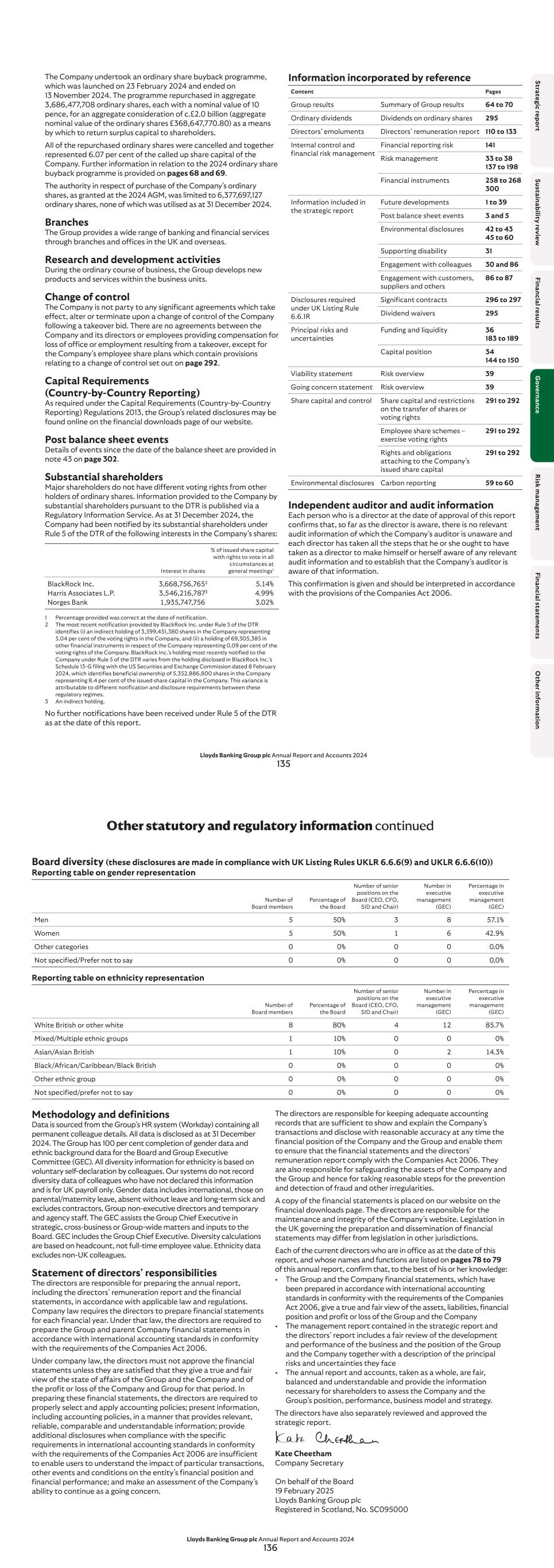
135 Lloyds Banking Group plc Annual Report and Accounts 2024 O th e r in fo rm a tio n F in a n cia l sta te m e n ts R isk m a n a ge m e n t G o ve rn a n ce F in a n cia l re su lts S u sta in a b ility re vie w S tra te gic re p o rt The Company undertook an ordinary share buyback programme, which was launched on 23 February 2024 and ended on 13 November 2024. The programme repurchased in aggregate 3,686,477,708 ordinary shares, each with a nominal value of 10 pence, for an aggregate consideration of c.£2.0 billion (aggregate nominal value of the ordinary shares £368,647,770.80) as a means by which to return surplus capital to shareholders. All of the repurchased ordinary shares were cancelled and together represented 6.07 per cent of the called up share capital of the Company. Further information in relation to the 2024 ordinary share buyback programme is provided on pages 68 and 69. The authority in respect of purchase of the Company’s ordinary shares, as granted at the 2024 AGM, was limited to 6,377,697,127 ordinary shares, none of which was utilised as at 31 December 2024. Branches The Group provides a wide range of banking and financial services through branches and offices in the UK and overseas. Research and development activities During the ordinary course of business, the Group develops new products and services within the business units. Change of control The Company is not party to any significant agreements which take effect, alter or terminate upon a change of control of the Company following a takeover bid. There are no agreements between the Company and its directors or employees providing compensation for loss of office or employment resulting from a takeover, except for the Company’s employee share plans which contain provisions relating to a change of control set out on page 292. Capital Requirements (Country-by-Country Reporting) As required under the Capital Requirements (Country-by-Country Reporting) Regulations 2013, the Group’s related disclosures may be found online on the financial downloads page of our website. Post balance sheet events Details of events since the date of the balance sheet are provided in note 43 on page 302. Substantial shareholders Major shareholders do not have different voting rights from other holders of ordinary shares. Information provided to the Company by substantial shareholders pursuant to the DTR is published via a Regulatory Information Service. As at 31 December 2024, the Company had been notified by its substantial shareholders under Rule 5 of the DTR of the following interests in the Company’s shares: Interest in shares % of issued share capital with rights to vote in all circumstances at general meetings1 BlackRock Inc. 3,668,756,7652 5.14% Harris Associates L.P. 3,546,216,7873 4.99% Norges Bank 1,935,747,756 3.02% 1 Percentage provided was correct at the date of notification. 2 The most recent notification provided by BlackRock Inc. under Rule 5 of the DTR identifies (i) an indirect holding of 3,599,451,380 shares in the Company representing 5.04 per cent of the voting rights in the Company, and (ii) a holding of 69,305,385 in other financial instruments in respect of the Company representing 0.09 per cent of the voting rights of the Company. BlackRock Inc.’s holding most recently notified to the Company under Rule 5 of the DTR varies from the holding disclosed in BlackRock Inc.’s Schedule 13-G filing with the US Securities and Exchange Commission dated 8 February 2024, which identifies beneficial ownership of 5,352,886,800 shares in the Company representing 8.4 per cent of the issued share capital in the Company. This variance is attributable to different notification and disclosure requirements between these regulatory regimes. 3 An indirect holding. No further notifications have been received under Rule 5 of the DTR as at the date of this report. Information incorporated by reference Content Pages Group results Summary of Group results 64 to 70 Ordinary dividends Dividends on ordinary shares 295 Directors’ emoluments Directors’ remuneration report 110 to 133 Internal control and financial risk management Financial reporting risk 141 Risk management 33 to 38 137 to 198 Financial instruments 258 to 268 300 Information included in the strategic report Future developments 1 to 39 Post balance sheet events 3 and 5 Environmental disclosures 42 to 43 45 to 60 Supporting disability 31 Engagement with colleagues 30 and 86 Engagement with customers, suppliers and others 86 to 87 Disclosures required under UK Listing Rule 6.6.1R Significant contracts 296 to 297 Dividend waivers 295 Principal risks and uncertainties Funding and liquidity 36 183 to 189 Capital position 34 144 to 150 Viability statement Risk overview 39 Going concern statement Risk overview 39 Share capital and control Share capital and restrictions on the transfer of shares or voting rights 291 to 292 Employee share schemes – exercise voting rights 291 to 292 Rights and obligations attaching to the Company’s issued share capital 291 to 292 Environmental disclosures Carbon reporting 59 to 60 Independent auditor and audit information Each person who is a director at the date of approval of this report confirms that, so far as the director is aware, there is no relevant audit information of which the Company’s auditor is unaware and each director has taken all the steps that he or she ought to have taken as a director to make himself or herself aware of any relevant audit information and to establish that the Company’s auditor is aware of that information. This confirmation is given and should be interpreted in accordance with the provisions of the Companies Act 2006. 136 Lloyds Banking Group plc Annual Report and Accounts 2024 Board diversity (these disclosures are made in compliance with UK Listing Rules UKLR 6.6.6(9) and UKLR 6.6.6(10)) Reporting table on gender representation Number of Board members Percentage of the Board Number of senior positions on the Board (CEO, CFO, SID and Chair) Number in executive management (GEC) Percentage in executive management (GEC) Men 5 50% 3 8 57.1% Women 5 50% 1 6 42.9% Other categories 0 0% 0 0 0.0% Not specified/Prefer not to say 0 0% 0 0 0.0% Reporting table on ethnicity representation Number of Board members Percentage of the Board Number of senior positions on the Board (CEO, CFO, SID and Chair) Number in executive management (GEC) Percentage in executive management (GEC) White British or other white 8 80% 4 12 85.7% Mixed/Multiple ethnic groups 1 10% 0 0 0% Asian/Asian British 1 10% 0 2 14.3% Black/African/Caribbean/Black British 0 0% 0 0 0% Other ethnic group 0 0% 0 0 0% Not specified/prefer not to say 0 0% 0 0 0% The directors are responsible for keeping adequate accounting records that are sufficient to show and explain the Company’s transactions and disclose with reasonable accuracy at any time the financial position of the Company and the Group and enable them to ensure that the financial statements and the directors’ remuneration report comply with the Companies Act 2006. They are also responsible for safeguarding the assets of the Company and the Group and hence for taking reasonable steps for the prevention and detection of fraud and other irregularities. A copy of the financial statements is placed on our website on the financial downloads page. The directors are responsible for the maintenance and integrity of the Company’s website. Legislation in the UK governing the preparation and dissemination of financial statements may differ from legislation in other jurisdictions. Each of the current directors who are in office as at the date of this report, and whose names and functions are listed on pages 78 to 79 of this annual report, confirm that, to the best of his or her knowledge: • The Group and the Company financial statements, which have been prepared in accordance with international accounting standards in conformity with the requirements of the Companies Act 2006, give a true and fair view of the assets, liabilities, financial position and profit or loss of the Group and the Company • The management report contained in the strategic report and the directors’ report includes a fair review of the development and performance of the business and the position of the Group and the Company together with a description of the principal risks and uncertainties they face • The annual report and accounts, taken as a whole, are fair, balanced and understandable and provide the information necessary for shareholders to assess the Company and the Group’s position, performance, business model and strategy. The directors have also separately reviewed and approved the strategic report. Kate Cheetham Company Secretary On behalf of the Board 19 February 2025 Lloyds Banking Group plc Registered in Scotland, No. SC095000 Methodology and definitions Data is sourced from the Group’s HR system (Workday) containing all permanent colleague details. All data is disclosed as at 31 December 2024. The Group has 100 per cent completion of gender data and ethnic background data for the Board and Group Executive Committee (GEC). All diversity information for ethnicity is based on voluntary self-declaration by colleagues. Our systems do not record diversity data of colleagues who have not declared this information and is for UK payroll only. Gender data includes international, those on parental/maternity leave, absent without leave and long-term sick and excludes contractors, Group non-executive directors and temporary and agency staff. The GEC assists the Group Chief Executive in strategic, cross-business or Group-wide matters and inputs to the Board. GEC includes the Group Chief Executive. Diversity calculations are based on headcount, not full-time employee value. Ethnicity data excludes non-UK colleagues. Statement of directors’ responsibilities The directors are responsible for preparing the annual report, including the directors’ remuneration report and the financial statements, in accordance with applicable law and regulations. Company law requires the directors to prepare financial statements for each financial year. Under that law, the directors are required to prepare the Group and parent Company financial statements in accordance with international accounting standards in conformity with the requirements of the Companies Act 2006. Under company law, the directors must not approve the financial statements unless they are satisfied that they give a true and fair view of the state of affairs of the Group and the Company and of the profit or loss of the Company and Group for that period. In preparing these financial statements, the directors are required to properly select and apply accounting policies; present information, including accounting policies, in a manner that provides relevant, reliable, comparable and understandable information; provide additional disclosures when compliance with the specific requirements in international accounting standards in conformity with the requirements of the Companies Act 2006 are insufficient to enable users to understand the impact of particular transactions, other events and conditions on the entity’s financial position and financial performance; and make an assessment of the Company’s ability to continue as a going concern. Other statutory and regulatory information continued
Risk management In this section The Group’s approach to risk 138 Risk governance 138 Stress testing 142 Emerging and topical risks 143 Full analysis of principal risk categories 144 Protecting our stakeholders and the Group Risk management is a key element in shaping our business model and delivering the Group’s strategy O th e r in fo rm a tio n R isk m a n a ge m e n t F in a n cia l re su lts S u sta in a b ility re vie w S tra te gic re p o rt G o ve rn a n ce F in a n cia l sta te m e n ts 137 Lloyds Banking Group plc Annual Report and Accounts 2024 Risk management is at the heart of Helping Britain Prosper and creating a more sustainable and inclusive future for people and businesses. Our mission is to protect our customers, shareholders, colleagues and the Group, while enabling sustainable growth. This is achieved through informed risk decisions and robust risk management, supported by a consistent risk-focused culture. The Risk overview (pages 33 to 38) provides a summary of risk management within the Group and the key focus areas for 2024. This full risk management section provides a more in-depth view of how risk is managed within the Group including key developments in 2024, and the framework by which risks are identified, managed, mitigated and monitored. All narrative and quantitative tables within the risk management section are unaudited unless otherwise stated. The audited information is required to comply with the requirements of relevant IFRS Accounting Standards. The Group’s approach to risk The Group operates a prudent approach to risk, with rigorous management controls, supporting sustainable business growth within the Group’s risk appetite and minimising losses. Through a strong and independent risk function, a robust control framework is maintained to identify and escalate current and emerging risks, and drive and inform good risk-reward decision making. To comply with UK-specific ring-fencing requirements, core banking services are ring-fenced from other activities within the overall Group. The Group’s enterprise risk management framework (ERMF) and risk appetite apply across the Group. The Group’s Corporate Governance Framework applies across Lloyds Banking Group plc, Lloyds Bank plc, Bank of Scotland plc and HBOS plc. It is tailored where needed to meet the entity-specific needs of Lloyds Bank plc and Bank of Scotland plc, within the Ring-Fenced Bank sub-group (RFB) and supplementary corporate governance frameworks are in place to address the specific requirements of the other sub-groups (Non-Ring-Fenced Bank, Insurance and Equity Investments). The Group’s ERMF is structured to align with the industry-accepted internal control framework standards and applies to every area of the business, covering all types of risk. In 2024, the framework was reviewed and updated to align more closely to the changing nature of risks within the industry and the Group, along with evolving regulatory expectations. The ERMF provides the Group with an effective mechanism for developing and embedding risk policies and risk management strategies which are aligned with the risks faced by its businesses. It also seeks to facilitate effective communication on these matters across the Group. Updates to the enterprise risk management framework The Group has transformed its approach to risk management to support its strategic ambition and purpose of Helping Britain Prosper, and has conducted a comprehensive review of its ERMF. This has resulted in a reduction in the number of principal risk types (or level one risk categories) from 15 to 11, and the simplification of level two risk categories. • Compliance risk supersedes the previous regulatory and legal risk • Economic crime is now a principal risk, recognising the increased focus on topics such as fraud • Previous change and execution, data and people risks are now classified as level two risks within the principal operational risk • Operational resilience and strategic risk are no longer individual risks, but are addressed throughout the updated framework • New definitions for conduct, model and operational risks This change better aligns to the Basel Committee on Banking Supervision’s event categories which will benefit the Group for scenario activities and regulatory reporting. This review will continue in 2025, with further focus on level three risks. Further details of each principal risk, including level two risks, are provided on pages 144 to 198. Risk appetite The Group’s approach to setting, and the ongoing management of risk appetite is detailed in the risk appetite framework, which is an integral component of the Group’s ERMF. The Group defines risk appetite as the type and aggregate level of risk the Group is willing to take or accept in pursuit of its strategic objectives and business plans. Risk appetite aligns to organisational objectives, defined through consideration of how it enables the Group to achieve its strategic aims. It reinforces our purpose, strategy and objectives by driving behaviour and setting boundaries around risk taking, to monitor changes in risk exposure, enabling the delivery of business plans. The Board is responsible for approving the Group’s Board risk appetite at least annually. Group Board-level risk appetite metrics are augmented further by lower-level measures to facilitate the management of Board risk appetite. Risk culture Guided by the Board, the senior management articulates and role models the core risk values to which the Group aspires. Senior management establishes a strong focus on building and sustaining long-term relationships with customers, through the economic cycle. The Group’s Code of Ethics and Responsibility reinforces colleagues’ accountability for the risks they take and supports better decision making to meet their customers’ needs. Risk skills and capabilities To support a strong risk culture across the Group, all colleagues complete risk training as part of their annual mandatory training. A library of risk management learning resources is available, which all colleagues who have specific risk management roles can access to build their skills and capabilities. There is ongoing investment in risk systems and models alongside the Group’s focus on customer and product systems and processes. This drives improvements in risk data quality, aggregation and reporting, enabling effective and efficient risk decisions. Risk governance Governance frameworks The Group’s approach to risk is based on a robust control framework and strong risk management culture, enabling the delivery of effective risk management, guiding the way all employees approach their work, behave and make decisions. Authority is delegated from the Board to individuals through the management hierarchy. Senior management are supported by a committee-based structure, ensuring open challenge and effective decision making. The Group’s risk appetite, principles, policies, procedures, controls, and reporting are regularly reviewed and updated as required, to ensure they remain in line with evolving regulation, law, corporate governance and industry good practice. The Board and senior management encourage a culture of transparency which supports the interaction of the executive and non-executive governance structure. Board-level engagement, combined with senior management in Group-wide risk issues at Group Executive Committee level, ensure that any escalated issues are addressed promptly and that necessary remediation plans are initiated as required. Line managers are accountable for identifying and managing risks in their individual businesses, ensuring that business decisions balance risk and reward, and are consistent with the Group’s risk appetite. The risk committee governance framework is explained on page 140. Risk management Lloyds Banking Group plc Annual Report and Accounts 2024 138 l i ts
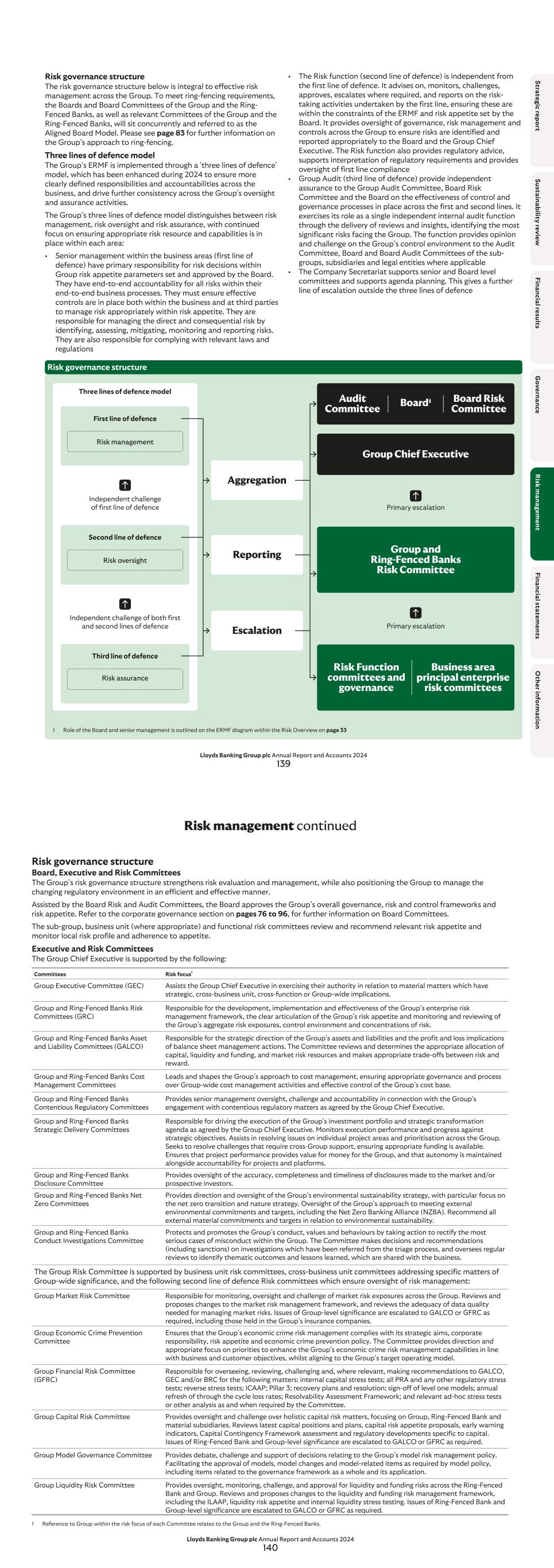
Risk governance structure The risk governance structure below is integral to effective risk management across the Group. To meet ring-fencing requirements, the Boards and Board Committees of the Group and the Ring- Fenced Banks, as well as relevant Committees of the Group and the Ring-Fenced Banks, will sit concurrently and referred to as the Aligned Board Model. Please see page 83 for further information on the Group’s approach to ring-fencing. Three lines of defence model The Group’s ERMF is implemented through a 'three lines of defence' model, which has been enhanced during 2024 to ensure more clearly defined responsibilities and accountabilities across the business, and drive further consistency across the Group's oversight and assurance activities. The Group’s three lines of defence model distinguishes between risk management, risk oversight and risk assurance, with continued focus on ensuring appropriate risk resource and capabilities is in place within each area: • Senior management within the business areas (first line of defence) have primary responsibility for risk decisions within Group risk appetite parameters set and approved by the Board. They have end-to-end accountability for all risks within their end-to-end business processes. They must ensure effective controls are in place both within the business and at third parties to manage risk appropriately within risk appetite. They are responsible for managing the direct and consequential risk by identifying, assessing, mitigating, monitoring and reporting risks. They are also responsible for complying with relevant laws and regulations • The Risk function (second line of defence) is independent from the first line of defence. It advises on, monitors, challenges, approves, escalates where required, and reports on the risk- taking activities undertaken by the first line, ensuring these are within the constraints of the ERMF and risk appetite set by the Board. It provides oversight of governance, risk management and controls across the Group to ensure risks are identified and reported appropriately to the Board and the Group Chief Executive. The Risk function also provides regulatory advice, supports interpretation of regulatory requirements and provides oversight of first line compliance • Group Audit (third line of defence) provide independent assurance to the Group Audit Committee, Board Risk Committee and the Board on the effectiveness of control and governance processes in place across the first and second lines. It exercises its role as a single independent internal audit function through the delivery of reviews and insights, identifying the most significant risks facing the Group. The function provides opinion and challenge on the Group’s control environment to the Audit Committee, Board and Board Audit Committees of the sub- groups, subsidiaries and legal entities where applicable • The Company Secretariat supports senior and Board level committees and supports agenda planning. This gives a further line of escalation outside the three lines of defence Lloyds Banking Group plc Annual Report and Accounts 2024 139 Risk governance structure l i ts 2 O th e r in fo rm a tio n R isk m a n a ge m e n t F in a n cia l re su lts S u sta in a b ility re vie w S tra te gic re p o rt G o ve rn a n ce F in a n cia l sta te m e n ts Risk governance structure Board, Executive and Risk Committees The Group’s risk governance structure strengthens risk evaluation and management, while also positioning the Group to manage the changing regulatory environment in an efficient and effective manner. Assisted by the Board Risk and Audit Committees, the Board approves the Group’s overall governance, risk and control frameworks and risk appetite. Refer to the corporate governance section on pages 76 to 96, for further information on Board Committees. The sub-group, business unit (where appropriate) and functional risk committees review and recommend relevant risk appetite and monitor local risk profile and adherence to appetite. Executive and Risk Committees The Group Chief Executive is supported by the following: Group Executive Committee (GEC) Assists the Group Chief Executive in exercising their authority in relation to material matters which have strategic, cross-business unit, cross-function or Group-wide implications. Group and Ring-Fenced Banks Risk Committees (GRC) Responsible for the development, implementation and effectiveness of the Group’s enterprise risk management framework, the clear articulation of the Group’s risk appetite and monitoring and reviewing of the Group’s aggregate risk exposures, control environment and concentrations of risk. Group and Ring-Fenced Banks Asset and Liability Committees (GALCO) Responsible for the strategic direction of the Group’s assets and liabilities and the profit and loss implications of balance sheet management actions. The Committee reviews and determines the appropriate allocation of capital, liquidity and funding, and market risk resources and makes appropriate trade-offs between risk and reward. Group and Ring-Fenced Banks Cost Management Committees Leads and shapes the Group’s approach to cost management, ensuring appropriate governance and process over Group-wide cost management activities and effective control of the Group’s cost base. Group and Ring-Fenced Banks Contentious Regulatory Committees Provides senior management oversight, challenge and accountability in connection with the Group’s engagement with contentious regulatory matters as agreed by the Group Chief Executive. Group and Ring-Fenced Banks Strategic Delivery Committees Responsible for driving the execution of the Group’s investment portfolio and strategic transformation agenda as agreed by the Group Chief Executive. Monitors execution performance and progress against strategic objectives. Assists in resolving issues on individual project areas and prioritisation across the Group. Seeks to resolve challenges that require cross-Group support, ensuring appropriate funding is available. Ensures that project performance provides value for money for the Group, and that autonomy is maintained alongside accountability for projects and platforms. Group and Ring-Fenced Banks Disclosure Committee Provides oversight of the accuracy, completeness and timeliness of disclosures made to the market and/or prospective investors. Group and Ring-Fenced Banks Net Zero Committees Provides direction and oversight of the Group’s environmental sustainability strategy, with particular focus on the net zero transition and nature strategy. Oversight of the Group’s approach to meeting external environmental commitments and targets, including the Net Zero Banking Alliance (NZBA). Recommend all external material commitments and targets in relation to environmental sustainability. Group and Ring-Fenced Banks Conduct Investigations Committee Protects and promotes the Group’s conduct, values and behaviours by taking action to rectify the most serious cases of misconduct within the Group. The Committee makes decisions and recommendations (including sanctions) on investigations which have been referred from the triage process, and oversees regular reviews to identify thematic outcomes and lessons learned, which are shared with the business. The Group Risk Committee is supported by business unit risk committees, cross-business unit committees addressing specific matters of Group-wide significance, and the following second line of defence Risk committees which ensure oversight of risk management: Group Market Risk Committee Responsible for monitoring, oversight and challenge of market risk exposures across the Group. Reviews and proposes changes to the market risk management framework, and reviews the adequacy of data quality needed for managing market risks. Issues of Group-level significance are escalated to GALCO or GFRC as required, including those held in the Group’s insurance companies. Group Economic Crime Prevention Committee Ensures that the Group’s economic crime risk management complies with its strategic aims, corporate responsibility, risk appetite and economic crime prevention policy. The Committee provides direction and appropriate focus on priorities to enhance the Group’s economic crime risk management capabilities in line with business and customer objectives, whilst aligning to the Group’s target operating model. Group Financial Risk Committee (GFRC) Responsible for overseeing, reviewing, challenging and, where relevant, making recommendations to GALCO, GEC and/or BRC for the following matters: internal capital stress tests; all PRA and any other regulatory stress tests; reverse stress tests; ICAAP; Pillar 3; recovery plans and resolution; sign-off of level one models; annual refresh of through the cycle loss rates; Resolvability Assessment Framework; and relevant ad-hoc stress tests or other analysis as and when required by the Committee. Group Capital Risk Committee Provides oversight and challenge over holistic capital risk matters, focusing on Group, Ring-Fenced Bank and material subsidiaries. Reviews latest capital positions and plans, capital risk appetite proposals, early warning indicators, Capital Contingency Framework assessment and regulatory developments specific to capital. Issues of Ring-Fenced Bank and Group-level significance are escalated to GALCO or GFRC as required. Group Model Governance Committee Provides debate, challenge and support of decisions relating to the Group’s model risk management policy. Facilitating the approval of models, model changes and model-related items as required by model policy, including items related to the governance framework as a whole and its application. Group Liquidity Risk Committee Provides oversight, monitoring, challenge, and approval for liquidity and funding risks across the Ring-Fenced Bank and Group. Reviews and proposes changes to the liquidity and funding risk management framework, including the ILAAP, liquidity risk appetite and internal liquidity stress testing. Issues of Ring-Fenced Bank and Group-level significance are escalated to GALCO or GFRC as required. Committees Risk focus1 1 Reference to Group within the risk focus of each Committee relates to the Group and the Ring-Fenced Banks. Risk management continued Lloyds Banking Group plc Annual Report and Accounts 2024 140 l i ts
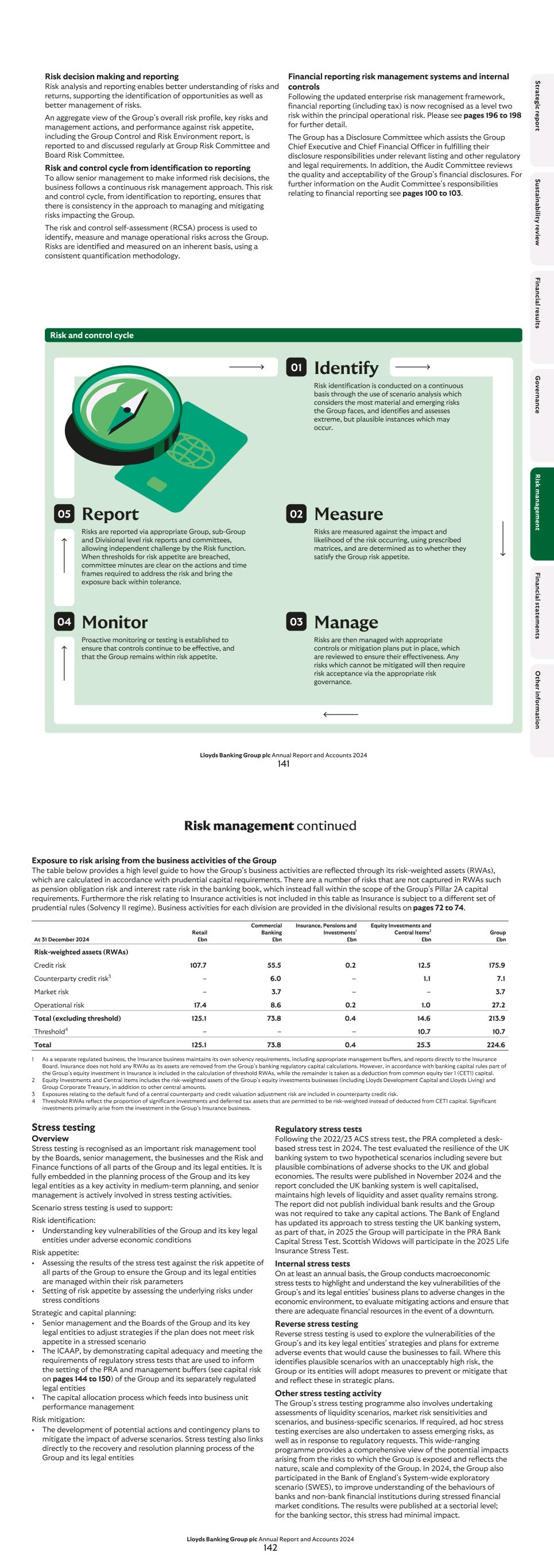
Risk decision making and reporting Risk analysis and reporting enables better understanding of risks and returns, supporting the identification of opportunities as well as better management of risks. An aggregate view of the Group’s overall risk profile, key risks and management actions, and performance against risk appetite, including the Group Control and Risk Environment report, is reported to and discussed regularly at Group Risk Committee and Board Risk Committee. Risk and control cycle from identification to reporting To allow senior management to make informed risk decisions, the business follows a continuous risk management approach. This risk and control cycle, from identification to reporting, ensures that there is consistency in the approach to managing and mitigating risks impacting the Group. The risk and control self-assessment (RCSA) process is used to identify, measure and manage operational risks across the Group. Risks are identified and measured on an inherent basis, using a consistent quantification methodology. Financial reporting risk management systems and internal controls Following the updated enterprise risk management framework, financial reporting (including tax) is now recognised as a level two risk within the principal operational risk. Please see pages 196 to 198 for further detail. The Group has a Disclosure Committee which assists the Group Chief Executive and Chief Financial Officer in fulfilling their disclosure responsibilities under relevant listing and other regulatory and legal requirements. In addition, the Audit Committee reviews the quality and acceptability of the Group’s financial disclosures. For further information on the Audit Committee’s responsibilities relating to financial reporting see pages 100 to 103. Lloyds Banking Group plc Annual Report and Accounts 2024 141 Risk and control cycle Identify Risk identification is conducted on a continuous basis through the use of scenario analysis which considers the most material and emerging risks the Group faces, and identifies and assesses extreme, but plausible instances which may occur. Report Measure Risks are reported via appropriate Group, sub-Group and Divisional level risk reports and committees, allowing independent challenge by the Risk function. When thresholds for risk appetite are breached, committee minutes are clear on the actions and time frames required to address the risk and bring the exposure back within tolerance. Risks are measured against the impact and likelihood of the risk occurring, using prescribed matrices, and are determined as to whether they satisfy the Group risk appetite. Monitor Manage Proactive monitoring or testing is established to ensure that controls continue to be effective, and that the Group remains within risk appetite. Risks are then managed with appropriate controls or mitigation plans put in place, which are reviewed to ensure their effectiveness. Any risks which cannot be mitigated will then require risk acceptance via the appropriate risk governance. l i ts 2 O th e r in fo rm a tio n R isk m a n a ge m e n t F in a n cia l re su lts S u sta in a b ility re vie w S tra te gic re p o rt G o ve rn a n ce F in a n cia l sta te m e n ts Exposure to risk arising from the business activities of the Group The table below provides a high level guide to how the Group’s business activities are reflected through its risk-weighted assets (RWAs), which are calculated in accordance with prudential capital requirements. There are a number of risks that are not captured in RWAs such as pension obligation risk and interest rate risk in the banking book, which instead fall within the scope of the Group's Pillar 2A capital requirements. Furthermore the risk relating to Insurance activities is not included in this table as Insurance is subject to a different set of prudential rules (Solvency II regime). Business activities for each division are provided in the divisional results on pages 72 to 74. At 31 December 2024 Retail £bn Commercial Banking £bn Insurance, Pensions and Investments1 £bn Equity Investments and Central Items2 £bn Group £bn Risk-weighted assets (RWAs) Credit risk 107.7 55.5 0.2 12.5 175.9 Counterparty credit risk3 – 6.0 – 1.1 7.1 Market risk – 3.7 – – 3.7 Operational risk 17.4 8.6 0.2 1.0 27.2 Total (excluding threshold) 125.1 73.8 0.4 14.6 213.9 Threshold4 – – – 10.7 10.7 Total 125.1 73.8 0.4 25.3 224.6 1 As a separate regulated business, the Insurance business maintains its own solvency requirements, including appropriate management buffers, and reports directly to the Insurance Board. Insurance does not hold any RWAs as its assets are removed from the Group’s banking regulatory capital calculations. However, in accordance with banking capital rules part of the Group’s equity investment in Insurance is included in the calculation of threshold RWAs, while the remainder is taken as a deduction from common equity tier 1 (CET1) capital. 2 Equity Investments and Central Items includes the risk-weighted assets of the Group’s equity investments businesses (including Lloyds Development Capital and Lloyds Living) and Group Corporate Treasury, in addition to other central amounts. 3 Exposures relating to the default fund of a central counterparty and credit valuation adjustment risk are included in counterparty credit risk. 4 Threshold RWAs reflect the proportion of significant investments and deferred tax assets that are permitted to be risk-weighted instead of deducted from CET1 capital. Significant investments primarily arise from the investment in the Group’s Insurance business. Stress testing Overview Stress testing is recognised as an important risk management tool by the Boards, senior management, the businesses and the Risk and Finance functions of all parts of the Group and its legal entities. It is fully embedded in the planning process of the Group and its key legal entities as a key activity in medium-term planning, and senior management is actively involved in stress testing activities. Scenario stress testing is used to support: Risk identification: • Understanding key vulnerabilities of the Group and its key legal entities under adverse economic conditions Risk appetite: • Assessing the results of the stress test against the risk appetite of all parts of the Group to ensure the Group and its legal entities are managed within their risk parameters • Setting of risk appetite by assessing the underlying risks under stress conditions Strategic and capital planning: • Senior management and the Boards of the Group and its key legal entities to adjust strategies if the plan does not meet risk appetite in a stressed scenario • The ICAAP, by demonstrating capital adequacy and meeting the requirements of regulatory stress tests that are used to inform the setting of the PRA and management buffers (see capital risk on pages 144 to 150) of the Group and its separately regulated legal entities • The capital allocation process which feeds into business unit performance management Risk mitigation: • The development of potential actions and contingency plans to mitigate the impact of adverse scenarios. Stress testing also links directly to the recovery and resolution planning process of the Group and its legal entities Regulatory stress tests Following the 2022/23 ACS stress test, the PRA completed a desk- based stress test in 2024. The test evaluated the resilience of the UK banking system to two hypothetical scenarios including severe but plausible combinations of adverse shocks to the UK and global economies. The results were published in November 2024 and the report concluded the UK banking system is well capitalised, maintains high levels of liquidity and asset quality remains strong. The report did not publish individual bank results and the Group was not required to take any capital actions. The Bank of England has updated its approach to stress testing the UK banking system, as part of that, in 2025 the Group will participate in the PRA Bank Capital Stress Test. Scottish Widows will participate in the 2025 Life Insurance Stress Test. Internal stress tests On at least an annual basis, the Group conducts macroeconomic stress tests to highlight and understand the key vulnerabilities of the Group’s and its legal entities’ business plans to adverse changes in the economic environment, to evaluate mitigating actions and ensure that there are adequate financial resources in the event of a downturn. Reverse stress testing Reverse stress testing is used to explore the vulnerabilities of the Group’s and its key legal entities’ strategies and plans for extreme adverse events that would cause the businesses to fail. Where this identifies plausible scenarios with an unacceptably high risk, the Group or its entities will adopt measures to prevent or mitigate that and reflect these in strategic plans. Other stress testing activity The Group’s stress testing programme also involves undertaking assessments of liquidity scenarios, market risk sensitivities and scenarios, and business-specific scenarios. If required, ad hoc stress testing exercises are also undertaken to assess emerging risks, as well as in response to regulatory requests. This wide-ranging programme provides a comprehensive view of the potential impacts arising from the risks to which the Group is exposed and reflects the nature, scale and complexity of the Group. In 2024, the Group also participated in the Bank of England’s System-wide exploratory scenario (SWES), to improve understanding of the behaviours of banks and non-bank financial institutions during stressed financial market conditions. The results were published at a sectorial level; for the banking sector, this stress had minimal impact. Risk management continued Lloyds Banking Group plc Annual Report and Accounts 2024 142 l i ts
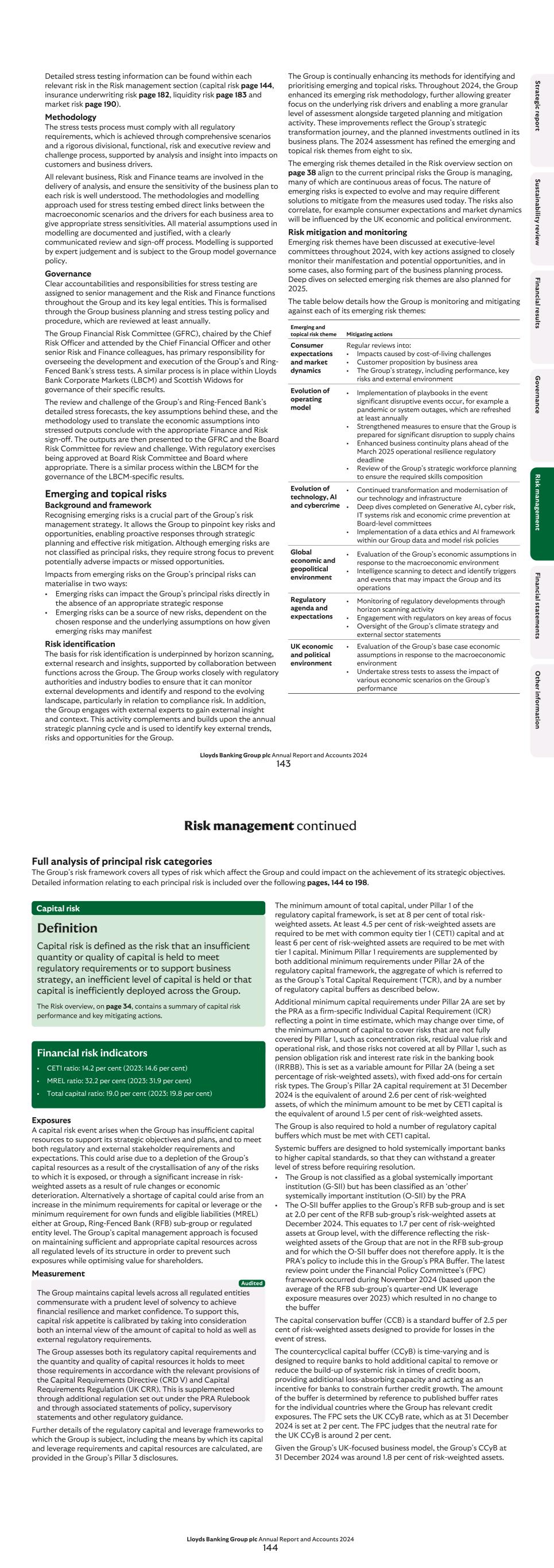
Detailed stress testing information can be found within each relevant risk in the Risk management section (capital risk page 144, insurance underwriting risk page 182, liquidity risk page 183 and market risk page 190). Methodology The stress tests process must comply with all regulatory requirements, which is achieved through comprehensive scenarios and a rigorous divisional, functional, risk and executive review and challenge process, supported by analysis and insight into impacts on customers and business drivers. All relevant business, Risk and Finance teams are involved in the delivery of analysis, and ensure the sensitivity of the business plan to each risk is well understood. The methodologies and modelling approach used for stress testing embed direct links between the macroeconomic scenarios and the drivers for each business area to give appropriate stress sensitivities. All material assumptions used in modelling are documented and justified, with a clearly communicated review and sign-off process. Modelling is supported by expert judgement and is subject to the Group model governance policy. Governance Clear accountabilities and responsibilities for stress testing are assigned to senior management and the Risk and Finance functions throughout the Group and its key legal entities. This is formalised through the Group business planning and stress testing policy and procedure, which are reviewed at least annually. The Group Financial Risk Committee (GFRC), chaired by the Chief Risk Officer and attended by the Chief Financial Officer and other senior Risk and Finance colleagues, has primary responsibility for overseeing the development and execution of the Group’s and Ring- Fenced Bank’s stress tests. A similar process is in place within Lloyds Bank Corporate Markets (LBCM) and Scottish Widows for governance of their specific results. The review and challenge of the Group’s and Ring-Fenced Bank’s detailed stress forecasts, the key assumptions behind these, and the methodology used to translate the economic assumptions into stressed outputs conclude with the appropriate Finance and Risk sign-off. The outputs are then presented to the GFRC and the Board Risk Committee for review and challenge. With regulatory exercises being approved at Board Risk Committee and Board where appropriate. There is a similar process within the LBCM for the governance of the LBCM-specific results. Emerging and topical risks Background and framework Recognising emerging risks is a crucial part of the Group’s risk management strategy. It allows the Group to pinpoint key risks and opportunities, enabling proactive responses through strategic planning and effective risk mitigation. Although emerging risks are not classified as principal risks, they require strong focus to prevent potentially adverse impacts or missed opportunities. Impacts from emerging risks on the Group’s principal risks can materialise in two ways: • Emerging risks can impact the Group’s principal risks directly in the absence of an appropriate strategic response • Emerging risks can be a source of new risks, dependent on the chosen response and the underlying assumptions on how given emerging risks may manifest Risk identification The basis for risk identification is underpinned by horizon scanning, external research and insights, supported by collaboration between functions across the Group. The Group works closely with regulatory authorities and industry bodies to ensure that it can monitor external developments and identify and respond to the evolving landscape, particularly in relation to compliance risk. In addition, the Group engages with external experts to gain external insight and context. This activity complements and builds upon the annual strategic planning cycle and is used to identify key external trends, risks and opportunities for the Group. The Group is continually enhancing its methods for identifying and prioritising emerging and topical risks. Throughout 2024, the Group enhanced its emerging risk methodology, further allowing greater focus on the underlying risk drivers and enabling a more granular level of assessment alongside targeted planning and mitigation activity. These improvements reflect the Group’s strategic transformation journey, and the planned investments outlined in its business plans. The 2024 assessment has refined the emerging and topical risk themes from eight to six. The emerging risk themes detailed in the Risk overview section on page 38 align to the current principal risks the Group is managing, many of which are continuous areas of focus. The nature of emerging risks is expected to evolve and may require different solutions to mitigate from the measures used today. The risks also correlate, for example consumer expectations and market dynamics will be influenced by the UK economic and political environment. Risk mitigation and monitoring Emerging risk themes have been discussed at executive-level committees throughout 2024, with key actions assigned to closely monitor their manifestation and potential opportunities, and in some cases, also forming part of the business planning process. Deep dives on selected emerging risk themes are also planned for 2025. The table below details how the Group is monitoring and mitigating against each of its emerging risk themes: Emerging and topical risk theme Mitigating actions Consumer expectations and market dynamics Regular reviews into: • Impacts caused by cost-of-living challenges • Customer proposition by business area • The Group’s strategy, including performance, key risks and external environment Evolution of operating model • Implementation of playbooks in the event significant disruptive events occur, for example a pandemic or system outages, which are refreshed at least annually • Strengthened measures to ensure that the Group is prepared for significant disruption to supply chains • Enhanced business continuity plans ahead of the March 2025 operational resilience regulatory deadline • Review of the Group’s strategic workforce planning to ensure the required skills composition Evolution of technology, AI and cybercrime • Continued transformation and modernisation of our technology and infrastructure • Deep dives completed on Generative AI, cyber risk, IT systems risk and economic crime prevention at Board-level committees • Implementation of a data ethics and AI framework within our Group data and model risk policies Global economic and geopolitical environment • Evaluation of the Group’s economic assumptions in response to the macroeconomic environment • Intelligence scanning to detect and identify triggers and events that may impact the Group and its operations Regulatory agenda and expectations • Monitoring of regulatory developments through horizon scanning activity • Engagement with regulators on key areas of focus • Oversight of the Group’s climate strategy and external sector statements UK economic and political environment • Evaluation of the Group’s base case economic assumptions in response to the macroeconomic environment • Undertake stress tests to assess the impact of various economic scenarios on the Group’s performance Lloyds Banking Group plc Annual Report and Accounts 2024 143 l i ts 2 O th e r in fo rm a tio n R isk m a n a ge m e n t F in a n cia l re su lts S u sta in a b ility re vie w S tra te gic re p o rt G o ve rn a n ce F in a n cia l sta te m e n ts Full analysis of principal risk categories The Group’s risk framework covers all types of risk which affect the Group and could impact on the achievement of its strategic objectives. Detailed information relating to each principal risk is included over the following pages, 144 to 198. F Financial risk indicators • CET1 ratio: 14.2 per cent (2023: 14.6 per cent) • MREL ratio: 32.2 per cent (2023: 31.9 per cent) • Total capital ratio: 19.0 per cent (2023: 19.8 per cent) Exposures A capital risk event arises when the Group has insufficient capital resources to support its strategic objectives and plans, and to meet both regulatory and external stakeholder requirements and expectations. This could arise due to a depletion of the Group’s capital resources as a result of the crystallisation of any of the risks to which it is exposed, or through a significant increase in risk- weighted assets as a result of rule changes or economic deterioration. Alternatively a shortage of capital could arise from an increase in the minimum requirements for capital or leverage or the minimum requirement for own funds and eligible liabilities (MREL) either at Group, Ring-Fenced Bank (RFB) sub-group or regulated entity level. The Group’s capital management approach is focused on maintaining sufficient and appropriate capital resources across all regulated levels of its structure in order to prevent such exposures while optimising value for shareholders. Measurement The Group maintains capital levels across all regulated entities commensurate with a prudent level of solvency to achieve financial resilience and market confidence. To support this, capital risk appetite is calibrated by taking into consideration both an internal view of the amount of capital to hold as well as external regulatory requirements. The Group assesses both its regulatory capital requirements and the quantity and quality of capital resources it holds to meet those requirements in accordance with the relevant provisions of the Capital Requirements Directive (CRD V) and Capital Requirements Regulation (UK CRR). This is supplemented through additional regulation set out under the PRA Rulebook and through associated statements of policy, supervisory statements and other regulatory guidance. Further details of the regulatory capital and leverage frameworks to which the Group is subject, including the means by which its capital and leverage requirements and capital resources are calculated, are provided in the Group’s Pillar 3 disclosures. The minimum amount of total capital, under Pillar 1 of the regulatory capital framework, is set at 8 per cent of total risk- weighted assets. At least 4.5 per cent of risk-weighted assets are required to be met with common equity tier 1 (CET1) capital and at least 6 per cent of risk-weighted assets are required to be met with tier 1 capital. Minimum Pillar 1 requirements are supplemented by both additional minimum requirements under Pillar 2A of the regulatory capital framework, the aggregate of which is referred to as the Group’s Total Capital Requirement (TCR), and by a number of regulatory capital buffers as described below. Additional minimum capital requirements under Pillar 2A are set by the PRA as a firm-specific Individual Capital Requirement (ICR) reflecting a point in time estimate, which may change over time, of the minimum amount of capital to cover risks that are not fully covered by Pillar 1, such as concentration risk, residual value risk and operational risk, and those risks not covered at all by Pillar 1, such as pension obligation risk and interest rate risk in the banking book (IRRBB). This is set as a variable amount for Pillar 2A (being a set percentage of risk-weighted assets), with fixed add-ons for certain risk types. The Group’s Pillar 2A capital requirement at 31 December 2024 is the equivalent of around 2.6 per cent of risk-weighted assets, of which the minimum amount to be met by CET1 capital is the equivalent of around 1.5 per cent of risk-weighted assets. The Group is also required to hold a number of regulatory capital buffers which must be met with CET1 capital. Systemic buffers are designed to hold systemically important banks to higher capital standards, so that they can withstand a greater level of stress before requiring resolution. • The Group is not classified as a global systemically important institution (G-SII) but has been classified as an ‘other’ systemically important institution (O-SII) by the PRA • The O-SII buffer applies to the Group’s RFB sub-group and is set at 2.0 per cent of the RFB sub-group’s risk-weighted assets at December 2024. This equates to 1.7 per cent of risk-weighted assets at Group level, with the difference reflecting the risk- weighted assets of the Group that are not in the RFB sub-group and for which the O-SII buffer does not therefore apply. It is the PRA’s policy to include this in the Group’s PRA Buffer. The latest review point under the Financial Policy Committee’s (FPC) framework occurred during November 2024 (based upon the average of the RFB sub-group’s quarter-end UK leverage exposure measures over 2023) which resulted in no change to the buffer The capital conservation buffer (CCB) is a standard buffer of 2.5 per cent of risk-weighted assets designed to provide for losses in the event of stress. The countercyclical capital buffer (CCyB) is time-varying and is designed to require banks to hold additional capital to remove or reduce the build-up of systemic risk in times of credit boom, providing additional loss-absorbing capacity and acting as an incentive for banks to constrain further credit growth. The amount of the buffer is determined by reference to published buffer rates for the individual countries where the Group has relevant credit exposures. The FPC sets the UK CCyB rate, which as at 31 December 2024 is set at 2 per cent. The FPC judges that the neutral rate for the UK CCyB is around 2 per cent. Given the Group’s UK-focused business model, the Group’s CCyB at 31 December 2024 was around 1.8 per cent of risk-weighted assets. Risk management continued Lloyds Banking Group plc Annual Report and Accounts 2024 144 Capital risk Definition Capital risk is defined as the risk that an insufficient quantity or quality of capital is held to meet regulatory requirements or to support business strategy, an inefficient level of capital is held or that capital is inefficiently deployed across the Group. The Risk overview, on page 34, contains a summary of capital risk performance and key mitigating actions. l i ts
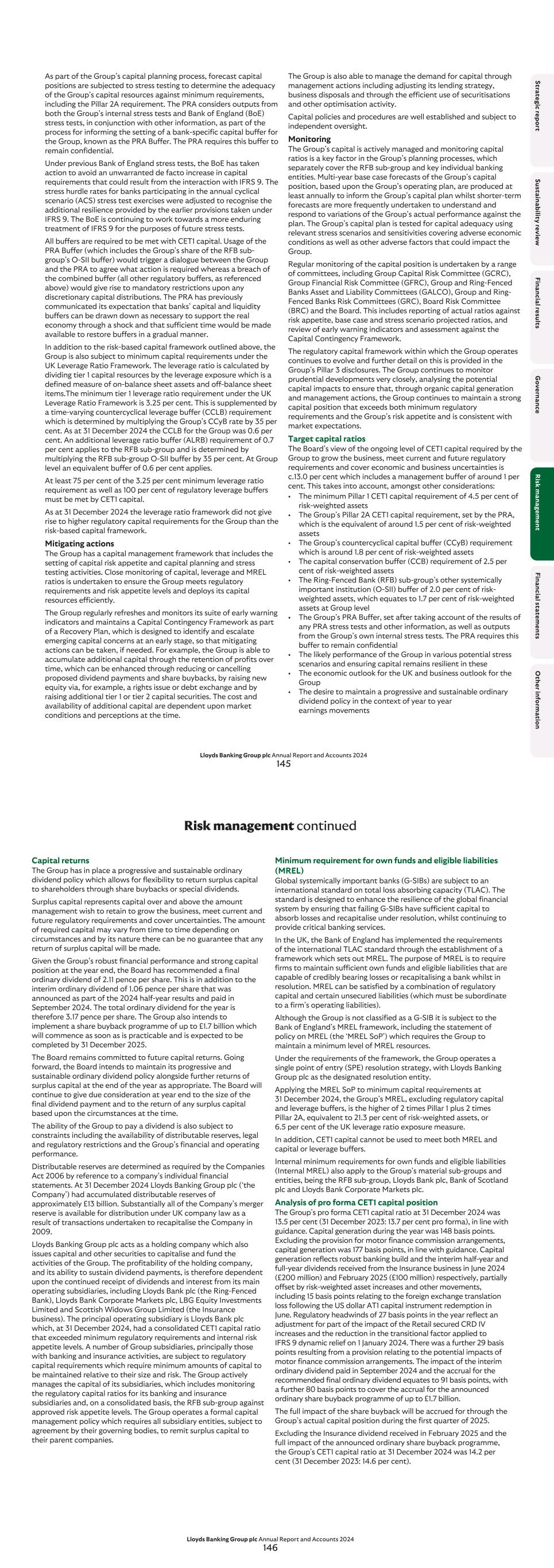
As part of the Group’s capital planning process, forecast capital positions are subjected to stress testing to determine the adequacy of the Group’s capital resources against minimum requirements, including the Pillar 2A requirement. The PRA considers outputs from both the Group’s internal stress tests and Bank of England (BoE) stress tests, in conjunction with other information, as part of the process for informing the setting of a bank-specific capital buffer for the Group, known as the PRA Buffer. The PRA requires this buffer to remain confidential. Under previous Bank of England stress tests, the BoE has taken action to avoid an unwarranted de facto increase in capital requirements that could result from the interaction with IFRS 9. The stress hurdle rates for banks participating in the annual cyclical scenario (ACS) stress test exercises were adjusted to recognise the additional resilience provided by the earlier provisions taken under IFRS 9. The BoE is continuing to work towards a more enduring treatment of IFRS 9 for the purposes of future stress tests. All buffers are required to be met with CET1 capital. Usage of the PRA Buffer (which includes the Group’s share of the RFB sub- group’s O-SII buffer) would trigger a dialogue between the Group and the PRA to agree what action is required whereas a breach of the combined buffer (all other regulatory buffers, as referenced above) would give rise to mandatory restrictions upon any discretionary capital distributions. The PRA has previously communicated its expectation that banks’ capital and liquidity buffers can be drawn down as necessary to support the real economy through a shock and that sufficient time would be made available to restore buffers in a gradual manner. In addition to the risk-based capital framework outlined above, the Group is also subject to minimum capital requirements under the UK Leverage Ratio Framework. The leverage ratio is calculated by dividing tier 1 capital resources by the leverage exposure which is a defined measure of on-balance sheet assets and off-balance sheet items.The minimum tier 1 leverage ratio requirement under the UK Leverage Ratio Framework is 3.25 per cent. This is supplemented by a time-varying countercyclical leverage buffer (CCLB) requirement which is determined by multiplying the Group’s CCyB rate by 35 per cent. As at 31 December 2024 the CCLB for the Group was 0.6 per cent. An additional leverage ratio buffer (ALRB) requirement of 0.7 per cent applies to the RFB sub-group and is determined by multiplying the RFB sub-group O-SII buffer by 35 per cent. At Group level an equivalent buffer of 0.6 per cent applies. At least 75 per cent of the 3.25 per cent minimum leverage ratio requirement as well as 100 per cent of regulatory leverage buffers must be met by CET1 capital. As at 31 December 2024 the leverage ratio framework did not give rise to higher regulatory capital requirements for the Group than the risk-based capital framework. Mitigating actions The Group has a capital management framework that includes the setting of capital risk appetite and capital planning and stress testing activities. Close monitoring of capital, leverage and MREL ratios is undertaken to ensure the Group meets regulatory requirements and risk appetite levels and deploys its capital resources efficiently. The Group regularly refreshes and monitors its suite of early warning indicators and maintains a Capital Contingency Framework as part of a Recovery Plan, which is designed to identify and escalate emerging capital concerns at an early stage, so that mitigating actions can be taken, if needed. For example, the Group is able to accumulate additional capital through the retention of profits over time, which can be enhanced through reducing or cancelling proposed dividend payments and share buybacks, by raising new equity via, for example, a rights issue or debt exchange and by raising additional tier 1 or tier 2 capital securities. The cost and availability of additional capital are dependent upon market conditions and perceptions at the time. The Group is also able to manage the demand for capital through management actions including adjusting its lending strategy, business disposals and through the efficient use of securitisations and other optimisation activity. Capital policies and procedures are well established and subject to independent oversight. Monitoring The Group’s capital is actively managed and monitoring capital ratios is a key factor in the Group’s planning processes, which separately cover the RFB sub-group and key individual banking entities. Multi-year base case forecasts of the Group’s capital position, based upon the Group’s operating plan, are produced at least annually to inform the Group’s capital plan whilst shorter-term forecasts are more frequently undertaken to understand and respond to variations of the Group’s actual performance against the plan. The Group’s capital plan is tested for capital adequacy using relevant stress scenarios and sensitivities covering adverse economic conditions as well as other adverse factors that could impact the Group. Regular monitoring of the capital position is undertaken by a range of committees, including Group Capital Risk Committee (GCRC), Group Financial Risk Committee (GFRC), Group and Ring-Fenced Banks Asset and Liability Committees (GALCO), Group and Ring- Fenced Banks Risk Committees (GRC), Board Risk Committee (BRC) and the Board. This includes reporting of actual ratios against risk appetite, base case and stress scenario projected ratios, and review of early warning indicators and assessment against the Capital Contingency Framework. The regulatory capital framework within which the Group operates continues to evolve and further detail on this is provided in the Group’s Pillar 3 disclosures. The Group continues to monitor prudential developments very closely, analysing the potential capital impacts to ensure that, through organic capital generation and management actions, the Group continues to maintain a strong capital position that exceeds both minimum regulatory requirements and the Group’s risk appetite and is consistent with market expectations. Target capital ratios The Board’s view of the ongoing level of CET1 capital required by the Group to grow the business, meet current and future regulatory requirements and cover economic and business uncertainties is c.13.0 per cent which includes a management buffer of around 1 per cent. This takes into account, amongst other considerations: • The minimum Pillar 1 CET1 capital requirement of 4.5 per cent of risk-weighted assets • The Group’s Pillar 2A CET1 capital requirement, set by the PRA, which is the equivalent of around 1.5 per cent of risk-weighted assets • The Group’s countercyclical capital buffer (CCyB) requirement which is around 1.8 per cent of risk-weighted assets • The capital conservation buffer (CCB) requirement of 2.5 per cent of risk-weighted assets • The Ring-Fenced Bank (RFB) sub-group’s other systemically important institution (O-SII) buffer of 2.0 per cent of risk- weighted assets, which equates to 1.7 per cent of risk-weighted assets at Group level • The Group’s PRA Buffer, set after taking account of the results of any PRA stress tests and other information, as well as outputs from the Group’s own internal stress tests. The PRA requires this buffer to remain confidential • The likely performance of the Group in various potential stress scenarios and ensuring capital remains resilient in these • The economic outlook for the UK and business outlook for the Group • The desire to maintain a progressive and sustainable ordinary dividend policy in the context of year to year earnings movements Lloyds Banking Group plc Annual Report and Accounts 2024 145 l i ts 2 O th e r in fo rm a tio n R isk m a n a ge m e n t F in a n cia l re su lts S u sta in a b ility re vie w S tra te gic re p o rt G o ve rn a n ce F in a n cia l sta te m e n ts Capital returns The Group has in place a progressive and sustainable ordinary dividend policy which allows for flexibility to return surplus capital to shareholders through share buybacks or special dividends. Surplus capital represents capital over and above the amount management wish to retain to grow the business, meet current and future regulatory requirements and cover uncertainties. The amount of required capital may vary from time to time depending on circumstances and by its nature there can be no guarantee that any return of surplus capital will be made. Given the Group’s robust financial performance and strong capital position at the year end, the Board has recommended a final ordinary dividend of 2.11 pence per share. This is in addition to the interim ordinary dividend of 1.06 pence per share that was announced as part of the 2024 half-year results and paid in September 2024. The total ordinary dividend for the year is therefore 3.17 pence per share. The Group also intends to implement a share buyback programme of up to £1.7 billion which will commence as soon as is practicable and is expected to be completed by 31 December 2025. The Board remains committed to future capital returns. Going forward, the Board intends to maintain its progressive and sustainable ordinary dividend policy alongside further returns of surplus capital at the end of the year as appropriate. The Board will continue to give due consideration at year end to the size of the final dividend payment and to the return of any surplus capital based upon the circumstances at the time. The ability of the Group to pay a dividend is also subject to constraints including the availability of distributable reserves, legal and regulatory restrictions and the Group’s financial and operating performance. Distributable reserves are determined as required by the Companies Act 2006 by reference to a company’s individual financial statements. At 31 December 2024 Lloyds Banking Group plc (‘the Company’) had accumulated distributable reserves of approximately £13 billion. Substantially all of the Company’s merger reserve is available for distribution under UK company law as a result of transactions undertaken to recapitalise the Company in 2009. Lloyds Banking Group plc acts as a holding company which also issues capital and other securities to capitalise and fund the activities of the Group. The profitability of the holding company, and its ability to sustain dividend payments, is therefore dependent upon the continued receipt of dividends and interest from its main operating subsidiaries, including Lloyds Bank plc (the Ring-Fenced Bank), Lloyds Bank Corporate Markets plc, LBG Equity Investments Limited and Scottish Widows Group Limited (the Insurance business). The principal operating subsidiary is Lloyds Bank plc which, at 31 December 2024, had a consolidated CET1 capital ratio that exceeded minimum regulatory requirements and internal risk appetite levels. A number of Group subsidiaries, principally those with banking and insurance activities, are subject to regulatory capital requirements which require minimum amounts of capital to be maintained relative to their size and risk. The Group actively manages the capital of its subsidiaries, which includes monitoring the regulatory capital ratios for its banking and insurance subsidiaries and, on a consolidated basis, the RFB sub-group against approved risk appetite levels. The Group operates a formal capital management policy which requires all subsidiary entities, subject to agreement by their governing bodies, to remit surplus capital to their parent companies. Minimum requirement for own funds and eligible liabilities (MREL) Global systemically important banks (G-SIBs) are subject to an international standard on total loss absorbing capacity (TLAC). The standard is designed to enhance the resilience of the global financial system by ensuring that failing G-SIBs have sufficient capital to absorb losses and recapitalise under resolution, whilst continuing to provide critical banking services. In the UK, the Bank of England has implemented the requirements of the international TLAC standard through the establishment of a framework which sets out MREL. The purpose of MREL is to require firms to maintain sufficient own funds and eligible liabilities that are capable of credibly bearing losses or recapitalising a bank whilst in resolution. MREL can be satisfied by a combination of regulatory capital and certain unsecured liabilities (which must be subordinate to a firm’s operating liabilities). Although the Group is not classified as a G-SIB it is subject to the Bank of England’s MREL framework, including the statement of policy on MREL (the ‘MREL SoP’) which requires the Group to maintain a minimum level of MREL resources. Under the requirements of the framework, the Group operates a single point of entry (SPE) resolution strategy, with Lloyds Banking Group plc as the designated resolution entity. Applying the MREL SoP to minimum capital requirements at 31 December 2024, the Group’s MREL, excluding regulatory capital and leverage buffers, is the higher of 2 times Pillar 1 plus 2 times Pillar 2A, equivalent to 21.3 per cent of risk-weighted assets, or 6.5 per cent of the UK leverage ratio exposure measure. In addition, CET1 capital cannot be used to meet both MREL and capital or leverage buffers. Internal minimum requirements for own funds and eligible liabilities (Internal MREL) also apply to the Group’s material sub-groups and entities, being the RFB sub-group, Lloyds Bank plc, Bank of Scotland plc and Lloyds Bank Corporate Markets plc. Analysis of pro forma CET1 capital position The Group’s pro forma CET1 capital ratio at 31 December 2024 was 13.5 per cent (31 December 2023: 13.7 per cent pro forma), in line with guidance. Capital generation during the year was 148 basis points. Excluding the provision for motor finance commission arrangements, capital generation was 177 basis points, in line with guidance. Capital generation reflects robust banking build and the interim half-year and full-year dividends received from the Insurance business in June 2024 (£200 million) and February 2025 (£100 million) respectively, partially offset by risk-weighted asset increases and other movements, including 15 basis points relating to the foreign exchange translation loss following the US dollar AT1 capital instrument redemption in June. Regulatory headwinds of 27 basis points in the year reflect an adjustment for part of the impact of the Retail secured CRD IV increases and the reduction in the transitional factor applied to IFRS 9 dynamic relief on 1 January 2024. There was a further 29 basis points resulting from a provision relating to the potential impacts of motor finance commission arrangements. The impact of the interim ordinary dividend paid in September 2024 and the accrual for the recommended final ordinary dividend equates to 91 basis points, with a further 80 basis points to cover the accrual for the announced ordinary share buyback programme of up to £1.7 billion. The full impact of the share buyback will be accrued for through the Group’s actual capital position during the first quarter of 2025. Excluding the Insurance dividend received in February 2025 and the full impact of the announced ordinary share buyback programme, the Group's CET1 capital ratio at 31 December 2024 was 14.2 per cent (31 December 2023: 14.6 per cent). Risk management continued Lloyds Banking Group plc Annual Report and Accounts 2024 146 l i ts
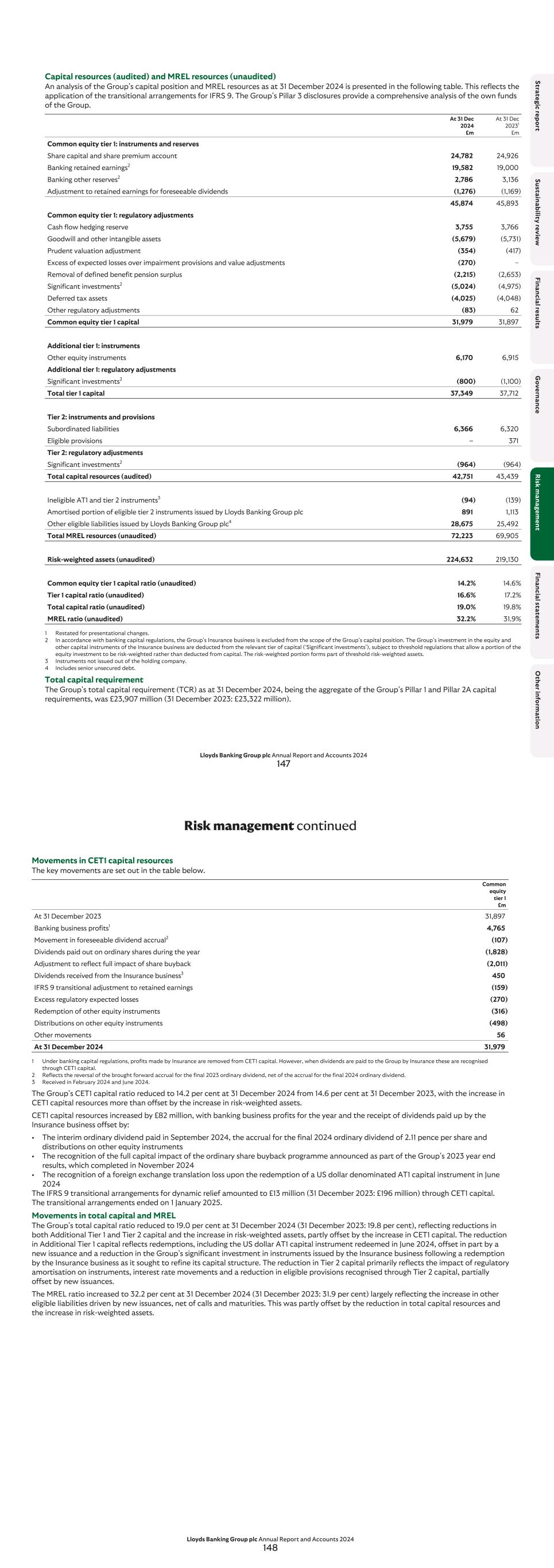
Capital resources (audited) and MREL resources (unaudited) An analysis of the Group’s capital position and MREL resources as at 31 December 2024 is presented in the following table. This reflects the application of the transitional arrangements for IFRS 9. The Group’s Pillar 3 disclosures provide a comprehensive analysis of the own funds of the Group. At 31 Dec 2024 £m At 31 Dec 20231 £m Common equity tier 1: instruments and reserves Share capital and share premium account 24,782 24,926 Banking retained earnings2 19,582 19,000 Banking other reserves2 2,786 3,136 Adjustment to retained earnings for foreseeable dividends (1,276) (1,169) 45,874 45,893 Common equity tier 1: regulatory adjustments Cash flow hedging reserve 3,755 3,766 Goodwill and other intangible assets (5,679) (5,731) Prudent valuation adjustment (354) (417) Excess of expected losses over impairment provisions and value adjustments (270) – Removal of defined benefit pension surplus (2,215) (2,653) Significant investments2 (5,024) (4,975) Deferred tax assets (4,025) (4,048) Other regulatory adjustments (83) 62 Common equity tier 1 capital 31,979 31,897 Additional tier 1: instruments Other equity instruments 6,170 6,915 Additional tier 1: regulatory adjustments Significant investments2 (800) (1,100) Total tier 1 capital 37,349 37,712 Tier 2: instruments and provisions Subordinated liabilities 6,366 6,320 Eligible provisions – 371 Tier 2: regulatory adjustments Significant investments2 (964) (964) Total capital resources (audited) 42,751 43,439 Ineligible AT1 and tier 2 instruments3 (94) (139) Amortised portion of eligible tier 2 instruments issued by Lloyds Banking Group plc 891 1,113 Other eligible liabilities issued by Lloyds Banking Group plc4 28,675 25,492 Total MREL resources (unaudited) 72,223 69,905 Risk-weighted assets (unaudited) 224,632 219,130 Common equity tier 1 capital ratio (unaudited) 14.2% 14.6% Tier 1 capital ratio (unaudited) 16.6% 17.2% Total capital ratio (unaudited) 19.0% 19.8% MREL ratio (unaudited) 32.2% 31.9% 1 Restated for presentational changes. 2 In accordance with banking capital regulations, the Group’s Insurance business is excluded from the scope of the Group’s capital position. The Group’s investment in the equity and other capital instruments of the Insurance business are deducted from the relevant tier of capital (‘Significant investments’), subject to threshold regulations that allow a portion of the equity investment to be risk-weighted rather than deducted from capital. The risk-weighted portion forms part of threshold risk-weighted assets. 3 Instruments not issued out of the holding company. 4 Includes senior unsecured debt. Total capital requirement The Group’s total capital requirement (TCR) as at 31 December 2024, being the aggregate of the Group’s Pillar 1 and Pillar 2A capital requirements, was £23,907 million (31 December 2023: £23,322 million). Lloyds Banking Group plc Annual Report and Accounts 2024 147 l i ts 2 O th e r in fo rm a tio n R isk m a n a ge m e n t F in a n cia l re su lts S u sta in a b ility re vie w S tra te gic re p o rt G o ve rn a n ce F in a n cia l sta te m e n ts Movements in CET1 capital resources The key movements are set out in the table below. Common equity tier 1 £m At 31 December 2023 31,897 Banking business profits1 4,765 Movement in foreseeable dividend accrual2 (107) Dividends paid out on ordinary shares during the year (1,828) Adjustment to reflect full impact of share buyback (2,011) Dividends received from the Insurance business3 450 IFRS 9 transitional adjustment to retained earnings (159) Excess regulatory expected losses (270) Redemption of other equity instruments (316) Distributions on other equity instruments (498) Other movements 56 At 31 December 2024 31,979 1 Under banking capital regulations, profits made by Insurance are removed from CET1 capital. However, when dividends are paid to the Group by Insurance these are recognised through CET1 capital. 2 Reflects the reversal of the brought forward accrual for the final 2023 ordinary dividend, net of the accrual for the final 2024 ordinary dividend. 3 Received in February 2024 and June 2024. The Group’s CET1 capital ratio reduced to 14.2 per cent at 31 December 2024 from 14.6 per cent at 31 December 2023, with the increase in CET1 capital resources more than offset by the increase in risk-weighted assets. CET1 capital resources increased by £82 million, with banking business profits for the year and the receipt of dividends paid up by the Insurance business offset by: • The interim ordinary dividend paid in September 2024, the accrual for the final 2024 ordinary dividend of 2.11 pence per share and distributions on other equity instruments • The recognition of the full capital impact of the ordinary share buyback programme announced as part of the Group’s 2023 year end results, which completed in November 2024 • The recognition of a foreign exchange translation loss upon the redemption of a US dollar denominated AT1 capital instrument in June 2024 The IFRS 9 transitional arrangements for dynamic relief amounted to £13 million (31 December 2023: £196 million) through CET1 capital. The transitional arrangements ended on 1 January 2025. Movements in total capital and MREL The Group’s total capital ratio reduced to 19.0 per cent at 31 December 2024 (31 December 2023: 19.8 per cent), reflecting reductions in both Additional Tier 1 and Tier 2 capital and the increase in risk-weighted assets, partly offset by the increase in CET1 capital. The reduction in Additional Tier 1 capital reflects redemptions, including the US dollar AT1 capital instrument redeemed in June 2024, offset in part by a new issuance and a reduction in the Group’s significant investment in instruments issued by the Insurance business following a redemption by the Insurance business as it sought to refine its capital structure. The reduction in Tier 2 capital primarily reflects the impact of regulatory amortisation on instruments, interest rate movements and a reduction in eligible provisions recognised through Tier 2 capital, partially offset by new issuances. The MREL ratio increased to 32.2 per cent at 31 December 2024 (31 December 2023: 31.9 per cent) largely reflecting the increase in other eligible liabilities driven by new issuances, net of calls and maturities. This was partly offset by the reduction in total capital resources and the increase in risk-weighted assets. Risk management continued Lloyds Banking Group plc Annual Report and Accounts 2024 148 l i ts
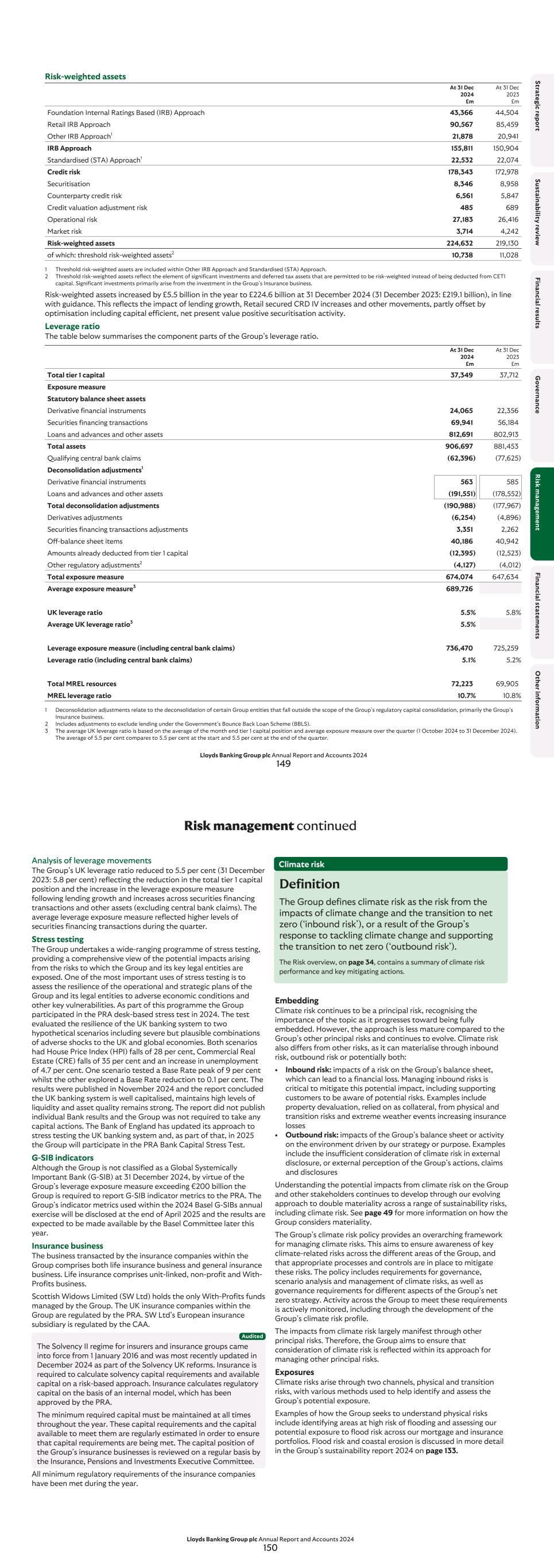
Risk-weighted assets At 31 Dec 2024 £m At 31 Dec 2023 £m Foundation Internal Ratings Based (IRB) Approach 43,366 44,504 Retail IRB Approach 90,567 85,459 Other IRB Approach1 21,878 20,941 IRB Approach 155,811 150,904 Standardised (STA) Approach1 22,532 22,074 Credit risk 178,343 172,978 Securitisation 8,346 8,958 Counterparty credit risk 6,561 5,847 Credit valuation adjustment risk 485 689 Operational risk 27,183 26,416 Market risk 3,714 4,242 Risk-weighted assets 224,632 219,130 of which: threshold risk-weighted assets2 10,738 11,028 1 Threshold risk-weighted assets are included within Other IRB Approach and Standardised (STA) Approach. 2 Threshold risk-weighted assets reflect the element of significant investments and deferred tax assets that are permitted to be risk-weighted instead of being deducted from CET1 capital. Significant investments primarily arise from the investment in the Group’s Insurance business. Risk-weighted assets increased by £5.5 billion in the year to £224.6 billion at 31 December 2024 (31 December 2023: £219.1 billion), in line with guidance. This reflects the impact of lending growth, Retail secured CRD IV increases and other movements, partly offset by optimisation including capital efficient, net present value positive securitisation activity. Leverage ratio The table below summarises the component parts of the Group’s leverage ratio. At 31 Dec 2024 £m At 31 Dec 2023 £m Total tier 1 capital 37,349 37,712 Exposure measure Statutory balance sheet assets Derivative financial instruments 24,065 22,356 Securities financing transactions 69,941 56,184 Loans and advances and other assets 812,691 802,913 Total assets 906,697 881,453 Qualifying central bank claims (62,396) (77,625) Deconsolidation adjustments1 Derivative financial instruments 563 585 Loans and advances and other assets (191,551) (178,552) Total deconsolidation adjustments (190,988) (177,967) Derivatives adjustments (6,254) (4,896) Securities financing transactions adjustments 3,351 2,262 Off-balance sheet items 40,186 40,942 Amounts already deducted from tier 1 capital (12,395) (12,523) Other regulatory adjustments2 (4,127) (4,012) Total exposure measure 674,074 647,634 Average exposure measure3 689,726 UK leverage ratio 5.5% 5.8% Average UK leverage ratio3 5.5% Leverage exposure measure (including central bank claims) 736,470 725,259 Leverage ratio (including central bank claims) 5.1% 5.2% Total MREL resources 72,223 69,905 MREL leverage ratio 10.7% 10.8% 1 Deconsolidation adjustments relate to the deconsolidation of certain Group entities that fall outside the scope of the Group’s regulatory capital consolidation, primarily the Group’s Insurance business. 2 Includes adjustments to exclude lending under the Government’s Bounce Back Loan Scheme (BBLS). 3 The average UK leverage ratio is based on the average of the month end tier 1 capital position and average exposure measure over the quarter (1 October 2024 to 31 December 2024). The average of 5.5 per cent compares to 5.5 per cent at the start and 5.5 per cent at the end of the quarter. Lloyds Banking Group plc Annual Report and Accounts 2024 149 l i ts 2 O th e r in fo rm a tio n R isk m a n a ge m e n t F in a n cia l re su lts S u sta in a b ility re vie w S tra te gic re p o rt G o ve rn a n ce F in a n cia l sta te m e n ts Analysis of leverage movements The Group’s UK leverage ratio reduced to 5.5 per cent (31 December 2023: 5.8 per cent) reflecting the reduction in the total tier 1 capital position and the increase in the leverage exposure measure following lending growth and increases across securities financing transactions and other assets (excluding central bank claims). The average leverage exposure measure reflected higher levels of securities financing transactions during the quarter. Stress testing The Group undertakes a wide-ranging programme of stress testing, providing a comprehensive view of the potential impacts arising from the risks to which the Group and its key legal entities are exposed. One of the most important uses of stress testing is to assess the resilience of the operational and strategic plans of the Group and its legal entities to adverse economic conditions and other key vulnerabilities. As part of this programme the Group participated in the PRA desk-based stress test in 2024. The test evaluated the resilience of the UK banking system to two hypothetical scenarios including severe but plausible combinations of adverse shocks to the UK and global economies. Both scenarios had House Price Index (HPI) falls of 28 per cent, Commercial Real Estate (CRE) falls of 35 per cent and an increase in unemployment of 4.7 per cent. One scenario tested a Base Rate peak of 9 per cent whilst the other explored a Base Rate reduction to 0.1 per cent. The results were published in November 2024 and the report concluded the UK banking system is well capitalised, maintains high levels of liquidity and asset quality remains strong. The report did not publish individual Bank results and the Group was not required to take any capital actions. The Bank of England has updated its approach to stress testing the UK banking system and, as part of that, in 2025 the Group will participate in the PRA Bank Capital Stress Test. G-SIB indicators Although the Group is not classified as a Global Systemically Important Bank (G-SIB) at 31 December 2024, by virtue of the Group’s leverage exposure measure exceeding €200 billion the Group is required to report G-SIB indicator metrics to the PRA. The Group’s indicator metrics used within the 2024 Basel G-SIBs annual exercise will be disclosed at the end of April 2025 and the results are expected to be made available by the Basel Committee later this year. Insurance business The business transacted by the insurance companies within the Group comprises both life insurance business and general insurance business. Life insurance comprises unit-linked, non-profit and With- Profits business. Scottish Widows Limited (SW Ltd) holds the only With-Profits funds managed by the Group. The UK insurance companies within the Group are regulated by the PRA. SW Ltd’s European insurance subsidiary is regulated by the CAA. The Solvency II regime for insurers and insurance groups came into force from 1 January 2016 and was most recently updated in December 2024 as part of the Solvency UK reforms. Insurance is required to calculate solvency capital requirements and available capital on a risk-based approach. Insurance calculates regulatory capital on the basis of an internal model, which has been approved by the PRA. The minimum required capital must be maintained at all times throughout the year. These capital requirements and the capital available to meet them are regularly estimated in order to ensure that capital requirements are being met. The capital position of the Group’s insurance businesses is reviewed on a regular basis by the Insurance, Pensions and Investments Executive Committee. All minimum regulatory requirements of the insurance companies have been met during the year. Embedding Climate risk continues to be a principal risk, recognising the importance of the topic as it progresses toward being fully embedded. However, the approach is less mature compared to the Group’s other principal risks and continues to evolve. Climate risk also differs from other risks, as it can materialise through inbound risk, outbound risk or potentially both: • Inbound risk: impacts of a risk on the Group’s balance sheet, which can lead to a financial loss. Managing inbound risks is critical to mitigate this potential impact, including supporting customers to be aware of potential risks. Examples include property devaluation, relied on as collateral, from physical and transition risks and extreme weather events increasing insurance losses • Outbound risk: impacts of the Group’s balance sheet or activity on the environment driven by our strategy or purpose. Examples include the insufficient consideration of climate risk in external disclosure, or external perception of the Group’s actions, claims and disclosures Understanding the potential impacts from climate risk on the Group and other stakeholders continues to develop through our evolving approach to double materiality across a range of sustainability risks, including climate risk. See page 49 for more information on how the Group considers materiality. The Group’s climate risk policy provides an overarching framework for managing climate risks. This aims to ensure awareness of key climate-related risks across the different areas of the Group, and that appropriate processes and controls are in place to mitigate these risks. The policy includes requirements for governance, scenario analysis and management of climate risks, as well as governance requirements for different aspects of the Group’s net zero strategy. Activity across the Group to meet these requirements is actively monitored, including through the development of the Group’s climate risk profile. The impacts from climate risk largely manifest through other principal risks. Therefore, the Group aims to ensure that consideration of climate risk is reflected within its approach for managing other principal risks. Exposures Climate risks arise through two channels, physical and transition risks, with various methods used to help identify and assess the Group’s potential exposure. Examples of how the Group seeks to understand physical risks include identifying areas at high risk of flooding and assessing our potential exposure to flood risk across our mortgage and insurance portfolios. Flood risk and coastal erosion is discussed in more detail in the Group’s sustainability report 2024 on page 133. Risk management continued Lloyds Banking Group plc Annual Report and Accounts 2024 150 Climate risk Definition The Group defines climate risk as the risk from the impacts of climate change and the transition to net zero (‘inbound risk’), or a result of the Group’s response to tackling climate change and supporting the transition to net zero (‘outbound risk’). The Risk overview, on page 34, contains a summary of climate risk performance and key mitigating actions. l i ts
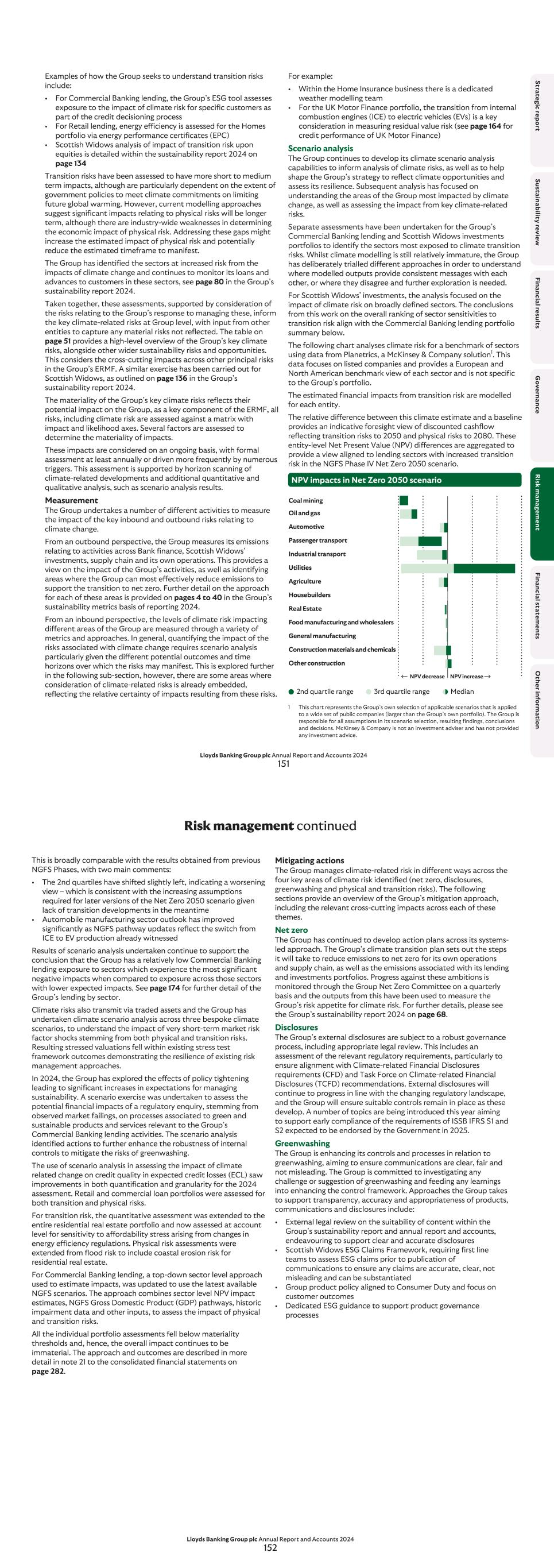
Examples of how the Group seeks to understand transition risks include: • For Commercial Banking lending, the Group’s ESG tool assesses exposure to the impact of climate risk for specific customers as part of the credit decisioning process • For Retail lending, energy efficiency is assessed for the Homes portfolio via energy performance certificates (EPC) • Scottish Widows analysis of impact of transition risk upon equities is detailed within the sustainability report 2024 on page 134 Transition risks have been assessed to have more short to medium term impacts, although are particularly dependent on the extent of government policies to meet climate commitments on limiting future global warming. However, current modelling approaches suggest significant impacts relating to physical risks will be longer term, although there are industry-wide weaknesses in determining the economic impact of physical risk. Addressing these gaps might increase the estimated impact of physical risk and potentially reduce the estimated timeframe to manifest. The Group has identified the sectors at increased risk from the impacts of climate change and continues to monitor its loans and advances to customers in these sectors, see page 80 in the Group’s sustainability report 2024. Taken together, these assessments, supported by consideration of the risks relating to the Group’s response to managing these, inform the key climate-related risks at Group level, with input from other entities to capture any material risks not reflected. The table on page 51 provides a high-level overview of the Group’s key climate risks, alongside other wider sustainability risks and opportunities. This considers the cross-cutting impacts across other principal risks in the Group’s ERMF. A similar exercise has been carried out for Scottish Widows, as outlined on page 136 in the Group’s sustainability report 2024. The materiality of the Group’s key climate risks reflects their potential impact on the Group, as a key component of the ERMF, all risks, including climate risk are assessed against a matrix with impact and likelihood axes. Several factors are assessed to determine the materiality of impacts. These impacts are considered on an ongoing basis, with formal assessment at least annually or driven more frequently by numerous triggers. This assessment is supported by horizon scanning of climate-related developments and additional quantitative and qualitative analysis, such as scenario analysis results. Measurement The Group undertakes a number of different activities to measure the impact of the key inbound and outbound risks relating to climate change. From an outbound perspective, the Group measures its emissions relating to activities across Bank finance, Scottish Widows’ investments, supply chain and its own operations. This provides a view on the impact of the Group’s activities, as well as identifying areas where the Group can most effectively reduce emissions to support the transition to net zero. Further detail on the approach for each of these areas is provided on pages 4 to 40 in the Group’s sustainability metrics basis of reporting 2024. From an inbound perspective, the levels of climate risk impacting different areas of the Group are measured through a variety of metrics and approaches. In general, quantifying the impact of the risks associated with climate change requires scenario analysis particularly given the different potential outcomes and time horizons over which the risks may manifest. This is explored further in the following sub-section, however, there are some areas where consideration of climate-related risks is already embedded, reflecting the relative certainty of impacts resulting from these risks. For example: • Within the Home Insurance business there is a dedicated weather modelling team • For the UK Motor Finance portfolio, the transition from internal combustion engines (ICE) to electric vehicles (EVs) is a key consideration in measuring residual value risk (see page 164 for credit performance of UK Motor Finance) Scenario analysis The Group continues to develop its climate scenario analysis capabilities to inform analysis of climate risks, as well as to help shape the Group’s strategy to reflect climate opportunities and assess its resilience. Subsequent analysis has focused on understanding the areas of the Group most impacted by climate change, as well as assessing the impact from key climate-related risks. Separate assessments have been undertaken for the Group’s Commercial Banking lending and Scottish Widows investments portfolios to identify the sectors most exposed to climate transition risks. Whilst climate modelling is still relatively immature, the Group has deliberately trialled different approaches in order to understand where modelled outputs provide consistent messages with each other, or where they disagree and further exploration is needed. For Scottish Widows’ investments, the analysis focused on the impact of climate risk on broadly defined sectors. The conclusions from this work on the overall ranking of sector sensitivities to transition risk align with the Commercial Banking lending portfolio summary below. The following chart analyses climate risk for a benchmark of sectors using data from Planetrics, a McKinsey & Company solution1. This data focuses on listed companies and provides a European and North American benchmark view of each sector and is not specific to the Group’s portfolio. The estimated financial impacts from transition risk are modelled for each entity. The relative difference between this climate estimate and a baseline provides an indicative foresight view of discounted cashflow reflecting transition risks to 2050 and physical risks to 2080. These entity-level Net Present Value (NPV) differences are aggregated to provide a view aligned to lending sectors with increased transition risk in the NGFS Phase IV Net Zero 2050 scenario. 1 This chart represents the Group’s own selection of applicable scenarios that is applied to a wide set of public companies (larger than the Group’s own portfolio). The Group is responsible for all assumptions in its scenario selection, resulting findings, conclusions and decisions. McKinsey & Company is not an investment adviser and has not provided any investment advice. Lloyds Banking Group plc Annual Report and Accounts 2024 151 NPV impacts in Net Zero 2050 scenario l i ts 2 O th e r in fo rm a tio n R isk m a n a ge m e n t F in a n cia l re su lts S u sta in a b ility re vie w S tra te gic re p o rt G o ve rn a n ce F in a n cia l sta te m e n ts This is broadly comparable with the results obtained from previous NGFS Phases, with two main comments: • The 2nd quartiles have shifted slightly left, indicating a worsening view – which is consistent with the increasing assumptions required for later versions of the Net Zero 2050 scenario given lack of transition developments in the meantime • Automobile manufacturing sector outlook has improved significantly as NGFS pathway updates reflect the switch from ICE to EV production already witnessed Results of scenario analysis undertaken continue to support the conclusion that the Group has a relatively low Commercial Banking lending exposure to sectors which experience the most significant negative impacts when compared to exposure across those sectors with lower expected impacts. See page 174 for further detail of the Group’s lending by sector. Climate risks also transmit via traded assets and the Group has undertaken climate scenario analysis across three bespoke climate scenarios, to understand the impact of very short-term market risk factor shocks stemming from both physical and transition risks. Resulting stressed valuations fell within existing stress test framework outcomes demonstrating the resilience of existing risk management approaches. In 2024, the Group has explored the effects of policy tightening leading to significant increases in expectations for managing sustainability. A scenario exercise was undertaken to assess the potential financial impacts of a regulatory enquiry, stemming from observed market failings, on processes associated to green and sustainable products and services relevant to the Group’s Commercial Banking lending activities. The scenario analysis identified actions to further enhance the robustness of internal controls to mitigate the risks of greenwashing. The use of scenario analysis in assessing the impact of climate related change on credit quality in expected credit losses (ECL) saw improvements in both quantification and granularity for the 2024 assessment. Retail and commercial loan portfolios were assessed for both transition and physical risks. For transition risk, the quantitative assessment was extended to the entire residential real estate portfolio and now assessed at account level for sensitivity to affordability stress arising from changes in energy efficiency regulations. Physical risk assessments were extended from flood risk to include coastal erosion risk for residential real estate. For Commercial Banking lending, a top-down sector level approach used to estimate impacts, was updated to use the latest available NGFS scenarios. The approach combines sector level NPV impact estimates, NGFS Gross Domestic Product (GDP) pathways, historic impairment data and other inputs, to assess the impact of physical and transition risks. All the individual portfolio assessments fell below materiality thresholds and, hence, the overall impact continues to be immaterial. The approach and outcomes are described in more detail in note 21 to the consolidated financial statements on page 282. Mitigating actions The Group manages climate-related risk in different ways across the four key areas of climate risk identified (net zero, disclosures, greenwashing and physical and transition risks). The following sections provide an overview of the Group’s mitigation approach, including the relevant cross-cutting impacts across each of these themes. Net zero The Group has continued to develop action plans across its systems- led approach. The Group’s climate transition plan sets out the steps it will take to reduce emissions to net zero for its own operations and supply chain, as well as the emissions associated with its lending and investments portfolios. Progress against these ambitions is monitored through the Group Net Zero Committee on a quarterly basis and the outputs from this have been used to measure the Group’s risk appetite for climate risk. For further details, please see the Group’s sustainability report 2024 on page 68. Disclosures The Group’s external disclosures are subject to a robust governance process, including appropriate legal review. This includes an assessment of the relevant regulatory requirements, particularly to ensure alignment with Climate-related Financial Disclosures requirements (CFD) and Task Force on Climate-related Financial Disclosures (TCFD) recommendations. External disclosures will continue to progress in line with the changing regulatory landscape, and the Group will ensure suitable controls remain in place as these develop. A number of topics are being introduced this year aiming to support early compliance of the requirements of ISSB IFRS S1 and S2 expected to be endorsed by the Government in 2025. Greenwashing The Group is enhancing its controls and processes in relation to greenwashing, aiming to ensure communications are clear, fair and not misleading. The Group is committed to investigating any challenge or suggestion of greenwashing and feeding any learnings into enhancing the control framework. Approaches the Group takes to support transparency, accuracy and appropriateness of products, communications and disclosures include: • External legal review on the suitability of content within the Group’s sustainability report and annual report and accounts, endeavouring to support clear and accurate disclosures • Scottish Widows ESG Claims Framework, requiring first line teams to assess ESG claims prior to publication of communications to ensure any claims are accurate, clear, not misleading and can be substantiated • Group product policy aligned to Consumer Duty and focus on customer outcomes • Dedicated ESG guidance to support product governance processes Risk management continued Lloyds Banking Group plc Annual Report and Accounts 2024 152 l i ts
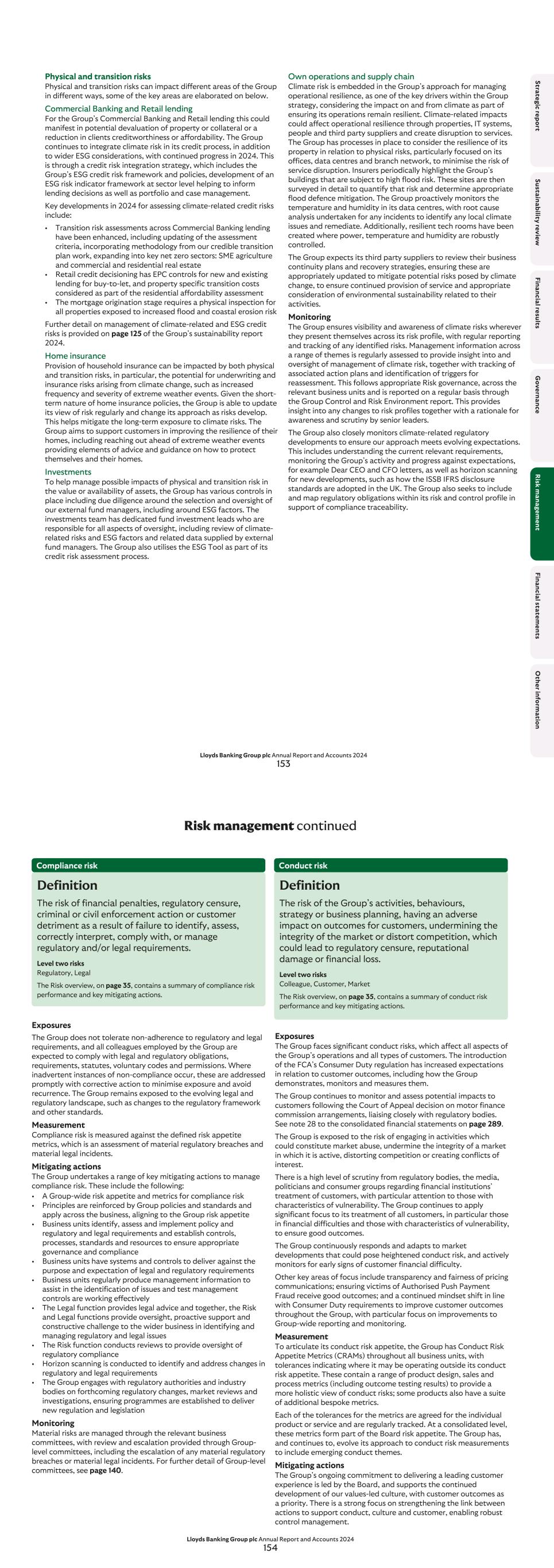
Physical and transition risks Physical and transition risks can impact different areas of the Group in different ways, some of the key areas are elaborated on below. Commercial Banking and Retail lending For the Group’s Commercial Banking and Retail lending this could manifest in potential devaluation of property or collateral or a reduction in clients creditworthiness or affordability. The Group continues to integrate climate risk in its credit process, in addition to wider ESG considerations, with continued progress in 2024. This is through a credit risk integration strategy, which includes the Group’s ESG credit risk framework and policies, development of an ESG risk indicator framework at sector level helping to inform lending decisions as well as portfolio and case management. Key developments in 2024 for assessing climate-related credit risks include: • Transition risk assessments across Commercial Banking lending have been enhanced, including updating of the assessment criteria, incorporating methodology from our credible transition plan work, expanding into key net zero sectors: SME agriculture and commercial and residential real estate • Retail credit decisioning has EPC controls for new and existing lending for buy-to-let, and property specific transition costs considered as part of the residential affordability assessment • The mortgage origination stage requires a physical inspection for all properties exposed to increased flood and coastal erosion risk Further detail on management of climate-related and ESG credit risks is provided on page 125 of the Group’s sustainability report 2024. Home insurance Provision of household insurance can be impacted by both physical and transition risks, in particular, the potential for underwriting and insurance risks arising from climate change, such as increased frequency and severity of extreme weather events. Given the short- term nature of home insurance policies, the Group is able to update its view of risk regularly and change its approach as risks develop. This helps mitigate the long-term exposure to climate risks. The Group aims to support customers in improving the resilience of their homes, including reaching out ahead of extreme weather events providing elements of advice and guidance on how to protect themselves and their homes. Investments To help manage possible impacts of physical and transition risk in the value or availability of assets, the Group has various controls in place including due diligence around the selection and oversight of our external fund managers, including around ESG factors. The investments team has dedicated fund investment leads who are responsible for all aspects of oversight, including review of climate- related risks and ESG factors and related data supplied by external fund managers. The Group also utilises the ESG Tool as part of its credit risk assessment process. Own operations and supply chain Climate risk is embedded in the Group’s approach for managing operational resilience, as one of the key drivers within the Group strategy, considering the impact on and from climate as part of ensuring its operations remain resilient. Climate-related impacts could affect operational resilience through properties, IT systems, people and third party suppliers and create disruption to services. The Group has processes in place to consider the resilience of its property in relation to physical risks, particularly focused on its offices, data centres and branch network, to minimise the risk of service disruption. Insurers periodically highlight the Group’s buildings that are subject to high flood risk. These sites are then surveyed in detail to quantify that risk and determine appropriate flood defence mitigation. The Group proactively monitors the temperature and humidity in its data centres, with root cause analysis undertaken for any incidents to identify any local climate issues and remediate. Additionally, resilient tech rooms have been created where power, temperature and humidity are robustly controlled. The Group expects its third party suppliers to review their business continuity plans and recovery strategies, ensuring these are appropriately updated to mitigate potential risks posed by climate change, to ensure continued provision of service and appropriate consideration of environmental sustainability related to their activities. Monitoring The Group ensures visibility and awareness of climate risks wherever they present themselves across its risk profile, with regular reporting and tracking of any identified risks. Management information across a range of themes is regularly assessed to provide insight into and oversight of management of climate risk, together with tracking of associated action plans and identification of triggers for reassessment. This follows appropriate Risk governance, across the relevant business units and is reported on a regular basis through the Group Control and Risk Environment report. This provides insight into any changes to risk profiles together with a rationale for awareness and scrutiny by senior leaders. The Group also closely monitors climate-related regulatory developments to ensure our approach meets evolving expectations. This includes understanding the current relevant requirements, monitoring the Group’s activity and progress against expectations, for example Dear CEO and CFO letters, as well as horizon scanning for new developments, such as how the ISSB IFRS disclosure standards are adopted in the UK. The Group also seeks to include and map regulatory obligations within its risk and control profile in support of compliance traceability. Lloyds Banking Group plc Annual Report and Accounts 2024 153 l i ts 2 O th e r in fo rm a tio n R isk m a n a ge m e n t F in a n cia l re su lts S u sta in a b ility re vie w S tra te gic re p o rt G o ve rn a n ce F in a n cia l sta te m e n ts Exposures The Group does not tolerate non-adherence to regulatory and legal requirements, and all colleagues employed by the Group are expected to comply with legal and regulatory obligations, requirements, statutes, voluntary codes and permissions. Where inadvertent instances of non-compliance occur, these are addressed promptly with corrective action to minimise exposure and avoid recurrence. The Group remains exposed to the evolving legal and regulatory landscape, such as changes to the regulatory framework and other standards. Measurement Compliance risk is measured against the defined risk appetite metrics, which is an assessment of material regulatory breaches and material legal incidents. Mitigating actions The Group undertakes a range of key mitigating actions to manage compliance risk. These include the following: • A Group-wide risk appetite and metrics for compliance risk • Principles are reinforced by Group policies and standards and apply across the business, aligning to the Group risk appetite • Business units identify, assess and implement policy and regulatory and legal requirements and establish controls, processes, standards and resources to ensure appropriate governance and compliance • Business units have systems and controls to deliver against the purpose and expectation of legal and regulatory requirements • Business units regularly produce management information to assist in the identification of issues and test management controls are working effectively • The Legal function provides legal advice and together, the Risk and Legal functions provide oversight, proactive support and constructive challenge to the wider business in identifying and managing regulatory and legal issues • The Risk function conducts reviews to provide oversight of regulatory compliance • Horizon scanning is conducted to identify and address changes in regulatory and legal requirements • The Group engages with regulatory authorities and industry bodies on forthcoming regulatory changes, market reviews and investigations, ensuring programmes are established to deliver new regulation and legislation Monitoring Material risks are managed through the relevant business committees, with review and escalation provided through Group- level committees, including the escalation of any material regulatory breaches or material legal incidents. For further detail of Group-level committees, see page 140. Exposures The Group faces significant conduct risks, which affect all aspects of the Group’s operations and all types of customers. The introduction of the FCA’s Consumer Duty regulation has increased expectations in relation to customer outcomes, including how the Group demonstrates, monitors and measures them. The Group continues to monitor and assess potential impacts to customers following the Court of Appeal decision on motor finance commission arrangements, liaising closely with regulatory bodies. See note 28 to the consolidated financial statements on page 289. The Group is exposed to the risk of engaging in activities which could constitute market abuse, undermine the integrity of a market in which it is active, distorting competition or creating conflicts of interest. There is a high level of scrutiny from regulatory bodies, the media, politicians and consumer groups regarding financial institutions’ treatment of customers, with particular attention to those with characteristics of vulnerability. The Group continues to apply significant focus to its treatment of all customers, in particular those in financial difficulties and those with characteristics of vulnerability, to ensure good outcomes. The Group continuously responds and adapts to market developments that could pose heightened conduct risk, and actively monitors for early signs of customer financial difficulty. Other key areas of focus include transparency and fairness of pricing communications; ensuring victims of Authorised Push Payment Fraud receive good outcomes; and a continued mindset shift in line with Consumer Duty requirements to improve customer outcomes throughout the Group, with particular focus on improvements to Group-wide reporting and monitoring. Measurement To articulate its conduct risk appetite, the Group has Conduct Risk Appetite Metrics (CRAMs) throughout all business units, with tolerances indicating where it may be operating outside its conduct risk appetite. These contain a range of product design, sales and process metrics (including outcome testing results) to provide a more holistic view of conduct risks; some products also have a suite of additional bespoke metrics. Each of the tolerances for the metrics are agreed for the individual product or service and are regularly tracked. At a consolidated level, these metrics form part of the Board risk appetite. The Group has, and continues to, evolve its approach to conduct risk measurements to include emerging conduct themes. Mitigating actions The Group’s ongoing commitment to delivering a leading customer experience is led by the Board, and supports the continued development of our values-led culture, with customer outcomes as a priority. There is a strong focus on strengthening the link between actions to support conduct, culture and customer, enabling robust control management. Risk management continued Lloyds Banking Group plc Annual Report and Accounts 2024 154 Compliance risk Definition The risk of financial penalties, regulatory censure, criminal or civil enforcement action or customer detriment as a result of failure to identify, assess, correctly interpret, comply with, or manage regulatory and/or legal requirements. Level two risks Regulatory, Legal The Risk overview, on page 35, contains a summary of compliance risk performance and key mitigating actions. Conduct risk Definition The risk of the Group’s activities, behaviours, strategy or business planning, having an adverse impact on outcomes for customers, undermining the integrity of the market or distort competition, which could lead to regulatory censure, reputational damage or financial loss. Level two risks Colleague, Customer, Market The Risk overview, on page 35, contains a summary of conduct risk performance and key mitigating actions. l i ts
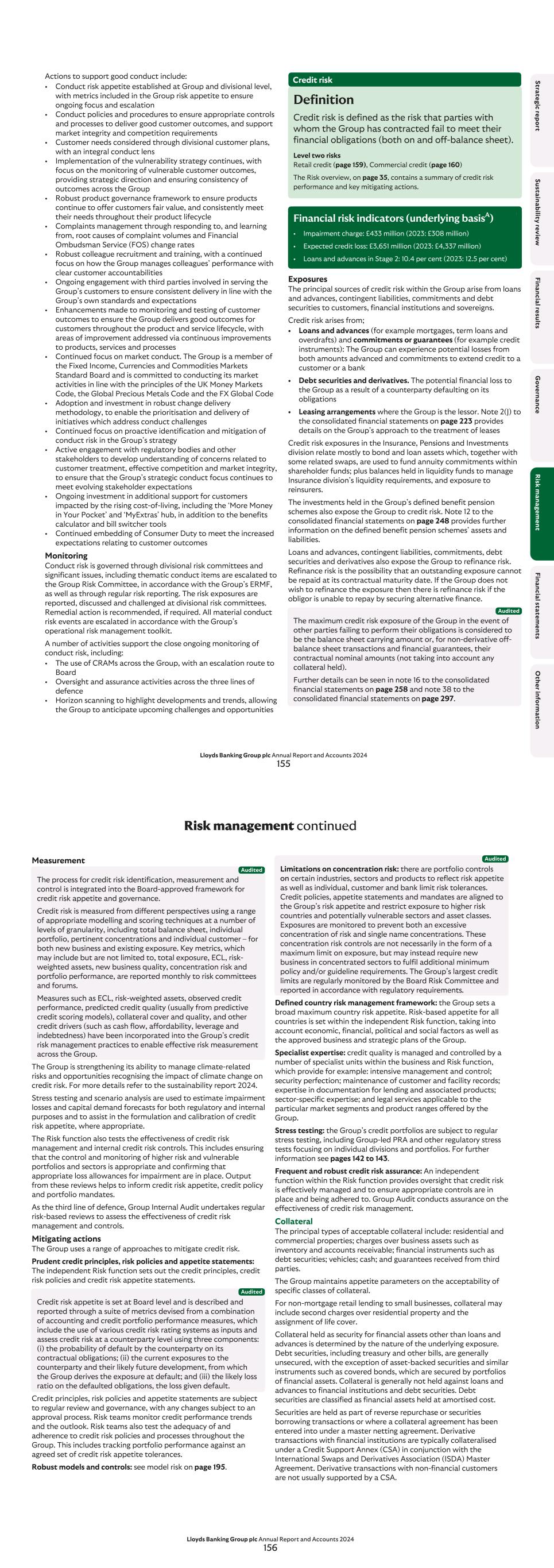
Actions to support good conduct include: • Conduct risk appetite established at Group and divisional level, with metrics included in the Group risk appetite to ensure ongoing focus and escalation • Conduct policies and procedures to ensure appropriate controls and processes to deliver good customer outcomes, and support market integrity and competition requirements • Customer needs considered through divisional customer plans, with an integral conduct lens • Implementation of the vulnerability strategy continues, with focus on the monitoring of vulnerable customer outcomes, providing strategic direction and ensuring consistency of outcomes across the Group • Robust product governance framework to ensure products continue to offer customers fair value, and consistently meet their needs throughout their product lifecycle • Complaints management through responding to, and learning from, root causes of complaint volumes and Financial Ombudsman Service (FOS) change rates • Robust colleague recruitment and training, with a continued focus on how the Group manages colleagues’ performance with clear customer accountabilities • Ongoing engagement with third parties involved in serving the Group’s customers to ensure consistent delivery in line with the Group’s own standards and expectations • Enhancements made to monitoring and testing of customer outcomes to ensure the Group delivers good outcomes for customers throughout the product and service lifecycle, with areas of improvement addressed via continuous improvements to products, services and processes • Continued focus on market conduct. The Group is a member of the Fixed Income, Currencies and Commodities Markets Standard Board and is committed to conducting its market activities in line with the principles of the UK Money Markets Code, the Global Precious Metals Code and the FX Global Code • Adoption and investment in robust change delivery methodology, to enable the prioritisation and delivery of initiatives which address conduct challenges • Continued focus on proactive identification and mitigation of conduct risk in the Group’s strategy • Active engagement with regulatory bodies and other stakeholders to develop understanding of concerns related to customer treatment, effective competition and market integrity, to ensure that the Group’s strategic conduct focus continues to meet evolving stakeholder expectations • Ongoing investment in additional support for customers impacted by the rising cost-of-living, including the ‘More Money in Your Pocket’ and ‘MyExtras’ hub, in addition to the benefits calculator and bill switcher tools • Continued embedding of Consumer Duty to meet the increased expectations relating to customer outcomes Monitoring Conduct risk is governed through divisional risk committees and significant issues, including thematic conduct items are escalated to the Group Risk Committee, in accordance with the Group’s ERMF, as well as through regular risk reporting. The risk exposures are reported, discussed and challenged at divisional risk committees. Remedial action is recommended, if required. All material conduct risk events are escalated in accordance with the Group’s operational risk management toolkit. A number of activities support the close ongoing monitoring of conduct risk, including: • The use of CRAMs across the Group, with an escalation route to Board • Oversight and assurance activities across the three lines of defence • Horizon scanning to highlight developments and trends, allowing the Group to anticipate upcoming challenges and opportunities Credit risk Definition Credit risk is defined as the risk that parties with whom the Group has contracted fail to meet their financial obligations (both on and off-balance sheet). Level two risks Retail credit (page 159), Commercial credit (page 160) The Risk overview, on page 35, contains a summary of credit risk performance and key mitigating actions. Financial risk indicators (underlying basisA) • Impairment charge: £433 million (2023: £308 million) • Expected credit loss: £3,651 million (2023: £4,337 million) • Loans and advances in Stage 2: 10.4 per cent (2023: 12.5 per cent) Exposures The principal sources of credit risk within the Group arise from loans and advances, contingent liabilities, commitments and debt securities to customers, financial institutions and sovereigns. Credit risk arises from; • Loans and advances (for example mortgages, term loans and overdrafts) and commitments or guarantees (for example credit instruments): The Group can experience potential losses from both amounts advanced and commitments to extend credit to a customer or a bank • Debt securities and derivatives. The potential financial loss to the Group as a result of a counterparty defaulting on its obligations • Leasing arrangements where the Group is the lessor. Note 2(J) to the consolidated financial statements on page 223 provides details on the Group’s approach to the treatment of leases Credit risk exposures in the Insurance, Pensions and Investments division relate mostly to bond and loan assets which, together with some related swaps, are used to fund annuity commitments within shareholder funds; plus balances held in liquidity funds to manage Insurance division’s liquidity requirements, and exposure to reinsurers. The investments held in the Group’s defined benefit pension schemes also expose the Group to credit risk. Note 12 to the consolidated financial statements on page 248 provides further information on the defined benefit pension schemes’ assets and liabilities. Loans and advances, contingent liabilities, commitments, debt securities and derivatives also expose the Group to refinance risk. Refinance risk is the possibility that an outstanding exposure cannot be repaid at its contractual maturity date. If the Group does not wish to refinance the exposure then there is refinance risk if the obligor is unable to repay by securing alternative finance. The maximum credit risk exposure of the Group in the event of other parties failing to perform their obligations is considered to be the balance sheet carrying amount or, for non-derivative off- balance sheet transactions and financial guarantees, their contractual nominal amounts (not taking into account any collateral held). Further details can be seen in note 16 to the consolidated financial statements on page 258 and note 38 to the consolidated financial statements on page 297. Lloyds Banking Group plc Annual Report and Accounts 2024 155 l i ts 2 O th e r in fo rm a tio n R isk m a n a ge m e n t F in a n cia l re su lts S u sta in a b ility re vie w S tra te gic re p o rt G o ve rn a n ce F in a n cia l sta te m e n ts Measurement The process for credit risk identification, measurement and control is integrated into the Board-approved framework for credit risk appetite and governance. Credit risk is measured from different perspectives using a range of appropriate modelling and scoring techniques at a number of levels of granularity, including total balance sheet, individual portfolio, pertinent concentrations and individual customer – for both new business and existing exposure. Key metrics, which may include but are not limited to, total exposure, ECL, risk- weighted assets, new business quality, concentration risk and portfolio performance, are reported monthly to risk committees and forums. Measures such as ECL, risk-weighted assets, observed credit performance, predicted credit quality (usually from predictive credit scoring models), collateral cover and quality, and other credit drivers (such as cash flow, affordability, leverage and indebtedness) have been incorporated into the Group’s credit risk management practices to enable effective risk measurement across the Group. The Group is strengthening its ability to manage climate-related risks and opportunities recognising the impact of climate change on credit risk. For more details refer to the sustainability report 2024. Stress testing and scenario analysis are used to estimate impairment losses and capital demand forecasts for both regulatory and internal purposes and to assist in the formulation and calibration of credit risk appetite, where appropriate. The Risk function also tests the effectiveness of credit risk management and internal credit risk controls. This includes ensuring that the control and monitoring of higher risk and vulnerable portfolios and sectors is appropriate and confirming that appropriate loss allowances for impairment are in place. Output from these reviews helps to inform credit risk appetite, credit policy and portfolio mandates. As the third line of defence, Group Internal Audit undertakes regular risk-based reviews to assess the effectiveness of credit risk management and controls. Mitigating actions The Group uses a range of approaches to mitigate credit risk. Prudent credit principles, risk policies and appetite statements: The independent Risk function sets out the credit principles, credit risk policies and credit risk appetite statements. Credit risk appetite is set at Board level and is described and reported through a suite of metrics devised from a combination of accounting and credit portfolio performance measures, which include the use of various credit risk rating systems as inputs and assess credit risk at a counterparty level using three components: (i) the probability of default by the counterparty on its contractual obligations; (ii) the current exposures to the counterparty and their likely future development, from which the Group derives the exposure at default; and (iii) the likely loss ratio on the defaulted obligations, the loss given default. Credit principles, risk policies and appetite statements are subject to regular review and governance, with any changes subject to an approval process. Risk teams monitor credit performance trends and the outlook. Risk teams also test the adequacy of and adherence to credit risk policies and processes throughout the Group. This includes tracking portfolio performance against an agreed set of credit risk appetite tolerances. Robust models and controls: see model risk on page 195. Limitations on concentration risk: there are portfolio controls on certain industries, sectors and products to reflect risk appetite as well as individual, customer and bank limit risk tolerances. Credit policies, appetite statements and mandates are aligned to the Group’s risk appetite and restrict exposure to higher risk countries and potentially vulnerable sectors and asset classes. Exposures are monitored to prevent both an excessive concentration of risk and single name concentrations. These concentration risk controls are not necessarily in the form of a maximum limit on exposure, but may instead require new business in concentrated sectors to fulfil additional minimum policy and/or guideline requirements. The Group’s largest credit limits are regularly monitored by the Board Risk Committee and reported in accordance with regulatory requirements. Defined country risk management framework: the Group sets a broad maximum country risk appetite. Risk-based appetite for all countries is set within the independent Risk function, taking into account economic, financial, political and social factors as well as the approved business and strategic plans of the Group. Specialist expertise: credit quality is managed and controlled by a number of specialist units within the business and Risk function, which provide for example: intensive management and control; security perfection; maintenance of customer and facility records; expertise in documentation for lending and associated products; sector-specific expertise; and legal services applicable to the particular market segments and product ranges offered by the Group. Stress testing: the Group’s credit portfolios are subject to regular stress testing, including Group-led PRA and other regulatory stress tests focusing on individual divisions and portfolios. For further information see pages 142 to 143. Frequent and robust credit risk assurance: An independent function within the Risk function provides oversight that credit risk is effectively managed and to ensure appropriate controls are in place and being adhered to. Group Audit conducts assurance on the effectiveness of credit risk management. Collateral The principal types of acceptable collateral include: residential and commercial properties; charges over business assets such as inventory and accounts receivable; financial instruments such as debt securities; vehicles; cash; and guarantees received from third parties. The Group maintains appetite parameters on the acceptability of specific classes of collateral. For non-mortgage retail lending to small businesses, collateral may include second charges over residential property and the assignment of life cover. Collateral held as security for financial assets other than loans and advances is determined by the nature of the underlying exposure. Debt securities, including treasury and other bills, are generally unsecured, with the exception of asset-backed securities and similar instruments such as covered bonds, which are secured by portfolios of financial assets. Collateral is generally not held against loans and advances to financial institutions and debt securities. Debt securities are classified as financial assets held at amortised cost. Securities are held as part of reverse repurchase or securities borrowing transactions or where a collateral agreement has been entered into under a master netting agreement. Derivative transactions with financial institutions are typically collateralised under a Credit Support Annex (CSA) in conjunction with the International Swaps and Derivatives Association (ISDA) Master Agreement. Derivative transactions with non-financial customers are not usually supported by a CSA. Risk management continued Lloyds Banking Group plc Annual Report and Accounts 2024 156 l i ts
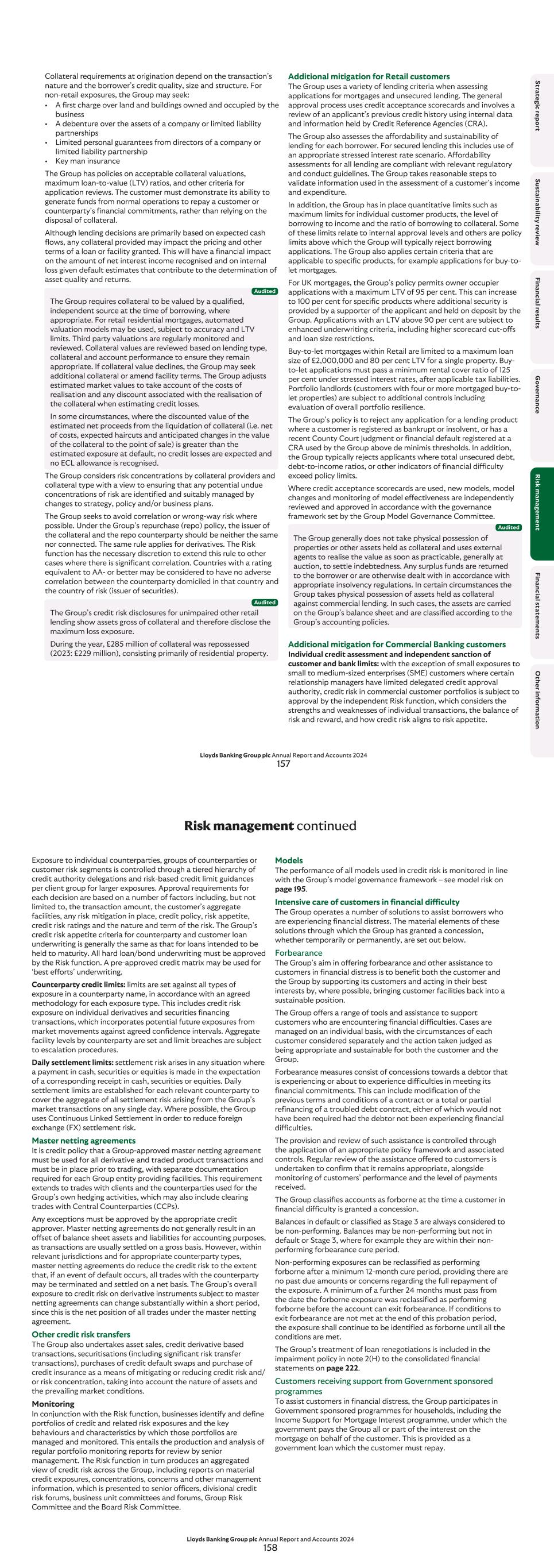
Collateral requirements at origination depend on the transaction’s nature and the borrower’s credit quality, size and structure. For non-retail exposures, the Group may seek: • A first charge over land and buildings owned and occupied by the business • A debenture over the assets of a company or limited liability partnerships • Limited personal guarantees from directors of a company or limited liability partnership • Key man insurance The Group has policies on acceptable collateral valuations, maximum loan-to-value (LTV) ratios, and other criteria for application reviews. The customer must demonstrate its ability to generate funds from normal operations to repay a customer or counterparty’s financial commitments, rather than relying on the disposal of collateral. Although lending decisions are primarily based on expected cash flows, any collateral provided may impact the pricing and other terms of a loan or facility granted. This will have a financial impact on the amount of net interest income recognised and on internal loss given default estimates that contribute to the determination of asset quality and returns. The Group requires collateral to be valued by a qualified, independent source at the time of borrowing, where appropriate. For retail residential mortgages, automated valuation models may be used, subject to accuracy and LTV limits. Third party valuations are regularly monitored and reviewed. Collateral values are reviewed based on lending type, collateral and account performance to ensure they remain appropriate. If collateral value declines, the Group may seek additional collateral or amend facility terms. The Group adjusts estimated market values to take account of the costs of realisation and any discount associated with the realisation of the collateral when estimating credit losses. In some circumstances, where the discounted value of the estimated net proceeds from the liquidation of collateral (i.e. net of costs, expected haircuts and anticipated changes in the value of the collateral to the point of sale) is greater than the estimated exposure at default, no credit losses are expected and no ECL allowance is recognised. The Group considers risk concentrations by collateral providers and collateral type with a view to ensuring that any potential undue concentrations of risk are identified and suitably managed by changes to strategy, policy and/or business plans. The Group seeks to avoid correlation or wrong-way risk where possible. Under the Group’s repurchase (repo) policy, the issuer of the collateral and the repo counterparty should be neither the same nor connected. The same rule applies for derivatives. The Risk function has the necessary discretion to extend this rule to other cases where there is significant correlation. Countries with a rating equivalent to AA- or better may be considered to have no adverse correlation between the counterparty domiciled in that country and the country of risk (issuer of securities). The Group’s credit risk disclosures for unimpaired other retail lending show assets gross of collateral and therefore disclose the maximum loss exposure. During the year, £285 million of collateral was repossessed (2023: £229 million), consisting primarily of residential property. Additional mitigation for Retail customers The Group uses a variety of lending criteria when assessing applications for mortgages and unsecured lending. The general approval process uses credit acceptance scorecards and involves a review of an applicant’s previous credit history using internal data and information held by Credit Reference Agencies (CRA). The Group also assesses the affordability and sustainability of lending for each borrower. For secured lending this includes use of an appropriate stressed interest rate scenario. Affordability assessments for all lending are compliant with relevant regulatory and conduct guidelines. The Group takes reasonable steps to validate information used in the assessment of a customer’s income and expenditure. In addition, the Group has in place quantitative limits such as maximum limits for individual customer products, the level of borrowing to income and the ratio of borrowing to collateral. Some of these limits relate to internal approval levels and others are policy limits above which the Group will typically reject borrowing applications. The Group also applies certain criteria that are applicable to specific products, for example applications for buy-to- let mortgages. For UK mortgages, the Group’s policy permits owner occupier applications with a maximum LTV of 95 per cent. This can increase to 100 per cent for specific products where additional security is provided by a supporter of the applicant and held on deposit by the Group. Applications with an LTV above 90 per cent are subject to enhanced underwriting criteria, including higher scorecard cut-offs and loan size restrictions. Buy-to-let mortgages within Retail are limited to a maximum loan size of £2,000,000 and 80 per cent LTV for a single property. Buy- to-let applications must pass a minimum rental cover ratio of 125 per cent under stressed interest rates, after applicable tax liabilities. Portfolio landlords (customers with four or more mortgaged buy-to- let properties) are subject to additional controls including evaluation of overall portfolio resilience. The Group’s policy is to reject any application for a lending product where a customer is registered as bankrupt or insolvent, or has a recent County Court Judgment or financial default registered at a CRA used by the Group above de minimis thresholds. In addition, the Group typically rejects applicants where total unsecured debt, debt-to-income ratios, or other indicators of financial difficulty exceed policy limits. Where credit acceptance scorecards are used, new models, model changes and monitoring of model effectiveness are independently reviewed and approved in accordance with the governance framework set by the Group Model Governance Committee. The Group generally does not take physical possession of properties or other assets held as collateral and uses external agents to realise the value as soon as practicable, generally at auction, to settle indebtedness. Any surplus funds are returned to the borrower or are otherwise dealt with in accordance with appropriate insolvency regulations. In certain circumstances the Group takes physical possession of assets held as collateral against commercial lending. In such cases, the assets are carried on the Group’s balance sheet and are classified according to the Group’s accounting policies. Additional mitigation for Commercial Banking customers Individual credit assessment and independent sanction of customer and bank limits: with the exception of small exposures to small to medium-sized enterprises (SME) customers where certain relationship managers have limited delegated credit approval authority, credit risk in commercial customer portfolios is subject to approval by the independent Risk function, which considers the strengths and weaknesses of individual transactions, the balance of risk and reward, and how credit risk aligns to risk appetite. Lloyds Banking Group plc Annual Report and Accounts 2024 157 l i ts 2 O th e r in fo rm a tio n R isk m a n a ge m e n t F in a n cia l re su lts S u sta in a b ility re vie w S tra te gic re p o rt G o ve rn a n ce F in a n cia l sta te m e n ts Exposure to individual counterparties, groups of counterparties or customer risk segments is controlled through a tiered hierarchy of credit authority delegations and risk-based credit limit guidances per client group for larger exposures. Approval requirements for each decision are based on a number of factors including, but not limited to, the transaction amount, the customer’s aggregate facilities, any risk mitigation in place, credit policy, risk appetite, credit risk ratings and the nature and term of the risk. The Group’s credit risk appetite criteria for counterparty and customer loan underwriting is generally the same as that for loans intended to be held to maturity. All hard loan/bond underwriting must be approved by the Risk function. A pre-approved credit matrix may be used for ‘best efforts’ underwriting. Counterparty credit limits: limits are set against all types of exposure in a counterparty name, in accordance with an agreed methodology for each exposure type. This includes credit risk exposure on individual derivatives and securities financing transactions, which incorporates potential future exposures from market movements against agreed confidence intervals. Aggregate facility levels by counterparty are set and limit breaches are subject to escalation procedures. Daily settlement limits: settlement risk arises in any situation where a payment in cash, securities or equities is made in the expectation of a corresponding receipt in cash, securities or equities. Daily settlement limits are established for each relevant counterparty to cover the aggregate of all settlement risk arising from the Group’s market transactions on any single day. Where possible, the Group uses Continuous Linked Settlement in order to reduce foreign exchange (FX) settlement risk. Master netting agreements It is credit policy that a Group-approved master netting agreement must be used for all derivative and traded product transactions and must be in place prior to trading, with separate documentation required for each Group entity providing facilities. This requirement extends to trades with clients and the counterparties used for the Group’s own hedging activities, which may also include clearing trades with Central Counterparties (CCPs). Any exceptions must be approved by the appropriate credit approver. Master netting agreements do not generally result in an offset of balance sheet assets and liabilities for accounting purposes, as transactions are usually settled on a gross basis. However, within relevant jurisdictions and for appropriate counterparty types, master netting agreements do reduce the credit risk to the extent that, if an event of default occurs, all trades with the counterparty may be terminated and settled on a net basis. The Group’s overall exposure to credit risk on derivative instruments subject to master netting agreements can change substantially within a short period, since this is the net position of all trades under the master netting agreement. Other credit risk transfers The Group also undertakes asset sales, credit derivative based transactions, securitisations (including significant risk transfer transactions), purchases of credit default swaps and purchase of credit insurance as a means of mitigating or reducing credit risk and/ or risk concentration, taking into account the nature of assets and the prevailing market conditions. Monitoring In conjunction with the Risk function, businesses identify and define portfolios of credit and related risk exposures and the key behaviours and characteristics by which those portfolios are managed and monitored. This entails the production and analysis of regular portfolio monitoring reports for review by senior management. The Risk function in turn produces an aggregated view of credit risk across the Group, including reports on material credit exposures, concentrations, concerns and other management information, which is presented to senior officers, divisional credit risk forums, business unit committees and forums, Group Risk Committee and the Board Risk Committee. Models The performance of all models used in credit risk is monitored in line with the Group’s model governance framework – see model risk on page 195. Intensive care of customers in financial difficulty The Group operates a number of solutions to assist borrowers who are experiencing financial distress. The material elements of these solutions through which the Group has granted a concession, whether temporarily or permanently, are set out below. Forbearance The Group’s aim in offering forbearance and other assistance to customers in financial distress is to benefit both the customer and the Group by supporting its customers and acting in their best interests by, where possible, bringing customer facilities back into a sustainable position. The Group offers a range of tools and assistance to support customers who are encountering financial difficulties. Cases are managed on an individual basis, with the circumstances of each customer considered separately and the action taken judged as being appropriate and sustainable for both the customer and the Group. Forbearance measures consist of concessions towards a debtor that is experiencing or about to experience difficulties in meeting its financial commitments. This can include modification of the previous terms and conditions of a contract or a total or partial refinancing of a troubled debt contract, either of which would not have been required had the debtor not been experiencing financial difficulties. The provision and review of such assistance is controlled through the application of an appropriate policy framework and associated controls. Regular review of the assistance offered to customers is undertaken to confirm that it remains appropriate, alongside monitoring of customers’ performance and the level of payments received. The Group classifies accounts as forborne at the time a customer in financial difficulty is granted a concession. Balances in default or classified as Stage 3 are always considered to be non-performing. Balances may be non-performing but not in default or Stage 3, where for example they are within their non- performing forbearance cure period. Non-performing exposures can be reclassified as performing forborne after a minimum 12-month cure period, providing there are no past due amounts or concerns regarding the full repayment of the exposure. A minimum of a further 24 months must pass from the date the forborne exposure was reclassified as performing forborne before the account can exit forbearance. If conditions to exit forbearance are not met at the end of this probation period, the exposure shall continue to be identified as forborne until all the conditions are met. The Group’s treatment of loan renegotiations is included in the impairment policy in note 2(H) to the consolidated financial statements on page 222. Customers receiving support from Government sponsored programmes To assist customers in financial distress, the Group participates in Government sponsored programmes for households, including the Income Support for Mortgage Interest programme, under which the government pays the Group all or part of the interest on the mortgage on behalf of the customer. This is provided as a government loan which the customer must repay. Risk management continued Lloyds Banking Group plc Annual Report and Accounts 2024 158 l i ts
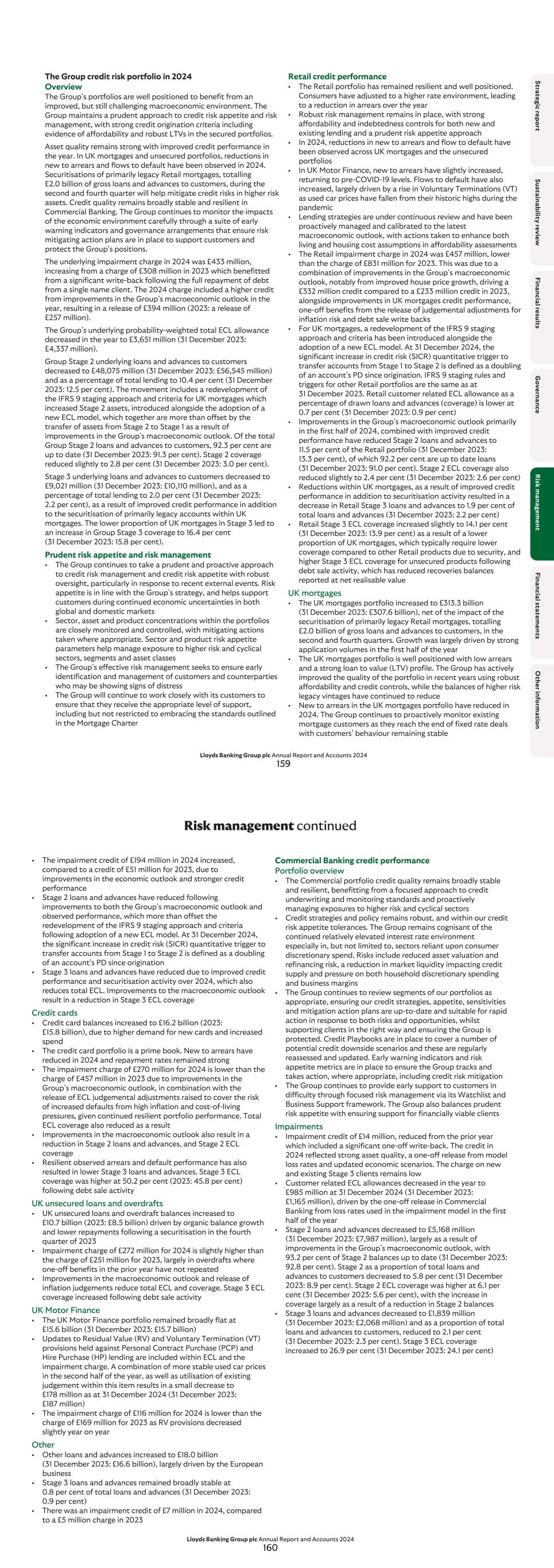
The Group credit risk portfolio in 2024 Overview The Group’s portfolios are well positioned to benefit from an improved, but still challenging macroeconomic environment. The Group maintains a prudent approach to credit risk appetite and risk management, with strong credit origination criteria including evidence of affordability and robust LTVs in the secured portfolios. Asset quality remains strong with improved credit performance in the year. In UK mortgages and unsecured portfolios, reductions in new to arrears and flows to default have been observed in 2024. Securitisations of primarily legacy Retail mortgages, totalling £2.0 billion of gross loans and advances to customers, during the second and fourth quarter will help mitigate credit risks in higher risk assets. Credit quality remains broadly stable and resilient in Commercial Banking. The Group continues to monitor the impacts of the economic environment carefully through a suite of early warning indicators and governance arrangements that ensure risk mitigating action plans are in place to support customers and protect the Group’s positions. The underlying impairment charge in 2024 was £433 million, increasing from a charge of £308 million in 2023 which benefitted from a significant write-back following the full repayment of debt from a single name client. The 2024 charge included a higher credit from improvements in the Group’s macroeconomic outlook in the year, resulting in a release of £394 million (2023: a release of £257 million). The Group’s underlying probability-weighted total ECL allowance decreased in the year to £3,651 million (31 December 2023: £4,337 million). Group Stage 2 underlying loans and advances to customers decreased to £48,075 million (31 December 2023: £56,545 million) and as a percentage of total lending to 10.4 per cent (31 December 2023: 12.5 per cent). The movement includes a redevelopment of the IFRS 9 staging approach and criteria for UK mortgages which increased Stage 2 assets, introduced alongside the adoption of a new ECL model, which together are more than offset by the transfer of assets from Stage 2 to Stage 1 as a result of improvements in the Group’s macroeconomic outlook. Of the total Group Stage 2 loans and advances to customers, 92.3 per cent are up to date (31 December 2023: 91.3 per cent). Stage 2 coverage reduced slightly to 2.8 per cent (31 December 2023: 3.0 per cent). Stage 3 underlying loans and advances to customers decreased to £9,021 million (31 December 2023: £10,110 million), and as a percentage of total lending to 2.0 per cent (31 December 2023: 2.2 per cent), as a result of improved credit performance in addition to the securitisation of primarily legacy accounts within UK mortgages. The lower proportion of UK mortgages in Stage 3 led to an increase in Group Stage 3 coverage to 16.4 per cent (31 December 2023: 15.8 per cent). Prudent risk appetite and risk management • The Group continues to take a prudent and proactive approach to credit risk management and credit risk appetite with robust oversight, particularly in response to recent external events. Risk appetite is in line with the Group’s strategy, and helps support customers during continued economic uncertainties in both global and domestic markets • Sector, asset and product concentrations within the portfolios are closely monitored and controlled, with mitigating actions taken where appropriate. Sector and product risk appetite parameters help manage exposure to higher risk and cyclical sectors, segments and asset classes • The Group’s effective risk management seeks to ensure early identification and management of customers and counterparties who may be showing signs of distress • The Group will continue to work closely with its customers to ensure that they receive the appropriate level of support, including but not restricted to embracing the standards outlined in the Mortgage Charter Retail credit performance • The Retail portfolio has remained resilient and well positioned. Consumers have adjusted to a higher rate environment, leading to a reduction in arrears over the year • Robust risk management remains in place, with strong affordability and indebtedness controls for both new and existing lending and a prudent risk appetite approach • In 2024, reductions in new to arrears and flow to default have been observed across UK mortgages and the unsecured portfolios • In UK Motor Finance, new to arrears have slightly increased, returning to pre-COVID-19 levels. Flows to default have also increased, largely driven by a rise in Voluntary Terminations (VT) as used car prices have fallen from their historic highs during the pandemic • Lending strategies are under continuous review and have been proactively managed and calibrated to the latest macroeconomic outlook, with actions taken to enhance both living and housing cost assumptions in affordability assessments • The Retail impairment charge in 2024 was £457 million, lower than the charge of £831 million for 2023. This was due to a combination of improvements in the Group’s macroeconomic outlook, notably from improved house price growth, driving a £332 million credit compared to a £233 million credit in 2023, alongside improvements in UK mortgages credit performance, one-off benefits from the release of judgemental adjustments for inflation risk and debt sale write backs • For UK mortgages, a redevelopment of the IFRS 9 staging approach and criteria has been introduced alongside the adoption of a new ECL model. At 31 December 2024, the significant increase in credit risk (SICR) quantitative trigger to transfer accounts from Stage 1 to Stage 2 is defined as a doubling of an account’s PD since origination. IFRS 9 staging rules and triggers for other Retail portfolios are the same as at 31 December 2023. Retail customer related ECL allowance as a percentage of drawn loans and advances (coverage) is lower at 0.7 per cent (31 December 2023: 0.9 per cent) • Improvements in the Group’s macroeconomic outlook primarily in the first half of 2024, combined with improved credit performance have reduced Stage 2 loans and advances to 11.5 per cent of the Retail portfolio (31 December 2023: 13.3 per cent), of which 92.2 per cent are up to date loans (31 December 2023: 91.0 per cent). Stage 2 ECL coverage also reduced slightly to 2.4 per cent (31 December 2023: 2.6 per cent) • Reductions within UK mortgages, as a result of improved credit performance in addition to securitisation activity resulted in a decrease in Retail Stage 3 loans and advances to 1.9 per cent of total loans and advances (31 December 2023: 2.2 per cent) • Retail Stage 3 ECL coverage increased slightly to 14.1 per cent (31 December 2023: 13.9 per cent) as a result of a lower proportion of UK mortgages, which typically require lower coverage compared to other Retail products due to security, and higher Stage 3 ECL coverage for unsecured products following debt sale activity, which has reduced recoveries balances reported at net realisable value UK mortgages • The UK mortgages portfolio increased to £313.3 billion (31 December 2023: £307.6 billion), net of the impact of the securitisation of primarily legacy Retail mortgages, totalling £2.0 billion of gross loans and advances to customers, in the second and fourth quarters. Growth was largely driven by strong application volumes in the first half of the year • The UK mortgages portfolio is well positioned with low arrears and a strong loan to value (LTV) profile. The Group has actively improved the quality of the portfolio in recent years using robust affordability and credit controls, while the balances of higher risk legacy vintages have continued to reduce • New to arrears in the UK mortgages portfolio have reduced in 2024. The Group continues to proactively monitor existing mortgage customers as they reach the end of fixed rate deals with customers’ behaviour remaining stable Lloyds Banking Group plc Annual Report and Accounts 2024 159 l i ts 2 O th e r in fo rm a tio n R isk m a n a ge m e n t F in a n cia l re su lts S u sta in a b ility re vie w S tra te gic re p o rt G o ve rn a n ce F in a n cia l sta te m e n ts • The impairment credit of £194 million in 2024 increased, compared to a credit of £51 million for 2023, due to improvements in the economic outlook and stronger credit performance • Stage 2 loans and advances have reduced following improvements to both the Group’s macroeconomic outlook and observed performance, which more than offset the redevelopment of the IFRS 9 staging approach and criteria following adoption of a new ECL model. At 31 December 2024, the significant increase in credit risk (SICR) quantitative trigger to transfer accounts from Stage 1 to Stage 2 is defined as a doubling of an account’s PD since origination • Stage 3 loans and advances have reduced due to improved credit performance and securitisation activity over 2024, which also reduces total ECL. Improvements to the macroeconomic outlook result in a reduction in Stage 3 ECL coverage Credit cards • Credit card balances increased to £16.2 billion (2023: £15.8 billion), due to higher demand for new cards and increased spend • The credit card portfolio is a prime book. New to arrears have reduced in 2024 and repayment rates remained strong • The impairment charge of £270 million for 2024 is lower than the charge of £457 million in 2023 due to improvements in the Group’s macroeconomic outlook, in combination with the release of ECL judgemental adjustments raised to cover the risk of increased defaults from high inflation and cost-of-living pressures, given continued resilient portfolio performance. Total ECL coverage also reduced as a result • Improvements in the macroeconomic outlook also result in a reduction in Stage 2 loans and advances, and Stage 2 ECL coverage • Resilient observed arrears and default performance has also resulted in lower Stage 3 loans and advances. Stage 3 ECL coverage was higher at 50.2 per cent (2023: 45.8 per cent) following debt sale activity UK unsecured loans and overdrafts • UK unsecured loans and overdraft balances increased to £10.7 billion (2023: £8.5 billion) driven by organic balance growth and lower repayments following a securitisation in the fourth quarter of 2023 • Impairment charge of £272 million for 2024 is slightly higher than the charge of £251 million for 2023, largely in overdrafts where one-off benefits in the prior year have not repeated • Improvements in the macroeconomic outlook and release of inflation judgements reduce total ECL and coverage. Stage 3 ECL coverage increased following debt sale activity UK Motor Finance • The UK Motor Finance portfolio remained broadly flat at £15.6 billion (31 December 2023: £15.7 billion) • Updates to Residual Value (RV) and Voluntary Termination (VT) provisions held against Personal Contract Purchase (PCP) and Hire Purchase (HP) lending are included within ECL and the impairment charge. A combination of more stable used car prices in the second half of the year, as well as utilisation of existing judgement within this item results in a small decrease to £178 million as at 31 December 2024 (31 December 2023: £187 million) • The impairment charge of £116 million for 2024 is lower than the charge of £169 million for 2023 as RV provisions decreased slightly year on year Other • Other loans and advances increased to £18.0 billion (31 December 2023: £16.6 billion), largely driven by the European business • Stage 3 loans and advances remained broadly stable at 0.8 per cent of total loans and advances (31 December 2023: 0.9 per cent) • There was an impairment credit of £7 million in 2024, compared to a £5 million charge in 2023 Commercial Banking credit performance Portfolio overview • The Commercial portfolio credit quality remains broadly stable and resilient, benefitting from a focused approach to credit underwriting and monitoring standards and proactively managing exposures to higher risk and cyclical sectors • Credit strategies and policy remains robust, and within our credit risk appetite tolerances. The Group remains cognisant of the continued relatively elevated interest rate environment especially in, but not limited to, sectors reliant upon consumer discretionary spend. Risks include reduced asset valuation and refinancing risk, a reduction in market liquidity impacting credit supply and pressure on both household discretionary spending and business margins • The Group continues to review segments of our portfolios as appropriate, ensuring our credit strategies, appetite, sensitivities and mitigation action plans are up-to-date and suitable for rapid action in response to both risks and opportunities, whilst supporting clients in the right way and ensuring the Group is protected. Credit Playbooks are in place to cover a number of potential credit downside scenarios and these are regularly reassessed and updated. Early warning indicators and risk appetite metrics are in place to ensure the Group tracks and takes action, where appropriate, including credit risk mitigation • The Group continues to provide early support to customers in difficulty through focused risk management via its Watchlist and Business Support framework. The Group also balances prudent risk appetite with ensuring support for financially viable clients Impairments • Impairment credit of £14 million, reduced from the prior year which included a significant one-off write-back. The credit in 2024 reflected strong asset quality, a one-off release from model loss rates and updated economic scenarios. The charge on new and existing Stage 3 clients remains low • Customer related ECL allowances decreased in the year to £985 million at 31 December 2024 (31 December 2023: £1,165 million), driven by the one-off release in Commercial Banking from loss rates used in the impairment model in the first half of the year • Stage 2 loans and advances decreased to £5,168 million (31 December 2023: £7,987 million), largely as a result of improvements in the Group’s macroeconomic outlook, with 93.2 per cent of Stage 2 balances up to date (31 December 2023: 92.8 per cent). Stage 2 as a proportion of total loans and advances to customers decreased to 5.8 per cent (31 December 2023: 8.9 per cent). Stage 2 ECL coverage was higher at 6.1 per cent (31 December 2023: 5.6 per cent), with the increase in coverage largely as a result of a reduction in Stage 2 balances • Stage 3 loans and advances decreased to £1,839 million (31 December 2023: £2,068 million) and as a proportion of total loans and advances to customers, reduced to 2.1 per cent (31 December 2023: 2.3 per cent). Stage 3 ECL coverage increased to 26.9 per cent (31 December 2023: 24.1 per cent) Risk management continued Lloyds Banking Group plc Annual Report and Accounts 2024 160 l i ts
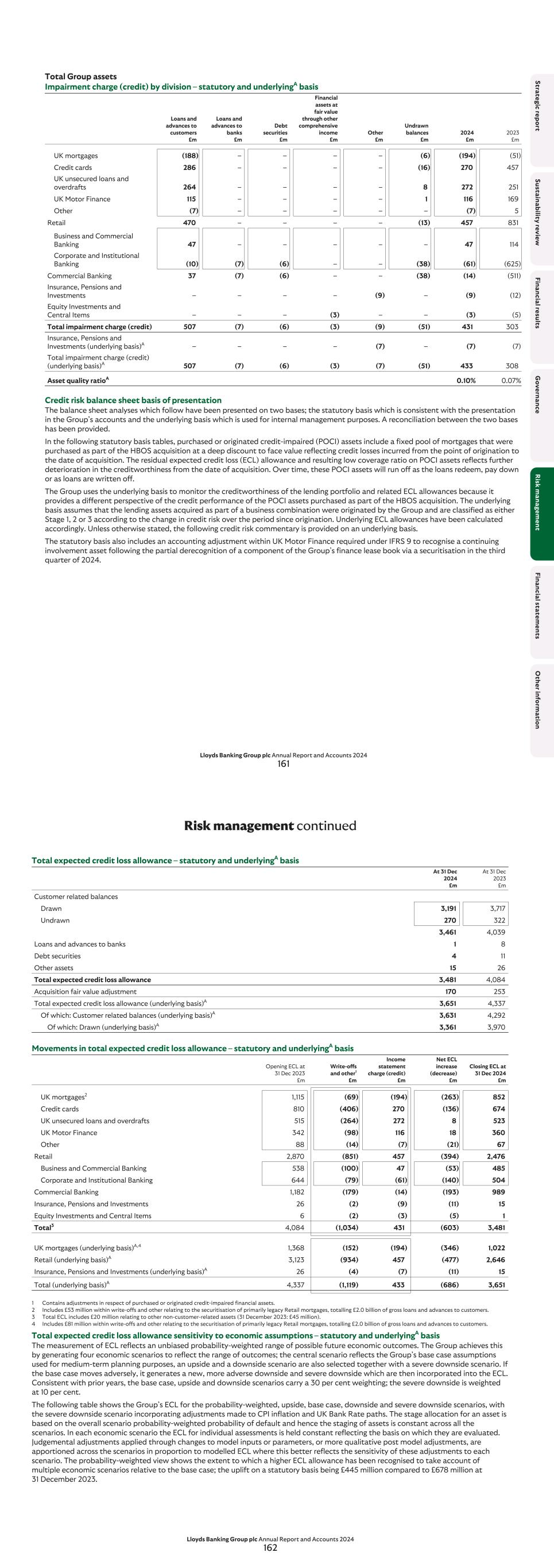
Total Group assets Impairment charge (credit) by division – statutory and underlyingA basis Loans and advances to customers £m Loans and advances to banks £m Debt securities £m Financial assets at fair value through other comprehensive income £m Other £m Undrawn balances £m 2024 £m 2023 £m UK mortgages (188) – – – – (6) (194) (51) Credit cards 286 – – – – (16) 270 457 UK unsecured loans and overdrafts 264 – – – – 8 272 251 UK Motor Finance 115 – – – – 1 116 169 Other (7) – – – – – (7) 5 Retail 470 – – – – (13) 457 831 Business and Commercial Banking 47 – – – – – 47 114 Corporate and Institutional Banking (10) (7) (6) – – (38) (61) (625) Commercial Banking 37 (7) (6) – – (38) (14) (511) Insurance, Pensions and Investments – – – – (9) – (9) (12) Equity Investments and Central Items – – – (3) – – (3) (5) Total impairment charge (credit) 507 (7) (6) (3) (9) (51) 431 303 Insurance, Pensions and Investments (underlying basis)A – – – – (7) – (7) (7) Total impairment charge (credit) (underlying basis)A 507 (7) (6) (3) (7) (51) 433 308 Asset quality ratioA 0.10% 0.07% Credit risk balance sheet basis of presentation The balance sheet analyses which follow have been presented on two bases; the statutory basis which is consistent with the presentation in the Group’s accounts and the underlying basis which is used for internal management purposes. A reconciliation between the two bases has been provided. In the following statutory basis tables, purchased or originated credit-impaired (POCI) assets include a fixed pool of mortgages that were purchased as part of the HBOS acquisition at a deep discount to face value reflecting credit losses incurred from the point of origination to the date of acquisition. The residual expected credit loss (ECL) allowance and resulting low coverage ratio on POCI assets reflects further deterioration in the creditworthiness from the date of acquisition. Over time, these POCI assets will run off as the loans redeem, pay down or as loans are written off. The Group uses the underlying basis to monitor the creditworthiness of the lending portfolio and related ECL allowances because it provides a different perspective of the credit performance of the POCI assets purchased as part of the HBOS acquisition. The underlying basis assumes that the lending assets acquired as part of a business combination were originated by the Group and are classified as either Stage 1, 2 or 3 according to the change in credit risk over the period since origination. Underlying ECL allowances have been calculated accordingly. Unless otherwise stated, the following credit risk commentary is provided on an underlying basis. The statutory basis also includes an accounting adjustment within UK Motor Finance required under IFRS 9 to recognise a continuing involvement asset following the partial derecognition of a component of the Group’s finance lease book via a securitisation in the third quarter of 2024. Lloyds Banking Group plc Annual Report and Accounts 2024 161 l i ts 2 O th e r in fo rm a tio n R isk m a n a ge m e n t F in a n cia l re su lts S u sta in a b ility re vie w S tra te gic re p o rt G o ve rn a n ce F in a n cia l sta te m e n ts Total expected credit loss allowance – statutory and underlyingA basis At 31 Dec 2024 £m At 31 Dec 2023 £m Customer related balances Drawn 3,191 3,717 Undrawn 270 322 3,461 4,039 Loans and advances to banks 1 8 Debt securities 4 11 Other assets 15 26 Total expected credit loss allowance 3,481 4,084 Acquisition fair value adjustment 170 253 Total expected credit loss allowance (underlying basis)A 3,651 4,337 Of which: Customer related balances (underlying basis)A 3,631 4,292 Of which: Drawn (underlying basis)A 3,361 3,970 Movements in total expected credit loss allowance – statutory and underlyingA basis Opening ECL at 31 Dec 2023 £m Write-offs and other1 £m Income statement charge (credit) £m Net ECL increase (decrease) £m Closing ECL at 31 Dec 2024 £m UK mortgages2 1,115 (69) (194) (263) 852 Credit cards 810 (406) 270 (136) 674 UK unsecured loans and overdrafts 515 (264) 272 8 523 UK Motor Finance 342 (98) 116 18 360 Other 88 (14) (7) (21) 67 Retail 2,870 (851) 457 (394) 2,476 Business and Commercial Banking 538 (100) 47 (53) 485 Corporate and Institutional Banking 644 (79) (61) (140) 504 Commercial Banking 1,182 (179) (14) (193) 989 Insurance, Pensions and Investments 26 (2) (9) (11) 15 Equity Investments and Central Items 6 (2) (3) (5) 1 Total3 4,084 (1,034) 431 (603) 3,481 UK mortgages (underlying basis)A,4 1,368 (152) (194) (346) 1,022 Retail (underlying basis)A 3,123 (934) 457 (477) 2,646 Insurance, Pensions and Investments (underlying basis)A 26 (4) (7) (11) 15 Total (underlying basis)A 4,337 (1,119) 433 (686) 3,651 1 Contains adjustments in respect of purchased or originated credit-impaired financial assets. 2 Includes £53 million within write-offs and other relating to the securitisation of primarily legacy Retail mortgages, totalling £2.0 billion of gross loans and advances to customers. 3 Total ECL includes £20 million relating to other non-customer-related assets (31 December 2023: £45 million). 4 Includes £81 million within write-offs and other relating to the securitisation of primarily legacy Retail mortgages, totalling £2.0 billion of gross loans and advances to customers. Total expected credit loss allowance sensitivity to economic assumptions – statutory and underlyingA basis The measurement of ECL reflects an unbiased probability-weighted range of possible future economic outcomes. The Group achieves this by generating four economic scenarios to reflect the range of outcomes; the central scenario reflects the Group’s base case assumptions used for medium-term planning purposes, an upside and a downside scenario are also selected together with a severe downside scenario. If the base case moves adversely, it generates a new, more adverse downside and severe downside which are then incorporated into the ECL. Consistent with prior years, the base case, upside and downside scenarios carry a 30 per cent weighting; the severe downside is weighted at 10 per cent. The following table shows the Group’s ECL for the probability-weighted, upside, base case, downside and severe downside scenarios, with the severe downside scenario incorporating adjustments made to CPI inflation and UK Bank Rate paths. The stage allocation for an asset is based on the overall scenario probability-weighted probability of default and hence the staging of assets is constant across all the scenarios. In each economic scenario the ECL for individual assessments is held constant reflecting the basis on which they are evaluated. Judgemental adjustments applied through changes to model inputs or parameters, or more qualitative post model adjustments, are apportioned across the scenarios in proportion to modelled ECL where this better reflects the sensitivity of these adjustments to each scenario. The probability-weighted view shows the extent to which a higher ECL allowance has been recognised to take account of multiple economic scenarios relative to the base case; the uplift on a statutory basis being £445 million compared to £678 million at 31 December 2023. Risk management continued Lloyds Banking Group plc Annual Report and Accounts 2024 162 l i ts
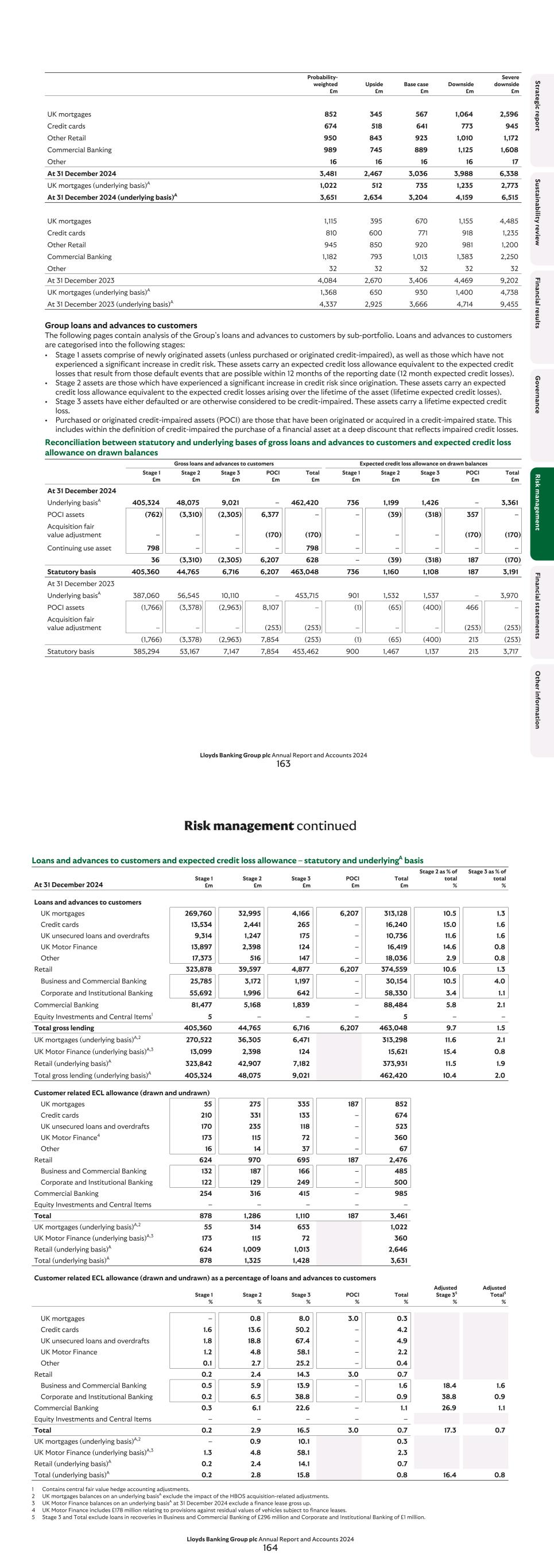
Probability- weighted £m Upside £m Base case £m Downside £m Severe downside £m UK mortgages 852 345 567 1,064 2,596 Credit cards 674 518 641 773 945 Other Retail 950 843 923 1,010 1,172 Commercial Banking 989 745 889 1,125 1,608 Other 16 16 16 16 17 At 31 December 2024 3,481 2,467 3,036 3,988 6,338 UK mortgages (underlying basis)A 1,022 512 735 1,235 2,773 At 31 December 2024 (underlying basis)A 3,651 2,634 3,204 4,159 6,515 UK mortgages 1,115 395 670 1,155 4,485 Credit cards 810 600 771 918 1,235 Other Retail 945 850 920 981 1,200 Commercial Banking 1,182 793 1,013 1,383 2,250 Other 32 32 32 32 32 At 31 December 2023 4,084 2,670 3,406 4,469 9,202 UK mortgages (underlying basis)A 1,368 650 930 1,400 4,738 At 31 December 2023 (underlying basis)A 4,337 2,925 3,666 4,714 9,455 Group loans and advances to customers The following pages contain analysis of the Group’s loans and advances to customers by sub-portfolio. Loans and advances to customers are categorised into the following stages: • Stage 1 assets comprise of newly originated assets (unless purchased or originated credit-impaired), as well as those which have not experienced a significant increase in credit risk. These assets carry an expected credit loss allowance equivalent to the expected credit losses that result from those default events that are possible within 12 months of the reporting date (12 month expected credit losses). • Stage 2 assets are those which have experienced a significant increase in credit risk since origination. These assets carry an expected credit loss allowance equivalent to the expected credit losses arising over the lifetime of the asset (lifetime expected credit losses). • Stage 3 assets have either defaulted or are otherwise considered to be credit-impaired. These assets carry a lifetime expected credit loss. • Purchased or originated credit-impaired assets (POCI) are those that have been originated or acquired in a credit-impaired state. This includes within the definition of credit-impaired the purchase of a financial asset at a deep discount that reflects impaired credit losses. Reconciliation between statutory and underlying bases of gross loans and advances to customers and expected credit loss allowance on drawn balances Gross loans and advances to customers Expected credit loss allowance on drawn balances Stage 1 £m Stage 2 £m Stage 3 £m POCI £m Total £m Stage 1 £m Stage 2 £m Stage 3 £m POCI £m Total £m At 31 December 2024 Underlying basisA 405,324 48,075 9,021 – 462,420 736 1,199 1,426 – 3,361 POCI assets (762) (3,310) (2,305) 6,377 – – (39) (318) 357 – Acquisition fair value adjustment – – – (170) (170) – – – (170) (170) Continuing use asset 798 – – – 798 – – – – – 36 (3,310) (2,305) 6,207 628 – (39) (318) 187 (170) Statutory basis 405,360 44,765 6,716 6,207 463,048 736 1,160 1,108 187 3,191 At 31 December 2023 Underlying basisA 387,060 56,545 10,110 – 453,715 901 1,532 1,537 – 3,970 POCI assets (1,766) (3,378) (2,963) 8,107 – (1) (65) (400) 466 – Acquisition fair value adjustment – – – (253) (253) – – – (253) (253) (1,766) (3,378) (2,963) 7,854 (253) (1) (65) (400) 213 (253) Statutory basis 385,294 53,167 7,147 7,854 453,462 900 1,467 1,137 213 3,717 Lloyds Banking Group plc Annual Report and Accounts 2024 163 l i ts 2 O th e r in fo rm a tio n R isk m a n a ge m e n t F in a n cia l re su lts S u sta in a b ility re vie w S tra te gic re p o rt G o ve rn a n ce F in a n cia l sta te m e n ts Loans and advances to customers and expected credit loss allowance – statutory and underlyingA basis At 31 December 2024 Stage 1 £m Stage 2 £m Stage 3 £m POCI £m Total £m Stage 2 as % of total % Stage 3 as % of total % Loans and advances to customers UK mortgages 269,760 32,995 4,166 6,207 313,128 10.5 1.3 Credit cards 13,534 2,441 265 – 16,240 15.0 1.6 UK unsecured loans and overdrafts 9,314 1,247 175 – 10,736 11.6 1.6 UK Motor Finance 13,897 2,398 124 – 16,419 14.6 0.8 Other 17,373 516 147 – 18,036 2.9 0.8 Retail 323,878 39,597 4,877 6,207 374,559 10.6 1.3 Business and Commercial Banking 25,785 3,172 1,197 – 30,154 10.5 4.0 Corporate and Institutional Banking 55,692 1,996 642 – 58,330 3.4 1.1 Commercial Banking 81,477 5,168 1,839 – 88,484 5.8 2.1 Equity Investments and Central Items1 5 – – – 5 – – Total gross lending 405,360 44,765 6,716 6,207 463,048 9.7 1.5 UK mortgages (underlying basis)A,2 270,522 36,305 6,471 313,298 11.6 2.1 UK Motor Finance (underlying basis)A,3 13,099 2,398 124 15,621 15.4 0.8 Retail (underlying basis)A 323,842 42,907 7,182 373,931 11.5 1.9 Total gross lending (underlying basis)A 405,324 48,075 9,021 462,420 10.4 2.0 Customer related ECL allowance (drawn and undrawn) UK mortgages 55 275 335 187 852 Credit cards 210 331 133 – 674 UK unsecured loans and overdrafts 170 235 118 – 523 UK Motor Finance4 173 115 72 – 360 Other 16 14 37 – 67 Retail 624 970 695 187 2,476 Business and Commercial Banking 132 187 166 – 485 Corporate and Institutional Banking 122 129 249 – 500 Commercial Banking 254 316 415 – 985 Equity Investments and Central Items – – – – – Total 878 1,286 1,110 187 3,461 UK mortgages (underlying basis)A,2 55 314 653 1,022 UK Motor Finance (underlying basis)A,3 173 115 72 360 Retail (underlying basis)A 624 1,009 1,013 2,646 Total (underlying basis)A 878 1,325 1,428 3,631 Customer related ECL allowance (drawn and undrawn) as a percentage of loans and advances to customers Stage 1 % Stage 2 % Stage 3 % POCI % Total % Adjusted Stage 35 % Adjusted Total5 % UK mortgages – 0.8 8.0 3.0 0.3 Credit cards 1.6 13.6 50.2 – 4.2 UK unsecured loans and overdrafts 1.8 18.8 67.4 – 4.9 UK Motor Finance 1.2 4.8 58.1 – 2.2 Other 0.1 2.7 25.2 – 0.4 Retail 0.2 2.4 14.3 3.0 0.7 Business and Commercial Banking 0.5 5.9 13.9 – 1.6 18.4 1.6 Corporate and Institutional Banking 0.2 6.5 38.8 – 0.9 38.8 0.9 Commercial Banking 0.3 6.1 22.6 – 1.1 26.9 1.1 Equity Investments and Central Items – – – – – Total 0.2 2.9 16.5 3.0 0.7 17.3 0.7 UK mortgages (underlying basis)A,2 – 0.9 10.1 0.3 UK Motor Finance (underlying basis)A,3 1.3 4.8 58.1 2.3 Retail (underlying basis)A 0.2 2.4 14.1 0.7 Total (underlying basis)A 0.2 2.8 15.8 0.8 16.4 0.8 1 Contains central fair value hedge accounting adjustments. 2 UK mortgages balances on an underlying basisA exclude the impact of the HBOS acquisition-related adjustments. 3 UK Motor Finance balances on an underlying basisA at 31 December 2024 exclude a finance lease gross up. 4 UK Motor Finance includes £178 million relating to provisions against residual values of vehicles subject to finance leases. 5 Stage 3 and Total exclude loans in recoveries in Business and Commercial Banking of £296 million and Corporate and Institutional Banking of £1 million. Risk management continued Lloyds Banking Group plc Annual Report and Accounts 2024 164 l i ts
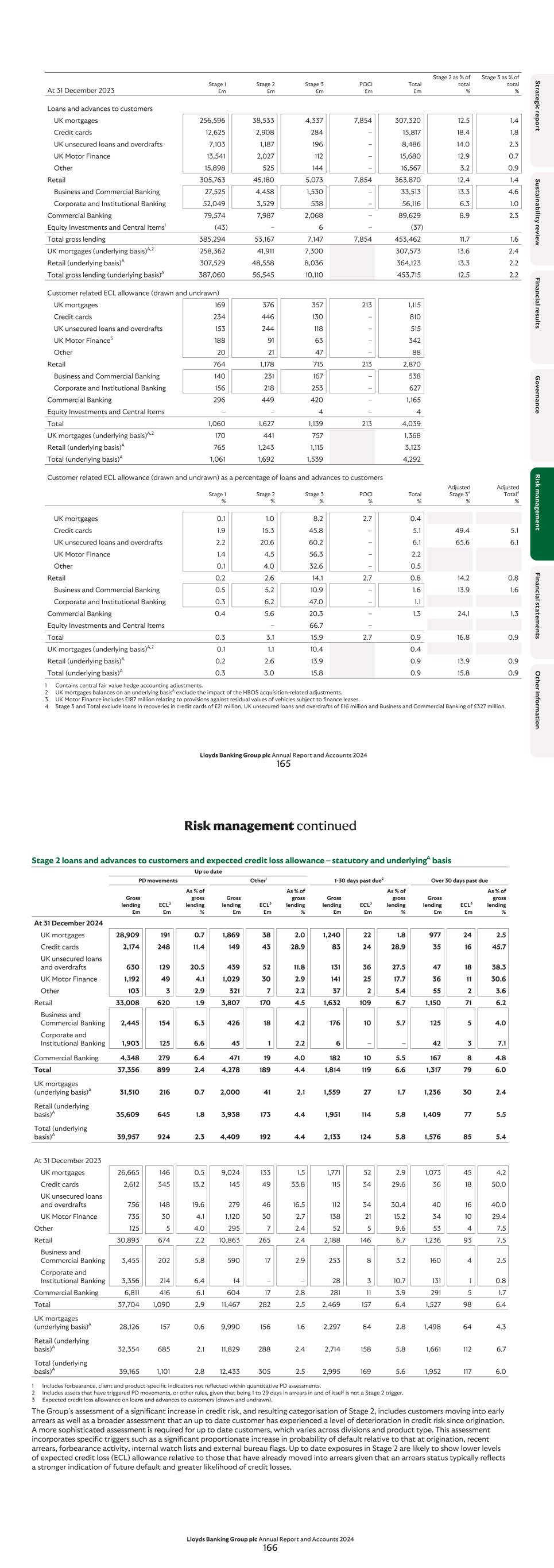
At 31 December 2023 Stage 1 £m Stage 2 £m Stage 3 £m POCI £m Total £m Stage 2 as % of total % Stage 3 as % of total % Loans and advances to customers UK mortgages 256,596 38,533 4,337 7,854 307,320 12.5 1.4 Credit cards 12,625 2,908 284 – 15,817 18.4 1.8 UK unsecured loans and overdrafts 7,103 1,187 196 – 8,486 14.0 2.3 UK Motor Finance 13,541 2,027 112 – 15,680 12.9 0.7 Other 15,898 525 144 – 16,567 3.2 0.9 Retail 305,763 45,180 5,073 7,854 363,870 12.4 1.4 Business and Commercial Banking 27,525 4,458 1,530 – 33,513 13.3 4.6 Corporate and Institutional Banking 52,049 3,529 538 – 56,116 6.3 1.0 Commercial Banking 79,574 7,987 2,068 – 89,629 8.9 2.3 Equity Investments and Central Items1 (43) – 6 – (37) Total gross lending 385,294 53,167 7,147 7,854 453,462 11.7 1.6 UK mortgages (underlying basis)A,2 258,362 41,911 7,300 307,573 13.6 2.4 Retail (underlying basis)A 307,529 48,558 8,036 364,123 13.3 2.2 Total gross lending (underlying basis)A 387,060 56,545 10,110 453,715 12.5 2.2 Customer related ECL allowance (drawn and undrawn) UK mortgages 169 376 357 213 1,115 Credit cards 234 446 130 – 810 UK unsecured loans and overdrafts 153 244 118 – 515 UK Motor Finance3 188 91 63 – 342 Other 20 21 47 – 88 Retail 764 1,178 715 213 2,870 Business and Commercial Banking 140 231 167 – 538 Corporate and Institutional Banking 156 218 253 – 627 Commercial Banking 296 449 420 – 1,165 Equity Investments and Central Items – – 4 – 4 Total 1,060 1,627 1,139 213 4,039 UK mortgages (underlying basis)A,2 170 441 757 1,368 Retail (underlying basis)A 765 1,243 1,115 3,123 Total (underlying basis)A 1,061 1,692 1,539 4,292 Customer related ECL allowance (drawn and undrawn) as a percentage of loans and advances to customers Stage 1 % Stage 2 % Stage 3 % POCI % Total % Adjusted Stage 34 % Adjusted Total4 % UK mortgages 0.1 1.0 8.2 2.7 0.4 Credit cards 1.9 15.3 45.8 – 5.1 49.4 5.1 UK unsecured loans and overdrafts 2.2 20.6 60.2 – 6.1 65.6 6.1 UK Motor Finance 1.4 4.5 56.3 – 2.2 Other 0.1 4.0 32.6 – 0.5 Retail 0.2 2.6 14.1 2.7 0.8 14.2 0.8 Business and Commercial Banking 0.5 5.2 10.9 – 1.6 13.9 1.6 Corporate and Institutional Banking 0.3 6.2 47.0 – 1.1 Commercial Banking 0.4 5.6 20.3 – 1.3 24.1 1.3 Equity Investments and Central Items – 66.7 – Total 0.3 3.1 15.9 2.7 0.9 16.8 0.9 UK mortgages (underlying basis)A,2 0.1 1.1 10.4 0.4 Retail (underlying basis)A 0.2 2.6 13.9 0.9 13.9 0.9 Total (underlying basis)A 0.3 3.0 15.8 0.9 15.8 0.9 1 Contains central fair value hedge accounting adjustments. 2 UK mortgages balances on an underlying basisA exclude the impact of the HBOS acquisition-related adjustments. 3 UK Motor Finance includes £187 million relating to provisions against residual values of vehicles subject to finance leases. 4 Stage 3 and Total exclude loans in recoveries in credit cards of £21 million, UK unsecured loans and overdrafts of £16 million and Business and Commercial Banking of £327 million. Lloyds Banking Group plc Annual Report and Accounts 2024 165 l i ts 2 O th e r in fo rm a tio n R isk m a n a ge m e n t F in a n cia l re su lts S u sta in a b ility re vie w S tra te gic re p o rt G o ve rn a n ce F in a n cia l sta te m e n ts Stage 2 loans and advances to customers and expected credit loss allowance – statutory and underlyingA basis Up to date 1-30 days past due2 Over 30 days past duePD movements Other1 Gross lending £m ECL3 £m As % of gross lending % Gross lending £m ECL3 £m As % of gross lending % Gross lending £m ECL3 £m As % of gross lending % Gross lending £m ECL3 £m As % of gross lending % At 31 December 2024 UK mortgages 28,909 191 0.7 1,869 38 2.0 1,240 22 1.8 977 24 2.5 Credit cards 2,174 248 11.4 149 43 28.9 83 24 28.9 35 16 45.7 UK unsecured loans and overdrafts 630 129 20.5 439 52 11.8 131 36 27.5 47 18 38.3 UK Motor Finance 1,192 49 4.1 1,029 30 2.9 141 25 17.7 36 11 30.6 Other 103 3 2.9 321 7 2.2 37 2 5.4 55 2 3.6 Retail 33,008 620 1.9 3,807 170 4.5 1,632 109 6.7 1,150 71 6.2 Business and Commercial Banking 2,445 154 6.3 426 18 4.2 176 10 5.7 125 5 4.0 Corporate and Institutional Banking 1,903 125 6.6 45 1 2.2 6 – – 42 3 7.1 Commercial Banking 4,348 279 6.4 471 19 4.0 182 10 5.5 167 8 4.8 Total 37,356 899 2.4 4,278 189 4.4 1,814 119 6.6 1,317 79 6.0 UK mortgages (underlying basis)A 31,510 216 0.7 2,000 41 2.1 1,559 27 1.7 1,236 30 2.4 Retail (underlying basis)A 35,609 645 1.8 3,938 173 4.4 1,951 114 5.8 1,409 77 5.5 Total (underlying basis)A 39,957 924 2.3 4,409 192 4.4 2,133 124 5.8 1,576 85 5.4 At 31 December 2023 UK mortgages 26,665 146 0.5 9,024 133 1.5 1,771 52 2.9 1,073 45 4.2 Credit cards 2,612 345 13.2 145 49 33.8 115 34 29.6 36 18 50.0 UK unsecured loans and overdrafts 756 148 19.6 279 46 16.5 112 34 30.4 40 16 40.0 UK Motor Finance 735 30 4.1 1,120 30 2.7 138 21 15.2 34 10 29.4 Other 125 5 4.0 295 7 2.4 52 5 9.6 53 4 7.5 Retail 30,893 674 2.2 10,863 265 2.4 2,188 146 6.7 1,236 93 7.5 Business and Commercial Banking 3,455 202 5.8 590 17 2.9 253 8 3.2 160 4 2.5 Corporate and Institutional Banking 3,356 214 6.4 14 – – 28 3 10.7 131 1 0.8 Commercial Banking 6,811 416 6.1 604 17 2.8 281 11 3.9 291 5 1.7 Total 37,704 1,090 2.9 11,467 282 2.5 2,469 157 6.4 1,527 98 6.4 UK mortgages (underlying basis)A 28,126 157 0.6 9,990 156 1.6 2,297 64 2.8 1,498 64 4.3 Retail (underlying basis)A 32,354 685 2.1 11,829 288 2.4 2,714 158 5.8 1,661 112 6.7 Total (underlying basis)A 39,165 1,101 2.8 12,433 305 2.5 2,995 169 5.6 1,952 117 6.0 1 Includes forbearance, client and product-specific indicators not reflected within quantitative PD assessments. 2 Includes assets that have triggered PD movements, or other rules, given that being 1 to 29 days in arrears in and of itself is not a Stage 2 trigger. 3 Expected credit loss allowance on loans and advances to customers (drawn and undrawn). The Group’s assessment of a significant increase in credit risk, and resulting categorisation of Stage 2, includes customers moving into early arrears as well as a broader assessment that an up to date customer has experienced a level of deterioration in credit risk since origination. A more sophisticated assessment is required for up to date customers, which varies across divisions and product type. This assessment incorporates specific triggers such as a significant proportionate increase in probability of default relative to that at origination, recent arrears, forbearance activity, internal watch lists and external bureau flags. Up to date exposures in Stage 2 are likely to show lower levels of expected credit loss (ECL) allowance relative to those that have already moved into arrears given that an arrears status typically reflects a stronger indication of future default and greater likelihood of credit losses. Risk management continued Lloyds Banking Group plc Annual Report and Accounts 2024 166 l i ts
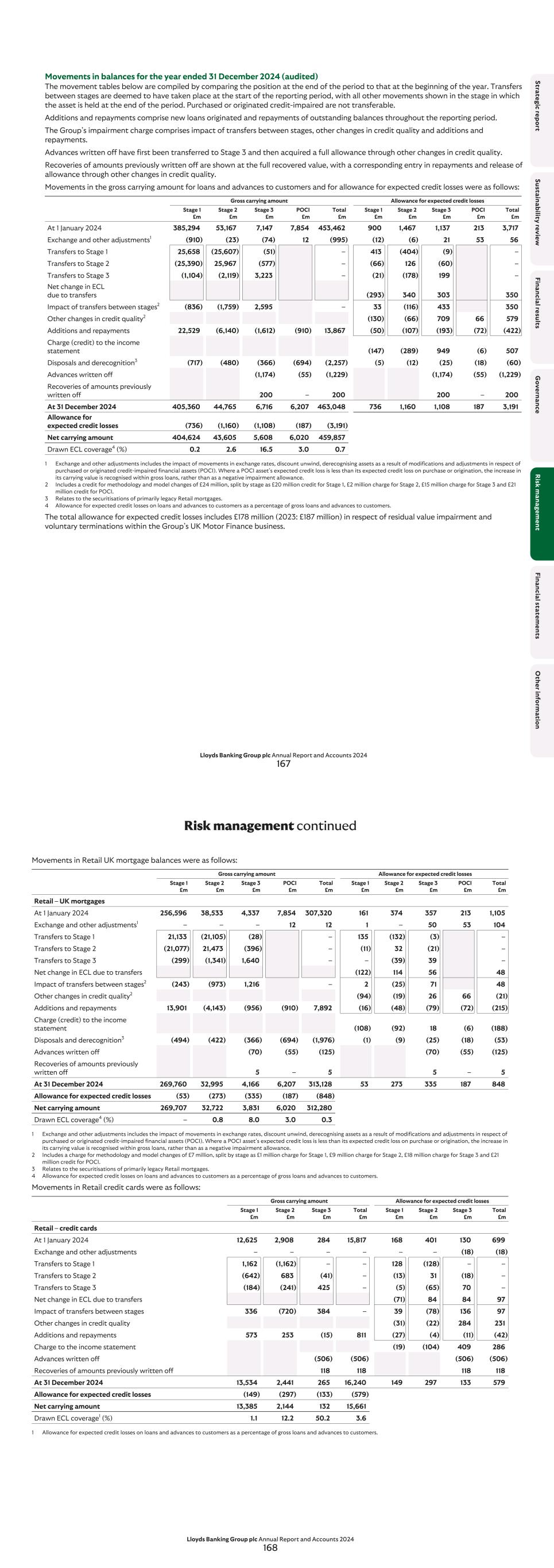
Movements in balances for the year ended 31 December 2024 (audited) The movement tables below are compiled by comparing the position at the end of the period to that at the beginning of the year. Transfers between stages are deemed to have taken place at the start of the reporting period, with all other movements shown in the stage in which the asset is held at the end of the period. Purchased or originated credit-impaired are not transferable. Additions and repayments comprise new loans originated and repayments of outstanding balances throughout the reporting period. The Group’s impairment charge comprises impact of transfers between stages, other changes in credit quality and additions and repayments. Advances written off have first been transferred to Stage 3 and then acquired a full allowance through other changes in credit quality. Recoveries of amounts previously written off are shown at the full recovered value, with a corresponding entry in repayments and release of allowance through other changes in credit quality. Movements in the gross carrying amount for loans and advances to customers and for allowance for expected credit losses were as follows: Gross carrying amount Allowance for expected credit losses Stage 1 £m Stage 2 £m Stage 3 £m POCI £m Total £m Stage 1 £m Stage 2 £m Stage 3 £m POCI £m Total £m At 1 January 2024 385,294 53,167 7,147 7,854 453,462 900 1,467 1,137 213 3,717 Exchange and other adjustments1 (910) (23) (74) 12 (995) (12) (6) 21 53 56 Transfers to Stage 1 25,658 (25,607) (51) – 413 (404) (9) – Transfers to Stage 2 (25,390) 25,967 (577) – (66) 126 (60) – Transfers to Stage 3 (1,104) (2,119) 3,223 – (21) (178) 199 – Net change in ECL due to transfers (293) 340 303 350 Impact of transfers between stages2 (836) (1,759) 2,595 – 33 (116) 433 350 Other changes in credit quality2 (130) (66) 709 66 579 Additions and repayments 22,529 (6,140) (1,612) (910) 13,867 (50) (107) (193) (72) (422) Charge (credit) to the income statement (147) (289) 949 (6) 507 Disposals and derecognition3 (717) (480) (366) (694) (2,257) (5) (12) (25) (18) (60) Advances written off (1,174) (55) (1,229) (1,174) (55) (1,229) Recoveries of amounts previously written off 200 – 200 200 – 200 At 31 December 2024 405,360 44,765 6,716 6,207 463,048 736 1,160 1,108 187 3,191 Allowance for expected credit losses (736) (1,160) (1,108) (187) (3,191) Net carrying amount 404,624 43,605 5,608 6,020 459,857 Drawn ECL coverage4 (%) 0.2 2.6 16.5 3.0 0.7 1 Exchange and other adjustments includes the impact of movements in exchange rates, discount unwind, derecognising assets as a result of modifications and adjustments in respect of purchased or originated credit-impaired financial assets (POCI). Where a POCI asset’s expected credit loss is less than its expected credit loss on purchase or origination, the increase in its carrying value is recognised within gross loans, rather than as a negative impairment allowance. 2 Includes a credit for methodology and model changes of £24 million, split by stage as £20 million credit for Stage 1, £2 million charge for Stage 2, £15 million charge for Stage 3 and £21 million credit for POCI. 3 Relates to the securitisations of primarily legacy Retail mortgages. 4 Allowance for expected credit losses on loans and advances to customers as a percentage of gross loans and advances to customers. The total allowance for expected credit losses includes £178 million (2023: £187 million) in respect of residual value impairment and voluntary terminations within the Group’s UK Motor Finance business. Lloyds Banking Group plc Annual Report and Accounts 2024 167 l i ts 2 O th e r in fo rm a tio n R isk m a n a ge m e n t F in a n cia l re su lts S u sta in a b ility re vie w S tra te gic re p o rt G o ve rn a n ce F in a n cia l sta te m e n ts Movements in Retail UK mortgage balances were as follows: Gross carrying amount Allowance for expected credit losses Stage 1 £m Stage 2 £m Stage 3 £m POCI £m Total £m Stage 1 £m Stage 2 £m Stage 3 £m POCI £m Total £m Retail – UK mortgages At 1 January 2024 256,596 38,533 4,337 7,854 307,320 161 374 357 213 1,105 Exchange and other adjustments1 – – – 12 12 1 – 50 53 104 Transfers to Stage 1 21,133 (21,105) (28) – 135 (132) (3) – Transfers to Stage 2 (21,077) 21,473 (396) – (11) 32 (21) – Transfers to Stage 3 (299) (1,341) 1,640 – – (39) 39 – Net change in ECL due to transfers (122) 114 56 48 Impact of transfers between stages2 (243) (973) 1,216 – 2 (25) 71 48 Other changes in credit quality2 (94) (19) 26 66 (21) Additions and repayments 13,901 (4,143) (956) (910) 7,892 (16) (48) (79) (72) (215) Charge (credit) to the income statement (108) (92) 18 (6) (188) Disposals and derecognition3 (494) (422) (366) (694) (1,976) (1) (9) (25) (18) (53) Advances written off (70) (55) (125) (70) (55) (125) Recoveries of amounts previously written off 5 – 5 5 – 5 At 31 December 2024 269,760 32,995 4,166 6,207 313,128 53 273 335 187 848 Allowance for expected credit losses (53) (273) (335) (187) (848) Net carrying amount 269,707 32,722 3,831 6,020 312,280 Drawn ECL coverage4 (%) – 0.8 8.0 3.0 0.3 1 Exchange and other adjustments includes the impact of movements in exchange rates, discount unwind, derecognising assets as a result of modifications and adjustments in respect of purchased or originated credit-impaired financial assets (POCI). Where a POCI asset’s expected credit loss is less than its expected credit loss on purchase or origination, the increase in its carrying value is recognised within gross loans, rather than as a negative impairment allowance. 2 Includes a charge for methodology and model changes of £7 million, split by stage as £1 million charge for Stage 1, £9 million charge for Stage 2, £18 million charge for Stage 3 and £21 million credit for POCI. 3 Relates to the securitisations of primarily legacy Retail mortgages. 4 Allowance for expected credit losses on loans and advances to customers as a percentage of gross loans and advances to customers. Movements in Retail credit cards were as follows: Gross carrying amount Allowance for expected credit losses Stage 1 £m Stage 2 £m Stage 3 £m Total £m Stage 1 £m Stage 2 £m Stage 3 £m Total £m Retail – credit cards At 1 January 2024 12,625 2,908 284 15,817 168 401 130 699 Exchange and other adjustments – – – – – – (18) (18) Transfers to Stage 1 1,162 (1,162) – – 128 (128) – – Transfers to Stage 2 (642) 683 (41) – (13) 31 (18) – Transfers to Stage 3 (184) (241) 425 – (5) (65) 70 – Net change in ECL due to transfers (71) 84 84 97 Impact of transfers between stages 336 (720) 384 – 39 (78) 136 97 Other changes in credit quality (31) (22) 284 231 Additions and repayments 573 253 (15) 811 (27) (4) (11) (42) Charge to the income statement (19) (104) 409 286 Advances written off (506) (506) (506) (506) Recoveries of amounts previously written off 118 118 118 118 At 31 December 2024 13,534 2,441 265 16,240 149 297 133 579 Allowance for expected credit losses (149) (297) (133) (579) Net carrying amount 13,385 2,144 132 15,661 Drawn ECL coverage1 (%) 1.1 12.2 50.2 3.6 1 Allowance for expected credit losses on loans and advances to customers as a percentage of gross loans and advances to customers. Risk management continued Lloyds Banking Group plc Annual Report and Accounts 2024 168 l i ts
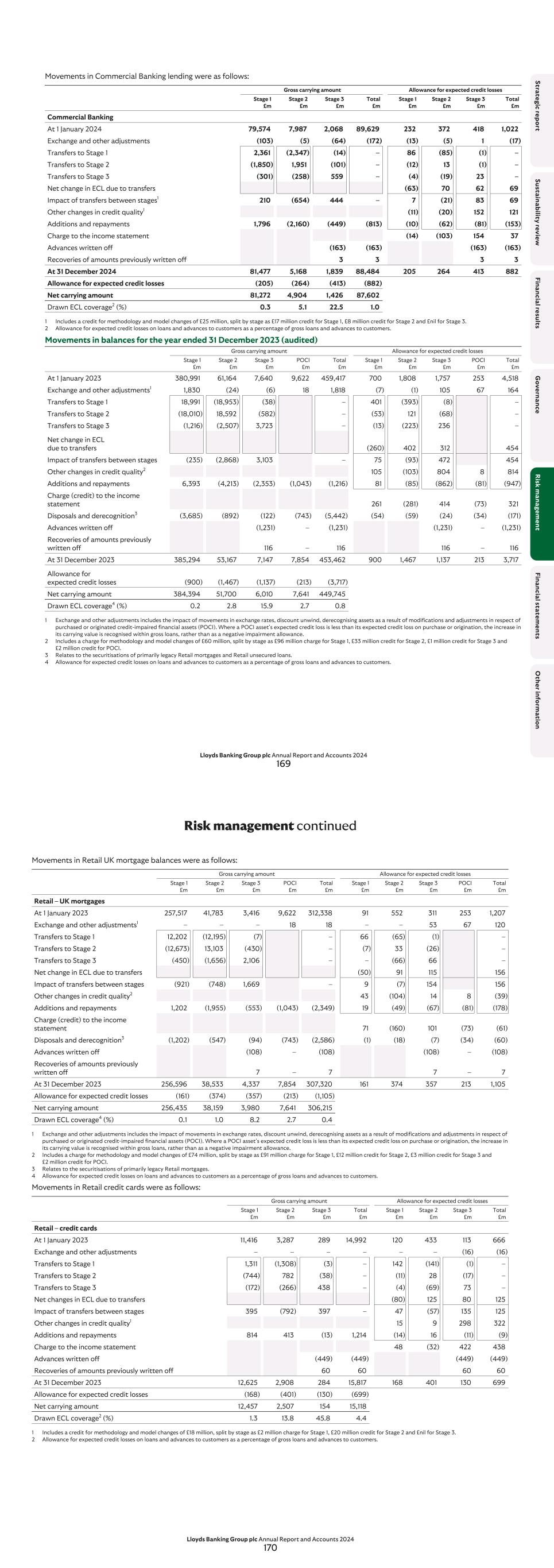
Movements in Commercial Banking lending were as follows: Gross carrying amount Allowance for expected credit losses Stage 1 £m Stage 2 £m Stage 3 £m Total £m Stage 1 £m Stage 2 £m Stage 3 £m Total £m Commercial Banking At 1 January 2024 79,574 7,987 2,068 89,629 232 372 418 1,022 Exchange and other adjustments (103) (5) (64) (172) (13) (5) 1 (17) Transfers to Stage 1 2,361 (2,347) (14) – 86 (85) (1) – Transfers to Stage 2 (1,850) 1,951 (101) – (12) 13 (1) – Transfers to Stage 3 (301) (258) 559 – (4) (19) 23 – Net change in ECL due to transfers (63) 70 62 69 Impact of transfers between stages1 210 (654) 444 – 7 (21) 83 69 Other changes in credit quality1 (11) (20) 152 121 Additions and repayments 1,796 (2,160) (449) (813) (10) (62) (81) (153) Charge to the income statement (14) (103) 154 37 Advances written off (163) (163) (163) (163) Recoveries of amounts previously written off 3 3 3 3 At 31 December 2024 81,477 5,168 1,839 88,484 205 264 413 882 Allowance for expected credit losses (205) (264) (413) (882) Net carrying amount 81,272 4,904 1,426 87,602 Drawn ECL coverage2 (%) 0.3 5.1 22.5 1.0 1 Includes a credit for methodology and model changes of £25 million, split by stage as £17 million credit for Stage 1, £8 million credit for Stage 2 and £nil for Stage 3. 2 Allowance for expected credit losses on loans and advances to customers as a percentage of gross loans and advances to customers. Movements in balances for the year ended 31 December 2023 (audited) Exchange and other adjustments1 1,830 (24) (6) 18 1,818 (7) (1) 105 67 164 Transfers to Stage 1 18,991 (18,953) (38) – 401 (393) (8) – Transfers to Stage 2 (18,010) 18,592 (582) – (53) 121 (68) – Transfers to Stage 3 (1,216) (2,507) 3,723 – (13) (223) 236 – Net change in ECL due to transfers (260) 402 312 454 Impact of transfers between stages (235) (2,868) 3,103 – 75 (93) 472 454 Other changes in credit quality2 105 (103) 804 8 814 Additions and repayments 6,393 (4,213) (2,353) (1,043) (1,216) 81 (85) (862) (81) (947) Charge (credit) to the income statement 261 (281) 414 (73) 321 Disposals and derecognition3 (3,685) (892) (122) (743) (5,442) (54) (59) (24) (34) (171) Advances written off (1,231) – (1,231) (1,231) – (1,231) Recoveries of amounts previously written off 116 – 116 116 – 116 At 31 December 2023 385,294 53,167 7,147 7,854 453,462 900 1,467 1,137 213 3,717 Allowance for expected credit losses (900) (1,467) (1,137) (213) (3,717) Net carrying amount 384,394 51,700 6,010 7,641 449,745 Drawn ECL coverage4 (%) 0.2 2.8 15.9 2.7 0.8 Gross carrying amount Allowance for expected credit losses Stage 1 £m Stage 2 £m Stage 3 £m POCI £m Total £m Stage 1 £m Stage 2 £m Stage 3 £m POCI £m Total £m At 1 January 2023 380,991 61,164 7,640 9,622 459,417 700 1,808 1,757 253 4,518 1 Exchange and other adjustments includes the impact of movements in exchange rates, discount unwind, derecognising assets as a result of modifications and adjustments in respect of purchased or originated credit-impaired financial assets (POCI). Where a POCI asset’s expected credit loss is less than its expected credit loss on purchase or origination, the increase in its carrying value is recognised within gross loans, rather than as a negative impairment allowance. 2 Includes a charge for methodology and model changes of £60 million, split by stage as £96 million charge for Stage 1, £33 million credit for Stage 2, £1 million credit for Stage 3 and £2 million credit for POCI. 3 Relates to the securitisations of primarily legacy Retail mortgages and Retail unsecured loans. 4 Allowance for expected credit losses on loans and advances to customers as a percentage of gross loans and advances to customers. Lloyds Banking Group plc Annual Report and Accounts 2024 169 l i ts 2 O th e r in fo rm a tio n R isk m a n a ge m e n t F in a n cia l re su lts S u sta in a b ility re vie w S tra te gic re p o rt G o ve rn a n ce F in a n cia l sta te m e n ts Movements in Retail UK mortgage balances were as follows: Gross carrying amount Allowance for expected credit losses Stage 1 £m Stage 2 £m Stage 3 £m POCI £m Total £m Stage 1 £m Stage 2 £m Stage 3 £m POCI £m Total £m Retail – UK mortgages At 1 January 2023 257,517 41,783 3,416 9,622 312,338 91 552 311 253 1,207 Exchange and other adjustments1 – – – 18 18 – – 53 67 120 Transfers to Stage 1 12,202 (12,195) (7) – 66 (65) (1) – Transfers to Stage 2 (12,673) 13,103 (430) – (7) 33 (26) – Transfers to Stage 3 (450) (1,656) 2,106 – – (66) 66 – Net change in ECL due to transfers (50) 91 115 156 Impact of transfers between stages (921) (748) 1,669 – 9 (7) 154 156 Other changes in credit quality2 43 (104) 14 8 (39) Additions and repayments 1,202 (1,955) (553) (1,043) (2,349) 19 (49) (67) (81) (178) Charge (credit) to the income statement 71 (160) 101 (73) (61) Disposals and derecognition3 (1,202) (547) (94) (743) (2,586) (1) (18) (7) (34) (60) Advances written off (108) – (108) (108) – (108) Recoveries of amounts previously written off 7 – 7 7 – 7 At 31 December 2023 256,596 38,533 4,337 7,854 307,320 161 374 357 213 1,105 Allowance for expected credit losses (161) (374) (357) (213) (1,105) Net carrying amount 256,435 38,159 3,980 7,641 306,215 Drawn ECL coverage4 (%) 0.1 1.0 8.2 2.7 0.4 1 Exchange and other adjustments includes the impact of movements in exchange rates, discount unwind, derecognising assets as a result of modifications and adjustments in respect of purchased or originated credit-impaired financial assets (POCI). Where a POCI asset’s expected credit loss is less than its expected credit loss on purchase or origination, the increase in its carrying value is recognised within gross loans, rather than as a negative impairment allowance. 2 Includes a charge for methodology and model changes of £74 million, split by stage as £91 million charge for Stage 1, £12 million credit for Stage 2, £3 million credit for Stage 3 and £2 million credit for POCI. 3 Relates to the securitisations of primarily legacy Retail mortgages. 4 Allowance for expected credit losses on loans and advances to customers as a percentage of gross loans and advances to customers. Movements in Retail credit cards were as follows: Gross carrying amount Allowance for expected credit losses Stage 1 £m Stage 2 £m Stage 3 £m Total £m Stage 1 £m Stage 2 £m Stage 3 £m Total £m Retail – credit cards At 1 January 2023 11,416 3,287 289 14,992 120 433 113 666 Exchange and other adjustments – – – – – – (16) (16) Transfers to Stage 1 1,311 (1,308) (3) – 142 (141) (1) – Transfers to Stage 2 (744) 782 (38) – (11) 28 (17) – Transfers to Stage 3 (172) (266) 438 – (4) (69) 73 – Net changes in ECL due to transfers (80) 125 80 125 Impact of transfers between stages 395 (792) 397 – 47 (57) 135 125 Other changes in credit quality1 15 9 298 322 Additions and repayments 814 413 (13) 1,214 (14) 16 (11) (9) Charge to the income statement 48 (32) 422 438 Advances written off (449) (449) (449) (449) Recoveries of amounts previously written off 60 60 60 60 At 31 December 2023 12,625 2,908 284 15,817 168 401 130 699 Allowance for expected credit losses (168) (401) (130) (699) Net carrying amount 12,457 2,507 154 15,118 Drawn ECL coverage2 (%) 1.3 13.8 45.8 4.4 1 Includes a credit for methodology and model changes of £18 million, split by stage as £2 million charge for Stage 1, £20 million credit for Stage 2 and £nil for Stage 3. 2 Allowance for expected credit losses on loans and advances to customers as a percentage of gross loans and advances to customers. Risk management continued Lloyds Banking Group plc Annual Report and Accounts 2024 170 l i ts
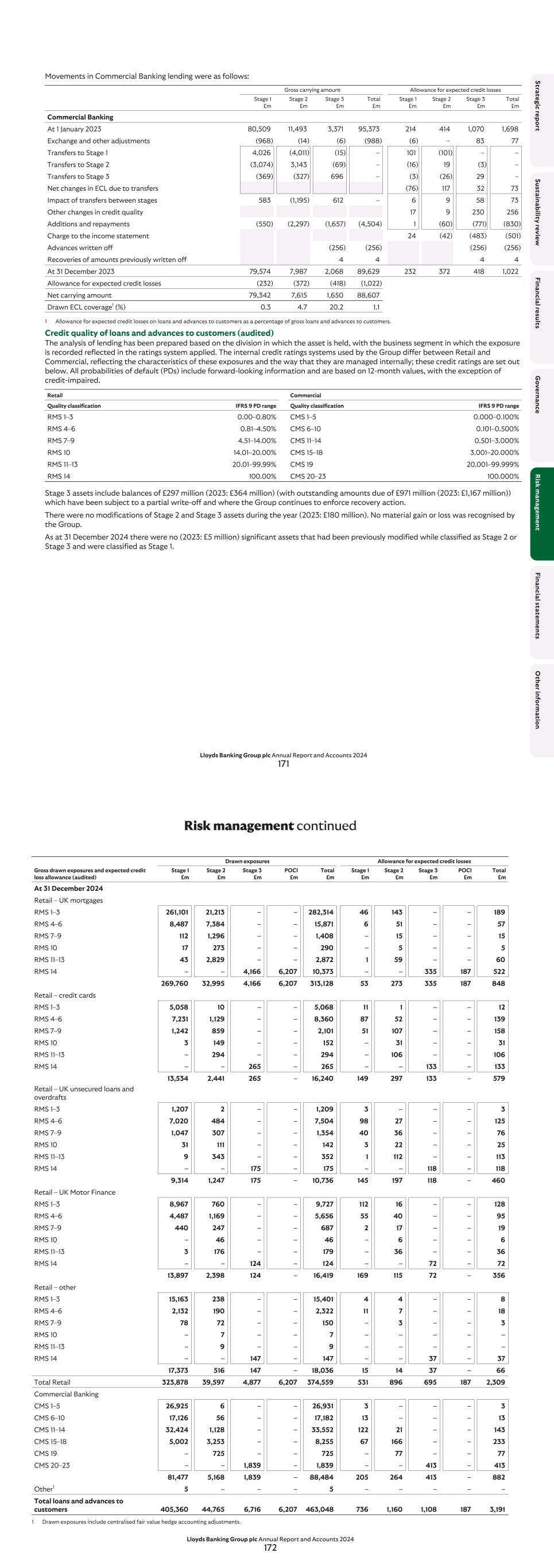
Movements in Commercial Banking lending were as follows: Gross carrying amount Allowance for expected credit losses Stage 1 £m Stage 2 £m Stage 3 £m Total £m Stage 1 £m Stage 2 £m Stage 3 £m Total £m Commercial Banking At 1 January 2023 80,509 11,493 3,371 95,373 214 414 1,070 1,698 Exchange and other adjustments (968) (14) (6) (988) (6) – 83 77 Transfers to Stage 1 4,026 (4,011) (15) – 101 (101) – – Transfers to Stage 2 (3,074) 3,143 (69) – (16) 19 (3) – Transfers to Stage 3 (369) (327) 696 – (3) (26) 29 – Net changes in ECL due to transfers (76) 117 32 73 Impact of transfers between stages 583 (1,195) 612 – 6 9 58 73 Other changes in credit quality 17 9 230 256 Additions and repayments (550) (2,297) (1,657) (4,504) 1 (60) (771) (830) Charge to the income statement 24 (42) (483) (501) Advances written off (256) (256) (256) (256) Recoveries of amounts previously written off 4 4 4 4 At 31 December 2023 79,574 7,987 2,068 89,629 232 372 418 1,022 Allowance for expected credit losses (232) (372) (418) (1,022) Net carrying amount 79,342 7,615 1,650 88,607 Drawn ECL coverage1 (%) 0.3 4.7 20.2 1.1 1 Allowance for expected credit losses on loans and advances to customers as a percentage of gross loans and advances to customers. Credit quality of loans and advances to customers (audited) The analysis of lending has been prepared based on the division in which the asset is held, with the business segment in which the exposure is recorded reflected in the ratings system applied. The internal credit ratings systems used by the Group differ between Retail and Commercial, reflecting the characteristics of these exposures and the way that they are managed internally; these credit ratings are set out below. All probabilities of default (PDs) include forward-looking information and are based on 12-month values, with the exception of credit-impaired. Retail Commercial Quality classification IFRS 9 PD range Quality classification IFRS 9 PD range RMS 1–3 0.00–0.80% CMS 1–5 0.000–0.100% RMS 4–6 0.81–4.50% CMS 6–10 0.101–0.500% RMS 7–9 4.51–14.00% CMS 11–14 0.501–3.000% RMS 10 14.01–20.00% CMS 15–18 3.001–20.000% RMS 11–13 20.01–99.99% CMS 19 20.001–99.999% RMS 14 100.00% CMS 20–23 100.000% Stage 3 assets include balances of £297 million (2023: £364 million) (with outstanding amounts due of £971 million (2023: £1,167 million)) which have been subject to a partial write-off and where the Group continues to enforce recovery action. There were no modifications of Stage 2 and Stage 3 assets during the year (2023: £180 million). No material gain or loss was recognised by the Group. As at 31 December 2024 there were no (2023: £5 million) significant assets that had been previously modified while classified as Stage 2 or Stage 3 and were classified as Stage 1. Lloyds Banking Group plc Annual Report and Accounts 2024 171 l i ts 2 O th e r in fo rm a tio n R isk m a n a ge m e n t F in a n cia l re su lts S u sta in a b ility re vie w S tra te gic re p o rt G o ve rn a n ce F in a n cia l sta te m e n ts Drawn exposures Allowance for expected credit losses Gross drawn exposures and expected credit loss allowance (audited) Stage 1 £m Stage 2 £m Stage 3 £m POCI £m Total £m Stage 1 £m Stage 2 £m Stage 3 £m POCI £m Total £m At 31 December 2024 Retail – UK mortgages RMS 1–3 261,101 21,213 – – 282,314 46 143 – – 189 RMS 4–6 8,487 7,384 – – 15,871 6 51 – – 57 RMS 7–9 112 1,296 – – 1,408 – 15 – – 15 RMS 10 17 273 – – 290 – 5 – – 5 RMS 11–13 43 2,829 – – 2,872 1 59 – – 60 RMS 14 – – 4,166 6,207 10,373 – – 335 187 522 269,760 32,995 4,166 6,207 313,128 53 273 335 187 848 Retail – credit cards RMS 1–3 5,058 10 – – 5,068 11 1 – – 12 RMS 4–6 7,231 1,129 – – 8,360 87 52 – – 139 RMS 7–9 1,242 859 – – 2,101 51 107 – – 158 RMS 10 3 149 – – 152 – 31 – – 31 RMS 11–13 – 294 – – 294 – 106 – – 106 RMS 14 – – 265 – 265 – – 133 – 133 13,534 2,441 265 – 16,240 149 297 133 – 579 Retail – UK unsecured loans and overdrafts RMS 1–3 1,207 2 – – 1,209 3 – – – 3 RMS 4–6 7,020 484 – – 7,504 98 27 – – 125 RMS 7–9 1,047 307 – – 1,354 40 36 – – 76 RMS 10 31 111 – – 142 3 22 – – 25 RMS 11–13 9 343 – – 352 1 112 – – 113 RMS 14 – – 175 – 175 – – 118 – 118 9,314 1,247 175 – 10,736 145 197 118 – 460 Retail – UK Motor Finance RMS 1–3 8,967 760 – – 9,727 112 16 – – 128 RMS 4–6 4,487 1,169 – – 5,656 55 40 – – 95 RMS 7–9 440 247 – – 687 2 17 – – 19 RMS 10 – 46 – – 46 – 6 – – 6 RMS 11–13 3 176 – – 179 – 36 – – 36 RMS 14 – – 124 – 124 – – 72 – 72 13,897 2,398 124 – 16,419 169 115 72 – 356 Retail – other RMS 1–3 15,163 238 – – 15,401 4 4 – – 8 RMS 4–6 2,132 190 – – 2,322 11 7 – – 18 RMS 7–9 78 72 – – 150 – 3 – – 3 RMS 10 – 7 – – 7 – – – – – RMS 11–13 – 9 – – 9 – – – – – RMS 14 – – 147 – 147 – – 37 – 37 17,373 516 147 – 18,036 15 14 37 – 66 Total Retail 323,878 39,597 4,877 6,207 374,559 531 896 695 187 2,309 Commercial Banking CMS 1–5 26,925 6 – – 26,931 3 – – – 3 CMS 6–10 17,126 56 – – 17,182 13 – – – 13 CMS 11–14 32,424 1,128 – – 33,552 122 21 – – 143 CMS 15–18 5,002 3,253 – – 8,255 67 166 – – 233 CMS 19 – 725 – – 725 – 77 – – 77 CMS 20–23 – – 1,839 – 1,839 – – 413 – 413 81,477 5,168 1,839 – 88,484 205 264 413 – 882 Other1 5 – – – 5 – – – – – Total loans and advances to customers 405,360 44,765 6,716 6,207 463,048 736 1,160 1,108 187 3,191 1 Drawn exposures include centralised fair value hedge accounting adjustments. Risk management continued Lloyds Banking Group plc Annual Report and Accounts 2024 172 l i ts
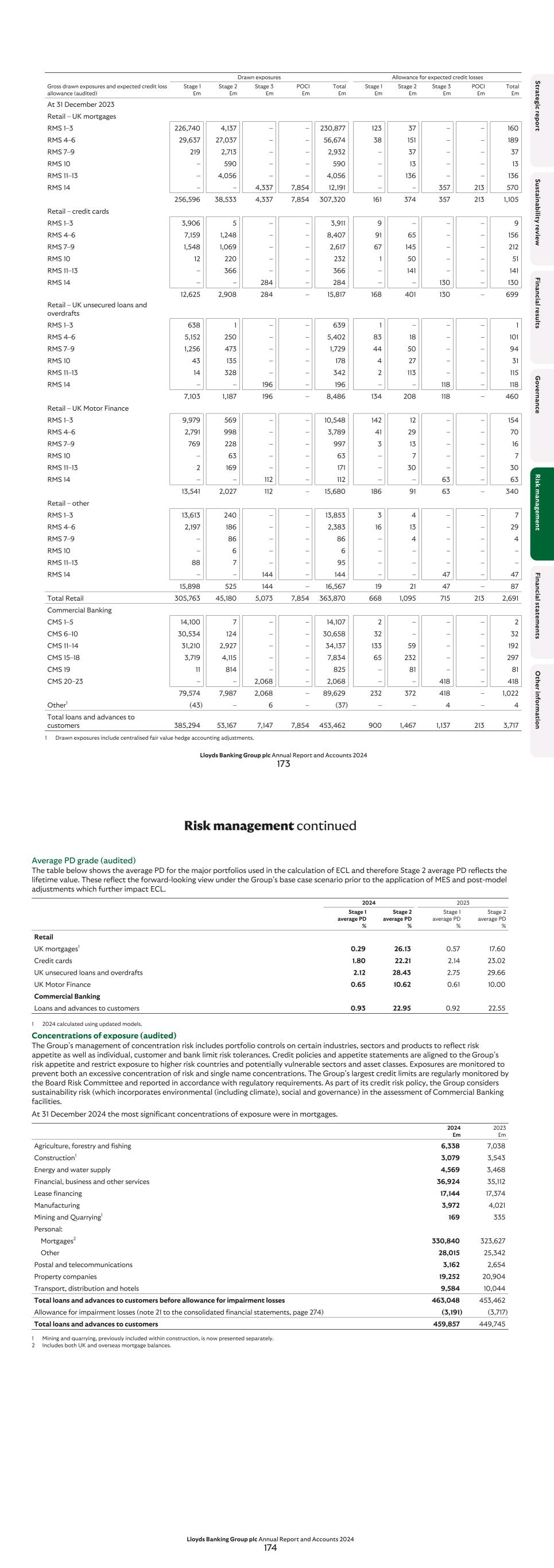
Drawn exposures Allowance for expected credit losses Gross drawn exposures and expected credit loss allowance (audited) Stage 1 £m Stage 2 £m Stage 3 £m POCI £m Total £m Stage 1 £m Stage 2 £m Stage 3 £m POCI £m Total £m At 31 December 2023 Retail – UK mortgages RMS 1–3 226,740 4,137 – – 230,877 123 37 – – 160 RMS 4–6 29,637 27,037 – – 56,674 38 151 – – 189 RMS 7–9 219 2,713 – – 2,932 – 37 – – 37 RMS 10 – 590 – – 590 – 13 – – 13 RMS 11–13 – 4,056 – – 4,056 – 136 – – 136 RMS 14 – – 4,337 7,854 12,191 – – 357 213 570 256,596 38,533 4,337 7,854 307,320 161 374 357 213 1,105 Retail – credit cards RMS 1–3 3,906 5 – – 3,911 9 – – – 9 RMS 4–6 7,159 1,248 – – 8,407 91 65 – – 156 RMS 7–9 1,548 1,069 – – 2,617 67 145 – – 212 RMS 10 12 220 – – 232 1 50 – – 51 RMS 11–13 – 366 – – 366 – 141 – – 141 RMS 14 – – 284 – 284 – – 130 – 130 12,625 2,908 284 – 15,817 168 401 130 – 699 Retail – UK unsecured loans and overdrafts RMS 1–3 638 1 – – 639 1 – – – 1 RMS 4–6 5,152 250 – – 5,402 83 18 – – 101 RMS 7–9 1,256 473 – – 1,729 44 50 – – 94 RMS 10 43 135 – – 178 4 27 – – 31 RMS 11–13 14 328 – – 342 2 113 – – 115 RMS 14 – – 196 – 196 – – 118 – 118 7,103 1,187 196 – 8,486 134 208 118 – 460 Retail – UK Motor Finance RMS 1–3 9,979 569 – – 10,548 142 12 – – 154 RMS 4–6 2,791 998 – – 3,789 41 29 – – 70 RMS 7–9 769 228 – – 997 3 13 – – 16 RMS 10 – 63 – – 63 – 7 – – 7 RMS 11–13 2 169 – – 171 – 30 – – 30 RMS 14 – – 112 – 112 – – 63 – 63 13,541 2,027 112 – 15,680 186 91 63 – 340 Retail – other RMS 1–3 13,613 240 – – 13,853 3 4 – – 7 RMS 4–6 2,197 186 – – 2,383 16 13 – – 29 RMS 7–9 – 86 – – 86 – 4 – – 4 RMS 10 – 6 – – 6 – – – – – RMS 11–13 88 7 – – 95 – – – – – RMS 14 – – 144 – 144 – – 47 – 47 15,898 525 144 – 16,567 19 21 47 – 87 Total Retail 305,763 45,180 5,073 7,854 363,870 668 1,095 715 213 2,691 Commercial Banking CMS 1–5 14,100 7 – – 14,107 2 – – – 2 CMS 6–10 30,534 124 – – 30,658 32 – – – 32 CMS 11–14 31,210 2,927 – – 34,137 133 59 – – 192 CMS 15–18 3,719 4,115 – – 7,834 65 232 – – 297 CMS 19 11 814 – – 825 – 81 – – 81 CMS 20–23 – – 2,068 – 2,068 – – 418 – 418 79,574 7,987 2,068 – 89,629 232 372 418 – 1,022 Other1 (43) – 6 – (37) – – 4 – 4 Total loans and advances to customers 385,294 53,167 7,147 7,854 453,462 900 1,467 1,137 213 3,717 1 Drawn exposures include centralised fair value hedge accounting adjustments. Lloyds Banking Group plc Annual Report and Accounts 2024 173 l i ts 2 O th e r in fo rm a tio n R isk m a n a ge m e n t F in a n cia l re su lts S u sta in a b ility re vie w S tra te gic re p o rt G o ve rn a n ce F in a n cia l sta te m e n ts Average PD grade (audited) The table below shows the average PD for the major portfolios used in the calculation of ECL and therefore Stage 2 average PD reflects the lifetime value. These reflect the forward-looking view under the Group’s base case scenario prior to the application of MES and post-model adjustments which further impact ECL. 2024 2023 Stage 1 average PD % Stage 2 average PD % Stage 1 average PD % Stage 2 average PD % Retail UK mortgages1 0.29 26.13 0.57 17.60 Credit cards 1.80 22.21 2.14 23.02 UK unsecured loans and overdrafts 2.12 28.43 2.75 29.66 UK Motor Finance 0.65 10.62 0.61 10.00 Commercial Banking Loans and advances to customers 0.93 22.95 0.92 22.55 1 2024 calculated using updated models. Concentrations of exposure (audited) The Group’s management of concentration risk includes portfolio controls on certain industries, sectors and products to reflect risk appetite as well as individual, customer and bank limit risk tolerances. Credit policies and appetite statements are aligned to the Group’s risk appetite and restrict exposure to higher risk countries and potentially vulnerable sectors and asset classes. Exposures are monitored to prevent both an excessive concentration of risk and single name concentrations. The Group’s largest credit limits are regularly monitored by the Board Risk Committee and reported in accordance with regulatory requirements. As part of its credit risk policy, the Group considers sustainability risk (which incorporates environmental (including climate), social and governance) in the assessment of Commercial Banking facilities. At 31 December 2024 the most significant concentrations of exposure were in mortgages. 2024 £m 2023 £m Agriculture, forestry and fishing 6,338 7,038 Construction1 3,079 3,543 Energy and water supply 4,569 3,468 Financial, business and other services 36,924 35,112 Lease financing 17,144 17,374 Manufacturing 3,972 4,021 Mining and Quarrying1 169 335 Personal: Mortgages2 330,840 323,627 Other 28,015 25,342 Postal and telecommunications 3,162 2,654 Property companies 19,252 20,904 Transport, distribution and hotels 9,584 10,044 Total loans and advances to customers before allowance for impairment losses 463,048 453,462 Allowance for impairment losses (note 21 to the consolidated financial statements, page 274) (3,191) (3,717) Total loans and advances to customers 459,857 449,745 1 Mining and quarrying, previously included within construction, is now presented separately. 2 Includes both UK and overseas mortgage balances. Risk management continued Lloyds Banking Group plc Annual Report and Accounts 2024 174 l i ts
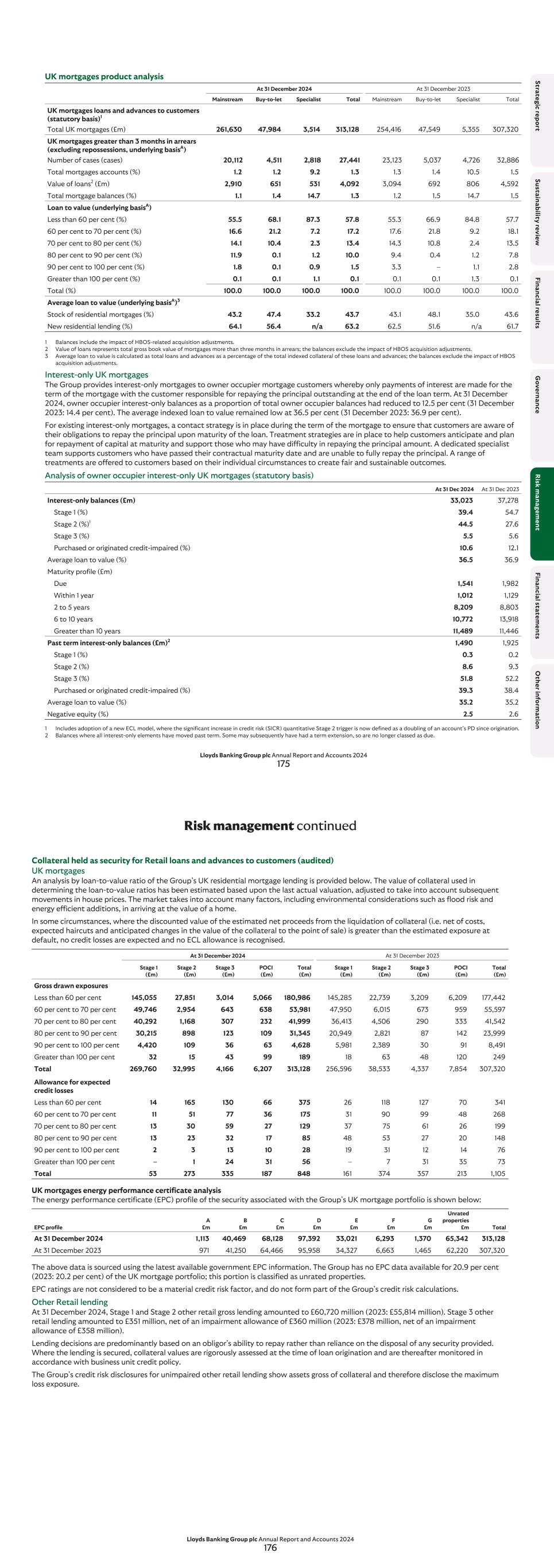
UK mortgages product analysis At 31 December 2024 At 31 December 2023 Mainstream Buy-to-let Specialist Total Mainstream Buy-to-let Specialist Total UK mortgages loans and advances to customers (statutory basis)1 Total UK mortgages (£m) 261,630 47,984 3,514 313,128 254,416 47,549 5,355 307,320 UK mortgages greater than 3 months in arrears (excluding repossessions, underlying basisA) Number of cases (cases) 20,112 4,511 2,818 27,441 23,123 5,037 4,726 32,886 Total mortgages accounts (%) 1.2 1.2 9.2 1.3 1.3 1.4 10.5 1.5 Value of loans2 (£m) 2,910 651 531 4,092 3,094 692 806 4,592 Total mortgage balances (%) 1.1 1.4 14.7 1.3 1.2 1.5 14.7 1.5 Loan to value (underlying basisA) Less than 60 per cent (%) 55.5 68.1 87.3 57.8 55.3 66.9 84.8 57.7 60 per cent to 70 per cent (%) 16.6 21.2 7.2 17.2 17.6 21.8 9.2 18.1 70 per cent to 80 per cent (%) 14.1 10.4 2.3 13.4 14.3 10.8 2.4 13.5 80 per cent to 90 per cent (%) 11.9 0.1 1.2 10.0 9.4 0.4 1.2 7.8 90 per cent to 100 per cent (%) 1.8 0.1 0.9 1.5 3.3 – 1.1 2.8 Greater than 100 per cent (%) 0.1 0.1 1.1 0.1 0.1 0.1 1.3 0.1 Total (%) 100.0 100.0 100.0 100.0 100.0 100.0 100.0 100.0 Average loan to value (underlying basisA)3 Stock of residential mortgages (%) 43.2 47.4 33.2 43.7 43.1 48.1 35.0 43.6 New residential lending (%) 64.1 56.4 n/a 63.2 62.5 51.6 n/a 61.7 1 Balances include the impact of HBOS-related acquisition adjustments. 2 Value of loans represents total gross book value of mortgages more than three months in arrears; the balances exclude the impact of HBOS acquisition adjustments. 3 Average loan to value is calculated as total loans and advances as a percentage of the total indexed collateral of these loans and advances; the balances exclude the impact of HBOS acquisition adjustments. Interest-only UK mortgages The Group provides interest-only mortgages to owner occupier mortgage customers whereby only payments of interest are made for the term of the mortgage with the customer responsible for repaying the principal outstanding at the end of the loan term. At 31 December 2024, owner occupier interest-only balances as a proportion of total owner occupier balances had reduced to 12.5 per cent (31 December 2023: 14.4 per cent). The average indexed loan to value remained low at 36.5 per cent (31 December 2023: 36.9 per cent). For existing interest-only mortgages, a contact strategy is in place during the term of the mortgage to ensure that customers are aware of their obligations to repay the principal upon maturity of the loan. Treatment strategies are in place to help customers anticipate and plan for repayment of capital at maturity and support those who may have difficulty in repaying the principal amount. A dedicated specialist team supports customers who have passed their contractual maturity date and are unable to fully repay the principal. A range of treatments are offered to customers based on their individual circumstances to create fair and sustainable outcomes. Analysis of owner occupier interest-only UK mortgages (statutory basis) At 31 Dec 2024 At 31 Dec 2023 Interest-only balances (£m) 33,023 37,278 Stage 1 (%) 39.4 54.7 Stage 2 (%)1 44.5 27.6 Stage 3 (%) 5.5 5.6 Purchased or originated credit-impaired (%) 10.6 12.1 Average loan to value (%) 36.5 36.9 Maturity profile (£m) Due 1,541 1,982 Within 1 year 1,012 1,129 2 to 5 years 8,209 8,803 6 to 10 years 10,772 13,918 Greater than 10 years 11,489 11,446 Past term interest-only balances (£m)2 1,490 1,925 Stage 1 (%) 0.3 0.2 Stage 2 (%) 8.6 9.3 Stage 3 (%) 51.8 52.2 Purchased or originated credit-impaired (%) 39.3 38.4 Average loan to value (%) 35.2 35.2 Negative equity (%) 2.5 2.6 1 Includes adoption of a new ECL model, where the significant increase in credit risk (SICR) quantitative Stage 2 trigger is now defined as a doubling of an account’s PD since origination. 2 Balances where all interest-only elements have moved past term. Some may subsequently have had a term extension, so are no longer classed as due. Lloyds Banking Group plc Annual Report and Accounts 2024 175 l i ts 2 O th e r in fo rm a tio n R isk m a n a ge m e n t F in a n cia l re su lts S u sta in a b ility re vie w S tra te gic re p o rt G o ve rn a n ce F in a n cia l sta te m e n ts Collateral held as security for Retail loans and advances to customers (audited) UK mortgages An analysis by loan-to-value ratio of the Group’s UK residential mortgage lending is provided below. The value of collateral used in determining the loan-to-value ratios has been estimated based upon the last actual valuation, adjusted to take into account subsequent movements in house prices. The market takes into account many factors, including environmental considerations such as flood risk and energy efficient additions, in arriving at the value of a home. In some circumstances, where the discounted value of the estimated net proceeds from the liquidation of collateral (i.e. net of costs, expected haircuts and anticipated changes in the value of the collateral to the point of sale) is greater than the estimated exposure at default, no credit losses are expected and no ECL allowance is recognised. At 31 December 2024 At 31 December 2023 Stage 1 (£m) Stage 2 (£m) Stage 3 (£m) POCI (£m) Total (£m) Stage 1 (£m) Stage 2 (£m) Stage 3 (£m) POCI (£m) Total (£m) Gross drawn exposures Less than 60 per cent 145,055 27,851 3,014 5,066 180,986 145,285 22,739 3,209 6,209 177,442 60 per cent to 70 per cent 49,746 2,954 643 638 53,981 47,950 6,015 673 959 55,597 70 per cent to 80 per cent 40,292 1,168 307 232 41,999 36,413 4,506 290 333 41,542 80 per cent to 90 per cent 30,215 898 123 109 31,345 20,949 2,821 87 142 23,999 90 per cent to 100 per cent 4,420 109 36 63 4,628 5,981 2,389 30 91 8,491 Greater than 100 per cent 32 15 43 99 189 18 63 48 120 249 Total 269,760 32,995 4,166 6,207 313,128 256,596 38,533 4,337 7,854 307,320 Allowance for expected credit losses Less than 60 per cent 14 165 130 66 375 26 118 127 70 341 60 per cent to 70 per cent 11 51 77 36 175 31 90 99 48 268 70 per cent to 80 per cent 13 30 59 27 129 37 75 61 26 199 80 per cent to 90 per cent 13 23 32 17 85 48 53 27 20 148 90 per cent to 100 per cent 2 3 13 10 28 19 31 12 14 76 Greater than 100 per cent – 1 24 31 56 – 7 31 35 73 Total 53 273 335 187 848 161 374 357 213 1,105 UK mortgages energy performance certificate analysis The energy performance certificate (EPC) profile of the security associated with the Group’s UK mortgage portfolio is shown below: EPC profile A £m B £m C £m D £m E £m F £m G £m Unrated properties £m Total At 31 December 2024 1,113 40,469 68,128 97,392 33,021 6,293 1,370 65,342 313,128 At 31 December 2023 971 41,250 64,466 95,958 34,327 6,663 1,465 62,220 307,320 The above data is sourced using the latest available government EPC information. The Group has no EPC data available for 20.9 per cent (2023: 20.2 per cent) of the UK mortgage portfolio; this portion is classified as unrated properties. EPC ratings are not considered to be a material credit risk factor, and do not form part of the Group’s credit risk calculations. Other Retail lending At 31 December 2024, Stage 1 and Stage 2 other retail gross lending amounted to £60,720 million (2023: £55,814 million). Stage 3 other retail lending amounted to £351 million, net of an impairment allowance of £360 million (2023: £378 million, net of an impairment allowance of £358 million). Lending decisions are predominantly based on an obligor’s ability to repay rather than reliance on the disposal of any security provided. Where the lending is secured, collateral values are rigorously assessed at the time of loan origination and are thereafter monitored in accordance with business unit credit policy. The Group’s credit risk disclosures for unimpaired other retail lending show assets gross of collateral and therefore disclose the maximum loss exposure. Risk management continued Lloyds Banking Group plc Annual Report and Accounts 2024 176 l i ts
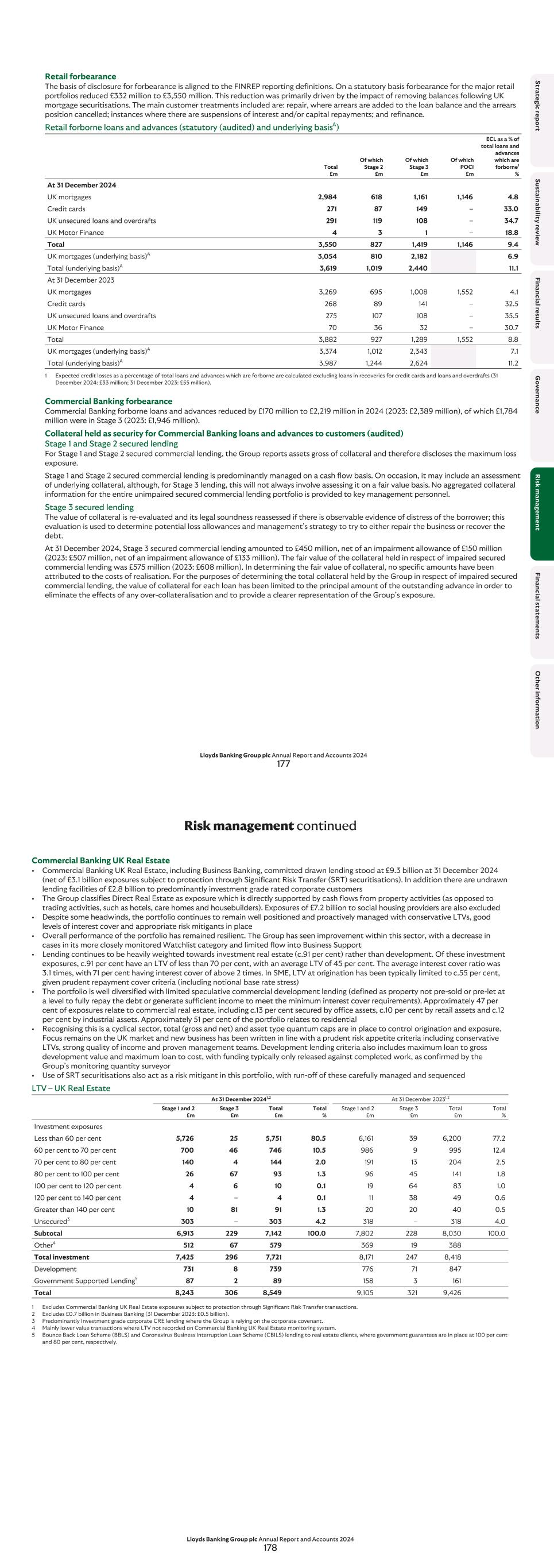
Retail forbearance The basis of disclosure for forbearance is aligned to the FINREP reporting definitions. On a statutory basis forbearance for the major retail portfolios reduced £332 million to £3,550 million. This reduction was primarily driven by the impact of removing balances following UK mortgage securitisations. The main customer treatments included are: repair, where arrears are added to the loan balance and the arrears position cancelled; instances where there are suspensions of interest and/or capital repayments; and refinance. Retail forborne loans and advances (statutory (audited) and underlying basisA) Total £m Of which Stage 2 £m Of which Stage 3 £m Of which POCI £m ECL as a % of total loans and advances which are forborne1 % At 31 December 2024 UK mortgages 2,984 618 1,161 1,146 4.8 Credit cards 271 87 149 – 33.0 UK unsecured loans and overdrafts 291 119 108 – 34.7 UK Motor Finance 4 3 1 – 18.8 Total 3,550 827 1,419 1,146 9.4 UK mortgages (underlying basis)A 3,054 810 2,182 6.9 Total (underlying basis)A 3,619 1,019 2,440 11.1 At 31 December 2023 UK mortgages 3,269 695 1,008 1,552 4.1 Credit cards 268 89 141 – 32.5 UK unsecured loans and overdrafts 275 107 108 – 35.5 UK Motor Finance 70 36 32 – 30.7 Total 3,882 927 1,289 1,552 8.8 UK mortgages (underlying basis)A 3,374 1,012 2,343 7.1 Total (underlying basis)A 3,987 1,244 2,624 11.2 1 Expected credit losses as a percentage of total loans and advances which are forborne are calculated excluding loans in recoveries for credit cards and loans and overdrafts (31 December 2024: £33 million; 31 December 2023: £55 million). Commercial Banking forbearance Commercial Banking forborne loans and advances reduced by £170 million to £2,219 million in 2024 (2023: £2,389 million), of which £1,784 million were in Stage 3 (2023: £1,946 million). Collateral held as security for Commercial Banking loans and advances to customers (audited) Stage 1 and Stage 2 secured lending For Stage 1 and Stage 2 secured commercial lending, the Group reports assets gross of collateral and therefore discloses the maximum loss exposure. Stage 1 and Stage 2 secured commercial lending is predominantly managed on a cash flow basis. On occasion, it may include an assessment of underlying collateral, although, for Stage 3 lending, this will not always involve assessing it on a fair value basis. No aggregated collateral information for the entire unimpaired secured commercial lending portfolio is provided to key management personnel. Stage 3 secured lending The value of collateral is re-evaluated and its legal soundness reassessed if there is observable evidence of distress of the borrower; this evaluation is used to determine potential loss allowances and management’s strategy to try to either repair the business or recover the debt. At 31 December 2024, Stage 3 secured commercial lending amounted to £450 million, net of an impairment allowance of £150 million (2023: £507 million, net of an impairment allowance of £133 million). The fair value of the collateral held in respect of impaired secured commercial lending was £575 million (2023: £608 million). In determining the fair value of collateral, no specific amounts have been attributed to the costs of realisation. For the purposes of determining the total collateral held by the Group in respect of impaired secured commercial lending, the value of collateral for each loan has been limited to the principal amount of the outstanding advance in order to eliminate the effects of any over-collateralisation and to provide a clearer representation of the Group’s exposure. Lloyds Banking Group plc Annual Report and Accounts 2024 177 l i ts 2 O th e r in fo rm a tio n R isk m a n a ge m e n t F in a n cia l re su lts S u sta in a b ility re vie w S tra te gic re p o rt G o ve rn a n ce F in a n cia l sta te m e n ts Commercial Banking UK Real Estate • Commercial Banking UK Real Estate, including Business Banking, committed drawn lending stood at £9.3 billion at 31 December 2024 (net of £3.1 billion exposures subject to protection through Significant Risk Transfer (SRT) securitisations). In addition there are undrawn lending facilities of £2.8 billion to predominantly investment grade rated corporate customers • The Group classifies Direct Real Estate as exposure which is directly supported by cash flows from property activities (as opposed to trading activities, such as hotels, care homes and housebuilders). Exposures of £7.2 billion to social housing providers are also excluded • Despite some headwinds, the portfolio continues to remain well positioned and proactively managed with conservative LTVs, good levels of interest cover and appropriate risk mitigants in place • Overall performance of the portfolio has remained resilient. The Group has seen improvement within this sector, with a decrease in cases in its more closely monitored Watchlist category and limited flow into Business Support • Lending continues to be heavily weighted towards investment real estate (c.91 per cent) rather than development. Of these investment exposures, c.91 per cent have an LTV of less than 70 per cent, with an average LTV of 45 per cent. The average interest cover ratio was 3.1 times, with 71 per cent having interest cover of above 2 times. In SME, LTV at origination has been typically limited to c.55 per cent, given prudent repayment cover criteria (including notional base rate stress) • The portfolio is well diversified with limited speculative commercial development lending (defined as property not pre-sold or pre-let at a level to fully repay the debt or generate sufficient income to meet the minimum interest cover requirements). Approximately 47 per cent of exposures relate to commercial real estate, including c.13 per cent secured by office assets, c.10 per cent by retail assets and c.12 per cent by industrial assets. Approximately 51 per cent of the portfolio relates to residential • Recognising this is a cyclical sector, total (gross and net) and asset type quantum caps are in place to control origination and exposure. Focus remains on the UK market and new business has been written in line with a prudent risk appetite criteria including conservative LTVs, strong quality of income and proven management teams. Development lending criteria also includes maximum loan to gross development value and maximum loan to cost, with funding typically only released against completed work, as confirmed by the Group’s monitoring quantity surveyor • Use of SRT securitisations also act as a risk mitigant in this portfolio, with run-off of these carefully managed and sequenced LTV – UK Real Estate At 31 December 20241,2 At 31 December 20231,2 Stage 1 and 2 £m Stage 3 £m Total £m Total % Stage 1 and 2 £m Stage 3 £m Total £m Total % Investment exposures Less than 60 per cent 5,726 25 5,751 80.5 6,161 39 6,200 77.2 60 per cent to 70 per cent 700 46 746 10.5 986 9 995 12.4 70 per cent to 80 per cent 140 4 144 2.0 191 13 204 2.5 80 per cent to 100 per cent 26 67 93 1.3 96 45 141 1.8 100 per cent to 120 per cent 4 6 10 0.1 19 64 83 1.0 120 per cent to 140 per cent 4 – 4 0.1 11 38 49 0.6 Greater than 140 per cent 10 81 91 1.3 20 20 40 0.5 Unsecured3 303 – 303 4.2 318 – 318 4.0 Subtotal 6,913 229 7,142 100.0 7,802 228 8,030 100.0 Other4 512 67 579 369 19 388 Total investment 7,425 296 7,721 8,171 247 8,418 Development 731 8 739 776 71 847 Government Supported Lending5 87 2 89 158 3 161 Total 8,243 306 8,549 9,105 321 9,426 1 Excludes Commercial Banking UK Real Estate exposures subject to protection through Significant Risk Transfer transactions. 2 Excludes £0.7 billion in Business Banking (31 December 2023: £0.5 billion). 3 Predominantly Investment grade corporate CRE lending where the Group is relying on the corporate covenant. 4 Mainly lower value transactions where LTV not recorded on Commercial Banking UK Real Estate monitoring system. 5 Bounce Back Loan Scheme (BBLS) and Coronavirus Business Interruption Loan Scheme (CBILS) lending to real estate clients, where government guarantees are in place at 100 per cent and 80 per cent, respectively. Risk management continued Lloyds Banking Group plc Annual Report and Accounts 2024 178 l i ts
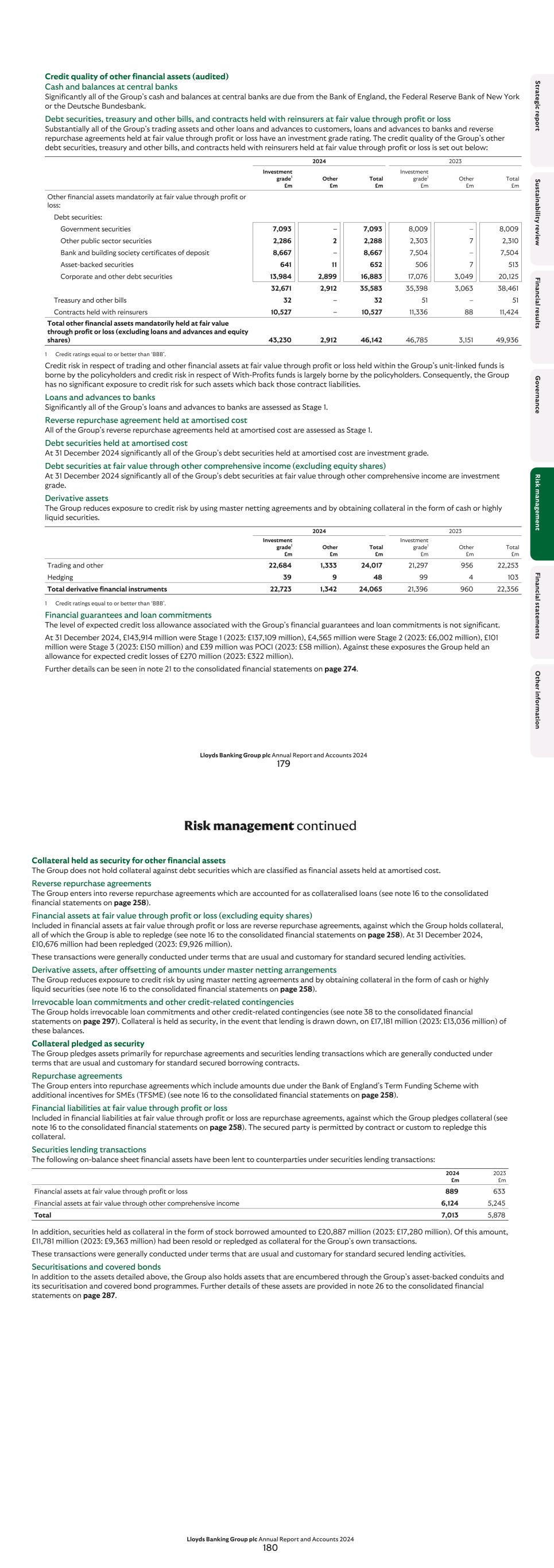
Credit quality of other financial assets (audited) Cash and balances at central banks Significantly all of the Group’s cash and balances at central banks are due from the Bank of England, the Federal Reserve Bank of New York or the Deutsche Bundesbank. Debt securities, treasury and other bills, and contracts held with reinsurers at fair value through profit or loss Substantially all of the Group’s trading assets and other loans and advances to customers, loans and advances to banks and reverse repurchase agreements held at fair value through profit or loss have an investment grade rating. The credit quality of the Group’s other debt securities, treasury and other bills, and contracts held with reinsurers held at fair value through profit or loss is set out below: 2024 2023 Investment grade1 £m Other £m Total £m Investment grade1 £m Other £m Total £m Other financial assets mandatorily at fair value through profit or loss: Debt securities: Government securities 7,093 – 7,093 8,009 – 8,009 Other public sector securities 2,286 2 2,288 2,303 7 2,310 Bank and building society certificates of deposit 8,667 – 8,667 7,504 – 7,504 Asset-backed securities 641 11 652 506 7 513 Corporate and other debt securities 13,984 2,899 16,883 17,076 3,049 20,125 32,671 2,912 35,583 35,398 3,063 38,461 Treasury and other bills 32 – 32 51 – 51 Contracts held with reinsurers 10,527 – 10,527 11,336 88 11,424 Total other financial assets mandatorily held at fair value through profit or loss (excluding loans and advances and equity shares) 43,230 2,912 46,142 46,785 3,151 49,936 1 Credit ratings equal to or better than ‘BBB’. Credit risk in respect of trading and other financial assets at fair value through profit or loss held within the Group’s unit-linked funds is borne by the policyholders and credit risk in respect of With-Profits funds is largely borne by the policyholders. Consequently, the Group has no significant exposure to credit risk for such assets which back those contract liabilities. Loans and advances to banks Significantly all of the Group’s loans and advances to banks are assessed as Stage 1. Reverse repurchase agreement held at amortised cost All of the Group’s reverse repurchase agreements held at amortised cost are assessed as Stage 1. Debt securities held at amortised cost At 31 December 2024 significantly all of the Group’s debt securities held at amortised cost are investment grade. Debt securities at fair value through other comprehensive income (excluding equity shares) At 31 December 2024 significantly all of the Group’s debt securities at fair value through other comprehensive income are investment grade. Derivative assets The Group reduces exposure to credit risk by using master netting agreements and by obtaining collateral in the form of cash or highly liquid securities. 2024 2023 Investment grade1 £m Other £m Total £m Investment grade1 £m Other £m Total £m Trading and other 22,684 1,333 24,017 21,297 956 22,253 Hedging 39 9 48 99 4 103 Total derivative financial instruments 22,723 1,342 24,065 21,396 960 22,356 1 Credit ratings equal to or better than ‘BBB’. Financial guarantees and loan commitments The level of expected credit loss allowance associated with the Group’s financial guarantees and loan commitments is not significant. At 31 December 2024, £143,914 million were Stage 1 (2023: £137,109 million), £4,565 million were Stage 2 (2023: £6,002 million), £101 million were Stage 3 (2023: £150 million) and £39 million was POCI (2023: £58 million). Against these exposures the Group held an allowance for expected credit losses of £270 million (2023: £322 million). Further details can be seen in note 21 to the consolidated financial statements on page 274. Lloyds Banking Group plc Annual Report and Accounts 2024 179 l i ts 2 O th e r in fo rm a tio n R isk m a n a ge m e n t F in a n cia l re su lts S u sta in a b ility re vie w S tra te gic re p o rt G o ve rn a n ce F in a n cia l sta te m e n ts Collateral held as security for other financial assets The Group does not hold collateral against debt securities which are classified as financial assets held at amortised cost. Reverse repurchase agreements The Group enters into reverse repurchase agreements which are accounted for as collateralised loans (see note 16 to the consolidated financial statements on page 258). Financial assets at fair value through profit or loss (excluding equity shares) Included in financial assets at fair value through profit or loss are reverse repurchase agreements, against which the Group holds collateral, all of which the Group is able to repledge (see note 16 to the consolidated financial statements on page 258). At 31 December 2024, £10,676 million had been repledged (2023: £9,926 million). These transactions were generally conducted under terms that are usual and customary for standard secured lending activities. Derivative assets, after offsetting of amounts under master netting arrangements The Group reduces exposure to credit risk by using master netting agreements and by obtaining collateral in the form of cash or highly liquid securities (see note 16 to the consolidated financial statements on page 258). Irrevocable loan commitments and other credit-related contingencies The Group holds irrevocable loan commitments and other credit-related contingencies (see note 38 to the consolidated financial statements on page 297). Collateral is held as security, in the event that lending is drawn down, on £17,181 million (2023: £13,036 million) of these balances. Collateral pledged as security The Group pledges assets primarily for repurchase agreements and securities lending transactions which are generally conducted under terms that are usual and customary for standard secured borrowing contracts. Repurchase agreements The Group enters into repurchase agreements which include amounts due under the Bank of England’s Term Funding Scheme with additional incentives for SMEs (TFSME) (see note 16 to the consolidated financial statements on page 258). Financial liabilities at fair value through profit or loss Included in financial liabilities at fair value through profit or loss are repurchase agreements, against which the Group pledges collateral (see note 16 to the consolidated financial statements on page 258). The secured party is permitted by contract or custom to repledge this collateral. Securities lending transactions The following on-balance sheet financial assets have been lent to counterparties under securities lending transactions: 2024 £m 2023 £m Financial assets at fair value through profit or loss 889 633 Financial assets at fair value through other comprehensive income 6,124 5,245 Total 7,013 5,878 In addition, securities held as collateral in the form of stock borrowed amounted to £20,887 million (2023: £17,280 million). Of this amount, £11,781 million (2023: £9,363 million) had been resold or repledged as collateral for the Group’s own transactions. These transactions were generally conducted under terms that are usual and customary for standard secured lending activities. Securitisations and covered bonds In addition to the assets detailed above, the Group also holds assets that are encumbered through the Group’s asset-backed conduits and its securitisation and covered bond programmes. Further details of these assets are provided in note 26 to the consolidated financial statements on page 287. Risk management continued Lloyds Banking Group plc Annual Report and Accounts 2024 180 l i ts
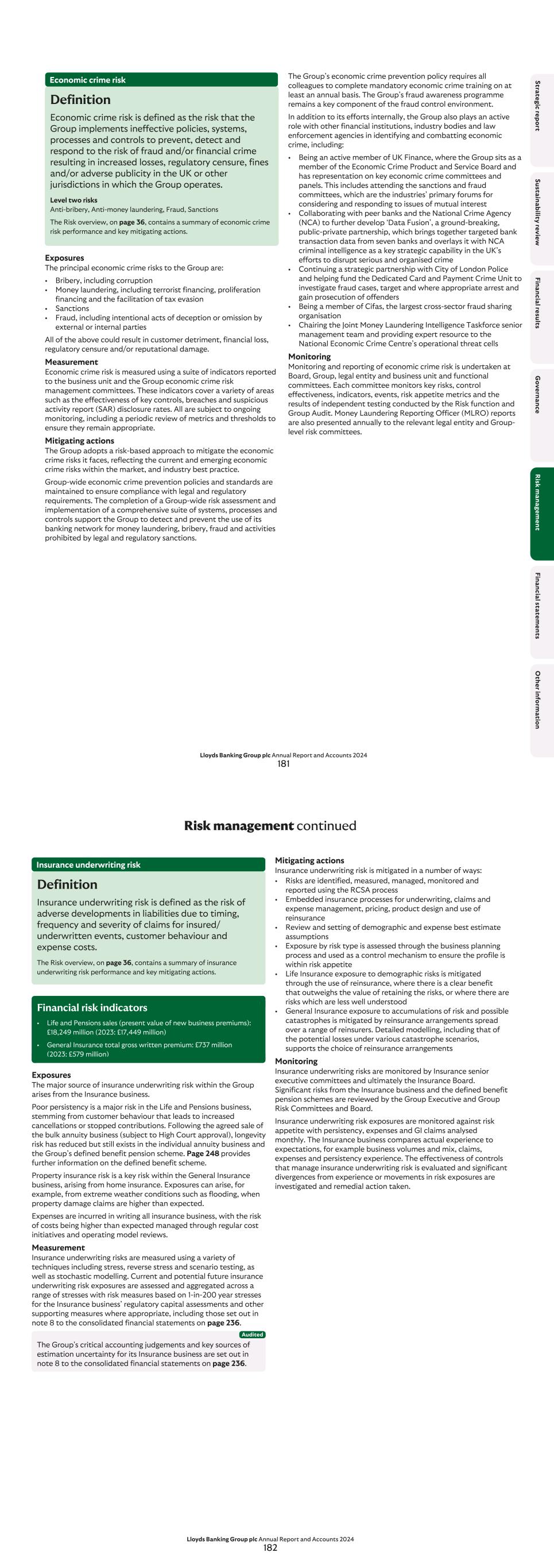
Economic crime risk Definition Economic crime risk is defined as the risk that the Group implements ineffective policies, systems, processes and controls to prevent, detect and respond to the risk of fraud and/or financial crime resulting in increased losses, regulatory censure, fines and/or adverse publicity in the UK or other jurisdictions in which the Group operates. Level two risks Anti-bribery, Anti-money laundering, Fraud, Sanctions The Risk overview, on page 36, contains a summary of economic crime risk performance and key mitigating actions. Exposures The principal economic crime risks to the Group are: • Bribery, including corruption • Money laundering, including terrorist financing, proliferation financing and the facilitation of tax evasion • Sanctions • Fraud, including intentional acts of deception or omission by external or internal parties All of the above could result in customer detriment, financial loss, regulatory censure and/or reputational damage. Measurement Economic crime risk is measured using a suite of indicators reported to the business unit and the Group economic crime risk management committees. These indicators cover a variety of areas such as the effectiveness of key controls, breaches and suspicious activity report (SAR) disclosure rates. All are subject to ongoing monitoring, including a periodic review of metrics and thresholds to ensure they remain appropriate. Mitigating actions The Group adopts a risk-based approach to mitigate the economic crime risks it faces, reflecting the current and emerging economic crime risks within the market, and industry best practice. Group-wide economic crime prevention policies and standards are maintained to ensure compliance with legal and regulatory requirements. The completion of a Group-wide risk assessment and implementation of a comprehensive suite of systems, processes and controls support the Group to detect and prevent the use of its banking network for money laundering, bribery, fraud and activities prohibited by legal and regulatory sanctions. The Group’s economic crime prevention policy requires all colleagues to complete mandatory economic crime training on at least an annual basis. The Group’s fraud awareness programme remains a key component of the fraud control environment. In addition to its efforts internally, the Group also plays an active role with other financial institutions, industry bodies and law enforcement agencies in identifying and combatting economic crime, including: • Being an active member of UK Finance, where the Group sits as a member of the Economic Crime Product and Service Board and has representation on key economic crime committees and panels. This includes attending the sanctions and fraud committees, which are the industries’ primary forums for considering and responding to issues of mutual interest • Collaborating with peer banks and the National Crime Agency (NCA) to further develop ‘Data Fusion’, a ground-breaking, public-private partnership, which brings together targeted bank transaction data from seven banks and overlays it with NCA criminal intelligence as a key strategic capability in the UK’s efforts to disrupt serious and organised crime • Continuing a strategic partnership with City of London Police and helping fund the Dedicated Card and Payment Crime Unit to investigate fraud cases, target and where appropriate arrest and gain prosecution of offenders • Being a member of Cifas, the largest cross-sector fraud sharing organisation • Chairing the Joint Money Laundering Intelligence Taskforce senior management team and providing expert resource to the National Economic Crime Centre’s operational threat cells Monitoring Monitoring and reporting of economic crime risk is undertaken at Board, Group, legal entity and business unit and functional committees. Each committee monitors key risks, control effectiveness, indicators, events, risk appetite metrics and the results of independent testing conducted by the Risk function and Group Audit. Money Laundering Reporting Officer (MLRO) reports are also presented annually to the relevant legal entity and Group- level risk committees. Lloyds Banking Group plc Annual Report and Accounts 2024 181 l i ts 2 O th e r in fo rm a tio n R isk m a n a ge m e n t F in a n cia l re su lts S u sta in a b ility re vie w S tra te gic re p o rt G o ve rn a n ce F in a n cia l sta te m e n ts Financial risk indicators • Life and Pensions sales (present value of new business premiums): £18,249 million (2023: £17,449 million) • General Insurance total gross written premium: £737 million (2023: £579 million) Exposures The major source of insurance underwriting risk within the Group arises from the Insurance business. Poor persistency is a major risk in the Life and Pensions business, stemming from customer behaviour that leads to increased cancellations or stopped contributions. Following the agreed sale of the bulk annuity business (subject to High Court approval), longevity risk has reduced but still exists in the individual annuity business and the Group’s defined benefit pension scheme. Page 248 provides further information on the defined benefit scheme. Property insurance risk is a key risk within the General Insurance business, arising from home insurance. Exposures can arise, for example, from extreme weather conditions such as flooding, when property damage claims are higher than expected. Expenses are incurred in writing all insurance business, with the risk of costs being higher than expected managed through regular cost initiatives and operating model reviews. Measurement Insurance underwriting risks are measured using a variety of techniques including stress, reverse stress and scenario testing, as well as stochastic modelling. Current and potential future insurance underwriting risk exposures are assessed and aggregated across a range of stresses with risk measures based on 1-in-200 year stresses for the Insurance business’ regulatory capital assessments and other supporting measures where appropriate, including those set out in note 8 to the consolidated financial statements on page 236. The Group's critical accounting judgements and key sources of estimation uncertainty for its Insurance business are set out in note 8 to the consolidated financial statements on page 236. Mitigating actions Insurance underwriting risk is mitigated in a number of ways: • Risks are identified, measured, managed, monitored and reported using the RCSA process • Embedded insurance processes for underwriting, claims and expense management, pricing, product design and use of reinsurance • Review and setting of demographic and expense best estimate assumptions • Exposure by risk type is assessed through the business planning process and used as a control mechanism to ensure the profile is within risk appetite • Life Insurance exposure to demographic risks is mitigated through the use of reinsurance, where there is a clear benefit that outweighs the value of retaining the risks, or where there are risks which are less well understood • General Insurance exposure to accumulations of risk and possible catastrophes is mitigated by reinsurance arrangements spread over a range of reinsurers. Detailed modelling, including that of the potential losses under various catastrophe scenarios, supports the choice of reinsurance arrangements Monitoring Insurance underwriting risks are monitored by Insurance senior executive committees and ultimately the Insurance Board. Significant risks from the Insurance business and the defined benefit pension schemes are reviewed by the Group Executive and Group Risk Committees and Board. Insurance underwriting risk exposures are monitored against risk appetite with persistency, expenses and GI claims analysed monthly. The Insurance business compares actual experience to expectations, for example business volumes and mix, claims, expenses and persistency experience. The effectiveness of controls that manage insurance underwriting risk is evaluated and significant divergences from experience or movements in risk exposures are investigated and remedial action taken. Risk management continued Lloyds Banking Group plc Annual Report and Accounts 2024 182 Insurance underwriting risk Definition Insurance underwriting risk is defined as the risk of adverse developments in liabilities due to timing, frequency and severity of claims for insured/ underwritten events, customer behaviour and expense costs. The Risk overview, on page 36, contains a summary of insurance underwriting risk performance and key mitigating actions. l i ts
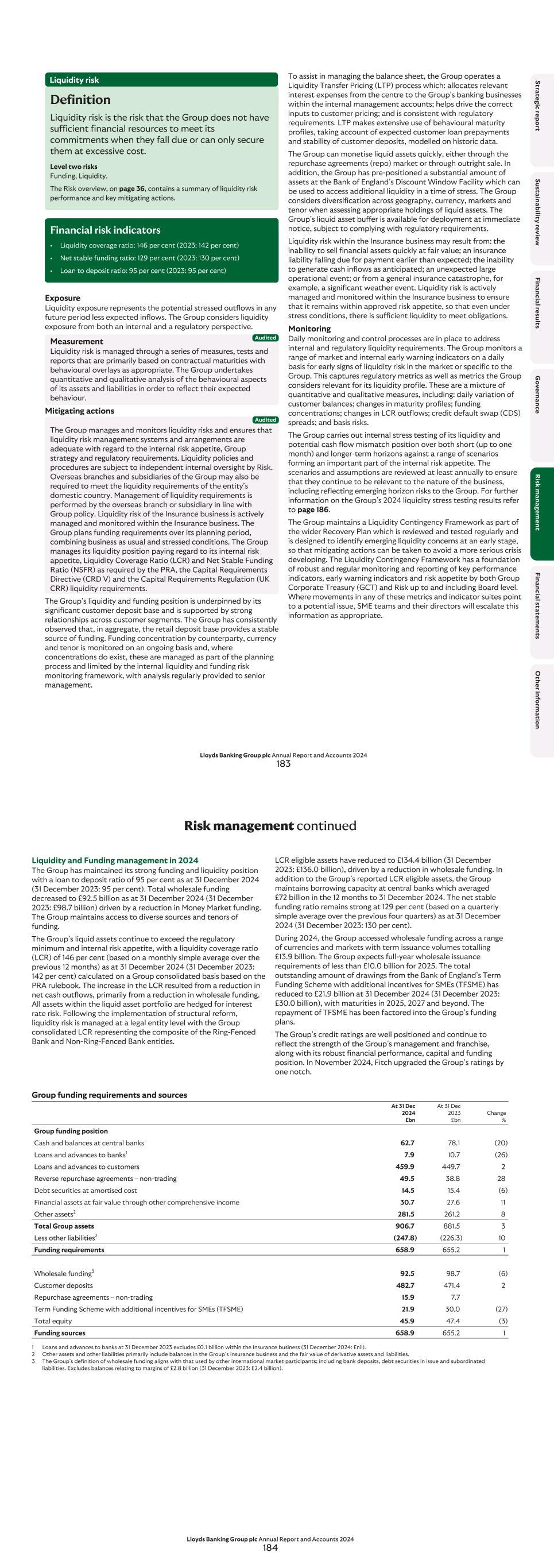
Liquidity risk Definition Liquidity risk is the risk that the Group does not have sufficient financial resources to meet its commitments when they fall due or can only secure them at excessive cost. Level two risks Funding, Liquidity. The Risk overview, on page 36, contains a summary of liquidity risk performance and key mitigating actions. Financial risk indicators • Liquidity coverage ratio: 146 per cent (2023: 142 per cent) • Net stable funding ratio: 129 per cent (2023: 130 per cent) • Loan to deposit ratio: 95 per cent (2023: 95 per cent) Exposure Liquidity exposure represents the potential stressed outflows in any future period less expected inflows. The Group considers liquidity exposure from both an internal and a regulatory perspective. Measurement Liquidity risk is managed through a series of measures, tests and reports that are primarily based on contractual maturities with behavioural overlays as appropriate. The Group undertakes quantitative and qualitative analysis of the behavioural aspects of its assets and liabilities in order to reflect their expected behaviour. Mitigating actions The Group manages and monitors liquidity risks and ensures that liquidity risk management systems and arrangements are adequate with regard to the internal risk appetite, Group strategy and regulatory requirements. Liquidity policies and procedures are subject to independent internal oversight by Risk. Overseas branches and subsidiaries of the Group may also be required to meet the liquidity requirements of the entity’s domestic country. Management of liquidity requirements is performed by the overseas branch or subsidiary in line with Group policy. Liquidity risk of the Insurance business is actively managed and monitored within the Insurance business. The Group plans funding requirements over its planning period, combining business as usual and stressed conditions. The Group manages its liquidity position paying regard to its internal risk appetite, Liquidity Coverage Ratio (LCR) and Net Stable Funding Ratio (NSFR) as required by the PRA, the Capital Requirements Directive (CRD V) and the Capital Requirements Regulation (UK CRR) liquidity requirements. The Group’s liquidity and funding position is underpinned by its significant customer deposit base and is supported by strong relationships across customer segments. The Group has consistently observed that, in aggregate, the retail deposit base provides a stable source of funding. Funding concentration by counterparty, currency and tenor is monitored on an ongoing basis and, where concentrations do exist, these are managed as part of the planning process and limited by the internal liquidity and funding risk monitoring framework, with analysis regularly provided to senior management. To assist in managing the balance sheet, the Group operates a Liquidity Transfer Pricing (LTP) process which: allocates relevant interest expenses from the centre to the Group’s banking businesses within the internal management accounts; helps drive the correct inputs to customer pricing; and is consistent with regulatory requirements. LTP makes extensive use of behavioural maturity profiles, taking account of expected customer loan prepayments and stability of customer deposits, modelled on historic data. The Group can monetise liquid assets quickly, either through the repurchase agreements (repo) market or through outright sale. In addition, the Group has pre-positioned a substantial amount of assets at the Bank of England’s Discount Window Facility which can be used to access additional liquidity in a time of stress. The Group considers diversification across geography, currency, markets and tenor when assessing appropriate holdings of liquid assets. The Group’s liquid asset buffer is available for deployment at immediate notice, subject to complying with regulatory requirements. Liquidity risk within the Insurance business may result from: the inability to sell financial assets quickly at fair value; an insurance liability falling due for payment earlier than expected; the inability to generate cash inflows as anticipated; an unexpected large operational event; or from a general insurance catastrophe, for example, a significant weather event. Liquidity risk is actively managed and monitored within the Insurance business to ensure that it remains within approved risk appetite, so that even under stress conditions, there is sufficient liquidity to meet obligations. Monitoring Daily monitoring and control processes are in place to address internal and regulatory liquidity requirements. The Group monitors a range of market and internal early warning indicators on a daily basis for early signs of liquidity risk in the market or specific to the Group. This captures regulatory metrics as well as metrics the Group considers relevant for its liquidity profile. These are a mixture of quantitative and qualitative measures, including: daily variation of customer balances; changes in maturity profiles; funding concentrations; changes in LCR outflows; credit default swap (CDS) spreads; and basis risks. The Group carries out internal stress testing of its liquidity and potential cash flow mismatch position over both short (up to one month) and longer-term horizons against a range of scenarios forming an important part of the internal risk appetite. The scenarios and assumptions are reviewed at least annually to ensure that they continue to be relevant to the nature of the business, including reflecting emerging horizon risks to the Group. For further information on the Group’s 2024 liquidity stress testing results refer to page 186. The Group maintains a Liquidity Contingency Framework as part of the wider Recovery Plan which is reviewed and tested regularly and is designed to identify emerging liquidity concerns at an early stage, so that mitigating actions can be taken to avoid a more serious crisis developing. The Liquidity Contingency Framework has a foundation of robust and regular monitoring and reporting of key performance indicators, early warning indicators and risk appetite by both Group Corporate Treasury (GCT) and Risk up to and including Board level. Where movements in any of these metrics and indicator suites point to a potential issue, SME teams and their directors will escalate this information as appropriate. Lloyds Banking Group plc Annual Report and Accounts 2024 183 l i ts 2 O th e r in fo rm a tio n R isk m a n a ge m e n t F in a n cia l re su lts S u sta in a b ility re vie w S tra te gic re p o rt G o ve rn a n ce F in a n cia l sta te m e n ts Liquidity and Funding management in 2024 The Group has maintained its strong funding and liquidity position with a loan to deposit ratio of 95 per cent as at 31 December 2024 (31 December 2023: 95 per cent). Total wholesale funding decreased to £92.5 billion as at 31 December 2024 (31 December 2023: £98.7 billion) driven by a reduction in Money Market funding. The Group maintains access to diverse sources and tenors of funding. The Group’s liquid assets continue to exceed the regulatory minimum and internal risk appetite, with a liquidity coverage ratio (LCR) of 146 per cent (based on a monthly simple average over the previous 12 months) as at 31 December 2024 (31 December 2023: 142 per cent) calculated on a Group consolidated basis based on the PRA rulebook. The increase in the LCR resulted from a reduction in net cash outflows, primarily from a reduction in wholesale funding. All assets within the liquid asset portfolio are hedged for interest rate risk. Following the implementation of structural reform, liquidity risk is managed at a legal entity level with the Group consolidated LCR representing the composite of the Ring-Fenced Bank and Non-Ring-Fenced Bank entities. LCR eligible assets have reduced to £134.4 billion (31 December 2023: £136.0 billion), driven by a reduction in wholesale funding. In addition to the Group’s reported LCR eligible assets, the Group maintains borrowing capacity at central banks which averaged £72 billion in the 12 months to 31 December 2024. The net stable funding ratio remains strong at 129 per cent (based on a quarterly simple average over the previous four quarters) as at 31 December 2024 (31 December 2023: 130 per cent). During 2024, the Group accessed wholesale funding across a range of currencies and markets with term issuance volumes totalling £13.9 billion. The Group expects full-year wholesale issuance requirements of less than £10.0 billion for 2025. The total outstanding amount of drawings from the Bank of England’s Term Funding Scheme with additional incentives for SMEs (TFSME) has reduced to £21.9 billion at 31 December 2024 (31 December 2023: £30.0 billion), with maturities in 2025, 2027 and beyond. The repayment of TFSME has been factored into the Group’s funding plans. The Group’s credit ratings are well positioned and continue to reflect the strength of the Group’s management and franchise, along with its robust financial performance, capital and funding position. In November 2024, Fitch upgraded the Group’s ratings by one notch. Group funding requirements and sources At 31 Dec 2024 £bn At 31 Dec 2023 £bn Change % Group funding position Cash and balances at central banks 62.7 78.1 (20) Loans and advances to banks1 7.9 10.7 (26) Loans and advances to customers 459.9 449.7 2 Reverse repurchase agreements – non-trading 49.5 38.8 28 Debt securities at amortised cost 14.5 15.4 (6) Financial assets at fair value through other comprehensive income 30.7 27.6 11 Other assets2 281.5 261.2 8 Total Group assets 906.7 881.5 3 Less other liabilities2 (247.8) (226.3) 10 Funding requirements 658.9 655.2 1 Wholesale funding3 92.5 98.7 (6) Customer deposits 482.7 471.4 2 Repurchase agreements – non-trading 15.9 7.7 Term Funding Scheme with additional incentives for SMEs (TFSME) 21.9 30.0 (27) Total equity 45.9 47.4 (3) Funding sources 658.9 655.2 1 1 Loans and advances to banks at 31 December 2023 excludes £0.1 billion within the Insurance business (31 December 2024: £nil). 2 Other assets and other liabilities primarily include balances in the Group’s Insurance business and the fair value of derivative assets and liabilities. 3 The Group’s definition of wholesale funding aligns with that used by other international market participants; including bank deposits, debt securities in issue and subordinated liabilities. Excludes balances relating to margins of £2.8 billion (31 December 2023: £2.4 billion). Risk management continued Lloyds Banking Group plc Annual Report and Accounts 2024 184 l i ts
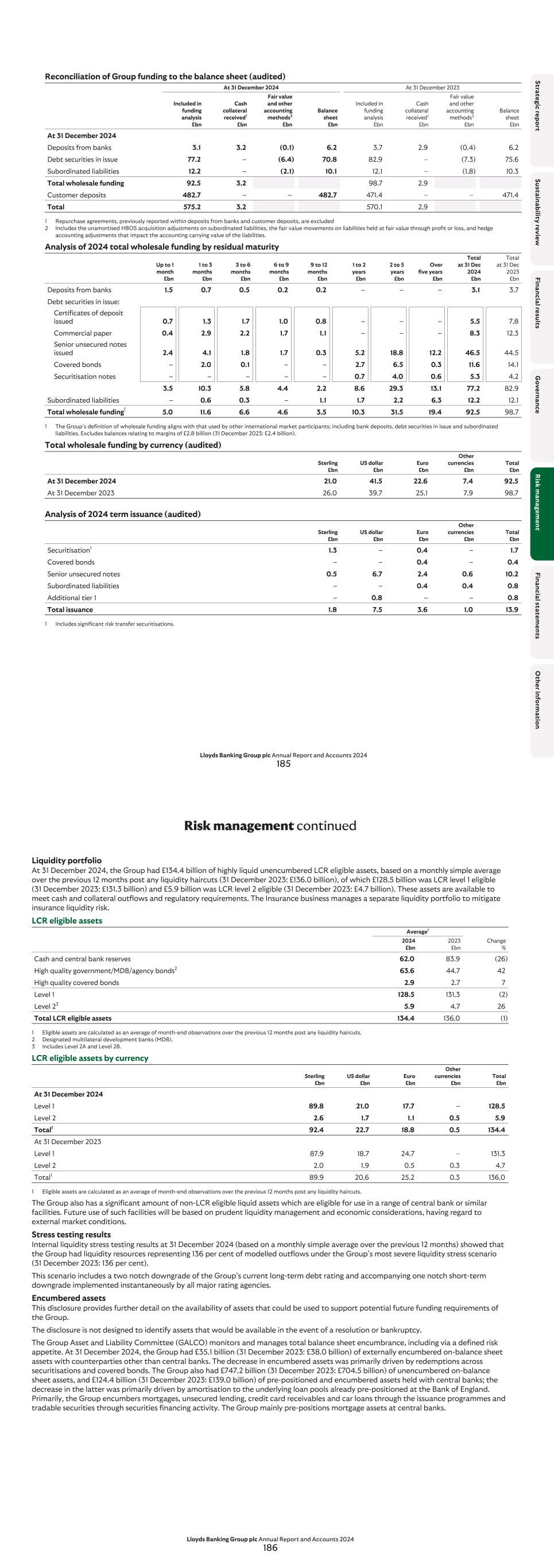
Reconciliation of Group funding to the balance sheet (audited) At 31 December 2024 At 31 December 2023 Included in funding analysis £bn Cash collateral received1 £bn Fair value and other accounting methods2 £bn Balance sheet £bn Included in funding analysis £bn Cash collateral received1 £bn Fair value and other accounting methods2 £bn Balance sheet £bn At 31 December 2024 Deposits from banks 3.1 3.2 (0.1) 6.2 3.7 2.9 (0.4) 6.2 Debt securities in issue 77.2 – (6.4) 70.8 82.9 – (7.3) 75.6 Subordinated liabilities 12.2 – (2.1) 10.1 12.1 – (1.8) 10.3 Total wholesale funding 92.5 3.2 98.7 2.9 Customer deposits 482.7 – – 482.7 471.4 – – 471.4 Total 575.2 3.2 570.1 2.9 1 Repurchase agreements, previously reported within deposits from banks and customer deposits, are excluded 2 Includes the unamortised HBOS acquisition adjustments on subordinated liabilities, the fair value movements on liabilities held at fair value through profit or loss, and hedge accounting adjustments that impact the accounting carrying value of the liabilities. Analysis of 2024 total wholesale funding by residual maturity Up to 1 month £bn 1 to 3 months £bn 3 to 6 months £bn 6 to 9 months £bn 9 to 12 months £bn 1 to 2 years £bn 2 to 5 years £bn Over five years £bn Total at 31 Dec 2024 £bn Total at 31 Dec 2023 £bn Deposits from banks 1.5 0.7 0.5 0.2 0.2 – – – 3.1 3.7 Debt securities in issue: Certificates of deposit issued 0.7 1.3 1.7 1.0 0.8 – – – 5.5 7.8 Commercial paper 0.4 2.9 2.2 1.7 1.1 – – – 8.3 12.3 Senior unsecured notes issued 2.4 4.1 1.8 1.7 0.3 5.2 18.8 12.2 46.5 44.5 Covered bonds – 2.0 0.1 – – 2.7 6.5 0.3 11.6 14.1 Securitisation notes – – – – – 0.7 4.0 0.6 5.3 4.2 3.5 10.3 5.8 4.4 2.2 8.6 29.3 13.1 77.2 82.9 Subordinated liabilities – 0.6 0.3 – 1.1 1.7 2.2 6.3 12.2 12.1 Total wholesale funding1 5.0 11.6 6.6 4.6 3.5 10.3 31.5 19.4 92.5 98.7 1 The Group’s definition of wholesale funding aligns with that used by other international market participants; including bank deposits, debt securities in issue and subordinated liabilities. Excludes balances relating to margins of £2.8 billion (31 December 2023: £2.4 billion). Total wholesale funding by currency (audited) Sterling £bn US dollar £bn Euro £bn Other currencies £bn Total £bn At 31 December 2024 21.0 41.5 22.6 7.4 92.5 At 31 December 2023 26.0 39.7 25.1 7.9 98.7 Analysis of 2024 term issuance (audited) Sterling £bn US dollar £bn Euro £bn Other currencies £bn Total £bn Securitisation1 1.3 – 0.4 – 1.7 Covered bonds – – 0.4 – 0.4 Senior unsecured notes 0.5 6.7 2.4 0.6 10.2 Subordinated liabilities – – 0.4 0.4 0.8 Additional tier 1 – 0.8 – – 0.8 Total issuance 1.8 7.5 3.6 1.0 13.9 1 Includes significant risk transfer securitisations. Lloyds Banking Group plc Annual Report and Accounts 2024 185 l i ts 2 O th e r in fo rm a tio n R isk m a n a ge m e n t F in a n cia l re su lts S u sta in a b ility re vie w S tra te gic re p o rt G o ve rn a n ce F in a n cia l sta te m e n ts Liquidity portfolio At 31 December 2024, the Group had £134.4 billion of highly liquid unencumbered LCR eligible assets, based on a monthly simple average over the previous 12 months post any liquidity haircuts (31 December 2023: £136.0 billion), of which £128.5 billion was LCR level 1 eligible (31 December 2023: £131.3 billion) and £5.9 billion was LCR level 2 eligible (31 December 2023: £4.7 billion). These assets are available to meet cash and collateral outflows and regulatory requirements. The Insurance business manages a separate liquidity portfolio to mitigate insurance liquidity risk. LCR eligible assets Average1 Change % 2024 £bn 2023 £bn Cash and central bank reserves 62.0 83.9 (26) High quality government/MDB/agency bonds2 63.6 44.7 42 High quality covered bonds 2.9 2.7 7 Level 1 128.5 131.3 (2) Level 23 5.9 4.7 26 Total LCR eligible assets 134.4 136.0 (1) 1 Eligible assets are calculated as an average of month-end observations over the previous 12 months post any liquidity haircuts. 2 Designated multilateral development banks (MDB). 3 Includes Level 2A and Level 2B. LCR eligible assets by currency Sterling £bn US dollar £bn Euro £bn Other currencies £bn Total £bn At 31 December 2024 Level 1 89.8 21.0 17.7 – 128.5 Level 2 2.6 1.7 1.1 0.5 5.9 Total1 92.4 22.7 18.8 0.5 134.4 At 31 December 2023 Level 1 87.9 18.7 24.7 – 131.3 Level 2 2.0 1.9 0.5 0.3 4.7 Total1 89.9 20.6 25.2 0.3 136.0 1 Eligible assets are calculated as an average of month-end observations over the previous 12 months post any liquidity haircuts. The Group also has a significant amount of non-LCR eligible liquid assets which are eligible for use in a range of central bank or similar facilities. Future use of such facilities will be based on prudent liquidity management and economic considerations, having regard to external market conditions. Stress testing results Internal liquidity stress testing results at 31 December 2024 (based on a monthly simple average over the previous 12 months) showed that the Group had liquidity resources representing 136 per cent of modelled outflows under the Group’s most severe liquidity stress scenario (31 December 2023: 136 per cent). This scenario includes a two notch downgrade of the Group’s current long-term debt rating and accompanying one notch short-term downgrade implemented instantaneously by all major rating agencies. Encumbered assets This disclosure provides further detail on the availability of assets that could be used to support potential future funding requirements of the Group. The disclosure is not designed to identify assets that would be available in the event of a resolution or bankruptcy. The Group Asset and Liability Committee (GALCO) monitors and manages total balance sheet encumbrance, including via a defined risk appetite. At 31 December 2024, the Group had £35.1 billion (31 December 2023: £38.0 billion) of externally encumbered on-balance sheet assets with counterparties other than central banks. The decrease in encumbered assets was primarily driven by redemptions across securitisations and covered bonds. The Group also had £747.2 billion (31 December 2023: £704.5 billion) of unencumbered on-balance sheet assets, and £124.4 billion (31 December 2023: £139.0 billion) of pre-positioned and encumbered assets held with central banks; the decrease in the latter was primarily driven by amortisation to the underlying loan pools already pre-positioned at the Bank of England. Primarily, the Group encumbers mortgages, unsecured lending, credit card receivables and car loans through the issuance programmes and tradable securities through securities financing activity. The Group mainly pre-positions mortgage assets at central banks. Risk management continued Lloyds Banking Group plc Annual Report and Accounts 2024 186 l i ts
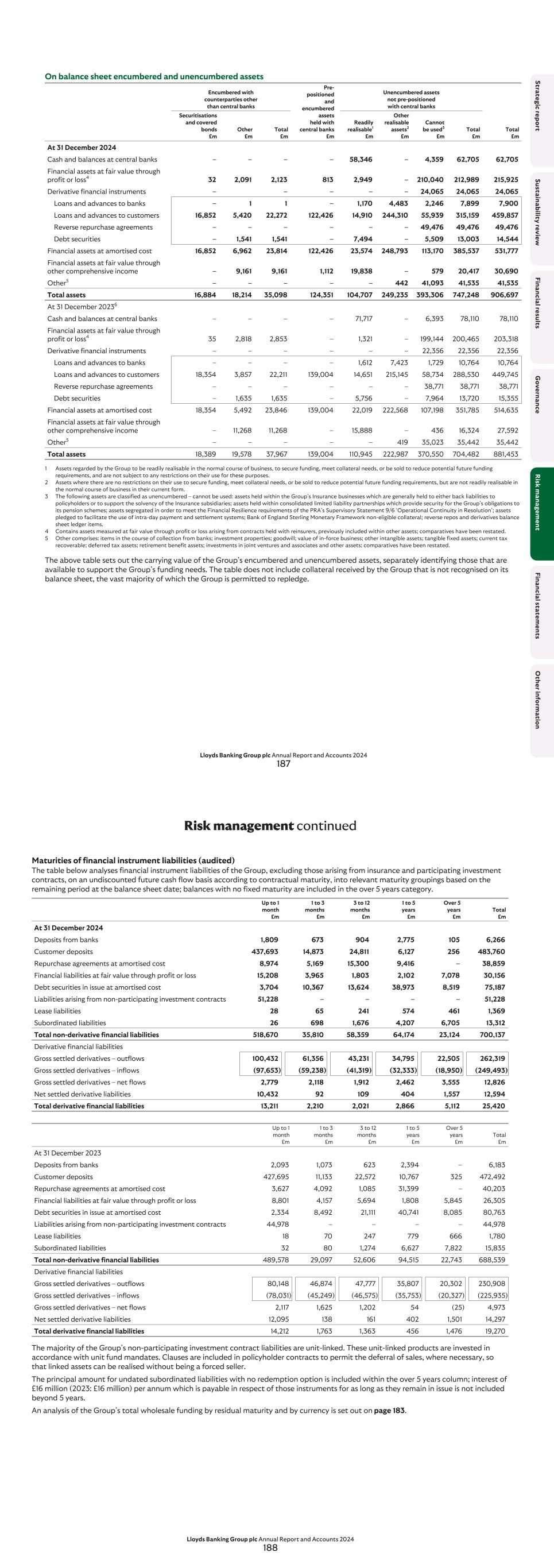
On balance sheet encumbered and unencumbered assets Encumbered with counterparties other than central banks Pre- positioned and encumbered assets held with central banks £m Unencumbered assets not pre-positioned with central banks Securitisations and covered bonds £m Other £m Total £m Readily realisable1 £m Other realisable assets2 £m Cannot be used3 £m Total £m Total £m At 31 December 2024 Cash and balances at central banks – – – – 58,346 – 4,359 62,705 62,705 Financial assets at fair value through profit or loss4 32 2,091 2,123 813 2,949 – 210,040 212,989 215,925 Derivative financial instruments – – – – – 24,065 24,065 24,065 Loans and advances to banks – 1 1 – 1,170 4,483 2,246 7,899 7,900 Loans and advances to customers 16,852 5,420 22,272 122,426 14,910 244,310 55,939 315,159 459,857 Reverse repurchase agreements – – – – – – 49,476 49,476 49,476 Debt securities – 1,541 1,541 – 7,494 – 5,509 13,003 14,544 Financial assets at amortised cost 16,852 6,962 23,814 122,426 23,574 248,793 113,170 385,537 531,777 Financial assets at fair value through other comprehensive income – 9,161 9,161 1,112 19,838 – 579 20,417 30,690 Other5 – – – – – 442 41,093 41,535 41,535 Total assets 16,884 18,214 35,098 124,351 104,707 249,235 393,306 747,248 906,697 At 31 December 20236 Cash and balances at central banks – – – – 71,717 – 6,393 78,110 78,110 Financial assets at fair value through profit or loss4 35 2,818 2,853 – 1,321 – 199,144 200,465 203,318 Derivative financial instruments – – – – – – 22,356 22,356 22,356 Loans and advances to banks – – – – 1,612 7,423 1,729 10,764 10,764 Loans and advances to customers 18,354 3,857 22,211 139,004 14,651 215,145 58,734 288,530 449,745 Reverse repurchase agreements – – – – – – 38,771 38,771 38,771 Debt securities – 1,635 1,635 – 5,756 – 7,964 13,720 15,355 Financial assets at amortised cost 18,354 5,492 23,846 139,004 22,019 222,568 107,198 351,785 514,635 Financial assets at fair value through other comprehensive income – 11,268 11,268 – 15,888 – 436 16,324 27,592 Other5 – – – – – 419 35,023 35,442 35,442 Total assets 18,389 19,578 37,967 139,004 110,945 222,987 370,550 704,482 881,453 1 Assets regarded by the Group to be readily realisable in the normal course of business, to secure funding, meet collateral needs, or be sold to reduce potential future funding requirements, and are not subject to any restrictions on their use for these purposes. 2 Assets where there are no restrictions on their use to secure funding, meet collateral needs, or be sold to reduce potential future funding requirements, but are not readily realisable in the normal course of business in their current form. 3 The following assets are classified as unencumbered – cannot be used: assets held within the Group’s Insurance businesses which are generally held to either back liabilities to policyholders or to support the solvency of the Insurance subsidiaries; assets held within consolidated limited liability partnerships which provide security for the Group’s obligations to its pension schemes; assets segregated in order to meet the Financial Resilience requirements of the PRA’s Supervisory Statement 9/6 ‘Operational Continuity in Resolution’; assets pledged to facilitate the use of intra-day payment and settlement systems; Bank of England Sterling Monetary Framework non-eligible collateral; reverse repos and derivatives balance sheet ledger items. 4 Contains assets measured at fair value through profit or loss arising from contracts held with reinsurers, previously included within other assets; comparatives have been restated. 5 Other comprises: items in the course of collection from banks; investment properties; goodwill; value of in-force business; other intangible assets; tangible fixed assets; current tax recoverable; deferred tax assets; retirement benefit assets; investments in joint ventures and associates and other assets; comparatives have been restated. The above table sets out the carrying value of the Group’s encumbered and unencumbered assets, separately identifying those that are available to support the Group’s funding needs. The table does not include collateral received by the Group that is not recognised on its balance sheet, the vast majority of which the Group is permitted to repledge. Lloyds Banking Group plc Annual Report and Accounts 2024 187 l i ts 2 O th e r in fo rm a tio n R isk m a n a ge m e n t F in a n cia l re su lts S u sta in a b ility re vie w S tra te gic re p o rt G o ve rn a n ce F in a n cia l sta te m e n ts Maturities of financial instrument liabilities (audited) The table below analyses financial instrument liabilities of the Group, excluding those arising from insurance and participating investment contracts, on an undiscounted future cash flow basis according to contractual maturity, into relevant maturity groupings based on the remaining period at the balance sheet date; balances with no fixed maturity are included in the over 5 years category. Up to 1 month £m 1 to 3 months £m 3 to 12 months £m 1 to 5 years £m Over 5 years £m Total £m At 31 December 2024 Deposits from banks 1,809 673 904 2,775 105 6,266 Customer deposits 437,693 14,873 24,811 6,127 256 483,760 Repurchase agreements at amortised cost 8,974 5,169 15,300 9,416 – 38,859 Financial liabilities at fair value through profit or loss 15,208 3,965 1,803 2,102 7,078 30,156 Debt securities in issue at amortised cost 3,704 10,367 13,624 38,973 8,519 75,187 Liabilities arising from non-participating investment contracts 51,228 – – – – 51,228 Lease liabilities 28 65 241 574 461 1,369 Subordinated liabilities 26 698 1,676 4,207 6,705 13,312 Total non-derivative financial liabilities 518,670 35,810 58,359 64,174 23,124 700,137 Derivative financial liabilities Gross settled derivatives – outflows 100,432 61,356 43,231 34,795 22,505 262,319 Gross settled derivatives – inflows (97,653) (59,238) (41,319) (32,333) (18,950) (249,493) Gross settled derivatives – net flows 2,779 2,118 1,912 2,462 3,555 12,826 Net settled derivative liabilities 10,432 92 109 404 1,557 12,594 Total derivative financial liabilities 13,211 2,210 2,021 2,866 5,112 25,420 Up to 1 month £m 1 to 3 months £m 3 to 12 months £m 1 to 5 years £m Over 5 years £m Total £m At 31 December 2023 Deposits from banks 2,093 1,073 623 2,394 – 6,183 Customer deposits 427,695 11,133 22,572 10,767 325 472,492 Repurchase agreements at amortised cost 3,627 4,092 1,085 31,399 – 40,203 Financial liabilities at fair value through profit or loss 8,801 4,157 5,694 1,808 5,845 26,305 Debt securities in issue at amortised cost 2,334 8,492 21,111 40,741 8,085 80,763 Liabilities arising from non-participating investment contracts 44,978 – – – – 44,978 Lease liabilities 18 70 247 779 666 1,780 Subordinated liabilities 32 80 1,274 6,627 7,822 15,835 Total non-derivative financial liabilities 489,578 29,097 52,606 94,515 22,743 688,539 Derivative financial liabilities Gross settled derivatives – outflows 80,148 46,874 47,777 35,807 20,302 230,908 Gross settled derivatives – inflows (78,031) (45,249) (46,575) (35,753) (20,327) (225,935) Gross settled derivatives – net flows 2,117 1,625 1,202 54 (25) 4,973 Net settled derivative liabilities 12,095 138 161 402 1,501 14,297 Total derivative financial liabilities 14,212 1,763 1,363 456 1,476 19,270 The majority of the Group’s non-participating investment contract liabilities are unit-linked. These unit-linked products are invested in accordance with unit fund mandates. Clauses are included in policyholder contracts to permit the deferral of sales, where necessary, so that linked assets can be realised without being a forced seller. The principal amount for undated subordinated liabilities with no redemption option is included within the over 5 years column; interest of £16 million (2023: £16 million) per annum which is payable in respect of those instruments for as long as they remain in issue is not included beyond 5 years. An analysis of the Group’s total wholesale funding by residual maturity and by currency is set out on page 183. Risk management continued Lloyds Banking Group plc Annual Report and Accounts 2024 188 l i ts
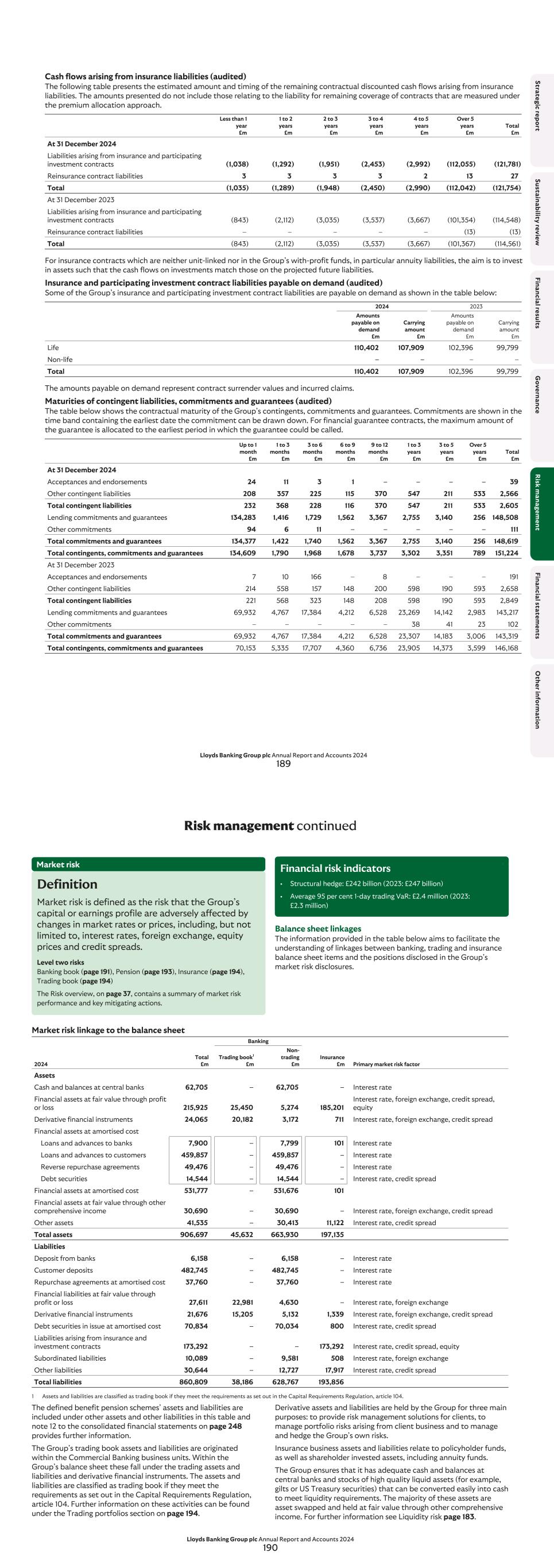
Cash flows arising from insurance liabilities (audited) The following table presents the estimated amount and timing of the remaining contractual discounted cash flows arising from insurance liabilities. The amounts presented do not include those relating to the liability for remaining coverage of contracts that are measured under the premium allocation approach. Less than 1 year £m 1 to 2 years £m 2 to 3 years £m 3 to 4 years £m 4 to 5 years £m Over 5 years £m Total £m At 31 December 2024 Liabilities arising from insurance and participating investment contracts (1,038) (1,292) (1,951) (2,453) (2,992) (112,055) (121,781) Reinsurance contract liabilities 3 3 3 3 2 13 27 Total (1,035) (1,289) (1,948) (2,450) (2,990) (112,042) (121,754) At 31 December 2023 Liabilities arising from insurance and participating investment contracts (843) (2,112) (3,035) (3,537) (3,667) (101,354) (114,548) Reinsurance contract liabilities – – – – – (13) (13) Total (843) (2,112) (3,035) (3,537) (3,667) (101,367) (114,561) For insurance contracts which are neither unit-linked nor in the Group’s with-profit funds, in particular annuity liabilities, the aim is to invest in assets such that the cash flows on investments match those on the projected future liabilities. Insurance and participating investment contract liabilities payable on demand (audited) Some of the Group’s insurance and participating investment contract liabilities are payable on demand as shown in the table below: 2024 2023 Amounts payable on demand £m Carrying amount £m Amounts payable on demand £m Carrying amount £m Life 110,402 107,909 102,396 99,799 Non-life – – – – Total 110,402 107,909 102,396 99,799 The amounts payable on demand represent contract surrender values and incurred claims. Maturities of contingent liabilities, commitments and guarantees (audited) The table below shows the contractual maturity of the Group’s contingents, commitments and guarantees. Commitments are shown in the time band containing the earliest date the commitment can be drawn down. For financial guarantee contracts, the maximum amount of the guarantee is allocated to the earliest period in which the guarantee could be called. Up to 1 month £m 1 to 3 months £m 3 to 6 months £m 6 to 9 months £m 9 to 12 months £m 1 to 3 years £m 3 to 5 years £m Over 5 years £m Total £m At 31 December 2024 Acceptances and endorsements 24 11 3 1 – – – – 39 Other contingent liabilities 208 357 225 115 370 547 211 533 2,566 Total contingent liabilities 232 368 228 116 370 547 211 533 2,605 Lending commitments and guarantees 134,283 1,416 1,729 1,562 3,367 2,755 3,140 256 148,508 Other commitments 94 6 11 – – – – – 111 Total commitments and guarantees 134,377 1,422 1,740 1,562 3,367 2,755 3,140 256 148,619 Total contingents, commitments and guarantees 134,609 1,790 1,968 1,678 3,737 3,302 3,351 789 151,224 At 31 December 2023 Acceptances and endorsements 7 10 166 – 8 – – – 191 Other contingent liabilities 214 558 157 148 200 598 190 593 2,658 Total contingent liabilities 221 568 323 148 208 598 190 593 2,849 Lending commitments and guarantees 69,932 4,767 17,384 4,212 6,528 23,269 14,142 2,983 143,217 Other commitments – – – – – 38 41 23 102 Total commitments and guarantees 69,932 4,767 17,384 4,212 6,528 23,307 14,183 3,006 143,319 Total contingents, commitments and guarantees 70,153 5,335 17,707 4,360 6,736 23,905 14,373 3,599 146,168 Lloyds Banking Group plc Annual Report and Accounts 2024 189 l i ts 2 O th e r in fo rm a tio n R isk m a n a ge m e n t F in a n cia l re su lts S u sta in a b ility re vie w S tra te gic re p o rt G o ve rn a n ce F in a n cia l sta te m e n ts Financial risk indicators • Structural hedge: £242 billion (2023: £247 billion) • Average 95 per cent 1-day trading VaR: £2.4 million (2023: £2.3 million) Balance sheet linkages The information provided in the table below aims to facilitate the understanding of linkages between banking, trading and insurance balance sheet items and the positions disclosed in the Group’s market risk disclosures. Market risk linkage to the balance sheet Banking 2024 Total £m Trading book1 £m Non- trading £m Insurance £m Primary market risk factor Assets Cash and balances at central banks 62,705 – 62,705 – Interest rate Financial assets at fair value through profit or loss 215,925 25,450 5,274 185,201 Interest rate, foreign exchange, credit spread, equity Derivative financial instruments 24,065 20,182 3,172 711 Interest rate, foreign exchange, credit spread Financial assets at amortised cost Loans and advances to banks 7,900 – 7,799 101 Interest rate Loans and advances to customers 459,857 – 459,857 – Interest rate Reverse repurchase agreements 49,476 – 49,476 – Interest rate Debt securities 14,544 – 14,544 – Interest rate, credit spread Financial assets at amortised cost 531,777 – 531,676 101 Financial assets at fair value through other comprehensive income 30,690 – 30,690 – Interest rate, foreign exchange, credit spread Other assets 41,535 – 30,413 11,122 Interest rate, credit spread Total assets 906,697 45,632 663,930 197,135 Liabilities Deposit from banks 6,158 – 6,158 – Interest rate Customer deposits 482,745 – 482,745 – Interest rate Repurchase agreements at amortised cost 37,760 – 37,760 – Interest rate Financial liabilities at fair value through profit or loss 27,611 22,981 4,630 – Interest rate, foreign exchange Derivative financial instruments 21,676 15,205 5,132 1,339 Interest rate, foreign exchange, credit spread Debt securities in issue at amortised cost 70,834 – 70,034 800 Interest rate, credit spread Liabilities arising from insurance and investment contracts 173,292 – – 173,292 Interest rate, credit spread, equity Subordinated liabilities 10,089 – 9,581 508 Interest rate, foreign exchange Other liabilities 30,644 – 12,727 17,917 Interest rate, credit spread Total liabilities 860,809 38,186 628,767 193,856 1 Assets and liabilities are classified as trading book if they meet the requirements as set out in the Capital Requirements Regulation, article 104. The defined benefit pension schemes’ assets and liabilities are included under other assets and other liabilities in this table and note 12 to the consolidated financial statements on page 248 provides further information. The Group’s trading book assets and liabilities are originated within the Commercial Banking business units. Within the Group’s balance sheet these fall under the trading assets and liabilities and derivative financial instruments. The assets and liabilities are classified as trading book if they meet the requirements as set out in the Capital Requirements Regulation, article 104. Further information on these activities can be found under the Trading portfolios section on page 194. Derivative assets and liabilities are held by the Group for three main purposes: to provide risk management solutions for clients, to manage portfolio risks arising from client business and to manage and hedge the Group’s own risks. Insurance business assets and liabilities relate to policyholder funds, as well as shareholder invested assets, including annuity funds. The Group ensures that it has adequate cash and balances at central banks and stocks of high quality liquid assets (for example, gilts or US Treasury securities) that can be converted easily into cash to meet liquidity requirements. The majority of these assets are asset swapped and held at fair value through other comprehensive income. For further information see Liquidity risk page 183. Risk management continued Lloyds Banking Group plc Annual Report and Accounts 2024 190 Market risk Definition Market risk is defined as the risk that the Group’s capital or earnings profile are adversely affected by changes in market rates or prices, including, but not limited to, interest rates, foreign exchange, equity prices and credit spreads. Level two risks Banking book (page 191), Pension (page 193), Insurance (page 194), Trading book (page 194) The Risk overview, on page 37, contains a summary of market risk performance and key mitigating actions. l i ts
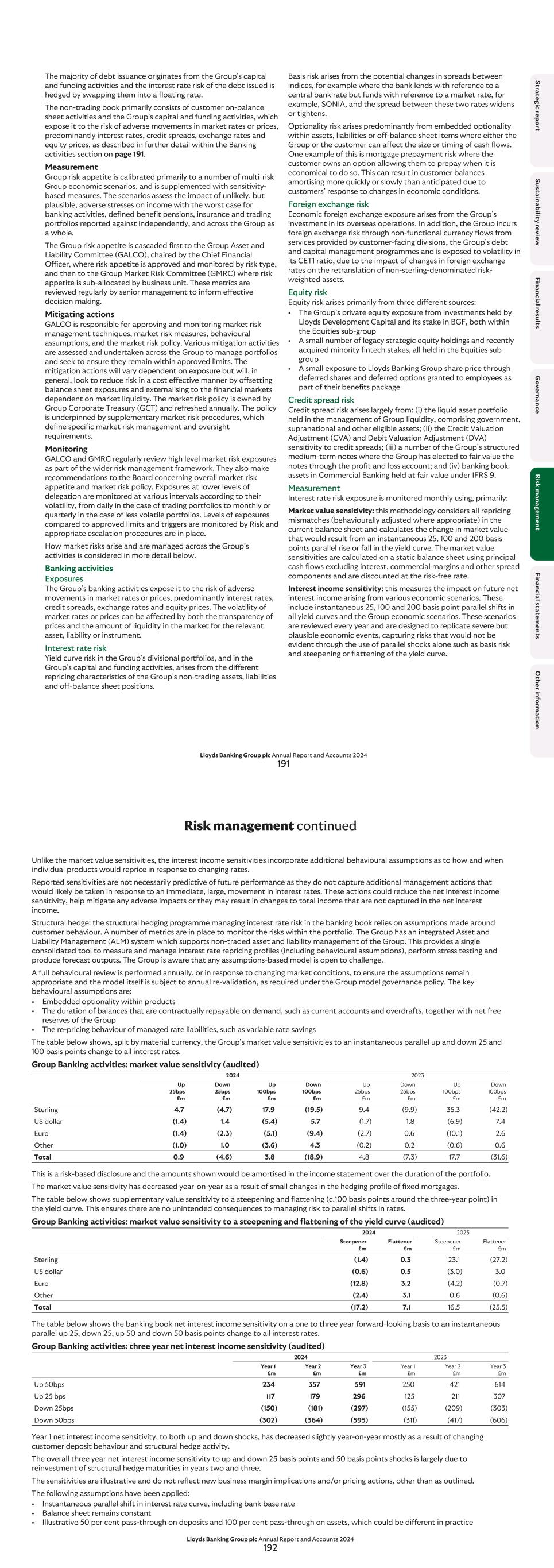
The majority of debt issuance originates from the Group’s capital and funding activities and the interest rate risk of the debt issued is hedged by swapping them into a floating rate. The non-trading book primarily consists of customer on-balance sheet activities and the Group’s capital and funding activities, which expose it to the risk of adverse movements in market rates or prices, predominantly interest rates, credit spreads, exchange rates and equity prices, as described in further detail within the Banking activities section on page 191. Measurement Group risk appetite is calibrated primarily to a number of multi-risk Group economic scenarios, and is supplemented with sensitivity- based measures. The scenarios assess the impact of unlikely, but plausible, adverse stresses on income with the worst case for banking activities, defined benefit pensions, insurance and trading portfolios reported against independently, and across the Group as a whole. The Group risk appetite is cascaded first to the Group Asset and Liability Committee (GALCO), chaired by the Chief Financial Officer, where risk appetite is approved and monitored by risk type, and then to the Group Market Risk Committee (GMRC) where risk appetite is sub-allocated by business unit. These metrics are reviewed regularly by senior management to inform effective decision making. Mitigating actions GALCO is responsible for approving and monitoring market risk management techniques, market risk measures, behavioural assumptions, and the market risk policy. Various mitigation activities are assessed and undertaken across the Group to manage portfolios and seek to ensure they remain within approved limits. The mitigation actions will vary dependent on exposure but will, in general, look to reduce risk in a cost effective manner by offsetting balance sheet exposures and externalising to the financial markets dependent on market liquidity. The market risk policy is owned by Group Corporate Treasury (GCT) and refreshed annually. The policy is underpinned by supplementary market risk procedures, which define specific market risk management and oversight requirements. Monitoring GALCO and GMRC regularly review high level market risk exposures as part of the wider risk management framework. They also make recommendations to the Board concerning overall market risk appetite and market risk policy. Exposures at lower levels of delegation are monitored at various intervals according to their volatility, from daily in the case of trading portfolios to monthly or quarterly in the case of less volatile portfolios. Levels of exposures compared to approved limits and triggers are monitored by Risk and appropriate escalation procedures are in place. How market risks arise and are managed across the Group’s activities is considered in more detail below. Banking activities Exposures The Group’s banking activities expose it to the risk of adverse movements in market rates or prices, predominantly interest rates, credit spreads, exchange rates and equity prices. The volatility of market rates or prices can be affected by both the transparency of prices and the amount of liquidity in the market for the relevant asset, liability or instrument. Interest rate risk Yield curve risk in the Group’s divisional portfolios, and in the Group’s capital and funding activities, arises from the different repricing characteristics of the Group’s non-trading assets, liabilities and off-balance sheet positions. Basis risk arises from the potential changes in spreads between indices, for example where the bank lends with reference to a central bank rate but funds with reference to a market rate, for example, SONIA, and the spread between these two rates widens or tightens. Optionality risk arises predominantly from embedded optionality within assets, liabilities or off-balance sheet items where either the Group or the customer can affect the size or timing of cash flows. One example of this is mortgage prepayment risk where the customer owns an option allowing them to prepay when it is economical to do so. This can result in customer balances amortising more quickly or slowly than anticipated due to customers’ response to changes in economic conditions. Foreign exchange risk Economic foreign exchange exposure arises from the Group’s investment in its overseas operations. In addition, the Group incurs foreign exchange risk through non-functional currency flows from services provided by customer-facing divisions, the Group’s debt and capital management programmes and is exposed to volatility in its CET1 ratio, due to the impact of changes in foreign exchange rates on the retranslation of non-sterling-denominated risk- weighted assets. Equity risk Equity risk arises primarily from three different sources: • The Group’s private equity exposure from investments held by Lloyds Development Capital and its stake in BGF, both within the Equities sub-group • A small number of legacy strategic equity holdings and recently acquired minority fintech stakes, all held in the Equities sub- group • A small exposure to Lloyds Banking Group share price through deferred shares and deferred options granted to employees as part of their benefits package Credit spread risk Credit spread risk arises largely from: (i) the liquid asset portfolio held in the management of Group liquidity, comprising government, supranational and other eligible assets; (ii) the Credit Valuation Adjustment (CVA) and Debit Valuation Adjustment (DVA) sensitivity to credit spreads; (iii) a number of the Group’s structured medium-term notes where the Group has elected to fair value the notes through the profit and loss account; and (iv) banking book assets in Commercial Banking held at fair value under IFRS 9. Measurement Interest rate risk exposure is monitored monthly using, primarily: Market value sensitivity: this methodology considers all repricing mismatches (behaviourally adjusted where appropriate) in the current balance sheet and calculates the change in market value that would result from an instantaneous 25, 100 and 200 basis points parallel rise or fall in the yield curve. The market value sensitivities are calculated on a static balance sheet using principal cash flows excluding interest, commercial margins and other spread components and are discounted at the risk-free rate. Interest income sensitivity: this measures the impact on future net interest income arising from various economic scenarios. These include instantaneous 25, 100 and 200 basis point parallel shifts in all yield curves and the Group economic scenarios. These scenarios are reviewed every year and are designed to replicate severe but plausible economic events, capturing risks that would not be evident through the use of parallel shocks alone such as basis risk and steepening or flattening of the yield curve. Lloyds Banking Group plc Annual Report and Accounts 2024 191 l i ts 2 O th e r in fo rm a tio n R isk m a n a ge m e n t F in a n cia l re su lts S u sta in a b ility re vie w S tra te gic re p o rt G o ve rn a n ce F in a n cia l sta te m e n ts Unlike the market value sensitivities, the interest income sensitivities incorporate additional behavioural assumptions as to how and when individual products would reprice in response to changing rates. Reported sensitivities are not necessarily predictive of future performance as they do not capture additional management actions that would likely be taken in response to an immediate, large, movement in interest rates. These actions could reduce the net interest income sensitivity, help mitigate any adverse impacts or they may result in changes to total income that are not captured in the net interest income. Structural hedge: the structural hedging programme managing interest rate risk in the banking book relies on assumptions made around customer behaviour. A number of metrics are in place to monitor the risks within the portfolio. The Group has an integrated Asset and Liability Management (ALM) system which supports non-traded asset and liability management of the Group. This provides a single consolidated tool to measure and manage interest rate repricing profiles (including behavioural assumptions), perform stress testing and produce forecast outputs. The Group is aware that any assumptions-based model is open to challenge. A full behavioural review is performed annually, or in response to changing market conditions, to ensure the assumptions remain appropriate and the model itself is subject to annual re-validation, as required under the Group model governance policy. The key behavioural assumptions are: • Embedded optionality within products • The duration of balances that are contractually repayable on demand, such as current accounts and overdrafts, together with net free reserves of the Group • The re-pricing behaviour of managed rate liabilities, such as variable rate savings The table below shows, split by material currency, the Group’s market value sensitivities to an instantaneous parallel up and down 25 and 100 basis points change to all interest rates. Group Banking activities: market value sensitivity (audited) 2024 2023 Up 25bps £m Down 25bps £m Up 100bps £m Down 100bps £m Up 25bps £m Down 25bps £m Up 100bps £m Down 100bps £m Sterling 4.7 (4.7) 17.9 (19.5) 9.4 (9.9) 35.3 (42.2) US dollar (1.4) 1.4 (5.4) 5.7 (1.7) 1.8 (6.9) 7.4 Euro (1.4) (2.3) (5.1) (9.4) (2.7) 0.6 (10.1) 2.6 Other (1.0) 1.0 (3.6) 4.3 (0.2) 0.2 (0.6) 0.6 Total 0.9 (4.6) 3.8 (18.9) 4.8 (7.3) 17.7 (31.6) This is a risk-based disclosure and the amounts shown would be amortised in the income statement over the duration of the portfolio. The market value sensitivity has decreased year-on-year as a result of small changes in the hedging profile of fixed mortgages. The table below shows supplementary value sensitivity to a steepening and flattening (c.100 basis points around the three-year point) in the yield curve. This ensures there are no unintended consequences to managing risk to parallel shifts in rates. Group Banking activities: market value sensitivity to a steepening and flattening of the yield curve (audited) 2024 2023 Steepener £m Flattener £m Steepener £m Flattener £m Sterling (1.4) 0.3 23.1 (27.2) US dollar (0.6) 0.5 (3.0) 3.0 Euro (12.8) 3.2 (4.2) (0.7) Other (2.4) 3.1 0.6 (0.6) Total (17.2) 7.1 16.5 (25.5) The table below shows the banking book net interest income sensitivity on a one to three year forward-looking basis to an instantaneous parallel up 25, down 25, up 50 and down 50 basis points change to all interest rates. Group Banking activities: three year net interest income sensitivity (audited) 2024 2023 Year 1 £m Year 2 £m Year 3 £m Year 1 £m Year 2 £m Year 3 £m Up 50bps 234 357 591 250 421 614 Up 25 bps 117 179 296 125 211 307 Down 25bps (150) (181) (297) (155) (209) (303) Down 50bps (302) (364) (595) (311) (417) (606) Year 1 net interest income sensitivity, to both up and down shocks, has decreased slightly year-on-year mostly as a result of changing customer deposit behaviour and structural hedge activity. The overall three year net interest income sensitivity to up and down 25 basis points and 50 basis points shocks is largely due to reinvestment of structural hedge maturities in years two and three. The sensitivities are illustrative and do not reflect new business margin implications and/or pricing actions, other than as outlined. The following assumptions have been applied: • Instantaneous parallel shift in interest rate curve, including bank base rate • Balance sheet remains constant • Illustrative 50 per cent pass-through on deposits and 100 per cent pass-through on assets, which could be different in practice Risk management continued Lloyds Banking Group plc Annual Report and Accounts 2024 192 l i ts
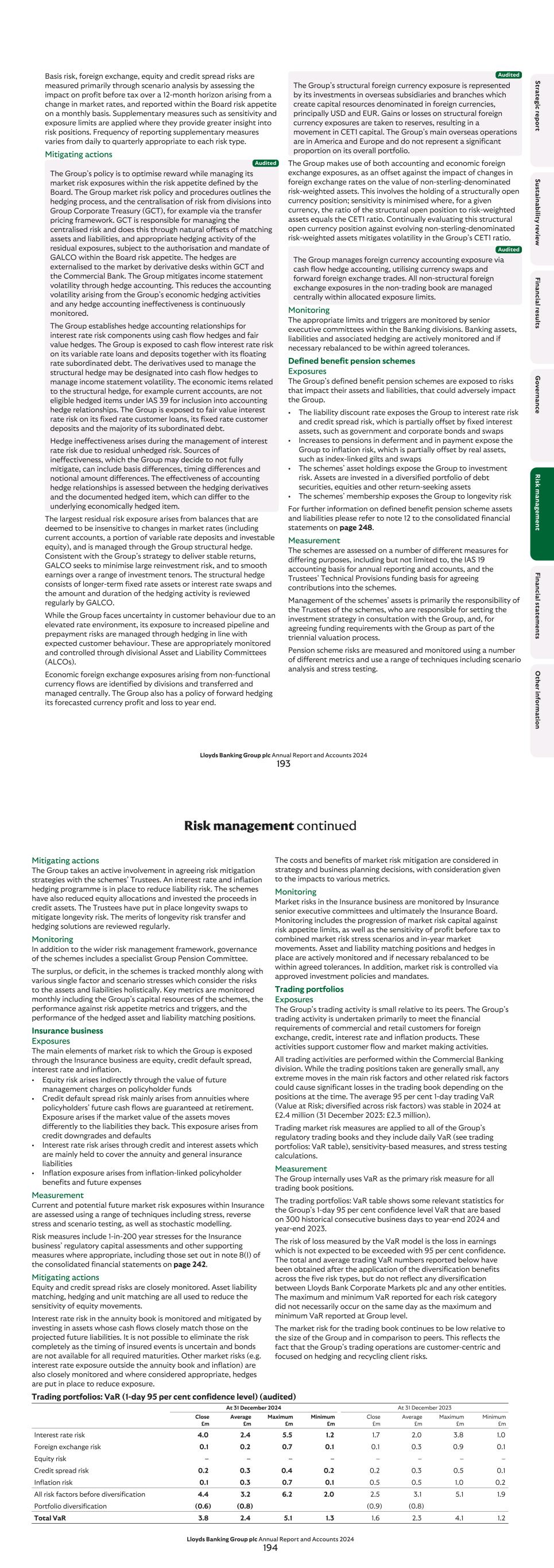
Basis risk, foreign exchange, equity and credit spread risks are measured primarily through scenario analysis by assessing the impact on profit before tax over a 12-month horizon arising from a change in market rates, and reported within the Board risk appetite on a monthly basis. Supplementary measures such as sensitivity and exposure limits are applied where they provide greater insight into risk positions. Frequency of reporting supplementary measures varies from daily to quarterly appropriate to each risk type. Mitigating actions The Group’s policy is to optimise reward while managing its market risk exposures within the risk appetite defined by the Board. The Group market risk policy and procedures outlines the hedging process, and the centralisation of risk from divisions into Group Corporate Treasury (GCT), for example via the transfer pricing framework. GCT is responsible for managing the centralised risk and does this through natural offsets of matching assets and liabilities, and appropriate hedging activity of the residual exposures, subject to the authorisation and mandate of GALCO within the Board risk appetite. The hedges are externalised to the market by derivative desks within GCT and the Commercial Bank. The Group mitigates income statement volatility through hedge accounting. This reduces the accounting volatility arising from the Group’s economic hedging activities and any hedge accounting ineffectiveness is continuously monitored. The Group establishes hedge accounting relationships for interest rate risk components using cash flow hedges and fair value hedges. The Group is exposed to cash flow interest rate risk on its variable rate loans and deposits together with its floating rate subordinated debt. The derivatives used to manage the structural hedge may be designated into cash flow hedges to manage income statement volatility. The economic items related to the structural hedge, for example current accounts, are not eligible hedged items under IAS 39 for inclusion into accounting hedge relationships. The Group is exposed to fair value interest rate risk on its fixed rate customer loans, its fixed rate customer deposits and the majority of its subordinated debt. Hedge ineffectiveness arises during the management of interest rate risk due to residual unhedged risk. Sources of ineffectiveness, which the Group may decide to not fully mitigate, can include basis differences, timing differences and notional amount differences. The effectiveness of accounting hedge relationships is assessed between the hedging derivatives and the documented hedged item, which can differ to the underlying economically hedged item. The largest residual risk exposure arises from balances that are deemed to be insensitive to changes in market rates (including current accounts, a portion of variable rate deposits and investable equity), and is managed through the Group structural hedge. Consistent with the Group’s strategy to deliver stable returns, GALCO seeks to minimise large reinvestment risk, and to smooth earnings over a range of investment tenors. The structural hedge consists of longer-term fixed rate assets or interest rate swaps and the amount and duration of the hedging activity is reviewed regularly by GALCO. While the Group faces uncertainty in customer behaviour due to an elevated rate environment, its exposure to increased pipeline and prepayment risks are managed through hedging in line with expected customer behaviour. These are appropriately monitored and controlled through divisional Asset and Liability Committees (ALCOs). Economic foreign exchange exposures arising from non-functional currency flows are identified by divisions and transferred and managed centrally. The Group also has a policy of forward hedging its forecasted currency profit and loss to year end. The Group’s structural foreign currency exposure is represented by its investments in overseas subsidiaries and branches which create capital resources denominated in foreign currencies, principally USD and EUR. Gains or losses on structural foreign currency exposures are taken to reserves, resulting in a movement in CET1 capital. The Group’s main overseas operations are in America and Europe and do not represent a significant proportion on its overall portfolio. The Group makes use of both accounting and economic foreign exchange exposures, as an offset against the impact of changes in foreign exchange rates on the value of non-sterling-denominated risk-weighted assets. This involves the holding of a structurally open currency position; sensitivity is minimised where, for a given currency, the ratio of the structural open position to risk-weighted assets equals the CET1 ratio. Continually evaluating this structural open currency position against evolving non-sterling-denominated risk-weighted assets mitigates volatility in the Group’s CET1 ratio. The Group manages foreign currency accounting exposure via cash flow hedge accounting, utilising currency swaps and forward foreign exchange trades. All non-structural foreign exchange exposures in the non-trading book are managed centrally within allocated exposure limits. Monitoring The appropriate limits and triggers are monitored by senior executive committees within the Banking divisions. Banking assets, liabilities and associated hedging are actively monitored and if necessary rebalanced to be within agreed tolerances. Defined benefit pension schemes Exposures The Group’s defined benefit pension schemes are exposed to risks that impact their assets and liabilities, that could adversely impact the Group. • The liability discount rate exposes the Group to interest rate risk and credit spread risk, which is partially offset by fixed interest assets, such as government and corporate bonds and swaps • Increases to pensions in deferment and in payment expose the Group to inflation risk, which is partially offset by real assets, such as index-linked gilts and swaps • The schemes’ asset holdings expose the Group to investment risk. Assets are invested in a diversified portfolio of debt securities, equities and other return-seeking assets • The schemes’ membership exposes the Group to longevity risk For further information on defined benefit pension scheme assets and liabilities please refer to note 12 to the consolidated financial statements on page 248. Measurement The schemes are assessed on a number of different measures for differing purposes, including but not limited to, the IAS 19 accounting basis for annual reporting and accounts, and the Trustees’ Technical Provisions funding basis for agreeing contributions into the schemes. Management of the schemes’ assets is primarily the responsibility of the Trustees of the schemes, who are responsible for setting the investment strategy in consultation with the Group, and, for agreeing funding requirements with the Group as part of the triennial valuation process. Pension scheme risks are measured and monitored using a number of different metrics and use a range of techniques including scenario analysis and stress testing. Lloyds Banking Group plc Annual Report and Accounts 2024 193 l i ts 2 O th e r in fo rm a tio n R isk m a n a ge m e n t F in a n cia l re su lts S u sta in a b ility re vie w S tra te gic re p o rt G o ve rn a n ce F in a n cia l sta te m e n ts Mitigating actions The Group takes an active involvement in agreeing risk mitigation strategies with the schemes’ Trustees. An interest rate and inflation hedging programme is in place to reduce liability risk. The schemes have also reduced equity allocations and invested the proceeds in credit assets. The Trustees have put in place longevity swaps to mitigate longevity risk. The merits of longevity risk transfer and hedging solutions are reviewed regularly. Monitoring In addition to the wider risk management framework, governance of the schemes includes a specialist Group Pension Committee. The surplus, or deficit, in the schemes is tracked monthly along with various single factor and scenario stresses which consider the risks to the assets and liabilities holistically. Key metrics are monitored monthly including the Group’s capital resources of the schemes, the performance against risk appetite metrics and triggers, and the performance of the hedged asset and liability matching positions. Insurance business Exposures The main elements of market risk to which the Group is exposed through the Insurance business are equity, credit default spread, interest rate and inflation. • Equity risk arises indirectly through the value of future management charges on policyholder funds • Credit default spread risk mainly arises from annuities where policyholders’ future cash flows are guaranteed at retirement. Exposure arises if the market value of the assets moves differently to the liabilities they back. This exposure arises from credit downgrades and defaults • Interest rate risk arises through credit and interest assets which are mainly held to cover the annuity and general insurance liabilities • Inflation exposure arises from inflation-linked policyholder benefits and future expenses Measurement Current and potential future market risk exposures within Insurance are assessed using a range of techniques including stress, reverse stress and scenario testing, as well as stochastic modelling. Risk measures include 1-in-200 year stresses for the Insurance business’ regulatory capital assessments and other supporting measures where appropriate, including those set out in note 8(I) of the consolidated financial statements on page 242. Mitigating actions Equity and credit spread risks are closely monitored. Asset liability matching, hedging and unit matching are all used to reduce the sensitivity of equity movements. Interest rate risk in the annuity book is monitored and mitigated by investing in assets whose cash flows closely match those on the projected future liabilities. It is not possible to eliminate the risk completely as the timing of insured events is uncertain and bonds are not available for all required maturities. Other market risks (e.g. interest rate exposure outside the annuity book and inflation) are also closely monitored and where considered appropriate, hedges are put in place to reduce exposure. The costs and benefits of market risk mitigation are considered in strategy and business planning decisions, with consideration given to the impacts to various metrics. Monitoring Market risks in the Insurance business are monitored by Insurance senior executive committees and ultimately the Insurance Board. Monitoring includes the progression of market risk capital against risk appetite limits, as well as the sensitivity of profit before tax to combined market risk stress scenarios and in-year market movements. Asset and liability matching positions and hedges in place are actively monitored and if necessary rebalanced to be within agreed tolerances. In addition, market risk is controlled via approved investment policies and mandates. Trading portfolios Exposures The Group’s trading activity is small relative to its peers. The Group’s trading activity is undertaken primarily to meet the financial requirements of commercial and retail customers for foreign exchange, credit, interest rate and inflation products. These activities support customer flow and market making activities. All trading activities are performed within the Commercial Banking division. While the trading positions taken are generally small, any extreme moves in the main risk factors and other related risk factors could cause significant losses in the trading book depending on the positions at the time. The average 95 per cent 1-day trading VaR (Value at Risk; diversified across risk factors) was stable in 2024 at £2.4 million (31 December 2023: £2.3 million). Trading market risk measures are applied to all of the Group’s regulatory trading books and they include daily VaR (see trading portfolios: VaR table), sensitivity-based measures, and stress testing calculations. Measurement The Group internally uses VaR as the primary risk measure for all trading book positions. The trading portfolios: VaR table shows some relevant statistics for the Group’s 1-day 95 per cent confidence level VaR that are based on 300 historical consecutive business days to year-end 2024 and year-end 2023. The risk of loss measured by the VaR model is the loss in earnings which is not expected to be exceeded with 95 per cent confidence. The total and average trading VaR numbers reported below have been obtained after the application of the diversification benefits across the five risk types, but do not reflect any diversification between Lloyds Bank Corporate Markets plc and any other entities. The maximum and minimum VaR reported for each risk category did not necessarily occur on the same day as the maximum and minimum VaR reported at Group level. The market risk for the trading book continues to be low relative to the size of the Group and in comparison to peers. This reflects the fact that the Group’s trading operations are customer-centric and focused on hedging and recycling client risks. Trading portfolios: VaR (1-day 95 per cent confidence level) (audited) At 31 December 2024 At 31 December 2023 Close £m Average £m Maximum £m Minimum £m Close £m Average £m Maximum £m Minimum £m Interest rate risk 4.0 2.4 5.5 1.2 1.7 2.0 3.8 1.0 Foreign exchange risk 0.1 0.2 0.7 0.1 0.1 0.3 0.9 0.1 Equity risk – – – – – – – – Credit spread risk 0.2 0.3 0.4 0.2 0.2 0.3 0.5 0.1 Inflation risk 0.1 0.3 0.7 0.1 0.5 0.5 1.0 0.2 All risk factors before diversification 4.4 3.2 6.2 2.0 2.5 3.1 5.1 1.9 Portfolio diversification (0.6) (0.8) (0.9) (0.8) Total VaR 3.8 2.4 5.1 1.3 1.6 2.3 4.1 1.2 Risk management continued Lloyds Banking Group plc Annual Report and Accounts 2024 194 l i ts
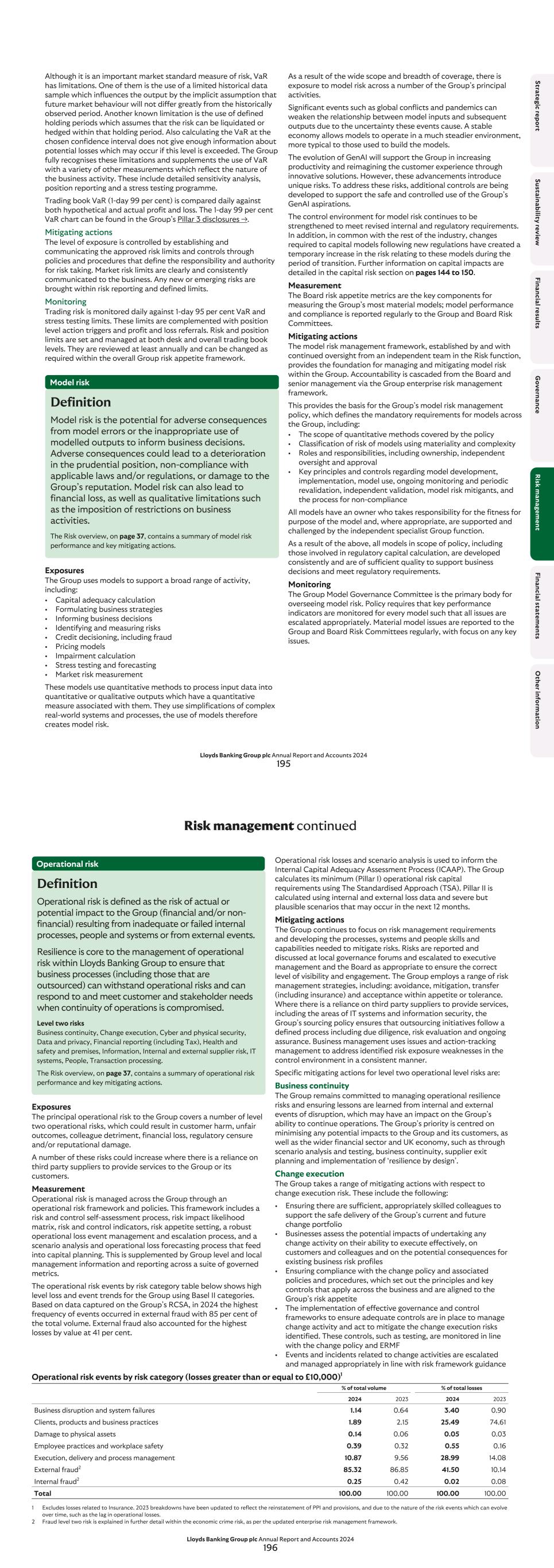
Although it is an important market standard measure of risk, VaR has limitations. One of them is the use of a limited historical data sample which influences the output by the implicit assumption that future market behaviour will not differ greatly from the historically observed period. Another known limitation is the use of defined holding periods which assumes that the risk can be liquidated or hedged within that holding period. Also calculating the VaR at the chosen confidence interval does not give enough information about potential losses which may occur if this level is exceeded. The Group fully recognises these limitations and supplements the use of VaR with a variety of other measurements which reflect the nature of the business activity. These include detailed sensitivity analysis, position reporting and a stress testing programme. Trading book VaR (1-day 99 per cent) is compared daily against both hypothetical and actual profit and loss. The 1-day 99 per cent VaR chart can be found in the Group’s Pillar 3 disclosures →. Mitigating actions The level of exposure is controlled by establishing and communicating the approved risk limits and controls through policies and procedures that define the responsibility and authority for risk taking. Market risk limits are clearly and consistently communicated to the business. Any new or emerging risks are brought within risk reporting and defined limits. Monitoring Trading risk is monitored daily against 1-day 95 per cent VaR and stress testing limits. These limits are complemented with position level action triggers and profit and loss referrals. Risk and position limits are set and managed at both desk and overall trading book levels. They are reviewed at least annually and can be changed as required within the overall Group risk appetite framework. Exposures The Group uses models to support a broad range of activity, including: • Capital adequacy calculation • Formulating business strategies • Informing business decisions • Identifying and measuring risks • Credit decisioning, including fraud • Pricing models • Impairment calculation • Stress testing and forecasting • Market risk measurement These models use quantitative methods to process input data into quantitative or qualitative outputs which have a quantitative measure associated with them. They use simplifications of complex real-world systems and processes, the use of models therefore creates model risk. As a result of the wide scope and breadth of coverage, there is exposure to model risk across a number of the Group’s principal activities. Significant events such as global conflicts and pandemics can weaken the relationship between model inputs and subsequent outputs due to the uncertainty these events cause. A stable economy allows models to operate in a much steadier environment, more typical to those used to build the models. The evolution of GenAI will support the Group in increasing productivity and reimagining the customer experience through innovative solutions. However, these advancements introduce unique risks. To address these risks, additional controls are being developed to support the safe and controlled use of the Group’s GenAI aspirations. The control environment for model risk continues to be strengthened to meet revised internal and regulatory requirements. In addition, in common with the rest of the industry, changes required to capital models following new regulations have created a temporary increase in the risk relating to these models during the period of transition. Further information on capital impacts are detailed in the capital risk section on pages 144 to 150. Measurement The Board risk appetite metrics are the key components for measuring the Group’s most material models; model performance and compliance is reported regularly to the Group and Board Risk Committees. Mitigating actions The model risk management framework, established by and with continued oversight from an independent team in the Risk function, provides the foundation for managing and mitigating model risk within the Group. Accountability is cascaded from the Board and senior management via the Group enterprise risk management framework. This provides the basis for the Group’s model risk management policy, which defines the mandatory requirements for models across the Group, including: • The scope of quantitative methods covered by the policy • Classification of risk of models using materiality and complexity • Roles and responsibilities, including ownership, independent oversight and approval • Key principles and controls regarding model development, implementation, model use, ongoing monitoring and periodic revalidation, independent validation, model risk mitigants, and the process for non-compliance All models have an owner who takes responsibility for the fitness for purpose of the model and, where appropriate, are supported and challenged by the independent specialist Group function. As a result of the above, all models in scope of policy, including those involved in regulatory capital calculation, are developed consistently and are of sufficient quality to support business decisions and meet regulatory requirements. Monitoring The Group Model Governance Committee is the primary body for overseeing model risk. Policy requires that key performance indicators are monitored for every model such that all issues are escalated appropriately. Material model issues are reported to the Group and Board Risk Committees regularly, with focus on any key issues. Lloyds Banking Group plc Annual Report and Accounts 2024 195 Model risk Definition Model risk is the potential for adverse consequences from model errors or the inappropriate use of modelled outputs to inform business decisions. Adverse consequences could lead to a deterioration in the prudential position, non-compliance with applicable laws and/or regulations, or damage to the Group’s reputation. Model risk can also lead to financial loss, as well as qualitative limitations such as the imposition of restrictions on business activities. The Risk overview, on page 37, contains a summary of model risk performance and key mitigating actions. l i ts 2 O th e r in fo rm a tio n R isk m a n a ge m e n t F in a n cia l re su lts S u sta in a b ility re vie w S tra te gic re p o rt G o ve rn a n ce F in a n cia l sta te m e n ts Operational risk Definition Operational risk is defined as the risk of actual or potential impact to the Group (financial and/or non- financial) resulting from inadequate or failed internal processes, people and systems or from external events. Resilience is core to the management of operational risk within Lloyds Banking Group to ensure that business processes (including those that are outsourced) can withstand operational risks and can respond to and meet customer and stakeholder needs when continuity of operations is compromised. Level two risks Business continuity, Change execution, Cyber and physical security, Data and privacy, Financial reporting (including Tax), Health and safety and premises, Information, Internal and external supplier risk, IT systems, People, Transaction processing. The Risk overview, on page 37, contains a summary of operational risk performance and key mitigating actions. Exposures The principal operational risk to the Group covers a number of level two operational risks, which could result in customer harm, unfair outcomes, colleague detriment, financial loss, regulatory censure and/or reputational damage. A number of these risks could increase where there is a reliance on third party suppliers to provide services to the Group or its customers. Measurement Operational risk is managed across the Group through an operational risk framework and policies. This framework includes a risk and control self-assessment process, risk impact likelihood matrix, risk and control indicators, risk appetite setting, a robust operational loss event management and escalation process, and a scenario analysis and operational loss forecasting process that feed into capital planning. This is supplemented by Group level and local management information and reporting across a suite of governed metrics. The operational risk events by risk category table below shows high level loss and event trends for the Group using Basel II categories. Based on data captured on the Group’s RCSA, in 2024 the highest frequency of events occurred in external fraud with 85 per cent of the total volume. External fraud also accounted for the highest losses by value at 41 per cent. Operational risk losses and scenario analysis is used to inform the Internal Capital Adequacy Assessment Process (ICAAP). The Group calculates its minimum (Pillar I) operational risk capital requirements using The Standardised Approach (TSA). Pillar II is calculated using internal and external loss data and severe but plausible scenarios that may occur in the next 12 months. Mitigating actions The Group continues to focus on risk management requirements and developing the processes, systems and people skills and capabilities needed to mitigate risks. Risks are reported and discussed at local governance forums and escalated to executive management and the Board as appropriate to ensure the correct level of visibility and engagement. The Group employs a range of risk management strategies, including: avoidance, mitigation, transfer (including insurance) and acceptance within appetite or tolerance. Where there is a reliance on third party suppliers to provide services, including the areas of IT systems and information security, the Group’s sourcing policy ensures that outsourcing initiatives follow a defined process including due diligence, risk evaluation and ongoing assurance. Business management uses issues and action-tracking management to address identified risk exposure weaknesses in the control environment in a consistent manner. Specific mitigating actions for level two operational level risks are: Business continuity The Group remains committed to managing operational resilience risks and ensuring lessons are learned from internal and external events of disruption, which may have an impact on the Group’s ability to continue operations. The Group’s priority is centred on minimising any potential impacts to the Group and its customers, as well as the wider financial sector and UK economy, such as through scenario analysis and testing, business continuity, supplier exit planning and implementation of ‘resilience by design’. Change execution The Group takes a range of mitigating actions with respect to change execution risk. These include the following: • Ensuring there are sufficient, appropriately skilled colleagues to support the safe delivery of the Group’s current and future change portfolio • Businesses assess the potential impacts of undertaking any change activity on their ability to execute effectively, on customers and colleagues and on the potential consequences for existing business risk profiles • Ensuring compliance with the change policy and associated policies and procedures, which set out the principles and key controls that apply across the business and are aligned to the Group’s risk appetite • The implementation of effective governance and control frameworks to ensure adequate controls are in place to manage change activity and act to mitigate the change execution risks identified. These controls, such as testing, are monitored in line with the change policy and ERMF • Events and incidents related to change activities are escalated and managed appropriately in line with risk framework guidance Operational risk events by risk category (losses greater than or equal to £10,000)1 % of total volume % of total losses 2024 2023 2024 2023 Business disruption and system failures 1.14 0.64 3.40 0.90 Clients, products and business practices 1.89 2.15 25.49 74.61 Damage to physical assets 0.14 0.06 0.05 0.03 Employee practices and workplace safety 0.39 0.32 0.55 0.16 Execution, delivery and process management 10.87 9.56 28.99 14.08 External fraud2 85.32 86.85 41.50 10.14 Internal fraud2 0.25 0.42 0.02 0.08 Total 100.00 100.00 100.00 100.00 1 Excludes losses related to Insurance. 2023 breakdowns have been updated to reflect the reinstatement of PPI and provisions, and due to the nature of the risk events which can evolve over time, such as the lag in operational losses. 2 Fraud level two risk is explained in further detail within the economic crime risk, as per the updated enterprise risk management framework. Risk management continued Lloyds Banking Group plc Annual Report and Accounts 2024 196 l i ts

Data and privacy The Group continues to invest to reduce data risk exposure, by: • Delivering a strategy focused on data management and culture, data-driven insights, platforms, tooling and AI-enablement • Enhancing data quality and capability, such as standardised controls implemented across critical data elements • Embedding data privacy impact assessments in the processing of high-risk data Financial reporting (including tax) The Group maintains risk management systems and internal controls relating to the financial reporting process ensuring: • The consistent and appropriate application of accounting policies, the accurate recording of transactions, which are undertaken in accordance with delegated authorities, and safeguarding of assets with liabilities properly stated • The calculation, preparation and reporting of financial, prudential regulatory and tax outcomes in accordance with applicable International Financial Reporting Standards, statutory and regulatory requirements, such as the UK Finance Code for Financial Reporting Disclosure and the US Sarbanes-Oxley Act • Ongoing monitoring to assess the impact of emerging regulation and legislation on financial, prudential regulatory and tax reporting • An accurate view of the Group’s performance to allow the Board and senior management to appropriately manage the affairs and strategy of the business and each of its entities and sub-groups Health and safety and premises The Group strives to ensure compliance with legal and regulatory requirements, embedding compliant and appropriate colleague behaviours in line with its policies, values and people risk priorities. The Group continues to monitor horizon scanning, risk assessments and any incident information to continually improve its health, safety and premises risk management. Colleagues also regularly complete health and safety training to ensure that policies, standards, procedures, processes and practices are understood and implemented effectively. Information, cyber and physical security The Group adopts a risk-based approach to mitigate cyber threats it faces. Specifically, the Group continues to undertake remediation activity to address deficiencies in its access controls across certain business applications and associated IT infrastructure. The effective operation of the Group’s estate is supported by an IT and Cyber Security Governance framework, guided by a threat-based strategy which underpins investment decisions. The ongoing protection of the estate and confidentiality of material information is ensured through adherence to the Group Security Policy which has been aligned to industry good practice including the NIST Cyber Security Framework; and material laws and regulations. The Group engages a specialist third party consultancy on a periodic basis, to assess the maturity of its cyber security programme, in assessing, identifying and managing material risks from cyber security threats. Thresholds have been set that, once triggered, will bring the information security risk owning business representatives, legal and compliance teams together as a subcommittee. The sub-committee will own the invocation of crisis management, Board and/or regulatory notification and the drafting of any wider stakeholder communications. Internal and external supplier The threat landscape associated with third party suppliers and the critical services they provide continues to receive a significant amount of attention. The Group acknowledges the importance of control and responsibility for critical business services and processes, which could cause significant harm to the Group’s customers. The Group segments its suppliers by criticality and has processes in place to support ongoing supplier management, including: • Policy expectations are underpinned by standards, notably the sourcing and supply chain management framework • All material arrangements are set out in written agreements and based on Group standard terms, which comply with regulations, including the expectation that all sub-outsourcing is managed in line with the supplier’s contractual obligations to the Group • A risk-proportionate process exists for onboarding and managing third party arrangements through the life cycle • Pre-outsourcing and ongoing risk assessments to identify key operational and financial risks, including on-site or virtual assurance for suppliers with a higher criticality assessment • Assessments drive the level of ongoing supplier governance, assurance and monitoring. For example, the Group provides training and other resources to its suppliers to support IT systems and information security resilience in its supply chain IT systems The Group continues its journey to simplify its technology estate, in line with its strategy, through the targeted simplification of legacy applications, infrastructure platforms and on-premise data centres. The Group has controls in place to manage legacy technology, IT change and monitoring, incident management and recovery. IT disaster recovery is a key capability to recover from multiple scenarios, ranging from likely and medium impact (such as infrastructure failure for a single application), to low likelihood with severe or material impact scenarios, such as the loss of a data centre or cloud region. People The Group takes many mitigating actions with respect to people risk. Key areas of focus include: • Focusing on leadership and colleague engagement, through delivery of strategies to attract, retain and develop high calibre people together with a focus on creating a strong and resilient talent pipeline • Continued focus on the Group’s culture and inclusivity strategy by developing and delivering initiatives that reinforce the appropriate behaviours which generate the best possible long- term outcomes for customers and colleagues • Managing organisational capability and capacity through divisional people strategies to ensure there are the right skills and resources to meet customers’ needs and deliver the Group’s strategic plan • Ensuring colleague wellbeing strategies and support are in place to meet colleague needs, alongside skills and capability growth required to maximise the potential of our people • Ensuring compliance with legal and regulatory requirements, embedding compliant and appropriate colleague behaviours in line with Group policies, values and its people risk priorities • Reviewing and enhancing people processes to ensure they are fit for purpose and operationally resilient Lloyds Banking Group plc Annual Report and Accounts 2024 197 l i ts 2 O th e r in fo rm a tio n R isk m a n a ge m e n t F in a n cia l re su lts S u sta in a b ility re vie w S tra te gic re p o rt G o ve rn a n ce F in a n cia l sta te m e n ts Transaction processing The Group adopts a robust approach to minimising transaction processing risks. This includes processing and execution failures relating to clients and products, such as errors in payment processing or management of payments and claims, including those where a third party is operating on the Group’s behalf. Monitoring Monitoring and reporting of operational risk is undertaken at Board, Group, legal entity and business unit and functional committees. Each committee monitors key risks, control effectiveness, indicators, events, operational losses, risk appetite metrics and the results of independent review conducted by the Risk function and/ or Group Audit. Additionally, the Group’s IT and information security processes are validated and audited by internal experts within the Risk function and Group Audit. The Group maintains a formal approach to operational risk event escalation, whereby events are identified, captured and escalated, where appropriate based on materiality. Root causes of events are determined, and action plans put in place to ensure an optimum level of control to keep customers and the business safe and improve efficiency. The insurance policies are monitored and reviewed regularly, with recommendations being made to the Group’s senior management annually prior to each renewal. Insurers are monitored on an ongoing basis, to ensure counterparty risk is minimised. A process is in place to manage any insurer rating changes or insolvencies. Risk management continued Lloyds Banking Group plc Annual Report and Accounts 2024 198 l i ts

Financial statements In this section Intentionally left blank Consolidated income statement 212 Consolidated statement of comprehensive income 213 Consolidated balance sheet 214 Consolidated statement of changes in equity 215 Consolidated cash flow statement 218 Notes to the consolidated financial statements 1. Basis of preparation 219 2. Accounting policies 219 3. Critical accounting judgements and key sources of estimation uncertainty 228 4. Segmental analysis 229 5. Net interest income 234 6. Net fee and commission income 234 7. Net trading income (losses) 235 8. Insurance business 236 9. Other operating income 244 10. Operating expenses 244 11. Share-based payments 245 12. Retirement benefit obligations 248 13. Auditors’ remuneration 253 14. Impairment 254 15. Tax 255 16. Measurement basis of financial assets and liabilities 258 17. Fair values of financial assets and liabilities 260 18. Maturities of assets and liabilities 269 19. Derivative financial instruments 271 20. Loans and advances to customers 274 21. Allowance for expected credit losses 274 22. Finance lease receivables 284 23. Goodwill and other intangible assets 284 24. Other assets 286 25. Lessee disclosures 287 26. Debt securities in issue 287 27. Other liabilities 288 28. Provisions 288 29. Subordinated liabilities 290 30. Share capital 291 31. Earnings per share 292 32. Share premium account 293 33. Other reserves 293 34. Retained profits 294 35. Other equity instruments 295 36. Dividends on ordinary shares 295 37. Related party transactions 296 38. Contingent liabilities, commitments and guarantees 297 39. Structured entities 298 40. Transfers of financial assets 299 41. Financial risk management 300 42. Cash flow statement 301 43. Events since the balance sheet date 302 Intentionally left blank The Group has adopted the UK Finance Code for Financial Reporting Disclosure and these 2024 financial statements have been prepared in compliance with its principles. O th e r in fo rm a tio n F in a n cia l sta te m e n ts R isk m a n a ge m e n t F in a n cia l re su lts S u sta in a b ility re vie w S tra te gic re p o rt G o ve rn a n ce 199 Lloyds Banking Group plc Annual Report and Accounts 2024 Intentionally left blank Lloyds Banking Group plc Annual Report and Accounts 2024 200 l i ts

Lloyds Banking Group plc Annual Report and Accounts 2024 201 l i ts 2 Intentionally left blank Lloyds Banking Group plc Annual Report and Accounts 2024 202 l i ts Intentionally left blank

Lloyds Banking Group plc Annual Report and Accounts 2024 203 l i ts 2 Intentionally left blank Lloyds Banking Group plc Annual Report and Accounts 2024 204 l i ts Intentionally left blank

205 Intentionally left blank Lloydl s Ban kiing G roup plc Annual Report and Accountts s 2024 Lloyds Banking Group plc Annual Report and Accounts 2024 206 l i ts Intentionally left blank

Lloyds Banking Group plc Annual Report and Accounts 2024 207 l i ts 2 Intentionally left blank Lloyds Banking Group plc Annual Report and Accounts 2024 208 l i ts Intentionally left blank

Lloyds Banking Group plc Annual Report and Accounts 2024 209 l i ts 2 Intentionally left blank Lloyds Banking Group plc Annual Report and Accounts 2024 210 l i ts Intentionally left blank

Lloyds Banking Group plc Annual Report and Accounts 2024 211 l i ts 2 Intentionally left blank Note 2024 £m 2023 £m 2022 £m Interest income 31,288 28,051 17,645 Interest expense (19,011) (14,753) (4,723) Net interest income 5 12,277 13,298 12,922 Fee and commission income 2,943 2,926 2,790 Fee and commission expense (1,184) (1,095) (1,070) Net fee and commission income 6 1,759 1,831 1,720 Net trading income (losses) 7 17,825 18,049 (19,987) Insurance revenue 3,291 3,008 2,461 Insurance service expense (2,733) (2,414) (3,863) Net (expense) income from reinsurance contracts held (72) 2 62 Insurance service result 8 486 596 (1,340) Other operating income 9 1,934 1,631 1,339 Other income 22,004 22,107 (18,268) Total income 34,281 35,405 (5,346) Net finance (expense) income from insurance, participating investment and reinsurance contracts (10,341) (11,684) 15,893 Movement in third party interests in consolidated funds (1,059) (1,109) 1,035 Change in non-participating investment contracts (4,878) (3,983) 3,959 Net finance (expense) income in respect of insurance and investment contracts 8 (16,278) (16,776) 20,887 Total income, after net finance expense in respect of insurance and investment contracts 18,003 18,629 15,541 Operating expenses 10 (11,601) (10,823) (9,237) Impairment 14 (431) (303) (1,522) Profit before tax 5,971 7,503 4,782 Tax expense 15 (1,494) (1,985) (859) Profit for the year 4,477 5,518 3,923 Profit attributable to ordinary shareholders 3,923 4,933 3,389 Profit attributable to other equity holders 498 527 438 Profit attributable to equity holders 4,421 5,460 3,827 Profit attributable to non-controlling interests 56 58 96 Profit for the year 4,477 5,518 3,923 Basic earnings per share 31 6.3p 7.6p 4.9p Diluted earnings per share 31 6.2p 7.5p 4.9p The accompanying notes are an integral part of the consolidated financial statements. Consolidated income statement for the year ended 31 December Lloyds Banking Group plc Annual Report and Accounts 2024 212 l i ts
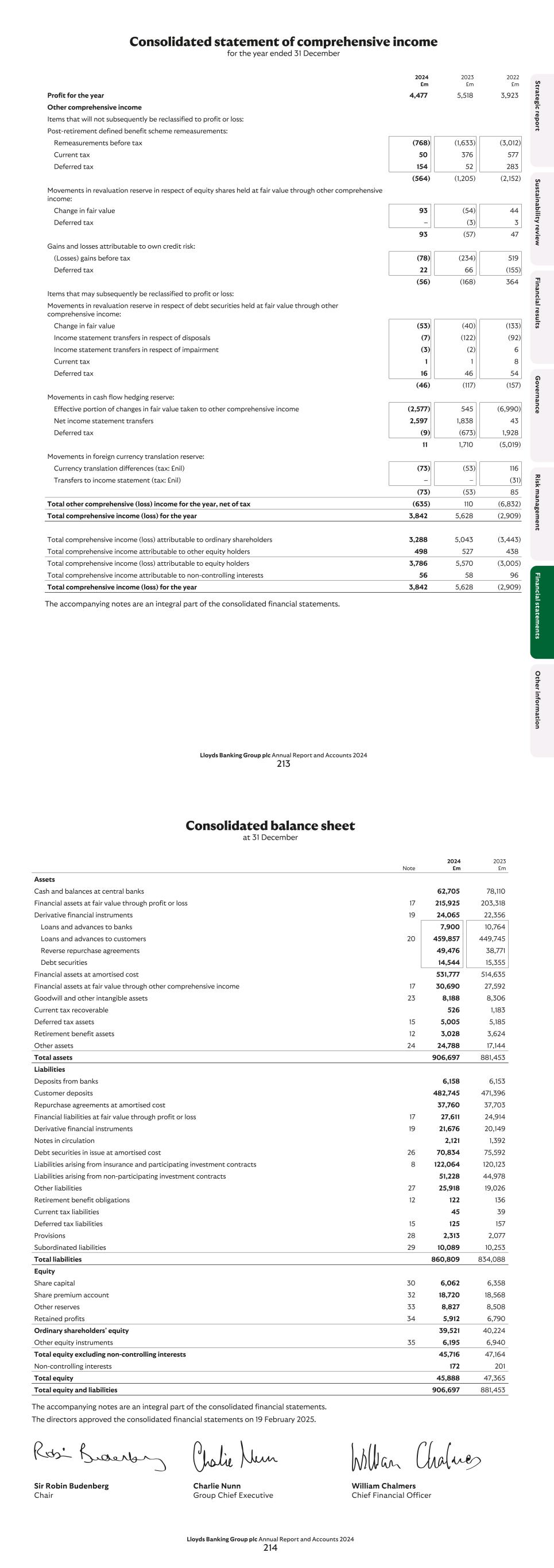
2024 £m 2023 £m 2022 £m Profit for the year 4,477 5,518 3,923 Other comprehensive income Items that will not subsequently be reclassified to profit or loss: Post-retirement defined benefit scheme remeasurements: Remeasurements before tax (768) (1,633) (3,012) Current tax 50 376 577 Deferred tax 154 52 283 (564) (1,205) (2,152) Movements in revaluation reserve in respect of equity shares held at fair value through other comprehensive income: Change in fair value 93 (54) 44 Deferred tax – (3) 3 93 (57) 47 Gains and losses attributable to own credit risk: (Losses) gains before tax (78) (234) 519 Deferred tax 22 66 (155) (56) (168) 364 Items that may subsequently be reclassified to profit or loss: Movements in revaluation reserve in respect of debt securities held at fair value through other comprehensive income: Change in fair value (53) (40) (133) Income statement transfers in respect of disposals (7) (122) (92) Income statement transfers in respect of impairment (3) (2) 6 Current tax 1 1 8 Deferred tax 16 46 54 (46) (117) (157) Movements in cash flow hedging reserve: Effective portion of changes in fair value taken to other comprehensive income (2,577) 545 (6,990) Net income statement transfers 2,597 1,838 43 Deferred tax (9) (673) 1,928 11 1,710 (5,019) Movements in foreign currency translation reserve: Currency translation differences (tax: £nil) (73) (53) 116 Transfers to income statement (tax: £nil) – – (31) (73) (53) 85 Total other comprehensive (loss) income for the year, net of tax (635) 110 (6,832) Total comprehensive income (loss) for the year 3,842 5,628 (2,909) Total comprehensive income (loss) attributable to ordinary shareholders 3,288 5,043 (3,443) Total comprehensive income attributable to other equity holders 498 527 438 Total comprehensive income (loss) attributable to equity holders 3,786 5,570 (3,005) Total comprehensive income attributable to non-controlling interests 56 58 96 Total comprehensive income (loss) for the year 3,842 5,628 (2,909) The accompanying notes are an integral part of the consolidated financial statements. Consolidated statement of comprehensive income for the year ended 31 December Lloyds Banking Group plc Annual Report and Accounts 2024 213 l i ts 2 O th e r in fo rm a tio n F in a n cia l sta te m e n ts R isk m a n a ge m e n t F in a n cia l re su lts S u sta in a b ility re vie w S tra te gic re p o rt G o ve rn a n ce Note 2024 £m 2023 £m Assets Cash and balances at central banks 62,705 78,110 Financial assets at fair value through profit or loss 17 215,925 203,318 Derivative financial instruments 19 24,065 22,356 Loans and advances to banks 7,900 10,764 Loans and advances to customers 20 459,857 449,745 Reverse repurchase agreements 49,476 38,771 Debt securities 14,544 15,355 Financial assets at amortised cost 531,777 514,635 Financial assets at fair value through other comprehensive income 17 30,690 27,592 Goodwill and other intangible assets 23 8,188 8,306 Current tax recoverable 526 1,183 Deferred tax assets 15 5,005 5,185 Retirement benefit assets 12 3,028 3,624 Other assets 24 24,788 17,144 Total assets 906,697 881,453 Liabilities Deposits from banks 6,158 6,153 Customer deposits 482,745 471,396 Repurchase agreements at amortised cost 37,760 37,703 Financial liabilities at fair value through profit or loss 17 27,611 24,914 Derivative financial instruments 19 21,676 20,149 Notes in circulation 2,121 1,392 Debt securities in issue at amortised cost 26 70,834 75,592 Liabilities arising from insurance and participating investment contracts 8 122,064 120,123 Liabilities arising from non-participating investment contracts 51,228 44,978 Other liabilities 27 25,918 19,026 Retirement benefit obligations 12 122 136 Current tax liabilities 45 39 Deferred tax liabilities 15 125 157 Provisions 28 2,313 2,077 Subordinated liabilities 29 10,089 10,253 Total liabilities 860,809 834,088 Equity Share capital 30 6,062 6,358 Share premium account 32 18,720 18,568 Other reserves 33 8,827 8,508 Retained profits 34 5,912 6,790 Ordinary shareholders’ equity 39,521 40,224 Other equity instruments 35 6,195 6,940 Total equity excluding non-controlling interests 45,716 47,164 Non-controlling interests 172 201 Total equity 45,888 47,365 Total equity and liabilities 906,697 881,453 The accompanying notes are an integral part of the consolidated financial statements. The directors approved the consolidated financial statements on 19 February 2025. Sir Robin Budenberg Chair Charlie Nunn Group Chief Executive William Chalmers Chief Financial Officer Consolidated balance sheet at 31 December Lloyds Banking Group plc Annual Report and Accounts 2024 214 l i ts
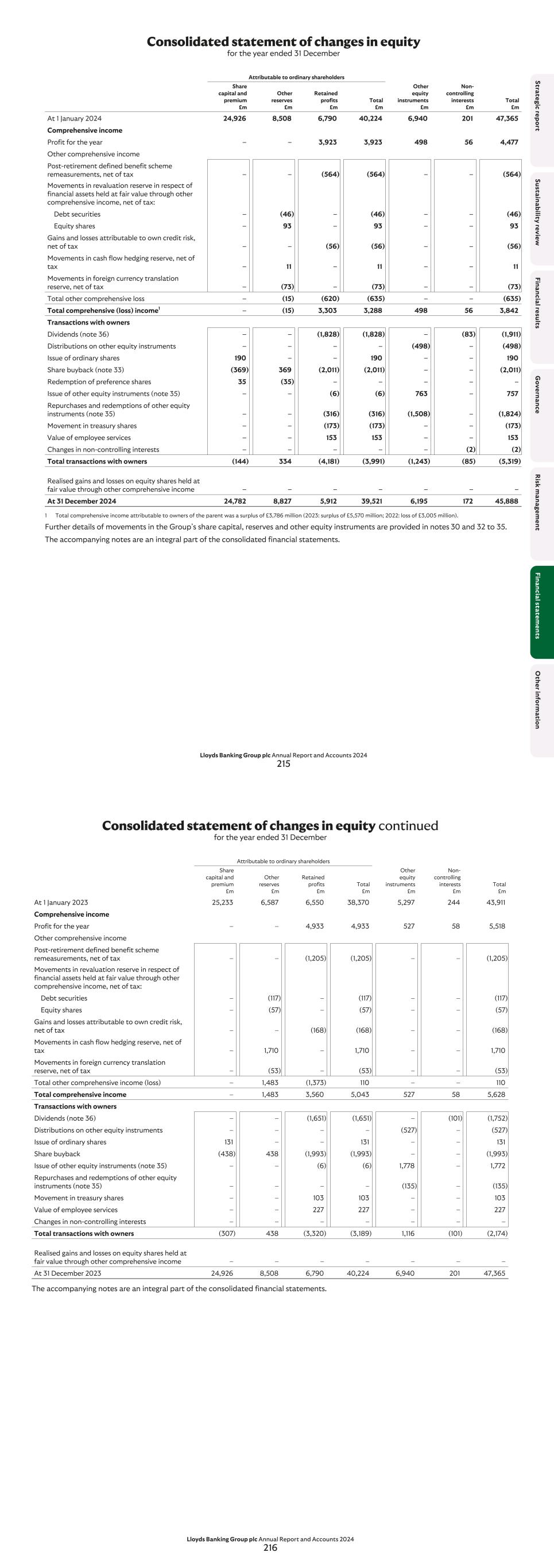
Attributable to ordinary shareholders Other equity instruments £m Non- controlling interests £m Total £m Share capital and premium £m Other reserves £m Retained profits £m Total £m At 1 January 2024 24,926 8,508 6,790 40,224 6,940 201 47,365 Comprehensive income Profit for the year – – 3,923 3,923 498 56 4,477 Other comprehensive income Post-retirement defined benefit scheme remeasurements, net of tax – – (564) (564) – – (564) Movements in revaluation reserve in respect of financial assets held at fair value through other comprehensive income, net of tax: Debt securities – (46) – (46) – – (46) Equity shares – 93 – 93 – – 93 Gains and losses attributable to own credit risk, net of tax – – (56) (56) – – (56) Movements in cash flow hedging reserve, net of tax – 11 – 11 – – 11 Movements in foreign currency translation reserve, net of tax – (73) – (73) – – (73) Total other comprehensive loss – (15) (620) (635) – – (635) Total comprehensive (loss) income1 – (15) 3,303 3,288 498 56 3,842 Transactions with owners Dividends (note 36) – – (1,828) (1,828) – (83) (1,911) Distributions on other equity instruments – – – – (498) – (498) Issue of ordinary shares 190 – – 190 – – 190 Share buyback (note 33) (369) 369 (2,011) (2,011) – – (2,011) Redemption of preference shares 35 (35) – – – – – Issue of other equity instruments (note 35) – – (6) (6) 763 – 757 Repurchases and redemptions of other equity instruments (note 35) – – (316) (316) (1,508) – (1,824) Movement in treasury shares – – (173) (173) – – (173) Value of employee services – – 153 153 – – 153 Changes in non-controlling interests – – – – – (2) (2) Total transactions with owners (144) 334 (4,181) (3,991) (1,243) (85) (5,319) Realised gains and losses on equity shares held at fair value through other comprehensive income – – – – – – – At 31 December 2024 24,782 8,827 5,912 39,521 6,195 172 45,888 1 Total comprehensive income attributable to owners of the parent was a surplus of £3,786 million (2023: surplus of £5,570 million; 2022: loss of £3,005 million). Further details of movements in the Group’s share capital, reserves and other equity instruments are provided in notes 30 and 32 to 35. The accompanying notes are an integral part of the consolidated financial statements. Consolidated statement of changes in equity for the year ended 31 December Lloyds Banking Group plc Annual Report and Accounts 2024 215 l i ts 2 O th e r in fo rm a tio n F in a n cia l sta te m e n ts R isk m a n a ge m e n t F in a n cia l re su lts S u sta in a b ility re vie w S tra te gic re p o rt G o ve rn a n ce Attributable to ordinary shareholders Other equity instruments £m Non- controlling interests £m Total £m Share capital and premium £m Other reserves £m Retained profits £m Total £m At 1 January 2023 25,233 6,587 6,550 38,370 5,297 244 43,911 Comprehensive income Profit for the year – – 4,933 4,933 527 58 5,518 Other comprehensive income Post-retirement defined benefit scheme remeasurements, net of tax – – (1,205) (1,205) – – (1,205) Movements in revaluation reserve in respect of financial assets held at fair value through other comprehensive income, net of tax: Debt securities – (117) – (117) – – (117) Equity shares – (57) – (57) – – (57) Gains and losses attributable to own credit risk, net of tax – – (168) (168) – – (168) Movements in cash flow hedging reserve, net of tax – 1,710 – 1,710 – – 1,710 Movements in foreign currency translation reserve, net of tax – (53) – (53) – – (53) Total other comprehensive income (loss) – 1,483 (1,373) 110 – – 110 Total comprehensive income – 1,483 3,560 5,043 527 58 5,628 Transactions with owners Dividends (note 36) – – (1,651) (1,651) – (101) (1,752) Distributions on other equity instruments – – – – (527) – (527) Issue of ordinary shares 131 – – 131 – – 131 Share buyback (438) 438 (1,993) (1,993) – – (1,993) Issue of other equity instruments (note 35) – – (6) (6) 1,778 – 1,772 Repurchases and redemptions of other equity instruments (note 35) – – – – (135) – (135) Movement in treasury shares – – 103 103 – – 103 Value of employee services – – 227 227 – – 227 Changes in non-controlling interests – – – – – – – Total transactions with owners (307) 438 (3,320) (3,189) 1,116 (101) (2,174) Realised gains and losses on equity shares held at fair value through other comprehensive income – – – – – – – At 31 December 2023 24,926 8,508 6,790 40,224 6,940 201 47,365 The accompanying notes are an integral part of the consolidated financial statements. Consolidated statement of changes in equity continued for the year ended 31 December Lloyds Banking Group plc Annual Report and Accounts 2024 216 l i ts
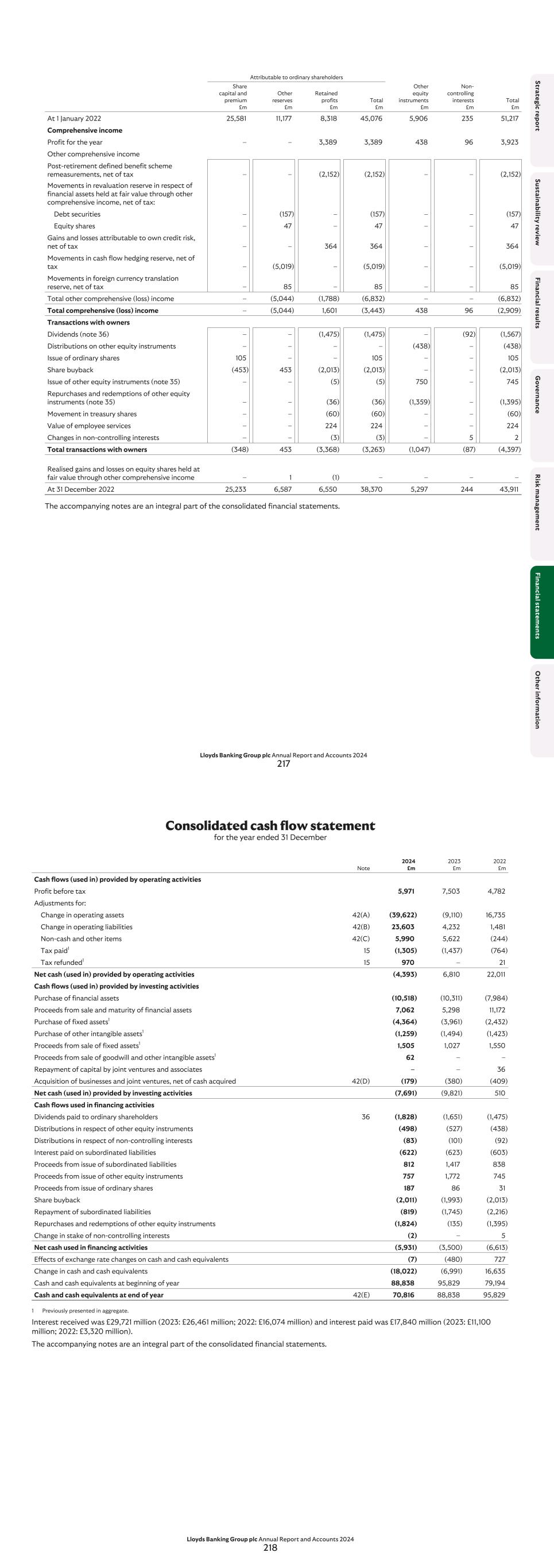
Attributable to ordinary shareholders Other equity instruments £m Non- controlling interests £m Total £m Share capital and premium £m Other reserves £m Retained profits £m Total £m At 1 January 2022 25,581 11,177 8,318 45,076 5,906 235 51,217 Comprehensive income Profit for the year – – 3,389 3,389 438 96 3,923 Other comprehensive income Post-retirement defined benefit scheme remeasurements, net of tax – – (2,152) (2,152) – – (2,152) Movements in revaluation reserve in respect of financial assets held at fair value through other comprehensive income, net of tax: Debt securities – (157) – (157) – – (157) Equity shares – 47 – 47 – – 47 Gains and losses attributable to own credit risk, net of tax – – 364 364 – – 364 Movements in cash flow hedging reserve, net of tax – (5,019) – (5,019) – – (5,019) Movements in foreign currency translation reserve, net of tax – 85 – 85 – – 85 Total other comprehensive (loss) income – (5,044) (1,788) (6,832) – – (6,832) Total comprehensive (loss) income – (5,044) 1,601 (3,443) 438 96 (2,909) Transactions with owners Dividends (note 36) – – (1,475) (1,475) – (92) (1,567) Distributions on other equity instruments – – – – (438) – (438) Issue of ordinary shares 105 – – 105 – – 105 Share buyback (453) 453 (2,013) (2,013) – – (2,013) Issue of other equity instruments (note 35) – – (5) (5) 750 – 745 Repurchases and redemptions of other equity instruments (note 35) – – (36) (36) (1,359) – (1,395) Movement in treasury shares – – (60) (60) – – (60) Value of employee services – – 224 224 – – 224 Changes in non-controlling interests – – (3) (3) – 5 2 Total transactions with owners (348) 453 (3,368) (3,263) (1,047) (87) (4,397) Realised gains and losses on equity shares held at fair value through other comprehensive income – 1 (1) – – – – At 31 December 2022 25,233 6,587 6,550 38,370 5,297 244 43,911 The accompanying notes are an integral part of the consolidated financial statements. Lloyds Banking Group plc Annual Report and Accounts 2024 217 l i ts 2 O th e r in fo rm a tio n F in a n cia l sta te m e n ts R isk m a n a ge m e n t F in a n cia l re su lts S u sta in a b ility re vie w S tra te gic re p o rt G o ve rn a n ce Note 2024 £m 2023 £m 2022 £m Cash flows (used in) provided by operating activities Profit before tax 5,971 7,503 4,782 Adjustments for: Change in operating assets 42(A) (39,622) (9,110) 16,735 Change in operating liabilities 42(B) 23,603 4,232 1,481 Non-cash and other items 42(C) 5,990 5,622 (244) Tax paid1 15 (1,305) (1,437) (764) Tax refunded1 15 970 – 21 Net cash (used in) provided by operating activities (4,393) 6,810 22,011 Cash flows (used in) provided by investing activities Purchase of financial assets (10,518) (10,311) (7,984) Proceeds from sale and maturity of financial assets 7,062 5,298 11,172 Purchase of fixed assets1 (4,364) (3,961) (2,432) Purchase of other intangible assets1 (1,259) (1,494) (1,423) Proceeds from sale of fixed assets1 1,505 1,027 1,550 Proceeds from sale of goodwill and other intangible assets1 62 – – Repayment of capital by joint ventures and associates – – 36 Acquisition of businesses and joint ventures, net of cash acquired 42(D) (179) (380) (409) Net cash (used in) provided by investing activities (7,691) (9,821) 510 Cash flows used in financing activities Dividends paid to ordinary shareholders 36 (1,828) (1,651) (1,475) Distributions in respect of other equity instruments (498) (527) (438) Distributions in respect of non-controlling interests (83) (101) (92) Interest paid on subordinated liabilities (622) (623) (603) Proceeds from issue of subordinated liabilities 812 1,417 838 Proceeds from issue of other equity instruments 757 1,772 745 Proceeds from issue of ordinary shares 187 86 31 Share buyback (2,011) (1,993) (2,013) Repayment of subordinated liabilities (819) (1,745) (2,216) Repurchases and redemptions of other equity instruments (1,824) (135) (1,395) Change in stake of non-controlling interests (2) – 5 Net cash used in financing activities (5,931) (3,500) (6,613) Effects of exchange rate changes on cash and cash equivalents (7) (480) 727 Change in cash and cash equivalents (18,022) (6,991) 16,635 Cash and cash equivalents at beginning of year 88,838 95,829 79,194 Cash and cash equivalents at end of year 42(E) 70,816 88,838 95,829 1 Previously presented in aggregate. Interest received was £29,721 million (2023: £26,461 million; 2022: £16,074 million) and interest paid was £17,840 million (2023: £11,100 million; 2022: £3,320 million). The accompanying notes are an integral part of the consolidated financial statements. Consolidated cash flow statement for the year ended 31 December Lloyds Banking Group plc Annual Report and Accounts 2024 218 l i ts
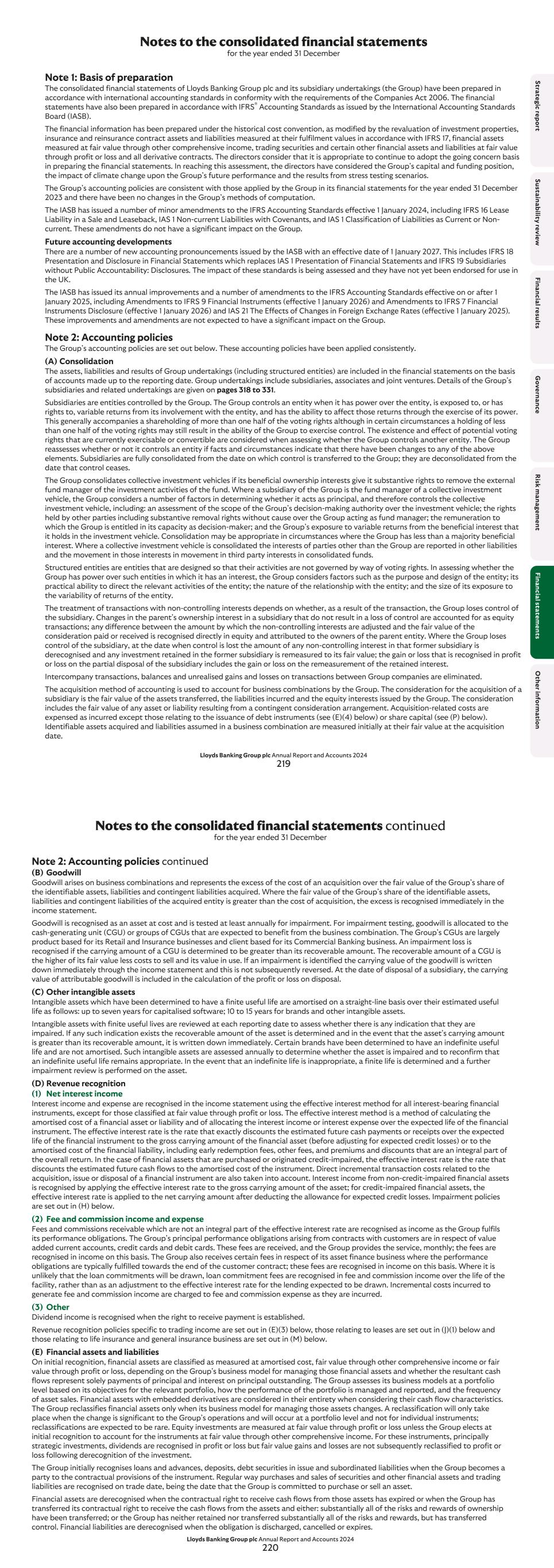
Note 1: Basis of preparation The consolidated financial statements of Lloyds Banking Group plc and its subsidiary undertakings (the Group) have been prepared in accordance with international accounting standards in conformity with the requirements of the Companies Act 2006. The financial statements have also been prepared in accordance with IFRS® Accounting Standards as issued by the International Accounting Standards Board (IASB). The financial information has been prepared under the historical cost convention, as modified by the revaluation of investment properties, insurance and reinsurance contract assets and liabilities measured at their fulfilment values in accordance with IFRS 17, financial assets measured at fair value through other comprehensive income, trading securities and certain other financial assets and liabilities at fair value through profit or loss and all derivative contracts. The directors consider that it is appropriate to continue to adopt the going concern basis in preparing the financial statements. In reaching this assessment, the directors have considered the Group’s capital and funding position, the impact of climate change upon the Group’s future performance and the results from stress testing scenarios. The Group’s accounting policies are consistent with those applied by the Group in its financial statements for the year ended 31 December 2023 and there have been no changes in the Group’s methods of computation. The IASB has issued a number of minor amendments to the IFRS Accounting Standards effective 1 January 2024, including IFRS 16 Lease Liability in a Sale and Leaseback, IAS 1 Non-current Liabilities with Covenants, and IAS 1 Classification of Liabilities as Current or Non- current. These amendments do not have a significant impact on the Group. Future accounting developments There are a number of new accounting pronouncements issued by the IASB with an effective date of 1 January 2027. This includes IFRS 18 Presentation and Disclosure in Financial Statements which replaces IAS 1 Presentation of Financial Statements and IFRS 19 Subsidiaries without Public Accountability: Disclosures. The impact of these standards is being assessed and they have not yet been endorsed for use in the UK. The IASB has issued its annual improvements and a number of amendments to the IFRS Accounting Standards effective on or after 1 January 2025, including Amendments to IFRS 9 Financial Instruments (effective 1 January 2026) and Amendments to IFRS 7 Financial Instruments Disclosure (effective 1 January 2026) and IAS 21 The Effects of Changes in Foreign Exchange Rates (effective 1 January 2025). These improvements and amendments are not expected to have a significant impact on the Group. Note 2: Accounting policies The Group’s accounting policies are set out below. These accounting policies have been applied consistently. (A) Consolidation The assets, liabilities and results of Group undertakings (including structured entities) are included in the financial statements on the basis of accounts made up to the reporting date. Group undertakings include subsidiaries, associates and joint ventures. Details of the Group’s subsidiaries and related undertakings are given on pages 318 to 331. Subsidiaries are entities controlled by the Group. The Group controls an entity when it has power over the entity, is exposed to, or has rights to, variable returns from its involvement with the entity, and has the ability to affect those returns through the exercise of its power. This generally accompanies a shareholding of more than one half of the voting rights although in certain circumstances a holding of less than one half of the voting rights may still result in the ability of the Group to exercise control. The existence and effect of potential voting rights that are currently exercisable or convertible are considered when assessing whether the Group controls another entity. The Group reassesses whether or not it controls an entity if facts and circumstances indicate that there have been changes to any of the above elements. Subsidiaries are fully consolidated from the date on which control is transferred to the Group; they are deconsolidated from the date that control ceases. The Group consolidates collective investment vehicles if its beneficial ownership interests give it substantive rights to remove the external fund manager of the investment activities of the fund. Where a subsidiary of the Group is the fund manager of a collective investment vehicle, the Group considers a number of factors in determining whether it acts as principal, and therefore controls the collective investment vehicle, including: an assessment of the scope of the Group’s decision-making authority over the investment vehicle; the rights held by other parties including substantive removal rights without cause over the Group acting as fund manager; the remuneration to which the Group is entitled in its capacity as decision-maker; and the Group’s exposure to variable returns from the beneficial interest that it holds in the investment vehicle. Consolidation may be appropriate in circumstances where the Group has less than a majority beneficial interest. Where a collective investment vehicle is consolidated the interests of parties other than the Group are reported in other liabilities and the movement in those interests in movement in third party interests in consolidated funds. Structured entities are entities that are designed so that their activities are not governed by way of voting rights. In assessing whether the Group has power over such entities in which it has an interest, the Group considers factors such as the purpose and design of the entity; its practical ability to direct the relevant activities of the entity; the nature of the relationship with the entity; and the size of its exposure to the variability of returns of the entity. The treatment of transactions with non-controlling interests depends on whether, as a result of the transaction, the Group loses control of the subsidiary. Changes in the parent’s ownership interest in a subsidiary that do not result in a loss of control are accounted for as equity transactions; any difference between the amount by which the non-controlling interests are adjusted and the fair value of the consideration paid or received is recognised directly in equity and attributed to the owners of the parent entity. Where the Group loses control of the subsidiary, at the date when control is lost the amount of any non-controlling interest in that former subsidiary is derecognised and any investment retained in the former subsidiary is remeasured to its fair value; the gain or loss that is recognised in profit or loss on the partial disposal of the subsidiary includes the gain or loss on the remeasurement of the retained interest. Intercompany transactions, balances and unrealised gains and losses on transactions between Group companies are eliminated. The acquisition method of accounting is used to account for business combinations by the Group. The consideration for the acquisition of a subsidiary is the fair value of the assets transferred, the liabilities incurred and the equity interests issued by the Group. The consideration includes the fair value of any asset or liability resulting from a contingent consideration arrangement. Acquisition-related costs are expensed as incurred except those relating to the issuance of debt instruments (see (E)(4) below) or share capital (see (P) below). Identifiable assets acquired and liabilities assumed in a business combination are measured initially at their fair value at the acquisition date. Notes to the consolidated financial statements for the year ended 31 December Lloyds Banking Group plc Annual Report and Accounts 2024 219 l i ts 2 O th e r in fo rm a tio n F in a n cia l sta te m e n ts R isk m a n a ge m e n t F in a n cia l re su lts S u sta in a b ility re vie w S tra te gic re p o rt G o ve rn a n ce Note 2: Accounting policies continued (B) Goodwill Goodwill arises on business combinations and represents the excess of the cost of an acquisition over the fair value of the Group’s share of the identifiable assets, liabilities and contingent liabilities acquired. Where the fair value of the Group’s share of the identifiable assets, liabilities and contingent liabilities of the acquired entity is greater than the cost of acquisition, the excess is recognised immediately in the income statement. Goodwill is recognised as an asset at cost and is tested at least annually for impairment. For impairment testing, goodwill is allocated to the cash-generating unit (CGU) or groups of CGUs that are expected to benefit from the business combination. The Group’s CGUs are largely product based for its Retail and Insurance businesses and client based for its Commercial Banking business. An impairment loss is recognised if the carrying amount of a CGU is determined to be greater than its recoverable amount. The recoverable amount of a CGU is the higher of its fair value less costs to sell and its value in use. If an impairment is identified the carrying value of the goodwill is written down immediately through the income statement and this is not subsequently reversed. At the date of disposal of a subsidiary, the carrying value of attributable goodwill is included in the calculation of the profit or loss on disposal. (C) Other intangible assets Intangible assets which have been determined to have a finite useful life are amortised on a straight-line basis over their estimated useful life as follows: up to seven years for capitalised software; 10 to 15 years for brands and other intangible assets. Intangible assets with finite useful lives are reviewed at each reporting date to assess whether there is any indication that they are impaired. If any such indication exists the recoverable amount of the asset is determined and in the event that the asset’s carrying amount is greater than its recoverable amount, it is written down immediately. Certain brands have been determined to have an indefinite useful life and are not amortised. Such intangible assets are assessed annually to determine whether the asset is impaired and to reconfirm that an indefinite useful life remains appropriate. In the event that an indefinite life is inappropriate, a finite life is determined and a further impairment review is performed on the asset. (D) Revenue recognition (1) Net interest income Interest income and expense are recognised in the income statement using the effective interest method for all interest-bearing financial instruments, except for those classified at fair value through profit or loss. The effective interest method is a method of calculating the amortised cost of a financial asset or liability and of allocating the interest income or interest expense over the expected life of the financial instrument. The effective interest rate is the rate that exactly discounts the estimated future cash payments or receipts over the expected life of the financial instrument to the gross carrying amount of the financial asset (before adjusting for expected credit losses) or to the amortised cost of the financial liability, including early redemption fees, other fees, and premiums and discounts that are an integral part of the overall return. In the case of financial assets that are purchased or originated credit-impaired, the effective interest rate is the rate that discounts the estimated future cash flows to the amortised cost of the instrument. Direct incremental transaction costs related to the acquisition, issue or disposal of a financial instrument are also taken into account. Interest income from non-credit-impaired financial assets is recognised by applying the effective interest rate to the gross carrying amount of the asset; for credit-impaired financial assets, the effective interest rate is applied to the net carrying amount after deducting the allowance for expected credit losses. Impairment policies are set out in (H) below. (2) Fee and commission income and expense Fees and commissions receivable which are not an integral part of the effective interest rate are recognised as income as the Group fulfils its performance obligations. The Group’s principal performance obligations arising from contracts with customers are in respect of value added current accounts, credit cards and debit cards. These fees are received, and the Group provides the service, monthly; the fees are recognised in income on this basis. The Group also receives certain fees in respect of its asset finance business where the performance obligations are typically fulfilled towards the end of the customer contract; these fees are recognised in income on this basis. Where it is unlikely that the loan commitments will be drawn, loan commitment fees are recognised in fee and commission income over the life of the facility, rather than as an adjustment to the effective interest rate for the lending expected to be drawn. Incremental costs incurred to generate fee and commission income are charged to fee and commission expense as they are incurred. (3) Other Dividend income is recognised when the right to receive payment is established. Revenue recognition policies specific to trading income are set out in (E)(3) below, those relating to leases are set out in (J)(1) below and those relating to life insurance and general insurance business are set out in (M) below. (E) Financial assets and liabilities On initial recognition, financial assets are classified as measured at amortised cost, fair value through other comprehensive income or fair value through profit or loss, depending on the Group’s business model for managing those financial assets and whether the resultant cash flows represent solely payments of principal and interest on principal outstanding. The Group assesses its business models at a portfolio level based on its objectives for the relevant portfolio, how the performance of the portfolio is managed and reported, and the frequency of asset sales. Financial assets with embedded derivatives are considered in their entirety when considering their cash flow characteristics. The Group reclassifies financial assets only when its business model for managing those assets changes. A reclassification will only take place when the change is significant to the Group’s operations and will occur at a portfolio level and not for individual instruments; reclassifications are expected to be rare. Equity investments are measured at fair value through profit or loss unless the Group elects at initial recognition to account for the instruments at fair value through other comprehensive income. For these instruments, principally strategic investments, dividends are recognised in profit or loss but fair value gains and losses are not subsequently reclassified to profit or loss following derecognition of the investment. The Group initially recognises loans and advances, deposits, debt securities in issue and subordinated liabilities when the Group becomes a party to the contractual provisions of the instrument. Regular way purchases and sales of securities and other financial assets and trading liabilities are recognised on trade date, being the date that the Group is committed to purchase or sell an asset. Financial assets are derecognised when the contractual right to receive cash flows from those assets has expired or when the Group has transferred its contractual right to receive the cash flows from the assets and either: substantially all of the risks and rewards of ownership have been transferred; or the Group has neither retained nor transferred substantially all of the risks and rewards, but has transferred control. Financial liabilities are derecognised when the obligation is discharged, cancelled or expires. Notes to the consolidated financial statements continued for the year ended 31 December Lloyds Banking Group plc Annual Report and Accounts 2024 220 l i ts
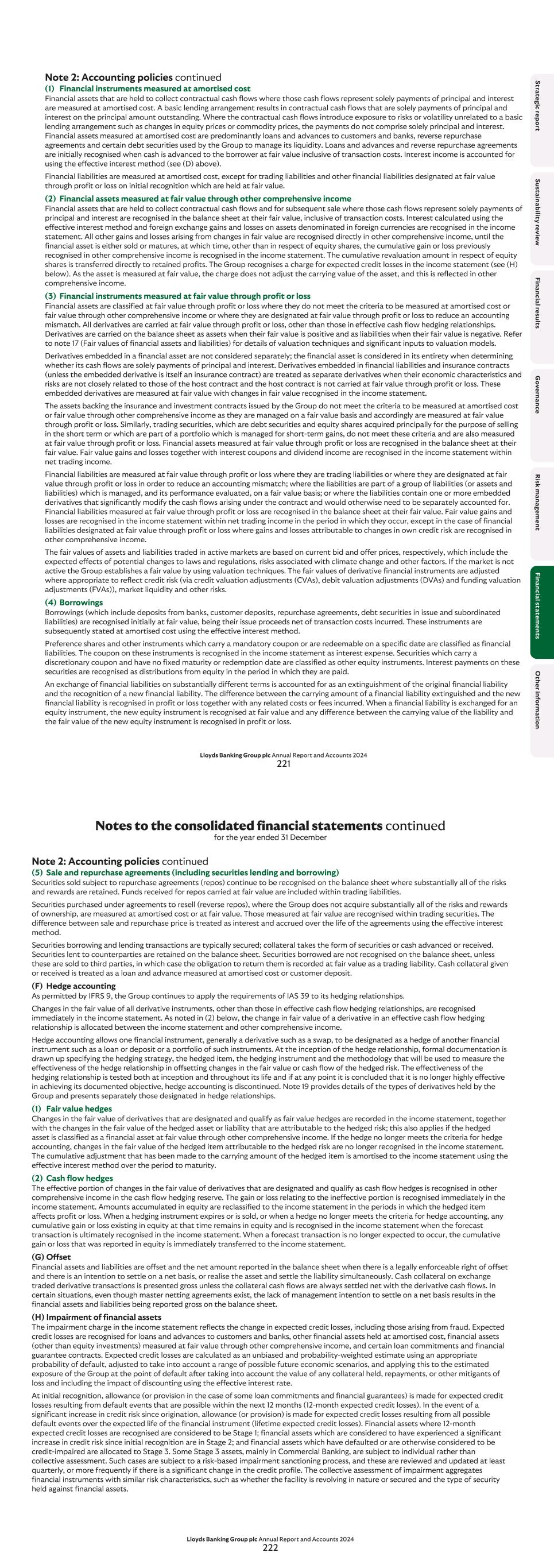
Note 2: Accounting policies continued (1) Financial instruments measured at amortised cost Financial assets that are held to collect contractual cash flows where those cash flows represent solely payments of principal and interest are measured at amortised cost. A basic lending arrangement results in contractual cash flows that are solely payments of principal and interest on the principal amount outstanding. Where the contractual cash flows introduce exposure to risks or volatility unrelated to a basic lending arrangement such as changes in equity prices or commodity prices, the payments do not comprise solely principal and interest. Financial assets measured at amortised cost are predominantly loans and advances to customers and banks, reverse repurchase agreements and certain debt securities used by the Group to manage its liquidity. Loans and advances and reverse repurchase agreements are initially recognised when cash is advanced to the borrower at fair value inclusive of transaction costs. Interest income is accounted for using the effective interest method (see (D) above). Financial liabilities are measured at amortised cost, except for trading liabilities and other financial liabilities designated at fair value through profit or loss on initial recognition which are held at fair value. (2) Financial assets measured at fair value through other comprehensive income Financial assets that are held to collect contractual cash flows and for subsequent sale where those cash flows represent solely payments of principal and interest are recognised in the balance sheet at their fair value, inclusive of transaction costs. Interest calculated using the effective interest method and foreign exchange gains and losses on assets denominated in foreign currencies are recognised in the income statement. All other gains and losses arising from changes in fair value are recognised directly in other comprehensive income, until the financial asset is either sold or matures, at which time, other than in respect of equity shares, the cumulative gain or loss previously recognised in other comprehensive income is recognised in the income statement. The cumulative revaluation amount in respect of equity shares is transferred directly to retained profits. The Group recognises a charge for expected credit losses in the income statement (see (H) below). As the asset is measured at fair value, the charge does not adjust the carrying value of the asset, and this is reflected in other comprehensive income. (3) Financial instruments measured at fair value through profit or loss Financial assets are classified at fair value through profit or loss where they do not meet the criteria to be measured at amortised cost or fair value through other comprehensive income or where they are designated at fair value through profit or loss to reduce an accounting mismatch. All derivatives are carried at fair value through profit or loss, other than those in effective cash flow hedging relationships. Derivatives are carried on the balance sheet as assets when their fair value is positive and as liabilities when their fair value is negative. Refer to note 17 (Fair values of financial assets and liabilities) for details of valuation techniques and significant inputs to valuation models. Derivatives embedded in a financial asset are not considered separately; the financial asset is considered in its entirety when determining whether its cash flows are solely payments of principal and interest. Derivatives embedded in financial liabilities and insurance contracts (unless the embedded derivative is itself an insurance contract) are treated as separate derivatives when their economic characteristics and risks are not closely related to those of the host contract and the host contract is not carried at fair value through profit or loss. These embedded derivatives are measured at fair value with changes in fair value recognised in the income statement. The assets backing the insurance and investment contracts issued by the Group do not meet the criteria to be measured at amortised cost or fair value through other comprehensive income as they are managed on a fair value basis and accordingly are measured at fair value through profit or loss. Similarly, trading securities, which are debt securities and equity shares acquired principally for the purpose of selling in the short term or which are part of a portfolio which is managed for short-term gains, do not meet these criteria and are also measured at fair value through profit or loss. Financial assets measured at fair value through profit or loss are recognised in the balance sheet at their fair value. Fair value gains and losses together with interest coupons and dividend income are recognised in the income statement within net trading income. Financial liabilities are measured at fair value through profit or loss where they are trading liabilities or where they are designated at fair value through profit or loss in order to reduce an accounting mismatch; where the liabilities are part of a group of liabilities (or assets and liabilities) which is managed, and its performance evaluated, on a fair value basis; or where the liabilities contain one or more embedded derivatives that significantly modify the cash flows arising under the contract and would otherwise need to be separately accounted for. Financial liabilities measured at fair value through profit or loss are recognised in the balance sheet at their fair value. Fair value gains and losses are recognised in the income statement within net trading income in the period in which they occur, except in the case of financial liabilities designated at fair value through profit or loss where gains and losses attributable to changes in own credit risk are recognised in other comprehensive income. The fair values of assets and liabilities traded in active markets are based on current bid and offer prices, respectively, which include the expected effects of potential changes to laws and regulations, risks associated with climate change and other factors. If the market is not active the Group establishes a fair value by using valuation techniques. The fair values of derivative financial instruments are adjusted where appropriate to reflect credit risk (via credit valuation adjustments (CVAs), debit valuation adjustments (DVAs) and funding valuation adjustments (FVAs)), market liquidity and other risks. (4) Borrowings Borrowings (which include deposits from banks, customer deposits, repurchase agreements, debt securities in issue and subordinated liabilities) are recognised initially at fair value, being their issue proceeds net of transaction costs incurred. These instruments are subsequently stated at amortised cost using the effective interest method. Preference shares and other instruments which carry a mandatory coupon or are redeemable on a specific date are classified as financial liabilities. The coupon on these instruments is recognised in the income statement as interest expense. Securities which carry a discretionary coupon and have no fixed maturity or redemption date are classified as other equity instruments. Interest payments on these securities are recognised as distributions from equity in the period in which they are paid. An exchange of financial liabilities on substantially different terms is accounted for as an extinguishment of the original financial liability and the recognition of a new financial liability. The difference between the carrying amount of a financial liability extinguished and the new financial liability is recognised in profit or loss together with any related costs or fees incurred. When a financial liability is exchanged for an equity instrument, the new equity instrument is recognised at fair value and any difference between the carrying value of the liability and the fair value of the new equity instrument is recognised in profit or loss. Lloyds Banking Group plc Annual Report and Accounts 2024 221 l i ts 2 O th e r in fo rm a tio n F in a n cia l sta te m e n ts R isk m a n a ge m e n t F in a n cia l re su lts S u sta in a b ility re vie w S tra te gic re p o rt G o ve rn a n ce Note 2: Accounting policies continued (5) Sale and repurchase agreements (including securities lending and borrowing) Securities sold subject to repurchase agreements (repos) continue to be recognised on the balance sheet where substantially all of the risks and rewards are retained. Funds received for repos carried at fair value are included within trading liabilities. Securities purchased under agreements to resell (reverse repos), where the Group does not acquire substantially all of the risks and rewards of ownership, are measured at amortised cost or at fair value. Those measured at fair value are recognised within trading securities. The difference between sale and repurchase price is treated as interest and accrued over the life of the agreements using the effective interest method. Securities borrowing and lending transactions are typically secured; collateral takes the form of securities or cash advanced or received. Securities lent to counterparties are retained on the balance sheet. Securities borrowed are not recognised on the balance sheet, unless these are sold to third parties, in which case the obligation to return them is recorded at fair value as a trading liability. Cash collateral given or received is treated as a loan and advance measured at amortised cost or customer deposit. (F) Hedge accounting As permitted by IFRS 9, the Group continues to apply the requirements of IAS 39 to its hedging relationships. Changes in the fair value of all derivative instruments, other than those in effective cash flow hedging relationships, are recognised immediately in the income statement. As noted in (2) below, the change in fair value of a derivative in an effective cash flow hedging relationship is allocated between the income statement and other comprehensive income. Hedge accounting allows one financial instrument, generally a derivative such as a swap, to be designated as a hedge of another financial instrument such as a loan or deposit or a portfolio of such instruments. At the inception of the hedge relationship, formal documentation is drawn up specifying the hedging strategy, the hedged item, the hedging instrument and the methodology that will be used to measure the effectiveness of the hedge relationship in offsetting changes in the fair value or cash flow of the hedged risk. The effectiveness of the hedging relationship is tested both at inception and throughout its life and if at any point it is concluded that it is no longer highly effective in achieving its documented objective, hedge accounting is discontinued. Note 19 provides details of the types of derivatives held by the Group and presents separately those designated in hedge relationships. (1) Fair value hedges Changes in the fair value of derivatives that are designated and qualify as fair value hedges are recorded in the income statement, together with the changes in the fair value of the hedged asset or liability that are attributable to the hedged risk; this also applies if the hedged asset is classified as a financial asset at fair value through other comprehensive income. If the hedge no longer meets the criteria for hedge accounting, changes in the fair value of the hedged item attributable to the hedged risk are no longer recognised in the income statement. The cumulative adjustment that has been made to the carrying amount of the hedged item is amortised to the income statement using the effective interest method over the period to maturity. (2) Cash flow hedges The effective portion of changes in the fair value of derivatives that are designated and qualify as cash flow hedges is recognised in other comprehensive income in the cash flow hedging reserve. The gain or loss relating to the ineffective portion is recognised immediately in the income statement. Amounts accumulated in equity are reclassified to the income statement in the periods in which the hedged item affects profit or loss. When a hedging instrument expires or is sold, or when a hedge no longer meets the criteria for hedge accounting, any cumulative gain or loss existing in equity at that time remains in equity and is recognised in the income statement when the forecast transaction is ultimately recognised in the income statement. When a forecast transaction is no longer expected to occur, the cumulative gain or loss that was reported in equity is immediately transferred to the income statement. (G) Offset Financial assets and liabilities are offset and the net amount reported in the balance sheet when there is a legally enforceable right of offset and there is an intention to settle on a net basis, or realise the asset and settle the liability simultaneously. Cash collateral on exchange traded derivative transactions is presented gross unless the collateral cash flows are always settled net with the derivative cash flows. In certain situations, even though master netting agreements exist, the lack of management intention to settle on a net basis results in the financial assets and liabilities being reported gross on the balance sheet. (H) Impairment of financial assets The impairment charge in the income statement reflects the change in expected credit losses, including those arising from fraud. Expected credit losses are recognised for loans and advances to customers and banks, other financial assets held at amortised cost, financial assets (other than equity investments) measured at fair value through other comprehensive income, and certain loan commitments and financial guarantee contracts. Expected credit losses are calculated as an unbiased and probability-weighted estimate using an appropriate probability of default, adjusted to take into account a range of possible future economic scenarios, and applying this to the estimated exposure of the Group at the point of default after taking into account the value of any collateral held, repayments, or other mitigants of loss and including the impact of discounting using the effective interest rate. At initial recognition, allowance (or provision in the case of some loan commitments and financial guarantees) is made for expected credit losses resulting from default events that are possible within the next 12 months (12-month expected credit losses). In the event of a significant increase in credit risk since origination, allowance (or provision) is made for expected credit losses resulting from all possible default events over the expected life of the financial instrument (lifetime expected credit losses). Financial assets where 12-month expected credit losses are recognised are considered to be Stage 1; financial assets which are considered to have experienced a significant increase in credit risk since initial recognition are in Stage 2; and financial assets which have defaulted or are otherwise considered to be credit-impaired are allocated to Stage 3. Some Stage 3 assets, mainly in Commercial Banking, are subject to individual rather than collective assessment. Such cases are subject to a risk-based impairment sanctioning process, and these are reviewed and updated at least quarterly, or more frequently if there is a significant change in the credit profile. The collective assessment of impairment aggregates financial instruments with similar risk characteristics, such as whether the facility is revolving in nature or secured and the type of security held against financial assets. Notes to the consolidated financial statements continued for the year ended 31 December Lloyds Banking Group plc Annual Report and Accounts 2024 222 l i ts
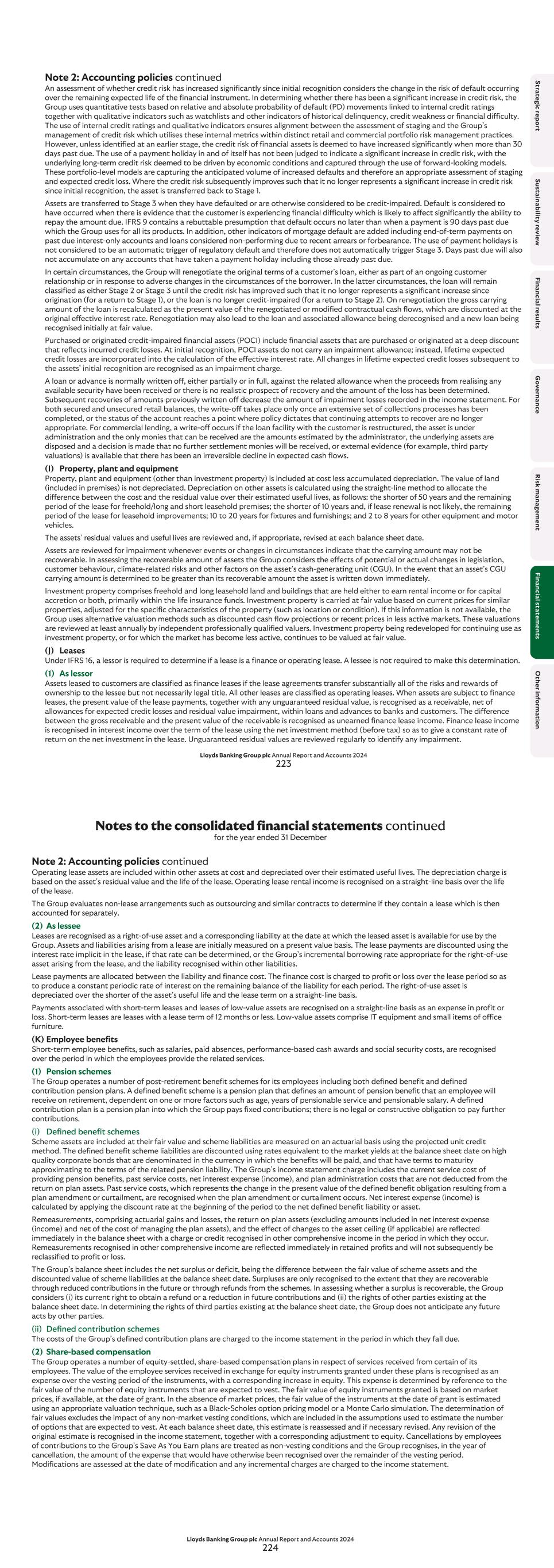
Note 2: Accounting policies continued An assessment of whether credit risk has increased significantly since initial recognition considers the change in the risk of default occurring over the remaining expected life of the financial instrument. In determining whether there has been a significant increase in credit risk, the Group uses quantitative tests based on relative and absolute probability of default (PD) movements linked to internal credit ratings together with qualitative indicators such as watchlists and other indicators of historical delinquency, credit weakness or financial difficulty. The use of internal credit ratings and qualitative indicators ensures alignment between the assessment of staging and the Group’s management of credit risk which utilises these internal metrics within distinct retail and commercial portfolio risk management practices. However, unless identified at an earlier stage, the credit risk of financial assets is deemed to have increased significantly when more than 30 days past due. The use of a payment holiday in and of itself has not been judged to indicate a significant increase in credit risk, with the underlying long-term credit risk deemed to be driven by economic conditions and captured through the use of forward-looking models. These portfolio-level models are capturing the anticipated volume of increased defaults and therefore an appropriate assessment of staging and expected credit loss. Where the credit risk subsequently improves such that it no longer represents a significant increase in credit risk since initial recognition, the asset is transferred back to Stage 1. Assets are transferred to Stage 3 when they have defaulted or are otherwise considered to be credit-impaired. Default is considered to have occurred when there is evidence that the customer is experiencing financial difficulty which is likely to affect significantly the ability to repay the amount due. IFRS 9 contains a rebuttable presumption that default occurs no later than when a payment is 90 days past due which the Group uses for all its products. In addition, other indicators of mortgage default are added including end-of-term payments on past due interest-only accounts and loans considered non-performing due to recent arrears or forbearance. The use of payment holidays is not considered to be an automatic trigger of regulatory default and therefore does not automatically trigger Stage 3. Days past due will also not accumulate on any accounts that have taken a payment holiday including those already past due. In certain circumstances, the Group will renegotiate the original terms of a customer’s loan, either as part of an ongoing customer relationship or in response to adverse changes in the circumstances of the borrower. In the latter circumstances, the loan will remain classified as either Stage 2 or Stage 3 until the credit risk has improved such that it no longer represents a significant increase since origination (for a return to Stage 1), or the loan is no longer credit-impaired (for a return to Stage 2). On renegotiation the gross carrying amount of the loan is recalculated as the present value of the renegotiated or modified contractual cash flows, which are discounted at the original effective interest rate. Renegotiation may also lead to the loan and associated allowance being derecognised and a new loan being recognised initially at fair value. Purchased or originated credit-impaired financial assets (POCI) include financial assets that are purchased or originated at a deep discount that reflects incurred credit losses. At initial recognition, POCI assets do not carry an impairment allowance; instead, lifetime expected credit losses are incorporated into the calculation of the effective interest rate. All changes in lifetime expected credit losses subsequent to the assets’ initial recognition are recognised as an impairment charge. A loan or advance is normally written off, either partially or in full, against the related allowance when the proceeds from realising any available security have been received or there is no realistic prospect of recovery and the amount of the loss has been determined. Subsequent recoveries of amounts previously written off decrease the amount of impairment losses recorded in the income statement. For both secured and unsecured retail balances, the write-off takes place only once an extensive set of collections processes has been completed, or the status of the account reaches a point where policy dictates that continuing attempts to recover are no longer appropriate. For commercial lending, a write-off occurs if the loan facility with the customer is restructured, the asset is under administration and the only monies that can be received are the amounts estimated by the administrator, the underlying assets are disposed and a decision is made that no further settlement monies will be received, or external evidence (for example, third party valuations) is available that there has been an irreversible decline in expected cash flows. (I) Property, plant and equipment Property, plant and equipment (other than investment property) is included at cost less accumulated depreciation. The value of land (included in premises) is not depreciated. Depreciation on other assets is calculated using the straight-line method to allocate the difference between the cost and the residual value over their estimated useful lives, as follows: the shorter of 50 years and the remaining period of the lease for freehold/long and short leasehold premises; the shorter of 10 years and, if lease renewal is not likely, the remaining period of the lease for leasehold improvements; 10 to 20 years for fixtures and furnishings; and 2 to 8 years for other equipment and motor vehicles. The assets’ residual values and useful lives are reviewed and, if appropriate, revised at each balance sheet date. Assets are reviewed for impairment whenever events or changes in circumstances indicate that the carrying amount may not be recoverable. In assessing the recoverable amount of assets the Group considers the effects of potential or actual changes in legislation, customer behaviour, climate-related risks and other factors on the asset’s cash-generating unit (CGU). In the event that an asset’s CGU carrying amount is determined to be greater than its recoverable amount the asset is written down immediately. Investment property comprises freehold and long leasehold land and buildings that are held either to earn rental income or for capital accretion or both, primarily within the life insurance funds. Investment property is carried at fair value based on current prices for similar properties, adjusted for the specific characteristics of the property (such as location or condition). If this information is not available, the Group uses alternative valuation methods such as discounted cash flow projections or recent prices in less active markets. These valuations are reviewed at least annually by independent professionally qualified valuers. Investment property being redeveloped for continuing use as investment property, or for which the market has become less active, continues to be valued at fair value. (J) Leases Under IFRS 16, a lessor is required to determine if a lease is a finance or operating lease. A lessee is not required to make this determination. (1) As lessor Assets leased to customers are classified as finance leases if the lease agreements transfer substantially all of the risks and rewards of ownership to the lessee but not necessarily legal title. All other leases are classified as operating leases. When assets are subject to finance leases, the present value of the lease payments, together with any unguaranteed residual value, is recognised as a receivable, net of allowances for expected credit losses and residual value impairment, within loans and advances to banks and customers. The difference between the gross receivable and the present value of the receivable is recognised as unearned finance lease income. Finance lease income is recognised in interest income over the term of the lease using the net investment method (before tax) so as to give a constant rate of return on the net investment in the lease. Unguaranteed residual values are reviewed regularly to identify any impairment. Lloyds Banking Group plc Annual Report and Accounts 2024 223 l i ts 2 O th e r in fo rm a tio n F in a n cia l sta te m e n ts R isk m a n a ge m e n t F in a n cia l re su lts S u sta in a b ility re vie w S tra te gic re p o rt G o ve rn a n ce Note 2: Accounting policies continued Operating lease assets are included within other assets at cost and depreciated over their estimated useful lives. The depreciation charge is based on the asset’s residual value and the life of the lease. Operating lease rental income is recognised on a straight-line basis over the life of the lease. The Group evaluates non-lease arrangements such as outsourcing and similar contracts to determine if they contain a lease which is then accounted for separately. (2) As lessee Leases are recognised as a right-of-use asset and a corresponding liability at the date at which the leased asset is available for use by the Group. Assets and liabilities arising from a lease are initially measured on a present value basis. The lease payments are discounted using the interest rate implicit in the lease, if that rate can be determined, or the Group’s incremental borrowing rate appropriate for the right-of-use asset arising from the lease, and the liability recognised within other liabilities. Lease payments are allocated between the liability and finance cost. The finance cost is charged to profit or loss over the lease period so as to produce a constant periodic rate of interest on the remaining balance of the liability for each period. The right-of-use asset is depreciated over the shorter of the asset’s useful life and the lease term on a straight-line basis. Payments associated with short-term leases and leases of low-value assets are recognised on a straight-line basis as an expense in profit or loss. Short-term leases are leases with a lease term of 12 months or less. Low-value assets comprise IT equipment and small items of office furniture. (K) Employee benefits Short-term employee benefits, such as salaries, paid absences, performance-based cash awards and social security costs, are recognised over the period in which the employees provide the related services. (1) Pension schemes The Group operates a number of post-retirement benefit schemes for its employees including both defined benefit and defined contribution pension plans. A defined benefit scheme is a pension plan that defines an amount of pension benefit that an employee will receive on retirement, dependent on one or more factors such as age, years of pensionable service and pensionable salary. A defined contribution plan is a pension plan into which the Group pays fixed contributions; there is no legal or constructive obligation to pay further contributions. (i) Defined benefit schemes Scheme assets are included at their fair value and scheme liabilities are measured on an actuarial basis using the projected unit credit method. The defined benefit scheme liabilities are discounted using rates equivalent to the market yields at the balance sheet date on high quality corporate bonds that are denominated in the currency in which the benefits will be paid, and that have terms to maturity approximating to the terms of the related pension liability. The Group’s income statement charge includes the current service cost of providing pension benefits, past service costs, net interest expense (income), and plan administration costs that are not deducted from the return on plan assets. Past service costs, which represents the change in the present value of the defined benefit obligation resulting from a plan amendment or curtailment, are recognised when the plan amendment or curtailment occurs. Net interest expense (income) is calculated by applying the discount rate at the beginning of the period to the net defined benefit liability or asset. Remeasurements, comprising actuarial gains and losses, the return on plan assets (excluding amounts included in net interest expense (income) and net of the cost of managing the plan assets), and the effect of changes to the asset ceiling (if applicable) are reflected immediately in the balance sheet with a charge or credit recognised in other comprehensive income in the period in which they occur. Remeasurements recognised in other comprehensive income are reflected immediately in retained profits and will not subsequently be reclassified to profit or loss. The Group’s balance sheet includes the net surplus or deficit, being the difference between the fair value of scheme assets and the discounted value of scheme liabilities at the balance sheet date. Surpluses are only recognised to the extent that they are recoverable through reduced contributions in the future or through refunds from the schemes. In assessing whether a surplus is recoverable, the Group considers (i) its current right to obtain a refund or a reduction in future contributions and (ii) the rights of other parties existing at the balance sheet date. In determining the rights of third parties existing at the balance sheet date, the Group does not anticipate any future acts by other parties. (ii) Defined contribution schemes The costs of the Group’s defined contribution plans are charged to the income statement in the period in which they fall due. (2) Share-based compensation The Group operates a number of equity-settled, share-based compensation plans in respect of services received from certain of its employees. The value of the employee services received in exchange for equity instruments granted under these plans is recognised as an expense over the vesting period of the instruments, with a corresponding increase in equity. This expense is determined by reference to the fair value of the number of equity instruments that are expected to vest. The fair value of equity instruments granted is based on market prices, if available, at the date of grant. In the absence of market prices, the fair value of the instruments at the date of grant is estimated using an appropriate valuation technique, such as a Black-Scholes option pricing model or a Monte Carlo simulation. The determination of fair values excludes the impact of any non-market vesting conditions, which are included in the assumptions used to estimate the number of options that are expected to vest. At each balance sheet date, this estimate is reassessed and if necessary revised. Any revision of the original estimate is recognised in the income statement, together with a corresponding adjustment to equity. Cancellations by employees of contributions to the Group’s Save As You Earn plans are treated as non-vesting conditions and the Group recognises, in the year of cancellation, the amount of the expense that would have otherwise been recognised over the remainder of the vesting period. Modifications are assessed at the date of modification and any incremental charges are charged to the income statement. Notes to the consolidated financial statements continued for the year ended 31 December Lloyds Banking Group plc Annual Report and Accounts 2024 224 l i ts

Note 2: Accounting policies continued (L) Taxation Tax expense comprises current and deferred tax. Current and deferred tax are charged or credited in the income statement except to the extent that the tax arises from a transaction or event which is recognised, in the same or a different period, outside the income statement (either in other comprehensive income, directly in equity, or through a business combination), in which case the tax appears in the same statement as the transaction that gave rise to it. The tax consequences of the Group’s dividend payments (including distributions on other equity instruments), if any, are charged or credited to the statement in which the profit distributed originally arose. Current tax is the amount of corporate income taxes expected to be payable or recoverable based on the profit for the period as adjusted for items that are not taxable or not deductible, and is calculated using tax rates and laws that were enacted or substantively enacted at the balance sheet date. Current tax includes amounts provided in respect of uncertain tax positions when management expects that, upon examination of the uncertainty by His Majesty’s Revenue and Customs (HMRC) or other relevant tax authority, it is more likely than not that an economic outflow will occur. Provisions reflect management’s best estimate of the ultimate liability based on their interpretation of tax law, precedent and guidance, informed by external tax advice as necessary. Changes in facts and circumstances underlying these provisions are reassessed at each balance sheet date, and the provisions are remeasured as required to reflect current information. For the Group’s long-term insurance businesses, the tax expense is analysed between tax that is payable in respect of policyholders’ returns and tax that is payable on the shareholders’ returns. This allocation is based on an assessment of the rates of tax which will be applied to the returns under the current UK tax rules. Deferred tax is recognised on temporary differences arising between the tax bases of assets and liabilities and their carrying amounts in the balance sheet. Deferred tax is calculated using tax rates and laws that have been enacted or substantively enacted at the balance sheet date, and which are expected to apply when the related deferred tax asset is realised or the deferred tax liability is settled. Deferred tax liabilities are generally recognised for all taxable temporary differences but not recognised for taxable temporary differences arising on investments in subsidiaries where the reversal of the temporary difference can be controlled and it is probable that the difference will not reverse in the foreseeable future. Deferred tax liabilities are not recognised on temporary differences that arise from goodwill which is not deductible for tax purposes. Deferred tax assets are recognised to the extent it is probable that taxable profits will be available against which the deductible temporary differences can be utilised, and are reviewed at each balance sheet date and reduced to the extent that it is no longer probable that sufficient taxable profits will be available to allow all or part of the asset to be recovered. Deferred tax assets and liabilities are not recognised in respect of temporary differences that arise on initial recognition of assets and liabilities acquired other than in a business combination, or where at the time of the transaction they give rise to equal taxable and deductible temporary differences. Deferred tax is not discounted. The Group has applied the exception to recognising and disclosing information about deferred tax assets and liabilities related to Pillar 2 income taxes currently required by IAS 12 Income Taxes. (M) Insurance The Group undertakes both life insurance and general insurance business. Insurance and participating investment contracts, and reinsurance contracts issued and held, are accounted for under IFRS 17 Insurance Contracts. Products sold by the life insurance business are classified into three categories: • Insurance contracts are contracts that transfer significant insurance risk and may also transfer financial risk. The Group defines significant insurance risk as the possibility of having to pay benefits on the occurrence of an insured event which are significantly higher than the benefits payable if the insured event were not to occur. Once a contract has been classified as an insurance contract, it remains an insurance contract until all obligations are extinguished unless that contract is derecognised due to a contract modification. These contracts are classified as either direct participating contracts or contracts without direct participation features. Contracts without direct participation features are accounted for using the general measurement model (GMM) for life contracts or the premium allocation approach (PAA) for general insurance contracts. Direct participating contracts are contracts for which, at inception, the contractual terms specify the policyholders participate in a clearly identified pool of underlying items. Under the terms of these contracts the policyholders are entitled to a substantial share of the returns and change in fair value of the underlying items. These contracts are accounted for under the variable fee approach (VFA) • Participating investment contracts are investment contracts that contain a discretionary participation feature (DPF). They do not transfer significant insurance risk, but contain a contractual right to receive, as a supplement to an amount not subject to the discretion of the Group, additional amounts that are expected to be a significant portion of the total contractual benefits. The timing or amount of these additional amounts are at the discretion of the Group and are contractually based on the returns on a specified pool of contracts or type of contract, returns on a specified pool of assets held by the Group or profit or loss of a fund • For certain insurance and investment contracts, the contract can be partly invested in units which contain a DPF and partly in units without. In these circumstances, where the contract also contains features that transfer significant insurance risk, they are classified as insurance contracts. Where this is not the case, and the discretionary cash flows are expected to be a significant portion of the total contractual benefits, they are classified as participating investment contracts. Where the discretionary cash flows are not expected to be a significant portion of the total contractual benefits, they are classified as financial instruments. An investment component is defined as the amount that an insurance contract requires the entity to repay to a policyholder in all circumstances, regardless of whether an insured event occurs. The investment component of the insurance and participating investment contract is non-distinct and is not separated. The Group applies judgement to determine the investment component for each contract considering the extent to which insurance and investment components are highly interrelated or not applying factors such as: whether the policyholder is able to benefit from one component unless the other component is present; and whether the value of the investment component is dependent on the timing of the insured event. The value of the non-distinct investment component is determined on the following bases: for immediate annuities, full claim amount when within the guaranteed period; for unit-linked and With-Profits contracts, policyholder’s account value The general insurance business issues only insurance contracts. Lloyds Banking Group plc Annual Report and Accounts 2024 225 l i ts 2 O th e r in fo rm a tio n F in a n cia l sta te m e n ts R isk m a n a ge m e n t F in a n cia l re su lts S u sta in a b ility re vie w S tra te gic re p o rt G o ve rn a n ce Note 2: Accounting policies continued (1) Life insurance business (i) Accounting for insurance and participating investment contracts Recognition The Group aggregates insurance and participating investment contracts into portfolios of contracts subject to similar risks and managed together. Each portfolio of insurance contracts is divided into annual cohorts (by year of issue). Annual cohorts are divided into groups of insurance and participating investment contracts based on profitability expectations at initial recognition. The directly attributable costs of selling, underwriting and starting a group of insurance and participating investment contracts are allocated to the group of insurance and participating investment contracts using a systematic and rational method. On initial recognition, a group of insurance and participating investment contracts is measured as the total of the fulfilment cash flows and the contractual service margin (CSM). The measurement includes all future cash flows that are within the contract boundary of each contract in the group. The fulfilment cash flows comprise unbiased and probability-weighted estimates of future cash flows, discounted to present value to reflect the time value of money and financial risks, plus an explicit risk adjustment for non-financial risk. The discount rate applied reflects the time value of money, the characteristics of the cash flows, the liquidity characteristics of the insurance and participating investment contracts and, where appropriate, is consistent with observable current market prices. The risk adjustment for non-financial risk for a group of insurance and participating investment contracts is the compensation required for bearing the uncertainty about the amount and timing of the cash flows that arises from non-financial risk. Diversification benefit is calculated based on Group level diversification of risks. To determine the risk adjustments for non-financial risk for reinsurance contracts, the Group applies these techniques both gross and net of excess of loss reinsurance and derives the amount of risk being transferred to the reinsurer as the difference between the two results. The CSM of a group of insurance and participating investment contracts represents the unearned profit that the Group expects to recognise as it provides insurance contract services under those contracts in the future. Contract boundaries The measurement of a group of contracts includes all future cash flows within the boundary of each contract in the group. Cash flows are within the contract boundary: • For an insurance contract, if arising from substantive rights and obligations that exist during the reporting period in which the Group can compel the policyholder to pay premiums or has a substantive obligation to provide insurance contract services • For a participating investment contract, if resulting from a substantive obligation of the Group to deliver cash at a present or future date A substantive obligation to provide insurance contract services ends when the Group has the practical ability to reassess the risks of the particular policyholder, and can set a price or level of benefits that fully reflects those reassessed risks; or the Group has the practical ability to reassess the risks of the portfolio that contains the contract and can set a price or level of benefits that fully reflects the risks of that portfolio, and the pricing of the premiums up to the reassessment date does not take into account risks that relate to periods after the reassessment date. For certain unitised With-Profits and unit-linked policies, a guaranteed minimum pension is payable at a vesting date. For certain conventional With-Profits pensions, policyholders have the option to convert to an annuity on guaranteed terms. There is no contract boundary at the vesting date of these policies; the pre and post vesting date phases are treated as a single insurance contract. The contract boundary of each group is reassessed at the end of each reporting period. Measurement The carrying amount of a group of insurance and participating investment contracts at each reporting date is the sum of the liability for remaining coverage (LRC) and the liability for incurred claims (LIC). The LRC comprises the fulfilment cash flows that relate to services that will be provided under the contracts in future periods and any remaining CSM at that date. The LIC includes the fulfilment cash flows for incurred claims and expenses that have not yet been paid, including claims that have been incurred but not yet reported. The fulfilment cash flows of groups of insurance and participating investment contracts are measured at the reporting date using current estimates of future cash flows, current discount rates and current estimates of the risk adjustment for non-financial risk. Changes in fulfilment cash flows are recognised as follows: • Changes related to future service are adjusted against the CSM unless the group is onerous in which case such changes are recognised in the insurance service result in profit or loss • Changes related to past or current service are recognised in the insurance service result in profit or loss • The effects of the time value of money and financial risk are recognised as net finance income or expense from insurance, participating investment and reinsurance contracts in profit or loss The carrying amount of the CSM is remeasured at the end of each reporting period. For contracts measured under the GMM, interest is accreted on the carrying amount of the CSM using the discount rate curve determined at the date of initial recognition of the group of contracts. The CSM is also adjusted for the changes in fulfilment cash flows relating to future service at the locked-in discount rates determined at initial recognition, unless the increases in fulfilment cash flows cause a group of contracts to become onerous or decreases in fulfilment cash flows are allocated to the loss component of the liability for remaining coverage. The majority of the Group’s With-Profits and unit-linked insurance and participating investment contracts are direct participating contracts under which the Group’s obligation to the policyholder is the payment of an amount equal to the fair value of the underlying items, less a variable fee. On subsequent remeasurement of a group of direct participating contracts (measured under VFA), changes to the fulfilment cash flows, discounted at current rates, reflecting changes in the obligation to pay the policyholder an amount equal to the fair value of the underlying items are recognised in the income statement, within net finance income or expense from insurance, participating investment and reinsurance contracts. The CSM is adjusted for changes in the amount of the Group’s share of the fair value of the underlying items, which relate to future services, except where such changes result in recognition or reversal of the loss component for onerous groups, or where the Group applies the risk mitigation option. For certain contracts with direct participation features, the Group mitigates financial risks using equity and currency hedges. The Group does not adjust the CSM for changes in the fulfilment cash flows and/or entity’s share of the underlying items that reflect some of the changes in the effect of time value of money and financial risk. These amounts are instead reflected in profit or loss. The CSM is also adjusted for those fulfilment cash flows that do not vary based on the returns on underlying items that relate to future service (including the effect of time value of money and financial risks not arising from underlying items, such as the impact of minimum return guarantees), except where such changes result in recognition or reversal of the loss component for onerous groups. Changes in fulfilment cash flows relating to future service adjust the CSM using current discount rates. Notes to the consolidated financial statements continued for the year ended 31 December Lloyds Banking Group plc Annual Report and Accounts 2024 226 l i ts
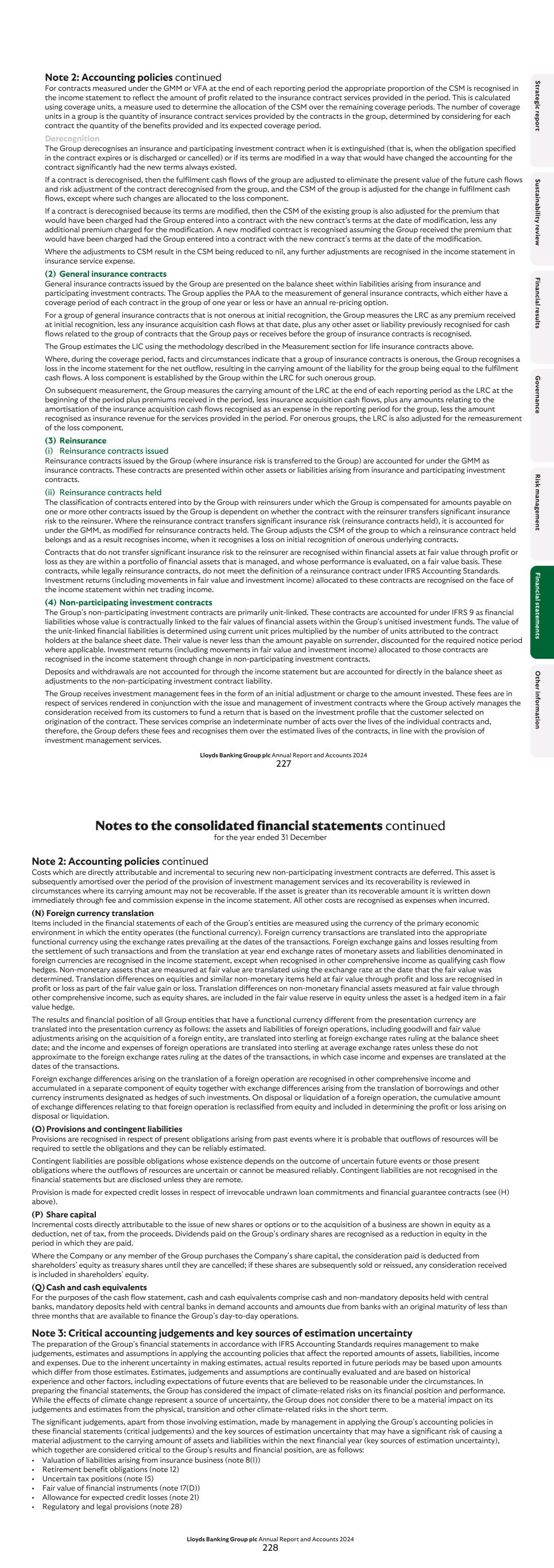
Note 2: Accounting policies continued For contracts measured under the GMM or VFA at the end of each reporting period the appropriate proportion of the CSM is recognised in the income statement to reflect the amount of profit related to the insurance contract services provided in the period. This is calculated using coverage units, a measure used to determine the allocation of the CSM over the remaining coverage periods. The number of coverage units in a group is the quantity of insurance contract services provided by the contracts in the group, determined by considering for each contract the quantity of the benefits provided and its expected coverage period. Derecognition The Group derecognises an insurance and participating investment contract when it is extinguished (that is, when the obligation specified in the contract expires or is discharged or cancelled) or if its terms are modified in a way that would have changed the accounting for the contract significantly had the new terms always existed. If a contract is derecognised, then the fulfilment cash flows of the group are adjusted to eliminate the present value of the future cash flows and risk adjustment of the contract derecognised from the group, and the CSM of the group is adjusted for the change in fulfilment cash flows, except where such changes are allocated to the loss component. If a contract is derecognised because its terms are modified, then the CSM of the existing group is also adjusted for the premium that would have been charged had the Group entered into a contract with the new contract’s terms at the date of modification, less any additional premium charged for the modification. A new modified contract is recognised assuming the Group received the premium that would have been charged had the Group entered into a contract with the new contract’s terms at the date of the modification. Where the adjustments to CSM result in the CSM being reduced to nil, any further adjustments are recognised in the income statement in insurance service expense. (2) General insurance contracts General insurance contracts issued by the Group are presented on the balance sheet within liabilities arising from insurance and participating investment contracts. The Group applies the PAA to the measurement of general insurance contracts, which either have a coverage period of each contract in the group of one year or less or have an annual re-pricing option. For a group of general insurance contracts that is not onerous at initial recognition, the Group measures the LRC as any premium received at initial recognition, less any insurance acquisition cash flows at that date, plus any other asset or liability previously recognised for cash flows related to the group of contracts that the Group pays or receives before the group of insurance contracts is recognised. The Group estimates the LIC using the methodology described in the Measurement section for life insurance contracts above. Where, during the coverage period, facts and circumstances indicate that a group of insurance contracts is onerous, the Group recognises a loss in the income statement for the net outflow, resulting in the carrying amount of the liability for the group being equal to the fulfilment cash flows. A loss component is established by the Group within the LRC for such onerous group. On subsequent measurement, the Group measures the carrying amount of the LRC at the end of each reporting period as the LRC at the beginning of the period plus premiums received in the period, less insurance acquisition cash flows, plus any amounts relating to the amortisation of the insurance acquisition cash flows recognised as an expense in the reporting period for the group, less the amount recognised as insurance revenue for the services provided in the period. For onerous groups, the LRC is also adjusted for the remeasurement of the loss component. (3) Reinsurance (i) Reinsurance contracts issued Reinsurance contracts issued by the Group (where insurance risk is transferred to the Group) are accounted for under the GMM as insurance contracts. These contracts are presented within other assets or liabilities arising from insurance and participating investment contracts. (ii) Reinsurance contracts held The classification of contracts entered into by the Group with reinsurers under which the Group is compensated for amounts payable on one or more other contracts issued by the Group is dependent on whether the contract with the reinsurer transfers significant insurance risk to the reinsurer. Where the reinsurance contract transfers significant insurance risk (reinsurance contracts held), it is accounted for under the GMM, as modified for reinsurance contracts held. The Group adjusts the CSM of the group to which a reinsurance contract held belongs and as a result recognises income, when it recognises a loss on initial recognition of onerous underlying contracts. Contracts that do not transfer significant insurance risk to the reinsurer are recognised within financial assets at fair value through profit or loss as they are within a portfolio of financial assets that is managed, and whose performance is evaluated, on a fair value basis. These contracts, while legally reinsurance contracts, do not meet the definition of a reinsurance contract under IFRS Accounting Standards. Investment returns (including movements in fair value and investment income) allocated to these contracts are recognised on the face of the income statement within net trading income. (4) Non-participating investment contracts The Group’s non-participating investment contracts are primarily unit-linked. These contracts are accounted for under IFRS 9 as financial liabilities whose value is contractually linked to the fair values of financial assets within the Group’s unitised investment funds. The value of the unit-linked financial liabilities is determined using current unit prices multiplied by the number of units attributed to the contract holders at the balance sheet date. Their value is never less than the amount payable on surrender, discounted for the required notice period where applicable. Investment returns (including movements in fair value and investment income) allocated to those contracts are recognised in the income statement through change in non-participating investment contracts. Deposits and withdrawals are not accounted for through the income statement but are accounted for directly in the balance sheet as adjustments to the non-participating investment contract liability. The Group receives investment management fees in the form of an initial adjustment or charge to the amount invested. These fees are in respect of services rendered in conjunction with the issue and management of investment contracts where the Group actively manages the consideration received from its customers to fund a return that is based on the investment profile that the customer selected on origination of the contract. These services comprise an indeterminate number of acts over the lives of the individual contracts and, therefore, the Group defers these fees and recognises them over the estimated lives of the contracts, in line with the provision of investment management services. Lloyds Banking Group plc Annual Report and Accounts 2024 227 l i ts 2 O th e r in fo rm a tio n F in a n cia l sta te m e n ts R isk m a n a ge m e n t F in a n cia l re su lts S u sta in a b ility re vie w S tra te gic re p o rt G o ve rn a n ce Note 2: Accounting policies continued Costs which are directly attributable and incremental to securing new non-participating investment contracts are deferred. This asset is subsequently amortised over the period of the provision of investment management services and its recoverability is reviewed in circumstances where its carrying amount may not be recoverable. If the asset is greater than its recoverable amount it is written down immediately through fee and commission expense in the income statement. All other costs are recognised as expenses when incurred. (N) Foreign currency translation Items included in the financial statements of each of the Group’s entities are measured using the currency of the primary economic environment in which the entity operates (the functional currency). Foreign currency transactions are translated into the appropriate functional currency using the exchange rates prevailing at the dates of the transactions. Foreign exchange gains and losses resulting from the settlement of such transactions and from the translation at year end exchange rates of monetary assets and liabilities denominated in foreign currencies are recognised in the income statement, except when recognised in other comprehensive income as qualifying cash flow hedges. Non-monetary assets that are measured at fair value are translated using the exchange rate at the date that the fair value was determined. Translation differences on equities and similar non-monetary items held at fair value through profit and loss are recognised in profit or loss as part of the fair value gain or loss. Translation differences on non-monetary financial assets measured at fair value through other comprehensive income, such as equity shares, are included in the fair value reserve in equity unless the asset is a hedged item in a fair value hedge. The results and financial position of all Group entities that have a functional currency different from the presentation currency are translated into the presentation currency as follows: the assets and liabilities of foreign operations, including goodwill and fair value adjustments arising on the acquisition of a foreign entity, are translated into sterling at foreign exchange rates ruling at the balance sheet date; and the income and expenses of foreign operations are translated into sterling at average exchange rates unless these do not approximate to the foreign exchange rates ruling at the dates of the transactions, in which case income and expenses are translated at the dates of the transactions. Foreign exchange differences arising on the translation of a foreign operation are recognised in other comprehensive income and accumulated in a separate component of equity together with exchange differences arising from the translation of borrowings and other currency instruments designated as hedges of such investments. On disposal or liquidation of a foreign operation, the cumulative amount of exchange differences relating to that foreign operation is reclassified from equity and included in determining the profit or loss arising on disposal or liquidation. (O) Provisions and contingent liabilities Provisions are recognised in respect of present obligations arising from past events where it is probable that outflows of resources will be required to settle the obligations and they can be reliably estimated. Contingent liabilities are possible obligations whose existence depends on the outcome of uncertain future events or those present obligations where the outflows of resources are uncertain or cannot be measured reliably. Contingent liabilities are not recognised in the financial statements but are disclosed unless they are remote. Provision is made for expected credit losses in respect of irrevocable undrawn loan commitments and financial guarantee contracts (see (H) above). (P) Share capital Incremental costs directly attributable to the issue of new shares or options or to the acquisition of a business are shown in equity as a deduction, net of tax, from the proceeds. Dividends paid on the Group’s ordinary shares are recognised as a reduction in equity in the period in which they are paid. Where the Company or any member of the Group purchases the Company’s share capital, the consideration paid is deducted from shareholders’ equity as treasury shares until they are cancelled; if these shares are subsequently sold or reissued, any consideration received is included in shareholders’ equity. (Q) Cash and cash equivalents For the purposes of the cash flow statement, cash and cash equivalents comprise cash and non-mandatory deposits held with central banks, mandatory deposits held with central banks in demand accounts and amounts due from banks with an original maturity of less than three months that are available to finance the Group’s day-to-day operations. Note 3: Critical accounting judgements and key sources of estimation uncertainty The preparation of the Group’s financial statements in accordance with IFRS Accounting Standards requires management to make judgements, estimates and assumptions in applying the accounting policies that affect the reported amounts of assets, liabilities, income and expenses. Due to the inherent uncertainty in making estimates, actual results reported in future periods may be based upon amounts which differ from those estimates. Estimates, judgements and assumptions are continually evaluated and are based on historical experience and other factors, including expectations of future events that are believed to be reasonable under the circumstances. In preparing the financial statements, the Group has considered the impact of climate-related risks on its financial position and performance. While the effects of climate change represent a source of uncertainty, the Group does not consider there to be a material impact on its judgements and estimates from the physical, transition and other climate-related risks in the short term. The significant judgements, apart from those involving estimation, made by management in applying the Group’s accounting policies in these financial statements (critical judgements) and the key sources of estimation uncertainty that may have a significant risk of causing a material adjustment to the carrying amount of assets and liabilities within the next financial year (key sources of estimation uncertainty), which together are considered critical to the Group’s results and financial position, are as follows: • Valuation of liabilities arising from insurance business (note 8(I)) • Retirement benefit obligations (note 12) • Uncertain tax positions (note 15) • Fair value of financial instruments (note 17(D)) • Allowance for expected credit losses (note 21) • Regulatory and legal provisions (note 28) Notes to the consolidated financial statements continued for the year ended 31 December Lloyds Banking Group plc Annual Report and Accounts 2024 228 l i ts
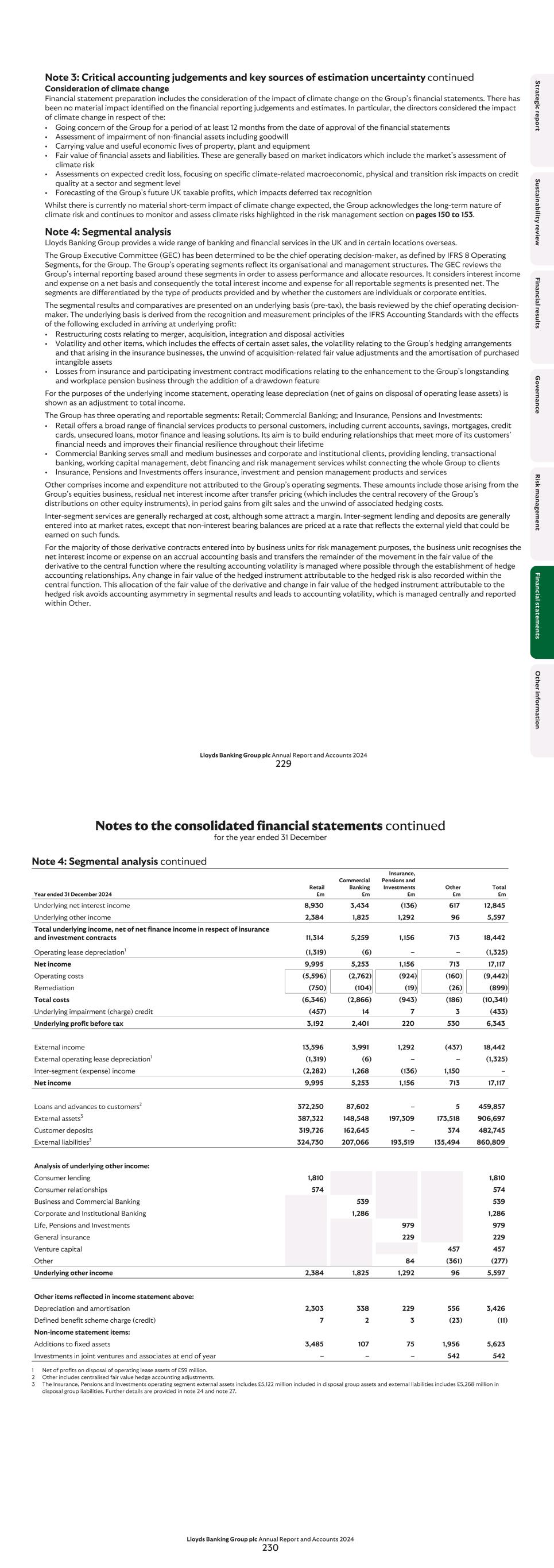
Note 3: Critical accounting judgements and key sources of estimation uncertainty continued Consideration of climate change Financial statement preparation includes the consideration of the impact of climate change on the Group’s financial statements. There has been no material impact identified on the financial reporting judgements and estimates. In particular, the directors considered the impact of climate change in respect of the: • Going concern of the Group for a period of at least 12 months from the date of approval of the financial statements • Assessment of impairment of non-financial assets including goodwill • Carrying value and useful economic lives of property, plant and equipment • Fair value of financial assets and liabilities. These are generally based on market indicators which include the market’s assessment of climate risk • Assessments on expected credit loss, focusing on specific climate-related macroeconomic, physical and transition risk impacts on credit quality at a sector and segment level • Forecasting of the Group’s future UK taxable profits, which impacts deferred tax recognition Whilst there is currently no material short-term impact of climate change expected, the Group acknowledges the long-term nature of climate risk and continues to monitor and assess climate risks highlighted in the risk management section on pages 150 to 153. Note 4: Segmental analysis Lloyds Banking Group provides a wide range of banking and financial services in the UK and in certain locations overseas. The Group Executive Committee (GEC) has been determined to be the chief operating decision-maker, as defined by IFRS 8 Operating Segments, for the Group. The Group’s operating segments reflect its organisational and management structures. The GEC reviews the Group’s internal reporting based around these segments in order to assess performance and allocate resources. It considers interest income and expense on a net basis and consequently the total interest income and expense for all reportable segments is presented net. The segments are differentiated by the type of products provided and by whether the customers are individuals or corporate entities. The segmental results and comparatives are presented on an underlying basis (pre-tax), the basis reviewed by the chief operating decision- maker. The underlying basis is derived from the recognition and measurement principles of the IFRS Accounting Standards with the effects of the following excluded in arriving at underlying profit: • Restructuring costs relating to merger, acquisition, integration and disposal activities • Volatility and other items, which includes the effects of certain asset sales, the volatility relating to the Group’s hedging arrangements and that arising in the insurance businesses, the unwind of acquisition-related fair value adjustments and the amortisation of purchased intangible assets • Losses from insurance and participating investment contract modifications relating to the enhancement to the Group’s longstanding and workplace pension business through the addition of a drawdown feature For the purposes of the underlying income statement, operating lease depreciation (net of gains on disposal of operating lease assets) is shown as an adjustment to total income. The Group has three operating and reportable segments: Retail; Commercial Banking; and Insurance, Pensions and Investments: • Retail offers a broad range of financial services products to personal customers, including current accounts, savings, mortgages, credit cards, unsecured loans, motor finance and leasing solutions. Its aim is to build enduring relationships that meet more of its customers’ financial needs and improves their financial resilience throughout their lifetime • Commercial Banking serves small and medium businesses and corporate and institutional clients, providing lending, transactional banking, working capital management, debt financing and risk management services whilst connecting the whole Group to clients • Insurance, Pensions and Investments offers insurance, investment and pension management products and services Other comprises income and expenditure not attributed to the Group’s operating segments. These amounts include those arising from the Group’s equities business, residual net interest income after transfer pricing (which includes the central recovery of the Group’s distributions on other equity instruments), in period gains from gilt sales and the unwind of associated hedging costs. Inter-segment services are generally recharged at cost, although some attract a margin. Inter-segment lending and deposits are generally entered into at market rates, except that non-interest bearing balances are priced at a rate that reflects the external yield that could be earned on such funds. For the majority of those derivative contracts entered into by business units for risk management purposes, the business unit recognises the net interest income or expense on an accrual accounting basis and transfers the remainder of the movement in the fair value of the derivative to the central function where the resulting accounting volatility is managed where possible through the establishment of hedge accounting relationships. Any change in fair value of the hedged instrument attributable to the hedged risk is also recorded within the central function. This allocation of the fair value of the derivative and change in fair value of the hedged instrument attributable to the hedged risk avoids accounting asymmetry in segmental results and leads to accounting volatility, which is managed centrally and reported within Other. Lloyds Banking Group plc Annual Report and Accounts 2024 229 l i ts 2 O th e r in fo rm a tio n F in a n cia l sta te m e n ts R isk m a n a ge m e n t F in a n cia l re su lts S u sta in a b ility re vie w S tra te gic re p o rt G o ve rn a n ce Note 4: Segmental analysis continued Year ended 31 December 2024 Retail £m Commercial Banking £m Insurance, Pensions and Investments £m Other £m Total £m Underlying net interest income 8,930 3,434 (136) 617 12,845 Underlying other income 2,384 1,825 1,292 96 5,597 Total underlying income, net of net finance income in respect of insurance and investment contracts 11,314 5,259 1,156 713 18,442 Operating lease depreciation1 (1,319) (6) – – (1,325) Net income 9,995 5,253 1,156 713 17,117 Operating costs (5,596) (2,762) (924) (160) (9,442) Remediation (750) (104) (19) (26) (899) Total costs (6,346) (2,866) (943) (186) (10,341) Underlying impairment (charge) credit (457) 14 7 3 (433) Underlying profit before tax 3,192 2,401 220 530 6,343 External income 13,596 3,991 1,292 (437) 18,442 External operating lease depreciation1 (1,319) (6) – – (1,325) Inter-segment (expense) income (2,282) 1,268 (136) 1,150 – Net income 9,995 5,253 1,156 713 17,117 Loans and advances to customers2 372,250 87,602 – 5 459,857 External assets3 387,322 148,548 197,309 173,518 906,697 Customer deposits 319,726 162,645 – 374 482,745 External liabilities3 324,730 207,066 193,519 135,494 860,809 Analysis of underlying other income: Consumer lending 1,810 1,810 Consumer relationships 574 574 Business and Commercial Banking 539 539 Corporate and Institutional Banking 1,286 1,286 Life, Pensions and Investments 979 979 General insurance 229 229 Venture capital 457 457 Other 84 (361) (277) Underlying other income 2,384 1,825 1,292 96 5,597 Other items reflected in income statement above: Depreciation and amortisation 2,303 338 229 556 3,426 Defined benefit scheme charge (credit) 7 2 3 (23) (11) Non-income statement items: Additions to fixed assets 3,485 107 75 1,956 5,623 Investments in joint ventures and associates at end of year – – – 542 542 1 Net of profits on disposal of operating lease assets of £59 million. 2 Other includes centralised fair value hedge accounting adjustments. 3 The Insurance, Pensions and Investments operating segment external assets includes £5,122 million included in disposal group assets and external liabilities includes £5,268 million in disposal group liabilities. Further details are provided in note 24 and note 27. Notes to the consolidated financial statements continued for the year ended 31 December Lloyds Banking Group plc Annual Report and Accounts 2024 230 l i ts
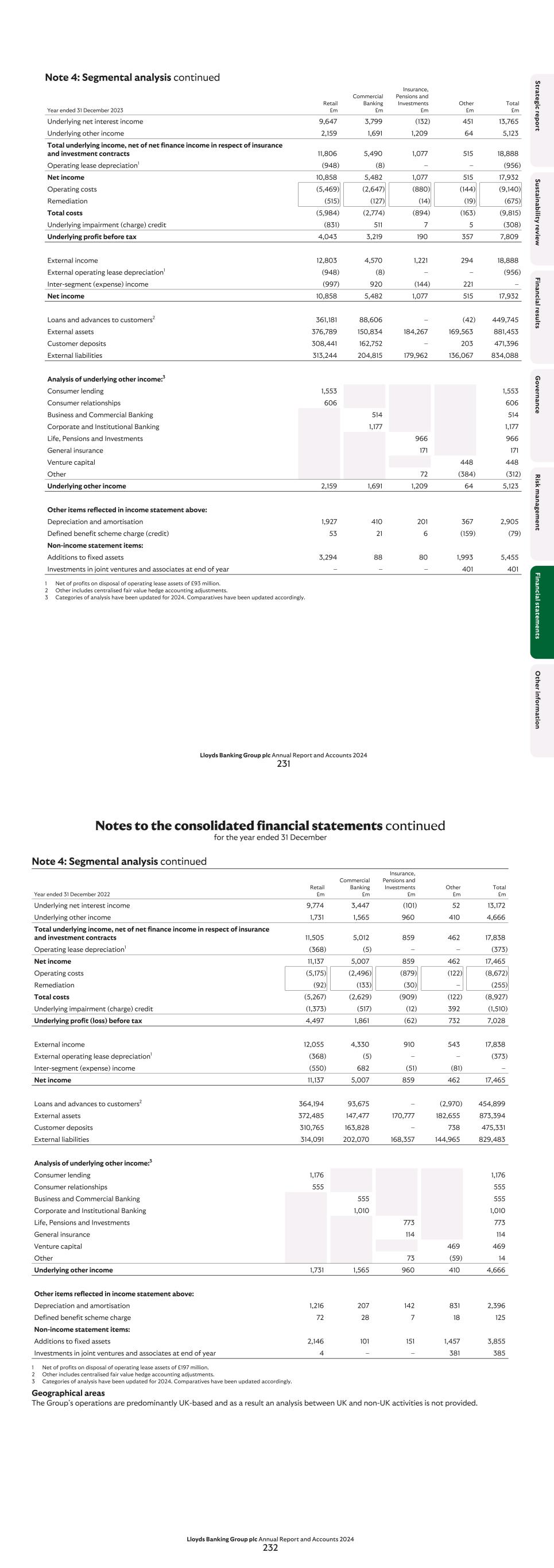
Note 4: Segmental analysis continued Year ended 31 December 2023 Retail £m Commercial Banking £m Insurance, Pensions and Investments £m Other £m Total £m Underlying net interest income 9,647 3,799 (132) 451 13,765 Underlying other income 2,159 1,691 1,209 64 5,123 Total underlying income, net of net finance income in respect of insurance and investment contracts 11,806 5,490 1,077 515 18,888 Operating lease depreciation1 (948) (8) – – (956) Net income 10,858 5,482 1,077 515 17,932 Operating costs (5,469) (2,647) (880) (144) (9,140) Remediation (515) (127) (14) (19) (675) Total costs (5,984) (2,774) (894) (163) (9,815) Underlying impairment (charge) credit (831) 511 7 5 (308) Underlying profit before tax 4,043 3,219 190 357 7,809 External income 12,803 4,570 1,221 294 18,888 External operating lease depreciation1 (948) (8) – – (956) Inter-segment (expense) income (997) 920 (144) 221 – Net income 10,858 5,482 1,077 515 17,932 Loans and advances to customers2 361,181 88,606 – (42) 449,745 External assets 376,789 150,834 184,267 169,563 881,453 Customer deposits 308,441 162,752 – 203 471,396 External liabilities 313,244 204,815 179,962 136,067 834,088 Analysis of underlying other income:3 Consumer lending 1,553 1,553 Consumer relationships 606 606 Business and Commercial Banking 514 514 Corporate and Institutional Banking 1,177 1,177 Life, Pensions and Investments 966 966 General insurance 171 171 Venture capital 448 448 Other 72 (384) (312) Underlying other income 2,159 1,691 1,209 64 5,123 Other items reflected in income statement above: Depreciation and amortisation 1,927 410 201 367 2,905 Defined benefit scheme charge (credit) 53 21 6 (159) (79) Non-income statement items: Additions to fixed assets 3,294 88 80 1,993 5,455 Investments in joint ventures and associates at end of year – – – 401 401 1 Net of profits on disposal of operating lease assets of £93 million. 2 Other includes centralised fair value hedge accounting adjustments. 3 Categories of analysis have been updated for 2024. Comparatives have been updated accordingly. Lloyds Banking Group plc Annual Report and Accounts 2024 231 l i ts 2 O th e r in fo rm a tio n F in a n cia l sta te m e n ts R isk m a n a ge m e n t F in a n cia l re su lts S u sta in a b ility re vie w S tra te gic re p o rt G o ve rn a n ce Note 4: Segmental analysis continued Year ended 31 December 2022 Retail £m Commercial Banking £m Insurance, Pensions and Investments £m Other £m Total £m Underlying net interest income 9,774 3,447 (101) 52 13,172 Underlying other income 1,731 1,565 960 410 4,666 Total underlying income, net of net finance income in respect of insurance and investment contracts 11,505 5,012 859 462 17,838 Operating lease depreciation1 (368) (5) – – (373) Net income 11,137 5,007 859 462 17,465 Operating costs (5,175) (2,496) (879) (122) (8,672) Remediation (92) (133) (30) – (255) Total costs (5,267) (2,629) (909) (122) (8,927) Underlying impairment (charge) credit (1,373) (517) (12) 392 (1,510) Underlying profit (loss) before tax 4,497 1,861 (62) 732 7,028 External income 12,055 4,330 910 543 17,838 External operating lease depreciation1 (368) (5) – – (373) Inter-segment (expense) income (550) 682 (51) (81) – Net income 11,137 5,007 859 462 17,465 Loans and advances to customers2 364,194 93,675 – (2,970) 454,899 External assets 372,485 147,477 170,777 182,655 873,394 Customer deposits 310,765 163,828 – 738 475,331 External liabilities 314,091 202,070 168,357 144,965 829,483 Analysis of underlying other income:3 Consumer lending 1,176 1,176 Consumer relationships 555 555 Business and Commercial Banking 555 555 Corporate and Institutional Banking 1,010 1,010 Life, Pensions and Investments 773 773 General insurance 114 114 Venture capital 469 469 Other 73 (59) 14 Underlying other income 1,731 1,565 960 410 4,666 Other items reflected in income statement above: Depreciation and amortisation 1,216 207 142 831 2,396 Defined benefit scheme charge 72 28 7 18 125 Non-income statement items: Additions to fixed assets 2,146 101 151 1,457 3,855 Investments in joint ventures and associates at end of year 4 – – 381 385 1 Net of profits on disposal of operating lease assets of £197 million. 2 Other includes centralised fair value hedge accounting adjustments. 3 Categories of analysis have been updated for 2024. Comparatives have been updated accordingly. Geographical areas The Group’s operations are predominantly UK-based and as a result an analysis between UK and non-UK activities is not provided. Notes to the consolidated financial statements continued for the year ended 31 December Lloyds Banking Group plc Annual Report and Accounts 2024 232 l i ts
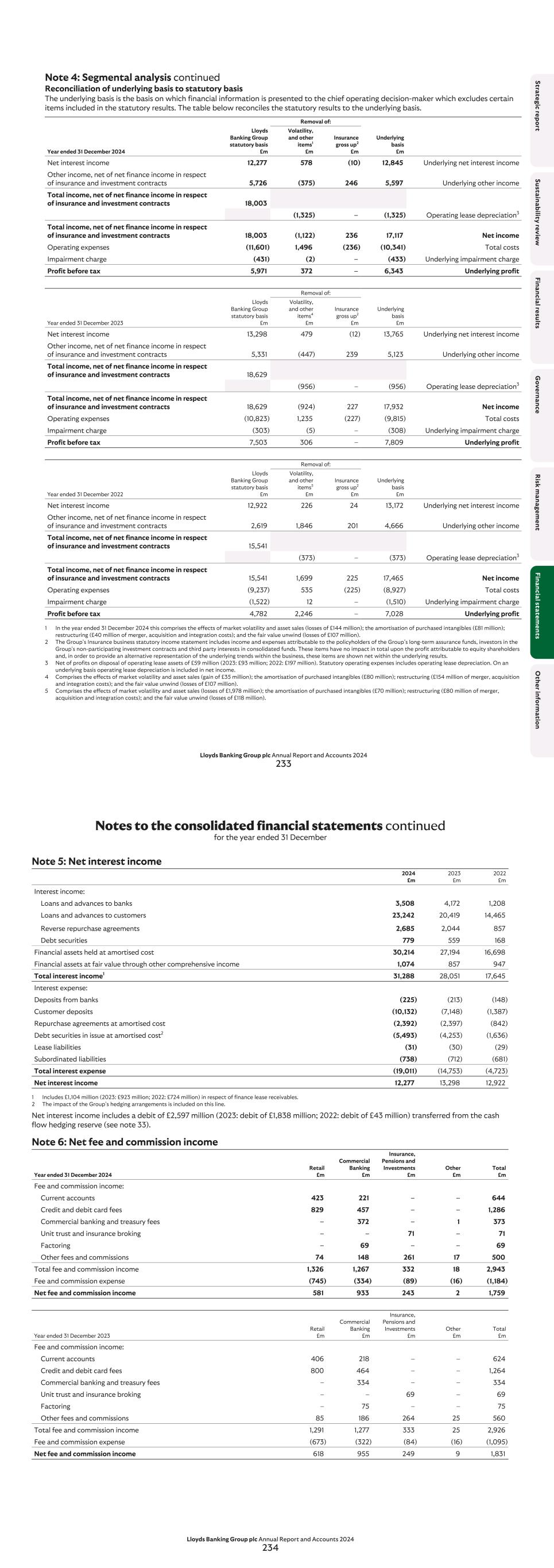
Note 4: Segmental analysis continued Reconciliation of underlying basis to statutory basis The underlying basis is the basis on which financial information is presented to the chief operating decision-maker which excludes certain items included in the statutory results. The table below reconciles the statutory results to the underlying basis. Removal of: Year ended 31 December 2024 Lloyds Banking Group statutory basis £m Volatility, and other items1 £m Insurance gross up2 £m Underlying basis £m Net interest income 12,277 578 (10) 12,845 Underlying net interest income Other income, net of net finance income in respect of insurance and investment contracts 5,726 (375) 246 5,597 Underlying other income Total income, net of net finance income in respect of insurance and investment contracts 18,003 (1,325) – (1,325) Operating lease depreciation3 Total income, net of net finance income in respect of insurance and investment contracts 18,003 (1,122) 236 17,117 Net income Operating expenses (11,601) 1,496 (236) (10,341) Total costs Impairment charge (431) (2) – (433) Underlying impairment charge Profit before tax 5,971 372 – 6,343 Underlying profit Removal of: Year ended 31 December 2023 Lloyds Banking Group statutory basis £m Volatility, and other items4 £m Insurance gross up2 £m Underlying basis £m Net interest income 13,298 479 (12) 13,765 Underlying net interest income Other income, net of net finance income in respect of insurance and investment contracts 5,331 (447) 239 5,123 Underlying other income Total income, net of net finance income in respect of insurance and investment contracts 18,629 (956) – (956) Operating lease depreciation3 Total income, net of net finance income in respect of insurance and investment contracts 18,629 (924) 227 17,932 Net income Operating expenses (10,823) 1,235 (227) (9,815) Total costs Impairment charge (303) (5) – (308) Underlying impairment charge Profit before tax 7,503 306 – 7,809 Underlying profit Removal of: Year ended 31 December 2022 Lloyds Banking Group statutory basis £m Volatility, and other items5 £m Insurance gross up2 £m Underlying basis £m Net interest income 12,922 226 24 13,172 Underlying net interest income Other income, net of net finance income in respect of insurance and investment contracts 2,619 1,846 201 4,666 Underlying other income Total income, net of net finance income in respect of insurance and investment contracts 15,541 (373) – (373) Operating lease depreciation3 Total income, net of net finance income in respect of insurance and investment contracts 15,541 1,699 225 17,465 Net income Operating expenses (9,237) 535 (225) (8,927) Total costs Impairment charge (1,522) 12 – (1,510) Underlying impairment charge Profit before tax 4,782 2,246 – 7,028 Underlying profit 1 In the year ended 31 December 2024 this comprises the effects of market volatility and asset sales (losses of £144 million); the amortisation of purchased intangibles (£81 million); restructuring (£40 million of merger, acquisition and integration costs); and the fair value unwind (losses of £107 million). 2 The Group’s Insurance business statutory income statement includes income and expenses attributable to the policyholders of the Group’s long-term assurance funds, investors in the Group's non-participating investment contracts and third party interests in consolidated funds. These items have no impact in total upon the profit attributable to equity shareholders and, in order to provide an alternative representation of the underlying trends within the business, these items are shown net within the underlying results. 3 Net of profits on disposal of operating lease assets of £59 million (2023: £93 million; 2022: £197 million). Statutory operating expenses includes operating lease depreciation. On an underlying basis operating lease depreciation is included in net income. 4 Comprises the effects of market volatility and asset sales (gain of £35 million); the amortisation of purchased intangibles (£80 million); restructuring (£154 million of merger, acquisition and integration costs); and the fair value unwind (losses of £107 million). 5 Comprises the effects of market volatility and asset sales (losses of £1,978 million); the amortisation of purchased intangibles (£70 million); restructuring (£80 million of merger, acquisition and integration costs); and the fair value unwind (losses of £118 million). Lloyds Banking Group plc Annual Report and Accounts 2024 233 l i ts 2 O th e r in fo rm a tio n F in a n cia l sta te m e n ts R isk m a n a ge m e n t F in a n cia l re su lts S u sta in a b ility re vie w S tra te gic re p o rt G o ve rn a n ce Note 5: Net interest income 2024 £m 2023 £m 2022 £m Interest income: Loans and advances to banks 3,508 4,172 1,208 Loans and advances to customers 23,242 20,419 14,465 Reverse repurchase agreements 2,685 2,044 857 Debt securities 779 559 168 Financial assets held at amortised cost 30,214 27,194 16,698 Financial assets at fair value through other comprehensive income 1,074 857 947 Total interest income1 31,288 28,051 17,645 Interest expense: Deposits from banks (225) (213) (148) Customer deposits (10,132) (7,148) (1,387) Repurchase agreements at amortised cost (2,392) (2,397) (842) Debt securities in issue at amortised cost2 (5,493) (4,253) (1,636) Lease liabilities (31) (30) (29) Subordinated liabilities (738) (712) (681) Total interest expense (19,011) (14,753) (4,723) Net interest income 12,277 13,298 12,922 1 Includes £1,104 million (2023: £923 million; 2022: £724 million) in respect of finance lease receivables. 2 The impact of the Group’s hedging arrangements is included on this line. Net interest income includes a debit of £2,597 million (2023: debit of £1,838 million; 2022: debit of £43 million) transferred from the cash flow hedging reserve (see note 33). Note 6: Net fee and commission income Year ended 31 December 2024 Retail £m Commercial Banking £m Insurance, Pensions and Investments £m Other £m Total £m Fee and commission income: Current accounts 423 221 – – 644 Credit and debit card fees 829 457 – – 1,286 Commercial banking and treasury fees – 372 – 1 373 Unit trust and insurance broking – – 71 – 71 Factoring – 69 – – 69 Other fees and commissions 74 148 261 17 500 Total fee and commission income 1,326 1,267 332 18 2,943 Fee and commission expense (745) (334) (89) (16) (1,184) Net fee and commission income 581 933 243 2 1,759 Year ended 31 December 2023 Retail £m Commercial Banking £m Insurance, Pensions and Investments £m Other £m Total £m Fee and commission income: Current accounts 406 218 – – 624 Credit and debit card fees 800 464 – – 1,264 Commercial banking and treasury fees – 334 – – 334 Unit trust and insurance broking – – 69 – 69 Factoring – 75 – – 75 Other fees and commissions 85 186 264 25 560 Total fee and commission income 1,291 1,277 333 25 2,926 Fee and commission expense (673) (322) (84) (16) (1,095) Net fee and commission income 618 955 249 9 1,831 Notes to the consolidated financial statements continued for the year ended 31 December Lloyds Banking Group plc Annual Report and Accounts 2024 234 l i ts
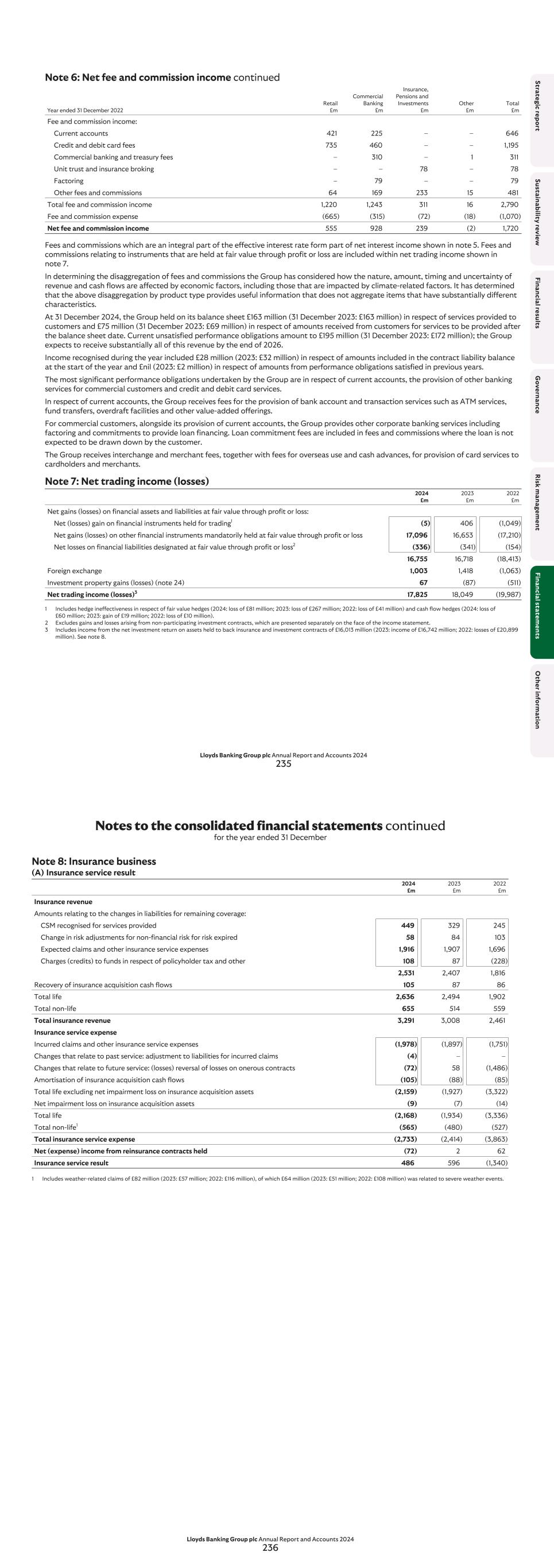
Note 6: Net fee and commission income continued Year ended 31 December 2022 Retail £m Commercial Banking £m Insurance, Pensions and Investments £m Other £m Total £m Fee and commission income: Current accounts 421 225 – – 646 Credit and debit card fees 735 460 – – 1,195 Commercial banking and treasury fees – 310 – 1 311 Unit trust and insurance broking – – 78 – 78 Factoring – 79 – – 79 Other fees and commissions 64 169 233 15 481 Total fee and commission income 1,220 1,243 311 16 2,790 Fee and commission expense (665) (315) (72) (18) (1,070) Net fee and commission income 555 928 239 (2) 1,720 Fees and commissions which are an integral part of the effective interest rate form part of net interest income shown in note 5. Fees and commissions relating to instruments that are held at fair value through profit or loss are included within net trading income shown in note 7. In determining the disaggregation of fees and commissions the Group has considered how the nature, amount, timing and uncertainty of revenue and cash flows are affected by economic factors, including those that are impacted by climate-related factors. It has determined that the above disaggregation by product type provides useful information that does not aggregate items that have substantially different characteristics. At 31 December 2024, the Group held on its balance sheet £163 million (31 December 2023: £163 million) in respect of services provided to customers and £75 million (31 December 2023: £69 million) in respect of amounts received from customers for services to be provided after the balance sheet date. Current unsatisfied performance obligations amount to £195 million (31 December 2023: £172 million); the Group expects to receive substantially all of this revenue by the end of 2026. Income recognised during the year included £28 million (2023: £32 million) in respect of amounts included in the contract liability balance at the start of the year and £nil (2023: £2 million) in respect of amounts from performance obligations satisfied in previous years. The most significant performance obligations undertaken by the Group are in respect of current accounts, the provision of other banking services for commercial customers and credit and debit card services. In respect of current accounts, the Group receives fees for the provision of bank account and transaction services such as ATM services, fund transfers, overdraft facilities and other value-added offerings. For commercial customers, alongside its provision of current accounts, the Group provides other corporate banking services including factoring and commitments to provide loan financing. Loan commitment fees are included in fees and commissions where the loan is not expected to be drawn down by the customer. The Group receives interchange and merchant fees, together with fees for overseas use and cash advances, for provision of card services to cardholders and merchants. Note 7: Net trading income (losses) 2024 £m 2023 £m 2022 £m Net gains (losses) on financial assets and liabilities at fair value through profit or loss: Net (losses) gain on financial instruments held for trading1 (5) 406 (1,049) Net gains (losses) on other financial instruments mandatorily held at fair value through profit or loss 17,096 16,653 (17,210) Net losses on financial liabilities designated at fair value through profit or loss2 (336) (341) (154) 16,755 16,718 (18,413) Foreign exchange 1,003 1,418 (1,063) Investment property gains (losses) (note 24) 67 (87) (511) Net trading income (losses)3 17,825 18,049 (19,987) 1 Includes hedge ineffectiveness in respect of fair value hedges (2024: loss of £81 million; 2023: loss of £267 million; 2022: loss of £41 million) and cash flow hedges (2024: loss of £60 million; 2023: gain of £19 million; 2022: loss of £10 million). 2 Excludes gains and losses arising from non-participating investment contracts, which are presented separately on the face of the income statement. 3 Includes income from the net investment return on assets held to back insurance and investment contracts of £16,013 million (2023: income of £16,742 million; 2022: losses of £20,899 million). See note 8. Lloyds Banking Group plc Annual Report and Accounts 2024 235 l i ts 2 O th e r in fo rm a tio n F in a n cia l sta te m e n ts R isk m a n a ge m e n t F in a n cia l re su lts S u sta in a b ility re vie w S tra te gic re p o rt G o ve rn a n ce Note 8: Insurance business (A) Insurance service result 2024 £m 2023 £m 2022 £m Insurance revenue Amounts relating to the changes in liabilities for remaining coverage: CSM recognised for services provided 449 329 245 Change in risk adjustments for non-financial risk for risk expired 58 84 103 Expected claims and other insurance service expenses 1,916 1,907 1,696 Charges (credits) to funds in respect of policyholder tax and other 108 87 (228) 2,531 2,407 1,816 Recovery of insurance acquisition cash flows 105 87 86 Total life 2,636 2,494 1,902 Total non-life 655 514 559 Total insurance revenue 3,291 3,008 2,461 Insurance service expense Incurred claims and other insurance service expenses (1,978) (1,897) (1,751) Changes that relate to past service: adjustment to liabilities for incurred claims (4) – – Changes that relate to future service: (losses) reversal of losses on onerous contracts (72) 58 (1,486) Amortisation of insurance acquisition cash flows (105) (88) (85) Total life excluding net impairment loss on insurance acquisition assets (2,159) (1,927) (3,322) Net impairment loss on insurance acquisition assets (9) (7) (14) Total life (2,168) (1,934) (3,336) Total non-life1 (565) (480) (527) Total insurance service expense (2,733) (2,414) (3,863) Net (expense) income from reinsurance contracts held (72) 2 62 Insurance service result 486 596 (1,340) 1 Includes weather-related claims of £82 million (2023: £57 million; 2022: £116 million), of which £64 million (2023: £51 million; 2022: £108 million) was related to severe weather events. Notes to the consolidated financial statements continued for the year ended 31 December Lloyds Banking Group plc Annual Report and Accounts 2024 236 l i ts
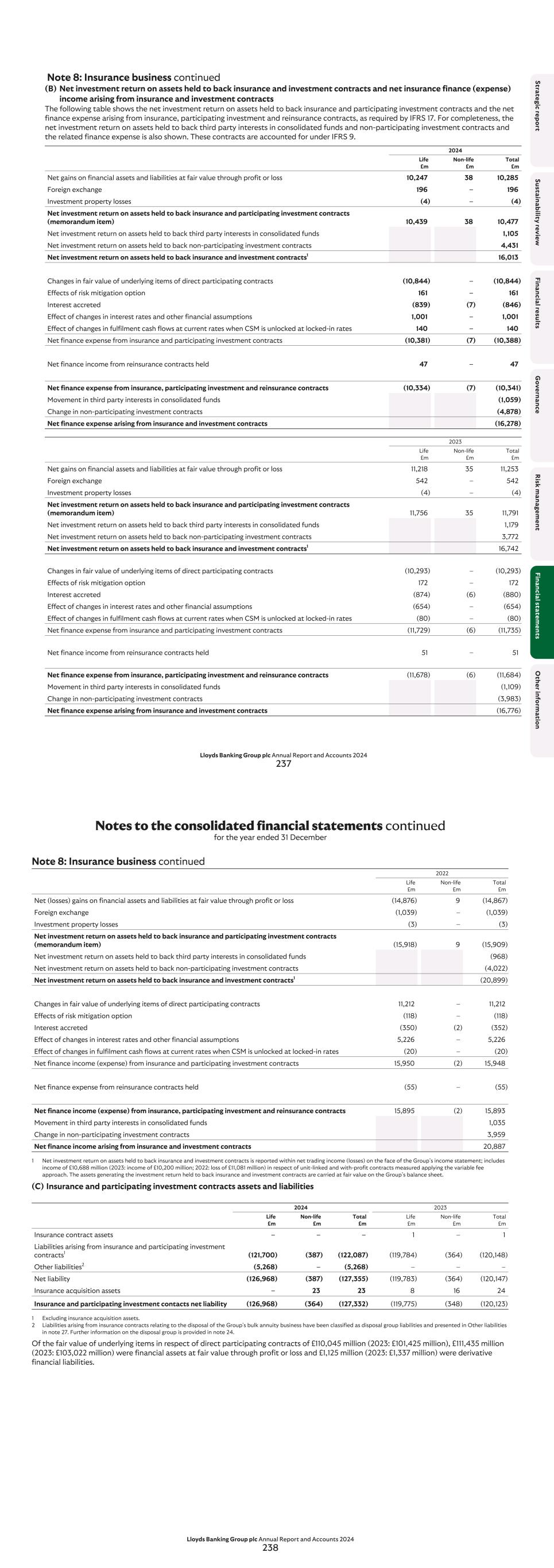
Note 8: Insurance business continued (B) Net investment return on assets held to back insurance and investment contracts and net insurance finance (expense) income arising from insurance and investment contracts The following table shows the net investment return on assets held to back insurance and participating investment contracts and the net finance expense arising from insurance, participating investment and reinsurance contracts, as required by IFRS 17. For completeness, the net investment return on assets held to back third party interests in consolidated funds and non-participating investment contracts and the related finance expense is also shown. These contracts are accounted for under IFRS 9. 2024 Life £m Non-life £m Total £m Net gains on financial assets and liabilities at fair value through profit or loss 10,247 38 10,285 Foreign exchange 196 – 196 Investment property losses (4) – (4) Net investment return on assets held to back insurance and participating investment contracts (memorandum item) 10,439 38 10,477 Net investment return on assets held to back third party interests in consolidated funds 1,105 Net investment return on assets held to back non-participating investment contracts 4,431 Net investment return on assets held to back insurance and investment contracts1 16,013 Changes in fair value of underlying items of direct participating contracts (10,844) – (10,844) Effects of risk mitigation option 161 – 161 Interest accreted (839) (7) (846) Effect of changes in interest rates and other financial assumptions 1,001 – 1,001 Effect of changes in fulfilment cash flows at current rates when CSM is unlocked at locked-in rates 140 – 140 Net finance expense from insurance and participating investment contracts (10,381) (7) (10,388) Net finance income from reinsurance contracts held 47 – 47 Net finance expense from insurance, participating investment and reinsurance contracts (10,334) (7) (10,341) Movement in third party interests in consolidated funds (1,059) Change in non-participating investment contracts (4,878) Net finance expense arising from insurance and investment contracts (16,278) 2023 Life £m Non-life £m Total £m Net gains on financial assets and liabilities at fair value through profit or loss 11,218 35 11,253 Foreign exchange 542 – 542 Investment property losses (4) – (4) Net investment return on assets held to back insurance and participating investment contracts (memorandum item) 11,756 35 11,791 Net investment return on assets held to back third party interests in consolidated funds 1,179 Net investment return on assets held to back non-participating investment contracts 3,772 Net investment return on assets held to back insurance and investment contracts1 16,742 Changes in fair value of underlying items of direct participating contracts (10,293) – (10,293) Effects of risk mitigation option 172 – 172 Interest accreted (874) (6) (880) Effect of changes in interest rates and other financial assumptions (654) – (654) Effect of changes in fulfilment cash flows at current rates when CSM is unlocked at locked-in rates (80) – (80) Net finance expense from insurance and participating investment contracts (11,729) (6) (11,735) Net finance income from reinsurance contracts held 51 – 51 Net finance expense from insurance, participating investment and reinsurance contracts (11,678) (6) (11,684) Movement in third party interests in consolidated funds (1,109) Change in non-participating investment contracts (3,983) Net finance expense arising from insurance and investment contracts (16,776) Lloyds Banking Group plc Annual Report and Accounts 2024 237 l i ts 2 O th e r in fo rm a tio n F in a n cia l sta te m e n ts R isk m a n a ge m e n t F in a n cia l re su lts S u sta in a b ility re vie w S tra te gic re p o rt G o ve rn a n ce Note 8: Insurance business continued 2022 Life £m Non-life £m Total £m Net (losses) gains on financial assets and liabilities at fair value through profit or loss (14,876) 9 (14,867) Foreign exchange (1,039) – (1,039) Investment property losses (3) – (3) Net investment return on assets held to back insurance and participating investment contracts (memorandum item) (15,918) 9 (15,909) Net investment return on assets held to back third party interests in consolidated funds (968) Net investment return on assets held to back non-participating investment contracts (4,022) Net investment return on assets held to back insurance and investment contracts1 (20,899) Changes in fair value of underlying items of direct participating contracts 11,212 – 11,212 Effects of risk mitigation option (118) – (118) Interest accreted (350) (2) (352) Effect of changes in interest rates and other financial assumptions 5,226 – 5,226 Effect of changes in fulfilment cash flows at current rates when CSM is unlocked at locked-in rates (20) – (20) Net finance income (expense) from insurance and participating investment contracts 15,950 (2) 15,948 Net finance expense from reinsurance contracts held (55) – (55) Net finance income (expense) from insurance, participating investment and reinsurance contracts 15,895 (2) 15,893 Movement in third party interests in consolidated funds 1,035 Change in non-participating investment contracts 3,959 Net finance income arising from insurance and investment contracts 20,887 1 Net investment return on assets held to back insurance and investment contracts is reported within net trading income (losses) on the face of the Group’s income statement; includes income of £10,688 million (2023: income of £10,200 million; 2022: loss of £11,081 million) in respect of unit-linked and with-profit contracts measured applying the variable fee approach. The assets generating the investment return held to back insurance and investment contracts are carried at fair value on the Group’s balance sheet. (C) Insurance and participating investment contracts assets and liabilities 2024 2023 Life £m Non-life £m Total £m Life £m Non-life £m Total £m Insurance contract assets – – – 1 – 1 Liabilities arising from insurance and participating investment contracts1 (121,700) (387) (122,087) (119,784) (364) (120,148) Other liabilities2 (5,268) – (5,268) – – – Net liability (126,968) (387) (127,355) (119,783) (364) (120,147) Insurance acquisition assets – 23 23 8 16 24 Insurance and participating investment contacts net liability (126,968) (364) (127,332) (119,775) (348) (120,123) 1 Excluding insurance acquisition assets. 2 Liabilities arising from insurance contracts relating to the disposal of the Group's bulk annuity business have been classified as disposal group liabilities and presented in Other liabilities in note 27. Further information on the disposal group is provided in note 24. Of the fair value of underlying items in respect of direct participating contracts of £110,045 million (2023: £101,425 million), £111,435 million (2023: £103,022 million) were financial assets at fair value through profit or loss and £1,125 million (2023: £1,337 million) were derivative financial liabilities. Notes to the consolidated financial statements continued for the year ended 31 December Lloyds Banking Group plc Annual Report and Accounts 2024 238 l i ts
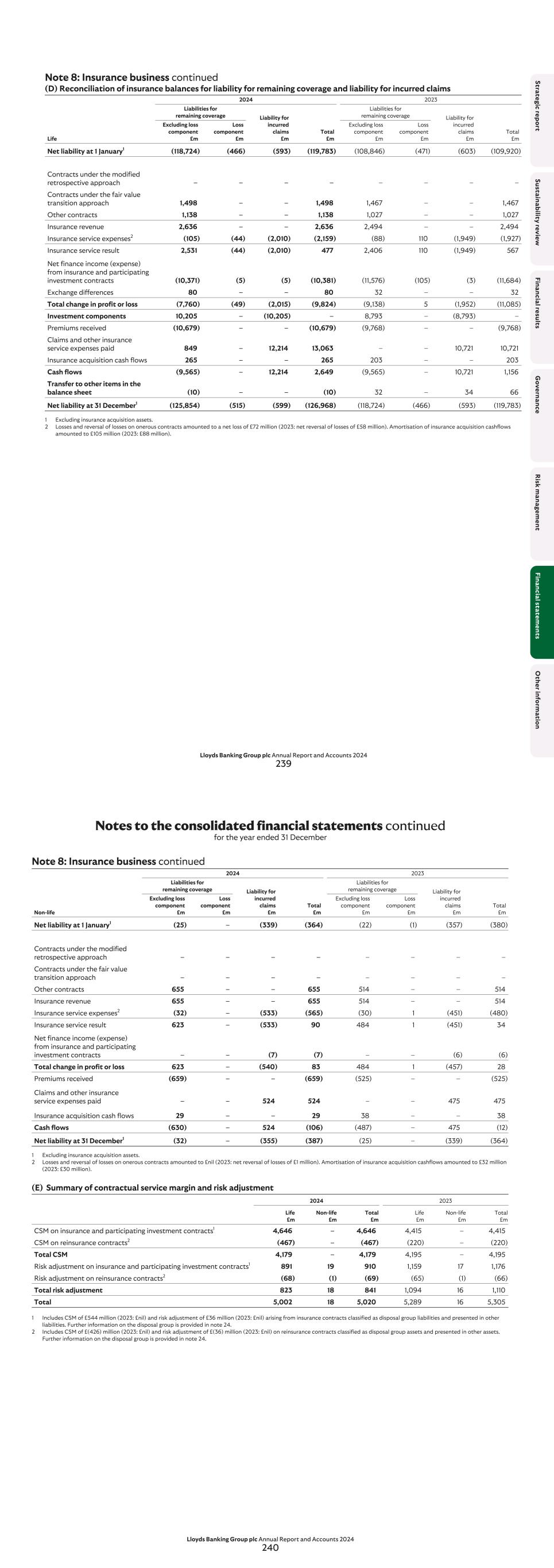
Note 8: Insurance business continued (D) Reconciliation of insurance balances for liability for remaining coverage and liability for incurred claims 2024 2023 Liabilities for remaining coverage Liability for incurred claims £m Liabilities for remaining coverage Liability for incurred claims £mLife Excluding loss component £m Loss component £m Total £m Excluding loss component £m Loss component £m Total £m Net liability at 1 January1 (118,724) (466) (593) (119,783) (108,846) (471) (603) (109,920) Contracts under the modified retrospective approach – – – – – – – – Contracts under the fair value transition approach 1,498 – – 1,498 1,467 – – 1,467 Other contracts 1,138 – – 1,138 1,027 – – 1,027 Insurance revenue 2,636 – – 2,636 2,494 – – 2,494 Insurance service expenses2 (105) (44) (2,010) (2,159) (88) 110 (1,949) (1,927) Insurance service result 2,531 (44) (2,010) 477 2,406 110 (1,949) 567 Net finance income (expense) from insurance and participating investment contracts (10,371) (5) (5) (10,381) (11,576) (105) (3) (11,684) Exchange differences 80 – – 80 32 – – 32 Total change in profit or loss (7,760) (49) (2,015) (9,824) (9,138) 5 (1,952) (11,085) Investment components 10,205 – (10,205) – 8,793 – (8,793) – Premiums received (10,679) – – (10,679) (9,768) – – (9,768) Claims and other insurance service expenses paid 849 – 12,214 13,063 – – 10,721 10,721 Insurance acquisition cash flows 265 – – 265 203 – – 203 Cash flows (9,565) – 12,214 2,649 (9,565) – 10,721 1,156 Transfer to other items in the balance sheet (10) – – (10) 32 – 34 66 Net liability at 31 December1 (125,854) (515) (599) (126,968) (118,724) (466) (593) (119,783) 1 Excluding insurance acquisition assets. 2 Losses and reversal of losses on onerous contracts amounted to a net loss of £72 million (2023: net reversal of losses of £58 million). Amortisation of insurance acquisition cashflows amounted to £105 million (2023: £88 million). Lloyds Banking Group plc Annual Report and Accounts 2024 239 l i ts 2 O th e r in fo rm a tio n F in a n cia l sta te m e n ts R isk m a n a ge m e n t F in a n cia l re su lts S u sta in a b ility re vie w S tra te gic re p o rt G o ve rn a n ce Note 8: Insurance business continued 2024 2023 Liabilities for remaining coverage Liability for incurred claims £m Liabilities for remaining coverage Liability for incurred claims £mNon-life Excluding loss component £m Loss component £m Total £m Excluding loss component £m Loss component £m Total £m Net liability at 1 January1 (25) – (339) (364) (22) (1) (357) (380) Contracts under the modified retrospective approach – – – – – – – – Contracts under the fair value transition approach – – – – – – – – Other contracts 655 – – 655 514 – – 514 Insurance revenue 655 – – 655 514 – – 514 Insurance service expenses2 (32) – (533) (565) (30) 1 (451) (480) Insurance service result 623 – (533) 90 484 1 (451) 34 Net finance income (expense) from insurance and participating investment contracts – – (7) (7) – – (6) (6) Total change in profit or loss 623 – (540) 83 484 1 (457) 28 Premiums received (659) – – (659) (525) – – (525) Claims and other insurance service expenses paid – – 524 524 – – 475 475 Insurance acquisition cash flows 29 – – 29 38 – – 38 Cash flows (630) – 524 (106) (487) – 475 (12) Net liability at 31 December1 (32) – (355) (387) (25) – (339) (364) 1 Excluding insurance acquisition assets. 2 Losses and reversal of losses on onerous contracts amounted to £nil (2023: net reversal of losses of £1 million). Amortisation of insurance acquisition cashflows amounted to £32 million (2023: £30 million). (E) Summary of contractual service margin and risk adjustment 2024 2023 Life £m Non-life £m Total £m Life £m Non-life £m Total £m CSM on insurance and participating investment contracts1 4,646 – 4,646 4,415 – 4,415 CSM on reinsurance contracts2 (467) – (467) (220) – (220) Total CSM 4,179 – 4,179 4,195 – 4,195 Risk adjustment on insurance and participating investment contracts1 891 19 910 1,159 17 1,176 Risk adjustment on reinsurance contracts2 (68) (1) (69) (65) (1) (66) Total risk adjustment 823 18 841 1,094 16 1,110 Total 5,002 18 5,020 5,289 16 5,305 1 Includes CSM of £544 million (2023: £nil) and risk adjustment of £36 million (2023: £nil) arising from insurance contracts classified as disposal group liabilities and presented in other liabilities. Further information on the disposal group is provided in note 24. 2 Includes CSM of £(426) million (2023: £nil) and risk adjustment of £(36) million (2023: £nil) on reinsurance contracts classified as disposal group assets and presented in other assets. Further information on the disposal group is provided in note 24. Notes to the consolidated financial statements continued for the year ended 31 December Lloyds Banking Group plc Annual Report and Accounts 2024 240 l i ts
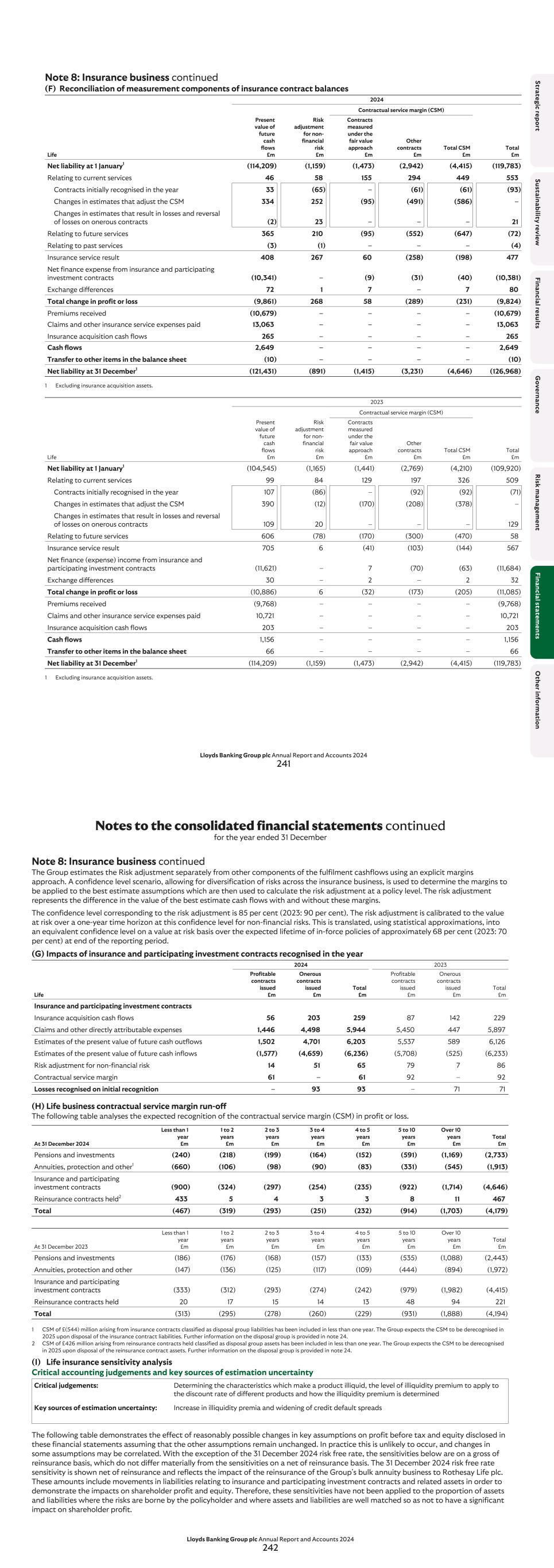
Note 8: Insurance business continued (F) Reconciliation of measurement components of insurance contract balances 2024 Contractual service margin (CSM) Life Present value of future cash flows £m Risk adjustment for non- financial risk £m Contracts measured under the fair value approach £m Other contracts £m Total CSM £m Total £m Net liability at 1 January1 (114,209) (1,159) (1,473) (2,942) (4,415) (119,783) Relating to current services 46 58 155 294 449 553 Contracts initially recognised in the year 33 (65) – (61) (61) (93) Changes in estimates that adjust the CSM 334 252 (95) (491) (586) – Changes in estimates that result in losses and reversal of losses on onerous contracts (2) 23 – – – 21 Relating to future services 365 210 (95) (552) (647) (72) Relating to past services (3) (1) – – – (4) Insurance service result 408 267 60 (258) (198) 477 Net finance expense from insurance and participating investment contracts (10,341) – (9) (31) (40) (10,381) Exchange differences 72 1 7 – 7 80 Total change in profit or loss (9,861) 268 58 (289) (231) (9,824) Premiums received (10,679) – – – – (10,679) Claims and other insurance service expenses paid 13,063 – – – – 13,063 Insurance acquisition cash flows 265 – – – – 265 Cash flows 2,649 – – – – 2,649 Transfer to other items in the balance sheet (10) – – – – (10) Net liability at 31 December1 (121,431) (891) (1,415) (3,231) (4,646) (126,968) 1 Excluding insurance acquisition assets. 2023 Contractual service margin (CSM) Life Present value of future cash flows £m Risk adjustment for non- financial risk £m Contracts measured under the fair value approach £m Other contracts £m Total CSM £m Total £m Net liability at 1 January1 (104,545) (1,165) (1,441) (2,769) (4,210) (109,920) Relating to current services 99 84 129 197 326 509 Contracts initially recognised in the year 107 (86) – (92) (92) (71) Changes in estimates that adjust the CSM 390 (12) (170) (208) (378) – Changes in estimates that result in losses and reversal of losses on onerous contracts 109 20 – – – 129 Relating to future services 606 (78) (170) (300) (470) 58 Insurance service result 705 6 (41) (103) (144) 567 Net finance (expense) income from insurance and participating investment contracts (11,621) – 7 (70) (63) (11,684) Exchange differences 30 – 2 – 2 32 Total change in profit or loss (10,886) 6 (32) (173) (205) (11,085) Premiums received (9,768) – – – – (9,768) Claims and other insurance service expenses paid 10,721 – – – – 10,721 Insurance acquisition cash flows 203 – – – – 203 Cash flows 1,156 – – – – 1,156 Transfer to other items in the balance sheet 66 – – – – 66 Net liability at 31 December1 (114,209) (1,159) (1,473) (2,942) (4,415) (119,783) 1 Excluding insurance acquisition assets. Lloyds Banking Group plc Annual Report and Accounts 2024 241 l i ts 2 O th e r in fo rm a tio n F in a n cia l sta te m e n ts R isk m a n a ge m e n t F in a n cia l re su lts S u sta in a b ility re vie w S tra te gic re p o rt G o ve rn a n ce Note 8: Insurance business continued The Group estimates the Risk adjustment separately from other components of the fulfilment cashflows using an explicit margins approach. A confidence level scenario, allowing for diversification of risks across the insurance business, is used to determine the margins to be applied to the best estimate assumptions which are then used to calculate the risk adjustment at a policy level. The risk adjustment represents the difference in the value of the best estimate cash flows with and without these margins. The confidence level corresponding to the risk adjustment is 85 per cent (2023: 90 per cent). The risk adjustment is calibrated to the value at risk over a one-year time horizon at this confidence level for non-financial risks. This is translated, using statistical approximations, into an equivalent confidence level on a value at risk basis over the expected lifetime of in-force policies of approximately 68 per cent (2023: 70 per cent) at end of the reporting period. (G) Impacts of insurance and participating investment contracts recognised in the year 2024 2023 Life Profitable contracts issued £m Onerous contracts issued £m Total £m Profitable contracts issued £m Onerous contracts issued £m Total £m Insurance and participating investment contracts Insurance acquisition cash flows 56 203 259 87 142 229 Claims and other directly attributable expenses 1,446 4,498 5,944 5,450 447 5,897 Estimates of the present value of future cash outflows 1,502 4,701 6,203 5,537 589 6,126 Estimates of the present value of future cash inflows (1,577) (4,659) (6,236) (5,708) (525) (6,233) Risk adjustment for non-financial risk 14 51 65 79 7 86 Contractual service margin 61 – 61 92 – 92 Losses recognised on initial recognition – 93 93 – 71 71 (H) Life business contractual service margin run-off The following table analyses the expected recognition of the contractual service margin (CSM) in profit or loss. At 31 December 2024 Less than 1 year £m 1 to 2 years £m 2 to 3 years £m 3 to 4 years £m 4 to 5 years £m 5 to 10 years £m Over 10 years £m Total £m Pensions and investments (240) (218) (199) (164) (152) (591) (1,169) (2,733) Annuities, protection and other1 (660) (106) (98) (90) (83) (331) (545) (1,913) Insurance and participating investment contracts (900) (324) (297) (254) (235) (922) (1,714) (4,646) Reinsurance contracts held2 433 5 4 3 3 8 11 467 Total (467) (319) (293) (251) (232) (914) (1,703) (4,179) At 31 December 2023 Less than 1 year £m 1 to 2 years £m 2 to 3 years £m 3 to 4 years £m 4 to 5 years £m 5 to 10 years £m Over 10 years £m Total £m Pensions and investments (186) (176) (168) (157) (133) (535) (1,088) (2,443) Annuities, protection and other (147) (136) (125) (117) (109) (444) (894) (1,972) Insurance and participating investment contracts (333) (312) (293) (274) (242) (979) (1,982) (4,415) Reinsurance contracts held 20 17 15 14 13 48 94 221 Total (313) (295) (278) (260) (229) (931) (1,888) (4,194) 1 CSM of £(544) million arising from insurance contracts classified as disposal group liabilities has been included in less than one year. The Group expects the CSM to be derecognised in 2025 upon disposal of the insurance contract liabilities. Further information on the disposal group is provided in note 24. 2 CSM of £426 million arising from reinsurance contracts held classified as disposal group assets has been included in less than one year. The Group expects the CSM to be derecognised in 2025 upon disposal of the reinsurance contract assets. Further information on the disposal group is provided in note 24. (I) Life insurance sensitivity analysis Critical accounting judgements and key sources of estimation uncertainty Critical judgements: Determining the characteristics which make a product illiquid, the level of illiquidity premium to apply to the discount rate of different products and how the illiquidity premium is determined Key sources of estimation uncertainty: Increase in illiquidity premia and widening of credit default spreads The following table demonstrates the effect of reasonably possible changes in key assumptions on profit before tax and equity disclosed in these financial statements assuming that the other assumptions remain unchanged. In practice this is unlikely to occur, and changes in some assumptions may be correlated. With the exception of the 31 December 2024 risk free rate, the sensitivities below are on a gross of reinsurance basis, which do not differ materially from the sensitivities on a net of reinsurance basis. The 31 December 2024 risk free rate sensitivity is shown net of reinsurance and reflects the impact of the reinsurance of the Group's bulk annuity business to Rothesay Life plc. These amounts include movements in liabilities relating to insurance and participating investment contracts and related assets in order to demonstrate the impacts on shareholder profit and equity. Therefore, these sensitivities have not been applied to the proportion of assets and liabilities where the risks are borne by the policyholder and where assets and liabilities are well matched so as not to have a significant impact on shareholder profit. Notes to the consolidated financial statements continued for the year ended 31 December Lloyds Banking Group plc Annual Report and Accounts 2024 242 l i ts
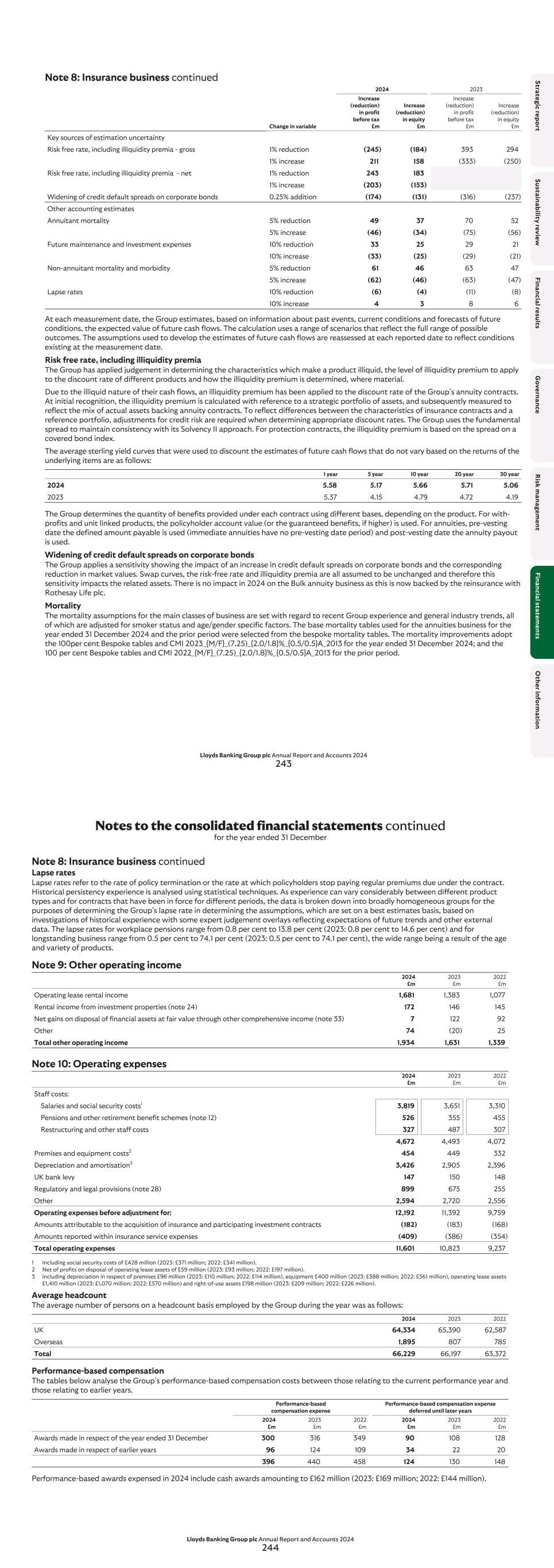
Note 8: Insurance business continued 2024 2023 Change in variable Increase (reduction) in profit before tax £m Increase (reduction) in equity £m Increase (reduction) in profit before tax £m Increase (reduction) in equity £m Key sources of estimation uncertainty Risk free rate, including illiquidity premia - gross 1% reduction (245) (184) 393 294 1% increase 211 158 (333) (250) Risk free rate, including illiquidity premia - net 1% reduction 243 183 1% increase (203) (153) Widening of credit default spreads on corporate bonds 0.25% addition (174) (131) (316) (237) Other accounting estimates Annuitant mortality 5% reduction 49 37 70 52 5% increase (46) (34) (75) (56) Future maintenance and investment expenses 10% reduction 33 25 29 21 10% increase (33) (25) (29) (21) Non-annuitant mortality and morbidity 5% reduction 61 46 63 47 5% increase (62) (46) (63) (47) Lapse rates 10% reduction (6) (4) (11) (8) 10% increase 4 3 8 6 At each measurement date, the Group estimates, based on information about past events, current conditions and forecasts of future conditions, the expected value of future cash flows. The calculation uses a range of scenarios that reflect the full range of possible outcomes. The assumptions used to develop the estimates of future cash flows are reassessed at each reported date to reflect conditions existing at the measurement date. Risk free rate, including illiquidity premia The Group has applied judgement in determining the characteristics which make a product illiquid, the level of illiquidity premium to apply to the discount rate of different products and how the illiquidity premium is determined, where material. Due to the illiquid nature of their cash flows, an illiquidity premium has been applied to the discount rate of the Group’s annuity contracts. At initial recognition, the illiquidity premium is calculated with reference to a strategic portfolio of assets, and subsequently measured to reflect the mix of actual assets backing annuity contracts. To reflect differences between the characteristics of insurance contracts and a reference portfolio, adjustments for credit risk are required when determining appropriate discount rates. The Group uses the fundamental spread to maintain consistency with its Solvency II approach. For protection contracts, the illiquidity premium is based on the spread on a covered bond index. The average sterling yield curves that were used to discount the estimates of future cash flows that do not vary based on the returns of the underlying items are as follows: 1 year 5 year 10 year 20 year 30 year 2024 5.58 5.17 5.66 5.71 5.06 2023 5.37 4.15 4.79 4.72 4.19 The Group determines the quantity of benefits provided under each contract using different bases, depending on the product. For with- profits and unit linked products, the policyholder account value (or the guaranteed benefits, if higher) is used. For annuities, pre-vesting date the defined amount payable is used (immediate annuities have no pre-vesting date period) and post-vesting date the annuity payout is used. Widening of credit default spreads on corporate bonds The Group applies a sensitivity showing the impact of an increase in credit default spreads on corporate bonds and the corresponding reduction in market values. Swap curves, the risk-free rate and illiquidity premia are all assumed to be unchanged and therefore this sensitivity impacts the related assets. There is no impact in 2024 on the Bulk annuity business as this is now backed by the reinsurance with Rothesay Life plc. Mortality The mortality assumptions for the main classes of business are set with regard to recent Group experience and general industry trends, all of which are adjusted for smoker status and age/gender specific factors. The base mortality tables used for the annuities business for the year ended 31 December 2024 and the prior period were selected from the bespoke mortality tables. The mortality improvements adopt the 100per cent Bespoke tables and CMI 2023_{M/F}_(7.25)_{2.0/1.8}%_{0.5/0.5}A_2013 for the year ended 31 December 2024; and the 100 per cent Bespoke tables and CMI 2022_{M/F}_(7.25)_{2.0/1.8}%_{0.5/0.5}A_2013 for the prior period. Lloyds Banking Group plc Annual Report and Accounts 2024 243 l i ts 2 O th e r in fo rm a tio n F in a n cia l sta te m e n ts R isk m a n a ge m e n t F in a n cia l re su lts S u sta in a b ility re vie w S tra te gic re p o rt G o ve rn a n ce Note 8: Insurance business continued Lapse rates Lapse rates refer to the rate of policy termination or the rate at which policyholders stop paying regular premiums due under the contract. Historical persistency experience is analysed using statistical techniques. As experience can vary considerably between different product types and for contracts that have been in force for different periods, the data is broken down into broadly homogeneous groups for the purposes of determining the Group’s lapse rate in determining the assumptions, which are set on a best estimates basis, based on investigations of historical experience with some expert judgement overlays reflecting expectations of future trends and other external data. The lapse rates for workplace pensions range from 0.8 per cent to 13.8 per cent (2023: 0.8 per cent to 14.6 per cent) and for longstanding business range from 0.5 per cent to 74.1 per cent (2023: 0.5 per cent to 74.1 per cent), the wide range being a result of the age and variety of products. Note 9: Other operating income 2024 £m 2023 £m 2022 £m Operating lease rental income 1,681 1,383 1,077 Rental income from investment properties (note 24) 172 146 145 Net gains on disposal of financial assets at fair value through other comprehensive income (note 33) 7 122 92 Other 74 (20) 25 Total other operating income 1,934 1,631 1,339 Note 10: Operating expenses 2024 £m 2023 £m 2022 £m Staff costs: Salaries and social security costs1 3,819 3,651 3,310 Pensions and other retirement benefit schemes (note 12) 526 355 455 Restructuring and other staff costs 327 487 307 4,672 4,493 4,072 Premises and equipment costs2 454 449 332 Depreciation and amortisation3 3,426 2,905 2,396 UK bank levy 147 150 148 Regulatory and legal provisions (note 28) 899 675 255 Other 2,594 2,720 2,556 Operating expenses before adjustment for: 12,192 11,392 9,759 Amounts attributable to the acquisition of insurance and participating investment contracts (182) (183) (168) Amounts reported within insurance service expenses (409) (386) (354) Total operating expenses 11,601 10,823 9,237 1 Including social security costs of £428 million (2023: £371 million; 2022: £341 million). 2 Net of profits on disposal of operating lease assets of £59 million (2023: £93 million; 2022: £197 million). 3 Including depreciation in respect of premises £96 million (2023: £110 million; 2022: £114 million), equipment £400 million (2023: £388 million; 2022: £561 million), operating lease assets £1,410 million (2023: £1,070 million; 2022: £570 million) and right-of-use assets £198 million (2023: £209 million; 2022: £226 million). Average headcount The average number of persons on a headcount basis employed by the Group during the year was as follows: 2024 2023 2022 UK 64,334 65,390 62,587 Overseas 1,895 807 785 Total 66,229 66,197 63,372 Performance-based compensation The tables below analyse the Group’s performance-based compensation costs between those relating to the current performance year and those relating to earlier years. Performance-based compensation expense Performance-based compensation expense deferred until later years 2024 £m 2023 £m 2022 £m 2024 £m 2023 £m 2022 £m Awards made in respect of the year ended 31 December 300 316 349 90 108 128 Awards made in respect of earlier years 96 124 109 34 22 20 396 440 458 124 130 148 Performance-based awards expensed in 2024 include cash awards amounting to £162 million (2023: £169 million; 2022: £144 million). Notes to the consolidated financial statements continued for the year ended 31 December Lloyds Banking Group plc Annual Report and Accounts 2024 244 l i ts
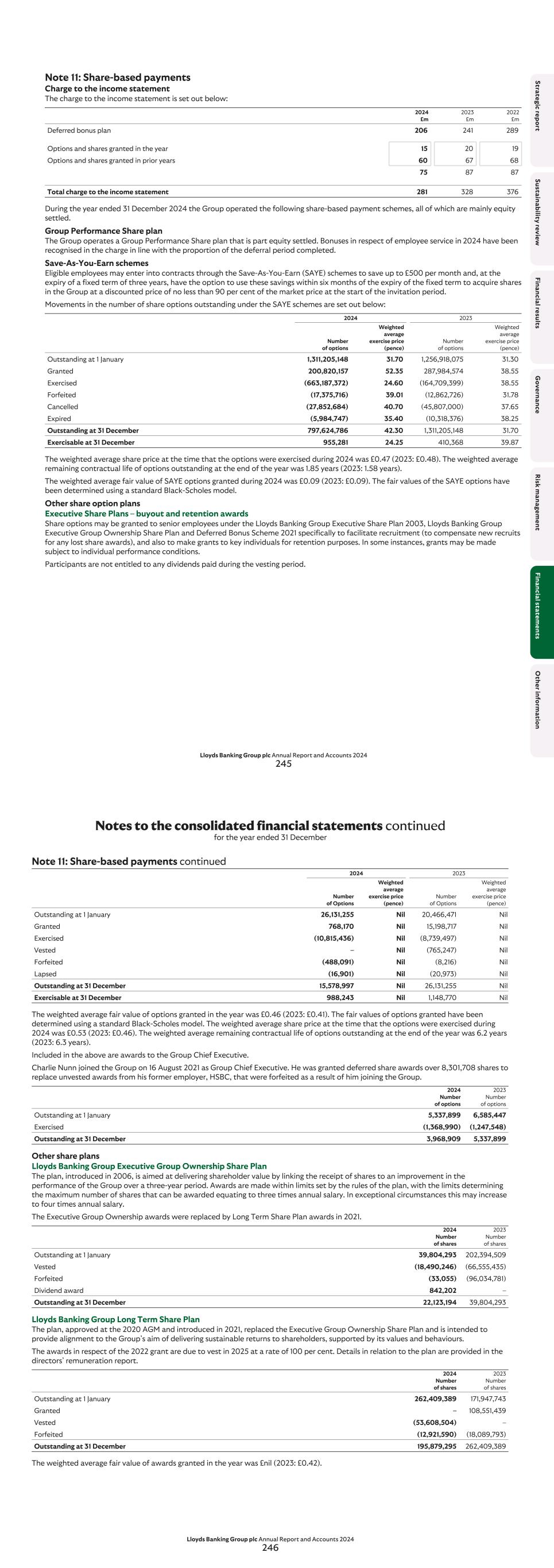
Note 11: Share-based payments Charge to the income statement The charge to the income statement is set out below: 2024 £m 2023 £m 2022 £m Deferred bonus plan 206 241 289 Options and shares granted in the year 15 20 19 Options and shares granted in prior years 60 67 68 75 87 87 Total charge to the income statement 281 328 376 During the year ended 31 December 2024 the Group operated the following share-based payment schemes, all of which are mainly equity settled. Group Performance Share plan The Group operates a Group Performance Share plan that is part equity settled. Bonuses in respect of employee service in 2024 have been recognised in the charge in line with the proportion of the deferral period completed. Save-As-You-Earn schemes Eligible employees may enter into contracts through the Save-As-You-Earn (SAYE) schemes to save up to £500 per month and, at the expiry of a fixed term of three years, have the option to use these savings within six months of the expiry of the fixed term to acquire shares in the Group at a discounted price of no less than 90 per cent of the market price at the start of the invitation period. Movements in the number of share options outstanding under the SAYE schemes are set out below: 2024 2023 Number of options Weighted average exercise price (pence) Number of options Weighted average exercise price (pence) Outstanding at 1 January 1,311,205,148 31.70 1,256,918,075 31.30 Granted 200,820,157 52.35 287,984,574 38.55 Exercised (663,187,372) 24.60 (164,709,399) 38.55 Forfeited (17,375,716) 39.01 (12,862,726) 31.78 Cancelled (27,852,684) 40.70 (45,807,000) 37.65 Expired (5,984,747) 35.40 (10,318,376) 38.25 Outstanding at 31 December 797,624,786 42.30 1,311,205,148 31.70 Exercisable at 31 December 955,281 24.25 410,368 39.87 The weighted average share price at the time that the options were exercised during 2024 was £0.47 (2023: £0.48). The weighted average remaining contractual life of options outstanding at the end of the year was 1.85 years (2023: 1.58 years). The weighted average fair value of SAYE options granted during 2024 was £0.09 (2023: £0.09). The fair values of the SAYE options have been determined using a standard Black-Scholes model. Other share option plans Executive Share Plans – buyout and retention awards Share options may be granted to senior employees under the Lloyds Banking Group Executive Share Plan 2003, Lloyds Banking Group Executive Group Ownership Share Plan and Deferred Bonus Scheme 2021 specifically to facilitate recruitment (to compensate new recruits for any lost share awards), and also to make grants to key individuals for retention purposes. In some instances, grants may be made subject to individual performance conditions. Participants are not entitled to any dividends paid during the vesting period. Lloyds Banking Group plc Annual Report and Accounts 2024 245 l i ts 2 O th e r in fo rm a tio n F in a n cia l sta te m e n ts R isk m a n a ge m e n t F in a n cia l re su lts S u sta in a b ility re vie w S tra te gic re p o rt G o ve rn a n ce Note 11: Share-based payments continued 2024 2023 Number of Options Weighted average exercise price (pence) Number of Options Weighted average exercise price (pence) Outstanding at 1 January 26,131,255 Nil 20,466,471 Nil Granted 768,170 Nil 15,198,717 Nil Exercised (10,815,436) Nil (8,739,497) Nil Vested – Nil (765,247) Nil Forfeited (488,091) Nil (8,216) Nil Lapsed (16,901) Nil (20,973) Nil Outstanding at 31 December 15,578,997 Nil 26,131,255 Nil Exercisable at 31 December 988,243 Nil 1,148,770 Nil The weighted average fair value of options granted in the year was £0.46 (2023: £0.41). The fair values of options granted have been determined using a standard Black-Scholes model. The weighted average share price at the time that the options were exercised during 2024 was £0.53 (2023: £0.46). The weighted average remaining contractual life of options outstanding at the end of the year was 6.2 years (2023: 6.3 years). Included in the above are awards to the Group Chief Executive. Charlie Nunn joined the Group on 16 August 2021 as Group Chief Executive. He was granted deferred share awards over 8,301,708 shares to replace unvested awards from his former employer, HSBC, that were forfeited as a result of him joining the Group. 2024 Number of options 2023 Number of options Outstanding at 1 January 5,337,899 6,585,447 Exercised (1,368,990) (1,247,548) Outstanding at 31 December 3,968,909 5,337,899 Other share plans Lloyds Banking Group Executive Group Ownership Share Plan The plan, introduced in 2006, is aimed at delivering shareholder value by linking the receipt of shares to an improvement in the performance of the Group over a three-year period. Awards are made within limits set by the rules of the plan, with the limits determining the maximum number of shares that can be awarded equating to three times annual salary. In exceptional circumstances this may increase to four times annual salary. The Executive Group Ownership awards were replaced by Long Term Share Plan awards in 2021. 2024 Number of shares 2023 Number of shares Outstanding at 1 January 39,804,293 202,394,509 Vested (18,490,246) (66,555,435) Forfeited (33,055) (96,034,781) Dividend award 842,202 – Outstanding at 31 December 22,123,194 39,804,293 Lloyds Banking Group Long Term Share Plan The plan, approved at the 2020 AGM and introduced in 2021, replaced the Executive Group Ownership Share Plan and is intended to provide alignment to the Group’s aim of delivering sustainable returns to shareholders, supported by its values and behaviours. The awards in respect of the 2022 grant are due to vest in 2025 at a rate of 100 per cent. Details in relation to the plan are provided in the directors’ remuneration report. 2024 Number of shares 2023 Number of shares Outstanding at 1 January 262,409,389 171,947,743 Granted – 108,551,439 Vested (53,608,504) – Forfeited (12,921,590) (18,089,793) Outstanding at 31 December 195,879,295 262,409,389 The weighted average fair value of awards granted in the year was £nil (2023: £0.42). Notes to the consolidated financial statements continued for the year ended 31 December Lloyds Banking Group plc Annual Report and Accounts 2024 246 l i ts
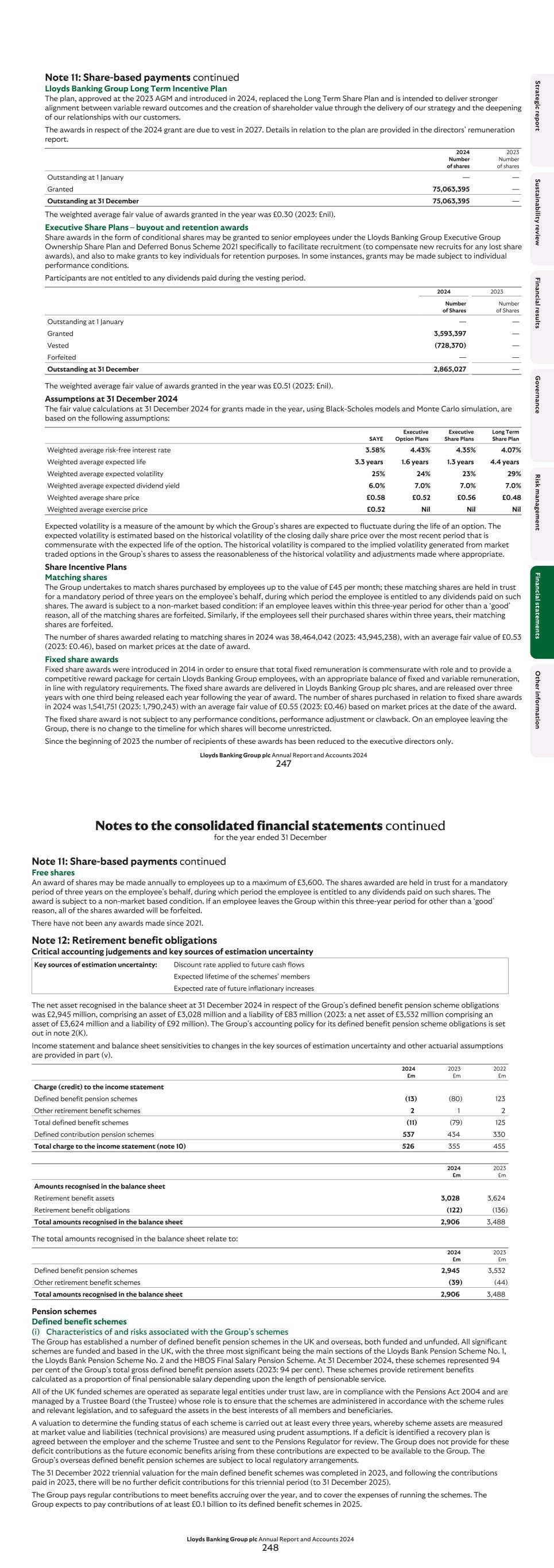
Note 11: Share-based payments continued Lloyds Banking Group Long Term Incentive Plan The plan, approved at the 2023 AGM and introduced in 2024, replaced the Long Term Share Plan and is intended to deliver stronger alignment between variable reward outcomes and the creation of shareholder value through the delivery of our strategy and the deepening of our relationships with our customers. The awards in respect of the 2024 grant are due to vest in 2027. Details in relation to the plan are provided in the directors’ remuneration report. 2024 Number of shares 2023 Number of shares Outstanding at 1 January — — Granted 75,063,395 — Outstanding at 31 December 75,063,395 — The weighted average fair value of awards granted in the year was £0.30 (2023: £nil). Executive Share Plans – buyout and retention awards Share awards in the form of conditional shares may be granted to senior employees under the Lloyds Banking Group Executive Group Ownership Share Plan and Deferred Bonus Scheme 2021 specifically to facilitate recruitment (to compensate new recruits for any lost share awards), and also to make grants to key individuals for retention purposes. In some instances, grants may be made subject to individual performance conditions. Participants are not entitled to any dividends paid during the vesting period. 2024 2023 Number of Shares Number of Shares Outstanding at 1 January — — Granted 3,593,397 — Vested (728,370) — Forfeited — — Outstanding at 31 December 2,865,027 — The weighted average fair value of awards granted in the year was £0.51 (2023: £nil). Assumptions at 31 December 2024 The fair value calculations at 31 December 2024 for grants made in the year, using Black-Scholes models and Monte Carlo simulation, are based on the following assumptions: SAYE Executive Option Plans Executive Share Plans Long Term Share Plan Weighted average risk-free interest rate 3.58% 4.43% 4.35% 4.07% Weighted average expected life 3.3 years 1.6 years 1.3 years 4.4 years Weighted average expected volatility 25% 24% 23% 29% Weighted average expected dividend yield 6.0% 7.0% 7.0% 7.0% Weighted average share price £0.58 £0.52 £0.56 £0.48 Weighted average exercise price £0.52 Nil Nil Nil Expected volatility is a measure of the amount by which the Group’s shares are expected to fluctuate during the life of an option. The expected volatility is estimated based on the historical volatility of the closing daily share price over the most recent period that is commensurate with the expected life of the option. The historical volatility is compared to the implied volatility generated from market traded options in the Group’s shares to assess the reasonableness of the historical volatility and adjustments made where appropriate. Share Incentive Plans Matching shares The Group undertakes to match shares purchased by employees up to the value of £45 per month; these matching shares are held in trust for a mandatory period of three years on the employee’s behalf, during which period the employee is entitled to any dividends paid on such shares. The award is subject to a non-market based condition: if an employee leaves within this three-year period for other than a ‘good’ reason, all of the matching shares are forfeited. Similarly, if the employees sell their purchased shares within three years, their matching shares are forfeited. The number of shares awarded relating to matching shares in 2024 was 38,464,042 (2023: 43,945,238), with an average fair value of £0.53 (2023: £0.46), based on market prices at the date of award. Fixed share awards Fixed share awards were introduced in 2014 in order to ensure that total fixed remuneration is commensurate with role and to provide a competitive reward package for certain Lloyds Banking Group employees, with an appropriate balance of fixed and variable remuneration, in line with regulatory requirements. The fixed share awards are delivered in Lloyds Banking Group plc shares, and are released over three years with one third being released each year following the year of award. The number of shares purchased in relation to fixed share awards in 2024 was 1,541,751 (2023: 1,790,243) with an average fair value of £0.55 (2023: £0.46) based on market prices at the date of the award. The fixed share award is not subject to any performance conditions, performance adjustment or clawback. On an employee leaving the Group, there is no change to the timeline for which shares will become unrestricted. Since the beginning of 2023 the number of recipients of these awards has been reduced to the executive directors only. Lloyds Banking Group plc Annual Report and Accounts 2024 247 l i ts 2 O th e r in fo rm a tio n F in a n cia l sta te m e n ts R isk m a n a ge m e n t F in a n cia l re su lts S u sta in a b ility re vie w S tra te gic re p o rt G o ve rn a n ce Note 11: Share-based payments continued Free shares An award of shares may be made annually to employees up to a maximum of £3,600. The shares awarded are held in trust for a mandatory period of three years on the employee’s behalf, during which period the employee is entitled to any dividends paid on such shares. The award is subject to a non-market based condition. If an employee leaves the Group within this three-year period for other than a ‘good’ reason, all of the shares awarded will be forfeited. There have not been any awards made since 2021. Note 12: Retirement benefit obligations Critical accounting judgements and key sources of estimation uncertainty Key sources of estimation uncertainty: Discount rate applied to future cash flows Expected lifetime of the schemes’ members Expected rate of future inflationary increases The net asset recognised in the balance sheet at 31 December 2024 in respect of the Group’s defined benefit pension scheme obligations was £2,945 million, comprising an asset of £3,028 million and a liability of £83 million (2023: a net asset of £3,532 million comprising an asset of £3,624 million and a liability of £92 million). The Group’s accounting policy for its defined benefit pension scheme obligations is set out in note 2(K). Income statement and balance sheet sensitivities to changes in the key sources of estimation uncertainty and other actuarial assumptions are provided in part (v). 2024 £m 2023 £m 2022 £m Charge (credit) to the income statement Defined benefit pension schemes (13) (80) 123 Other retirement benefit schemes 2 1 2 Total defined benefit schemes (11) (79) 125 Defined contribution pension schemes 537 434 330 Total charge to the income statement (note 10) 526 355 455 2024 £m 2023 £m Amounts recognised in the balance sheet Retirement benefit assets 3,028 3,624 Retirement benefit obligations (122) (136) Total amounts recognised in the balance sheet 2,906 3,488 The total amounts recognised in the balance sheet relate to: 2024 £m 2023 £m Defined benefit pension schemes 2,945 3,532 Other retirement benefit schemes (39) (44) Total amounts recognised in the balance sheet 2,906 3,488 Pension schemes Defined benefit schemes (i) Characteristics of and risks associated with the Group’s schemes The Group has established a number of defined benefit pension schemes in the UK and overseas, both funded and unfunded. All significant schemes are funded and based in the UK, with the three most significant being the main sections of the Lloyds Bank Pension Scheme No. 1, the Lloyds Bank Pension Scheme No. 2 and the HBOS Final Salary Pension Scheme. At 31 December 2024, these schemes represented 94 per cent of the Group’s total gross defined benefit pension assets (2023: 94 per cent). These schemes provide retirement benefits calculated as a proportion of final pensionable salary depending upon the length of pensionable service. All of the UK funded schemes are operated as separate legal entities under trust law, are in compliance with the Pensions Act 2004 and are managed by a Trustee Board (the Trustee) whose role is to ensure that the schemes are administered in accordance with the scheme rules and relevant legislation, and to safeguard the assets in the best interests of all members and beneficiaries. A valuation to determine the funding status of each scheme is carried out at least every three years, whereby scheme assets are measured at market value and liabilities (technical provisions) are measured using prudent assumptions. If a deficit is identified a recovery plan is agreed between the employer and the scheme Trustee and sent to the Pensions Regulator for review. The Group does not provide for these deficit contributions as the future economic benefits arising from these contributions are expected to be available to the Group. The Group’s overseas defined benefit pension schemes are subject to local regulatory arrangements. The 31 December 2022 triennial valuation for the main defined benefit schemes was completed in 2023, and following the contributions paid in 2023, there will be no further deficit contributions for this triennial period (to 31 December 2025). The Group pays regular contributions to meet benefits accruing over the year, and to cover the expenses of running the schemes. The Group expects to pay contributions of at least £0.1 billion to its defined benefit schemes in 2025. Notes to the consolidated financial statements continued for the year ended 31 December Lloyds Banking Group plc Annual Report and Accounts 2024 248 l i ts
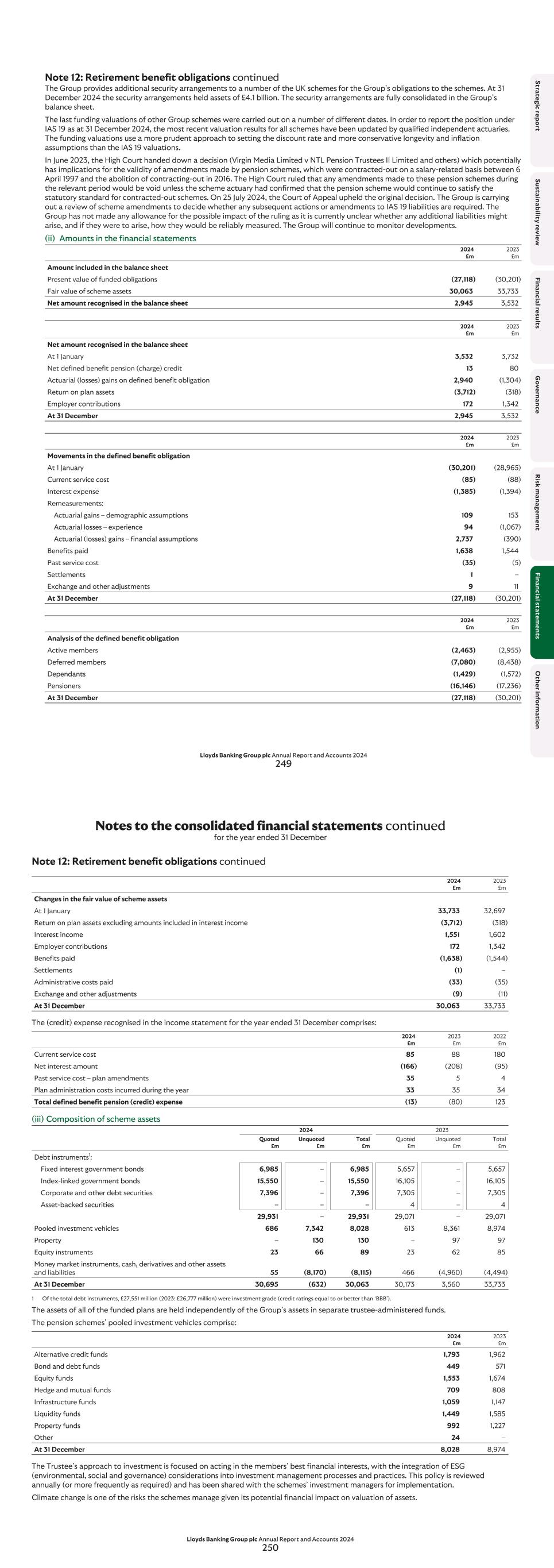
Note 12: Retirement benefit obligations continued The Group provides additional security arrangements to a number of the UK schemes for the Group’s obligations to the schemes. At 31 December 2024 the security arrangements held assets of £4.1 billion. The security arrangements are fully consolidated in the Group’s balance sheet. The last funding valuations of other Group schemes were carried out on a number of different dates. In order to report the position under IAS 19 as at 31 December 2024, the most recent valuation results for all schemes have been updated by qualified independent actuaries. The funding valuations use a more prudent approach to setting the discount rate and more conservative longevity and inflation assumptions than the IAS 19 valuations. In June 2023, the High Court handed down a decision (Virgin Media Limited v NTL Pension Trustees II Limited and others) which potentially has implications for the validity of amendments made by pension schemes, which were contracted-out on a salary-related basis between 6 April 1997 and the abolition of contracting-out in 2016. The High Court ruled that any amendments made to these pension schemes during the relevant period would be void unless the scheme actuary had confirmed that the pension scheme would continue to satisfy the statutory standard for contracted-out schemes. On 25 July 2024, the Court of Appeal upheld the original decision. The Group is carrying out a review of scheme amendments to decide whether any subsequent actions or amendments to IAS 19 liabilities are required. The Group has not made any allowance for the possible impact of the ruling as it is currently unclear whether any additional liabilities might arise, and if they were to arise, how they would be reliably measured. The Group will continue to monitor developments. (ii) Amounts in the financial statements 2024 £m 2023 £m Amount included in the balance sheet Present value of funded obligations (27,118) (30,201) Fair value of scheme assets 30,063 33,733 Net amount recognised in the balance sheet 2,945 3,532 2024 £m 2023 £m Net amount recognised in the balance sheet At 1 January 3,532 3,732 Net defined benefit pension (charge) credit 13 80 Actuarial (losses) gains on defined benefit obligation 2,940 (1,304) Return on plan assets (3,712) (318) Employer contributions 172 1,342 At 31 December 2,945 3,532 2024 £m 2023 £m Movements in the defined benefit obligation At 1 January (30,201) (28,965) Current service cost (85) (88) Interest expense (1,385) (1,394) Remeasurements: Actuarial gains – demographic assumptions 109 153 Actuarial losses – experience 94 (1,067) Actuarial (losses) gains – financial assumptions 2,737 (390) Benefits paid 1,638 1,544 Past service cost (35) (5) Settlements 1 – Exchange and other adjustments 9 11 At 31 December (27,118) (30,201) 2024 £m 2023 £m Analysis of the defined benefit obligation Active members (2,463) (2,955) Deferred members (7,080) (8,438) Dependants (1,429) (1,572) Pensioners (16,146) (17,236) At 31 December (27,118) (30,201) Lloyds Banking Group plc Annual Report and Accounts 2024 249 l i ts 2 O th e r in fo rm a tio n F in a n cia l sta te m e n ts R isk m a n a ge m e n t F in a n cia l re su lts S u sta in a b ility re vie w S tra te gic re p o rt G o ve rn a n ce Note 12: Retirement benefit obligations continued 2024 £m 2023 £m Changes in the fair value of scheme assets At 1 January 33,733 32,697 Return on plan assets excluding amounts included in interest income (3,712) (318) Interest income 1,551 1,602 Employer contributions 172 1,342 Benefits paid (1,638) (1,544) Settlements (1) – Administrative costs paid (33) (35) Exchange and other adjustments (9) (11) At 31 December 30,063 33,733 The (credit) expense recognised in the income statement for the year ended 31 December comprises: 2024 £m 2023 £m 2022 £m Current service cost 85 88 180 Net interest amount (166) (208) (95) Past service cost – plan amendments 35 5 4 Plan administration costs incurred during the year 33 35 34 Total defined benefit pension (credit) expense (13) (80) 123 (iii) Composition of scheme assets 2024 2023 Quoted £m Unquoted £m Total £m Quoted £m Unquoted £m Total £m Debt instruments1: Fixed interest government bonds 6,985 – 6,985 5,657 – 5,657 Index-linked government bonds 15,550 – 15,550 16,105 – 16,105 Corporate and other debt securities 7,396 – 7,396 7,305 – 7,305 Asset-backed securities – – – 4 – 4 29,931 – 29,931 29,071 – 29,071 Pooled investment vehicles 686 7,342 8,028 613 8,361 8,974 Property – 130 130 – 97 97 Equity instruments 23 66 89 23 62 85 Money market instruments, cash, derivatives and other assets and liabilities 55 (8,170) (8,115) 466 (4,960) (4,494) At 31 December 30,695 (632) 30,063 30,173 3,560 33,733 1 Of the total debt instruments, £27,551 million (2023: £26,777 million) were investment grade (credit ratings equal to or better than ‘BBB’). The assets of all of the funded plans are held independently of the Group’s assets in separate trustee-administered funds. The pension schemes’ pooled investment vehicles comprise: 2024 £m 2023 £m Alternative credit funds 1,793 1,962 Bond and debt funds 449 571 Equity funds 1,553 1,674 Hedge and mutual funds 709 808 Infrastructure funds 1,059 1,147 Liquidity funds 1,449 1,585 Property funds 992 1,227 Other 24 – At 31 December 8,028 8,974 The Trustee’s approach to investment is focused on acting in the members’ best financial interests, with the integration of ESG (environmental, social and governance) considerations into investment management processes and practices. This policy is reviewed annually (or more frequently as required) and has been shared with the schemes’ investment managers for implementation. Climate change is one of the risks the schemes manage given its potential financial impact on valuation of assets. Notes to the consolidated financial statements continued for the year ended 31 December Lloyds Banking Group plc Annual Report and Accounts 2024 250 l i ts
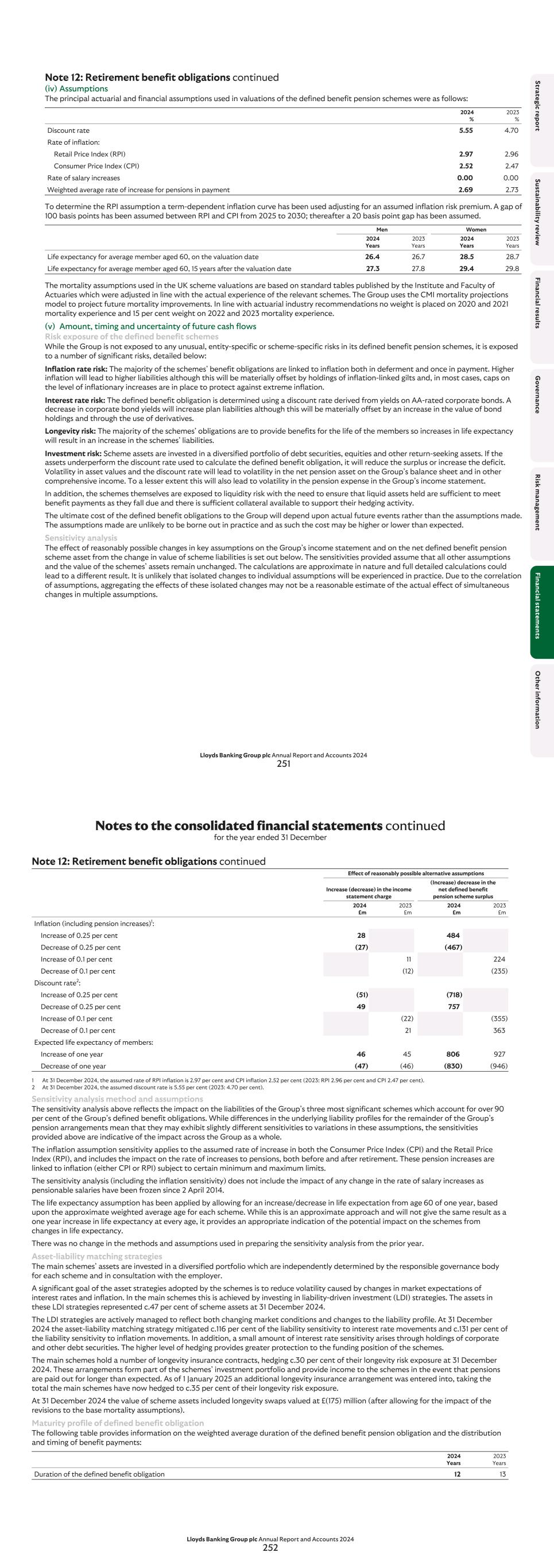
Note 12: Retirement benefit obligations continued (iv) Assumptions The principal actuarial and financial assumptions used in valuations of the defined benefit pension schemes were as follows: 2024 % 2023 % Discount rate 5.55 4.70 Rate of inflation: Retail Price Index (RPI) 2.97 2.96 Consumer Price Index (CPI) 2.52 2.47 Rate of salary increases 0.00 0.00 Weighted average rate of increase for pensions in payment 2.69 2.73 To determine the RPI assumption a term-dependent inflation curve has been used adjusting for an assumed inflation risk premium. A gap of 100 basis points has been assumed between RPI and CPI from 2025 to 2030; thereafter a 20 basis point gap has been assumed. Men Women 2024 Years 2023 Years 2024 Years 2023 Years Life expectancy for average member aged 60, on the valuation date 26.4 26.7 28.5 28.7 Life expectancy for average member aged 60, 15 years after the valuation date 27.3 27.8 29.4 29.8 The mortality assumptions used in the UK scheme valuations are based on standard tables published by the Institute and Faculty of Actuaries which were adjusted in line with the actual experience of the relevant schemes. The Group uses the CMI mortality projections model to project future mortality improvements. In line with actuarial industry recommendations no weight is placed on 2020 and 2021 mortality experience and 15 per cent weight on 2022 and 2023 mortality experience. (v) Amount, timing and uncertainty of future cash flows Risk exposure of the defined benefit schemes While the Group is not exposed to any unusual, entity-specific or scheme-specific risks in its defined benefit pension schemes, it is exposed to a number of significant risks, detailed below: Inflation rate risk: The majority of the schemes’ benefit obligations are linked to inflation both in deferment and once in payment. Higher inflation will lead to higher liabilities although this will be materially offset by holdings of inflation-linked gilts and, in most cases, caps on the level of inflationary increases are in place to protect against extreme inflation. Interest rate risk: The defined benefit obligation is determined using a discount rate derived from yields on AA-rated corporate bonds. A decrease in corporate bond yields will increase plan liabilities although this will be materially offset by an increase in the value of bond holdings and through the use of derivatives. Longevity risk: The majority of the schemes’ obligations are to provide benefits for the life of the members so increases in life expectancy will result in an increase in the schemes’ liabilities. Investment risk: Scheme assets are invested in a diversified portfolio of debt securities, equities and other return-seeking assets. If the assets underperform the discount rate used to calculate the defined benefit obligation, it will reduce the surplus or increase the deficit. Volatility in asset values and the discount rate will lead to volatility in the net pension asset on the Group’s balance sheet and in other comprehensive income. To a lesser extent this will also lead to volatility in the pension expense in the Group’s income statement. In addition, the schemes themselves are exposed to liquidity risk with the need to ensure that liquid assets held are sufficient to meet benefit payments as they fall due and there is sufficient collateral available to support their hedging activity. The ultimate cost of the defined benefit obligations to the Group will depend upon actual future events rather than the assumptions made. The assumptions made are unlikely to be borne out in practice and as such the cost may be higher or lower than expected. Sensitivity analysis The effect of reasonably possible changes in key assumptions on the Group’s income statement and on the net defined benefit pension scheme asset from the change in value of scheme liabilities is set out below. The sensitivities provided assume that all other assumptions and the value of the schemes’ assets remain unchanged. The calculations are approximate in nature and full detailed calculations could lead to a different result. It is unlikely that isolated changes to individual assumptions will be experienced in practice. Due to the correlation of assumptions, aggregating the effects of these isolated changes may not be a reasonable estimate of the actual effect of simultaneous changes in multiple assumptions. Lloyds Banking Group plc Annual Report and Accounts 2024 251 l i ts 2 O th e r in fo rm a tio n F in a n cia l sta te m e n ts R isk m a n a ge m e n t F in a n cia l re su lts S u sta in a b ility re vie w S tra te gic re p o rt G o ve rn a n ce Note 12: Retirement benefit obligations continued Effect of reasonably possible alternative assumptions Increase (decrease) in the income statement charge (Increase) decrease in the net defined benefit pension scheme surplus 2024 £m 2023 £m 2024 £m 2023 £m Inflation (including pension increases)1: Increase of 0.25 per cent 28 484 Decrease of 0.25 per cent (27) (467) Increase of 0.1 per cent 11 224 Decrease of 0.1 per cent (12) (235) Discount rate2: Increase of 0.25 per cent (51) (718) Decrease of 0.25 per cent 49 757 Increase of 0.1 per cent (22) (355) Decrease of 0.1 per cent 21 363 Expected life expectancy of members: Increase of one year 46 45 806 927 Decrease of one year (47) (46) (830) (946) 1 At 31 December 2024, the assumed rate of RPI inflation is 2.97 per cent and CPI inflation 2.52 per cent (2023: RPI 2.96 per cent and CPI 2.47 per cent). 2 At 31 December 2024, the assumed discount rate is 5.55 per cent (2023: 4.70 per cent). Sensitivity analysis method and assumptions The sensitivity analysis above reflects the impact on the liabilities of the Group’s three most significant schemes which account for over 90 per cent of the Group’s defined benefit obligations. While differences in the underlying liability profiles for the remainder of the Group’s pension arrangements mean that they may exhibit slightly different sensitivities to variations in these assumptions, the sensitivities provided above are indicative of the impact across the Group as a whole. The inflation assumption sensitivity applies to the assumed rate of increase in both the Consumer Price Index (CPI) and the Retail Price Index (RPI), and includes the impact on the rate of increases to pensions, both before and after retirement. These pension increases are linked to inflation (either CPI or RPI) subject to certain minimum and maximum limits. The sensitivity analysis (including the inflation sensitivity) does not include the impact of any change in the rate of salary increases as pensionable salaries have been frozen since 2 April 2014. The life expectancy assumption has been applied by allowing for an increase/decrease in life expectation from age 60 of one year, based upon the approximate weighted average age for each scheme. While this is an approximate approach and will not give the same result as a one year increase in life expectancy at every age, it provides an appropriate indication of the potential impact on the schemes from changes in life expectancy. There was no change in the methods and assumptions used in preparing the sensitivity analysis from the prior year. Asset-liability matching strategies The main schemes’ assets are invested in a diversified portfolio which are independently determined by the responsible governance body for each scheme and in consultation with the employer. A significant goal of the asset strategies adopted by the schemes is to reduce volatility caused by changes in market expectations of interest rates and inflation. In the main schemes this is achieved by investing in liability-driven investment (LDI) strategies. The assets in these LDI strategies represented c.47 per cent of scheme assets at 31 December 2024. The LDI strategies are actively managed to reflect both changing market conditions and changes to the liability profile. At 31 December 2024 the asset-liability matching strategy mitigated c.116 per cent of the liability sensitivity to interest rate movements and c.131 per cent of the liability sensitivity to inflation movements. In addition, a small amount of interest rate sensitivity arises through holdings of corporate and other debt securities. The higher level of hedging provides greater protection to the funding position of the schemes. The main schemes hold a number of longevity insurance contracts, hedging c.30 per cent of their longevity risk exposure at 31 December 2024. These arrangements form part of the schemes’ investment portfolio and provide income to the schemes in the event that pensions are paid out for longer than expected. As of 1 January 2025 an additional longevity insurance arrangement was entered into, taking the total the main schemes have now hedged to c.35 per cent of their longevity risk exposure. At 31 December 2024 the value of scheme assets included longevity swaps valued at £(175) million (after allowing for the impact of the revisions to the base mortality assumptions). Maturity profile of defined benefit obligation The following table provides information on the weighted average duration of the defined benefit pension obligation and the distribution and timing of benefit payments: 2024 Years 2023 Years Duration of the defined benefit obligation 12 13 Notes to the consolidated financial statements continued for the year ended 31 December Lloyds Banking Group plc Annual Report and Accounts 2024 252 l i ts
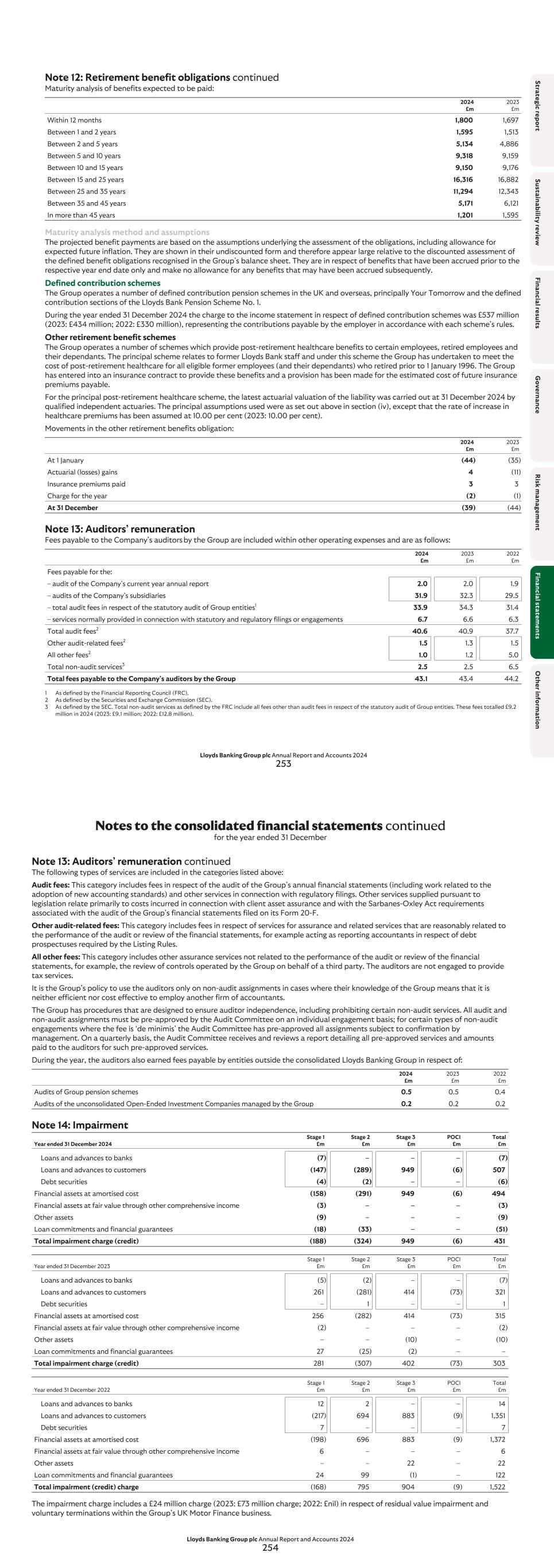
Note 12: Retirement benefit obligations continued Maturity analysis of benefits expected to be paid: 2024 £m 2023 £m Within 12 months 1,800 1,697 Between 1 and 2 years 1,595 1,513 Between 2 and 5 years 5,134 4,886 Between 5 and 10 years 9,318 9,159 Between 10 and 15 years 9,150 9,176 Between 15 and 25 years 16,316 16,882 Between 25 and 35 years 11,294 12,343 Between 35 and 45 years 5,171 6,121 In more than 45 years 1,201 1,595 Maturity analysis method and assumptions The projected benefit payments are based on the assumptions underlying the assessment of the obligations, including allowance for expected future inflation. They are shown in their undiscounted form and therefore appear large relative to the discounted assessment of the defined benefit obligations recognised in the Group’s balance sheet. They are in respect of benefits that have been accrued prior to the respective year end date only and make no allowance for any benefits that may have been accrued subsequently. Defined contribution schemes The Group operates a number of defined contribution pension schemes in the UK and overseas, principally Your Tomorrow and the defined contribution sections of the Lloyds Bank Pension Scheme No. 1. During the year ended 31 December 2024 the charge to the income statement in respect of defined contribution schemes was £537 million (2023: £434 million; 2022: £330 million), representing the contributions payable by the employer in accordance with each scheme’s rules. Other retirement benefit schemes The Group operates a number of schemes which provide post-retirement healthcare benefits to certain employees, retired employees and their dependants. The principal scheme relates to former Lloyds Bank staff and under this scheme the Group has undertaken to meet the cost of post-retirement healthcare for all eligible former employees (and their dependants) who retired prior to 1 January 1996. The Group has entered into an insurance contract to provide these benefits and a provision has been made for the estimated cost of future insurance premiums payable. For the principal post-retirement healthcare scheme, the latest actuarial valuation of the liability was carried out at 31 December 2024 by qualified independent actuaries. The principal assumptions used were as set out above in section (iv), except that the rate of increase in healthcare premiums has been assumed at 10.00 per cent (2023: 10.00 per cent). Movements in the other retirement benefits obligation: 2024 £m 2023 £m At 1 January (44) (35) Actuarial (losses) gains 4 (11) Insurance premiums paid 3 3 Charge for the year (2) (1) At 31 December (39) (44) Note 13: Auditors’ remuneration Fees payable to the Company’s auditors by the Group are included within other operating expenses and are as follows: 2024 £m 2023 £m 2022 £m Fees payable for the: – audit of the Company’s current year annual report 2.0 2.0 1.9 – audits of the Company’s subsidiaries 31.9 32.3 29.5 – total audit fees in respect of the statutory audit of Group entities1 33.9 34.3 31.4 – services normally provided in connection with statutory and regulatory filings or engagements 6.7 6.6 6.3 Total audit fees2 40.6 40.9 37.7 Other audit-related fees2 1.5 1.3 1.5 All other fees2 1.0 1.2 5.0 Total non-audit services3 2.5 2.5 6.5 Total fees payable to the Company’s auditors by the Group 43.1 43.4 44.2 1 As defined by the Financial Reporting Council (FRC). 2 As defined by the Securities and Exchange Commission (SEC). 3 As defined by the SEC. Total non-audit services as defined by the FRC include all fees other than audit fees in respect of the statutory audit of Group entities. These fees totalled £9.2 million in 2024 (2023: £9.1 million; 2022: £12.8 million). Lloyds Banking Group plc Annual Report and Accounts 2024 253 l i ts 2 O th e r in fo rm a tio n F in a n cia l sta te m e n ts R isk m a n a ge m e n t F in a n cia l re su lts S u sta in a b ility re vie w S tra te gic re p o rt G o ve rn a n ce Note 13: Auditors’ remuneration continued The following types of services are included in the categories listed above: Audit fees: This category includes fees in respect of the audit of the Group’s annual financial statements (including work related to the adoption of new accounting standards) and other services in connection with regulatory filings. Other services supplied pursuant to legislation relate primarily to costs incurred in connection with client asset assurance and with the Sarbanes-Oxley Act requirements associated with the audit of the Group’s financial statements filed on its Form 20-F. Other audit-related fees: This category includes fees in respect of services for assurance and related services that are reasonably related to the performance of the audit or review of the financial statements, for example acting as reporting accountants in respect of debt prospectuses required by the Listing Rules. All other fees: This category includes other assurance services not related to the performance of the audit or review of the financial statements, for example, the review of controls operated by the Group on behalf of a third party. The auditors are not engaged to provide tax services. It is the Group’s policy to use the auditors only on non-audit assignments in cases where their knowledge of the Group means that it is neither efficient nor cost effective to employ another firm of accountants. The Group has procedures that are designed to ensure auditor independence, including prohibiting certain non-audit services. All audit and non-audit assignments must be pre-approved by the Audit Committee on an individual engagement basis; for certain types of non-audit engagements where the fee is ‘de minimis’ the Audit Committee has pre-approved all assignments subject to confirmation by management. On a quarterly basis, the Audit Committee receives and reviews a report detailing all pre-approved services and amounts paid to the auditors for such pre-approved services. During the year, the auditors also earned fees payable by entities outside the consolidated Lloyds Banking Group in respect of: 2024 £m 2023 £m 2022 £m Audits of Group pension schemes 0.5 0.5 0.4 Audits of the unconsolidated Open-Ended Investment Companies managed by the Group 0.2 0.2 0.2 Note 14: Impairment Year ended 31 December 2024 Stage 1 £m Stage 2 £m Stage 3 £m POCI £m Total £m Loans and advances to banks (7) – – – (7) Loans and advances to customers (147) (289) 949 (6) 507 Debt securities (4) (2) – – (6) Financial assets at amortised cost (158) (291) 949 (6) 494 Financial assets at fair value through other comprehensive income (3) – – – (3) Other assets (9) – – – (9) Loan commitments and financial guarantees (18) (33) – – (51) Total impairment charge (credit) (188) (324) 949 (6) 431 Year ended 31 December 2023 Stage 1 £m Stage 2 £m Stage 3 £m POCI £m Total £m Loans and advances to banks (5) (2) – – (7) Loans and advances to customers 261 (281) 414 (73) 321 Debt securities – 1 – – 1 Financial assets at amortised cost 256 (282) 414 (73) 315 Financial assets at fair value through other comprehensive income (2) – – – (2) Other assets – – (10) – (10) Loan commitments and financial guarantees 27 (25) (2) – – Total impairment charge (credit) 281 (307) 402 (73) 303 Year ended 31 December 2022 Stage 1 £m Stage 2 £m Stage 3 £m POCI £m Total £m Loans and advances to banks 12 2 – – 14 Loans and advances to customers (217) 694 883 (9) 1,351 Debt securities 7 – – – 7 Financial assets at amortised cost (198) 696 883 (9) 1,372 Financial assets at fair value through other comprehensive income 6 – – – 6 Other assets – – 22 – 22 Loan commitments and financial guarantees 24 99 (1) – 122 Total impairment (credit) charge (168) 795 904 (9) 1,522 The impairment charge includes a £24 million charge (2023: £73 million charge; 2022: £nil) in respect of residual value impairment and voluntary terminations within the Group’s UK Motor Finance business. Notes to the consolidated financial statements continued for the year ended 31 December Lloyds Banking Group plc Annual Report and Accounts 2024 254 l i ts
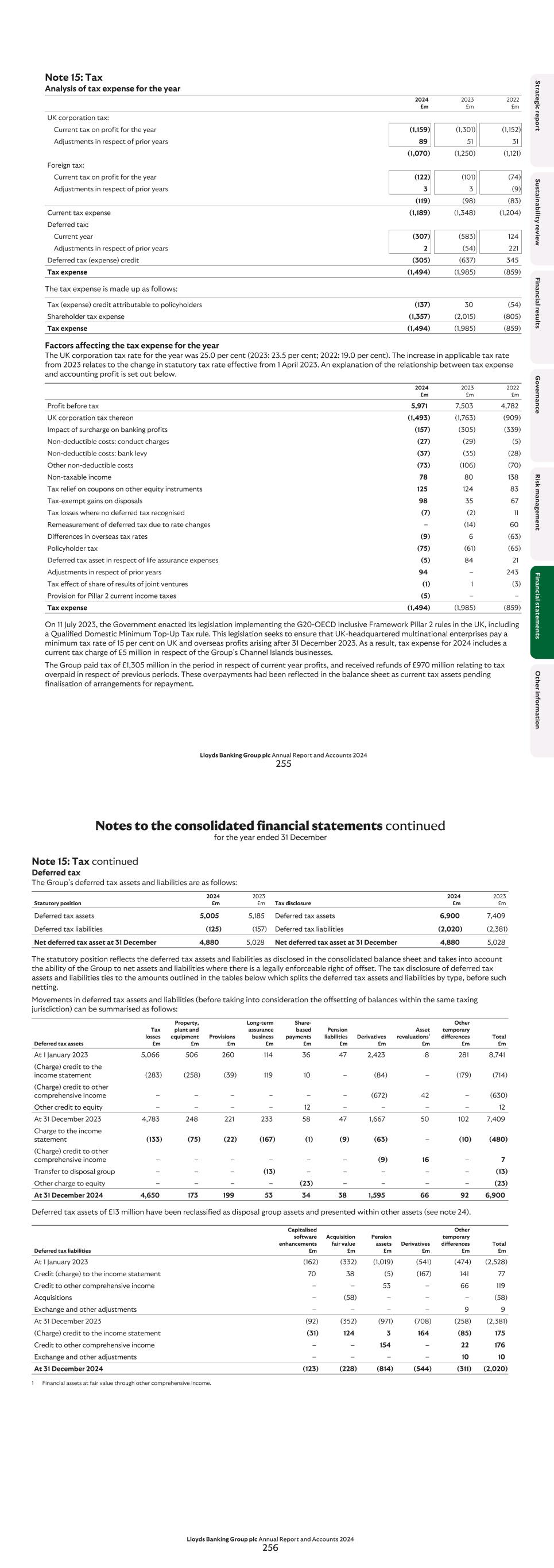
Note 15: Tax Analysis of tax expense for the year 2024 £m 2023 £m 2022 £m UK corporation tax: Current tax on profit for the year (1,159) (1,301) (1,152) Adjustments in respect of prior years 89 51 31 (1,070) (1,250) (1,121) Foreign tax: Current tax on profit for the year (122) (101) (74) Adjustments in respect of prior years 3 3 (9) (119) (98) (83) Current tax expense (1,189) (1,348) (1,204) Deferred tax: Current year (307) (583) 124 Adjustments in respect of prior years 2 (54) 221 Deferred tax (expense) credit (305) (637) 345 Tax expense (1,494) (1,985) (859) The tax expense is made up as follows: Tax (expense) credit attributable to policyholders (137) 30 (54) Shareholder tax expense (1,357) (2,015) (805) Tax expense (1,494) (1,985) (859) Factors affecting the tax expense for the year The UK corporation tax rate for the year was 25.0 per cent (2023: 23.5 per cent; 2022: 19.0 per cent). The increase in applicable tax rate from 2023 relates to the change in statutory tax rate effective from 1 April 2023. An explanation of the relationship between tax expense and accounting profit is set out below. 2024 £m 2023 £m 2022 £m Profit before tax 5,971 7,503 4,782 UK corporation tax thereon (1,493) (1,763) (909) Impact of surcharge on banking profits (157) (305) (339) Non-deductible costs: conduct charges (27) (29) (5) Non-deductible costs: bank levy (37) (35) (28) Other non-deductible costs (73) (106) (70) Non-taxable income 78 80 138 Tax relief on coupons on other equity instruments 125 124 83 Tax-exempt gains on disposals 98 35 67 Tax losses where no deferred tax recognised (7) (2) 11 Remeasurement of deferred tax due to rate changes – (14) 60 Differences in overseas tax rates (9) 6 (63) Policyholder tax (75) (61) (65) Deferred tax asset in respect of life assurance expenses (5) 84 21 Adjustments in respect of prior years 94 – 243 Tax effect of share of results of joint ventures (1) 1 (3) Provision for Pillar 2 current income taxes (5) – – Tax expense (1,494) (1,985) (859) On 11 July 2023, the Government enacted its legislation implementing the G20-OECD Inclusive Framework Pillar 2 rules in the UK, including a Qualified Domestic Minimum Top-Up Tax rule. This legislation seeks to ensure that UK-headquartered multinational enterprises pay a minimum tax rate of 15 per cent on UK and overseas profits arising after 31 December 2023. As a result, tax expense for 2024 includes a current tax charge of £5 million in respect of the Group’s Channel Islands businesses. The Group paid tax of £1,305 million in the period in respect of current year profits, and received refunds of £970 million relating to tax overpaid in respect of previous periods. These overpayments had been reflected in the balance sheet as current tax assets pending finalisation of arrangements for repayment. Lloyds Banking Group plc Annual Report and Accounts 2024 255 l i ts 2 O th e r in fo rm a tio n F in a n cia l sta te m e n ts R isk m a n a ge m e n t F in a n cia l re su lts S u sta in a b ility re vie w S tra te gic re p o rt G o ve rn a n ce Note 15: Tax continued Deferred tax The Group’s deferred tax assets and liabilities are as follows: Statutory position 2024 £m 2023 £m Tax disclosure 2024 £m 2023 £m Deferred tax assets 5,005 5,185 Deferred tax assets 6,900 7,409 Deferred tax liabilities (125) (157) Deferred tax liabilities (2,020) (2,381) Net deferred tax asset at 31 December 4,880 5,028 Net deferred tax asset at 31 December 4,880 5,028 The statutory position reflects the deferred tax assets and liabilities as disclosed in the consolidated balance sheet and takes into account the ability of the Group to net assets and liabilities where there is a legally enforceable right of offset. The tax disclosure of deferred tax assets and liabilities ties to the amounts outlined in the tables below which splits the deferred tax assets and liabilities by type, before such netting. Movements in deferred tax assets and liabilities (before taking into consideration the offsetting of balances within the same taxing jurisdiction) can be summarised as follows: Deferred tax assets Tax losses £m Property, plant and equipment £m Provisions £m Long-term assurance business £m Share- based payments £m Pension liabilities £m Derivatives £m Asset revaluations1 £m Other temporary differences £m Total £m At 1 January 2023 5,066 506 260 114 36 47 2,423 8 281 8,741 (Charge) credit to the income statement (283) (258) (39) 119 10 – (84) – (179) (714) (Charge) credit to other comprehensive income – – – – – – (672) 42 – (630) Other credit to equity – – – – 12 – – – – 12 At 31 December 2023 4,783 248 221 233 58 47 1,667 50 102 7,409 Charge to the income statement (133) (75) (22) (167) (1) (9) (63) – (10) (480) (Charge) credit to other comprehensive income – – – – – – (9) 16 – 7 Transfer to disposal group – – – (13) – – – – – (13) Other charge to equity – – – – (23) – – – – (23) At 31 December 2024 4,650 173 199 53 34 38 1,595 66 92 6,900 Deferred tax assets of £13 million have been reclassified as disposal group assets and presented within other assets (see note 24). Deferred tax liabilities Capitalised software enhancements £m Acquisition fair value £m Pension assets £m Derivatives £m Other temporary differences £m Total £m At 1 January 2023 (162) (332) (1,019) (541) (474) (2,528) Credit (charge) to the income statement 70 38 (5) (167) 141 77 Credit to other comprehensive income – – 53 – 66 119 Acquisitions – (58) – – – (58) Exchange and other adjustments – – – – 9 9 At 31 December 2023 (92) (352) (971) (708) (258) (2,381) (Charge) credit to the income statement (31) 124 3 164 (85) 175 Credit to other comprehensive income – – 154 – 22 176 Exchange and other adjustments – – – – 10 10 At 31 December 2024 (123) (228) (814) (544) (311) (2,020) 1 Financial assets at fair value through other comprehensive income. Notes to the consolidated financial statements continued for the year ended 31 December Lloyds Banking Group plc Annual Report and Accounts 2024 256 l i ts
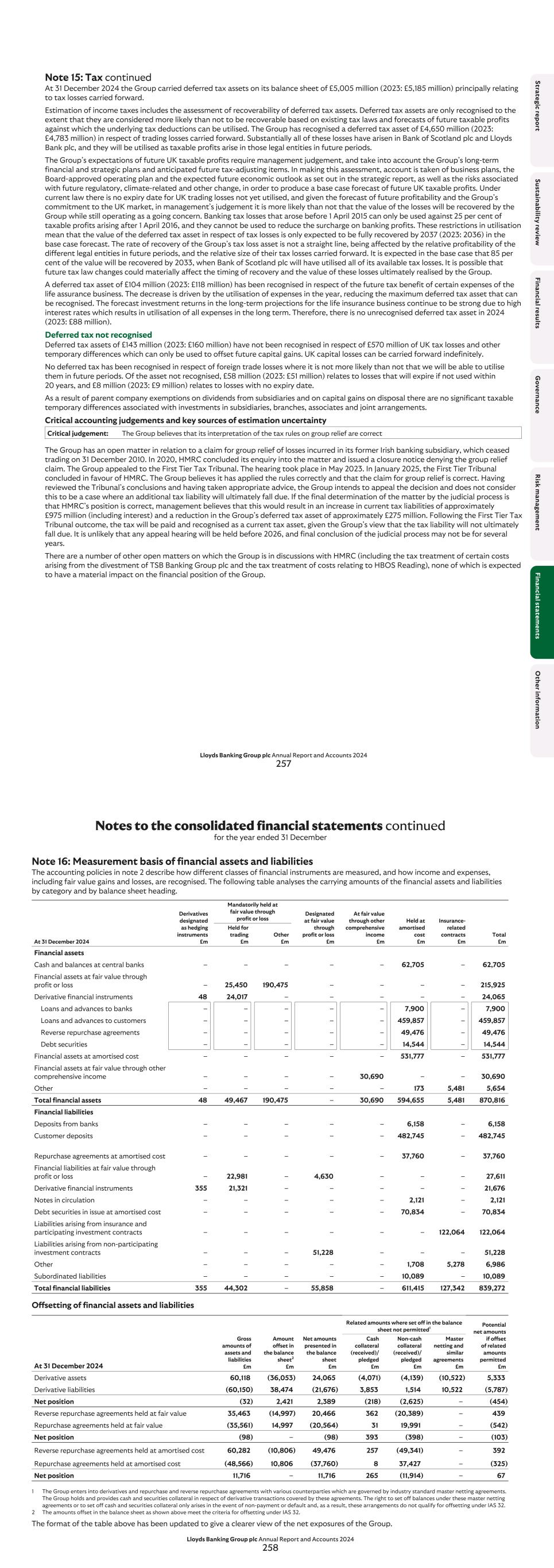
Note 15: Tax continued At 31 December 2024 the Group carried deferred tax assets on its balance sheet of £5,005 million (2023: £5,185 million) principally relating to tax losses carried forward. Estimation of income taxes includes the assessment of recoverability of deferred tax assets. Deferred tax assets are only recognised to the extent that they are considered more likely than not to be recoverable based on existing tax laws and forecasts of future taxable profits against which the underlying tax deductions can be utilised. The Group has recognised a deferred tax asset of £4,650 million (2023: £4,783 million) in respect of trading losses carried forward. Substantially all of these losses have arisen in Bank of Scotland plc and Lloyds Bank plc, and they will be utilised as taxable profits arise in those legal entities in future periods. The Group’s expectations of future UK taxable profits require management judgement, and take into account the Group’s long-term financial and strategic plans and anticipated future tax-adjusting items. In making this assessment, account is taken of business plans, the Board-approved operating plan and the expected future economic outlook as set out in the strategic report, as well as the risks associated with future regulatory, climate-related and other change, in order to produce a base case forecast of future UK taxable profits. Under current law there is no expiry date for UK trading losses not yet utilised, and given the forecast of future profitability and the Group’s commitment to the UK market, in management’s judgement it is more likely than not that the value of the losses will be recovered by the Group while still operating as a going concern. Banking tax losses that arose before 1 April 2015 can only be used against 25 per cent of taxable profits arising after 1 April 2016, and they cannot be used to reduce the surcharge on banking profits. These restrictions in utilisation mean that the value of the deferred tax asset in respect of tax losses is only expected to be fully recovered by 2037 (2023: 2036) in the base case forecast. The rate of recovery of the Group’s tax loss asset is not a straight line, being affected by the relative profitability of the different legal entities in future periods, and the relative size of their tax losses carried forward. It is expected in the base case that 85 per cent of the value will be recovered by 2033, when Bank of Scotland plc will have utilised all of its available tax losses. It is possible that future tax law changes could materially affect the timing of recovery and the value of these losses ultimately realised by the Group. A deferred tax asset of £104 million (2023: £118 million) has been recognised in respect of the future tax benefit of certain expenses of the life assurance business. The decrease is driven by the utilisation of expenses in the year, reducing the maximum deferred tax asset that can be recognised. The forecast investment returns in the long-term projections for the life insurance business continue to be strong due to high interest rates which results in utilisation of all expenses in the long term. Therefore, there is no unrecognised deferred tax asset in 2024 (2023: £88 million). Deferred tax not recognised Deferred tax assets of £143 million (2023: £160 million) have not been recognised in respect of £570 million of UK tax losses and other temporary differences which can only be used to offset future capital gains. UK capital losses can be carried forward indefinitely. No deferred tax has been recognised in respect of foreign trade losses where it is not more likely than not that we will be able to utilise them in future periods. Of the asset not recognised, £58 million (2023: £51 million) relates to losses that will expire if not used within 20 years, and £8 million (2023: £9 million) relates to losses with no expiry date. As a result of parent company exemptions on dividends from subsidiaries and on capital gains on disposal there are no significant taxable temporary differences associated with investments in subsidiaries, branches, associates and joint arrangements. Critical accounting judgements and key sources of estimation uncertainty Critical judgement: The Group believes that its interpretation of the tax rules on group relief are correct The Group has an open matter in relation to a claim for group relief of losses incurred in its former Irish banking subsidiary, which ceased trading on 31 December 2010. In 2020, HMRC concluded its enquiry into the matter and issued a closure notice denying the group relief claim. The Group appealed to the First Tier Tax Tribunal. The hearing took place in May 2023. In January 2025, the First Tier Tribunal concluded in favour of HMRC. The Group believes it has applied the rules correctly and that the claim for group relief is correct. Having reviewed the Tribunal’s conclusions and having taken appropriate advice, the Group intends to appeal the decision and does not consider this to be a case where an additional tax liability will ultimately fall due. If the final determination of the matter by the judicial process is that HMRC’s position is correct, management believes that this would result in an increase in current tax liabilities of approximately £975 million (including interest) and a reduction in the Group’s deferred tax asset of approximately £275 million. Following the First Tier Tax Tribunal outcome, the tax will be paid and recognised as a current tax asset, given the Group’s view that the tax liability will not ultimately fall due. It is unlikely that any appeal hearing will be held before 2026, and final conclusion of the judicial process may not be for several years. There are a number of other open matters on which the Group is in discussions with HMRC (including the tax treatment of certain costs arising from the divestment of TSB Banking Group plc and the tax treatment of costs relating to HBOS Reading), none of which is expected to have a material impact on the financial position of the Group. Lloyds Banking Group plc Annual Report and Accounts 2024 257 l i ts 2 O th e r in fo rm a tio n F in a n cia l sta te m e n ts R isk m a n a ge m e n t F in a n cia l re su lts S u sta in a b ility re vie w S tra te gic re p o rt G o ve rn a n ce Note 16: Measurement basis of financial assets and liabilities The accounting policies in note 2 describe how different classes of financial instruments are measured, and how income and expenses, including fair value gains and losses, are recognised. The following table analyses the carrying amounts of the financial assets and liabilities by category and by balance sheet heading. Derivatives designated as hedging instruments £m Mandatorily held at fair value through profit or loss Designated at fair value through profit or loss £m At fair value through other comprehensive income £m Held at amortised cost £m Insurance- related contracts £mAt 31 December 2024 Held for trading £m Other £m Total £m Financial assets Cash and balances at central banks – – – – – 62,705 – 62,705 Financial assets at fair value through profit or loss – 25,450 190,475 – – – – 215,925 Derivative financial instruments 48 24,017 – – – – – 24,065 Loans and advances to banks – – – – – 7,900 – 7,900 Loans and advances to customers – – – – – 459,857 – 459,857 Reverse repurchase agreements – – – – – 49,476 – 49,476 Debt securities – – – – – 14,544 – 14,544 Financial assets at amortised cost – – – – – 531,777 – 531,777 Financial assets at fair value through other comprehensive income – – – – 30,690 – – 30,690 Other – – – – – 173 5,481 5,654 Total financial assets 48 49,467 190,475 – 30,690 594,655 5,481 870,816 Financial liabilities Deposits from banks – – – – – 6,158 – 6,158 Customer deposits – – – – – 482,745 – 482,745 Repurchase agreements at amortised cost – – – – – 37,760 – 37,760 Financial liabilities at fair value through profit or loss – 22,981 – 4,630 – – – 27,611 Derivative financial instruments 355 21,321 – – – – – 21,676 Notes in circulation – – – – – 2,121 – 2,121 Debt securities in issue at amortised cost – – – – – 70,834 – 70,834 Liabilities arising from insurance and participating investment contracts – – – – – – 122,064 122,064 Liabilities arising from non-participating investment contracts – – – 51,228 – – – 51,228 Other – – – – – 1,708 5,278 6,986 Subordinated liabilities – – – – – 10,089 – 10,089 Total financial liabilities 355 44,302 – 55,858 – 611,415 127,342 839,272 Offsetting of financial assets and liabilities Related amounts where set off in the balance sheet not permitted1 Potential net amounts if offset of related amounts permitted £mAt 31 December 2024 Gross amounts of assets and liabilities £m Amount offset in the balance sheet2 £m Net amounts presented in the balance sheet £m Cash collateral (received)/ pledged £m Non-cash collateral (received)/ pledged £m Master netting and similar agreements £m Derivative assets 60,118 (36,053) 24,065 (4,071) (4,139) (10,522) 5,333 Derivative liabilities (60,150) 38,474 (21,676) 3,853 1,514 10,522 (5,787) Net position (32) 2,421 2,389 (218) (2,625) – (454) Reverse repurchase agreements held at fair value 35,463 (14,997) 20,466 362 (20,389) – 439 Repurchase agreements held at fair value (35,561) 14,997 (20,564) 31 19,991 – (542) Net position (98) – (98) 393 (398) – (103) Reverse repurchase agreements held at amortised cost 60,282 (10,806) 49,476 257 (49,341) – 392 Repurchase agreements held at amortised cost (48,566) 10,806 (37,760) 8 37,427 – (325) Net position 11,716 – 11,716 265 (11,914) – 67 1 The Group enters into derivatives and repurchase and reverse repurchase agreements with various counterparties which are governed by industry standard master netting agreements. The Group holds and provides cash and securities collateral in respect of derivative transactions covered by these agreements. The right to set off balances under these master netting agreements or to set off cash and securities collateral only arises in the event of non-payment or default and, as a result, these arrangements do not qualify for offsetting under IAS 32. 2 The amounts offset in the balance sheet as shown above meet the criteria for offsetting under IAS 32. The format of the table above has been updated to give a clearer view of the net exposures of the Group. Notes to the consolidated financial statements continued for the year ended 31 December Lloyds Banking Group plc Annual Report and Accounts 2024 258 l i ts
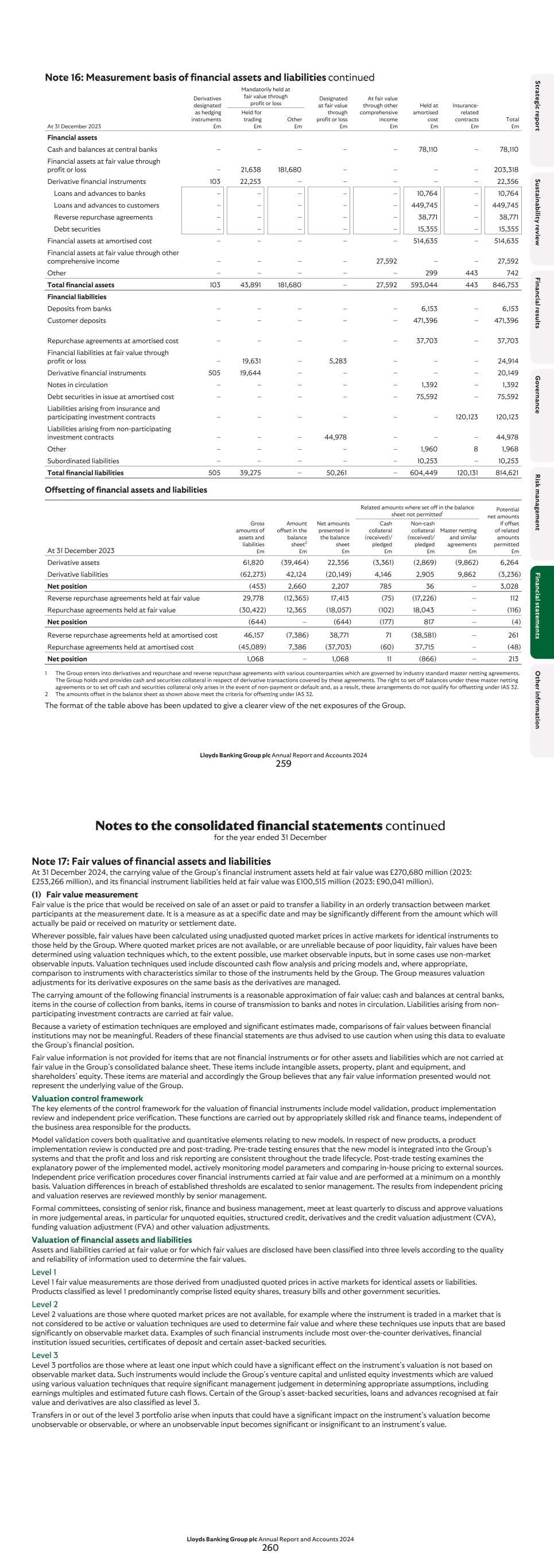
Note 16: Measurement basis of financial assets and liabilities continued Derivatives designated as hedging instruments £m Mandatorily held at fair value through profit or loss Designated at fair value through profit or loss £m At fair value through other comprehensive income £m Held at amortised cost £m Insurance- related contracts £mAt 31 December 2023 Held for trading £m Other £m Total £m Financial assets Cash and balances at central banks – – – – – 78,110 – 78,110 Financial assets at fair value through profit or loss – 21,638 181,680 – – – – 203,318 Derivative financial instruments 103 22,253 – – – – – 22,356 Loans and advances to banks – – – – – 10,764 – 10,764 Loans and advances to customers – – – – – 449,745 – 449,745 Reverse repurchase agreements – – – – – 38,771 – 38,771 Debt securities – – – – – 15,355 – 15,355 Financial assets at amortised cost – – – – – 514,635 – 514,635 Financial assets at fair value through other comprehensive income – – – – 27,592 – – 27,592 Other – – – – – 299 443 742 Total financial assets 103 43,891 181,680 – 27,592 593,044 443 846,753 Financial liabilities Deposits from banks – – – – – 6,153 – 6,153 Customer deposits – – – – – 471,396 – 471,396 Repurchase agreements at amortised cost – – – – – 37,703 – 37,703 Financial liabilities at fair value through profit or loss – 19,631 – 5,283 – – – 24,914 Derivative financial instruments 505 19,644 – – – – – 20,149 Notes in circulation – – – – – 1,392 – 1,392 Debt securities in issue at amortised cost – – – – – 75,592 – 75,592 Liabilities arising from insurance and participating investment contracts – – – – – – 120,123 120,123 Liabilities arising from non-participating investment contracts – – – 44,978 – – – 44,978 Other – – – – – 1,960 8 1,968 Subordinated liabilities – – – – – 10,253 – 10,253 Total financial liabilities 505 39,275 – 50,261 – 604,449 120,131 814,621 Offsetting of financial assets and liabilities Amount offset in the balance sheet2 £m Related amounts where set off in the balance sheet not permitted1 Potential net amounts if offset of related amounts permitted £mAt 31 December 2023 Gross amounts of assets and liabilities £m Net amounts presented in the balance sheet £m Cash collateral (received)/ pledged £m Non-cash collateral (received)/ pledged £m Master netting and similar agreements £m Derivative assets 61,820 (39,464) 22,356 (3,361) (2,869) (9,862) 6,264 Derivative liabilities (62,273) 42,124 (20,149) 4,146 2,905 9,862 (3,236) Net position (453) 2,660 2,207 785 36 – 3,028 Reverse repurchase agreements held at fair value 29,778 (12,365) 17,413 (75) (17,226) – 112 Repurchase agreements held at fair value (30,422) 12,365 (18,057) (102) 18,043 – (116) Net position (644) – (644) (177) 817 – (4) Reverse repurchase agreements held at amortised cost 46,157 (7,386) 38,771 71 (38,581) – 261 Repurchase agreements held at amortised cost (45,089) 7,386 (37,703) (60) 37,715 – (48) Net position 1,068 – 1,068 11 (866) – 213 1 The Group enters into derivatives and repurchase and reverse repurchase agreements with various counterparties which are governed by industry standard master netting agreements. The Group holds and provides cash and securities collateral in respect of derivative transactions covered by these agreements. The right to set off balances under these master netting agreements or to set off cash and securities collateral only arises in the event of non-payment or default and, as a result, these arrangements do not qualify for offsetting under IAS 32. 2 The amounts offset in the balance sheet as shown above meet the criteria for offsetting under IAS 32. The format of the table above has been updated to give a clearer view of the net exposures of the Group. Lloyds Banking Group plc Annual Report and Accounts 2024 259 l i ts 2 O th e r in fo rm a tio n F in a n cia l sta te m e n ts R isk m a n a ge m e n t F in a n cia l re su lts S u sta in a b ility re vie w S tra te gic re p o rt G o ve rn a n ce Note 17: Fair values of financial assets and liabilities At 31 December 2024, the carrying value of the Group’s financial instrument assets held at fair value was £270,680 million (2023: £253,266 million), and its financial instrument liabilities held at fair value was £100,515 million (2023: £90,041 million). (1) Fair value measurement Fair value is the price that would be received on sale of an asset or paid to transfer a liability in an orderly transaction between market participants at the measurement date. It is a measure as at a specific date and may be significantly different from the amount which will actually be paid or received on maturity or settlement date. Wherever possible, fair values have been calculated using unadjusted quoted market prices in active markets for identical instruments to those held by the Group. Where quoted market prices are not available, or are unreliable because of poor liquidity, fair values have been determined using valuation techniques which, to the extent possible, use market observable inputs, but in some cases use non-market observable inputs. Valuation techniques used include discounted cash flow analysis and pricing models and, where appropriate, comparison to instruments with characteristics similar to those of the instruments held by the Group. The Group measures valuation adjustments for its derivative exposures on the same basis as the derivatives are managed. The carrying amount of the following financial instruments is a reasonable approximation of fair value: cash and balances at central banks, items in the course of collection from banks, items in course of transmission to banks and notes in circulation. Liabilities arising from non- participating investment contracts are carried at fair value. Because a variety of estimation techniques are employed and significant estimates made, comparisons of fair values between financial institutions may not be meaningful. Readers of these financial statements are thus advised to use caution when using this data to evaluate the Group’s financial position. Fair value information is not provided for items that are not financial instruments or for other assets and liabilities which are not carried at fair value in the Group’s consolidated balance sheet. These items include intangible assets, property, plant and equipment, and shareholders’ equity. These items are material and accordingly the Group believes that any fair value information presented would not represent the underlying value of the Group. Valuation control framework The key elements of the control framework for the valuation of financial instruments include model validation, product implementation review and independent price verification. These functions are carried out by appropriately skilled risk and finance teams, independent of the business area responsible for the products. Model validation covers both qualitative and quantitative elements relating to new models. In respect of new products, a product implementation review is conducted pre and post-trading. Pre-trade testing ensures that the new model is integrated into the Group’s systems and that the profit and loss and risk reporting are consistent throughout the trade lifecycle. Post-trade testing examines the explanatory power of the implemented model, actively monitoring model parameters and comparing in-house pricing to external sources. Independent price verification procedures cover financial instruments carried at fair value and are performed at a minimum on a monthly basis. Valuation differences in breach of established thresholds are escalated to senior management. The results from independent pricing and valuation reserves are reviewed monthly by senior management. Formal committees, consisting of senior risk, finance and business management, meet at least quarterly to discuss and approve valuations in more judgemental areas, in particular for unquoted equities, structured credit, derivatives and the credit valuation adjustment (CVA), funding valuation adjustment (FVA) and other valuation adjustments. Valuation of financial assets and liabilities Assets and liabilities carried at fair value or for which fair values are disclosed have been classified into three levels according to the quality and reliability of information used to determine the fair values. Level 1 Level 1 fair value measurements are those derived from unadjusted quoted prices in active markets for identical assets or liabilities. Products classified as level 1 predominantly comprise listed equity shares, treasury bills and other government securities. Level 2 Level 2 valuations are those where quoted market prices are not available, for example where the instrument is traded in a market that is not considered to be active or valuation techniques are used to determine fair value and where these techniques use inputs that are based significantly on observable market data. Examples of such financial instruments include most over-the-counter derivatives, financial institution issued securities, certificates of deposit and certain asset-backed securities. Level 3 Level 3 portfolios are those where at least one input which could have a significant effect on the instrument’s valuation is not based on observable market data. Such instruments would include the Group’s venture capital and unlisted equity investments which are valued using various valuation techniques that require significant management judgement in determining appropriate assumptions, including earnings multiples and estimated future cash flows. Certain of the Group’s asset-backed securities, loans and advances recognised at fair value and derivatives are also classified as level 3. Transfers in or out of the level 3 portfolio arise when inputs that could have a significant impact on the instrument’s valuation become unobservable or observable, or where an unobservable input becomes significant or insignificant to an instrument’s value. Notes to the consolidated financial statements continued for the year ended 31 December Lloyds Banking Group plc Annual Report and Accounts 2024 260 l i ts
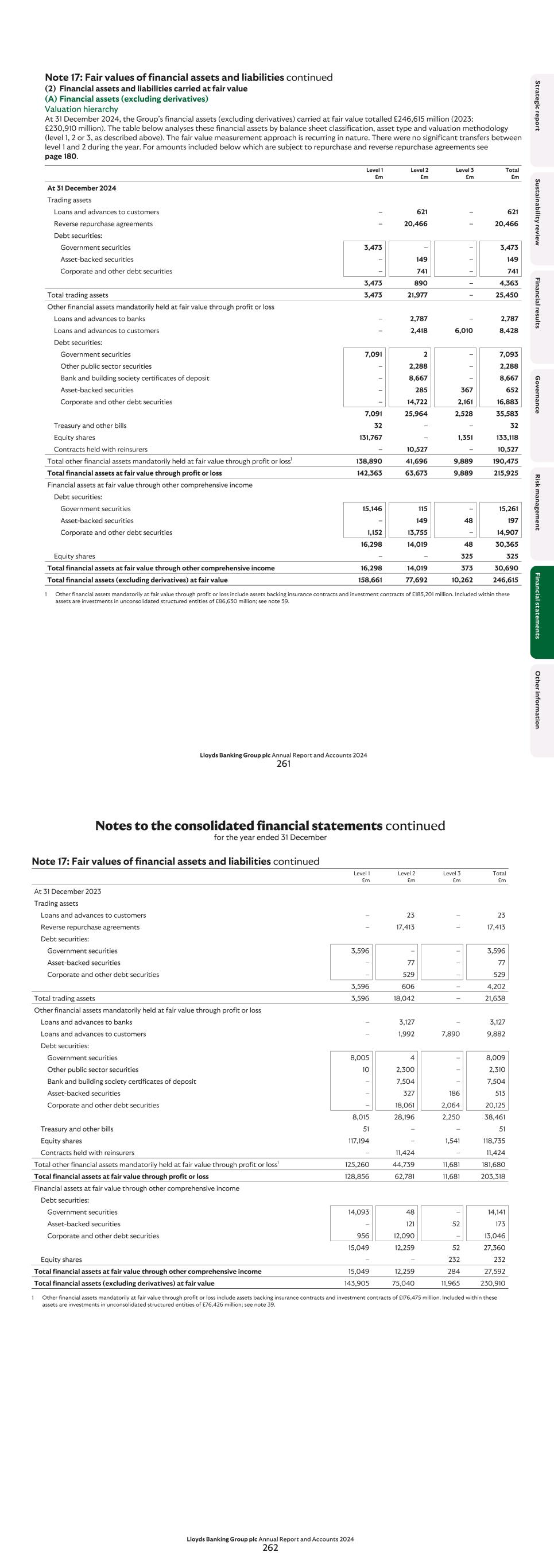
Note 17: Fair values of financial assets and liabilities continued (2) Financial assets and liabilities carried at fair value (A) Financial assets (excluding derivatives) Valuation hierarchy At 31 December 2024, the Group’s financial assets (excluding derivatives) carried at fair value totalled £246,615 million (2023: £230,910 million). The table below analyses these financial assets by balance sheet classification, asset type and valuation methodology (level 1, 2 or 3, as described above). The fair value measurement approach is recurring in nature. There were no significant transfers between level 1 and 2 during the year. For amounts included below which are subject to repurchase and reverse repurchase agreements see page 180. Level 1 £m Level 2 £m Level 3 £m Total £m At 31 December 2024 Trading assets Loans and advances to customers – 621 – 621 Reverse repurchase agreements – 20,466 – 20,466 Debt securities: Government securities 3,473 – – 3,473 Asset-backed securities – 149 – 149 Corporate and other debt securities – 741 – 741 3,473 890 – 4,363 Total trading assets 3,473 21,977 – 25,450 Other financial assets mandatorily held at fair value through profit or loss Loans and advances to banks – 2,787 – 2,787 Loans and advances to customers – 2,418 6,010 8,428 Debt securities: Government securities 7,091 2 – 7,093 Other public sector securities – 2,288 – 2,288 Bank and building society certificates of deposit – 8,667 – 8,667 Asset-backed securities – 285 367 652 Corporate and other debt securities – 14,722 2,161 16,883 7,091 25,964 2,528 35,583 Treasury and other bills 32 – – 32 Equity shares 131,767 – 1,351 133,118 Contracts held with reinsurers – 10,527 – 10,527 Total other financial assets mandatorily held at fair value through profit or loss1 138,890 41,696 9,889 190,475 Total financial assets at fair value through profit or loss 142,363 63,673 9,889 215,925 Financial assets at fair value through other comprehensive income Debt securities: Government securities 15,146 115 – 15,261 Asset-backed securities – 149 48 197 Corporate and other debt securities 1,152 13,755 – 14,907 16,298 14,019 48 30,365 Equity shares – – 325 325 Total financial assets at fair value through other comprehensive income 16,298 14,019 373 30,690 Total financial assets (excluding derivatives) at fair value 158,661 77,692 10,262 246,615 1 Other financial assets mandatorily at fair value through profit or loss include assets backing insurance contracts and investment contracts of £185,201 million. Included within these assets are investments in unconsolidated structured entities of £86,630 million; see note 39. Lloyds Banking Group plc Annual Report and Accounts 2024 261 l i ts 2 O th e r in fo rm a tio n F in a n cia l sta te m e n ts R isk m a n a ge m e n t F in a n cia l re su lts S u sta in a b ility re vie w S tra te gic re p o rt G o ve rn a n ce Note 17: Fair values of financial assets and liabilities continued Level 1 £m Level 2 £m Level 3 £m Total £m At 31 December 2023 Trading assets Loans and advances to customers – 23 – 23 Reverse repurchase agreements – 17,413 – 17,413 Debt securities: Government securities 3,596 – – 3,596 Asset-backed securities – 77 – 77 Corporate and other debt securities – 529 – 529 3,596 606 – 4,202 Total trading assets 3,596 18,042 – 21,638 Other financial assets mandatorily held at fair value through profit or loss Loans and advances to banks – 3,127 – 3,127 Loans and advances to customers – 1,992 7,890 9,882 Debt securities: Government securities 8,005 4 – 8,009 Other public sector securities 10 2,300 – 2,310 Bank and building society certificates of deposit – 7,504 – 7,504 Asset-backed securities – 327 186 513 Corporate and other debt securities – 18,061 2,064 20,125 8,015 28,196 2,250 38,461 Treasury and other bills 51 – – 51 Equity shares 117,194 – 1,541 118,735 Contracts held with reinsurers – 11,424 – 11,424 Total other financial assets mandatorily held at fair value through profit or loss1 125,260 44,739 11,681 181,680 Total financial assets at fair value through profit or loss 128,856 62,781 11,681 203,318 Financial assets at fair value through other comprehensive income Debt securities: Government securities 14,093 48 – 14,141 Asset-backed securities – 121 52 173 Corporate and other debt securities 956 12,090 – 13,046 15,049 12,259 52 27,360 Equity shares – – 232 232 Total financial assets at fair value through other comprehensive income 15,049 12,259 284 27,592 Total financial assets (excluding derivatives) at fair value 143,905 75,040 11,965 230,910 1 Other financial assets mandatorily at fair value through profit or loss include assets backing insurance contracts and investment contracts of £176,475 million. Included within these assets are investments in unconsolidated structured entities of £76,426 million; see note 39. Notes to the consolidated financial statements continued for the year ended 31 December Lloyds Banking Group plc Annual Report and Accounts 2024 262 l i ts
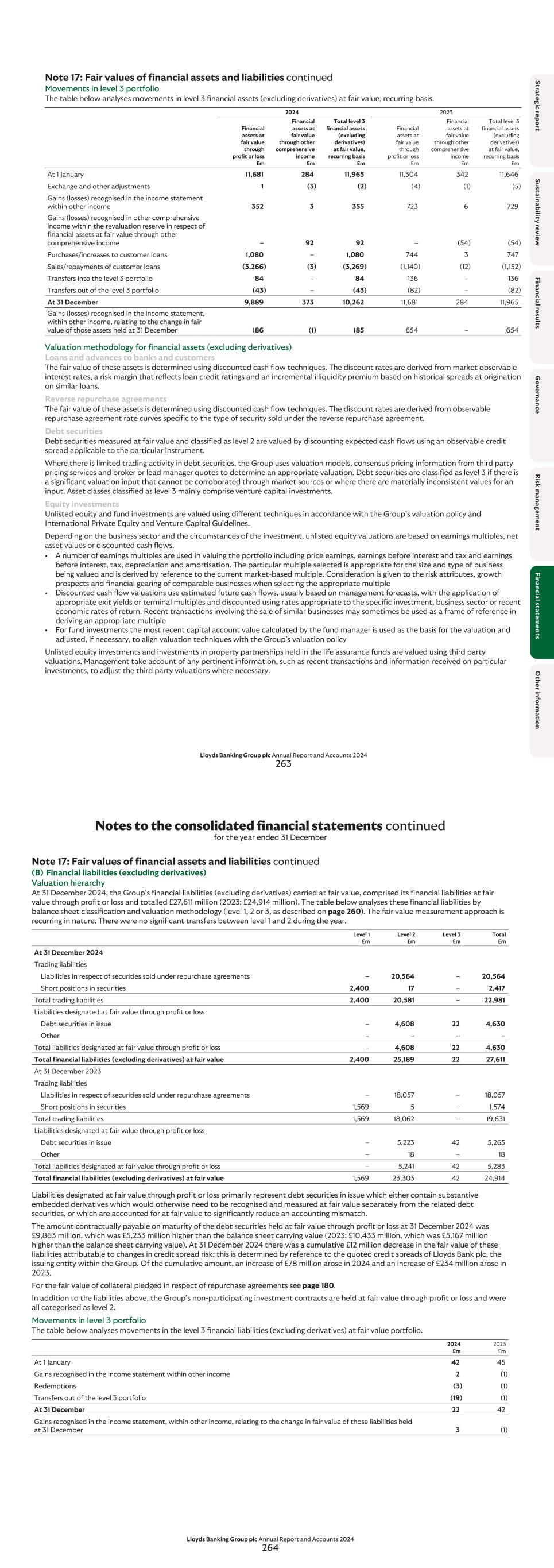
Note 17: Fair values of financial assets and liabilities continued Movements in level 3 portfolio The table below analyses movements in level 3 financial assets (excluding derivatives) at fair value, recurring basis. 2024 2023 Financial assets at fair value through profit or loss £m Financial assets at fair value through other comprehensive income £m Total level 3 financial assets (excluding derivatives) at fair value, recurring basis £m Financial assets at fair value through profit or loss £m Financial assets at fair value through other comprehensive income £m Total level 3 financial assets (excluding derivatives) at fair value, recurring basis £m At 1 January 11,681 284 11,965 11,304 342 11,646 Exchange and other adjustments 1 (3) (2) (4) (1) (5) Gains (losses) recognised in the income statement within other income 352 3 355 723 6 729 Gains (losses) recognised in other comprehensive income within the revaluation reserve in respect of financial assets at fair value through other comprehensive income – 92 92 – (54) (54) Purchases/increases to customer loans 1,080 – 1,080 744 3 747 Sales/repayments of customer loans (3,266) (3) (3,269) (1,140) (12) (1,152) Transfers into the level 3 portfolio 84 – 84 136 – 136 Transfers out of the level 3 portfolio (43) – (43) (82) – (82) At 31 December 9,889 373 10,262 11,681 284 11,965 Gains (losses) recognised in the income statement, within other income, relating to the change in fair value of those assets held at 31 December 186 (1) 185 654 – 654 Valuation methodology for financial assets (excluding derivatives) Loans and advances to banks and customers The fair value of these assets is determined using discounted cash flow techniques. The discount rates are derived from market observable interest rates, a risk margin that reflects loan credit ratings and an incremental illiquidity premium based on historical spreads at origination on similar loans. Reverse repurchase agreements The fair value of these assets is determined using discounted cash flow techniques. The discount rates are derived from observable repurchase agreement rate curves specific to the type of security sold under the reverse repurchase agreement. Debt securities Debt securities measured at fair value and classified as level 2 are valued by discounting expected cash flows using an observable credit spread applicable to the particular instrument. Where there is limited trading activity in debt securities, the Group uses valuation models, consensus pricing information from third party pricing services and broker or lead manager quotes to determine an appropriate valuation. Debt securities are classified as level 3 if there is a significant valuation input that cannot be corroborated through market sources or where there are materially inconsistent values for an input. Asset classes classified as level 3 mainly comprise venture capital investments. Equity investments Unlisted equity and fund investments are valued using different techniques in accordance with the Group’s valuation policy and International Private Equity and Venture Capital Guidelines. Depending on the business sector and the circumstances of the investment, unlisted equity valuations are based on earnings multiples, net asset values or discounted cash flows. • A number of earnings multiples are used in valuing the portfolio including price earnings, earnings before interest and tax and earnings before interest, tax, depreciation and amortisation. The particular multiple selected is appropriate for the size and type of business being valued and is derived by reference to the current market-based multiple. Consideration is given to the risk attributes, growth prospects and financial gearing of comparable businesses when selecting the appropriate multiple • Discounted cash flow valuations use estimated future cash flows, usually based on management forecasts, with the application of appropriate exit yields or terminal multiples and discounted using rates appropriate to the specific investment, business sector or recent economic rates of return. Recent transactions involving the sale of similar businesses may sometimes be used as a frame of reference in deriving an appropriate multiple • For fund investments the most recent capital account value calculated by the fund manager is used as the basis for the valuation and adjusted, if necessary, to align valuation techniques with the Group’s valuation policy Unlisted equity investments and investments in property partnerships held in the life assurance funds are valued using third party valuations. Management take account of any pertinent information, such as recent transactions and information received on particular investments, to adjust the third party valuations where necessary. Lloyds Banking Group plc Annual Report and Accounts 2024 263 l i ts 2 O th e r in fo rm a tio n F in a n cia l sta te m e n ts R isk m a n a ge m e n t F in a n cia l re su lts S u sta in a b ility re vie w S tra te gic re p o rt G o ve rn a n ce Note 17: Fair values of financial assets and liabilities continued (B) Financial liabilities (excluding derivatives) Valuation hierarchy At 31 December 2024, the Group’s financial liabilities (excluding derivatives) carried at fair value, comprised its financial liabilities at fair value through profit or loss and totalled £27,611 million (2023: £24,914 million). The table below analyses these financial liabilities by balance sheet classification and valuation methodology (level 1, 2 or 3, as described on page 260). The fair value measurement approach is recurring in nature. There were no significant transfers between level 1 and 2 during the year. Level 1 £m Level 2 £m Level 3 £m Total £m At 31 December 2024 Trading liabilities Liabilities in respect of securities sold under repurchase agreements – 20,564 – 20,564 Short positions in securities 2,400 17 – 2,417 Total trading liabilities 2,400 20,581 – 22,981 Liabilities designated at fair value through profit or loss Debt securities in issue – 4,608 22 4,630 Other – – – – Total liabilities designated at fair value through profit or loss – 4,608 22 4,630 Total financial liabilities (excluding derivatives) at fair value 2,400 25,189 22 27,611 At 31 December 2023 Trading liabilities Liabilities in respect of securities sold under repurchase agreements – 18,057 – 18,057 Short positions in securities 1,569 5 – 1,574 Total trading liabilities 1,569 18,062 – 19,631 Liabilities designated at fair value through profit or loss Debt securities in issue – 5,223 42 5,265 Other – 18 – 18 Total liabilities designated at fair value through profit or loss – 5,241 42 5,283 Total financial liabilities (excluding derivatives) at fair value 1,569 23,303 42 24,914 Liabilities designated at fair value through profit or loss primarily represent debt securities in issue which either contain substantive embedded derivatives which would otherwise need to be recognised and measured at fair value separately from the related debt securities, or which are accounted for at fair value to significantly reduce an accounting mismatch. The amount contractually payable on maturity of the debt securities held at fair value through profit or loss at 31 December 2024 was £9,863 million, which was £5,233 million higher than the balance sheet carrying value (2023: £10,433 million, which was £5,167 million higher than the balance sheet carrying value). At 31 December 2024 there was a cumulative £12 million decrease in the fair value of these liabilities attributable to changes in credit spread risk; this is determined by reference to the quoted credit spreads of Lloyds Bank plc, the issuing entity within the Group. Of the cumulative amount, an increase of £78 million arose in 2024 and an increase of £234 million arose in 2023. For the fair value of collateral pledged in respect of repurchase agreements see page 180. In addition to the liabilities above, the Group’s non-participating investment contracts are held at fair value through profit or loss and were all categorised as level 2. Movements in level 3 portfolio The table below analyses movements in the level 3 financial liabilities (excluding derivatives) at fair value portfolio. 2024 £m 2023 £m At 1 January 42 45 Gains recognised in the income statement within other income 2 (1) Redemptions (3) (1) Transfers out of the level 3 portfolio (19) (1) At 31 December 22 42 Gains recognised in the income statement, within other income, relating to the change in fair value of those liabilities held at 31 December 3 (1) Notes to the consolidated financial statements continued for the year ended 31 December Lloyds Banking Group plc Annual Report and Accounts 2024 264 l i ts
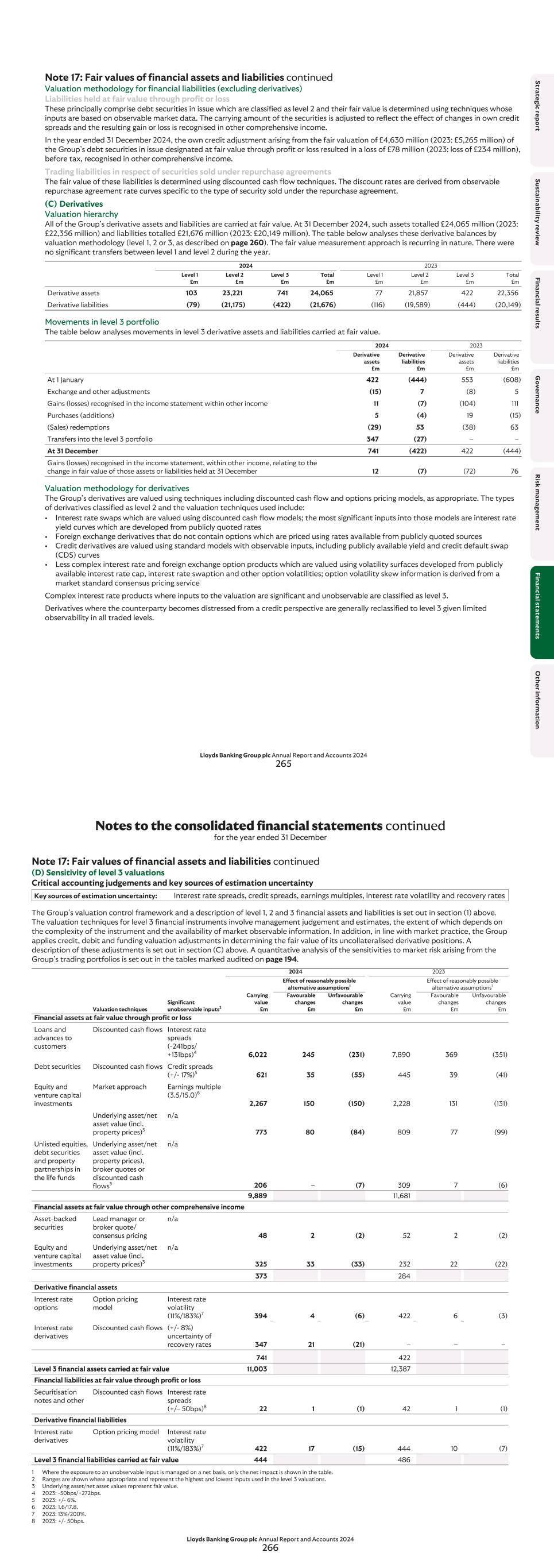
Note 17: Fair values of financial assets and liabilities continued Valuation methodology for financial liabilities (excluding derivatives) Liabilities held at fair value through profit or loss These principally comprise debt securities in issue which are classified as level 2 and their fair value is determined using techniques whose inputs are based on observable market data. The carrying amount of the securities is adjusted to reflect the effect of changes in own credit spreads and the resulting gain or loss is recognised in other comprehensive income. In the year ended 31 December 2024, the own credit adjustment arising from the fair valuation of £4,630 million (2023: £5,265 million) of the Group’s debt securities in issue designated at fair value through profit or loss resulted in a loss of £78 million (2023: loss of £234 million), before tax, recognised in other comprehensive income. Trading liabilities in respect of securities sold under repurchase agreements The fair value of these liabilities is determined using discounted cash flow techniques. The discount rates are derived from observable repurchase agreement rate curves specific to the type of security sold under the repurchase agreement. (C) Derivatives Valuation hierarchy All of the Group’s derivative assets and liabilities are carried at fair value. At 31 December 2024, such assets totalled £24,065 million (2023: £22,356 million) and liabilities totalled £21,676 million (2023: £20,149 million). The table below analyses these derivative balances by valuation methodology (level 1, 2 or 3, as described on page 260). The fair value measurement approach is recurring in nature. There were no significant transfers between level 1 and level 2 during the year. 2024 2023 Level 1 £m Level 2 £m Level 3 £m Total £m Level 1 £m Level 2 £m Level 3 £m Total £m Derivative assets 103 23,221 741 24,065 77 21,857 422 22,356 Derivative liabilities (79) (21,175) (422) (21,676) (116) (19,589) (444) (20,149) Movements in level 3 portfolio The table below analyses movements in level 3 derivative assets and liabilities carried at fair value. 2024 2023 Derivative assets £m Derivative liabilities £m Derivative assets £m Derivative liabilities £m At 1 January 422 (444) 553 (608) Exchange and other adjustments (15) 7 (8) 5 Gains (losses) recognised in the income statement within other income 11 (7) (104) 111 Purchases (additions) 5 (4) 19 (15) (Sales) redemptions (29) 53 (38) 63 Transfers into the level 3 portfolio 347 (27) – – At 31 December 741 (422) 422 (444) Gains (losses) recognised in the income statement, within other income, relating to the change in fair value of those assets or liabilities held at 31 December 12 (7) (72) 76 Valuation methodology for derivatives The Group’s derivatives are valued using techniques including discounted cash flow and options pricing models, as appropriate. The types of derivatives classified as level 2 and the valuation techniques used include: • Interest rate swaps which are valued using discounted cash flow models; the most significant inputs into those models are interest rate yield curves which are developed from publicly quoted rates • Foreign exchange derivatives that do not contain options which are priced using rates available from publicly quoted sources • Credit derivatives are valued using standard models with observable inputs, including publicly available yield and credit default swap (CDS) curves • Less complex interest rate and foreign exchange option products which are valued using volatility surfaces developed from publicly available interest rate cap, interest rate swaption and other option volatilities; option volatility skew information is derived from a market standard consensus pricing service Complex interest rate products where inputs to the valuation are significant and unobservable are classified as level 3. Derivatives where the counterparty becomes distressed from a credit perspective are generally reclassified to level 3 given limited observability in all traded levels. Lloyds Banking Group plc Annual Report and Accounts 2024 265 l i ts 2 O th e r in fo rm a tio n F in a n cia l sta te m e n ts R isk m a n a ge m e n t F in a n cia l re su lts S u sta in a b ility re vie w S tra te gic re p o rt G o ve rn a n ce Note 17: Fair values of financial assets and liabilities continued (D) Sensitivity of level 3 valuations Critical accounting judgements and key sources of estimation uncertainty Key sources of estimation uncertainty: Interest rate spreads, credit spreads, earnings multiples, interest rate volatility and recovery rates The Group’s valuation control framework and a description of level 1, 2 and 3 financial assets and liabilities is set out in section (1) above. The valuation techniques for level 3 financial instruments involve management judgement and estimates, the extent of which depends on the complexity of the instrument and the availability of market observable information. In addition, in line with market practice, the Group applies credit, debit and funding valuation adjustments in determining the fair value of its uncollateralised derivative positions. A description of these adjustments is set out in section (C) above. A quantitative analysis of the sensitivities to market risk arising from the Group’s trading portfolios is set out in the tables marked audited on page 194. 2024 2023 Effect of reasonably possible alternative assumptions1 Effect of reasonably possible alternative assumptions1 Valuation techniques Significant unobservable inputs2 Carrying value £m Favourable changes £m Unfavourable changes £m Carrying value £m Favourable changes £m Unfavourable changes £m Financial assets at fair value through profit or loss Loans and advances to customers Discounted cash flows Interest rate spreads (-241bps/ +131bps)4 6,022 245 (231) 7,890 369 (351) Debt securities Discounted cash flows Credit spreads (+/- 17%)5 621 35 (55) 445 39 (41) Equity and venture capital investments Market approach Earnings multiple (3.5/15.0)6 2,267 150 (150) 2,228 131 (131) Underlying asset/net asset value (incl. property prices)3 n/a 773 80 (84) 809 77 (99) Unlisted equities, debt securities and property partnerships in the life funds Underlying asset/net asset value (incl. property prices), broker quotes or discounted cash flows3 n/a 206 – (7) 309 7 (6) 9,889 11,681 Financial assets at fair value through other comprehensive income Asset-backed securities Lead manager or broker quote/ consensus pricing n/a 48 2 (2) 52 2 (2) Equity and venture capital investments Underlying asset/net asset value (incl. property prices)3 n/a 325 33 (33) 232 22 (22) 373 284 Derivative financial assets Interest rate options Option pricing model Interest rate volatility (11%/183%)7 394 4 (6) 422 6 (3) Interest rate derivatives Discounted cash flows (+/- 8%) uncertainty of recovery rates 347 21 (21) – – – 741 422 Level 3 financial assets carried at fair value 11,003 12,387 Financial liabilities at fair value through profit or loss Securitisation notes and other Discounted cash flows Interest rate spreads (+/– 50bps)8 22 1 (1) 42 1 (1) Derivative financial liabilities Interest rate derivatives Option pricing model Interest rate volatility (11%/183%)7 422 17 (15) 444 10 (7) Level 3 financial liabilities carried at fair value 444 486 1 Where the exposure to an unobservable input is managed on a net basis, only the net impact is shown in the table. 2 Ranges are shown where appropriate and represent the highest and lowest inputs used in the level 3 valuations. 3 Underlying asset/net asset values represent fair value. 4 2023: -50bps/+272bps. 5 2023: +/- 6%. 6 2023: 1.6/17.8. 7 2023: 13%/200%. 8 2023: +/- 50bps. Notes to the consolidated financial statements continued for the year ended 31 December Lloyds Banking Group plc Annual Report and Accounts 2024 266 l i ts
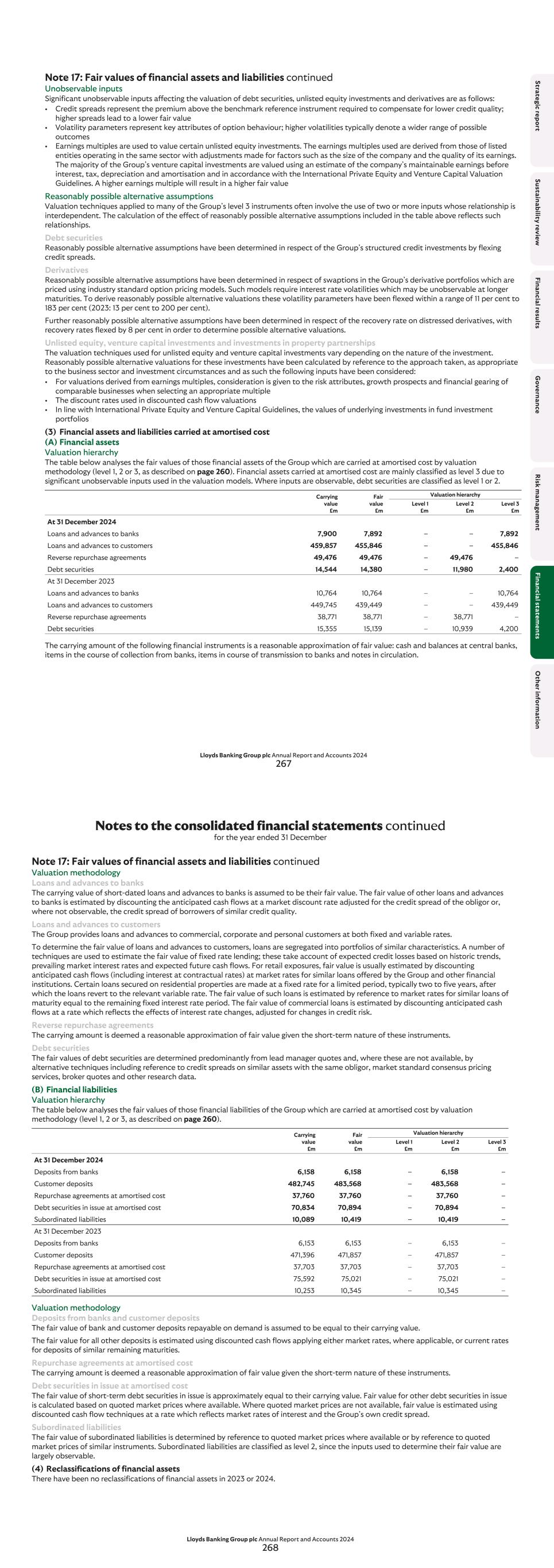
Note 17: Fair values of financial assets and liabilities continued Unobservable inputs Significant unobservable inputs affecting the valuation of debt securities, unlisted equity investments and derivatives are as follows: • Credit spreads represent the premium above the benchmark reference instrument required to compensate for lower credit quality; higher spreads lead to a lower fair value • Volatility parameters represent key attributes of option behaviour; higher volatilities typically denote a wider range of possible outcomes • Earnings multiples are used to value certain unlisted equity investments. The earnings multiples used are derived from those of listed entities operating in the same sector with adjustments made for factors such as the size of the company and the quality of its earnings. The majority of the Group’s venture capital investments are valued using an estimate of the company’s maintainable earnings before interest, tax, depreciation and amortisation and in accordance with the International Private Equity and Venture Capital Valuation Guidelines. A higher earnings multiple will result in a higher fair value Reasonably possible alternative assumptions Valuation techniques applied to many of the Group’s level 3 instruments often involve the use of two or more inputs whose relationship is interdependent. The calculation of the effect of reasonably possible alternative assumptions included in the table above reflects such relationships. Debt securities Reasonably possible alternative assumptions have been determined in respect of the Group’s structured credit investments by flexing credit spreads. Derivatives Reasonably possible alternative assumptions have been determined in respect of swaptions in the Group’s derivative portfolios which are priced using industry standard option pricing models. Such models require interest rate volatilities which may be unobservable at longer maturities. To derive reasonably possible alternative valuations these volatility parameters have been flexed within a range of 11 per cent to 183 per cent (2023: 13 per cent to 200 per cent). Further reasonably possible alternative assumptions have been determined in respect of the recovery rate on distressed derivatives, with recovery rates flexed by 8 per cent in order to determine possible alternative valuations. Unlisted equity, venture capital investments and investments in property partnerships The valuation techniques used for unlisted equity and venture capital investments vary depending on the nature of the investment. Reasonably possible alternative valuations for these investments have been calculated by reference to the approach taken, as appropriate to the business sector and investment circumstances and as such the following inputs have been considered: • For valuations derived from earnings multiples, consideration is given to the risk attributes, growth prospects and financial gearing of comparable businesses when selecting an appropriate multiple • The discount rates used in discounted cash flow valuations • In line with International Private Equity and Venture Capital Guidelines, the values of underlying investments in fund investment portfolios (3) Financial assets and liabilities carried at amortised cost (A) Financial assets Valuation hierarchy The table below analyses the fair values of those financial assets of the Group which are carried at amortised cost by valuation methodology (level 1, 2 or 3, as described on page 260). Financial assets carried at amortised cost are mainly classified as level 3 due to significant unobservable inputs used in the valuation models. Where inputs are observable, debt securities are classified as level 1 or 2. Carrying value £m Fair value £m Valuation hierarchy Level 1 £m Level 2 £m Level 3 £m At 31 December 2024 Loans and advances to banks 7,900 7,892 – – 7,892 Loans and advances to customers 459,857 455,846 – – 455,846 Reverse repurchase agreements 49,476 49,476 – 49,476 – Debt securities 14,544 14,380 – 11,980 2,400 At 31 December 2023 Loans and advances to banks 10,764 10,764 – – 10,764 Loans and advances to customers 449,745 439,449 – – 439,449 Reverse repurchase agreements 38,771 38,771 – 38,771 – Debt securities 15,355 15,139 – 10,939 4,200 The carrying amount of the following financial instruments is a reasonable approximation of fair value: cash and balances at central banks, items in the course of collection from banks, items in course of transmission to banks and notes in circulation. Lloyds Banking Group plc Annual Report and Accounts 2024 267 l i ts 2 O th e r in fo rm a tio n F in a n cia l sta te m e n ts R isk m a n a ge m e n t F in a n cia l re su lts S u sta in a b ility re vie w S tra te gic re p o rt G o ve rn a n ce Note 17: Fair values of financial assets and liabilities continued Valuation methodology Loans and advances to banks The carrying value of short-dated loans and advances to banks is assumed to be their fair value. The fair value of other loans and advances to banks is estimated by discounting the anticipated cash flows at a market discount rate adjusted for the credit spread of the obligor or, where not observable, the credit spread of borrowers of similar credit quality. Loans and advances to customers The Group provides loans and advances to commercial, corporate and personal customers at both fixed and variable rates. To determine the fair value of loans and advances to customers, loans are segregated into portfolios of similar characteristics. A number of techniques are used to estimate the fair value of fixed rate lending; these take account of expected credit losses based on historic trends, prevailing market interest rates and expected future cash flows. For retail exposures, fair value is usually estimated by discounting anticipated cash flows (including interest at contractual rates) at market rates for similar loans offered by the Group and other financial institutions. Certain loans secured on residential properties are made at a fixed rate for a limited period, typically two to five years, after which the loans revert to the relevant variable rate. The fair value of such loans is estimated by reference to market rates for similar loans of maturity equal to the remaining fixed interest rate period. The fair value of commercial loans is estimated by discounting anticipated cash flows at a rate which reflects the effects of interest rate changes, adjusted for changes in credit risk. Reverse repurchase agreements The carrying amount is deemed a reasonable approximation of fair value given the short-term nature of these instruments. Debt securities The fair values of debt securities are determined predominantly from lead manager quotes and, where these are not available, by alternative techniques including reference to credit spreads on similar assets with the same obligor, market standard consensus pricing services, broker quotes and other research data. (B) Financial liabilities Valuation hierarchy The table below analyses the fair values of those financial liabilities of the Group which are carried at amortised cost by valuation methodology (level 1, 2 or 3, as described on page 260). Carrying value £m Fair value £m Valuation hierarchy Level 1 £m Level 2 £m Level 3 £m At 31 December 2024 Deposits from banks 6,158 6,158 – 6,158 – Customer deposits 482,745 483,568 – 483,568 – Repurchase agreements at amortised cost 37,760 37,760 – 37,760 – Debt securities in issue at amortised cost 70,834 70,894 – 70,894 – Subordinated liabilities 10,089 10,419 – 10,419 – At 31 December 2023 Deposits from banks 6,153 6,153 – 6,153 – Customer deposits 471,396 471,857 – 471,857 – Repurchase agreements at amortised cost 37,703 37,703 – 37,703 – Debt securities in issue at amortised cost 75,592 75,021 – 75,021 – Subordinated liabilities 10,253 10,345 – 10,345 – Valuation methodology Deposits from banks and customer deposits The fair value of bank and customer deposits repayable on demand is assumed to be equal to their carrying value. The fair value for all other deposits is estimated using discounted cash flows applying either market rates, where applicable, or current rates for deposits of similar remaining maturities. Repurchase agreements at amortised cost The carrying amount is deemed a reasonable approximation of fair value given the short-term nature of these instruments. Debt securities in issue at amortised cost The fair value of short-term debt securities in issue is approximately equal to their carrying value. Fair value for other debt securities in issue is calculated based on quoted market prices where available. Where quoted market prices are not available, fair value is estimated using discounted cash flow techniques at a rate which reflects market rates of interest and the Group’s own credit spread. Subordinated liabilities The fair value of subordinated liabilities is determined by reference to quoted market prices where available or by reference to quoted market prices of similar instruments. Subordinated liabilities are classified as level 2, since the inputs used to determine their fair value are largely observable. (4) Reclassifications of financial assets There have been no reclassifications of financial assets in 2023 or 2024. Notes to the consolidated financial statements continued for the year ended 31 December Lloyds Banking Group plc Annual Report and Accounts 2024 268 l i ts
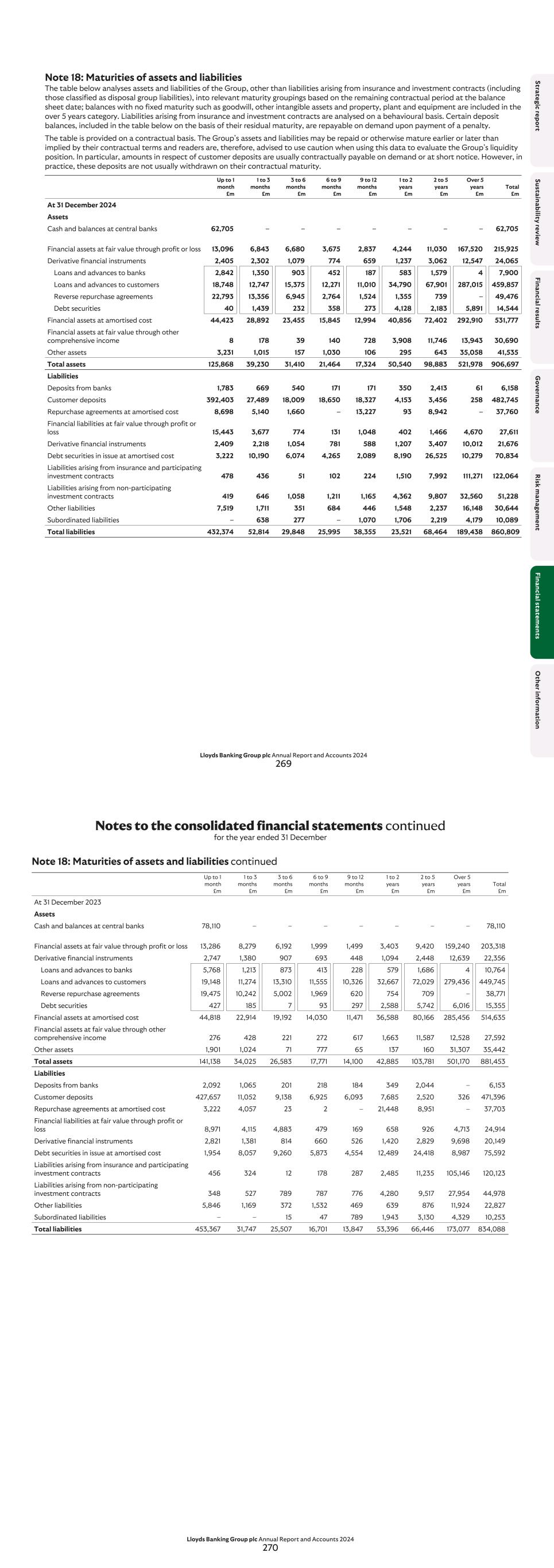
Note 18: Maturities of assets and liabilities The table below analyses assets and liabilities of the Group, other than liabilities arising from insurance and investment contracts (including those classified as disposal group liabilities), into relevant maturity groupings based on the remaining contractual period at the balance sheet date; balances with no fixed maturity such as goodwill, other intangible assets and property, plant and equipment are included in the over 5 years category. Liabilities arising from insurance and investment contracts are analysed on a behavioural basis. Certain deposit balances, included in the table below on the basis of their residual maturity, are repayable on demand upon payment of a penalty. The table is provided on a contractual basis. The Group’s assets and liabilities may be repaid or otherwise mature earlier or later than implied by their contractual terms and readers are, therefore, advised to use caution when using this data to evaluate the Group’s liquidity position. In particular, amounts in respect of customer deposits are usually contractually payable on demand or at short notice. However, in practice, these deposits are not usually withdrawn on their contractual maturity. Up to 1 month £m 1 to 3 months £m 3 to 6 months £m 6 to 9 months £m 9 to 12 months £m 1 to 2 years £m 2 to 5 years £m Over 5 years £m Total £m At 31 December 2024 Assets Cash and balances at central banks 62,705 – – – – – – – 62,705 Financial assets at fair value through profit or loss 13,096 6,843 6,680 3,675 2,837 4,244 11,030 167,520 215,925 Derivative financial instruments 2,405 2,302 1,079 774 659 1,237 3,062 12,547 24,065 Loans and advances to banks 2,842 1,350 903 452 187 583 1,579 4 7,900 Loans and advances to customers 18,748 12,747 15,375 12,271 11,010 34,790 67,901 287,015 459,857 Reverse repurchase agreements 22,793 13,356 6,945 2,764 1,524 1,355 739 – 49,476 Debt securities 40 1,439 232 358 273 4,128 2,183 5,891 14,544 Financial assets at amortised cost 44,423 28,892 23,455 15,845 12,994 40,856 72,402 292,910 531,777 Financial assets at fair value through other comprehensive income 8 178 39 140 728 3,908 11,746 13,943 30,690 Other assets 3,231 1,015 157 1,030 106 295 643 35,058 41,535 Total assets 125,868 39,230 31,410 21,464 17,324 50,540 98,883 521,978 906,697 Liabilities Deposits from banks 1,783 669 540 171 171 350 2,413 61 6,158 Customer deposits 392,403 27,489 18,009 18,650 18,327 4,153 3,456 258 482,745 Repurchase agreements at amortised cost 8,698 5,140 1,660 – 13,227 93 8,942 – 37,760 Financial liabilities at fair value through profit or loss 15,443 3,677 774 131 1,048 402 1,466 4,670 27,611 Derivative financial instruments 2,409 2,218 1,054 781 588 1,207 3,407 10,012 21,676 Debt securities in issue at amortised cost 3,222 10,190 6,074 4,265 2,089 8,190 26,525 10,279 70,834 Liabilities arising from insurance and participating investment contracts 478 436 51 102 224 1,510 7,992 111,271 122,064 Liabilities arising from non-participating investment contracts 419 646 1,058 1,211 1,165 4,362 9,807 32,560 51,228 Other liabilities 7,519 1,711 351 684 446 1,548 2,237 16,148 30,644 Subordinated liabilities – 638 277 – 1,070 1,706 2,219 4,179 10,089 Total liabilities 432,374 52,814 29,848 25,995 38,355 23,521 68,464 189,438 860,809 Lloyds Banking Group plc Annual Report and Accounts 2024 269 l i ts 2 O th e r in fo rm a tio n F in a n cia l sta te m e n ts R isk m a n a ge m e n t F in a n cia l re su lts S u sta in a b ility re vie w S tra te gic re p o rt G o ve rn a n ce Note 18: Maturities of assets and liabilities continued Up to 1 month £m 1 to 3 months £m 3 to 6 months £m 6 to 9 months £m 9 to 12 months £m 1 to 2 years £m 2 to 5 years £m Over 5 years £m Total £m At 31 December 2023 Assets Cash and balances at central banks 78,110 – – – – – – – 78,110 Financial assets at fair value through profit or loss 13,286 8,279 6,192 1,999 1,499 3,403 9,420 159,240 203,318 Derivative financial instruments 2,747 1,380 907 693 448 1,094 2,448 12,639 22,356 Loans and advances to banks 5,768 1,213 873 413 228 579 1,686 4 10,764 Loans and advances to customers 19,148 11,274 13,310 11,555 10,326 32,667 72,029 279,436 449,745 Reverse repurchase agreements 19,475 10,242 5,002 1,969 620 754 709 – 38,771 Debt securities 427 185 7 93 297 2,588 5,742 6,016 15,355 Financial assets at amortised cost 44,818 22,914 19,192 14,030 11,471 36,588 80,166 285,456 514,635 Financial assets at fair value through other comprehensive income 276 428 221 272 617 1,663 11,587 12,528 27,592 Other assets 1,901 1,024 71 777 65 137 160 31,307 35,442 Total assets 141,138 34,025 26,583 17,771 14,100 42,885 103,781 501,170 881,453 Liabilities Deposits from banks 2,092 1,065 201 218 184 349 2,044 – 6,153 Customer deposits 427,657 11,052 9,138 6,925 6,093 7,685 2,520 326 471,396 Repurchase agreements at amortised cost 3,222 4,057 23 2 – 21,448 8,951 – 37,703 Financial liabilities at fair value through profit or loss 8,971 4,115 4,883 479 169 658 926 4,713 24,914 Derivative financial instruments 2,821 1,381 814 660 526 1,420 2,829 9,698 20,149 Debt securities in issue at amortised cost 1,954 8,057 9,260 5,873 4,554 12,489 24,418 8,987 75,592 Liabilities arising from insurance and participating investment contracts 456 324 12 178 287 2,485 11,235 105,146 120,123 Liabilities arising from non-participating investment contracts 348 527 789 787 776 4,280 9,517 27,954 44,978 Other liabilities 5,846 1,169 372 1,532 469 639 876 11,924 22,827 Subordinated liabilities – – 15 47 789 1,943 3,130 4,329 10,253 Total liabilities 453,367 31,747 25,507 16,701 13,847 53,396 66,446 173,077 834,088 Notes to the consolidated financial statements continued for the year ended 31 December Lloyds Banking Group plc Annual Report and Accounts 2024 270 l i ts
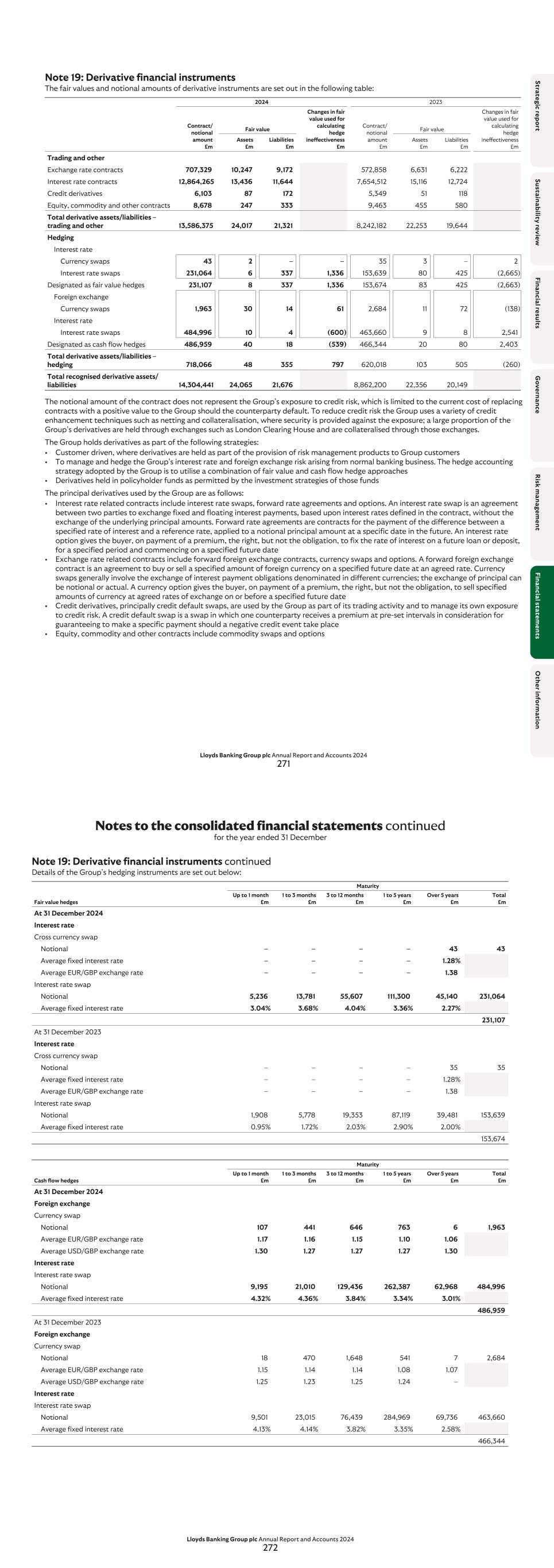
Note 19: Derivative financial instruments The fair values and notional amounts of derivative instruments are set out in the following table: 2024 2023 Contract/ notional amount £m Fair value Changes in fair value used for calculating hedge ineffectiveness £m Contract/ notional amount £m Fair value Changes in fair value used for calculating hedge ineffectiveness £m Assets £m Liabilities £m Assets £m Liabilities £m Trading and other Exchange rate contracts 707,329 10,247 9,172 572,858 6,631 6,222 Interest rate contracts 12,864,265 13,436 11,644 7,654,512 15,116 12,724 Credit derivatives 6,103 87 172 5,349 51 118 Equity, commodity and other contracts 8,678 247 333 9,463 455 580 Total derivative assets/liabilities – trading and other 13,586,375 24,017 21,321 8,242,182 22,253 19,644 Hedging Interest rate Currency swaps 43 2 – – 35 3 – 2 Interest rate swaps 231,064 6 337 1,336 153,639 80 425 (2,665) Designated as fair value hedges 231,107 8 337 1,336 153,674 83 425 (2,663) Foreign exchange Currency swaps 1,963 30 14 61 2,684 11 72 (138) Interest rate Interest rate swaps 484,996 10 4 (600) 463,660 9 8 2,541 Designated as cash flow hedges 486,959 40 18 (539) 466,344 20 80 2,403 Total derivative assets/liabilities – hedging 718,066 48 355 797 620,018 103 505 (260) Total recognised derivative assets/ liabilities 14,304,441 24,065 21,676 8,862,200 22,356 20,149 The notional amount of the contract does not represent the Group’s exposure to credit risk, which is limited to the current cost of replacing contracts with a positive value to the Group should the counterparty default. To reduce credit risk the Group uses a variety of credit enhancement techniques such as netting and collateralisation, where security is provided against the exposure; a large proportion of the Group’s derivatives are held through exchanges such as London Clearing House and are collateralised through those exchanges. The Group holds derivatives as part of the following strategies: • Customer driven, where derivatives are held as part of the provision of risk management products to Group customers • To manage and hedge the Group’s interest rate and foreign exchange risk arising from normal banking business. The hedge accounting strategy adopted by the Group is to utilise a combination of fair value and cash flow hedge approaches • Derivatives held in policyholder funds as permitted by the investment strategies of those funds The principal derivatives used by the Group are as follows: • Interest rate related contracts include interest rate swaps, forward rate agreements and options. An interest rate swap is an agreement between two parties to exchange fixed and floating interest payments, based upon interest rates defined in the contract, without the exchange of the underlying principal amounts. Forward rate agreements are contracts for the payment of the difference between a specified rate of interest and a reference rate, applied to a notional principal amount at a specific date in the future. An interest rate option gives the buyer, on payment of a premium, the right, but not the obligation, to fix the rate of interest on a future loan or deposit, for a specified period and commencing on a specified future date • Exchange rate related contracts include forward foreign exchange contracts, currency swaps and options. A forward foreign exchange contract is an agreement to buy or sell a specified amount of foreign currency on a specified future date at an agreed rate. Currency swaps generally involve the exchange of interest payment obligations denominated in different currencies; the exchange of principal can be notional or actual. A currency option gives the buyer, on payment of a premium, the right, but not the obligation, to sell specified amounts of currency at agreed rates of exchange on or before a specified future date • Credit derivatives, principally credit default swaps, are used by the Group as part of its trading activity and to manage its own exposure to credit risk. A credit default swap is a swap in which one counterparty receives a premium at pre-set intervals in consideration for guaranteeing to make a specific payment should a negative credit event take place • Equity, commodity and other contracts include commodity swaps and options Lloyds Banking Group plc Annual Report and Accounts 2024 271 l i ts 2 O th e r in fo rm a tio n F in a n cia l sta te m e n ts R isk m a n a ge m e n t F in a n cia l re su lts S u sta in a b ility re vie w S tra te gic re p o rt G o ve rn a n ce Note 19: Derivative financial instruments continued Details of the Group’s hedging instruments are set out below: Maturity Fair value hedges Up to 1 month £m 1 to 3 months £m 3 to 12 months £m 1 to 5 years £m Over 5 years £m Total £m At 31 December 2024 Interest rate Cross currency swap Notional – – – – 43 43 Average fixed interest rate – – – – 1.28% Average EUR/GBP exchange rate – – – – 1.38 Interest rate swap Notional 5,236 13,781 55,607 111,300 45,140 231,064 Average fixed interest rate 3.04% 3.68% 4.04% 3.36% 2.27% 231,107 At 31 December 2023 Interest rate Cross currency swap Notional – – – – 35 35 Average fixed interest rate – – – – 1.28% Average EUR/GBP exchange rate – – – – 1.38 Interest rate swap Notional 1,908 5,778 19,353 87,119 39,481 153,639 Average fixed interest rate 0.95% 1.72% 2.03% 2.90% 2.00% 153,674 Maturity Cash flow hedges Up to 1 month £m 1 to 3 months £m 3 to 12 months £m 1 to 5 years £m Over 5 years £m Total £m At 31 December 2024 Foreign exchange Currency swap Notional 107 441 646 763 6 1,963 Average EUR/GBP exchange rate 1.17 1.16 1.15 1.10 1.06 Average USD/GBP exchange rate 1.30 1.27 1.27 1.27 1.30 Interest rate Interest rate swap Notional 9,195 21,010 129,436 262,387 62,968 484,996 Average fixed interest rate 4.32% 4.36% 3.84% 3.34% 3.01% 486,959 At 31 December 2023 Foreign exchange Currency swap Notional 18 470 1,648 541 7 2,684 Average EUR/GBP exchange rate 1.15 1.14 1.14 1.08 1.07 Average USD/GBP exchange rate 1.25 1.23 1.25 1.24 – Interest rate Interest rate swap Notional 9,501 23,015 76,439 284,969 69,736 463,660 Average fixed interest rate 4.13% 4.14% 3.82% 3.35% 2.58% 466,344 Notes to the consolidated financial statements continued for the year ended 31 December Lloyds Banking Group plc Annual Report and Accounts 2024 272 l i ts
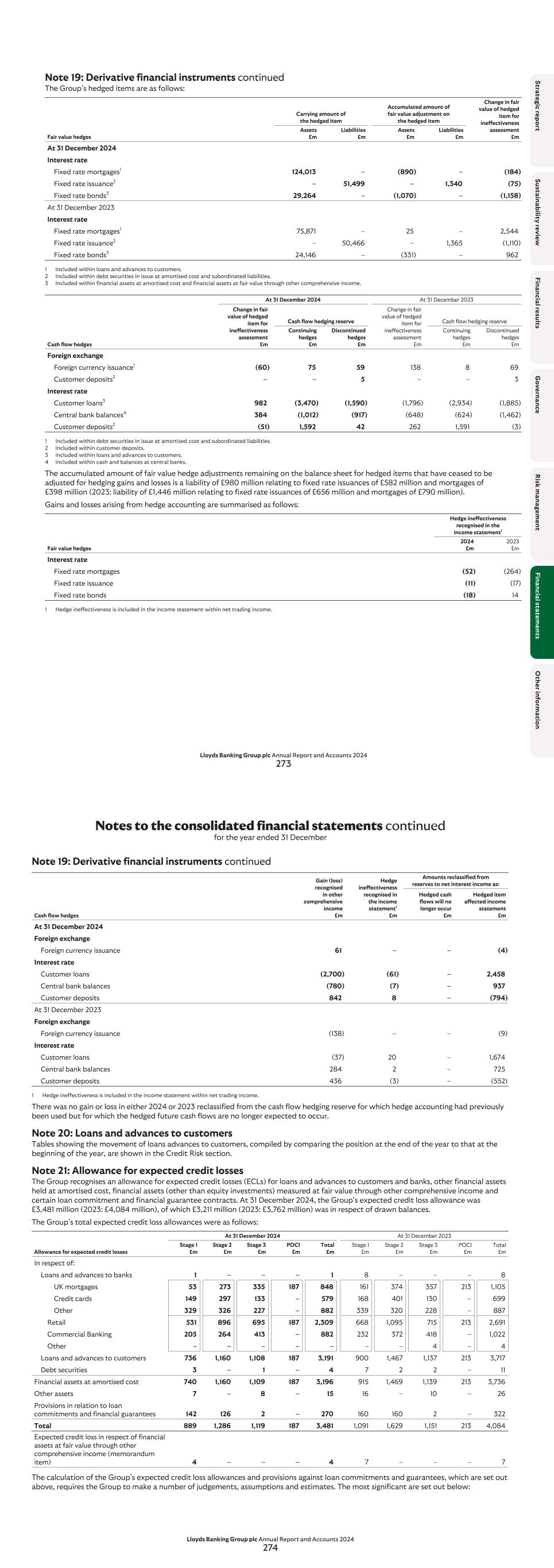
Note 19: Derivative financial instruments continued The Group’s hedged items are as follows: Carrying amount of the hedged item Accumulated amount of fair value adjustment on the hedged item Change in fair value of hedged item for ineffectiveness assessment £mFair value hedges Assets £m Liabilities £m Assets £m Liabilities £m At 31 December 2024 Interest rate Fixed rate mortgages1 124,013 – (890) – (184) Fixed rate issuance2 – 51,499 – 1,340 (75) Fixed rate bonds3 29,264 – (1,070) – (1,158) At 31 December 2023 Interest rate Fixed rate mortgages1 75,871 – 25 – 2,544 Fixed rate issuance2 – 50,466 – 1,365 (1,110) Fixed rate bonds3 24,146 – (331) – 962 1 Included within loans and advances to customers. 2 Included within debt securities in issue at amortised cost and subordinated liabilities. 3 Included within financial assets at amortised cost and financial assets at fair value through other comprehensive income. At 31 December 2024 At 31 December 2023 Change in fair value of hedged item for ineffectiveness assessment £m Cash flow hedging reserve Change in fair value of hedged item for ineffectiveness assessment £m Cash flow hedging reserve Continuing hedges £m Discontinued hedges £m Continuing hedges £m Discontinued hedges £mCash flow hedges Foreign exchange Foreign currency issuance1 (60) 75 59 138 8 69 Customer deposits2 – – 5 – – 3 Interest rate Customer loans3 982 (3,470) (1,590) (1,796) (2,934) (1,885) Central bank balances4 384 (1,012) (917) (648) (624) (1,462) Customer deposits2 (51) 1,592 42 262 1,591 (3) 1 Included within debt securities in issue at amortised cost and subordinated liabilities. 2 Included within customer deposits. 3 Included within loans and advances to customers. 4 Included within cash and balances at central banks. The accumulated amount of fair value hedge adjustments remaining on the balance sheet for hedged items that have ceased to be adjusted for hedging gains and losses is a liability of £980 million relating to fixed rate issuances of £582 million and mortgages of £398 million (2023: liability of £1,446 million relating to fixed rate issuances of £656 million and mortgages of £790 million). Gains and losses arising from hedge accounting are summarised as follows: Hedge ineffectiveness recognised in the income statement1 Fair value hedges 2024 £m 2023 £m Interest rate Fixed rate mortgages (52) (264) Fixed rate issuance (11) (17) Fixed rate bonds (18) 14 1 Hedge ineffectiveness is included in the income statement within net trading income. Lloyds Banking Group plc Annual Report and Accounts 2024 273 l i ts 2 O th e r in fo rm a tio n F in a n cia l sta te m e n ts R isk m a n a ge m e n t F in a n cia l re su lts S u sta in a b ility re vie w S tra te gic re p o rt G o ve rn a n ce Note 19: Derivative financial instruments continued Gain (loss) recognised in other comprehensive income £m Hedge ineffectiveness recognised in the income statement1 £m Amounts reclassified from reserves to net interest income as: Cash flow hedges Hedged cash flows will no longer occur £m Hedged item affected income statement £m At 31 December 2024 Foreign exchange Foreign currency issuance 61 – – (4) Interest rate Customer loans (2,700) (61) – 2,458 Central bank balances (780) (7) – 937 Customer deposits 842 8 – (794) At 31 December 2023 Foreign exchange Foreign currency issuance (138) – – (9) Interest rate Customer loans (37) 20 – 1,674 Central bank balances 284 2 – 725 Customer deposits 436 (3) – (552) 1 Hedge ineffectiveness is included in the income statement within net trading income. There was no gain or loss in either 2024 or 2023 reclassified from the cash flow hedging reserve for which hedge accounting had previously been used but for which the hedged future cash flows are no longer expected to occur. Note 20: Loans and advances to customers Tables showing the movement of loans advances to customers, compiled by comparing the position at the end of the year to that at the beginning of the year, are shown in the Credit Risk section. Note 21: Allowance for expected credit losses The Group recognises an allowance for expected credit losses (ECLs) for loans and advances to customers and banks, other financial assets held at amortised cost, financial assets (other than equity investments) measured at fair value through other comprehensive income and certain loan commitment and financial guarantee contracts. At 31 December 2024, the Group’s expected credit loss allowance was £3,481 million (2023: £4,084 million), of which £3,211 million (2023: £3,762 million) was in respect of drawn balances. The Group’s total expected credit loss allowances were as follows: At 31 December 2024 At 31 December 2023 Allowance for expected credit losses Stage 1 £m Stage 2 £m Stage 3 £m POCI £m Total £m Stage 1 £m Stage 2 £m Stage 3 £m POCI £m Total £m In respect of: Loans and advances to banks 1 – – – 1 8 – – – 8 UK mortgages 53 273 335 187 848 161 374 357 213 1,105 Credit cards 149 297 133 – 579 168 401 130 – 699 Other 329 326 227 – 882 339 320 228 – 887 Retail 531 896 695 187 2,309 668 1,095 715 213 2,691 Commercial Banking 205 264 413 – 882 232 372 418 – 1,022 Other – – – – – – – 4 – 4 Loans and advances to customers 736 1,160 1,108 187 3,191 900 1,467 1,137 213 3,717 Debt securities 3 – 1 – 4 7 2 2 – 11 Financial assets at amortised cost 740 1,160 1,109 187 3,196 915 1,469 1,139 213 3,736 Other assets 7 – 8 – 15 16 – 10 – 26 Provisions in relation to loan commitments and financial guarantees 142 126 2 – 270 160 160 2 – 322 Total 889 1,286 1,119 187 3,481 1,091 1,629 1,151 213 4,084 Expected credit loss in respect of financial assets at fair value through other comprehensive income (memorandum item) 4 – – – 4 7 – – – 7 The calculation of the Group’s expected credit loss allowances and provisions against loan commitments and guarantees, which are set out above, requires the Group to make a number of judgements, assumptions and estimates. The most significant are set out below: Notes to the consolidated financial statements continued for the year ended 31 December Lloyds Banking Group plc Annual Report and Accounts 2024 274 l i ts
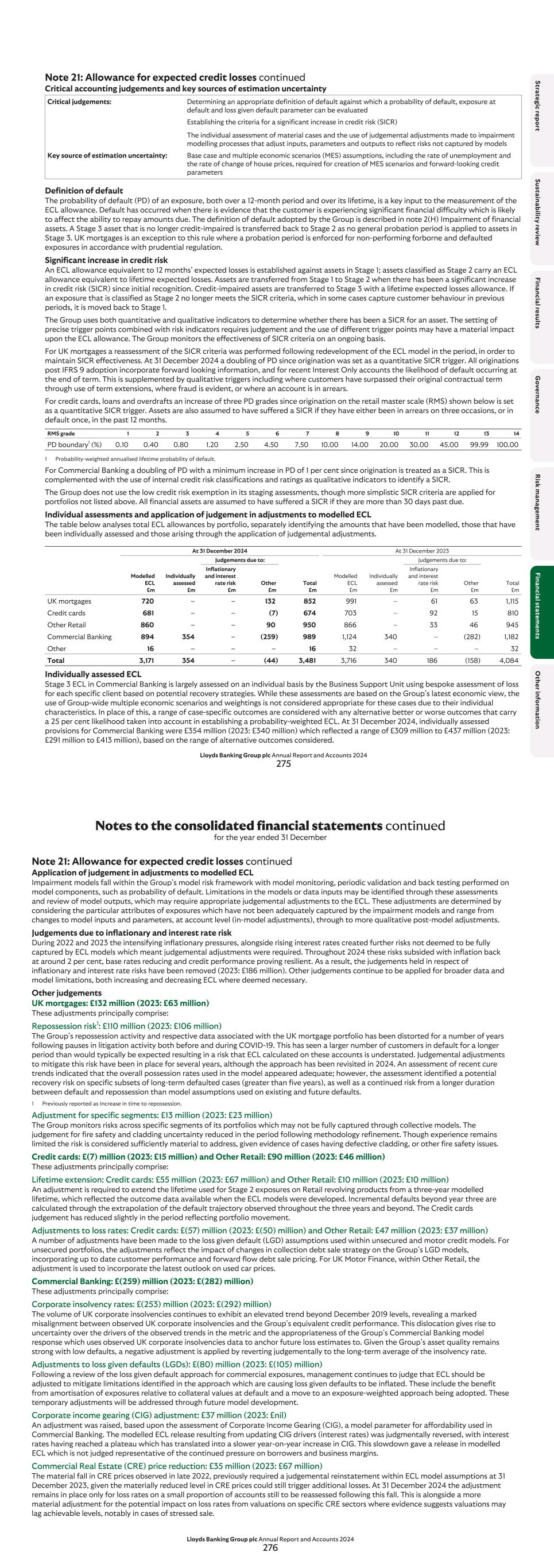
Note 21: Allowance for expected credit losses continued Critical accounting judgements and key sources of estimation uncertainty Critical judgements: Determining an appropriate definition of default against which a probability of default, exposure at default and loss given default parameter can be evaluated Establishing the criteria for a significant increase in credit risk (SICR) The individual assessment of material cases and the use of judgemental adjustments made to impairment modelling processes that adjust inputs, parameters and outputs to reflect risks not captured by models Key source of estimation uncertainty: Base case and multiple economic scenarios (MES) assumptions, including the rate of unemployment and the rate of change of house prices, required for creation of MES scenarios and forward-looking credit parameters Definition of default The probability of default (PD) of an exposure, both over a 12-month period and over its lifetime, is a key input to the measurement of the ECL allowance. Default has occurred when there is evidence that the customer is experiencing significant financial difficulty which is likely to affect the ability to repay amounts due. The definition of default adopted by the Group is described in note 2(H) Impairment of financial assets. A Stage 3 asset that is no longer credit-impaired is transferred back to Stage 2 as no general probation period is applied to assets in Stage 3. UK mortgages is an exception to this rule where a probation period is enforced for non-performing forborne and defaulted exposures in accordance with prudential regulation. Significant increase in credit risk An ECL allowance equivalent to 12 months’ expected losses is established against assets in Stage 1; assets classified as Stage 2 carry an ECL allowance equivalent to lifetime expected losses. Assets are transferred from Stage 1 to Stage 2 when there has been a significant increase in credit risk (SICR) since initial recognition. Credit-impaired assets are transferred to Stage 3 with a lifetime expected losses allowance. If an exposure that is classified as Stage 2 no longer meets the SICR criteria, which in some cases capture customer behaviour in previous periods, it is moved back to Stage 1. The Group uses both quantitative and qualitative indicators to determine whether there has been a SICR for an asset. The setting of precise trigger points combined with risk indicators requires judgement and the use of different trigger points may have a material impact upon the ECL allowance. The Group monitors the effectiveness of SICR criteria on an ongoing basis. For UK mortgages a reassessment of the SICR criteria was performed following redevelopment of the ECL model in the period, in order to maintain SICR effectiveness. At 31 December 2024 a doubling of PD since origination was set as a quantitative SICR trigger. All originations post IFRS 9 adoption incorporate forward looking information, and for recent Interest Only accounts the likelihood of default occurring at the end of term. This is supplemented by qualitative triggers including where customers have surpassed their original contractual term through use of term extensions, where fraud is evident, or where an account is in arrears. For credit cards, loans and overdrafts an increase of three PD grades since origination on the retail master scale (RMS) shown below is set as a quantitative SICR trigger. Assets are also assumed to have suffered a SICR if they have either been in arrears on three occasions, or in default once, in the past 12 months. RMS grade 1 2 3 4 5 6 7 8 9 10 11 12 13 14 PD boundary1 (%) 0.10 0.40 0.80 1.20 2.50 4.50 7.50 10.00 14.00 20.00 30.00 45.00 99.99 100.00 1 Probability-weighted annualised lifetime probability of default. For Commercial Banking a doubling of PD with a minimum increase in PD of 1 per cent since origination is treated as a SICR. This is complemented with the use of internal credit risk classifications and ratings as qualitative indicators to identify a SICR. The Group does not use the low credit risk exemption in its staging assessments, though more simplistic SICR criteria are applied for portfolios not listed above. All financial assets are assumed to have suffered a SICR if they are more than 30 days past due. Individual assessments and application of judgement in adjustments to modelled ECL The table below analyses total ECL allowances by portfolio, separately identifying the amounts that have been modelled, those that have been individually assessed and those arising through the application of judgemental adjustments. At 31 December 2024 At 31 December 2023 Judgements due to: Judgements due to: Modelled ECL £m Individually assessed £m Inflationary and interest rate risk £m Other £m Total £m Modelled ECL £m Individually assessed £m Inflationary and interest rate risk £m Other £m Total £m UK mortgages 720 – – 132 852 991 – 61 63 1,115 Credit cards 681 – – (7) 674 703 – 92 15 810 Other Retail 860 – – 90 950 866 – 33 46 945 Commercial Banking 894 354 – (259) 989 1,124 340 – (282) 1,182 Other 16 – – – 16 32 – – – 32 Total 3,171 354 – (44) 3,481 3,716 340 186 (158) 4,084 Individually assessed ECL Stage 3 ECL in Commercial Banking is largely assessed on an individual basis by the Business Support Unit using bespoke assessment of loss for each specific client based on potential recovery strategies. While these assessments are based on the Group’s latest economic view, the use of Group-wide multiple economic scenarios and weightings is not considered appropriate for these cases due to their individual characteristics. In place of this, a range of case-specific outcomes are considered with any alternative better or worse outcomes that carry a 25 per cent likelihood taken into account in establishing a probability-weighted ECL. At 31 December 2024, individually assessed provisions for Commercial Banking were £354 million (2023: £340 million) which reflected a range of £309 million to £437 million (2023: £291 million to £413 million), based on the range of alternative outcomes considered. Lloyds Banking Group plc Annual Report and Accounts 2024 275 l i ts 2 O th e r in fo rm a tio n F in a n cia l sta te m e n ts R isk m a n a ge m e n t F in a n cia l re su lts S u sta in a b ility re vie w S tra te gic re p o rt G o ve rn a n ce Note 21: Allowance for expected credit losses continued Application of judgement in adjustments to modelled ECL Impairment models fall within the Group’s model risk framework with model monitoring, periodic validation and back testing performed on model components, such as probability of default. Limitations in the models or data inputs may be identified through these assessments and review of model outputs, which may require appropriate judgemental adjustments to the ECL. These adjustments are determined by considering the particular attributes of exposures which have not been adequately captured by the impairment models and range from changes to model inputs and parameters, at account level (in-model adjustments), through to more qualitative post-model adjustments. Judgements due to inflationary and interest rate risk During 2022 and 2023 the intensifying inflationary pressures, alongside rising interest rates created further risks not deemed to be fully captured by ECL models which meant judgemental adjustments were required. Throughout 2024 these risks subsided with inflation back at around 2 per cent, base rates reducing and credit performance proving resilient. As a result, the judgements held in respect of inflationary and interest rate risks have been removed (2023: £186 million). Other judgements continue to be applied for broader data and model limitations, both increasing and decreasing ECL where deemed necessary. Other judgements UK mortgages: £132 million (2023: £63 million) These adjustments principally comprise: Repossession risk1: £110 million (2023: £106 million) The Group’s repossession activity and respective data associated with the UK mortgage portfolio has been distorted for a number of years following pauses in litigation activity both before and during COVID-19. This has seen a larger number of customers in default for a longer period than would typically be expected resulting in a risk that ECL calculated on these accounts is understated. Judgemental adjustments to mitigate this risk have been in place for several years, although the approach has been revisited in 2024. An assessment of recent cure trends indicated that the overall possession rates used in the model appeared adequate; however, the assessment identified a potential recovery risk on specific subsets of long-term defaulted cases (greater than five years), as well as a continued risk from a longer duration between default and repossession than model assumptions used on existing and future defaults. 1 Previously reported as Increase in time to repossession. Adjustment for specific segments: £13 million (2023: £23 million) The Group monitors risks across specific segments of its portfolios which may not be fully captured through collective models. The judgement for fire safety and cladding uncertainty reduced in the period following methodology refinement. Though experience remains limited the risk is considered sufficiently material to address, given evidence of cases having defective cladding, or other fire safety issues. Credit cards: £(7) million (2023: £15 million) and Other Retail: £90 million (2023: £46 million) These adjustments principally comprise: Lifetime extension: Credit cards: £55 million (2023: £67 million) and Other Retail: £10 million (2023: £10 million) An adjustment is required to extend the lifetime used for Stage 2 exposures on Retail revolving products from a three-year modelled lifetime, which reflected the outcome data available when the ECL models were developed. Incremental defaults beyond year three are calculated through the extrapolation of the default trajectory observed throughout the three years and beyond. The Credit cards judgement has reduced slightly in the period reflecting portfolio movement. Adjustments to loss rates: Credit cards: £(57) million (2023: £(50) million) and Other Retail: £47 million (2023: £37 million) A number of adjustments have been made to the loss given default (LGD) assumptions used within unsecured and motor credit models. For unsecured portfolios, the adjustments reflect the impact of changes in collection debt sale strategy on the Group’s LGD models, incorporating up to date customer performance and forward flow debt sale pricing. For UK Motor Finance, within Other Retail, the adjustment is used to incorporate the latest outlook on used car prices. Commercial Banking: £(259) million (2023: £(282) million) These adjustments principally comprise: Corporate insolvency rates: £(253) million (2023: £(292) million) The volume of UK corporate insolvencies continues to exhibit an elevated trend beyond December 2019 levels, revealing a marked misalignment between observed UK corporate insolvencies and the Group’s equivalent credit performance. This dislocation gives rise to uncertainty over the drivers of the observed trends in the metric and the appropriateness of the Group’s Commercial Banking model response which uses observed UK corporate insolvencies data to anchor future loss estimates to. Given the Group’s asset quality remains strong with low defaults, a negative adjustment is applied by reverting judgementally to the long-term average of the insolvency rate. Adjustments to loss given defaults (LGDs): £(80) million (2023: £(105) million) Following a review of the loss given default approach for commercial exposures, management continues to judge that ECL should be adjusted to mitigate limitations identified in the approach which are causing loss given defaults to be inflated. These include the benefit from amortisation of exposures relative to collateral values at default and a move to an exposure-weighted approach being adopted. These temporary adjustments will be addressed through future model development. Corporate income gearing (CIG) adjustment: £37 million (2023: £nil) An adjustment was raised, based upon the assessment of Corporate Income Gearing (CIG), a model parameter for affordability used in Commercial Banking. The modelled ECL release resulting from updating CIG drivers (interest rates) was judgmentally reversed, with interest rates having reached a plateau which has translated into a slower year-on-year increase in CIG. This slowdown gave a release in modelled ECL which is not judged representative of the continued pressure on borrowers and business margins. Commercial Real Estate (CRE) price reduction: £35 million (2023: £67 million) The material fall in CRE prices observed in late 2022, previously required a judgemental reinstatement within ECL model assumptions at 31 December 2023, given the materially reduced level in CRE prices could still trigger additional losses. At 31 December 2024 the adjustment remains in place only for loss rates on a small proportion of accounts still to be reassessed following this fall. This is alongside a more material adjustment for the potential impact on loss rates from valuations on specific CRE sectors where evidence suggests valuations may lag achievable levels, notably in cases of stressed sale. Notes to the consolidated financial statements continued for the year ended 31 December Lloyds Banking Group plc Annual Report and Accounts 2024 276 l i ts
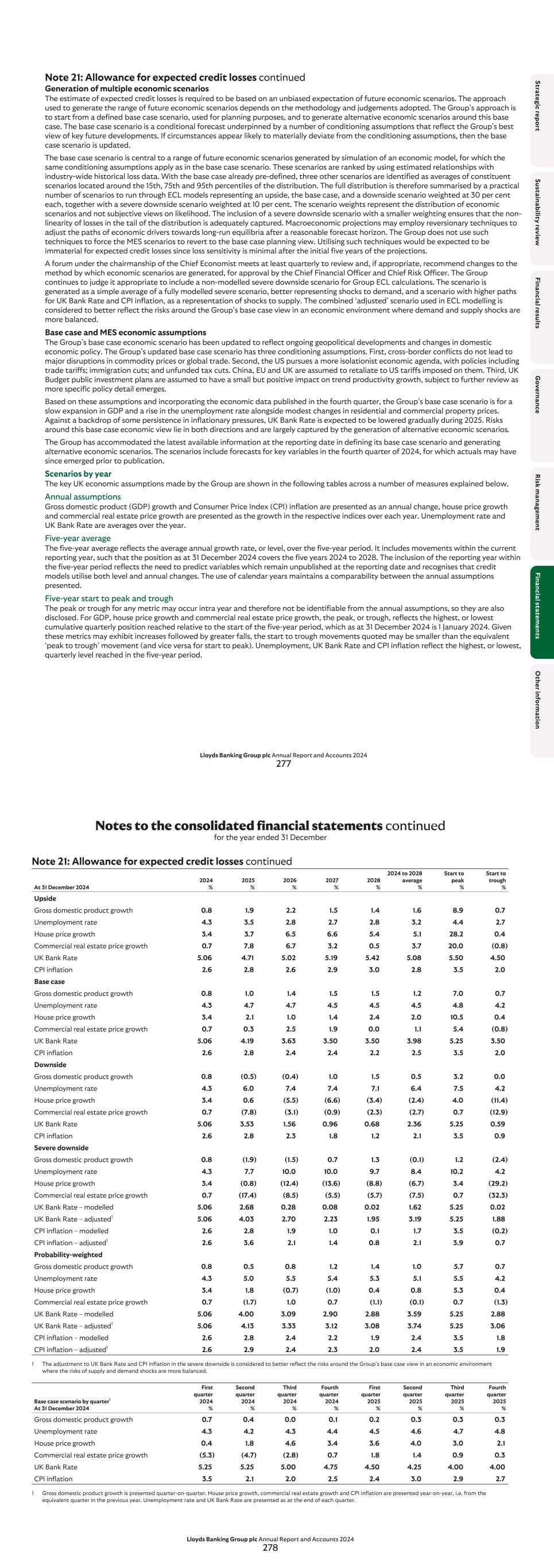
Note 21: Allowance for expected credit losses continued Generation of multiple economic scenarios The estimate of expected credit losses is required to be based on an unbiased expectation of future economic scenarios. The approach used to generate the range of future economic scenarios depends on the methodology and judgements adopted. The Group’s approach is to start from a defined base case scenario, used for planning purposes, and to generate alternative economic scenarios around this base case. The base case scenario is a conditional forecast underpinned by a number of conditioning assumptions that reflect the Group’s best view of key future developments. If circumstances appear likely to materially deviate from the conditioning assumptions, then the base case scenario is updated. The base case scenario is central to a range of future economic scenarios generated by simulation of an economic model, for which the same conditioning assumptions apply as in the base case scenario. These scenarios are ranked by using estimated relationships with industry-wide historical loss data. With the base case already pre-defined, three other scenarios are identified as averages of constituent scenarios located around the 15th, 75th and 95th percentiles of the distribution. The full distribution is therefore summarised by a practical number of scenarios to run through ECL models representing an upside, the base case, and a downside scenario weighted at 30 per cent each, together with a severe downside scenario weighted at 10 per cent. The scenario weights represent the distribution of economic scenarios and not subjective views on likelihood. The inclusion of a severe downside scenario with a smaller weighting ensures that the non- linearity of losses in the tail of the distribution is adequately captured. Macroeconomic projections may employ reversionary techniques to adjust the paths of economic drivers towards long-run equilibria after a reasonable forecast horizon. The Group does not use such techniques to force the MES scenarios to revert to the base case planning view. Utilising such techniques would be expected to be immaterial for expected credit losses since loss sensitivity is minimal after the initial five years of the projections. A forum under the chairmanship of the Chief Economist meets at least quarterly to review and, if appropriate, recommend changes to the method by which economic scenarios are generated, for approval by the Chief Financial Officer and Chief Risk Officer. The Group continues to judge it appropriate to include a non-modelled severe downside scenario for Group ECL calculations. The scenario is generated as a simple average of a fully modelled severe scenario, better representing shocks to demand, and a scenario with higher paths for UK Bank Rate and CPI inflation, as a representation of shocks to supply. The combined ‘adjusted’ scenario used in ECL modelling is considered to better reflect the risks around the Group’s base case view in an economic environment where demand and supply shocks are more balanced. Base case and MES economic assumptions The Group’s base case economic scenario has been updated to reflect ongoing geopolitical developments and changes in domestic economic policy. The Group’s updated base case scenario has three conditioning assumptions. First, cross-border conflicts do not lead to major disruptions in commodity prices or global trade. Second, the US pursues a more isolationist economic agenda, with policies including trade tariffs; immigration cuts; and unfunded tax cuts. China, EU and UK are assumed to retaliate to US tariffs imposed on them. Third, UK Budget public investment plans are assumed to have a small but positive impact on trend productivity growth, subject to further review as more specific policy detail emerges. Based on these assumptions and incorporating the economic data published in the fourth quarter, the Group’s base case scenario is for a slow expansion in GDP and a rise in the unemployment rate alongside modest changes in residential and commercial property prices. Against a backdrop of some persistence in inflationary pressures, UK Bank Rate is expected to be lowered gradually during 2025. Risks around this base case economic view lie in both directions and are largely captured by the generation of alternative economic scenarios. The Group has accommodated the latest available information at the reporting date in defining its base case scenario and generating alternative economic scenarios. The scenarios include forecasts for key variables in the fourth quarter of 2024, for which actuals may have since emerged prior to publication. Scenarios by year The key UK economic assumptions made by the Group are shown in the following tables across a number of measures explained below. Annual assumptions Gross domestic product (GDP) growth and Consumer Price Index (CPI) inflation are presented as an annual change, house price growth and commercial real estate price growth are presented as the growth in the respective indices over each year. Unemployment rate and UK Bank Rate are averages over the year. Five-year average The five-year average reflects the average annual growth rate, or level, over the five-year period. It includes movements within the current reporting year, such that the position as at 31 December 2024 covers the five years 2024 to 2028. The inclusion of the reporting year within the five-year period reflects the need to predict variables which remain unpublished at the reporting date and recognises that credit models utilise both level and annual changes. The use of calendar years maintains a comparability between the annual assumptions presented. Five-year start to peak and trough The peak or trough for any metric may occur intra year and therefore not be identifiable from the annual assumptions, so they are also disclosed. For GDP, house price growth and commercial real estate price growth, the peak, or trough, reflects the highest, or lowest cumulative quarterly position reached relative to the start of the five-year period, which as at 31 December 2024 is 1 January 2024. Given these metrics may exhibit increases followed by greater falls, the start to trough movements quoted may be smaller than the equivalent ‘peak to trough’ movement (and vice versa for start to peak). Unemployment, UK Bank Rate and CPI inflation reflect the highest, or lowest, quarterly level reached in the five-year period. Lloyds Banking Group plc Annual Report and Accounts 2024 277 l i ts 2 O th e r in fo rm a tio n F in a n cia l sta te m e n ts R isk m a n a ge m e n t F in a n cia l re su lts S u sta in a b ility re vie w S tra te gic re p o rt G o ve rn a n ce Note 21: Allowance for expected credit losses continued At 31 December 2024 2024 % 2025 % 2026 % 2027 % 2028 % 2024 to 2028 average % Start to peak % Start to trough % Upside Gross domestic product growth 0.8 1.9 2.2 1.5 1.4 1.6 8.9 0.7 Unemployment rate 4.3 3.5 2.8 2.7 2.8 3.2 4.4 2.7 House price growth 3.4 3.7 6.5 6.6 5.4 5.1 28.2 0.4 Commercial real estate price growth 0.7 7.8 6.7 3.2 0.5 3.7 20.0 (0.8) UK Bank Rate 5.06 4.71 5.02 5.19 5.42 5.08 5.50 4.50 CPI inflation 2.6 2.8 2.6 2.9 3.0 2.8 3.5 2.0 Base case Gross domestic product growth 0.8 1.0 1.4 1.5 1.5 1.2 7.0 0.7 Unemployment rate 4.3 4.7 4.7 4.5 4.5 4.5 4.8 4.2 House price growth 3.4 2.1 1.0 1.4 2.4 2.0 10.5 0.4 Commercial real estate price growth 0.7 0.3 2.5 1.9 0.0 1.1 5.4 (0.8) UK Bank Rate 5.06 4.19 3.63 3.50 3.50 3.98 5.25 3.50 CPI inflation 2.6 2.8 2.4 2.4 2.2 2.5 3.5 2.0 Downside Gross domestic product growth 0.8 (0.5) (0.4) 1.0 1.5 0.5 3.2 0.0 Unemployment rate 4.3 6.0 7.4 7.4 7.1 6.4 7.5 4.2 House price growth 3.4 0.6 (5.5) (6.6) (3.4) (2.4) 4.0 (11.4) Commercial real estate price growth 0.7 (7.8) (3.1) (0.9) (2.3) (2.7) 0.7 (12.9) UK Bank Rate 5.06 3.53 1.56 0.96 0.68 2.36 5.25 0.59 CPI inflation 2.6 2.8 2.3 1.8 1.2 2.1 3.5 0.9 Severe downside Gross domestic product growth 0.8 (1.9) (1.5) 0.7 1.3 (0.1) 1.2 (2.4) Unemployment rate 4.3 7.7 10.0 10.0 9.7 8.4 10.2 4.2 House price growth 3.4 (0.8) (12.4) (13.6) (8.8) (6.7) 3.4 (29.2) Commercial real estate price growth 0.7 (17.4) (8.5) (5.5) (5.7) (7.5) 0.7 (32.3) UK Bank Rate – modelled 5.06 2.68 0.28 0.08 0.02 1.62 5.25 0.02 UK Bank Rate – adjusted1 5.06 4.03 2.70 2.23 1.95 3.19 5.25 1.88 CPI inflation – modelled 2.6 2.8 1.9 1.0 0.1 1.7 3.5 (0.2) CPI inflation – adjusted1 2.6 3.6 2.1 1.4 0.8 2.1 3.9 0.7 Probability-weighted Gross domestic product growth 0.8 0.5 0.8 1.2 1.4 1.0 5.7 0.7 Unemployment rate 4.3 5.0 5.5 5.4 5.3 5.1 5.5 4.2 House price growth 3.4 1.8 (0.7) (1.0) 0.4 0.8 5.3 0.4 Commercial real estate price growth 0.7 (1.7) 1.0 0.7 (1.1) (0.1) 0.7 (1.3) UK Bank Rate – modelled 5.06 4.00 3.09 2.90 2.88 3.59 5.25 2.88 UK Bank Rate – adjusted1 5.06 4.13 3.33 3.12 3.08 3.74 5.25 3.06 CPI inflation – modelled 2.6 2.8 2.4 2.2 1.9 2.4 3.5 1.8 CPI inflation – adjusted1 2.6 2.9 2.4 2.3 2.0 2.4 3.5 1.9 1 The adjustment to UK Bank Rate and CPI inflation in the severe downside is considered to better reflect the risks around the Group’s base case view in an economic environment where the risks of supply and demand shocks are more balanced. Base case scenario by quarter1 At 31 December 2024 First quarter 2024 % Second quarter 2024 % Third quarter 2024 % Fourth quarter 2024 % First quarter 2025 % Second quarter 2025 % Third quarter 2025 % Fourth quarter 2025 % Gross domestic product growth 0.7 0.4 0.0 0.1 0.2 0.3 0.3 0.3 Unemployment rate 4.3 4.2 4.3 4.4 4.5 4.6 4.7 4.8 House price growth 0.4 1.8 4.6 3.4 3.6 4.0 3.0 2.1 Commercial real estate price growth (5.3) (4.7) (2.8) 0.7 1.8 1.4 0.9 0.3 UK Bank Rate 5.25 5.25 5.00 4.75 4.50 4.25 4.00 4.00 CPI inflation 3.5 2.1 2.0 2.5 2.4 3.0 2.9 2.7 1 Gross domestic product growth is presented quarter-on-quarter. House price growth, commercial real estate growth and CPI inflation are presented year-on-year, i.e. from the equivalent quarter in the previous year. Unemployment rate and UK Bank Rate are presented as at the end of each quarter. Notes to the consolidated financial statements continued for the year ended 31 December Lloyds Banking Group plc Annual Report and Accounts 2024 278 l i ts
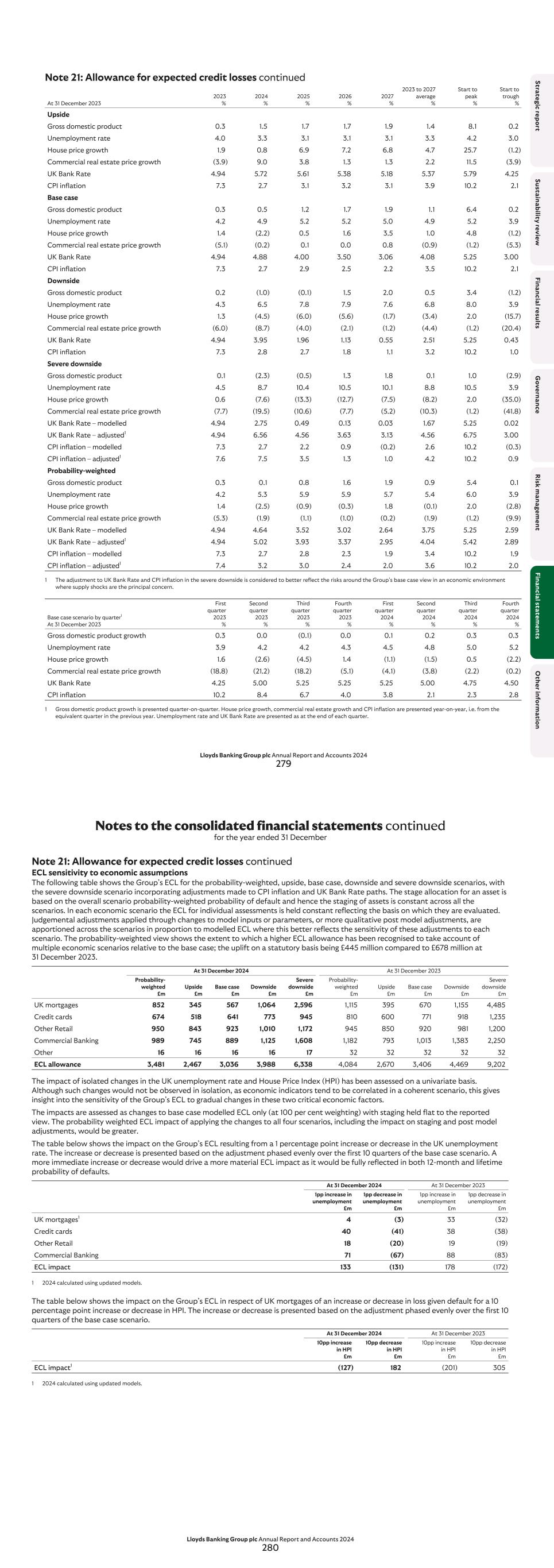
Note 21: Allowance for expected credit losses continued At 31 December 2023 2023 % 2024 % 2025 % 2026 % 2027 % 2023 to 2027 average % Start to peak % Start to trough % Upside Gross domestic product 0.3 1.5 1.7 1.7 1.9 1.4 8.1 0.2 Unemployment rate 4.0 3.3 3.1 3.1 3.1 3.3 4.2 3.0 House price growth 1.9 0.8 6.9 7.2 6.8 4.7 25.7 (1.2) Commercial real estate price growth (3.9) 9.0 3.8 1.3 1.3 2.2 11.5 (3.9) UK Bank Rate 4.94 5.72 5.61 5.38 5.18 5.37 5.79 4.25 CPI inflation 7.3 2.7 3.1 3.2 3.1 3.9 10.2 2.1 Base case Gross domestic product 0.3 0.5 1.2 1.7 1.9 1.1 6.4 0.2 Unemployment rate 4.2 4.9 5.2 5.2 5.0 4.9 5.2 3.9 House price growth 1.4 (2.2) 0.5 1.6 3.5 1.0 4.8 (1.2) Commercial real estate price growth (5.1) (0.2) 0.1 0.0 0.8 (0.9) (1.2) (5.3) UK Bank Rate 4.94 4.88 4.00 3.50 3.06 4.08 5.25 3.00 CPI inflation 7.3 2.7 2.9 2.5 2.2 3.5 10.2 2.1 Downside Gross domestic product 0.2 (1.0) (0.1) 1.5 2.0 0.5 3.4 (1.2) Unemployment rate 4.3 6.5 7.8 7.9 7.6 6.8 8.0 3.9 House price growth 1.3 (4.5) (6.0) (5.6) (1.7) (3.4) 2.0 (15.7) Commercial real estate price growth (6.0) (8.7) (4.0) (2.1) (1.2) (4.4) (1.2) (20.4) UK Bank Rate 4.94 3.95 1.96 1.13 0.55 2.51 5.25 0.43 CPI inflation 7.3 2.8 2.7 1.8 1.1 3.2 10.2 1.0 Severe downside Gross domestic product 0.1 (2.3) (0.5) 1.3 1.8 0.1 1.0 (2.9) Unemployment rate 4.5 8.7 10.4 10.5 10.1 8.8 10.5 3.9 House price growth 0.6 (7.6) (13.3) (12.7) (7.5) (8.2) 2.0 (35.0) Commercial real estate price growth (7.7) (19.5) (10.6) (7.7) (5.2) (10.3) (1.2) (41.8) UK Bank Rate – modelled 4.94 2.75 0.49 0.13 0.03 1.67 5.25 0.02 UK Bank Rate – adjusted1 4.94 6.56 4.56 3.63 3.13 4.56 6.75 3.00 CPI inflation – modelled 7.3 2.7 2.2 0.9 (0.2) 2.6 10.2 (0.3) CPI inflation – adjusted1 7.6 7.5 3.5 1.3 1.0 4.2 10.2 0.9 Probability-weighted Gross domestic product 0.3 0.1 0.8 1.6 1.9 0.9 5.4 0.1 Unemployment rate 4.2 5.3 5.9 5.9 5.7 5.4 6.0 3.9 House price growth 1.4 (2.5) (0.9) (0.3) 1.8 (0.1) 2.0 (2.8) Commercial real estate price growth (5.3) (1.9) (1.1) (1.0) (0.2) (1.9) (1.2) (9.9) UK Bank Rate – modelled 4.94 4.64 3.52 3.02 2.64 3.75 5.25 2.59 UK Bank Rate – adjusted1 4.94 5.02 3.93 3.37 2.95 4.04 5.42 2.89 CPI inflation – modelled 7.3 2.7 2.8 2.3 1.9 3.4 10.2 1.9 CPI inflation – adjusted1 7.4 3.2 3.0 2.4 2.0 3.6 10.2 2.0 1 The adjustment to UK Bank Rate and CPI inflation in the severe downside is considered to better reflect the risks around the Group’s base case view in an economic environment where supply shocks are the principal concern. Base case scenario by quarter1 At 31 December 2023 First quarter 2023 % Second quarter 2023 % Third quarter 2023 % Fourth quarter 2023 % First quarter 2024 % Second quarter 2024 % Third quarter 2024 % Fourth quarter 2024 % Gross domestic product growth 0.3 0.0 (0.1) 0.0 0.1 0.2 0.3 0.3 Unemployment rate 3.9 4.2 4.2 4.3 4.5 4.8 5.0 5.2 House price growth 1.6 (2.6) (4.5) 1.4 (1.1) (1.5) 0.5 (2.2) Commercial real estate price growth (18.8) (21.2) (18.2) (5.1) (4.1) (3.8) (2.2) (0.2) UK Bank Rate 4.25 5.00 5.25 5.25 5.25 5.00 4.75 4.50 CPI inflation 10.2 8.4 6.7 4.0 3.8 2.1 2.3 2.8 1 Gross domestic product growth is presented quarter-on-quarter. House price growth, commercial real estate growth and CPI inflation are presented year-on-year, i.e. from the equivalent quarter in the previous year. Unemployment rate and UK Bank Rate are presented as at the end of each quarter. Lloyds Banking Group plc Annual Report and Accounts 2024 279 l i ts 2 O th e r in fo rm a tio n F in a n cia l sta te m e n ts R isk m a n a ge m e n t F in a n cia l re su lts S u sta in a b ility re vie w S tra te gic re p o rt G o ve rn a n ce Note 21: Allowance for expected credit losses continued ECL sensitivity to economic assumptions The following table shows the Group’s ECL for the probability-weighted, upside, base case, downside and severe downside scenarios, with the severe downside scenario incorporating adjustments made to CPI inflation and UK Bank Rate paths. The stage allocation for an asset is based on the overall scenario probability-weighted probability of default and hence the staging of assets is constant across all the scenarios. In each economic scenario the ECL for individual assessments is held constant reflecting the basis on which they are evaluated. Judgemental adjustments applied through changes to model inputs or parameters, or more qualitative post model adjustments, are apportioned across the scenarios in proportion to modelled ECL where this better reflects the sensitivity of these adjustments to each scenario. The probability-weighted view shows the extent to which a higher ECL allowance has been recognised to take account of multiple economic scenarios relative to the base case; the uplift on a statutory basis being £445 million compared to £678 million at 31 December 2023. At 31 December 2024 At 31 December 2023 Probability- weighted £m Upside £m Base case £m Downside £m Severe downside £m Probability- weighted £m Upside £m Base case £m Downside £m Severe downside £m UK mortgages 852 345 567 1,064 2,596 1,115 395 670 1,155 4,485 Credit cards 674 518 641 773 945 810 600 771 918 1,235 Other Retail 950 843 923 1,010 1,172 945 850 920 981 1,200 Commercial Banking 989 745 889 1,125 1,608 1,182 793 1,013 1,383 2,250 Other 16 16 16 16 17 32 32 32 32 32 ECL allowance 3,481 2,467 3,036 3,988 6,338 4,084 2,670 3,406 4,469 9,202 The impact of isolated changes in the UK unemployment rate and House Price Index (HPI) has been assessed on a univariate basis. Although such changes would not be observed in isolation, as economic indicators tend to be correlated in a coherent scenario, this gives insight into the sensitivity of the Group’s ECL to gradual changes in these two critical economic factors. The impacts are assessed as changes to base case modelled ECL only (at 100 per cent weighting) with staging held flat to the reported view. The probability weighted ECL impact of applying the changes to all four scenarios, including the impact on staging and post model adjustments, would be greater. The table below shows the impact on the Group’s ECL resulting from a 1 percentage point increase or decrease in the UK unemployment rate. The increase or decrease is presented based on the adjustment phased evenly over the first 10 quarters of the base case scenario. A more immediate increase or decrease would drive a more material ECL impact as it would be fully reflected in both 12-month and lifetime probability of defaults. At 31 December 2024 At 31 December 2023 1pp increase in unemployment £m 1pp decrease in unemployment £m 1pp increase in unemployment £m 1pp decrease in unemployment £m UK mortgages1 4 (3) 33 (32) Credit cards 40 (41) 38 (38) Other Retail 18 (20) 19 (19) Commercial Banking 71 (67) 88 (83) ECL impact 133 (131) 178 (172) 1 2024 calculated using updated models. The table below shows the impact on the Group’s ECL in respect of UK mortgages of an increase or decrease in loss given default for a 10 percentage point increase or decrease in HPI. The increase or decrease is presented based on the adjustment phased evenly over the first 10 quarters of the base case scenario. At 31 December 2024 At 31 December 2023 10pp increase in HPI £m 10pp decrease in HPI £m 10pp increase in HPI £m 10pp decrease in HPI £m ECL impact1 (127) 182 (201) 305 1 2024 calculated using updated models. Notes to the consolidated financial statements continued for the year ended 31 December Lloyds Banking Group plc Annual Report and Accounts 2024 280 l i ts
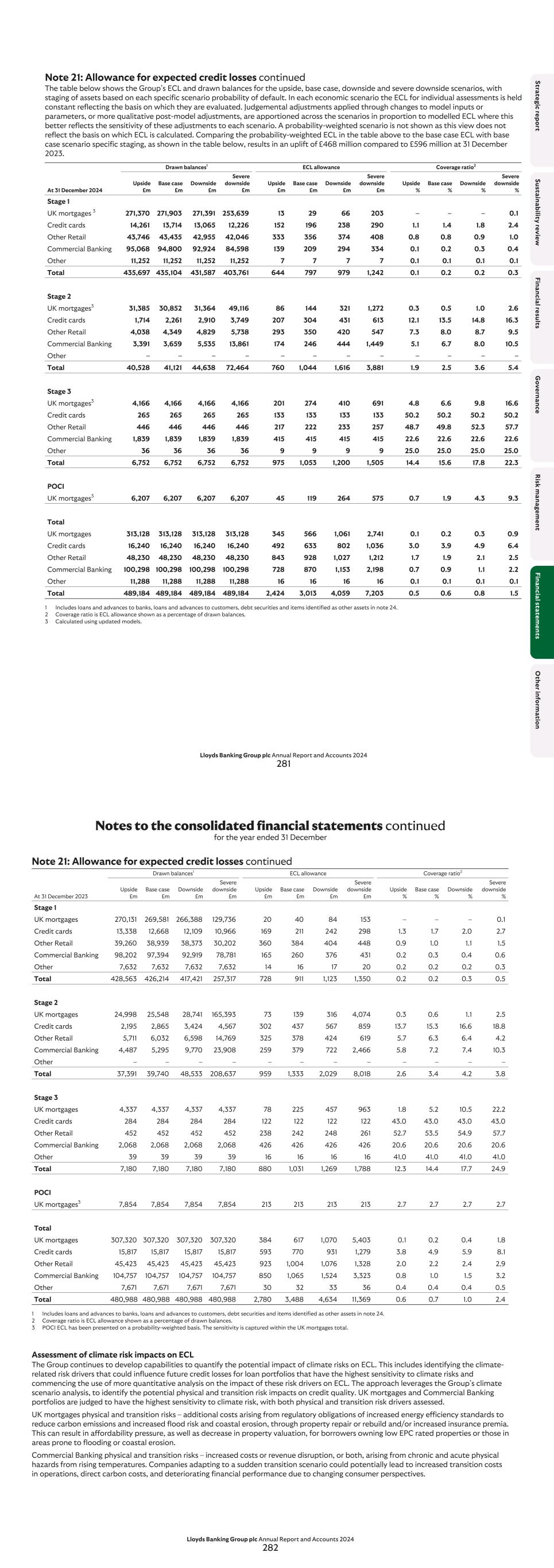
Note 21: Allowance for expected credit losses continued The table below shows the Group’s ECL and drawn balances for the upside, base case, downside and severe downside scenarios, with staging of assets based on each specific scenario probability of default. In each economic scenario the ECL for individual assessments is held constant reflecting the basis on which they are evaluated. Judgemental adjustments applied through changes to model inputs or parameters, or more qualitative post-model adjustments, are apportioned across the scenarios in proportion to modelled ECL where this better reflects the sensitivity of these adjustments to each scenario. A probability-weighted scenario is not shown as this view does not reflect the basis on which ECL is calculated. Comparing the probability-weighted ECL in the table above to the base case ECL with base case scenario specific staging, as shown in the table below, results in an uplift of £468 million compared to £596 million at 31 December 2023. Drawn balances1 ECL allowance Coverage ratio2 At 31 December 2024 Upside £m Base case £m Downside £m Severe downside £m Upside £m Base case £m Downside £m Severe downside £m Upside % Base case % Downside % Severe downside % Stage 1 UK mortgages 3 271,370 271,903 271,391 253,639 13 29 66 203 – – – 0.1 Credit cards 14,261 13,714 13,065 12,226 152 196 238 290 1.1 1.4 1.8 2.4 Other Retail 43,746 43,435 42,955 42,046 333 356 374 408 0.8 0.8 0.9 1.0 Commercial Banking 95,068 94,800 92,924 84,598 139 209 294 334 0.1 0.2 0.3 0.4 Other 11,252 11,252 11,252 11,252 7 7 7 7 0.1 0.1 0.1 0.1 Total 435,697 435,104 431,587 403,761 644 797 979 1,242 0.1 0.2 0.2 0.3 Stage 2 UK mortgages3 31,385 30,852 31,364 49,116 86 144 321 1,272 0.3 0.5 1.0 2.6 Credit cards 1,714 2,261 2,910 3,749 207 304 431 613 12.1 13.5 14.8 16.3 Other Retail 4,038 4,349 4,829 5,738 293 350 420 547 7.3 8.0 8.7 9.5 Commercial Banking 3,391 3,659 5,535 13,861 174 246 444 1,449 5.1 6.7 8.0 10.5 Other – – – – – – – – – – – – Total 40,528 41,121 44,638 72,464 760 1,044 1,616 3,881 1.9 2.5 3.6 5.4 Stage 3 UK mortgages3 4,166 4,166 4,166 4,166 201 274 410 691 4.8 6.6 9.8 16.6 Credit cards 265 265 265 265 133 133 133 133 50.2 50.2 50.2 50.2 Other Retail 446 446 446 446 217 222 233 257 48.7 49.8 52.3 57.7 Commercial Banking 1,839 1,839 1,839 1,839 415 415 415 415 22.6 22.6 22.6 22.6 Other 36 36 36 36 9 9 9 9 25.0 25.0 25.0 25.0 Total 6,752 6,752 6,752 6,752 975 1,053 1,200 1,505 14.4 15.6 17.8 22.3 POCI UK mortgages3 6,207 6,207 6,207 6,207 45 119 264 575 0.7 1.9 4.3 9.3 Total UK mortgages 313,128 313,128 313,128 313,128 345 566 1,061 2,741 0.1 0.2 0.3 0.9 Credit cards 16,240 16,240 16,240 16,240 492 633 802 1,036 3.0 3.9 4.9 6.4 Other Retail 48,230 48,230 48,230 48,230 843 928 1,027 1,212 1.7 1.9 2.1 2.5 Commercial Banking 100,298 100,298 100,298 100,298 728 870 1,153 2,198 0.7 0.9 1.1 2.2 Other 11,288 11,288 11,288 11,288 16 16 16 16 0.1 0.1 0.1 0.1 Total 489,184 489,184 489,184 489,184 2,424 3,013 4,059 7,203 0.5 0.6 0.8 1.5 1 Includes loans and advances to banks, loans and advances to customers, debt securities and items identified as other assets in note 24. 2 Coverage ratio is ECL allowance shown as a percentage of drawn balances. 3 Calculated using updated models. Lloyds Banking Group plc Annual Report and Accounts 2024 281 l i ts 2 O th e r in fo rm a tio n F in a n cia l sta te m e n ts R isk m a n a ge m e n t F in a n cia l re su lts S u sta in a b ility re vie w S tra te gic re p o rt G o ve rn a n ce Note 21: Allowance for expected credit losses continued Drawn balances1 ECL allowance Coverage ratio2 At 31 December 2023 Upside £m Base case £m Downside £m Severe downside £m Upside £m Base case £m Downside £m Severe downside £m Upside % Base case % Downside % Severe downside % Stage 1 UK mortgages 270,131 269,581 266,388 129,736 20 40 84 153 – – – 0.1 Credit cards 13,338 12,668 12,109 10,966 169 211 242 298 1.3 1.7 2.0 2.7 Other Retail 39,260 38,939 38,373 30,202 360 384 404 448 0.9 1.0 1.1 1.5 Commercial Banking 98,202 97,394 92,919 78,781 165 260 376 431 0.2 0.3 0.4 0.6 Other 7,632 7,632 7,632 7,632 14 16 17 20 0.2 0.2 0.2 0.3 Total 428,563 426,214 417,421 257,317 728 911 1,123 1,350 0.2 0.2 0.3 0.5 Stage 2 UK mortgages 24,998 25,548 28,741 165,393 73 139 316 4,074 0.3 0.6 1.1 2.5 Credit cards 2,195 2,865 3,424 4,567 302 437 567 859 13.7 15.3 16.6 18.8 Other Retail 5,711 6,032 6,598 14,769 325 378 424 619 5.7 6.3 6.4 4.2 Commercial Banking 4,487 5,295 9,770 23,908 259 379 722 2,466 5.8 7.2 7.4 10.3 Other – – – – – – – – – – – – Total 37,391 39,740 48,533 208,637 959 1,333 2,029 8,018 2.6 3.4 4.2 3.8 Stage 3 UK mortgages 4,337 4,337 4,337 4,337 78 225 457 963 1.8 5.2 10.5 22.2 Credit cards 284 284 284 284 122 122 122 122 43.0 43.0 43.0 43.0 Other Retail 452 452 452 452 238 242 248 261 52.7 53.5 54.9 57.7 Commercial Banking 2,068 2,068 2,068 2,068 426 426 426 426 20.6 20.6 20.6 20.6 Other 39 39 39 39 16 16 16 16 41.0 41.0 41.0 41.0 Total 7,180 7,180 7,180 7,180 880 1,031 1,269 1,788 12.3 14.4 17.7 24.9 POCI UK mortgages3 7,854 7,854 7,854 7,854 213 213 213 213 2.7 2.7 2.7 2.7 Total UK mortgages 307,320 307,320 307,320 307,320 384 617 1,070 5,403 0.1 0.2 0.4 1.8 Credit cards 15,817 15,817 15,817 15,817 593 770 931 1,279 3.8 4.9 5.9 8.1 Other Retail 45,423 45,423 45,423 45,423 923 1,004 1,076 1,328 2.0 2.2 2.4 2.9 Commercial Banking 104,757 104,757 104,757 104,757 850 1,065 1,524 3,323 0.8 1.0 1.5 3.2 Other 7,671 7,671 7,671 7,671 30 32 33 36 0.4 0.4 0.4 0.5 Total 480,988 480,988 480,988 480,988 2,780 3,488 4,634 11,369 0.6 0.7 1.0 2.4 1 Includes loans and advances to banks, loans and advances to customers, debt securities and items identified as other assets in note 24. 2 Coverage ratio is ECL allowance shown as a percentage of drawn balances. 3 POCI ECL has been presented on a probability-weighted basis. The sensitivity is captured within the UK mortgages total. Assessment of climate risk impacts on ECL The Group continues to develop capabilities to quantify the potential impact of climate risks on ECL. This includes identifying the climate- related risk drivers that could influence future credit losses for loan portfolios that have the highest sensitivity to climate risks and commencing the use of more quantitative analysis on the impact of these risk drivers on ECL. The approach leverages the Group’s climate scenario analysis, to identify the potential physical and transition risk impacts on credit quality. UK mortgages and Commercial Banking portfolios are judged to have the highest sensitivity to climate risk, with both physical and transition risk drivers assessed. UK mortgages physical and transition risks – additional costs arising from regulatory obligations of increased energy efficiency standards to reduce carbon emissions and increased flood risk and coastal erosion, through property repair or rebuild and/or increased insurance premia. This can result in affordability pressure, as well as decrease in property valuation, for borrowers owning low EPC rated properties or those in areas prone to flooding or coastal erosion. Commercial Banking physical and transition risks – increased costs or revenue disruption, or both, arising from chronic and acute physical hazards from rising temperatures. Companies adapting to a sudden transition scenario could potentially lead to increased transition costs in operations, direct carbon costs, and deteriorating financial performance due to changing consumer perspectives. Notes to the consolidated financial statements continued for the year ended 31 December Lloyds Banking Group plc Annual Report and Accounts 2024 282 l i ts
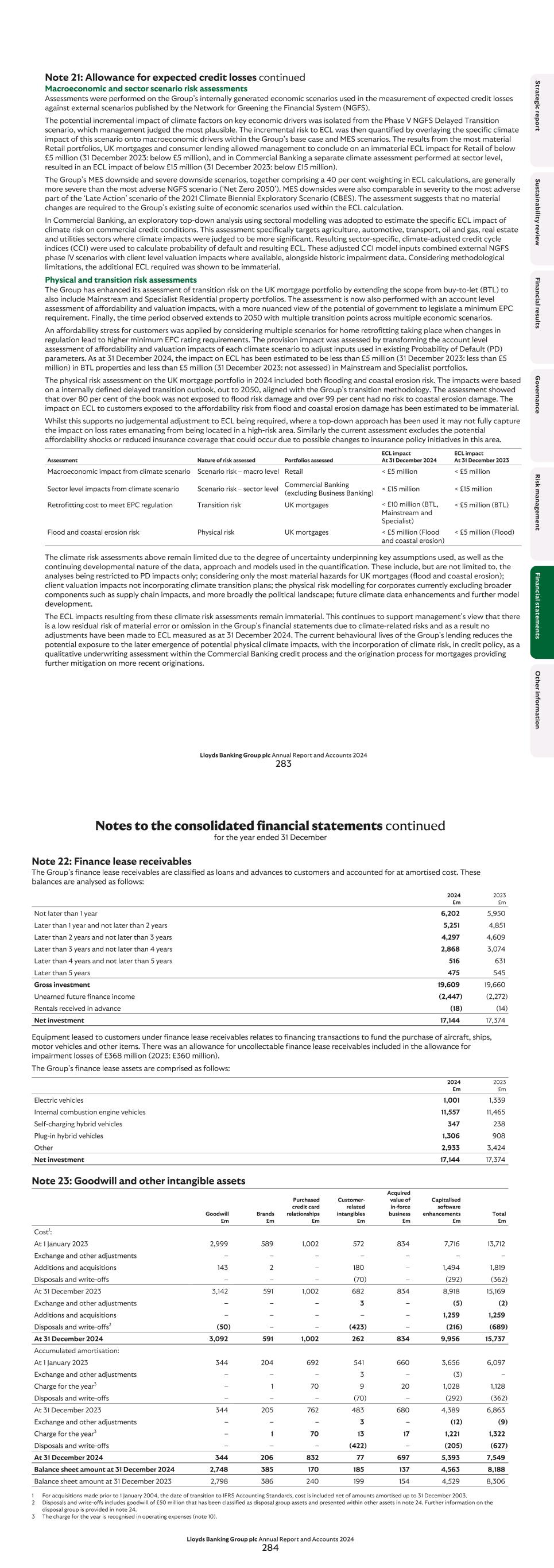
Note 21: Allowance for expected credit losses continued Macroeconomic and sector scenario risk assessments Assessments were performed on the Group’s internally generated economic scenarios used in the measurement of expected credit losses against external scenarios published by the Network for Greening the Financial System (NGFS). The potential incremental impact of climate factors on key economic drivers was isolated from the Phase V NGFS Delayed Transition scenario, which management judged the most plausible. The incremental risk to ECL was then quantified by overlaying the specific climate impact of this scenario onto macroeconomic drivers within the Group’s base case and MES scenarios. The results from the most material Retail portfolios, UK mortgages and consumer lending allowed management to conclude on an immaterial ECL impact for Retail of below £5 million (31 December 2023: below £5 million), and in Commercial Banking a separate climate assessment performed at sector level, resulted in an ECL impact of below £15 million (31 December 2023: below £15 million). The Group’s MES downside and severe downside scenarios, together comprising a 40 per cent weighting in ECL calculations, are generally more severe than the most adverse NGFS scenario (‘Net Zero 2050’). MES downsides were also comparable in severity to the most adverse part of the ‘Late Action’ scenario of the 2021 Climate Biennial Exploratory Scenario (CBES). The assessment suggests that no material changes are required to the Group’s existing suite of economic scenarios used within the ECL calculation. In Commercial Banking, an exploratory top-down analysis using sectoral modelling was adopted to estimate the specific ECL impact of climate risk on commercial credit conditions. This assessment specifically targets agriculture, automotive, transport, oil and gas, real estate and utilities sectors where climate impacts were judged to be more significant. Resulting sector-specific, climate-adjusted credit cycle indices (CCI) were used to calculate probability of default and resulting ECL. These adjusted CCI model inputs combined external NGFS phase IV scenarios with client level valuation impacts where available, alongside historic impairment data. Considering methodological limitations, the additional ECL required was shown to be immaterial. Physical and transition risk assessments The Group has enhanced its assessment of transition risk on the UK mortgage portfolio by extending the scope from buy-to-let (BTL) to also include Mainstream and Specialist Residential property portfolios. The assessment is now also performed with an account level assessment of affordability and valuation impacts, with a more nuanced view of the potential of government to legislate a minimum EPC requirement. Finally, the time period observed extends to 2050 with multiple transition points across multiple economic scenarios. An affordability stress for customers was applied by considering multiple scenarios for home retrofitting taking place when changes in regulation lead to higher minimum EPC rating requirements. The provision impact was assessed by transforming the account level assessment of affordability and valuation impacts of each climate scenario to adjust inputs used in existing Probability of Default (PD) parameters. As at 31 December 2024, the impact on ECL has been estimated to be less than £5 million (31 December 2023: less than £5 million) in BTL properties and less than £5 million (31 December 2023: not assessed) in Mainstream and Specialist portfolios. The physical risk assessment on the UK mortgage portfolio in 2024 included both flooding and coastal erosion risk. The impacts were based on a internally defined delayed transition outlook, out to 2050, aligned with the Group’s transition methodology. The assessment showed that over 80 per cent of the book was not exposed to flood risk damage and over 99 per cent had no risk to coastal erosion damage. The impact on ECL to customers exposed to the affordability risk from flood and coastal erosion damage has been estimated to be immaterial. Whilst this supports no judgemental adjustment to ECL being required, where a top-down approach has been used it may not fully capture the impact on loss rates emanating from being located in a high-risk area. Similarly the current assessment excludes the potential affordability shocks or reduced insurance coverage that could occur due to possible changes to insurance policy initiatives in this area. Assessment Nature of risk assessed Portfolios assessed ECL impact At 31 December 2024 ECL impact At 31 December 2023 Macroeconomic impact from climate scenario Scenario risk – macro level Retail < £5 million < £5 million Sector level impacts from climate scenario Scenario risk – sector level Commercial Banking (excluding Business Banking) < £15 million < £15 million Retrofitting cost to meet EPC regulation Transition risk UK mortgages < £10 million (BTL, Mainstream and Specialist) < £5 million (BTL) Flood and coastal erosion risk Physical risk UK mortgages < £5 million (Flood and coastal erosion) < £5 million (Flood) The climate risk assessments above remain limited due to the degree of uncertainty underpinning key assumptions used, as well as the continuing developmental nature of the data, approach and models used in the quantification. These include, but are not limited to, the analyses being restricted to PD impacts only; considering only the most material hazards for UK mortgages (flood and coastal erosion); client valuation impacts not incorporating climate transition plans; the physical risk modelling for corporates currently excluding broader components such as supply chain impacts, and more broadly the political landscape; future climate data enhancements and further model development. The ECL impacts resulting from these climate risk assessments remain immaterial. This continues to support management’s view that there is a low residual risk of material error or omission in the Group’s financial statements due to climate-related risks and as a result no adjustments have been made to ECL measured as at 31 December 2024. The current behavioural lives of the Group’s lending reduces the potential exposure to the later emergence of potential physical climate impacts, with the incorporation of climate risk, in credit policy, as a qualitative underwriting assessment within the Commercial Banking credit process and the origination process for mortgages providing further mitigation on more recent originations. Lloyds Banking Group plc Annual Report and Accounts 2024 283 l i ts 2 O th e r in fo rm a tio n F in a n cia l sta te m e n ts R isk m a n a ge m e n t F in a n cia l re su lts S u sta in a b ility re vie w S tra te gic re p o rt G o ve rn a n ce Note 22: Finance lease receivables The Group’s finance lease receivables are classified as loans and advances to customers and accounted for at amortised cost. These balances are analysed as follows: 2024 £m 2023 £m Not later than 1 year 6,202 5,950 Later than 1 year and not later than 2 years 5,251 4,851 Later than 2 years and not later than 3 years 4,297 4,609 Later than 3 years and not later than 4 years 2,868 3,074 Later than 4 years and not later than 5 years 516 631 Later than 5 years 475 545 Gross investment 19,609 19,660 Unearned future finance income (2,447) (2,272) Rentals received in advance (18) (14) Net investment 17,144 17,374 Equipment leased to customers under finance lease receivables relates to financing transactions to fund the purchase of aircraft, ships, motor vehicles and other items. There was an allowance for uncollectable finance lease receivables included in the allowance for impairment losses of £368 million (2023: £360 million). The Group’s finance lease assets are comprised as follows: 2024 £m 2023 £m Electric vehicles 1,001 1,339 Internal combustion engine vehicles 11,557 11,465 Self-charging hybrid vehicles 347 238 Plug-in hybrid vehicles 1,306 908 Other 2,933 3,424 Net investment 17,144 17,374 Note 23: Goodwill and other intangible assets Goodwill £m Brands £m Purchased credit card relationships £m Customer- related intangibles £m Acquired value of in-force business £m Capitalised software enhancements £m Total £m Cost1: At 1 January 2023 2,999 589 1,002 572 834 7,716 13,712 Exchange and other adjustments – – – – – – – Additions and acquisitions 143 2 – 180 – 1,494 1,819 Disposals and write-offs – – – (70) – (292) (362) At 31 December 2023 3,142 591 1,002 682 834 8,918 15,169 Exchange and other adjustments – – – 3 – (5) (2) Additions and acquisitions – – – – – 1,259 1,259 Disposals and write-offs2 (50) – – (423) – (216) (689) At 31 December 2024 3,092 591 1,002 262 834 9,956 15,737 Accumulated amortisation: At 1 January 2023 344 204 692 541 660 3,656 6,097 Exchange and other adjustments – – – 3 – (3) – Charge for the year3 – 1 70 9 20 1,028 1,128 Disposals and write-offs – – – (70) – (292) (362) At 31 December 2023 344 205 762 483 680 4,389 6,863 Exchange and other adjustments – – – 3 – (12) (9) Charge for the year3 – 1 70 13 17 1,221 1,322 Disposals and write-offs – – – (422) – (205) (627) At 31 December 2024 344 206 832 77 697 5,393 7,549 Balance sheet amount at 31 December 2024 2,748 385 170 185 137 4,563 8,188 Balance sheet amount at 31 December 2023 2,798 386 240 199 154 4,529 8,306 1 For acquisitions made prior to 1 January 2004, the date of transition to IFRS Accounting Standards, cost is included net of amounts amortised up to 31 December 2003. 2 Disposals and write-offs includes goodwill of £50 million that has been classified as disposal group assets and presented within other assets in note 24. Further information on the disposal group is provided in note 24. 3 The charge for the year is recognised in operating expenses (note 10). Notes to the consolidated financial statements continued for the year ended 31 December Lloyds Banking Group plc Annual Report and Accounts 2024 284 l i ts
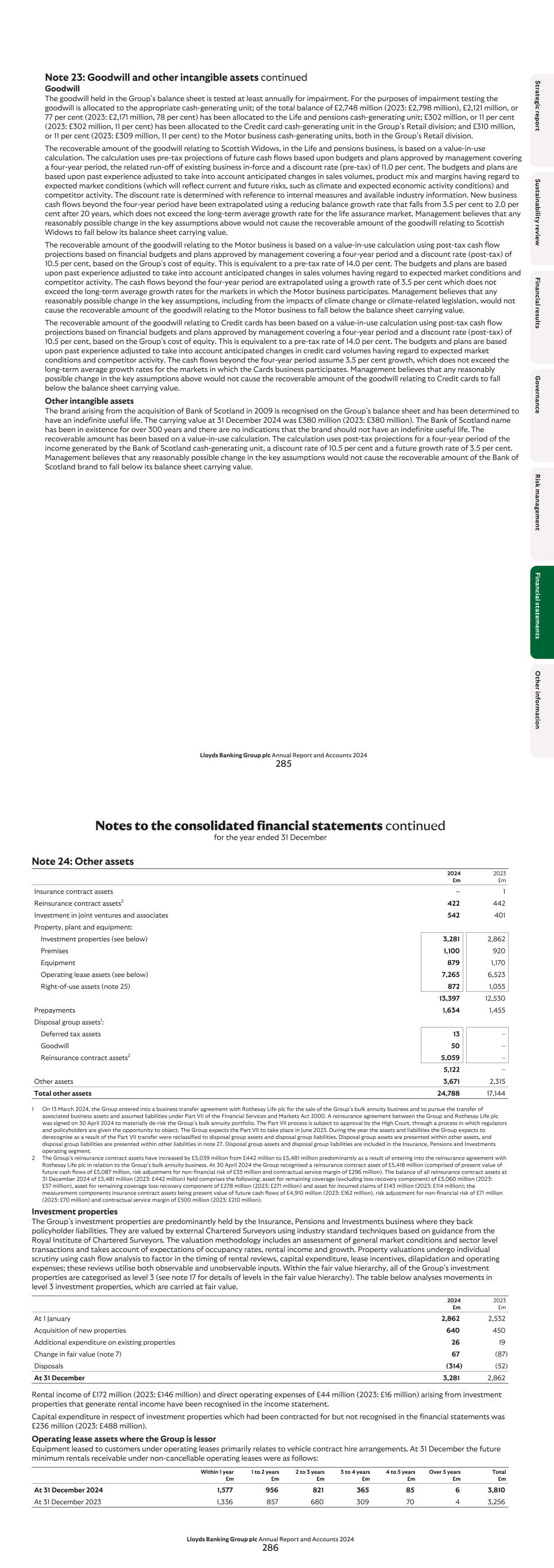
Note 23: Goodwill and other intangible assets continued Goodwill The goodwill held in the Group’s balance sheet is tested at least annually for impairment. For the purposes of impairment testing the goodwill is allocated to the appropriate cash-generating unit; of the total balance of £2,748 million (2023: £2,798 million), £2,121 million, or 77 per cent (2023: £2,171 million, 78 per cent) has been allocated to the Life and pensions cash-generating unit; £302 million, or 11 per cent (2023: £302 million, 11 per cent) has been allocated to the Credit card cash-generating unit in the Group’s Retail division; and £310 million, or 11 per cent (2023: £309 million, 11 per cent) to the Motor business cash-generating units, both in the Group’s Retail division. The recoverable amount of the goodwill relating to Scottish Widows, in the Life and pensions business, is based on a value-in-use calculation. The calculation uses pre-tax projections of future cash flows based upon budgets and plans approved by management covering a four-year period, the related run-off of existing business in-force and a discount rate (pre-tax) of 11.0 per cent. The budgets and plans are based upon past experience adjusted to take into account anticipated changes in sales volumes, product mix and margins having regard to expected market conditions (which will reflect current and future risks, such as climate and expected economic activity conditions) and competitor activity. The discount rate is determined with reference to internal measures and available industry information. New business cash flows beyond the four-year period have been extrapolated using a reducing balance growth rate that falls from 3.5 per cent to 2.0 per cent after 20 years, which does not exceed the long-term average growth rate for the life assurance market. Management believes that any reasonably possible change in the key assumptions above would not cause the recoverable amount of the goodwill relating to Scottish Widows to fall below its balance sheet carrying value. The recoverable amount of the goodwill relating to the Motor business is based on a value-in-use calculation using post-tax cash flow projections based on financial budgets and plans approved by management covering a four-year period and a discount rate (post-tax) of 10.5 per cent, based on the Group’s cost of equity. This is equivalent to a pre-tax rate of 14.0 per cent. The budgets and plans are based upon past experience adjusted to take into account anticipated changes in sales volumes having regard to expected market conditions and competitor activity. The cash flows beyond the four-year period are extrapolated using a growth rate of 3.5 per cent which does not exceed the long-term average growth rates for the markets in which the Motor business participates. Management believes that any reasonably possible change in the key assumptions, including from the impacts of climate change or climate-related legislation, would not cause the recoverable amount of the goodwill relating to the Motor business to fall below the balance sheet carrying value. The recoverable amount of the goodwill relating to Credit cards has been based on a value-in-use calculation using post-tax cash flow projections based on financial budgets and plans approved by management covering a four-year period and a discount rate (post-tax) of 10.5 per cent, based on the Group’s cost of equity. This is equivalent to a pre-tax rate of 14.0 per cent. The budgets and plans are based upon past experience adjusted to take into account anticipated changes in credit card volumes having regard to expected market conditions and competitor activity. The cash flows beyond the four-year period assume 3.5 per cent growth, which does not exceed the long-term average growth rates for the markets in which the Cards business participates. Management believes that any reasonably possible change in the key assumptions above would not cause the recoverable amount of the goodwill relating to Credit cards to fall below the balance sheet carrying value. Other intangible assets The brand arising from the acquisition of Bank of Scotland in 2009 is recognised on the Group’s balance sheet and has been determined to have an indefinite useful life. The carrying value at 31 December 2024 was £380 million (2023: £380 million). The Bank of Scotland name has been in existence for over 300 years and there are no indications that the brand should not have an indefinite useful life. The recoverable amount has been based on a value-in-use calculation. The calculation uses post-tax projections for a four-year period of the income generated by the Bank of Scotland cash-generating unit, a discount rate of 10.5 per cent and a future growth rate of 3.5 per cent. Management believes that any reasonably possible change in the key assumptions would not cause the recoverable amount of the Bank of Scotland brand to fall below its balance sheet carrying value. Lloyds Banking Group plc Annual Report and Accounts 2024 285 l i ts 2 O th e r in fo rm a tio n F in a n cia l sta te m e n ts R isk m a n a ge m e n t F in a n cia l re su lts S u sta in a b ility re vie w S tra te gic re p o rt G o ve rn a n ce Note 24: Other assets 2024 £m 2023 £m Insurance contract assets – 1 Reinsurance contract assets2 422 442 Investment in joint ventures and associates 542 401 Property, plant and equipment: Investment properties (see below) 3,281 2,862 Premises 1,100 920 Equipment 879 1,170 Operating lease assets (see below) 7,265 6,523 Right-of-use assets (note 25) 872 1,055 13,397 12,530 Prepayments 1,634 1,455 Disposal group assets1: Deferred tax assets 13 – Goodwill 50 – Reinsurance contract assets2 5,059 – 5,122 – Other assets 3,671 2,315 Total other assets 24,788 17,144 1 On 13 March 2024, the Group entered into a business transfer agreement with Rothesay Life plc for the sale of the Group’s bulk annuity business and to pursue the transfer of associated business assets and assumed liabilities under Part VII of the Financial Services and Markets Act 2000. A reinsurance agreement between the Group and Rothesay Life plc was signed on 30 April 2024 to materially de-risk the Group’s bulk annuity portfolio. The Part VII process is subject to approval by the High Court, through a process in which regulators and policyholders are given the opportunity to object. The Group expects the Part VII to take place in June 2025. During the year the assets and liabilities the Group expects to derecognise as a result of the Part VII transfer were reclassified to disposal group assets and disposal group liabilities. Disposal group assets are presented within other assets, and disposal group liabilities are presented within other liabilities in note 27. Disposal group assets and disposal group liabilities are included in the Insurance, Pensions and Investments operating segment. 2 The Group’s reinsurance contract assets have increased by £5,039 million from £442 million to £5,481 million predominantly as a result of entering into the reinsurance agreement with Rothesay Life plc in relation to the Group’s bulk annuity business. At 30 April 2024 the Group recognised a reinsurance contract asset of £5,418 million (comprised of present value of future cash flows of £5,087 million, risk adjustment for non-financial risk of £35 million and contractual service margin of £296 million). The balance of all reinsurance contract assets at 31 December 2024 of £5,481 million (2023: £442 million) held comprises the following: asset for remaining coverage (excluding loss-recovery component) of £5,060 million (2023: £57 million), asset for remaining coverage loss-recovery component of £278 million (2023: £271 million) and asset for incurred claims of £143 million (2023: £114 million); the measurement components insurance contract assets being present value of future cash flows of £4,910 million (2023: £162 million), risk adjustment for non-financial risk of £71 million (2023: £70 million) and contractual service margin of £500 million (2023: £210 million). Investment properties The Group’s investment properties are predominantly held by the Insurance, Pensions and Investments business where they back policyholder liabilities. They are valued by external Chartered Surveyors using industry standard techniques based on guidance from the Royal Institute of Chartered Surveyors. The valuation methodology includes an assessment of general market conditions and sector level transactions and takes account of expectations of occupancy rates, rental income and growth. Property valuations undergo individual scrutiny using cash flow analysis to factor in the timing of rental reviews, capital expenditure, lease incentives, dilapidation and operating expenses; these reviews utilise both observable and unobservable inputs. Within the fair value hierarchy, all of the Group’s investment properties are categorised as level 3 (see note 17 for details of levels in the fair value hierarchy). The table below analyses movements in level 3 investment properties, which are carried at fair value. 2024 £m 2023 £m At 1 January 2,862 2,532 Acquisition of new properties 640 450 Additional expenditure on existing properties 26 19 Change in fair value (note 7) 67 (87) Disposals (314) (52) At 31 December 3,281 2,862 Rental income of £172 million (2023: £146 million) and direct operating expenses of £44 million (2023: £16 million) arising from investment properties that generate rental income have been recognised in the income statement. Capital expenditure in respect of investment properties which had been contracted for but not recognised in the financial statements was £236 million (2023: £488 million). Operating lease assets where the Group is lessor Equipment leased to customers under operating leases primarily relates to vehicle contract hire arrangements. At 31 December the future minimum rentals receivable under non-cancellable operating leases were as follows: Within 1 year £m 1 to 2 years £m 2 to 3 years £m 3 to 4 years £m 4 to 5 years £m Over 5 years £m Total £m At 31 December 2024 1,577 956 821 365 85 6 3,810 At 31 December 2023 1,336 857 680 309 70 4 3,256 Notes to the consolidated financial statements continued for the year ended 31 December Lloyds Banking Group plc Annual Report and Accounts 2024 286 l i ts
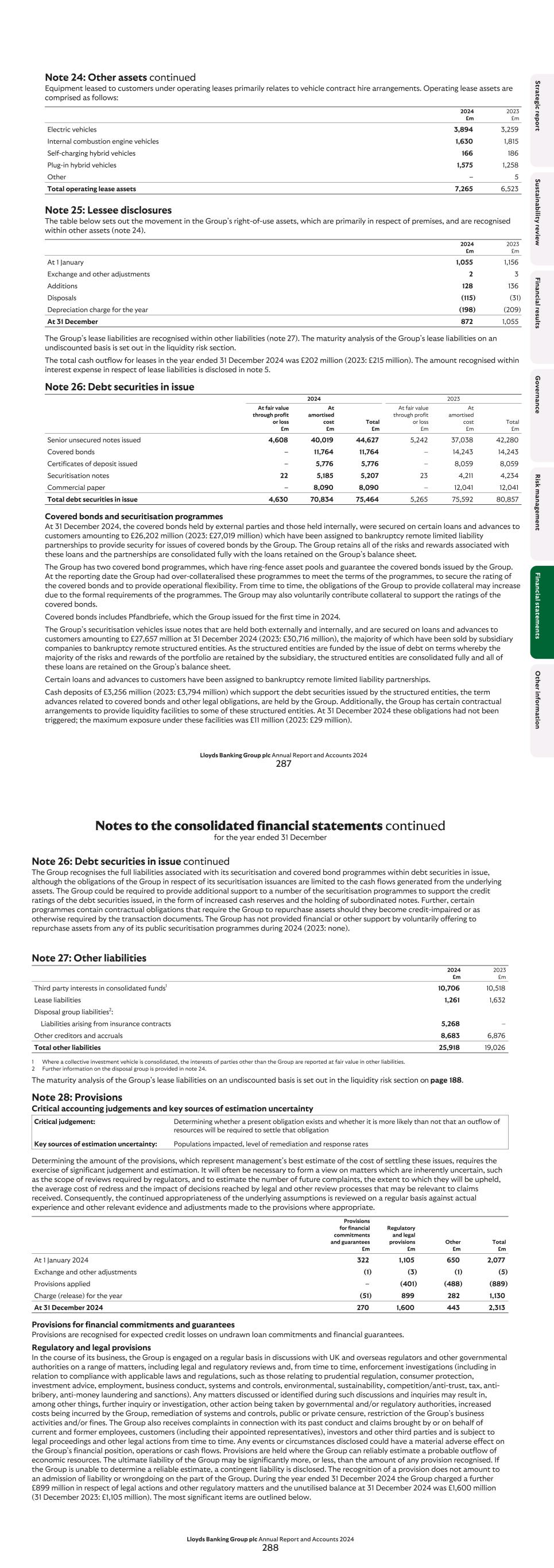
Note 24: Other assets continued Equipment leased to customers under operating leases primarily relates to vehicle contract hire arrangements. Operating lease assets are comprised as follows: 2024 £m 2023 £m Electric vehicles 3,894 3,259 Internal combustion engine vehicles 1,630 1,815 Self-charging hybrid vehicles 166 186 Plug-in hybrid vehicles 1,575 1,258 Other – 5 Total operating lease assets 7,265 6,523 Note 25: Lessee disclosures The table below sets out the movement in the Group’s right-of-use assets, which are primarily in respect of premises, and are recognised within other assets (note 24). 2024 £m 2023 £m At 1 January 1,055 1,156 Exchange and other adjustments 2 3 Additions 128 136 Disposals (115) (31) Depreciation charge for the year (198) (209) At 31 December 872 1,055 The Group’s lease liabilities are recognised within other liabilities (note 27). The maturity analysis of the Group’s lease liabilities on an undiscounted basis is set out in the liquidity risk section. The total cash outflow for leases in the year ended 31 December 2024 was £202 million (2023: £215 million). The amount recognised within interest expense in respect of lease liabilities is disclosed in note 5. Note 26: Debt securities in issue 2024 2023 At fair value through profit or loss £m At amortised cost £m Total £m At fair value through profit or loss £m At amortised cost £m Total £m Senior unsecured notes issued 4,608 40,019 44,627 5,242 37,038 42,280 Covered bonds – 11,764 11,764 – 14,243 14,243 Certificates of deposit issued – 5,776 5,776 – 8,059 8,059 Securitisation notes 22 5,185 5,207 23 4,211 4,234 Commercial paper – 8,090 8,090 – 12,041 12,041 Total debt securities in issue 4,630 70,834 75,464 5,265 75,592 80,857 Covered bonds and securitisation programmes At 31 December 2024, the covered bonds held by external parties and those held internally, were secured on certain loans and advances to customers amounting to £26,202 million (2023: £27,019 million) which have been assigned to bankruptcy remote limited liability partnerships to provide security for issues of covered bonds by the Group. The Group retains all of the risks and rewards associated with these loans and the partnerships are consolidated fully with the loans retained on the Group’s balance sheet. The Group has two covered bond programmes, which have ring-fence asset pools and guarantee the covered bonds issued by the Group. At the reporting date the Group had over-collateralised these programmes to meet the terms of the programmes, to secure the rating of the covered bonds and to provide operational flexibility. From time to time, the obligations of the Group to provide collateral may increase due to the formal requirements of the programmes. The Group may also voluntarily contribute collateral to support the ratings of the covered bonds. Covered bonds includes Pfandbriefe, which the Group issued for the first time in 2024. The Group’s securitisation vehicles issue notes that are held both externally and internally, and are secured on loans and advances to customers amounting to £27,657 million at 31 December 2024 (2023: £30,716 million), the majority of which have been sold by subsidiary companies to bankruptcy remote structured entities. As the structured entities are funded by the issue of debt on terms whereby the majority of the risks and rewards of the portfolio are retained by the subsidiary, the structured entities are consolidated fully and all of these loans are retained on the Group’s balance sheet. Certain loans and advances to customers have been assigned to bankruptcy remote limited liability partnerships. Cash deposits of £3,256 million (2023: £3,794 million) which support the debt securities issued by the structured entities, the term advances related to covered bonds and other legal obligations, are held by the Group. Additionally, the Group has certain contractual arrangements to provide liquidity facilities to some of these structured entities. At 31 December 2024 these obligations had not been triggered; the maximum exposure under these facilities was £11 million (2023: £29 million). Lloyds Banking Group plc Annual Report and Accounts 2024 287 l i ts 2 O th e r in fo rm a tio n F in a n cia l sta te m e n ts R isk m a n a ge m e n t F in a n cia l re su lts S u sta in a b ility re vie w S tra te gic re p o rt G o ve rn a n ce Note 26: Debt securities in issue continued The Group recognises the full liabilities associated with its securitisation and covered bond programmes within debt securities in issue, although the obligations of the Group in respect of its securitisation issuances are limited to the cash flows generated from the underlying assets. The Group could be required to provide additional support to a number of the securitisation programmes to support the credit ratings of the debt securities issued, in the form of increased cash reserves and the holding of subordinated notes. Further, certain programmes contain contractual obligations that require the Group to repurchase assets should they become credit-impaired or as otherwise required by the transaction documents. The Group has not provided financial or other support by voluntarily offering to repurchase assets from any of its public securitisation programmes during 2024 (2023: none). Note 27: Other liabilities 2024 £m 2023 £m Third party interests in consolidated funds1 10,706 10,518 Lease liabilities 1,261 1,632 Disposal group liabilities2: Liabilities arising from insurance contracts 5,268 – Other creditors and accruals 8,683 6,876 Total other liabilities 25,918 19,026 1 Where a collective investment vehicle is consolidated, the interests of parties other than the Group are reported at fair value in other liabilities. 2 Further information on the disposal group is provided in note 24. The maturity analysis of the Group’s lease liabilities on an undiscounted basis is set out in the liquidity risk section on page 188. Note 28: Provisions Critical accounting judgements and key sources of estimation uncertainty Critical judgement: Determining whether a present obligation exists and whether it is more likely than not that an outflow of resources will be required to settle that obligation Key sources of estimation uncertainty: Populations impacted, level of remediation and response rates Determining the amount of the provisions, which represent management’s best estimate of the cost of settling these issues, requires the exercise of significant judgement and estimation. It will often be necessary to form a view on matters which are inherently uncertain, such as the scope of reviews required by regulators, and to estimate the number of future complaints, the extent to which they will be upheld, the average cost of redress and the impact of decisions reached by legal and other review processes that may be relevant to claims received. Consequently, the continued appropriateness of the underlying assumptions is reviewed on a regular basis against actual experience and other relevant evidence and adjustments made to the provisions where appropriate. Provisions for financial commitments and guarantees £m Regulatory and legal provisions £m Other £m Total £m At 1 January 2024 322 1,105 650 2,077 Exchange and other adjustments (1) (3) (1) (5) Provisions applied – (401) (488) (889) Charge (release) for the year (51) 899 282 1,130 At 31 December 2024 270 1,600 443 2,313 Provisions for financial commitments and guarantees Provisions are recognised for expected credit losses on undrawn loan commitments and financial guarantees. Regulatory and legal provisions In the course of its business, the Group is engaged on a regular basis in discussions with UK and overseas regulators and other governmental authorities on a range of matters, including legal and regulatory reviews and, from time to time, enforcement investigations (including in relation to compliance with applicable laws and regulations, such as those relating to prudential regulation, consumer protection, investment advice, employment, business conduct, systems and controls, environmental, sustainability, competition/anti-trust, tax, anti- bribery, anti-money laundering and sanctions). Any matters discussed or identified during such discussions and inquiries may result in, among other things, further inquiry or investigation, other action being taken by governmental and/or regulatory authorities, increased costs being incurred by the Group, remediation of systems and controls, public or private censure, restriction of the Group’s business activities and/or fines. The Group also receives complaints in connection with its past conduct and claims brought by or on behalf of current and former employees, customers (including their appointed representatives), investors and other third parties and is subject to legal proceedings and other legal actions from time to time. Any events or circumstances disclosed could have a material adverse effect on the Group’s financial position, operations or cash flows. Provisions are held where the Group can reliably estimate a probable outflow of economic resources. The ultimate liability of the Group may be significantly more, or less, than the amount of any provision recognised. If the Group is unable to determine a reliable estimate, a contingent liability is disclosed. The recognition of a provision does not amount to an admission of liability or wrongdoing on the part of the Group. During the year ended 31 December 2024 the Group charged a further £899 million in respect of legal actions and other regulatory matters and the unutilised balance at 31 December 2024 was £1,600 million (31 December 2023: £1,105 million). The most significant items are outlined below. Notes to the consolidated financial statements continued for the year ended 31 December Lloyds Banking Group plc Annual Report and Accounts 2024 288 l i ts
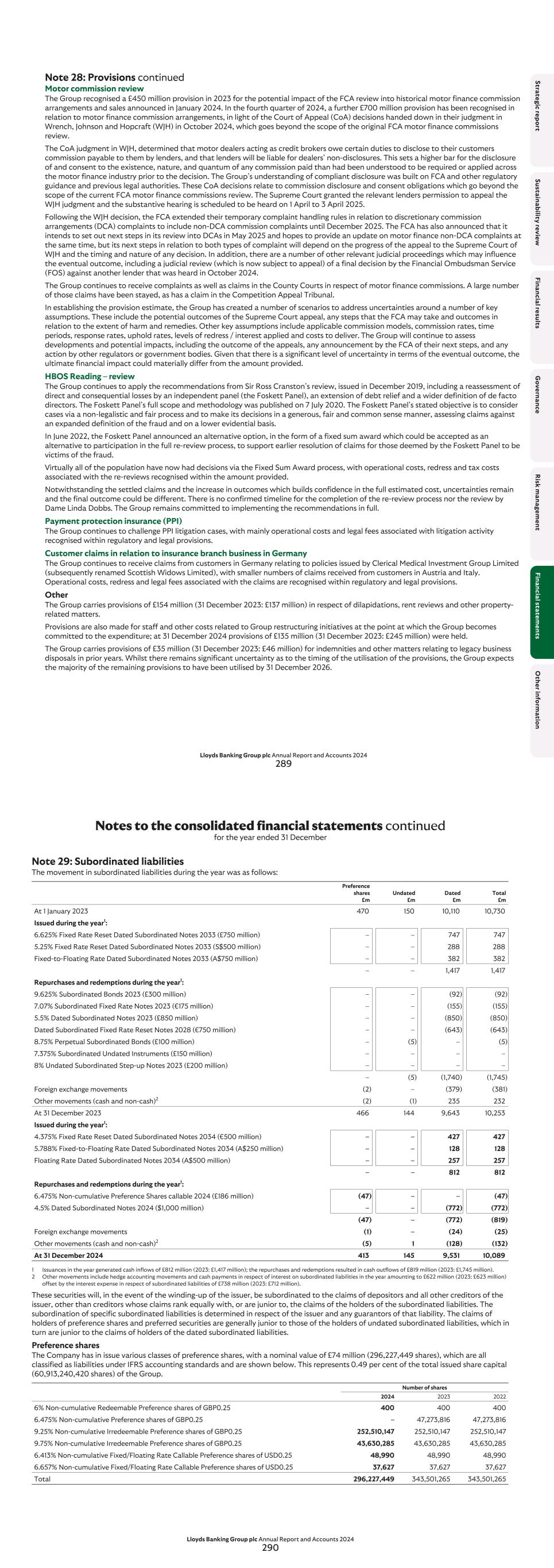
Note 28: Provisions continued Motor commission review The Group recognised a £450 million provision in 2023 for the potential impact of the FCA review into historical motor finance commission arrangements and sales announced in January 2024. In the fourth quarter of 2024, a further £700 million provision has been recognised in relation to motor finance commission arrangements, in light of the Court of Appeal (CoA) decisions handed down in their judgment in Wrench, Johnson and Hopcraft (WJH) in October 2024, which goes beyond the scope of the original FCA motor finance commissions review. The CoA judgment in WJH, determined that motor dealers acting as credit brokers owe certain duties to disclose to their customers commission payable to them by lenders, and that lenders will be liable for dealers’ non-disclosures. This sets a higher bar for the disclosure of and consent to the existence, nature, and quantum of any commission paid than had been understood to be required or applied across the motor finance industry prior to the decision. The Group’s understanding of compliant disclosure was built on FCA and other regulatory guidance and previous legal authorities. These CoA decisions relate to commission disclosure and consent obligations which go beyond the scope of the current FCA motor finance commissions review. The Supreme Court granted the relevant lenders permission to appeal the WJH judgment and the substantive hearing is scheduled to be heard on 1 April to 3 April 2025. Following the WJH decision, the FCA extended their temporary complaint handling rules in relation to discretionary commission arrangements (DCA) complaints to include non-DCA commission complaints until December 2025. The FCA has also announced that it intends to set out next steps in its review into DCAs in May 2025 and hopes to provide an update on motor finance non-DCA complaints at the same time, but its next steps in relation to both types of complaint will depend on the progress of the appeal to the Supreme Court of WJH and the timing and nature of any decision. In addition, there are a number of other relevant judicial proceedings which may influence the eventual outcome, including a judicial review (which is now subject to appeal) of a final decision by the Financial Ombudsman Service (FOS) against another lender that was heard in October 2024. The Group continues to receive complaints as well as claims in the County Courts in respect of motor finance commissions. A large number of those claims have been stayed, as has a claim in the Competition Appeal Tribunal. In establishing the provision estimate, the Group has created a number of scenarios to address uncertainties around a number of key assumptions. These include the potential outcomes of the Supreme Court appeal, any steps that the FCA may take and outcomes in relation to the extent of harm and remedies. Other key assumptions include applicable commission models, commission rates, time periods, response rates, uphold rates, levels of redress / interest applied and costs to deliver. The Group will continue to assess developments and potential impacts, including the outcome of the appeals, any announcement by the FCA of their next steps, and any action by other regulators or government bodies. Given that there is a significant level of uncertainty in terms of the eventual outcome, the ultimate financial impact could materially differ from the amount provided. HBOS Reading – review The Group continues to apply the recommendations from Sir Ross Cranston’s review, issued in December 2019, including a reassessment of direct and consequential losses by an independent panel (the Foskett Panel), an extension of debt relief and a wider definition of de facto directors. The Foskett Panel’s full scope and methodology was published on 7 July 2020. The Foskett Panel’s stated objective is to consider cases via a non-legalistic and fair process and to make its decisions in a generous, fair and common sense manner, assessing claims against an expanded definition of the fraud and on a lower evidential basis. In June 2022, the Foskett Panel announced an alternative option, in the form of a fixed sum award which could be accepted as an alternative to participation in the full re-review process, to support earlier resolution of claims for those deemed by the Foskett Panel to be victims of the fraud. Virtually all of the population have now had decisions via the Fixed Sum Award process, with operational costs, redress and tax costs associated with the re-reviews recognised within the amount provided. Notwithstanding the settled claims and the increase in outcomes which builds confidence in the full estimated cost, uncertainties remain and the final outcome could be different. There is no confirmed timeline for the completion of the re-review process nor the review by Dame Linda Dobbs. The Group remains committed to implementing the recommendations in full. Payment protection insurance (PPI) The Group continues to challenge PPI litigation cases, with mainly operational costs and legal fees associated with litigation activity recognised within regulatory and legal provisions. Customer claims in relation to insurance branch business in Germany The Group continues to receive claims from customers in Germany relating to policies issued by Clerical Medical Investment Group Limited (subsequently renamed Scottish Widows Limited), with smaller numbers of claims received from customers in Austria and Italy. Operational costs, redress and legal fees associated with the claims are recognised within regulatory and legal provisions. Other The Group carries provisions of £154 million (31 December 2023: £137 million) in respect of dilapidations, rent reviews and other property- related matters. Provisions are also made for staff and other costs related to Group restructuring initiatives at the point at which the Group becomes committed to the expenditure; at 31 December 2024 provisions of £135 million (31 December 2023: £245 million) were held. The Group carries provisions of £35 million (31 December 2023: £46 million) for indemnities and other matters relating to legacy business disposals in prior years. Whilst there remains significant uncertainty as to the timing of the utilisation of the provisions, the Group expects the majority of the remaining provisions to have been utilised by 31 December 2026. Lloyds Banking Group plc Annual Report and Accounts 2024 289 l i ts 2 O th e r in fo rm a tio n F in a n cia l sta te m e n ts R isk m a n a ge m e n t F in a n cia l re su lts S u sta in a b ility re vie w S tra te gic re p o rt G o ve rn a n ce Note 29: Subordinated liabilities The movement in subordinated liabilities during the year was as follows: Preference shares £m Undated £m Dated £m Total £m At 1 January 2023 470 150 10,110 10,730 Issued during the year1: 6.625% Fixed Rate Reset Dated Subordinated Notes 2033 (£750 million) – – 747 747 5.25% Fixed Rate Reset Dated Subordinated Notes 2033 (S$500 million) – – 288 288 Fixed-to-Floating Rate Dated Subordinated Notes 2033 (A$750 million) – – 382 382 – – 1,417 1,417 Repurchases and redemptions during the year1: 9.625% Subordinated Bonds 2023 (£300 million) – – (92) (92) 7.07% Subordinated Fixed Rate Notes 2023 (€175 million) – – (155) (155) 5.5% Dated Subordinated Notes 2023 (£850 million) – – (850) (850) Dated Subordinated Fixed Rate Reset Notes 2028 (€750 million) – – (643) (643) 8.75% Perpetual Subordinated Bonds (£100 million) – (5) – (5) 7.375% Subordinated Undated Instruments (£150 million) – – – – 8% Undated Subordinated Step-up Notes 2023 (£200 million) – – – – – (5) (1,740) (1,745) Foreign exchange movements (2) – (379) (381) Other movements (cash and non-cash)2 (2) (1) 235 232 At 31 December 2023 466 144 9,643 10,253 Issued during the year1: 4.375% Fixed Rate Reset Dated Subordinated Notes 2034 (€500 million) – – 427 427 5.788% Fixed-to-Floating Rate Dated Subordinated Notes 2034 (A$250 million) – – 128 128 Floating Rate Dated Subordinated Notes 2034 (A$500 million) – – 257 257 – – 812 812 Repurchases and redemptions during the year1: 6.475% Non-cumulative Preference Shares callable 2024 (£186 million) (47) – – (47) 4.5% Dated Subordinated Notes 2024 ($1,000 million) – – (772) (772) (47) – (772) (819) Foreign exchange movements (1) – (24) (25) Other movements (cash and non-cash)2 (5) 1 (128) (132) At 31 December 2024 413 145 9,531 10,089 1 Issuances in the year generated cash inflows of £812 million (2023: £1,417 million); the repurchases and redemptions resulted in cash outflows of £819 million (2023: £1,745 million). 2 Other movements include hedge accounting movements and cash payments in respect of interest on subordinated liabilities in the year amounting to £622 million (2023: £623 million) offset by the interest expense in respect of subordinated liabilities of £738 million (2023: £712 million). These securities will, in the event of the winding-up of the issuer, be subordinated to the claims of depositors and all other creditors of the issuer, other than creditors whose claims rank equally with, or are junior to, the claims of the holders of the subordinated liabilities. The subordination of specific subordinated liabilities is determined in respect of the issuer and any guarantors of that liability. The claims of holders of preference shares and preferred securities are generally junior to those of the holders of undated subordinated liabilities, which in turn are junior to the claims of holders of the dated subordinated liabilities. Preference shares The Company has in issue various classes of preference shares, with a nominal value of £74 million (296,227,449 shares), which are all classified as liabilities under IFRS accounting standards and are shown below. This represents 0.49 per cent of the total issued share capital (60,913,240,420 shares) of the Group. Number of shares 2024 2023 2022 6% Non-cumulative Redeemable Preference shares of GBP0.25 400 400 400 6.475% Non-cumulative Preference shares of GBP0.25 – 47,273,816 47,273,816 9.25% Non-cumulative Irredeemable Preference shares of GBP0.25 252,510,147 252,510,147 252,510,147 9.75% Non-cumulative Irredeemable Preference shares of GBP0.25 43,630,285 43,630,285 43,630,285 6.413% Non-cumulative Fixed/Floating Rate Callable Preference shares of USD0.25 48,990 48,990 48,990 6.657% Non-cumulative Fixed/Floating Rate Callable Preference shares of USD0.25 37,627 37,627 37,627 Total 296,227,449 343,501,265 343,501,265 Notes to the consolidated financial statements continued for the year ended 31 December Lloyds Banking Group plc Annual Report and Accounts 2024 290 l i ts
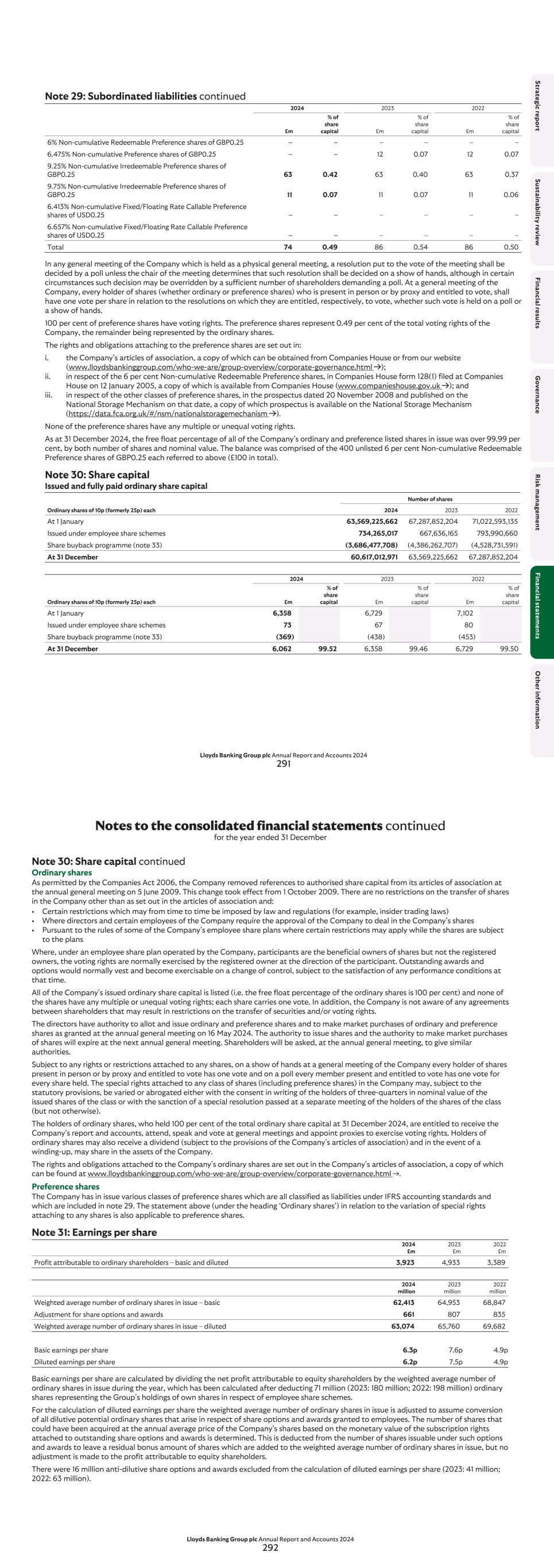
Note 29: Subordinated liabilities continued 2024 2023 2022 £m % of share capital £m % of share capital £m % of share capital 6% Non-cumulative Redeemable Preference shares of GBP0.25 – – – – – – 6.475% Non-cumulative Preference shares of GBP0.25 – – 12 0.07 12 0.07 9.25% Non-cumulative Irredeemable Preference shares of GBP0.25 63 0.42 63 0.40 63 0.37 9.75% Non-cumulative Irredeemable Preference shares of GBP0.25 11 0.07 11 0.07 11 0.06 6.413% Non-cumulative Fixed/Floating Rate Callable Preference shares of USD0.25 – – – – – – 6.657% Non-cumulative Fixed/Floating Rate Callable Preference shares of USD0.25 – – – – – – Total 74 0.49 86 0.54 86 0.50 In any general meeting of the Company which is held as a physical general meeting, a resolution put to the vote of the meeting shall be decided by a poll unless the chair of the meeting determines that such resolution shall be decided on a show of hands, although in certain circumstances such decision may be overridden by a sufficient number of shareholders demanding a poll. At a general meeting of the Company, every holder of shares (whether ordinary or preference shares) who is present in person or by proxy and entitled to vote, shall have one vote per share in relation to the resolutions on which they are entitled, respectively, to vote, whether such vote is held on a poll or a show of hands. 100 per cent of preference shares have voting rights. The preference shares represent 0.49 per cent of the total voting rights of the Company, the remainder being represented by the ordinary shares. The rights and obligations attaching to the preference shares are set out in: i. the Company’s articles of association, a copy of which can be obtained from Companies House or from our website (www.lloydsbankinggroup.com/who-we-are/group-overview/corporate-governance.html ); ii. in respect of the 6 per cent Non-cumulative Redeemable Preference shares, in Companies House form 128(1) filed at Companies House on 12 January 2005, a copy of which is available from Companies House (www.companieshouse.gov.uk ); and iii. in respect of the other classes of preference shares, in the prospectus dated 20 November 2008 and published on the National Storage Mechanism on that date, a copy of which prospectus is available on the National Storage Mechanism (https://data.fca.org.uk/#/nsm/nationalstoragemechanism ). None of the preference shares have any multiple or unequal voting rights. As at 31 December 2024, the free float percentage of all of the Company’s ordinary and preference listed shares in issue was over 99.99 per cent, by both number of shares and nominal value. The balance was comprised of the 400 unlisted 6 per cent Non-cumulative Redeemable Preference shares of GBP0.25 each referred to above (£100 in total). Note 30: Share capital Issued and fully paid ordinary share capital Number of shares Ordinary shares of 10p (formerly 25p) each 2024 2023 2022 At 1 January 63,569,225,662 67,287,852,204 71,022,593,135 Issued under employee share schemes 734,265,017 667,636,165 793,990,660 Share buyback programme (note 33) (3,686,477,708) (4,386,262,707) (4,528,731,591) At 31 December 60,617,012,971 63,569,225,662 67,287,852,204 2024 2023 2022 Ordinary shares of 10p (formerly 25p) each £m % of share capital £m % of share capital £m % of share capital At 1 January 6,358 6,729 7,102 Issued under employee share schemes 73 67 80 Share buyback programme (note 33) (369) (438) (453) At 31 December 6,062 99.52 6,358 99.46 6,729 99.50 Lloyds Banking Group plc Annual Report and Accounts 2024 291 l i ts 2 O th e r in fo rm a tio n F in a n cia l sta te m e n ts R isk m a n a ge m e n t F in a n cia l re su lts S u sta in a b ility re vie w S tra te gic re p o rt G o ve rn a n ce Note 30: Share capital continued Ordinary shares As permitted by the Companies Act 2006, the Company removed references to authorised share capital from its articles of association at the annual general meeting on 5 June 2009. This change took effect from 1 October 2009. There are no restrictions on the transfer of shares in the Company other than as set out in the articles of association and: • Certain restrictions which may from time to time be imposed by law and regulations (for example, insider trading laws) • Where directors and certain employees of the Company require the approval of the Company to deal in the Company’s shares • Pursuant to the rules of some of the Company’s employee share plans where certain restrictions may apply while the shares are subject to the plans Where, under an employee share plan operated by the Company, participants are the beneficial owners of shares but not the registered owners, the voting rights are normally exercised by the registered owner at the direction of the participant. Outstanding awards and options would normally vest and become exercisable on a change of control, subject to the satisfaction of any performance conditions at that time. All of the Company’s issued ordinary share capital is listed (i.e. the free float percentage of the ordinary shares is 100 per cent) and none of the shares have any multiple or unequal voting rights; each share carries one vote. In addition, the Company is not aware of any agreements between shareholders that may result in restrictions on the transfer of securities and/or voting rights. The directors have authority to allot and issue ordinary and preference shares and to make market purchases of ordinary and preference shares as granted at the annual general meeting on 16 May 2024. The authority to issue shares and the authority to make market purchases of shares will expire at the next annual general meeting. Shareholders will be asked, at the annual general meeting, to give similar authorities. Subject to any rights or restrictions attached to any shares, on a show of hands at a general meeting of the Company every holder of shares present in person or by proxy and entitled to vote has one vote and on a poll every member present and entitled to vote has one vote for every share held. The special rights attached to any class of shares (including preference shares) in the Company may, subject to the statutory provisions, be varied or abrogated either with the consent in writing of the holders of three-quarters in nominal value of the issued shares of the class or with the sanction of a special resolution passed at a separate meeting of the holders of the shares of the class (but not otherwise). The holders of ordinary shares, who held 100 per cent of the total ordinary share capital at 31 December 2024, are entitled to receive the Company’s report and accounts, attend, speak and vote at general meetings and appoint proxies to exercise voting rights. Holders of ordinary shares may also receive a dividend (subject to the provisions of the Company’s articles of association) and in the event of a winding-up, may share in the assets of the Company. The rights and obligations attached to the Company’s ordinary shares are set out in the Company’s articles of association, a copy of which can be found at www.lloydsbankinggroup.com/who-we-are/group-overview/corporate-governance.html →. Preference shares The Company has in issue various classes of preference shares which are all classified as liabilities under IFRS accounting standards and which are included in note 29. The statement above (under the heading ‘Ordinary shares’) in relation to the variation of special rights attaching to any shares is also applicable to preference shares. Note 31: Earnings per share 2024 £m 2023 £m 2022 £m Profit attributable to ordinary shareholders – basic and diluted 3,923 4,933 3,389 2024 million 2023 million 2022 million Weighted average number of ordinary shares in issue – basic 62,413 64,953 68,847 Adjustment for share options and awards 661 807 835 Weighted average number of ordinary shares in issue – diluted 63,074 65,760 69,682 Basic earnings per share 6.3p 7.6p 4.9p Diluted earnings per share 6.2p 7.5p 4.9p Basic earnings per share are calculated by dividing the net profit attributable to equity shareholders by the weighted average number of ordinary shares in issue during the year, which has been calculated after deducting 71 million (2023: 180 million; 2022: 198 million) ordinary shares representing the Group’s holdings of own shares in respect of employee share schemes. For the calculation of diluted earnings per share the weighted average number of ordinary shares in issue is adjusted to assume conversion of all dilutive potential ordinary shares that arise in respect of share options and awards granted to employees. The number of shares that could have been acquired at the annual average price of the Company’s shares based on the monetary value of the subscription rights attached to outstanding share options and awards is determined. This is deducted from the number of shares issuable under such options and awards to leave a residual bonus amount of shares which are added to the weighted average number of ordinary shares in issue, but no adjustment is made to the profit attributable to equity shareholders. There were 16 million anti-dilutive share options and awards excluded from the calculation of diluted earnings per share (2023: 41 million; 2022: 63 million). Notes to the consolidated financial statements continued for the year ended 31 December Lloyds Banking Group plc Annual Report and Accounts 2024 292 l i ts
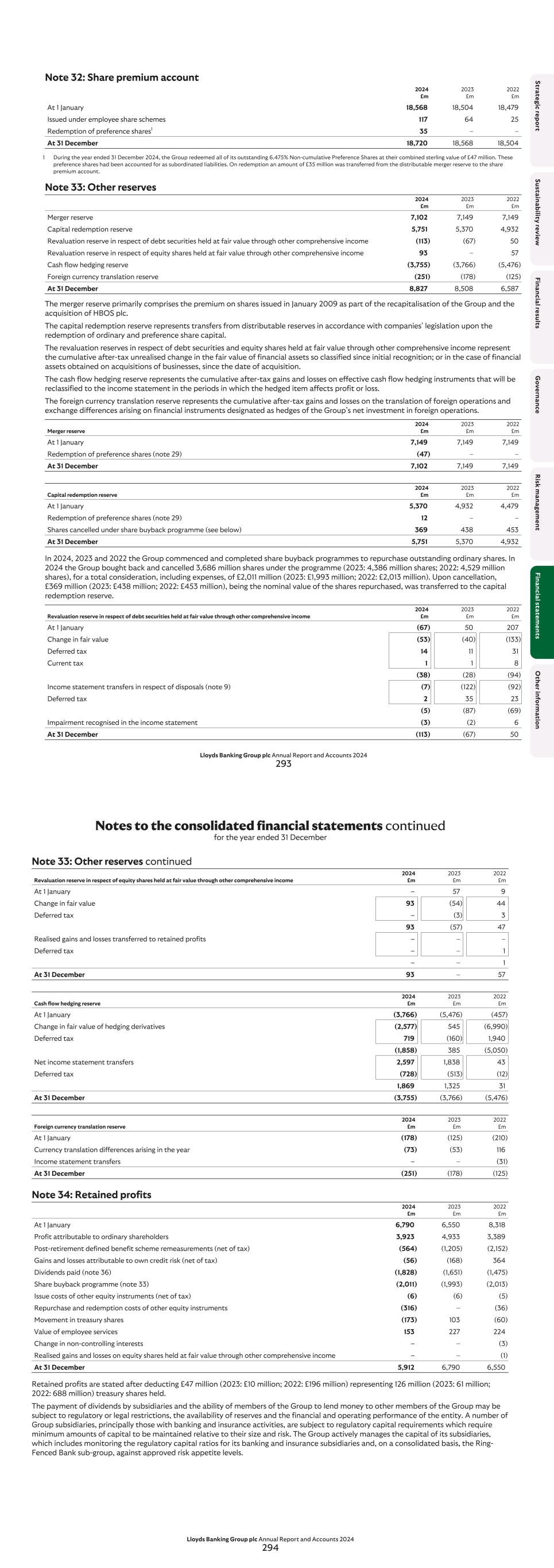
Note 32: Share premium account 2024 £m 2023 £m 2022 £m At 1 January 18,568 18,504 18,479 Issued under employee share schemes 117 64 25 Redemption of preference shares1 35 – – At 31 December 18,720 18,568 18,504 1 During the year ended 31 December 2024, the Group redeemed all of its outstanding 6.475% Non-cumulative Preference Shares at their combined sterling value of £47 million. These preference shares had been accounted for as subordinated liabilities. On redemption an amount of £35 million was transferred from the distributable merger reserve to the share premium account. Note 33: Other reserves 2024 £m 2023 £m 2022 £m Merger reserve 7,102 7,149 7,149 Capital redemption reserve 5,751 5,370 4,932 Revaluation reserve in respect of debt securities held at fair value through other comprehensive income (113) (67) 50 Revaluation reserve in respect of equity shares held at fair value through other comprehensive income 93 – 57 Cash flow hedging reserve (3,755) (3,766) (5,476) Foreign currency translation reserve (251) (178) (125) At 31 December 8,827 8,508 6,587 The merger reserve primarily comprises the premium on shares issued in January 2009 as part of the recapitalisation of the Group and the acquisition of HBOS plc. The capital redemption reserve represents transfers from distributable reserves in accordance with companies’ legislation upon the redemption of ordinary and preference share capital. The revaluation reserves in respect of debt securities and equity shares held at fair value through other comprehensive income represent the cumulative after-tax unrealised change in the fair value of financial assets so classified since initial recognition; or in the case of financial assets obtained on acquisitions of businesses, since the date of acquisition. The cash flow hedging reserve represents the cumulative after-tax gains and losses on effective cash flow hedging instruments that will be reclassified to the income statement in the periods in which the hedged item affects profit or loss. The foreign currency translation reserve represents the cumulative after-tax gains and losses on the translation of foreign operations and exchange differences arising on financial instruments designated as hedges of the Group’s net investment in foreign operations. Merger reserve 2024 £m 2023 £m 2022 £m At 1 January 7,149 7,149 7,149 Redemption of preference shares (note 29) (47) – – At 31 December 7,102 7,149 7,149 Capital redemption reserve 2024 £m 2023 £m 2022 £m At 1 January 5,370 4,932 4,479 Redemption of preference shares (note 29) 12 – – Shares cancelled under share buyback programme (see below) 369 438 453 At 31 December 5,751 5,370 4,932 In 2024, 2023 and 2022 the Group commenced and completed share buyback programmes to repurchase outstanding ordinary shares. In 2024 the Group bought back and cancelled 3,686 million shares under the programme (2023: 4,386 million shares; 2022: 4,529 million shares), for a total consideration, including expenses, of £2,011 million (2023: £1,993 million; 2022: £2,013 million). Upon cancellation, £369 million (2023: £438 million; 2022: £453 million), being the nominal value of the shares repurchased, was transferred to the capital redemption reserve. Revaluation reserve in respect of debt securities held at fair value through other comprehensive income 2024 £m 2023 £m 2022 £m At 1 January (67) 50 207 Change in fair value (53) (40) (133) Deferred tax 14 11 31 Current tax 1 1 8 (38) (28) (94) Income statement transfers in respect of disposals (note 9) (7) (122) (92) Deferred tax 2 35 23 (5) (87) (69) Impairment recognised in the income statement (3) (2) 6 At 31 December (113) (67) 50 Lloyds Banking Group plc Annual Report and Accounts 2024 293 l i ts 2 O th e r in fo rm a tio n F in a n cia l sta te m e n ts R isk m a n a ge m e n t F in a n cia l re su lts S u sta in a b ility re vie w S tra te gic re p o rt G o ve rn a n ce Note 33: Other reserves continued Revaluation reserve in respect of equity shares held at fair value through other comprehensive income 2024 £m 2023 £m 2022 £m At 1 January – 57 9 Change in fair value 93 (54) 44 Deferred tax – (3) 3 93 (57) 47 Realised gains and losses transferred to retained profits – – – Deferred tax – – 1 – – 1 At 31 December 93 – 57 Cash flow hedging reserve 2024 £m 2023 £m 2022 £m At 1 January (3,766) (5,476) (457) Change in fair value of hedging derivatives (2,577) 545 (6,990) Deferred tax 719 (160) 1,940 (1,858) 385 (5,050) Net income statement transfers 2,597 1,838 43 Deferred tax (728) (513) (12) 1,869 1,325 31 At 31 December (3,755) (3,766) (5,476) Foreign currency translation reserve 2024 £m 2023 £m 2022 £m At 1 January (178) (125) (210) Currency translation differences arising in the year (73) (53) 116 Income statement transfers – – (31) At 31 December (251) (178) (125) Note 34: Retained profits 2024 £m 2023 £m 2022 £m At 1 January 6,790 6,550 8,318 Profit attributable to ordinary shareholders 3,923 4,933 3,389 Post-retirement defined benefit scheme remeasurements (net of tax) (564) (1,205) (2,152) Gains and losses attributable to own credit risk (net of tax) (56) (168) 364 Dividends paid (note 36) (1,828) (1,651) (1,475) Share buyback programme (note 33) (2,011) (1,993) (2,013) Issue costs of other equity instruments (net of tax) (6) (6) (5) Repurchase and redemption costs of other equity instruments (316) – (36) Movement in treasury shares (173) 103 (60) Value of employee services 153 227 224 Change in non-controlling interests – – (3) Realised gains and losses on equity shares held at fair value through other comprehensive income – – (1) At 31 December 5,912 6,790 6,550 Retained profits are stated after deducting £47 million (2023: £10 million; 2022: £196 million) representing 126 million (2023: 61 million; 2022: 688 million) treasury shares held. The payment of dividends by subsidiaries and the ability of members of the Group to lend money to other members of the Group may be subject to regulatory or legal restrictions, the availability of reserves and the financial and operating performance of the entity. A number of Group subsidiaries, principally those with banking and insurance activities, are subject to regulatory capital requirements which require minimum amounts of capital to be maintained relative to their size and risk. The Group actively manages the capital of its subsidiaries, which includes monitoring the regulatory capital ratios for its banking and insurance subsidiaries and, on a consolidated basis, the Ring- Fenced Bank sub-group, against approved risk appetite levels. Notes to the consolidated financial statements continued for the year ended 31 December Lloyds Banking Group plc Annual Report and Accounts 2024 294 l i ts
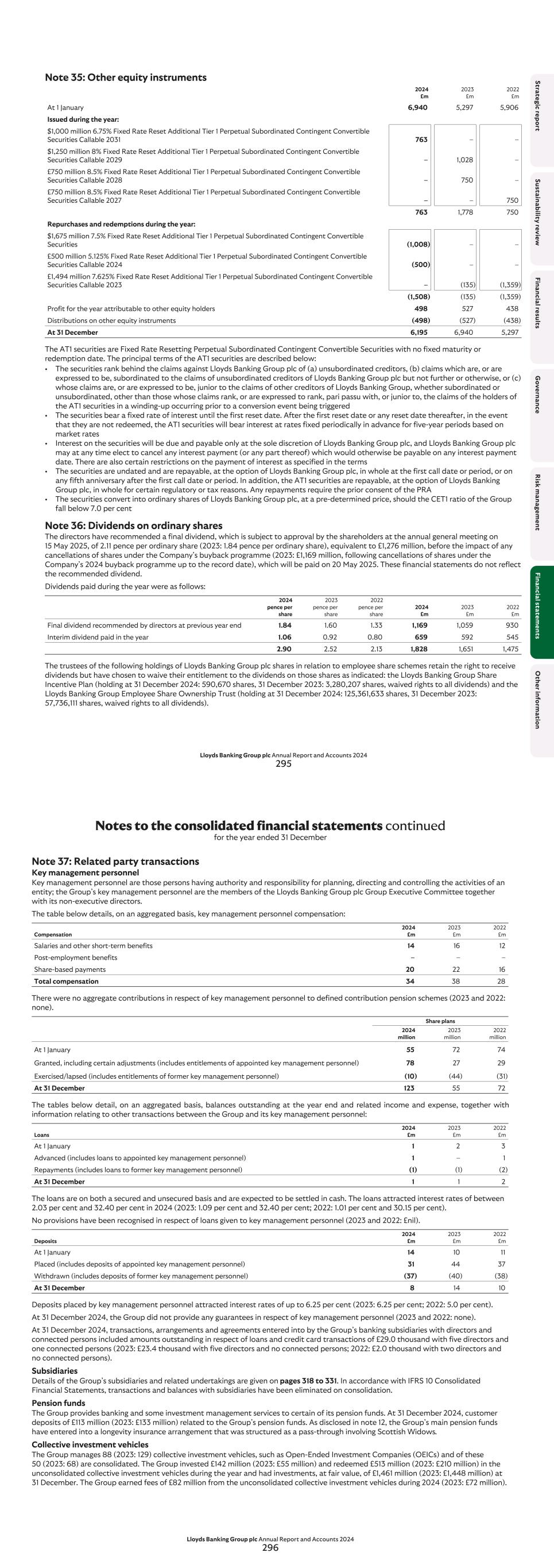
Note 35: Other equity instruments 2024 £m 2023 £m 2022 £m At 1 January 6,940 5,297 5,906 Issued during the year: $1,000 million 6.75% Fixed Rate Reset Additional Tier 1 Perpetual Subordinated Contingent Convertible Securities Callable 2031 763 – – $1,250 million 8% Fixed Rate Reset Additional Tier 1 Perpetual Subordinated Contingent Convertible Securities Callable 2029 – 1,028 – £750 million 8.5% Fixed Rate Reset Additional Tier 1 Perpetual Subordinated Contingent Convertible Securities Callable 2028 – 750 – £750 million 8.5% Fixed Rate Reset Additional Tier 1 Perpetual Subordinated Contingent Convertible Securities Callable 2027 – – 750 763 1,778 750 Repurchases and redemptions during the year: $1,675 million 7.5% Fixed Rate Reset Additional Tier 1 Perpetual Subordinated Contingent Convertible Securities (1,008) – – £500 million 5.125% Fixed Rate Reset Additional Tier 1 Perpetual Subordinated Contingent Convertible Securities Callable 2024 (500) – – £1,494 million 7.625% Fixed Rate Reset Additional Tier 1 Perpetual Subordinated Contingent Convertible Securities Callable 2023 – (135) (1,359) (1,508) (135) (1,359) Profit for the year attributable to other equity holders 498 527 438 Distributions on other equity instruments (498) (527) (438) At 31 December 6,195 6,940 5,297 The AT1 securities are Fixed Rate Resetting Perpetual Subordinated Contingent Convertible Securities with no fixed maturity or redemption date. The principal terms of the AT1 securities are described below: • The securities rank behind the claims against Lloyds Banking Group plc of (a) unsubordinated creditors, (b) claims which are, or are expressed to be, subordinated to the claims of unsubordinated creditors of Lloyds Banking Group plc but not further or otherwise, or (c) whose claims are, or are expressed to be, junior to the claims of other creditors of Lloyds Banking Group, whether subordinated or unsubordinated, other than those whose claims rank, or are expressed to rank, pari passu with, or junior to, the claims of the holders of the AT1 securities in a winding-up occurring prior to a conversion event being triggered • The securities bear a fixed rate of interest until the first reset date. After the first reset date or any reset date thereafter, in the event that they are not redeemed, the AT1 securities will bear interest at rates fixed periodically in advance for five-year periods based on market rates • Interest on the securities will be due and payable only at the sole discretion of Lloyds Banking Group plc, and Lloyds Banking Group plc may at any time elect to cancel any interest payment (or any part thereof) which would otherwise be payable on any interest payment date. There are also certain restrictions on the payment of interest as specified in the terms • The securities are undated and are repayable, at the option of Lloyds Banking Group plc, in whole at the first call date or period, or on any fifth anniversary after the first call date or period. In addition, the AT1 securities are repayable, at the option of Lloyds Banking Group plc, in whole for certain regulatory or tax reasons. Any repayments require the prior consent of the PRA • The securities convert into ordinary shares of Lloyds Banking Group plc, at a pre-determined price, should the CET1 ratio of the Group fall below 7.0 per cent Note 36: Dividends on ordinary shares The directors have recommended a final dividend, which is subject to approval by the shareholders at the annual general meeting on 15 May 2025, of 2.11 pence per ordinary share (2023: 1.84 pence per ordinary share), equivalent to £1,276 million, before the impact of any cancellations of shares under the Company’s buyback programme (2023: £1,169 million, following cancellations of shares under the Company’s 2024 buyback programme up to the record date), which will be paid on 20 May 2025. These financial statements do not reflect the recommended dividend. Dividends paid during the year were as follows: 2024 pence per share 2023 pence per share 2022 pence per share 2024 £m 2023 £m 2022 £m Final dividend recommended by directors at previous year end 1.84 1.60 1.33 1,169 1,059 930 Interim dividend paid in the year 1.06 0.92 0.80 659 592 545 2.90 2.52 2.13 1,828 1,651 1,475 The trustees of the following holdings of Lloyds Banking Group plc shares in relation to employee share schemes retain the right to receive dividends but have chosen to waive their entitlement to the dividends on those shares as indicated: the Lloyds Banking Group Share Incentive Plan (holding at 31 December 2024: 590,670 shares, 31 December 2023: 3,280,207 shares, waived rights to all dividends) and the Lloyds Banking Group Employee Share Ownership Trust (holding at 31 December 2024: 125,361,633 shares, 31 December 2023: 57,736,111 shares, waived rights to all dividends). Lloyds Banking Group plc Annual Report and Accounts 2024 295 l i ts 2 O th e r in fo rm a tio n F in a n cia l sta te m e n ts R isk m a n a ge m e n t F in a n cia l re su lts S u sta in a b ility re vie w S tra te gic re p o rt G o ve rn a n ce Note 37: Related party transactions Key management personnel Key management personnel are those persons having authority and responsibility for planning, directing and controlling the activities of an entity; the Group’s key management personnel are the members of the Lloyds Banking Group plc Group Executive Committee together with its non-executive directors. The table below details, on an aggregated basis, key management personnel compensation: Compensation 2024 £m 2023 £m 2022 £m Salaries and other short-term benefits 14 16 12 Post-employment benefits – – – Share-based payments 20 22 16 Total compensation 34 38 28 There were no aggregate contributions in respect of key management personnel to defined contribution pension schemes (2023 and 2022: none). Share plans 2024 million 2023 million 2022 million At 1 January 55 72 74 Granted, including certain adjustments (includes entitlements of appointed key management personnel) 78 27 29 Exercised/lapsed (includes entitlements of former key management personnel) (10) (44) (31) At 31 December 123 55 72 The tables below detail, on an aggregated basis, balances outstanding at the year end and related income and expense, together with information relating to other transactions between the Group and its key management personnel: Loans 2024 £m 2023 £m 2022 £m At 1 January 1 2 3 Advanced (includes loans to appointed key management personnel) 1 – 1 Repayments (includes loans to former key management personnel) (1) (1) (2) At 31 December 1 1 2 The loans are on both a secured and unsecured basis and are expected to be settled in cash. The loans attracted interest rates of between 2.03 per cent and 32.40 per cent in 2024 (2023: 1.09 per cent and 32.40 per cent; 2022: 1.01 per cent and 30.15 per cent). No provisions have been recognised in respect of loans given to key management personnel (2023 and 2022: £nil). Deposits 2024 £m 2023 £m 2022 £m At 1 January 14 10 11 Placed (includes deposits of appointed key management personnel) 31 44 37 Withdrawn (includes deposits of former key management personnel) (37) (40) (38) At 31 December 8 14 10 Deposits placed by key management personnel attracted interest rates of up to 6.25 per cent (2023: 6.25 per cent; 2022: 5.0 per cent). At 31 December 2024, the Group did not provide any guarantees in respect of key management personnel (2023 and 2022: none). At 31 December 2024, transactions, arrangements and agreements entered into by the Group’s banking subsidiaries with directors and connected persons included amounts outstanding in respect of loans and credit card transactions of £29.0 thousand with five directors and one connected persons (2023: £23.4 thousand with five directors and no connected persons; 2022: £2.0 thousand with two directors and no connected persons). Subsidiaries Details of the Group’s subsidiaries and related undertakings are given on pages 318 to 331. In accordance with IFRS 10 Consolidated Financial Statements, transactions and balances with subsidiaries have been eliminated on consolidation. Pension funds The Group provides banking and some investment management services to certain of its pension funds. At 31 December 2024, customer deposits of £113 million (2023: £133 million) related to the Group’s pension funds. As disclosed in note 12, the Group’s main pension funds have entered into a longevity insurance arrangement that was structured as a pass-through involving Scottish Widows. Collective investment vehicles The Group manages 88 (2023: 129) collective investment vehicles, such as Open-Ended Investment Companies (OEICs) and of these 50 (2023: 68) are consolidated. The Group invested £142 million (2023: £55 million) and redeemed £513 million (2023: £210 million) in the unconsolidated collective investment vehicles during the year and had investments, at fair value, of £1,461 million (2023: £1,448 million) at 31 December. The Group earned fees of £82 million from the unconsolidated collective investment vehicles during 2024 (2023: £72 million). Notes to the consolidated financial statements continued for the year ended 31 December Lloyds Banking Group plc Annual Report and Accounts 2024 296 l i ts
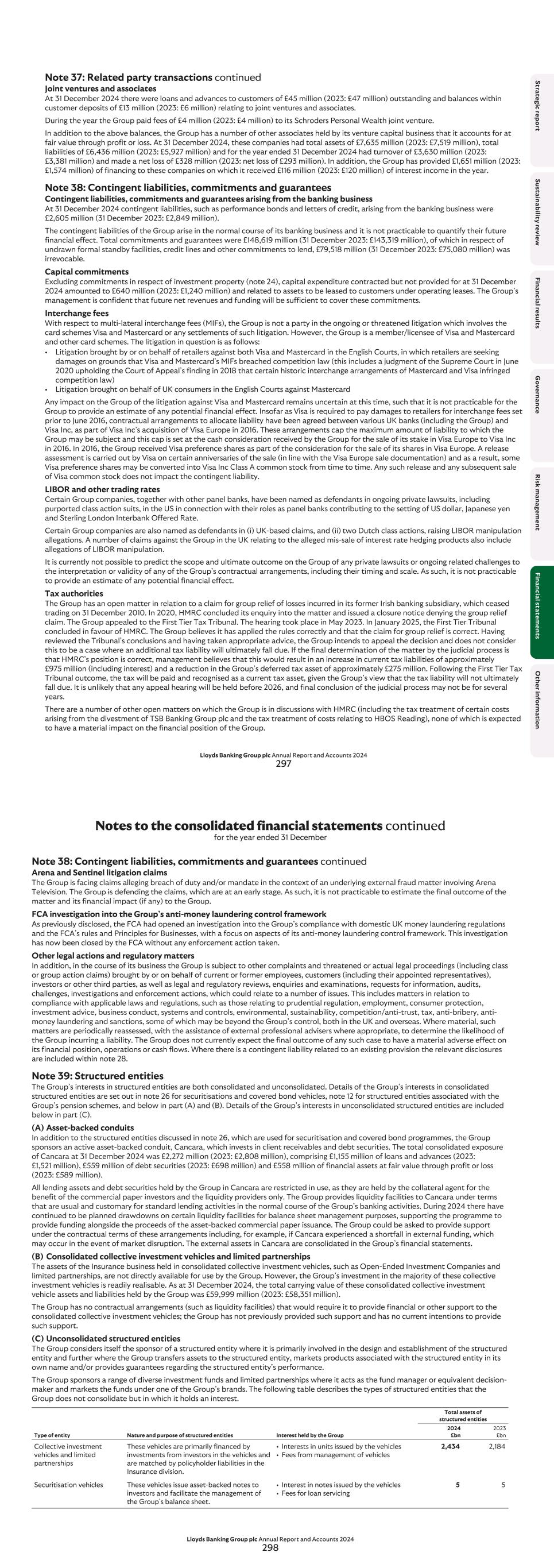
Note 37: Related party transactions continued Joint ventures and associates At 31 December 2024 there were loans and advances to customers of £45 million (2023: £47 million) outstanding and balances within customer deposits of £13 million (2023: £6 million) relating to joint ventures and associates. During the year the Group paid fees of £4 million (2023: £4 million) to its Schroders Personal Wealth joint venture. In addition to the above balances, the Group has a number of other associates held by its venture capital business that it accounts for at fair value through profit or loss. At 31 December 2024, these companies had total assets of £7,635 million (2023: £7,519 million), total liabilities of £6,436 million (2023: £5,927 million) and for the year ended 31 December 2024 had turnover of £3,630 million (2023: £3,381 million) and made a net loss of £328 million (2023: net loss of £293 million). In addition, the Group has provided £1,651 million (2023: £1,574 million) of financing to these companies on which it received £116 million (2023: £120 million) of interest income in the year. Note 38: Contingent liabilities, commitments and guarantees Contingent liabilities, commitments and guarantees arising from the banking business At 31 December 2024 contingent liabilities, such as performance bonds and letters of credit, arising from the banking business were £2,605 million (31 December 2023: £2,849 million). The contingent liabilities of the Group arise in the normal course of its banking business and it is not practicable to quantify their future financial effect. Total commitments and guarantees were £148,619 million (31 December 2023: £143,319 million), of which in respect of undrawn formal standby facilities, credit lines and other commitments to lend, £79,518 million (31 December 2023: £75,080 million) was irrevocable. Capital commitments Excluding commitments in respect of investment property (note 24), capital expenditure contracted but not provided for at 31 December 2024 amounted to £640 million (2023: £1,240 million) and related to assets to be leased to customers under operating leases. The Group’s management is confident that future net revenues and funding will be sufficient to cover these commitments. Interchange fees With respect to multi-lateral interchange fees (MIFs), the Group is not a party in the ongoing or threatened litigation which involves the card schemes Visa and Mastercard or any settlements of such litigation. However, the Group is a member/licensee of Visa and Mastercard and other card schemes. The litigation in question is as follows: • Litigation brought by or on behalf of retailers against both Visa and Mastercard in the English Courts, in which retailers are seeking damages on grounds that Visa and Mastercard’s MIFs breached competition law (this includes a judgment of the Supreme Court in June 2020 upholding the Court of Appeal’s finding in 2018 that certain historic interchange arrangements of Mastercard and Visa infringed competition law) • Litigation brought on behalf of UK consumers in the English Courts against Mastercard Any impact on the Group of the litigation against Visa and Mastercard remains uncertain at this time, such that it is not practicable for the Group to provide an estimate of any potential financial effect. Insofar as Visa is required to pay damages to retailers for interchange fees set prior to June 2016, contractual arrangements to allocate liability have been agreed between various UK banks (including the Group) and Visa Inc, as part of Visa Inc’s acquisition of Visa Europe in 2016. These arrangements cap the maximum amount of liability to which the Group may be subject and this cap is set at the cash consideration received by the Group for the sale of its stake in Visa Europe to Visa Inc in 2016. In 2016, the Group received Visa preference shares as part of the consideration for the sale of its shares in Visa Europe. A release assessment is carried out by Visa on certain anniversaries of the sale (in line with the Visa Europe sale documentation) and as a result, some Visa preference shares may be converted into Visa Inc Class A common stock from time to time. Any such release and any subsequent sale of Visa common stock does not impact the contingent liability. LIBOR and other trading rates Certain Group companies, together with other panel banks, have been named as defendants in ongoing private lawsuits, including purported class action suits, in the US in connection with their roles as panel banks contributing to the setting of US dollar, Japanese yen and Sterling London Interbank Offered Rate. Certain Group companies are also named as defendants in (i) UK-based claims, and (ii) two Dutch class actions, raising LIBOR manipulation allegations. A number of claims against the Group in the UK relating to the alleged mis-sale of interest rate hedging products also include allegations of LIBOR manipulation. It is currently not possible to predict the scope and ultimate outcome on the Group of any private lawsuits or ongoing related challenges to the interpretation or validity of any of the Group’s contractual arrangements, including their timing and scale. As such, it is not practicable to provide an estimate of any potential financial effect. Tax authorities The Group has an open matter in relation to a claim for group relief of losses incurred in its former Irish banking subsidiary, which ceased trading on 31 December 2010. In 2020, HMRC concluded its enquiry into the matter and issued a closure notice denying the group relief claim. The Group appealed to the First Tier Tax Tribunal. The hearing took place in May 2023. In January 2025, the First Tier Tribunal concluded in favour of HMRC. The Group believes it has applied the rules correctly and that the claim for group relief is correct. Having reviewed the Tribunal’s conclusions and having taken appropriate advice, the Group intends to appeal the decision and does not consider this to be a case where an additional tax liability will ultimately fall due. If the final determination of the matter by the judicial process is that HMRC’s position is correct, management believes that this would result in an increase in current tax liabilities of approximately £975 million (including interest) and a reduction in the Group’s deferred tax asset of approximately £275 million. Following the First Tier Tax Tribunal outcome, the tax will be paid and recognised as a current tax asset, given the Group’s view that the tax liability will not ultimately fall due. It is unlikely that any appeal hearing will be held before 2026, and final conclusion of the judicial process may not be for several years. There are a number of other open matters on which the Group is in discussions with HMRC (including the tax treatment of certain costs arising from the divestment of TSB Banking Group plc and the tax treatment of costs relating to HBOS Reading), none of which is expected to have a material impact on the financial position of the Group. Lloyds Banking Group plc Annual Report and Accounts 2024 297 l i ts 2 O th e r in fo rm a tio n F in a n cia l sta te m e n ts R isk m a n a ge m e n t F in a n cia l re su lts S u sta in a b ility re vie w S tra te gic re p o rt G o ve rn a n ce Note 38: Contingent liabilities, commitments and guarantees continued Arena and Sentinel litigation claims The Group is facing claims alleging breach of duty and/or mandate in the context of an underlying external fraud matter involving Arena Television. The Group is defending the claims, which are at an early stage. As such, it is not practicable to estimate the final outcome of the matter and its financial impact (if any) to the Group. FCA investigation into the Group’s anti-money laundering control framework As previously disclosed, the FCA had opened an investigation into the Group’s compliance with domestic UK money laundering regulations and the FCA’s rules and Principles for Businesses, with a focus on aspects of its anti-money laundering control framework. This investigation has now been closed by the FCA without any enforcement action taken. Other legal actions and regulatory matters In addition, in the course of its business the Group is subject to other complaints and threatened or actual legal proceedings (including class or group action claims) brought by or on behalf of current or former employees, customers (including their appointed representatives), investors or other third parties, as well as legal and regulatory reviews, enquiries and examinations, requests for information, audits, challenges, investigations and enforcement actions, which could relate to a number of issues. This includes matters in relation to compliance with applicable laws and regulations, such as those relating to prudential regulation, employment, consumer protection, investment advice, business conduct, systems and controls, environmental, sustainability, competition/anti-trust, tax, anti-bribery, anti- money laundering and sanctions, some of which may be beyond the Group’s control, both in the UK and overseas. Where material, such matters are periodically reassessed, with the assistance of external professional advisers where appropriate, to determine the likelihood of the Group incurring a liability. The Group does not currently expect the final outcome of any such case to have a material adverse effect on its financial position, operations or cash flows. Where there is a contingent liability related to an existing provision the relevant disclosures are included within note 28. Note 39: Structured entities The Group’s interests in structured entities are both consolidated and unconsolidated. Details of the Group’s interests in consolidated structured entities are set out in note 26 for securitisations and covered bond vehicles, note 12 for structured entities associated with the Group’s pension schemes, and below in part (A) and (B). Details of the Group’s interests in unconsolidated structured entities are included below in part (C). (A) Asset-backed conduits In addition to the structured entities discussed in note 26, which are used for securitisation and covered bond programmes, the Group sponsors an active asset-backed conduit, Cancara, which invests in client receivables and debt securities. The total consolidated exposure of Cancara at 31 December 2024 was £2,272 million (2023: £2,808 million), comprising £1,155 million of loans and advances (2023: £1,521 million), £559 million of debt securities (2023: £698 million) and £558 million of financial assets at fair value through profit or loss (2023: £589 million). All lending assets and debt securities held by the Group in Cancara are restricted in use, as they are held by the collateral agent for the benefit of the commercial paper investors and the liquidity providers only. The Group provides liquidity facilities to Cancara under terms that are usual and customary for standard lending activities in the normal course of the Group’s banking activities. During 2024 there have continued to be planned drawdowns on certain liquidity facilities for balance sheet management purposes, supporting the programme to provide funding alongside the proceeds of the asset-backed commercial paper issuance. The Group could be asked to provide support under the contractual terms of these arrangements including, for example, if Cancara experienced a shortfall in external funding, which may occur in the event of market disruption. The external assets in Cancara are consolidated in the Group’s financial statements. (B) Consolidated collective investment vehicles and limited partnerships The assets of the Insurance business held in consolidated collective investment vehicles, such as Open-Ended Investment Companies and limited partnerships, are not directly available for use by the Group. However, the Group’s investment in the majority of these collective investment vehicles is readily realisable. As at 31 December 2024, the total carrying value of these consolidated collective investment vehicle assets and liabilities held by the Group was £59,999 million (2023: £58,351 million). The Group has no contractual arrangements (such as liquidity facilities) that would require it to provide financial or other support to the consolidated collective investment vehicles; the Group has not previously provided such support and has no current intentions to provide such support. (C) Unconsolidated structured entities The Group considers itself the sponsor of a structured entity where it is primarily involved in the design and establishment of the structured entity and further where the Group transfers assets to the structured entity, markets products associated with the structured entity in its own name and/or provides guarantees regarding the structured entity’s performance. The Group sponsors a range of diverse investment funds and limited partnerships where it acts as the fund manager or equivalent decision- maker and markets the funds under one of the Group’s brands. The following table describes the types of structured entities that the Group does not consolidate but in which it holds an interest. Total assets of structured entities Type of entity Nature and purpose of structured entities Interest held by the Group 2024 £bn 2023 £bn Collective investment vehicles and limited partnerships These vehicles are primarily financed by investments from investors in the vehicles and are matched by policyholder liabilities in the Insurance division. • Interests in units issued by the vehicles • Fees from management of vehicles 2,434 2,184 Securitisation vehicles These vehicles issue asset-backed notes to investors and facilitate the management of the Group’s balance sheet. • Interest in notes issued by the vehicles • Fees for loan servicing 5 5 Notes to the consolidated financial statements continued for the year ended 31 December Lloyds Banking Group plc Annual Report and Accounts 2024 298 l i ts
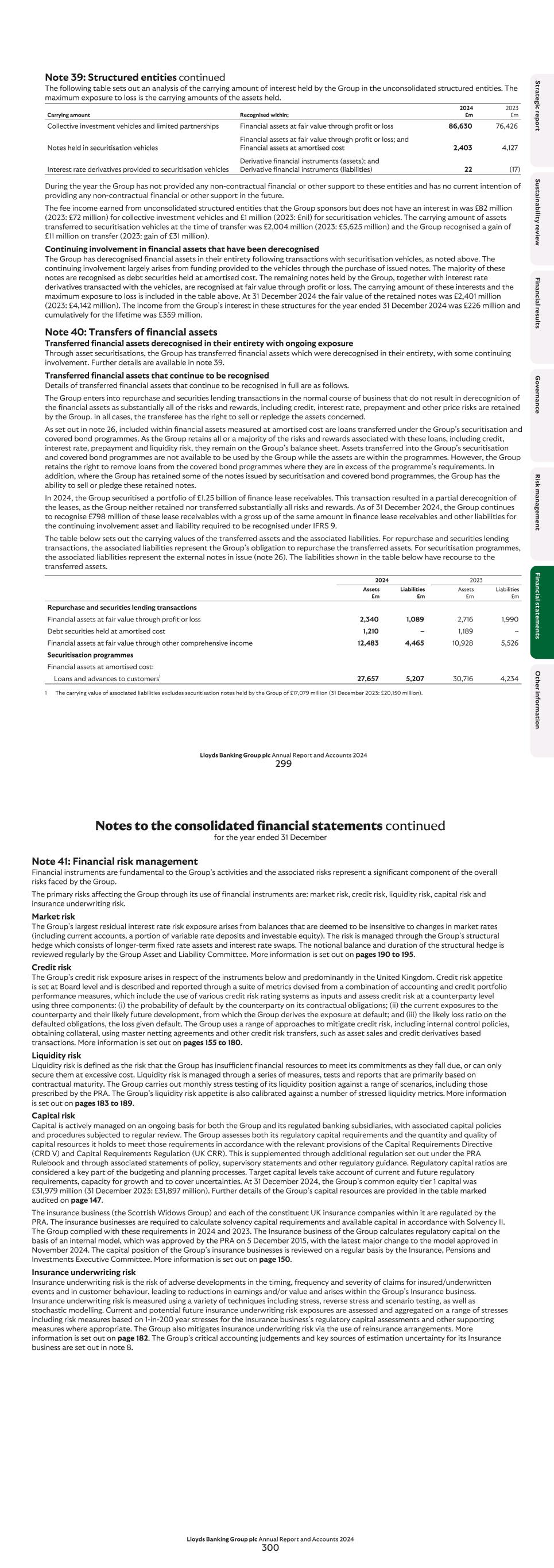
Note 39: Structured entities continued The following table sets out an analysis of the carrying amount of interest held by the Group in the unconsolidated structured entities. The maximum exposure to loss is the carrying amounts of the assets held. Carrying amount Recognised within; 2024 £m 2023 £m Collective investment vehicles and limited partnerships Financial assets at fair value through profit or loss 86,630 76,426 Notes held in securitisation vehicles Financial assets at fair value through profit or loss; and Financial assets at amortised cost 2,403 4,127 Interest rate derivatives provided to securitisation vehicles Derivative financial instruments (assets); and Derivative financial instruments (liabilities) 22 (17) During the year the Group has not provided any non-contractual financial or other support to these entities and has no current intention of providing any non-contractual financial or other support in the future. The fee income earned from unconsolidated structured entities that the Group sponsors but does not have an interest in was £82 million (2023: £72 million) for collective investment vehicles and £1 million (2023: £nil) for securitisation vehicles. The carrying amount of assets transferred to securitisation vehicles at the time of transfer was £2,004 million (2023: £5,625 million) and the Group recognised a gain of £11 million on transfer (2023: gain of £31 million). Continuing involvement in financial assets that have been derecognised The Group has derecognised financial assets in their entirety following transactions with securitisation vehicles, as noted above. The continuing involvement largely arises from funding provided to the vehicles through the purchase of issued notes. The majority of these notes are recognised as debt securities held at amortised cost. The remaining notes held by the Group, together with interest rate derivatives transacted with the vehicles, are recognised at fair value through profit or loss. The carrying amount of these interests and the maximum exposure to loss is included in the table above. At 31 December 2024 the fair value of the retained notes was £2,401 million (2023: £4,142 million). The income from the Group’s interest in these structures for the year ended 31 December 2024 was £226 million and cumulatively for the lifetime was £359 million. Note 40: Transfers of financial assets Transferred financial assets derecognised in their entirety with ongoing exposure Through asset securitisations, the Group has transferred financial assets which were derecognised in their entirety, with some continuing involvement. Further details are available in note 39. Transferred financial assets that continue to be recognised Details of transferred financial assets that continue to be recognised in full are as follows. The Group enters into repurchase and securities lending transactions in the normal course of business that do not result in derecognition of the financial assets as substantially all of the risks and rewards, including credit, interest rate, prepayment and other price risks are retained by the Group. In all cases, the transferee has the right to sell or repledge the assets concerned. As set out in note 26, included within financial assets measured at amortised cost are loans transferred under the Group’s securitisation and covered bond programmes. As the Group retains all or a majority of the risks and rewards associated with these loans, including credit, interest rate, prepayment and liquidity risk, they remain on the Group’s balance sheet. Assets transferred into the Group’s securitisation and covered bond programmes are not available to be used by the Group while the assets are within the programmes. However, the Group retains the right to remove loans from the covered bond programmes where they are in excess of the programme’s requirements. In addition, where the Group has retained some of the notes issued by securitisation and covered bond programmes, the Group has the ability to sell or pledge these retained notes. In 2024, the Group securitised a portfolio of £1.25 billion of finance lease receivables. This transaction resulted in a partial derecognition of the leases, as the Group neither retained nor transferred substantially all risks and rewards. As of 31 December 2024, the Group continues to recognise £798 million of these lease receivables with a gross up of the same amount in finance lease receivables and other liabilities for the continuing involvement asset and liability required to be recognised under IFRS 9. The table below sets out the carrying values of the transferred assets and the associated liabilities. For repurchase and securities lending transactions, the associated liabilities represent the Group’s obligation to repurchase the transferred assets. For securitisation programmes, the associated liabilities represent the external notes in issue (note 26). The liabilities shown in the table below have recourse to the transferred assets. 2024 2023 Assets £m Liabilities £m Assets £m Liabilities £m Repurchase and securities lending transactions Financial assets at fair value through profit or loss 2,340 1,089 2,716 1,990 Debt securities held at amortised cost 1,210 – 1,189 – Financial assets at fair value through other comprehensive income 12,483 4,465 10,928 5,526 Securitisation programmes Financial assets at amortised cost: Loans and advances to customers1 27,657 5,207 30,716 4,234 1 The carrying value of associated liabilities excludes securitisation notes held by the Group of £17,079 million (31 December 2023: £20,150 million). Lloyds Banking Group plc Annual Report and Accounts 2024 299 l i ts 2 O th e r in fo rm a tio n F in a n cia l sta te m e n ts R isk m a n a ge m e n t F in a n cia l re su lts S u sta in a b ility re vie w S tra te gic re p o rt G o ve rn a n ce Note 41: Financial risk management Financial instruments are fundamental to the Group’s activities and the associated risks represent a significant component of the overall risks faced by the Group. The primary risks affecting the Group through its use of financial instruments are: market risk, credit risk, liquidity risk, capital risk and insurance underwriting risk. Market risk The Group’s largest residual interest rate risk exposure arises from balances that are deemed to be insensitive to changes in market rates (including current accounts, a portion of variable rate deposits and investable equity). The risk is managed through the Group’s structural hedge which consists of longer-term fixed rate assets and interest rate swaps. The notional balance and duration of the structural hedge is reviewed regularly by the Group Asset and Liability Committee. More information is set out on pages 190 to 195. Credit risk The Group’s credit risk exposure arises in respect of the instruments below and predominantly in the United Kingdom. Credit risk appetite is set at Board level and is described and reported through a suite of metrics devised from a combination of accounting and credit portfolio performance measures, which include the use of various credit risk rating systems as inputs and assess credit risk at a counterparty level using three components: (i) the probability of default by the counterparty on its contractual obligations; (ii) the current exposures to the counterparty and their likely future development, from which the Group derives the exposure at default; and (iii) the likely loss ratio on the defaulted obligations, the loss given default. The Group uses a range of approaches to mitigate credit risk, including internal control policies, obtaining collateral, using master netting agreements and other credit risk transfers, such as asset sales and credit derivatives based transactions. More information is set out on pages 155 to 180. Liquidity risk Liquidity risk is defined as the risk that the Group has insufficient financial resources to meet its commitments as they fall due, or can only secure them at excessive cost. Liquidity risk is managed through a series of measures, tests and reports that are primarily based on contractual maturity. The Group carries out monthly stress testing of its liquidity position against a range of scenarios, including those prescribed by the PRA. The Group’s liquidity risk appetite is also calibrated against a number of stressed liquidity metrics. More information is set out on pages 183 to 189. Capital risk Capital is actively managed on an ongoing basis for both the Group and its regulated banking subsidiaries, with associated capital policies and procedures subjected to regular review. The Group assesses both its regulatory capital requirements and the quantity and quality of capital resources it holds to meet those requirements in accordance with the relevant provisions of the Capital Requirements Directive (CRD V) and Capital Requirements Regulation (UK CRR). This is supplemented through additional regulation set out under the PRA Rulebook and through associated statements of policy, supervisory statements and other regulatory guidance. Regulatory capital ratios are considered a key part of the budgeting and planning processes. Target capital levels take account of current and future regulatory requirements, capacity for growth and to cover uncertainties. At 31 December 2024, the Group’s common equity tier 1 capital was £31,979 million (31 December 2023: £31,897 million). Further details of the Group’s capital resources are provided in the table marked audited on page 147. The insurance business (the Scottish Widows Group) and each of the constituent UK insurance companies within it are regulated by the PRA. The insurance businesses are required to calculate solvency capital requirements and available capital in accordance with Solvency II. The Group complied with these requirements in 2024 and 2023. The Insurance business of the Group calculates regulatory capital on the basis of an internal model, which was approved by the PRA on 5 December 2015, with the latest major change to the model approved in November 2024. The capital position of the Group’s insurance businesses is reviewed on a regular basis by the Insurance, Pensions and Investments Executive Committee. More information is set out on page 150. Insurance underwriting risk Insurance underwriting risk is the risk of adverse developments in the timing, frequency and severity of claims for insured/underwritten events and in customer behaviour, leading to reductions in earnings and/or value and arises within the Group’s Insurance business. Insurance underwriting risk is measured using a variety of techniques including stress, reverse stress and scenario testing, as well as stochastic modelling. Current and potential future insurance underwriting risk exposures are assessed and aggregated on a range of stresses including risk measures based on 1-in-200 year stresses for the Insurance business’s regulatory capital assessments and other supporting measures where appropriate. The Group also mitigates insurance underwriting risk via the use of reinsurance arrangements. More information is set out on page 182. The Group's critical accounting judgements and key sources of estimation uncertainty for its Insurance business are set out in note 8. Notes to the consolidated financial statements continued for the year ended 31 December Lloyds Banking Group plc Annual Report and Accounts 2024 300 l i ts
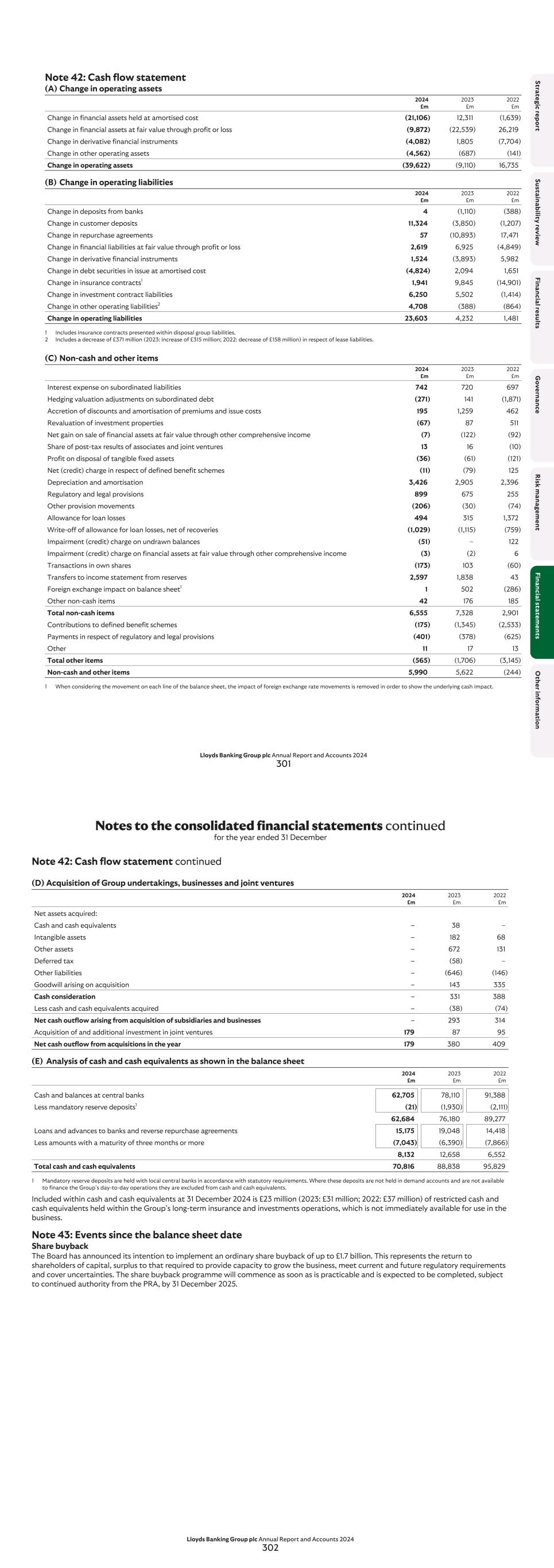
Note 42: Cash flow statement (A) Change in operating assets 2024 £m 2023 £m 2022 £m Change in financial assets held at amortised cost (21,106) 12,311 (1,639) Change in financial assets at fair value through profit or loss (9,872) (22,539) 26,219 Change in derivative financial instruments (4,082) 1,805 (7,704) Change in other operating assets (4,562) (687) (141) Change in operating assets (39,622) (9,110) 16,735 (B) Change in operating liabilities 2024 £m 2023 £m 2022 £m Change in deposits from banks 4 (1,110) (388) Change in customer deposits 11,324 (3,850) (1,207) Change in repurchase agreements 57 (10,893) 17,471 Change in financial liabilities at fair value through profit or loss 2,619 6,925 (4,849) Change in derivative financial instruments 1,524 (3,893) 5,982 Change in debt securities in issue at amortised cost (4,824) 2,094 1,651 Change in insurance contracts1 1,941 9,845 (14,901) Change in investment contract liabilities 6,250 5,502 (1,414) Change in other operating liabilities2 4,708 (388) (864) Change in operating liabilities 23,603 4,232 1,481 1 Includes insurance contracts presented within disposal group liabilities. 2 Includes a decrease of £371 million (2023: increase of £315 million; 2022: decrease of £158 million) in respect of lease liabilities. (C) Non-cash and other items 2024 £m 2023 £m 2022 £m Interest expense on subordinated liabilities 742 720 697 Hedging valuation adjustments on subordinated debt (271) 141 (1,871) Accretion of discounts and amortisation of premiums and issue costs 195 1,259 462 Revaluation of investment properties (67) 87 511 Net gain on sale of financial assets at fair value through other comprehensive income (7) (122) (92) Share of post-tax results of associates and joint ventures 13 16 (10) Profit on disposal of tangible fixed assets (36) (61) (121) Net (credit) charge in respect of defined benefit schemes (11) (79) 125 Depreciation and amortisation 3,426 2,905 2,396 Regulatory and legal provisions 899 675 255 Other provision movements (206) (30) (74) Allowance for loan losses 494 315 1,372 Write-off of allowance for loan losses, net of recoveries (1,029) (1,115) (759) Impairment (credit) charge on undrawn balances (51) – 122 Impairment (credit) charge on financial assets at fair value through other comprehensive income (3) (2) 6 Transactions in own shares (173) 103 (60) Transfers to income statement from reserves 2,597 1,838 43 Foreign exchange impact on balance sheet1 1 502 (286) Other non-cash items 42 176 185 Total non-cash items 6,555 7,328 2,901 Contributions to defined benefit schemes (175) (1,345) (2,533) Payments in respect of regulatory and legal provisions (401) (378) (625) Other 11 17 13 Total other items (565) (1,706) (3,145) Non-cash and other items 5,990 5,622 (244) 1 When considering the movement on each line of the balance sheet, the impact of foreign exchange rate movements is removed in order to show the underlying cash impact. Lloyds Banking Group plc Annual Report and Accounts 2024 301 l i ts 2 O th e r in fo rm a tio n F in a n cia l sta te m e n ts R isk m a n a ge m e n t F in a n cia l re su lts S u sta in a b ility re vie w S tra te gic re p o rt G o ve rn a n ce Note 42: Cash flow statement continued (D) Acquisition of Group undertakings, businesses and joint ventures 2024 £m 2023 £m 2022 £m Net assets acquired: Cash and cash equivalents – 38 – Intangible assets – 182 68 Other assets – 672 131 Deferred tax – (58) – Other liabilities – (646) (146) Goodwill arising on acquisition – 143 335 Cash consideration – 331 388 Less cash and cash equivalents acquired – (38) (74) Net cash outflow arising from acquisition of subsidiaries and businesses – 293 314 Acquisition of and additional investment in joint ventures 179 87 95 Net cash outflow from acquisitions in the year 179 380 409 (E) Analysis of cash and cash equivalents as shown in the balance sheet 2024 £m 2023 £m 2022 £m Cash and balances at central banks 62,705 78,110 91,388 Less mandatory reserve deposits1 (21) (1,930) (2,111) 62,684 76,180 89,277 Loans and advances to banks and reverse repurchase agreements 15,175 19,048 14,418 Less amounts with a maturity of three months or more (7,043) (6,390) (7,866) 8,132 12,658 6,552 Total cash and cash equivalents 70,816 88,838 95,829 1 Mandatory reserve deposits are held with local central banks in accordance with statutory requirements. Where these deposits are not held in demand accounts and are not available to finance the Group’s day-to-day operations they are excluded from cash and cash equivalents. Included within cash and cash equivalents at 31 December 2024 is £23 million (2023: £31 million; 2022: £37 million) of restricted cash and cash equivalents held within the Group’s long-term insurance and investments operations, which is not immediately available for use in the business. Note 43: Events since the balance sheet date Share buyback The Board has announced its intention to implement an ordinary share buyback of up to £1.7 billion. This represents the return to shareholders of capital, surplus to that required to provide capacity to grow the business, meet current and future regulatory requirements and cover uncertainties. The share buyback programme will commence as soon as is practicable and is expected to be completed, subject to continued authority from the PRA, by 31 December 2025. Notes to the consolidated financial statements continued for the year ended 31 December Lloyds Banking Group plc Annual Report and Accounts 2024 302 l i ts

Lloyds Banking Group plc Annual Report and Accounts 2024 303 l i ts 2 Intentionally left blank Lloyds Banking Group plc Annual Report and Accounts 2024 304 l i ts Intentionally left blank

Lloyds Banking Group plc Annual Report and Accounts 2024 305 l i ts 2 Intentionally left blank Lloyds Banking Group plc Annual Report and Accounts 2024 306 l i ts Intentionally left blank

Lloyds Banking Group plc Annual Report and Accounts 2024 307 l i ts 2 Intentionally left blank Lloyds Banking Group plc Annual Report and Accounts 2024 308 l i ts Intentionally left blank

Lloyds Banking Group plc Annual Report and Accounts 2024 309 l i ts 2 Intentionally left blank Lloyds Banking Group plc Annual Report and Accounts 2024 310 l i ts Intentionally left blank

Other information In this section Shareholder information 312 Alternative performance measures 314 Subsidiaries and related undertakings 318 Forward-looking statements 332 Driven by our purpose Our purpose is what drives us, what makes us different and defines how we profitably grow for all our stakeholders O th e r in fo rm a tio n R isk m a n a ge m e n t F in a n cia l re su lts S u sta in a b ility re vie w S tra te gic re p o rt G o ve rn a n ce F in a n cia l sta te m e n ts 311 Lloyds Banking Group plc Annual Report and Accounts 2024 Annual general meeting (AGM) The annual general meeting will be held at the Edinburgh International Conference Centre, The Exchange, Edinburgh EH3 8EE on Thursday 15 May 2025 at 11am. Further details about the meeting, including the proposed resolutions and where shareholders can stream the meeting live, can be found in our Notice of AGM which will be available shortly on our website . Reports and communications The Group issues regulatory announcements through the Regulatory News Service (RNS); shareholders can subscribe for free via the Investors section of our website , where our statutory reports and shareholder communications are available. A summary of the scheduled reports and communications to be issued in 2025 is set out below: Available format Report/Communication Month Online Email RNS Paper Preliminary results and publication of annual report and accounts Feb ü ü ü Pillar 3 report Mar/Aug ü Group Chief Executive update to shareholders Mar ü ü ü Mailing of annual report and accounts, annual review or performance summary Mar ü ü ü Notice of AGM and voting materials Mar ü ü ü Q1 interim management statement Apr ü ü ü Country analysis1 May ü Half-year results Jul ü ü ü Q3 interim management statement Oct ü ü ü 1 To be published on the Group’s website by 31 May 2025 in accordance with the Capital Requirements (Country-by-Country Reporting) Regulations 2013. Share dealing facilities We offer a choice of four share dealing services for our UK shareholders and customers. Please search for ‘share dealing’ within the website links provided below, where you can also view the full range of services available. Alternatively, please use the additional contact details below. Service Provider Telephone Dealing Internet Dealing Bank of Scotland Share Dealing 0345 606 1188 www.bankofscotland.co.uk/sharedealing Halifax Share Dealing 03457 22 55 25 www.halifax.co.uk/sharedealing Lloyds Bank Direct Investments 0345 60 60 560 www.lloydsbank.com/share-dealing.asp IWeb Share Dealing 03450 707 129 www.iweb-sharedealing.co.uk/ Note: All internet services are available 24/7. Telephone dealing services are available between 8am and 9pm, Monday to Friday, excluding English and Welsh public holidays. To open a share dealing account with any of these services, you must be 18 years of age or over and be resident in the UK, Jersey, Guernsey or the Isle of Man. Share dealing for the Lloyds Banking Group shareholder account Share dealing services for the Lloyds Banking Group shareholder account are provided by Equiniti Shareview Dealing, operated by Equiniti Financial Services Limited. Details of the services provided can be found either on the shareholder information page of our website or by contacting Equiniti using the contact details provided on the next page. Share price information Shareholders can access both the latest and historical share prices via our website as well as listings in most national newspapers. For a real time buying or selling price, you will need to contact a stockbroker, or you can contact the share dealing providers detailed above. Individual Saving Accounts (ISAs) There are a number of options for investing in Lloyds Banking Group shares through an ISA. For details of services and products provided by the Group please contact Bank of Scotland Share Dealing, Halifax Share Dealing or Lloyds Bank Direct Investments using the contact details above. Key dates 10 April 2025 Shares quoted ex-dividend 11 April 2025 Record date 29 April 2025 Final date for joining or leaving the dividend reinvestment plan 1 May 2025 Q1 interim management statement 15 May 2025 Annual general meeting 20 May 2025 Dividend paid 24 July 2025 Half-year results 23 October 2025 Q3 interim management statement Shareholder information Lloyds Banking Group plc Annual Report and Accounts 2024 312 l i ts
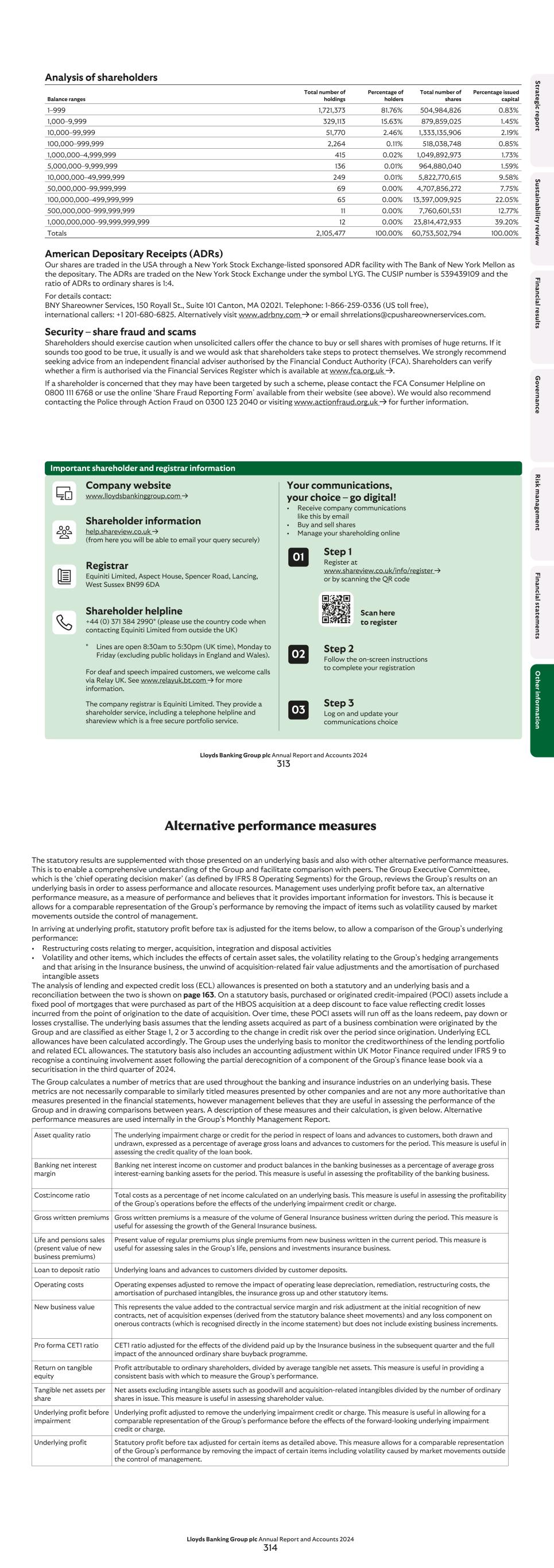
Analysis of shareholders Balance ranges Total number of holdings Percentage of holders Total number of shares Percentage issued capital 1–999 1,721,373 81.76% 504,984,826 0.83% 1,000–9,999 329,113 15.63% 879,859,025 1.45% 10,000–99,999 51,770 2.46% 1,333,135,906 2.19% 100,000–999,999 2,264 0.11% 518,038,748 0.85% 1,000,000–4,999,999 415 0.02% 1,049,892,973 1.73% 5,000,000–9,999,999 136 0.01% 964,880,040 1.59% 10,000,000–49,999,999 249 0.01% 5,822,770,615 9.58% 50,000,000–99,999,999 69 0.00% 4,707,856,272 7.75% 100,000,000–499,999,999 65 0.00% 13,397,009,925 22.05% 500,000,000–999,999,999 11 0.00% 7,760,601,531 12.77% 1,000,000,000–99,999,999,999 12 0.00% 23,814,472,933 39.20% Totals 2,105,477 100.00% 60,753,502,794 100.00% American Depositary Receipts (ADRs) Our shares are traded in the USA through a New York Stock Exchange-listed sponsored ADR facility with The Bank of New York Mellon as the depositary. The ADRs are traded on the New York Stock Exchange under the symbol LYG. The CUSIP number is 539439109 and the ratio of ADRs to ordinary shares is 1:4. For details contact: BNY Shareowner Services, 150 Royall St., Suite 101 Canton, MA 02021. Telephone: 1-866-259-0336 (US toll free), international callers: +1 201-680-6825. Alternatively visit www.adrbny.com or email shrrelations@cpushareownerservices.com. Security – share fraud and scams Shareholders should exercise caution when unsolicited callers offer the chance to buy or sell shares with promises of huge returns. If it sounds too good to be true, it usually is and we would ask that shareholders take steps to protect themselves. We strongly recommend seeking advice from an independent financial adviser authorised by the Financial Conduct Authority (FCA). Shareholders can verify whether a firm is authorised via the Financial Services Register which is available at www.fca.org.uk . If a shareholder is concerned that they may have been targeted by such a scheme, please contact the FCA Consumer Helpline on 0800 111 6768 or use the online ‘Share Fraud Reporting Form’ available from their website (see above). We would also recommend contacting the Police through Action Fraud on 0300 123 2040 or visiting www.actionfraud.org.uk for further information. Lloyds Banking Group plc Annual Report and Accounts 2024 313 Important shareholder and registrar information Company website www.lloydsbankinggroup.com Shareholder information help.shareview.co.uk (from here you will be able to email your query securely) Registrar Equiniti Limited, Aspect House, Spencer Road, Lancing, West Sussex BN99 6DA Shareholder helpline +44 (0) 371 384 2990* (please use the country code when contacting Equiniti Limited from outside the UK) * Lines are open 8:30am to 5:30pm (UK time), Monday to Friday (excluding public holidays in England and Wales). For deaf and speech impaired customers, we welcome calls via Relay UK. See www.relayuk.bt.com for more information. The company registrar is Equiniti Limited. They provide a shareholder service, including a telephone helpline and shareview which is a free secure portfolio service. Your communications, your choice – go digital! • Receive company communications like this by email • Buy and sell shares • Manage your shareholding online Step 1 Register at www.shareview.co.uk/info/register or by scanning the QR code Step 2 Follow the on-screen instructions to complete your registration Step 3 Log on and update your communications choice l i ts 2 O th e r in fo rm a tio n R isk m a n a ge m e n t F in a n cia l re su lts S u sta in a b ility re vie w S tra te gic re p o rt G o ve rn a n ce F in a n cia l sta te m e n ts The statutory results are supplemented with those presented on an underlying basis and also with other alternative performance measures. This is to enable a comprehensive understanding of the Group and facilitate comparison with peers. The Group Executive Committee, which is the ‘chief operating decision maker’ (as defined by IFRS 8 Operating Segments) for the Group, reviews the Group’s results on an underlying basis in order to assess performance and allocate resources. Management uses underlying profit before tax, an alternative performance measure, as a measure of performance and believes that it provides important information for investors. This is because it allows for a comparable representation of the Group’s performance by removing the impact of items such as volatility caused by market movements outside the control of management. In arriving at underlying profit, statutory profit before tax is adjusted for the items below, to allow a comparison of the Group’s underlying performance: • Restructuring costs relating to merger, acquisition, integration and disposal activities • Volatility and other items, which includes the effects of certain asset sales, the volatility relating to the Group’s hedging arrangements and that arising in the Insurance business, the unwind of acquisition-related fair value adjustments and the amortisation of purchased intangible assets The analysis of lending and expected credit loss (ECL) allowances is presented on both a statutory and an underlying basis and a reconciliation between the two is shown on page 163. On a statutory basis, purchased or originated credit-impaired (POCI) assets include a fixed pool of mortgages that were purchased as part of the HBOS acquisition at a deep discount to face value reflecting credit losses incurred from the point of origination to the date of acquisition. Over time, these POCI assets will run off as the loans redeem, pay down or losses crystallise. The underlying basis assumes that the lending assets acquired as part of a business combination were originated by the Group and are classified as either Stage 1, 2 or 3 according to the change in credit risk over the period since origination. Underlying ECL allowances have been calculated accordingly. The Group uses the underlying basis to monitor the creditworthiness of the lending portfolio and related ECL allowances. The statutory basis also includes an accounting adjustment within UK Motor Finance required under IFRS 9 to recognise a continuing involvement asset following the partial derecognition of a component of the Group's finance lease book via a securitisation in the third quarter of 2024. The Group calculates a number of metrics that are used throughout the banking and insurance industries on an underlying basis. These metrics are not necessarily comparable to similarly titled measures presented by other companies and are not any more authoritative than measures presented in the financial statements, however management believes that they are useful in assessing the performance of the Group and in drawing comparisons between years. A description of these measures and their calculation, is given below. Alternative performance measures are used internally in the Group’s Monthly Management Report. Asset quality ratio The underlying impairment charge or credit for the period in respect of loans and advances to customers, both drawn and undrawn, expressed as a percentage of average gross loans and advances to customers for the period. This measure is useful in assessing the credit quality of the loan book. Banking net interest margin Banking net interest income on customer and product balances in the banking businesses as a percentage of average gross interest-earning banking assets for the period. This measure is useful in assessing the profitability of the banking business. Cost:income ratio Total costs as a percentage of net income calculated on an underlying basis. This measure is useful in assessing the profitability of the Group’s operations before the effects of the underlying impairment credit or charge. Gross written premiums Gross written premiums is a measure of the volume of General Insurance business written during the period. This measure is useful for assessing the growth of the General Insurance business. Life and pensions sales (present value of new business premiums) Present value of regular premiums plus single premiums from new business written in the current period. This measure is useful for assessing sales in the Group’s life, pensions and investments insurance business. Loan to deposit ratio Underlying loans and advances to customers divided by customer deposits. Operating costs Operating expenses adjusted to remove the impact of operating lease depreciation, remediation, restructuring costs, the amortisation of purchased intangibles, the insurance gross up and other statutory items. New business value This represents the value added to the contractual service margin and risk adjustment at the initial recognition of new contracts, net of acquisition expenses (derived from the statutory balance sheet movements) and any loss component on onerous contracts (which is recognised directly in the income statement) but does not include existing business increments. Pro forma CET1 ratio CET1 ratio adjusted for the effects of the dividend paid up by the Insurance business in the subsequent quarter and the full impact of the announced ordinary share buyback programme. Return on tangible equity Profit attributable to ordinary shareholders, divided by average tangible net assets. This measure is useful in providing a consistent basis with which to measure the Group’s performance. Tangible net assets per share Net assets excluding intangible assets such as goodwill and acquisition-related intangibles divided by the number of ordinary shares in issue. This measure is useful in assessing shareholder value. Underlying profit before impairment Underlying profit adjusted to remove the underlying impairment credit or charge. This measure is useful in allowing for a comparable representation of the Group’s performance before the effects of the forward-looking underlying impairment credit or charge. Underlying profit Statutory profit before tax adjusted for certain items as detailed above. This measure allows for a comparable representation of the Group’s performance by removing the impact of certain items including volatility caused by market movements outside the control of management. Alternative performance measures Lloyds Banking Group plc Annual Report and Accounts 2024 314 l i ts
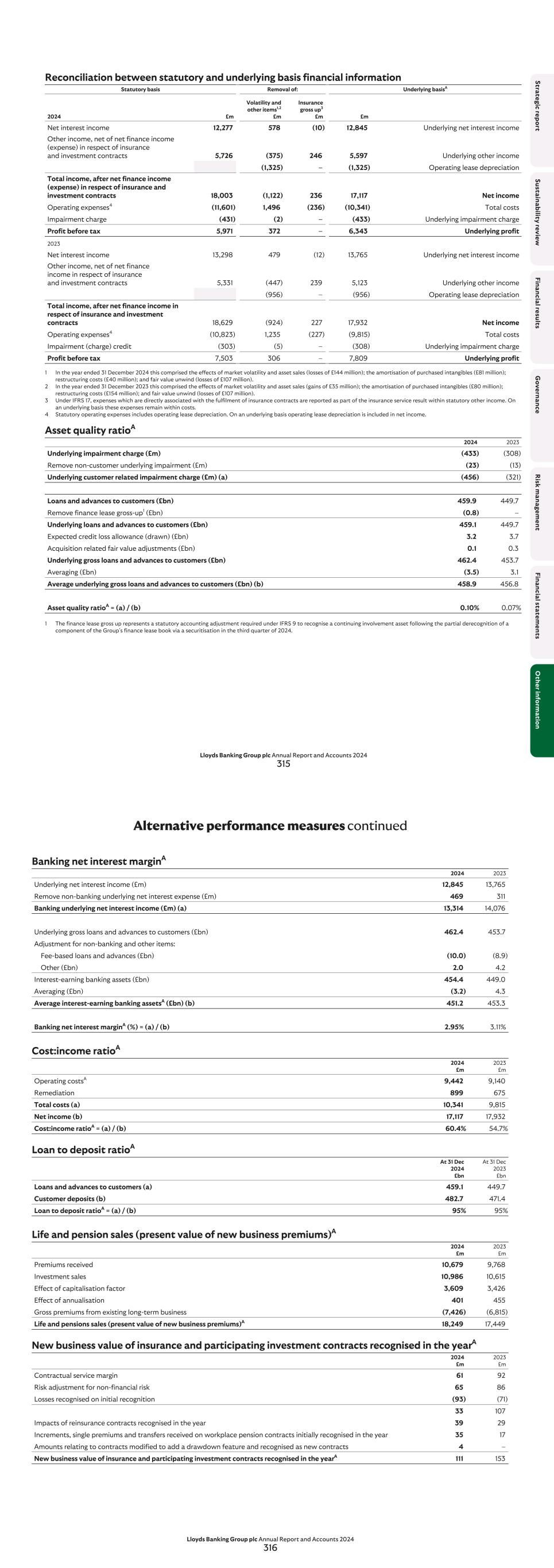
Reconciliation between statutory and underlying basis financial information Statutory basis Removal of: Underlying basisA 2024 £m Volatility and other items1,2 £m Insurance gross up3 £m £m Net interest income 12,277 578 (10) 12,845 Underlying net interest income Other income, net of net finance income (expense) in respect of insurance and investment contracts 5,726 (375) 246 5,597 Underlying other income (1,325) – (1,325) Operating lease depreciation Total income, after net finance income (expense) in respect of insurance and investment contracts 18,003 (1,122) 236 17,117 Net income Operating expenses4 (11,601) 1,496 (236) (10,341) Total costs Impairment charge (431) (2) – (433) Underlying impairment charge Profit before tax 5,971 372 – 6,343 Underlying profit 2023 Net interest income 13,298 479 (12) 13,765 Underlying net interest income Other income, net of net finance income in respect of insurance and investment contracts 5,331 (447) 239 5,123 Underlying other income (956) – (956) Operating lease depreciation Total income, after net finance income in respect of insurance and investment contracts 18,629 (924) 227 17,932 Net income Operating expenses4 (10,823) 1,235 (227) (9,815) Total costs Impairment (charge) credit (303) (5) – (308) Underlying impairment charge Profit before tax 7,503 306 – 7,809 Underlying profit 1 In the year ended 31 December 2024 this comprised the effects of market volatility and asset sales (losses of £144 million); the amortisation of purchased intangibles (£81 million); restructuring costs (£40 million); and fair value unwind (losses of £107 million). 2 In the year ended 31 December 2023 this comprised the effects of market volatility and asset sales (gains of £35 million); the amortisation of purchased intangibles (£80 million); restructuring costs (£154 million); and fair value unwind (losses of £107 million). 3 Under IFRS 17, expenses which are directly associated with the fulfilment of insurance contracts are reported as part of the insurance service result within statutory other income. On an underlying basis these expenses remain within costs. 4 Statutory operating expenses includes operating lease depreciation. On an underlying basis operating lease depreciation is included in net income. Asset quality ratioA 2024 2023 Underlying impairment charge (£m) (433) (308) Remove non-customer underlying impairment (£m) (23) (13) Underlying customer related impairment charge (£m) (a) (456) (321) Loans and advances to customers (£bn) 459.9 449.7 Remove finance lease gross-up1 (£bn) (0.8) – Underlying loans and advances to customers (£bn) 459.1 449.7 Expected credit loss allowance (drawn) (£bn) 3.2 3.7 Acquisition related fair value adjustments (£bn) 0.1 0.3 Underlying gross loans and advances to customers (£bn) 462.4 453.7 Averaging (£bn) (3.5) 3.1 Average underlying gross loans and advances to customers (£bn) (b) 458.9 456.8 Asset quality ratioA = (a) / (b) 0.10 % 0.07 % 1 The finance lease gross up represents a statutory accounting adjustment required under IFRS 9 to recognise a continuing involvement asset following the partial derecognition of a component of the Group's finance lease book via a securitisation in the third quarter of 2024. Lloyds Banking Group plc Annual Report and Accounts 2024 315 l i ts 2 O th e r in fo rm a tio n R isk m a n a ge m e n t F in a n cia l re su lts S u sta in a b ility re vie w S tra te gic re p o rt G o ve rn a n ce F in a n cia l sta te m e n ts Banking net interest marginA 2024 2023 Underlying net interest income (£m) 12,845 13,765 Remove non-banking underlying net interest expense (£m) 469 311 Banking underlying net interest income (£m) (a) 13,314 14,076 Underlying gross loans and advances to customers (£bn) 462.4 453.7 Adjustment for non-banking and other items: Fee-based loans and advances (£bn) (10.0) (8.9) Other (£bn) 2.0 4.2 Interest-earning banking assets (£bn) 454.4 449.0 Averaging (£bn) (3.2) 4.3 Average interest-earning banking assetsA (£bn) (b) 451.2 453.3 Banking net interest marginA (%) = (a) / (b) 2.95% 3.11% Cost:income ratioA 2024 £m 2023 £m Operating costsA 9,442 9,140 Remediation 899 675 Total costs (a) 10,341 9,815 Net income (b) 17,117 17,932 Cost:income ratioA = (a) / (b) 60.4 % 54.7 % Loan to deposit ratioA At 31 Dec 2024 £bn At 31 Dec 2023 £bn Loans and advances to customers (a) 459.1 449.7 Customer deposits (b) 482.7 471.4 Loan to deposit ratioA = (a) / (b) 95 % 95 % Life and pension sales (present value of new business premiums)A 2024 £m 2023 £m Premiums received 10,679 9,768 Investment sales 10,986 10,615 Effect of capitalisation factor 3,609 3,426 Effect of annualisation 401 455 Gross premiums from existing long-term business (7,426) (6,815) Life and pensions sales (present value of new business premiums)A 18,249 17,449 New business value of insurance and participating investment contracts recognised in the yearA 2024 £m 2023 £m Contractual service margin 61 92 Risk adjustment for non-financial risk 65 86 Losses recognised on initial recognition (93) (71) 33 107 Impacts of reinsurance contracts recognised in the year 39 29 Increments, single premiums and transfers received on workplace pension contracts initially recognised in the year 35 17 Amounts relating to contracts modified to add a drawdown feature and recognised as new contracts 4 – New business value of insurance and participating investment contracts recognised in the yearA 111 153 Alternative performance measures continued Lloyds Banking Group plc Annual Report and Accounts 2024 316 l i ts
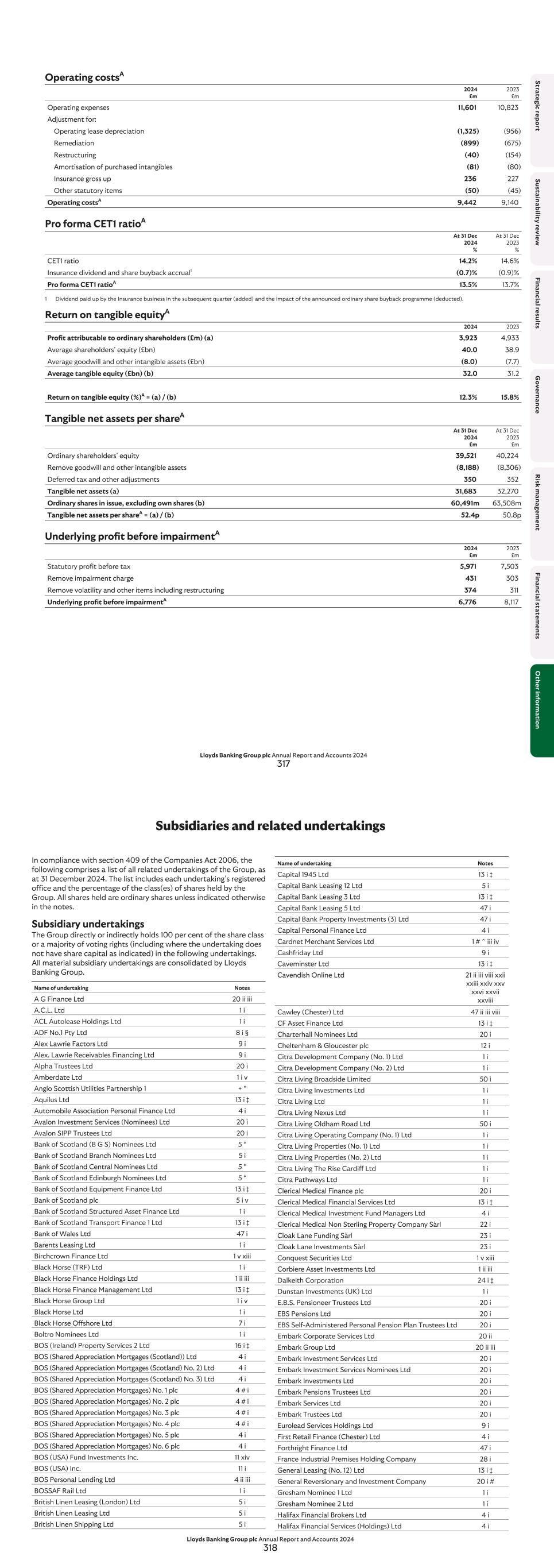
Operating costsA 2024 £m 2023 £m Operating expenses 11,601 10,823 Adjustment for: Operating lease depreciation (1,325) (956) Remediation (899) (675) Restructuring (40) (154) Amortisation of purchased intangibles (81) (80) Insurance gross up 236 227 Other statutory items (50) (45) Operating costsA 9,442 9,140 Pro forma CET1 ratioA At 31 Dec 2024 % At 31 Dec 2023 % CET1 ratio 14.2% 14.6% Insurance dividend and share buyback accrual1 (0.7)% (0.9)% Pro forma CET1 ratioA 13.5% 13.7% 1 Dividend paid up by the Insurance business in the subsequent quarter (added) and the impact of the announced ordinary share buyback programme (deducted). Return on tangible equityA 2024 2023 Profit attributable to ordinary shareholders (£m) (a) 3,923 4,933 Average shareholders’ equity (£bn) 40.0 38.9 Average goodwill and other intangible assets (£bn) (8.0) (7.7) Average tangible equity (£bn) (b) 32.0 31.2 Return on tangible equity (%)A = (a) / (b) 12.3% 15.8% Tangible net assets per shareA At 31 Dec 2024 £m At 31 Dec 2023 £m Ordinary shareholders’ equity 39,521 40,224 Remove goodwill and other intangible assets (8,188) (8,306) Deferred tax and other adjustments 350 352 Tangible net assets (a) 31,683 32,270 Ordinary shares in issue, excluding own shares (b) 60,491 m 63,508 m Tangible net assets per shareA = (a) / (b) 52.4 p 50.8 p Underlying profit before impairmentA 2024 £m 2023 £m Statutory profit before tax 5,971 7,503 Remove impairment charge 431 303 Remove volatility and other items including restructuring 374 311 Underlying profit before impairmentA 6,776 8,117 Lloyds Banking Group plc Annual Report and Accounts 2024 317 l i ts 2 O th e r in fo rm a tio n R isk m a n a ge m e n t F in a n cia l re su lts S u sta in a b ility re vie w S tra te gic re p o rt G o ve rn a n ce F in a n cia l sta te m e n ts In compliance with section 409 of the Companies Act 2006, the following comprises a list of all related undertakings of the Group, as at 31 December 2024. The list includes each undertaking’s registered office and the percentage of the class(es) of shares held by the Group. All shares held are ordinary shares unless indicated otherwise in the notes. Subsidiary undertakings The Group directly or indirectly holds 100 per cent of the share class or a majority of voting rights (including where the undertaking does not have share capital as indicated) in the following undertakings. All material subsidiary undertakings are consolidated by Lloyds Banking Group. A G Finance Ltd 20 ii iii A.C.L. Ltd 1 i ACL Autolease Holdings Ltd 1 i ADF No.1 Pty Ltd 8 i § Alex Lawrie Factors Ltd 9 i Alex. Lawrie Receivables Financing Ltd 9 i Alpha Trustees Ltd 20 i Amberdate Ltd 1 i v Anglo Scottish Utilities Partnership 1 + * Aquilus Ltd 13 i ‡ Automobile Association Personal Finance Ltd 4 i Avalon Investment Services (Nominees) Ltd 20 i Avalon SIPP Trustees Ltd 20 i Bank of Scotland (B G S) Nominees Ltd 5 * Bank of Scotland Branch Nominees Ltd 5 i Bank of Scotland Central Nominees Ltd 5 * Bank of Scotland Edinburgh Nominees Ltd 5 * Bank of Scotland Equipment Finance Ltd 13 i ‡ Bank of Scotland plc 5 i v Bank of Scotland Structured Asset Finance Ltd 1 i Bank of Scotland Transport Finance 1 Ltd 13 i ‡ Bank of Wales Ltd 47 i Barents Leasing Ltd 1 i Birchcrown Finance Ltd 1 v xiii Black Horse (TRF) Ltd 1 i Black Horse Finance Holdings Ltd 1 ii iii Black Horse Finance Management Ltd 13 i ‡ Black Horse Group Ltd 1 i v Black Horse Ltd 1 i Black Horse Offshore Ltd 7 i Boltro Nominees Ltd 1 i BOS (Ireland) Property Services 2 Ltd 16 i ‡ BOS (Shared Appreciation Mortgages (Scotland)) Ltd 4 i BOS (Shared Appreciation Mortgages (Scotland) No. 2) Ltd 4 i BOS (Shared Appreciation Mortgages (Scotland) No. 3) Ltd 4 i BOS (Shared Appreciation Mortgages) No. 1 plc 4 # i BOS (Shared Appreciation Mortgages) No. 2 plc 4 # i BOS (Shared Appreciation Mortgages) No. 3 plc 4 # i BOS (Shared Appreciation Mortgages) No. 4 plc 4 # i BOS (Shared Appreciation Mortgages) No. 5 plc 4 i BOS (Shared Appreciation Mortgages) No. 6 plc 4 i BOS (USA) Fund Investments Inc. 11 xiv BOS (USA) Inc. 11 i BOS Personal Lending Ltd 4 ii iii BOSSAF Rail Ltd 1 i British Linen Leasing (London) Ltd 5 i British Linen Leasing Ltd 5 i British Linen Shipping Ltd 5 i Name of undertaking Notes Capital 1945 Ltd 13 i ‡ Capital Bank Leasing 12 Ltd 5 i Capital Bank Leasing 3 Ltd 13 i ‡ Capital Bank Leasing 5 Ltd 47 i Capital Bank Property Investments (3) Ltd 47 i Capital Personal Finance Ltd 4 i Cardnet Merchant Services Ltd 1 # ^ iii iv Cashfriday Ltd 9 i Caveminster Ltd 13 i ‡ Cavendish Online Ltd 21 ii iii viii xxii xxiii xxiv xxv xxvi xxvii xxviii Cawley (Chester) Ltd 47 ii iii viii CF Asset Finance Ltd 13 i ‡ Charterhall Nominees Ltd 20 i Cheltenham & Gloucester plc 12 i Citra Development Company (No. 1) Ltd 1 i Citra Development Company (No. 2) Ltd 1 i Citra Living Broadside Limited 50 i Citra Living Investments Ltd 1 i Citra Living Ltd 1 i Citra Living Nexus Ltd 1 i Citra Living Oldham Road Ltd 50 i Citra Living Operating Company (No. 1) Ltd 1 i Citra Living Properties (No. 1) Ltd 1 i Citra Living Properties (No. 2) Ltd 1 i Citra Living The Rise Cardiff Ltd 1 i Citra Pathways Ltd 1 i Clerical Medical Finance plc 20 i Clerical Medical Financial Services Ltd 13 i ‡ Clerical Medical Investment Fund Managers Ltd 4 i Clerical Medical Non Sterling Property Company Sàrl 22 i Cloak Lane Funding Sàrl 23 i Cloak Lane Investments Sàrl 23 i Conquest Securities Ltd 1 v xiii Corbiere Asset Investments Ltd 1 ii iii Dalkeith Corporation 24 i ‡ Dunstan Investments (UK) Ltd 1 i E.B.S. Pensioneer Trustees Ltd 20 i EBS Pensions Ltd 20 i EBS Self-Administered Personal Pension Plan Trustees Ltd 20 i Embark Corporate Services Ltd 20 ii Embark Group Ltd 20 ii iii Embark Investment Services Ltd 20 i Embark Investment Services Nominees Ltd 20 i Embark Investments Ltd 20 i Embark Pensions Trustees Ltd 20 i Embark Services Ltd 20 i Embark Trustees Ltd 20 i Eurolead Services Holdings Ltd 9 i First Retail Finance (Chester) Ltd 4 i Forthright Finance Ltd 47 i France Industrial Premises Holding Company 28 i General Leasing (No. 12) Ltd 13 i ‡ General Reversionary and Investment Company 20 i # Gresham Nominee 1 Ltd 1 i Gresham Nominee 2 Ltd 1 i Halifax Financial Brokers Ltd 4 i Halifax Financial Services (Holdings) Ltd 4 i Name of undertaking Notes Subsidiaries and related undertakings Lloyds Banking Group plc Annual Report and Accounts 2024 318 l i ts
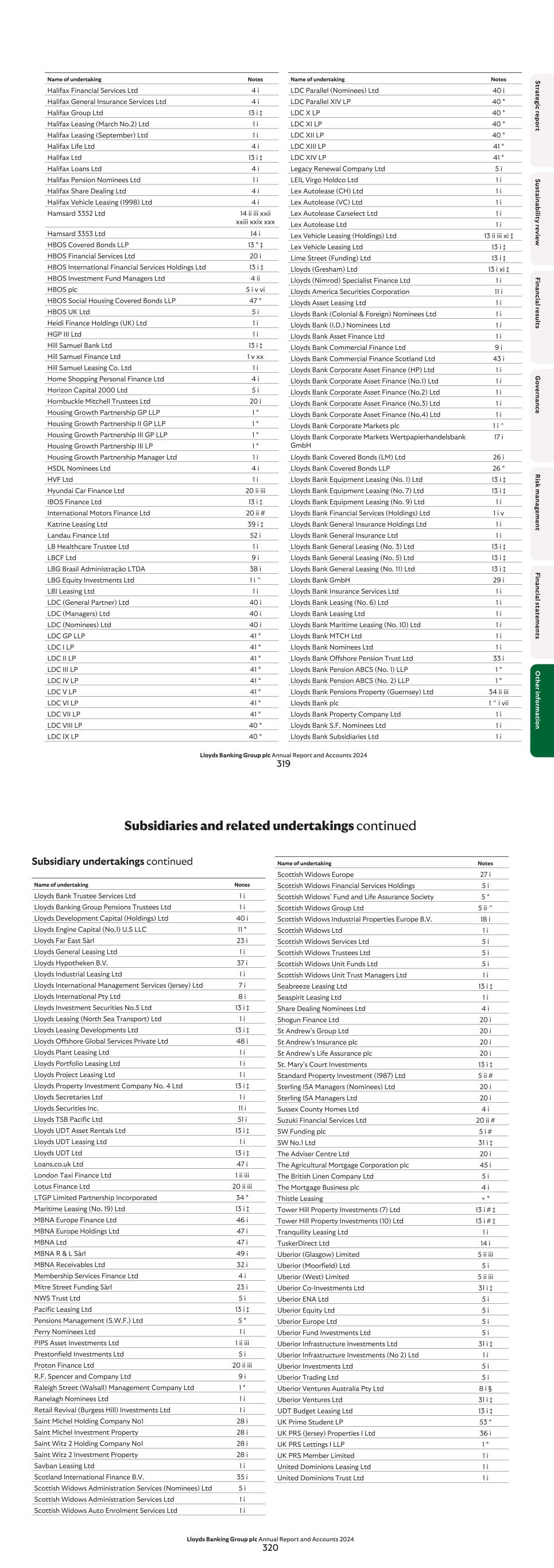
Halifax Financial Services Ltd 4 i Halifax General Insurance Services Ltd 4 i Halifax Group Ltd 13 i ‡ Halifax Leasing (March No.2) Ltd 1 i Halifax Leasing (September) Ltd 1 i Halifax Life Ltd 4 i Halifax Ltd 13 i ‡ Halifax Loans Ltd 4 i Halifax Pension Nominees Ltd 1 i Halifax Share Dealing Ltd 4 i Halifax Vehicle Leasing (1998) Ltd 4 i Hamsard 3352 Ltd 14 ii iii xxii xxiii xxix xxx Hamsard 3353 Ltd 14 i HBOS Covered Bonds LLP 13 * ‡ HBOS Financial Services Ltd 20 i HBOS International Financial Services Holdings Ltd 13 i ‡ HBOS Investment Fund Managers Ltd 4 ii HBOS plc 5 i v vi HBOS Social Housing Covered Bonds LLP 47 * HBOS UK Ltd 5 i Heidi Finance Holdings (UK) Ltd 1 i HGP III Ltd 1 i Hill Samuel Bank Ltd 13 i ‡ Hill Samuel Finance Ltd 1 v xx Hill Samuel Leasing Co. Ltd 1 i Home Shopping Personal Finance Ltd 4 i Horizon Capital 2000 Ltd 5 i Hornbuckle Mitchell Trustees Ltd 20 i Housing Growth Partnership GP LLP 1 * Housing Growth Partnership II GP LLP 1 * Housing Growth Partnership III GP LLP 1 * Housing Growth Partnership III LP 1 * Housing Growth Partnership Manager Ltd 1 i HSDL Nominees Ltd 4 i HVF Ltd 1 i Hyundai Car Finance Ltd 20 ii iii IBOS Finance Ltd 13 i ‡ International Motors Finance Ltd 20 ii # Katrine Leasing Ltd 39 i ‡ Landau Finance Ltd 52 i LB Healthcare Trustee Ltd 1 i LBCF Ltd 9 i LBG Brasil Administração LTDA 38 i LBG Equity Investments Ltd 1 i ^ LBI Leasing Ltd 1 i LDC (General Partner) Ltd 40 i LDC (Managers) Ltd 40 i LDC (Nominees) Ltd 40 i LDC GP LLP 41 * LDC I LP 41 * LDC II LP 41 * LDC III LP 41 * LDC IV LP 41 * LDC V LP 41 * LDC VI LP 41 * LDC VII LP 41 * LDC VIII LP 40 * LDC IX LP 40 * Name of undertaking Notes LDC Parallel (Nominees) Ltd 40 i LDC Parallel XIV LP 40 * LDC X LP 40 * LDC XI LP 40 * LDC XII LP 40 * LDC XIII LP 41 * LDC XIV LP 41 * Legacy Renewal Company Ltd 5 i LEIL Virgo Holdco Ltd 1 i Lex Autolease (CH) Ltd 1 i Lex Autolease (VC) Ltd 1 i Lex Autolease Carselect Ltd 1 i Lex Autolease Ltd 1 i Lex Vehicle Leasing (Holdings) Ltd 13 ii iii xi ‡ Lex Vehicle Leasing Ltd 13 i ‡ Lime Street (Funding) Ltd 13 i ‡ Lloyds (Gresham) Ltd 13 i xi ‡ Lloyds (Nimrod) Specialist Finance Ltd 1 i Lloyds America Securities Corporation 11 i Lloyds Asset Leasing Ltd 1 i Lloyds Bank (Colonial & Foreign) Nominees Ltd 1 i Lloyds Bank (I.D.) Nominees Ltd 1 i Lloyds Bank Asset Finance Ltd 1 i Lloyds Bank Commercial Finance Ltd 9 i Lloyds Bank Commercial Finance Scotland Ltd 43 i Lloyds Bank Corporate Asset Finance (HP) Ltd 1 i Lloyds Bank Corporate Asset Finance (No.1) Ltd 1 i Lloyds Bank Corporate Asset Finance (No.2) Ltd 1 i Lloyds Bank Corporate Asset Finance (No.3) Ltd 1 i Lloyds Bank Corporate Asset Finance (No.4) Ltd 1 i Lloyds Bank Corporate Markets plc 1 i ^ Lloyds Bank Corporate Markets Wertpapierhandelsbank GmbH 17 i Lloyds Bank Covered Bonds (LM) Ltd 26 i Lloyds Bank Covered Bonds LLP 26 * Lloyds Bank Equipment Leasing (No. 1) Ltd 13 i ‡ Lloyds Bank Equipment Leasing (No. 7) Ltd 13 i ‡ Lloyds Bank Equipment Leasing (No. 9) Ltd 1 i Lloyds Bank Financial Services (Holdings) Ltd 1 i v Lloyds Bank General Insurance Holdings Ltd 1 i Lloyds Bank General Insurance Ltd 1 i Lloyds Bank General Leasing (No. 3) Ltd 13 i ‡ Lloyds Bank General Leasing (No. 5) Ltd 13 i ‡ Lloyds Bank General Leasing (No. 11) Ltd 13 i ‡ Lloyds Bank GmbH 29 i Lloyds Bank Insurance Services Ltd 1 i Lloyds Bank Leasing (No. 6) Ltd 1 i Lloyds Bank Leasing Ltd 1 i Lloyds Bank Maritime Leasing (No. 10) Ltd 1 i Lloyds Bank MTCH Ltd 1 i Lloyds Bank Nominees Ltd 1 i Lloyds Bank Offshore Pension Trust Ltd 33 i Lloyds Bank Pension ABCS (No. 1) LLP 1 * Lloyds Bank Pension ABCS (No. 2) LLP 1 * Lloyds Bank Pensions Property (Guernsey) Ltd 34 ii iii Lloyds Bank plc 1 ^ i vii Lloyds Bank Property Company Ltd 1 i Lloyds Bank S.F. Nominees Ltd 1 i Lloyds Bank Subsidiaries Ltd 1 i Name of undertaking Notes Lloyds Banking Group plc Annual Report and Accounts 2024 319 l i ts 2 O th e r in fo rm a tio n R isk m a n a ge m e n t F in a n cia l re su lts S u sta in a b ility re vie w S tra te gic re p o rt G o ve rn a n ce F in a n cia l sta te m e n ts Subsidiary undertakings continued Lloyds Bank Trustee Services Ltd 1 i Lloyds Banking Group Pensions Trustees Ltd 1 i Lloyds Development Capital (Holdings) Ltd 40 i Lloyds Engine Capital (No.1) U.S LLC 11 * Lloyds Far East Sàrl 23 i Lloyds General Leasing Ltd 1 i Lloyds Hypotheken B.V. 37 i Lloyds Industrial Leasing Ltd 1 i Lloyds International Management Services (Jersey) Ltd 7 i Lloyds International Pty Ltd 8 i Lloyds Investment Securities No.5 Ltd 13 i ‡ Lloyds Leasing (North Sea Transport) Ltd 1 i Lloyds Leasing Developments Ltd 13 i ‡ Lloyds Offshore Global Services Private Ltd 48 i Lloyds Plant Leasing Ltd 1 i Lloyds Portfolio Leasing Ltd 1 i Lloyds Project Leasing Ltd 1 i Lloyds Property Investment Company No. 4 Ltd 13 i ‡ Lloyds Secretaries Ltd 1 i Lloyds Securities Inc. 11 i Lloyds TSB Pacific Ltd 51 i Lloyds UDT Asset Rentals Ltd 13 i ‡ Lloyds UDT Leasing Ltd 1 i Lloyds UDT Ltd 13 i ‡ Loans.co.uk Ltd 47 i London Taxi Finance Ltd 1 ii iii Lotus Finance Ltd 20 ii iii LTGP Limited Partnership Incorporated 34 * Maritime Leasing (No. 19) Ltd 13 i ‡ MBNA Europe Finance Ltd 46 i MBNA Europe Holdings Ltd 47 i MBNA Ltd 47 i MBNA R & L Sàrl 49 i MBNA Receivables Ltd 32 i Membership Services Finance Ltd 4 i Mitre Street Funding Sàrl 23 i NWS Trust Ltd 5 i Pacific Leasing Ltd 13 i ‡ Pensions Management (S.W.F.) Ltd 5 * Perry Nominees Ltd 1 i PIPS Asset Investments Ltd 1 ii iii Prestonfield Investments Ltd 5 i Proton Finance Ltd 20 ii iii R.F. Spencer and Company Ltd 9 i Raleigh Street (Walsall) Management Company Ltd 1 * Ranelagh Nominees Ltd 1 i Retail Revival (Burgess Hill) Investments Ltd 1 i Saint Michel Holding Company No1 28 i Saint Michel Investment Property 28 i Saint Witz 2 Holding Company No1 28 i Saint Witz 2 Investment Property 28 i Savban Leasing Ltd 1 i Scotland International Finance B.V. 35 i Scottish Widows Administration Services (Nominees) Ltd 5 i Scottish Widows Administration Services Ltd 1 i Scottish Widows Auto Enrolment Services Ltd 1 i Name of undertaking Notes Scottish Widows Europe 27 i Scottish Widows Financial Services Holdings 5 i Scottish Widows’ Fund and Life Assurance Society 5 * Scottish Widows Group Ltd 5 ii ^ Scottish Widows Industrial Properties Europe B.V. 18 i Scottish Widows Ltd 1 i Scottish Widows Services Ltd 5 i Scottish Widows Trustees Ltd 5 i Scottish Widows Unit Funds Ltd 5 i Scottish Widows Unit Trust Managers Ltd 1 i Seabreeze Leasing Ltd 13 i ‡ Seaspirit Leasing Ltd 1 i Share Dealing Nominees Ltd 4 i Shogun Finance Ltd 20 i St Andrew’s Group Ltd 20 i St Andrew’s Insurance plc 20 i St Andrew’s Life Assurance plc 20 i St. Mary’s Court Investments 13 i ‡ Standard Property Investment (1987) Ltd 5 ii # Sterling ISA Managers (Nominees) Ltd 20 i Sterling ISA Managers Ltd 20 i Sussex County Homes Ltd 4 i Suzuki Financial Services Ltd 20 ii # SW Funding plc 5 i # SW No.1 Ltd 31 i ‡ The Adviser Centre Ltd 20 i The Agricultural Mortgage Corporation plc 45 i The British Linen Company Ltd 5 i The Mortgage Business plc 4 i Thistle Leasing + * Tower Hill Property Investments (7) Ltd 13 i # ‡ Tower Hill Property Investments (10) Ltd 13 i # ‡ Tranquility Leasing Ltd 1 i TuskerDirect Ltd 14 i Uberior (Glasgow) Limited 5 ii iii Uberior (Moorfield) Ltd 5 i Uberior (West) Limited 5 ii iii Uberior Co-Investments Ltd 31 i ‡ Uberior ENA Ltd 5 i Uberior Equity Ltd 5 i Uberior Europe Ltd 5 i Uberior Fund Investments Ltd 5 i Uberior Infrastructure Investments Ltd 31 i ‡ Uberior Infrastructure Investments (No 2) Ltd 1 i Uberior Investments Ltd 5 i Uberior Trading Ltd 5 i Uberior Ventures Australia Pty Ltd 8 i § Uberior Ventures Ltd 31 i ‡ UDT Budget Leasing Ltd 13 i ‡ UK Prime Student LP 53 * UK PRS (Jersey) Properties I Ltd 36 i UK PRS Lettings I LLP 1 * UK PRS Member Limited 1 i United Dominions Leasing Ltd 1 i United Dominions Trust Ltd 1 i Name of undertaking Notes Subsidiaries and related undertakings continued Lloyds Banking Group plc Annual Report and Accounts 2024 320 l i ts
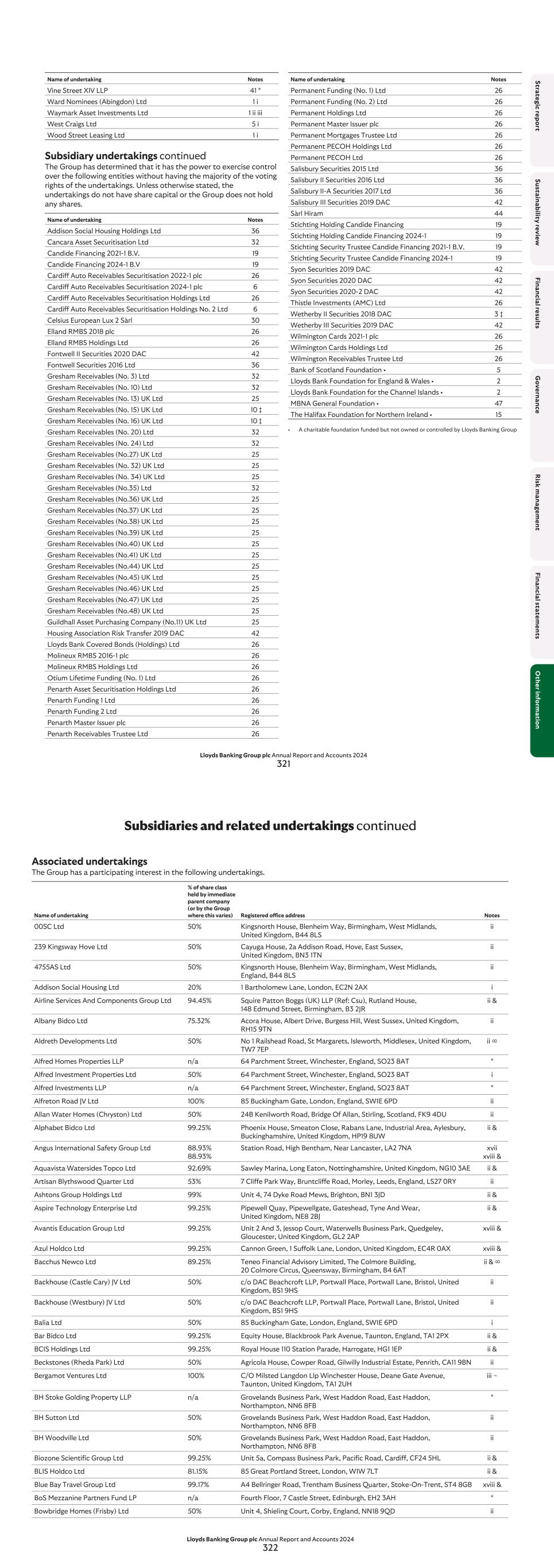
Vine Street XIV LLP 41 * Ward Nominees (Abingdon) Ltd 1 i Waymark Asset Investments Ltd 1 ii iii West Craigs Ltd 5 i Wood Street Leasing Ltd 1 i Name of undertaking Notes Subsidiary undertakings continued The Group has determined that it has the power to exercise control over the following entities without having the majority of the voting rights of the undertakings. Unless otherwise stated, the undertakings do not have share capital or the Group does not hold any shares. Addison Social Housing Holdings Ltd 36 Cancara Asset Securitisation Ltd 32 Candide Financing 2021-1 B.V. 19 Candide Financing 2024-1 B.V 19 Cardiff Auto Receivables Securitisation 2022-1 plc 26 Cardiff Auto Receivables Securitisation 2024-1 plc 6 Cardiff Auto Receivables Securitisation Holdings Ltd 26 Cardiff Auto Receivables Securitisation Holdings No. 2 Ltd 6 Celsius European Lux 2 Sàrl 30 Elland RMBS 2018 plc 26 Elland RMBS Holdings Ltd 26 Fontwell II Securities 2020 DAC 42 Fontwell Securities 2016 Ltd 36 Gresham Receivables (No. 3) Ltd 32 Gresham Receivables (No. 10) Ltd 32 Gresham Receivables (No. 13) UK Ltd 25 Gresham Receivables (No. 15) UK Ltd 10 ‡ Gresham Receivables (No. 16) UK Ltd 10 ‡ Gresham Receivables (No. 20) Ltd 32 Gresham Receivables (No. 24) Ltd 32 Gresham Receivables (No.27) UK Ltd 25 Gresham Receivables (No. 32) UK Ltd 25 Gresham Receivables (No. 34) UK Ltd 25 Gresham Receivables (No.35) Ltd 32 Gresham Receivables (No.36) UK Ltd 25 Gresham Receivables (No.37) UK Ltd 25 Gresham Receivables (No.38) UK Ltd 25 Gresham Receivables (No.39) UK Ltd 25 Gresham Receivables (No.40) UK Ltd 25 Gresham Receivables (No.41) UK Ltd 25 Gresham Receivables (No.44) UK Ltd 25 Gresham Receivables (No.45) UK Ltd 25 Gresham Receivables (No.46) UK Ltd 25 Gresham Receivables (No.47) UK Ltd 25 Gresham Receivables (No.48) UK Ltd 25 Guildhall Asset Purchasing Company (No.11) UK Ltd 25 Housing Association Risk Transfer 2019 DAC 42 Lloyds Bank Covered Bonds (Holdings) Ltd 26 Molineux RMBS 2016-1 plc 26 Molineux RMBS Holdings Ltd 26 Otium Lifetime Funding (No. 1) Ltd 26 Penarth Asset Securitisation Holdings Ltd 26 Penarth Funding 1 Ltd 26 Penarth Funding 2 Ltd 26 Penarth Master Issuer plc 26 Penarth Receivables Trustee Ltd 26 Name of undertaking Notes Permanent Funding (No. 1) Ltd 26 Permanent Funding (No. 2) Ltd 26 Permanent Holdings Ltd 26 Permanent Master Issuer plc 26 Permanent Mortgages Trustee Ltd 26 Permanent PECOH Holdings Ltd 26 Permanent PECOH Ltd 26 Salisbury Securities 2015 Ltd 36 Salisbury II Securities 2016 Ltd 36 Salisbury II-A Securities 2017 Ltd 36 Salisbury III Securities 2019 DAC 42 Sàrl Hiram 44 Stichting Holding Candide Financing 19 Stichting Holding Candide Financing 2024-1 19 Stichting Security Trustee Candide Financing 2021-1 B.V. 19 Stichting Security Trustee Candide Financing 2024-1 19 Syon Securities 2019 DAC 42 Syon Securities 2020 DAC 42 Syon Securities 2020-2 DAC 42 Thistle Investments (AMC) Ltd 26 Wetherby II Securities 2018 DAC 3 ‡ Wetherby III Securities 2019 DAC 42 Wilmington Cards 2021-1 plc 26 Wilmington Cards Holdings Ltd 26 Wilmington Receivables Trustee Ltd 26 Bank of Scotland Foundation • 5 Lloyds Bank Foundation for England & Wales • 2 Lloyds Bank Foundation for the Channel Islands • 2 MBNA General Foundation • 47 The Halifax Foundation for Northern Ireland • 15 Name of undertaking Notes • A charitable foundation funded but not owned or controlled by Lloyds Banking Group Lloyds Banking Group plc Annual Report and Accounts 2024 321 l i ts 2 O th e r in fo rm a tio n R isk m a n a ge m e n t F in a n cia l re su lts S u sta in a b ility re vie w S tra te gic re p o rt G o ve rn a n ce F in a n cia l sta te m e n ts Associated undertakings The Group has a participating interest in the following undertakings. 00SC Ltd 50% Kingsnorth House, Blenheim Way, Birmingham, West Midlands, United Kingdom, B44 8LS ii 239 Kingsway Hove Ltd 50% Cayuga House, 2a Addison Road, Hove, East Sussex, United Kingdom, BN3 1TN ii 4755AS Ltd 50% Kingsnorth House, Blenheim Way, Birmingham, West Midlands, England, B44 8LS ii Addison Social Housing Ltd 20% 1 Bartholomew Lane, London, EC2N 2AX i Airline Services And Components Group Ltd 94.45% Squire Patton Boggs (UK) LLP (Ref: Csu), Rutland House, 148 Edmund Street, Birmingham, B3 2JR ii & Albany Bidco Ltd 75.32% Acora House, Albert Drive, Burgess Hill, West Sussex, United Kingdom, RH15 9TN ii Aldreth Developments Ltd 50% No 1 Railshead Road, St Margarets, Isleworth, Middlesex, United Kingdom, TW7 7EP ii ∞ Alfred Homes Properties LLP n/a 64 Parchment Street, Winchester, England, SO23 8AT * Alfred Investment Properties Ltd 50% 64 Parchment Street, Winchester, England, SO23 8AT i Alfred Investments LLP n/a 64 Parchment Street, Winchester, England, SO23 8AT * Alfreton Road JV Ltd 100% 85 Buckingham Gate, London, England, SW1E 6PD ii Allan Water Homes (Chryston) Ltd 50% 24B Kenilworth Road, Bridge Of Allan, Stirling, Scotland, FK9 4DU ii Alphabet Bidco Ltd 99.25% Phoenix House, Smeaton Close, Rabans Lane, Industrial Area, Aylesbury, Buckinghamshire, United Kingdom, HP19 8UW ii & Angus International Safety Group Ltd 88.93% 88.93% Station Road, High Bentham, Near Lancaster, LA2 7NA xvii xviii & Aquavista Watersides Topco Ltd 92.69% Sawley Marina, Long Eaton, Nottinghamshire, United Kingdom, NG10 3AE ii & Artisan Blythswood Quarter Ltd 53% 7 Cliffe Park Way, Bruntcliffe Road, Morley, Leeds, England, LS27 0RY ii Ashtons Group Holdings Ltd 99% Unit 4, 74 Dyke Road Mews, Brighton, BN1 3JD ii & Aspire Technology Enterprise Ltd 99.25% Pipewell Quay, Pipewellgate, Gateshead, Tyne And Wear, United Kingdom, NE8 2BJ ii & Avantis Education Group Ltd 99.25% Unit 2 And 3, Jessop Court, Waterwells Business Park, Quedgeley, Gloucester, United Kingdom, GL2 2AP xviii & Azul Holdco Ltd 99.25% Cannon Green, 1 Suffolk Lane, London, United Kingdom, EC4R 0AX xviii & Bacchus Newco Ltd 89.25% Teneo Financial Advisory Limited, The Colmore Building, 20 Colmore Circus, Queensway, Birmingham, B4 6AT ii & ∞ Backhouse (Castle Cary) JV Ltd 50% c/o DAC Beachcroft LLP, Portwall Place, Portwall Lane, Bristol, United Kingdom, BS1 9HS ii Backhouse (Westbury) JV Ltd 50% c/o DAC Beachcroft LLP, Portwall Place, Portwall Lane, Bristol, United Kingdom, BS1 9HS ii Balia Ltd 50% 85 Buckingham Gate, London, England, SW1E 6PD i Bar Bidco Ltd 99.25% Equity House, Blackbrook Park Avenue, Taunton, England, TA1 2PX ii & BCIS Holdings Ltd 99.25% Royal House 110 Station Parade, Harrogate, HG1 1EP ii & Beckstones (Rheda Park) Ltd 50% Agricola House, Cowper Road, Gilwilly Industrial Estate, Penrith, CA11 9BN ii Bergamot Ventures Ltd 100% C/O Milsted Langdon Llp Winchester House, Deane Gate Avenue, Taunton, United Kingdom, TA1 2UH iii ~ BH Stoke Golding Property LLP n/a Grovelands Business Park, West Haddon Road, East Haddon, Northampton, NN6 8FB * BH Sutton Ltd 50% Grovelands Business Park, West Haddon Road, East Haddon, Northampton, NN6 8FB ii BH Woodville Ltd 50% Grovelands Business Park, West Haddon Road, East Haddon, Northampton, NN6 8FB ii Biozone Scientific Group Ltd 99.25% Unit 5a, Compass Business Park, Pacific Road, Cardiff, CF24 5HL ii & BLIS Holdco Ltd 81.15% 85 Great Portland Street, London, W1W 7LT ii & Blue Bay Travel Group Ltd 99.17% A4 Bellringer Road, Trentham Business Quarter, Stoke-On-Trent, ST4 8GB xviii & BoS Mezzanine Partners Fund LP n/a Fourth Floor, 7 Castle Street, Edinburgh, EH2 3AH * Bowbridge Homes (Frisby) Ltd 50% Unit 4, Shieling Court, Corby, England, NN18 9QD ii Name of undertaking % of share class held by immediate parent company (or by the Group where this varies) Registered office address Notes Subsidiaries and related undertakings continued Lloyds Banking Group plc Annual Report and Accounts 2024 322 l i ts
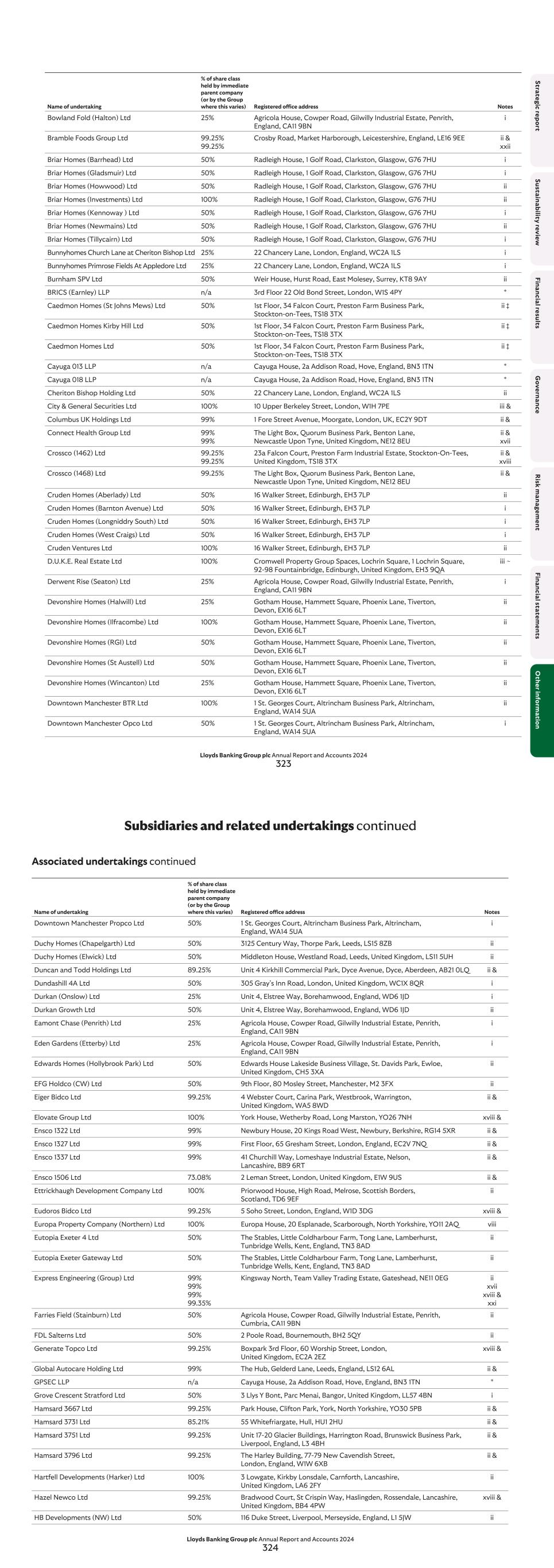
Bowland Fold (Halton) Ltd 25% Agricola House, Cowper Road, Gilwilly Industrial Estate, Penrith, England, CA11 9BN i Bramble Foods Group Ltd 99.25% 99.25% Crosby Road, Market Harborough, Leicestershire, England, LE16 9EE ii & xxii Briar Homes (Barrhead) Ltd 50% Radleigh House, 1 Golf Road, Clarkston, Glasgow, G76 7HU i Briar Homes (Gladsmuir) Ltd 50% Radleigh House, 1 Golf Road, Clarkston, Glasgow, G76 7HU i Briar Homes (Howwood) Ltd 50% Radleigh House, 1 Golf Road, Clarkston, Glasgow, G76 7HU ii Briar Homes (Investments) Ltd 100% Radleigh House, 1 Golf Road, Clarkston, Glasgow, G76 7HU ii Briar Homes (Kennoway ) Ltd 50% Radleigh House, 1 Golf Road, Clarkston, Glasgow, G76 7HU i Briar Homes (Newmains) Ltd 50% Radleigh House, 1 Golf Road, Clarkston, Glasgow, G76 7HU ii Briar Homes (Tillycairn) Ltd 50% Radleigh House, 1 Golf Road, Clarkston, Glasgow, G76 7HU i Bunnyhomes Church Lane at Cheriton Bishop Ltd 25% 22 Chancery Lane, London, England, WC2A 1LS i Bunnyhomes Primrose Fields At Appledore Ltd 25% 22 Chancery Lane, London, England, WC2A 1LS i Burnham SPV Ltd 50% Weir House, Hurst Road, East Molesey, Surrey, KT8 9AY ii BRICS (Earnley) LLP n/a 3rd Floor 22 Old Bond Street, London, W1S 4PY * Caedmon Homes (St Johns Mews) Ltd 50% 1st Floor, 34 Falcon Court, Preston Farm Business Park, Stockton-on-Tees, TS18 3TX ii ‡ Caedmon Homes Kirby Hill Ltd 50% 1st Floor, 34 Falcon Court, Preston Farm Business Park, Stockton-on-Tees, TS18 3TX ii ‡ Caedmon Homes Ltd 50% 1st Floor, 34 Falcon Court, Preston Farm Business Park, Stockton-on-Tees, TS18 3TX ii ‡ Cayuga 013 LLP n/a Cayuga House, 2a Addison Road, Hove, England, BN3 1TN * Cayuga 018 LLP n/a Cayuga House, 2a Addison Road, Hove, England, BN3 1TN * Cheriton Bishop Holding Ltd 50% 22 Chancery Lane, London, England, WC2A 1LS ii City & General Securities Ltd 100% 10 Upper Berkeley Street, London, W1H 7PE iii & Columbus UK Holdings Ltd 99% 1 Fore Street Avenue, Moorgate, London, UK, EC2Y 9DT ii & Connect Health Group Ltd 99% 99% The Light Box, Quorum Business Park, Benton Lane, Newcastle Upon Tyne, United Kingdom, NE12 8EU ii & xvii Crossco (1462) Ltd 99.25% 99.25% 23a Falcon Court, Preston Farm Industrial Estate, Stockton-On-Tees, United Kingdom, TS18 3TX ii & xviii Crossco (1468) Ltd 99.25% The Light Box, Quorum Business Park, Benton Lane, Newcastle Upon Tyne, United Kingdom, NE12 8EU ii & Cruden Homes (Aberlady) Ltd 50% 16 Walker Street, Edinburgh, EH3 7LP ii Cruden Homes (Barnton Avenue) Ltd 50% 16 Walker Street, Edinburgh, EH3 7LP i Cruden Homes (Longniddry South) Ltd 50% 16 Walker Street, Edinburgh, EH3 7LP i Cruden Homes (West Craigs) Ltd 50% 16 Walker Street, Edinburgh, EH3 7LP i Cruden Ventures Ltd 100% 16 Walker Street, Edinburgh, EH3 7LP ii D.U.K.E. Real Estate Ltd 100% Cromwell Property Group Spaces, Lochrin Square, 1 Lochrin Square, 92-98 Fountainbridge, Edinburgh, United Kingdom, EH3 9QA iii ~ Derwent Rise (Seaton) Ltd 25% Agricola House, Cowper Road, Gilwilly Industrial Estate, Penrith, England, CA11 9BN i Devonshire Homes (Halwill) Ltd 25% Gotham House, Hammett Square, Phoenix Lane, Tiverton, Devon, EX16 6LT ii Devonshire Homes (Ilfracombe) Ltd 100% Gotham House, Hammett Square, Phoenix Lane, Tiverton, Devon, EX16 6LT ii Devonshire Homes (RGI) Ltd 50% Gotham House, Hammett Square, Phoenix Lane, Tiverton, Devon, EX16 6LT ii Devonshire Homes (St Austell) Ltd 50% Gotham House, Hammett Square, Phoenix Lane, Tiverton, Devon, EX16 6LT ii Devonshire Homes (Wincanton) Ltd 25% Gotham House, Hammett Square, Phoenix Lane, Tiverton, Devon, EX16 6LT ii Downtown Manchester BTR Ltd 100% 1 St. Georges Court, Altrincham Business Park, Altrincham, England, WA14 5UA ii Downtown Manchester Opco Ltd 50% 1 St. Georges Court, Altrincham Business Park, Altrincham, England, WA14 5UA i Name of undertaking % of share class held by immediate parent company (or by the Group where this varies) Registered office address Notes Lloyds Banking Group plc Annual Report and Accounts 2024 323 l i ts 2 O th e r in fo rm a tio n R isk m a n a ge m e n t F in a n cia l re su lts S u sta in a b ility re vie w S tra te gic re p o rt G o ve rn a n ce F in a n cia l sta te m e n ts Associated undertakings continued Downtown Manchester Propco Ltd 50% 1 St. Georges Court, Altrincham Business Park, Altrincham, England, WA14 5UA i Duchy Homes (Chapelgarth) Ltd 50% 3125 Century Way, Thorpe Park, Leeds, LS15 8ZB ii Duchy Homes (Elwick) Ltd 50% Middleton House, Westland Road, Leeds, United Kingdom, LS11 5UH ii Duncan and Todd Holdings Ltd 89.25% Unit 4 Kirkhill Commercial Park, Dyce Avenue, Dyce, Aberdeen, AB21 0LQ ii & Dundashill 4A Ltd 50% 305 Gray’s Inn Road, London, United Kingdom, WC1X 8QR i Durkan (Onslow) Ltd 25% Unit 4, Elstree Way, Borehamwood, England, WD6 1JD i Durkan Growth Ltd 50% Unit 4, Elstree Way, Borehamwood, England, WD6 1JD ii Eamont Chase (Penrith) Ltd 25% Agricola House, Cowper Road, Gilwilly Industrial Estate, Penrith, England, CA11 9BN i Eden Gardens (Etterby) Ltd 25% Agricola House, Cowper Road, Gilwilly Industrial Estate, Penrith, England, CA11 9BN i Edwards Homes (Hollybrook Park) Ltd 50% Edwards House Lakeside Business Village, St. Davids Park, Ewloe, United Kingdom, CH5 3XA ii EFG Holdco (CW) Ltd 50% 9th Floor, 80 Mosley Street, Manchester, M2 3FX ii Eiger Bidco Ltd 99.25% 4 Webster Court, Carina Park, Westbrook, Warrington, United Kingdom, WA5 8WD ii & Elovate Group Ltd 100% York House, Wetherby Road, Long Marston, YO26 7NH xviii & Ensco 1322 Ltd 99% Newbury House, 20 Kings Road West, Newbury, Berkshire, RG14 5XR ii & Ensco 1327 Ltd 99% First Floor, 65 Gresham Street, London, England, EC2V 7NQ ii & Ensco 1337 Ltd 99% 41 Churchill Way, Lomeshaye Industrial Estate, Nelson, Lancashire, BB9 6RT ii & Ensco 1506 Ltd 73.08% 2 Leman Street, London, United Kingdom, E1W 9US ii & Ettrickhaugh Development Company Ltd 100% Priorwood House, High Road, Melrose, Scottish Borders, Scotland, TD6 9EF ii Eudoros Bidco Ltd 99.25% 5 Soho Street, London, England, W1D 3DG xviii & Europa Property Company (Northern) Ltd 100% Europa House, 20 Esplanade, Scarborough, North Yorkshire, YO11 2AQ viii Eutopia Exeter 4 Ltd 50% The Stables, Little Coldharbour Farm, Tong Lane, Lamberhurst, Tunbridge Wells, Kent, England, TN3 8AD ii Eutopia Exeter Gateway Ltd 50% The Stables, Little Coldharbour Farm, Tong Lane, Lamberhurst, Tunbridge Wells, Kent, England, TN3 8AD ii Express Engineering (Group) Ltd 99% 99% 99% 99.35% Kingsway North, Team Valley Trading Estate, Gateshead, NE11 0EG ii xvii xviii & xxi Farries Field (Stainburn) Ltd 50% Agricola House, Cowper Road, Gilwilly Industrial Estate, Penrith, Cumbria, CA11 9BN ii FDL Salterns Ltd 50% 2 Poole Road, Bournemouth, BH2 5QY ii Generate Topco Ltd 99.25% Boxpark 3rd Floor, 60 Worship Street, London, United Kingdom, EC2A 2EZ xviii & Global Autocare Holding Ltd 99% The Hub, Gelderd Lane, Leeds, England, LS12 6AL ii & GPSEC LLP n/a Cayuga House, 2a Addison Road, Hove, England, BN3 1TN * Grove Crescent Stratford Ltd 50% 3 Llys Y Bont, Parc Menai, Bangor, United Kingdom, LL57 4BN i Hamsard 3667 Ltd 99.25% Park House, Clifton Park, York, North Yorkshire, YO30 5PB ii & Hamsard 3731 Ltd 85.21% 55 Whitefriargate, Hull, HU1 2HU ii & Hamsard 3751 Ltd 99.25% Unit 17-20 Glacier Buildings, Harrington Road, Brunswick Business Park, Liverpool, England, L3 4BH ii & Hamsard 3796 Ltd 99.25% The Harley Building, 77-79 New Cavendish Street, London, England, W1W 6XB ii & Hartfell Developments (Harker) Ltd 100% 3 Lowgate, Kirkby Lonsdale, Carnforth, Lancashire, United Kingdom, LA6 2FY ii Hazel Newco Ltd 99.25% Bradwood Court, St Crispin Way, Haslingden, Rossendale, Lancashire, United Kingdom, BB4 4PW xviii & HB Developments (NW) Ltd 50% 116 Duke Street, Liverpool, Merseyside, England, L1 5JW ii Name of undertaking % of share class held by immediate parent company (or by the Group where this varies) Registered office address Notes Subsidiaries and related undertakings continued Lloyds Banking Group plc Annual Report and Accounts 2024 324 l i ts
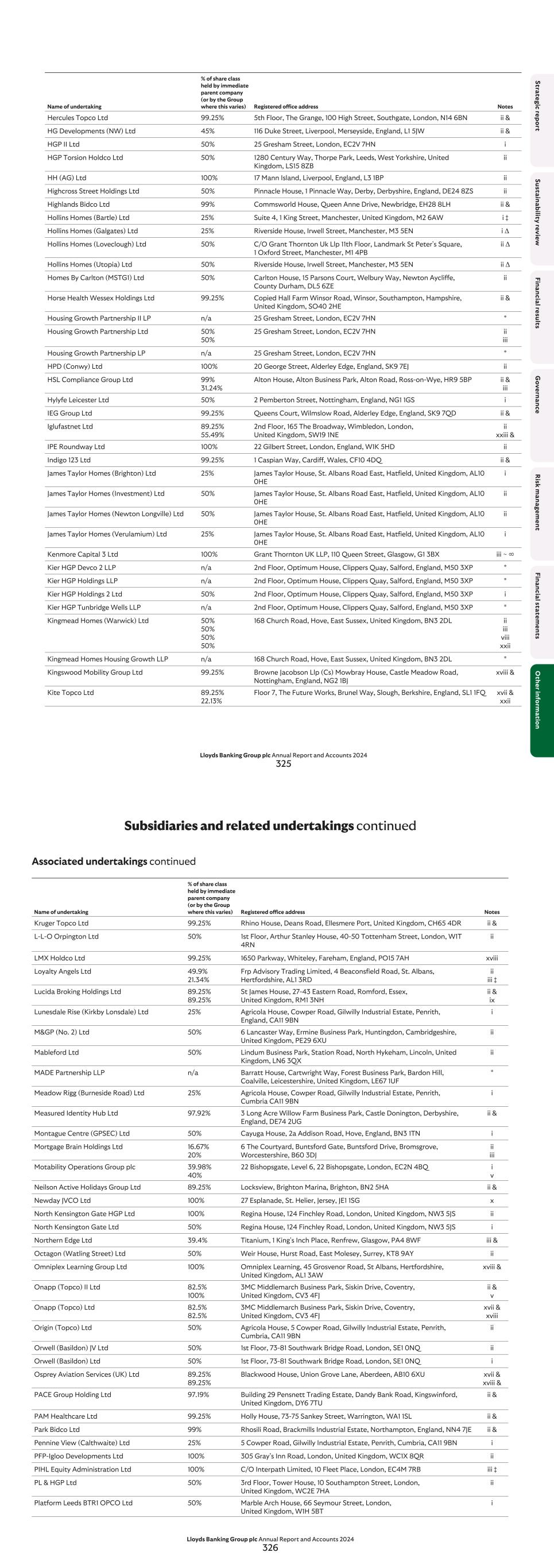
Hercules Topco Ltd 99.25% 5th Floor, The Grange, 100 High Street, Southgate, London, N14 6BN ii & HG Developments (NW) Ltd 45% 116 Duke Street, Liverpool, Merseyside, England, L1 5JW ii & HGP II Ltd 50% 25 Gresham Street, London, EC2V 7HN i HGP Torsion Holdco Ltd 50% 1280 Century Way, Thorpe Park, Leeds, West Yorkshire, United Kingdom, LS15 8ZB ii HH (AG) Ltd 100% 17 Mann Island, Liverpool, England, L3 1BP ii Highcross Street Holdings Ltd 50% Pinnacle House, 1 Pinnacle Way, Derby, Derbyshire, England, DE24 8ZS ii Highlands Bidco Ltd 99% Commsworld House, Queen Anne Drive, Newbridge, EH28 8LH ii & Hollins Homes (Bartle) Ltd 25% Suite 4, 1 King Street, Manchester, United Kingdom, M2 6AW i ‡ Hollins Homes (Galgates) Ltd 25% Riverside House, Irwell Street, Manchester, M3 5EN i Δ Hollins Homes (Loveclough) Ltd 50% C/O Grant Thornton Uk Llp 11th Floor, Landmark St Peter's Square, 1 Oxford Street, Manchester, M1 4PB ii Δ Hollins Homes (Utopia) Ltd 50% Riverside House, Irwell Street, Manchester, M3 5EN ii Δ Homes By Carlton (MSTG1) Ltd 50% Carlton House, 15 Parsons Court, Welbury Way, Newton Aycliffe, County Durham, DL5 6ZE ii Horse Health Wessex Holdings Ltd 99.25% Copied Hall Farm Winsor Road, Winsor, Southampton, Hampshire, United Kingdom, SO40 2HE ii & Housing Growth Partnership II LP n/a 25 Gresham Street, London, EC2V 7HN * Housing Growth Partnership Ltd 50% 50% 25 Gresham Street, London, EC2V 7HN ii iii Housing Growth Partnership LP n/a 25 Gresham Street, London, EC2V 7HN * HPD (Conwy) Ltd 100% 20 George Street, Alderley Edge, England, SK9 7EJ ii HSL Compliance Group Ltd 99% 31.24% Alton House, Alton Business Park, Alton Road, Ross-on-Wye, HR9 5BP ii & iii Hylyfe Leicester Ltd 50% 2 Pemberton Street, Nottingham, England, NG1 1GS i IEG Group Ltd 99.25% Queens Court, Wilmslow Road, Alderley Edge, England, SK9 7QD ii & Iglufastnet Ltd 89.25% 55.49% 2nd Floor, 165 The Broadway, Wimbledon, London, United Kingdom, SW19 1NE ii xxiii & IPE Roundway Ltd 100% 22 Gilbert Street, London, England, W1K 5HD ii Indigo 123 Ltd 99.25% 1 Caspian Way, Cardiff, Wales, CF10 4DQ ii & James Taylor Homes (Brighton) Ltd 25% James Taylor House, St. Albans Road East, Hatfield, United Kingdom, AL10 0HE i James Taylor Homes (Investment) Ltd 50% James Taylor House, St. Albans Road East, Hatfield, United Kingdom, AL10 0HE ii James Taylor Homes (Newton Longville) Ltd 50% James Taylor House, St. Albans Road East, Hatfield, United Kingdom, AL10 0HE ii James Taylor Homes (Verulamium) Ltd 25% James Taylor House, St. Albans Road East, Hatfield, United Kingdom, AL10 0HE i Kenmore Capital 3 Ltd 100% Grant Thornton UK LLP, 110 Queen Street, Glasgow, G1 3BX iii ~ ∞ Kier HGP Devco 2 LLP n/a 2nd Floor, Optimum House, Clippers Quay, Salford, England, M50 3XP * Kier HGP Holdings LLP n/a 2nd Floor, Optimum House, Clippers Quay, Salford, England, M50 3XP * Kier HGP Holdings 2 Ltd 50% 2nd Floor, Optimum House, Clippers Quay, Salford, England, M50 3XP i Kier HGP Tunbridge Wells LLP n/a 2nd Floor, Optimum House, Clippers Quay, Salford, England, M50 3XP * Kingmead Homes (Warwick) Ltd 50% 50% 50% 50% 168 Church Road, Hove, East Sussex, United Kingdom, BN3 2DL ii iii viii xxii Kingmead Homes Housing Growth LLP n/a 168 Church Road, Hove, East Sussex, United Kingdom, BN3 2DL * Kingswood Mobility Group Ltd 99.25% Browne Jacobson Llp (Cs) Mowbray House, Castle Meadow Road, Nottingham, England, NG2 1BJ xviii & Kite Topco Ltd 89.25% 22.13% Floor 7, The Future Works, Brunel Way, Slough, Berkshire, England, SL1 1FQ xvii & xxii Name of undertaking % of share class held by immediate parent company (or by the Group where this varies) Registered office address Notes Lloyds Banking Group plc Annual Report and Accounts 2024 325 l i ts 2 O th e r in fo rm a tio n R isk m a n a ge m e n t F in a n cia l re su lts S u sta in a b ility re vie w S tra te gic re p o rt G o ve rn a n ce F in a n cia l sta te m e n ts Associated undertakings continued Kruger Topco Ltd 99.25% Rhino House, Deans Road, Ellesmere Port, United Kingdom, CH65 4DR ii & L-L-O Orpington Ltd 50% 1st Floor, Arthur Stanley House, 40-50 Tottenham Street, London, W1T 4RN ii LMX Holdco Ltd 99.25% 1650 Parkway, Whiteley, Fareham, England, PO15 7AH xviii Loyalty Angels Ltd 49.9% 21.34% Frp Advisory Trading Limited, 4 Beaconsfield Road, St. Albans, Hertfordshire, AL1 3RD ii iii ‡ Lucida Broking Holdings Ltd 89.25% 89.25% St James House, 27-43 Eastern Road, Romford, Essex, United Kingdom, RM1 3NH ii & ix Lunesdale Rise (Kirkby Lonsdale) Ltd 25% Agricola House, Cowper Road, Gilwilly Industrial Estate, Penrith, England, CA11 9BN i M&GP (No. 2) Ltd 50% 6 Lancaster Way, Ermine Business Park, Huntingdon, Cambridgeshire, United Kingdom, PE29 6XU ii Mableford Ltd 50% Lindum Business Park, Station Road, North Hykeham, Lincoln, United Kingdom, LN6 3QX ii MADE Partnership LLP n/a Barratt House, Cartwright Way, Forest Business Park, Bardon Hill, Coalville, Leicestershire, United Kingdom, LE67 1UF * Meadow Rigg (Burneside Road) Ltd 25% Agricola House, Cowper Road, Gilwilly Industrial Estate, Penrith, Cumbria CA11 9BN i Measured Identity Hub Ltd 97.92% 3 Long Acre Willow Farm Business Park, Castle Donington, Derbyshire, England, DE74 2UG ii & Montague Centre (GPSEC) Ltd 50% Cayuga House, 2a Addison Road, Hove, England, BN3 1TN i Mortgage Brain Holdings Ltd 16.67% 20% 6 The Courtyard, Buntsford Gate, Buntsford Drive, Bromsgrove, Worcestershire, B60 3DJ ii iii Motability Operations Group plc 39.98% 40% 22 Bishopsgate, Level 6, 22 Bishopsgate, London, EC2N 4BQ i v Neilson Active Holidays Group Ltd 89.25% Locksview, Brighton Marina, Brighton, BN2 5HA ii & Newday JVCO Ltd 100% 27 Esplanade, St. Helier, Jersey, JE1 1SG x North Kensington Gate HGP Ltd 100% Regina House, 124 Finchley Road, London, United Kingdom, NW3 5JS ii North Kensington Gate Ltd 50% Regina House, 124 Finchley Road, London, United Kingdom, NW3 5JS i Northern Edge Ltd 39.4% Titanium, 1 King's Inch Place, Renfrew, Glasgow, PA4 8WF iii & Octagon (Watling Street) Ltd 50% Weir House, Hurst Road, East Molesey, Surrey, KT8 9AY ii Omniplex Learning Group Ltd 100% Omniplex Learning, 45 Grosvenor Road, St Albans, Hertfordshire, United Kingdom, AL1 3AW xviii & Onapp (Topco) II Ltd 82.5% 100% 3MC Middlemarch Business Park, Siskin Drive, Coventry, United Kingdom, CV3 4FJ ii & v Onapp (Topco) Ltd 82.5% 82.5% 3MC Middlemarch Business Park, Siskin Drive, Coventry, United Kingdom, CV3 4FJ xvii & xviii Origin (Topco) Ltd 50% Agricola House, 5 Cowper Road, Gilwilly Industrial Estate, Penrith, Cumbria, CA11 9BN ii Orwell (Basildon) JV Ltd 50% 1st Floor, 73-81 Southwark Bridge Road, London, SE1 0NQ ii Orwell (Basildon) Ltd 50% 1st Floor, 73-81 Southwark Bridge Road, London, SE1 0NQ i Osprey Aviation Services (UK) Ltd 89.25% 89.25% Blackwood House, Union Grove Lane, Aberdeen, AB10 6XU xvii & xviii & PACE Group Holding Ltd 97.19% Building 29 Pensnett Trading Estate, Dandy Bank Road, Kingswinford, United Kingdom, DY6 7TU ii & PAM Healthcare Ltd 99.25% Holly House, 73-75 Sankey Street, Warrington, WA1 1SL ii & Park Bidco Ltd 99% Rhosili Road, Brackmills Industrial Estate, Northampton, England, NN4 7JE ii & Pennine View (Calthwaite) Ltd 25% 5 Cowper Road, Gilwilly Industrial Estate, Penrith, Cumbria, CA11 9BN i PFP-Igloo Developments Ltd 100% 305 Gray’s Inn Road, London, United Kingdom, WC1X 8QR ii PIHL Equity Administration Ltd 100% C/O Interpath Limited, 10 Fleet Place, London, EC4M 7RB iii ‡ PL & HGP Ltd 50% 3rd Floor, Tower House, 10 Southampton Street, London, United Kingdom, WC2E 7HA ii Platform Leeds BTR1 OPCO Ltd 50% Marble Arch House, 66 Seymour Street, London, United Kingdom, W1H 5BT i Name of undertaking % of share class held by immediate parent company (or by the Group where this varies) Registered office address Notes Subsidiaries and related undertakings continued Lloyds Banking Group plc Annual Report and Accounts 2024 326 l i ts
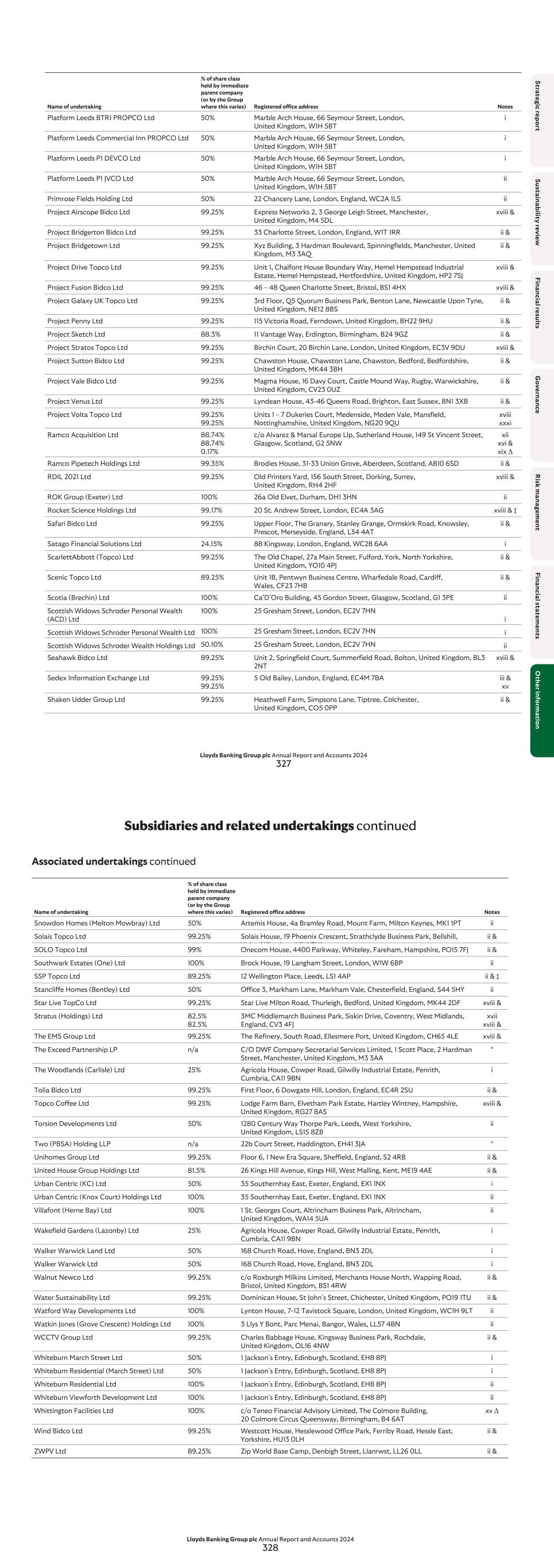
Platform Leeds BTR1 PROPCO Ltd 50% Marble Arch House, 66 Seymour Street, London, United Kingdom, W1H 5BT i Platform Leeds Commercial Inn PROPCO Ltd 50% Marble Arch House, 66 Seymour Street, London, United Kingdom, W1H 5BT i Platform Leeds P1 DEVCO Ltd 50% Marble Arch House, 66 Seymour Street, London, United Kingdom, W1H 5BT i Platform Leeds P1 JVCO Ltd 50% Marble Arch House, 66 Seymour Street, London, United Kingdom, W1H 5BT ii Primrose Fields Holding Ltd 50% 22 Chancery Lane, London, England, WC2A 1LS ii Project Airscope Bidco Ltd 99.25% Express Networks 2, 3 George Leigh Street, Manchester, United Kingdom, M4 5DL xviii & Project Bridgerton Bidco Ltd 99.25% 33 Charlotte Street, London, England, W1T 1RR ii & Project Bridgetown Ltd 99.25% Xyz Building, 3 Hardman Boulevard, Spinningfields, Manchester, United Kingdom, M3 3AQ ii & Project Drive Topco Ltd 99.25% Unit 1, Chalfont House Boundary Way, Hemel Hempstead Industrial Estate, Hemel Hempstead, Hertfordshire, United Kingdom, HP2 7SJ xviii & Project Fusion Bidco Ltd 99.25% 46 – 48 Queen Charlotte Street, Bristol, BS1 4HX xviii & Project Galaxy UK Topco Ltd 99.25% 3rd Floor, Q5 Quorum Business Park, Benton Lane, Newcastle Upon Tyne, United Kingdom, NE12 8BS ii & Project Penny Ltd 99.25% 115 Victoria Road, Ferndown, United Kingdom, BH22 9HU ii & Project Sketch Ltd 88.3% 11 Vantage Way, Erdington, Birmingham, B24 9GZ ii & Project Stratos Topco Ltd 99.25% Birchin Court, 20 Birchin Lane, London, United Kingdom, EC3V 9DU xviii & Project Sutton Bidco Ltd 99.25% Chawston House, Chawston Lane, Chawston, Bedford, Bedfordshire, United Kingdom, MK44 3BH ii & Project Vale Bidco Ltd 99.25% Magma House, 16 Davy Court, Castle Mound Way, Rugby, Warwickshire, United Kingdom, CV23 0UZ ii & Project Venus Ltd 99.25% Lyndean House, 43-46 Queens Road, Brighton, East Sussex, BN1 3XB ii & Project Volta Topco Ltd 99.25% 99.25% Units 1 – 7 Dukeries Court, Medenside, Meden Vale, Mansfield, Nottinghamshire, United Kingdom, NG20 9QU xviii xxxi Ramco Acquisition Ltd 88.74% 88.74% 0.17% c/o Alvarez & Marsal Europe Llp, Sutherland House, 149 St Vincent Street, Glasgow, Scotland, G2 5NW xii xvi & xix Δ Ramco Pipetech Holdings Ltd 99.35% Brodies House, 31-33 Union Grove, Aberdeen, Scotland, AB10 6SD ii & RDIL 2021 Ltd 99.25% Old Printers Yard, 156 South Street, Dorking, Surrey, United Kingdom, RH4 2HF xviii & ROK Group (Exeter) Ltd 100% 26a Old Elvet, Durham, DH1 3HN ii Rocket Science Holdings Ltd 99.17% 20 St. Andrew Street, London, EC4A 3AG xviii & ‡ Safari Bidco Ltd 99.25% Upper Floor, The Granary, Stanley Grange, Ormskirk Road, Knowsley, Prescot, Merseyside, England, L34 4AT ii & Satago Financial Solutions Ltd 24.15% 88 Kingsway, London, England, WC2B 6AA i ScarlettAbbott (Topco) Ltd 99.25% The Old Chapel, 27a Main Street, Fulford, York, North Yorkshire, United Kingdom, YO10 4PJ ii & Scenic Topco Ltd 89.25% Unit 1B, Pentwyn Business Centre, Wharfedale Road, Cardiff, Wales, CF23 7HB ii & Scotia (Brechin) Ltd 100% Ca’D’Oro Building, 45 Gordon Street, Glasgow, Scotland, G1 3PE ii Scottish Widows Schroder Personal Wealth (ACD) Ltd 100% 25 Gresham Street, London, EC2V 7HN i Scottish Widows Schroder Personal Wealth Ltd 100% 25 Gresham Street, London, EC2V 7HN i Scottish Widows Schroder Wealth Holdings Ltd 50.10% 25 Gresham Street, London, EC2V 7HN ii Seahawk Bidco Ltd 89.25% Unit 2, Springfield Court, Summerfield Road, Bolton, United Kingdom, BL3 2NT xviii & Sedex Information Exchange Ltd 99.25% 99.25% 5 Old Bailey, London, England, EC4M 7BA iii & xv Shaken Udder Group Ltd 99.25% Heathwell Farm, Simpsons Lane, Tiptree, Colchester, United Kingdom, CO5 0PP ii & Name of undertaking % of share class held by immediate parent company (or by the Group where this varies) Registered office address Notes Lloyds Banking Group plc Annual Report and Accounts 2024 327 l i ts 2 O th e r in fo rm a tio n R isk m a n a ge m e n t F in a n cia l re su lts S u sta in a b ility re vie w S tra te gic re p o rt G o ve rn a n ce F in a n cia l sta te m e n ts Associated undertakings continued Name of undertaking % of share class held by immediate parent company (or by the Group where this varies) Registered office address Notes Snowdon Homes (Melton Mowbray) Ltd 50% Artemis House, 4a Bramley Road, Mount Farm, Milton Keynes, MK1 1PT ii Solais Topco Ltd 99.25% Solais House, 19 Phoenix Crescent, Strathclyde Business Park, Bellshill, United Kingdom, ML4 3NJ ii & SOLO Topco Ltd 99% Onecom House, 4400 Parkway, Whiteley, Fareham, Hampshire, PO15 7FJ ii & Southwark Estates (One) Ltd 100% Brock House, 19 Langham Street, London, W1W 6BP ii SSP Topco Ltd 89.25% 12 Wellington Place, Leeds, LS1 4AP ii & ‡ Stancliffe Homes (Bentley) Ltd 50% Office 3, Markham Lane, Markham Vale, Chesterfield, England, S44 5HY ii Star Live TopCo Ltd 99.25% Star Live Milton Road, Thurleigh, Bedford, United Kingdom, MK44 2DF xviii & Stratus (Holdings) Ltd 82.5% 82.5% 3MC Middlemarch Business Park, Siskin Drive, Coventry, West Midlands, England, CV3 4FJ xvii xviii & The EMS Group Ltd 99.25% The Refinery, South Road, Ellesmere Port, United Kingdom, CH65 4LE xviii & The Exceed Partnership LP n/a C/O DWF Company Secretarial Services Limited, 1 Scott Place, 2 Hardman Street, Manchester, United Kingdom, M3 3AA * The Woodlands (Carlisle) Ltd 25% Agricola House, Cowper Road, Gilwilly Industrial Estate, Penrith, Cumbria, CA11 9BN i Tolia Bidco Ltd 99.25% First Floor, 6 Dowgate Hill, London, England, EC4R 2SU ii & Topco Coffee Ltd 99.25% Lodge Farm Barn, Elvetham Park Estate, Hartley Wintney, Hampshire, United Kingdom, RG27 8AS xviii & Torsion Developments Ltd 50% 1280 Century Way Thorpe Park, Leeds, West Yorkshire, United Kingdom, LS15 8ZB ii Two (PBSA) Holding LLP n/a 22b Court Street, Haddington, EH41 3JA * Unihomes Group Ltd 99.25% Floor 6, 1 New Era Square, Sheffield, England, S2 4RB ii & United House Group Holdings Ltd 81.5% 26 Kings Hill Avenue, Kings Hill, West Malling, Kent, ME19 4AE ii & Urban Centric (KC) Ltd 50% 35 Southernhay East, Exeter, England, EX1 1NX i Urban Centric (Knox Court) Holdings Ltd 100% 35 Southernhay East, Exeter, England, EX1 1NX ii Villafont (Herne Bay) Ltd 100% 1 St. Georges Court, Altrincham Business Park, Altrincham, United Kingdom, WA14 5UA ii Wakefield Gardens (Lazonby) Ltd 25% Agricola House, Cowper Road, Gilwilly Industrial Estate, Penrith, Cumbria, CA11 9BN i Walker Warwick Land Ltd 50% 168 Church Road, Hove, England, BN3 2DL i Walker Warwick Ltd 50% 168 Church Road, Hove, England, BN3 2DL i Walnut Newco Ltd 99.25% c/o Roxburgh Milkins Limited, Merchants House North, Wapping Road, Bristol, United Kingdom, BS1 4RW ii & Water Sustainability Ltd 99.25% Dominican House, St John's Street, Chichester, United Kingdom, PO19 1TU ii & Watford Way Developments Ltd 100% Lynton House, 7-12 Tavistock Square, London, United Kingdom, WC1H 9LT ii Watkin Jones (Grove Crescent) Holdings Ltd 100% 3 Llys Y Bont, Parc Menai, Bangor, Wales, LL57 4BN ii WCCTV Group Ltd 99.25% Charles Babbage House, Kingsway Business Park, Rochdale, United Kingdom, OL16 4NW ii & Whiteburn March Street Ltd 50% 1 Jackson's Entry, Edinburgh, Scotland, EH8 8PJ i Whiteburn Residential (March Street) Ltd 50% 1 Jackson's Entry, Edinburgh, Scotland, EH8 8PJ i Whiteburn Residential Ltd 100% 1 Jackson's Entry, Edinburgh, Scotland, EH8 8PJ ii Whiteburn Viewforth Development Ltd 100% 1 Jackson's Entry, Edinburgh, Scotland, EH8 8PJ ii Whittington Facilities Ltd 100% c/o Teneo Financial Advisory Limited, The Colmore Building, 20 Colmore Circus Queensway, Birmingham, B4 6AT xv Δ Wind Bidco Ltd 99.25% Westcott House, Hesslewood Office Park, Ferriby Road, Hessle East, Yorkshire, HU13 0LH ii & ZWPV Ltd 89.25% Zip World Base Camp, Denbigh Street, Llanrwst, LL26 0LL ii & Subsidiaries and related undertakings continued Lloyds Banking Group plc Annual Report and Accounts 2024 328 l i ts
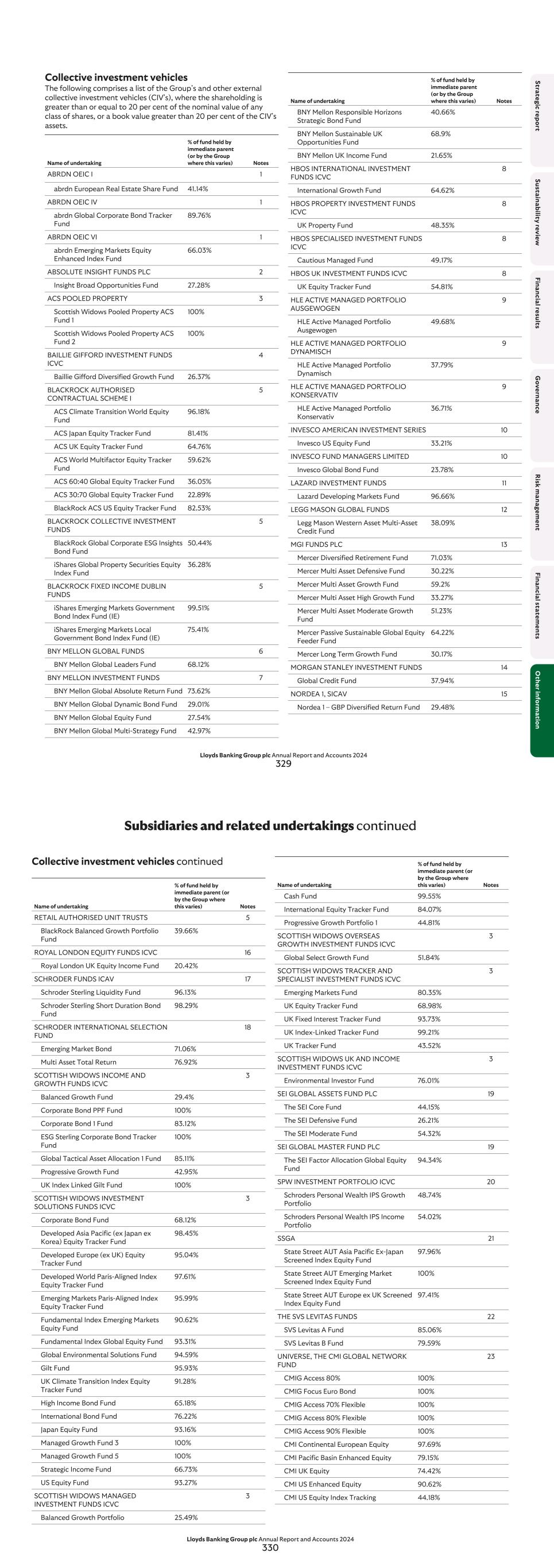
Collective investment vehicles The following comprises a list of the Group’s and other external collective investment vehicles (CIV’s), where the shareholding is greater than or equal to 20 per cent of the nominal value of any class of shares, or a book value greater than 20 per cent of the CIV’s assets. ABRDN OEIC I 1 abrdn European Real Estate Share Fund 41.14% ABRDN OEIC IV 1 abrdn Global Corporate Bond Tracker Fund 89.76% ABRDN OEIC VI 1 abrdn Emerging Markets Equity Enhanced Index Fund 66.03% ABSOLUTE INSIGHT FUNDS PLC 2 Insight Broad Opportunities Fund 27.28% ACS POOLED PROPERTY 3 Scottish Widows Pooled Property ACS Fund 1 100% Scottish Widows Pooled Property ACS Fund 2 100% BAILLIE GIFFORD INVESTMENT FUNDS ICVC 4 Baillie Gifford Diversified Growth Fund 26.37% BLACKROCK AUTHORISED CONTRACTUAL SCHEME I 5 ACS Climate Transition World Equity Fund 96.18% ACS Japan Equity Tracker Fund 81.41% ACS UK Equity Tracker Fund 64.76% ACS World Multifactor Equity Tracker Fund 59.62% ACS 60:40 Global Equity Tracker Fund 36.05% ACS 30:70 Global Equity Tracker Fund 22.89% BlackRock ACS US Equity Tracker Fund 82.53% BLACKROCK COLLECTIVE INVESTMENT FUNDS 5 BlackRock Global Corporate ESG Insights Bond Fund 50.44% iShares Global Property Securities Equity Index Fund 36.28% BLACKROCK FIXED INCOME DUBLIN FUNDS 5 iShares Emerging Markets Government Bond Index Fund (IE) 99.51% iShares Emerging Markets Local Government Bond Index Fund (IE) 75.41% BNY MELLON GLOBAL FUNDS 6 BNY Mellon Global Leaders Fund 68.12% BNY MELLON INVESTMENT FUNDS 7 BNY Mellon Global Absolute Return Fund 73.62% BNY Mellon Global Dynamic Bond Fund 29.01% BNY Mellon Global Equity Fund 27.54% BNY Mellon Global Multi-Strategy Fund 42.97% Name of undertaking % of fund held by immediate parent (or by the Group where this varies) Notes BNY Mellon Responsible Horizons Strategic Bond Fund 40.66% BNY Mellon Sustainable UK Opportunities Fund 68.9% BNY Mellon UK Income Fund 21.65% HBOS INTERNATIONAL INVESTMENT FUNDS ICVC 8 International Growth Fund 64.62% HBOS PROPERTY INVESTMENT FUNDS ICVC 8 UK Property Fund 48.35% HBOS SPECIALISED INVESTMENT FUNDS ICVC 8 Cautious Managed Fund 49.17% HBOS UK INVESTMENT FUNDS ICVC 8 UK Equity Tracker Fund 54.81% HLE ACTIVE MANAGED PORTFOLIO AUSGEWOGEN 9 HLE Active Managed Portfolio Ausgewogen 49.68% HLE ACTIVE MANAGED PORTFOLIO DYNAMISCH 9 HLE Active Managed Portfolio Dynamisch 37.79% HLE ACTIVE MANAGED PORTFOLIO KONSERVATIV 9 HLE Active Managed Portfolio Konservativ 36.71% INVESCO AMERICAN INVESTMENT SERIES 10 Invesco US Equity Fund 33.21% INVESCO FUND MANAGERS LIMITED 10 Invesco Global Bond Fund 23.78% LAZARD INVESTMENT FUNDS 11 Lazard Developing Markets Fund 96.66% LEGG MASON GLOBAL FUNDS 12 Legg Mason Western Asset Multi-Asset Credit Fund 38.09% MGI FUNDS PLC 13 Mercer Diversified Retirement Fund 71.03% Mercer Multi Asset Defensive Fund 30.22% Mercer Multi Asset Growth Fund 59.2% Mercer Multi Asset High Growth Fund 33.27% Mercer Multi Asset Moderate Growth Fund 51.23% Mercer Passive Sustainable Global Equity Feeder Fund 64.22% Mercer Long Term Growth Fund 30.17% MORGAN STANLEY INVESTMENT FUNDS 14 Global Credit Fund 37.94% NORDEA 1, SICAV 15 Nordea 1 – GBP Diversified Return Fund 29.48% Name of undertaking % of fund held by immediate parent (or by the Group where this varies) Notes Lloyds Banking Group plc Annual Report and Accounts 2024 329 l i ts 2 O th e r in fo rm a tio n R isk m a n a ge m e n t F in a n cia l re su lts S u sta in a b ility re vie w S tra te gic re p o rt G o ve rn a n ce F in a n cia l sta te m e n ts Collective investment vehicles continued RETAIL AUTHORISED UNIT TRUSTS 5 BlackRock Balanced Growth Portfolio Fund 39.66% ROYAL LONDON EQUITY FUNDS ICVC 16 Royal London UK Equity Income Fund 20.42% SCHRODER FUNDS ICAV 17 Schroder Sterling Liquidity Fund 96.13% Schroder Sterling Short Duration Bond Fund 98.29% SCHRODER INTERNATIONAL SELECTION FUND 18 Emerging Market Bond 71.06% Multi Asset Total Return 76.92% SCOTTISH WIDOWS INCOME AND GROWTH FUNDS ICVC 3 Balanced Growth Fund 29.4% Corporate Bond PPF Fund 100% Corporate Bond 1 Fund 83.12% ESG Sterling Corporate Bond Tracker Fund 100% Global Tactical Asset Allocation 1 Fund 85.11% Progressive Growth Fund 42.95% UK Index Linked Gilt Fund 100% SCOTTISH WIDOWS INVESTMENT SOLUTIONS FUNDS ICVC 3 Corporate Bond Fund 68.12% Developed Asia Pacific (ex Japan ex Korea) Equity Tracker Fund 98.45% Developed Europe (ex UK) Equity Tracker Fund 95.04% Developed World Paris-Aligned Index Equity Tracker Fund 97.61% Emerging Markets Paris-Aligned Index Equity Tracker Fund 95.99% Fundamental Index Emerging Markets Equity Fund 90.62% Fundamental Index Global Equity Fund 93.31% Global Environmental Solutions Fund 94.59% Gilt Fund 95.93% UK Climate Transition Index Equity Tracker Fund 91.28% High Income Bond Fund 65.18% International Bond Fund 76.22% Japan Equity Fund 93.16% Managed Growth Fund 3 100% Managed Growth Fund 5 100% Strategic Income Fund 66.73% US Equity Fund 93.27% SCOTTISH WIDOWS MANAGED INVESTMENT FUNDS ICVC 3 Balanced Growth Portfolio 25.49% Name of undertaking % of fund held by immediate parent (or by the Group where this varies) Notes Cash Fund 99.55% International Equity Tracker Fund 84.07% Progressive Growth Portfolio 1 44.81% SCOTTISH WIDOWS OVERSEAS GROWTH INVESTMENT FUNDS ICVC 3 Global Select Growth Fund 51.84% SCOTTISH WIDOWS TRACKER AND SPECIALIST INVESTMENT FUNDS ICVC 3 Emerging Markets Fund 80.35% UK Equity Tracker Fund 68.98% UK Fixed Interest Tracker Fund 93.73% UK Index-Linked Tracker Fund 99.21% UK Tracker Fund 43.52% SCOTTISH WIDOWS UK AND INCOME INVESTMENT FUNDS ICVC 3 Environmental Investor Fund 76.01% SEI GLOBAL ASSETS FUND PLC 19 The SEI Core Fund 44.15% The SEI Defensive Fund 26.21% The SEI Moderate Fund 54.32% SEI GLOBAL MASTER FUND PLC 19 The SEI Factor Allocation Global Equity Fund 94.34% SPW INVESTMENT PORTFOLIO ICVC 20 Schroders Personal Wealth IPS Growth Portfolio 48.74% Schroders Personal Wealth IPS Income Portfolio 54.02% SSGA 21 State Street AUT Asia Pacific Ex-Japan Screened Index Equity Fund 97.96% State Street AUT Emerging Market Screened Index Equity Fund 100% State Street AUT Europe ex UK Screened Index Equity Fund 97.41% THE SVS LEVITAS FUNDS 22 SVS Levitas A Fund 85.06% SVS Levitas B Fund 79.59% UNIVERSE, THE CMI GLOBAL NETWORK FUND 23 CMIG Access 80% 100% CMIG Focus Euro Bond 100% CMIG Access 70% Flexible 100% CMIG Access 80% Flexible 100% CMIG Access 90% Flexible 100% CMI Continental European Equity 97.69% CMI Pacific Basin Enhanced Equity 79.15% CMI UK Equity 74.42% CMI US Enhanced Equity 90.62% CMI US Equity Index Tracking 44.18% Name of undertaking % of fund held by immediate parent (or by the Group where this varies) Notes Subsidiaries and related undertakings continued Lloyds Banking Group plc Annual Report and Accounts 2024 330 l i ts
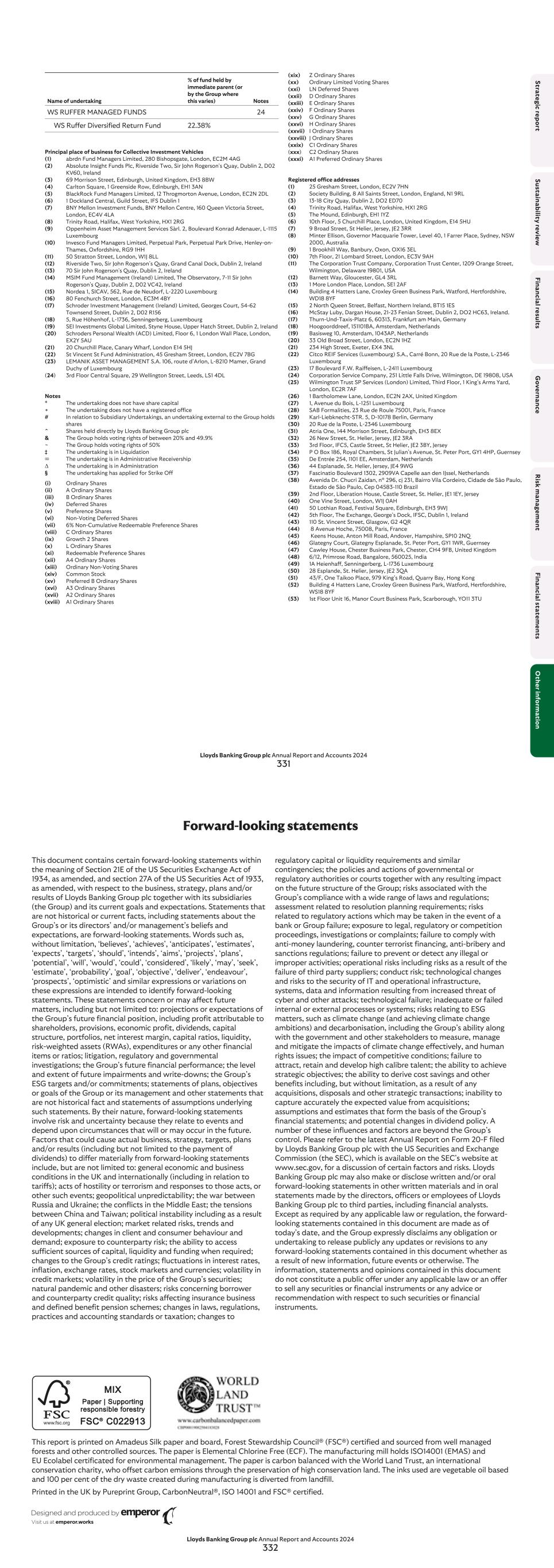
WS RUFFER MANAGED FUNDS 24 WS Ruffer Diversified Return Fund 22.38% Name of undertaking % of fund held by immediate parent (or by the Group where this varies) Notes Principal place of business for Collective Investment Vehicles (1) abrdn Fund Managers Limited, 280 Bishopsgate, London, EC2M 4AG (2) Absolute Insight Funds Plc, Riverside Two, Sir John Rogerson's Quay, Dublin 2, D02 KV60, Ireland (3) 69 Morrison Street, Edinburgh, United Kingdom, EH3 8BW (4) Carlton Square, 1 Greenside Row, Edinburgh, EH1 3AN (5) BlackRock Fund Managers Limited, 12 Throgmorton Avenue, London, EC2N 2DL (6) 1 Dockland Central, Guild Street, IFS Dublin 1 (7) BNY Mellon Investment Funds, BNY Mellon Centre, 160 Queen Victoria Street, London, EC4V 4LA (8) Trinity Road, Halifax, West Yorkshire, HX1 2RG (9) Oppenheim Asset Management Services Sàrl. 2, Boulevard Konrad Adenauer, L-1115 Luxembourg (10) Invesco Fund Managers Limited, Perpetual Park, Perpetual Park Drive, Henley-on- Thames, Oxfordshire, RG9 1HH (11) 50 Stratton Street, London, W1J 8LL (12) Riverside Two, Sir John Rogerson’s Quay, Grand Canal Dock, Dublin 2, Ireland (13) 70 Sir John Rogerson's Quay, Dublin 2, Ireland (14) MSIM Fund Management (Ireland) Limited, The Observatory, 7-11 Sir John Rogerson's Quay, Dublin 2, D02 VC42, Ireland (15) Nordea 1, SICAV, 562, Rue de Neudorf, L-2220 Luxembourg (16) 80 Fenchurch Street, London, EC3M 4BY (17) Schroder Investment Management (Ireland) Limited, Georges Court, 54-62 Townsend Street, Dublin 2, D02 R156 (18) 5, Rue Höhenhof, L-1736, Senningerberg, Luxembourg (19) SEI Investments Global Limited, Styne House, Upper Hatch Street, Dublin 2, Ireland (20) Schroders Personal Wealth (ACD) Limited, Floor 6, 1 London Wall Place, London, EX2Y 5AU (21) 20 Churchill Place, Canary Wharf, London E14 5HJ (22) St Vincent St Fund Administration, 45 Gresham Street, London, EC2V 7BG (23) LEMANIK ASSET MANAGEMENT S.A. 106, route d’Arlon, L-8210 Mamer, Grand Duchy of Luxembourg (24) 3rd Floor Central Square, 29 Wellington Street, Leeds, LS1 4DL Notes * The undertaking does not have share capital + The undertaking does not have a registered office # In relation to Subsidiary Undertakings, an undertaking external to the Group holds shares ^ Shares held directly by Lloyds Banking Group plc & The Group holds voting rights of between 20% and 49.9% ~ The Group holds voting rights of 50% ‡ The undertaking is in Liquidation ∞ The undertaking is in Administrative Receivership Δ The undertaking is in Administration § The undertaking has applied for Strike Off (i) Ordinary Shares (ii) A Ordinary Shares (iii) B Ordinary Shares (iv) Deferred Shares (v) Preference Shares (vi) Non-Voting Deferred Shares (vii) 6% Non-Cumulative Redeemable Preference Shares (viii) C Ordinary Shares (ix) Growth 2 Shares (x) L Ordinary Shares (xi) Redeemable Preference Shares (xii) A4 Ordinary Shares (xiii) Ordinary Non-Voting Shares (xiv) Common Stock (xv) Preferred B Ordinary Shares (xvi) A3 Ordinary Shares (xvii) A2 Ordinary Shares (xviii) A1 Ordinary Shares (xix) Z Ordinary Shares (xx) Ordinary Limited Voting Shares (xxi) LN Deferred Shares (xxii) D Ordinary Shares (xxiii) E Ordinary Shares (xxiv) F Ordinary Shares (xxv) G Ordinary Shares (xxvi) H Ordinary Shares (xxvii) I Ordinary Shares (xxviii) J Ordinary Shares (xxix) C1 Ordinary Shares (xxx) C2 Ordinary Shares (xxxi) A1 Preferred Ordinary Shares Registered office addresses (1) 25 Gresham Street, London, EC2V 7HN (2) Society Building, 8 All Saints Street, London, England, N1 9RL (3) 13-18 City Quay, Dublin 2, DO2 ED70 (4) Trinity Road, Halifax, West Yorkshire, HX1 2RG (5) The Mound, Edinburgh, EH1 1YZ (6) 10th Floor, 5 Churchill Place, London, United Kingdom, E14 5HU (7) 9 Broad Street, St Helier, Jersey, JE2 3RR (8) Minter Ellison, Governor Macquarie Tower, Level 40, 1 Farrer Place, Sydney, NSW 2000, Australia (9) 1 Brookhill Way, Banbury, Oxon, OX16 3EL (10) 7th Floor, 21 Lombard Street, London, EC3V 9AH (11) The Corporation Trust Company, Corporation Trust Center, 1209 Orange Street, Wilmington, Delaware 19801, USA (12) Barnett Way, Gloucester, GL4 3RL (13) 1 More London Place, London, SE1 2AF (14) Building 4 Hatters Lane, Croxley Green Business Park, Watford, Hertfordshire, WD18 8YF (15) 2 North Queen Street, Belfast, Northern Ireland, BT15 1ES (16) McStay Luby, Dargan House, 21-23 Fenian Street, Dublin 2, DO2 HC63, Ireland. (17) Thurn-Und-Taxis-Platz 6, 60313, Frankfurt am Main, Germany (18) Hoogoorddreef, 151101BA, Amsterdam, Netherlands (19) Basisweg 10, Amsterdam, 1043AP, Netherlands (20) 33 Old Broad Street, London, EC2N 1HZ (21) 234 High Street, Exeter, EX4 3NL (22) Citco REIF Services (Luxembourg) S.A., Carré Bonn, 20 Rue de la Poste, L-2346 Luxembourg (23) 17 Boulevard F.W. Raiffeisen, L-2411 Luxembourg (24) Corporation Service Company, 251 Little Falls Drive, Wilmington, DE 19808, USA (25) Wilmington Trust SP Services (London) Limited, Third Floor, 1 King’s Arms Yard, London, EC2R 7AF (26) 1 Bartholomew Lane, London, EC2N 2AX, United Kingdom (27) 1, Avenue du Bois, L-1251 Luxembourg (28) SAB Formalities, 23 Rue de Roule 75001, Paris, France (29) Karl-Liebknecht-STR. 5, D-10178 Berlin, Germany (30) 20 Rue de la Poste, L-2346 Luxembourg (31) Atria One, 144 Morrison Street, Edinburgh, EH3 8EX (32) 26 New Street, St. Helier, Jersey, JE2 3RA (33) 3rd Floor, IFC5, Castle Street, St Helier, JE2 3BY, Jersey (34) P O Box 186, Royal Chambers, St Julian’s Avenue, St. Peter Port, GY1 4HP, Guernsey (35) De Entrée 254, 1101 EE, Amsterdam, Netherlands (36) 44 Esplanade, St. Helier, Jersey, JE4 9WG (37) Fascinatio Boulevard 1302, 2909VA Capelle aan den IJssel, Netherlands (38) Avenida Dr. Chucri Zaidan, n° 296, cj 231, Bairro Vila Cordeiro, Cidade de São Paulo, Estado de São Paulo, Cep 04583-110 Brazil (39) 2nd Floor, Liberation House, Castle Street, St. Helier, JE1 1EY, Jersey (40) One Vine Street, London, W1J 0AH (41) 50 Lothian Road, Festival Square, Edinburgh, EH3 9WJ (42) 5th Floor, The Exchange, George’s Dock, IFSC, Dublin 1, Ireland (43) 110 St. Vincent Street, Glasgow, G2 4QR (44) 8 Avenue Hoche, 75008, Paris, France (45) Keens House, Anton Mill Road, Andover, Hampshire, SP10 2NQ (46) Glategny Court, Glategny Esplanade, St. Peter Port, GY1 1WR, Guernsey (47) Cawley House, Chester Business Park, Chester, CH4 9FB, United Kingdom (48) 6/12, Primrose Road, Bangalore, 560025, India (49) 1A Heienhaff, Senningerberg, L-1736 Luxembourg (50) 28 Esplande, St. Helier, Jersey, JE2 3QA (51) 43/F, One Taikoo Place, 979 King’s Road, Quarry Bay, Hong Kong (52) Building 4 Hatters Lane, Croxley Green Business Park, Watford, Hertfordshire, WS18 8YF (53) 1st Floor Unit 16, Manor Court Business Park, Scarborough, YO11 3TU Lloyds Banking Group plc Annual Report and Accounts 2024 331 l i ts 2 O th e r in fo rm a tio n R isk m a n a ge m e n t F in a n cia l re su lts S u sta in a b ility re vie w S tra te gic re p o rt G o ve rn a n ce F in a n cia l sta te m e n ts This document contains certain forward-looking statements within the meaning of Section 21E of the US Securities Exchange Act of 1934, as amended, and section 27A of the US Securities Act of 1933, as amended, with respect to the business, strategy, plans and/or results of Lloyds Banking Group plc together with its subsidiaries (the Group) and its current goals and expectations. Statements that are not historical or current facts, including statements about the Group’s or its directors’ and/or management’s beliefs and expectations, are forward-looking statements. Words such as, without limitation, ‘believes’, ‘achieves’, ‘anticipates’, ‘estimates’, ‘expects’, ‘targets’, ‘should’, ‘intends’, ‘aims’, ‘projects’, ‘plans’, ‘potential’, ‘will’, ‘would’, ‘could’, ‘considered’, ‘likely’, ‘may’, ‘seek’, ‘estimate’, ‘probability’, ‘goal’, ‘objective’, ‘deliver’, ‘endeavour’, ‘prospects’, ‘optimistic’ and similar expressions or variations on these expressions are intended to identify forward-looking statements. These statements concern or may affect future matters, including but not limited to: projections or expectations of the Group’s future financial position, including profit attributable to shareholders, provisions, economic profit, dividends, capital structure, portfolios, net interest margin, capital ratios, liquidity, risk-weighted assets (RWAs), expenditures or any other financial items or ratios; litigation, regulatory and governmental investigations; the Group’s future financial performance; the level and extent of future impairments and write-downs; the Group’s ESG targets and/or commitments; statements of plans, objectives or goals of the Group or its management and other statements that are not historical fact and statements of assumptions underlying such statements. By their nature, forward-looking statements involve risk and uncertainty because they relate to events and depend upon circumstances that will or may occur in the future. Factors that could cause actual business, strategy, targets, plans and/or results (including but not limited to the payment of dividends) to differ materially from forward-looking statements include, but are not limited to: general economic and business conditions in the UK and internationally (including in relation to tariffs); acts of hostility or terrorism and responses to those acts, or other such events; geopolitical unpredictability; the war between Russia and Ukraine; the conflicts in the Middle East; the tensions between China and Taiwan; political instability including as a result of any UK general election; market related risks, trends and developments; changes in client and consumer behaviour and demand; exposure to counterparty risk; the ability to access sufficient sources of capital, liquidity and funding when required; changes to the Group’s credit ratings; fluctuations in interest rates, inflation, exchange rates, stock markets and currencies; volatility in credit markets; volatility in the price of the Group’s securities; natural pandemic and other disasters; risks concerning borrower and counterparty credit quality; risks affecting insurance business and defined benefit pension schemes; changes in laws, regulations, practices and accounting standards or taxation; changes to regulatory capital or liquidity requirements and similar contingencies; the policies and actions of governmental or regulatory authorities or courts together with any resulting impact on the future structure of the Group; risks associated with the Group’s compliance with a wide range of laws and regulations; assessment related to resolution planning requirements; risks related to regulatory actions which may be taken in the event of a bank or Group failure; exposure to legal, regulatory or competition proceedings, investigations or complaints; failure to comply with anti-money laundering, counter terrorist financing, anti-bribery and sanctions regulations; failure to prevent or detect any illegal or improper activities; operational risks including risks as a result of the failure of third party suppliers; conduct risk; technological changes and risks to the security of IT and operational infrastructure, systems, data and information resulting from increased threat of cyber and other attacks; technological failure; inadequate or failed internal or external processes or systems; risks relating to ESG matters, such as climate change (and achieving climate change ambitions) and decarbonisation, including the Group’s ability along with the government and other stakeholders to measure, manage and mitigate the impacts of climate change effectively, and human rights issues; the impact of competitive conditions; failure to attract, retain and develop high calibre talent; the ability to achieve strategic objectives; the ability to derive cost savings and other benefits including, but without limitation, as a result of any acquisitions, disposals and other strategic transactions; inability to capture accurately the expected value from acquisitions; assumptions and estimates that form the basis of the Group’s financial statements; and potential changes in dividend policy. A number of these influences and factors are beyond the Group’s control. Please refer to the latest Annual Report on Form 20-F filed by Lloyds Banking Group plc with the US Securities and Exchange Commission (the SEC), which is available on the SEC’s website at www.sec.gov, for a discussion of certain factors and risks. Lloyds Banking Group plc may also make or disclose written and/or oral forward-looking statements in other written materials and in oral statements made by the directors, officers or employees of Lloyds Banking Group plc to third parties, including financial analysts. Except as required by any applicable law or regulation, the forward- looking statements contained in this document are made as of today’s date, and the Group expressly disclaims any obligation or undertaking to release publicly any updates or revisions to any forward-looking statements contained in this document whether as a result of new information, future events or otherwise. The information, statements and opinions contained in this document do not constitute a public offer under any applicable law or an offer to sell any securities or financial instruments or any advice or recommendation with respect to such securities or financial instruments. This report is printed on Amadeus Silk paper and board, Forest Stewardship Council® (FSC®) certified and sourced from well managed forests and other controlled sources. The paper is Elemental Chlorine Free (ECF). The manufacturing mill holds ISO14001 (EMAS) and EU Ecolabel certificated for environmental management. The paper is carbon balanced with the World Land Trust, an international conservation charity, who offset carbon emissions through the preservation of high conservation land. The inks used are vegetable oil based and 100 per cent of the dry waste created during manufacturing is diverted from landfill. Printed in the UK by Pureprint Group, CarbonNeutral®, ISO 14001 and FSC® certified. Forward-looking statements Lloyds Banking Group plc Annual Report and Accounts 2024 332 l i ts

Head office 25 Gresham Street, London EC2V 7HN +44 (0)20 7626 1500 www.lloydsbankinggroup.com Registered office The Mound, Edinburgh EH1 1YZ Registered in Scotland no. SC095000 Llo yd s B an k in g G ro u p p lc A nnual R ep o rt an d A cco un ts 20 24

Llo yd s B an k in g G ro u p p lc A nnual R ep o rt an d A cco un ts 20 24