UNITED
STATES SECURITIES AND EXCHANGE COMMISSION
Washington, D.C. 20549
FORM
OR
OR
OR
Commission
File Number:
BANCO BRADESCO S.A.
(Exact name of Registrant as specified in its charter)
(Translation of Registrant’s name into English)
Federative Republic of Brazil
(Jurisdiction of incorporation or organization)
(Address of principal executive offices)
E-mail:
Telephone:
(Name, telephone, e-mail and/or facsimile number and address of company contact person)
Securities registered or to be registered pursuant to Section 12(b) of the Act:
| Title of each class | Trading symbol(s) | Name of each exchange on which registered |
| , or ADSs (evidenced by American Depositary Receipts, or ADRs), each representing 1 preferred share | ||
| Preferred Shares | New York Stock Exchange* | |
| , or ADSs (evidenced by American Depositary Receipts, or ADRs), each representing 1 common share | ||
| Common Shares | New York Stock Exchange* |
*Not for trading, but only in connection with the registration of ADSs pursuant to the requirements of the SEC.
Securities registered or to be registered pursuant to Section 12(g) of the Act: None.
Securities for which there is a reporting obligation pursuant to Section 15(d) of the Act: None.
Indicate the number of outstanding shares of each of the issuer’s classes of capital or common stock as of December 31, 2025:
| Common Shares, without par value | |
| Preferred Shares, without par value |
Indicate
by check mark if the registrant is a well-known seasoned issuer, as defined in Rule 405 of the Securities Act. ☒
If
this report is an annual or transition report, indicate by check mark if the registrant is not required to file reports pursuant to Section
13 or 15(d) of the Securities Exchange Act of 1934 from their obligations under those Sections. ☐ Yes ☒
Indicate
by check mark whether the registrant (1) has filed all reports required to be filed by Section 13 or 15(d) of the Securities Exchange
Act of 1934 during the preceding 12 months (or for such shorter period that the registrant was required to file such reports), and (2)
has been subject to such filing requirements for the past 90 days. ☒
Indicate
by check mark whether the registrant has submitted electronically every Interactive Data File required to be submitted pursuant to Rule
405 of Regulation S-T (§232.405 of this chapter) during the preceding 12 months (or for such shorter period that the registrant was
required to submit such files). ☒
Indicate by check mark whether the registrant is a large accelerated filer, an accelerated filer, a non-accelerated filer, or an emerging growth company. See definition of “large accelerated filer”, “accelerated filer” and emerging growth company” in Rule 12b 2 of the Exchange Act:
|
|
Accelerated filer ☐ |
Non-accelerated filer ☐ |
Emerging
Growth Company |
If an emerging growth company that prepares its financial statements in accordance with U.S. GAAP, indicate by check mark if the registrant has elected not to use the extended transition period for complying with any new or revised financial accounting standards, provided pursuant to Section 13(a) of the Exchange Act. ☐
The term “new or revised financial accounting standards” refers to any update issued by the Financial Accounting Standards Board to its Accounting Standards Codification after April 5, 2012.
Indicate
by check mark whether the registrant has filed a report on and attestation to its management’s assessment of the effectiveness of
its internal control over financial reporting under Section 404(b) of the Sarbanes-Oxley Act (15 U.S.C. 7262(b)) by the registered public
accounting firm that prepared or issued its audit report.☒
If
securities are registered pursuant to Section 12(b) of the Act, indicate by check mark whether the financial statements of the registrant
included in the filing reflect the correction of an error to previously issued financial statements.
Indicate by check mark whether any of those error corrections are restatements that required a recovery analysis of incentive-based compensation received by any of the registrant’s executive officers during the relevant recovery period pursuant to §240.10D-1(b). ☐
Indicate by check mark which basis of accounting the registrant has used to prepare the financial statements included in this filing:
| U.S. GAAP ☐ | Other ☐ |
If “Other” has been checked in response to the previous question, indicate by check mark which financial statement item the registrant has elected to follow.☐ Item 17 ☐ Item 18
If
this is an annual report, indicate by check mark whether the registrant is a shell company (as defined in Rule 12b 2 of the Exchange Act).☐ Yes
TABLE OF CONTENTS
2 – Form 20-F 2025 | Bradesco |
3 – Form 20-F 2025 | Bradesco |
PRESENTATION OF FINANCIAL AND OTHER INFORMATION
In this annual report, the terms “Bradesco”, “Company”, “Bank”, “Bradesco Group”, “we”, “Group”, “our” and “us” refer to Banco Bradesco S.A. and, unless otherwise indicated, we are referring to its consolidated subsidiaries.
All references herein to “real”, “reais” or “R$” refer to the Brazilian Real, the official currency of Brazil. References herein to “U.S. dollars”, “dollar”, “USD” or “US$” refer to United States dollars, the official currency of the United States of America (USA).
Our audited consolidated statement of financial position as of December 31, 2025 and 2024, as well as the related consolidated statements of income, comprehensive income, changes in equity and cash flows for each of the years in the three-year period ended December 31, 2025, and the related notes, are included under “Item 18. Financial Statements” of this annual report, were prepared in accordance with International Financial Reporting Standards Accounting Standards as issued by the International Accounting Standards Board (IFRS Accounting Standards).
We use accounting practices adopted in Brazil for institutions authorized to operate by the Central Bank of Brazil (Banco Central do Brasil, or the “Central Bank of Brazil” or BCB) for certain purposes, such as performance assessment, decision-making, preparation of reports for Brazilian shareholders, filings with the Brazilian Securities and Exchange Commission (CVM), attendance and observation of limits and requirements of local regulators and determining dividend and federal income tax payments.
The information presented in this annual report is accurate only with respect to the date it relates to or the date of issue of this report, as applicable. Since then, our activities, financial and equity situation, operational income and prospects may have changed.
In addition, some data related to economic sectors presented in this annual report was obtained from the following sources: B3 S.A. – Brazilian Exchange & OTC; Brazilian Association of Credit Card Companies and Services (Associação Brasileira das Empresas de Cartão de Crédito e Serviços), or (ABECS); Brazilian Association of Leasing Companies (Associação Brasileira de Empresas de Leasing), or (ABEL); Brazilian Association of Financial and Capital Markets Entities (Associação Brasileira das Entidades dos Mercados Financeiros e de Capitais), or (ANBIMA); Brazilian Health Insurance Authority (Agência Nacional de Saúde Suplementar), or (ANS); (Banco Central do Brasil, or the “Central Bank of Brazil” or BCB); Brazilian Bank of Economic and Social Development (Banco Nacional de Desenvolvimento Econômico e Social), or (BNDES); National Association of Private Pension Plans and Life (Federação Nacional de Previdência Privada e Vida), or (FENAPREVI); Fundação Getulio Vargas (FGV); Private Insurance Superintendence (Superintendência de Seguros Privados), or (SUSEP); and National Private Insurance Council (Conselho Nacional de Seguros Privados), or (CNSP).
Certain figures included in this annual report have been subject to rounding adjustments. Accordingly, figures shown as totals in certain tables may not be an arithmetic aggregation of the figures that precede them.
References in this annual report to the “common shares” and “preferred shares” are to our common shares and our preferred shares, respectively, and together, our “shares”. References to “preferred share ADSs” in this annual report are to preferred share American Depositary Shares, each representing one preferred share. The preferred share ADSs are evidenced by preferred share American Depositary Receipts, or preferred share ADRs, issued pursuant to an Amended and Restated Deposit Agreement, dated as of December 11, 2015, by and among us, The Bank of New York Mellon, as depositary, and the holders and beneficial owners of preferred share ADSs evidenced by preferred share ADRs issued thereunder (the “Preferred Share ADS Deposit Agreement”).
References to “common share ADSs” in this annual report are related to our common share American Depositary Shares, with each common share ADS representing one common share. The common share ADSs are evidenced by common share American Depositary Receipts, or common share ADRs, issued pursuant to an Amended and Restated Deposit Agreement dated as of December 11, 2015, by and among us, The Bank of New York Mellon, as depositary, and the holders and beneficial owners of common share ADSs evidenced by common share ADRs issued thereunder (the “Common Share ADS Deposit Agreement” and, together with the Preferred Share ADS Deposit Agreement, the “Deposit Agreements”).
References throughout this annual report to “ADSs” are to our preferred share ADSs and common share ADSs, together.
4 – Form 20-F 2025 | Bradesco |
References throughout this annual report to “ADRs” are to our preferred share ADRs and common share ADRs, together.
Throughout this annual report, we may indicate that certain information is available at different websites operated by us. None of the information on the websites referred to or mentioned in this annual report is part of or is incorporated by reference herein.
FORWARD-LOOKING STATEMENTS
This annual report contains forward-looking statements as defined in Section 27A of the Securities Act of 1933, as amended (the “Securities Act”), and Section 21E of the Securities Exchange Act of 1934, as amended ( “Exchange Act”). These statements are based mainly on our current expectations and projections of future events and financial trends that affect or might affect our business. In addition to the items discussed in other sections of this annual report, many significant factors that could cause our financial condition and operating results to differ materially from those set out in our forward-looking statements, including, but not limited to, the following:
· Instability in Brazilian macroeconomic conditions, together with the related political, economic and business uncertainties;
· Global political conditions and geopolitical instability, in particular the countries where we operate, including geopolitical tensions, hostilities and conflicts;
· Global economic conditions, including increased tariffs, trade restrictions and the imposition (or threat) of sanctions and other conditions affecting cross-border trade and economic indicators;
· Inflation, value of the real in relation to the U.S. dollar, and/or interest rate fluctuations, which may adversely affect our margins;
· Risks of lending, credit, investments and our activities;
· Our level of capitalization;
· Cost and availability of funding;
· Increases in defaults by borrowers, loan and other delinquencies, which result in increases in the allowance for loan losses;
· Client losses or losses of other sources of revenues;
· Changes in laws and regulations, including by the Central Bank, applicable to us and our activities, and including, among others, those affecting tax matters and reserve requirements;
· Our ability to execute our investment strategies and capital expenditure plans and to maintain and improve our operating performance;
· Fluctuations in our revenues from new products and businesses;
· Unfavorable decisions on legal or regulatory disputes or proceedings;
· The effectiveness of our risk management policies;
· Increases in compulsory deposits and reserve requirements;
· Incorrect pricing methodologies for insurance, pension plan and capitalization bond products and inadequate technical provisions in connection with each;
· Competitive conditions in the banking, financial, credit card, payment solutions, asset management and insurance sectors and related industries;
· Any failures in, or breaches of, our operational, security or technology systems and any failure to protect personal data;
· The fair value of securities, particularly of Brazilian government securities;
5 – Form 20-F 2025 | Bradesco |
· Environmental damage, climate change and socio-economic issues, including increasingly severe weather events, the imposition of new or more stringent legislation;
· Global force majeure events, such as the COVID-19 pandemic, other pandemics or similar diseases, and our ability to, in a timely and efficient manner, anticipate and respond to, or reduce the impacts of such events on our business, operations, cash flow, prospects, liquidity and financial condition;
· Effects from socio-environmental issues, including new and/or more stringent regulations relating to these issues; and
· Other risk factors exposed in “Item 3.D. Risk Factors”.
Words such as “believe”, “expect”, “continue”, “understand”, “estimate”, “will”, “may”, “anticipate”, “should”, “intend”, and other similar expressions identify forward-looking statements. These statements refer only to the date on which they were made, and we undertake no obligation to publicly update or revise any forward-looking statements, whether as a result of new information or any other event.
In light of these risks and uncertainties, the forward-looking statements, events and circumstances discussed in this annual report may not be accurate, and our actual results and performance could differ materially from those anticipated in our forward-looking statements. Investors should not make investment decisions based solely on the forward-looking statements in this annual report.
PART I
ITEM 1. IDENTITY OF DIRECTORS, SENIOR MANAGEMENT AND ADVISERS
Not applicable.
ITEM 2. OFFER STATISTICS AND EXPECTED TIMETABLE
Not applicable.
ITEM 3. KEY INFORMATION
3.A. [Reserved]
3.B. Capitalization and Indebtedness
Not applicable.
3.C. Reasons for the Offer and Use of Proceeds
Not applicable.
3.D. Risk Factors
In light of the complexity of our business and the range of products and services offered to our clients in all segments of the market, we are exposed to various types of risks. In this section, we present the material risks that may affect our activities or our shares and ADSs.
Summary of risk factors
This section is intended to be a summary of more detailed discussions contained elsewhere in this annual report.
6 – Form 20-F 2025 | Bradesco |
Our business, operating results, financial conditions or investments made in our shares and ADSs may be harmed if any of these risks materialize. Moreover, the risks described below are not the only ones we face. Other risks and uncertainties not yet known on the date of this report, or which are considered immaterial today, may also affect us negatively.
Summary of risks relating to Brazil
| · | The Brazilian government exercises influence over the Brazilian economy, and Brazilian political and economic conditions have a direct impact on our business. |
| · | The inflation can affect our revenues and our ability to access foreign financial markets. |
| · | Changes in the base interest rate (SELIC) by the Central Bank of Brazil may materially and/or adversely affect our margins and operating results. |
| · | The low growth rate of the Brazilian economy may adversely affect us. |
| · | Developments and the perception of risk in Brazil and other countries, especially emerging market countries, may adversely affect the market price of Brazilian securities, including our shares and ADSs. |
| · | Our investments in debt securities issued by the Brazilian government expose us to additional risks associated with Brazil. |
| · | Changes in taxes and other fiscal assessments may adversely affect us. |
| · | Our financial and operating performance may be adversely affected by epidemics, natural disasters and other catastrophes. |
| · | Currency exchange rate variations may have an adverse effect on the Brazilian economy and on our results and our financial condition. |
| · | Changes in international interest rates could adversely impact global economic or market conditions and, consequently, affect our activities and results. |
| · | Geopolitical conflicts and trade disputes may generate widespread uncertainties, significantly impacting business relationships, investor risk appetite and the price of certain assets, especially commodities, generating instabilities that can affect our activities and, consequently, our results. |
Summary of risks relating to us and the Brazilian banking industry
| · | Our trading activities and derivative transactions, as well as our investments in financial assets measured at fair value, can be volatile and result in significant financial losses, adversely impacting our operating results. |
| · | We may experience increases in the level of past due loans made to our clients, as our portfolio of loans and advances becomes more seasoned. |
| · | We may incur losses associated with counterparty risk exposure. |
| · | We may face significant challenges in gaining possession of, and realizing value from, collateral with respect to loans in default. |
| · | We may incur losses due to impairment of goodwill from acquired businesses. |
| · | A downgrade of our ratings may adversely affect our funding cost, our access to capital and debt markets, our liquidity and, as a result, our competitive position. |
| · | Adverse conditions in the global credit and capital markets, as well as the value and/or perception of the value of Brazilian government securities, may adversely affect our ability to access funding in a cost-effective and/or timely manner. |
| · | Changes in regulations regarding reserve and compulsory deposit requirements may reduce operating margins. |
7 – Form 20-F 2025 | Bradesco |
| · | Adverse developments affecting the financial services industry, such as events or concerns involving liquidity, defaults, or non-performance by financial institutions or transactional counterparties, could adversely affect our ability to finance our assets. |
| · | Our losses in connection with insurance claims may vary from time to time. Differences between the losses from actual claims and underwriting and reserving assumptions and the related insurance liabilities may have an adverse effect on us. |
| · | We are responsible for claims of our clients if our reinsurers fail to meet their obligations under the reinsurance contracts. |
| · | A failure in, or breach of, our operational, security or technological infrastructure and systems, or those of our suppliers, could temporarily interrupt our businesses and cause losses. |
| · | The loss of members of senior management, or our ability to attract and maintain key personnel, could have a material adverse effect on us. |
| · | Financial institutions, like us, may be subject to legal proceedings arising due to certain actions by third parties related to corruption, money laundering and terrorism financing (ML/TF). |
| · | Third parties may use us for criminal activities without our knowledge, which could expose us to additional liability and could have a material adverse effect on us. |
| · | We may suffer losses due to employee misconduct. |
| · | The Brazilian government regulates the operations of Brazilian financial institutions and insurance companies. Changes in existing laws and regulations or the imposition of new laws and regulations may negatively affect our operations and revenues. |
| · | We are subject to regulation on an individual and a consolidated basis and may be subject to liquidation or intervention on a consolidated basis. |
| · | The Brazilian Constitution previously established a ceiling on loan interest rates. If the Brazilian government enacts new legislation with similar effects in the future, our operating results may be adversely affected. |
| · | Any substantial increase or decrease in the interest rate ceiling could have a material effect on our financial condition, our operating results or on the prospects of financial institutions based in Brazil, including us. |
| · | We may incur penalties in case of non-compliance with data protection laws. |
| · | We remain subject to residual risks of losses relating to inflation-adjustment claims (“expurgos inflacionários”) associated with savings accounts in Brazil. Although the STF upheld the constitutionality of the Bresser, Verão, Collor I and Collor II economic plans, we are still exposed to expected costs and expenses arising from adhesions to the court-approved collective settlement and from remaining ongoing lawsuits. |
| · | As the regulatory framework for artificial intelligence and machine learning technology evolves, our business, financial condition and operating results may be adversely affected. |
| · | The increasingly competitive environment in the Brazilian banking and insurance segments may have a negative impact on our business prospects. |
| · | Potential need to provide financial support for related entities, either due to insufficient capital and/or liquidity, relevant operational problems and dependence on services rendered by suppliers/partners may negatively impact our business performance. |
| · | Failure to adequately protect ourselves against risks relating to cybersecurity could materially and adversely affect us. |
8 – Form 20-F 2025 | Bradesco |
| · | We provide financings for projects carried out by clients which may result in negative socio-environmental impacts which, in turn, could negatively affect our operating results and reputation. |
| · | Climate change may have adverse effects on our business. |
| · | Damage to our reputation could harm our business and outlook. |
| · | We may make non-optimal business decisions due to flawed/deficient models, or inappropriate use of those models. |
Summary of risks relating to our risk management and other risks
| · | Our risk management structure may not be fully effective. |
| · | A majority of our common shares are held, directly and indirectly, by one shareholder. Our Board of Directors is composed of 11 members, of whom four are independent members. As a result, the non-independent members may have interests that conflict with the interests of our other investors. |
Summary of risks relating to our shares, preferred share ADSs and common share ADSs
| · | The Deposit Agreements governing the ADSs provide that holders of the ADSs will only receive voting instructions if we authorize the depositary bank to contact those holders to establish voting instructions; and there are practical limitations we may give such holders on any ability to vote. |
| · | Under Brazilian Corporate Law, preferred shareholders have limited voting rights; accordingly, preferred share ADS holders will have similar limitations on their ability to vote. |
| · | The relative volatility and low liquidity of the Brazilian securities markets may substantially limit your ability to sell shares underlying the ADSs at the price and time you desire. |
| · | If we do not pay dividends to holders of our common shares and preferred shares, no dividends will be paid to holders of ADSs. |
| · | As an ADS holder you will have fewer and less well-defined shareholders’ rights than in the United States and certain other jurisdictions. |
| · | It may be difficult to bring civil liability causes against us or our directors and executive officers outside of Brazil. |
| · | If we issue new shares or our shareholders sell shares in the future, the market price of your ADSs may be reduced. |
| · | The payments on the ADSs may be subject to U.S. withholding under the Foreign Account Tax Compliance Act (“FATCA”). |
| · | You may be unable to exercise preemptive rights relating to our shares. |
| · | If you exchange your ADSs for their underlying shares, you risk losing Brazilian tax advantages and the ability to remit foreign currency abroad. |
| · | Relevant local insolvency laws may not be as favorable to you as bankruptcy laws in the jurisdictions with which you are familiar. |
9 – Form 20-F 2025 | Bradesco |
Risks relating to Brazil
3.D.10 Macroeconomic risks
We continually monitor the macroeconomic risks that may materially impact our business, financial condition and operating results. These risks are assessed by processes carried out in line with our governance structure.
3.D.10.01 Domestic environment
3.D.10.01-01 The Brazilian government exercises influence over the Brazilian economy, and Brazilian political and economic conditions have a direct impact on our business.
Investing in emerging market countries such as Brazil carries economic risks. Volatility in Latin American and other emerging market economies has been caused by many different factors, including high interest rates, changes in currency values, high levels of inflation, exchange controls, wage and price controls, changes in economic or tax policies, the imposition of trade barriers, and internal security issues. Any of these factors may adversely affect the value of our shares and ADSs.
Abrupt changes in monetary or fiscal policies may generate uncertainties about economic policy, leading to a deterioration in expectations, increasing volatility and negatively impacting the prices of domestic assets. Accordingly, economic policies and signals that are consistent and transparent tend to keep macroeconomic volatility at low levels. In any case, we have no control over and cannot predict the measures and policies that may be adopted in, the future.
Historically, Brazil’s political scenario has influenced the performance of the Brazilian economy and political crises have affected the confidence of investors and the general public, which, in recent years, has resulted in a deceleration in the economy and greater volatility in the securities of Brazilian companies issued abroad. Uncertainties about economic policies, especially fiscal policies, may generate negative impacts on the prices of domestic assets, such as currency depreciation, increases in long-term interest rates and inflation and volatility of stock exchanges. In addition, uncertainty about the economic policies that the Brazilian government may adopt may influence market perception of risk of foreign investment in Brazil, which in turn may adversely affect the market value of our shares and ADSs.
Furthermore, legislative changes may have an adverse impact on our operations, performance, our business, financial condition and operating results. For more information on legislative changes, especially changes in tax-related laws and regulations, see “3.D.10.01-07 Changes in taxes and other fiscal assessments may adversely affect us”.
Uncertainty regarding economic and fiscal policies and the legal framework can harm the Brazilian economy and, consequently, our business, operating results and financial condition.
3.D.10.01-02 Inflation can affect our revenues and our ability to access foreign financial markets.
Inflation and governmental measures to combat inflation may have significant negative effects on the Brazilian economy and contribute to increased economic uncertainty and increased volatility in the Brazilian securities markets, which may have an adverse effect on us.
Current economic policy in Brazil is premised on a monetary regime under the supervision of the Central Bank of Brazil to ensure that the effective rate of inflation stays in line with a predetermined and previously announced target. According to the Extended National Consumer Price Index (IPCA), in 2025, the inflation rate reached 4.26%, above the center of the target of 3.00%, but within the tolerance range of 1.50%. In previous years, inflation rates were also above the target limit, reaching 4.83% in 2024, compared to the 3.00% target, and 4.62% in 2023 compared to the 3.25% target.
Inflation and government measures to combat inflation may continue to have significant negative effects on the Brazilian economy, including greater volatility in the Brazilian securities market. Moreover, measures to control inflation often led to maintaining a restrictive monetary policy, with high interest rates (on this respect, see item “3.D.10.01-03. Changes in the base interest rate by the Central Bank of Brazil can substantially and/or negatively affect our margins and the operating results”), thereby restricting credit availability and limiting economic growth. On the other hand, the absence of a consistent and responsible monetary policy may trigger increases in the rate of inflation and thus negatively affect economic stability. In the event of an increase in inflation, we may not be able to adjust the prices we charge our clients to offset the effects of inflation on our cost structure, which may adversely affect us and our operating results.
10 – Form 20-F 2025 | Bradesco |
Unanchored inflation expectations, combined with resilience in economic activity and labor market pressures have led the Central Bank of Brazil to extend the monetary tightening cycle, which began in September 2024, throughout 2025. On June 18, 2025, the SELIC rate was raised to 15% which remained in the same level until the end of the year and was decreased to 14.75% on March 18, 2026.
The effects of persistent high inflation and policies to contain it can affect our costs and net margins and if investor confidence falls, the price of our shares and ADSs may decrease. Inflationary pressures may also affect our ability to access foreign financial markets, while public policies to reduce inflation may have an adverse effect on our business, financial condition, operating results and the market price of our shares and ADSs.
3.D.10.01-03 Changes in the base interest rate (SELIC) by the Central Bank of Brazil may materially and/or adversely affect our margins and operating results.
As a result of inflationary pressures and the macroeconomic instability observed in recent years, the Brazilian government has historically adopted monetary policies that have resulted in Brazil’s interest rates being among the highest in the world. The Monetary Policy Committee (COPOM) of the Central Bank of Brazil sets the base interest rates generally available to the Brazilian banking system (SELIC), based on the expansion or contraction of the Brazilian economy, inflation rates and other economic indicators. During recent years, interest rates have shown an upward trend. As of December 31, 2023, the SELIC rate was 11.75%, increasing to 12.25% in 2024 and to 15.00% in 2025, being reduced to 14.75% at the COPOM meeting held on March 18, 2026, where it remains as of the date of this annual report.
We have no control over the base interest rates established by the COPOM of the Central Bank of Brazil or the frequency with which they are adjusted. Increases in the SELIC rate may have an adverse effect on us by reducing the demand for our credit and increasing our funding costs, financial expenses related to existing debt and the risk of default by clients. Reductions in the SELIC rate may also have an adverse effect on us by reducing the interest income we earn on our interest-earning assets thus reducing our revenues and margins.
3.D.10.01-04 The low growth rate of the Brazilian economy may adversely affect us.
Global recessions have a direct impact on Brazil's economic activity. The country has suffered in the past with economic crises resulting from domestic imbalances, such as between 2014 and 2016, when GDP decreased by 6.24%. The persistence or intensification of low economic growth and the risk of new recessive cycles can negatively affect our operations and revenues.
Brazil recovered consistently from the economic recession of 2020. After suffering the serious effects of the COVID-19 pandemic, the Brazilian economy showed a strong expansion in 2022, 2023, 2024 and 2025 with an average growth of 3.0% per annum. However, the lagged effects of the monetary tightening initiated in 2024, combined with the reduction in fiscal stimulus, started to negatively impact the pace of domestic economic growth in the second half of 2025 and may continue to adversely affect economic activity in 2026.
Any intensification of the economic crisis in Brazil and uncertainty about whether the Brazilian government is prepared and willing to implement changes to policies or regulations to address economic challenges may affect us adversely. Accordingly, the risks of new recessionary cycles can adversely impact our result of operations and revenues.
11 – Form 20-F 2025 | Bradesco |
3.D.10.01-05 Developments and the perception of risk in Brazil and other countries, especially emerging market countries, may adversely affect the market price of Brazilian securities, including our shares and ADSs.
The market value of securities of Brazilian companies is affected to varying degrees, by economic and market conditions in other countries, including other Latin American and emerging market countries. Although economic conditions in these countries may differ significantly from economic conditions in Brazil, investors’ reactions to developments in these other countries may have an adverse effect on the market value of securities of Brazilian issuers. Given the increasing globalization of the capital markets, crises in the U.S., European Union and other countries may also diminish investor interest in securities of Brazilian issuers, including ours, which could adversely affect the market price of our shares and ADSs.
3.D.10.01-06 Our investments in debt securities issued by the Brazilian government expose us to additional risks associated with Brazil.
We invest in debt securities issued by the Brazilian government. The trading price of these securities is affected by, among other things, market conditions in Brazil, the perception of Brazil and the related perception of the Brazilian government’s ability to repay principal and/or make interest payments. Accordingly, adverse developments or trends in any of these areas could have a knock-on adverse effect on the value of our securities portfolio, thereby affecting our financial condition and the results of our operations, which may affect the market value of our shares and ADSs.
3.D.10.01-07 Changes in taxes and other fiscal assessments may adversely affect us.
The Brazilian government has frequently implemented tax reforms, which are applicable to us and our clients. Such reforms include changes in tax rates and, occasionally, enactment of temporary taxes, the proceeds of which are earmarked for designated governmental purposes. The effects of these changes and any other changes that result from enactment of additional tax reforms have not been, and cannot be, quantified and there can be no assurance that, once implemented, these reforms will not have an adverse effect upon our business.
In 2027, our business and that of our clients will be impacted by the “Consumption Tax Reform,” which introduces a broad restructuring of value-added taxes levied on the provision of services and the sale of goods. However, the specific impacts of this reform are still being assessed. This reform, resulting from Constitutional Amendment No. 132/23 which instituted the Tax Reform on Consumption, was enacted, having as main milestone the replacement of five current taxes (PIS, COFINS, ICMS, ISS and IPI) by a Value Added Tax (VAT), divided into two (VAT-Dual): (i) the Contribution on Goods and Services (Contribuição sobre Bens e Serviços) (“CBS”), directed to the federal government; and (ii the Tax on Goods and Services (Imposto sobre Bens e Serviços) (“IBS”), directed to states, municipalities and the Federal District.
The CBS and IBS already have partial regulation under Complementary Law No. 214/2025 and Complementary Law No. 227/26, which respectively (i) establish the specific regime applicable to financial services, including transition rules aimed to preserving, for a given period, the tax burden on financial intermediation (including the “loan spread”); and (ii) established the tax rates for financial services, which will progressively increase from 10.85% in 2027 to 12.50% in 2033. The same law provides for a reduction of 2% for financial services subject to the ISS (Imposto sobre Serviço), and this reduction is progressively eliminated by 2033.
Despite this definition, several points that are crucial to determine the impacts of the tax reform on our business are still pending to be regulated – for example, there is no definition of the IBS/CBS tax rate applicable to the general regime, which covers much of our services.
12 – Form 20-F 2025 | Bradesco |
Another prospective change arises from Complementary Law No. 224/25, which increased the Social Contribution on Net Income (CSLL) rates applicable to the financial sector, with effectiveness as of April 1, 2026, subsequent to the filing of this Form 20-F. As a result, an increase in the CSLL burden is expected in segments of the Group other than banking activities (for example, capitalization and payments businesses), which remains to be confirmed in practice and may reduce margins and influence product pricing, given the higher tax burden applicable to Group entities.
We cannot assure that the Brazilian government will refrain from implementing new tax reforms or changes to applicable laws and regulations, nor that it will maintain or renew incentives on terms favorable to us. Any such changes that increase, directly or indirectly, our Group’s tax burden could place pressure on our margins and adversely affect our business and operating results.
In addition, certain sector-specific taxes remain subject to potential legislative and regulatory changes, which may require adjustments to our pricing, product offerings, and capital policies. Furthermore, tax authorities or courts may interpret tax regulations differently from us, which could result in tax disputes, associated costs, and penalties.
For more information about current tax rates and known effects, including tax changes already in force that may affect our activities and results, see “4.B.80 Taxes on our main transactions” and “Item 10. Additional Information – 10.E. Taxation.”
3.D.10.01-08 Our financial and operating performance may be adversely affected by epidemics, natural disasters and other catastrophes.
The outbreak of communicable diseases on a global scale may affect investment decisions and may result in sporadic volatility in the international and/or Brazilian markets. Adoption of governmental and private measures, including restrictions, as a whole or in part, on the circulation and transportation of persons, goods and services and consequently, in the closure of private establishments and public offices, interruptions to the supply chain, reduction of consumption in general by the population and volatility in the price of raw materials and other inputs.
The outbreak of epidemics (such as the COVID-19 pandemic), natural disasters and other catastrophes may have a negative and significant effect on the global and Brazilian economy, resulting in the following factors:
| · | Reduction in the level of economic activity; |
| · | Currency devaluation and volatility; |
| · | Increase in the fiscal deficit and reduced capacity of the Brazilian government to make investments and payments and to contract services or acquire goods; |
| · | Decrease in the liquidity available in the international and/or Brazilian market; and |
| · | Delays in judicial, arbitral and/or administrative proceedings in Brazil, especially in those which are not electronic. |
The occurrence of any of these events may have a materially adverse effect on the global and/or Brazilian economy, as well as impact the liquidity and market value of our shares and ADSs. In addition, they may also lead to long-term socioeconomic impacts, including a possible decrease in Brazilian GDP and an increase in demand for public spending in fundamental sectors, a scenario in which legislative amendments may be used in order to impose, even if only temporarily, a more onerous tax treatment of our business activities, which may adversely affect our business and operating results.
We cannot ensure the future impacts or measures that might be adopted if there is a pandemic or other outbreak of other communicable diseases, nor the accuracy of our evaluation of the actual and potential impacts of, or of the extent of losses resulting from, such pandemics or other communicable diseases, which could impact our operations and financial condition.
We cannot guarantee that other regional and/or global outbreaks of communicable diseases will not occur, and if they do occur, we cannot assure that we will be able to prevent a negative impact on our business and financial income, which will depend, among other factors, on the geographical distribution of the disease, the duration of the outbreak and the extent and the general economic effects of the Government's response.
13 – Form 20-F 2025 | Bradesco |
3.D.10.02 External Environment
3.D.10.02-01 Currency exchange rate variations may have an adverse effect on the Brazilian economy and on our results and financial condition.
Fluctuations in the value of the real may impact our business. Oscillations in the value of the real continue to have a material impact on business in Brazil.
Weaker currency periods make certain local manufacturers (particularly exporters) more competitive, but also make managing economic policy, particularly inflation, increasingly difficult, even with a decelerated growth. A weaker real also adversely impacts companies based in Brazil with debt indexed to and/or denominated in foreign currency.
In 2024, a global strengthening of the U.S. dollar, along with growing concerns about the sustainability of Brazilian public accounts resulted in a significant depreciation of the real, with the U.S. dollar/real exchange rate ending 2024 at R$/US$6.19, representing a devaluation of the real against the U.S. dollar of approximately 27.9%. In 2025, the real partially recovered reaching R$5.50 per U.S. dollar by the end of that year, representing an appreciation of the real in relation to the U.S. dollar of approximately 11.16%. Given the prospect of a continuing weakness of the U.S. dollar against other currencies in 2026, due to uncertainties about U.S. economic policy and high public debt in the U.S., we believe that the real/U.S. dollar exchange rate may appreciate throughout 2026.
If the Brazilian currency devalues or depreciates, we may incur losses on our monetary liabilities denominated in, or indexed to, foreign currencies, such as our long-term debt denominated in U.S. dollars and loans in foreign currency and may experience gains on our monetary assets denominated in or indexed to foreign currencies, since these liabilities and assets are converted into reais using the foreign exchange rate at the reporting date. Consequently, if our monetary liabilities denominated in, or indexed to, foreign currencies significantly exceed our monetary assets denominated in or indexed to foreign currencies, including any financial instruments entered into for hedging purposes, a large devaluation or depreciation of the Brazilian currency could significantly and adversely affect our operating results, and the market value of our shares and ADSs, even if the value of the monetary assets and liabilities has not changed in their original currency.
If the Brazilian currency appreciates, we may incur losses on our monetary assets denominated in, or indexed to, foreign currencies, such as the U.S. dollar, and we may experience reductions in our monetary assets or liabilities denominated in or indexed to foreign currencies, as these liabilities and assets are converted into reais. If our monetary assets denominated in or indexed to foreign currencies significantly exceed our monetary liabilities denominated in or indexed in foreign currencies, including any financial instruments entered into for hedge purposes, a large appreciation of the Brazilian currency may materially and adversely affect our operating results, even if the value of monetary assets and liabilities has not changed in their original currency.
3.D.10.02-02 Changes in international interest rates could adversely impact global economic or market conditions.
Major central banks around the world started a process of normalizing monetary conditions in 2024, which was interrupted by them in 2025. The European Central Bank reduced the base interest rate from 4.0% in 2024 to 2.0% in June 2025. On the other hand, the Federal Reserve (Fed – U.S. Central Bank) reduced the Fed Funds rate from the range between 5.25% and 5.50% in 2024 to 3.5% and 3.75% in December 2025, while the Bank of England cut the base interest rate from 5.25% to 3.75% in the same period. Following a period of steady deceleration, inflation in these regions became highly volatile, making it challenging to reach targets. Furthermore, uncertainties stemming from global geopolitical and commercial conflicts pose a risk of reigniting inflationary pressures, which may prompt central banks in developed economies to halt their cycle of interest rate cuts.
14 – Form 20-F 2025 | Bradesco |
Historically, periods of high interest rates are associated with increased risk aversion among investors. The increase in the cost of capital globally, changes in financial conditions or a faster-than-expected economic slowdown – consequences of interest rate increases – may adversely affect our business, results of our operations, our financial condition, the market value of our shares and ADSs.
3.D.10.02-03 Geopolitical conflicts and trade disputes may generate widespread uncertainties, significantly impacting business relationships, investor risk appetite and the price of certain assets, especially commodities, generating instabilities that can affect our activities and, consequently, our results.
Geopolitical conflicts and trade disputes may generate widespread uncertainties, significantly impacting business relationships, investor risk appetite, the price of certain assets, especially commodities, and, consequently, our activities and our results of operations. This scenario could trigger an increase in inflation globally, with an impact on interest rate policies adopted by central banks, and a greater aversion to risk and currencies of emerging countries, with potential effects on international liquidity and global economic growth. Any consequences resulting from these events may have adverse effects on the political, economic and business environment in Brazil, which could impact the perception and confidence of stakeholders in the Brazilian economy, which in turn could have a negative effect on our operations. As of the date of this annual report, there are several outbreaks of geopolitical instability globally (most notably in Russia and Ukraine; Israel and Hamas; Iran; and Greenland). These tensions have led to increased volatility of financial assets.
United States trade policy has also been a significant source of global economic uncertainty. During the administration of U.S. President Donald Trump, the United States imposed a series of tariffs on imports from various countries, including China, members of the European Union, Canada, Mexico and Brazil, covering a wide range of products such as steel, aluminum, agricultural products and manufactured items. Many of the affected countries have taken retaliatory measures, imposing tariffs on U.S. exports, which in turn contributed to increased volatility in global trade flows, disruption in supply chains, and increased uncertainty in commodity and exchange markets. Although some of these measures were subsequently modified, suspended or replaced, the precedent of unilateral imposition of tariffs and retaliatory trade actions raises the risk of sudden changes in global trade policy, which could adversely affect cross-border investment flows, commodity prices and the demand for financial services in the markets in which we operate.
Separately, the U.S. Trade Representative (“USTR”) announced a 50% tariff on certain Brazilian exports, alleging that Brazil had exerted undue pressure on U.S. technology companies, including requiring the censorship of political speech, the disclosure of user data and changes to content-moderation policies under threat of legal and regulatory penalties. According to the USTR, the tariff decision resulted from hearings and consultations with stakeholders in the U.S. digital sector and was presented as a response to alleged violations by Brazil of trade and human rights commitments. Subsequent negotiations between representatives of the two governments resulted in a list of exemptions that excluded several Brazilian export products—such as coffee, meat, orange juice and iron ore—from the additional tariff initially imposed by the USTR. We cannot assure that new tariffs, export controls, sanctions, restrictions on technologies or services, or other trade measures will not be adopted, expanded or reinstated in the future. The increase in tariffs and the possibility of new trade restrictions may slow global trade and economic activity, cause disruptions in supply chains, and contribute to greater volatility and uncertainty in the markets.
In addition, geopolitical tensions in Latin America have intensified, particularly with regard to Venezuela and Cuba. More recently, in early January 2026, Venezuelan President Nicolas Maduro and his wife were detained by U.S. authorities as part of a U.S. military operation and were later transported to the United States to face federal criminal prosecution related to drug trafficking charges. The circumstances surrounding these developments have increased uncertainty about political stability, diplomatic relations and economic conditions in Venezuela and the region in general.
The outcome of these conflicts remains uncertain, as well as their effects on the global or Brazilian economy, inflation levels and global credit and capital markets, which may in turn affect our business, our financial situation and our operating results.
Bilateral relations between Brazil and the United States constitute an additional source of geopolitical and regulatory uncertainty, with the potential to affect market access, risk perception and asset prices in Brazil.
In the second half of 2025, the United States government imposed sanctions on a Justice of the STF, as well as on other individuals, under the Global Magnitsky Human Rights Accountability Act (“Magnitsky Act”), alleging human rights violations. This measure contributed to heightened diplomatic tensions between Brazil and the United States, introducing greater uncertainty and potential regulatory scrutiny for Brazilian entities that operate in or maintain relationships with U.S. markets. On December 12, 2025, the Office of Foreign Assets Control removed Justice Alexandre de Moraes and his wife, and companies related to them from the Magnitsky sanctions program, thereby lifting all sanctions previously applicable to them.
15 – Form 20-F 2025 | Bradesco |
Geopolitical events and political developments, such as those arising from trade tensions resulting from U.S. tariff and trade policies and the counter-tariffs imposed by other countries and other active clashes in the Middle East, as well as the recent political and economic tensions between the United States and Brazil among other geopolitical events, can further intensify international tensions and cause new disruptions in global trade, industrial supply chains and transport systems, in addition to increasing market price volatility, which can adversely affect our business, our financial condition and our operating results.
3.D.20 Risks relating to us and the Brazilian banking industry
As a result of the complexity of our business and the range of products and services offered to our clients in all segments of the market, we are exposed to various types of risks, either due to internal or external factors. Among the main types of risks, we highlight:
3.D.20.01 Market risk
This relates to the possibility of financial loss due to changes in prices and interest rates of our financial assets, as our asset and liability portfolios may have mismatches in amounts, maturities, currency and indexes.
3.D.20.01-01 Our trading activities and derivative transactions, as well as our investments in financial assets measured at fair value, can be volatile and result in significant financial losses, adversely impacting our operating results.
We are engaged in the trading of securities, and we buy debt and equity securities mainly to resell them and generate profits in the short-term, with differences in price. The fair value of these investments may decrease significantly due to volatile financial markets and may fluctuate over short periods of time. As of December 31, 2025, investments classified as “fair value through profit or loss” and as “fair value through other comprehensive income” represented 29.5% of our assets and realized and unrealized gains and losses originating from these investments have had, and may continue to have, a significant impact on our operating results.
The Brazilian capital markets are subject to the macroeconomic risks mentioned in item “3.D.10 Macroeconomic risks”. The materialization of these risks can result in an abrupt reduction of liquidity in the secondary market, which can hinder the timely or efficient sale of these assets, increasing potential losses and adversely impacting our financial position.
16 – Form 20-F 2025 | Bradesco |
We enter into derivatives transactions to manage our exposure to interest rate and exchange rate risks from clients’ operations. Such instruments are also subject to fluctuations in value and may expose us to significant financial loss in the future. Gains and losses arising from our investment securities and derivative instruments may, prospectively, cease to contribute to net revenue, contribute at significantly reduced levels, or fail to provide any contribution.
These factors, alone or jointly, may adversely affect our operating results and our financial condition.
3.D.20.02 Credit risk
Credit risk represents the possible losses resulting from a borrower or counterparty’s non-compliance with its financial obligations under an agreement, as well as the decrease in fair value of a loan agreement due to the deterioration in the borrower’s credit rating, the reduction in gains or remuneration, benefits granted during renegotiation, recovery costs and other amounts related to the non-compliance with the counterparty’s financial obligations. In addition, it includes Country/Transfer Risk, represented by the possibility of losses related to non-compliance with obligations by a counterparty or to a mitigating instrument located outside the country, including sovereign risk and the possibility of losses due to currency conversion of amounts received outside the country and associated with the operation subject to credit risk. Counterparty credit risk represents the possibility of loss due to non-compliance by a given counterparty with settlement obligations related to transactions involving the trading of financial assets or derivative financial instruments. Concentration risk represents the possibility of losses due to significant exposure to a counterparty, risk factor, product, economic sector or geographic region.
3.D.20.02-01 We may experience increases in the level of past due loans made to our clients, as our portfolio of loans and advances becomes more seasoned.
Our portfolio of loans and advances to customers experienced an increase in the year ended December 31, 2025. Any corresponding rise in our level of non-performing loans and advances may lag behind the rate of loan growth, as loans typically do not have due payments for a short period of time after their origination. Levels of past due loans are normally higher among our individual clients than our corporate clients.
Further, historical loan loss trends may not predict future losses, which are impacted by many factors, including but not limited to, client default risks, business changes from growth or acquisitions, loan expansion to new sectors or clients (e.g., individuals and small/mid-sized companies), economic and political conditions in Brazil, regulatory or tax changes, market competition, and exposure to specific sectors or large clients could materially impact our loan portfolio quality.
If economic conditions deteriorate or we experience rapid loan portfolio growth, this could result in increases in our expected loss of loans and advances and a higher delinquency ratio, which may have an adverse effect on our business, financial condition and operating results.
3.D.20.02-02 We may incur losses associated with counterparty risk exposure.
We face the possibility that a counterparty will be unable to honor its contractual obligations related to the settlement of bilateral transactions, including derivative transactions or repurchase agreements. It is necessary to estimate the projected exposures of these bilateral transactions so that adequate provisioning can be made, due to the leveraged nature of these operations. Counterparties may default on their obligations due to bankruptcy, lack of liquidity, operational failure or other reasons at any time during the term of their operations.
17 – Form 20-F 2025 | Bradesco |
3.D.20.02-03 We may face significant challenges in gaining possession of, and realizing value from, collateral with respect to loans in default.
If we are unable to recover balances owed to us under secured loans in default through extrajudicial measures such as restructurings, our last recourse with respect to such loans may be to enforce the collateral secured in our favor by the borrower. Depending on the nature of the collateral, the enforcement of its transfer is carried out either through judicial proceedings or by extrajudicial methods. However, even where the enforcement mechanism is duly established by law, Brazilian law allows borrowers to challenge the enforcement in the courts, even if such challenge is unfounded, which can delay the realization of value from the collateral. Our secured claims under Brazilian law will, in certain cases, rank below those of preferred creditors such as employees and tax authorities. As a result, we may not be able to realize value from the collateral, or may only be able to do so to a limited extent or after a significant amount of time, thereby potentially adversely affecting our financial condition and operating results.
3.D.20.02-04 We may incur losses due to impairment of goodwill from acquired businesses.
We record the value of goodwill from acquisitions of investments as the difference between the fair value of the consideration paid and the fair value of the assets acquired and liabilities assumed. Annually, we assess the basis and estimates of profitability of the Cash-Generating Units (CGUs) in respect of which goodwill is allocated. These evaluations are made through cash flow projections based on growth rates and discount rates, with those projections then being compared to the carrying value of the CGU in order to determine whether there is a basis to record impairments in relation to these assets. However, given the inherent uncertainty in relation to future cash flow projections, we cannot provide assurances that impairment will not be recorded in the future, which may negatively affect the result of our operation, our financial condition and the market value of our shares and ADSs.
3.D.20.02-05 A downgrade of our ratings may adversely affect our funding cost, our access to capital and debt markets, our liquidity and, as a result, our competitive position.
Credit ratings represent the opinions of independent rating agencies regarding our ability to repay our indebtedness and affect the cost and other terms upon which we are able to obtain funding. Each of the rating agencies reviews its ratings and rating methodologies on a periodic basis and may decide on a grade change at any time, based on factors that affect our financial strength, such as liquidity, capitalization, asset quality and profitability or due to a downgrade of the Brazilian sovereign rating.
Under the criteria utilized by the rating agencies, ratings assigned to Brazilian financial institutions, including us, are constrained by the grades assigned to the Brazilian sovereign. Events that are not subject to our control, such as economic or political crises, may lead to a downgrade of the Brazilian sovereign rating and a corresponding downgrade of the ratings assigned to us.
The latest update regarding Brazil’s sovereign risk ratings made by global rating agencies are: (i) Moody’s maintained Brazil’s sovereign rating to Ba1 with a stable outlook, according to the latest report published on May 30, 2025; (ii) Fitch maintained the rating at BB, with a stable outlook, as per the report published on June 25, 2025; and (iii) S&P Global maintained its rating at BB with a stable outlook , as per a report published on June 5, 2025.
Credit ratings are essential to our ability to raise capital and funding through the issuance of debt, and they impact the cost of such financings. A downgrade or a potential downgrade in our credit ratings could have an adverse impact on our operations, income and risk weighting. This may affect net income, capital requirements and return on capital levels, causing a negative impact on our competitive position. Additionally, if our credit ratings were to be downgraded, rating trigger clauses that may be part of our financing agreements with other institutions could result in an immediate requirement to deliver additional collateral to counterparties or take other actions under some of our derivative contracts, adversely affecting our interest margins and operating results. Thus, a failure to maintain favorable ratings and outlooks may affect the cost and availability of financings through the capital markets and other sources, affecting our interest margins and capacity to operate.
18 – Form 20-F 2025 | Bradesco |
3.D.20.03 Liquidity risk
Liquidity Risk represents the possibility of being unable to fully meet our obligations, without affecting our daily operations and incurring significant losses, as well as the possibility of being unable to trade a position at market price due to its significant size when compared to the usually traded volume or due to some market discontinuation.
3.D.20.03-01 Adverse conditions in the global credit and capital markets, as well as the value and/or perception of the value of Brazilian government securities, may adversely affect our ability to access funding in a cost-effective and/or timely manner.
Volatility and uncertainties in global credit and capital markets have generally decreased liquidity, with higher costs of funding for financial institutions. These conditions may impact our ability to replace, in a cost-effective and/or timely manner, maturing liabilities and/or access funding to execute our growth strategy.
Part of our funding originates from sales with repurchase agreements (repos), which are largely guaranteed by Brazilian government securities. These types of transactions are generally short-term and volatile in terms of volume, as they are directly impacted by market liquidity. As these transactions are typically guaranteed by Brazilian government securities, the value and/or perception of the value of Brazilian government securities may be a significant factor affecting the availability of funds. For example, if the quality of the Brazilian government securities used as collateral is adversely affected, due to the worsening of the credit risk of the Brazilian Treasury (Tesouro Nacional), the cost of these transactions may increase, making this source of funding inefficient for us. For further information about obligations for repurchase agreements, see “Item 5.B. Liquidity and Capital Resources – 5.B.20. Liquidity and Funding”.
If the market conditions deteriorate, such a deterioration could cause a reduction in the volume of transactions, or if there is increased collateral credit risk and we are forced to pay higher interest rates and/or pay unattractive interest rates, our financial condition and the operating results may be adversely affected.
3.D.20.03-02 Changes in regulations regarding reserve and compulsory deposit requirements may reduce operating margins.
The Central Bank of Brazil has periodically changed the level of compulsory deposits that financial institutions in Brazil, including us, are required to maintain.
Compulsory deposits generally yield lower returns than our other investments and deposits because:
| · | a portion of our compulsory deposits with the Central Bank of Brazil does not bear interest; and |
| · | the remainder is paid at the SELIC rate or rate of return of the savings account. For more information on the rate of return of savings accounts, see “Item 4.B.30.01-02.01 Deposit accounts” of this annual report. |
The Central Bank of Brazil has changed the rules related to compulsory deposits from time to time, as described in “Item 4.B. Business Overview – 4.B.70.02 Banking Regulations – 4.B.70.02-05 – Compulsory Deposits”.
As of December 31, 2025, our compulsory deposits in connection with demand, savings and time deposits and additional compulsory deposits were R$111.4 billion. Compulsory deposit requirements have been used by the Central Bank of Brazil to control liquidity as part of monetary policy in the past, and we have no control over their imposition. Any increase in the compulsory deposit requirements may reduce our ability to lend funds and to make other investments and, as a result, may adversely affect our financial condition and the operating results.
19 – Form 20-F 2025 | Bradesco |
3.D.20.03-03 Adverse developments affecting the financial services industry, such as events or concerns involving liquidity, defaults, or non-performance by financial institutions or transactional counterparties, could adversely affect our ability to finance our assets.
Events involving reduced or limited liquidity, defaults, non-performance or other adverse developments that affect financial institutions or other companies in the financial services industry generally, or concerns or rumors about any events of these kinds, have in the past and may again in the future lead to market-wide liquidity issues. The economy plays a central role in market dynamics and, by extension, the banking industry. Certain domestic and international macroeconomic issues that may affect the default rates and liquidity of institutions. For example, the market is closely monitoring the actions of Donald Trump’s administration. This comes as economic data suggests resilient inflation and stable interest rates in the United States. In addition, statements by the president about the occupation of foreign territories add new uncertainties to the geopolitical scenario. Europe is signaling the beginning of an interest rate-cutting cycle, despite a backdrop of economic slowdown and political instability continuing to dominate key countries in the region. In Brazil, the deterioration of expectations across the main macroeconomic metrics and an ongoing fiscal crisis remain central concerns. The situation is aggravated as the Brazilian government is shifting its focus to 2026 elections, further decreasing the likelihood of fiscal austerity measures and leaving room for actions that further strain public accounts. Any of these factors or a combination of them or any other impacts resulting from the factors described above or other related unforeseen developments, may have a material adverse effect on our liquidity.
3.D.20.04 Insurance risk
Insurance risk is the risk arising from an adverse economic situation which was not expected by the insurance company at the time of underwriting the insurance policies, in their commercial conditions, and the uncertainties that exist when estimating provisions. It includes the risk of having to make emergency contributions to cover shortfalls in pension funds managed by Closed Supplementary Pension Entities (EFPC), for which we became responsible following certain business acquisitions.
3.D.20.04-01 Our losses in connection with insurance claims may vary from time to time. Differences between the losses from actual claims and underwriting and reserving assumptions and the related insurance liabilities may have an adverse effect on us.
The income from our insurance operations depends significantly upon the extent to which our actual claims are consistent with the assumptions we used to assess our potential future policy and insurance liabilities and to price our insurance products. We seek to manage the insured risks, within our limits of responsibility and price our insurance products based on the expected payout of benefits, calculated using several factors, such as assumptions for investment returns, mortality and morbidity rates, cancellations, conversion of pensions income, administrative, operational, brokerage and claims expenses, persistency, and certain macroeconomic factors, such as inflation and interest rates. These assumptions may deviate from our prior experience, due to factors beyond our control such as natural disasters (floods, explosions and fires), man-made disasters (riots, gang and or terrorist attacks), changes in mortality and morbidity rates as a result of advances in medicine and increased longevity and pandemics such as COVID-19, which may have a systemic effect on the business (particularly health products), or related and economic effects (other insurance products), among others. Therefore, we cannot precisely determine the amounts that we will ultimately pay to settle these insurance liabilities, when these payments will need to be made, or whether the assets supporting our insurance liabilities, together with future premiums and contributions, will be sufficient for payment of these liabilities. These amounts may vary from the estimated amounts, particularly when those payments do not occur in the short term, which is the case with certain of our life insurance products. Accordingly, the establishment of the related provisions is inherently uncertain and our actual losses usually deviate, sometimes substantially, from such estimated amounts. To the extent that incurred losses are less favorable than the underlying assumptions used in establishing such liabilities, we may be required to increase our provisions, which may have an adverse effect on our financial condition and the operating results.
20 – Form 20-F 2025 | Bradesco |
3.D.20.05 Operational risk
Operational risk is represented by the possibility of losses arising from external events or failure, inability or inadequacy of internal processes, people or systems. This definition includes the legal risk associated with the inadequacy or deficiency in contracts we have signed, the sanctions due to non-compliance with legal provisions and the indemnity damages to third parties arising from the activities developed by us.
3.D.20.05-01 A failure in, or breach of, our operational, security or technological infrastructure and systems, or those of our suppliers, could temporarily interrupt our businesses and cause losses.
Our operations depend on the efficient and uninterrupted operation of our information technology systems. Any unavailability of infrastructure, software or telecommunications networks may impact the processing of transactions carried out by our clients, which may lead to financial losses, regulatory fines, sanctions, interventions, reimbursements and other costs with damages. These factors could have a material adverse effect on our business, reputation and operating results.
Due to the nature of our operations, the wide range of products and services we offer, the significant volume of activities and operations performed, and the global context of digital transformation, where there is an ever-increasing integration among platforms, a growing use of cloud computing, an intensification of relationships with external technology providers, and an extensive use of the internet and connectivity solutions, the technological environment is exposed to various types of risks, whether arising from internal or external factors. We face certain additional risks, relating to:
| · | Necessity of continuing to redesign and develop our information technology architecture and applications; |
| · | Need to update and integrate legacy systems with emerging technological models in a timely manner; |
| · | The ever-increasing dependency on service providers due to the migration of certain services to the cloud, which demands robust governance and new ways of mitigating security and continuity risks that go beyond our control environment; |
| · | The extensive use of internet, artificial intelligence and connectivity solutions; and |
| · | The increasing difficulty in attracting and retaining specialized IT personnel in a competitive market. |
Considering the use of new technologies, the increasing dependence on the internet and the changing and sophisticated nature of cybersecurity attacks, it is not possible to predict all the means that will be used by ill-intentioned individuals or organizations, which could impact our capacity to effectively foresee and/or avoid cyberattacks. Any of these events or any new factors may cause interruption, increased costs, delays in processing information and/or losses in the transmission of essential data, which may affect our business, reputation and operating and financial conditions.
3.D.20.05-02 The loss of members of senior management, or our ability to attract and maintain key personnel, could have a material adverse effect on us.
Our ability to execute our strategy and maintain our competitive position is highly dependent on the continuity, qualification, and engagement of our senior management and key professionals. Loss of key members of our leadership or difficulty in attracting, developing, and retaining strategic talent can adversely impact our operational performance, financial income, and competitive position.
Talent attraction and retention is one of the key pillars supporting our results, which is focused on client satisfaction and sustainable performance. Simultaneously, we face the challenge of providing a new experience for employees regarding traditional work models and organizational culture, who value environments offering equal opportunities and who wish to build their careers in dynamic and cooperative workplaces, encouraging diversity and meritocracy, and are up to date with new work models.
21 – Form 20-F 2025 | Bradesco |
We also depend on specialized technical skills, as well as professionals with critical knowledge of business and customer relationships, making people management and succession planning relevant issues in our assessment of operational risks. These risks are further heightened by growing competition for talent, especially from startups and fintechs, as well as a scarcity of highly specialized professionals such as data scientists, designers, and product managers. Accordingly, the loss of senior management, or our ability to attract and maintain key personnel, could have a material adverse effect on us.
3.D.20.06 Compliance risk
Compliance risk is the risk arising from legal or administrative sanctions, financial losses, reputational or other damages due to a breach of, or a failure to comply with, the legal framework, regulations, recommendations of regulators and self-regulated entities and/or codes of conduct and ethics applicable to our activities.
3.D.20.06-01 Financial institutions, like us, may be subject to legal proceedings arising due to certain actions by third parties related to corruption, money laundering and terrorism financing (AML/TF).
We are subject to Brazilian anti-corruption, anti-money laundering, and terrorism financing (“AML/TF”) legislation, as well as equivalent standards and legislation in countries where we maintain branches, subsidiaries and/or operations, as well as regulatory regimes with transnational scope. These laws require us to adopt integrity procedures to mitigate the risk of: (i) any person acting on our behalf offering an improper advantage to a public agent in order to obtain benefits of any kind; and (ii) officers, employees or third parties inappropriately use financial systems for AML/TF related acts.
Legislation with transnational reach, such as the U.S. Foreign Corrupt Practices Act and the U.K. Bribery Act, as well as the Brazilian anti-corruption legislation, impose the obligation to maintain policies and procedures aimed at the prevention of illegal or improper activities related to AML/TF and the corruption of governmental entities and officers in order to guarantee any commercial advantage, and require the maintenance of accurate books and records and the implementation of internal control systems that ensure the integrity of information and the mitigation of such illicit practices. Despite our ongoing efforts to ensure compliance, it is not possible to ensure that such measures are fully effective in preventing or detecting all illegal or improper activities.
If our policies and procedures aimed at preventing AML/TF, bribery and other corrupt practices are not sufficient to prevent voluntary or inadvertent actions of our executive officers, employees or third parties representing corruption, the competent regulatory authorities have the power and authority to impose fines and other penalties.
Involvement in these actions, a risk inherent to the activities of financial institutions, can generate negative publicity for our Group, and any unfavorable decision in administrative or judicial processes can negatively impact our financial situation, our operating results and the market value of our shares and ADS. In addition, the mere perception or claim, even if unfounded, that we, our employees, affiliates or third parties associated with us have performed improper conduct, may cause significant damage to reputation and other adverse effects.
3.D.20.06-02 Third parties may use us for criminal activities without our knowledge, which could expose us to additional liability and could have a material adverse effect on us.
We are required to comply with applicable AML/TF legislation, anti-bribery and anti-corruption legislation, as well as sanctions and other laws and regulations applicable to us. The laws and AML/TF regulations require us, among other things, to conduct full client due diligence (including sanctions and politically exposed person screening) and keep our client, account and transaction information up to date. We have implemented financial crime policies and procedures detailing our requirements and who, within our Group, is responsible for these. We are also required to conduct AML/TF training for our employees and to report suspicious transactions and activity to appropriate law enforcement agencies following assessment by the Corporate Security area.
22 – Form 20-F 2025 | Bradesco |
Financial crime has become the subject of enhanced regulatory scrutiny and supervision by regulators globally. AML/TF, anti-bribery, anti-corruption and sanctions laws and regulations are increasingly complex and detailed. The Basel Committee maintains guidelines to strengthen the interaction and cooperation between prudential and AML/TF supervisors. Compliance with these laws and regulations requires automated systems, sophisticated monitoring and skilled compliance personnel.
We maintain regularly updated policies and procedures aimed at detecting and preventing the use of our banking network for money laundering and other financial crime related activities. However, such policies and procedures may not prevent third parties from using us (or our relevant counterparties) as a conduit for illegal activities, without our knowledge. Our ability to comply with the legal requirements depends on our ability to improve detection and reporting capabilities and reduce variation in control processes and oversight accountability. These require the implementation and embedding, within our business, of effective controls and monitoring, which in turn requires ongoing changes to systems and operational activities. Financial crime is continually evolving and is subject to increasingly stringent regulatory oversight and focus. This requires proactive and adaptable responses from us so that we are able to deter threats and criminality effectively. Even known threats can never be fully eliminated, and there will be instances where we may be used by other parties to engage in money laundering and other illegal or improper activities without our knowledge. In addition, we rely heavily on our employees and systems to assist us by identifying such activities and reporting them, and our employees have varying degrees of experience in recognizing criminal tactics and understanding the level of sophistication of criminal organizations. Where we outsource any of our client due diligence, client screening or anti-financial crime operations, we remain responsible and accountable for full compliance and any breaches. If the necessary scrutiny and oversight of third parties to whom we outsource certain tasks and processes are not effectively applied, there remains a risk of regulatory breach.
In accordance with resolutions issued by the United Nations Security Council, as well as enacted laws and regulations issued by the Central Bank of Brazil additional compliance requirements are demanded of financial institutions operating in Brazil, which relate to the local enforcement of sanctions imposed by the United Nations Security Council resulting from certain resolutions. We believe we have the control and compliance procedures in place to satisfy such additional compliance requirements. However, we have a process in place for continuous review of our control and compliance procedures.
If a financial institution, including us, is unable to fully comply with applicable laws, regulations and expectations, the regulatory agencies and bodies to which we are subject have the ability and authority to impose significant fines and other penalties, including requiring a complete review of its business systems, day-to-day supervision by external consultants and ultimately the revocation of licenses.
The reputational damage to our business and global brand would be severe if we were found to have breached AML/TF, anti-bribery, anti-corruption or sanctions requirements. Our reputation could also suffer if we are unable to protect our clients’ data and bank products and services from being accessed or used for illegal or improper purposes.
In addition, we rely heavily on our relevant counterparties such as suppliers and business partners, to maintain and apply their own appropriate compliance measures, procedures and internal policies. Such measures may not be completely effective in preventing third parties from using our (or our relevant counterparties) services as a conduit for illicit purposes without our (or our relevant counterparties) knowledge.
3.D.20.06-03 We may suffer losses due to executive and employee misconduct.
Our business is exposed to risk from potential non-compliance with our policies, including our Code of Ethical Conduct, and behaviors related to misconduct by managers, employees, interns and apprentices, such as fraud, negligence or non-financial misconduct, which could result in regulatory sanctions and/or reputational or financial harm. It is not always possible to prevent misconduct by managers, employees, interns and apprentices, despite all actions incorporating culture in employee onboarding that we perform or precautions we take to prevent and detect this activity. Misconduct by managers, employees, interns and apprentices can have a material adverse effect on our business, financial condition, operating results, prospects and reputation.
23 – Form 20-F 2025 | Bradesco |
3.D.20.06-04 The Brazilian government regulates the operations of Brazilian financial institutions and insurance companies. Changes in existing laws and regulations or the imposition of new rules may negatively affect our operations and revenues.
Brazilian banks and insurance companies are subject to extensive and continuous regulatory review by the Brazilian government. We have no control over government regulations, which govern all facets of our operations, including the imposition of:
| · | minimum capital requirements; |
| · | compulsory deposit requirements; |
| · | limitations on investments in fixed assets; |
| · | lending limits and other credit restrictions; |
| · | earmarked loans, such as housing loans and rural loans; |
| · | accounting and statistical requirements; |
| · | management of various risks, including social, environmental and climate risks; |
| · | mandatory provisioning policies for regulatory reporting purposes; |
| · | limits and other restrictions on rates; and |
| · | limits on the amount of interest that banks can charge and the period for which they can capitalize interest. |
The regulatory structure governing banks and insurance companies based in Brazil is continuously evolving. Existing rules can be changed, their form of execution or interpretation may change, and new laws and regulations may be adopted. Such changes can negatively affect our operations and revenues.
In particular, the government has historically enacted regulations affecting financial institutions in an effort to implement its economic policies. These regulations are intended to control the availability of credit and reduce or increase consumption in Brazil. Regulations issued by the Central Bank of Brazil are not subject to a legislative process. Therefore, these regulations can be enacted and implemented in a very short period of time, which may affect our activities. Additionally, any changes in the availability of credit may adversely affect us.
3.D.20.06-05 We are subject to regulation on an individual and a consolidated basis and may be subject to liquidation or intervention on a consolidated basis.
We operate in a number of credit and financial services related sectors through entities under our control. For purposes of regulation and supervision, the Central Bank of Brazil treats us and our subsidiaries and related companies as a single financial institution. While our consolidated capital base provides financial strength and flexibility to our subsidiaries and related companies, their individual activities could indirectly put our capital base at risk.
Any investigation or intervention by the Central Bank of Brazil, particularly in the activities carried out by any of our subsidiaries and related companies, could have a material adverse impact on our other subsidiaries and related companies and, ultimately, on us. If we, or any of our financial subsidiaries, become insolvent, the Central Bank of Brazil may carry out an intervention or liquidation process on a consolidated basis rather than conduct such procedures for each individual entity. In the event of an intervention or a liquidation process on a consolidated basis, our creditors would have claims on our assets and the assets of our consolidated financial subsidiaries. In this case, claims of creditors of the same nature held against us and our consolidated financial subsidiaries would rank equally in respect of payment.
24 – Form 20-F 2025 | Bradesco |
If the Central Bank of Brazil carries out a liquidation or intervention process with respect to us or any of our financial subsidiaries on an individual basis, our creditors would not have a direct claim on the assets of such financial subsidiaries, and the creditors of such financial subsidiaries would have priority in relation to our creditors in connection with such financial subsidiaries’ assets. The Central Bank of Brazil also has the authority to carry out other corporate reorganizations or transfers of control under an intervention or liquidation process.
3.D.20.06-06 The Brazilian Constitution previously established a ceiling on loan interest rates. If the Brazilian government enacts new legislation with similar effects in the future, our operating results may be adversely affected.
Article 192 of the Brazilian Constitution, enacted in 1988, established an annual interest rate ceiling of 12.0% on bank loans (remunerative). However, this ceiling does not apply, as its implementation depends on regulation by the National Monetary Council (CMN), which has never been issued.
On May 29, 2003, Constitutional Amendment No. 40/03 (EC 40/03) was promulgated and revoked all sub-items and paragraphs of Article 192 of the Brazilian Constitution, in particular paragraph 3 of Article 192, which specifically addressed this issue. The understanding that this ceiling was not yet in effect was confirmed in a binding precedent (Súmula Vinculante) No. 7, a final decision issued in 2008 by the STF, in accordance with such Court’s prior understanding on this matter. Since 1988, several attempts have been made to regulate the limitation on loan interest rates, particularly bank loan interest rates, but none of them were implemented or confirmed by the Congress and/or confirmed by the Brazilian courts.
Most of our revenues, expenses, assets, and liabilities are directly linked to interest rates. Therefore, the imposition of a limitation or cap on loan interest rates could significantly and adversely affect our operating results and financial condition, our loan portfolios, our funding cost, and our loan operation revenues. However, there is no evidence of imminent approval of the bills under way by Congress.
On October 15, 2025, the Superior Court of Justice (“STJ”), the highest court in Brazil, set a precedent regarding the application of the SELIC Rate to non-contractual civil obligations. The STJ reaffirmed its understanding and established a binding thesis, under the rite of repetitive resources (Theme 1,368), that article 406 of the Civil Code – even before the amendment stemming from Law No. 14,905/24 – should be interpreted in the sense that the SELIC is the applicable rate for calculating interest in arrears in respect of civil debts.
In addition, on July 1, 2024, Law No. 14,905/24, of June 28, 2024 (“Law No. 14,905/24”) was published, which modified several key provisions of the Civil Code and provided that, in case there is no interest index agreed between the parties or provided for in a specific law, the following will apply: (i) monetary adjustment (inflation indexation) will be applied considering the variation of the IPCA index, calculated and published by the Brazilian Institute of Geography and Statistics (“IBGE”), or the index that replaces it, as applicable; and (ii) legal interest calculated using SELIC rate minus the index considered for monetary adjustment (i.e. SELIC - IPCA), provided that CMN Resolution No. 5,171, of August 29, 2024, is observed regarding the methodology for calculating the legal interest rate and how it is applied. If the calculation in item “(ii)” is negative, no interest will be applied.
Following the enactment of Law No. 14,905/24, the STJ revisited the discussion about the SELIC rate. In October 2024, the STJ issued a ruling recognizing that the specific questions raised by Justice Salomão were overturned as a result of the provisions introduced by Law No. 14,905/24. In addition, the STJ confirmed that the SELIC rate applies to ordinary civil obligations, under the updated language of article 406 of the Brazilian Civil Code.
25 – Form 20-F 2025 | Bradesco |
3.D.20.06-07 Any substantial increase or decrease in the interest rate ceiling could have a material effect on our financial condition, our operating results or on the prospects of financial institutions based in Brazil, including us.
On November 27, 2019, Resolution No. 4,765/19 was enacted by the CMN, as amended. It regulates overdraft facilities granted by financial institutions for a demand deposit account, providing, among other matters, a limit for the interest rates on the amount of the overdraft used. For further information, see “Item 4.B. Business Overview – 4.B.70 Regulation and Supervision – 4.B.70.02 Banking Regulations – 4.B.70.02-14 Overdraft”.
Law No. 14,690/23, which provides on the Emergency Debt Renegotiation Program for Defaulting Individuals – Desenrola Brasil, was enacted, which, among the provisions, addresses the Prevention of Delinquency, stipulating that the CMN should regulate the limitation of interest rates on revolving credit under credit cards.
The CMN also published Resolution No. 5,112/23, and the Central Bank of Brazil published Resolution No. 365/23, which, in general, impose limits on interest rates for credit card financings, establish rules for the portability of credit card financings, as well as rules and certain information to be disclosed to credit card holders.
CMN’s Resolution No. 5,112/23, regulates the limitation provided for in Law No. 14,690/23, by stipulating that the total amount charged by institutions granting financings through revolving credit and/or installment credit in the form of interest and financial charges may not exceed the original amount of the financed debt. This limitation applies to all credit card issuers and other post-paid payment instruments. The interest rate limitation provisions entered into effect on January 3, 2024.
Therefore, future Brazilian court decisions involving discussions on interest rate limitations, as well as changes in legislation and regulations in order to restrict the interest rates charged by financial institutions, could have an adverse effect on our business.
3.D.20.06-08 We may incur penalties in case of non-compliance with data protection laws.
In August 2018, Law No. 13,709/18 – General Data Protection Law (LGPD) was enacted, which creates a set of rules for the use, protection and transfer of personal data in Brazil, in the private and public spheres, and establishes responsibilities and penalties for agents who process personal data. In addition to including existing rules on the subject, the LGPD followed the global trend of strengthening the protection of personal data, restricting its unjustified use, and guaranteeing a series of rights to holders of data, as well as imposing important obligations on so-called “treatment agents”. In particular, the LGPD was inspired by recent European legislation on the subject, reproducing central points of Directive No. 95/46/EC and Regulation (EU) 2016/679 – General Data Protection Regulation (GDPR).
The impact of this law has been significant, as any processing of personal data is subject to the rules imposed by the LGPD, whether physical or digital, by any entity that is established in Brazil or not that has collected personal data in Brazil or from any individual located in Brazil – even if not residents – or that offers goods and services to Brazilian consumers. In short, the adaptation to the LGPD requires continuous efforts in our relationships with clients, business partners, service providers and employees, and in virtually all areas of Brazilian society.
The LGPD (Law No. 13,709/18) is fully in force, having, on September 15, 2025, been updated by virtue of Provisional Measure No. 1,317/25, which, among other guidelines, transformed the ANPD into the National Data Protection Agency, as a special municipality linked to the Ministry of Justice and Public Security, responsible for ensuring, implementing and monitoring compliance with the LGPD, ANPD has the full capacity for sanctions application since the publication of CD/ANPD Resolution No. 4/23 on February 27, 2023.
Also noteworthy is the National Council for the Protection of Personal Data and Privacy (CNPD), an advisory body of the ANPD composed of representatives of civil society and public authorities, created by Provisional Measure No. 869/18 and consolidated by Law No. 13,853/19.
26 – Form 20-F 2025 | Bradesco |
Thus, from Provisional Measure No. 1,317/25, the ANPD began to act with expanded prerogatives and structure compatible with the regulatory and supervisory competences that it has already exercised since the full validity of the LGPD. We operate in a preventive, detective and corrective manner in order to protect our own and our clients’ information. For more information see on data processing and cybersecurity, see “Item 4.B. Business Overview – 4.B.20 Business Management - 4.B.20.05 Data Processing” and “Item 16.K Cybersecurity”.
However, possible flaws in or attacks on our systems and processes could lead to security incidents. We may also be found not to be compliant with the LGPD, which could result in the application of administrative sanctions provided for in the LGPD, namely (i) warnings, with a deadline to adopt corrective measures; (ii) fines of up to 2% of the turnover (net of taxes) of the offending company or its group or conglomerate in Brazil, as determined in its last fiscal year, limited to R$50 million per violation; (iii) daily fines, limited to R$50 million per violation; (iv) publication of the violation; (v) blocking of the personal data involved in the breach until the breach is settled; (vi) deletion of the personal data involved in the breach; (vii) partial suspension of the operation of the database involved in the breach for up to six months, extendable for the same period, until the offending company’s activity is in compliance; (viii) suspension of the personal data processing activities involved in the breach for up to six months, extendable for the same period; and (ix) partial or total prohibition on carrying out data processing activities. In addition to the administrative sanctions provided for in the LGPD, we may also be liable for the financial costs of any remediation or reparation efforts relating to any compromised third parties.
In addition, other authorities in Brazil can enforce the LGPD through administrative procedures or lawsuits. The Consumer Protection and Defense Program (PROCON) or the Public Prosecutor’s Office responsible for consumer rights, as well as individuals and private or non-governmental associations, for example, can file complaints or lawsuits based on violations of the LGPD that have caused or may cause harm to individuals. Likewise, data subjects who have been harmed can file individual lawsuits seeking compensation.
Any non-compliance with the LGPD can also negatively affect our reputation, our financial condition, the result of our operations and the market value of our shares and ADSs. See item “3.D.20.05-01 A failure in, or breach of, our operational, security or technological infrastructure and systems, or those of our suppliers, could temporarily interrupt our businesses and cause losses”.
3.D.20.06-09 We remain subject to residual risks of losses relating to inflation-adjustment claims (“expurgos inflacionários”) associated with savings accounts in Brazil. Although the STF upheld the constitutionality of the Bresser, Verão, Collor I and Collor II economic plans, we are still exposed to expected costs and expenses arising from adhesions to the court-approved collective settlement and from remaining ongoing lawsuits.
The STF, the highest court in Brazil, has responsibility for judging constitutional matters, and the STJ, the highest court for non-constitutional matters, have in recent years examined whether savings account holders are entitled to monetary-correction differences, as well as the methodology for calculating such differences, due to alleged inflation adjustments (“expurgos inflacionários”) resulting from the Bresser, Verão, Collor I and Collor II economic plans implemented in the 1980s and 1990s, before the Real Plan in 1994.
At the non-constitutional level, in recent years the STJ has consolidated important precedents regarding the calculation and enforcement of any monetary-correction differences recognized in class actions, establishing parameters that restrict the scope of individual enforcement actions filed by savings account holders. These precedents provide greater predictability regarding amounts potentially owed and limit the possibility of undue increases in amounts claimed from financial institutions.
In an effort to consensually resolve the outstanding litigation related to inflation adjustments, in December 2017, with the mediation of the attorney general's office (Advocacia Geral da União) and the intervention of the Central Bank of Brazil, the representatives of the banks and the savings account holders entered into an agreement related to the economic plans aiming to finalize the claims, establishing a timeline and conditions for the savings account holders to accede to such agreement. The STF affirmed the agreement on March 1, 2018, with a 24-month period for savers to adhere.
27 – Form 20-F 2025 | Bradesco |
On May 24, 2025, the STF declared the constitutionality of the Bresser, Verão, Collor I and Collor II Plans, reaffirming the approval of the collective agreement and its additions, in all its provisions, determining its application to all processes that discuss inflationary savings purges and guaranteeing the savers the receipt of the values established in the approved collective agreement; and fixed the deadline of twenty-four months after the publication of the trial minutes (June 3, 2025) for new savers accessions, determining the signatories of the collective agreement to make every effort to ensure that savers who have not yet joined the agreement do so within the established deadline. It is not possible to estimate how many account holders will or will not adhere to the agreement.
Following the STF's decision, adherence to the agreement formally remains voluntary for account holders. In practice, however, the agreement has become a mandatory reference for pending cases, complementing the calculation and enforcement parameters established by the STJ in recent years, which apply to individual enforcement actions and to matters not covered by the agreement. As a result, our remaining exposures from ongoing cases are now governed by standardized parameters—under both the collective agreement and STJ precedents—reducing uncertainty and providing greater predictability regarding amounts to be recognized.
We remain subject to payments to account holders, whether arising from adherence to the collective settlement or from ongoing lawsuits. All cases classified as probable risk are fully provisioned; therefore, if such risks materialize, they are not expected to have a material adverse effect on our operating results or financial condition.
3.D.20.06-10 As the regulatory framework for artificial intelligence and machine learning technology evolves, our business, financial condition and operating results may be adversely affected.
The regulatory framework for artificial intelligence and machine learning technology is evolving and remains uncertain. It is possible that new laws and regulations will be adopted, or existing regulations, notably those relating to data and copyright protection, may be interpreted in new ways that would affect our operations and the way in which we use artificial intelligence and machine learning technology, including with respect to provide lending, in light of legislative discussions regarding the right to contestability and review of decisions obtained through the use of artificial intelligence systems, which may expose our proprietary credit model, which could adversely affect our business. Further, the cost of complying with such laws or regulations could be significant and would increase our operating expenses, which could adversely affect our business, financial condition and operating results.
3.D.20.07 Strategy risk
Strategy risk is represented by the possibility of the deterioration of results, capital and/or strategic indicators (in relation to what was planned) resulting from business decisions not aligned with strategy, inadequate implementation of decisions, as well as lack and/or insufficiency of reaction to changes in the business environment.
3.D.20.07-01 The increasingly competitive environment in the Brazilian banking and insurance segments may have a negative impact on our business prospects.
The markets for financial, banking and insurance services in Brazil are highly competitive. We face significant competition in all of our main areas of operation from other large banks and insurance companies, both public and private, based in Brazil and abroad, in addition to new players, such as fintechs and startups that operate with differentiated and reduced levels of regulation. It should be noted that major technology companies, bigtechs, are also strong competitors, seeking to invest in online payment systems and financial transaction tools by means of various types of applications. In addition, the implementation of Open Finance in Brazil has intensified this competition through the possibility of sharing information between institutions.
28 – Form 20-F 2025 | Bradesco |
This competitive environment, combined with the accelerated process of digital innovation observed in the sector, may impact our speed of adaptation to this ecosystem and consequently the performance of certain lines of business, which may negatively affect our financial condition, the result of our operations and the market value of our shares and ADSs.
3.D.20.08 Step in risk
Step in risk is represented by the possibility of financial loss resulting from our relationships (contractual or not) with subsidiaries, associates, parallel structures, controllers, investment funds, foundations, suppliers and partners which are not consolidated in the Prudential Conglomerate (the Prudential Conglomerates is a sub-set of the consolidated Group defined for regulatory capital purposes).
3.D.20.08-01 Potential need to provide financial support for related entities, either due to insufficient capital and/or liquidity, relevant operational problems and dependence on services rendered by suppliers/partners may negatively impact our business performance.
As a result of our relationship with companies that are not included in our regulated group (the Prudential Conglomerate, or Conglomerado Prudencial) and our activities related to investment funds, we may have to provide financial support for these entities if they run into financial difficulties, equity imbalances, reduction in financial income, or insufficient liquid assets, among other situations. In addition, our reputation may be adversely affected as a result of any adverse situation occurring in entities in which we have invested.
Due to the complexity of some of our services, we may be dependent on relationships with suppliers/partners or have difficulty replacing some suppliers/partners. We are also subject to operational risks that are beyond our control and may negatively impact our operations, as well as cause difficulty in our delivery of products and services to our clients. Possible interruptions in the provision of our services and difficulties in replacing certain suppliers/partners or other issues beyond our control arising from outsourced companies may adversely affect our reputation, result of operations, financial condition and/or the market value of our shares and ADSs.
3.D.20.09 Cybersecurity risk
Cybersecurity risk is represented by the possibility of cyber incidents, such as attacks, intrusions and leakages, that could compromise the confidentiality, integrity and/or availability of our critical business processes, assets and/or infrastructure.
3.D.20.09-01 Failure to adequately protect ourselves against risks relating to cybersecurity could materially and adversely affect us.
We are exposed to significant cybersecurity-related risks, which can result in operational disruptions, financial losses, data exposure, regulatory impacts, and reputational damage. The increasing sophistication of digital threats, the expansion of the attack surface, and the complexity of technological ecosystems extend these vulnerabilities.
The evolution of attack techniques, including the use of generative AI, deepfakes, exploit automation, and more sophisticated phishing campaigns, increase the likelihood of successful attacks, as noted in recent threat reports and strategic analysis. These attacks can compromise credentials, manipulate transactions, exploit vulnerabilities, and demand immediate operational responses.
Technological modernization increases risk exposure, especially with hybrid environments, cloud services, intensive use of application programming interface (APIs), expanded connected devices, and digital services. Vulnerabilities in legacy systems, integration of new channels, and technology dependencies can result in unavailability, control failures, and security breaches.
29 – Form 20-F 2025 | Bradesco |
We relies on an extensive base of service providers and technology providers, whose security maturity varies significantly. Weaknesses in these environments can result in indirect attacks, interruptions of essential services, information leakage and non-compliance with national and international regulations.
The global market faces a deficit of qualified professionals in information security. This limitation may impact the ability to detect, prevent, and respond to threats in a timely manner, especially in the face of increased complexity and volume of attacks.
Cybersecurity and its associated risks are treated at the highest strategic level of priority inside of our Group. We account for the potential loss, theft, or modification of data processed and stored by us, as well as by our service providers. These considerations are essential for our risk analysis, in light of the potential for exploiting vulnerabilities and weaknesses in both our, and our service providers’, information technology environments.
3.D.20.10 Social, environmental and climate risks
This is represented by the potential adverse impacts that an economic activity may cause to society, the environment, and the climate, or the risks it may suffer arising from these social, environmental, and climate-related factors. These risks, when associated with financial institutions are mostly indirect and stem from business relationships, including those with the supply chain and with clients, through financing and investment activities.
As defined in Article 38-A, 38-B and 38-C of CMN Resolution No. 4,557/17, social risks include the violation of rights, fundamental guarantees or acts harmful to the common interest, such as slave labor and child labor, environmental risks cover degradation of the environment and excessive use of natural resources. Climate risks (physical) refer to potential losses caused by events associated with frequent severe weather conditions or long-term weather changes, which may be related to climate change.
An increase in the risks described above may result in losses for financial institutions. These risks include events involving violations of fundamental rights and guarantees or actions detrimental to the public interest (Social Risks); environmental degradation or the excessive use of natural resources (Environmental Risks); and developments associated with the transition to a low-carbon economy, in which greenhouse gas emissions are reduced or offset and natural absorption mechanisms are preserved (Climate Transition Risks).
3.D.20.10-01 We provide financings for projects carried out by clients which may result in negative socio-environmental impacts which, in turn, could negatively affect our operating results and reputation.
Across several sectors, we promote and finance projects, which may significantly affect ecosystems, communities and the local flora and fauna. If a client in the development of its project causes environmental damage, such as the contamination of soil and water pollution above the legally acceptable limit, and/or is responsible for environmental disasters, they may suffer penalties or regulatory sanctions and be obliged to repair the damage caused. Consequently, depending on the magnitude of the socio-environmental impact, a client may have its financial structure compromised. Such events could adversely affect our reputation, financial condition, operating results and the market value of our shares and ADSs.
3.D.20.10-02 Climate change may have adverse effects on our business.
The increasing focus of the market and regulators on climate change-related risks has led to new regulations, primarily aimed at understanding and managing how these changes may affect our operations and business strategy, leading us to incorporate financial costs arising from physical climate risks and risks arising from the transition to a low-carbon economy.
Physical climate risks may affect the global economy, resulting in significant changes in asset prices and sector profitability. Damage to borrowers' properties and operations may impair asset values and the credit quality of our clients, leading to higher default rates, write-offs, and impairment charges in our portfolios. Our own facilities and operational resilience may also suffer physical damage from extreme weather events, which could result in increased costs. Furthermore, regarding transition risks, given the heightened market focus on this issue, we anticipate increased scrutiny of our business activities by regulators, investors, civil society, and the general public, which may necessitate changes to the business we conduct. Thus, we must adequately incorporate climate change-related risks into our risk framework to properly measure, manage, and disclose the various financial and operational risks that may result from such changes.
30 – Form 20-F 2025 | Bradesco |
As an example of this, in 2025, the occurrence of a low-intensity La Niña phenomenon caused a reduction in rainfall in the Center-South region and temperatures above the historical average, impacting reservoirs, hydroelectric generation, and the agricultural calendar. These factors increased the risk of inflationary pressures, especially in food and fuel. Such events may cause financial losses and adversely affect our results of operations, financial condition, and the market value of our shares.
Beginning on January 1, 2027, we will be required to publish in Brazil, as part of its annual local consolidated financial statements, the Sustainability-Related Financial Information Report, pursuant to CMN Resolution No. 5,185, as of November 21, 2024, which amended Resolution No. 4,818, of May 29, 2020. Said report will be prepared in accordance with Technical Pronouncements CBPS 01 and CBPS 02 of the Brazilian Sustainability Pronouncements Committee (CBPS), covering, respectively, general requirements and climate-related disclosures, and will be subject to assurance report by an independent auditor.
As a consequence of the new regulatory obligations related to the reporting, disclosure, and collection of sustainability and climate information, we will be exposed to risks arising from the complexity and volume of such information, especially those linked to risk profiles, internal controls, and social, environmental, and climate management — which may generate inconsistencies, delays, or inaccuracies in the reports, with potential administrative, financial, and reputational impacts. Additionally, the need for continuous updating of internal processes may increase operational risk, especially if there is reliance on legacy systems, technological integration challenges, or limitations in specialized technical capacity, which could lead to financial losses and reputational damage if regulatory requirements are not properly met.
3.D.20.11 Reputational risk
Reputational risk is represented by the loss of credibility before clients, counterparts, government agencies, the market or the community, as a result of undue acts and improper actions and behavior.
3.D.20.11-01 Damage to our reputation could harm our business and outlook.
We are highly dependent on our image and credibility to generate business. A number of factors may tarnish our reputation and generate a negative perception of us in the eyes of our clients, counterparties, stockholders, investors, regulators, business partners and other stakeholders. Such factors include noncompliance with legal obligations, making irregular sales to clients, dealing with suppliers with questionable ethics, unauthorized disclosure of client data, inappropriate behavior on the part of our managers, employees, interns and apprentices, and third-party failures in risk management, and relationships with stakeholders whose practices are not aligned with ESG principals, among others. In addition, certain significant actions taken by third parties, such as competitors or other market participants, may indirectly damage our reputation with clients, investors and the market in general. If we are unable, or are perceived to be unable, to properly address these issues, we may be subject to penalties, fines, class actions and regulatory investigations, among other things. Reputational damage before clients, investors and other stakeholders may have a material adverse effect on our business, financial performance and prospects.
3.D.20.12 Model risk
The model is defined as the information that supports decision-making processes, derived from any method, hypotheses, techniques and quantitative system or approach, among others, that applies statistical, economic, financial or mathematical theories to transform data into estimates.
31 – Form 20-F 2025 | Bradesco |
The model risk is represented by the possibility of adverse consequences arising from improper business decision-making, based on a model developed with failures/deficiencies, or, even, due to improper use.
The use of models in supporting business decision-making is an increasingly widespread practice in financial institutions. These tools enable the synthesis of complex subjects, standardization and automation of the decision-making process and the possibility of reuse of internal and external information, resulting in improved efficiency by reducing the costs associated with analysis and manual decision.
We use models to support decision-making, financial reporting and regulatory reporting, and to provide predictive information in various business areas, such as risk management, capital calculation, stress testing and other estimates from models to assess financial or reputation impacts. Thus, we recognize the existence of the risk associated with the use of the models and the importance of the process of managing this risk. The coordination of this process involves the AVIM - Independent Model Assessment.
3.D.20.12-01 We may make non-optimal business decisions due to flawed/deficient models, or inappropriate use of those models.
The model risk methodology includes a tier-based classification that reflects each model’s relevance to the Group and determines the prioritization, timing, and depth of the analyses performed in its evaluation.
The model risk assessment incorporates both qualitative and quantitative factors, the results of which are reflected in a rating assigned across five levels: Minimum Risk, Low Risk, Moderate Risk, High Risk and Very High Risk.
Our Independent Model Assessment Area ("AVIM") prepares the model validation schedule based on the prioritization criteria (Tier) and submits it for evaluation to the Model Risk Commission. In addition, the model risk monitoring report is reviewed by the Model Risk Commission and by the Integrated Risk Management and Capital Allocation Committee, which is responsible for discussing and formally approving the methodologies for risk control and evaluation.
The use of models, such as the ones mentioned above, to support business decisions is an increasingly widespread practice in financial institutions. However, flaws in the model’s foundation (examples: simplifications, approximations, insufficient data, development sample design, etc.) or the inappropriate use of a model, including use in a manner that is different from the use that was envisaged during its development, may lead to financial losses due to flawed decision making and could, accordingly, negatively affect the result of our operations, our financial condition and the market value of our shares and ADSs.
3.D.30 Risk management
3.D.30.01 Our risk management structure may not be fully effective.
Our objective is to fully incorporate the risk management process into all of our activities, developing and implementing methodologies, models and other tools for the measurement and control of risks, and looking to continuously improve them in order to mitigate the risks that we identify. However, there may be limitations to this risk management framework in foreseeing and mitigating all the risks to which we are subject, or those to which we may, in the future, become subject. If our risk management structure is not completely effective in adequately preventing or mitigating risks, we could suffer material unexpected losses, adversely affecting our financial condition and operating results. For more information on our risk management structure, see “Item 4.B. – Business Overview – 4.B.20.01 Risk Management”.
32 – Form 20-F 2025 | Bradesco |
3.D.40 Other risks
3.D.40.01 A majority of our common shares are held, directly and indirectly, by one shareholder. Our Board of Directors is composed of 11 members, of whom four are independent members. As a result, the non-independent members may have interests that conflict with the interests of our other investors.
As of December 31, 2025, Fundação Bradesco directly and indirectly held a 31.53% stake in our capital, with 8.65% held directly and 22.8% held indirectly. Fundação Bradesco is a non-profit institution, supervised by the Public Prosecutor’s Office, whose main social objective is to promote social inclusion through education. According to the terms of the Bylaws of Fundação Bradesco, the Management of Fundação Bradesco is exercised by a group called “Managing Board”, composed of members of the Board of Directors, members of the Board of Executive Officers and Departmental Officers who work in our group for more than ten years. Under the terms of Fundação Bradesco’s by-laws, all members of our Board of Executive Officers who have been working with us for more than ten years serve as members of the Managing Board of Fundação Bradesco. The Managing Board has no other members.
Our Board of Directors has 11 members, and 4 of them are independent. In other words, they are not associated with Fundação Bradesco, in accordance with the criteria of Law No. 6,404/76 and the regulations issued by the CVM. Brazilian Corporate Law provides that only individuals may be appointed to a company’s Board of Directors. In addition, Law No. 6,404/76 and CVM Resolution No. 80/22 require that at least 20% of the members of our Board of Directors be independent, as a publicly traded company. With the goal of enhancing corporate governance, our Board of Directors has four independent directors.
Since the majority of members are not independent, the interests of our Board of Directors may not always be aligned with the interests of our common shareholders, and the shareholders do not have the same protections as they would if all the directors were independent. Furthermore, our directors (excluding our independent directors) are associated with Fundação Bradesco and decisions in relation to our policy towards acquisitions, divestitures, financings or other transactions could be made by Fundação Bradesco and our Board of Directors which may be contrary to the interests of our other investors, including holders of shares and ADSs, and which may have a negative impact on the interests of the holders of our shares and ADSs, see “Item 7.A. Major Shareholders”.
3.D.50 Risks relating to our shares, preferred share ADSs and common share ADSs
3.D.50.01 The Deposit Agreements governing the ADSs provide that holders of the ADSs will only receive voting instructions if we authorize the depositary bank to contact those holders to establish voting instructions; and there are practical limitations we may give such holders on any ability to vote.
The voting rights of ADS holders are governed by the Deposit Agreements. These Deposit Agreements provide that the depositary bank shall mail voting instructions to holders only if we authorize and direct the depositary bank to do so. If we do not provide that authorization and direction to the depositary bank, the ADS holders will not be able to vote at our meetings (note that, in the case of preferred share ADSs, the voting rights will only be granted in exceptional cases, as discussed in item “3.D.50.02. According to the Brazilian Corporate Law, holders of preferred shares have limited voting rights, consequently, holders of preferred share ADSs will also have limited capacity to vote”), unless they surrender their ADSs and receive the underlying preferred shares or common shares, as applicable, in accordance with the terms of the applicable Deposit Agreement.
In addition, there are practical limits to the ability of the ADS holders to exercise any vote, if existent, due to the additional procedural steps involved in communicating with such holders. For example, our shareholders will either be notified directly or by a notification published in Brazilian newspapers, and they will be able to exercise their voting rights by either attending the meeting in person or voting by proxy. In contrast, ADS holders will not receive notice directly from us and cannot vote in person at the meeting. Instead, in accordance with the Deposit Agreements, the depositary bank will, if authorized and directed by us, send any notice of meetings to ADS holders, together with a statement as to the manner in which voting instructions may be given by holders. To exercise any such ability to vote, ADS holders must then instruct the depositary bank how to vote with the shares represented by their ADSs. Because of this extra step involving the depositary bank, if and when we authorize and direct the depositary bank to mail voting information to ADS holders, the process of voting will take longer for ADS holders than for holders of our shares. ADS holders from whom the depositary bank does not receive voting instructions in good time will not be able to vote at a meeting.
33 – Form 20-F 2025 | Bradesco |
3.D.50.02 Under Brazilian Corporate Law, preferred shareholders have limited voting rights; accordingly, preferred share ADS holders will have similar limitations on their ability to vote.
According to Brazilian Corporate Law, in particular Article 111 of Law No. 6,404/76, Brazilian companies may cease to grant to their preferred shares some of the rights recognized to common shares, including voting, or grant it with restrictions, whereby, if preferred shares do not have the right to vote, such right may be acquired in certain circumstances.
According to our Bylaws, our preferred shareholders are not entitled to vote at our shareholders’ meetings, except in the circumstances provided by the Brazilian Corporate Law (see “Item 10.B. Memorandum and Bylaws – 10.B.10 Group – 10.B.10.02 Voting Rights”, for further information on voting rights of our shares). As such, in contrast to common shareholders, preferred shareholders are not entitled to vote on corporate transactions, including any proposed merger or consolidation with other companies, among other things.
As a result of the fact that our preferred shareholders do not have the right to vote as a rule, the voting capacity that we can establish to holders of preferred share ADSs corresponding to the preferred shares, in accordance with the applicable Deposit Agreement, in such a way that ADS holders will also not have the right to vote, except in the cases legally provided. In addition, if they are to have the right to vote, holders of preferred share ADSs can only vote if we instruct the depositary bank in this regard (see item “3.D.50.01. The Deposit Agreements governing the ADSs determine that the holders of these ADSs will only receive instructions to vote if we authorize the depositary bank to contact these holders for voting instructions, and there are limitations that we may establish to such holders on the ability to vote” for further information).
3.D.50.03 The relative volatility and low liquidity of the Brazilian securities markets may substantially limit your ability to sell shares underlying the ADSs at the price and time you desire.
Investing in securities that trade in emerging markets, such as Brazil, often involves greater risk than investing in securities of issuers in more developed countries, and these investments are generally considered more speculative in nature. The Brazilian securities market is substantially smaller and less liquid than major securities markets, such as the United States, and may be more volatile. Although you are entitled to withdraw the shares underlying the ADSs from the depositary bank at any time, your ability to sell the shares underlying the ADSs at a price and time acceptable to you may be substantially limited. There is also significantly greater concentration in the Brazilian securities market than in major securities markets such as the United States or other countries. The ten largest companies in terms of market capitalization, according to B3, accounted for 49.7% of the aggregate market capitalization as of December 31, 2025.
3.D.50.04 If we do not pay dividends to our common shareholders and preferred shareholders, no dividends will be paid to ADS holders.
Pursuant to the Deposit Agreements, if the depositary (as common shareholder and preferred shareholder underlying the ADSs) receives any cash dividend or distribution, it shall distribute a corresponding U.S. dollar amount, net of depositary fees and certain withholding tax adjustments as described in the Deposit Agreements, to holders of our common share ADSs and preferred share ADSs.
Pursuant to our Bylaws, our preferred shares are entitled to dividends 10.0% higher than those of our common shares. Although under our current Bylaws, we are obligated to pay our shareholders at least 30.0% of our annual adjusted net income, the shareholders attending our Annual Shareholders’ Meeting may decide to suspend this mandatory distribution of dividends if the Board of Directors advises that payment of dividends is not compatible with our financial condition. Neither our Bylaws nor the Brazilian Corporate Law specifies the circumstances in which a distribution would not be compatible with our financial condition, and we have never failed to pay the mandatory dividend. However, the Brazilian Corporate Law provides that a company need not pay dividends if such payment would endanger the existence of the company or harm its normal course of operations.
34 – Form 20-F 2025 | Bradesco |
Further, pursuant to CMN Resolution No. 4,958/21, the Central Bank of Brazil may impose restrictions on the payment of dividends and interest on capital in the event of non-compliance with the additional capital requirements established by the Central Bank of Brazil, as further described in “Item 4.B. Business Overview – 4.B.70 Regulation and Supervision – 4.B.70.02 Banking Regulations – 4.B.70.02-03 Capital adequacy and leverage”.
3.D.50.05 As an ADS holder you will have fewer and less well-defined shareholders’ rights than in the United States and certain other jurisdictions.
Our corporate affairs are governed by our Bylaws and Brazilian Corporate Law, which may differ from the legal principles that would apply if we were incorporated in a jurisdiction in the United States or in certain other jurisdictions outside Brazil. Under Brazilian Corporate Law, you and the holders of our shares may have fewer and less well-defined rights to protect your interests relative to actions taken by our Board of Directors or our common shareholders than under the laws of other jurisdictions outside Brazil.
Although Brazilian Corporate Law imposes restrictions on insider trading and price manipulation, the Brazilian securities markets are not as highly regulated and supervised as the U.S. securities markets or markets in certain other jurisdictions. In addition, self-dealing and the preservation of shareholder interests may be less heavily regulated and the regulations that are in place may not be as strictly enforced in Brazil as in the United States, which could potentially disadvantage you as a holder of our shares underlying ADSs. For example, compared to Delaware general corporation law, Brazilian Corporate Law and practices have less detailed and well-established rules and judicial precedents relating to the review of management decisions under duty of care and duty of loyalty standards in the context of corporate restructurings, transactions with related parties, and sale-of-business transactions. In addition, shareholders in Delaware companies must hold 5.0% of the outstanding share capital of a corporation to have valid standing to bring shareholder derivative suits, while shareholders in companies based in Brazil do not normally have valid standing to bring a class action.
3.D.50.06 It may be difficult to bring civil liability causes against us or our directors and executive officers outside of Brazil.
We are organized under the laws of Brazil, and all of our directors and executive officers reside outside the United States. In addition, a substantial portion of our assets and most or all of the assets of our directors and executive officers are located in Brazil. As a result, it may be difficult for investors to effect service of process within the United States or other jurisdictions outside of Brazil on such persons or to enforce decisions rendered outside Brazil against them, including any based on civil liabilities under the U.S. federal securities laws.
3.D.50.07 If we issue new shares or our shareholders sell shares in the future, the market price of your ADSs may be reduced.
Sales of a substantial number of shares, or the belief that this may occur, could reduce the market price of our shares and ADSs by diluting their value. If we issue new shares or our existing shareholders sell the shares they hold, the market price of our shares, and therefore the market price of our ADSs, may decrease significantly.
35 – Form 20-F 2025 | Bradesco |
3.D.50.08 The payments on the ADSs may be subject to U.S. withholding under the Foreign Account Tax Compliance Act (“FATCA”).
The United States has enacted rules, commonly referred to as FATCA, that generally impose a reporting and withholding regime with respect to certain U.S. source payments (including interest and dividends), gross proceeds from the disposition of property that can produce U.S. source interest and dividends and certain payments made by entities that are classified as financial institutions under FATCA. The United States has entered into an Intergovernmental Agreement (IGA) regarding the implementation of FATCA with Brazil. Under the current terms and conditions of the IGA, we do not expect payments made on or with respect to the ADSs to be subject to withholding under FATCA. However, significant aspects of when and how FATCA will apply remain unclear, and no assurance can be given that withholding under FATCA will not become relevant with respect to payments made on or with respect to the ADSs in the future. Similar to the FATCA, the Common Reporting Standard (CRS) is the instrument developed by the Convention on Mutual Assistance in Tax Matters of the Organization for Economic Co-operation and Development (OECD) and the Multilateral Competent Authority Agreement, applicable to the signatory countries of the standard. The financial institutions and entities subject to it should ensure the identification, investigation and reporting of information to the competent bodies. Prospective investors should consult their own tax advisors regarding the potential impact of FATCA and CRS. For more information about FATCA and CRS, see “Item 4.B. Business Overview – 4.B.70 Regulation and Supervision”.
3.D.50.09 You may be unable to exercise preemptive rights relating to our shares.
You will not be able to exercise preemptive rights relating to the shares underlying your ADSs unless a registration statement under the Securities Act is effective with respect to those rights or an exemption from the registration requirements of the Securities Act is available. Similarly, we may from time to time distribute rights to our shareholders. The depositary bank will not offer rights to you as a holder of the ADSs unless the rights are either registered under the Securities Act or are subject to an exemption from the registration requirements. We are not obligated to file a registration statement with respect to the shares or other securities relating to these rights, and we cannot assure you that we will file any such registration statement. Accordingly, you may receive only the net proceeds received from the sale by the depositary bank of the rights in respect of the shares represented by your ADSs or, if the preemptive rights cannot be sold, they will be allowed to lapse. You may also be unable to participate in rights offerings by us, and your holdings may be diluted as a result.
3.D.50.10 If you exchange your ADSs for their underlying shares, you risk losing Brazilian tax advantages and the ability to remit foreign currency abroad.
Brazilian law requires the parties to obtain a registration certificate from the Central Bank of Brazil in order to remit foreign currencies, including U.S. dollars, abroad. The Brazilian custodian for the shares must obtain the necessary registration certificate from the Central Bank of Brazil for payment of dividends or other cash distributions relating to the shares or following disposal of the shares. If you exchange your ADSs for the underlying shares, however, you may only rely on the custodian’s certificate for five business days from the date of exchange. Thereafter, you must obtain your own registration certificate in accordance with the rules of the Central Bank of Brazil, in order to obtain and remit U.S. dollars abroad after the disposal of the shares or the receipt of distributions relating to the shares. If you do not obtain a certificate of registration, you may not be able to remit U.S. dollars or other currencies abroad and may be subject to less favorable tax treatment on gains relating to the shares. For more information, see “Item 10.D. Exchange Controls”.
If you attempt to obtain your own registration certificate, you may incur expenses or suffer delays in the application process, which could delay the receipt of dividends, distributions relating to the shares or the return of your capital. The custodian’s registration certificate and any certificate of foreign capital registration you may obtain may be affected by future legislative changes. Additional restrictions applicable to you, to the disposal of the underlying shares or to the repatriation of the proceeds resulting from disposal, may be imposed in the future.
36 – Form 20-F 2025 | Bradesco |
3.D.50.11 Relevant local insolvency laws may not be as favorable to you as bankruptcy laws in the jurisdictions with which you are familiar.
We are established under the laws of Brazil. Any insolvency proceedings with regard to us would most likely be based on, and governed by, the insolvency laws of Brazil as the case may be. Such insolvency laws may not be as favorable to your interests as creditors as the laws of jurisdictions with which you are familiar.
We may become subject to decree of intervention, out-of-court liquidation or bankruptcy. The bankruptcy laws of Brazil, as the case may be, currently in effect are significantly different from, and may be less favorable to creditors than, those of certain other jurisdictions.
ITEM 4. INFORMATION ON THE COMPANY
4.A. History and Development of the Company
We are a sociedade anônima organized under the laws of Brazil. Our headquarters are in Cidade de Deus, Vila Yara, 06029-900, Osasco, São Paulo, Brazil, and our telephone number is +55 (11) 3684-4011. Our Investor Relations website is located at bradescori.com.br. Our New York Branch is located at 450 Park Avenue, 32nd and 33rd floors, New York 10022.
We were founded in 1943 as a commercial bank under the name “Banco Brasileiro de Descontos S.A.”. In 1948, we began a period of aggressive expansion, which led to our becoming the largest private sector (non-government controlled) commercial bank in Brazil by the end of the 1960s. We expanded our activities nationwide during the 1970s and became well established in both urban and rural markets in Brazil. In 1988, we merged with our real estate financing, investment bank and consumer credit subsidiaries to become a multiple service bank and changed our name to “Banco Bradesco S.A.”.
With a national and international presence, our extensive banking network enables us to be closer to our clients, thereby enabling our managers to develop knowledge regarding economically active regions and other important conditions for our business. This knowledge helps us assess and mitigate risks in loans, among other risks, as well as meet the specific needs of our clients.
We offer a wide range of banking and financial products and services in Brazil and abroad to individuals, micro, small, medium-sized and large enterprises and major local and international corporations and institutions. Our products and services consist of banking operations such as: loans and advances, deposit-taking, credit card issuance, purchasing consortia, insurance, capitalization, leasing, payment collection and processing, pension plans, asset management and brokerage services, among others.
4.A.10 Acquisitions, divestitures and other strategic alliances
4.A.10.01 Recent Acquisitions
| Ø | Hospital Santa Lúcia |
On August 31, 2023, Atlântica Hospitals e Participações S.A. (Atlântica), a company indirectly controlled by us and by Bradseg Participações S.A. (member of the Grupo Bradesco Seguros), entered into an Investment, Purchase and Sale Agreement of Shares and other Agreements with Hospital Santa Lucia S.A. (HSL), its subsidiaries (Grupo Santa) and its current partners (Family Leal) for Atlântica to acquire 20% of the share capital of HSL. Grupo Santa is the largest hospital network in the Midwest region of Brazil, with presence in the Federal District, Goiás, Mato Grosso and Mato Grosso do Sul. On September 30, 2024, after complying with the previous legal and regulatory conditions, the acquisition was completed.
37 – Form 20-F 2025 | Bradesco |
| Ø | Hospital Mater Dei |
On December 21, 2023, Atlântica Hospitais e Participações S.A. (Atlântica), a company indirectly controlled by us and by Bradseg Participações S.A. (member of the Grupo Bradesco Seguros), entered into an Investment Agreement for the Establishment of a Specific Purpose Entity (SPE) with Hospital Mater Dei S.A. (Mater Dei) in which Atlântica will hold a 51% stake, and Mater Dei a 49% stake, with the aim of developing and operating a new general hospital located in the north of the city of São Paulo. The hospital will be built on a property owned by one of our subsidiaries, which will be part of our Group, which will be responsible for the development and lease of the building to the SPE, in the “built to suit” modality. The completion of the transaction is subject to compliance with certain suspensive terms, including the applicable regulatory conditions.
| Ø | Atlântica and Rede D´Or Partnership |
On May 8, 2024, Atlântica Hospitais e Participações S.A. (Atlântica), a company indirectly controlled by us and by Bradseg Participações S.A. (a member of the Grupo Bradesco Seguros - our Group's insurance division), signed an Investment Agreement with the Rede D´Or São Luiz S.A. group (Rede D´Or) for the creation and joint action in a new hospital network (Atlântica D’Or) to make investments, construction, development and operation of general hospitals in the regions of Macaé - RJ, Alphaville - SP and Guarulhos - SP, as well as for the analysis of a potential partnership to develop future new hospitals in other cities, particularly in Taubaté and Ribeirão Preto. Atlântica D’Or will be organized by the parties through a corporate structure, in the proportion of 50.01% for Rede D’Or and 49.99% for Atlântica. On August 15, 2024, after fulfilling the previous legal and regulatory conditions, the transaction was completed.
As a result of this partnership, additional investment agreements were entered into, as described below:
| · | Hospital São Luiz Campinas (Extension of the Atlântica and Rede D´Or Partnership) |
On November 1, 2024, Atlântica Hospitais e Participações S.A. (“Atlântica”), a company indirectly controlled by us and by Bradseg Participações S.A. (a member of our insurance group), signed an Investment Agreement with the Rede D´Or São Luiz S.A. (“Rede D´Or”) to include Hospital São Luiz Campinas in the “Atlântica D´Or” hospital network (“Transaction”), thus expanding the partnership entered into with Rede D´Or, announced on May 8, 2024. On March 31, 2025, after complying with the previous legal and regulatory conditions precedent, the acquisition was completed.
| · | Hospital Glória D´Or (Extension of the Atlântica and Rede D´Or Partnership) |
On September 1, 2025, Atlântica Hospitais e Participações S.A. (“Atlântica”), a company indirectly controlled by us and by Bradseg Participações S.A. (a member of our insurance group), entered into an Investment Agreement with Rede D’Or São Luiz S.A. group (“Rede D’Or”) for the inclusion of Hospital Glória D’Or in the Atlântica D’Or hospital network (“Transaction”), thus expanding the partnership signed with Rede D’Or, as informed to the market on May 8 and November 1, 2024 retaining the existing corporate shareholding, with a 50.01% stake for Rede D’Or and 49.99% stake for Atlântica. On January 30, 2026, after complying with the previous legal and regulatory conditions precedent, the acquisition was completed.
| · | Maternidade São Luiz Star (Extension of the Atlântica and Rede D´Or Partnership) |
On November 10, 2025, Atlântica Hospitais e Participações S.A. (“Atlântica”), a company indirectly controlled by us and by Bradseg Participações S.A. (a member of our insurance group), firmed an Investment Agreement with the Rede D´Or São Luiz S.A. group (“Rede D’Or”) for the inclusion of Maternidade São Luiz Star, a maternity hospital located in the city of São Paulo, in the structure “Atlântica D’Or”, maintaining the existing corporate structure, with a share of 50.01% for Rede D’Or and 49.99% for Atlântica. On February 26, 2026, after meeting all required conditions and receiving the applicable regulatory approvals, the partnership was completed.
38 – Form 20-F 2025 | Bradesco |
Ø Tender Offer - Cielo
On February 5, 2024, our indirect subsidiaries Quixaba Empreendimentos e Participações Ltda. (Quixaba), Elo Participações Ltda. (Elo), Livelo S.A. (Livelo) and Alelo Instituição de Pagamento S.A., along with BB Elo Cartões Participações S.A., notified Cielo S.A. – Instituição de Pagamento (Cielo), of their decision to proceed with the conversion of the public company registration from category “A” to “B”, and consequent delisting from B3 S.A. – Brasil, Bolsa, Balcão listing segment Novo Mercado. This process was carried out through a public tender offer for the acquisition of shares (OPA), in accordance with the applicable regulations and the Cielo’s bylaws. On September 26, 2024, after meeting certain conditions precedent, including the necessary regulatory approvals, the OPA was completed with Quixaba holding 30.61%, Livelo having 20.52% and Elo having 19.70% of Cielo’s common shares.
| Ø | Incorporation of Bradesco Asset (BRAM) |
On July 31, 2024, after fulfillment of the applicable conditions, we completed the merger of our direct subsidiary, Bradesco Asset Management S.A. Distribuidora de Títulos e Valores Mobiliários (BRAM), as approved by our shareholder’s meeting held on March 11, 2024. We succeeded BRAM in all their responsibilities, rights and obligations, including the provisions set out in records, registers, contracts and any document to which BRAM was a party to as of July 31, 2024. The merger does not affect the ability to manage our resources or those of third parties, as we will maintain the existing structure of governance segregation as well as the existing physical and functional structure to avoid any conflict of interest, aiming to preserve the independence of the third-party resource management operations from our other business activities.
Bradesco Asset is the asset management department of Banco Bradesco S.A. and has developed important alliances and continues to focus its strategy on internationalization. Through personal management and agreements with partners, we offer Brazilian investors the opportunity to invest in fixed and non-fixed equity funds, balanced and alternative, with global, regional and thematic exposure, as well as global ESG (Environmental, Social and Governance) strategies. In Europe and Latin America, we have been offering “Bradesco Global Funds” UCITS (domiciled in Luxembourg) to overseas investors since 2009. These funds have different strategies and incorporate ESG aspects in accordance with Luxembourg law. In Japan, Mitsubishi UFJ Asset Management (MUAM), our partner since 2008, offers a fund managed by Bradesco Asset to retail investors wishing to invest in the Brazilian markets. In 2025, Bradesco Asset entered into agreements with the Shanghai and Shenzhen stock exchanges to facilitate the listing of Chinese ETFs in Brazil and Brazilian ETFs on the Chinese exchanges.
| Ø | John Deere Bank |
On August 8, 2024, we, through our direct subsidiaries, firmed an Investment Agreement with John Deere Brasil S.A. (John Deere Brasil), a wholly owned subsidiary of Deere & Company (USA), one of the global leaders in the supply of agricultural, construction and forestry equipment. Through this agreement, we hold a 50% stake in Banco John Deere S.A. This strategic partnership aims to further strengthen our position in the agribusiness and construction sectors by expanding the supply of financing and financial services to clients and dealers in the acquisition of John Deere group’s equipment, parts and services. On February 10, 2025, after fulfilling the usual, legal, and regulatory preceding conditions, the investment was completed.
| Ø | Consolidation of Bradesco Group’s Health Businesses into Odontoprev |
On February 27, 2026, we entered into a binding agreement for a corporate reorganization, involving common controlled entities by Bradesco, that will consolidate the entire healthcare business segment of the Bradesco Organization under a single publicly listed entity, Odontoprev S.A. (“Odontoprev”). Under the terms of the agreement, we will become the direct controlling shareholder of Odontoprev, holding a 91.35% interest, and Odontoprev will be renamed “Bradsaúde S.A.”, serving as the holding company for all of our healthcare operations. The transaction involves a partial spin-off of Bradseg Participações S.A. and the merger of shares of Bradesco Gestão de Saúde S.A. into Odontoprev. The reorganization aims to simplify our corporate structure and integrate our healthcare businesses to capture operational and commercial synergies. The transaction terms were negotiated by an independent committee of Odontoprev and were supported by a fairness opinion issued by Citigroup Global Markets Inc.
39 – Form 20-F 2025 | Bradesco |
On March 6, 2026, in continuation of the agreement entered into on February 27, 2026, we informed shareholders and the market in general of the following developments regarding the Transaction: (i) the disclosure of the information resulting from the valuation report (dated March 5, 2026) of BGS’s shares, at fair market value, for purposes of determining the amount of Odontoprev’s capital increase arising from the Share Merger, pursuant to Articles 8 and 252 of Law No. 6,404/1976; and, as a result of the completion of such procedures; and (ii) the call of an Extraordinary General Meeting of Odontoprev’s shareholders (“Odontoprev EGM”) to, in summary, resolve on: (a) the approval of the Share Merger (as defined in the Material Fact regarding the Transaction) of BGS by Odontoprev, including the Merger Protocol and Justification (as defined in the Material Fact regarding the Transaction), as amended by the First Amendment, and the respective valuation reports; (b) the resulting capital increase of Odontoprev; (c) the amendment of Odontoprev’s bylaws, including the change of its corporate name to “Bradsaúde S.A.”; and (d) the Asset Contribution (as defined in the Material Fact regarding the Transaction) to Mediservice Operadora de Planos de Saúde S.A.; all as described in the Material Fact regarding the Transaction.
Completion of the transaction is subject to shareholder approvals and authorization from the National Supplementary Health Agency (ANS), among other customary conditions.
4.A.10.02 Recent divestitures
There have been no recent divestitures.
4.A.10.03 Other strategic alliances
There have been no other recent strategic alliances.
4.B. Business Overview
We operate and manage our business through two segments: (i) the banking segment; and (ii) the insurance, pension plans and capitalization bond segment.
4.B.10 Strategy
4.B.10.01 Business strategy
The year 2025 was one more year of transformation for us. In our strategic plan, we committed to increase profitability by bringing the bank closer to the return above the cost of capital, streamlining our operation and management model, fostering greater autonomy and enhancing agility decision making.
This plan reaffirms our ambition to be a full-service and profitable bank, prepared to compete in the short and long term. This ambition translates into the following aspirations:
| · | Physical bank with adequate cost and focused on high return clients; |
| · | Efficient digital bank with humanized experience and AI; |
| · | Operational efficiency that ensures competitiveness and return; |
| · | Capture of greater market share in the main segments; |
| · | Focus on new customer experience; |
| · | Cultural evolution; and |
| · | • Advances in time to market. |
We have adjusted our organizational structure by creating Business Units (“BUs”): Wholesale, Wealth, Retail, Digital Business, Credit and Treasury and Economic Research, as well as Specialized Support Units, to accelerate decision-making and increase customer-centricity.
40 – Form 20-F 2025 | Bradesco |
All BUs have established dedicated client-focused areas responsible for defining value propositions, maintaining economic balance and coordinating products and channels. Wholesale, Wealth, Retail and Digital Business BUs are responsible for serving our clients in different segments.
In Retail, we are adjusting our service model to better align with client preferences, balancing financial sustainability, while ensuring customer-centricity and profitable growth of the client base.
In Wealth, we launched Bradesco Principal in 2024, a new client segmentation with an aspirational value proposition to seek more centricity in the relationship with our clients.
In small and medium enterprises segment (SMEs), we focus on initiatives that result in efficiency improvements, client base growth and improvements in customer experience.
4.B.10.02 Strategic Planning
With what we believe to be a robust and accelerated approach, we focus on an agenda of ten key strategic priorities, divided into business areas and enabling functions, aligning our actions with our ambitions.
We highlight the following as certain initiatives started in 2024 and continue to be developed, which are the result of the work carried out by our strategic areas, aligned with our transformation agenda:
| · | Implementation of our new organizational structure, with a reduction of layers, review of the team sizes, hiring c-level professionals in the market and expansion of our IT teams; |
| · | Optimization of our fast paced footprint; |
| · | Reinforcing customer-centricity, we are enabling the new global solutions platform for 100% of our wholesale clients; |
41 – Form 20-F 2025 | Bradesco |
| · | Launch of Bradesco Principal, a new client segmentation initiative, in November 2024, offering a comprehensive portfolio of solutions, a fresh service concept, and a differentiated value proposition for high-income clients. Opening of 62 offices in strategic cities until the end of 2025 and continuing process of expansion; and |
| · | in the Corporate and Business (Empresas e negócios) segmentation the expansion in SME services with 150 new branches, Relationship Managers (RMS) with new account load and 10 middle market platforms in the first quarter of 2025. In the second quarter we highlight new customer experience with online and free account opening for MEI with 50 thousand individual microentrepreneurs ("MEI") clients using the new App until August 2025. |
These achievements are complemented by the #SouBradesco, a cultural evolution initiative designed to align our actions with our strategic goals. This movement is intended to foster a transformative culture, enabling us to become a scalable, customer-centric bank while upholding our core values.
4.B.10.03 Corporate Sustainability
Sustainability is one of our strategic drivers, as we understand that the management of ESG issues has become key to our survival and growth in an environment that is increasingly dynamic and challenging. Through our business and operations, we are committed to the sustainable development of the country, generating shared and long-term value for investors, employees, suppliers, clients and society.
4.B.10.03-01 Guidelines and governance
Our actions in Sustainability are guided by policies and standards which incorporate the best market practices in sustainability management, in addition to voluntary commitments that we have undertaken.
The Corporate Sustainability Policy aims to promote our sustainability goals and provide guidance on the actions related to the socio-environmental aspects of our business. Other policies and rules incorporate these guidelines, consolidating the practices of socio-environmental responsibility, including from a risk management perspective.
The Socio-Environmental and Climate Responsibility Standard (PRSAC) defines the main compliance procedures for the socio-environmental criteria in business, stakeholder relations and subject governance. The Socio-Environmental and Climate Risk Standard establishes the scope and approach for managing these risks, and is discussed in more detail in section “4.B.10.03-04 Social, environmental and climate criteria for business decisions”.
The main governing body presiding over the area is the Sustainability and Diversity Committee, composed of members of the Board of Directors and the Board of Executive Officers, including the Chief Executive Officer. The Committee is advised by the Sustainability Committee, an executive body consisting of executive officers and officers of various areas, responsible for ensuring the implementation of the strategy and monitoring the execution of projects and their impact on our performance. With regards to social, environmental and climate risks, the main decision-making forums are the Executive Risk Management Committee and the Integrated Risk Management and Capital Allocation Committee.
4.B.10.03-02 Sustainability Strategy
Our sustainability strategy is based on promoting change focused on three important themes:
| Sustainable business | Climate change | Financial Citizenship |
| Promote businesses with a positive impact that foster socio-environmental development. | Ensure that our businesses are prepared for climate challenges, raising awareness and engaging our clients regarding risks and opportunities. | Promote education and financial inclusion to leverage socio-economic development. |
These strategic objectives are aligned with the 2030 Agenda of the United Nations and incorporate the commitment to contribute to the Sustainable Development Goals (SDGs), with an emphasis on six goals that we prioritize:
4 – Quality education;
5 – Gender equality;
42 – Form 20-F 2025 | Bradesco |
8 – Decent work and economic growth;
9 – Industry, innovation and infrastructure;
10 – Reduce inequalities; and
13 – Climate action.
4.B.10.03-03 Voluntary commitments
Our practices and strategies are continuously strengthened through dialogue with various stakeholders and the incorporation of internationally recognized initiatives and voluntary commitments. Among them, the following stand out: Global Compact Initiatives, SDGs, Equator Principles, Principles for Responsible Investment (PRI), Principles for Sustainable Insurance (PSI), Principles for Banking Responsibility (PRB), Women’s Empowerment Principles (WEPs), Partnership for Carbon Accounting Financials (PCAF), among others.
One of the focuses of our strategy of action in sustainability is our commitment to raise awareness and finance our clients in the transition to a low-carbon economy, as well as advancing the decarbonization of our loan and investment portfolios, with the goal to achieve zero net emissions by 2050.
4.B.10.03-04 Social, environmental and climate criteria for business decisions
We seek to incorporate and constantly improve our analysis of the social, environmental and governance criteria relevant to business decisions and the offer of credit, investments and insurance.
| · | Credit |
We have a governance structure, consisting of committees, policies, standards and procedures, which is intended to identify, measure, mitigate, monitor and report social, environmental and climate risks. This structure complies with the Central Bank of Brazil’s Resolutions and observes the principles of relevance and proportionality, which are necessary given the complexity of financial products and the profile of our activities.
| · | Investments |
Bradesco Asset, in accordance with the guidelines of its Responsible Investment Policy, applies an analysis methodology that considers Environmental, Social, and Governance factors for all types of assets under its management.
In addition, Bradesco Asset strives to engage companies and business partners to adopt best practices in their respective segments. Annually, it publishes the results of this work in the Transparency Report of Principles for Responsible Investment (PRI), to which it is a signatory. The PRI is considered in all investment and relationship activities with Bradesco Asset stakeholders.
In the year ended December 31, 2025, Bradesco Asset managed R$997.7 billion in investment funds, of which R$997.1 billion take into account ESG issues, representing 99.94% of the total assets in investment funds.
| · | Insurance |
Our Group's insurance division (Grupo Bradesco Seguros) integrates the ESG (Environmental, Social and Governance) aspects into its business based on a governance aligned with global practices and supported by policies, such as the Sustainability Policy, and internal rules applicable to its operations.
The governance structure is supported by internal bodies such as the Sustainability Commission of Bradseg Participações, consisting of executives dedicated to the continuous evolution of ESG practices. The commission reports directly to the Steering Committee and the Board of Directors.
Since May 2022, Grupo Bradesco Seguros has adhered to the recommendations of the Task Force on Climate Related Financial Disclosures (TCFD), an international framework that provides guidance on the disclosure of climate-related financial risks and opportunities, which served as a reference for the identification, analysis and dissemination of risks and opportunities related to climate issues within its insurance operations.
43 – Form 20-F 2025 | Bradesco |
4.B.10.03-05 Socio-environmental management of operating activities
The management of our operations incorporates socio-environmental criteria and related best practices, focusing on resource optimization and reduction of the socio-environmental impacts. Among the main initiatives, we highlight:
| · | Continuous work to identify new initiatives and projects that contribute to our goals of reducing water consumption throughout our branches, offices and headquarters; |
| · | We have been working to reduce energy consumption through a monthly follow up. We have also set annual targets for energy, water, waste and greenhouse gas emission indicators; |
| · | Having achieved our commitment to ensure that 100% of our operations are supplied by renewable energy sources, in 2025 we further strengthened this position by including 523 branches, administrative buildings and schools of the Fundação Bradesco in the Free Energy Market. We also have more than 350 units consuming energy from eight photovoltaic power plants through the distributed generation project; |
| · | We evaluate regulatory, commercial, economic-financial and socio-environmental compliance when approving companies that provide service to us. The socio-environmental issues analyzed include compliance of labor practices with public certifications, such as the prohibition of slave or child labor, environmental risks, and negative media. Suppliers belonging to sectors considered critical from a socio-environmental point of view are submitted to additional documental analysis and allocated a socio-environmental risk rating, submitted to socio-environmental auditing with the objective of identifying, managing and mitigating the risks found, as well as promoting their development; |
| · | In addition, we monitor our operational indicators through the Operational Eco-Efficiency Master Plan (2019–2030 cycle), which covers the consumption of water, energy, waste and greenhouse gas emissions. Reduction targets of our operational emissions follow the Science Based Target Initiative (SBTi) methodology, with the commitment of reducing by 50% these emissions by 2030, which represents an annual reduction of 4.6%; |
| · | Since 2020, we have been implementing the Aterro Zero program in our branches and buildings in the state of São Paulo. Through this program, the waste generated by our operations is destined for recycling, composting or transformed into CDR (Waste-derived Fuel); and |
| · | Since 2023, 100% of our business was certified with the environmental management system by an independent third party. Administrative buildings were certified through ISO 14001 and bank branches through Bradesco Environmental Management System (SGAB), an internal certification based on the referenced standard’s guidelines. |
4.B.10.03-06 Climate Change
Climate change is generating significant short, medium and long-term changes in our society and economy. Its impacts are physical and transitional – such as rising global temperatures and increasingly extreme weather events, each day more severe and frequent – and those that result from political and market changes, as new public policies and changes in consumption and production patterns arise.
In this context, we seek to ensure that our operations and businesses are prepared for climate challenges, strengthening governance related to the subject and implementing relevant risk management strategies and processes. Our main objectives are stated below:
| · | To reduce and mitigate the generation of greenhouse gases in our operations and manage the exposure of our operational structures to climate risks (for more information, see the “4.B.10.03-05 Socio-environmental management of operating activities” section); |
44 – Form 20-F 2025 | Bradesco |
| · | To integrate current and future climate risk assessments and opportunities into the decision-making and management processes of our business (for more information, see “4.B.10.03-04 Social, environmental and climate criteria in business decisions”); |
| · | To provide financial solutions that support consumption and production patterns with lower carbon generation and those that are more resilient to climate impacts, such as financing low-carbon agriculture and solar power generation panels; and |
| · | To promote engagement and awareness of the topic among our stakeholders, including employees, partners and suppliers, clients and entities of civil society. |
More information on our climate change related actions is available in our Integrated Report.
4.B.10.03-07 Performance of 2025
| · | In 2025, we achieved our goal of allocating R$350 billion to sectors and activities with socio-environmental benefits through ESG transactions and related initiatives. These included ESG operations, such as ESG-labeled bonds and loans—comprising green bonds, blue bonds, green loans and sustainability-linked loans—aimed at supporting sustainable projects and performance-based environmental and social commitments. We also offered social and environmental products, consisting of solutions with positive social and environmental impact, including credit for the acquisition of electric and hybrid vehicles, solar energy systems and microcredit. In addition, we expanded credit issuance for companies and projects aligned with Febraban’s green taxonomy, covering strategic sectors that contribute to sustainable development. Our efforts were complemented by the structuring of enabling instruments, such as bank guarantees and revolving credit lines, designed with sustainability criteria. We remain committed to the generation of sustainable business and to support our clients in their transition to a greener, more resilient and more inclusive economy; and |
| · | Creation of Ecora, Brazilian carbon credit certifier, in partnership with BNDES and EcoGreen fund, with technical support from Aecom, as an investment in future capacity aimed at strengthening the infrastructure of the carbon market in Brazil. |
4.B.10.03-08 Transparency
Our Integrated Report and ESG Report are part of a set of annual reports, designed to provide transparency on ESG (environmental, social and governance) matters. They offer a comprehensive and integrated view of our business and operations detailing the results achieved in the period, our strategic priorities, voluntary commitments assumed and how we create long-term value for our stakeholders.
In addition, we disclose specific content, including the ESG Indicators and our Climatic Change Report. The documents are available on our Investor Relations and Sustainability websites and are not incorporated by reference in this annual report.
4.B.20 Business management
To ensure our operational activities are aligned with our strategies, we have developed management processes that are aligned with best market practices and business models, among which we highlight:
4.B.20.01 Risk management
Our risk management is highly strategic due to the increasing complexity of products and services and the globalization of our business. The dynamic nature of the markets means that we are constantly improving our risk management strategies.
We carry out corporate risk control in an integrated and independent manner, maintaining and encouraging a collective decision-making environment and developing and implementing methodologies, models and tools for measurement and control. We promote the dissemination of a risk culture to all employees, at all hierarchical levels, from the business areas to the Board of Directors.
| Ø | Corporate Risk Management Process |
The corporate risk management and controls methodology is in compliance with the main international risk management frameworks, allowing us to identify, measure, mitigate, monitor and proactively report risks.
45 – Form 20-F 2025 | Bradesco |
Considering the complexity of the products and services we offer, as well as the nature of our activities, it is essential to establish a robust risk management framework. As such, our approach follows the Three Lines Model, ensuring that every stakeholder plays a certain role in safeguarding our security:
| · | The First line, represented by businesses and support areas, is responsible for identifying, evaluating, responding to risk, reporting and managing inherent risks as part of day-to-day activities, while maintaining risks within acceptable levels; |
| · | The Second line, represented by oversight areas, is responsible for establishing risk management and compliance policies and procedures for the development and/or monitoring of first line controls, in addition to the independent validation of the models; and |
| · | The Third line, represented by the Global Internal Audit Area, is responsible for evaluating, in an independent manner, the effectiveness of risk and internal controls management, including how the first and second lines reach their objectives, reporting the results of their work to the Board of Directors, Audit Committee, Fiscal Council and Senior Management. |
| Ø | Risk and capital management structure |
The risk and capital management structure is composed of several committees, commissions and areas that support the Board of Directors, the Chief Executive Officer, the Chief Risk Officer (CRO) and the Board of Executive Officers in their strategic decision-making.
Risk and capital management governance is shown in the following figure:
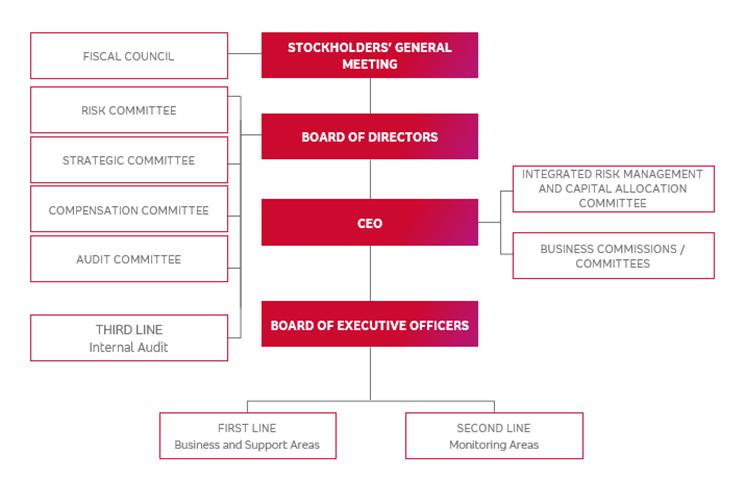
Among the governance forums related to the topic of risks, we highlight:
| · | The Board of Directors approves and reviews risk management strategies, policies, and structures for risk and capital management, including risk appetite and exposure limits by risk types, as well as well as the stress testing program, including its results, applied scenarios, and underlying assumptions; |
| · | Risk Committee: its purpose is to evaluate the framework of our risk management and, eventually, propose improvements and challenge our risk structure in the face of new trends and/or threats, as well as advise the Board of Directors on the performance of its attributions in risk and capital management and control; |
| · | The Integrity and Ethical Conduct Committee aims to propose actions regarding the dissemination and compliance with our Corporate and Sectoral Codes of Ethical Conduct, and the conduct rules related to integrity, anti-corruption, and competition, to ensure their effectiveness and efficiency; |
46 – Form 20-F 2025 | Bradesco |
| · | The Audit Committee reviews the integrity of financial statements and recommends to the Executive Officers corrections or improvements to policies, practices, and procedures identified in accordance with their scope of responsibilities; and |
| · | Integrated Risk Management and Capital Allocation Committee – COGIRAC aims to advise our Chief Executive Officer in the performance of his duties related to the management and control of all risks and our capital allocation resources. |
| Ø | Risk Appetite Statement (RAS) |
Our risk appetite defines the types and levels of risks we are willing to accept in pursuit of our business and objectives. The Risk Appetite Statement (RAS) is an important tool for strengthening the spread of our risk culture.
The Risk Appetite Statement is reviewed annually or whenever necessary by the Board of Directors and permanently monitored by Senior Management forums and business and control areas.
Our risk appetite is monitored through the established indicators, through effective processes of controls, in which managers are informed about the exposures to risks and the respective use of the current limits. The report is carried out through an alert system, which facilitates communication and highlights the possible exceptions, which require adequacy measures, permeating all spheres of the Group, supporting Senior Management in their evaluation to ensure results are cohesive with our risk appetite.
4.B.20.01-01 Credit risk
As provided above (see “Item 3.D — Risk Factors — 3.D.20.02 Credit Risk”), we are subject to this risk. Credit risk management is a continuous and evolving process of mapping, developing, assessing and diagnosing risk through the use of models, instruments and procedures, thus requiring a high degree of judgment, discipline and control during the analysis of operations to preserve the integrity and independence of the processes.
We seek to control our exposure to credit risk, which mainly derives from the loan operations, credit commitments, financial guarantees, securities and derivative financial instruments.
To avoid compromising the quality expected from the portfolio, committees monitor relevant aspects of the lending process, such as concentration, collateral requirements, maturities, and other aspects.
We outline the activities that can potentially generate exposure to credit risk, considering credit classification, size and probability of default, as well as establishing measurement and mitigation plans for those activities.
4.B.20.01-01.01 Lending
We believe the diversity of our business model enables us to reach various audiences through directed and convenient channels in the various regions of Brazil. Segmentation strategies, both for individuals and legal entities, allow for good relationships with clients and the offering of products and services.
We believe this positioning has a positive impact on our credit profile, which is reflected in a diversified portfolio, both in terms of products and segments. This is balanced with the risks undertaken and appropriate levels of provisioning and concentration.
The Credit Area is responsible for the lending procedures which are guided by our Credit Policy. The policy aims to ensure security, quality and liquidity for lending. The process is guided by risk management governance and complies with the rules of the Central Bank of Brazil.
The methodologies adopted value business agility and profitability, with targeted and appropriate procedures aimed at granting credit transactions and establishing operating limits.
47 – Form 20-F 2025 | Bradesco |
When we evaluate and classify clients or economic groups, the quantitative (economic and financial indicators) and qualitative (personal, behavioral and transactional data) aspects associated with the client’s capacity to honor their obligations are considered.
All loan proposals are subject to operational limits, which are included in our Loan Guidelines and Procedures. At our branches, the delegation of powers for submitting a proposal depends on its amount, our total exposure to the client, the collaterals and guarantees posted, the level of restriction and their credit risk rating. All loan proposals are submitted for technical analysis and approval by the Credit Area.
The Executive Credit Committee was created to determine, within its authority, queries about the granting of limits or loans proposed by business areas which have been previously analyzed with the opinion of the Credit Department. Depending on the size of the operations/limits proposed, this Committee may then submit the proposal for approval by the Board of Directors.
Loan proposals pass through an automated and standardized system with parameters set to provide important information for the analysis, granting and subsequent monitoring of loans, minimizing the risks inherent in the operations.
There are exclusive Credit and Behavior Scoring systems for the granting of retail credit, which allows for a quick and reliable process, in addition to standardizing procedures in the process of credit analysis and approval of loans.
We believe our business is diversified, widespread and aimed at individuals and legal entities with a proven payment capacity and solvency. We seek to support loans granted with collaterals and guarantees that are adequate for the risk assumed, in line with the amounts, objectives and maturities of the loans granted.
4.B.20.01-01.02 Credit risk classification
We believe we have a robust governance process, practice and monitoring system. Governance practices include our Governance of Concession Limits and Credit Recovery, which, depending on the amount of the operation or the total exposure to the counterparty, require approval from the CEO or the Board of Directors. In addition, follow-ups on the portfolio are made frequently. We evaluate the portfolio progression, delinquencies, provisions, vintage studies and capital, as well as other factors.
In addition to the governance process for approving loan and recovery operations, within the risk appetite defined by us, the concentration limits of operations for each Economic Group, Sector of Economic Activity and Transfer (concentration by countries). In addition to the concentration indicators, we also established indicators of quality of new loans, level of default and problematic assets, margin of economic capital and expenditure of provision for expected losses.
The credit risk assessment methodology provides data to establish the minimum parameters for lending and risk management. It also allows for the possibility of defining Special Credit Rules and Procedures according to client characteristics and size. The methodology provides the basis for both the correct pricing of operations and for defining the appropriate guarantees for each operation.
The methodology applied also follows the requirements established by CMN Resolution No. 4,945/21 and includes social and environmental risk analyses in projects, which seek to evaluate compliance with relevant legislation by clients, as well as to meet the “Equator Principles”, a set of rules that establish minimum social and environmental criteria that must be met for lending.
In line with the commitment to constant methodological improvement, the classification of credit risk of contracted operations is distributed into homogeneous risk groups according to the criteria established by CMN Resolution No. 4,966/21 for the purpose of establishing the provision for expected losses associated with credit risk.
The risk classifications of loan operations are determined on the basis of the credit quality of economic groups/clients defined by the Client Rating, guarantees relating to the contract, characteristics of credit product, past behavior of delinquencies, value of credit granted, among other characteristics of the operation.
48 – Form 20-F 2025 | Bradesco |
Client Rating for economic groups is based on standardized statistical procedures and judgment, and on quantitative and qualitative information. The ratings are established by economic group and periodically monitored to preserve the quality of the loan portfolio.
For individuals in general, Client Rating classifications are also based on statistical procedures and the analysis of variables that distinguish risky behavior, performed through the application of statistical models for credit evaluation.
The Client Rating is used, in conjunction with several decision variables, to analyze the granting and/or renewal of operations and credit limits, as well as to monitor the deterioration of the client’s risk profile.
4.B.20.01-01.03 Credit risk management process
The credit risk management process is carried out company-wide. This process involves several areas with specific attributes, ensuring an efficient structure for the credit risk management process. The measurement and control of credit risk is carried out in a centralized and independent manner.
Both the governance process and the existing limits are validated by COGIRAC and submitted for approval by the Board of Directors, being reviewed at least once a year.
The credit risk management structure plays a fundamental role in our second line, actively participating in the process of improving client risk classification models, supervising high risks through periodically monitoring key default events and providing levels of provisioning against expected and unexpected losses.
This structure acts continuously in the review of internal processes, including roles and responsibilities, training and demands of information technology, as well as in the periodic review of the risk assessment process aiming at the incorporation of new practices and methodologies.
The attributes of the credit risk management structure follow our defined precepts of compliance. Integration with the other lines occurs on a continuous and frequent basis, enabling effective identification, measurement and control of credit risk, thereby ensuring the efficiency and security of the credit risk management process.
4.B.20.01-01.04 Credit risk mitigation
Potential credit losses are mitigated using different types of collateral documented through different legal instruments, such as conditional sales, liens and mortgages, and financial instruments such as credit derivatives. The efficiency of these instruments is evaluated considering the recovery time and the amount of value to be realized in respect of the collateral, its market value, the guarantor’s counterparty risk and the legal safeguards of each type of instrument. The main types of collateral include: term deposits; financial investments and securities; residential and commercial properties; and movable properties such as vehicles and aircraft. Additionally, collateral may include commercial bonds such as invoices, checks and credit card bills. Sureties and guarantees can also include bank guarantees.
Credit derivatives are bilateral contracts in which one counterparty hedges credit risk on a financial instrument. Its risk is then transferred to the counterparty selling the hedge. Normally, the latter is remunerated throughout the period of the transaction. In the case of default by the borrower, the buying party will receive a payment intended to compensate the loss in the financial instrument. In this case, the seller receives the underlying asset in exchange for the payment.
4.B.20.01-01.05 Control and monitoring
Our credit risk has its corporate control and monitoring carried out by the independent credit risk area, which calculates the risk of open positions, consolidates the results and carries out the reports determined by the existing Governance process.
This area holds monthly meetings with officers and heads of products and segments to ensure they are informed on the development of the loan portfolio, delinquencies, distressed assets, restructuring, adequacy of the provisions for non-performing loans, credit recovery, losses, portfolio limits and concentrations, the allocation of economic and regulatory capital and other items.
49 – Form 20-F 2025 | Bradesco |
In addition, the area tracks each internal and/or external event that may significantly impact our credit risk, such as mergers, bankruptcies or crop failures, and monitors economic sectors where we have the most representative exposures.
4.B.20.01-02 Counterparty credit risk
Counterparty credit risk represents the possibility of loss due to non-compliance by a given counterparty with settlement obligations related to transactions involving the trading of financial assets or derivative financial instruments.
We maintain full control over the replacement cost and potential future exposure to transactions in which there is counterparty credit risk. Therefore, all exposure related to this risk is part of the general credit limits granted to our clients.
The management of counterparty credit risk includes modeling and monitoring (i) the use of the counterparty’s credit limit; (ii) the portion of the fair value adjustment regarding the credit of the CVA (Credit Value Adjustment) of the derivatives portfolio; and (iii) the respective regulatory and economic capital. The methodology we adopted establishes that the portfolio’s credit exposure to a given counterparty can be calculated from the Replacement Cost (RC) of its operations in different financial market scenarios, which is made possible by the Monte Carlo simulation process.
We carry out capital projection studies, such as the ICAAP Stress Test (Capital Adequacy Assessment) and the TEBU (Bottom-Up Stress Test). These multidisciplinary programs involve, at a minimum, the business areas and the Economic, Budget/Results and Risk Departments.
To mitigate the counterparty credit risk to which we are exposed, we adopt a composition of guarantees including margin deposits and the disposal of government bonds (being operations conducted on behalf of clients), which are carried out by our own counterparty or in other custodian institutions, and which also have their own counterparty risks duly assessed.
Additionally, the calculation of the amount of exposure related to the counterparty’s credit risk, arising from operations with derivative financial instruments subject to the calculation of the capital requirement using the standardized approach (RWAcpad), was updated for the SA-CCR Approach (Standardized Approach for Counterpart Credit Risk), following Annex I pursuant to BCB Resolution No. 229/22.
4.B.20.01-03 Market risk
As provided above (see “Item 3.D — Risk Factors — 3.D.20.01 Market Risk”), we are subject to this risk, that is identified, measured, mitigated, controlled and reported for us. Our exposure profile to market risk is in line with guidelines established by the governance process, with limits that are monitored in a timely manner and on an independent basis.
All operations exposing us to market risk are mapped, measured and classified according to probability and magnitude, with the whole process approved at governance level.
In line with what we believe to be best practices of corporate governance, aiming to preserve and strengthen our management of market risks, as well as meet the requirements of CMN Resolution No. 4,557/17, as amended, the Board of Directors approved the Market Risk Management Policy. This policy is reviewed at least once a year by the relevant committees and the Board of Directors, providing the main operational guidelines for approving, controlling and managing market risk.
In addition to this policy, we have several specific rules that regulate the market risk management process, including the:
| · | classification of operations; |
| · | reclassification of operations; |
| · | trading in government or private securities; |
| · | use of derivatives; and |
| · | hedging. |
For more information on the market risk, see “Item 11. Quantitative and Qualitative Disclosures About Market Risk”.
50 – Form 20-F 2025 | Bradesco |
4.B.20.01-04 Liquidity risk
As provided above (see “Item 3.D — Risk Factors — 3.D.20.03 Liquidity Risk”), we are subject to liquidity risk. Understanding and monitoring this risk is crucial, especially in the context of settling transactions in a timely and secure manner.
4.B.20.01-04.01 Liquidity risk management process
The management of liquidity risk is carried out at the corporate level and permeates all layers of governance. The following table lists the responsibilities of the departments responsible for the management and control of liquidity risk:
| Ø | Treasury |
| · | Perform the day-to-day cash and liquidity management; |
| · | Propose limits liquidity risk control indicators, as well as oversee the levels for any flagging alerts; |
| · | Comply with established strategic and operational limits; and |
| · | Report on matters related to the liquidity management [to] the Asset and Liability Management and Treasury Executive Committee. |
| Ø | Liquidity Risk Area |
| · | Propose the metrics for liquidity control and concentration, considering the appropriate established governance approval process; |
| · | Calculate and disclose the the monitoring and liquidity control indicators periodically; |
| · | Provide tools for simulation of the main indicators implemented; and |
| · | Report matters related to the control and liquidity risk monitoring to the commissions and executive committees. |
| Ø | Support Area |
| · | Execute the cash flows projection for liquidity monitoring, including intraday; |
| · | Prepare cash flow projections forecast for the next 12 months and send them to the relevant departments; |
| · | Check and ensure consistency, integrity and completeness of the database made available daily to managers and liquidity risk controllers; |
| · | Provide management information on the cash flow to the Treasury, as well as on any significant changes in the levels of reserves of the Banks of the Conglomerate; and |
| · | Provide management information on the mismatch mapping of the Treasury. |
4.B.20.01-04.02 Control and monitoring
Our liquidity risk management is carried out through tools developed by robust platforms and validated by the independent areas of the business. Among the main metrics and indicators considered in the liquidity risk framework, we highlight:
| · | Liquidity Coverage Ratio (LCR): consists of verifying whether liquid instruments are sufficient to honor our net cash outflows in the next thirty days in a stress scenario; |
| · | Net Stable Funding Ratio (NSFR): consists of verifying the structural funding sufficiency to finance the long-term assets of our balance sheet; |
| · | Deposit losses for different time horizons; |
51 – Form 20-F 2025 | Bradesco |
| · | Funding concentration maps by different variables (product, term and counterparty); and |
| · | Integrated stress exercises in which different risk dimensions are addressed. |
For the main metrics, limits have been established, which can be strategic (approved up to the level of the Board of Directors) or operational (approved by the Executive Committee), based on flags, which trigger different levels of governance according to the percentage of use (consumption) of their respective limits.
4.B.20.01-05 Compliance risk
To ensure compliance, risk management(as indicated in “Item 3.D — Risk Factors — 3.D.20.06 Compliance Risk”) is carried out in an integrated and coordinated manner, and the following activities are performed:
| · | Advise on compliance issues; |
| · | Promotion of a range of activities for executives, employees, interns, apprentices and associates, as well as including of training programs and activities focused on compliance issues; |
| · | Establishment of rules and procedures aimed at ensuring our adherence to the Code of Ethical Conduct and external standards on client conduct, competition and anti-corruption; |
| · | Evaluation and certification of legal and regulatory aspects concerning our products, services and partnerships; |
| · | Coordination to meet the demands of regulatory bodies, supervisors, self-regulated entities counterparties and correspondent banks; |
| · | Identification, evaluation, treatment and monitoring of compliance risks inherent in our activities; |
| · | Management of the Program of Expected Behaviors; |
| · | Monitoring and disclosure of new regulations and legislation applicable to our, as well as certifying the actions taken by managers to ensure compliance with these updated regulatory requirements; and |
| · | Monitoring the implementation of policies and procedures. |
These procedures are in line with the compliance activities management cycle, distributed in actions aimed at strategy, prevention, detection, response, remediation, and reporting.
4.B.20.01-06 Cybersecurity risk
As provided above, we are subject to cybersecurity risk (see “Item 3.D — Risk Factors — 3.D.20.09 Cybersecurity Risk”). For information on the management of this risk, see “Item 16.K — Cybersecurity”.
4.B.20.01-07 Business Continuity Management (BCM)
We base our BCM program on the standard of the Brazilian Association of Technical Standards/Brazilian Standards - ABNT NBR ISO 22,301, which defines Business Continuity as “the Group’s ability to continue to deliver products or services at a previously defined acceptable level following the occurrence of an interruption incident”.
The procedures adopted after an interruption incident, and which aim to guarantee the acceptable operational level of critical business processes – internal or outsourced – are contained in a Business Continuity Plan (BCP) or in a defined continuity strategy, which seek to resume activities and minimize possible impacts on our clients.
The organizational and governance structure established for Business Continuity includes corporate policies and standards which define roles and responsibilities and aim to ensure that the plans and strategies employed are up-to-date and efficient, by requiring periodic tests and exercises to be carried out within the business units. These policies also consider the critical processes carried out by service providers.
These policies and internal rules are in line with the regulations of the Central Bank of Brazil and recommendations of the Basel Committee on Banking Supervision. The Business Continuity Management process is under the responsibility of the Cyber Risks and Operational Resilience, area of Resilience, Continuity and Crises.
52 – Form 20-F 2025 | Bradesco |
4.B.20.01-08 Corporate crisis management
We define incident and crisis as follows:
| · | Incident: momentary event, of low complexity and with possible repercussion to stakeholders. The incident, depending on severity, is classified as relevant or critical, and |
| · | Crisis: it is the occurrence of an extremely adverse event (or combination of events), rare, unstable and complex that may result in a deterioration of relationship with stakeholders as well as pose a potential threat to strategic objectives, reputation or even our existence. |
The corporate crisis management process helps to ensure that any signs of crisis are timely identified, evaluated and classified according to their severity, so that actions can be promptly taken to reestablish the normal course of activities and strengthen our operational resilience.
The corporate crisis management process consists of the following steps:
| · | Prevention: Identify vulnerabilities and develop scenarios that could result in an incident and/or a crisis; |
| · | Preparation: Develop incident and/or crisis response plans and conduct training; |
| · | Response: Trigger incident and crisis management process and execute response plans; and |
| · | Recovery: Identify opportunities to improve incident and crisis management processes and plans. |
In order to help judge the severity of an incident and/or a crisis, we have established levels of impact that determine the optimization of resources and the necessary steps to be taken in light of the event that presents itself: relevant incident, critical incident and crisis.
Internal communication relating to corporate incidents and crisis management is carried out in a timely manner, through the issuance of bulletins and reports according to established governance.
Detailed information regarding our risk management, reference equity, as well as risk exposures can be found in the Risk Management Report – Pillar 3, available on the Investor Relations website (not incorporated by reference in this report).
4.B.20.02 Independent validation of management and measurement models for risks and capital
The model is defined as the information that supports decision-making processes, derived from any method, hypotheses, techniques and quantitative system or approach, among others, that applies statistical, economic, financial or mathematical theories to transform data into estimates.
The use of models in supporting business decision-making is an increasingly widespread practice in financial institutions. These tools facilitate the synthesis of complex information, standardize and automate decision making processes and enable the reuse of both internal and external data. As a result, they improved efficiency by reducing our costs associated with manual analysis and decision making.
We employ models to support decision-making, financial reporting and regulatory compliance, and to provide predictive insights across various business areas, such as risk management, capital calculation, stress testing and other estimates from models to assess financial or reputational impacts. Thus, we recognize the existence of the risk associated with the use of the models and the importance of the process of managing this risk. The coordination of this process involves the AVIM – Independent Model Assessment Area.
AVIM is responsible for assessing whether the models are performing as expected, according to its development and usage objectives. It identifies potential limitations, assessing possible impacts. It is also responsible for establishing guidelines for procedural standardization related to the Corporate Inventory of Organization Models and measuring and controlling the Model Risk.
53 – Form 20-F 2025 | Bradesco |
4.B.20.03 Internal controls
The Internal Controls area acts proactively in the management of the risks existing in the processes, as well as in the effectiveness of the controls, in order to keep them at acceptable levels to us.
The scope and activities of our Internal Control area are aligned with the Frameworks issued by COSO – the Committee of Sponsoring Organizations of the Treadway Commission (Internal Control – Integrated Framework (2013) and Enterprise Risk Management – Integrated Framework) and with the guidelines established by the Information Systems Audit and Control Association (ISACA) through the Control Objectives for Information and Related Technology (COBIT 5).
The Internal Controls team works with first-line areas to identify and assess risks and controls. The results are captured in risk maps for each business unit, which are reviewed against the annual action plan issued by Internal Controls. The team also conducts thematic reviews to strengthen the evaluation of the control environment on specific topics, with findings presented in dedicated reports. Any risks or weaknesses identified are then incorporated into the risk maps of the relevant areas.
Risk management topics, issues and internal controls are observed and discussed at all levels of our Group, according to the established current governance framework. They are promptly reported to risk forums to ensure appropriate handling resolution.
In addition, the systematic monitoring of activities of the internal controls system is consolidated, at least once a year, in a report that is submitted to the responsible governance forums.
4.B.20.04 Corporate Security Area
The Corporate Security area is responsible for providing security solutions by creating, implementing, maintaining, and updating rules and processes aligned with our business activities.
It operates corporately and strategically in Anti-Money Laundering and Counter-Terrorist Financing (AML/CTF), International Sanctions, Prevention of Electronic Fraud, Debit/Credit Card Fraud, Document Fraud Prevention, Physical and Property Security, and Projects. It also works on specifying systemic solutions and security processes for electronic channels and information systems, assessing, addressing, and proposing improvements. In addition, it is responsible for issuing technical opinions related to strategic security aspects, as well as the implementation of products, services, and processes. The main areas and activities include:
| · | Electronic Fraud Prevention: App Bradesco, Internet Banking, Net Empresa, Fone Fácil, BIA WhatsApp, Debit and Credit Card Products, Fraud Prevention in account opening and acquisition of financial products. This area is responsible for anticipating and mitigating risks in our operations. We continuously monitor our data and transactional environments 24 hours a day, 7 days a week, issuing real-time alerts for suspicious transactions, supported by integrated technology, robust processes, and highly specialized teams. |
Our products and services are continuously evaluated by dedicated teams whose mission is to prevent and correct actions to ensure the security of the systems that support our businesses, while considering customer experience and usability.
We use data-driven intelligence, including advanced facial and behavioral biometrics, supported by statistical methodologies and predictive fraud models. These solutions ensure full compliance with regulatory requirements for customer identification and validation, promoting greater security for all parties involved and contributing to the integrity and strength of the Brazilian Financial System (SFN).
As evidence of this, we hold the Fraud Prevention Seal granted by an independent audit conducted by the National Confederation of Financial Institutions, which aims to establish centralized, optimized, and standardized actions for handling occurrences in the financial system;
| · | AML/CTF: Responsible for defining internal guidelines to prevent and mitigate risks related to the improper use of our structure and/or products and services for Money Laundering or Terrorist Financing. Activities include the development and maintenance of policies, rules, and procedures; internal risk assessment; maintenance of detection systems; continuous monitoring of operations; and reporting of suspicious matters to COAF. The area also conducts training, provides support to business units, and interacts with regulatory bodies to ensure compliance and standardized conduct aligned with national and international best practices; |
54 – Form 20-F 2025 | Bradesco |
| · | International Sanctions: Responsible for defining internal guidelines and ensuring compliance with legislation and regulations on international sanctions, aimed at protecting our business and relationships with stakeholders, including the prevention and combat of terrorist financing, drug trafficking, criminal organizations, and arms proliferation. Activities include identifying, blocking, and reporting sanctioned individuals and transactions, monitoring restrictive lists, analyzing suspicious transactions, and promoting a culture of compliance through training; and |
| · | Physical and Property Security: Responsible for safeguarding people and preserving the integrity of employees, customers, and third parties, as well as our physical assets. The area manages access controls in buildings, branches, and critical environments, ensuring traceability and periodic reviews to maintain effectiveness and continuous improvement. It monitors facilities through alarm systems and CCTV and oversees private security services, ensuring compliance with the Brazilian federal police security plan and applicable legislation, including Law No. 14,967/24. |
The area is also responsible for investigating attacks against us, conducting intelligence analyses, and cooperating with law enforcement agencies and the Public Prosecutor’s Office in the prevention and repression of crimes and fraud.
It develops and reviews operational standards and procedures and promotes training and awareness campaigns related to physical and property security. Finally, it oversees security services, manages equipment such as safes, alarms, and monitoring systems, administers action plans, and responds to internal and external audits related to physical risks and associated operational controls.
4.B.20.05 Data processing
Our technological infrastructure is supported by a continuous upgrade program and a dedicated data center (CTI, 11,900 m²), designed to ensure constant service availability. The operation is supported by three IT Operations Centers (NOCs), responsible for 24x7 monitoring and coordinated response to incidents involving service channels, systems, applications and infrastructure. This model combines reactive actions, which reduce performance losses, with proactive initiatives aimed at improving Service Level Agreements (SLAs) and optimizing operational resources. Capacity planning complements this process by monitoring consumption and anticipating future needs for processing, storage and memory.
Additionally, the Infra Cloud platform provides robust and innovative solutions in a hybrid and multicloud model, with a technological architecture based on microservices and self-service capabilities, allowing development and operations teams to manage resources autonomously, in a standardized and secure manner. This distributed architecture enhances flexibility, scalability and efficiency.
Data is continuously replicated to a secondary site in Alphaville, which is capable of taking over critical system operations in the event of CTI unavailability. The process is supported by a Disaster Recovery Plan (DRP), with annual tests conducted under independent audits to ensure service continuity in a contingency environment. Backup copies are maintained and regularly validated at both sites, following environmental standards and controls that ensure the confidentiality, integrity and availability of information.
Our main service channels rely on telecommunications infrastructure designed to operate from either of the two sites, strengthening resilience. Internet infrastructure is segmented by user group (retail customers, corporate clients and employees), ensuring enhanced security and service quality.
Our IT processes are structured based on widely recognized frameworks. These include the adoption of COBIT 5 for IT governance and corporate management, which establishes principles, objectives and controls that align technology with business needs, maximize value generation and properly manage risks. Additionally, for IT Service Management (ITSM), we adopt ITIL as a library of best practices guiding operational processes such as service management, incident management, change management and capacity planning. The effectiveness of these processes and controls is regularly assessed by independent external and regulatory audits, promoting compliance and continuous improvement.
55 – Form 20-F 2025 | Bradesco |
We maintain SOC 2 Type II and SOC 3 assurances, which are issued annually by an independent specialized audit firm, attesting the effectiveness of security controls, availability, processing integrity, confidentiality and privacy. Additionally, we hold ISO/IEC 27001 certification, confirming the effectiveness of the Information Security Management System (ISMS) implemented in the technology environment.
CTI implements access controls with barriers, dual containment and authentication through badge and vascular biometrics. The facilities are monitored by cameras and have 72 hours of energy autonomy, with the possibility of continuous operation through generator fueling.
For more information regarding the IT Infrastructure, see “Item 16.K. Cybersecurity.”
4.B.20.06 Bradesco Integrity Program
Our main corporate integrity commitments consists of:
| · | conducting our business and developing our various relationships based on integrity, ethics and transparency, concepts that permeate our organizational culture and constitute our values and principles, which, in turn, are formalized by the Corporate and Sector-based Codes of Ethical Conduct, with the support of our Senior Management; and |
| · | preventing and combatting all forms of corruption and bribery. |
These commitments are continually upheld through the Bradesco Integrity Program, which brings together a structured set of mechanisms and measures, including our Codes of Ethical Conduct, the Corporate Anti-corruption Policy and Standard, the Integrity Program itself, the Giveaways, Gifts, and Amenities (Public Sector) Standard, the Receipt of Gifts, Presents and Hospitality - Private Sector (Suppliers and Business Partners) Standard, in addition to other standards, procedures, processes, and controls. These instruments aim at preventing, detecting, reporting and remedying acts related to corruption and bribery, including fraud against the Government or private administration.
Supported by the Integrity and Ethical Conduct Committee and by the Board of Directors, our Program establishes guidelines, responsibilities, procedures and controls related, among other topics, to granting and receiving giveaways, gifts and amenities; analysis of donations and sponsorships, due diligence on suppliers and service providers, participation in bids with the Brazilian government; political contributions; relationship with public agents and politically exposed persons (“PEP”), including officials classified or related to PEPs; merger and acquisition processes; obtaining licenses and permits; handling complaints and ensuring non-retaliation against whistleblowers in good faith. All these practices are conducted in accordance with the applicable laws and regulations in Brazil and in the countries where we maintain operations.
Our Integrity Program applies to managers, employees, interns, apprentices, suppliers and services providers, banking correspondents in Brazil, business partners, controlled companies and other companies that are members of the our Group, guiding their interactions and daily decisions based on high standards of integrity, conduct and ethics. To ensure its effectiveness, we continuously review, evaluate and improve the Program, with the aim of strengthening its governance and controls, in line with national and international best practices to combat corruption.
We aim to continually promote an ethical and integrity-based culture through the Code of Ethical Conduct and the Integrity Program, with the continuous engagement of our managers, employees, interns, apprentices, suppliers and services providers.
In February, April and October 2025, we held meetings with the Senior Management and with the Integrity Ambassadors, in which we addressed the topics “Moral, Sexual Harassment and Sexual Misconduct”, “Discrimination” and “The Role of the Integrity Ambassador”. The events were held in hybrid format (in-person and virtual), with external speakers, officers and employees allocated in our offices throughout Brazil and in units abroad where we have business operations. In addition, in September 2025, we held a lecture directed to suppliers and service providers, conducted by the Global Compact on the following subject “The Global Compact Approach to Combating Corruption and Promoting Integrity”.
56 – Form 20-F 2025 | Bradesco |
4.B.20.07 Competition Compliance Program
We respect and value free competition, regardless of any dominant position in certain segments. In our relationships with clients, suppliers, service providers, banking and nonbanking correspondents in the U.S. and abroad, business partners, and competitors, we act with integrity and always within the limits of the law.
For example, any contract for the provision of products and services our Group signs, must contain a competition clause, ensuring compliance with Law No. 12,529/11 (Competition Law or Antitrust Law), by both parties.
In strengthening our culture, the Bradesco Competitive Compliance Program focuses on curbing inappropriate conduct of our managers, employees, interns, apprentices and associates (third parties), both in Brazil and abroad, and is composed of a set of policies, standards and procedures aimed at preventing, monitoring, detecting and responding to harmful acts provided for in Law No. 12,529/11 and in international legislation.
This program is structured to permeate all of our internal areas. In the case of units located abroad, we make the necessary adaptations to the Competitive Compliance Program, striving to maintain at least the conducts already required in Brazil and adequate to specific local laws.
4.B.20.08 Treasury activities
The main objective of the Treasury Area is to maximize results with available resources and manage risks, by complying with the limits set by our Senior Management and the guidelines issued by Financial Risk Management Area.
The main activities are as follows:
| · | planning and managing our local and foreign currency cash flows; |
| · | developing and implementing our asset and liability management strategy; |
| · | managing maturity, rate and liquidity gaps arising from our activities; |
| · | defining costs for assets and liabilities operations; |
| · | obtaining price estimates and managing our business operations that involve risks such as: market, interest rate, foreign exchange, commodities and price index risks; |
| · | performing proprietary trading operations aimed at opportunities found within the range of our prospective scenario and market prices; and |
| · | taking part in analyses and decisions regarding directed credit and capital management. |
4.B.20.09 Inovabra
Inovabra is our corporate venture to fund strategic investments, and it aims to create opportunities for the progress of people and the sustainable development of companies and society. We believe that we can improve our customer experience through innovation. In this way, we create an innovation ecosystem, the Inovabra, capable of supporting and inspiring the institution, creating paths and conditions that put it at the forefront of financial and non-financial products and services.
We work on three fronts:
| · | Accelerate new features or improvements in existing products; |
| · | Foster new products and services within existing businesses; and |
| · | Explore, suggest and experiment with emerging technologies. |
To meet the challenges of these three fronts, we work together with our business unities (BUs) and technology areas to set priorities and develop a portfolio of initiatives and ensure long-term business competitiveness. Inovabra has the following corporate innovation pillars:
57 – Form 20-F 2025 | Bradesco |
| · | Business Innovation: dedicated advisory team that supports the design, construction of the business case, validation of the business model, experimentation and scalability in production; |
| · | R&D - Multidisciplinary research team: mapping of industry trends, identifying business problems and proposing solutions, including benchmarks, market studies and pilot development projects with partners from Brazil and abroad (companies, universities and research institutes). In addition to enhancing and disseminating best practices under the BTRL (Bradesco Technology Readiness Level) methodology, as well as keeping the Emerging Technologies Radar updated regarding technologies that affect and/or impact the banking sector; |
| · | Open Innovation: physical and digital environment of collaboration with startups, large companies, consultants and investors for business generation and acceleration of solutions. As of December 31, 2025, we had 346 resident startups and 3,100 connected through partner hubs, as well as 46 participating companies; |
| · | Experimental laboratory (Design and Experiment): a secure environment for testing cutting-edge technologies, enabling prototyping, product design, and experimentation with startups and big techs. It includes an Innovation Sandbox that simulates the banking core, allowing more precise testing, reducing integration uncertainties, and accelerating the time-to-market of solutions; and |
| · | Culture & Communication: expedite communication around innovation initiatives and raise awareness of the Inovabra ecosystem, established partnerships, and trends, through press releases, social media, sponsorship of innovation events, and internal communication for employees, as well as development programs and the dissemination of innovation practices integrated with SOU Bradesco. |
| Ø | Inovabra results for 2025: |
| · | Evolution in technological readiness in ten emerging technologies: Cryptoassets, Defi (Decentralized Finance) and Smart Contracts, Graphs, Multimodal AI, Multi-agent systems, Synthetic Data, Quantum Computing, SLM (Small Language Models), Digital Identity and AML (Anti-Money Laundering) for LLMs (Large Language Models); |
| · | 73 solutions of new initiatives experienced in the areas of business and technology; |
| · | Training of more than 16 thousand employees through technological literacy, training and immersion experiences that have broadened the repertoire of employees on emerging topics such as Quantum Computing, Artificial Intelligence (AI), tokenized economy, new digital architectures, translating technological trends into practical applications in everyday life; and |
| · | 30 studies completed and presented to internal areas on topics related to innovation trends, hyper-personalization, Open Finance, future of experience empowered by AI, Digital Identity, etc. |
| Ø | Co-innovation environment: |
| · | More than 30 thousand visitors in about 400 events, including open meetings, presentations, immersions and co-creation activities; |
| · | Approximately 90 new incoming companies; and |
| · | 110 deals and 90 co-innovation activities in the community. |
| Ø | inovabra Awards and 2025 Cases |
| · | Global Finance: we were recognized as the most innovative bank in Latin America, and inovabra was selected for the sixth consecutive year as one of the best financial innovation labs in the world; |
| · | Valor Inovação: we ranked first in the banking sector and 31 among the most innovative companies in Brazil; |
58 – Form 20-F 2025 | Bradesco |
| · | Banking Innovation Awards | Qorus: we achieved first place in the “Product and Service Innovation” category with the Digital Identity solution; |
| · | 100 Open Startups Ranking: we ranked third among the Top Open Corporations and were winners of the “Champions of the Decade” category for our open innovation engagement with startups over the past 10 years. In addition, inovabra ranked fourth in Top Ecosystem, in recognition of its support to startups and corporations in their open innovation journeys; |
| · | Eye On Innovation Awards | Gartner: we were the winner in the Americas with the Digital Identity solution, and the Renda BRA 5.0 project placed 2nd; and |
| · | Corporate Startup Star Awards | ICC: we were listed among the Top 100 Corporate Startup Stars for global best practices in open innovation. |
4.B.30 Business segment
The data for these segments was compiled from reports prepared for management to assess performance and make decisions about the allocation of funds for investments and other purposes. Our Management uses various data, including financial data in conformity with the accounting standards applicable to institutions authorized to operate by the Central Bank of Brazil and non-financial metrics. For further information on differences between the results on a consolidated basis and by segment, see “Item 5.A. Operating Results – 5.A.20.01 Results of operations for the year ended December 31, 2025, compared with the year ended December 31, 2024”.
We do not break down our revenues by geographic regions within Brazil, and less than 3.5% of our revenues come from international operations. For more information on our international operations, see “4.B.30.01-02.10 International operations”.
As of December 31, 2025, according to the sources cited in parentheses below, we were:
| · | one of the leading banks in terms of savings deposits, with R$124.5 billion, accounting for 12.0% of Brazil’s total savings deposits (according to the Central Bank of Brazil); |
| · | one of the leaders in BNDES onlendings, with R$12.0 billion in disbursements (BNDES); |
| · | leader in leasing transactions in Brazil, with an outstanding amount of R$7.6 billion; through our subsidiary Bradesco Leasing S.A. Arrendamento Mercantil, or “Bradesco Leasing” (according to ABEL); |
| · | one of Brazil’s largest private fund and investment managers, through our department Bradesco Asset, with R$997.7 billion in assets under management (according to ANBIMA), including managed portfolios; |
| · | one of the leaders in asset management, with R$1.4 trillion in assets, of which R$582.5 billion are managed through our subsidiary BEM DTVM (according to ANBIMA); |
59 – Form 20-F 2025 | Bradesco |
| · | the leader by number of outstanding purchasing consortium quotas, through our subsidiary Bradesco Administradora de Consórcios Ltda., or “Bradesco Consórcios”, with 1,674,444 quotas across three segments: (i) automobiles and motorcycles, with 1,166,899 quotas; (ii) real estate, with 355,643 quotas; and (iii) trucks, with 151,912 quotas (according to the Central Bank of Brazil); and |
| · | the largest company in the Brazilian insurance market, operating in all lines of this segment, with a 22.8% market share (according to SUSEP/ANS data as of September 2025) through us, Grupo Bradesco Seguros, and our subsidiaries, in the segments of Insurance, Open Pension and Capitalization, through the following companies: Bradesco Seguros S.A., Bradesco Auto/RE Companhia de Seguros, Bradesco Vida e Previdência S.A., Bradesco Capitalização S.A, Bradesco Saúde, Bradesco Argentina de Seguros S.A., Mediservice, Bradesco Saúde Operadora de Planos S.A. and Odontoprev S.A. The total revenues of Grupo Bradesco Seguros amounted to R$118.5 billion in insurance premiums, pension plan contributions and capitalization bond income in 2025. |
4.B.30.01 Banking
In our banking segment, we offer a range of products and services to our clients including deposit-taking, granting of loans and advance payments, debit and credit card services and custody, through our extensive distribution network.
We have a diverse client base that includes individuals and small, medium-sized and large enterprises in Brazil. Historically, we have cultivated a strong presence among the broadest segment of the Brazilian markets, including middle- and low-income individuals.
The following table shows the statements of income and other selected financial data for our banking segment for the periods indicated.
| As of and for the year ended December 31, | Banking - R$ in thousands | ||
| 2025 | 2024 | 2023 | |
| Revenue from financial intermediation | 235,516,116 | 169,745,125 | 164,122,043 |
| Expenses from financial intermediation | (154,883,751) | (98,810,413) | (97,495,630) |
| Financial margin | 80,632,365 | 70,934,712 | 66,626,413 |
| Expected Credit Loss Associated with Credit Risk | (36,370,035) | (33,123,621) | (37,110,675) |
| Gross income from financial intermediation | 44,262,330 | 37,811,091 | 29,515,738 |
| Fee and commission income and income from banking fees | 39,563,634 | 36,213,830 | 34,269,254 |
| Personnel /Administrative Expenses | (46,173,552) | (44,525,627) | (42,122,774) |
| Tax expenses | (7,520,187) | (6,313,204) | (6,582,213) |
| Share of profit (loss) of associates and jointly controlled companies | (225,416) | 121,511 | 151,414 |
| IR/CSI and Other income/expenses | (15,496,030) | (13,425,161) | (9,198,676) |
| Net income | 14,410,779 | 9,882,440 | 6,032,743 |
| Total assets | 2,036,011,553 | 1,811,529,557 | 1,661,529,233 |
| Investments in associates and joint ventures | 86,292,770 | 79,828,981 | 73,163,988 |
| Total liabilities | 1,820,238,662 | 1.607,412,734 | 1,468,271,968 |
.
4.B.30.01-01 Clients
We aim to provide services to the largest number of people, thus fulfilling our mission of democratizing access to banking products and services, in addition to encouraging financial inclusion, social mobility and entrepreneurship. As of December 31, 2025, our client base was composed of 74.3 million clients.
A wide presence allows us to act on a large scale, with diversification as a differentiator of our business model. We do not make distinctions, but aim to serve every client with the same level of excellence, remaining aware of each client’s profile and continuously improving the way we provide services. These values extend to clients who are non-account holders.
60 – Form 20-F 2025 | Bradesco |
4.B.30.01-01.01 Segmentation of Clients
To ensure we provide a high level of service to our clients, we operate a segmented business structure, for clients of Banco Bradesco, both individuals and companies, which we believe allows us to offer agility and convenience in all areas, with a focus on a quality customer experience.
Companies
| Ø | Bradesco Corporate |
Bradesco Corporate is responsible for serving business groups and is focused on both large and medium-sized enterprises. Based on a value proposition of physical proximity and fostering client relationships, its offices are located in the main financial centers on the national and international scene, offering customized services and a highly skilled team to fulfill clients’ needs through a wide portfolio of products, structured solutions and financial services.
To provide these solutions, it is important to strengthen the relationship with clients and to deliver a robust value proposition. Bradesco Corporate is segmented according to sector, market, size and nature of its client companies, among other criteria, and consists of the following areas:
| · | Corporate: Client segmentation aimed mainly at the middle market, with specialized service. Clients with an annual turnover of between R$50 million and R$1 billion; |
| · | Large Corporate: Offers a specialized service structure for large companies, with customized operations by market sector. Clients with an annual turnover of between R$1 billion and R$5 billion; |
| · | Ultra Corporate: With a highly qualified team and a sector-based approach, this segment offers customized consultancy to large corporations on a national and global basis. Clients with annual turnover of R$5 billion or more; |
| · | Global Corporate: our Global Corporate business unit is targeted at global companies with Brazilian subsidiaries, with customer service offices in Brazil and subsidiaries in Hong Kong, Luxembourg and New York. It provides a differentiated service, with specialized professionals, financial solutions and services for a better operation in the country; and |
| · | Corporate Agribusiness: Responsible for serving Individual and Corporate clients with activities focused on Agribusiness. It has a specialized team working on dedicated Platforms in the national territory. |
| Ø | Bradesco Institucional |
Bradesco Institucional centralizes relationships with asset managers, investment funds, pension foundations, pension funds, brokers, securities distributors and the investment arm of insurance companies. In addition, it promotes synergy with across several products and services of the Group, such as Investment Banking, Global Markets, Treasury, Custody and Financial Services, Exchange, and Credit, among others.
| Ø | Bradesco Empresas e Negócios |
Bradesco Empresas e Negócios is a client segmentation prepared to meet the needs of micro, small and medium-sized enterprises, with annual revenue of up to R$50 million, through strategically distributed units throughout the national territory.
| · | Subsegments |
| o | MEI |
100% digital and personalized service for Individual Microentrepreneurs, with solutions for credit, receipts and day-to-day management, always with trained professionals who understand their challenges.
61 – Form 20-F 2025 | Bradesco |
| o | Business |
Aimed at companies with revenues of up to R$4.8 million, offering credit lines, financing, payment services, investments and service by dedicated managers, in a broad branch network.
| o | Companies |
For companies with revenues of up to R$50 million, with assistance in 150 exclusive branches and specialized teams in Credit, Cash Management and Investments. We develop tailor-made solutions, following the core business and driving results.
Individuals
| Ø | Bradesco Global Private Bank |
Bradesco Global Private Bank offers exclusive, personalized service and works side-by-side with clients to preserve and manage family wealth and provide support for current and new generations.
Bradesco Global Private Bank designs innovative solutions to meet clients’ individual objectives and needs, and has a complete Wealth Management structure, which involves liquid and illiquid assets and investment structures for the perpetuation of wealth.
Bradesco Global Private Bank clients have access to, what we believe is, a differentiated portfolio of local and international investments, and access to a multidisciplinary team of specialists, in addition to all of our business solutions including, among others, Banco de Investimentos BBI, Bradesco Asset, Ágora Corretora, Insurance and Pension Funds.
Bradesco Global Private Bank has exclusive service in Miami through Bradesco Bank and in Luxembourg through Bradesco Europa.
In Brazil, there are 13 offices located in São Paulo, Rio de Janeiro, Belo Horizonte, Blumenau, Campinas, Curitiba, Fortaleza, Goiânia, Manaus, Porto Alegre, Recife, Ribeirão Preto and Salvador, thus ensuring presence in the local and international market for our clients.
| Ø | Bradesco Principal |
Bradesco Principal is the client segmentation dedicated to high-net-worth individuals, launched in 2024 and to be rolled out across Brazil. Designed to deepen client relationships, it offers a value proposition built on solid pillars:
| · | Dedicated Customer Service: With a Relationship Manager who acts as a financial concierge, Bradesco Principal connects clients to tailored banking solutions. Service is available during extended hours, in reformulated offices to provide differentiated financial advice and exclusive events; |
| · | Customized Investments: An Investment Advisor offers the best opportunities, aligned with each clients’ financial profile and life stage, combining our proprietary funds with the open investment platform of Ágora Corretora e Previdência (Broker and Pension). The Wealth Planning structure supports asset management for clients with investable assets above R$5 million; |
| · | Exclusive Products: It offers a portfolio of exclusive products, such as the Bradesco Principal credit card, which provides access to VIP rooms with free advanced reservation and fast pass; |
| · | International Account: It offers a full-service American checking account with debit and credit card, investment opportunities and real estate financing in the United States; and |
| · | Benefits Program: It includes digital protection insurance at no cost for 12 months from the date of contracting, discounts on purchases and travel, exemption of toll tags, up to 15 days interest-free in the overdraft, and extended service to the family group, among others. |
Bradesco Principal was created from the expectations and needs of our clients, aiming to build long-term relationships through personalized journeys and sophisticated experiences. Currently available in 36 cities and 62 offices, with more than 320 thousand clients. Our expansion plan foresees the presence in more than 70 cities by the end of 2026.
62 – Form 20-F 2025 | Bradesco |
| Ø | Bradesco Prime |
Operating across Brazil, Bradesco Prime is focused on quality of service and the provision of appropriate solutions for our clients through its well-trained teams that add value to shareholders, within ethical and professional standards. Besides a broad branch network, it has exclusive platforms to serve digital clients.
Our clients have access to the full relationship model, with carefully conceived solutions for each profile and stage of life, plus numerous benefits such as:
| · | Relationship manager: qualified professionals who support clients in managing their resources, considering their needs and stage of life; |
| · | Extensive Network: an extensive network of branches, Bradesco Prime Spaces and Platforms throughout the country, offering convenience and total privacy so clients can tend to their business affairs; |
| · | Program of benefits: a discount of up to 100% on the value of our service package and an exemption from the annuity of our credit cards, depending on the volume of investments and/or concentration of the client’s spending, plus up to 12 days without interest on overdrafts depending on the volume of investments; |
| · | Viva Prime program: a relationship platform that offers discounts on gastronomy, entertainment, travel and miscellaneous products, exclusive experiences in Cinemark Rooms, Teatro Bradesco (theater), Livelo and Menu Program, among others; |
| · | Recommended investment portfolios: suggested by a certified and qualified team based on the economic conditions and the analysis of the investor’s profile (API) that seeks to achieve the best balance between risk and return; |
| · | Investment specialists: to support the client to make decisions regarding their portfolio according to the investor profile and their current life circumstances; and |
| · | PIC (Prime International Center): remote service for foreign clients in Brazil. |
Throughout its existence, the Bradesco Prime has invested in technology, the improvement of relationships and the training of its professionals, which has resulted in it holding a prominent position in the Brazilian market of banking services for middle and high-income clients and has consolidated its position as one of the largest banks in the client segmentation.
One of Bradesco Prime’s primary objectives continues to be to provide “the best experience to its clients”, always seeking to make the relationship between clients and the bank more satisfactory and sophisticated.
| Ø | Digital retail |
Digital retail is the entry-level client segmentation and operates through two models: i) physical service; and ii) digital service. In this client segmentation, clients will have a portfolio of products and services and solutions that guarantee convenience and security for their daily life, including chat feature in the Bradesco App, which has priority online service through the BIA, Chat and Easy Phone (Fone Fácil) channels. with experts ready to provide support in various banking matters.
This makes our client’s experience more practical, reducing the need to go to a branch. This service is offered 24 hours a day, 7 days a week, allowing the client to solve many of their financial necessities online.
63 – Form 20-F 2025 | Bradesco |
| Ø | Non-Account Holders |
Individual clients or corporate clients consumers of our products that do not have a bank account.
4.B.30.01-02 Products and banking services
In order to meet the needs of each client, we offer the following banking products and services:
4.B.30.01-02.01 Deposit accounts
We offer a variety of deposit accounts to our clients, including:
| Ø | checking accounts, such as: |
| · | Conta Fácil (Easy Account) – a checking account and a savings account with the same bank account number, accessed by the same card, for individuals and legal entities; |
| · | Click Conta (Click Account) – checking accounts for children and young people from 0 to 17 years of age, with an exclusive website, debit card, automatic pocket money service, free online courses and exclusive partnerships, among other benefits; |
| · | Conta Universitária (Academic Account) – low fee checking account for college students, with subsidized credit conditions, student loans, an exclusive website, free online courses and exclusive partnerships, among other benefits; and |
| · | Conta Corrente (Checking Account) – accounts intended for companies and public entities of a specific legal nature, which do not have a linked savings account. |
| Ø | traditional savings accounts, which currently earn interest at the Brazilian reference rate, or taxa referencial (TR), plus 0.5% monthly interest if the SELIC rate target is higher than 8.5% p.a., or TR plus 70.0% of the SELIC rate target if the SELIC rate target is equal to or lower than 8.5% p.a.; and |
| Ø | time deposits, which are represented by Bank Deposit Certificates (Certificados de Depósito Bancário or CDBs) and earn interest at a fixed or floating rate. |
As of December 31, 2025, we had 37.7 million checking account holders. As of the same date, we had 38.9 million saving account holders.
64 – Form 20-F 2025 | Bradesco |
4.B.30.01-02.02 Loans and advances to customers
The following table shows loans and advances to customers, net of provision for expected credit losses broken down by product type on the dates indicated:
| As of December 31, | % of total portfolio | R$ in thousands | ||
| 2025 | 2025 | 2024 | 2023 | |
| Companies | 44.3% | 350,445,791 | 316,936,343 | 269,421,350 |
| Financing and On-lending | 17.4% | 137,576,819 | 132,471,486 | 104,729,799 |
| Financing and export | 4.4% | 34,763,790 | 40,904,095 | 28,957,241 |
| Housing loans | 4.4% | 34,911,156 | 30,655,876 | 24,534,805 |
| Onlending BNDES/Finame | 3.1% | 24,475,073 | 20,475,116 | 17,515,937 |
| Vehicle loans | 2.9% | 23,074,448 | 21,934,635 | 22,316,453 |
| Import | 1.6% | 12,986,200 | 12,505,529 | 7,183,123 |
| Leases | 0.9% | 7,366,152 | 5,996,235 | 4,222,240 |
| Borrowings | 24.7% | 195,880,958 | 169,958,833 | 151,245,208 |
| Working capital | 18.1% | 143,640,424 | 100,012,698 | 82,843,536 |
| Rural loans | 1.7% | 13,324,492 | 11,811,476 | 12,807,395 |
| Other | 4.9% | 38,916,042 | 58,134,659 | 55,594,277 |
| Limit operations (1) | 2.1% | 16,988,014 | 14,506,024 | 13,446,343 |
| Individuals | 55.7% | 441,022,363 | 403,303,243 | 360,265,349 |
| Financing and On-lending | 20.4% | 161,548,810 | 144,876,576 | 127,765,221 |
| Housing loans | 14.2% | 112,626,278 | 102,627,589 | 89,315,143 |
| Vehicle loans | 5.3% | 41,797,766 | 34,962,102 | 31,408,501 |
| Onlending BNDES/Finame | 0.8% | 6,616,649 | 6,927,661 | 6,866,782 |
| Other | 0.1% | 508,117 | 359,224 | 174,795 |
| Borrowings | 24.0% | 189,710,201 | 177,325,731 | 155,605,725 |
| Personal credit | 20.9% | 165,277,140 | 140,843,129 | 122,269,986 |
| Rural loans | 2.2% | 17,680,946 | 15,530,021 | 12,534,155 |
| Other | 0.9% | 6,752,115 | 20,952,581 | 20,801,584 |
| Limit operations (1) | 11.3% | 89,763,352 | 81,100,936 | 76,894,403 |
| Total portfolio | 100.0% | 791,468,154 | 720,239,586 | 629,686,699 |
(1) Refers to outstanding operations with pre-established limits linked to checking accounts and credit cards, which limits are automatically restored as the amounts used are paid.
The following table presents the proportion of our outstanding loans and advances represented by each borrower or group of borrowers on the dates indicated:
| As of December 31, | 2025 | 2024 | 2023 |
| Borrower | |||
| Largest borrower | 0.5% | 0.7% | 1.1% |
| 10 largest borrowers | 3.5% | 4.4% | 5.0% |
| 20 largest borrowers | 5.4% | 7.0% | 7.7% |
| 50 largest borrowers | 8.7% | 10.9% | 11.4% |
| 100 largest borrowers | 11.5% | 14.0% | 14.4% |
| Ø | Financing and Onlending |
| · | Financing for export and import |
Our Brazilian foreign-trade-related business consists of providing financial services to our clients in their export and import activities.
In import financing/refinancing, we directly transfer funds in foreign currency to foreign exporters, fixing the payment in local currency for Brazilian importers. In export financing, exporters obtain advances in reais on closing an export forex operation in exchange for future receipt of foreign currency on the contract due date. Export financing can be carried out in the pre- or post-shipment/execution stages, and are referred to as an Advance on Exchange Operations, or AOCs, when the resources received are used in the manufacture of the goods or execution of services to be exported, or as a way of anticipation of sales made on deferred goods or services already shipped or executed.
There are other forms of export financing, such as Export Prepayments, onlendings from BNDES-EXIM funds, Export Credit Notes and Bills (referred to locally as NCEs and CCEs), and Export Financing Program with rate equalization – PROEX.
Our foreign trade portfolio is funded primarily by credit lines from correspondent banks. We maintain relationships with various American, European, Asian and Latin American financial institutions for this purpose, relying on large network of correspondent banks worldwide, comprising 832 institutions, of which 54 granted us credit lines as of December 31, 2025.
65 – Form 20-F 2025 | Bradesco |
| · | Real Estate Financing |
Real Estate Financing are provided for: (i) the acquisition of residential and commercial real estate, and plots of land; and (ii) the construction of residential and commercial developments. As of December 31, 2025, we had 381 thousand active contracts.
Loans for the acquisition of residential real estate have a maximum term of up to 35 years and annual interest rates of 12.09% to 13.99% p.a. and are indexed to TR, or annual interest rates of 7.82% p.a. and are indexed to the savings account remuneration. Commercial real estate financings have a maximum term of up to 20 years and annual interest rates up to 13.99% p.a. and are indexed to TR.
Loans for construction, also known as the Businessman Plan, has a construction term of up to 36 months plus a grace period for transfers to borrowers, which varies between 6 and 12 months. The interest rates of these loans are priced individually at the time of contracting and are indexed to TR or savings rates.
Central Bank of Brazil regulations require us to grant at least 65.0% of the balance of savings accounts as real estate financing. The remaining funds are to be used for financings and other operations permitted under the terms of the legislation in force.
| · | BNDES/Finame onlending |
BNDES is the main agency of the Federal Government to boost Brazil’s economic and social development. It supports entrepreneurs of all sizes — including individuals and rural producers — in the modernization, expansion and creation of new businesses, always focusing on job generation, income and social inclusion.
Its portfolio offers products and programs with favorable conditions, such as long-term financing, competitive rates and government’s own resources, aimed at stimulating sustainable growth.
Our institution acts as a transfer agent of BNDES resources to companies from various sectors of the economy. We take on the risk of the operations, define the margin of return based on the credit profile of the borrowers and carry out the transfer with appropriate guarantees.
| · | Vehicle loans |
Vehicle Loans are granted for the purchase of light and heavy vehicles, both new and used, to individuals and legal entities. We offer these products through our branch network, via the Bradesco App in a totally digital process, and Bradesco Financiamentos, through a broad nationwide network banking correspondents for the acquisition of light vehicles, motorcycles, trucks, buses, machinery and equipment.
| · | Leasing |
As of December 31, 2025, we had 4,305 active leasing agreements. According to ABEL, our leasing company is the sector leader, with a 37.3% market share in Brazil, based on the market portfolio of leases of R$19.3 billion.
Financial leasing involves trucks, cranes, aircraft, ships and heavy machinery. In this same period, 58% of the released amounts referred to our aircraft transactions.
We conduct our leasing transactions through our leasing subsidiary, Bradesco Leasing.
| Ø | Borrowings |
| · | Working Capital |
This is a credit line intended for corporate customers, aimed at meeting companies’ operational cash flow needs. It covers requirements such as investments, acquisition of goods and raw materials, as well as cash reinforcement to maintain financial balance.
66 – Form 20-F 2025 | Bradesco |
| · | Personal Loans / Payroll-Deductible Loans |
Personal loans are loans with a pre-approved limit for an unspecified purpose. Payroll-deductible loans are available to INSS pension plan beneficiaries and retirees, to public servants and to the private sector.
| · | Rural loans |
The provision of loans and financing to the agribusiness sector is made available from the following resources:
| Ø | The demand deposit, due to the requirement by the Central Bank of Brazil for the investment of 31.5% of the Value Subject to Collection (VSR), which is called Obligatory Resources (RO), in the agribusiness sector, and which has interest rates from 2.0% p.a. to 14.0% p.a. as per the rule of investment of the Manual of Rural Credit (MCR); |
| Ø | Free, coming from the Bank’s Treasury for operations; and |
| Ø | BNDES onlending and use of own resources equalized by the national treasury, which only covers the difference between our funding cost plus the spread in relation to the rural product rate (subsidized rate), through lines directed to the Agribusiness sector, destined for investments in equipment, machinery, infrastructure, recovery of pasture, etc. |
The majority of loans have semiannual or annual payments with payment terms matched to periods of the harvest cycle. The guarantees are usually tied to the disposal/mortgage of property and machines, the latter valid for the financing of goods in addition to agricultural or livestock lien.
| Ø | Operations with limits |
| · | Credit card |
We offer a comprehensive range of credit cards to our clients including Elo, American Express, Visa, MasterCard and private label cards, which stand out due to the extent of benefits and convenience offered to associates.
We earn revenues from our credit card operations through:
| Ø | exchange fees on purchases carried out in commercial establishments; |
| Ø | annual fees; |
| Ø | interest on credit card balances; |
| Ø | interest and fees on cash withdrawals through Automated Teller Machine (ATMs); and |
| Ø | interest on cash advances to cover future payments owed to establishments that accept credit cards. |
We offer our clients a complete line of credit cards and related services, including:
| Ø | credit cards for different audiences for purchases and withdrawals in Brazil and abroad; |
| Ø | credit cards directed toward high-net-worth clients, such as “The Centurion Card Bradesco”, “The Platinum Card”, “Visa Infinite”, “Mastercard Black”, “Elo Nanquim”, “Elo Diners” and “Visa Aeternum” from Elo, Visa, American Express and MasterCard brands; |
| Ø | cards destined for corporate clients, geared toward business expenses and control of expenditure; |
| Ø | multiple cards that combine credit and debit features in a single card, which may be used for traditional banking transactions and shopping; |
| Ø | co-branded credit cards, which we offer through partnerships with companies; and |
| Ø | private label credit cards, which we only offer to clients of certain retailers, designed to increase business and build client loyalty for the corresponding retailer. These cards may or may not have a restriction on making purchases elsewhere, among other restrictions. |
67 – Form 20-F 2025 | Bradesco |
We hold 50.01% of the shares of Elopar, an investment holding company with shares in Alelo (benefit and prepaid cards), Livelo (coalition loyalty program) and Elo Serviços (a card brand). We have joint control of Cielo S.A. (payment solutions) and we increased our shareholding through Elopar.
We also have a card business unit abroad, Bradescard Mexico, operating exclusivity in leading retail chains in Mexico.
We have several partners to whom we have offered co-branded/hybrid and private label credit cards. This has allowed us to deepen our relationships with our clients and offer banking and insurance products to our credit card clients, such as financing and insurance.
The following table shows our volume of transactions and the total number of transactions by credit cards for the years indicated:
| In millions | |||
| 2025 | 2024 | 2023 | |
| Transaction Volume - R$ | 360,449.6 | 333,497.8 | 318,360.4 |
| Number of transactions | 2,714.0 | 2,568.2 | 2,536.3 |
| Ø | Credit policy |
Our credit policy is focused on:
| · | ensuring the efficient management of lending and credit maintenance and ensuring the profitability and strong growth of our assets; |
| · | ensuring a maximum level of commitment and/or exposure, based upon the nature of the client, individual or legal entity, and of the business; and |
| · | minimizing risks inherent in loan operations. |
Our credit policy defines criteria for assigning limits and concessions and maintenance of credits. In accordance with the rules set out in our internal policy, credit approvals are decided by our credit department, committees, CEO and by the Board of Directors (BD).
Our transactions are diverse and target individuals and legal entities that show an ability to pay and remain in good standing. In all cases, we aim to have them secured by appropriate collateral to compensate for the risks involved, considering the use of funds and repayment periods, as well as risk ratings. The Central Bank of Brazil’s risk rating system has nine categories ranging from “excellent” to “very poor”. In line with our commitment to the ongoing development of our methodologies, the credit risk rating for our clients/economic groups is based on a range of 19 levels for Corporate clients, of which 14 represent performing loans. This adheres to the requirements set forth in the Basel Accords. For more information, see “Item 4.B. Business Overview – 4.B.70 Regulation and Supervision – 4.B.70.02 Banking Regulations – 4.B.70.02-11 Treatment of Loans and Advances”.
We have credit limits for each type of loan. We also pre-approve some credit limits for individual and corporate clients.
We review the credit limits of our clients every 180 days. However, in general, the review process takes place every 90 days. For wholesale customers, the term can reach up to 1 year.
Our maximum exposure per client (e.g., individuals, legal entities or other economic groups) is determined by client rating and the aggregate maximum exposure is limited to 8.0% of our Reference Equity.
Any cases in which the maximum level of exposure per client exceeds the thresholds as set out in the table below or with limits defined by the credit exception rules which are required to be submitted for our Board of Directors' approval.
The table below refers to the maximum percentages of exposure to Level 1 Reference Equity of the Bank by Client Rating in the Wholesale and Retail segment:
68 – Form 20-F 2025 | Bradesco |
| Rating | As a % of Tier I Capital |
| AA1 | 8.0 |
| AA2 | 7.5 |
| AA3 | 7.0 |
| AA4 | 6.5 |
| A1 | 6.0 |
| A2 | 5.0 |
| A3 | 4.0 |
| A4 | 3.0 |
| B1 | 2.0 |
| B2 | 1.5 |
| B3 | 1.0 |
| B4 | 0.75 |
| C1 | 0.50 |
| C2 | 0.40 |
| C3 | 0.30 |
| C4 | 0.00 |
| D1 | 0.00 |
| D2 | 0.00 |
| D3 | 0.00 |
Our credit policy is continuously developing and as part of our risk management process, we continue to improve our credit granting procedures, including procedures to gather data on borrowers, calculate potential losses and assess applicable classifications. Additionally, we assess our institutional credit risk management in view of the recommendations by the Basel Accords, including by:
| Ø | refining our methodology to calculate possible losses; |
| Ø | identifying and implementing changes in our reporting processes to improve our loan portfolio management; |
| Ø | restructuring our information control structure; and |
| Ø | assessing the organizational structure of our loan assessment practices, including analyzing the demand for technology and addressing new issues. |
| · | Lending |
We use systems which are continually supervised and reviewed for loans operations analysis, allowing us to build a level of flexibility and accountability, as well as standardize the procedures for conceding loans.
With these tools, we believe our branches can respond quickly to clients, keep costs low, and control the risks inherent in credit process in the Brazilian markets.
The following table shows approval limits established for loan analysis:
69 – Form 20-F 2025 | Bradesco |
| Total Risk Amount | R$ in thousands |
| Decision-making authority | |
| Superintendent | up to 60,000 |
| Credit officer | up to 200,000 |
| Executive Credit Committee | up to 500,000 |
| Plenary Credit Committee | Starting from 500,000 |
| Board of Directors | Proposals with specificities defined by the Credit strategy |
In order to serve our clients’ needs as quickly as possible and securely, the Credit Department uses segmented analyses with different methodologies and instruments for credit analysis in each segment, in particular:
| Ø | in the “Retail”, “Prime”, “Principal” and “Global Private Bank – Individuals” client segmentation, we consider the individual’s reputation, credit worthiness, profession, monthly income, assets (goods and real property, any liabilities or interests in companies), bank indebtedness and history of their relationship with us, compliance with payment dates and rates in loans and advances, as well as the guarantees involved; |
| Ø | in the Companies and Business (Empresas e Negócios) segment, in addition to the points mentioned above, we focus on the owners of the relevant company, as well as considering the length of time in business and monthly revenues; |
| Ø | in the “Corporate”, “Large Corporate”, “Ultra Corporate”, “Global Corporate” and “Corporate Agribusiness” client segmentation, we consider management capability, the Company/Group’s positioning in the market, its size, its economic development, cash flow capability, and business perspectives. Our analysis includes the applicant, its parent company/subsidiaries, and the type of business; and |
| Ø | our analysis also extends to socio-environmental risks for projects that require clients to show compliance with socio-environmental regulations and the Equator Principles, consisting of socio-environmental criteria as conditions for loans, which were introduced in 2002 by the International Finance Corporation (IFC), the World Bank’s financial arm. |
| · | Collection and Loan Recovery |
We aim to ensure our financial sustainability through efficient delinquency management, while maintaining client relationships and complying with corporate governance standards.
We apply proprietary analytical models, which are continuously updated, to segment borrowers by risk level and credit analysis. These models support differentiated strategies, improving operational efficiency and decision-making accuracy.
Collection activities are carried out through an integrated, multichannel structure, including branch network, call centers, digital channels, and specialized firms responsible for both amicable and judicial collection. Matters of greater relevance are submitted to the Credit Collection and Recovery Committee or Executive Committee, in accordance with established governance approval process.
When conventional measures are exhausted, we conduct structured processes for the sale of non performing loans through auctions, allowing resources to be optimized and efforts to be focused on portfolios with higher recovery potential.
4.B.30.01-02.03 Cash Management Solutions
| Ø | Management of accounts payable and receivable – In order to meet the cash management needs of our clients in both public and private sectors, we offer a broad portfolio of high-quality products and services of accounts payable and receivable, supported by our network of branches, banking correspondents, digital channels and the Bradesco App, all of which provide more speed, stability and security for client data and transactions. Our solutions include receipt and payment services and resource management, enabling our clients to pay suppliers, salaries, and taxes and other levies to governmental or public entities. |
70 – Form 20-F 2025 | Bradesco |
These solutions, which can also be customized, facilitate our clients’ day-to-day tasks and help to generate more business. We also earn revenues from fees and investments related to collection, check custody, credit order, and payment processing services, and from funds in transit received up to the date of their availability to the related recipients.
| Ø | Solutions for receipts and payments – In the year ended December 31, 2025, we settled 1.0 billion invoices through the services of Cobrança Bradesco and 436.9 million receipts pertaining to tax collection systems and utility bills (such as water, electricity, telephone and gas), check custody service, identified deposits and credit orders. |
| Ø | Global Cash Management – Global Cash Management aims at structuring solutions for foreign companies that want to operate in the Brazilian markets and for Brazilian companies conducting business in the international market. By way of customized solutions, partnerships with international banks and access to the Society for Worldwide Interbank Financial Telecommunication (SWIFT) network, our exclusive client service team offers customized products and services to identify solutions for companies. In addition, the Global Cash Management area centralizes the receipt of all Formal Requests for Proposals (RFPs) of corporate clients, coordinating together with the other departments of the bank the drafting of technical and commercial proposals to send to the clients, as well as the centralization of public authority bids for cash management services. |
| Ø | Niche Markets – We operate in various niche markets, such as franchises, condominiums, education, associations and notary offices, among others, where our clients have the support of a specialized team with the mission of structuring customized solutions that add value to their business. |
As an example, the franchising niche has a team of franchising specialists who, through their relationship with franchising brands, identify opportunities to finance and provide services to all franchisees and their employees. The partnership with the franchise networks occurs through structured commercial activities in synergy with the managing departments, commercial segments, and affiliated companies. The focus on the peculiarities of this sector creates a competitive and sustainable position by structuring appropriate solutions and, in particular, through the strategy of providing differentiated and specialized services. We have more than 600 agreements in place with franchising brands, generating numerous opportunities to open new checking accounts and leveraging business with the respective franchisees.
4.B.30.01-02.04 Public authority solutions
We have a specific area dedicated to serving the public administration, which offers specialized services to identify business opportunities and structure customized solutions to entities and bodies of the Executive, Legislative and Judiciary branches at federal, state and municipal levels, in addition to independent governmental agencies, public foundations, state-owned and mixed companies, the armed forces (army, navy and air force) and the auxiliary forces (federal and state police forces).
Our exclusive website, developed for our clients, offers corporate solutions for federal, state and municipal governments for payments, receipts, human resources and treasury services.
Our commercial relationships with such public authorities are conducted by specialized business managers located in distribution platforms throughout the country, which can be identified on our website. We have 12 Specialized/Mix platforms in the high public power segment to assist governments, capitals, courts, class councils, chambers, prosecutors, public defenders and the largest municipalities based on Brazilian GDP, and 26 Platforms providing services to the City Halls and other Authorities.
In 2025, we took part and were successful in payroll bidding processes sponsored by the Brazilian government. Furthermore, according to INSS, we continue to be leaders in payments of INSS benefits, with more than 10.8 million retirees and pensioners.
71 – Form 20-F 2025 | Bradesco |
4.B.30.01-02.05 Management and administration of third-party funds
We provide fiduciary administration services to investments funds and managed portfolios, with regulatory responsibility for operation of investments funds.
Bradesco Asset also conducts management of third-party resources, being responsible for investment decisions:
| · | mutual funds; |
| · | managed portfolios; |
| · | exclusive funds; |
| · | FIDCs (Receivable Funds); |
| · | FIIs (Real Estate Investment Funds); |
| · | ETFs (Exchange Traded Funds); and |
| · | FIPs (Private Equity Investment Funds). |
| Ø | Management of funds and portfolios – As of December 31, 2025, Bradesco Asset managed 1,937 funds and 598 portfolios, providing services to 3.5 million investors. Among its biggest clients are all of our client segmentation (for more information on our segmentation, see “Item 4.B.30.01-01.01 Segmentation of Clients”) and Grupo Bradesco Seguros, in addition to institutional investors in Brazil and abroad. These funds comprise a wide group of fixed-income, non-fixed income, investments abroad and multimarket funds, among other types. |
The following tables show the fair value of the funds and managed portfolios which are under our management, the number of investors and the number of investment funds and managed portfolios for each period:
| Equity under Management by Type of Investment as of December 31 |
R$ in thousands (1) | |
| 2025 | 2024 | |
| Investment Funds | ||
| Fixed income | 846,664,687 | 722,686,033 |
| Equities | 20,215,495 | 14,071,893 |
| Multimarket | 56,965,004 | 44,397,812 |
| Total | 923,845,187 | 781,155,739 |
| Managed Portfolios | ||
| Fixed income | 65,459,572 | 68,595,389 |
| Equities | 8,435,528 | 5,632,104 |
| Total | 73,895,100 | 74,227,493 |
| Total | 997,740,287 | 855,383,232 |
(1) Source: ANBIMA. We present these amounts in order to give an indication of the scale of our fund activities. We generally earn administration and/or management fees at a percentage of the equity amount of the fund.
| As of December 31, | 2025 | 2024 | ||
| Number | Quotaholders | Number | Quotaholders | |
| Investment Funds | 1,937 | 3,414,383 | 1,787 | 3,484,566 |
| Managed Portfolios | 598 | 628 | 458 | 799 |
| Total | 2,535 | 3,415,011 | 2,245 | 3,485,365 |
| Ø | Administration of third-party funds – As of December 31, 2025, we provided administration services to 4,304 funds, 628 portfolios and 44 investment clubs, providing services to 3.9 million investors. |
The following tables show the fair value of the funds and managed portfolios which are under our administration, the number of investors and the number of investment funds and managed portfolios for each period:
72 – Form 20-F 2025 | Bradesco |
| Equity under Management by Type of Investment as of December 31 |
R$ in thousands (1) | |
| 2025 | 2024 | |
| Investment Funds | ||
| Fixed income | 1,153,332,055 | 1,031,054,525 |
| Equities | 42,476,002 | 35,057,281 |
| Third party share funds | 134,545,335 | 122,365,832 |
| Total | 1,330,353,393 | 1,188,477,639 |
| Investment Clubs and Managed Portfolios | ||
| Fixed income | 65,459,572 | 68,595,389 |
| Equities | 8,435,528 | 5,632,104 |
| Third party share funds | 5,218,675 | 5,400,987 |
| Total | 79,113,775 | 79,628,479 |
| Total | 1,409,467,167 | 1,268,106,118 |
(1) Amounts shown are funds of third parties and are estimated by us based on the records we keep as administrator of the funds, investment clubs and managed portfolios. We present these amounts in order to give an indication of the scale of our fund activities. We generally earn administration and/or management fees at a percentage of the equity amount of the fund.
| As of December 31, | 2025 | 2024 | ||
| Number | Quotaholders | Number | Quotaholders | |
| Investment Funds | 4,304 | 3,904,291 | 4,386 | 3,941,575 |
| Managed Portfolios | 628 | - | 481 | - |
| Investment Clubs | 44 | 276 | 47 | 318 |
| Total | 4,976 | 3,904,567 | 4,914 | 3,941,893 |
4.B.30.01-02.06 Services related to capital markets and investment banking activities
As our investment bank, Bradesco BBI is responsible for (i) originating and executing project financing operations; (ii) originating and executing mergers and acquisitions; (iii) originating, structuring, syndicating and distributing fixed income securities in Brazil and abroad; and (iv) originating, structuring, syndicating and distributing issuances of securities of equity in Brazil and abroad.
In 2025, Bradesco BBI won some major awards:
| Ø | Best Bank for Green, Social and Sustainable Bonds by Global Finance; |
| Ø | Best M&A Bank in Latin America by Global Finance; |
| Ø | Best Investment Bank for Infrastructure Financing in Latin America by Global Finance; |
| Ø | Best Investment Bank in Industries and Chemicals; |
| Ø | Best Investment Bank by Euromoney; and |
| Ø | Best Deals of the Year by Latin Finance. |
Bradesco BBI advised its clients in multiple operations in all investment banking products, including:
| Ø | Mergers and acquisitions – Bradesco BBI provides advisory services in merger and acquisition and corporate purchase and sale transactions, including the sale of companies and assets, private placements, creation of joint ventures, financial and corporate restructuring, and privatizations. In 2025, Bradesco BBI advised 41 transactions totaling around R$92 billion. |
| Ø | Equity – Bradesco BBI coordinates public offerings of shares in national and international markets. In 2025, Bradesco BBI coordinated five operations totaling approximately R$13 billion. |
| Ø | Fixed income – Bradesco BBI coordinates public offerings of securities of fixed income in the local and international debt capital markets. In 2025, Bradesco BBI coordinated a total of R$532 billion in the capital market and a total of 487 transactions. In Fixed Income, we highlight: |
| · | Operations in the Local Market – Bradesco BBI ended the year having coordinated 295 transactions in the local fixed income market, involving a total amount of approximately R$234 billion; |
73 – Form 20-F 2025 | Bradesco |
| · | Project finance – Bradesco BBI acts as advisor and structuring agent in the areas of “Project” and “Corporate Finance”, seeking to optimize financing solutions for projects across various industries through both credit and capital markets operations. In 2025, Bradesco BBI advised 126 structured operations for different clients, totaling approximately R$55 billion; |
| · | Structured operations – Bradesco BBI structures customized financial solutions for its clients based on their needs, by offering a number of funding tools to companies. Such tools include: investments, acquisitions, corporate reorganization, share repurchase, improved financial ratios, capital structure streamlining, and assets and risk segregation. Additionally, Bradesco BBI has a strong presence in the acquisition finance segment. In 2025, Bradesco BBI advised 35 structured operations for different clients, with a total amount of approximately R$56 billion; and |
| · | Operations in the International Market – Bradesco BBI also featured in the international capital market, coordinating 31 transactions, totaling approximately R$186 billion. |
4.B.30.01-02.07 Investment Advisory
We offer to our clients an exclusive investment advisory services, remotely and in person, contemplating the products of Bradesco Asset, Ágora Investimentos, Treasury and the entire Bradesco Previdência portfolio. We strive to always consider the moment of life, the objectives and the profile of the client in relation to their risk tolerance. The client also benefits from the recommended portfolios, combining a diversity of financial products, elaborated monthly based on their profile and perspectives of the national and international markets. In addition to having the service of the managers of the branch network, we have a team of investment advisors, who are available to our clients through telephone, online chat in the Bradesco App or in the Internet Banking.
4.B.30.01-02.08 Intermediation and trading services
| Ø | Ágora Investimentos |
Ágora, our official brokerage, is a complete ecosystem of financial solutions for investors in the Retail and Institutional client segmentation.
In the Retail vertical, it offers a complete and open platform for Bradesco account holders and non-account holders. With 1,724 investment options from more than 107 institutions, it connects individuals and legal entities to opportunities in the market. The portfolio includes fixed income, variable income, funds, shares, public offers and private pension. All this with technology, security and the credibility of one of the largest financial groups in the country.
All clients have access to specialized advice and expertise from Ágora Insights, with economic analysis and recommendations to more than 140 companies and 42 real estate funds in different formats, such as reports, live streams and podcasts, at no additional cost. Its educational platform, Ágora Academy, was developed in partnership with reference institutions, such as the Fundação Instituto de Administração (FIA) and UNIBRAD, and offers 124 courses, more than 60 free of charge, which reinforces its commitment to the democratization of financial education.
As of December 31, 2025 it reached 1.4 million clients and surpassed the R$128 billion mark in assets under custody.
On the Institutional side, it has a complete investment analysis service, covering the main sectors and companies in the Latin American market, and has as its objective the mediation of the purchase and sale of shares, commodities futures contracts, financial assets, indexes, options, share rental, swaps and forward contracts, in the primary and secondary markets, and negotiations in B3 and in the organized over-the-counter market, which are tailored to the needs of large corporate and institutional investors.
The team dedicated to the Institutional client segmentation is composed of industry experts, economists and fixed income analysts. Through it, more than 384 reports are made available monthly, in Portuguese and English, to investors around the world, including some domiciled in Brazil, the United States, Europe and Asia.
74 – Form 20-F 2025 | Bradesco |
In the year ended December 31, 2025, Ágora traded R$582 billion through B3, occupying the seventh place in the trading ranking of B3 itself.
Ágora Investimentos continues to adhere to the Operational Qualification Program (PQO), ensuring its relevant role in the development of the Brazilian capital market.
4.B.30.01-02.09 Custody and Financial Services
In the year ended December 31, 2025, we were one of the main service providers for the local and international capital market, with a prominent position for the leadership in qualified custody of securities in the domestic and global market according to ANBIMA. We also won an award by Revista Global Finance (magazine) for the third consecutive year of the best sub-custodian bank in Latin America for non-resident investors.
Among the main services we offer are: fiduciary administration for investment funds, qualified custody of securities for funds, clubs and investment portfolios, representation and custody for non-resident investors, custody of shares for the guarantee of depositary receipts; asset and liability controllers for investment funds and investment clubs; asset bookkeeping (shares, Brazilian Depositary Receipts (BDRs), quotas of investment funds, certificates of real estate receivables (CRIs), certificates of agribusiness receivables (CRAs) and debentures); registering bank for loan of shares, liquidating bank, escrow account-trustee, qualified agent for guarantees in the energy market in the scope of the electric energy trade council (CCEE) and clearing agent.
Bradesco Custódia e Serviços Financeiros has Quality Management System ISO 9001:2015 certifications and GoodPriv@cy certifications. We also hold an ISAE 3402 (International Standard on Assurance Engagements) certification, which includes the issuance of the Control Assurance report in a Service Provider Organization that guarantees the high standard of quality and security in the services provided.
4.B.30.01-02.10 International operations
As a private commercial bank, we offer a wide range of international services, such as foreign trade finance, foreign currency working capital, foreign exchange operations and international sureties for individuals and legal entities through our Corporate and Global Private Banking platforms. The service to multinational companies is carried out both by supporting foreign multinationals operating in Brazil or Brazilian companies with operations abroad, and in acting as the main communication link between prospective multinational clients and Bradesco Brasil.
The table below shows our units abroad. As of December 31, 2025, we had two Branches, nine Subsidiaries and two Representative Offices.
| Branches | |
| New York | Banco Bradesco S.A. |
| Grand Cayman | Banco Bradesco S.A. |
| Subsidiaries | |
| Luxembourg | Banco Bradesco Europa S.A. |
| New York | Bradesco Securities, Inc. |
| London | Bradesco Securities UK Limited |
| Hong Kong | Bradesco Securities Hong Kong Limited |
| Bradesco Trade Services Limited | |
| Mexico | Bradescard México Sociedad de Responsabilidad Limitada |
| Miami | Bradesco Bank |
| Bradesco Investments Inc. | |
| Bradesco Global Advisors Inc. | |
| Representative Office | |
| Hong Kong | Banco Bradesco S.A. |
| Guatemala | Representaciones Administrativas Internacionales, S.A. |
75 – Form 20-F 2025 | Bradesco |
Our Global Trade & Finance Area in Brazil and abroad coordinates our international transactions, through a team of experts in foreign exchange and foreign trade business, providing technical support to our clients and to the Wholesale and Retail segmentation, for exchange products, Trade Finance (financing for export and import), financial transfers and Direct External Loans. We also have a team specialized in structured operations (syndicated loans, club deals, risk participations, bridge facilities, among others) and international guarantees, in addition to Digital Exchange, a team dedicated to customer service that use our digital channels (Net Empresa, mobile and internet banking) to contract foreign exchange operations.
| Ø | Foreign branches and subsidiaries |
Our foreign branches and subsidiaries principally provide financing in foreign currency (particularly foreign trade finance operations) to Brazilian and non-Brazilian clients. Total assets of the foreign branches, considering the elimination of intra-group transactions, amounted to R$70.2 billion, as of December 31, 2025, denominated in currencies other than the real.
Funding required for the financing of Brazilian foreign trade is primarily obtained from the international financial community, through credit lines granted by correspondent banks abroad. We issued debt securities in international capital markets, which amounted to US$3.5 billion during in the year ended December 31, 2025.
The following is a brief description of our subsidiaries abroad:
| · | Bradesco Securities (U.S., U.K. and H.K.) – Bradesco Securities, our wholly-owned subsidiary, is a broker dealer in the United States, England and Hong Kong: |
| o | Bradesco Securities U.S. focuses on facilitating the intermediation of operations of fixed income and variable income of Brazilian companies for global institutional investors; raising of short-term funds, placement of Equity Capital Market (ECM) and Debt Capital Market (DCM) operations; distribution of research reports and corporate access services; |
| o | Bradesco Securities U.K. focuses on the intermediation of equities and fixed income operations for Brazilian companies with global institutional investors; short-term fund-raising activities for us in Euro Certificate of Deposit (Euro CD) program and Global Medium-Term Note program (MTN); and sale of research reports and services of corporate access by subscriptions to institutional investors in Europe; and the sale of variable-income and fixed-income regional transactions to European institutional investors (IPOs, secondary public offerings, etc.); and |
| o | Bradesco Securities H.K. focuses on the trading of ADRs and public and private securities issued by Brazilian companies to global institutional investors. |
| · | Bradesco Trade Services – A non-financial institution and a subsidiary of our branch in the Cayman Islands, which we incorporated in Hong Kong in January 2007, in partnership with the local Standard Chartered Bank; |
| · | Bradescard Mexico – The business unit of a credit card issuer; |
| · | Bradesco Bank – A commercial bank in the United States with deposits guaranteed by the FDIC, providing banking products and services to resident and non-resident individuals, and corporate and institutional clients; |
| · | Bradesco Investments Inc. – A broker dealer that offers a complete and open platform of investments to Private, high-income, corporate and institutional clients; and |
| · | Bradesco Global Advisors Inc. – An investment advisory firm that manages discretionary and non-discretionary portfolios for Private and high-income clients. |
| Ø | Revenues from Brazilian and foreign operations |
The table below breaks down revenues (interest and similar income, and fee and commission income) from our Brazilian and foreign operations for the periods shown:
76 – Form 20-F 2025 | Bradesco |
| For the years ended December 31, | 2025 | 2024 | 2023 | |||
| R$ in thousands | % | R$ in thousands | % | R$ in thousands | % | |
| In Brazil | 287,668,135 | 96.5% | 231,157,674 | 96.3% | 232,103,211 | 97.4% |
| Overseas | 10,518,856 | 3.5% | 8,912,530 | 3.7% | 6,312,026 | 2.6% |
| Total | 298,186,991 | 100.0% | 240,070,204 | 100.0% | 238,415,237 | 100.0% |
| Ø | Banking operations in the United States |
In January 2004, the United States Federal Reserve Bank authorized us to operate as a financial holding company in the United States. As a result, we may do business in the United States directly or through a subsidiary and, among other activities, may sell insurance products and certificates of deposit, provide underwriting services, act as advisors on private placements, provide portfolio management and merchant banking services and manage mutual fund portfolios.
We believe Bradesco Bank is positioned to meet the demands of Brazilian and other Latin American clients who wish to diversify their assets in the global market, by offering investment, banking and financing solutions.
| Ø | Import and Export Financing |
See information in “Financing and Onlending Operations – Import and Export Financing”, item “4.B.30.01-02.02 Loans and advances to customers”.
| Ø | Foreign exchange products |
In addition to import and export financing, our clients have access to a range of services and foreign exchange products such as:
| · | foreign loans to clients; |
| · | working capital abroad; |
| · | web and mobile exchange operations; |
| · | collecting import and export receivables; |
| · | cross border money transfers; |
| · | advance payment for exports; |
| · | accounts abroad in foreign currency; |
| · | non-resident checking account in Brazil in domestic currency; |
| · | cash holding in other countries; |
| · | structured foreign currency transactions; through our overseas units; |
| · | service agreements – receiving funds from individuals abroad via money orders; |
| · | global accounts in American dollars (individuals); |
| · | purchasing and selling of currency paper; |
| · | cashing checks denominated in foreign currency; and |
| · | clearance certificate (international financial capacity certificate). |
4.B.30.01-02.11 Consortia
In Brazil, persons or companies that wish to purchase certain goods may set up a group known as a consortium. Consortia in Brazil are made up of pooled funds for the purpose of financing an acquisition. Consortia groups that are formed for the purchase of real estate, vehicles, motorcycles, trucks and other assets have a fixed term and quota, both previously determined by its members, and are run by an administrator.
Bradesco Consórcios manages groups of consortia and, as of December 31, 2025, registered a total of 1,674,444 outstanding quotas; net income of R$2.6 billion; fee and commission income from consortia of R$3.1 billion; and accrued revenue of R$130.5 billion.
77 – Form 20-F 2025 | Bradesco |
4.B.30.02 Insurance, pension plans and capitalization bonds activities
We offer insurance products, pension plans and capitalization bonds through several legal entities, referred to collectively as Grupo Bradesco Seguros.
The following table shows selected financial data for our insurance, pension plans and capitalization bonds segment for the periods indicated:
| As of and for the year ended December 31, | Insurance, pension plans and capitalization bonds - R$ in thousands |
||
| 2025 | 2024 | 2023 | |
| Financial income from insurance, pension plans and capitalization bonds(1) | 22,376,285 | 18,797,441 | 16,849,884 |
| Fee and commission income and income from banking fees | 2,061,017 | 1,923,437 | 1,164,685 |
| Personnel /Administrative Expenses | (5,138,904) | (4,571,572) | (4,717,591) |
| Tax expenses | (1,484,930) | (1,391,406) | (1,436,686) |
| Share of profit (loss) of associates and jointly controlled entities | 610,771 | 243,403 | 421,723 |
| IR/CSI and Other income/expenses | (8,354,473) | (5,945,008) | (3,468,750) |
| Net income | 10,069,766 | 9,056,295 | 8,813,265 |
| Total assets | 507,789,849 | 451,777,909 | 409,370,722 |
| Total liabilities | 463,807,578 | 416,694,321 | 370,561,631 |
(1) It comprises the following captions of the statement of income: financial margin and other income from insurance, pension plans, and capitalization bonds.
4.B.30.02-01 Insurance products and services, pension plans and capitalization bonds
With the objective of meeting the needs of each client, we offer a range of products and services, such as:
| Ø | Life |
4.B.30.02-01.01 Life and personal accident insurance
We offer life and personal accident insurance, as well as insurance against miscellaneous events, such as job loss, through our subsidiary Bradesco Vida e Previdência. As of December 31, 2025, there were 24.5 million life insurance policyholders.
| Ø | Health |
4.B.30.02-01.02 Health insurance
Health insurance policies cover medical/hospital expenses. We offer health insurance policies through Bradesco Saúde for small, medium-sized enterprises or large companies wishing to provide benefits to their employees.
As of December 31, 2025, Bradesco Saúde and its subsidiary Mediservice Administradora de Planos de Saúde S.A., along with Bradesco Saúde Operadora de Planos S.A., had approximately 3.9 million beneficiaries covered by company plans and individual/family plans. Around 173 thousand companies in Brazil pay into plans provided by Bradesco Saúde and its subsidiaries, including 42 of the 100 largest companies in the country.
As of December 31, 2025, it included 9,618 laboratories, 15,977 specialized clinics, 15,536 physicians and 1,825 hospitals located throughout the country.
78 – Form 20-F 2025 | Bradesco |
| Ø | Non-life |
4.B.30.02-01.03 Auto and property/casualty insurance
We provide car insurance through our subsidiary Bradesco Auto/RE.
We offer a range of insurance products, from leaner and more affordable product, such as the insurance Auto Light Referenced Network, to a comprehensive coverage such as Auto Lar, which protects both the vehicle and the residence.
There are also specialized products for motorcycle, truck, fleets and our account holders, with several differentials. For motorcycle, for example, we offer coverage for accessories, such as jacket, gloves and helmet. Additionally, we offer hospital medical expense coverage and funeral assistance amongst others.
Our coverage is comprehensive, it includes damage caused to the vehicle, passengers and to third parties, with several options of a supplemental agreement, and a complete Bradesco Seguros App to facilitate access to the (insurance-related) services.
Retail property and casualty insurance includes protection for residential, condominiums, business and equipment risks, among other products, with personalized coverage according to the needs of each business or residence. We highlight “Lar Mais Seguro” and “Residencial Sob Medida” for individuals with several customization options, and “Bradesco Seguro Equipamento” for individuals and companies, with complete coverage for several segments, such as agricultural, construction, medical, musical, electric-portable equipment and forestry. Our insurance business also offers comprehensive coverage for various segments, such as Office, Clinics and Surgeries, Construction, Teaching, Culture and Leisure, etc.
As of December 31, 2025, Bradesco Auto/RE had 1.68 million insured automobiles and 1.75 million property and casualty policies, making it one of Brazil’s main insurance companies.
4.B.30.02-01.04 Capitalization bonds
Bradesco Capitalização is a market leader among companies in the sector, with a market share of 21.8% until December 2025, according from SUSEP. Our clients can purchase capitalization bonds with single or monthly payments starting at R$10 and compete for cash prizes of up to R$6.0 million (net premium).
In December 2025, we ended the year with 3.2 million active clients and 8.2 million traditional capitalization securities.
The traditional modality is the most representative of our operation, in which the client saves money and competes for prizes as a tool of financial discipline. At the end of the term of the plan, the client will receive 100% of the amounts paid in, plus interest based on the TR rate.
| Ø | Pension Plans |
4.B.30.02-01.05 Pension plans
We have managed individual and corporate pension plans since 1981 through our wholly-owned subsidiary Bradesco Vida e Previdência, which is now one of the leading pension plans managers in Brazil, as measured by investment portfolio and technical provision criteria, based on information published by FENAPREVI and SUSEP.
Bradesco Vida e Previdência offers and manages a range of individual and group pension plans.
As of December 31, 2025, Bradesco Vida e Previdência accounted for 23.1% of the pension plans in terms of contributions, according to SUSEP. As of December 31, 2025, Bradesco Vida e Previdência accounted for 21.7% of all pension plan assets under management: 21.0% of VGBL (Vida Gerador de Benefício Livre), 20.2% of PGBL (Plano Gerador de Benefício Livre) and 43.0% of traditional pension plans, according to FENAPREVI.
As of December 31, 2025, we managed open pension plans covering 3.2 million participants, with a total balance of R$385.7 billion in collateral assets.
79 – Form 20-F 2025 | Bradesco |
These plans can be contracted either individually or via business plans. As of December 31, 2025, individual plans represent 53.6% and business plans 46.4% of the total number of participants. The business plans account for 12.4% and individual for 87.6% of the technical provisions.
In summary, Bradesco Vida e Previdência earns revenues from:
| · | pension plan contributions, PGBL and VGBL, life insurance and personal accidents premiums; |
| · | revenues from management fees charged to pension plan participants in accordance with mathematical provisions; and |
| · | interest income. |
4.B.40 Distribution channels
4.B.40.01 Banking
The following table shows our main distribution channels as of the dates indicated below:
| Distribution Channels - Units | 2025 | 2024 | 2023 |
| Customer Service Points | 85,476 | 82,914 | 83,147 |
| - Service Network | 4,605 | 6,003 | 7,388 |
| Branches (1) | 2,009 | 2,305 | 2,695 |
| Retail + Prime | 1,684 | 1,996 | 2,485 |
| Companies & Business | 150 | 150 | 67 |
| Corporate | 83 | 83 | 73 |
| Digital Platform | 92 | 76 | 70 |
| Principal | 14 | - | - |
| Service Centers | 1,441 | 2,051 | 3,351 |
| Electronic Service Centers | 431 | 469 | 522 |
| Business Units (1) | 724 | 728 | 820 |
| Retail + Prime | 676 | 727 | 820 |
| Principal | 48 | 1 | - |
| - Banco24Horas Network | 20,574 | 17,931 | 17,967 |
| - Bradesco Expresso (Banking Correspondents) | 39,335 | 39,059 | 38,264 |
| - Bradesco Financiamentos | 20,949 | 19,908 | 19,514 |
| - Branches, Subsidiaries and Representation Office Abroad | 13 | 13 | 14 |
| ATMs | 39,245 | 39,586 | 43,768 |
| - Onsite Network - Bradesco | 12,540 | 15,376 | 19,582 |
| - Banco24Horas Network | 26,705 | 24,210 | 24,186 |
(1) It considers the grouping of branches and in Central Bank of Brazil considers the counting per active CNPJ (Corporate Taxpayer’s ID).
4.B.40.02 Insurance, pension plans and capitalization bonds activities
We sell our insurance, pension plan and capitalization bonds products through our website, our branches, brokers based in our network of bank branches and non-exclusive brokers throughout Brazil, all of whom are compensated on a commission basis. Our capitalization bonds are offered through our branches, the Internet, our call center, ATMs and external distribution channels.
The following table shows the distribution of sales of these products through our branches and outside our branches:
80 – Form 20-F 2025 | Bradesco |
| % of total sales, per product | |||
| 2025 | 2024 | 2023 | |
| Insurance products | |||
| Sales through the branches | 35.9% | 36.4% | 33.9% |
| Sales outside the branches | 64.1% | 63.6% | 66.1% |
| Pension plans products | |||
| Sales through the branches | 93.0% | 91.5% | 89.2% |
| Sales outside the branches | 7.0% | 8.5% | 10.8% |
| Capitalization bonds | |||
| Sales through the branches | 37.0% | 49.9% | 63.8% |
| Sales outside the branches | 63.0% | 50.1% | 36.2% |
4.B.40.03 Partnerships with retail companies – Bradesco Expresso
Bradesco Expresso enables us to expand our share of the correspondent bank segment through partnerships with supermarkets, drugstores, grocery stores, department stores and other retail chains. These companies provide basic banking services through the employees of the establishments themselves, while decisions regarding lending or opening of accounts are made by us.
The main services we offer through Bradesco Expresso are:
| · | receipt and submission of account application form; |
| · | receipt and submission of loans, financing and credit card application form; |
| · | withdrawals from checking account and savings account; |
| · | Social Security National Service (INSS) benefit payments; |
| · | checking account, savings account and INSS balance statement; |
| · | receipt of utility bills, bank charges and taxes; and |
| · | prepaid mobile recharge. |
As of December 31, 2025, the Bradesco Expresso network totaled 39,335 service points, with an average of 25.5 million monthly transactions or 1.2 million transactions per business day.
4.B.40.04 Digital Channels
We offer products and services through digital channels such as mobile, internet banking, ATM and contact center. These channels allow access to banking operations, at any time, ensuring greater reach and efficiency in the provision of services. In 2025, digital channels concentrated 99% of transactions carried out in Bradesco, with predominance of mobile platforms and internet banking, which accounted for 96% of this total.
Below is a brief description of each digital channel:
| Ø | Mobile App – At the end of December 2025, the channel registered 28.5 million active individual clients, considering accounts that have carried out transactions in the last three months. This volume represents a growth of more than 670 thousand compared to December 2024, evidencing the expansion in the use of the App. The trend is to consolidate and continuously evolve this platform in the coming years. |
The App, available for iOS and Android systems, allows the execution of various operations such as payments, transfers, Pix, the contracting of loans, consortia, foreign exchange operations and access to non-financial benefits. In addition, it offers integration with the Ágora App, Bradesco’s investment platform, which provides content such as tips, market news and expert analysis, accessible through the single sign-on feature.
Our mobile channel continues to grow and consolidate itself as the main means of requesting credit for individuals. Financial transactions grew by 15%, driven by the growth of more than 20% in the personal loan lines and public payroll-deductible loan in 2025 when compared to 2024.
81 – Form 20-F 2025 | Bradesco |
Corporate clients use the Bradesco Net Empresa App for their banking operations, such as payments, transfers, Pix, TED, check deposits, factoring of receivables, purchase of loans, among other transactions. The App also allows the full online contracting of the instant QR Code for cash terminals (TEF), POS and e-commerce besides Cielo solutions, such as the payment machine and payment link.
The Bradesco Empresas e Negócios App was launched, aimed at MEI clients. Among the features are access via CPF, 100% digital account opening and chat service, WhatsApp and BIA with generative AI technology. The App incorporates security features, including the monitoring of suspicious transactions, screens masking while sharing with others, and warnings about scams related to the false call center.
| Ø | BIA – Bradesco Artificial Intelligence is a relationship and financial solutions agent, developed to provide intelligent support to clients and employees. |
Initially created in 2016 to assist customer service routines, it evolved into a digital product integrated to the main channels of Bradesco, providing personalized, safe and problem-solving experiences.
The solution acts as a conversational agent, able to understand intentions and interpret information either by text or voice commands, conducting structured dialogs through contextual consistency. In 2025, its technological architecture began to operate with generative AI models on its own platform, expanding the capacity of understanding and interaction in multiple scenarios. BIA is present in channels such as mobile App, WhatsApp, Corporate Portal, IVR (Interactive Voice Response) and other internal widgets, providing access to information, guidance and self-service features.
Key skills include financial operations such as text and voice Pix, bank slip payments, statement queries, limits and invoices, card activation and fraud alerts. With a growing presence and measurable impact, BIA has consolidated itself as one of the pillars of the digital transformation strategy, contributing to operational efficiency, cost reduction, improving the experience and security.
| Ø | Internet – This platform is organized in two main prongs: the institutional website, which gathers structured information objectively about our performance, and the Internet Banking, which provides a wide range of financial services to individual clients. |
At the end of December 2025, the channel registered 1.8 million active individual clients, considering accounts that have carried out transactions in the last three months.
In Bradesco Net Empresa, a corporate client can check account information, make transfers, operations via Pix, investments, send files and perform other transactions in a simple and secure way. In addition, the Digital MEI Platform provides financial and non-financial services, through partners, to meet the main needs of the individual microentrepreneur.
| Ø | ATMs – Focusing on innovation, evolution, and availability, self-service machines aim to simplify our customers’ daily lives, allowing accessibility and intuitive journeys. |
Currently there are over 39 thousand active machines with 12,540 distributed among our own network and 26,705 distributed among our shared network – Banco24Horas. All machines are equipped with biometric reading, bringing more security and convenience for biometric transactions without using the card.
We also have recycling machines, aiming for greater efficiency and cost reduction, because they do not use envelopes. There are currently 6,965 machines that operate with the recycling of banknotes, which enables the cash deposit with immediate credit in the account of the beneficiary. The features of the channel also contribute to sustainability as well as sending receipts by email. Since 2022, the cash deposit without an envelope has also been made available on the 4,725 recycling machines of Banco24Horas.
Thinking about our clients’ experience, we also have disruptive features, such as buying dollars and euros (with more than 120 machines) – foreign exchanges of two currencies in a single machine – which had a representative participation in our foreign exchange operations. In 2021, we also deployed the Virtual Safe, in which the client has autonomy in purchasing foreign currency via the Bradesco App and withdrawing from the BDNs.
82 – Form 20-F 2025 | Bradesco |
In addition, since 2020 proxies have gained greater autonomy in the movement of Individual client accounts, with the possibility of access to self-service machines, being able to perform several transactions intuitively and safely through registration of biometrics and password of 6 unique digits.
| Ø | Telephone services – Fone Fácil (Contact Center) – Easy Phone (Fone Fácil) is our call center for clients that offers two forms of service: |
| · | Self-service with Artificial Intelligence (BIA): Through voice commands, clients request the desired service and completes their demand without having to listen to several options and choose at the end of the recording. BIA is prepared to perform the main financial services, such as payments, transfers between Bradesco accounts, TED (electronic transfer), and investments, among others; and |
| · | Personalized Service: For more complex demands or questions, the client relies on our experts who offer complete support. |
| Ø | Social Networks – We believe we are innovators and pioneers in social media, being active on social networks since 2009. The focus is on communication, relationship, content creation and business activation. The Social Networks team is present with the user @bradesco on Instagram, Facebook, X (formerly Twitter), YouTube, TikTok and Linkedln and monitors, analyzes and interacts with people who seek us or mention our brand, relying on the participation of segments, managers and branches to resolve demands. This work strengthens the relationship with our clients and protects us. The team is also responsible for answering queries, complaints, suggestions and conducting relationship interactions with the user. |
The following table shows the number of digital clients:
| 2025 | 2024 | 2023 | |
| Customers with Digital Profile - In million | |||
| Individuals | 28.8 | 28.1 | 26.5 |
| Companies | 1.4 | 1.5 | 1.5 |
| Total | 30.2 | 29.6 | 28.0 |
4.B.40.05 Digio
Banco Digio is an integral part of our Group and offers a portfolio of fully a digital products, which include: payment accounts, personal loans, credit cards, payroll-deductible loans, insurance products, investments (CDB), financial service Marketplace a white-label platform for partners.
The main goal for 2026 is to expand the payroll-deductible loan portfolio, as well as to monetize the base of cards and accelerate opportunities using the whitelabel platform. This year’s roadmap provides several goals for the evolution of our technological platform and portfolio of payroll-deductible loans solutions.
Banco Digio closed the year 2025 with 10.0 million unique clients, registering a growth of 7% compared to the previous year. The total portfolio closed the period with R$20.5 billion, while revenues reached R$4.2 billion, in relation to the previous year.
As for the perception of the services offered, Digio continues to be well-rated by customers in app stores, on Google My Business and on Reclame Aqui.
4.B.50 Seasonality
We generally experience some seasonality in certain parts of our business. There is certain seasonality in our consumer financing business (including our credit card business, financing of goods and others), with increased levels of credit card transactions and financing of goods at the end of the year and a subsequent decrease in these levels at the beginning of the year. We also experience certain seasonality in our fee collections at the beginning of the year, which is when taxes and other fiscal contributions are generally paid in Brazil. For our PGBL and VGBL business, seasonality is seen at the end of the year, when the 13th salary and profit-sharing distributions are usually paid.
83 – Form 20-F 2025 | Bradesco |
4.B.60 Competition
We face significant competition in all of our principal areas of operation, since the Brazilian financial and banking services markets are highly competitive. The following table presents the market share of our main products and services in the periods indicated:
| Market Share - In % | 2025 | 2024 | 2023 |
| Source: Bacen | |||
| Banks | |||
| Demand Deposits | 6.6 (1) | 8.0 | 9.8 |
| Savings Deposits | 12.0 (1) | 12.5 | 13.1 |
| Time Deposits | 11.8 (1) | 11.7 | 12.5 |
| Loans | 10.4 | 10.1 | 10.2 |
| Loans - Private Institutions | 17.7 | 17.6 | 17.8 |
| Loans - Vehicles Individuals (CDC + Leasing) | 10.8 | 10.6 | 11.4 |
| Payroll-Deductible Loans | 14.1 | 14.3 | 14.7 |
| - INSS | 15.2 | 15.6 | 17.0 |
| - Private sector | 6.6 | 11.8 | 11.6 |
| - Public sector | 14.8 | 13.7 | 13.4 |
| Housing loans | 9.6 | 9.6 | 10.4 |
| Consortia | |||
| Real estate | 12.7 | 12.8 | 14.4 |
| Auto | 21.8 | 23.4 | 25.3 |
| Trucks, Tractors and Agricultural Implements | 16.4 | 16.6 | 19.1 |
| International Area | |||
| Export Market | 11.0 | 10.6 | 13.5 |
| Import Market | 9.1 | 8.4 | 8.7 |
| Source: Insurance Superintendence (Susep), National Agency for Supplementary Healthcare (ANS) and National Federation of Life and Pension Plans (Fenaprevi) | |||
| Insurance Premiums, Pension Plan Contributions and Capitalization Bond Income | 22,8 (1) | 22.9 | 22.7 |
| Technical provisions for insurance, pension plans and capitalization bonds | 21,4 (1) | 21.7 | 21.8 |
| Pension Plan Investment Portfolios (including VGBL) | 21,7 (2) | 22.1 | 21.8 |
| Source: Anbima | |||
| Investment Funds and Managed Portfolios | 16.3 | 16.7 | 16.6 |
| Source: Social Security National Institute (INSS)/Dataprev | |||
| Benef it Payment to Retirees and Pensioners | 25.7 | 27.2 | 30.1 |
| Source: Brazilian Association of Leasing Companies (ABEL) | |||
| Leasing Operations | 38.0(2) | 33.6 | 28.0 |
Data base: (1) September/25 and (2) November/25.
As of September 30, 2025, public-sector financial institutions held 34.3% of the SFN assets, followed by domestic private financial institutions (taking into consideration financial conglomerates) with a 48.9% share and foreign-controlled financial institutions, with a 16.8% share. September 2025 is the latest information available from the Central Bank of Brazil.
Public-sector financial institutions play an important role in the banking sector in Brazil. Essentially, they operate within the same legal and regulatory framework as private-sector financial institutions, except that certain banking transactions involving public entities must be made exclusively through public-sector financial institutions (including, but not limited to, depositing federal government funds or judicial deposits).
The competitive environment of the National Financial System is shaped by a regulatory framework that establishes entry barriers through requirements governing the authorization, organization and operation of financial institutions, including, among others, the obligation to submit certain acts of economic concentration to the Central Bank of Brazil for approval. At the same time, Brazilian regulation also promotes market opening by allowing, for example, simplified operational models and encouraging the operation of credit fintechs and institutions aimed at financing micro and small-sized enterprises, expanding the offer in these segments. For more information on the main standards to which we are subject, see item “4.B.70 Regulation and Supervision”.
84 – Form 20-F 2025 | Bradesco |
4.B.60.01 Deposits
The deposit market is highly concentrated, with our main competitors being Itaú Unibanco, Caixa Econômica Federal, Banco do Brasil and Santander. In September 2025, the five largest institutions held 63.4% of deposits in the Brazilian markets.
4.B.60.02 Loans and advances
Competition in loans and advances has been increasing in recent years. Our main competitors are Itaú Unibanco, Banco do Brasil, Santander Brasil and SICREDI.
4.B.60.03 Credit cards
The credit card market in Brazil is highly competitive. Our primary competitors in the market are the major banks. However, digital banks have increased their importance in the Brazilian markets. Management believes that the primary competitive factors in this area are card distribution channels, both physical and digital, and the services and benefits offered, in addition to better user experiences for the cardholder.
4.B.60.04 Consortia
In December 2025, according to the Central Bank of Brazil, the consortia market included 130 administrators, divided between the bank, manufacturer and independent administrators.
Our main competitors are Ademicon and Banco do Brasil in the real estate segment; Banco do Brasil and Itaú in the movable property segment.
One of our competitive advantages is the credibility of our brand, the number of our monthly draws, being the Management Company with most draws, which reinforces our capacity to manage the groups and the resources of the consortium clients, and our extensive distribution network, with the largest service network throughout Brazil.
4.B.60.05 Investment Bank
The investment bank market in Brazil is very competitive, involving the participation of national and international financial institutions. Among the main players are Itaú BBA, BTG Pactual, Santander and other national and international institutions. Bradesco BBI has nonetheless achieved significant success in this market, obtaining recognition from renowned international agencies that follow the sector globally.
4.B.60.06 Leasing
In general, our main competitors in the Brazilian leasing market are Daycoval Leasing, Santander Leasing and HP Financial. We believe we currently enjoy certain competitive advantages, as we have a larger service network than any of our private sector competitors.
4.B.60.07 Asset management
In 2025, the asset management industry in Brazil managed funds worth R$10.7 trillion in shareholders’ equity, according to ANBIMA’s investment funds management ranking. Bradesco Asset held a portion of R$923.8 billion or 8.6% of the market share. We are one of the leading institutions as measured by the number of investment fund clients with 3.4 million shareholders. Our main competitors are BB DTVM and Itaú Unibanco.
85 – Form 20-F 2025 | Bradesco |
4.B.60.08 Insurance
According to SUSEP/ANS, the Grupo Bradesco Seguros maintained the leadership position on the Brazilian insurance market in 2025. This segment is competitive, with operations of national and international insurers. Key competitive factors include price, financial strength, operational efficiency and quality of service and claims management.
Our principal competitors are Sul América, Porto, BB Seguridade, HDI and Tokio, which accounted for approximately 35.1% of the market as of September 2025. In the health segment, in addition to national operators, there is relevant competition from regional companies.
Our service network has a capillary presence, as we are established in all municipalities of Brazil, contributing to efficiency and commercial reach.
4.B.60.09 Pension plans sector
Bradesco Vida e Previdência’s main competitive advantages are our brand, our extensive branch network, our strategy and our record of being in the forefront of product innovation.
Our main competitors are BrasilPrev, Caixa Seguridade, Itaú Seguridade, Zurich/Santander, Icatu and XP Previdência.
4.B.60.10 Capitalization bonds sector
Our competitive strengths in this sector include our offering of low-cost products with a higher number of prize drawings, security, financial stability, and brand recognition.
Our main competitors are BrasilCap, Santander, Cia. Itaú de Capitalização, Icatu, Caixa Seguridade and Porto, which together represent approximately 62.5% of the total capitalization revenue generated in the market, according to information provided by SUSEP.
4.B.70 Regulation and Supervision
The basic institutional framework of the Brazilian Financial System was established in 1964 by Law No. 4,595/64, known as the “Banking Reform Law”. The Banking Reform Law dealt with monetary, banking and credit policies and institutions, and created the CMN and the Central Bank of Brazil.
4.B.70.01 Principal regulatory agencies
4.B.70.01-01 CMN
The CMN is responsible for overall supervision of monetary, credit, budgetary, fiscal and public debt policies in Brazil, according to Law No. 4,595/64, including regulating loans and advances granted by financial institutions, the currency issue, supervising the reserves of gold and foreign exchange, and regulating capital markets.
Within its functions, the CMN provides, through Resolution No. 3,427/06, as amended, for the adoption by the CVM of the risk-based supervision model as general guidance for its activities, on which the Risk Based Supervision System (SBR) was created. The SBR is also regulated by CVM Resolution No. 53/21, which defines its objectives.
4.B.70.01-02 Central Bank of Brazil
The Central Bank of Brazil is the primary executor of the guidelines of the CMN, responsible for, among other roles, ensuring the purchasing power of the national currency. Its main activities: implement currency and credit policies; regulate and supervise financial and payment institutions; control the flow of foreign currency; and oversee the Brazilian financial market.
86 – Form 20-F 2025 | Bradesco |
In the exercise of its supervisory functions, the Central Bank of Brazil determines minimum capital requirements and compulsory reserves, authorizes corporate acts and changes in equity control, requires audited financial statements, monitors compliance with applicable regulations and, where necessary, intervenes or liquidates financial institutions, in addition to sanctioning institutions that fail to comply with their rules.
Through Complementary Law No. 179/21 the Central Bank of Brazil guaranteed its technical, operational, administrative and financial autonomy, which gave it greater in the use of monetary instruments for the fulfillment of goals established by the CMN. Through this law, price stability was defined as the primary objective of the Central Bank of Brazil, in addition to ensuring the stability and efficiency of the financial system, smoothing out fluctuations in levels of economic activity and promoting full employment. The Central Bank of Brazil is considered an autonomous entity of a special nature, characterized by the absence of any ties to a ministry.
4.B.70.01-03 CVM
The CVM is an autonomous entity under a special regime, linked to the Ministry of Finance, with its own legal personality and its own equity, independent administrative authority, absence of hierarchical subordination, fixed mandate, stability of its managers, and financial and budgetary autonomy. It was created with the objective of overseeing, standardizing, regulating and developing the Brazilian securities markets in accordance with the general guidelines of the CMN and, in the exercise of its attributions, seeks to ensure the integrity, efficiency and regular functioning of the capital market, as well as protecting investors and stimulating the development and expansion of this market share in the financing of the economy. In this context, the public entity regulates and supervises issuers, intermediaries, investment funds and other equity market participants, promoting compliance with applicable standards, improvement of market practices, transparency standards, supervision and sanctioning action.
4.B.70.02 Banking regulations
4.B.70.02-01 Main limitations and restrictions on activities of financial institutions
Banks operating in Brazil are subject to a comprehensive set of rules that regulate their constitution, functioning, corporate structure, capitalization and prudential conduct. The banking activity depends on prior authorization from the Central Bank of Brazil, including the recognition of national interest for the establishment of foreign financial institutions. Institutions must be constituted as corporations, adopt in their name the word “Bank”, integrate capital exclusively in national currency and observe regulatory limits for corporate investments and credit concentration, including restrictions for exposures above 25% of the Reference Equity Level 1 per client and aggregate concentration limits.
There are also, among the various requirements and restrictions, property restrictions, such as the possibility of maintenance only of properties of own use, except for regulatory exceptions, and restrictions such as the non-issuance of debentures and beneficiary parties. There is also a restriction to operations with related parties (defined according to CMN Resolution No. 4,693/18), with specific exceptions provided for in Law No. 4,595/64. Specific rules also regulate exchange rates in payment arrangements, interest limits on payroll-deductible loans and a charge cap on revolving credit on the credit card.
The regulation also imposes prudential and capital requirements. Joint Resolution No. 14/25, for example, introduced updated methodology for calculating the minimum share capital and the required shareholders’ equity, requiring, in the case of banks, a fixed additional contribution of R$30 million.
4.B.70.02-02 Punitive instruments applicable to Financial Institutions
Law No. 13,506/17 and BCB Resolution No. 131/21, as amended, and CVM Resolution No. 45/21 regulate the administrative sanctioning process in the sphere of activity of the Central Bank of Brazil and CVM and, significantly amending the punitive instruments in the context of banking supervision, in the spheres of the capital market, the Brazilian Payment System, Payment Institutions and Consortium.
87 – Form 20-F 2025 | Bradesco |
4.B.70.02-03 Capital adequacy and leverage
Financial institutions based in Brazil are subject to capital measurement and standards based on a weighted risk-asset ratio, according to CMN Resolutions No. 4,958/21 and No. 4,955/21, as amended. The parameters of this methodology resemble the international framework for minimum capital measurements according to the Basel Accord. For further information on Basel III, see “Item 5.B – Liquidity and Capital Resources – 5.B.40 Capital Compliance – Basel III”.
In accordance with Basel III recommendations, Circular No. 3,748/15 and CMN Resolution No. 4,615/17 provide for the minimum requirement for the Leverage Ratio (LR). The institutions classified in Segment 1 (S1) and Segment 2 (S2), must comply with the minimum requirement for LR of 3%. Additionally, Basel III introduced the liquidity indicators LCR (short-term) and NSFR (long-term).
According to CMN Resolution No. 4,950/21, financial institutions must keep consolidated accounting records (for calculating their capital requirements) of their investments in companies whenever they hold, directly or indirectly, individually or together with partners, a controlling interest in the investee companies. If their interest does not result in control of a company, financial institutions may choose to recognize the interest as equity in the earnings of unconsolidated companies instead of consolidating such interests.
Under certain conditions and within certain limits, financial institutions may include eligible instruments when determining their capital requirements in order to calculate their operational limits, provided that this instrument complies with the requirements of the regulation in force.
4.B.70.02-04 Risk Weighting
Pursuant to BCB Resolution No. 229/22, as amended, the Central Bank of Brazil consolidated the RWA weighting factors applied to different exposures in order to calculate capital requirements through a standardized approach (RWAcpad). Risk-weight factors applicable to different exposures are often changed by the Central Bank of Brazil. The mitigating instruments of the RWA portion concerning credit risk exposures subject to the calculation of RWAcpad are established in Circular No. 3,809/16, which was last updated on December 19, 2024, effective from January 2025.
Circular No. 3,921/18 governs the FPR, which is a percentage applied to the exposure of financial institutions to different types of assets to determine the minimum capital they need to reserve to cover potential losses, whereby there are variables in this percentage according to the type of exposure of the institution. In addition, there are specific standards of the Central Bank of Brazil to determine procedures to calculate the portion of risk-weighted assets related to other exposures. In March 2022, BCB Resolution No. 202/22 was issued by the Central Bank of Brazil, as amended, which now establishes the calculation of the portion of RWAs related to the calculation of capital required for risks associated with payment services (RWAsp) established in CMN Resolutions No. 4,958/21 and No. 4,606/17 and BCB Resolutions No. 200/22 and No. 201/22, issued by the Central Bank of Brazil, as amended.
The total consolidated exposure of a financial institution to foreign currencies, gold and transactions subject to exchange variation limits up to 30.0% of its Reference Equity (RE), pursuant to CMN Resolution No. 4,956/21. This limit may be altered by the Central Bank of Brazil, observing the minimum value of 15% and the maximum value of 75% of the Reference Equity (RE). It should be noted that compliance with the above limit must take place in a consolidated manner for institutions that are members of the same prudential conglomerate.
Financial institutions authorized to operate by the Central Bank of Brazil shall disclose (i) exposure in gold, foreign currency and operations subject to the exchange rate variation; (ii) the RWAMint portion (concerning market risk exposures subject to the calculation of the capital requirement by the internal model authorized by the Central Bank of Brazil) of the RWA amount; and (iii) to the RWAMpad portion (related to the calculation of capital required for operational risk by standardized approach) of the RWA amount and its components, daily, being available to the Central Bank of Brazil for a period of five years, as established in BCB Resolution No. 100/21, as amended.
88 – Form 20-F 2025 | Bradesco |
For more information on our capital ratios, see “Item 5.B – Liquidity and Capital Resources – 5.B.40 Capital Compliance – Basel III”.
In addition, the Central Bank of Brazil amended BCB Resolution No. 229/22, as amended, which establishes the procedures for the calculation of the portion of the RWAs relating to exposure to credit risk subject to the calculation of capital requirements through the standardized approach (RWAcpad), which is regulated by CMN Resolution No. 4,958/21, of October 2021, and BCB Resolution No. 200/22, of March 2022, as amended.
BCB Resolution No. 229/22 aims to address two main points: (i) the methods of measuring the value of exposures, also admitting the use of a method of calculating the mark-to-market value for a specific asset class (this methodology can be used even if the Accounting Standard of the institutions regulated by the Central Bank of Brazil (Cosif) does not cover this); and (ii) Risk Weighting Factors (FPR), especially on exposures to sovereign entities and multilateral bodies (EMD), financial institutions, non-financial, retail, and real estate legal entities.
In February 2023, the Central Bank of Brazil issued BCB Resolution No. 291/23, which establishes the procedures for calculating the portion of the RWA regarding exposures to the risk of variation in the value of derivative instruments due to the variation in the credit quality of the counterpart (RWACVA), in addition to amending the Circular No. 3,646/13, which also provides for the calculation method of the RWAMint portion.
4.B.70.02-05 Compulsory Deposits
The Central Bank of Brazil periodically sets compulsory deposit and related requirements for financial institutions based in Brazil. The Central Bank of Brazil uses reserve requirements as a mechanism to control liquidity in the SFN.
According to the Central Bank of Brazil’s rules, we must place a percentage of the demand deposits, savings deposits and time deposits we receive from our clients with the Central Bank of Brazil:
| Ø | Time deposits: we are obliged to deposit 20.0% of the arithmetic mean of the Value Subject to Collection (VSR) established on the working days of the calculation period, deducted from R$30 million, in accordance with BCB Resolution No. 145/21; |
Time deposits are represented by bank deposit certificates (CDBs) and financial bills (income tax exempt); and pay either a fixed or a floating rate, which is typically a percentage of the interbank interest rate (CDI), as disclosed by COPOM.
| Ø | Demand deposits: we are required to deposit 21.0% of the arithmetic mean of the VSR, on each working day, determined in the calculation period, deducting R$500.0 million, pursuant to the provisions of BCB Resolution No. 189/22, as amended. The verification of compliance with these requirements is made according to established positions on each day of the period of transactions and the calculation period begins on Monday of one week and ends on Friday of the following week; and |
| Ø | Savings deposits: according to BCB Resolution No. 188/22, in an account with the Central Bank of Brazil, an amount equivalent to 20.0% of the arithmetic average of the sum of the balances entered under the headings of Savings Deposits and Resources of Associated Savers, according to BCB Resolution No. 188/22, as amended, which defines and consolidates the rules of compulsory collection on savings deposit resources. The balance of the account is remunerated by the “TR” (Taxa Referencial), a Brazilian economic index created in 1991 to control inflation and used to correct savings values and real estate financing plus interest, among other amounts. |
In February 2013, the Central Bank of Brazil defined rules for financial cost collection on non-compliance with compulsory deposit, reserve or compulsory assignment requirements. The financial cost charged to institutions that failed to comply with these requirements was adjusted, according to the calculation formula present in Resolution BCB No. 189/22.
In February 2022, BCB Resolution No. 188/22 was amended, which defines and consolidates the rules of compulsory collection on savings deposit resources. In the same month in 2022, BCB Resolution No. 190/22 was issued, extinguishing the enforceability regarding the compulsory collection of deposit resources and guarantees made, which was incorporated in BCB Resolution No. 189/22.
Additionally, Central Bank of Brazil regulations, require that we:
89 – Form 20-F 2025 | Bradesco |
| · | allocate a minimum of 31.5% of demand deposits to providing rural loans; |
| · | maintain investments of at least 2.0% of demand deposits in targeted productive microcredit program operations in accordance with CMN Resolution No. 4,854/20; and |
| · | allocate a minimum of 65.0% of the total amount of deposits in savings accounts to finance residential real estate, observing that on October 10, 2025, CMN issued Resolution No. 5,255/25, which amended BCB Resolution No. 4,676/18, which required that 100% of the total amount of deposits received should be allocated to savings accounts for real estate as from the effective date of the resolution (January 1, 2027). |
Standards on compulsory deposits and additional reserve requirements are periodically altered by the Central Bank of Brazil.
4.B.70.02-06 Asset composition requirements
According to CMN Resolution No. 4,677/18, as amended, financial institutions headquartered in Brazil must limit their exposure to a single client to a maximum amount of 25.0% of Tier 1 of its RE, or 15% of Tier 1 of its RE if the institution is listed as systemically important in the global scope by the Financial Stability Board (FSB). The total concentrated exposures should not exceed 600% of Tier 1 of the institution’s RE.
Also, according to CMN Resolution No. 4,957/21, financial institutions must observe the maximum limit of 50% of the Reference Equity (RE), calculated in accordance with CMN Resolution No. 4,955/21 for the amount of resources applied to the Permanent Asset.
4.B.70.02-07 Repurchase transactions
Repurchase transactions are subject to operational capital limits based on the financial institution’s equity, as adjusted in accordance with Central Bank of Brazil regulations. According to BCB Resolution No. 525/25, a financial institution may only hold repurchase transactions in an amount up to 30 times its Reference Equity (RE). Within that limit, repurchase transactions involving private securities may not exceed five times the amount of the financial institution’s RE. Limits on repurchase transactions involving securities issued by Brazilian governmental authorities vary in accordance with the type of security involved in the transaction and the perceived risk of the issuer, as established by the Central Bank of Brazil, since limits for repurchase transactions to the public sector are always higher.
In September 2016, the Central Bank of Brazil prohibited the execution, extension or renewal of repurchase transactions of securities issued or accepted from associated institutions, or institutions that are members of the same prudential conglomerate.
Subsequently, in September 2021, BCB Resolution No. 76/21 was issued, which provides on the instruments of operation of the Central Bank of Brazil in the Brazilian exchange market for the purpose of implementing the exchange policy. This Resolution provides that the Central Bank of Brazil may perform the following operations in the Brazilian exchange market, among others: (i) purchase of foreign currency with resale commitment, in conjunction with a repurchase commitment, made by the counterpart, for settlement on a predefined date; and (ii) sale of foreign currency with a repurchase commitment, in conjunction with a resale commitment, made by the counterpart, for settlement on a predefined date.
4.B.70.02-08 Onlending of funds borrowed abroad
Financial institutions and leasing companies are permitted to borrow foreign currency-denominated funds in the international markets (through direct loans or the issuance of debt securities) in order to on-lend such funds in Brazil. These onlendings take the form of loans denominated in reais but are indexed to the foreign currency. The terms of the onlending transaction must reflect the terms of the original transaction. The interest rate charged on the underlying foreign loan must also conform to international market practices. In addition to the original cost of the transaction, the financial institution may only charge onlending commission.
Furthermore, the amount of any loan in foreign currency should be limited to the sum of foreign transactions undertaken by the financial institution to which loan funds are to be directed.
90 – Form 20-F 2025 | Bradesco |
4.B.70.02-09 Foreign currency position
Operations in Brazil involving the sale and purchase of foreign currency may be conducted only by institutions authorized by the Central Bank of Brazil to operate in the foreign exchange market.
In 1999, Brazil adopted the floating exchange regime, with specific interventions by the Central Bank of Brazil to control the volatility of the exchange rate, a possibility conferred by Law No. 4,595/64.
The Central Bank of Brazil does not impose limits on long and short positions in foreign exchange operations for banks authorized to operate in the foreign exchange market.
In December 2022, Law No. 14,286/21 entered into force, which deals with the Brazilian foreign exchange market, the Brazilian capital abroad, the foreign capital in the country and the provision of information to the Central Bank of Brazil, with the aim of modernizing, simplifying and bringing greater legal certainty regarding such matters, considering the best international standards and practices as well as the positioning of Brazil in the global economy. In view of this, CMN published CMN Resolutions No. 5,042/22 and No. 5,056/22, and the Central Bank of Brazil published BCB Resolutions No. 277/22, No. 278/22, No. 279/22, No. 280/22 and No. 281/22, aiming to regulate foreign exchange operations.
One of the key changes introduced is the elimination of the mandatory execution of simultaneous exchange transactions, along with the simplification of procedures for opening and maintaining Brazilian real accounts held by non-residents in Brazil.
4.B.70.02-10 Registration of cross-border derivatives and hedging transactions and information on derivatives
In December 2009, the Central Bank of Brazil issued specific rules that became effective in February 2010, requiring Brazilian financial institutions to register their cross-border derivative transactions with a clearing house regulated by the Central Bank of Brazil and the CVM. Specifically, cross-border derivative transactions must (i) be registered within two business days; and (ii) cover details of underlying assets, values, currencies involved, terms, counterparties, means of settlement and parameters used.
In January 2010, registration rules were extended to cover hedging transactions in foreign OTC markets or exchanges.
In November 2010, to facilitate the management of derivatives-related risk incurred by financial institutions, the CVM stipulated that market participants should create mechanisms in order to share information on derivatives contracts traded or registered in their systems, subject to banking confidentiality rules.
The sharing mechanism was preserved with the publication of the most recent standard on the subject, CVM Resolution No. 135/22.
Currently, CMN Resolution No. 4,966/21 has revoked the previous rules governing the registration and operation of derivatives and hedge contracts abroad, and since January 1, 2025, now regulates the matter. In addition, CMN Resolution No. 5,070/23 establishes the framework for executing loan derivative operations in Brazil.
4.B.70.02-11 Treatment of loans and advances
Until December 31, 2024, for regulatory reporting purposes, financial institutions were required to classify their loans and advances into nine categories (AA to H), based on criteria defined by the Central Bank of Brazil. This methodology was replaced by a model based on expected loss, which considers historical information, current conditions and future projections, including macroeconomic scenarios, to estimate the risk of delinquency during the life of the financial instrument.
The nine-category classification remained for internal use in the classification of clients with criteria related to the conditions of the debtor and the guarantor, such as their economic and financial situation, level of indebtedness, capacity for generating profits, cash flow, delay in payments, contingencies and credit limits.
91 – Form 20-F 2025 | Bradesco |
In the case of corporate borrowers, of the nine categories that we used, five are considered performing loans and four are doubtful loans.
The following are the performing loan categories:
| Rating | Our Classification | Bradesco Concept |
| AA | Excellent | First-tier large company or group, with a long track record, market leadership and excellent economic and financial concept and positioning. |
| A | Very Good | Large company or group with sound economic and financial position that is active in markets with good prospects and/or potential for expansion. |
| B | Good | Company/group that, regardless of size, has a good economic and financial situation. |
| C | Acceptable | Company or group with a satisfactory economic and financial situation but with performance subject to economic variations. |
| D | Fair | Company or group with economic and financial positioning in decline or unsatisfactory accounting information, under risk management. |
The categories of doubtful loans are classified, from expected loss, as per E-H ratings as follows:
| Rating | Our Classification |
| E | Deficient |
| F | Bad |
| G | Critical |
| H | Uncollectible |
A similar nine-category ranking system exists for transactions with individuals. We grade credit based on data including the individual’s income, equity and credit history, as well as other registration, behavioral and transactional information considering internal information and market sources (credit score and behavior score).
Financial institutions must make their lending and loan classification policies available to the Central Bank of Brazil and their independent accountants. They are also required to submit information relating to their loan portfolio to the Central Bank of Brazil, together with their financial statements. This information must include:
| · | a breakdown of the business activities and nature of borrowers; |
| · | maturities of their loans; and |
| · | amounts of rescheduled, written-off and recovered loans. |
The Central Bank of Brazil requires authorized financial institutions to compile and submit information on their portfolio of loans and advances.
For further information about treatment of loans and advances, in accordance with IFRS Accounting Standards, see Note 40.2 to our consolidated financial statements in “Item 18. Financial Statements”.
As of January 1, 2025, CMN Resolution No. 4,966/21 came into force with the main objective of improving credit risk assessment and aligning accounting practices with IFRS Accounting Standards. The implementation of CMN Resolution No. 4,966/21 primarily impacts the calculation of provisions for credit losses and other financial instruments based on expected loss.
Key aspects of the new approach
| · | Extended scope: The standard applies not only to loans and advances, but also to other financial assets subject to credit risk. |
| · | Measurement based on expected loss: provisions are calculated based on internal models that estimate expected losses, considering: |
| o | characteristics of the debtor and guarantors (economic and financial situation, cash generation capacity, credit history); |
92 – Form 20-F 2025 | Bradesco |
| o | characteristics of the operation (nature, term, guarantees); and |
| o | macroeconomic information and future projections. |
| · | Risk stage classification: operations are segmented into three stages: |
| o | Stage 1: Operations without significant increase in credit risk since initial determination (provision for 12 months of expected loss); |
| o | Stage 2: Operations with significant increase in credit risk (provision for expected loss over the economic life of the asset); and |
| o | Stage 3: Transactions with evidence of credit loss (default or relevant deterioration). |
| · | Minimum provision for delays over 90 days: BCB Resolution No. 352/23 introduces minimum provision parameters for operations with arrears exceeding 90 days, applicable according to the portfolio and the delinquent period. Portfolios segment operations according to their level of regulatory risk, nature and characteristics of operations; and |
| · | Continuous monitoring: Institutions should periodically review the parameters and scenarios used in their models, ensuring that they reflect current conditions and future expectations. |
Financial institutions must maintain internal policies and models for calculating the expected loss, submitting detailed information to the Central Bank of Brazil and to independent auditors, including portfolio composition, renegotiations, write-offs and recoveries.
4.B.70.02-12 Exclusivity in loans and advances to customers
As provided for in Circular No. 3,522/11 of the Central Bank of Brazil, financial institutions that provide services and loans are prohibited from entering into agreements, contracts or other arrangements that prevent or restrict the ability of their clients to access loans and advances offered by other institutions, including payroll-deductible loans. The purpose of this rule is to increase competition among credit providers and prevent exclusivity agreements between state-owned banks and government bodies with respect to payroll-deductible loans.
4.B.70.02-13 Debit balance of the credit card bill
Through CMN Resolution No. 4,549/17, as amended, the Central Bank of Brazil began to regulate the financing of the debit balance of credit card bills and other postpaid instruments not settled in full at maturity, a situation in which we are no longer allowed to finance clients’ outstanding balances through revolving credit facilities for more than a month.
Law No. 14,690/23, in turn, establishes a 100% limit on the interest and charges of revolving credit and credit card spread payment, in effect since January 2024, preventing the total debt from exceeding twice the original amount, aiming at overcoming over-indebtedness (i.e., the revolving credit may be charged until it covers the total amount of the original debt).
In this sense, CMN Resolution No. 5,112/23 changed CMN Resolution No. 4,549/17, to regulate the conditions for spread payment and renegotiation of the debt of the revolving credit so that the debtor will be less prone to enter into a situation of over-indebtedness. The spread payment of the total debt (revolving credit + original debt) should always occur under conditions more beneficial than the one for revolving credit.
4.B.70.02-14 Overdraft
In April 2018, the Self-Regulation Council of the Federação Brasileira de Bancos (Brazilian Federation of Banks) – FEBRABAN, published Regulatory Standard No. 19/18 (Regulatory Standard on the Conscious Use of Overdraft), with new guidelines to promote the proper use of overdraft facilities.
Among the Regulatory Standard No. 19/18 main guidelines, we highlight that: (i) financial institutions which have signed the regulatory standard shall, at any time, provide more advantageous conditions to the consumer to settle his overdraft balance, including the possibility of installment payments; (ii) if the consumer uses more than 15% of the overdraft limit available during 30 consecutive days, and as long as the value is above R$200.00, the financial institution shall proactively offer the consumer alternatives for the settlement of the balance; and (iii) financial institutions shall promote financial guidance on use of the overdraft, especially with respect to its use in emergency situations and on a temporary basis.
93 – Form 20-F 2025 | Bradesco |
In November 2019, the CMN published Resolution No. 4,765/19, as amended, which provides for overdrafts granted by financial institutions for cash deposit accounts. This Resolution sets forth that the interest rates charged on the amount used for natural persons and MEI are limited to 8% per month.
4.B.70.02-15 Brazilian Payments System (Sistema de Pagamentos Brasileiro, or SPB)
The SPB was regulated and restructured under Law No. 12,865/13. These regulations are intended to streamline the system by adopting multilateral clearing and boost security by reducing systemic default risk and financial institutions’ credit and liquidity risks.
SPB comprises the entities, systems and procedures related to the processing and settlement of transactions of transfers of funds, operations with foreign currency or with financial assets and securities. The subsystems in the SPB are responsible for maintaining security mechanisms and rules for controlling risks and contingencies, loss sharing among market participants and direct execution of custody positions of contracts and collateral by participants. In addition, clearing houses and settlement service providers, as important components of the system, set aside a portion of their assets as an additional guarantee for settlement of operations.
Currently, responsibility for settlement of a transaction has been assigned to the clearinghouses or service providers responsible for it. Once a financial operation has been submitted for clearing and settlement, it generally becomes the obligation of the relevant clearinghouse and/or settlement service provider to clear and settle, and it is no longer subject to the risk of bankruptcy or insolvency on the part of the market participant that submitted it for clearing and settlement.
CMN Resolution No. 4,952/21 defines the activities of the clearing and payment (settlement) chambers and service providers under the Brazilian Payments System in such a way as to enable the SPB to be structured in accordance with principles that ensure the safety, efficiency, integrity and reliability of the clearing and payment (settlement) chambers and service providers that operate in it.
The Central Bank of Brazil and the CMN have the power to regulate and monitor the SPB. The SPB includes payment institutions authorized to operate by Central Bank of Brazil, payment arrangements that: (i) are not classified for a limited purpose, (ii) do not have financial volume, calculated considering the group of participants in the last 12 months, below: (a) R$20 billion of the total value of the transactions; and (b) 100 million transactions; and (iii) the payment instrument accepted there is not offered under the benefit program issued by the federal, state or municipal government (e.g. Worker’s Meal Program); and financial institutions that integrate an open and full payment arrangement of the SPB (e.g. Pix, Elo).
BCB Resolution No. 80/21, as amended, regulates the constitution and operation of payment institutions, establishes the parameters for filing applications of authorization for operation on the part of these institutions and provides for the provision of services for the payment by other institutions authorized to operate by the Central Bank of Brazil. BCB Resolution No. 81/21 regulates the processes of authorization related to the operation of payment institutions and to the provision of services of payment by other institutions authorized to operate the Central Bank of Brazil.
In March 2022, the Central Bank of Brazil issued BCB Resolution No. 205/22, amending BCB Resolution No. 81/22, in order to include the possibility (i) of investment funds holding qualified participation in payment institutions; and (ii) that the provisions applicable to the individual or legal entity holding a qualified holding as determined by BCB Resolution No. 81/21 also cover the shareholders of the investment fund who effectively have the power to conduct their operations, in addition to preventing the possibility of an investment fund being a controller, or a member of a control group, of a payment institution.
94 – Form 20-F 2025 | Bradesco |
BCB Resolution No. 150/21, as amended, consolidates rules on payment arrangements, approves the rules that regulate the provision of the payment service within the framework of payment arrangements that are part of SPB.
Pix is an instant payment arrangement established by the Central Bank of Brazil and regulated by BCB Resolution No. 1/20, and subsequent standards. The Instant Payments System (SPI, “Sistema de Pagamentos Instantâneos” in Portuguese), regulated by BCB Resolution No. 195/22, as amended, came into operation in November 2020. Since then, several features have been implemented, including Pix Billing (for immediate and due payments), Automatic Pix and Scheduled Pix.
The institutions participating in Pix must follow several operating manuals issued by Central Bank of Brazil, which regulate on aspects such as brand use, transaction processing flows, user experience, security, communication interfaces and dispute resolution.
BCB Resolution No. 293/23 regulates the establishment of partnerships between Pix participants. BCB Resolution No. 361/23 and BCB Normative Instruction No. 513/24 regulate the operational procedures related to the Automatic Pix, Scheduled Pix and Pix Billing. After postponements, at the end of 2025 the Central Bank of Brazil decided to temporarily suspend the launch of Pix Parcelado (installment payments), which would have provided for the possibility of entering into credit transactions to allow payments via Pix to be made in installments, directly competing with credit cards.
| Ø | Open Finance |
Open Finance is seen as one of the ways to foster innovation and competition (for more information about competition in the SFN, see item “4.B.60 Competition”). The implementation was instituted by Joint Resolution No. 01/ 20, released by the Central Bank of Brazil and the National Monetary Council with the aim of promoting competition in the National Financial System and the Brazilian Payment System. For this purpose, it stipulates that systemic integration standards must be adopted among participating institutions.
Institutions authorized to operate by the Central Bank of Brazil assume the following roles as participants in Open Finance:
| a) | transmitting the data; |
| b) | receiving the data; |
| c) | holding a demand, savings deposit account or prepaid payment account; |
| d) | initiating the payment transaction; and |
| e) | original proposing institution or creditor, as applicable, in connection with loan portability operations. |
Due to our importance in the National Financial System and the characteristics of its activities, we implemented Open Finance as a participant in the roles “a”, “c” and “e”. Despite being optional, we will participate in the other roles based on business opportunities with data receiver and payment initiator.
The implementation of Open Finance in Brazil consists of four stages, according to the schedule established by the Central Bank of Brazil.
Our Open Finance Squad has highly qualified professionals, focused on developing solutions for the financial system. Divided into multi-functional groups, our squads work with an agile mindset and exercise an end-to-end vision to create intuitive and personalized client journeys and achieve increasingly positive results. We structured a specific area to foster the use of Open Finance data together with the business area, with the aim of adding more value to clients.
4.B.70.02-16 Special Temporary Administrative, Intervention and Extrajudicial Liquidation Regimes – Under Law No. 6,024/74
| Ø | Intervention |
The Central Bank of Brazil will intervene in the operations and management of any financial institution not controlled by the Federal Government if the institution:
95 – Form 20-F 2025 | Bradesco |
| · | suffers losses due to mismanagement, putting creditors at risk; |
| · | repeatedly violates banking regulations; or |
| · | is insolvent. |
Intervention may also be ordered upon the request of a financial institution’s management and may not exceed 12 months. During the intervention period, the institution’s liabilities are suspended in relation to overdue obligations, maturity dates for pending obligations contracted prior to intervention, and liabilities for deposits in the institution existing on the date intervention was ordered.
| Ø | Administrative liquidation |
The Central Bank of Brazil will liquidate a financial institution if:
| · | the institution’s economic or financial situation is at risk, particularly when the institution ceases to meet its obligations as they fall due, or upon the occurrence of an event that could indicate a state of bankruptcy; |
| · | management commits a material violation of banking laws, regulations or rulings; |
| · | the institution suffers a loss that subjects its unsecured creditors to severe risk; or |
| · | upon revocation of the authorization to operate, the institution does not initiate ordinary liquidation proceedings within 90 days, or, if initiated, the Central Bank of Brazil determines that the pace of the liquidation may impair the institution’s creditors. |
As a consequence of administrative liquidation:
| · | lawsuits pleading claims on the assets of the institution are suspended; |
| · | the institution’s obligations are accelerated; |
| · | the institution may not comply with any liquidated damage clause contained in unilateral contracts; |
| · | interest does not accrue against the institution until its liabilities are paid in full; and |
| · | the limitation period of the institution’s obligations is suspended. |
The Central Bank of Brazil may end the extrajudicial settlement of a financial institution, if any of the following occurs:
| · | full payment of unsecured creditors; |
| · | change of the institution’s scope to an economic activity that is not part of the SFN; |
| · | transfer of the institution’s control; |
| · | conversion into an ordinary settlement; and |
| · | sale/loss of the institution’s assets, upon its completion and the distribution of the proceeds among the creditors, even if the debts are not fully paid; or |
| · | absence of liquidity or difficult completion of the institution’s remaining assets, as recognized by the Central Bank of Brazil. |
| Ø | Temporary Special Administration Regime |
The Temporary Special Administration Regime, known as (RAET), is a less severe form of intervention in financial institutions by the Central Bank of Brazil, allowing institutions to continue to operate as normal. RAET may be ordered in the case of an institution that:
| · | repeatedly makes transactions contravening economic or financial policies under federal law; |
| · | faces a shortage of assets; |
| · | fails to comply with compulsory deposit rules; |
| · | has reckless or fraudulent management; or |
| · | has other operations or circumstances requiring an intervention. |
96 – Form 20-F 2025 | Bradesco |
4.B.70.02-17 Credit Guarantee Fund (Fundo Garantidor de Crédito)
In the case of a financial institution’s liquidation, employees’ wages, indemnities and tax claims have the highest priority among claims against the bankrupt institution. In November 1995, the Central Bank of Brazil created the Credit Guarantee Fund (FGC) to guarantee the payment of funds deposited with financial institutions in case of intervention, administrative liquidation, bankruptcy, or another state of insolvency. Members of the FGC are financial institutions that accept demand, time and savings deposits as well as savings and loans associations. The FGC is funded principally by mandatory contributions from all financial institutions based in Brazil accepting deposits from clients.
The FGC is a deposit insurance system that guarantees a certain maximum amount of deposits and certain credit instruments held by the same client against a financial institution (or against member financial institutions of the same financial group). The liability of the participating institutions is limited to the amount of their contributions to the FGC, with the exception that in limited circumstances, if FGC payments are insufficient to cover insured losses, the participating institutions may be asked for extraordinary contributions and advances. The payment of unsecured credit and client deposits not payable under the FGC is subject to the prior payment of all secured credits and other credits to which specific laws may grant special privileges.
The maximum amount of the guarantee provided by the FGC foreseen by CMN currently is R$250,000.00, maintained until the present date, with a maximum limit of R$1,000,000.00 of total guarantee, per CPF (Individual Taxpayer’s ID) or CNPJ (Corporate Taxpayer’s ID), which renews every period of four years, covering values in different financial institutions.
CMN Resolution No. 4,653/18 was also responsible for instituting an additional monthly contribution, to be collected when the Reference Value is four times higher than the Adjusted Shareholders’ Equity. In November 2019, the CMN amended Resolution No. 4,764/19, increasing the amount of the additional contribution and stating that such contribution shall be collected as of July 2020.
The Central Bank of Brazil enacted BCB Resolution No. 102/21, which revoked Circular No. 3,915/18 and which established the new obligation on financial institutions to provide information to the FGC, with the result that these institutions should have systems and controls that can produce and supply such information in up to two working days in an electronic file with various data listed in the Circular. BCB Resolution No. 377/24, of May 9, 2024, established additional requirements for sending information to the Central Bank of Brazil.
Credit cooperatives have their own fund, FGCoop, whose latest version of the by-laws was published with CMN Resolution No. 4,933/21 and has specific requirements for contribution by the cooperatives slightly different from the FGC.
4.B.70.02-18 Internal compliance procedures
All financial institutions must have in place internal policies and procedures to control:
| · | their activities; |
| · | their financial, operational and management information systems; and |
| · | their compliance with all applicable regulations. |
The board of executive officers of a financial institution is responsible for implementing an effective structure for internal controls by defining responsibilities and control procedures and establishing corresponding goals and procedures at all levels of the institution. The board of executive officers is also responsible for ensuring compliance with all internal procedures.
4.B.70.02-19 Restrictions on foreign investment
Under Article 52 of the Transitional Constitutional Provisions Act (ADCT), foreign participation in the capital of Brazilian financial institutions depends on prior authorization from the government. In 2019, Decree No. 10,029/19 gave the Central Bank of Brazil the competence to recognize the interest of the government and verify the viability of the operations, since Circular No. 3,977/20 of the Central Bank of Brazil recognized as of interest to the Brazilian government the participation of non-residents in the capital of financial institutions in Brazil, provided that the applicable regulatory requirements are met.
97 – Form 20-F 2025 | Bradesco |
We were authorized to create our ADR program for preferred shares and, subsequently, for common shares, where it was established that the share of foreign investors in our voting capital is limited to up to 30% of the total common shares issued. Regarding the preferred shares, there is no restriction of shares. For more information on the rules applicable to non-resident investors, see "Item 10.D – Exchange Controls".
4.B.70.02-20 Anti-money laundering regulations, banking secrecy and financial operations linked to terrorism
According to Law No. 9,613, of March 3, 1998 (“Law No. 9,613/98”), which provides for crimes of "money laundering" or concealment of goods, rights and values, and as regulated by Circular No. 3,978/20 of the Central Bank of Brazil, financial institutions must: (i) identify and keep up-to-date the registration information of its clients, including verification of final beneficiaries and PEPs; (ii) keep records of all operations and transactions; (iii) implement risk-based internal controls, covering "know your client", "know your employee" and "know your partner/supplier" procedures; (iv) monitor operations to detect suspicious situations; and (v) report to COAF, without the client’s awareness, any operations classified as suspicious, within one working day after the decision of the institution.
Circular No. 3,978/20 consolidated the prevention and anti-money laundering devices with a risk-based approach. Financial institutions (including regional offices and subsidiaries abroad) should implement internal policies that include: defining roles and responsibilities; prior assessment of new products and services; risk and effectiveness assessment procedures; promoting a prevention organizational culture; and training of employees, including correspondents. Records must be kept for five to ten years, depending on the nature of the information. Failure to comply may subject the institution and its managers to fines, ineligibility from holding positions in financial institutions and cancellation of the operating license.
Law No. 9,613/98 also established the COAF, linked to the Ministry of Finance, which promotes cooperation between government agencies to combat money laundering and terrorist financing, examining and identifying suspicions of illegal activities.
Law No. 13,260/16 defined the crimes of terrorism in Brazil. Financial and payment institutions must comply with specific regulations to prevent terrorist financing and the proliferation of weapons of mass destruction. Circular Letter No. 4,001/20, as amended, lists a non-tax list of suspected money laundering situations, covering transactions in kind, atypical transactions, credit and investment operations, international operations and situations involving suspicious people or entities, among other categories.
BCB Resolution No. 44/20 establishes procedures for compliance with sanctions imposed by the United Nations Security Council, including the unavailability of assets of people and sanctioned entities. The institutions must follow the determinations and immediately communicate to the Central Bank of Brazil, the Ministry of Justice and the COAF any unavailability or attempt to transfer assets.
From a capital markets regulation point of view, CVM Resolution No. 50/21, which replaced Normative Instruction No. 617/19, establishes the rules of AML/TF in a very similar way to Circular No. 3,978/20, defining the roles of the responsible officer, the stages in which the policy of getting to know your client should be applied and providing greater details on the warning signs to be monitored and the points that must integrate the analysis of the operation or atypical situation detected, when dealing with transactions involving the capital markets.
On November 6, 2014, SUSEP established the Permanent Committee on Anti-money Laundering and Combating Terrorism Financing in the Insurance, Reinsurance, Capitalization and Private Pension Plan Markets (CPLD). The CPLD is a permanent governing body acting to prevent money laundering and curtail terrorism financing, both in connection with SUSEP and the insurance, reinsurance, capitalization and private pension plan markets.
98 – Form 20-F 2025 | Bradesco |
In August 2020, SUSEP issued Circular No. 612/20, amended by Circular No. 622/21 and by Circular No. 705/24, which provides for the policies, procedures and internal controls intended specifically for preventing and combating the crimes of money laundering or concealment of assets, rights and values, or the crimes that they can relate to, as well as preventing and combating the terrorism financing. This Circular also relies on a risk-based approach policy such as rules of the CVM and Central Bank of Brazil.
| Ø | Politically Exposed People |
According to Circular No. 3,978/20, financial institutions should adopt differentiated procedures for establishing, or maintaining, customer relationships classified as PEP. These procedures include identifying clients that fall within the PEP definition; the need for analysis and authorization by senior management for the beginning or maintenance of the business relationship; and the enhanced monitoring of their financial transactions.
According to Article 27 of the said circular, PEPs are considered holders of elective mandates, occupying high-ranking positions in the Executive, Legislative and Judiciary, members of higher courts, the Public Prosecutor and court of auditors, as well as leaders of political parties, in the federal, state and municipal spheres. Foreign heads of State or government, occupying government positions of higher education abroad and leading public or private international law entities are also considered PEPs. In addition, family members (up to a second degree, spouse, partner and stepchildren) and close employees of these persons, including those who maintain joint participation in legal entities, mandate or arrangements created for their benefit, are considered PEPs.
The PEP condition must be applied for five years following the date on which the person is no longer classified within the categories above.
| Ø | Banking Secrecy |
All transactional information related to transactions carried out to and from Bradesco clients is protected by banking secrecy. The Banking Secrecy Act, as it is known by Complementary Law No. 105/01, establishes that financial institutions are obliged to keep confidential information about the transactions and financial position of their clients, in order to protect the privacy and security of banking relationships.
However, this protection is not absolute and presents exceptions, such as in cases where there is expressed authorization from the client, in situations of criminal investigation, when there is a court order or even in cases of supervision by regulatory agencies. Thus, law enforcement seeks to balance the protection of privacy of clients with the need for transparency and combating money laundering and other illicit practices, allowing competent authorities to access information when necessary.
4.B.70.02-21 Anti-corruption Law
In August 2013, Law No. 12,846/13 was enacted to regulate civil and administrative liability of legal entities for performing acts against public management, either domestic or foreign. Based on this legal provision, legal entities shall be strictly liable, in both the administrative and civil spheres, for the practice of harmful acts to their exclusive or non-exclusive interest or benefit.
Decree No. 11,129/22 regulates the application of Law No. 12,846/13. Among other things, it establishes the guidelines with respect to the calculation of the fines to be imposed in cases involving corruption scandals. The basis of calculation for the application of any financial penalty will be the gross legal entity billing in the last year (prior to the establishment of the Administrative Accountability Procedure), excluding taxes. Articles 22 and 23 of the Decree relate to the “compromise” of the fine, providing for “mitigating” and “aggravating” factors. In the first case, there are provisions regarding the non-consummation of the infraction, compensation for damages, level of cooperation, non-existence or lack of proof of advantage and damage resulting from the injurious act, spontaneous communication, preparation of the program of governance and internal structure of compliance; in the second, as “aggravating factors”, it provides for the continuity of the conduct during the relevant period, number of harmful acts, any tolerance by the Board of the company, suspension of construction or public service and positive economic situation, recurrence. If it is not possible to use the revenue as a parameter for the calculation of the fine, the values to be applied may be between R$6 thousand, minimum, and R$60.0 million, maximum. An additional 3% fine will be levied if within five years after confirmation of “corrupt” conduct, such “corrupt” conduct is repeated.
99 – Form 20-F 2025 | Bradesco |
4.B.70.02-22 Independent audit partner rotation requirements
Under Brazilian regulations, all financial institutions must:
| · | be audited by an independent accounting firm; and |
| · | have the specialist in charge, officer, manager or audit team supervisor periodically replaced without the need to change the independent auditor firm itself. Rotation must take place after five fiscal years at most and replaced professionals may be reintegrated three years later. Terms of responsible specialists, officers, managers, partners or audit team supervisors begin on the day the team begins work on the audit. |
Each independent accounting firm must immediately inform the Central Bank of Brazil of any event that may materially adversely affect the relevant financial institution’s status.
According to CMN Resolution No. 4,910/21 and BCB Resolution No. 130/21, the financial and payment institutions (respectively) that are registered as publicly-held companies or are conglomerate leaders classified within Segment S1, S2 or S3 (or that meet the criteria for classification in these segments) must constitute a statutory body called the Audit Committee, which will be responsible for the fulfillment of the attributions and responsibilities of the Resolution.
For the entities regulated by SUSEP, the applicable standards determine the replacement of the actuary and members responsible for the independent accounting audit, every five fiscal years (Article 107 of CNSP Resolution No. 432/21). According to Article 119, VIII, of aforementioned CNSP Resolution No. 432/21, amended by CNSP Resolution No. 448/22, both revoking CNSP Resolution No. 321/15, the member responsible for the independent accounting audit is the technical responsible, officer, manager, supervisor or any other member in a management function that is a member of the team responsible for independent accounting audit work. A member responsible for the independent accounting audit can only return three years after being replaced.
For the entities regulated by ANS, the applicable standards in effect since 2016 determine that the professional responsible for signing the auditor’s report should change at least every five fiscal years, requiring a minimum interval of three years from its replacement.
The members of the Board of Directors elected under Article 141, paragraph 4 of the Brazilian Corporate Law, will have veto rights, provided that in a reasoned manner, to appoint or remove the independent audit firm.
For additional information on the auditors of the consolidated financial statements included in this annual report, see “Item 16.C. Principal Accountant Fees and Services”.
4.B.70.02-23 Auditing requirements
We are registered as an open capital publicly traded company on the local stock exchange (B3 S.A. – Brazilian Exchange & OTC) and, because we are a financial institution, we are required to have our financial statements, prepared in accordance with accounting practices adopted in Brazil applicable to institutions authorized to operate by the Central Bank of Brazil, audited every six months, a requirement which is applicable to institutions authorized to operate by the Central Bank of Brazil. Quarterly financial information filed with the CVM is also subject to review by independent auditors. Additionally, under CMN Resolution No. 4,818/20, we are required to publish annual consolidated financial statements prepared in accordance with IFRS Accounting Standards, accompanied by the independent auditor’s report and the management’s report on corporate business and the main administrative events of the period.
CMN Resolution No. 4,818/20 consolidates the general criteria for the preparation and disclosure of financial statements and other institutions authorized to operate by the Central Bank of Brazil, with the exception of the managers of consortia and payment institutions. These institutions must draw up and publish annual financial statements relating to the fiscal year, and semiannual financial statements, relating to the six months ended June 30 and December 31, which consist of the: (i) balance sheet; (ii) income statement; (iii) comprehensive statement of income; (iv) statement of cash flows; and (v) statement of changes in shareholders’ equity.
100 – Form 20-F 2025 | Bradesco |
In addition, in December 2020, the CMN enacted CMN Resolution No. 4,877/20, which contains provisions on the general criteria for the measurement and recognition of social and labor obligations by institutions authorized to operate by the Central Bank of Brazil (except consortium managers and payment institutions). Pursuant to this resolution, the authorized institutions are obliged to recognize as a monthly liability, when drawing up trial balance or balance sheets, the values due on the portions of the results of the period allotted or to be allotted to employees, managers or to funds and assistance and other obligations with employees.
The independent auditors must also declare to the audited company’s management that their provision of these services does not affect the independence and objectivity required for external auditing services.
CMN issued Resolution No. 4,910/21, which revoked Resolution No. 3,198/04, establishes that financial institutions and other institutions authorized to operate by the Central Bank of Brazil that: (i) are registered as publicly traded entity; (ii) are leaders of a prudential conglomerate classified in segment S1, S2 or S3, according to specific regulations; or (iii) meet the criteria laid down in the specific regulations for the framework in S1, S2 and S3, must form a statutory body called the Audit Committee.
This resolution defined the minimum requirements to be observed by financial institutions when electing members for the Audit Committee, establishing the composition, mandate, and duties. For more information, see “Item 16.D. Exemptions from the listing standards for Audit Committees”.
The Audit Committee is responsible for recommending to the Board of Directors which independent accounting firm to engage, reviewing the company’s financial statements, including the notes thereto, and the auditor’s opinion prior to public release, evaluating the effectiveness of the auditing services provided and internal compliance procedures, assessing Management’s compliance with the recommendations made by the independent accounting firm, among other matters. Our Bylaws were amended in December 2003 to stipulate the existence of an Audit Committee. In May 2004, our Board of Directors approved the internal regulations for the Audit Committee and appointed its first members. Our Audit Committee has been fully operational since July 2004.
The audit committee shall make the audit committee’s report available to the Central Bank of Brazil and the board of directors for a minimum period of five years, counted from its preparation. In addition, institutions should disclose, together with their individual and consolidated, semi-annual and annual financial statements, a summary of the Audit Committee’s report, showing the main information contained in this document.
4.B.70.02-24 Operations in other jurisdictions
We have branches and subsidiaries in several other jurisdictions, such as New York, Florida, London, Grand Cayman, Hong Kong, Mexico, Guatemala, and Luxembourg. The Central Bank of Brazil supervises Brazilian financial institutions’ foreign branches, subsidiaries and corporate properties, and prior approval from the Central Bank of Brazil is necessary to establish any new branch, subsidiary or representative office or to acquire or increase any interest in any company abroad. In any case, the subsidiaries’ activities should be complementary or related to our own principal activities. In most cases, we have had to obtain governmental approvals from local central banks and monetary authorities in foreign jurisdictions before commencing business. In each jurisdiction in which we operate, we are subject to supervision by local authorities.
4.B.70.02-25 Asset management
Asset management is subject to CVM regulation, particularly CVM Resolution No. 175/22, which modernized the regulatory framework of investment funds. For our activities, we highlight four core guidelines of our standards: (i) transparency requirements strengthening in connection with the management and performance of service providers, including greater clarity on compensation and comparability of information; (ii) individualized accountability of administrators, managers and other essential service providers for acts and omissions in the scope of their positions within the Group; (iii) definition of specific criteria for the composition, diversification and liquidity of portfolios, according to the type of asset; and (iv) the adoption of proper rules for liquidity management mechanisms.
101 – Form 20-F 2025 | Bradesco |
4.B.70.02-26 Brokers and securities dealers
Broker and dealer firms are part of the SFN and are subject to CMN, Central Bank of Brazil and CVM regulation and supervision. Brokers and securities dealers must be authorized by the Central Bank of Brazil and are the only institutions in Brazil authorized to trade on Brazil’s stock exchanges. Both brokers and dealers may act as underwriters for public placement of securities and engage in the brokerage of foreign currency in any foreign exchange market.
Brokers must observe B3 rules of conduct previously approved by the CVM, and must designate a statutory officer responsible for observance of these rules.
Broker and dealer firms may not:
| · | with few exceptions, execute transactions that may be characterized as the granting of loans to their clients, including the assignment of rights; |
| · | collect commissions from their clients related to transactions of securities during the primary distribution; or |
| · | acquire assets, including real estate properties, which are not for their own utilization, with certain exceptions. |
Broker and dealer firms’ employees, managers, partners, controlling and controlled companies may trade securities on their own account only through the broker they are related to.
In March 2022, CMN Resolution No. 5,008/22 completely revoked CMN Resolution No. 4,750/19, which previously amended the regulation applicable to brokers and dealers, allowing them to act as issuers of electronic money. CMN Resolution No. 5,008/22 provides for the constitution, organization and operation of securities dealers (CTVM) and brokers (DTVM).
| Ø | Internet brokerage services |
The CVM approved regulations on Internet brokerage activities, which may be carried out only by registered companies. Brokers’ websites must contain details of their systems, fees, security and procedures for executing orders. They must also contain information about how the market functions generally and the risks involved with each type of investment offered.
Brokers that carry out transactions over the Internet must guarantee the security and operability of their systems, which must be audited at least twice a year.
4.B.70.02-27 Leasing
The basic legal framework governing leasing transactions is established by Law No. 6,099/74, as amended (the Leasing Law) and related regulations issued periodically by the CMN. The Leasing Law provides general guidelines for the incorporation of leasing companies and the business activities they may undertake. The CMN, as the regulator of the Financial System, is responsible for issuing regulations related to the Leasing Law and overseeing transactions made by leasing companies. Laws and regulations issued by the Central Bank of Brazil for financial institutions in general, such as reporting requirements, capital adequacy and leverage regulations, asset composition limits and treatment of doubtful loans, are also applicable to leasing companies.
The accounting criteria applicable to leasing operations contracted by consortium managers and by payment institutions authorized to operate by the Central Bank of Brazil are set out in BCB Resolution No. 178/22.
102 – Form 20-F 2025 | Bradesco |
Additionally, leasing operations must be formalized and comply with the requirements set out in CMN Resolution No. 5,004/22.
4.B.70.03 Insurance, health and pension plans regulation
4.B.70.03-01 Principal regulatory agencies
4.B.70.03-01.01 CNSP
The CNSP is the governmental regulatory body responsible for defining the guidelines and standards of private insurance policies in Brazil, covering insurance, open pension, capitalization and reinsurance. The collegiate board regulates the constitution and operation of supervised entities, establishes technical, accounting and capital requirements, regulates contracts and operations of the sector and guides the activity of brokers and brokerage companies.
4.B.70.03-01.02 SUSEP
The SUSEP is responsible for implementing and overseeing CNSP’s policies and ensuring compliance by insurance companies, insurance brokers and insured individuals. SUSEP has, among others, the main functions of regulating and supervising the market, defining operational conditions and capital requirements, supervising technical reserves, applying sanctions and ensuring stability, solvency and consumer protection in supervised markets.
4.B.70.03-01.03 ANS
The ANS is a municipality linked to the Ministry of Health, with operations throughout Brazil, and is an agency that regulates, standardizes, controls and supervises activities which ensure the qualification of health care in the supplemental health sector.
The main objectives of the ANS are to stimulate the quality of the supplemental health sector and encourage programs to promote the prevention of diseases in the sector in which it operates. Thus, among its main functions are to define regulatory guidelines of the sector, supervise health plan operators, promote qualification and prevention actions, and coordinate policies and initiatives together with other institutions.
4.B.70.03-02 Insurance regulation
Decree No. 73/66 established the regulatory framework of the insurance sector in Brazil and created the CNSP, responsible for defining the guidelines of the private insurance policy, and SUSEP. The insurance operation depends on previous authorization from SUSEP, as well as the specific approval to market each of its products.
The recent Law No. 15,040/24 establishes private insurance rules and revokes the previous provisions of the Brazilian Civil Code and amends Decree No. 73/66, seeking to ensure that insurers protect the legitimate interests of the insured and beneficiaries from predetermined risks by paying a premium. The main points of the law include (i) transparency strengthening in contractual relations; (ii) adjustments in claim regulation; and (iii) requirement of prior authorization from SUSEP for the partial or total transfer of the insurance portfolio. This law came into force in December 2025, and is still pending, on the date of this annual report, part of the sub-legal regulation necessary for its full implementation.
Insurance companies must set aside reserves in accordance with CNSP criteria. Investments covering these reserves, rules for which were consolidated by CNSP Resolution No. 321/15, revoked by CNSP Resolution No. 432/21 and later amended by CNSP Resolution No. 448/22 and CNSP Resolution No. 453/22, must be diversified and meet certain liquidity, solvency and security criteria. The insurance companies are major investors in the Brazilian financial markets and are subject to CMN rules and conditions for their investments and coverage of technical reserves.
103 – Form 20-F 2025 | Bradesco |
Currently, insurance companies must maintain technical provisions, according to the criteria established by the CNSP. Investments that guarantee coverage of technical provisions need to be diversified and meet certain liquidity, solvency and security criteria. Insurance companies are subject to several rules and conditions imposed by the CMN on the investment intended to cover technical provisions.
It is forbidden for insurance companies, among others, to (i) carry out activities typical of financial institutions, such as the concession of credit or the provision of financial guarantees outside the insurance scope; (ii) carry out transactions with securities beyond the assumptions and limits provided for in the applicable regulation; and (iii) make investments in disagreement with the criteria, limits and classes of assets established by the CMN, CNSP and SUSEP, including with regard to overseas investments.
Insurance companies must operate within certain retention limits approved by SUSEP pursuant to CNSP rules. These rules reflect the economic and financial situation of insurance companies and the conditions of their portfolios. Insurance companies must also meet certain capital requirements, as provided by SUSEP regulations.
Regarding the assignment of the risk, under Complementary Law No. 126/07, the ceding party (local insurance or reinsurance companies) must offer local reinsurers preference when contracting reinsurance or retrocession in the percentage of 40% of risks ceded. The Complementary Law also places more severe restrictions on ceding risk to foreign reinsurance companies and contracting of insurance abroad. Insurance companies must reinsure amounts exceeding their retention limits.
Currently, the main regulations governing the matter are CNSP Resolution No. 451/22, which provides for the operations of transfer and acceptance of reinsurance and retrocession and its intermediation, as well as on the operations of coinsurance, on foreign currency transactions and insurance contracts abroad and SUSEP Circular No. 683/22, which provides for the operational procedures applicable to situations regulated by the aforementioned CNSP Resolution No. 451/22. These rules regulate the operational procedures related to the preferential offer to local reinsurance companies, maintaining the percentages established in the legislation and providing that, for the purposes of their compliance, the insurance company should conduct formal consultation with one or more local reinsurance companies of their free choice, in accordance with the current regulations.
Resolution No. 432/21, as amended, regulates: technical provisions, assets which reduce the need for coverage of technical provisions, risk capital, adjusted shareholders’ equity, solvency regularization plans, retention limit, criteria for investments, accounting standards, accounting and independent actuarial audits, and the Audit Committee applicable to insurance companies, open pension fund entities (EAPCs), capitalization companies and reinsurance companies.
Insurance companies do not submit to the ordinary bankruptcy procedures applicable to corporate companies in general. In case of deterioration of their economic and financial situation, they are subject to special supervision and resolution regimes administered by SUSEP, including preventive prudential measures, fiscal management and extra-judicial liquidation. CNSP Resolution No. 444/22 provides for preventive prudential measures aimed at preserving the stability and soundness of the National Private Insurance System, the National Capitalization System and the Supplementary Pension System and ensuring the solvency, liquidity and regular functioning of those supervised. Extra-judicial liquidation can be decreed voluntarily or compulsorily.
Resolution No. 383/20 issued by CNSP in March 2020, as amended, established that insurance companies, EAPCs, capitalizations companies and local reinsurance companies must record their operations of insurance, open pension plan, capitalization and reinsurance, as the case may be, in a registration system which has been previously approved by SUSEP and which is managed by a registration entity accredited by SUSEP, in order to enhance the control of the operations carried out by these companies.
There are currently no restrictions on foreign investment in insurance companies.
4.B.70.03-03 Health insurance
Health insurance and private health plans are regulated by Law No. 9,656/98, and subsequent amendments, which we know as the “Health Plan Law”, which establishes the general provisions applicable to health plan operators and products operated by them, including insurance companies specialized in health care plans, according to Law No. 10,185/01.
104 – Form 20-F 2025 | Bradesco |
ANS is responsible, for example, for the regulation and supervision of the activities of private health care plan operators and to ensure compliance with the standards related to their operation.
Until 2001, SUSEP had authority over insurance companies who were authorized to offer private health care plans. Since Law No. 10,185/01, competence has been transferred to the ANS, so that only insurance companies specialized in private health care plans could offer such products. To cover this legal requirement, we constituted Bradesco Saúde in 1999. Under applicable law, insurance companies specialized in health insurance continue to be subject to the rules regarding the investment of the assets that guarantee the technical provisions, as issued by the CMN.
4.B.70.03-04 Pension plans
EAPCs and insurance companies operating pension plans are subject, for inspection and control purposes, to the authority of the CNSP and SUSEP and, with regard to investments and management of assets that guarantee technical provisions, the CMN, CVM and the Central Bank of Brazil may issue regulations pertaining to supplementary pension funds.
Supplementary pension entities must set aside reserves and technical provisions as collateral for their liabilities acquired from the participants, assisted and beneficiaries.
EAPCs and insurance companies have been permitted to create, trade and operate investment funds with segregated assets since January 2006, whose operation required specific regulation of SUSEP and CVM. Currently CVM Resolution No. 175/22 regulates the constitution, operation and disclosure of information of investment funds linked exclusively to open supplementary pension plans, as well as the provision of services to the funds.
As part of the guarantees to be provided, the CMN determined new rules to govern the application of reserves, provisions and funds of insurance companies, capitalization companies and EAPCs. The CMN Resolution No. 4,993/22 provides for the rules governing the investment of technical reserve resources by provisions and funds of insurance companies, capitalization companies, EAPCs and local reinsurers, and the investment of resources required in Brazil to guarantee the obligations of reinsurers admitted and on the portfolio of Individual Scheduled Retirement Funds (FAPI) and was later amended by CMN Resolution No. 5,016/22.
At the same time, CNSP edited CNSP Resolution No. 432/21, which, among various subjects, also regulates the investments by insurance companies, EAPCs, capitalization companies and local reinsurance companies.
Currently, CNSP Resolution No. 463/24, CNSP Resolution No. 464/24, SUSEP Circular No. 698/24 and SUSEP Circular No. 699/24, and Supplementary Law No. 109/01, regulate the Pension Plan activity.
4.B.70.03-05 Reinsurance
The reinsurance market in Brazil is regulated by a set of legal and inflexible rules that govern both the assignment and the acceptance of risks, as well as the operational limits applicable to insurance companies and reinsurance companies.
Insurance companies must operate with reinsurers registered with SUSEP, and may, exceptionally, contract out reinsurance or retrocession operations to unauthorized reinsurers to operate in Brazil, when local and foreign reinsurers lack sufficient capacity.
Currently, pursuant to Decree No. 10,167/19, Brazilian law provides that the insurance companies or the cooperative society may concede to occasional reinsurers up to 95% of premiums ceded in reinsurance, calculated based on the totality of its operations in each calendar year. In the same way, the local reinsurer may also concede up to 95% of the premiums issued relating to risks they have underwritten, also calculated on the basis of the totality of its operations in each calendar year. It is worth noting that some lines or insurance modalities may have greater or lesser restrictions on the percentages of premiums that may be ceded in reinsurance.
105 – Form 20-F 2025 | Bradesco |
Previously, certain minimum limits were established by SUSEP for the transfer of risks to local reinsurers, as well as maximum limits for certain lines, for the transfer of risks to companies in the same financial conglomerate based abroad. Currently, CNSP Resolution No. 451/22 indicates that, for the purposes of fulfilling the preferential offer related to Brazilian reinsurers, the insurance company must observe the percentage established in the current legislation, applicable to each automatic or optional contract. In addition, it establishes that insurance companies should submit to SUSEP, by March 31 of the following calendar year, technical justification for a percentage of reinsurance assignment in excess of 90%, considering the totality of their operations, per calendar year. In addition, reinsurance and retrocession operations carried out between companies linked or belonging to the same financial conglomerate must occur under balanced conditions of competition, and the parties involved will be responsible for demonstrating compliance with these conditions.
CNSP Resolution No. 380/20 extended the list of entities that can purchase reinsurance, including: (i) Open Supplementary Pension Fund Entity (EAPC) (Article 2, paragraph 1); and (ii) Closed Supplementary Pension Fund Entity (EFPC) and operators of private health care plans (Article 2, paragraph 2). Although it was revoked by CNSP Resolution No. 451/22, the rules were maintained.
4.B.80 Taxes on our main transactions
4.B.80.01 Taxes on financial operations (IOF)
4.B.80.01-01 Loan operations
The loans subject to IOF have as their taxable event the placement of the obligation amount or its delivery to borrowers.
The applicable daily IOF rate is 0.0082% on the principal amount made available to the borrower, whether an individual or a legal entity. For fixed-principal loan operations, the daily charge cannot exceed the equivalent of the investment amount multiplied by 365 days. For revolving credit facilities, the calculation is based on the sum of daily outstanding balances, determined on the last day of each month.
Since January 2008, loan operations and advances have also been subject to an additional flat IOF rate of 0.38%, regardless of the loan term. Accordingly, for fixed-principal loans to legal entities, the maximum effective IOF rate is 3.373% (the daily rate multiplied by 365 days, plus 0.38%).
IOF applies to loan operations between residents of Brazil and to transactions where the creditor is resident in Brazil, even if the debtor is abroad. However, IOF does not apply when the creditor is abroad and the debtor is in Brazil, without prejudice to the application of IOF on foreign exchange transactions.
4.B.80.01-02 Insurance operations
IOF levied on insurance operations has as its taxable event the receipt of premium. The main applicable rates are as follows:
| · | 0.0% for: (i) reinsurance operations; (ii) mandatory insurance, linked to residential loans by SFH; (iii) insurance operations for export credits and international merchandise transportation; (iv) aeronautical insurance and civil liability of airlines; (v) premiums intended to life insurance plans with survival coverage; and (vi) guarantee insurance, among others; |
| · | 0.38% of premiums paid, in the case of life insurance and similar policies, for personal or workplace accidents, including mandatory insurance for personal injuries caused by vehicles or ships; |
| · | 2.38% for private health insurance business; |
106 – Form 20-F 2025 | Bradesco |
| · | 5% of the contributions to the cost of a life insurance plan with survival coverage paid by individuals from January 1, 2026, provided that the sum of the amounts contributed in all insurance plans of the policyholder in the year, even if of different insurance companies, is more than R$600,000.00, only on the value that exceeds R$600,000.00 per annum; and |
| · | 7.38% for all other insurance transactions. |
As of 2027, in addition to the fact that there is no constitutional basis for the IOF-Insurance, insurance operations will be qualified as “financial services” for the purposes of taxation by the Goods and Services Tax (IBS) and the Goods and Services Contribution (CBS). For more information on this new regime, see item “3 3.D Risk Factors - 3.D.10.01-07 Changes in taxes and other fiscal assessments may adversely affect us”.
4.B.80.02 Income tax and social contribution on profit
Federal taxes on company profits include two components, income tax known as IRPJ and tax on net income, known as CSLL. Both are calculated on the basis of adjusted net income. Income tax charges are calculated based on a rate of 15.0% plus a surcharge of 10.0% on taxable income exceeding R$240 thousand per annum, corresponding to a combined rate of around 25.0%. Regarding the Social Contribution we have three rates in force: 20% for banks, 15% for financial institutions (non-banking) and 9% for non-financial companies.
It is important to note that legal entities in Brazil are taxed on their worldwide income, and not only on income generated exclusively in Brazil.
In 2024, through Law No. 15,079/24, Brazil incorporated the "GloBE Rules," a model established by the OECD that introduces a minimum effective tax rate of 15% on profits for multinational groups with annual revenue exceeding 750 million euros (approximately R$4.8 billion). This legislation adopts the Qualified Domestic Minimum Top-up Tax ("QDMTT"), which prioritizes the jurisdiction where profits were generated by imposing a minimum tax on income. In the event that we tax our profit at an effective rate lower than 15%, we must collect an additional CSLL to reach the required minimum. In 2025, we did not have any collection of additional CSLL.
4.B.80.03 PIS and COFINS
PIS and COFINS are federal taxes levied on gross revenues of legal entities. Some revenues are excluded from the calculation basis, such as dividends, the result of holdings in non-consolidated companies, profit in the sale of non-circulating assets and, generally, export revenues. Revenue corresponding to the receipt of interest on own capital is subject to the incidence of PIS and COFINS.
In 2002 (PIS) and 2003 (COFINS), the government implemented the non-cumulative collection system, allowing the discount of credits related to certain operations, with consequent increase in rates. As of May 2004, collection on the import of goods or services was introduced.
The rates of PIS and COFINS on financial revenues of legal entities subject to the non-cumulative regime are currently 0.65% and 4.0%, respectively (Decree No. 8,426/15). The zero rate is the financial revenue resulting from exchange rate changes in exports and hedge operations carried out on the stock exchange or on organized OTC market (Decree No. 8,451/15).
Financial institutions remain subject to PIS and COFINS by the "cumulative" system, without discount of credits (Article 10, I, Law No. 10,833/03), but may exclude certain expenses from the calculation basis (such as expenses of financial intermediation and claims indemnities). As such, the applicable rates are 0.65% (PIS) and 4.0% (COFINS).
After the end of the transition process of the Tax Reform (2026-2033), PIS and COFINS will be replaced by the CBS, according to Constitutional Amendment No. 132/23 and Complementary Law No. 214/25. It is not possible to estimate the impacts of implementation of the Tax Reform on the company’s operations. For more information on this new regime, see item “3.D Risk Factors - 3.D.10.01-07 Changes in taxes and other fiscal assessments may adversely affect us”.
107 – Form 20-F 2025 | Bradesco |
4.B.80.04 Compliance with the Foreign Account Tax Compliance Act (FATCA) and Common Reporting Standard (CRS) (Tax Compliance Laws for Foreign Accounts)
We maintain the commitment to observe the laws and regulations applicable to our business, strictly complying with the criteria established by the international treaties FATCA and CRS, which aim to combat tax evasion, money laundering and terrorist financing.
FATCA, established by the United States government to identify financial accounts of U.S. taxpayers residing in other countries, was incorporated in Brazil by Decree No. 8,506/15, of the Executive Branch.
The CRS, developed under the coordination of the OECD (Organization for Economic Co-operation and Development) with the participation of the main countries of the world, was regulated in Brazil by the Federal Revenue Service through Normative Instruction No. 1,680/16. Like FATCA, CRS aims to identify financial accounts of foreign taxpayers belonging to countries that are signatories to the agreement.
To meet national and international requirements, we have established internal Compliance standards that ensure transparency of information and implement effective measures to control, monitor and continuously improve processes.
4.B.90 Centralized Registration and Deposit of Financial Assets and Securities
In August 2017, the Brazilian Congress converted Provisional Measure (PM) No. 775/17, issued by the President of Brazil in April 2017, into Law No. 13,476/17. The new law consolidates the provisions on the creation of liens over financial assets and securities. On the same day, the CMN issued Resolution No. 4,593/17, as amended, to regulate the provisions set by Law No. 13,476/17 and consolidate the regulation on centralized deposits and registration of financial assets and securities issued or owned by financial institutions and other institutions authorized to operate by the Central Bank of Brazil. Resolution No. 4,593/17, as amended, presents a clearer definition of financial assets, which includes, in addition to traditional financial instruments such as certificates and bank deposit receipts, credit securities subject to discount and credit card receivables. In addition, the rule establishes that the recording of financial assets and securities is applicable to bilateral operations (meaning operations directly with clients), with some exemptions in certain situations, and that the centralized deposit is applicable to credit securities with payment obligations and securities issued by financial institutions or other institutions authorized to operate by the Central Bank of Brazil, and are conditions for engaging in certain negotiations and in the assumption of custody. The Central Bank of Brazil will issue regulations governing the implementation of such rules, including the creation of an electronic system for the constitution of liens and encumbrances.
From December 2020, pursuant to BCB Normative Instruction No. 61/20, the financial institutions and other institutions authorized to operate by the Central Bank of Brazil must disclose the standardized identifier of the loan (IPOC), as provided for in Circular No. 3,953/19 as amended by BCB Resolution No. 36/20, in the registry of financial instruments, which is representative of loan and leasing operations, including those subject to assignment of credit, chattel and portability and in the form of credit rights, in systems of registration and financial settlement of assets authorized by the Central Bank of Brazil.
In March 2023, the Central Bank of Brazil issued BCB Resolution No. 308/23, which provides for the conditions for the exercise of the activities of registration and centralized deposit of real estate receivables by central financial assets registrars and depositories. Among these conditions, this resolution provides that the contracts must establish, among others, that the real estate receivables of the enterprise will be registered or deposited exclusively in the registered entity or in the contracted central depositary, admitting the portability.
For the purposes of BCB Resolution No. 308/23, the real estate credit right constituted or to be constituted is considered receivable, which is the result of a purchase and sale contract or a promise of purchase and sale, with or without the issuance of a Real Estate Credit Bill (CCI), executed between the syndicator or developer and buyer or promising buyer of autonomous real estate unit or lot.
108 – Form 20-F 2025 | Bradesco |
4.B.100 SELECTED STATISTICAL INFORMATION
The selected statistical information shown in this section is derived from our accounting books and records, which are the basis for preparing our audited consolidated financial statements in accordance with IFRS Accounting Standards.
We have included the following information for analytical purposes. For a more complete understanding, for the years ending December 31, 2025, 2024, and 2023, this information should be read in conjunction with “Item 5. Operating and Financial Review and Prospects” and with our consolidated financial statements in “Item 18. Financial Statements”.
109 – Form 20-F 2025 | Bradesco |
4.B.100.01 Average Statement of Financial Position and Yield Data
The following tables present the average balances of our interest-earning assets and interest-bearing liabilities, and non interest-earning assets and non interest-bearing liabilities, related interest income and expenses, and the average rate for each period. The interest accrued on Brazilian financial assets and liabilities comprise both fixed interest rates and any monetary correction. Monetary correction may be the result of changes to an inflation index, changes to foreign exchange rates (usually against the U.S. dollar) or changes to other floating interest rates. The fixed interest rate and monetary correction accrue at the end of each month to the principal balance of each operation. The updated value then becomes the new basis for the accrual of the following month’s fixed interest rate and monetary correction.
In this section, we refer to each of interest and similar income and interest and similar expense, including other amounts such as fair value adjustment to trading securities and derivative financial instruments and foreign exchange gains and losses on financial assets and financial liabilities, as financial income and financial expense. In this section, the average balances are calculated as the average of twelve-monthly averages (where each monthly average is calculated as the sum of the balance at the end of the current and prior month divided by two). The average rate for each of the periods indicated has been calculated based on the interest and similar income (or expense) for the period, divided by the average balances.
| Ø | Interest-earning and non-interest earning assets |
| As of and for the year ended December 31, | R$ in thousands, except % | ||||||||
| 2025 | 2024 | 2023 | |||||||
| Average balance | Interest and similar expense | Average rate | Average balance | Interest and similar expense | Average rate | Average balance | Interest and similar expense | Average rate | |
| Interest-earning assets | |||||||||
| Financial assets at fair value through profit or loss | 440,072,220 | 52,873,127 | 12.0% | 358,109,730 | 27,842,234 | 7.8% | 329,916,678 | 28,363,663 | 8.6% |
| Financial assets at fair value through other comprehensive income | 126,865,196 | 13,719,216 | 10.8% | 210,390,801 | 24,537,302 | 11.7% | 200,721,638 | 16,906,668 | 8.4% |
| Financial assets at amortized cost | 253,759,850 | 32,407,932 | 12.8% | 184,945,971 | 20,118,794 | 10.9% | 184,953,791 | 25,277,210 | 13.7% |
| Loans and advances to banks | 211,129,632 | 36,244,964 | 17.2% | 176,390,408 | 27,775,382 | 15.7% | 150,828,467 | 28,323,764 | 18.8% |
| Loans and advances to customers | 714,418,608 | 119,910,827 | 16.8% | 665,696,054 | 102,544,122 | 15.4% | 636,390,316 | 102,617,786 | 16.1% |
| Compulsory deposits with the Central Bank | 103,319,030 | 11,905,271 | 11.5% | 101,402,567 | 8,894,336 | 8.8% | 95,234,018 | 9,943,391 | 10.4% |
| Other interest-earning assets | 109,830 | 52,008 | - | 110,419 | 21,547 | - | 101,068 | 25,992 | - |
| Total interest-earning assets | 1,849,674,366 | 267,113,345 | 14.4% | 1,697,045,950 | 211,733,717 | 12.5% | 1,598,145,976 | 211,458,474 | 13.2% |
| Non-interest-earning assets | |||||||||
| Cash and balances with banks | 17,046,984 | - | - | 18,487,553 | 19,701,167 | ||||
| Compulsory deposits with the Central Bank | 17,012,576 | - | - | 25,601,111 | - | - | 19,410,897 | - | - |
| Financial assets available for sale (shares) | 20,680,919 | - | - | 19,422,626 | - | - | 19,492,990 | - | - |
| Non-performing loans and advances to customers (1) | 30,044,414 | - | - | 35,366,886 | - | - | 40,894,885 | - | - |
| Investments in associates and joint ventures | 12,303,627 | - | - | 10,353,499 | - | - | 9,365,720 | - | - |
| Premises and equipment, net | 9,286,394 | - | - | 10,663,767 | - | - | 11,558,601 | - | - |
| Intangible assets and goodwill, net | 24,047,629 | - | - | 22,795,807 | - | - | 19,836,394 | - | - |
| Current and deferred income tax | 119,101,501 | - | - | 109,041,427 | - | - | 101,970,451 | - | - |
| Other non-interest-earning assets | 99,530,361 | - | - | 92,172,700 | - | - | 77,457,313 | - | - |
| Total non-interest-earning assets | 349,054,405 | - | - | 343,905,376 | - | - | 319,688,418 | - | - |
| Expected loss on loans and advances | (47,503,696) | - | - | (46,917,379) | - | - | (55,147,243) | - | - |
| Total assets | 2,151,225,075 | - | - | 1,994,033,947 | - | - | 1,862,687,151 | - | - |
(1)Over 90 days past due.
110 – Form 20-F 2025 | Bradesco |
| Ø | Interest-bearing and non-interest-bearing liabilities |
| As of and for the year ended December 31, | R$ in thousands, except % | ||||||||
| 2025 | 2024 | 2023 | |||||||
| Average balance | Interest and similar expense | Average rate | Average balance | Interest and similar expense | Average rate | Average balance | Interest and similar expense | Average rate | |
| Interest-bearing liabilities | |||||||||
| Savings deposits | 126,483,184 | 9,041,498 | 7.1% | 130,078,185 | 7,977,114 | 6.1% | 129,189,256 | 9,017,597 | 7.0% |
| Time deposits (1) | 493,232,274 | 47,663,471 | 9.7% | 445,762,404 | 36,525,027 | 8.2% | 424,465,761 | 44,206,372 | 10.4% |
| Securities sold under agreements to repurchase | 302,570,320 | 38,659,676 | 12.8% | 284,206,503 | 29,159,155 | 10.3% | 252,162,308 | 31,529,801 | 12.5% |
| Borrowing and on-lending | 68,366,424 | 7,858,916 | 11.5% | 57,204,642 | 7,768,802 | 13.6% | 50,430,934 | 5,834,892 | 11.6% |
| Securities issued | 281,006,523 | 32,910,202 | 11.7% | 254,247,051 | 26,420,100 | 10.4% | 231,100,602 | 25,887,914 | 11.2% |
| Subordinated debt | 56,807,177 | 8,397,038 | 14.8% | 51,982,186 | 6,378,786 | 12.3% | 49,562,546 | 7,007,236 | 14.1% |
| Insurance contracts liabilities | 399,368,446 | 49,312,952 | 12.3% | 382,989,590 | 30,050,169 | 7.8% | 341,187,944 | 32,892,243 | 9.6% |
| Total interest-bearing liabilities | 1,727,834,348 | 193,843,753 | 11.2% | 1,606,470,561 | 144,279,153 | 9.0% | 1,478,099,351 | 156,376,055 | 10.6% |
| Non-interest-bearing liabilities | |||||||||
| Demand deposits | 33,635,697 | - | - | 43,798,351 | - | - | 46,551,331 | - | - |
| Other non-interest-bearing liabilities | 215,834,279 | - | - | 176,944,542 | - | - | 173,069,018 | - | - |
| Total non-interest-bearing liabilities | 249,469,976 | - | - | 220,742,893 | - | - | 219,620,349 | - | - |
| Total liabilities | 1,977,304,324 | - | - | 1,827,213,454 | - | - | 1,697,719,700 | - | - |
| Equity attributable to controlling shareholders | 173,400,853 | - | - | 166,248,794 | - | - | 164,367,077 | - | - |
| Non-controlling interest | 519,898 | - | - | 571,699 | - | - | 600,374 | - | - |
| Total equity and liabilities | 2,151,225,075 | - | - | 1,994,033,947 | - | - | 1,862,687,151 | - | - |
(1) Includes interbank deposits.
111 – Form 20-F 2025 | Bradesco |
4.B.100.02 Changes in interest and similar income interest and similar expense – volume and rate analysis
The following table shows the effects of changes in our interest and similar income interest and similar expense resulting from changes in average volumes and average yield/rates for the periods presented. We allocated the net change from the combined effects of volume and rate proportionately to the average volume and rate, in absolute terms, without considering positive and negative effects.
| As of and for the year ended December 31, | R$ in thousands | ||
| 2025/2024 | |||
| Increase/(decrease) due to changes in | |||
| Average volume (1) | Average yield/rate (1) | Net change (1) | |
| Interest-earning assets | |||
| Financial assets at fair value through profit or loss | 7,399,724 | 17,631,169 | 25,030,893 |
| Financial assets at fair value through other comprehensive income | (9,142,281) | (1,675,805) | (10,818,086) |
| Financial assets at amortized cost | 8,373,227 | 3,915,911 | 12,289,138 |
| Loans and advances to banks | 5,808,691 | 2,660,891 | 8,469,582 |
| Loans and advances to customers | 7,807,600 | 9,559,105 | 17,366,705 |
| Compulsory deposits with the Central Bank | 171,095 | 2,839,840 | 3,010,935 |
| Other interest-earning assets | (116) | 30,577 | 30,461 |
| Total interest-earning assets | 20,417,940 | 34,961,688 | 55,379,628 |
| Interest-bearing liabilities | |||
| Savings deposits | (225,687) | 1,290,071 | 1,064,384 |
| Time Deposits | 4,252,446 | 6,885,998 | 11,138,444 |
| Securities sold under agreements to repurchase | 1,980,462 | 7,520,059 | 9,500,521 |
| Borrowing and on-lending | 1,385,592 | (1,295,478) | 90,114 |
| Securities issued | 2,940,769 | 3,549,333 | 6,490,102 |
| Subordinated debt | 629,885 | 1,388,367 | 2,018,252 |
| Insurance contracts liabilities | 1,336,266 | 17,926,517 | 19,262,783 |
| Total interest-bearing liabilities | 12,299,733 | 37,264,867 | 49,564,600 |
(1) The amounts set out in the table are calculated as follows:
| · | Net change is calculated according to the following formula: (interest and similar income interest and similar expenses of current period – interest and similar income or interest and similar expenses of the prior period). |
| · | Average volume represents the change in interest and similar income (interest-earning assets) or interest and similar expenses (interest-bearing liabilities) as a result of fluctuations in volumes and is calculated according to the following formula: (change in the average volume x average rate of the prior period). |
| · | Average yield/rate represents the change in interest income (interest-earning assets) or interest and similar expenses (interest-bearing liabilities) as a result of fluctuations in rates, calculated according to the following formula: (change in the average rate x average volume of the prior period). |
| · | Subsequently, the Average volume and Average yield/rates calculated as set out above are adjusted to reflect the difference between the total net changes and the sum of the two amounts. This adjustment is made in proportion to the absolute values of the Average volume and Average yield/rate, calculated as set out above. |
4.B.100.03 Net interest margin
The following table shows the average balance of our interest-earning assets, interest-bearing liabilities, and net interest and similar income, and compares net interest income with net interest margin for the periods indicated:
| As of and for the year ended December 31, | R$ in thousands, except % | ||
| 2025 | 2024 | 2023 | |
| Average balance of interest-earning assets (A) | 1,849,674,366 | 1,697,045,950 | 1,598,145,976 |
| Average balance of interest-bearing liabilities | 1,727,834,348 | 1,606,470,561 | 1,478,099,351 |
| Net interest margin (B) | 73,269,592 | 67,454,564 | 55,082,419 |
| Interest rate on the average balance of interest-earning assets (C) | 14.4% | 12.5% | 13.2% |
| Interest rate on the average balance of interest-bearing liabilities (D) | 11.2% | 9.1% | 10.6% |
| Net yield on interest-earning assets (C-D) | 3.2% | 3.5% | 2.7% |
| Net interest margin (B/A) | 4.0% | 4.0% | 3.4% |
112 – Form 20-F 2025 | Bradesco |
4.B.100.04 Investments in debt securities
The following table shows the weighted average income rates and maturities of our investments in debt securities classified as financial assets at fair value through profit or loss, at fair value through other comprehensive income, and amortized cost. For more information on the treatment of our assets, see notes 8, 9 and 12 of our consolidated financial statements included in “Item 18. Financial Statements”. As of December 31, 2025, we did not have relevant tax-exempt portfolios.
The average yield is calculated as follows: Nominal value * interest rate * outstanding maturity
Nominal value * remaining maturity
| As of December 31, 2025 | R$ in thousands, except % | |||||||||
| Due in 1 year or less | Due after 1 year up to 5 years | Due after 5 years up to 10 years | Due after 10 years | Total | ||||||
| Balance | Average yield | Balance | Average yield | Balance | Average yield | Balance | Average yield | Balance | Average yield | |
| Financial assets at fair value through profit or loss | ||||||||||
| Brazilian government securities | 69,809,627 | 14.9% | 277,446,192 | 14.8% | 39,544,515 | 13.4% | 8,233,829 | 11.4% | 395,034,163 | 14.2% |
| Corporate debt and marketable equity securities | 4,091,702 | 10.2% | 18,271,819 | 11.7% | 19,198,000 | 12.2% | 4,344,764 | 14.6% | 45,906,285 | 13.3% |
| Bank debt securities | 21,000,834 | 12.9% | 22,030,069 | 13.8% | 336,315 | 9.7% | - | - | 43,367,218 | 13.6% |
| Foreign government securities | 66,555 | 7.0% | - | - | - | - | - | - | 66,555 | 7.0% |
| Brazilian sovereign bonds | - | - | - | - | 91,022 | 5.5% | 97,977 | 5.7% | 188,999 | 5.6% |
| Total financial assets at fair value through profit or loss | 94,968,718 | 317,748,080 | 59,169,852 | 12,676,570 | 484,563,220 | |||||
| Financial assets at fair value through other comprehensive income | ||||||||||
| Brazilian government securities | 19,027,498 | 14.7% | 34,976,631 | 14.3% | 30,741,260 | 13.0% | 21,939,805 | 11.4% | 106,685,194 | 13.7% |
| Brazilian sovereign bonds | 821,425 | 6.0% | 6,164,209 | 4.8% | 861,694 | 6.2% | - | - | 7,847,328 | 5.1% |
| Corporate debt securities | 720,236 | 11.2% | 3,661,865 | 16.0% | 3,226,769 | 15.7% | 1,048,034 | 16.0% | 8,656,904 | 15.7% |
| Bank debt securities | - | - | 1,638,379 | 8.0% | 148,144 | 7.0% | 2,227 | 7.0% | 1,788,750 | 8.0% |
| Foreign government securities | 7,858,952 | 7.0% | - | - | 7,921 | 7.0% | 311,058 | 7.0% | 8,177,931 | 7.0% |
| Total financial assets at fair value through other comprehensive income | 28,428,111 | 46,441,084 | 34,985,788 | 23,301,124 | 133,156,107 | |||||
| Financial assets at amortized cost | ||||||||||
| Brazilian government securities | 33,703,386 | 14.8% | 72,569,843 | 13.1% | 9,482,881 | 13.0% | 23,438,936 | 11.4% | 139,195,046 | 12.5% |
| Bank debt securities and corporate debt securities | 21,187,913 | 15.1% | 66,052,306 | 17.1% | 31,823,721 | 14.3% | 1,287,587 | 14.7% | 120,351,527 | 15.8% |
| Total financial assets at amortized cost | 54,891,299 | 138,622,149 | 41,306,602 | 24,726,523 | 259,546,573 | |||||
| Total | 178,288,128 | 502,811,313 | 135,462,242 | 60,704,217 | 877,265,900 | |||||
113 – Form 20-F 2025 | Bradesco |
4.B.100.05 Loans and advances to customers
The following tables show the distribution of maturities of our loans and advances to customers by type, as well as the composition of our loans and advances to customers’ portfolio by interest rate and maturity, as of the dates indicated. The majority of our loans and advances are denominated in reais and indexed to fixed or floating interest rates. A smaller portion of them is denominated in/or indexed to the U.S. dollar:
| As of December 31, 2025 | R$ in thousands | ||||
| Due in 1 year or less | Due after 1 year up to 5 years | Due after 5 years up to 15 years | Due after 15 years | Total of Loans and advances to customers | |
| Companies | 114,301,455 | 201,470,074 | 23,125,765 | 11,548,497 | 350,445,791 |
| Financing and On-lending | 37,531,738 | 73,079,825 | 15,465,684 | 11,499,572 | 137,576,819 |
| Financing and export | 16,593,484 | 16,848,240 | 1,322,066 | - | 34,763,790 |
| Housing loans | 2,636,594 | 11,551,672 | 9,223,318 | 11,499,572 | 34,911,156 |
| Onlending BNDES/Finame | 3,398,862 | 17,673,789 | 3,402,422 | - | 24,475,073 |
| Vehicle loans | 1,811,278 | 21,022,075 | 241,095 | - | 23,074,448 |
| Import | 12,797,409 | 185,493 | 3,298 | - | 12,986,200 |
| Leases | 294,111 | 5,798,556 | 1,273,485 | - | 7,366,152 |
| Borrowings | 60,474,197 | 127,702,267 | 7,655,569 | 48,925 | 195,880,958 |
| Working capital | 28,987,063 | 107,336,821 | 7,316,270 | 270 | 143,640,424 |
| Rural loans | 3,874,004 | 9,160,081 | 290,407 | - | 13,324,492 |
| Other | 27,613,130 | 11,205,365 | 48,892 | 48,655 | 38,916,042 |
| Limit operations (1) | 16,295,520 | 687,982 | 4,512 | - | 16,988,014 |
| Individuals | 107,184,333 | 134,151,744 | 98,882,554 | 100,803,732 | 441,022,363 |
| Financing and On-lending | 3,213,961 | 44,407,203 | 13,853,373 | 100,074,273 | 161,548,810 |
| Housing loans | 313,592 | 975,802 | 11,262,810 | 100,074,074 | 112,626,278 |
| Vehicle loans | 2,351,553 | 39,349,420 | 96,594 | 199 | 41,797,766 |
| Onlending BNDES/Finame | 493,259 | 3,695,285 | 2,428,105 | - | 6,616,649 |
| Other | 55,557 | 386,696 | 65,864 | - | 508,117 |
| Borrowings | 21,733,137 | 82,456,185 | 84,791,420 | 729,459 | 189,710,201 |
| Personal credit | 10,279,629 | 70,288,244 | 84,156,581 | 552,686 | 165,277,140 |
| Rural loans | 10,115,028 | 7,115,536 | 449,309 | 1,073 | 17,680,946 |
| Other | 1,338,480 | 5,052,405 | 185,530 | 175,700 | 6,752,115 |
| Limit operations (1) | 82,237,235 | 7,288,356 | 237,761 | - | 89,763,352 |
| Total loans and advances to customers | 221,485,788 | 335,621,818 | 122,008,319 | 112,352,229 | 791,468,154 |
(1) It refers to outstanding operations with pre-established limits linked to checking account and credit cards, whose limits are automatically recomposed as the amounts used are paid.
114 – Form 20-F 2025 | Bradesco |
| As of December 31, 2025 | Predetermined interest rates | Floating interest rates |
| Companies | 96,092,704 | 140,051,632 |
| Financing and On-lending | 61,350,216 | 38,694,865 |
| Financing and export | 11,500,329 | 6,669,977 |
| Housing loans | 32,109,926 | 164,636 |
| Onlending BNDES/Finame | 11,867,234 | 9,208,977 |
| Vehicle loans | 274,865 | 20,988,305 |
| Import | 150,117 | 38,674 |
| Leases | 5,447,745 | 1,624,296 |
| Borrowings | 34,742,323 | 100,664,438 |
| Working capital | 33,021,337 | 81,632,024 |
| Rural loans | - | 9,450,488 |
| Other | 1,720,986 | 9,581,926 |
| Limit operations (1) | 165 | 692,329 |
| Individuals | 114,841,012 | 218,997,018 |
| Financing and On-lending | 113,541,488 | 44,793,361 |
| Housing loans | 111,770,077 | 542,609 |
| Vehicle loans | - | 39,446,213 |
| Onlending BNDES/Finame | 1,444,202 | 4,679,188 |
| Other | 327,209 | 125,351 |
| Borrowings | 1,297,972 | 166,679,092 |
| Personal credit | 448,848 | 155,186,482 |
| Rural loans | - | 7,565,918 |
| Other | 849,124 | 3,926,692 |
| Limit operations (1) | 1,552 | 7,524,565 |
| Total loans and advances to customers | 210,933,716 | 359,048,650 |
(1) It refers to outstanding operations with pre-established limits linked to checking account and credit cards, whose limits are automatically recomposed as the amounts used are paid.
| Ø | Outstanding foreign loans |
The majority of our outstanding cross-border commercial loans that are denominated in foreign currencies are denominated in U.S. dollars and made to subsidiaries of Brazilian companies through our Cayman branch. These loans represented, on average, 2.6% of our total assets over the last three years (this percentage was calculated as the average balance of cross-border loans and advances to customers as of December 31, 2025, December 31, 2024 and December 31, 2023, divided by the average total assets over the same periods.). We believe that there are no significant cross-border risks in these transactions, since a substantial part of the related credit risk is guaranteed by the borrower’s parent company in Brazil. The remainder of our outstanding cross-border transactions mainly includes investments in securities, which represented, on average, 1.5% of our total assets over the last three years (this percentage was calculated as the average balance of cross-border investments in securities as of December 31, 2025, December 31, 2024 and December 31, 2023, divided by the average total assets over the same periods).
| Ø | Indexation |
The majority of our portfolio of loans and advances is denominated in reais. However, part of our portfolio of loans and advances is indexed or denominated in foreign currencies, predominantly the U.S. dollar. Our loans and advances indexed to, and denominated in, foreign currency, consist of onlending of Eurobonds and export and import financing, and represented 9.1% in 2025, 8.4% in 2024 and 5.7% in 2023, of our portfolio of loans and advances. In many cases, our clients hold derivative instruments to minimize foreign exchange rate variation risk.
115 – Form 20-F 2025 | Bradesco |
4.B.100.06 Expected credit losses on loans and advances
The following table shows the movement of the allocation for expected credit losses of loans and advances for the periods indicated. We did not identify material changes in the ratios between the years ended December 31, 2025, 2024 and 2023.
| As of December 31, | R$ in thousands, except % | |||||||||||
| 2025 | 2024 | 2023 | ||||||||||
| Write-offs, Net of Recoveries | % Net write-offs / average balance of Loans and Advances to Customers | Expected credit losses for loans and advances | % Expected Credit Loss / Total Loans and Advances to Customers | Write-offs, Net of Recoveries | % Net write-offs / average balance of Loans and Advances to Customers | Expected credit losses for loans and advances | % Expected Credit Loss / Total Loans and Advances to Customers | Write-offs, Net of Recoveries | % Net write-offs / average balance of Loans and Advances to Customers | Expected credit losses for loans and advances | % Expected Credit Loss / Total Loans and Advances to Customers | |
| Companies | (8,278,520) | (1.2)% | 17,340,053 | 2.1% | (7,249,551) | (1,1)% | 20,253,698 | 2.8% | (12,859,019) | (2.0)% | 23,164,097 | 3.7% |
| Financing and On-lending | (395,627) | (0.1)% | 3,075,403 | 0.4% | (926,042) | (0,1)% | 3,912,311 | 0.5% | (866,954) | (0.1)% | 3,953,301 | 0.6% |
| Financing and export | (79,828) | - | 1,556,514 | 0.2% | (50,203) | - | 1,707,486 | 0.2% | (197,994) | - | 1,168,050 | 0.2% |
| Housing loans | (7,655) | - | 58,202 | - | (471,584) | (0,1)% | 391,765 | 0.1% | (584) | - | 1,015,157 | 0.2% |
| Onlending BNDES/Finame | (193,829) | - | 697,137 | 0.1% | 211,443 | - | 901,191 | 0.1% | (195,405) | - | 960,220 | 0.2% |
| Vehicle loans | (164,138) | - | 610,413 | 0.1% | (624,450) | (0,1)% | 732,534 | 0.1% | (468,636) | (0.1)% | 689,494 | 0.1% |
| Import | 52,103 | - | 57,664 | - | 3,908 | - | 69,483 | - | (549) | - | 33,699 | - |
| Leases | (2,280) | - | 95,473 | - | 4,844 | - | 109,852 | - | (3,786) | - | 86,681 | - |
| Borrowings | (6,687,843) | (0.9)% | 12,315,937 | 1.6% | (4,720,826) | (0,7)% | 14,773,479 | 2.1% | (10,601,308) | (1.7)% | 17,235,340 | 2.7% |
| Working capital | (2,759,470) | (0.4)% | 4,944,556 | 0.6% | (3,956,002) | (0,6)% | 4,303,495 | 0.6% | (4,196,421) | (0.7)% | 7,322,214 | 1.2% |
| Rural loans | (5,538) | - | 66,926 | - | 8,089 | - | 81,732 | - | 7,852 | - | 64,786 | - |
| Other | (3,922,835) | (0.5)% | 7,304,455 | 0.9% | (772,913) | (0,1)% | 10,388,252 | 1.4% | (6,412,739) | (1.0)% | 9,848,340 | 1.6% |
| Limit operations (1) | (1,195,050) | (0.2)% | 1,948,713 | 0.2% | (1,602,683) | (0,2)% | 1,567,908 | 0.2% | (1,390,757) | (0.2)% | 1,975,456 | 0.3% |
| Individuals | (20,397,134) | (2.9)% | 32,753,229 | 4.1% | (21,486,118) | (3,2)% | 31,309,219 | 4.3% | (22,870,157) | (3.6)% | 30,497,713 | 4.8% |
| Financing and On-lending | (750,854) | (0.1)% | 3,572,128 | 0.5% | (953,903) | (0,1)% | 2,490,271 | 0.3% | (910,419) | (0.1)% | 2,286,064 | 0.4% |
| Housing loans | (30,638) | - | 1,007,838 | 0.1% | (68,358) | - | 920,569 | 0.1% | 41,932 | - | 889,074 | 0.1% |
| Vehicle loans | (472,275) | (0.1)% | 2,121,306 | 0.3% | (417,675) | (0,1)% | 1,276,734 | 0.2% | (441,200) | (0.1)% | 1,198,585 | 0.2% |
| Onlending BNDES/Finame | (248,649) | - | 436,137 | 0.1% | (66,053) | - | 290,571 | - | (13,807) | - | 195,659 | - |
| Other | 708 | - | 6,847 | - | (401,817) | (0,1)% | 2,397 | - | (497,344) | (0.1)% | 2,746 | - |
| Borrowings | (11,222,999) | (1.6)% | 17,903,699 | 2.3% | (9,498,648) | (1,4)% | 17,886,826 | 2.5% | (12,429,603) | (1.9)% | 15,246,639 | 2.4% |
| Personal credit | (7,313,801) | (1.0)% | 9,874,150 | 1.2% | (6,420,410) | (1,0)% | 8,019,591 | 1.1% | (8,137,875) | (1.3)% | 8,234,728 | 1.3% |
| Rural loans | (241,657) | - | 1,032,807 | 0.1% | (152,898) | - | 634,552 | 0.1% | 5,076 | - | 149,256 | - |
| Other | (3,667,541) | (0.5)% | 6,996,742 | 0.9% | (2,925,340) | (0,4)% | 9,232,683 | 1.3% | (4,296,804) | (0.7)% | 6,862,655 | 1.1% |
| Limit operations (1) | (8,423,281) | (1.2)% | 11,277,402 | 1,4% | (11,033,567) | (1,7)% | 10,932,122 | 1.5% | (9,530,135) | (1.5)% | 12,965,010 | 2.1% |
| Total | (28,675,654) | (4.0)% | 50,093,282 | 6.3% | (28,735,669) | (4,3)% | 51,562,917 | 7.2% | (35,729,176) | (5.6)% | 53,661,810 | 8.5% |
(1) It refers to outstanding operations with pre-established limits linked to checking account and credit cards, whose limits are automatically recomposed as the amounts used are paid.
116 – Form 20-F 2025 | Bradesco |
| Ø | Write-offs |
The whole or part of a financial asset is written off against the related provision for expected loan losses when there is no reasonable expectation of recovery. Such loans are written off after all the necessary collection procedures have been completed and the amount of the loss has been determined. Subsequent recovery of amounts previously written-off is recognized In the statement of income.
For more information on our categorization of loans, see “4.B.70 Regulation and Supervision – 4.B.70.02 Bank Regulations – 4.B.70.02-11 Treatment of Loans and Advances”.
4.B.100.07 Deposits
For the average value and the average rate paid in each category of deposits, see item “4.B.100.01 Average Statement of Financial Position and Yield Data”. For additional information regarding types of our deposits, see “Item 4.B.30.01-02.01 Deposit accounts.”
Total deposits from foreign depositors are not material for the years ended December 31, 2025, 2024, and 2023.
| Ø | Uninsured deposits |
For the years ending December 31, 2025, 2024 and 2023, the amount of uninsured deposits, for the products with FGC guarantee, which are not covered by the FGC, was R$487.2 billion, R$423.1 billion and R$409.7 billion, respectively.
The FGC is a deposit insurance system that guarantees a certain maximum amount of deposits and certain other investment products held by the same client against a financial institution (or against member financial institutions of the same financial group). The liability of the participating institutions is limited to the amount of their contributions to the FGC, with the exception that in limited circumstances, if FGC payments are insufficient to cover insured losses, the participating institutions may be asked for extraordinary contributions and advances. The payment of unsecured credit and client deposits not payable under the FGC is subject to the prior payment of all secured credits and other credits to which specific laws may grant special privileges.
The CMN has occasionally increased the maximum insured value provided by the FGC. The last value was R$250 thousand, which has been maintained through to the present date.
The calculation of amounts uninsured by the FGC was carried out based on the FGC Census by ownership, which contains information on guaranteed deposits segregated by ownership and value range. For guaranteed balances, we considered the sum of the amounts within the range of R$0.01 to R$250 thousand and for amounts above the coverage limit, we consider the number of clients multiplied by R$250 thousand (limit coverage), the uncovered amount being the difference between the total balance and the guaranteed balance.
The following table shows the values of the time deposits that exceed the FGC insured amount by maturity as of December 31, 2025.
| As of December 31, 2025 | R$ in thousands |
| Time deposits exceeding the maximum insured | |
| Maturity in 3 months or less | 4,410,270,387 |
| Maturity from 3 months to 6 months | 2,327,774,403 |
| Maturity from 6 months to 12 months | 5,272,137,615 |
| Maturity after 12 months | 422,041,190,101 |
| Total | 434,051,372,506 |
117 – Form 20-F 2025 | Bradesco |
4.C. Organizational Structure
We are a publicly-held company controlled by Cidade de Deus Participações, a holding company owned by the Aguiar Family, Fundação Bradesco and another holding company, Nova Cidade de Deus Participações S.A., or “Nova Cidade de Deus”. Nova Cidade de Deus is owned by Fundação Bradesco and by BBD Participações. For further information about our shareholding structure, see “Item 7.A. Major Shareholders”. For further information about our significant subsidiaries as of December 31, 2025, see Exhibit 8.1 to this annual report.
The following is a simplified chart of our principal material subsidiaries in the financial and insurance services businesses, and our voting and ownership interest in each of them as of December 31, 2025. With the exception of Bradesco Europa, Bradesco Grand Cayman Branch, Bradesco New York Branch and Bradescard Mexico, the other significant subsidiaries are Brazilian entities. For more information related to the consolidation of our significant subsidiaries, see Note 2.a) to our consolidated financial statements in “Item 18. Financial Statements”.
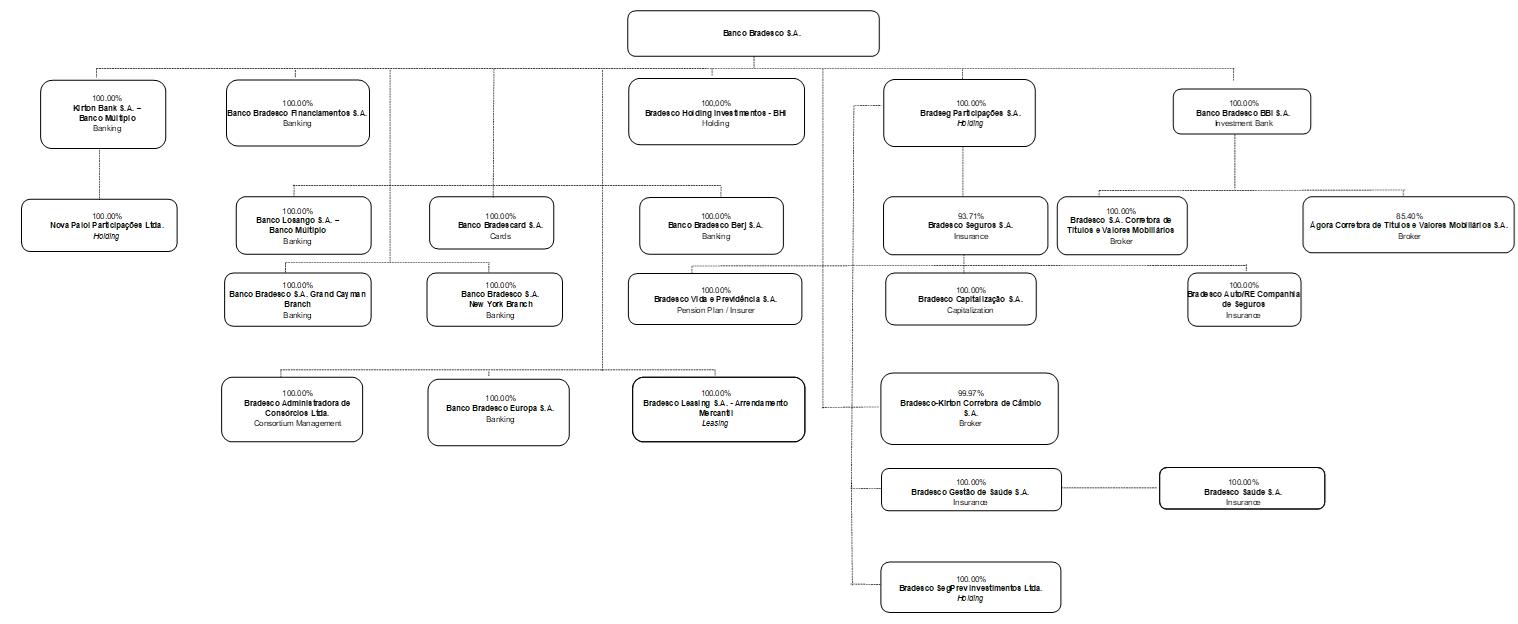
118 – Form 20-F 2025 | Bradesco |
4.D. Property, Plant and Equipment
As of December 31, 2025, we owned 736 properties and leased 2,777 properties throughout Brazil and 13 properties abroad, all of which we used in the operation of our branches and business. We own the buildings where our headquarters are located in Cidade de Deus, Osasco, São Paulo metropolitan region, State of São Paulo. Rental agreements have an average duration of five years.
ITEM 4.A. UNRESOLVED STAFF COMMENTS
None.
ITEM 5. OPERATING AND FINANCIAL REVIEW AND PROSPECTS
5.A. Operating Results
This discussion should be read in conjunction with our audited consolidated financial statements, the notes thereto and other financial information included elsewhere in this annual report.
5.A.10 Overview
The results of our operations are affected by the following factors, among others:
5.A.10.01 Brazilian Economic Conditions
The results of our operations are directly affected by economic conditions in Brazil. Such economic conditions directly impact our clients’ ability to pay their financial obligations on time, which affects our impairment of loans and advances and our balance of outstanding loans and advances. In addition, the impact of economic conditions on the foreign exchange rate affects our net interest income, since part of our financial assets and liabilities are denominated in or indexed to foreign currencies, primarily the U.S. dollar.
The following table shows Brazilian inflation measured by IPCA, the appreciation/(depreciation) of the real against the U.S. dollar, the foreign exchange rate at the end of each year and the average foreign exchange rate for the periods indicated:
| In R$, except % | |||
| 2025 | 2024 | 2023 | |
| Inflation (IPCA) | 4.3% | 4.8% | 4.6% |
| Appreciation/(depreciation) of the real against the U.S. dollar(1) | 11.1% | (27.9)% | 7.2% |
| Period-end exchange rate-US$1.00 | 5.5024 | 6.1923 | 4.8413 |
| Average exchange rate-US$1.00 (2) | 5.5679 | 5.4746 | 4.9950 |
(1) The percentage shows the appreciation or the depreciation of real vs. the U.S. dollar calculated over the period for one year from the date indicated; and
(2) The average exchange
rate is the average of the closing exchange rates at the end of each month in the twelve-month period.
Sources: FGV and the Central Bank of Brazil.
The following table shows GDP variation in real terms, average base interest rates and average interbank interest rates for the periods indicated:
| 2025 | 2024 | 2023 | |
| Change in real GDP (1) | 2.3% | 3.4% | 3.2% |
| Average base interest rates (2) | 14.3% | 10.8% | 13.2% |
| Average interbank interest rates (3) | 14.3% | 10.8% | 13.2% |
(1) Calculated
by dividing the change in real GDP during a year by the real GDP of the previous year;
(2) Calculated in accordance with Central Bank methodology (based on nominal rates); and
(3) Calculated in accordance with B3 methodology (ex-Clearing and Custody Chamber – “CETIP”) (based on nominal
rates).
Sources: The Central Bank of Brazil, the Brazilian Geography and Statistics Institute and B3.
119 – Form 20-F 2025 | Bradesco |
5.A.10.02 Effects of the global financial markets on our financial condition and operating results
The year 2025 was marked by great uncertainty in global trade and geopolitical relations, high tax expenditures in developed countries, massive investments in artificial intelligence (AI) and the weakness of the U.S. dollar against other currencies. Expectations that trade disputes could negatively affect the world economy and result in acceleration of inflation have not been confirmed, at least not in the expected intensity. In part, this is explained by the postponement of the collection of several of these tariffs, the agreements entered into with the U.S. and among the other countries. These uncertainties, however, combined with the increase in American public debt, contributed to the devaluation of the U.S. dollar throughout the year.
The performance of the U.S. economy surprised positively last year, driven by increased private investments and household consumption. At the same time, the impact of trade tariffs on US inflation was lower than expected, allowing the Fed to continue cutting the basic interest rate. The gradual slowdown of the Chinese economy throughout the year contributed to the process of global deflation, enabling other central banks around the world to also cut interest rates.
In 2026, geopolitical conflicts will continue to pose a risk to the global economy and international markets.
Reducing inflation and uncertainties regarding the fiscal scenario present additional challenges for Brazil. In the medium term, advances in the structural reform agenda, which signal sustainable trajectories for public debt in the coming years, remain an important factor for the economic landscape.
5.A.10.03 Effects of interest rates and currency devaluation/appreciation on net interest income
During periods of high interest rates, our interest income increases as a result of higher yields on our interest-earning assets. Simultaneously, our interest expense increases as interest rates on our interest-bearing liabilities also rise. Changes in the volumes of our interest-earning assets and interest-bearing liabilities also affect our interest income and interest expense. For example, an increase in our interest income attributable to an increase in interest rates may be offset by a decrease in the volume of our outstanding loans.
In addition, when the real appreciates, we incur: (i) gains on our liabilities denominated in, or indexed to, foreign currencies, such as our U.S. dollar-denominated long-term debt and foreign currency loans, as the cost in reais of the related interest expense decreases; and (ii) losses on our assets denominated in, or indexed to, foreign currencies, such as our U.S. dollar-indexed securities and loans and advances, as the income from such assets as measured in reais decreases. Conversely, when the real depreciates, we incur: (i) losses on our liabilities denominated in, or indexed to, foreign currencies; and (ii) gains on our assets denominated in, or indexed to, foreign currencies.
In the year ended December 31, 2025, our net interest income increased by 8.6% compared to the year ended December 31, 2024, to R$73,269 million in 2025 (R$67,455 million in 2024), as a result of increased interest and similar revenues, due to the higher interest rates in 2025 compared to 2024, in particular due to higher revenues from loans and advances to customers, financial assets at fair value through profit or loss and loans and advances to financial institutions.
The following tables show our foreign currency-denominated or indexed assets and liabilities as of the dates indicated:
120 – Form 20-F 2025 | Bradesco |
| As of December 31, | R$ in thousands | ||
| 2025 | 2024 | 2023 | |
| Assets | |||
| Cash and balances with banks | 5,799,137 | 9,508,721 | 5,754,226 |
| Financial assets at fair value through profit or loss | 15,473,743 | 7,686,883 | 11,402,529 |
| Financial assets at fair value through other comprehensive income | 17,619,472 | 19,688,426 | 12,527,248 |
| Financial assets at amortized cost | 9,740,622 | 647,502 | 844,012 |
| Loans and advances to banks | 2,807,715 | 1,981,802 | 3,623,146 |
| Loans and advances to customers | 71,901,769 | 60,657,018 | 36,164,900 |
| Non-recurring assets held for sale | 39,431 | - | - |
| Premises and equipment, net | 130,891 | 155,707 | 86,089 |
| Intangible assets and goodwill, net | 173,993 | 107,293 | 53,397 |
| Taxes to be offset | 371,730 | 390,386 | 331,235 |
| Deferred income tax assets | 31,306 | 116,683 | 185,108 |
| Other assets | 2,163,542 | 44,326,915 | 21,149,882 |
| Total assets | 126,253,351 | 145,267,336 | 92,121,772 |
| Off-balance sheet accounts – notional value | |||
| Derivatives | |||
| Futures | 54,344,313 | 22,985,640 | 10,470,069 |
| Forward | 64,714,131 | 62,442,929 | 33,955,881 |
| Options | 9,616,237 | 3,949,723 | 1,498,591 |
| Swap | 521,032,423 | 319,020,245 | 39,455,258 |
| Total assets with derivatives (a) | 775,960,455 | 553,665,873 | 177,501,571 |
| As of December 31, | R$ in thousands | ||
| 2025 | 2024 | 2023 | |
| Liabilities | |||
| Deposits from banks | 55,231,530 | 57,022,037 | 24,096,631 |
| Deposits from customers | 72,554,578 | 49,639,393 | 34,301,273 |
| Financial liabilities at fair value through profit or loss | 3,947,843 | 3,950,924 | 2,084,560 |
| Securities issued | 11,417,683 | 9,521,533 | 7,368,531 |
| Insurance contracts liabilities | 21,363 | 17,735 | 17,444 |
| Other reserves | 153,718 | 184,615 | 148,564 |
| Current income tax liabilities | 120,493 | 165,629 | 40,257 |
| Deferred income tax assets | 84,285 | 90,151 | 56,300 |
| Other liabilities | 1,924,363 | 16,381,484 | 15,298,158 |
| Total liabilities | 145,455,856 | 136,973,501 | 83,411,718 |
| Off-balance sheet accounts – notional value | |||
| Derivatives | |||
| Futures | 30,741,161 | 48,246,297 | 39,459,745 |
| Forward | 45,530,533 | 46,463,548 | 27,988,676 |
| Options | 15,908,308 | 6,870,683 | 2,164,645 |
| Swap | 355,159,513 | 202,546,445 | 32,201,517 |
| Total liabilities with derivative (b) | 592,795,371 | 441,100,474 | 185,226,301 |
| Net exposure (a-b) | 183,165,084 | 112,565,399 | (7,724,730) |
We use swaps, futures contracts and other hedging instruments to minimize the potential impact of currency fluctuations on our operations. For more information on our use of derivatives for hedging purposes, see Notes 2.d) (iii) and 7 to our consolidated financial statements in “Item 18. Financial Statements”.
5.A.10.04 Taxes
Our income tax expense consists of two federal taxes. For more information, see item “4.B.80.02 Income Tax and Social Contribution on Profit”.
Corporations based in Brazil may pay shareholders’ interest on shareholders’ equity as an alternative form of making dividend distributions, which can be deducted from the calculation of real profit and the basis of calculation of social contributions. Accordingly, we distribute interest on own capital as one of the mechanisms for shareholder remuneration, in compliance with applicable legislation and subject to the existence of sufficient profits and reserves. For further information on our tax expenses, see “Item 4.B. Business Overview – 4.B.70 Regulation and Supervision – 4.B.80 Taxes related to our activities – 4.B.80.02 Corporate Income Tax and Social Contribution on Net Profit”; “Item 10.B. Memorandum and Bylaws – 10.B.10 Group – 10.B.10.02 Allocation of net income and Distribution of Dividends”; and “Item 10.E. Taxation – 10.E.10 Brazilian tax considerations – 10.E.10.03 Interest on shareholders’ equity (JCP)”.
121 – Form 20-F 2025 | Bradesco |
The following table shows the amount of income tax paid in the years ended December 31, 2025 and 2024 by each tax jurisdiction in which we operate overseas.
| Brazil | R$ in thousands | |
| 2025 | 2024 | |
| USA | 210,037 | 161,613 |
| Mexico | 164,653 | 68,966 |
| Cayman Islands | 328,031 | 466,424 |
| Luxembourg | 7,740 | 8,218 |
| Other | 58 | 101 |
| Total | 710,519 | 705,322 |
5.A.10.05 Impact of material acquisitions and strategic alliances on our future financial performance
We believe that the acquisitions completed in recent years have the potential to contribute positively to the sustainable expansion of our activities, the strengthening of our competitive position, and the diversification of our revenue sources over the medium and long term. These initiatives are aligned with our growth strategy, which aims to expand the reach of our products and services, capture operational, technological, and commercial synergies, and access new markets and customer segments.
However, the expected benefits from these acquisitions depend on a number of factors, many of which are beyond our control or subject to a high degree of uncertainty. These factors include, among others, our ability to successfully integrate the operations, systems, processes, organizational cultures, and teams of the acquired or partner entities; the effective realization of the projected synergies within the originally anticipated timeframes; the retention of customers, key employees, and strategic partners; and the ongoing compliance of these operations with applicable regulatory and compliance requirements.
In addition, the realization of the estimated financial gains resulting from these transactions may be affected by adverse macroeconomic conditions, fluctuations in financial markets, changes in consumer behavior, accelerated technological developments, as well as potential legal, tax, or regulatory contingencies related to the acquired entities or the alliances established, even if such contingencies were not identified at the time the transactions were executed.
As a result, although these acquisitions and strategic alliances may generate meaningful benefits for our future operational and financial performance, there can be no assurance that such results will be achieved, nor can we reasonably estimate the timing or magnitude of their impact on our revenues, margins, profitability, or financial position.
For more information, see “Item 4.A. History and Development of the Company – 4.A.10 Acquisitions, divestitures and other strategic alliances”.
5.A.20 Results by operational segment
We operate and manage our business through two segments: the banking segment; and the insurance, pension plans and capitalization bonds segment. For further financial information in relation to our operating segments, see Note 38 to our consolidated financial statements in “Item 18. Financial Statements”. For a description of the operations of our operational segments, see “Item 4.B. Business Overview”.
The financial information in respect of our operating segments was prepared based on reports produced for our Management to assess performance and make decisions about the allocation of funds for investments and other purposes. Our Management uses various data, including financial data prepared under Brazilian Generally Accepted Accounting Principles (BR GAAP) and non-financial metrics, measured on different databases. Our consolidated financial statements and consolidated financial data included in this analysis are prepared in accordance with the IFRS Accounting Standards and, when the segment results show significant discrepancies compared to the consolidated financial statements, these differences will be explained alongside the discussion of the preceding results.
As of January 2025, we adopted in our Financial Statements, prepared in accordance with accounting practices adopted in Brazil applicable to institutions authorized to operate by the Central Bank of Brazil, the new accounting practices established by CMN Resolutions No. 4,966/21 and No. 4,975/21, prospectively. For managerial purposes, we kept the information of the previous periods as already disclosed, which do not present relevant differences in the historical analysis of the results.
See “FORM 20-F 2024 - Item 5.A. Operating Income – 5.A.20 Results by operational segment” of our annual report for the year ended December 31, 2024 for a comparative discussion of our operating results for the years ended December 31, 2024 and 2023.
122 – Form 20-F 2025 | Bradesco |
5.A.20.01 Results of operations for the year ended December 31, 2025, compared with the year ended December 31, 2024
The following tables set out the principal components of our net income for the years ended December 31, 2025 and 2024, on a consolidated basis and by segment.
| Consolidated | R$ in thousands, except % | ||
| 2025 | 2024 | % change | |
| Interest and similar income | 267,113,345 | 211,733,717 | 26.2% |
| Interest and similar expenses | (193,843,753) | (144,279,153) | 34.4% |
| Net interest income | 73,269,592 | 67,454,564 | 8.6% |
| Fee and commission income | 31,073,646 | 28,336,487 | 9.7% |
| Net gains/(losses) on financial assets and liabilities at fair value through profit or loss | 3,165,516 | (2,249,836) | - |
| Net gains/(losses) on financial assets at fair value through other comprehensive income | (99,338) | 1,031,353 | - |
| Net gains/(losses) on foreign currency transactions | 3,583 | 2,704,502 | - |
| Insurance services result | 11,331,343 | 8,942,260 | 26.7% |
| - Insurance and pension income | 61,111,265 | 57,340,928 | 6.6% |
| - Insurance and pension expenses | (49,779,922) | (48,398,668) | 2.9% |
| Other operating income | 14,401,104 | 10,428,279 | 38.1% |
| Expected loss on loans and advances | (28,677,857) | (26,636,777) | 7.7% |
| Expected loss on other financial assets | (930,103) | (889,156) | 4.6% |
| Personnel expenses | (24,442,062) | (22,277,310) | 9.7% |
| Other administrative expenses | (16,072,374) | (16,582,966) | (3.1)% |
| Depreciation and amortization | (7,063,267) | (6,371,096) | 10.9% |
| Other operating income/(expenses) | (22,696,722) | (18,093,096) | 25.4% |
| Other operating expense | (99,882,385) | (90,850,401) | 9.9% |
| Income before income taxes and share of profit of associates and joint ventures | 18,861,957 | 15,368,929 | 22.7% |
| Share of profit of associates and joint ventures | 2,162,627 | 1,531,585 | 41.2% |
| Income before income taxes | 21,024,584 | 16,900,514 | 24.4% |
| Income taxes | 2,900,052 | 641,639 | - |
| Net income for the year | 23,924,636 | 17,542,153 | 36.4% |
| Segment | R$ in thousands, except % | |||||
| As of and for the year ended December 31, | ||||||
| Banking (A) | Insurance, Pension Plans and Capitalization Bonds (B) | |||||
| 2025 | 2024 | % change | 2025 | 2024 | % change | |
| Revenue from financial intermediation | 235,516,116 | 169,745,125 | 38.7% | 8,506,979 | 37,327,260 | (77.2)% |
| Expenses from financial intermediation | (154,883,751) | (98,810,413) | 56.7% | (18,430) | (30,050,169) | (99.9)% |
| Financial margin | 80,632,365 | 70,934,712 | 13.7% | 8,488,549 | 7,277,091 | 16.6% |
| Expected Credit Loss Associated with Credit Risk expense | (36,370,035) | (33,123,621) | 9.8% | - | - | - |
| Gross income from financial intermediation | 44,262,330 | 37,811,091 | 17.1% | 8,488,549 | 7,277,091 | 16.6% |
| Other income from insurance, pension plans and capitalization bonds | - | - | - | 13,887,736 | 11,520,350 | 20.5% |
| Fee and commission income and income from banking fees | 39,563,634 | 36,213,830 | 9.3% | 2,061,017 | 1,923,437 | 7.2% |
| Other administrative expenses | (46,173,552) | (44,525,627) | 3.7% | (5,138,904) | (4,571,572) | 12.4% |
| Tax expenses | (7,520,187) | (6,313,204) | 19.1% | (1,484,930) | (1,391,406) | 6.7% |
| Share of profit (loss) of associates and jointly controlled companies | (225,416) | 121,511 | - | 610,771 | 243,403 | 150.9% |
| IR/CSI and Other income/expenses | (15,496,030) | (13,425,161) | 15.4% | (8,354,473) | (5,945,008) | 40.5% |
| Net income | 14,410,779 | 9,882,440 | 45.8% | 10,069,766 | 9,056,295 | 11.2% |
123 – Form 20-F 2025 | Bradesco |
| As of and for the year ended December 31, | ||||||
| 2025 | 2024 | |||||
| Banking and Insurance, Pension Plans and Capitalization Bonds (A+B) |
Other Activities, Eliminations and Consolidation adjustments |
Consolidated 2025 (A+B+C) | Banking and Insurance, Pension Plans and Capitalization Bonds (A+B) |
Other Activities, Eliminations and Consolidation adjustments |
Consolidated 2024 (A+B+C) | |
| Revenue from financial intermediation | 244,023,095 | 26,160,011 | 270,183,106 | 207,072,385 | 6,147,351 | 213,219,736 |
| Expenses from financial intermediation | (154,902,181) | (38,941,572) | (193,843,753) | (128,860,582) | (15,418,571) | (144,279,153) |
| Financial margin | 89,120,914 | (12,781,561) | 76,339,353 | 78,211,803 | (9,271,220) | 68,940,583 |
| Expected Credit Loss Associated with Credit Risk expense | (36,370,035) | 6,762,075 | (29,607,960) | (33,123,621) | 5,597,688 | (27,525,933) |
| Gross income from financial intermediation | 52,750,879 | (6,019,486) | 46,731,393 | 45,088,182 | (3,673,532) | 41,414,650 |
| Other income from insurance, pension plans and capitalization bonds | 13,887,736 | (1,675,290) | 12,212,446 | 11,520,350 | (1,761,186) | 9,759,164 |
| Fee and commission income and income from banking fees | 41,624,651 | (10,551,005) | 31,073,646 | 38,137,267 | (9,800,780) | 28,336,487 |
| Personnel /Administrative Expenses | (51,312,456) | 3,734,753 | (47,577,703) | (49,097,199) | 3,865,827 | (45,231,372) |
| Tax expenses | (9,005,117) | 915,586 | (8,089,531) | (7,704,610) | 829,650 | (6,874,960) |
| Share of profit (loss) of unconsolidated and jointly controlled companies | 385,355 | 1,777,272 | 2,162,627 | 364,914 | 1,166,671 | 1,531,585 |
| IR/CSI and Other income/expenses | (23,850,503) | 11,262,261 | (12,588,242) | (19,370,169) | 7,976,768 | (11,393,401) |
| Net income | 24,480,545 | (555,909) | 23,924,636 | 18,938,735 | (1,396,582) | 17,542,153 |
Consolidated
The following are explanations of material changes to the material line items of our income statement prepared in accordance with IFRS Accounting Standards:
| Ø | Interest and similar income |
Our interest and similar income increased by R$55,380 million, or 26.2%, in the year ended December 31, 2025 compared to the year ended December 31, 2024, due to the increase in the average volume of interest-bearing assets, representing an increase of R$20,418 million in our revenues primarily due to the growth of R$8,373 million in financial assets at amortized cost, the growth of R$7,808 million in loans and advances to customers, and the increase in the average rates of our interest yielding assets, reflecting the increase in the SELIC rate, which was 15.0% as of December 31, 2025 compared to 12.2% as of December 31, 2024, in addition to changes in other economic-financial indices, such as inflation. These factors had a positive impact on our revenues amounting to R$34,962 million.
| Ø | Interest and similar expenses |
Our interest and similar expenses increased by R$49,565 million, or 34.4%, in the year ended December 31, 2025 compared to the year ended December 31, 2024, due to the increase in the average interest rate paid which increased our expenses by R$37,265 million, mainly due to: (i) insurance contracts liabilities whose interest and similar expenses increased by R$17,926 million; (ii) securities sold under agreements to repurchase whose interest and similar expenses increased by R$7,520 million and (iii) time deposits whose interest and similar expenses increased by R$6,886 million. In addition, there was an increase in the average volume of our interest-bearing liabilities, which increased by R$12,300 million.
| Ø | Fee and commission income |
Our fee and commission income increased by R$2,737 million, or 9.7%, in the year ended December 31, 2025 compared to the year ended December 31, 2024, reflecting growth in revenue mainly as a result of, among other things an increase in: (i) loans of R$1,473 million, or 110.3%; (ii) credit card income of R$562 million, or 5.8%; and (iii) capital Markets/Financial Advisory Services of R$490 million, or 29.3%.
124 – Form 20-F 2025 | Bradesco |
| Ø | Net gains (losses) on financial assets and liabilities at fair value through profit or loss |
Our net gains on financial assets and liabilities at fair value through profit or loss totaled R$3,165.5 million in the year ended December 31, 2025 compared to a net loss of R$2,250 million in the year ended December 31, 2024, due to higher returns on investments in securities (an increase of R$3,880 million) and derivative financial instruments (an increase of R$1,536 million), which returns resulted from the increase in the average rates of our interest yielding assets, reflecting the increase in the SELIC rate, which was 15.0% as of December 31, 2025 compared to 12.2% as of December 31, 2024, in addition to changes in other economic-financial indexes, such as inflation.
| Ø | Net gains/(losses) on foreign currency transactions |
Our net losses on foreign currency transactions totaled R$3.6 million in the year ended December 31, 2025 compared to a net gain of R$2,705 million in the year ended December 31, 2024, due to the lower appreciation of the real vs. U.S. dollar, given that net gains and losses on foreign currency transactions primarily consist of gains or losses from currency and conversion of certain transactions in a foreign currencies to the real.
| Ø | Insurance service result |
Our insurance service result for the year ended December 31, 2025 increased by R$2,389 million, or 26.7%, compared to the year ended December 31, 2024, due to the increase in insurance and pension plans income of R$3,770 million, or 6.6%, particularly with respect to the line item revenue from Premium Allocation Approach (PAA) contracts measured under our premium allocation approach.
| Ø | Expected loss on loans and advances |
Our expected credit losses on loans and advances for the year ended December 31, 2025 increased by R$2,041 million, or 7.7%, compared to the year ended December 31, 2024, driven by the increased growth in retail operations particularly for micro, small and medium enterprises (MSME) and individuals, which present a riskier credit profile.
The following table shows the changes in our expected losses on loans and advances, amounts recovered and write-offs for the years ended December 31, 2025 and 2024, as well as our ratio of expected credit losses for loans and advances to average loans and advances to customers in all cases as set out in Note 11.d of our consolidated financial statements prepared in accordance with IFRS Accounting Standards as included in “Item 18. Financial Statements”.
| R$ in thousands, except % | |||
| 2025 | 2024 | % change | |
| Balance at the beginning of the period | 51,562,917 | 53,661,810 | (3.9)% |
| Expected credit loss for loans and advances (1) (2) | 32,966,567 | 36,478,523 | (9.6)% |
| Loan write-offs | (34,436,202) | (38,577,415) | (10.7)% |
| Expected credit losses for loans and advances at the end of the year | 50,093,282 | 51,562,917 | (2.9)% |
| Ratio of expected credit losses for loans and advances to average loans and advances to customers | 4.6% | 5.5% | |
(1) It includes expected losses on loan commitments and financial guarantees provided; and
(2) Represents the net increase in ECL due to originations and provision constitutions / (reversions). Does not include the Revenue from credit recovery in the amount of R$5,761 million in 2025 (R$9,842 million in 2024) that is presented as part of the Expected Loss on Loans and Advances in our Statement of Income.
We recorded a provision for expected losses on loans and advances to customers of R$50,093 million as of December 31, 2025, reaching a coverage ratio of loans over 90 days past due of 149.9% as of December 31, 2025 (180.1% as of December 31, 2024). We calculate our coverage ratio of loans over 60 days and 90 days past due by dividing the total balance of expected credit losses for loans and advances to customers by the balance of loans and advances to customers more than 90 days overdue.
125 – Form 20-F 2025 | Bradesco |
Our credit losses, net of recoveries, reached 4.0% of the average balance of loans and advances to customers in 2025 (compared to 4.3% in 2024). For further information about our credit losses, net of recoveries, see “Item 4.B. Business Overview – 4.B.100 Selected Statistical Information – 4.B.100.06 Expected credit losses on loans and advances”.
Our portfolio of loans and advances to customers increased by 9.9%, to R$791,468 million in the year ended December 31, 2025 from R$720,240 million in the year ended December 31, 2024, reflecting an increasing number of transactions with: (i) legal entities, which increased by 10.6% compared to 2024, primarily due to: (a) a 15.3% increase in loans (including working capital, rural loans and others), and (b) a 3.9% increase in financing and transfers (including import/export financing, real estate, vehicles, BNDES/Finame transfers and leasing); and (ii) individuals, which saw an 9.4% increase compared to 2024, primarily due to: (a) a 11.5% increase in financing and transfers (including real estate and vehicle financing, BNDES/Finame transfers and others), and (b) a 7.0% increase in loans (including personal payroll-deductible loans, personal and rural loans).
| Ø | Personnel expenses |
Our personnel expenses for the year ended December 31, 2025 increased by R$2,165 million, or 9.7%, compared to the year ended December 31, 2024, as a result of an increase in payroll and social security contributions, which increased by 14.5% compared to the year ended December 31, 2024 reflecting the annual collective bargaining agreement adjustment that takes effect from September each year, resulting in a 5.68% increase in salaries and benefits for September 2025 (compared to 4.64% in September 2024). Additionally, we had an increase in performance-related remuneration expenses which was driven by the profit growth during the period.
| Ø | Income tax and social contribution |
The following table reflects the breakdown of our income tax and social contribution charges:
| Consolidated | R$ in thousands, except % | |
| 2025 | 2024 | |
| Income before income taxes | 21,024,584 | 16,900,514 |
| Total burden of income tax and social contribution at the current rates | (9,461,063) | (7,605,231) |
| Effect of additions and exclusions in the tax calculation: | ||
| Share of profit of associates and joint ventures | 973,182 | 689,213 |
| Non-taxable income net of non-deductible expenses (1) | 3,046,366 | 1,026,145 |
| Interest on shareholders’ equity | 6,524,673 | 5,077,509 |
| Other amounts (2) | 1,816,894 | 1,453,403 |
| Income tax and social contribution for the period | 2,900,052 | 641,639 |
(1) Includes the amounts related to the Adhesion to the Integral Transaction Program (PTI); and
(2)Primarily, includes: (i) effect of tax rates in foreign jurisdictions and subsidiaries with different applicable tax rates except banks, insurance companies and non-financial companies; and (ii) the incentivized deductions.
The variation in our income tax and social contribution is mainly attributable to higher income from associates and joint ventures, increased benefits from interest on shareholders’ equity and, most significantly, the adoption of the Comprehensive Tax Settlement Program (Programa de Transação Integral – PTI). For more information on Income tax and social contribution, see Note 37 of our Consolidated Financial Statements in “Item 18. Financial Statements”.
| Ø | Net Income |
As a result of the above, our net income increased by 36.4%, to R$23,925 million in the year ended December 31, 2025 from R$17,542 million in the year ended December 31, 2024.
126 – Form 20-F 2025 | Bradesco |
Operating Segments (BR GAAP)
For segment reporting purposes, the following sections explain of material changes to certain material line items of our income statement prepared in accordance with accounting practices adopted by institutions authorized to operate by the Central Bank of Brazil, as well as explanations of significant differences between the aggregated amounts reported for our operating segments and the equivalent amounts in our consolidated statement of income:
5.A.20.01-01 Financial Margin
Our financial margin is equivalent to the aggregate of the following IFRS Accounting Standards captions: net interest income; net profit/(loss) on financial assets/liabilities at fair value through profit or loss; net profit/(loss) on financial assets at fair value through other comprehensive income and net profit/(loss) on foreign currency transactions. It reflects the net income of our financial intermediation activities before the expenses of expected losses on loans and advances.
The following table breaks down the variation in our financial margin by segment, showing the impact of changes in the average volume of interest-earning assets; changes in average interest rates and the effects of the appreciation/(depreciation) of the real against the U.S. dollar, in each case comparing the years ended December 31, 2025 and 2024:
| R$ in thousands | ||
| Banking | Insurance, pension and capitalization bonds | |
| 2025/2024 | ||
| Increase/(decrease) | ||
| Due to changes in average volume of interest-earning assets and interest-bearing liabilities (1) | 12,188,721 | 3,195,210 |
| Due to changes in average interest rates | 7,898,218 | (5,274,776) |
| Due to Brazilian real appreciation/depreciation | 104,042 | 642 |
| Non-interest gains / losses | (10,493,328) | 3,290,382 |
| Net change | 9,697,653 | 1,211,458 |
(1)Of this amount, R$30,355,622 refers to interest earning assets and -R$18,166,901 to interest-bearing liabilities in the banking segment and R$4,531,476 interest earning assets and -R$1,336,266 to interest-bearing liabilities in the insurance, pension plans and capitalization bonds segment.
| Ø | Banking |
The growth of 13.7% in the financial margin is a reflection of the increase in the average volume of our interest yielding assets, increasing our revenues by R$12,189 million, in addition to the growth in the average rates of our interest yielding assets, due to increases Brazilian interest rates to 15.00% in 2025 from 12.25% in 2024, increasing our revenues by R$7,898 million.
The variation in non-interest gains/losses is mainly related to our results obtained from derivative financial instruments, as well as the result from other non-interest earning assets, such as investment fund quotas.
| Ø | Insurance, pension plans and capitalization bonds |
The increase of 16.6% in our financial margin is related to the behavior of the economic and financial indicators that impacted the performance of financial investments, especially investments linked to the IGP-M, IPCA and SELIC/CDI, as well as the updating of technical provisions. The average volume of our business also experienced growth (11.5%), increasing our revenues by R$3.195 million. The financial margin for this segment also includes gains and losses on financial instruments and derivatives and the result of other assets that do not yield interest (shares and quotas of investment funds).
127 – Form 20-F 2025 | Bradesco |
a) Revenue from financial intermediation
The following tables show, on a consolidated basis and by segment, the average balance of the principal components of our interest-earning assets, interest and similar income earned and the average interest rates as of and for the years ended December 31, 2025 and 2024:
| As of and for the year ended December 31, | R$ in thousands, except % | |||||
| 2025 | 2024 | |||||
| Average balance | Interest and similar income | Average rate | Average balance | Interest and similar income | Average rate | |
| Average balance of interest-earning assets | ||||||
| Financial assets at fair value through profit or loss | 440,072,220 | 52,873,127 | 12.0% | 358,109,730 | 27,842,234 | 7.8% |
| Financial assets at fair value through other comprehensive income | 126,865,196 | 13,719,216 | 10.8% | 210,390,801 | 24,537,302 | 11.7% |
| Financial assets at amortized cost | 253,759,850 | 32,407,932 | 12.8% | 184,945,971 | 20,118,794 | 10.9% |
| Loans and advances to financial institutions | 211,129,632 | 36,244,964 | 17.2% | 176,390,408 | 27,775,382 | 15.7% |
| Loans and advances to customers | 714,418,608 | 119,910,827 | 16.8% | 665,696,054 | 102,544,122 | 15.4% |
| Compulsory and voluntary deposits with the Central Bank | 103,319,030 | 11,905,271 | 11.5% | 101,402,567 | 8,894,336 | 8.8% |
| Other interest-earning assets | 109,830 | 52,008 | - | 110,419 | 21,547 | - |
| Total interest-earning assets | 1,849,674,366 | 267,113,345 | 14.4% | 1,697,045,950 | 211,733,717 | 12.5% |
| Segment | R$ in thousands, except % | |
| Banking | Insurance, pension and capitalization bonds | |
| 2025 | 2025 | |
| Average balance of interest-earning assets | ||
| Financial assets held for trading | 112,404,072 | 355,134,420 |
| Financial assets available for sale | 67,115,846 | 31,407,464 |
| Investments held to maturity | 230,701,564 | 52,386,968 |
| Loans and advances to financial institutions | 220,666,749 | - |
| Loans and advances to customers | 909,150,745 | - |
| Compulsory and voluntary deposits with the Central Bank | 103,659,578 | - |
| Other interest-earning assets | 118,472 | - |
| Total | 1,643,817,026 | 438,928,852 |
| Average interest rate earned | 15.0% | 12.3% |
For further information about average interest rates by type of assets, see “Item 4.B. Business Overview – 4.B.100 Selected Statistical Information – 4.B.100.01 Average Statement of Financial Position and Yield Data”.
The following table breaks down the variation in our revenue from financial intermediation by segment, showing the impact of changes in the average volume of interest-earning assets; changes in average interest rates and the effects of the appreciation/(depreciation) of the real against the U.S. dollar, in each case comparing the years ended December 31, 2025 and 2024:
| Banking | Insurance, pension and capitalization bonds | |
| 2025/2024 | ||
| Increase/(decrease) | ||
| Due to changes in average volume of interest-earning assets | 30,355,622 | 4,531,476 |
| Due to changes in average interest rates | 22,795,964 | 12,651,741 |
| Due to Brazilian real appreciation/depreciation | (69,278) | 642 |
| Non-interest gains / losses | 12,688,683 | (46,004,140) |
| Net change | 65,770,991 | (28,820,281) |
128 – Form 20-F 2025 | Bradesco |
| Ø | Banking |
The R$65,771 million, or 38.7%, increase in revenue from financial intermediation reflects the growth in the average volume of our business, which contributed by R$30,356 million to our revenues, primarily due to (i) the increase in our loans and advances to financial institutions and customers and financial assets at amortized cost, and (ii) the variation in the SELIC rate in 2025, which increased to 15.00% in 2025 from 12.25% in 2024, increasing our revenues by R$22,796 million.
Revenue from financial intermediation from loans and advances to customers totaled R$139,820 million for the year ended December 31, 2025, an increase of 22.7% compared to 2024, reflecting an increase of 34.8% in the average balance of these assets, increasing revenues by R$36,823 million.
Revenues from financial assets at amortized cost totaled R$27,822 million for the year ended December 31, 2025, an increase of 747.8% compared to the year ended December 31, 2024. This growth was driven by an increase of 374% in the average volume of these assets, benefiting our revenues in R$20,268 million.
Revenues from loans and advances to financial institutions reached R$35,863 million, an increase of 29.3% compared to 2024. This increase is due to increases in the SELIC rate in 2025, which increased our revenues by R$7,004 million, as well as the increase in the average volume of our business, which contributed to our revenues with R$1,120 million.
Revenues from financial assets at fair value through profit or loss (FVTPL) reached R$19,057 million, an increase of 146.4% compared to 2024. This increase is due to increases in the SELIC rate in 2025, which increased our revenues by R$8,441 million, in addition to the increase in the average volume of our business, which contributed to our revenues with R$2,883 million.
Revenues from financial assets at fair value through other comprehensive income (FVOCI) reached R$11,265 million, a decrease of 63.8% compared to 2024. This decrease is related to the reduction in the average volume of our business, reducing our revenues by R$29,260 million. This decrease was partially offset by the increase in the SELIC rate during 2025, which contributed to our revenues with R$9,444 million.
Revenues from voluntary investments and compulsory deposits in the Central Bank of Brazil reached R$11,905 million, an increase of 33.9% compared to 2024. This increase is due to the increase in the SELIC rate during 2025, which contributed to our revenues with R$4,477 million.
The non-interest gains/losses are mainly related to our results obtained from derivative financial instruments, as well as the result from other non-interest earning assets, such as shares and investment fund quotas.
| Ø | Insurance, pension plans and capitalization bonds |
The decrease of R$28,820 million, or 77.2%, in the revenues of financial intermediation largely reflects the increase in losses related to non-interest earning assets. This decrease was partially offset by the increase (i) interest rates in Brazil, which increased to 15.00% in 2025 from 12.25% in 2024, increasing our revenues by R$12,652 million, and (ii) in the average volume of our business, which contributed to our revenues with R$4,531 million.
b) Expenses from financial intermediation
The tables below show, on a consolidated basis and by segment, the average balance of the main components of our interest-bearing liabilities, the interest and similar expenses, and the average interest rates on them as of and for the years ended December 31, 2025 and 2024:
129 – Form 20-F 2025 | Bradesco |
| As of and for the year ended December 31, | R$ in thousands, except % | |||||
| 2025 | 2024 | |||||
| Average balance | Interest and similar expense | Average rate | Average balance | Interest and similar expense | Average rate | |
| Savings deposits | 126,483,184 | 9,041,498 | 7.1% | 130,078,185 | 7,977,114 | 6.1% |
| Time deposits (1) | 493,232,274 | 47,663,471 | 9.7% | 445,762,404 | 36,525,027 | 8.2% |
| Securities sold under agreements to repurchase | 302,570,320 | 38,659,676 | 12.8% | 284,206,503 | 29,159,155 | 10.3% |
| Borrowing and on-lending | 68,366,424 | 7,858,916 | 11.5% | 57,204,642 | 7,768,802 | 13.6% |
| Securities issued | 281,006,523 | 32,910,202 | 11.7% | 254,247,051 | 26,420,100 | 10.4% |
| Subordinated debt | 56,807,177 | 8,397,038 | 14.8% | 51,982,186 | 6,378,786 | 12.3% |
| Insurance contracts liabilities | 399,368,446 | 49,312,952 | 12.3% | 382,989,590 | 30,050,169 | 7.8% |
| Total Interest and similar expenses | 1,727,834,348 | 193,843,753 | 11.2% | 1,606,470,561 | 144,279,153 | 9.0% |
(1) Includes interbank deposits.
| Segment | R$ in thousands, except % | |
| Banking | Insurance, pension and capitalization bonds | |
| 2025 | 2025 | |
| Average balance of interest-bearing liabilities | ||
| Savings deposits | 125,539,876 | - |
| Time deposits (1) | 505,662,770 | - |
| Securities sold under agreements to repurchase | 349,474,065 | - |
| Borrowing and on-lending | 104,469,893 | - |
| Securities issued | 331,881,188 | - |
| Subordinated debt | 56,345,425 | - |
| Technical provisions for insurance, pension plans and capitalization bonds | - | 399,368,446 |
| Total | 1,473,373,217 | 399,368,446 |
| Average interest rate paid | 11.6% | 12.3% |
(1) Includes interbank deposits
For further information about average interest rates by type of liabilities, see “Item 4.B. Business Overview – 4.B.100 Selected Statistical Information – 4.B.100.01 Average Statement of Financial Position and Yield Data”.
The following table shows, by segment, the variation in our expenses from financial intermediation that was attributable to changes in the average volume of interest-bearing liabilities, the changes attributable to average interest rates and the change attributable to variation in the effects of the appreciation/(depreciation) of the real against the U.S. dollar rate, in each case comparing the years ended December 31, 2025 and 2024:
| Banking | Insurance, pension and capitalization bonds | |
| 2025/2024 | ||
| Increase/(decrease) | ||
| Due to changes in average volume of interest-bearing liabilities | 18,166,901 | 1,336,266 |
| Due to changes in average interest rates | 14,897,746 | 17,926,517 |
| Due to Brazilian real appreciation/depreciation | (173,320) | - |
| Non-interest gains / losses | 23,182,011 | (49,294,522) |
| Net change | 56,073,338 | (30,031,739) |
| Ø | Banking |
The increase of R$56,073 million or 56.7% in expenses from financial intermediation is due to the increase in the average volume of interest-bearing liabilities, which increased our expenses by R$18,167 million, with emphasis on higher expenses related to: (i) securities issued, (ii) securities sold under agreements to repurchase, (iii) borrowings and onlendings; and (iv) long-term deposits, in addition to the higher funding costs, which increased our expenses by R$14,898 million.
130 – Form 20-F 2025 | Bradesco |
The decrease in non-interest gains/losses is mainly related to the result obtained from derivative financial instruments, as well as the result from other non-interest earning assets, such as shares and investment fund quotas.
| Ø | Insurance, pension plans and capitalization bonds |
The reduction of R$30,032 million or 99.9% in the expenses of financial intermediation is related, largely, to the reduction of losses related to non-interest assets. This reduction was partially offset by the variation of interest rates in Brazil, which increased to 15.00% in 2025 from 12.25% in 2024, which increased our expenses by R$17,926 million, in addition to the increase in the average volume of our business, increasing our expenses by R$1,336 million.
5.A.20.01-02 Fee and commission income, income from insurance, pension plans and capitalization bonds, share of profit (loss) of associates and jointly controlled companies and other operating income
The following table shows on a consolidated basis and by segment, the principal components of our non-interest income as of and for the years ended December31, 2025 and 2024:
| Consolidated | R$ in thousands, except % | ||
| As of and for the year ended December 31, | |||
| 2025 | 2024 | % change | |
| Fee and commission income | 31,073,646 | 28,336,487 | 9.7% |
| Insurance services result | 11,331,343 | 8,942,260 | 26.7% |
| Share of profit of associates and joint ventures | 2,162,627 | 1,531,585 | 41.2% |
| Other operating income | 25,733,583 | 24,895,087 | 3.4% |
| Total | 70,301,199 | 63,705,419 | 10.4% |
| Segment | R$ in thousands, except % | |||||
| Banking | Insurance, pension plans and capitalization bonds | |||||
| 2025 | 2024 | % change | 2025 | 2024 | % change | |
| Fee and commission income and income from banking fees | 39,563,634 | 36,213,830 | 9.3% | 2,061,017 | 1,923,437 | 7.2% |
| Other income from insurance, pension plans and capitalization bonds | - | - | - | 13,887,736 | 11,520,350 | 20.5% |
| Share of profit (loss) of associates and jointly controlled companies | (225,416) | 121,511 | - | 610,771 | 243,403 | 150.9% |
| Other operating income | 22,575,340 | 14,082,864 | 60.3% | 2,877,522 | 4,085,092 | (29.6)% |
| Total | 61,913,558 | 50,418,205 | 22.8% | 19,437,046 | 17,772,282 | 9.4% |
| Ø | Banking |
| · | Fee and Commission Income: Increased as a result of the increase of: (i) 14.4% in card revenues, reflecting the 9.8% increase in the financial volume traded; (ii) 29.2% in the capital markets/ financial advisory fees, reflecting efforts in capturing business opportunities in all segments of the capital markets and in merger and acquisition operations; (iii) 17.3% in consortia administration fees, driven by higher sales in the real estate segment; and (iv) 6.1% in asset management fees, supported by the increase in shareholders’ equity under management, the diversification of our client base and the expansion of the range of products offered, in addition to higher revenues with performance rates. |
| Ø | Insurance, pension plans and capitalization bonds |
| · | Income from insurance, pension plans and capitalization bonds: The increase of 20.5% in income from insurance, pension plans and capitalization bonds is related to the increase of 8.4% in earned insurance premiums, pension contributions and capitalization revenues, mainly through the digital channels that reached R$6.4 billion in 2025. In addition, our financial operating income increased by 9.3% in the year ended December 31, 2025 compared to the same period in 2024. |
131 – Form 20-F 2025 | Bradesco |
| Ø | Main difference between balances by segment and consolidated balances |
We highlight below the main difference between our non-interest income by segment in accordance with accounting practices adopted in Brazil applicable to institutions authorized to operate by the Central Bank of Brazil and our consolidated non-interest income (IFRS Accounting Standards) for the year ended December 31, 2025:
| · | Non-interest income: The difference in our interest income prepared in accordance with in accordance with accounting practices adopted in Brazil applicable to institutions authorized to operate by the Central Bank of Brazil compared to IFRS Accounting Standards (R$11,049 million in the year ended December 31, 2025 and R$4,485 million in the year ended December 31, 2024) is mainly due to the difference in the calculation basis of the effective interest rates according to IFRS Accounting Standards compared to BR GAAP. In addition to overall adjustments, originating from proportionally consolidated companies and the “non-consolidation” of exclusive funds. |
5.A.20.01-03 Personnel expenses, other administrative expenses and other operating expenses
The following tables show, on a consolidated basis and by segment, the principal components of our non-interest expenses as of and for the years ended December 31, 2025 and 2024:
| Consolidated | R$ in thousands, except % | ||
| As of and for the year ended December 31, | |||
| 2025 | 2024 | % change | |
| Personnel expenses | (24,442,062) | (22,277,310) | 9.7% |
| Other administrative expenses | (16,072,374) | (16,582,966) | (3.1)% |
| Depreciation and amortization | (7,063,267) | (6,371,096) | 10.9% |
| Other operating expenses | (48,430,304) | (42,988,184) | 12.7% |
| Total | (96,008,007) | (88,219,556) | 8.8% |
| Segment | R$ in thousands, except % | |||||
| Banking | Insurance, pension and capitalization bonds | |||||
| 2025 | 2024 | % change | 2025 | 2024 | % change | |
| Personnel /Administrative Expenses | (46,173,552) | (44,525,627) | 3.7% | (5,138,904) | (4,571,572) | 12.4% |
| Other operating expenses | (45,591,557) | (36,059,060) | 26.4% | (12,716,925) | (5,481,863) | 132.0% |
| Total | (91,765,109) | (80,584,687) | 13.9% | (17,855,829) | (10,053,435) | 77.6% |
| Ø | Banking |
| · | Personnel expenses: higher expenses with income, social charges, benefits and profit sharing, reflecting the improvement in financial performance/profitability, in addition to the readjustments approved in the collective agreement applies from September of each year, with a readjustment of 5.68% in wages and benefits in 2025 (4.64% in 2024); |
| · | Administrative expenses: the lower administrative expenses result from the optimization of structural costs related to facilities and transportation, reflecting the adjustment of our footprint. Expense management continues to be guided by financial discipline and a constant commitment to efficiency; and |
| · | Other operating expenses: the increase during the period mainly reflect movements in civil, labor and tax contingencies, higher card-related commercialization expenses due to increased transaction volumes—particularly in the high-income segment - as well as the increase in our ownership interest in Cielo and the consolidation of Banco John Deere. |
132 – Form 20-F 2025 | Bradesco |
5.B. Liquidity and Capital Resources
5.B.10 Asset and liability management
Our general policy on asset and liability management is to manage interest rate, liquidity, foreign exchange and maturity risks in order to maximize our net interest income and our return on assets and equity, in light of our internal risk management policies, and maintain adequate levels of liquidity and capital.
As part of our asset and liability management, we seek to avoid material mismatches between assets and liabilities by matching, to the extent possible, the maturity, currency and interest rate structure of loans we make to the terms of the transactions under which we fund these loans. Subject to our policy constraints and the limits established by our Board of Directors, we occasionally take mismatched positions in relation to interest rates, maturities and, in more limited circumstances, foreign currencies, when we believe such positions are justified in view of market conditions and prospects.
We monitor our asset and liability positions in accordance with the requirements and guidelines of the Central Bank of Brazil. Our Asset and Liability Management and Treasury Executive Committee meets every two weeks to:
| · | evaluate action strategies relating to asset and liability management, within the limits established, based on an analysis of the political-economic scenarios, at national and international level; |
| · | monitor and endorse the pricing strategies of asset, liability and derivative operations with our clients; |
| · | define internal prices for the transfer of resources (Funds Transfer Price – FTP) of liabilities and assets in local and foreign currency; |
| · | approve the proposal on the limit of tolerance for exposure to risks to be submitted to the approval of the COGIRAC and the Board of Directors; and |
| · | monitor and endorse results, strategies, behaviors and risks of mismatch and indexes maintained by us and managed by the Treasury. |
In making such decisions, we evaluate not only our exposure limits for each market segment and product, but also market volatility levels and the extent to which we are exposed to market risk through interest, maturity, liquidity and currency mismatches. We also consider other potential risks, as well as market liquidity, our institutional needs and perceived opportunities for gains. Our Treasury Executive Committee for Asset and Liability Management holds extraordinary meetings as required in response to unexpected macroeconomic changes.
In addition, we receive daily reports on our mismatched and open positions, while our Asset and Liability Management and Treasury Executive Committee assesses our risk position every two weeks.
5.B.20 Liquidity and funding
We have policies, procedures, metrics and limits in place aimed at controlling liquidity risks. We believe that the components of our Liquidity Coverage Ratio and Net Stable Funding Ratio (LCR and NSFR, respectively) are in line with best market practices as well as Basel III requirements. As of December 31, 2025, the LCR and NSFR indicators were 158.3% and 122.8%, respectively. For further information on Basel III, see “Item 5.B.40 Capital Compliance – Basel III”.
The Treasury area acts as a support center for our different business segments by managing our funding and liquidity positions and executing our investment objectives in accordance with our asset and liability management policies. We are also responsible for setting rates for our different products, including foreign exchange and interbank transactions. The Treasury area covers any funding shortfall by borrowing in the interbank market. It seeks to maximize the efficient use of our deposit base by investing any surpluses in liquid instruments in the interbank market.
133 – Form 20-F 2025 | Bradesco |
We have used our excess liquidity to invest in Brazilian government securities and expect to continue doing so, subject to regulatory requirements and investment considerations. Our principal sources of funding are:
| · | demand, savings, and time deposits, as well as interbank deposits, representing 33.0% of the average balance of liabilities in the year ended December 31, 2025, compared to 33.9% in the year ended December 31, 2024 and 35.4% in the year ended December 31, 2023; and |
| · | securities sold under agreements to repurchase, borrowings and onlendings, funds from securities issued and subordinated debt, part of which is denominated in foreign currencies, representing 35.8% of the average balance of liabilities for the year ended December 31, 2025, compared to 35.4% in the year ended December 31, 2024 and 34.4% in the year ended December 31, 2023. |
Our capital markets operations are a source of funding through our transactions with financial institutions, mutual funds, fixed income and equity investment funds and foreign investment funds.
In relation to liquidity risk, in 2015 the CMN issued the Resolution No. 4,401/15, as amended, addressing the definition and minimum limits of the LCR, which is defined as the ratio of the reserve of high liquidity assets to the total cash outflows foreseen for a 30-day period, under stress conditions. The main purpose of the LCR is to ensure the existence of a minimum number of net assets in normal market conditions to be used in periods of higher shortage or necessary liquidity, in order to keep the business going and ensure the stability of the financial system. In 2017, the CMN and the Central Bank of Brazil also published Resolution No. 4,616/17 and Circular No. 3,869/17 about the index of NSFR which establish, respectively, the minimum limit/compliance conditions and the methodology for calculation and disclosure of information to the market. In order to determine minimum requirements for quantitative liquidity of financial institutions, Basel III proposes two liquidity ratios: a short-term (LCR) and a long-term ratio (NSFR). The purpose of the LCR is to show that institutions maintain sufficient high-liquidity funds to withstand a one-month financial stress scenario. The purpose of the NSFR is to encourage institutions to finance their activities from more stable sources of funding, setting forth the requirement of a ratio of more than 100% for the LCR and NSFR from January 2019 and 2018, respectively. On January 1, 2020, the Central Bank of Brazil’s Circular No. 3,930/19, addressing the Pillar 3 Report, revoked part of Circular No. 3,869/17, concerning the dissemination of information on the NSFR was revoked by BCB Resolution No. 54/20, which now regulates the disclosure of the Pillar 3 Report. As a result of the unfolding of the COVID-19 pandemic, the Central Bank of Brazil amended Circular No. 3,749/15, changing the limit for the amount of the total reserve requirements collected in the Central Bank of Brazil and which are not considered portions of (i) free reserves or for release in central banks within the next thirty days; (ii) reserve requirements collected in the Central Bank of Brazil concerning savings deposits and demand deposits, limited to the total amount of estimated cash outflows for each one of these modalities and (iii) other reserve requirements collected in the Central Bank of Brazil, limited to the amount to be returned to the institution as a result of the defined outflow, from 15% to 30% of total assets of Tier 1 capital of the institution in Brazil.
In February 2020, the Central Bank of Brazil published Circulars No. 3,986/20 and No. 3,987/20 and, in March 2020, Circular No. 3,993/20, which reduced the compulsory deposit rate on time deposits from 31% to 17% and allowed the use of 30%, instead of 15%, of the amount of compulsory reserves deposited in the Central Bank of Brazil in the calculation of the LCR. Retrospectively, BCB No. 78/21 of the Central Bank of Brazil, of March 2021, redefined the validity of the rate of 17% of compulsory deposits on term deposits until November 2021, when it returned to 20%. However, in November 2021, through BCB Resolution No. 145/21, the Central Bank of Brazil allowed the compensation of up to 3% of the calculation base of the compulsory deposit on term deposits with the value of the bank’s total financial limit on the bank’s forward liquidity lines of the Central Bank of Brazil (this limit is generated by the deposit of private securities in guarantee). These measures and others of lesser impact came in response to the facts stemming from the COVID-19 pandemic.
134 – Form 20-F 2025 | Bradesco |
The following table shows the average balance and average interest rates of our liabilities (interest-bearing and non-interest-bearing) for the periods indicated measured using month-end balances:
| R$ in thousands, except % | 2025 | 2024 | 2023 | ||||||
| Average balance | % of total | Average rate | Average balance | % of total | Average rate | Average balance | % of total | Average rate | |
| Interest-bearing liabilities | |||||||||
| Savings deposits | 126,483,184 | 6.4% | 7.1% | 130,078,185 | 7.1% | 6.1% | 129,189,256 | 7.6% | 7.0% |
| Time deposits | 493,232,274 | 24.9% | 9.7% | 445,762,404 | 24.4% | 8.2% | 424,465,761 | 25.0% | 10.4% |
| Securities sold under agreements to repurchase | 302,570,320 | 15.3% | 12.8% | 284,206,503 | 15.6% | 11.1% | 252,162,308 | 14.9% | 12.5% |
| Borrowing and on-lending | 68,366,424 | 3.5% | 11.5% | 57,204,642 | 3.1% | 13.6% | 50,430,934 | 3.0% | 11.6% |
| Securities issued | 281,006,523 | 14.2% | 11.7% | 254,247,051 | 13.9% | 10.4% | 231,100,602 | 13.6% | 11.2% |
| Subordinated debt | 56,807,177 | 2.9% | 14.8% | 51,982,186 | 2.8% | 12.3% | 49,562,546 | 2.9% | 14.1% |
| Insurance contract liabilities | 399,368,446 | 20.2% | 12.3% | 382,989,590 | 21.0% | 7.8% | 341,187,944 | 20.1% | 9.6% |
| Total interest-bearing liabilities | 1,727,834,348 | 87.4% | 11.2% | 1,606,470,561 | 87.9% | 9.1% | 1,478,099,351 | 87.1% | 10.6% |
| Non-interest-bearing liabilities | |||||||||
| Demand deposits | 33,635,697 | 1.7% | - | 43,798,351 | 2.4% | - | 46,551,331 | 2.7% | - |
| Other non-interest-bearing liabilities | 215,834,279 | 10.9% | - | 176,944,542 | 9.7% | - | 173,069,018 | 10.2% | - |
| Total non-interest-bearing liabilities | 249,469,976 | 12.6% | - | 220,742,893 | 12.1% | - | 219,620,349 | 12.9% | - |
| Total liabilities | 1,977,304,324 | 100.0% | - | 1,827,213,454 | 100.0% | - | 1,697,719,700 | 100.0% | - |
The following table shows, as of the dates indicated, our sources of funding and liquidity, as well as other non-interest-bearing liabilities:
| As of December 31, | R$ in thousands | ||
| 2025 | 2024 | 2023 | |
| Savings deposits | 124,461,404 | 132,502,157 | 131,003,553 |
| Time deposits | 565,505,949 | 470,725,491 | 443,651,638 |
| Securities sold under agreements to repurchase | 349,702,217 | 283,049,765 | 272,404,788 |
| Borrowing and on-lending | 70,708,270 | 74,340,803 | 47,159,918 |
| Securities issued | 306,260,682 | 257,977,344 | 244,966,258 |
| Subordinated debt | 54,714,526 | 57,458,927 | 50,337,854 |
| Insurance contracts liabilities | 419,715,476 | 378,792,820 | 344,792,222 |
| Total interest-bearing liabilities | 1,891,068,524 | 1,654,847,307 | 1,534,316,231 |
| Demand deposits | 37,995,805 | 45,538,557 | 51,137,566 |
| Other non-interest-bearing liabilities | 222,314,257 | 200,156,006 | 175,055,328 |
| Total non-interest-bearing liabilities | 260,310,062 | 245,694,563 | 226,192,894 |
| Total liabilities | 2,151,378,586 | 1,900,541,870 | 1,760,509,125 |
| Total deposits | 727,963,158 | 648,766,205 | 625,792,757 |
5.B.20.01 Deposits
Our principal source of funding is deposits from Brazilian individuals and businesses. As of December 31, 2025, our deposits totaled R$727.9 billion, representing 33.8% of our total liabilities.
We provide the following types of deposit and registration accounts:
| · | checking accounts; |
| · | savings accounts; |
| · | time deposits; |
| · | interbank deposits from financial institutions; |
| · | accounts for salary purposes; and |
| · | accounts for payment of the INSS benefit. |
For additional information regarding our deposits, see “Item 4.B. Business Overview – 4.B.100 Selected Statistical Information – 4.B.100.01 Average Statement of Financial Position and Yield Data”.
135 – Form 20-F 2025 | Bradesco |
5.B.20.02 Securities sold under agreements to repurchase
Securities sold under agreements to repurchase consist mainly of funding we obtained from banks in the market by selling securities with agreements to repurchase.
The majority of these financial assets subject to repurchase agreements are guaranteed by Brazilian government securities. This type of transaction is generally short-term (normally intraday or overnight) and is volatile in terms of volume, as it is directly impacted by market liquidity. We believe that the risks associated with these transactions is low, given the quality of the collateral assets. In addition, repurchase transactions are subject to operating limits of capital based on the equity of the financial institution, adjusted in accordance with Central Bank of Brazil regulations. A financial institution may only make repurchase transactions at a value of up to 30 times its Reference Equity (RE), a limit we comply with. The limits on repurchase transactions involve securities issued by Brazilian government authorities and vary according to the type of security involved in the transaction, and the perceived risk of the issuer as established by the Central Bank of Brazil.
The following table summarizes our funding with repurchase agreements for the periods indicated:
| For the year ended December 31, | R$ in thousands, except % | ||
| 2025 | 2024 | 2023 | |
| Securities sold under agreements to repurchase | |||
| Amount outstanding as of December 31 | 349,702,217 | 283,049,765 | 272,404,788 |
| Maximum amount outstanding during the period | 349,702,217 | 294,603,814 | 272,404,788 |
| Weighted average interest rate at period end | 13.9% | 11.6% | 11.0% |
| Average amount during the period | 302,570,320 | 284,206,503 | 252,162,308 |
| Weighted average interest rate during the period (1) | 14.0% | 11.1% | 12.5% |
(1) We calculated the average balances using the end-of-month account balances.
5.B.20.03 Borrowings and onlendings
Borrowings consist primarily of funding from lines obtained from banking correspondents for import and export financings. Our access to this source of resources has been continuous, and funding occurs with rates and terms according to market conditions.
Onlendings consist of funds borrowed for local onlending, in which we borrow from Brazilian governmental agencies and entities to make loans to Brazilian entities for investments in facilities, equipment and farming, among others.
We conduct onlending transactions where we act as the transfer agent for development agency funds, granting credit to third parties, which are in turn funded by development organizations (BNDES, the International Bank for Reconstruction and Development or IBRD, and the Inter-American Development Bank or IDB), being the principal providers of these funds. The loan criteria, the decision to lend and the credit risk are our responsibility and subject to certain limitations set by the bodies supplying the funds. For more information on our onlending transactions, see “Item 4.B Business Overview – 4.B.30.01-02.02 Loans and advances to customers”.
5.B.20.04 Funds from securities issued
Funds obtained from our issued securities originate mainly from the following operations:
| Ø | Financial notes: fixed income securities issued by us with the purpose of raising funds from individuals and legal entities in the long-term, given that they have a maturity exceeding two years. On the other hand, they offer investors better profitability than other financial investments with daily liquidity or with a shorter period of maturity. They are divided into two modalities: |
| · | Simple: consists of the promise of payment in nominative, transferable cash. In this way, it can be negotiated on the secondary market; and |
| · | Subordinated: with an initial investment and longer deadlines than the simple modality, it is used to reinforce our capital and, in the event of dissolution of the institution, the payment to investors shall be conditional upon the settlement of other commitments and obligations of payment. It is therefore recommended for Qualified Investors (as defined in CVM Resolution No. 30/21). |
136 – Form 20-F 2025 | Bradesco |
| Ø | Real estate credit notes: securities for individuals that are backed by real estate credits guaranteed by mortgages or by chattel, giving their borrowers the right of credit at nominal value, interest or monetary correction; |
| Ø | Agribusiness credit notes: security issued by us, intended for individuals, which are tied to credit rights of businesses conducted with rural producers or their cooperatives; and |
| Ø | Letter of credit property guaranteed: we have been performing these operations since 2018, by issuing transferable nominative bonds, of freely negotiable title and guaranteed by the portfolio of assets subject to the fiduciary system. |
The following table presents a summary of our resources of issuing of securities as of the dates indicated:
| As of December 31, | R$ in thousands | ||
| 2025 | 2024 | 2023 | |
| Securities issued | |||
| Financial bills | 135,672,973 | 106,220,794 | 105,426,827 |
| Real estate credit notes | 75,321,675 | 55,865,741 | 52,115,729 |
| Agribusiness notes | 54,287,950 | 46,738,613 | 40,062,692 |
| Letters property guaranteed | 23,600,199 | 35,805,829 | 36,144,798 |
| MTN Program Issues | 11,423,465 | 9,529,345 | 7,368,531 |
| Structured Operations Certificates | 5,954,420 | 3,817,022 | 3,847,681 |
| Total | 306,260,682 | 257,977,344 | 244,966,258 |
5.B.20.05 Sources of additional liquidity
BCB Resolution No. 175/21 regulates the discount rate operations of the Central Bank of Brazil, available to financial institutions that need liquidity. Discount rates can occur in the intraday or one business day modality, through purchase operations with a commitment to resell federal public securities registered with SELIC, under the Reservation Transfer System (STR) and Instant Payments System (SPI).
In exceptional situations of liquidity stress, the Central Bank of Brazil may evaluate formal requests for financial assistance by submitting operational and financial information by the requesting institution. After analysis, the Central Bank of Brazil decides on the concession, conditions and costs of the operation.
We have never used these liquidity resources.
5.B.20.06 Contractual obligations and off-balance sheet obligations
We provide guarantees in favor of our clients to ensure compliance with obligations assumed towards third parties. Under these guarantees, we generally have the right to a regressive claim against the client to recover any amounts paid. In addition, we may require additional guarantees, such as cash resources or other high liquidity assets, to mitigate the risk associated with these commitments. Guarantee agreements are subject to the same credit analysis and monitoring procedures applicable to other loan operations.
Letters of credit are commitments issued by us to guarantee the performance of a client’s obligations to a third party, under the terms indicated above. We issue commercial letters of credit to facilitate foreign trade transactions and to evaluate public and private debt issuance agreements, including commercial paper, securities financing and similar transactions. These instruments are short-term commitments to pay the beneficiary of a third party for the shipment of products, under certain contractual conditions. The contracts are subject to the same credit assessments applied to other lending.
We expect many of these guarantees to expire without the need for a cash advance. Therefore, in the normal course of business, we expect that such transactions will not impact our liquidity.
We undertake these transactions to manage our clients’ financing needs. The guaranteed amounts are not recorded on our statement of financial position (balance sheet) in accordance with IFRS Accounting Standards. The following table summarizes our contractual obligations and transactions as of December 31, 2025:
137 – Form 20-F 2025 | Bradesco |
| Contractual Obligations | R$ in thousands | ||||||
| Payments due as of December 31, 2025 | |||||||
| Up to 1 month | From 1 to 3 months | From 3 months to 1 year (1) |
From 1 to 5 years | More than 5 years | Indefinite | Total | |
| Time deposits | 49,700,826 | 32,294,772 | 137,982,499 | 345,267,916 | 259,936 | - | 565,505,949 |
| Demand deposits | 37,995,805 | - | - | - | - | - | 37,995,805 |
| Securities sold under agreements to repurchase | 317,222,385 | 22,374,191 | 8,259,144 | 491,557 | 1,354,940 | - | 349,702,217 |
| Borrowings | 5,056,343 | 9,186,261 | 23,112,542 | 1,644,504 | - | - | 38,999,650 |
| Onlending | 1,175,067 | 1,719,198 | 9,677,909 | 17,623,657 | 1,512,789 | - | 31,708,620 |
| Securities issued | 16,357,292 | 9,630,603 | 60,897,600 | 209,382,550 | 9,992,637 | - | 306,260,682 |
| Subordinated debt | 14,708 | 385,063 | 1,641,087 | 5,798,538 | 25,351,021 | 21,524,109 | 54,714,526 |
| Insurance contracts liabilities | 350,974,072 | 13,770,963 | 7,966,651 | 23,762,581 | 23,241,209 | - | 419,715,476 |
| Other obligations (2) | 76,732,754 | 40,438,938 | 47,004,617 | 11,810,584 | 514,226 | - | 176,501,119 |
| Total | 855,229,252 | 129,799,989 | 296,542,049 | 615,781,887 | 62,226,758 | 21,524,109 | 1,981,104,044 |
| Off-balance sheet obligations | |||||||
| Commitments to extend credit (3) | 73,920,652 | 104,485,644 | 146,705,074 | 27,942,014 | 5,323,443 | - | 358,376,827 |
| Financial guarantees (4) | 3,397,734 | 7,317,179 | 40,131,274 | 36,197,521 | 38,076,030 | - | 125,119,738 |
| Letters of credit for imports | 53,950 | 259,803 | 42,319 | - | - | - | 356,072 |
| Total | 77,372,336 | 112,062,626 | 186,878,667 | 64,139,535 | 43,399,473 | - | 483,852,637 |
(1) Based on our historical experience, we expect that most of our obligations that are contractually due within one year will be rolled over;
(2) Includes lease operations, in the amount of R$3.2 billion;
(3) Includes available limits for credit cards, personal loans, housing loans, guaranteed accounts and overdrafts; and
(4) Refers to guarantees mostly provided for Corporate clients.
5.B.30 Cash flow
In the years ended December 31, 2025, 2024 and 2023, our cash flow was affected by our business strategy and changes in the Brazilian economic environment. The following table shows the principal variations in cash flows during the periods indicated:
| As of December 31, | R$ in thousands | ||
| 2025 | 2024 | 2023 | |
| Net cash provided by/(used in) operating activities | (62,534,000) | 50,228,485 | (177,628) |
| Net cash provided by/(used in) investing activities | 59,830,216 | (5,013,549) | 83,606,232 |
| Net cash (used in) financing activities | (11,714,849) | (23,676,490) | (23,062,770) |
| Net increase (decrease) in cash and cash equivalents | (14,418,633) | 21,538,446 | 60,365,834 |
| Ø | 2025 |
The decrease in cash and cash equivalents observed in the period was primarily driven by:
| · | The increase in cash used in operating activities, mainly due to the increase in financial assets at fair value through profit or loss reflecting higher exposure to Brazilian securities of R$ 179,396 million in 2025 compared with a decrease of R$ 10,561 million in 2024 and the increase in loans and advances to financial institutions, due to higher repurchase agreements totaling R$ 42,394 million in 2025 compared with a decrease of R$ 34,811 million in 2024. This impact was partially offset by the increase in funds from customers resulting from higher time deposits, amounting to R$ 133,119 million in 2025 compared with R$ 65,790 million in 2024, and by the increase in funds from financial institutions of R$ 115,125 million in 2025 compared with R$ 75,764 million in 2024. |
| · | The increase in cash provided by investing activities, mainly due to (i) increased disposals of financial assets at fair value through other comprehensive income of R$114,540 million in 2025 compared with R$59,625 million in 2024; (ii) higher maturities of financial assets at amortized cost of R$118,844 million in 2025 compared with R$73,546 million in 2024; and (iii) increased interest received of R$51,446 million in 2025 compared with R$26,763 million in 2024. This impact was partially offset by the increase in (i) acquisitions of financial assets at fair value through other comprehensive income of R$106,441 million in 2025 compared with R$82,179 million in 2024, and (ii) the increase in acquisitions of financial assets at amortized cost of R$106,760 million in 2025 compared with R$75,033 million in 2024. |
138 – Form 20-F 2025 | Bradesco |
| · | The decrease in cash used in financing activities, mainly reflecting the increase in proceeds from debt securities issued of R$ 156,468 million in 2025 compared with R$ 54,734 million in 2024, offset by the increase in repayments of debt securities issued of R$ 110,395 million in 2025 compared with R$ 56,728 million in 2024, and higher interest expenses paid of R$ 39,516 million in 2025 compared with R$ 16,416 million in 2024. |
We have not identified any legal or economic restrictions that prevent our subsidiaries from transferring funds to us, whether through dividends, loans, or advances, in compliance with the regulations of our regulatory body, which could affect our ability to meet our cash obligations.
See “Form 20-F 2024 - Item 5.B. Liquidity and Capital Resources – 5.B.30 Cash flow” of our annual report for the year ended December 31, 2024 for discussion of cash flow for the year ended December 31, 2024.
5.B.40 Capital compliance – Basel III
Basel III constitutes the prudential framework developed by the Basel Committee on Banking Supervision (BCBS) with the purpose of strengthening the resilience of financial institutions through more stringent capital requirements, enhanced risk-measurement methodologies, and greater loss-absorbing capacity. In Brazil, the framework is implemented through regulations issued by the CMN and the Central Bank of Brazil, in line with the international timetable and covering capital, leverage, liquidity, and disclosure requirements.
Reference Equity is composed of Tier I Capital and Tier II Capital. Tier I Capital includes Common Equity, consisting of shares and reserves, which represent the primary source of loss absorption, and Additional Capital, composed of perpetual subordinated debt instruments. Tier II Capital consists of subordinated debt instruments with a minimum maturity of five years. In situations of financial stress, both Additional Capital and Tier II Capital may be written down to strengthen capital and absorb losses.
Institutions classified under segment S1 are subject to minimum requirements of 8.0% for Common Equity, 9.5% for Tier I Capital, and 11.5% for Total Capital. These percentages already include the Additional Common Equity composed of the conservation, countercyclical, and systemic buffers, which together total 3.5% of risk-weighted assets for the 2025 fiscal year. Brazilian regulations also require the maintenance of effective risk-management structures, internal controls, and prudential disclosure processes in accordance with Pillar 3 requirements.
As of December 31, 2025, our Basel ratio totaled 15.8%, above the 11.5% regulatory requirement established by the Central Bank of Brazil. The capital levels presented reflect compliance with current prudential requirements and a loss-absorption capacity consistent with the institution’s risk profile.
The following table shows our capital positions as a percentage of total risk-weighted assets:
| As of December 31, | In % | ||
| Basel III Prudential Consolidated | |||
| 2025 | 2024 | 2023 | |
| Tier I capital | 13.2% | 12.4% | 13.2% |
| Common equity | 11.2% | 10.5% | 11.7% |
| Additional capital | 2.0% | 1.8% | 1.6% |
| Total Ratio | 15.8% | 14.8% | 15.8% |
5.B.50 Capital Management
We exercise capital management, performing periodic capital projections of at least three years, for which we consider changes in the economic scenario and in organizational business expectations at an organization-wide level. In addition, we have a Recovery and Orderly Exit Plan (PRSO), which considers strategies to be adopted in extreme adverse scenarios; a Capital Plan; and a Contingency Plan, which are part of the ICAAP Process (Internal Capital Adequacy Assessment Process).
139 – Form 20-F 2025 | Bradesco |
These processes involve both the control and business areas, as directed by the Board of Executive Officers and the Board of Directors and have a governance structure composed of Commissions and Committees, with the Board of Directors being the highest authority.
For more information on Capital Management, see Note 40.1 to our consolidated financial statements in “Item 18. Financial Statements”.
5.B.60 Recovery Plan for Systematically Relevant Financial Institutions
Related to the ongoing process of adopting international regulatory best practices in Brazil, on June 30, 2016, CMN Resolution No. 5,187/24 was published, as amended, establishing the minimum requirements to be observed in the preparation and execution of recovery plans by financial institutions and other institutions authorized to operate by the Central Bank of Brazil. The main objective of CMN Resolution No. 5,187/24 is to restore adequate levels of capital and liquidity and preserve the feasibility of such institutions, thereby ensuring the resilience, stability and smooth operation of the national financial system. We are in compliance with all regulatory capital requirements.
5.B.70 Interest rate sensitivity
Managing interest rate sensitivity is a key component of our asset and liability policy. Interest rate sensitivity is the relationship between market interest rates and net interest income due to the maturity or repricing characteristics of interest-earning assets and interest-bearing liabilities. For any given period, the pricing structure is considered balanced when an equal amount of these assets or liabilities matures or is repriced during that period. Any mismatch of interest-earning assets and interest-bearing liabilities is known as a gap position. A negative gap denotes loss sensitivity and normally means that a decline in interest rates would have a negative effect on net interest income. Conversely, a positive gap denotes gain sensitivity and normally means that a decline in interest rates would have a positive effect on net interest income. These relationships can change significantly from day to day, as a result of both market forces and Management decisions.
Our interest rate sensitivity strategy takes into account:
| · | rates of return; |
| · | the underlying degree of risk; and |
| · | liquidity requirements, including minimum regulatory banking reserves, mandatory liquidity ratios, withdrawal and maturity of deposits, capital costs and additional demand for funds. |
We monitor our maturity mismatches and positions and manage them within established limits. The positions are analyzed and reconsidered every second and fourth Friday of each month in our Treasury Executive Committee for Asset and Liability Management.
The following table shows the maturities of our interest-earning assets and interest-bearing liabilities as of December 31, 2025, and may not reflect interest rate gap positions at other times. In addition, variations in interest rate sensitivity may exist within the repricing periods presented due to different repricing dates. Variations may also arise across the different currencies in which interest rate positions are held.
140 – Form 20-F 2025 | Bradesco |
| As of December 31, 2025 | R$ in thousands, except % | ||||||
| Up to 30 days | 31 – 180 days | 181 – 360 days | 1 – 5 years | More than 5 years | Indefinite | Total | |
| Interest-earning assets | |||||||
| Financial assets at fair value through profit or loss | 484,563,220 | - | - | - | - | - | 484,563,220 |
| Financial assets at fair value through other comprehensive income | 3,344,665 | 18,252,721 | 6,831,650 | 46,441,083 | 58,286,911 | - | 133,157,030 |
| Financial assets at amortized cost | 17,808,782 | 14,206,301 | 22,876,215 | 138,622,149 | 66,033,124 | - | 259,546,571 |
| Loans and advances to banks | 186,589,622 | 40,311,106 | 6,410,950 | 2,173,376 | - | - | 235,485,054 |
| Loans and advances to customers | 162,908,322 | 152,968,753 | 103,909,969 | 215,517,705 | 109,152,313 | - | 744,457,062 |
| Compulsory deposits with the Central Bank | 112,194,500 | - | - | - | - | - | 112,194,500 |
| Other assets | 15,593,174 | 3,833,868 | 243,770 | 7,770,491 | 2,271,515 | - | 29,712,818 |
| Total interest-earning assets | 983,002,285 | 229,572,749 | 140,272,554 | 410,524,804 | 235,743,863 | - | 1,999,116,255 |
| Interest-bearing liabilities | - | ||||||
| Deposits from banks (1) | 327,014,095 | 56,709,308 | 20,169,509 | 21,273,661 | 1,932,921 | - | 427,099,494 |
| Savings Deposits (2) | 124,461,404 | - | - | - | - | - | 124,461,404 |
| Time deposits | 46,755,527 | 32,064,922 | 136,250,907 | 344,688,780 | 259,936 | - | 560,020,072 |
| Securities issued | 16,357,292 | 25,082,829 | 45,445,374 | 209,382,550 | 9,992,637 | - | 306,260,682 |
| Subordinated debt | 14,708 | 385,063 | 1,641,087 | 5,798,538 | 25,351,021 | 21,524,109 | 54,714,526 |
| Insurance contracts liabilities (2) | 350,974,072 | 13,770,963 | 7,966,651 | 23,762,581 | 23,241,209 | - | 419,715,476 |
| Total interest-bearing liabilities | 865,577,098 | 128,013,085 | 211,473,528 | 604,906,110 | 60,777,724 | 21,524,109 | 1,892,271,654 |
| Asset/liability gap | 117,425,187 | 101,559,664 | (71,200,974) | (194,381,306) | 174,966,139 | (21,524,109) | 106,844,601 |
| Cumulative gap | 117,425,187 | 218,984,851 | 147,783,877 | (46,597,429) | 128,368,710 | 106,844,601 | - |
| Ratio of cumulative gap to total interest-earning assets | 5.9% | 11.0% | 7.4% | -2.3% | 6.4% | 5.3% | - |
(1) Including: Securities sold under agreements to repurchase, borrowings, onlendings and interbank deposits; and
(2) Savings deposits and insurance technical provisions and pension plans are classified as up to 30 days, without considering average historical turnover.
5.B.80 Foreign exchange rate sensitivity
Most of our operations are denominated in reais. Our policy is to avoid material foreign exchange rate mismatches. However, at any given time, we generally have outstanding long-term debt denominated in, and indexed to, foreign currencies, principally the U.S. dollar. As of December 31, 2025, our net foreign currency liability exposure, considering derivative financial instruments, was R$183,165 million. Consolidated net foreign currency exposure is the difference between total foreign currency-indexed or -denominated assets and total foreign currency-indexed or -denominated liabilities, including derivative financial instruments.
In addition to our foreign currency long term debt, our foreign currency position arises mainly through our purchases and sales of foreign currencies (mainly U.S. dollars) from/to Brazilian exporters and importers, other financial institutions on the interbank market, and on the spot and forward currency markets. The Central Bank of Brazil regulates our maximum outstanding long and short foreign currency positions.
As of December 31, 2025, the composition of our assets, liabilities and equity by currency and term was as set out in the table below. Our foreign currency assets are largely denominated in reais but are indexed to foreign currencies, principally the U.S. dollar. Most of our foreign currency liabilities are denominated in foreign currencies, principally the U.S. dollar.
141 – Form 20-F 2025 | Bradesco |
| As of December 31, 2025 | R$ in thousands, except % | |||
| R$ | Foreign currency | Total | Foreign currency as % of total | |
| Assets | ||||
| Cash and balances with banks | 127,522,476 | 5,799,137 | 133,321,613 | 4.3% |
| Financial assets at fair value through profit or loss | 534,539,854 | 15,473,743 | 550,013,597 | 2.8% |
| Less than 1 year | 484,228,377 | 15,391,981 | 499,620,358 | 3.1% |
| From one to five years | 7,234,164 | 81,762 | 7,315,926 | 1.1% |
| Over five years | 4,148,006 | - | 4,148,006 | - |
| Indefinite | 38,929,307 | - | 38,929,307 | - |
| Financial assets at fair value through other comprehensive income | 121,378,633 | 17,619,472 | 138,998,105 | 12.7% |
| Less than 1 year | 19,366,204 | 9,062,832 | 28,429,036 | 31.9% |
| From one to five years | 39,311,394 | 7,129,689 | 46,441,083 | 15.4% |
| Over five years | 56,859,960 | 1,426,951 | 58,286,911 | 2.4% |
| Indefinite | 5,841,075 | - | 5,841,075 | - |
| Financial assets at amortized cost | 249,805,949 | 9,740,622 | 259,546,571 | 3.8% |
| Less than 1 year | 51,001,035 | 3,890,263 | 54,891,298 | 7.1% |
| From one to five years | 136,188,312 | 2,433,837 | 138,622,149 | 1.8% |
| Over five years | 62,616,602 | 3,416,522 | 66,033,124 | 5.2% |
| Loans and advances to banks | 232,677,339 | 2,807,715 | 235,485,054 | 1.2% |
| Less than 1 year | 230,503,963 | 2,807,715 | 233,311,678 | 1.2% |
| From one to five years | 2,173,376 | - | 2,173,376 | - |
| Loans and advances to customers | 673,694,257 | 71,901,769 | 745,596,026 | 9.6% |
| Less than 1 year | 372,186,616 | 47,600,428 | 419,787,044 | 11.3% |
| From one to five years | 192,356,468 | 23,161,237 | 215,517,705 | 10.7% |
| Over five years | 109,151,173 | 1,140,104 | 110,291,277 | 1.0% |
| Non-current assets held for sale | 3,718,071 | 39,431 | 3,757,502 | 1.0% |
| Investments in associates and joint ventures | 13,283,440 | - | 13,283,440 | - |
| Premises and equipment, net | 9,405,491 | 130,891 | 9,536,382 | 1.4% |
| Intangible assets and goodwill, net | 25,739,659 | 173,993 | 25,913,652 | 0.7% |
| Current income tax liabilities | 12,884,446 | 371,730 | 13,256,176 | 2.8% |
| Deferred income tax assets | 111,237,606 | 31,306 | 111,268,912 | - |
| Other assets | 88,547,772 | 2,163,542 | 90,711,314 | 2.4% |
| Less than 1 year | 74,645,812 | 1,941,110 | 76,586,922 | 2.5% |
| From one to five years | 11,478,220 | 184,129 | 11,662,349 | 1.6% |
| Over five years | 2,423,740 | 38,303 | 2,462,043 | 1.6% |
| Total | 2,204,434,993 | 126,253,351 | 2,330,688,344 | 5.4% |
| Percentage of total assets | 94.6% | 5.4% | 100.0% | |
142 – Form 20-F 2025 | Bradesco |
| As of December 31, 2025 | R$ in thousands, except % | |||
| R$ | Foreign currency | Total | Foreign currency as % of total | |
| Liabilities and Shareholders' Equity | ||||
| Deposits from banks (1) | 371,867,965 | 55,231,530 | 427,099,494 | 12.9% |
| Less than 1 year | 352,333,332 | 51,559,581 | 403,892,912 | 12.8% |
| From one to five years | 19,002,016 | 2,271,645 | 21,273,661 | 10.7% |
| Over five years | 532,617 | 1,400,304 | 1,932,921 | 72.4% |
| Deposits from customers | 648,719,572 | 72,554,578 | 721,274,151 | 10.1% |
| Less than 1 year | 307,197,019 | 69,128,415 | 376,325,435 | 18.4% |
| From one to five years | 341,461,665 | 3,227,115 | 344,688,780 | 0.9% |
| Over five years | 60,888 | 199,048 | 259,936 | 76.6% |
| Financial liabilities at fair value through profit or loss | 14,320,487 | 3,947,843 | 18,268,330 | 21.6% |
| Less than 1 year | 6,193,656 | 3,947,833 | 10,141,489 | 38.9% |
| From one to five years | 6,865,707 | 10 | 6,865,717 | - |
| Over five years | 1,261,124 | - | 1,261,124 | - |
| Securities issued | 294,842,999 | 11,417,683 | 306,260,682 | 3.7% |
| Less than 1 year | 85,508,770 | 1,376,725 | 86,885,495 | 1.6% |
| From one to five years | 199,858,873 | 9,523,677 | 209,382,550 | 4.5% |
| Over five years | 9,475,356 | 517,281 | 9,992,637 | 5.2% |
| Subordinated debt | 54,714,526 | - | 54,714,526 | - |
| Less than 1 year | 2,040,858 | - | 2,040,858 | - |
| From one to five years | 5,798,538 | - | 5,798,538 | - |
| Over five years | 25,351,021 | - | 25,351,021 | - |
| Indefinite | 21,524,109 | - | 21,524,109 | - |
| Insurance contracts liabilities | 419,694,113 | 21,363 | 419,715,476 | - |
| Less than 1 year | 372,690,323 | 21,363 | 372,711,686 | - |
| From one to five years | 23,762,581 | - | 23,762,581 | - |
| Over five years | 23,241,209 | - | 23,241,209 | - |
| Provisions | 23,491,674 | 153,718 | 23,645,391 | 0.7% |
| Current income tax liabilities | 1,882,993 | 120,493 | 2,003,486 | 6.0% |
| Deferred income tax assets | 1,811,646 | 84,285 | 1,895,931 | 4.4% |
| Other liabilities (2) | 174,592,393 | 1,924,363 | 176,501,119 | 1.1% |
| Less than 1 year | 162,271,181 | 1,920,763 | 164,176,307 | 1.2% |
| From one to five years | 11,807,843 | 3,600 | 11,811,443 | - |
| Over five years | 513,369 | - | 513,369 | - |
| Shareholders’ equity | 178,948,630 | - | 178,948,630 | - |
| Total | 2,184,886,998 | 145,455,856 | 2,330,327,216 | 6.2% |
| Percentage of total liabilities and shareholder's equity | 93.8% | 6.2% | 100.0% | |
(1) Including:
Securities sold under agreements to repurchase, borrowings, onlendings and interbank deposits; and
(2) Other liabilities are primarily comprised of contingent liabilities, which are not a source of funding.
Derivative financial instruments are presented in the table below on the same basis as presented in the consolidated financial statements in “Item 18. Financial Statements”.
Our cash and cash equivalents in foreign currency are represented principally by U.S. dollars. Amounts denominated in other currencies, which include euro and yen, are indexed to the U.S. dollar through currency swaps, effectively limiting our foreign currency exposure to U.S. dollars only.
We enter into short-term derivative contracts with selected counterparties to manage our overall exposure, as well as to assist clients in managing their exposures. These transactions involve a variety of contracts, including interest rate swaps, currency swaps, futures and options. For more information regarding these derivative contracts, see Note 7 to our consolidated financial statements in “Item 18. Financial Statements”. As of December 31, 2025, the composition of notional reference and/or contracted values and fair values of trading derivatives held by us is presented below:
143 – Form 20-F 2025 | Bradesco |
| As of December 31, 2025 | R$ in thousands | ||
| Notional Value | |||
| R$ | Foreign currency | Total | |
| Derivative financial instruments | |||
| Interest rate futures contracts | |||
| Purchases | 150,634,305 | - | 150,634,305 |
| Sales | 111,724,128 | - | 111,724,128 |
| Foreign currency futures contracts | |||
| Purchases | - | 54,344,313 | 54,344,313 |
| Sales | - | 30,741,161 | 30,741,161 |
| Futures contracts - other | |||
| Purchases | 27,885,626 | - | 27,885,626 |
| Sales | 23,146,904 | - | 23,146,904 |
| Interest rate option contracts | |||
| Purchases | 718,584,779 | - | 718,584,779 |
| Sales | 721,019,609 | - | 721,019,609 |
| Foreign currency option contracts | |||
| Purchases | - | 9,616,237 | 9,616,237 |
| Sales | - | 15,908,308 | 15,908,308 |
| Option contracts - other | |||
| Purchases | 55,663,894 | - | 55,663,894 |
| Sales | 53,757,123 | - | 53,757,123 |
| Interest rate forward contracts | |||
| Purchases | - | - | - |
| Foreign currency forward contracts | |||
| Purchases | - | 64,714,131 | 64,714,131 |
| Sales | - | 45,530,533 | 45,530,533 |
| Forward contracts - other | |||
| Purchases | 12,145,074 | - | 12,145,074 |
| Sales | 8,358,638 | - | 8,358,638 |
| Swap contracts | |||
| Asset position | |||
| Interest rate swaps | 407,038,621 | - | 407,038,621 |
| Currency swaps | - | 521,032,423 | 521,032,423 |
| Liability position | |||
| Interest rate swaps | 518,337,609 | - | 518,337,609 |
| Currency swaps | - | 355,159,513 | 355,159,513 |
5.B.90 Capital expenditures
In the past three years, we have made, and expect to continue to make, significant capital expenditures related to improvements and innovations in technology that are designed to maintain and expand our technology infrastructure, in order to increase our productivity, accessibility, cost efficiency and our reputation as a leader in technological innovation in the financial services sector. We have made significant capital expenditures for systems development, data processing equipment and other technology designed to further these goals. These expenditures are for systems and technology for use both in our own operations and by our clients.
The following table shows our capital expenditures accounted for as fixed and intangible assets in the periods shown:
144 – Form 20-F 2025 | Bradesco |
| R$ in thousands | |||
| 2025 | 2024 | 2023 | |
| Infrastructure | |||
| Land and buildings | 152,183 | 13,529 | 245,687 |
| Installations, properties and equipment for use | 699,249 | 724,544 | 765,111 |
| Security and communication systems | 29,356 | 29,046 | 44,255 |
| Transportation systems | 4,217 | 32,794 | 16,428 |
| Subtotal | 885,005 | 799,913 | 1,071,481 |
| Information Technology | |||
| Data processing systems | 5,895,144 | 4,579,496 | 4,681,723 |
| Financial leases of data processing systems | 1,592,977 | 873,050 | 541,470 |
| Subtotal | 7,488,121 | 5,452,546 | 5,223,193 |
| Total(1) | 8,373,126 | 6,252,459 | 6,294,674 |
(1) The difference between the total amounts presented for the line items “(Acquisition) of property and equipment” and “(Acquisition) of intangible assets” in the Statement of Cash Flows is mainly related to the “Acquisition of financial service rights” and other capitalized expenditures.
We believe that capital expenditures in 2026 and 2027 will not be substantially greater than historical expenditure levels and anticipate that, in accordance with our practice during recent years, our capital expenditures in 2026 and 2027 will be funded from our own resources. No assurance can be given that the capital expenditures will be made and, if made, that such expenditures may not be made in the amounts currently expected.
5.C. Research and Development, Patents and Licenses
Not applicable.
5.D. Trend Information
Our future results of operations, liquidity and capital resources may be influenced by certain of factors, including:
| · | the Brazilian economic environment (please see “Item 3.D. Risk Factors — 3.D.10 Macroeconomic risks — 3.D.10.01 Domestic environment” and “Item 5.A. Operating Results — 5.A.10 Overview — 5.A.10.01 Brazilian Economic Conditions”); |
| · | legal and regulatory developments (please see “Item 3.D. Risk Factors”, “Item 4.B. Business Overview — 4.B.70 Regulation and Supervision”, and “Item 5.A. Operating Results — 5.A.10 Overview — 5.A.10.01 Brazilian Economic Conditions”); |
| · | the repercussions of an ongoing international turmoil could affect several aspects, such as liquidity and capital requirements (please see Item 4.B. Business Overview – 4.B.70 Regulation and Supervision” and “Item 5.A. Operating Results — 5.A.10 Overview — 5.A.10.02 Effects of the global financial markets on our financial condition and operating results”); |
| · | the inflation effects on the results of our operations (please see “Item 3.D. Risk Factors — 3.D.10 Macroeconomic risks— 3.D.10.01 Domestic environment” and “Item 5.A. Operating Results — 5.A.10 Overview — 5.A.10.01 Brazilian Economic Conditions”); |
| · | the effects of the variations in the value of the Brazilian real, foreign exchange rates and interest rates on our net interest income (please see “Item 3.D. Risk Factors — 3.D.10 Macroeconomic risks — 3.D.10.01 Domestic environment” and “Item 5.A. Operating Results”); and |
| · | any acquisitions we may make in the future (please see “Item 3.D. Risk Factors— 3.D.20 Risks relating to us and the Brazilian banking industry — 3.D.20.02-04. We may incur losses due to impairment of goodwill from acquired businesses.” for more details). |
Additionally, please see “Item 3D. Risk Factors” for comments on the risks faced in our operations and that could affect our business, operating results or financial condition.
145 – Form 20-F 2025 | Bradesco |
5.E. Critical Accounting Estimates
Not applicable.
ITEM 6. DIRECTORS, SENIOR MANAGEMENT AND EMPLOYEES
6.A. Board of Directors and Board of Executive Officers
The Shareholders’ Meeting is our highest governance body. At this meeting, the members of the Board of Directors are elected for a single two-year term of office. Its members are responsible for establishing our corporate strategy and reviewing our business plans and policies, in addition to supervising and monitoring the strategies assigned to the Statutory Board of Executive Officers. The positions of Chairman of the Board of Directors and Chief Executive Officer, under our Bylaws, are not cumulative.
As of December 31, 2025, our Board of Directors was composed of 11 members, four of whom were independent, elected or re-elected at the Annual Shareholders’ Meeting held on March 11, 2024, as follows:
| · | Mr. Luiz Carlos Trabuco Cappi – Chairman; Mr. Alexandre da Silva Glüher – Vice Chairman; Ms. Denise Aguiar Alvarez; and Mr. Maurício Machado de Minas, Mr. Rubens Aguiar Alvarez, Mr. Octavio de Lazari Junior and Mr. Rogério Pedro Câmara – members; and |
| · | Mr. Samuel Monteiro dos Santos Junior, Mr. Walter Luís Bernardes Albertoni and Mr. Paulo Roberto Simões da Cunha, and Mrs. Denise Pauli Pavarina, as independent members. |
Currently, our Board of Directors is composed of 11 members, four of them are independent, elected or re-elected at the Annual Shareholders’ Meeting held on March 10, 2026, as follows:
| · | Mr. Luiz Carlos Trabuco Cappi – Chairman; Mr. Alexandre da Silva Glüher – Vice Chairman; Mrs. Denise Aguiar Alvarez; and Mr. Maurício Machado de Minas, Mr. Rubens Aguiar Alvarez, Mr. Rogério Pedro Câmara and Mr. Ivan Luiz Gontijo Júnior – members; and |
| · | Mr. Paulo Roberto Simões da Cunha and Mr. Paulo Rogério Caffarelli, and Mrs. Denise Pauli Pavarina and Mrs. Regina Helena Jorge Nunes, as independent members. |
Assisted by a Governance area of the Board of Directors, the Board ordinarily meets 12 times a year, and extraordinarily when the interests of the company so require. With its own Charter, the Board of Directors also has a Manual and an Annual Calendar of Meetings set by its Chairman. In 2025, 38 meetings were held.
Our Board of Executive Officers currently consists of 21 members, occupying the following positions: Chief Executive Officer, Vice-Chairman and Executive Officer. They meet every two weeks and are responsible for representing and managing the Company, and implementing the strategies and policies established by our Board of Directors.
Pursuant to Brazilian law, the election of all members of our Board of Directors and Statutory Board of Executive Officers is subject to approval by the Central Bank of Brazil.
We present below the biographies of the current members of our Board of Directors and Board of Executive Officers:
| Ø | Members of the Board of Directors: |
| · | Luiz Carlos Trabuco Cappi – Chairman |
Date of Birth: October 6, 1951.
Position and mandate: Chairman of Board of Directors since 2017.
He began his career at Bradesco at 17 years of age as a Clerk. Over more than four decades, he has held several leadership positions, including Marketing Officer, Chief Executive Officer of Bradesco Vida e Previdência, and Chief Executive Officer of Bradesco Seguros. In 2009, he was appointed Chief Executive Officer (CEO) of Banco Bradesco, a position he held until 2018, when he became Chairman of the Board of Directors. In addition to Banco Bradesco S.A., he currently holds positions in companies of the Group, integrating Boards of Directors and Board of Executive Officers, such as Bradesco Leasing S.A, Bradespar S.A., Cidade de Deus - Companhia Comercial de Participações, NCD Participações Ltda., NCF Participações S.A., Nova Cidade de Deus Participações S.A, among others.
146 – Form 20-F 2025 | Bradesco |
His management in Bradesco was marked by important acquisitions, such as HSBC Brasil in 2015. He was recognized as one of the 100 most influential Brazilians and listed among the best CEOs in Brazil by the Forbes magazine.
In addition to his work in Bradesco, he has a significant footprint across multiple areas of the financial sector. He was awarded as Entrepreneur of the Year, in the finance category, by the Isto é Dinheiro magazine and continues to influence the Brazilian financial market with its strategic vision and solid leadership. He was President of the National Funding and Marketing Committee of the Associação Brasileira das Entidades de Crédito Imobiliário e Poupança (ABECIP); President of the Federação Nacional de Saúde Suplementar (FENASAÚDE); Chairman of the Board of Representatives and the Board of Executive Officers of Confederação Nacional das Instituições Financeiras – CNF; Member of the Superior Board and Vice-President of the Confederação Nacional das Empresas de Seguros Gerais, Previdência Privada e Vida, Saúde Suplementar e Capitalização – CNSeg; Member of the Board of Directors and of the Advisory Board of FEBRABAN – Brazilian Federation of Banks, Member of the Board of Directors of the Brazilian Association of Publicly-Traded Companies (ABRASCA), Member of the Economic and Social Development Council of the Presidency of the Republic (CDES), Member of the Committee on International Affairs of SUSEP – Superintendence of Private Insurance.
He holds a Degree in Philosophy and a Postgraduate Degree in Social Psychology from Fundação Escola de Sociologia e Política de São Paulo (FESPSP).
| · | Alexandre da Silva Glüher – Vice-Chairman |
Date of Birth: August 14, 1960.
Position and mandate: Vice-Chairman of Board of Directors of Banco Bradesco S.A. since 2022.
He began his career at Bradesco in 1976 as a Clerk. Since then, he has dedicated his professional life to the Bank, reaching the Vice-Chairman of the Board of Executive Officers in 2014 and the Board of Directors in 2022.
He has extensive knowledge of banking products and services, due to long experience in the branch network, where he stayed for almost 30 years, four of them as Regional Officer. He coordinated the Audit Committee of Banco Bradesco S.A. for more than four years. He has experience in Risk Management due to his performance ahead of areas such as: Integrated Risk Control, Internal Controls and Compliance, Audit, Corporate Security, Legal and Ombudsman. In addition, he was Member of the Board of Banking Self-Regulation of the Brazilian Federation of Banks (FEBRABAN) and Vice-President, President and Effective Member of the Advisory Board of the Credit Guarantee Fund (FGC), and was also Chairman of the Board of Directors of CIP S.A. (Nuclea), factors that demonstrate his broad knowledge and consolidate his experiences. Currently, he is Chairman of the Board of Directors of Bradesco Bank (Florida – USA), Vice-Chairman of the Board of Directors of Bradespar S.A. and Bradesco Leasing S.A., as well as member of the Board of Directors of several companies of the Grupo Bradesco Seguros.
He holds a Degree in Accounting from the Federal University of Rio Grande do Sul and Business Administration from the Lutheran University of Brazil (ULBRA), he participated in the International Executive Program (Advanced Management Program) from The Wharton School - University of Pennsylvania, USA; Financial Institutions Administration (Banking) and has a graduate specialization in Retail for Low Income and Credit Risk Management Sectors - Portfolio Vision, from Fundação Getúlio Vargas (FGV) - School of Business Administration of São Paulo; IBGC AI Leadership Program from The Wharton School - University of Pennsylvania, USA and is Certified as Board Member by the Brazilian Institute of Corporate Governance (IBGC).
147 – Form 20-F 2025 | Bradesco |
| · | Denise Aguiar Alvarez – Director |
Date of Birth: January 24, 1958.
Position and mandate: Member of Board of Directors since 1990.
She holds management positions in Bradesco controlling companies such as: Cidade de Deus - Companhia Comercial de Participações, NCD Participações Ltda. and Fundação Bradesco. She is prominent due to her experience in the areas of education and culture, acting as a member of the Managing Board and Officer of Fundação Bradesco.
With extensive experience in education and culture, her performance is marked by significant contributions to the dissemination of the concept of culture, education and sustainability in Brazil.
She holds a Degree in Pedagogy from the Pontifícia Universidade Católica de São Paulo (PUC-SP), Master of Education from New York University (NYU), and honors that were conferred on her, such as: Fernando de Azevedo Award - “Educator of the Year 2005”, by the Brazilian Academy of Education, the title of “Sustainability Citizen 2015”, granted by the Brazilian Academy of Marketing (ABRAMARK), in recognition for the relevant and decisive contributions to the dissemination of the concept of sustainability in the country, through the Fundação Bradesco. Member of the UNESCO High Level Reflection Group since 2020.
| · | Maurício Machado de Minas – Director |
Date of Birth: July 1, 1959.
Position and mandate: Member of Board of Directors since 2018.
He began his career in the Board of Executive Officers in 2009. In 2014, he was elected Vice-President, and in 2018 he accumulated the position of member of the Board of Directors. In 2019, he became a Member of the Board of Directors. In addition, he holds several management positions in the controlling companies of Bradesco. He is also a member of the Board of Directors of B3 S.A., Bradespar S.A. and Odontoprev S.A.
Professional of Information Technology, he accumulated experience in our risks area. From 2014 to 2020, he was member of the Integrated Risk Management and Capital Allocation Committee, and since 2020, he is Coordinator of the Bradesco Risk Committee and Member of the Risk and Financial Committee (CRIF) of B3 S.A. - Brazilian Exchange & OTC. He was recognized for his contributions to the sector, receiving awards and distinctions throughout his career. His expertise in technology and finance makes him an influential and respected figure in the Brazilian market. He continues to positively impact companies and the financial sector with his strategic vision and leadership skills.
He holds a degree in Electrical Engineering from the Escola Politécnica da Universidade de São Paulo (Poli/USP), he holds a specialization in Data Communication and Software Development from NCR Comten, Inc. USA, University Extension Course in Finance from Wharton Business School - Pennsylvania, USA, participated in Executive Development programs at Columbia University - New York, USA and for Corporate Officers of Boards of Directors, Harvard Business School, Boston, USA.
| · | Rubens Aguiar Alvarez – Director |
Date of Birth: October 23, 1972.
Position and mandate: Member of Board of Directors since 2021.
He holds management positions in controlling companies of the Bank, such as: Cidade de Deus - Companhia Comercial de Participações, NCD Participações Ltda. and Fundação Bradesco. He is a partner and manager in family companies in the real estate and agribusiness segments.
He holds a Degree in Economic Sciences from the University Center of Faculdades Metropolitanas Unidas (FMU), he holds a Degree in Specific Training in Organization and Event Management from Universidade Anhembi Morumbi (UAM) and Food & Beverage Operations from IHTTI School of Hotel Management Neuchâtel Switzerland (Switzerland). He also participated in the international course Leading From the Chair from the European Institute of Business Administration (INSEAD) and has a certification of Board Member from the Brazilian Institute of Corporate Governance (IBGC).
148 – Form 20-F 2025 | Bradesco |
| · | Ivan Luiz Gontijo Júnior – Director |
Date of Birth: October 8, 1958.
Position and mandate: Member of the Board of Directors since March 2026.
He joined the Bradesco Insurance Group in 1985 and, in 1998, was elected Legal Director of the Insurance Group. He currently serves as Chief Executive Officer of Bradseg Participações S.A., Bradesco Seguros S.A., Bradseg Promotora de Vendas S.A., Bradesco SegPrev Investimentos Ltda., BSP Affinity Ltda. and Bradesco Gestão de Saúde S.A.
He is also Vice Chairman of the Board of Directors of Odontoprev S.A., as well as a full board member of Bradesco Vida e Previdência S.A., Bradesco Capitalização S.A., Bradesco Auto/RE Companhia de Seguros, BSP Empreendimentos Imobiliários S.A., Fleury S.A., Pacífico Imobiliária Hospitalar S.A., Pacífico Operações Hospitalares S.A. and Companhia Brasileira de Gestão de Serviços (Orizon). He also serves as First Vice Chairman of the Executive Board and as a member of the Management Board of the National Confederation of Insurers (CNSEG), a member of the AMCHAM Brazil/SP CEO Committee, and a member of the Executive Board of the National Federation of Insurance Companies (FENASEG).
He holds a law degree from the Catholic University of Petrópolis and has served as a professor of Commercial Law at the Catholic University of Petrópolis and of Insurance Law at the Cândido Mendes School of Law.
| · | Paulo Roberto Simões da Cunha – Independent Director |
Date of Birth: May 27, 1950.
Position and mandate: Independent Member of Board of Directors since 2021.
He joined the Central Bank of Brazil in 1976, in the Supervision Division and, in 1988, he was promoted to Division Head, being responsible for the oversight of financial institutions in São Paulo, until 1998. He has accumulated significant experience in risks area. At the Central Bank of Brazil, he had experience with the implementation of a matrix structure and the creation of teams of inspectors specialized in computer systems, capital markets, risk management and credit risk analysis for direct supervision. He was also responsible for drafting the Supervisory Programs which consider the risks assumed by the financial system, as well as the particularities of its agents. At KPMG Auditores Independentes, where he was partner from 1998 to 2004, in the area of financial services, he worked on the implementation of consulting services in internal audit – outsourcing, self-assessment of controls and risks, diagnosis of Compliance, Risk Assessment/Management, regulatory affairs and special projects related to controls and risks for the financial industry, in addition to having carried out several projects in the areas of Compliance and Risk Management at some of the main Brazilian Banks. In 2004 he joined our Audit Committee, where he served as Financial Expert Member from 2004 to 2009 and subsequently from 2014 to 2021, when he was then elected Independent Member of the Board of Directors.
He holds a Degree in Accounting and Business Administration from the Faculdade de Ciências Econômicas de São Paulo, Fundação Escola de Comércio Álvarez Penteado (FECAP), postgraduate degree, with specializations in Finance from the Fundação Getúlio Vargas (FGV), in Audit from the Institute of Accounting Research Foundation, Actuarial and Financial – Universidade de São Paulo (FIPECAFI – USP) and in Economics with Theory and Operation of a Modern National Economy from George Washington University, Washington-DC.
| · | Denise Pauli Pavarina – Independent Director |
Date of Birth: April 14, 1963.
Position and mandate: Independent Member of Board of Directors since 2022.
She integrates the Sustainability and Diversity Committees and the Strategy Committee. She also serves as a Member of the Board of Directors and Coordinator of the Investment Committee of Solvi Essencis Ambiental S.A., Member of the Advisory Board of GFANZ - Global Financial Alliance for Net Zero, Member of the Board of Climate Finance Hub Brasil, Member of the Ethics Council of ANBIMA - Brazilian Association of Financial and Capital Markets Entities, an association of which he was president for four years, Member of the Supervisory Board of the Brazilian Securities Analyst of APIMEC NACIONAL – Association of Professional Analysts of Capital Market Investments, Member of the Advisory Board of Seneca Evercore Advisors and Member of the Brazilian Chapter of the WCD Foundation - Women Corporate Directors. She was Vice-Chair of TCFD-FSB - Task Force on Climate-related Financial Disclosures until the closure of this task force. Denise held the position of President of Anbima for four years and was a board member at several companies, including Vale, B3, Cielo, among others.
149 – Form 20-F 2025 | Bradesco |
Executive with extensive experience in the Group, acquired during his career at Banco Bradesco, where she held executive roles until January 2019, reaching the Board of Executive Officers in 2012. Denise has a history of leadership in several organizations, boards and committees, standing out for her performance in investments, governance and sustainability, also accumulating solid experience in the areas of capital markets and portfolio management. She was also director of companies at the National Bank for Economic and Social Development (BNDES) in 2019.
She holds a Degree in Economics from Faculdade Armando Álvares Penteado (FAAP) and in Law from Universidade Paulista (UNIP), has an Executive MBA in Finance from the Instituto de Ensino e Pesquisa (Insper), as well as participation in the Advanced Management Program (AMP) from IESE Business School. She also participated in the international course Leading From the Chair by the European Institute of Business Administration (INSEAD) and has a certification of Board Member by the Brazilian Institute of Corporate Governance (IBGC).
| · | Regina Helena Jorge Nunes – Independent Director |
Date of Birth: October 4, 1965.
Position and mandate: Independent Member of the Board of Directors since March 2026.
She is a C-level executive with more than 35 years of experience in the Financial and Capital Markets, with a solid international track record in Business Development, Market Expansion and Risk Management. She has held strategic positions in Brazil, Latin America, the United States, Europe and Asia, leading multicultural teams, driving global strategies and fostering sustainable growth, profitability and corporate governance throughout her career.
With respect to her service on Boards of Directors, she has accumulated eight years as an Independent Board Member in companies across a broad range of sectors, including energy, healthcare, payment methods, insurance, infrastructure and business institutions. She also has extensive experience on Audit, Risk, Sustainability, Governance, Finance and Compensation Committees, where she has served as chair and coordinator. She was a member of the Board of Directors and the Audit and Risk Committee of the Spanish energy company Iberdrola (Bilbao, Spain). She is currently a member of the of the Board of Directors and Chair of the Audit and Risk Committee of Atlântica D’Or.
As an executive, she spent 20 years at S&P Global Ratings, where she led operations in Brazil, Argentina and Southern Latin America, in addition to performing global strategic roles focused on emerging markets. Since 2018, she has been the CEO and co-founder of RNA Capital, a company dedicated to risk management, corporate governance, ESG and capital raising. Prior to that, she built her career at financial institutions such as Chase Manhattan and the Commercial Bank of New York, working in credit, risk, trade finance, corporate banking, structured funding, privatizations and complex financial projects.
She holds a degree in Business Administration from Mackenzie University and complemented her education with advanced programs in leadership, finance and management at New York University, Columbia University and INSEAD. Fluent in Portuguese, English and Spanish, Regina has been recognized by institutions such as Forbes, Valor Econômico, ANEFAC and IBEF as one of the most influential business leaders in the country, standing out for her capacity for innovation, strategic thinking and significant contribution to strengthening corporate governance and sustainable organizational development.
150 – Form 20-F 2025 | Bradesco |
| · | Paulo Rogério Caffarelli – Independent Director |
Date of Birth: September 19, 1965.
Position and mandate: Independent Member of the Board of Directors since March 2026.
He is an executive with more than 30 years of experience across the financial, industrial, payments and public sectors, with extensive expertise in leading large organizations, digital and cultural transformation, corporate management and strategic business development. His career includes prominent positions such as Chief Executive Officer of Banco do Brasil, Chief Executive Officer of Cielo, and Chief Executive Officer of Banco BBC Digital (SIMPAR Group), where he led processes of operational restructuring, technological acceleration and profitability expansion. Throughout his career, he has driven decisive initiatives for growth, competitive recovery and strategic repositioning of nationally significant institutions.
Prior to these roles, he served at the Ministry of Finance as Executive Secretary, coordinating interministerial agendas and structuring programs with nationwide impact, such as the support package for the electricity sector. At Banco do Brasil, he held several leadership positions, including Vice President for Wholesale Banking, International Banking, Private Banking and Capital Markets, as well as Vice President for Retail Banking, delivering strong results in credit portfolios, international businesses, insurance and investments. He also served as Director of Retail Business, Marketing and Logistics. He has strong corporate experience at CSN, where he led strategic areas such as Finance, Investor Relations, Legal, Human Resources and Procurement, in addition to spearheading key negotiations within the mining sector.
His academic background includes a Master’s degree in Economics from the University of Brasília, an MBA in Corporate Law and Finance from Fundação Getúlio Vargas (FGV), and a Law degree from the Pontifical Catholic University of Paraná (PUC-PR), as well as specializations in foreign trade and international law, and executive programs at institutions such as Harvard Business School and MIT Sloan. With extensive experience in corporate governance, he has served for more than two decades on boards of directors of major companies, including Suzano, Vale, Banco do Brasil, Brasilprev and IRB Brasil, among others, and holds board member certification from IBGC. His work on boards and committees reflects a strong commitment to governance, sustainability and long-term value creation.
| Ø | Members of the Board of Executive Officers: |
| · | Marcelo de Araújo Noronha – Chief Executive Officer |
Date of Birth: August 10, 1965.
Position and mandate: CEO since November 2023.
Highlighted for his professional experience, acquired over more than 38 years in the financial market, 20 of them dedicated to the Bradesco Group, where he worked in the areas of Cards, Wholesale, Marketing and Retail.
At Bradesco, he has held several leadership positions throughout his career, including vice-presidencies in areas such as Corporate, Bradesco Empresas, Bradesco BBI, International and Foreign Exchange. He was also responsible for Bradesco Cartões and the related companies of payment solutions and payment institutions, including positions in Board of Directors of companies, such as Alelo Instituição de Pagamento S.A. and Cielo S.A. - Instituição de Pagamento.
His management is based on results and continues in the search for innovation. He was recognized for his ability to lead complex projects and for his strategic vision, which helped strengthen Bradesco’s position in the financial market.
He holds a Degree in Administration from the Universidade Federal de Pernambuco – UFPE, with specialization in Finance from IBMEC – Brazilian Institute of Capital Markets, in Financial Institution Administration (Banking) by the School of Business Administration of Fundação Getúlio Vargas (EAESP/FGV) and Advanced Management Program - AMP from IESE - Instituto de Estudios Empresariales from the University of Navarra, in Barcelona. He is an advisor certified by the Brazilian Institute of Corporate Governance – IBGC.
151 – Form 20-F 2025 | Bradesco |
| · | Cassiano Ricardo Scarpelli – Executive Vice-President |
Date of Birth: July 28, 1968.
Position and mandate: Executive Vice-President since 2018.
He began his career at Bradesco in 1984 as a messenger and since then he has dedicated his professional life to the Bank, being elected Officer in 2007, Deputy Executive Officer in 2015 and Executive Vice-President in 2018, a position he holds currently.
He consolidated his career in Areas such as: Capital Markets, Budget and Control, Stocks and Custody, Treasury and Prime. Currently, he holds the position of CFO (Chief Financial Officer) of the Group, responsible for the structure of Financial Planning and Controlling and Market Relations; at the same time, he is CTO (Chief Transformation Officer), being responsible for conducting the Operational Transformation Office of Banco Bradesco and CIO (Chief Information Officer) on an interim basis.
He holds a Degree in Economics from Faculdade de Ciências Econômicas e Administrativas de Osasco (FEAO), he completed his training with the International Executive Program at the Queen’s School of Business – Queen’s Executive Program in Ontario, Canada.
| · | José Ramos Rocha Neto – Executive Vice-President |
Date of Birth: December 8, 1968.
Position and mandate: Executive Vice-President since 2022.
With experience gained from Banco Bilbao Vizcaya, in the areas of Trade Finance, Business Development and Middle Market Platform, he joined Bradesco in 2003, where his solid trajectory and expertise in Loans and Financing, in addition to his experience in Operations, Cash Management and Investments, led him to the position of Vice-President.
He is Vice-Chairman of the Board of Directors of Cielo S.A. - Instituição de Pagamento and Chairman of the Board of Directors of Banco John Deere S.A., in addition to holding other positions in the Board of Directors of Companies, including at Alelo Instituição de Pagamento S.A., Elo Participações LTDA., Elo Serviços S.A. and at Livelo S.A. He was Chairman of the Board of Directors of ABECIP – Brazilian Association of Real Estate Credit and Savings Entities, Vice-President of the Board of Executive Officers of FEBRABAN – Brazilian Federation of Banks, Full Member of the Board of Representatives of CNF - National Confederation of Financial Institutions, President of the Distribution Forum of ANBIMA - Brazilian Association of Financial and Capital Markets Entities and Alternate Member of the Board of Directors of CIBRASEC - Brazilian Securitization Company.
He holds a Degree in Economics from the Universidade Federal de Pernambuco (UFPE), and Postgraduate Degree in Business Administration CEAG from the Fundação Getúlio Vargas School of Business Administration of São Paulo (FGV - EAESP). He also participated in several international executive programs in renowned institutions, including those offered by the Wharton School of the University of Pennsylvania, the Authentic Leadership Development from Harvard Business School, the Corporate Leadership Program III from the IESE Business School of the University of Navarra (Spain), and the Leadership at the Peak Program from the Center for Creative Leadership and Excellence in Leadership from Stanford University School of Business. He also participated in important leadership and executive development programs, including: the Integrative Leadership Program from Amana Development and Education and the Executive Development Program (PDE), from Fundação Dom Cabral (FDC).
152 – Form 20-F 2025 | Bradesco |
| · | Guilherme Muller Leal – Executive Vice-President |
Date of Birth: November 12, 1967.
Position and mandate: Executive Vice-President since 2024.
In February 1990 he began his career at Banco de Investimentos Garantia. Over the years, he held several positions, both in Rio de Janeiro and São Paulo, in the Corporate Banking area, until his transfer to Banco Bradesco S.A., in September 2003. His rise in the Group culminated in 2011, with the election to the position of Officer. After his entire career in Banco Bradesco’s Board of Executive Officers, in February 2024, he was promoted to Executive Vice-President.
He holds a Degree in Economic Sciences from Universidade Santa Úrsula (USU), and Advanced Postgraduate Degree in Corporate Finance from the Pontifícia Universidade Católica do Rio de Janeiro (PUC/RIO), he participated in the Executive Development Program from Fundação Dom Cabral (FDC).
He also excelled in international executive programs, including the Authentic Leadership and Behavioral Economics from Harvard Business School, the Executive Education Program from New York Trend Consulting, the Wharton Advanced Management Program, Executive Negotiation Workshop from the University of Pennsylvania - The Wharton School, and the Leadership at the Peak Program from the Center for Creative Leadership Staff and Leadership at the Peak Participants, Colorado Springs – USA.
| · | Bruno D’Avila Melo Boetger – Executive Vice-President |
Date of Birth: June 17, 1967.
Position and mandate: Executive Vice-President since 2024.
He began his career in 1990 at Citi and Salomon Brothers Inc., where he held positions in New York (USA) and São Paulo (BR). In April 2007, he joined the Bradesco Group through Banco Bradesco BBI, as Executive Superintendent, reaching the position of Officer in April 2008. In 2011, he was General Manager of the New York Branch (USA).
He brings with him a vast experience in investment banking, acquired throughout his career in renowned financial institutions, in Brazil and abroad. His work at Bradesco includes leadership in several strategic areas, mainly in the wholesale bank, contributing significantly to the growth of the Group.
He holds a Degree in Business Administration from Fundação Getúlio Vargas (FGV), having participated in international executive programs, such as: Advanced Management Program from Harvard University, the Senior Executive Program from London Business School and Master’s in Business Administration from Cornell University.
| · | Roberto de Jesus Paris – Executive Officer |
Date of Birth: September 15, 1972.
Position and mandate: Executive Officer since 2019.
Professional appointed in view of his extensive experience, built over more than 38 years of work in the financial market. He began his career in the sector in January 1987 at Banco Bradesco S.A., where he worked in the International and Foreign Exchange Area and was Officer of Bradesco Asset Management between 2021 and 2023. He also served as an advisor in companies such as CETIP and Bradesco Europa, and was the Sector Officer of Treasury at Febraban from 2013 to 2021. He is currently responsible for the areas of Treasury, Economic Research, Private Equity and Venture Capital, and is Officer of ANBIMA. His trajectory, in several leadership positions, brought significant contributions to the Group.
He holds a Degree in Business Administration from Universidade Paulista (UNIP), holds an Executive MBA in Finance, with a major in Market Finance, from the Instituto de Pesquisa e Ensino (Insper) and participated in important international executive programs, such as: Executive Education Program from the Graduate School of Business - Columbia University, New York, USA, in addition to the Chartered Financial Analyst (CFA) Certification from the CFA Institute in Virginia, USA.
153 – Form 20-F 2025 | Bradesco |
| · | Oswaldo Tadeu Fernandes – Executive Officer |
Date of Birth: October 20, 1970.
Position and mandate: Executive Officer since 2021.
Responsible for the Finance Business Unit (Controllership, Accounting, Corporate and Tax, Property Management, Procurement and Independent Model Assessment Area) of the Bank. He has extensive tax, accounting and corporate knowledge, worked in the areas of Capital Markets of the Bank, as a financial advisor in the processes of acquisitions and mergers, in the Controllership in relation to budget preparation, investment evaluation and in the Accounting, in the preparation of the financial statements of the entire Group.
He holds a Degree in Accounting from Faculdades Metropolitanas Unidas (FMU), two postgraduate degrees and an MBA, with the Postgraduate Degree in Controllership from Fundação Armando Álvares Penteado (FAAP), the Postgraduate Degree in Financial Administration from the Faculdade de Economia e Administração (FEA/USP) and the MBA - Controllership from the Universidade de São Paulo (USP).
| · | Juliano Ribeiro Marcílio – Executive Officer |
Date of Birth: April 25, 1973.
Position and mandate: Executive Officer since 2023.
He began his professional career in 1994 at Citibank Brasil in São Paulo. From 2002 to 2012, he worked at UNIBANCO - União de Bancos Brasileiros S.A., Teleperformance Brasil and Serasa Experian. In November 2013, he joined HSBC Bank Brasil S.A. - Banco Múltiplo, in the position of Head of Human Resources, remaining until October 2016. Throughout his career, he held prominent positions in financial market and credit analysis companies.
In 2016, he was elected Officer, responsible for the Human Resources area and worked as HR Officer of Bradesco Seguros, the largest insurance company in Latin America in the automotive, residential, health, life, capitalization and pension segments. In August 2023, he was promoted to Executive Officer.
He holds a Degree in Business Administration from the Pontifícia Universidade Católica de São Paulo (PUC-SP), specializing in Banking & Financial Services Program from the University of Michigan - Executive Business School, he also participated in important international executive programs, such as: General Management Program from Harvard Business School, General Management Renewal from Harvard Business School in Shanghai, China and AMP - Advanced Management Program from ISE/IESE - Business School through the University of Navarra.
| · | André Luís Duarte de Oliveira – Executive Officer |
Date of Birth: December 17, 1971.
Position and mandate: Executive Officer since 2024.
Executive with 30 years of experience in the financial market, with extensive knowledge in the areas of credit, data, Machine Learning, AI and Risks. He joined us in May 2019, as officer responsible for the Areas of CRM and Data Intelligence. In March 2024, he assumed responsibility for our Business Unit of credit, as Executive Officer.
He holds a Degree in Mechanical Engineering from the Escola Politécnica da Universidade de São Paulo (POLI-USP), he holds an MBA with “Honors” from the Kellogg School of Management at Northwestern University, Illinois, United States.
154 – Form 20-F 2025 | Bradesco |
| · | Cíntia Scovine Barcelos de Souza – Executive Officer |
Date of Birth: November 15, 1972.
Position and mandate: Chief Technology Officer (CTO) and Executive Officer since 2024.
Responsible for the areas of architecture, infrastructure, IT operations, as well as cybersecurity, data and artificial intelligence. Member of the Board of Directors of Banco Bradesco Europa and Vice-Chairman of the Board of Directors of Kunumi Serviços em Tecnologia da Informação S.A.
Technology Executive with more than 32 years of experience, leading teams in search of innovative and creative solutions, she has deep knowledge in hybrid cloud, data and artificial intelligence, as well as in architecture of resilient solutions and infrastructure technologies.
She holds a Degree in Electrical Engineering with a major in Electronics from the Universidade Federal do Rio de Janeiro (UFRJ), completed the Advanced Management Program - AMP at Harvard, holds an MBA in Business Administration from the Brazilian Institute of Capital Markets (IBMEC Rio) and in Cloud Engineering & Architecture from Faculdade de Informática e Administração Paulista (FIAP). She took an Extension Course in the area of Software Projects in UML from the Pontifícia Universidade Católica do Rio de Janeiro (PUC/RIO) and participated in important international executive programs such as: Directing Innovation from Smith College and Leadership at the Peak from the Center for Creative Leadership (CL). She is also currently attending the Advanced Boardroom Program for Women at Saint Paul.
She was Chief Technology Officer (CTO) at the International Business Machines Corp (IBM) for financial markets and the first woman to be recognized as a Distinguished Engineer in Latin America.
| · | Fernando Freiberger – Executive Officer |
Date of Birth: November 28, 1971.
Position and mandate: Executive Officer since 2024.
Responsible for the Ultra Corporate Segment, Bradesco Payments and Banking as a Service. He began his career in banking in 1993 at BankBoston and held prominent positions, including Chief Executive Officer - Head of Commercial Banking at HSBC Bank Brazil.
He has more than 30 years of experience in the banking sector and more than 20 years in team management, always working with a focus on solutions, like the commercial bank and investment bank for corporate clients.
He holds a Degree in Economic Sciences from the Faculdade Católica de Administração e Economia (FAE) of Curitiba/PR, he enhanced his skills through several courses in Brazil and abroad, especially the Credit Analyst Program, a long-term (six months) training of BankBoston in Boston (USA).
| · | José Augusto Ramalho Miranda – Executive Officer |
Date of Birth: January 28, 1980.
Position and mandate: Executive Officer since 2024.
Responsible for the Bradesco Global Private Bank, Bradesco Principal, Bradesco Asset Management, Bradesco Bank and Bradesco Europe divisions. With more than 25 years of experience in both the local and international financial markets, he has built his career with a focus on wealth management and investment strategies for high-net-worth clients.
He holds a Degree in Business Administration from Pontifícia Universidade Católica de São Paulo (PUC-SP) and has completed executive education programs at internationally renowned institutions, including Harvard Business School (HPLP), NYU Stern (Leadership Developing Skills), ISE/IESE (PMD), the Center for Creative Leadership (LAP), and Stanford University (SEP).
He also serves on the board of Tivio Capital and is a member of YPO.
155 – Form 20-F 2025 | Bradesco |
| · | Marcos Valério Tescarolo – Executive Officer |
Date of Birth: September 26, 1964.
Position and mandate: Executive Officer since 2024.
Currently responsible for the areas of: Management of the Branch Network, Service and Operations Board, Prime Platform, Bradesco Consórcios, Banco Bradesco Financiamentos, Regional Boards of the State of São Paulo, Paraná, Santa Catarina and Rio Grande do Sul, Public Authority Department and Bradesco Expresso.
With more than 41 years of experience in the financial market, he has vast experience acquired throughout his trajectory, having been responsible for managing the branch network leading the processes of acquisition of banks, business management, planning, expansion, restructuring and incorporation of branches, administrative and audit processes, service to regulatory entities, and implementation of new technologies, among others. He also worked in the segmentation process of the Bank, contributing to the creation of the segments: Corporate, Empresas (Companies), Private, Prime, in addition to the processes of creation of Regional Management and Boards. Executive with extensive experience in the areas of Banking Retail, Consortia, card ecosystem and payment solutions in Brazil and Mexico, Agribusiness and Bank correspondents. He was assigned in 2010 to lead a project in Mexico, when he acquired C&A Mexico card operations and expanded the operation in that country. On his return to the country in 2017, he was responsible for Bradesco Consórcios (Consortia), Bradesco Cartões (Cards), Bradescard Brasil and Mexico. In August 2023 he took over the Retail Network Board and, in March 2024, was elected Executive Officer.
Strategic and pragmatic professional, with broad business vision, he was recognized for the ability to lead complex structures, regulated environments, strong discipline in the execution and turnaround, results and ROE-driven, management of large teams, development of talents and integration of strategy. Strong articulation with the Board, investors and Senior Management.
He holds a Degree in Business Administration from Universidade São Francisco (USF), Postgraduate Degree in Economics - Financial Area from the Pontifical Catholic University of Campinas (PUC - Campinas), with an MBA in Financial Strategies and Marketing from Fundação Instituto de Administração (FIA). He also participated in international executive programs, such as: High Level Management of companies from IPADE Business School – Mexico; Urban101x: CitiesX from Harvard University; and LEAD1X: Exercising Leadership: Foundational Principles from Harvard University.
| · | Renata Geiser Mantarro – Executive Officer |
Date of Birth: August 27, 1967.
Position and mandate: Executive Officer since 2024.
She has expertise in the financial industry, in the areas of Internal Audit, IT Governance, Compliance, Risk Management, and Basel II, among others. He works in the centralized management of Audit, Consulting, Inspection, Specific Exams, Monitoring and Training in the scope of the Bradesco Group, reporting to the Board of Directors.
In 42 years of experience at the Group, she demonstrated expertise on several fronts, including analysis and development of systems. She worked for four years in the Foreign Units and held the positions of Executive Superintendent of IT and Business Audit (Brazil and Abroad), Administrative Officer of Banco Bradesco de Investimentos (BBI), Compliance Officer and IT Governance Officer.
She holds a Degree in Arts - Full Degree in Teaching - Translator and Interpreter Qualifications, both from Faculdade Ibero-Americana. She has Advanced Postgraduate degree specializing in Foreign Trade from Universidade Presbiteriana Mackenzie; Advanced Postgraduate degree specializing in Strategic Administration from Faculdade de Administração de Negócios (FIA); MBA with a specialization in Information Technology from the Universidade de São Paulo (FEA/USP); MBA International Management Program - Euromed Marseille - École de Management - France (FEA/USP); and MBA in Strategic Business Management - Fundação Getúlio Vargas (FGV). She completed the Program for Management Development (PMD) - IESE Business School - University of Navarra, the Essential Leadership Skills for Organization – ELOS, the Leadership at the Peak Program - Colorado Springs - Center for Creative Leadership – CCL and the Advanced Management Program (AMP) – Harvard Business School (USA).
156 – Form 20-F 2025 | Bradesco |
| · | Vinicius Urias Favarão – Executive Officer |
Date of Birth: November 20, 1974.
Position and mandate: Chief Risk Officer (CRO), Chief of Staff and Executive Officer since 2024.
Responsible for the areas of Compliance and Non-Financial Risk Management, Corporate Strategy, Regulatory Strategy and Interface, Financial Risk Management, Corporate Risk Management, Ombudsman, Corporate Governance, Corporate Security and Bradesco Holding de Investimentos.
With more than 30 years of experience in the financial market, he has worked in the management of corporate clients, in the segment of direct credit to consumption, cards and payment solutions. He was responsible for the operation of the American Express Network in Brazil after its acquisition by Bradesco, Product Officer of Bradesco Cartões (Cards), managing the Visa, ELO, Mastercard and Amex portfolios. He took over Bradesco Promotora in 2013 and, in 2017, became head of Bradesco Cartões (Cards) operations. In early 2021, he took over the operation of Bradesco Financiamentos, an operation focused on financing for the acquisition of light and heavy vehicles. He works on the Board of Directors, Board of Executive Officers and Committees of companies such as Cielo S.A., Alelo S.A., Livelo S.A and Elo Serviços.
He holds a Degree in Business Administration from Universidade Paulista (UNIP), with Advanced Postgraduate degree - Executive MBA in Finance from the Brazilian Institute of Capital Markets (IBMEC), Advanced Postgraduate degree - Executive MBA with a major in “General Management” from the Brazilian Institute of Capital Markets (IBMEC), MBA in Business Administration and Retail Business from the Fundação Instituto de Administração (FIA), AMD (Advanced Management Program) Bradesco from ISE Business School, CCA+ Professional Counselor Certification from the Brazilian Institute of Corporate Governance (IBGC) and AMD (Advanced Management Program) from Harvard Business School.
| · | Silvana Rosa Machado – Executive Officer |
Date of Birth: April 17, 1970.
Position and mandate: Chief Human Resources Officer (CHRO) and Executive Officer since 2024.
She was responsible for the areas of People, Culture & Performance and Sustainability, has expertise in strategic projects in the financial services and human capital management sector, having worked in renowned companies like: Booz-Allen Hamilton Inc., Kearney Consultoria de Gestão Empresarial Ltda., Banco ABN Amro Real S.A., Banco Santander (Brasil) S.A., Egon Zehnder International Ltda. and Advent International Ltda.
Executive with over 35 years of professional experience in multinational consulting and financial institutions, and is recognized for strategic vision and deep knowledge of the financial market and has experience in leading organizational transformations and is prominent as an agent of change. Her personal resilience, mobilization capacity and competence in serving clients are valued qualities.
She holds a Degree in production engineering from the Escola Politécnica da the Universidade de São Paulo (Poli-USP), she holds an MBA from the University of Chicago. She is also accredited as a coach from Instituto EcoSocial and has a postgraduate degree in psychoanalysis from Fundação Armando Álvares Penteado (FAAP). In addition, she is also certified as a Board Member from Brazilian Institute of Corporate Governance (IBGC).
157 – Form 20-F 2025 | Bradesco |
| · | Túlio Xavier de Oliveira – Executive Officer |
Date of Birth: February 21, 1981.
Position and mandate: Executive Officer since 2024.
Responsible for Digital Retail. Experienced executive in the financial services sector, he has built a career in the market. His experience spans several executive positions in renowned companies, including Itaú Unibanco, PayPal and Mercado Pago.
Throughout his career, he has developed a reputation, being recognized for his deep knowledge of the financial market and for his leadership ability in the execution of strategic plans and in the implementation of business initiatives.
He holds a Degree in Electrical Engineering from Universidade Estadual de Campinas (UNICAMP), he also has an MBA in Strategic Management, Economics and Finance from The University of Chicago – Booth School of Business, in the United States.
| · | Francesco Di Marcello – Executive Officer |
Date of Birth: July 12, 1974.
Position and mandate: Chief Information Officer, Chief Innovation Officer, Chief Experience Officer and Executive Officer since 2024.
He was responsible for joining the team in charge of digital transformations of Bradesco and promoted changes and increased agility and efficiency in the bank.
His experience in the areas of Digital Transformation & Agile Service Line in Multinational Companies and with a solid career in the national and international market, spans several executive positions in renowned Multinational companies, including McKinsey & Company, where he served as Leading Partner in the Agile and Digital Transformation and Agile service lines in Brazil and in international markets, as well as the Optima Group and Accenture. He participated in digital transformation projects in several companies in Brazil and abroad.
Leading Partner of the Agile Service Line in Latin America, Co-Leader Global Digital & Agile Service Line/Financial Institutions. (São Paulo, Brazil) of McKinsey & Company, Chief Executive Officer (CEO) and Chairman of the Board of Optima Exchange Services (Optima Group) – (Moscow, Russia); Managing Officer of Tescom Group (Optima Group) - (Moscow, Russia), Managing Officer – Financial Services of Optima Group - (Moscow, Russia), Project Manager of McKinsey & Company - (Moscow, Russia), and Junior Project Manager of Accenture - (Turin, Italy).
He holds a Degree in Aerospace Engineering from Politecnico di Torino (Italy).
| · | Júlio Cesar Bueno – Executive Officer |
Date of Birth: April 17, 1969.
Position and mandate: Chief Legal Officer (CLO) and Executive Officer since 2025.
Recognized for his broad experience and leadership in the legal field, he brings a solid professional background, contributing to the governance and strategic affairs of the institution.
With 35 years of national and international experience in complex judicial disputes, Júlio built a prominent career at Pinheiro Neto Advogados law firm, where he started as an intern in 1989 and reached the position of Partner and Coordinator of the litigation area. Throughout his career, he has led legal strategies in complex disputes, arbitration, mediation and infrastructure and government contracts. He also worked in regulatory compliance, corporate governance, banking and consumer law. His performance excelled in strategic vision, leadership and deep technical mastery. In addition, he served as Chairman of the Executive Board of the Dispute Resolution Board Foundation (DRBF), was Co-chair of the International Construction Projects Committee (ICP), Fellow of the Chartered Institute of Arbitrators (FCIArb), from the International Academy of Construction Lawyers (FIACL) and Vice-President of the Latin American & Caribbean Users’ Council of the London Court of International Arbitration (LCIA).
158 – Form 20-F 2025 | Bradesco |
He holds a Degree in Law from the Universidade de São Paulo (USP), he holds a PhD in Civil Procedural Law from the Universidade de São Paulo (USP) and a Master of Law (LL.M.) from the University of Cambridge, UK.
| · | Alexandre Panico – Executive Officer |
Date of Birth: April 7, 1969.
Position and mandate: Executive Officer since 2025.
He has an extensive trajectory in the financial market, working for more than three decades in national and international institutions. In October 2016, he joined Banco Bradesco S.A. as Superintendent of Bradesco Corporate and, in 2019, was elected Officer. In 2020, he took over the Board of the Bradesco Corporate Department. In December 2025, he was promoted to Executive Officer. He is currently a Member of the Managing Board of Fundação Bradesco.
He holds a Degree in Business Administration from the School of Administration of Universidade São Francisco (USF), has an extension course in People Management from Insper, specialization in Corporate Banking from Fundação Getúlio Vargas (FGV) and training in Credit and Cash Flow from the Universidade de São Paulo (USP).
| · | Carlos Henrique Villela Pedras – Executive Officer |
Date of Birth: September 20, 1971.
Position and mandate: Executive Officer since 2025.
He has more than 30 years of experience in the financial sector, working in Corporate & Investment Banking, structured finance and relationship with large companies.
He joined Banco Bradesco in 2004 and, throughout his career, he has held leadership positions in different areas and regions of the country. He was Officer of Large Corporate throughout 2025 and Officer of Ultra Corporate between 2019 and 2024, in addition to having held the positions of Corporate Regional Officer in the State of Rio de Janeiro and in the State of São Paulo and Executive Superintendent of Corporate for the South Region.
Prior to joining Bradesco, he served as a senior officer at Banco Itaú and BBVA. He is an economist, with a master’s degree in Financial Economics from Boston University, has a degree in Economics from the Universidade Federal do Rio de Janeiro, Program for Management Development – PMD from IESE Business School; Leadership at the Peak (LAP) – Center for Creative Leadership.
6.B. Compensation
| Ø | Compensation Policy |
Our Board of Directors’ Compensation policy promotes the alignment between the compensation of our management and our strategic interests, in accordance with current legislation, ensuring that decisions contribute to the generation of value to shareholders and investors, preserving the prudent risk management and our sustainability, avoiding incentives that can raise risk exposure above the levels considered appropriate for short, medium and long-term strategies.
In addition, we have a Variable Compensation Recovery Policy, approved by our Board of Directors, which establishes guidelines for clawback of variable compensation amounts granted or paid improperly. This policy aims to ensure compliance with legislation and regulatory standards, as well as to protect us, allowing the recovery of wrongly paid amounts, in case accounting adjustments or other situations provided for in our internal standard are identified.
159 – Form 20-F 2025 | Bradesco |
| Ø | Composition of the Compensation |
The compensation of the Board of Directors and the Board of Executive Officers is composed of fixed compensation, long-term fixed compensation and variable compensation.
| · | The monthly fixed compensation is defined based on market practices, internal equity criteria and the responsibilities associated with each role, and may be reviewed periodically. |
| · | Long-term fixed compensation is granted monthly as an incentive to the acquisition of restricted shares, as well as investments in fixed-income funds. |
| · | Half of our variable compensation is paid in cash, with immediate liquidity, and the other half is destined for the acquisition of restricted shares. |
The payment intended for the acquisition of shares is not linked to a share-based remuneration plan. In line with CMN Resolution No. 5,177/24, we record the acquired restricted shares acquired and make them unavailable. The restricted shares will be made available in three equal installments, with annual and successive maturities. The first installment will be released after twelve months elapsed from the date of acquisition of the shares and the subsequent installments will be released, respectively, at the end of twenty-four and thirty-six months, so that all restricted actions will be fully made available at the end of the three-year period.
The Board members and officers of the bank and our subsidiaries are eligible to participate in the same pension plans available to all our employees.
| Ø | Performance metrics |
| · | Board of Directors |
The fixed compensation allocated to the members of the Board of Directors is not linked to performance indicators. For the variable compensation portion, this is structured to ensure alignment with the creation of value in the long term, considering our consolidated result, measured by the accumulated net income, and can be adjusted according to criteria defined by the Remuneration Committee.
| · | Board of Executive Officers |
The fixed compensation of officers is not linked to performance indicators. For the variable compensation portion, this is determined based on individual assessment, which considers both the achievement of the specific goals of the area and our overall result, measured by the net income accrued.
The performance of the officers and their respective areas is accompanied by a formal evaluation process, in accordance with Resolution No. 5,177/24, taking into account, among other aspects, individual performance, area performance, institutional performance and the relationship between achieved results and risks we take on.
The areas of internal control and risk management have their assessment based on the achievement of objectives related to their respective roles, regardless of our overall performance.
| Ø | Distribution of the Compensation |
At our annual Shareholders’ Meeting, we submit a proposal for maximum overall compensation to be distributed to our Management, including the members of the Board of Directors and the Statutory Board of Executive Officers for the current fiscal.
For the year ended December 31, 2025, pursuant to the approval at the Annual General Meeting and the resolutions of the Board of Directors, a maximum amount of R$1,185,662 thousand for compensation was determined and R$53,824 thousand to fund defined contribution pension plans for our Board of Directors and our Statutory Executive Officers, including those of our subsidiaries. The compensation received in the year ended December 31, 2025, was R$1,166,743 thousand, and the contribution to the cost of pension plans was R$51,586 thousand.
160 – Form 20-F 2025 | Bradesco |
6.C. Board Practices
Our shareholders elect the members of our Board of Directors at the Shareholders’ Meeting. The members of our Board of Executive Officers are elected by the Board of Directors. In both cases, the election is for two-year terms, but it can also be extended for consecutive terms.
Currently, on the Board of Executive Officers, besides the Executive Officers, we have 66 Officers and 11 Regional Officers. Officers and Regional Officers direct the business of each of our various divisions and branches and report to the Board of Executive Officers.
Our Board of Directors may waive the fulfillment of the requirements referred to in the preceding paragraphs on an exceptional basis, up to a limit of 25.0% of the Board of Executive Officers’ positions, with the exception of those elected to the positions of President and Vice-Presidents.
6.C.10 Fiscal Council
The Fiscal Council is an independent body with monitoring and supervision powers and shall have from three to five effective members and their respective alternates. Two of them are elected by minority shareholders. Since the Special Shareholders’ Meeting held in March 2015, our Bylaws have required our Fiscal Council to be permanently in operation.
As of December 31, 2025, our Fiscal Council was composed of five effective members (José Maria Soares Nunes, Vicente Carmo Santo, Joaquim Caxias Romão, Ludmila de Melo Souza and Ava Cohn) and five alternate members (Frederico William Wolf, Luiz Eduardo Nobre Borges, Artur Padula Omuro, Mônica Pires da Silva and Marcos Aparecido Galende), all of whom were elected/re-elected at the Annual General Shareholders’ Meeting held on March 10, 2025. The term of office is one year term ending in March 2026.
Currently, our Fiscal Council is composed of three effective members (José Maria Soares Nunes, Joaquim Caxias Romão and Ava Cohn) and three alternate members (Marcos Aparecido Galende, Joaquim Kiyoshi Kavakama and Vicente Carmo Santo), all of whom were elected/re-elected at the Annual General Shareholders’ Meeting held on March 10, 2026. The term of office is one year with an expected end in March 2027.
6.C.20 Board Advisory Committees
We also have seven committees that are subordinate to the Board of Directors, the statutory one being the Audit and Remuneration committee and the non-statutory ones being the Integrity and Ethical Conduct, Risks, Sustainability and Diversity, Succession and Nomination, and Strategy committees. Various executive committees assist in the activities of the Board of Executive Officers, all regulated by their own charters.
6.C.30 Statutory Committees
6.C.30.01 Audit Committee
Pursuant to our Bylaws and to Central Bank of Brazil regulations since April 2004, we established the Audit Committee, composed of three to five members, appointed and subject to replacement by the Board of Directors, one of which is appointed coordinator, with a term of office of two years, extending until the new appointed members took office. The former members of the Audit Committee may only rejoin the body after at least three years have passed since the last permitted reappointment. Up to one third of the Audit Committee’s members may be re-elected for a single consecutive term, waiving this period.
161 – Form 20-F 2025 | Bradesco |
As of December 31, 2025, the members of the Audit Committee were: Paulo Ricardo Satyro Bianchini (coordinator), Amaro Luiz de Oliveira Gomes (qualified member), Antonio José da Barbara, and Samuel Monteiro dos Santos Junior.
Currently, the Audit Committee is composed of Rogério Pedro Câmara (coordinator), Amaro Luiz de Oliveira Gomes (qualified member), and Antonio José da Barbara. Rogério Pedro Câmara also serves as a member of the Board of Directors. Mr. Rogério Pedro Câmara is awaiting regulatory approval of his election by the Central Bank of Brazil.
Our Audit Committee is responsible for monitoring the accounting practices adopted in the preparation of our financial statements and those of our subsidiaries, as well as for appointing and assessing the audit work performed of the independent auditors.
Other attributions and rules of the Audit Committee can be found in the Body’s Charter, available on the Bradesco RI website and it is not incorporated by reference in this annual report.
6.C.30.02 Remuneration Committee
The Remuneration Committee has three to seven members, all of whom are members of our Board of Directors with a term of office of two years, and at least one of whom is a non-management member, in line with the provisions set forth in CMN Resolution No. 3,921/10, as amended. Members are appointed by, and may be replaced by, the Board of Directors.
The Remuneration Committee advises the Board of Directors in the coordination of the Management compensation policy, in accordance with the Policies and Internal Rules governing the matter, in addition to the regulations and applicable laws.
This Committee may also, at the request of the Board of Directors, where appropriate, evaluate and propose the level of compensation of members of other statutory bodies, as well as hire specialized professional services, when it deems it convenient.
6.C.40 Non-Statutory Committees
6.C.40.01 Integrity and Ethical Conduct Committee
The Integrity and Ethical Conduct Committee is composed of at least five members. All members are formally appointed and may be replaced by the Board of Directors, including its Coordinator. The purpose of this Committee is to propose actions to ensure the enforcement of our Corporate and Sector Codes of Ethical Conduct and the rules of conduct related to issues of anti-corruption and competition, so that they remain effective.
6.C.40.02 Sustainability and Diversity Committee
The Sustainability and Diversity Committee is composed of at least five members, all formally nominated and who may be replaced by the Board of Directors, including its Coordinator. The purpose of this Committee is to advise the Board of Directors in the performance of its tasks related to fostering sustainability strategies, including the establishment of corporate guidelines and actions and reconciling economic development issues with those of socio-environmental responsibilities.
This Committee meets at least bimonthly and is also responsible for adopting measures to eliminate and mitigate the socio-environmental risks, for demanding analyses of these risks, and for approving training programs aimed at disseminating knowledge and awareness of the themes and practices related to corporate sustainability.
6.C.40.03 Nomination and Succession Committee
This committee is made up of at least five members, all formally appointed and dismissible by the Board of Directors, including its Coordinator. The purpose of this Committee is to advise the Board of Directors in the nomination of Qualified Employees (Executive Superintendents and Regional Managers), within the scope of Bradesco Group.
162 – Form 20-F 2025 | Bradesco |
In December 2020, the CMN enacted Resolution No. 4,878/20, thus revoking the previous Resolution No. 4,538/16, which provides for the succession policy of managers of institutions authorized to operate by the Central Bank of Brazil. Thus, the institutions authorized to operate by the Central Bank of Brazil should implement and maintain a succession policy of managers to apply for senior management positions of the institution, which must be compatible with the nature, size, complexity, structure, risk profile and business model of the institution, in order to ensure that the occupants of senior management have the competencies necessary for the performance of their duties.
6.C.40.04 Risk Committee
Composed of at least three and at most five members, all formally appointed and dismissed by the Board of Directors, including its Coordinator, the purpose of this Committee is to advise the Board of Directors in the performance of its duties related to risk and capital management.
6.C.40.05 Strategic Committee
Composed of at least three members with a maximum of five members, all formally appointed and removable by the Board of Directors, including its Coordinator, this Committee is established to advise the Board of Directors in the performance of its duties related to the strategic management of the Company.
6.C.50 Ombudsman
The Ombudsman works on behalf of all our institutions authorized to operate by the Central Bank of Brazil. There is one Ombudsman, with a two-year term. The Ombudsman is appointed and may be dismissed by the Board of Directors, and his/her purpose is to handle the governance of all complaints of the financial conglomerate.
The Ombudsman is responsible for:
| · | representing the client impartially, transforming the complaint into an experience that strengthens the relationship with the Institution, and driving improvements that generate mutual benefits; |
| · | ensuring strict compliance with legal and regulatory rules related to consumer’s rights and acting as a communication channel among us and our institutions authorized to operate by the Central Bank of Brazil, and our clients and users of its products and services, including mediating conflicts; |
| · | receiving, registering, instructing, analyzing and formally and properly dealing with complaints from clients and users of products and services of the above-mentioned institutions, which have not been resolved by the usual services offered by the branches or by any other service station; |
| · | giving necessary clarifications and replying to claimants regarding the status of complaints and the solutions offered; |
| · | following the principles of the Institutional Policy of Customer and User Relationship, which are ethics, accountability, transparency and diligence, in order to consolidate an institutional image of credibility, security and competence; |
| · | informing claimants of the waiting time for a final answer, which should not exceed ten business days, and may be extended, exceptionally and in a justified manner, only once, for an equal period limiting the number of extensions to 10.0% of total claims in the month, and the claimant must be informed of the reasons for the extension; |
| · | sending a conclusive response to the claimant’s complaint prior to the expiration of the above waiting time; |
163 – Form 20-F 2025 | Bradesco |
| · | proposing to the Board of Directors corrective or improvement measures to procedures and routines, based on the analysis of the complaints received; and |
| · | preparing and sending to the Board of Directors, the Audit Committee and the Internal Audit, every six months, a quantitative/qualitative report regarding the Ombudsman’s performance, comprising the proposals addressed in item “e”, if any, in addition to keeping them informed of the outcome of the measures adopted by the institution’s managers to address them. |
According to our Bylaws and in order to comply with the rules of the Central Bank of Brazil, in March 2024, Mr. Marcos Daniel Boll was appointed Ombudsman by the Board of Directors, with an effective mandate until the first Board of Directors meeting to be held after the Annual Shareholders’ Meeting of 2026.
6.C.60 Legal Advice
The Board of Directors and the Board of Executive Officers established, in February 2019, the Legal Advice Area.
The Area’s duties include providing legal advice to the Board of Directors and to the Board of Executive Officers concerning issues of strategic interest, the shareholding, contractual, and regulatory fields; and following up on legal and administrative actions of high complexity for the Group.
6.C.70 Global Internal Audit
It is the responsibility of the Global Internal Audit Area, which is subordinate and reports functionally, administratively and operationally to the Board of Directors of Banco Bradesco S.A., consider, in the scope of its examinations/analyses, the effectiveness of corporate governance and risk management and controls; the reliability, effectiveness and integrity of management and operational information processes and systems; compliance with the legal, infra-legal and regulatory framework, internal Standards and Codes of Conduct applicable to members of our Group’s staff; and the safeguarding of assets in relation to its strategic goals and objectives.
The performance is based, primarily, on adherence to the mandatory elements of the International Professional Practices Framework (IPPF) of The Institute of Internal Auditors (IIA), the Sector Code of Ethics for Internal Auditors of our Group and the internal guidelines defined by the Global Internal Audit within our Group and, where applicable, third parties/suppliers.
6.D. Employees
As of December 31, 2025, we had 82,095 employees, of which 70,550 were employees of Banco Bradesco, 10,730 were from affiliated companies, and 815 were located abroad.
The following table presents the number of employees by countries in which we operate.
| Countries with operation | Total number of employees |
| Brazil | 81,280 |
| United States | 351 |
| Argentina | 1 |
| England | 6 |
| Luxembourg | 70 |
| Mexico | 360 |
| China | 4 |
| Cayman Islands | 18 |
| Guatemala | 5 |
| Total | 82,095 |
The following table sets forth the number of the employees and a breakdown of employees by main category of activity and geographic location as of the dates indicated:
164 – Form 20-F 2025 | Bradesco |
| As of December 31, | 2025 | 2024 | 2023 |
| Total number of employees | 82,095 | 84,022 | 86,222 |
| Number by category of activity | |||
| Bradesco | 86.1% | 86.5% | 86.7% |
| Insurance | 8.7% | 8.6% | 8.2% |
| Pension plans products | 1.0% | 0.9% | 0.9% |
| Other categories | 4.2% | 4.0% | 4.2% |
| Number by geographic location | |||
| Cidade de Deus, Osasco | 20.1% | 17.3% | 15.7% |
| Alphaville, Barueri | 5.3% | 4.7% | 4.2% |
| São Paulo | 12.7% | 13.4% | 13.6% |
| Other locations in Brazil | 60.8% | 63.8% | 65.8% |
| International | 1.0% | 0.9% | 0.7% |
We have two working shifts. Our part-time employees work six hours a day, while our full-time employees work eight hours a day, both in a five-day work week.
| As of December 31, | 2025 | 2024 | 2023 |
| % of employee | |||
| Part-time work | 10.7% | 12.8% | 15.4% |
| Full-time work | 89.3% | 87.2% | 84.6% |
We have a diverse workforce strengthened by the heterogeneity of the Brazilian population. At the end of the period, throughout Brazil, 50% of our workforce was made up of women, 30% of Black people and 5% of people with disabilities.
We recognize that diversity drives innovation, strengthens our culture, and enhances our business results. It plays a central role in our Diversity, Equity and Inclusion Policy and is fundamental to our People Management Policy.
We have established a structured strategy based on the principles of equal opportunity, education for inclusion, and engagement with our Group, our people, and the broader community. Within this framework, we implement affirmative actions, provide development programs, and adhere to several voluntary commitments.
We also have robust governance formed by the Sustainability and Diversity Committee, with the participation of the Chief Executive Officer and the Chairman of the Board of Directors; by the Diversity, Equity and Inclusion Working Group, formed by employees from various areas and from different seniorities who work in initiatives for the evolution of the theme; and by the five Affinity Groups (“AG”), with voluntary participation of any employee, acting on the fronts of ethnic-racial inclusion, gender, disabled people, longevity and LGBTI+. Each group has a coordinator, who serves as the representative for the theme designated by the AG and is also a member of the Diversity, Equity and Inclusion Working Group.
In addition, in the People, Culture and Performance structure, the area of Diversity, Equity and Inclusion is responsible for catalyzing transformations and managing initiatives that drive representativeness in the functional framework, promoting inclusion, so that people can fulfill their potential in an environment of respect and professional growth, with integrated and priority action in the same five pillars that guide the AGs.
All employees have union representation, are covered by collective bargaining agreements and have freedom of association. As of December 31, 2025, 37% of our employees were associated with one of the labor unions, with representation at national level. We maintain good relations between our employees as well as with their respective labor unions, fostering transparency in our relationships.
We are committed to promoting the physical, family, financial, and emotional well-being of our employees, and we offer a comprehensive and distinctive benefits package. This package includes nationwide health and dental coverage, ensuring freedom of choice for medical, hospital, and dental care anywhere in Brazil. We also provide a private pension plan, life insurance with varying coverage options, transportation allowances, childcare or babysitting assistance, and benefits such as meal and food vouchers that contribute to a balanced lifestyle. To encourage healthy habits, we offer the TotalPass benefit, a platform that provides access to gyms across the country with more than 250 training modalities. In addition, we maintain strategic partnerships with market companies, enabling our employees to purchase products and services under special conditions. Together, these initiatives promote quality of life, security, and everyday savings opportunities.
165 – Form 20-F 2025 | Bradesco |
We also maintain a structured health and well-being program, Viva Bem, which focuses on disease prevention and health promotion through healthy habits and behaviors. The program is available to employees, dependents, and households, reinforcing our commitment to human and organizational sustainability. Viva Bem is organized into three strategic pillars—In Balance, Healthy, and In Movement—and integrates initiatives such as psychosocial support (including critical cases), encouragement of physical activity, welfare programs for employees and families, nutritional guidance, vaccination campaigns, and health programs. Through these initiatives, we foster a healthy, collaborative, and harmonious corporate environment that supports productivity, engagement, and talent retention while promoting balance between professional and personal life.
Our professionals in business areas, the branch network, and senior leadership participate in variable incentive models that consider financial indicators and customer service quality. These models apply a meritocratic approach aligned with individual and collective performance. The indicators are consistent with our Institutional Policy on Customer and User Relationships, our internal rules, and our Code of Ethical Conduct. Performance evaluations also take into account disciplinary measures, which may affect incentive amounts if an employee fails to comply with internal rules.
Our Corporate University, UniBrad, is dedicated to professional excellence and social mobility. We provide development solutions and training to our employees, investing more than R$108 million in education in 2025. UniBrad recorded over 1.3 million participants across its programs and learning solutions, reflecting the importance of professional development. Our employees engaged in more than 5,200 synchronous and asynchronous learning opportunities, covering topics such as artificial intelligence, data analysis, agile mindset, financial education, customer relationships, leadership, continuous improvement, innovation, and emotional intelligence.
In 2024, we launched SOU Bradesco, a cultural transformation initiative that connects behaviors and mindsets to our future, aligning culture, strategy, and performance through practical actions. In 2025, SOU Bradesco implemented more than 22 initiatives to strengthen our culture, including integration and dialogue sessions, employee training investments, new recognition programs, leadership development, and system and process renewal. These actions generated significant results, such as record engagement in internal surveys, a stronger sense of belonging and connection to our purpose, and advances in collaboration, innovation, and empowerment.
Looking ahead to 2026, our challenge is to keep this cultural movement alive in daily practice. We will continue to foster attitudes that reflect our culture—such as ownership, client focus, and data-driven decision-making. We have made meaningful progress, and we remain committed to seeking new opportunities to advance even further.
6.E. Share Ownership
As of December 31, 2025, the members of our Board of Directors and Statutory Board of Executive Officers indirectly held 0.90% of our total capital, through BBD Participações S.A. (BBD Participações). In addition, some of our directors and statutory officers directly hold shares of our share capital. However, as of December 31, 2025, none of our directors and officers, individually or jointly, owned more than 1.0% of any class of our shares.
166 – Form 20-F 2025 | Bradesco |
6.F. Disclosure of a registrant’s action to recover erroneously awarded compensation
Not Applicable.
167 – Form 20-F 2025 | Bradesco |
ITEM 7. MAJOR SHAREHOLDERS AND RELATED PARTY TRANSACTIONS
7.A. Major Shareholders
As of December 31, 2025, our share capital was composed of 5,296,370,781 common shares and 5,280,641,247 preferred shares, with no par value, outstanding, and 7,500,000 common shares and 7,500,000 preferred shares in treasury.
For information on shareholders’ rights and our dividend distributions, see “Item 8.A. Consolidated Statements and Other Financial Information – 8.A.30 Policy on dividend distributions” and “Item 10.B. Memorandum and Bylaws – 10.B.10 Group – 10.B.10.02 Allocation of net income and distribution of dividends”.
The following chart shows our shareholding structure as of December 31, 2025, disregarding treasury shares:
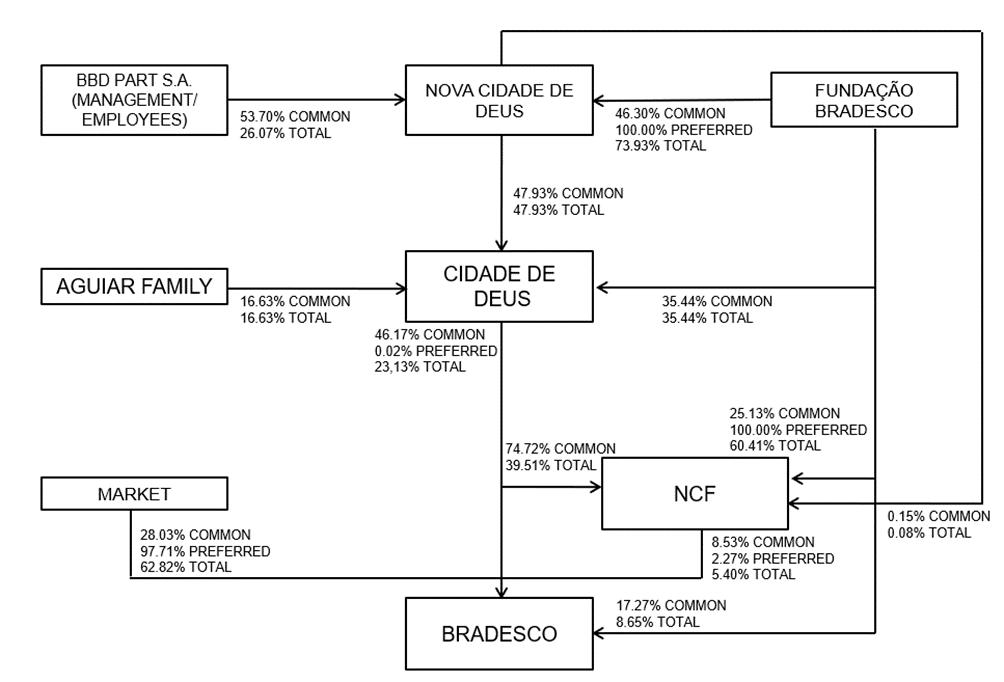
168 – Form 20-F 2025 | Bradesco |
The following table shows the direct shareholding of our outstanding common and preferred shares as of December 31, 2025, Cidade de Deus, Fundação Bradesco and NCF directly hold 5.0% or more of our securities with voting rights:
| Shareholder | Number of shares, except % | |||||
| Number of common shares |
Common shares as a percentage of outstanding shares |
Number of preferred shares |
Preferred shares as a percentage of outstanding shares |
Total Number of shares |
Total shares as a percentage of outstanding shares | |
| Cidade de Deus Participações | 2,445,219,983 | 46.17% | 1,292,135 | 0.02% | 2,446,512,118 | 23.13% |
| Fundação Bradesco(1) | 914,471,634 | 17.27% | 3 | - | 914,471,637 | 8.65% |
| NCF Participações | 451,890,822 | 8.53% | 119,774,968 | 2.27% | 571,665,790 | 5.,40% |
| Subtotal | 3,811,582,439 | 71.97% | 121,067,106 | 2.29% | 3,932,649,545 | 37.18% |
| Members of the Board of Directors | ||||||
| Luiz Carlos Trabuco Cappi | (*) | (*) | (*) | (*) | (*) | (*) |
| Alexandre da Silva Glüher | (*) | (*) | (*) | (*) | (*) | (*) |
| Denise Aguiar Alvarez | (*) | (*) | (*) | (*) | (*) | (*) |
| Maurício Machado de Minas | (*) | (*) | (*) | (*) | (*) | (*) |
| Rubens Aguiar Alvarez | (*) | (*) | (*) | (*) | (*) | (*) |
| Octavio de Lazari Junior | (*) | (*) | (*) | (*) | (*) | (*) |
| Rogerio Pedro Câmara | (*) | (*) | (*) | (*) | (*) | (*) |
| Samuel Monteiro dos Santos Júnior | (*) | (*) | (*) | (*) | (*) | (*) |
| Walter Luis Bernardes Albertoni | (*) | (*) | (*) | (*) | (*) | (*) |
| Paulo Roberto Simões da Cunha | (*) | (*) | (*) | (*) | (*) | (*) |
| Denise Pauli Pavarina | (*) | (*) | (*) | (*) | (*) | (*) |
| Total Board of Directors | 17,140,803 | 0.32% | 44,816,543 | 0.85% | 61,957,346 | 0.59% |
| Members of the Diretoria Executiva | ||||||
| Marcelo de Araújo Noronha | (*) | (*) | (*) | (*) | (*) | (*) |
| Cassiano Ricardo Scarpelli | (*) | (*) | (*) | (*) | (*) | (*) |
| José Ramos Rocha Neto | (*) | (*) | (*) | (*) | (*) | (*) |
| Guilherme Muller Leal | (*) | (*) | (*) | (*) | (*) | (*) |
| Bruno D'Avila Melo Boetger | (*) | (*) | (*) | (*) | (*) | (*) |
| Roberto de Jesus Paris | (*) | (*) | (*) | (*) | (*) | (*) |
| Oswaldo Tadeu Fernandes | (*) | (*) | (*) | (*) | (*) | (*) |
| Juliano Ribeiro Marcilio | (*) | (*) | (*) | (*) | (*) | (*) |
| André Luís Duarte de Oliveira | (*) | (*) | (*) | (*) | (*) | (*) |
| Cíntia Scovine Barcelos de Souza | (*) | (*) | (*) | (*) | (*) | (*) |
| Fernando Freiberger | (*) | (*) | (*) | (*) | (*) | (*) |
| José Augusto Ramalho Miranda | (*) | (*) | (*) | (*) | (*) | (*) |
| Marcos Valério Tescarolo | (*) | (*) | (*) | (*) | (*) | (*) |
| Renata Geiser Mantarro | (*) | (*) | (*) | (*) | (*) | (*) |
| Vinicius Urias Favarão | (*) | (*) | (*) | (*) | (*) | (*) |
| Silvana Rosa Machado | (*) | (*) | (*) | (*) | (*) | (*) |
| Túlio Xavier de Oliveira | (*) | (*) | (*) | (*) | (*) | (*) |
| Francesco Di Marcello | (*) | (*) | (*) | (*) | (*) | (*) |
| Júlio César Bueno | (*) | (*) | (*) | (*) | (*) | (*) |
| Alexandre Panico | (*) | (*) | (*) | (*) | (*) | (*) |
| Carlos Henrique Villela Pedras | (*) | (*) | (*) | (*) | (*) | (*) |
| Total Members of the Diretoria Executiva | 67,812 | 0.00% | 5,849,462 | 0.11% | 5,917,274 | 0.06% |
| Subtotal | 3,828,799,668 | 72.29% | 171,733,111 | 3.25% | 4,000,524,165 | 37.82% |
| Other | 1,467,579,727 | 27.71% | 5,108,908,136 | 96.75% | 6,576,487,863 | 62.18% |
| Outstanding Shares | 5,296,370,781 | 100.00% | 5,280,641,247 | 100.00% | 10,577,012,028 | 100.00% |
| Treasury shares | 7,500,000 | 0.00% | 7,500,000 | 0.00% | 15,000,000 | 0.00% |
| Total | 5,303,870,781 | 100.00% | 5,288,141,247 | 100.00% | 10,592,012,028 | 100.00% |
(1) Also indirectly owns, through its interest in Cidade de Deus Participações and Nova Cidade de Deus, NCD and NCF Participações,22.88% of our total shares.
(*) None of the members of our Board of Directors and Statutory Board of Executive Officers, individually or jointly, owned, directly, 1.0% or more of any of our classes of shares, and their individual share ownership has not been previously disclosed to our shareholders or otherwise made public. For more information, see “Item 6.E. Share Ownership”.
169 – Form 20-F 2025 | Bradesco |
The following is a description of our principal beneficial shareholders as of December 31, 2025. None of the principal beneficial shareholders have voting rights that differ from those of the other holders of our common shares. Shares held by members of our Board of Directors and Statutory Board of Executive Officers do not have special voting rights in relation to shares held by our other shareholders.
| Ø | Cidade de Deus Companhia Comercial de Participações |
Cidade de Deus Companhia Comercial de Participações (Cidade de Deus) is a holding company that, as of December 31, 2025, owned 25.27% of our total shares, with 23.13% directly and 2.14% indirectly participation. On our common shares (voting capital), Cidade de Deus owned 46.17%.
| Ø | Nova Cidade de Deus Participações |
Nova Cidade de Deus Participações (Nova Cidade de Deus) is a holding company that, as of December 31, 2025, held indirectly a 12.11% of our total capital.
The share capital of Nova Cidade de Deus is divided into common (classes A and B) and preferred shares. Ownership of Class A common shares is exclusive to persons entitled to hold Class B shares (see below), as well as to civil associations and foundations governed by private law, which are managed by such persons or by officers appointed by them. Ownership of the Class B Common Shares is limited to:
| · | members of our Board of Executive Officers; |
| · | former members of our Board of Executive Officers who have been officers of Banco Bradesco’s Board of Directors or its controlled entities; and |
| · | commercial or civil associations in which the majority of the voting interest is owned by the individuals above. |
Currently, there are no individuals who hold Class A or Class B common shares of Nova Cidade de Deus.
| Ø | Fundação Bradesco |
Fundação Bradesco is a non-profit institution, supervised by the Public Ministry, whose main social objective is to promote social inclusion through education. As of December 31, 2025, Fundação Bradesco held a total 31.53% of our capital, with 8.65% directly and 22.88% indirectly. On our common shares (voting capital), Fundação Bradesco owned 17.27%.
The management of Fundação Bradesco is exercised by a group called Managing Board composed of members of the Board of Directors, Board of Executive Officers and Department Officers who have worked at the Bradesco Group for more than 10 years and the members of the Board of Directors and Officers of Cidade de Deus Participações. They receive no compensation for their service on the Managing Board.
Founded in 1956, Fundação Bradesco is the largest private social investment project in the country. Since it was established, Fundação Bradesco has invested in education as a foundation for the integral development of children and young people across the nation, through the promotion of free education and excellence in various fronts of action.
All 40 school units are owned by Fundação Bradesco and are distributed within the 26 Brazilian states and the Federal District, installed primarily in regions with significant socioeconomic vulnerability, contributing to the development of the region via the transformational impact on the lives of students and communities around them, changing the educational reality of the whole country. In 2025, Fundação Bradesco benefited more than 42,000 students in its schools, primarily in Basic Education – from early childhood education to high school including technical vocational education.
Fundação Bradesco supports each of its Basic Education students for approximately 13 years, equipping them with all the necessary items to ensure equal learning in all regions of Brazil.
170 – Form 20-F 2025 | Bradesco |
Our “Escola Virtual” (Virtual School) e-learning portal’s distance learning programs (EaD), which provides fast and free courses, benefited over 2.0 million students who completed at least one of more than 80 fast courses offered.
Fundação Bradesco’s 2025 budget totaled R$1.4 billion. Over the last 10 years, Fundação Bradesco has invested a total of, approximately, R$10.0 billion (at current values).
| Ø | BBD |
BBD Participações S.A (BBD Participações) is a holding company that, as of December 31, 2025, held indirectly 3.16% of our total capital.
Only members of the Board of Directors and the Statutory Board of Executive Officers and some our skilled employees and our subsidiaries, as well as of Bradespar, may hold BBD shares. National non-profit legal entities or national companies controlled by them, whose managers are exclusively our employees and/or managers, may also hold shares. However, only the members of the Board of Directors and the Statutory Board of Executive Officers may own voting shares.
| Ø | NCF |
NCF Participações is a holding company, which, as of December 31, 2025, directly held 5.34% direct of our total capital and 8.53% of our common shares (voting capital).
| Ø | Market |
Direct market holdings represented 27.67% of our voting capital as of December 31, 2025 and 96.52% of our preferred shares. Common and preferred shares held by the market accounted for 62.04% of our share capital.
As of December 31, 2025, 1,335 foreign investors with a stake in our share capital in the amount of: (i) 63.92% of preferred shares; and (ii) 11.78% of common shares. Of the reported percentages, the GDRs (Global Depositary Receipts) accounted for 0.02% of preferred shares and the ADRs (American Depositary Receipts) accounted for 25.56% of preferred shares and 0.11% of common shares.
7.B. Related Party Transactions
Transactions with related parties are conducted on conditions and at rates consistent with those entered into with third parties:
| As of December 31, | R$ in thousands | ||
| 2025 | 2024 | 2023 | |
| Assets | |||
| Securities and derivative financial instruments | 15,086 | 569,106 | 597,902 |
| Loans and other assets | 4,701,136 | 3,018,910 | 3,724,974 |
| Liabilities | |||
| Customer and financial institution resources | (7,005,835) | (5,577,770) | (5,223,199) |
| Securities and subordinated debt securities | (29,894,786) | (23,692,039) | (20,369,788) |
| Other liabilities | (16,959,699) | (16,258,930) | (15,693,517) |
| INCOME AND EXPENSES | |||
| Net interest income | (4,882,765) | (2,974,430) | (3,507,514) |
| Other expenses net of other operating revenues | (2,120,708) | (2,344,062) | (1,890,228) |
For further information on related party transactions, see Note 39 to our consolidated financial statements in “Item 18. Financial Statements”.
171 – Form 20-F 2025 | Bradesco |
7.C. Interests of Experts and Counsel
Not applicable.
ITEM 8. FINANCIAL INFORMATION
8.A. Consolidated Statements and other Financial Information
8.A.10 Consolidated Statements
See “Item 18. Financial Statements”, which contains our audited consolidated financial statements prepared in accordance with IFRS Accounting Standards.
8.A.20 Legal proceedings
We are a party to civil, tax and labor administrative proceedings and lawsuits that have arisen during the normal course of our business, and which relate to:
| · | Labor matters: The labor matters in which we were involved during the year ended December 31, 2025, are mainly claims brought by former employees and outsourced employees seeking indemnifications, in particular, for unpaid overtime, in the case of former employees, in accordance with Article 224 of the CLT and, in the case of third parties, acknowledgement of employment status and/or the application of subsidiary responsibility. Given that labor lawsuits have similar characteristics, the provision for labor matters is recognized based, among other factors, by the average calculated value of payments made for labor complaints. It is important to mention that employee overtime is monitored by using electronic time cards and paid regularly during the employment contract and, accordingly, the claims filed by our former employees do not represent significant amounts. |
| · | Tax-related matters: We are also party to a number of judicial lawsuits and administrative proceedings, mainly involving issues related to the constitutionality of certain taxes, as well as the fair interpretation of some tax requirements. Some claims relate to the non-payment of taxes, whose collection we consider to be inappropriate; others stem from inappropriate collections (notifications) of supervisory agencies of the Ministry of Finance and others aim to recover taxes which we understand have already been paid or unduly paid. The amounts we have not paid in view of these claims have, in general, been provisioned for in conformity with applicable accounting rules and are restated based on criteria established by tax legislation. On the other hand, the taxes to be refunded are only recorded when the prospect of realizing these assets is practically certain. See Note 37 to our consolidated financial statements, “Item 18. Financial Statements”, for a description of our most relevant tax claims. |
| · | Civil matters: We are party to various civil lawsuits, although none of them are individually material. Lawsuits consist mainly of claims for indemnification for presumed damages caused during the ordinary course of business activities and cases where inflation indices were not applied to the adjustment of saving accounts as a result of economic plans of the 80s and 90s, although we complied with the law in force at the time. For more information on lawsuits in relation to economic plans, see “Item 3.D. Risk Factors – We remain subject to residual risks of losses relating to inflation adjustment claims (“expurgos inflacionários”) associated with savings accounts in Brazil. Although the STF upheld the constitutionality of the Bresser, Verão, Collor I and Collor II economic plans, we are still exposed to expected costs and expenses arising from adhesions to the court approved collective settlement and from remaining ongoing lawsuits.” We remain subject to residual risks of losses in cases related to inflation adjustments on savings accounts in Brazil, considering that, although the Brazilian Supreme Federal Court (STF) declared the constitutionality of the Bresser, Summer (Verão), Collor I, and Collor II Plans on May 24, 2025, there are still expected costs and expenses arising from adherences to the collective settlement agreement approved and reaffirmed by the STF in its decision, as well as from remaining ongoing legal proceedings. The Court also set a deadline of twenty-four (24) months from the publication of the trial minutes (June 3, 2025) for new savers to join and directed the signatories of the collective agreement to make every effort to ensure that savers who have not yet adhered do so within the established timeframe. Probable risk cases are all provisioned for and do not result in a material adverse effect on the results of our operations or financial position. |
172 – Form 20-F 2025 | Bradesco |
| · | Other matters: We are currently not subject to any significant disputed processes with the Central Bank of Brazil, CVM, ANS or SUSEP. We comply with all regulations applicable to the business, issued by the aforementioned regulatory agencies. |
As of December 31, 2025, we had a total provision – which we believe to be adequate to cover any probable outflow of cash or other economic resources required to settle the provision – in the amount of R$18,030 million comprised of:
| · | 38.4% in civil matters; |
| · | 37.4% for risks related to tax and social security issues, mainly related to IRPJ and CSLL, PIS, COFINS and INSS; and |
| · | 24.2% for labor claims. |
Among the remaining litigation, where the probability of loss is considered as possible, we highlight those related to (i) tax and social security matters, which totaled R$43,096 million as of December 31, 2025 (R$46,933 million as of December 31, 2024); (ii) those related to civil claims which totaled R$11,124 million as of December 31, 2025 (R$11,570 million as of December 31, 2024); and (iii) to labor claims, which totaled R$1,457 million as of December 31, 2025.
For additional information, see Note 22 to our consolidated financial statements in “Item 18. Financial Statements”.
8.A.30 Policy on dividend distributions
Since 1970, we have been distributing dividends on a monthly basis. Today we maintain an automatic system for the monthly payment of interest on shareholders’ equity.
Consistent with Brazilian law, our Bylaws allow our Board of Executive Officers, upon approval by the Board of Directors, to make distributions in the form of interest on shareholders’ equity instead of dividends. Payments of interest on shareholders’ equity may be included as part of any mandatory dividends. Since July 1997, we have made monthly payments of interest on shareholders’ equity at an amount approved by our Board of Directors before the statement of dividends at the end of each fiscal year. The amounts paid as interest on shareholders’ equity, net of income tax, are discounted from the amount of dividends declared. Pursuant to Brazilian law, a shareholder who does not receive a dividend payment may initiate proceedings for the collection of these payments within three years following the dividends statement date. After this period, unclaimed dividends return to the company.
Our policy relating to dividend distributions and/or interest on shareholders’ equity is to maximize the amount of distributions, in accordance with our tax management strategy. For additional information, see “Item 5.A. Operating Results – 5.A.10 Overview – 5.A.10.04 Taxes”.
Due to the effects of the COVID-19 pandemic and the generated uncertainty for the Brazilian economy, the CMN, by means of Resolution No. 4,820/20, as amended, vetoed, for values related to 2020, the compensation of own equity above: (i) an amount equivalent to 30% of the net income adjusted in the terms of the Brazilian Corporate Law; or (ii) an amount equivalent to the mandatory minimum dividend established by the corporate legislation, whichever is greater. Although such prohibition being applied only to payments for the fiscal year of 2020 as a mitigation of the impacts of the COVID-19 pandemic, there is no guarantee that other similar measures will not be applied in the future, be it with the aim of mitigating the effects of the COVID-19 pandemic or otherwise.
173 – Form 20-F 2025 | Bradesco |
For more information on net income allocation and dividend distribution, see “Item 10.B. Memorandum and Bylaws – 10.B.10 Group – 10.B.10.02 Allocation of net income and distribution of dividends”.
8.B. Significant Changes
See “Item 4.A. History and Development of the Company – 4.A.10. Acquisitions, divestitures and other strategic alliances”.
ITEM 9. THE OFFER AND LISTING
9.A. Offer and Listing Details
Our ADSs are traded on the New York Stock Exchange (NYSE), under the symbols “BBD” (preferred share ADSs) and “BBDO” (common share ADSs).
Our preferred share ADSs were first listed on the NYSE in 2001. Each preferred share ADS corresponds to one preferred share.
To increase in the stock capital by R$6,670,000,000.00, from R$87,100,000,000.00 to R$93,770,000,000.00, by means of the capitalization of part of the balance of the “Profit Reserves - Legal Reserve” account, without issuing shares, according to Article 169 of Law No. 6 404/76
An increase to our share capital by R$6,670,000,000.00 was decided at the Special Shareholders’ Meeting held on March 10, 2026, increasing the share capital from R$87,100,000,000.00 to R$93,770,000,000.00, through the capitalization of part of the balance of the account “Profit Reserves – Legal Reserve”, without issuing shares, according to Article 169 of Law No. 6 404/76.
Our shares (BBDC3 and BBDC4) are listed on Brazil’s main stock indexes, including the indexes that measure the total return of a theoretical portfolio composed of 50 and 100 shares, IBrX-50 and IBrX-100, respectively, selected from among the most traded shares on B3; the IBrA (Broad Brazil Index); the IFNC (Financial Index, composed of banks, insurance companies and financial institutions); the ISE (Corporate Sustainability Index); the IGCX (Special Corporate Governance Stock Index); the IGCT (Corporate Governance Trade Index); the ITAG (Special Tag-Along Stock Index), the index composed of shares of companies listed in the IBrX-50 index and that accepted taking part in this initiative by adopting transparent greenhouse gas emission practices (ICO2); and the Mid-Large Cap Index – MLCX (which measures the return of a portfolio composed of the highest capitalization companies listed). Abroad, our shares are listed on the Dow Jones Sustainability World Index, in the Dow Jones Sustainability Emerging Markets portfolio of the NYSE, and on the FTSE Latibex Brazil Index of the Madrid Stock Exchange.
In January 2012, the Central Bank of Brazil authorized the creation of an ADR program for our common shares in the USA market. As part of this authorization, and after the government had affirmed it as being in its interest, the Central Bank of Brazil increased the limit of foreign interest in our share capital from 14.0% to 30.0%. The increase in the limit of foreign interest in our common shares did not alter our ownership or control structure. In March 2012, our common share ADSs became listed on the NYSE under the symbol “BBDO”. Each common share ADS corresponds to one common share.
Our shares are registered in book-entry form and we perform all the services of safe-keeping and transfer of shares. Our shareholders may choose to hold their shares registered at the Stock Exchange of B3. Under Brazilian law, non-Brazilian holders of our shares may be subject to certain adverse tax consequences due to their ownership and any transfer of our shares. For further discussion of the restrictions on the transfer of our shares, see “Item 10.B. Memorandum and Bylaws – 10.B.20 Shareholders – 10.B.20.09 – Form and transfer” and “Item 10.D. Exchange Controls”.
Our ADSs are represented by preferred share ADRs and common share ADRs. Our ADSs may be held in registered form with the depository – The Bank of New York Mellon – or in book entry form through financial institutions that are members of the “Depository Trust Company” or DTC. The depositary bank, as registrar, performs the services of transfer of the preferred share ADRs and common share ADRs. Title to a preferred share ADR or common share ADR (and to each ADSs evidenced thereby), when properly endorsed or accompanied by proper instruments of transfer, is transferable by delivery with the same effect as in the case of a certificated security under the laws of the State of New York. Holders of the preferred share ADRs and common share ADRs who transfer their preferred share ADRs and common share ADRs may be required to:
174 – Form 20-F 2025 | Bradesco |
| · | reimburse the depositary bank for any taxes, governmental charges or fees the depositary bank has paid; |
| · | pay any transfer fees as required by the deposit agreements; |
| · | produce satisfactory proof of identity and genuineness of their signatures or any other documents required by the deposit agreements; |
| · | comply with any United States, Brazilian or other applicable laws or governmental regulations; and |
| · | comply with such reasonable regulations, if any, as we and the depositary bank may establish consistent with the deposit agreements. |
All of our outstanding shares are fully paid and non-assessable.
The rights of holders of our preferred shares are limited in comparison with those of the holders of common shares in several ways:
| · | each common share entitles the holder to one vote at shareholders’ meetings, while holders of preferred shares are only entitled to a vote in the limited circumstances described in “Item 10.B. Memorandum and Bylaws – 10.B.10 Group – 10.B.10.02 Voting rights”; and |
| · | the nature of preferred shareholders’ preemptive rights to subscribe for shares or convertible securities depends on the proportion of capital that would be represented by preferred shares after the capital increase, as described under “Item 10.B. Memorandum and Bylaws – 10.B.20 Shareholders – 10.B.20.01 Preemptive rights”. |
The holders of the ADSs have the rights corresponding to the underlying shares, subject to the Deposit Agreements. The holders of the ADSs are parties to the Deposit Agreements and therefore are bound to its terms and to the terms of the preferred share ADRs and common share ADRs that represent the ADSs.
9.B. Plan of Distribution
Not applicable.
9.C. Markets
9.C.10 Trading on B3 (stock exchange)
B3 is a publicly-traded corporation. From April 2000, the Brazilian stock exchanges were reorganized through the execution of protocols of intention by the Brazilian stock exchanges. Until April 2004, all shares underlying securities were traded only on the B3, with the exception of privatization auctions, which occurred on the Rio de Janeiro Stock Exchange. In May 2004, the Rio de Janeiro Stock Exchange reopened for the trading of certain Brazilian government securities.
If you were to trade in our shares on the B3, your trade would settle in three business days after the trade date. The seller is ordinarily required to deliver the shares to the exchange on the third business day following the trade date. Delivery of and payment for shares are made through the facilities of the Central Depository of B3.
As of December 31, 2025, the aggregate market capitalization of the 352 companies listed on the B3, was equivalent to US$864.1 billion and the 10 largest companies listed on the B3 represented 49.7% of the total market capitalization. Although any of the outstanding shares of a listed company may trade on a Brazilian stock exchange, in most cases fewer than half of the listed shares are actually available for trading by the public, the remainder being held by a small group of controlling persons, by governmental entities or by one principal shareholder. As of December 31, 2025, we accounted for 3.8% of the market capitalization of all listed companies on the B3.
175 – Form 20-F 2025 | Bradesco |
Trading by a non-resident investor in Brazil is subject to certain limitations under Brazilian foreign investment legislation. With limited exceptions, non-resident investors in Brazil may only trade on Brazilian stock exchanges in accordance with the CMN requirements.
See “Item 10.D. Exchange Controls” for further information on requirements and restrictions, and “Item 10.E. Taxation – 10.E.10 Brazilian tax considerations – 10.E.10.02 Taxation of gains” for a description of certain tax benefits extended to non-Brazilian holders.
| Ø | Corporate governance practices of B3 |
In 2000, B3 introduced three special segments of listing, which are “Level 1”, “Level 2” and “New Market”, aimed at encouraging differentiated practices of corporate governance and strengthening the secondary market of shares of Brazilian publicly traded companies. Subsequently, the segments “Bovespa Mais” and “Bovespa Mais Nível 2” (Level 2) were created, directed to smaller companies. Adherence to these segments is voluntary and implies compliance with more stringent governance practices and disclosure requirements than those provided for in Brazilian legislation, expanding shareholders’ rights and increasing transparency of information available to the market. The revised rules applicable to the listing of Levels 1 and 2 of Differentiated Governance Practices for the New Market of B3 came into effect in February 2023.
To adhere to “Level 1”, the issuer, in addition to the obligations imposed by applicable law, must: (i) maintain shares in circulation that represent at least 20.0% of their total capital are effectively available for negotiation; (ii) adopt supply procedures that favor the dispersed ownership of the shares whenever a public offer is made; (iii) comply with minimum quarterly disclosure standards; (iv) follow stricter disclosure policies regarding transactions made by its controlling shareholders, members of its board of directors and officers, involving securities issued by the issuer; (v) submit any existing shareholder agreements and stock option plans to B3; and (vi) prepare a schedule of corporate events and make it available to shareholders.
To adhere to “Level 2”, in addition to the obligations imposed by applicable law, an issuer must, among others: (i) comply with all “Level 1” listing requirements; (ii) grant tag-along rights to all shareholders in case the company’s control is transferred, offering to common shareholders the same price paid per share for the controlling group of common and preferred shares; (iii) give holders of preferred shares voting rights for decisions on certain corporate restructurings and related-party transactions, such as: (a) conversions, acquisitions, mergers or splits; (b) approval of any transactions between the company and its controlling shareholder, if such decisions are within the competence of the shareholders’ meeting; (c) valuation of assets to be used for payment of a share capital increase; (d) selecting an institution or specialized company to determine the economic value of the company; and (e) any alterations to these voting rights that will prevail as long as the agreement to adhere to the B3’s “Level 2” segment is in force; (iv) assure that the Board of Directors must be made up of at least five members, of whom a minimum of 20.0% shall be independent members with a term of office limited to two years, and re-election is permitted; (v) prepare financial statements in English, including the statement of cash flows, according to the applicable international accounting standards; (vi) effect a tender offer by the company’s controlling shareholder (the minimum price of the shares to be offered shall be determined by an assessment process), if the controlling shareholder decides on the delisting from the “Level 2” segment; and (vii) exclusively adopt the B3 “Arbitration Market Chamber” rules for resolving any conflicts between the company and its investors.
To join the New Market segment of B3, an issuer must comply with certain requirements described in “Levels 1 and 2”, and comply with the specific regulation of the segment, which, among other aspects, requires capital composed exclusively of common shares (with the right to vote). and granting a tag along right to all shareholders in case of transfer of control of the company, as well as additional requirements for governance, transparency and liquidity.
176 – Form 20-F 2025 | Bradesco |
In June 2001, we executed an agreement with B3 to list our shares on the “Level 1” segment, effective immediately after the disclosure of the offer’s opening date in Brazil. We agreed to comply with and continue to comply with all of the “Level 1” listing requirements.
9.D. Selling Shareholders
Not applicable.
9.E. Dilution
Not applicable.
9.F. Expenses of the Issue
Not applicable.
ITEM 10. ADDITIONAL INFORMATION
10.A. Share Capital
For more information on our share capital, see Note 25 to our consolidated financial statements in “Item 18. Financial Statements”.
10.B. Memorandum and Bylaws
We are a publicly-traded company duly registered with the CVM under No. 00090-6. Article 5 of our Bylaws establishes our purpose as carrying out banking transactions in general, including foreign exchange activities.
Below, we present relevant information about our Bylaws and the Brazilian Corporate Law. This description is merely informative, not exhaustive, and should be read in conjunction with our Bylaws and applicable Brazilian Corporate Law.
10.B.10 Group
10.B.10.01 Qualification of directors
Pursuant to Article 146 of Law No. 6,404/76, as amended by Law No. 12,431/11, the members of the Board of Directors must be natural persons. There is no requirement that the members of the Board of Directors should be shareholders of the companies in which they hold such positions, nor as to the place of residence to qualify as a director. For information on our Board of Directors, see item “6.A. Board of Directors and Board of Executive Officers”.
10.B.10.02 Allocation of net income and distribution of dividends
Our Bylaws, in conformity with the Brazilian Corporate Law, require the Board of Directors to recommend, at each Annual Shareholders’ Meeting, the allocation of net income for the fiscal year as follows:
| · | 5.0% of net income, determined in accordance with BR GAAP, to a legal reserve during each fiscal year, not to exceed 20.0% in the aggregate of our paid-in capital. This requirement shall not be applicable in fiscal years when the legal reserve, added to our other additional paid-in capital, exceeds 30.0% of our paid-in capital; |
| · | upon proposal by Management, an amount to a contingency reserve against future losses, which amount is determined by our shareholders on the basis of what potential losses they consider probable. Historically, our shareholders never allocated profits to this reserve; |
177 – Form 20-F 2025 | Bradesco |
| · | at least 30.0% of net income according to BR GAAP (adjusted by the deductions under the preceding items) for mandatory distribution to our shareholders; and |
| · | any balance to revenue reserves for the maintenance of an operational margin that is compatible with the conduct of our lending business, up to a limit of 95.0% of our paid-in capital. |
Our Bylaws also authorize our shareholders to allocate an amount to a reserve for realizable revenue. Historically, our shareholders have not allocated amounts to this reserve.
The minimum of 30.0% of our recurring net income according to BR GAAP must be distributed as annual dividends and paid out within 60 days of the Annual Shareholders’ Meeting in which the distribution is approved. However, Brazilian Corporate Law permits us to suspend payment of the mandatory distribution if our Board of Directors reports to the shareholders’ meeting that the distribution would be incompatible with our financial condition, in which case the suspension is subject to approval by the shareholders’ meeting. Under Brazilian Corporate Law, the Fiscal Council must prepare a report on this matter and the Board of Directors is obligated to present a justification for the suspension with the CVM within five days of the shareholders’ meeting. The income not distributed due to the suspension must be allocated to a special reserve. If not absorbed by subsequent losses, the amounts in the reserve must be paid as dividends as soon as our financial situation permits.
Shareholders holding our preferred shares are entitled, as provided for in our Bylaws, to receive dividends per share in value 10.0% higher than dividends paid per share to shareholders holding our common shares.
Our Board of Executive Officers, subject to the approval of our Board of Directors, may distribute dividends based on the profits reported in the interim financial statements. The value of the distributed interim dividends may not exceed the value of the capital reserves. Our Board of Executive Officers determines the value of interim dividends to be distributed based on either previously accrued profits or retained earnings.
Under Brazilian law, we must prepare financial statements according to BR GAAP on a quarterly and annual basis, and according to IFRS Accounting Standards on an annual basis. Our Board of Executive Officers, with approval of the Board of Directors, may distribute dividends based on the profits reported in interim financial statements. Our Bylaws provide for the payment of interim dividends, which cannot exceed the amount of our retained earnings or our profit reserves contained in our last, annual or bi-annual financial statements. Our Board of Executive Officers bases the amount of the interim dividends on previously accrued or retained earnings.
In the framework of the implementation of the Basel III Agreement in Brazil, CMN Resolution No. 4,958/21, as amended, states that financial institutions that do not comply with the Additional of Common Equity (ACP) are subject to automatic restrictions imposed by the Central Bank of Brazil, including limitations on dividend distribution, interest on own capital and other forms of compensation to shareholders. The restrictions correspond to the following percentages of the amount that would be distributed: (i) 100% if the value considered for the verification of sufficiency of the ACP is less than 25% on the distributions; (ii) 80% if the value considered for the verification of sufficiency of the ACP is greater than or equal to 25% and less than 50% of the distributions; (iii) 60% if the value considered for the verification of sufficiency of the ACP is greater than or equal to 50% and less than 75% on the distributions; and (iv) 40% if the value considered for the verification of sufficiency of the ACP is greater than or equal to 75% and less than 100% on the distributions.
We are currently in compliance with all applicable capital requirements.
10.B.10.03 Transfer of control
Our Bylaws contain no determination that could have the effect of delaying, postponing or preventing a change in our control or operating only with respect to a merger, acquisition or corporate restructuring involving us or any of our subsidiaries. However, Brazilian banking regulations require that any transfer of control of a financial institution should be previously approved by the Central Bank of Brazil.
In addition, Brazilian legislation determines that the acquisition of control of a publicly-traded company depends on the purchase offer of all common shares in circulation at a price equivalent to 80.0% of the price per share paid to the controlling block. In December 2003, we amended our Bylaws to determine that in the event of a change in our control, the acquirer will be required to pay our shareholders an amount equal to: (a) 100% of the price paid per common share to our controlling shareholders, in the case of our non-controlling common shareholders; and (b) 80.0% of the price paid per preferred share to our controlling shareholders, in the case of our preferred shareholders.
178 – Form 20-F 2025 | Bradesco |
In the case of liquidation, our preferred shareholders would have the right to priority over common shareholders in the return of capital. For more information, see “Item 10.B. Memorandum and Bylaws - 10.B.20 Shareholders – 10.B.20.05 Liquidation”. In addition, in the event of a transfer of control, our shareholders have the right to withdraw under certain circumstances. For more information, see “Item 10.B. Memorandum and Bylaws - 10.B.20 Shareholders – 10.B.20.04 Right to withdrawal”.
Brazilian legislation obliges our controlling shareholder to offer our shares, if he/she increases their share capital to a level that significantly and negatively affects the liquidity of our shares.
10.B.10.04 B3’s differentiated corporate governance practices
In 2001, we voluntarily entered into B3’s “Level 1” corporate governance segment, which establishes special requirements for the Company’s listing and rules for its managers and shareholders, including its controlling shareholders. For more information, see item “9.C. Markets – 9.C.10 Trading on B3 (stock exchange)”.
10.B.20 Shareholders
10.B.20.01 Shareholders’ Meetings
Our shareholders have the power to decide any matters related to our corporate purpose and to approve resolutions provided by law for our protection and development, through voting at an Annual Shareholders’ Meeting.
Our meetings are convened by the publication of call notices in the Diário Oficial do Estado de São Paulo (Official Gazette of the State of São Paulo) and the Valor Econômico newspaper, both in the State of São Paulo. The notice, which contains the agenda of the shareholder’s meeting, is published three times, beginning at least 30 calendar days prior to the scheduled meeting date, as specified in our Bylaws.
The Board of Directors or the shareholders, in some specific situations set forth in the Brazilian Corporate Law, may call our shareholders’ meetings. A shareholder may be represented at a shareholders’ meeting by an attorney-in-fact, so long as the attorney-in-fact was appointed within less than a year of the meeting. The attorney-in-fact must be a shareholder, a member of our Management, a lawyer or a financial institution and, for investment funds, the fund manager is responsible for representing quotaholders. Shareholders that are legal entities may also be represented by their own legal representatives. The power of attorney given to the attorney-in-fact must comply with certain formalities set forth by Brazilian law.
In order for a shareholders’ meeting to validly take any action, shareholders representing at least one quarter of our issued and outstanding common shares must be present at the meeting. However, in the case of a shareholders’ meeting to amend our Bylaws, shareholders representing at least two-thirds of our issued and outstanding common shares must be present. If no such quorum is verified, the Board of Directors may call a second meeting by giving at least eight calendar days’ notice prior to the scheduled meeting and otherwise in accordance with the rules of publication described above. The quorum requirements will not apply to a second shareholders’ meeting, subject to the quorum requirements applicable to the first one.
In March 2017, we adopted a remote voting system at our Shareholder’s Meetings, in accordance with Article 26 et seq. of CVM Resolution No. 81/22.
179 – Form 20-F 2025 | Bradesco |
10.B.20.02 Voting rights
Each common share entitles its holder to the right of one vote at our shareholders’ meetings. The decisions of a shareholders’ meeting are passed by a vote by holders of a simple majority of our common shares, while abstentions are not taken into account.
The Brazilian Corporate Law, aiming to give greater protection to minority shareholders, guarantees the right to appoint a member to the Board of Directors to shareholders who are not controlling, provided they hold them, for at least three previous months: (i) preferred shares representing the minimum of 10.0% of our share capital; or (ii) common shares representing at least 15.0% of our voting shares. If no shareholder reaches the minimum limits indicated in isolation, shareholders representing together at least 10.0% of our share capital (adding to the common and preferred shares) may elect a member to our Board of Directors.
Under our Bylaws, except for legal assumptions, our preferred shares do not have the right to vote.
In this regard, we emphasize that, in addition to the above provisions, the Brazilian Corporate Law provides that non-voting preferred shares acquire voting rights when a company has failed, for the term provided for in its bylaws (for a period not exceeding three consecutive fiscal years), to pay any fixed or minimum dividend to which such shares are entitled. Such voting rights remain effective until payment of the cumulative dividends is made.
Under Brazilian Corporate Law, certain matters are subject to differentiated rules of deliberation and quorum. Depending on the case, resolutions may require either exclusive or joint approval by holders of common and/or preferred shares, including through special meetings when the rights of a particular class are specifically affected. As a result of these distinctions, both voting rights and quorum requirements vary according to the nature of the matter under discussion and its potential impact on shareholders’ rights. For detailed information on applicable assumptions, quorums and other rules, see Appendix “2.4 – Securities Description”.
10.B.20.03 Preemptive rights
Each of our shareholders has a general preemptive right to subscribe for shares or convertible securities in any capital increase in proportion to its holding. In the event of a capital increase maintaining the existing proportion between common and preferred shares, each shareholder shall have the right to subscribe to newly issued shares of the same class it currently holds. For detailed information on the exercise of the right of preference, see Appendix “2.4 – Securities Description”.
As described in “4.B.70.02-19 Restrictions on foreign investment” it was determined that the share of foreign investors in our voting capital, through the ADR program for our common shares, is limited to up to 30% of the total common shares issued. Therefore, the holders of common shares could be prevented from exercising their preemptive rights in relation to newly issued common shares if the 30.0% limit is reached, as we specified in Appendix “2.4 – Securities Description”.
The shareholders may not be able to exercise the preemptive rights relating to the shares underlying the ADSs unless a registration statement under the U.S. Securities Act of 1933 is effective with respect to those rights or an exemption from the registration requirements of the Securities Act is available. The contractual arrangements governing the ADSs provide that the custodian of the shares underlying the ADSs may, if possible, transfer or dispose of the preemptive rights. Such contractual arrangements related to the ADSs, provide for the custodian to remit the consideration received to the depositary bank that holds the ADSs. Its distribution by the depositary bank to holders of preferred or common share ADSs is net of any fees due to the custodian and the depositary bank. For more details, see “Item 3.D. Risk Factors – 3.D.50 Risks relating to our shares and ADSs”.
10.B.20.04 Right of withdrawal
Under Brazilian Corporate Law, certain events may grant dissenting or non-voting shareholders the right of withdrawal, entitling them to receive the value corresponding to their shares. This right is triggered only in specific circumstances defined by law and depends on the nature of the corporate resolution, the impact on the rights of the relevant class of shares, and the formal eligibility requirements, including the timing of share ownership. The exercise of the withdrawal right is subject to statutory deadlines (expiring within 30 days after the publication of the minutes of the applicable shareholders’ meeting), calculation criteria, and specific procedures. It may also be subject to limitations, including the possibility of the company reconsidering the decision.
180 – Form 20-F 2025 | Bradesco |
10.B.20.05 Liquidation
In the case of our liquidation, our preferred shareholders would have priority over common shareholders in return of capital. The value to which they would be entitled is based on the share capital represented by preferred shares, adjusted periodically to reflect any increases or reductions in capital. After payment of all our creditors, our residual assets would be used to return to the preferred shareholders the value of the capital represented by the preferred shares. Once the preferred shareholders have been fully reimbursed, common shareholders will be reimbursed on the share capital represented by the common shares. All of our shareholders would participate equally and proportionally in any remaining residual assets.
10.B.20.06 Redemption
Our Bylaws provide that our shares are not redeemable. However, the Brazilian Corporate Law authorizes the shareholders’ meeting to decide for the redemption of shares after a public offer to going private, if less than 5% of the total shares issued by the company are in circulation.
10.B.20.07 Conversion rights
Our Bylaws provide that our common shares cannot be converted into preferred shares, nor our preferred shares into common shares.
10.B.20.08 Liability of our shareholders for further capital calls
Neither Brazilian law nor our Bylaws provide for capital calls. Our shareholders’ liability is limited to the payment of the issue price of the shares subscribed or acquired.
10.B.20.09 Form and transfer
Our shares are registered in book-entry form and we perform all the services of safekeeping and transfer of shares. To make the transfer we make an entry in the register, debit the share account of the transferor and credit the share account of the transferee.
Transfers of shares by a foreign investor are made in the same way and executed by the investor’s local agent on the investor’s behalf.
Our shareholders may opt to hold their shares through B3. Shares are added to the B3 system through Brazilian institutions, which have clearing accounts with B3. Our shareholder registry indicates which shares are listed on the B3 system. Each participating shareholder is in turn registered as beneficial shareholders maintained by the B3 and is treated in the same manner as our registered shareholders.
10.B.30 Brazilian rules related to information disclosure
The CVM Resolution No. 44/21, as amended, establishes the guidelines regarding the disclosure of information to the market. These regulations include provisions which:
| · | determine what information must be presented to the CVM in the form of a notice to the shareholders or a material fact (fato relevante). The material fact includes any controlling shareholder decisions that could influence the price of our securities and any controlling shareholder decision to trade, cease to trade, or exercise any rights under our securities; |
181 – Form 20-F 2025 | Bradesco |
| · | expand the list of events that may be considered material, including, among others, specifically provided for in our standard: transfer or change of control (including by shareholders agreement); decision to cancel registration; authorizations/listings in markets in Brazil or abroad; corporate restructurings (merger, incorporation, split, transformation or dissolution); material changes in securities rights, repurchase/treasury programs, developments/groups/subsidies; changes in accounting criteria, relevant renegotiations of debts, profits/losses and distribution of proceeds; material contracts (conclusion, alteration, extinction or failure when expectation was public); changes in projections; relevant operational events (start/resume / production/services downtime) and significant technological developments; and claims for recovery/bankruptcy or lawsuits with the potential to affect the financial economic situation; |
| · | extend, in the event our executive officer in charge of investor relations does not make required disclosure, the responsibility to make the required disclosure to our controlling shareholders, our Management, the members of our Fiscal Council and to any member of a technical or consulting body created by our Bylaws; |
| · | extend confidentiality obligations related to undisclosed information to, in addition to our Management and controlling shareholders, the members of any technical or consulting bodies created by our Bylaws and our employees in charge of the issues considered material fact; |
| · | forcing the Investor Relations Officer to provide clarifications on the disclosure of material act or fact by request of the CVM or the stock market, at any moment; |
| · | disclose the information contained in material facts in all markets where our securities are traded; |
| · | disclose any intention to delist the company within the period of one year if we acquire a controlling participation in a company that has its securities traded on a market; |
| · | extend the rules regarding disclosure requirements related to the acquisition and sale of a relevant shareholding, or the acquisition and sale of our securities by our managing shareholders, members of our Fiscal Council or any member of a technical or consulting body created by our Bylaws; and |
| · | before a material fact is publicly disclosed, prohibit the trading of our securities by our direct and indirect controlling shareholders, officers, members of our Board of Directors, Fiscal Council and any technical or advisory committees or whomever by virtue of their position has knowledge of information related to the material fact. |
We highlight that CVM Resolution No. 44/21 and, consequently, the rules regarding the disclosure of information to the market, are currently in the process of reform, and may suffer significant changes .
In the prudential framework, Resolution No. 4,859/20 determines that financial institutions and other entities authorized to operate by the Central Bank of Brazil inform the CMN of any situation that may affect the reputation of its: (i) controllers and qualified shareholders; and (ii) members of statutory and contractual entities.
In accordance with the existing regulations, the Central Bank of Brazil considers that the following situations would compromise the reputation of such people, within 10 working days from the date on which it became aware of the situation in question: (i) criminal proceedings or police inquiry to which people or any company are responding, in which they are or were, at the time of the facts, controllers or managers; (ii) administrative or judicial proceedings related to the SFN; and/or (iii) other situations, occurrences or similar circumstances that the Central Bank of Brazil may consider relevant.
10.B.30.01 Disclosure of periodic information
Periodic disclosure of information by companies that have their securities traded on the Brazilian market is currently regulated by CVM Resolution No. 80/22, Brazilian issuers must file a “Reference Form” with the CVM every year, a document similar to a “Form 20-F”, providing several detailed aspects of the company’s operations and administration. Furthermore, the rules related to financial statements and information disclosure were improved, as well as the management’s responsibility for the information provided and regarding environmental, social and corporate governance aspects, in addition to the simplification and rationalization of the information that is required. As a result, the quantity and quality of information provided to the Brazilian market and to the CVM has increased considerably, reinforcing the transparency of our activities for the local investor. In addition, new issuances for companies already listed were made easier.
182 – Form 20-F 2025 | Bradesco |
The Resolution No. 4,818/20, as amended, consolidates the general criteria to the preparation and disclosure of individual and consolidated financial statements by financial institutions.
10.B.30.02 Disclosure of operating information to the public
CMN rules determine that financial institutions should establish a formal policy approved by its Board of Directors or, in its absence, by its Board of Executive Officers, for the disclosure of information referring to risk management, determination of amount of risk-weighted assets and adequacy of RE. For more information on how we disclose the information required by the CMN, see items “5.B.20 Liquidity and Funding” and “5.B.40 Capital Compliance – Basel III”.
10.B.30.03 Disclosure of shareholder ownership
The Brazilian rules require that any person (or group of persons acting together or representing the same interest) communicate to the company the acquisition or disposal of relevant participation in an open company whenever its position exceeds, up or down, the levels of 5%, 10%, 15% and so on, of kind or class of shares representing the share capital. After the communication, the company must disclose the notice to the market through the CVM channels, its website and the organized market in which its shares are traded.
10.B.40 Regulation and restrictions on non-resident investors in Brazil
Our Bylaws do not restrict the rights of Brazilian residents or non-residents to hold our shares and exercise related rights. Notwithstanding, as described in “4.B.70.02-19 Restrictions on foreign investment” it was determined that the share of foreign investors in our voting capital, through the ADR program for our common shares, is limited to up to 30% of the total common shares issued, observing the other limitations described below.
10.B.40.01 Rights of the holders of our ADSs
Holders of our ADSs are not treated as shareholders and do not have the same rights that our shareholders have. The depositary bank will hold the preferred shares and common shares that underlie the ADSs through a custodian in accordance with the provisions of the Deposit Agreements. The rights of our ADS holders are governed by the Deposit Agreements, which are New York law governed contracts. In contrast, the rights of our shareholders are provided for by Brazilian law.
Holders of our ADSs will receive notifications and voting instructions in relation to any meetings only if we authorize and direct the depositary bank to distribute such information to the holders. If we do not provide that authorization and direction to the depositary bank, holders of ADSs will not be able to vote at our meetings, unless they surrender their ADSs and receive the underlying preferred shares or common shares, as applicable, in accordance with the terms of the applicable Deposit Agreement. If we authorize and direct the depositary bank to distribute voting instructions to our ADS holders, such holders may instruct the depositary bank to vote in accordance with the number of shares represented by their ADSs. See “Item 3.D – Risk Factors – 3.D.50 Risks relating to our shares and ADSs” – 3.D.50.01 The Deposit Agreements governing the ADSs provide that holders of the ADSs will only receive voting instructions if we authorize the depositary bank to contact those holders to establish voting instructions; and there are practical limitations we may give such holders on any ability to vote”.
10.C. Material contracts
Not applicable.
183 – Form 20-F 2025 | Bradesco |
10.D. Exchange controls
The Central Bank of Brazil may place temporary restrictions on the remittance of foreign capital abroad, including payments of principal, interests or dividends and on the repatriation of capital, if there is a significant imbalance in Brazil’s balance of payments, or one is expected. The last occurrence of restrictions on the remittance of foreign capital was in 1989, when, for approximately six months in 1989 and early 1990, the government suspended all remittances abroad of dividends and invested capital. The Central Bank of Brazil subsequently released these amounts for remittance abroad in accordance with specific guidelines. The government may take similar measures in the future.
According to the Brazilian tax laws, securities investors who are not resident in Brazil benefit from favorable tax treatment if they are qualified under Joint Resolution No. 13/24.
See “Item 10.E. Taxation – 10.E.10 Brazilian tax considerations – 10.E.10.02 Taxation of gains” for a description of tax benefits extended to non-resident investors in Brazil who qualify under Joint Resolution No. 13/24.
To qualify under the new Joint Resolution No. 13/24, a non-resident investor in Brazil needs:
| · | appoint a representative in Brazil with the power to undertake acts relating to the investment(except for the non-resident investor who is a natural person, who is exempted from the requirement of nominating representative: (a) in securities investments, including from a non-resident account held in Brazil, of their own ownership, with use of own resources; (b) in financial asset investments from a non-resident account in reais held in Brazil, of their own ownership, with use of own resources; and (c) in financial asset investments not made from the account of a non-resident in reais held in Brazil, of their own ownership, with the use of own resources, for the total monthly contributions of up to R$2,000,000.00 through each intermediary); and |
| · | register as a foreign investor with the CVM (except for the non-resident investor who is a natural person, who is exempted from registration before CVM as a foreign investor registration). |
Joint Resolution No. 13/24 provides that securities held by non-residents in Brazil may, according to their nature, be held in custody of, or in deposit accounts held in financial institutions duly authorized by the Central Bank of Brazil and the CVM, as well as in a deposit account or prepayment in a financial institution or payment institution authorized by the Central Bank of Brazil. In addition, under this resolution, securities trading is restricted to transactions on Brazilian stock exchanges or organized markets. Under Joint Resolution No. 13/24, the non-resident individual investor of Brazil was waived from the obligation of registering with the CVM. Also, through the innovations brought by Joint Resolution No. 13/24, the non-resident investors are exempted from the obligation of depositing securities in advance with a custodian authorized by the CVM, so that these investors can follow the same rules applicable to investors resident in respect of custody services.
Non-resident investors subject to Joint Resolution No. 13/24 are allowed to invest in any type of investment available to Brazilian citizens in the financial and securities markets, with the exception that the Brazilian Constitution limits the ability of non-resident investors in Brazil to acquire capital from financial institutions, as set out above in “4.B.70.02-19 Restrictions on foreign investment”.
When a holder of ADSs exchanges ADSs for the underlying shares, the holder is entitled to either:
| · | sell the shares on the stock exchange and remit the proceeds abroad within five business days; or |
| · | freely convert the investment in the underlying shares to either an investment under Joint Resolution No. 13/24 (without the need to perform simultaneous and symbolic exchange operations for this purpose) or in a direct foreign investment in Brazil (in accordance with applicable rules), also without the need to perform simultaneous and symbolic forex operations. |
Holders that do not comply with the rules established by Joint Resolution No. 13/24 may be subject to monetary penalties.
184 – Form 20-F 2025 | Bradesco |
10.E. Taxation
The following summary contains a description of the principal Brazilian and U.S. federal income tax consequences regarding the acquisition, ownership and disposal of our shares and ADRs. However, it does not purport to be a comprehensive description of all the tax considerations that may be relevant to a decision to purchase our shares and/or ADRs. Accordingly, prospective purchasers of our shares or ADRs should consult their own tax advisors as to the tax consequences of the acquisition, ownership and disposal of our shares and/or ADRs.
This summary is based upon the tax laws of Brazil and the United States in effect on the date hereof, which are subject to change.
Currently, there is no income tax treaty to avoid double taxation between Brazil and the United States. However, due to the reciprocity of treatment in the United States, the Brazilian tax authority assures to residents in Brazil the right to deduct from income tax due the amount of tax levied on income that has already been paid in the United States. Although the tax authorities of the two countries have had discussions that may culminate in such a treaty, no assurance can be provided regarding the possibility of a treaty of this kind, nor how it will affect the U.S. holders of our shares or ADRs. Accordingly, prospective holders of our shares or ADRs should consult their own tax advisors as to the tax consequences of the acquisition, ownership and disposal of shares or ADRs in their particular circumstances.
10.E.10 Brazilian tax considerations
The following discussion summarizes the principal Brazilian tax consequences of the acquisition, ownership and disposal of our shares or ADRs by a holder not residing in Brazil.
10.E.10.01 Taxation of dividends
Historically, profits and dividends distributed by legal entities domiciled in Brazil to their shareholders were, as a rule, exempt from IRRF (Withholding Income Tax). As of January 2026, the legislation began to provide, in general terms, the incidence of IRRF at the rate of 10% on profits and dividends paid, credited, delivered, employees or expats, observing a transitional regime for profits established until December 31, 2025.
If it is found that the sum of the effective tax rate of profits of the legal entity domiciled in Brazil distributing profits and dividends exceeds the sum of the nominal income tax rates of legal entities and the Social Contribution on Net Income (CSLL) applicable to it, credit calculated on the amount of profits and dividends paid, credited, delivered, employees or expats shall be granted the option of the beneficiary resident or domiciled abroad. The executive authority must regulate that credit.
In line with the transitional regime created, profits calculated up to December 31, 2025 (including accumulated profits and reserves of profits made on the basis of such results) may, in certain cases, continue to be distributed without incidence of IRRF of 10% if the distribution occurs until December 31, 2028, observing the conditions established in the applicable legislation.
In addition, for individuals residing in Brazil, the legislation began to provide, in general terms, 10% withholding tax on the monthly amount of profits and dividends received from a legal entity, exceeding R$50,000.00, except for the hypotheses and adjustments provided for in the legislation.
10.E.10.02 Taxation of gains
In accordance with Law No. 10,833/03, the gains earned as a result of the divestiture of assets located in Brazil by an investor non-resident in Brazil are subject to Brazilian taxation, regardless of the fact that the divestiture is performed to another non-resident or to a resident in Brazil.
In this sense, in the case of divestiture of our shares, which are regarded as Brazilian assets, the investor non-resident in Brazil shall be subject to income tax on the capital gain ascertained in accordance with the rules described in the following paragraphs, regardless of the operation being, or not, carried out in Brazil or abroad, or with a resident or non-resident in Brazil.
185 – Form 20-F 2025 | Bradesco |
In relation to the ADRs, despite the subject not being ruled upon in Brazil, it is possible to argue that gains recorded by an investor non-resident in Brazil in the divestiture of these assets to another non-resident, should not be subject to taxation in Brazil. Such arguments would be based on the understanding that the ADRs do not represent Brazilian assets for purposes of the application of Law No. 10,833/03, because they represent securities issued and traded on stock exchanges abroad.
It is important to emphasize that, for purposes of the Brazilian legislation, the rules applicable to gains earned as a result of the divestiture of shares or ADRs may vary according to the domicile of the investor non-resident in Brazil, in accordance with the form through which he has recorded his investment before the Central Bank of Brazil and/or in accordance with the way that the divestiture is structured and performed.
The deposit of our shares in exchange for ADRs may be subject to income tax, in the event of any capital gain ascertained by an investor non-resident in Brazil. There may be a capital gain if the cost of acquisition of our shares is less than the average price. In this case, the difference between the average price of our shares and the corresponding acquisition cost can be considered a capital gain. The withdrawal of ADRs in exchange for shares, should not, in principle, be understood as an operation liable to result in capital gain subject to income tax, provided that the regulatory rules in relation to the registration of the investment before the Central Bank of Brazil are appropriately observed.
The gains earned in the divestiture of shares through a trading session on the Brazilian stock exchange are:
| · | exempt from income tax when earned by an investor non-resident in Brazil that: (i) is an investor subject to the rules of Joint Resolution No. 13/24 (Investor Resolution 13), not resident in a location considered as a tax haven; and |
| · | subject to income tax at a rate of 15.0% in the case of the gains earned by a foreign investor that: is an Investor Resolution 13 resident or domiciled in a location considered as a tax haven. |
Investors Resolution 13, resident and domiciled in a location considered a tax haven, in the operations of sale of shares made in a trading session of the Brazilian stock exchange, will also be subject to the incidence of income tax withheld at source at the rate of 0.005%, on the value of the sale. This income tax withheld at the source of 0.005% may be subsequently compensated, with eventual income tax on net income determined by Investors Resolution 13, resident and domiciled in a location considered as a tax haven.
Other gains earned on the divestiture of shares that are not carried out on Brazilian stock exchanges are subject to income tax at progressive rates that vary from 15.0% to 22.5% as detailed below, except for residents in locations considered tax havens, which, in this case, are subject to income tax at a rate of 25.0%. With regard to gains earned on the disposal of shares by an Investor Resolution 13 not resident in a place considered as a tax haven, which are not carried out on the Brazilian stock exchange, there is an understanding that the income tax rate of 15% applies, and not progressive rates ranging from 15.0% to 22.5% (given different interpretations, possible stock buyers and ADRs should consult their own tax consultants on this matter).
For Investors Resolution 13, resident and domiciled in a location considered a tax haven, if the gains arise out of transactions carried out in the non-organized Brazilian over-the-counter market with mediation, the withholding of 0.005% on the value of the sale will be applicable and can be compensated with possible income tax due on the capital gain.
Law No. 13,259/16, which introduced a regime based on the application of progressive tax rates for income tax on capital gains recognized by Brazilian individuals in the disposal of assets in general. In accordance with Law No. 13,259/16, in force as of January 1, 2017, income tax rates on capital gains recognized by Brazilian individuals, which are also applicable to foreign investors, would be: (i) 15.0% for the part of the gain that does not exceed R$5 million; (ii) 17.5% for the part of the gain that exceeds R$5 million, but does not exceed R$10 million; (iii) 20.0% for the part of the gain that exceeds R$10 million but does not exceed R$30 million; and (iv) 22.5% for the part of the gain that exceeds R$30 million.
186 – Form 20-F 2025 | Bradesco |
In the event of redemption of shares or reduction of capital by a Brazilian company, the positive difference between the amount actually received by an investor non-resident in Brazil and the acquisition cost of the shares redeemed will be considered as capital gain resulting from an operation not made on the stock exchange, therefore, it will be subject to taxation by income tax at progressive rates varying between 15.0% and 22.5%, except for residents of locations considered as a tax haven, which, in this case, are subject to taxation by income tax at a rate of 25.0%.
As a general rule, the gains recorded as a result of the divestiture of shares or ADRs are equivalent to the positive difference between the sale value of the shares or ADRs and the respective costs.
The exercise of any preemptive right related to shares or ADRs will not be subject to taxation on income in accordance with the Brazilian legislation currently in force. Any gain on the sale or exercise of rights of preference related to shares or ADRs by an investor non-resident in Brazil will be subject to taxation in accordance with the same rules applied in the case of divestiture of those shares.
10.E.10.03 Interest on shareholders’ equity (JCP)
Brazilian legislation allows a Brazilian company, instead of distributing dividends, to perform a distribution of interest on shareholders’ equity to its own shareholders, treating such values as deductible in calculating the actual profit and in the calculation base of the CSLL, the interest on shareholders’ equity is limited to the daily variation pro rata of the Long-term Interest Rate (TJLP), as the subsequent determinations of the Central Bank of Brazil and may not exceed the higher of the following values:
| · | 50.0% of the net income (after deduction of the CSLL, however before considering the provision related to the Corporate Income Tax and the amount attributable to the shareholders as JCP) established in the period in which the payment is carried out; and |
| · | 50.0% of accumulated profits and profit reserves established on the date of commencement of the period in which the payment is made. |
With the enactment of Complementary Law No. 224/25, which amended § 2 of Article 9 of Law No. 9,249/95, the IRRF rate on JCP increased from 15% to 17.5%, applicable from January 1, 2026, which may affect the shareholders’ net return, the relative attractiveness of the JCP compared to other compensation mechanisms and, potentially, the capital and distribution policy.
Specifically, in relation to the payment of JCP for non-resident shareholders, such consignments are subject to IRRF at a rate of 25.0%, where the recipient of the income is domiciled in a tax haven.
The values paid as JCP are subject to deduction in the calculation of the IRPJ and CSLL, which taxes are due on the profit, observing the limits detailed above.
Law No. 14,789/23, published at the end of 2023, which ended the tax exemption previously granted to companies taxed under the real profit regime for the investment subsidies they received, also introduced changes related to the JCP.
According to the aforementioned law, for the purpose of calculating the basis of calculation of the JCP, the positive changes in net worth arising from business transactions between related parties, which do not involve the effect of the entry of new assets to the legal entity and lead to a permanent increase in assets, will not be considered, regardless of the provisions of the accounting standards.
In this sense, except in the cases mentioned above, they will be taken into account for the purposes of calculating the JPC:
| · | any accounting depreciation entries made in equity items that are not provided for in the list provided for in Article 9, § 8 of Law No. 9,249/95, when they arise from the same facts that gave rise to positive accounting entries made in the items provided for in the said paragraph; and |
| · | the negative values recorded in the balance sheet adjustment account resulting from corporate acts between dependent parties. |
187 – Form 20-F 2025 | Bradesco |
Note that, in the broader context of legislative reforms and adjustments, including initiatives related to income taxation, it is not possible to ensure that future changes will not occur in the discipline of the JCP (including its deductibility, limits and rates of IRRF), nor the associated tax impacts or eventual extinction of the JCP.
10.E.10.04 Tax haven
According to Law No. 9,430/96 and subsequent amendments, a tax haven is a country or location that (i) does not tax income; (ii) taxes income at an effective rate lower than 17.0%; or (iii) imposes restrictions on the disclosure of the corporate structure of legal entities or their ownership.
In addition, Law No. 9,430/96 also brings the definition of the privileged tax regime, which is the one that presents, at least, one of the following characteristics: (i) does not tax income or does so at a maximum rate of less than 17%; (ii) grants tax advantage to a non-resident individual or legal entity: (a) no requirement for substantial economic activity in the country or dependence; or (b) subject to non-exercise of substantive economic activity in the country or dependence; (iii) does not tax income earned outside its territory or does so at a maximum rate of less than 17%; or (iv) does not allow access to information regarding the corporate composition, ownership of goods or rights or the economic operations carried out.
The Brazilian tax authorities published Normative Instruction No. 1,037/10, listing: (i) countries or jurisdictions considered as tax havens or whose internal legislation opposes confidentiality related to the corporate composition of legal entities or their ownership; and (ii) tax schemes considered privileged, whose definition is contained in Law No. 11,727/08.
Despite our understanding that a better interpretation of the legislation currently in force leads to the conclusion that the concept of the privileged tax scheme, mentioned above, would be applicable only for purposes of Brazilian rules of transfer and undercapitalized pricing, we cannot assure that further legislation, or even interpretations by the tax authorities, will determine the application of the concept of the privileged tax scheme, and will also apply for non-resident investors in Brazil in the payment of JCP.
This way, it is recommended that private tax advisors are consulted regarding the consequences of the rules laid down in Law No. 11,727/08, and Normative Instruction No. 1,037/10, if the tax authorities determine the application of the concept of the privileged tax regime.
10.E.10.05 Tax on Foreign Exchange Transactions
In accordance with Decree No. 6,306/07, the conversion of foreign currency into Brazilian currency, or vice-versa, shall be subject to tax on foreign exchange operations (IOF/Exchange). The rate of the current tax on foreign exchange operations, applicable to most of the foreign exchange operations, is 0.38% for resource entry operations and 3.5% for foreign exchange operations involving the disbursement of resources from Brazil.
However, foreign exchange operations carried out for inflows of resources in Brazil by an Investor Resolution 13, are subject to tax on foreign exchange operations at a rate of 0%: (i) in the case of variable income operations carried out on the Brazilian stock exchange, as well as acquisitions of shares of publicly-traded Brazilian companies or subscription of shares related to capital contributions, provided that the issuing company has registered its shares to be traded on the stock exchange; and (ii) for the transfer of resources from Brazil, related to this type of investment, including payments of dividends and JCP and the repatriation of resources invested in the Brazilian market. Additionally, the tax on foreign exchange operations is currently charged at a rate of 0% on the cancellation of ADRs in the exchange for shares.
In any case, the tax rate on foreign exchange operations can be increased at any time by an act of the Federal Executive Branch, up to the percentage of 25.0%, in relation to the transactions that occurred after this possible amendment.
188 – Form 20-F 2025 | Bradesco |
10.E.10.06 Tax on the transaction with securities
In accordance with Decree No. 6,306/07, the tax on the transaction with securities (IOF/Securities) may be charged on all transactions involving securities, even though the transactions are conducted on Brazilian stock exchanges. The tax rate on transactions with securities applicable to transactions involving our shares is currently 0%. In particular, the tax on the transaction with securities is also 0% due on the deposit of shares traded on Brazilian stock exchanges with the purpose of issuing certificates of deposit to be marketed abroad. The government can increase the tax rate on transactions with securities at any moment by up to 1.5% per day, but only with respect to future transactions.
10.E.10.07 Other federal Brazilian taxes
Despite the fact that the STF, in the judgment of Extraordinary Appeal No. 851,108/SP, decided that ITCMD (Inheritance and Gift Tax) cannot be applied to inheritance, gift or succession applicable to the ownership, transfer or disposal of preferred shares or ADSs by an investor non-resident in Brazil, before editing Complementary Law regulating the matter, modulating the effects of the decision for operations carried out from April 20, 2021.
The Tax Reform, enacted through Constitutional Amendment No. 132/23, known mainly for the changes on consumption taxes in Brazil, introduced the possibility for States and the Federal District to collect ITCMD in certain situations. According to the legal text, until a supplementary law that regulates the taxation of donations made by donors domiciled or resident abroad is published, the following rules must be respected:
| · | with respect to real estate and their rights, the State in which the asset is located, or the Federal District will have competence; |
| · | if the donor is domiciled or resident abroad: |
a) the State where the recipient is domiciled or the Federal District will have competence;
b) if the recipient is domiciled or resident abroad, the State in which the asset is located or to the Federal District will have competence;
| · | for the assets of de cujus, even if the asset is located abroad, the State where the person was domiciled, the Federal District or, if the person was domiciled or resident abroad, where the successor or legatee is domiciled, will have competence. |
Additionally, the Complementary Law Project No. 108/24 was approved and converted into Complementary Law No. 227/26, of January 13, 2026, which, among other points establish general rules and criteria for defining the active subject/competence of the ITCMD tax in connection with international transfers (e.g., real estate: State in which the asset is located; chattels, securities and credits: State of processing of the inventory/probate proceedings or, in donation, State of the donor's domicile; and, when donor or de cujus has domicile/residence abroad, the tax shall be due to the State of the donor's domicile, or the successor/legatee as the case may be). The Complementary Law No. 227/26 entered into force on the date of its publication. The impact of these changes still depends each State's determination, also because the collection depends (i) on the discipline of the applicable state legislation and (ii) on the effectiveness and implementation milestones of the relevant state law, which are generally subject to constitutional limits on annual and ninety-day anticipation when a tax is created or increased.
There are no Brazilian taxes on stamps, issue, registration or similar by investors holding our shares or ADRs.
10.E.10.08 Registered capital
Amounts invested in securities by an investor not residing in Brazil who: (i) qualifies for benefits under Joint Resolution No. 13/24 and who registers with the CVM; or (ii) holds ADRs and is represented by the depositary bank’s registration, are eligible for registration with the Central Bank of Brazil. In the case of ADRs, since the shareholder on record is the depositary bank, the depositary bank is responsible for obtaining the registration. The registration allows the remittance outside Brazil of foreign currency, converted at the Exchange Market rate, acquired with the proceeds of distributions on, or dispositions of, underlying shares.
189 – Form 20-F 2025 | Bradesco |
10.E.10.09 U.S. federal income tax considerations
The statements regarding U.S. tax law set forth below are based on U.S. laws in force on the date of this annual report and changes to such laws subsequent to the date of this annual report may affect the tax consequences described herein. This summary describes the principal tax consequences of the ownership and disposition of the shares and ADSs, but it does not purport to be a comprehensive description of all of the tax consequences that may be relevant to a decision to hold or dispose of the shares and ADSs. This summary applies only to purchasers of the shares and ADSs who will hold the shares and ADSs as capital assets and does not apply to special classes of holders such as dealers in securities or currencies, holders whose functional currency is not the U.S. dollar, holders of 10.0% or more, directly or by attribution, of our shares by vote or value (taking into account shares held directly, through depositary arrangements or through attribution), tax-exempt organizations, financial institutions, holders liable for the alternative minimum tax, securities traders who elect to account for their investment in the shares or ADSs on a mark-to-market basis, and persons holding the shares or ADSs in a hedging transaction or as part of a straddle or conversion transaction. Accordingly, each holder should consult their own tax advisor concerning the overall tax consequences to it, including the consequences under laws other than U.S. federal income tax laws, of an investment in the shares or ADSs.
In this discussion, references to a “U.S. holder” are to a holder of a share or ADR that: (i) is a citizen or resident of the United States; (ii) is a corporation organized under the laws of the United States of America, any state thereof or the District of Columbia; or (iii) is otherwise subject to U.S. federal income taxation on a net basis with respect to the shares and ADSs.
If an entity or arrangement treated as a partnership for U.S. federal income tax purposes holds shares or ADSs, the tax treatment of a partner will generally depend upon the status of the partner and the activities of the partnership. Partners in such partnerships should consult with their tax advisors regarding the consequences of an investment in the shares or ADSs.
The shares will be treated as equity for U.S. federal income tax purposes. For purposes of the U.S. Internal Revenue Code of 1986, as amended, or the “Code”, holders of ADSs generally will be treated as owners of the shares represented by such ADSs.
10.E.10.09-01 Taxation of distributions
A U.S. holder will recognize dividend income for U.S. federal income tax purposes in an amount equal to the amount of any cash and the value of any property distributed by us as a dividend to the extent that such distribution is paid out of our current or accumulated earnings and profits, as determined for U.S. federal income tax purposes, when such distribution is received by the custodian (or by the U.S. holder in the case of a holder of shares). The amount of any distribution will include the amount of Brazilian tax withheld on the amount distributed, and the amount of a distribution paid in reais will be measured by reference to the exchange rate for converting reais into U.S. dollars in effect on the date the distribution is received by the custodian (or by a U.S. holder in the case of a holder of shares). If this custodian (or U.S. holder in the case of a holder of shares) does not convert such reais into U.S. dollars on the date it receives them, it is possible that the U.S. holder will recognize foreign currency loss or gain, which would be ordinary loss or gain, when the reais are converted into U.S. dollars. Dividends paid by us will not be eligible for the dividends received deduction allowed to corporations under the Code.
Subject to certain exceptions for short-term and hedged positions, the U.S. dollar amount of dividends received by an individual with respect to the ADSs will be subject to taxation at reduced rates if the dividends are “qualified dividends”. Dividends paid on the ADSs will be treated as qualified dividends if: (i) the ADSs are readily tradable on an established securities market in the United States; and (ii) we were not, in the year prior to the year in which the dividend was paid, and are not, in the year in which the dividend is paid, a passive foreign investment company (PFIC). The ADSs are listed on the New York Stock Exchange, and will qualify as readily tradable on an established securities market in the United States so long as they are listed. Based on existing guidance, it is not clear whether dividends received with respect to the shares will be treated as qualified dividends, because the shares themselves are not listed on a U.S. exchange. In addition, the U.S. Treasury has announced its intention to promulgate rules pursuant to which holders of the shares or ADSs, and intermediaries through whom such securities are held will be permitted to rely on certifications from issuers to treat dividends as qualified for tax reporting purposes. Because such procedures have not yet been issued, it is not clear whether we will be able to comply with them. Holders of ADSs and the shares should consult their own tax advisers regarding the availability of the reduced dividend tax rate in light of the considerations discussed above and their own particular circumstances.
190 – Form 20-F 2025 | Bradesco |
In general, a non-U.S. corporation will be classified as a PFIC for any taxable year if at least (i) 75% of its gross income is classified as “passive income” or (ii) 50% of the average value (generally measured quarterly) of its assets produce or are held for the production of passive income. For this purpose, passive income generally includes, among other items, dividends, interest, gains from certain commodities transactions, certain rents, royalties and gains from the disposition of passive assets. For purposes of the above calculations, a non-U.S. corporation that directly or indirectly owns at least 25% by value of the stock of another corporation is treated as if it held its proportionate share of the assets of such other corporation and received directly its proportionate share of the income of such other corporation. We do not believe that we were a PFIC for our most recent taxable year and do not expect to be a PFIC for the current taxable year or in the foreseeable future, although there can be no assurance in this regard because our status as a PFIC depends, in part, on the application of complex U.S. federal income tax rules. A non-U.S. corporation is classified as a PFIC in any year in which it meets either the income or asset test discussed above, which depends on the actual financial income for each year in question. Accordingly, it is possible that we may become a PFIC in the current or any future taxable year due to changes in our asset or income composition.
Distributions out of earnings and profits with respect to the shares and ADSs generally will be treated as dividend income from sources outside of the United States and generally will be treated separately from other items of “passive” (or, in the case of certain U.S. holders, “financial services”) income for the purposes of determining the credit for foreign income taxes allowed under the Code. Subject to certain limitations, Brazilian income tax withheld in connection with any distribution with respect to the shares or ADSs may be claimed as a credit against the U.S. federal income tax liability of a U.S. holder if such holder elects for that year to credit all foreign income taxes. The rules governing the foreign tax credit are complex, and recent changes to the foreign tax credit rules, introduced additional requirements and limitations that may impact the creditability of such non-U.S. taxes. Recent U.S. Internal Revenue Service guidance provides temporary relief from some of these additional requirements and limitations, subject to certain requirements being met, until further notice is provided by the U.S. Internal Revenue Service. If Brazilian withholding tax is not creditable or a U.S. holder elects not to take a foreign tax credit for any taxes in a given tax year, it is possible that such Brazilian withholding tax may be taken as a deduction against taxable income. Foreign tax credits will not be allowed for withholding taxes imposed in respect of certain short-term or hedged positions in securities and may not be allowed in respect of arrangements in which a U.S. holder’s expected economic profit is not substantial. U.S. holders should consult their own tax advisors concerning the implications of these rules in light of their particular circumstances, including whether they can take a deduction in lieu of claiming a foreign tax credit.
Distributions of additional shares to holders with respect to their shares or ADSs that are made as part of a pro-rata distribution to all our shareholders generally will not be subject to U.S. federal income tax.
Holders of shares or ADSs that are foreign corporations or non-resident alien individuals, or “non-U.S. holders”, generally will not be subject to U.S. federal income tax or withholding tax on distributions with respect to shares or ADSs that are treated as dividend income for U.S. federal income tax purposes unless such dividends are effectively connected with the conduct by the holder of a trade or business in the United States.
10.E.10.09-02 Taxation of capital gains
Upon the sale or other disposition of a share or ADS, a U.S. holder generally will recognize gain or loss for U.S. federal income tax purposes. The amount of the gain or loss will be equal to the difference between the amount realized in consideration for the disposition of the shares or ADSs and the U.S. holder’s tax basis in the shares or ADSs. Such gain or loss generally will be subject to U.S. federal income tax as capital gain or loss and will be long-term capital gain or loss if held for more than one year. Capital losses may be deducted from taxable income, subject to certain limitations. Gain realized by a U.S. holder on a sale or disposition of shares or ADSs generally will be treated as U.S. source income. If Brazilian tax is imposed on such gain, the U.S. holder is likely not to be able to claim a foreign tax credit for that Brazilian tax. The rules governing the foreign tax credit are complex, and recent changes to the foreign tax credit rules introduced additional requirements and limitations that may impact the creditability of non-U.S. taxes. Recent U.S. Internal Revenue Service guidance provides temporary relief from some of these additional requirements and limitations, subject to certain requirements being met, until further notice is provided by the U.S. Internal Revenue Service. U.S. holders should consult their own advisors with respect to the application of these rules to their particular circumstances, including whether they can take a deduction in lieu of claiming a foreign tax credit.
191 – Form 20-F 2025 | Bradesco |
A non-U.S. holder will not be subject to U.S. federal income tax or withholding tax on the gain realized on the sale or other disposition of a share or ADS unless: (i) such gain is effectively connected with the conduct by the holder of a trade or business in the United States; or (ii) such holder is an individual who is present in the United States for 183 days or more in the taxable year of the sale and certain other conditions are met. Such non-U.S. holders should consult their own advisors with respect to the application of these rules to their particular circumstances.
10.E.10.09-03 Backup withholding and information reporting
Dividends paid on income for the year, and proceeds from the sale or other disposition of the ADSs or the shares to a U.S. holder, generally may be subject to the information reporting requirements of the Code and to backup withholding unless the U.S. holder: (i) establishes, if required to do so, it is an exempt recipient; or (ii) in the case of backup withholding, provides an accurate taxpayer identification number and certifies that no loss of exemption from backup withholding has occurred. The amount of any backup withholding collected from a payment to a U.S. holder will be allowed as a credit against the holder’s U.S. federal income tax liability and may entitle the U.S. holder to a refund, provided that certain required information is furnished to the U.S. Internal Revenue Service.
A non-U.S. holder generally will be exempt from these information reporting requirements and backup withholding tax, but may be required to comply with certain certification and identification procedures in order to establish its eligibility for such exemption.
Certain U.S. holders may be subject to additional reporting requirements. The penalty for failing to comply with these reporting requirements can be significant. U.S. holders should consult their own tax advisors concerning any U.S. reporting requirements that may arise out of the ownership or disposition of the shares or ADSs in light of their particular circumstances.
10.F. Dividends and Paying Agents
Not applicable.
10.G. Statement by Experts
Not applicable.
10.H. Documents on Display
We file reports, including annual reports on Form 20-F, and other information with the SEC pursuant to the rules and regulations of the SEC that apply to foreign private issuers. You may read and copy any materials filed with the SEC at its Public Reference Room at 100 Fifth Street, N.E., Washington, D.C. 20549. You may obtain information on the operation of the Public Reference Room by calling the SEC at 1-800-SEC-0330. You may also inspect our reports and other information at the offices of the NYSE, 11 Wall Street, New York, New York 10005, on which our ADSs are listed. Our SEC filings are also available to the public from the SEC’s website at http://www.sec.gov. For further information about obtaining copies of our public filings at the New York Stock Exchange, call (212) 656-5060. We also file financial statements and other periodic reports with the CVM.
192 – Form 20-F 2025 | Bradesco |
10.I. Subsidiary Information
For information on subsidiaries, see “Item 4.C. Organizational Structure” and Note 2.a) to our consolidated financial statements in “Item 18. Financial Statements”.
10.J. Annual Report to Security Holders
If we are required to provide an annual report to security holders in response to the requirements of Form 6-K, we will submit the annual report to security holders in electronic format with the EDGAR Filer Manual.
ITEM 11. QUANTITATIVE AND QUALITATIVE DISCLOSURES ABOUT MARKET RISK
Market risk is represented by the possibility of financial losses due to the variation in prices and interest rates of our financial assets, since asset and liability portfolios may have mismatches of amounts, periods, currencies and indexes. We are exposed to market risk, both in our trading and banking portfolios. The main market risks of our portfolios are interest rate risk and foreign exchange risk.
We use stress methodologies such as sensitivity analysis, Economic Value of Equity (EVE), Net Interest Income (NII) and Value at Risk (VaR), among others, for evaluating our market risk.
Ø Interest rate risk
Interest rate risk arises as a result of timing differences on the repricing of assets and liabilities, unexpected changes in the slope and shape of yield curves, base risk and changes in the correlation of interest rates between different financial instruments/indexes. We are exposed to the risk of interest rate movements when there is a mismatch between fixed rates and market interest rates. For a discussion of our management of interest rate sensitivity, see “Item 5.B. Liquidity and Capital Resource – 5.B.70 Interest rate sensitivity”.
Ø Exchange risk
Exchange risk arises as a result of our having assets, liabilities and off-balance sheet items that are denominated in, or indexed to, currencies other than reais, either as a result of trading or in the normal course of banking activities. We control exposure to exchange rate movements by ensuring that mismatches are managed and monitored, and our policy is to avoid material exchange rate mismatches. For a discussion of our management of exchange rate sensitivity, see “Item 5.B. Liquidity and Capital Resource – 5.B.80 Foreign exchange rate sensitivity”.
| Ø | Market risk of trading activities |
We enter into derivatives transactions to manage our exposure to interest rate and exchange rate risk. As a result, our exposure to the potential losses described below is generally reduced by these transactions.
Ø Sensitivity analysis
Below, we present a sensitivity analysis for our financial exposure in trading and banking portfolios, based on three scenarios applied to market rates and prices. We considered 25.0% and 50.0% shocks in prices and rates that would adversely affect our positions, based on market information (B3, Anbima, etc.), where stresses were applied for 1 basis point on the interest rate, being 1.0% variation on prices.
193 – Form 20-F 2025 | Bradesco |
These figures represent the impact for each scenario in a static portfolio position. Due to the market and portfolio dynamism, these positions change continuously and do not necessarily reflect the position shown here. In addition, we have a process of ongoing management of the market risk, which seeks constantly, through the dynamism of the market, manners to mitigate the associated risks, according to the strategy defined by our Senior Management. Thus, in cases where there is evidence of deterioration of a certain position, proactive actions are taken to minimize the possible negative impacts, in order to maximize the risk/return ratio.
| Risk Factor | Market as of December 31, 2025 | Scenarios | ||
| 1 base point shock for interest rate and 1% variation for prices | 25% shock for prices and rates |
50% shock for prices and rates | ||
| Foreign exchange rate R$/USD | 5.49 | 5.55 | 6.87 | 8.24 |
| 1-year fixed rate in reais | 13.8% | 13.8% | 17.3% | 20.7% |
Shocks were also applied to other risk factors and terms of the interest curves. During 2025, the largest depreciation of the real against the U.S. dollar was 9.28% (increased from R$/US$5.98, on April 12, 2025 to R$/US$5.43, on June 30, 2025), which is below the 25% and 50% shock scenarios.
The impacts of these scenarios on our positions would be as follows:
| Trading and banking portfolios | As of December 31, 2025 | R$ in thousands | ||
| Risk factors | Definition | Scenarios (1) | ||
| 1 | 2 | 3 | ||
| Interest rate in Reais(2) | Exposure subject to the variation of fixed interest rates and interest rate coupon | (10,533) | (3,584,634) | (7,069,069) |
| Price indexes | Exposure subject to variations in price index coupon rates | (17,802) | (2,747,631) | (4,869,645) |
| Exchange coupon | Exposure subject to variations in foreign currency coupon rates | (1,899) | (231,410) | (447,013) |
| Foreign currency | Exposure subject to exchange rate variations | (4,244) | (106,104) | (212,207) |
| Equities | Exposure subject to variation in stock prices | (35,194) | (879,844) | (1,759,689) |
| Sovereign/Eurobonds and Treasuries | Exposure subject to variations in the interest rate of securities traded on the international market | 2,442 | 239,377 | 465,818 |
| Other | Exposure not classified in other definitions | 935 | 23,368 | 46,735 |
| Total excluding correlation of risk factor | (66,296) | (7,286,879) | (13,845,070) | |
(1) Amounts net of tax effects; and
(2) As a reference for the shocks applied to the 1-year vertex, the values were approximately 335 bps and 653, bps (scenarios 2 and 3 respectively) on December 31, 2025 (on December 31, 2024 - the values were approximately 372 bps and 726 bps in scenarios 2 and 3 respectively).
194 – Form 20-F 2025 | Bradesco |
| Trading Portfolio | As of December 31, 2025 | R$ in thousands | ||
| Risk factors | Definition | Scenarios (1) | ||
| 1 | 2 | 3 | ||
| Interest rate in Reais(2) | Exposure subject to the variation of fixed interest rates and interest rate coupon | (318) | (102,871) | (195,792) |
| Price indexes | Exposure subject to variations in price index coupon rates | (294) | (54,032) | (102,722) |
| Exchange coupon | Exposure subject to variations in foreign currency coupon rates | (2) | (347) | (688) |
| Foreign currency | Exposure subject to exchange rate variations | (2,184) | (54,595) | (109,190) |
| Equities | Exposure subject to variation in stock prices | 476 | 11,888 | 23,776 |
| Sovereign/Eurobonds and Treasuries | Exposure subject to variations in the interest rate of securities traded on the international market | 83 | 6,687 | 13,058 |
| Other | Exposure not classified in other definitions | (13) | (320) | (640) |
| Total excluding correlation of risk factor | (2,252) | (193,590) | (372,198) | |
(1) Amounts net of tax effects; and
(2) As a reference for the shocks applied to the 1-year vertex, the values were approximately 335 bps and 651 bps (scenarios 2 and 3 respectively) on December 31, 2025 (on December 31, 2024 - the values were approximately 372 bps and 722 bps in scenarios 2 and 3 respectively).
Ø Value at Risk (VaR)
For the calculation of VaR, the Delta-Normal methodology is adopted, with a 99.0% confidence level, and the time horizon applied includes the number of days required to undo the existing exposures. Additionally, for the measurement of all risk factors of the options portfolio, the historic simulation models and Delta-Gamma-Vega are applied, whichever is the most conservative of the two, whereby this risk of options is added to the VaR of the portfolio.
For the calculation of volatilities, correlations, and historic returns, a minimum window of 252 business days is adopted. The methodology applied and the existing statistical models are assessed on a permanent basis using backtesting techniques, which compare the VaR with holding periods of one day and hypothetical results, obtained with the same positions used in the VaR calculation, and effectively considering also the transactions of the day for which the VaR was estimated.
The main purpose is to monitor, validate and evaluate the VaR model’s adherence and the number of breaks that occurred should be in line with the number of breaks accepted by the statistical tests carried out for the required level of confidence of 99.0%. Another purpose is to improve the models used by us, by way of analyses carried out for different VaR observation periods and confidence levels, both for Total VaR and by risk factors.
In 2025, the daily results, both from hypothetical and effective perspectives, exceeded the respective VaR with a confidence level of 99.0%, never in the hypothetical view and in the effective view. In accordance with the paper published by the Basel Committee on Banking Supervision (Supervisory Framework for the use “Backtesting” in Conjunction with the Internal Models Approach to Market Risk Capital Requirements of January 1996), the deviations would be classified as “either bad luck or the markets moved in a fashion unanticipated by the model”, that is, the volatility was significantly higher than expected and/or the correlations differed from those presumed by the model.
In 2025, VaR of the trading portfolio, at one-day horizon and net of tax effects, presented maximum and minimum values of R$61.7 million in the fourth quarter and R$9.8 million in the third quarter, respectively. The tables below show the value at risk, according to the methodology of the VaR.
| 2025 - R$ in thousands | ||||
| 1st Quarter | On March 31 | |||
| Average | Minimum | Maximum | ||
| Risk Factors | ||||
| Reais (fixed and floating rate) | 6,593 | 3,083 | 12,115 | 5,957 |
| Exchange coupon | 118 | 47 | 254 | 182 |
| Foreign currency | 4,920 | 3,133 | 6,469 | 4,085 |
| Equities | 5,044 | 2,538 | 9,892 | 2,538 |
| Sovereign risk | 3,354 | 2,278 | 5,226 | 2,758 |
| Other | 9,150 | 5,913 | 12,981 | 9,991 |
| Total VaR | 18,199 | 13,843 | 23,694 | 16,470 |
195 – Form 20-F 2025 | Bradesco |
| 2025 - R$ in thousands | ||||
| 2nd Quarter | On June 30 | |||
| Average | Minimum | Maximum | ||
| Risk Factors | ||||
| Reais (fixed and floating rate) | 10,950 | 4,761 | 19,729 | 16,442 |
| Exchange coupon | 149 | 99 | 201 | 111 |
| Foreign currency | 4,297 | 2,041 | 7,905 | 3,978 |
| Equities | 2,550 | 876 | 6,563 | 1,156 |
| Sovereign risk | 2,621 | 1,686 | 3,446 | 3,049 |
| Other | 10,981 | 2,329 | 25,543 | 6,061 |
| Total VaR | 20,791 | 10,289 | 33,668 | 19,576 |
| 2025 - R$ in thousands | ||||
| 3rd Quarter | On September 30 | |||
| Average | Minimum | Maximum | ||
| Risk Factors | ||||
| Reais (fixed and floating rate) | 19,327 | 7,440 | 39,856 | 17,113 |
| Exchange coupon | 130 | 81 | 220 | 101 |
| Foreign currency | 5,436 | 3,273 | 11,056 | 5,199 |
| Equities | 2,379 | 995 | 4,294 | 2,915 |
| Sovereign risk | 3,106 | 2,447 | 3,975 | 2,761 |
| Other | 9,387 | 2,383 | 20,696 | 11,367 |
| Total VaR | 27,116 | 9,836 | 47,490 | 27,617 |
| 2025 - R$ in thousands | ||||
| 4th Quarter | On December 31 | |||
| Average | Minimum | Maximum | ||
| Risk Factors | ||||
| Reais (fixed and floating rate) | 16,457 | 8,613 | 25,219 | 15,299 |
| Exchange coupon | 68 | 42 | 119 | 67 |
| Foreign currency | 4,342 | 2,582 | 6,353 | 4,031 |
| Equities | 4,231 | 1,906 | 7,720 | 1,940 |
| Sovereign risk | 4,022 | 2,855 | 7,055 | 7,055 |
| Other | 23,031 | 101 | 47,326 | 1,246 |
| Total VaR | 38,088 | 13,399 | 61,733 | 14,814 |
The following table shows trading portfolio VaR concentration in frequency terms in the year ended December 31, 2025:
| Value at Risk (R$ in millions) | 1st Quarter | 2nd Quarter | 3rd Quarter | 4th Quarter | Annual Average |
| Up to R$20 | 71.0% | 42.0% | 11.5% | 2.3% | 24.0% |
| Over R$20 up to R$30 | 29.0% | 42.6% | 43.1% | 20.5% | 32.3% |
| Over R$30 up to R$40 | 0.0% | 15.4% | 28.5% | 21.0% | 18.5% |
| Over R$40 up to R$50 | 0.0% | 0.0% | 16.9% | 24.2% | 13.5% |
| Over R$50 | 0.0% | 0.0% | 0.0% | 32.0% | 11.8% |
196 – Form 20-F 2025 | Bradesco |
ITEM 12. DESCRIPTION OF SECURITIES OTHER THAN EQUITY SECURITIES
12.A. Debt Securities
Not applicable.
12.B. Warrants and Rights
Not applicable.
12.C. Other Securities
Not applicable.
12.D. American Depositary Shares
The table below describes the services and the respective rates and fees that the direct or indirect holders of our preferred share ADSs and common share ADSs may be obliged to pay to our depositary bank, The Bank of New York Mellon (BNYM), which can be changed from time to time.
| Rates and Fees | Service |
| US$5,00 (or less) for 100 ADSs (or part of them). | - Issuance of ADSs or common share ADSs, including issuances from share distribution, rights or other assets. |
| - ADS or common share ADS cancellation due to withdrawal, including in the event the deposit agreement is terminated. | |
| US$0,02 (or less) per ADS (or part of them). | - Any cash distribution made in accordance with the relevant deposit agreement. |
| A fee equivalent to the one that should be paid if the distributed bonds were equivalent to shares and shares were deposited for the issuance of ADSs or common share ADSs. | - Distribution of bonds to holders of ADSs, which are distributed by the depositary to such holders. |
| US$0.02 (or less) per ADS (or portion thereof) per annum. | - Depositary services. |
| Register fee or applicable transfer | - Transfer and registration of shares in the Company's share registration book in the name of the depositary or his agents, when shares are deposited or withdrawn. |
| Depositary's expenses. | - Expenses related to telegram, telephone and fax (when expressly indicated in the deposit agreement). |
| - Converting foreign currency into U.S. dollars. | |
| Taxes and other governmental fees the depositary or the custodian must pay on any ADS or common share ADSs, or share backed by any ADS or common share ADSs, for example: taxes for transfer of shares, stamp tax or withholding taxes. | - As necessary. |
| Any costs incurred by the depositary or the agent for services provided relating to deposited bonds. | - As necessary. |
From January 1 to December 31, 2025, we received from our depositary bank the amount of US$38.9 million, as reimbursement or payment made in our favor.
PART II
ITEM 13. DEFAULTS, DIVIDEND ARREARAGES AND DELINQUENCIES
Not applicable.
ITEM 14. MATERIAL MODIFICATIONS TO THE RIGHTS OF SECURITY HOLDERS AND USE OF PROCEEDS
Not applicable.
197 – Form 20-F 2025 | Bradesco |
ITEM 15. CONTROLS AND PROCEDURES
Financial responsibility, disclosure controls and procedures, and report on internal control over financial reporting.
| Ø | Disclosure controls and procedures |
As of December 31, 2025, the effectiveness of our disclosure controls and procedures - as defined in Articles 13a-15(e) and 15d-15(e) of the Exchange Act - was assessed under the supervision of our Management, including our Chief Executive Officer (CEO) and Chief Financial Officer (CFO). We emphasize that the internal controls system has inherent limitations as to its nature, therefore, even effective controls and disclosure procedures offer only reasonable assurance as to the achievement of the objectives established by the control.
Based on the evaluation carried out, our CEO and CFO, observing the limitations mentioned above, concluded that, for the period covered by this annual report, our controls and disclosure procedures were adequate and effective, providing reasonable assurances that the information required for disclosure in the reports we file or furnish, pursuant to the Exchange Act, is duly recorded, processed, summarized and reported within the time periods specified in SEC rules and forms. And such information is accumulated and communicated to our Management, including executive and financial officers, allowing timely decisions regarding the required disclosure.
| Ø | Management’s annual report on internal control over financial reporting |
The Management is responsible for establishing, maintaining, and assessing the effectiveness of internal control over financial reporting as defined in Articles 13a-15(f) and 15d-15(f) under the Securities Exchange Act of 1934, regulated by US SEC.
Our internal controls were developed to provide reasonable assurances regarding the reliability of financial reporting and the preparation of consolidated financial statements for external purposes, in accordance with the International Financial Reporting Standards (IFRS) Accounting Standards as issued by the International Accounting Standards Board (IFRS Accounting Standards).
Due to their inherent limitations, internal controls over financial reporting may not prevent or detect misstatements. Additionally, the projections of effectiveness of controls to future periods are subject to the risk that controls may become inadequate because of changes in conditions or assumptions of the level of compliance with policies or procedures.
Our Management assessed the effectiveness of our internal controls over consolidated financial reporting as of December 31, 2025, based upon the criteria established in the Internal Controls – Integrated Framework (2013) established by the “Committee of Sponsoring Organizations of the Treadway Commission – COSO” and has concluded that these internal controls were effective.
The effectiveness of our internal control over financial reporting, as of December 31, 2025, has been audited by KPMG Auditores Independentes Ltda., a registered independent public accounting firm, as stated in their report beginning on page F-3 of “Item 18. Financial Statements”.
| Ø | Attestation report of the independent registered public accounting firm |
For the report dated March 25, 2026, issued by the registered independent public accounting firm KPMG Auditores Independentes Ltda., regarding effectiveness of the internal control over financial reporting as of December 31, 2025, see “Item 18. Financial Statements”, starting at page F-3.
198 – Form 20-F 2025 | Bradesco |
| Ø | Changes in internal control over financial reporting |
We made no changes to the controls related to the consolidated financial statements (as defined in Articles 13a-15(f) and 15d-15(f) of the Exchange Act that materially affected, or are likely to affect, internal controls over these statements during the fiscal year ended December 31, 2025.
ITEM 16. [RESERVED]
16.A. Qualified Member of the Audit Committee
We designated Mr. Amaro Luiz de Oliveira Gomes as a Qualified Member of the Audit Committee, who is an independent member. For more information regarding our Audit Committee, see “Item 6.C. Board Practices – 6.C.30.01 Audit Committee”.
16.B. Code of Ethical Conduct
We have adopted a Code of Ethical Conduct and Sectorial Codes of Ethical Conduct, which guide the personal and professional conduct of all our managers, employees, interns, apprentices, suppliers, business partners and service providers. Our Codes of Ethical Conduct are available on our Bradesco Investor Relations (Bradesco RI) website.
16.C. Principal Accountant Fees and Services
16.C.10 Audit and non-audit fees
The following table sets forth the fees in 2025 and 2024 to KPMG Auditores Independentes Ltda.
| As of and for the year ended December 31, | R$ in thousands | |
| 2025 | 2024 | |
| Audit fees | 73,714 | 69,548 |
| Audit-related fees | 3,796 | 802 |
| Other fees | 3,005 | 3,479 |
| Total fees | 80,515 | 73,829 |
They refer to:
| · | Audit Fees: fees for the audit of our annual financial statements and investment funds and services that are normally provided by the accountant in connection with statutory and regulatory filings or engagements; |
| · | Audit-related Fees: accounting review of tax returns, portfolio evaluations related to the Operations Guarantee Fund (FGO); and |
| · | Other Fees: issuance of assurance reports and opinions, Due Diligence and other agreed upon procedures reports. |
16.C.20 Audit Committee pre-approval policies and procedures
The Audit Committee recommends to the Board of Directors, the entity to be hired to provide us and our subsidiaries with independent audit services, as well as their replacement. The guidelines for such engagement are set out in the Independent Audit Company Hiring Policy, which is in line with Brazilian legislation and available on the Bradesco Investor Relations (Bradesco RI) website. For more information regarding our Board of Directors and Audit Committee, see “Item 6.C. Board Practices”.
16.D. Exemptions from the listing standards for Audit Committees
Under the NYSE and the SEC listed-company audit committee rules, effective July 31, 2006, we must comply with Exchange Act Rule 10A-3, which requires us to either establish an Audit Committee composed of members of the Board of Directors that meets specified requirements or designate and empower a Fiscal Council or similar body to perform the role of an Audit Committee based on the exemption in Exchange Act Rule 10A-3(c)(3).
199 – Form 20-F 2025 | Bradesco |
Pursuant to Central Bank of Brazil regulations, we have established a body denominated Audit Committee, which performs nearly all of the functions of an Audit Committee of a U.S. company. Of the three members of our Audit Committee, one member is also a member of our Board of Directors. Under Brazilian law, the function of hiring independent auditors is a power reserved for the Board of Directors. As a result, our Board of Directors acts as our Audit Committee, as specified in Section 3(a)(58) of the Exchange Act, for the purposes of approving the engagement of our independent auditors for audit. Except in these respects, our Audit Committee is comparable to, and performs the functions of, an audit committee of the Board of Directors of a U.S. company. Since our Audit Committee is not a committee of our Board of Directors, but a separate body, as required under Brazilian law, we believe that our Audit Committee satisfies the requirements of Exchange Act Rule 10(a)(3). However, based on the exemption set forth in Exchange Act Rule 10A-3(c)(3) the Audit Committee is a separate body from our Board of Directors and in accordance with Central Bank of Brazil regulations, we believe that our Audit Committee is able to act independently in performing the responsibilities of an Audit Committee under the Sarbanes-Oxley Act and to satisfy the other requirements of Exchange Act Rule 10A-3.
16.E. Purchases of Equity Securities by the Issuer and Affiliated Purchasers
The purpose of the program of acquisition of shares to be held in treasury and to be subsequently disposed of or canceled, without capital reduction, is the application of funds available for investments from the “Profit Reserves – Statutory Reserve” account.
Until May 7, 2025, this program authorized the acquisition of up to 106,584,881 nominative-book shares, without nominal value, of which 53,413,506 were common and 53,171,375 were preferred. As of May 8, 2025, the program was renewed and authorized the acquisition of up to 106,584,881 nominative-book shares, without nominal value, of which 53,413,506 are common and 53,171,375 are preferred. This program is valid from May 8, 2025 to November 8, 2026.
Acquisitions of preferred and common shares for treasury are in the tables below:
| Period | Quantity of common shares bought | Medium price paid per common share | Quantity of common shares bought under published plans or programs | Maximum number of common shares that can be acquired under plans or programs |
| 01/02/25 to 01/31/25 | 2,590,800 | 10.42 | 2,590,800 | 26,979,606 |
| 02/01/25 to 02/28/25 | 7,500,000 | 10.73 | 7,500,000 | 19,479,606 |
| 03/01/25 to 03/31/25 | - | - | - | 19,479,606 |
| 04/01/25 to 04/30/25 | - | - | - | 19,479,606 |
| 05/02/25 to 05/30/25 | - | - | - | 53,413,506 |
| 06/03/25 to 06/30/25 | - | - | - | 53,413,506 |
| 07/01/25 to 07/31/25 | - | - | - | 53,413,506 |
| 08/01/25 to 08/29/25 | - | - | - | 53,413,506 |
| 09/02/25 to 09/30/25 | - | - | - | 53,413,506 |
| 10/01/25 to 10/30/25 | - | - | - | 53,413,506 |
| 11/01/25 to 11/30/25 | - | - | - | 53,413,506 |
| 12/02/25 to 12/30/25 | - | - | - | 53,413,506 |
200 – Form 20-F 2025 | Bradesco |
| Period | Quantity of preferred shares bought | Medium price paid per preferred share | Quantity of preferred shares bought under published plans or programs | Maximum number of preferred shares that can be acquired under plans or programs |
| 01/02/25 to 01/31/25 | 2,380,100 | 11.34 | 2,380,100 | 29,447,075 |
| 02/01/25 to 02/28/25 | 7,500,000 | 11.75 | 7,500,000 | 21,947,075 |
| 03/01/25 to 03/31/25 | - | - | - | 21,947,075 |
| 04/01/25 to 04/30/25 | - | - | - | 21,947,075 |
| 05/02/25 to 05/30/25 | - | - | - | 53,171,375 |
| 06/03/25 to 06/30/25 | - | - | - | 53,171,375 |
| 07/01/25 to 07/31/25 | - | - | - | 53,171,375 |
| 08/01/25 to 08/29/25 | - | - | - | 53,171,375 |
| 09/02/25 to 09/30/25 | - | - | - | 53,171,375 |
| 10/01/25 to 10/30/25 | - | - | - | 53,171,375 |
| 11/01/25 to 11/30/25 | - | - | - | 53,171,375 |
| 12/02/25 to 12/30/25 | - | - | - | 53,171,375 |
16.F. Change in Registrant’s Certifying Accountant
Not applicable.
16.G. Corporate Governance
In May 2006, our Board of Directors approved our “Corporate Governance Policy”, which is available on the Bradesco Investor Relations website.
16.G.10 Comparison of our corporate governance practices with NYSE rules applicable to North American companies
Under the NYSE’s corporate governance rules approved by the SEC, foreign private issuers are subject to a more limited set of corporate governance requirements than U.S. domestic issuers. As a foreign private issuer, we must comply with three rules imposed by the NYSE:
| · | SEC requirements concerning Audit Committee; |
| · | our Chief Executive Officer must promptly notify the SEC in writing as soon as an executive officer becomes aware of any non-compliance with any of the applicable NYSE corporate governance rules; and |
| · | we must provide a brief description disclosing any significant ways in which our corporate governance practices differ from those followed by U.S. companies under NYSE listing standards. |
The table below provides a brief description of the significant differences between our corporate governance practices and those followed by U.S. companies under NYSE listing standards.
201 – Form 20-F 2025 | Bradesco |
| Article | NYSE corporate governance rules for US issuers | Our corporate governance practices |
| 303A.01 | For companies listed on the NYSE, the majority of the members of Board of Directors must be independent. | The Brazilian Corporate Law determines that only natural persons can be appointed to the company's board of directors. In the case of publicly-traded companies registered as Category A with the CVM, like us, at least 20% of directors on our board must be independent directors. |
| 303A.04 | Listed companies must have a Nomination/ Corporate Governance Committee composed entirely of independent directors, with a written charter that addresses specific minimum requirements. | We have a Nomination and Succession Committee, which reports to the Board of Directors and is composed of our managers. In addition, it has its own charter, describing its minimum requirements. This document is available on the Investor Relations website of Banco Bradesco S.A. |
| 303A.05 | Listed companies must have a Remuneration Committee composed entirely of independent directors, with a written charter that addresses specific minimum requirements. | We have a Remuneration Committee of three to seven members chosen among the members of the Board of Directors, except for one who is not an officer, each with a two-year term of office. The Committee’s primary responsibility is to assist the Board of Directors with conducting policies related to the compensation of our Management, according to legislation in force. None of the members of the Remuneration Committee are independent directors. The Remuneration Committee has a written Charter that states the responsibilities of the Committee. |
202 – Form 20-F 2025 | Bradesco |
|
303A.06 303A.07 |
Listed companies must have an Audit Committee, composed of a minimum of three members who satisfy the requirements of Rule 10A-3 under the Exchange Act, with a written charter that addresses specific minimum requirements. |
Pursuant to our Bylaws and to Central Bank of Brazil regulations since December 2003, we have appointed an Audit Committee. Our Audit Committee comprises three to five members, each of whom serves for a term of two years. The members are appointed/replaced by the Board of Directors. We currently have three members on our Audit Committee, one of them is also a director. Under Brazilian law, the function of hiring independent auditors is reserved for the Board of Directors of a company. As a result, our Board of Directors acts as our Audit Committee, as specified in Section 3(a)(58) of the Exchange Act, for purposes of approving the engagement of our independent auditors for audit. Except in this case, our Audit Committee is comparable to and performs the functions of audit committees of U.S. companies. Since our Audit Committee is a separate body from our Board of Directors, pursuant to Central Bank of Brazil regulations, we have relied on the exemption set forth in Exchange Act Rule 10A-3(c)(3) in this regard. For more information on their main tasks, see “Item 6.C. Board Practices – 6.C.20 Board Advisory Committees and 6.C.30 Statutory Committees”. We also have a Fiscal Council, composed of three to five effective members and an equal number of alternate members. The Fiscal Council is an independent corporate body. For more information about the rights and obligations of our Fiscal Council, see “Item 6.C. Board Practices – 6.C.10 Fiscal Council”. |
| 303A.08 | Shareholders must be given the opportunity to vote on equity-compensation plans and material revisions thereto, with limited exemptions set forth in the NYSE rules. | Under the Brazilian Corporate Law, shareholder approval is required for the adoption of any stock option compensation plans. We currently do not have any stock option based on a compensation plan. |
| 303A.09 | Listed companies must adopt and disclose corporate governance guidelines addressing specific minimum requirements. | Our corporate governance guidelines and practices are available through the Corporate Governance Policy on Bradesco Investor Relations website, in the Corporate Governance – Bylaws, Policies, Guidelines and Indemnity Agreements section. |
203 – Form 20-F 2025 | Bradesco |
| 303A.10 | Listed companies must adopt and disclose a Code of Ethical Conduct for directors, officers and employees, and promptly disclose any waivers of the code for directors or officers. |
We have adopted a Code of Ethical Conduct, which applies to our Senior Management, employees, interns, apprentices, business partners, suppliers, service providers, parent companies, subsidiaries and companies under common control, directly or indirectly and, when applicable, to non-profit entities managed by members of Senior Management or employees appointed or transferred by our member companies. We have an Integrity and Ethical Conduct Committee, appointed by the Board of Directors, which is responsible for the dissemination and fulfillment of the Codes of Ethical Conduct, as well as ensuring its effectiveness. In addition, we have adopted an Integrity Program whose objective is to curb inappropriate conduct of Managers, Employees, Interns, Apprentices and Associates, both in Brazil and Abroad. We post any modifications or waivers to either Codes of Ethical Conduct on Bradesco Investor Relations website. |
| 303A.12 | The Chief Executive Officer of a listed company must promptly notify the NYSE in writing after any executive officer of the listed company becomes aware of any non-compliance with any applicable provisions of Section 303A. | Our Chief Executive Officer shall promptly notify the NYSE in writing, should any member of the Board of Executive Officers become aware of any non-compliance with any applicable provision of the NYSE Corporate Governance rules. |
16.H. Mining Safety Disclosure
Not Applicable.
16.I. Disclosure Regarding Foreign Jurisdictions that Prevent Inspections
Not Applicable.
16.J. Insider Trading Policies
Our policies entitled “Disclosure and Use Policy of Material Act or Fact Information” and “Trading Policy of Securities Issued by the Company” are compiled into a single instrument that aims to establish standards of conduct to be observed by us, our direct and indirect controlling shareholders, members of our board of directors, officers, members of our fiscal council and any bodies with technical or consultative functions, created by statutory provisions, and which is reasonably designed to promote compliance with applicable insider trading laws, rules and regulations, and any listing standards applicable to us. Furthermore, these standards apply to anyone who, by virtue of their office, role or position in our company or in our controlling companies, subsidiaries or affiliates, possesses knowledge of information related to a material act or fact still not disclosed to the market (“privileged information”).
This instrument, in addition to guiding the secrecy that must be held in relation to privileged information, also regulates the procedures to be followed to prevent people who hold this information from trading securities issued by Bradesco for their own benefit or that of third parties.
A copy of our policy is included as an exhibit to this annual report.
204 – Form 20-F 2025 | Bradesco |
16.K. Cybersecurity
We consider Information Security and Cybersecurity to be matters of highest strategic relevance. We work to protect our physical and technological infrastructure against cyberattacks, ensuring the confidentiality, integrity and availability of our channels, as well as the privacy and protection of information belonging to the Group and our customers.
We maintain a set of policies, standards, processes, controls, organizational structures and solutions designed to ensure the principles of confidentiality, integrity and availability. Senior Management oversees risk management and integrates it into the Group’s strategy by defining risk appetite, approving policies, ensuring adherence to guidelines and promoting a risk-aware culture.
The Risk Committee plays a central role in assessing the appetite levels defined in the Risk Appetite Statement (RAS) and the related strategies. The Committee also monitors compliance with the RAS by the executive management, oversees adherence of processes to the risk-management policies and provides recommendations to the Board of Directors regarding policies, strategies, structures, plans, scenarios and risk limits.
Our IT infrastructure is protected by multiple layers of security aimed at preventing attacks, fraud and unauthorized access, and continuously monitoring suspicious activity. We keep our systems updated, regularly assess vulnerabilities and perform independent testing to ensure control effectiveness. We also maintain 24/7 SOC monitoring conducted by specialized teams, supported by a structured incident-response model to ensure agility, coordination and protection of our data and operations.
We make continuous investments to strengthen our ability to anticipate and respond to threats, enhance internal processes and improve the security and resilience of our environments. In addition, we maintain an Information Security Awareness Program that supports integration across technology, processes and people, providing training and awareness initiatives to employees, collaborators and customers.
Our processes are continuously enhanced to meet regulatory requirements related to cybersecurity, risk management and data protection. We maintain a proactive and preventive posture aligned with market best practices, ensuring compliance, resilience and governance across the technological environment. The Group holds SOC 2 Type II and SOC 3 assurance reports issued by an independent specialized auditor, renewed annually. These assurance reports confirm the consistency and effectiveness of the controls implemented to protect the IT environment for the financial services provided, based on international criteria for SOC 2 (AICPA), covering the following categories: security, availability, processing integrity, confidentiality and privacy.
16.K.20 Cybersecurity Risk
Cybersecurity risk refers to the possibility of cyber incidents—including attacks, intrusions and data leaks—that may compromise the confidentiality, integrity and/or availability of our critical business processes, assets and/or critical infrastructure.
16.K.30 Information Security and Cybersecurity Risk-Management Process
The cybersecurity process comprises four main components: identifying threats by monitoring risks and trends; protecting the environment through preventive measures and awareness initiatives; detecting events to ensure timely recognition of attacks or exposures; and responding and recovering by analyzing incidents, mitigating impacts and strengthening the environment to prevent recurrence.
We apply the Three Lines Model to identify, classify and address cybersecurity risks, ensuring coordinated action among the responsible areas. Risk management follows the principles of confidentiality, integrity and availability. We also adopt market-standard frameworks and methodologies for cybersecurity risk management, as well as for the prevention and treatment of information-security and cyber incidents.
205 – Form 20-F 2025 | Bradesco |
Corporate topics such as risk management, crisis management, business continuity and data processing are translated into the cybersecurity-risk domain through a set of controls represented by procedures, processes, organizational structures, policies, standards and solutions.
Effective risk management is essential to the long-term sustainability and success of a financial institution. In this context, we rely on the Risk Appetite Framework (RAF), which guides the Group in defining its risk-appetite levels and ensures that strategic decisions remain aligned with our capacity to identify, assess, assume and manage risks in a controlled manner.
In compliance with CMN Resolution No. 4,893/21, we utilize corporate policies and standards (reviewed annually), training and awareness activities on information and cybersecurity, communication of threats and incidents to stakeholders, management of cybersecurity indicators, issuance of an annual cybersecurity report and independent periodic effectiveness tests of key controls for monitoring cybersecurity risk.
Cybersecurity risk-related matters are reported promptly and periodically to our risk-control forums, including timely communication to the relevant stakeholders.
16.K.40 Cybersecurity Risk-Measurement Methodology
We use internal and external sources of information regarding new types of threats, vulnerabilities and cyberattacks, along with market frameworks such as ISO/IEC 31000 (Risk Management—Principles and Guidelines), the NIST Cybersecurity Framework and FAIR (Factor Analysis of Information Risk) to support the development of our internal cybersecurity risk-assessment model.
In accordance with the metrics defined in our Corporate Risk-Management Methodology, risks are graded according to their respective severity, which considers probability of occurrence, potential impacts in case of materialization, and potential effects on customers, employees and stakeholders; finances; regulatory requirements; reputation; availability of systems and services; and privacy of data subjects.
16.K.50 Engagement of Assessors, Consultants, Auditors or Other Third Parties in Connection With Cybersecurity-Risk Processes
16.K.50.01 Engagement of Relevant Service Providers
The engagement of service providers follows criteria aligned with our internal governance and regulatory-compliance policies and includes specific requirements designed to mitigate risks that may affect the confidentiality, integrity and availability of information.
As part of the Group’s procurement process, services are classified and providers are assessed during onboarding and throughout the monitoring cycle, with reassessments carried out according to the schedule defined in our internal standards. All assessments are documented, and contracts include clauses in accordance with BCB Resolution 4,893/21, including timely communications to the Central Bank of Brazil when contracting services that meet the criteria for relevant service providers.
206 – Form 20-F 2025 | Bradesco |
16.K.50.02 Cybersecurity Threat Risks
For further information on cybersecurity threats, see “Item 3.D. Risk Factors — 3.D.20.09 Cybersecurity Risk.”
PART III
ITEM 17. FINANCIAL STATEMENTS
See “Item 18. Financial Statements”.
ITEM 18. FINANCIAL STATEMENTS
See our financial statements on pages F-2 to F-141.
ITEM 19. EXHIBITS
Documents filed as exhibits to this Annual Report:
1.1 – Our amended and restated Bylaws.
2.1 – Deposit Agreement, amended and restated, dated as of December 11, 2015, by and among us, The Bank of New York Mellon, as depositary, and the holders and beneficial owners of preferred share ADSs evidenced by preferred share ADRs issued thereunder (incorporated by reference to the Registration Statement on Form F-6 relating to the ADSs filed on December 1, 2015 (File No. 333-208281)).
2.2 – Common Share Deposit Agreement, amended and restated, dated as of December 11, 2015, by and among us, The Bank of New York Mellon, as depositary, and the holders and beneficial owners of common share ADSs evidenced by common share ADRs issued thereunder (incorporated by reference to the Registration Statement on Form F-6 relating to the common share ADSs filed on December 1, 2015 (File No. 333-179623)).
2.3 – The total amount of our long-term debt securities and our subsidiaries’ long-term debt securities under any one instrument does not exceed 10.0% of our total assets and our subsidiaries’ total assets on a consolidated basis. We agree to furnish copies of any or all such instruments to the SEC upon request.
2.4 – Description of Securities.
8.1 – List of Subsidiaries.
97 –
Group’s Recovery of Officer’s Incentive-Based Compensation Policy.
207 – Form 20-F 2025 | Bradesco |
SIGNATURES
Pursuant to the requirements of Section 12 of the Securities Exchange Act of 1934, the Registrant certifies that it meets all the requirements for filing on Form 20-F and has duly caused this annual report to be signed on its behalf by the undersigned, thereunto duly authorized.
Banco Bradesco S.A.
| /s/ Marcelo de Araújo Noronha | |
|
Marcelo de Araújo Noronha Chief Executive Officer |
| /s/ Cassiano Ricardo Scarpelli | |
|
Cassiano Ricardo Scarpelli Executive Vice-President and Chief Financial Officer |
Date: March 25, 2026.
208 – Form 20-F 2025 | Bradesco |
| Consolidated Financial Statements in IFRS | Table of Contents |
| Consolidated Statements of Financial Position | F-2 |
| Consolidated Statements of Income | F-3 |
| Consolidated Statements of Comprehensive Income | F-4 |
| Consolidated Statements of Changes in Equity | F-5 |
| Consolidated Statements of Cash Flows | F-6 |
| Notes to the Consolidated Financial Statements | F-7 - F-137 |
| Report of Independent Registered Public Accounting Firm (PCAOB ID |
F-138 - F-141 |
| Index of Notes to the Consolidated Financial Statements |
F - 1
| Consolidated Financial Statements in IFRS | Consolidated Statements of Financial Position |
| R$ thousands | |||
| Note | On December 31, 2025 | On December 31, 2024 | |
| Assets | |||
| Cash and balances with banks | 5 | ||
| Financial assets measured at fair value through profit or loss | 6a | ||
| Financial assets measured at fair value through other comprehensive income | 8 | ||
| Financial assets at amortized cost | |||
| - Loans and advances to financial institutions, net of provision for expected credit losses | 10 | ||
| - Loans and advances to customers, net of provision for expected credit losses | 11 | ||
| - Securities, net of provision for expected credit losses | 9 | ||
| - Other financial assets | 16 | ||
| Non-current assets held for sale and discontinued operations | 12 | ||
| Investments in associates and joint ventures | 13 | ||
| Property and equipment | 14 | ||
| Intangible assets and goodwill | 15 | ||
| Current income and other tax assets | |||
| Deferred income tax assets | 37 | ||
| Other assets | 16 | ||
| Total assets | |||
| Liabilities | |||
| Financial liabilities at amortized cost | |||
| - Deposits from banks | 17 | ||
| - Deposits from customers | 18 | ||
| - Securities issued | 19 | ||
| - Subordinated debt | 20 | ||
| - Other financial liabilities | 23 | ||
| Financial liabilities measured at fair value through profit or loss | 6c | ||
| Other financial instruments with credit risk exposure | |||
| - Loan Commitments | 11 | ||
| - Financial guarantees | 11 | ||
| Insurance contract liabilities | 21 | ||
| Other provisions | |||
| Current income tax liabilities | |||
| Deferred income tax liabilities | 37c | ||
| Other liabilities | 23 | ||
| Total liabilities | |||
| Equity | 25 | ||
| Capital | |||
| Treasury shares | ( |
( | |
| Capital reserves | |||
| Profit reserves | |||
| Additional paid-in capital | |||
| Accumulated other comprehensive income/(loss) | ( | ||
| Retained (losses) | ( |
( | |
| Equity attributable to shareholders of the parent | |||
| Non-controlling interests | |||
| Total equity | |||
| Total equity and liabilities | |||
The Notes are an integral part of the Consolidated Financial Statements.
F - 2
| Consolidated Financial Statements in IFRS | Consolidated Statements of Income |
| R$ thousands | ||||
| Note | Years ended December 31 | |||
| 2025 | 2024 | 2023 | ||
| Interest and similar income | ||||
| Interest and similar expenses | ( |
( |
( | |
| Net interest income | 27 | |||
| Fee and commission income | 28 | |||
| Net gains/(losses) on financial assets and liabilities measured at fair value through profit or loss | 29 | ( |
||
| Net gains/(losses) on financial assets measured at fair value through other comprehensive income | ( |
|||
| Net gains/(losses) on foreign currency transactions | ||||
| Insurance services result | 32 | |||
| - Insurance and pension income | ||||
| - Insurance and pension expenses | ( |
( |
( | |
| Operating income | ||||
| Expected credit losses on loans and advances | 11 | ( |
( |
( |
| Expected credit losses on other financial assets | 8 and 9 | ( |
( |
( |
| Personnel expenses | 33 | ( |
( |
( |
| Other administrative expenses | 34 | ( |
( |
( |
| Depreciation and amortization | 35 | ( |
( |
( |
| Other operating income/(expenses) | 36 | ( |
( |
( |
| Operating expenses | ( |
( |
( | |
| Income before income taxes and share of profit of associates and joint ventures | ||||
| Share of profit of associates and joint ventures | 13 | |||
| Income before income taxes | ||||
| Income tax benefit/(expense) | 37 | |||
| Net income | ||||
| Attributable to shareholders: | ||||
| Shareholders of the parent | ||||
| Non-controlling interests | ||||
| Basic and diluted earnings per share based on the weighted average number of shares outstanding (expressed in R$ per share): | ||||
| – Earnings per common share | 26 | |||
| – Earnings per preferred share (non-subordinated) | 26 | |||
The Notes are an integral part of the Consolidated Financial Statements.
F - 3
| Consolidated Financial Statements in IFRS | Consolidated Statements of Other Comprehensive Income |
| Note | R$ thousands | |||
| Years ended December 31 | ||||
| 2025 | 2024 | 2023 | ||
| Net income | ||||
| Items that are or may be reclassified to the consolidated statement of income | ||||
| Financial assets measured at fair value through other comprehensive income | ||||
| - Net change in fair value | ( |
|||
| - Gains/(Losses) reclassified to statement of income | 30 | ( |
||
| - Tax effect | ( |
( | ||
| Unrealized gains/(losses) on hedge | 7 | |||
| - Cash flow hedge | ( |
|||
| - Hedge of investment abroad | ( |
( | ||
| - Tax effect | ( |
( | ||
| Foreign currency translation differences of foreign operations | ( |
|||
| Items that will not be reclassified to the consolidated statement of income | ||||
| Net change in fair value of equity instruments measured at fair value through other comprehensive income | ( |
( |
( | |
| Tax effect | ||||
| Other | ( | |||
| Total other comprehensive income/(loss) | ( |
|||
| Total comprehensive income | ||||
| Attributable to shareholders: | ||||
| Shareholders of the parent | ||||
| Non-controlling interests | ||||
The Notes are an integral part of the Consolidated Financial Statements.
F - 4
| Consolidated Financial Statements in IFRS | Consolidated Statements of Changes in Equity |
| R$ thousands | |||||||||||
| Capital | Treasury shares | Capital reserves | Profit reserves | Additional paid-in capital | Other comprehensive income/(loss) | Retained (losses) | Equity attributable to controlling shareholders of the parent | Non-controlling shareholders | Total | ||
| Legal | Statutory | ||||||||||
| Balance on January 1, 2023 | ( |
( |
|||||||||
| Net income | |||||||||||
| Financial assets measured at fair value through other comprehensive income and gains and losses on hedge | |||||||||||
| Foreign currency translation adjustment | |||||||||||
| Other | ( |
( |
( |
( | |||||||
| Comprehensive income | |||||||||||
| Increase of non-controlling shareholders' interest | ( |
( | |||||||||
| Transfers to reserves | ( |
||||||||||
| Cancellation of treasury shares | ( |
||||||||||
| Interest on equity | ( |
( |
( |
( | |||||||
| Balance on December 31, 2023 | ( |
||||||||||
| Net income | |||||||||||
| Financial assets measured at fair value through other comprehensive income and gains and losses on hedge | ( |
( |
( | ||||||||
| Foreign currency translation adjustment | |||||||||||
| Other | |||||||||||
| Comprehensive income/(loss) | ( |
||||||||||
| Increase of non-controlling shareholders' interest | ( |
( | |||||||||
| Transfers to reserves | ( |
||||||||||
| Acquisition of treasury shares | ( |
( |
( | ||||||||
| Interest on equity | ( |
( |
( |
( | |||||||
| Balance on December 31, 2024 | ( |
( |
( |
||||||||
| Net income | |||||||||||
| Financial assets measured at fair value through other comprehensive income and gains and losses on hedge | |||||||||||
| Foreign currency translation adjustment | ( |
( |
( | ||||||||
| Other | |||||||||||
| Comprehensive income/(loss) | |||||||||||
| Increase of non-controlling shareholders' interests | ( |
( | |||||||||
| Transfers to reserves | ( |
||||||||||
| Acquisition of treasury shares | ( |
( |
( | ||||||||
| Cancellation of treasury shares | ( |
||||||||||
| Interest on equity | ( |
( |
( | ||||||||
| Balance on December 31, 2025 | ( |
( |
|||||||||
The Notes are an integral part of the Consolidated Financial Statements.
F - 5
| Consolidated Financial Statements in IFRS | Consolidated Statements of Cash Flows |
| R$ thousands | |||
| Years ended December 31 | |||
| 2025 | 2024 | 2023 | |
| Operating activities | |||
| Income before income taxes | |||
| Adjustments to reconcile income before income tax to net cash flow from operating activities: | |||
| Expected credit losses on loans and advances | |||
| Change in insurance contract liabilities | |||
| Net (gains)/losses on financial assets measured at fair value through other comprehensive income | ( |
( | |
| Expenses with provisions and provisions and legal proceedings | |||
| Impairment of financial assets | |||
| Depreciation | |||
| Amortization of intangible assets | |||
| Share of profit of associates and joint ventures | ( |
( |
( |
| (Gains)/losses on disposal of non-current assets held for sale and discontinued operations | ( |
( | |
| (Gains)/Losses from disposal of property and equipment | ( |
( | |
| (Gains)/Losses on the sale of investments in associates | ( |
||
| Effect of changes in foreign exchange rates on cash and cash equivalents | ( | ||
| (Increase) in assets | ( |
( |
( |
| Compulsory deposits with the Central Bank | ( |
( |
( |
| Loans and advances to financial institutions | ( |
( | |
| Loans and advances to customers | ( |
( |
( |
| Financial assets measured at fair value through profit or loss | ( |
( | |
| Other assets | ( |
( |
( |
| Increase in Liabilities | |||
| Deposits from banks | |||
| Deposits from customers | |||
| Financial liabilities measured at fair value through profit or loss | |||
| Insurance contract liabilities | ( |
( | |
| Other provisions | ( |
( |
( |
| Other liabilities | |||
| Cash generated by/(used in) operations | ( |
( | |
| Interest received | |||
| Interest paid | ( |
( |
( |
| Income tax and social contribution paid | ( |
( |
( |
| Net cash provided by/(used in) operating activities | ( |
( | |
| Investing activities | |||
| (Acquisitions) of subsidiaries, net of cash and cash equivalents | ( |
( | |
| (Acquisition) of financial assets measured at fair value through other comprehensive income | ( |
( |
( |
| Disposal of financial assets measured at fair value through other comprehensive income | |||
| Maturity of financial assets at amortized cost | |||
| (Acquisition) of financial assets at amortized cost | ( |
( |
( |
| Disposal of non-current assets held for sale and discontinued operations | |||
| (Acquisitions) of investments in associates | ( |
( |
( |
| Disposal of investments in associates | |||
| Dividends and interest on equity received | |||
| (Acquisition) of property and equipment | ( |
( |
( |
| Proceeds from sale of property and equipment | |||
| (Acquisition) of intangible assets | ( |
( |
( |
| Interest received on financial assets at FVTPL and amortized cost | |||
| Net cash provided by / (used in) investing activities | ( |
||
| Financing activities | |||
| Funds from securities issued | |||
| Payments on securities issued | ( |
( |
( |
| Funds from subordinated debt issued | |||
| Payments on subordinated debt | ( |
( |
( |
| Lease payments | ( |
( |
( |
| Non-controlling shareholders | ( |
( |
( |
| Interest paid on financing liabilities | ( |
( |
( |
| Interest on equity/dividends paid | ( |
( |
( |
| Acquisition of treasury shares | ( |
( |
|
| Net cash provided by/(used in) financing activities | ( |
( |
( |
| (Decrease)/increase in cash and cash equivalents | ( |
||
| Cash and cash equivalents | |||
| At the beginning of the period | |||
| Effect of changes in foreign exchange rates on cash and cash equivalents | ( |
( |
|
| At period end | |||
| Increase in cash and cash equivalents | ( |
||
The Notes are an integral part of the Consolidated Financial Statements.
F - 6
|
| Consolidated Financial Statements in IFRS | Notes to the Consolidated Financial Statements |
|
| 1) | GENERAL INFORMATION |
Banco Bradesco S.A. (“Bradesco”, the “Bank”, the “Company” or, together with its subsidiaries, the “Organization”) is a publicly traded company established according to the laws of the Federative Republic of Brazil with headquarters in the city of Osasco, state of São Paulo, Brazil.
Bradesco is a bank that provides multiple services within two segments: banking and insurance. The Bank is subject to the Brazilian banking regulations and operates throughout all of Brazil. The banking segment includes a range of banking activities, serving individual and corporate customers in the following operations: investment banking, national and international banking operations, investment fund management and consortium administration. The insurance segment covers life, pension, health and non-life portfolio.
The retail banking products include demand deposits, savings deposits, time deposits, mutual funds, foreign exchange services and a range of loans and advances, including overdrafts, credit cards and loans with repayments in installments. The services provided to corporate entities include fund management and treasury services, foreign exchange operations, corporate finance and investment banking services, hedge and finance operations including working capital financing, lease and loans with repayments in installments. These services are provided, mainly, in domestic markets, but also include international services on a smaller scale.
The Company was originally listed on the São Paulo Stock Exchange (“B3”) and then subsequently on the New York Stock Exchange (“NYSE”).
The consolidated financial statements were approved by the Board of Directors on March 25, 2026.
| 2) | MATERIAL ACCOUNTING POLICIES |
These consolidated financial statements were prepared in accordance with International Financial Reporting Standards Accounting Standards as issued by the International Accounting Standards Board (IFRS Accounting Standards).
The preparation of the consolidated financial statements requires the use of estimates and assumptions which affect the reported amounts of assets and liabilities, as well as the disclosure of contingent assets and liabilities at the date of the consolidated financial statements, and the profit and loss amounts for the year. The consolidated financial statements also reflect various estimates and assumptions including, but not limited to: adjustments to the provision for expected credit losses associated with the credit risk of financial assets and liabilities; estimates of the fair value of financial instruments; depreciation and amortization rates; impairment losses on non-financial assets; the useful life of intangible assets; evaluation of the realization of deferred tax assets; assumptions for the calculation of insurance contract liabilities; provisions for contingencies and provisions for potential losses arising from fiscal and tax uncertainties. The areas involving a higher degree of judgment or complexity or areas where assumptions and estimates are significant to the consolidated financial statements, are disclosed in Note 4.
The accounting policies described below have been applied in all periods presented and by all entities within the Organization, including equity-accounted investees.
Some numbers included in these consolidated financial statements have been subject to rounding adjustments. Therefore, the values indicated as totals in some tables may not be the arithmetic sum of the numbers that precede them.
F - 7
|
| Consolidated Financial Statements in IFRS | Notes to the Consolidated Financial Statements |
|
a) Consolidation
The consolidated financial statements include the financial statements of Bradesco and those of its direct and indirect subsidiaries, including exclusive mutual funds and special purpose entities.
The main subsidiaries included in the consolidated financial statements are as follows:
| Headquarters' location | Activity | Equity interest | Total participation of the Voting Capital | |||
| On December 31, 2025 | On December 31, 2024 | On December 31, 2025 | On December 31, 2024 | |||
| Financial Sector – Brazil | ||||||
| São Paulo - Brazil | ||||||
| São Paulo - Brazil | ||||||
| São Paulo - Brazil | ||||||
| São Paulo - Brazil | ||||||
| São Paulo - Brazil | ||||||
| Rio de Janeiro - Brazil | ||||||
| São Paulo - Brazil | ||||||
| São Paulo - Brazil | ||||||
| São Paulo - Brazil | ||||||
| São Paulo - Brazil | ||||||
| São Paulo - Brazil | ||||||
| São Paulo - Brazil | ||||||
| São Paulo - Brazil | ||||||
| Minas Gerais - Brazil | ||||||
| Financial Sector – Overseas | ||||||
| Luxembourg - Luxembourg | ||||||
| Georgetown - Cayman Islands | ||||||
| New York - United States | ||||||
| New York - United States | ||||||
| London - United Kingdom | ||||||
| Hong Kong - China | ||||||
| Jalisco - Mexico | ||||||
| Florida - United States | ||||||
| Insurance, Pension Plan and Capitalization Bond Sector - In Brazil | ||||||
| Rio de Janeiro - Brazil | ||||||
| São Paulo - Brazil | ||||||
| Rio de Janeiro - Brazil | ||||||
| São Paulo - Brazil | ||||||
| São Paulo - Brazil | ||||||
| São Paulo - Brazil | ||||||
| Insurance - Overseas | ||||||
| Buenos Aires - Argentina | ||||||
F - 8
|
| Consolidated Financial Statements in IFRS | Notes to the Consolidated Financial Statements |
|
| Headquarters' location | Activity | Equity interest | Total participation of the Voting Capital | |||
| On December 31, 2025 | On December 31, 2024 | On December 31, 2025 | On December 31, 2024 | |||
| Other Activities - Brazil | ||||||
| São Paulo - Brazil | ||||||
| São Paulo - Brazil | ||||||
| São Paulo - Brazil | ||||||
| São Paulo - Brazil | ||||||
| São Paulo - Brazil | ||||||
| São Paulo - Brazil | ||||||
| Investment Funds (5) | ||||||
| São Paulo - Brazil | ||||||
| São Paulo - Brazil | ||||||
| São Paulo - Brazil | ||||||
| São Paulo - Brazil | ||||||
| São Paulo - Brazil | ||||||
| São Paulo - Brazil | ||||||
| São Paulo - Brazil | ||||||
| São Paulo - Brazil | ||||||
| São Paulo - Brazil | ||||||
| São Paulo - Brazil | ||||||
| (1) | The functional currency of these companies abroad is the Brazilian Real; |
| (2) | The functional currency of this company is the Mexican Peso; |
| (3) | The functional currency of this company is the US Dollar; |
| (4) | Accounting information used with date lag of up to 60 days; and |
| (5) | The investment funds in which Bradesco assumes or substantially retains the risks and benefits were consolidated. |
F - 9
|
| Consolidated Financial Statements in IFRS | Notes to the Consolidated Financial Statements |
|
| i. | Subsidiaries |
Subsidiaries are all companies over which the Organization has control. The Organization has control over an investee if it is exposed to, or has rights to, variable returns from its involvement with the investee and has the ability to affect those returns through its power over the investee. The subsidiaries are fully consolidated from the date at which the Organization obtains control over its activities until the date this control ceases.
For acquisitions meeting the definition of a business combination, the acquisition method of accounting is used. The cost of acquisition is measured as the fair value of the consideration, including assets given, equity instruments issued and liabilities incurred or assumed at the date of exchange. Identifiable assets acquired and liabilities and contingent liabilities assumed in a business combination are measured initially at their fair values at the acquisition date, irrespective of the extent of any non-controlling interest. The excess of the consideration given over the fair value of the Company’s share of the identifiable net assets and non-controlling interest acquired is recorded as goodwill. Any goodwill arising from business combinations is tested for impairment at least once a year and whenever events or changes in circumstances may indicate the need for an impairment write-down. If the cost of acquisition is less than the fair value of the Company’s share of the net assets acquired, the difference is recognized directly in the consolidated statement of income.
For acquisitions not meeting the definition of a business combination, the Organization allocates the cost between the individual identifiable assets and liabilities. The cost of acquired assets and liabilities is determined by (a) recognizing financial assets and liabilities at their fair value at the acquisition date; and (b) allocating the remaining balance of the cost of purchasing assets and assuming liabilities to individual assets and liabilities, other than financial instruments, based on their relative fair values of these instruments at the acquisition date.
| ii. | Associates |
Investments in associates are recorded in the Organization’s consolidated financial statements using the equity method and are initially recognized at cost. The investments in associates include goodwill (net of any impairment losses) identified at the time of acquisition.
| iii. | Joint ventures |
The Organization has contractual agreements in which two or more parties undertake activities subject to joint control. Joint control is the contractual sharing of control over an activity and it exists only if strategic, financial and operating decisions are made on a unanimous basis by the parties. A joint venture is a collaborative arrangement in which the Organization, along with other parties, holding joint control, have rights to the net assets resulting from the agreement they have established. Investments in joint ventures are recorded in the consolidated financial statements of the Organization using the equity method.
F - 10
|
| Consolidated Financial Statements in IFRS | Notes to the Consolidated Financial Statements |
|
| iv. | Structured entities |
Structured entities are consolidated when the Organization has control. The Organization has control over a structured entity if it is exposed to, or has rights to, variable returns from its involvement with the structured entity and has the ability to affect those returns through its power over the structured entity.
| v. | Transactions with and interests of non-controlling shareholders |
The Organization applies a policy of treating transactions with non-controlling interests as transactions with equity owners of the Bank. For purchases of equity from non-controlling interests, the difference between any consideration paid and the share of the carrying value of net assets of the subsidiary acquired is recorded in equity. Gains or losses on sales to non-controlling shareholders are also recorded in equity.
Profits or losses attributable to non-controlling interests are presented in the consolidated statements of income under this title.
| vi. | Balances and transactions eliminated in the consolidation |
Intra-Organization transactions and balances (except for foreign currency transaction gains and losses) are eliminated in the consolidation process, including any unrealized profits or losses resulting from operations between the companies except when unrealized losses indicate an impairment loss of the asset transferred which should be recognized in the consolidated financial statements. Consistent accounting policies as well as similar valuation methods for similar transactions, events and circumstances are used throughout the Organization for the purposes of consolidation.
| b) | Foreign currency translation |
| i. | Functional and presentation currency |
Items included in the consolidated financial statements of each of the Organization’s entities are measured using the currency of the primary economic environment in which the entity operates (the functional currency). The consolidated financial statements are presented in Brazilian Reais (R$), which is the Company’s presentation currency. The domestic and foreign subsidiaries use the Real as their functional currency, except for the subsidiary in Mexico, which has the Mexican Peso as its functional currency, and Bradesco Bank, which has the US dollar as its functional currency.
| ii. | Transactions and balances |
Foreign currency transactions, which are denominated or settled in a foreign currency, are translated into the functional currency using the exchange rates prevailing on the dates of the transactions.
Monetary items denominated in foreign currency are translated at the closing exchange rate as at the reporting date. Non-monetary items measured at historical cost denominated in a foreign currency are translated at exchange rate on the date of initial recognition; non-monetary items in a foreign currency that are measured at fair value are translated using the exchange rates on the date when the fair value was determined.
Foreign exchange gains and losses resulting from the settlement of foreign currency transactions and from the translation at each period exchange rates of monetary assets and liabilities denominated in foreign currencies are recognized in the consolidated statement of income as “Net gains/(losses) of foreign currency transactions”.
F - 11
|
| Consolidated Financial Statements in IFRS | Notes to the Consolidated Financial Statements |
|
In the case of changes in the fair value of monetary assets denominated in foreign currency classified as financial assets at fair value through other comprehensive income, a distinction is made between translation differences resulting from changes in amortized cost of the security and other changes in the carrying amount of the security. Translation differences related to changes in the amortized cost are recognized in the consolidated statement of income, and other changes in the carrying amount, except impairment, are recognized in equity.
| iii. | Foreign operations |
The results and financial position of all foreign operations (none of which has the currency of a hyperinflationary economy) that have a functional currency different from the presentation currency are translated into the presentation currency as follows:
| · | Assets and liabilities for each consolidated statement of financial position presented are translated at the closing rate at the reporting date; |
| · | Income and expenses for each consolidated statement of income are translated at average exchange rates (unless this average is not a reasonable approximation of the cumulative effect of the rate prevailing on the transaction dates, in which case income and expenses are translated at the rates in effect on the dates of the transactions); and |
| · | All resulting exchange differences are recognized in other comprehensive income. |
Exchange differences arising from the above process are presented in equity as “Foreign currency translation adjustment”.
On consolidation, exchange differences arising from the translation of the net investment in foreign entities are taken to “Other comprehensive income”. If the operation is a non-wholly owned subsidiary, then the relevant proportion of the transaction difference is allocated to the non-controlling interest. When a foreign operation is partially sold or disposed, such exchange differences, which were recognized in equity, are recognized in the consolidated statement of income as part of the gain or loss on sale.
| c) | Cash and cash equivalents |
Cash and cash equivalents include: cash, bank deposits, unrestricted balances held with the Central Bank of Brazil and other highly liquid short-term investments, with original maturities of three months or less and which are subject to insignificant risk of changes in fair value, used by the Company to manage its short-term commitments. See Note 5 (a) – “Cash and cash equivalents”.
| d) | Financial assets and liabilities |
i. Financial assets
The Company classifies and measures financial assets based on the business model for the management of financial assets, as well as on the characteristics of contractual cash flow of the financial asset.
F - 12
|
| Consolidated Financial Statements in IFRS | Notes to the Consolidated Financial Statements |
|
The Company classifies financial assets into three categories: (i) measured at amortized cost; (ii) measured at fair value through other comprehensive income (FVOCI); and (iii) measured at fair value through profit or loss (FVTPL).
- Business model: it relates to the way in which the Company manages its financial assets to generate cash flows. The objective (business model) of management in relation to each portfolio is defined as either: (i) to maintain the assets to receive contractual cash flows; (ii) to maintain the assets to receive the contractual cash flows and sales; or (iii) any other model. When the financial assets conform to the business models (i) and (ii) the SPPI test (Solely Payment of Principal and Interest) is applied. Financial assets held under business model (iii) are measured at FVTPL.
- SPPI Test: the purpose of this test is to assess the contractual terms of the financial instruments to determine if they give rise to cash flows at specific dates that conform only to the payment of the principal and interest on the principal amount.
In this context, the principal refers to the fair value of the financial asset at the initial recognition and interest refers to the consideration for the time value of money, the credit risk associated with the principal amount outstanding for a specific period of time and other risks and borrowing costs. Financial instruments that do not meet the SPPI test are measured at FVTPL, such as derivatives.
| • | Measured at fair value through profit or loss |
All financial assets that do not meet the criteria of measurement at amortized cost or at FVOCI are classified as measured at FVTPL, in addition to those assets that in the initial recognition are irrevocably designated at FVTPL, if this eliminates or significantly reduces asset-liability mismatches.
Financial assets measured at FVTPL are initially recorded at fair value with subsequent changes to the fair value recognized immediately in profit or loss.
Financial assets are initially recognized in the consolidated statement of financial position at fair value and the transaction costs are recorded directly in the consolidated statement of income. Subsequent changes to the fair value are recognized immediately in profit or loss.
Gains and losses arising from changes in fair value of non-derivative assets are recognized directly in the consolidated statement of income under “Net gains/(losses) on financial assets and liabilities at fair value through profit or loss”. Interest income on financial assets measured at FVTPL is included in “Interest and similar income”. For the treatment of derivative assets see Note 2(d)(iii).
| · | Measured at fair value through other comprehensive income |
They are financial assets that meet the criterion of the SPPI test, which are held in a business model whose objective is both to maintain the assets to receive the contractual cash flows as well as for sale.
These financial assets are initially recognized at fair value, plus any transaction costs that are directly attributable to their acquisition or their issuance and are, subsequently, measured at fair value with gains and losses being recognized in other comprehensive income, except for impairment losses and foreign exchange gains and losses on debt securities, until the financial asset is derecognized. The expected credit losses are recorded in the consolidated statement of income.
F - 13
|
| Consolidated Financial Statements in IFRS | Notes to the Consolidated Financial Statements |
|
Interest income is recognized in the consolidated statement of income using the effective interest method. Dividends on equity instruments are recognized in the consolidated statement of income in ‘Dividend income’, within “Net Gains/(losses) on financial assets at fair value through other comprehensive income” when the Company’s right to receive payment is established. Gains or losses arising out of exchange variation on investments in debt securities classified as FVOCI are recognized in the consolidated statement of income. See Note 2(d)(viii) for more details of the treatment of the expected credit losses.
The Organization can also make an irrevocable designation of an equity instrument for when there is no trading strategy for the category of Fair Value through Other Comprehensive Income. In this case, there is no record of any effects on the Consolidated Statement of Income of subsequent events related to this asset, except for dividends that represent the investment result itself.
| · | Measured at amortized cost |
Financial assets that meet the criterion of the SPPI test and which are held in a business model whose objective is to maintain the assets to receive the contractual cash flows.
These financial assets are recognized initially at fair value including direct and incremental costs, and are subsequently recorded at amortized cost, using the effective interest rate method.
Interest is recognized in the consolidated statement of income and presented as “Interest and similar income”. In the case of expected credit loss, it is reported a deduction from the carrying value of the financial asset and is recognized in the consolidated statement of income.
F - 14
|
| Consolidated Financial Statements in IFRS | Notes to the Consolidated Financial Statements |
|
ii. Financial liabilities
The Organization classifies its financial liabilities as subsequently measured at amortized cost, using the effective interest rate method, except in cases of trading financial liabilities.
Financial liabilities for trading recognized by the Organization are derivative financial instruments that are recorded and measured at fair value, with the respective changes in fair value recognized immediately in profit or loss.
The Organization does not have any financial liabilities designated at fair value through profit or loss.
For more details on the treatment of derivatives, see Note 2(d) (iii).
| · | Financial guarantee contracts and loan commitments |
Financial guarantees are contracts that require the Organization to make specific payments under the guarantee for a loss incurred when a specific debtor fails to make a payment when due in accordance with the terms of the debt instrument.
Financial guarantees are initially recognized in the statement of financial position at fair value on the date the guarantee was given. After initial recognition, the Organization’s obligations under such guarantees are measured by the higher value between (i) the value of the provision for expected losses and (ii) the value initially recognized, minus, if appropriate, the accumulated value of the revenue from the service fee. The fee income earned is recognized on a straight-line basis over the life of the guarantee. Any increase in the liability relating to guarantees is reported in the consolidated statement of income within “Other operating income/ (expenses)”.
The expected credit losses, referring to loan commitments, are recognized in liabilities and are calculated, as described in Note 40.2. – Credit Risk.
iii. Derivative financial instruments and hedge transactions
Derivatives are initially recognized at fair value on the date the respective contract is signed and are, subsequently, re-measured at their fair values with the changes recognized in the statement of income under “Net gains or losses on financial assets at fair value through profit or loss”.
Fair values are obtained from quoted market prices in active markets (for example, for exchange-traded options), including recent market transactions, and valuation techniques (for example for swaps and foreign currency transactions), such as discounted cash-flow models and options-pricing models, as appropriate. In the calculation of fair value, the counterparty’s and the entity’s own credit risk are considered.
Certain derivatives embedded in other financial instruments are treated as separate derivatives when their economic characteristics and risks are not closely related to those of the host contract and the host contract is not recorded at fair value through profit or loss. These embedded derivatives are separately accounted for at fair value, with changes in fair value recognized in the consolidated statement of income.
F - 15
|
| Consolidated Financial Statements in IFRS | Notes to the Consolidated Financial Statements |
|
The Organization has structures of cash flow hedges, whose objective is to protect the exposure to variability in cash flows attributable to a specific risk associated with all the assets or liabilities recognized, or a component of it. The details of these structures are presented in Note 40.3 – Market risk.
iv. Recognition
Initially, the Organization recognizes deposits, securities issued and subordinated debts and other financial assets and liabilities on the trade date, in accordance with the contractual provisions of the instrument.
v. Derecognition
Financial assets are derecognized when there is no reasonable expectation of recovery, when the contractual rights to receive the cash flows from these assets have ceased to exist or the assets have been transferred and substantially all the risks and rewards of ownership of the assets are also transferred. Financial liabilities are derecognized when they have been discharged, paid, redeemed, cancelled or expired. If a renegotiation or modification of terms of an existing financial asset is such that the cash flows of the modified asset are substantially different from those of the original unmodified asset, then the original financial asset is derecognized and the modified financial asset is recognized as a new financial asset and initially measured at fair value.
vi. Offsetting financial instruments
Financial assets and liabilities are offset and the net amount reported in the consolidated statement of financial position when, the Organization has the intention and the legally enforceable right to offset the recognized amounts on a net basis or realize the asset and settle the liability simultaneously.
vii. Determination of fair value
The determination of the fair value for the majority of financial assets and liabilities is based on the market price or quotes of security dealers for financial instruments traded in an active market. The fair value for other instruments is determined using valuation techniques. The valuation techniques which include use of recent market transactions, discounted cash flow method, comparison with other instruments similar to those for which there are observable market prices and valuation models.
For more commonly used instruments, the Organization uses widely accepted valuation models that consider observable market data in order to determine the fair value of financial instruments.
For more complex instruments, the Organization uses its own models that are usually developed from standard valuation models. Some of the information included in the models may not be observable in the market and is derived from market prices or rates or may be estimated on the basis of assumptions.
The value produced by a model or by a valuation technique is adjusted to reflect various factors, since the valuation techniques do not necessarily reflect all of the factors that market participants take into account during a transaction.
The valuations are adjusted to consider the risks of the models, differences between the buy and sell price, credit and liquidity risks, as well as other factors. Management believes that such valuation adjustments are necessary and appropriate for the correct evaluation of the fair value of the financial instruments recorded in the consolidated statement of financial position.
F - 16
|
| Consolidated Financial Statements in IFRS | Notes to the Consolidated Financial Statements |
|
More details on the calculation of the fair value of financial instruments are available in Note 40.4. – Liquidity risk.
viii. Expected credit losses
The Organization calculates the expected credit losses for financial instruments measured at amortized cost and at FVOCI (except for investments in equity instruments), financial guarantees and loan commitments.
Expected credit losses on financial instruments are measured as follows:
Financial assets: it is the present value of the difference between contractual cash flows and the cash flows that the Organization expects to recover discounted at the effective interest rate of the operation;
Financial guarantees: it is the present value of the difference between the expected payments to reimburse the holder of the guarantee and the values that the Organization expects to recover discounted at a rate that reflects the market conditions; and
Loan commitments: it is the present value of the difference between the contractual cash flows that would be due if the commitment was used and the cash flows that the Organization expects to recover discounted at a rate that reflects the market conditions.
Expected credit losses are measured on one of the following basis:
− Credit losses expected for 12 months, i.e., credit losses as a result of possible events of delinquency within 12 months after the reporting date; and
− Credit Losses expected for the whole of lifecycle, i.e., credit losses that result from all possible events of delinquency throughout the expected lifecycle of a financial instrument.
The measurement of expected losses for the whole lifecycle is applied when a financial asset, on the reporting date, has experienced a significant increase in credit risk since its initial recognition and the measurement of expected credit loss for 12 months is applied when the credit risk has not increased significantly since its initial recognition. The Company assumes that the credit risk of a financial asset has not increased significantly when the asset has a low credit risk on the reporting date.
With respect to Brazilian government bonds, the Organization has internally developed a study to assess the credit risk of these securities, which does not expect any loss for the next 12 months, that is, no provision is recorded for credit losses.
For loans, the amount of loss is measured as the difference between the asset’s carrying amount and the present value of estimated future cash flows (excluding future credit losses that have not been incurred) discounted at the financial asset’s original effective interest rate. The asset’s carrying amount is reduced through provisions and the amount of the loss is recognized in the consolidated statement of income.
The calculation of the present value of the estimated future cash flows of a collateralized financial asset reflects the cash flows that may result from foreclosure less costs for obtaining and selling the collateral.
F - 17
|
| Consolidated Financial Statements in IFRS | Notes to the Consolidated Financial Statements |
|
The methodology and assumptions used for estimating future cash flows are reviewed regularly to mitigate any differences between loss estimates and actual loss experience.
Following the recognition of expected credit loss, interest income is recognized using the effective rate of interest, which was used to discount the future cash flows, on the accounting value gross of provision, except for assets with problem of credit recovery, in which, the rate stated is applied at the net book value of the provision.
The whole or part of a financial asset is written off against the related credit loss expected when there is no reasonable expectation of recovery. Such loans are written off after all the relevant collection procedures have been completed and the amount of the loss has been determined. Subsequent recoveries of amounts previously written off are credited to the consolidated statement of income.
The criteria used to calculate the expected credit loss and to determine the significantly increased credit risk are detailed in Note 40.2. – Credit risk.
| e) | Interest |
Income from financial assets measured at amortized cost and at FVOCI and interest costs from liabilities classified at amortized cost are recognized on an accrual basis in the consolidated statement of income, using the effective interest rate method, except equity instruments measured at cost. The effective interest rate is the rate that discounts estimated future cash payments and receipts throughout the expected life of the financial asset or liability (or, when appropriate, a shorter period) to the carrying amount of the financial asset or liability. When calculating the effective rate, the Company estimates future cash flows considering all contractual terms of the financial instrument, but not future loan losses.
The calculation of the effective interest rate includes all commissions, transaction costs, discounts or bonuses which are an integral part of such rate. Transaction costs are incremental costs directly attributable to the acquisition, issuance or disposal of a financial asset or liability.
| f) | Non-current assets held for sale |
Under certain circumstances, property is repossessed following foreclosure of loans that are in default. Repossessed properties are measured at the lower of their carrying amount or fair value less the costs to sell and are included within non-current assets held for sale.
| g) | Property and equipment |
| i. | Recognition and valuation |
Property and equipment are measured at cost less accumulated depreciation and accumulated impairment losses (see Note 2(i) below), if any. The cost includes expenses directly attributable to the acquisition of an asset.
The cost of assets internally produced includes the cost of materials and direct labor, as well as any other costs that can be directly allocated and that are necessary for them to function.
When parts of an item have different useful lives, and separate control is practical, they are recorded as separate items (main components) comprising the property and equipment.
F - 18
|
| Consolidated Financial Statements in IFRS | Notes to the Consolidated Financial Statements |
|
Useful lives and residual values are reassessed at each reporting date and adjusted, if appropriate.
Gains and losses from the sale of property and equipment are determined by comparing proceeds received with the carrying amount of the asset and are recorded in the consolidated statement of income under the heading “Other operating income/(expenses)”.
| ii. | Subsequent costs |
Expenditure on maintenance and repairs of property and equipment items is recognized as an asset when it is probable that future economic benefits associated with the items will flow to the Organization for more than one year and the cost can be measured reliably.
All other repairs and maintenance costs are charged to the consolidated statement of income during the reporting period in which they are incurred.
| iii. | Depreciation |
Depreciation is recognized in the consolidated statement of income using the straight-line basis and taking into consideration the estimated useful economic life of the assets. The depreciable amount is the gross-carrying amount, less the estimated residual value at the end of the useful economic life. Land is not depreciated. Useful lives and residual values are reassessed at each reporting date and adjusted, if appropriate.
| h) | Intangible assets |
Intangible assets are composed of non-monetary items, without physical substance that are separately identifiable. They may arise from business combinations, such as goodwill and other intangible assets purchased in business combinations, or from other transactions, such as software licenses and the acquisition of exclusive rights. These assets are recognized at cost. The cost of an intangible asset acquired in a business combination is its fair value on the acquisition date. Intangible assets with finite useful lives are amortized over their estimated economic useful lives. Intangible assets with an indefinite useful life are not amortized.
Generally, the identified intangible assets of the Organization have a definite useful life. At each reporting date, intangible assets are reviewed for indications of impairment or changes in estimated future economic benefits – see Note 2(i) below.
| i. | Goodwill |
Goodwill (or bargain purchase gain) arises on the acquisition of subsidiaries, associates and joint ventures and is allocated to Cash Generating Unit (CGU) or Organizations of CGUs that are expected to benefit from the synergies of the acquisitions.
Goodwill reflects the excess of the cost of acquisition in relation to the Organization’s share of the fair value of net identifiable assets or liabilities of an acquired subsidiary, associate or joint venture on the date of acquisition. Goodwill originated from the acquisition of subsidiaries is recognized as “Intangible Assets”, and the goodwill from acquisition of associates and joint ventures is included in the carrying amount of the investment. When the difference between the cost of acquisition and the Organization’s share of the fair value of net identifiable assets or liabilities is negative (bargain purchase gain), it is immediately recognized in the consolidated statement of income as a gain on the acquisition date.
Goodwill is tested annually or whenever a trigger event has been observed, for impairment. Gains and losses realized in the sale of an entity include consideration of the carrying amount of goodwill relating to the entity sold.
F - 19
|
| Consolidated Financial Statements in IFRS | Notes to the Consolidated Financial Statements |
|
| ii. | Software |
Software acquired by the Organization is recorded at cost, less accumulated amortization and accumulated impairment losses, if any.
Internal software-development expenses are recognized as assets when the Organization can demonstrate its intention and ability to complete the development and use the software in order to generate future economic benefits. The capitalized costs of internally developed software include all costs directly attributable to development and are amortized over their useful lives. Internally developed software is recorded at its capitalized cost less amortization and impairment losses (see Note 2(i) below).
Subsequent software expenses are capitalized only when they increase the future economic benefits incorporated in the specific asset to which it relates. All other expenses are recorded as expenses as incurred.
Amortization is recognized in the consolidated statement of income using the straight-line method over the estimated useful life of the software, beginning on the date that it becomes available for use. The estimated useful life of software is from two to five years from the date of its availability for use. Useful life and residual values are reviewed at each reporting date and adjusted, if necessary.
| iii. | Other intangible assets |
Other intangible assets refer basically to the customer portfolio and acquisition of banking service rights. They are recorded at cost less amortization and impairment losses, if any, and are amortized for the period in which the asset is expected to contribute, directly or indirectly, to the future cash flows.
These intangible assets are reviewed annually, or whenever events or changes in circumstances occur which could indicate that the carrying amount of the assets cannot be recovered. If necessary, the write-off or impairment (see Note 2(i) below) is immediately recognized in the consolidated statement of income.
| i) | Company lease (lessee) |
As a lessee, the Organization assesses at contract inception whether a contract is, or contains, a lease. That is, if the contract conveys the right to control the use of an identified asset for a period in exchange for consideration.
The Organization applies a single recognition and measurement approach for all leases, except for short-term leases and leases of low-value assets. The Company recognizes lease liabilities to make lease payments and right-of-use assets representing the right to use the underlying assets.
At the beginning of a lease, the Organization recognizes a “lease liability” and a right of use asset. The expenses with interest on the lease liability and expenses of depreciation of the right of use asset are recognized separately.
The right of use asset is measured initially at cost value and is subsequently reduced by the accumulated depreciation and any accumulated impairment losses, when applicable. The right of use will also be adjusted in case of re-measurement of the lease liability. The depreciation is calculated in a linear fashion by the term of the leases.
F - 20
|
| Consolidated Financial Statements in IFRS | Notes to the Consolidated Financial Statements |
|
The lease term is defined as the non-cancellable term of the lease, together with (i) periods covered by the option to extend the lease, if the lessee is reasonably certain to exercise that option; and (ii) periods covered by the option to terminate the lease, if the lessee is reasonably certain that it will not exercise that option. The Organization has a descriptive policy for the property lease terms, which considers the business plan and management expectations, extension options and local laws and regulations.
The lease liability is measured initially at the present value of the future lease payments, discounted by the incremental rate applied to each contract in accordance with the leasing term.
The lease payments include fixed payments, less any lease incentives receivable, and variable lease payments that depend on an index or a rate. Variable lease payments that do not depend on an index or a rate are recognized as expenses in the period in which the event or condition that triggers the payment occurs.
The incremental rate applied by the Organization considers the funding rate free of risk adjusted by the credit spread.
Subsequently, the lease liability is adjusted to reflect the interest levied on the payment flows, re-measured to reflect any revaluation or modifications of leasing and reduced to reflect the payments made.
Financial charges are recognized as “Interest and similar expenses” and are adjusted in accordance with the term of the contracts, considering the incremental rate.
The contracts and leases of properties with an indefinite period are not considered in the scope of IFRS 16 – Leases, because they are leases in which the contract can be terminated at any time without a significant penalty. In this way, the rental contract is not considered as executable.
Short-term leases and leases of low-value assets
The Organization applies the short-term lease recognition exemption to its short-term leases (leases that have a lease term of 12 months or less from the commencement date and do not contain a purchase option). It also applies the lease of low-value assets recognition exemption to leases that are considered to be low value. Lease payments on short-term leases and leases of low-value assets are recognized as expense over the lease term.
| j) | Impairment losses on non-financial assets (except for deferred tax assets) |
Assets that have an indefinite useful life such as goodwill are not subject to amortization and are tested, at least, annually to verify the existence of impairment.
Assets, which are subject to amortization or depreciation, are reviewed to evaluate for impairment whenever events or changes in circumstances indicate that the carrying amount may not be recoverable. An impairment loss is recognized based on the excess the carrying amount of the asset or the cash generating unit (CGU) over its estimated recoverable amount. The recoverable amount of an asset or CGU is the greater of its fair value, less costs to sell, and its value in use.
For the purpose of impairment testing, the assets that cannot be tested individually are Organizationed together into the smallest Organization of assets that generates cash inflows from continuing use that are largely independent of the cash inflows of other assets or CGUs. Subject to a ceiling of the operating segments, for the purpose of goodwill impairment testing, CGUs to which goodwill has been allocated are aggregated so that the level at which impairment testing is performed reflects the lowest level at which goodwill is monitored for internal reporting purposes.
F - 21
|
| Consolidated Financial Statements in IFRS | Notes to the Consolidated Financial Statements |
|
When assessing the value in use, future profitability based on business plans and budgets are used, and the estimated future cash flows are discounted to their present value using a discount rate that reflects the current market conditions of the time value of money and the specific risks of the asset or CGU.
The Organization’s corporate assets do not generate separate cash inflows and are utilized by more than one CGU. Corporate assets are allocated to CGUs on a reasonable and consistent basis and tested for impairment as part of the testing of the CGU to which the corporate asset is allocated.
Impairment losses are recognized in the consolidated Statement of Income. Impairment losses recognized in respect of CGUs are allocated first to reduce the carrying amount of any goodwill allocated to the CGU (or Organization of CGUs) and then to reduce the carrying amount of the other assets in the CGU (or Organization of CGUs) on a pro rata basis.
An impairment of goodwill cannot be reversed. With regard to other assets, an impairment loss recognized in previous periods is reassessed at each reporting date for any indications that the impairment has decreased or no longer exists. An impairment loss will be reversed if there has been a change in the estimates used to determine the recoverable amount or to the extent that the carrying amount of the asset does not exceed the carrying amount that would have been determined, net of depreciation and amortization, if no impairment had been recognized.
| k) | Provisions, contingent assets and liabilities and legal obligations |
A provision is recognized when, as a result of a past event, the Organization has a present legal or constructive obligation that can be reliably estimated and it is probable that an outflow of resources will be required to settle the obligation. Provisions are determined by discounting the expected future cash flows at a pre-tax rate that reflects current market assessments of the time value of money and the risks specific to the liability.
Provisions were established by Management whenever it considers that there is a probable loss taking into account the opinion of their legal advisors; the nature of the actions; the similarity to previous cases; the complexity and the positioning of the Courts.
Contingent liabilities are not recognized, since their existence will only be confirmed by the occurrence or not of one or more future and uncertain events that are not totally under the control of the Management. Contingent liabilities do not meet the criteria for recognition, since they are considered as possible losses and are disclosed in explanatory notes, when relevant. Obligations classified as remote are neither provisioned nor disclosed.
Contingent assets are recognized only when there are actual guarantees or definitive favorable court rulings, over which there are no more resources, characterizing the gain as practically certain. Contingent assets, whose expectation of success is probable, are only disclosed in the consolidated financial statements, when relevant.
Legal obligations arise from legal proceedings, the object of which is its legality or constitutionality, which, independently of the assessment of the likelihood of success, have their amounts fully recognized in the consolidated financial statements.
F - 22
|
| Consolidated Financial Statements in IFRS | Notes to the Consolidated Financial Statements |
|
| l) | Insurance Contracts |
Contracts that meet the definition of insurance contracts, including insurance and reinsurance contracts issued and reinsurance contracts held, and investment contracts with discretionary participation issued by an insurance company must be measured applying IFRS 17 - Insurance Contracts. An insurance contract is one in which one party accepts significant insurance risk from another party. Insurance risk, as defined by the standard, is the risk, other than financial risk, transferred from the holder of a contract to the issuer. An investment contract with discretionary participation is a financial instrument under which the holder receives an additional payment, the value or term of which is contractually at the discretion of the issuer.
After classifying contracts within the scope of IFRS 17, the Organization must assess whether these contracts have any embedded derivatives, distinct investment components or a distinct good or service unrelated to insurance. An investment component is distinct if it is not highly interrelated with the insurance contract and if the policyholder can purchase a contract with equivalent terms and conditions in the same jurisdiction. A non-insurance-related good or service is distinct if the policyholder can benefit from the good or service alone or in conjunction with other readily available resources for the policyholder.
The following is a summary of the Organization's products that are within the scope of IFRS 17 – Insurance Contracts:
| · | The Life portfolio is divided into three Organizations: Life Short-Term Risk, Life Long-Term Risk and Life Capitalization portfolios. |
| o | The Life Short-Term Risk portfolio includes products with coverage of mortality, disability and morbidity risks with a maximum duration of three years; |
| o | The Life Long-Term Risk portfolio includes products with coverage of mortality, disability and morbidity risks. The duration of this portfolio is associated with the life expectancy of policyholders or has a duration of more than three years; |
| o | Whole Life portfolio includes products with coverage of mortality, disability and morbidity risks, as well as redemption options. The duration of this portfolio is associated with the life expectancy of the policyholder. |
| · | The Pension Portfolio is divided into three Organizations: Defined Benefit Pension, Traditional Pension and PGBL/VGBL. |
| o | The Defined Benefit Pension portfolio covers products that guarantee a defined future payment when the policyholder reaches the retirement date. The duration of this portfolio is associated with the life expectancy of the policyholder; |
| o | The Traditional Pension portfolio covers products that guarantee a minimum interest rate and / or inflation adjustment both in the investment and benefit phases. The duration of this portfolio is associated with the life expectancy of the policyholder; |
| o | The PGBL/VGBL portfolio includes products that guarantee interest rate and / or inflation adjustments only in the benefit phase. The duration of this portfolio is associated with the life expectancy of the policyholder. |
| · | The Health portfolio is divided into two Organizations: Health and Dental Health. |
| o | The Health portfolio considers products with complete health coverage. These products may be offered, as eligibility, individually (Individual Health) or hired collectively (Collective Health). Individual products have their duration associated with the life expectancy of the insured, while collective products last for one year, with renewal for an indefinite period from the second year onwards; |
F - 23
|
| Consolidated Financial Statements in IFRS | Notes to the Consolidated Financial Statements |
|
| o | The Dental Health portfolio only includes products with Dental Health coverage. These products may be contracted individually (Individual Dental Health) or collectively (Collective Dental Health). Individual products have their duration associated with the life expectancy of policyholders and collective products have a maximum duration of three years. |
| · | The Non-Life portfolio is divided into two Organizations: Long-Term Non-Life and Short-Term Non-Life. |
| o | The Long-Term Non-Life portfolio includes two products: (i) consortium insurance (a product that protects self-funding pool agreements from default by its members); and (ii) home loan; |
| o | The Short-term Non-Life portfolio includes all other Non-Life insurance products, such as (but not limited to): vehicle, residential, equipment, and civil liability. |
Aggregation level
For measurement purposes, the Organization aggregates insurance contracts based on similar risks that are managed together, which must be segregated by cohorts and then divided into three categories: Organizations of contracts that are onerous on initial recognition, Organizations of contracts that, on initial recognition, have no significant possibility of becoming onerous in the future and a Organization of remaining contracts in the portfolio, if any. These aggregations are referred to as Organizations of Contracts.
Contract limits
Cash flows are within the insurance contract boundary if cash flows from rights and obligations that exist during the reporting period under which the Organization may require the policyholder to pay premiums or the Organization may be required to provide insurance coverage to the policyholder. For contracts with discretionary participation features, cash flows are within the boundary of the contract if they arise from the Organization's substantive obligation to deliver cash at a present or future date.
Initial Recognition
The Organization recognizes Organizations of insurance contracts issued upon the occurrence of the first of the following facts:
· The beginning of the coverage period of the Organization of contracts;
· The maturity date of the first payment of a policyholder in the Organization; or
· The date when a Organization of contracts becomes onerous.
New contracts are included in the Organization when they satisfy the recognition criteria within the reporting period, until such time as all the contracts expected to be included in the Organization have been recognized.
Measurement approach
To measure the liability for the remaining coverage of its insurance contracts, the Organization applies the General Measurement Model/Building Block Approach (GMM/BBA), the Variable Fee Approach (VFA) and the Premium Allocation Approach (PAA), detailed below.
In the General Measurement Model (GMM/BBA), insurance contracts issued are measured at initial recognition at the total of: (i) estimated future cash flows, adjusted for the time value of money, and an explicit risk adjustment related to the non-financial risk; and (ii) the Contractual Service Margin (CSM). The Organization applies the general model to the following portfolios: Long-Term Risk Life, Whole Life, Defined Benefit Pension, Traditional Pension, Individual Health, Individual Dental Health and Long-Term Non-Life.
F - 24
|
| Consolidated Financial Statements in IFRS | Notes to the Consolidated Financial Statements |
|
As a variation of the General Measurement Model (GMM/BBA), the Variable Fee Approach (VFA) follows the same principles as the General Measurement Model (GMM/BBA), but the subsequent measurement differs in relation to the measurement of the CSM. The VFA is applied to direct participation contracts, which are contracts that are substantially investment-related service contracts. Additionally, for these types of contracts, the liability to policyholders is linked to underlying items. “Underlying items” are defined as "Items that determine some of the amounts that an insurer will pay under an insurance contract". Underlying items can comprise any number of items; for example, a reference portfolio of assets, the Organization's net assets, or a specified subset of the Organization's net assets. The Organization applied this methodology to the Traditional Pension, PGBL and VGBL portfolios as, during the investment phase, the policyholders' return is directly linked to assets held in specified investments funds.
The simplified Premium Allocation Approach (PAA) is applicable to contracts with a coverage period of one year or less and contracts for which the Organization reasonably expects that the resulting measurement will not differ materially from that under the General Measurement Model (GMM/BBA). The Organization applies the Premium Allocation Approach (PAA) to the Life Short-Term Risk, Collective Health, Collective Dental Health and Short-Term Non-Life portfolios, because these portfolios have coverage periods equal to or less than one year or were submitted to a ’similarity test’ carried out by the Organization to confirm if the value of the liabilities of these contracts measured according to the simplified model is equal or similar to the value of the liabilities of these contracts measured by the General Measurement Model (GMM/BBA).
The Organization does not issue reinsurance contracts; however, it has ceded contracts to reinsurers and applies the Premium Allocation Approach (PAA) to measure the ceded reinsurance contracts, as they have a duration of one year or less.
The Organization measures the liabilities for incurred claims using an estimate of the cash flows to be fulfilled, discounted to present value.
Discount rate
The Organization uses the Bottom-Up rate for all its portfolios measured under IFRS 17 – Insurance Contracts. The discount rate is the rate used to reflect the time value of money for future cash flows. In the Bottom-Up methodology, the calculation of the discount rate is based on a risk-free rate. A liquidity risk is added to the risk-free rate to obtain the final discount rate. The liquidity risk reflects the compensation that an investor would require for the differences in liquidity between the insurance contracts, considering all surrender options, and the reference bond portfolio.
The Organization has chosen to recognize the effect of changes in discount rates in relation to initial recognition and subsequent measurements in other comprehensive income.
Risk Adjustment (RA)
The Risk Adjustment (RA) is the adjustment made by the Organization to the estimate of the present value of future cash flows to reflect the compensation it would require to bear the risk of uncertainty in the value and timing of cash flows arising from non-financial risks. The Organization opted to use the cost of capital methodology for the Life, Pension and Dental Health portfolios, and the confidence level methodology for the Health portfolio. For the Non-Life portfolio, the confidence level methodology is used for the Remaining Coverage Provision (PCR) and for the Incurred Claims Provision (PSI).
Under the cost of capital methodology, the RA is determined by multiplying the risk capital the insurance contract is expected to require by a cost of capital. The risk capital that the insurance contract is expected to require is obtained through an approximation methodology that multiplies the current risk capital by the duration of the insurance cash flows. The cost of capital is the minimum return that shareholders will require from a portfolio and is obtained through the Capital Asset Pricing Model (CAPM) methodology.
F - 25
|
| Consolidated Financial Statements in IFRS | Notes to the Consolidated Financial Statements |
|
The confidence level methodology is based on recalculating the contract's cash flows in a defined stress scenario. In this case, the risk adjustment will be the difference between the insurance cash flows in the defined stress scenario and the insurance cash flow in the base scenario.
Allocation of Contractual Service Margin (CSM)
The Contractual Service Margin (CSM) for each Organization of insurance contracts is recognized in the statement of income for each period to reflect the insurance coverage provided. The amount of the Contractual Service Margin (CSM) recognized in each period is determined by identifying the coverage units, allocating the Contractual Service Margin (CSM) at the end of the period (before recognizing any release to profit or loss to reflect the services provided in that period), equally to each coverage unit provided in the current period and expected to be provided in the future and recognizing in profit or loss the amount allocated to units of coverage provided in the period.
For Organizations of contracts measured by the General Measurement Model (GMM/BBA) and the Variable Fee Approach (VFA), the allocation of the Contractual Service Margin (CSM) is calculated over the life of the Organization of contracts in a way that systematically reflects the transfer of insurance benefits and/or investment under the contract.
The Organization has applied judgment and considered all relevant facts and circumstances to determine a systematic and rational method for estimating the insurance contract coverages provided for each Organization of contracts and therefore the coverage units.
For Life Long Term Risk and Traditional Pension, the recognition of CSM is based on the projection of the value of the insurance liabilities of the insurance contract portfolios. For PGBL and VGBL Pension contracts it is based on the portfolio management fee.
For the Long-Term Non-Life insurance, the recognition of the portion of the Contractual Service Margin (CSM) in profit or loss is based on the expectation of premiums of the portfolio.
For the Individual Health portfolio, the recognition of the portion of the Contractual Service Margin (CSM) in profit or loss is based on the flow of people exposed to health risk projected for future periods.
Method for measuring and evaluating fulfillment cash flows
When estimating fulfillment cash flows included within the scope of the contract, the Organization considers the range of all possible results, specifying the amount of cash flows, timing and probability of each scenario reflecting conditions existing on the date of measurement, using a probability-weighted average expectation, which represents the average of all possible scenarios. In determining possible scenarios, the Organizations uses all reasonable and supportable information available without undue cost or effort, which includes information about past events, current conditions, and future forecasts.
F - 26
|
| Consolidated Financial Statements in IFRS | Notes to the Consolidated Financial Statements |
|
When estimating future cash flows, the following elements are included within the contract boundaries:
· Premiums and any additional cash flows resulting from those premiums such as acquisition costs and future claims;
· Reported claims that have not yet been paid, claims incurred but have not yet been reported, expected future policy claims and potential cash inflows from future claims recoveries covered by existing insurance contracts;
· An allocation of the insurance acquisition cash flows attributable to the portfolio to which the issued contract belongs;
· An allocation of fixed and variable overheads directly attributable to the performance of insurance contracts, including indirect costs such as accounting, human resources, IT and support, building depreciation, rent, maintenance, and utilities;
· Other costs specifically chargeable to the policyholder under the contract.
Cash flow estimates include directly observable market variables and unobservable variables such as mortality rates, accident rates, average claims costs and probabilities of serious claims.
When applying the mortality table for Organizations of policyholders, the Organization uses the parameters as a reference to project the number of benefits to be paid to policyholders. The estimated amounts to be paid are incorporated into the measurement of the entity’s insurance contracts.
For the calculation of the mortality rate to be used for the measurement of insurance contracts, the Organization uses a number of mortality tables. The use of different mortality tables is done to reflect the probability of lifespan of certain Organizations of policyholders.
The Organization also uses the persistence index as an assumptions in the measurement of fulfillment cash flows. The persistence index aims to capture the average time that the policyholder will remain party to the contract considering the possibility of cancellation.
The Organization calculates the changes in fulfillment cash flows at the end of each reporting period. This occurs for changes in non-financial and financial assumptions, and discount rates. The Organization first calculates the changes in discount rates and financial assumptions on fulfillment cash flows (as expected at the beginning of the period) and then calculates the changes in these cash flows from the change in non-financial assumptions.
Acquisition cash flow
The Organization includes insurance acquisition cash flows in measuring a Organization of insurance contracts if they are directly attributable to individual contracts in that Organization, the Organization itself or the portfolio of insurance contracts to which the Organization belongs.
As such, an expense related to the acquisition cash flow is recognized in profit or loss against an increase in the Liability for Remaining Coverage (LRC) related to the insurance contracts.
Separation of components
The Organization evaluates its products to determine whether it is comprised of components which are distinct and need to be separated and accounted for by applying other accounting standards. When these non-insurance components are not distinct, they are accounted for jointly with the insurance component. The Organization evaluated the contracts under the scope and concluded that there are no components to be separated.
F - 27
|
| Consolidated Financial Statements in IFRS | Notes to the Consolidated Financial Statements |
|
Components of investments and underlying assets
The Organization defines an investment component as the amount that the insurance contract requires the entity to repay to the policyholder in all circumstances, regardless of the occurrence of an insured event.
The Organization also defines an underlying asset as the item that determines some of the amounts payable to the policy holder. Underlying items may comprise any number of items: for example, a reference portfolio of assets, the entity's net assets, or a specific subset of the entity's net assets.
Nevertheless, the Organization has no distinct investment component in its insurance portfolio as stated above, it has insurance products with non-distinct investment company.
The Organization also has contracts with obligations linked to the underlying assets. The Organization portfolios that fall under both categories are: the Pension Portfolio, including Traditional Pension, PGBL and VGBL portfolios.
Income from Insurance
The Organization writes insurance contracts and in recognizing income from these contracts, reduces its Liability for Remaining Coverage (LRC).
For Organizations of insurance contracts measured under the General Measurement Model (GMM/BBA) and the Variable Fee Approach (VFA), income from insurance is composed of the sum of the changes in Liability for Remaining Coverage (LRC) due to:
· Expenses from insurance coverage incurred in the period;
· Changes in risk adjustment for non-financial risk;
· The amount to be released from the Contractual Service Margin (CSM) for the coverage provided in the period;
· Other amounts, such as experience adjustments for premium receipts related to the current or past period, if any.
Income from insurance also includes the portion of premiums related to the recovery of insurance acquisition cash flows included in expenses from insurance coverage in each period. Both values are measured systematically based on the passage of time.
In applying the Premium Allocation Approach (PAA), the Organization recognizes insurance income for the period based on the passage of time, allocating expected premium receipts, including experience adjustments to premiums for each coverage period.
Insurance Contract Expenses
Expenses from insurance coverage arising from a Organization of insurance contracts issued consist of:
· Changes in the Liability for Incurred Claims (LIC) related to claims and expenses incurred in the period, excluding the reimbursement of investment components;
· Changes in the Liability for Incurred Claims (LIC) related to claims and expenses incurred in previous periods (related to past coverages);
· Other directly attributable expenses from insurance coverage incurred in the period;
· Amortization of insurance acquisition costs;
F - 28
|
| Consolidated Financial Statements in IFRS | Notes to the Consolidated Financial Statements |
|
· Loss component of onerous Organizations of contracts initially recognized in the period;
· Changes in the Liability for Remaining Coverage (LRC) related to future coverage that do not adjust the Contractual Service Margin (CSM), as they are changes in the loss component in the Organizations of onerous contracts.
Financial Revenues and Expenses
The Organization adopts the segregation of financial income and expenses, recognizing the interest related to insurance contracts in the Statement of Income and the amount related to changes in financial fees and assumptions in other comprehensive income, for all portfolio measured by PAA and GMM/BBA methodology. The financial income and expenses for VFA portfolio is entirely allocated in the Statement of Income.
| m) | Capitalization bonds |
The liability for capitalization bonds is registered in the line item “Other liabilities”. Financial liabilities and revenues from capitalization bonds are recognized at the time bonds are issued.
The bonds are issued according to the types of payments, monthly or in a single payment. Each bond has a nominal value, which is indexed to the Referential Rate index (TR) plus a spread until the redemption or cancellation of the bond. Amounts payable are recognized in the line item “Other Liabilities – Capitalizations Bonds”.
Capitalization bond beneficiaries are eligible for a prize draw. At the end of a certain period that is determined at the time the capitalization bond is issued, a beneficiary may redeem the nominal value paid plus the accumulated interest. These products are regulated by the insurance regulator in Brazil; however, they do not meet the definition of an insurance contract and, therefore, are classified as financial liabilities.
Unclaimed amounts from “capitalization plans” are derecognized when the obligation legally expires.
| n) | Employee benefits |
Bradesco recognizes, prospectively the surplus or deficit of its defined benefit plans and post-retirement plans as an asset or an obligation in its consolidated statement of financial position, and recognizes the changes in the financial condition during the year in which the changes occurred, in profit or loss.
| i. | Defined contribution plan |
Bradesco and its subsidiaries sponsor Pension Plans for their employees and Management. Contribution obligations for defined contribution Pension Plans are recognized as expenses in profit or loss as incurred. Once the contributions are paid, Bradesco, in the capacity of employer, has no obligation to make any additional payment.
| ii. | Defined benefit plans |
The Company’s net obligation, in relation to the defined benefit plans, refers exclusively to institutions acquired and is calculated separately for each plan, estimating the future defined benefit that the employees will be entitled to after leaving the Company or at the time of retirement.
Bradesco’s net obligation for defined benefit plans is calculated on the basis of an estimate of the value of future benefits that employees receive in return for services rendered in the current and prior periods. This value is discounted at its current value and is presented net of the fair value of any plan assets.
F - 29
|
| Consolidated Financial Statements in IFRS | Notes to the Consolidated Financial Statements |
|
The calculation of the obligation of the defined benefit plan is performed annually by a qualified actuary, using the projected unit credit method.
Remeasurement of the net obligation, which include: actuarial gains and losses, the return of the assets of the plan other than the expectation (excluding interest) and the effect of the asset ceiling (if any, excluding interest), are recognized immediately in other comprehensive income.
Net interest and other expenses related to defined benefit plans are recognized in the statement of income.
| iii. | Termination benefits |
Severance benefits are accrued when the employment relationship is terminated by the Company before the employee’s normal date of retirement or whenever the employee accepts voluntary redundancy in return for such benefits.
Benefits which are payable 12 months or more after the reporting date are discounted to their present value.
| iv. | Short-term benefits |
Benefits such as wages, salaries, social security contributions, paid annual leave and paid sick leave, profit sharing and bonuses (which are all payable within 12 months of the reporting date) and non-monetary benefits such as health care, etc. are recorded as expenses in the consolidated statement of income, without any discount to present value, if the Company has a present legal or constructive obligation to pay the amount as a result of past service provided by the employee and the obligation can be reliably estimated.
| o) | Fees and commissions |
Fees and commission income and expense which are part of and are directly allocable to the effective interest rate on a financial asset or liability are included in the calculation of the effective interest rate.
Other fee and commission income, substantially composed by account service fees, asset management fees, credit card annual charges, and collection and consortium fees are recognized, to the extent that the obligations of performance are fulfilled. The price is allocated to the provision of the monthly service, and the revenue is recognized in the result in the same manner. Other fee and commission expense relate mainly to transaction as the services are received.
| p) | Income tax and social contribution |
Deferred tax assets, calculated on income tax losses, social contribution losses and temporary differences, are recognized in “Deferred tax assets” and the deferred tax liabilities on tax differences in lease asset depreciation (applicable only for income tax), fair value adjustments on securities, inflation adjustment of judicial deposits, among others, are recognized in “Deferred tax liabilities”.
F - 30
|
| Consolidated Financial Statements in IFRS | Notes to the Consolidated Financial Statements |
|
Deferred tax assets on temporary differences are realized when the difference between the accounting treatment and the income tax treatment reverses. Deferred tax assets on carried forward income tax and social contribution losses are realizable when taxable income is generated, up to the 30% limit of the taxable profit for the period. Deferred tax assets are recognized based on current expectations of realization considering technical studies and analyses carried out by Management.
The provision for income tax is calculated
at the base rate of
Provisions were recognized for income tax and social contribution in accordance with specific applicable legislation.
The breakdown of income tax and social contribution, showing the calculations, the origin and expected use of deferred tax assets, as well as unrecognized deferred tax assets, is presented in Note 37 – Income Tax and Social Contribution.
| q) | Segment reporting |
Information for operating segments is consistent with the internal reports provided to the Executive Officers (being the Chief Operating Decision Makers), which are comprised by the Chief Executive Officer, Executive Vice-Presidents, Managing Officers and Deputy Officers. The Company operates in the banking and insurance segments. The banking operations include operations in retail, middle market and corporate activities, lease, international bank operations, investment banking and private banking. The Company’s banking activities are performed through its own branches located throughout the country, in branches abroad and through subsidiaries, as well as by means of our shareholding interest in other companies. The insurance segment consists of insurance operations, Pension Plans and capitalization plans which are undertaken through a subsidiary, Bradesco Seguros S.A., and its subsidiaries.
| r) | Equity |
Preferred shares - non-subordinated (“preferred”) have no voting rights, but have priority over common shares in reimbursement of capital, in the event of liquidation, up to the amount of the capital represented by such preferred shares, and the right to receive a minimum dividend per share that is ten percent (10%) higher than the dividend distributed per share to the holders of common shares.
| i. | Share issuance costs |
Incremental costs directly attributable to the issuance of shares are shown net of taxes in shareholders’ equity, thus reducing the initial book value.
| ii. | Earnings per share |
The Company presents basic and diluted earnings per share data. Basic earnings per share is calculated by allocating the net income attributable to shareholders between that attributable to common shareholders and that attributable to preferred shareholders and dividing this by the weighted average number of common and preferred shares, respectively, outstanding during the year. Diluted earnings per share are the same as basic earnings per share, as there are no potentially dilutive instruments.
F - 31
|
| Consolidated Financial Statements in IFRS | Notes to the Consolidated Financial Statements |
|
| iii. | Dividends payable |
Dividends on shares are paid and provisioned during the year. In the Shareholders’ Meeting are approved at least the equivalent of 30% of the annual adjusted net income, in accordance with the Company’s Bylaws. Dividends approved and declared after the reporting date of the consolidated financial statements, are disclosed in the notes as subsequent events.
| iv. | Capital transactions |
Capital transactions are transactions between shareholders. These transactions modify the equity held by the controlling shareholder in a subsidiary. If there is no loss of control, the difference between the amount paid and the fair value of the transaction is recognized directly in the shareholders’ equity.
| 3) | NEW STANDARDS AND AMENDMENTS AND INTERPRETATIONS OF EXISTING STANDARDS |
| a) | Standards, amendments and interpretations of standards adopted from January 1, 2025 |
Amendments IAS 21 – Lack of convertibility between currencies
Issued in August 2023, the amendments require that useful and complete information be provided in a company's financial statements when one currency cannot be translated into another. The standard establishes that companies adopt a uniform approach when evaluating the possibility of conversion between different currencies. If conversion is not possible, the regulation requires the companies to determine an exchange rate to be used and to disclose this situation appropriately. These changes are effective as of January 1, 2025 and the Organization has concluded that there were no impacts with the application of this standard.
| b) | Standards, amendments and interpretations of standards issued but not yet effective |
Amendments to IFRS 9 and IFRS 7 - Classification and Measurement of Financial Instruments
The amendments, issued in May 2024, clarify the classification of financial assets with environmental, social and corporate governance (ESG) and similar characteristics, in addition to addressing criteria for the settlement of liabilities through electronic payment systems. These amendments are effective as of January 1, 2026 and the Organization concluded that there will be no initial impacts with the application of this standard.
New IFRS 18 - Presentation and Disclosure in Financial Statements
The new standard, issued in April 2024, replaces IAS 1 - Presentation of Financial Statements and introduces new requirements to improve disclosure of the financial performance of companies, including: Three categories defined for income and expenses – operating, investments and financing – and new defined subtotals, including operating income; Disclosure of information on company-specific indicators related to the statement of income, called performance measures defined by management; Improved guidance on the aggregation of information and whether it should be provided in the primary financial statements or in the notes; Greater transparency for operating expenses; and specific requirements on how companies, such as banks and insurance companies, classify revenues and expenses in the operating category. IFRS 18 will go into effect on January 1, 2027. The Organization is reviewing the impacts of the new standard.
F - 32
|
| Consolidated Financial Statements in IFRS | Notes to the Consolidated Financial Statements |
|
New IFRS 19 – Subsidiaries without Public Accountability
The new standard, issued in May 2024, allows eligible subsidiaries to use IFRS accounting standards with reduced disclosures. This will reduce the costs of preparing financial statements for these subsidiaries, while maintaining the usefulness of the information for users of their financial statements. IFRS 19 will go into effect on January 1, 2027. The Organization concluded that there will be no initial impacts from the application of this standard.
Amendments to IAS 21 – Hyperinflationary Presentation Currency
The IASB has proposed amendments to IAS 21 to address the lack of guidance on how to translate financial statements when an entity presents its financial statements in a hyperinflationary presentation currency but has a non-hyperinflationary functional currency or foreign operations in that condition. The proposal requires translation using the closing rate for all amounts, with disclosure on the adoption of this approach and the presentation of summarized information on affected foreign operations. The amendments will be effective on January 1, 2027. The Organization is assessing the impacts of the new standard.
| 4) | ESTIMATES AND JUDGMENTS |
The Organization adopts estimates and judgments that may affect the reported carrying amounts of assets, liabilities, income and expenses in the next year, and the assumptions are determined in accordance with the applicable standard.
Estimates and judgements are reviewed on an ongoing basis and are consistent with the Organization’s risk management. Estimate revisions are recognized prospectively.
Judgments
Information about judgments made in applying accounting policies that have the most significant effects on the amounts recognized in the consolidated financial statements are included in the following notes:
| - | Note 13 Consolidation: whether the Organization has de facto control over the investee; and equity-accounted investees: whether the Organization has significant influence over the investee; and |
| - | Note 21 - Measurement of insurance liabilities: Methodologies are used considering all relevant facts and circumstances to determine a systematic and rational method for estimating insurance contract coverage in accordance with the Premium Allocation Model (PAA), General Measurement Model (GMM/BBA) and Variable Rate Model (VFA). |
Estimates
Estimates that carry a significant risk as they may have a material impact on the values of assets and liabilities in the next year, and the actual results may be different from those previously established. The table below includes the significant accounting estimates and their respective notes:
| Accounting estimates | Note |
| ● Fair value of financial instruments (Level II and III) | 6 / 8 / 29 / 30 and 40.4 |
| ● Expected credit loss | 10 / 11 and 40.2 |
| ● Impairment of intangible assets and goodwill | 15 |
| ● Insurance contract liabilities | 21 |
| ● Other provisions | 22 |
| ● Realization of deferred income tax | 37 |
Fair value of financial instruments
Financial instruments recognized at fair value in our consolidated financial statements consist primarily of financial assets measured at fair value through profit or loss, including derivatives and financial assets classified as measured at fair value through other comprehensive income. The fair value of a financial instrument is the price that would be received to sell an asset or paid to transfer a liability in an orderly transaction between market participants at the reporting date.
F - 33
|
| Consolidated Financial Statements in IFRS | Notes to the Consolidated Financial Statements |
|
These financial instruments are categorized within a hierarchy based on the lowest level of input that is significant to the fair value measurement. For instruments classified as level 3, we have to apply a significant amount of our own judgment in arriving at the fair value measurement. We base our judgment decisions on our knowledge and observations of the markets relevant to the individual assets and liabilities, and those judgments may vary based on market conditions. In applying our judgment, we look at a range of third-party prices and transaction volumes to understand and assess the extent of market benchmarks available and the judgments or modeling required in third-party processes. Based on these factors, we determine whether the fair values are observable in active markets or whether the markets are inactive.
Imprecision in estimating unobservable market inputs can impact the amount of revenue or loss recorded for a particular position. Furthermore, while we believe our valuation methods are appropriate and consistent with those of other market participants, the use of different methodologies or assumptions to determine the fair value of certain financial instruments could result in a different estimate of fair value on the reporting date. For a detailed discussion about the determination of fair value of financial instruments, see Note 40.5. - fair value of financial assets and liabilities.
Expected credit loss
The measurement of the provision for expected credit losses on financial assets measured at amortized cost and at fair value through other comprehensive income, as well as on loan commitments and financial guarantees, requires the use of complex quantitative models and assumptions about future economic conditions and credit behavior.
Several significant judgments are also required to apply the accounting requirements for the measurement of the expected credit loss, such as:
| · | Determine the criteria in order to identify the significant increase of credit risk; |
| · | Select quantitative models and suitable assumptions; |
| · | Establish several prospective scenarios and assumptions; |
| · | Organization similar financial assets; and |
| · | Define the expected time frame of exposure to credit risk for instruments without the contractual maturity defined. |
The process to determine the level of provision for expected credit loss requires estimates and the use of judgment; it is possible that actual losses presented in subsequent periods will differ from those calculated according to current estimates and assumptions.
The explanation of assumptions and estimation techniques used in the measurement of expected credit loss is further detailed in Note 40.2. - credit risk.
Impairment of intangible assets and goodwill
The Organization analyzes, at least annually, whether the carrying value of intangible assets and goodwill (including goodwill identified in the acquisition of associates and joint ventures) is impaired. The first step of the process requires the identification of independent Cash-Generating Units and the allocation of goodwill to these units. The carrying amount of the CGU, including the allocated goodwill, is compared to its recoverable amount to determine whether any impairment exists. If the value in use of a cash-generating unit is less than its carrying value, goodwill will be impaired. Detailed calculations may need to be carried out taking into consideration changes in the market in which a business operates (e.g., competitive activity, regulatory change). The value in use is based upon discounting expected pre-tax cash flows at a risk-adjusted interest rate appropriate to the operating unit, the determination of both requires one to exercise one’s judgment. While forecasts are compared with actual performance and external economic data, expected cash flows naturally reflect the Organization’s view of future performance.
F - 34
|
| Consolidated Financial Statements in IFRS | Notes to the Consolidated Financial Statements |
|
Realization of deferred income tax
The determination of the amount of our income tax liability is complex, and our assessment is related to our analysis of our deferred tax assets and liabilities and income tax payable. In general, our evaluation requires that we estimate future amounts of current and deferred taxes. Our assessment of the possibility that deferred tax assets are realized is subjective and involves assessments and assumptions that are inherently uncertain in nature. The underlying support for our assessments and assumptions could change over time as a result of unforeseen events or circumstances, affecting our determination of the amount of our tax liability.
Significant judgment is required in determining whether it is more likely than not that an income tax position will be sustained upon examination, even after the outcome of any related administrative or judicial proceedings based on technical merits. Further judgment is then required to determine the amount of benefit eligible for recognition in our consolidated financial statements.
In addition, we have monitored the interpretation of tax laws by, and decisions of, the tax authorities and Courts so that we can adjust any prior judgment of accrued income taxes. These adjustments may also result from our own income tax planning or resolution of income tax controversies and may be material to our operating results for any given period.
For additional information about income tax, see Note 37 – Income tax and social contribution.
Insurance contract liabilities
Insurance contract liabilities are liabilities constituted to honor future commitments to or on behalf of our policyholders – see Note 2(k). These commitments are based in assumptions that are derived from the Organization's portfolio experience and are periodically reviewed.
Other provisions
The provisions are regularly reviewed and constituted, where the loss is deemed probable, taking into consideration the opinion of the Organization’s legal counsel, the nature of the lawsuit, similarity to previous lawsuits, complexity and the courts standing.
| 5) | CASH, CASH EQUIVALENTS AND BALANCES WITH BANKS |
| a) | Cash, cash equivalents and balances with banks |
| R$ thousands | ||
| On December 31, 2025 | On December 31, 2024 | |
| Cash and due from banks in domestic currency | ||
| Cash and due from banks in foreign currency | ||
| Reverse repurchase agreements (1) (a) | ||
| Discretionary deposits at the Central Bank | ||
| Cash and cash equivalents | ||
| Compulsory deposits with the Central Bank (2) | ||
| Cash, cash equivalents and balances with banks (b) | ||
| Cash and balances with banks (b) - (a) | ||
| (1) | Refers to operations whose maturity on the effective investment date is equal to or less than 90 days and present an insignificant risk of change. In the Consolidated Statements of Financial Position these are presented as ‘loans and advances to financial institutions’ – refer to note 10; and |
| (2) | Compulsory deposits with the Central Bank of Brazil (Bacen) refers to a minimum balance that financial institutions must maintain at the Central Bank of Brazil based on a percentage of deposits received from third parties. |
F - 35
|
| Consolidated Financial Statements in IFRS | Notes to the Consolidated Financial Statements |
|
| 6) | FINANCIAL ASSETS AND LIABILITIES MEASURED AT FAIR VALUE THROUGH PROFIT OR LOSS |
| a) | Financial assets measured at fair value through profit or loss |
| R$ thousands | ||
| On December 31, 2025 | On December 31, 2024 | |
| Financial assets | ||
| Brazilian government bonds | ||
| Bank debt securities | ||
| Corporate debt and marketable equity securities | ||
| Mutual funds | ||
| Brazilian sovereign bonds | ||
| Foreign governments securities | ||
| Derivative financial instruments | ||
| Total | ||
| b) | Maturity |
| R$ thousands | ||
| On December 31, 2025 | On December 31, 2024 | |
| Maturity of up to one year | ||
| Maturity of one to five years | ||
| Maturity of five to 10 years | ||
| Maturity of over 10 years | ||
| No stated maturity | ||
| Total | ||
The financial instruments pledged as collateral
classified as “Financial assets measured at fair value through profit or loss”, totaled R$
| c) | Liabilities measured at fair value through profit or loss |
| R$ thousands | ||
| On December 31, 2025 | On December 31, 2024 | |
| Derivative financial instruments | ||
| Total | ||
| 7) | DERIVATIVE FINANCIAL INSTRUMENTS |
Bradesco carries out transactions with derivative financial instruments, which are recognized in the consolidated statements of financial position, to meet its own needs in managing its global exposure.
These operations involve a range of derivatives, such as interest rate and currency swaps, futures, options, forward contracts and credit derivative instruments.
Bradesco’s risk management policy is based on the utilization of derivative financial instruments mainly to mitigate the risks from operations carried out by the Bank and its subsidiaries.
F - 36
|
| Consolidated Financial Statements in IFRS | Notes to the Consolidated Financial Statements |
|
Derivative financial instruments are measured at fair value and classified in the fair value through profit or loss (FVTPL) category.
Fair value is generally determined based on quoted market prices or quotations for assets or liabilities with similar characteristics. When such quotations are not available, fair value is estimated on information from market operators, pricing models, discounted cash flow, or similar techniques. In these cases, determining fair value may require significant judgment or estimation by Management.
The fair value of swaps is determined using discounted cash flow modeling techniques, utilizing yield curves that reflect appropriate risk factors. These curves are applied to the pricing of currency swaps, interest rate swaps, and swaps with other risk factors. The information used to construct yield curves is obtained primarily from B3 and the domestic and international secondary markets.
The fair value of futures and forward contracts is determined based on market price quotations for exchange-traded derivatives or using methodologies similar to those used in pricing swaps.
The fair value of options is determined based on mathematical models, such as Black & Scholes, using yield curves, implied volatilities and the fair value of the underlying assets.
The fair value of credit derivative instruments is determined based on market price quotations or obtained from specialized entities. Current market prices are used to calculate volatility.
To estimate the fair value of over-the-counter derivatives, the credit quality of each counterparty is also taken into account, thus associating an expected credit losses for each derivative portfolio (Credit valuation adjustment).
The derivative financial instruments held by Bradesco in Brazil primarily consist of swaps, options and futures, and are registered with B3. Derivatives held abroad refer to swaps, forwards, options, credit derivative instruments and futures transactions carried out, substantially, on the Chicago and New York Stock Exchanges, as well as on the over-the-counter market.
Macro strategies are defined for the Trading (proprietary) and Banking portfolios. Trading Portfolio transactions, including derivatives, seek gains from directional movements in prices and/or rates, arbitrage, hedge and market-maker strategies that may be fully or partially settled before the originally stipulated maturity date. The Banking Portfolio focuses on commercial transactions and their hedges.
Portfolio risk is controlled using information
consolidated by risk factor; effective portfolio risk management requires joint use of derivatives with other instruments, including stocks
and bonds.
F - 37
|
| Consolidated Financial Statements in IFRS | Notes to the Consolidated Financial Statements |
|
| R$ thousands | ||||
| On December 31, 2025 | On December 31, 2024 | |||
| Notional value | Fair Value | Notional value | Fair Value | |
| Futures contracts | ||||
| Purchase commitments: | ( |
|||
| - Interbank market | ||||
| - Foreign currency | ( |
|||
| - Other | ||||
| Sale commitments: | ( | |||
| - Interbank market (1) | ( |
( | ||
| - Foreign currency (2) | ( | |||
| - Other | ( | |||
| Option contracts | ||||
| Purchase commitments: | ||||
| - Interbank market | ||||
| - Foreign currency | ||||
| - Other | ||||
| Sale commitments: | ( |
( | ||
| - Interbank market | ( |
( | ||
| - Foreign currency | ( |
( | ||
| - Other | ( |
( | ||
| Forward contracts | ||||
| Purchase commitments: | ( |
|||
| - Foreign currency | ( |
|||
| - Other | ( | |||
| Sale commitments: | ( | |||
| - Foreign currency (2) | ( | |||
| - Other | ( |
|||
| Swap contracts | ||||
| Assets (long position): | ||||
| - Interbank market | ||||
| - Fixed rate | ||||
| - Foreign currency | ||||
| - IGPM (General Index of market pricing) | ||||
| - Other | ||||
F - 38
|
| Consolidated Financial Statements in IFRS | Notes to the Consolidated Financial Statements |
|
| R$ thousands | ||||
| On December 31, 2025 | On December 31, 2024 | |||
| Notional value | Fair Value | Notional value | Fair Value | |
| Liabilities (short position): | ( |
( | ||
| - Interbank market | ( |
( | ||
| - Fixed rate | ( |
( | ||
| - Foreign currency | ( |
( | ||
| - IGPM (General Index of market pricing) | ( |
( | ||
| - Other | ( |
( | ||
| Total | ||||
Derivatives include operations maturing in D+1 (day after reporting
date).
| (1) | Includes: (i) accounting cash flow hedges to protect DI-indexed funding totaling R$100,113,669
thousand (R$59,956,404 thousand on December 31, 2024); and (ii) accounting cash flow hedges to protect DI-indexed (Interbank Deposit
Rate) investments totaling R$6,034,612 thousand (R$24,468,458 thousand on December 31, 2024); and |
| (2) | Includes specific hedges to protect assets and liabilities, arising from foreign investments.
Investments abroad total R$10,625,523 thousand (R$42,019,674 thousand on December 31, 2024). |
Swaps include contracts of interest rates, foreign currency and cross currency and interest rates in which payments of interest or the principal or in one or two different currencies are exchanged for a contractual period. The risks of swap contracts refer to the potential inability or unwillingness of the counterparties to comply with the contractual terms and the risk associated with changes in market conditions due to changes in the interest rates and the currency exchange rates.
The interest rate and currency futures and the forward contracts of interest rates call for subsequent delivery of an instrument at a specific price or specific profitability. The reference values constitute a nominal value of the respective instrument whose variations in price are settled daily. The credit risk associated with futures contracts is minimized due to these daily settlements. Futures contracts are also subject to risk of changes in interest rates or in the value of the respective instruments.
F - 39
|
| Consolidated Financial Statements in IFRS | Notes to the Consolidated Financial Statements |
|
Credit Default Swap – CDS
In general, these represent a bilateral contract in which one of the counterparties buys protection against a credit risk of a particular financial instrument (it’s risk is transferred). The counterparty that sells the protection receives a remuneration that is usually paid linearly over the life of the operation.
In the event of a default, the counterparty who purchased the protection will receive a payment, the purpose of which is to compensate for the loss of value in the financial instrument. In this case, the counterparty that sells the protection normally will receive the underlying asset in exchange for said payment.
| R$ thousands | ||
| On December 31, 2025 (1) | On December 31, 2024 | |
| Risk received in credit swaps - Notional | ||
| - Debt securities issued by companies | ||
| - Brazilian government bonds | ||
| - Foreign government bonds | ||
| Risk transferred in credit swaps - Notional | ( |
( |
| - Companies bonds | ( |
( |
| - Brazilian government bonds | ( | |
| - Foreign government bonds | ( | |
| (1) | The adjustment to the fair value of credit swaps for risk received is R$(233,593) thousand and for risk transferred R$(54,998) thousand. |
The contracts related to credit derivative transactions described above are due in 2032. There were no credit events, as defined in the agreements, during the period.
Hedge Accounting
Hedge accounting is a practice that uses derivative financial instruments with the objective of reducing or eliminating the accounting mismatches that exist in a hedging relationship between a hedging instrument and a hedged item. In other words, this methodology seeks to offset, in whole or in part, the risks arising from exposures to specific factors that may affect the Organization’s statements of income or other comprehensive income.
The hedge effectiveness may be impacted primarily when, during the hedging relationship period, changes occur in the market risk environment or in the counterparty’s credit risk.
As of December 31, 2025, Bradesco maintained hedge positions, composed of:
Cash Flow Hedges
The financial instruments classified in this category, aim to reduce exposure to future changes in interest and foreign exchange rates. The effective portion of the changes in fair value of these instruments, is recognized in a separate account of shareholders' equity, net of tax effects and is only transferred to the income statement in two situations: (i) in case of ineffectiveness of the hedge; or (ii) when the hedged item is settled. The ineffective portion of the respective hedge is recognized directly in the statement of income.
F - 40
|
| Consolidated Financial Statements in IFRS | Notes to the Consolidated Financial Statements |
|
With respect to the DI floating interest rate risk, the hedge accounting strategies designated for the instruments classified in this category make use of DI Futures contracts traded on B3, swaps, and Fed Funds. The maturity terms extend through 2032, converting the cash flows into fixed rates. The effectiveness measured in the hedge portfolio complies with the applicable regulatory requirements.
| Strategy | R$ thousands | |||
| Object | Instrument | |||
| Hedge object (carrying amount) | Hedge instrument (nominal value) | Fair value adjustment in shareholder's equity * (effective portion) | Fair value adjustments in shareholders' equity (net of tax effects) | |
| On December 31, 2025 | ||||
| Asset | ||||
| Interest receipts from investments in securities | ( |
( | ||
| Liabilities | ||||
| Funding Hedge - interest payments | ( |
( | ||
| On December 31, 2024 | ||||
| Asset | ||||
| Interest receipts from investments in securities | ( |
( | ||
| Liabilities | ||||
| Funding Hedge - interest payments | ||||
| * | Gross tax effects. |
Changes in the value of the hedged item used as a basis for recognizing hedge ineffectiveness for the period are reflected in the fair value of the instrument through an effectiveness test.
In December 2021, Bradesco terminated
some hedge accounting instruments to protect cash flows. The fair value changes of these hedging instruments, recorded in accumulated
OCI, is appropriated to statement of income, according to the result of the hedged item. In the year ended December 31, 2025, the amount
of R$
There were
The ineffective portion is recognized directly in statement of income. During the year ended December 31, 2025, there was no ineffectiveness.
Fair value hedge
The financial instruments classified in this category are intended to offset the risks arising from exposure to changes in the fair value of the hedged item. The effective portion of the gains or losses on the instrument is measured by variation of adjustment to the fair value of the instruments and is recognized in statement of income, net of tax effects.
With respect to fixed-rate funding risk, the hedge accounting strategies designated for the instruments classified in this category make use of DI Futures contracts, with maturities extending through 2032. The hedge effectiveness measured in the portfolio is in compliance with the applicable regulatory requirements.
F - 41
|
| Consolidated Financial Statements in IFRS | Notes to the Consolidated Financial Statements |
|
| Strategy | R$ thousands | ||||
| Instrument | Object | ||||
| Hedge instrument (fair value) | Fair value adjustment | Hedge object (carrying amount) | Fair value adjustment in statement of income * (effective portion) | Fair value adjustments in statement of income (net of tax effects) | |
| Asset | |||||
| Financial bill hedge | ( |
||||
| Total on December 31, 2025 | ( |
||||
| * | Gross tax effects. |
The ineffectiveness portion is recognized directly in statement of income. During the year ended December 31, 2025, there was no ineffectiveness.
Hedge of investments abroad
The financial instruments classified in this category, have the objective of reducing the exposure to foreign exchange variation of investments abroad, whose functional currency is different from the Brazilian real, which impacts the net income of the Organization. The effective portion of the valuations or devaluations of these instruments, is evaluated using the variation comparison methodology exchange rate of the object and hedging instrument, being recognized in a separate account of shareholders' equity, net of tax effects and is only transferred to the statement of income in two situations: (i) hedge ineffectiveness; or (ii) in the disposal or partial sale of the foreign operation.
With respect to foreign currency risk, for which the functional currency differs from the Brazilian real, the hedge accounting strategies designated for the instruments classified in this category make use of Forward contracts and U.S. Dollar Futures contracts, with the hedged item being the foreign investment referenced in MXN (Mexican Peso) and USD (U.S. Dollar).
The hedge effectiveness measured in the portfolio complies with the applicable regulatory requirements.
| Strategy | R$ thousands | |||
| Object | Instrument | |||
| Hedge object (carrying amount) | Hedge instrument (nominal value) | Fair value adjustments in shareholders' equity * (effective portion) | Fair value adjustments in shareholders' equity (net of tax effects) | |
| Asset | ||||
| Currency exchange rate hedge for investment abroad | ( |
( | ||
| Total on December 31, 2025 | ( |
( | ||
| Currency exchange rate hedge for investment abroad | ( |
( | ||
| Total on December 31, 2024 | ( |
( | ||
| * | Gross tax effects. |
Changes in the value of the hedged item used as a basis for recognizing hedge ineffectiveness for the period are reflected in the fair value of the instrument through an effectiveness test.
The ineffective portion of the respective hedge is recognized directly in statement of income.
F - 42
|
| Consolidated Financial Statements in IFRS | Notes to the Consolidated Financial Statements |
|
Unobservable gains on initial recognition
When the valuation depends on unobservable data any initial gain or loss on financial instruments is deferred over the life of the contract or until the instrument is redeemed, transferred, sold or the fair value becomes observable. All derivatives which are part of the hedge relationships are valued on the basis of observable market data.
The nominal values do not reflect the actual risk assumed by the Organization, since the net position of these financial instruments arises from compensation and/or combination thereof. The net position is used by the Organization particularly to protect interest rates, the price of the underlying assets or exchange risk. The result of these financial instruments is recognized in “Net gains/(losses) on financial assets and liabilities measured at fair value through profit or loss”, in the consolidated statement of income.
Offsetting of financial assets and liabilities
A financial asset and a financial liability are offset and their net value presented in the consolidated statements of financial position when, and only when, there is a legally enforceable right to offset the amounts recognized and the Organization intends to settle them on a net basis, or to realize the asset and settle the liability simultaneously. The right of offset is exercised upon the occurrence of certain events, such as the default of bank loans or other credit events. Given the non-occurrence of these events, as of December 31, 2025 and December 31, 2024, Bradesco did not offset any financial assets and financial liabilities in its consolidated statements of financial position.
The table below presents financial assets and liabilities subject to net settlement:
| R$ thousands | ||||||
| On December 31, 2025 | On December 31, 2024 | |||||
| Gross amount | Related amount offset in the consolidated statements | Net amount | Gross amount | Related amount offset in the consolidated statements | Net amount | |
| Financial assets | ||||||
| Interbank investments | - | - | ||||
| Derivative financial instruments | - | - | ||||
| Financial liabilities | ||||||
| Securities sold under agreements to repurchase | - | - | ||||
| Derivative financial instruments | - | - | ||||
F - 43
|
| Consolidated Financial Statements in IFRS | Notes to the Consolidated Financial Statements |
|
| 8) | FINANCIAL ASSETS MEASURED AT FAIR VALUE THROUGH OTHER COMPREHENSIVE INCOME |
| a) | Financial assets measured at fair value through other comprehensive income |
| R$ thousands | ||||
| Amortized cost | Unrealized positive fair value adjustments | Unrealized negative fair value adjustments | Fair Value | |
| Brazilian government bonds | ( |
|||
| Corporate debt securities | ( |
|||
| Bank debt securities | ( |
|||
| Brazilian government bonds issued abroad | ( |
|||
| Foreign governments securities | ( |
|||
| Mutual funds | ||||
| Marketable equity securities and other stocks | ( |
|||
| Balance on December 31, 2025 | ( |
|||
| Brazilian government bonds | ( |
|||
| Corporate debt securities | ( |
|||
| Bank debt securities | ( |
|||
| Brazilian government bonds issued abroad | ( |
|||
| Foreign governments securities | ||||
| Mutual funds | ( |
|||
| Marketable equity securities and other stocks | ( |
|||
| Balance on December 31, 2024 | ( |
|||
| b) | Maturity |
| R$ thousands | ||||
| On December 31, 2025 | On December 31, 2024 | |||
| Amortized cost | Fair Value | Amortized cost | Fair Value | |
| Due within one year | ||||
| From 1 to 5 years | ||||
| From 5 to 10 years | ||||
| Over 10 years | ||||
| No stated maturity | ||||
| Total | ||||
The financial instruments pledged as collateral,
classified as financial assets measured at fair value through other comprehensive income, totalled R$
| c) | Investments in equity instruments designated measured at fair value through other comprehensive income |
| R$ thousands | |||
| Cost | Adjustments to Fair Value | Fair Value | |
| Marketable equity securities and other stocks | ( |
||
| Total on December 31, 2025 | ( |
||
| Marketable equity securities and other stocks | ( |
||
| Total on December 31, 2024 | ( |
||
The Bank adopted the option of designating equity instruments measured at fair value through other comprehensive income upon initial recognition due to the particularities of IFRS 17 – insurance contracts.
F - 44
|
| Consolidated Financial Statements in IFRS | Notes to the Consolidated Financial Statements |
|
| d) | Reconciliation of expected credit losses of financial assets at FVOCI: |
| R$ thousands | ||||
| Stage 1 | Stage 2 | Stage 3 | Total | |
| Expected credit losses of financial assets at FVOCI on December 31, 2023 | ||||
| New assets originated / (Assets settled or paid)/Remeasurement of expected credit losses | ( |
( |
( |
( |
| Expected credit losses of financial assets at FVOCI on December 31, 2024 | ||||
| New assets originated / (Assets settled or paid)/Remeasurement of expected credit losses | ( |
|||
| Expected credit losses of financial assets at FVOCI on December 31, 2025 (1) | ||||
| (1) | There was no movement between stages. |
| 9) | DEBT INSTRUMENTS AT AMORTIZED COST |
| a) | Securities at amortized cost |
| R$ thousands | ||||
| Amortized cost | Gross unrealized gains (1) | Gross unrealized losses (1) | Fair Value | |
| Securities: | ||||
| Brazilian government bonds | ( |
|||
| Bank debt securities and corporate debt securities | ( |
|||
| Balance on December 31, 2025 | ( |
|||
| Securities: | ||||
| Brazilian government bonds | ( |
|||
| Bank debt securities and corporate debt securities | ( |
|||
| Balance on December 31, 2024 | ( |
|||
| (1) | Unrealized gains and losses on assets at amortized cost have not been recognized in comprehensive income. |
| b) | Maturity |
| R$ thousands | ||||
| On December 31, 2025 | On December 31, 2024 | |||
| Amortized cost | Fair Value | Amortized cost | Fair Value | |
| Due within one year | ||||
| From 1 to 5 years | ||||
| From 5 to 10 years | ||||
| Over 10 years | ||||
| Total | ||||
The financial instruments pledged as collateral,
classified as financial assets at amortized cost, totalled R$
F - 45
|
| Consolidated Financial Statements in IFRS | Notes to the Consolidated Financial Statements |
|
| c) | Reconciliation of expected credit losses of financial assets at amortized cost |
| R$ thousands | ||||
| Stage 1 | Stage 2 | Stage 3 | Total (1) | |
| Expected credit losses of financial assets at amortized cost on December 31, 2023 | ||||
| Transferred to Stage 1 | ( |
( |
( | |
| Transferred to Stage 2 | ( |
( |
( | |
| Transferred to Stage 3 | ( |
( |
( | |
| Transfer from Stage 1 | ||||
| Transfer from Stage 2 | ||||
| Transfer from Stage 3 | ||||
| New assets originated / (Assets settled or paid)/Remeasurement of expected credit losses | ( |
|||
| Expected credit losses of financial assets at amortized cost on December 31, 2024 | ||||
| Transferred to Stage 1 | ( |
( |
( | |
| Transferred to Stage 2 | ( |
( |
( | |
| Transferred to Stage 3 | ( |
( |
( | |
| Transfer from Stage 1 | ||||
| Transfer from Stage 2 | ||||
| Transfer from Stage 3 | ||||
| New assets originated / (Assets settled or paid)/Remeasurement of expected credit losses | ( |
( | ||
| Expected credit losses of financial assets at amortized cost on December 31, 2025 | ||||
| (1) | The expected credit losses expense is recorded as “Expected Credit Losses on Other Financial Assets” in the Consolidated Statement of Income. |
| 10) | LOANS AND ADVANCES TO FINANCIAL INSTITUTIONS MEASURED AT AMORTIZED COST |
| R$ thousands | ||
| On December 31, 2025 | On December 31, 2024 | |
| Reverse repurchase agreements (1) | ||
| Loans to financial institutions | ||
| Expected credit losses | ( |
( |
| Total | ||
| (1) | On December 31, 2025, it included financial investments given in guarantee in the amount
of R$ |
F - 46
|
| Consolidated Financial Statements in IFRS | Notes to the Consolidated Financial Statements |
|
| 11) | LOANS AND ADVANCES TO CUSTOMERS MEASURED AT AMORTIZED COST |
| a) | Loans and advances to customers by type of product |
| R$ thousands | ||
| On December 31, 2025 | On December 31, 2024 | |
| Companies | ||
| - Financing and On-lending | ||
| - Financing and export | ||
| - Housing loans | ||
| - On-lending BNDES/Finame | ||
| - Vehicle loans | ||
| - Import | ||
| - Leases | ||
| - Borrowings | ||
| - Working capital | ||
| - Rural loans | ||
| - Other | ||
| - Limit operations (1) | ||
| Individuals | ||
| - Financing and On-lending | ||
| - Housing loans | ||
| - Vehicle loans | ||
| - On-lending BNDES/Finame | ||
| - Other | ||
| - Borrowings | ||
| - Personal credit | ||
| - Rural loans | ||
| - Other | ||
| - Limit operations (1) | ||
| Total portfolio | ||
| Expected credit losses | ( |
( |
| Total of net loans and advances to customers | ||
| (1) | Refers to outstanding operations with pre-established limits linked to current account and credit card, whose credit limits are automatically recomposed as the amounts used are paid. |
| b) | Finance Lease Receivables |
Loans and advances to customers include the following finance lease receivables.
| R$ thousands | ||
| On December 31, 2025 | On December 31, 2024 | |
| Gross investments in finance lease receivables: | ||
| Up to one year | ||
| From one to five years | ||
| Over five years | ||
| Impairment loss on finance lease receivables | ( |
( |
| Net investment | ||
| Net investments in finance lease: | ||
| Up to one year | ||
| From one to five years | ||
| Over five years | ||
| Total | ||
F - 47
|
| Consolidated Financial Statements in IFRS | Notes to the Consolidated Financial Statements |
|
| c) | Reconciliation of the gross book value of loans and advances to customers |
| Stage 1 | R$ thousands | ||||||||
| Balance on December 31, 2024 | Transfer to Stage 2 | Transfer to Stage 3 | Transfer from Stage 2 | Transfer from Stage 3 | Originated | Maturities/Early Settlements | (Write off) | Balance on December 31, 2025 | |
| Companies | ( |
( |
( |
||||||
| - Financing | ( |
( |
( |
||||||
| - Borrowings | ( |
( |
( |
||||||
| - Revolving | ( |
( |
( |
||||||
| Individuals | ( |
( |
( |
||||||
| - Financing | ( |
( |
( |
||||||
| - Borrowings | ( |
( |
( |
||||||
| - Revolving | ( |
( |
( |
||||||
| Total | ( |
( |
( |
||||||
| Stage 2 | R$ thousands | ||||||||
| Balance on December 31, 2024 | Transfer to Stage 1 | Transfer to Stage 3 | Transfer from Stage 1 | Transfer from Stage 3 | Originated | Maturities/Early Settlements | (Write off) | Balance on December 31, 2025 | |
| Companies | ( |
( |
( |
||||||
| - Financing | ( |
( |
( |
||||||
| - Borrowings | ( |
( |
( |
||||||
| - Revolving | ( |
( |
( |
||||||
| Individuals | ( |
( |
( |
||||||
| - Financing | ( |
( |
( |
||||||
| - Borrowings | ( |
( |
( |
||||||
| - Revolving | ( |
( |
( |
||||||
| Total | ( |
( |
( |
||||||
F - 48
|
| Consolidated Financial Statements in IFRS | Notes to the Consolidated Financial Statements |
|
| Stage 3 | R$ thousands | ||||||||
| Balance on December 31, 2024 | Transfer to Stage 1 | Transfer to Stage 2 | Transfer from Stage 1 | Transfer from Stage 2 | Originated | Maturities/Early Settlements | (Write off) | Balance on December 31, 2025 | |
| Companies | ( |
( |
( |
( |
|||||
| - Financing | ( |
( |
( |
( |
|||||
| - Borrowings | ( |
( |
( |
( |
|||||
| - Revolving | ( |
( |
( |
||||||
| Individuals | ( |
( |
( |
( |
|||||
| - Financing | ( |
( |
( |
( |
|||||
| - Borrowings | ( |
( |
( |
||||||
| - Revolving | ( |
( |
( |
||||||
| Total | ( |
( |
( |
( |
|||||
| Consolidated - All stages | R$ thousands | ||||
| Balance on December 31, 2024 | Originated | Maturities/Early Settlements | (Write off) | Balance on December 31, 2025 | |
| Companies | ( |
( |
|||
| - Financing | ( |
( |
|||
| - Borrowings | ( |
( |
|||
| - Revolving | ( |
( |
|||
| Individuals | ( |
( |
|||
| - Financing | ( |
( |
|||
| - Borrowings | ( |
( |
|||
| - Revolving | ( |
( |
|||
| Total | ( |
( |
|||
F - 49
|
| Consolidated Financial Statements in IFRS | Notes to the Consolidated Financial Statements |
|
| Stage 1 | R$ thousands | ||||||||
| Balance on December 31, 2023 | Transfer to Stage 2 | Transfer to Stage 3 | Transfer from Stage 2 | Transfer from Stage 3 | Originated | Maturities/Early Settlements | (Write off) | Balance on December 31, 2024 | |
| Companies | ( |
( |
( |
||||||
| - Financing | ( |
( |
( |
||||||
| - Borrowings | ( |
( |
( |
||||||
| - Revolving | ( |
( |
( |
||||||
| Individuals | ( |
( |
( |
||||||
| - Financing | ( |
( |
( |
||||||
| - Borrowings | ( |
( |
( |
||||||
| - Revolving | ( |
( |
( |
||||||
| Total | ( |
( |
( |
||||||
| Stage 2 | R$ thousands | ||||||||
| Balance on December 31, 2023 | Transfer to Stage 1 | Transfer to Stage 3 | Transfer from Stage 1 | Transfer from Stage 3 | Originated | Maturities/Early Settlements | (Write off) | Balance on December 31, 2024 | |
| Companies | ( |
( |
( |
||||||
| - Financing | ( |
( |
( |
||||||
| - Borrowings | ( |
( |
( |
||||||
| - Revolving | ( |
( |
( |
||||||
| Individuals | ( |
( |
( |
||||||
| - Financing | ( |
( |
( |
||||||
| - Borrowings | ( |
( |
( |
||||||
| - Revolving | ( |
( |
( |
||||||
| Total | ( |
( |
( |
||||||
F - 50
|
| Consolidated Financial Statements in IFRS | Notes to the Consolidated Financial Statements |
|
| Stage 3 | R$ thousands | ||||||||
| Balance on December 31, 2023 | Transfer to Stage 1 | Transfer to Stage 2 | Transfer from Stage 1 | Transfer from Stage 2 | Originated | Maturities/Early Settlements | (Write off) | Balance on December 31, 2024 | |
| Companies | ( |
( |
( |
( |
|||||
| - Financing | ( |
( |
( |
||||||
| - Borrowings | ( |
( |
( |
( |
|||||
| - Revolving | ( |
( |
( |
||||||
| Individuals | ( |
( |
( |
( |
|||||
| - Financing | ( |
( |
( |
( |
|||||
| - Borrowings | ( |
( |
( |
( |
|||||
| - Revolving | ( |
( |
( |
||||||
| Total | ( |
( |
( |
( |
|||||
| Consolidated - All stages | R$ thousands | ||||
| Balance on December 31, 2023 | Originated | Maturities/Early Settlements | (Write off) | Balance on December 31, 2024 | |
| Companies | ( |
( |
|||
| - Financing | ( |
( |
|||
| - Borrowings | ( |
( |
|||
| - Revolving | ( |
( |
|||
| Individuals | ( |
( |
|||
| - Financing | ( |
( |
|||
| - Borrowings | ( |
( |
|||
| - Revolving | ( |
( |
|||
| Total | ( |
( |
|||
F - 51
|
| Consolidated Financial Statements in IFRS | Notes to the Consolidated Financial Statements |
|
| d) | Reconciliation of expected credit losses from loans and advances to customers |
(Includes expected credit losses on loans, commitments to be released and financial guarantees provided)
| Stage 1 | R$ thousands | ||||||||
| Balance on December 31, 2024 | Transfer to Stage 2 | Transfer to Stage 3 | Transfer from Stage 2 | Transfer from Stage 3 | Originated |
Constitution/ (Reversion) (1) |
(Write off) | Balance on December 31, 2025 | |
| Companies | ( |
( |
( |
||||||
| - Financing | ( |
( |
( |
||||||
| - Borrowings | ( |
( |
( |
||||||
| - Revolving | ( |
( |
( |
||||||
| Individuals | ( |
( |
( |
||||||
| - Financing | ( |
( |
( |
||||||
| - Borrowings | ( |
( |
( |
||||||
| - Revolving | ( |
( |
( |
||||||
| Total | ( |
( |
( |
||||||
| Stage 2 | R$ thousands | ||||||||
| Balance on December 31, 2024 | Transfer to Stage 1 | Transfer to Stage 3 | Transfer from Stage 1 | Transfer from Stage 3 | Originated |
Constitution/ (Reversion) (1) |
(Write off) | Balance on December 31, 2025 | |
| Companies | ( |
( |
( |
||||||
| - Financing | ( |
( |
( |
||||||
| - Borrowings | ( |
( |
( |
||||||
| - Revolving | ( |
( |
( |
||||||
| Individuals | ( |
( |
( |
||||||
| - Financing | ( |
( |
|||||||
| - Borrowings | ( |
( |
( |
||||||
| - Revolving | ( |
( |
( |
||||||
| Total | ( |
( |
( |
||||||
F - 52
|
| Consolidated Financial Statements in IFRS | Notes to the Consolidated Financial Statements |
|
| Stage 3 | R$ thousands | ||||||||
| Balance on December 31, 2024 | Transfer to Stage 1 | Transfer to Stage 2 | Transfer from Stage 1 | Transfer from Stage 2 | Originated |
Constitution/ (Reversion) (1) |
(Write off) | Balance on December 31, 2025 | |
| Companies | ( |
( |
( |
||||||
| - Financing | ( |
( |
( |
( |
|||||
| - Borrowings | ( |
( |
( |
||||||
| - Revolving | ( |
( |
( |
||||||
| Individuals | ( |
( |
( |
||||||
| - Financing | ( |
( |
( |
||||||
| - Borrowings | ( |
( |
( |
||||||
| - Revolving | ( |
( |
( |
||||||
| Total | ( |
( |
( |
||||||
| Consolidated - All stages | R$ thousands | ||||
| Balance on December 31, 2024 | Originated |
Constitution/ (Reversion) (1) |
(Write off) | Balance on December 31, 2025 | |
| Companies | ( |
( |
|||
| - Financing | ( |
( |
|||
| - Borrowings | ( |
( |
|||
| - Revolving | ( |
||||
| Individuals | ( |
||||
| - Financing | ( |
||||
| - Borrowings | ( |
||||
| - Revolving | ( |
||||
| Total | ( |
||||
| (1) | Relates to early settlements, maturities and modifications. |
F - 53
|
| Consolidated Financial Statements in IFRS | Notes to the Consolidated Financial Statements |
|
| Stage 1 | R$ thousands | ||||||||
| Balance on December 31, 2023 | Transfer to Stage 2 | Transfer to Stage 3 | Transfer from Stage 2 | Transfer from Stage 3 | Originated |
Constitution/ (Reversion) (1) |
(Write off) | Balance on December 31, 2024 | |
| Companies | ( |
( |
( |
||||||
| - Financing | ( |
( |
( |
||||||
| - Borrowings | ( |
( |
( |
||||||
| - Revolving | ( |
( |
( |
||||||
| Individuals | ( |
( |
( |
||||||
| - Financing | ( |
( |
( |
||||||
| - Borrowings | ( |
( |
( |
||||||
| - Revolving | ( |
( |
( |
||||||
| Total | ( |
( |
( |
||||||
| Stage 2 | R$ thousands | ||||||||
| Balance on December 31, 2023 | Transfer to Stage 1 | Transfer to Stage 3 | Transfer from Stage 1 | Transfer from Stage 3 | Originated |
Constitution/ (Reversion) (1) |
(Write off) | Balance on December 31, 2024 | |
| Companies | ( |
( |
( |
||||||
| - Financing | ( |
( |
( |
||||||
| - Borrowings | ( |
( |
( |
||||||
| - Revolving | ( |
( |
( |
||||||
| Individuals | ( |
( |
( |
||||||
| - Financing | ( |
( |
( |
||||||
| - Borrowings | ( |
( |
( |
||||||
| - Revolving | ( |
( |
( |
||||||
| Total | ( |
( |
( |
||||||
F - 54
|
| Consolidated Financial Statements in IFRS | Notes to the Consolidated Financial Statements |
|
| Stage 3 | R$ thousands | ||||||||
| Balance on December 31, 2023 | Transfer to Stage 1 | Transfer to Stage 2 | Transfer from Stage 1 | Transfer from Stage 2 | Originated |
Constitution/ (Reversion) (1) |
(Write off) | Balance on December 31, 2024 | |
| Companies | ( |
( |
( |
||||||
| - Financing | ( |
( |
( |
||||||
| - Borrowings | ( |
( |
( |
||||||
| - Revolving | ( |
( |
( |
||||||
| Individuals | ( |
( |
( |
||||||
| - Financing | ( |
( |
( |
||||||
| - Borrowings | ( |
( |
( |
||||||
| - Revolving | ( |
( |
( |
||||||
| Total | ( |
( |
( |
||||||
| Consolidated - All stages | R$ thousands | ||||
| Balance on December 31, 2023 | Originated |
Constitution/ (Reversion) (1) |
(Write off) | Balance on December 31, 2024 | |
| Companies | ( |
||||
| - Financing | ( |
||||
| - Borrowings | ( |
( |
|||
| - Revolving | ( |
||||
| Individuals | ( |
||||
| - Financing | ( |
||||
| - Borrowings | ( |
||||
| - Revolving | ( |
||||
| Total | ( |
||||
| (1) | Relates to early settlements, maturities and modifications. |
F - 55
|
| Consolidated Financial Statements in IFRS | Notes to the Consolidated Financial Statements |
|
| e) | Sensitivity analysis |
The measurement of expected credit losses incorporates prospective information based on projections of economic scenarios, which are developed by a team of specialists and approved in accordance with the Organization's risk governance. Each economic scenario has the evolution over time of a list of macroeconomic variables, among which are: inflation indices (IPCA), economic activity indices (GDP, unemployment, etc.), Brazilian interest rates and currencies, reflecting the expectations and assumptions of each scenario. Projections are reviewed at least annually, being more timely in cases of material events that may materially alter future prospects.
The estimate of the expected credit losses is made by combining multiple scenarios, which are weighted according to the probability assigned to each scenario, with the base scenario being the most reasonably possible. In order to determine possible oscillations in the expected credit losses resulting from economic projections, simulations were carried out by changing the weighting of the scenarios used in the calculation of the expected credit losses. The table below shows the probabilities attributed to each scenario and the impacts:
| On December 31, 2025 - R$ thousands | ||||
| Weighting |
Constitution/ (Reversion) |
|||
| Base Scenario | Optimistic Scenario* | Pessimistic Scenario** | ||
| Simulation 1 | - | - | ( |
|
| Simulation 2 | - | - | ( |
|
| Simulation 3 | - | - | ||
| * | Scenario in which the economy grows more than expected. |
| ** | Scenario in which the economy grows less than expected. |
| f) | Expected credit losses on loans and advances |
| R$ thousands | |||
| Year ended December 31 | |||
| 2025 | 2024 | 2023 | |
| Amount recorded | |||
| Amount recovered | ( |
( |
( |
| Expected credit losses on loans and advances | |||
| g) | Loans and advances to customers restructured |
The total balance of “Loans and advances with expected credit losses” includes restructured loans and advances to customers. Such loans contemplate extension of loan payment terms, grace periods, reductions in interest rates, and/or, in some cases, the forgiveness (write-off) of part of the loan principal amount.
Restructured loans may occur after a default event or when the Company has information about a significant deterioration in the client’s creditworthiness. The purpose of such restructuring is to adapt the loan to reflect the client’s actual payment capacity.
F - 56
|
| Consolidated Financial Statements in IFRS | Notes to the Consolidated Financial Statements |
|
The following table presents the changes made and our analysis of our portfolio of restructured loans and advances to customers:
| R$ thousands | ||
| On December 31, 2025 | On December 31, 2024 | |
| Opening balance | ||
| Amount restructured | ||
| Amount received/Others (1) | ( |
( |
| Write-offs | ( |
( |
| Closing balance | ||
| Expected credit losses on loans and advances | ( |
( |
| Total restructured loans and advances to customers, net of expected credit losses | ||
| Expected credit losses of restructured loans and advances as a percentage of restructured portfolio | ||
| Total restructured loans and advances as a percentage of the total loan portfolio | ||
| Total restructured loans and advances as a percentage of the total loans portfolio, net of expected credit losses | ||
| (1) | Includes the settlement of restructured contracts through new operations. |
At the time a loan is modified, Management considers the new loan’s conditions and restructured maturity, and it is no longer considered past due. From the date of modification, restructured interest begins to accrue, using the effective interest rate method, taking into consideration the client’s capacity to pay the loan based on the analysis made by Management. If the customer fails to maintain the new restructured terms, management considers ceasing accrual from that point.
These instruments have their revenue recognition suspended (stop-accrual) and are accounted for solely upon cash receipt. This approach also applies to any potential gains arising from restructurings.
Any gains resulting from restructuring are recognized only when effectively received, regardless of whether they relate to performing operations or recoveries of previously written-off assets.
| 12) | NON-CURRENT ASSETS HELD FOR SALE AND DISCONTINUED OPERATIONS |
| R$ thousands | ||
| On December 31, 2025 | On December 31, 2024 | |
| Non-current assets held for sale and discontinued operations | ||
| Real estate | ||
| Vehicles and similar | ||
| Machinery and equipment | ||
| Other (1) | ||
| Total | ||
| (1) | Includes R$ 2,060,445 thousand of shares in publicly held companies received as payment, intended for disposal and available for sale. |
The properties or other non-current assets received in total or partial settlement of the payment obligations of debtors are considered as non-operating assets held for sale in auctions, which normally occur in up to one year. Non-current assets held for sale and discontinued operations are those for which selling expectation, in their current condition, is highly probable to occur within a year.
F - 57
|
| Consolidated Financial Statements in IFRS | Notes to the Consolidated Financial Statements |
|
| 13) | INVESTMENTS IN ASSOCIATES AND JOINT VENTURES |
| a) | Breakdown of investments in associates and joint ventures |
| Companies | R$ thousands | |||||||||
| On December 31, 2025 | Year ended on December 31, 2025 | |||||||||
| Equity interest | Shareholding interest with voting rights | Investment carrying amount | Associates and joint ventures current assets | Associates and joint ventures non - current assets | Associates and joint ventures current liabilities | Associates and joint ventures non - current liabilities | Share of profit (loss) of associates and jointly controlled entities (1) | Revenue (2) | Associates and joint ventures net income (loss) for the year | |
| Haitong Banco de Investimento do Brasil S.A. | ||||||||||
| Tecnologia Bancária S.A. (3) | ||||||||||
| Swiss Re Corporate Solutions Brasil (3) | ||||||||||
| Elo Participações Ltda. (4) | ||||||||||
| Others (5) | ||||||||||
| Total on December 31, 2025 | ||||||||||
| (1) | The adjustments resulting from the evaluation consider the results determined, periodically, by the companies and include equity variations of the investees not resulting from results, as well as adjustments due to the equalization of accounting practices, when applicable; |
| (2) | Revenue from financial intermediation or revenue from the provision of services; |
| (3) | Companies with equity accounting using balance sheets with a reporting date delay in relation to the base date of the consolidated financial statements, permitted by regulation; |
| (4) | Brazilian company, provider of services related to credit and debit cards and other means of payment; and |
| (5) | Primarily includes investments in Cielo S.A., Fleury S.A. and Banco John Deere. Organization
received dividends and/or interest on equity of R$123,957 thousand in the year ended December 31, 2025 from Cielo S.A. and R$237,235
thousand from other companies. |
F - 58
|
| Consolidated Financial Statements in IFRS | Notes to the Consolidated Financial Statements |
|
| Companies | R$ thousands | |||||||||
| On December 31, 2024 | Year ended on December 31, 2024 | |||||||||
| Equity interest | Shareholding interest with voting rights | Investment carrying amount | Associates and joint ventures current assets | Associates and joint ventures non - current assets | Associates and joint ventures current liabilities | Associates and joint ventures non - current liabilities | Share of profit (loss) of associates and jointly controlled entities (1) | Revenue (2) | Associates and joint ventures net income (loss) for the year | |
| Haitong Banco de Investimento do Brasil S.A. | ( |
( |
||||||||
| Tecnologia Bancária S.A. (3) | ||||||||||
| Swiss Re Corporate Solutions Brasil (3) | ||||||||||
| Elo Participações Ltda. (4) | ||||||||||
| Others (5) (6) | ||||||||||
| Total on December 31, 2024 | ||||||||||
| Total on December 31, 2024 | ||||||||||
| (1) | The adjustments resulting from the evaluation consider the results determined, periodically, by the companies and include equity variations of the investees not resulting from results, as well as adjustments due to the equalization of accounting practices, when applicable; |
| (2) | Revenue from financial intermediation or revenue from the provision of services; |
| (3) | Companies with equity accounting using statement of financial position with a reporting date delay of up to 60 days. In the year ended December 31, 2024, the Organization received dividends of R$2,204 thousand from Empresa Tecnologia Bancária S.A.; |
| (4) | In August 2024, the auction of the unified tender offering for the acquisition of common shares issued by Cielo S.A. was held to convert its registration as a publicly-held company from category “A” to “B” with the Brazilian securities and Exchange Comission (CVM) and exit from the New segment Market of B3 S.A., with this, the Organization's total equity interest in Cielo S.A. increased to 50.72%, with 30.61% direct participation and 20.11% indirect participation, through the companies of the Elopar Organization (as of December 31, 2023, total equity interest was 31.41%, with direct participation being 30.06%). The Organization received from Cielo S.A, interest on equity of R$151,453 thousand, in the year ended December 31, 2024. More information in Note 42; |
| (5) | Primarily includes investment in publicly held companies and Cielo S.A.; and |
| (6) | Brazilian company, provider of services related to credit and debit cards and other means of payment. The Organization received dividends of R$64,922 thousand in the year ended December 31, 2024 from Empresa Elo Participações Ltda. |
F - 59
|
| Consolidated Financial Statements in IFRS | Notes to the Consolidated Financial Statements |
|
The Organization does not have contingent liabilities from investments in associated companies, which it is partially or totally responsible for.
| b) | Changes in associates and joint ventures |
| R$ thousands | ||
| 2025 | 2024 | |
| Initial balances | ||
| Acquisitions | ||
| Disposal of investments in associates | ( |
|
| Share of profit of associate and joint ventures | ||
| Dividends/Interest on equity | ( |
( |
| Other | ( |
|
| Balance on December 31 | ||
| 14) | PROPERTY AND EQUIPMENT |
| a) | Composition of property and equipment by class |
| R$ thousands | ||||
| Depreciation rate | Cost | Accumulated depreciation | Carrying amount | |
| Buildings | ( |
|||
| Land | - | - | ||
| Installations, property and equipment for use | ( |
|||
| Security and communication systems | ( |
|||
| Data processing systems | ( |
|||
| Transportation systems | ( |
|||
| Balance on December 31, 2025 (1) (2) | ( |
|||
| Buildings | ( |
|||
| Land | - | - | ||
| Installations, property and equipment for use | ( |
|||
| Security and communication systems | ( |
|||
| Data processing systems | ( |
|||
| Transportation systems | ( |
|||
| Balance on December 31, 2024 (1) | ( |
|||
| (1) | Includes underlying assets identified in lease contracts recognized under the scope of IFRS 16; and |
| (2) | In 2025, fully depreciated assets were derecognised. |
The Organization enters into lease agreements as a lessee, primarily, for data processing and property and equipment, which are recorded as buildings and equipment leased in property and equipment. See Note 23 for disclosure of the obligation.
F - 60
|
| Consolidated Financial Statements in IFRS | Notes to the Consolidated Financial Statements |
|
| b) | Changes in property and equipment by class |
| R$ thousands | |||||||
| Buildings | Land | Installations, property and equipment for use | Security and communications systems | Data processing systems | Transportation systems | Total (1) | |
| Balance on December 31, 2023 | |||||||
| Additions / (reductions) | ( |
( |
|||||
| Depreciation (2) | ( |
- | ( |
( |
( |
( |
( |
| Impairment | - | - | ( |
( |
( |
- | ( |
| Balance on December 31, 2024 | |||||||
| Additions / (reductions) | ( |
( |
|||||
| Depreciation (2) | ( |
- | ( |
( |
( |
( |
( |
| Impairment | - | - | ( |
( |
( |
- | ( |
| Balance on December 31, 2025 | |||||||
| (1) | Includes right of use assets recognized; and |
| (2) | The difference of R$54,180 thousand (2024 - R$58,952 thousand) in relation to the amount presented in note 35 refers to expenses attributable to insurance contracts which are presented in the Statement of income in the caption "Insurance and pension income". |
F - 61
|
| Consolidated Financial Statements in IFRS | Notes to the Consolidated Financial Statements |
|
| 15) | INTANGIBLE ASSETS AND GOODWILL |
| a) | Change in intangible assets and goodwill by class |
| R$ thousands | ||||||
| Goodwill | Intangible Assets | |||||
| Acquisition of financial service rights (1) | Software (1) | Customer portfolio (1) | Other (1) | Total | ||
| Balance on December 31, 2023 | ||||||
| Additions / (reductions) | ||||||
| Impairment | - | ( |
( |
- | - | ( |
| Amortization (2) | - | ( |
( |
( |
( |
( |
| Balance on December 31, 2024 | ||||||
| Additions / (reductions) | ( |
|||||
| Impairment | - | ( |
( |
- | - | ( |
| Amortization (2) | - | ( |
( |
( |
( |
( |
| Balance on December 31, 2025 | ||||||
| (1) | Rate of amortization: acquisition of rights to provide financial services, customer portfolio and others in accordance with contract agreement and software – up to 10%; and |
| (2) | The difference of R$304,070 thousand (2024 - R$304,431 thousand) in relation to the amount presented in note 35 refers to expenses attributable to insurance contracts which are presented in the Statement of income in the caption "Insurance and pension income". |
F - 62
|
| Consolidated Financial Statements in IFRS | Notes to the Consolidated Financial Statements |
|
| b) | Composition of goodwill by segment |
| R$ thousands | ||
| On December 31, 2025 | On December 31, 2024 | |
| Banking | ||
| Insurance | ||
| Total | ||
The Cash Generation Units (CGUs) containing goodwill in the banking segment and the insurance segment are tested annually for impairment. We did not incur any goodwill impairment losses in the years ended December 31, 2025 and 2024.
| 16) | OTHER ASSETS |
| R$ thousands | ||
| On December 31, 2025 | On December 31, 2024 | |
| Financial assets (1) (2) | ||
| Foreign exchange transactions (3) | ||
| Debtors for guarantee deposits (4) | ||
| Securities trading | ||
| Trade and credit receivables | ||
| Receivables | ||
| Other assets | ||
| Other debtors | ||
| Prepaid expenses | ||
| Interbank and interdepartmental accounts | ||
| Other (5) | ||
| Total | ||
| (1) | Financial assets accounted for at amortized cost; |
| (2) | In the year ended December 31, 2025 and in the year ended December 31, 2024, there were no expected credit losses for other financial assets; |
| (3) | Mainly refers to purchases in foreign currency made by the Organization on behalf of customers and rights in the institution’s domestic currency, resulting from exchange sale operations; |
| (4) | Refers to deposits resulting from legal or contractual requirements, including guarantees provided in cash, such as those made for the filing of appeals in departments or courts and those made to guarantee services of any nature; and |
| (5) | Primarily includes material in inventory, amounts receivable, other advances, advances and payments to be reimbursed and investment property. |
| 17) | DEPOSITS FROM BANKS |
Financial liabilities called “Deposits from banks” are initially measured at fair value and, subsequently, at amortized cost, using the effective interest rate method.
| a) | Composition by nature |
| R$ thousands | ||
| On December 31, 2025 | On December 31, 2024 | |
| Demand deposits | ||
| Interbank deposits | ||
| Securities sold under agreements to repurchase | ||
| Borrowings | ||
| On-lending | ||
| Total | ||
F - 63
|
| Consolidated Financial Statements in IFRS | Notes to the Consolidated Financial Statements |
|
| 18) | DEPOSITS FROM CUSTOMERS |
Financial liabilities called “Deposits from customers” are initially measured at fair value and subsequently at amortized cost, using the effective interest rate method.
| R$ thousands | ||
| On December 31, 2025 | On December 31, 2024 | |
| Demand deposits | ||
| Savings deposits | ||
| Time deposits | ||
| Total | ||
| 19) | FUNDS FROM SECURITIES ISSUED |
| a) | Composition by type of security issued and location |
| R$ thousands | ||
| On December 31, 2025 | On December 31, 2024 | |
| Instruments Issued – Brazil: | - | |
| Real estate credit notes | ||
| Agribusiness notes | ||
| Financial bills | ||
| Covered Bonds | ||
| Subtotal | ||
| Securities – Overseas: | - | |
| MTN Program Issues (1) | ||
| Subtotal | ||
| Structured Operations Certificates | ||
| Total | ||
| (1) | Issuance of securities on the international market to invest in foreign exchange transactions, pre-export financing, import financing and working capital financing, predominately in the medium and long-term. |
| b) | Changes in securities issued |
| R$ thousands | ||
| 2025 | 2024 | |
| Opening balances on January 1 | ||
| Issuance | ||
| Interest accrued | ||
| Settlement and interest payments | ( |
( |
| Exchange variation and others | ||
| Closing balance on December 31 | ||
F - 64
|
| Consolidated Financial Statements in IFRS | Notes to the Consolidated Financial Statements |
|
| 20) | SUBORDINATED DEBT |
| a) | Composition of subordinated debt |
| Maturity | R$ thousands | |||
| Original term in years | Nominal amount | On December 31, 2025 | On December 31, 2024 | |
| In Brazil: | ||||
| Financial bills: | ||||
| 2025 | 7 | - | - | |
| 2027 | 7 | |||
| 2025 | 8 | - | - | |
| 2026 | 8 | |||
| 2028 | 8 | - | - | |
| 2030 | 8 | |||
| 2025 | 9 | - | - | |
| 2027 | 9 | |||
| 2025 | 10 | - | - | |
| 2026 | 10 | |||
| 2027 | 10 | |||
| 2028 | 10 | |||
| 2030 | 10 | |||
| 2031 | 10 | |||
| 2032 | 10 | |||
| 2033 | 10 | |||
| 2035 | 10 | - | ||
| 2026 | 11 | |||
| 2027 | 11 | |||
| 2028 | 11 | |||
| Perpetual | - | |||
| Total (1) | ||||
| (1) | Includes the amount of R$50,648,748 thousand (R$43,096,504 thousand on December 31, 2024), referring to subordinated debt recognized in “Eligible Debt Capital Instruments” for regulatory capital purpose. |
| b) | Changes in subordinated debt |
| R$ thousands | ||
| 2025 | 2024 | |
| Opening balances on January 1 | ||
| Issuance | ||
| Interest accrued | ||
| Settlement and interest payments | ( |
( |
| Closing balance on December 31 | ||
F - 65
|
| Consolidated Financial Statements in IFRS | Notes to the Consolidated Financial Statements |
|
| 21) | INSURANCE CONTRACTS |
| a) | Insurance contract liabilities |
| R$ thousands | ||||||
| On December 31, 2025 | On December 31, 2024 | |||||
| PAA | BBA/VFA | Total | PAA | BBA/VFA | Total | |
| Liability for remaining coverage (LRC) | ||||||
| - Present value of future estimated cash flows on Best Estimated Liability (BEL) | ||||||
| Non-financial risk adjustment (RA) | ||||||
| - Contractual service margin (CSM) | ||||||
| - Premium allocation approach (PAA) | ||||||
| Liability for incurred claims | ||||||
| - Present value of future estimated cash flows on Best Estimated Liability (BEL) | ||||||
| Non-financial risk adjustment (RA) | ||||||
| Total Insurance contract liabilities | ||||||
| b) | Remaining coverage for general model (BBA)/variable fee approach (VFA) |
| R$ thousands | ||||||
| On December 31, 2025 | On December 31, 2024 | |||||
| Non-Onerous Contracts | Onerous contracts | Total | Non-Onerous Contracts | Onerous contracts | Total | |
| Present value of estimated future cash outflows | ||||||
| - Acquisition costs | ||||||
| - Claims and other directly attributable expenses | ||||||
| Present value of estimated future cash inflows | ( |
( |
( |
( |
( |
( |
| Non-financial risk adjustment | ||||||
| Contractual Service Margin | ||||||
| Total remaining coverage of the general model/variable rate model | ||||||
| c) | Realization of contractual service margin |
| R$ thousands | |||||||
| Due within one year | 1 to 2 years | 2 to 3 years | 3 to 4 years | 4 to 5 years | More than 5 years | Total | |
| Issued Insurance Contracts | |||||||
| - Insurance Contract | |||||||
| General model/variable fee approach on December 31, 2025 | |||||||
| Issued Insurance Contracts | |||||||
| - Insurance Contract | |||||||
| General model/variable fee approach on December 31, 2024 | |||||||
F - 66
|
| Consolidated Financial Statements in IFRS | Notes to the Consolidated Financial Statements |
|
| d) | Changes of the liability for remaining coverage (LCR) and claims incurred |
| Recognized values for coverage | R$ thousands | ||||||
| BBA/VFA | PAA | Total | |||||
| Excluding Loss Component | Loss Component | TOTAL BBA/VFA | -Premium allocation approach | ||||
| BEL | AR | CSM | BEL | ||||
| Opening balances on January 1 | |||||||
| Changes related to current period (Insurance revenue) | ( |
( |
( |
( |
( |
( | |
| Total retrospective method contracts | ( |
( |
( |
( |
( | ||
| Fair value method contracts | ( |
( |
( |
( |
( | ||
| Issuance of contracts after transition (Other contracts) | ( |
( |
( |
( |
( | ||
| Appropriation related to best output estimate | ( |
( |
( | ||||
| Appropriation relating to contracts premium allocation approach | ( |
( | |||||
| Technical changes related to future periods | ( |
( |
( |
||||
| Changes in estimates that adjust the contractual service margin | ( |
( |
( |
( | |||
| Changes in estimates that do not adjust the contractual service margin (OCI) | ( |
( |
( |
( | |||
| Appropriation/constitution regarding best output estimate | |||||||
| Contracts initially recognized in the period | ( |
( |
|||||
| Insurance expenses | |||||||
| Constitution of onerous contracts | |||||||
| Acquisition cost | |||||||
| Financial expenses | |||||||
| Financial expenses of insurance contracts | |||||||
| Cash flows | ( |
( |
|||||
| Premiums received | |||||||
| Investment component | ( |
( |
( | ||||
| Insurance acquisition costs cash flow | ( |
( |
( |
( | |||
| Balance on December 31, 2025 | |||||||
F - 67
|
| Consolidated Financial Statements in IFRS | Notes to the Consolidated Financial Statements |
|
| Recognized values for coverage | R$ thousands | ||||||
| BBA/VFA | PAA | Total | |||||
| Excluding Loss Component | Loss Component | TOTAL BBA/VFA | -Premium allocation approach | ||||
| BEL | AR | CSM | BEL | ||||
| Opening balances on January 1 | |||||||
| Changes related to current period (Insurance revenue) | ( |
( |
( |
( |
( |
( | |
| Total retrospective method contracts | ( |
( |
( |
( |
( | ||
| Fair value method contracts | ( |
( |
( |
( |
( | ||
| Issuance of contracts after transition (Other contracts) | ( |
( |
( |
( |
( | ||
| Appropriation related to best output estimate | ( |
( |
( | ||||
| Appropriation relating to contracts premium allocation approach | ( |
( | |||||
| Technical changes related to future periods | ( |
( |
( |
( |
( |
( | |
| Changes in estimates that adjust the contractual service margin | ( |
( |
( |
( |
( | ||
| Changes in estimates that do not adjust the contractual service margin (OCI) | ( |
( |
( |
( | |||
| Appropriation/constitution regarding best output estimate | |||||||
| Contracts initially recognized in the period | ( |
( |
|||||
| Insurance expenses | |||||||
| Constitution of onerous contracts | |||||||
| Acquisition cost | |||||||
| Financial expenses | |||||||
| Financial expenses of insurance contracts | |||||||
| Cash flows | |||||||
| Premiums received | |||||||
| Investment component | ( |
( |
( | ||||
| Insurance acquisition costs cash flow | ( |
( |
( |
( | |||
| Balance on December 31, 2024 | |||||||
F - 68
|
| Consolidated Financial Statements in IFRS | Notes to the Consolidated Financial Statements |
|
| e) | Changes in liabiltiy for incurred claims (LIC) |
| R$ thousands | |||||||
| LIC - BBA e VFA | LIC - PAA | TOTAL LIC | |||||
| BEL | RA | Total liability for incurred claims - BBA and VFA | BEL | RA | Total liability for incurred - claims - PAA | ||
| Closing balance on December 31, 2023 | |||||||
| Costs of providing insurance | ( |
( |
|||||
| Claims incurred and other insurance expenses | ( |
( |
|||||
| Liability adjustments for incurred claims | ( |
( |
( | ||||
| Financial expenses of insurance contracts | |||||||
| Changes recognized in other comprehensive income | ( |
( |
( |
( |
( |
( |
( |
| Estimated cash flows | ( |
( |
( |
( |
( | ||
| Claims and other insurance costs paid | ( |
( |
( |
( |
( | ||
| Closing balance on December 31, 2024 | |||||||
| Costs of providing insurance | ( |
( |
|||||
| Claims incurred and other insurance expenses | ( |
( |
|||||
| Liability adjustments for incurred claims | ( |
( |
( |
( |
( | ||
| Financial expenses of insurance contracts | |||||||
| Changes recognized in other comprehensive income | ( |
( |
( |
( |
( | ||
| Estimated cash flows | ( |
( |
( |
( |
( | ||
| Claims and other insurance costs paid | ( |
( |
( |
( |
( | ||
| Closing balance on December 31, 2025 | |||||||
F - 69
|
| Consolidated Financial Statements in IFRS | Notes to the Consolidated Financial Statements |
|
| f) | Contractual service margin |
| R$ thousands | ||||||||
| Year ended December 31 | ||||||||
| 2025 | 2024 | |||||||
| Contracts measured at fair value in transition | Contracts measured the full retrospective method | Issuance of contracts after transition (Other contracts) | Total | Contracts measured at fair value in transition | Contracts measured the full retrospective method | Issuance of contracts after transition (Other contracts) | Total | |
| Opening balances | ||||||||
| Changes from the current period | ( |
( |
( |
( |
( |
( |
( |
( |
| - Contractual service margin recognized in the period | ( |
( |
( |
( |
( |
( |
( |
( |
| Changes in relation to future periods | ( |
( |
( |
( |
||||
| - Contracts initially recognized | ||||||||
| - Changes in estimates that adjust the contractual service margin | ( |
( |
( |
( |
( |
( |
( | |
| Total technical changes | ( |
( |
( |
( |
( | |||
| Insurance finance income/(expense) | ||||||||
| Balance on December 31 | ||||||||
| g) | Changes in other comprehensive income |
| R$ thousands | ||
| Year ended December 31 | ||
| 2025 | 2024 | |
| Opening balances | ||
| Changes in other comprehensive income | ||
| Income and expenses recognized in the period in Other comprehensive income | ||
| Deferred taxes | ( |
( |
| Balance on December 31 | ||
F - 70
|
| Consolidated Financial Statements in IFRS | Notes to the Consolidated Financial Statements |
|
| h) | Insurance income |
| R$ thousands | |||
| Year ended December 31 | |||
| 2025 | 2024 | 2023 | |
| Amounts related to changes in liabilities for remaining coverage (LRC) | |||
| Outputs related to general model contracts | |||
| Expected claims incurred and Expenses | |||
| - Recovery of Acquisition Cash Flow | |||
| - Experience Adjustments | ( | ||
| Non-financial risk adjustment change | |||
| Contractual service margin recognized for general model and variable rate | |||
| Income related to contracts measured under premium allocation approach | |||
| Insurance Revenue | |||
| i) | Insurance financial expense |
| R$ thousands | |||
| Year ended December 31 | |||
| 2025 | 2024 | 2023 | |
| Changes in obligation to pay arising from return on investment | ( |
( |
|
| Interest on monetary adjustment of insurance liabilities | ( |
( |
|
| Amounts recognized in statements of income | ( |
( |
|
| Effect of changes in interest rates | |||
| Amounts recognized in other comprehensive income | |||
| Financial expenses of insurance contracts | ( |
( |
|
F - 71
|
| Consolidated Financial Statements in IFRS | Notes to the Consolidated Financial Statements |
|
| j) | Claims development |
The claims development table is intended to illustrate the inherent insurance risk, comparing claims paid with their respective provisions, starting from the year in which the claim was reported. The upper part of the table shows the variation in the provision over the years. The provision varies as more accurate information regarding the frequency and severity of claims is obtained. The lower part of the table demonstrates the reconciliation of the amounts with the account balances.
| Occurrence/Payment | R$ thousands | |||||||||
| Payment year 1 | Payment year 2 | Payment year 3 | Payment year 4 | Payment year 5 | Payment year 6 | Payment year 7 | Payment year 8 | Payment year 9 | Payment year 10 | |
| Year of occurrence 1 | ||||||||||
| Year of occurrence 2 | - | |||||||||
| Year of occurrence 3 | - | - | ||||||||
| Year of occurrence 4 | - | - | - | |||||||
| Year of occurrence 5 | - | - | - | - | ||||||
| Year of occurrence 6 | - | - | - | - | - | |||||
| Year of occurrence 7 | - | - | - | - | - | - | ||||
| Year of occurrence 8 | - | - | - | - | - | - | - | |||
| Year of occurrence 9 | - | - | - | - | - | - | - | - | ||
| Year of occurrence 10 | - | - | - | - | - | - | - | - | - | |
| Payments accumulated up to December 31, 2025 | ||||||||||
| Estimate of claims on December 31, 2025 | ||||||||||
| Estimated claims payable on December 31, 2025 | - | |||||||||
| R$ thousands | |
| Estimated claims payable | |
| Adjustment to present value | ( |
| Adjustment for non-financial risk | |
| Other estimates | |
| Liabilities for claims incurred on December 31, 2025 | |
F - 72
|
| Consolidated Financial Statements in IFRS | Notes to the Consolidated Financial Statements |
|
| 22) | PROVISIONS, CONTINGENT ASSETS AND LIABILITIES |
a) Contingent assets
Bradesco is engaged in administrative and judicial disputes regarding possible overpayments or undue payments of federal taxes and contributions. Contingent assets related to the taxes in dispute, as well as the estimated amounts to be recovered, when applicable, are only recognized when the outcome of the lawsuit and the corresponding credit are virtually certain.
b) Provisions classified as probable losses
The Company is a party to a number of labor, civil and tax lawsuits, arising from the normal course of business.
Management recognized provisions where, based on their opinion and that of their legal counsel, the nature of the lawsuit, similarity to previous lawsuits, complexity and the courts standing, the loss is deemed probable.
Management considers that the provision is sufficient to cover the future losses generated by the respective lawsuits.
| I) | Labor claims |
These are claims brought by former employees and outsourced employees seeking indemnifications. In the year ended December 31, 2025, the Company refined the model of the measurement parameters for recording the provision, which is constituted considering the following factors, among others: date of receipt of the proceedings (before or after the labor reform of November 2017), the average calculated value of payments made for labor complaints before and after the labor reform, propensity for loss and monetary correction of the averages calculated, in addition to individual assessment in specific cases.
| II) | Civil claims |
These are claims for indemnification primarily related to banking products and services and the inflation indexation alleged to have been lost resulting from economic plans. These lawsuits are individually controlled through a system and provisioned. In the year ended December 31, 2025, the measurement parameters used to record these provisions were refined, with specific criteria applied to each specific type, which may involve the average value of the processes or individual assessment, whenever the loss is determined to be probable, considering the opinion of legal advisors, nature of the actions, similarity with previous processes, complexity and positioning of courts.
In relation to the legal claims that are pleading alleged differences in the adjustment of inflation on savings account balances and due to the implementation of economic plans that were part of the federal government’s economic policy to reduce inflation in the 80s and 90s, Bradesco, despite being confident it complied with the law and regulation in force at the time, has provisioned certain proceedings, taking into consideration the claims in which they were mentioned and the perspective of loss of each demand, in view of the decisions and subjects still under analysis in the Superior Court of Justice (STJ).
F - 73
|
| Consolidated Financial Statements in IFRS | Notes to the Consolidated Financial Statements |
|
In December 2017, with the mediation of the Attorney’s General Office (AGU) and intervention of the Central Bank of Brazil (BCB), the entities representing the bank and the savings accounts, entered into an agreement related to litigation of economic plans, with the purpose of closing these claims, in which conditions and schedule were established for savings accounts holders to accede to the agreement. This agreement was approved by the Federal Supreme Court (STF) on March 1, 2018. On March 11, 2020, the signatory entities signed an amendment extending the collective agreement for a period of 5 (five) years, the Federal Supreme Court approved the extension of the agreement for 30 months. On December 16, 2022, the Federal Supreme Court (STF) approved the request to extend the agreement for another 30 months. On May 23, 2025, the Federal Supreme Court (STF) issued a decision recognizing the constitutionality of the economic plans, but also validated the agreement signed between savings accounts holders, banks, and the entities for the payment of monetary correction differences, extending the period for adhesion by another 24 months from the date of the judgment. Considering that it is a voluntary agreement, which does not oblige the customer to adhere, there is no estimate of how many customers will do so.
| III) | Provision for tax risks |
The Organization has been discussing judicially the legality and constitutionality of certain taxes and contributions (“legal obligations”) which have been fully provisioned. These cases have their procedural evolution through the Judiciary and administrative spheres, monitored regularly. The most significant are:
| - | PIS and Cofins - R$ |
| - | PIS and Cofins - R$ |
| - | INSS – Contribution to SAT – R$ |
| - | Pension Contributions – R$ |
In general, the duration of the lawsuits in the Brazilian judicial system are unpredictable, which is why there is no disclosure of the expected date for judgment of these lawsuits.
F - 74
|
| Consolidated Financial Statements in IFRS | Notes to the Consolidated Financial Statements |
|
| IV) | Change in provisions by nature |
| R$ thousands | ||||
| Labor | Civil | Tax | Total | |
| Balance on December 31, 2023 | ||||
| Adjustment for inflation | ||||
| Provisions, net of (reversals and write-offs) | ||||
| Payments | ( |
( |
( |
( |
| Balance on December 31, 2024 | ||||
| Adjustment for inflation | ||||
| Provisions, net of (reversals and write-offs) | ||||
| Payments | ( |
( |
( |
( |
| Balance on December 31, 2025 | ||||
c) Contingent liabilities classified as possible losses
The Organization maintains a system to
monitor all administrative and judicial proceedings in which its Organization companies is plaintiff or defendant and, considering, amongst
other things the opinion of legal counsel, classifies the lawsuits according to the expectation of loss. Case law trends are periodically
analyzed and, if necessary, the related risk is reclassified. In this respect, contingent lawsuits deemed to have a possible risk of loss
are not recognized as a liability in the consolidated financial statements and totaled, on December 31, 2025, R$
The main tax proceedings with this classification are:
| - | IRPJ and CSLL deficiency note –
2012 to 2015 – R$ |
| - | COFINS – 1999 to 2014 –
R$ |
| - | IRPJ and CSLL – 2006 to 2020
– R$ |
| - | IRPJ and CSLL deficiency note –
2008 to 2019 – R$ |
| - | PIS and COFINS notifications and
disallowances of compensations – R$ |
| - | Interest on Own Capital (TJLP)
– Base year 2019 and 2021 – R$ |
F - 75
|
| Consolidated Financial Statements in IFRS | Notes to the Consolidated Financial Statements |
|
| - | IRPJ and CSLL deficiency note –
2000 to 2014 – R$ |
| - | PLR - Profit Sharing - Base years from 2009 to 2011
- R$ |
| 23) | OTHER LIABILITIES |
| a) | Other liabilities |
| R$ thousands | ||
| On December 31, 2025 | On December 31, 2024 | |
| Financial liabilities | ||
| Credit card transactions (1) | ||
| Foreign exchange transactions (2) | ||
| Loan assignment obligations | ||
| Capitalization bonds | ||
| Securities trading | ||
| Lease liabilities (Note 23b) | ||
| Other liabilities | ||
| Third party funds in transit (3) | ||
| Provision for payments | ||
| Sundry creditors | ||
| Social and statutory | ||
| Other taxes payable | ||
| Liabilities for acquisition of assets and rights | ||
| Taxes and contributions | ||
| Obligations for quotas of investment funds | ||
| Other (4) | ||
| Total | ||
| (1) | Refers to amounts payable to merchants; |
| (2) | Primarily refers to Bradesco’s sales in foreign currency to customers and its rights in domestic currency, resulting from exchange sale operations; |
| (3) | Primarily refers to payment orders issued domestically and the amount of payment orders in foreign currency coming from overseas; and |
| (4) | Includes credits for resources to be released and obligations for payment resources. |
F - 76
|
| Consolidated Financial Statements in IFRS | Notes to the Consolidated Financial Statements |
|
| b) | Lease liabilities |
| R$ thousands | ||
| Closing balance on December 31, 2023 | ||
| Remeasurement and new contracts | ||
| Payments | ( |
|
| Appropriation of financial charges | ||
| Balance on December 31, 2024 | ||
| Remeasurement and new contracts | ||
| Payments | ( |
|
| Appropriation of financial charges | ||
| Balance on December 31, 2025 | ||
Maturity of the leases
The maturity of these financial liabilities
as of December 31, 2025 is divided as follows: R$
| 24) | LOAN COMMITMENTS AND FINANCIAL GUARANTEE CONTRACTS |
The table below summarizes the total risk represented by loan commitments and financial guarantee contracts:
| R$ thousands | ||
| On December 31, 2025 | On December 31, 2024 | |
| Loan commitments (1) | ||
| Financial guarantees (2) | ||
| Letters of credit for imports | ||
| Total | ||
(1) Includes available lines of credit, limits for credit cards, personal loans, housing loans and overdrafts; and
(2) Refers to guarantees mostly provided for Corporate customers.
Financial guarantees are conditional commitments for loans issued to ensure the performance of a customer in an obligation to a third party. There is usually the right of recourse against the customer to recover any amount paid under these guarantees. Moreover, we can retain cash or other highly liquid funds to counter-guarantee these commitments.
The contracts are subject to the same credit evaluations as other loans and advances. Letters of credit are issued mainly to endorse public and private debt issue agreements including commercial paper, securities financing and similar transactions. The letters of credit are subject to customer credit evaluation by the Management.
We issue letters of credit in connection with foreign trade transactions to guarantee the performance of a customer with a third party. These instruments are short-term commitments to pay the third-party beneficiary under certain contractual terms for the shipment of products. The contracts are subject to the same credit evaluation as other loans and advances.
F - 77
|
| Consolidated Financial Statements in IFRS | Notes to the Consolidated Financial Statements |
|
| 25) | EQUITY |
| a) | Capital and shareholders’ rights |
| i. | Composition of share capital in number of shares |
The share capital, which is fully subscribed and paid, is divided into registered shares with no par value.
| On December 31, 2025 | On December 31, 2024 | |||
| Common | ||||
| Preferred | ||||
| Subtotal | ||||
| Treasury (common shares) (1) | ( |
( |
||
| Treasury (preferred shares) (1) | ( |
( |
||
| Total outstanding shares |
| (1) | In January 2025, Treasury shares were acquired. On February 7, 2025, the cancellation of Treasury shares issued by the Company was approved (item d). In the first quarter of 2025, there was an acquisition of shares to be held in Treasury. |
All the shareholders are entitled to receive, in total, a mandatory dividend of at least 30% of Bradesco’s annual net income, as shown in the statutory accounting records, adjusted by transfers to reserves. The Company has no obligation that is exchangeable for or convertible into shares. As a result, its diluted earnings per share is the same as the basic earnings per share.
In occurring any operation that changes the number of shares, simultaneously with the transaction in the Brazilian market, and with the same timeframes, an identical procedure is adopted in the international market, for the ADRs/GDRs traded in New York, USA, and Madrid, Spain.
| b) | Reserves |
Capital reserves
The capital reserve consists mainly of premiums paid by the shareholders upon subscription of shares. The capital reserve is used for (i) absorption of any losses in excess of accumulated losses and revenue reserves, (ii) redemption, reimbursement of purchase of shares, (iii) redemption of founders’ shares, (iv) transfer to share capital, and (v) payment of dividends to preferred shares, when this privilege is granted to them.
Revenue reserves
In accordance with Corporate Legislation, Bradesco and its Brazilian subsidiaries must allocate 5% of their annual corporate profit (as presented in the consolidated financial statements prepared in accordance with accounting practices adopted in Brazil (BRGAAP), applicable to institutions authorized to operate by the Central Bank of Brazil), after absorbing accumulated losses, to a legal reserve, the distribution of which is subject to certain limitations. The reserve can be used to increase capital or absorb losses but cannot be distributed in the form of dividends.
The Statutory Reserve aims to maintain an operating margin that is compatible with the development of the Company’s active operations and may be formed by up to 100% of net income remaining after statutory allocations if proposed by the Board of Executive Officers, approved by the Board of Directors and ratified at the Shareholders’ Meeting, with the accumulated value limited to 95% of the Company’s paid-in capital share amount.
F - 78
|
| Consolidated Financial Statements in IFRS | Notes to the Consolidated Financial Statements |
|
| c) | Interest on equity/Dividends |
The distribution of income is calculated on adjusted net income, as presented in the consolidated financial statements prepared in accordance with accounting practices adopted in Brazil, applicable to institutions authorized to operate by the Central Bank of Brazil.
At a meeting of the Board of Directors on March 20, 2025, the Board of Directors approved the proposal for the payment of interest on shareholders' equity, related to the first quarter of 2025, in the amount of R$ thousand, of which R$ per common share and R$ per preferred share, whose payment occurred on October 31, 2025.
At a meeting of the Board of Directors on June 18, 2025, the Board of Directors approved the proposal for the payment of interest on shareholders' equity, related to the first half of 2025, in the amount of R$ thousand, which represents R$ per common share and R$ per preferred share, whose payment occurred on January 30, 2026.
At a meeting of the Board of Directors held on September 18, 2025, the Board of Directors approved the proposal for the payment of interest on shareholders' equity, related to the second half of 2025, in the amount of R$ thousand, which represents R$ per common share and R$ per preferred share, whose payment will occur until April 30, 2026.
At a meeting of the Board of Directors on December 18, 2025, the Board of Directors approved the proposal for the additional interest on shareholders equity related to the second half of 2025, in the amount of R$ thousand, of which R$ per common share and R$ per preferred share, whose payment will occur until July 31, 2026.
Interest on shareholders’ equity for the year ended December 31, 2025, is calculated as follows:
| R$ thousands | % (1) | |
| Adjusted net income, as presented in the consolidated financial statements prepared in accordance with accounting practices adopted in Brazil | ||
| (-) Legal reserve | ||
| Adjusted calculation basis | ||
| Monthly and intermediary interest on shareholders’ equity (gross), paid | ||
| Provisioned intermediary interest on shareholders’ equity (gross) | ||
| Intermediary interest on shareholders’ equity (gross) paid | ||
| Additional provisioned interest on equity (gross) | ||
| Withholding income tax on interest on shareholders' equity | ( |
|
| Interest on shareholders' equity (net) accumulated on December 31, 2025 | ||
| Interest on shareholders' equity (net) accumulated on December 31, 2024 |
| (1) | Percentage of interest on shareholders’ equity/the adjusted calculation basis. |
F - 79
|
| Consolidated Financial Statements in IFRS | Notes to the Consolidated Financial Statements |
|
Interest on equity was paid or recognized in provisions, as follows:
| Description | R$ thousands | ||||
| Per share (gross) |
Gross amount provisioned/ paid |
Withholding Income Tax (IRRF) (15%) |
Net amount provisioned/ paid | ||
| Common | Preferred | ||||
| Monthly interest on shareholders’ equity paid | ( |
||||
| Intermediary interest paid on shareholders’ equity | ( |
||||
| Intermediary interest provisioned on shareholders’ equity | ( |
||||
| Supplementary interest on shareholders’ equity provisioned | ( |
||||
| Total year ended on December 31, 2024 | ( |
||||
| Monthly interest on shareholders’ equity paid | ( |
||||
| Intermediary interest paid on shareholders’ equity (1) | ( |
||||
| Intermediary interest provisioned on shareholders’ equity (2) | ( |
||||
| Supplementary interest on shareholders’ equity provisioned | ( |
||||
| Total year ended on December 31, 2025 | ( |
||||
| (1) | Paid on October 31, 2025 and January 30, 2026; and |
| (2) | To be paid by April 30, 2026. |
| d) | Treasury shares |
On May 07, 2025, the Board of Directors resolved to institute a new buyback program that authorizes Bradesco's Board of Executive Officers to acquire, in the period from May 08, 2025 to November 08, 2026, up to book-entry, registered shares, with no par value, with up to common shares and up to preferred shares, to be held in treasury and subsequently cancelled, without reducing the capital stock.
On December 31, 2025, commmon share and preferred shares remained in treasury, amounting to R$ thousand. The minimum, average and maximum cost per ordinary share (ON) is R$, R$ and R$ and per preferred share (PN) is R$, R$ and R$ respectively.
| 26) | EARNINGS PER SHARE |
| a) | Basic earnings per share |
The basic earnings per share was calculated based on the weighted average number of common and preferred shares outstanding, as shown in the calculations below:
| Year ended December 31 | |||
| 2025 | 2024 | 2023 | |
| Net earnings attributable to the Organization's common shareholders (R$ thousand) | |||
| Net earnings attributable to the Organization’s preferred shareholders (R$ thousand) | |||
| Weighted average number of common shares outstanding (thousands) | |||
| Weighted average number of preferred shares outstanding (thousands) | |||
| Basic earnings per share attributable to common shareholders of the Organization (in Reais) | |||
| Basic earnings per share attributable to preferred shareholders of the Organization (in Reais) | |||
| b) | Diluted earnings per share |
Diluted earnings per share are the same as basic earnings per share since there are no potentially dilutive instruments.
F - 80
|
| Consolidated Financial Statements in IFRS | Notes to the Consolidated Financial Statements |
|
| 27) | NET INTEREST INCOME |
| R$ thousands | |||
| Year ended December 31 | |||
| 2025 | 2024 | 2023 | |
| Interest and similar income | |||
| Loans and advances to financial institutions | |||
| Loans and advances to customers: | |||
| - Loans | |||
| - Leases | |||
| Financial assets: | |||
| - Measured at fair value through profit or loss | |||
| - Fair value through other comprehensive income | |||
| - At amortized cost | |||
| Compulsory deposits with the Central Bank | |||
| Other financial interest income | |||
| Total | |||
| Interest and similar expenses | |||
| Deposits from banks: | |||
| - Interbank deposits | ( |
( |
( |
| - Funding in the open market | ( |
( |
( |
| - Borrowings and on-lending | ( |
( |
( |
| Deposits from customers: | |||
| - Savings accounts | ( |
( |
( |
| - Time deposits | ( |
( |
( |
| Securities issued | ( |
( |
( |
| Subordinated debt | ( |
( |
( |
| Liabilities of insurance contracts | ( |
( |
( |
| Technical capitalization provisions | ( |
( |
( |
| Total | ( |
( |
( |
| Net interest income | |||
| 28) | FEE AND COMMISSION INCOME |
| R$ thousands | |||
| Year ended December 31 | |||
| 2025 | 2024 | 2023 | |
| Fee and commission income | |||
| Credit card income | |||
| Current accounts | |||
| Collections | |||
| Loans | |||
| Asset management | |||
| Consortium management | |||
| Custody and brokerage services | |||
| Capital Markets / Financial Advisory Services | |||
| Payments | |||
| Other | |||
| Total | |||
F - 81
|
| Consolidated Financial Statements in IFRS | Notes to the Consolidated Financial Statements |
|
| 29) | NET GAINS/(LOSSES) ON FINANCIAL ASSETS AND LIABILITIES MEASURED AT FAIR VALUE THROUGH PROFIT OR LOSS |
| R$ thousands | |||
| Year ended December 31 | |||
| 2025 | 2024 | 2023 | |
| Investments in securities | ( |
||
| Derivative financial instruments | |||
| Total | ( |
||
| 30) | NET GAINS/(LOSSES) ON FINANCIAL ASSETS MEASURED AT FAIR VALUE THROUGH OTHER COMPREHENSIVE INCOME |
Net gains and losses on financial assets at FVOCI consist primarily of changes in the fair value of financial assets mainly fixed income securities.
| 31) | NET GAINS/(LOSSES) ON FOREIGN CURRENCY TRANSACTIONS |
Net gains and losses on foreign currency transactions primarily consist mainly of gains or losses from currency trading and translation of monetary items from a foreign currency into the functional currency.
| 32) | INSURANCE SERVICE RESULT |
| R$ thousands | |||
| Year ended December 31 | |||
| 2025 | 2024 | 2023 | |
| Revenue from PAA contracts | |||
| Revenue from BBA contracts | |||
| Revenue from VFA contracts | |||
| Insurance and pension plans revenue | |||
| Claims incurred | ( |
( |
( |
| Acquisition costs | ( |
( |
( |
| Administrative expenses | ( |
( |
( |
| Onerous contracts | ( |
( |
( |
| Reinsurance result | ( |
( | |
| Insurance contract expenses | ( |
( |
( |
| Insurance services result from insurance and pension plans | |||
| 33) | PERSONNEL EXPENSES |
| R$ thousands | |||
| Year ended December 31 | |||
| 2025 | 2024 | 2023 | |
| Salaries | ( |
( |
( |
| Benefits | ( |
( |
( |
| Social security charges | ( |
( |
( |
| Employee profit sharing | ( |
( |
( |
| Training | ( |
( |
( |
| Total | ( |
( |
( |
F - 82
|
| Consolidated Financial Statements in IFRS | Notes to the Consolidated Financial Statements |
|
| 34) | OTHER ADMINISTRATIVE EXPENSES |
| R$ thousands | |||
| Year ended December 31 | |||
| 2025 | 2024 | 2023 | |
| Outsourced services | ( |
( |
( |
| Communication | ( |
( |
( |
| Data processing | ( |
( |
( |
| Advertising and marketing | ( |
( |
( |
| Asset maintenance | ( |
( |
( |
| Financial system | ( |
( |
( |
| Rental | ( |
( |
( |
| Security and surveillance | ( |
( |
( |
| Transport | ( |
( |
( |
| Water, electricity and gas | ( |
( |
( |
| Supplies | ( |
( |
( |
| Travel | ( |
( |
( |
| Other | ( |
( |
( |
| Total | ( |
( |
( |
| 35) | DEPRECIATION AND AMORTIZATION |
| R$ thousands | |||
| Year ended December 31 | |||
| 2025 | 2024 | 2023 | |
| Amortization expenses | ( |
( |
( |
| Depreciation expenses | ( |
( |
( |
| Total | ( |
( |
( |
| 36) | OTHER OPERATING INCOME/(EXPENSES) |
| R$ thousands | |||
| Year ended December 31 | |||
| 2025 | 2024 | 2023 | |
| Tax expenses | ( |
( |
( |
| Legal provision | ( |
( |
( |
| Income from sales of non-current assets, investments, and property and equipment, net | |||
| Card sales expenses | ( |
( |
( |
| Other (1) | ( |
( |
|
| Total | ( |
( |
( |
| (1) | Composed mainly of operating income and expenses whose balances are not individually relevant and have no specific classification. |
F - 83
|
| Consolidated Financial Statements in IFRS | Notes to the Consolidated Financial Statements |
|
| 37) | INCOME TAX AND SOCIAL CONTRIBUTION |
| a) | Calculation of income tax and social contribution charges |
| R$ thousands | |||
| Year ended December 31 | |||
| 2025 | 2024 | 2023 | |
| Income before income taxes | |||
| Total burden of income tax (25%) and social contribution (20%) at the current rates | ( |
( |
( |
| Effect of additions and exclusions in the tax calculation: | |||
| Share of profit of associates and joint ventures | |||
| Non-taxable income net of non-deductible expenses (1) | |||
| Interest on shareholders' equity | |||
| Other amounts (2) | |||
| Income tax and social contribution for the period | |||
| (1) | Amounts related to enrollment in the Integral Transaction Program (PTI) |
| (2) | Primarily, includes: (i) effect of tax rates in foreign jurisdictions and subsidiaries with different applicable tax rates except banks, insurance companies and non-financial companies; and (ii) the incentivized deductions. |
| b) | Composition of income tax and social contribution in the consolidated statement of income |
| R$ thousands | |||
| Year ended December 31 | |||
| 2025 | 2024 | 2023 | |
| Current taxes: | |||
| Income tax and social contribution expense | ( |
( |
( |
| Deferred taxes: | |||
| Constitution/realization in the period on temporary additions and exclusions | |||
| Use of opening balances of: | |||
| Social contribution loss | ( |
( |
( |
| Income tax loss | ( |
( |
( |
| Constitution: | |||
| Social contribution loss | |||
| Income tax loss | |||
| Total deferred tax benefit | |||
| Income tax benefit | |||
| c) | Deferred income tax and social contribution presented in the consolidated statement of financial position |
| R$ thousands | ||||
| Balance on December 31, 2024 | Amount recorded | Amount realized | Balance on December 31, 2025 | |
| Expected credit losses associated with credit risk | 71,073,481 | |
( |
|
| Civil provisions | |
|
( |
|
| Tax provisions | |
|
( |
|
| Labor provisions | |
|
( |
|
| Non-current assets held for sale and discontinued operations | |
|
( |
|
| Adjustment to fair value of financial assets measured at fair value through profit or loss and derivatives | |
|
( |
|
| Other | |
|
( |
|
| Total deductible taxes on temporary differences | |
|
( |
|
| Income tax and social contribution losses in Brazil and overseas | |
|
( |
|
| Subtotal | |
|
( |
|
| Adjustment to fair value of securities measured at fair value through other comprehensive income | |
|
( |
|
| Total deferred tax assets (1) | |
|
( |
|
| Deferred tax liabilities (1) | |
|
( |
|
| Net deferred taxes (1) | |
|
( |
|
F - 84
|
| Consolidated Financial Statements in IFRS | Notes to the Consolidated Financial Statements |
|
| R$ thousands | ||||
| Balance on December 31, 2023 | Amount recorded | Amount realized | Balance on December 31, 2024 | |
| Expected credit losses associated with credit risk | ( |
67,526,276 | ||
| Civil provisions | ( |
|||
| Tax provisions | ( |
|||
| Labor provisions | ( |
|||
| Impairment of securities and investments | ( |
|||
| Non-current assets held for sale and discontinued operations | ( |
|||
| Adjustment to fair value of securities | ( |
|||
| Other | ( |
|||
| Total deductible taxes on temporary differences | ( |
|||
| Income tax and social contribution losses in Brazil and overseas | ( |
|||
| Subtotal | ( |
|||
| Adjustment to fair value of financial assets measured at fair value through profit or loss and derivatives | ( |
|||
| Total deferred tax assets (1) | ( |
|||
| Deferred tax liabilities (1) | ( |
|||
| Net deferred taxes (1) | ( |
|||
| (1) | Deferred income and social contribution tax assets and liabilities are offset in the statement of financial position within each taxable entity, which was a total of R$(5,485,087) thousand in 2025 (R$(5,548,220) thousand in 2024). |
| d) | Expected realization of deferred tax assets on temporary differences and carry-forward tax losses |
| On December 31, 2025 - R$ thousands | |||||||
| Temporary differences | Carry-forward tax losses | Total | |||||
| Income tax | Social contribution | Income tax | Social contribution | ||||
| 2026 | |
|
|
|
|
||
| 2027 | |
|
|
|
|
||
| 2028 | |
|
|
|
|
||
| 2029 | |
|
|
|
|
||
| 2030 | |
|
|
|
|
||
| 2031 | |
|
|
|
|
||
| 2032 | |
|
|
|
|
||
| 2033 | |
|
|
|
|
||
| 2034 | |
|
|
|
|
||
| 2035 | |
|
|
|
|
||
| Total | |
|
|
|
|
||
The projection of realization of tax credits is an estimate and is not directly related to the expectation of accounting profits and contemplates the rules for deductibility of credit losses, established by Laws No. 14,467/22 and No. 15,078/24.
F - 85
|
| Consolidated Financial Statements in IFRS | Notes to the Consolidated Financial Statements |
|
| e) | Deferred tax liabilities |
| R$ thousands | ||||
| Balance on December 31, 2024 | Amount recorded | Amount realized | Balance on December 31, 2025 | |
| Fair value adjustment to securities and derivative financial instruments | ( |
|||
| Difference in depreciation | - | |||
| Monetary adjustment of judicial deposits | ( |
|||
| Other | ( |
|||
| Total deferred tax liabilities | ( |
|||
| R$ thousands | ||||
| Balance on December 31, 2023 | Amount recorded | Amount realized | Balance on December 31, 2024 | |
| Fair value adjustment to securities and derivative financial instruments | ( |
|||
| Difference in depreciation | ( |
|||
| Monetary adjustment of judicial deposits | ( |
|||
| Other | ( |
|||
| Total deferred tax liabilities | ( |
|||
F - 86
|
| Consolidated Financial Statements in IFRS | Notes to the Consolidated Financial Statements |
|
| f) | Income tax and social contribution on adjustments recognized directly in other comprehensive income |
| R$ thousands | ||||||
| On December 31, 2025 | On December 31, 2024 | |||||
| Before tax | Tax (expense)/ benefit | Net of tax | Before tax | Tax (expense)/ benefit | Net of tax | |
| Debt instruments measured at fair value through other comprehensive income | ( |
( |
( | |||
| Exchange differences on translations of foreign operations | ( |
( |
( |
|||
| Insurance contracts | ( |
( |
||||
| Other | ( |
( |
( |
|||
| Total | ( |
( |
( | |||
F - 87
|
| Consolidated Financial Statements in IFRS | Notes to the Consolidated Financial Statements |
|
| 38) | OPERATING SEGMENTS |
The Company operates mainly in the banking and insurance segments. Our banking operations include operations in the retail, middle-market and corporate sectors, lease, international bank operations, investment bank operations and as a private bank. The Company also conducts banking segment operations through its branches located throughout the country, in branches abroad and through subsidiaries as well as by means of shareholding interests in other companies. Additionally, we are engaged in insurance, supplemental Pension Plans and capitalization bonds through our subsidiary, Bradesco Seguros S.A. and its subsidiaries.
The following segment information was prepared based on reports made available to Management to evaluate performance and make decisions regarding the allocation of resources for investments and other purposes. Our Management uses accounting information prepared in accordance with the accounting practices adopted in Brazil applicable to institutions authorized to operate by Central Bank for the purposes of making decisions about allocation of resources to the segments and assessing their performance. The information of the segments shown in the following tables considers the specific procedures and other provisions of the Brazilian Financial Institutions Accounting Plan which includes the proportional consolidation of associates and joint ventures and the non-consolidation of exclusive funds.
The main assumptions for the segmentation of income and expenses include (i) surplus cash invested by the entities operating in insurance, supplemental pension and capitalization bonds are included in this segment, resulting in an increase in net interest income; (ii) salaries and benefits and administrative costs included in the insurance, supplemental pension and capitalization bonds segment consist only of cost directly related to these operations, and (iii) costs incurred in the banking operations segment related to the infrastructure of the branch network and other general indirect expenses have not been allocated between segments.
Our operations are substantially conducted in Brazil. Additionally, we have one branch in New York (USA), one branch in Grand Cayman (UK), and one branch in London (England), mainly to complement our banking services and assist in import and export operations for Brazilian customers. Moreover, we also have subsidiaries abroad, namely: Banco Bradesco Europa S.A. (Luxembourg, LUX), Bradesco Securities, Inc. (New York, USA), Bradesco Securities UK Limited (London, UK), Cidade Capital Markets Ltd. (Grand Cayman, UK), Bradesco Securities Hong Kong Limited (Hong Kong, CHN), Bradesco Trade Services Limited (Hong Kong, CHN), Bradescard Mexico, Sociedad de Responsabilidad Limitada (Mexico City, MEX) and Bradesco Bank (Florida, USA).
No revenue from transactions with a single customers or counterparty represented 10% or more of the Company’s revenue for the year ended in 2025 and 2024.
All transactions between operating segments are conducted on an arm’s length basis, with intra-segment revenue and costs being eliminated in “Other operations, adjustments and eliminations”. Income and expenses directly associated with each segment are included in determining business-segment performance.
F - 88
|
| Consolidated Financial Statements in IFRS | Notes to the Consolidated Financial Statements |
|
| As of and for the year ended December 31, 2025 - R$ thousands | |||||||||
| Banking | Insurance, pension and capitalization bonds | Other Activities | Eliminations | Managerial Income Statement | Proportionately consolidated (1) | Consolidation adjustments (2) | Adjustments (3) | Consolidated in accordance with IFRS | |
| Revenue from financial intermediation (4) | ( |
( |
( |
||||||
| Expenses from financial intermediation | ( |
( |
( |
( |
( |
||||
| Financial margin | ( |
( |
|||||||
| Expected credit losses associated with credit risk | ( |
( |
( |
||||||
| Gross income from financial intermediation | ( |
( |
|||||||
| Other income from insurance, pension plans and capitalization bonds | ( |
||||||||
| Fee and commission income and income from banking fees | ( |
( |
( |
( |
|||||
| Personnel /Administrative Expenses (5) | ( |
( |
( |
( |
( |
( |
|||
| Tax expenses | ( |
( |
( |
( |
( |
||||
| Share of profit (loss) of associates and jointly controlled entities | ( |
||||||||
| IR/CSI and Other income/expenses | ( |
( |
( |
( |
( |
( |
( |
||
| Net Income for the year ended on December 31, 2025 | ( |
||||||||
| Total assets | ( |
( |
( |
||||||
| Investments in associates and joint ventures | ( |
- | ( |
||||||
| Total liabilities | ( |
( |
( |
||||||
| (1) | Refers to: adjustments to exclude the effects of consolidation, originating from proportionally consolidated companies (Grupo Cielo, Grupo EloPar, Crediare, etc.); |
| (2) | Consolidation adjustments originating from the “non-consolidation” of exclusive funds; |
| (3) | Adjustments due to the differences of the accounting standards used in the management reports and in the consolidated financial statements of the Company that were prepared in accordance with IFRS. The main adjustments refer to the expected credit losses for financial assets, business combinations and insurance contracts; |
| (4) | Includes, in the Consolidated Financial Statements, the balances referring to “Net gains / (losses) on financial assets and liabilities measured at fair value through profit or loss”, “Net gains / (losses) on financial assets measured at fair value through other comprehensive income” and “Net gains / (losses) from operations in foreign currency”; and |
| (5) | Includes, in the Consolidated Financial Statements, the balances referring to depreciation and amortization. |
F - 89
|
| Consolidated Financial Statements in IFRS | Notes to the Consolidated Financial Statements |
|
| As of and for the year ended December 31, 2024 - R$ thousands | |||||||||
| Banking | Insurance, pension and capitalization bonds | Other Activities | Eliminations | Managerial Income Statement | Proportionately consolidated (1) | Consolidation adjustments (2) | Adjustments (3) | Consolidated in accordance with IFRS | |
| Revenue from financial intermediation (4) | ( |
( |
( |
||||||
| Expenses from financial intermediation | ( |
( |
( |
( |
( |
||||
| Financial margin | ( |
( |
|||||||
| Expected credit losses associated with credit risk | ( |
( |
( |
||||||
| Gross income from financial intermediation | ( |
( |
|||||||
| Other income from insurance, pension plans and capitalization bonds | ( |
||||||||
| Fee and commission income and income from banking fees | ( |
( |
( |
( |
|||||
| Personnel /Administrative Expenses (5) | ( |
( |
( |
( |
( |
( |
|||
| Tax expenses | ( |
( |
( |
( |
( |
||||
| Share of profit (loss) of associates and jointly controlled entities | |||||||||
| IR/CSI and Other income/expenses | ( |
( |
( |
( |
( |
( |
|||
| Net Income for the year ended on December 31, 2024 | ( |
||||||||
| Total assets | ( |
( |
( |
||||||
| Investments in associates and joint ventures | ( |
- | ( |
||||||
| Total liabilities | ( |
( |
( |
||||||
| (1) | Refers to: adjustments for excluding the effects of consolidation, originating from proportionally consolidated companies (Grupo Cielo, Grupo EloPar, etc.); |
| (2) | Consolidation adjustments originating from the “non-consolidation” of exclusive funds; |
| (3) | Adjustments due to differences in accounting standards used in management reports and in the consolidated financial statements of the Company that were prepared in IFRS. The main adjustments refer to the expected credit losses of financial assets, business combinations and insurance contracts; |
| (4) | Includes, in the Consolidated Financial Statements, the balances referring to “Net gains / (losses) on financial assets and liabilities measured at fair value through profit or loss”, “Net gains / (losses) on financial assets measured at fair value through other comprehensive income” and “Net gains / (losses) from operations in foreign currency”; and |
| (5) | Includes, in the Consolidated Financial Statements, the balances referring to depreciation and amortization. |
F - 90
|
| Consolidated Financial Statements in IFRS | Notes to the Consolidated Financial Statements |
|
| As of and for the year ended December 31, 2023 - R$ thousands | |||||||||
| Banking | Insurance, pension and capitalization bonds | Other Activities | Eliminations | Managerial Income Statement | Proportionately consolidated (1) | Consolidation adjustments (2) | Adjustments (3) | Consolidated in accordance with IFRS | |
| Revenue from financial intermediation (4) | ( |
( |
( |
||||||
| Expenses from financial intermediation | ( |
( |
( |
( |
( |
( |
|||
| Financial margin | ( |
( |
|||||||
| Expected credit loss associated with credit risk | ( |
( |
( |
||||||
| Gross income from financial intermediation | ( |
( |
|||||||
| Other income from insurance, pension plans and capitalization bonds | ( |
||||||||
| Fee and commission income and income from banking fees | ( |
( |
( |
( |
|||||
| Personnel expenses/Other administrative expenses (5) | ( |
( |
( |
( |
( |
( |
|||
| Tax expenses | ( |
( |
( |
( |
( |
||||
| Share of profit (loss) of associates and jointly controlled entities | |||||||||
| IR/CSI and Other income/expenses | ( |
( |
( |
( |
( |
( |
( |
||
| Net Income for the year ended on December 31, 2023 | ( |
||||||||
| Total assets | ( |
( |
( |
||||||
| Investments in associates and joint ventures | ( |
- | ( |
||||||
| Total liabilities | ( |
( |
( |
||||||
| (1) | Refers to: consolidation adjustments, originating from proportionally consolidated companies (Grupo Cielo, Grupo EloPar, Crediare, etc.); |
| (2) | Consolidation adjustments originating from the “non-consolidation” of exclusive funds; |
| (3) | Adjustments due to differences in accounting standards used in management reports and in the Organization's consolidated financial statements that were prepared in IFRS. The main adjustments refer to the expected loss of financial assets, business models, effective interest rate, business combination and insurance contracts; |
| (4) | Includes, in the Consolidated Financial Statements, the balances referring to “Net gains/(losses) on financial assets and liabilities at fair value through profit or loss”, “Net gains / (losses) on financial assets at fair value through other comprehensive income” and “Net gains/(losses) from operations in foreign currency”; and |
| (5) | Includes, in the Consolidated Financial Statements, the balances referring to depreciation and amortization. |
As shown in the table and note (3) above,
the adjustments arising from the differences between the criteria, procedures and rules used to prepare the operating segments in accordance
with the accounting practices adopted in Brazil applicable to institutions authorized to operate by Bacen and the IFRS Accounting Standards
as issued by the IASB. The main adjustments to equity and statements of income respectively are: (i) expected credit losses of financial
assets – R$
F - 91
|
| Consolidated Financial Statements in IFRS | Notes to the Consolidated Financial Statements |
|
| 39) | TRANSACTIONS WITH RELATED PARTIES |
The Company has a policy for transactions with related parties. The transactions are carried out under conditions and at rates consistent with those entered into with third parties at that time. The transactions are as follows:
| R$ thousands | ||||||||
| Shareholders of the parent (1) | Associates and jointly controlled companies (2) | Key Management Personnel (3) | Total | |||||
| On December 31, 2025 | On December 31, 2024 | On December 31, 2025 | On December 31, 2024 | On December 31, 2025 | On December 31, 2024 | On December 31, 2025 | On December 31, 2024 | |
| Assets | ||||||||
| Securities and derivative financial instruments | ||||||||
| Loans and other assets | ||||||||
| Liabilities | ||||||||
| Customer and financial institution resources | ||||||||
| Securities and subordinated debt securities issued | ||||||||
| Other liabilities (4) | ||||||||
| Year ended on December 31 - R$ thousands | ||||||||
| Shareholders of the parent (1) | Associates and jointly controlled companies (2) | Key Management Personnel (3) | Total | |||||
| 2025 | 2024 | 2025 | 2024 | 2025 | 2024 | 2025 | 2024 | |
| Revenue and expenses | ||||||||
| Net interest income | ( |
( |
( |
( |
( |
( |
( | |
| Income from services provided | ||||||||
| Other expenses net of other operating revenues | ( |
( |
( |
( |
( |
( | ||
| (1) | Cidade de Deus Cia. Coml. de Participações, Fundação Bradesco, NCF Participações S.A., BBD Participações S.A., Nova Cidade de Deus Participações S.A. and NCD Participações Ltda.; |
| (2) | Companies listed in Note 13; |
| (3) | Members of the Board of Directors and the Board of Executive Officers; and |
| (4) | Includes interest on equity. |
F - 92
|
| Consolidated Financial Statements in IFRS | Notes to the Consolidated Financial Statements |
|
| a) | Remuneration of key management personnel |
The following is established each year at the Annual Shareholders’ Meeting:
| · | The annual total amount of management compensation, set forth at the Board of Directors’ Meeting, to be paid to Board members and members of the Board of Executive Officers, as determined by the Company’s Bylaws; and |
| · | The amount allocated to finance Management Supplementary Pension Plans, within the Employee and Management pension plan of the Bradesco Company (Bradesco S.A. and other companies in the conglomerate). |
For 2025, the maximum amount of R$
The current policy on Management compensation sets forth that 50% of net variable compensation, if any, must be allocated to the acquisition of PNB (class B preferred shares) shares issued by BBD Participações S.A. and/or PN (preferred shares) shares issued by Banco Bradesco S.A., which vest in three equal, annual and successive installments, the first of which is in the year following the payment date. This procedure complies with CMN Resolutions No. 5,177/24 and No. 432/24, which sets forth a management compensation policy for financial institutions.
The Company has no long-term benefits for the termination of employment contracts or for remuneration based on shares for its key Management personnel.
| R$ thousands | |||
| Year ended December 31 | |||
| 2025 | 2024 | 2023 | |
| Short, medium and long-term remuneration | |||
| Post-employment - Pension Plans | |||
| Total | |||
| b) | Equity participation |
The members of the Board of Directors and the Board of the Executive Officers had, together directly, the following shareholding in Bradesco:
| Direct ownership | On December 31, 2025 | On December 31, 2024 |
| Common shares | % | % |
| Preferred shares | % | % |
| Total shares (1) | % | % |
| (1) | On December 31, 2025, direct and indirect shareholding of the members of the Board of Directors and the Board of Executive Officers in Bradesco totaled 2.10% of common shares, 1.09% of preferred shares and 1.59% of all shares (on December 31, 2024 – 1.62% of common shares, 0.96% of preferred shares and 1.29% of all shares). |
F - 93
|
| Consolidated Financial Statements in IFRS | Notes to the Consolidated Financial Statements |
|
| 40) | RISK MANAGEMENT |
The risk management activity is highly strategic due to the increasing complexity of products and services and the globalization of the Company's business. The dynamism of the markets leads the Company to constantly seek to improve this activity.
The Company carries out a corporate risk control in an integrated and independent manner, preserving and giving value to a collective decision-making environment, developing and implementing methodologies, models and tools for measurement and control. It promotes the dissemination of the risk culture to all employees, at all hierarchical levels, from the business areas to the Board of Directors.
Scope of Risk Management
The Organization established procedures are based on market practices and ongoing acculturation, to keep risks at acceptable levels.
This management allows for the achievement of strategic objectives, business sustainability, timeliness and effectiveness in resource allocation decisions, in addition to preparing the Organization to face sudden changes in the economic, regulatory or technological scenario.
The scope of the Organization's risk management allows the risks of the Economic-Financial Consolidation[1] to be managed by the Corporate Risk Management Process. The main risks monitored by the Organization are: solvency, liquidity, credit, market, social and environmental, climate, model, operational, strategy, contagion, cybersecurity, compliance and reputational.
Risk Appetite Statement (RAS)
The risk appetite refers to the types and levels of risks that the Company is willing to accept in the conduct of its business and purposes. The Risk Appetite Statement – RAS is an important instrument to reinforce the risk culture of the Company.
The Risk Appetite Statement is reviewed on annual basis, or whenever necessary, by the Board of Directors and permanently monitored by forums of the Senior Management and business and control areas.
Appetite monitoring is carried out by monitoring the established indicators, through effective control processes, in which managers are informed about risk exposures and the respective use of current limits. Reporting is carried out through an alert system, which facilitates communication and highlights any exceptions that require adjustment measures, permeating all areas of the Organization, supporting Senior Management in assessing whether the results are consistent with the risk appetite.
[1] Includes the regulatory scope of the Prudential Conglomerate and other Consolidated companies.
F - 94
|
| Consolidated Financial Statements in IFRS | Notes to the Consolidated Financial Statements |
|
Dimensions of Risk Appetite
For the many types of risks, whether measurable or not, the Company established control approaches, observing the main global dimensions: Solvency, Liquidity, Profitability, Credit, Market, Operational, Cyber Security, Social, Environmental, Climate, Reputation, Model and Qualitative Risks.
Risk and Capital Management Structures
The risk and capital management structure are made up of several committees, commissions and areas that support the Board of Directors, the Executive Officer, the Risk Officer and the Board of Executive Officers of the Company in strategic decision making.
Among the governance forums related to the topic, the following stand out:
| § | The Board of Directors approves and reviews risk management strategies, policies and risk and capital management frameworks, including the appetite and exposure limits by type of risk, as well as the stress testing program, its results and the scenarios and assumptions applied; |
| § | Risk Committee is responsible for assess the structure of the Company’s risk management and occasionally propose improvements and challenge the Organization’s risk structure in the face of new trends and threats, as well as to advise the Board of Directors in the performance of its assignments related to the management and control of risks and capital; |
| § | The Integrity and Ethical Conduct Committee aims to propose actions regarding the dissemination and compliance with the Organization's Codes of Ethical Conduct, corporate and sectoral, and the rules of conduct related to integrity, anti-corruption and competition issues, in order to ensure their efficiency and effectiveness; |
| § | The Audit Committee reviews the integrity of the consolidated financial statements and recommends to the Executive Board correction or improvement of policies, practices and procedures identified within the scope of its attributions; |
| § | Integrated Risk Management and Capital Allocation Committee – COGIRAC, which aims to advise the CEO in the performance of his duties related to the management and control of all risks and the Organization’s capital. |
Risk Management Corporate Process
Corporate Risk and Control Management methodology is aligned with the main international risk management Frameworks, enabling proactive identification, measurement, mitigation, monitoring and reported of risks.
Given the complexity of the products and services offered and the nature of the Organization’s activities, it is necessary to establish a robust risk management structure. In this context, operations are conducted through the Three Lines Model, ensuring that everyone contributes to providing reasonable assurance that the specified objectives will be achieved:
| § | First line, represented by businesses and support areas, responsible for identifying, responding to, reporting and managing inherent risks as part of daily activities, keep risks within acceptable levels; |
| § | Second line, represented by monitoring areas, responsible for establishing risk management policies and compliance procedures for development and/or monitoring of first line, as well as independent model validation; |
F - 95
|
| Consolidated Financial Statements in IFRS | Notes to the Consolidated Financial Statements |
|
| § | Third line, represented by Global Internal Audit Department, which is responsible for independently assessing the effectiveness of risk management and internal controls, including how the first and second lines achieve their objectives, reporting the results of their work to the Board of Directors, Audit Committee, Fiscal Council and Senior Management. |
Stress Test Program
The risk management structure has a stress testing program characterized by a set of processes and routines, which include methodologies, documentation and governance, whose main objective is to identify potential vulnerabilities of the institution.
The stress testing program, prospective assessment exercises are carried out on the potential impacts of specific events and circumstances in capital, liquidity, or the value of a particular portfolio of the Organization and are used as a tool for risk management.
Stress tests are forward-looking assessment exercises of the potential impacts of specific events and circumstances on the Organization’s capital, liquidity, or the value of a particular portfolio, and are used as a tool for risk management.
The results of the stress tests serve as inputs for assessing the institution’s capital and liquidity levels, for the preparation of the respective contingency plans, for evaluating capital adequacy, and for the recovery plan.
In the Stress Testing Program, the scenarios and results are validated by COGIRAC, evaluated by the Risk Committee and deliberated by the Board of Directors, which is also responsible for approving the program and the guidelines to be followed.
| 40.1. | Capital Management |
The Organization manages capital covering the control and business areas, according to the guidelines of the Executive Board and the Board of Directors. Its governance structure is composed of Commissions and Committees, with the Board of Directors as the highest body.
The Organization has a structure dedicated to complying with the determinations of the Central Bank of Brazil related to capital management. In addition, it provides Senior Management with analyses and projections on the availability and need for capital, identifying threats and opportunities that contribute to planning the sufficiency and optimization of capital levels.
Capital Management Corporate Process
The Capital Management provides the conditions required to meet the Company’s strategic goals to support the risks inherent to its activities.
The Organization adopts a three-year forward-looking approach when preparing its capital plan, anticipating needs and establishing contingency procedures and actions for adverse scenarios. This considers possible changes in the regulatory, economic and business conditions in which it operates.
To manage sound capital composition to support the development of its activities and to ensure adequate coverage of risks incurred, the Organization performs a periodic monitoring of capital projections considering a managerial capital margin (buffer), which is added to the minimum regulatory requirements.
F - 96
|
| Consolidated Financial Statements in IFRS | Notes to the Consolidated Financial Statements |
|
The management buffer is in line with the regulatory requirements, observing aspects such as additional impacts generated by stress scenarios, qualitative risks and risks not captured by the regulatory model.
The results from the Organization’s capital projections are submitted to the Senior Management, pursuant to the governance established. In addition, the Company’s regulatory capital sufficiency is monitored by periodically calculating the Basel Ratio, Tier I Ratio and Common Equity Ratio.
Details of Reference Equity (PR), Capital and Liquidity Ratios
The following table presents the main metrics established by prudential regulation (orders financial institutions to comply with requirements to cope with risks associated with their financial activities), such as regulatory capital, leverage ratio and liquidity indicators:
| Calculation basis - Basel Ratio | R$ thousands | |
| Basel III | ||
| On December 31, 2025 | On December 31, 2024 | |
| Prudential Conglomerate | ||
| Regulatory capital - values | ||
| Common equity | ||
| Level I | ||
| Reference Equity - RE | ||
| Risk-weighted assets (RWA) - amounts | ||
| Total RWA | ||
| Regulatory capital as a proportion of RWA | ||
| Index of Common equity - ICP | ||
| Tier I Capital | ||
| Basel Ratio | ||
| Additional Common Equity (ACP) as a proportion of RWA | ||
| Additional Common Equity Conservation - ACPConservation | ||
| Additional Contracyclic Common Equity - ACPContracyclic | ||
| Additional Systemic Importance of Common Equity - Systemic ACPS | ||
| Total ACP (1) | ||
| Excess Margin of Common Equity | ||
| Leverage Ratio (AR) | ||
| Total exposure | ||
| AR | ||
| Short Term Liquidity Indicator (LCR) | ||
| Total High Quality Liquid Assets (HQLA) | ||
| Total net cash outflow | ||
| LCR | ||
| Long Term Liquidity Indicator (NSFR) | ||
| Available stable funding (ASF) | ||
| Stable resources required (RSF) | ||
| NSFR | ||
| (1) | Failure to comply with ACP (public civil action) rules would result in restrictions on the payment of dividends and interest on equity, net surplus, share buyback, reduction of capital stock, and variable compensation to its managers. |
F - 97
|
| Consolidated Financial Statements in IFRS | Notes to the Consolidated Financial Statements |
|
40.2. Credit risk
Credit risk refers to the possibility of losses associated with the borrower’s or counterparty’s failure to comply with their financial obligations under the terms agreed, as well as the fall in value of loan agreements resulting from deterioration in the borrower’s risk rating, the reduction in gains or remunerations, benefits granted to borrowers in renegotiations, recovery costs and other costs related to the counterparty’s noncompliance with the financial obligations. Additionally, it includes the concentration risk and the country/transfer risk.
Credit risk management in the Company is a continuous and evolving process of mapping, development, assessment and diagnosis through the use of models, instruments and procedures that require a high degree of discipline and control during the analysis of transactions in order to preserve the integrity and autonomy of the processes.
The Company controls the exposure to credit risk which comprises mainly loans and advances, loan commitments, financial guarantees provided, securities and derivatives.
With the objective of not compromising the quality of the portfolio, aspects inherent to credit concession, concentration, guarantee requirements and terms, among others, are observed.
The Company maps the activities that could possibly generate exposure to credit risk, classifying them by their probability and magnitude, identifying their managers and mitigation plans.
Counterparty Credit Risk
The counterparty credit risk to which the Company is exposed includes the possibility of losses due to the non-compliance by counterparties with their obligations relating to the settlement of financial asset trades involving bilateral flows, including the settlement of derivative financial instruments.
The Company exercises control over the replacement cost and potential future exposures from operations where there is counterparty credit risk. Thereby, each counterparty’s exposure referring to this risk is treated in the same way and is part of general credit limits granted by the Company’s to its customers.
In short, the Counterparty Credit Risk management covers the modeling and monitoring (i) of the consumption of the credit limit of the counterparties, (ii) of the portion of the adjustment at fair value of the portfolio of credit derivatives (CVA – Credit Value Adjustment), segregated by counterparty, and (iii) of the respective regulatory and economic capital. The methodology adopted by the Company establishes that the credit exposure of the portfolio to certain counterparty can be calculated based on the Replacement Cost (RC) of its operations in different scenarios of the financial market, which is possible through the Monte Carlo simulation process.
In the context of risk management, the Company conducts studies of projection of capital, for example of the Stress Test of the ICAAP (Evaluation of Capital Adequacy) and TEBU (Bottom-Up Stress Test). These are multidisciplinary programs involving minimally the areas of Business and Economic Departments, of Budget/Result and Risk.
Regarding the forms of mitigating the counterparty credit risk that the Company is exposed to, the most usual is the composition of guarantees as margin deposits and disposal of public securities, which are made by the counterparty with the Company or with other trustees, whose counterparty’s risks are also appropriately evaluated.
F - 98
|
| Consolidated Financial Statements in IFRS | Notes to the Consolidated Financial Statements |
|
Credit-Risk Management Process
The credit risk management process is conducted in a corporation-wide manner. This process involves several areas with specific duties, ensuring an efficient structure. Credit risk measurement and control are conducted in a centralized and independent manner.
Both the governance process and limits are validated by the Integrated Risk and Capital Allocation Management Committee, submitted for approval by the Board of Directors, and reviewed at least once a year.
In Management's view, the credit risk management structure performs a fundamental role in the Organization's second line, actively participating in the process of improving customer risk classification models, periodically monitoring major risks by main default events, level of provisioning in view of expected and unexpected losses.
This structure reviews the internal processes, including the roles and responsibilities and training and requirements, as well as conducts periodic reviews of risk evaluation processes to incorporate new practices and methodologies.
In Management's view, the attributions of the credit risk management structure faithfully follow the compliance precepts defined by the Organization. Integration with other lines occurs continuously and frequently, enabling assertiveness in the identification, measurement and control of credit risk.
Credit Concession
The Company’s strategy is to maintain a wide client base and a diversified credit portfolio, both in terms of products and segments, commensurate with the risks undertaken and appropriate levels of provisioning and concentration.
Under the responsibility of the Credit Area, lending procedures are based on the Company’s credit policy emphasizing the security, quality and liquidity of the lending. The process is guided by the risk management governance and complies with the rules of the Central Bank of Brazil.
The methodologies adopted value business agility and profitability, with targeted and appropriate procedures oriented to the granting of credit transactions and establishment of operating limits.
In the evaluation and classification of customers or economic Organizations, the quantitative (economic and financial indicators) and qualitative (personal data, behaviors and transactional) aspects associated with the customers capacity to honor their obligations are considered.
All business proposals are subject to operational limits, which are included in the Loan Guidelines and Procedures. At branches, the delegation of power to the submission of proposals depends on its size, the total exposure to the Company, the guarantees offered, the level of restriction and their credit risk score/rating. All business proposals are subject to technical analysis and approval of by the Credit Area.
In its turn, the Executive Credit Committees was created to decide, within its authority, on queries about the granting of limits or loans proposed by business areas, previously analyzed and with opinion from the Credit Area. Depending on the financial amount, the proposed operations/limits of this Committee may be submitted to the Board of Directors for deliberation.
F - 99
|
| Consolidated Financial Statements in IFRS | Notes to the Consolidated Financial Statements |
|
Loan proposals pass through an automated system with parameters set to provide information for the analysis, granting and subsequent monitoring of loans, minimizing the risks inherent in the operations.
There are exclusive Credit and Behavior Scoring systems for the assignment of high volume, low principal loans in the Retail segment, meant to provide speed and reliability, while standardizing the procedures for loan analysis and approval.
Business is diversified wide-spread and aimed at individuals and legal entities with a proven payment capacity and solvency, seeking to support them with guarantees that are adequate to the risk assumed, considering the amounts, objectives and the maturities of loan granted.
Credit Risk Rating
The Organization has governance, practices and follow-up process. Among these practices, the Governance of Concessions and Credit Recovery Levels, which, depending on the size of the operation or the total exposure of the counterparty, require approval at the CEO or Board of Directors level. In addition, frequent portfolio monitoring is evaluated, with assessments of its evolution, defaults, provisions, vintage studies, capital, among others.
In addition to the process and governance levels of approval for credit and recovery operations, the risk appetite defined by the Organization is followed by concentration limits of operations for Economic Organization, Economic Activity Sector and Transfer (concentration by countries). Besides concentration indicators, Indicators of the quality of new credits, delinquency levels, problematic assets, economic capital margin, and provision expense for expected losses were also established within the risk appetite framework.
The credit risk assessment methodology, in addition to providing data to establish the minimum parameters for lending and risk management, also enables the definition of special Credit Rules and Procedures according to customer characteristics and size. Thus, the methodology provides the basis not only for the correct pricing of operations, but also for defining the appropriate guarantees.
The methodology used also follows the requirements established by National Monetary Council (CMN) Resolution 4,945/21 and includes analysis of social and environmental risks in projects, aimed at evaluating customers’ compliance with related laws and the Equator Principles, a set of rules that establish the minimum social and environmental criteria, which must be met for lending.
In accordance with its commitment to the continuous improvement of methodologies, the credit risk rating of operations contracted is distributed into homogeneous risk Organizations according to the criteria established by CMN Resolution No. 4,966/21 for the purpose of constituting provisions for expected losses associated with credit risk. In a simplified way, the operations risk ratings are determined according to the credit quality of the economic Organizations/customers defined by the Customer risk Rating, contract guarantees, credit product characteristics, late due behavior, notes/restrictions and the contracted credit face value, among other characteristics of the operation.
The customer risk ratings for economic Organizations are based on parameterized statistical procedures, using quantitative and qualitative information and judgments. Classifications are made by economic Organization and periodically monitored to preserve loan portfolio quality.
F - 100
|
| Consolidated Financial Statements in IFRS | Notes to the Consolidated Financial Statements |
|
With respect to individuals, customer risk ratings are generally defined based also on statistical procedures and analysis of variables that discriminate risk behavior. This is made by applying statistical models for credit assessment.
The customer risk rating is used, in sets with several decision variables, for concession and/or renewal analysis of operations and credit limits, as well as for monitoring the customers' risk profile deterioration.
Control and Monitoring
The credit risk is controlled and monitored by and independent area which calculates the risk of open positions, consolidates the results, and performs the reporting as determined by the existing Governance process.
This area holds monthly meetings with all product and segment executives and officers, with a view to informing them about the evolution of the loan portfolio, delinquency, problematic assets, restructurings, adequacy of provisions for expected credit losses, loan recoveries, losses, portfolio limits and concentrations, regulatory and economic capital allocation, among others.
It also monitors any internal or external event that may cause a significant impact on the Organization’s credit risk, such as mergers, bankruptcies, and crop failures, in addition to monitoring industries in which the company is exposed to significant risks.
Internal Report
Credit risk is monitored on a timely basis in order to maintain the risk levels within the limits established by the Company. Managerial reports on risk control are provided to all levels of business, from branches to Senior Management.
With the objective of highlighting the risk situations, that could result in the customers’ inability to honor its obligations as contracted, the credit risk monitoring area provides daily reports, to the branches, national managers, business segments, as well as the lending and loan recovery areas. This system provides timely information about the loan portfolios and credit bureau information of customers, in addition to enabling comparison of past and current information, highlighting points requiring a more in-depth analysis by managers, such as assets by segment, product, region, risk classification, delinquency and expected and unexpected losses, among others, providing both a macro-level and detailed view of the information, and also enabling a specific loan operation to be viewed.
The information is viewed and delivered via dashboards, allowing queries at several levels such as business segment, divisions, managers, regions, products, employees and customers, and under several aspects (exposure, delinquency, stage, provision, write-off, restriction levels, guarantees, portfolio quality by rating, among others).
Measurement of Credit Risk
Periodically, the Company evaluates the expected credit losses from financial assets by means of quantitative models, considering the historical experience of credit losses of the different types of portfolio (which can vary from 2 to 7 years), the current quality and characteristics of customers, operations, and mitigating factors, according to processes and internal governance.
F - 101
|
| Consolidated Financial Statements in IFRS | Notes to the Consolidated Financial Statements |
|
The actual loss experience has been adjusted to reflect the differences between the economic conditions during the period in which the historical data was collected, current conditions and the vision of the Company about future economic conditions, which are incorporated into the measurement by means of econometric models that capture the current and future effects of estimates of expected losses. The main macroeconomic variables used in this process are the Brazilian interest rates, unemployment rates, inflation rates and economic activity indexes.
The estimate of expected loss of financial assets is divided into three categories (stages):
| · | Stage 1: Financial assets with no significant increase in credit risks; |
| · | Stage 2: Financial assets with significant increase in credit risks; and |
| · | Stage 3: Financial assets that are credit impaired. |
The significant increase of credit risk is evaluated based on different indicators for classification in stages according to the customers’ profile, the product type and the current payment status, as shown below:
Retail Portfolios:
| · | Stage 1: Financial assets whose obligations are current or less than 30 days past due and which have a low internal credit risk rating; |
| · | Stage 2 (Significant increase in credit risk): Financial assets that are overdue obligations between 31 and 90 days or whose internal credit risk rating migrated from low risk to medium or high risk; |
| · | Stage 3 (Defaulted or “impaired”): Financial assets whose obligations are overdue for more than 90 days or that present bankruptcy events, judicial recovery and restructuring of debt; |
| · | Re-categorization from stage 3 to stage 2: Financial assets that settled overdue amounts and whose internal ratings migrated to medium risk; |
| · | Re-categorization from stage 2 to stage 1: Financial assets that settled overdue amounts and whose internal ratings migrated to low risk; and |
| · | Re-categorization from stage 3 to stage 1: Financial assets that returned regular payment leading to reclassification as low risk. |
Wholesale Portfolios:
| · | Stage 1: Financial assets whose obligations are current or less than 30 days past due and which have a low internal credit risk rating; |
| · | Stage 2 (Significant increase in credit risk): Financial assets that are overdue obligations between 31 and 90 days or whose internal credit risk rating migrated from low risk to medium or high risk; |
| · | Stage 3 (Defaulted or “impaired”): Financial assets that have their relevant obligations overdue for more than 90 days or that have presented bankruptcy events, judicial recovery, debt restructuring or the need to execute guarantees; |
| · | Re-categorization from stage 3 to stage 2: Financial assets that did not meet stage 3 criteria and internal ratings migrated to medium risk; |
| · | Re-categorization from stage 2 to stage 1: Financial assets that settled overdue amounts and whose internal ratings migrated to low risk; and |
| · | Re-categorization from stage 3 to stage 1: Financial assets that returned regular payment leading to reclassification as low risk. |
The expected losses are based on the multiplication of credit risk parameters: Probability of default (PD), Loss due to default (LGD) and Exposure at default (EAD).
F - 102
|
| Consolidated Financial Statements in IFRS | Notes to the Consolidated Financial Statements |
|
The PD parameter refers to the probability of default perceived by the Company regarding the customer, according to the internal models of evaluation, which, in retail, use statistical methodologies based on the characteristics of the customer, such as the internal rating and business segment, and the operation, such as product and guarantee and, in the case of wholesale, they use specialist models based on financial information and qualitative analyses.
The LGD refers to the percentage of loss in relation to exposure in case of default, considering all the efforts of recovery, according to the internal model of evaluation that uses statistical methodologies based on the characteristics of the operation, such as product and guarantee.
Customers with significant exposure have estimates based on individual analyses, which are based on the structure of the operation and expert knowledge, aiming to capture the complexity and the specifics of each operation.
EAD is the exposure (gross book value) of the customer in relation to the Company at the time of estimation of the expected loss. In the case of commitments or financial guarantees provided, the EAD will have the addition of the expected value of the commitments or financial guarantees provided that they will be converted into credit in case of default of the loan or credit rather than the customer.
F - 103
|
| Consolidated Financial Statements in IFRS | Notes to the Consolidated Financial Statements |
|
Credit Risk Exposure
We present below the maximum credit risk exposure of the financial instruments:
| R$ thousands | ||||
| On December 31, 2025 | On December 31, 2024 | |||
| Gross value | Expected credit losses | Gross value | Expected credit losses | |
| Financial assets | ||||
| Cash and balances with banks (Note 5) | ||||
| Financial assets measured at fair value through profit or loss (Note 6) | ( |
|||
| Financial assets measured at fair value through other comprehensive income (Note 8) (1) | ( |
( | ||
| Loans and advances to financial institutions (Note 10) | ( |
( | ||
| Loans and advances to customers (Note 11) | ( |
( | ||
| Securities at amortized cost (Note 9) | ( |
( | ||
| Other assets (Note 16) | ||||
| Commitments to extend credit - off balance (Note 11 and 24) | ( |
( | ||
| Financial guarantees - off balance (Note 11 and 24) | ( |
( | ||
| Total risk exposure | ( |
( | ||
| (1) | Financial assets measured at fair value through other comprehensive income are not reduced by the allowance for losses. |
Loans and advances to customers
Concentration of credit risk
| R$ thousands | ||
| On December 31, 2025 | On December 31, 2024 | |
| Largest borrower | ||
| 10 largest borrowers | ||
| 20 largest borrowers | ||
| 50 largest borrowers | ||
| 100 largest borrowers | ||
By Economic Activity Sector
The credit-risk concentration analysis presented below is based on the economic activity sector in which the counterparty operates.
| R$ thousands | ||||
| On December 31, 2025 | % | On December 31, 2024 | % | |
| Public sector | ||||
| Private sector | ||||
| Total | ||||
| Companies | ||||
| Real estate and construction activities | ||||
| Retail | ||||
| Services | ||||
| Transportation and concession | ||||
| Automotive | ||||
| Food products | ||||
| Wholesale | ||||
| Production and distribution of electricity | ||||
| Oil, derivatives and aggregate activities | ||||
| Other industries | ||||
| Individuals | ||||
F - 104
|
| Consolidated Financial Statements in IFRS | Notes to the Consolidated Financial Statements |
|
Credit Risk Mitigation
Potential credit losses are mitigated using a variety of types of collateral formally stipulated through legal instruments, such as conditional sales, liens and mortgages, by guarantees such as third-party sureties or guarantees, and also by financial instruments such as credit derivative instruments, or netting arrangements. The efficiency of these instruments is evaluated considering the time to recover and realize an asset given as collateral, its fair value, the guarantors’ counterparty risk and the legal safety of the agreements. The main types of collateral include: term deposits; financial investments and securities; residential and commercial properties; movable properties such as vehicles, aircraft. Additionally, collateral may include commercial bonds such as invoices, checks and credit card bills. Sureties and guarantees may also include bank guarantees.
Credit derivative instruments are bilateral contracts in which one counterparty hedges credit risk on a financial instrument – its risk is transferred to the counterparty selling the hedge. Normally, the latter is remunerated throughout the period of the transaction. In the case default by the borrower, the buying party will receive a payment intended to compensate for the loss in the financial instrument. In this case, the seller receives the underlying asset in exchange for said payment.
The table below shows the fair value of guarantees of loans and advances to customers.
| R$ thousands | ||||
| On December 31, 2025 | On December 31, 2024 | |||
| Book value (1) | Fair Value of Guarantees | Book value (1) | Fair Value of Guarantees | |
| Companies | ||||
| Stage 1 | ||||
| Stage 2 | ||||
| Stage 3 | ||||
| Individuals | ||||
| Stage 1 | ||||
| Stage 2 | ||||
| Stage 3 | ||||
| Total | ||||
| (1) | Of the total balance of loan operations, R$324,425,508 thousand (December 31, 2024 – R$438,532,231 thousand) refers to operations without guarantees. |
40.3. Market risk
Market risk is represented by the possibility of financial loss due to fluctuating prices and market interest rates of the Company’s financial instruments, such as your asset and liability transactions that may have mismatched amounts, maturities, currencies and indexes.
Market risk is identified, measured, mitigated, controlled and reported. The Company’s exposure to market risk profile is in line with the guidelines established by the governance process, with limits monitored on a timely basis independently of the business areas.
All transactions that expose the Company to market risk are identified, measured and classified according to probability and magnitude, and the whole process is approved by the governance structure.
F - 105
|
| Consolidated Financial Statements in IFRS | Notes to the Consolidated Financial Statements |
|
In line with the best Corporate Governance practices, with the objective of preserving and strengthening the management of market risk in the Organization, as well as complying with the provisions of Resolution No. 4,557 of the National Monetary Council, the Board of Directors approved the Market Policy, which is reviewed at least annually by the competent Committees and by the Board of Directors, providing the main guidelines for accepting, controlling and managing market risk. In addition to this policy, the Organization has specific rules to regulate the market risk management process, as follows:
| · | Classification of Operations; |
| · | Reclassification of Operations; |
| · | Trading of Public or Private Securities; |
| · | Use of Derivatives; and |
| · | Hedging. |
Market Risk Management Process
The market risk management process is a corporation wide process, comprising from business areas to the Board of Directors; it involves various areas, each with specific duties in the process. The measurement and control of market risk is conducted in a centralized and independent manner. This process permits that the Company be the first financial institution in the country authorized by the Central Bank of Brazil to use its internal market risk models to calculate regulatory capital requirements since January 2013. This process is also revised at least once a year by the Committees and approved the Board of Directors itself.
Determination of Limits
Proposed market-risk limits of Trading Portfolio are validated by specific Committees and submitted for approval by the Integrated Risk and Capital Allocation Management Committee, and then for approval by the Board of Directors.
Trading Portfolio: it comprises all financial assets at fair value through profit or loss, including derivatives, or used to hedge other instruments in the Trading Portfolio, which have no trading restrictions. Held-for-trading operations are those intended for resale, to obtain benefits from actual or expected price variations, or for arbitrage.
The risks of this portfolio are monitored through:
| · | Value at Risk (VaR); |
| · | Stress Analysis (measurement of negative impact of extreme events, based on historical and prospective scenarios); |
| · | Income; and |
| · | Financial Exposure/Concentration. |
Banking Portfolio: it comprises operations not classified in the Trading Portfolio, arising from Organization’s other businesses and their respective hedges. Portfolio risks in these cases are monitored by:
| · | Variation of economic value due to the variation in the interest rate – ∆EVE (Economic Value of Equity); and |
| · | Variation of the net revenue of interest due to the variation in the rate of interest – ∆NII (Net Interest Income). |
F - 106
|
| Consolidated Financial Statements in IFRS | Notes to the Consolidated Financial Statements |
|
Market-Risk Measurement Models
Market risk is measured and controlled using Stress, Value at Risk (VaR) and Sensitivity Analysis methodologies, as well as limits for the Management of Results and Financial Exposure. The use of different methodologies for measuring and evaluating risks is important, as they are always complementary and their combined use allows the capture of different scenarios and situations.
Trading and Regulatory Portfolio
Trading Portfolio risks are mainly controlled by the Stress and VaR methodologies. The Stress methodology quantifies the negative impact of extreme economic shocks and events that are financially unfavorable to the Company’s positions. The analysis uses stress scenarios prepared by the Market Risk area and the Company’s economists based on historical and prospective data for the risk factors in which the Company portfolio.
The methodology adopted to calculate VaR is the Delta-Normal, with a confidence level of 99% and considering the number of days necessary to unwind the existing exposures. The methodology is applied to the Trading and Regulatory Portfolio (Trading Portfolio positions plus Banking Portfolio foreign currency and commodities exposures). It should be noted that for the measurement of all the risk factors of the portfolio of options are applied the historical simulation models and Delta-Gamma-Vega, prevailing the most conservative between the two. A minimum 252-business-day period is adopted to calculate volatilities, correlations and historical returns.
For regulatory purposes, the capital requirements relating to shares held in the Banking Portfolio are determined on a credit risk basis, as per Central Bank of Brazil resolution, i.e., are not included in the market risk calculation.
Risk of Interest Rate in the Banking Portfolio
The measurement and control of the interest-rate risk in the Banking Portfolio area is mainly based on the Economic Value of Equity (EVE) and Net Interest Income (NII) methodologies, which measure the economic impact on the positions and the impact in the Company’s income, respectively, according to scenarios prepared prepared by specialist areas and evaluated by the Organization’s Technical Stress Testing Committee - COTES. These scenarios determine the positive and negative movements of interest rate curves that may affect Company’s investments and capital-raising.
The EVE methodology consists of repricing the portfolio exposed to interest rate risk, taking into account the scenarios of increases or decreases of rates, by calculating the impact on present value and total term of assets and liabilities. The economic value of the portfolio is estimated on the basis of market interest rates on the analysis date and of scenarios projected. Therefore, the difference between the values obtained for the portfolio will be the Delta EVE.
In the case of the NII – Interest Earning Portion, the methodology intends to calculate the Company’s variation in the net interest income (gross margin) due to eventual variations in the interest rate level, that is, the difference between the calculated NII in the base scenario and the calculated NII in the scenarios of increase or decrease of the interest rate will be Delta NII.
For the measurement of interest rate risk in the Banking Portfolio, behavioral premises of the customers are used whenever necessary. As a reference, in the case of deposits and savings, which have no maturity defined, studies for the verification of historical behaviors are carried out as well as the possibility of their maintenance. Through these studies, the stable amount (core portion) as well as the criterion of allocation over the years are calculated.
F - 107
|
| Consolidated Financial Statements in IFRS | Notes to the Consolidated Financial Statements |
|
Financial Instrument Pricing
The Mark-to-Market Commission (CMM) is responsible for approving or submitting fair value models to the Market and Liquidity Risk Commission. The CMM is made up of representatives from the business, back-office and risk areas, with the risk area being responsible for coordinating the Commission and submitting the matters assessed for approval in accordance with the established governance, as appropriate.
Whenever possible, the Bank uses prices and quotes from the securities, commodities and futures exchange and the secondary markets. Failing to find such market references, prices made available by other sources (such as Bloomberg, Reuters and Brokerage Firms) are used. As a last resort, proprietary models are used to price the instruments, which also follow the same CMM approval procedure and are submitted to the Company’s validation and assessment processes.
Fair value criteria are periodically reviewed, according to the governance process, and may vary due to changes in market conditions, creation of new classes of instruments, establishment of new sources of data or development of models considered more appropriate.
Financial instruments to be included in the Trading Portfolio must be approved by the Treasury or Products, Services and Partnerships Executive Committee and have their pricing criteria defined by the CMM.
The following principles for the fair value process are adopted by the Company:
| · | Commitment: the Company is committed to ensuring that the prices used reflect the fair value of the operations. Should information not be found, the Company uses its best efforts to estimate the fair value of the financial instruments; |
| · | Frequency: the formalized fair value criteria are applied on a daily basis; |
| · | Formality: the CMM is responsible for ensuring the methodological quality and the formalization of the fair value criteria; |
| · | Consistency: the process to gather and apply prices should be carried out consistently, to guarantee equal prices for the same instrument within the Company; and |
| · | Transparency: the methodology must be accessible by the Internal and External Audit, Independent Model Validation Areas – AVIM and by Regulatory Agencies. |
Control and Follow-Up
Market risk is controlled and monitored by an independent area which, on a daily basis, measures the risk of outstanding positions, consolidates results and prepares reports required by the existing governance process.
In addition to daily reports, Trading Portfolio positions are discussed once every fifteen days by the Treasury Executive Committee, in this meetings, results and risks are assessed and strategies are discussed. Both the governance process and the existing thresholds are ratified by the Integrated Risk Management and Capital Allocation Management Committee and submitted to approval of the Board of Directors, which are revised at least once a year.
In the event of a breach of any of these limits, the business unit’s executive management responsible for the position and the COGIRAC are promptly informed of the limit consumption for decision-making purposes. If an increase in the limit and/or an adjustment or maintenance of the positions is required, the Board of Directors is convened to deliberate on the new limit or the revision of the position strategy.
F - 108
|
| Consolidated Financial Statements in IFRS | Notes to the Consolidated Financial Statements |
|
Internal Communication
The market risk area provides daily managerial control reports on the positions to the business areas and Senior Management, in addition to weekly reports and periodic presentations to the Board of Directors.
Reporting is conducted through an alert system, which determines the addressees of risk reports as previously determined risk threshold percentage is reached; therefore, the higher the risk threshold consumption, more Senior Management members receive the reports.
Hedging and Use of Derivatives
In order to standardize the use of financial instruments as hedges of transactions and the use of derivatives by the Treasury area, the Company created specific procedures that were approved by the competent Committees.
The hedge transactions executed by Organization’s Treasury area must necessarily cancel or mitigate risks related to unmatched quantities, terms, currencies or indexes of the positions in the Treasury books, and must use assets and derivatives authorized to be traded in each of their books to:
| · | control and classify the transactions, respecting the exposure and risk limits in effect; |
| · | alter, modify or revert positions due to changes in the market and to operational strategies; and |
| · | reduce or mitigate exposures to transactions in inactive markets, in conditions of stress or of low liquidity. |
For derivatives classified in the “hedge accounting” category, there is a monitoring of: (i) strategy effectiveness, through prospective and retrospective effectiveness tests, and (ii) mark-to-market of hedge instruments.
Cash flow Hedge
Bradesco maintains cash flow hedges. See more details in Note 7.
Standardized and “Continuous Use” Derivatives
Company’s Treasury area may use standardized (traded on an exchange) and “continuous use” (traded over the counter) derivatives for the purpose of obtaining income or as hedges. The derivatives classified as “continuous use” are those habitually traded over-the-counter, such as vanilla swaps (interest rates, currencies, Credit Default Swap, among others), forward operations (currencies, for example) and vanilla options (currency, Bovespa Index), among others. Non-standardized derivatives that are not classified as “continuous use” or structured operations cannot be traded without the authorization of the applicable Committee.
Evolution of Exposures
In this section are presented the evolution of financial exposure, the VaR calculated using the internal model and its backtesting and the Stress Analysis.
F - 109
|
| Consolidated Financial Statements in IFRS | Notes to the Consolidated Financial Statements |
|
Financial Exposure – Trading Portfolio (Fair Value)
| Risk factors | R$ thousands | |||
| On December 31, 2025 | On December 31, 2024 | |||
| Assets | Liabilities | Assets | Liabilities | |
| Fixed rates | ||||
| IGP-M (General Index of market pricing) / IPCA (Consumer price index) | ||||
| Exchange coupon | - | - | ||
| Foreign Currency | ||||
| Equities | ||||
| Sovereign/Eurobonds and Treasuries | ||||
| Other | ||||
| Total | ||||
VaR Internal Model – Trading Portfolio
The 1-day VaR of Trading Portfolio net
of tax effects was R$
| Risk factors | R$ thousands | |
| On December 31, 2025 | On December 31, 2024 | |
| Fixed rates | ||
| IGPM/IPCA | ||
| Exchange coupon | ||
| Foreign Currency | ||
| Sovereign/Eurobonds and Treasuries | ||
| Equities | ||
| Other | ||
| Correlation/diversification effect | ( |
( |
| VaR at the end of the year | ||
| Average VaR in the year | ||
| Minimum VaR in the year | ||
| Maximum VaR in the year | ||
VaR Internal Model – Regulatory Portfolio
The capital is calculated by the normal delta VaR model based in Regulatory Portfolio, composed by Trading Portfolio and the Foreign Exchange Exposures and the Commodities Exposure of the Banking Portfolio. In addition, the historical simulation and the Delta–Gamma–Vega models of risk are applied to measure all risk factors to an options portfolio, whereby this risk of options is added to the VaR of the portfolio. In this model, risk value is extrapolated to the regulatory horizon[2] (the highest between 10 days and the horizon of the portfolio) by the ‘square root of time’ method. VaR and Stressed VaR shown below refer to a ten-day horizon and are net of tax effects.
| Risk factors | R$ thousands | |||
| On December 31, 2025 | On December 31, 2024 | |||
| VaR | Stressed | VaR | Stressed | |
| Interest rate | ||||
| Exchange rate | ||||
| Commodity price (Commodities) | ||||
| Equities | ||||
| Correlation/diversification effect | ( |
( |
( |
( |
| VaR at the end of the year | ||||
| Average VaR in the year | ||||
| Minimum VaR in the year | ||||
| Maximum VaR in the year | ||||
Note: Ten-day horizon VaR net of tax effects.
[2] The maximum amount between the book’s holding period and ten days, which is the minimum regulatory horizon required by Central Bank of Brazil, is adopted.
F - 110
|
| Consolidated Financial Statements in IFRS | Notes to the Consolidated Financial Statements |
|
To calculate regulatory capital requirement according to the internal model, it is necessary to take into consideration the rules described by Central Bank Circular Letters No. 3,646/13 and No. 3,674/13, such as the use of VaR and Stressed VaR net of tax effects, the average in the last 60 days and its multiplier.
VaR Internal Model – Backtesting
The risk methodology applied is continuously assessed using backtesting techniques, which compare the one-day period VaR with the hypothetical statement of income, obtained from the same positions used in the VaR calculation, and with the effective statement of income, also considering the intraday operations for which VaR was estimated.
The main purpose of backtesting is to monitor, validate and assess the adherence of the VaR model, and the number of exceptions that occurred must be compatible with the number of exceptions accepted by the statistical tests conducted and the confidence level established. Another objective is to improve the models used by the Company, through analyses carried out with different observation periods and confidence levels, both for Total VaR and for each risk factor.
The daily actual and hypothetical results for the last 250 business days did not exceed the respective VaR at the 99% confidence level at any time during the year ended December 31, 2025. Likewise, in September 2025, the daily actual and hypothetical results for the last 250 business days also did not exceed the corresponding VaR for the same confidence level.
According to the document published by the Basel Committee on Banking Supervision, breakouts would be classified as “Bad luck or the markets moved in a way not predicted by the model”, that is, the volatility was significantly higher than the expected and/or correlations were different from those assumed by the model.
Stress Analysis – Trading Portfolio
The Company also assesses on a daily basis the possible impacts on statement of income in stress scenarios considering a holding period of 20 business days, ie, how much prices or interest rates can change in 20 business days based on historical data and prospective scenarios. This metric is monitored with limits established in the governance process. The scenarios are defined for each risk factor and they are represented as a shock or discount factors which are applied to the trading book position, thus, the value calculated represents a possible loss of the trading book in a stress scenario:
| R$ thousands | ||
| On December 31, 2025 | On December 31, 2024 | |
| At the end of the year | ||
| Average in the year | ||
| Minimum in the year | ||
| Maximum in the year | ||
Note: Values net of tax effects.
F - 111
|
| Consolidated Financial Statements in IFRS | Notes to the Consolidated Financial Statements |
|
Sensitivity Analysis of Financial Exposures
The sensitivity analysis of the Company’s financial exposures (Trading and Banking Portfolios) is performed on a quarterly basis and carried out based on the scenarios prepared for the respective dates, always taking into consideration market inputs available at the time and scenarios that would adversely impact our positions as shown in the examples below:
Scenario 1: Based on market information (B3, Anbima, etc.), stresses were applied for 1 basis point on the interest rate, being 1.0% variation on prices;
Scenario 2: 25.0% stresses were determined based on market information; and
Scenario 3: 50.0% stresses were determined based on market information.
The results show the impact for each scenario on a static portfolio position. The dynamism of the market and portfolios means that these positions change continuously and do not necessarily reflect the position demonstrated here. In addition, the Company has a continuous market risk management process, which is always searching for ways to mitigate the associated risks, according to the strategy determined by Management. Therefore, in cases of deterioration indicators in a certain position, proactive measures are taken to minimize any potential negative impact, aimed at maximizing the risk/return ratio for the Company.
F - 112
|
| Consolidated Financial Statements in IFRS | Notes to the Consolidated Financial Statements |
|
Sensitivity Analysis – Trading Portfolio
| R$ thousands | |||||||
| Trading Portfolio (1) | |||||||
| On December 31, 2025 | On December 31, 2024 | ||||||
| Scenarios | Scenarios | ||||||
| 1 | 2 | 3 | 1 | 2 | 3 | ||
| Interest rate in Reais (2) | ( |
( |
( |
( |
( |
( | |
| Price indexes | ( |
( |
( |
( |
( |
( | |
| Exchange coupon | ( |
( |
( |
( |
( |
( | |
| Foreign currency | ( |
( |
( |
( |
( |
( | |
| Equities | ( |
( |
( | ||||
| Sovereign/Eurobonds and Treasuries | ( |
( |
( | ||||
| Other | ( |
( |
( |
( |
( |
( | |
| Total excluding correlation of risk factors | ( |
( |
( |
( |
( |
( | |
| (1) | Values net of taxes; and |
| (2) | As a reference for the shocks applied to the 1-year vertex, the values were approximately 335 bps and 651 bps (scenarios 2 and 3 respectively) on December 31, 2025 (on December 31, 2024 - the values were approximately 372 bps and 722 bps in scenarios 2 and 3 respectively). |
Sensitivity Analysis – Trading and Banking Portfolios
| R$ thousands | |||||||
| Trading and Banking Portfolios (1) | |||||||
| On December 31, 2025 | On December 31, 2024 | ||||||
| Scenarios | Scenarios | ||||||
| 1 | 2 | 3 | 1 | 2 | 3 | ||
| Interest rate in Reais (2) | ( |
( |
( |
( |
( |
( | |
| Price indexes | ( |
( |
( |
( |
( |
( | |
| Exchange coupon | ( |
( |
( |
( |
( |
( | |
| Foreign currency | ( |
( |
( |
( |
( |
( | |
| Equities | ( |
( |
( |
( |
( |
( | |
| Sovereign/Eurobonds and Treasuries | |||||||
| Other | ( |
( |
( | ||||
| Total excluding correlation of risk factors | ( |
( |
( |
( |
( |
( | |
| (1) | Values net of taxes; and |
| (2) | As a reference for the shocks applied to the 1-year vertex, the values were approximately 335 bps and 653, bps (scenarios 2 and 3 respectively) on December 31, 2025 (on December 31, 2024 - the values were approximately 372 bps and 726 bps in scenarios 2 and 3 respectively). |
F - 113
|
| Consolidated Financial Statements in IFRS | Notes to the Consolidated Financial Statements |
|
Market Risk - Insurance
In Item 40.6 – Insurance/Underwriting Risk in consolidated financial statements, the sensitivity analysis related to the discount rate applied in calculating the present value of future obligations is presented. The effects of this sensitivity on insurance liabilities are directly linked to the Yield Curve (ETTJ), which fluctuates as a result of interest rates and inflation. In this context, its inclusion in this section would be possible. However, considering that such sensitivity directly affects the measurement of the actuarial liability, its presentation is considered more appropriate in Item 40.6 – Insurance/Underwriting Risk, as that section already includes the other sensitivity analyses related to the liability.
| 40.4. | Liquidity risk |
The Liquidity Risk is represented by the possibility of the institution not being able to efficiently meet its obligations, without affecting its daily operations and incurring significant losses, as well as the possibility of the institution to fail to trade a position at market price, due to its larger size as compared to the volume usually traded or in view of any market interruption.
The understanding and monitoring of this risk are crucial to enable the Company to settle operations in a timely manner.
Control and Monitoring
The liquidity risk management of the Company is performed using tools developed on platforms and validated by independent areas of the Company. Among the key metrics and indicators considered in the framework of liquidity risk, are:
| · | Information on the Liquidity Coverage Ratio (LCR): A measure of the sufficiency of liquid instruments to honor the cash outflows of the Company within the next thirty days in a scenario of stress; |
| · | Net Stable Funding Ratio (NSFR): A measure of the sufficiency of structural funding to finance long-term assets in the statement of financial position of the Company; |
| · | Loss of deposits to different time horizons; |
| · | Maps of concentration of funding in different visions (product, term and counterpart); and |
| · | Integrated stress exercises where different dimensions of risk are addressed. |
Limits were established for the main metrics, which can be strategic (approved up to the level of the Board of Directors) or operational (approved by Executive Committee), based on flags, which trigger different levels of governance according to the percentage of use (consumption) of their respective limits.
Liquidity Risk Mitigation
The governance established for the liquidity risk management includes a series of recommendations to mitigate the risk of liquidity, among the main strategies, are:
| · | Diversification of funding as to the counterpart, product and term; |
| · | Adoption of managerial limits of liquidity, in addition to those required by the regulator; |
| · | Prior analysis of products which may affect the liquidity before their implementation; and |
| · | Simulations of stress of liquidity of the portfolio. |
F - 114
|
| Consolidated Financial Statements in IFRS | Notes to the Consolidated Financial Statements |
|
Stress Tests
Due to the dynamics and criticality of this theme, the management and control of liquidity risk should happen every day and be based on stress scenarios. In this way, the main metric used for the monitoring of the liquidity risk of the Prudential Conglomerate is the Short-term Liquidity Coverage Ratio (LCR), which measures the adequacy of liquid resources to honor the commitments in the next thirty days considering a scenario of stress. Therefore, the daily management is performed through the stress test.
In addition to the LCR and other metrics of monitoring, simulations of stress scenarios in the long-term are performed, within the integrated stress test program (ICAAP for example), also to evaluate a possible deterioration of liquidity indicators for different time horizons.
Internal communication
Internal communication about liquidity risk, both between areas and between the different layers of internal governance are done through internal reports, committees and the Company's senior management.
Additionally, reports are distributed daily to the areas involved in management and control, as well as to senior management. Several analysis instruments are part of this process and are used to monitor liquidity, such as:
| · | Daily distribution of liquidity control instruments; |
| · | Automatic intraday update of liquidity reports for the proper management of the Treasury area; |
| · | Preparation of reports with past and future movements, based on scenarios; |
| · | Daily verification of compliance with the minimum liquidity level; |
| · | Preparation of complementary reports in which the concentration of funding is presented by type of product, term and counterparty; and |
| · | Weekly reports to senior management with behavior and expectations regarding the liquidity situation. |
The liquidity risk management process has an alert system, which determines the appropriate level of reporting of risk reports according to the percentage of use of the established limits. Thus, the lower the liquidity ratios, the higher levels of management of the Company receive the reports.
F - 115
|
| Consolidated Financial Statements in IFRS | Notes to the Consolidated Financial Statements |
|
Undiscounted cash flows of financial liabilities and insurance contracts
The table below presents the cash flows payable for non-derivative financial liabilities and insurance contracts, covering the remaining contractual period to maturity as from the date of the consolidated statements of financial position. The values disclosed in this table represent the undiscounted contractual cash flows.
| R$ thousands | |||||||
| Up to 1 month | From 1 to 3 months | From 3 months to 1 year | From 1 to 5 years | More than 5 years | Total on December 31, 2025 | Total on December 31, 2024 | |
| Deposits from banks | |||||||
| Deposits from customers | |||||||
| Funds from securities issued | |||||||
| Subordinated debt | |||||||
| Insurance contract liabilities | |||||||
| Other financial liabilities (1) | |||||||
| Total liabilities on December 31, 2025 | |||||||
| Total liabilities on December 31, 2024 | |||||||
| (1) | Includes credit card transactions, foreign exchange transactions, negotiation and intermediation of securities, leases and capitalization bonds. |
The assets available to meet all the obligations and cover the outstanding commitments include cash and cash equivalents, financial assets, loans and advances. Management may also cover unexpected cash outflows by selling securities and by having access to sources of additional funds, such as asset-backed-markets.
The cash flows that the Company estimates for these instruments may vary significantly from those presented. For example, it is expected that demand deposits of customers will maintain a stable or increasing balance, and it is not expected that these deposits will be withdrawn immediately.
In the Company, liquidity-risk management involves a series of controls, mainly related to the establishment of technical limits, with the ongoing evaluation of the positions assumed and the financial instruments used.
F - 116
|
| Consolidated Financial Statements in IFRS | Notes to the Consolidated Financial Statements |
|
Undiscounted cash flows for derivatives
All the derivatives of the Company are settled at net value, and include:
| · | Foreign currency derivatives – over-the-counter currency options, currency futures, and currency options traded on an exchange; and |
| · | Interest rate derivatives – interest rate swaps, forward rate contracts, interest rate options, other interest rate contracts, interest rate futures traded on an exchange and interest rate options traded on an exchange. |
The table below analyzes the derivative financial liabilities that will be settled at net value, Organizationed based on the period remaining from the reporting date to the respective maturity date. The values disclosed in the table are undiscounted cash flows.
| R$ thousands | |||||||
| Up to 1 month | From 1 to 3 months | From 3 months to 1 year | From 1 to 5 years | More than 5 years | Total on December 31, 2025 | Total on December 31, 2024 | |
| Differential of swaps payable | |||||||
| Non-deliverable forwards | - | ||||||
| Purchased | - | ||||||
| Sold | - | ||||||
| Premiums of options | |||||||
| Other | - | ||||||
| Total of derivative liabilities on December 31, 2025 | |||||||
| Total of derivative liabilities on December 31, 2024 | |||||||
F - 117
|
| Consolidated Financial Statements in IFRS | Notes to the Consolidated Financial Statements |
|
Consolidated statements of financial position by maturities
The tables below show the financial assets and liabilities and insurance contract liabilities of the Organization segregated by maturities used for the management of liquidity risks, in accordance with the remaining contractual maturities on the reporting date:
| R$ thousands | ||||||||
| Current | Non-current | Total on December 31, 2025 | Total on December 31, 2024 | |||||
| 1 to 30 days | 31 to 180 days | 181 to 360 days | 1 to 5 years | More than 5 years | No stated maturity | |||
| Assets | ||||||||
| Cash and balances with banks | - | - | - | - | - | |||
| Financial assets measured at fair value through profit or loss | - | |||||||
| Debt instruments measured at fair value through other comprehensive income | - | |||||||
| Loans and advances to customers, net of impairment | - | |||||||
| Loans and advances to financial institutions, net of impairment | - | - | ||||||
| Securities, net of provision for expected credit losses | - | |||||||
| Other financial assets (1) | - | |||||||
| Total financial assets on December 31, 2025 | - | |||||||
| Total financial assets on December 31, 2024 | - | |||||||
| Liabilities | ||||||||
| Deposits from financial institutions | - | |||||||
| Deposits from customers (2) | - | |||||||
| Securities issued | - | |||||||
| Subordinated debt | ||||||||
| Other financial liabilities (3) | - | |||||||
| Financial liabilities measured at fair value through profit or loss | - | |||||||
| Expected credit losses | - | |||||||
| Loan Commitments | - | |||||||
| Financial guarantees | - | |||||||
| Liabilities of insurance contracts (2) | - | |||||||
| Total financial liabilities on December 31, 2025 | ||||||||
| Total financial liabilities on December 31, 2024 | ||||||||
| (1) | Includes, primarily, foreign exchange operations, debtors for guarantee deposits and trading and intermediation of values; |
| (2) | Demand and savings deposits and insurance contract liabilities, represented by “VGBL” and “PGBL” products, are classified within a period of 1 to 30 days, without considering the historical average turnover; and |
| (3) | Primarily includes credit card operations, foreign exchange operations, trading and intermediation
of securities, financial leasing and capitalization plans. |
F - 118
|
| Consolidated Financial Statements in IFRS | Notes to the Consolidated Financial Statements |
|
The tables below show the assets and liabilities of the Company segregated by current and non-current, in accordance with the remaining contractual maturities on the reporting date:
| R$ thousands | ||||
| Current | Non-current | Total on December 31, 2025 | Total on December 31, 2024 | |
| Assets | ||||
| Total financial assets | ||||
| Non-current assets held for sale and discontinued operations | ||||
| Investments in associated companies | ||||
| Property and equipment | ||||
| Intangible assets and goodwill | ||||
| Current income and other tax assets | ||||
| Deferred income tax assets | ||||
| Other assets | ||||
| Total non-financial assets | ||||
| Total assets on December 31, 2025 | ||||
| Total assets on December 31, 2024 | ||||
| Liabilities | ||||
| Total financial liabilities | ||||
| Other provisions | ||||
| Current income tax liabilities | ||||
| Deferred income tax liabilities | ||||
| Other liabilities | ||||
| Total non-financial liabilities | ||||
| Total shareholders’ equity | ||||
| Total shareholders' equity and liabilities on December 31, 2025 | ||||
| Total shareholders' equity and liabilities on December 31, 2024 | ||||
40.5. Fair value of financial assets and liabilities
The tables below present the composition of the financial assets and liabilities measured at fair value, classified using the hierarchical levels:
| R$ thousands | ||||
| On December 31, 2025 | ||||
| Level 1 | Level 2 | Level 3 | Fair Value | |
| Financial assets measured at fair value through profit or loss | ||||
| Brazilian government bonds | ||||
| Corporate debt and marketable equity securities | ||||
| Bank debt securities | ||||
| Mutual funds | ||||
| Foreign government securities | ||||
| Brazilian government bonds issued abroad | ||||
| Derivatives | ( |
( |
||
| Derivative financial instruments (assets) | ||||
| Derivative financial instruments (liabilities) | ( |
( |
( |
( |
| Debt instruments measured at fair value through other comprehensive income | ||||
| Brazilian government bonds | ||||
| Corporate debt securities | ||||
| Bank debt securities | ||||
| Brazilian government bonds issued abroad | ||||
| Foreign governments securities | ||||
| Mutual funds | ||||
| Marketable equity securities and other stocks | ||||
| Total | ||||
F - 119
|
| Consolidated Financial Statements in IFRS | Notes to the Consolidated Financial Statements |
|
| R$ thousands | ||||
| On December 31, 2024 | ||||
| Level 1 | Level 2 | Level 3 | Fair Value | |
| Financial assets measured at fair value through profit or loss | ||||
| Brazilian government bonds | ||||
| Corporate debt and marketable equity securities | ||||
| Bank debt securities | ||||
| Mutual funds | ||||
| Foreign government securities | ||||
| Brazilian government bonds issued abroad | ||||
| Derivatives | ( |
( |
||
| Derivative financial instruments (assets) | ||||
| Derivative financial instruments (liabilities) | ( |
( |
( |
( |
| Debt instruments measured at fair value through other comprehensive income | ||||
| Brazilian government bonds | ||||
| Corporate debt securities | ||||
| Bank debt securities | ||||
| Brazilian government bonds issued abroad | ||||
| Foreign governments securities | ||||
| Mutual funds | ||||
| Marketable equity securities and other stocks | ||||
| Total | ||||
Reconciliation of securities and derivative financial instruments measured at fair value on a recurring basis using significant unobservable inputs (Level 3):
| R$ thousands | |||||
| Financial assets measured at fair value through profit or loss | Financial assets measured at fair value through other comprehensive income | Derivative assets | Derivative liabilities | Total | |
| On December 31, 2023 | ( |
||||
| Included in statement of income | ( |
( |
- | - | ( |
| Included in other comprehensive income | - | - | - | - | - |
| Acquisitions | - | ( |
|||
| Maturities/sales | ( |
( |
( |
- | ( |
| Transfer between categories | - | ( |
- | - | ( |
| Transfers (to)/from other levels (1) | - | ( |
- | - | ( |
| On December 31, 2024 | ( |
||||
| Included in statement of income | - | - | |||
| Included in other comprehensive income | - | ( |
- | - | ( |
| Acquisitions | - | ( |
|||
| Maturities/sales | ( |
( |
- | - | ( |
| Transfer between categories | ( |
- | - | - | |
| Transfers (to)/from other levels (1) | ( |
- | - | - | ( |
| On December 31, 2025 | ( |
||||
| (1) | These securities were reclassified between levels 2 and 3, as there was an increase in credit risk and the spread curve has unobservable parameters. |
F - 120
|
| Consolidated Financial Statements in IFRS | Notes to the Consolidated Financial Statements |
|
The tables below show the gains/(losses) due to changes in fair value and interest income, including the realized and unrealized gains and losses, recorded in the consolidated statement of income for Level 3 assets and liabilities:
| R$ thousands | |||
| Financial assets measured at fair value through profit or loss | Financial assets measured at fair value through other comprehensive income | Total | |
| Interest and similar income | |||
| Net trading gains/(losses) realized and unrealized | ( |
( |
( |
| Total on December 31, 2024 | ( |
( |
( |
| Interest and similar income | |||
| Net trading gains/(losses) realized and unrealized | ( |
( |
|
| Total on December 31, 2025 | ( |
||
Sensitivity analysis for financial assets classified as Level 3
| R$ thousands | ||||||
| On December 31, 2025 | ||||||
| Impact on income (1) | Impact on shareholders’ equity (1) | |||||
| 1 | 2 | 3 | 1 | 2 | 3 | |
| Interest rate in Reais | ( |
( |
( |
- | ( |
( |
| Price indexes | - | - | - | - | - | - |
| Exchange coupon | ( |
( |
( |
- | - | - |
| Foreign currency | - | - | - | |||
| Equities | ||||||
| (1) | Values net of taxes. |
| R$ thousands | ||||||
| On December 31, 2024 | ||||||
| Impact on income (1) | Impact on shareholders’ equity (1) | |||||
| 1 | 2 | 3 | 1 | 2 | 3 | |
| Interest rate in Reais | - | - | - | ( |
( |
( |
| Price indexes | - | - | - | - | - | - |
| Exchange coupon | - | - | - | ( |
( |
( |
| Foreign currency | - | - | - | |||
| Equities | ||||||
The sensitivity analyses were carried out based on the scenarios prepared for the dates shown, always taking into consideration market inputs available at the time and scenarios that would adversely impact our positions, in accordance with the scenarios below:
Scenario 1: Based on market information (B3, Anbima, etc.), stresses were applied for 1 basis point on the interest rate and 1.0% variation on prices;
Scenario 2: 25.0% stresses were determined based on market information; and
Scenario 3: 50.0% stresses were determined based on market information.
Financial instruments not measured at fair value
The table below summarizes the carrying amounts and the fair values of the financial assets and liabilities that were not presented in the consolidated statements of financial position at their fair value, classified using the hierarchical levels:
F - 121
|
| Consolidated Financial Statements in IFRS | Notes to the Consolidated Financial Statements |
|
| R$ thousands | |||||
| On December 31, 2025 | |||||
| Fair Value | Book value | ||||
| Level 1 | Level 2 | Level 3 | Total | ||
| Financial assets (1) | |||||
| Loans and advances | |||||
| · Financial Institutions | |||||
| · Customers | |||||
| Securities at amortized cost | |||||
| Financial liabilities | |||||
| Deposits from banks | |||||
| Deposits from customers | |||||
| Securities issued | |||||
| Subordinated debt | |||||
| R$ thousands | |||||
| On December 31, 2024 | |||||
| Fair Value | Book value | ||||
| Level 1 | Level 2 | Level 3 | Total | ||
| Financial assets (1) | |||||
| Loans and advances | |||||
| · Financial Institutions | |||||
| · Customers | |||||
| Securities at amortized cost | |||||
| Financial liabilities | |||||
| Deposits from banks | |||||
| Deposits from customers | |||||
| Securities issued | |||||
| Subordinated debt | |||||
| (1) | The amounts of loans and advances are presented net of the allowance for impairment losses. |
40.6. Insurance/Underwriting risk
Underwriting risk is the risk related to a possible loss event that may occur in the future and for which there is uncertainty over the amount of damages that result from it. The risk arises from an economic situation not matching the Company’s expectations at the time of issuing its underwriting policy with regard to the uncertainties existing both in the definition of actuarial assumptions and in the measurement of compliance cash flows, as well as for pricing and calculating premiums and contributions. In short, it refers to the risk of the frequency or severity of loss events or benefits exceeding the Company’s estimates.
Historical experience shows that the larger the Organization of contracts with similar risks, the lower the variability in cash flows. In that way, the risk management process seeks to diversify insurance operations, aiming to excel at balancing the portfolio, and is based on the Organizationing of risks with similar characteristics in order to reduce the impact of individual risks.
Risk underwriting management is carried out by the Technical Superintendence and the policies of underwriting and acceptance of risks are periodically evaluated.
Uncertainties over estimated future claim payments
Claims are due as they occur, and the Organization must compensate all covered claims that occur during the term of the contract. The estimated cost of claims includes the direct expenses to be incurred in their settlement. Therefore, considering the uncertainties inherent to the process, the final settlement may be different from that initially planned.
F - 122
|
| Consolidated Financial Statements in IFRS | Notes to the Consolidated Financial Statements |
|
Asset and liability management (ALM)
The Company periodically analyzes future cash flows on assets and liabilities held in portfolio ALM – Asset Liability Management. The method used for ALM analysis is to observe the sufficiency or insufficiency of the present value of the stream of assets in relation to the present value of the stream of liabilities, and the duration of assets in relation to that of liabilities. The aim is to verify that the situation of the portfolio of assets and liabilities is balanced in order to honor the Company’s future commitments to its insured persons.
The actuarial assumptions used to generate the flow of liabilities are in line with international actuarial practices and also with the characteristics of the Company’s product portfolio.
Risk management by product
The continuous monitoring the insurance contract portfolio enables us to track and adjust premiums practiced, as well as to assess the need for alterations. Other monitoring tools in use include: (i) sensitivity analysis, and (ii) algorithmic checks and corporate system notifications (underwriting, issuance and claims).
The main risks associated with Non-Life
The risks associated with Non-Life include, among others:
| · | Oscillations in the incidence, frequency and severity of the claims and the indemnifications of claims in relation to the expectations; |
| · | Unpredictable claims arising from an isolated risk; |
| · | Inaccurate pricing or inadequate underwriting of risks; |
| · | Inadequate reinsurance policies or risk transfer techniques; and |
| · | Insufficient or excessive technical provisions. |
Generally, the Non-Life insurance underwritten by the Company is of short duration. The underwriting strategies and goals are adjusted by management and informed through internal guidelines and practice and procedure manuals.
The main risks inherent to the main Non-Life business lines are summarized as follows:
| · | Auto insurance includes, among other things, physical damage to the vehicle, loss of the insured vehicle, third-party liability insurance for vehicles and personal accident for passengers; and |
| · | Business, home and miscellaneous insurance includes, among other things, fire risks (e.g. fire, explosion and business interruption), natural disasters (e.g., earthquakes, storms and floods), as well as liability insurance. |
The main risks associated with life insurance and pension plans
Life insurance and Private Pension Plans are generally long-term in nature and, accordingly, various actuarial assumptions are used to manage and estimate the risks involved, such as: assumptions about returns on investments, longevity, mortality and persistence rates in relation to each business unit. Estimates are based on historical experience and on actuarial expectations.
The risks associated with life insurance and pension plans include:
| · | Biometric risks, which includes mortality experience, adverse morbidity, longevity and disability. The mortality risk may refer to policyholders living longer than expected (longevity) or passing away before expected. This is because some products pay a lump sum if the person dies, and others pay regular amounts while the policyholder is alive; |
F - 123
|
| Consolidated Financial Statements in IFRS | Notes to the Consolidated Financial Statements |
|
| · | Policyholder’s behavior risks, which includes persistence rate experience. Low persistence rates for certain products may result in less policies/private pension plan agreements remaining contracted to help cover fixed expenses and may reduce future positive cash flows of the underwritten business. A low persistence rate may affect liquidity of products which carry a redemption benefit. On the other hand, high persistence rates for deficit products can increase future losses of these products; |
| · | Organization Life-insurance risk results from exposure to mortality and morbidity rates and to operational experience worse than expected on factors such as persistence levels and administrative expenses; and |
| · | Some Life and Pension Plan products have pre-defined yield guarantees, and thereby face risk from changes in financial markets, returns on investments and interest rates that are managed as a part of market risk. |
The main risks associated with health insurance
The risks associated with health insurance include, among others:
| · | Variations in cause, frequency and severity of indemnities of claims compared to expectations; |
| · | Unforeseen claims resulting from isolated risk; |
| · | Incorrect pricing or inadequate subscription of risks; and |
| · | Insufficient or overvalued technical provisions. |
For individual health insurance, for which certain provisions are calculated based on expected future cash flows (difference between expected future claims and expected future premiums), there are a number of risks, in addition to those cited above, such as biometric risk, including mortality and longevity experience and the insured’s behavioral risk, which covers persistency experience, as well as interest-rate risk that is managed as a part of market risk.
Risk management of non-life, life insurance and pension plans and health insurance
The Board for Risk Management monitors and evaluates risk exposure and is responsible for the development, implementation and review of policies that cover subscription. The implementation of these policies, the treatment of claims, reinsurance and the constitution of technical provisions of these risks are performed by the Technical Superintendent of Actuary and Statistics. The Technical Superintendent developed mechanisms, such as the analysis of possible accumulations of risks based on monthly reports, which identify, quantify and manage accumulated exposure in order to keep it within the limits defined by internal policies.
For life insurance, pension plans and health insurance, the longevity risk is carefully monitored using the most recent data and tendencies of the environment in which the Company operates. Management monitors exposure to this risk and its capital implications in order to manage possible impacts, as well as the funding that the future business needs. Management adopts assumptions of continuous improvement in the future longevity of the population for the calculation of technical provisions, in order to anticipate and thus be covered by possible impacts generated by the improvement in the life expectancy of the insured/assisted population.
Persistency risk is managed through the frequent management of the Company’s historical experience. Management has also established guidelines for the management of persistency in order to monitor and implement specific initiatives, when necessary, to improve retention of policies.
F - 124
|
| Consolidated Financial Statements in IFRS | Notes to the Consolidated Financial Statements |
|
The risk of elevated expenses is primarily monitored through the evaluation of the profitability of business units and the frequent monitoring of expense levels. Specifically, for life insurance and pension plans, mortality and morbidity risks are mitigated through the assignment of catastrophe reinsurance.
Risk Concentration
The Company operates throughout the national territory, and potential exposures to risk concentration are monitored through management reports where the results of insurance contracts sold by branch are observed. The table below shows the concentration of types of risks insured:
| Insurance liabilities | R$ thousands | |||||
| On December 31 | ||||||
| 2025 | 2024 | |||||
| Gross | Reinsurance | Net of tax | Gross | Reinsurance | Net of tax | |
| Life | ||||||
| Pension plans | - | - | ||||
| Non-Life | ||||||
| Health (Health and Dental) | - | - | ||||
Sensitivity test
The purpose of the sensitivity test is to measure the impacts on the Organization´s results, in the event of isolated, reasonably possible changes in assumptions inherent to the operations that may be affected due to the risk underwriting process and that are considered relevant on the balance sheet date.
As risk factors, the following premises were elected:
| · | Risk-free interest rate – represents the minimum level of profitability that can be taken for granted by the Organization. The test evaluated the impact of an increase in the risk-free interest rate curve; |
| · | Income Conversion – The test evaluated the impact of an increase in the income conversion ratio for annuity contracts; |
| · | Longevity (Improvement) – represents an individual's life expectancy, based on their year of birth, their current age, and other demographic factors, including gender. The test evaluated the impact of an increase in the estimate of improvement in life expectancy for annuity contracts; |
| · | Discount rate – represents the rate applied in calculating the present value of future obligations. The test assessed the impact of an increase and a decrease in the discount rate; and |
| · | Loss ratio – is the main indicator of insurance contracts and is equivalent to the ratio between the expenses and the income that the Organization received for the contract. The test assessed the impact of an increase in claims. |
Sensitivity test results
The table below shows the impact on the Company's results in insurance liabilities for life insurance with survivorship coverage, pension plans and individual life insurance, considering variations in the risk factor:
| On December 31, 2025 - R$ thousand | |||
| Interest Rate - Variation of +5% (*) | Results in the insurance liabilities (**) | ||
| Pension Plans | ( | ||
| (*) | To better reflect the interest rate risk, the projected profitability of balances was sensitized and the bottom-up rate, used to discount flows, was not sensitized. |
F - 125
|
| Consolidated Financial Statements in IFRS | Notes to the Consolidated Financial Statements |
|
| On December 31, 2025 - R$ thousand | |
| Longevity (Improvement) - Variation of +0.2% | Results in the insurance liabilities (**) |
| Pension Plans | ( |
| (**) | Reinsurance is not subject to the application of the shock, as it is a non-proportional and immaterial contract. |
The sensitivity tests for Conversion and Income of the Pension product and for Longevity of the Life product were not presented as they resulted in zero impact.
With respect to insurance risk, the table below presents the effects of sensitivity to the discount rate (bottom-up, risk-free rate, illiquidity premium) on insurance liabilities, segregated by line of business. The risk-free rate used to discount the liabilities to present value is the Yield Curve (ETTJ) published by Ambima/SUSEP. The DV01 (Dollar Value of 1 basis point) was selected as the shock factor, as it is a metric widely used in the financial market to measure interest rate risk and facilitates comparisons across different instruments, since it expresses sensitivity in monetary terms. The results of this sensitivity analysis are presented both in statement of income and in Equity; however, the Company has established as an accounting policy that the adjustments arising from changes in interest rates are recognized directly in Equity, reinforcing the consistency and comparability of the consolidated financial statements.
| Discount rate | R$ thousand | |||||
| On December 31, 2024 | ||||||
| Income | Equity | |||||
| Official | Lower (-1%) | Upper (+1%) | Official | Lower (-1%) | Upper (+1%) | |
| Life and Pension Plans | ||||||
| Non-Life | ||||||
| Health (Health and Dental) | ||||||
| Discount rate | On December 31, 2025 | |||||
| Income | Equity | |||||
| Official | Lower (-1%) | Upper (+1%) | Official | Lower (-1%) | Upper (+1%) | |
| Life and Pension Plans | ||||||
| Non-Life | ||||||
| Health (Health and Dental) | ||||||
For non-life insurance, collective life and health including dental insurance, the table below shows the impact in expenses with claims on the Organization's statements of income, if there was an increase of 1 percentage point in the accident rate, in the last year of the calculation base date:
| Sensitivity - 1% Variation | R$ thousands | |||
| Gross of reinsurance | Net of reinsurance | |||
| On December 31, 2025 | On December 31, 2024 | On December 31, 2025 | On December 31, 2024 | |
| Non-Life | ( |
( |
( |
( |
| Life | ( |
( |
( |
( |
| Health (Health and Dental) | ( |
( |
( |
( |
The effect of this sensitivity is linear. Considering the loss ratio recorded for the period from October 2024 to September 2025, variations were observed in Non-Life of –1 and +5 percentage points for the lower and upper scenarios, respectively; in Life of –3 and +5 percentage points for the lower and upper scenarios, respectively; and in Health of –2 and +2 percentage points for the lower and upper scenarios, respectively. It should be noted that such variations are continuously monitored.
F - 126
|
| Consolidated Financial Statements in IFRS | Notes to the Consolidated Financial Statements |
|
Limitations of sensitivity analysis
Sensitivity analyses show the effect of a change in certain assumptions while other assumptions remain unchanged.
Sensitivity analyses do not take account of the fact that assets and liabilities are highly managed and controlled. Additionally, the Company’s financial position may vary with any movement occurring in the market. For example, the risk management strategy aims to manage exposure to fluctuations in the market. As investment markets move through various levels, management initiatives may include sales of investments, altered portfolio allocations, and other protective measures.
Other limitations of the sensitivity analyses include the use of hypothetical market movements to show the potential risk, which only represents Management’s view of possible market changes in the near future, which cannot be foreseen with certainty, and they also assume that all interest rates move in the same manner.
Credit risk
Credit risk consists of the possible occur of losses in value of financial assets and reinsurance assets, because of noncompliance, by the counterparty, of its financial obligations according to agreed terms the Company and its subsidiaries, as well as the devaluation of contracts, resulting from the deterioration in the counterparty's risk classification.
This risk may materialize in different ways, among others.
| · | Losses arising from delinquency, due to lack of payment of the premium or of the installments by the insured person; |
| · | Possibility of any issuer of financial asset not making the payment on the due date or the amortizations provided for each security; and |
| · | Inability or unfeasibility of recovery of commissions paid to brokers when policies are canceled. |
Credit risk management
The Company performs various sensitivity analyses and stress tests as tools for management of financial risks. The results of these analyses are used for risk mitigation and to understand the impact on the results and the shareholders’ equity of the Company in normal conditions and in conditions of stress. These tests take into account historical scenarios and scenarios of market conditions provisioned for future periods, and their results are used in the process of planning and decision making, as well as the identification of specific risks arising on financial assets and liabilities held by the Company. The management of credit risk for reinsurance operations includes monitoring of exposures to credit risk of individual counterparts in relation to credit ratings by risk assessment companies, such as AM Best, Fitch Ratings and Standard & Poor’s and Moody’s. The reinsurers are subject to a process of analysis of credit risk on an ongoing basis to ensure that the goals of the mitigation of credit risk will be achieved.
In that sense, credit risk management in the Company is a continuous and evolving process including the mapping, development, evaluation and diagnosis of existing models, instruments and procedures that requires a high level of discipline and control in the analysis of operations to preserve the integrity and independence of processes. It is a process carried out at the corporate level using structured, independent internal procedures based on proprietary documentation and reports, assessed by the risk management structures of the Company, and based on the gradual deployment of internal models for the determination, measurement and calculation of capital.
F - 127
|
| Consolidated Financial Statements in IFRS | Notes to the Consolidated Financial Statements |
|
Meetings are held quarterly of the Executive Committee for Risk Management of Grupo Bradesco Seguros, of the Executive Committee of Investments and, monthly, of the Internal Meeting of Asset Allocation by the area of Investment Management of Bradesco Seguros S.A. for the deliberative negotiations, possessing the functions, which are necessary for the regulatory/improvement requirement in the processes of management.
Reinsurance policy
No matter how conservative and selective insurers are in the choice of their partners, the purchase of reinsurance presents, naturally embedded in its operation, a credit risk.
The Bradesco Company’s policy for purchasing reinsurance and approval of reinsurers are the responsibility of the Board of Executive Officers, observing to the minimum legal requirements and regulations, some of them aimed at minimizing the credit risk intrinsic to the operation, and considering the shareholders’ equity consistent with amounts transferred.
Another important aspect of managing reinsurance operations is the fact that the Company aims to work within its contractual capacity, thereby avoiding the frequent purchases of coverages in optional agreements and higher exposures to the credit risk.
Practically, all property damage portfolios, except automotive, are hedged by reinsurance which, in most cases, is a combination of proportional and non-proportional plans by risk and/or by event.
Currently, part of the reinsurance contracts (proportional and non-proportional) are transferred to IRB Brasil Resseguros S.A. Some admitted reinsurers participate with lower individual percentages, but all have minimum capital and rating higher than the minimum established by the Brazilian legislation, which, in Management’s judgment, reduces the credit risk.
F - 128
|
| Consolidated Financial Statements in IFRS | Notes to the Consolidated Financial Statements |
|
Exposure to insurance credit risk
Management believes that maximum exposure to credit risk arising from premiums to be paid by insured parties is low, since, in some cases, coverage of claims may be canceled (under Brazilian regulations), if premiums are not paid by the due date. Exposure to credit risk for premium receivables differs between risks yet to be incurred and risks incurred, since there is higher exposure on incurred-risk lines for which coverage is provided in advance of payment of the insurance premium.
The Company is exposed to concentrations of risk with individual reinsurance companies, due to the nature of the reinsurance market and strict layer of reinsurance companies with acceptable loan ratings. The Company manages the exposures of its reinsurance counterparties, limiting the reinsurance companies that may be used, and regularly assessing the default impact of the reinsurance companies.
Operational risk
Operational risk is the possibility of losses resulting from failure, deficiency or inadequacy of internal processes, people and systems, or resulting from fraud or external events, including legal risk and excluding risks arising from strategic decisions and image of the Organization.
Operational risk management
The Organization approaches operational risk management as a process of continuous improvement, aiming to monitor the dynamic evolution of the business and minimize the existence of gaps that could compromise the quality of this management.
The entire Corporate Governance process for operational risk management is monitored quarterly by the executive committees of Grupo Bradesco Seguros, having, among others, the following responsibilities:
| · | Periodic assessment of operational risks faced and the adequacy of controls and procedures to address the identified risks and their mitigation; |
| · | Development of the Operational Loss Database (DOLD) for reporting operational losses and corrective actions; |
| · | Training and dissemination of the internal control culture; |
| · | Ensure compliance with the Organization's operational risk management and business continuity policies; |
| · | Ensure the effectiveness of the Organization's operational risk and business continuity management process; |
| · | Approve and review definitions and criteria, mathematical and statistical modeling and calculations relating to the amount of capital allocation; |
| · | Evaluate and submit for validation by the Executive Risk Management Committee, with reporting to specific committees, the policy, structure, roles, procedures and responsibilities of the dependencies involved in the process, as well as the reviews carried out annually; and |
| · | Ensure compliance with ethical standards. |
Within this scenario, the Organization has mechanisms for evaluating its Internal Controls system to provide reasonable security regarding the achievement of its objectives in order to avoid the possibility of loss caused by non-observance, violation or non-compliance with internal rules and instructions. The internal control environment also contributes to operational risk management, in which the risk map is regularly updated based on self-assessments of risks and controls.
F - 129
|
| Consolidated Financial Statements in IFRS | Notes to the Consolidated Financial Statements |
|
Procedures for Continuous Control and Monitoring
| · | Identify, together with the Company’s internal and external departments, loss events arising from operational risk, ensuring the appropriate treatment of such events based on their origins/causes, for the purposes of evaluating, monitoring, and controlling the process, thereby enabling the reduction of impacts at the lowest possible cost; and |
| · | Hold meetings with managers and executives regarding the treatment of losses within the respective areas, aiming at continuous improvement and the implementation of corrective and preventive actions related to Operational Risk. |
| 40.7. | Operational risk |
Operational risk is represented by the possibility of losses resulting from external events or failure, deficiency, or inadequacy of internal processes, people, or systems. This definition includes the legal risk associated with inadequacy or deficiency in contracts signed by the Organization, sanctions due to non-compliance with legal provisions and compensation for damages to third parties arising from the activities carried out by the Organization.
Operational Risk Management Process
The Operational Risk Management Policy establishes the principles, guidelines, and responsibilities that ensure the effective identification and management of operational risk, supporting the maintenance of a framework that is appropriate and commensurate with the nature and complexity of the Organization’s activities.
The policy guides the monitoring of risk exposures, defines acceptable loss thresholds, and supports the proper allocation of capital. It also promotes the dissemination of a risk-aware culture among employees and third parties, ensuring that they understand their roles and responsibilities in the identification, assessment, monitoring, control, and mitigation of operational risk, in line with applicable regulatory requirements. Additionally, the policy encompasses mechanisms for assessing risks associated with new products, services, processes, and systems.
Operational risk management is conducted on a corporate basis and involves different areas with specific responsibilities, ensuring an efficient structure that enables the proper assessment of risks and supports managers and Senior Management in the decision-making process. The process comprises stages such as identifying, assessing, and continuously monitoring the operational risks inherent to the Organization’s activities.
The management process also considers the regulatory environment, with its main results and aspects reported periodically to Senior Management and the Regulator. These procedures are supported by an internal control system that is independently certified regarding its effectiveness and execution, ensuring compliance with the Organization’s established risk appetite. Operational loss events are analyzed and discussed with the parties involved, including Senior Management, as they not only represent challenges but also provide insights for the continuous improvement of processes. These analyses contribute to strengthening risk management and enhancing the Organization’s operational resilience.
F - 130
|
| Consolidated Financial Statements in IFRS | Notes to the Consolidated Financial Statements |
|
Operational Risk Measurement Methodology
In compliance with BCB Resolution No. 356/23, the Organization calculates the portion of risk-weighted assets related to Operational Risk using the standardized approach (RWAopad). In addition, it uses internal operational loss data as inputs for determining the economic capital for operational risk based on an internal model. In this context, operational risk events are classified as follows:
| Operational Risk Events | |
| Internal Fraud | Damage to physical assets owned or in use by the institution |
| External Fraud | Failures in information technology (IT) systems, processes or infrastructure |
| Employment practices and workplace safety | Failures in the execution, in meeting deadlines or in the management of the institution's activities |
| Inappropriate practices regarding customers, products and services | Situations that lead to the institution's activities interruption or the discontinuance of the services provided |
Control and Monitoring
Operational risk is measured through a structured and centralized system designed to capture, store, consolidate, and manage operational loss data. This solution supports both quantitative and qualitative analyses, impact assessments, management reporting, and the identification of historical patterns, while also serving as an input for the calculation of economic and regulatory capital.
Additionally, the Organization uses an integrated risk-management solution that documents risk analyses, controls, and mitigating actions that support the management of relevant incidents and the review of scenarios used in internal models, contributing to methodological consistency and the prioritization of mitigation initiatives.
Internal Communication
The preparation and submission of management reports follow the standards established by applicable regulatory requirements and are presented to the Executive Board through risk commissions and committees, as well as to the Board of Directors. These materials consolidate the institutional view of operational risk exposure and support strategic decision-making.
This information is reported monthly and includes the monitoring of the Operational Risk Appetite Indicator (RAS), the comparison of budgeted versus actual operational losses, and the analysis of material incidents, in accordance with the materiality criteria set forth in Article 6 of BCB Normative Instruction No. 33/20.
F - 131
|
| Consolidated Financial Statements in IFRS | Notes to the Consolidated Financial Statements |
|
Additionally, the results of regulatory and economic capital measurements are submitted to the governance bodies. This process reinforces regulatory adherence and supports the integrated assessment of the level of capital required for adequate risk coverage.
Operational Risk Mitigation Strategies
For the mitigation of operational risk, the Organization adopts an integrated set of practices that involves the continuous dissemination of risk culture through training, internal campaigns, and capacity-building initiatives, including for third-party service providers. This process is complemented by the design and implementation of preventive and predictive controls aligned with the mapping and assessment of critical risks associated with areas, processes, and products.
Mitigating actions are conducted in a risk-oriented manner, supporting decision-making. Systematic monitoring of the impacts on the Risk Appetite (RAS) is performed through specialized assessments and root-cause analysis, ensuring an understanding of key drivers and timely corrections.
Additionally, the Organization conducts periodic reviews of management processes, strengthening its ability to prevent and detect incidents. The process of capturing, recording, reconciling, and monitoring operational losses ensures traceability, data accuracy, and compliance with applicable regulatory requirements.
In 2025, the Organization implemented the RBA – Risk-Based Approach with the objective of identifying and prioritizing risks, allowing Risk Areas to focus efforts and resources on the most critical topics/processes requiring greater depth.
This methodology aims to revise the operational model of Compliance/Internal Controls, promoting operational efficiency and predictive and preventive action, increasing staff seniority with a focus on risk management, business, and data analysis for more assertive decision-making, as well as integrating the Business Analytics unit to enable greater coverage, expansion of data-based testing, and more accurate and timely diagnostics.
| 41) | SUPPLEMENTARY PENSION PLANS |
Bradesco and its subsidiaries sponsor a private defined contribution pension for its employees, including management, that allows financial resources to be accumulated by participants throughout their careers by means of employee and employer contributions and invested in an Exclusive Investment Fund (FIE). The plan is managed by Bradesco Vida e Previdência S.A. and Banco Bradesco S.A. is responsible for the financial management of the FIEs funds.
The supplementary pension plan counts on contributions from employees and managers of Bradesco and its subsidiaries equivalent to at least 4% of the salary by employees and, 5% of the salary, plus the percentage allocated to covers of risk benefits (invalidity and death) by the company. Actuarial obligations of the defined contribution plan are fully covered by the plan assets of the corresponding FIE. In addition to the plan, in 2001, participants who chose to migrate from the defined benefit plan are guaranteed a proportional deferred benefit, corresponding to their accumulated rights in that plan. For the active participants, retirees and pensioners of the defined benefit plan, now closed to new members, the present value of the actuarial obligations of the plan is fully covered by guarantee assets.
F - 132
|
| Consolidated Financial Statements in IFRS | Notes to the Consolidated Financial Statements |
|
Kirton Bank S.A. Banco Múltiplo and Ágora Corretora de Seguros S.A. sponsor supplementary pension plans in the variable contribution and defined benefit modalities, through the Baneb Social Security Foundation – Bases, for Baneb employees.
Banco Bradesco S.A. sponsors a supplementary pension plan in the variable contribution format, through Caixa de Assistência e Aposentadoria dos Funcionários do Banco do Estado do Maranhão (Capof), to employees originating from Banco BEM S.A.
Banco Bradesco S.A. sponsors a supplementary pension plan in the defined benefit format through Caixa de Previdência Privada Bec – Cabec for employees of Banco do Estado do Ceará S.A.
Banco Bradesco S.A., Kirton Bank S.A. Banco Múltiplo, Bradesco Capitalização S.A., Bradescor Corretora de Seguros Ltda., Bradesco Kirton Corretora de Câmbio S.A. and Bradesco Seguros S.A. sponsor a supplementary pension plan in the defined benefit modality, through Multibra Fundo de Pensão, for employees from Banco Bamerindus do Brasil S.A..
Banco Bradesco S.A. also took on the obligations of Kirton Bank S.A. Banco Múltiplo with regard to Life Insurance, Health Insurance Plans, and Retirement Compensation for employees coming from Banco Bamerindus do Brasil S.A., as well the Health Plan of employees from Lloyds.
Bradesco and its subsidiaries, as sponsors of these plans, considering economic and actuarial studies, calculated their actuarial commitments using the real interest rate and acknowledged in their financial statements the obligation due. The assets of Pension Plans are invested in compliance with the applicable legislation (government securities and private securities, listed company shares and real estate properties). Below are the main assumptions used by the independent actuary in the actuarial assessment of our plans:
| Risk factors | On December 31 | |
| 2025 | 2024 | |
| Nominal discount rate | ||
| Nominal rate of future salary increases | ||
| Nominal growth rate of social security benefits and plans | ||
| Initial rate of growth of medical costs | ||
| Inflation rate | ||
| Biometric table of overall mortality | ||
| Biometric table of entering disability | ||
| Expected turnover rate | ||
| Probability of entering retirement | ||
F - 133
|
| Consolidated Financial Statements in IFRS | Notes to the Consolidated Financial Statements |
|
Considering the above assumptions, the present value of the actuarial obligations of the benefit plans and of its assets to cover these obligations, is represented below:
| R$ thousands | ||||
| Retirement Benefits | Other post-employment benefits | |||
| Year ended on December 31 | Year ended on December 31 | |||
| 2025 | 2024 | 2025 | 2024 | |
| (i) Projected benefit obligations: | ||||
| At the beginning of the year | 2,556,966 | 2,794,954 | 819,725 | 857,347 |
| Cost of current service | ||||
| Interest cost | ||||
| Participant’s contribution | ||||
| Actuarial gain/(loss) (1) | ( |
( |
( | |
| Transfers | ( |
|||
| Past service cost - plan changes | ( |
|||
| Early elimination of obligations | ( |
|||
| Benefit paid | ( |
( |
( |
( |
| At the end of the year | 2,523,839 | 2,556,899 | 861,328 | 819,725 |
| (ii) Plan assets at fair value: | ||||
| At the beginning of the year | 2,416,615 | 2,402,006 | - | - |
| Expected earnings | ||||
| Actuarial gain/(loss) (1) | ( |
( |
||
| Contributions received: | - | |||
| - Employer | ||||
| - Employees | ||||
| Transfers | ( |
|||
| Early elimination of obligations | ||||
| Benefit paid | ( |
( |
||
| At the end of the year | 2,357,808 | 2,416,548 | - | - |
| (iii) Changes in the unrecoverable surplus: | ||||
| At the beginning of the year | ||||
| Interest on the irrecoverable surplus | ||||
| Change in irrecoverable surplus (1) | ( |
|||
| At the end of the year | ||||
| (iv) Financed position: | ||||
| Deficit plans (2) | ||||
| Net balance | ||||
| (1) | In the year ended December 31, 2025, the remeasurement effects recognized in Other Comprehensive
Income, totaled R$( |
| (2) | Bradesco and its subsidiaries, as sponsors of said plans, considering an economic and actuarial study, calculated their actuarial commitments and recognize in their consolidated financial statements the actuarial obligation due. |
The net cost/(benefit) of the Pension Plans recognized in the consolidated statement of income includes the following components:
| R$ - thousand | ||
| Year ended on December 31 | ||
| 2025 | 2024 | |
| Projected benefit obligations: | ||
| Cost of service | ( |
|
| Cost of interest on actuarial obligations | ||
| Expected earnings from the assets of the plan | ( |
( |
| Interest on irrecoverable surplus | ||
| Net cost/(benefit) of the pension plans | ||
As of December 31, 2025, the maturity profile of the present value of the obligations of the defined benefit plans for the next years:
F - 134
|
| Consolidated Financial Statements in IFRS | Notes to the Consolidated Financial Statements |
|
| R$ thousands | ||
| Retirement Benefits | Other post-employment benefits | |
| Weighted average duration (years) | ||
| 2026 | ||
| 2027 | ||
| 2028 | ||
| 2029 | ||
| 2030 | ||
| After 2031 | ||
In 2026, contributions to defined-benefit
plans are expected to total R$
The long-term rate of return on plan assets is based on the following:
- Medium to long-term expectations of the asset managers; and
- Public and private securities, with short to long-term maturities which represent a significant portion of the investment portfolios of our subsidiaries, the return on which is higher than inflation plus interest.
The assets of pension plans are invested in compliance with the applicable legislation (government securities and private securities, listed company shares and real estate properties) and the weighted-average allocation of the pension plan’s assets by category is as follows:
| On December 31 | ||||||
| Assets of the Alvorada Plan | Assets of the Bradesco Plan | Assets of the Kirton Plan | ||||
| 2025 | 2024 | 2025 | 2024 | 2025 | 2024 | |
| Asset categories | ||||||
| Equities | ||||||
| Fixed income | ||||||
| Real estate | ||||||
| Other | ||||||
| Total | ||||||
Below is the sensitivity analysis of the
benefits plan obligations, showing the impact on the actuarial exposure (
| Rate | Discount rate/Medical inflation rate | Sensitivity Analysis | Effect on actuarial liabilities | Effect on the present value of the obligations |
| Discount rate | Increase of 1 p.p. | ( | ||
| Discount rate | Decrease of 1 p.p. | |||
| Medical Inflation | Increase of 1 p.p. | |||
| Medical Inflation | Decrease of 1 p.p. | ( |
Bradesco, in its offices abroad, provides pension plans for its employees and managers, in accordance with the standards established by the local authorities, which allows the accrual of financial resources during the professional career of the participant.
Total contributions made, in the year
ended December 31, 2025, were R$
F - 135
|
| Consolidated Financial Statements in IFRS | Notes to the Consolidated Financial Statements |
|
| 42) | OTHER INFORMATION |
| a) | On January 16, 2025, Complementary Law No. 214/2025 was enacted, resulting from the conversion of Bill of Complementary Law (PLP) No. 68/2024. This law forms part of the regulatory framework of Constitutional Amendment No. 132/2023, which introduced the Consumption Tax Reform in Brazil. Among other matters, this law provides for the creation of the Goods and Services Tax (Imposto sobre Bens e Serviços – IBS), the Goods and Services Contribution (Contribuição sobre Bens e Serviços – CBS), and the Selective Tax (Imposto Seletivo – IS), representing an important milestone in the reform of consumption taxation. |
On January 13, 2026, Complementary Law
No. 227, derived from PLP No. 108/2024, was enacted, establishing the IBS Management Committee (Comitê Gestor do IBS – CGIBS)
and setting forth the general rules for its governance, supervision, collection, and distribution of tax revenues. The standard also established
the IBS/CBS tax rates applicable to financial services between 2027 and 2033, providing for a progressive increase from
The Bank continues to monitor the development of the regulatory framework and awaits the issuance of supplementary rules and general regulations by the Brazilian Federal Revenue Service (Receita Federal do Brasil) and the IBS Management Committee, which are necessary for the full implementation of the new tax model. At this stage, it is not possible to reliably measure the impacts arising from these changes.
| b) | On August 8, 2024, we, through
our direct subsidiaries, entered into an Investment Agreement with John Deere Brasil S.A. (John Deere Brasil), a wholly owned subsidiary
of Deere & Company (USA), one of the global leaders in the supply of agricultural, construction and forestry equipment. Through this
agreement, we hold a |
| c) | On September 1, 2025, Banco
Bradesco S.A. (“Bradesco”) announced to its shareholders and the market in general that Atlântica Hospitais e Participações
S.A. (“Atlântica”), a company focused on investing in hospitals, an indirect subsidiary of Bradesco and Bradseg Participações
S.A., the latter controlling company of the Bradesco Seguros Organization, entered into, on that date, an Investment Agreement with the
Rede D’Or São Luiz S.A. Organization (“Rede D’Or”) for the inclusion of Hospital Glória D'Or in
the “Atlântica D’Or” hospital network (“Transaction”), thus expanding the partnership entered into
with Rede D’Or, announced to the market on May 8 and November 1, 2024 (“Partnership”), maintaining the existing corporate
structure, with a |
| d) | On November 10, 2025, Banco
Bradesco S.A. (“Bradesco”) announced to its shareholders and the market in general that Atlântica Hospitais e Participações
S.A. (“Atlântica”), entered into an Investment Agreement with Grupo Rede D’Or São Luiz S.A. (“Rede
D’Or”) for the inclusion of Maternidade São Luiz Star, located in the city of São Paulo/SP, in the ‘Atlântica
D’Or’ structure (“Transaction”), while maintaining the existing corporate structure, with a shareholding interest
of |
F - 136
|
| Consolidated Financial Statements in IFRS | Notes to the Consolidated Financial Statements |
|
| e) | On February 27, 2026, we
entered into a binding agreement for a corporate reorganization, involving common controlled entities by Bradesco, that will
consolidate the entire healthcare business segment of the Bradesco Organization under a single publicly listed entity, Odontoprev
S.A. (“Odontoprev”). Under the terms of the agreement, Bradesco
will become the direct controlling shareholder of Odontoprev, holding a |
On March 6, 2026, in continuation of the agreement entered into on February 27, 2026, we informed shareholders and the market in general of the following developments regarding the Transaction: (i) the disclosure of the information resulting from the valuation report (dated March 5, 2026) of BGS’s shares, at fair market value, for purposes of determining the amount of Odontoprev’s capital increase arising from the Share Merger, pursuant to Articles 8 and 252 of Law No. 6,404/1976; and, as a result of the completion of such procedures; and (ii) the call of an Extraordinary General Meeting of Odontoprev’s shareholders (“Odontoprev EGM”) to, in summary, resolve on: (a) the approval of the Share Merger (as defined in the Material Fact regarding the Transaction) of BGS by Odontoprev, including the Merger Protocol and Justification (as defined in the Material Fact regarding the Transaction), as amended by the First Amendment, and the respective valuation reports; (b) the resulting capital increase of Odontoprev; (c) the amendment of Odontoprev’s bylaws, including the change of its corporate name to “Bradsaúde S.A.”; and (d) the Asset Contribution (as defined in the Material Fact regarding the Transaction) to Mediservice Operadora de Planos de Saúde S.A.; all as described in the Material Fact regarding the Transaction.
Completion of the transaction is subject to shareholder approvals and authorization from the National Supplementary Health Agency (ANS), among other customary conditions.
F - 137
|
| Consolidated Financial Statements in IFRS | Report of Independent Registered Public Accounting Firm |
|
To the Board of Directors and Shareholders of
Banco Bradesco S.A.
Opinions on the consolidated financial statements and internal control over financial reporting
We have audited the accompanying consolidated statements of financial position of Banco Bradesco S.A. and subsidiaries (“Bank” or “Bradesco”) as of December 31, 2025 and 2024, the related consolidated statements of income, comprehensive income, changes in equity, and cash flows for each of the years in the three-year period ended December 31, 2025 and the related notes (collectively, the consolidated financial statements). We also have audited the Bank’s internal control over financial reporting as of December 31, 2025, based on criteria established in Internal Control – Integrated Framework (2013) issued by the Committee of Sponsoring Organizations of the Treadway Commission.
In our opinion, the consolidated financial statements referred to above present fairly, in all material respects, the financial position of the Bank as of December 31, 2025 and 2024, and the results of its operations and its cash flows for each of the years in the three-year period ended December 31, 2025, in conformity with IFRS Accounting Standards as issued by the International Accounting Standards Board (IFRS Accounting Standards). Also in our opinion, the Bank maintained, in all material respects, effective internal control over financial reporting as of December 31, 2025 based on criteria established in Internal Control – Integrated Framework (2013) issued by the Committee of Sponsoring Organizations of the Treadway Commission.
Basis for Opinions
The Bank’s management is responsible for these consolidated financial statements, for maintaining effective internal control over financial reporting, and for its assessment of the effectiveness of internal control over financial reporting, included in the accompanying Management’s Annual Report on Internal Control Over Financial Reporting. Our responsibility is to express an opinion on the Bank’s consolidated financial statements and an opinion on the Bank’s internal control over financial reporting based on our audits. We are a public accounting firm registered with the Public Company Accounting Oversight Board (United States) (PCAOB) and are required to be independent with respect to the Bank in accordance with the U.S. federal securities laws and the applicable rules and regulations of the Securities and Exchange Commission and the PCAOB.
We conducted our audits in accordance with the standards of the PCAOB. Those standards require that we plan and perform the audits to obtain reasonable assurance about whether the consolidated financial statements are free of material misstatement, whether due to error or fraud, and whether effective internal control over financial reporting was maintained in all material respects.
Our audits of the consolidated financial statements included performing procedures to assess the risks of material misstatement of the consolidated financial statements, whether due to error or fraud, and performing procedures that respond to those risks. Such procedures included examining, on a test basis, evidence regarding the amounts and disclosures in the consolidated financial statements. Our audits also included evaluating the accounting principles used and significant estimates made by management, as well as evaluating the overall presentation of the consolidated financial statements. Our audit of internal control over financial reporting included obtaining an understanding of internal control over financial reporting, assessing the risk that a material weakness exists, and testing and evaluating the design and operating effectiveness of internal control based on the assessed risk. Our audits also included performing such other procedures as we considered necessary in the circumstances. We believe that our audits provide a reasonable basis for our opinions.
Definition and Limitations of Internal Control Over Financial Reporting
A company’s internal control over financial reporting is a process designed to provide reasonable assurance regarding the reliability of financial reporting and the preparation of financial statements for external purposes in accordance with generally accepted accounting principles. A company’s internal control over financial reporting includes those policies and procedures that (1) pertain to the maintenance of records that, in reasonable detail, accurately and fairly reflect the transactions and dispositions of the assets of the company; (2) provide reasonable assurance that transactions are recorded as necessary to permit preparation of financial statements in accordance with generally accepted accounting principles, and that receipts and expenditures of the company are being made only in accordance with authorizations of management and directors of the company; and (3) provide reasonable assurance regarding prevention or timely detection of unauthorized acquisition, use, or disposition of the company’s assets that could have a material effect on the financial statements.
F - 138
|
| Consolidated Financial Statements in IFRS | Report of Independent Registered Public Accounting Firm |
|
Because of its inherent limitations, internal control over financial reporting may not prevent or detect misstatements. Also, projections of any evaluation of effectiveness to future periods are subject to the risk that controls may become inadequate because of changes in conditions, or that the degree of compliance with the policies or procedures may deteriorate.
Critical Audit Matters
The critical audit matters communicated below are matters arising from the current period audit of the consolidated financial statements that were communicated or required to be communicated to the audit committee and that: (1) relate to accounts or disclosures that are material to the consolidated financial statements and (2) involved our especially challenging, subjective, or complex judgments. The communication of critical audit matters does not alter in any way our opinion on the consolidated financial statements, taken as a whole, and we are not, by communicating the critical audit matters below, providing separate opinions on the critical audit matters or on the accounts or disclosures to which they relate.
Assessment of the allowance for expected credit losses on financial assets
As discussed in notes 2d viii, 4, 8d, 9c, 10, 11, 38 and 40.2 to the consolidated financial statements, the Bank has R$ 57,196,980 thousand of allowance for expected credit losses (ECL) related to financial assets contracts as of December 31, 2025, as detailed in note 40.2. The Bank recognizes a lifetime ECL for those contracts that have experienced a Significant Increase in Credit Risk (SICR) subsequent to the initial recognition or are credit impaired (stage 2 and 3, respectively), and a 12-month ECL for all other contracts (stage 1). The Bank calculates ECL either on a collective basis, using models, or, for certain significant exposures, on an individual basis, estimating the future cash flows including the value of related collateral. To calculate ECL on a collective basis the Bank segregates the portfolio of contracts on the basis of shared credit risk characteristics and uses models to estimate the Probability of Default (PD), the Loss Given Default (LGD) and the Exposure at Default (EAD) as well as to identify relevant macroeconomic variables and estimate the impact of projections of those macroeconomic variables. The Bank forecasts multiple economic scenarios for these macroeconomic variables and considers each scenario according to the probability assigned to them.
We identified the assessment of the allowance for ECL as a critical audit matter, since the ECL estimate involves significant measurement uncertainty, primarily as a result of the complexity of the models and the subjectivity of the assumptions. These uncertainties included: (i) the overall ECL methodology, inclusive of the models used to estimate the PDs , EADs and LGDs and the segmentation of contracts by shared credit risk characteristics; (ii) the projections for the macroeconomic variables in the future economic scenarios and the respective weighting of each scenario according to the probability assigned to them; (iii) the definition of a SICR (stage 2) and financial assets that are credit impaired (stage 3); and, (iv) for ECL calculated on an individual basis, the expected cash flows including the related collateral valuation.
The following are the primary procedures we performed to address this critical audit matter. We evaluated the design and tested the operating effectiveness of certain internal controls related to the Bank’s ECL process. This included controls related to: (i) the overall design of the ECL methodology, including the Bank´s definition of a SICR (stage 2) and financial assets that are credit impaired (stage 3); (ii) the design of the models and assumptions used to estimate PD, EAD, LGD, including the determination of the basis for segregation of contracts by shared credit risk characteristics within these models, and the models used to identify the relevant macroeconomic variables and estimate their quantitative impact; (iii) the independent validation of models and definition of probability of each scenario used to calculate the ECL; (iv) the calculation of the ECL estimate; and (v) the projection of expected cash flows, including related collateral values, for ECL calculated on an individual basis.
We involved professionals with specialized skills and knowledge in credit risk, who assisted in: (i) evaluating the overall ECL methodology through the review of the models based on the technical requirements and in compliance with IFRS Accounting Standards; (ii) testing the accuracy of the Bank´s PDs, EADs and LGDs in identifying relevant macroeconomic variables and estimating their quantitative impact, by inspecting the model documentation to determine whether they are suitable for their intended use; (iii) evaluating the Bank's definition of a SICR by assessing relevant Company-specific metrics and comparing it to the applicable industry and regulatory practices; (iv) checking the accuracy of the Bank’s estimates of PDs, EADs and LGDs using the Bank’s historical data and defined methodologies; (v) evaluating the basis for the segregation of contracts by shared credit risk characteristics used in the estimation of PD, EAD, LGD by observing historical correlations; (vi) evaluating the reasonableness of the macroeconomic variables considered in the future scenarios by regression analysis of the historical correlation of these variables and credit risk and (vii) reperformance of the quantitative assessment applying the percentage impact of each scenario that were independently validated.
F - 139
|
| Consolidated Financial Statements in IFRS | Report of Independent Registered Public Accounting Firm |
|
We compared the macroeconomic variables projected by the Bank in the future economic scenarios with independent third-party projections. For a selection of contracts with ECL calculated on an individual basis, we assessed the assumptions and inspected the related documentation used by the Bank to determine the expected cash flows, including those from collateral and for a sample of financial asset contracts, we assessed adherence to internal policies on the identification of significant increase in credit risk and the classification of financial instruments in stages 2 and 3.
Evaluation of the measurement of provisions and the disclosure of contingent liabilities
As discussed in notes 2k, 4 and 22 to the consolidated financial statements, the Bank is a defendant in tax, civil and labor legal matters for which it has provisions of R$ 6,749,842 thousand, R$ 6,918,859 thousand and R$ 4,361,652 thousand and disclosure of contingent liabilities classified as possible losses in the amount of R$ 43,095,893 thousand, R$ 11,124,335 thousand and R$ 1,456,696 thousand, respectively, as of December 31, 2025.
In determining provisions for legal matters, such as those related to the legality and constitutionality of certain taxes, indemnity claims for alleged moral and economic damages arising from the Bank’s actions in the course of providing banking products and services, including the submission of information about non-payment by debtors to credit bureaus, adjustments for inflation on savings account balances due to the implementation of economic plans by the Federal Government, certain other specific civil legal matters and labor legal matters filed by former employees and third parties seeking compensation, in each case, the Bank applies judgment to determine the likelihood of loss and estimate the amount involved.
We identified the evaluation of the measurement of provisions and the disclosure of contingent liabilities for legal matters as a critical audit matter. The evaluation required challenging auditor judgment due to the subjective nature of the estimates and judgments made by the Bank in determining the likelihood of loss and estimating the amount of any such loss.
The following are the primary procedures we performed to address this critical audit matter. We evaluated the design and tested the operating effectiveness of certain internal controls related to the evaluation and measurement of the provisions and disclosures for legal matters. This included controls related to the assessment of information received from external and internal legal advisors on legal matters.
We obtained and read letters received directly from the Bank’s external legal counsel for certain tax legal matters, and the documentation prepared by the internal legal counsel for certain civil and labor legal matters, which included an assessment of the likelihood of loss and an estimate of the amount of such loss. For other civil and labor legal matters, we assessed the reasonableness of the assumptions used to classify the probability of loss. We compared these assessments and estimates with those used by the Bank, and considered historical data and information related to the legal matters in question in order to evaluate the provisions and disclosures made in relation to these matters. We involved tax professionals with specialized skills and knowledge, who assisted in the assessment of the likelihood and estimate of loss of certain specific tax legal matters based on the technical merits of the Bank’s position and the supporting documentation.
Assessment of the recoverability of deferred tax assets
As discussed in notes 2p, 4 and 37c to the consolidated financial statements, the Bank has R$ 116,722,693 thousand of deferred tax assets as of December 31, 2025. The Bank recognizes these deferred tax assets to the extent that it is probable that future taxable profits will be available against which the deferred tax assets can be utilized. The Bank’s estimates of future taxable profits are based on its business plans and budgets which require the Bank to make a number of assumptions related to future events and conditions. Changes in certain assumptions about the future, such as growth rates of the principal lines of business, interest rates and foreign exchange rates, could have a significant impact on these estimates and, consequently, on the recoverability of deferred tax assets.
We identified the assessment of the recoverability of deferred tax assets as a key audit matter. The evaluation of the estimates of future taxable profit and the underlying assumptions, required subjective auditor judgment because of the sensitivity of the estimate to minor changes in the assumptions and the degree of subjectivity associated with those assumptions.
F - 140
|
| Consolidated Financial Statements in IFRS | Report of Independent Registered Public Accounting Firm |
|
The following are the primary procedures we performed to address this critical audit matter. We evaluated the design and tested the operating effectiveness of certain internal controls over the process to estimate future taxable profits. This included controls related to the development and approval of key assumptions for the budget and the final estimates of future taxable profits. We involved professionals with specialized skills and knowledge in corporate finance, who assisted in assessing the assumptions, including the growth rates of the principal lines of business, interest rates and foreign exchange rates underlying the Bank’s estimate of future taxable profits as of December 31, 2025. We evaluated the Bank’s ability to accurately project taxable profits by comparing the estimated taxable profits for the year ended December 31, 2025 made in the prior year with actual taxable profits in 2025.
Measurement of certain liabilities from insurance contracts issued under the general measurement and the variable fee approach model
As disclosed in notes 2l, 4 and 21 to the consolidated financial statements, the Bank has R$ 400,033,295 thousand of insurance liabilities measured under the general measurement model (BBA) and the variable fee approach (VFA) as of December 31, 2025. These insurance liabilities are measured as the sum of the fulfillment cash flows and, when applicable, the contractual service margin. The fulfillment cash flows comprise an estimate of the expected cash flows that will arise within the boundaries of the insurance contract, including for the payment of claims and benefits, adjusted for the time value of money and an explicit risk adjustment related to the non-financial risk. Insurance liabilities are the output of a complex set of models. The estimation of the fulfillment cash flows are determined using models and actuarial methodologies which require assumptions including those related to longevity, income conversion, discount rates and expected future loss ratios.
We identified the evaluation of the measurement of insurance liabilities measured under the general measurement model (BBA) and the variable fee approach (VFA) as a critical audit matter. Complex auditor judgment was required to evaluate the measurement of these insurance liabilities as they involve significant measurement uncertainties as a result of the complexity of the models and actuarial methodologies, specifically those used to determine longevity, income conversion, discount rates and expected future loss ratios. Minor changes in these assumptions could result in significant changes in the measurement of these insurance liabilities. In addition, the audit effort associated with the evaluation of the measurement of these insurance liabilities required the involvement of professionals with specialized skills and knowledge of actuarial science.
The following are the primary procedures we performed to address this critical audit matter. We evaluated the design and tested the operating effectiveness of certain internal controls related to the measurement of insurance liabilities measured under the general measurement model (BBA) and the variable fee approach (VFA). This included controls related to the development and approval of the models and methodologies for determining longevity, income conversion, discount rates and expected future loss ratio.
We involved professionals with specialized skills and knowledge of actuarial science who assisted in: (i) evaluating the overall methodology for the measurements of insurance contracts liabilities for compliance with IFRS Accounting Standards; (ii) assessing the conceptual soundness of the models and modelling techniques, including those assumptions used to determine longevity, income conversion, discount rates and expected future loss ratios by inspecting the model documentation to determine whether the models are suitable for their intended use; (iii) testing the reasonableness of the assumptions related to expected future loss ratios by using independently developed models and the Bank’s historic data to estimate these assumptions and comparing them to the Bank’s assumptions; (iv) checking the accuracy of the Bank’s models to estimate longevity, discount rates and income conversion rates; and (v) evaluating the reasonableness of the assumptions regarding longevity, discount rates and income conversion rates by comparing them to the applicable industry and regulatory practices.
/s/
We have served as the Bank’s auditor since 2011.
March 25, 2026
F - 141
For further information, please contact:
André Carvalho
Investor Relations Officer
investors@bradesco.com.br
Cidade de Deus, s/n – Red Building – 2nd floor
Osasco-SP
Brazil
banco.bradesco/ri

|